
Mercedes-Benz will jack up the price of its E-Class mid-size sedan when the W213 model arrives later this year, adding more than $10,000 to the cost of entry and making its rivals from BMW and Audi look more affordable.
The Mercedes-Benz E-Class will start from $89,990 for the base E200 with a 135kW/300Nm 2.0-litre four-cylinder petrol, $92,900 for the E220d with a 143kW/400Nm 2.0-litre four-cylinder turbo diesel, and jumps to $134,900 for the E350d with a 190kW/600Nm 3.0-litre six-cylinder turbo diesel.
Benz says a higher level of standard equipment is responsible for the increases. By contrast, prices of the current C-Class range went down compared to the car it replaced, even though formerly optional extras were added as standard.
“Basically we’ve put in a whole lot of kit,” said Mercedes-Benz Australia spokesman David McCarthy. “We decided to make the things customers want standard, along with the nine-speed [gearbox], because that’s what people order.”
The new E-Class is more feature-heavy than the flagship S-Class. McCarthy says the E-Class is not only the most advanced car in the Benz fleet, it is the market-leader for technology.
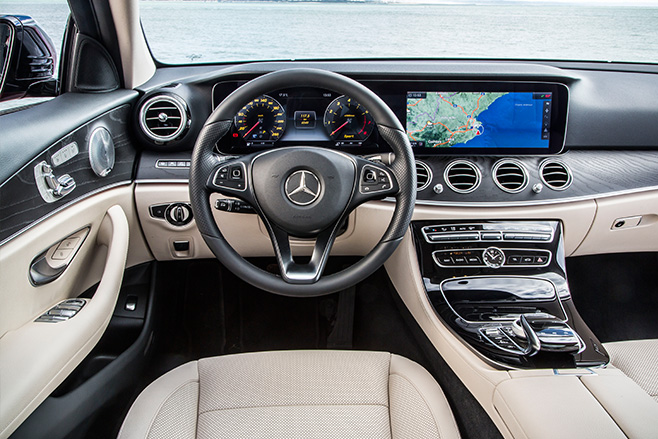
Standard gear in E-Class includes extensive safety equipment, widescreen digital instruments, 360-degree cameras, wireless device charging, steering wheel touch controls, electric seats with memory, and LED lighting. It is also lighter and more fuel efficient than the last E-Class, and more spacious inside.
The start price of E-Class is now well above the BMW 520i at $82,300 and Audi A6 1.8 TFSI at $79,900.
“I don’t think price will be as much of an inhibitor as you might think,” responded McCarthy. “I don’t think there’ll be any resistance to the price when people see the spec.”
At the car’s unveiling in Detroit, Wheels was told to expect only modest price increases, however McCarthy insists the final pricing is not unexpected.
“It’s all in how we’ve specified the car. Cars we spec in Australia are the highest spec of anywhere in the world, and that’s because our market is so competitive.”
“Yes, there’s a new 5 Series coming – the pack of cards is always being shuffled.”
McCarthy says a price-leading model with minimal standard kit was possible, but adds complication because they gather dust on showroom floors.
“Basic models don’t sell. If we had left the equipment out and let buyers put it in later, it’s most likely it would be more expensive in the end.”
“The equipment that we put in is what customers have told us that they want. It makes things easier for us and for the customer and the dealer. Experience has shown us that they option it in anyway, and the price now is a reflection of the transaction prices people are paying.”
“E-Class has lead the segment for a couple of generations in Australia. It’s not our intention to surrender that.”
Mercedes-Benz will flesh out the E-Class range with five more sedans on the way. Two additional petrol models, E300 and E400, and the new E43 AMG performance model likely to land before the end of 2016.
The E350e plug-in hybrid, and range-topping E63 AMG model are slated for 2017, all with similar price hikes expected. Estate variants are also on the horizon, arriving in 2017.
THE global ‘Dieselgate’ emissions scandal has hit home, with the local boss of Audi admitting it has caused customer dissatisfaction and has seen sales of its popular Q5 SUV slump by more than a third.
Speaking at the Australian launch of the 2016 Audi R8, company MD Andrew Doyle revealed exclusively to Wheels that local customers have been vocal about the handling of the ongoing saga, which first broke in September last year.
“From a customer point of view, there’s been some frustration,” Doyle admitted to Wheels. “From those who have affected vehicles in this country about the length of time it’s taken to get the recall in place.
“I’m pleased to announce we’re imminently about to start our first recall and that will then be released in waves over the coming months.”
More than two million Audis are caught up in the emissions-cheating scandal worldwide, with just over 16,000 local vehicles fitted with the offending 1.6- and 2.0-litre diesel engines.
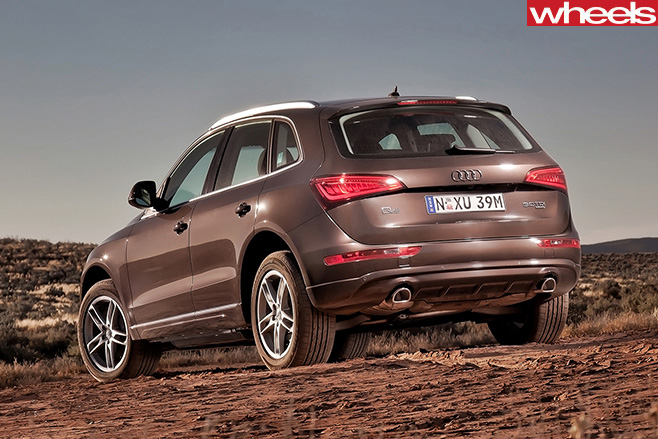
“In terms of our sales they’re still quite strong this year and we’re proud of that,” said Doyle. “But if you look at our numbers model by model, you’ll see Q5 is down quite a bit. Yes it’s in its penultimate year, but more importantly from an emissions point of view is we did have a 2.0-litre diesel that represented more than 30 percent share of the Q5.
“That’s impacted us on a sales basis in terms of year-to-year growth, especially in the Q5 which is one of our biggest-selling model.”
Volkswagen’s local sales have dropped too, with total sales down by 4.2 percent year-to-date.
Despite the negative attention on dieselgate globally, no Volkswagen, Audi or other vehicle has been found in breach of Australian emission standards. That said, both VW and Audi plan to recall vehicles to remove the cheat software at the centre of the scandal.
Despite the Audi Q5’s sales hit, Doyle is confident sales will bounce back.
“We’re really excited that the Q5’s EU6 engine, which is not affected, is imminently arriving and we have a lot of customer orders for that car because it has been a very popular car for some time,” he said. “So we’re confident Q5 sales will come back to where they were.”
Doyle admitted regaining the public’s trust is key to rebuilding the brand’s sales momentum.
“From a sales point of view, from a brand point of view, we’re super conscious of what it will mean from a global point of view to rebuild their [the public’s] trust. We haven’t had an overly negative response in Australia, I’m pleased to say, and I don’t think that’s anything to be excited about, that’s more to do with the fact we’ve tried to be as open and as pragmatic and as transparent as we can be with the information we did have.
“We wrote to our customers immediately, we advised our dealers of everything we knew, and openly said to our dealers and our customers this is a hugely complex discussion because there are so many variations of software that need to be fixed.
“So now is the time to be not super quick, but rather super careful to make sure everything is 100 percent right. And we’ve done that.”
The winners and losers in the Aussie sales race for May.
AUSTRALIA’S new-car market was up 3.6 percent for the month of May, with 96,672 cars sold compared to 93,372 in May 2015. The increase in sales was led by growth in private SUV numbers (+5.5 percent) and an increase in government spending on commercials. The Hyundai i30 was Australia’s most popular car for the third month in succession, while Toyota remained on top as the best-selling brand.
SUV sales are rapidly closing in on passenger car numbers, with 36,230 SUVs moved in May compared to 38,222 passenger cars. The best-selling SUV was the Mazda CX-5 (2117 sales).
The Hyundai i30’s continued success (3771 sales) came at the expense of the evergreen Toyota Corolla (3333) and Mazda 3 (3243), while the Holden Commodore (2255), VW Golf (1753) and Toyota RAV4 (1695) rounded out the top six passenger vehicles.
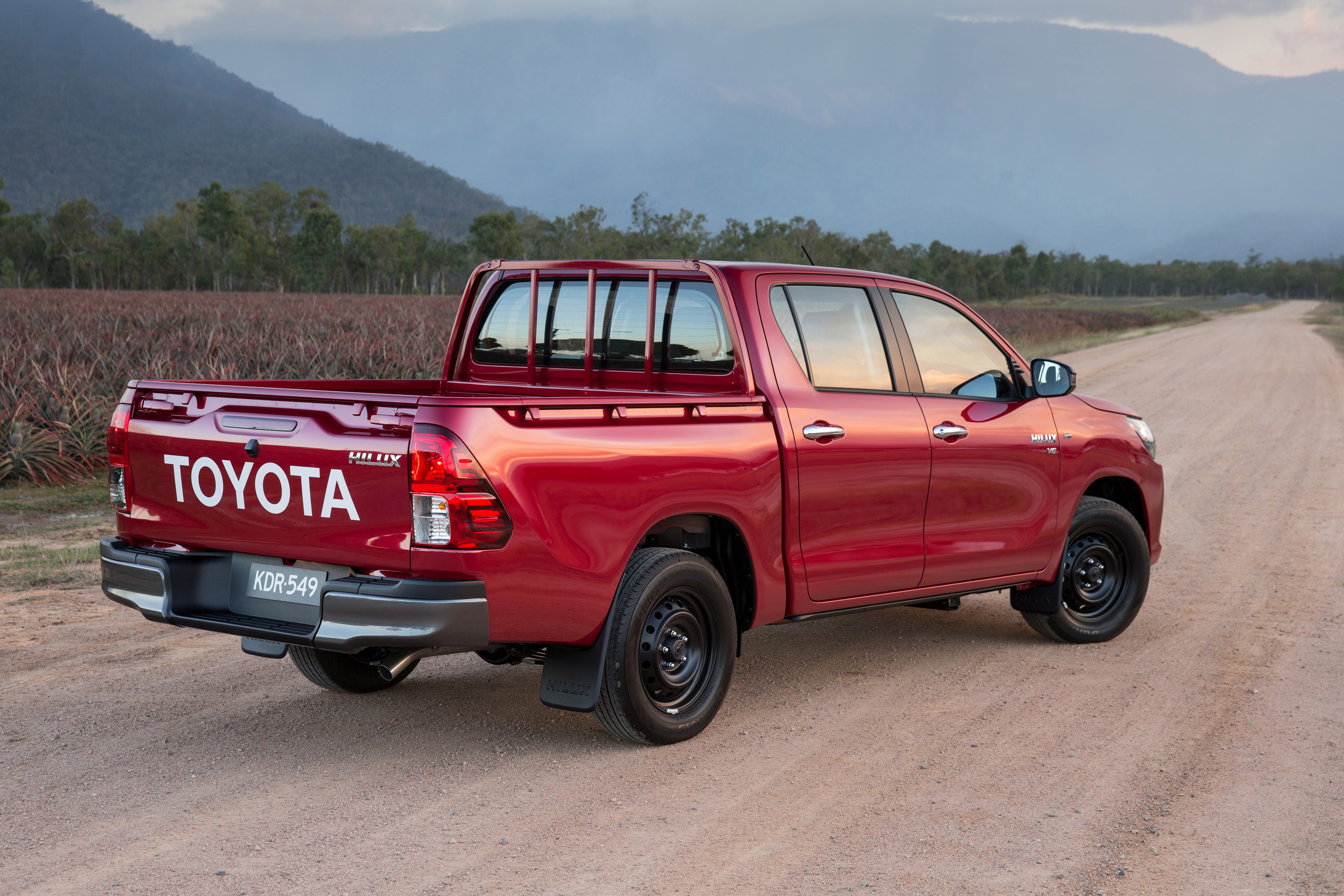
Yet Australia’s appetite for utes sees the Toyota Hilux (3675) as the second most popular of all vehicles, with the Ford Ranger in fifth and the Mitsubishi Triton winning eighth with 2021 sales.
Toyota’s market leadership remains intact, and while it leads by an enormous margin, the rest of the market is quietly chipping away at the juggernaut. Toyota’s 80,261 sales so far this year is a meagre 48 vehicles ahead of its sales at the end of May 2015. That’s a 0.1 percent improvement on last year, and far less than the overall market’s 3.8 percent growth.
Toyota still has plenty of breathing space to its nearest rival, Mazda. Operating out of its shiny new head office in Melbourne, Mazda posted solid 7.7 percent growth and has notched up 48,518 sales year-to-date to build up a margin of 6468 cars over third-placed Hyundai. The Korean brand threatened to snatch the podium spot from Holden in 2015, and has since clearly shaded the local brand, which in fourth place trails Hyundai by 5416 units year-to-date.
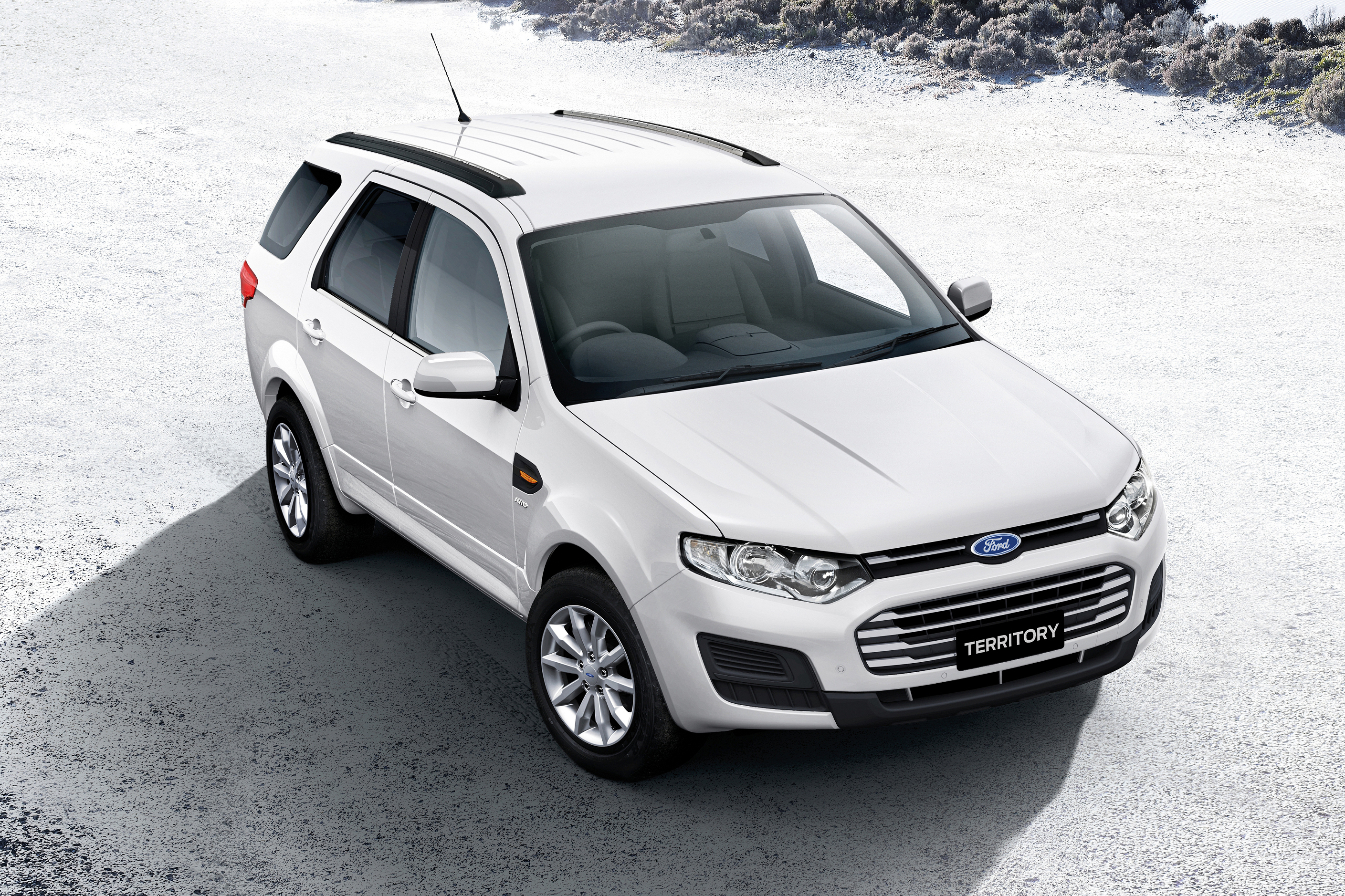
Ford, in fifth, has made leaps and bounds in 2016, with a substantial 16.4 percent improvement year-to-date, however almost half (47.3 percent) of its 6584 May sales were of a single model – the Ranger (3285 sales). Impressively (or not so, depending on you view), the Australian-made Territory remains Ford’s second-best seller, despite its slow decline, down 21.8 percent compared to 2015.
Holden sales continue to fall, with an 8.0 percent year-to-date dip after slow May sales. The Holden Commodore was its best seller (2255), while Cruze sales are down 26.1 percent in 2016. The shining lights for Salmon Street are its SUVs: Captiva is up 5.8 percent this year, while the smaller Trax is rocketing along with a 30.7 percent increase.
Star performers for May include Volvo, with its XC90, a Wheels COTY finalist, up a whopping 271.9 percent year-on-year, helping the brand reach a 51.0 percent growth rate so far this year. Alfa Romeo (down 57.4 percent) and Chrysler (a 61.0 percent decline) were among the worst performances for May.
Mercedes-Benz continued its dominance of the premium marques, with 17.6 percent growth year-to-date and to be the 11th most popular of all brands. BMW posted even great growth, at 27.7 percent. This was led by the BMW X5, and supported by the BMW X1, launched late last year, hitting the streets in serious numbers for the brand.
Audi sales are up 8.0 percent, but its growth is slowing. At the end of 2015, Audi was snapping at the heels of BMW, finishing less than 2000 sales behind its arch rival, yet in the first five months of 2016 BMW has already extended that margin to 2611.
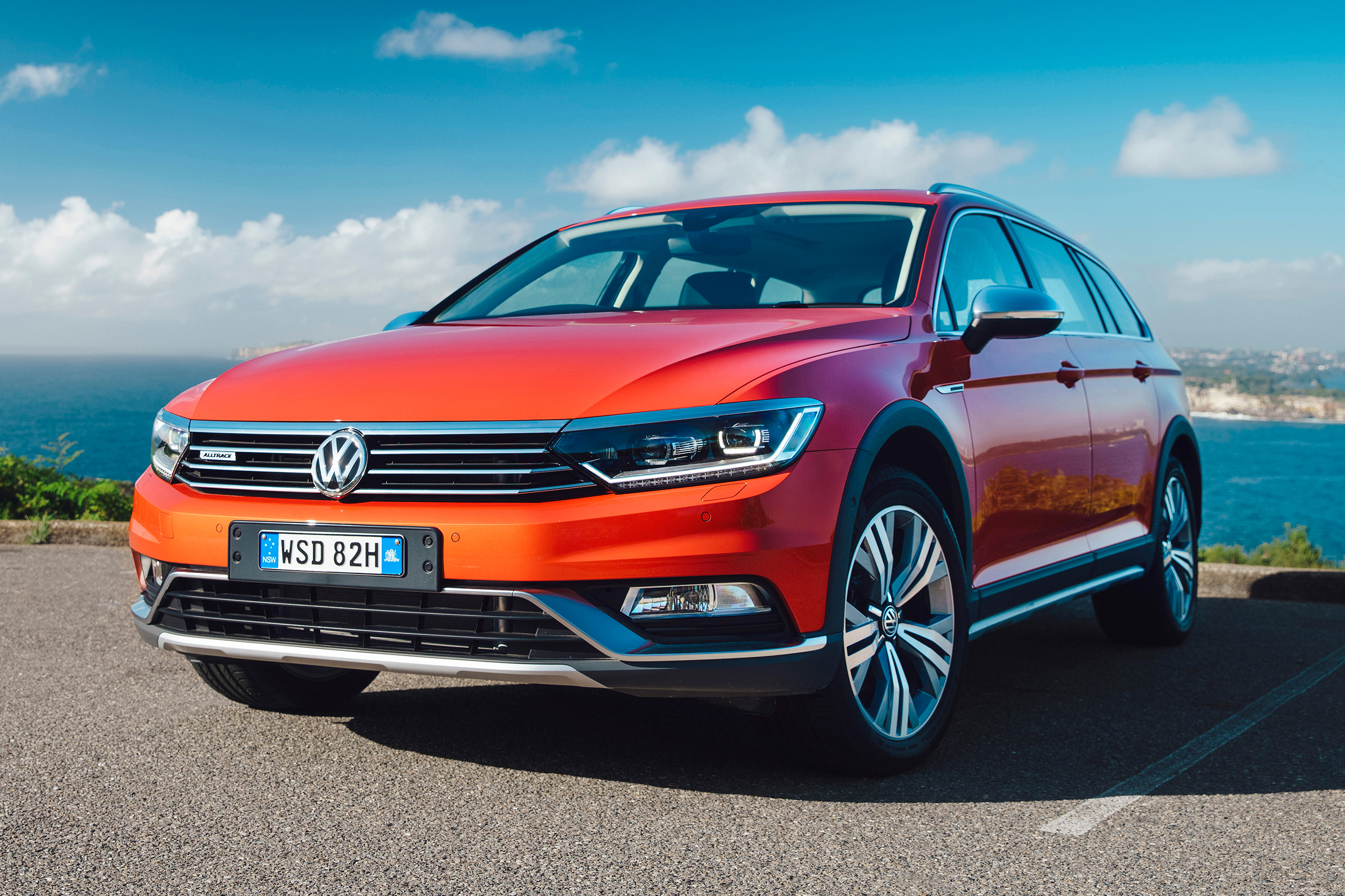
Dieselgate has also hit VW local sales, down 4.2 percent year-to-date. VW can still walk tall with its Amarok and Transporter improving, and a strong performance from the excellent new Passat (up 40 percent, with the Passat Alltrack up 76 percent), but it’s negative territory for almost every other VW model.
New-car sales for the first five months of the year have increased 3.8 per cent, to 469,571.
Top 10 best-selling vehicles in May 2016
| Rank | Model | Sales |
| 1. | Hyundai i30 | 3771 |
| 2. | Toyota Hilux | 3675 |
| 3. | Toyota Corolla | 3333 |
| 4. | Mazda 3u00a0 | 3243 |
| 5. | Ford Ranger | 3115 |
| 6. | Holden Commodore | 2255 |
| 7. | Mazda CX-5 | 2117 |
| 8. | Mitsubishi Triton | 2021 |
| 9. | Volkswagen Golf | 1753 |
| 10. | Nissan Navara | 1752 |
Winner: Utes
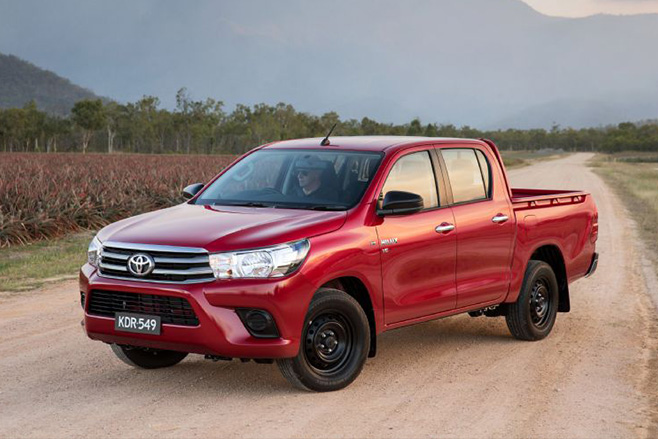
Four utility vehicles ended up in May’s top 10 sales chart, with the Toyota HiLux, Ford Ranger, Mitsubishi Triton, and Nissan Navara (which leapt 47 per cent year on year). The HiLux currently leads the battle for title of Australia’s best-selling car of 2016. The 4×2 versions of utes had a particularly strong month – up 20 per cent compared with the 4x4s that increased 8 per cent compared with this time last year.
Winner: Medium SUVs
The Mazda CX-5 leads the charge of this specific SUV segment, and the only SUV to feature in May’s top 10. Medium SUVs grew by a fifth compared with May 2015. All SUV segments continue to grow relentlessly, however.
Winner: Nissan
We’ve already mentioned the Nissan Navara ute’s 47 per cent year-on-year increase, and the Japanese brand’s 25 per cent jump for May sales was also aided by the Qashqai SUV (+70 per cent) and its platform twin the X-Trail (+17 per cent).
Winner: Bentley
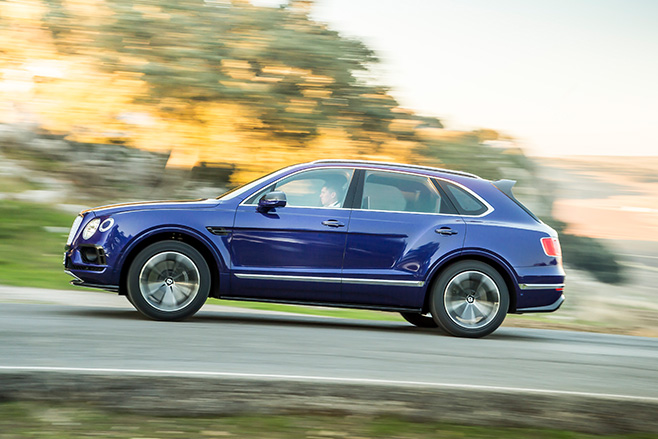
British brand’s first ever SUV, the Bentayga, hit double figures (10) in its first month on sale locally, boosting year-on-year sales for May by 27 per cent and year to date by nine per cent.
Winner: Supercars
Lamborghini tripled year-on-year sales, with its new rear-wheel-drive LP560-2 model no doubt contributing to a jump from seven sales in May 2015 to 21 last month. Audi’s just-released R8 rocketed 433 per cent with 16 units of the V10-powered supercar that starts above $350,000. McLaren continues to grow its models and sales, with a 120 per cent increase to 11 cars in May. Ferrari sold 14 prancing horses to match May 2015’s result, and Porsche’s 911 increased eight per cent.
Losers: French brands
It was a case of sacre bleu for Citroen, Peugeot and Renault, which all posted negative results in May. Citroen fell 17 per cent for the month, Peugeot by 23 per cent and Renault by 30 per cent. The tricolour-flag trio are all down year on year overall. Renault was particularly hurt by notable drops for the Captur baby SUV (-55 per cent) and soon-to-be-replaced Koleos (-94 per cent). A bright spot for Peugeot was its RCZ sports coupe, which jumped 233 per cent – albeit it from three to 10 cars – thanks to a $49,990 driveaway deal that saves about $15K on the RRP.
Loser: Volkswagen
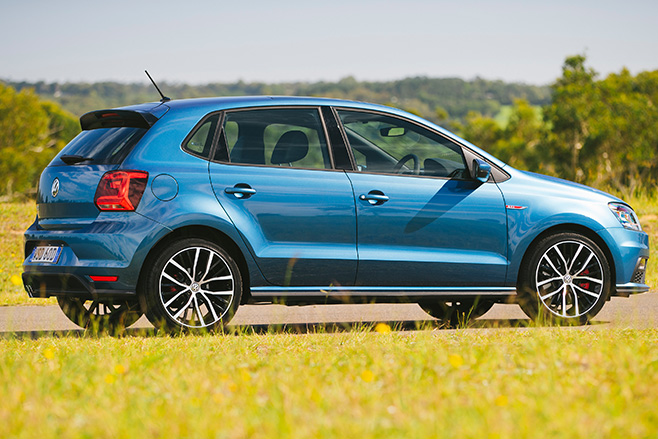
Some disappointing global financial results for the brand still scarred by diesel-gate wasn’t assuaged by Australian sales for May, which fell 18 per cent compared with May 2015. Key volume models including the Polo (-31 per cent), soon-to-be-replaced Tiguan (-55 per cent) and Golf (-16 per cent) were among those to take hits, though the latter at least remained in the top 10.
Loser: Jeep
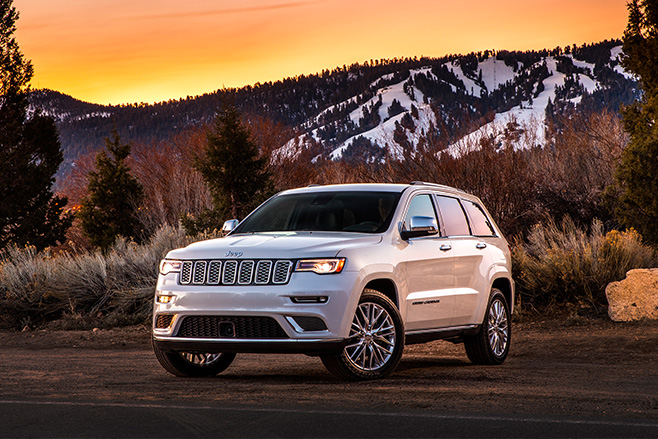
After its 49 per cent slump in April, Jeep fared even worse in May with a minus-54-per-cent result. The Cherokee hit the biggest obstacle (-77 per cent), the bigger Grand Cherokee struggled at -56 per cent, and the 4×4 brand sold only 70 units of its smallest model, the Renegade.
Loser: Holden
In a record May, the Australian brand recorded a sales deficit of seven per cent compared with the same period last year. Few positives included the Commodore, which kept in the top 10 with 2255 sales, and the Colorado 7, which jumped 55 per cent in run-out mode (it’s replaced by the newly named Trailblazer later this year).
Loser: Light/City cars
The city car segment lost 2754 sales between May 2015 and last month – a 28 per cent decrease. It was outsold by three of the four SUV segments – small/medium/large – and is down 15 per cent year to date. Well-known nameplates such as the Toyota Yaris, Suzuki Swift, Holden Barina, Honda Jazz, Ford Fiesta and VW Polo fell by between 11 and 41 per cent year on year. Two stand-outs on a positive note were the Hyundai Accent and Skoda Fabia, which lifted their respective results by 100 and 127 per cent.
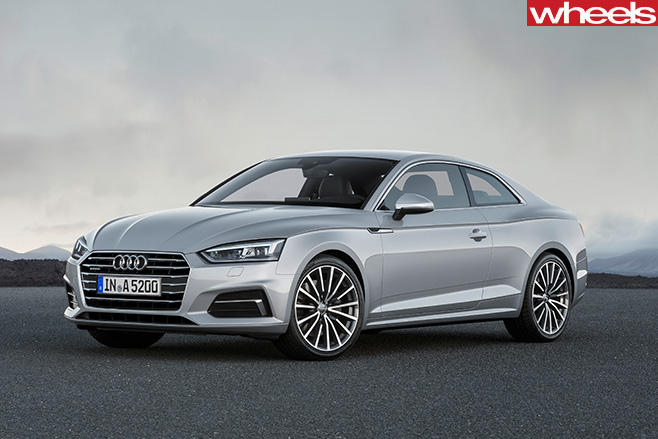
AUDI has pulled the covers off its second-generation Audi A5, revealing a new look for the mid-size executive coupe that is, well, arguably not as handsome as the one it replaces.
Wearing a face that closely resembles the fifth-generation A4, and even sharing some of its looks with the third-gen Audi TT, any makeover of the A5 was always going to be a tough ask – the previous version of the mid-size executive coupe was described by its creator, former Audi head of design Walter de Silva, as the most beautiful car in the world.
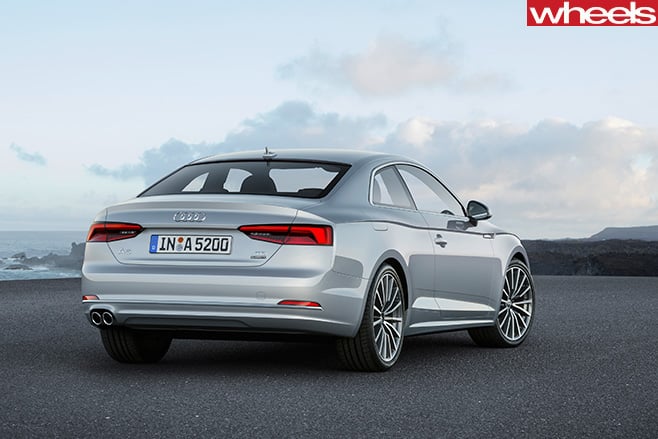
Lighter, sitting on a longer wheelbase, more fuel-efficient and crammed with advanced driver-assist technology, the new A5 will go on sale in Europe late this year, arriving in Australia by mid-2017 to take on two-door rivals including the Mercedes-Benz C-Class Coupe, BMW 4 Series and Lexus RC.
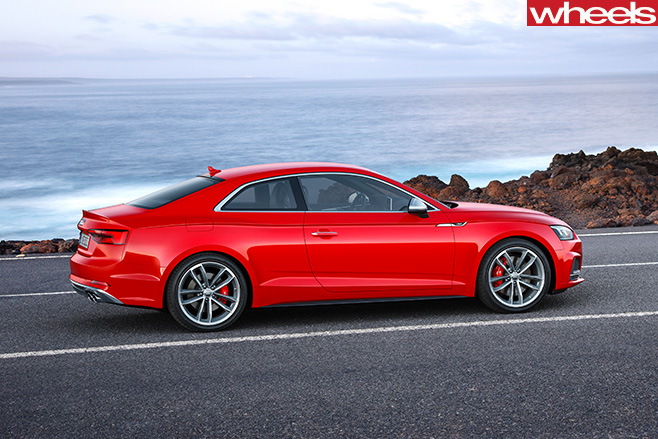
Its sides are now more heavily defined via a sharply creased shoulder running along its length, while the trapezoidal grille sits lower and deeper, framed by the same headlights used for the Audi TT sports coupe. The guards bulge around the wheels, while the mirrors move from the corners of the glasshouse to the door-top shoulders “like a racing car” to give it a more dynamic stance, Audi says.
The most noticeable change between generations is the bonnet. Heavily straked to create an impression of power, it takes cues from the Audi Prologue concept revealed at the Los Angeles motor show in 2014, and taken a step further in 2015 with a shooting brake version revealed at the 2015 Geneva motor show. Chrysler Crossfire, anyone?
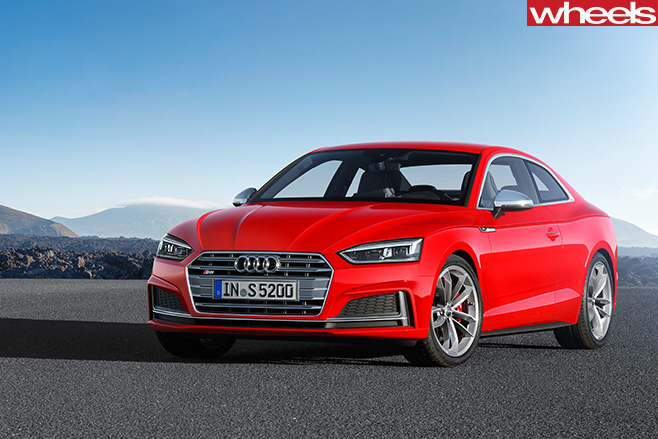
Helping on this front are the A5’s significantly improved torsional rigidity, what Audi claims is a class-leading drag coefficient, and redesigned suspension offering more comfort, but with the option of damper control that “switches its focus at the push of a button from comfort to sporty dynamics”.
The range-topping S5 – until the wraps inevitably come off an RS5 replacement – will stick with its existing supercharged 3.0-litre V6 petrol engine, which jumps from 245kW to 260kW while torque lifts from 440Nm to a nicely rounded 500Nm. The 0-100km/h sprint for the new S5 comes down to 4.7 seconds, a significant 0.4sec improvement over the superseded model.
Front-wheel-drive versions of the A5 will use a six-speed manual gearbox, Audi says. Otherwise, drivers will choose from a seven-speed dual-clutch gearbox or an eight-speed torque-converter automatic that until now was restricted to higher-priced models in the Audi range.
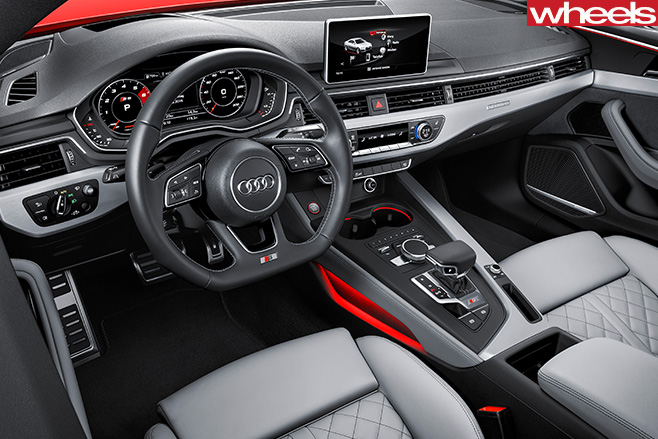
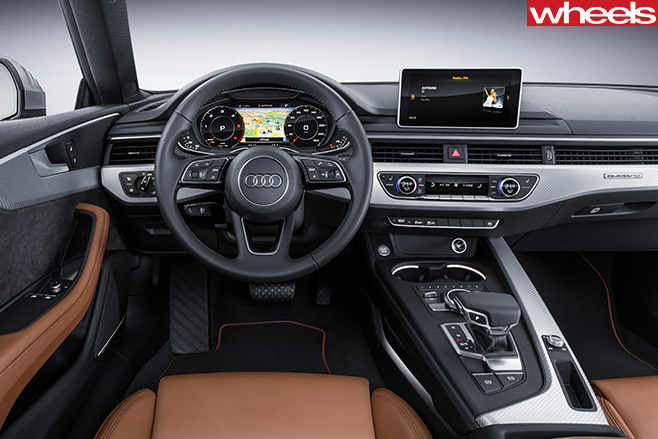
Inside, the A5 adds Audi’s Virtual Cockpit, featuring a wide 12.3-inch colour screen replacing the conventional analogue dials. There’s also an 8.3-inch screen mounted high on the centre console.
Audi’s A5 range currently kicks off from $67,180 for the entry-level 1.8 TFSI fitted with a continuously variable transmission. That compares with $71,100 for the BMW 420i and $64,000 for the Lexus RC200t Luxury. Mercedes-Benz, meanwhile, sells its entry-level C200 coupe from $59,909.
The Hyundai i30 has scored a hat-trick of monthly sales victories, topping a tightly contested May.
Just 656 units separated the top five cars last month, according to the latest official industry figures.
A generous $19,990 driveaway deal continues to make the Korean hatch hugely popular in Australia, and helped it pip the second-placed Toyota HiLux 3771 sales to 3675.
Hilux remains ahead in the overall race to be Australia’s best-selling vehicle of 2016, though the Toyota ute’s lead has narrowed to just 133 units.
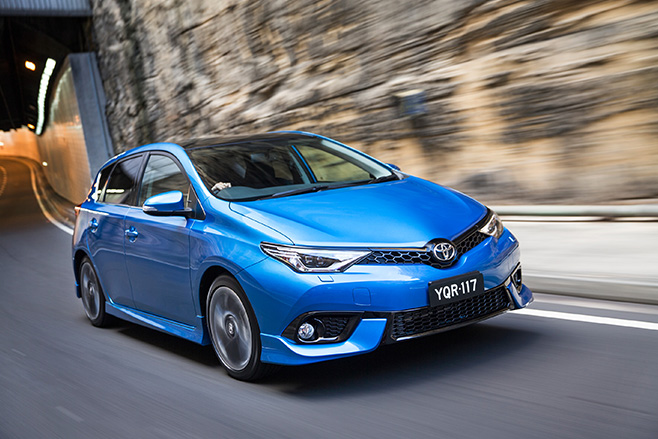
Toyota featured twice on the sales podium for May, with the Corolla (3333) edging out the Mazda 3 (3243) for third place.
Ford’s Ranger also exceeded 3000 units (3115) in what was a great month for utes, with four of the light-commercial utility vehicles featuring in the top 10. Hilux and Ranger were joined by the Mitsubishi Triton (2021 sales) and Nissan Navara (1752).
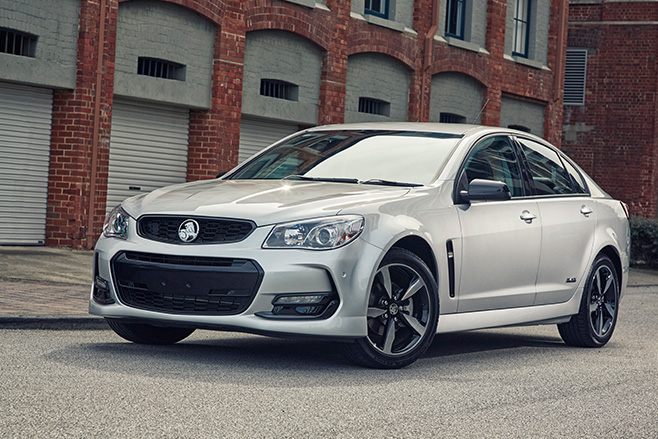
The once-untouchable Holden Commodore had a solid performance with 2255 sales.
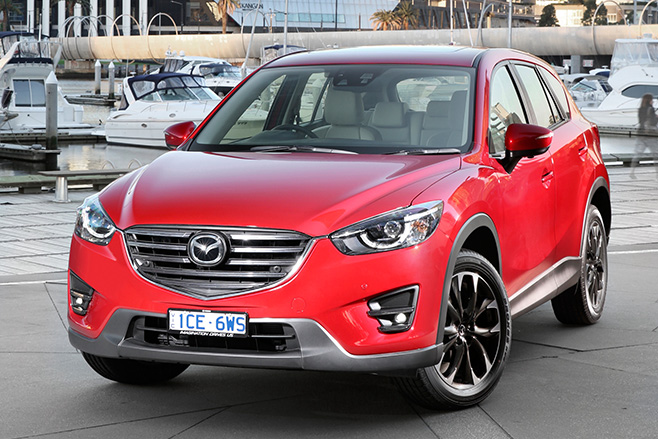
Mazda’s CX-5 was the only sports utility vehicle in the top 10, though SUVs continue to be the fastest-growing segment.
Fewer than 2000 units separated passenger cars (38,222) from SUVs (36,230) as the high-riding wagons continue to threaten to become Australia’s most popular vehicle type for the first time.
Toyota continues to be out of sight as the biggest-selling brand, its May result of 17,201 contributing to a year-to-date total of 80,261, which is a long way ahead of nearest challenger Mazda (9608 May sales for a total of 48,518 year-to-date).
Hyundai was third in May with 9005 and is also in position three overall, its 42,050 tally ahead of fourth-placed Holden (36,634). Ford rounds out the top 5 – 6584 for May; 32,067 YTD.
A total of 96,672 sales is a new record for the month of May, up nearly four per cent on May 2015.
New-car sales for the first five months of the year have increased 3.8 per cent, to 469,571.
TOP 10 MOST POPULAR VEHICLES – MAY 2016
| Rank | Model | Sales |
| 1. | Hyundai i30 | 3771 |
| 2. | Toyota Hilux | 3675 |
| 3. | Toyota Corolla | 3333 |
| 4. | Mazda 3u00a0 | 3243 |
| 5. | Ford Ranger | 3115 |
| 6. | Holden Commodore | 2255 |
| 7. | Mazda CX-5 | 2117 |
| 8. | Mitsubishi Triton | 2021 |
| 9. | Volkswagen Golf | 1753 |
| 10. | Nissan Navara | 1752 |
RACE FOR 2016’S NO.1 SALES SPOT (at end of May 2016)
| Rank | Model | Sales |
| 1. | Toyota HiLuxu00a0 | 16,558 |
| 2. | Hyundai i30 | 16,425 |
| 3. | Toyota Corolla | 16,117 |
| 4. | Mazda 3 | 15,976 |
| 5. | Ford Ranger | 14,121 |
As the first shipment of shiny new-gen Mustangs was landing in Australia, I was having a different type of Mustang experience over in the US.
But the Mustang I was driving was lower, wider, louder and a whole lot meaner than the ones coming off the ship at Appleton Dock in Melbourne. I’d flown across the Pacific to meet Carlos Gomez, owner of KAR Motorsports, and have a blast in his 686kW twin-turbocharged, wide-bodied, air-bagged orange Mustang.
Gomez got into the tuning scene more than 14 years ago when he opened KAR Motorsports in Chula Vista, California, which specialises in tweaking Mustangs, Camaros and other American muscle cars. As a kid, it was Gomez’s dad who introduced him to the custom car scene. Gomez would watch his father tear down and build back up all sorts of performance cars. And, for Gomez, it was Ford’s pony car which attracted him most.
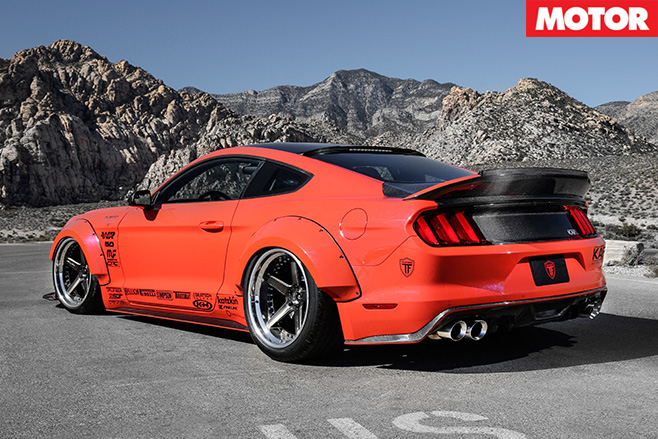
Fast forward to 2015, and with the arrival of the sixth-generation Mustang – code-named S550 – Gomez picked up a Competition Orange 5.0-litre manual and went to work making it his own.
What’s the first modification you would do to a V8 Mustang that’s already putting out a healthy 324kW (US-spec cars make 18kW more than Oz ones)? Add two turbos, of course! The Hellion twin-turbo kit is a perfect fit with the Coyote’s factory-forged internals. The top-mount twin-installation from Albuquerque, New Mexico, features 64mm precision turbochargers, an air-to-air intercooler, an Aussie Turbosmart E2000 boost controller and four-into-one extractors.
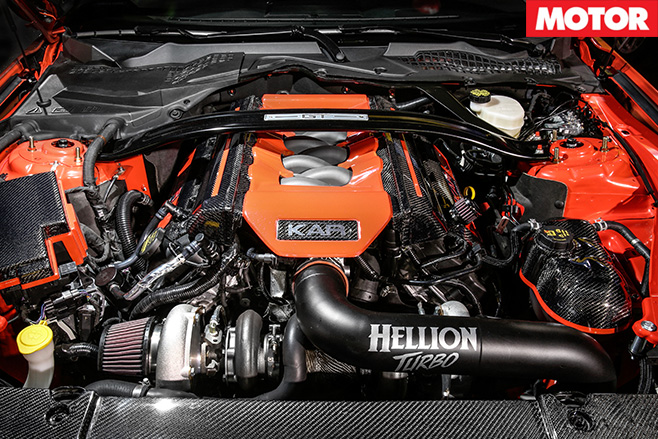
DeatschWerks injectors and a JMS ignition booster (24volts; 44amps) keep everything on track. The exhaust is a bolt-on system from MagnaFlow, and four huge tips replace the stock car’s two. The Tremec TR-6060 gearbox is untouched apart from an MGW racing shifter, which shortens the throw and gives a more direct feel.
Rather than elect a traditional suspension system, Gomez went with an air set-up. The Air Lift Performance kit features 30-level adjustable damping, camber adjustment and, best of all, a drop of up to five inches over the stock height. Now it’s not wise to drive around in full drop mode (even if you’re cruising Chapel Street). The car needs to be a couple of inches off the road to give the best ride, and, fortunately, the conversion includes an air management system that allows quick and simple adjustments.
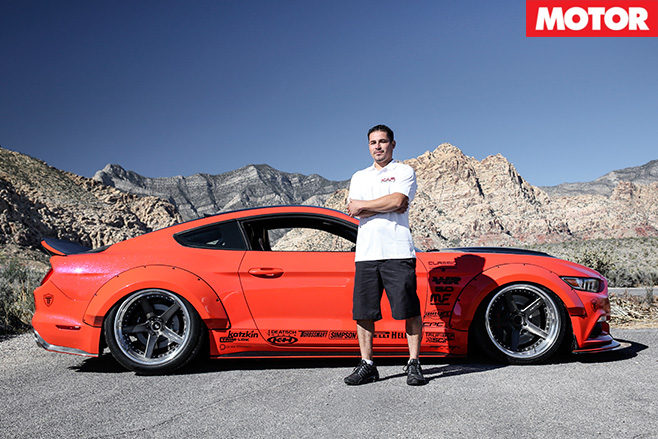
LA firm TruFiber supplied Gomez with a set of oversized wheelarches, which fatten things up by five centimetres up front and almost eight out back. Gomez also fitted TruFiber’s carbon bonnet, boot lid, spoiler, front splitter, grille, and rear and side splitters. The quality of the carbon work is awesome up close, and with all the body add-ons the car has morphed from sleeper GT into LM-spec wide-bodied monster.
While the paint seems factory, Gomez added some blue pearl which he says makes it pop. It’s subtle, but when the soft Californian sun hits it on the right angle, the edges seem to sparkle.
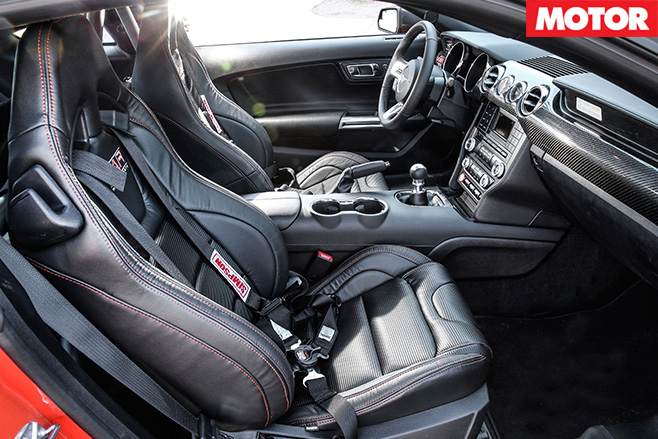
With the photography around Red Rock Canyon complete, it’s time to finally have a crack in the orange monster. So we head further away from Las Vegas in search of more interesting tarmac.
Gomez eases me in and lowers the boost levels, so that I can get my head around the car. But even at this setting, it still makes around 700hp (522kW). So after sweating some left-hand drive gear changes, I finally get the guts to press down hard on the throttle.
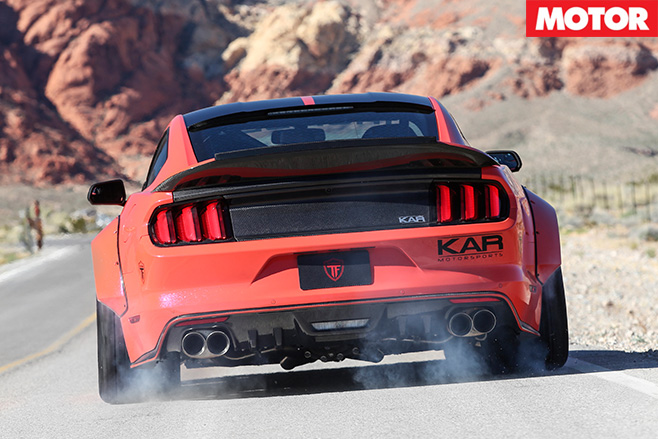
The Air Lift suspension does a good job of getting power to the ground, while also providing a decent ride – a traditional suspension set-up would never ride this well at this height. Cornering is very flat and predictable, despite the fact we never get close to its grip limits – you would need a track and a lot of talent for that, and if those steamroller 335 rears let go it’d be very scary.
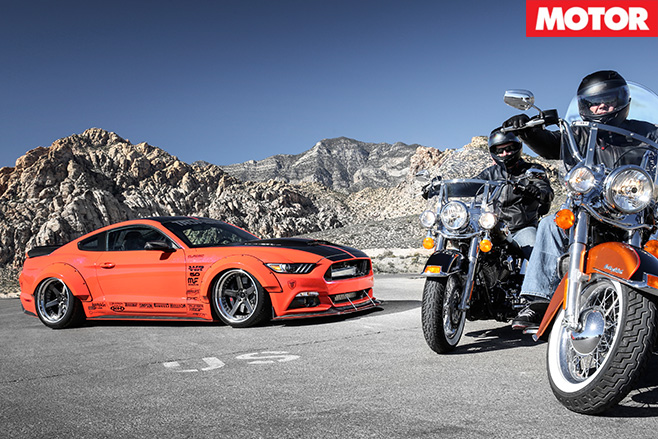
We pull in to a big scenic car park for a break from the violence and spot two guys on Harleys. As they grab a few quick pics of the Mustang I ask them what they think. “Love the colour and how fat is it, mate,” one says in a thick Aussie accent. Three Aussies, a Mustang and two Harleys in the Nevada desert – just a normal day’s work, then.
We find a big straight, make sure the horizon is clear, and go for it in second gear. As it comes on boost it breaks into crazy wheelspin and starts crabbing up the road. I keep the throttle pushed down for a couple of seconds trying to steer into the slide. It’s no good, the rear tyres are being torched and I’m all over the road, so I back off.
I look over to Gomez who is grinning: “This is insane, mate!” I have another go at it, this time feeding in the power a little more gently, which stops the wheels spinning up. I’m barely giving it more than half throttle and the KAR Mustang is rushing towards 100mph (160km/h). “I’m done,” I say, sweating, feeling weak and a little scared. This thing has broken me.
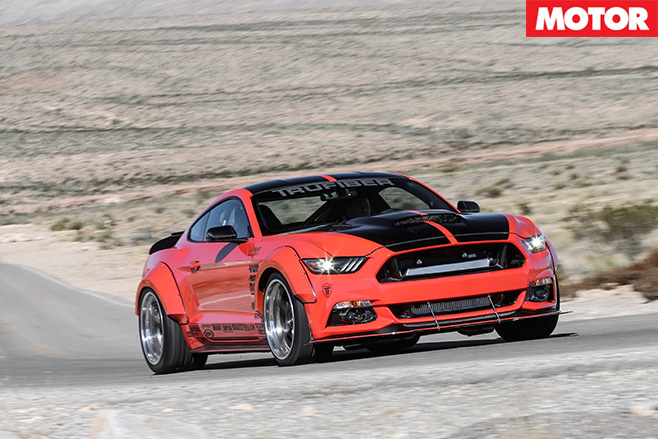
The mods are hardcore and have turned an already fast car into a total weapon, but it still is an extremely comfortable car to cruise in. Knowing that you have that much power in reserve is very cool.
I thank Gomez as he drops me back at my rental Prius and we say our goodbyes. Now don’t tell anyone this, but I’m a little relieved when I start up my Hybrid to drive back to Vegas – and reality.
4.5 OUT OF 5 STARS
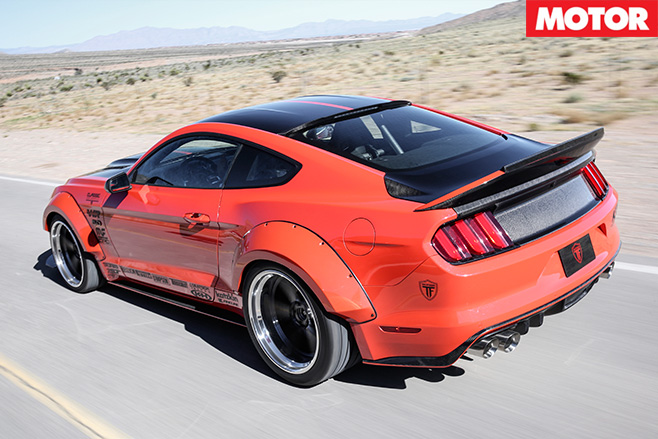
Up close: KAR Motorsport’s GT
They do things bigger in the States
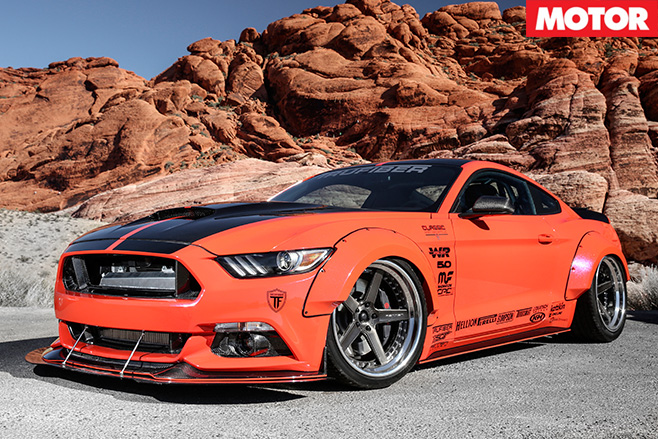
2. Slam dunk Getting this ride height with regular suspension would destroy both the ride and the handling. The solution? Air Lift suspension that offers 30 levels of damping, camber adjustment and almost 13cm of on-the-fly ride height adjustment.
3. Carbon copy Carbon features prominently, taking care of the bonnet, boot lid, spoiler, grille, front, side and rear splitters and the dash. The fancy black wave is also everywhere under the bonnet; the weight saving is welcome, but really it just looks extremely cool.
4. Bulking up KAR’s body additions make a regular Mustang look positively weedy. Los Angeles company TruFiber provide the huge wheelarches which fatten the car by five centimetres at the front and almost eight at the back, necessary to clear the massive 20 x 11.0-inch and 20 x 13.0-inch rear rims.
5. Power game Factory forged internals means the 5.0-litre Coyote V8 is happy to handle a bellyful of boost, even with 11.0:1 compression. Just 5psi will deliver a healthy 485kW, but the motor’s maximum tolerance of 16psi gives you an outrageous 686kW and 1100Nm of tyre-frying torque.
HYUNDAI has unveiled a high-performance RM16 N concept car, previewing a mid-engined hatchback that may one day spin into a replacement for the funky Veloster hatchback.
The RM16 N – the “RM’ stands for “racing midship” while the “N” alludes to Hyundai’s plan to launch a new performance sub-brand – is a rear-drive hot hatch that’s unlikely for production, but offers valuable clues as to where the Veloster’s styling is headed.
The lightweight, two-seat concept uses a 220kW 2.0-litre turbocharged petrol engine mounted behind the driver, and a six-speed manual transmission. The RM16 N uses weight-saving innovations from the RM15 concept revealed last year – which itself was spun out from the Korean carmaker’s surprise mid-engined RM concept from 2014 – with an aluminium frame clad in carbonfibre-reinforced plastic panels.
The RM16 N features an Audi-like electric supercharger to boost power, an electronic limited slip differential to send it all down to the road and an automatic rear spoiler to optimise high-speed aerodynamics.
But the most noticeable change coming to the Veloster and flagged by the RM16 N is its front end. New wavy LED headlights add to the long and low bonnet, combined with more aggressive bumper styling.
Hyundai Australia says the RM16 N is a “rolling development”, its term for a concept vehicle the Korean carmaker plans to use as a test bed new technologies as it grows increasingly curious about the development of high-performance technologies.
HYUNDAI ELANTRA ELITE Score: 81/100
Price & Equipment | 17/20
We’ve chosen the top-level Elantra ($26,490) because people downsizing into a small sedan will still want some comforts. Elite spec rules out a manual, but you get leather, dual-zone climate, 7.0-inch info screen, Bluetooth phone and audio, voice control, auto lights and wipers, six airbags, parking sensors and a rear-view camera.
Interior & Versatility | 16/20
Fit, finish, comfort, ergonomics and space make the Hyundai’s cabin a nice (if plain) place to be. A generous glasshouse gives it an airy feel, and the back seat is roomier in most directions. Meanwhile, the Elantra gets a bigger 458-litre boot (up 50L) that’s more easily accessible than the Mazda’s thanks to a decent-size opening.
Performance & Economy | 17/20
On paper, there’s little in it. Elantra has a 2.0-litre petrol four, as does the Mazda. The Hyundai is negligibly down on power and torque and weighs about 55kg more (at 1355kg). They’re both six-speed autos, but only the Mazda provides paddle shifters. On the other hand, the Hyundai is more alert and responsive in auto mode.
Ride & Refinement | 16/20
Elantra is softer than the 3, which gives it a more settled ride, despite inch-bigger wheels and shallower sidewalls. It has the aural edge, too – it’s a bit quieter in terms of tyre and suspension noise in particular, and also wind noise – seemingly due to better isolation of the workings from the body and superior cabin insulation.
Steering & Handling | 15/20
The Hyundai turns in keenly and the body rolls more than the Mazda’s, which at least telegraphs what the reasonably well-sorted chassis is doing. You can enjoy hustling the Elantra due to its agility and responsiveness; the letdown when getting into it is the lack of shift paddles, not a lack of chassis enthusiasm or grip.
MAZDA 3 TOURING SEDAN Score:83/100
Price & Equipment | 18/20
The Touring-spec 3 costs a mere $300 more but lacks some of the Hyundai’s nice extras, such as 17-inch alloys (it gets 16s) and LED DRLs. But the Mazda gets a proper sat-nav while the Hyundai relies on a paired iPhone (or, with an update soon, an Android phone). The Mazda also offers a $1500 safety pack that includes city-speed AEB.
Interior & Versatility | 17/20
Like some other mid-level Mazdas, the 3 lacks keyless entry – you have to press the key-fob unlock button. But inside it offers a classier feel than its rival and great quality, though it’s generally a bit less spacious. There’s more rear headroom, but less space in other directions, and you don’t get rear air-vent outlets.
Performance & Economy | 17/20
Direct injection and a higher compression ratio contribute to the 3’s power-to-weight advantage. But a focus on frugality – delivered in part by over-eager upshifts – removes some of the fun. On the flipside, the Mazda is the miser, at 5.7L/100km (versus 7.2L/100km), which is just as well given its 11L-smaller tank.
Ride & Refinement | 15/20
Mazda has made ground in terms of shutting out NVH, but there’s still room for improvement. How many times have we said that over the past three decades or so? Part of the 3’s ride deficit is because Mazda puts entertainment value first, and for a taut, sporty car it’s not uncomfortable – the compromise isn’t bad.
Steering & Handling | 16/20
Steering is an improvement over early Zoom Zoom-era Mazdas in that it’s now more measured and linear. Though this removes a bit of the up-for-it nature of the first-gen 3, it makes for a more mature, yet still sporty drive. Similarly, the suspension imparts a more solid feel and delivers a planted, well-balanced flavour.
THE VERDICT
The Mazda 3 at times tops the best-sellers list, but it’s the hatch contributing the bulk of sales. The sedan, then, is a lesser-chosen variant, like the Elantra. The ‘flagship’ Elantra is still affordable, and brings extras to keep the value equation intact, while its newfound exterior style helps pull off a posh ‘Elite’ variant. For cabins and kit, it’s a close race with the Touring-grade Mazda,
but the Hyundai’s extra space and stuff doesn’t quite offset the 3’s nicer design and proper sat-nav. The Hyundai is entertaining, while the Mazda has dynamic depth – the letdowns are the 3’s less enthusiastic drivetrain and the Elantra’s lack of paddles. The Elantra has a better warranty and comfort; the Mazda is more economical, and ultimately the narrow victor.
Audi’s second-generation S5 coupe is leaner and fitter than ever before, with performance to near-match the previous V8-engined RS5 coupe.
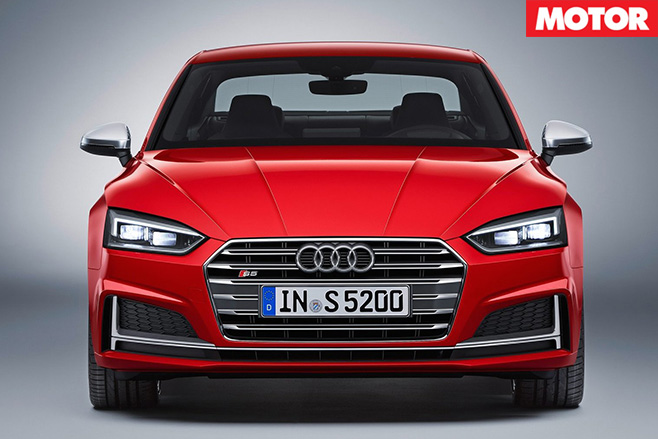
At first glance the new S5 coupe – as with many Audi models – looks similar to the old one, but only the side character crease that licks over the pumped rear haunches is actually meant to give a nod to the first model launched in 2007.
The front end’s most striking feature is the quartet of sharply defined lines on the raised bonnet, separating it from the flatter and more conservative engine lid of the new S4 sedan on which the S5 coupe is based.
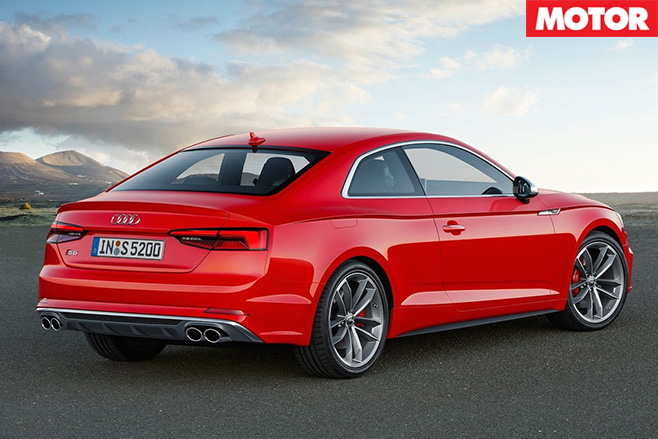
The brand new body and chassis is up to 60kg lighter than before and while the new engine maintains the 3.0-litre capacity and V6 configuration as before, a turbocharger rather than a supercharger now boosts it.
As with the S4 sedan it produces an identical 260kW of power and up to 500Nm of torque between 1400rpm and 4500rpm, and mates exclusively with an eight-speed torque converter automatic transmission.
The S5 coupe isn’t any faster to that performance benchmark than the S4 sedan, however.
Unfortunately the rear sports differential that transforms the handling of the outgoing S5 coupe again remains on the options list, as does variable-ratio sports steering and adaptive suspension (at least in overseas markets).
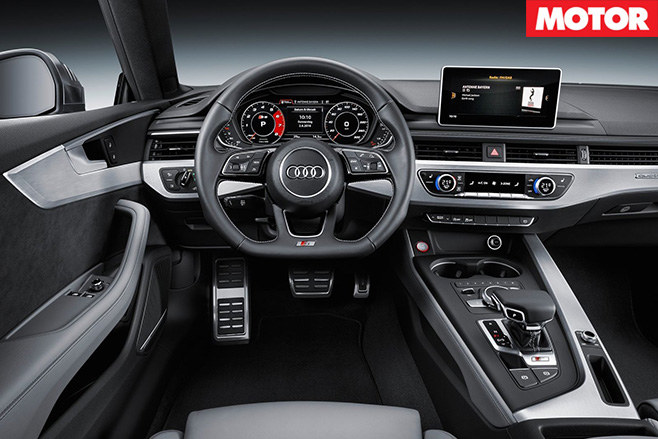
The ‘virtual cockpit’ with 12.3-inch TFT display in front of the driver is the highlight, but there’s a heap of technology including the ability to steer itself within a freeway lane, and ‘matrix’ LED high-beam that can ‘block out’ forward or oncoming traffic.
Audi Australia can’t confirm what will be standard in the S5 coupe locally, but a spokesperson has told MOTOR it will take the opportunity of a new model to have a “fresh look” at the pricing structure of the entire A5 coupe family.
With the S4 sedan and Avant due to arrive locally in the fourth quarter, the S5 coupe will follow in the first quarter of 2016. The outgoing S4 costs $104,610 and the S5 coupe asks $119,510 each before on-road costs.
