
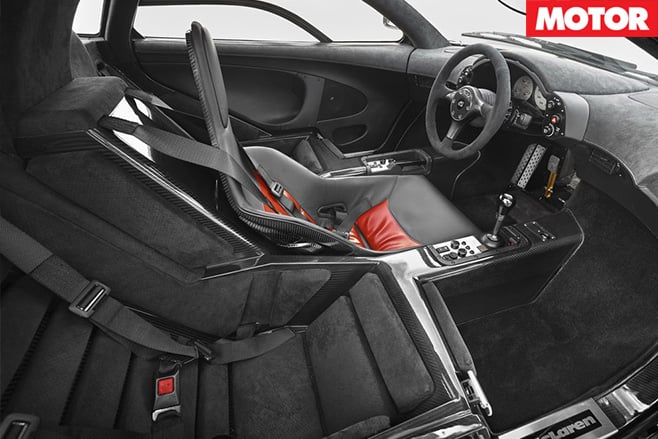
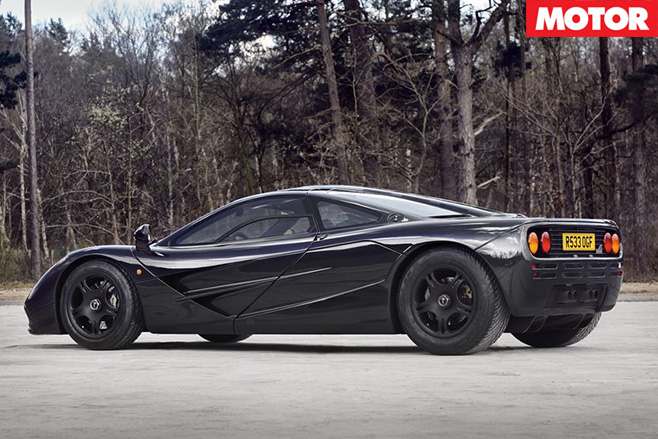
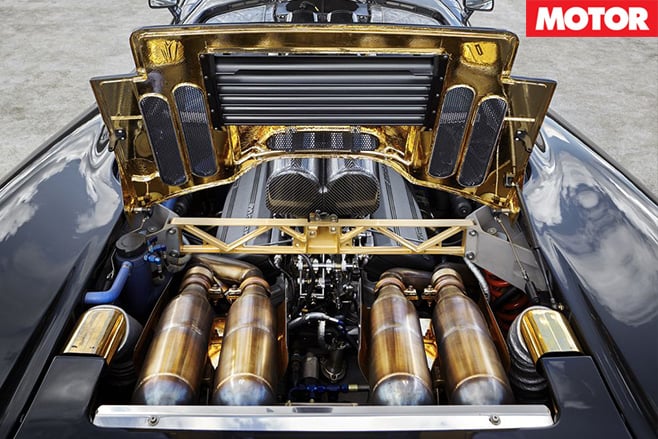
This is ‘the’ F1 McLaren collectors have been hanging out for.
With only 64 cars built it’s not very often an F1 emerges on the classifieds. But even with such exclusivity of ownership, chassis 069 here boasts a rarity above other examples.
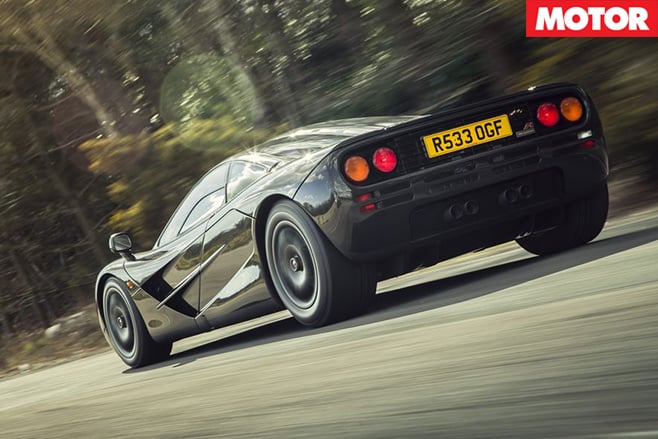
However, this one hasn’t been through such hardship. With around 4500km on its odometer it’s covered about 250km a year since leaving Woking’s factory doors in 1998 –a round-trip to Lorne from Melbourne – and is basically in mothball condition. McLaren’s also held on to its original fitted luggage, boxed titanium tool kit, and the Tag Heuer owner’s watch numbered to its chassis.
For six decades Aussies have shown flair for building not only some of the world’s best tin-lid racers, but how to paint them as well. We give you nine of the best.
1. GREEN-EYED MONSTER
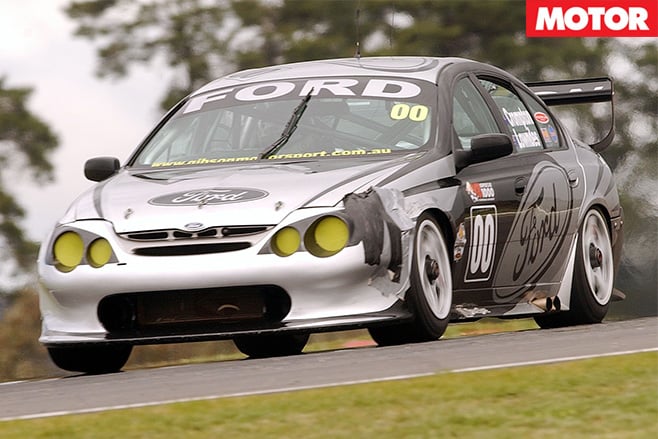
2. HRT VY COMMODORE
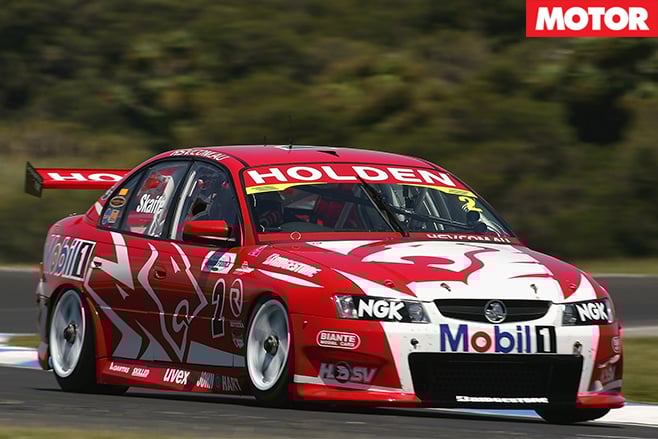
3. SHELL EB FALCON
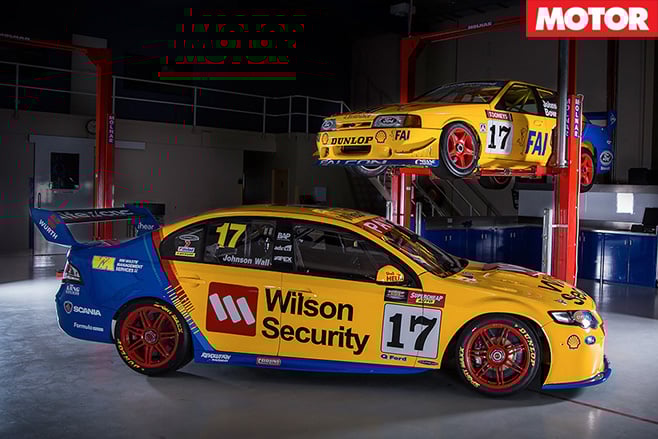
4. HDT VK COMMODORE
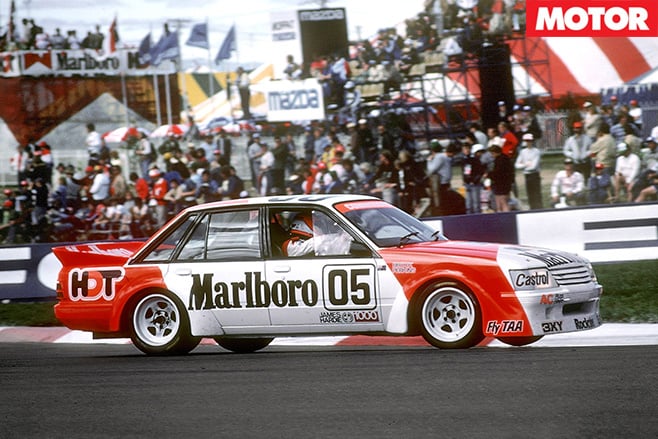
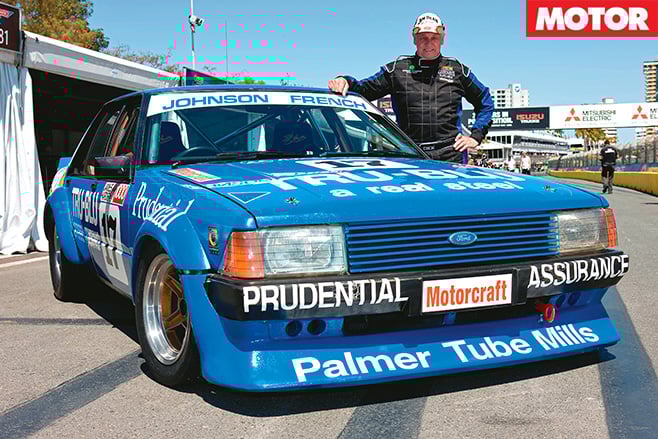
5. TRU-BLU XD FALCON
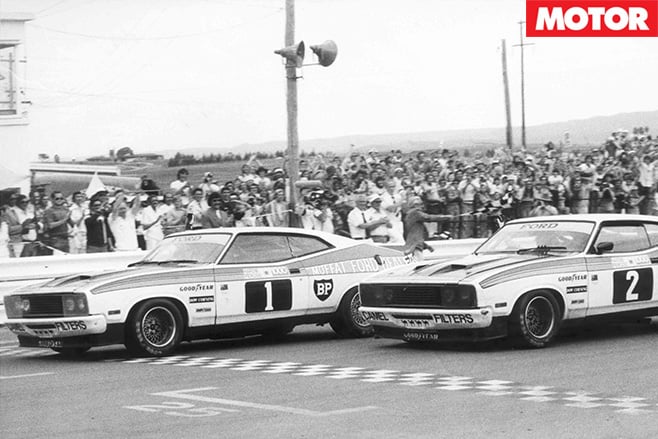
6. FORD DEALER XC COUPES
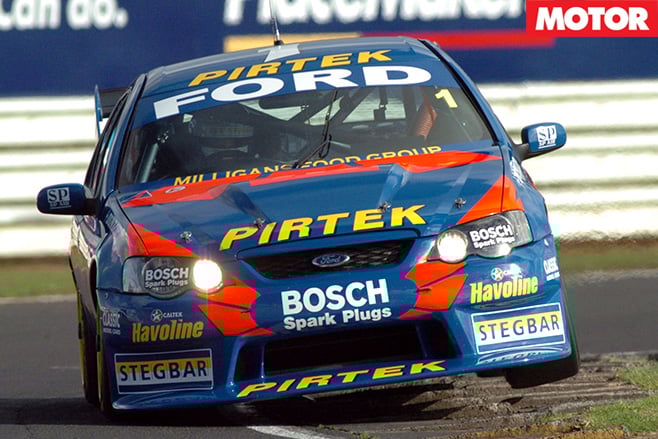
7. PIRTEK BA FALCON
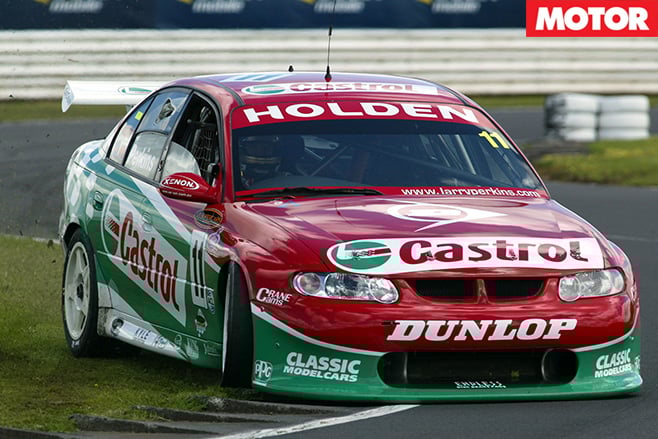
8. CASTROL COMMODORE
9. HDT TORANA A9X
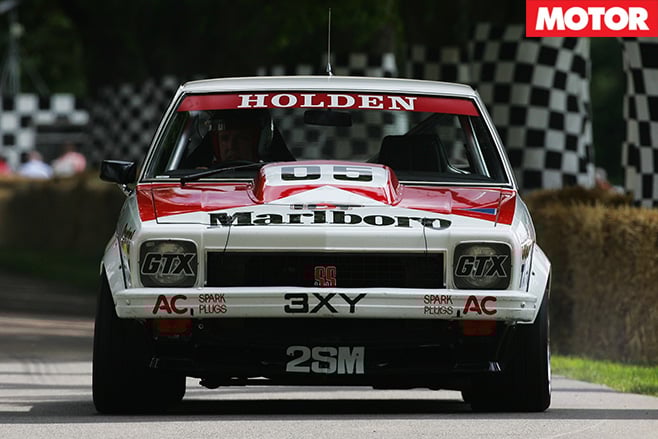
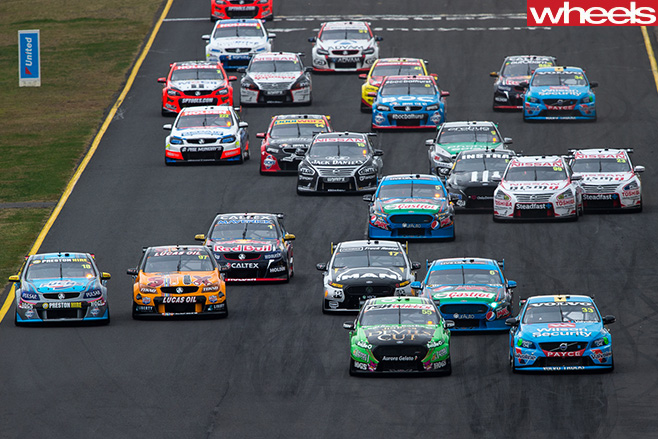
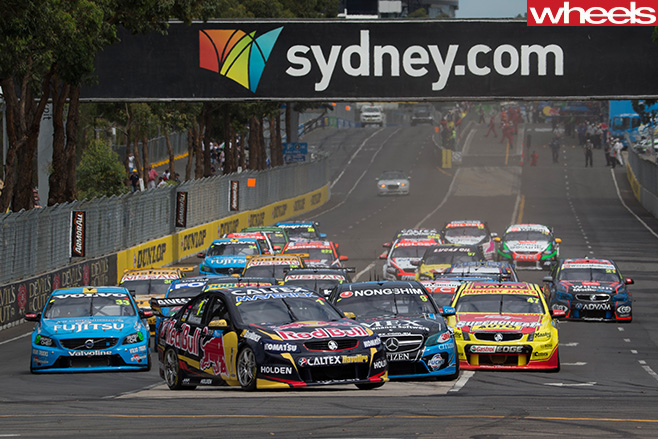
V8 SUPERCARS racing is again under the spotlight this week following news that Volvo has severed its high-profile factory-backed program, effective from the end of the current season.
The decision was made by Volvo’s Polestar high-performance arm, with the local operation powerless to influence the outcome. The Swedish brand is going in a different direction with fuel-thrifty four-cylinder turbo engines; its V8s were mothballed years ago.
Volvo’s imminent departure comes on the heels of the official exit of Ford from the series (although Falcons are still run by Prodrive Australia and DJR-Team Penske).
Garry Rogers Motorsport, which ran the Volvos, has indicated it will continue to race its S60s without factory support. However, technical partner Cyan is demanding the return of all its Volvo-supplied hardware – including the engines – at the end of this season.
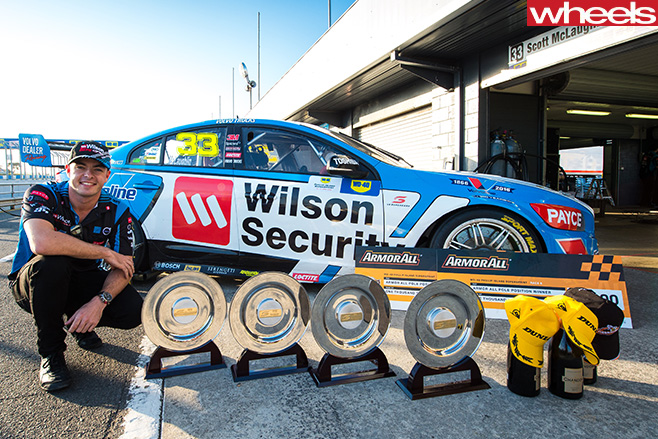
V8 Supercars Australia will be dreading another departure, which would leave just Holden with manufacturer backing. Just two years ago there were five brands involved – Holden, Ford, Nissan, Volvo and Mercedes-AMG.
So even with its imminent Gen II Car of the Future providing choices of engines beyond the traditional 5.0-litre V8, could it be that Supercars (with the V8 dropped from the name) is flogging a product that today’s carmakers simply don’t want to buy?
Mazda has consistently rejected overtures from V8 Supercars over many years, its heroic sales success coming with only sporadic involvement in motorsport, specifically the Bathurst 12 Hour.
Mazda Australia’s Karla Leach told Wheels that, while Supercars is very popular here, it is not compatible with the company’s global motorsport strategy.
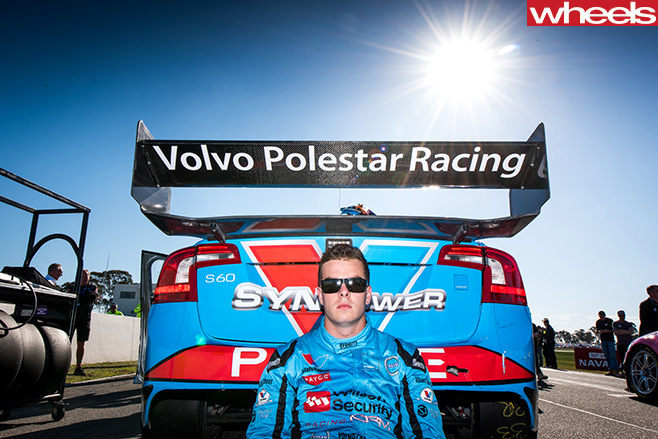
The Mercedes-AMG badge came in only as a non-factory privateer squad (Erebus) and departed last year. Mercedes-Benz Australia was never a supporter and maintained that V8 Supercars was not a good fit for its customer demographic.
BMW Australia spokesperson Lenore Fletcher wasn’t tempted to comment on Supercars directly, but said that BMW’s choice to compete in the Australian GT Championship was supported by a number of good reasons, specifically that its M6 GT3 was the ideal product, and that the local series was in line with the marque’s global motorsport direction.
“The demographics of the participants and audience of the Australian GT Championship align with our customer base,” Fletcher added. “Besides, Australians and the entire BMW Australia family love their motorsport, and the Australian GT Championship offers the perfect opportunity to participate in a performance-based competition.”
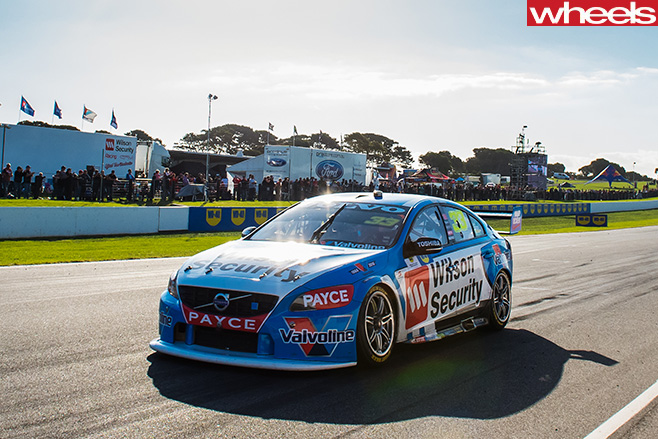
“It’s as obvious to anyone with half a brain that V8 Supercars racing has zero positive effect on sales,” he suggested. “Some will argue that competing [in motorsport] is about enhancing ‘brand image’ … I’d rather a positive sales impact from the racing.”
He went on…
“It’s the formula that’s the problem. Those engines are no longer in production, or are sourced from trucks or are faux Nascar engines then wrapped in silhouettes that have no relevance to the market.”
He was also more enthusiastic about GT3 sports car racing. “GT3 racing is where the future is. Think about it – GT3 race cars can be purchased from the manufacturer, are based on road cars, have genuine OEM support and the fan base is just as tribal as V8 Supercars’. The difference is they actually buy the OEM product!”
Subaru Australia managing director Nick Senior – once a supporter of local motorsport – is now scathing of the state of the sport, not just V8 Supercars, for not moving with the times.
“I went to my first rally event in 12 years a few weekends ago and thought I had lobbed at a classic rally by mistake. The winning car was 17 years old and 250kg lighter than our current showroom-stock vehicle. There were six WRX STIs in the first 20 cars that were all in different classes!
“And there’s no meaningful cap on spending anywhere in Australian motorsport, and that is so 1990s. If CAMS wants manufacturers to compete I would suggest a national forum be held to help progress a motorsport blueprint for the future.”
The sobering Volvo news comes in the wake of a more positive announcement that Virgin Australia will become the naming rights partner of the renamed Virgin Australia Supercars Championship from July 1. The deal runs for five years.
”Gen II has delivered engine optionality to manufacturers – it opens the conversation with manufacturers to use something other than V8s, at a time that suits them,” Warburton said.
He is pragmatic about brands that head to the exit: “They’re all up for renewal at the end of this year. It’s what happens in our business. There could be one brand [involved officially] next year. Or four. Or none. But there will be a healthy grid of Supercars.
“We are comfortable with Gen II. We have been able to get costs under control, and it’s a very attractive racing product.
“But of course we need to make ourselves a more appealing option to manufacturers. The sustainability of our teams is strong but we still need to make them more attractive to manufacturers.”
As for those massive changes across the Australian automotive industry landscape, Supercars is feeling some of the uncertainty.
Fiat has made its Abarth performance range more accessible than ever with the introduction of the new entry-level Fiat Abarth 595.
Priced from $27,500, the small performance hatch is the cheapest Abarth ever offered in Australia and bridges the gap between the regular Fiat 500 range and the existing, and more expensive, Abarth 500 models.
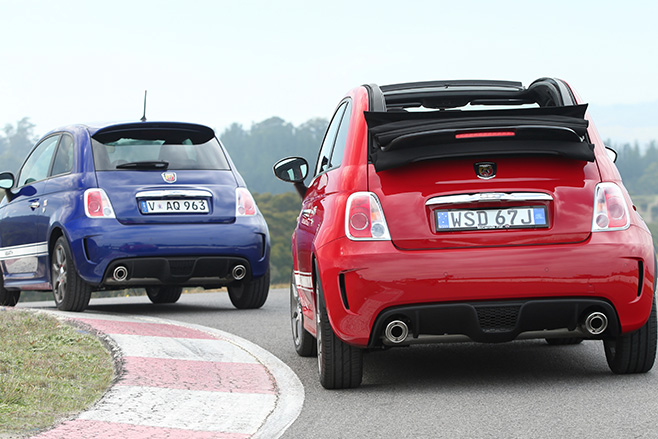
The previous entry point to the Abarth range was the 595 Turismo which started at $34,000.
“We’re re-aligning the Abarth range,” said Alan Swanson, Fiat’s senior product planner. “In the past there’s been quite a large price gap between the regular 500 range and the Abarths. What we’ve done is cut that price gap in half.”
Just like its price, the Abarth 595’s performance and dynamic ability sits between the regular 500 and the more powerful 595 Turismo.
Power is sent to the front wheels via a 1.4-litre turbocharged four-cylinder engine that produces a healthy 103kW/206Nm. A five-speed manual gearbox is standard, but you can opt for a five-speed automatic gearbox for $2000 extra.
There’s also a firmer sports suspension set-up, bigger brakes and a sports exhaust.
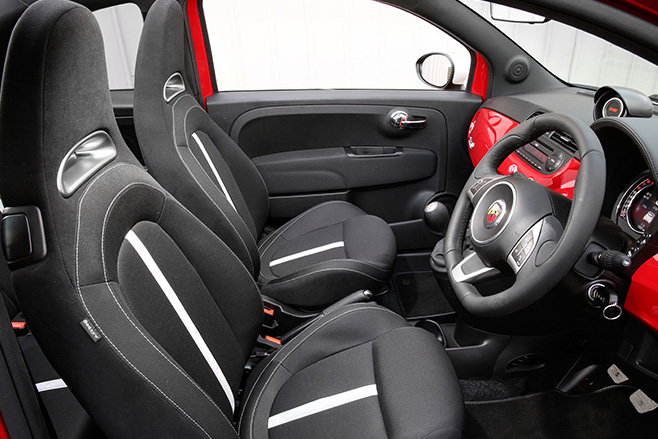
Inside, the Abarth treatment adds sports seats, a flat-bottom leather steering wheel, a configurable 7.0-inch instrument cluster and dash-mounted turbo-boost gauge.
Importantly, the Abarth 595 rolls on 16-inch wheels, not 17s like the ones found on other models in the Abarth range. This dramatically improves the way the car rides over bumps. As a result, the 595 is not only the cheapest Abarth on offer, but also the easiest and most comfortable to live with everyday.
Fiat’s repositioning of the Abarth range will continue later this year with the arrival of a new halo model, the Fiat Abarth 124 Spider in September.
Find out more about the Abarth 124 Spider here.
FIAT’S new sports car, the Abarth 124 Spider, could be more affordable than expected when it arrives in September, with a price we’re told will be “in the mid-$40,000 bracket”.
Aussie buyers will get only the faster, more powerful Abarth version of the Mazda MX-5-based two-seater, and Fiat Chrysler Australia is keen to secure competitive pricing and a high level of standard equipment for its new performance flagship.
Early speculation suggested the Abarth Spider 124 could cost north of $60,000, based on European pricing.
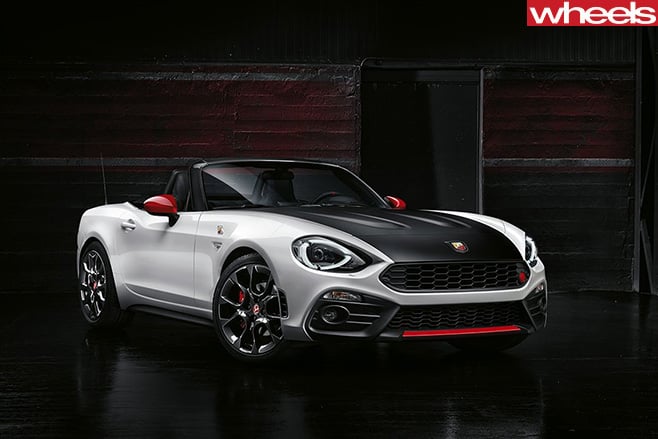
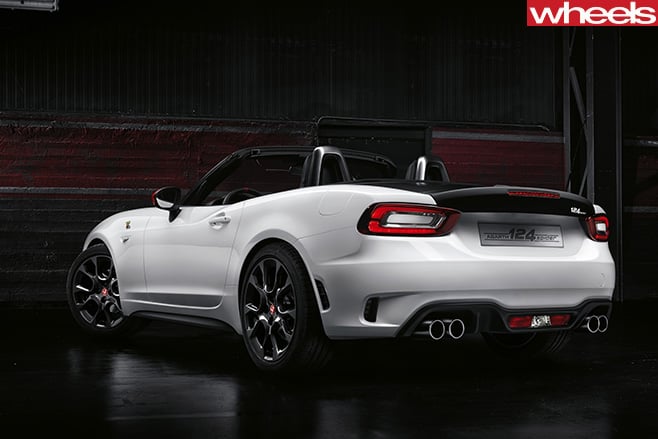
The Fiat and Mazda share the same platform and engineering bones underneath, yet Fiat’s decision to import the Abarth version means the 124 Spider will have a distinct power advantage thanks to its 127kW/250Nm 1.4-litre turbo four.
Mazda’s 2.0-litre MX-5 produces 118kW/200Nm.
“We’ve not locked in pricing exactly, but it’ll be somewhere around that $40,000 mark.”
As well as its more powerful engine, the Abarth version adds a limited-slip differential, ‘Abarth by Bilstein’ dampers, stiffer anti-roll bars and Brembo brakes as standard.
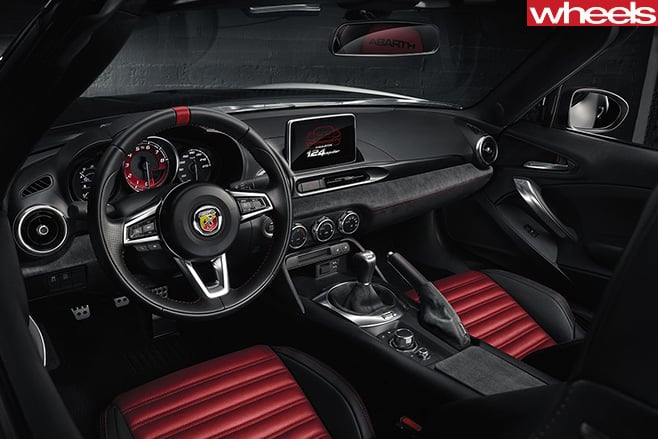
“And it’ll have things like leather upholstery, sat-nav and LEDs as standard, too – everything you’d consider reasonable for a premium car,” Swanson said.
Interestingly, Fiat hasn’t totally ruled out importing the standard version of the 124 Spider at a later date, with Swanson revealing its business case will be constantly re-evaluated.
“It’s obviously something which is available to us, so never say never,” he said. “It depends on making business cases favourable for us, and that’s the type of thing that fluctuates year to year.”
TELL ME ABOUT THIS CAR
The Fiat 500X is the Italian carmaker’s answer to the growing popularity of compact SUVs here in Australia. With an emphasis on styling you’d expect from the Italians, powered by a 1.4-litre four cylinder turbocharged engine and underpinnings twinned to the Jeep Renegade, the 500X should, in theory, be a real winner for a chic SUV living the café-style city life. Think of it as the half-sibling of the Fiat 500, jacked up on steroids and conceived from its mother’s love affair with an American.
There are things to like about the 500X, like its character styling and spacious cabin, but then you look a little deeper and realise its vanity comes at the sacrifice of practicality.
STRENGTHS
- The spirited 500X doesn’t disappoint when it comes to performance. But be aware that if you’re driving it hard, you’ll blow out Fiat’s recorded fuel figures. On a recent test of the 500X, we recorded a sub-par 12.4L/100km.
- The chic 500X has a focus on style and while opinions are divided on the bulky, curvaceous body of the Italian compact SUV, its largest appeal will be in its individuality.
- Its spaciousness will rival some of its competitors. The cabin is spacious and there’s plenty of storage with large cup holders big enough to fit oddly shaped water bottles, two glove boxes and an unobtrusive centre armrest. The rear will comfortably fit two grown men and the 350L boot will fit more than an overnight bag or two (unlike the 500), but is compromised thanks to the rear curve.
- Fiat may be known for its small cars, but the 500X feels like an SUV. You sit high enough to make you feel like you’re driving a proper SUV, offering good visibility and an elevated feeling that buyers want from this kind of vehicle, without compromising that car-like style.
- While styling is one of the main strengths of the 500X, the Italians made some strange decisions in the design and material choices for this car – some of which compromise the X’s practicality. To name a few: Zip detailing on the back of the sticky red faux leather seats, oddly shaped chairs with rounded headrests, and a wide cabin with almost unusable armrests.
- For what’s supposed to be a zippy city car, the 500X’s dual-clutch gearbox is a bit hesitant at lower speeds, and the start-stop system takes a bit to kick in when accelerating at lights. Its suspension is also a bit stiff on bumpier roads, although this improves with a load.
- The Fiat 500X doesn’t come cheap and is one of the more expensive compact SUVs. Sure, it’s full of stylish features, but when you consider leather seats come at an additional cost, you wonder if this will live up to Fiat’s expectation as a top seller.
If you’re looking for reliability and safety, and a slightly cheaper option, then the Mazda CX-3 should also be considered. The Jeep Renegade is an obvious rival to consider given it shares the same underpinnings and offers a more spacious, tougher option if your heart isn’t set on a chic city car. But if you’re determined to pick something with style, the new Citroen Cactus might take your fancy.
THE eyes are stinging. The ears are ringing. The wig is about to part from the scalp. But, hey, Lamborghini’s demographic says this is a man’s world, so the top stays down while the new Huracan Spyder rips into the speedo numbers that start with a ‘two’ – at the same time freezing an icy smile on my face.
It’s said there’s no real pleasure without pain, and the Spyder bears testament to that. From the sonic assault of the engine and exhaust, to the take-no-prisoners tune of the suspension, to the nose that wants to grind itself off at the mere sight of a speed hump, this car plays hardball.
It also sits in a segment occupied by some highly talented players, so is it worthy of the $470,800 asking price when it arrives in Oz? Well, first things first, our first encounter with Lambo’s latest roofless creation generated mixed feelings. We love stylist Filippo Perini’s razor-sharp design, the street-theatre presence, the atmo punch and the sheer sonic tsunami of the 449kW 5.2-litre V10.
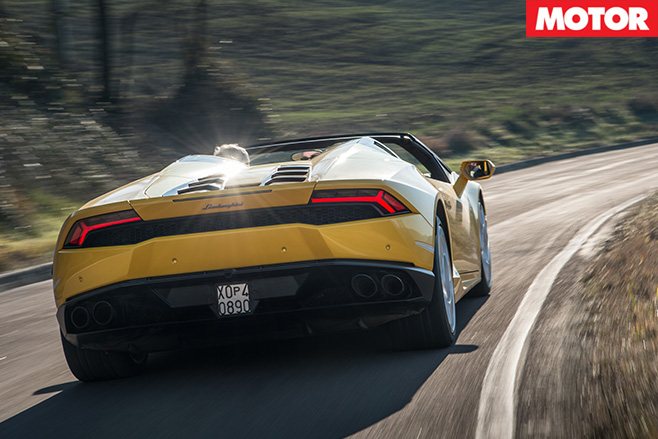
But it is a Lamborghini, so its job description is to get under the skin. And it takes just a press of the roof button to start the process. Watch as the whole roof assembly retracts back in one yawning motion and changes the scenery in just 17 seconds.
Instantly the sonic assault gains new dimensions. The drivetrain now has to compete with the wind rush and the road noise of the fat 20-inch Pirellis. Shifting from Strada to Sport mode gives the engine back the aural upper hand. The induction note slurps hungrily and the exhaust note growls voraciously all the way to a shattering peak at the 9000rpm limiter.
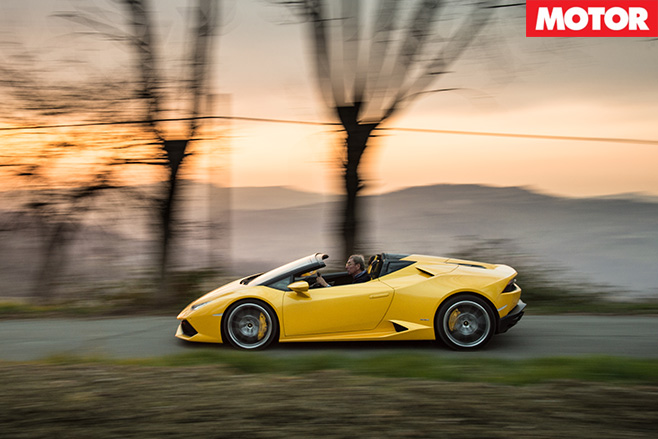
To really get stuck in, though, you’ll want to select Corsa. The dampers switch to their stiffest of three settings, every gear change slots home with a crisp thump, a sharp throttle lift is accompanied by thunder from the sexy rear end, and the ESC electronics are now attached to an extra-long leash.
The tail-happy Spyder prefers accurate carving to smoky slides. Its bellowing V10 and the wind-in-the-hair sensations are somehow just as important as grabbing armfuls of opposite lock and coating the wheels in brake dust. Yet when the opportunity presents itself, the Spyder will bolt to 100km/h in 3.4sec and won’t let up until (a highly theoretical) 325km/h.
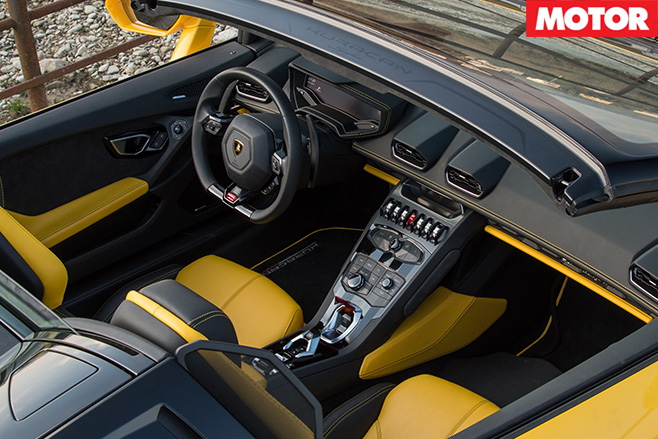
Drawbacks? The different settings bundled in the Strada, Sport and Corsa modes can’t be reconfigured to individual preference. Then there’s the outmoded infotainment system, the absence of a head-up display and the fact the must-have hydraulic front-axle lift commands a premium.
No, the Spyder is not about efficiency, sustainability, practicality, or sensibility. It couldn’t care less about lane discipline, cross-traffic monitoring, or self parking. Like every Lambo, the new Spyder is a highly emotional creation which assaults all of your senses. This engine responds to throttle orders like a whip being cracked, it sounds like a spine-tingling open-air concert staged exclusively for two, and its manic eagerness for revs borders on unhinged.
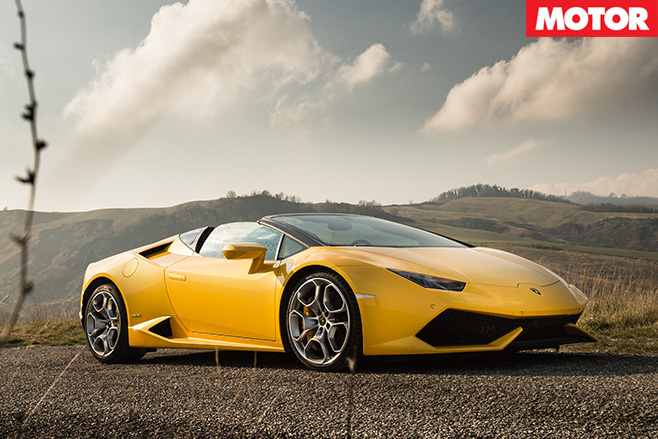
4.5 OUT OF 5 STARS
SPECS Engine: 5204cc V10, DOHC, 40v Power: 449kW @ 8250rpm Torque: 560Nm @ 6500rpm Weight: 1658kg 0-100km/h: 3.4sec (claimed) Price: $470,800 Like: An insane theatrical masterpiece; engine noise; pace; presence Dislike: It is hard to live with day-to-day; large weight penalty
In 1968, a former Wheels editor scored what was then a very rare invitation on an international launch. Here’s what unfolded in that Alfa Romeo 1750 on Italy’s Amalfi Coast.’
Read Ian Fraser’s classic story, as published in the May 1968 edition of Wheels.
Today, Australia’s motor noters travel the world, virtually on a weekly basis. So frequent are the overseas launches that a couple of the more travel-weary hacks now enjoy the privileges of Qantas platinum one status, reserved for those unfortunate people who are almost constantly in the air.
Not so in the 1960s. Although a couple of Australian motoring writers moved to England to work in the late 1950s – most famously Harold ‘Dev’ Dvoretsky (Modern Motor) and Doug Blain (Wheels and Sports Car World) – in the years before the coming of the Boeing 707, few Australians were invited to international launches, which then took place almost solely in Europe.
In 1968, Ian Fraser, former Wheels editor and later freelancer (before becoming editor and then owner of Car magazine in the UK), scored an invitation to the Alfa Romeo 1750 Berlina launch in Italy.
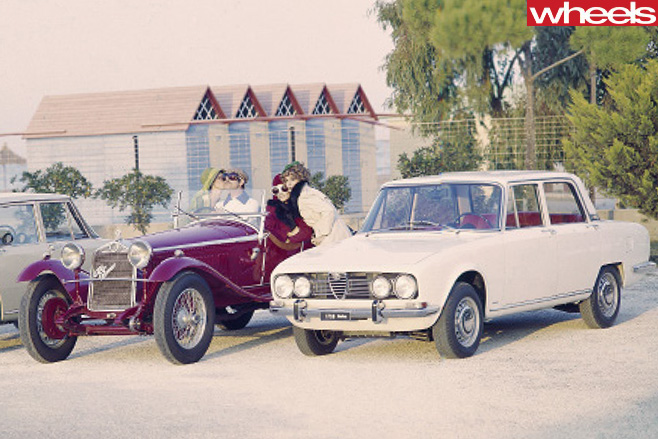
To get the hacks in the mood, a Type 33 sports racing car sat in the car park, though it was pointed out the keys had been returned to Autodelta, Alfa’s racing division, in Milan. So any thoughts of a demonstration run in the Targa Florio winner were dashed. Also on hand was an original 1934 1750 roadster, one of many great Alfas from the era.
Mixing it with “a veritable United Nations” of motoring writers – German, French, Italian, Czech and British – Fraser was careful to select his car early for his getaway on the percorso di prove, the route chosen by Alfa to best show off a new model that, in Fraser’s words, had a “clean, rather ordinary appearance”.
In those times, when BMW was just getting into its stride, Alfa Romeo built the sports sedans, with twin-cam engines, five-speed gearboxes, four-wheel discs brakes, compact dimensions and light weight. Exotic for the 1960s.
The 1750 followed the 1.6-litre Giulia Super (Fraser’s daily drive back home) and Ti Sports sedans, with a slightly longer wheelbase, more power and torque from the bigger capacity (still just 1.8-litre) engine with its twin-choke Weber carburettors, and gearing that allowed almost 6000rpm in fifth. Alfa proudly pointed out that 14-inch wheels replaced the 15s on the Super.
Helped by enthusiastic traffic cops along the drive route, who encouraged “at least 7000rpm in second, clouds of tyre smoke and half a lock of correction”, Fraser happily played the “privileged hoon”.
Launches now are a little less like road races, even in Italy.
Food for thought
Alfa trips to Italy, always as much cultural events as opportunities to drive the latest models, achieved legendary status in the 1970s. The 1976 Ciao Tour, seven days in duration (compared with today’s one or two nights on the ground in Europe), included a typical Italian 12-course lunch with wine at the still-famous La Badia restaurant in Orvieto. Famously, at around 4pm, our heroes were told by their Italian PR host: “Hurry, hurry, get in the bus or we’ll be late for dinner!”
Press conference, Italian style.
First published in the May 1968 issue of Wheels magazine, Australia’s most experienced and most trusted car magazine since 1953.
The voice at the other end of the shaky Roman telephone announced that it belonged to Georgia Glarey, of Divas Mofe, Alfa’s export division.
“Would you be free to go to Salerno next morning for the press release of the new 1750 models?”
“Yes, I would very much like to go to Salerno, but whereabouts is it, please?”
“In the south, down near Naples.”
“The same Naples that you see and then die?”
“That depends on where you eat.”
“Okay, then. See you in the morning.”
That left me with just a day in Rome – a Sunday, hardly enough time to hire a guide in his sanely driven Fiat 2300 for a once-over-lightly.
Certainly not enough time to make contact with the people to whom I had letters of introduction, including Alitalia, which badly wanted to show me its training facility with the Macchi jets it uses in common with our RAAF..
Read former Wheels editor Peter Robinson’s story of how Ian Fraser came to write this classic tale.
Right on time Georgia appeared at the hotel and after a minor panic to get color film; we tracked through Rome’s Monday congestion, following the signboards that said Sud. My initial apprehension about passengering was helped somewhat when I discovered that Georgio was just about as terrified of Rome’s traffic as I was. “Not like this in the north” he explained as we slipped through yet another buzz of Fiat 500s. Scooters are rare now; 50Ds have taken their place.
Out on the autostrada Georgia poked the Alfa Super into ·fifth and we were away, cruising at 160 to 175 kph (100 mph and upwards) without the slightest risk or problem in the incredibly well-disciplined traffic.
But the further south, the greater the horn blowing, fist waving and the dirtier the looks. Even the Fiat 500 drivers seemed to be able to find slower traffic to abuse.
Salerno turned out to be a comparatively quiet town with snow-covered hills in the background. It was the scene of a monumental battle during World War II but shows no sign of it now. During the summer months it is a seething beachside resort, but packs up for a the winter. Even the Hotel Baia Alfa had taken over for a 10-day stint for a succession of press and trade people had to be specially opened-up for the occasion.
And just to get people in the mood and to ensure that the 1750 bit of the new car’s badge did not escape them, Alfa had cranked up one of its museum-piece 1850 roadsters (circa 1934) and parked it at the door. But for those bent on something more modern, there was a Type 33 road-going coupe in the car park. The keys, it was pointed out, had been returned to Milan along with the Autodelta driver who had brought it down. Just as well really, since I could not imagine Alfa turning such a beast loose with a pack of motoring journalists. And I certainly quaked at the thought of having it demonstrated to me by a zealous operator zipped up tight in those traditional blue overalls.
At 0800 next day Alfa PR displayed its stuff. In the car park of another hotel half a mile away, zippered-up mechanics stood by three long lines of new Alfas – sedans, GTs and Spiders – all carefully warmed-up, cleaned and ready to go. Georgio and I pounced on a wine-coloured sedan about 15 seconds before the rest of the mob stampeded.
The map we had been supplied with the night before announced that it was the “percorso di prova” and “Journalists are kindly invited to follow the itinerary here shown and indicated by particular road signals. Traffic policeman will patrol the itinerary.” The last part looked very like a threat of some kind. Perhaps they were like Australian police, after all.
Despite its clean, but rather ordinary appearance, the Bertone-designed 1750 still has a family resemblance to the Super it supplements, despite 2.3 in. more wheelbase and 10 ins. more overall length. It uses 14 in. wheels instead of 15 in. and the tyres have wider sections – partly for style and partly for better dry-road handling.
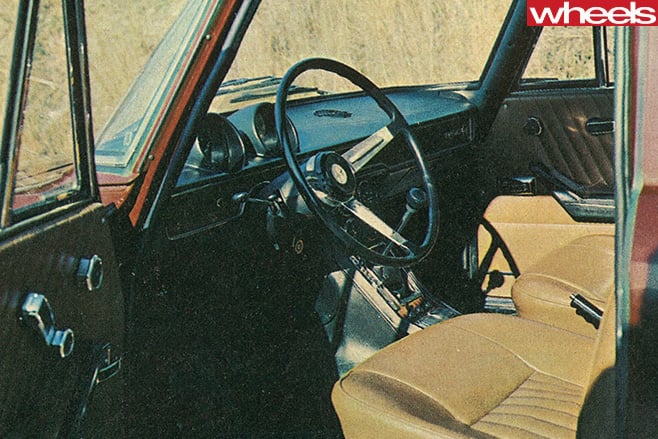
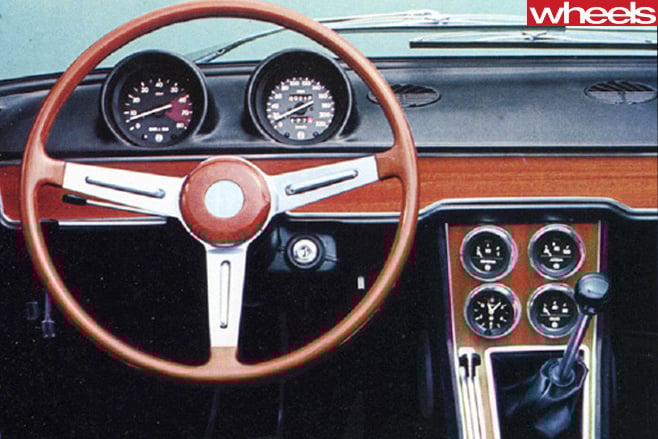
The cabin of the 1750 is certainly bigger. With the front seats fully back there is ample back seat legroom and more width, too. None of the instruments has been lost in the rehash of the cabin, but they are displayed very differently. For instance, the speedo and tacho have the dash to themselves, the minor controls and dials being arranged down the centre console from which protrudes the gearshift lever. Maybe it takes more miles than I did in the 1750 to· get used to the console dials, but I had to take my eyes off the road too long to read them. I liked the idea of the omni-directional fresh air vents on the dash as part of the through-flow ventilation system. Enough air passed through the cabin to keep the place fresh without having to open a window.
This also highlighted the low wind and road noise levels of which Alfa’s engineers are rather proud. One of them told me that they had gone to a huge amount of trouble to insulate the engine and gearbox from the cabin – successfully, apparently, since there were no sounds and vibrations excited by either the drive train or the engine.
All this while trying to get the feel of the device along the autostrada section of the 130-mile route we had been invited to follow. It also seemed as good a time as any to ease the speed up to three figures to see if the talked-of 118 mph was a reality. Fifth gear gives 20.6 mph per 1000 per and we were getting close on 6000 rpm, which indicates a fair claim.
After 9000 miles in Australia in my own Super, I was very impressed by the 1150’s flexibility. I slowed down to ’40-45 mph in fifth and the Alfa pulled away willingly and quite fast. In fact, I found myself using the gearbox too much at ‘first.
It uses two double-choke Weber carburettors, has 9 to 1 compression and a sealed radiator system. The five speed, all-syncromesh gearbox is the same. With so much engine torque, Alfa must be rapidly heading for the day of the automatic transmission.
Meanwhile, back on the autostrada we howled past an old Alfa police car which obligingly moved well over to let us through. At the tollgates, the man waved us on. All pre-paid and arranged by the PR people.
Our percorso di prova said leave the autostrada at Battipaglia and head due south to Prignano Cilento. I hesitatingly got on to the cloverleaf exit wondering which way to go. No problem; a large traffic cop and an Alfa man in overalls were waving madly,and holding up all other traffic to ensure us our trouble-free passage. In fact, they both looked utterly disgusted when I motored around their corner at a modest 20 mph in third. What was expected of me and every other 1750 driver was at least 7000 rpm in second, clouds of tyre smoke and half a lock of correction. So I obliged like some kind of privileged boon on every subsequent corner – every one of which was controlled by several police at the expense of all other traffic.
These twisting mountain roads had been specially chosen, the Alfa people had informed me, to demonstrate the 1750’s handling. If they had been chosen specially to make me feel at home, they could have hardly done better – twisting, narrow, bitumen that was bumpy and slippery. But this stretch did show the 1750’s reduced understeer, utter faithfulness and complete ease of handling. Big squirts of power in second and even third gear got the tail out over so neatly without even a touch of the old clammy hand.
A rear stabiliser is used and the roll centre has been raised slightly, but the smaller wheels have lowered the height by half an inch compared with the Super. The all-coil suspension is practically the same as the Super’s with the rear roll height fixed by the attachment point of the upper radius arms.
On the choppy uneven surfaces, the 1750 felt extremely taut and unbreakable with never a creak, a groan or a rattle. From the outside the 1750 corners flat and steady.
We stopped while I took some more pictures on the narrow section in the mountains; then last night’s scruffy Englishman slammed his way at 80 mph or so between us, an old Fiat 1100 flogging up the hill and an ancient woman trying to get some action out of her layabout donkey. I can hardly blame the donkey for wanting to give that road a miss; he obviously knew more than the old girl.
Halfway back to Salerno I was able to do a deal with another tester to take over his 1750 GT in exchange for my sedan. It differs slightly in outside appearance from the GT Veloce in that it has four headlights instead of two big ones and looks neater with 14 in. wheels. It uses the sedan’s engine and the back stabiliser bar but is otherwise virtually the same as before, apart from new instruments, steering wheel and rack-up headrest in the passenger’s seat.
Being a couple of hundred pounds lighter than the 1750 sedan, higher-geared and with less frontal area, the GT wound out very smartly through the gears and with the help of a slight downhill run pulled 6000 rpm in fifth. Like the 1750, the GT was rock-steady at full chat and pointed very accurately through long corners and around Fiat 500s.
Back in Salerno I just had time to thank the PR people for their help and to ask how many new cars had been destroyed during road testing sessions. Looks of amazement: “Why, the worst thing that has happened was that one of the Frenchmen got a flat tyre, but our follow-up service can crew changed it for him.”
This week the Coalition Government handed down its third Federal Budget, spelling out how it will spend the nation’s hard-won tax revenue for the next financial year, and the years beyond that. As always, there’s devil in the detail.
Here are the seven things you need to know about how Federal Treasurer Scott Morrison’s plans to spend his slice of your hard-earned dollars and change the way you feel behind the wheel.
1. WE’RE GOING TO PAY A LOT MORE LUXURY CAR TAX
Car sales are booming at the moment, and part of that boom is happening in the showrooms of luxury brands including Audi, BMW, Lexus and Mercedes-Benz. The LCT was introduced to Australia in 2001 along with the Goods and Services Tax, and has been a blight on the luxury car brands’ landscape ever since.
The tax kicks in as soon as you pay more than $63,184 for a car, be it a limousine, four-wheel-drive or sports car. There’s a loophole for fuel-efficient cars that use no more than 7.0 litres per 100 kilometres of fuel, introduced after grumbles that it would slam the brakes on buyers kicking tyres in luxury car showrooms because they were willing to pay more for cutting edge fuel-efficient technology, which doesn’t kick in until the price hits $75,375.
The luxury car tax is worth $3 billion to the government over the next five years, so we’re talking big numbers with lots of zeroes after them. Surprisingly, the government has hinted that it expects its plans to change grey import laws – which will allow mum and dad buyers to bring in near-new cheap cars from the UK and Japan instead of from their local dealer – to spark a flurry of extra luxury car imports that will add an extra $30 million to its bank balance.
2. SPENDING ON ROAD SAFETY IS A MIXED BAG
It’s hard to make an accurate back-to-back comparison with last year’s Federal Budget, but it appears we’re not getting all we were promised on this front. The Roads to Recovery program, designed to help local governments patch up poor-quality roads, was supposed to be worth $3.2 billion over five years.
Do the maths on the announcement this week that the program is worth $400 million a year including an extra $50 million a year, though, and that only adds up to $2.4 billion.
On the bright side, the government has extended its $60 million a year black spot removal program, designed to improve the safety of dangerous stretches of roads with “roundabouts, crash barriers and street lights”, as well as maintenance and bridge replacement programs.
3. ROADWORKS DOLLARS SHUFFLED
Victoria was to have dug a tunnel under inner Melbourne using a $1.5 billion federal grant that matched state funding dollar-for-dollar, but the project fell through. That money has now been reallocated to other projects including the Monash Freeway, the M80 Ring Road, rural roads, and projects to “relieve congestion in urban areas”.
That’s it. Every other road-based project is stuff that has already had its day in the limelight in an earlier budget.
4. MORE FREE LESSONS FOR LEARNER DRIVERS
The Keys2drive program gives learner drivers a free lesson as well as a rev up about how vulnerable they are on the road once they have their ticket to drive. Pundits claim it has done its job of teaching vulnerable drivers how to drive safely, so the government has extended it by another year with a $4 million extension to offer the service to another 90,000 free lessons. Sign up for one here. (keys2drive.com.au)
5. THINK ABOUT BUYING A NEW CAR SOON
Why? Look at the Federal Government’s projections for passenger car import duties, and for the next few years it stays relatively flat, and even declines despite new-car sales that are expected to hover around 1.1 million units a year. But in the 2019-20 financial year, import duty revenue – it’s the bit the carmakers have to pay to bring a vehicle off a boat in Australia – suddenly jumps almost 30 percent. No explanation is given, but you can bet we won’t suddenly be selling 300,000 more new cars. Or that the carmakers will be absorbing the extra cost.
6. YOU MIGHT BE BETTER OFF CATCHING THE TRAIN
Rail was the big winner from this budget, with the government handing around high fives over the $10.7 billion Inland Rail Link, an ambitious plan to drive trains between Melbourne and Brisbane, and Brisbane and Perth. Perth is getting $490 million to build a rail link to the airport.
7. THE GOVERNMENT STILL DOESN’T LIKE HYBRID OR ELECTRIC CARS
That’s right. Despite governments the world over trying to steer new-car buyers into more fuel-efficient, greenhouse gas-reducing, smog-free technology, the Australian government has stumped up nothing.
Bear in mind, too, that even though we’re experiencing a run of very low fuel prices, the amount of tax we pay on the petrol and diesel we use is expected to increase by about $400 million for each year of the budget projection. All fuel excise, levied at the rate of almost 40 cents a litre, is just absorbed into general revenue, so there’s no way of telling where that money is spent.
Given that in 2020 the Australian government has to show the world if it is hitting its targets on reducing greenhouse emissions, you’d have thought any little effort, such as a subsidy to reduce the cost of cutting-edge fuel-efficient technology, would have helped.
