
When Bugatti’s recently revealed Chiron hits the road it won’t be the only car brandishing four turbochargers.
That’s because BMW has announced a new super-3.0-litre diesel six, designed to replace the current triple-turbo N57S engine (pictured) that serves duty in the M550d and X6/X5 M50d models, will feature quad-turbo technology when it debuts in an upcoming 7-Series variant.
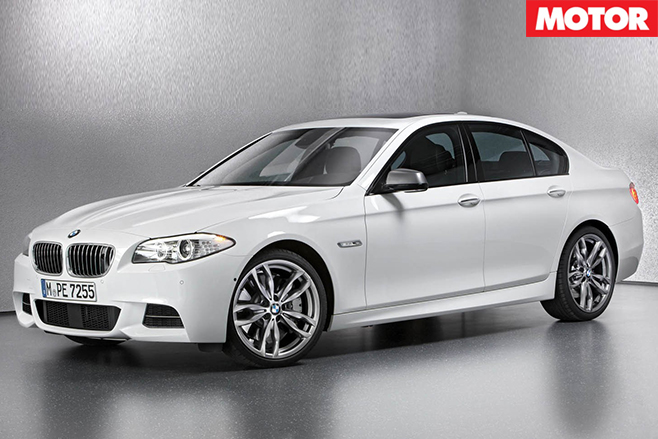
With a specific output of 96.7kW per litre – a massive achievement for a diesel unit— it shades the N57’s outputs by 13kW and 21Nm, with its torque ultimately limited by the BMW’s ZF 8-speed transmission. It’s also expected to improve the engine’s response and fuel economy – the latter said to be slashed by five per cent.
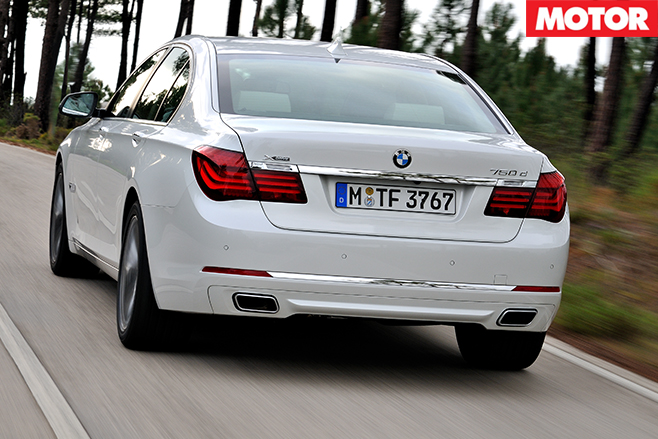
The B57 Top is expected to make its debut in the upcoming 750d xDrive before making its way into the nose of other M Performance diesels in the 5-Series, X5, X6, model ranges.
This time of year is a very sad one for motorsport fans.
Each year, April 30 is a reminder that Roland Ratzenberger was killed during qualifying for the 1994 San Marino GP, an event sadly sometimes overshadowed by the equally tragic event a day later, the death of Ayrton Senna.
May 2 is no better, as it marks the anniversary of the deaths of Henri Toivonen and Sergio Cresta, who perished in a crash 30 years ago today during the 1986 Tour de Corse.
Toivonen was one of the world’s most gifted drivers. The son of renowned rally driver Pauli Toivonen, he burst onto the scene by winning the 1980 Rally GB in a Lotus Sunbeam.
His early years were punctuated by some huge crashes, a result of his win-it-or-bin-it approach, but by 1985 he had matured and Lancia made him its lead driver for the introduction of its fearsome turbocharged and supercharged Delta S4.
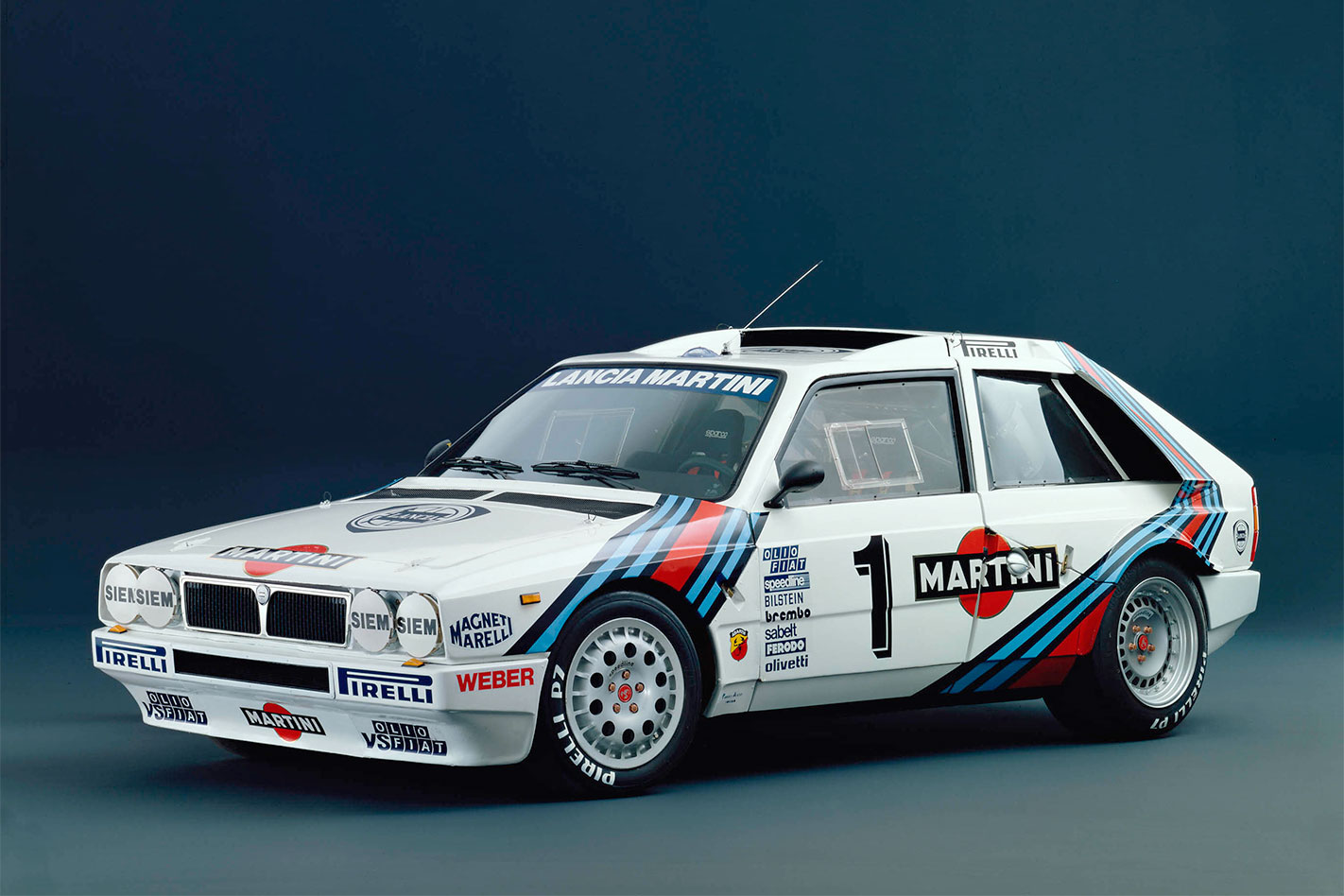
Toivonen continued his golden run in Corsica, opening an early lead despite feeling under the weather. Sadly, this came to an end when the Delta left the road and exploded, leaving nothing but the charred remains of a roll cage.
With just three WRC wins to his name, Toivonen doesn’t trouble the record books, but he is still regarded as one of the fastest rally drivers to have ever lived, inspiring next generation stars like the late Colin McRae and current Finn Jari-Matti Latvala.
Rest in peace Henri. The tribute video above is the work of the brilliant young Finnish film marker Antti Kalhola.
1, Only 300 units have been confirmed for Australia, with the local arm pushing BMW HQ in Germany to supply 100 more for local showrooms
2. With a 25 percent take up of the manual, the M2 is the most popular manual BMW on sale
3. The BMW M2’s engine shares components with its more-expensive sibling: its pistons, engine sump and front brakes are lifted straight from the heroic M4
4. The BMW M2 is the only 2 Series Coupe available with a dual-clutch transmission
5. The M2 is the first car in its class to have a genuine ‘M’ chassis: its predecessor, the 1M Coupe, was a highly tuned version of the previous M135i
6. The M2 is designed to attract a younger audience to the M brand
7. The M2 is priced $60k less than the BMW M4, yet the manual M2’s 0-100km/h time of 4.5sec is only 0.2sec slower than that of the manual M4
TELL ME ABOUT THIS CAR
The M2’s 3.0-litre six-cylinder turbocharged engine is extremely potent for a car of its size, packing an almighty 272kW/500Nm punch. As a drivers’ car, it’s also offered with a manual gearbox in a ‘Pure’ edition; this version sacrifices comforts like electric seats and other conveniences to aid in performance.
If straight-line speed is your thing, a sophisticated 7-speed dual-clutch automatic is available, with this option equipped the M2 will sprint from 0-100km/h in a supercar-like 4.3 seconds.
STRENGTHS
- Charming, powerful engine with a glorious exhaust note
- Fun to drive thanks to manual gearbox, fantastic sports seats and sharp handling
- Smart looking coupe body that remains elegant and sophisticated despite aggressive wheels and bumpers
- Lacks some of the personalised drive settings found in pricier models
- Sports-oriented tune means the ride is not as comfortable as other BMWs
- Offered only as a two-door coupe which may limit its appeal
The BMW M2 Coupe’s rear-wheel-drive layout makes it unique. However, for similar money you can also have a Mercedes-AMG CLA45 which delivers similar performance kicks in a coupe-like four-door body. If you’re after something smaller, the same powerful engine is offered in the Mercedes-AMG A45 hatch. Both of these are all-wheel drive, as is the Audi RS3 Sportback, which also offers brutal acceleration at a similar price point. ‘Purists’ will praise the M2 for its rear-drive thrills, while its all-wheel drive rivals offer alternative handling and more practical body styles.
THE BMW i3 will soon be as upgradeable as a laptop computer, with the German carmaker announcing overnight that it will allow existing owners to swap out their old battery for a new one that increases the car’s range.
Due in Australia late this year, BMW says it will allow existing owner of both the fully electric i3 and the range-extended i3 REx – whose cars can only travel up to 190km on battery power alone – to come into the workshop and swap their battery pack over for the same-sized new one that packs more energy into the same space.
The all-electric winner of the 2014 Wheels Car of the Year has achieved a near 50 per cent range upgrade by way of a new 94Ah battery. The 94Ah-battery powered i3 will see a more comfortable 300km per charge; a big jump from its previous 190km range.
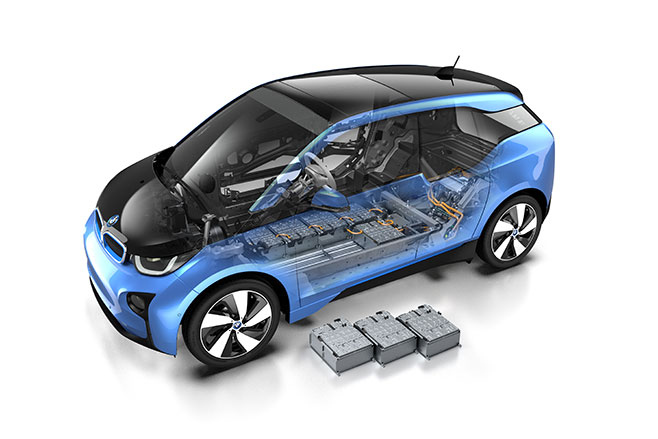
As well as retrofitting older i3s with the new battery, BMW is also offering a more-powerful 11kW wall-mounted charging station that can recharge the i3 in three hours, compared with more than eight hours if recharged via a household plug.
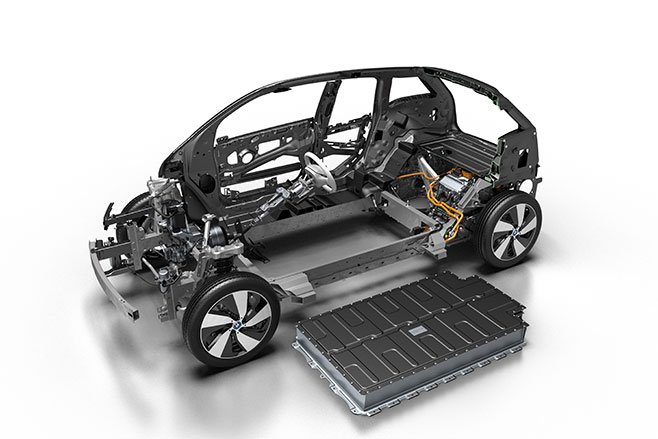
The new car retains its rear-mounted electric motor capable of 125kW of power and 250Nm of torque but due to the battery upgrade, weighs 50kg more. The 94Ah i3 sprints from 0-100km/h in 7.3 seconds; that’s 0.1 seconds slower than the 60Ah variant. When pushed, both models will hit 150km/h.
The i3 utilises its air-conditioning system to cool the batteries. An optional heating system ensure the batteries are at operating temperatures before starting off.
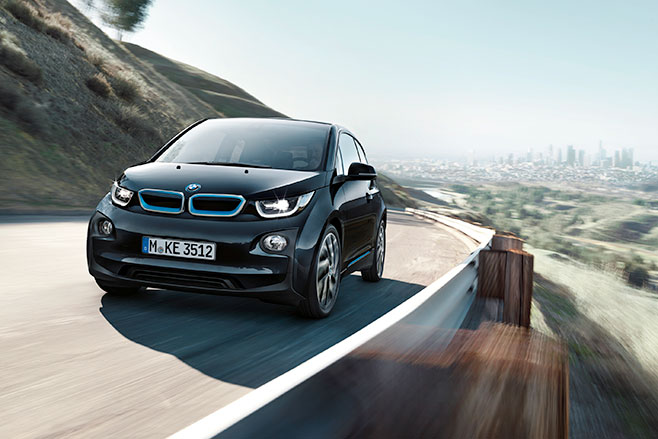
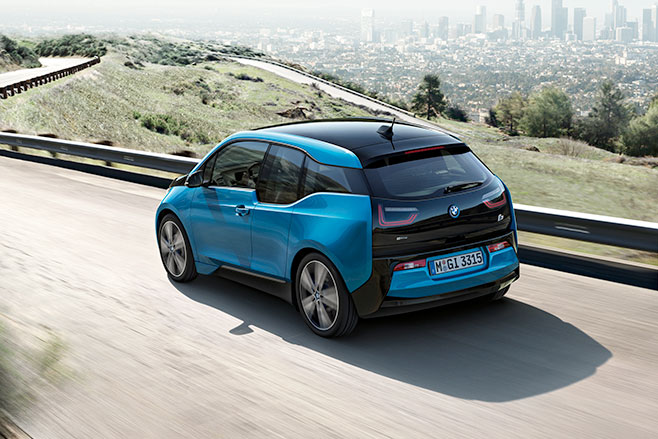
The new big-batteried i3 will also offer the same metallic blue paint as used on the BMW i8 hybrid sports car.
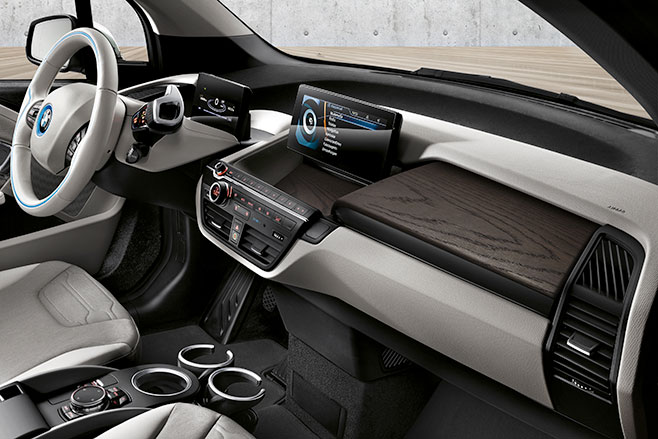
BMW will add an extra Dark Oak trim to the three existing interior designs. It will also offer a “Driving Assistant Plus” package that adds camera-based cruise control that also acts as a traffic jam assistant, speed limit recognition, pedestrian and collision warning with city brake function, and a proactive driving assistant.
Tesla has also pioneered the idea of tweaking its cars remotely, rolling out software changes that add more functionality to its Model S hatchback or Model X people-mover, or switching on hardware added to the vehicles that was not ready to roll out when the vehicle was bought.
Nissan Australia revealed last week that its Dandenong-based alloy casting arm was prototyping parts for the next-generation Leaf ahead of full-scale production later this year.
BMW’s switch to a split battery offering is a sales model pioneered by Tesla, which offers its Model S in a number of battery and motor configurations that become cheaper if you’re prepared to live with less range.
We all keep little highlight reels of our better drives saved on the mental hard drive for later savouring.
A blast through a tunnel with the windows down here, the perfect drift in the rain there, all committed to memory to be recalled at will in the secret projection room of the mind.
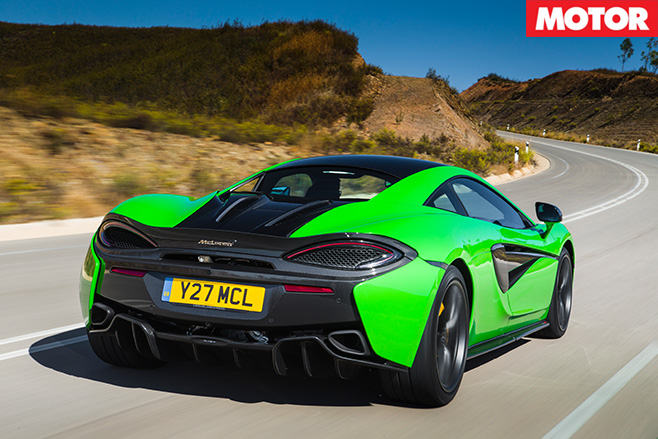
McLaren’s new 570S will have you worried you’ll run out of mental disc space. It’s a baby 650S in price and spec, if not size, and while the older sibling throws around more performance muscle by way of 59 extra kilowatts, a more sophisticated chassis and active aero – adding up to a sharper driving experience – the younger brother may be the better entertainer. After two days in one, and several hours of hard driving in the back hills of Portugal, our grin was yet to subside by breakfast, day three.
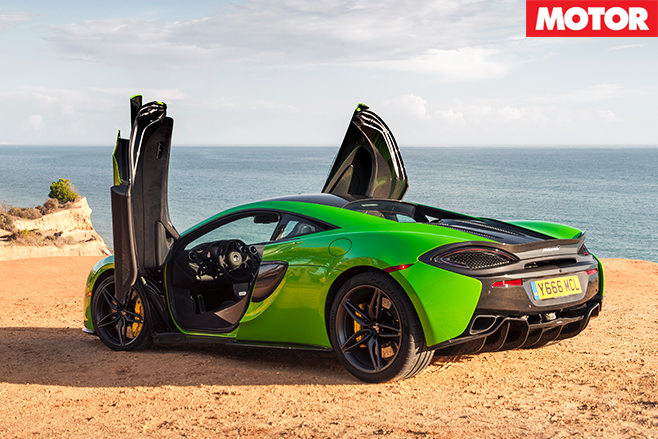
It looks like a blueprint of the 650S, but in fact it’s 110mm longer and looks more restrained from certain angles. The main difference is revealed at a lift of a heron-wing door, for McLaren has tried hard to make its 570S as friendly as possible for daily use. To make it easier to get in and out of, the forward section of the sill has been narrowed and shortened by 80mm. The new seats offer more support and a slightly more generous range of adjustment (but beware, the top-of-the-line carbonfibre jobbies aren’t cheap).
For the first time there’s a lit vanity mirror, a proper glovebox and respectable storage space. You even get two windscreen wipers instead of one. McLaren is still playing catch-up in other areas, though. There’s no adaptive cruise control or head-up display, and while there’s start-stop, McLaren doesn’t yet do the kind of off-throttle coasting you might find in something from Stuttgart.
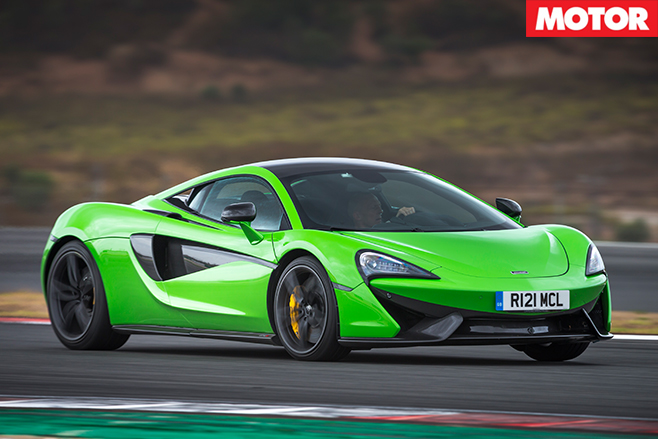
Steering feedback is super impressive, but in the wet the grip is delicate; roundabouts getyour heart rate up time (front!) after time (rear!). Meanwhile the carbon ceramic brakes are wooden when cold, the engine note loud but one-dimensional, and the ride ho-hum on the brittle suspension and extra-stiff sidewall tyres. A lack of separate damper adjustment doesn’t help. At least the 570S shows off a nearly flat cornering stance when the speed starts to ramp up.
As you might’ve guessed, “570S” is a nod to the 570 horses under the engine lid (which, for the record, customers can’t open). There’s 419kW at 7400rpm and from there to the limiter, there is still 1100rpm to play with.
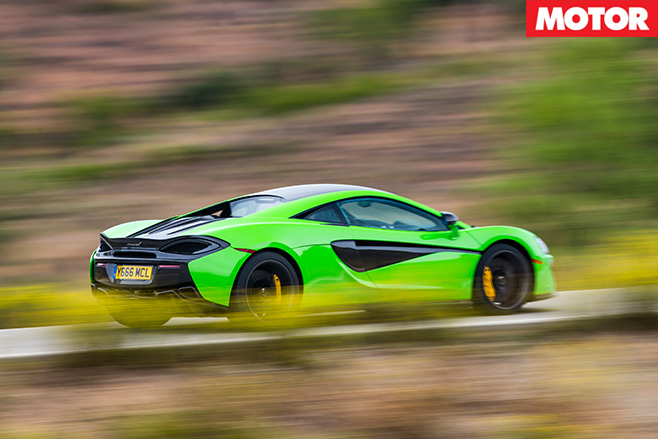
A stab at the launch control button turns every set of traffic lights into an opportunity to lay elevens. First gear is so short it requires a well-prepared index finger or you’ll snag the limiter. Second can cause mild whiplash. Third is where the 570S jettisons solid rocket boosters and hits warp drive.
It’s bordering on irrelevant in the real world, not least Australia, but it’s the 200-300km/h bracket where the 570S truly comes into its own. Seventh is not merely a cruising gear anymore, and fifth transfers all that grunt almost seamlessly to sixth.
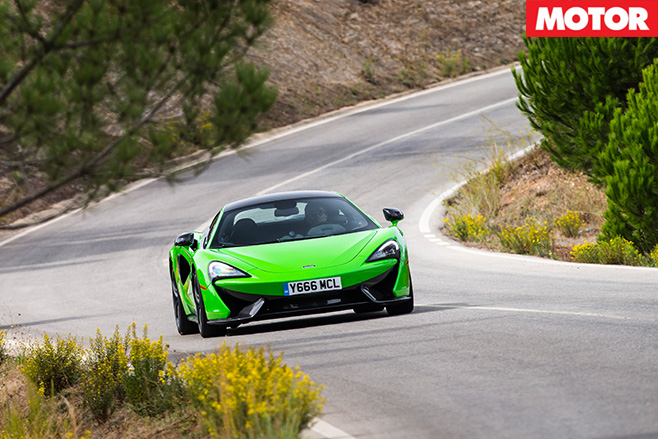
And along Portugal’s eucalyptus-lined back roads (some of which feel uncannily like Australia) the 570S reels in and spits out road like a tarmac-processing machine, with catapult-like briskness, an addictive appetite for corners and an overtaking punch that has to be felt to be believed.
Unlike a 911, which fights every corner and won’t fully relax even on straights, the British bullet rarely feels to leave its comfort zone. Despite a few character traits that could be considered rhythm-interrupting (ie, the braking distances compress as the hardware heats up) the 570S is all about riding the flow.
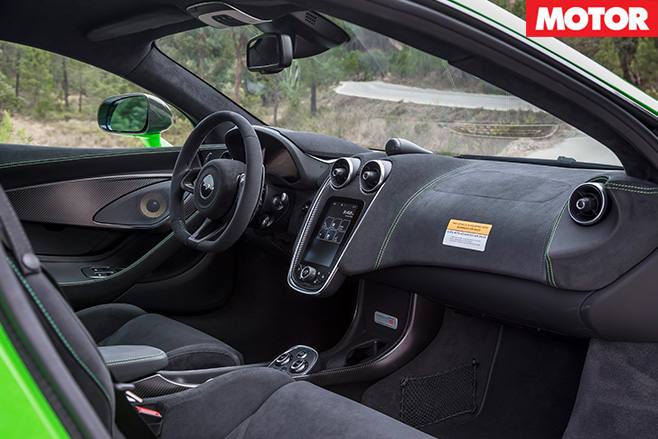
Yet when you’ve had enough, the 570S is only too eager to prove its mettle as marriage material, with a decent stereo, plush interior materials and the kind of features that make for a keeper, including soft-touch doors, front-vehicle lift and reversing camera.
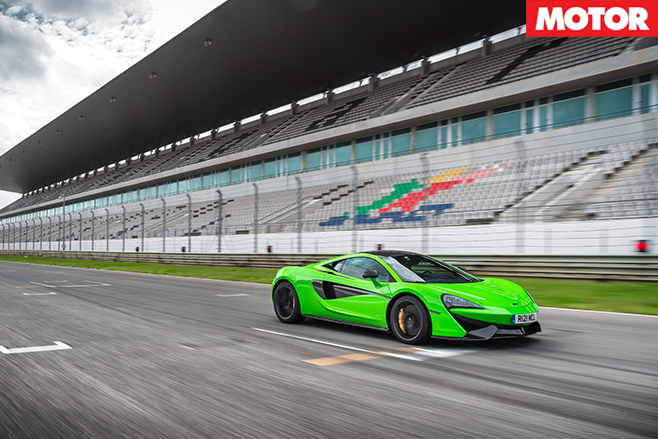
All that is quickly forgotten, however, at a glance of the green light at the end of Portimao pit lane. Our black-over-green track chariot comes with AUD$95,000 worth of options including swathes of carbonfibre, thinly-padded buckets, an almost vulgar sports exhaust, racing harnesses and stealth-look wheels wearing Pirelli P-Zero Corsas. But it looks angry.
Manual gearshift mode comes with a single-piece, see-sawing shift paddle arrangement. It’s a neat little detail, but in a sporty road car we still prefer the unambiguous fixed Ferrari paddles with “Up” and “Down”. Same applies to the one-knob-does-it-all manettino, which is much more accessible than the McLaren equivalent, hidden in the undergrowth of the centre console.
All modes set to Race and with the ESP in Dynamic, we blast out on to the Portimao track. This is no boring, Mickey Mouse circuit; it’s a challenging drive, fast and full of undulation, dotted with crests, dips and blind corners. At the end of the downhill start-finish straight the digital speedo reads 255km/h – 15km/h more than the R8 V10 Plus we drove here three months ago.
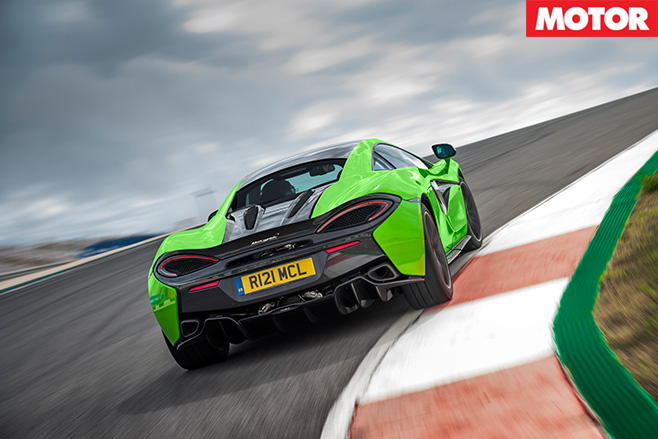
Again, it’s the mind-scrambling urge above 200km/h which particularly focuses attention. There’s no all-wheel drive but the nicely balanced weight distribution (42:58) makes the 570S hugely chuckable, transparent and responsive.
Our black-and-green beauty is only too willing to demonstrate its rowdiness and throw around its rather large ego as we move closer and closer to where the grip runs out. It’s only now that the chewing-gum tyres let out the first little squeals and the gearshifts become brutal to the point of sending a shudder through the carbonfibre chassis.
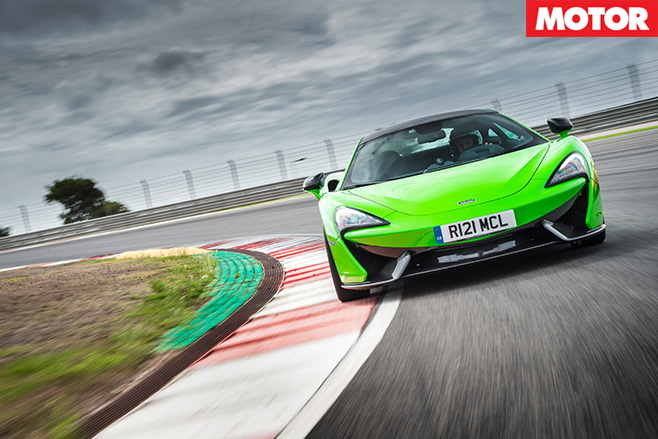
But if nothing else, the 570S is certainly emotional. Sliding ever-so-smoothly in an arc – fourth-gear, no less – is grand cinema for the brain. Up there, in the secret projection room of the mind, you can’t help but constantly hit the repeat button late into the night.
4.5 OUT OF 5 STARS
SPECS Body: 2-door, 2-seat coupe Drive: rear-wheel Engine: 3799cc V8, DOHC, 32v, twin-turbo Bore/stroke: 93.0 x 69.9mm Compression: 8.7:1 Power: 419kW @ 7400rpm Torque: 600Nm @ 5000-6000rpm Power/weight: 298kW/tonne Transmission: 7-speed dual-clutch auto Weight: 1406kg Suspension (f): double A-arms, adaptive dampers, anti-roll bar Suspension(r): double A-arms, adaptive dampers, anti-roll bar L/W/H: 4530/2095/1202mm Wheelbase: 2670mm Tracks: N/A Steering: Electrically-assisted rack-and-pinion Brakes(F): 394mm ventilated/drilled discs; 6-piston calipers Brakes(R): 380mm ventilated/drilled discs; 4-piston calipers Wheels: 19.0 x 8.0-inch (f); 20 x 10.0-inch (r) Tyre sizes: 225/35 R19 (f); 285/35 R20 (r) Tyres: Pirelli P-Zero Corsa Pros: Class-leading pace; most engaging McLaren yet Cons: Firm ride; steep options pricing Price: $408,000
Up close: McLaren’s new baby
The nitty gritty of Woking’s new sports car
TWO: IN SUSPENSE 570S is the first McLaren not to use the clever ProActive Chassis Control, which uses hydraulically connected dampers. McLaren has instead developed a traditional mechanical suspension system with adaptive dampers.
THREE: HOT STUFF Aluminium body panels are created through a process called ‘Superforming’, in which hot aluminium is blown into shape over a mould. Complex shapes are possible and McLaren claims the resultant panels are as light as composite equivalents.
FOUR: SUPER SLIM As with all McLarens, 570S is based around a carbon fibre ‘Monocell’ which weighs just 75kg, helping to acheive a dry weight of just 1313kg. McLaren claims this is the lightest in its class, however it’s very adamant the 570S is a sports car rather than a supercar.
FIVE: OLD SCHOOL Steering remains electro-hydraulically assisted, McLaren claiming that the levels of feel that result cannot be replicated by a fully electric system, and based on the evidence of the 570S we’d have to agree. Front tyres are a mere 225mm wide, while rears are 285mm.
Aston Martin has given us a taste of the turbocharged DB11 – the low-slung coupe that will carry the British marque into the future.
WHAT IS IT? Aston’s new grand tourer, and possible saviour of the company, sampled here in prototype form. The Aston Martin DB11 gets a new turbocharged V12 engine that gives it a serious performance boost over the outgoing DB9 and will follow its predecessor into the luxury Grand Tourer category. We drove a late prototype at Bridgestone’s testing facility near Adria in Italy ahead of sales starting later this year.
WHY WE’RE TESTING IT This is the car that will make or break Aston, its success necessary to return the British sportscar maker to the sales volumes it enjoyed before the 2008 global financial crisis. The turbocharged engine is the real news here; Aston has never produced a turbocharged road-going model before, with the V12 boasting 447 kW and 700Nm of torque.
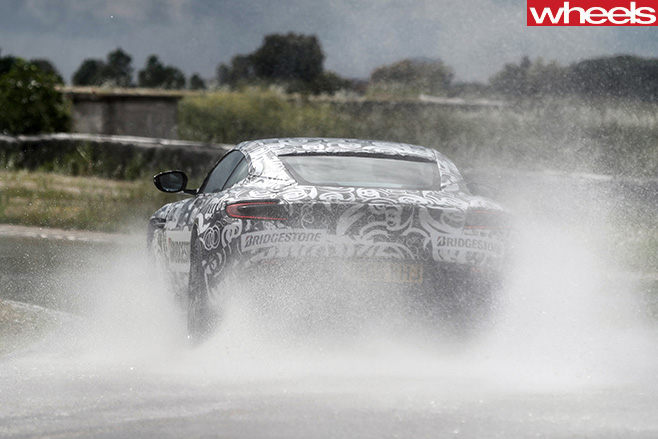
THE WHEELS VERDICT It’s too soon to start awarding gongs, but on first impressions the DB11 looks to be exactly the car that Aston needs to revive its flagging fortunes. It’s more muscular and faster than the DB9, but the extra power and performance hasn’t come at the expense of the driving experience. The prototype was as ratty as development cars tend to be, but it was good enough for us to say we’re very much looking forward to the real thing.
PLUS: Effortless performance of turbo V12, easy to drive quickly, fun when you want MINUS: Slow reacting gearbox in manual mode, shonky build on prototype
THE WHEELS REVIEW THIS isn’t an exhaustive review of the new Aston Martin DB11, rather a drive in a prototype. Lots of questions about Aston’s new hope will remain unanswered until we drive it somewhere other than a test track, and in its final production form. But our first spin has given plenty of reasons to be optimistic that, after some tough times, the British sportscar maker is heading towards a brighter future.
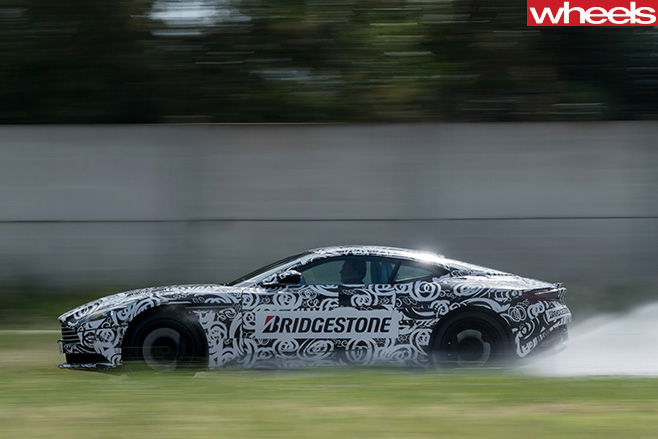
Manufacturers often invite journalists to drive prototype vehicles that, when viewed up close, turn out to be anything but – hand-constructed one-offs that show future models in the best possible light while still allowing the maker to say “we’re planning to change that” to anything we don’t like.
So it’s credit to Aston for letting us have a crack in what we have absolutely no doubts is a hard-working DB11 development hack, complete with peeling dazzle disguise and a fug of engineer’s sweat in the cabin. I’ve come to the Bridgestone test track near Adria in Italy, with Aston’s chief chassis engineer Matt Becker on hand to show what the car can do and then answer questions when I take a turn.
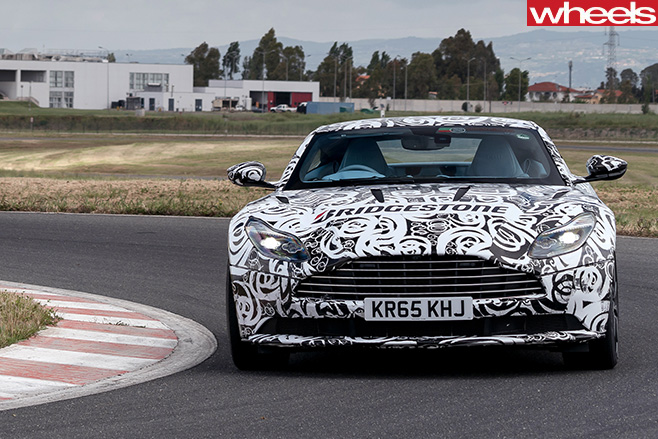
The arrival of forced induction is the biggest single change over the previous DB9 and its sonorous atmo V12. The DB11’s twin turbocharged V12 was developed by the company and loses some displacement over the DB9’s 6.0-litre unit, dropping to 5.2L in size. But it’s well up on power with 447kW compared with the 9’s 385kW. Power is less than half the story, though – the new motor has vastly more torque, 700Nm, with that peak available from just 1500rpm (the DB9’s 620Nm came at a peaky 5500rpm.) The most pressing dynamic question is whether the chassis will be able to digest that with an Aston-appropriate level of finesse, especially as – unlike Ferrari’s turbo V8 – the Aston V12 doesn’t inhibit its torque output in lower gears.
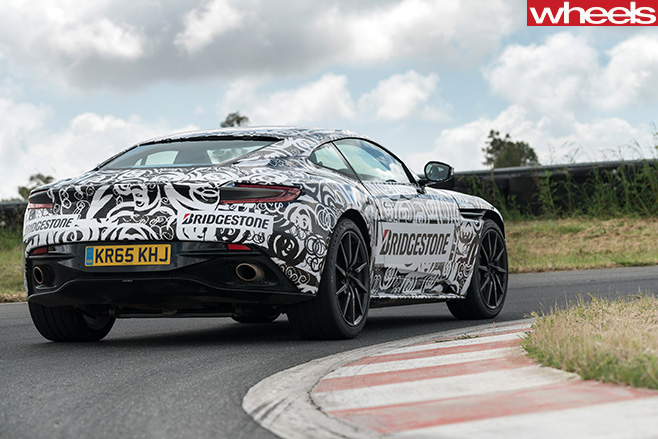
Time to find out if that’s true. Much of the view from the driver’s seat is familiar – the DB11 shares the same low seating position and high glassline as every modern Aston, and there are still P, R, N and D buttons on the dashboard instead of a traditional gear selector. But a fair bit is completely new, including the presence of a single Mercedes control stalk for both wipers and indicators, an indication that – under the surface – the DB11 and all Aston’s future models now run Daimler’s electrical architecture. I also notice that the prototype’s key is a Mercedes one, complete with a three-pointed star…
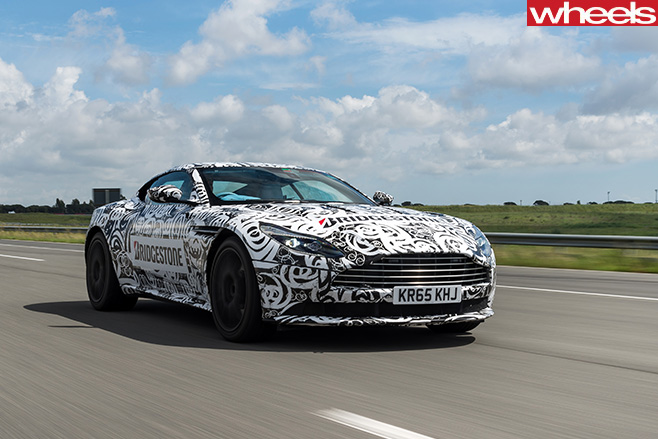
More impressive is the way the DB11’s chassis deals with all the power and torque that needs to get to the tarmac through the rear wheels. There’s a huge amount of grip but the DB11 doesn’t feel inert or over-tyred, despite the gumball profile of its Bridgestone Potenzas. The steering has switched to electrical power assistance, with Becker admitting that tuning it to feel like Aston’s previous hydraulic rack was one of his team’s biggest challenges, and one that, on first impressions, they seem to have pulled off. There’s something Lotus-like in the linearity of the DB11’s responses as well.
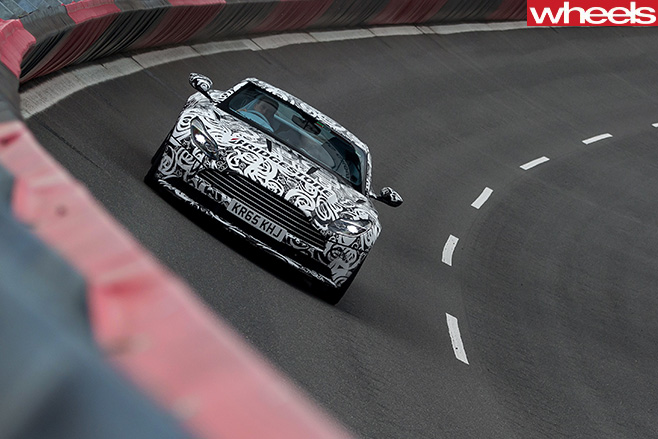
My only real complaint after a solid 20 minutes of lapping the track is the eight-speed autobox’s tardy upshifts when switched to manual mode, with a distinct pause between pulling the steering wheel paddle and feeling the next gear arrive. Becker says this will be tightened up by production, and also that the stroke of the paddles is going to be reduced to sharpen it further.
Finally, a turn on Adria’s wet handling circuit, on which sprinklers soak special low-grip tarmac to deliver surface friction that’s not much higher than it would be on snow. Even the DB11’s trick stability control can’t magic adhesion out of this slick surface, with the back axle wriggling and squirming even under gentle throttle applications as the turbocharged torque arrives. Switching the stability to its more permissive sport mode allows some proper slip-sliding, with the big Aston staying predictable even as its limits are transgressed. With the ESC fully deactivated the DB11 becomes a drift machine, with Becker happy to demonstrate that – with the right level of talent – the DB11 can do almost an entire lap while travelling sideways.
This has been a first taste, definitely an amuse-bouche rather than a full assessment. We’ll have to wait for the answers to many questions, including all those about how the DB11 deals with the challenges of the real world. But the good news for now is that the turbocharged engine seems to be a stormer and that the DB11’s chassis is more than up to handling the extra performance it brings. It’s definitely still a grand tourer rather than an out-and-out sportscar, but the omens for both the production version, and the numerous other car that Aston will spin from the same architecture, are promising.
SPECS Model: Aston Martin DB11 prototype Engine: 5204cc V12 dohc, 48v, twin-turbo Power: 447kW @ 6500rpm Torque: 700Nm @ 1500-5000rpm Transmission: 8-speed automatic Weight: 1770kg (mfr claim, dry) 0-100km/h: 3.9 sec (claimed) Fuel economy: TBC Price: TBC On sale: Q4 2016
V8 SUPERCARS driver Scott McLaughlin took his slick form to Sweden at the weekend, grabbing an excellent second in his first of two races, after qualifying second first time out in the Scandinavian Touring Car Championship opener at the Skövde airport circuit.
Invited to make a cameo for the factory Volvo team where he replaced regular driver and Swedish royal Prince Carl Philip, McLaughlin impressed with his immediate competitiveness against the regulars in an S60 that is quite a departure from his own Australian machine.
He settled in so fast that he set a new lap record, a blistering 0:49.964.
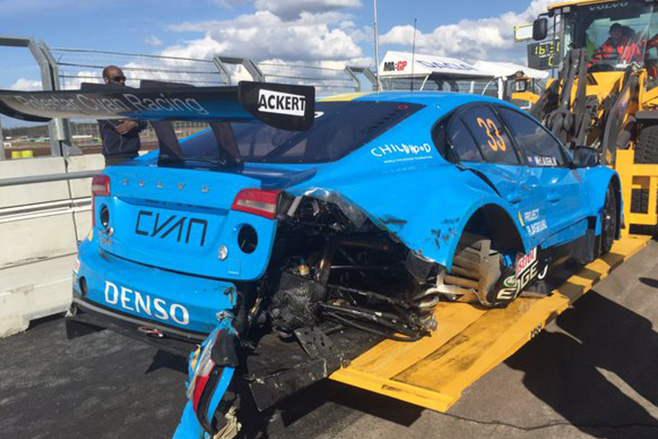
McLaughlin had adventurously fired his way up to third when he was slammed by Reuben Kressner’s out-of-control Saab 9-3.
”I was hit from behind in the second race, nothing I could do about it,” McLaughlin said.
“While that was disappointing, I am pleased with my pace in qualifying and to claim a podium finish. My goal was to break into the top three and that is what I have done.”
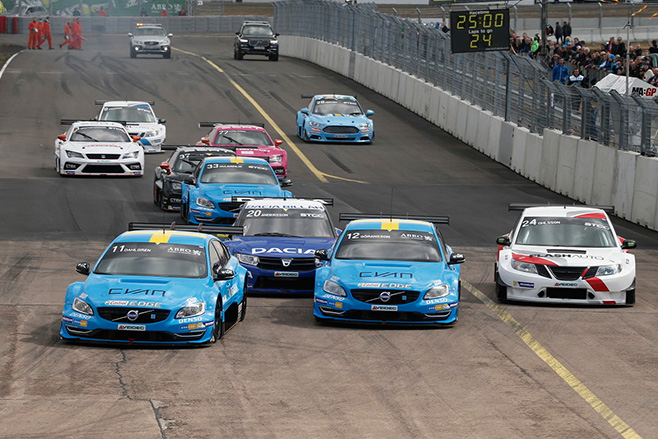
Fellow Polestar driver Richard Göransson led home Dahlgren in the second race.
McLaughlin now heads back to Australia for this weekend’s Perth Super Sprint at Barbagallo Raceway.
When you think of road trips through outback Australia, you probably picture an endless mass of land leading to nothingness. Simultaneously harsh and beautiful, and so remote it’s only accessible by a kitted out four-wheel drive. But what if we said you don’t have to trade in the city-faring SUV to experience this spectacular part of Australian country?
Driving the 1578km journey through Outback Queensland from Brisbane to Birsdville is one of those once in a lifetime opportunities that will leave you yearning for more of Australia’s bushland.
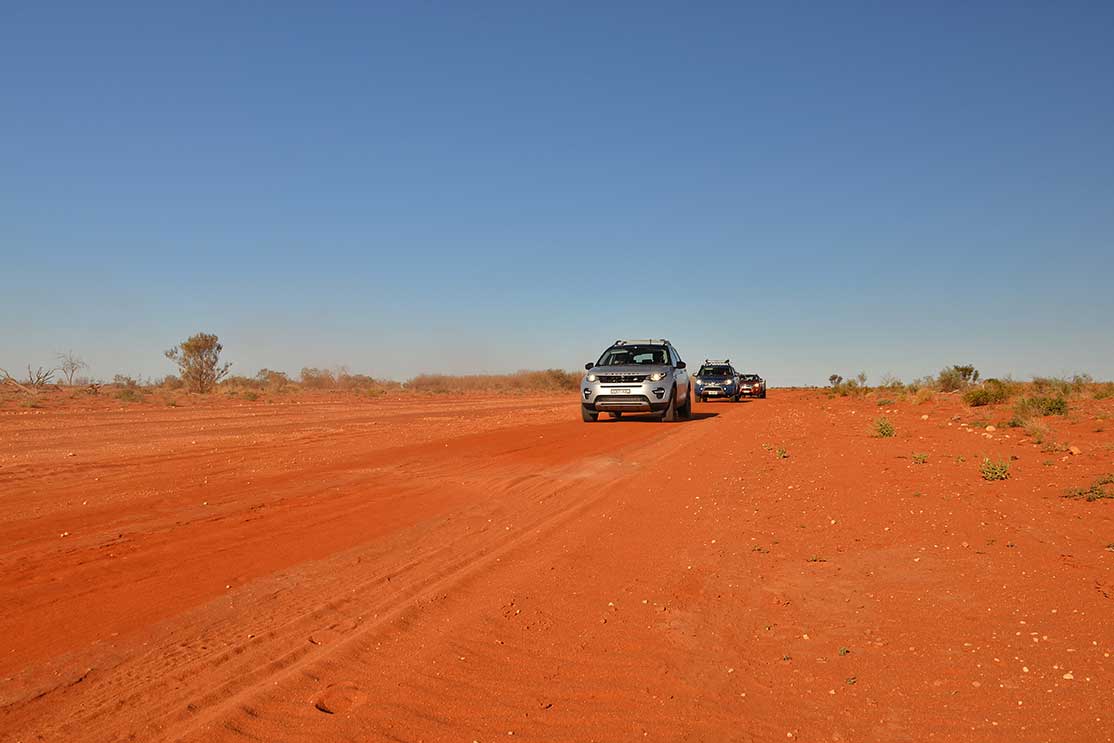
Birdsville sits on the border of South Australia, Northern Territory and Queensland. It’s the gateway to the famous Simpson Desert. Each September the town, which is also known as the ‘town in the middle of nowhere’, sees its population swell from 100 people to nearly 8000 travellers who make the journey for the horserace that stops the outback – the Birdsville Races.
It’s a journey that’s on the bucket list of every off-road enthusiast, keen to clock a good time on the treacherous Birdsville Track before tackling Big Red, the first of the Simpson Desert’s 1113 sand dunes.
So when we received the invitation for a six-day expedition with 11 other women (plus our trusty guide Dave from Australian Off Road Academy) to the Birdsville Races, and the opportunity to tick a few boxes on our bucket list, we jumped into the next available car. In this case, that was an off-road capable Land Rover Discovery Sport HSE.
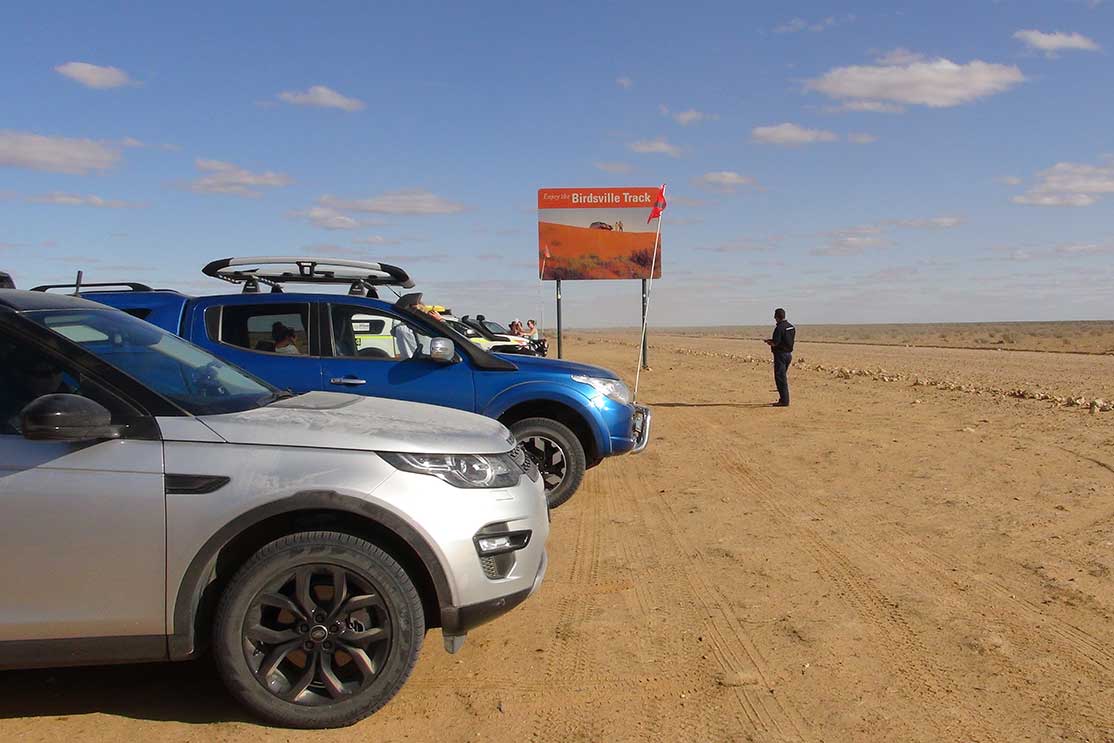
The seven-seater SUV is far more at home on city roads ferrying families with the occasional weekend getaway than it is tackling some of Australia’s most in-land off-road tracks. But the Discovery Sport does have a few all-terrain tricks hidden under its arches.
In the world of 4x4s, the vehicle you drive is like a badge of honour. The muddier the bonnet, the bigger the tyres and the tougher the bull bar, the more respected you are. Throw in the harsh-tongued characters of the outback, and a soft-road Discovery Sport on standard 18-inch road tyres joining our convoy of Mazda BT50, Mitsubishi Triton and Toyota Land Cruiser 79 Series ute, and you’re basically walking into the lion’s den.
Mission accepted.
The Discovery Sport is basically the compromise for people wanting the style of a Range Rover Evoque, with the space and capabilities of a Land Rover Discovery. It comes kitted out with 4WD technologies like Land Rover’s Selec-Terrain system with different settings for varying road conditions (Auto, Sport, Snow, Sand/Mud, and Rock), Wade Sensoring tech to gauge water depth and a surround camera system that offers 360 degrees of visibility. And aside from the plastic-like feel in some areas, the interiors are as comfortable and classy as you’d expect of a city SUV.
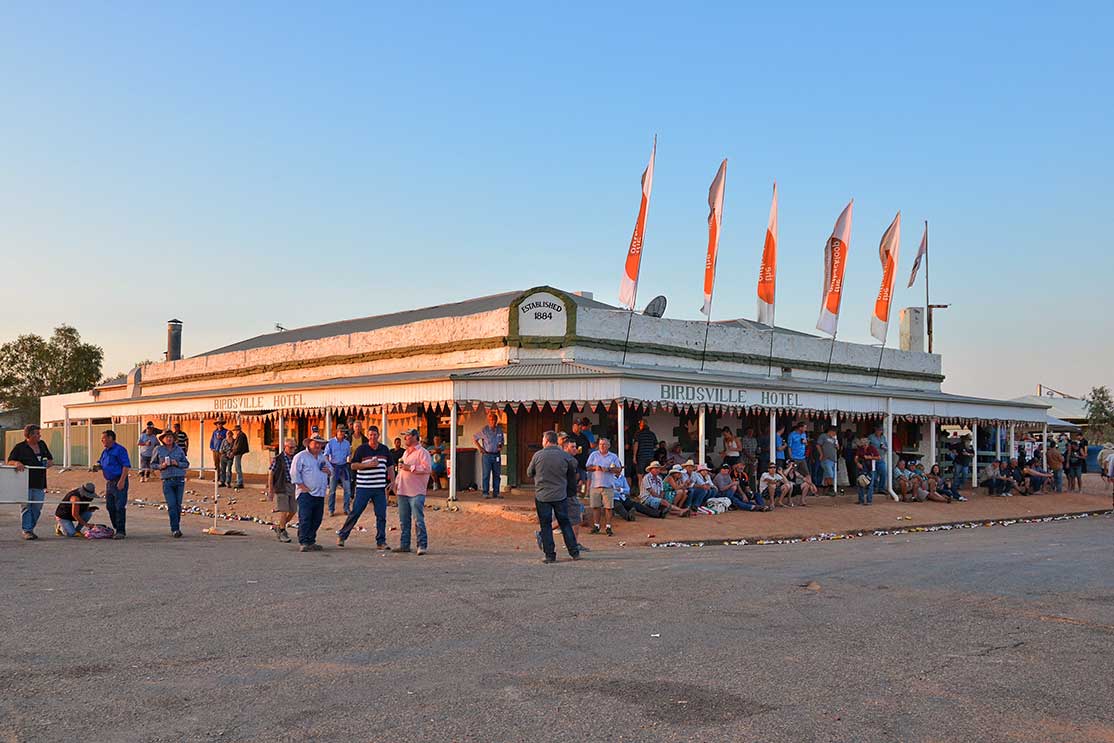
This was our chance to put the Discovery Sport to the ultimate test – how well does a stylish seven-seater SUV mesh with the dusty, rutted tracks of Australia for the trendiest event of the outback?
As the landscape changed from Brisbane’s cityscape to the paler sands of gumtree country, the passenger seat of the Disco was entrenched in a game of musical chairs. The unobtrusiveness of the car on sealed roads with the comfort of the leather seats saw passengers scrambling for a turn in the ‘lux-car’. The transmission was smooth, the engine was quiet and, there was plenty of room inside for leg stretching and more importantly, space to house plastic containers of vanilla slice.
But we knew the comfort of the sealed roads and regular town-stops wouldn’t last and towards the end of the first day, the red dirt finally entered our sight as we passed the famous Nindigully Pub which sits on the edge of the outback. From there it was on to our first night’s accommodation at the quaint and hospitable Bergonia Farm Stay. Things were about to get real and it was time to introduce Hi Ho Silver, as we had affectionately named the Disco, to the real roads of Outback Queensland.
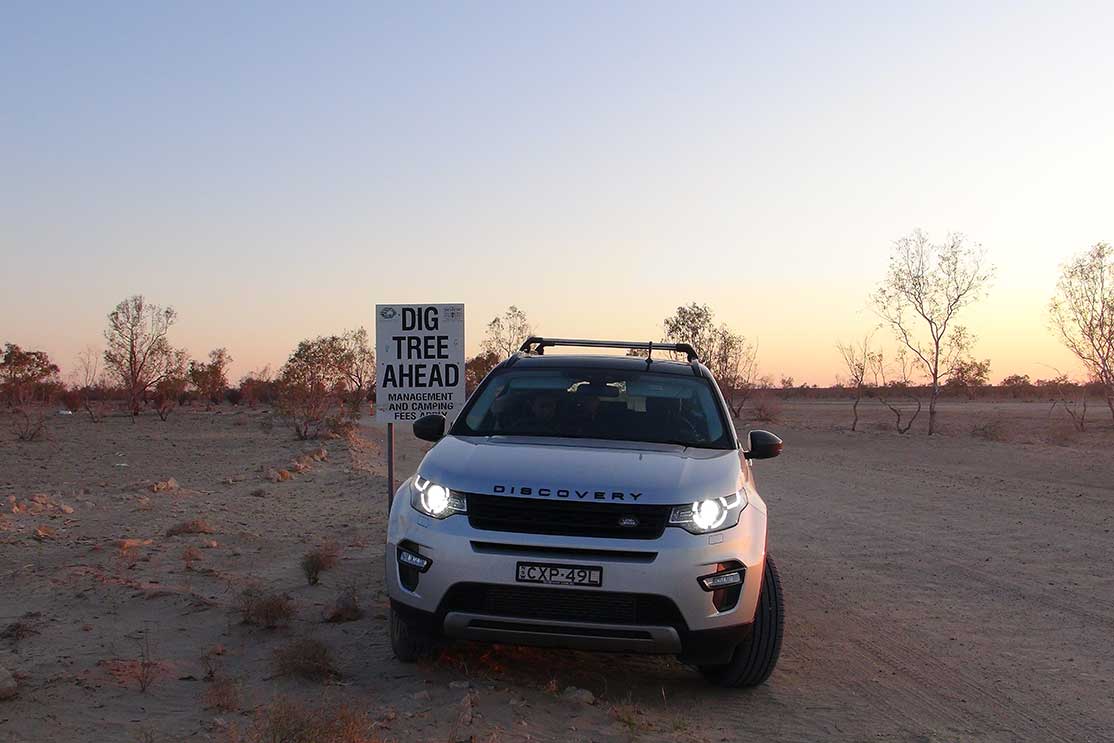
To get to Birdsville, the Disco had to travel through Cunnamulla, visit the skin-tightening Eulo Mud Baths, pay respects to Australian explorers Burke and Wills at the famous Dig Tree, cross the South Australian boarder to Innamincka, and finally race along the Birdsville Track to beat the sun to the top of Big Red before reaching Birdsville for our beauty sleep at Tent City in preparation for a day at the races where we’d swap our Akubras for fascinators.
With each new landscape shifting from colours of yellows, browns and vibrant reds, the Discovery Sport coped with a prowess unexpected of a compact SUV. Land Rover’s Selec-Terrain system gave us confidence, but we found matching the settings to the terrain wasn’t always going to give us the most comfortable ride. At times, we found turning the system to general offered a nicer ride than the mud/ruts or gravel settings, even while driving through rutted out tracks or sandier patches.
It was the suspension and clearance (height from the ground) we thought would be a real issue on the Birdsville Track, which was probably the most hard-core off-roading we did on this trip, before the dunes. Like a self-fulfilling prophecy, we were almost certain we were going to blow a tyre. So sweaty palmed and butt clenched, we had to take it easier than we usually would have on the track. We were determined to get Hi Ho Silver to Big Red before dark.
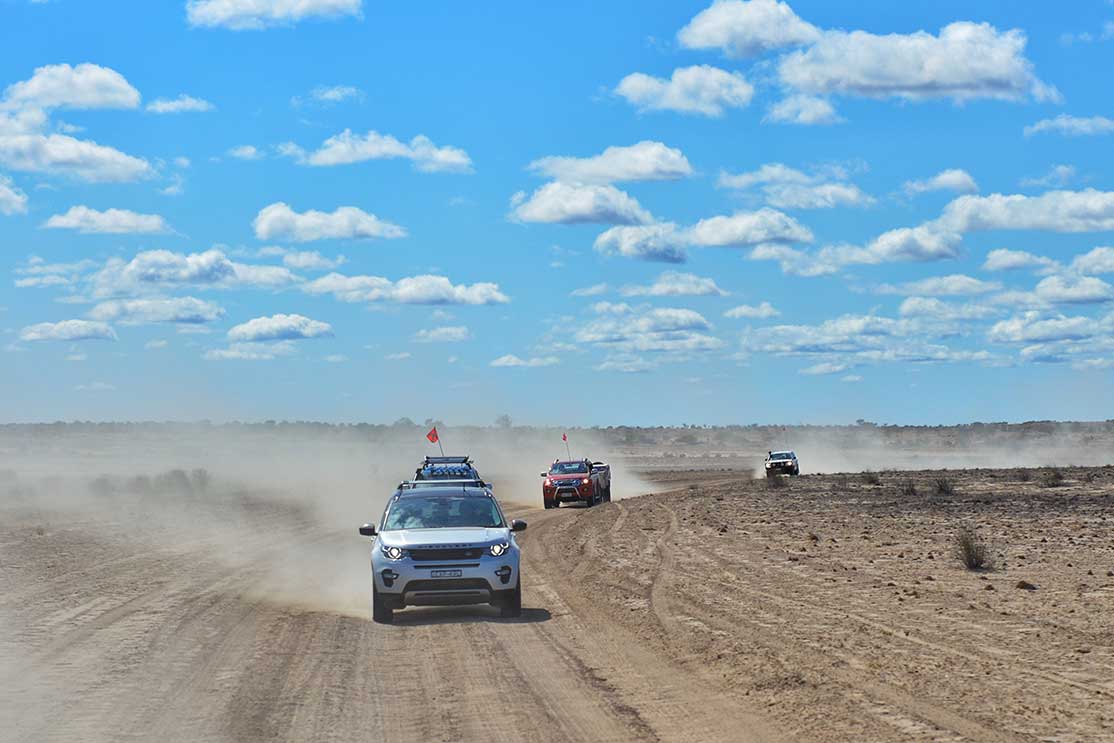
And as the sun was giving us its last leg of light, we made it through the swelling racing town, past the Birdsville Pub where a couple of country folk threw beer cans to the red-dusty floor and onto the track toward the entrance to the Simpson Desert.
So far the Disco had made it without harm, except for a small dent to the bonnet from a flying bolt off a camper trailer. We woohooed over the radio for a job well done and metaphorically patted our trusted steed on the back for making it this far. But we spoke to soon; a few clunky noises and an uneasy feeling saw us pull to the side of the road, hoping it was merely tumbleweed clinging to the car’s belly. Instead, as we had anticipated, we’d blown a tyre.
It was at this stage we had to make a decision – miss the chance to watch the sunset, or come back to change a tyre in the dark. It wasn’t a difficult choice; as the sun set behind the horizon, highlighting the spectacular colours of endless Australia’s desert landscape, the view from the top of Big Red stole our breath. Changing the tyre in the dark, however, was breathtaking for all the wrong reasons with Land Rover’s tyre-changing kit more complicated than we had expected.
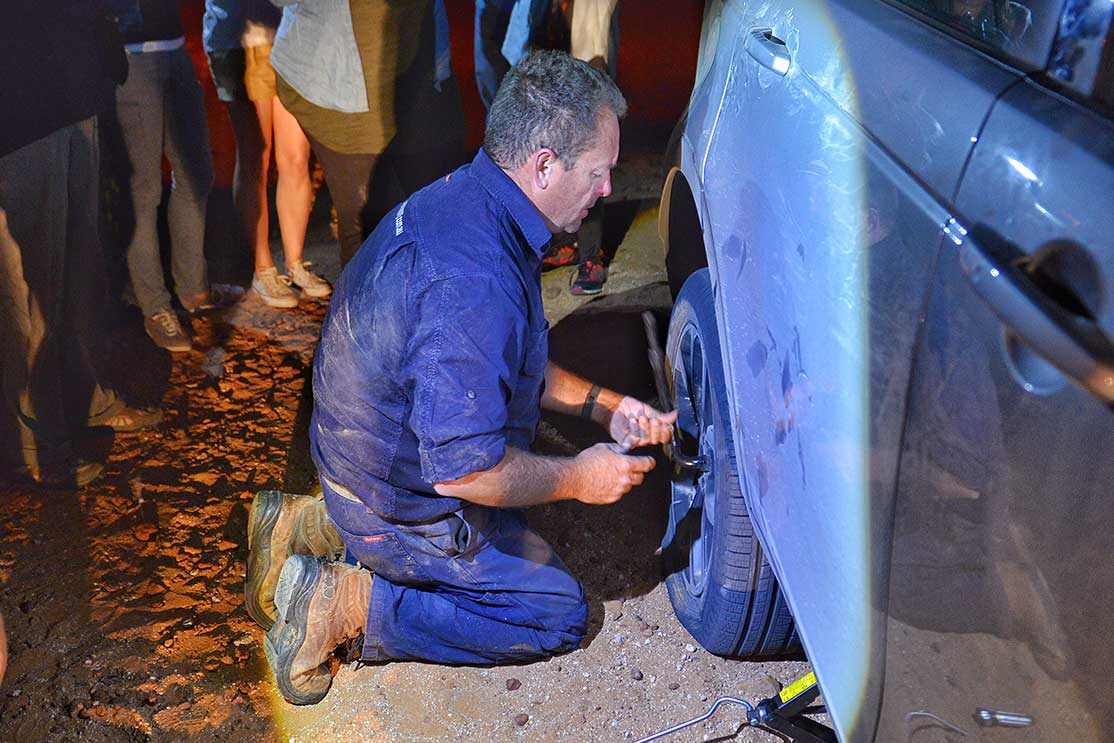
In hindsight, the burst tyre probably saved us from a humiliating bogging on Big Red and any disappointment from not ticking it off our bucket list was quickly cancelled out by a couple of wins at the Birdsville Races – not least of which was the opportunity of a few horsepower laps around the famous racetrack in the Disco Sport.
So to all the old blokes sitting around the campfire at Tent City, drinking their VBs and making jokes at the Disco and my expense (women can’t drive 4WD’s, you say?), take this as proof that you can’t judge a book by its cover and a Toorak Tractor can make it across this sunburnt country – all you need is off-road driving aids, appropriate tyres and a bloody good driver.
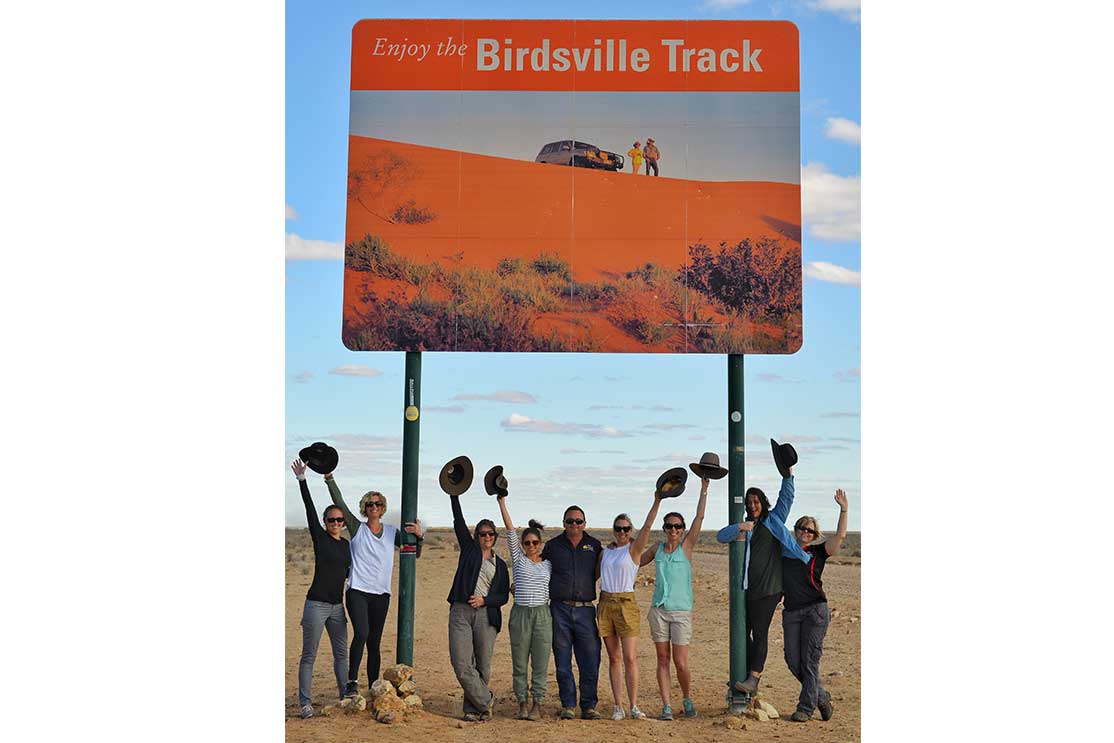
SPECIAL THANKS
The annual Birdsville Races occurs on the first Saturday of September every year, when the little outback town of Birdsville has visitors from all over the country and the world. The trip there is just part of the fun, but it’s the town’s outback hospitality that’ll have you wanting to return.
Special thanks goes to our trusty guides from Australian Offroad Academy. If it wasn’t for the off-road savvy Dave leading our convoy, we’d probably still be stuck at the base of Big Red with a flat tyre, or left wandering the Aussie Outback.
They say the best way to make a small fortune in cars or motorsport is to start with a large one. Even so, there are still a lot of lucky lads and ladies who, following their automotive endeavors and indulgences, will have the cash left over to accessorise. Check out these outlandish ways for the car obsessed to indulge.
IN THE DRIVER’S SEAT
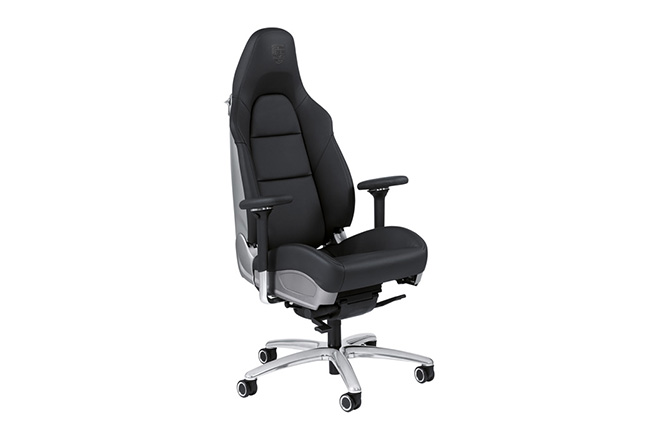
One may not want to be reminded of their Porsche sitting in the garage while slaving away at their desk. But for those wanting their bums-on-seats experience even when out of the car, Porsche offers their 911 bucket seat as an office chair complete with electric height and recline adjustment for $7440.
If the chair isn’t enough, Cup Car lovers can indulge in a real 911 GT3 Cup rear spoiler on their wall. Made up of an original blade, carbon-fibre fins and even the racing screws, the shelf costs less than the actual on-car option at ‘just’ $5535.
NEXT LEVEL CARBON FIBRE
Many car manufacturers have moved into pushbikes as part of their lifestyle brands: what better way to accessorise the SUV or sedan than with some additional carbon-fibre wheels?
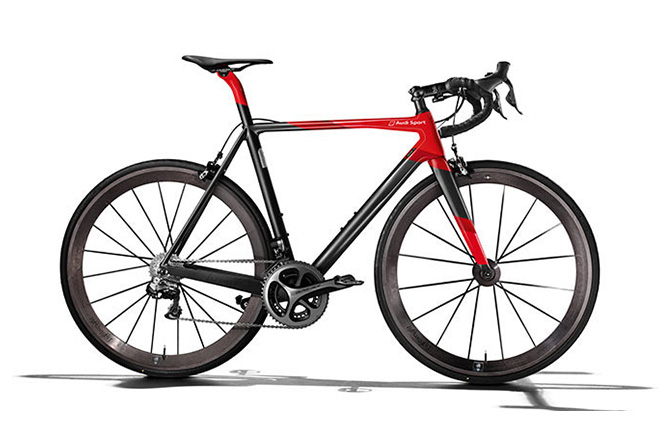
The Audi Sport Racing Bike is a fully fledged S-Badged machine with a carbon frame and a seat made from the same leather as those in the Audi R8. Only 50 of them are to be sold, at a cost of 17,500 Euro ($25,990) each.
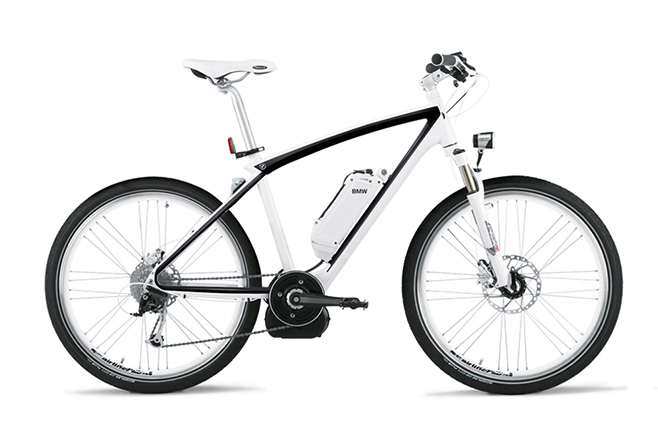
Other luxury marques have more affordable pedal options, and the Cruise E-bike from BMW may appeal to the lazier among us. With the help of an electric motor that recharges as you pedal, the bike can be propelled to speeds of 25km/h for just $4430. You can also match your kids up to your pedals with their own balance bikes in a choice of three colours for $549.
BE BOND
If you own an Aston Martin DB9, this watch is not an option, but a must-have. Not only is it full James Bond spec in appearance, the Jaeger-LeCoultre Amvox2 unlocks the DB9.
It has a micro-transmitter built in to its titanium frame, so the owner simply taps the touch-sensitive sapphire crystal glass between eight and nine o’clock on the watch face to unlock the car. To lock the car, one simply taps between three and four o’clock, or tap both to have the car flash its headlights at you and reveal its hiding place in large dark carparks.
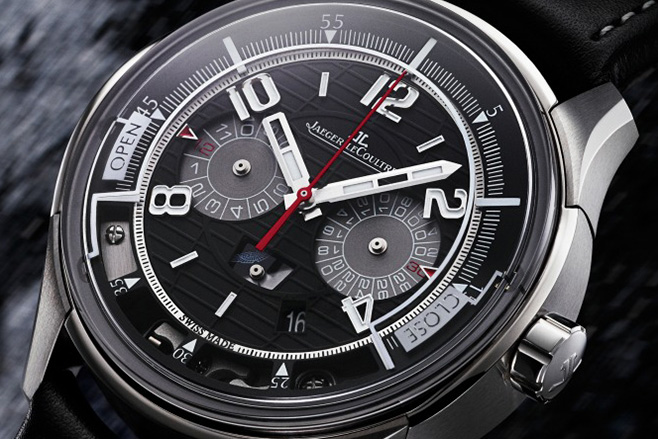
Okay, so it’s a $31,929 party trick, but if you can afford a DBS, you can also afford this watch.
SHAKEN AND STIRRED
Rolls Royce is still arguably at the pinnacle of luxury transport, and their ultimate accessory is quite nearly art (and not just because it involves alcohol).
The Rolls‑Royce Cocktail Hamper is handcrafted from aluminium, carbon fibre, walnut wood and leather, and features a laser-cut cocktail strainer, Theresienthal hand-blown and platinum-topped glassware, a recipe book from sommeliers at London hotels The Dorchester and 45 Park Lane, and is of course lavishly engraved with the ‘RR’ monogram.
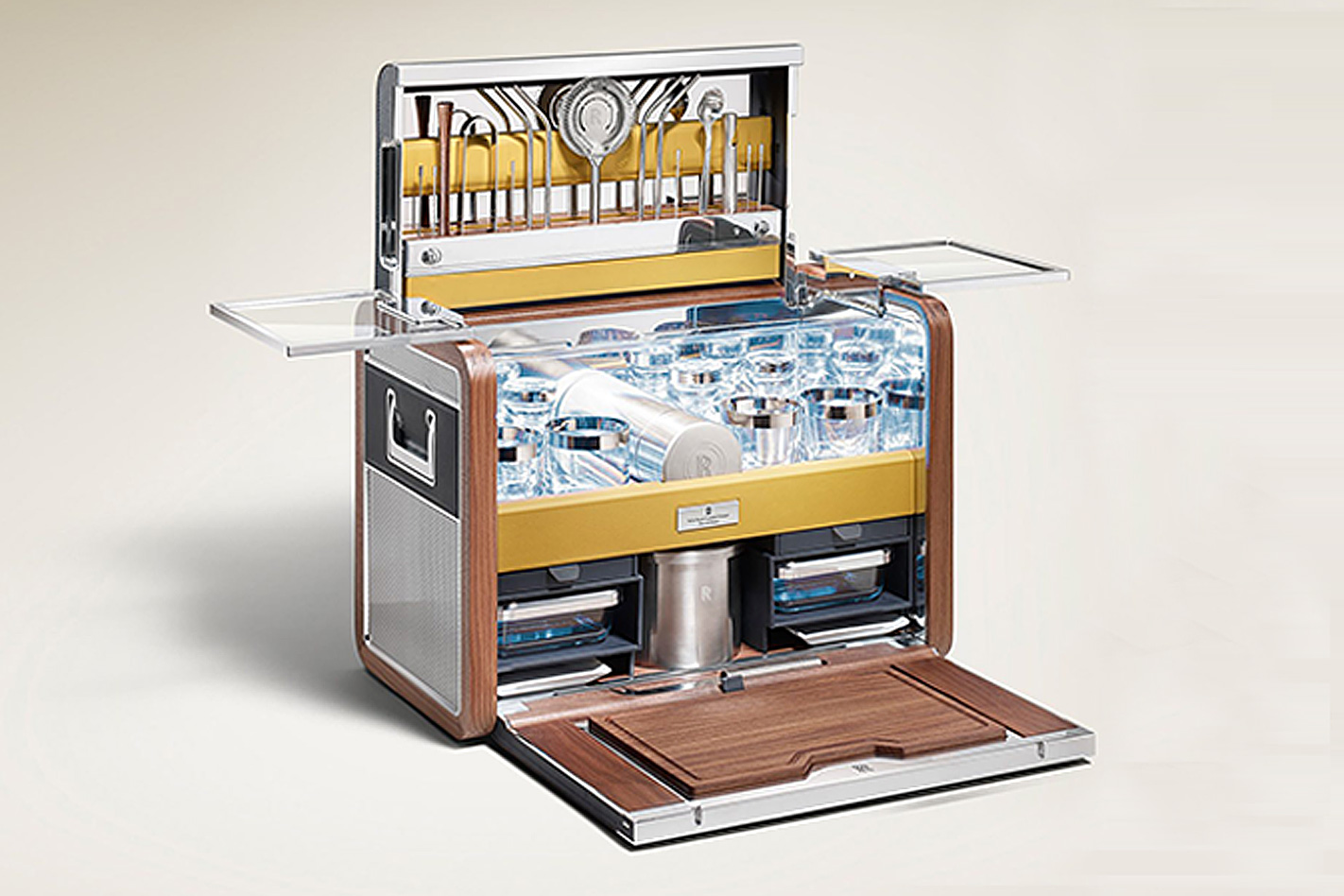
With only 15 to be made and at $49,745, it’s exclusivity in a glass.
STOP THE CLOCK
No list like this would be complete without the world’s most expensive accessory. Diamond inlaid interior panels and gear knobs aside, the Breitling clock to accompany the Bentley Bentayga is the world’s most expensive accessory, and the perfect accompaniment for the world’s most loftily priced SUV.
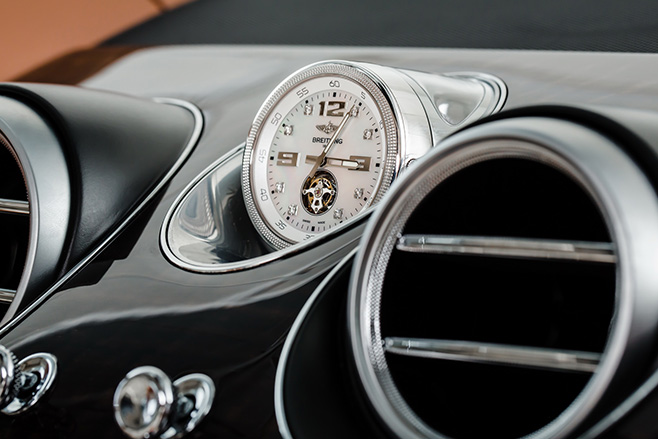
The Breitling ‘Mulliner Tourbillon’ timepiece is hand made from 18-carat rose or white gold with 12 diamonds and a 22-carat gold oscillator, and costs two-thirds of the price of the car itself at $300,000. Yes, that’s $300,000 for the clock inside the car. No, that’s not a typo.
Breitling can only build four of these particular in-car clocks each year. Two are already sold.
Can’t get enough? Now read about other things automakers make besides cars.
