
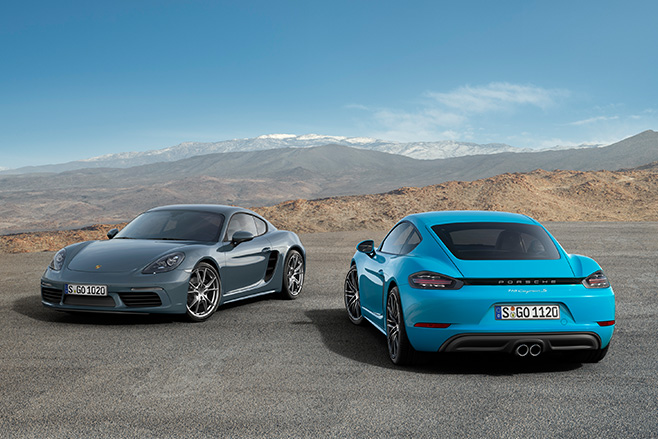
THE new Porsche 718 Cayman will be powered by four-cylinder engine for the first time, making it the most affordable sports car available from the brand.
Revealed at the 2016 Beijing motor show this week, the updated Porsche Cayman will start from $110,300 making it cheaper than the Porsche Boxster, which starts from $113,100. That means the 2016 Cayman will be the most affordable Porsche sports car in Australian showrooms when it arrives later this year, despite it costing more than the current base Cayman’s $106,200 kick-off.
The announcement comes as no surprise, as the open-top version of the Cayman, the Porsche Boxster, was confirmed as a turbocharged four-cylinder model late last year. The Cayman will use the same four-cylinder boxer engines that replaced the six-cylinder units in the convertible.
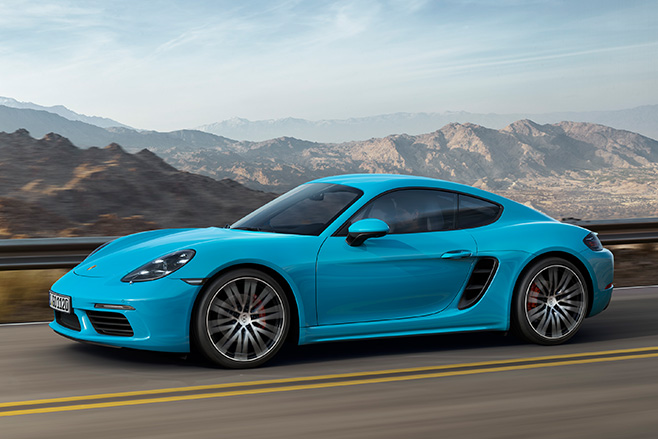
The new downsized engines bring not only improved performance, but considerably better fuel economy. Porsche Australia has pointed out that the entry-level Cayman’s claim of 6.9L/100km brings it below the Luxury Car Tax threshold for fuel-efficient vehicles, reducing the $4999 premium for the seven-speed dual-clutch transmission to effectively a mere $1333 after the tax break is applied.
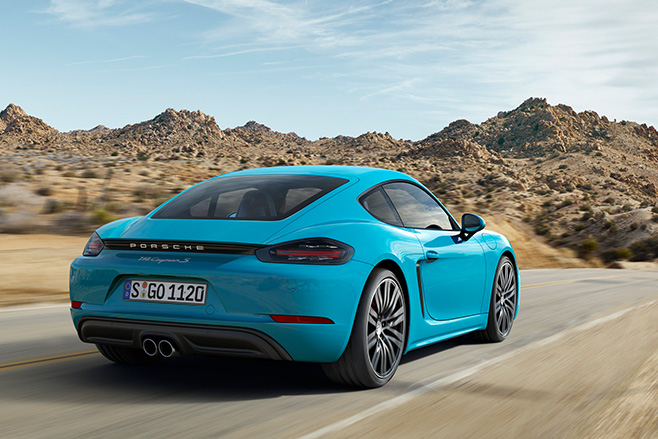
That allows the new, lighter Cayman a 4.9sec 0-100km/h claim – easily quicker than the old six-cylinder’s 5.6sec. The new all-alloy engine features direct fuel injection and variable valve timing, includes a dry sump to ensure oil supply even when being pushed hard.
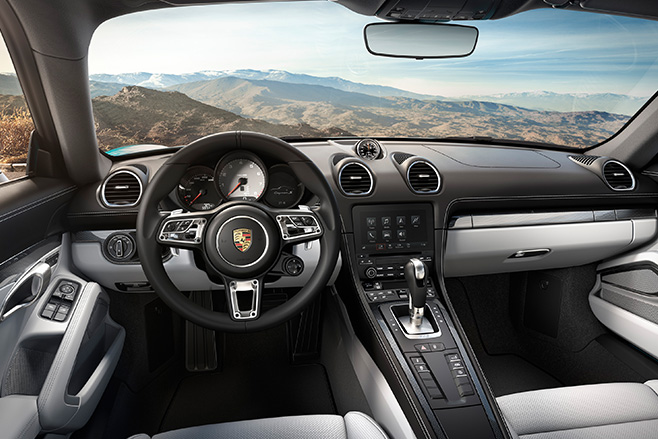
Inside, a redesigned dash includes new air vents, the three-spoke steering wheel first seen in the Porsche 918, as well as PCM (Porsche Communication Management) as standard. The PCM includes sat-nav and a 150W audio system.
The 718 Porsche Cayman arrives in showrooms in late 2016 priced from $110,300.
Volkswagen’s large SUV concept, the T-Prime, is on show at this week’s 2016 Beijing motor show, demonstrating much of the exterior design, infotainment technology and clever drivetrains that will be offered on the production version.
It’s no coincidence the T-Prime looks similar in shape to the Audi Q7 as it is again likely to borrow significant parts, including its platform, from its sister brand’s own big SUV.
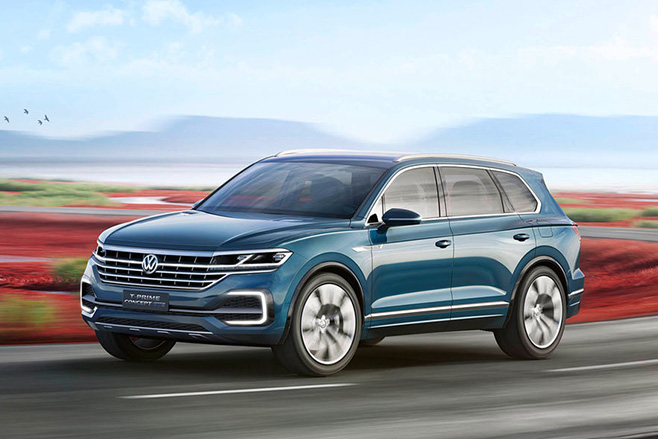
The all-wheel-drive concept is powered by a petrol-electric hybrid drivetrain that offers 280kW of power in GTE performance mode that utilises the conventional engine, or a near-silent 50km range using its electric motor only.
Production Touaregs, however, will primarily be powered by petrol or diesel engines.
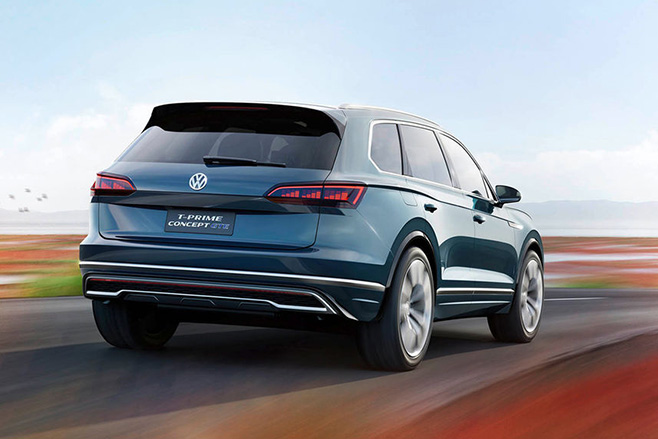
There are just four seats in the concept, though the third-generation Volkswagen Touareg is set to offer the option of seven seats – via a third, two-seat row – for the first time.
The concept’s interior is notable for an almost complete absence of switches. The expansive digital instrument cluster and infotainment display, which VW dubs the Curved Interaction Area, are controlled by hand gestures, voice or touch.
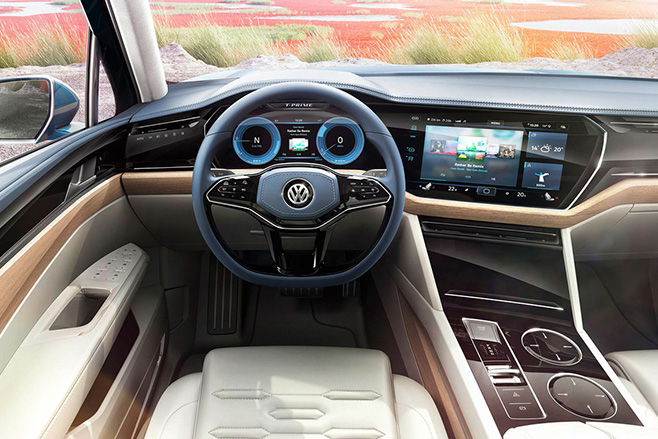
Touch-sensitive controls include the flat, glass scroll wheel that selects gears for the eight-speed automatic gearbox.
The new Touareg will eventually headline a five-strong Volkswagen SUV line-up, which also includes the upcoming Tiguan due here in September, a seven-seater Tiguan labelled the XL, and smaller SUVs based on the Volkswagen Golf and Polo.
1. An automatic transmission is now no extra cost for Mini Convertible buyers. That makes the new Cooper Convertible’s $37,900 starting price $4800 less than its automatic predecessor.
2. Despite this, the trade-up from a Cooper three-door hatch to the Convertible is a considerable $11,250.
3. The three-cylinder engine in the Mini Convertible has been available in the Mini three-and five-door hatches since 2015. The engine is also offered in the BMW 2 Series Active Tourer.
4 .The previous model was called ‘Cabrio’; the name change reflects the streamlined range for the new generation Mini, which will no longer includes Roadster and Paceman models.
5. The Mini Cooper Convertible is one of three Convertible models: Cooper, Cooper S and later in 2016, the flagship Cooper S John Cooper Works will arrive in Australia.
6. The boot lid opens flat to support up to 80kg of weight, while the Mini’s larger dimensions see the boot grow 45 litres to 215 litres.
7. This is the third-generation Mini since BMW took over ownership of the brand in 1994. Australia didn’t get the first version, making this only the second generation of open-top Mini sold here.
Read our review on the Mini Cooper Convertible here.
Much larger than before, the Mini Cooper drop-top is now officially a four-seater. Its folding roof takes 18 seconds to open or close and can be operated at speeds of up to 30km/h. With a new three-cylinder 1.5-litre turbo engine, it comes with either a six-speed manual or six-speed automatic transmission.
STRENGTHS
- Unmistakable styling matched to a boutique, sophisticated high quality ‘café’ interior.
- Refined and comfortable even with the roof open.
- Efficient engine delivers a fun note, and has enough power to make the Mini an enjoyable car to drive.
- A four-seater, but the rear seat’s not really for adults.
- Larger dimensions mean the roof actually takes longer to operate than its predecessor.
- A wind deflector, sat-nav and head-up display, are all extras, despite premium over Cooper hatch.
If you’re looking for a fun-to-drive, stylish open-top small car then the Fiat 500C – much cheaper and smaller than the Mini – should also be on your shopping list. The Audi A3 Cabriolet also offers four-seat, open top premium motoring, while the more affordable, spacious Holden Cascada can also carry four with its roof down. The two-seat Mazda MX-5 is much smaller than the Mini, but is a must-see for those seeking entertaining al-fresco motoring.
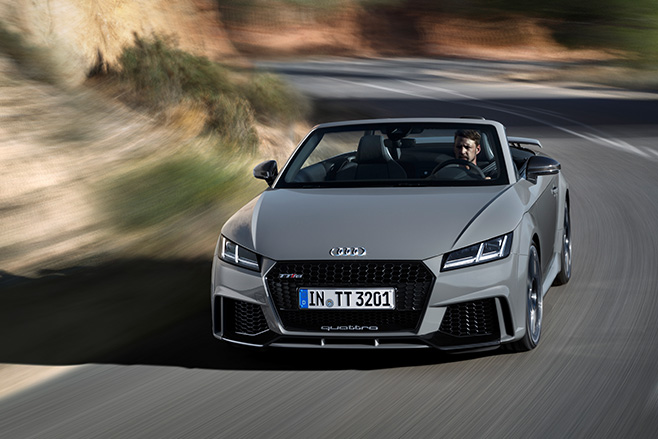
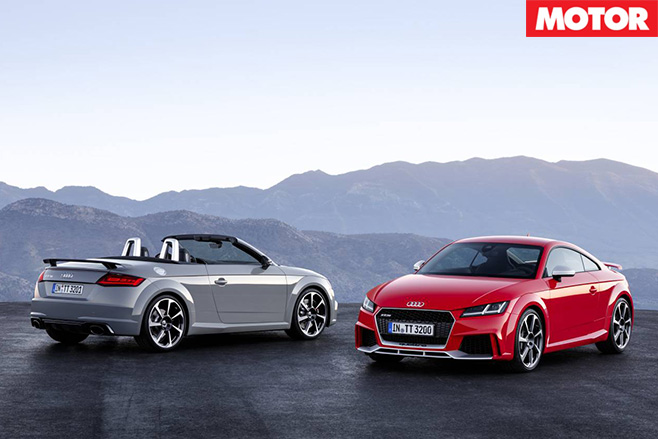
The next-generation Audi TT RS twins are both claimed to reach 100km/h from standstill in less than four seconds, with the coupe recording a rapid 3.7 seconds that’s 0.4sec quicker than the old version.
The fastest TT has been revealed this week at the 2016 Beijing motor show, with its impressive performance derived from a redevelopment of its predecessor’s engine.
The upgraded 2.5-litre five-cylinder now produces 294kW (up 44kW) and 480Nm (up 30Nm). A quattro system again apportions the engine’s power and torque between the front and rear wheels, via a seven-speed automatic.
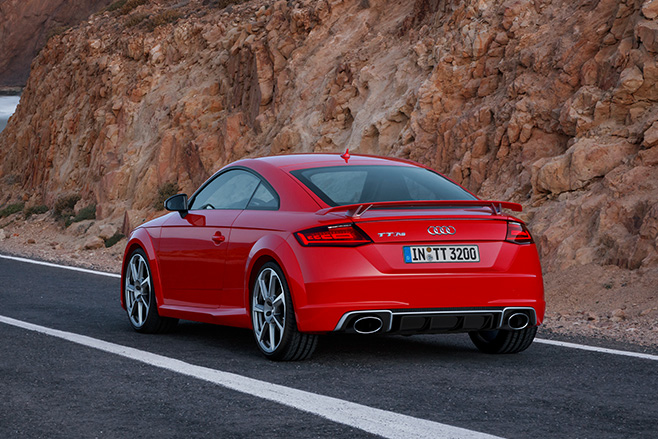
It will be easy to pick the TT RS from the mid-range TT S when the former joins the latter in mid 2017 locally.
The TT RS will also look faster thanks to a rear wing, large dual oval exhaust pipes, as well as a front end that features larger air intakes and a honeycomb grille with silver surround and ‘quattro’ logo.
Matrix LED headlights and matrix OLED (organic light emitting diode) tail-lights are available optionally to enhance the TT RS’s technological look. Normal LEDs are standard front and rear.
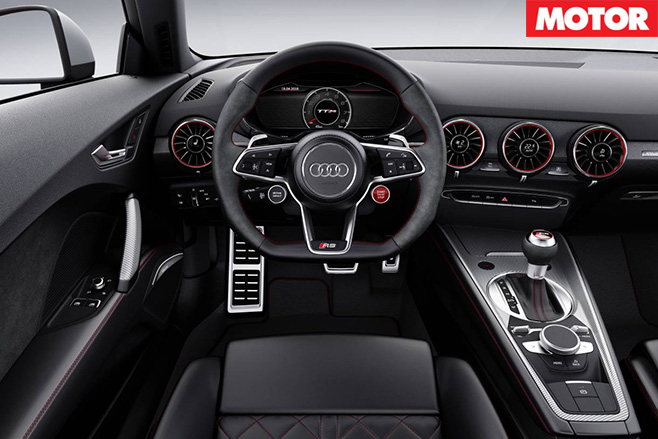
One of the most noticeable changes inside is that the Audi TT RS features a Ferrari-like steering wheel that incorporates the engine start-stop button and Drive Select button.
Drive Select allows the driver to alternate between four different vehicle setting modes, including Comfort, Auto, Dynamic, and the customisable Individual.
Audi’s Virtual Cockpit 12.3-inch digital instrument cluster is standard, and includes an RS-specific screen providing tyre pressure/torque/g-force readings.
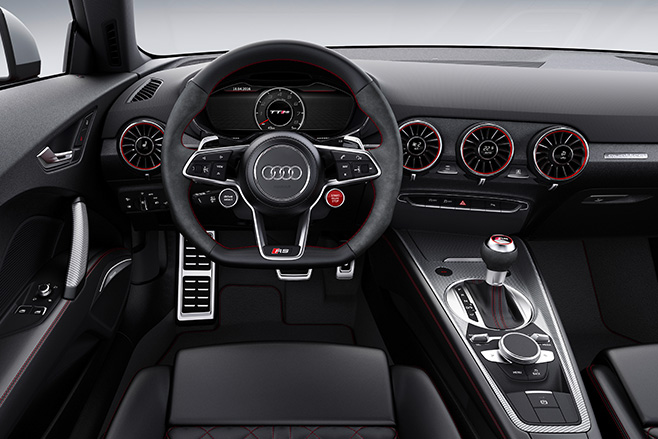
Driver and front passenger sit in RS Alcantara/leather, diamond-patterned sports seats, and other RS flourishes for the cabin include red stitching for the steering wheel, seats and gearlever gait, and red-ringed air vents.
The Audi TT RS sits on 19-inch alloy wheels, with optional 20-inch wheels. Other options include carbon-ceramic brakes and RS adaptive sports suspension.
No pricing is available yet for Australia. The previous TT RS cost from $140,000 in faster Plus form.
WRC: Paddon beats Ogier in Rally Argentina thriller
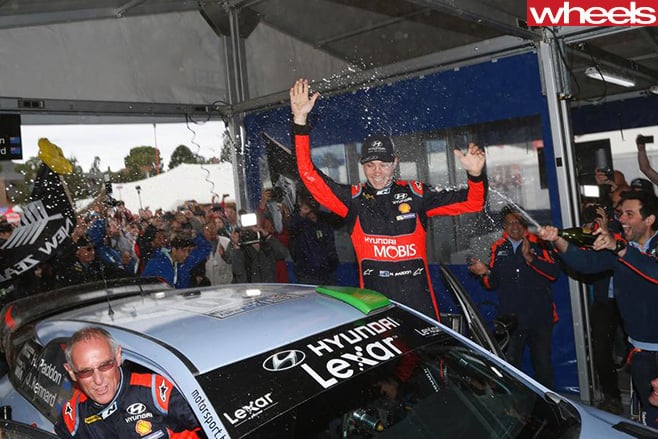
YOUNG New Zealander Hayden Paddon has scored a brilliant maiden WRC victory in one of the roughest, toughest events on the calendar, driving what he called “the stage of my life’ to take the fairy tale win in Rally Argentina.
Paddon and co-driver John Kennard had to survive the swirling fog in the mountains, and gear change issues on the final day but ultimately took a stunning 14.3sec win in their Hyundai i20 from championship leader Sebastien Ogier (VW).
The two leaders were separated by just 2.6sec ahead of the final legendary El Condor speed test, but Paddon stunned the Frenchman to hurtle down the rock-strewn mountain almost 12sec faster and secure a remarkable win.
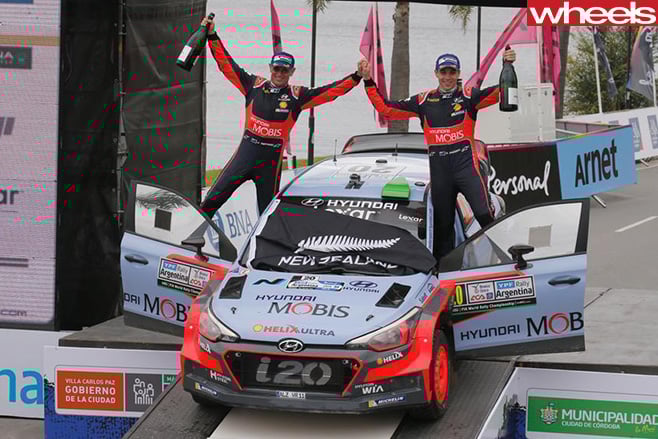
“I can’t believe it, I really didn’t think I stood a chance before the last stage after losing time to Ogier this morning,” said Paddon, who celebrated his 29th birthday the day before the start. “I gave that last stage everything I had. Tight and twisty roads like El Condor aren’t my strength but I drove the stage of my life.”
The triumph was the third overall victory for the Korean manufacturer in the WRC, and first for the New Generation Hyundai i20.
Second place meant Ogier extended his championship lead in his Volkswagen Polo R, the Frenchman finishing the brutal event ahead of team-mate Andreas Mikkelsen.
Paddon was always in the picture in Argentina and took the lead on Saturday when VW’s Jari-Matti Latvala rolled out spectacularly, blaming a suspension breakage.
Seeking to become the first Kiwi to win a WRC round, Paddon started the last day of the tough event with a 29.8sec advantage over championship leader Sebastien Ogier.
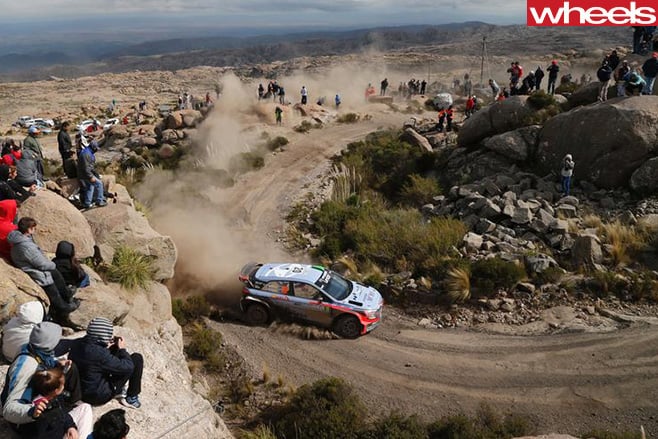
After Ogier clawed back large slabs of time on the final morning, alarmingly reducing the deficit to a mere 2.6 seconds, Paddon went out on the final El Condor Power Stage thinking he couldn’t win. “Sebastien had won that stage several times and so we expected he’d probably do it again. Two seconds wasn’t going to be enough.”
But Paddon dug deep to thwart the triple world champ’s threat.
Meanwhile, Volkswagen has provided an insight into the faster, gruntier and more spectacular next generation of the Polo R WRC from 2017. Next year’s Polo R WRC will generate about 280kW or roughly 45kW more than the current car.
Lighter, wider, and with more aerodynamic freedom, the changes are set to be dramatic, visually and aurally, with hints of the legendary Group B cars of the 1980s.
About 50 millimetres wider and 25 kilograms lighter, the most visually striking changes are the larger rear wing and broader front spoiler.
Away from the limelight, and with Chris Meeke at the wheel, VW’s arch rival Citroën Racing has already completed initial gravel road testing of the car that will chase the WRC from next season.
Under the bonnet, the 1.6-litre direct injection turbo engine is now fitted with a 36mm booster flange, like the Citroën C-Elysée WTCCs. The four-wheel drive system now comes with a central differential that improves traction.
GT3: Van Gisbergen lands thrilling Monza victory in Blancpain GT Series
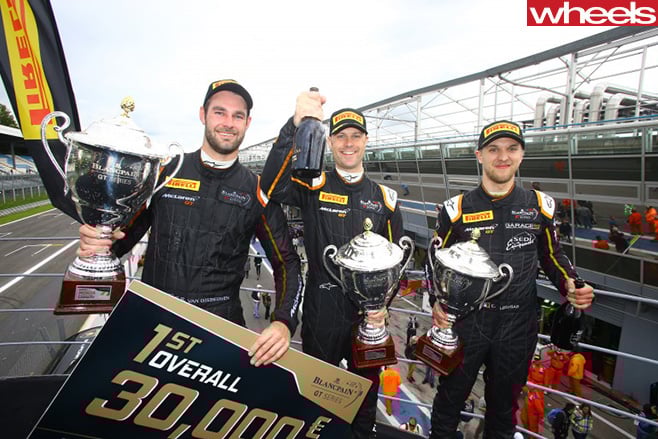
It was a compelling battle between van Gisbergen driving the Garage 59 McLaren and pole-man Buhk aboard the HTP Motorsport Mercedes-AMG.
With a massive entry of 57 GT3 cars, traffic played an important role in the outcome of the race, and with 30 minutes to run, SVG was badly baulked by a large group of cars fighting for top-15 positions. Buhk immediately seized the change to make a lunge on the McLaren, poking his Mercedes under the rear wing of the leader
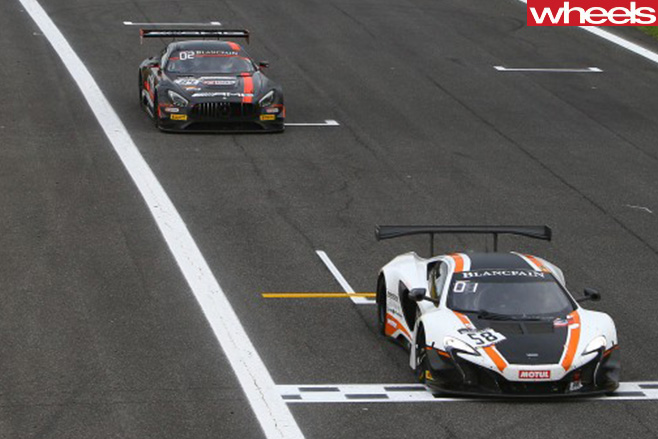
But the Kiwi driver kept his cool and crossed the line first, to the joy of the recently-created Garage 59 team.
Behind the scrapping duo at the front, Bentley Boys Andy Soucek, Wolfgang Reip and Maxime Soulet produced a steady race to a podium finish.
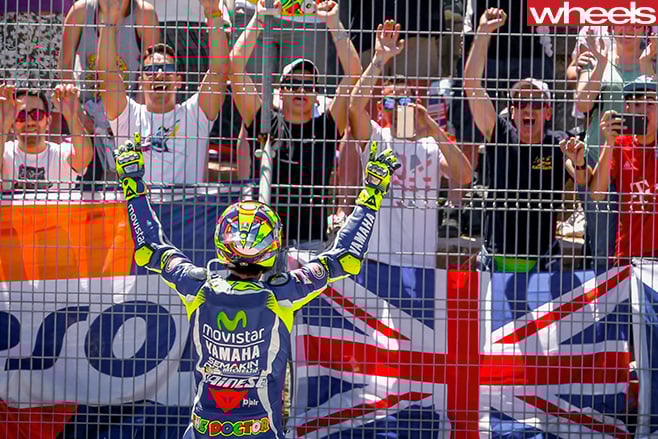
MOTOGP:Rossi blitzes Grand Prix of Spain at Jerez
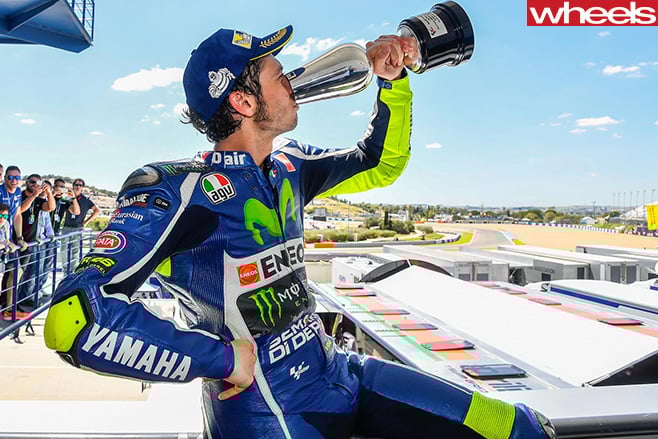
Most had come to see the two local heroes fight for the win.
Instead, they were stunned as Rossi, now 37, banished his qualifying demons to take a superb pole position and then raced away to score a dominant win in the Spanish Grand prix.
Rossi clearly wasn’t distracted by the news in the days before that his Yamaha team-mate Lorenzo will be a Ducati rider in 2016 and 2017, and that Honda’s Marquez was also approached to switch to the Italian team.
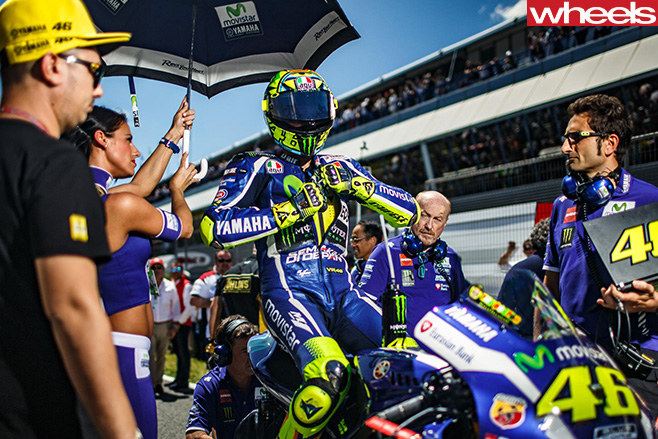
Lorenzo briefly hit the front on lap two, but Rossi assertively reclaimed the front running and was thereafter never headed.
With clear track ahead and a handy margin behind him, Rossi put the hammer down and checked out.
The Italian lowered his pace a little in the final stages of the race to conserve his tyres, but finished his lonely ride by taking the chequered flag 2.386s ahead of Lorenzo with a handy gap back to championship leader Marquez.
It was Rossi’s 113th career victory.
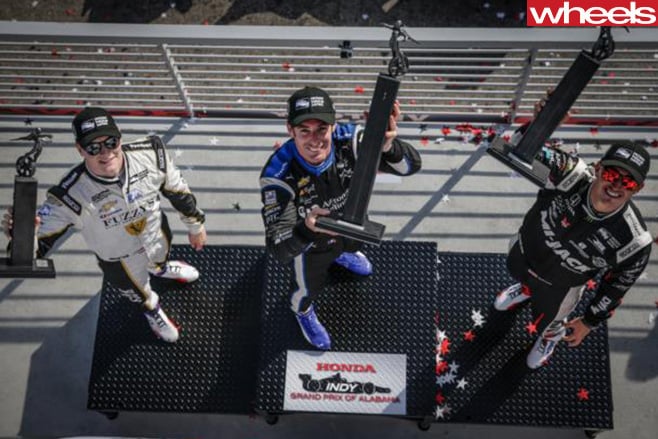
Australia’s Will Power has finished fourth in the Grand Prix of Alabama won by Frenchman Simon Pagenaud, who led most of the race and survived late contact with Graham Rahal.
Pagenaud’s win from pole on the permanent road course came on the back of winning the previous week in Long Beach, and extended his strong start to the season.
The Team Penske driver – Power’s team-mate – has now finished second, second, first and first to create a handy 48 point lead over Scott Dixon in the standings.
Controversially, the contact with Rahal with eight laps to run came when Pagenaud appeared to move to block Rahal, who made contact with the Frenchman’s right rear.
Pagenaud, who also won last week at Long Beach, went into the grass before working his way back to the front.
Rahal recovered quickly to hold off fellow American Josef Newgarden to finish second while Power was fourth after a quiet start to 2016.
ARC: Simon Evans wins in new-look Australian Rally Championship
Simon Evans and Ben Searcy won the opening round of the 2016 Australian Rally Championship, the Quit Forest Rally, in Western Australia, but only after a massive scare courtesy of up-and-comer Harry Bates and his co-driver John McCarthy.
The four-time Australian rally champion Evans and challenger Bates each won a heat over the weekend, and finished the event with the same points. But the bonus point awarded to Evans/Searcy for recording the most stage wins was enough to hand them the overall event victory.
Bates, the son of legend Neal drove his dad’s old Toyota S2000 machine on what was his first start in WA and only his fifth ARC start.
He starred on Saturday to take an impressive heat victory. Aside from testing the previous Wednesday, the second-generation driver had never driven on the slippery ball-bearing roads for which the area is famous.
First on the stages, Evans had the unwelcome task of being the road ‘sweeper’ but he pushed Bates all the way to take second on Saturday.
“The young fellas (Bates/McCarthy) just caught us unawares,” Evans acknowledged after the Saturday competition. “We were pretty happy with our pace, sweeping the roads out the front, and I thought everything was pretty sweet and then someone said ‘Harry’s kicking your butt’ and I was like; damn it.”
The top two finishing results were reversed on Sunday.
Bates admitted to mixed feelings about the weekend, delighted to win on Saturday but disappointed he wasn’t a bit closer to Evans on Sunday.
Justin Dowel/Toni Feaver (Hyundai i20 proto) and Molly Taylor/Bill Hayes, in a near-standard Group N Subaru WRX STi, finished the event on equal points in the race for the final spot on the podium. The tie was broken by calculating the total competitive time for each crew across the entire event, with Dowel/Feaver getting the nod.
Seventy-year-old Ross Dunkerton turned back the clock to take sixth in heat one and ninth in heat two.
Neal Bates and Coral Taylor took top spot in the both heats of the Australian Classic Rally Challenge.
For the first time the Porsche Cayman is cheaper than the Boxster thanks to the release of the four-cylinder 718 series and a repositioning strategy of the compact coupe and roadster range.
Following the 718 Boxster unveiled three months ago and priced locally from $113,100 (plus on-road costs), this week the virtually identical 718 Cayman lobs priced from $110,300 (plus orc).
Comparing the S versions, the roadster asks from $143,400 (plus orc) versus $140,600 (plus orc) for its just-released hardtop sibling.
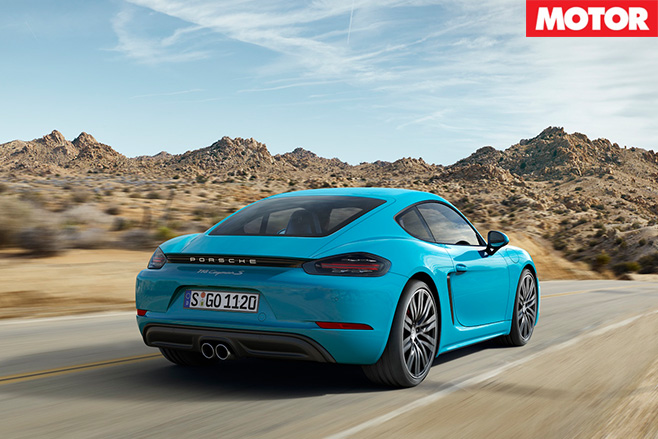
Likewise the 718 Boxster S and 718 Cayman S utilise a 2.5-litre turbo flat four-cylinder making 257kW and 420Nm, and in PDK/SportChrono guise claim 0-100km/h in 4.2sec.
Choosing a seven-speed dual-clutch automatic transmission adds $4990 to the S, or just $1333 in the case of the base model because it pays a reduced amount of Luxury Car Tax (LCT) thanks to official fuel consumption of 6.9L/100km.
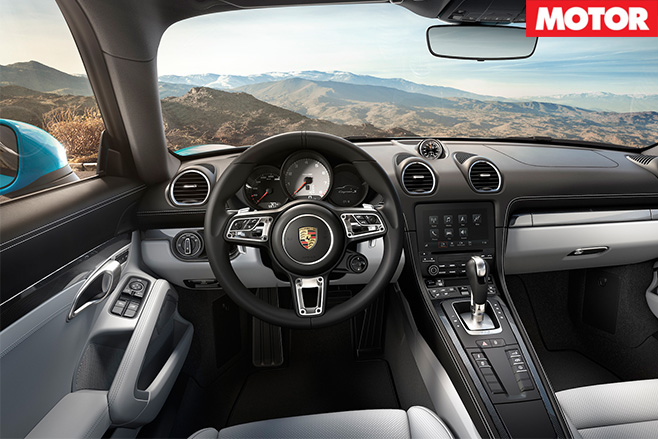
In pre-facelift guise the Cayman S was up to $9000 more expensive than the Boxster S and scored an extra 9kW/10Nm from its 3.4-litre flat six-cylinder engine. For the first time since the hardtop joined the roadster a decade ago, the pair are no longer separated to the same degree.
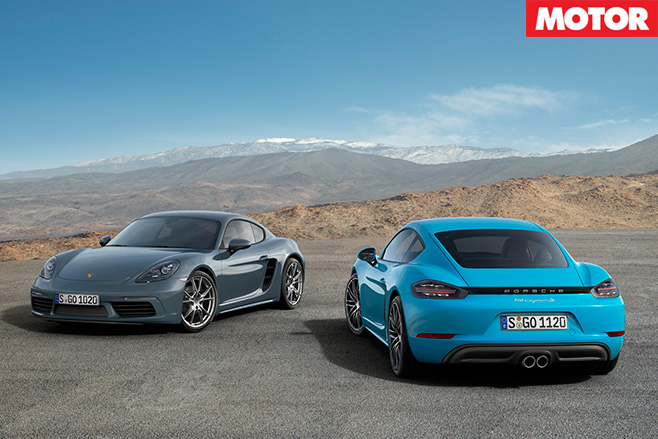
Deliveries will begin in Australia late this year.
Such is performance-car progress, the new five-cylinder Audi TT RS is almost as quick as the previous-generation V10-powered R8 supercar.
Audi claims its second RS version in three generations of TT will sprint from standstill to 100km/h in 3.7 seconds, a tenth slower than a 386kW R8 S tronic but two-tenths faster than its first-ever TT RS roadster sibling.
The overhauled 2.5-litre five-cylinder turbocharged engine packs a neat 400hp, however in kilowatts it falls six short of a figure beginning with a three, measuring a not-so-neat 294kW. No arguing with the 480Nm produced over an astonishingly broad 1700rpm and 5850rpm.
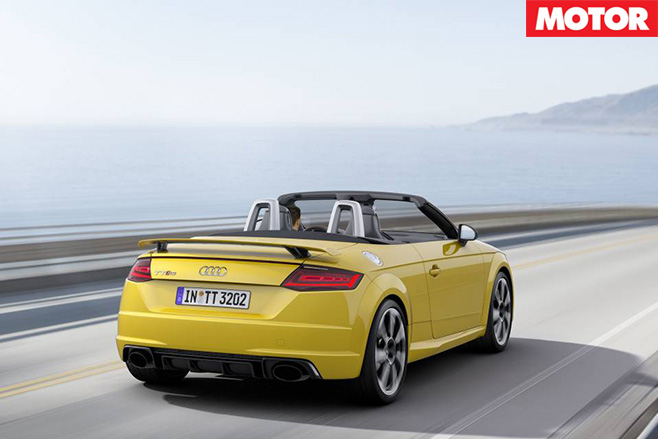
As with that model, the new TT RS packs quattro all-wheel-drive and a standard seven-speed dual-clutch automatic transmission. However unlike non-Plus versions of the last model, a manual transmission is no longer available.
Kerb weight figures have not been stated, but its one-rung-down $99,900 TT S sibling comes in at 1385kg.
While 19-inch alloy wheels are standard, forged aluminium 20s are optional. Likewise, fixed sports suspension and ventilated/perforated disc brakes are both standard with adaptive magnetic suspension and carbon-ceramics each available at extra cost.
Inside the same 12.3-inch TFT display dubbed ‘virtual cockpit’ is used, but as with the latest R8 supercar, buttons for driver selectable modes and engine on/off each move onto the leather-wrapped sports steering wheel.
Australia last saw the TT RS three years ago when it retailed for $139,400 plus on-road costs. Expect that figure to be little changed when the latest model arrives in mid 2017.
BMW calls a model’s mid-life update a Lifecycle Impulse – the latter a strange choice of word considering the changes are rarely sudden.
But changes couldn’t be better timed for the latest 3 Series. It has been pulverised in local sales by the C-Class, faces another challenger in the form of the Jaguar XE, and will be wary of a soon-to-land, all-new A4.
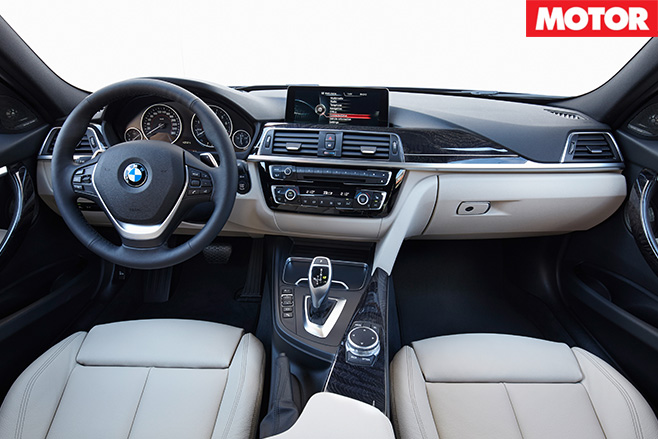
Three years after the F30 gen was released, Munich has beefed up the suspension and introduced a new modular petrol engine family, while BMW Australia, for the second time this year, has toyed with the equipment and price lists.
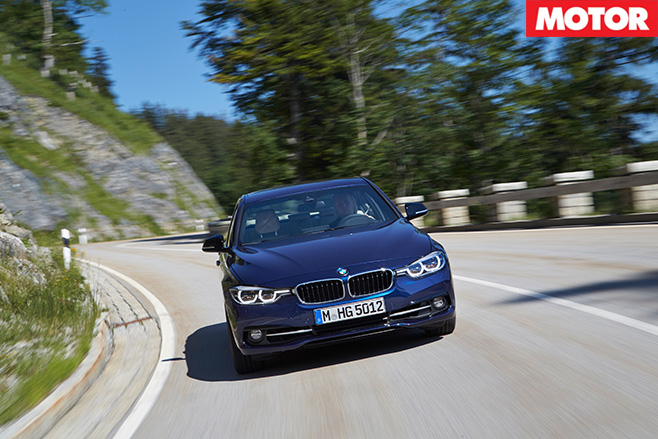
Not bad for a model that is also cheaper yet again, at $89,900, despite more goodies and an interior upgrade. Press hard on the 340i’s organ pedal and there’s no doubt you’re only a rung down from the M3. Some lag is still evident at lower revs, though otherwise torque quickly swells into a bulging mid-range.
On typical country roads, it’s so overly sensitive to bumps and cambers that it see-saws around the straight-ahead, before unexpected sticky patches appear when more consciously directing the steering. It was better through some smoother-paved twisties, though we preferred the more fluid, if less-than-perfect, standard steering of the 320d.
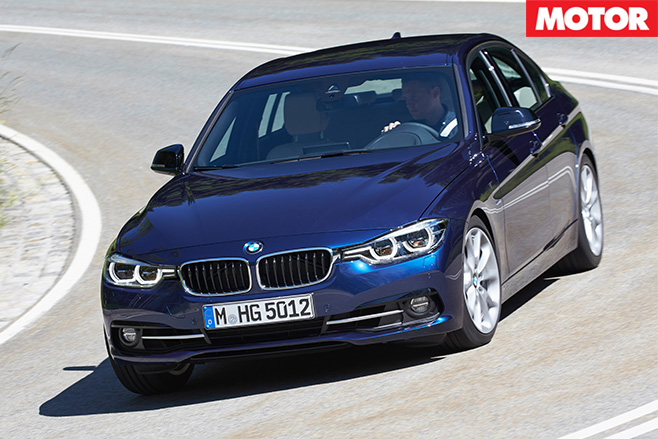
The 340i is another strong sub-M3 offering, with a greater bang-to-buck ratio than its most recent forebears. Our initial feeling is that its steering will cost it dynamically against an equivalent XE, but only a comparison test will reveal whether that’s impulsive or not. Until then…
4 OUT OF 5 STARS
SPECS Engine: 2998cc inline-6, DOHC, 24v, turbo Power: 240kW @ 5500rpm Torque: 450Nm @ 1380-5000rpm Weight: 1530kg 0-100km/h: 5.1sec (claimed) Price: $89,900 Like: Turbo six deserves two thumbs up; entertaining handling Dislike: Awful variable steering; strong competition
It sounded like a solid plan. Like many folks, the need to travel between Australia’s two largest cities presented itself over the holiday period, but, with time on our – meaning my girlfriend and I – side and an Audi S1 in need of kilometres, why subject ourselves to the Hume, when in driving terms it’s about as fun as sticking a fork in a toaster?
There are other options, the most spectacular (but also time consuming) of which is to crest the roof of Australia through the winding roads of the Great Dividing Range. It’s a driving paradise, but I knew the temptation of the S1’s agile handling and punchy 2.0-litre turbo four engine would be too much to resist, which wouldn’t leave my long-suffering partner much time to enjoy the view.
So it was to the coast we turned. The route is slower, though it is only around 150km longer than the Hume, so with two days to burn it seemed like a reasonable undertaking. Except we didn’t have two days.
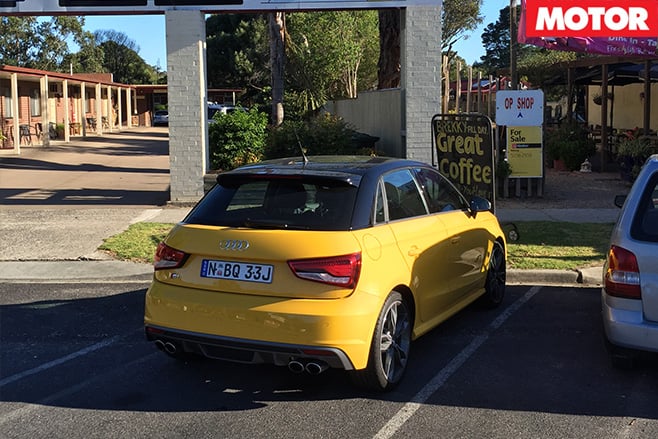
We were now faced with a mammoth 700km trek to Narooma, but with plenty of podcasts and a generally clear road ahead, we were making good time – slower traffic was easily dispatched by 370Nm of turbo torque pushing 1340kg. With so much grunt, downshifting is largely optional, though selecting third means the manoeuvre is over much quicker.
However, a further fly in the ointment arrived, or should I say departed, during a fuel stop in the picturesque seaside town of Eden when it became apparent at some point in the journey my wallet had made a bid for freedom. Its obvious location was Cann River, where we’d stopped to stretch our legs, but I’d also stopped for a picture at the Victorian/NSW border, a destination that was close enough to make the backtrack worthwhile, just in case.
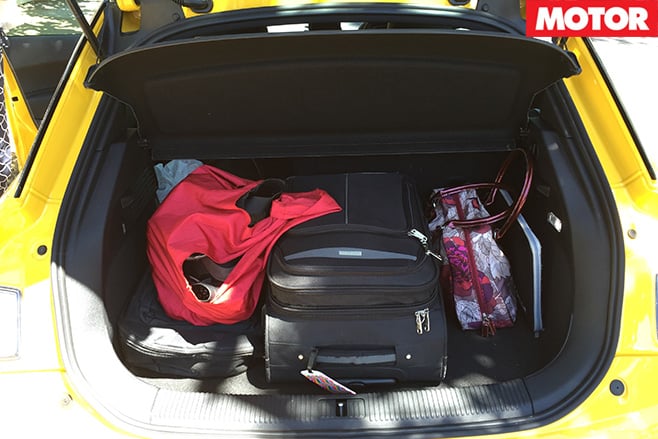
Most of the route is gently meandering 100km/h highway, however the road linking the coastal towns of Tathra and Bermagui snakes its way inland with a variety of second- and third-gear corners. The S1 was in its element, though the driver (sadly) was not, a combination of fatigue – we’d been on the move for almost 10 hours by now – and kamikaze kangaroos limiting both the pace and the fun.
The next day brought beautiful weather, but as we progressed north the traffic became as intense as the sunshine, leaving us wondering whether sticking a fork in the toaster might not have been the best move after all.
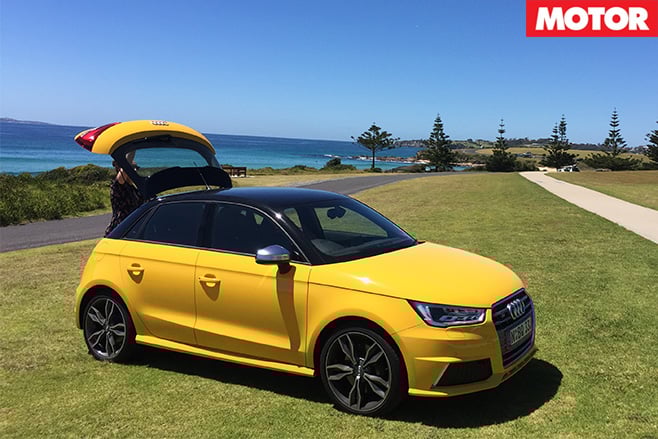
Despite the heavy load, the S1 returned trip-best fuel economy of 7.56L/100km, while slurping 45.28L from a 45-litre tank, though that’s a world away from its 5.9L/100km highway claim.
Next month our resident hot hatch will take part in something a bit more enjoyable and, hopefully, a bit better planned.
Month: Two Liked: Overtaking punch; agile, willing handling; size makes it easy to park Disliked: Ride can become tiresome over long distances Favourite moment: Scything through the long curves north of Lakes Entrance
Fuel this month: 8.2L/100km Average: 8.2L/100km Distance this month: 1977km Total: 3590km
Want to see more of our Audi S1 long-termer? Check out the below:
