
Gravity’s a funny thing – it’s such a forgettable sensation, but yet even now as you read this, it’s gently crushing you. And without it, we wouldn’t have any need for, well, bras, rocket scientists, legs, and a whole lot of other things. But we’re getting carried away.
There’s another all-powerful, all-pervading force that works a silent magic on those who like cars. It’s easiest felt when in the presence of something with fixed-back racing seats and no sound deadening. But still wearing number plates.
No matter your four-wheeled tastes, you’d be checking in to the local lunatic asylum if you turned down a blast in something like a Ferrari 458 Speciale, McLaren 675 LT, Aston Martin Vantage GT12, any Caterham or, of course, Porsche’s 911 GT3. All wear the whole ‘add lightness’ thing on their sleeves (or on their doors, often as gaudy stickers). But for good reason.
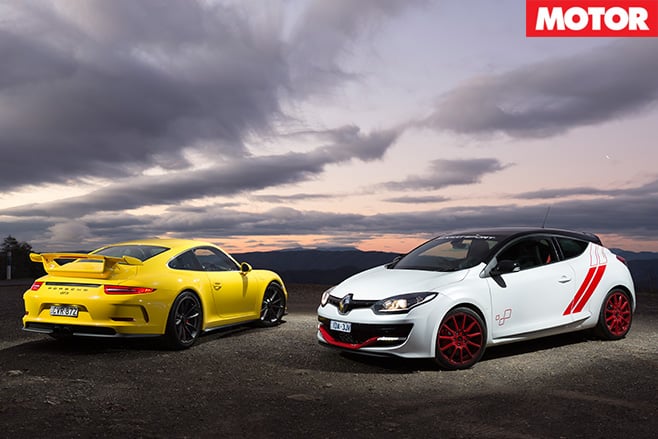
So Renault had us taking notice when it first announced the Megane Trophy-R. At $61,990, Renault had either made a budget 911 GT3; or, at $18K more than an RS265, were seriously taking the piss.
Fortunately it’s more a case of the former than the latter. In fact, bail a MOTOR road-tester up and it won’t take half a bottle of red for them to confess their love for the little Trophy-R. The best front-driver we’ve driven, at least most of us will say. Yep, that good.
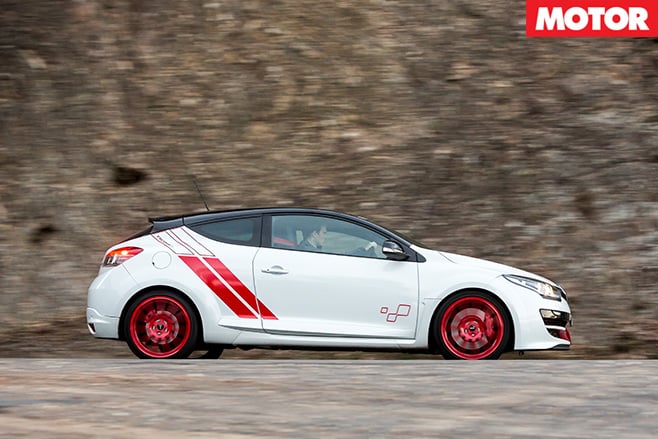
Same for most of the sound deadening (-18kg), while swapping the stock seats for polycarbonate fixed-back items saves 22kg. Renault then ditches rear wiper (-1kg), air-con and stereo (-10kg). Interestingly, the Trophy-R is 146kg lighter than a 911 GT3.
Power outputs from the turbo 2.0-litre are unchanged, 201kW and 360Nm, but Renault’s fitted fancy Ohlins Road & Track dampers and Michelin Pilot Sport Cup 2 tyres – semi-slicks, basically, and the same tyres on this here Porsche.
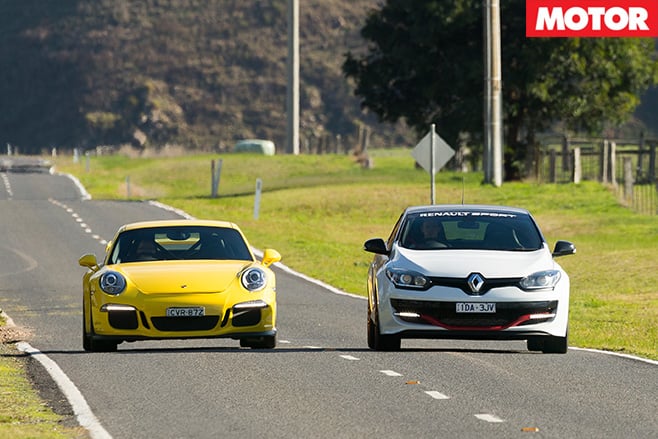
It’s not really a comparison, per se. Thing is, there’s something about the 911 GT3, 458 Speciale et al, that makes them so mind-blowing, and we suspect it’s got a lot to do with the whole track-car-with-numberplates thing. The Trophy-R would like to think it shares the same philosophy, so is any of this feeling available in Renault’s angry bum-dragger? By extension, if so, that means it’s available to financial mortals.
Tyres and rear-seat scaffolding aside, nothing says ‘take me to a racetrack’ like a steering wheel dipped in Alcantara, which is the case in both Trophy-R and GT3. Well, nothing except a DIN pocket where the stereo should be. Welcome to the Trophy-R’s interior.

The Trophy-R is much the same, too, leading us to wonder what has happened to track cars like this. They should be rattling the fillings out of our teeth, and giving us tinnitus – track day cars have grown up, it seems.
Mod-con grievances quickly dissolve on the first couple of corners in either car. By then, you would have already noticed the GT3 idles with a sound like there’s bits of gravel in the crankcase.
Apparently a lumpy, ever-so-slightly impatient idle was engineered into the GT3’s 3.8-litre flat six, because it shouldn’t sound so behaved you forget 350kW and 440Nm are champing at the bit.

Of course there’s plenty of pep no matter the revs, but it’s more linear than alike to getting slammed in the boot by a b-double (the turbo effect). In fact, after five or so minutes of having a little go in the GT3, you could forgive yourself for thinking, that it? Then you realise you’ve been changing gears at 7000rpm.
It’s understandable; even at that rpm, there’s no shortage of noise and intensity – a distinct, flat-six bark like a Carrera Cup car, but one that knows manners. But everything up to 7000rpm is the opening act, beyond that is the main event.
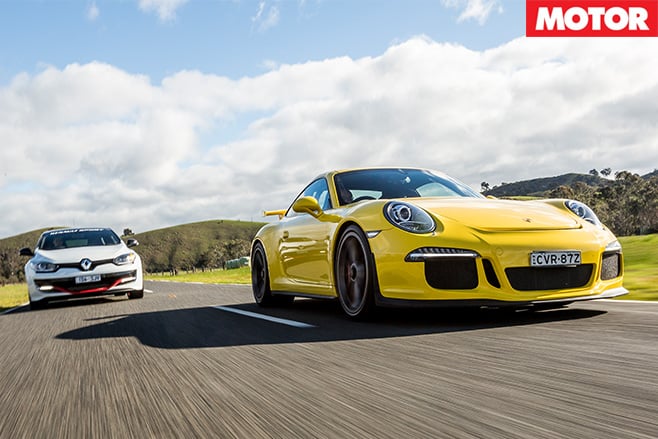
You don’t quite get used to revving it out that far, but when you half do, you realise, by god, the GT3 is fast. The front-end is scalpel sharp, the steering alert yet the weighting spot-on. The brakes feel stunningly powerful, yet you always know how much is left.
And the GT3 encourages us to dust off the old “like it’s on rails” expression, because you’ll be left gaga-ing at just how much grip there is – corner entry speed is as much about how big your cojones are. We suspect it has a lot to do with the all-wheel steering; in the slow stuff particularly, the GT3 is particularly eager to turn.

In some ways the GT3’s best trick is how it focuses the attention back on you. If you’re not deadly smooth, you’ll know. It’s as intimidating as it is educating, yet all the while it’s easy to drive fast, and never scary; it’s never going to shout “surprise!” mid-corner, at least on the road.
So you could call it a wee comedown getting into the bulbous Trophy-R after the GT3. One claims 0-100km/h in 3.5 seconds, the other 5.8. Says it all, but not exactly.
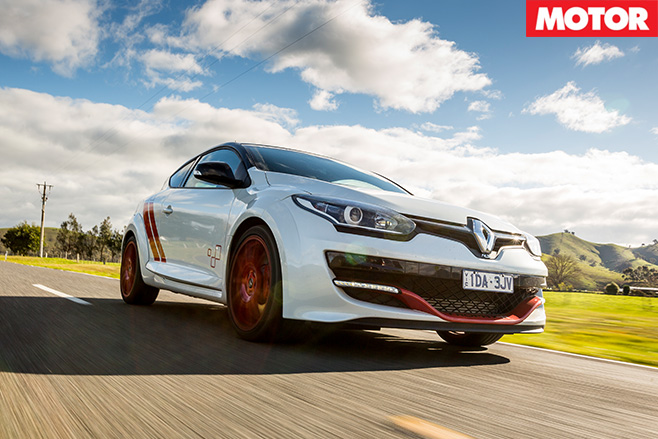
The Renault still sounds good, too, particularly for a turbo four-cylinder (generally not the most aurally satisfying engine variety). You can hear rocks tickling the underside of the car, which has a certain appeal, but the lack of sound deadening does more to let in engine noise, an angry induction hiss with a ballsy exhaust and the odd pop on upchange. There’s a certain feral-ness to a Trophy-R at full throttle.
On road the Trophy-R has its suspension pretty well sorted. Over bumps that might otherwise upset a normal RS275, the Trophy-R simply rocks and bobs, encouraging you to keep your foot in it. And there’s plenty of grip on offer.

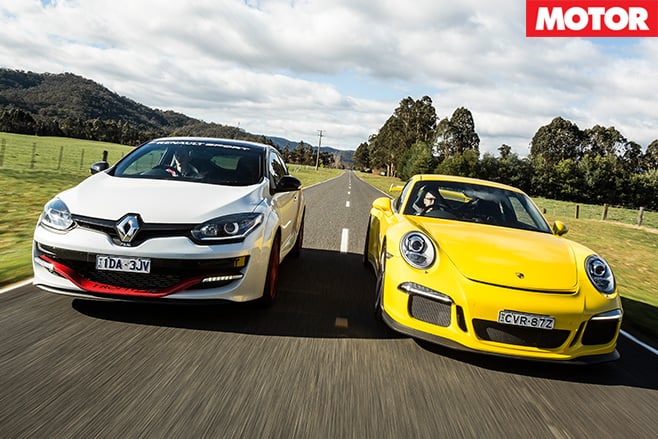
At the end of the day, on the same road, the Trophy-R and 911 GT3 are almost worlds apart in how they drive. One’s an LSD-equipped hot hatch scrabbling for front grip and keen to dance, the other is a planted supercar that’ll blow your mind with its sheer speed. But what both cars have in common is an eagerness to interact, a certain honesty in the way they drive that makes you feel safe to go fast.
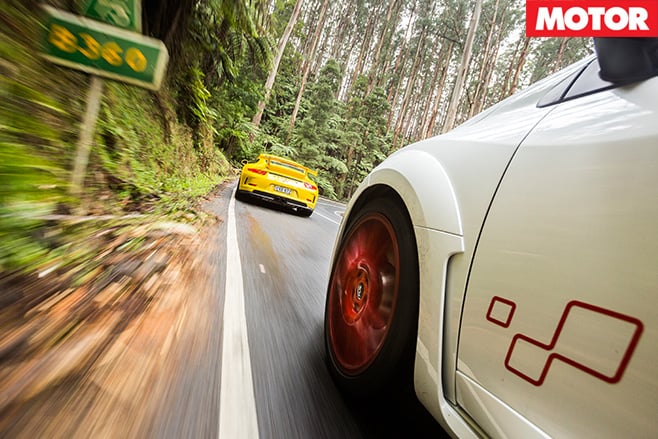
In some ways the Megane feels to have benefitted most from the weight saving efforts. It gives it a feeling of lightness that makes it keener on its feet; an RS275 feels pudgy by comparison. But most of all it gives you a taste of that feeling of lightness that’ll have you tearing out the back seat and trimming the rear vision mirror of your partner’s Corolla.
They’re worlds apart in speed, but the GT3 and Megane do behave in similar ways. Of course, both cars make you want to get out a Gregory’s and look up the nearest racetrack – and they create that feeling in equal measure.
| u00a0 | PORSCHE 911 GT3 | MEGANE RS275 TROPHY-R |
| Body | 2-door, 2-seat coupe | 3-door, 2-seat hatch |
| Drive | rear-wheel | front-wheel |
| Engine | 3799cc flat-6, DOHC, 24v | 1998cc inline-4, DOHC, 16v, turbocharger |
| Bore/stroke | 102.0 x 77.5mm | 82.7 x 93.0mm |
| Compression | 12.9:1 | 8.6:1 |
| Power | 350kW @ 8250rpm | 201kW @ 5500rpm |
| Torque | 440Nm @ 6250rpm | 360Nm @ 3000rpm |
| Power/weight | 245kW/tonne | 156kW/tonne |
| Transmission | 7-speed dual-clutch | 6-speed manual |
| Weight | 1430kg | 1284kg |
| Suspension(F) | struts, adaptive dampers, coil springs, anti-roll bar | struts, A-arms, coil springs, anti-roll bar |
| Suspension(R) | multi-links, adaptive dampers, coil springs, anti-roll bar | torsion beam, coil springs, anti-roll bar |
| L/W/H | 4545/1852/1269mm | 4320/1868/1422mm |
| Wheelbase | 2457mm | 2646mm |
| Tracks | 1551/1555mm (f/r) | 1546/1547mm (f/r) |
| Steering | electrically-assisted rack-and-pinion | electrically-assisted rack-and-pinion |
| Brakes(F) | 380mm ventilated discs, 6-piston calipers | 340mm ventilated discs, 4-piston calipers |
| Brakes(R) | 380mm ventilated discs, 4-piston calipers | 290mm solid discs, single-piston calipers |
| Wheels | 20.0 x 9.0-inch (f); 20.0 x 12.0-inch (r) | 19.0 x 8.25-inch (f/r) |
| Tyre Sizes | 245/35 R20 (f); 305/30 R20 (r)u00a0 | 235/35 ZR19 (f/r) |
| Tyre | Michelin Pilot Sport Cup 2 | Michelin Pilot Sport Cup 2 |
| Price as tested | $313,490 | $61,990 |
| Pros | Grunt, grip, steering, noise… everything | Rorty engine; playful, friendly chassis; big fun |
| Cons | Tyres can be a little noisy. That’s it, really | Road trips; gearchange; not sold on stickers |
| Star Rating | 5/5 | 4.5/5 |
The Holden Spark, Jaguar XF, Skoda Superb and Kia Sportage have received a 5-star ANCAP rating this month, with the Spark the only model in the micro-car segment to collect the highest safety award in Australia under the 2016 criteria.
The all-new Spark’s major safety improvements, which include phone connectivity such as Siri Eyes Free voice recognition, and Electronic Stability Control with Hill Start Assist as standard, saw it receive 33.60 out of 37 as an overall score.
Despite its inclusion of safety features such as a steel safety cage and driver assistance controls, Holden’s omission of features like extra airbags which are included in US and European models means there’s still room for improvement.
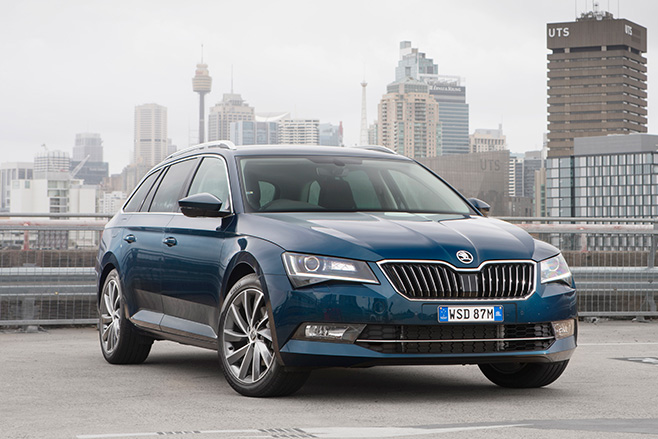
“The updated Spark is a big improvement on the model it replaces but it is lacking in more advanced safety features such as lane support system which was standard on its European counterpart,” ANCAP CEO James Goodwin said.
All variants in the Jaguar XF range were given five stars due to the suite of safety features offered as standard.
Calculating a score of 94 per cent and 84 per cent for adult and child occupant protection respectively, the “XF has a high standard of safety features buyers would expect in this sort of vehicle,” according to Goodwin.
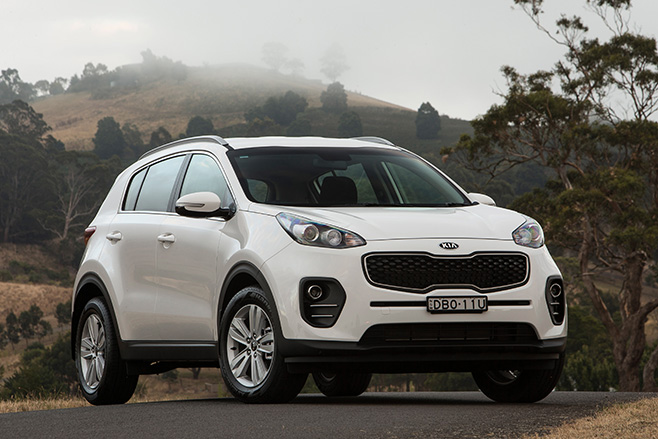
While the Kia Sportage tested well with its inclusion of brake assist, hill launch assist and reversing collision avoidance as standard gear, its omission of Autonomous Emergency Braking in lower variants lost it some points, resulting in a 34.62 out of 37 overall score on all variants.
Under the 2016 criteria, the Skoda Superb received the safety rating for all new 2WD variants, which include driver knee airbags as standard.
“The updated Superb introduced a driver knee airbag as standard and also has AEB City and Interurban along with numerous other safety assist technologies,” Goodwin said in the ANCAP release.
Turbos ruin engine sound. Well, the Mercedes-AMG C63’s 4.0-litre twin-turbo V8 has pretty much belted that stereotype out of the park.
Its deep guttural gurgle shows that our forced induction future needn’t be a silent one. However, can it best the good ol’ supercharged HSV GTS in a V8 rev-off?
Let us know your preference in the comments below!
If the R8 or S8 are anything to go by Audi’s Plus treatment has been recipe for new ceramic brakes or a gargantuan V8.
The SQ5 TDI is the Plus formula’s most recent student, but its changes aren’t so dramatic.
Power for its 3.0-litre twin-turbo V6 oiler’s risen to 250kW/700Nm. Higher pressure injectors, a new fuel pump, an engine remap, and more boost are to thank for the extra herbs. But even with an extra 10kW and 50Nm, the SQ5 Plus isn’t any faster than the standard car – its mass needing a harder shove to improve its 5.1sec time to 100km/h.
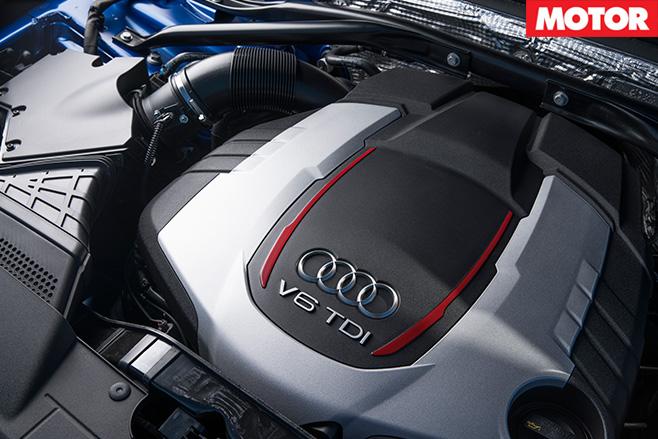
Audi’s also added a rear active sports differential as part of the ‘Plus’ treatment, and as a result the SQ5 Plus uses its (optional) 255/40 R21 Dunlops to surge out of corners with hot-hatch like tenacity.
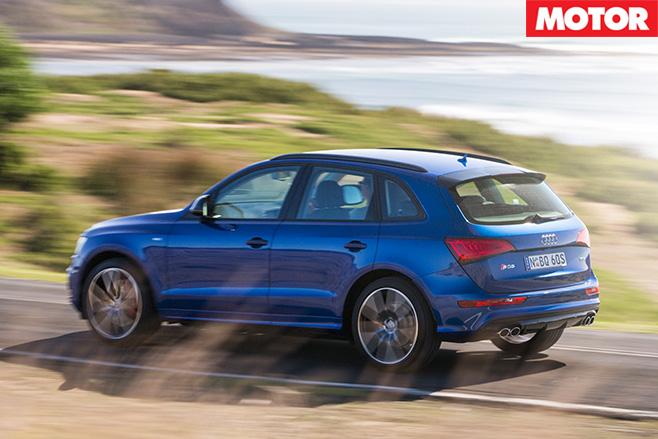
While the active rear-diff adds a lot of dynamic talent, this isn’t a car that suits driving that would justify such hardware. We wouldn’t take an SQ5 to a track day, and we’d prefer to pocket the cash for the diff instead.
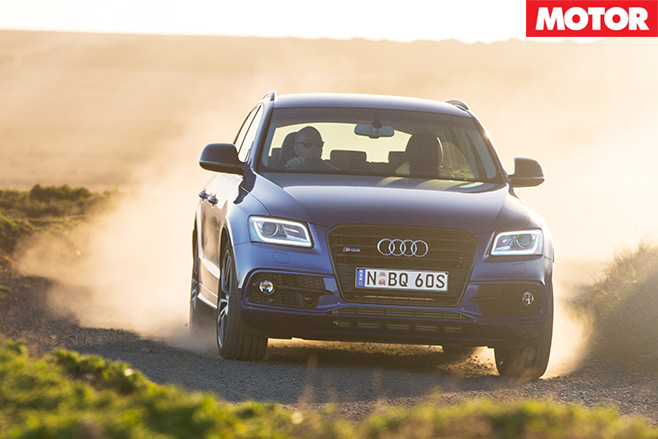
The Plus certainly looks the part. And with a $16,300 premium over the base model it should. Red brake calipers peer through ‘special’ 20-inch wheels (optional 21s pictured), an interior leather design package surrounds real carbon-fibre inlays, and the seats feature diamond quilted blue stitching.
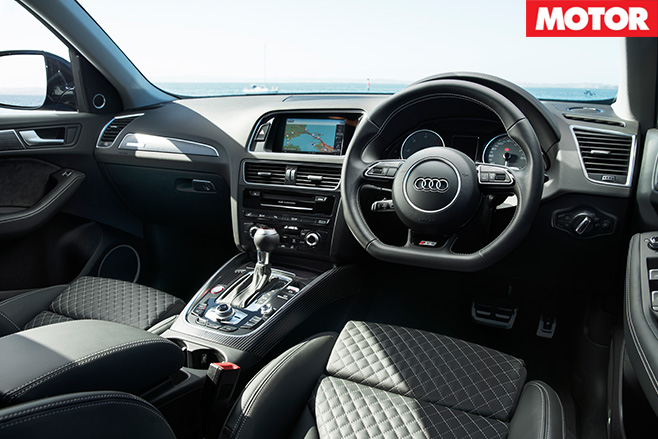
The SQ5 plus is a solid reminder of the base car’s unique appeal, a ‘decently’ priced luxury SUV with hot-hatch imitating performance– from a diesel. But while the Plus adds more power, safety, and luxury to this equation, we feel it might not add much sense.
3.5 STARS out of 5
SPECS Engine: 3.0-litre twin-turbo V6, diesel, DOHC, 32v Power: 250kW @ 4100-4300rpm Torque: 700Nm @ 1500-2550rpm Transmission: 8-speed automatic 0-100km/h: 5.1sec Price: $108,900
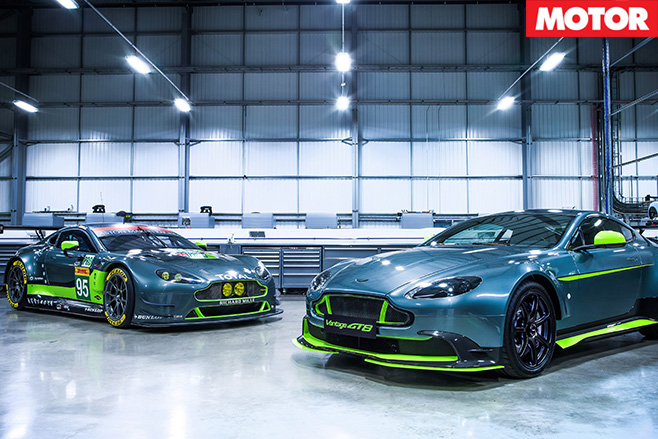
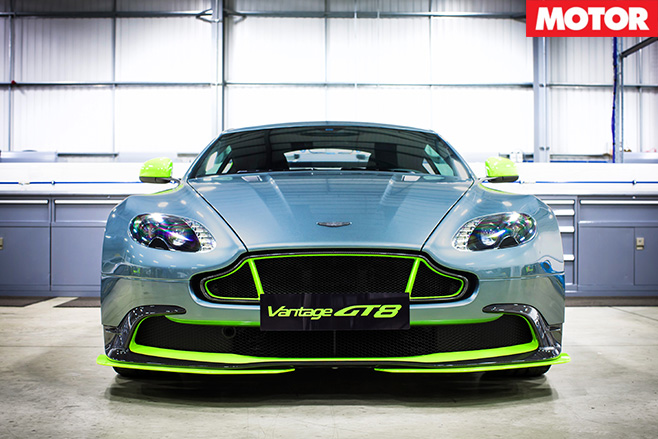
Aston Martin’s revealed its latest model to tap into the firm’s motorsport efforts.
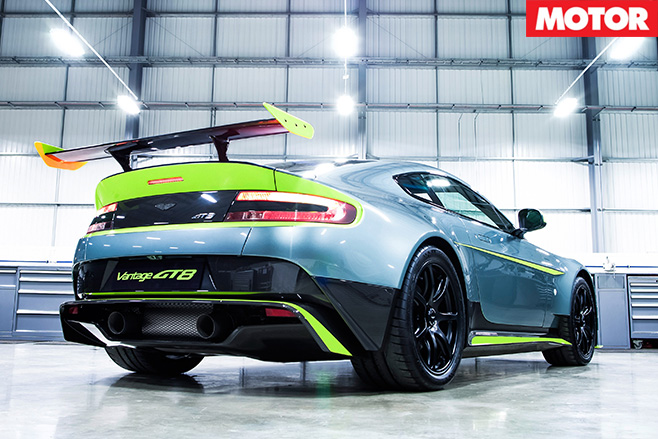
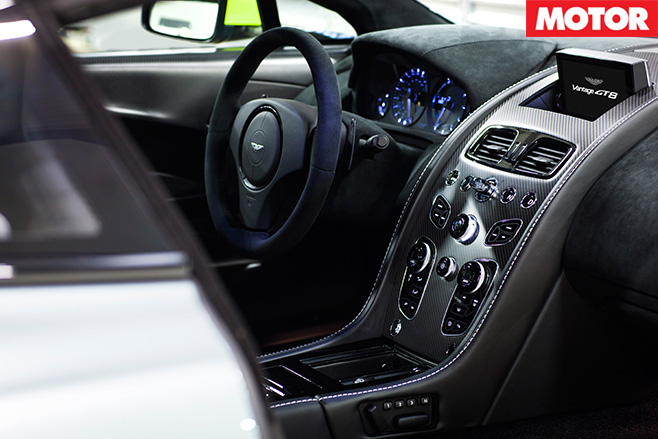
Called the Vantage GT8, the limited-edition special follows the motorsport-inspired recipe we saw last year on the GT12 with less weight, more power, and radical exterior add-ons.
As its name’s ‘8’ reveals, underneath its bonnet beats the Vantage V8’s engine. The 4.7-litre V8 has been tickled to produce an extra 7kW, totalling its outputs to 328kW and a carried-over 490Nm. It’ll come matched either to seven-speed automatic or six-speed manual transmission.
Twenty-fifth anniversary road rally produces spirited contest.
MATT Close has won Targa Tasmania for the first time, outpacing the largest field ever assembled for the landmark event, the 25th anniversary edition, and by an emphatic margin of 6m 41s.
It was Close’s 12th shot at Australia’s premier tarmac rally and the triumph came after a tense and spirited contest with arch-rival and previous winner Jason White.
White retired his new Dodge Viper with engine failure on the lengthy Mount Arrowsmith run from Strahan to Hobart.
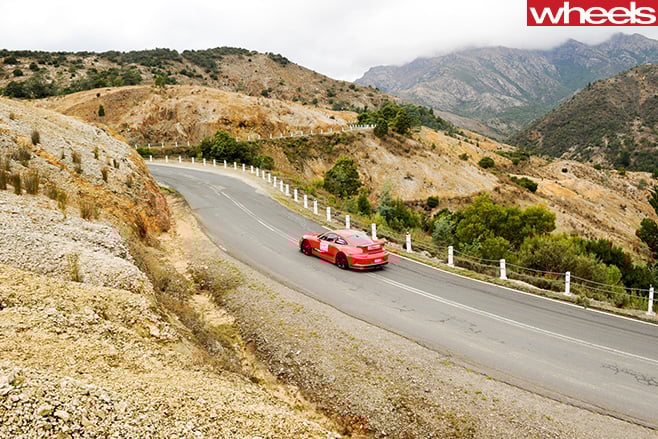
Even then, victory didn’t come easily for Close, despite his nine-minute buffer at the start of the day.
An early scare on the opening stage of a damp final day when he got sideways was followed by a flat tyre on the second-last stage. But Close kept it together to take his first victory.
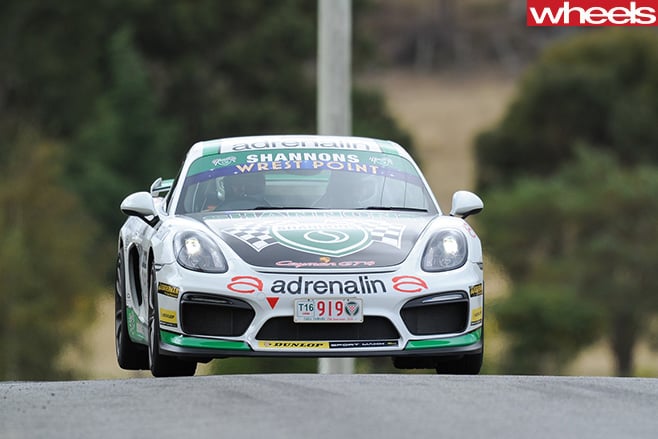
“We had a relatively good lead, but you never know.
“It was a very stressful hour – we got in before the sweep car and within our late time, but you just don’t need that.
“It’s taken me 12 Targas to win – I hope it doesn’t take another 12 for my next one.”
The battle for the minor placings was headed by Hobart surgeon Michael Pritchard in a Dodge Viper.
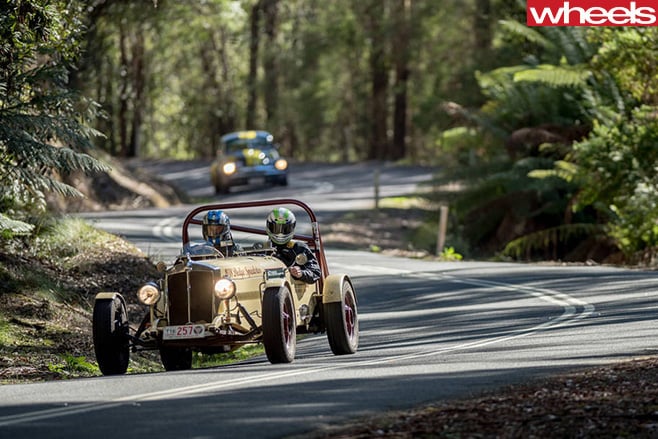
And motoring journalist Mike Sinclair put in a heroic drive in his Renault Megane to claim fourth place in GT2 showroom two-wheel drive).
Dominant in the GT4 competition was the fast and versatile sometime gravel-rally ace Steve Glenney, who raced away to an easy 3m 16s win in his Subaru WRX STI over the pre-event favourite, Tony Quinn in a Lamborghini Huracan.
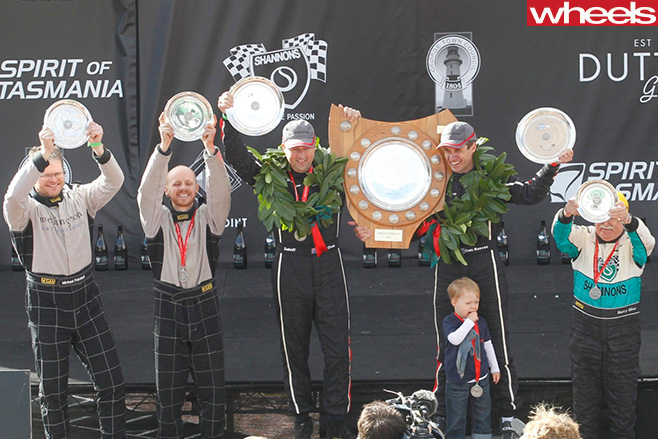
“It’s been a bit weird having started the event in the navigator’s seat and taking over driving after Ben (Newman) had blurry vision, but it’s great to win,” he said.
Final results of Targa Tasmania (provisional):
Wrest Point GT
1. Matt Close/Cameron Reeves, 2015 Porsche GT3,
2. Michael Pritchard/Gary Mourant, 2016 Dodge Viper ACR, +6m41s
3. Jim Richards/Barry Oliver, 2015 Porsche GT4, +11m18s
Shannons Classic
1. Leigh Achterberg/Greg Fitzgerald, 1982 Porsche 944
Country Club GT4
1. Steve Glenney/Tim Kulhanek, 2008 Subaru STi
Shannons Classic GT
1. Jon Siddins/Gina Siddins, 1970 Datsun 240Z,
Spirit of Tasmania and Duttons Garage Early Modern
1. Andrew Bollom/Lee Challoner-Miles, 1995 Mazda RX-7
RDA Brakes Modern
1. Brendan Winterbourn/Anthony Chudleigh, 2011 Mitsubishi Evolution X,
Shannons Vintage
1. Wayne Clark/Trevor Berriman, 1938 Dodge Speedster Special
Budget GT Sports Trophy
1. Jeff Beable/Nerida Beable, 2000 Nissan Skyline GT-R N1
1st Classic: Simon Froude/Jason Powning, 1973 Porsche 911 Carrera RSR +33:14
Budget TSD Trophy
1. Darryl Marshall/Andrew Marshall, 2002 Ford Falcon Ute Pursuit 250, 102pts
V8 SUPERCARS: McLaughlin and Volvo ice Phillip Island
A CLEARLY emotional Scott McLaughlin has broken his lengthy winning drought to totally dominate the WD-40 Phillip Island SuperSprint – races six and seven of the 2016 V8 Supercars Championship – at the best permanent circuit in the nation.
Two poles, two wins for maximum points, and one relived and elated Kiwi.
The Volvo bounce-back couldn’t have arrived at a more telling time, with a decision approaching on the future of Volvo in the category and McLaughlin’s own future the topic of much speculation.
Even after a poor 2015 when he struggled with the Volvo S60’s engine woes, McLaughlin remained high on the team owner shopping list.
With his contract with Garry Rogers ending at the end of this season, the star driver’s efforts over the Phillip Island weekend will heighten interest.
McLaughlin was in a class of his own, controlling the Saturday race from a persistent but ultimately helpless Jamie Whincup’s Red Bull Holden. Fabian Coulthard for DJR Penske picked up third at the end after Chaz Mostert’s Falcon blew a tyre on the final lap.
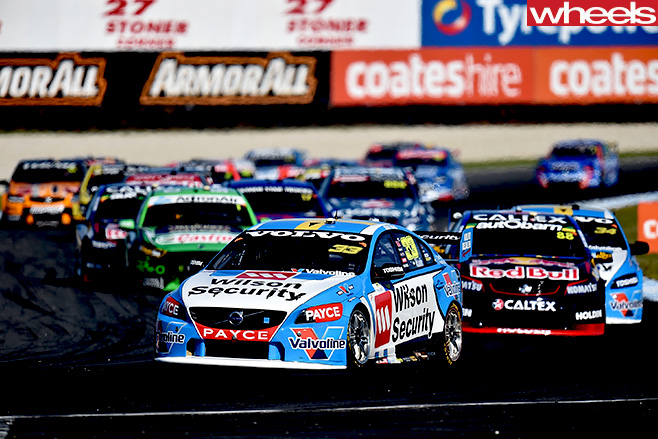
McLaughlin isn’t too concerned about his driving future beyond this year, despite some of the usual pit whispers that link him to other outfits.
He says he hasn’t been talking to any team bosses outside Rogers.
“We only really started talking about it a week or two ago, so it’s pretty early now,” he said.
And after the weekend’s golden run, McLaughlin, 22, is feeling very comfortable at GRM.
“This means so much … we’re coming back and I think we’ll have a good one this year,” McLaughlin said as he leapt from the S60 and celebrated on the turret yesterday.
Winterbottom acknowledged he couldn’t catch the Volvo but was happy to bank good points from a weekend of some frustration.
A podium for DJR Team Penske’s Scott Pye was comforting for the young driver, who is under constant pressure this season from speedy team-mate Fabian Coulthard, whose car had power issues from the start.
Heading to the next round in Perth, Whincup stays top of the championship standings, heading McLaughlin by 15 points from reigning champion Winterbottom, 24 points off the lead.
F1: Rosberg triumphant as Ricciardo storms back from puncture
That sounds too familiar and even boring.
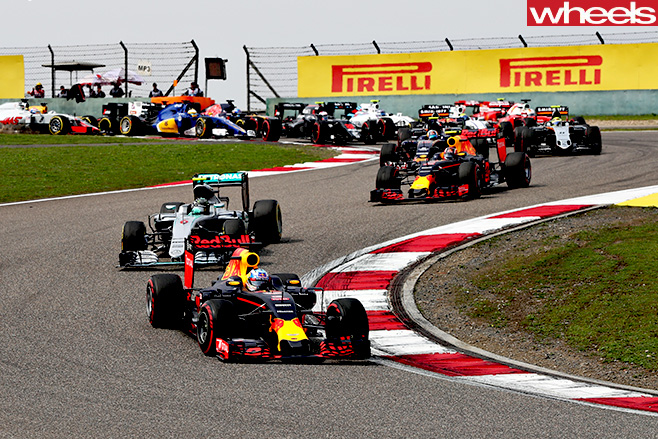
But the Shanghai race was a ripper: hectic and brutal and exciting from the first moments to the final lap. Rosberg’s race was uneventful after lap three and he’ll have to watch a replay to learn what the fuss was about.
Looking back, it seems impossible that all of the 22 starters actually got to the chequer, such was the regular mayhem and damage.
Australia’s Daniel Ricciardo, who’d qualified his Red Bull so magnificently in second place on Saturday, charged to the lead from the outside of the front row and led Rosberg…
The strife began, as it does so often, in the first corner, when Daniil Kvyat pushed his Red Bull into a space beneath the Ferrari of Sebastian Vettel, who then committed the awful sin of colliding with his team-mate Kimi Raikonnen.
Further back, defending champion Lewis Hamilton, whose trying start to the season continued with power problems in qualifying forcing him to start dead last, then scored an added handicap when an errant car slammed into Mercedes in the first corner, inflicting front wing damage. He and Raikkonen both wobbled to the pits for new front wings.
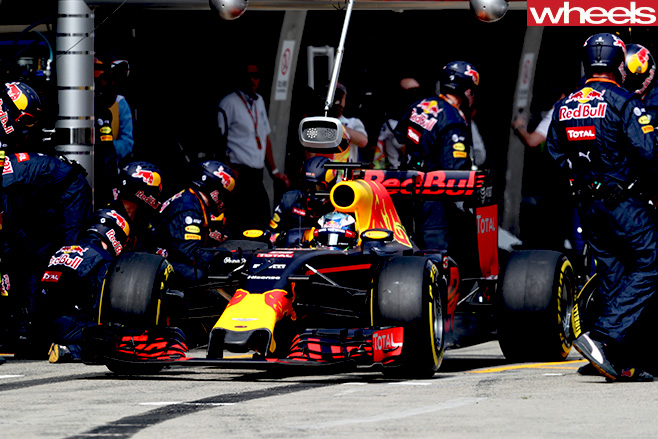
Up front Ricciardo looked in great shape and kept Rosberg behind until lap three when his left rear collected debris from the earlier contretemps and exploded, forcing him to pit for new rubber.
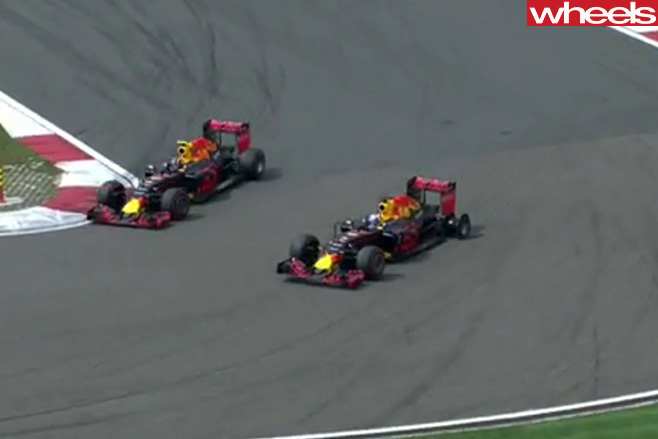
But brilliant, aggressive driving and some keen strategy from the other side of the wall, hauled Ricciardo up to fourth at the end. It was an impressive recovery.
“The puncture became noticeable when I got on the straight as I could feel the car start to wobble and then my tyre went,” said Ricciardo later.
“Then the safety car put us even further back so that was like a double whammy, which felt like getting punched in the stomach by a heavy weight. But in the end the second part of the race I drove probably one of the best races of my life.”
Vettel too overcame the early bumper-car stuff to claim second ahead of Ricciardo’s team-mate Kvyat. The Russian and the German had words later, with Vettel squarely blaming Kvyat for the incident. But to many observers, including race stewards, it looked like Kvyat was simply opportunistic and racing hard.
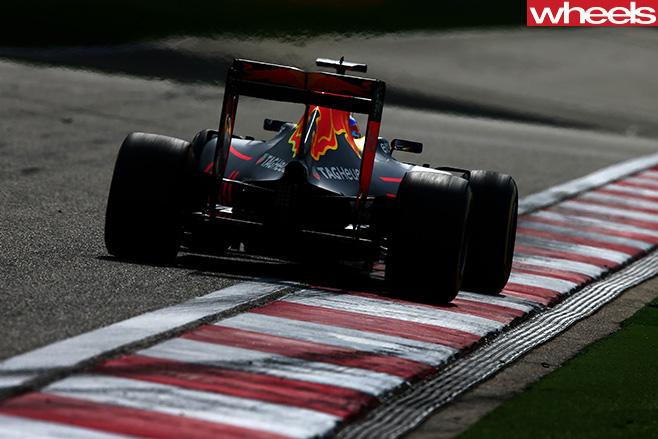
Despite a ragged race, Hamilton dragged the battered Benz up to seventh by the finish, but he is now all of 36 points behind the rampant Rosberg – and only three points ahead of Ricciardo, now third in the championship.
As Rosberg keeps reminding anyone who suggests he is on track to win his first F1 title, there are another 18 races remaining.
Ricciardo warns the Red Bulls are getting better. “The [Red Bull] package is really promising for sure. Right now, three races in every weekend we’ve shown our strength at some point and it’s been a strength we didn’t think we’d have this early in the season, so it definitely feels more like 2014 when we had potential. I felt like I would have sprayed champagne today and part of me is smiling because I am optimistic that will happen this year so that’s a really good feeling and I’ll keep fighting.”
WEC: Crash stalls Webber title defence
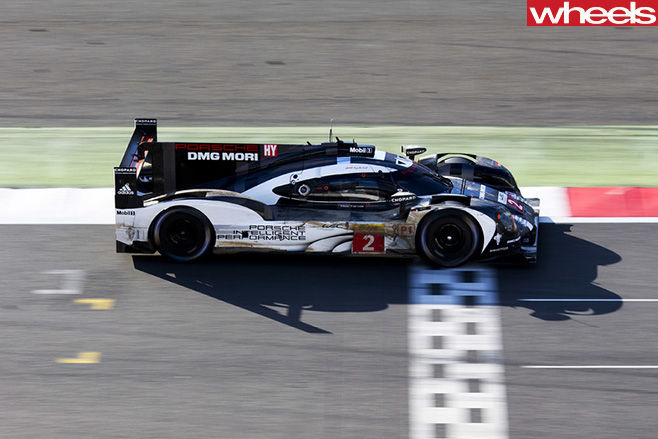
The speed differences between the outright LMP1 cars and the production-based GT machines can be alarming, especially when the scrapping up front is so intense.
Mark Webber, who started from grid three, had come through to the lead and opened a margin over the #7 Audi R18 of Andre Lotterer/Marcel Fassler/Benoît Treluyer in what had been a fascinating battle among the quartet of fast prototypes – two from each German make.
In a tense fight at the pointy end, the second Porsche of Neel Jani/Romain Dumas/Marc Lieb upped the pace and led into the final hour, before the final pit stop swung the race back to Audi.
Fassler held off the charging Jani in the #2 Porsche 919 Hybrid to take a win on debut for the new 2016 R18.
After struggling in qualifying,, the #6 Toyota Gazoo Racing TS050 Hybrid of Stephane Sarrazin, Mike Conway and Kamui Kobayashi claimed third position in the first race for new model.
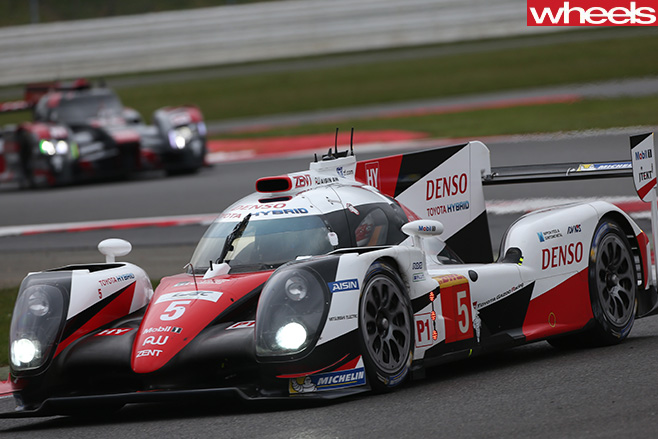
Webber was left to rue the loss of a potential truckload of points.
“I did the first 27 laps and had a good and interesting stint,” said Webber after the race. “In the beginning the Audi was really strong, but then I was able to catch up, get past and create a gap. Our car was very good today and we clearly have lost out on a good score here.”
GERMAN F4: Aussie Mawson off to a flyer
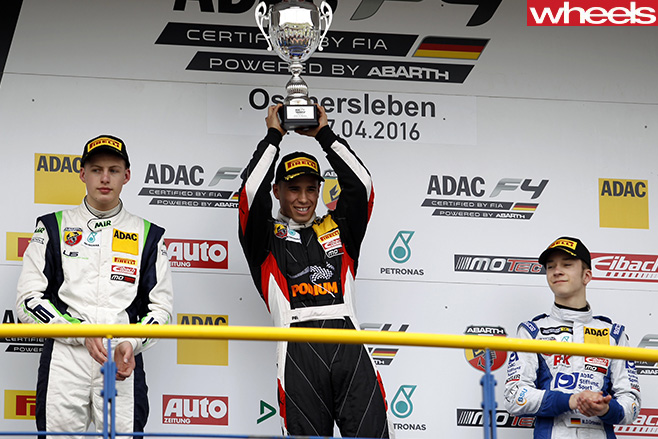
Wet and cold, the conditions were hardly comfortable for the Australian but he was uncatchable when it counted.
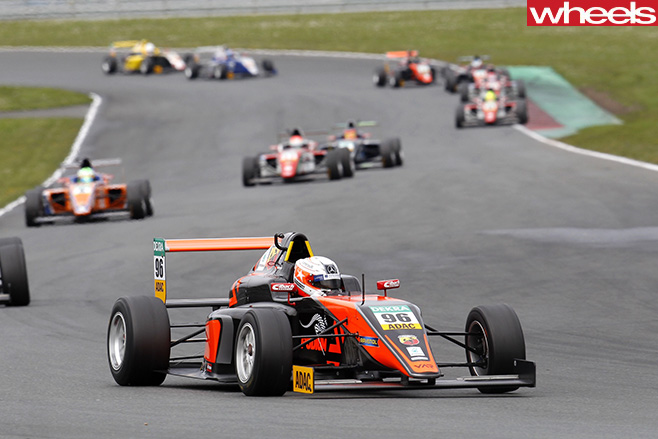
The opening race was interrupted by safety cars but Mawson easily survived the restart challenges to take the win from Kim Schramm, Jannes Fittje and Mick Schumacher.
A safety car was again used to start the second race, and two major crashes then interrupted Mawson’s drive before he posted another impressive win from pole.
Mawson’s strong weekend came after a couple of apparel issues earlier. His helmet, new at the start of last year, was found to be no longer on the approved list of helmets for this category. A Van Amersfoort Racing teammate came to the rescue by lending him a spare. Mawson went with a back-up suit hastily embroidered with sponsor patches.
With 68 points, Mawson leads the overall standings after three of 24 races. He has a cushion of 19 points over Schumacher (49).
RALLY: New-look ARC to fire up in WA
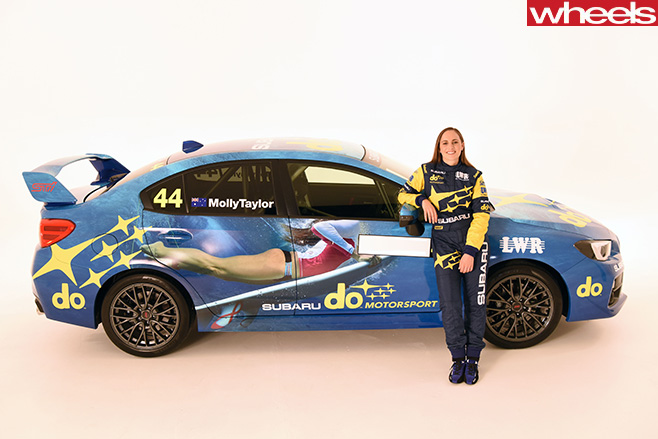
For the first time in three years, four-wheel-drive vehicles are eligible to win the Kumho Tyre Australian Rally Championship. The rule change has encouraged many top drivers to return to all-paw cars, and Subaru to bounce back into competition with a factory team for the first time in over a decade.
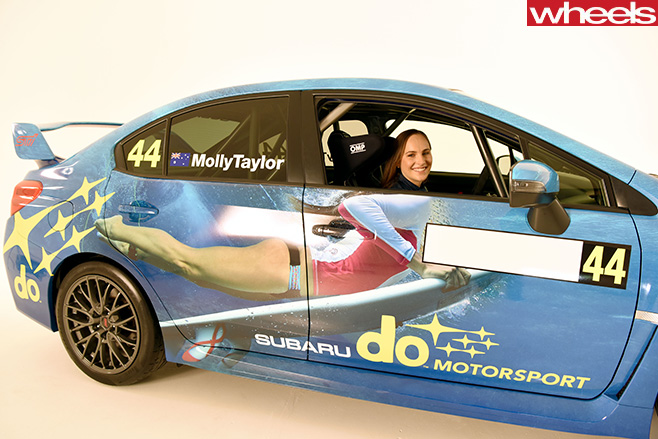
The factory team will be led by Molly Taylor, who finished second overall in the 2015 driver’s title.
Co-driven by Bill Hayes, Taylor is crewing a virtually stock WRX STi in the Group N4 category, meaning she won’t realistically challenge for the title again this year.
Subaru isn’t saying much but most observers see 2016 as a taste-testing season for the Japanese brand, hopefully preceding a bigger effort next year.
Back for 2016 in privately backed Subarus will be Simon Evans – who won his fourth (and last) title behind the wheel of a Subaru – and five time Australian champion Ross Dunkerton, who is returning to the Quit Forest Rally after a 10-year absence from competitive rallying.
Rising star Harry Bates, the son of Australian rally legend Neal Bates, is also very much in the mix with a competitive car. Impressive in his debut season in 2015, Bates, 21, will be contesting the Quit Forest Rally for the first time and in a Toyota Corolla S2000 – the same car his father drove to victory at the event in 2008.
Another former national champion on the entry is Justin Dowell, driving a Hyundai i20.
Hoping to keep the trophy in Western Australia will be high flyers Brad Markovic and Tom Wilde who have united to form the first ever all-WA two-car team to take on the national competition.
Quit Forest Rally will be held around Busselton and Nannup and starts on Friday.
Meanwhile,three times and current Australian rally champions Eli Evans and Glen Weston are set to tackle a new challenge in 2016 when they will spear head DS Team China in the 2016 Chinese Rally Championship.
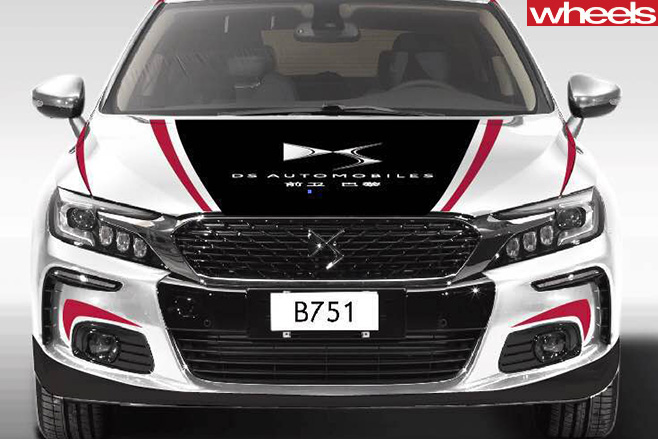
Team manager Ron Cremen says he is pleased to have Evans and Weston remain with Citroen, with which they won the 2015 ARC, under the new stand-alone DS performance brand in China. But Cremen isn’t oblivious to the magnitude of the challenge ahead.
He points out that around 100 competitors will line up for each round of the CRC, made up variously of gravel, tarmac and snow-covered surfaces.
DS Team China will have full support from the DS factory in fast-developing China with the team looking towards the future and running a locally produced car in the region.
Though prioritising the adventurous move into the biggest car market in the world today, Evans and Weston also hope to squeeze in some rounds of the ARC this year.
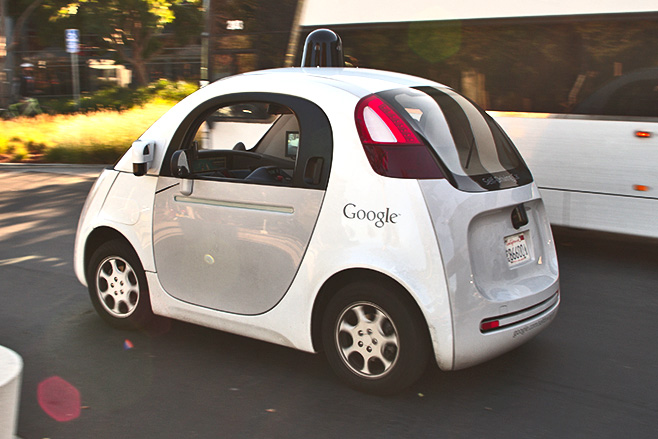
Google has gone on a hiring spree to add considerable engineering talent to Project X, its self-driving car program. Reuters reports the search engine and software giant (which now operates under the name Alphabet) has started hunting for engineers and managers with automotive manufacturing expertise, indicating it is close to moving beyond building driverless robot pods and is readying “electronic modules for the self-driving car” to ink a deal with a carmaker.
Want to learn more about driverless cars? Read about future safety technology using cloud computing here.
This article was originally published in Wheels magazine April 2016.
Older siblings get all the attention – just ask the new Audi R8 V10.
There’s a lower-spec version, of course (you’re looking at it) but the Plus has hogged the attention, what with being generally leaner, faster and meaner. Which is fair enough.
But since Audi kyboshed the 4.2-litre V8 version (boo) and the manual gearbox (booooo), the base R8 V10 is suddenly the cheapest R8, which makes it important. (That is, until a rumoured 2.9-litre twin-turbo V6 version arrives, but given it’s still unconfirmed, that could be twaddle.)
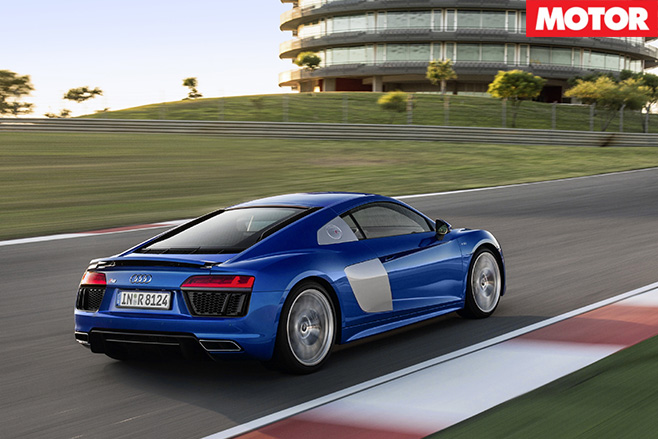
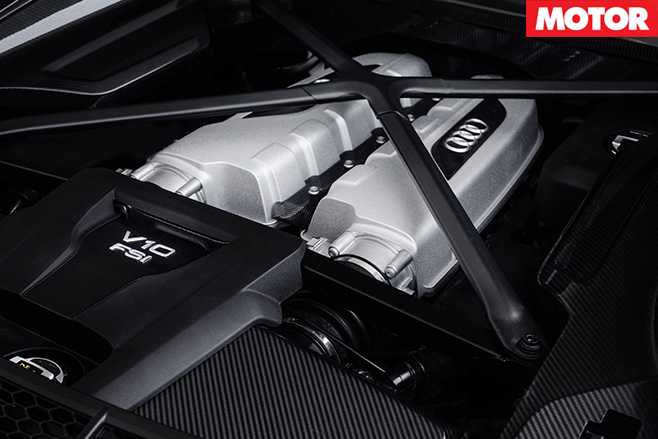
But despite all that, the engine is still firmly the star of the show. It’s such a big part of the R8’s personality that a V6 version would be a totally different car.
Audi’s taken the V10 out of the old PCOTY-winning Plus and bumped compression from 12.5 to 12.7:1, installed a dual-injection system (using both port and direct), redesigned the inlet runners and tweaked the valve timing, unleashing 449kW in the new Plus. Torque is also up 540 to 560Nm, while the engine itself revs 20 per cent faster than before. The base R8 V10 which we’re driving here gets a lower tune of 397kW and 540Nm.
At 1595kg, the base R8 V10 is 40kg heavier than the new Plus and weighs the same as the old Plus. Much of the saving has come from material changes in the chassis – if Audi made the new R8’s chassis using the old car’s aluminium, it would be 32kg heavier.
The R8 V10 will do 3.5 seconds to 100km/h with launch control. Hardly tardy, and yet the Plus is still 0.3sec quicker, and will do 0-200km/h in 9.9 seconds. The Plus’ll hit 330km/h while the R8 V10 will do 320km/h.
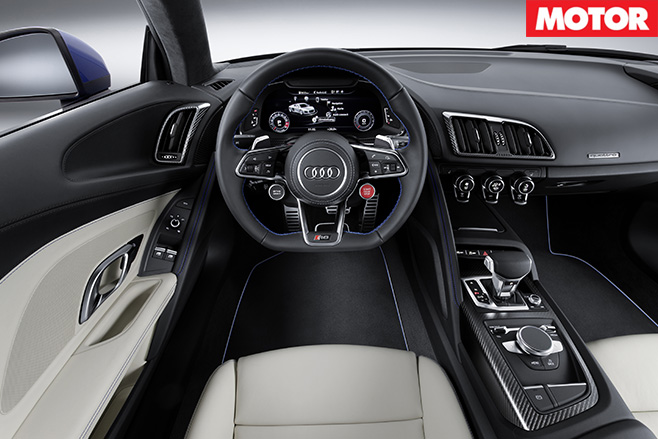
The differences are also subtle in the driving. Due in no small part to the revvy, snarling, roaring and deliciously linear V10 wedged immediately aft of your spine, the R8 gets a big, fat tick for theatre and sheer entertainment factor – beyond any doubt, the driving experience of both cars is dominated by the donk. And it’s genuinely one of the best-sounding engines on sale today.
The R8 V10 has plenty of power, surely enough to frighten any passenger who’s never been in a fast car before. But driving it and the Plus back-to-back, the R8 V10 can be felt to lack the Plus’s explosive final 10 per cent. It’s telling the R8 V10 makes peak power at 7800rpm and the Plus, 8250rpm.
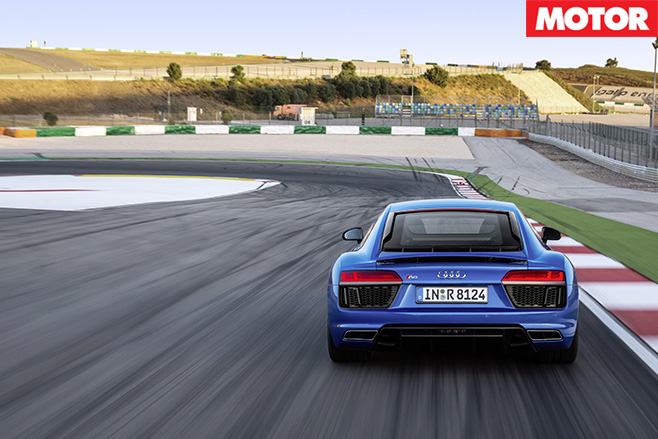
More time on track reveals the R8 V10, both base and Plus, worships a handling philosophy centred on stability and grip, rather than one of extroverted chassis playfulness. Not a bad thing at all – it means you can carry huge speed through corners and it’ll remain planted.
On the road the R8 V10 is awesomely fast, well-damped and rows through its seven gears with that crisp and responsive twin-clutch gearbox; exploring that spine-tingling redline will have you sweating about passing a cop over the next crest.
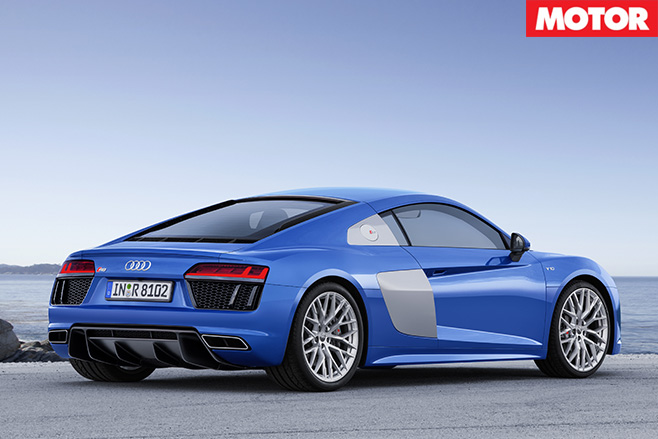
Audi Australia says the car is arriving in around June. Price? A sharp (by supercar standards) $354,900, undercutting the V10 Plus by $35,000.
4 out of 5 stars
Specs Engine: 5204cc V10, DOHC, 40v Power: 397kW @ 7800rpm Torque: 540Nm @ 6500rpm Weight: 1595kg 0-100km/h: 3.5sec (claimed) Price: $354,900
BEHOLD the next-generation Suzuki Swift, leaked in a series of rendered images, and more recently sprung testing on public roads in all its bin-liner glory.
Expected to be one of the stars of the Paris Motor Show in October, before a mid-2017 on-sale date in Australia, the next Swift continues the successful Japanese supermini’s evolutionary design trajectory, seen first 12 years ago in the landmark EZ series.
Fun and affordable, that car came to define what Suzuki is today.
However, while the 2017 Swift’s overall shape and rear-end treatments are familiar, the nose and headlights jut forward in a far more pronounced manner, giving it a significantly more aggressive character than before.
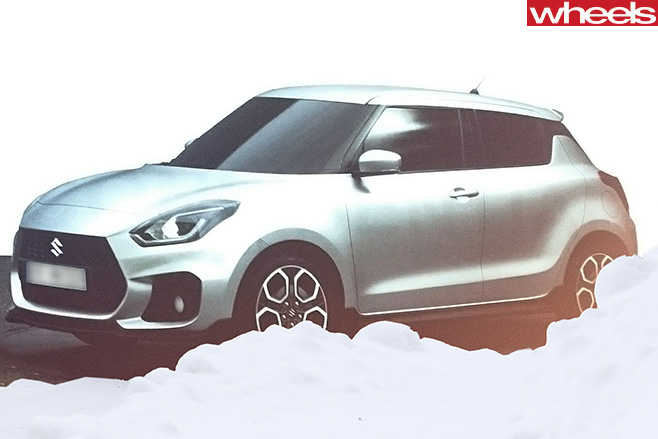
With the sleeker silhouette pointing to a longer (and hopefully roomier) interior, current model issues such as tight rear legroom and a tiny boot might at last be addressed.
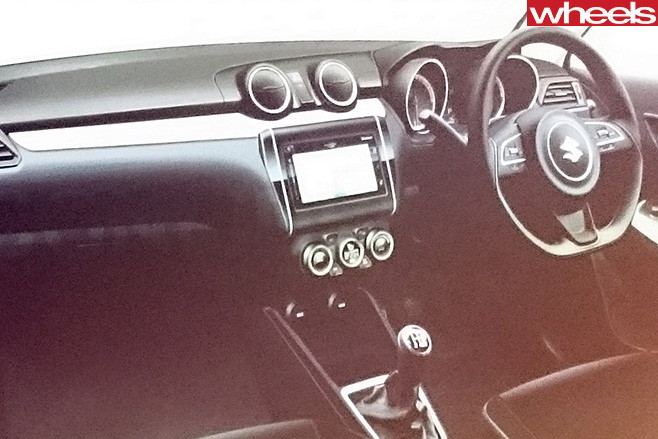
There’s even greater change going on underneath, thanks to an all-new platform shared with the upcoming reborn Baleno. Under the bonnet in some variants will be the promising new 1.0-litre three-cylinder Booster Jet turbo engine, while updated versions of the current 1.4-litre naturally aspirated four-cylinder unit are also likely.
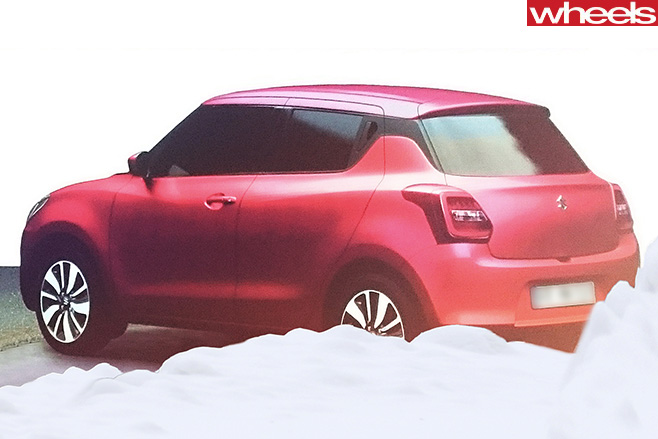
The 2017 Swift will usher in a wave of fresh superminis expected over the next 12 to 18 months, including the next-gen Volkswagen Polo, Ford Fiesta, Nissan K14 Micra, Toyota Yaris, and Hyundai Accent.
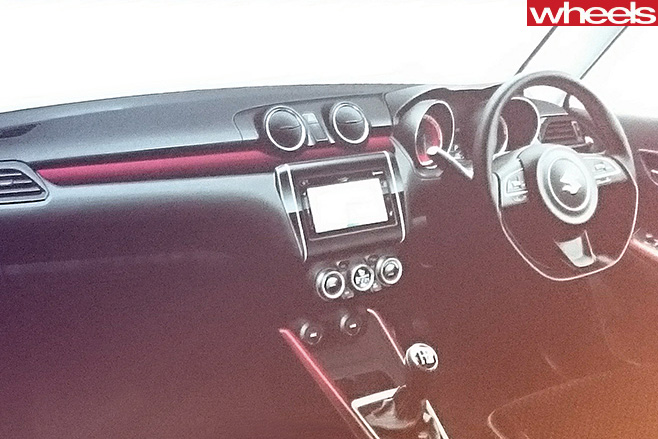
That means pricing is likely to kick off from around $16,000 for the base Swift, rising beyond the mid-$20,000 mark when the Swift Sport surfaces.
Have spy pics of your own? We’d love to see them. Just email them to [email protected]
