
UPDATE, June 2023: Honda Australia has confirmed minor amendments to the ZR-V’s specification list since details were first announced in May. This story has been updated to reflect the changes.
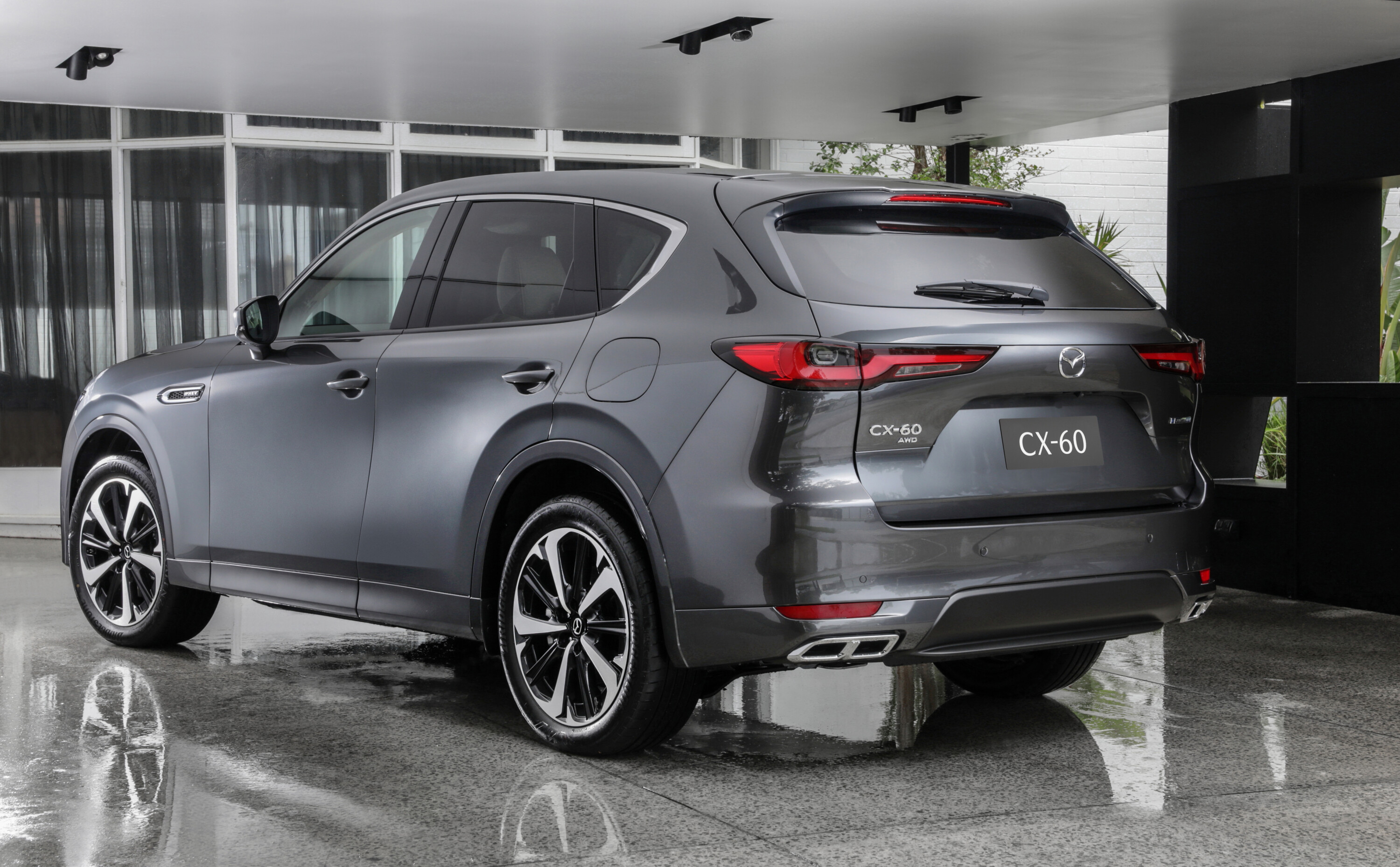
You’ve likely read our review of Mazda’s new CX-60 by now, and if you come to the conclusion that Mazda might be forgetting about the regular mums and dads of Australia in its pursuit of premium status, we don’t blame you.
But the company says it’s not going to turn its back on a mainstream audience just so it can stand behind the velvet rope. Rather, Mazda’s intent is to sit astride the mainstream/premium boundary, and the CX-60 is the first product that will properly enable it to do so.
“In terms of where Mazda is and where we are expanding to, we intend to remain in the mainstream,” Mazda Australia’s managing director Vinesh Bhindi said to Wheels at the local launch of the CX-60 last week.
“But, we are also pushing the boundaries and pushing what we call ‘Mazda Premium’ to give us more room to play in.
“We don’t see it as us now being with the [premium segment] ‘big boys’, but we’re pushing into territory where we can comfortably say to an existing CX-5 owner. ‘hey, we’ve got another option for you, another step up in technology, craftsmanship and vehicle dynamics.
“That’s what our intent is when we say ‘Mazda Premium’.”
The CX-60, though it sits within the same medium size class as the CX-5, is both slightly longer and wider than the CX-5, and utilises an entirely new platform that orients the engine longitudinally and directs most of its drive to the rear (unlike the transverse-engined and primarily front-driven CX-5).
There’s also a vast gulf in price – the CX-5 range opens at $35,510 and tops out at $54,500.
The CX-60 range spans from $59,800 to $85,675, and as far as the official industry sales monitor VFACTS is concerned, the Mazda CX-60 sits firmly in the premium SUV category alongside the BMW X3, Audi Q5, Mercedes-Benz GLC, Volvo XC60 and Porsche Macan.
Mazda Australia’s top brass say the company remains committed to serving the needs of the mainstream, and vehicles like the Mazda 2 and 3 as well as the CX-3 are staying where they are for the foreseeable.
However, the CX-60 now enters a new kind of competitive space, and with significant price overlap with premium contenders like the Volvo XC60, Audi Q5 and Alfa Romeo Stelvio, it will be interesting to observe Mazda’s fortunes in this new realm.
1
The company is confident of success.
“I think also, we are still offering exceptionally good value even at these different price points,” said Mazda Australia’s marketing director Alastair Doak.
“[Recently] there was an updated version of a German brand hatchback which now starts at a few hundred dollars more than the CX-60 starts, but it’s a Mazda 3 sized vehicle with 120kW. Even though we’ve moved up, we’re still very much playing in our wheelhouse, which is offering value for money and lots of equipment.”
MORE
Everything Mazda
‘Range anxiety’ may be the buzz-term of the EV age, but we’d argue that the challenges faced by electric car owners – at least those on a road trip, or who live in regional areas – can go deeper.
What about charger frustration, when you roll up with little left in the battery only to find the charger(s) occupied or out of order?
If the thought of these scenarios on long trips from home, away from the security of your own charger, have put you off an EV, then it’s possible a plug-in hybrid could be the solution.
1
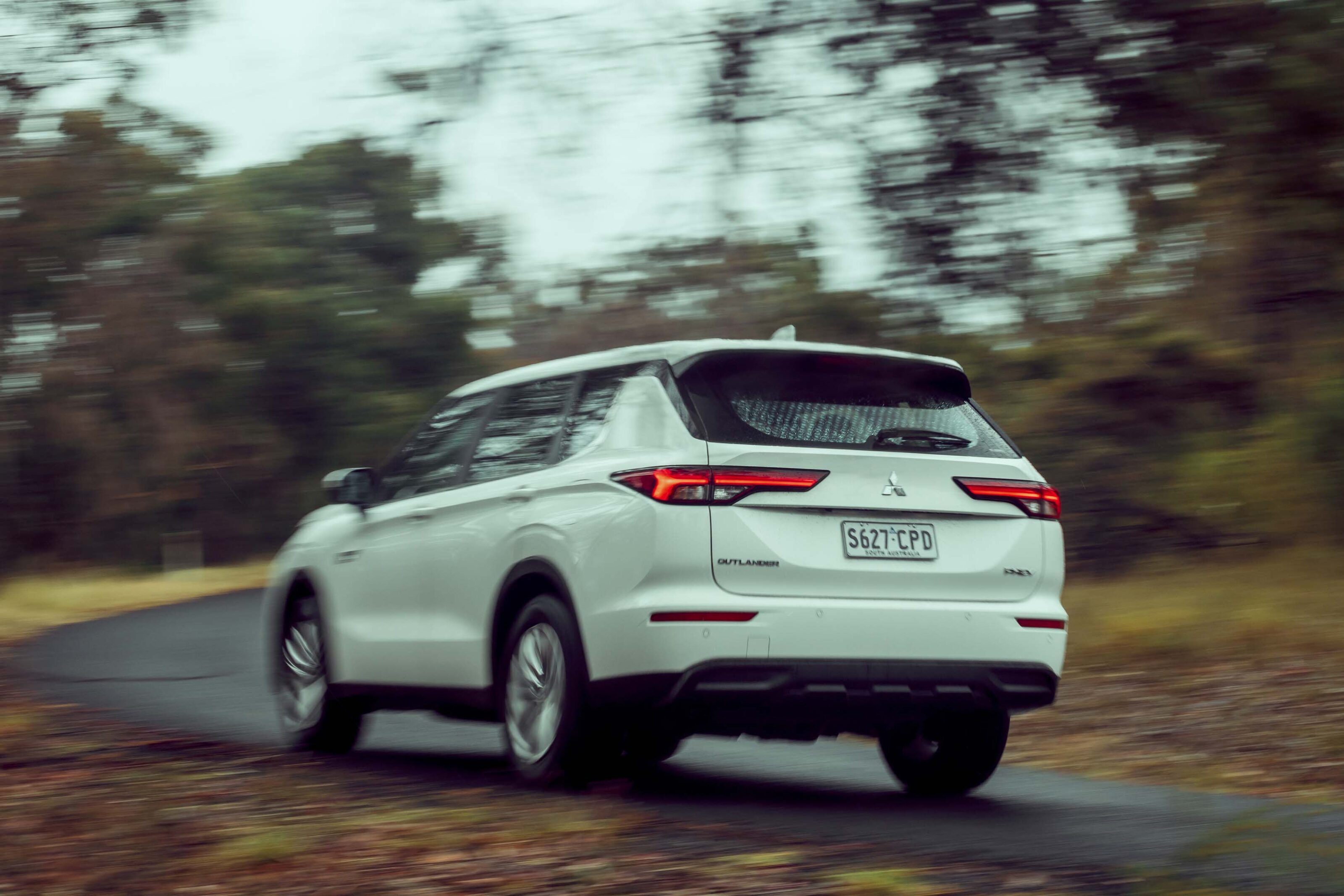
A PHEV will give you a useful pure-EV range of around 80km, backed by a tank of trusty unleaded for when you need to travel further.
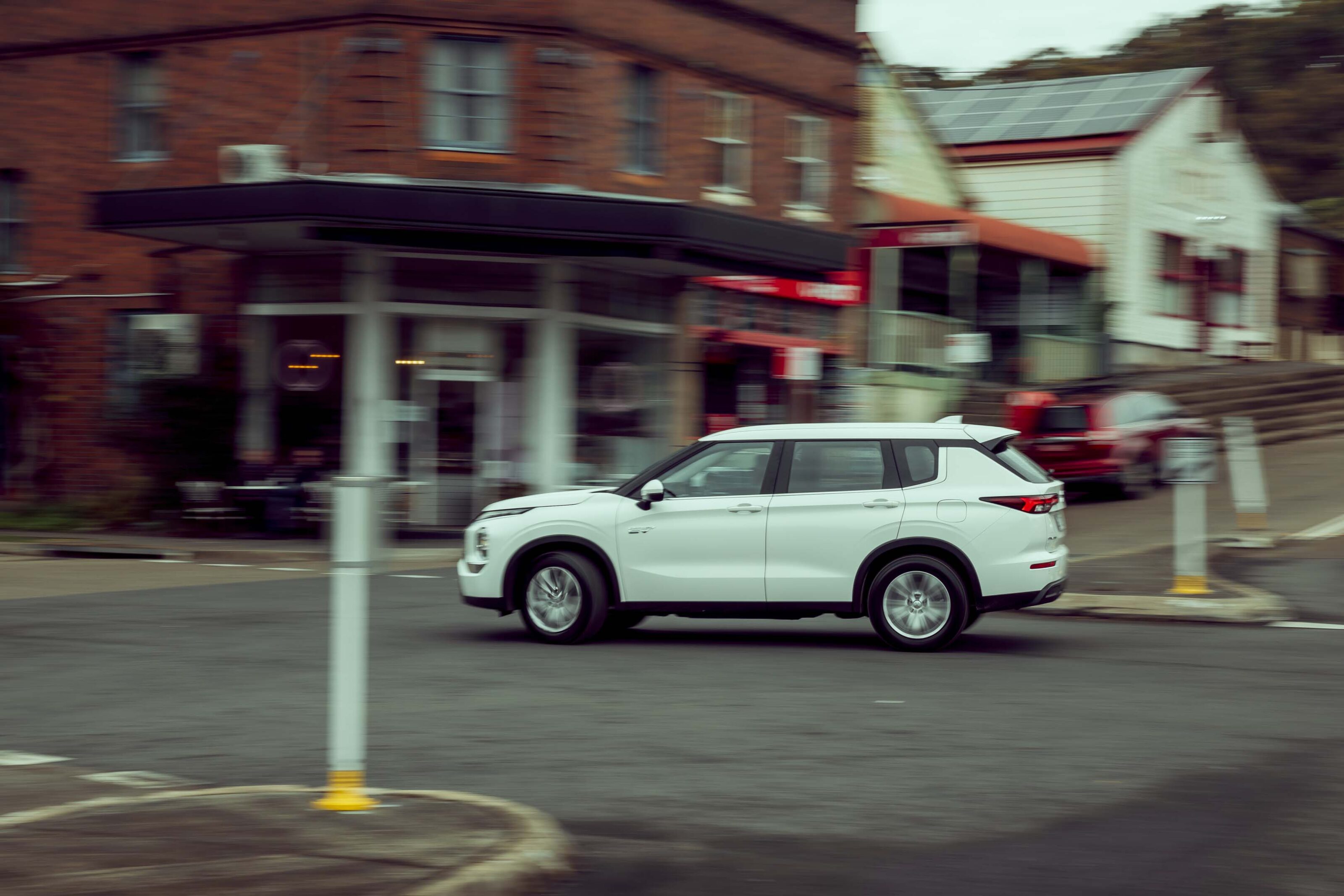
Here we’ll take a closer look at the Mitsubishi Outlander PHEV in its most affordable ES specification to see if it really can make a case for the additional $19,250 it charges over its petrol-only counterpart.
It’s a hefty premium, so does it stack up, and does this base model of the hybrid line-up provide all the equipment you need? Or is it worth stretching to the Aspire grade above?
1
JUMP AHEAD
- How much is it and what do you get?
- How do rivals compare on value?
- Interior comfort, space and storage
- What is it like to drive?
- How is it on fuel?
- How safe is it?
- Warranty and running costs
- VERDICT
- Specifications
How much is it and what do you get?
The basics
While a tag of just under $57,000 may not seem unreasonable for a plug-in-hybrid family SUV with this level of powertrain sophistication, it is a hefty $19,250 more than the petrol-only ES variant.
And remember that these models are, apart from their powertrains, no different, so it’s not as though there’s a load of additional equipment slotted in to ease the weight of that price difference.
Stepping up the range, a mid-spec Aspire will set you back $62,990 while the Exceed and Exceed Tourer models are $68,490 and $70,990 respectively (all before on-road costs).
1
What do you get with the ES?
| Outlander Plug-in Hybrid ES highlights | |
|---|---|
| 18-inch alloy wheels | Dual-zone climate control with rear air vents |
| LED headlights and daytime running lights | Cloth upholstery |
| 9.0-inch touchscreen infotainment system | Urethane steering wheel |
| Wireless Apple CarPlay | 40:20:40 split fold and reclining second-row seat |
| Wired Android Auto | Hill descent control |
| DAB+ digital radio | Terrain control |
| Six-speaker sound system | Trailer stability assist |
| 12.3-inch digital instrument cluster | Mode 2 and Mode 3 charging cables |
| Keyless start | |
1
So in stepping up to an Aspire, what does the additional $6400 get you?
| Outlander Plug-in Hybrid Aspire highlights | |
|---|---|
| 20-inch alloy wheels | u2018Combinationu2019 seat trim |
| Privacy glass | Electric driveru2019s seat |
| u2018High-gradeu2019 LED headlights with auto-levelling | Heated front seats |
| Power-folding exterior mirrors | 10.8-inch head-up display |
| Automatic headlights | Wireless phone charging |
| Adaptive high beam | Keyless entry |
| LED fog lights | Hands-free power tailgate |
| Rain-sensing wipers | Roll-type tonneau cover |
| Silver roof rails | 2 x USB outlets in rear console |
| Silver skid plate garnishes front and rear | Electro-chromatic rear-view mirror |
| Leather-wrapped steering wheel | Tyre repair kit |
The Aspire also gains an AC power supply for the Vehicle to Load function, with two 1500W, 240V three-pin outlets.
1
How do rivals compare on value?
There really is only one direct rival for the Outlander in ES spec, and that’s the Ford Escape PHEV, which launched here in May 2022 – but it will be axed later this year, replaced by an all-electric version of the smaller Puma.
Unlike the Mitsubishi, however, it’s only available in a single ST-Line PHEV trim level and is priced at $54,940 before on-road costs. So it’s roughly the same price as an entry-level Outlander PHEV but the Ford offers a richer spec for the outlay, including features like a head-up display and heated front seats.
1
Like the Outlander in ES spec, the Ford is strictly a five-seater. Unlike the all-wheel-drive Outlander, the Ford drives the front wheels only. Plus it can’t match the Outlander for battery capacity or range. The Escape PHEV’s 14.4kWh battery offers a WLTP-measured 56km of pure EV propulsion.
You can read our comparison between the Outlander PHEV ES and the Ford Escape PHEV below.
MG’s HS Plus PHEV may also figure in your cross-shopping, starting at $49,690 driveaway for the entry-level Excite and moving up to $53,690 for the Essence. There’s value there, but the MG does lack the powertrain sophistication and EV range of the Outlander, so it’s not hard to see why the Mitsu costs more.
Finally, while it’s not a plug-in, any buyer in this segment really should have the Toyota RAV4 hybrid on their shortlist. Toyota’s hybrid system is only capable of storing a small amount of charge, so the engine is almost always running, meaning it lacks the refinement and response the Outlander delivers when operating in EV mode.
But RAV’s hybrid set-up does offer useful efficiency gains over pure petrol power, and most hybrid versions of the RAV4 only command a $2500 premium over the petrol equivalent.
Interior comfort, space and storage
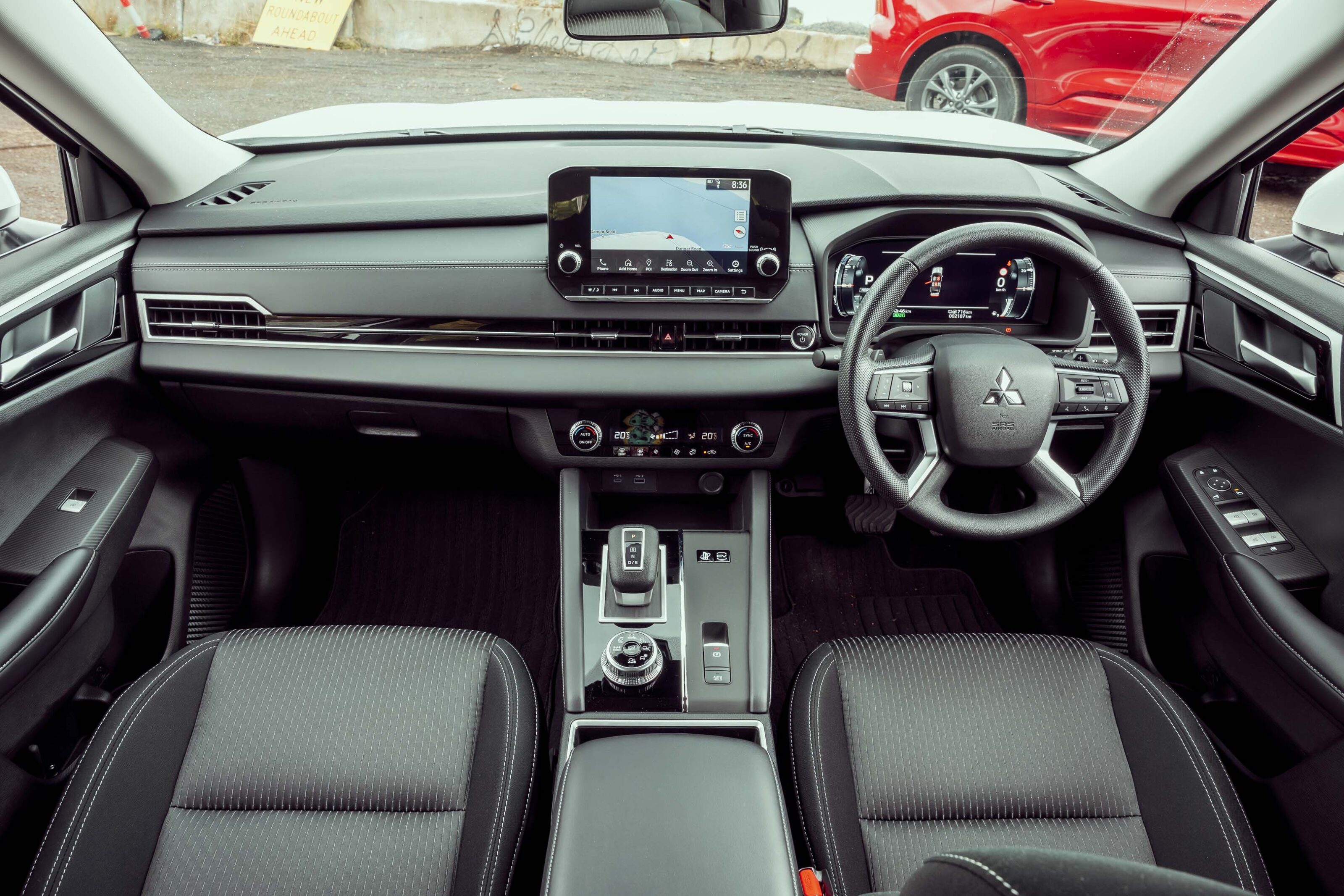
I was frankly surprised at the level of cabin design and materials quality in the entry-level ES grade. It feels contemporary and well made, and there are no obvious ergo annoyances.
The driving position is excellent, the controls logically laid out, and the multimedia is quick and intuitive, with useful hard keys for commonly used functions. Wireless Apple CarPlay features, but Android Auto requires a cable connection.
1
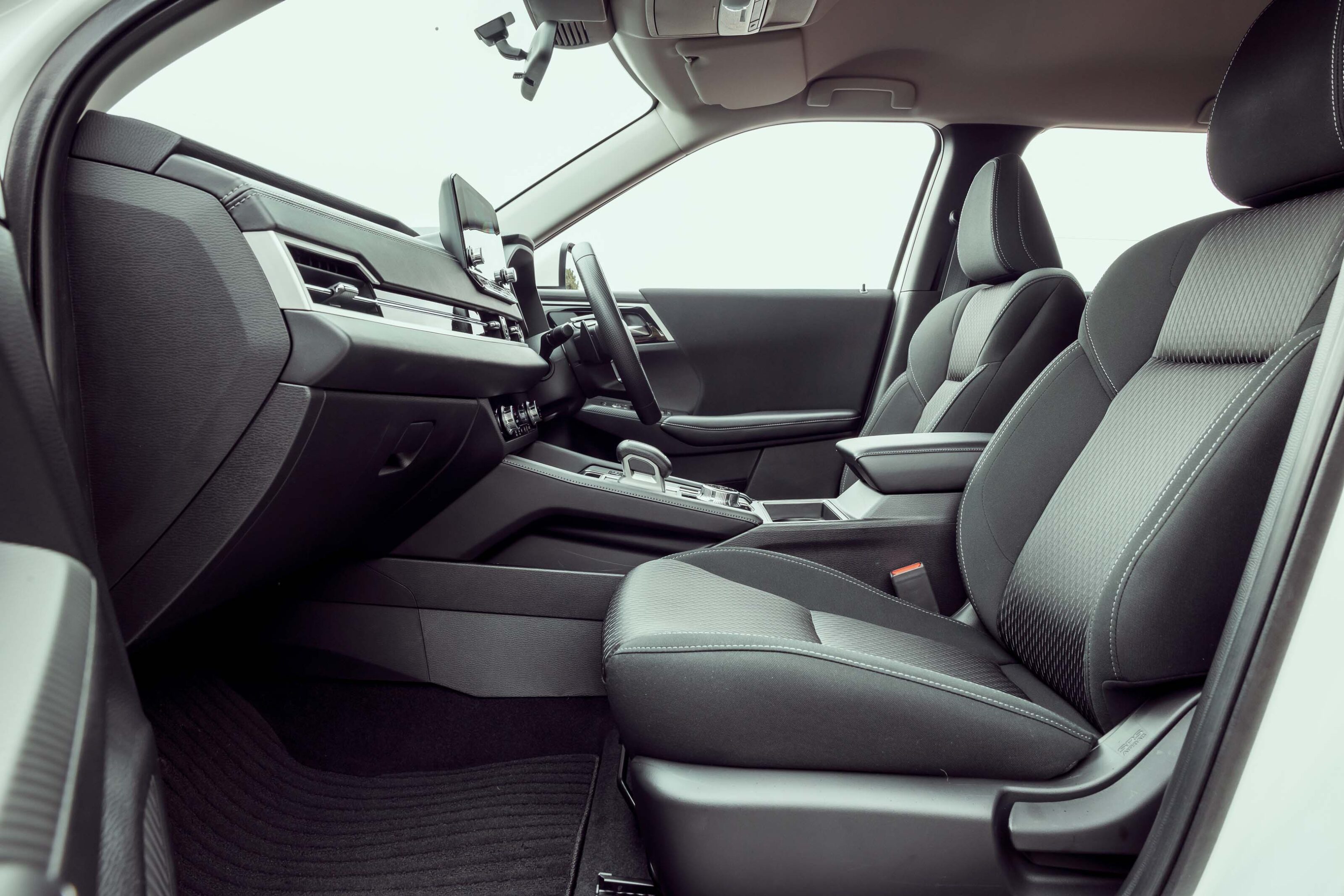
Of course, being the entry level ES grade there are some budget bits you’ll endure, like the urethane steering wheel and a no-name audio system that’s acceptable, not exceptional, but otherwise this model does a decent job of masking its range-opener status. No friends or family will jump in and silently judge you for buying the base model.
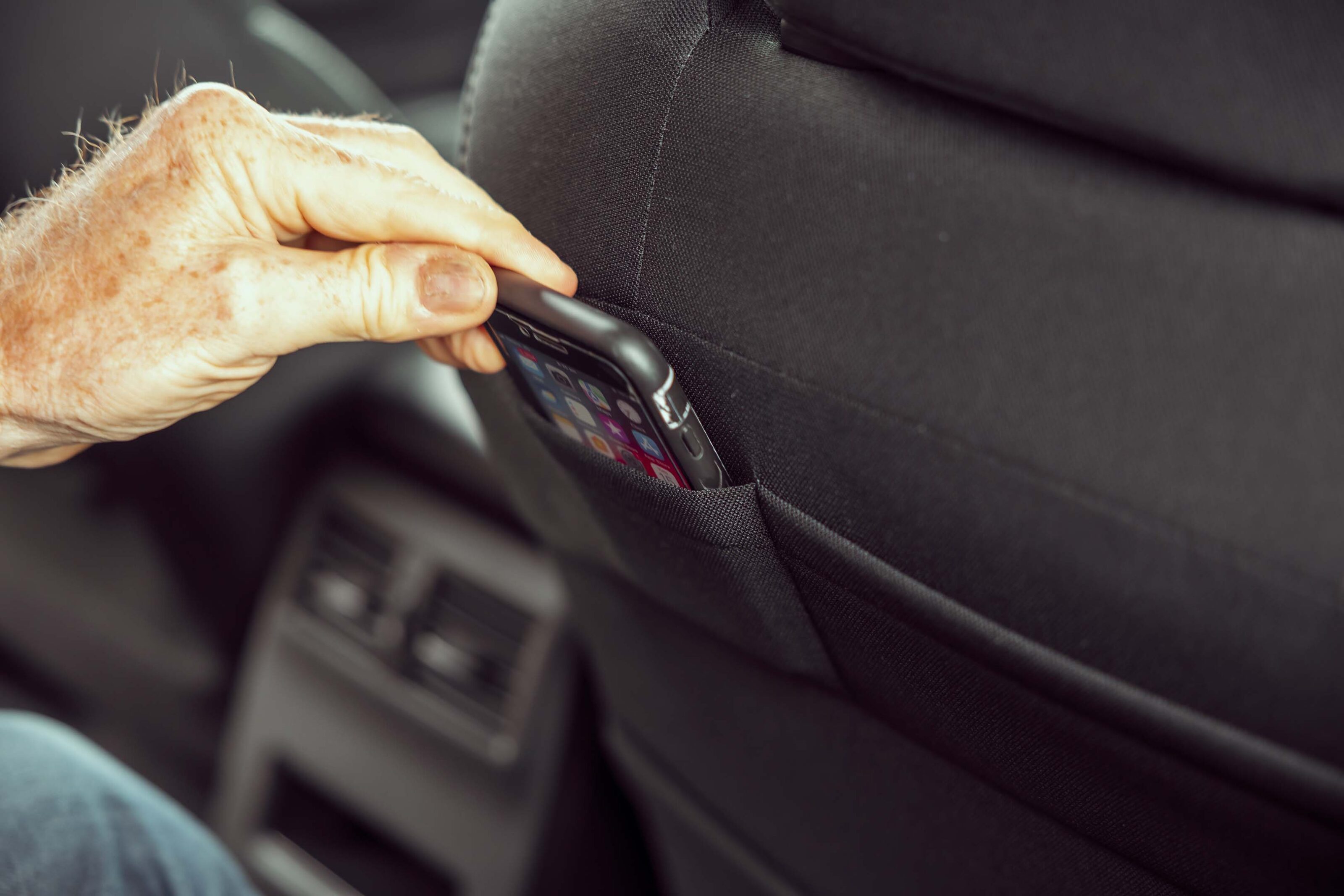
Yes, the seats are manually adjusted, but the fabric trim is attractive, and they’re well-shaped and deliver decent support. The door bins are ideally shaped to hold a one-litre water bottle, and the centre console storage is generous.
1
2022 Mitsubishi Outlander PHEV boot space
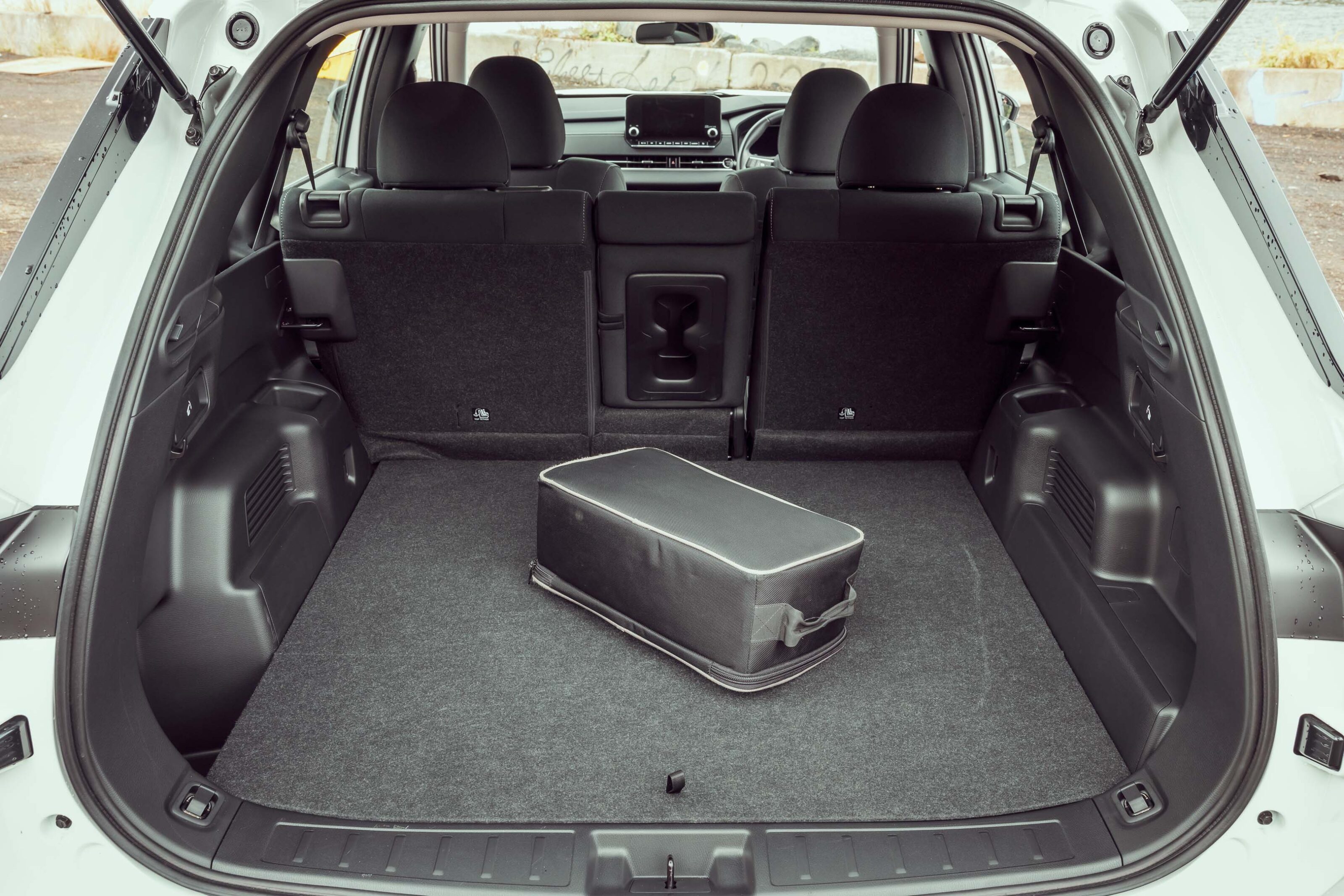
The boot of the Outlander PHEV ES holds 485L – adequate for the segment, but not class-leading – and provides four tie-down points, curry hooks and a lever at each side that flips the 40/20/40 seatbacks to take capacity to 1478L. There’s a 12V outlet, but no spare wheel – you get a tyre repair kit instead – but there is a dedicated storage space for the charging cables beneath the floor.
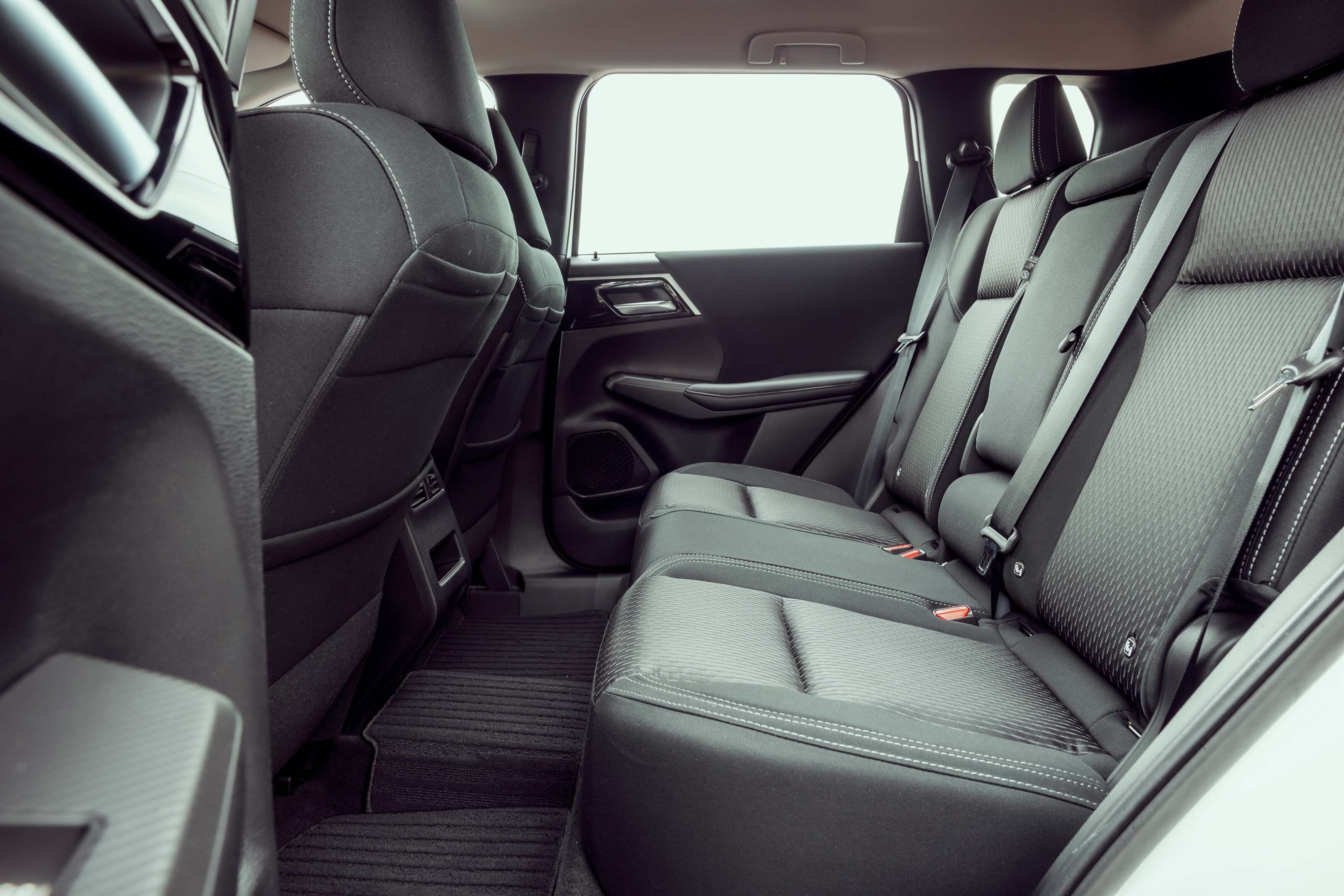
Legroom in the back is fine for adults, even if the relatively low base can leave taller frames a bit short on under-thigh support – obviously not an issue if it’s kids back there, or young ones in child seats or boosters. Rear passengers get air vents, but no USB ports, so brace for sooking and demands to share the cable plugged in up front.
1
What is it like to drive?
Before we get to the driving, a simple explanation is needed of the complex hybrid system that powers the Mitsubishi Outlander PHEV.
There’s an electric motor on each axle; the front with 85kW and 255Nm; the rear unit rated at 100kW/193Nm. Supplementing the electric drive is a 2.4-litre four-cylinder engine running in the more efficient Atkinson cycle and providing 98kW/195Nm. Total combined outputs are 185kW/450Nm, way more robust than the petrol model, which produces 135kW and 245Nm.
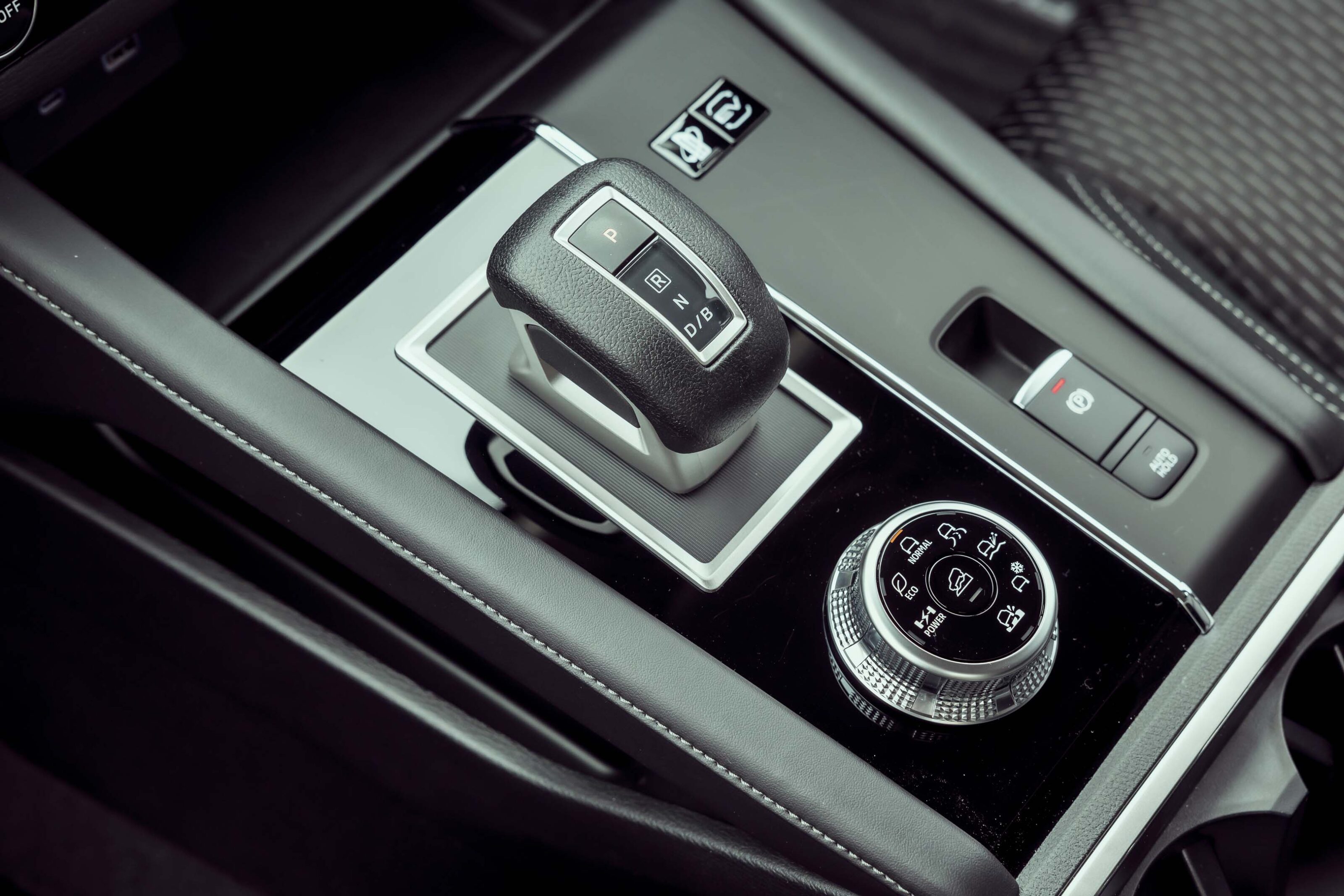
There are four modes to operate the motors and engine: ‘Normal’ which uses petrol or electric drive depending on torque demand and the battery’s state of charge; “EV”, which maintains electric-only driving until the battery is depleted; “Save”, which focuses on using the engine for power to conserve the battery for later, and “Charge”, which fires up the engine to act as a generator and recharge the battery.
1
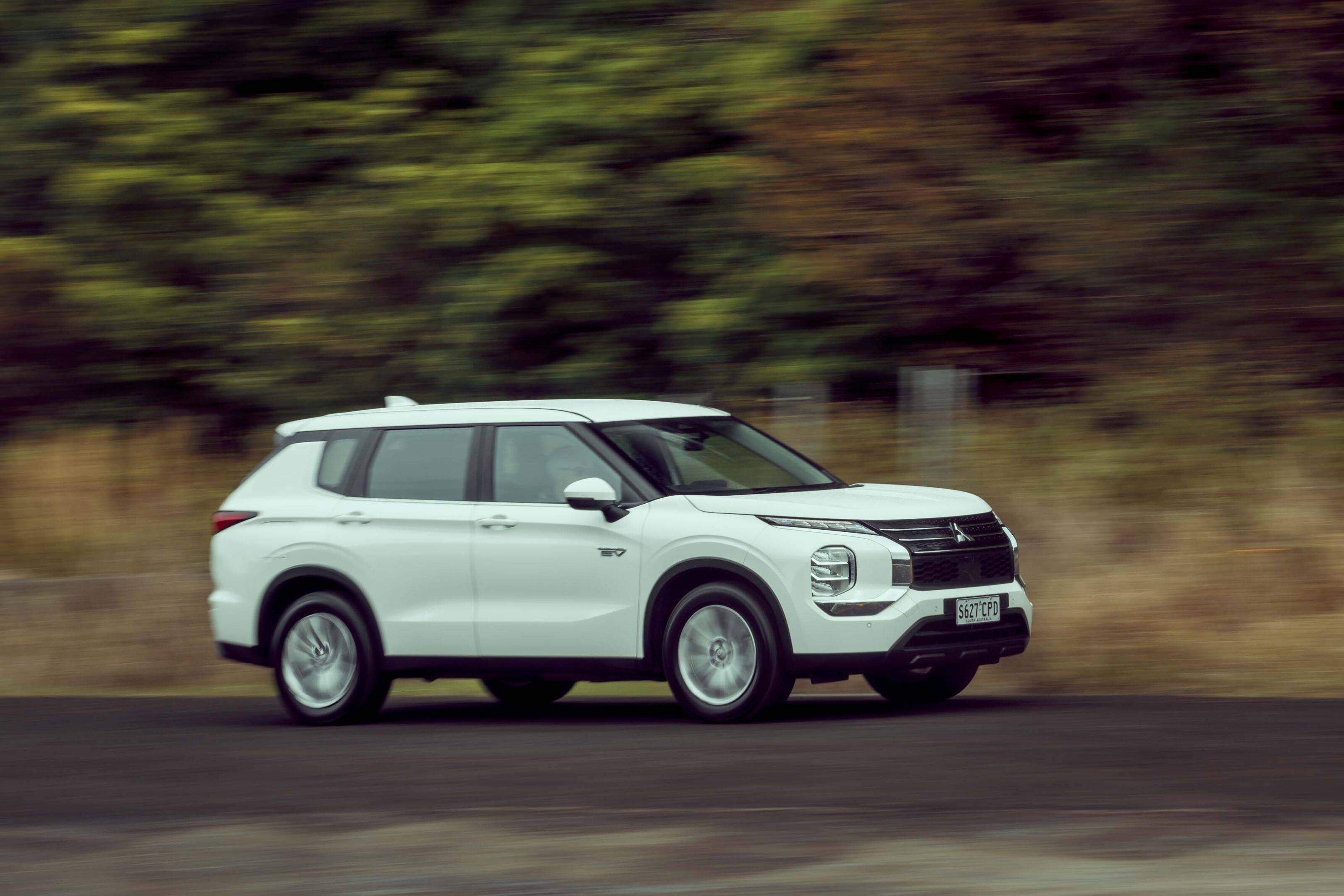
So what’s it like to drive? Initially, much like an EV, which is great. Below around 70km/h the powertrain is calibrated to favour electric drive, with the petrol engine used to power the generator to replenish the battery or boost electrical output when heavy acceleration or load calls for it
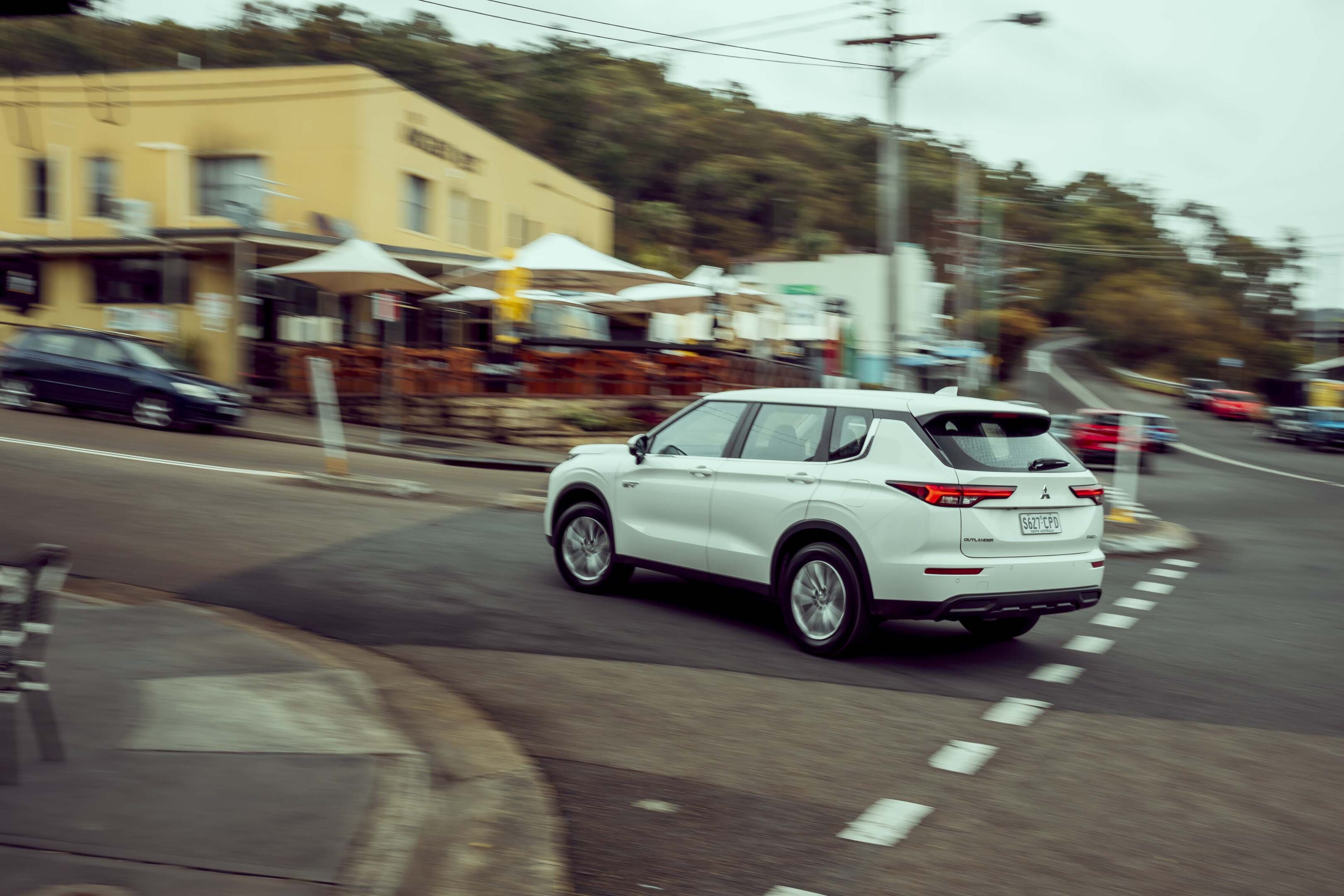
So around the suburbs and city there’s that near-silent, muscular step-off that’s a hallmark of EVs generally that makes them so responsive and satisfying for urban driving. No CVT dithering, no lag, just a solid surge of acceleration every time you squeeze the throttle.
In normal driving conditions, up to around 70km/h, you’ll rarely wake the 2.4-litre petrol engine until the battery’s state of charge requires it, even if the drive selector is not switched to the dedicated EV drive mode.
The merging of combustion and electric is beautifully seamless, with no uncouth shunting or raucous roar.
1
Above around 70km/h, when conditions demand the petrol engine fires up, the merging of combustion and electric is beautifully seamless, with no uncouth shunting or raucous roar. Unless you go wide-open throttle, it happens at a speed at which the tyre and wind noise tends to mask it anyway, so some drivers may not even be too aware of what the powertrain is actually doing.
On a motorway cruise the petrol engine will drive the front wheels directly, with the front and rear electric motors’ role to capture excess kinetic engine and send it into the battery, or to add torque at the front or rear axle on demand.
Only under load at open-road speed does the system struggle a little. If you’re overtaking uphill at around 100km/h, the engine has to work hard and lets you know all about it. It becomes pretty vocal in the upper reaches, and the rate of acceleration tails off abruptly.
1
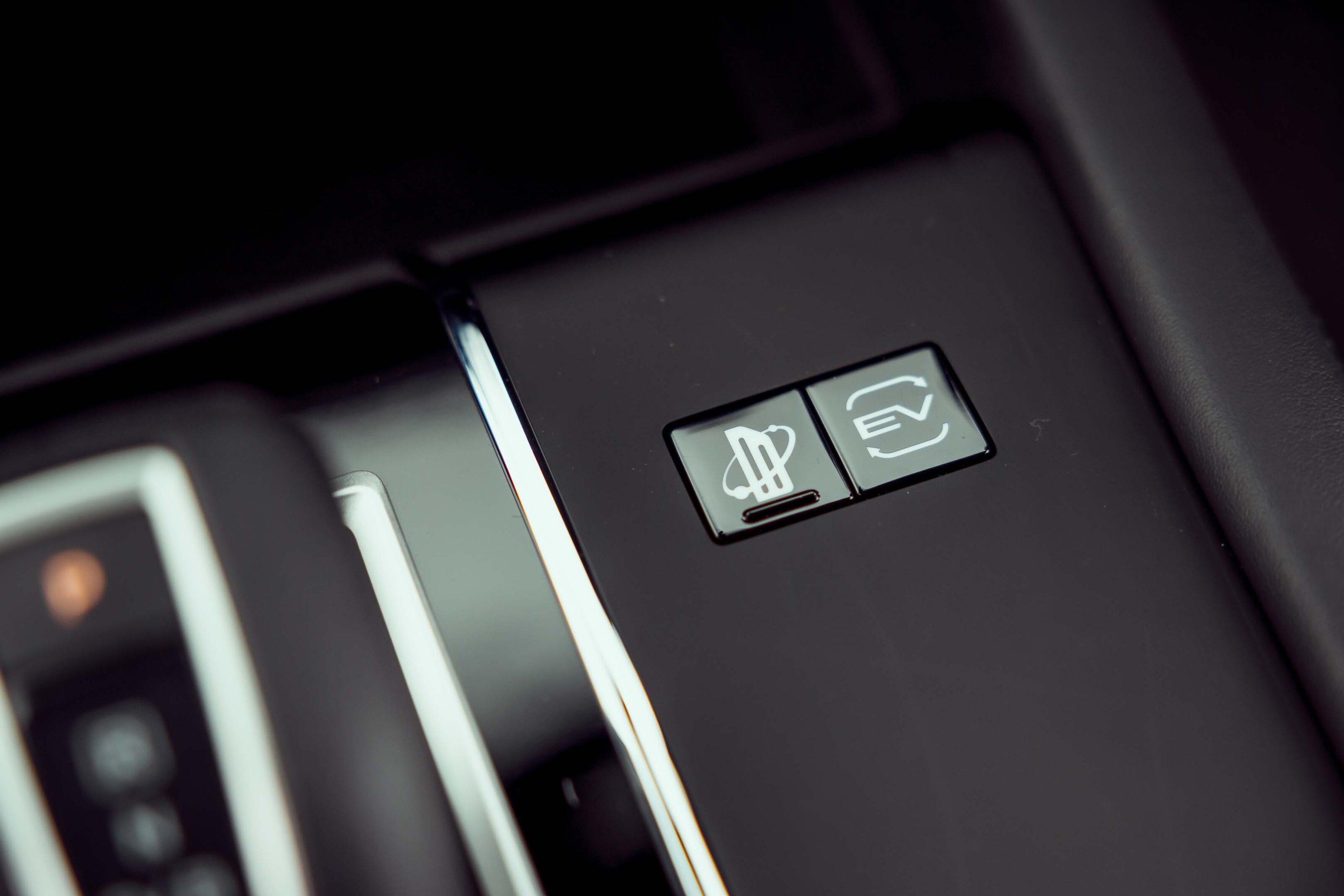
There are six different stages of regenerative braking, five of which are controlled by the paddles behind the steering wheel. The sixth and heaviest regen mode is activated by pushing a button on the centre console.
This deploys enough recuperation to quickly slow the car right down to jogging pace, although a brake application is still needed to come to a complete stop. So, no, it’s not true one-pedal driving.
Dynamically the Outlander PHEV does a mostly admirable job masking the additional 340kg it carries compared to the petrol version. The steering is light, a bit snoozy either side of centre, but mostly free from kickback. It may lack road feel, but it gives the ES a calm demeanour that’s perfectly in keeping with the family-SUV brief.
Driven with a bit of enthusiasm, the instant torque and all-wheel-drive traction make it actually quite satisfying on flowing B-roads.
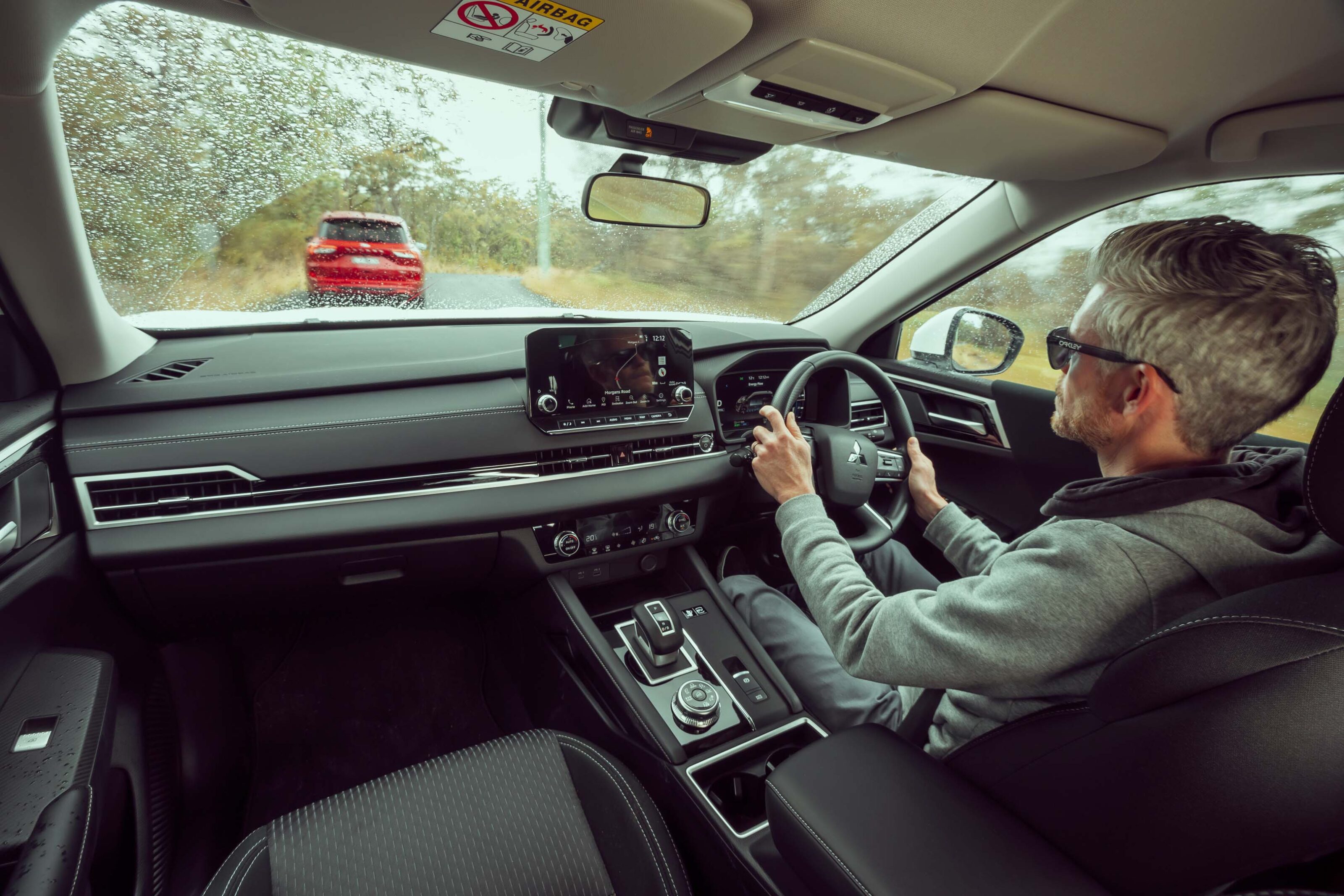
1
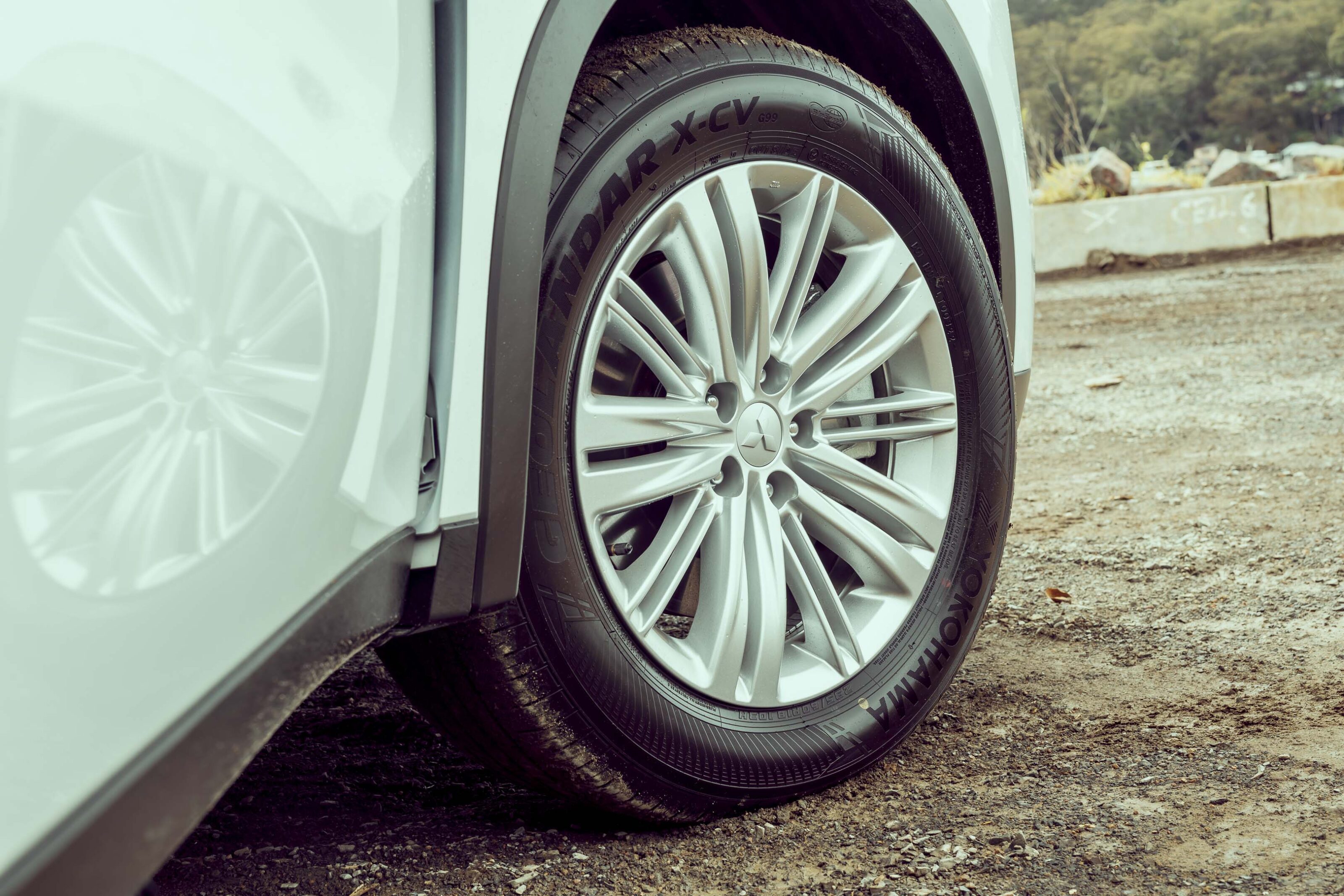
The ride can be caught out by sharp edges, but the chubby 18-inch rubber contributes to an overarching sense of absorbency and mostly keeps bums isolated from what’s going on at road level.
The softish damping can allow a bit of fore and aft pitching over longitudinal undulations, but this rarely undermines the Mitsu’s broader composure.
And driven with a bit of enthusiasm, the instant torque and all-wheel-drive traction make it actually quite satisfying on flowing B-roads. It’s less overtly sporting than its Ford Escape rival, but if you find yourself without kids or dogs in the car and a winding bit of blacktop beckoning, the Outlander PHEV ES may actually surprise with the pace at which it’s happy to tap along.
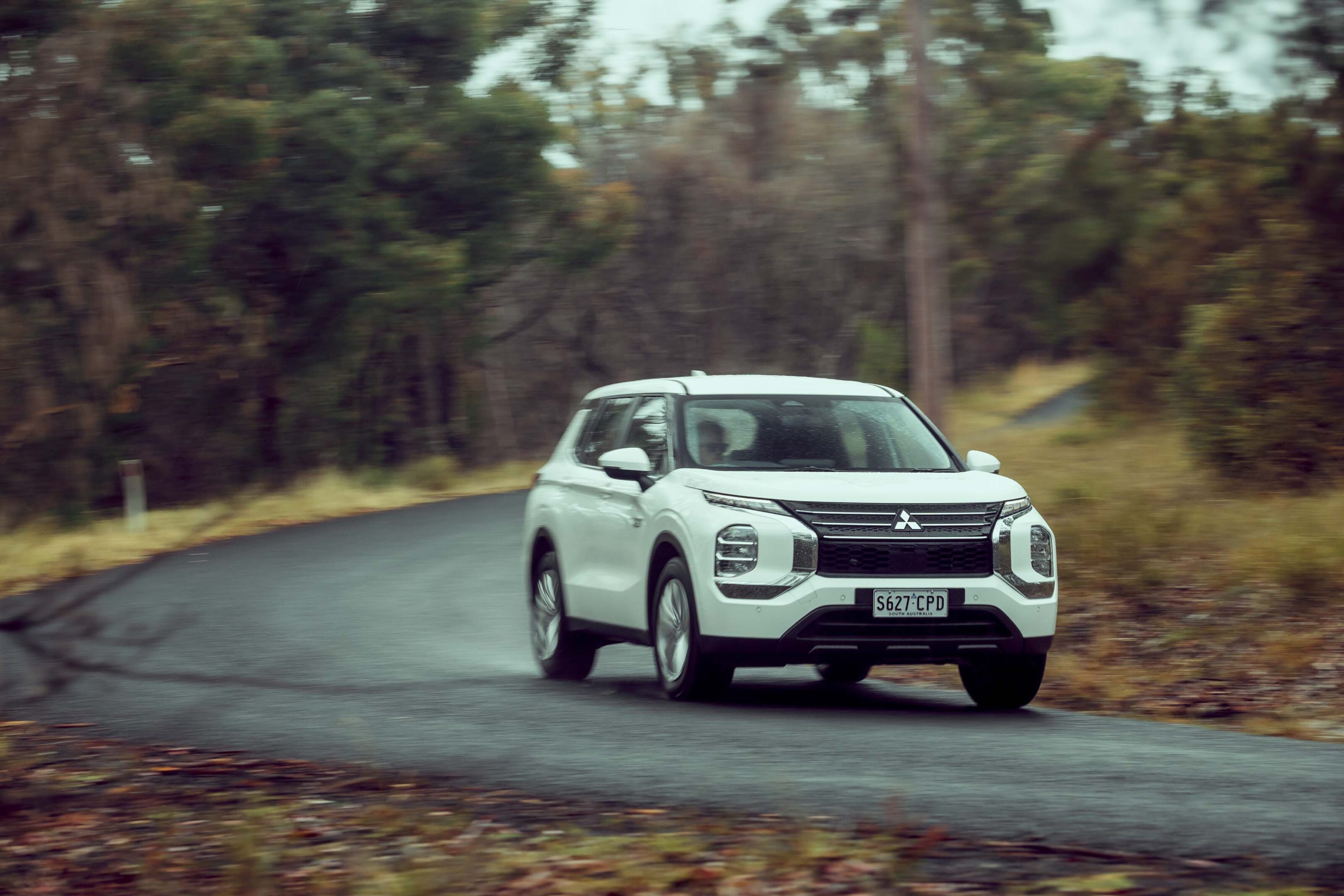
1
How is it on fuel?
Well, if your daily usage is less than around 80km and you plug it in each evening, you may well ask, what fuel?
Officially Mitsubishi says the Outlander PHEV ES consumes 1.5L per 100km, but that figure is taken with a fully charged battery providing the first 80 or kilometres, so should not be be used as real-world guidance.
Consumption of the Outlander PHEV when the 20kWh battery is ‘fully discharged’ (which it never really is) is officially rated at 6.7L/100km, but that’s very dependent on driving conditions. Urban driving provides plenty of opportunity for regenerative braking to help top-up the battery charge, supplementing the engine’s job of powering the generator.
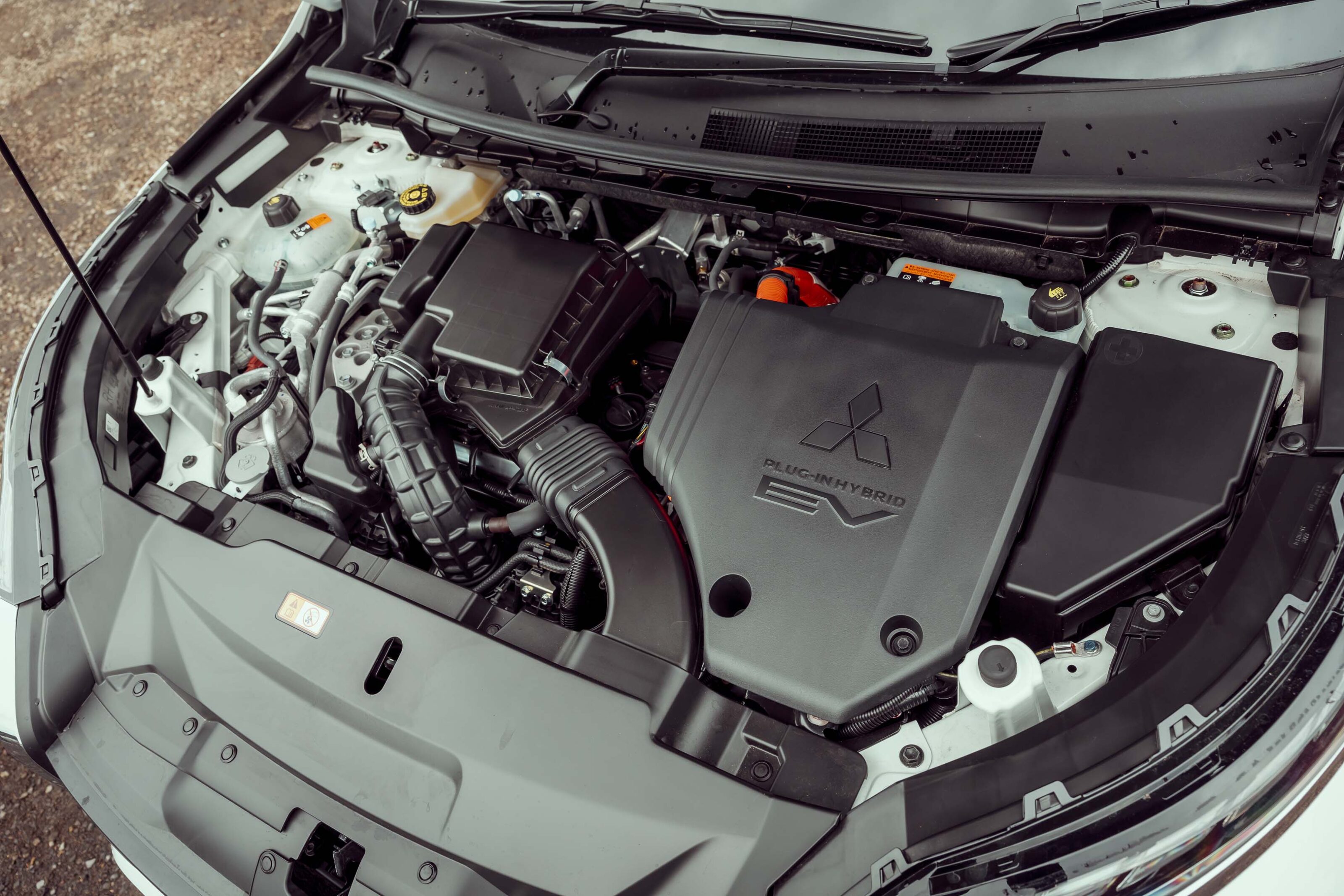
1
At the other extreme, highway driving will see the engine doing the real work.
Our own Alex Inwood noted this recently, having run both a petrol Outlander and the PHEV model for extended periods.
“On the highway, the PHEV, with battery ‘depleted’ is actually thirstier than the regular petrol Outlander,” wrote Inwood. “Our interstate trip for the family holiday in the PHEV took exactly the same route as a drive in the petrol Outlander a month or so earlier and the side-by-side comparison was illuminating.
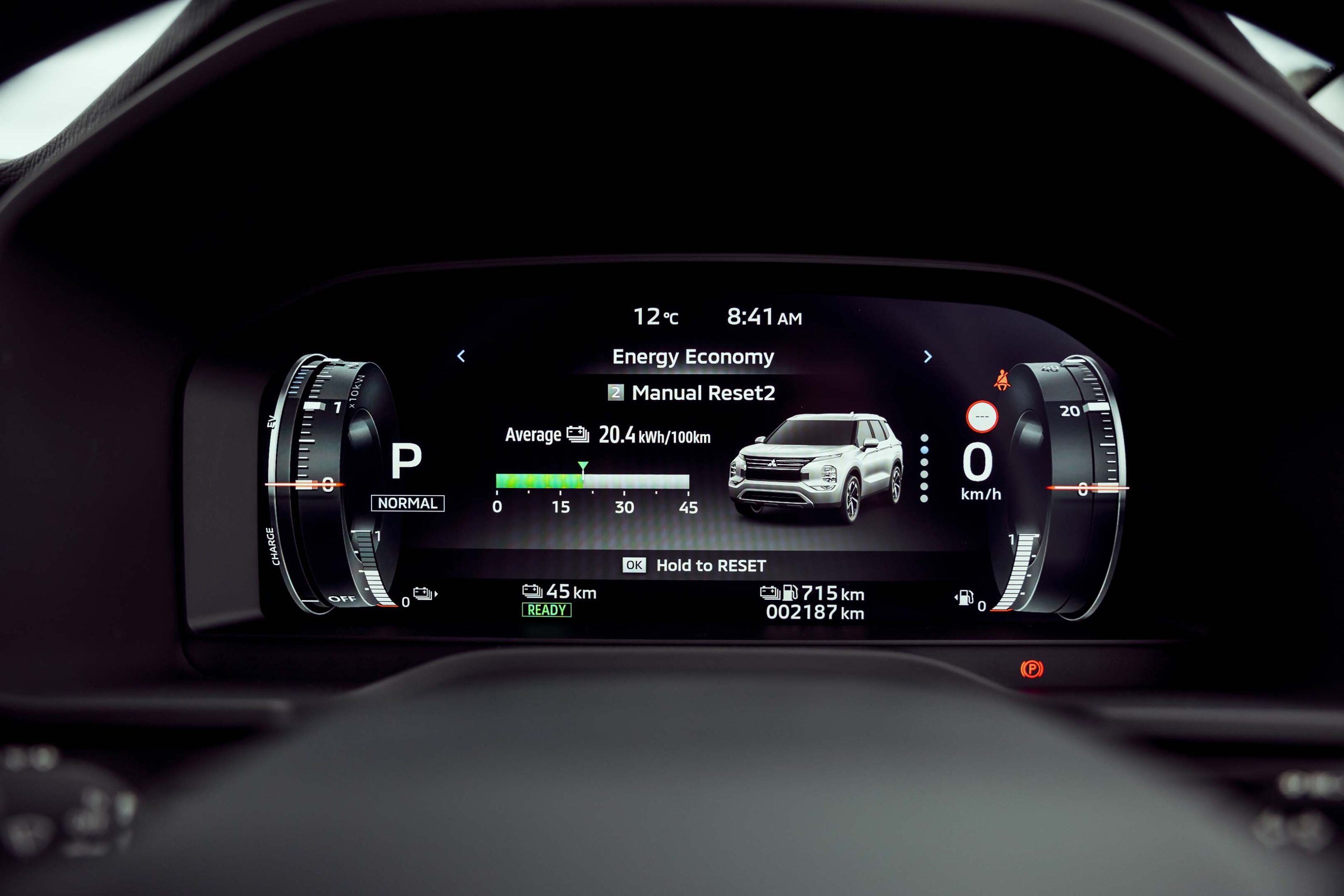
1
On the Hume and across the backroads towards Young, the petrol-powered Outlander hit its efficiency sweet spot and returned around 7.5L/100km. The best the PHEV managed on the same roads was 8.0L on the way up and 8.3L on the return leg.
So here’s the take-out. Keep it charged and burn no fuel for the first 80 or so kms. Around-town driving with a depleted battery should see it consume fuel in the mid-sixes, moving into the low-eights on a long highway run.
The Outlander PHEV ES has a 56L fuel tank, up from 45L in the old car, and will take 91-RON fuel.
As for the recharging process? On a regular 240V socket, the PHEV takes around 9.5 hours to reach a full charge, so easily achievable overnight. Charging from an AC wallbox at home drops this to 6.5 hours. DC fast charging is also available via a CHAdeMO port that delivers an 0-80 percent charge in 38 minutes. The cables required for both forms of charging are included as standard across the PHEV range.
1
How safe is it?
Just like the rest of the Mitsubishi Outlander range, the PHEV ES carries a five-star ANCAP safety rating.
It received scores of 83 percent for adult occupant protection, 92 percent for child occupant protection, 81 percent for vulnerable road user protection, and 83 percent for safety assist.
Standard safety equipment levels in the ES grade include:

1
The airbag count includes a front centre airbag which deploys between the front passengers in the instance of a side impact to hopefully prevent head clashes.
Outlander Aspire adds surround-view cameras, while the flagship Exceed variants have a semi-autonomous ‘Mi-Pilot’ system with traffic jam assist for highway steering.
1
Warranty and running costs
Minor services for the Mitsubishi Outlander PHEV ES cost $349 while a major service ranges between $449 and $849.
Like all new Mitsubishis, the Outlander PHEV is covered by a market-leading 10-year factory-backed warranty, providing it’s serviced at an authorised dealer. If you chose an independent service outlet, the warranty is five years.
However, be aware that the battery pack in PHEV models carries a lesser warranty of eight years or 160,000km. The fine print states that Mitsubishi guarantees the battery against excessive degradation and will only replace it if its useable capacity dips below 66 percent over that eight-year period.
VERDICT
When distilled down to dollars, the few plug-in hybrids sold in Australia have a hard time justifying the price difference over their conventional internal-combustion alternatives.
The Mitsubishi Outlander PHEV ES is no different.
Viewed purely through the lens of what you pay at the dealer versus what you’re likely to save at the pump delivers an equation that is not exactly compelling. Crunch the numbers and it takes an awful long time of ownership and big kilometres to claw back the additional outlay made at purchase time.
But if you care enough about the driving experience, and the chance to reduce tailpipe emissions, you’ll see value in the Outlander PHEV. Compared to the ICE equivalent, it’s a much more responsive, quiet and satisfying SUV to drive, especially in the cut and thrust of urban traffic.
But the base ES does lack some creature comforts and safety assistance equipment plenty of buyers expect, and while the $6500 step up to the Aspire isn’t small, it does add a fair list of desirable kit that really elevates the whole package.
So if you want the EV driving experience but you frequently travel several hundred kays from home and you’re averse to the whole public recharging thing, the Outlander PHEV is a plug-in that’s easy to recommend.
And if you can stretch one rung above the base ES, there is value to be had.
2023 Mitsubishi Outlander PHEV ES specifications
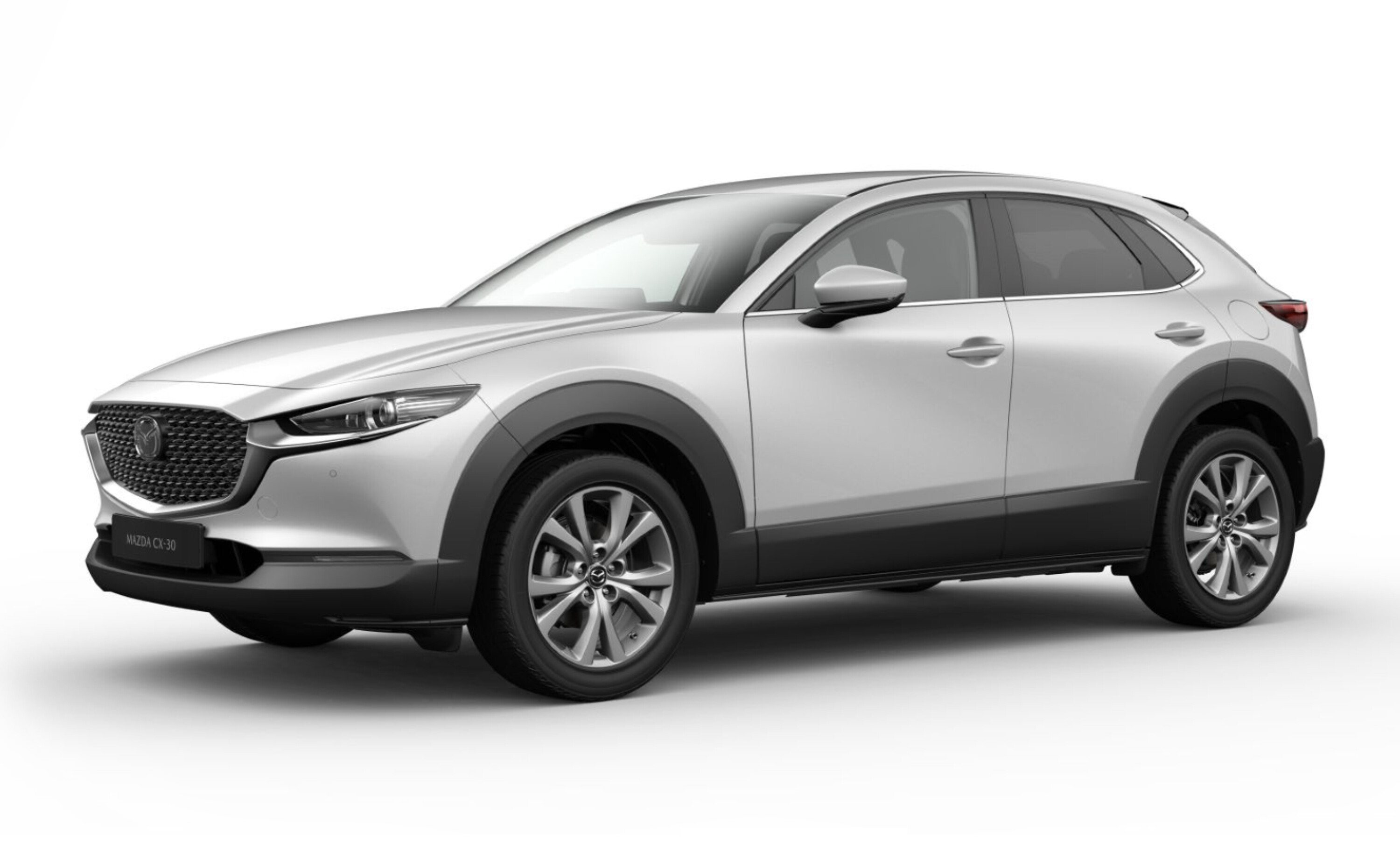
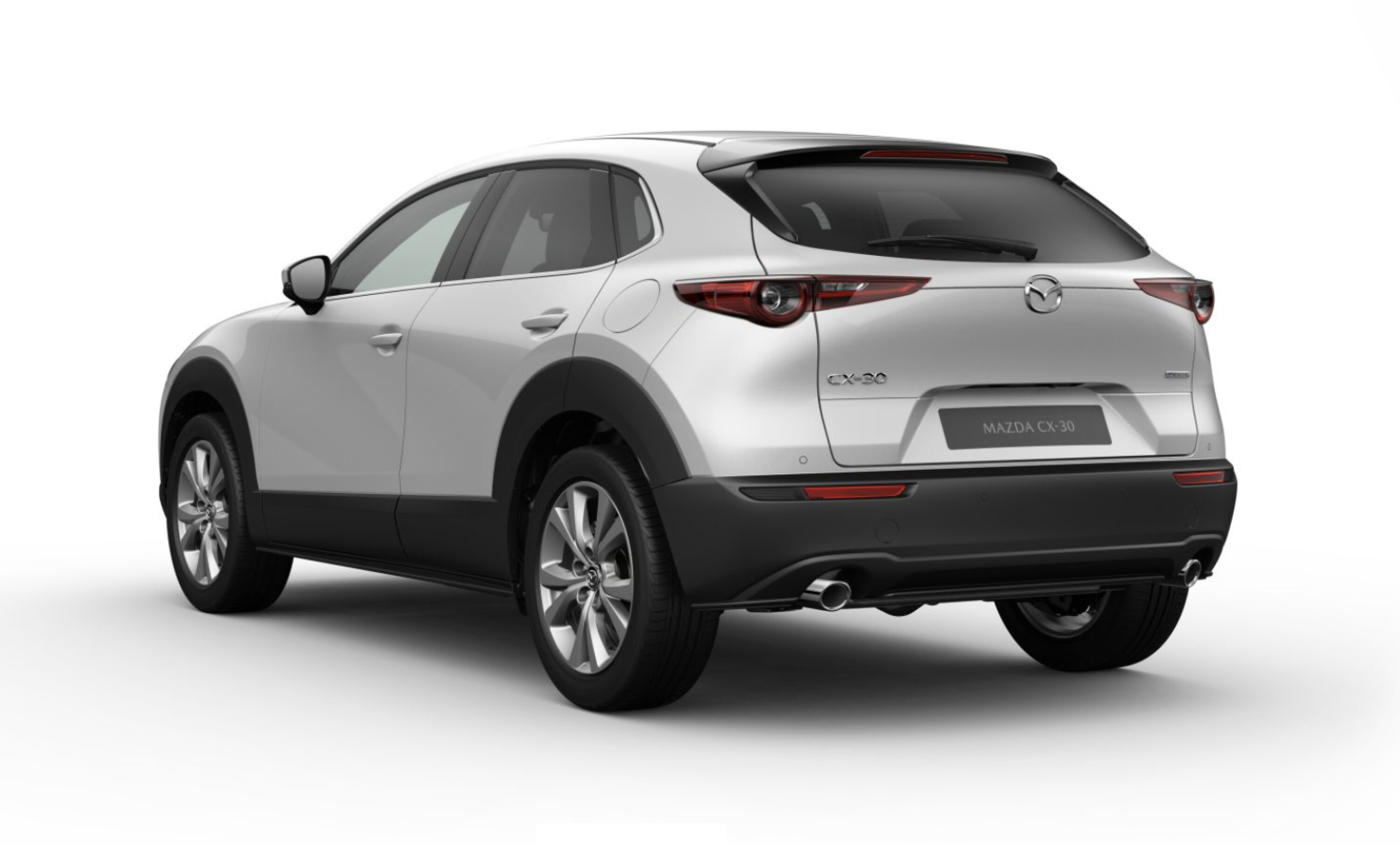
The updated 2024 Mazda CX-30 small SUV has debuted overseas ahead of an expected launch in Australia later this year.
Snapshot
- 2024 Mazda CX-30 update revealed
- Popular small SUV receives new tech; minor engine improvements likely
- Expected in Australia by Christmas
With the CX-30 heavily related to the Mazda 3, the revisions are identical to those recently applied to the small hatch and sedan, which arrives in local showrooms later this month with more tech and price rises.
A Mazda Australia spokesperson told Wheels it is unable to confirm local timing for the refreshed CX-30 at this stage, with details expected soon.
1
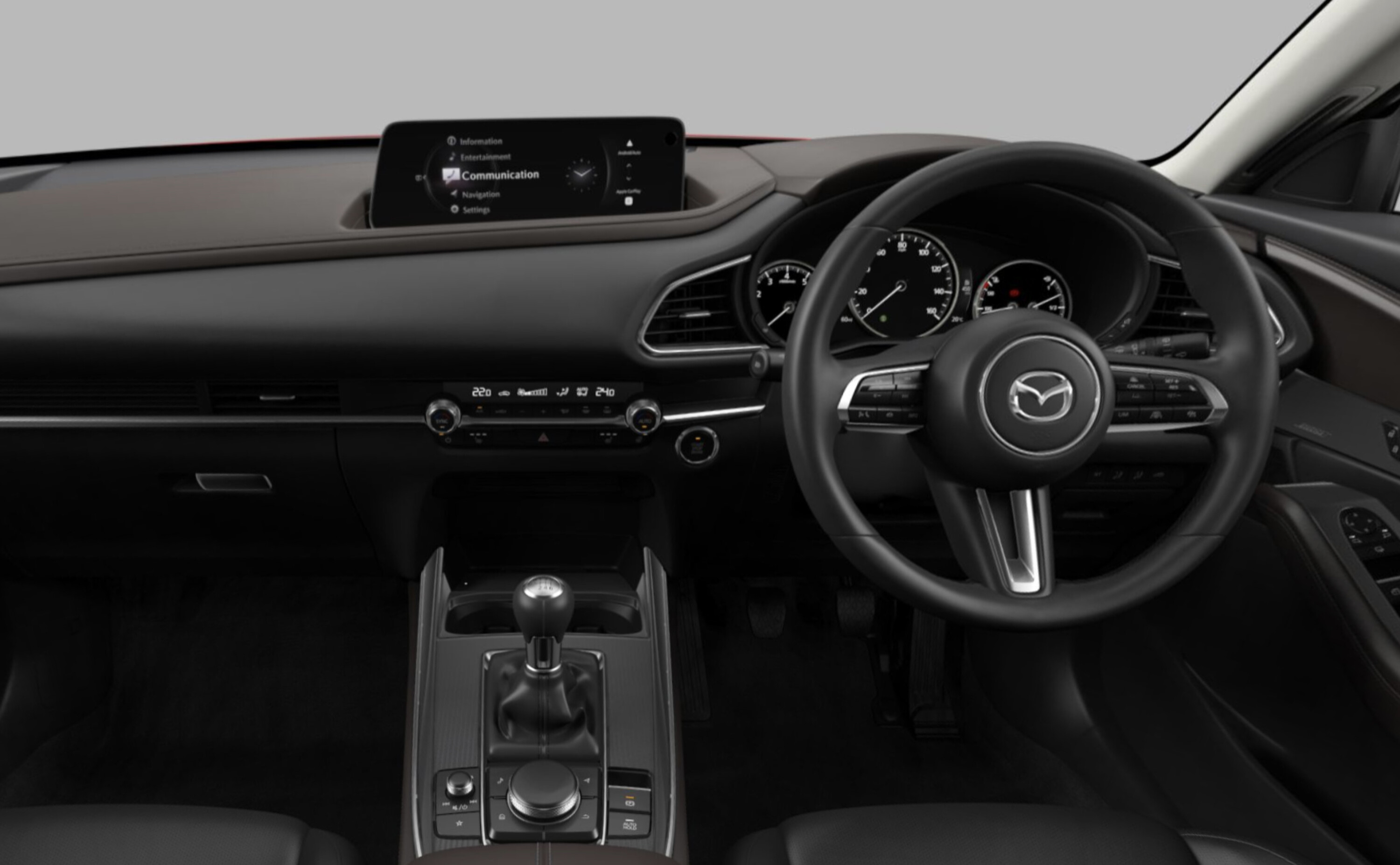
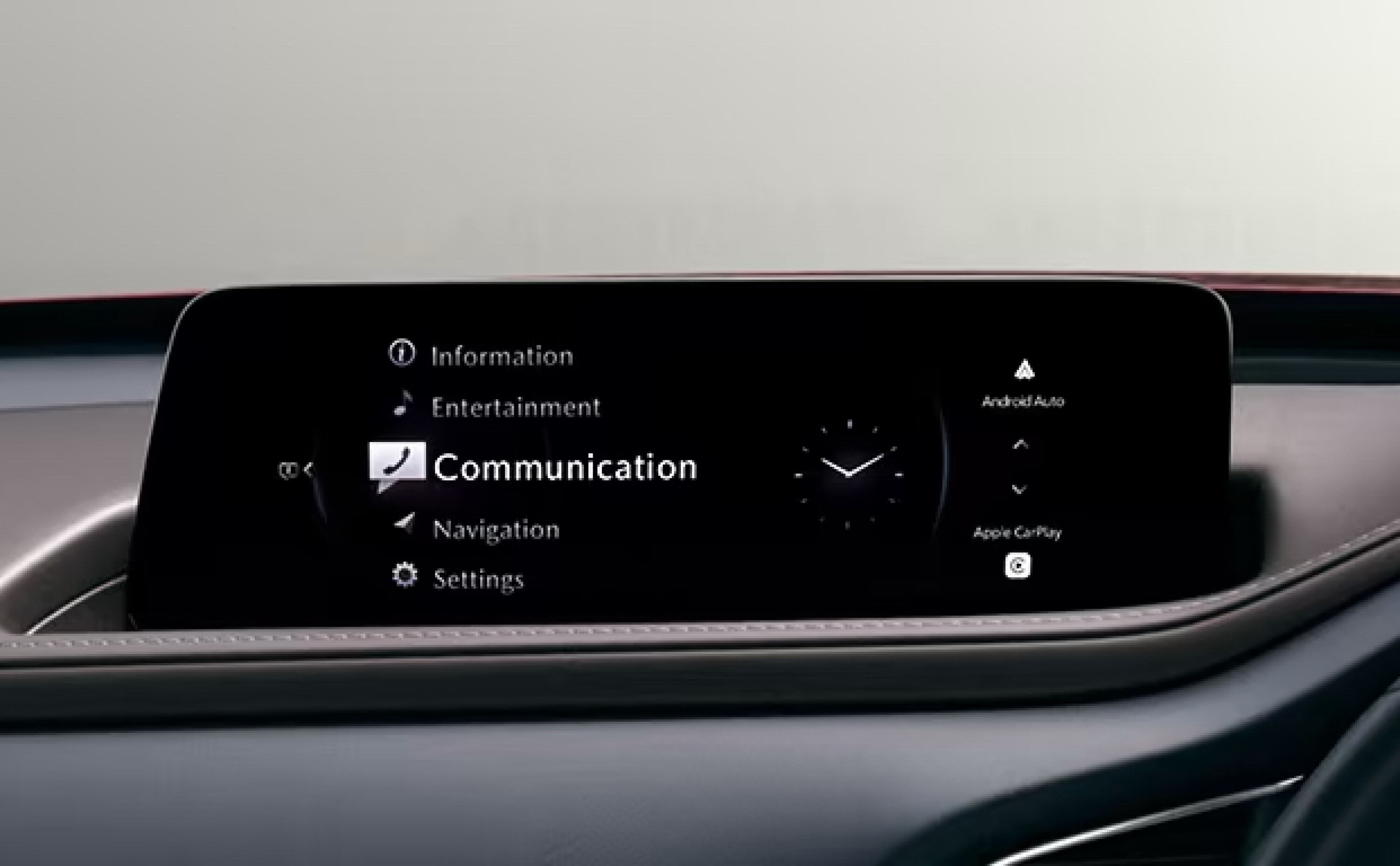
It is headlined by a larger 10.25-inch infotainment system on select grades, up from 8.8 inches.
Locally, the larger screen is fitted to Mazda 3 GT and Astina variants, suggesting it could be standard on the similarly-equipped CX-30 Touring, Touring SP and Astina – and added to the optional Vision Technology package for lower grades.
Globally, ether screen size will support wireless Apple CarPlay and Android Auto on select variants, while a wireless phone charger ahead of the gear shifter has been added.
1
Other interior revisions include illuminated front USB-C ports, an updated steering wheel with darkened switchgear, new labels for the air-conditioning controls, and slimmer cupholders with the removal of the lid.
In the United Kingdom, the base CX-30 has lost two speakers – from eight to six – but whether Mazda will apply this change to entry-level variants in Australia is unclear.
External revisions are limited to the addition of the ceramic metallic finish, replacing sonic silver.
1
Under the bonnet, the 2.0-litre front-drive petrol is likely to receive cylinder deactivation and minor improvements, with a fuel consumption reduction of around five per cent, equating to approximately 6.3L/100km – down from 6.6L/100km.
These efficiency improvements could see the deletion of the mild-hybrid G20e Evolve variant – which is already rated at 6.3L/100km – in a move foreshadowed by the updated 3, with the mild-hybrid G20e Evolve and X20 Astina axed.
However, Mazda Australia has yet to confirm this, and the CX-30 X20 Astina remains available on its consumer website and industry price lists.
1
While the local version of the 2.0-litre E-Skyactiv-X engine – launched in mid-2020 – retains a lower 132kW/224Nm tune, an earlier update in Japan and Europe saw these outputs rise to 140kW and 240Nm.
It is unclear if the CX-30 would receive this revised tune in Australia, should the variant remain available to purchase.
It is also not clear if the manual will be retained – solely available in price-leading Pure form – after the transmission option was recently deleted from the 3 and CX-3.
The updated 2024 Mazda CX-30 is expected to arrive in Australia by Christmas, with local pricing and full details to be announced closer to launch.
Currently, the CX-30 is priced from $30,210 before on-road costs for the G20 Pure FWD manual, rising to $48,310 plus on-roads for the X20 Astina AWD auto, with price rises likely to account for the added technology.
VFACTS new-car sales data reveals the CX-30 is Australia’s second-best-selling small SUV with 6098 registrations year-to-date, behind China’s cut-price MG ZS (13,579), but ahead of the GWM Haval Jolion (5523), Kia Seltos (5517), Volkswagen T-Roc (4420), and Mitsubishi ASX (4207).
MORE
Everything Mazda
The world’s full of talented artists, isn’t it? And with digital renders, imaginations can become more life-like than ever before – this ‘Hyundai Pony Coupe’ by Brian Kim and the WRDº team [↗] is the perfect example.
Taking the N Vision 74 concept – that although looks made up, we’ve actually driven – stripping away its massive rear wing and adding a more realistic visage produces something we’d love to see in real life.
Perhaps the production Pony Coupe is Hyundai’s chance to step up and challenge Porsche’s promised electric 718 and Lotus’ future electric sports cars.
https://www.instagram.com/p/Cuztd-NplQm/
The functional N Vision 74 concept is a melange of hydrogen fuel cell and battery electric tech (Hyundai calls it a ‘hydrogen electric powertrain’) with fuel cell tanks and high-output battery for 500kW and 900Nm outputs.
Powering all four wheels with two electric motors, the N Vision 74 is a plenty rapid machine.
We’ve seen how far Hyundai and N are willing to push technology with the Ioniq 5 N’s simulated eight-speed ‘gearbox’ and drift mode, so don’t think this concept is some throw-away engineering exercise.
One of the limiting factors will be cost – commenters are already shocked by the Ioniq 5 N’s likely $120K asking price, would they be okay with, say, a $200K supercar? That’ll be up to whether buyers want it, says Hyundai.
There’s some scope to bring down costs. Sharing components among brands, for example. A production Pony Coupe may share parts and technology with a flagship electric Genesis model.
What do you think? Should Hyundai put the N Vision 74/Pony Coupe into production? Hyundai is open to customer feedback, so if you want one, start speaking to your dealer now.
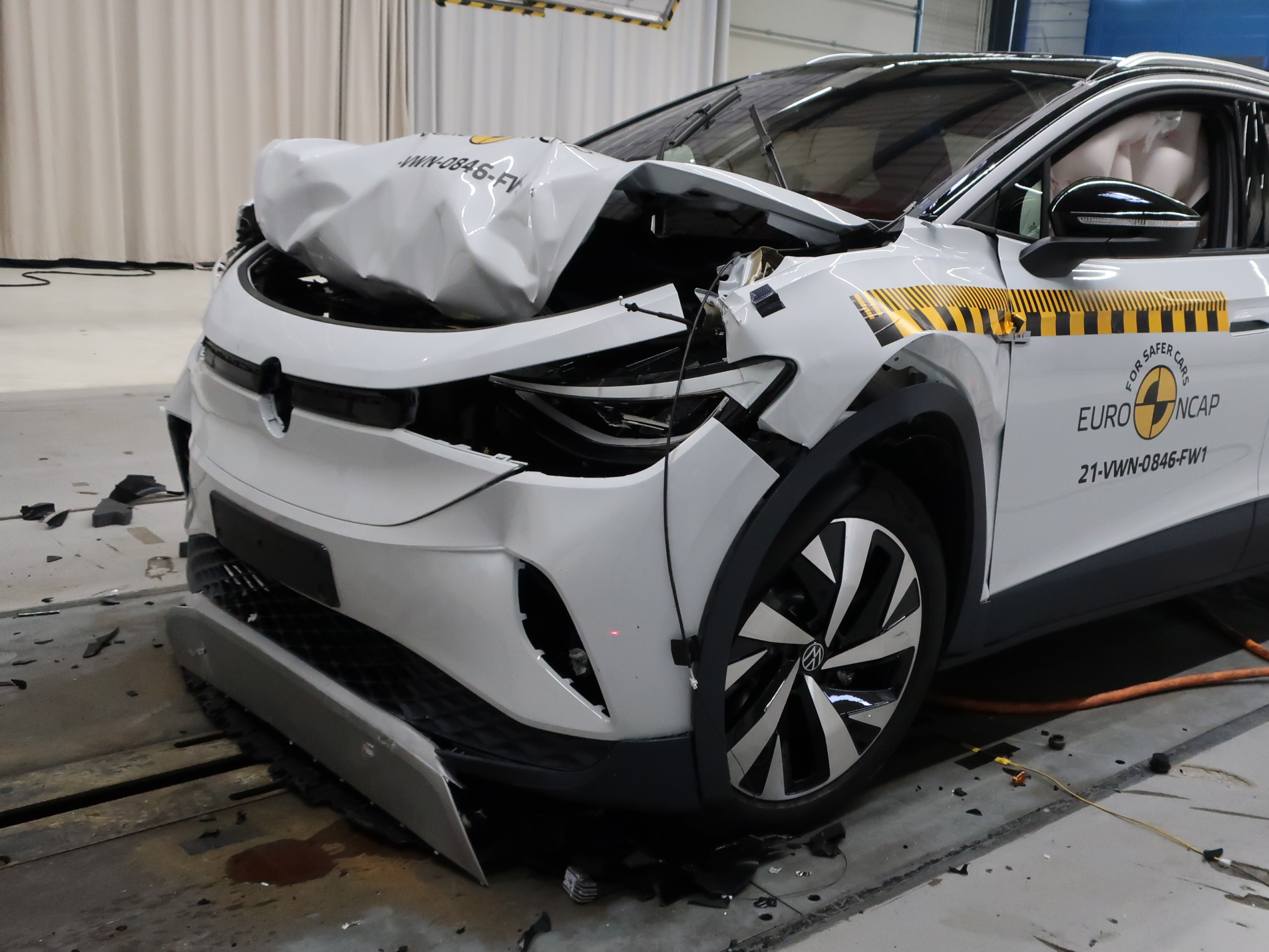
The Volkswagen ID.4 and ID.5 have been rated five stars by ANCAP – though this is for NZ variants only and may not directly translate to five-star five-seaters in Australia.
Snapshot
- ID.4 and ID.5 get five ANCAP stars
- Lack of central top tether anchor makes it trickier to predict a five-star Aussie rating
- Australian variants will likely be rated later
Volkswagen is yet to confirm the specific grades of ID.4 and ID.5 for Australia beyond last week’s GTX confirmation, though the NZ ratings apply to Pro and Pro+ variants.
The two medium SUVs were rated five stars under ANCAP’s partner program (meaning the two vehicles are considered similar enough to share a rating) under the 2020-2022 protocol – though Australian variants will need a few tweaks if VW wants to hit high sales numbers.
VW’s EVs were off to a strong start, scoring highly in adult occupant protection (93 per cent) and child occupant protection (89 per cent) tests.
8
In a twist reminiscent of the Honda HR-V and BYD Atto 3’s ANCAP snags, the ID.4 and ID.5 variants headed to New Zealand have no top tether restraint for the centre seat.
A top tether for the centre seat has been a long-standing requirement for a five-seat passenger vehicle in Australia, though laws over the pond allow the ID.4 and ID.5 to be certified as five-seaters.
Another anomaly picked up by ANCAP was a lack of camera for speed sign recognition on NZ-market ID.4s and ID.5s. This led to a 76 per cent safety score for New Zealand variants – much lower than the Euro NCAP score of 85 per cent.
“It is good to see Volkswagen’s new ID models arrive into New Zealand with five-star ANCAP safety ratings”, said CEO Carl Hoorweg, adding that ANCAP would “encourage Volkswagen to consider including speed limit information functionality in future upgrades, to ensure all buyers are provided with the same level of safety specification as offered in the European market”.
November: New Santa Fe driven ahead of Australian launch
We’ve finally driven the new-generation Hyundai Santa Fe!
Catch our review here to see if this is the family SUV you should wait for.
July: New-gen Santa Fe revealed!
The 2024 Hyundai Santa Fe has debuted ahead of its local launch early next year.
Snapshot
- 2024 Hyundai Santa Fe revealed
- Next-generation large SUV adopts new squared-off design
- Due in Australia in the first half of next year
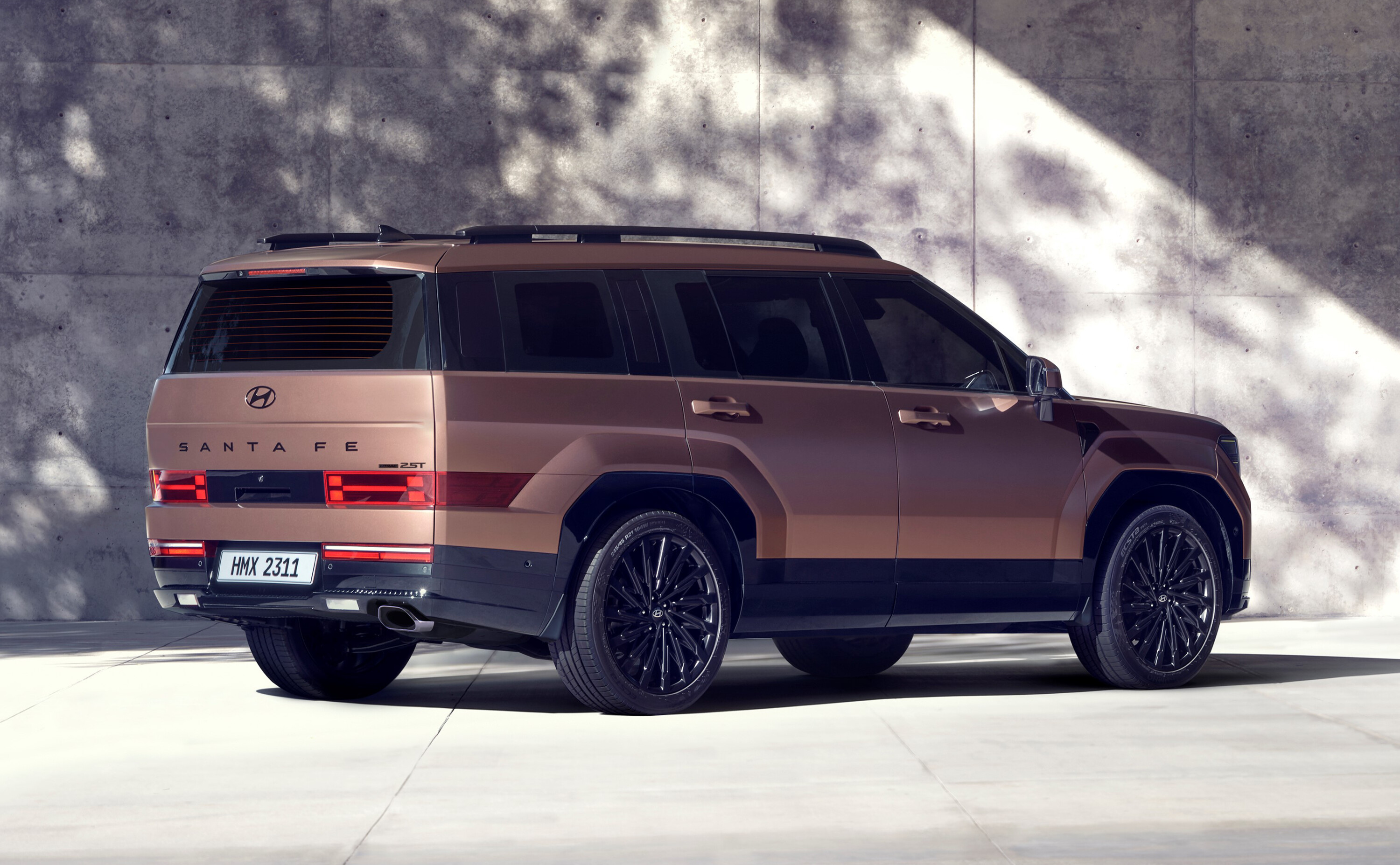
Hyundai’s fifth-generation Santa Fe large SUV has adopted a “lifestyle-based design typology” with boxier, Land Rover-like styling, new H-shaped lighting, and a more premium cabin.
Hyundai Australia has confirmed the new Santa Fe will arrive in local showrooms in the first half of 2024, with full details – including specific timing and pricing – to be announced closer to launch.
Technical information is unknown as a full debut will occur next month, but familiar petrol, diesel, and plug-in hybrid powertrains are expected.
1
Replacing the current Santa Fe – launched in 2018 – the latest model is broader than ever, with a longer wheelbase.
It is believed to ride on an updated version of the current N3 platform first introduced with a heavy mid-life update in 2020.
Square headlights headline the new design with an H-shaped signature inspired by the Hyundai badge, which also features within the vertical tail-lights for unity.
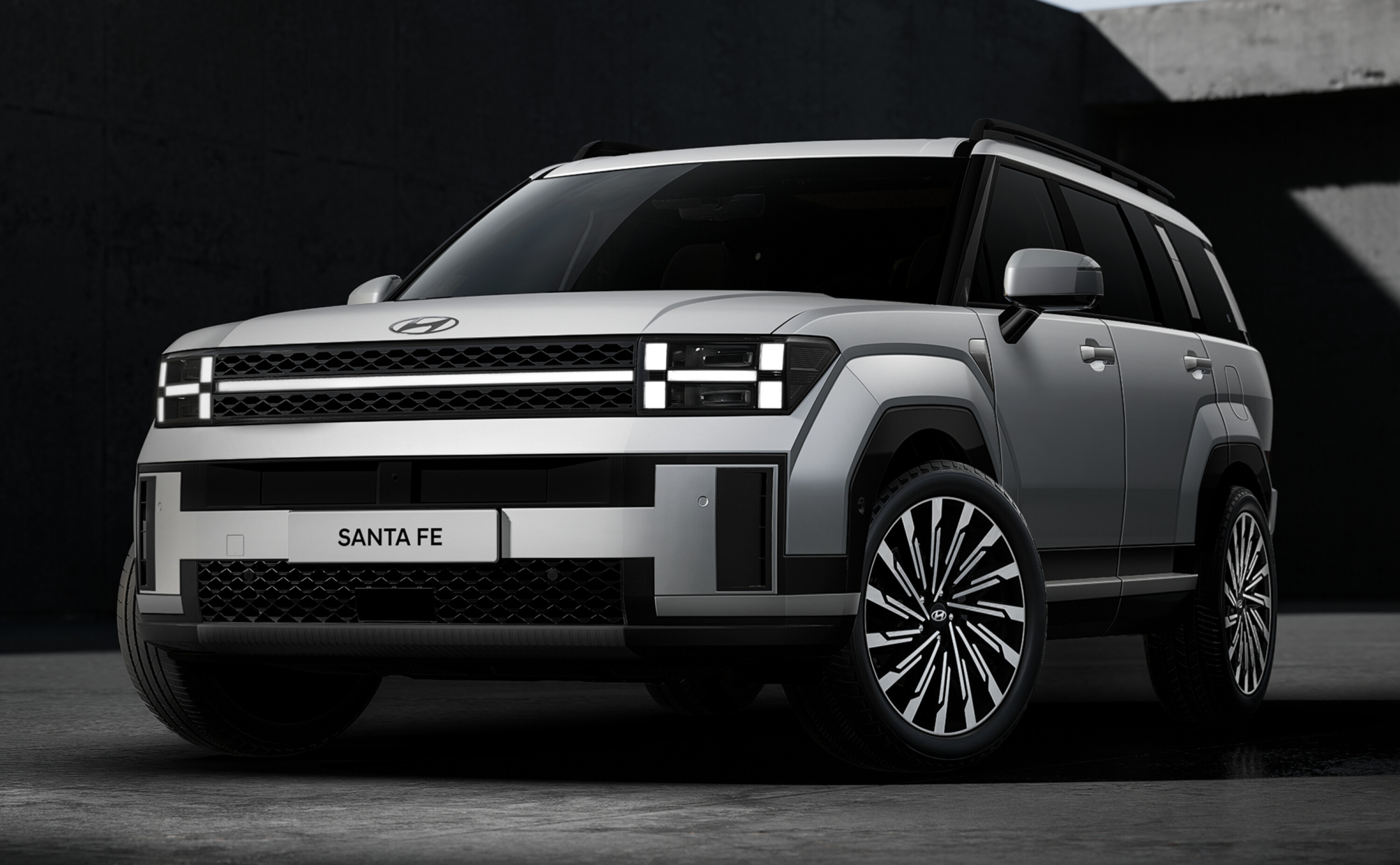
1
“Major updates shaped by big data around the latest outdoor lifestyle trends,” is how Hyundai describes the radical new look.
Sharper and wider wheel arches are joined by alloy wheels up to 21 inches in diameter, while the enlarged glasshouse makes it appear wrapped around the entire vehicle.
Hyundai claims it focused on maximising rear luggage capacity, with “best-in-class” interior space and a wider, flatter tailgate.
Inside, the new Santa Fe looks similar to the latest Kona and facelifted Sonata, with an airier feel and a curved glass panel for the infotainment system and instrument cluster.
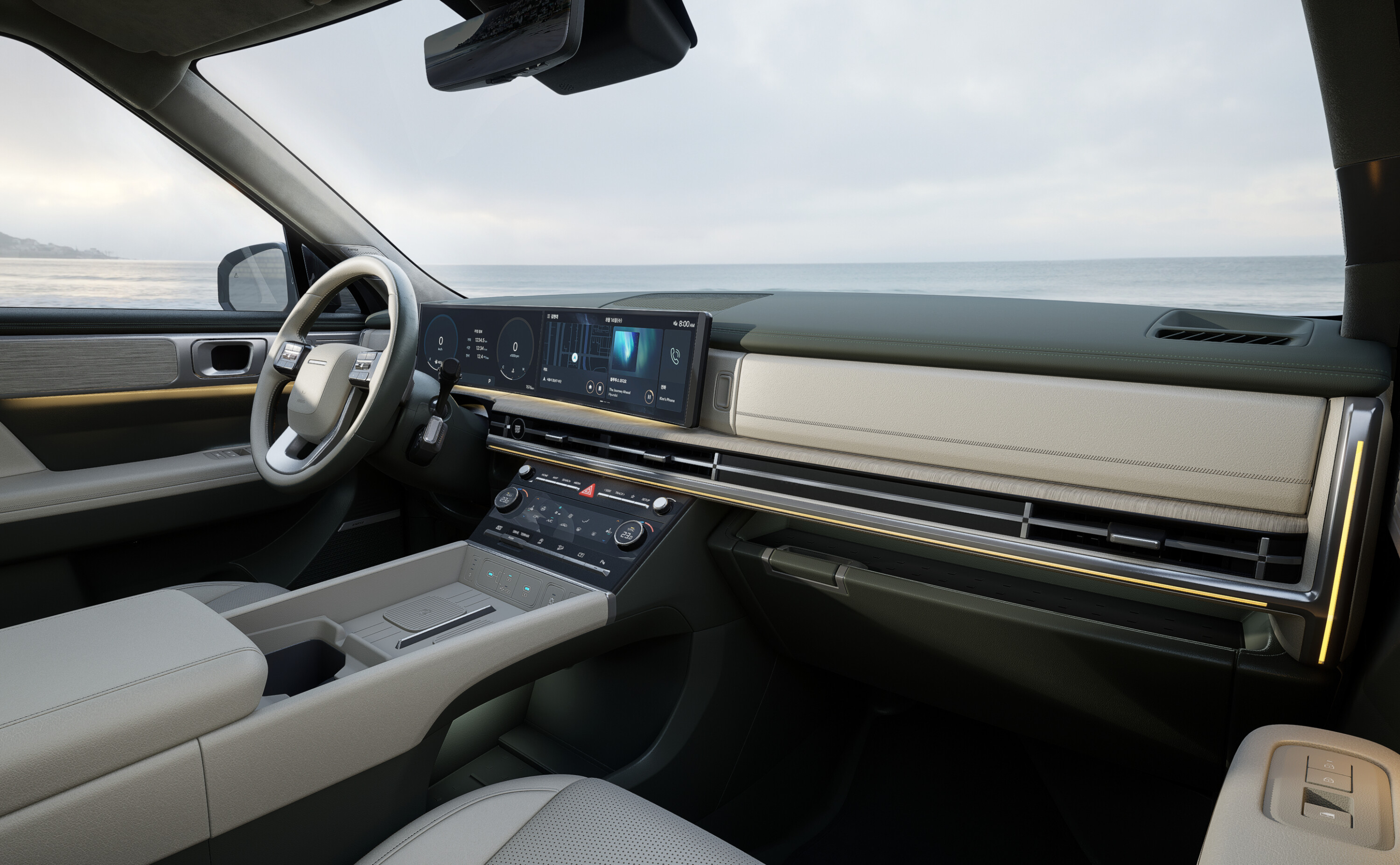
1
This setup comprises a dual 12.3-inch infotainment system and digital instrument cluster, replacing the freestanding 10.25-inch infotainment and hooded 12.3-inch cluster found on current flagship variants.
The updated infotainment system runs Hyundai’s latest software, with over-the-air software updates, USB-C ports, wireless Apple CarPlay and Android Auto, and Bluelink connected-car technology likely.
With the gear shifter moved to the steering column – as seen on Kona and Sonata – the centre console houses a dual wireless phone charger, while the climate panel now features touch controls for certain functions, with fewer buttons than the outgoing model.
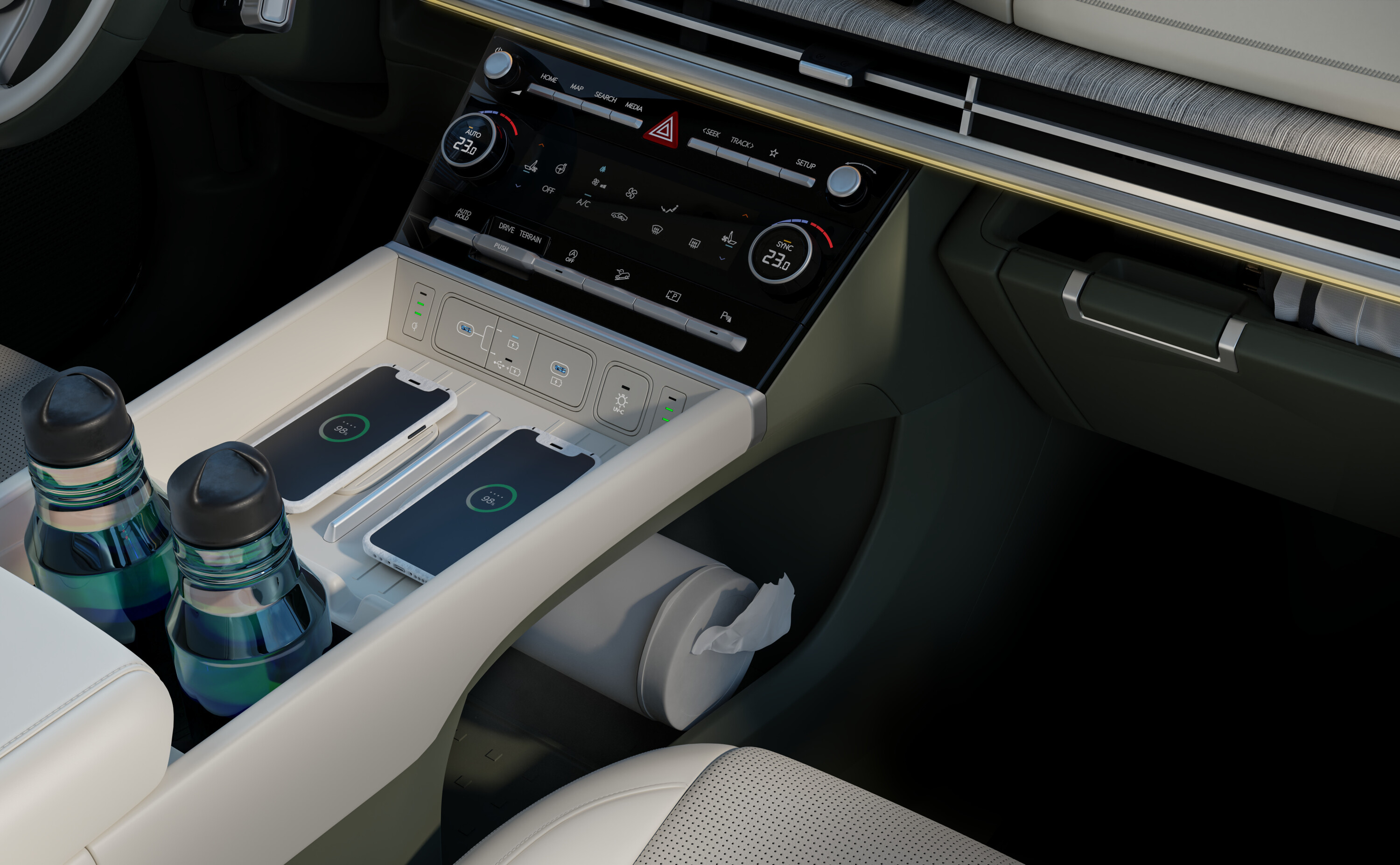
1
It appears to be the first Hyundai vehicle to introduce ultraviolet lighting to sterilise its cabin after the technology was announced in 2020.
The H-shaped design cues continue inside, including the multi-colour ambient lighting and the second-row air vents, which have shifted to the B-pillar like the Ioniq 5 electric SUV.
A storage shelf for the lower centre console and front passenger brings added practicality, while the pictures suggest it could also feature a dashboard-mounted storage compartment.
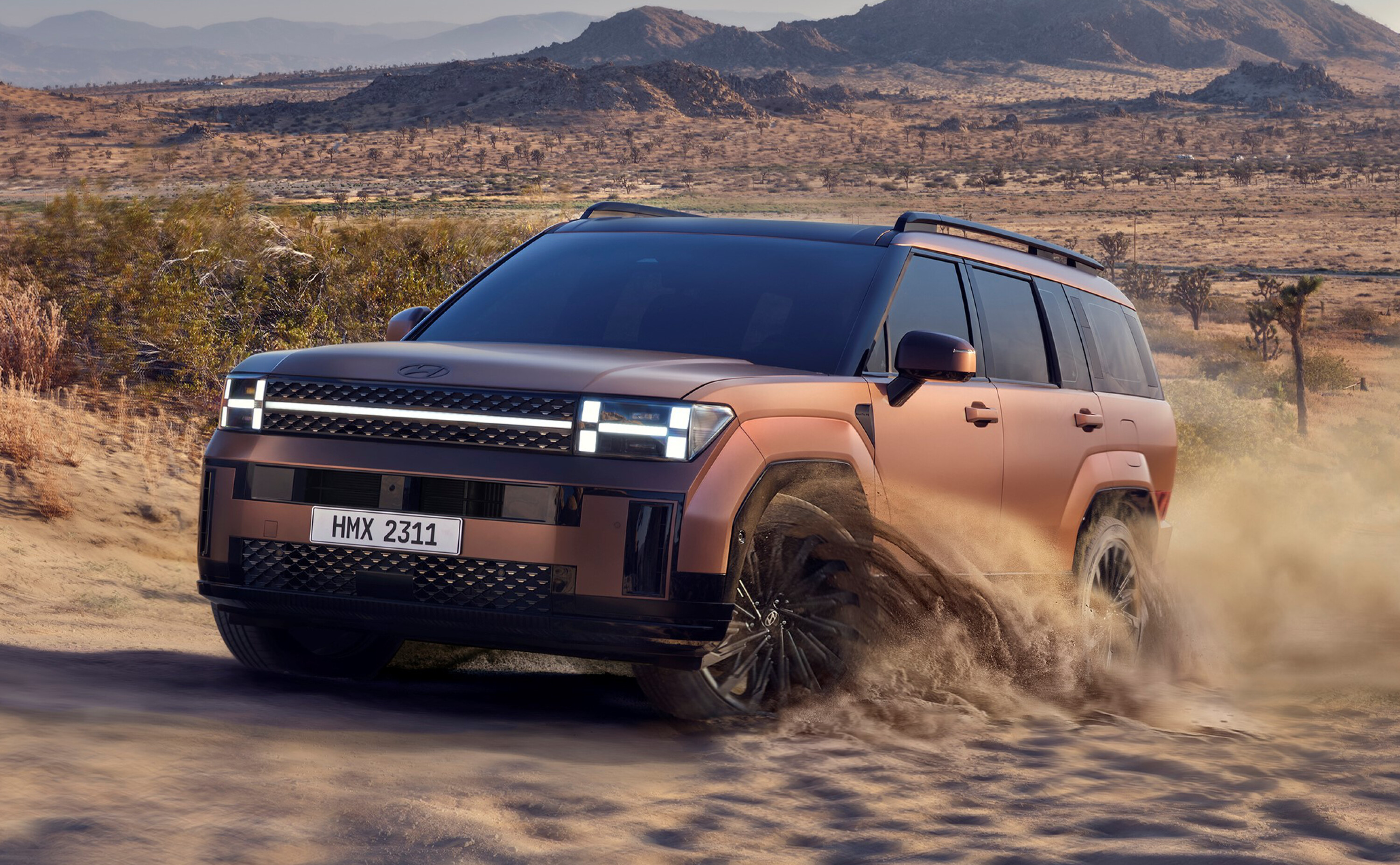
1
As with other recent Hyundai models, the brand has focused on eco-friendly materials, with the suede headliner, floor mats, and second- and third-row seatbacks said to be made from recycled plastics.
While engine details are yet to be confirmed, powertrains are likely to be similar to the current model with 2.5T and HTrac badges seen here, confirming a 2.5-litre turbo-petrol and all-wheel drive.
Other options are likely to include an updated 2.2-litre turbo-diesel and 1.6-litre petrol-electric hybrid and plug-in hybrid powertrains.
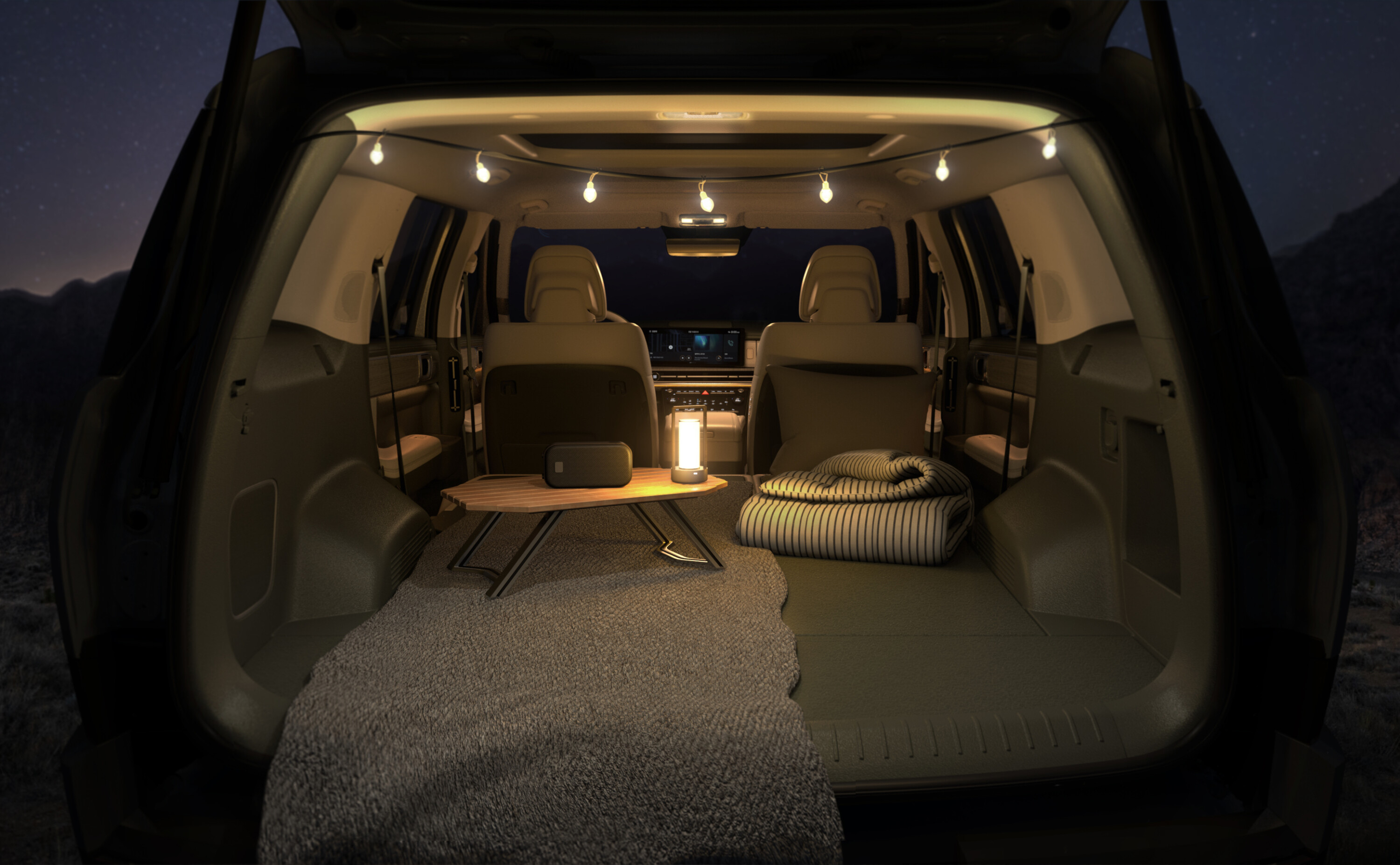
7
It is unknown if the 3.5-litre naturally aspirated V6 – first seen in 2005, with several revisions since – will be retained for the all-new model, or if it’ll be replaced by the more-efficient four-cylinder turbo-petrol in Australia.
The 2024 Hyundai Santa Fe is due in Australia in the first half of next year, with full details to be announced in due course.
VFACTS new-car sales data reveals 3036 examples of the Hyundai Santa Fe have been registered in Australia year-to-date, placing it behind the Kia Sorento (5311), Toyota Kluger (4658), and soon-to-be-discontinued Mazda CX-9 (3382).
Below: The current 2023 Hyundai Santa Fe
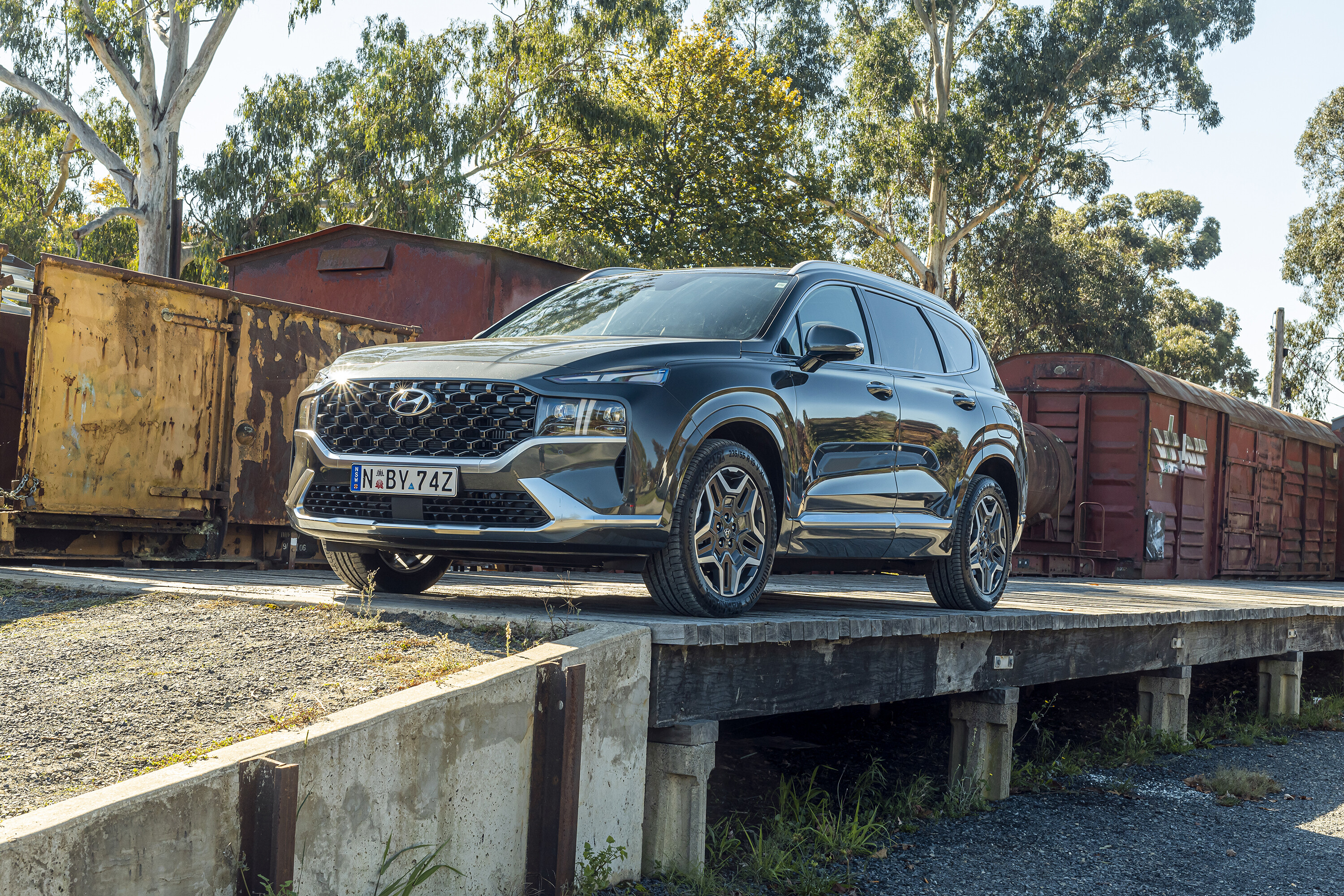
1
MORE
Everything Hyundai
July 2023: The Honda ZR-V is now on sale in Australia, and we’ve driven it
Sorry, CR-V – ZR-V is the medium SUV poised to bring Honda back to the pointy end of the sales race. Read our full review at the link below.
▶ Story continues: Honda ZR-V pricing and features
The 2023 Honda ZR-V medium SUV is now available to pre-order before its mid-year arrival.
Snapshot
- 2023 Honda ZR-V: Full Australian details
- Mid-size SUV arrives mid-year with petrol or hybrid; four grades
- Priced from $40,200 before on-roads
Honda Australia has announced customer orders for the ZR-V have commenced, with the mid-size SUV priced between $40,200 and $54,900 drive-away.
As announced, it will be available in three petrol grades – VTi X, VTi L and VTi LX – and a range-topping e:HEV LX hybrid. All are front-wheel drive and paired to a continuously variable automatic transmission.

1
With the forthcoming all-new Honda CR-V growing in size to rival the Mitsubishi Outlander and Mazda CX-8, the ZR-V will essentially replace the outgoing CR-V as Honda’s direct competitor for the Mazda CX-5 and Toyota RAV4.
Honda Connect connected-car functionality will be complimentary for five years, mirroring the likes of Kia and Hyundai – while others such as Toyota stick with shorter trials.
JUMP AHEAD
- 2023 Honda ZR-V pricing
- 2023 Honda ZR-V features
- Colours
- Engine, drivetrain, and fuel economy
- Safety
- Dimensions
- Warranty and servicing
- Availability

1
2023 Honda ZR-V pricing
All prices are drive-away.
| Model | Pricing |
|---|---|
| VTi X | $40,200 |
| VTi L | $43,200 |
| VTi LX | $48,500 |
| e:HEV LX | $54,900 |

1
2023 Honda ZR-V features
2023 Honda ZR-V VTi X features
| Honda ZR-V VTi X standard features | |
|---|---|
| 17-inch alloy wheels | LED cabin lights |
| 9.0-inch infotainment touchscreen | LED tail-lights |
| Wireless Apple CarPlay | Dual-zone climate control with rear air vents |
| Wired Android Auto | Leather-wrapped steering wheel and gear shifter |
| Eight-speaker sound system | Front and rear parking sensors |
| 10.2-inch digital instrument cluster | Rain-sensing wipers |
| Black cloth upholstery | Frameless auto-dimming rear-view mirror |
| Adaptive LED headlights | 1x USB-1, 1x USB-C, 12V socket (Front) |
| Active cornering lights | 2x USB-C (rear) |
2023 Honda ZR-V VTi L features
2023 Honda ZR-V VTi LX features
2023 Honda ZR-V e:HEV LX features
| In addition to VTi LX | |
|---|---|
| Shift-by-wire gear selector | Tyre repair kit |
| Smart key card | Humidity sensors. |

1
Colours
| Crystal black | Platinum white |
| Platinum grey | Platinum crystal blue. |
| Platinum crystal garnet red |
All colours are included in the ZR-V’s drive-away price.
VTi X is only available in platinum white, grey and crystal garnet red.

1
Engine, drivetrain, and fuel economy
Under the skin, the ZR-V is based on the same Honda Architecture platform as the latest Civic and CR-V, sharing 1.5-litre turbo-petrol or 2.0-litre petrol-electric hybrid powertrains.
The 1.5-litre turbo petrol and CVT combination are installed in the VTi X, VTi L and VTi LX grades, while the e:HEV LX features a 2.0-litre petrol engine, dual electric motors and an e-CVT transmission.
The 1.5-litre turbo produces 131kW and 240Nm, while the hybrid generates 135kW and 315Nm.

1
Safety
The 2023 Honda ZR-V has yet to be tested by ANCAP or Euro NCAP.
Eleven airbags (dual front, front and rear side, curtain, knee, and front-centre) are fitted as standard.
| 2023 Honda ZR-V active safety features | |
|---|---|
| Autonomous emergency braking (vehicle, pedestrian, cyclist) | Traffic jam assist |
| Lane-keep assist | Traffic sign recognition |
| Lane departure warning | Driver attention monitor |
| Road departure mitigation | Rear seat reminder. |
| Adaptive cruise control | |
Blind-spot and rear cross-traffic alerts are limited to the VTi-LX and e:HEV LX.

1
Dimensions
Measuring 4566mm long, the ZR-V is a fraction longer than the Civic hatch, and compares with the 4335mm-long HR-V and 4694mm-long new-generation CR-V. It is 1840mm wide and 1620mm tall.
2023 Honda ZR-V boot space
The Honda ZR-V has a 380-litre boot, rising to 1291 litres with the second-row folded.

1
Warranty and servicing
As per the wider Honda range, the ZR-V is covered by the brand’s five-year, unlimited-kilometre warranty.
Five years of capped-price servicing and complimentary roadside assistance are included.
Honda Australia has yet to detail service pricing for the ZR-V, with a 12-month/10,000km maintenance interval.
Availability
The 2023 Honda ZR-V is expected to arrive in local showrooms mid-year, with customer orders now open.
MORE
Everything Honda
Twenty-six years ago, the original Honda CR-V defined the compact crossover in Australia. Now known as The Medium SUV, Honda’s strength in this segment has waned in the last 12-18 months, with Toyota’s RAV4, Mazda’s CX-5 and Nissan’s fantastic new X-Trail having entered the picture.
As the CR-V has swollen in size for its sixth generation, Honda decided to employ the middleweight ZR-V – or HR-V in America – for Australia’s most popular market segment.
Smaller than a RAV4 or CX-5, the ZR-V is still bigger than the Karoq and Corolla Cross. Available with two rows of seating, three trim levels and your choice of turbo-petrol or hybrid powertrains, the fixed-price ZR-V range spans $40,200-$54,900 drive-away. It seems Honda is more on-the-money with its list prices than when the Civic came along.
And it needs to be on the money, as the ZR-V is the primary puzzle piece in Honda’s ambition to drive its annual sales back above 20,000.
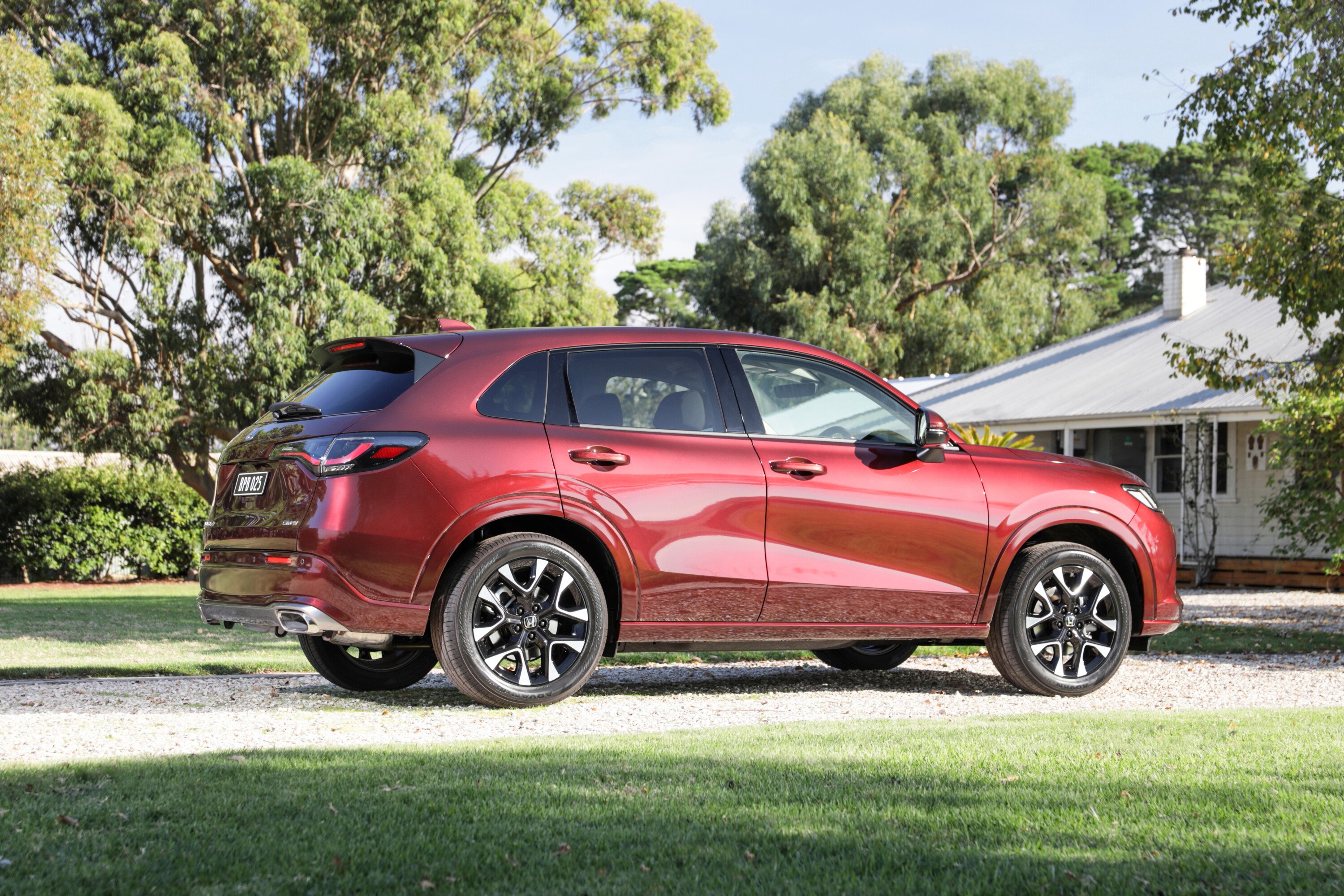
1
JUMP AHEAD
- How much is it, and what do you get?
- How do rivals compare on value?
- Interior comfort, space and storage
- What is it like to drive?
- How much fuel does the Honda ZR-V use?
- How safe is it?
- Warranty and running costs
- VERDICT
- Specifications
How much is it, and what do you get?
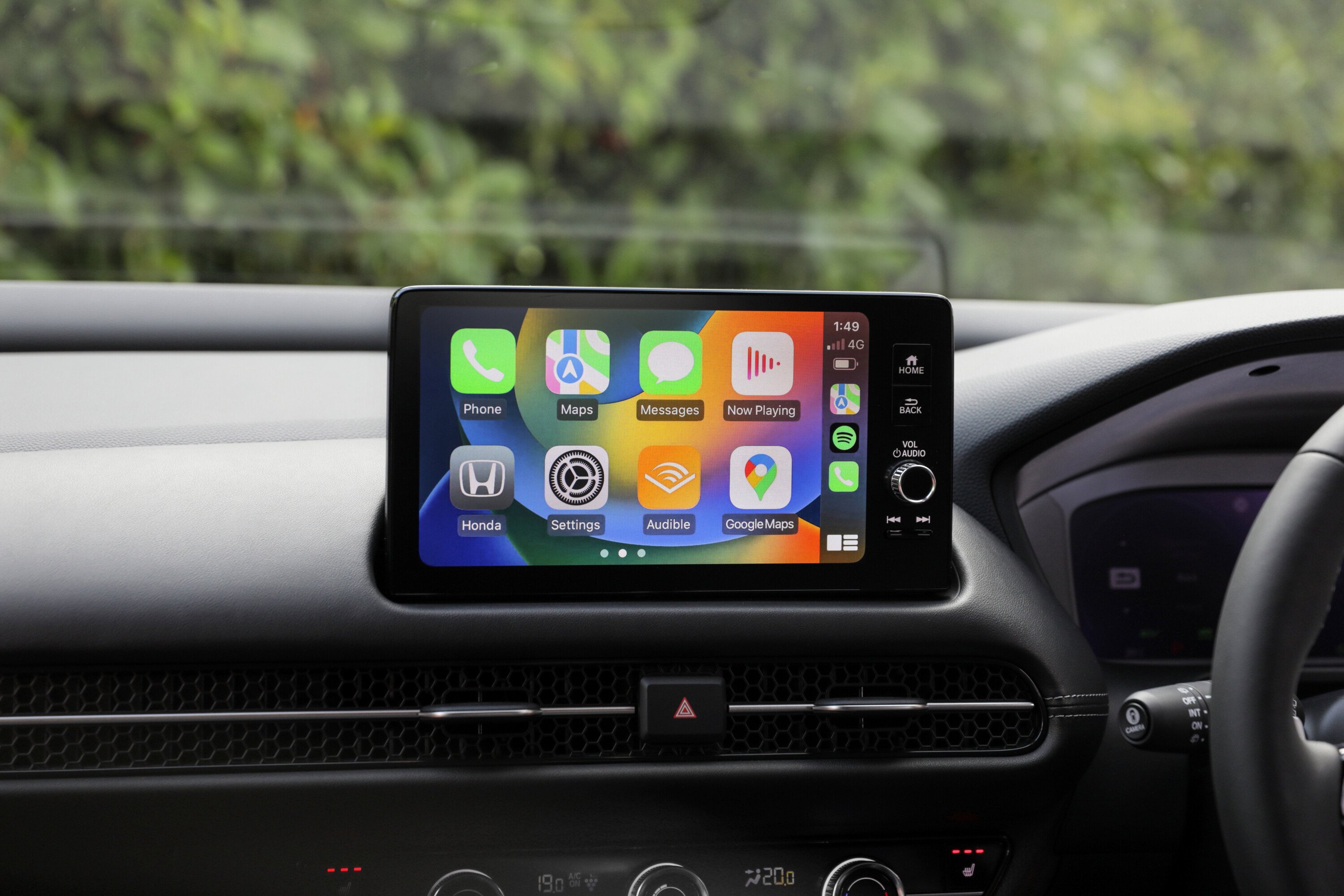
Honda has packed a heap of safety and technology features into the base VTi X, from a crisp 9.0-inch touchscreen and 10.2-inch digital driver’s display to a decent eight-speaker sound system and five years of connected services.
The cloth upholstery is far more sophisticated than the itchy fabric in a RAV4 GX – we don’t reckon you’d feel short-changed saving a couple of bucks on the $40,200 drive-away VTi X.
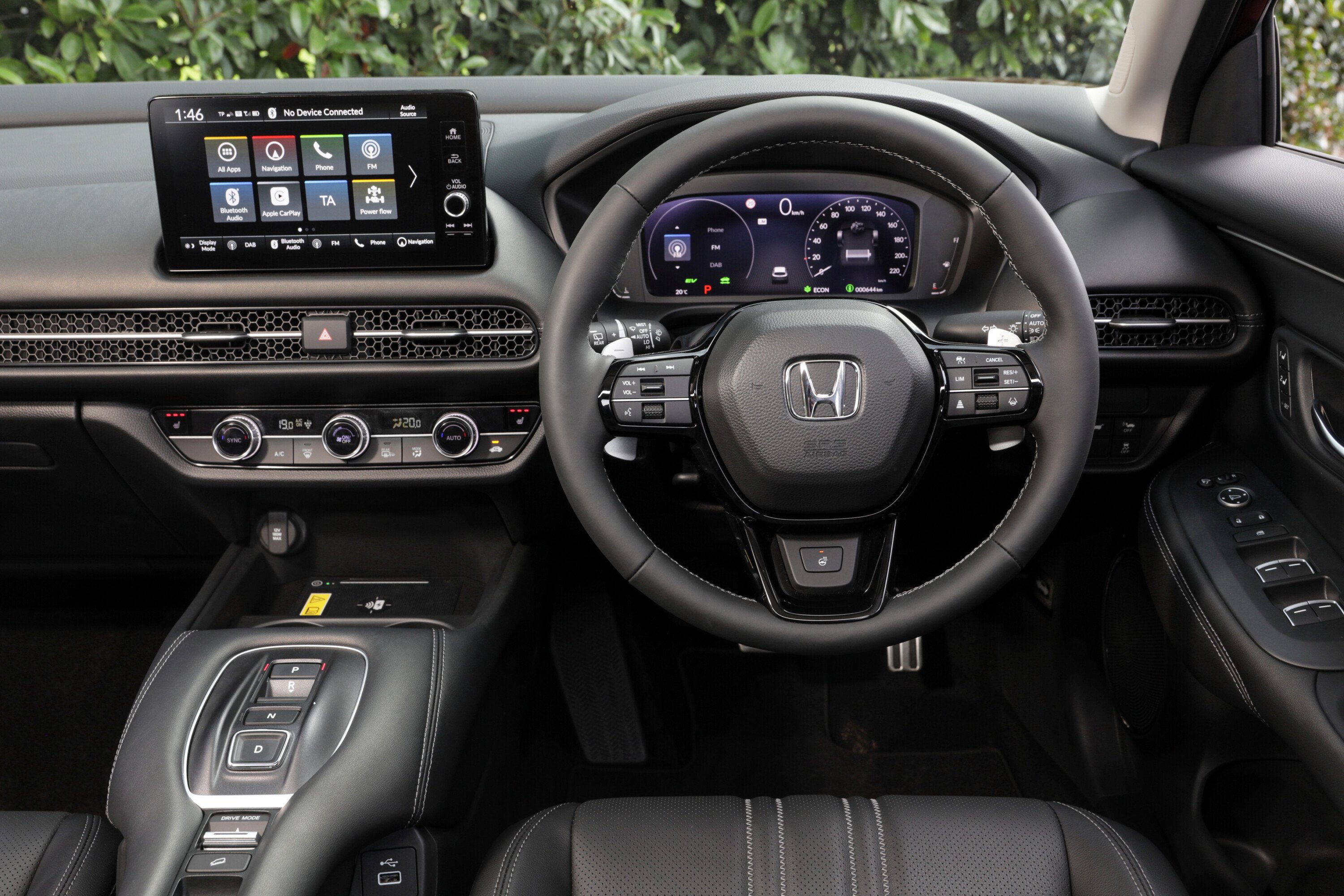
1
A 1.5-litre turbo-petrol four-cylinder is standard fare, kicking out 131kW/240Nm – exactly the same as the Civic. Grunt is sent via an automatic continuously variable transmission (CVT) to the front wheels, with no all-wheel-drive models coming to Australia for now.
If you want a new ZR-V immediately in Crystal Garnet, Platinum grey or Platinum white, the VTi X is the only one on dealer forecourts. Putting an order in for a hybrid (at the time of writing) will see you waiting until December.
| Honda ZR-V VTi X standard features | |
|---|---|
| 17-inch alloy wheels | LED cabin lights |
| 9.0-inch infotainment touchscreen | LED tail-lights |
| Wireless Apple CarPlay | Dual-zone climate control with rear air vents |
| Wired Android Auto | Leather-wrapped steering wheel and gear shifter |
| Eight-speaker sound system | Front and rear parking sensors |
| 10.2-inch digital instrument cluster | Rain-sensing wipers |
| Black cloth upholstery | Frameless auto-dimming rear-view mirror |
| Adaptive LED headlights | 1x USB-1, 1x USB-C, 12V socket (Front) |
| Active cornering lights | 2x USB-C (rear) |
Moving up to the $43,200 drive-away, the VTi LX brings a few extra niceties inside and out as well as the option of Crystal Blue and Crystal black paintwork, on top of the existing three colours.
| In addition to VTi X, VTi L gets | |
|---|---|
| 18-inch alloy wheels (silver) | Heated side mirrors |
| Black leather-accented seats with cloth inserts | Rear privacy glass |
| Heated front seats | Paddle shifters |
| Hands-free electric tailgate with walk-away close | |
1
We’ve focused the bulk of our time on the flagship VTi LX grades in both petrol ($48,500) and hybrid ($54,900) guises, as Honda informs us these are in hot demand.
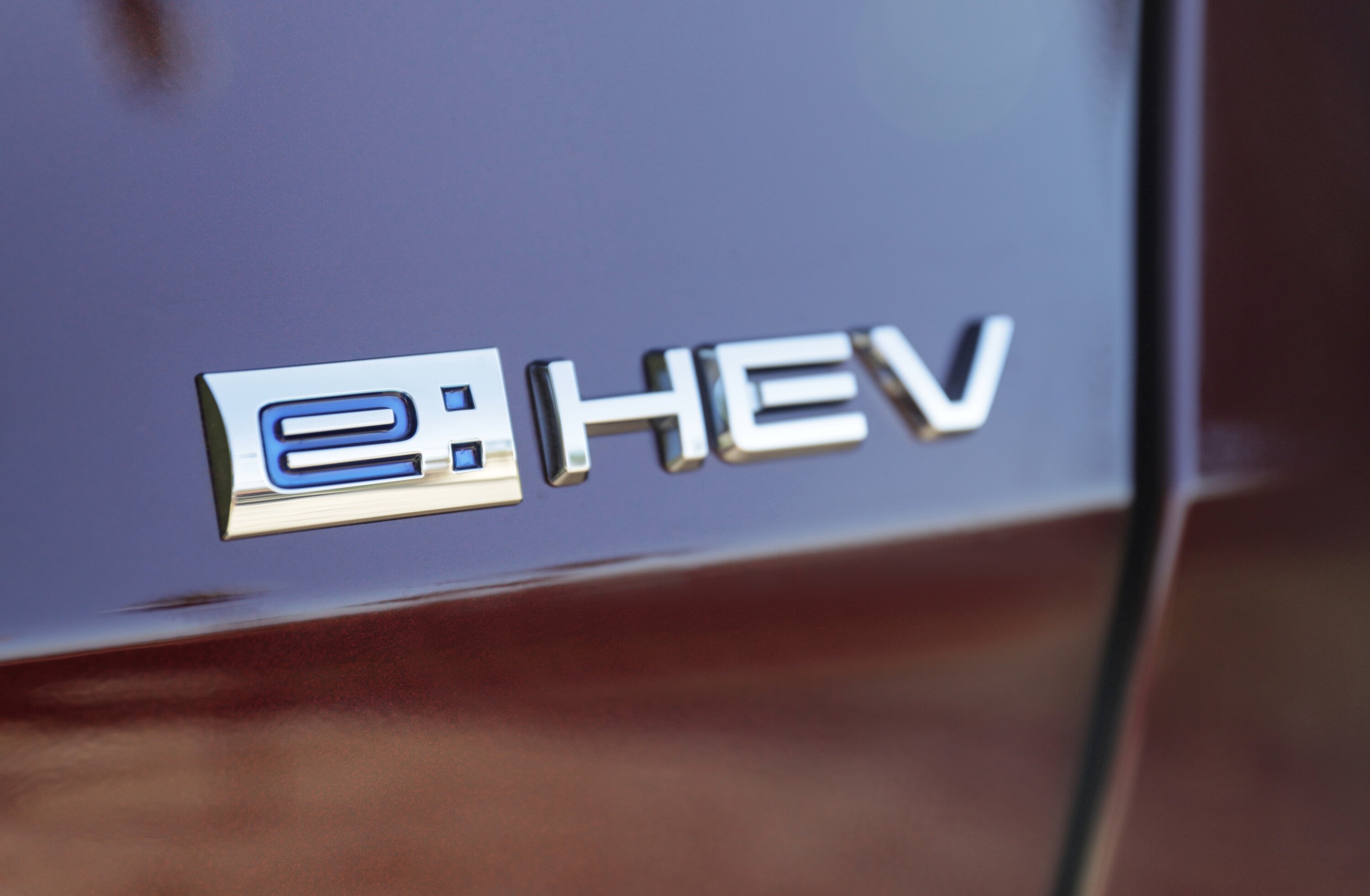
Identifiable by its blue badge highlights, the hybrid marries a 2.0-litre four-cylinder with an electric motor for 135kW/320Nm and costs $6400 more than the turbo-petrol.
Honda’s hybrid strategy will see more petrol-electric trim levels added down the lower end of the range in the future, though timing is yet to be determined.
| In addition to VTi L, the VTi LX gets | |
|---|---|
| 18-inch alloy wheels (two-tone) | Black leather upholstery |
| Eight-way power adjust driver’s seat with two-position memory | Four-way power-adjustable passenger seat |
| Heated front and rear seats | Heated steering wheel |
| 12-speaker Bose audio system | Colour-matched body cladding |
| Satellite navigation | Wireless phone charger |
| LED interior door illumination | Drive mode selector (normal, sport, econ) |
| 360-degree surround-view camera | Reverse auto-tilt function for side mirrors |
| LED interior door illumination | Alloy sports pedals |
| Blind-spot alert | Rear cross-traffic alert. |
1
How do rivals compare on value?
Those who like to haggle are vocal about their disdain for agency models but for many (including this writer) the idea of a fixed, no-haggle price is extremely enticing… providing it’s on the money.
Honda missed the mark on Civic pricing, a fact the ZR-V e:HEV LX exemplifies – it uses the same platform and powertrains in a bigger package yet costs $100 less than the equivalent small car.
Against its direct rivals, the ZR-V compares very favourably on price, though it is a more compact vehicle – especially in boot space terms – than other medium SUVs. See the table below for a comparison between the top-spec ZR-V and its rivals.
Scroll horizontally to see the full table below.
| Honda ZR-V VTi LX Petrol | Honda ZR-V e:HEV LX | Toyota RAV4 Cruiser hybrid FWD | Mazda CX-5 G25 GT SP | Nissan X-Trail Ti e-Power | |
|---|---|---|---|---|---|
| Price (drive-away) | $48,500 | $54,900 | $56,835 | $54,827 | $59,161 |
| Drivetrain | |||||
| Engine | 4cyl, 1.5-litre, DOHC, turbo-petrol, direct-injected | 4cyl, 2.0-litre, DOHC, atkinson cycle, petrol | 4cyl, 2.5-litre w/ front electric motor | 4cyl, 2.5-litre, DOHC, direct-injected | 3cyl, 1.5-litre, DOHC, VCR, turbo-petrol, direct-injected |
| Drive | Front-wheel | front-wheel | front-wheel | all-wheel | all-wheel |
| Power | 131kW | 135kW | 160kW | 140kW | 157kW |
| Torque | 240Nm | 320Nm | N/A | 252Nm | NA |
| Gearbox | CVT | Electric motor drive, combustion motor as generator | e-CVT | 6 spd automatic | Electric motor drive, combustion motor as generator |
| Chassis | |||||
| L/W/H/Wu2013B | 4568/1840/1620/2655mm | 4600/1855/1685/2690mm | 4574/1845/1680/2700mm | 4680/2065*/1725/2705mm | |
| Track (F/R) | 1591/1605mm | 1605/1625mm | 1595mm | 1585/1590mm | |
| Weight (kerb) | 1510kg | 1586kg | 1690kg | 1693kg | 1903kg |
| Boot | 370L | 542-580L | 438L | 575L | |
| Fuel/tank | 57L | 55L | 58L | 55L | |
| Economy (combined ADR81/02) | 7.2L/100km | 5.0L/100km | 4.7L/100km | 7.4L/100km | 6.1L/100km |
| Features | |||||
| Upholstery | Leather | Leather | Leather | Leather | |
| Touchscreen size | 9.0-inch, wireless smartphone mirroring | 8.0-inch, wireless CarPlay/wired Android Auto | 10.25-inch non-touch, wireless smartphone mirroring | 12.3-inch, wireless Apple CarPlay/wired Android Auto | |
| Connected services subscription | 5 years included | 12 months included | N/A | N/A | |
| Warranty | 5 years/unlimited kilometres | 5 years/unlimited kilometres | 5 years/unlimited kilometres | 5 years/unlimited kilometres | |
| Service intervals | 12 months/10,000km | 12 months/15,000km | 12 months/15,000km | 12 months/10,000km | |
1
Interior comfort, space and storage
In design terms, it makes good sense that this ZR-V replaces the HR-V in the US, as its vanilla body styling (that reminds of both the Maserati Levante and Ford Escape) and rear light design are reminiscent of the second-gen small SUV.
Luckily for Honda, what matters more to a family SUV buyer is the ZR-V’s excellent cabin practicality.
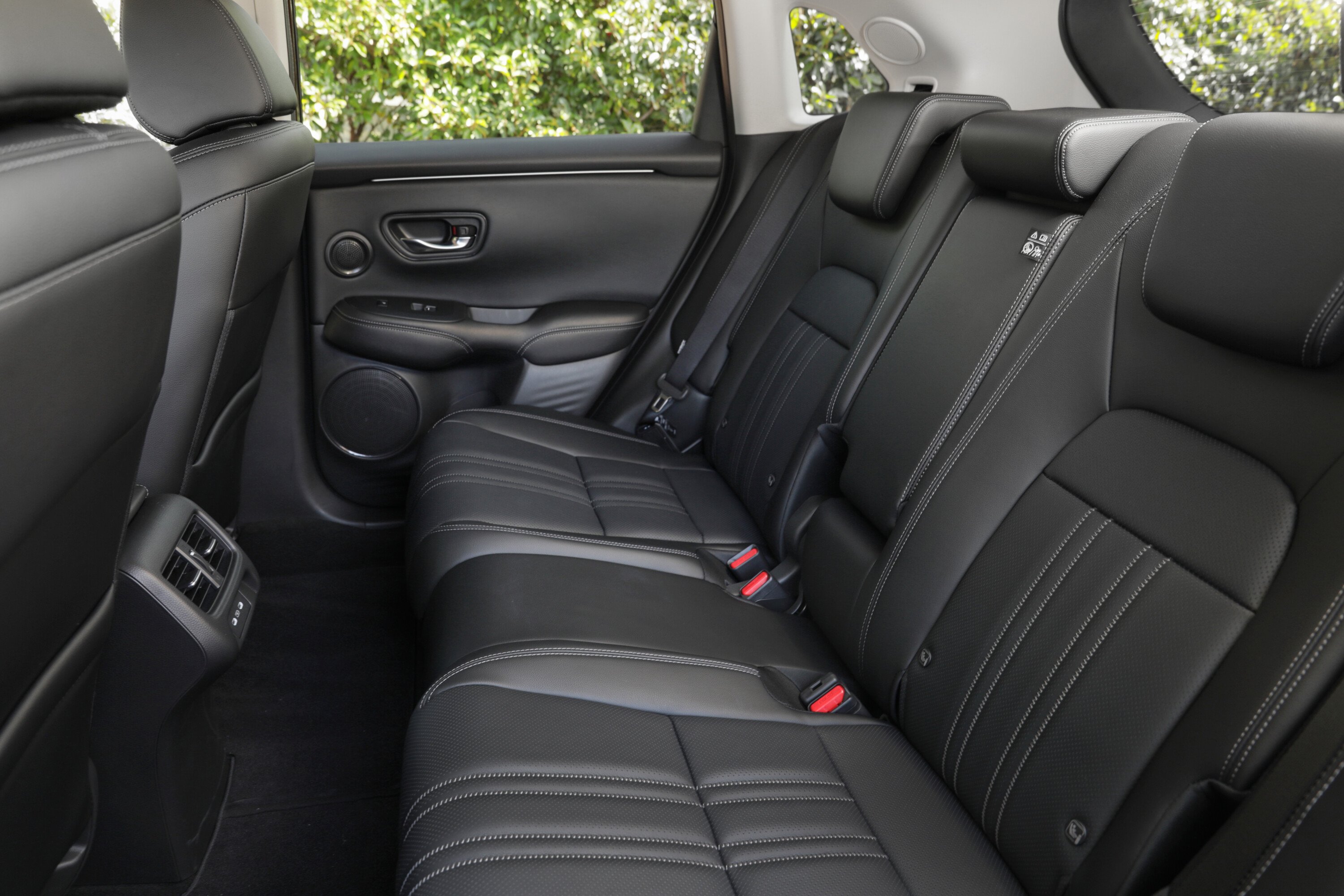
With a shorter body and wheelbase than a Mazda CX-5, it’s impressive how much space Honda has found in the second row. At 188cm I had headroom to spare and good amounts of legroom. The middle seat isn’t raised and there’s no transmission tunnel, either, so three across will be relatively comfy.
Only the high-set floor proved to be an issue, crimping toe room under the front seat and leaving my knees dangling in the air. Adjustable air vents, a fold-down armrest with cup holders, two USB-C charge points, soft-touch door tops and a snug bottle holder make up the rest of the back seat.
2
Honda’s persevered with a roof-mounted middle seatbelt and child seat tether in the ZR-V which, although perfectly functional, is ugly in practice.
ISOFIX points are provided for the outboard positions of the rear bench, and the doors open quite wide.
The boot measures 370 litres in the LX grade, which is the smallest of the conventional medium SUV set. It’s less voluminous on paper than small SUVs such as the Kia Seltos and Haval Jolion, too.
Folding the 60:40 split backrest is easy and liberates 1302L of space to the roof or 866L to the windows. In practice, that’s enough for a road bike with just the front wheel off or some flat-pack furniture. The cargo cover is sturdy and sound-insulated, while under the boot floor of petrol models is a space-saver spare tyre (the hybrid makes do with goo).
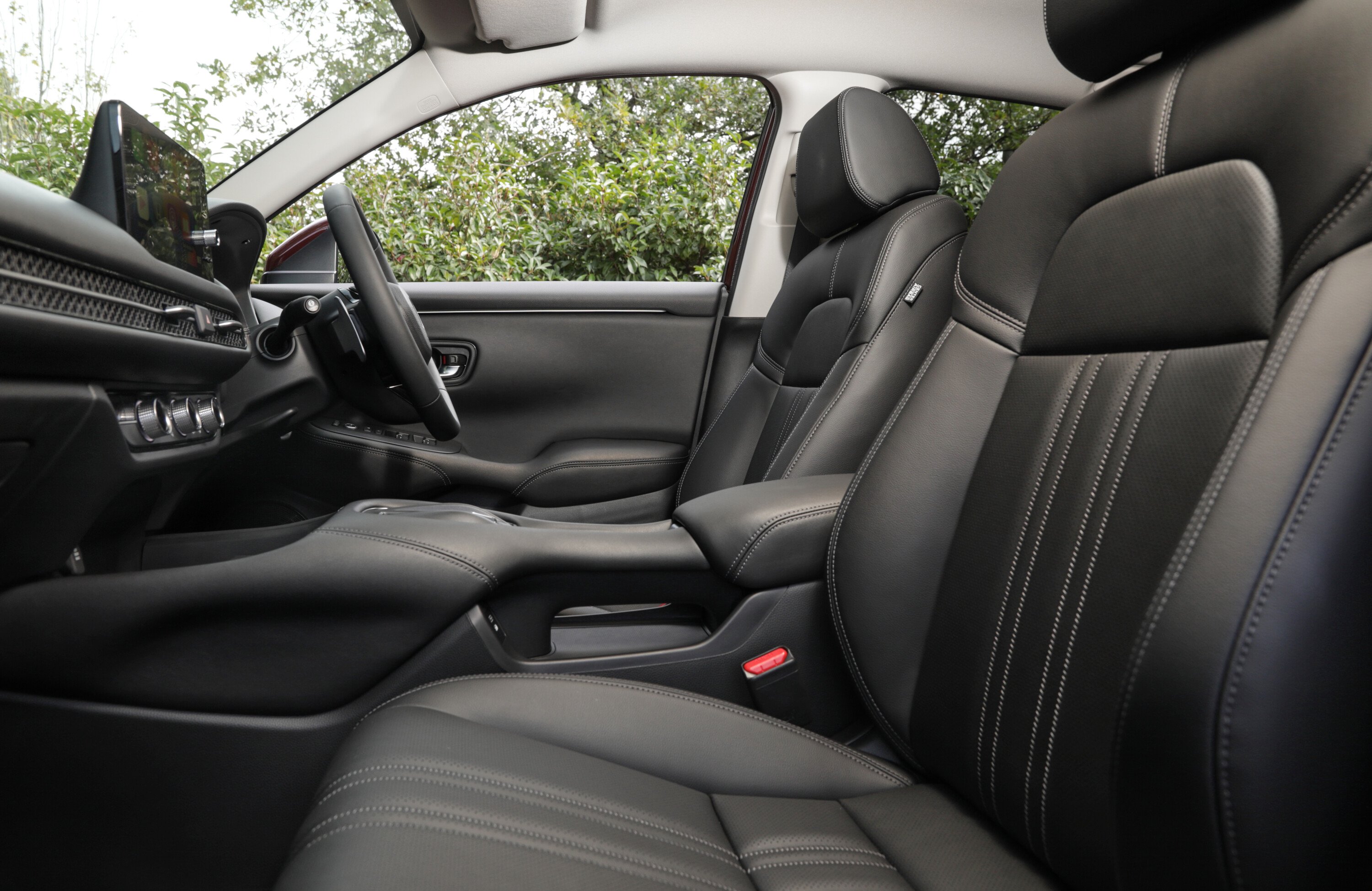
1
Physical climate controls and buttons for the steering wheel/seat heating are a welcome respite from increasingly touch-heavy cabins.
The power tailgate can be operated via a kick sensor on the LX, and there’s a nifty lock-as-you-walk-away (think Cool Guys Don’t Look at Explosions) function for when you have heavy boxes to carry. Following in the footsteps of the second-gen HR-V, the tailgate comes down a long way for a low load lip. The only thing not to like about the tailgate is the cluttered ‘HondaZR-V’ badge.
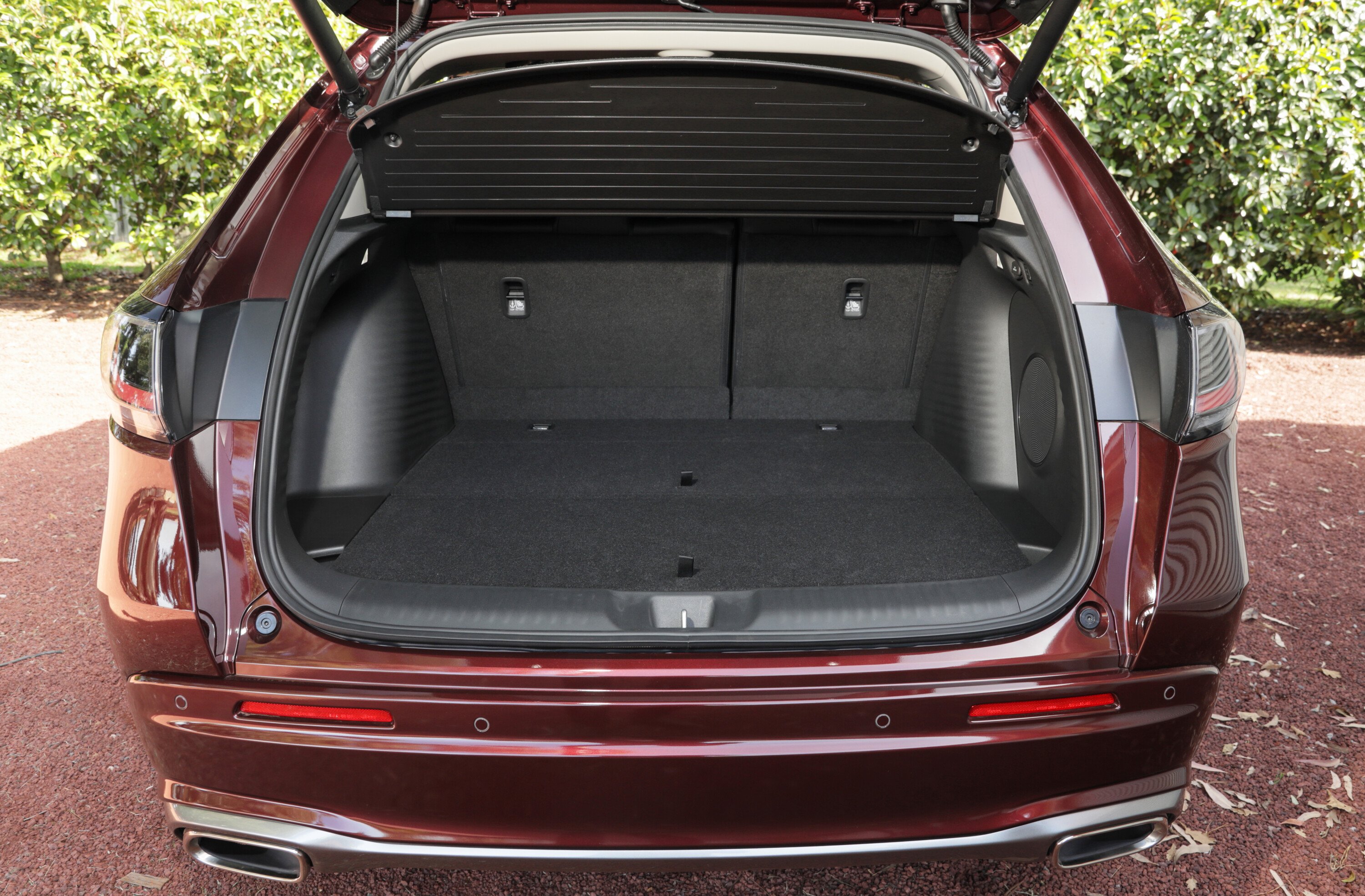
4
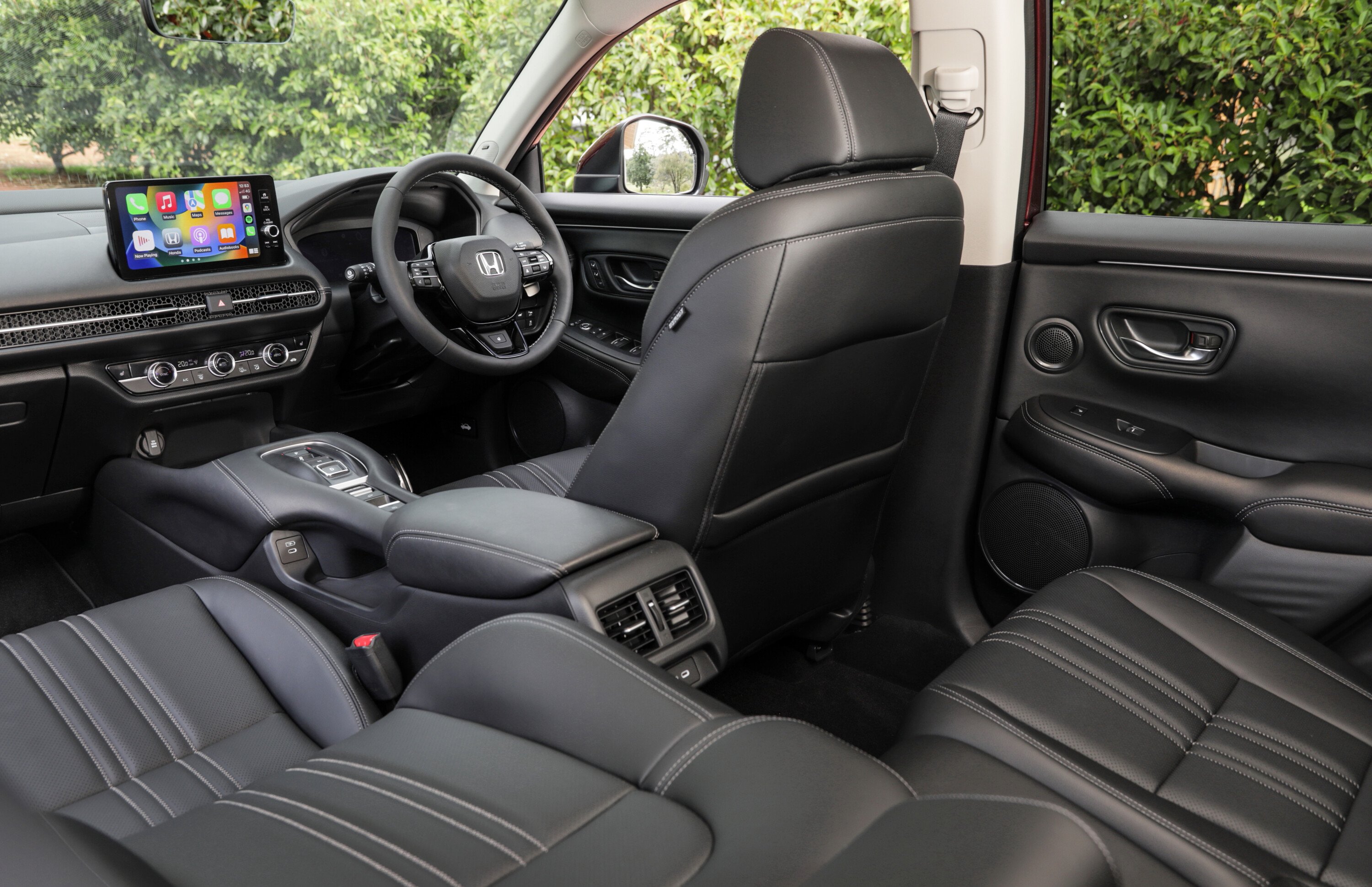
In the front of the LX grade, you get leather upholstery on your heated eight-way power-adjustable driver’s (and four-way passenger) seat. They’re pretty comfy and supportive, these pews, except for the lack of lumbar adjustment. There’s also no sunroof offered on any ZR-V – Honda executives said they skipped the moonroof due to its effect on the SUV’s design.
Physical climate controls and buttons for the steering wheel/seat heating are a welcome respite from increasingly touch-heavy cabins. The knurled knobs and volume dial are immensely satisfying to turn, and the local team confirms it’s a Honda engineer’s job to obsess over getting the ‘click frequency’ just right in the cabin.
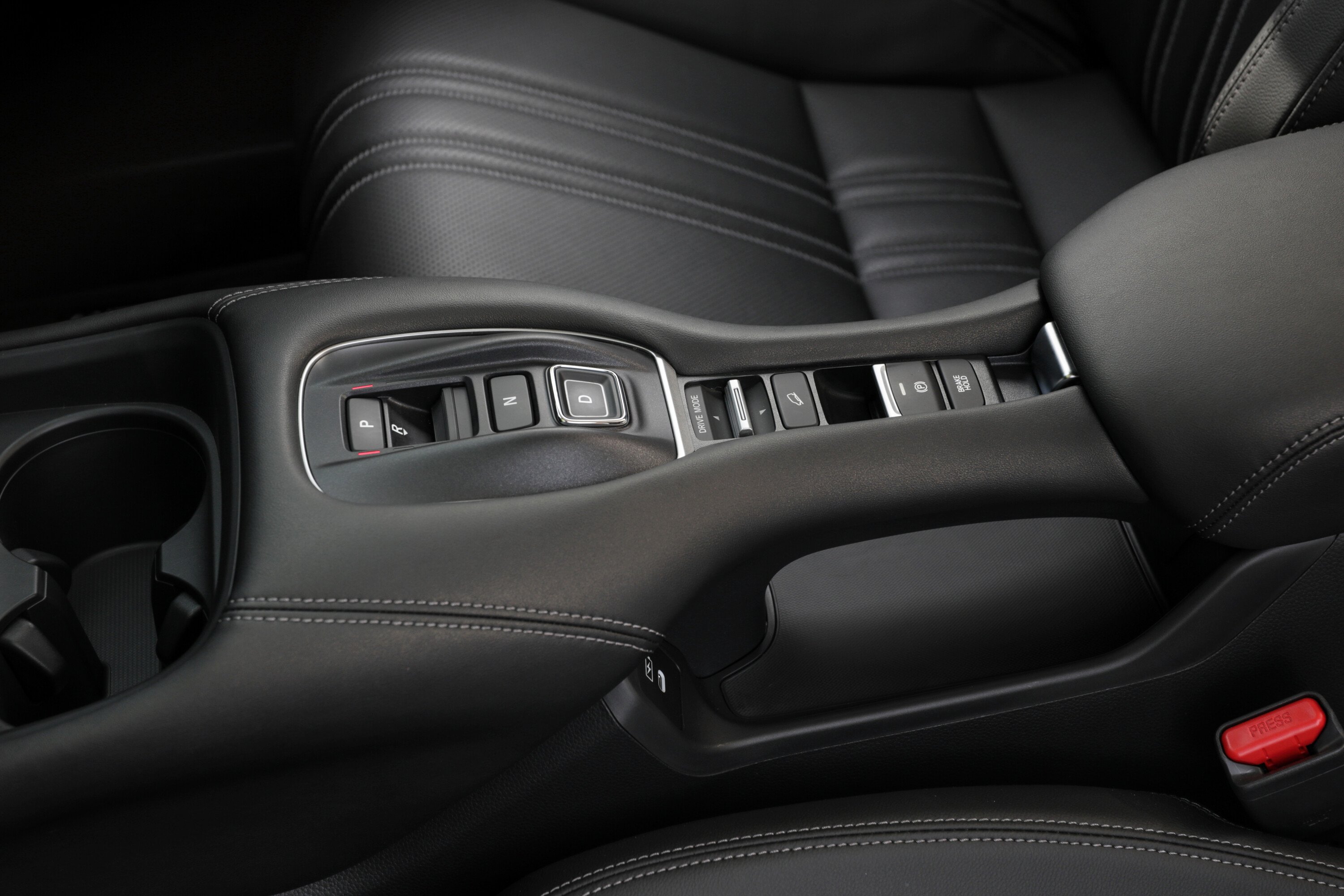
2
It isn’t a carbon copy of the Civic’s cabin, replacing that car’s stalk air-vent controls for paddles.
I reckon Honda allowed pets into the ZR-V design studios, too, as the central floating console and armrests look suspiciously bone-shaped, like a dog’s chew toy. Material quality is excellent, and the cabin generally feels sturdy.
The 9.0-inch touchscreen is a good size and retains some physical shortcut buttons. Wireless Apple CarPlay (and wired Android Auto) is obliged by a wireless charging pad, and there is one conventional USB and one USB-C charging socket. The door bins tightly grip 700mL water bottles, and there are deep cup holders ahead of the shifter. Beneath the armrest is a covered cubby perfect for valuables.
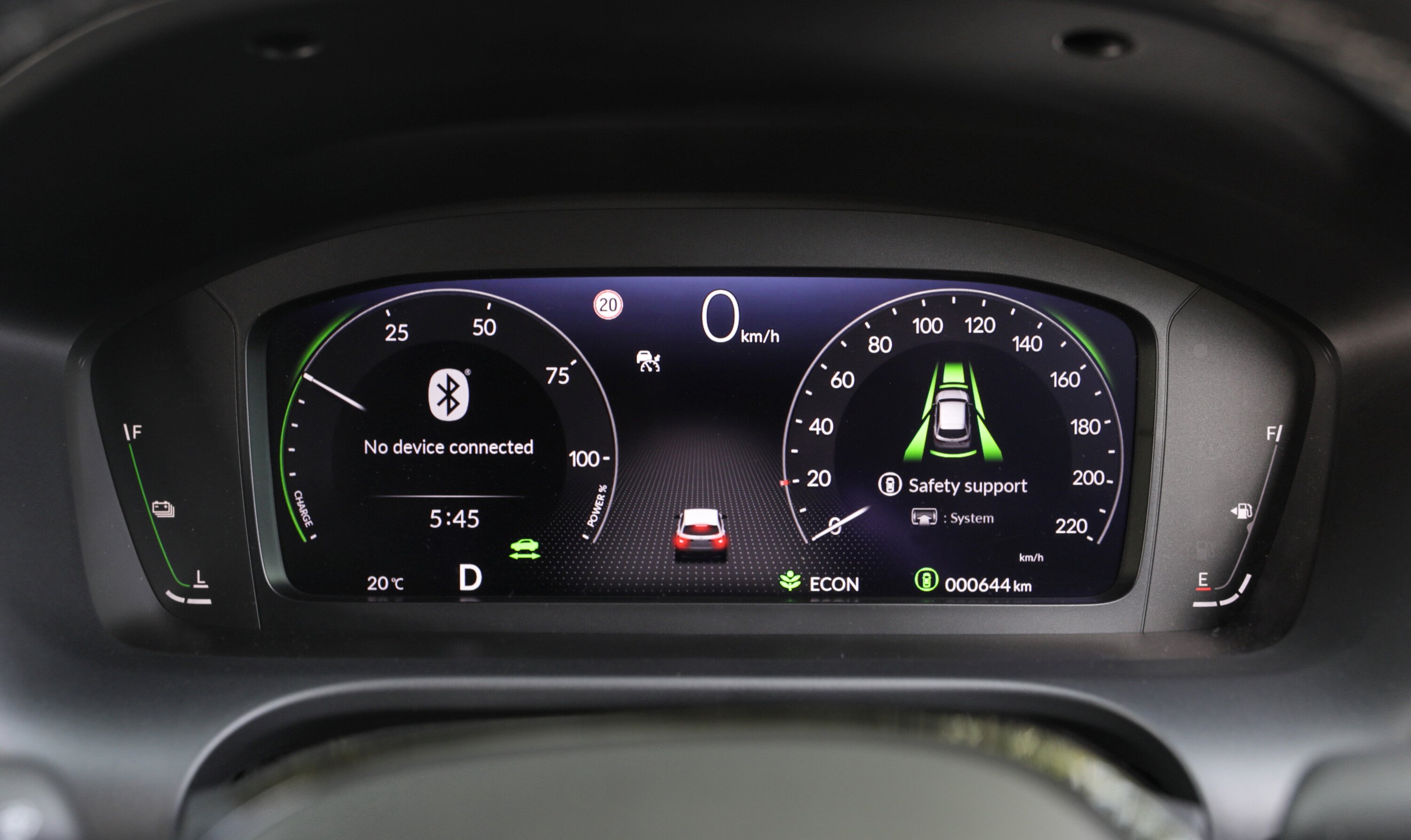
3
What is it like to drive?
Strapping into the petrol ZR-V first, it’s no surprise that this medium SUV feels familiar as underneath is the Civic’s basic chassis and 1.5-litre turbo-petrol four-cylinder.
It fires into life with minimal noise thanks to excellent refinement. Even when accelerating onto the freeway, the 240Nm torque peak beginning at 1700rpm means there’s no need for the engine to churn ear-piercing revs and the responsive CVT has been tuned to harness this mid-range motivation.
The ZR-V is brisk enough yet rarely troubles the front tyres’ traction. This is a good thing, as the ZR-V is only available in FWD in Oz. Forward and side visibility is good, though the small rear windscreen makes looking out the back a little difficult.
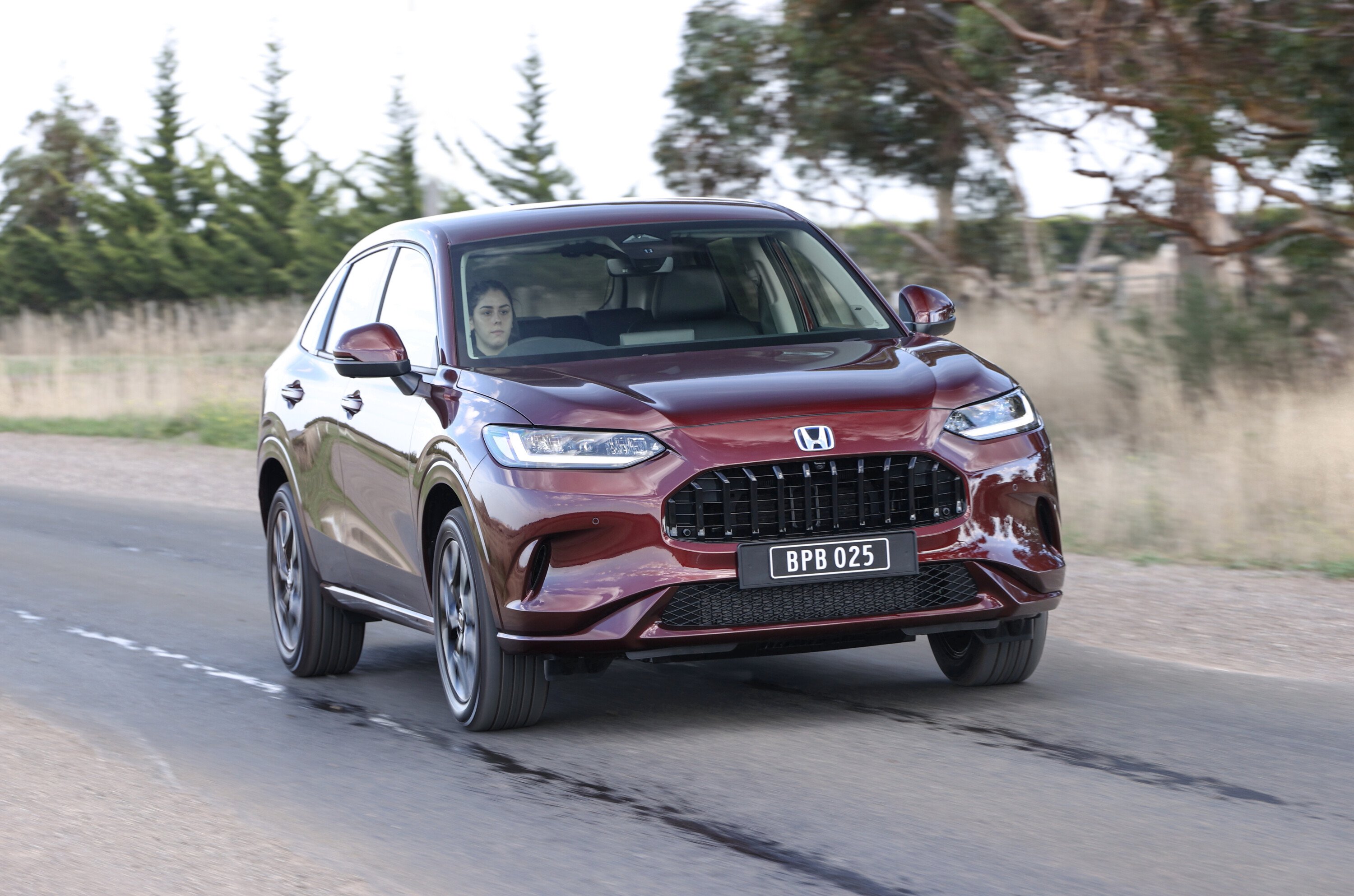
1
Making our way through Sydney’s South Western suburbs and over their broken tarmac, the ZR-V’s ride quality is impressive.
The Honda’s body stays flat and there’s plenty of wheel travel to soak up sharp bumps, although it isn’t quite as plush as a Nissan X-Trail.
As a result, the agile ZR-V resists body roll through the following twists and turns of Sydney’s Royal National Park. Being lighter than most rivals (1510kg for the petrol) helps, as does the responsive and weighty steering feel in Sport mode.
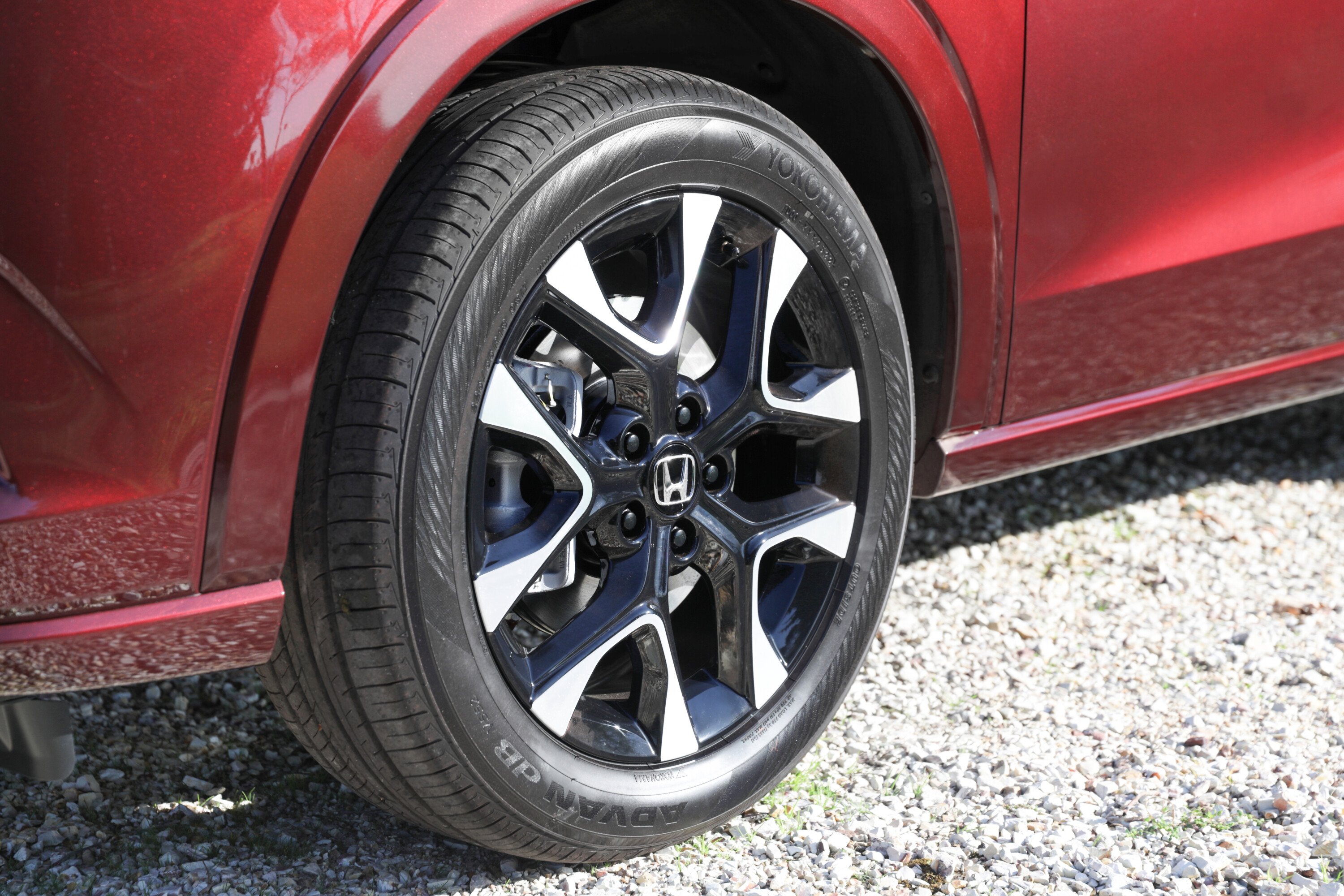
Once you’re in the meat of the left pedal (beyond some initial squish) it’s easy to smoothly modulate the ZR-V’s brakes, too. If there’s one complaint, it’s tyre roar from the 225/55R18 Advan dB552s which penetrates the ZR-V’s cabin on coarse-chip bitumen.
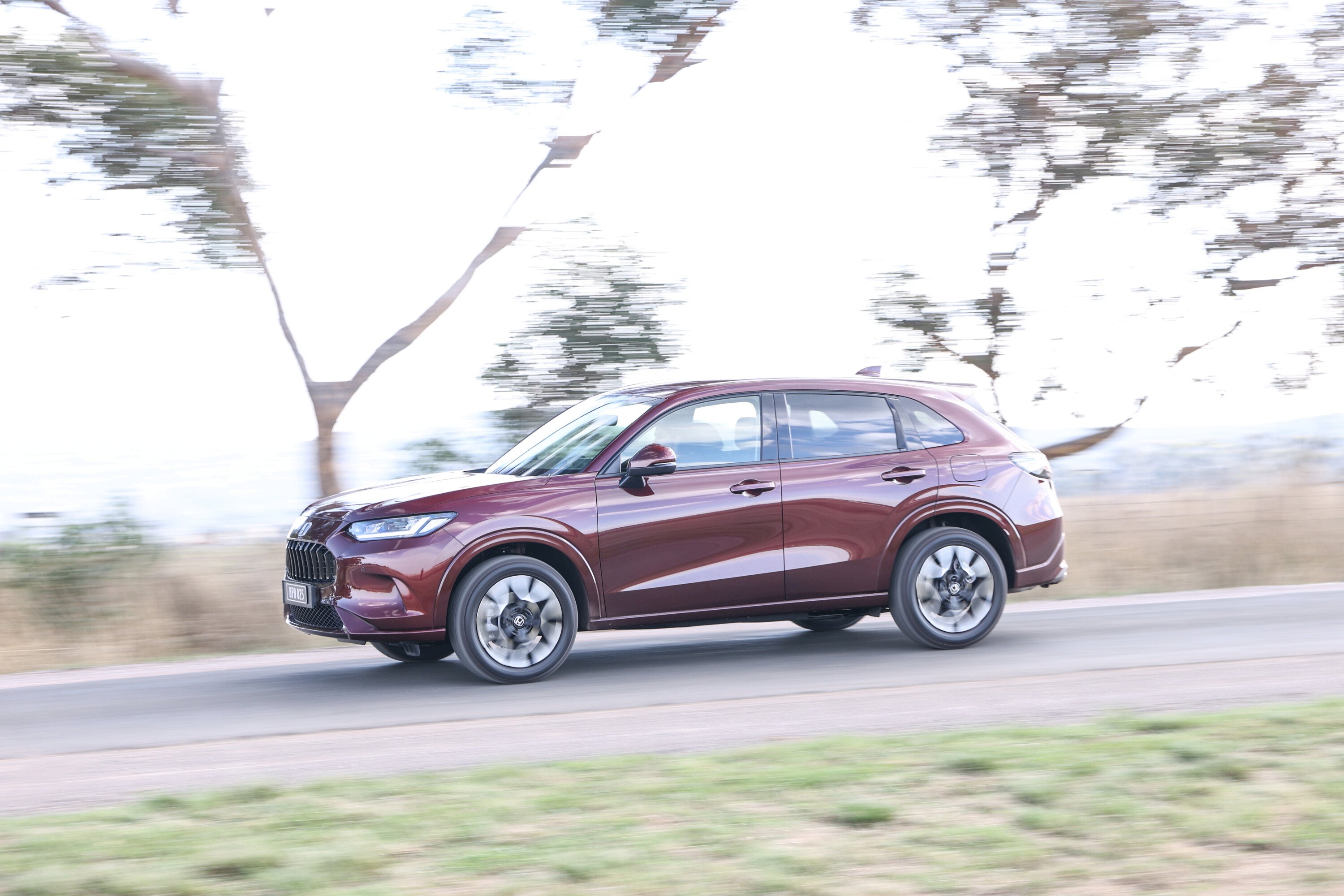
1
And the hybrid?
A quick pee break and swap into the hybrid introduces a couple of doubts. Starting with the push-button gear selector which, unlike the shift-by-wire in a Nissan X-Trail, fails to liberate any useful interior space. It does look pretty cool, at least.
Heading straight back into a set of downhill bends, the hybrid feels heavy on the road, yet its steering tune is lighter with a confidence-eroding dead-zone just off-centre. The brake feel is at least natural, and the extra 76kg of battery and electric gubbins seem to settle the low-speed ride even more.
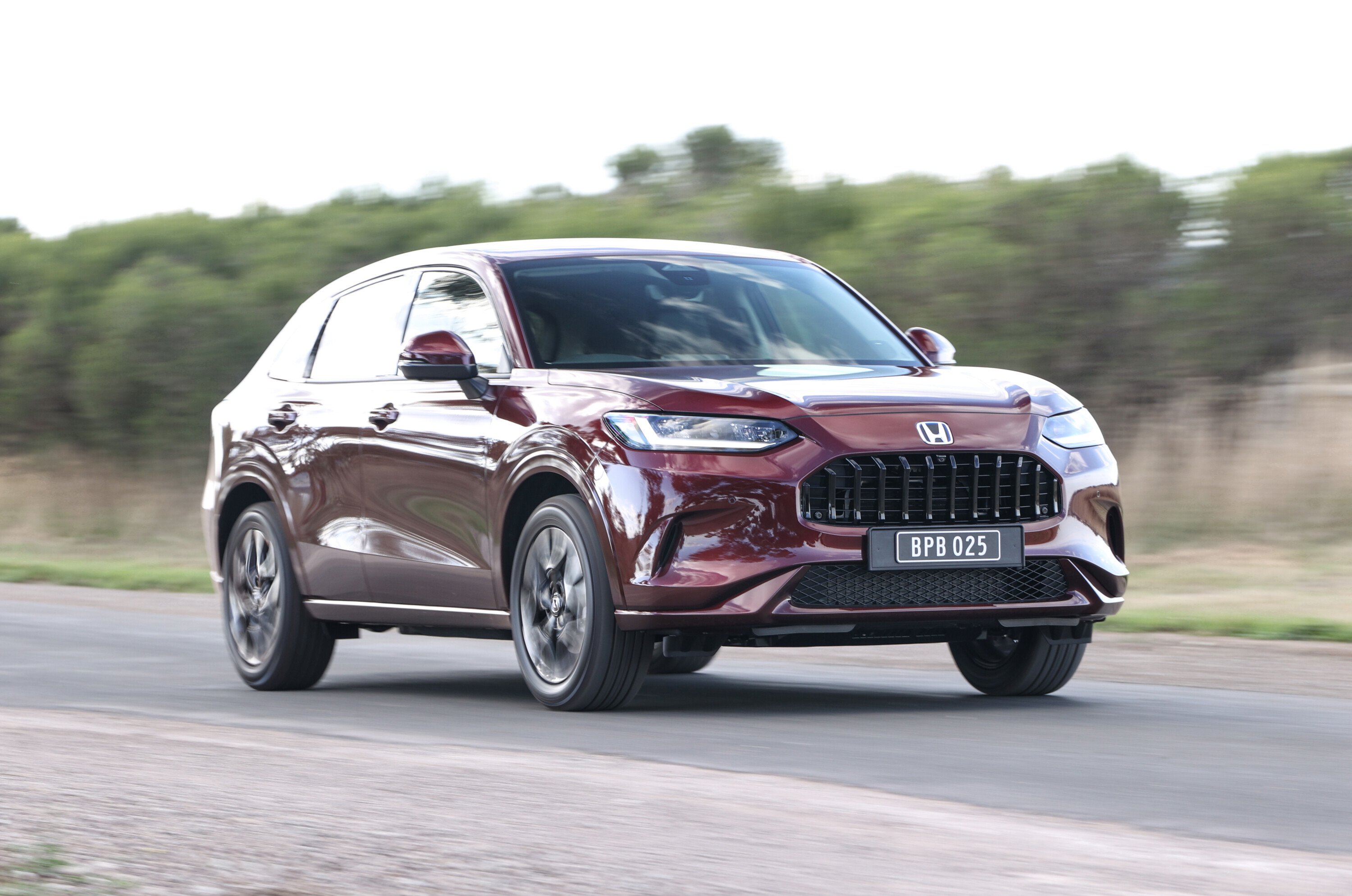
1
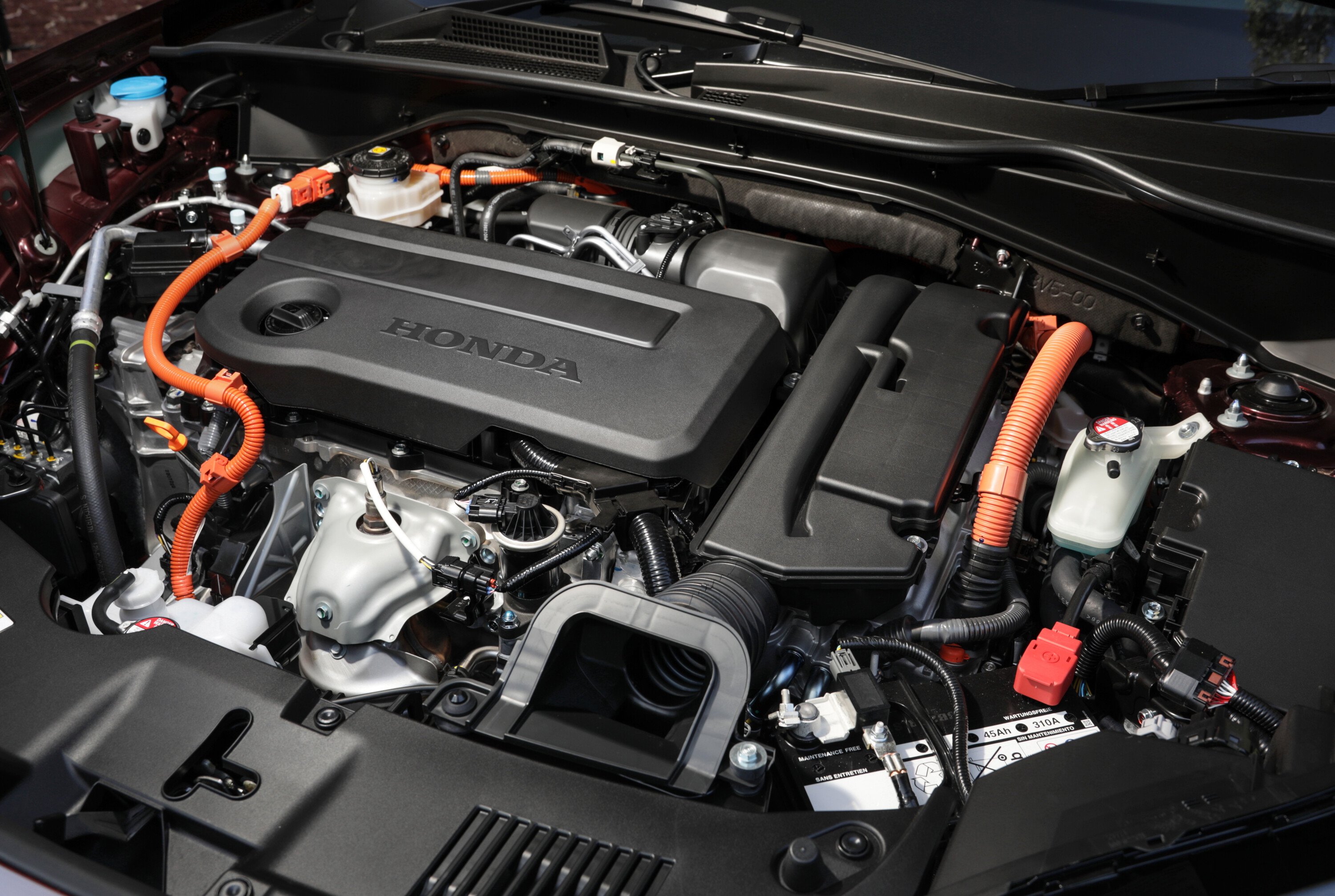
Honda’s series-parallel e:HEV hybrid system is able to turn the front wheels using battery power, the 2.0-litre piston engine, or a mix of the two.
The throttle is responsive and the ZR-V’s well-calibrated hybrid used electric-only mode for extended periods, managing to crack 50km/h on battery power alone. There’s even adjustable regenerative braking using the steering wheel-mounted paddles – though don’t expect a full-on one-pedal driving experience.
It’s quieter in the hybrid than the petrol, too, with its low rolling resistance Bridgestone Alenzas introducing minimal tyre roar.
If any of the terms in this section have left you scratching your head, these articles will help bring you up to speed!
2
- What is a Powertrain or Drivetrain?
- Power vs torque
- Car suspension explained
- Automatic transmissions (‘gearboxes’) explained
- Chassis control systems explained
- Car vs Ute vs SUV: How the vehicle you buy should guide the way you drive
What you really care about, if you’re investing the extra $6400 into a hybrid (we’re yet to be convinced it’s worth the extra cash on drive alone), is fuel economy.
Our result? We almost nailed the 5.0L/100km ADR combined rating, bringing the 5.8L/100km trip computer reading down to 5.1L/100km as we came to rest.
The route may have been mostly downhill, but this kind of proximity to an ADR figure on a media launch bodes well for the future. Expect 5-5.5L/100km in daily use.
As good as the hybrid is, the petrol didn’t disappoint either, reading 7.3L/100km after the first leg, and exactly the same by the time we arrived back at base. Both engines will accept 91 RON unleaded petrol.
2
How safe is the Honda ZR-V?
The Honda ZR-V is yet to be evaluated by Euro NCAP or ANCAP, though it was given the North American IIHS’s highest accolade – the mouthful that is ‘Top Safety Pick Plus’.
It features plenty of adaptive safety systems and driver aids range-wide, along with pedestrian, cyclist and junction-detecting autonomous emergency braking.
The only thing missing from the base X and mid-spec L is blind-spot monitoring and rear cross-traffic alert; that’s only available in the LX flagship.
| 2023 Honda ZR-V active safety features | |
|---|---|
| Autonomous emergency braking (vehicle, pedestrian, cyclist) | Adaptive cruise control with stopp & go (traffic jam assist) |
| Lane-keep assist | Traffic sign recognition |
| Lane departure warning | Driver attention monitor |
| Road departure mitigation | Rear seat reminder |
1
Warranty and running costs
The ZR-V is covered by a five-year/unlimited-kilometre warranty in Australia.
Maintenance is due every 12 months or 10,000km, which is slightly shorter than most rivals that allow 15,000km between services.
Honda hits back with five low-price services, meaning the ZR-V will only cost $995 over five years, equating to $199 per visit to the Honda dealership.
1
VERDICT
A well-priced medium SUV with up-to-date safety and technology, enough space for the whole family and a fuel-sipping hybrid powertrain?
Honda is onto a winner with the ZR-V.
Backed up by the Civic hatch’s excellent DNA that imbues it with talent on a back road without sacrificing smooth ride quality and, apart from its small boot, the ZR-V is an enticing package.
1
Now comes the tricky bit: To create interest and recognition around the ZR-V nameplate, and secure more stock with a broader choice of hybrid variants.
If the Civic Type R proves Honda hasn’t forgotten how to make stunning vehicles, it’s now the ZR-V’s turn to demonstrate whether Honda Australia has the sales mojo to challenge Toyota.
MORE
Everything Honda
MORE
Midsize SUVs
2023 Honda ZR-V specifications
| Honda ZR-V VTi LX Petrol | Honda ZR-V e:HEV LX | |
|---|---|---|
| Price (drive-away) | $48,500 | $54,900 |
| Drivetrain | ||
| Engine | 4cyl, 1.5-litre, DOHC, turbo-petrol, direct-injected | 4cyl, 2.0-litre, DOHC, atkinson cycle, petrol |
| Drive | Front-wheel | front-wheel |
| Power | 131kW | 135kW |
| Torque | 240Nm | 320Nm |
| Gearbox | CVT | Electric motor drive, combustion motor as generator |
| Chassis | ||
| L/W/H/Wu2013B | 4568/1840/1620/2655mm | |
| Track (F/R) | 1591/1605mm | |
| Weight (tare) | 1439kg | 1555kg |
| Boot | 370L | |
| Fuel/tank | 57L | |
| Economy (combined ADR81/02) | 7.2L/100km | 5.0L/100km |
| Suspension | Front: struts, stabiliser bar. Rear: multi-link stabiliser bar | |
| Steering | Rack-assisted progressive electric power steering, 2.4 turns lock-lock | |
| Front brakes | Ventilated rotors | |
| Rear brakes | Solid rotors | |
| Tyres | Yokohama Advan dB V552 | Bridgestone Alenza |
| Tyre size | 225/55R18 | 225/55R18 |
| Safety | ||
| ANCAP rating | NA | |
| 0-100km/h | 9 seconds (est) | 8.5 seconds (est) |
Life is made more interesting by ambitious individuals. Mazda is certainly not short on that attribute, as the company from Hiroshima – a relative minnow in the auto industry – has always been propelled forward by the spark of its own ambition more than anything else.
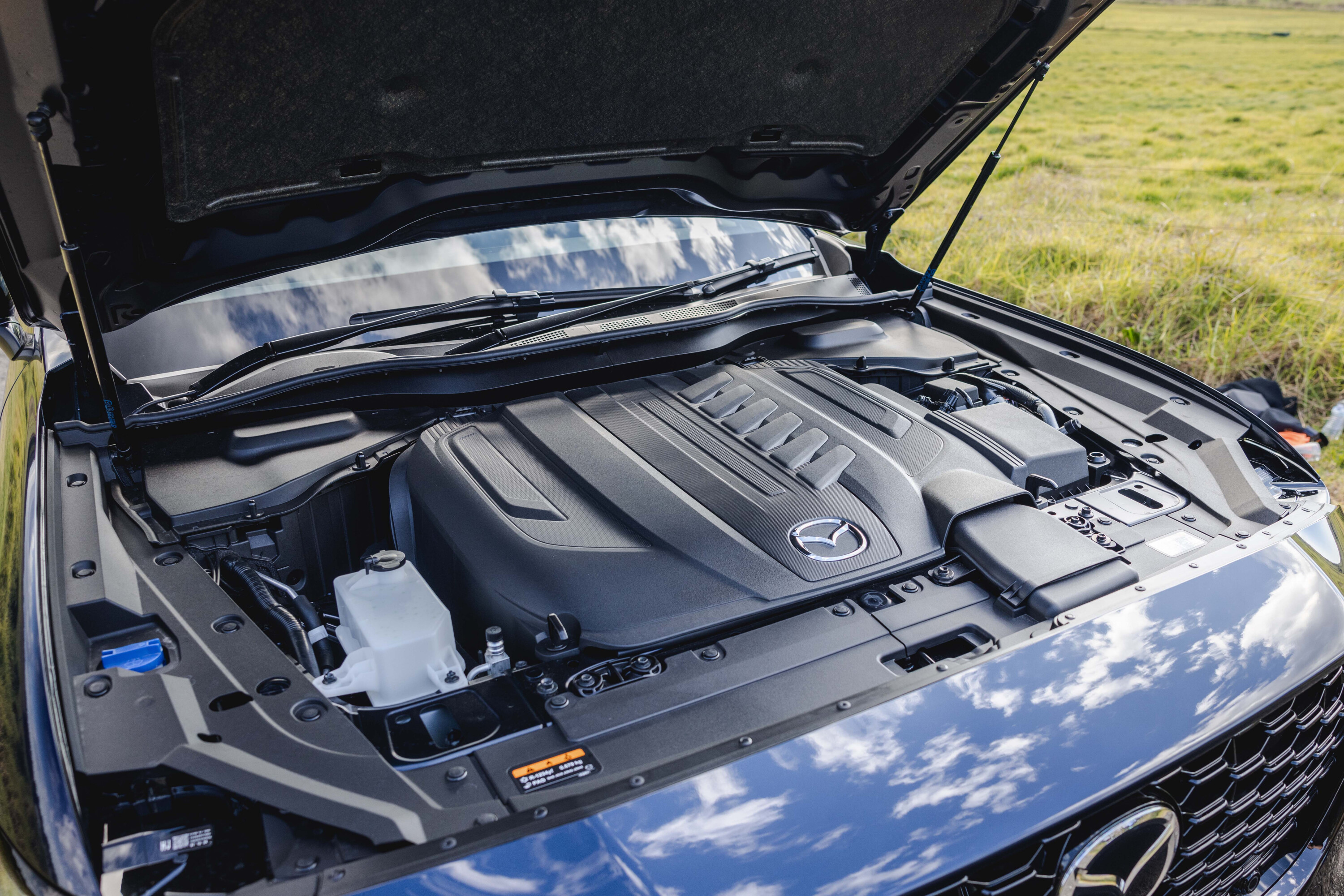
Right now, that ambition is well and truly manifest in the CX-60. Boasting a longitudinally-engined platform with a sporty rear-drive bias, the CX-60 also debuts two new inline-six engines (a format Mazda has never dabbled with before), its first plug-in hybrid implementation, and a level of in-car opulence that hasn’t been seen since the company’s experimental quasi-luxe sub-brands Eunos and ɛ̃fini back in the 1990s.
As a representation of Mazda’s intent to take its brand image further upmarket, the CX-60 makes a strong impression in a glossy brochure too.
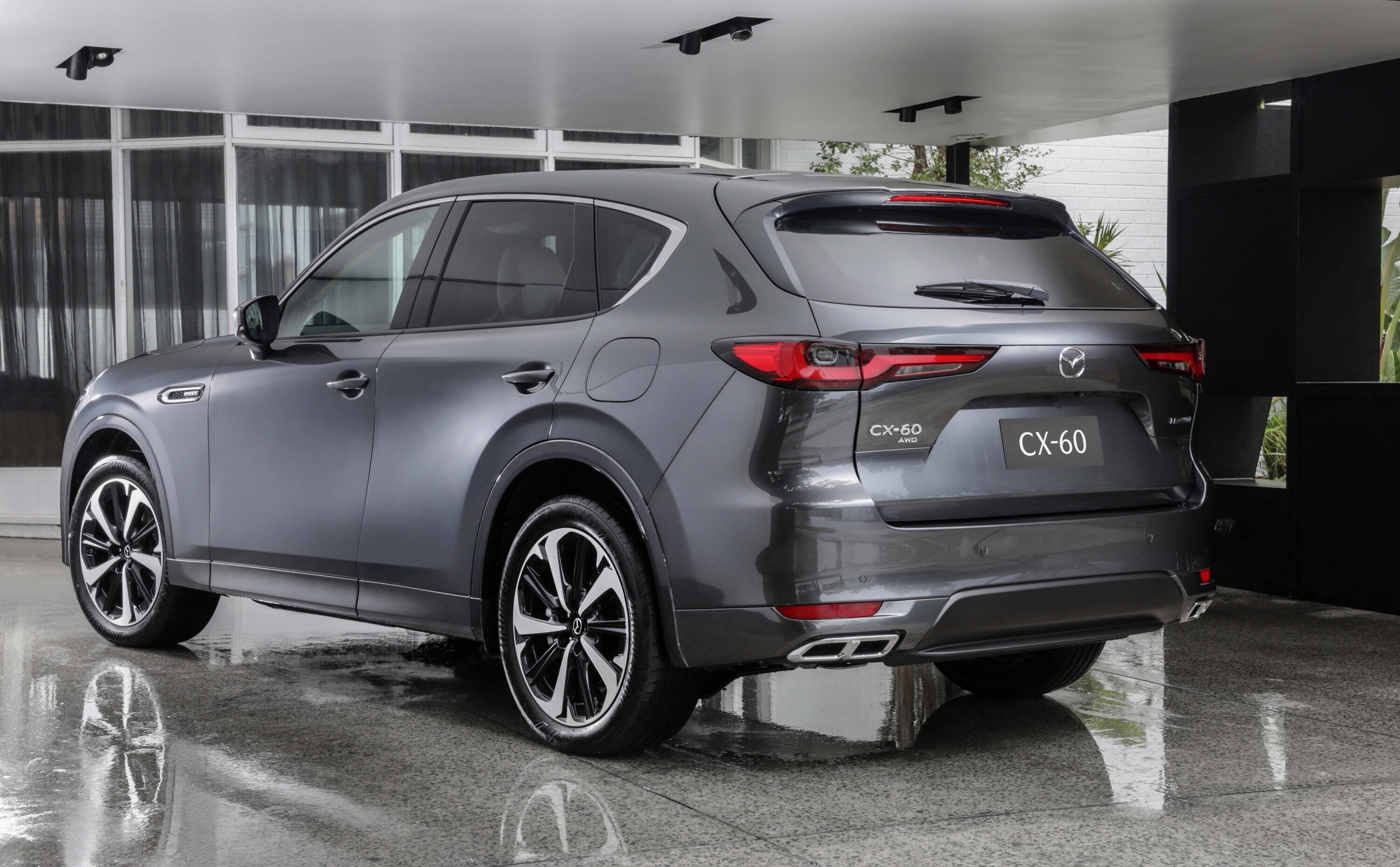
1
In the metal, it’s even nicer to behold, its attractive rear-driven proportions standing it apart from typical SUVs in its size class.
It should want to look good though, for the pricing of this midsizer is like few other mainstream SUVs – in fact, with a starting price just a shade under $60K, the CX-60’s sales stats are measured against things like Merc GLCs, BMW X3s and Audi Q5s by the official industry monitor.
Things like Toyotas, Hondas and Hyundais are far too proletarian to compare with the CX-60.
Does it deliver on its aspirational posture, though? Is the CX-60 genuinely posh or is it a case of “fake it ’til you make it”? We drove the range at its national launch in New South Wales to discover more about what is arguably the most alluring Mazda of the past two decades.
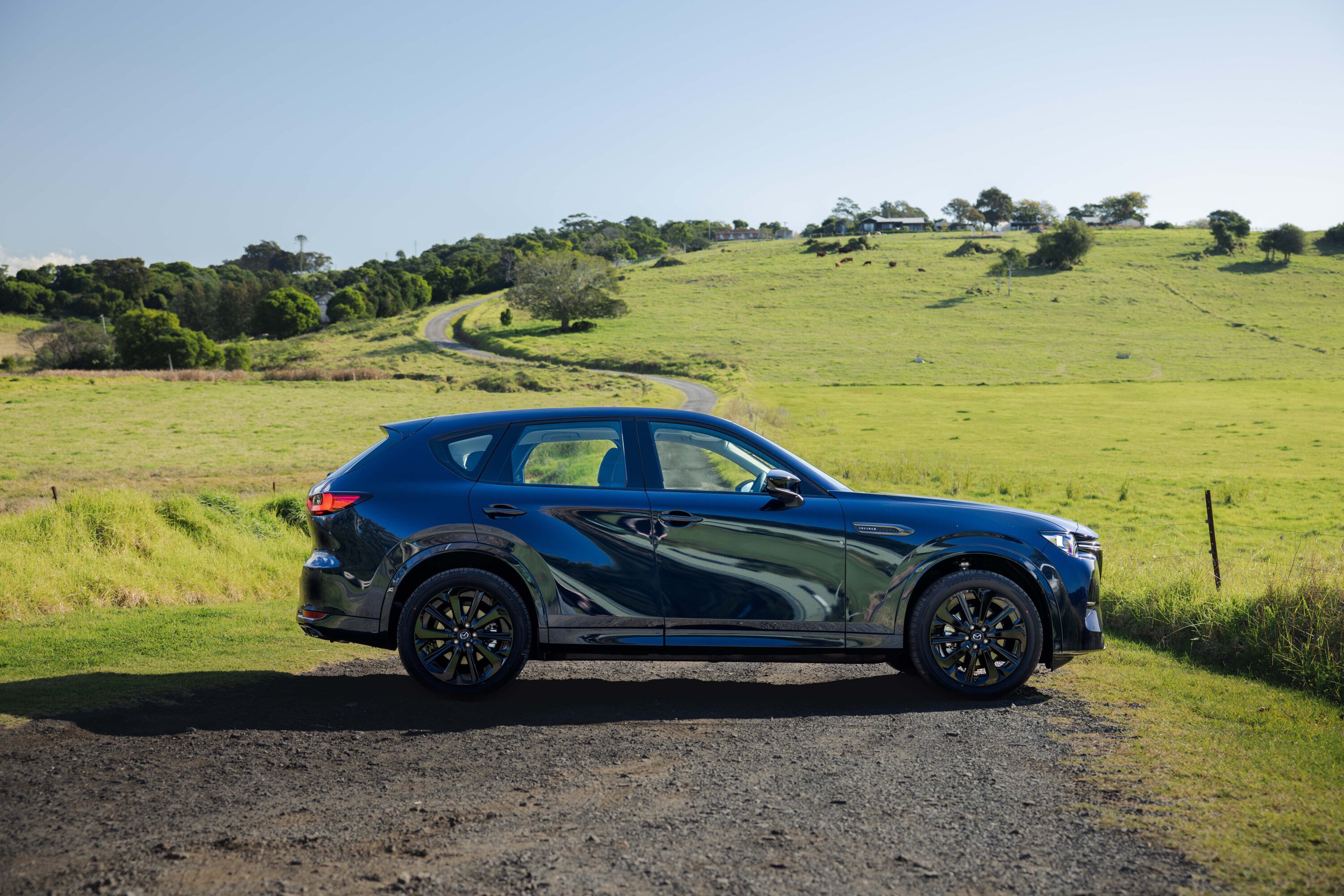
1
JUMP AHEAD
- How much is it, and what do you get?
- Interior comfort, space and storage
- What is it like to drive?
- How much fuel does it use?
- How safe is it?
- VERDICT
How much is it, and what do you get?
Comprised of three grades with three powertrain options apiece, the CX-60 range opens at $59,800 before on-road costs for the base Evolve with the 3.3-litre turbo-petrol inline-six.
The pricing structure is consistent – to walk up to the mid-strength GT grade from Evolve, add $8000. To go from GT to range-topping Azami spec, add a further $5200.
For powertrains, slipping Mazda another $2000 will turn that petrol six into the 3.3-litre diesel inline-six, while adding $10,500 over the price of the diesel will upgrade to the 2.5-litre plug-in hybrid (PHEV) set-up.
On top of that, there are a range of option packs. The base Evolve and GT can be opted with the $2000 Vision Technology package to add a 360-degree parking camera, adaptive LED headlamps, driver distraction monitoring, and a 12.3-inch infotainment screen.
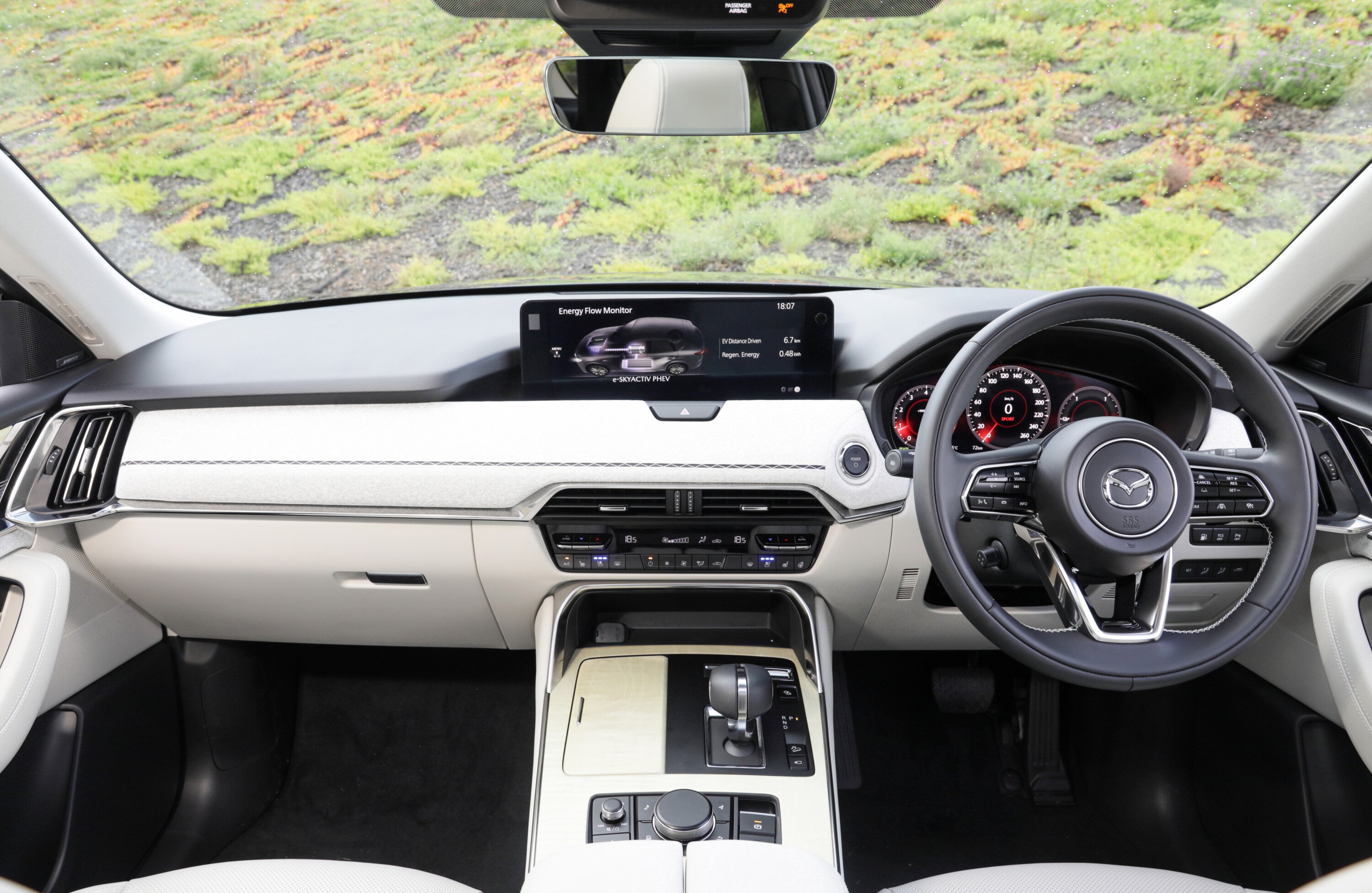
2
The Evolve can also opt for the Luxury Package to bring leather upholstery, as well as heated front seats for an additional $4000.
A couple of attractive trim packages are also available on the Azami flagship, with both the Takumi and SP pack adding $2000 to the bill. It means that an Azami-spec PHEV with either the Takumi or SP package retails at $87,500 before on-road costs. If you find that price tag makes you wince, perhaps the CX-5 is more your steed.
See below for a list of standard equipment, or click through for our comprehensive run-down on the CX-60 range.
| 2023 Mazda CX-60 standard features | |
|---|---|
| 10.25-inch infotainment screen on Evolve, 12.3-inch screen on GT and Azami | Powered tailgate |
| Integrated sat-nav | Paddle shifters |
| Front and rear parking sensors | Self-dimming rear view mirror |
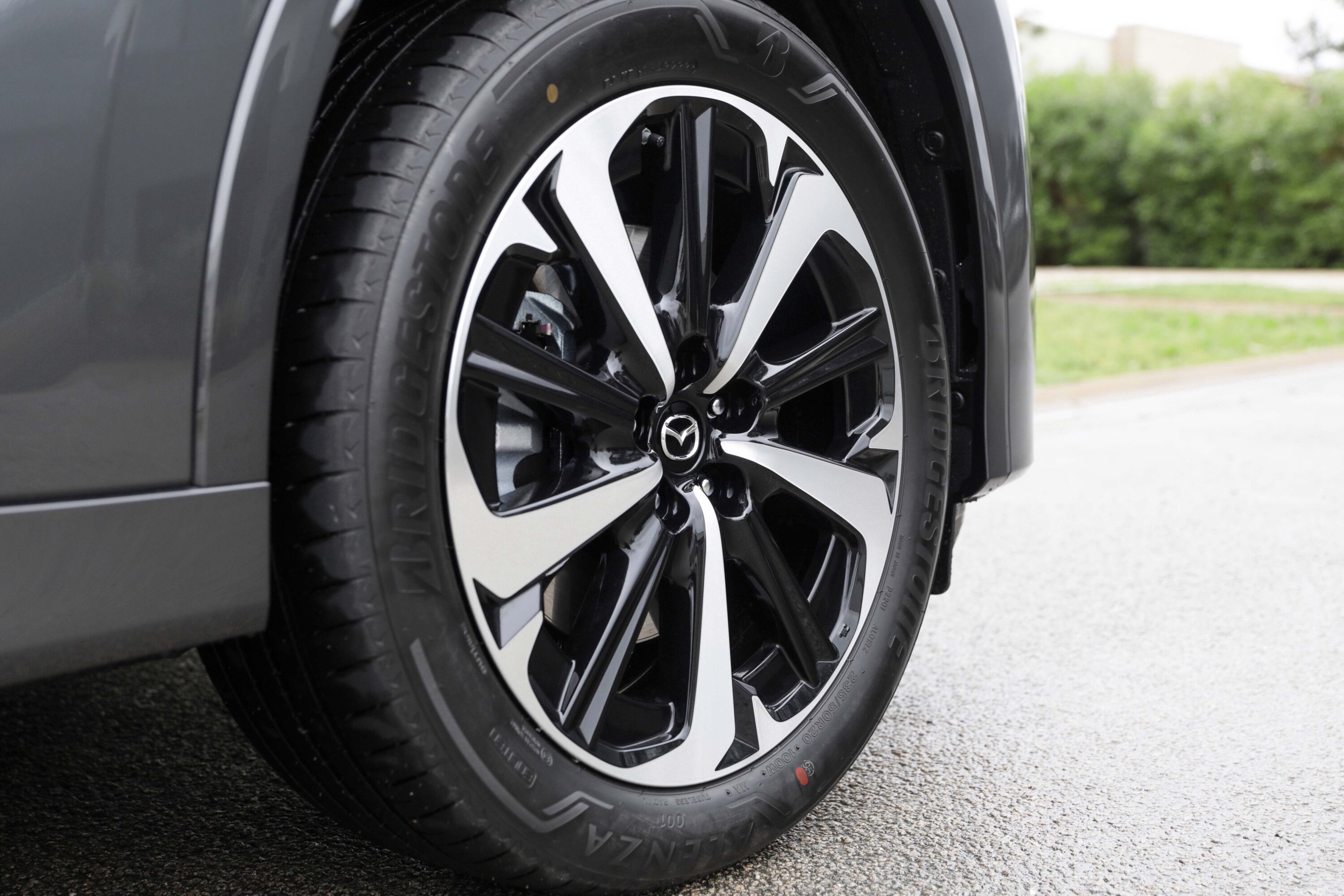
| Leather upholstery (leatherette on Evolve, genuine on GT/Azami) | 18-inch alloys on Evolve, 20-inch alloys on GT/Azami |
| Dual-zone climate control | 4x USB-C charge ports (2x front, 2x rear) |
| Wireless phone charger | 150W household power outlet (1500W on PHEV) |
| DAB+ radio tuner, 8-speaker audio (12-speaker BOSE on GT/Azami) | LED headlamps |
| Wireless Android Auto and Apple Carplay | |
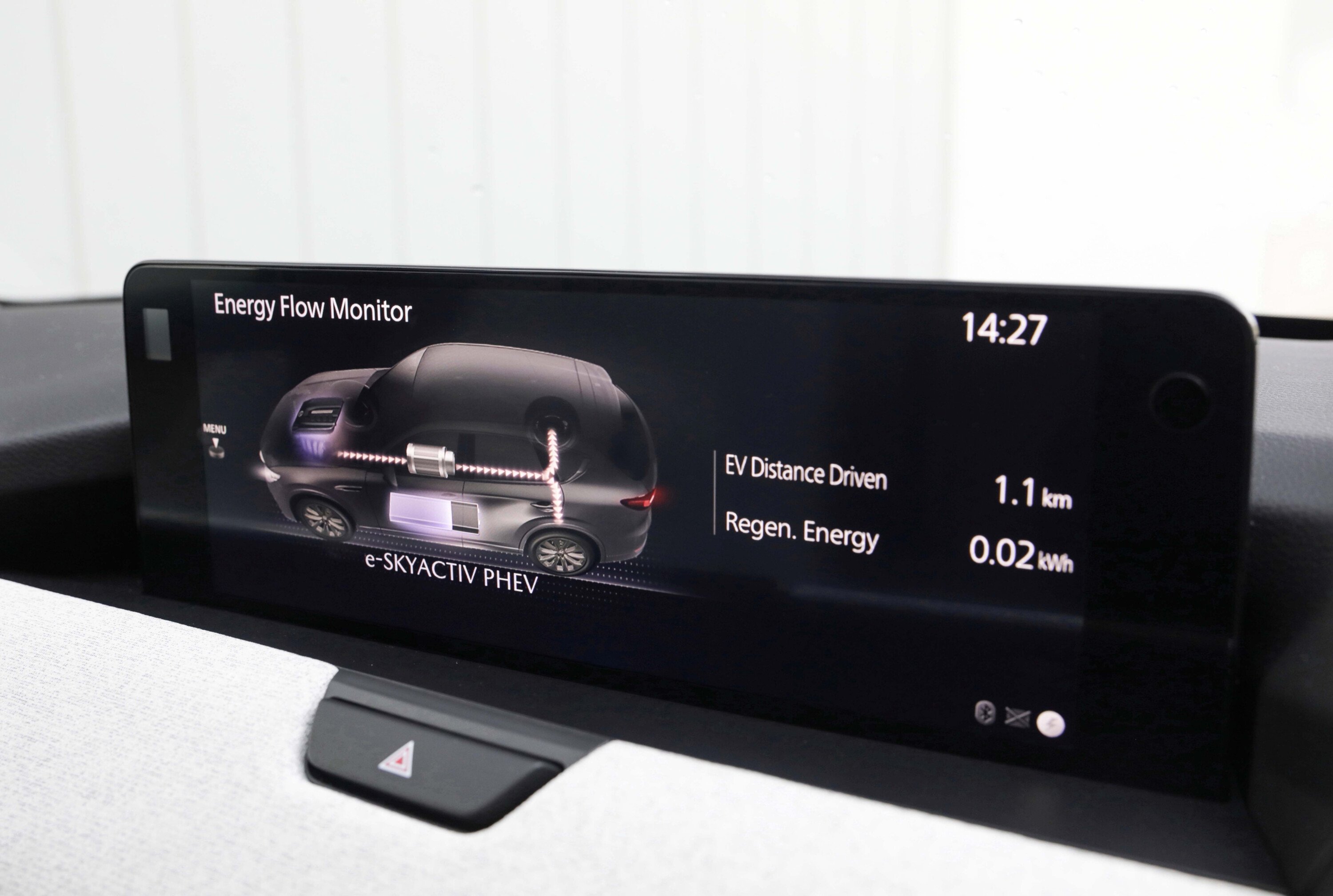
1
Interior comfort, space and storage
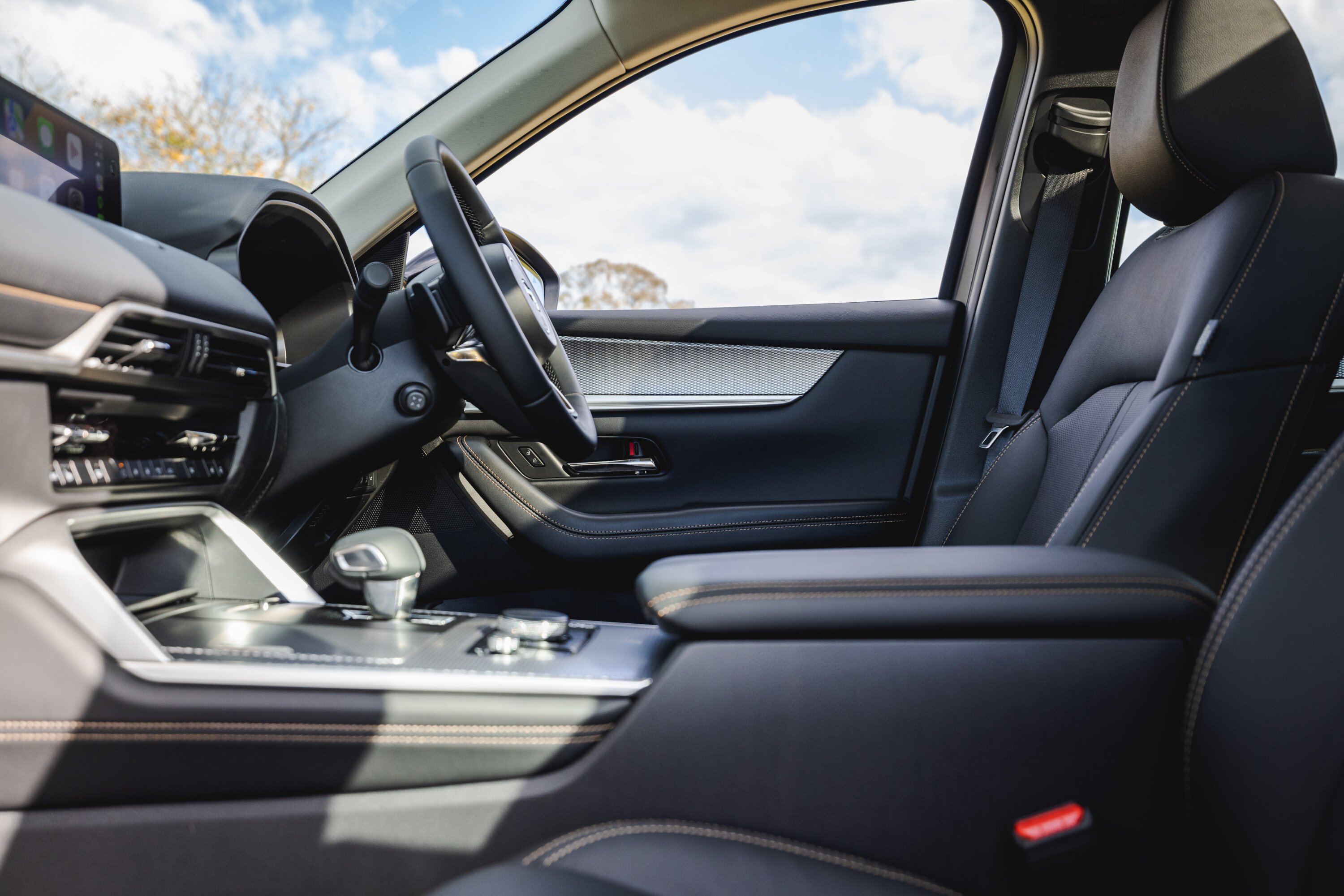
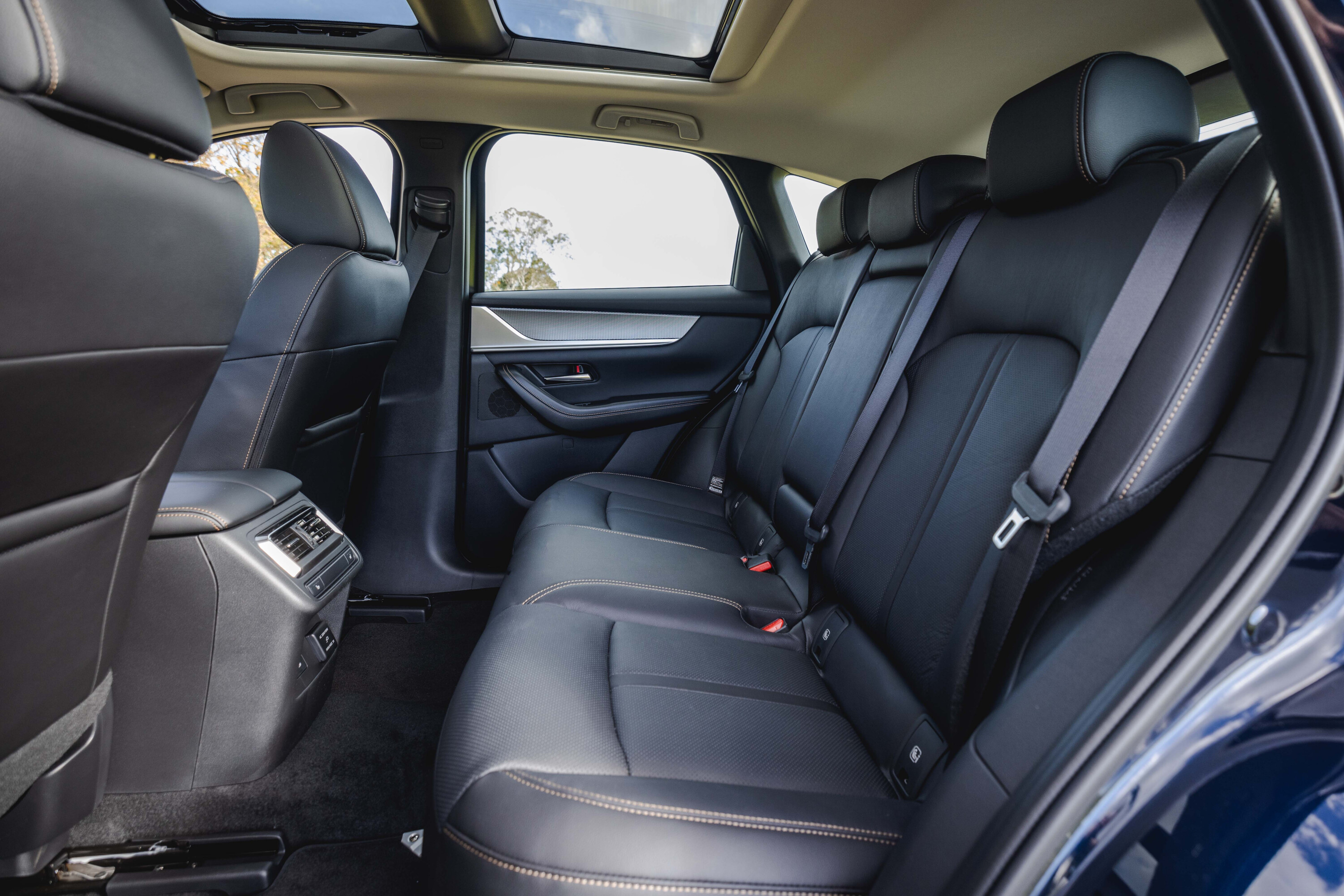
Mazda knows how to craft a beautiful interior, and the CX-60 starts with good bones. Though it sits in the midsize category alongside the CX-5, the CX-60 measures longer and wider than its stablemate, with a substantially longer wheelbase of 2870mm.
Granted, some of that wheelbase is absorbed by the need to accommodate its north-south engine layout, but on the inside the CX-60 brings 50mm more shoulder room in the front and rear and plentiful rear seat legroom – something the CX-5 doesn’t manage so well.
The rear doors also open almost to 90 degrees, perfect for loading kids into the back.
1
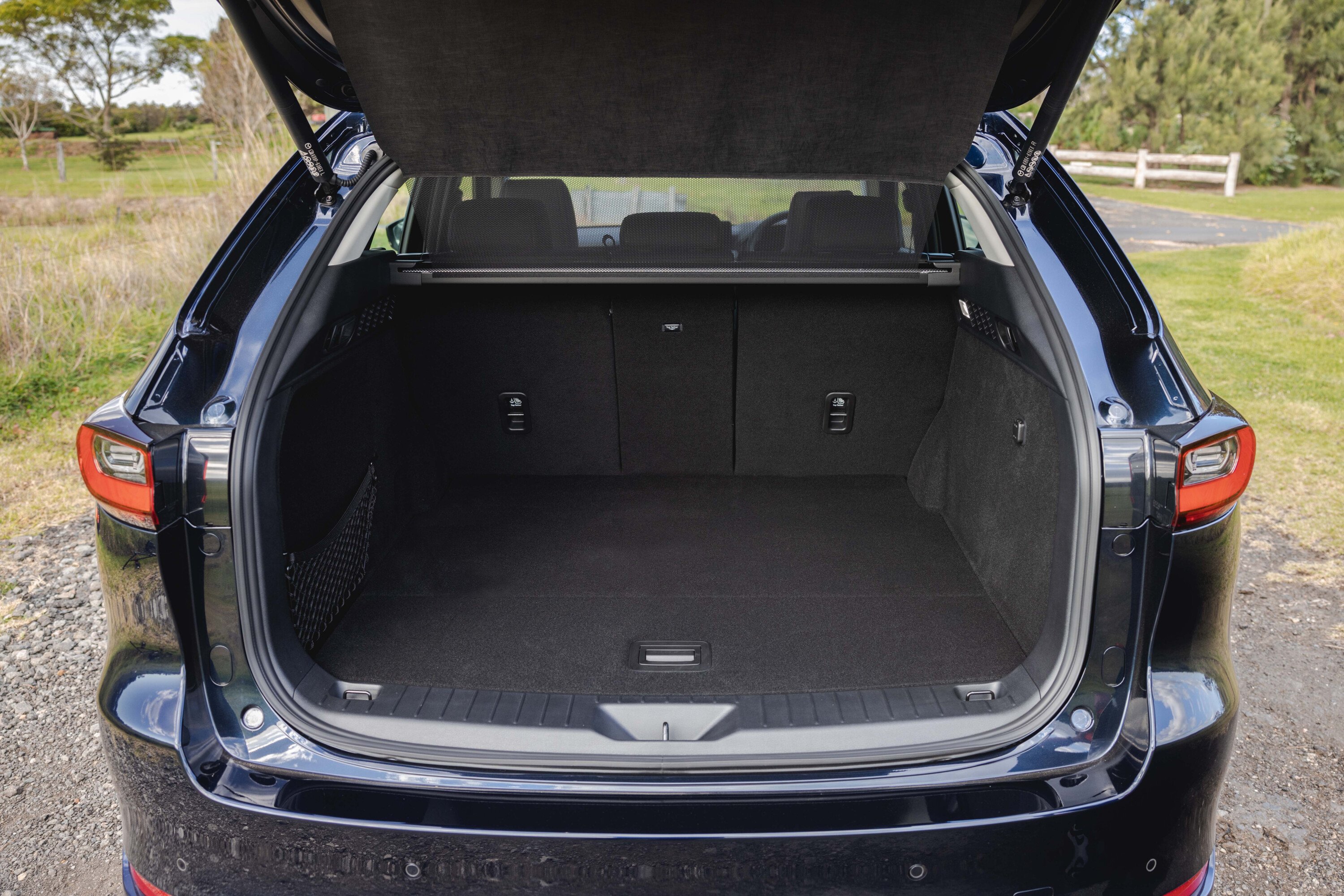
You can also pack more into it. The CX-60 offers a 477-litre luggage capacity, raising to 1148 litres with the rear seats folded or 1726 litres if you’re not afraid to stack your cargo all the way to the roof lining.
There are no clever under-floor cubbies or even shopping bag hooks, though a netted partition on the passenger side is standard.
But the CX-60’s packaging plays second fiddle to its presentation. The predominantly monochrome cabin of the base Evolve lacks sparkle, but the top Azami grade looks properly lavish when specced with either the SP or Takumi packs.
1
The former adds plush caramel-coloured Nappa leather upholstery and a colour-coordinated suede dashboard insert, while the latter brings intricate fabric dash trim, white Nappa leather, chrome highlights and white Maple wood trim for the centre console and door cards.
Seat comfort is also exceptional, with supportive cushions and plenty of adjustment both front and rear. The driving position is typically Mazda, with a sporty legs-out posture, low seat squab and near-horizontal steering column, with respectable outward vision as well.
Downsides? The base Evolve gets a meagre 10.25-inch infotainment display instead of the 12.3-incher in the GT and Azami, and all of them lack touchscreen functionality. Having only a rotary controller to interact with that screen is a drawback in this day and age, particularly when attempting to interface with Android Auto and Apple CarPlay.
1
What is it like to drive?
There’s a lot to cover off here, being a box-fresh platform with three completely new powertrains. This is also the area where the CX-60 experience raised the most question marks.
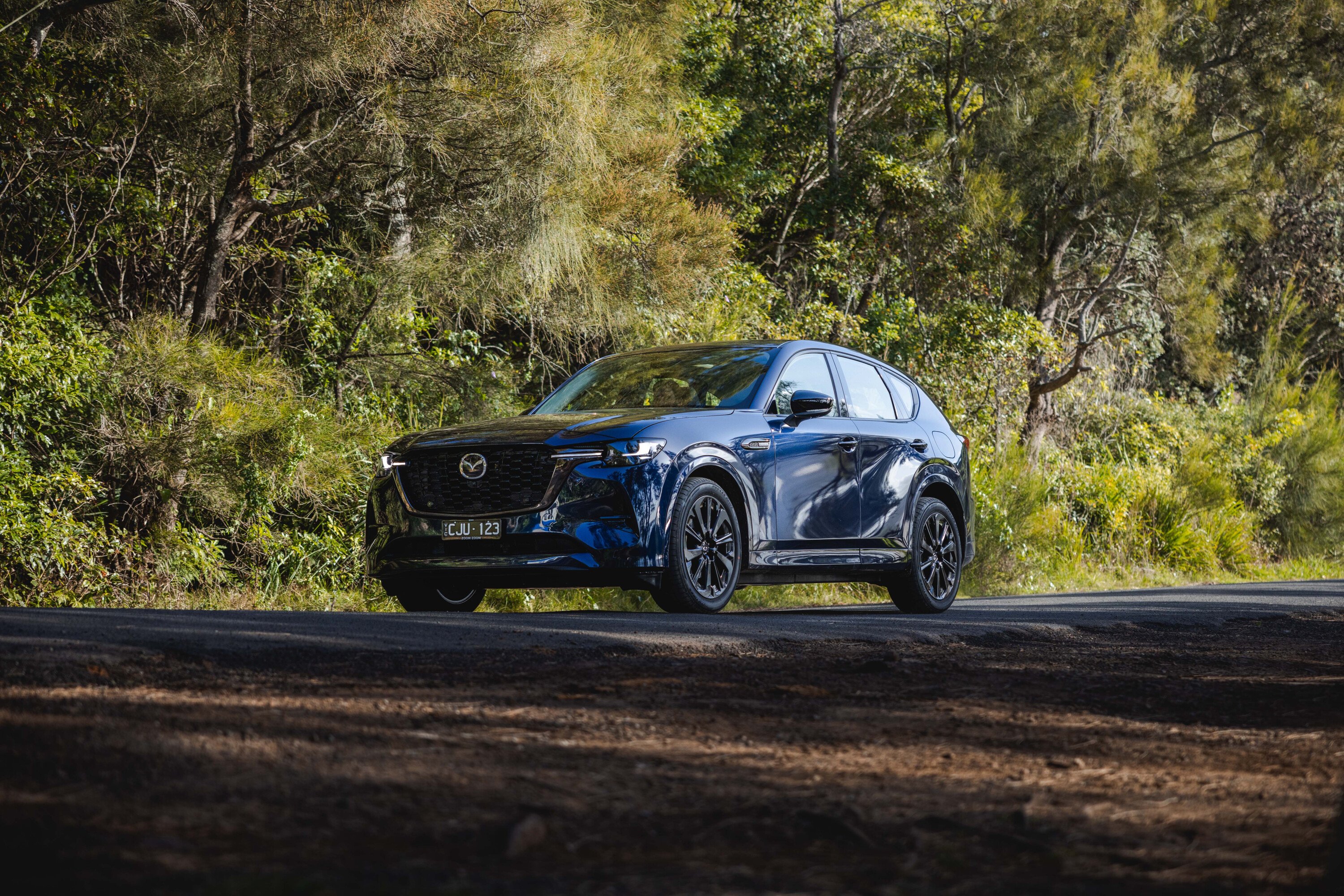
Good stuff first. There’s no disputing the athleticism of this platform – the CX-60 flows with confidence from corner to corner, with meaty steering connected to an authoritative front suspension (double wishbone!) that’s more than up to the task of hustling hard along a curvy country back road. Body control is exceptional.
There’s also no question about the strength of each powertrain. The 3.3-litre sixes, both diesel and petrol, feel incredibly smooth and linear in their performance, with the diesel being particularly likeable thanks to its meaty torque and surprisingly endearing growl under load.
1
The PHEV feels like a rocket when its 2.5-litre petrol four-pot and integrated electric motor are working together to generate its 241kW and 500Nm maxes, and it sounds almost supercharged when you get generous with the pedal.
Mazda’s 5.9-second zero-to-hundo claim is certainly believable, though we couldn’t put it against the stopwatch.
It’s also undeniably frugal. The factory claim is 2.1L/100km and we were able to see an average of just 4.3L/100km with some spirited driving, so regular usage should see an even better result for those who ensure the 17.8kWh battery is kept charged up.
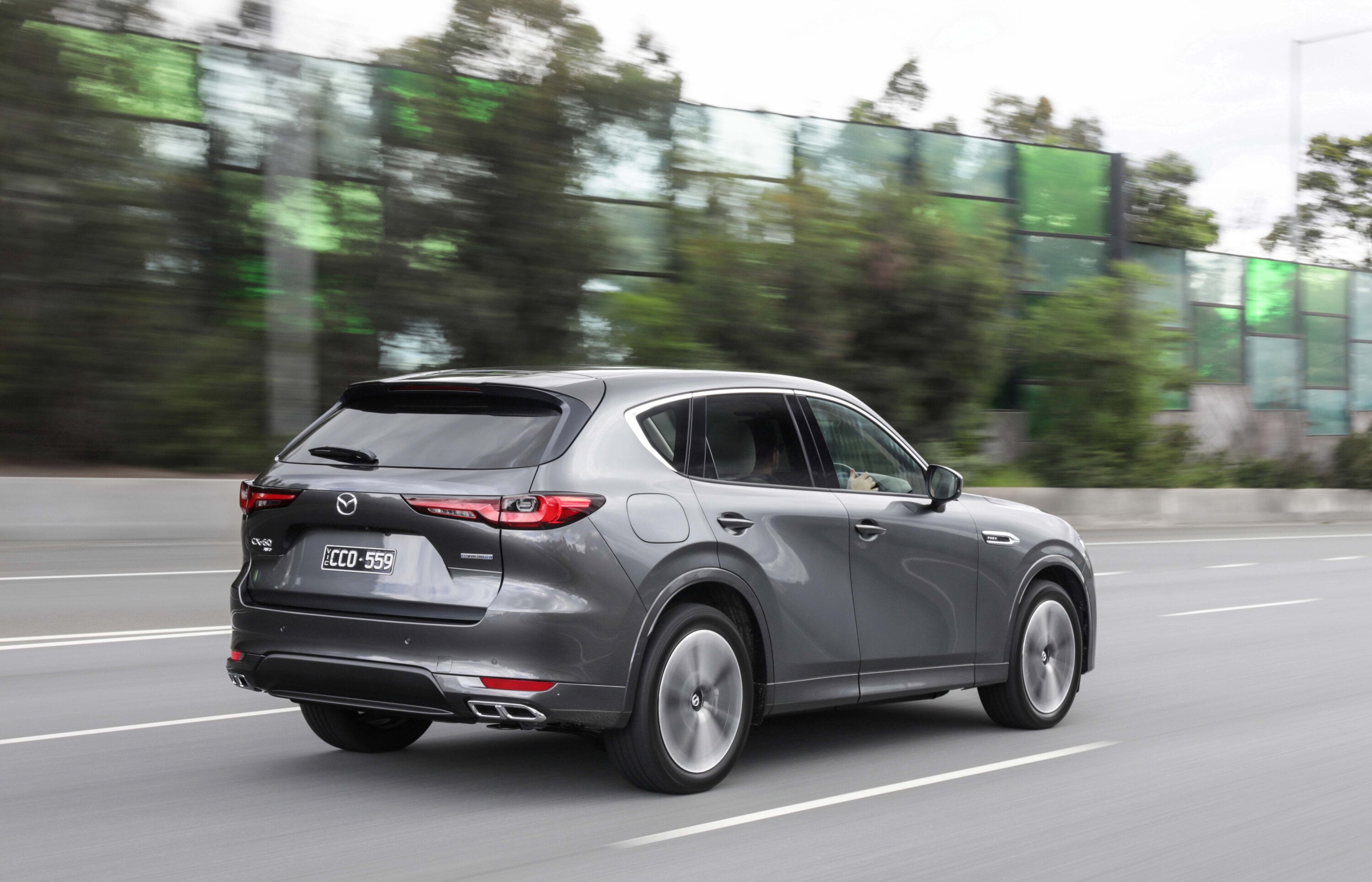
1
But… the CX-60 is possibly too sporty for its own good. It handles great but it rides poorly, with dampers that are far too sensitive to minor bumps and an overabundance of tyre and transmission noise.
The suspension doesn’t exactly behave noticeably better on the 18-inch wheels of the Evolve either, so this problem isn’t limited to the 20-inchers of the GT and Azami.
Its refinement could use some work, but so could the transmission calibration. The eight-speed auto standard on all CX-60 variants is another all-new device, and in sedate driving with the six-pots, it tends to want to kick down when it seems there should be more than enough torque to stay in gear.
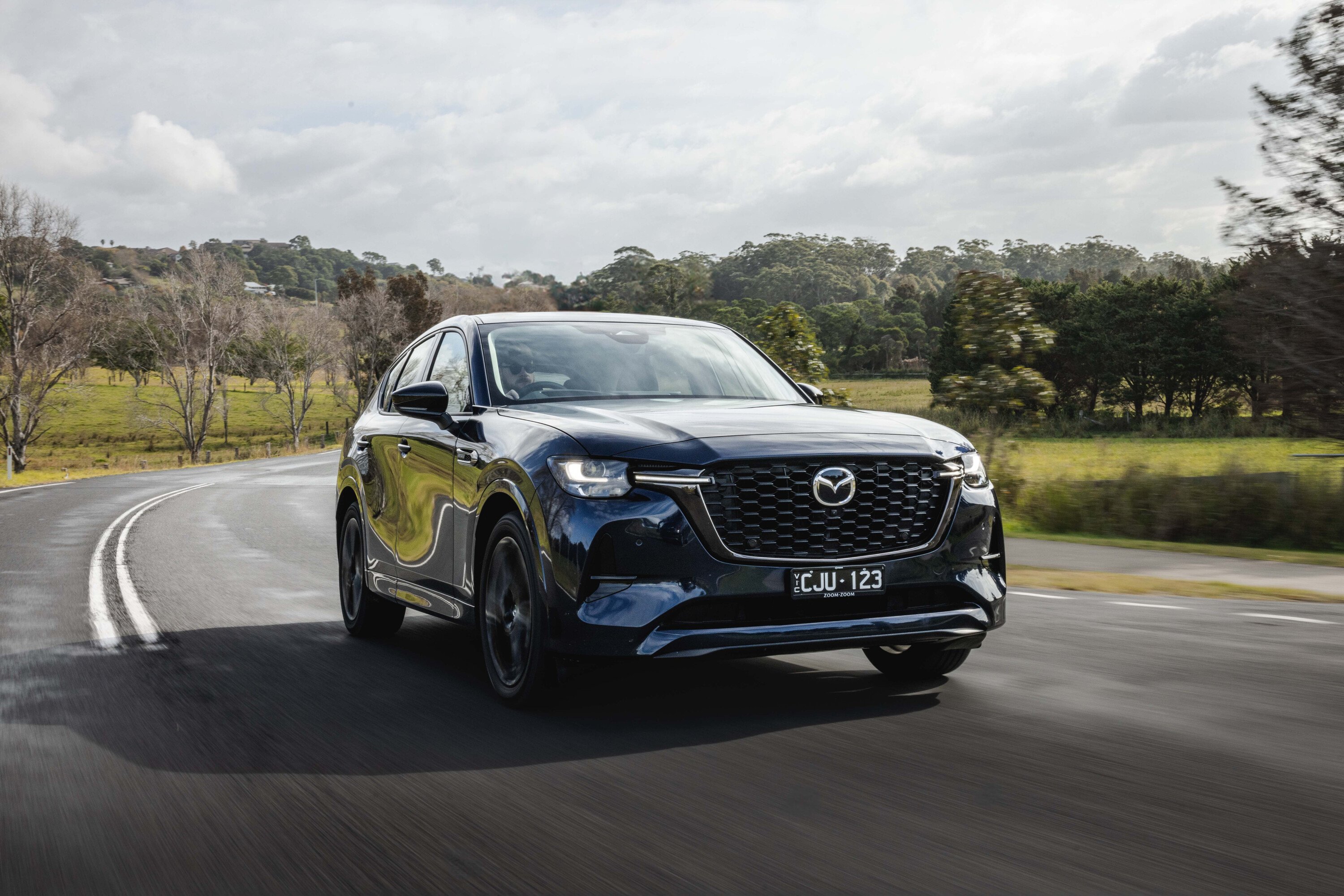
1
Conversely, it doesn’t seem aggressive enough when pushing hard, with noticeable lag on manually-activated shifts and a slow gear-to-gear changeover. The torque converter-less ‘box can also exhibit some clunky behaviour at low speeds, particularly during stop-start heavy traffic shuffling.
For its part, the PHEV does a great job of preferencing electric power, though the motor, sandwiched between the transmission and engine, is rather audible from the other side of the transmission tunnel. Some more sound-deadening mats wouldn’t go astray, Mazda.
It’s also a shame that the long-legged diesel has a towing capacity of only 2000kg, rather than the 2500kg max of the petrol-powered inline six and PHEV. Were it not for that, the CX-60 diesel would make rather a decent tow rig.
1
If any of the terms in this section have left you scratching your head, these articles will help bring you up to speed!
How much fuel does it use?
The launch drive was largely made up of fast-paced country miles, but we saw a respectable 4.3L/100km out of the hybrid and a less-impressive 12.1L/100km from the petrol inline six (we will concede that it was getting a fair workout, however).
More realistic driving should get closer to the petrol engine’s 7.4L/100km factory claim. The diesel is claimed to burn 4.9L/100km on the combined cycle.
Both of the inline sixes are mild hybrids, though with their assistance motors only cutting in during very light throttle cruising, the effect of their electrification is almost impossible to detect.
1
How safe is it?
ANCAP has awarded the CX-60 a five-star safety rating for all variants, with its 10-airbag suite and good structural performance giving it strong passenger protection scores.
The absence of reverse auto emergency braking cost it points for driver-assist tech, as that feature is optional on the base Evolve, as is front cross-traffic alert, cruising and traffic support, and driver attention monitoring.
1
VERDICT
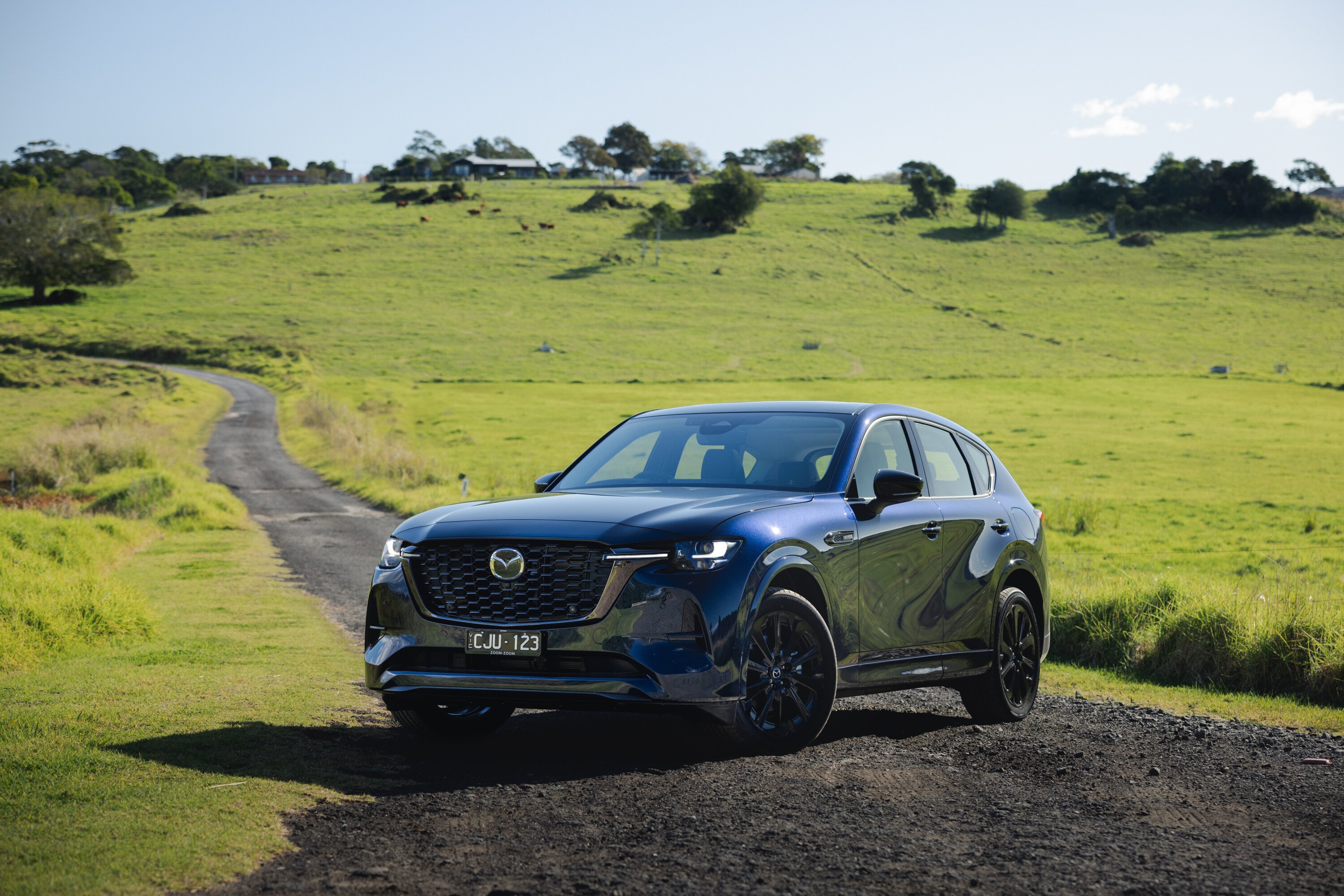
It carries a hefty price tag for a Mazda, but is it justified? Broadly, yes.
The CX-60 exudes a premium air throughout, and Mazda should be applauded for stepping outside of the mainstream box and offering the world something that not only looks a little sharper than the average SUV, but one that’s genuinely fun to drive as well.
1
We have misgivings about its fidgety ride, soft-edged transmission and insufficient noise suppression, but those are issues that aren’t incurable – in some cases, a little bit more time finessing some code on the laptop is all Mazda’s engineers should need to do.
The right ingredients are definitely present. The recipe just needs a little bit of finessing and perhaps a little kick of spice, and then Mazda’s ambitious CX-60 will arguably have what it takes to bruise some European egos.
MORE
Everything Mazda
| CX-60 P50E GT VISION AWD | CX-60 P50E GT AWD | CX-60 P50E GT VISION AWD | CX-60 P50E AZAMI TAKUMI AWD | CX-60 P50E GT AWD | CX-60 P50E AZAMI TAKUMI AWD | CX-60 G40E GT VISION AWD | CX-60 D50E AZAMI SP AWD | CX-60 D50E AZAMI SP AWD | CX-60 D50E AZAMI SP AWD | CX-60 D50E AZAMI TAKUMI AWD | CX-60 D50E EVOLVE VISION LUXURY AWD | CX-60 D50E GT VISION AWD | CX-60 G40E AZAMI SP AWD | CX-60 D50E GT VISION AWD | CX-60 G40E AZAMI SP AWD | CX-60 G40E AZAMI SP AWD | CX-60 G40E AZAMI TAKUMI AWD | CX-60 D50E GT VISION AWD | |
|---|---|---|---|---|---|---|---|---|---|---|---|---|---|---|---|---|---|---|---|
| Engine | 2.5 litre in-line 4 cylinder 16 valve DOHC | 2.5 litre in-line 4 cylinder 16 valve DOHC | 2.5 litre in-line 4 cylinder 16 valve DOHC | 2.5 litre in-line 4 cylinder 16 valve DOHC | 2.5 litre in-line 4 cylinder 16 valve DOHC | 2.5 litre in-line 4 cylinder 16 valve DOHC | 3.3 litre turbo in-line 6 cylinder 24 valve DOHC petrol (Skyactiv-G) | 3.3 litre turbo in-line 6 cylinder 24 valve DOHC petrol (Skyactiv-G) | 3.3 litre turbo in-line 6 cylinder 24 valve DOHC petrol (Skyactiv-G) | 3.3 litre turbo in-line 6 cylinder 24 valve DOHC petrol (Skyactiv-G) | 3.3 litre turbo in-line 6 cylinder 24 valve DOHC petrol (Skyactiv-G) | 3.3 litre turbo in-line 6 cylinder 24 valve DOHC petrol (Skyactiv-G) | 3.3 litre turbo in-line 6 cylinder 24 valve DOHC petrol (Skyactiv-G) | 3.3 litre turbo in-line 6 cylinder 24 valve DOHC petrol (Skyactiv-G) | 3.3 litre turbo in-line 6 cylinder 24 valve DOHC petrol (Skyactiv-G) | 3.3 litre turbo in-line 6 cylinder 24 valve DOHC petrol (Skyactiv-G) | 3.3 litre turbo in-line 6 cylinder 24 valve DOHC petrol (Skyactiv-G) | 3.3 litre turbo in-line 6 cylinder 24 valve DOHC petrol (Skyactiv-G) | 3.3 litre turbo in-line 6 cylinder 24 valve DOHC petrol (Skyactiv-G) |
| Electrification | Plug-In Hybrid (PHEV) | Plug-In Hybrid (PHEV) | Plug-In Hybrid (PHEV) | Plug-In Hybrid (PHEV) | Plug-In Hybrid (PHEV) | Plug-In Hybrid (PHEV) | M Hybrid Boost (48V mild hybrid) | M Hybrid Boost (48V mild hybrid) | M Hybrid Boost (48V mild hybrid) | M Hybrid Boost (48V mild hybrid) | M Hybrid Boost (48V mild hybrid) | M Hybrid Boost (48V mild hybrid) | M Hybrid Boost (48V mild hybrid) | M Hybrid Boost (48V mild hybrid) | M Hybrid Boost (48V mild hybrid) | M Hybrid Boost (48V mild hybrid) | M Hybrid Boost (48V mild hybrid) | M Hybrid Boost (48V mild hybrid) | M Hybrid Boost (48V mild hybrid) |
| Max Power | 241 kW @ 6,000 rpm | 241 kW @ 6,000 rpm | 241 kW @ 6,000 rpm | 241 kW @ 6,000 rpm | 241 kW @ 6,000 rpm | 241 kW @ 6,000 rpm | 209 kW @ 5,000 u2013 6,000 rpm | 187 kW @ 3,750 rpm | 187 kW @ 3,750 rpm | 187 kW @ 3,750 rpm | 187 kW @ 3,750 rpm | 187 kW @ 3,750 rpm | 187 kW @ 3,750 rpm | 209 kW @ 5,000 u2013 6,000 rpm | 187 kW @ 3,750 rpm | 209 kW @ 5,000 u2013 6,000 rpm | 209 kW @ 5,000 u2013 6,000 rpm | 209 kW @ 5,000 u2013 6,000 rpm | 187 kW @ 3,750 rpm |
| Max Torque | 500 Nm @ 4,000 rpm | 500 Nm @ 4,000 rpm | 500 Nm @ 4,000 rpm | 500 Nm @ 4,000 rpm | 500 Nm @ 4,000 rpm | 500 Nm @ 4,000 rpm | 450 Nm @ 2,000 u2013 3,500 rpm | 550 Nm @ 1,500 u2013 2,400 rpm | 550 Nm @ 1,500 u2013 2,400 rpm | 550 Nm @ 1,500 u2013 2,400 rpm | 550 Nm @ 1,500 u2013 2,400 rpm | 550 Nm @ 1,500 u2013 2,400 rpm | 550 Nm @ 1,500 u2013 2,400 rpm | 450 Nm @ 2,000 u2013 3,500 rpm | 550 Nm @ 1,500 u2013 2,400 rpm | 450 Nm @ 2,000 u2013 3,500 rpm | 450 Nm @ 2,000 u2013 3,500 rpm | 450 Nm @ 2,000 u2013 3,500 rpm | 550 Nm @ 1,500 u2013 2,400 rpm |
| Tranmission | 8-speed automatic (Skyactiv-Drive) | 8-speed automatic (Skyactiv-Drive) | 8-speed automatic (Skyactiv-Drive) | 8-speed automatic (Skyactiv-Drive) | 8-speed automatic (Skyactiv-Drive) | 8-speed automatic (Skyactiv-Drive) | 8-speed automatic (Skyactiv-Drive) | 8-speed automatic (Skyactiv-Drive) | 8-speed automatic (Skyactiv-Drive) | 8-speed automatic (Skyactiv-Drive) | 8-speed automatic (Skyactiv-Drive) | 8-speed automatic (Skyactiv-Drive) | 8-speed automatic (Skyactiv-Drive) | 8-speed automatic (Skyactiv-Drive) | 8-speed automatic (Skyactiv-Drive) | 8-speed automatic (Skyactiv-Drive) | 8-speed automatic (Skyactiv-Drive) | 8-speed automatic (Skyactiv-Drive) | 8-speed automatic (Skyactiv-Drive) |
| Drive | i-Activ AWD | i-Activ AWD | i-Activ AWD | i-Activ AWD | i-Activ AWD | i-Activ AWD | i-Activ AWD | i-Activ AWD | i-Activ AWD | i-Activ AWD | i-Activ AWD | i-Activ AWD | i-Activ AWD | i-Activ AWD | i-Activ AWD | i-Activ AWD | i-Activ AWD | i-Activ AWD | i-Activ AWD |
| Suspension | Front: Double wishbone; Rear: Multi-link | Front: Double wishbone; Rear: Multi-link | Front: Double wishbone; Rear: Multi-link | Front: Double wishbone; Rear: Multi-link | Front: Double wishbone; Rear: Multi-link | Front: Double wishbone; Rear: Multi-link | Front: Double wishbone; Rear: Multi-link | Front: Double wishbone; Rear: Multi-link | Front: Double wishbone; Rear: Multi-link | Front: Double wishbone; Rear: Multi-link | Front: Double wishbone; Rear: Multi-link | Front: Double wishbone; Rear: Multi-link | Front: Double wishbone; Rear: Multi-link | Front: Double wishbone; Rear: Multi-link | Front: Double wishbone; Rear: Multi-link | Front: Double wishbone; Rear: Multi-link | Front: Double wishbone; Rear: Multi-link | Front: Double wishbone; Rear: Multi-link | Front: Double wishbone; Rear: Multi-link |
| Brakes | Ventilated disc, front and rear | Ventilated disc, front and rear | Ventilated disc, front and rear | Ventilated disc, front and rear | Ventilated disc, front and rear | Ventilated disc, front and rear | Ventilated disc, front and rear | Ventilated disc, front and rear | Ventilated disc, front and rear | Ventilated disc, front and rear | Ventilated disc, front and rear | Ventilated disc, front and rear | Ventilated disc, front and rear | Ventilated disc, front and rear | Ventilated disc, front and rear | Ventilated disc, front and rear | Ventilated disc, front and rear | Ventilated disc, front and rear | Ventilated disc, front and rear |
| Towing Capacity | 2,500 kg (braked); 750 kg (unbraked) | 2,500 kg (braked); 750 kg (unbraked) | 2,500 kg (braked); 750 kg (unbraked) | 2,500 kg (braked); 750 kg (unbraked) | 2,500 kg (braked); 750 kg (unbraked) | 2,500 kg (braked); 750 kg (unbraked) | 2,500 kg (braked); 750 kg (unbraked) | 2,000 kg (braked); 750 kg (unbraked) | 2,000 kg (braked); 750 kg (unbraked) | 2,000 kg (braked); 750 kg (unbraked) | 2,000 kg (braked); 750 kg (unbraked) | 2,000 kg (braked); 750 kg (unbraked) | 2,000 kg (braked); 750 kg (unbraked) | 2,500 kg (braked); 750 kg (unbraked) | 2,000 kg (braked); 750 kg (unbraked) | 2,500 kg (braked); 750 kg (unbraked) | 2,500 kg (braked); 750 kg (unbraked) | 2,500 kg (braked); 750 kg (unbraked) | 2,000 kg (braked); 750 kg (unbraked) |
| Fuel Economy (combined)* | 2.1L/100km | 2.1L/100km | 2.1L/100km | 2.1L/100km | 2.1L/100km | 2.1L/100km | 7.4l/100km | 4.9/100km | 4.9/100km | 4.9/100km | 4.9/100km | 4.9/100km | 4.9/100km | 7.4l/100km | 4.9/100km | 7.4l/100km | 7.4l/100km | 7.4l/100km | 4.9/100km |
| Electric range (km)* | 76 | 76 | 76 | 76 | 76 | 76 | N/A | N/A | N/A | N/A | N/A | N/A | N/A | N/A | N/A | N/A | N/A | N/A | N/A |
| CO2 Emissions (g/km)* Main Features | 49 | 49 | 49 | 49 | 49 | 49 | 171 | 128 | 128 | 128 | 128 | 128 | 128 | 171 | 128 | 171 | 171 | 171 | 128 |
| * Fuel consumption, electric range and CO2 figures are based on ADR 81/02 test results. |
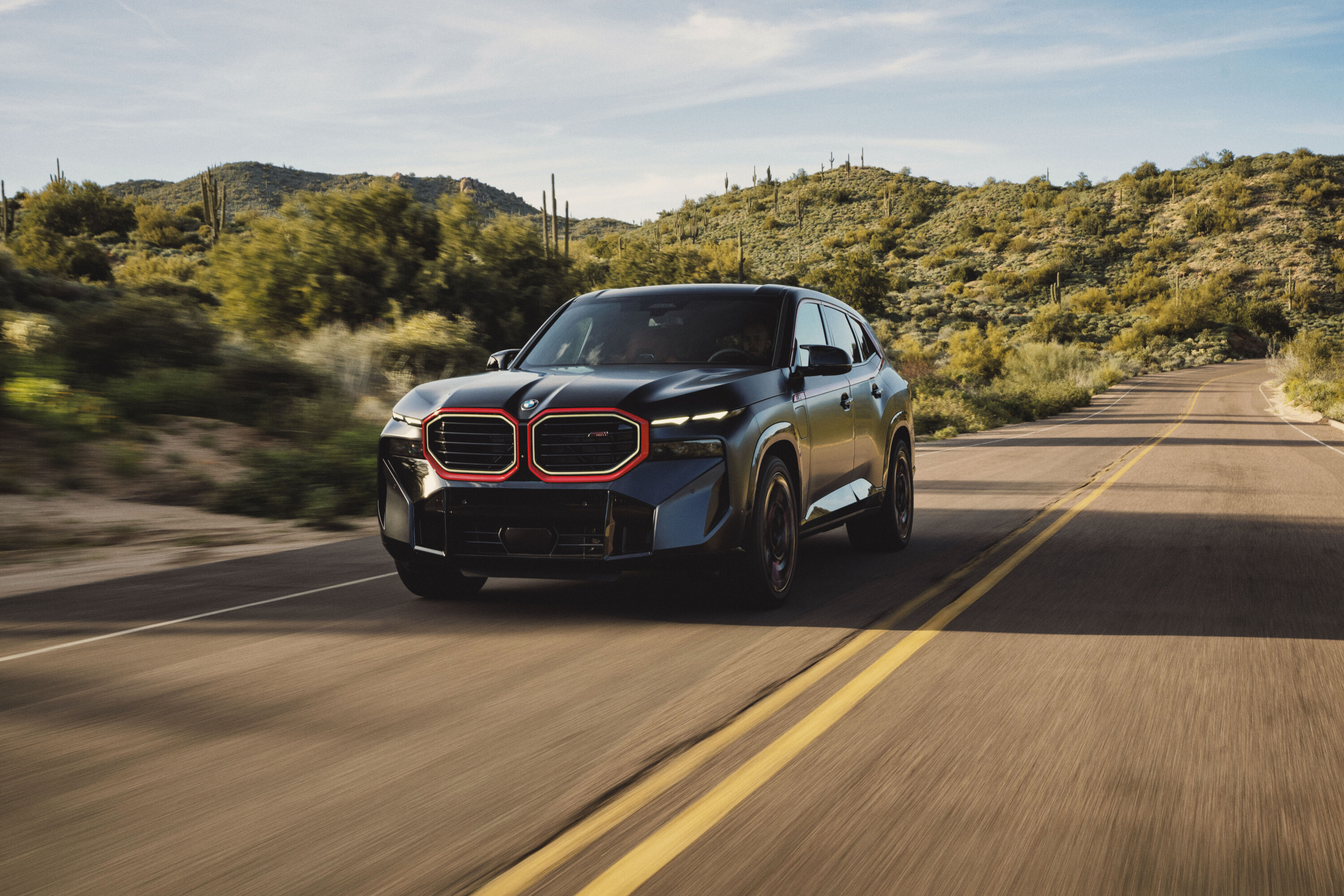
BMW M could borrow a controversial feature from Hyundai as it looks to make its first dedicated electric performance car as driver-focused as possible.
BMW M’s first ‘full fat’ EV is currently in development – a hardcore, quad-motor prototype based on the i4 was teased earlier this year – and company boss Frank van Meel has revealed M is exploring a number of new features to ensure it feels and drives like a proper M car.
One of these features is a ‘simulated gearbox’, similar to what Hyundai N has fitted to the Ioniq 5 N.
Electric cars typically have single ratio gearboxes (the Porsche Taycan is an exception with two), but the Ioniq 5 N has a mode that mimics an eight-speed dual-clutch and allows the driver to shift up and down the ‘gears’ via paddles on the steering wheel.
Hyundai’s feature even momentarily cuts power to the electric motors so the driver feels a ‘jolt’ when shifting, just like they would in a petrol-powered car.
“I like the way they think,” said van Meel when asked about the Ioniq 5 N’s ‘gearbox’. “If you need eight gears, I’m not sure… But it’s one solution because what’s really clear is that if you drive on the track, and we always come from racing with M, there’s no time to look at the speedometer to see how fast you are going.”
1
“So what you do is: you know the gear you’re in and you hear and feel the engine, and from the corner of your eye you can see the shifting lights if you’re approaching maximum revs. So actually, you always know I’m ‘in third gear.’ There’s no need to look down into the speedometer and if you look down two cars pass by you.
“So you need that feedback because if you’re driving in an electric car with just one gear, making some kind of sound over seven octaves, you don’t know if you’re in the middle [of the revs] and if that’s the equal to 145km/h or wherever you are. So that actually will not work. And we need a solution for that.
“And one of the solutions might be to simulate gears or to have another acoustic feedback or even vibrations as a feedback. And those are things we’re looking into.”
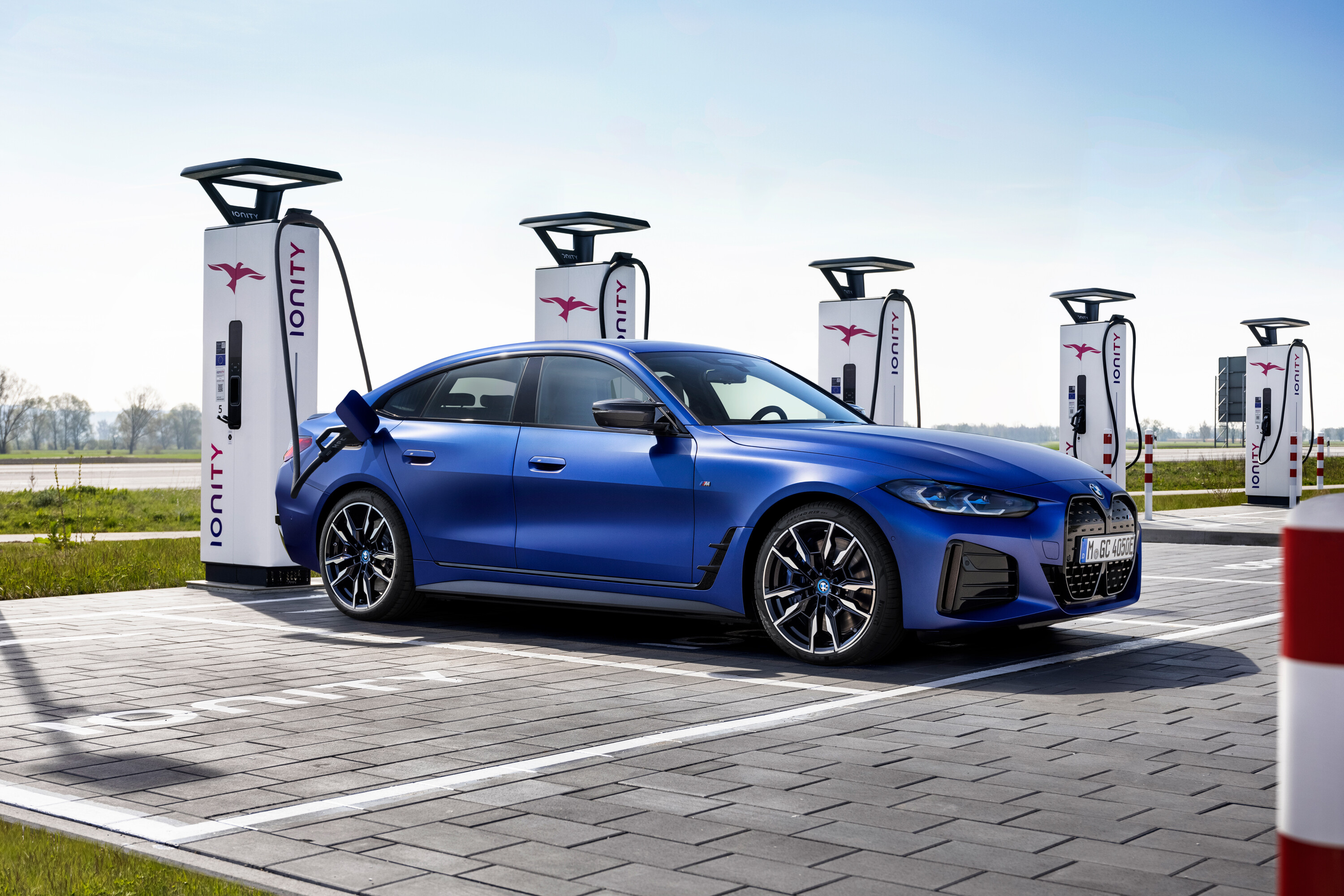
BMW M already makes a number of M Performance electric models – the i4 M50 and i5 M60 are examples – but van Meel says a full-blown M car is more challenging to create.
1
Repeatability of performance, thermal management of the battery and motors, and keeping weight as low as possible are key challenges
“On the M Performance cars it’s possible because it’s giving more performance to series production cars,” he said, “but for high performance models its a little bit more complicated because we’re not only building cars that are developed on the race track, actually they should perform on the race track and that’s a little bit more complicated.”
Repeatability of performance, thermal management of the battery and motors, and keeping weight as low as possible are key challenges says van Meel, but he’s confident M’s first EV will appeal to keen drivers.
“You can rest assured that we will have a solution for racing and create high performance vehicles that will make you happy.”
As for when BMW M’s first EV will be revealed?
“It’s going to take a couple of years until it comes,” said van Meel. “But it’s going to take place this decade.”
More EV stories to help you choose the best car for your needs
- ? EV news, reviews, advice & guides
- ❓ Short & sweet: Your EV questions answered
- ⚡ New EVs: Everything coming to Australia
- ? Australia’s EVs with the longest driving range
- ⚖️ Best-value EVs by driving range
- ? How much do EVs cost in Australia?
- ? How much more expensive are EVs?
- ⚖️ Number crunching: Is it time to switch to an EV?
- ♻ Should you buy a used EV?
- ?️ Are EVs more expensive to insure?
- ? Costs compared: Charging an EV vs fueling a car
- ? EV charging guide
- ? Are there enough EV chargers in Oz?
- ?? EV servicing explained
- ? EV battery types explained
- ? When do EV batteries need replacing?
- ? Hydrogen v EVs: What’s best for Oz?
- ? How sustainable are EVs, really?
