
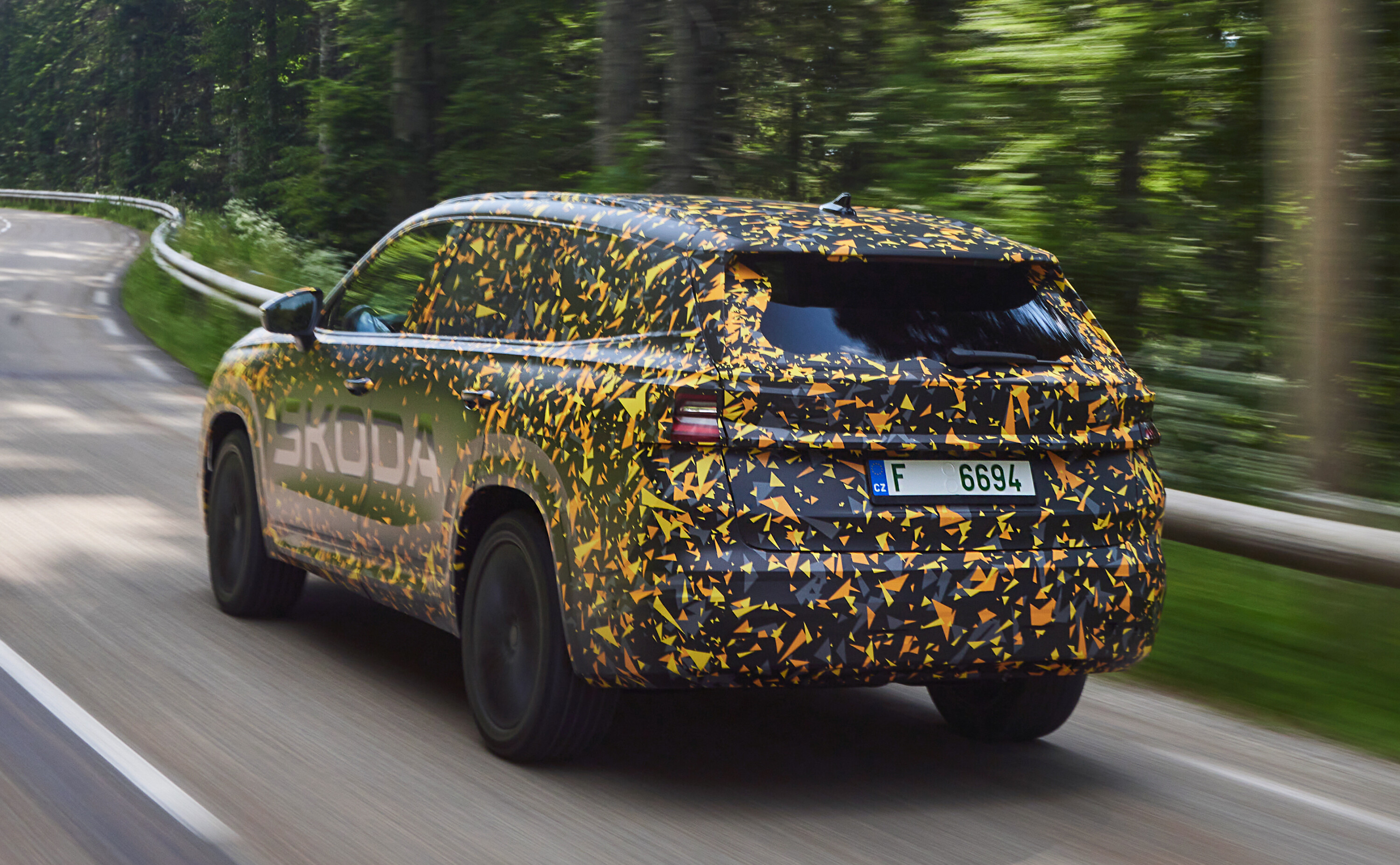
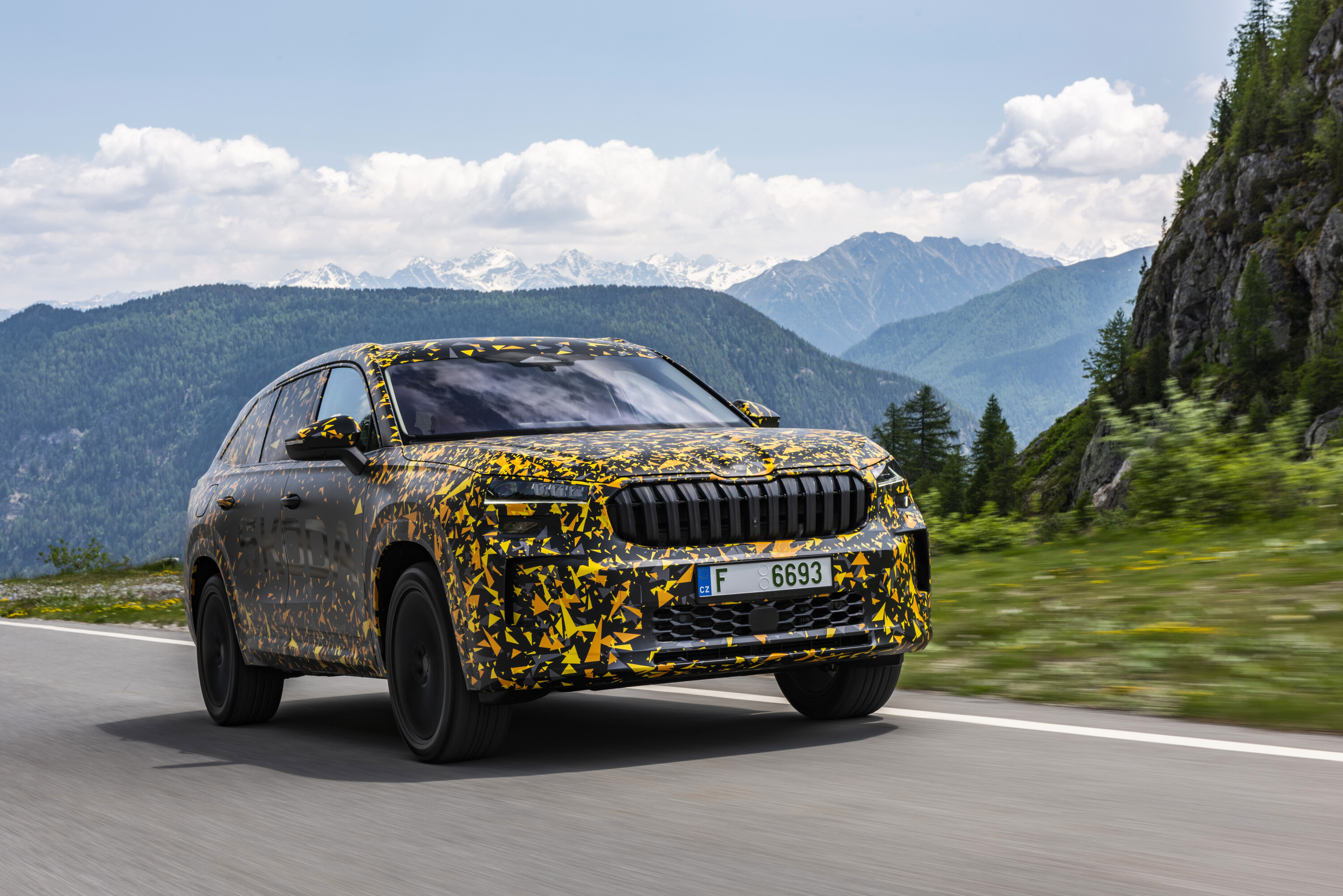
The first official details for the all-new 2024 Skoda Kodiaq have been released.
Snapshot
- 2024 Skoda Kodiaq teased ahead of debut
- Electrification and new tech confirmed for second-gen large SUV
- Due in Australia early next year
The second-gen Kodiaq will debut in Europe between September and November this year, with early 2024 timing locked in for Australia.
The new Kodiaq will be related to the new Volkswagen Tayron – the seven-seat version of the imminent third-gen Tiguan, replacing the Tiguan Allspace – with shared MQB Evo underpinnings, powertrains and technology.
As before, the large SUV will be available in both five- and seven-seat forms; however, seven seats will likely remain the sole option for Australia.
Skoda has confirmed it will be offered with petrol, diesel and plug-in hybrid (PHEV) engines, with power outputs ranging from 110kW to 150kW.
In Europe, the flagship 2.0-litre turbo-petrol engine will be uprated to 150kW – up from 132kW in today’s Kodiaq – with this powertrain likely to be standard-fit in Australia. It remains paired to a seven-speed dual-clutch automatic transmission, with power sent to all four wheels.
1
Entry-level, front-wheel-drive variants will feature a 110kW mild-hybrid 1.5-litre turbo-petrol four-cylinder, which runs on the Miller cycle with a variable turbine geometry turbocharger and cylinder deactivation.
The plug-in hybrid Kodiaq iV will combine the 1.5-litre turbo-petrol engine with an electric motor, a 25.7kWh lithium-ion battery pack, and a six-speed dual-clutch automatic transmission for a 150kW total system output.
It will offer an all-electric driving range of “more than 100 kilometres“, with 11kW AC and 50kW DC maximum charge rates.
1
Diesel options will range between 110kW and 142kW, with all powertrains meeting Euro 6e emissions, though stricter Euro 7 standards will be enforced in Europe on July 1, 2025.
As with the new Tiguan, the Kodiaq will sport the Volkswagen Group’s latest dynamic chassis control system, which likely includes twin-valve dampers for improved ride comfort and handling.
While Skoda has yet to release interior shots, it has confirmed the new Kodiaq will feature a larger 12.9-inch infotainment system, a faster 15-watt dual wireless phone charger with fan cooling, a column-mounted gear selector, and a “combination of manual and digital controls“.
1
The centre console is considered ‘tidy’ and ‘well-organized’, and the SUV will have an available windscreen-projected head-up display to complement an updated 10.25-inch digital instrument cluster.
Newly added is a rear storage compartment with a cup holder on the central tunnel and a display cleaner for the touch surfaces, while the signature ice scraper and built-in umbrella are produced from more sustainable materials.
An evolutionary design is likely for the revised Kodiaq, with the brand confirming it will have updated matrix-LED headlights with a crystal theme and boomerang-shaped daytime running lamps.
1
Technology added to the new Kodiaq includes emergency assist, traffic jam assist and automatic remote parking, and its occupant protection system will now automatically close the windows and tighten the seatbelts for potential rear-end collisions.
Up to nine airbags will be offered, including front-centre and optional rear-side.
The new model will continue straddling between the midsize and large categories in Australia, measuring 4758mm long and 1864mm wide – up 61mm in length but down 18mm in width. Its height and wheelbase remain unchanged at 1657mm and 2791mm, respectively.
Luggage capacity has expanded to 340 litres with all seats in place (up 70L) and 845L with the third-row down (up 80L), while third-row headroom has increased to 920mm, up 15mm.
The 2024 Skoda Kodiaq will arrive in Australia early next year, with further information due in the coming months.
This month, Skoda Australia said the flagship RS accounts for between 40 and 50 per cent of total Kodiaq sales – despite being supply constrained – meaning an emphasis on high-end variants is likely for the all-new version.
The all-new Superb large car – twinned with the next Volkswagen Passat – launches later in the year, while mid-life updates for Scala, Kamiq and Octavia are also due next year. The all-electric Enyaq – similar in size to the Kodiaq but with five seats only – will arrive in mid-2024.
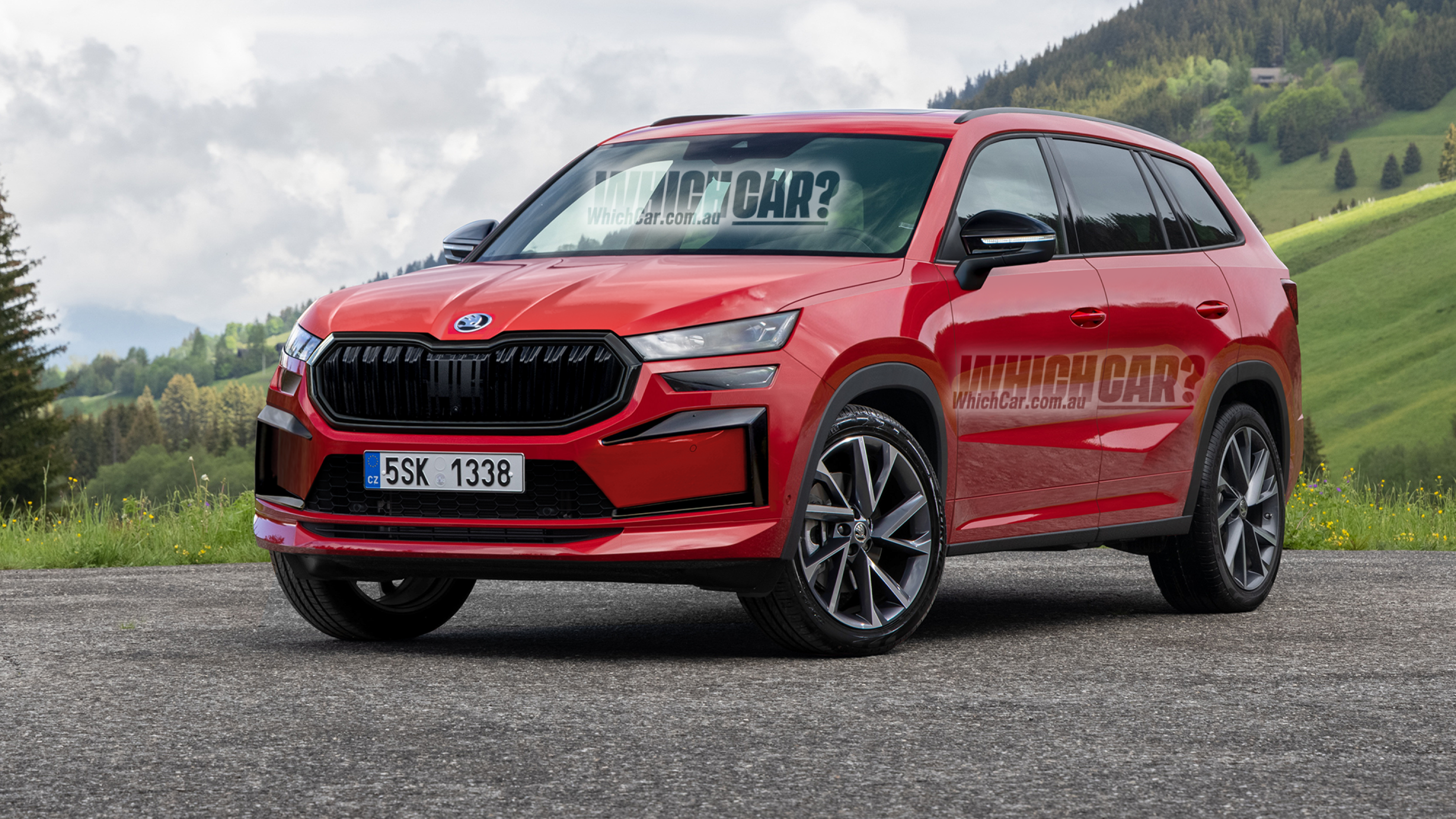
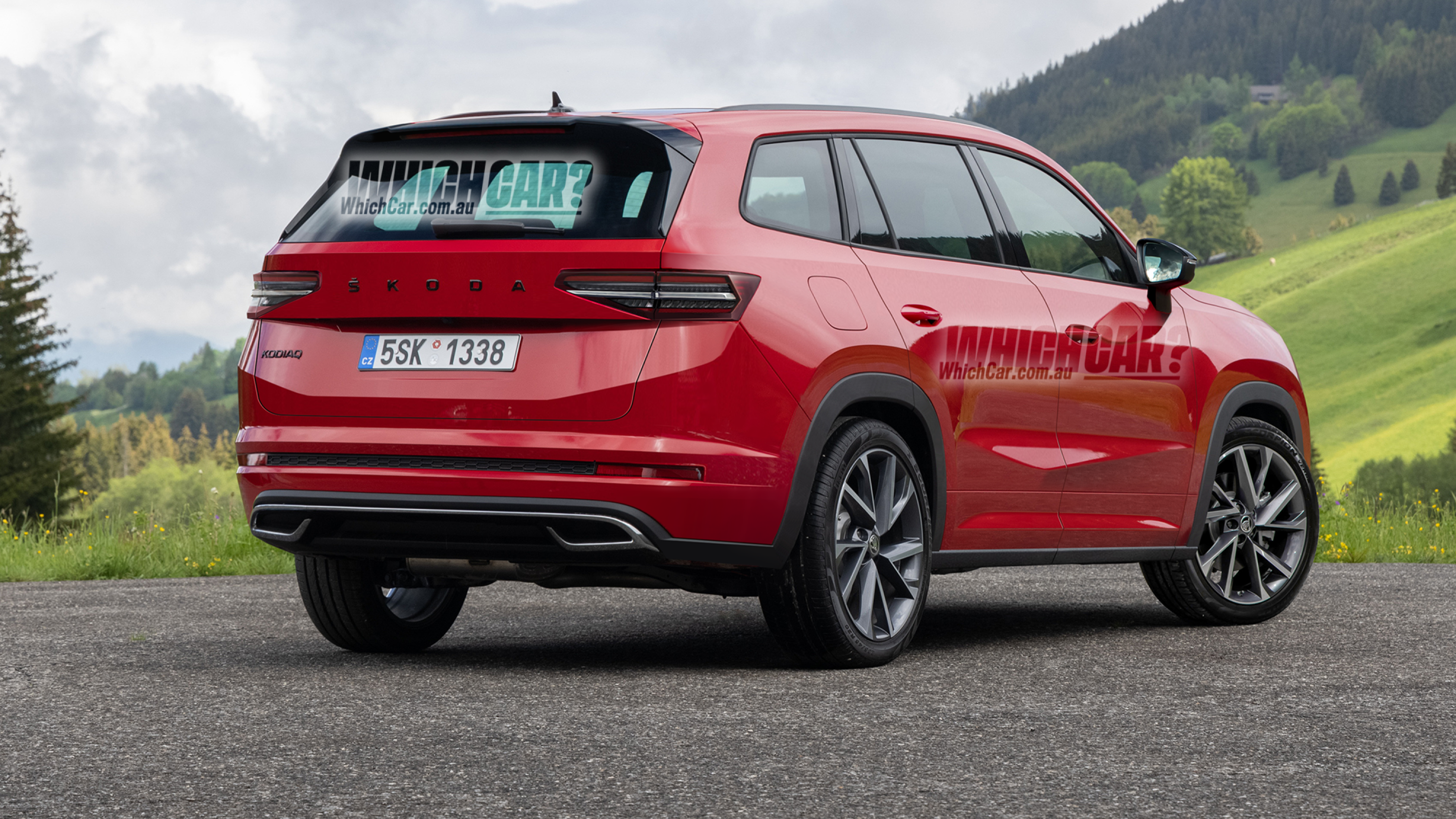
Below: The current 2023 Skoda Kodiaq
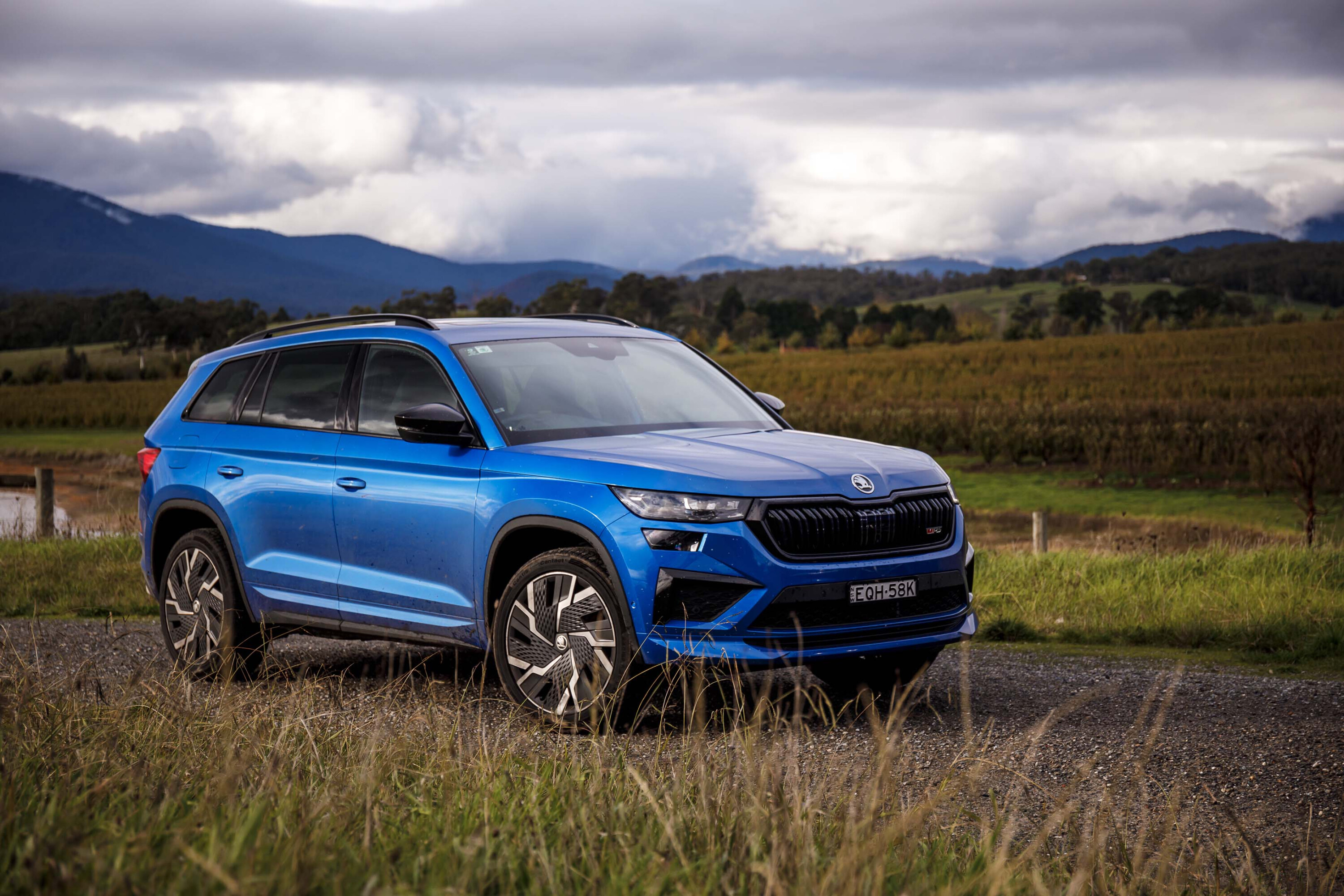
1
MORE
Everything Skoda
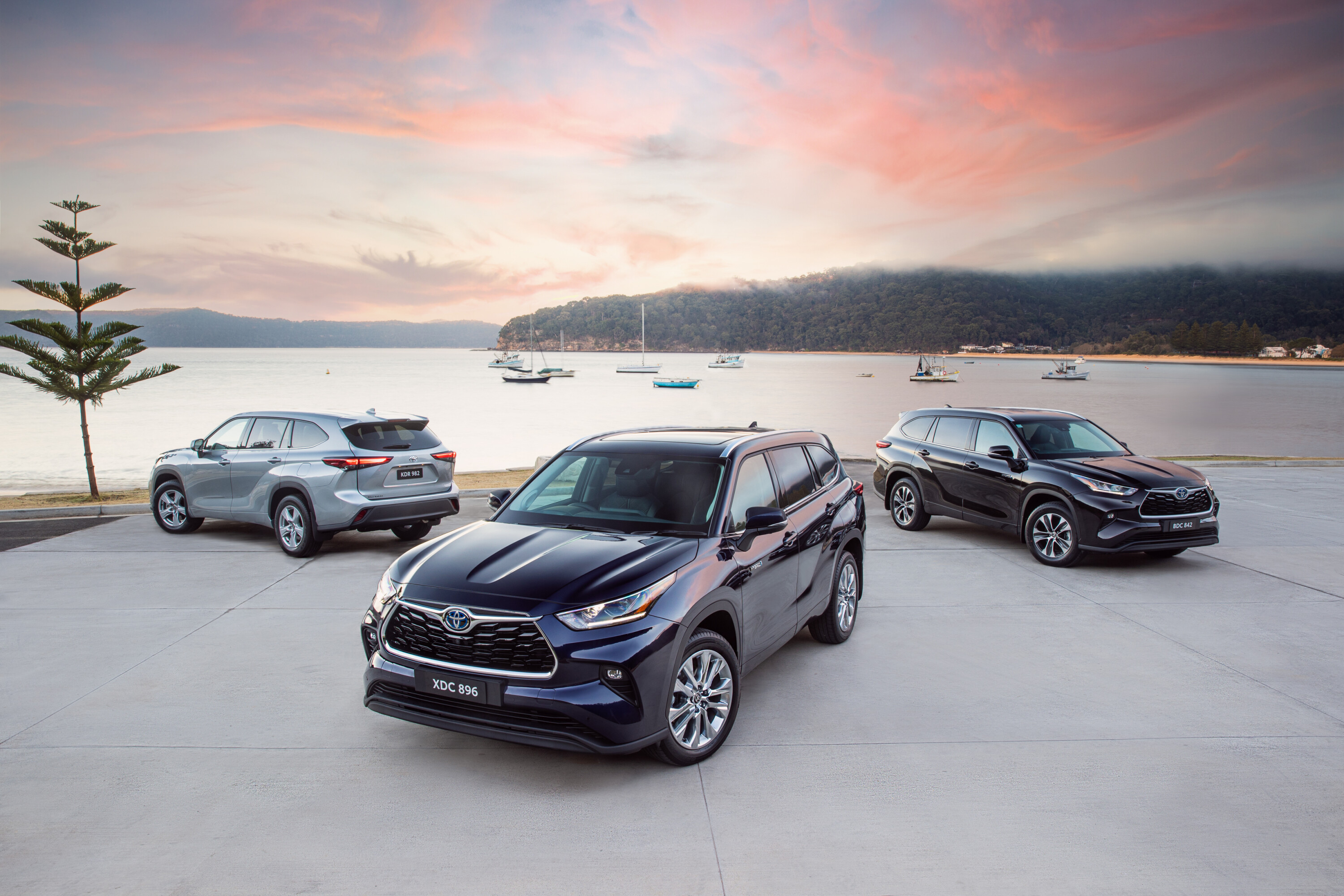
The Toyota Kluger was one of the first big soft-road SUVs to start stealing people away from the big Aussie family cars.
When it first launched in Australia in 2001, people loved how it brought the space and practicality of a Prado in an urban-friendly package.
Fast forward two decades to 2020 and fresher models such as the Mazda CX-9 and ever-improving Kia Sorento made even the third-generation Kluger look bland, outdated, and reliant on its Toyota badge.
Enter the fourth-generation Kluger which brings Toyota’s popular hybrid technology and a scrolling list of features to bring it into vogue.
But is it enough?
2
JUMP AHEAD
- Pricing
- What body styles are available for the Kluger?
- What features are standard in every Kluger?
- What key features do I get if I spend more?
- How safe is the Kluger?
- How comfortable & practical is the Kluger?
- How much boot space does the Kluger have?
- I like driving, will I enjoy this car?
- Which Kluger engine uses the least fuel?
- What is the Kluger’s towing capacity?
- How long is the warranty & what are the Kluger’s servicing costs?
- Which version of the Kluger does Wheels recommend?
- What are the Kluger’s key rivals?
- What might annoy me?
- What might I miss that similar cars have?
- What’s the infotainment system like?
- Where does Toyota make the Kluger?
- Are there plans to update the Kluger soon?
What body styles are there?
The Toyota Kluger is a five-door wagon with seven seats.
It comes in three specification grades, each with a choice of front-wheel-drive (FWD) or all-wheel-drive (AWD) drivetrains.
The Toyota Kluger (called the Highlander in other markets including New Zealand) is classed as a large SUV – lower priced.
Toyota Kluger pricing
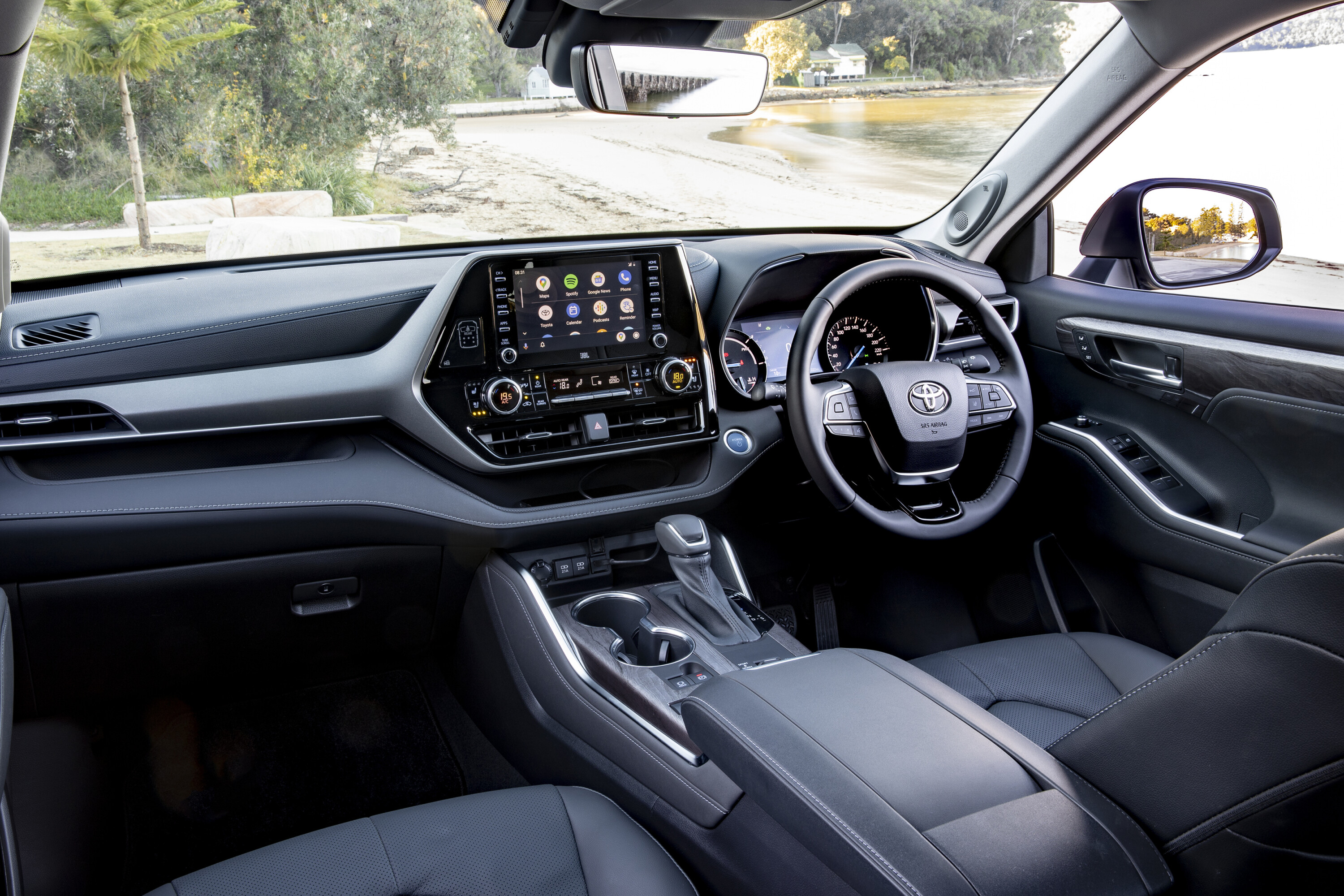
The 2023 Kluger brings the fourth-generation model’s first upgrade since it launched in 2021.
The MY23 update brought enhanced infotainment and replaced the 3.5-litre V6 petrol engine replaced with a more efficient 2.4-litre turbo petrol engine.
As a result, entry-level retail pricing jumped by $2070 to just shy of $50k.
1
What features are in every Toyota Kluger?
| 2023 Toyota Kluger standard features | |
|---|---|
| Wireless Apple CarPlay | Wired Apple CarPlay/Android Auto |
| Digital Radio (DAB+) | Blutooth connectivity |
| Sound system | Reversing camera |
| LED headlamps | LED daytime running lamps |
| LED rear combination lamps | Fog lamps |
| USB ports – 3x front, 2x rear | Heated powered side mirrors |
| Shark fin antenna | Leather accented steering wheel |
| Rain-sensing windscreen wipers | Three-zone climate control |
| Smart keyless entry/start | Electronic parking brake |
| Drive mode select: Eco, Normal, Sport | Hill-start assist |
| Autonomous emergency braking | Lane departure alert |
| Lane keeping assist | Adaptive cruise control |
| Lane trace assist | Road sign assist |
| Blind spot monitor | Rear cross traffic alert |
| Rear parking sensors | |
What key features do I get if I spend more?
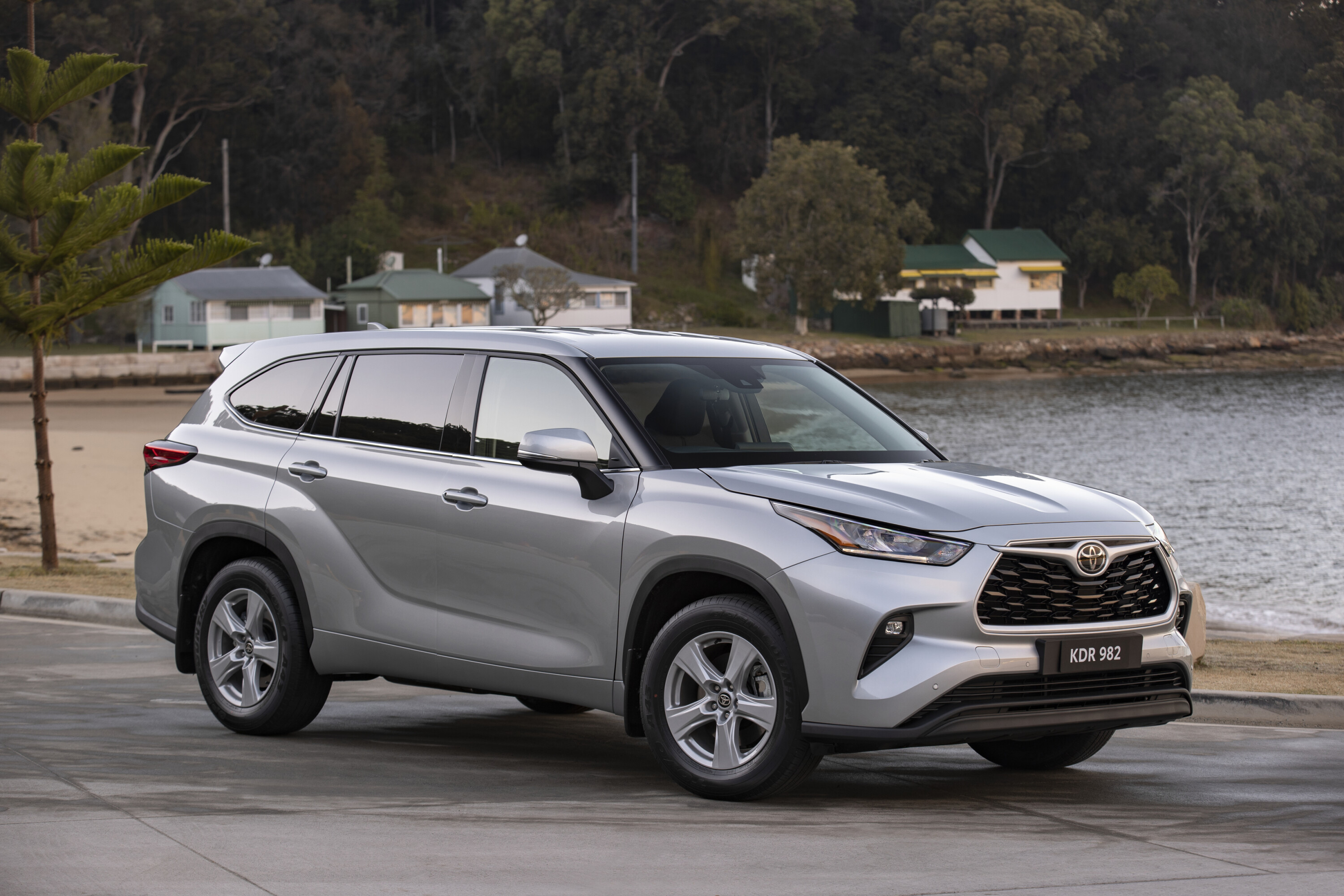
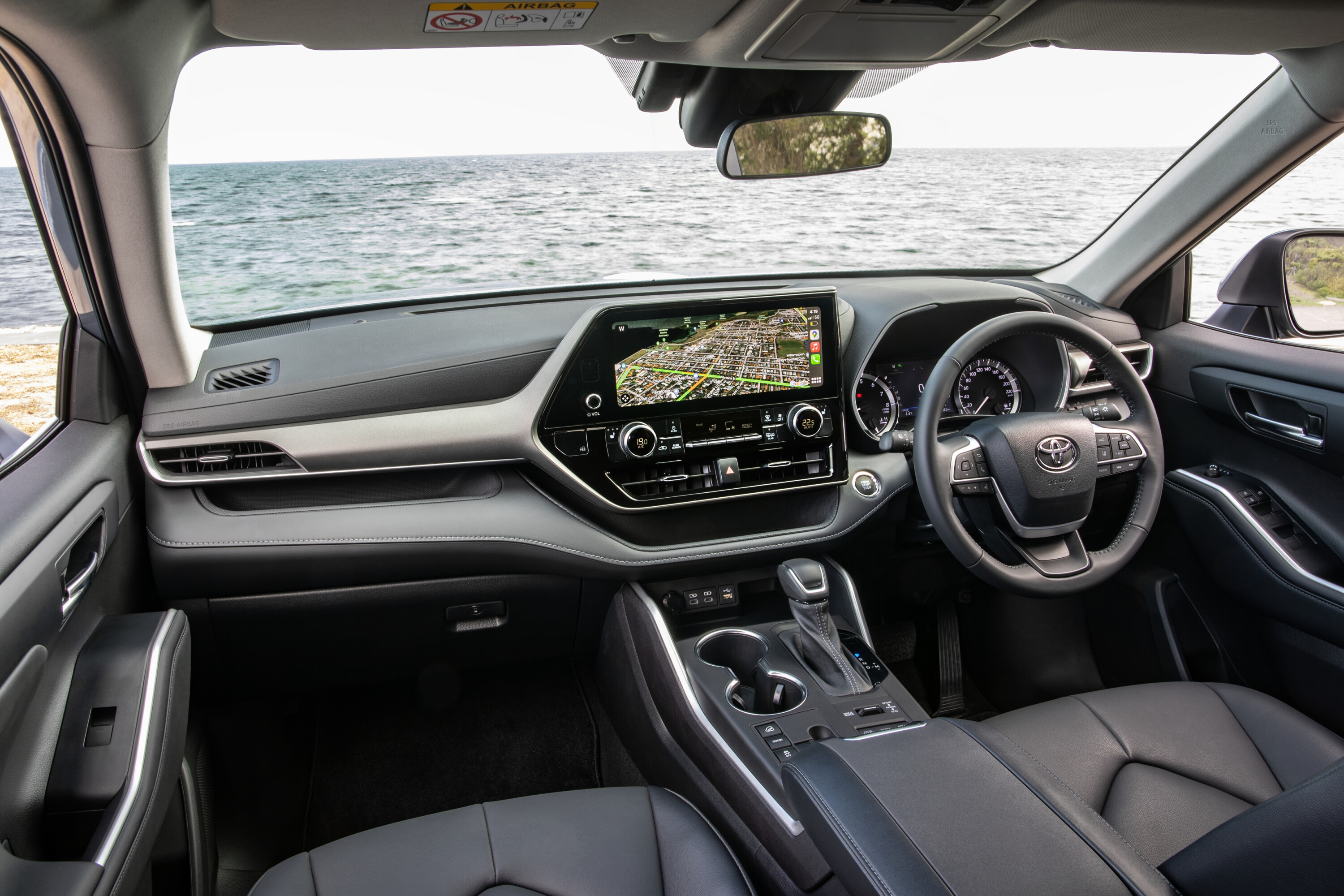
The entry-level GX spec comes with an 8.0-inch touchscreen, cloth seats, 18-inch alloy wheels and a six-speaker sound system.
3
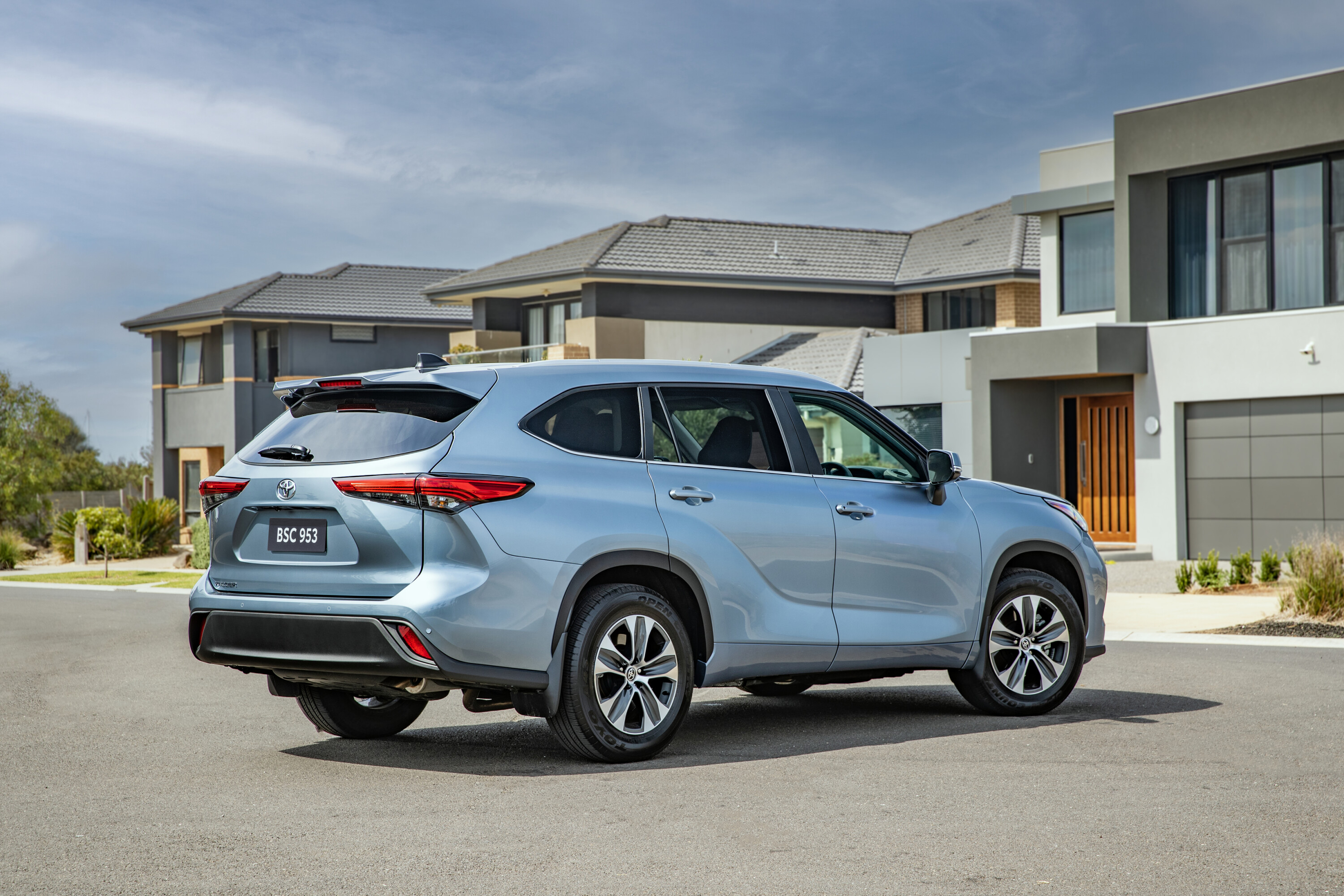
Spending more on the Kluger GXL brings the following features in addition to the GX.
| Kluger GXL additional features | |
|---|---|
| 12.3-inch colour touchscreen | In-built satellite navigation |
| 8-way power adjusted front seats | Powered driver’s seat lumbar adjustment |
| Synthetic leather interior | Heated front seats |
| Powered tailgate | Roof rails |
3
1
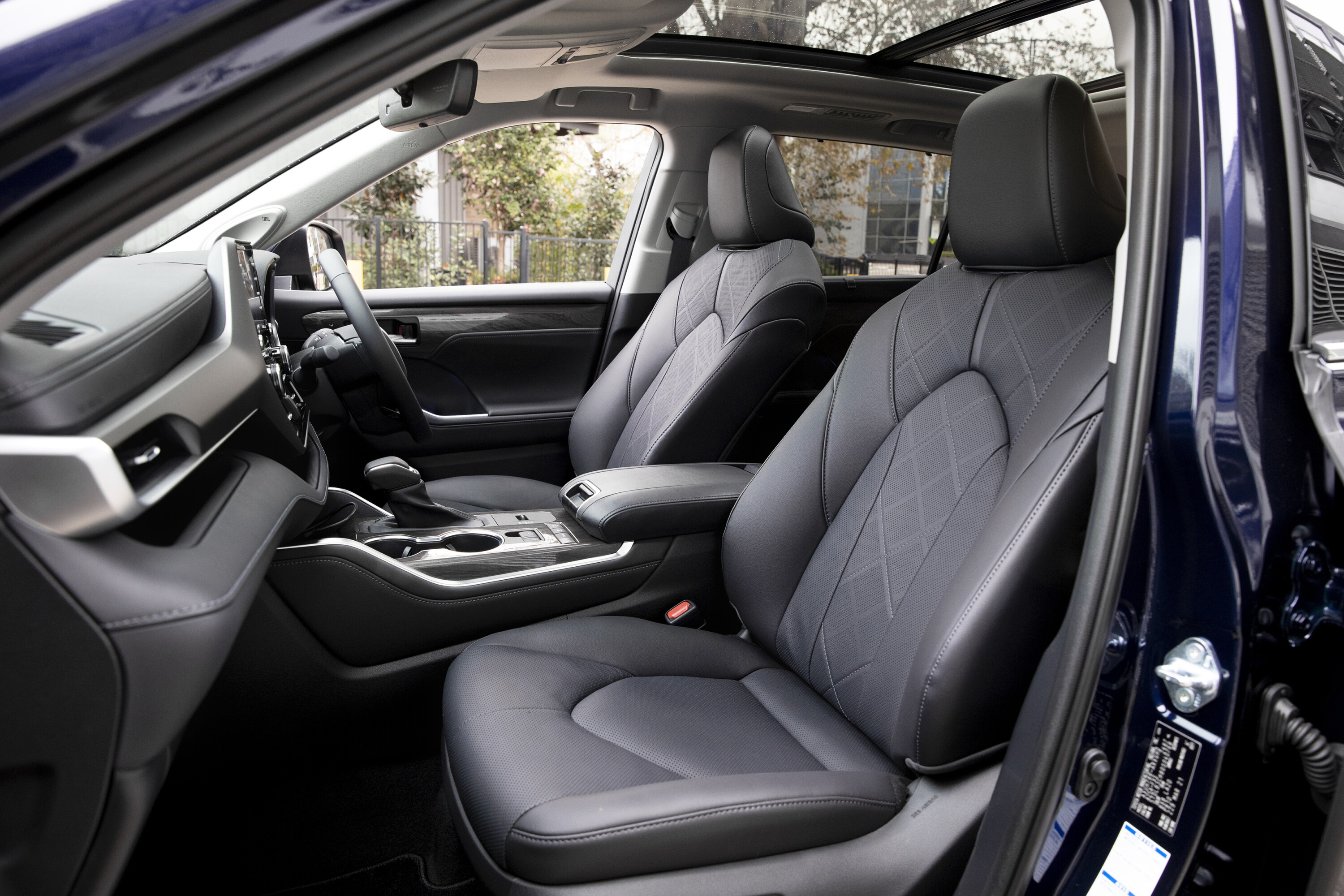
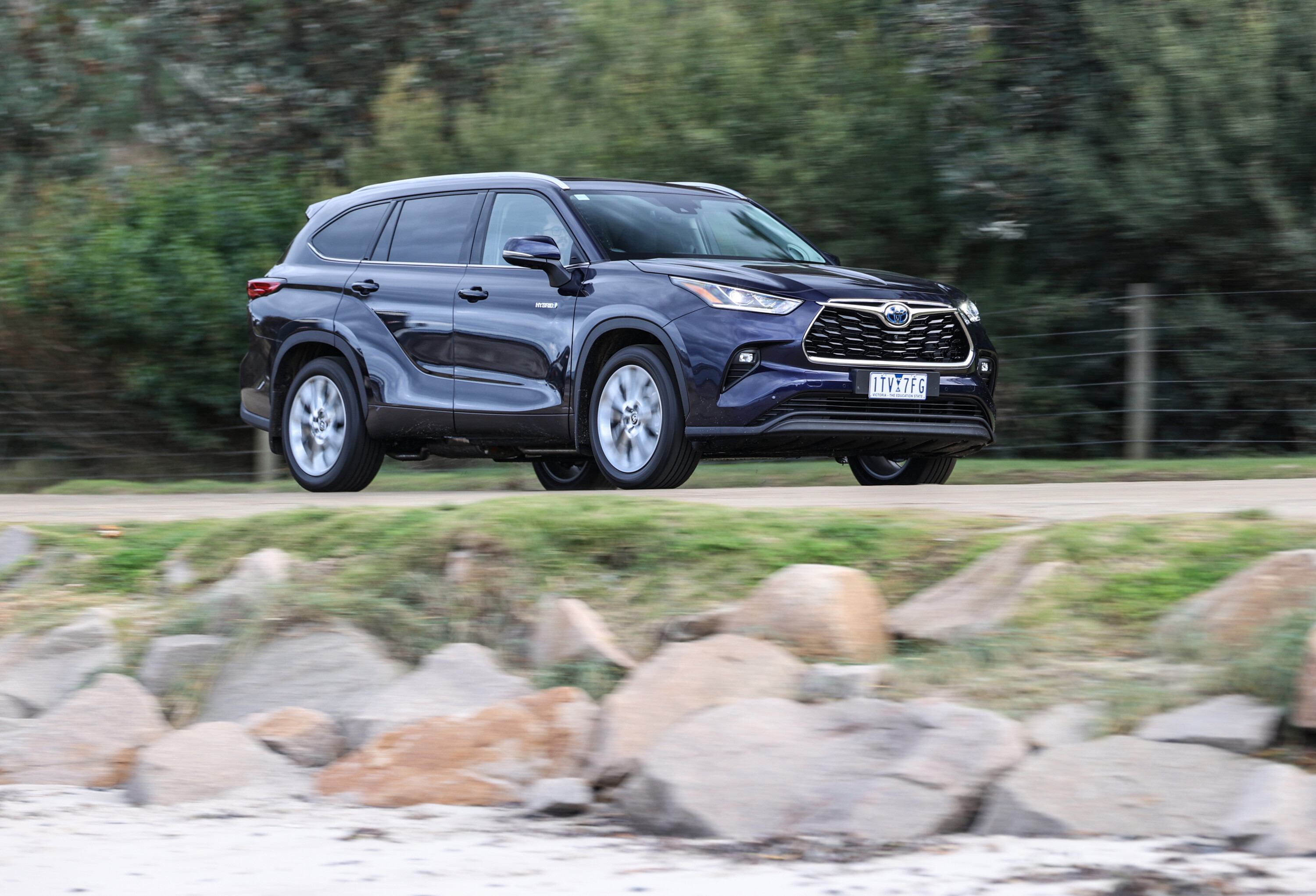
Stepping up to the range-topping Kluger Grande brings…
| Kluger Grande additional features | |
|---|---|
| 20-inch ‘Chrometec’ wheels | Projector LED headlamps |
| Powered tailgate with kick sensor | Panoramic glass moonroof |
| Front heated and ventilated seats | Premium’ leather appointed upholstery |
| Interior ambient lighting | Driver’s seat memory |
| 12.3-inch digital instrument cluster | Auto-dimming rearview mirror |
| Head up display | Panoramic view parking monitor |
| 11-speaker JBL premium sound system | |
1
2
Paint
1
How safe is the Toyota Kluger?
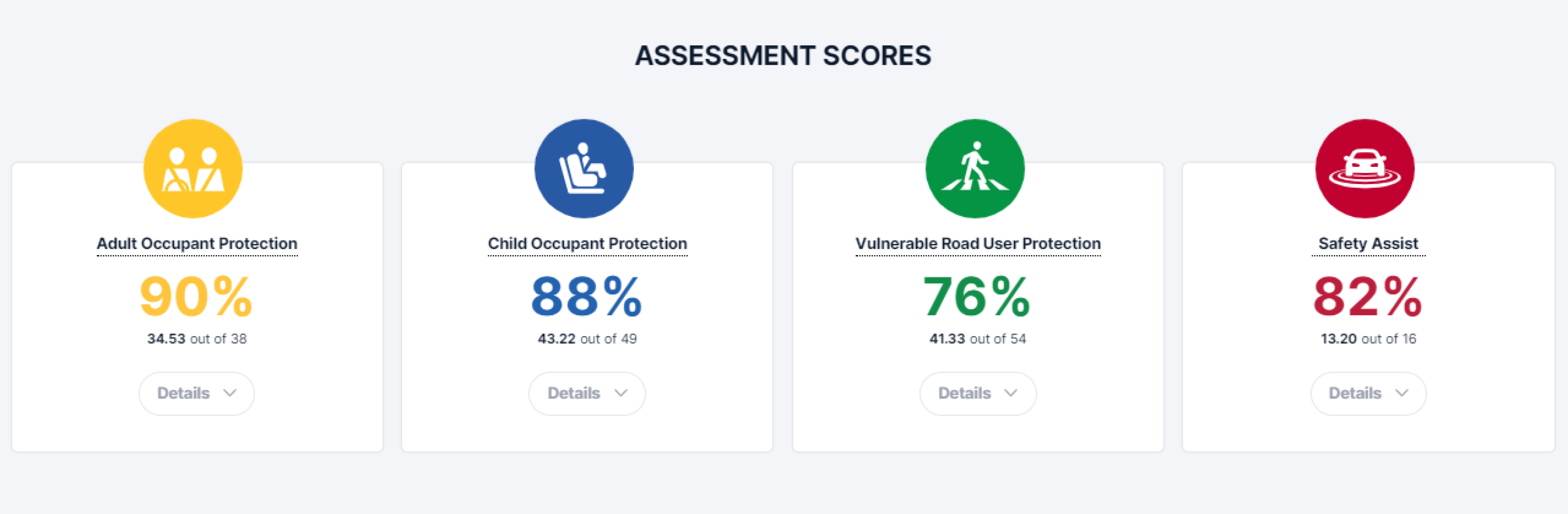
The Toyota Kluger is covered by a five-star ANCAP safety rating, based on testing conducted in 2021. This score applies to all variants.
It received a score of 90 per cent for adult occupant protection, 88 per cent for child occupant protection, 76 per cent for vulnerable road user protection, and 82 per cent for safety assist.
Seven airbags (dual front, side, curtain, and driver’s knee) are fitted across the range, with the curtain airbag extending all the way back to protect third-row occupants.
Each variant is equipped with Toyota Safety Sense active safety suite that comes with the following features:
| 2023 Toyota Kluger safety features | |
|---|---|
| Autonomous emergency braking with pedestrial and daytime cyclist protection | Active cruise control with curve speed reduction |
| Lane departure warning | Lane keeping assist |
| Automatic highbeam | Intersection turn assist |
| Lane trace assist | Road Sign Assist |
| Other safety features | |
|---|---|
| Blind-spot monitor | Rear cross traffic alert |
| Rear parking sensors | Front parking sensors |
| Reversing camera with guide lines | Panoramic view parking monitor (Grande only) |
2
How comfortable and practical is the Toyota Kluger?
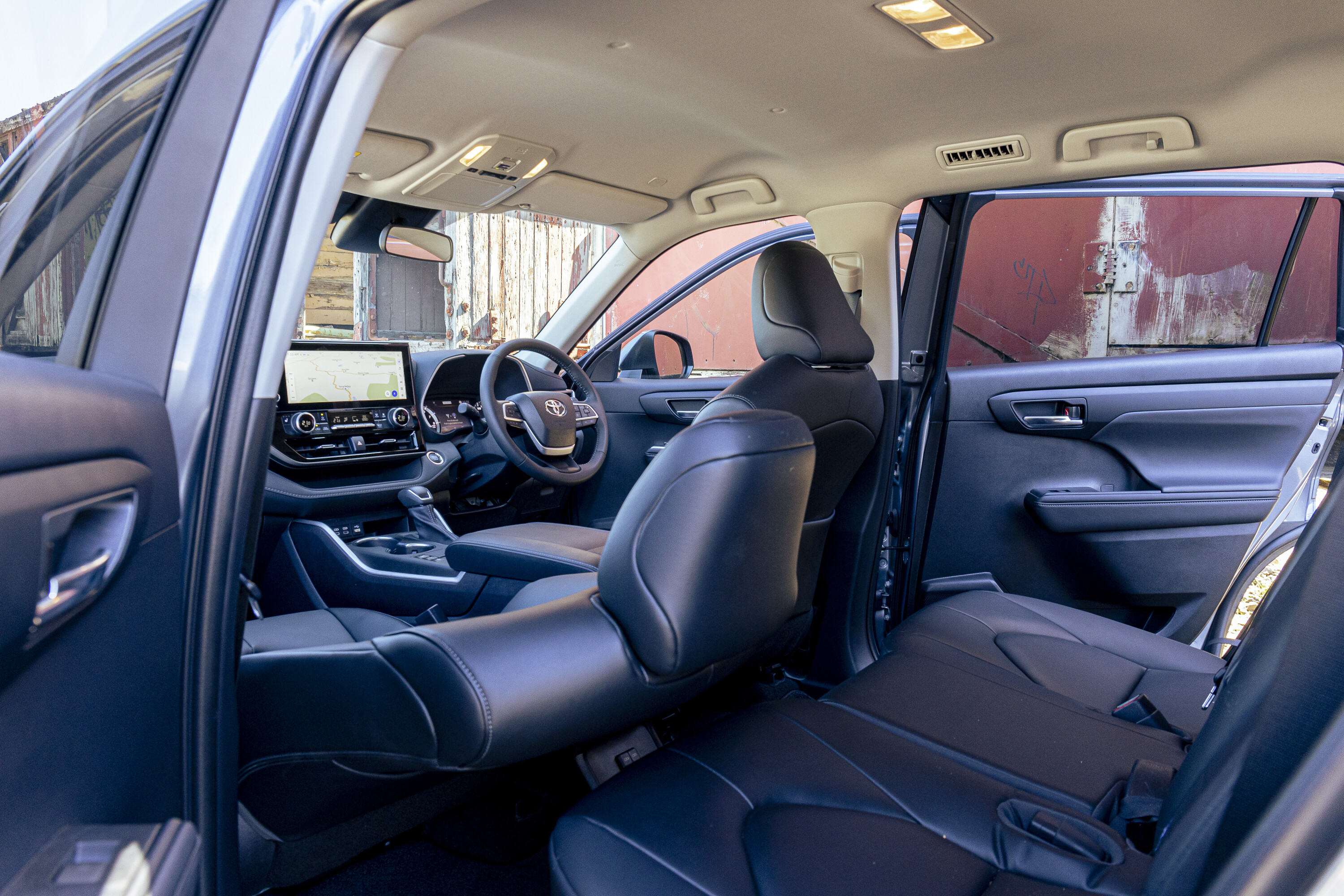
The Kluger is meant to be an urbane alternative to the LandCruiser Prado, but compared to its soft-road rivals its cabin feels a little workmanlike, even in the plusher Grande.
The front seats are comfortable, but that initial comfort in the Kluger gives way to long-distance fatigue.
Forward vision is excellent, with A-pillars that are remarkably slim for a modern SUV. The big head-up display in the Grande helps keep your attention on the road ahead.
The first-row ergonomics are good, with everything clearly labelled and falling within easy reach of the driver’s seat, but there is little wow factor.
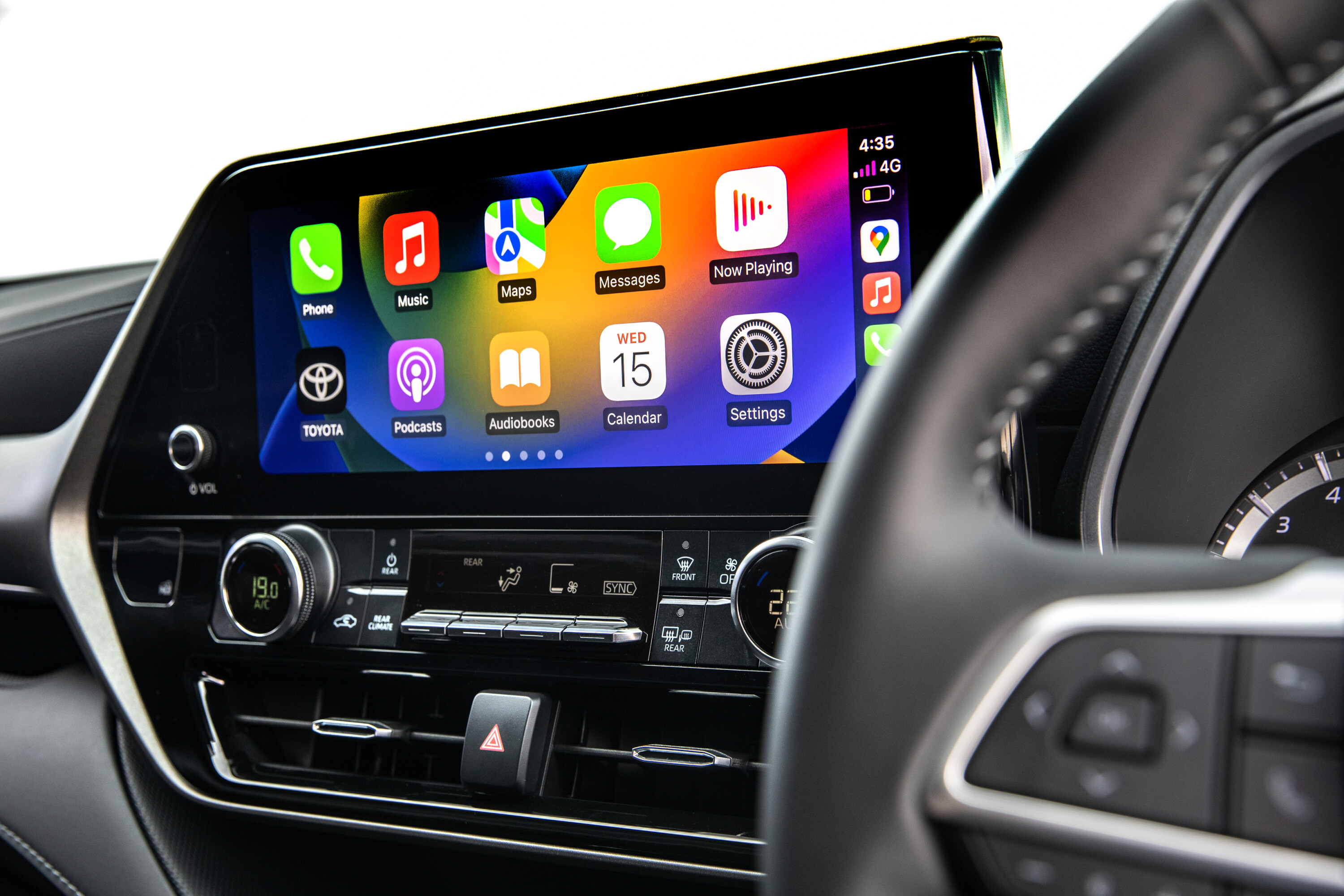
The 2023 update brought a welcome infotainment upgrade that saw the 8.0-inch high-mounted screen, which seemed ridiculously small in a large SUV built after 2020, replaced with a 12.3-inch monitor in all but the entry-level GX spec.
1
The upgrade also saw the Grande gain a 12.3 digital instrument cluster, with the variants retaining the analog dials, which are becoming increasingly uncommon in this price range.
Another addition was wireless Apple CarPlay, but if you have an Android phone you will still have to plug it in to access Android Auto. Irritatingly there is no wireless phone charger meaning you’ll probably have to plug your phone in any way.
The shelf that runs across the dash provides a very handy place to store your phone, with its grippy rubber surface ensuring it and your keys and other items won’t go slide from side to side whenever you turn.
Other storage options include the usual centre armrest with dual cupholders and door bins that are a little narrow.
3
Second-row comfort
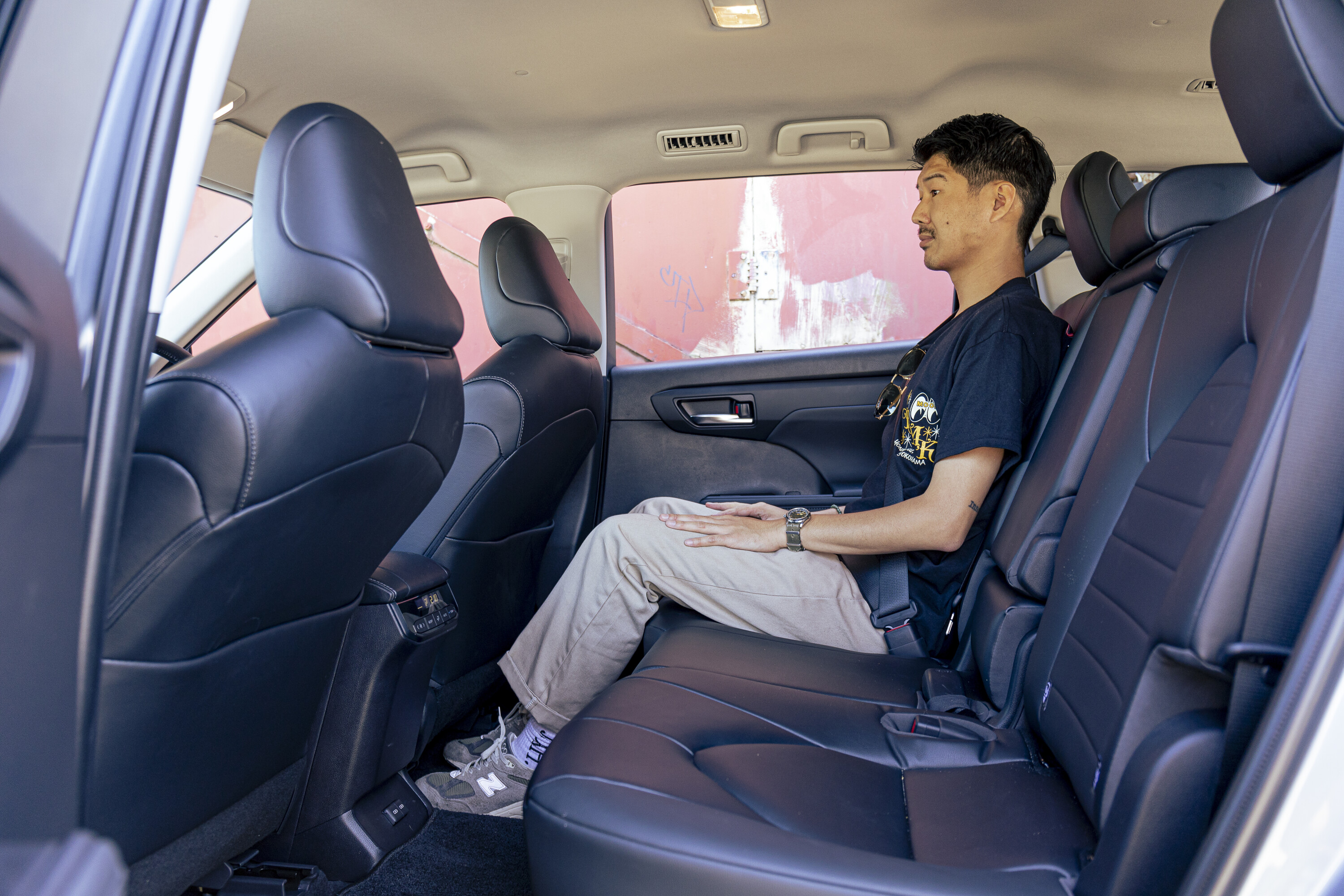
The Kluger’s second row is incredibly spacious, with more head and legroom than most of its large-SUV rivals.
Second-row passengers benefit from a separate rear climate zone so they can set their own temperature and airflow through the ceiling air vents.
The roomy three-seat bench has a reclinable backrest and can slide back and forth.
The Grande comes standard with a gigantic glass sunroof and it’s used to good effect, flooding the cabin with light and lifting the ambience considerably, particularly with the tan upholstery.
The second row has three ISOFIX points and top tether anchors for securing child seats.
1
Third-row comfort
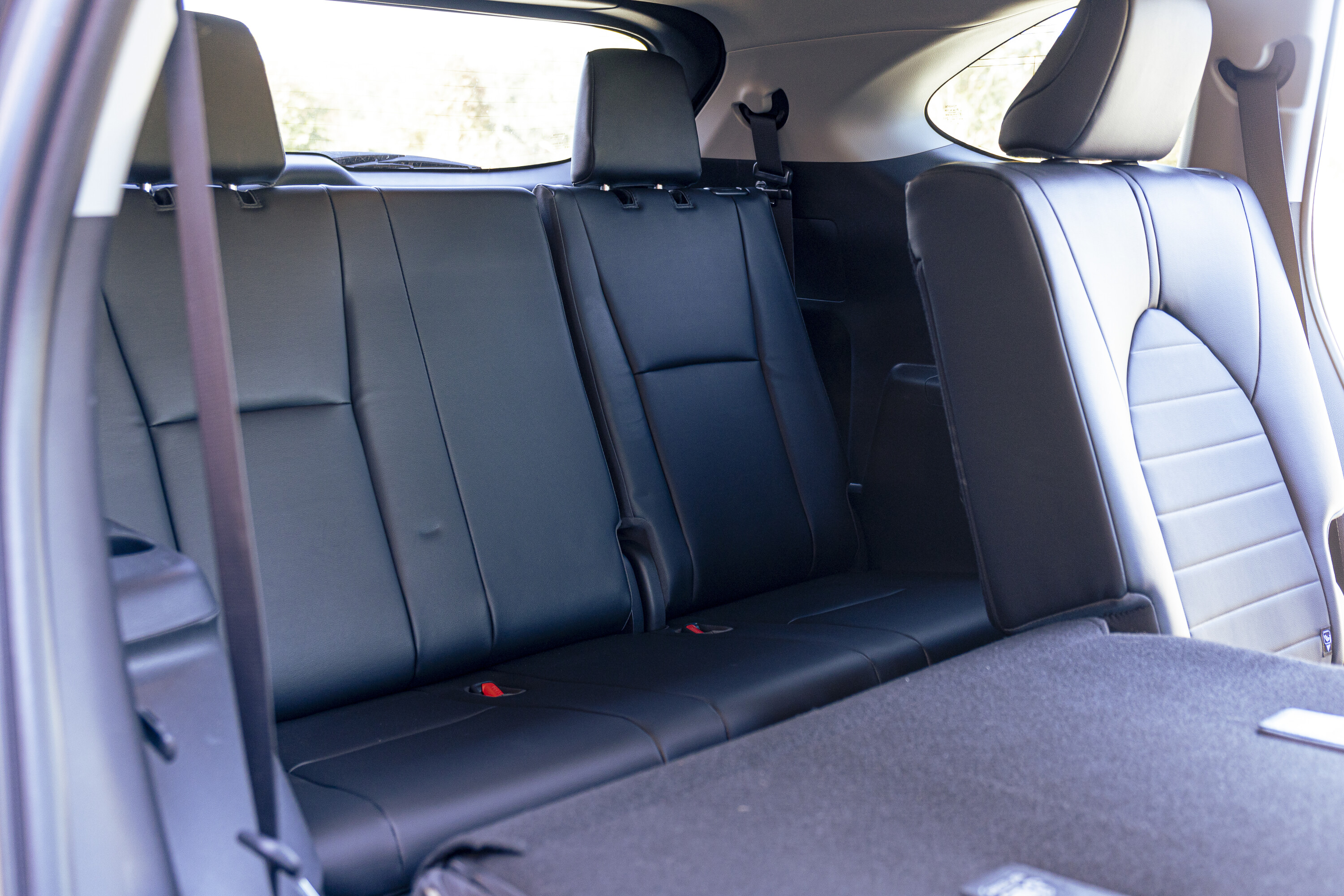
Logic would dictate that having plenty of room in the middle row would come at the expense of third-row space – logic would be right.
For an adult, squeezing between the door frame and the middle seat isn’t an elegant operation, with the shape of the Kluger’s rear door aperture not big enough for easy third-row access.
The second-row seats tilt/slide forward in one step using a lever on the back, though SUVs such as the Kia Sorento and Hyundai Palisade provide cleverer one-touch electric tumble operation.
Adults who draw the short straw to sit back there will have to travel with their knees pointing to the ceiling on an overly firm seat with no amenities such as USB ports.
Children will fit okay in the third row, but you won’t be able to put tiny folk back there as there are no child seat anchor points.
How much boot space does the Toyota Kluger offer?
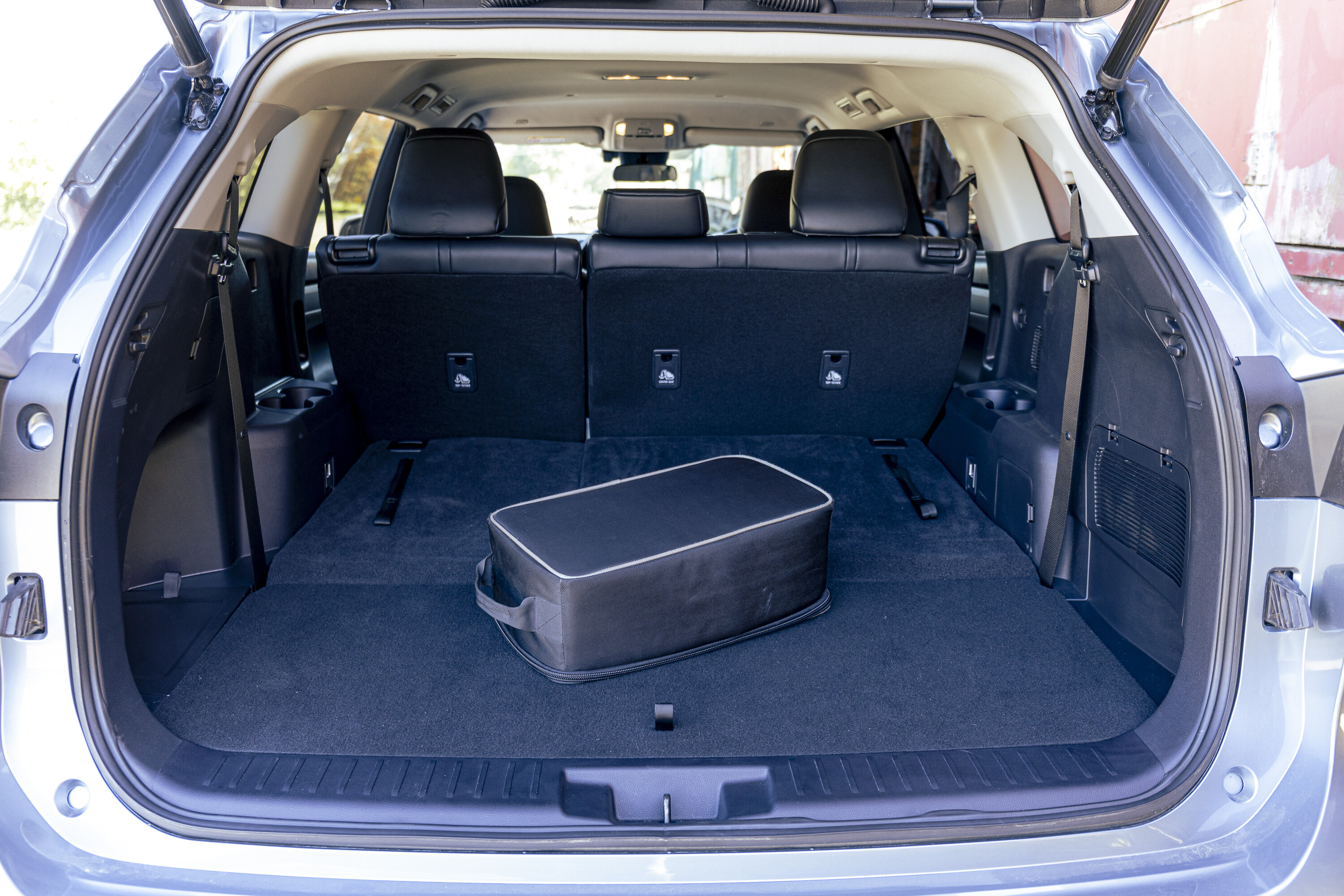
With all three rows in play, the Kluger can accommodate a useful 241 litres, which is enough to fit a pram or a large number of shopping/sports/school bags.
However, fold the third row down and the greedy second row restricts five-seat cargo capacity to a large-sedan-like 552 litres, which is 28 litres less than the smaller RAV4 medium SUV and significantly less than most of its rivals.
Drop the middle-row seatbacks and you’ll be able to carry 1150 litres of stuff, compared to the RAV4’s 1605 litres.
3
I like driving, will I enjoy the Kluger?
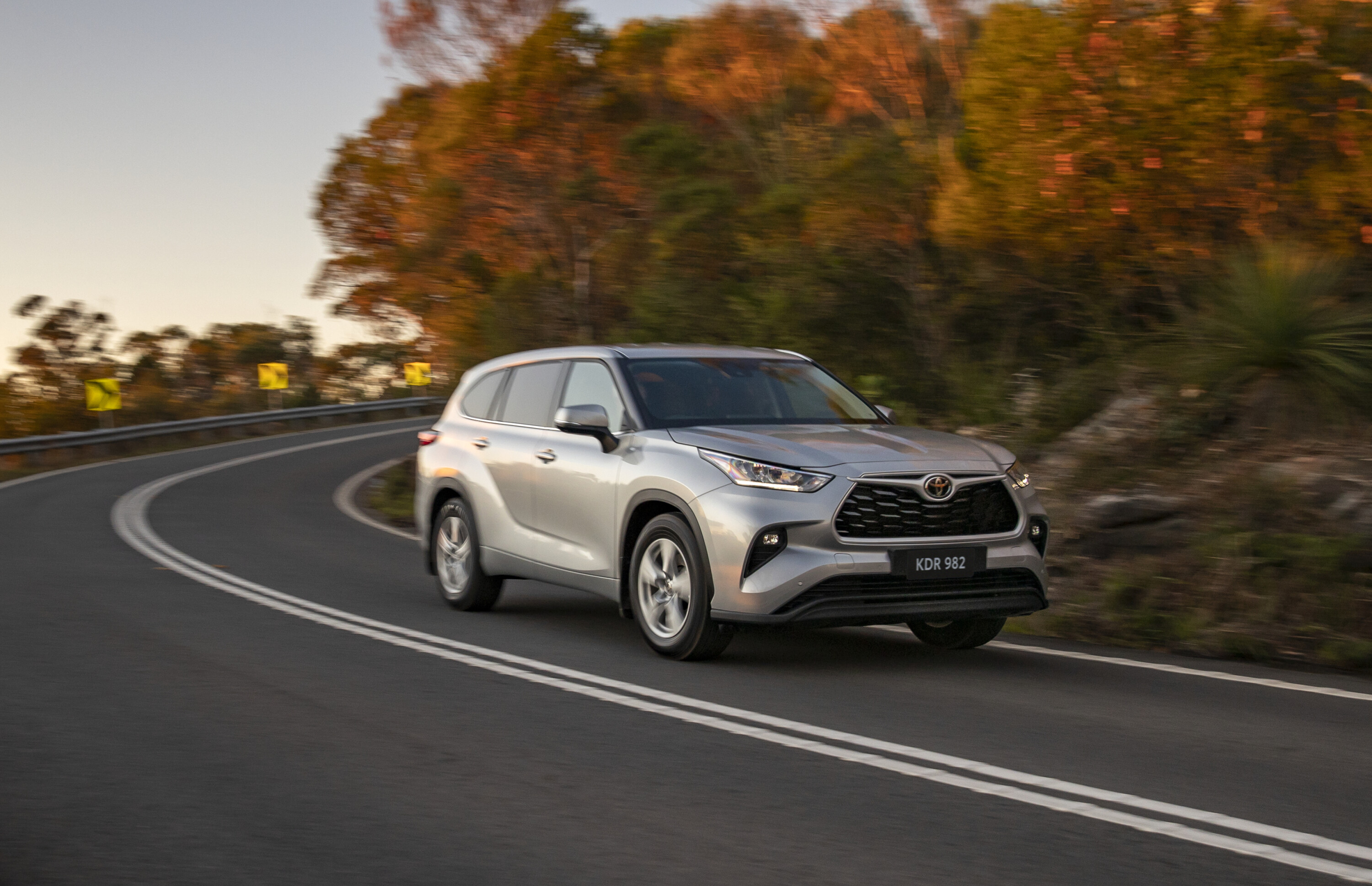
The 2023 Kluger saw the introduction of a 2.4-litre turbocharged petrol engine, which replaced the V6 engine, which was our pick for anyone who prioritised performance.
The new engine is also found in the Lexus RX (that’s based on the Kluger) in place of the same V6 powertrain but in a slightly dialled-up tune.
We’re yet to drive the turbo Kluger, but in its posh cousin, the 2.4-litre engine/eight-speed auto powertrain acquits itself in the performance stakes and feels more refined than the V6.
1
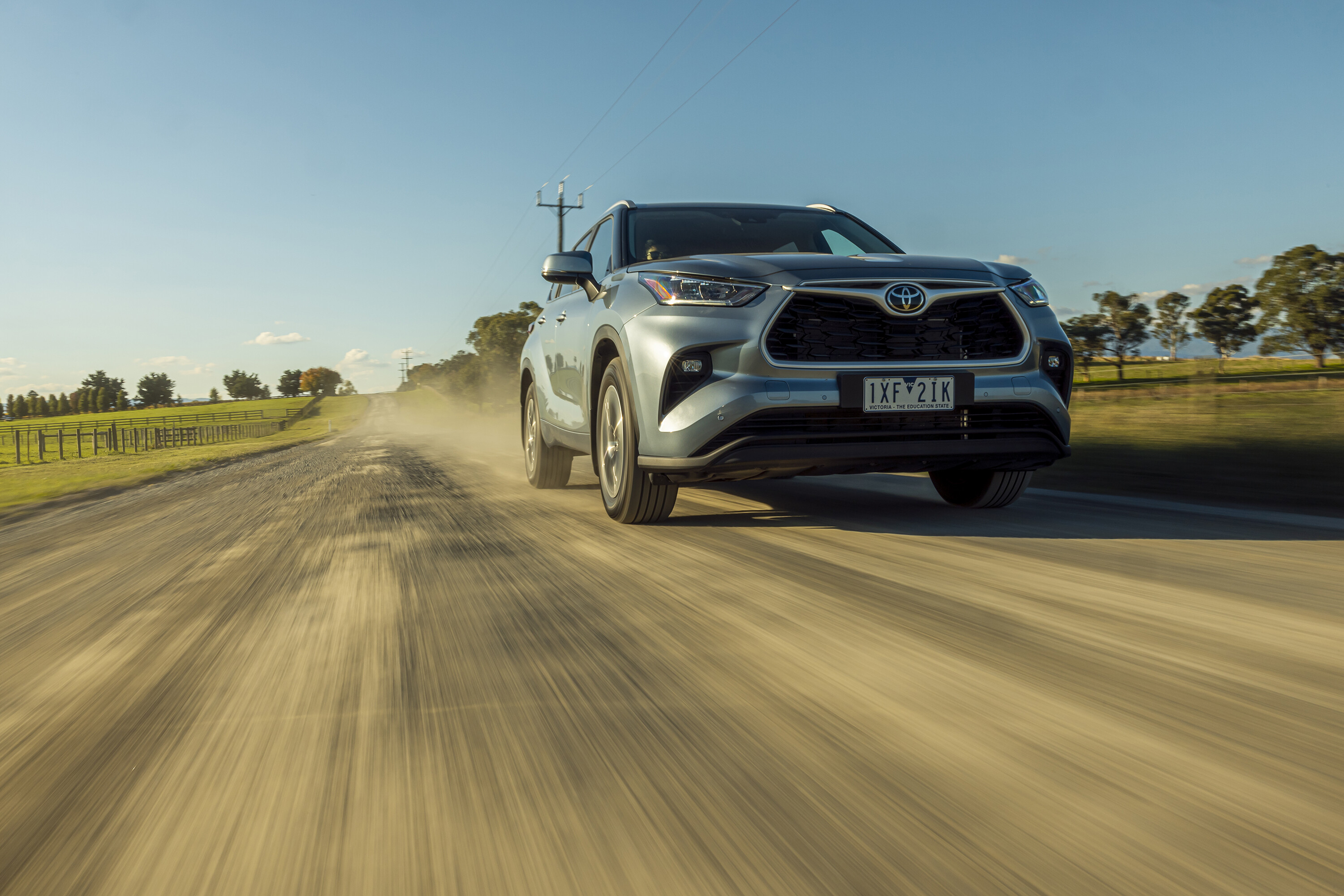
The 2.5-litre petrol hybrid is essentially the same set-up as the RAV4 AWD albeit with a boost to power and torque.
On a light throttle, the hybrid drivetrain with e-CVT transmission feels initially responsive but then needs a heavy right foot to achieve lively performance, which comes at the expense of refinement – the engine becomes overly conspicuous with its gruff nature.
It’s difficult to prevent the petrol engine from kicking into life even at low speeds, and the EV Mode that prompts the car’s computer to stay with electric power cancels itself at just 30km/h.
1
It’s still possible to run at higher speeds using the electric motors but only once the Kluger has momentum and on flattish roads, with Toyota’s hybrid system switching as seamlessly between its dual forms of power as it has done ever since the early days of the Prius.
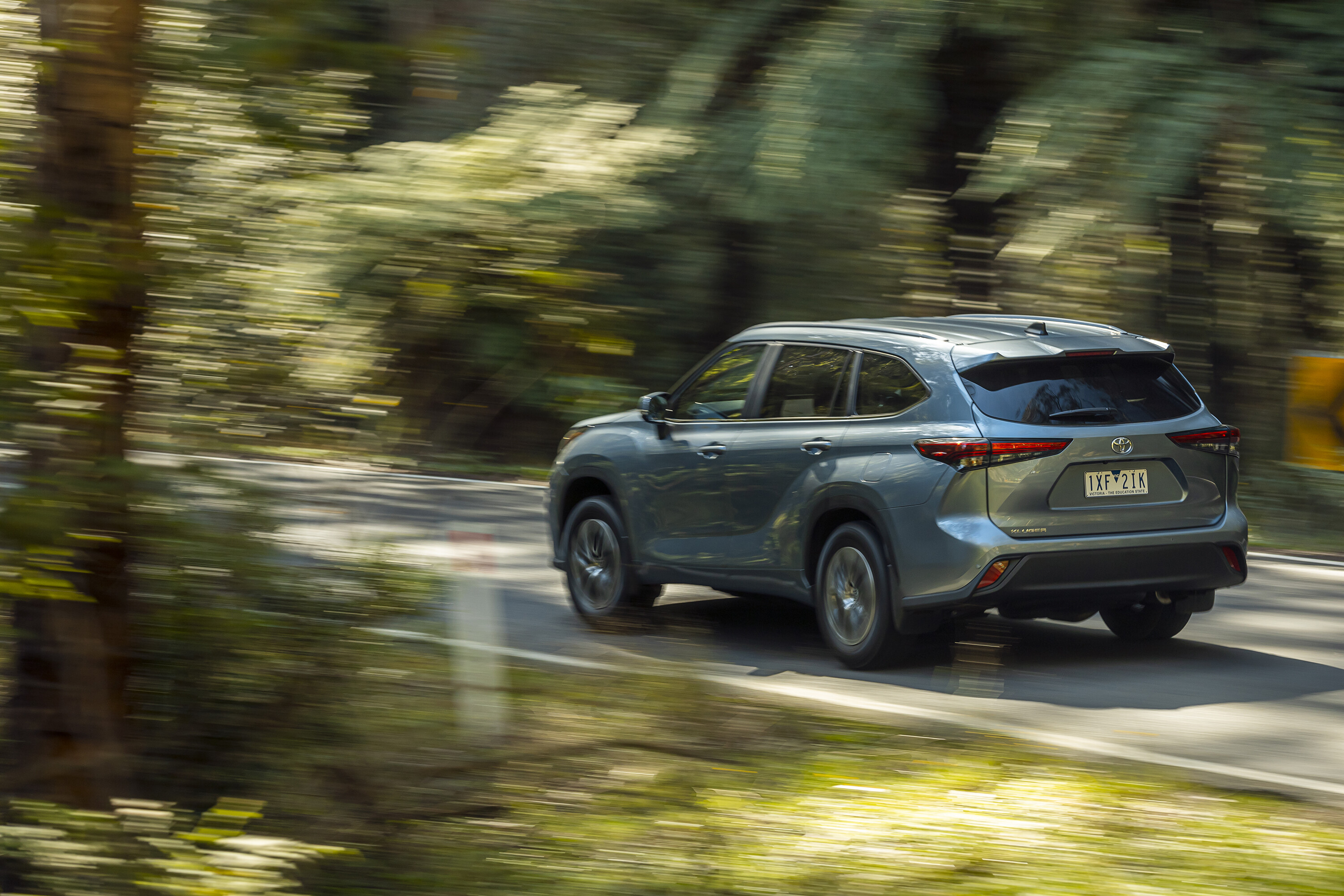
When the Kluger is coasting or cruising, the drivetrain’s near-silence is complemented by minimal noise from the tyres on coarser surfaces. This includes the Grande’s 20-inch wheels – the biggest available on any Toyota – which also avoid spoiling the wonderfully relaxed suppleness of the Kluger’s suspension.
The steering feels smooth and effortless and combines good body control and ride comfort on rural roads that even those sitting in the third row above the rear axle will appreciate.
1
- What is a Powertrain or Drivetrain?
- Power vs torque
- Car suspension explained
- Automatic transmissions (‘gearboxes’) explained
- Chassis control systems explained
- Car vs Ute vs SUV: How the vehicle you buy should guide the way you drive
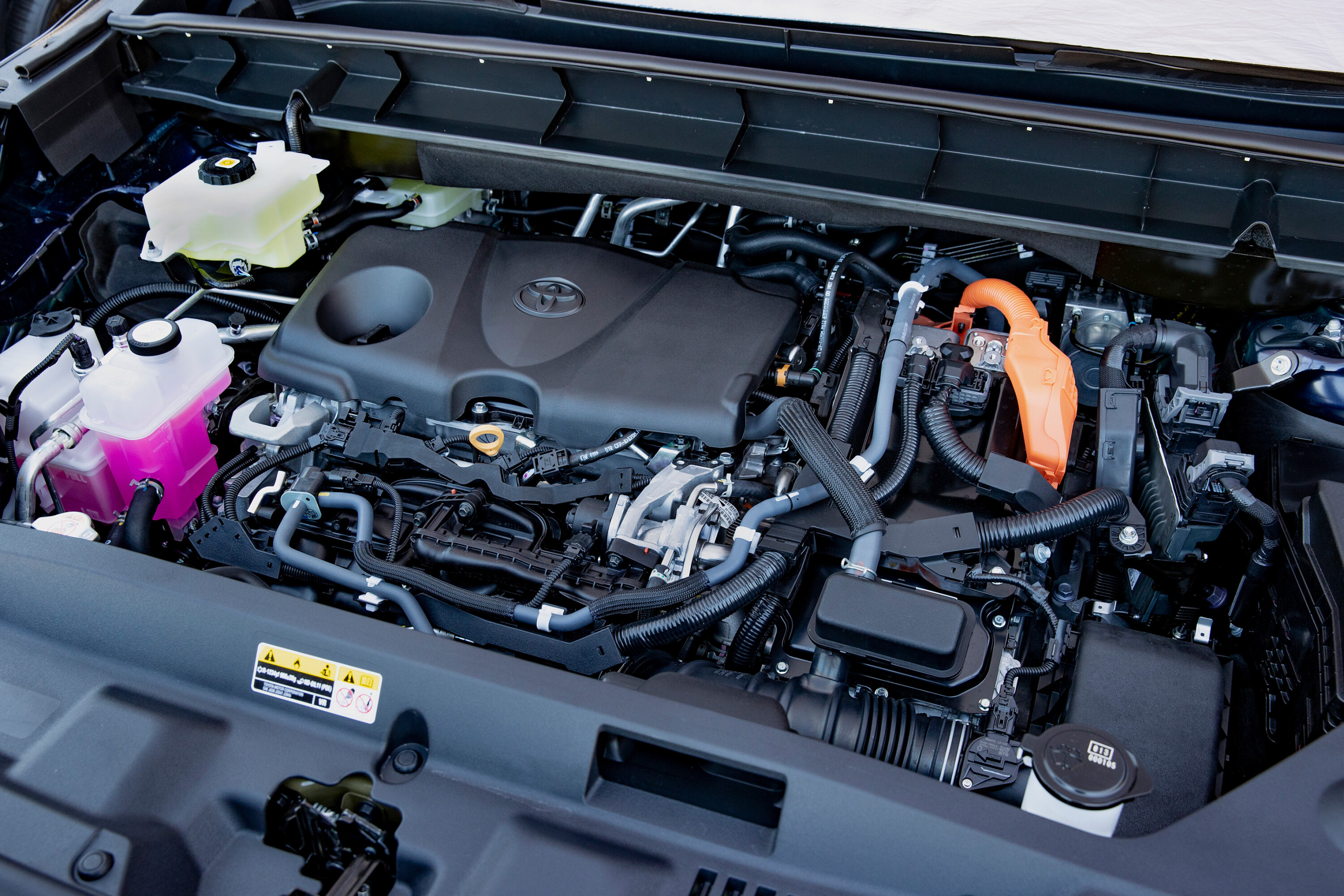
The 142kW/242Nm 2.5-litre four-cylinder hybrid powertrain’s engine and three electric motors are mated to an electronic continuously variable transmission (e-CVT), with official combined fuel economy rated at just 5.6L/100km
It’s an impressive claim, given the SUV’s 2000kg-plus kerb weight, though any savings at the bowser are compromised a little by the fact you have to use pricier RON95 premium unleaded.
Using its rear-mounted electric motor, Toyota’s e-Four AWD system can send up to 100 per cent of drive to the front wheels, or up to 80 per cent through to the rear, depending on conditions, allowing it to achieve a 0-100km/h time of 8.4 seconds.
2
Coupled with an eight-speed automatic transmission, it is much smoother than the V6…
This powertrain is only available with an ‘e-Four’ AWD system and using its rear-mounted electric motor, it can send up to 100 per cent of drive to the front wheels, or up to 80 per cent through to the rear, depending on conditions, allowing it to achieve a 0-100km/h time of 8.4 seconds.
The 198kW/420Nm 2.4-litre turbocharged four-cylinder petrol engine produces 20kW less power but 70Nm more torque than the old 3.5-litre V6 it replaced.
Coupled with an eight-speed automatic transmission, it is much smoother than the V6, but no less thirsty, improving fuel consumption by just 0.4L/100km.
The front-wheel-drive turbocharged Klugers drink 8.3L/100km of RON91 unleaded. With AWD they consume 8.5L/100km combined, with the plusher and heavier Grande’s additional 45kg sending that figure to 8.7L/100km.
How much can a Toyota Kluger tow?
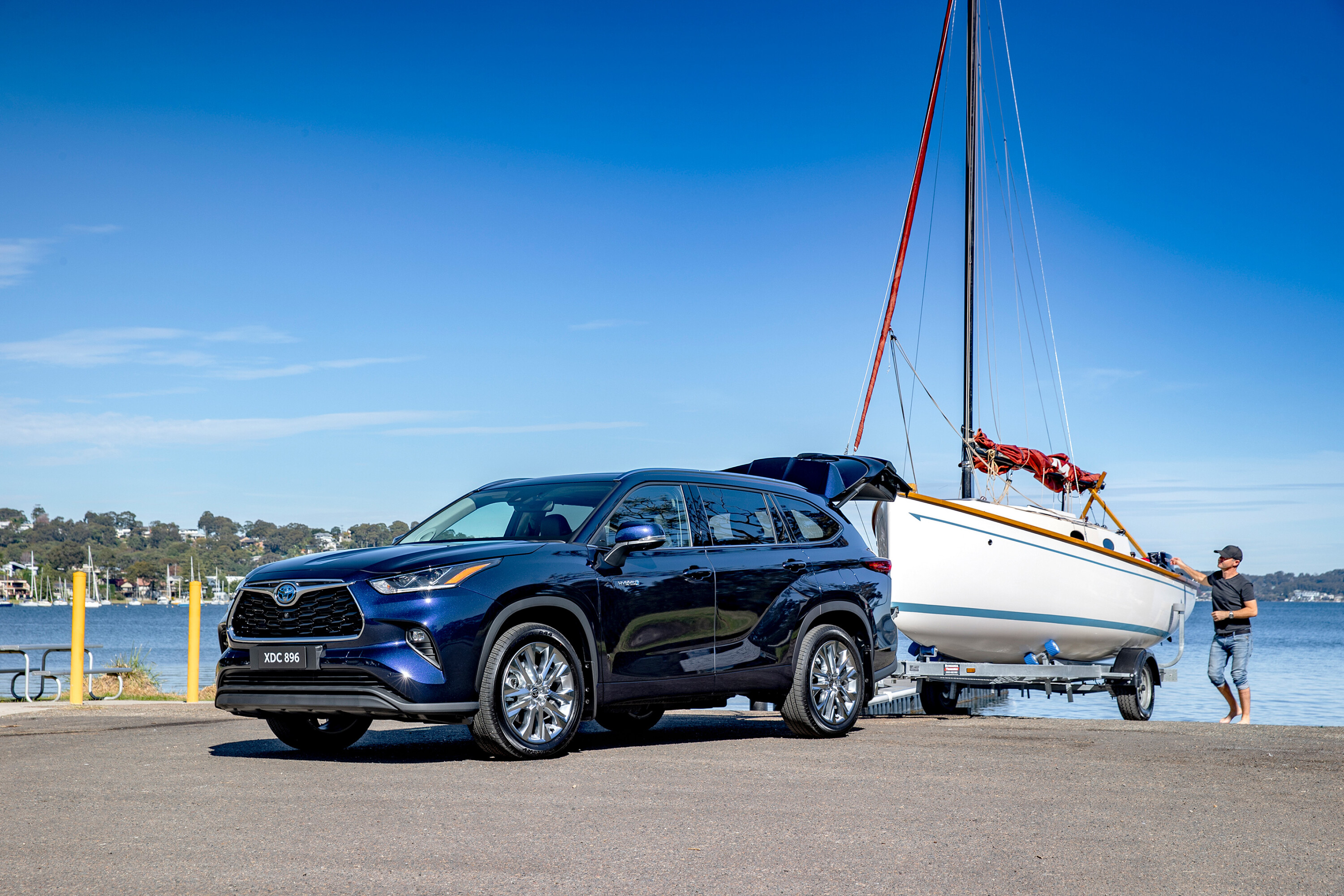
All Klugers can tow a braked load of up to 2000kg.
Unbraked towing capacity is 700kg.
1
How long is the warranty and what are the Toyota Kluger’s servicing costs?
As per the wider Toyota range, the Kluger is covered by the brand’s five-year / unlimited-kilometre warranty.
Servicing for the Kluger is required every 12 months or 15,000 kilometres, whichever comes first.
Capped-price servicing is available for the first five years or 75,000 kilometres, priced at a very reasonable $215 a pop.
Which version of the Toyota Kluger does Wheels recommend?
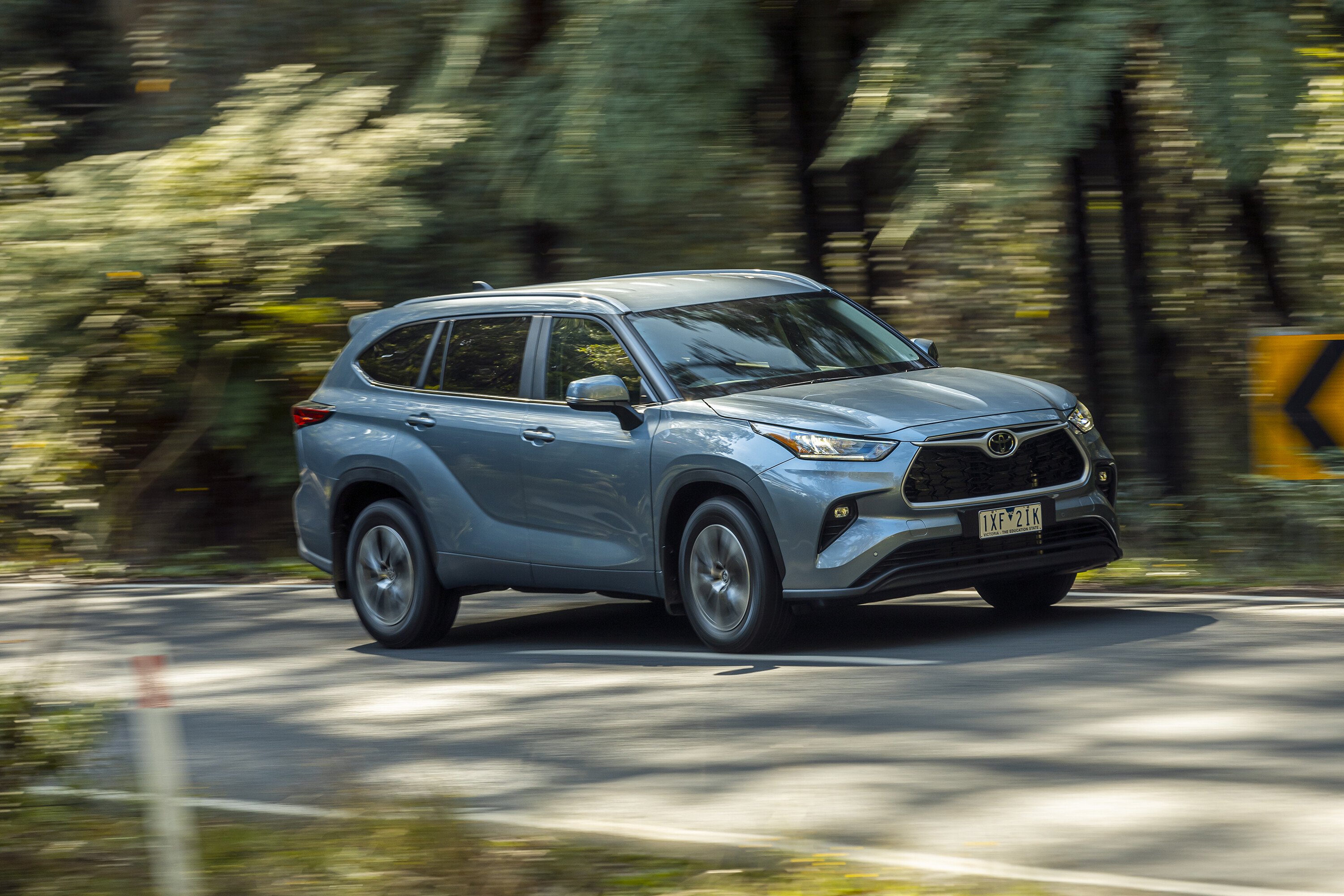
The mid-spec GXL is the obvious sweet spot of the range in terms of equipment levels and pricing.
It brings plenty of desirable creature comforts over the GX. And while the Kluger Grande delivers even more, it’s not quite as luxuriously equipped as some of its rivals, including the Hyundai Palisade Highlander and Mazda CX-9 Azami LE, which also have more spacious third rows.
As for the powertrain, the hybrid’s fuel economy is too good to pass up and, along with the thrifty servicing costs, probably makes this the cheapest three-row SUV to run.
1
What are the Toyota Kluger’s main rivals?
October 18, 2023: Victoria’s EV road tax has been struck down
In a blow for the state, Victoria’s zero-emissions vehicle road-user tax has been deemed unlawful.
See the full story at the link below.
STORY CONTINUES
It will become even more expensive to own an electric vehicle in Victoria from July 1.
According to VicRoads [↗], the Zero and Low emission Vehicle (ZLEV) road user charge will increase to 2.8 cents per kilometre (previously 2.6 cents) for full EV or 2.3 cents per kilometre (previously 2.1 cents) for plug-in hybrid electric vehicles.
Only trips made on and after July 1 will be subject to the new rate.
What does this mean?
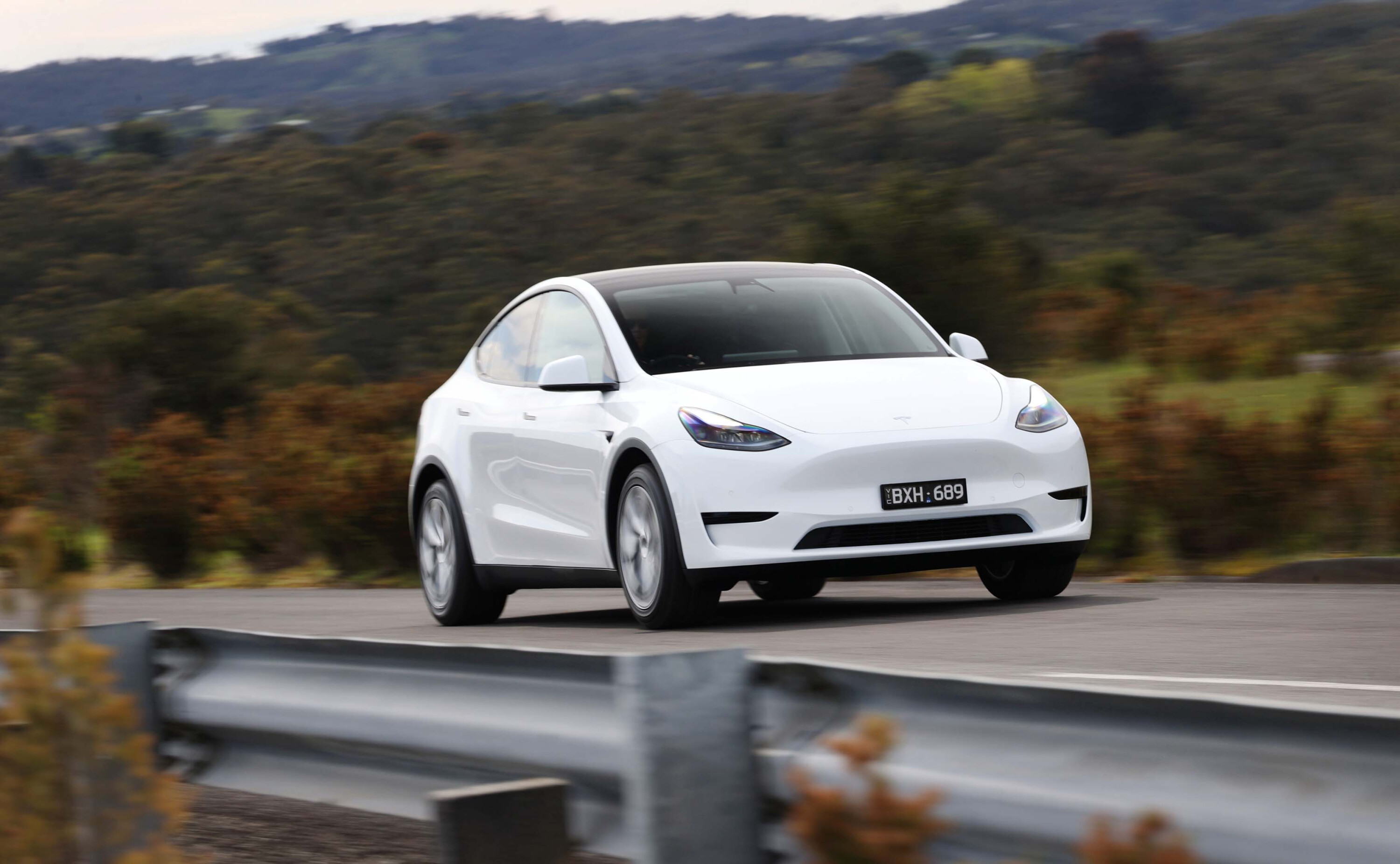
For example, a Victorian BYD Atto 3 EV owner who will drive 15,000 kilometres in this new 2023-24 financial year will now need to pay $420 – up $30 or around 7 per cent compared to the previous tax rate.
Meanwhile, a Victorian Mitsubishi Outlander PHEV owner who will drive 20,000km will need to pay $460 – up $40 or nearly 9 per cent. Of course, the more you drive, the more expensive the EV road user charge is.
1
The charge is a controversial mandatory fee to pay each year to the Victorian Government based on how much owners travel – which contributes to a general tax pool.
Similar to car registration, it is indexed every financial year based on the inflation rate.
Victorian EV and PHEV owners still receive a $100 discount for renewing their car registrations, though.
When the ‘EV tax’ was first legislated in 2021, the rate was 2.5 cents per kilometre for full EVs or 2.0 cents for PHEVs – with a major consequence for not paying the fee.
The new rate will come into effect a day after the $3000 Victorian EV purchase rebate is abolished on June 30.
WhichCar has contacted VicRoads for comment. The story will be updated if further information becomes available.
June 8, 2023: Victoria to end EV subsidy
As Queensland doubles its offer, Victoria will end its $3000 electric vehicle rebate policy on June 30 – reportedly earlier than initially promised.
Snapshot
- Victorian $3000 EV rebate shelved, reportedly earlier than promised
- New applications must be received by June 30 to qualify
- Victorian EV tax to increase due to inflation
First uncovered by The Driven [↗] in budget papers, the state government will abolish its Zero Emissions Vehicle (ZEV) Subsidy with only 7692 handouts having been given out, according to Carloop data.
When it was introduced on May 2, 2021, the scheme was promised to end after “more than 20,000 ZEV purchases”. It was intended to be offered in stages for eligible new EVs priced under $68,740.
The government’s official Solar Victoria [↗] page now states that applications must be received by 6pm on June 30 via a participating car dealer in order to qualify for the rebate.
This move comes as the Queensland Government doubled the subsidy for buying a new EV to $6000 in April for eligible households.
1
Victorian EV tax indexation coming
Victoria’s EV rebate previously helped offset the state’s contentious EV tax. However, a higher rate increase is expected from July 1.
This is because the EV tax is indexed based on inflation every new financial year – which has been particularly high this year due to the demand for goods and services outweighing supply in Australia’s economy, despite the Reserve Bank’s attempts to curb spending by hiking interest rates.
For context, the Higher Education Loan Program (HELP) for current and former university students was recently raised by 7.1 per cent on June 1 – the second-highest indexation in more than 30 years.
Catch up
The Victorian road user EV tax was legislated in July 2021. It applies to any all-electric and plug-in hybrid electric vehicles (PHEVs) registered in the state.
Victorian owners need to pay a fee based on every kilometre travelled per year. The latest rate for the 2022-23 financial year was indexed to 2.6 cents per kilometre for full EVs and 2.1 cents per kilometre for PHEVs.
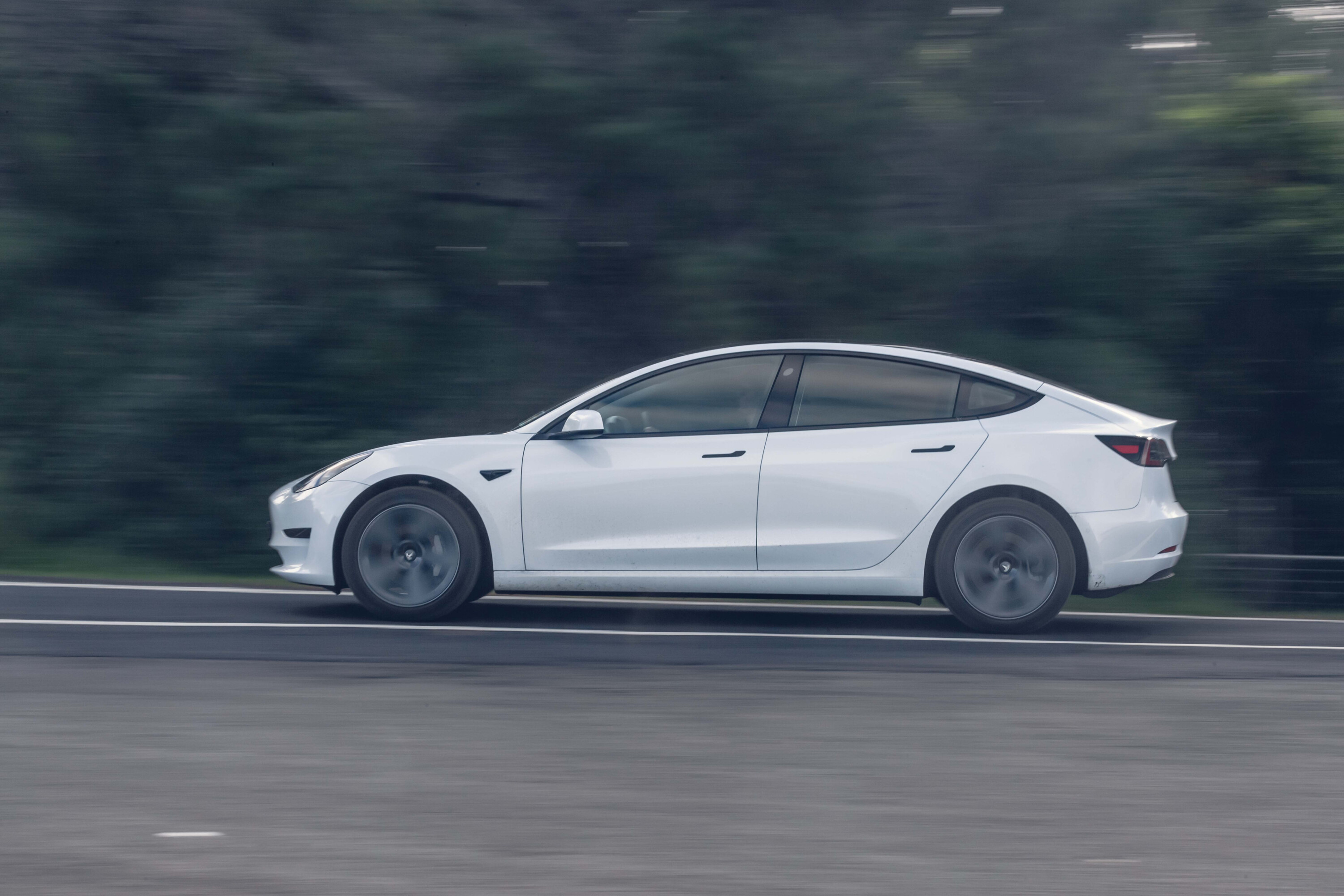
For example, a Tesla Model 3 driver travelling 15,000 kilometres per year must pay $390 to the government.
No other state in Australia imposes an EV tax, but some plan to do so in the future.
MORE
Electric Cars
More EV stories to help you choose the best car for your needs
- ? EV news, reviews, advice & guides
- ❓ Short & sweet: Your EV questions answered
- ⚡ New EVs: Everything coming to Australia
- ? Australia’s EVs with the longest driving range
- ⚖️ Best-value EVs by driving range
- ? How much do EVs cost in Australia?
- ? How much more expensive are EVs?
- ⚖️ Number crunching: Is it time to switch to an EV?
- ♻ Should you buy a used EV?
- ?️ Are EVs more expensive to insure?
- ? Costs compared: Charging an EV vs fueling a car
- ? EV charging guide
- ?? EV servicing explained
- ? EV battery types explained
- ? When do EV batteries need replacing?
- ? Hydrogen v EVs: What’s best for Oz?
- ? How sustainable are EVs, really?
MORE advice stories to help you with buying and owning a car
EV charging provider Chargefox has started trialling variable prices in Adelaide – fluctuating by up to 90 per cent depending on the time of day.
Snapshot
- Chargefox and South Australia trials variable charging prices
- Encourages charging during the day off renewables, opposes Tesla
- Costs as much as fuel during peak periods
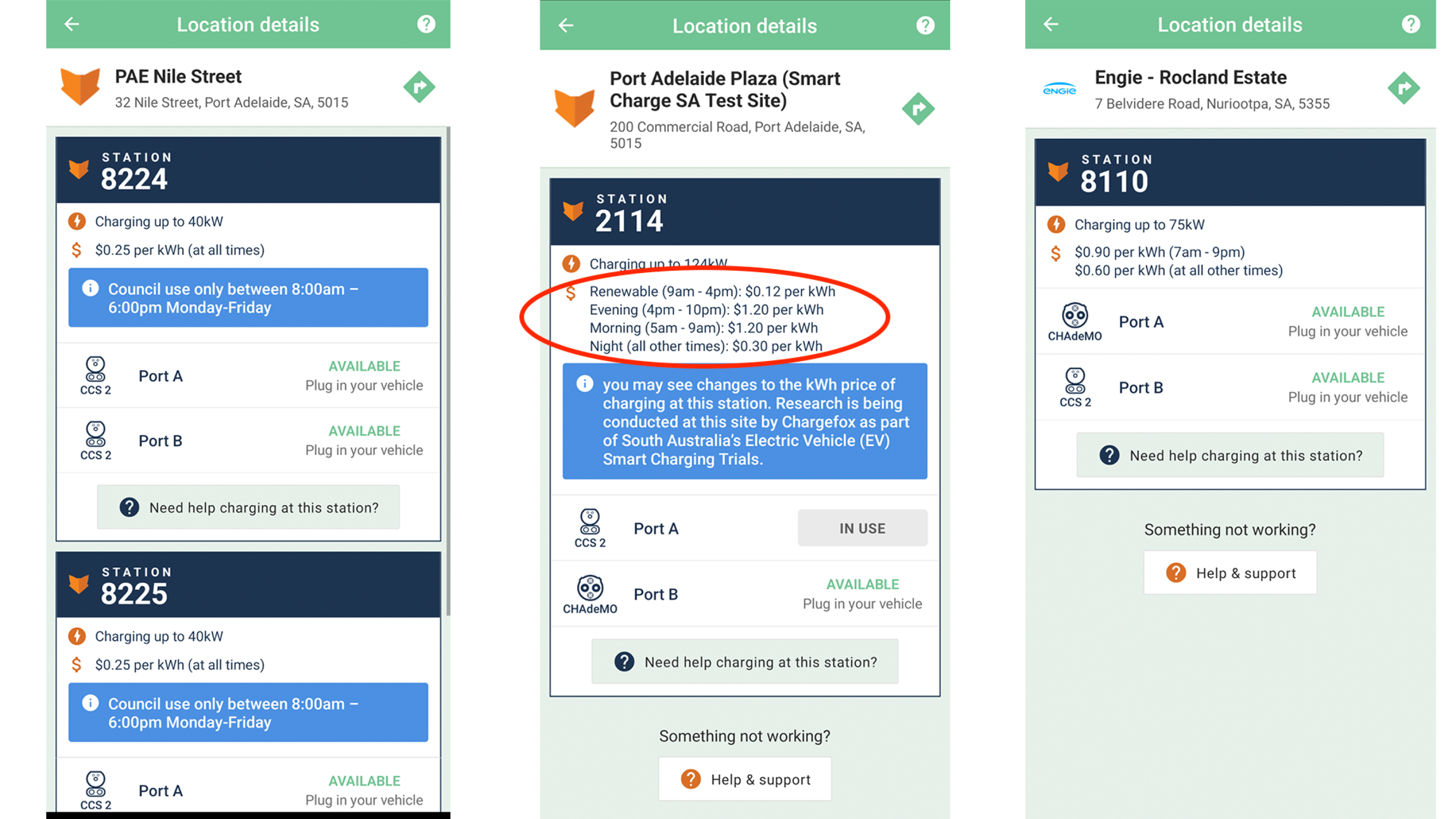
The Port Adelaide Plaza shopping mall site varies its charging rate from $0.12 per kilowatt-hour during ‘renewable’ 9am to 4pm periods, but spikes to $1.20 per kWh during 4pm to 9am morning and evening periods.
That peak electricity rate makes it the most expensive EV charging station in Australia.
1
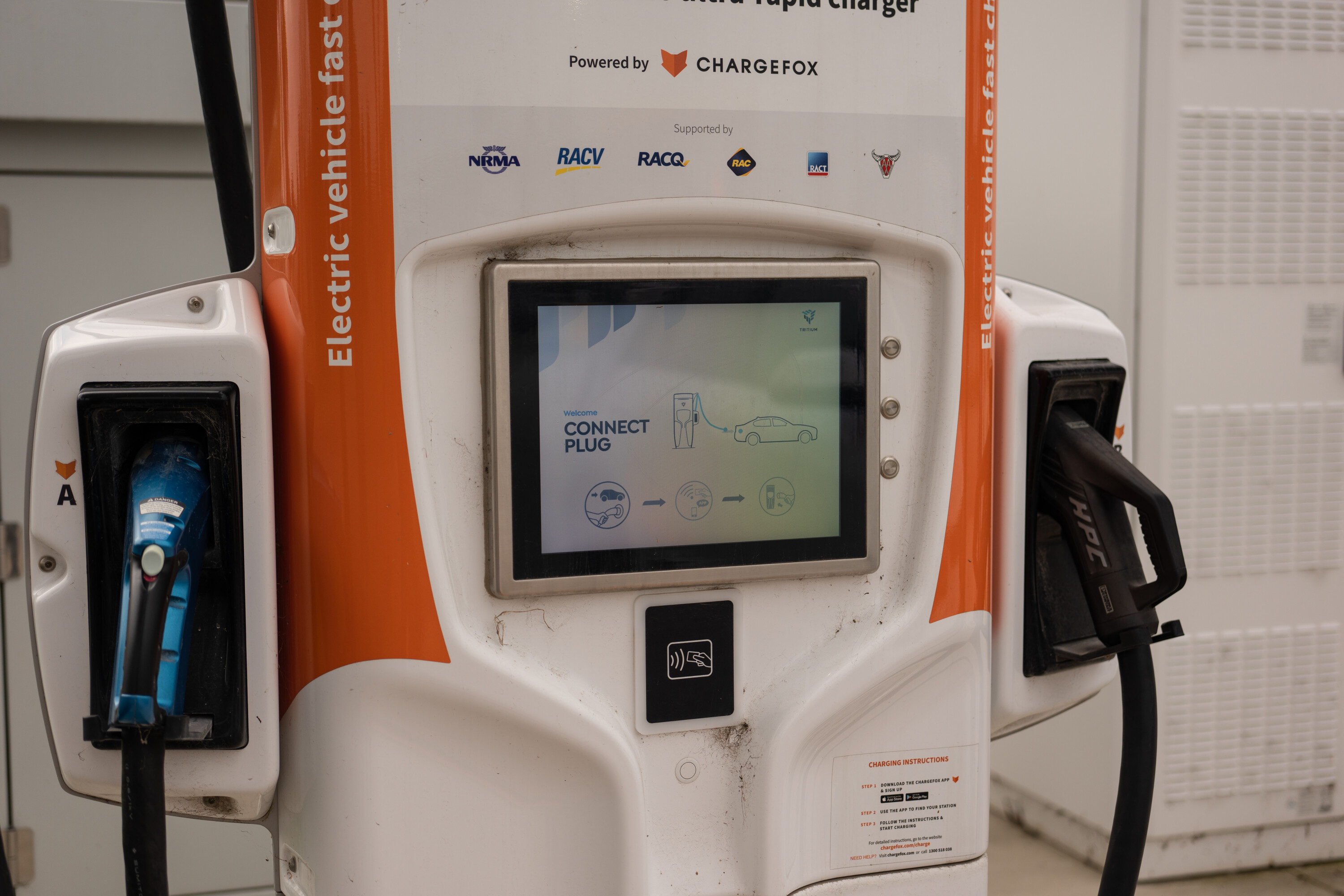
Despite this, the location only offers one ABB-made 124kW DC fast charger with one CCS2 and one CHAdeMO plug. PlugShare [↗] users have even reported receiving only an 85kW max speed.
The new variable pricing forms part of Chargefox and the state government’s $3.2 million South Australia Electric Vehicle Smart Charging Trial to encourage owners to charge during the day when there’s high renewable energy generation or low electricity grid demand.
Wait, how much?
For example, a Tesla Model 3 RWD owner charging from 10 to 80 per cent will cost only $4.83 during the ‘renewable’ period.
In contrast, it’ll cost $48.30 to charge during the peak morning and evening periods – on par with filling up a petrol or diesel vehicle.
1
For context, two 40kW DC Chargefox operated stations are five minutes down the road at Nile Street – which costs only $0.25 per kWh at any time.
However, it can only be accessed by the public between 6pm to 8am on weekdays, coinciding with the expensive peak evening period for the Port Adelaide Plaza station.
Meanwhile, an Engie-operated 75kW DC Chargefox site in the Rocland Estate also adopts variable fees – but is $0.90 per kWh between 7am to 9pm or $0.60 per kWh outside those peak times.
It follows Tesla Superchargers that dynamically changes the price depending on the time of day and charging hub demand – fluctuating between $0.43 to $0.69 per kWh. Contrary to South Australia’s trial, Tesla’s prices are usually higher during the day than night times.
Chargefox is also rolling out an EV charging network with the RAA in South Australia, and has started trialling overstay fees to curb charging wait times.
More EV stories to help you choose the best car for your needs
- ? EV news, reviews, advice & guides
- ❓ Short & sweet: Your EV questions answered
- ⚡ New EVs: Everything coming to Australia
- ? Australia’s EVs with the longest driving range
- ⚖️ Best-value EVs by driving range
- ? How much do EVs cost in Australia?
- ? How much more expensive are EVs?
- ⚖️ Number crunching: Is it time to switch to an EV?
- ♻ Should you buy a used EV?
- ?️ Are EVs more expensive to insure?
- ? Costs compared: Charging an EV vs fueling a car
- ? EV charging guide
- ?? EV servicing explained
- ? EV battery types explained
- ? When do EV batteries need replacing?
- ? Hydrogen v EVs: What’s best for Oz?
- ? How sustainable are EVs, really?
MORE advice stories to help you with buying and owning a car
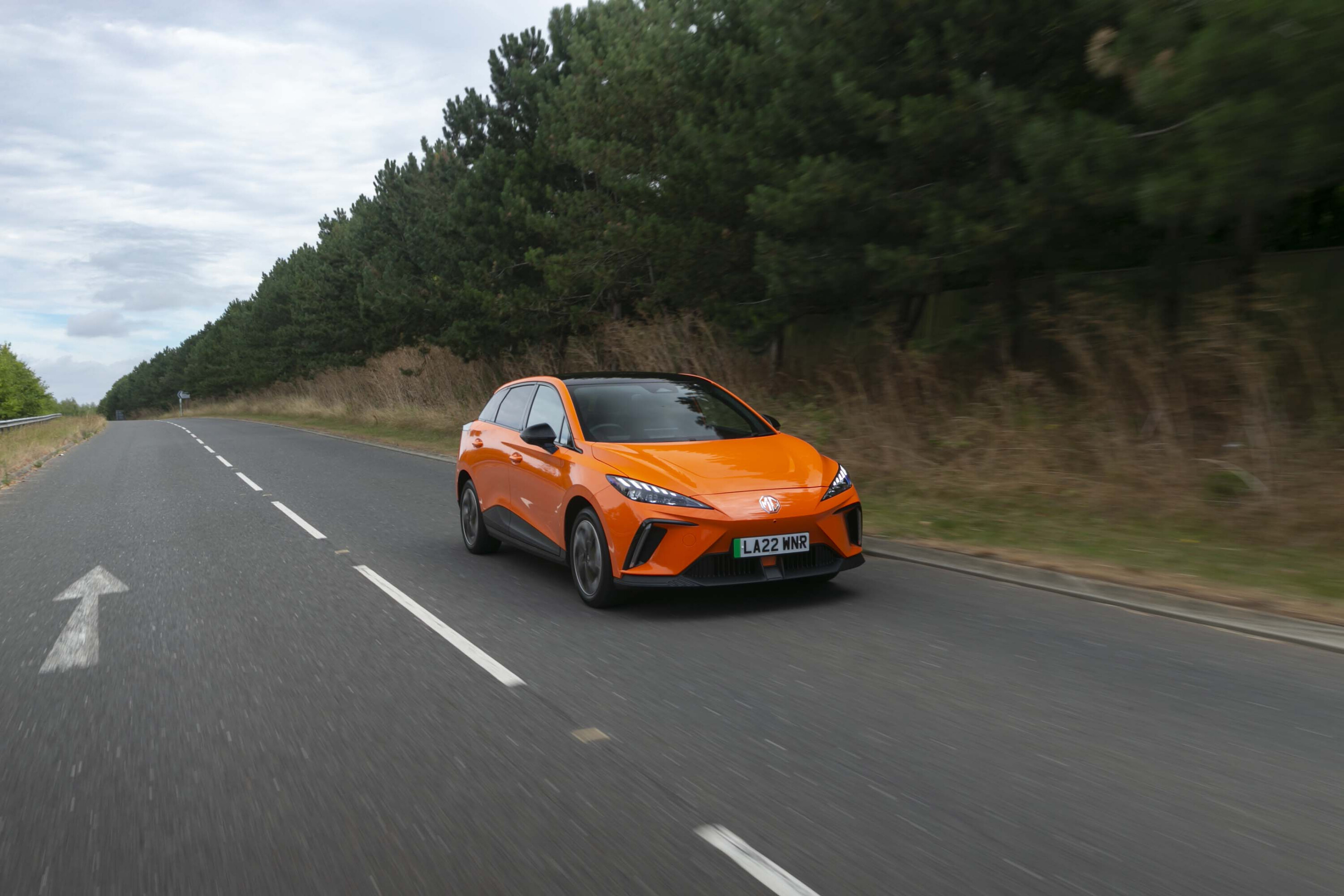
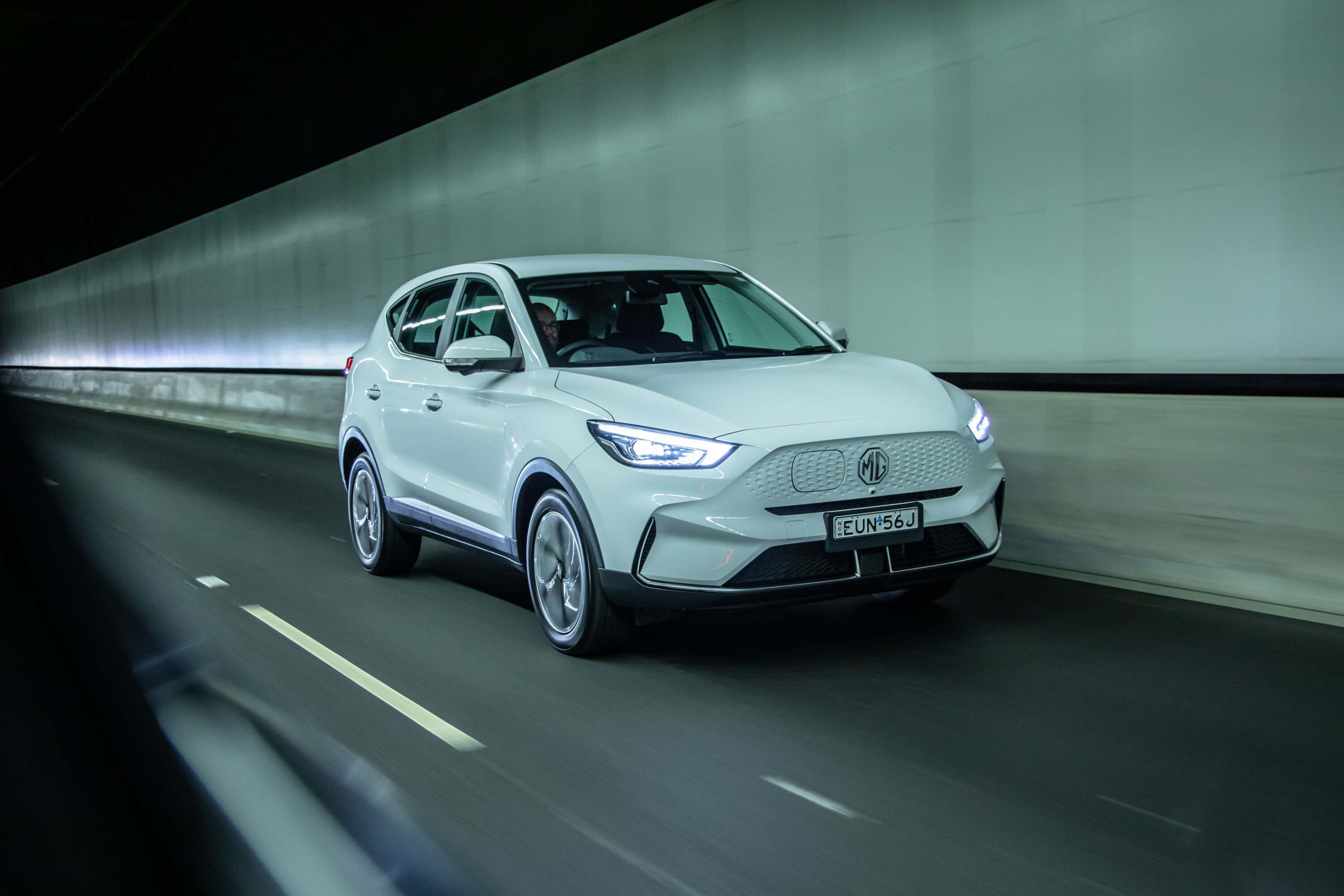
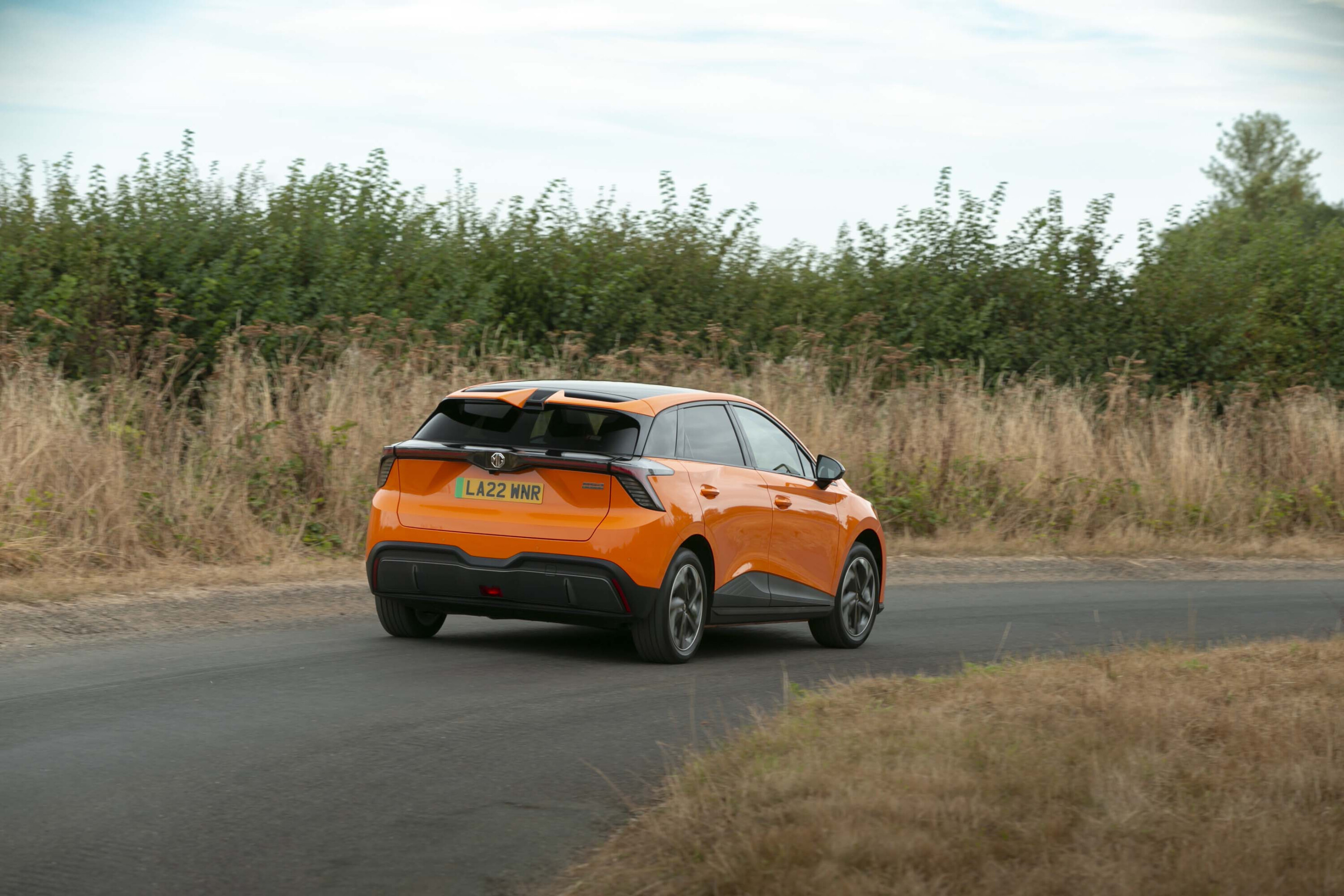
The much-anticipated cut-price MG 4 electric hatch will soon arrive in Australia, but has it overshadowed the current ZS EV small SUV too much on paper?
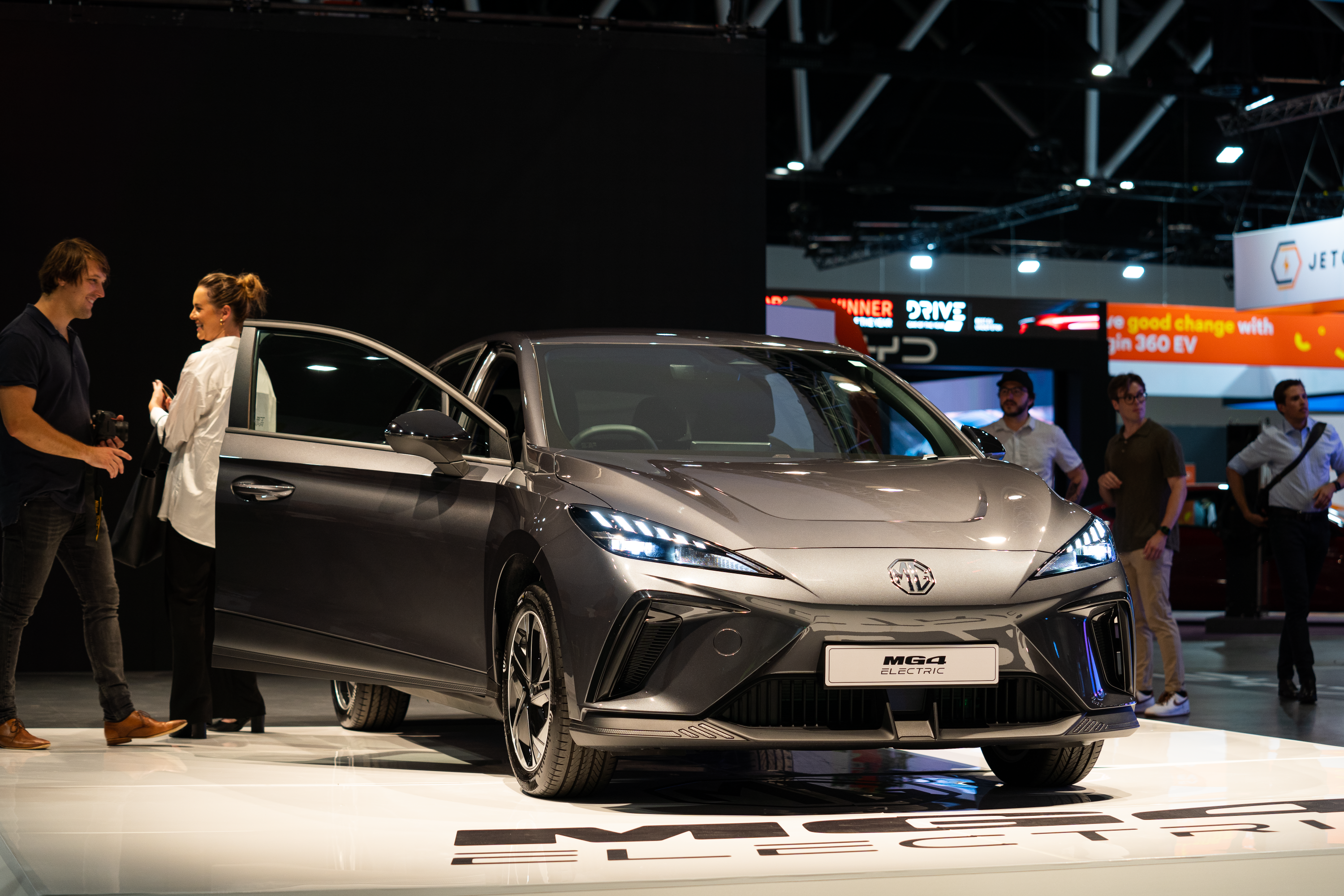
The Chinese automaker will launch the budget-friendly MG 4 electric small car in August, with a sharp $38,990 price before on-road costs – positioning it as a direct rival to the equally new, value-packed BYD Dolphin.
But, MG has also discontinued the base ZS EV Excite in Australia – previously the most affordable electric SUV – in a move to encourage Australians to opt for the MG 4 instead.
Both electric vehicles are made in China, both appeal to budget-minded buyers, and both can be had with longer range batteries.
At first glance, the MG 4 has the advantage of being built on a dedicated EV platform, a more modern interior and, of course, the cheaper entry cost. Despite receiving a facelift last year, does the older ZS EV SUV still hold up well on paper?
July: MG 4 driven in Australia at last
Even in pre-production, UK spec, the MG 4 hatch proves the long wait for a good, affordable electric car may well be over.
Story continues…
1
JUMP AHEAD
- Pricing
- Performance
- Driving range
- Charging
- Dimensions
- Boot space
- Features
- Safety
- Warranty and servicing
- ? The MG EV dilemma…
1
Pricing
Things we like
- MG 4: Cheaper entry price, more choices
- ZS EV: SUV is identically-priced as the 4 like-for-like
Not so much
- MG 4: 51kWh battery not offered in high-spec Essence
- ZS EV: No longer available in cheaper Excite variant
The MG 4 hatch is the cheaper option here, with a $9000 lower entry barrier. However, it has fewer features as standard.
Like-for-like Essence and Long Range grades, the MG 4 and ZS EV are identically priced – but the former has a larger battery for more claimed driving range.
All models are eligible for most state EV incentives, including the fringe benefits tax (FBT) exemption for company fleets and novated leases.
| MG 4 | MG ZS EV |
|---|---|
| 51kWh Excite: $38,990 | |
| 64kWh Excite: $44,990 | |
| 64kWh Essence: $47,990 | Essence: $47,990 |
| 77kWh Long Range: $55,990 | Long Range: $55,990 |
Note: All prices are before on-road costs, options and incentives.
1
MG4 v MG ZS EV: Performance
Things we like
- MG 4: It’s RWD with 50:50 weight distribution!
- ZS EV: Simpler drivetrain offerings
Not so much
- MG 4: Power bumps are minor
- ZS EV: AWD option would satisfy some buyers
Both electric MG’s have similar power and torque figures, but the hatchback is slightly faster off the line.
While the base MG 4 variant is less powerful than the base ZS EV, it has a faster claimed 0-100km/h acceleration time. Stepping up the electric hatch’s line-up nets slightly more power as the batteries get larger and heavier.
In contrast, the flagship ZS EV Long Range offers less power than its smaller battery Essence variant.
MG 4’s single electric motor sends power to the rear with a claimed 50:50 weight distribution and one-pedal driving capability, whereas the ZS EV is front-wheel drive only with three weaker regenerative braking modes.
A hyper all-wheel-driven MG 4 X-Power hot electric hatch is under consideration for an Australian launch later this year, too.
| MG 4 | MG ZS EV | |
|---|---|---|
| Power / Torque | 51kWh Excite: 125kW / 250Nm | |
| 64kWh Excite: 150kW / 250Nm | ||
| 64kWh Essence: 150kW / 250Nm | Essence: 130kW / 280Nm | |
| 77kWh Long Range: 180kW /350Nm | Long Range: 115kW / 280Nm | |
| Claimed 0-100km/h time | 51kWh Excite: 7.7 secs | |
| 64kWh Excite: 7.9 secs | ||
| 64kWh Essence: 7.9 secs | Essence: 8.2 secs | |
| 77kWh Long Range: 6.5 secs | Long Range: 8.5 secs | |
| Drive type | RWD | FWD |
MG4 v MG ZS EV: Driving range
Things we like
- MG 4: More range across the line-up
- ZS EV: Simpler two-battery offering
Not so much
- MG 4: Compromised range on Essence
- ZS EV: Not as energy efficient
The MG 4 electric hatch offers more claimed driving range across the line-up, with slightly larger battery packs and a more aerodynamic body design.
It’s worth noting that only the base MG 4 51kWh Excite and ZS EV Essence use a lithium-iron-phosphate (LFP) battery cathode – which is safer, longer-lasting, and less environmentally contentious – compared to other models’s lithium-ion nickel-manganese-cobalt (NMC) type.
The local division has also opted to name MG 4 variants by the gross (nominal) battery size – except for the base model – which isn’t representative since owner’s can only access the lesser net (usable) battery for health and safety reasons.
| MG 4 | MG ZS EV | |
|---|---|---|
| Claimed range (WLTP) | 51kWh Excite: 350km | |
| 64kWh Excite: 450km | ||
| 64kWh Essence: 435km | Essence: 320km | |
| 77kWh Long Range: 530km | Long Range: 440km | |
| Claimed efficiency (WLTP) | 51kWh Excite: 14.5kWh/100km* | |
| 64kWh Excite: 13.7kWh/100km* | ||
| 64kWh Essence: 14.2kWh/100km* | Essence: 17.7kWh/100km | |
| 77kWh Long Range: 14.0kWh/100km* | Long Range: 17.7kWh/100km | |
| Battery size (usable) | 51kWh Excite: 51kWh | |
| 64kWh Excite: 62kWh | ||
| 64kWh Essence: 62kWh | Essence: 49kWh | |
| 77kWh Long Range: Unknown** | Long Range: 68kWh |
Note: Usable battery capacities provided by EV Database [↗].
*MG Motor Australia hasn’t detailed official claimed energy efficiency figures for the MG 4 line-up, so we’ve used our own calculations instead.
**The usable battery size for the MG 4 Long Range hasn’t been disclosed yet, but has a 77kWh gross pack.
1
Charging
Things we like
- MG 4: Faster max DC charging speeds
- ZS EV: Quicker three-phase AC charging standard
Not so much
- MG 4: Most variants limited to single-phase AC charging
- ZS EV: Charging port position arguably less accessible
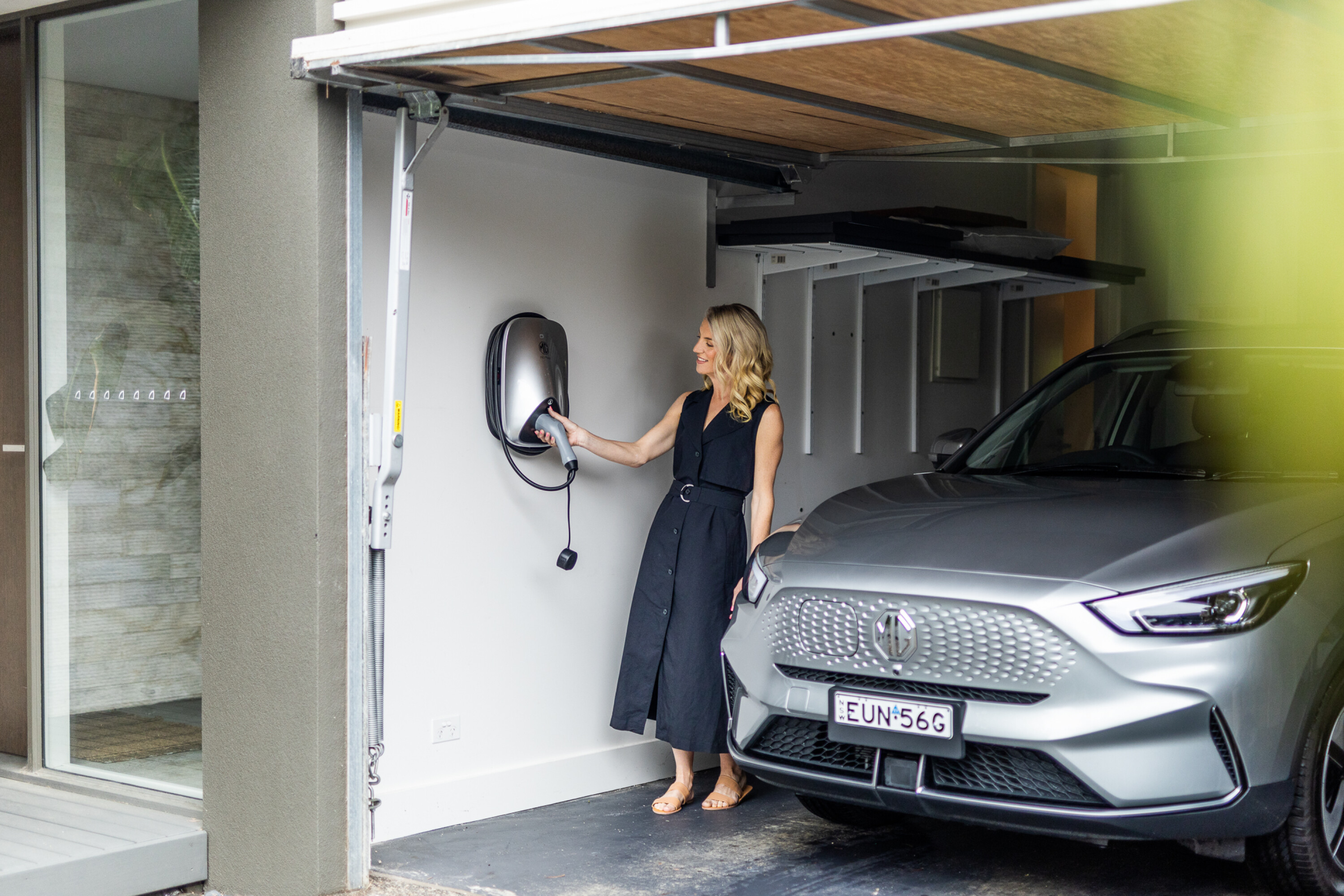
The MG 4 electric hatch has the advantage of faster peak DC fast charging, whereas the ZS EV SUV provides a better AC slow charging rate as standard.
The MG 4 progressively ups its AC and DC charging capabilities with pricier variants, but the ZS EV has the same maximum speeds for both variants.
However, the MG 4 model range is mostly limited to a 6.6kW single-phase onboard AC charger, except for the top Long Range. This means charging off an installed home or public three-phase 11kW and upwards wall box will be speed-limited to a maximum of 6.6kW.
Both electric MG’s have different charging port positions, too.
| MG 4 | MG ZS EV | |
|---|---|---|
| Max AC / DC charge rate | 51kWh Excite: 6.6 / 88kW | |
| 64kWh Excite: 6.6 / 140kW | ||
| 64kWh Essence: 6.6 / 140kW | Essence: 11 / 80kW | |
| 77kWh Long Range: 11 / 140kW | Long Range: 11 / 80kW | |
| Charging connector | Type 2 / CCS2 u2013 left rear-quarter | Type 2 / CCS2 u2013 front-right grille |
| Bidirectional charging | Exterior V2L (adapter sold separately) | Exterior V2L (adapter sold separately) |
1
Dimensions
Things we like
- MG 4: Ground-up EV platform, without the cost
- ZS EV: Coveted higher-riding SUV body style
Not so much
- MG 4: Relatively wider body
- ZS EV: Likely larger turning circle
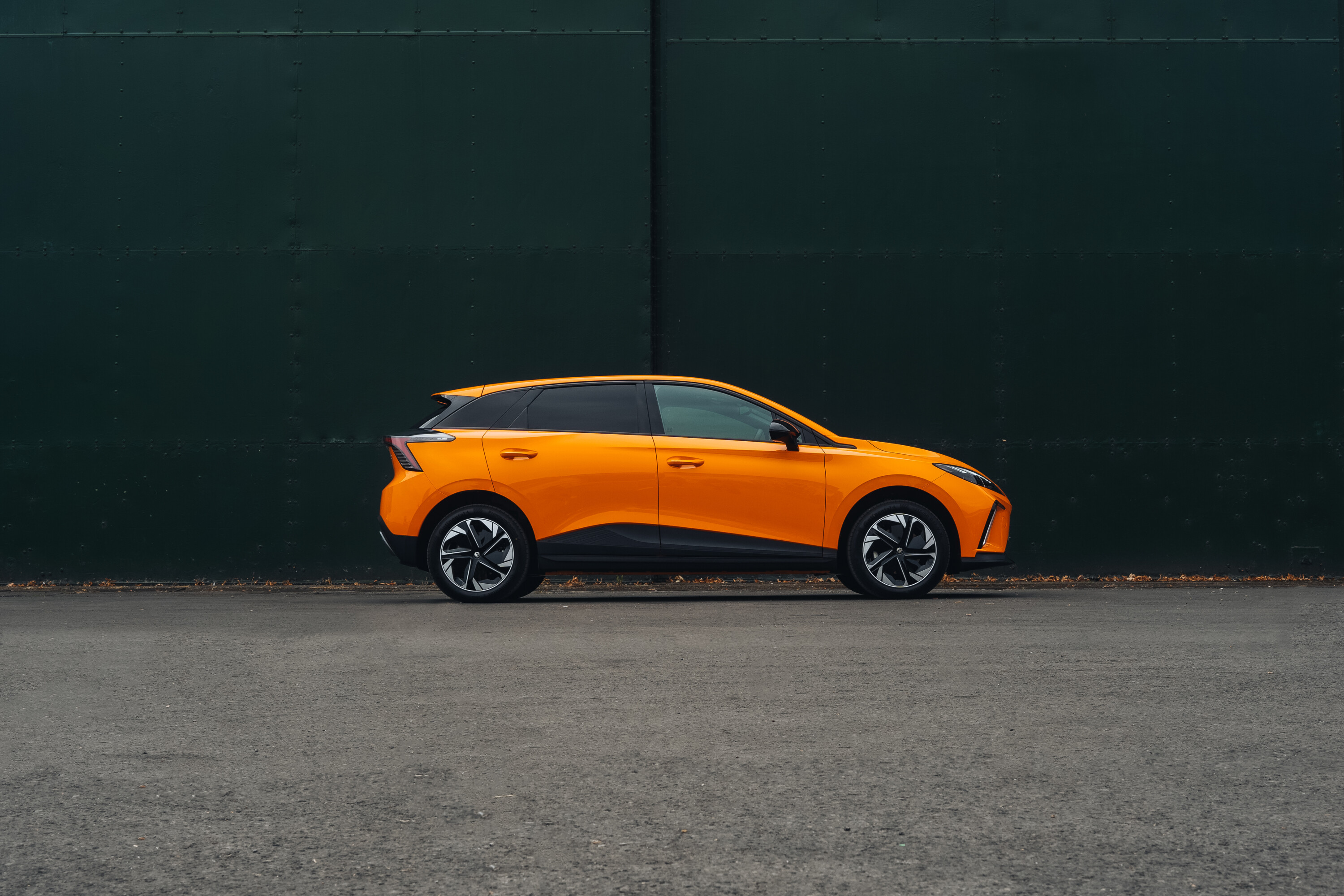
The MG 4 is shorter in overall length and height than the ZS EV, but has a longer wheelbase thanks to its ground-up Modular Scalable Platform (MSP).
This theoretically means more interior space, with an open flat floor at the front. The 4’s rear-wheel drive powertrain also means it could have a tighter turning circle.
However, while ZS EV is based on the regular ZS’s combustion engine platform that dates back to 2017, it can appeal to buyers with its height, width and, presumably, ground clearance advantage – being an in-demand small SUV. Its rear centre floor hump is quite minimal, too.
| MG 4 | MG ZS EV | |
|---|---|---|
| Length | 4287mm | 4323mm |
| Width | 2060mm | 1809mm |
| Height | 1504mm (Excite models) / 1516mm (Essence/Long Range) | 1649mm |
| Wheelbase | 2705mm | 2585mm |
| Ground Clearance | N/A | 161mm |
| Turning circle | 10.6-metres | N/A |
1
Boot space
Things we like
- MG 4: Decent cargo capacity, no compromise for larger battery
- ZS EV: Similar boot volume, despite smaller dimensions
Not so much
- MG 4: Not as roomy for dedicated EV
- ZS EV: No electric tailgate
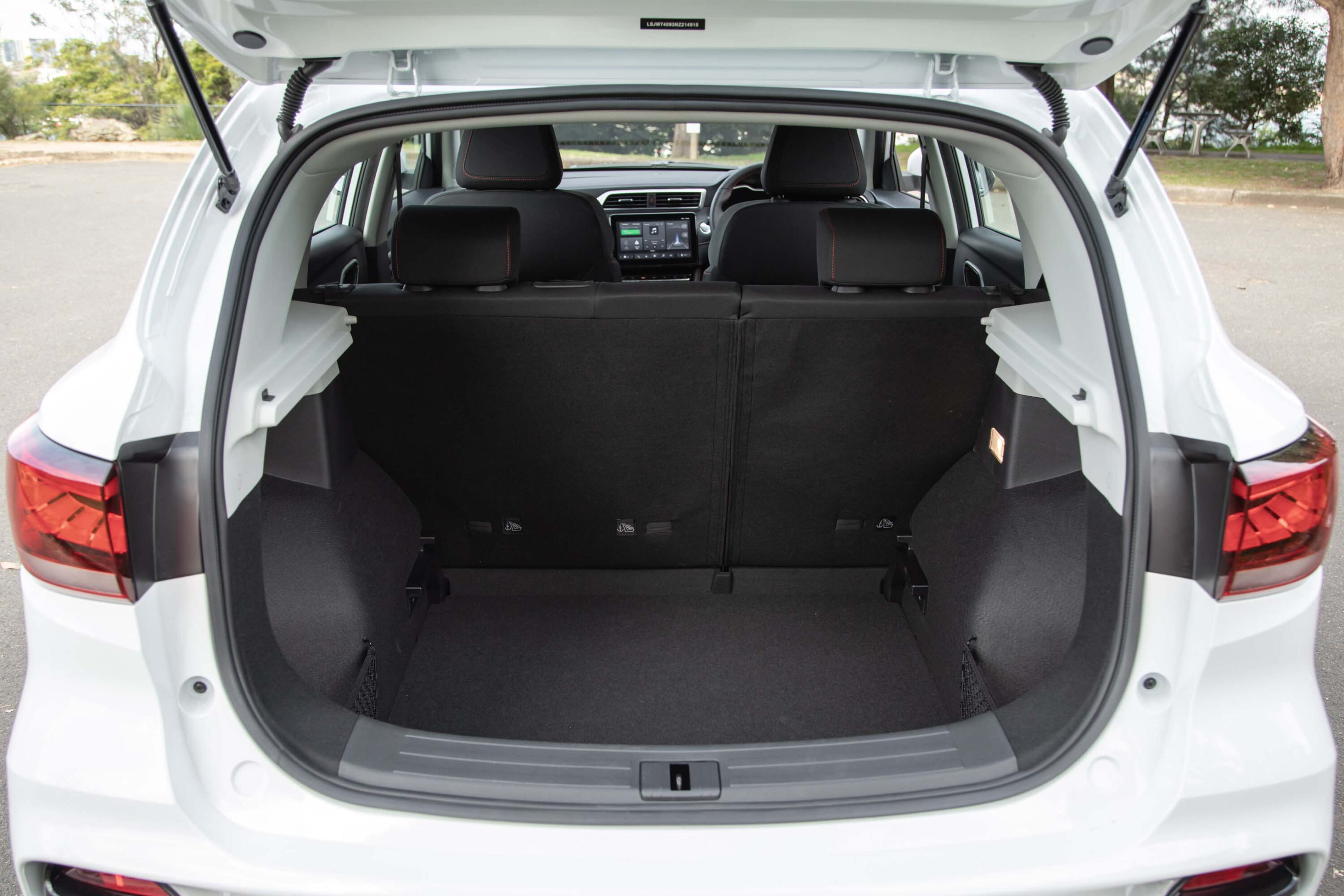
Despite the exterior dimension differences, both electric MG’s are closely matched for boot space.
When the rear seats are in place, the MG 4 Excite variants have a touch more boot volume, but pricier Essence models have less (likely due to hardware for the six-speaker sound system).
The ZS EV provides more cargo room when the rear seats are folded down due to its longer length, despite not being as wide nor using a dedicated EV platform as the 4.
| MG 4 | MG ZS EV | |
|---|---|---|
| Boot capacity (min / max) | 51kWh Excite: 363 / 1117-litres | |
| 64kWh Excite: 363 / 1117-litres | ||
| 64kWh Essence: 350 / 1165-litres | Essence: 359 / 1187-litres | |
| 77kWh Long Range: 350 / 1165-litres | Long Range: 359 / 1187-litres | |
| Electric tailgate | No | No |
| Frunk | No | No |
1
Features
Things we like
- MG 4: More modern interior, tech setup
- ZS EV: On paper features closely match newer hatch
Not so much
- MG 4: Some safety tech omitted in base Excite
- ZS EV: Updated interior still not as fresh
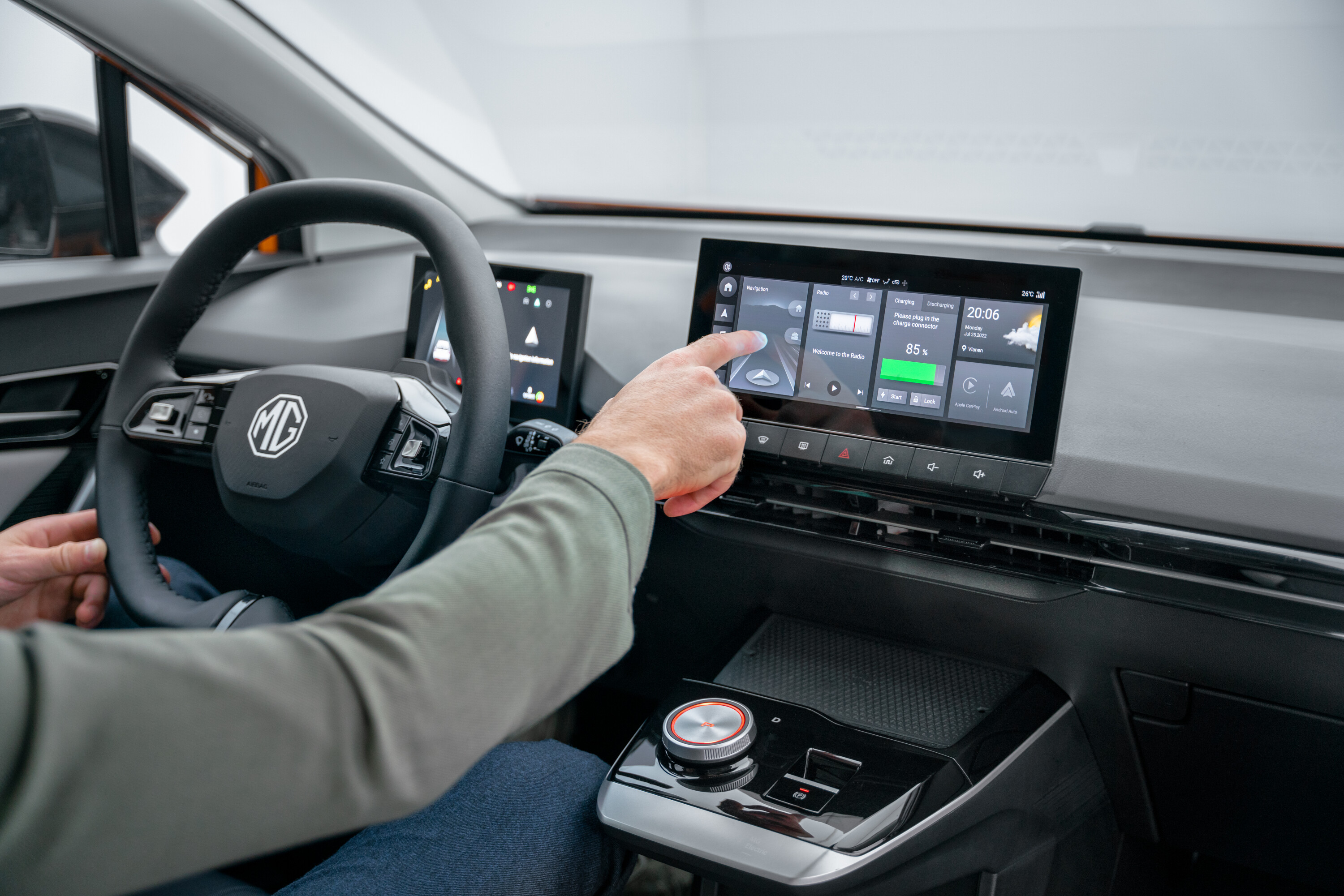
To achieve the sub-$40,000 price tag, the MG 4 Excite misses out on some features, but the pricier Essence is closely matched to the comparable ZS EV.
The MG 4 Excite models notably miss out on features, such as electric folding mirrors, blind-spot monitoring and a 360-degree camera.
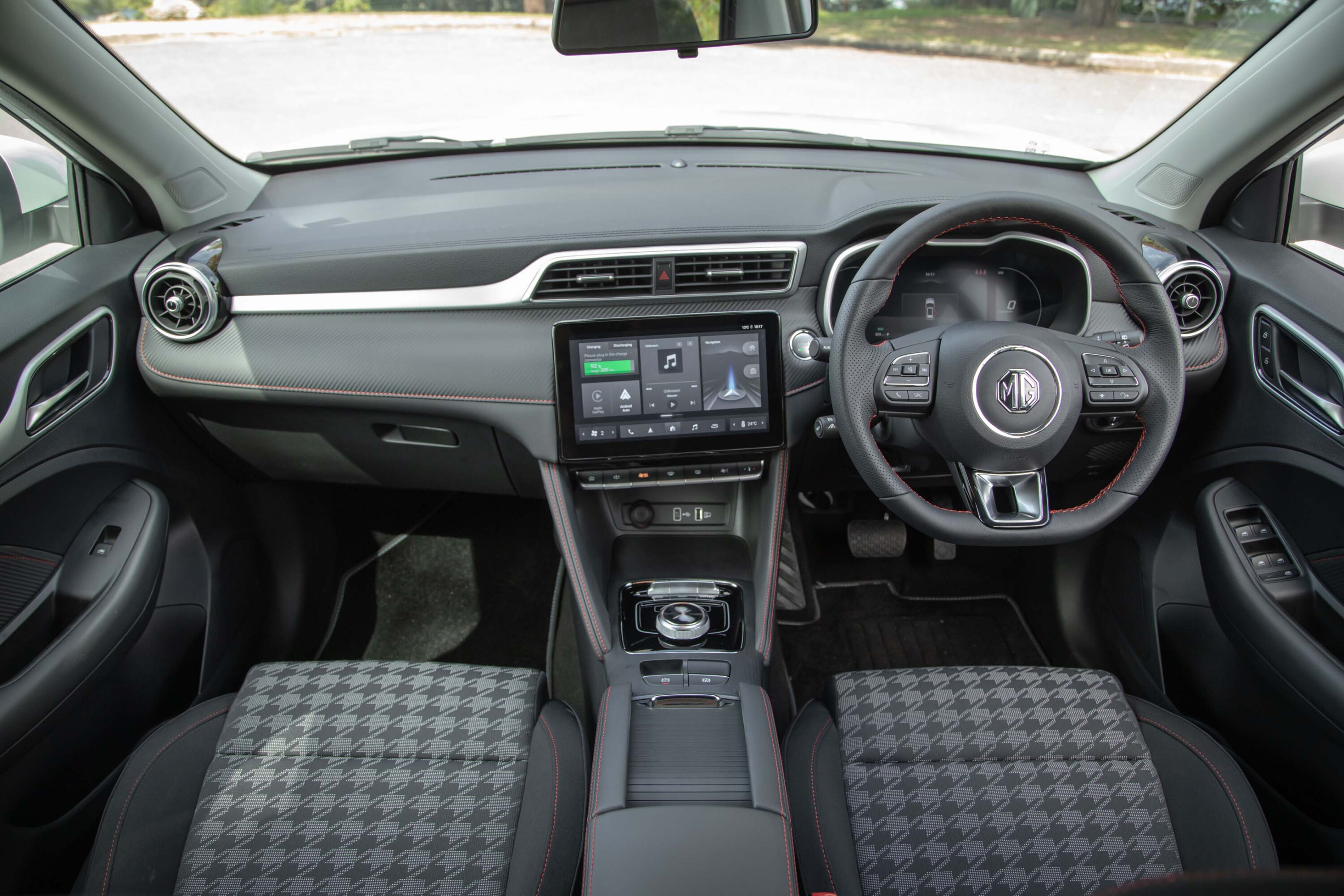
Although all MG 4’s have a more modern interior than the ZS EV, they both have a similarly-sized touchscreen (wide versus square display aspect ratios respectively), wired smartphone projection, and LED headlights.
Note: To keep things equal, we’ve used comparable model variants to highlight the similarities and differences. For the full list of features on lower-specced MG 4 models, click here.
| 2023 MG 4 64kWh Essence | 2023 MG ZS EV Essence |
|---|---|
| 10.25-inch tablet-style touchscreen | 10.1-inch integrated touchscreen |
| Wired Apple CarPlay and wired Android Auto, built-in maps | Wired Apple CarPlay and wired Android Auto, built-in maps |
| 7.0-inch protruding driver instruments display | 7.0-inch integrated driver instrument display |
| MG iSmart connected services with mobile app, built-in voice control, EV trip planner | MG iSmart connected services with mobile app |
| Synthetic black leather seats with contrasting fabric inserts | Synthetic black leather seats with carbon fibre inserts and red contrast stitching |
| Two-tone black roof paint | Panoramic glass roof with sunshade |
| Rear tinted privacy glass | Roof rails |
| Full LED head- and tail-lights | Full LED headlights with combination-type tail-lights |
| 18-inch alloy wheels | 17-inch alloy wheels |
1
Safety
Both MG electric cars remain unrated by the Australasian New Car Assessment Program (ANCAP).
MG 4
But, the MG 4 electric hatch did receive the full five-star safety rating by overseas counterpart Euro NCAP under its 2022 testing criteria, with marginal to good results.
It comes with most active safety assistance systems as standard, including; front auto emergency braking (AEB) with car/pedestrian/cyclist detection, adaptive cruise control, lane-centring, lane-keep assist, traffic sign recognition, and a reversing camera and sensors.
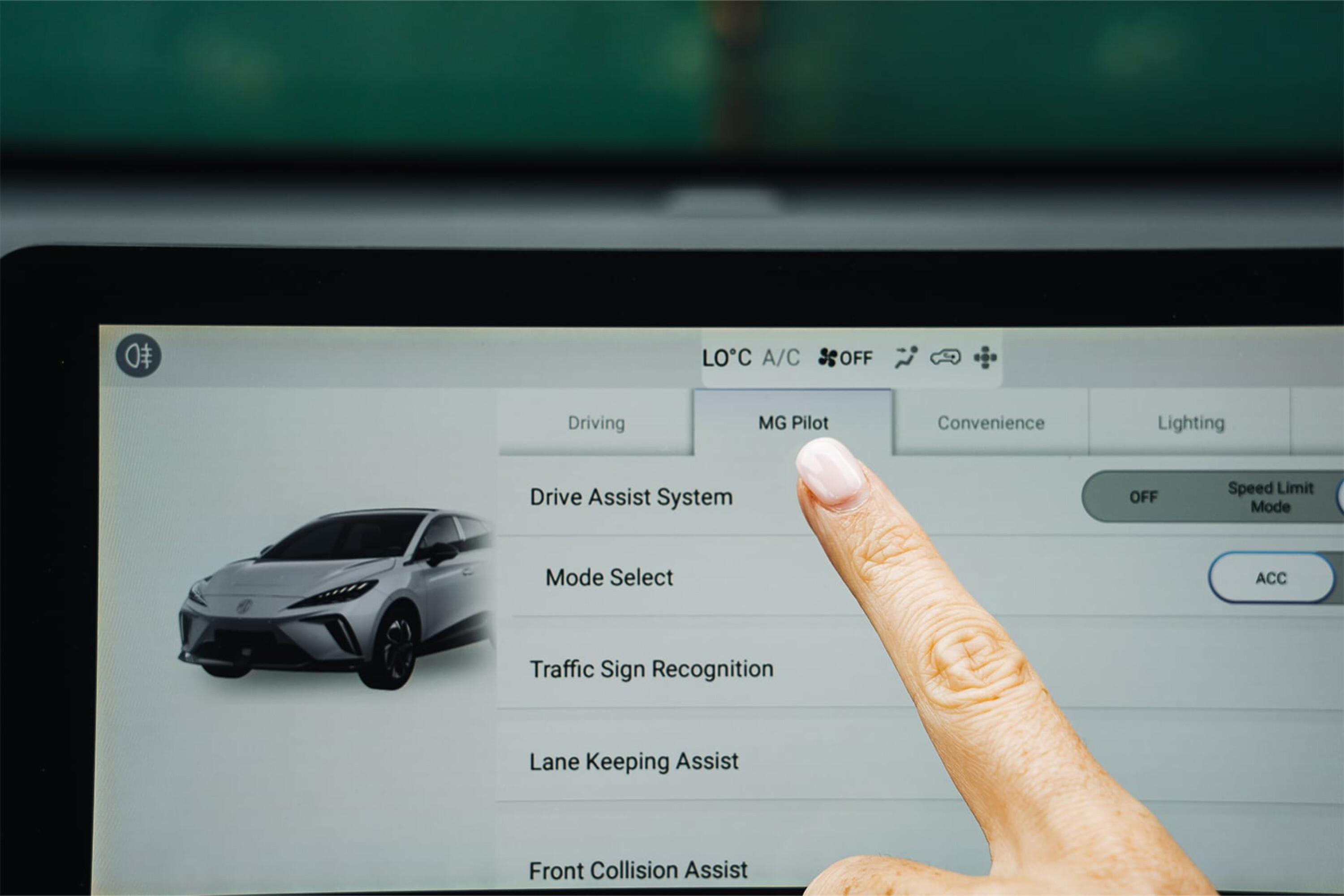
Buyers will need to step up to the Essence grades in order to have; blind-spot monitoring, rear cross-traffic alert, a 360-degree camera system, and door open alert.
1
MG ZS EV
Meanwhile, the pre-facelifted version of the ZS EV electric SUV did obtain a five-star safety score by ANCAP in 2019 – which bettered the petrol-powered twin’s 2017-tested four-star rating.
While the pre-update ZS EV is structurally similar to the latest model, ANCAP considers the older model’s rating as expired and does not apply to the current ZS EV.
As it now only comes with high-spec Essence and Long Range variants, it includes all available safety assist features as standard, as per the MG 4. On paper, the ZS EV only lacks door open warning compared to the newer 4.
1
Warranty and servicing
Both MG EVs are covered by a seven-year/unlimited kilometre vehicle and battery warranty.
For commercial buyers, the warranty is limited to seven-years/160,000km for both the vehicle and battery.
Unlike other brands, such as Tesla and Polestar, it doesn’t cover for abnormal battery degradation.
Other warranties for manufacturing defects include; three months/5000km for lamps and light bulbs, 12 months/unlimited kilometres for the key fob battery, and six months/10,000km for the wheel alignment and balance.
Seven years of roadside assistance is also included, provided owners service it on time at a MG dealer.
While the Chinese carmaker hasn’t detailed servicing costs for the new MG 4 yet, the ZS EV does require logbook maintenance every 24 months/40,000km. For the first five visits, it averages to $616 per service for the small SUV.
1
?The MG EV dilemma…
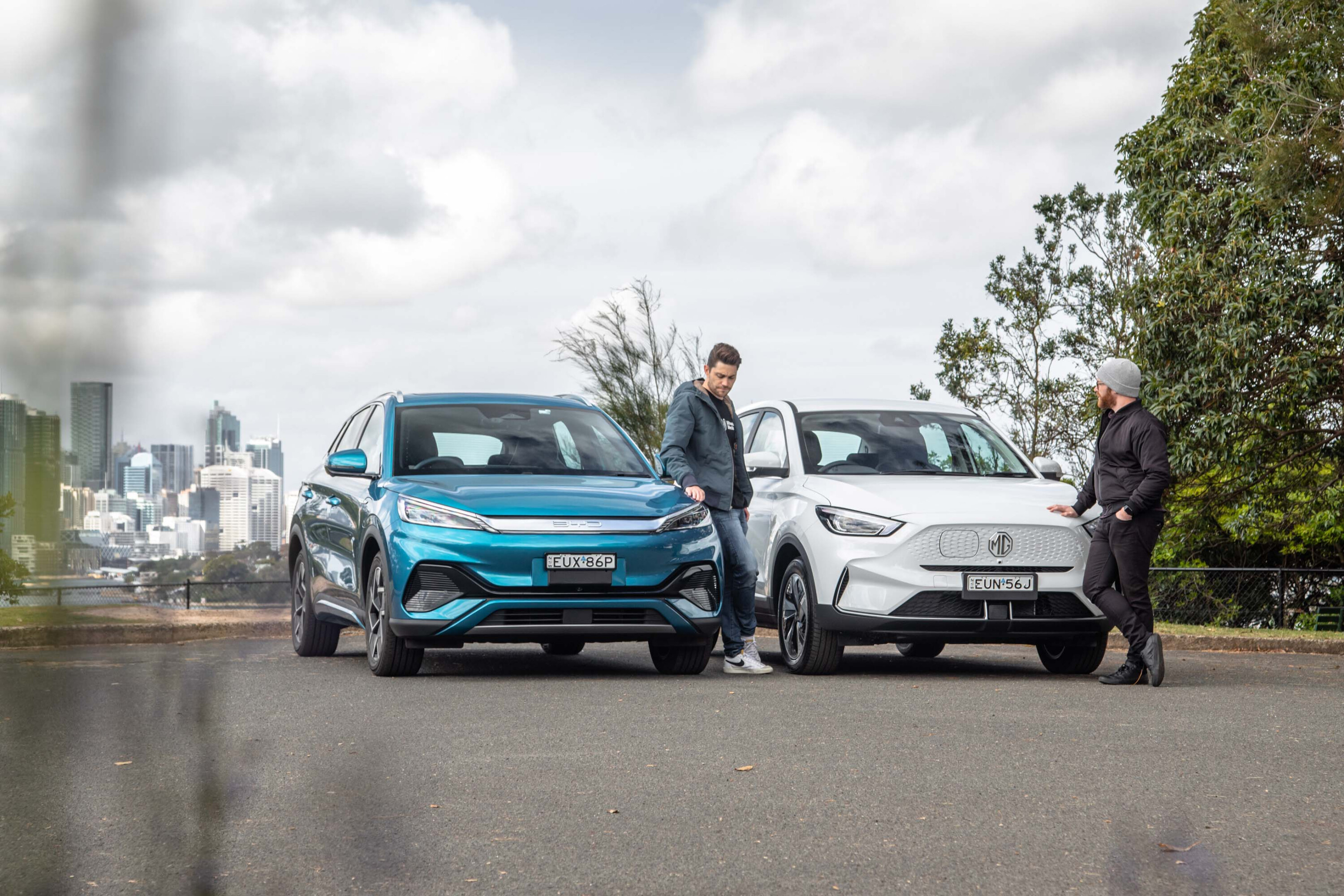
The MG 4 is the better choice in almost every criteria on paper, except if the ZS EV’s small SUV body style is a priority for you.
The electric hatch offers a newer platform and design, more driving range and similar boot space – with the critical choice of cheaper variants that allow Australians to switch into a full EV for less than $43,000 drive-away.
However, the MG ZS EV still has the advantage of the popular higher-riding crossover SUV style and a faster AC charging capabilities as standard.
1
Of course, we’ll reserve our full judgements until we properly test the forthcoming MG 4 in real life, but it’s stacking up quite well at first glance.
After a decade of electric hatches dominated by the Nissan Leaf, the segment is finally moving. The upcoming BYD Dolphin provides more standard features – albeit with less power and an odd shorter warranty – than the base MG 4, whereas the GWM Ora has quirkier styling and cheaper servicing expenses. The top-selling BYD Atto 3 is also a solid alternative to the ZS EV.
Ahead of the federal government introducing landmark vehicle emissions standards, the choice of attainable electric cars in Australia is finally growing – and all currently coming from China.
MORE
Electric Cars
More EV stories to help you choose the best car for your needs
- ? EV news, reviews, advice & guides
- ❓ Short & sweet: Your EV questions answered
- ⚡ New EVs: Everything coming to Australia
- ? Australia’s EVs with the longest driving range
- ⚖️ Best-value EVs by driving range
- ? How much do EVs cost in Australia?
- ? How much more expensive are EVs?
- ⚖️ Number crunching: Is it time to switch to an EV?
- ♻ Should you buy a used EV?
- ?️ Are EVs more expensive to insure?
- ? Costs compared: Charging an EV vs fueling a car
- ? EV charging guide
- ?? EV servicing explained
- ? EV battery types explained
- ? When do EV batteries need replacing?
- ? Hydrogen v EVs: What’s best for Oz?
- ? How sustainable are EVs, really?
MORE advice stories to help you with buying and owning a car
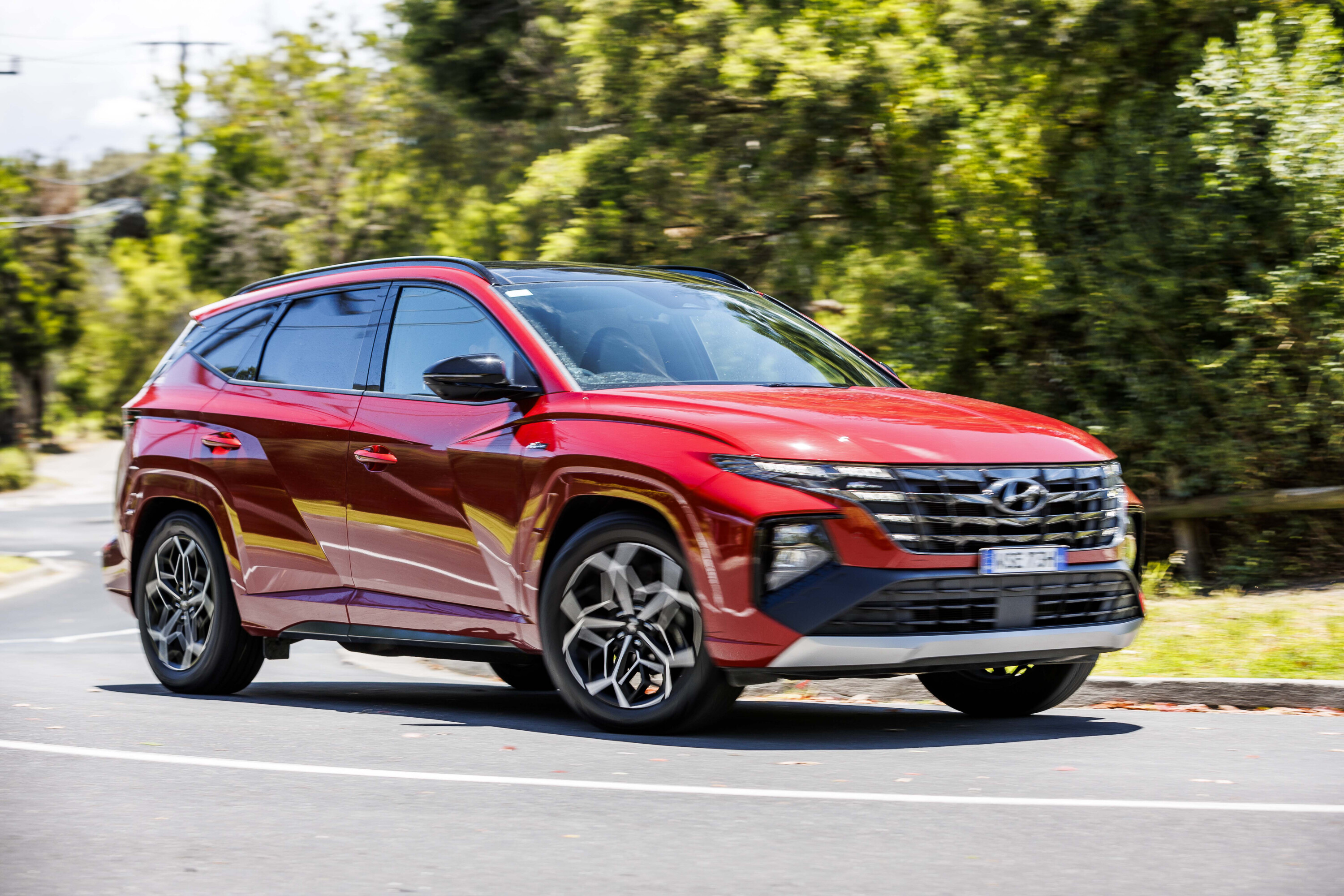
UPDATE: 2023 Hyundai Tucson Highlander ‘steel roof’ option now available to purchase
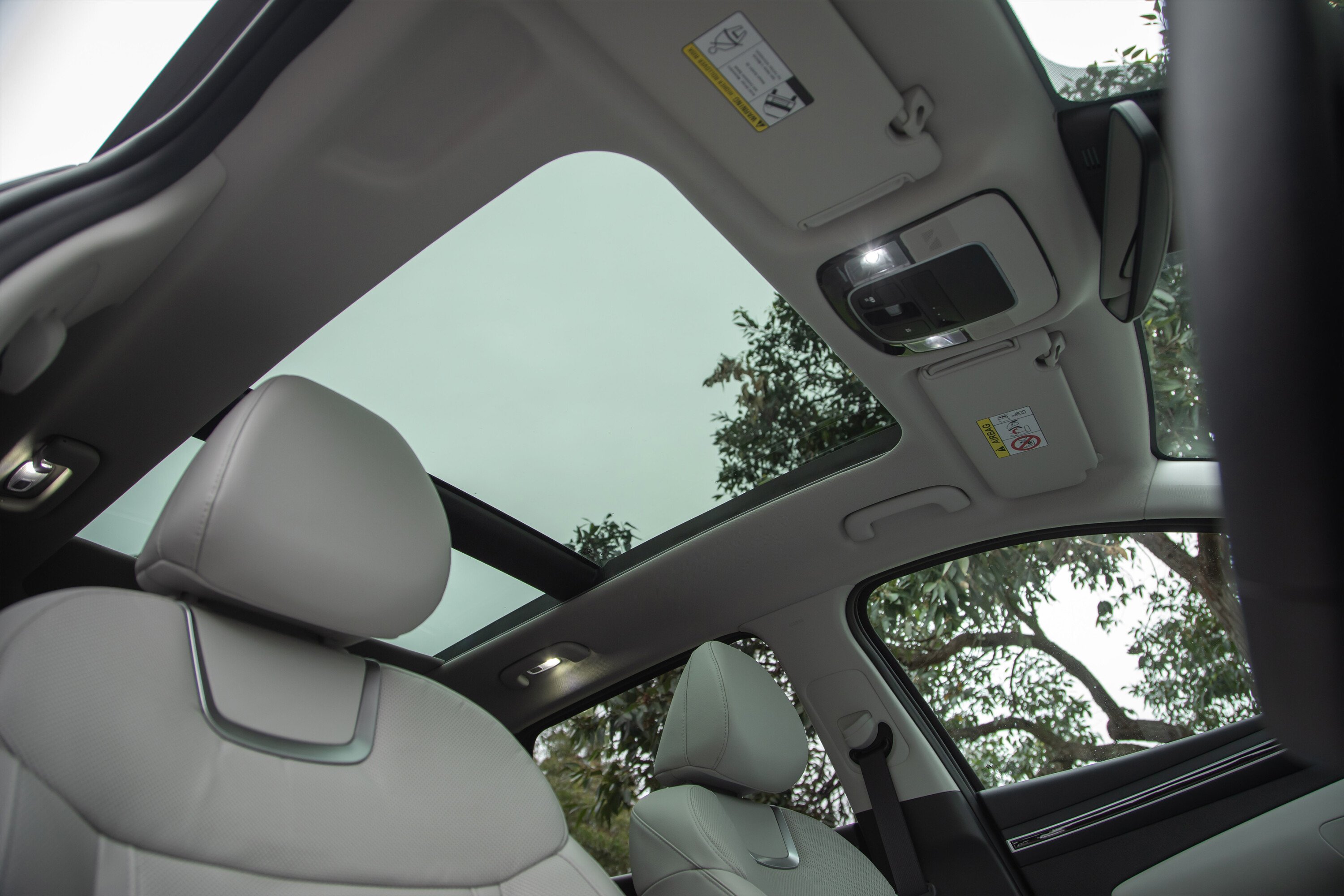
Hyundai Australia has made the panoramic sunroof in the Tucson Highlander an optional extra for new buyers to reduce wait times for its flagship variant.
It follows the brand allowing existing customers to switch their order to the ‘steel roof’ version earlier this year.
A Hyundai Australia spokesperson said the move is not permanent, with a view to removing the sunroof-less option – which costs $1500 less – when production volume for the panoramic sunroof returns to a normal level.
1
The spokesperson said non-sunroof Tucson models – including the base and Elite variants – have a wait time of three months or less for a new order, while “sunroof production restrictions exist, which may result in longer lead times for Highlander variants with sunroof”.
Our earlier story, below, continues unchanged.
April 14: 2023 Hyundai Tucson Highlander order holders offered de-specced car to reduce wait times
The flagship 2023 Hyundai Tucson Highlander will be offered without a sunroof to reduce delivery times.
A dealer bulletin seen by Wheels states the ‘steel roof option’ package for the Tucson Highlander medium SUV will reduce the vehicle’s recommended retail price by $1500, with the deletion of the panoramic sunroof “and other minor associated items.”
Hyundai Australia told its dealership network the option will provide its customers with an “even greater choice, and the option to experience their new Tucson sooner.”
1
Existing buyers wishing to keep the panoramic sunroof in their Tucson Highlander can continue to wait for their vehicle to arrive without the missing features.
This is in contrast to several other brands, which have either deleted features for all vehicles to reduce wait times, or elected not to delete features constrained by the semiconductor chip shortage, potentially leading to a longer wait for all buyers.
While the option won’t be available to new orders, it is a similar move to Volkswagen Group Australia, which deleted blind-spot and rear cross-traffic alert, and an electric tailgate, from select vehicles, including the Volkswagen Tiguan and Skoda Karoq medium SUVs, in recent months.
Volkswagen and Skoda buyers could keep these features at full price – but with a longer expected wait.
1
The ‘steel roof option’ pack will be offered on a “temporary basis and will only be available to customers with an existing Tucson Highlander order.”
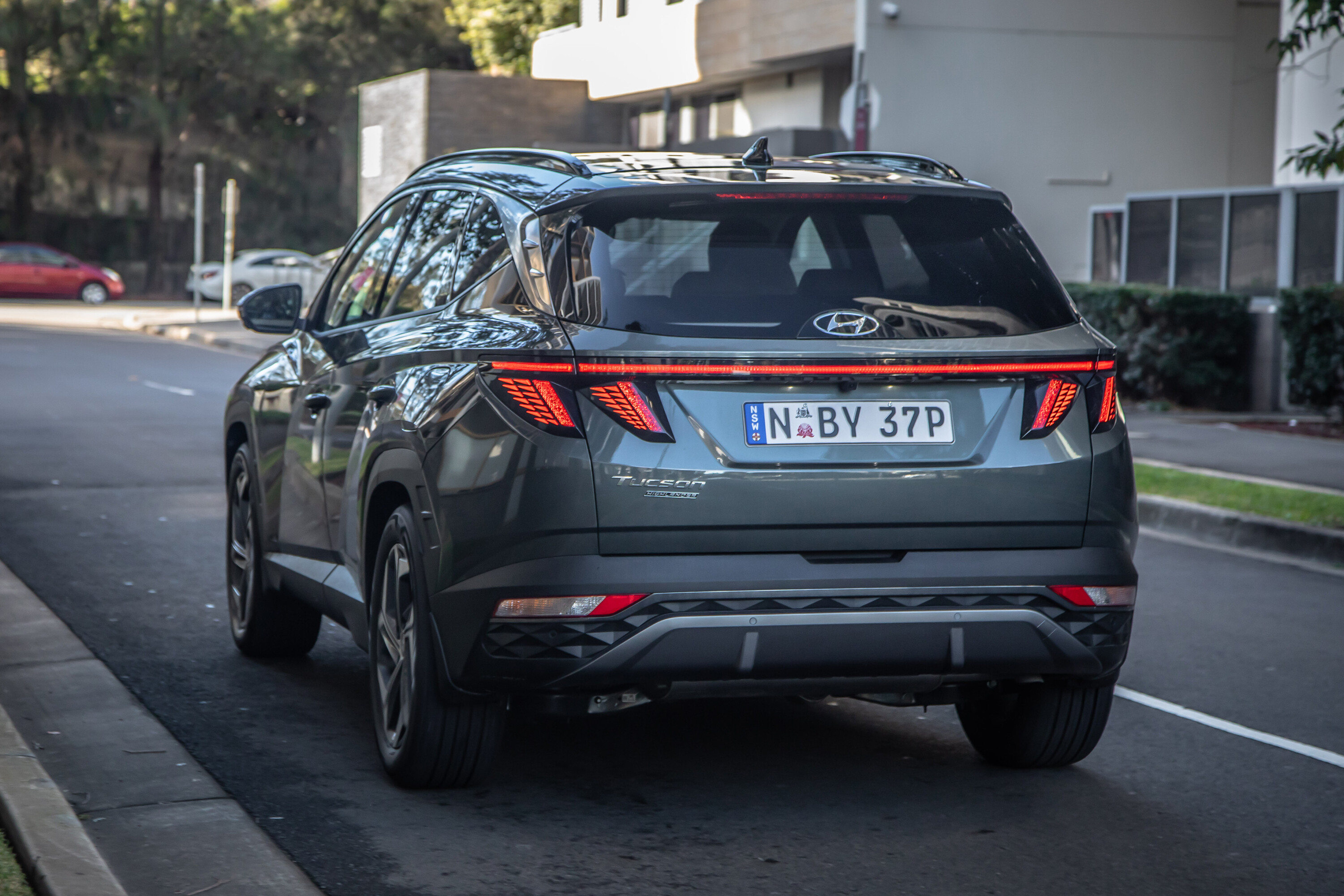
The removal of the panoramic sunroof sees the Highlander’s LED cabin lighting replaced by incandescent bulb-type lights, with a rear centre light in place of the rear outboard position – in line with the base and Elite variants.
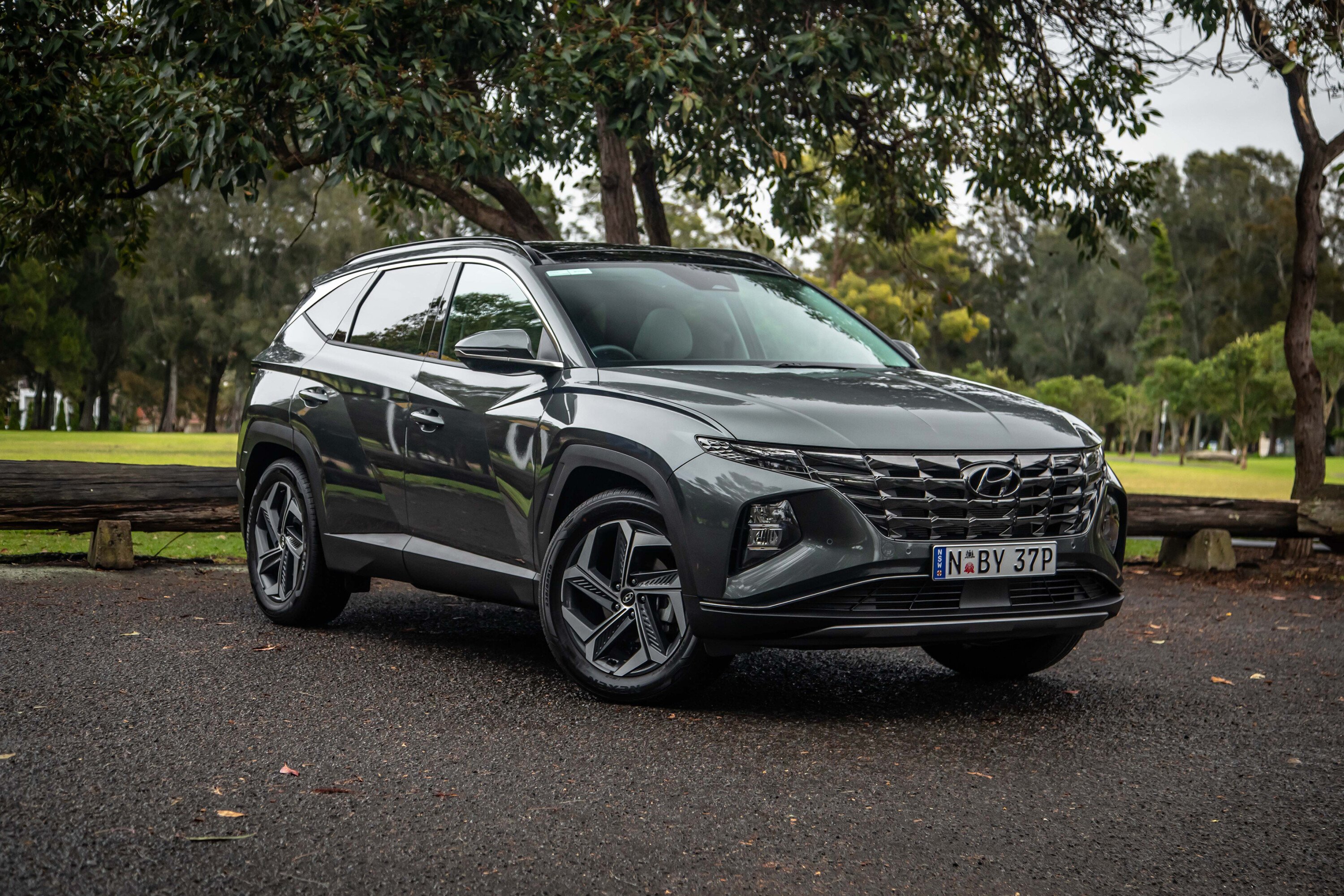
Non-N Line Highlanders with a steel roof also receive matte black roof rails, rather than a gloss black style, which remains for vehicles with the N Line Option Pack, and all Highlanders with a panoramic sunroof.
1
A spokesperson for Hyundai Australia could not confirm how many customers have been offered the option to remove the sunroof for their Tucson, but said there were ‘no plans’ to delete a sunroof from other range-topping models, such as the Santa Fe Highlander.
All other specifications remain identical to the latest Tucson Highlander, which recently gained Hyundai’s Bluelink connected-car technology in its model-year 2023 update. For everything you need to know, click below:
MORE
Everything Hyundai
Volkswagen has ruled out the return of an electric Beetle, but is committed to the cut-price $30,000 ID.1 hatchback.
Snapshot
- Beetle EV comeback ruled out (for now)
- Commits to ID.1 city electric hatch
- Confident in circa-$30K price tag
Volkswagen chief executive Thomas Schäfer told Autocar [↗] that “there are certain vehicles that have had their day” and it “wouldn’t make sense to bring [the Beetle] back.”
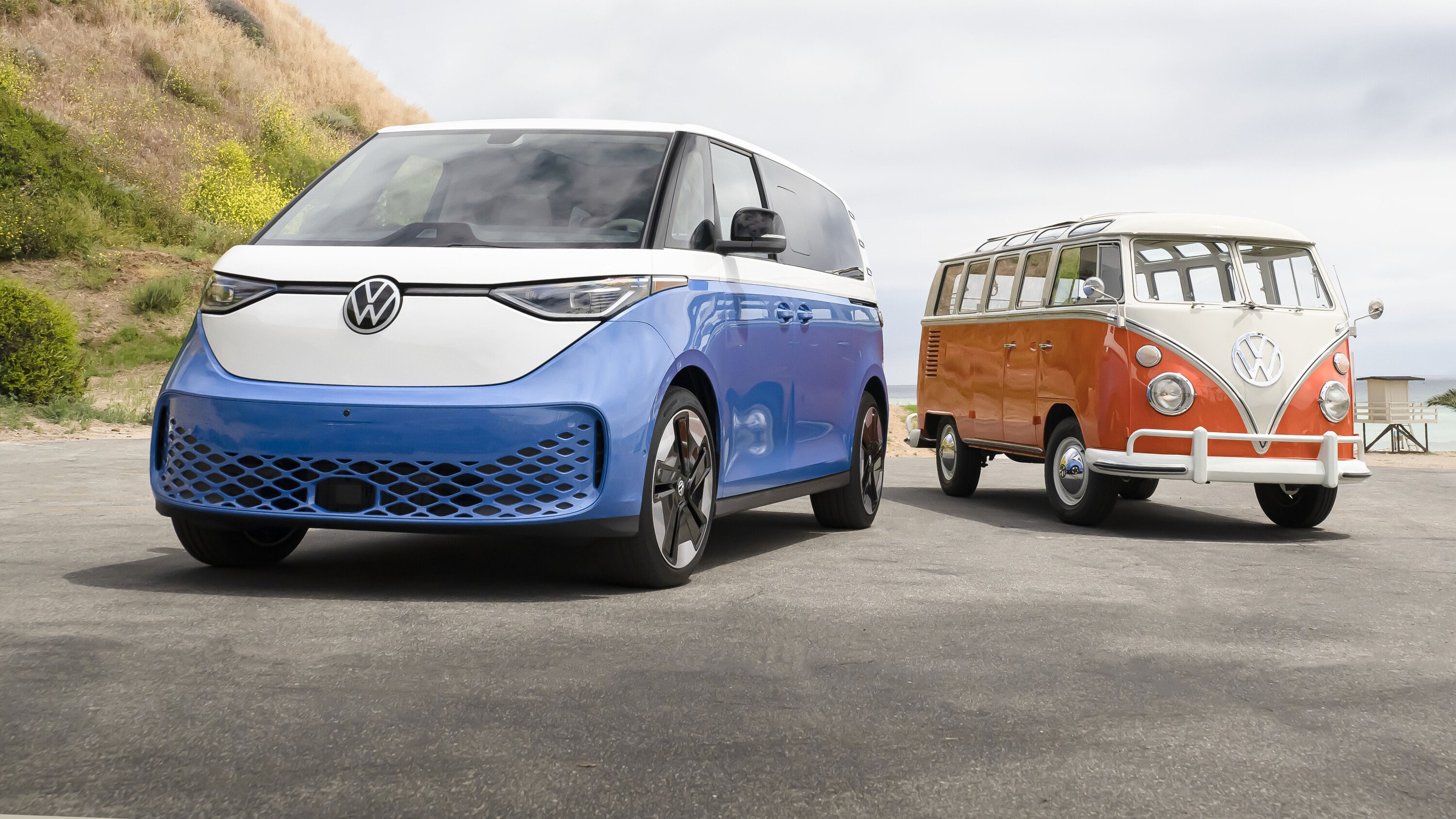
1
“I wouldn’t say with 100 per cent [certainty]. But from where I stand now, I wouldn’t consider it,” Schäfer said.
“It’s the same as Scirocco… And going forward with balancing all these technologies and the cost that is associated with it, you’ve got to invest money in the best possible place.”
The CEO added a model must have been significant globally in order to qualify for an electric revival, such as the Golf and Tiguan.
1
Schäfer’s comments addressed renewed speculation last week that the iconic Beetle would make an electric comeback, with a concept headlining the upcoming children’s animation Miraculous: Ladybug & Cat Noir – The Movie.
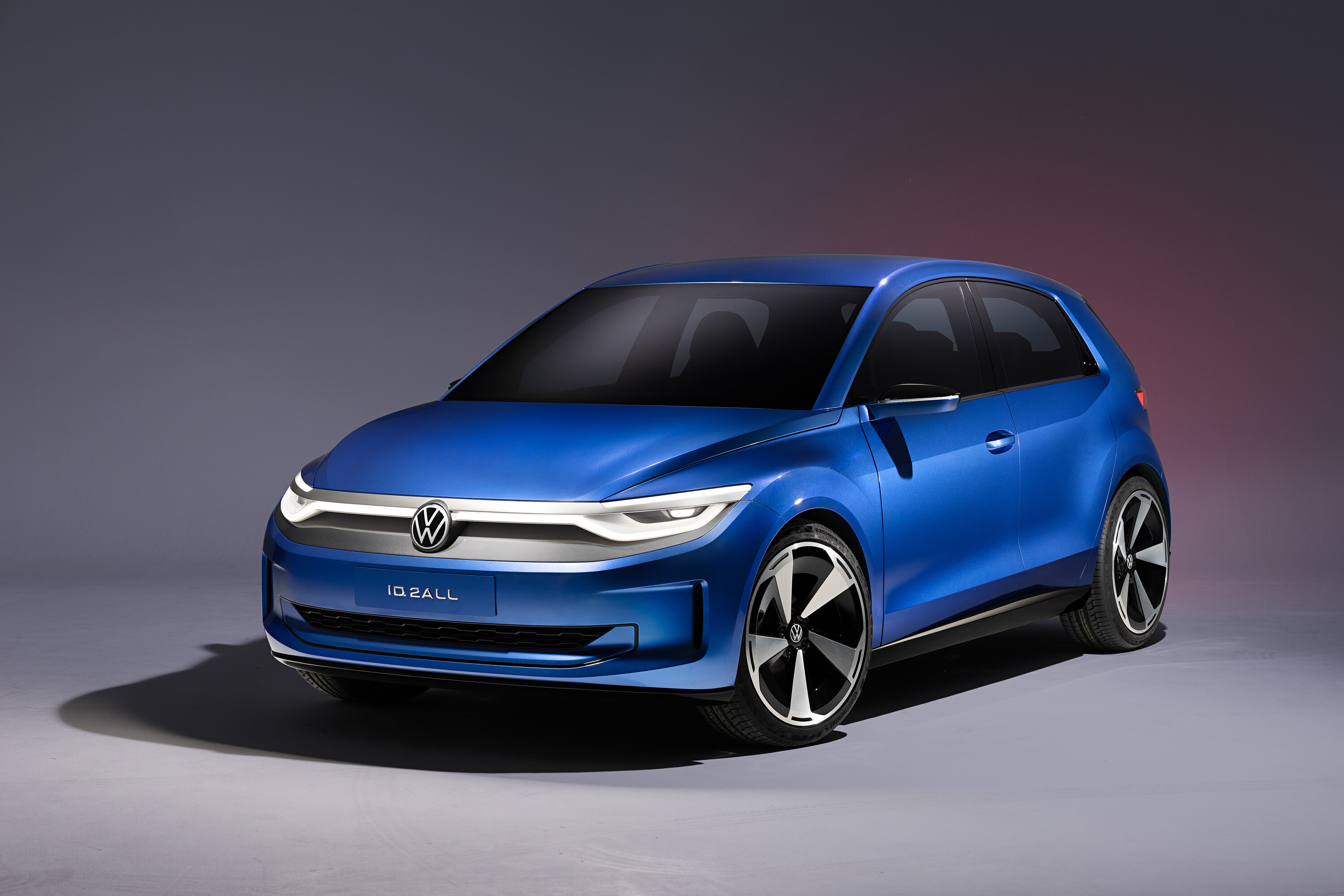
Meanwhile, Volkswagen Group chief financial officer Arno Antlitz confirmed to Autocar [↗] that it is “quite confident” to achieve a circa-AU$32,000 (GB£17,000) for the ID.1 electric hatch.
Antlitz pointed to it using its first in-house developed battery from Spain, lowering raw material market costs, and a new yet-to-be-revealed platform that would be ‘distinct’ from the Modular Electric Toolkit Entry (MEB Entry) architecture to be used in the ID.2 small car.
The Volkswagen ID.1 will be the spiritual successor to the E-Up micro city car sold overseas, but will likely follow after the ID.2 due in 2025.
1
February 8, 2022: Former VW boss hints at Beetle EV
A battery-powered Volkswagen Beetle may be on the cards, with the company’s CEO suggesting the iconic model could adopt an all-electric powertrain.
Volkswagen boss Herbert Diess was taking part in a Q&A session on Chinese social media platform Weibo last month when he confirmed the German car giant was considering bringing back the Beetle with electric power.
“I am very excited about the launch of the ID Buzz and, from this experience, learn how we can bring our traditional and emotional world to the electric vehicle sector, thinking of the Beetle,” Diess said, according to a report from Spanish news website Hybrids and Electrics.
It’s not the first time Diess has hinted at such a model, telling UK magazine Autocar in late 2017: “If we wanted to do a Beetle, electrically it would be much better than [the last Beetle] model, much closer to history, because it could be rear-wheel drive”.
1
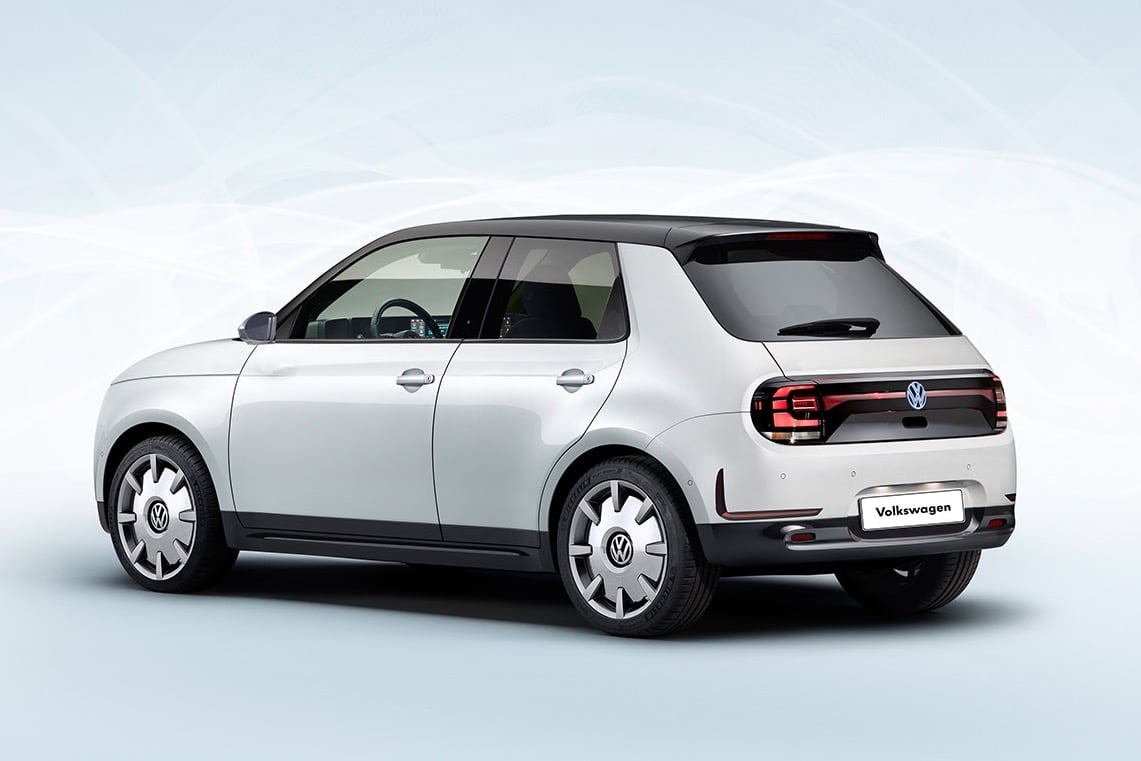
In July 2020, Volkswagen also registered the trademarks e-Karmann, e-Kübel, e-Golf Classic, and e-Beetle with the European Union.
These digital renderings created by artist Kleber Silva imagine what a new e-Beetle could look like in the coming years.
But it appears Volkswagen might have been beaten to the punch, with China’s Ora brand set to release the electric Ballet Cat and Punk Cat next month, sharing a striking similarity to the original Beetle.
More EV stories to help you choose the best car for your needs
- ? EV news, reviews, advice & guides
- ❓ Short & sweet: Your EV questions answered
- ⚡ New EVs: Everything coming to Australia
- ? Australia’s EVs with the longest driving range
- ⚖️ Best-value EVs by driving range
- ? How much do EVs cost in Australia?
- ? How much more expensive are EVs?
- ⚖️ Number crunching: Is it time to switch to an EV?
- ♻ Should you buy a used EV?
- ?️ Are EVs more expensive to insure?
- ? Costs compared: Charging an EV vs fueling a car
- ? EV charging guide
- ?? EV servicing explained
- ? EV battery types explained
- ? When do EV batteries need replacing?
- ? Hydrogen v EVs: What’s best for Oz?
- ? How sustainable are EVs, really?
MORE advice stories to help you with buying and owning a car
Just as the Maserati brand had been seemingly headed for an extended period of fresh-metal dormancy, a whirlwind of product activity is sweeping through Modena.
After recently playing a couple of halo cards with the related MC20 supercar and Cielo open-seater, the trident badge is now dealing itself into the volume territory of luxury cars.
The Grecale, the latest Maserati to be named after a wind, is the company’s first midsized SUV.
It’s taken seven years since the Maserati Levante arrived as a rival to the Porsche Cayenne, and now the Grecale must hit the ground running against another Porsche SUV – and one that already has nearly a decade of success under its belt: the Macan.
1
Maserati isn’t relying on either undercutting or price parity, though. A three-model range starts with the GT at $109,500 where the Macan kicks off at $95,300.
The mid-pack Modena we’re testing costs from $128,000, and the flagship, V6-powered Trofeo sits at $165K before on-roads, where a six-cylinder Macan is available from $119,000.
Add between a reasonable $2150 and an eyebrow-raising $50,500 if you want any other colour besides Bianco white.
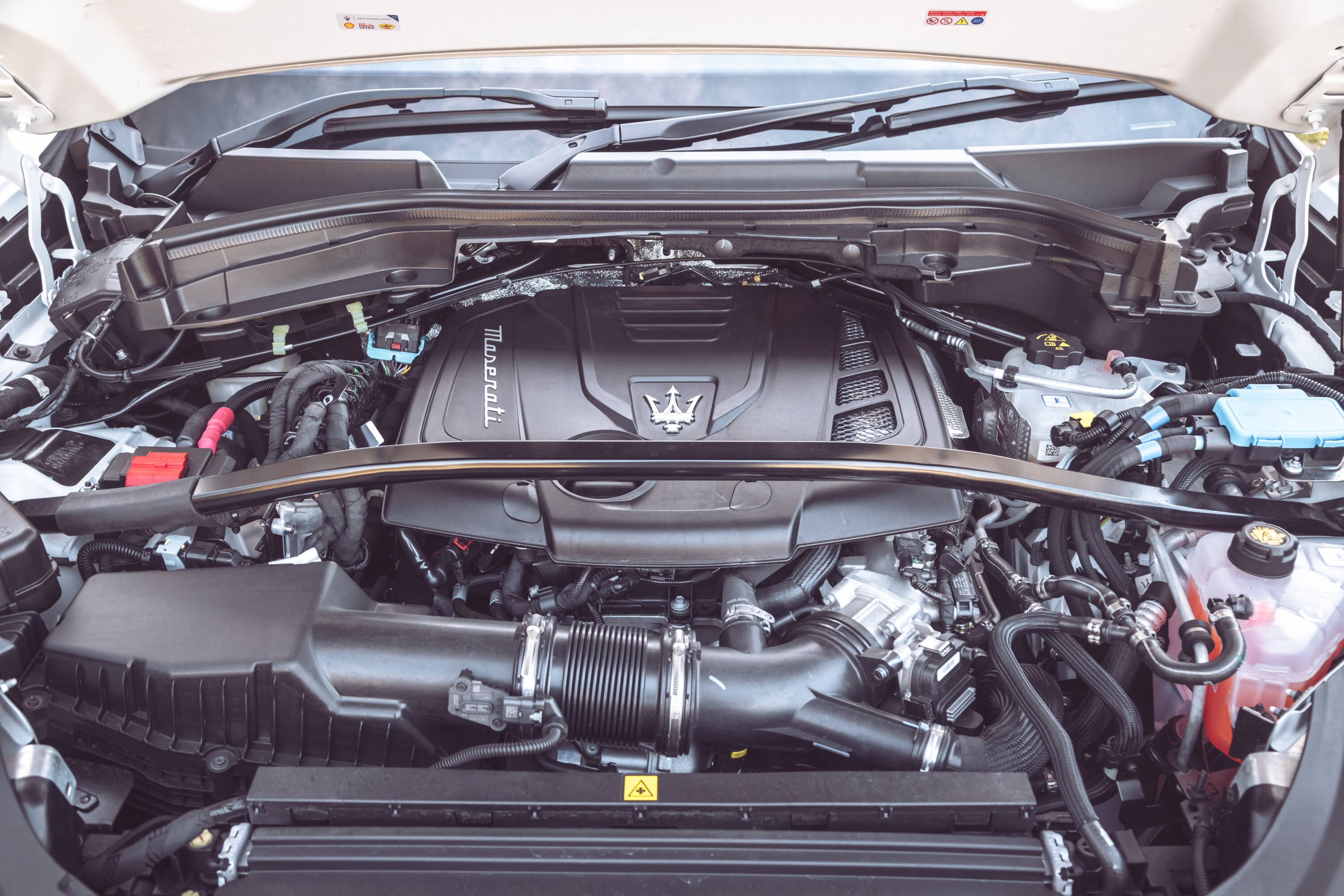
The GT and Modena share a mild-hybrid 2.0-litre four-cylinder, which serves up an extra 23kW for 243kW (but an identical 450Nm) and a three-tenths shaving off the 0-100km/h claim, at 5.3 seconds.

2
Other extras on the mechanical front include a limited-slip differential and electronically adjustable dampers, while the Grecale’s boots step up from size 19s to 20s.
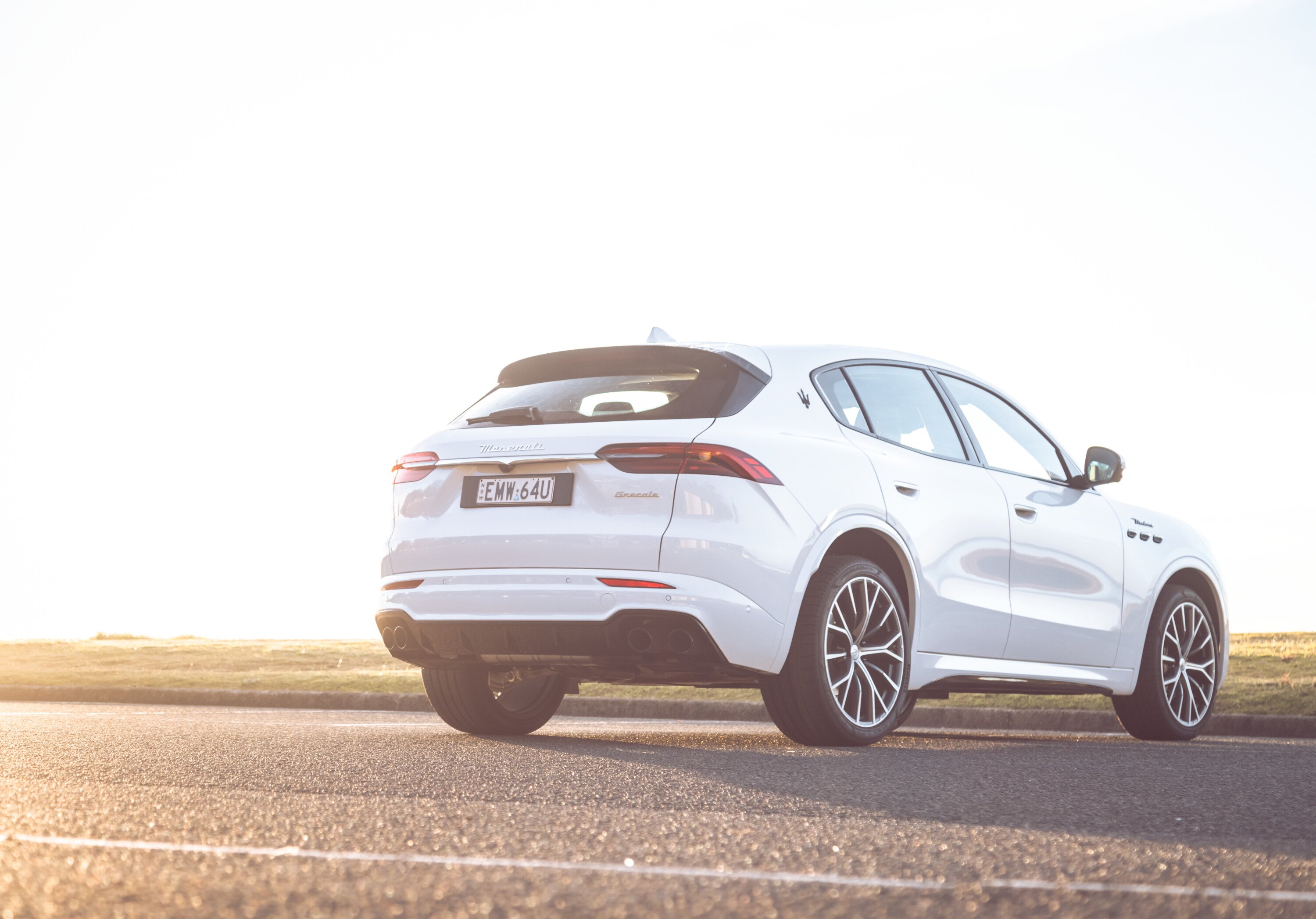
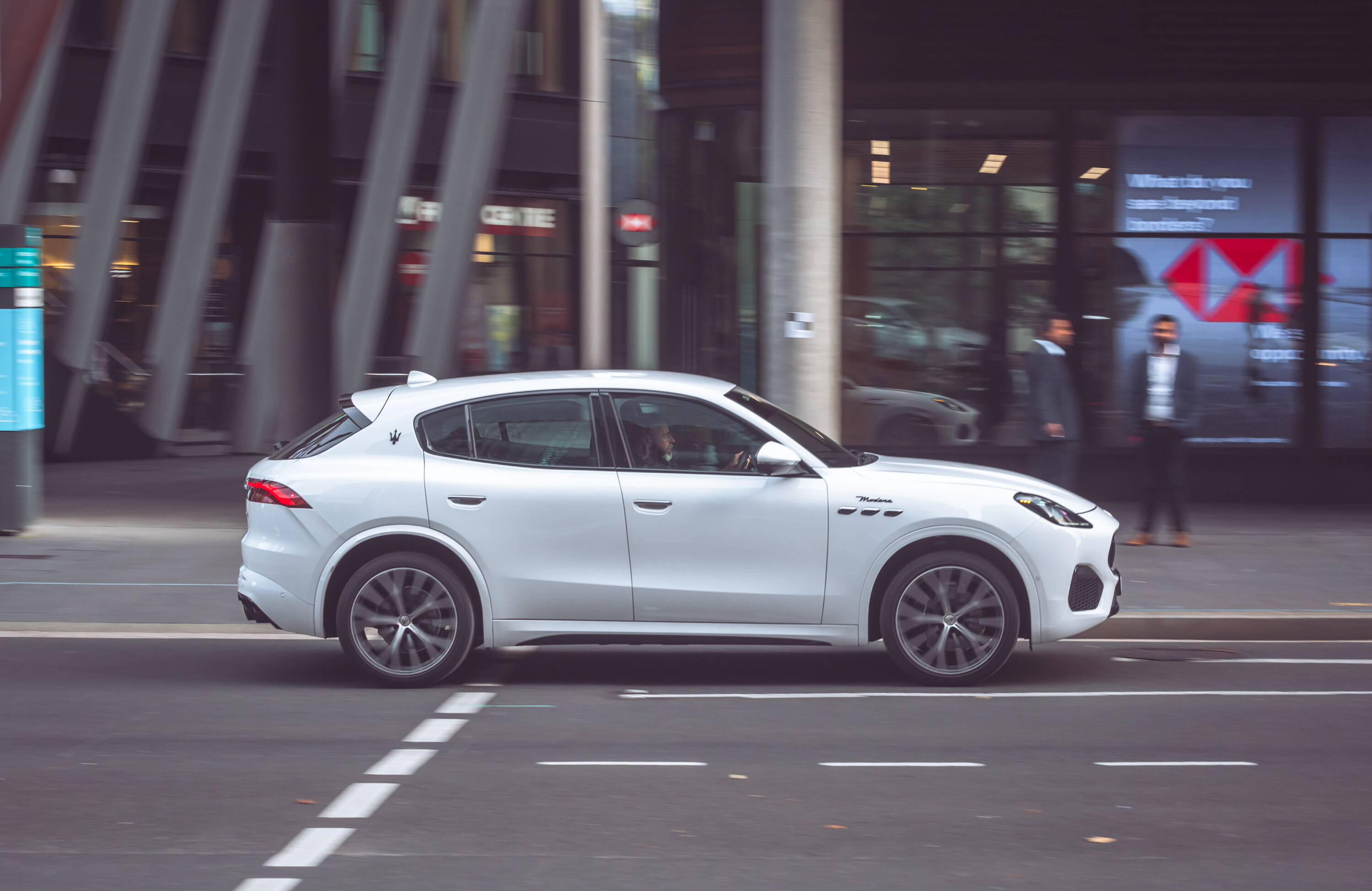
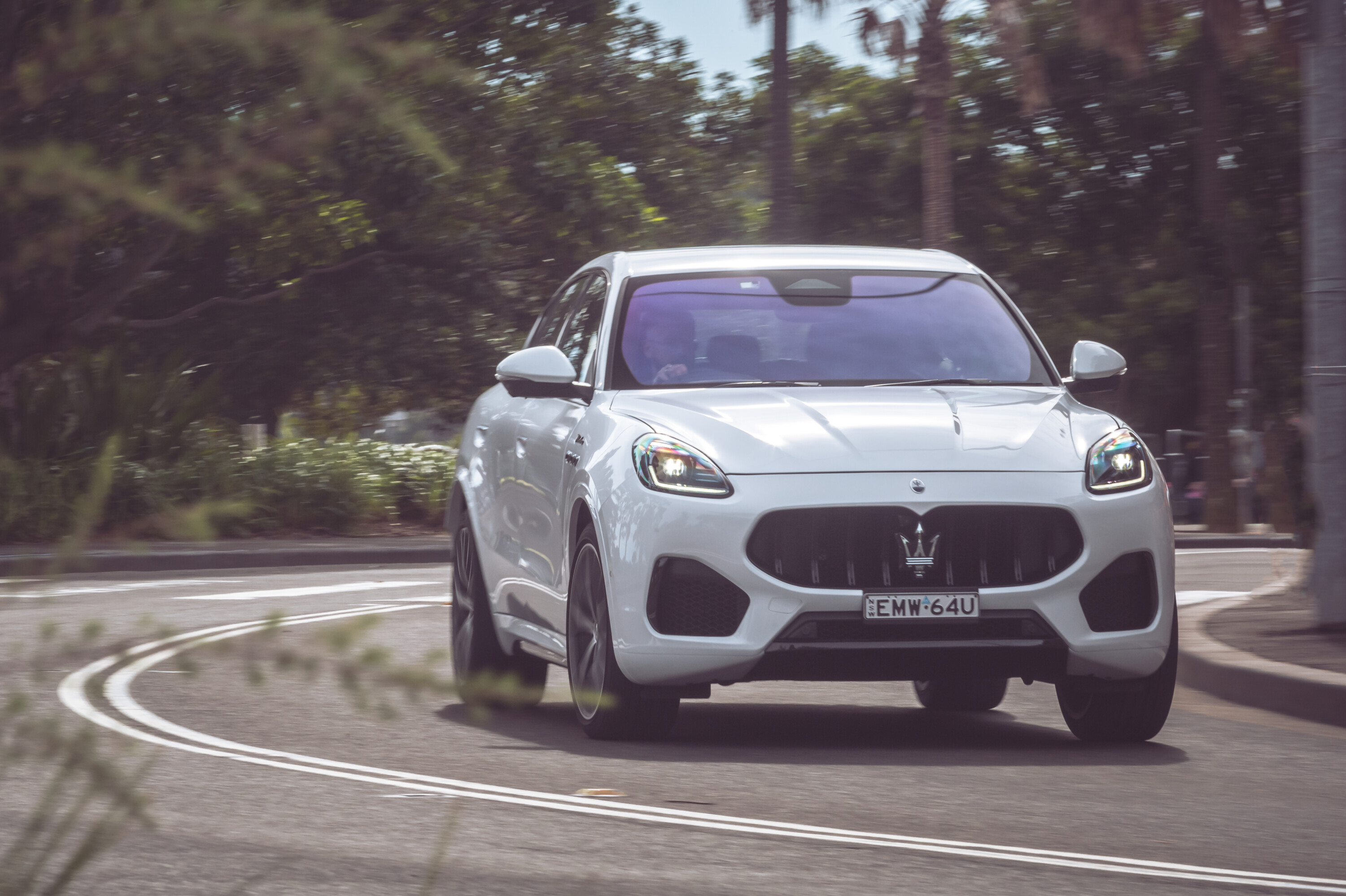
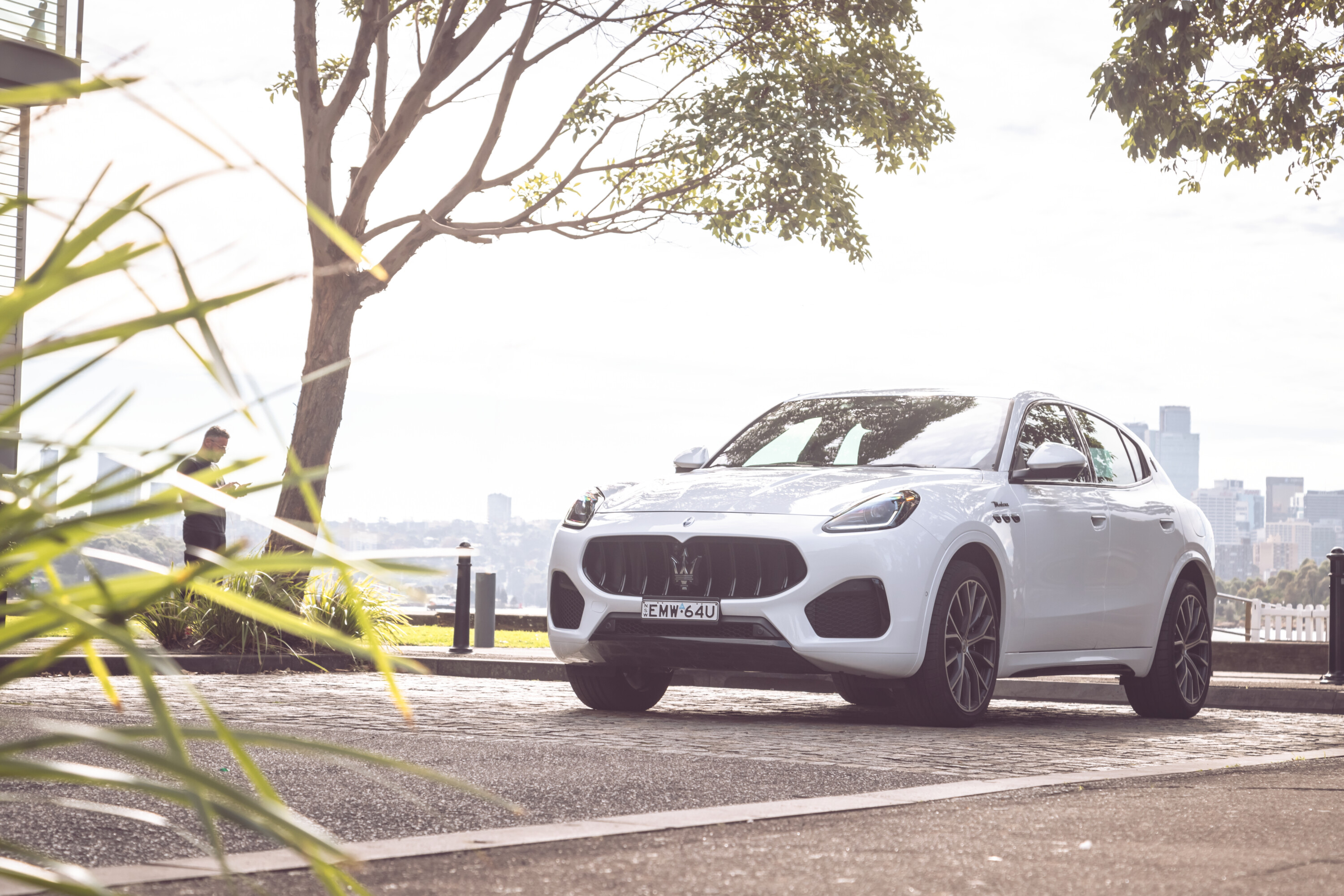
They prop up a body shape that has hints of Macan at the front – especially the headlight shapes – and can easily be confused with the Levante at first glance. It could perhaps be more distinctive beyond the famous forks and tri fender vents, though the proportions are good.
The interior – accessed by cleverly conceived touch-sensitive doorhandles – makes an immediate and lasting positive impression. From the stitched leather seating to the open-pore wood rim and velvety sun-visors, the Maserati literally presents a feel-good factor.
1
Carbonfibre trim and stitched Trident headrest badges, included on our test car, are among a myriad of optional cabin embellishments.
There are contemporary touches such as the dash clock that eschews the traditional analogue face for a digital version with customisable faces, and additional compass and G-force options.
The single-framed dual central display looks like you’ve just opened an oversized Samsung Galaxy Z Fold.
In the upper section, it houses a 12.3-inch Ultra HD screen serving up an all-new Android-based user interface complete with smartphone mirroring, Amazon’s Alexa voice assistant, and control of a great-sounding, 14-speaker Sonus Faber audio. Below that is a sloped, 8.8-inch panel combining various vehicle functions and heating/ventilation controls, with PRND buttons in between.

1
The steering wheel closely mimics the tiller in the MC20, including two large circular buttons – Engine Start/Stop and Drive Modes in the Grecale’s case – that hang from the horizontal spokes.
The smaller buttons just represent a general level of switchgear tactility that’s not quite a match for the Macan’s, while there are some ergonomic nit-picks.
Finding some controls is harder, or at least more distracting, than necessary, such as the headlight buttons that are found only in the lower central digital display. Non-selected transmission buttons lack illumination, making for a game of Guess the Gear at night (when the rear-view camera quality is also found to be disappointing).
And for a minor acoustic annoyance, the indicators sound more like what you’d expect from a Suzuki Swift.
1
… though 535 litres is still nearly 50L more than you find in a Macan’s luggage area.
The rear doors are a tale of two halves – poorly disguised cheap plastics lower down, lovely ribbed leather and carbonfibre layered trim for the upper section – though the rear cabin otherwise has few faults.
A wheelbase longer than the Cayenne’s brings Macan-beating legroom, with knee space further aided by deeply scalloped seatbacks. Foot space and headroom are also plentiful, while passengers relax into inviting outboard bench seats that also offer some lateral support.
Climate control with a rear touchscreen is one of the upgrades from the GT; heated rear seats, rear privacy glass and a panoramic sunroof are all options.
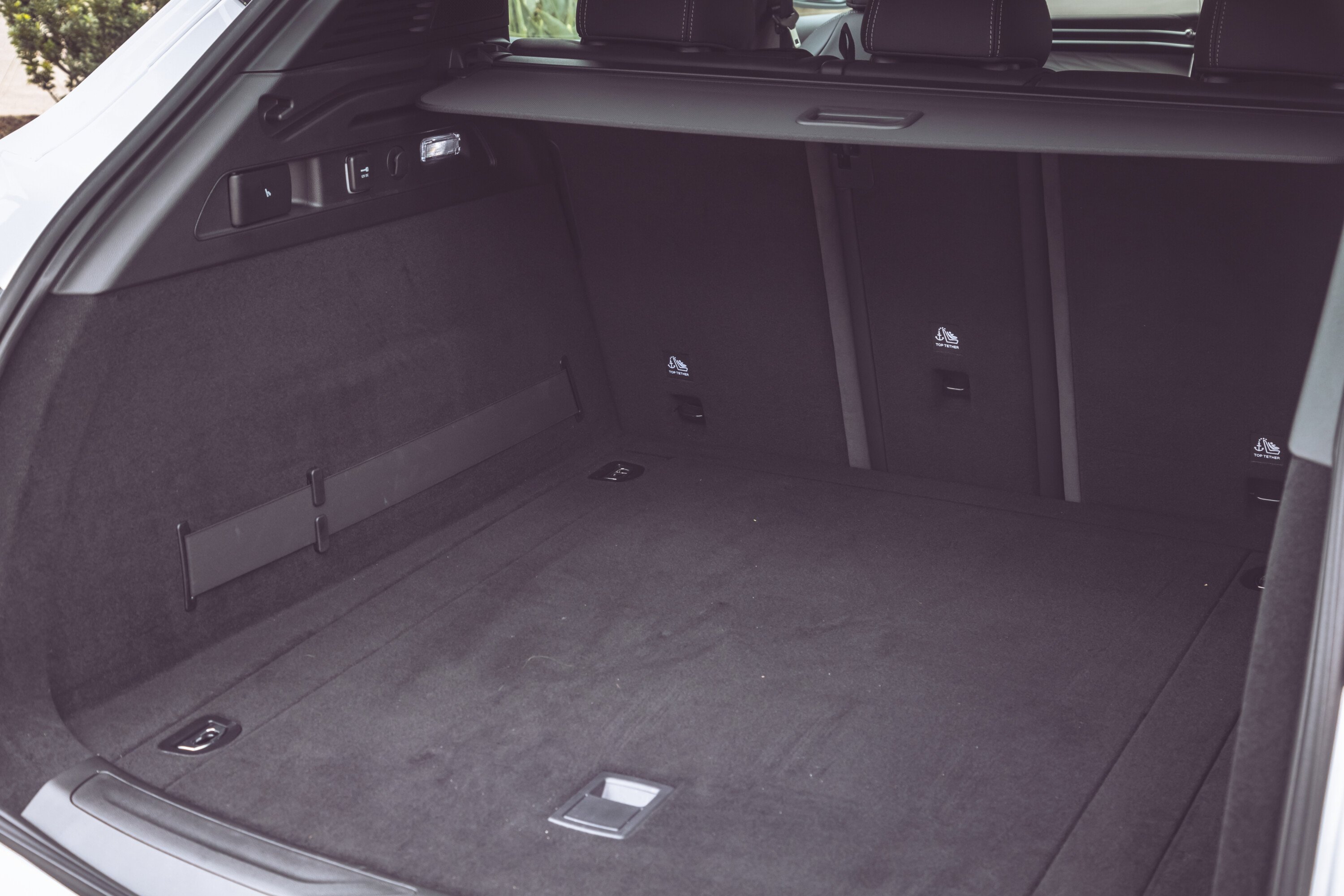
Boot space is reduced by 35 litres in the GT and Modena models, owing to the mild-hybrid system’s 48v battery, though 535 litres is still nearly 50L more than you find in a Macan’s luggage area.
1
Release levers fold the 60/40 seatbacks almost flat, or a pull-strap can lower a middle section to create a load-through. A cargo blind, hooks, elastic strap, two lights, and a 12-volt socket extend the practicality.
A modified version of the Giorgio platform that has worked well for Alfa Romeo’s Giulia sedan and Stelvio SUV sits beneath the Grecale, and this on-paper promise isn’t broken on the road.
Even with optional 21-inch wheels, the Modena doesn’t need the optional air springs to ride with a fluidity that was always conspicuously missing from the Levante’s restless suspension. The Grecale floats across scarred surfaces with minimum fuss, the bigger wheels only tripping over lateral road repairs.
Maserati is on record saying it deliberately wanted to avoid the ride stiffness of German competitors – which extend beyond the Macan to high-end versions of the BMW X3 and Mercedes GLC – and it’s succeeded.
1
Insulation from wind and tyre noise is also impressive.
A capable chassis is at its best on country roads when the damping force is increased by rotating the steering wheel’s Drive Mode dial through the mid-level GT to Sport – or pressing the dedicated damper button within. This helps reduce vertical movements and body roll.
The steering remains lighter than ideal, though it’s accurate, and quick to point the Maserati into a bend. Pirelli P Zero tyres that are 295mm wide at the rear bring additional surefootedness, along with a limited-slip diff and an all-wheel-drive system that can apportion up to 100 per cent torque to the back wheels.
The brake pedal feels better when used to slow the Grecale from higher speeds; around town its lack of progressiveness makes it difficult to bring the Maserati to a stop smoothly.
A four-cylinder engine, even one with some electric assistance, seems slightly incongruous in a vehicle that costs $128,000 before on-road charges and desirable options.
BMW, Mercedes and Porsche rivals offer turbocharged six-cylinders for similar or less money.
Outputs of 243kW and 450Nm are respectable, at least, as is the Grecale Modena’s general pace. The torque is unchanged from the GT but stretches another grand on the tacho, from 2000-5000rpm.
A gravelly engine note and a slightly artificial-sounding exhaust are guaranteed to disappoint any former Maserati owners ready to reminisce about sonorous V8s or growling twin-turbo V6s, as is the 5750rpm redline that all too quickly brings the rev-fun to an end when using the paddle levers to manually manage the gearchanges.
1
The electric compressor helps deliver good response at low revs, though, and the engine becomes increasingly enthusiast as you step up through the driving modes.
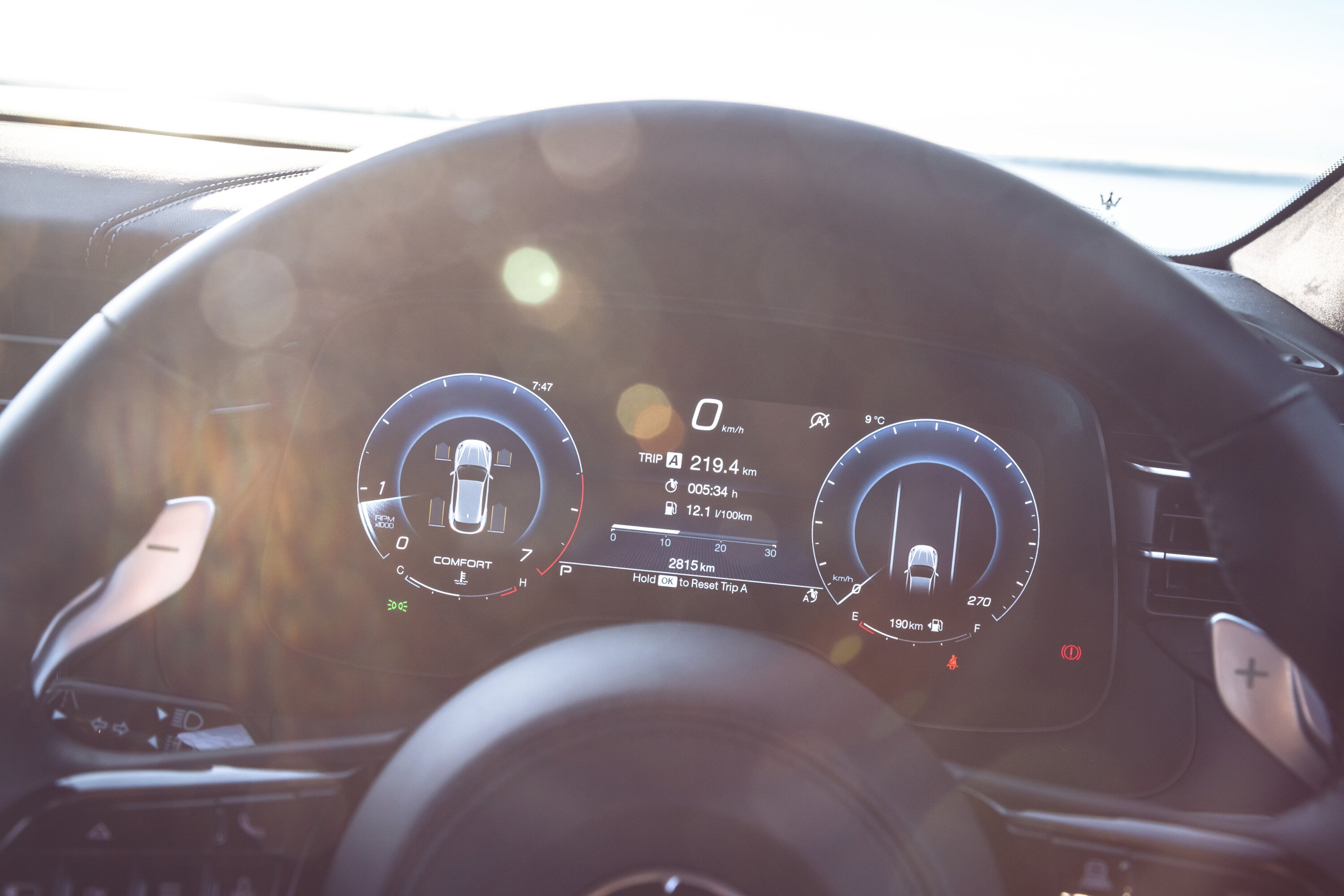
What the mild-hybrid system doesn’t seemingly do is improve efficiency. We registered an average of 11.5 litres per 100km even with a healthy percentage of freeway cruising during our drive. That’s above the Modena’s official consumption of 8.6L/100km.
The Grecale for those seeking super-SUV performance is the Trofeo, which uses a detuned, 390kW/620Nm version of the MC20 supercar’s ‘Nettuno’ twin-turbo V6 to power to 100km/h in 3.8 seconds.
Next year, an electric Folgore variant arrives as the company’s first fully electric SUV and part of Maserati’s plan to be all-electric by 2030. Featuring a 105kWh battery and 400V platform, the Grecale Folgore will offer about 800Nm.
1
Maserati Australia says the Grecale will account for about two-thirds of the Italian brand’s local sales.
A huge percentage, though not necessarily surprising when the Grecale makes the Levante look almost redundant – offering nearly as much interior space yet better in every other way, for less money.
Whether the SUV named after a strong, cool Mediterranean wind can blow over its major Porsche rival is another question entirely.
MORE
Everything Maserati
MORE
Midsize SUVs
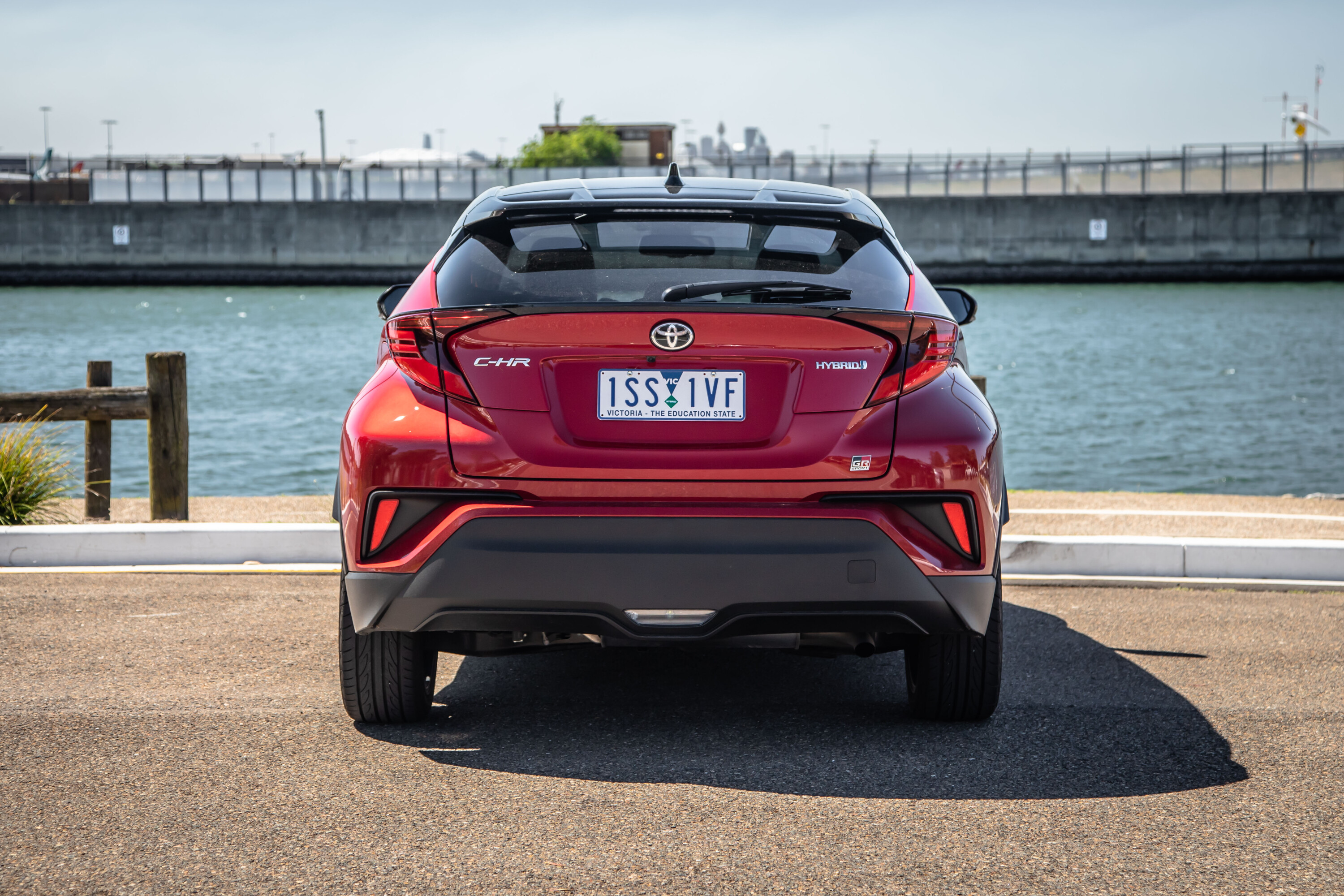
The current 2023 Toyota C-HR small SUV is off-sale, the brand has confirmed.
Toyota Australia’s webpage for the C-HR states it is “no longer available for purchase”, with the all-new model claimed to arrive in the first quarter of 2024 (January to March inclusive).
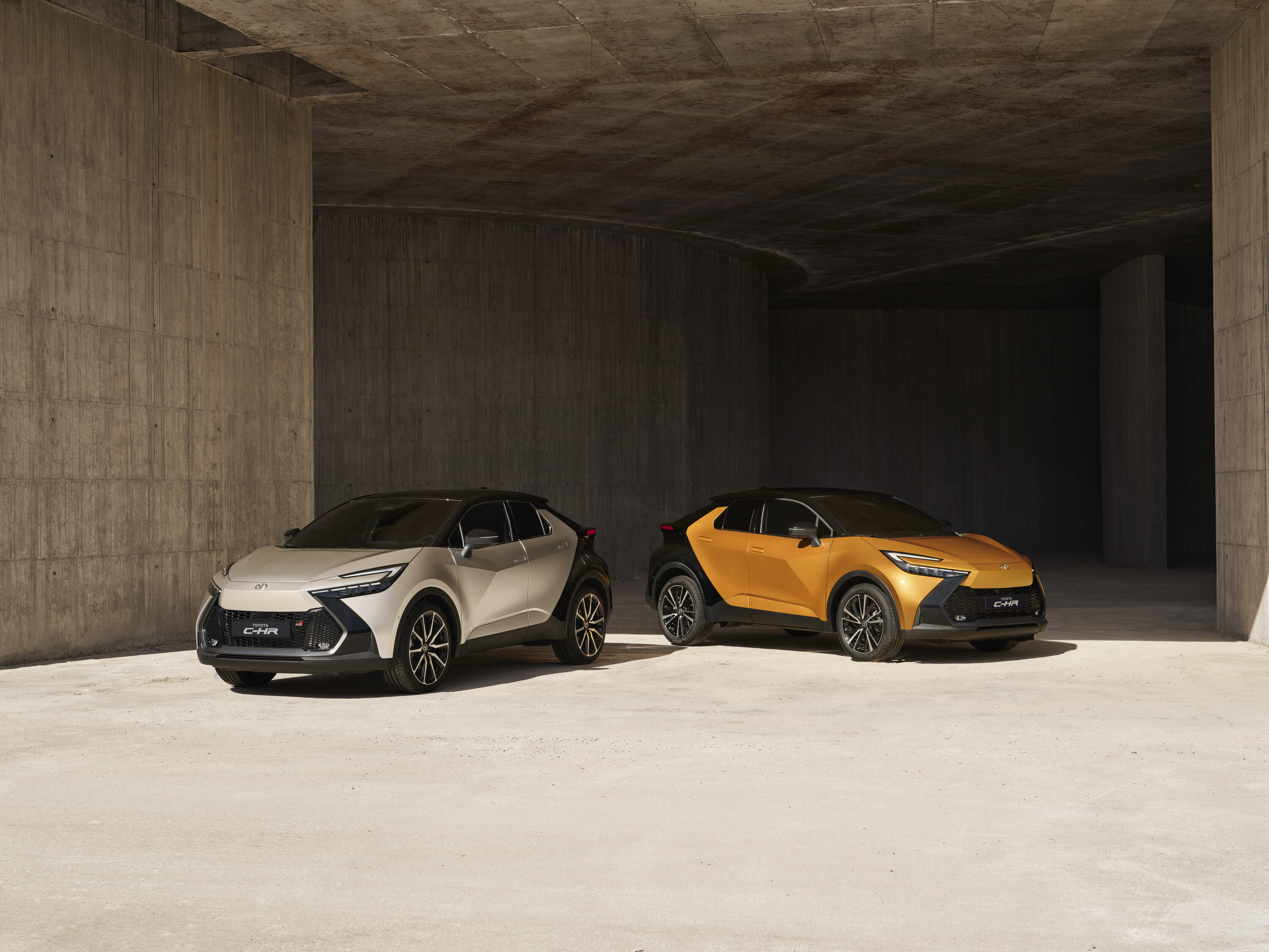
The second-generation, hybrid-only 2024 Toyota C-HR – built in Europe, not Japan – will launch in Australia next year, meaning orders for the funky small SUV will be on hiatus for over six months.
A Toyota Australia spokesperson confirmed the 2023 C-HR is sold-out, with customers – including recent order holders – asked to speak to their local dealer for more information about the new model.
“Customers who are interested in the new-generation C-HR, including those who have recently ordered a current-generation C-HR, are encouraged to contact their preferred dealer for more information.”
While the exact reason for the hiatus is unclear, industry-wide production delays and extended wait times mean recent C-HR orders are unlikely to be fulfilled before Japanese production ends. The new C-HR will be exclusively built in Europe.
1
Recent order holders who miss out on the final vehicles allocated for the Australian market could purchase the new C-HR at an expected higher cost, switch to another Toyota (such as the Corolla Cross), or part with their order.
The current 2023 Toyota C-HR is priced between $31,715 and $38,465 before on-road costs, with the latter being for the Koba and GR Sport hybrid variants.
Last year, the hybrid powertrain accounted for 44.1 per cent of C-HR sales in Australia, split between the Koba (84 per cent) and GR Sport (16 per cent) grades.
VFACTS new-car sales data reveals 1906 examples have been sold in Australia year-to-date, placing it at the lower end of the small SUV segment, behind rivals including the MG ZS (9823), Mazda CX-30 (4939), Kia Seltos (4283), Mitsubishi ASX (3859), Volkswagen T-Roc (3360) and Toyota’s own Corolla Cross (2302).
Local details for the 2024 Toyota C-HR will be released in the coming months, but Toyota has confirmed preliminary specifications for Australia – including the fitment of its Connected Services technology.
It will be offered in three familiar variants in Australia, with a more-powerful 1.8-litre hybrid and front-wheel-drive for the GXL and Koba.
1
A 2.0-litre hybrid will feature in the range-topping GR Sport variant with all-wheel-drive.
The 1.8-litre hybrid available in the GXL and Koba produces 103kW in total – up 15 per cent – while the 2.0-litre system in the GR Sport introduces dual electric motors with all-wheel-drive and a 145kW total system output.
Measuring 4360 millimetres long, 1830mm wide and 1558 to 1564mm tall, with a 2640mm wheelbase, the new C-HR is 30mm shorter than before – but it is 35mm wider and similar in height, with an identical wheelbase.
MORE
Everything Toyota
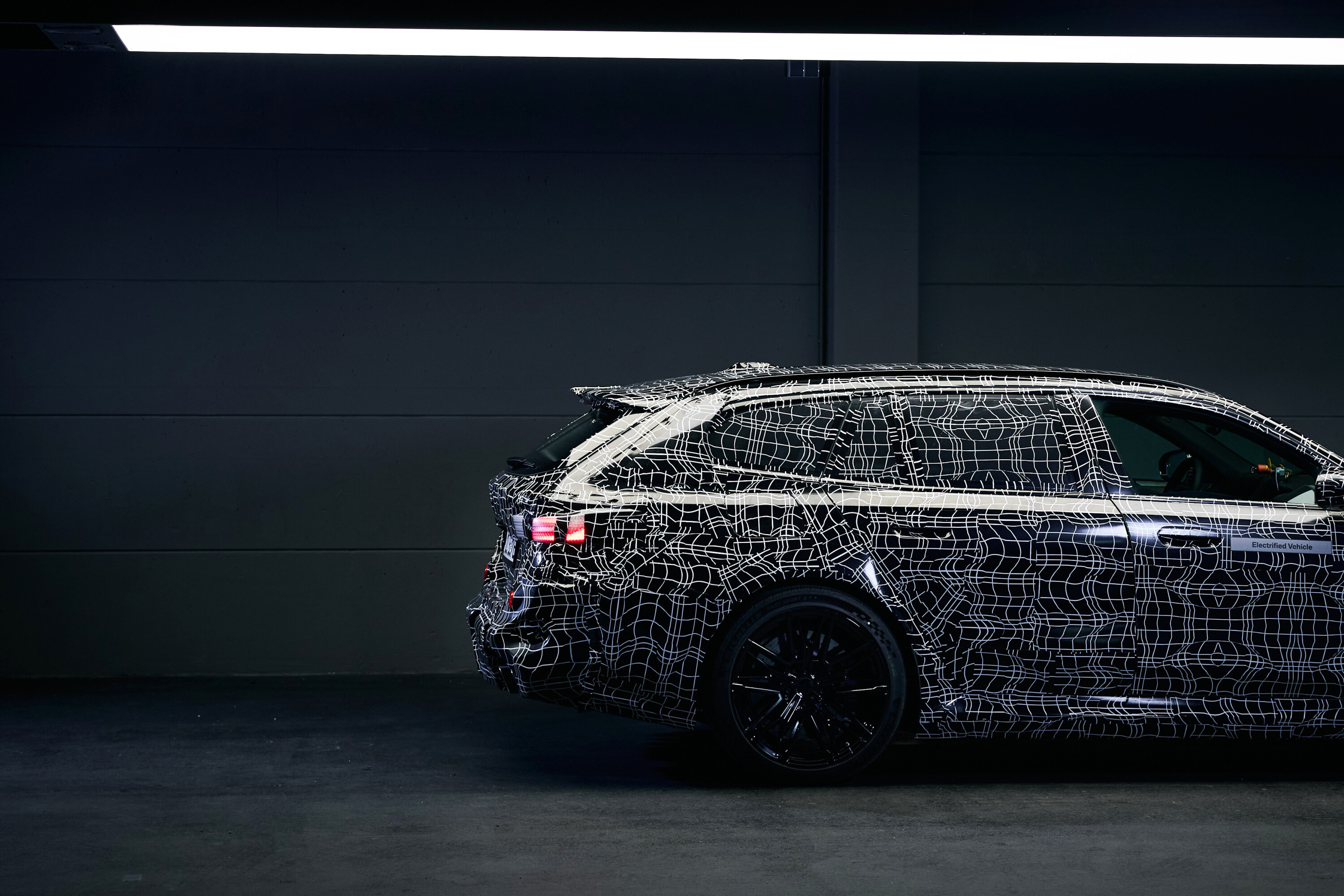
BMW officially confirmed the ‘G90/G99’ M5 in a set of teaser images released overnight, becoming only the third M5 Touring ever.
Aside from packing a near-600kW plug-in hybrid powertrain based around a petrol V8, this is also the first time we’re seing the eighth-generation of 5 Series in wagon form, aside from our speculative renders that you can see here.
BMW’s G61 Touring treatment is pretty typical, adding a C Pillar while retaining the slight spoiler of the sedan in the tailgate. A slightly sloping roof gives it a sporty look; expect the ever-practical opening rear glass and space for the labrador.
5
Update: British publication Autocar [↗] spoke to sources close to BMW that revealed the M5’s plug-in hybrid system would pack around 590kW and 1000Nm.
The powertrain is tipped to feature the 4.4-litre ‘S63’ twin-turbo V8 (also found in the F90 M5) with a rear-mounted electric motor and either a carryover 12kWh battery or a new 19.4kWh item.
Accompanying the Touring teaser, BMW referred to the M5’s powertrain as “a completely newly developed partially electrified drive system.”
That means the M5 won’t to simply use the 559kW XM’s plug-in hybrid powertrain with its gearbox-mounted electric motor coupled with a newer 4.4-litre ‘S68’ V8 engine. Instead, M has put money into developing a unique solution for the M5.
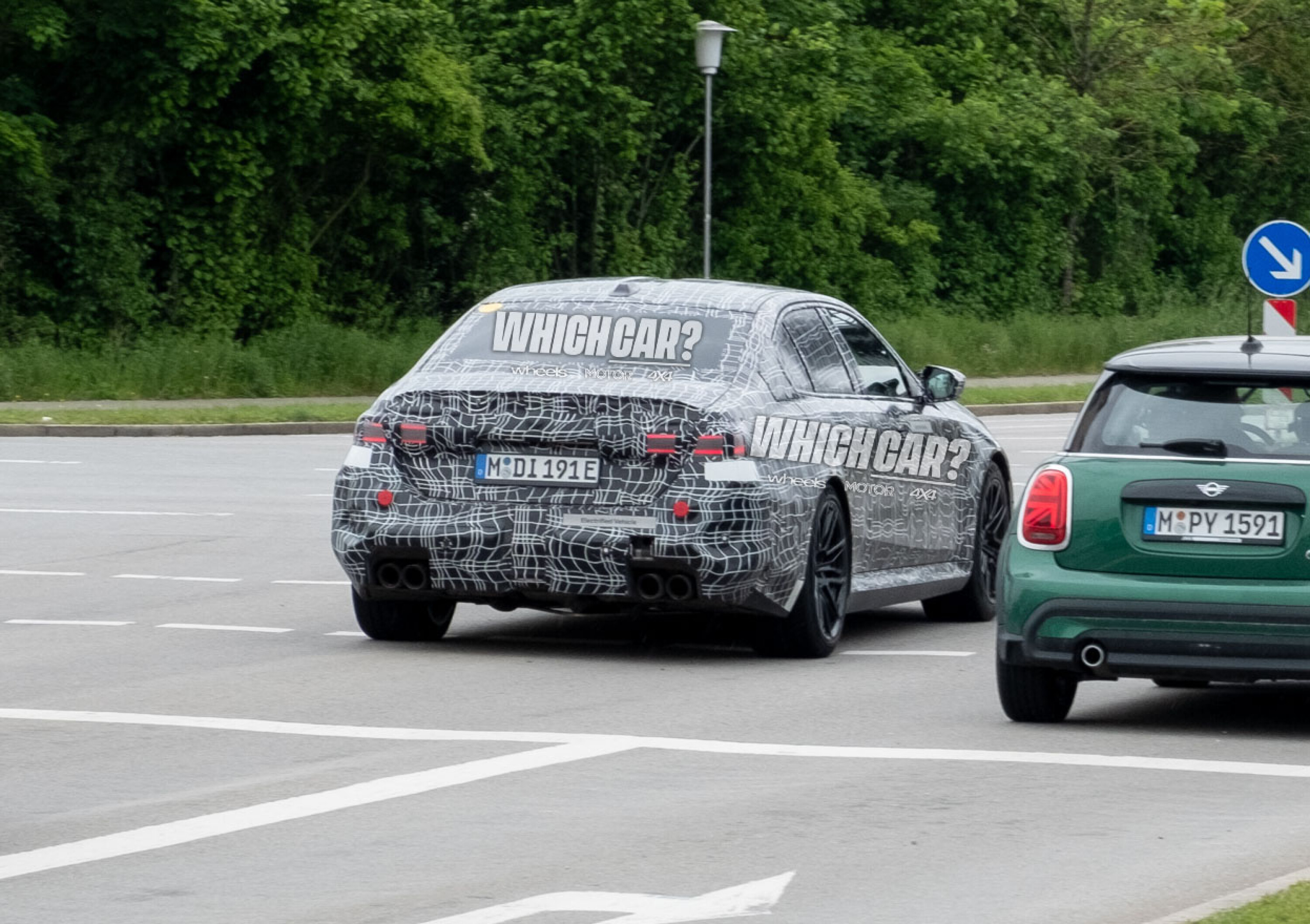
Wheels was lucky enough to spot an M5 sedan prototype near M GMBH in Garching (below) and the burbling exhaust note suggested it was packing a V8 under the bonnet. Stay tuned for more developments as BMW readies for a 2024 release.
1
BMW’s M division says the M5 Touring will begin testing shortly on roads around Munich and the Nurburgring Nordschleife ahead of its 2024 release.
The first BMW M5 Touring was launched in 1992 based on the E34 5 Series, there was then a generational gap with the E39 before the E61 triumphantly brought the body style back in 2007.
The last two M5 generations (F10 and F90) have not been offered with wagon bodies. BMW’s decision was likely tipped by enthusiasts’ love of the G81 M3 Touring.
MORE
Everything BMW
