
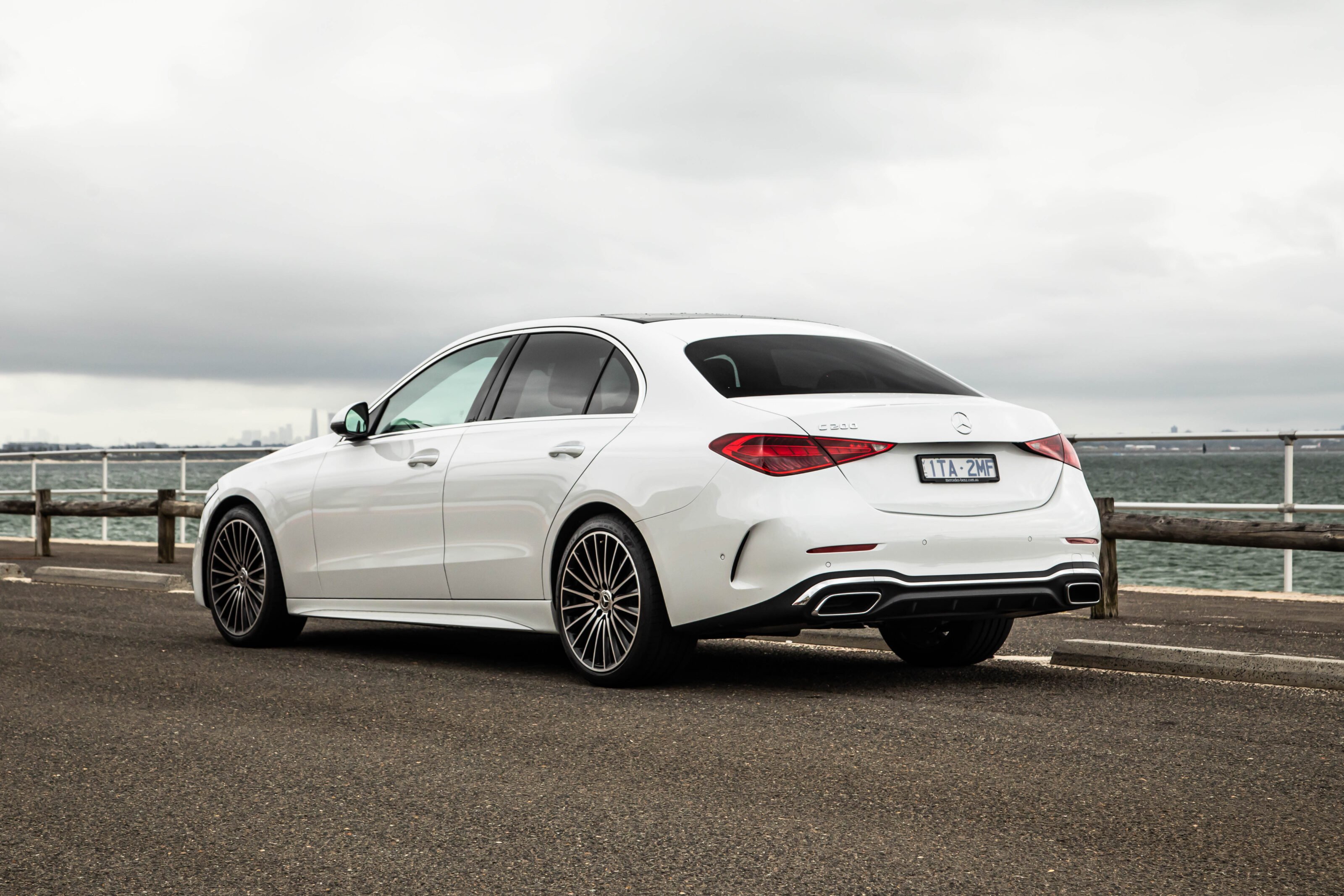
The C-Class was a standout from the day it first emerged to a buying public not used to a Mercedes-Benz being so small.
It took the engineering excellence of its larger brethren and packed it into the kind of smaller, sporting sedan its German rivals had been pumping out for years.
From four cylinders to eight, there was something for everyone. Talk to some people and they don’t even realise that the C comes in anything other than the delightfully obnoxious range-topping V8 (may it rest in peace).
You can still – thankfully – access this evergreen mid-size sedan despite the dominance of Benz’s SUV range. And you can get it with a 1.5-litre turbocharged four.
JUMP AHEAD
- How much is it, and what do you get?
- How do rivals compare on value?
- Interior comfort, space and storage
- What is it like to drive?
- How is it on fuel?
- How safe is it?
- Warranty and running costs
- VERDICT
- Specifications
How much is it, and what do you get?
Calling any C-Class sold here an entry-level model is both misleading and curiously unfair – because you can’t get one for less than $78,900 before on-road costs.
That’s a fair chunk of money, but look around the Mercedes range and you’ll find there’s a hatchback for $106,000. So I guess it’s all relative.
A lengthy standard equipment list for the C200 explains what I mean by the misleading idea of it being an entry-level car.
| Mercedes-Benz C200 standard features | |
|---|---|
| 11.9-inch touchscreen | Heated, electric-folding door mirrors |
| 18-inch alloy wheels | Keyless entry and start |
| 360-degree cameras | LED taillights |
| 5-speaker stereo | Nappa leather steering wheel |
| Adaptive cruise control | Power front-seat adjustment |
| Auto LED headlights | Reversing camera |
| Auto wipers | Runflat tyres |
| Digital dashboard | Satellite navigation |
| Dual-zone climate control | Synthetic leather upholstery |
| Electronic dampers | Wireless Android Auto |
| Front and rear parking sensors | Wireless CarPlay |
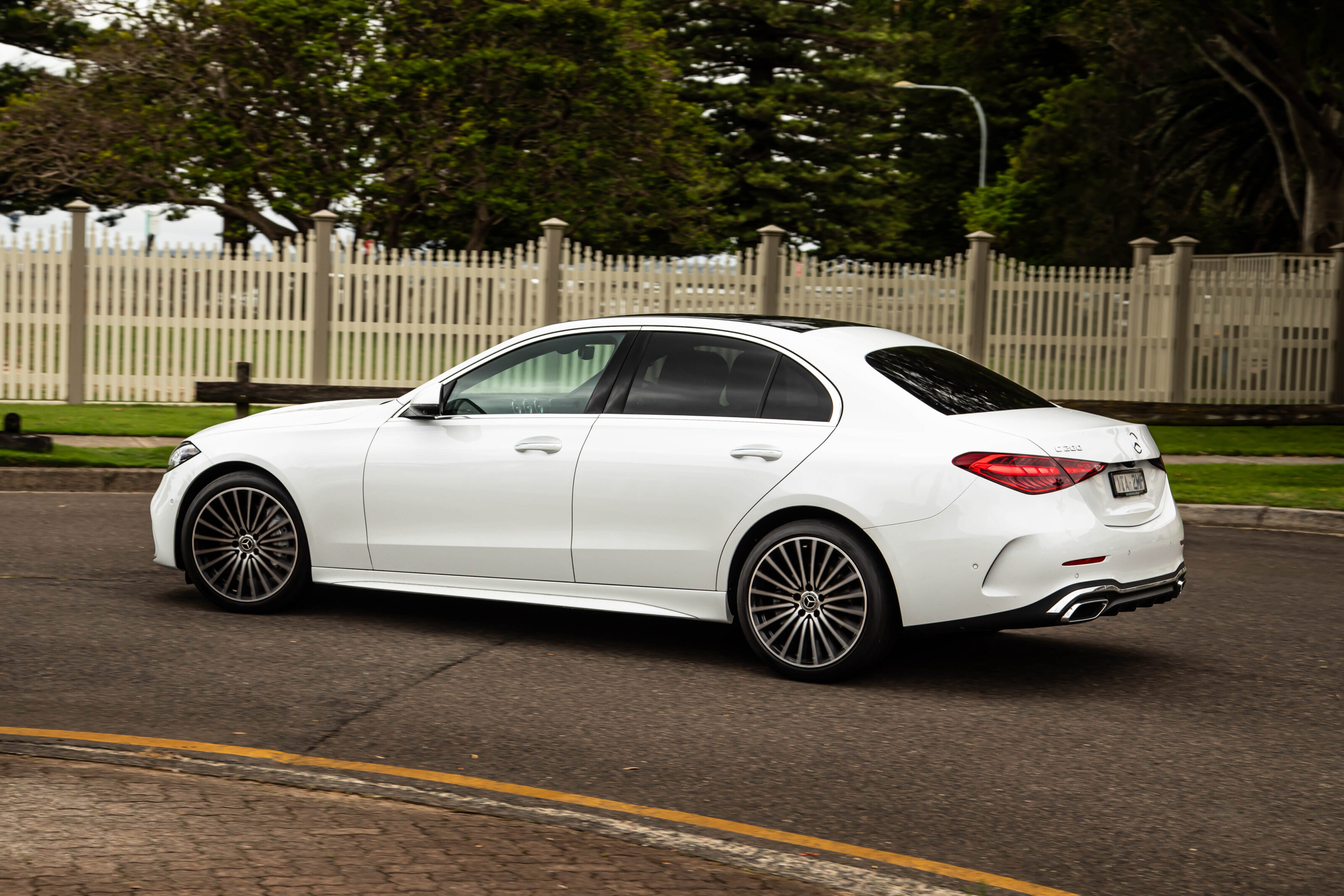
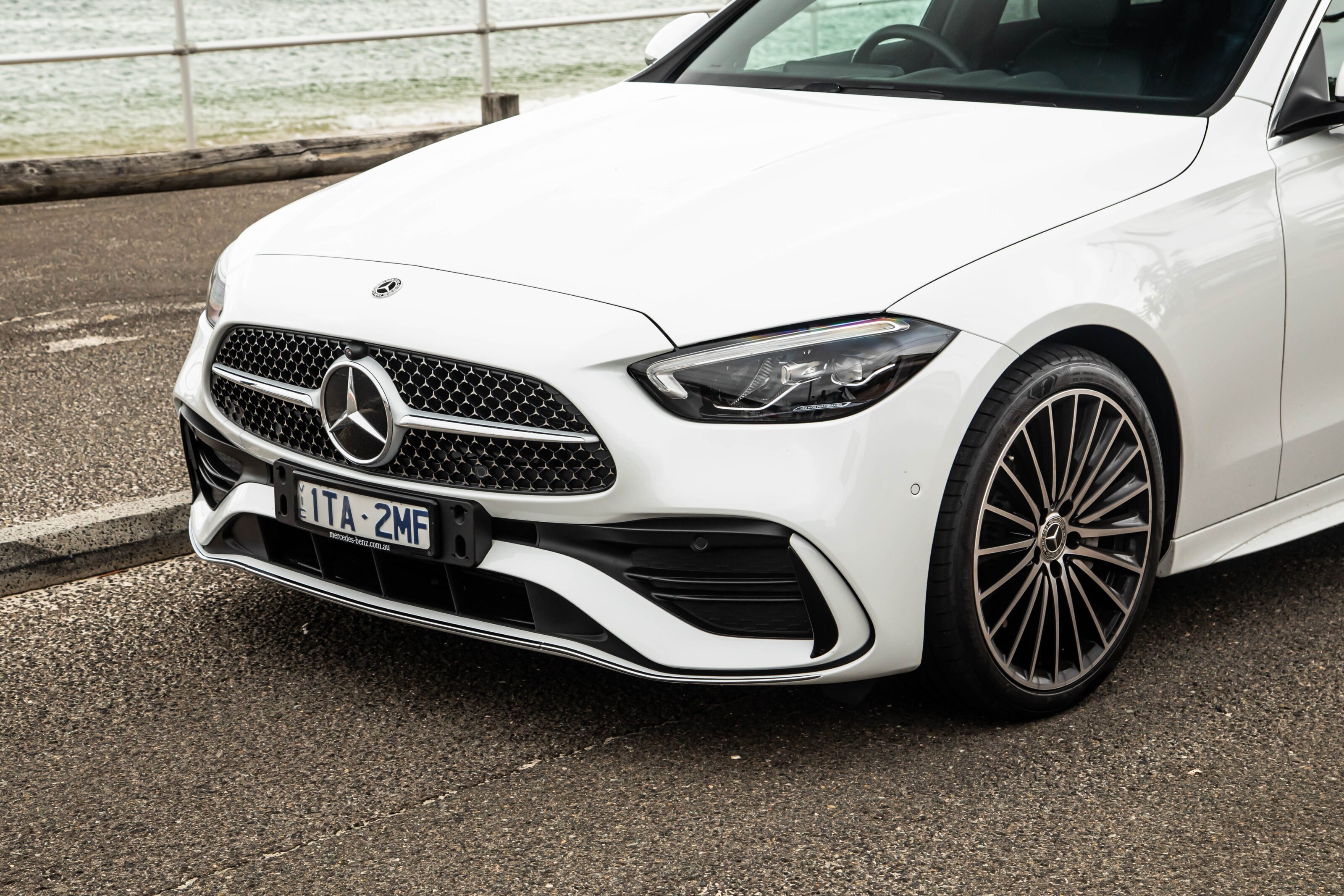
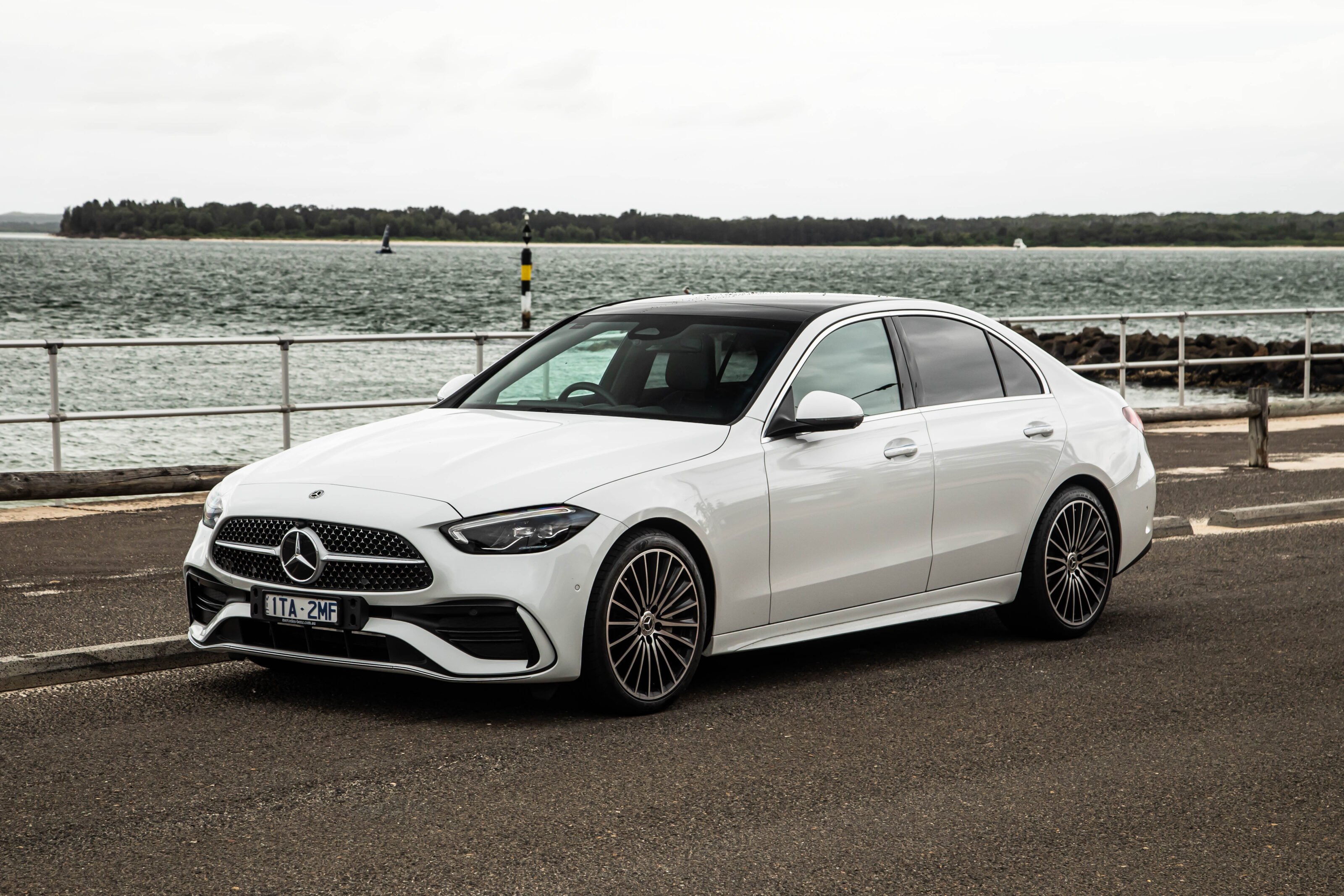
The AMG Line exterior styling package comes standard on Australian market cars, which mirrors the M Sport-rich BMW 3 Series range and packs some sporty styling additions.
Our test car had 19-inch alloys as part of the $1307 Sport Package, Opalite White paint ($2384), the $3154 Vision Package (huge sunroof, head-up display, augmented reality for the sat-nav and heated front seats with memory) plus the Burmester 3D sound system for $1614. Add to that another $733 in luxury car tax and this car was $88,093 before on-road costs.
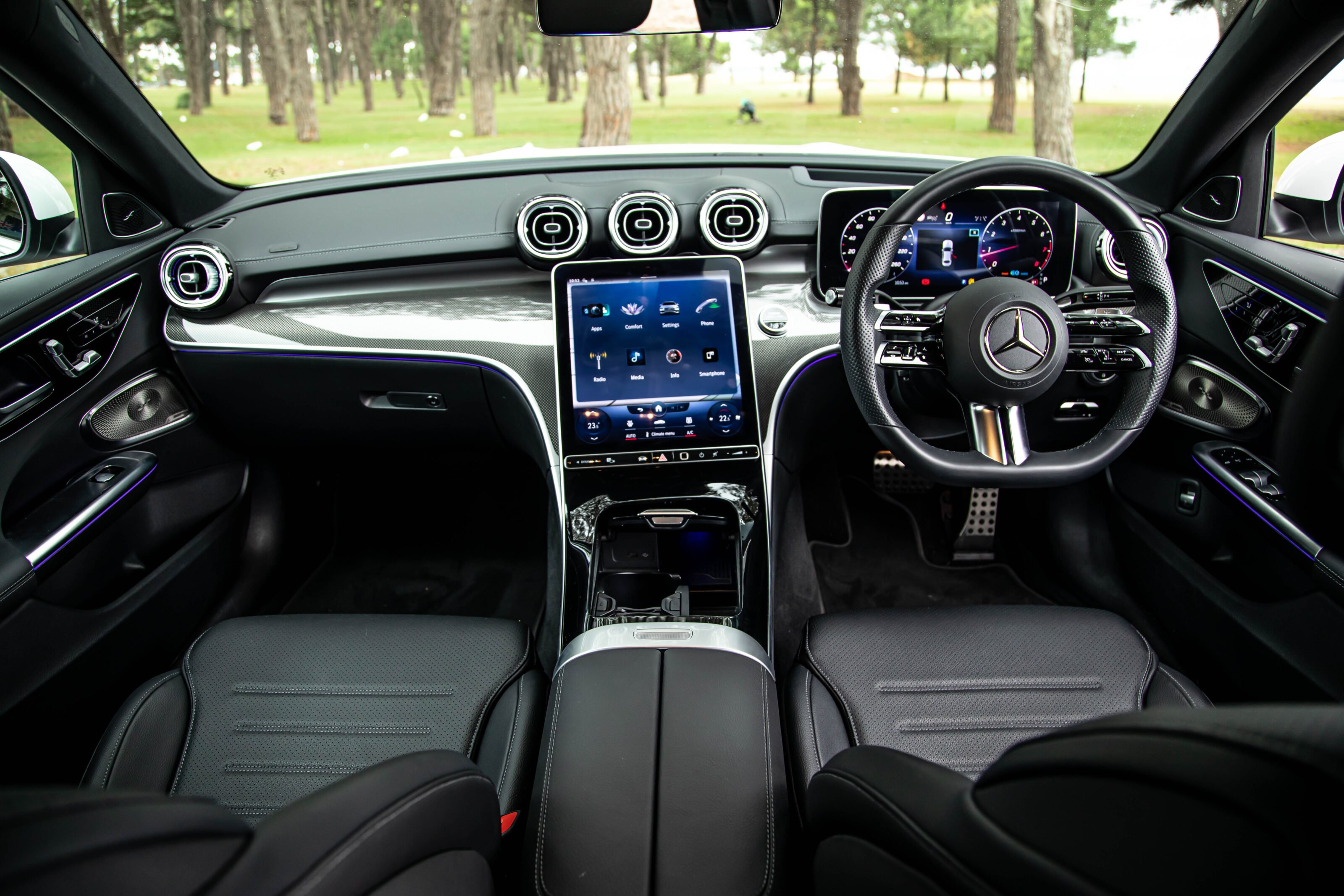
The head-up display is a widescreen masterpiece that can be filled with lots of useful information, including detailed navigation directions.
How do rivals compare on value?
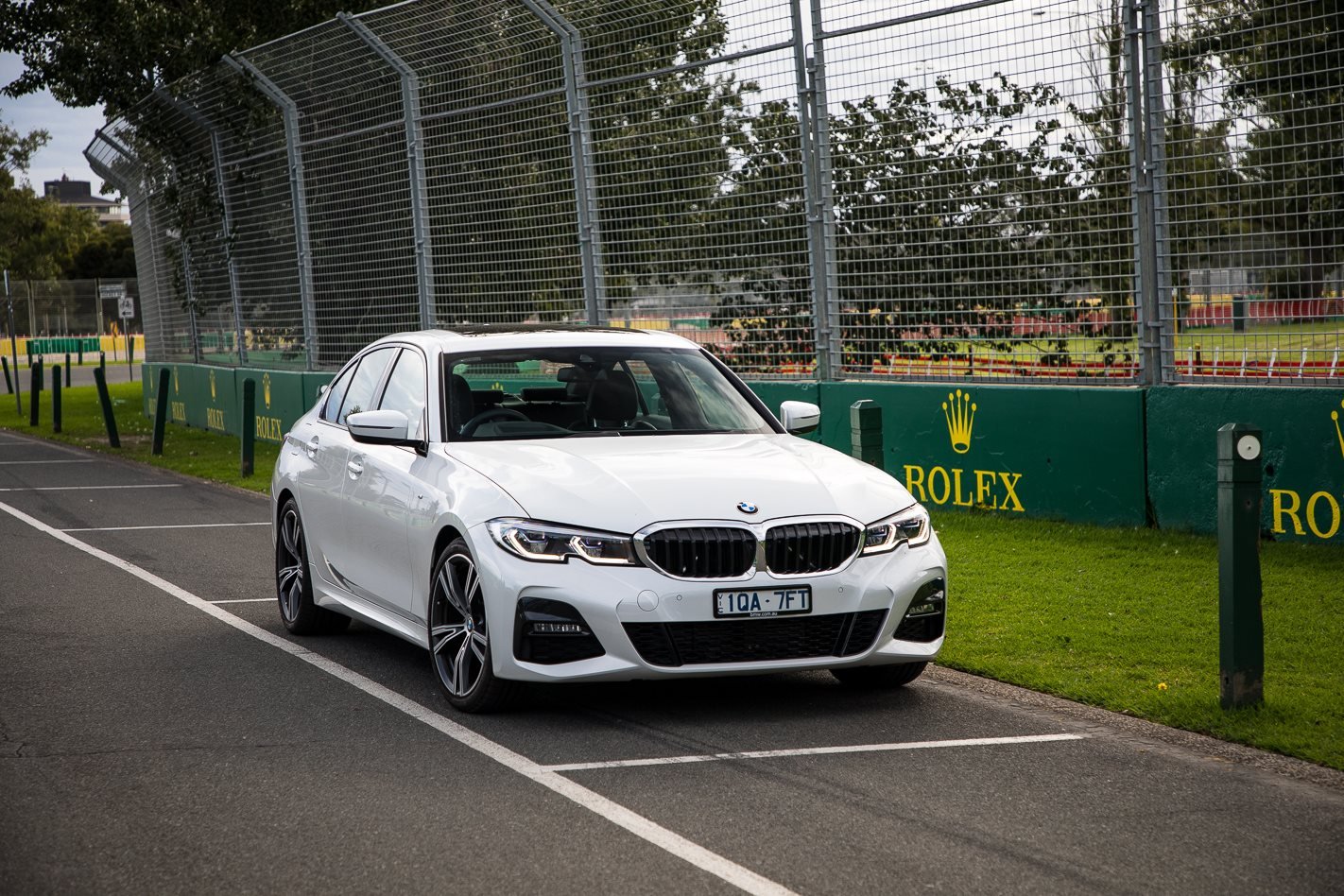
The first and most obvious rival is the BMW 320i. A cracker of a car in its G20 generation, it was a return to form after a slightly off previous version.
For a not entirely dissimilar – okay, an identical – $78,900 before on-road costs, the 320i ships with a larger 2.0-litre four-cylinder turbo-petrol engine, offering the same torque but less power. It does have the always lovely eight-speed ZF automatic transmission and a slightly more focused chassis if you’re a keen driver.
Bucking the pricing and configuration trend, the front-wheel drive Audi A4 35 TSI comes in at $66,300 before on-road costs while normal German transmission resumes with the all-wheel drive 45 TSI Quattro arriving at $75,700 before on-road costs, still cheaper than either the Merc or BMW.
The 2.0-litre turbo petrol mirrors that of the BMW and, in the 45, has a comparatively whopping 183kW. The 35 makes do with 110kW, so you can see why it’s much cheaper. It’s also not as lavishly equipped as the 45. Added to that, this generation of A4 is older than either of the other Germans.
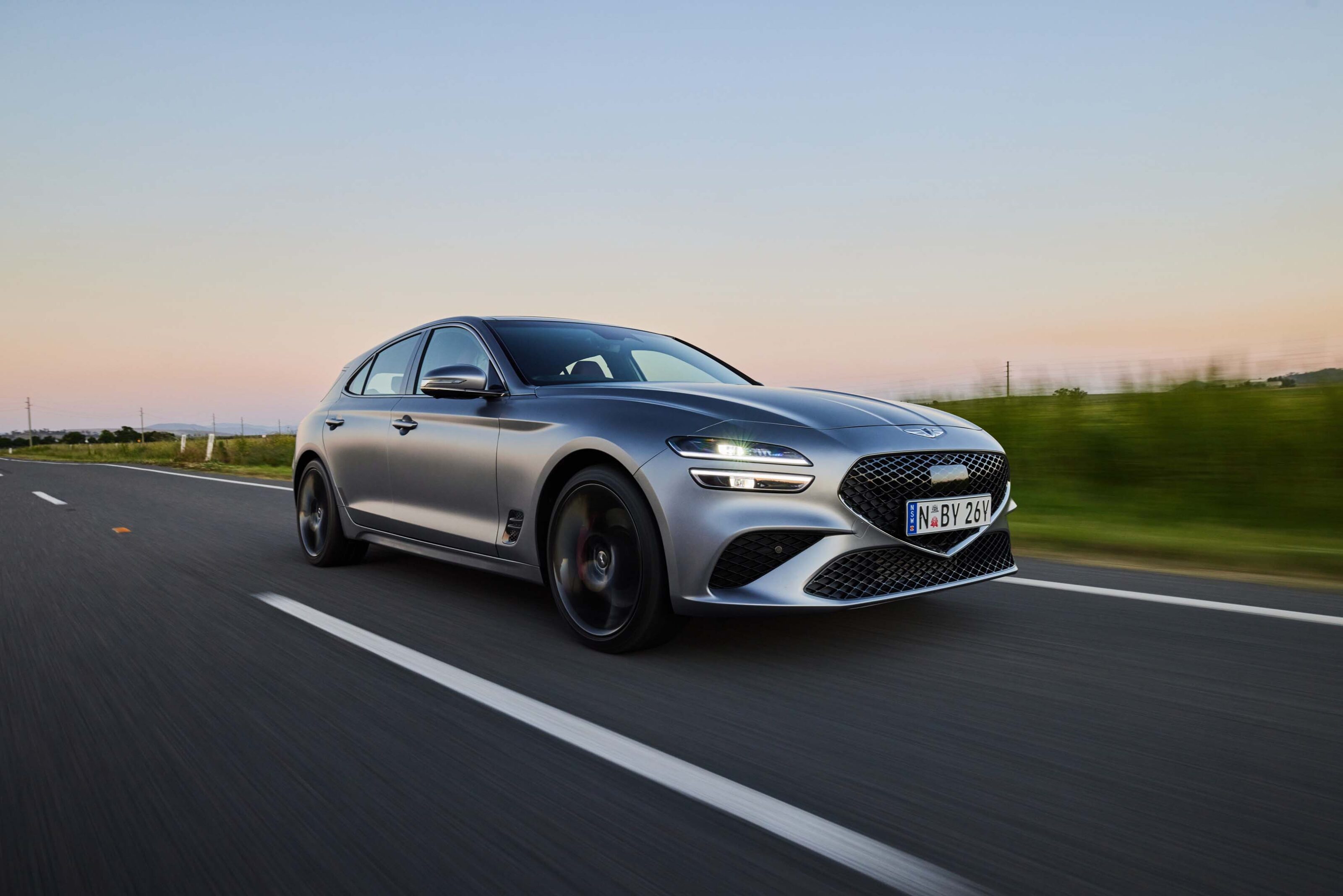
If you want to head off east, the Genesis G70 kicks off at $63,000 before on-road costs, thoroughly baiting you with a much lower price. It’s a very nice car with a 2.0-litre turbo-petrol driving the rear wheels. Spend C-Class money and the 3.3-litre twin-turbo V6 will fire you down the road more vividly than almost anything at this price point in the luxury domain.
Sadly, the Lexus IS currently off the menu for safety reasons.
Interior comfort, space and storage
The previous C-Class – known as W205 – was a nice car but not great for rear-seat occupants. One of the changes for this car, the W206, is a small but effective 25mm increase in wheelbase.
Although that doesn’t sound like much, for 180cm tall me it is the difference between sitting behind my driving position with knees brushing the front seat to them…er…not. While we’re here, let’s start with the back seat.
Both outboard seats are well-shaped and a nice place to park your backside. The sculpting puts your backside a bit lower to maximise headroom but there’s plenty of under-thigh support. You get more shoulder room in the newer car, too, thanks to its wider body. Headroom isn’t wildly expansive, especially with the huge sunroof, but it’ll be fine if you’re under 185cm.
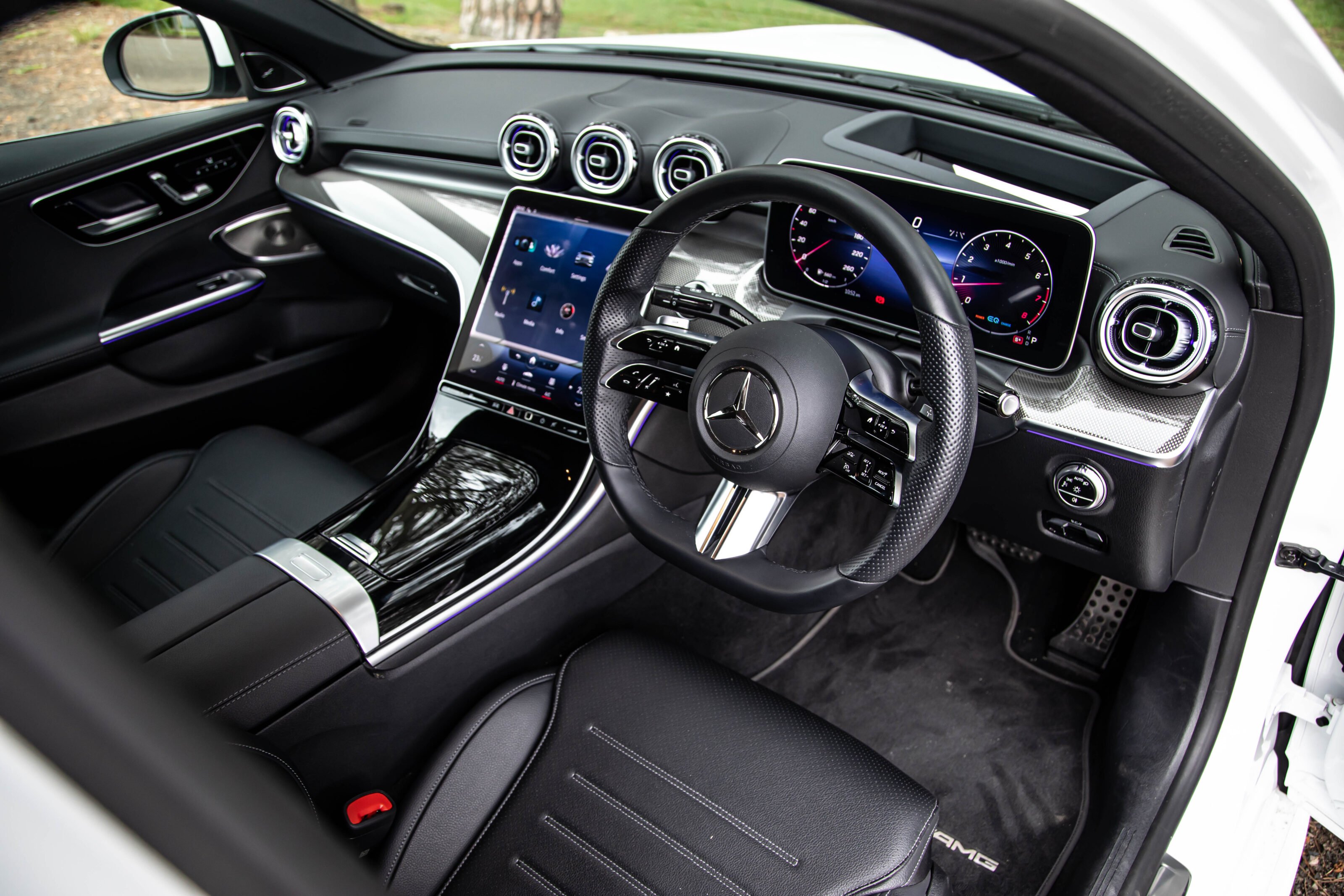
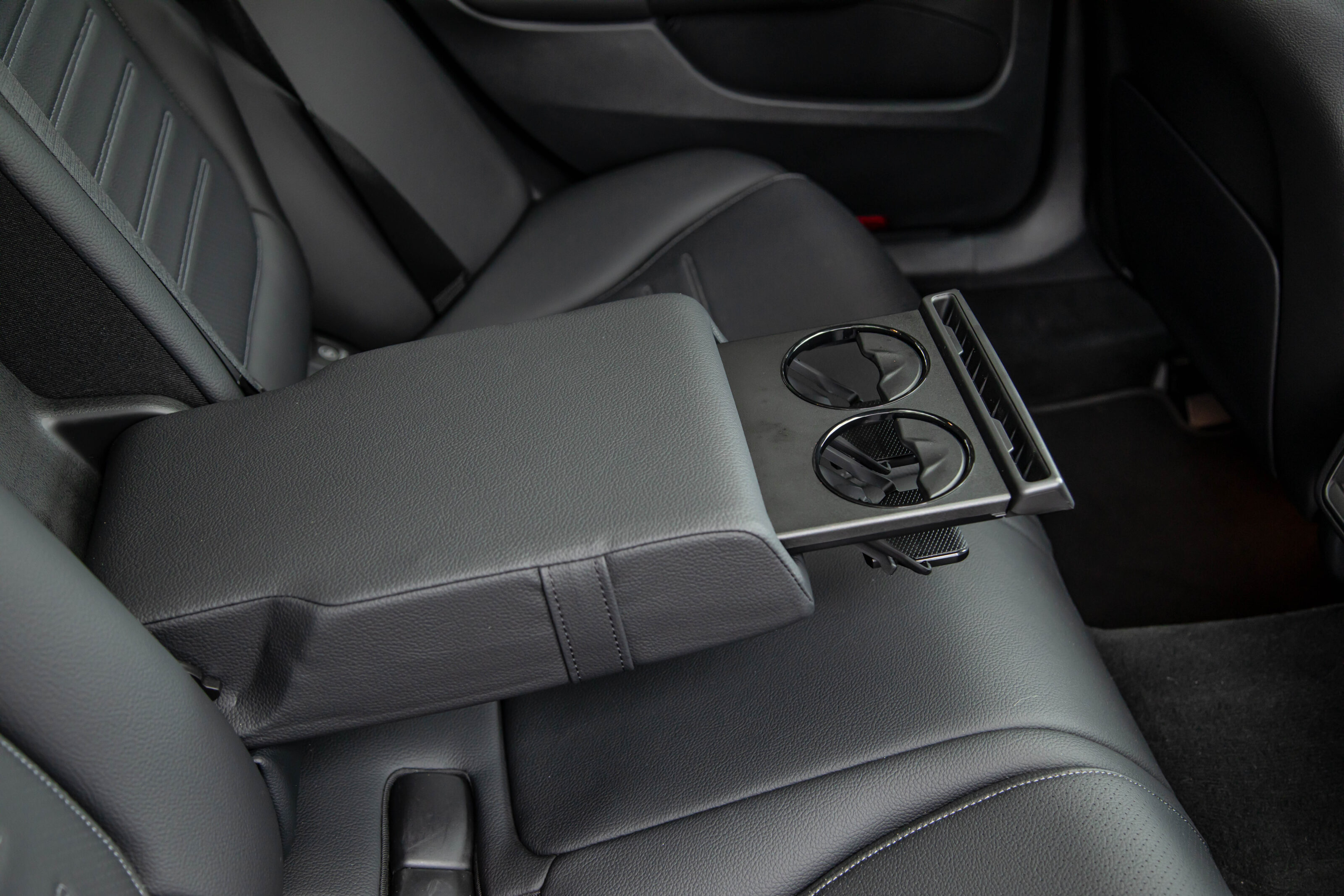
The middle seat isn’t great and exists mostly as a space for the armrest that houses a pair of cup holders. There are vents back here, which is handy too.
Up front, you get a properly handsy pair of sports seats. You sink back into them, with a lot of lateral support for your ribcage. The thick-gauge steering wheel felt a bit chunky at first but I grew to like it.
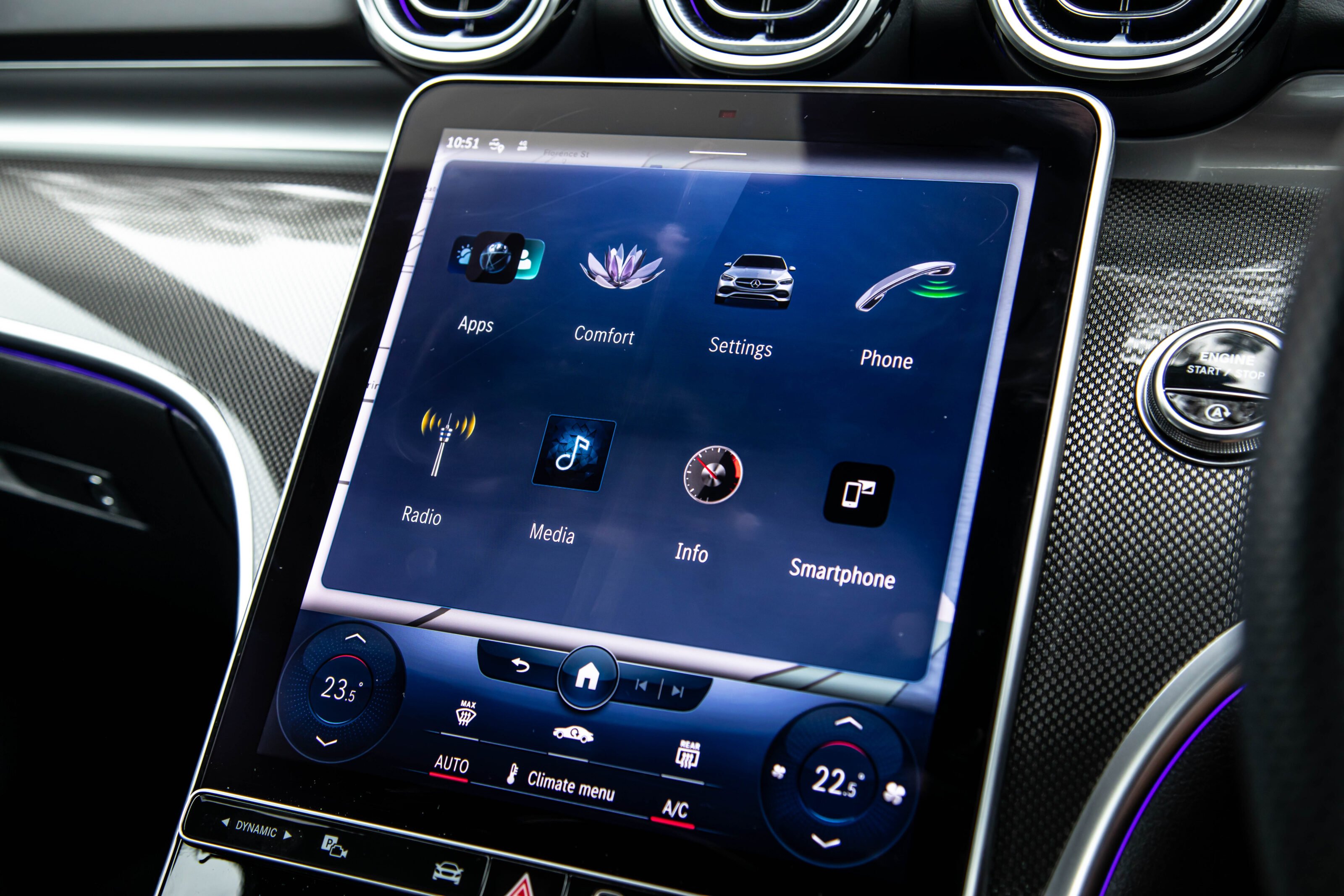
Two big screens dominate the front of the cabin. Unlike the A- and E-Class, the MBUX setup here is a little more traditional in the sense you don’t get a sweep of two identically-sized screens. The 12.3-inch dash screen is vintage Mercedes; clear, crisp and great in all lighting conditions.
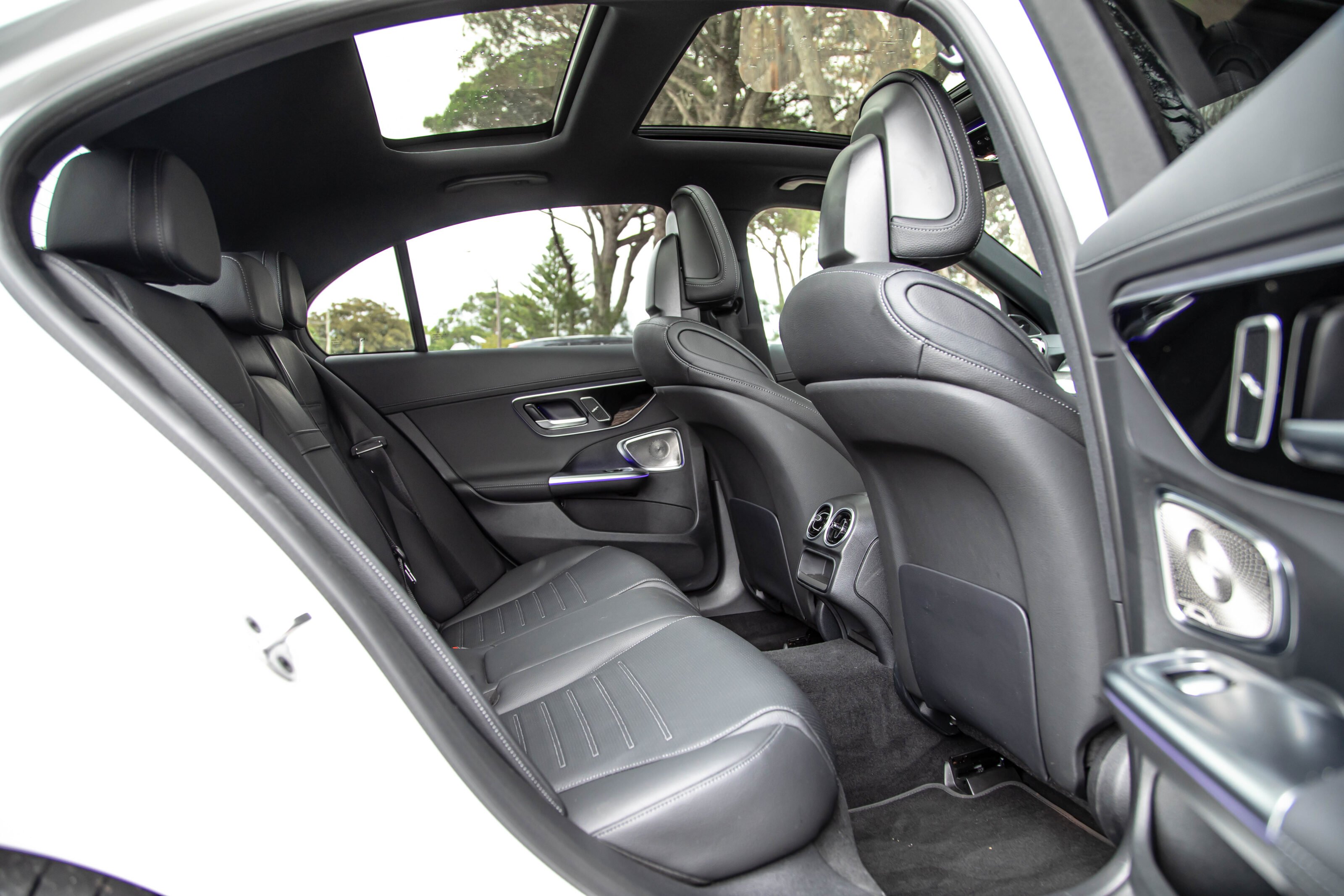
An 11.9-inch central touchscreen ditches conventional wisdom and is neither portrait nor landscape, instead going with a square shape. It works remarkably well with Apple CarPlay and it’s a beautiful piece of hardware.
Under your elbows is an uncluttered console with two cup holders and a wireless charging pad. The overall impression is tech-heavy and at night with the selectable LED lighting, it really looks the business.
It all goes a long way toward outweighing some of the flimsier plastics around the cabin. Similarly weird and insubstantial feeling is the strip of plastic that takes on various functions including the volume controls. I wasn’t convinced.
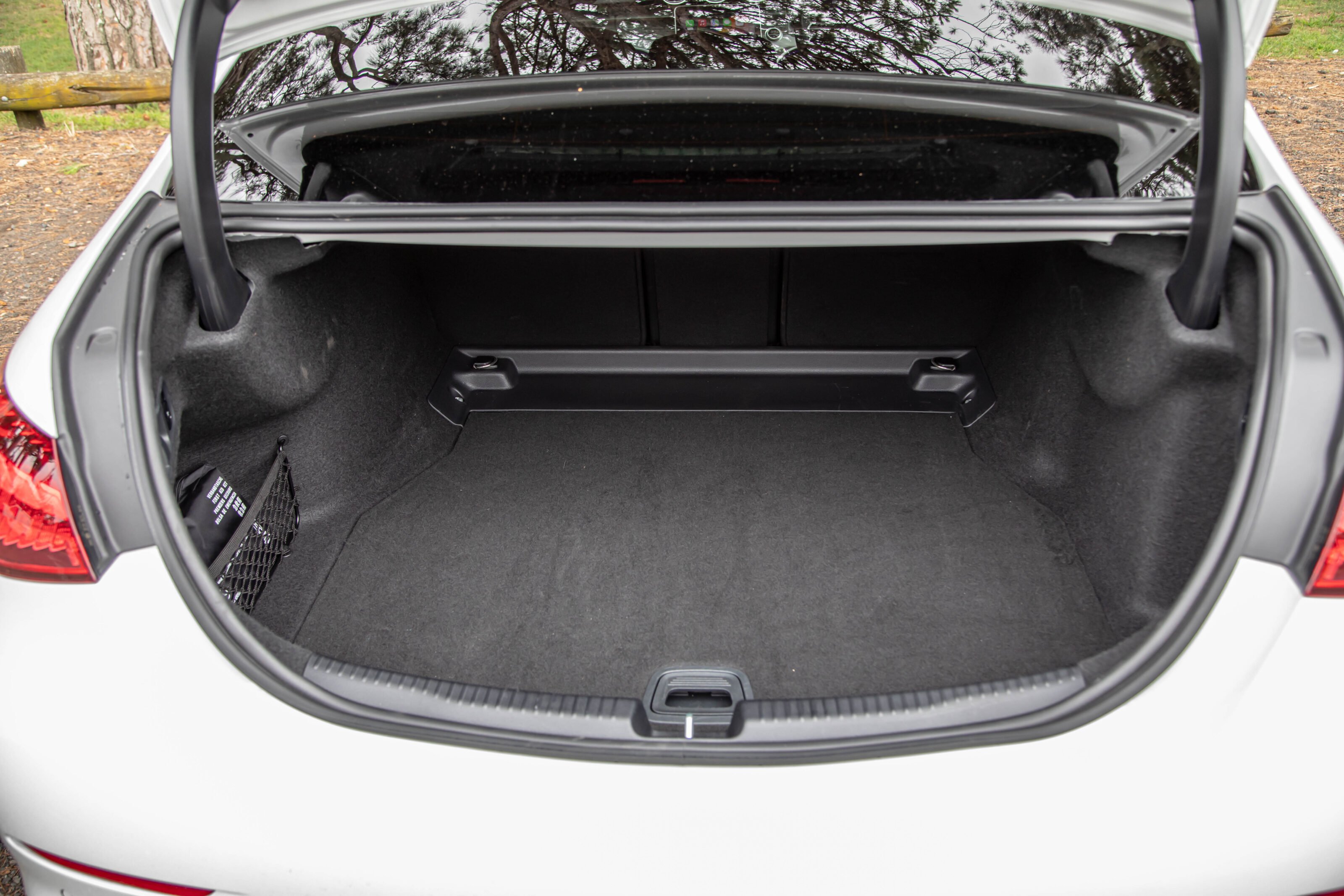
The boot measures 455 litres, breaking with a long-standing tradition of matching both the Audi A4 and BMW 3er’s suspiciously identical 480 litres.
What is it like to drive?
The weirdest thing about the C200 is that it doesn’t feel warm-hatch quick.
Although that seems like an odd thing to lead out with, I was convinced it was slow, like 10 seconds to 100km/h slow. But that’s not true, because it completes that sprint in a not-at-all-tardy 7.3 seconds.
| Mercedes-Benz C200 drivetrain | |
|---|---|
| Engine | 1.5-litre four-cylinder mild hybrid turbo-petrol |
| Transmission | 9-speed automatic |
| Power | 150kW @ 5800-6100rpm |
| Torque | 300Nm @ 1800-4000rpm |
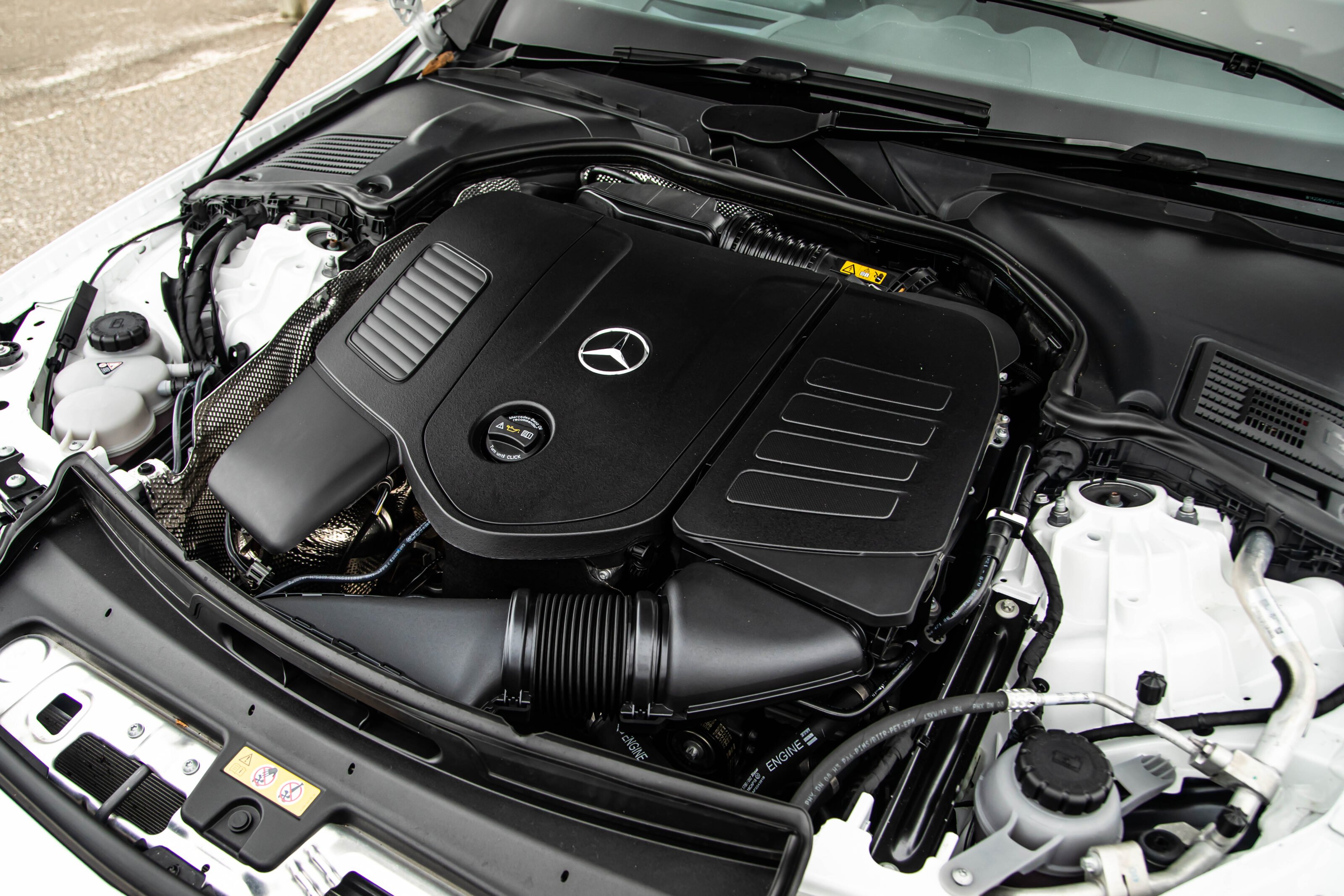
A small engine in this type of car would have been unheard of not so long ago. Two-plus litre engines at least, six cylinders preferably. This one is mighty impressive. Virtually silent, it cheerfully spins up the rev range toward its 150kW power peak, but you don’t really need to push it. Its refinement is what fooled me.
The full 300Nm arrives pretty early on and sticks with you as you work your way through the gears. The 48-volt mild hybrid system also adds a little kick of torque here and there for even more smoothness. In the W206 the belt-driven system has been replaced with an integrated electric motor.
Even on startup, it delivers something new – press the button and the engine goes from being off to on. No shake, shimmy or the familiar sounds of a starter motor. It’s almost like a racing engine in its immediacy.
The same goes for the stop-start system, which is operated by the same mechanism. It might seem silly to go on about it, but it’s nice to see that even as we enter the last decade of widespread internal combustion, engineers are still putting their minds to improving the breed.
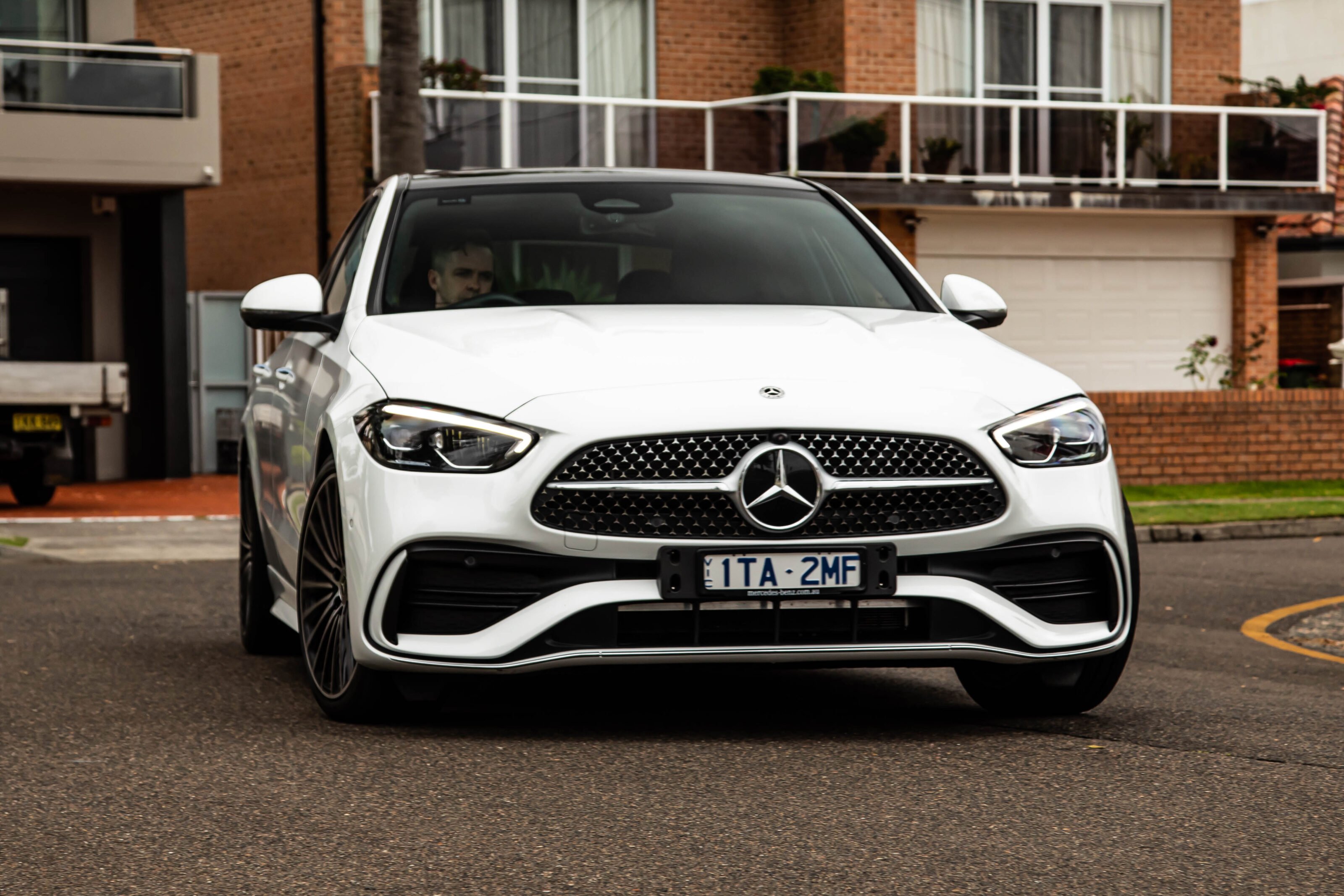
Underway, the 19-inch wheels seem to spoil the party sometimes. Despite having adaptive dampers, the C200’s ride can get a little lumpy and unsettled over poor surfaces but somehow manages to erase all but the biggest bumps. Most of the time, however, it’s taut but composed, the way a sporting sedan should be.
It would be interesting to drive it on 18s to see if a bit of extra rubber in the sidewall irons things out. It is, however, a huge improvement on the older car which wasn’t known for supple springs and dampers.
The real drag, though, is the brake pedal. At the top of its travel, it feels very vague and longer than I would like. You need to go a bit further than most cars before the pads start to bite and you get the braking force you’d expect. It’s not terrible and you’ll get used to it as I did, but modulation in slow traffic could be better. You’ll be quite reassured by their power in a big stop though.
How is it on fuel?
Mercedes claims 6.9L/100km from the mild-hybrid C200, which of course runs on premium unleaded.
| Fuel economy (claimed) | 6.9L/100km |
| Fuel economy (trip computer) | 7.4L/100km |
| Fuel type | 95 RON |
| Fuel tank capacity | 66 litres |
My week delivered a result of 7.4L/100km. This included a lot of bombing around the suburbs and a long, blessedly uninterrupted run from my home in Sydney to Katoomba and back.
How safe is it?
The W206 C-Class is packed with safety gear, scoring five ANCAP stars in 2022.
| 10 airbags | Lane departure warning |
| 360-degree cameras | Lane-keep assist |
| ABS | Rear cross-traffic alert |
| Blind-spot monitoring | Reverse AEB |
| Driver fatigue warning | Reversing camera |
| Forward auto emergency braking with pedestrian detection | Rollover stability |
| Forward collision warning | Stability and traction controls |
The forward AEB works at high and low speeds and features pedestrian detection. The huge airbag count includes a driver’s knee airbag and the front centre airbag designed to prevent head clashes in a side impact, which explains its box-fresh five-star ANCAP rating.
For the kiddies, there are also two sets of ISOFIX points and three top-tether anchors.
Warranty and running costs
Mercedes-Benz offers a five-year, unlimited-kilometre warranty and the choice of capped-price servicing or pre-paid maintenance plans.
The latter covers all services that fall in a three, four or five-year timeframe depending on the plan you choose, with intervals arriving at a generous 12 months or 25,000km.
In a world of skyrocketing prices, it’s unusual to see that the plans for the W206 are cheaper than they were for the W205. A three-year plan costs a still-substantial $2650, four is $3600 and five is $5200.
It’s cheaper by about $100 a year than the older car, so that’s nice.
VERDICT
The C200 is an astonishingly refined car. You might expect that for the money, but even so, the execution is mightily impressive.
Quiet, and composed but swift enough for most tastes, it’s not a half-hearted effort as Benz coasts to the finishing line for combustion-engined cars.
While the price of entry is high, you’re getting a tech-laden machine with an excellent safety package, low running costs (servicing excepted) and in this W206 generation, it’s sharply styled.
Sporting sedans are thin on the ground but boy howdy am I pleased they’re not only still around, but this good. The next A4 and 3 Series have their work cut out.
| Mercedes-Benz C200 sedan specifications | |
|---|---|
| Body | 5-door, 5-sear medium sedan |
| Drive | rear-wheel |
| Engine | 1.5-litre four-cylinder mild hybrid turbo-petrol |
| Transmission | 9-speed automatic |
| Power | 150kW @ 5800-6100rpm |
| Torque | 300Nm @ 1800-4000rpm |
| Bore stroke (mm) | 78 x 78.3 |
| Compression ratio | 10.5 : 1.0 |
| 0-100km/h | 7.3 sec (claimed) |
| Fuel consumption | 6.9L/100km (ADR combined) |
| Weight | 1575kg |
| Suspension | MacPherson struts front/multi-link rear |
| L/W/H | 4793mm/1820mm/1446mm |
| Wheelbase | 2865mm |
| Brakes | ventilated disc front / solid disc rear |
| Tyres | 225/40 R19 front / 255/35 R19 rear |
| Wheels | 19-inch alloy (no spare) |
| Price | $78,900 + on-road costs |
Australia’s CO2 standards are widely considered to lag behind the rest of the developed world’s.
We have no legal fuel-efficiency targets and no national plan to ban the sale of new fossil-fuel-powered cars by a certain date.
But in recent months, since Labor came to power in May 2022, there has been some movement – with changes to import tariffs, Fringe Benefits Tax and a federal strategy in place offering $2000 off the cost of buying an electric vehicle.
But how do we really compare on paper to what is happening in the rest of the world?
We’ve broken down the legal commitments and policies of the major players here all in one handy guide.
Australia
Current CO2 target
Following Labor’s election in May, Australia submitted a stronger target in June 2022 of a 43 per cent reduction of greenhouse gas emissions by 2030 below 2005 levels. The new target submitted presents a higher level of ambition.
Previous target
In a prior update under Scott Morrison’s administration, Australia submitted an updated target October 2021 – which was no improvement from its 2016 goal that was a 26-28 per cent reduction of greenhouse gas emissions by 2030 below 2005 levels.
Internal combustion engine ban
At present, Australia as a whole does not have a timeframe set for stopping sales of new petrol and diesel cars. However, the ACT plans to phase out light internal combustion engine vehicles from 2035 – the first jurisdiction to set a date – meanwhile in NSW an urban policy think tank, Committee for Sydney, is proposing all new cars sold in the city must be electric by 2027. The latter is not a Government-backed strategy.
EV incentives
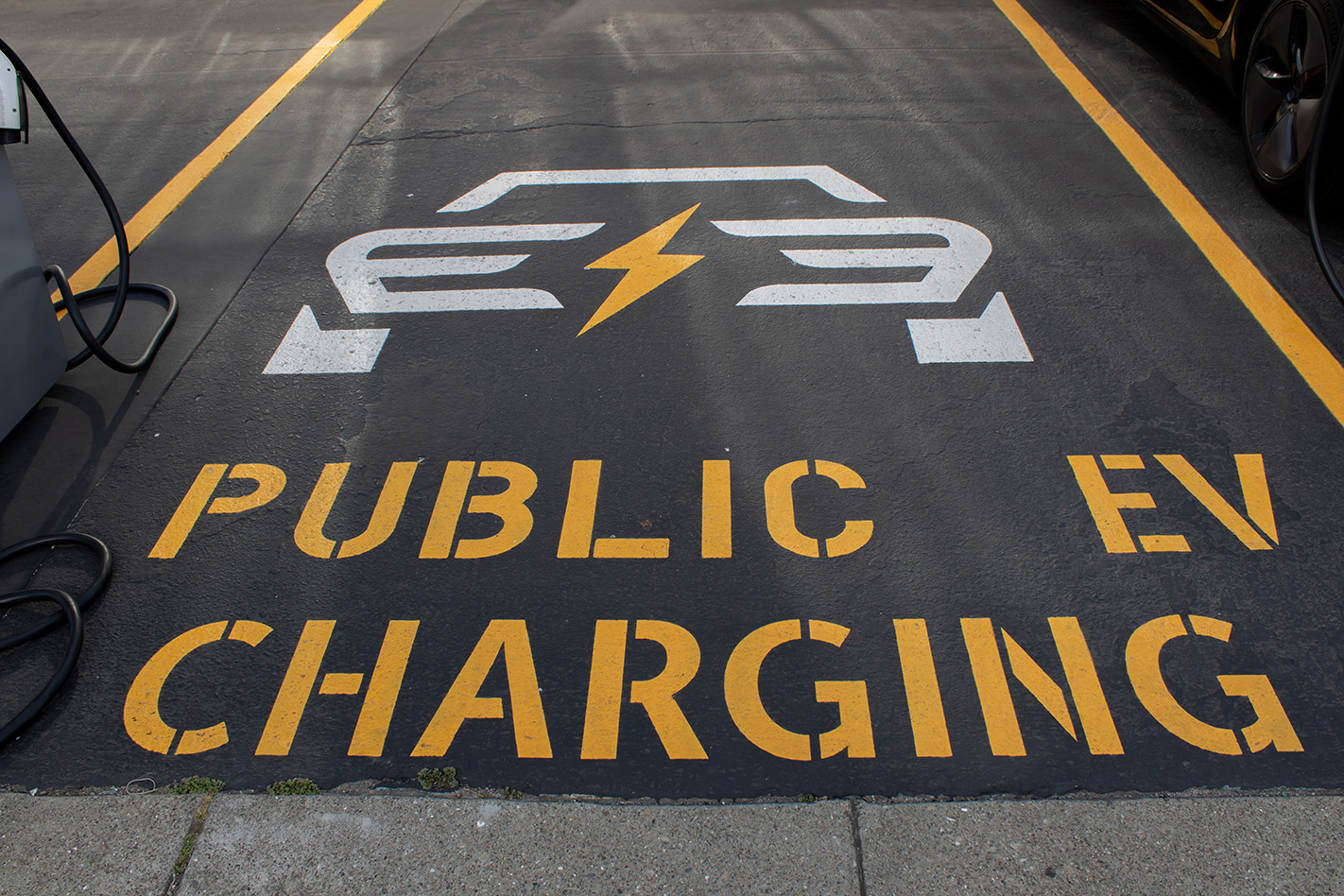
Each state and territory now offers some kind of incentive, which are detailed in full here.
Policies adopted by NSW and the ACT are considered to be the most progressive, with VIC’s, which includes a road user charge already in effect as of July 2021, conversely regarded as the worst.
Since its election last year, the Labor Government launched its first ever electric vehicle strategy in September 2022, and in November the Treasury Laws Amendment (Electric Car Discount) Bill passed through the Federal Parliament.
This provides up to $2000 off the purchase price of battery-electric and plug-in hybrid vehicles (PHEV), as well as Fringe Benefits Tax (FBT) exemptions for fleets and novated leases. The Government will apply the exemption retrospectively to eligible cars first used on or after July 1, 2022. PHEVs will initially be covered, but the offer will expire on April 1, 2025.
Alongside the removal of the Fringe Benefits Tax the five per cent import tariff for EVs priced under the LCT limit has been cut. The FBT savings amount to $9000 per annum for an employer, or $4700 for an individual with a salary sacrifice agreement for a $50k electric vehicle. Cutting import tariffs drops purchase prices by a further $2500.
New Zealand
Current CO2 target
New Zealand has committed to a new target of cutting its CO2 below 2005 levels by 50 per cent by 2030. In November 2021, New Zealand submitted its new target, but it is still not consistent with the Paris Agreement’s 1.5°C limit.
Previous target
NZ’s prior goal in 2020 was 30 per cent below gross 2005 levels by 2030.
Internal combustion engine ban
In November last year at the COP26 United Nations Climate Change Conference, the UK Government released a document outlining plans to reduce emissions in the transport industry by banning the sale of internal combustion engine vehicles around the world by 2040.
It was signed by a number of countries, including New Zealand, which pledged to ban the sale of new internal combustion engine vehicles by 2040 or earlier – but it’s worth noting that the document is not binding
EV incentives
Over the ditch, New Zealand has been busy for a little while now when it comes to planning for electric vehicles – having already established a national policy and created incentives to drive customers towards the new technology.
New Zealand’s Land Transport (Clean Vehicles) Amendment legislation, more commonly known as the Clean Car Standard, was given the nod from the national parliament last year, and came into effect from April 1, 2022.

The Standard has been designed to encourage the purchase of electric or low-CO2 emission light vehicles by reducing the cost of eligible new and used fuel-efficient ones, while imposing a fee on higher-polluting vehicles. Buyers of fully-electric models can get an NZ$8625 rebate, while for plug-in hybrids the discount is NZ$5750.
A vehicle must have a three-star safety rating or higher and cost less than NZ$80,000 to be eligible.
Any passenger vehicle emitting less than 146 grams of CO2 per kilometre is eligible for a Government rebate, while those that emit 193 grams and higher are subject to a Government fee that rises with their CO2 levels. All others which fall between 146 and 192g/km are in a neutral zone and don’t attract a rebate or fee.
United Kingdom
Current CO2 target
The UK has committed to a 68 per cent reduction below 1990 levels (but 1995 levels for some gases) by 2030, which is a particularly ambitious plan.
Previous target
Prior to this new target made in 2021, the UK had pledged to a reduction of 57 per cent. However, the UK Government’s more recent emissions projections show that, under current policies, it is not on track to achieve its former 57 per cent target, let alone its newly announced 68 per cent target.
Internal combustion engine ban
By 2030, the UK will ban all sales of new petrol and diesel cars in phase 1 of its plan. Phase 2 will see all new cars and vans be fully zero-emission at the tailpipe from 2035.
EV incentives
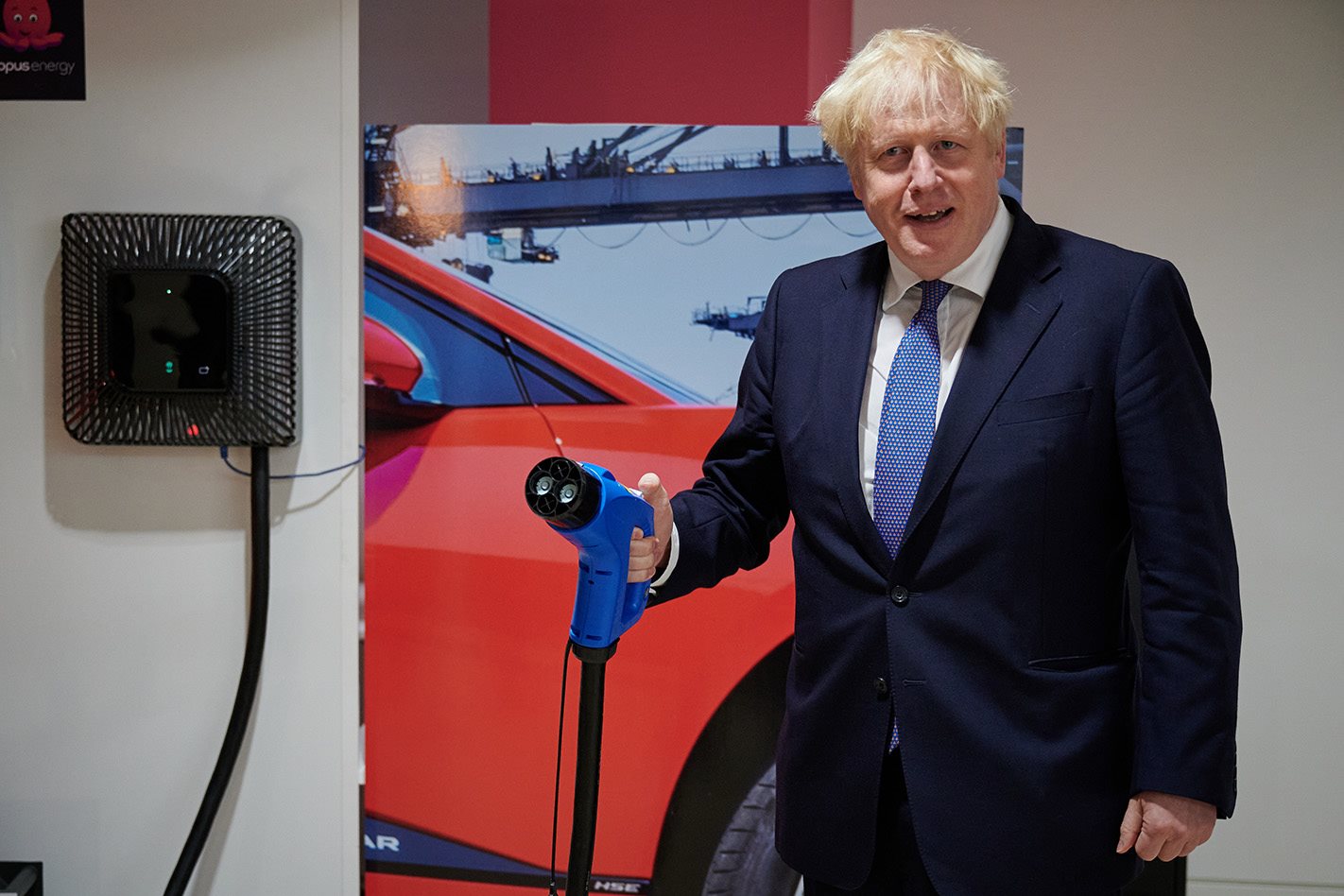
The UK offers a wealth of incentives for both purchasing and charging EVs. These include:
- EV charger grant for homes: owners of eligible EVs can receive a grant for up to 75 per cent (capped at £350, inc.VAT) off the total purchase and installation costs of one charger for their home. Company cars and leased vehicles are also eligible.
- EV charger grant for workplaces: firms can cover 75 per cent of all purchase and installation costs, up to a maximum of £350 for each socket, for up to a maximum of 40 across all sites.
- Company Tax Benefits: businesses that install charging infrastructure can access tax benefits through a 100 per cent first-year allowance (FYA) for expenditure incurred on electric vehicle charging equipment.
- Local Authorities: can receive a grant to fund 75 per cent of the capital costs relating to the procurement and installation of on-street electric vehicle charge point infrastructure in residential areas for those who don’t have access to off-street charging.
- Purchase grant: with the Plug-in Car Grant, buyers can; receive up to 35 per cent off the cost of an electric car (up to £3000 depending on the model), 20 per cent off an electric motorcycle or moped (up to £1500), 20% off an electric van (up to £8000), 20 per cent off the cost of a large electric van or truck (up to £20,000 for the first 200 orders, after that up to £8000), and 20 per cent off an electric taxi (up to a max. of £7500). Buyers don’t need to do anything as the discount is handled by the dealer at the point of sale.
- Ownership tax: fully-electric vehicles costing less than £40,000 are exempt from annual road tax.
- Company car tax: businesses that buy EVs can write off 100 per cent of the purchase price against their corporation tax liability if the vehicle emits no more than 50g/km CO2 – paying just 2 per cent tax, plug-in hybrids emitting less than 50g/km of CO2 have their company car tax set at 16 per cent – which is 4-8 per cent lower than the tax on diesel company vehicles.
- The UK Government has also started providing EV owners with special green number plates so that they can benefit from local incentives, such as free parking, using bus lanes, and accessing areas cut off for normal vehicles.
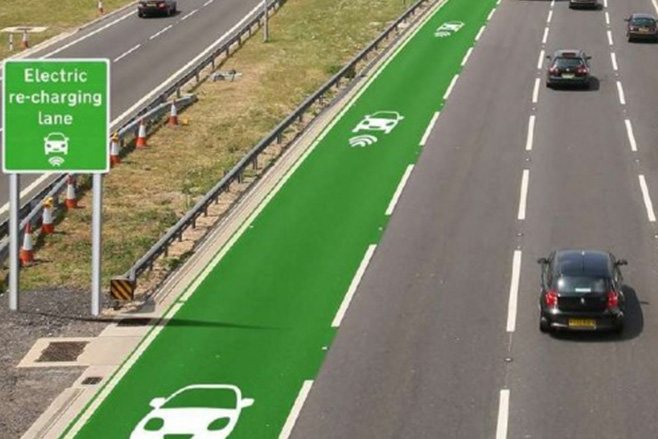
Europe
Current CO2 target
The European Union has committed to at least a 55 per cent reduction below 1990 levels by 2030.
Previous target
Prior to this new target made in 2021, the EU had targeted a reduction of 40 per cent. While this stronger 2030 target is a step in the right direction, it is still not enough to make the EU compatible with the Paris Agreement’s 1.5˚C goal. Domestic emissions reductions of between 58 per cent and 70 per cent are needed.
Internal combustion engine ban
In February this year, the European Parliament voted to ban the sale of new cars and vans powered by petrol and diesel engines by 2035.
The move followed members of the European Parliament voting against an earlier proposal to lessen the goal of a 100 per cent reduction in emissions by 2035 to 90 per cent.
EV incentives
A number of EU member states have their own EV incentives on offer. A country-by-country guide is available here.
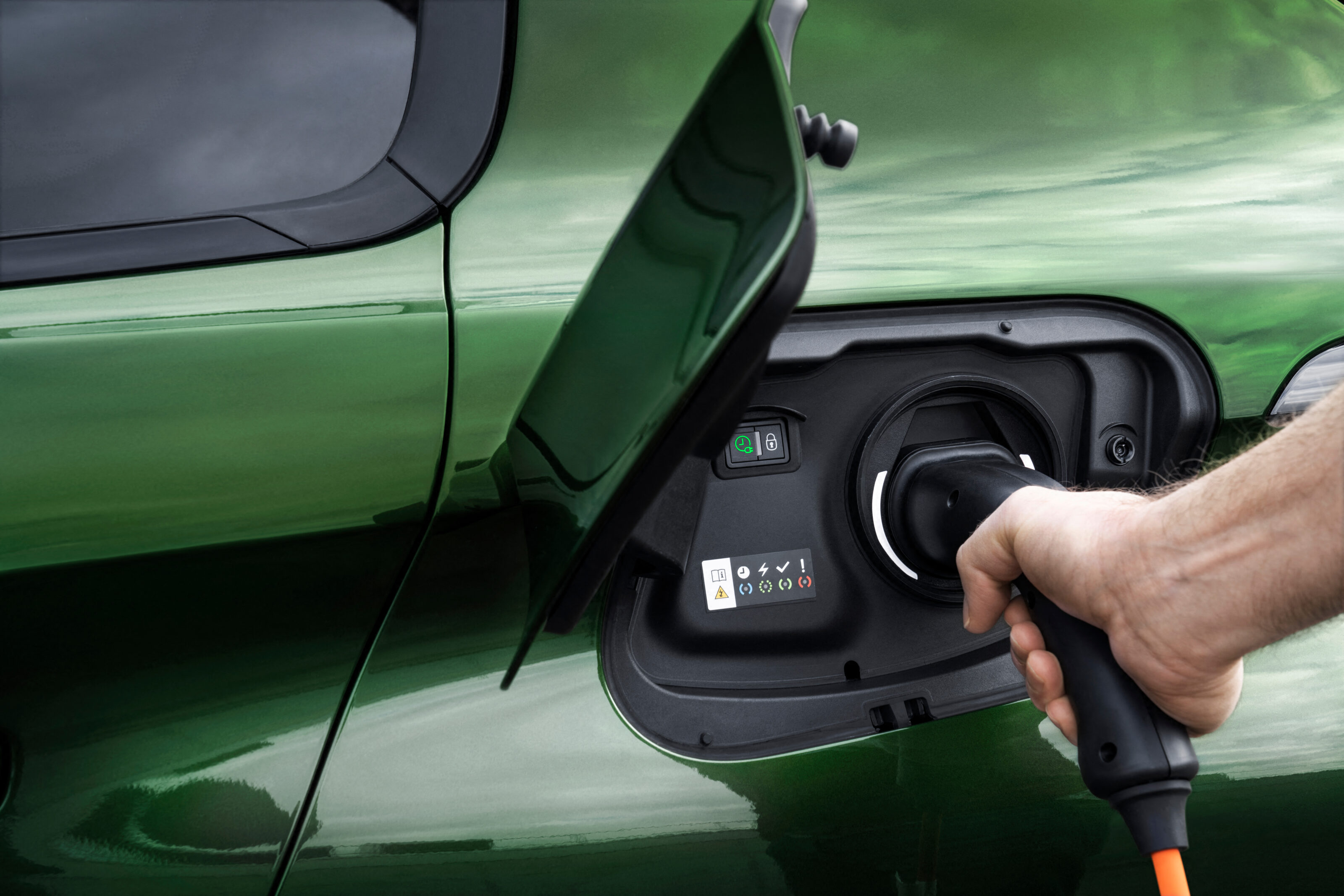
United States
Current CO2 target
The United States has committed to a 50-52 per cent reduction below 2005 levels by 2030. This can be translated to a reduction of 40-43 per cent below 1990 levels. In August 2022, President Biden signed into law the Inflation Reduction Act (IRA), the most ambitious and potentially impactful climate policy in US history.
Previous target
While considerably stronger than the previous US Paris Agreement target, which was 26-28 per cent by 2025, this new US goal is still short of a 1.5˚C compatible 2030 target.
For the US, an emissions reduction target of 57-63% below 2005 levels by 2030 would be consistent (assuming the US would also provide support to developing countries to reduce emissions) and would put the country on a better track to achieving its 2050 net-zero emissions target.
Internal combustion engine ban
At present, the US as a whole does not have a timeframe set in stone for stopping sales of new petrol and diesel cars. However, the state of California last month set its own ban for 2035, as well laid out plans which require 35 per cent of new passenger vehicles sold by 2026 to produce zero emissions, then 68 per cent by 2030 and ultimately 100 per cent five years after.
The move is being hailed as a major victory that could point the way forward for others. It gives the most populous US state some of the world’s most stringent regulations for transitioning to electric vehicles.
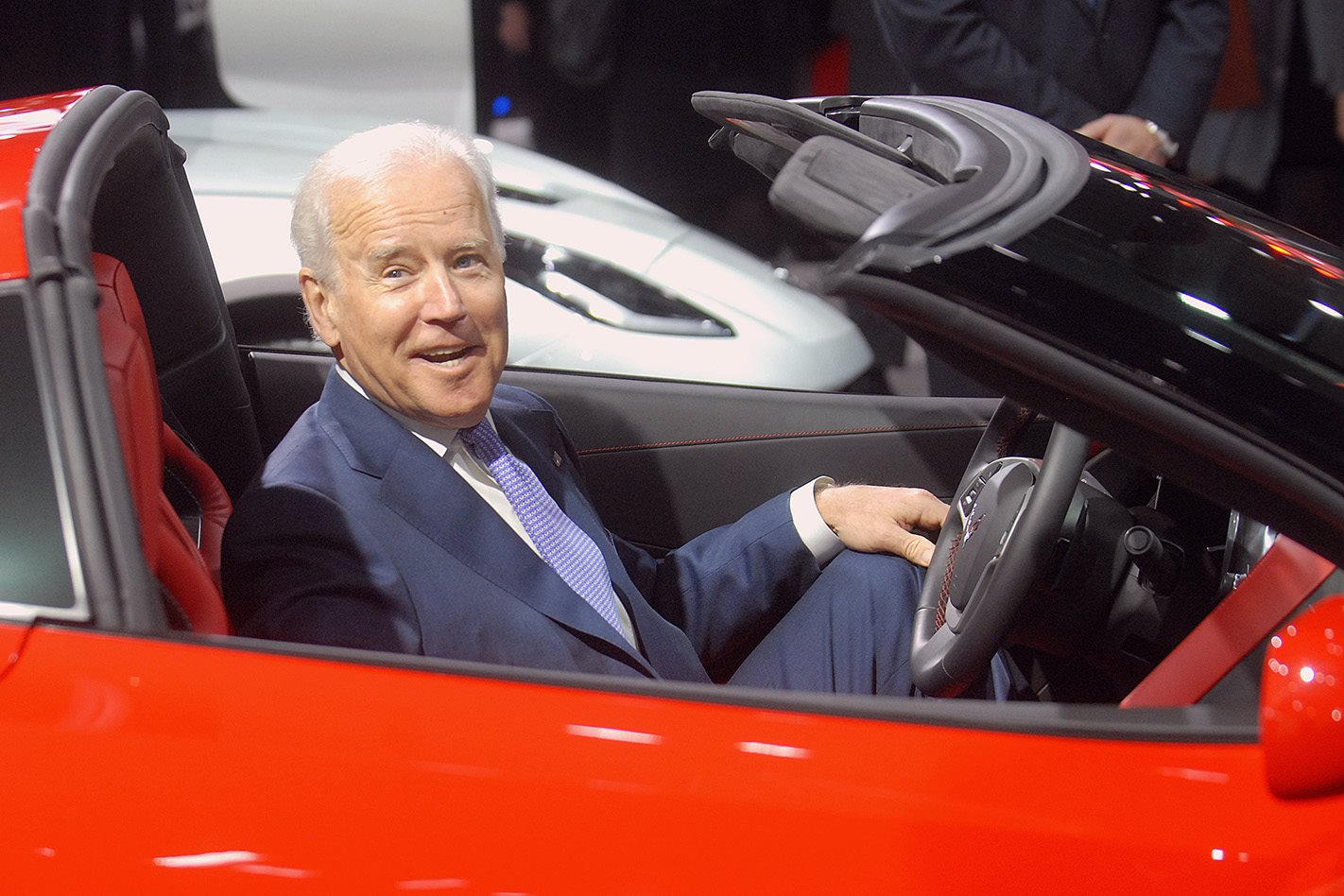
EV incentives
Following the passing of the Inflation Reduction Act, the US now offers a much greater number of incentives for both purchasing and charging EVs. These include:
- Tax credit changes: EVs placed into service after December 31, 2022, the Inflation Reduction Act extends the (up to) US$7500 EV tax credit for 10 years. The exact amount of the credit will be based on a calculation that considers factors like the where the vehicle’s parts come from and where it is made.Additionally, used EVs (must be at least two years old) will now have a separate tax credit of either up to US$4000 or 30 per cent of the price of the vehicle, whichever is less. However, a previously owned EV can’t qualify if it’s purchased for resale.
But if you’re single, and your modified adjusted gross income is over US$150,000, you won’t qualify for the EV tax credit. The income limit for married couples jointly is US$300,000.
- Pricing eligibility/purchasing: Vehicle price and type also matters. Vans, pick-up trucks, and SUVs with a manufacturer’s retail suggested price (MSRP) of more than US$80,000, won’t qualify for the credit. For cars to qualify for the EV tax credit, the MSRP can’t be more than $55,000.
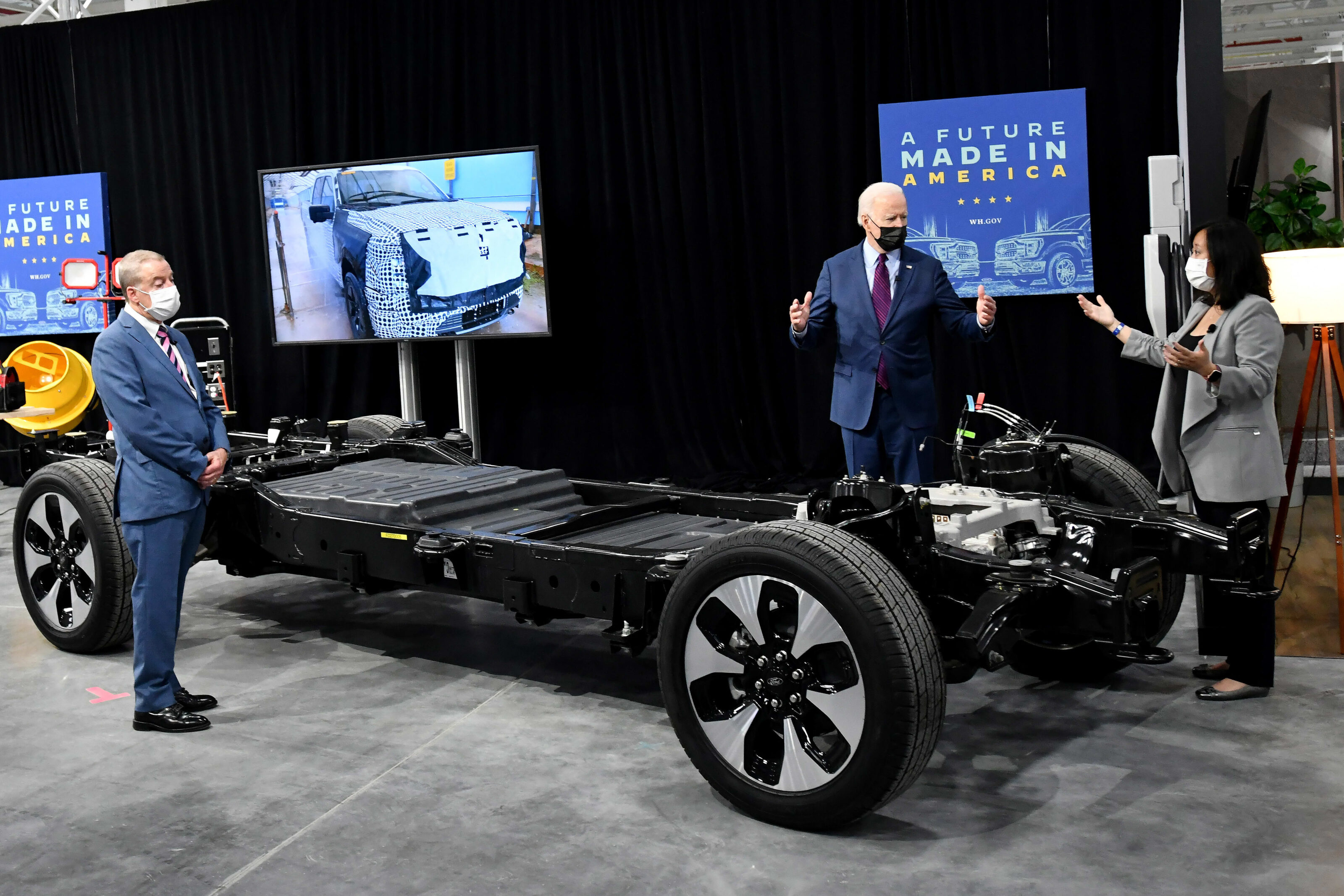
A used clean vehicle will only qualify for the tax credit if it costs $25,000 or less.
- Charging credits: The Inflation Reduction Act also revives a credit for electric vehicle chargers that initially expired on December 31, 2021. A business that installs an EV charger (and meets certain labour and construction requirements) can benefit from a tax incentive of up to 30 per cent of the total cost of equipment and installation. Previously the limit on the amount of the credit was US$30,000 (which applies to projects completed before the end of 2022). Now, if you complete the installation project after 2022, the tax credit, per property item, is up to US$100,000.
Also, beginning next year, the tax credit for business and home installations will apply to other EV charging equipment, like bidirectional charging equipment.
Canada
Current CO2 target
Canada plans to reduce its CO2 to ‘at least’ 40-45 per cent below 2005 levels by 2030, suggesting that it could go beyond this. While the ‘at least’ is an improvement, in reality Canada would need to reduce its own emissions by at least 54 per cent by 2030 for its national emissions to be 1.5°C compatible.
Previous target
Canada’s previous target was the same, minus the addition of ‘at least’.
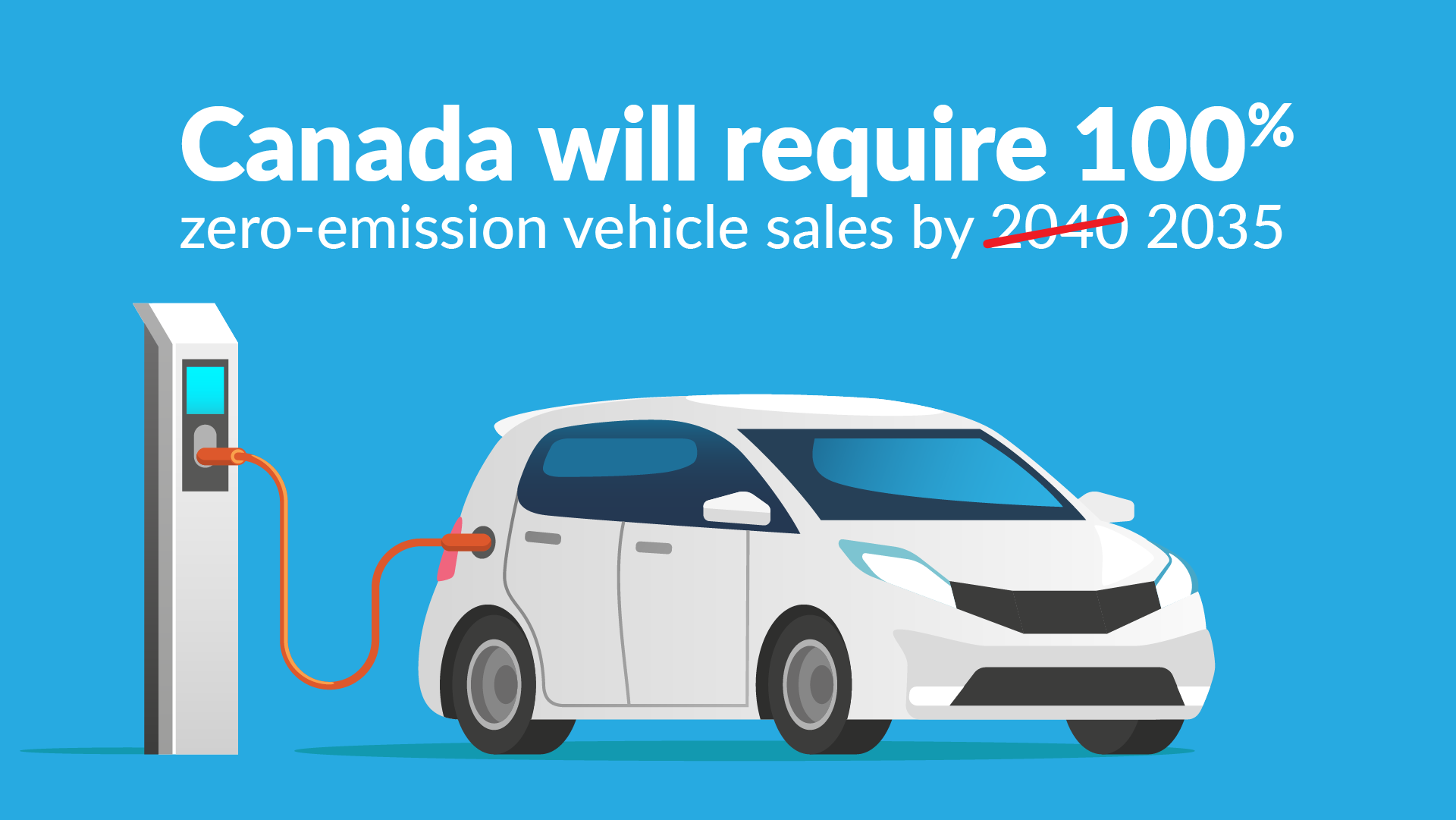
Internal combustion engine ban
EV incentives
Canada offers two incentives, a discount applied at the point of sale, and a tax write-off for businesses.
Under the scheme, buyers can claim the subsidy for new eligible vehicles (including demos as long as their odo is under 10,000 kilometres) – which are either a passenger car where the base model is priced less than CA$55,000 and higher trims cost up to a maximum of CA$65,000, or wagon, SUV, van or ute where the entry-level version is less than CA$60,000 and higher spec variants cost up to CA$70,000.
Fully-electric, hydrogen, or long range plug-in hybrids (50 kilometres or more) are eligible for a CA$5000 rebate, while shorter range plug-ins get CA$2500.

All vehicles must be meant for use on public streets, roads, and highways and have at least four functioning wheels.
Incentives can be applied to EVs leased for at least 12 months, but will be adjusted based on the length of a lease less than 48 months. Vehicles are still eligible even if delivery, freight and other fees (like vehicle colour, add-on accessories, options, and packages) push the actual purchase price over these set limits.
Canada also offers a tax write-off for zero-emission vehicles to support business adoption.
But businesses that receive an incentive from the federal program can’t also use the tax write-off for ZEVs – only one or the other.
China
Current CO2 target
In 2021, China officially submitted its carbon neutrality “before 2060” target. While the update has strengthened and expanded the previous 2030 target, China’s emissions will continue rising, rather than falling, through to 2030.
China also aims to:
- Hit peak carbon dioxide emissions “before 2030”, up from “around 2030 and making efforts to peak earlier”
- Lower carbon dioxide emissions per unit of GDP by “over 65 per cent” in 2030 compared to 2005 levels, (up from “by 60–65 per cent”)
- Increase its share of non-fossil fuels in primary energy consumption to “around 25 per cent” in 2030, (up from “around 20 per cent”)
- Increase forest stock volume by around 6 billion cubic metres in 2030 from the 2005 level, (previously 4.5 billion cubic metres)
- Bring its total installed capacity of wind and solar power to over 1.2 billion kilowatts by 2030.
Previous target
As included above.

Internal combustion engine ban
China as a whole does not have an internal combustion engine ban in the pipeline, however, Hainan island in the South China Sea said in August it will become China’s first region to ban sales of petrol- and diesel-powered cars by 2030.
In 2017 it was widely reported that Beijing was working on a plan to stop making and selling ICE cars, but the Government has yet to release any details.
EV incentives
China began offering EV incentives as long ago as 2009, however expired at the end of 2022 because they were too costly. The EV subsidy scheme was originally scheduled to be phased out by the end of 2020, but Beijing extended it for two years to spur demand in the wake of the COVID pandemic.
At the beginning of 2022, the subsidies for all-electric cars was reduced by 30 per cent from 15,840 CNY to 11,088 CNY.
After a new Mazda, but not sure how long you’ll have to wait?
Issues such as semiconductor chip shortages, shipping problems and sickness and isolation have affected the ability of manufacturers like Mazda to keep their production lines going over the last three years.
As such, all of the Japanese brand’s models are experiencing some delays at present, with some better than others.
Overall, the average wait time for a Mazda, according to Price My Car, is now 73 days – compared to 74 days in January 2022.
It states the quickest to get hold of are the Mazda 2 hatch and the Mazda 6 sedan/wagon at 30 days and 24 days respectively.
Wait times for the CX-3, CX-30, CX-5 and CX-8 SUVs are also all under two months.
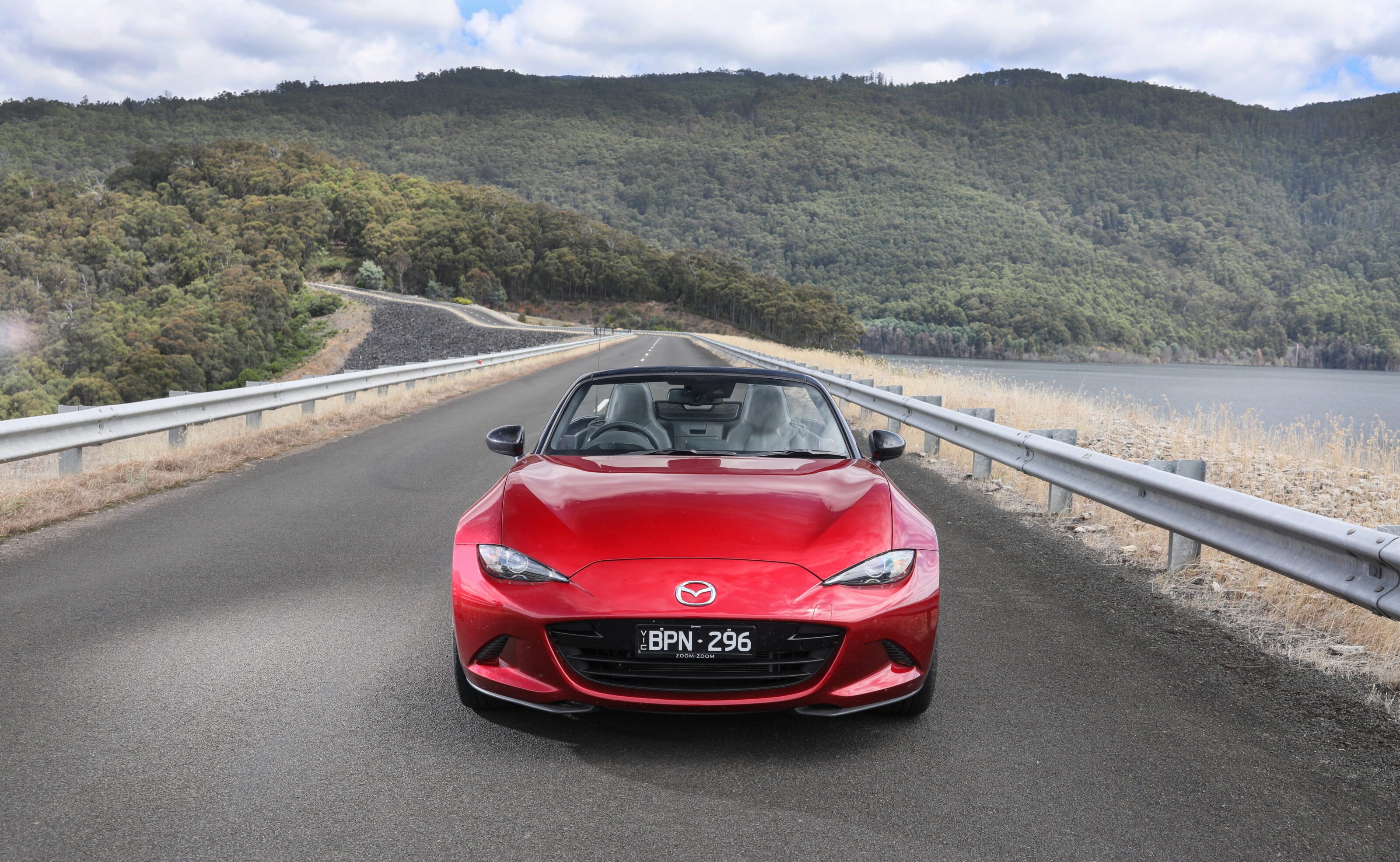
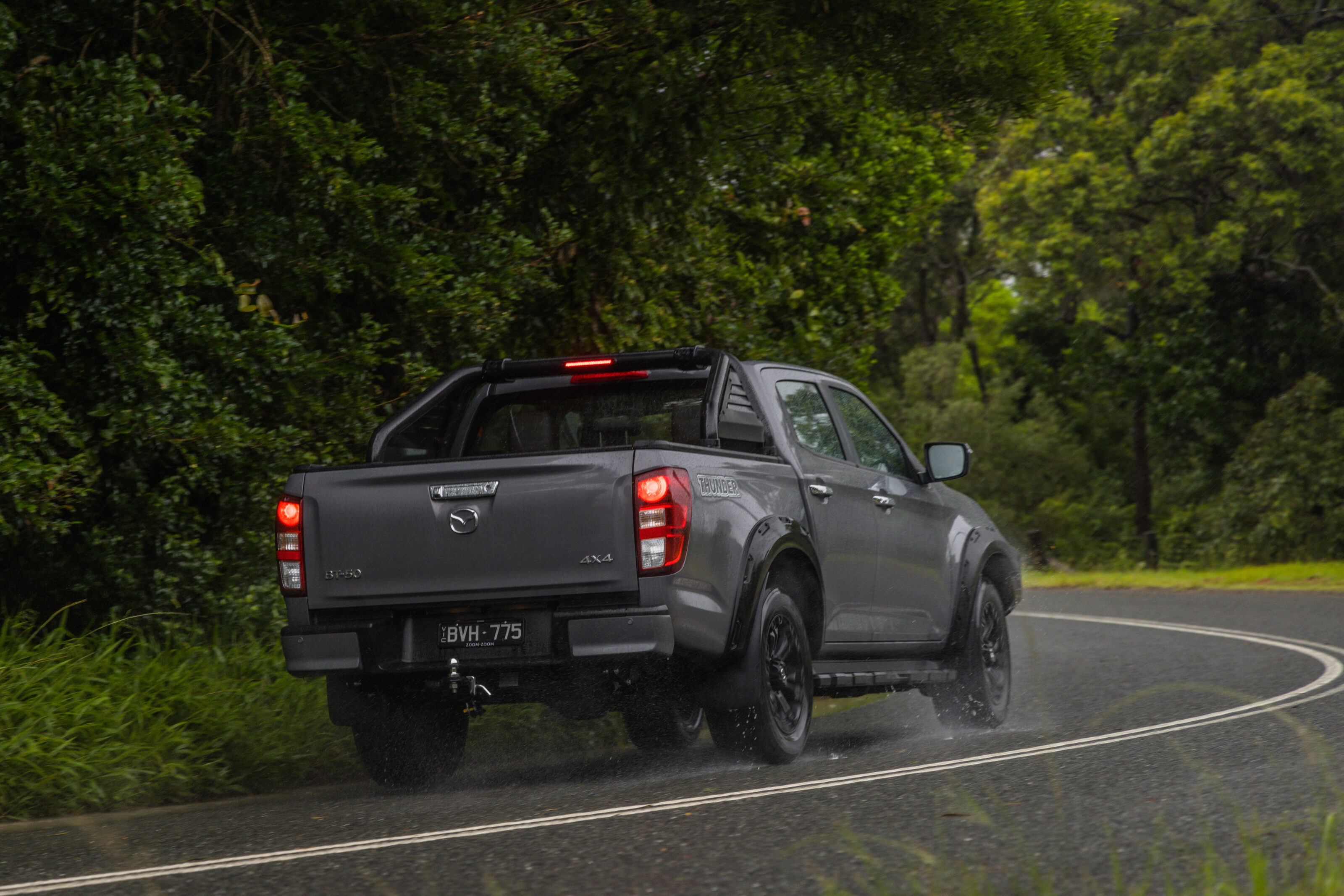
The worst affected are the brand’s BT-50 ute, CX-9 large SUV and MX-5 sports car.

Mazda model wait times 2023
| Model | Wait time |
|---|---|
| Mazda 2 | 30 days |
| Mazda 3 | 56 days |
| Mazda 6 | 24 days |
| CX-3 | 44 days |
| CX-30 | 64 days |
| CX-5 | 58 days |
| CX-8 | 68 days |
| CX-9 | 82 days |
| MX-30 hybrid | Not available |
| MX-30 electric | Not available |
| MX-5 | 222 days |
| BT-50 | 71 days |
NOTE: This information is current as of February 25, 2023. This article will be reviewed and amended as new details come to light.
However, Mazda’s own information is at odds with the Price My Car figures, with the company telling us “stock levels have improved considerably, and are back to pre-COVID levels of availability across almost the entire Mazda range”.
With all of the above in mind, it is important to consider this article a guide only.
After a new Subaru, but not sure how long you’ll have to wait?
Issues such as semiconductor chip shortages, shipping problems and sickness and isolation have affected the ability of manufacturers like Subaru to keep their production lines going over the last three years.
As such, all of the Japanese brand’s models are currently experiencing some delays.
However, some models are in greater supply than others, with flexibility around powertrains, specification and vehicle colour likely to see a vehicle in your driveway sooner.
Overall, according to Price My Car, the average wait time for a Subaru is now 92 days – compared to 90 days in January 2022.
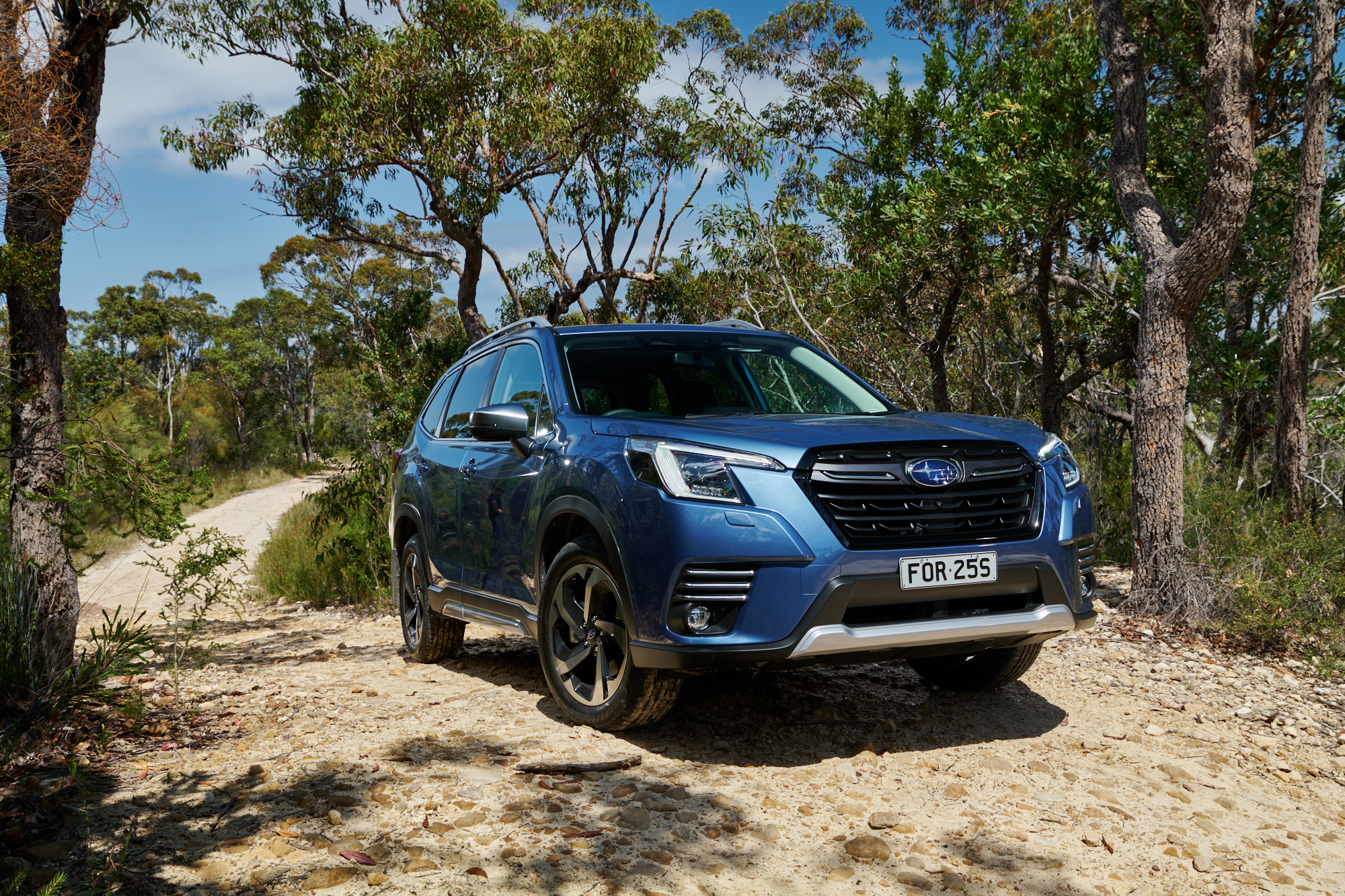
Subaru model wait times 2023
NOTE: This information is current as of February 25, 2023. This article will be reviewed and amended as new details come to light.
| BRZ | Not available |
| Forester | 79 days |
| Impreza | 72 days |
| Outback | 115 days |
| WRX | 102 days |
| XV | 53 days |
According to Subaru however, the Forester hybrid is the worst off, with a wait of five- to six- months, followed by the Outback XT and Crosstrek with delays of four- to five- months. All other models have an average two-month wait.
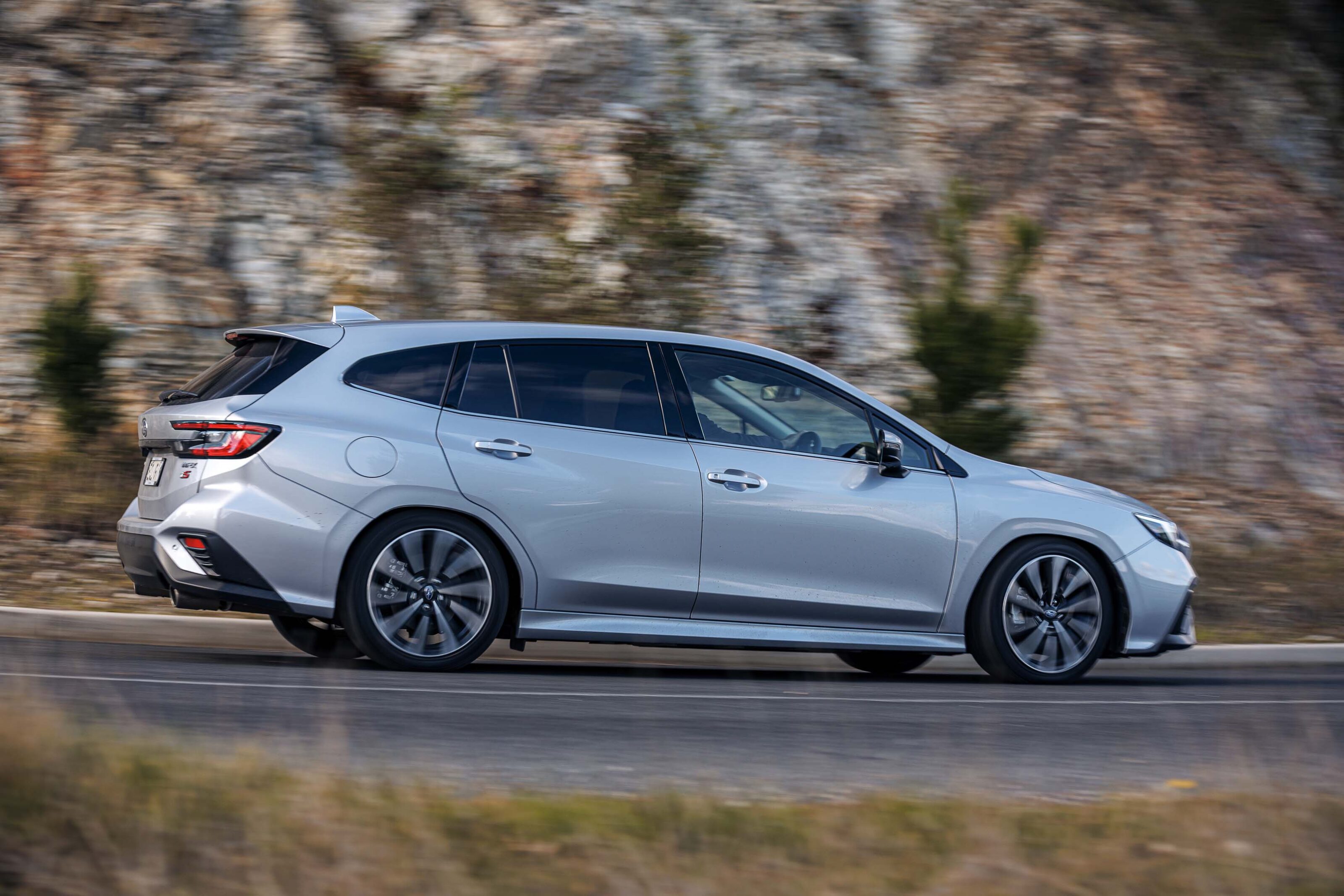
“Subaru Australia continues to work closely with Subaru Corporation to deliver vehicles to customers as soon as possible. Delivery timeframes for customer orders can vary for a variety of reasons (including model, colour and variant preferences),” a spokesperson for Subaru told us.
“As always, customers are encouraged to speak with their local Subaru Retailer who is best placed to advise delivery timeframes for specific orders.”
With all of the above in mind, it is important to consider this article a guide only.
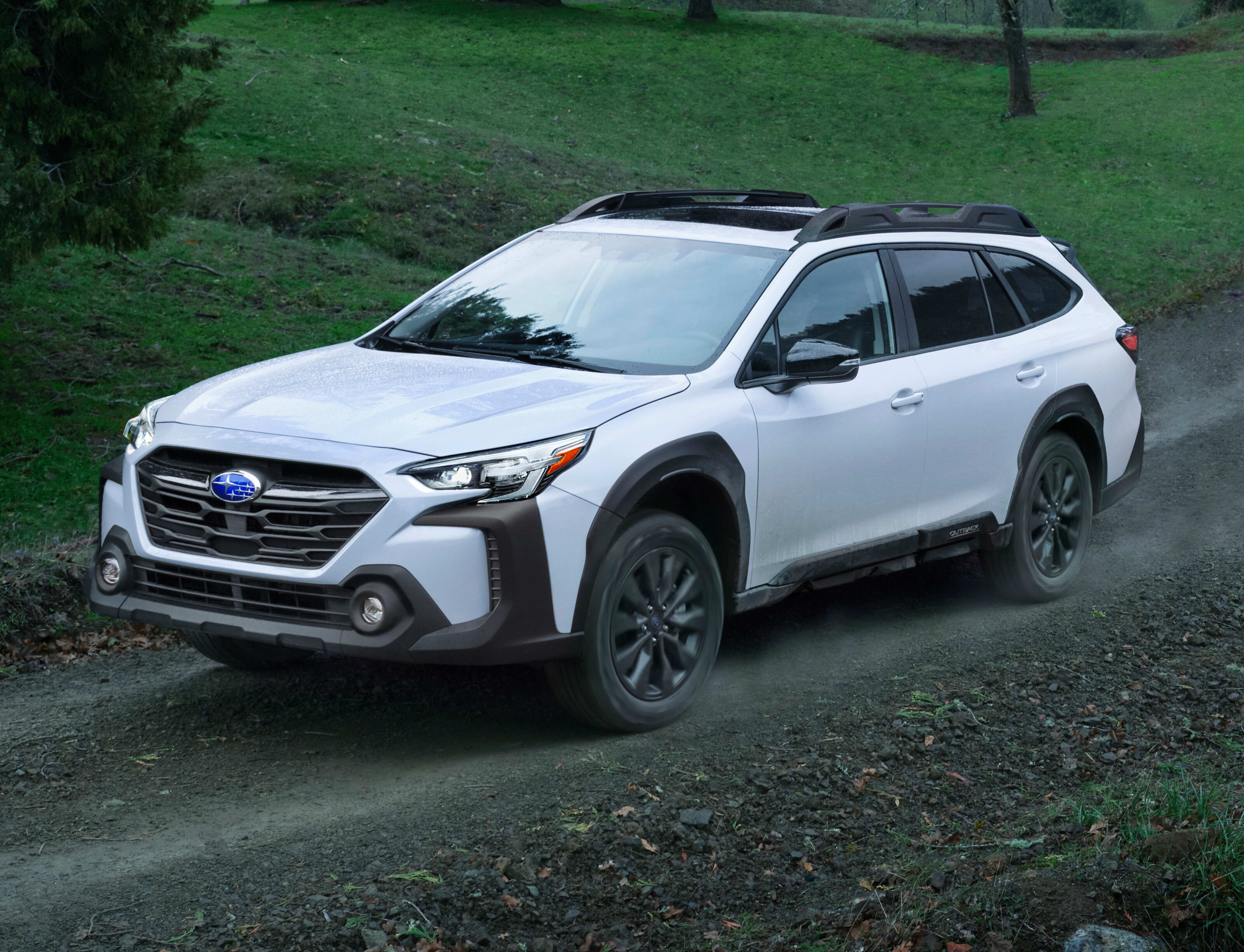
Almost 13,000 brand-new Toyota and Lexus vehicles will need to return to the dealer to resolve a bug in the front-facing camera system.
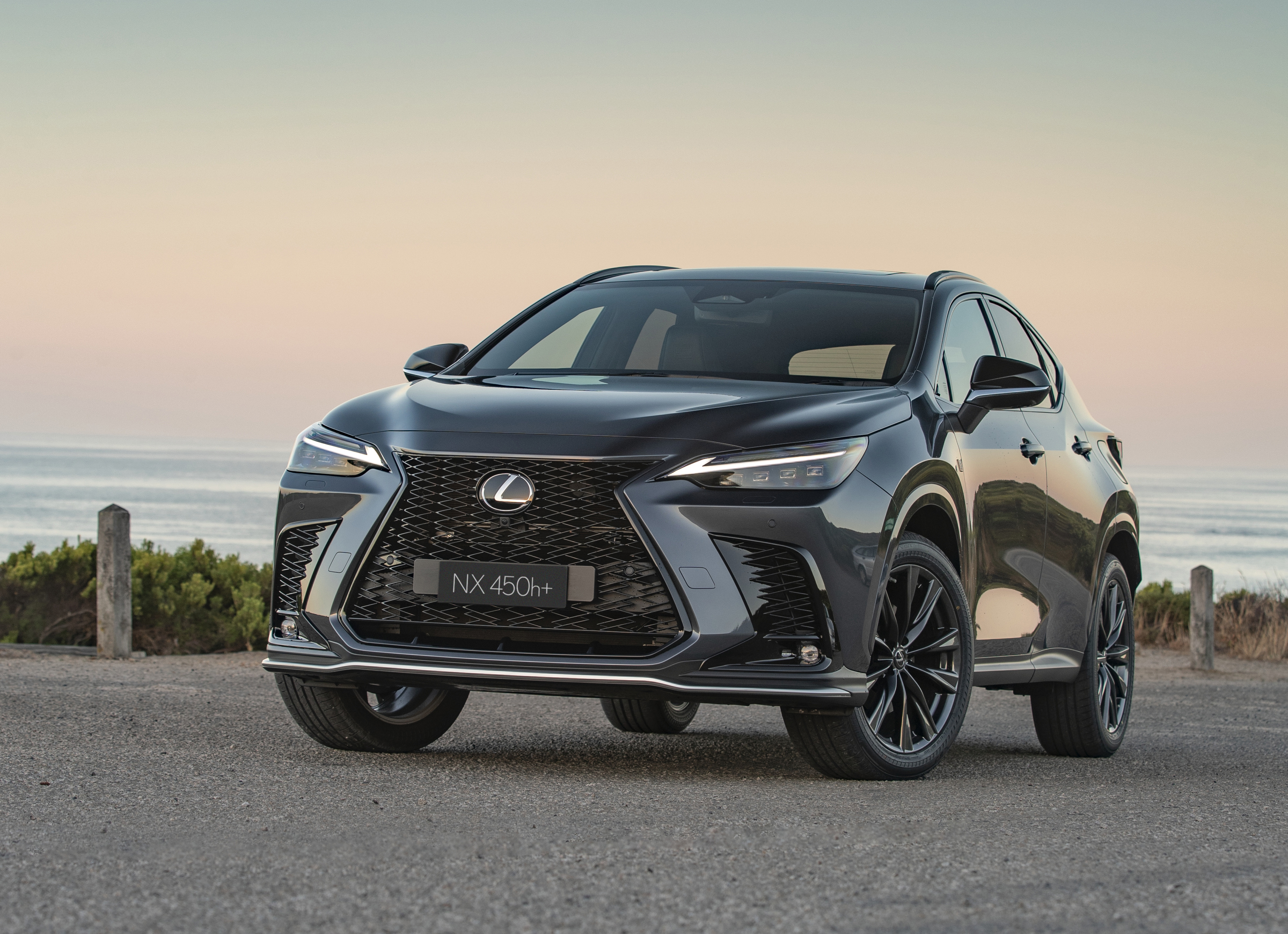
The issue – affecting the 2022 Toyota Corolla and Corolla Cross and 2021-22 Lexus NX – could result in the autonomous emergency braking system becoming unresponsive for approximately four seconds.
It is caused by the “programming of the software within the forward recognition camera” when passing stopped or parked vehicles.
Toyota and Lexus said a warning light will illuminate in the instrument cluster before the system reboots itself, with functions restored and operative.

These vehicles are fitted with Toyota’s latest-generation ‘Safety Sense 3.0’ system, which utilises a millimetre-wave radar sensor and a forward recognition camera.
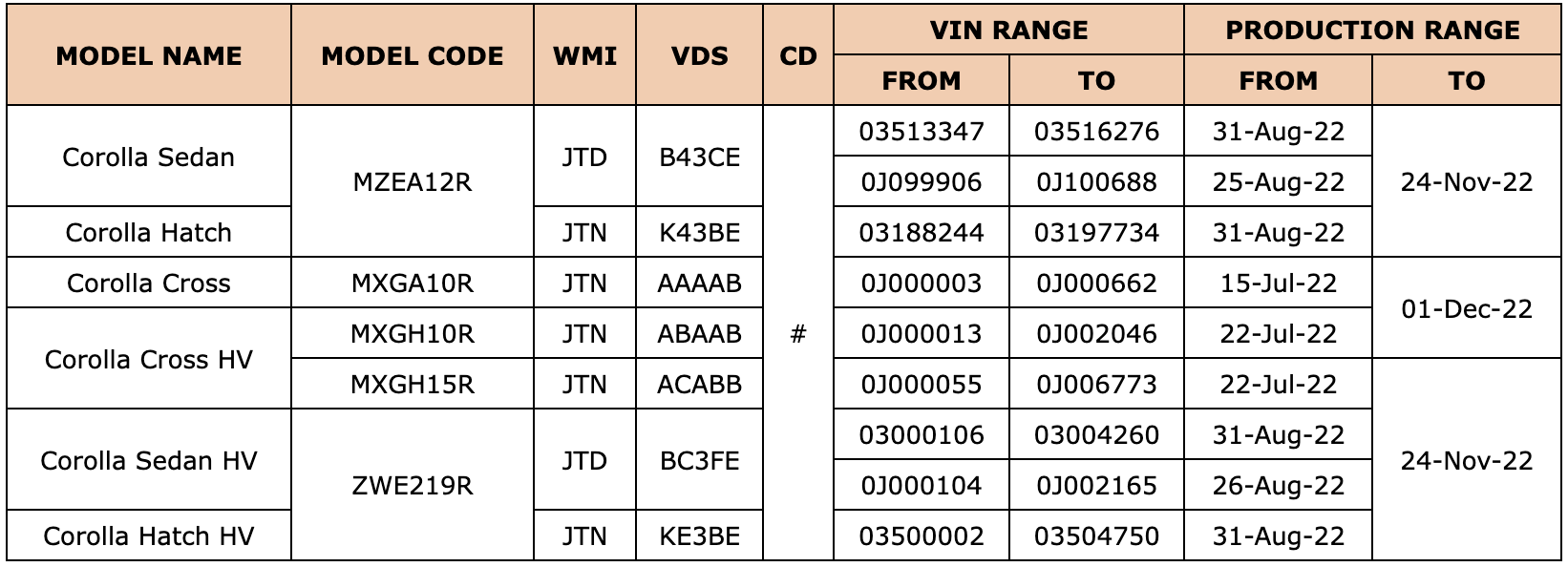
For the Toyota Corolla and Corolla Cross, the issue affects approximately 9100 vehicles produced between July and December 2022.
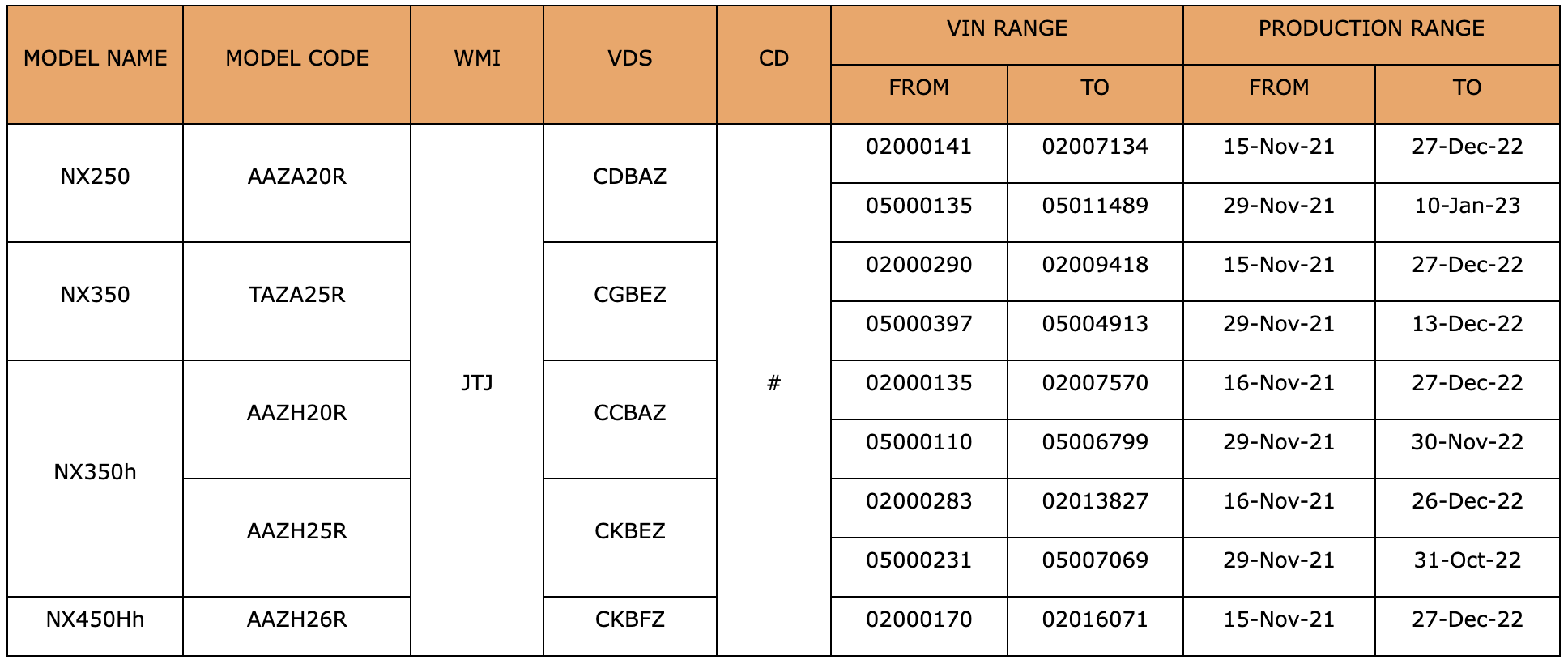
Approximately 3718 Lexus NXs manufactured between November 2021 and December 2022 are affected.
A VIN list is available below:
Toyota Corolla and Corolla Cross
Lexus NX
According to the two brands, a no-cost software update is available to book, with the remedy taking approximately 40 minutes to one hour.
However, additional time could be required depending on the dealer’s work schedule.
Toyota Australia can be contacted directly by calling 1800 987 366 between 8am and 6pm on weekdays, or by visiting a dealership, found here.
Lexus’s customer assistance centre can be contacted on 1800 023 009 during the same business hours, while a dealership can be found here.
Toyota and Lexus said vehicles will be reprogrammed for those yet to be delivered to a customer.
The facelifted 2024 Peugeot 508 sedan and wagon have debuted.
Snapshot
- 2024 Peugeot 508 facelift unveiled
- Updated sedan and wagon gain Peugeot’s latest badging, updated styling, and new tech
- Local timing unclear; hot Sport Engineered still under evaluation
While Peugeot’s local arm has confirmed the updated 508 – a stylish French rival to the also-chic Volkswagen Arteon – will arrive in Australia, it has yet to announce launch timing.
“Following the global reveal of the next iteration of 508, anticipated launch details, including arrival timings for the Australian market, will be confirmed in due course,” said a spokesperson for Peugeot Australia.
Wearing the brand’s new lion emblem – first seen on the latest 308 – the updated 508 also sports a revised front end with ‘three claws’ daytime running lamps and a larger, redesigned front grille.
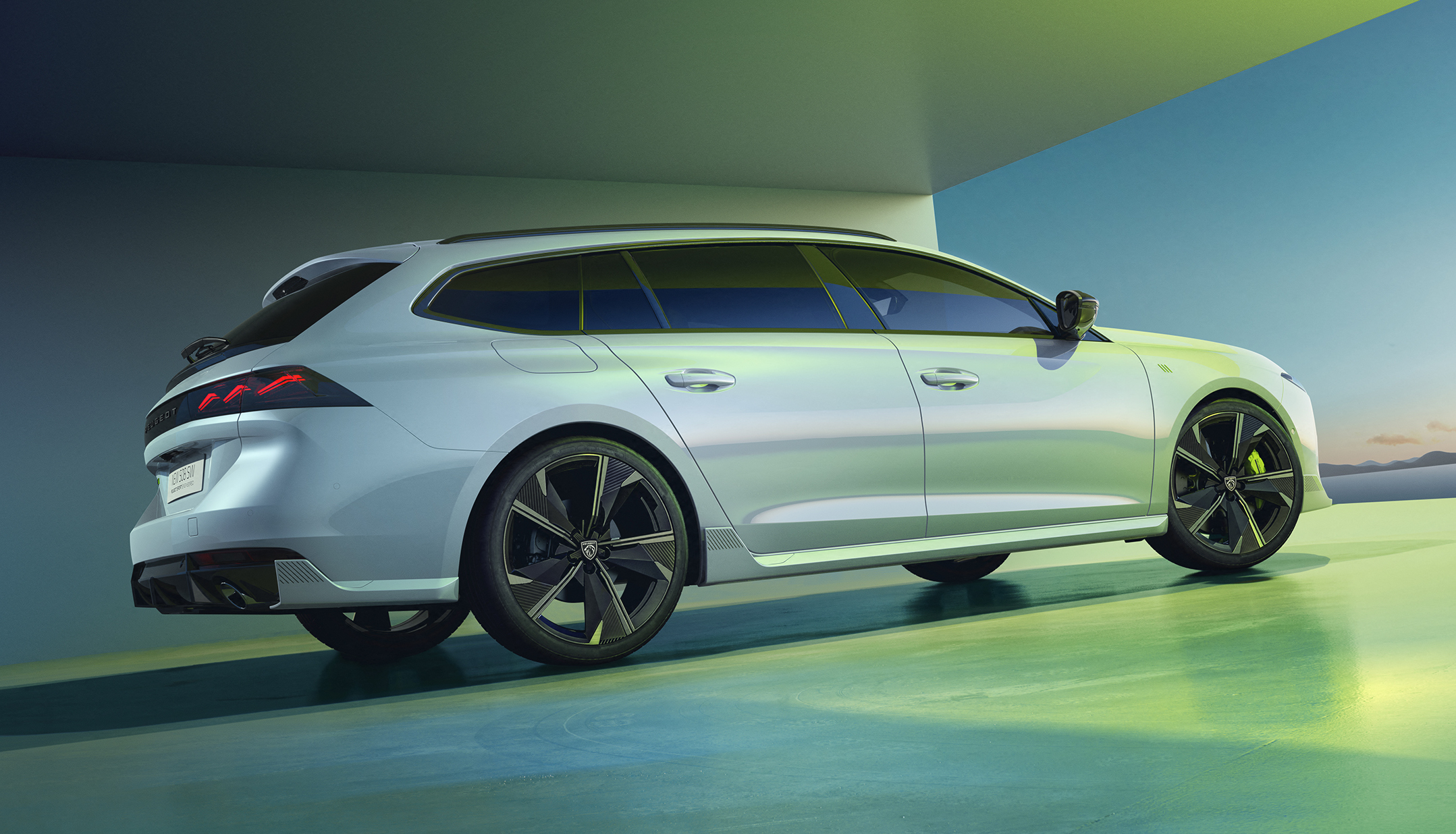
At the rear, Peugeot is now spelt out on the black strip between the tail-lights, which receive a new diagonal LED signature with sequential indicators.
In addition, it will offer three new colours – okenite white, eclipse blue and titanium grey – and redesigned alloy wheels, while the Sport Engineered-exclusive selenium grey is now available on all variants.
Inside, the 508 features a toggle-style gear selector to replace the previous shift-by-wire handle, a new lion badge on the steering wheel, and three new massaging seat functions for a total of eight.
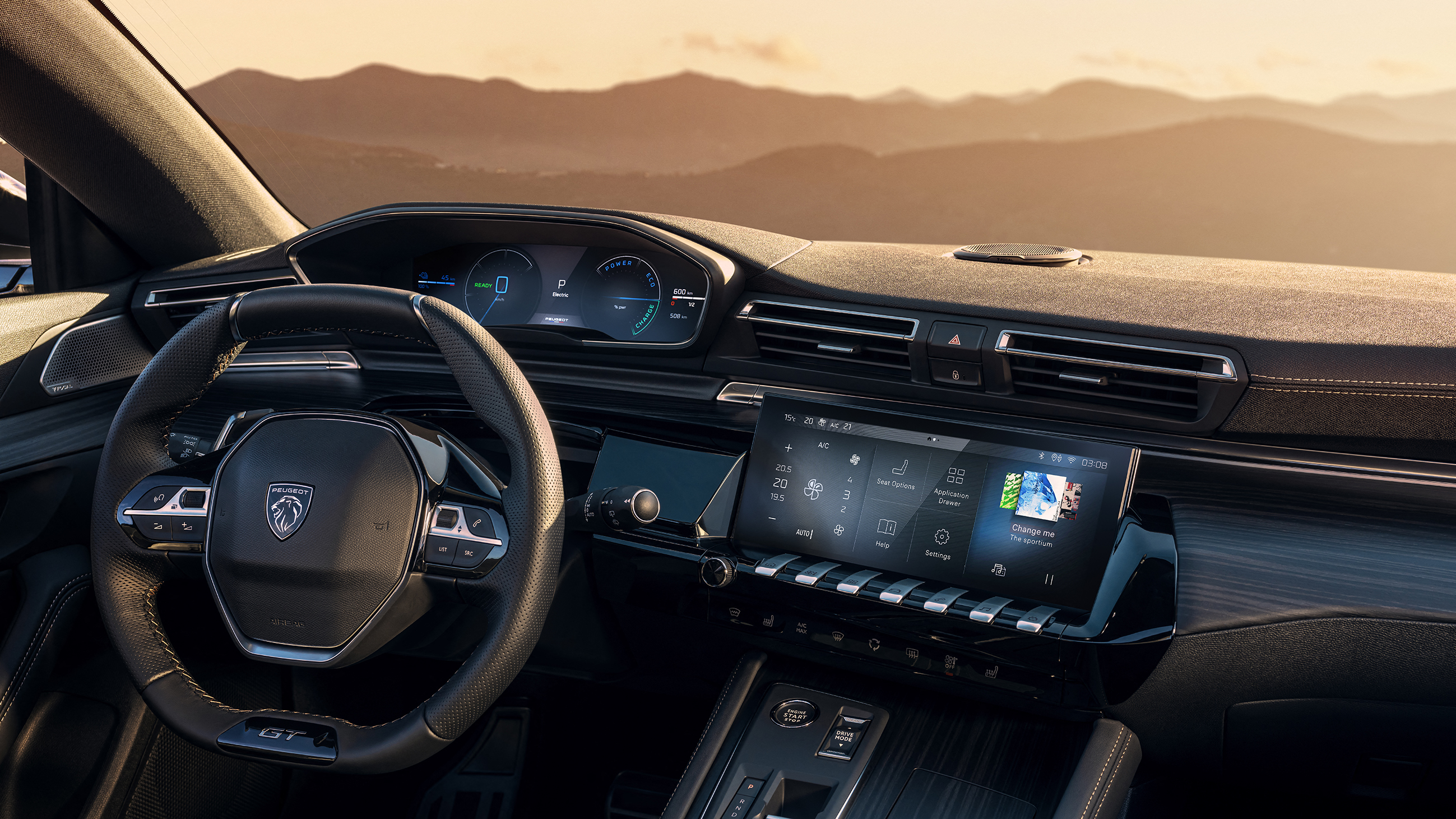
While it retains a 10-inch touchscreen, the 508 receives Peugeot’s latest infotainment system with over-the-air software updates, connected satellite navigation, ‘Ok, Peugeot’ voice control, wireless Apple CarPlay and Android Auto, and multi-window support.
Peugeot says the 12.3-inch digital instrument cluster supports new navigation, media and driver assistance technology display modes.
Unlike the latest 3008 and 5008, which feature new fuel-saving mild-hybrid technology, the 508 retains its previous engine lineup matched to an eight-speed automatic transmission.
Locally, the standard-fit 165kW/300Nm 1.6-litre four-cylinder turbo-petrol in GT variants remains unchanged, while the 165kW/360Nm 1.6-litre plug-in hybrid system is also identical to the current version.
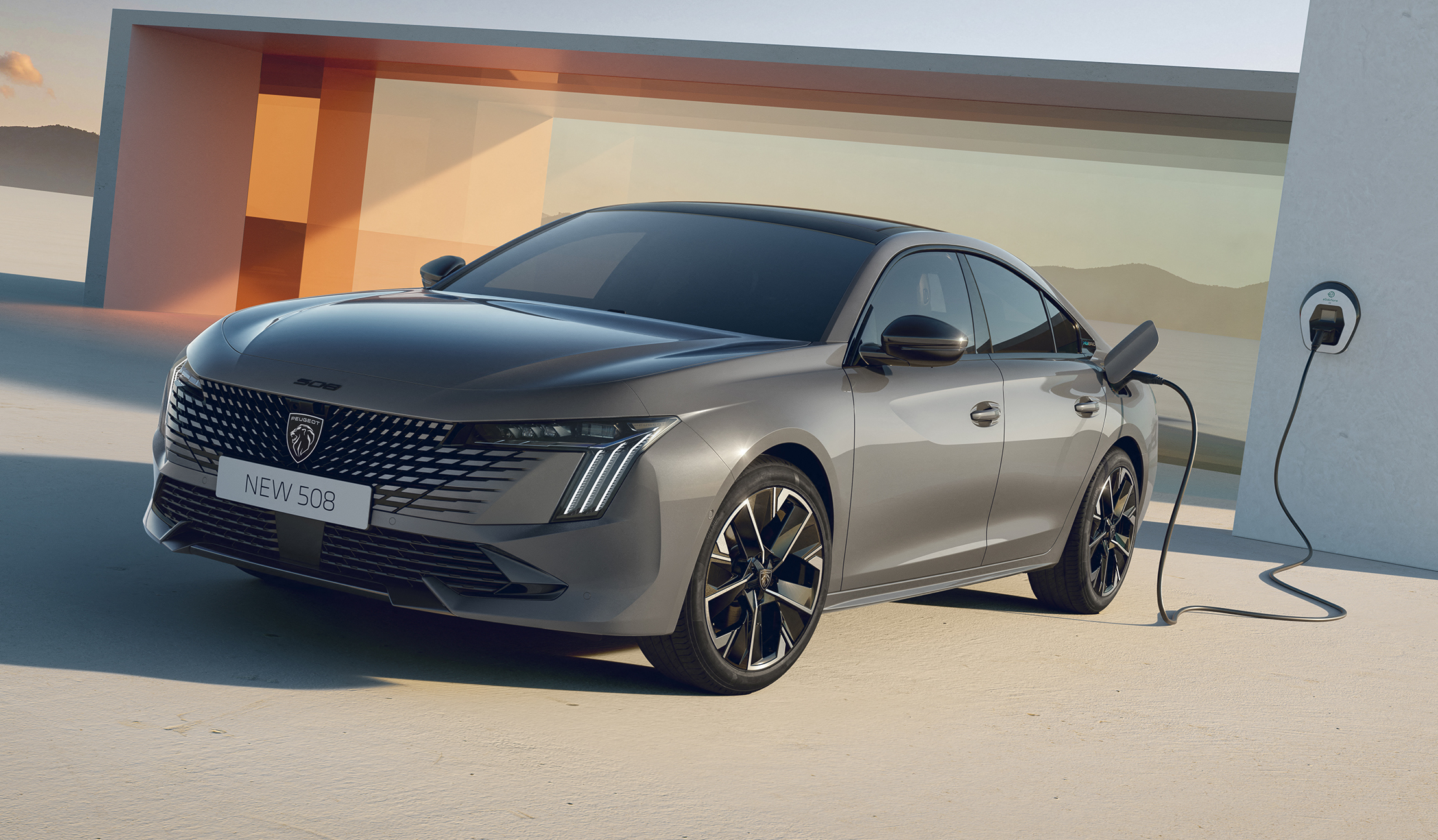
In Europe, the entry-level Allure is powered by a 1.2-litre three-cylinder turbo-petrol engine, or an optional 1.5-litre four-cylinder diesel.
The top-spec 508 Sport Engineered (PSE) plug-in hybrid has yet to be confirmed for Australia – but it could headline the facelifted range.
“At this stage, there is no information to share with regards to the 508 PSE, however, we continue to work with the factory to assess suitability for the local market,” said a spokesperson for Peugeot Australia.
As before, the 508 PSE features a 147kW 1.6-litre turbocharged petrol engine, and two electric motors – 81kW front and 83kW rear – for a combined system output of 265kW and 520Nm.

Adding an electric motor to the back axle brings all-wheel drive – a first for the 508 – with a claimed 0-100km/h time of 5.2 seconds.
The updated 2024 Peugeot 508 will commence production in France mid-year, with European arrivals due before the end of the year.
Peugeot Australia has yet to confirm timing, but it is expected to arrive within the next 12 months.
The pre-facelift 508 is priced from $63,431 before on-road costs for the GT sedan, rising to $81,610 plus on-roads for the GT Plug-In Hybrid sedan.
Below: The current 2023 Peugeot 508

Snapshot
- Vehicle emissions may cause 11,105 premature deaths in adults per year
- Numbers based on NZ research and adapted for Australia
- EV Council renews call for fuel-efficiency standard
New research shows that the health impacts from vehicle emissions are likely to be far higher than previously estimated.
According to Melbourne Climate Futures, which has carried out the estimates by scaling the most recent research on New Zealand vehicle-emission impacts to the Australian population, vehicle emissions in Australia may cause 11,105 premature deaths in adults per year.
That’s about 10 times more than road accidents – which killed 1,123 people in 2021.

Figures used by policy-makers to date are far lower, according to available information from the University of Melbourne’s Climate Futures Academy, with none estimating more than 2000 premature deaths per year in Australia.
Currently, Australian estimates do not factor in NO2 gas emissions, with the result being that previous figures significantly underestimate the real health impacts.
The analysis also reveals vehicle emissions in Australia may cause 12,210 cardiovascular hospitalisations, 66,000 active asthma cases, and 6840 respiratory hospital admissions per year.

“There are short and long-term changes we can make to mitigate the effects of traffic pollution in Australia and dramatically improve health outlooks, as well as the economic burden of emissions-related health impacts,” said Academy fellow Clare Walter, speaking at the Vehicle Pollution Forum held in Melbourne today.
“With these high levels of mortality and morbidity impacts, we look to our leaders to make the decisions required to reduce the social, economic and human costs of vehicle emissions.”
Roland Sapsford, CEO of the Climate and Health Alliance, added: “Pollution from cars and trucks is killing people, making us sick and changing our climate. Australians deserve urgent action to clean up what comes out of tailpipes, and make it easier for more people to leave the car at home.“We can have cleaner air, safer streets and healthier communities for everyone, at the same time as we reduce climate-changing emissions.”

Electric Vehicle Council CEO Behyad Jafari has joined doctors and health organisations in an urgent call for action.
“Combustion engine vehicles are not only bad for the environment, they’re bad for our health. Thankfully, their replacement with electric vehicles will reduce this toll,” Jafari said.
“But health and environmental outcomes can improve even faster if the Government introduces a strong mandatory fuel-efficiency standard, which would decarbonise manufacturers’ portfolios of new vehicles.
“Australia has some of the most polluting vehicles in the world yet is the only OECD country without mandatory fuel-efficiency standards.
“Right now, Australia is choking in the slow lane. We can’t overtake without the targets.”
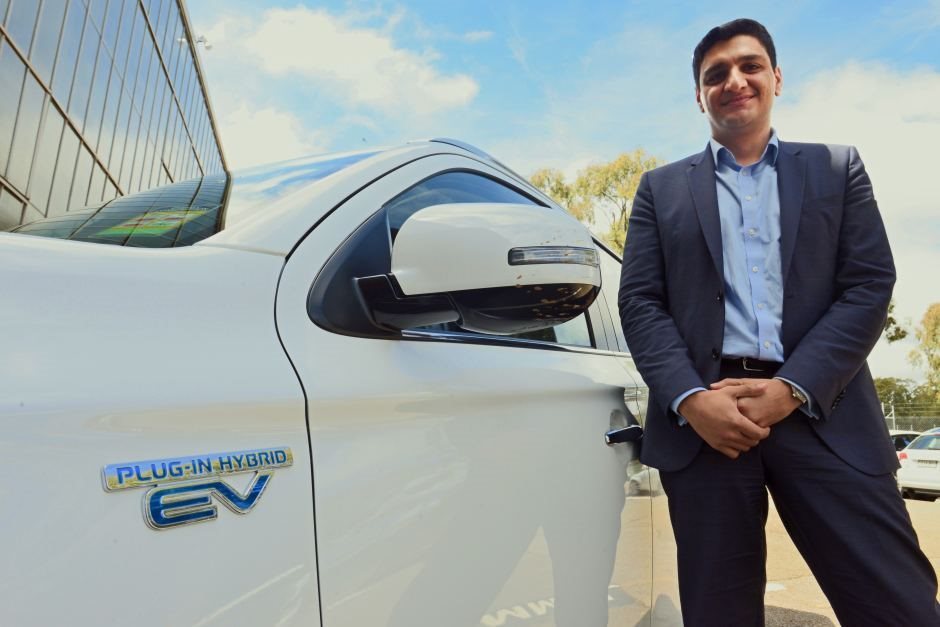
Melbourne Climate Futures has released a position statement, which calls for urgent action as a result of these new figures, which has been endorsed by the likes of Asthma Australia, the Lung Foundation, the Heart Foundation, the Cancer Council and Diabetes Australia.
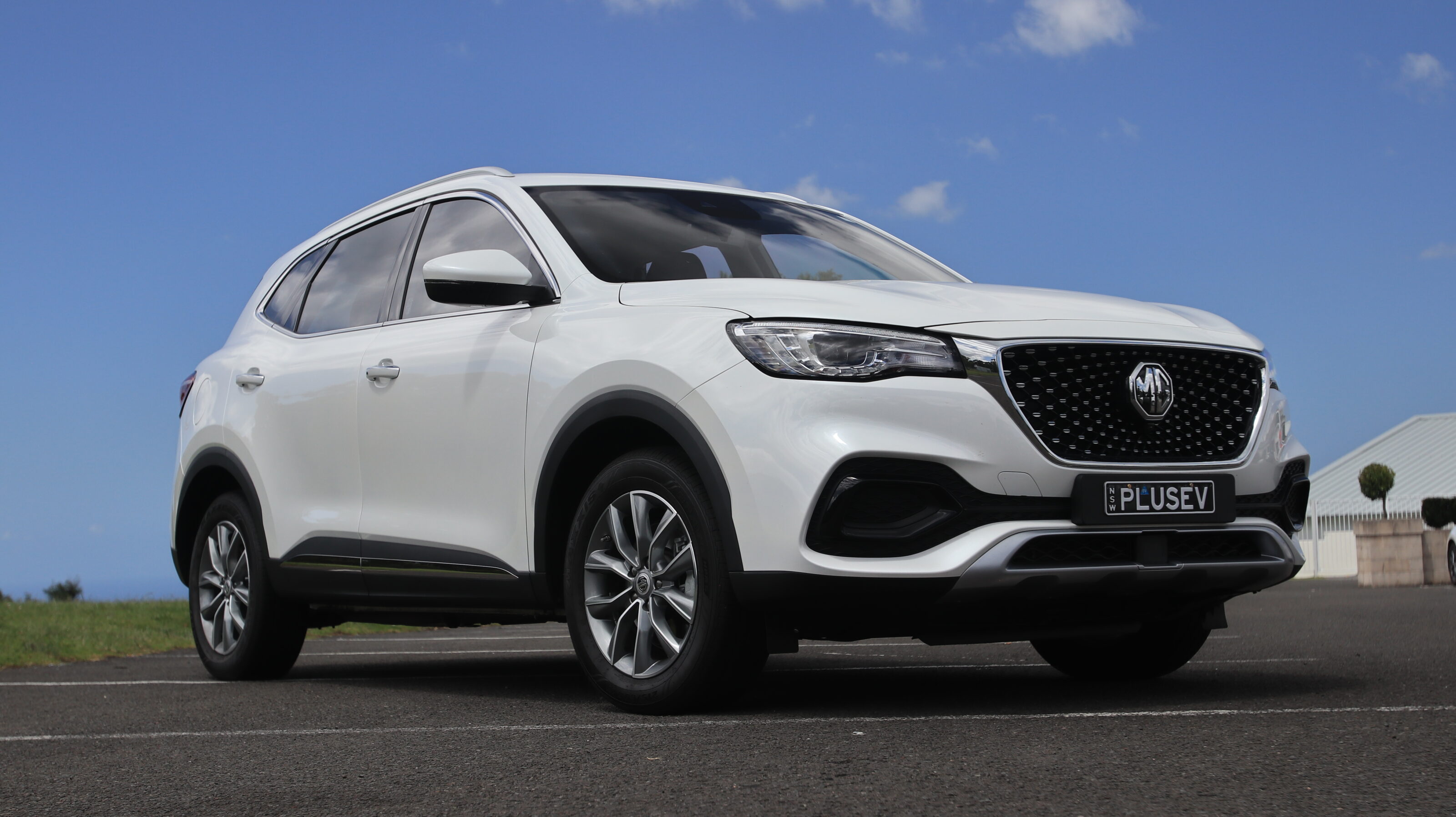
After a new MG, but not sure how long you’ll have to wait?
Issues such as semiconductor chip shortages, shipping problems and sickness and isolation have affected the ability of manufacturers like MG to keep their production lines going over the last three years.
As such, all of the brand’s models are currently experiencing some delays.
However, some models are in greater supply than others, with flexibility around powertrains, specification and vehicle colour likely to see a vehicle in your driveway sooner.
Overall, according to Price My Car, the average wait time for a MG is now 54 days – compared to 56 days in January 2022.
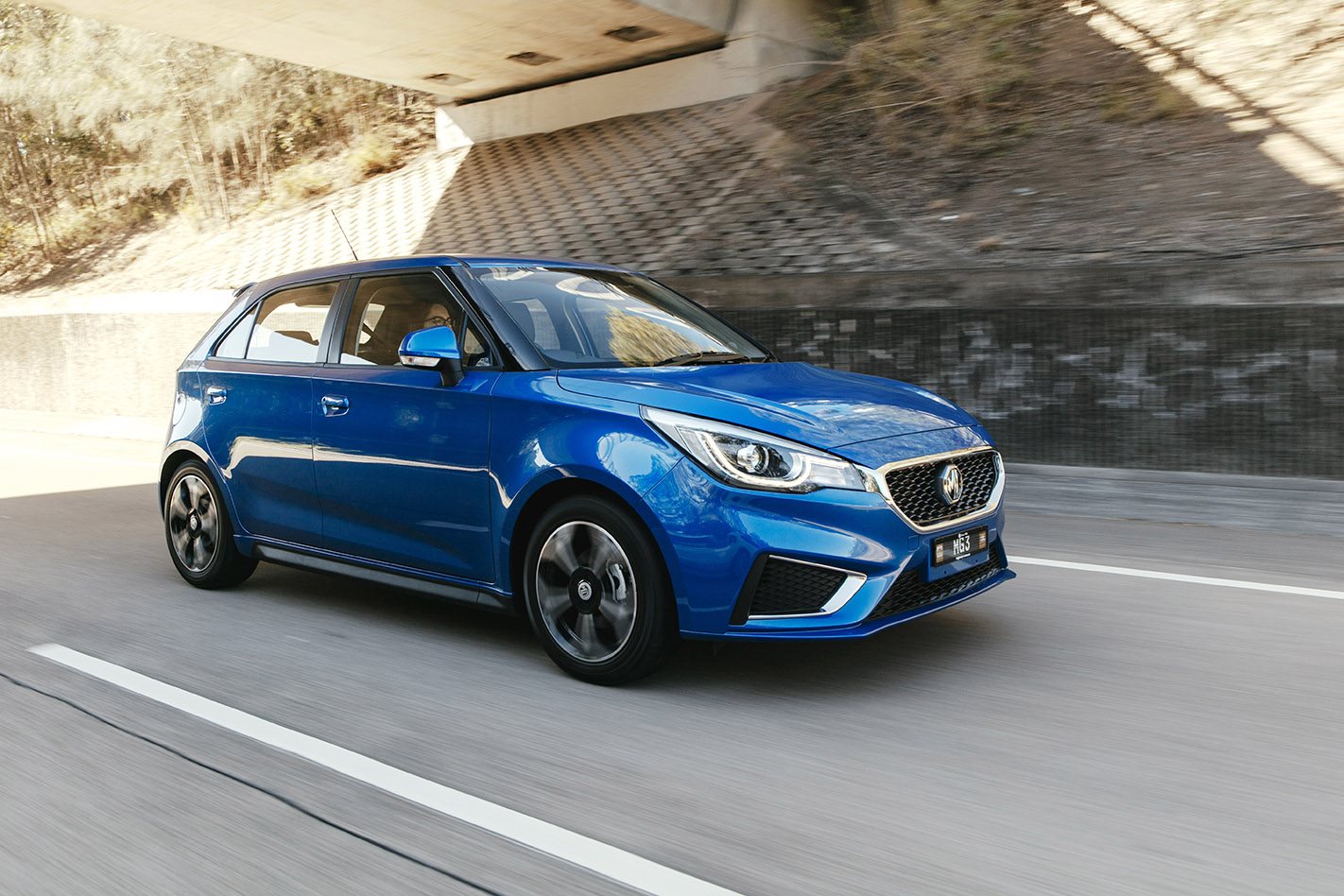
The quickest arrival is the HS with an average wait of 25 days.
Meanwhile, the worst-affected in MG’s lineup is the ZST, with a wait time of 57 days.
“For most models in our range, we have a good supply for immediate delivery, particularly within our HS range,” the company said.
“Everything remains on track at this point in time, we’ve fast tracked the arrival of our ZS EV Long Range alongside the preview of the MG4.”
The only changes made to existing model lines, says MG, is the deletion of the Tudor yellow colour option for the MG3.
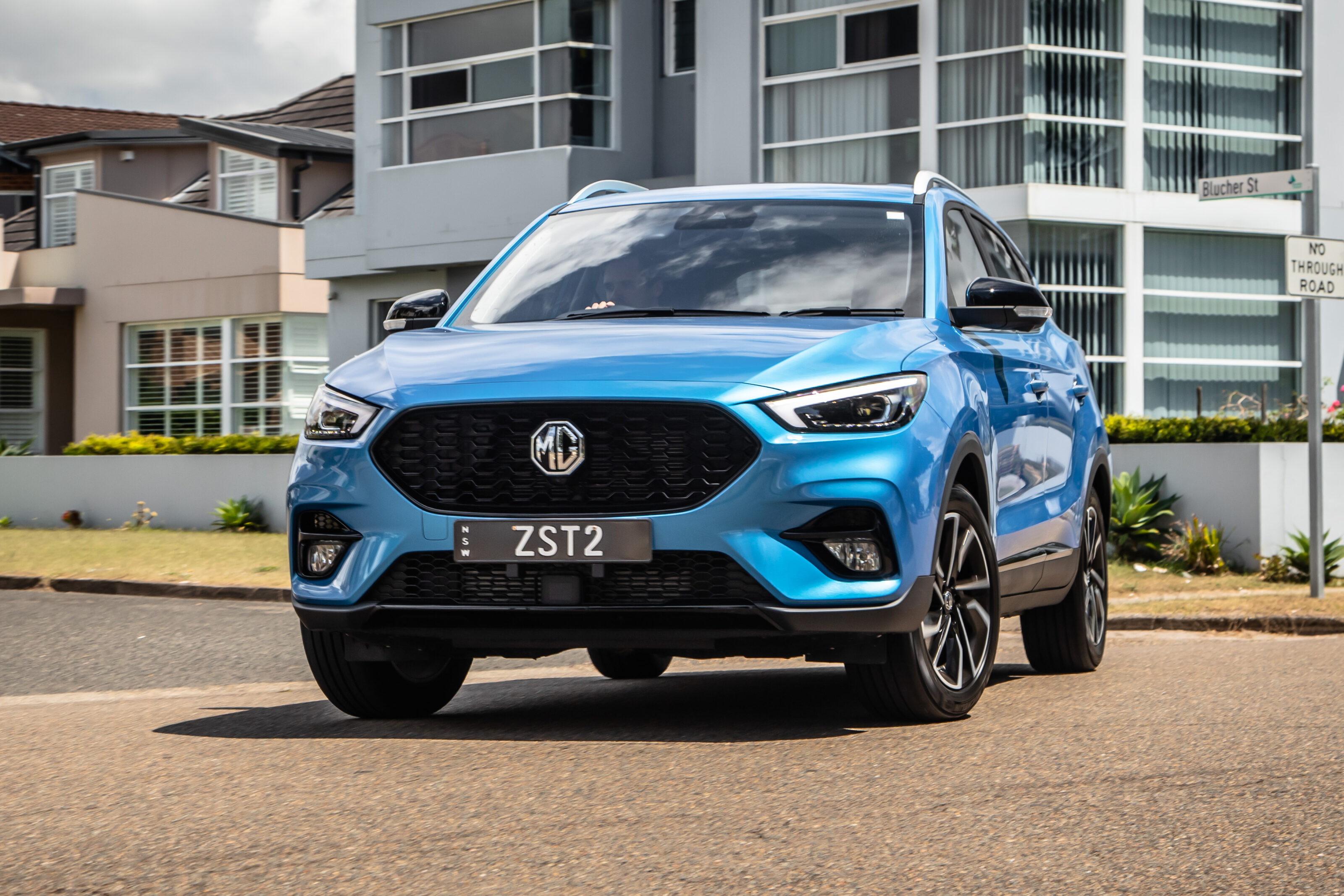
MG average model wait times 2023
| Model | Wait time |
|---|---|
| MG 3 | 47 days |
| HS | 25 days |
| ZS | 50 days |
| ZS EV | N/A |
| ZST | 57 days |
| HS + EV | N/A |
NOTE: This information is current as of February 23, 2023. This article will be reviewed and amended as new details come to light.
“MG Motor has fought really hard to secure a large proportion of automotive allocation for our region in an ongoing effort to keep Australians moving,” a spokesperson told us.
“Victoria has experienced delays at a greater scale than the rest of the country recently due to an increased biosecurity threat and port congestion that the wider industry faces as a whole, authorities are understandably monitoring inbound automotive shipments to Australian ports, with a strong focus on the East Coast.
“MG, like other manufacturers has been affected by some of these challenges which have resulted in further inspections and delays of deliveries to our dealer network and our valued customers.
“MG continues to co-operate and comply with the requirements set by the Department of Agriculture and Ports Authorities. We understand, acknowledge and respect the importance of biosecurity measures to ensure the longevity and safety of Australia’s environment and ecosystem.
“These challenges make it difficult to predict exactly how long it will take for all bottlenecks to be cleared or when new ones will appear, please be assured we are doing our utmost to ensure as little as a delay as possible.”
Snapshot
- Porsche argues coasting and regen via brake pedal is more efficient
- One-pedal driving has two-fold energy losses
- Regen braking allows EVs to recover some energy back into the battery
A Porsche senior engineer has argued electric cars are less efficient when using one-pedal driving systems, instead of coasting and regenerative braking via pressing the brake pedal.
“This is a more efficient way of driving, because it keeps the kinetic energy in the vehicle,” Porsche Engineering senior manager of chassis testing, Martin Reichenecker, said.
The luxury performance German carmaker said one-pedal driving is subject to two-fold energy losses – recuperating energy in deceleration and converting the recovered energy back for acceleration.

One-pedal driving allows EV drivers to, as the name suggests, only touch the accelerator pedal as intense regenerative braking can slow the car down to a complete stop without touching the brakes. It’s found in electric cars from brands such as Tesla, Polestar and Nissan.
Australia’s best electric cars for 2023
We’ve tested nearly every EV below six figures in Australia to rank the best on sale today
In contrast, Porsche adopts a coasting and regen-on-demand approach, where the former is a “more natural process” for the vehicle to roll without power and recuperation only activates when the brake pedal is pressed. It sells the popular Taycan sports sedan and wagon as its only EV model.
Despite this, the company still said the Taycan benefits from reduced brake wear as it uses regen 90 per cent of the time when braking to also comply with impending Euro 7 emission limits.
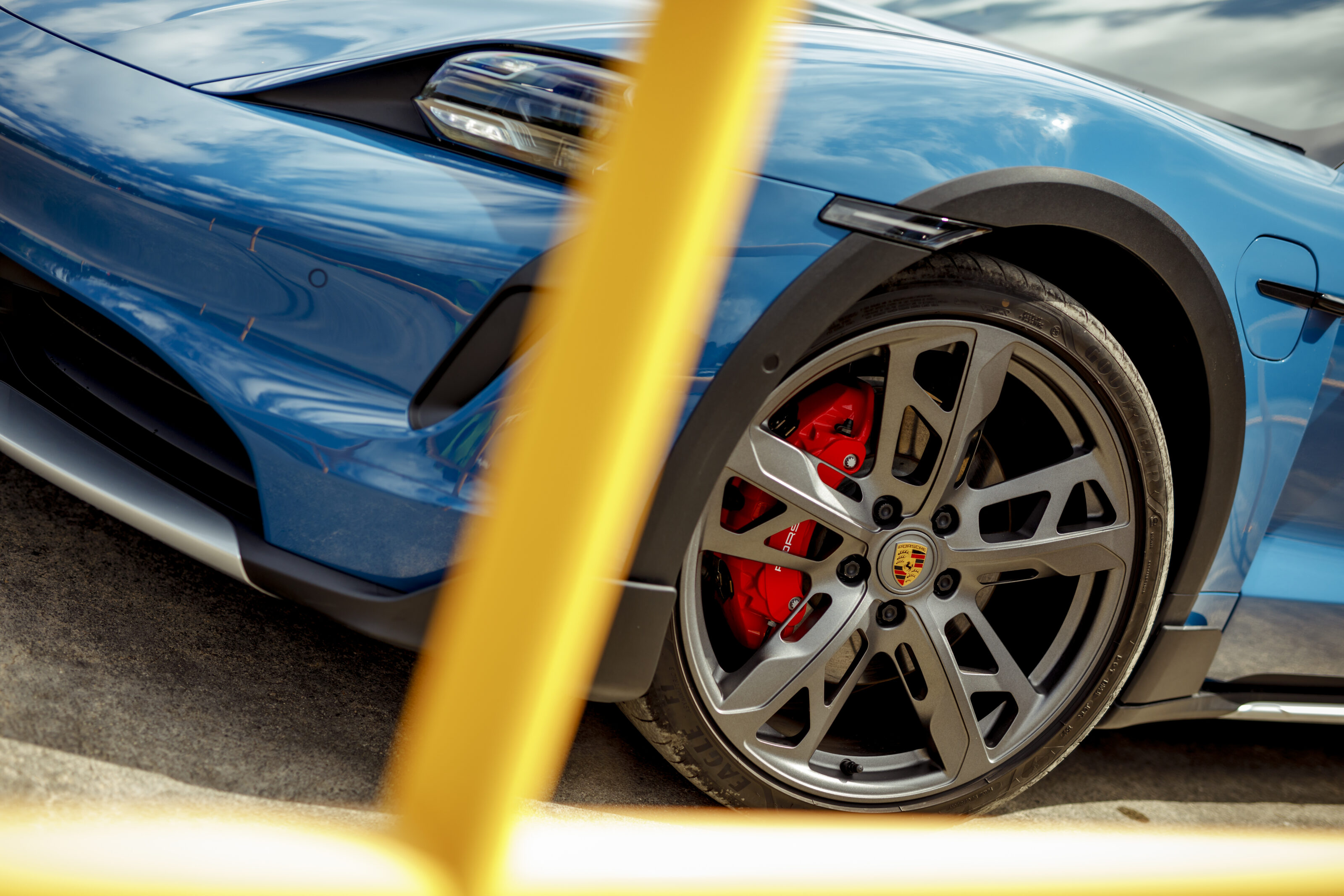
Porsche isn’t alone, though. Its Volkswagen, Cupra and Audi counterparts, BYD and MG all don’t offer one-pedal regen systems in their EV models, but do have weaker regen even on the highest intensity setting.
Some carmakers also provide an automatic regenerative braking function, which adjusts the regen intensity depending on whether a vehicle is in front and based on navigation data to anticipate corners and intersections.
The Mitsubishi Lancer Evolution is long dead, the Subaru WRX has gone soft, and it still amazes us at Wheels that Toyota was the brand to fill the void, not just with one product, but now a second!
Australia is lucky: we’re the only country outside Japan where you can walk into a Toyota dealer and decide between the GR Corolla and GR Yaris. It says something about our love of fast cars (and lack of emissions laws that we’ll conveniently ignore for this review).
The privilege of walking into a dealer and having the choice of two all-wheel-drive rally rockets does come at a cost. The GR Corolla will be popular, and with only 700 due this year, it’ll be in short supply. Pricing starts at $62,300 before on-road costs for the GTS, and the two-seat Morizo will arrive in May from (wait for it) $77,800 before on-road costs. Ouch.
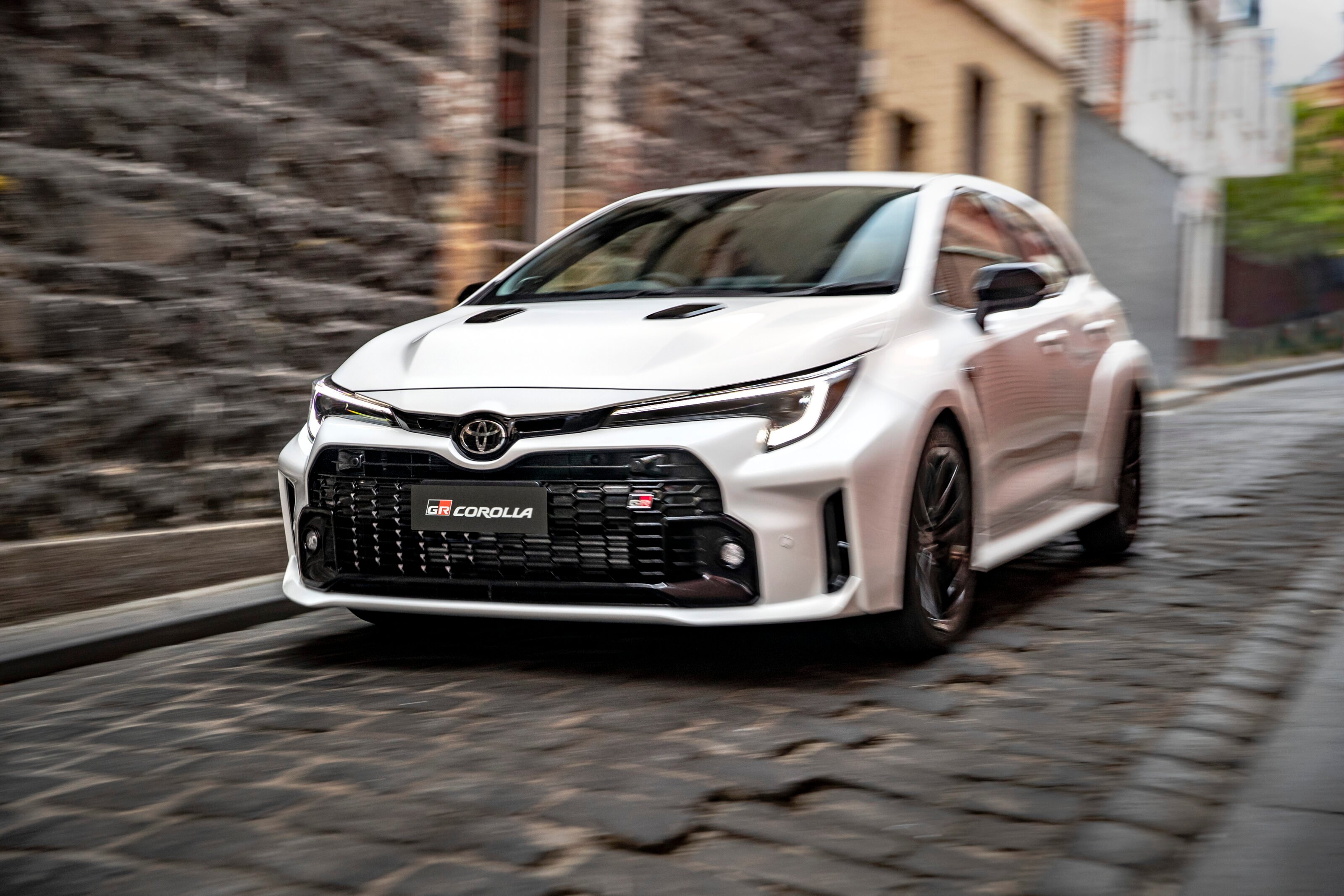
But the GR Corolla is a far more involved affair than the ’03-06 Corolla Sportivo. The arches have been pumped by 30mm at the back and 20mm at the front to accommodate 94mm and 59mm wider tracks respectively.
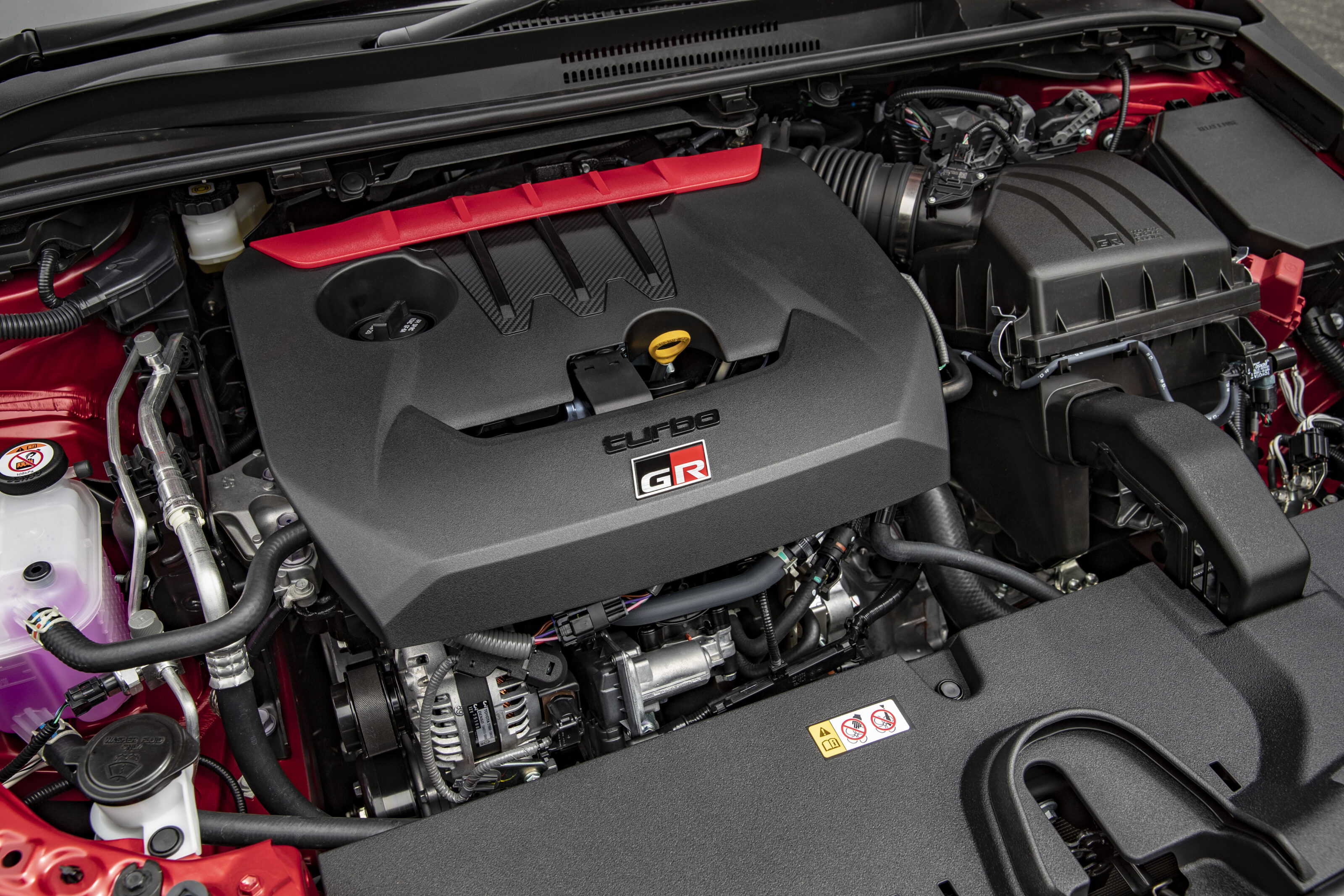
The bonnet’s bulge is big enough to embarrass a muscle car and has real vents to let excess heat out. And under that bonnet is a revised version of the G16E-GTS 1.6-litre turbo-petrol triple developing 221kW and 370Nm, sold exclusively with a six-speed manual transmission (for now).
For us to sample the GR Corolla, Toyota laid out a drive program through the foothills of Sydney’s Blue Mountains and a day blasting around Sydney Motorsport Park’s technical South Circuit.
JUMP AHEAD
- How much is it, and what do you get?
- How do rivals compare on value?
- Interior comfort, space and storage
- What is it like to drive?
- How is it on fuel?
- How safe is it?
- Warranty and running costs
- VERDICT
- Specifications
How much is it, and what do you get?
Safe to say we expected more price shock at launch. At $62,300 before on-road costs, the GR Corolla may not be cheap, but it isn’t absurd.
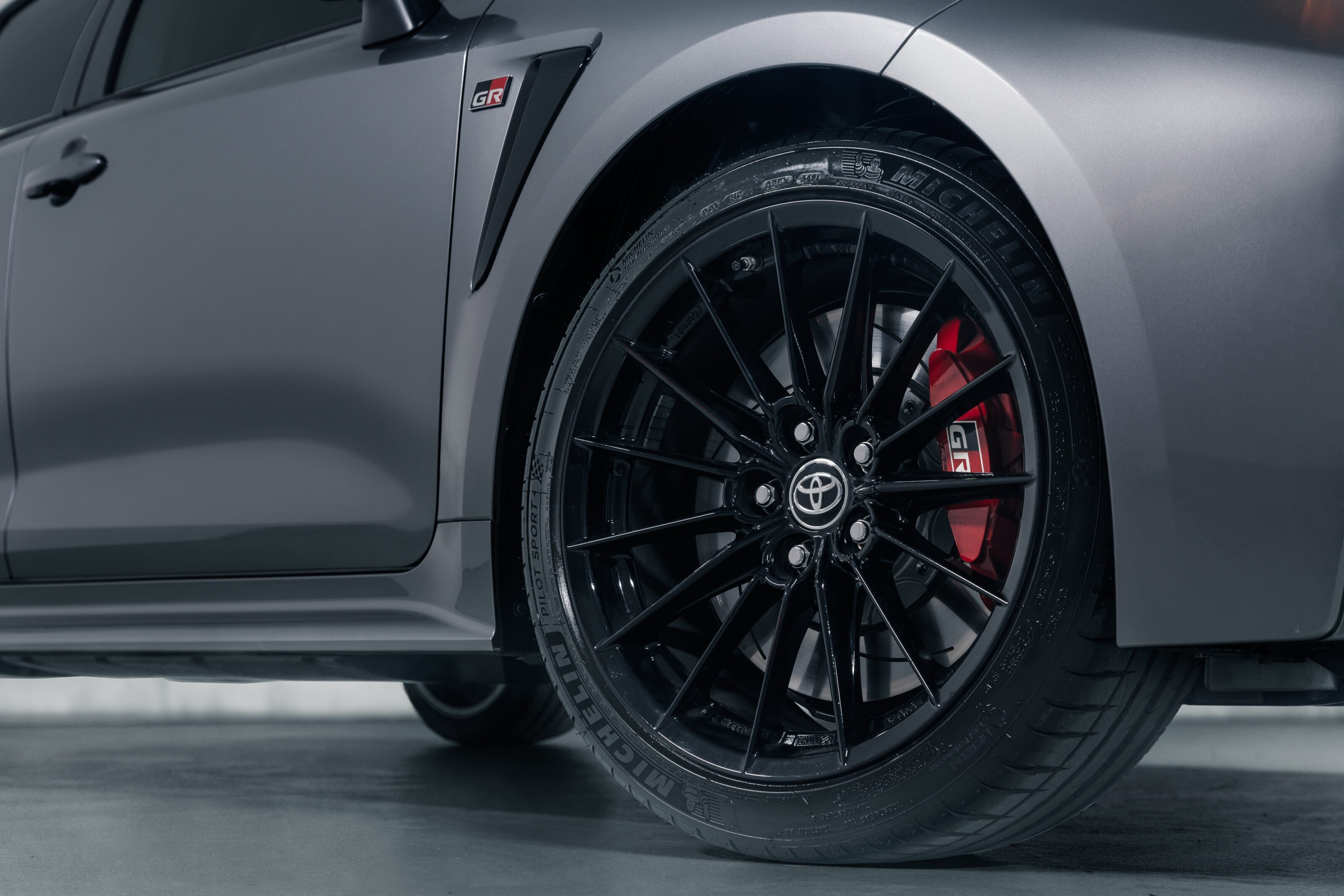
There are plenty of goodies like seat heating and wireless Apple CarPlay, although the spec sheet is more about intangibles. It’s the GR’s quality dampers, Torsen LSDs, 349 extra spot welds, 2.8 metres of structural adhesive, high-end tyres and expensive alloy wheels – not to mention development costs – that bring up the price.
Australian-delivered GR Corollas are roughly equivalent to Circuit Pack vehicles sold in North America but with a few tweaks, including ditching the roof spoiler.
| Toyota GR Corolla GTS features | |
|---|---|
| 12.3-inch digital driveru2019s display | Heated steering wheel |
| 18-inch cast Enkei alloy wheels | Keyless entry and start |
| 8.0-inch touchscreen | LED headlights |
| u2018Brin Naubu2019 suedecloth upholstery | LED taillights |
| Dual-zone climate control | Wireless Applle CarPlay / wired Android Auto |
| Heated front seats | Wireless phone charging |
The Morizo Edition is coming in May, a homage to Akio Toyoda (affectionately known as Morizo himself) and the value equation is, well, much worse. With no rear seats, single-zone air conditioning, no navigation and no parking sensors, it’s a lot less practical.
Behind the $15,500 premium are an exposed carbon fibre roof, extra chassis bracing, another metre of structural adhesive, 30Nm more, forged 18-inch BBS alloy wheels shod in sticky Michelin Pilot Sport Cup 2 tyres, and rarity factor (only 25 will come here in the first year).
How do rivals compare on value?
The GR Corolla is a lot dearer than the GR Yaris introductory offer under which 1000 cars were sold for $39,990 drive-away (which we were told was a marketing stunt; Toyota chose to make less money on each unit rather than spend big on advertising), but nor has it shocked like the $72,600 (drive-away) front-wheel-drive Civic Type R.
It’s not cheap, though, and if you’re looking for a sophisticated daily driver you’ll be better served by a Volkswagen Golf R ($66,990 before on-road costs) or BMW M135i xDrive Pure ($67,900 excluding on-road costs) as both have much nicer interiors.
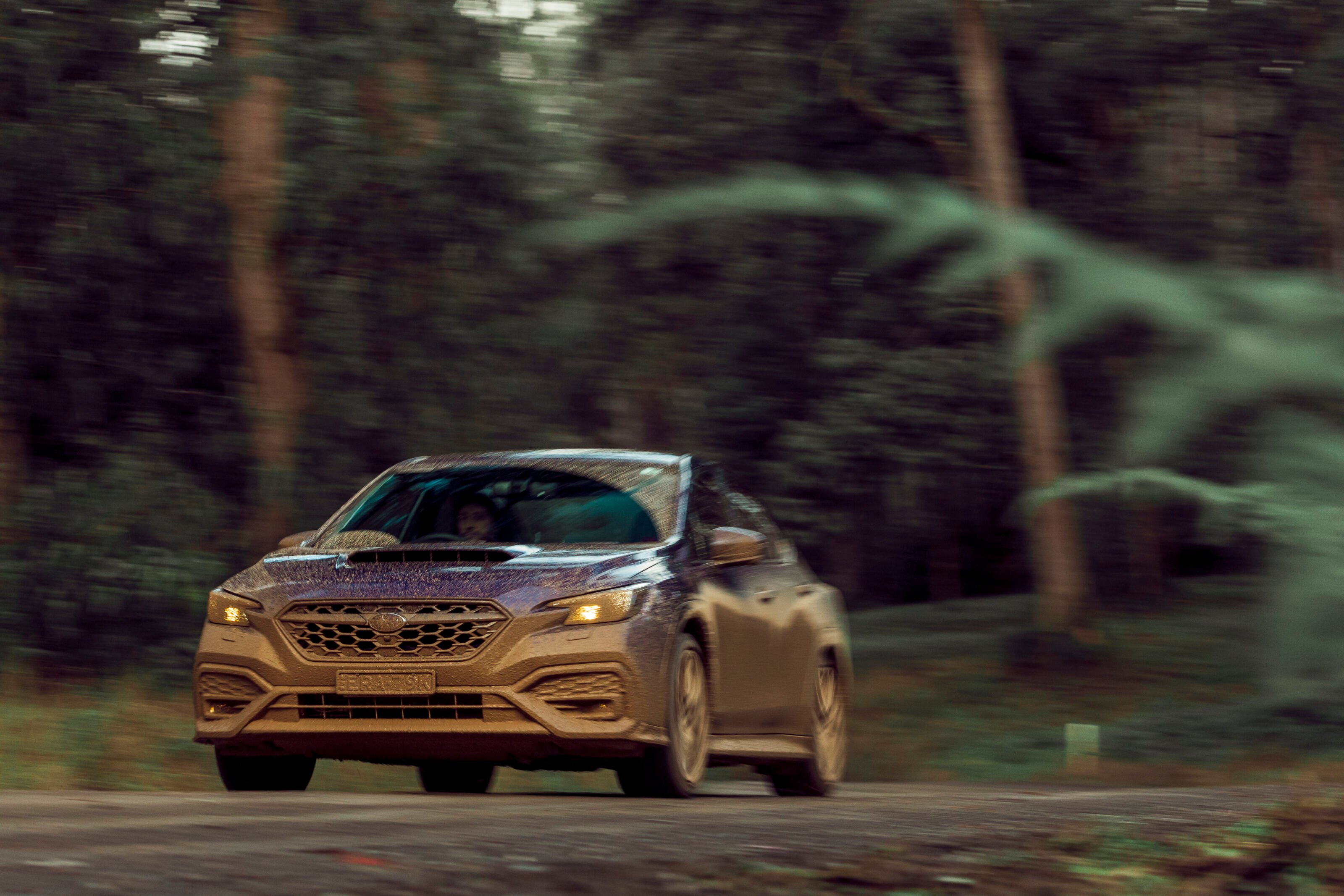
There’s also the Subaru WRX RS ($50,490 plus on-road costs) to consider. With its rally heritage and available six-speed manual transmission, the WRX remains competitive in this company, although it misses the GR Corolla’s Torsen differentials and powertrain sparkle.
Interior comfort, space and storage
The GR Corolla may channel Lancer Evolution and Impreza WRX STI vibes, but the cabin doesn’t. There’s no acrid plastic smell and, while the plastic graining and trim colour matching aren’t quite as high quality as, say, an Audi S3, the Corolla’s materials are up to the task.
In design terms, the GR apes the regular Corolla with its jutting and slightly dated dash fascia. Storage isn’t incredible, with two cup holders, a small wireless charging tray to store your phone, and door pockets big enough for a 700ml bottle – the GR Corolla’s manual handbrake means no armrest or covered storage either.
As the GR is based on the updated Toyota small hatch, it gets the new-look infotainment system running on an 8.0-inch touchscreen as we first saw in the Corolla Cross. The UI is improved if still clumsy, so it’s best to run wireless Apple CarPlay (or wired Android Auto).
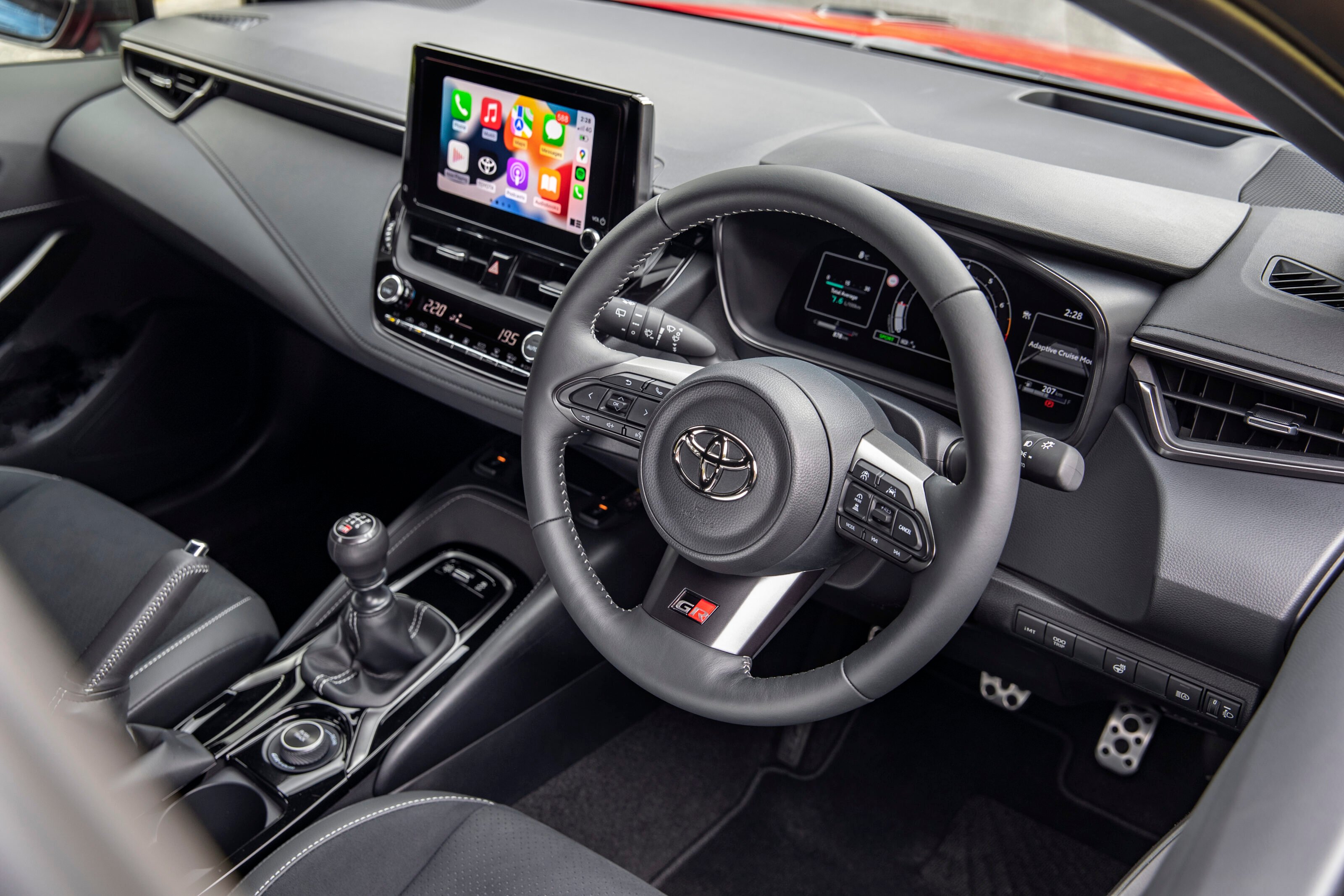
No further complaints, because the GR Corolla’s manual, suedecloth-appointed, figure-hugging bucket seats are very comfortable. The driving position is more natural than the high-set Yaris (it’s 25mmm lower, says Toyota), and vision out is much improved.
The GR Corolla’s gear shifter, steering wheel, and important controls fall easily to hand – it’s a place of business – and each control action is expertly matched in its weight with the next.
A 12.3-inch digital driver’s display is lifted from the cooking Corolla ZR with a new skin for GR use showing a big circular tacho or a sideways one when driving in Sport mode.
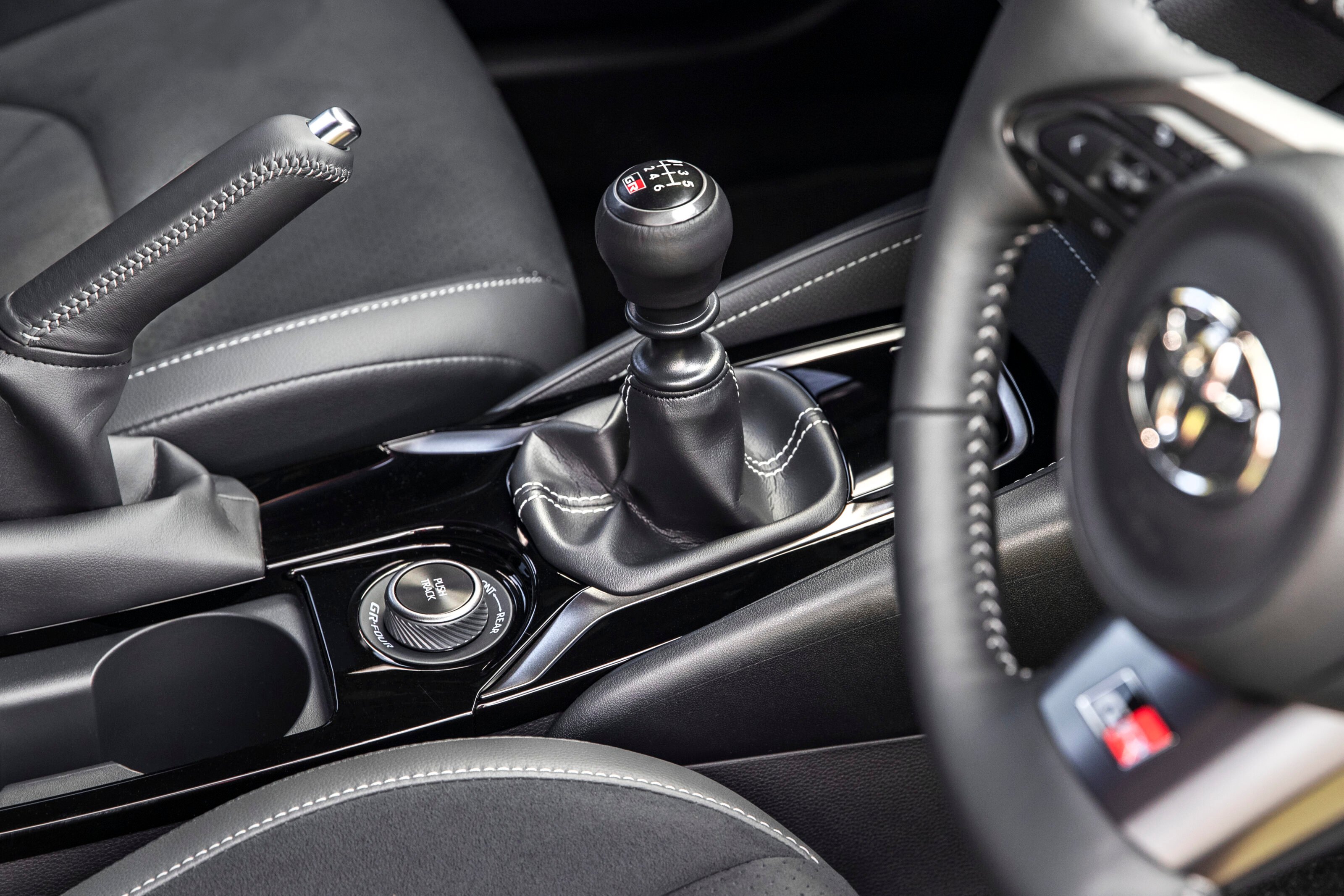
While the Corolla’s back seat has never been its forte, compared to the three-door GR Yaris it’s a revelation. Space is OK for someone under 180cm, though toe room is pretty tight and not much light makes it back there.
The boot is a similar story, measuring a measly 213L (VDA) although it is 50 per cent bigger than that of the GR Yaris. There’s no spare tyre, unfortunately, nor are there any bag hooks, just four tie-down points for netting.

What is it like to drive?
Living up to expectations in a high-performance family is no easy task. Take Zak and Harry Bates, both have grafted hard, growing up under dads who won countless trophies on dirt and tarmac – and it’s paid off. They’re at the pointy end of the GR86 and ARC racing series respectively (and both adept at making journos feel rather slow on the racetrack).
Much like the Bates family, then, Gazoo Racing’s high-performance DNA runs rich through the GR Corolla. You can tell before setting off this is a serious car, as at idle the revs rise and fall gently as though a more aggressive-than-usual cam is fitted.
Start turning wheels and it’s immediately obvious how grown-up the GR Corolla is after the Yaris. Not in its engineering per se, but in its more assured stance on the road; each tyre weighted with extra mass compared to the flighty Yaris.
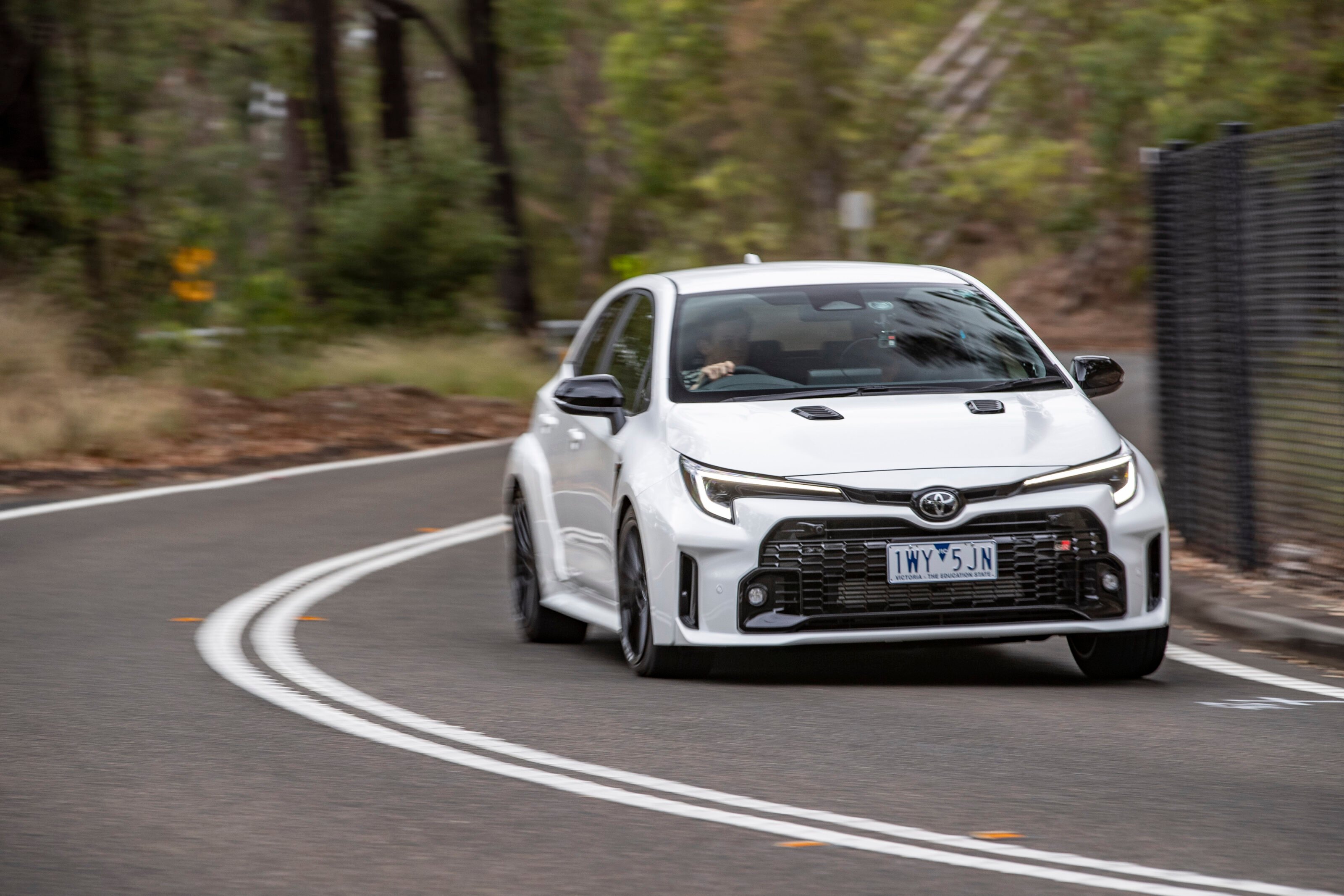
That’s no surprise, because even with some choice lightweight parts – such as the cast 18-inch Enkei alloy wheels – the wide-track Corolla is 205kg porkier than the Yaris, weighing 1485kg. It’s also all TNGA-C, rather than a mix of GA-B and GA-C as in the smaller car.
When you start opening up the GR Corolla’s lungs, the powertrain’s different character comes to the fore. Toyota didn’t just tweak the ECU to get 21kW more grunt out.
The Corolla’s G16E-GTS enhancement program includes 10 per cent more boost, better oil and water cooling, a stronger fuel pump, uprated injectors, freer-flowing triple-exit exhaust and deletion of the GR Yaris’s sound symposer.
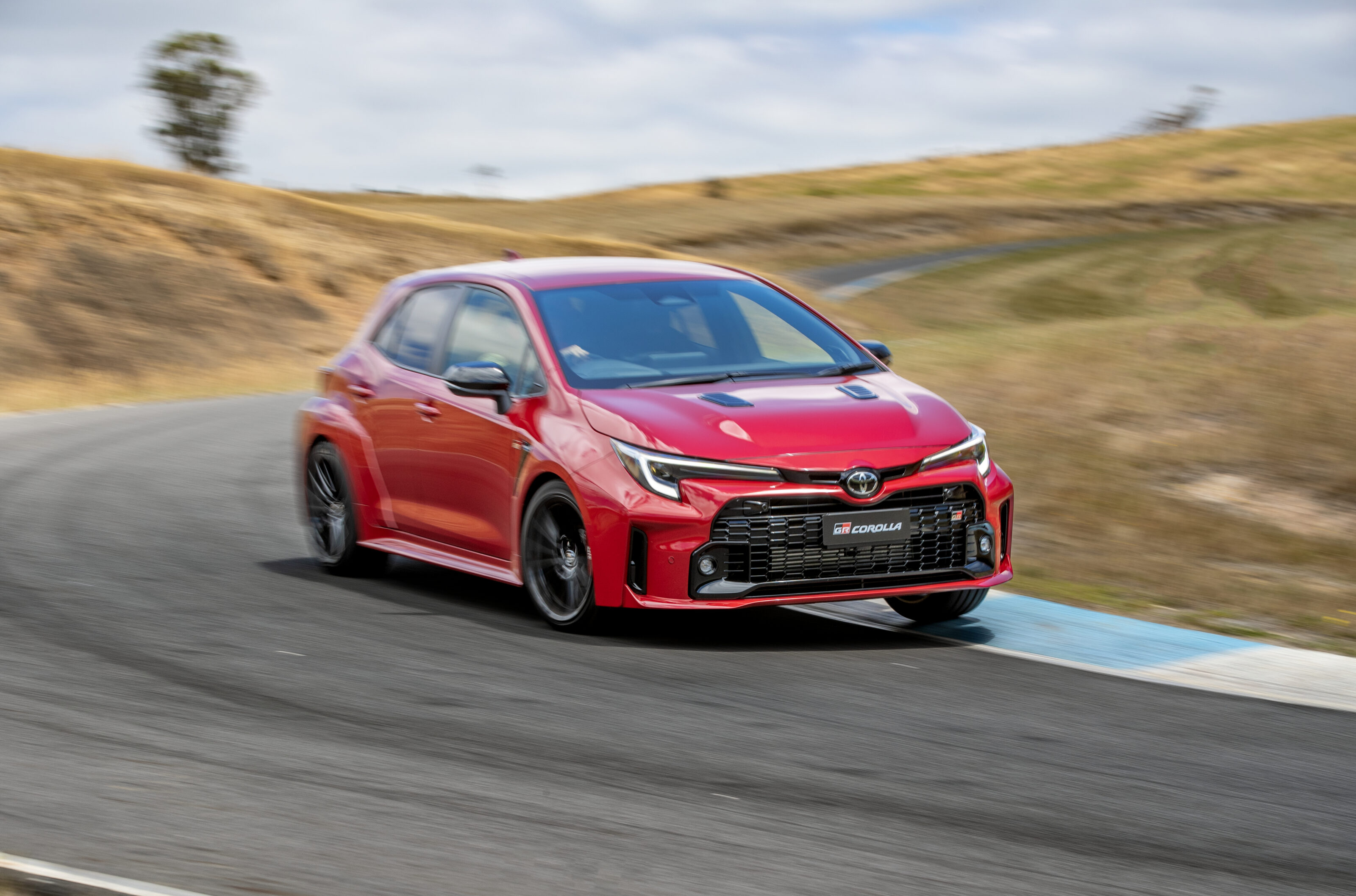
Combined with a shorter final drive ratio, moving the torque peak from 3000-4600rpm in the Yaris to 3000-5500rpm in the Corolla lends it extra urgency above 3000rpm, but that extra weight dampens the Corolla’s shove below 3K. The result is a boostier-feeling car.
Far from a criticism, it’s actually a good thing in these times of instant gratification. It makes the drive exciting (dare the word analogue be rolled out?) and engaging.
Pulling out the Yaris’s sound symposer adds to GR Corolla’s old-school feel. It’s not vocal in the way a Hyundai i30 N is, or even a Golf R, but it’s loud in other ways: mechanical sucking and chuntering; honest (if not always sexy) noises.
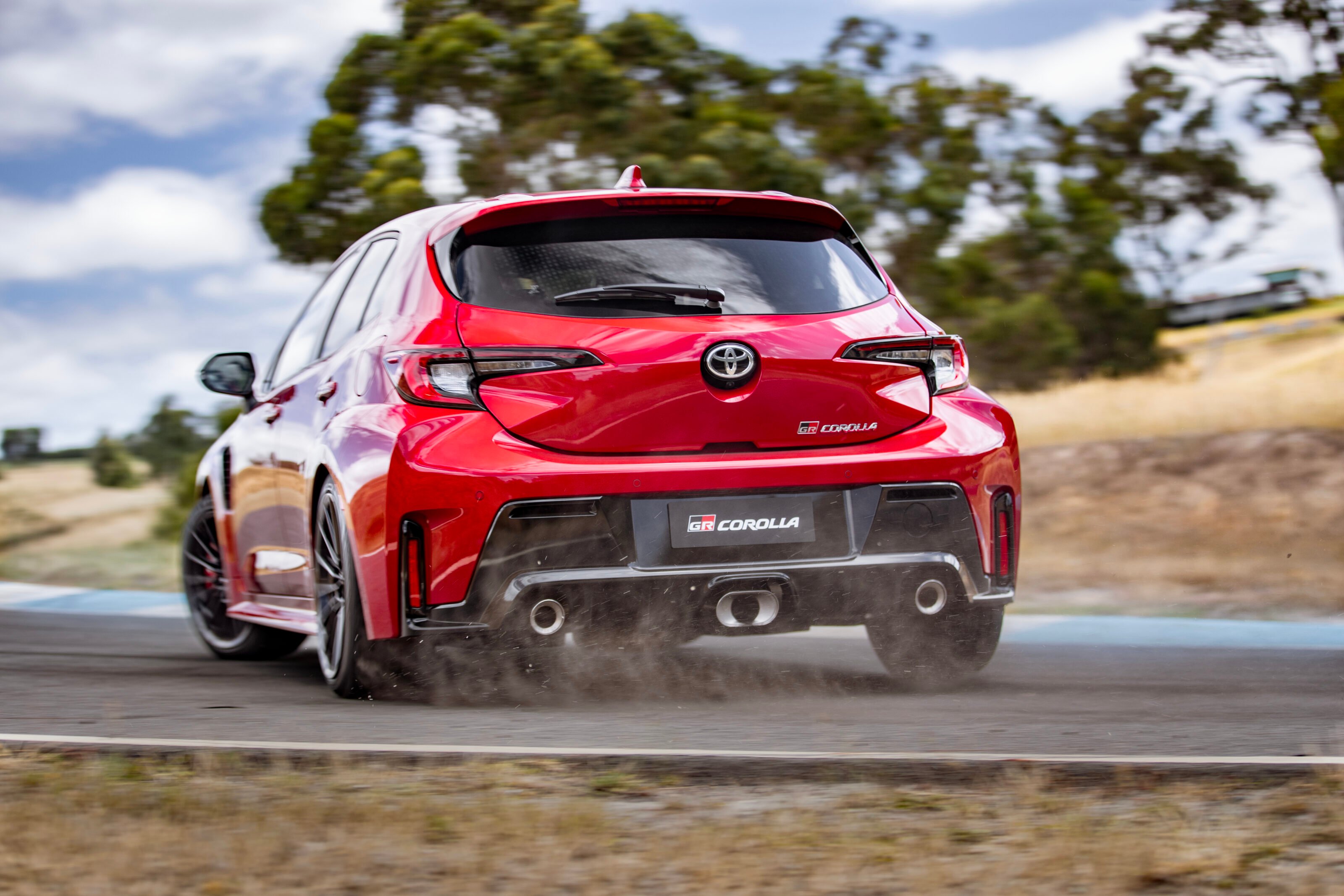
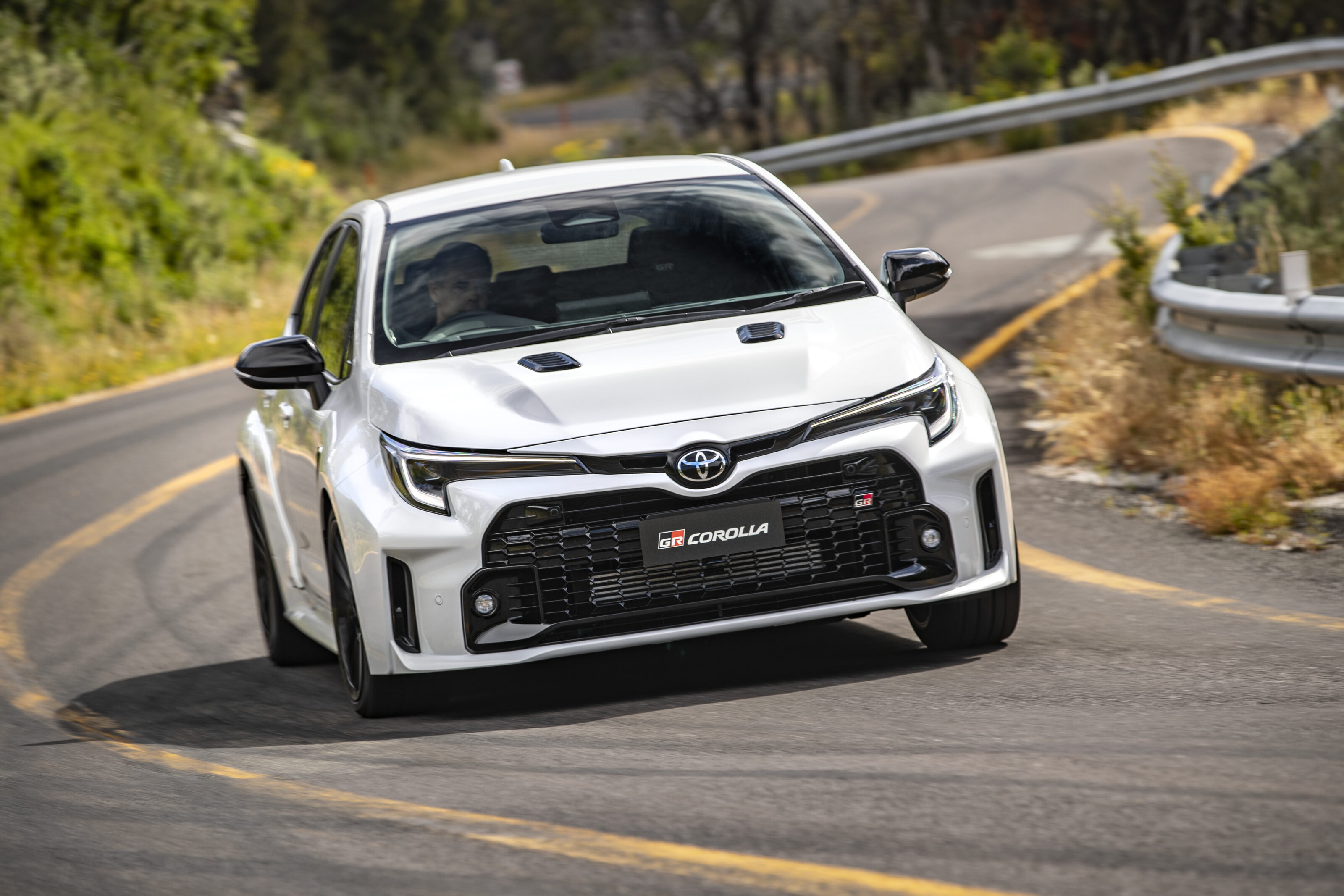
Although on-road time was short, and mainly about feeling whether the firmly sprung Corolla can shrug off body roll, it also proved the car’s ride is agreeable. There’s no Mitsubishi Evo tooth-rattling here. It’s even pretty refined on its high-performance 235/40R18 Yokohama Advan Apex V601 tyres.
If there’s one complaint, it’s that the GR Corolla’s drive modes feel redundant. Without electronically controlled dampers or a switchable exhaust, Sport just adds weight to the Corolla’s steering and makes it feel more leaden on the road. There’s also auto rev-matching, though the pedals are so well-placed that you probably won’t need it.
Sport mode for the centre diff, however, does work. It shifts the rear-biased torque split from 40:60 to 30:70, encouraging a hint of on-power rotation.
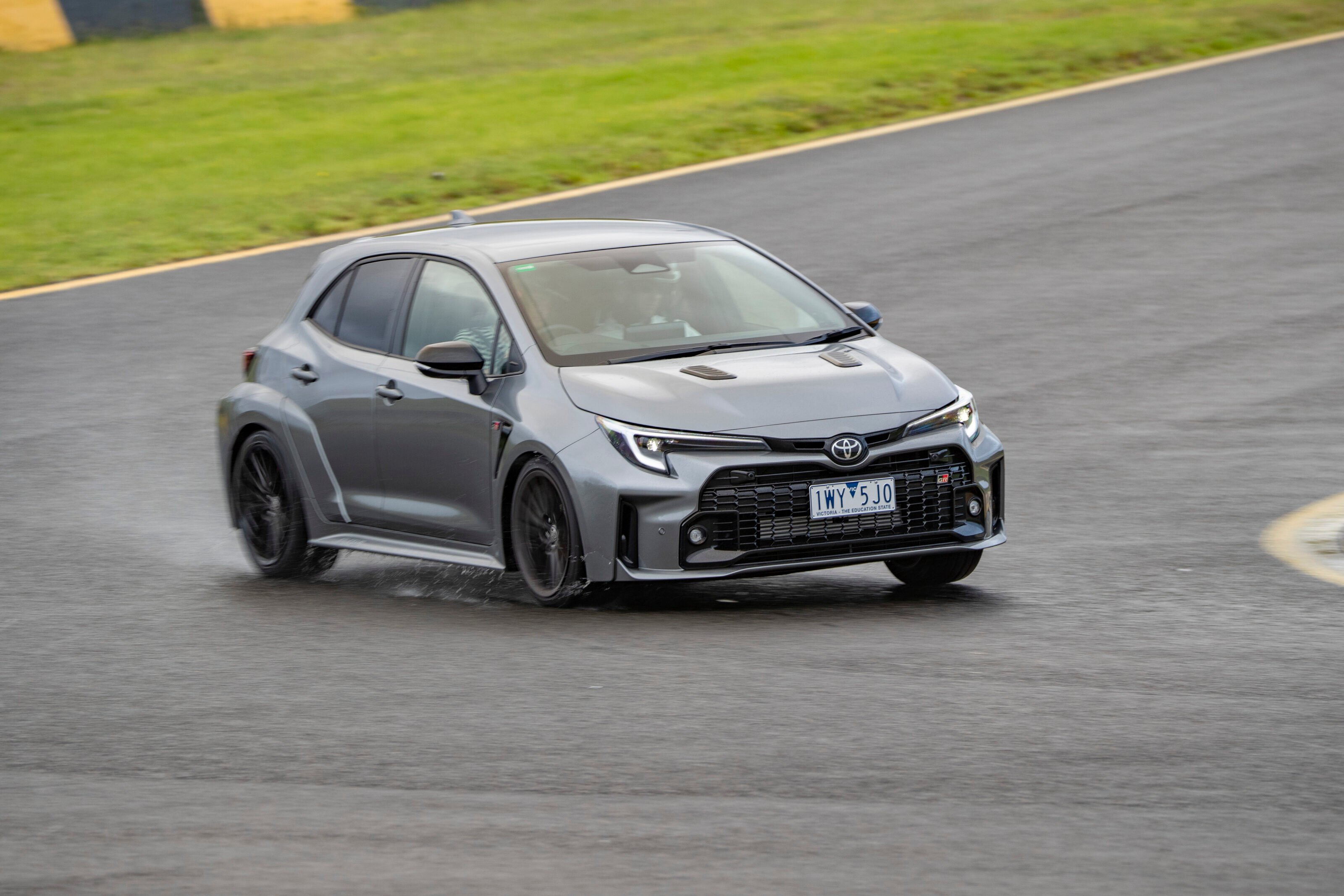
By the time we reached the technical South Circuit at Sydney Motorsport Park, the clouds had opened up, rendering the surface damp and typically unpredictable. The kind of conditions that can shatter a driver’s confidence in a poorly set-up car.
On the Bates’ recommendation, the GR Corollas had ESC set to more relaxed ‘Expert’ mode (how flattering) and the diff set to Track – a 50:50 torque split.
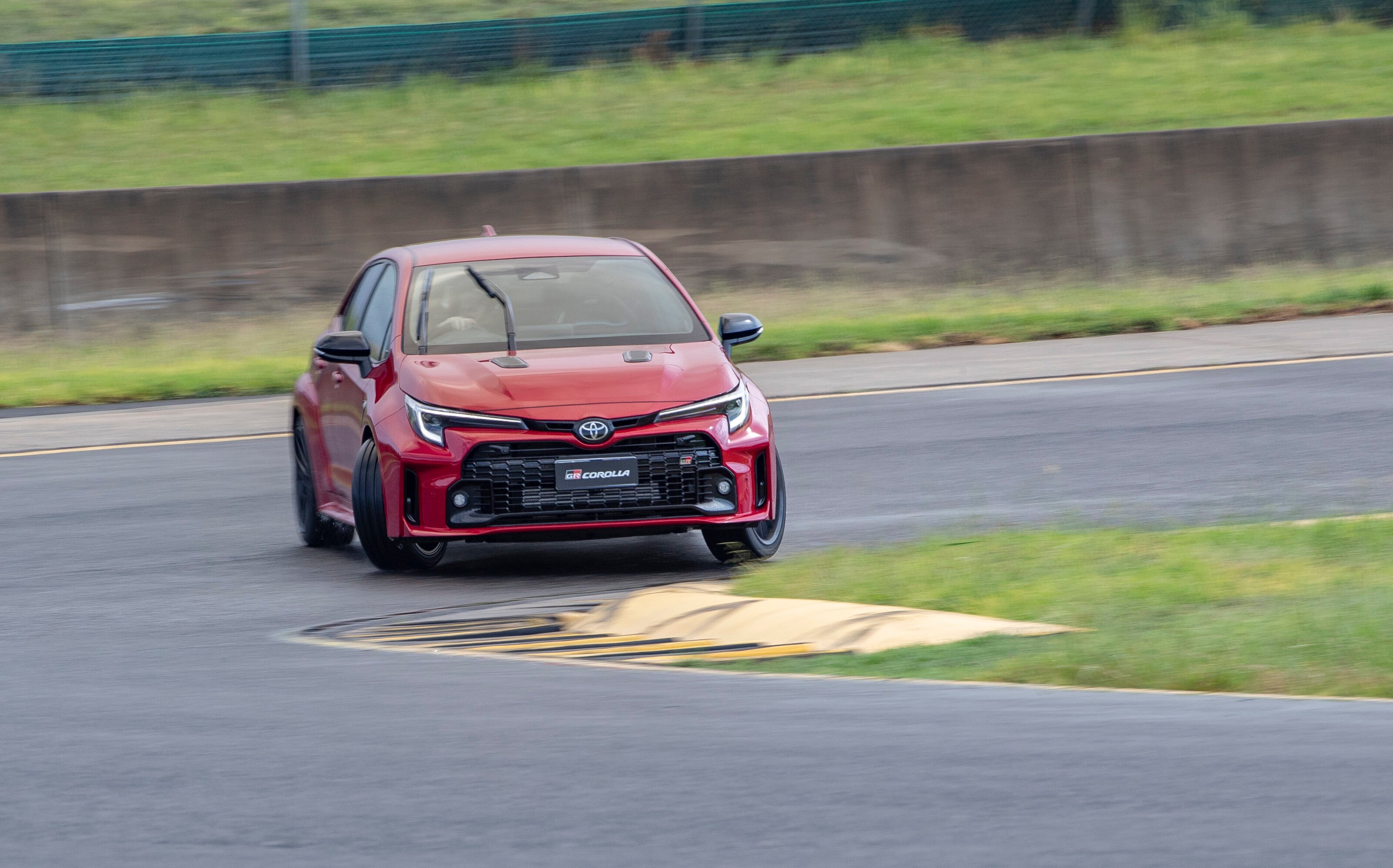
And what a pleasure the GR Corolla is to drive in inclement conditions. Changing grip levels are no match for its accurate steering, communicative chassis and pointy front end.
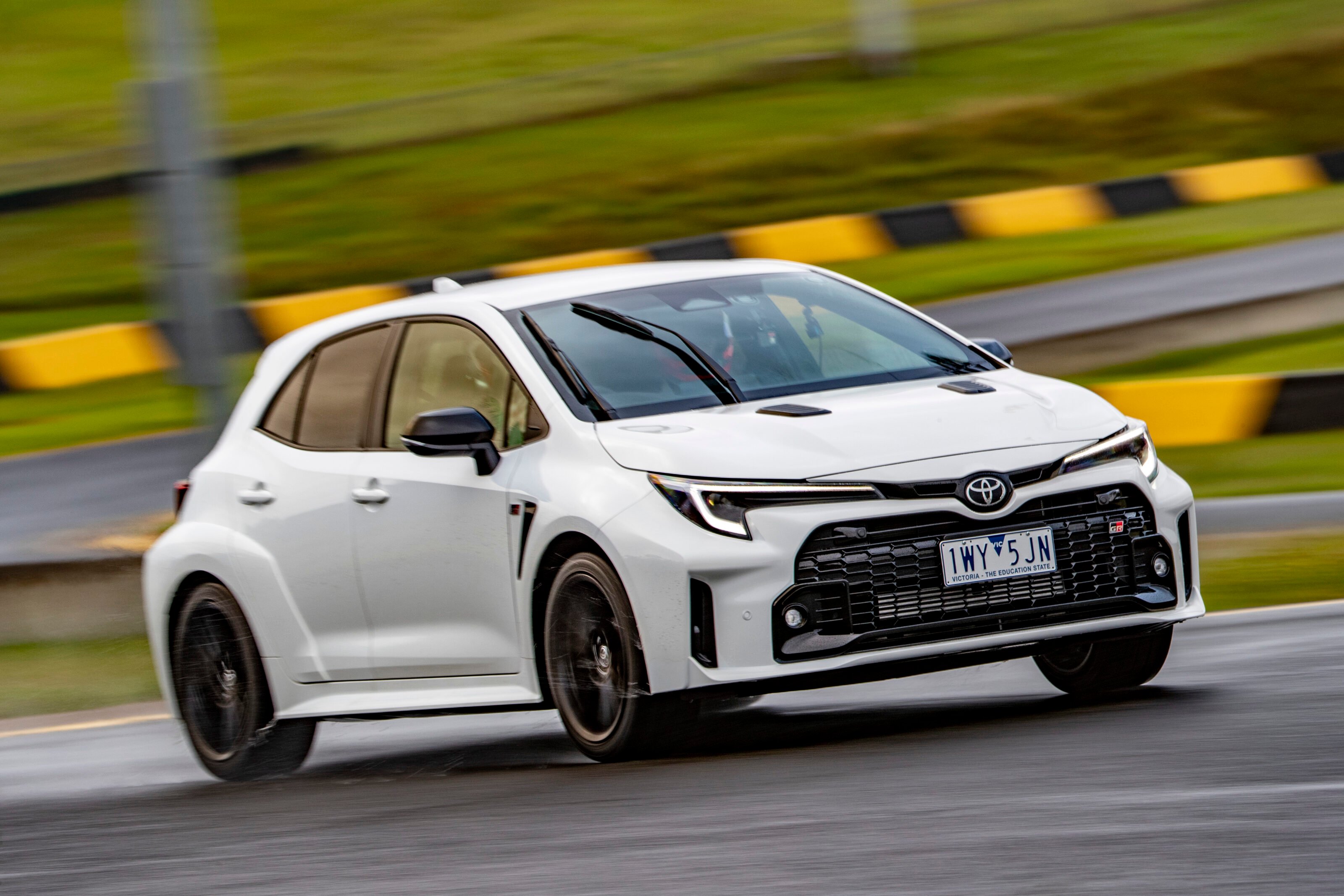
A particular highlight is the deft ESC; if you get greedy on the throttle, the nannies smoothly limit any slip. What it does allow (seemingly without limit) is over-rotation on turn-in – exactly what you want in this kind of vehicle. Once the nose is pointed towards the apex, simply nail the gas and let the LSDs effortlessly tug you out. It’s a magic feeling.
That’s part of the GR Corolla’s ‘analogue’ charm. The Torsen diffs aren’t clever enough to over-drive the outside rear wheel for faux-drifting like an Audi RS3’s electronic items, it’s on you. And that’s fun.
A firm and dependable brake pedal hooked up to four-piston front calipers, a sweet six-speed manual transmission with a friendly clutch, and rev-matching (should you like) finish off the GR Corolla package a treat.
How much fuel does it use?
The GR Corolla slurps premium 98 RON unleaded at a rate of 8.4L/100km on the combined ADR cycle. We were unable to run fuel figures on the launch program, so we’ll have to wait for comparison time.
How safe is it?
Due to the significant chassis and structural differences, the GR Corolla does not carry the cooking model’s 2018 five-star ANCAP rating.
To offset that, the GR gets a host of driver assistance features, including:
| 2023 Toyota GR Corolla active safety features | |
|---|---|
| 7 airbags | Lane trace assist |
| Adaptive cruise control | Rear cross-traffic alert |
| Blind-spot monitoring | Rear parking sensors |
| Front parking sensors | Reverse camera |
| Lane departure warning | Traffic sign recognition |
| Forward auto emergency braking with pedestrian, cyclist and junction detection | |
Warranty and running costs
The Toyota GR Corolla is covered by a five-year, unlimited-kilometre warranty.
Unlike Hyundai, Toyota does not market its warranty as track-inclusive. When pressed, executives said that the use case of the GR Corolla is understood intimately, and any warranty claims will be assessed on a case-by-case basis.
Part of this is more regular service intervals than your average Corolla. Toyota (wisely) advises maintenance every six months or 10,000km. The first six services are capped at $300 per visit, for $1800 over three years or 60,00km.
As if a sign of proof, GR Corolla chief engineer Naoyuki Sakamoto was taking media for hot laps and coming back repeatedly with smoking hot brakes. The car has been engineered to perform under hard, but not abusive, use.
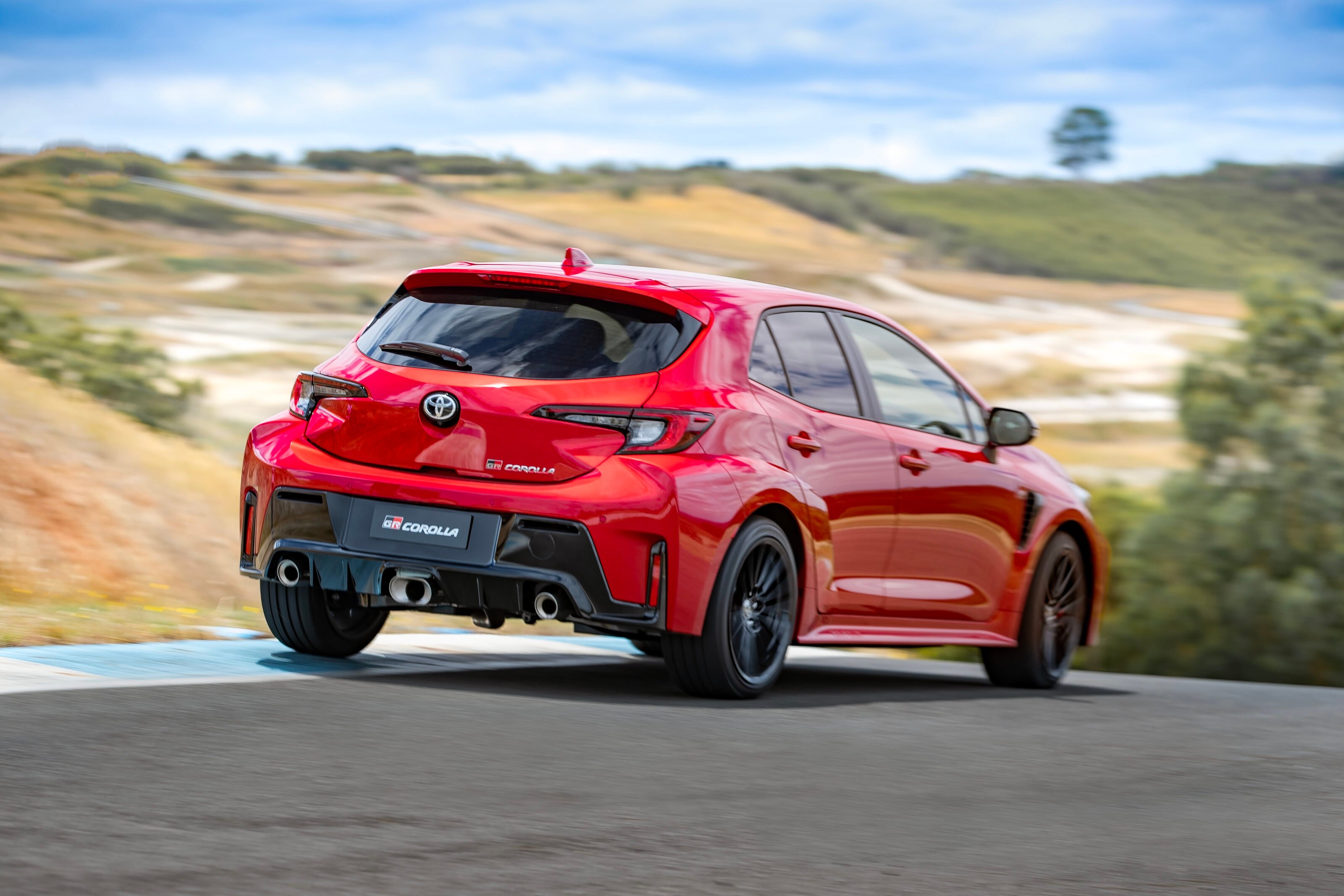
VERDICT
There was a danger that Toyota would swap out the Toyota Corolla’s efficient hybrid with the GR Yaris drivetrain and call it a day, paying little attention to distinguishing it from the smaller rally-bred car.
It has, thankfully, gone further. The GR Corolla is a more grown-up vehicle than the Yaris. There are usable seats for friends or children, a boot big enough for the weekly shop, uncompromised vision out and crucially, it has a different character.
The Corolla may only be a homologation pretender, but it’s not wanting for rally-bred charm. That unaugmented soundtrack and raw driving experience makes us think this might be one of the last mass-production cars we’ll ever call ‘analogue’.
If you’re thinking about putting your name down to order one, you had better do so quickly. With only 700 to sell in the first 12 months, and a driving experience this good, the GR Corolla is going to have lines around the block.
Does that make the GR Corolla the best hot hatch of 2023? Well, we think the Civic Type R might have something to say about that…
| Toyota GR Corolla | GTS | Morizo |
|---|---|---|
| Price | $62,300 + on-road costs | $77,800 + on-road costs |
| Drivetrain | ||
| Engine | 3cyl, 1.6-litre, dohc, direct-injected, turbo-petrol | |
| Layout | front engine, transverse, AWD | |
| Power | 221kW | |
| Torque | 370Nm | 400Nm |
| Gearbox | 6-speed manual, iMT rev matching | |
| Chassis | ||
| Body | steel, 5-door, 5-seat small hatchback | steel, 5-door, 2-seat small hatchback |
| L/W/H/Wu2013B | 4407/1851/1479/2640mm | |
| Track (F/R) | 1589/1624mm (Morizo 1626mm) | |
| Weight | 1485kg | 1440kg |
| Boot | 213L | 229L |
| Fuel/tank | 98 RON / 50 litres | |
| Economy (combined ADR81/02) | 8.4L/100km | 8.6L/100km |
| Suspension | Front: struts, coil springs, stabiliser bar. Rear: Trailing double wishbone, stabiliser bar | |
| Steering | electric rack-and-pinion, 2.4 turns lock-lock | |
| Front brakes | 356mm ventilated discs with 4-pot caliper | |
| Rear brakes | 297mm ventilated discs with 2-pot caliper | |
| Tyres | Yokohama Advan Apex V601 | Michelin Pilot Sport Cup 2 |
| Tyre size | 235/40R18 | 245/40R18 |
| Safety | ||
| ANCAP rating | NA | |
| 0-100km/h | 5.3 seconds (claimed) | 5.2 seconds (claimed) |
