
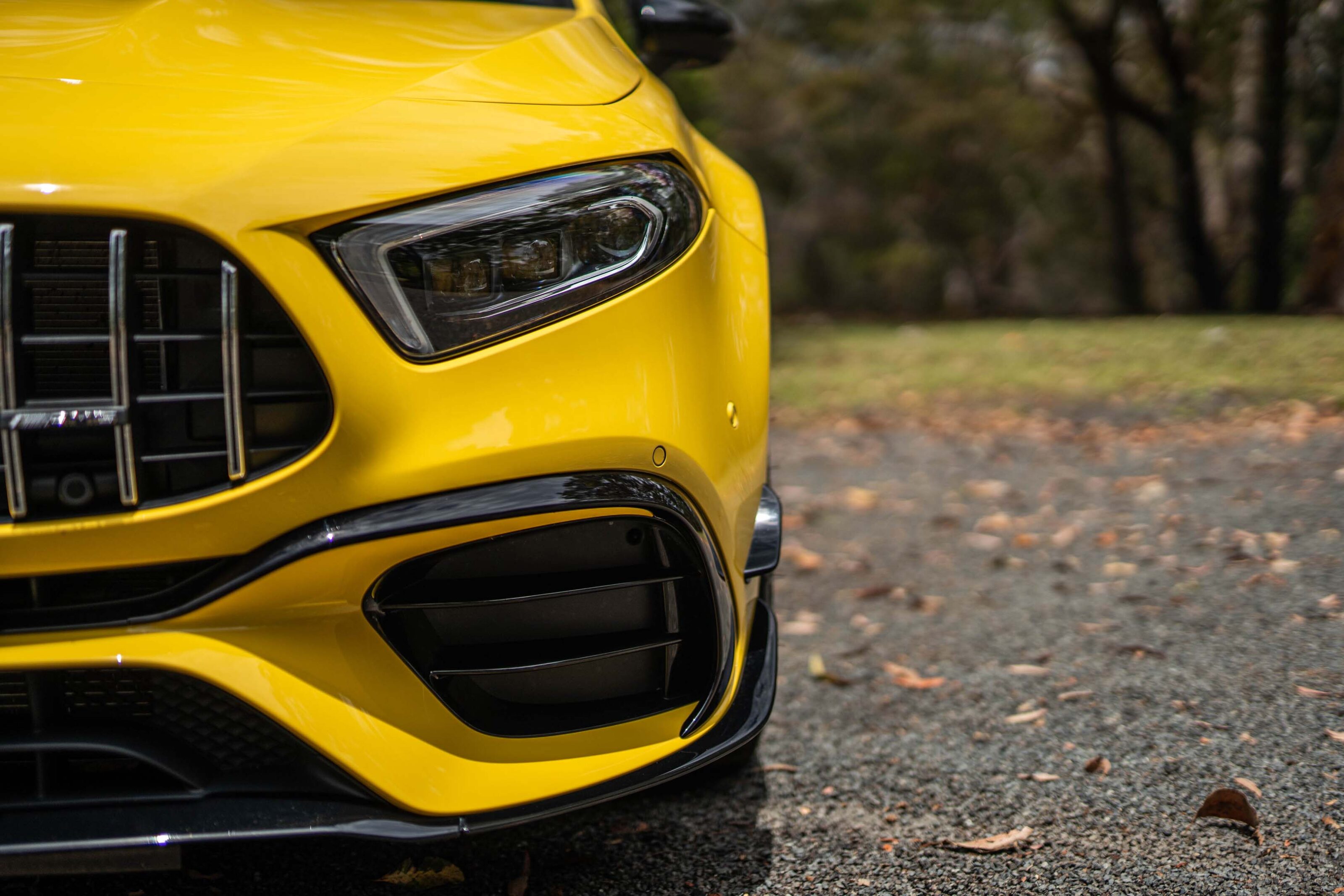
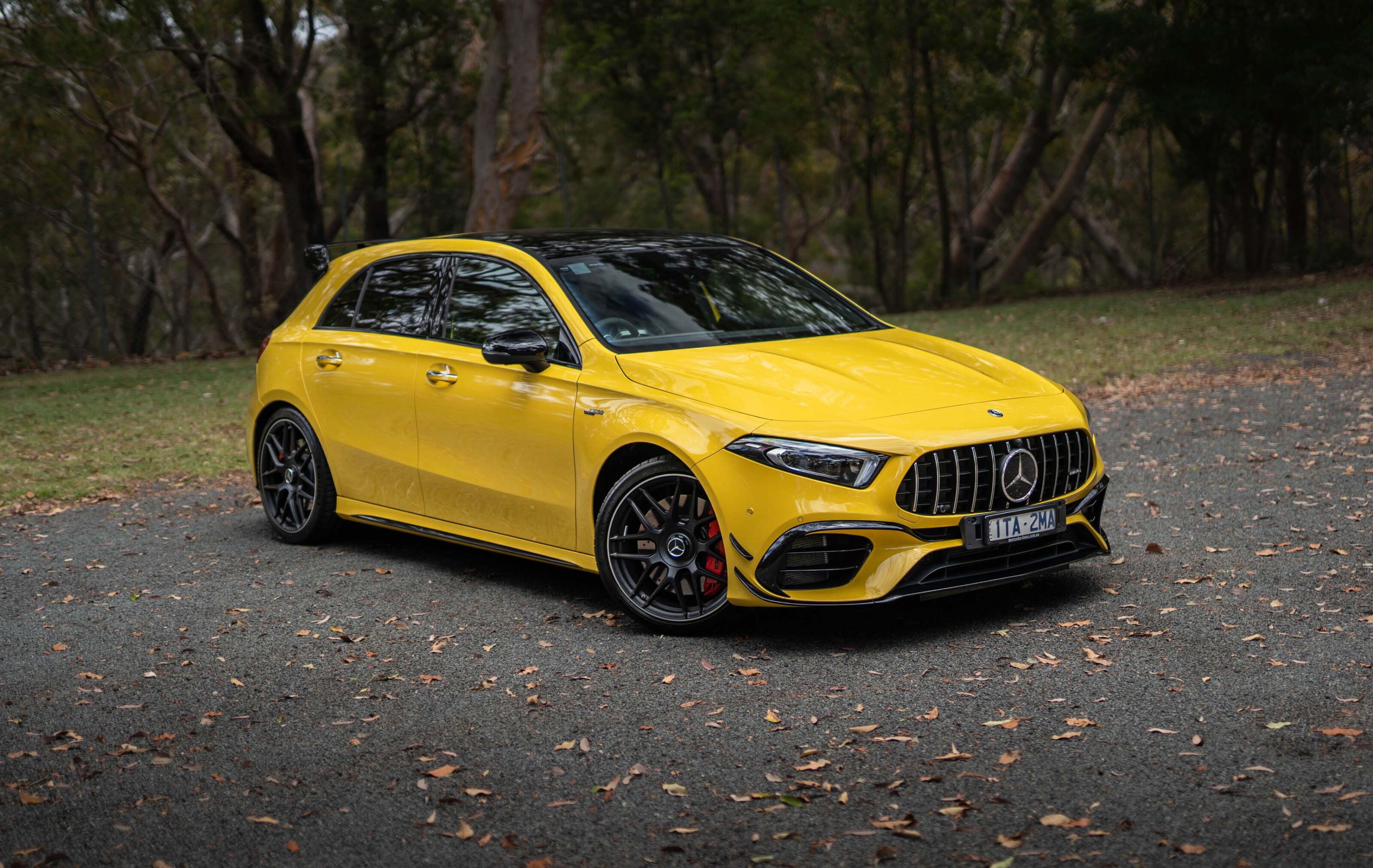
The AMG A45 doesn’t really need the Mercedes-Benz badge at the front.
Everyone knows it’s a Merc, but with those three letters – and, let’s be honest, the two numbers – everyone knows they’re in for a good time.
While the first generation was popular with a certain crowd for its theatrics, it wasn’t that great a car to drive. It was good but it wasn’t great. I once weathered a particularly nasty week of comments after I suggested the driver of a late, lamented BMW M140i was having more fun.
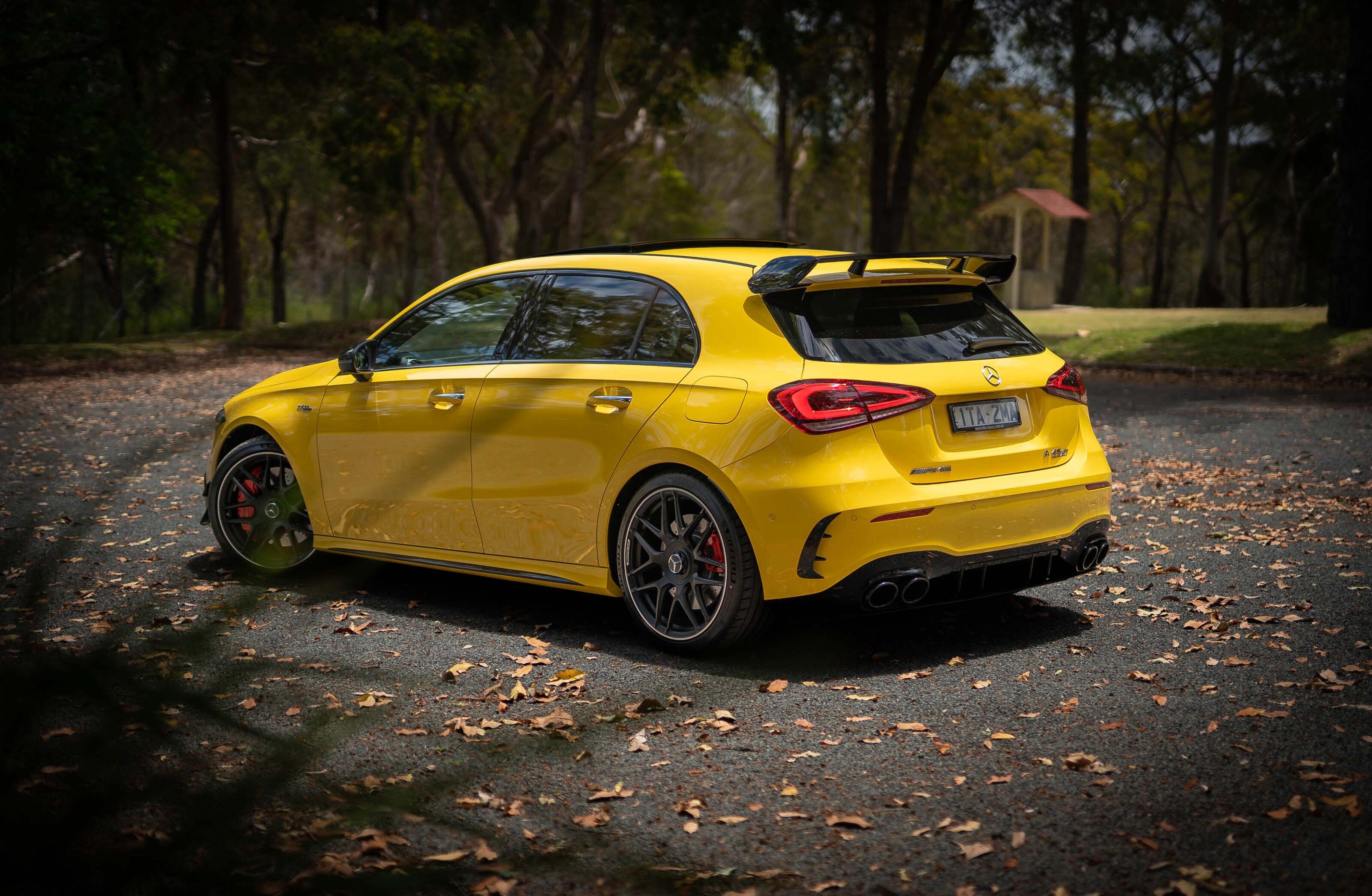
But the second generation of the fawty-fie changed the game. It still extracts colossal power from a small engine and still looks like a hatchback kitted up by someone of slightly dubious taste. Yet a thorough reworking of the driving dynamics means it suddenly becomes fun as well as fast.
A few years later and with a scorching price tag and electrification looming, the A45’s legacy will rest on this car. Let’s see if it will be a good one.
JUMP AHEAD
- How much is it, and what do you get?
- How do rivals compare on value?
- Interior comfort, space and storage
- What is it like to drive?
- How is it on fuel?
- How safe is it?
- Warranty and running costs
- VERDICT
- Specifications
How much is it, and what do you get?
When this car first arrived with its terrifying price tag, we kind of thought Mercedes had lost the plot.
In the general context of 2020, that was to be expected, but when a hatchback’s price tag starts with a nine – 310kW notwithstanding – questions had to be asked.
But the AMG A45 S is now a whopping $106,900 before on-road costs and we barely blinked because, well, all this stuff has happened.
That’s a lot of money for any car but I guess that’s where we are – stuff is hugely expensive at the moment and an already expensive car was only going to get, er, expensiver.
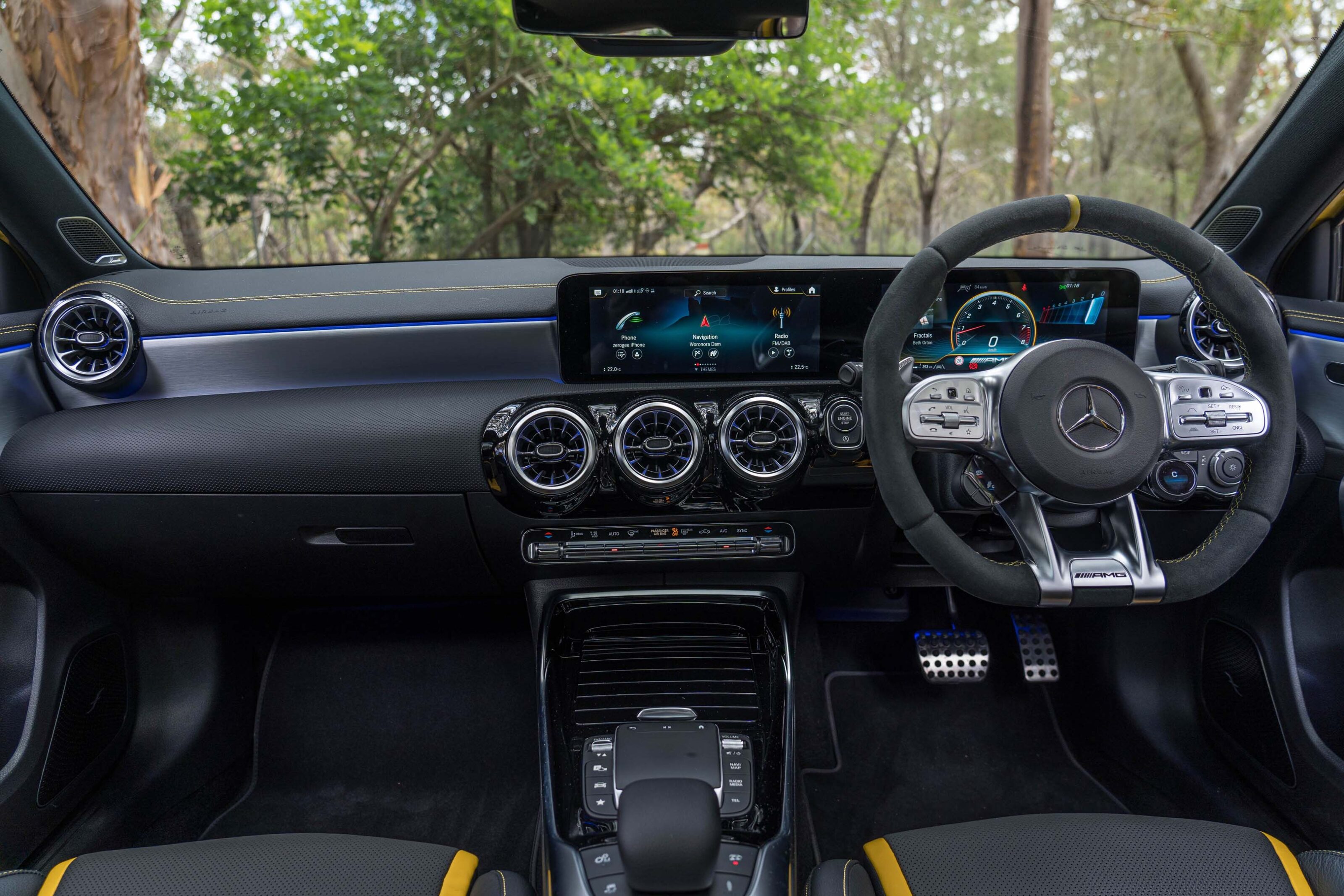
| 12-speaker stereo | Dual-zone climate control |
| 19-inch alloy wheels | Front and rear parking sensors |
| 360-degree cameras | Keyless entry and start |
| Alcantara steering wheel | Partial leather interior |
| Auto LED headlights | Power front seat adjustment |
| Auto high beam | Reversing camera |
| Auto parking | Satellite navigation |
| Auto wipers | Tyre repair kit |
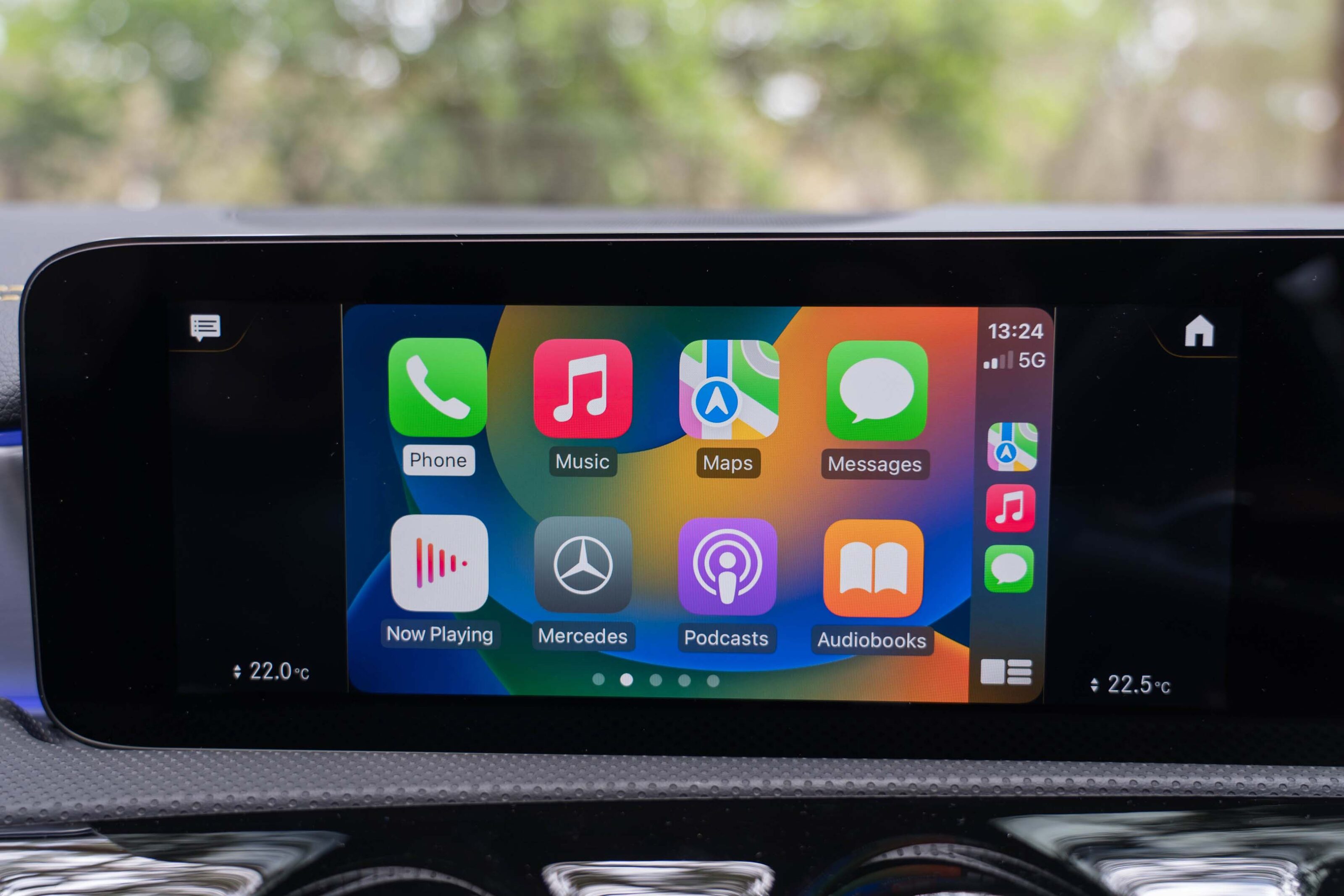
| DAB+ digital radio | Wired Apple CarPlay and Android Auto |
Even after slapping you about with a price north of $100k, your Mercedes dealer will have the cheek to ask you for another $1190 for metallic paint. To make absolutely sure, the bright yellow car you see here is one of just three freebies which also include white and black. The Patagonia Red Bright is $1990.
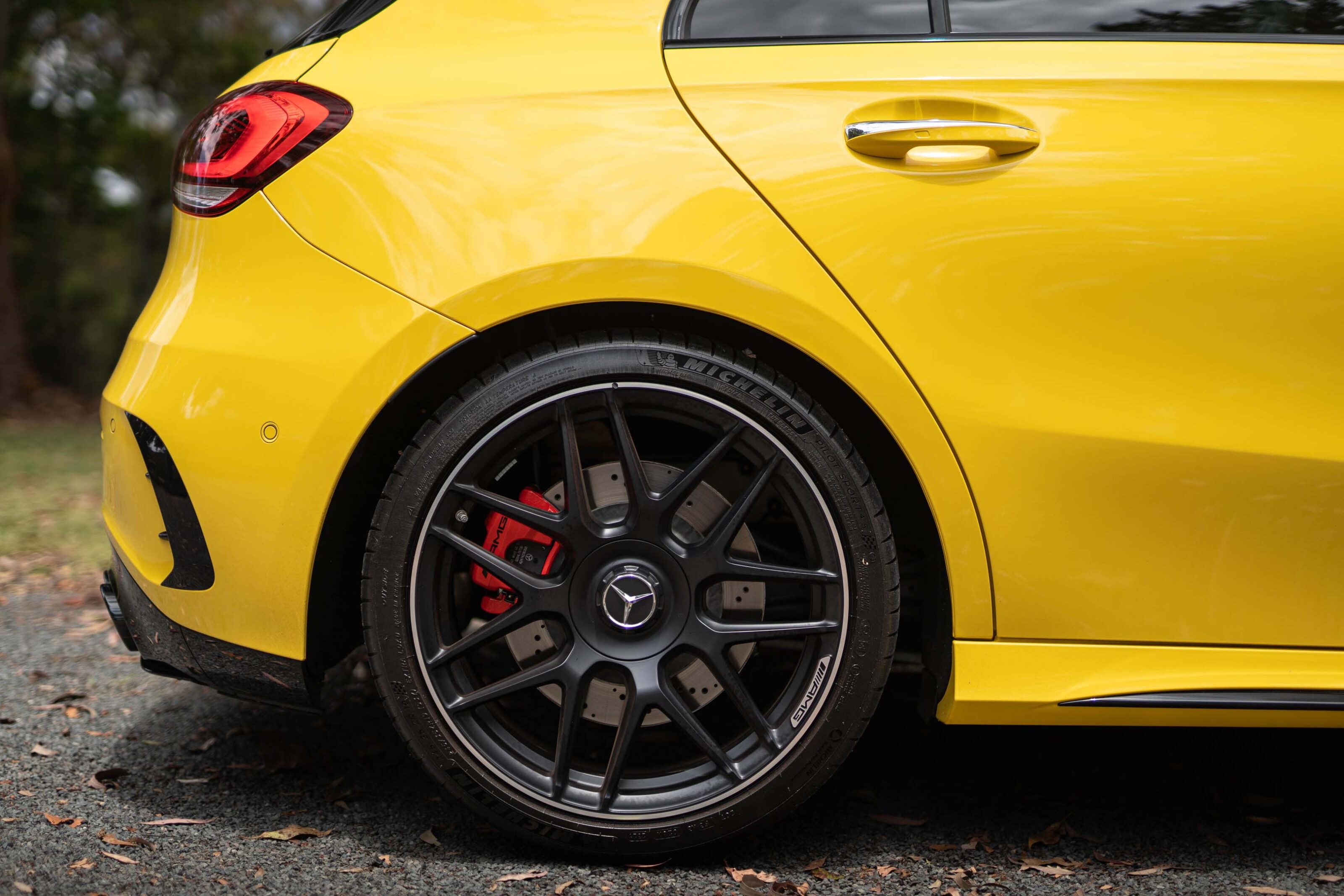
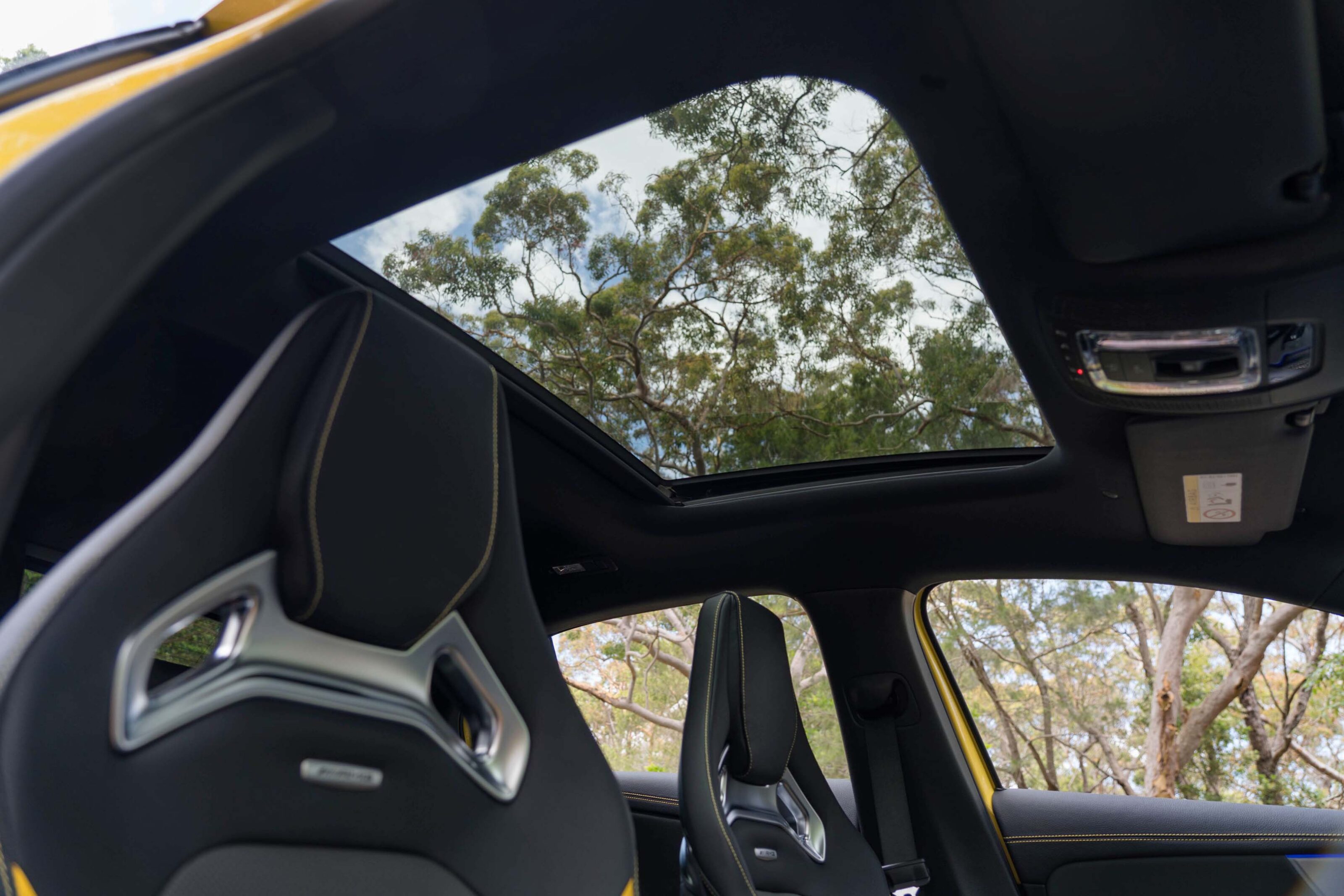
You can also spend a further $5790 on the AMG Performance Package, which adds a very spicy set of front seats that are far more comfortable than the old ones, the very silly aero bits on the outside, and louder exhaust noise in the cabin. You don’t need to worry about any of that; the car goes very fast without it.
Except those seats are excellent and they were fitted to the car I had, so it is with a heavy heart I tell you that it’s probably worth the extra just for them.
How do rivals compare on value?
If you’re looking for a like-for-like as far as rivals go, it’s the Audi RS3 or nothing.
It’s the only one with anything like the power and attitude and it’s a solid $15,000 cheaper for the hatch at $91,400. It’s a ripper of a car, with that tuneful – though quietened – five-cylinder and a newly-sorted chassis.
It also comes in a very loud yellow.
Stretching things a little will take you to BMW’s M240i. All-wheel drive, challenging to look at (and to sit in the back seat), it’s got a deeper-breathing 285kW straight-six turbo and is slightly slower to 100km/h than its German rivals but has that BMW balance.
Interior comfort, space and storage
The A-Class has never been a paragon of spaciousness and nor has it always lived up to the reputation of its maker for interior loveliness.
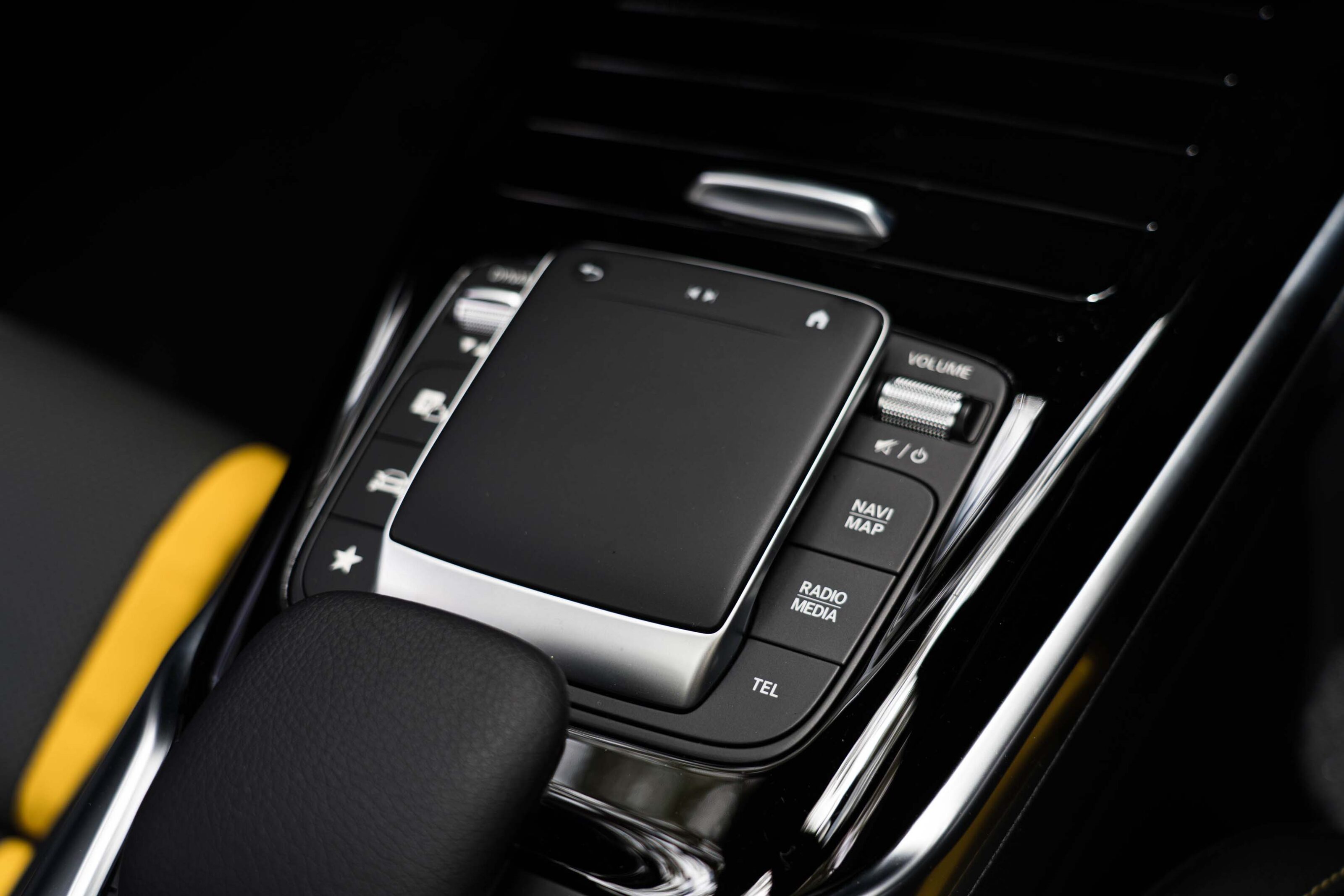
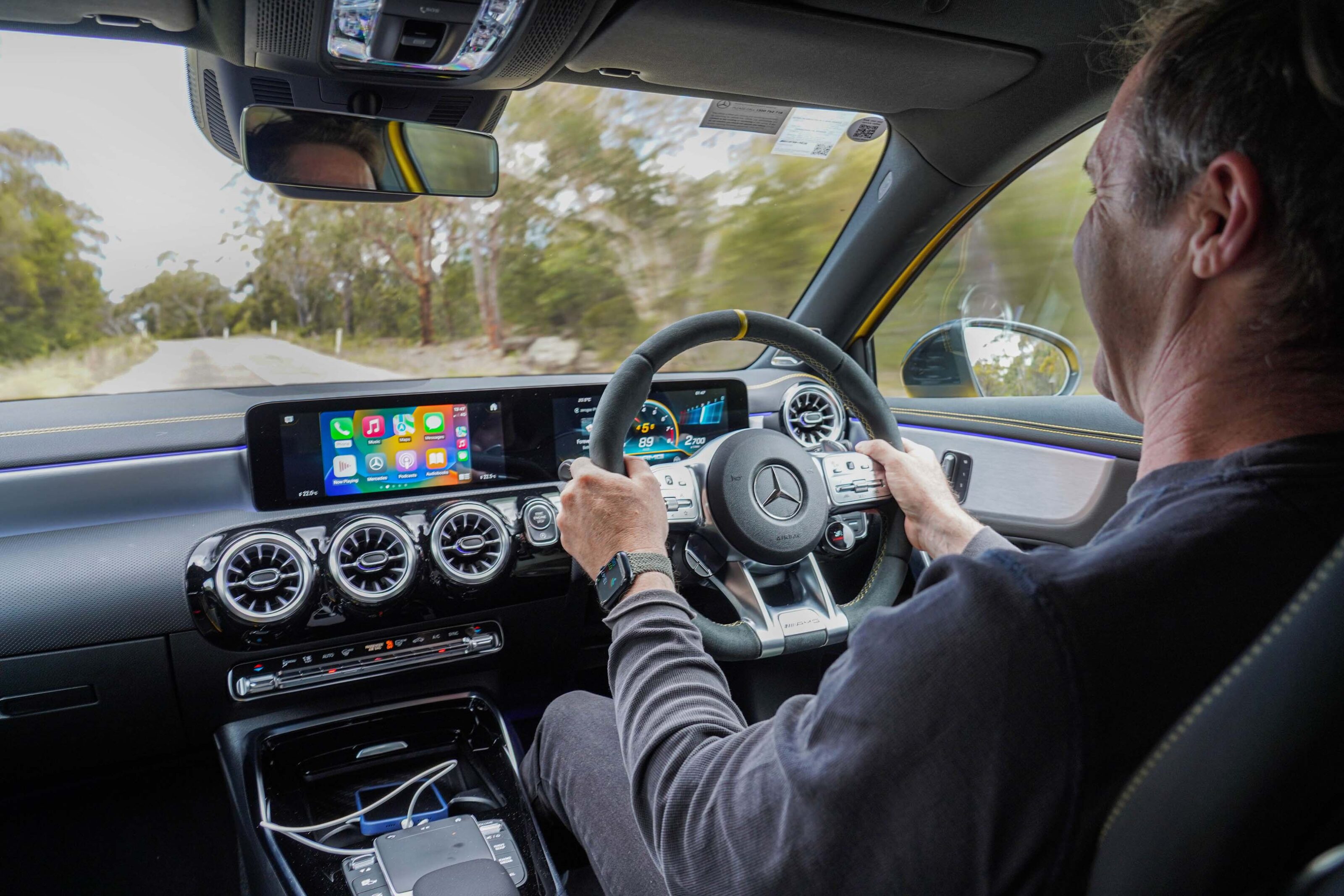
It has a bit much piano black inside and unfortunately, it looks cheap. This is somewhat redeemed by Mercedes’ excellent MBUX twin-screen setup, which projects an image of cutting-edge technology and therefore a bit of a halo of niceness.
The optional front seats are tight-fitting buckets and I love them. They look fantastic and hold you in when you’re going for it so you can get on with the job of twirling the equally lovely Alcantara-wrapped steering wheel.
Piano black aside, some of the switchgear is a bit cheap or scratchy, but the overall impression, especially at night with the cabin lit up with the coloured LED lighting, it’s very nice indeed.
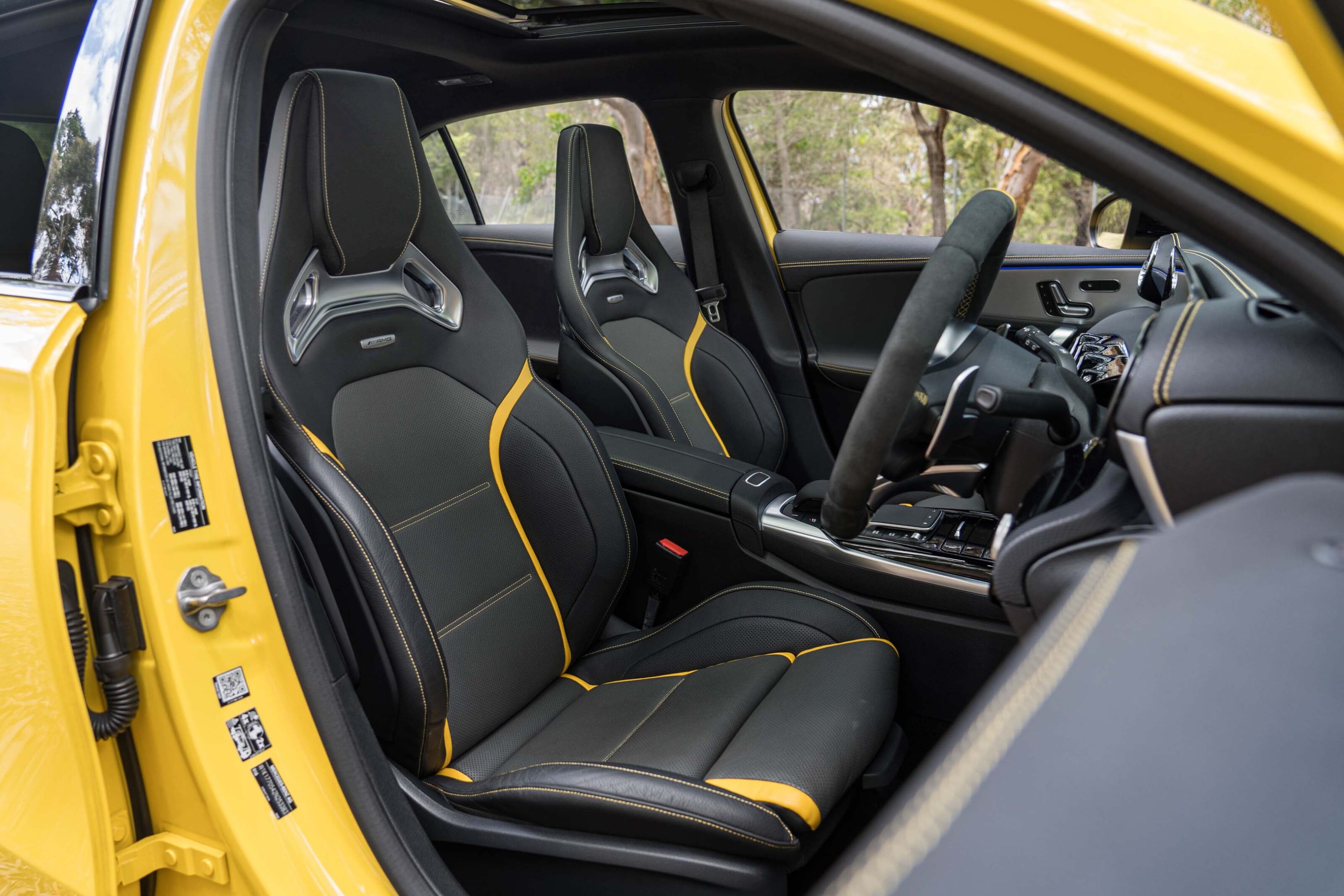
Front passengers share a pair of cup holders, a wireless charging pad, a USB-C port under the HVAC controls and two more in the useful but small under-elbow bin.
The rear seat isn’t much to write home about, but that’s hardly uncommon in either the A-Class or the segment as a whole. The centre rear armrest folds down to reveal a pair of cup holders and all four doors have door pockets of variable usefulness.
Headroom in the back is fine but the seats could be a little better shaped given the purpose of the car. It might even be worth AMG turfing the middle seatbelt and making the rear seats more bucket-like.
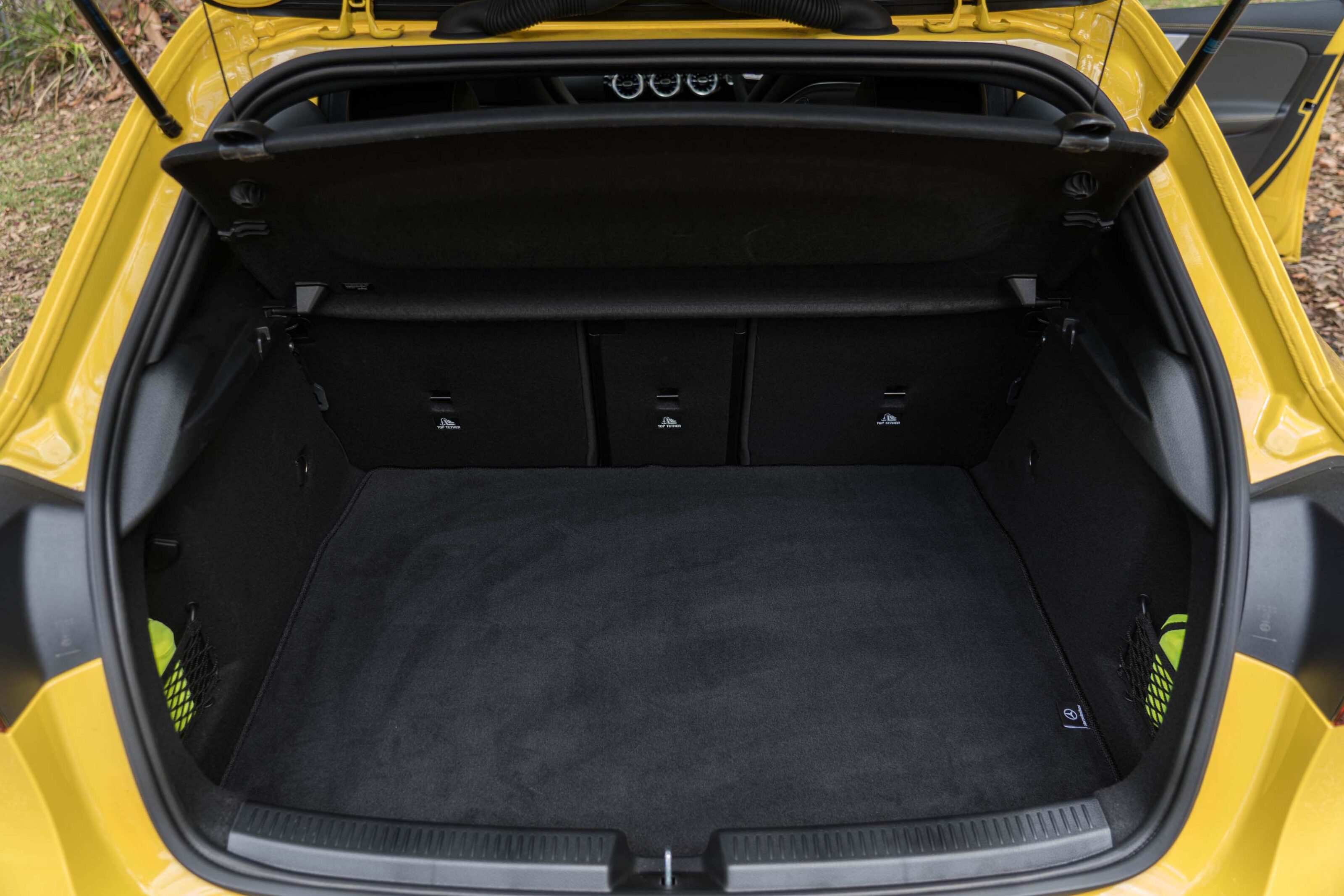
Behind the hatch is a surprisingly large-looking boot with a reasonable 370 litres to start with and a pretty good 1210 litres with the seats folded away.
What is it like to drive?
One of the other headline figures of this car is the weight – a portly 1635kg at the kerb, which is mid-size SUV levels of heft. Does it feel like that? Not a bit.
| Drive | all-wheel |
|---|---|
| Engine | 2.0-litre four-cylinder turbo-petrol |
| Power | 310kW @ 6750rpm |
| Torque | 500Nm @ 5000-5250rpm |
| 0-100km/h | 3.9sec (claimed) |
| Transmission | 8-speed dual-clutch |
Achieving the feeling that it weighs considerably less takes a bit of doing, but AMG’s hoongineers have done it. It used to be that performance cars had pointlessly meaty steering but with the advent of electric assistance, several brands seem to have decided that lighter steering is better.
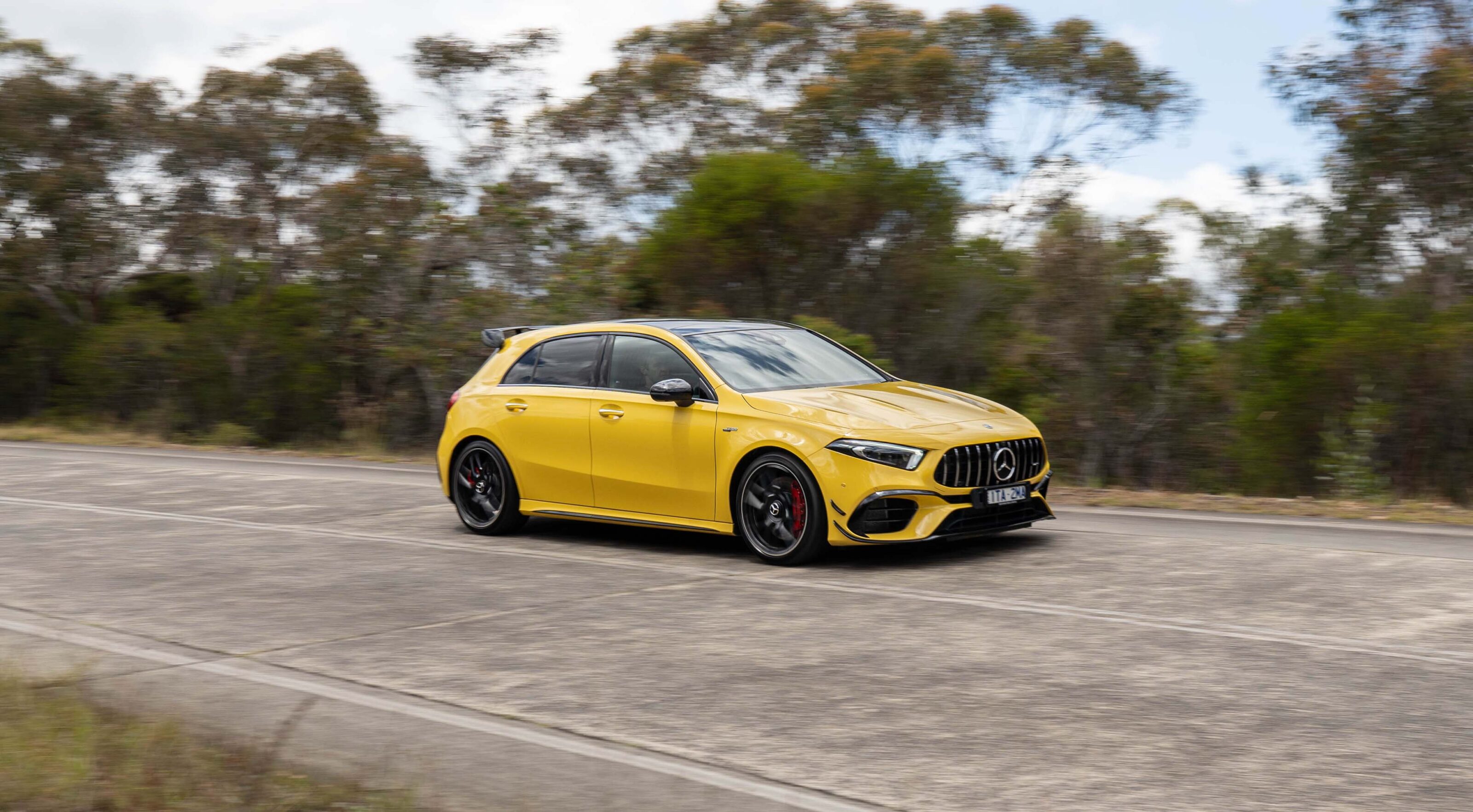
Probably my main criticism is that the A45’s steering isn’t overly communicative, but I’ll take sensible weight any day.
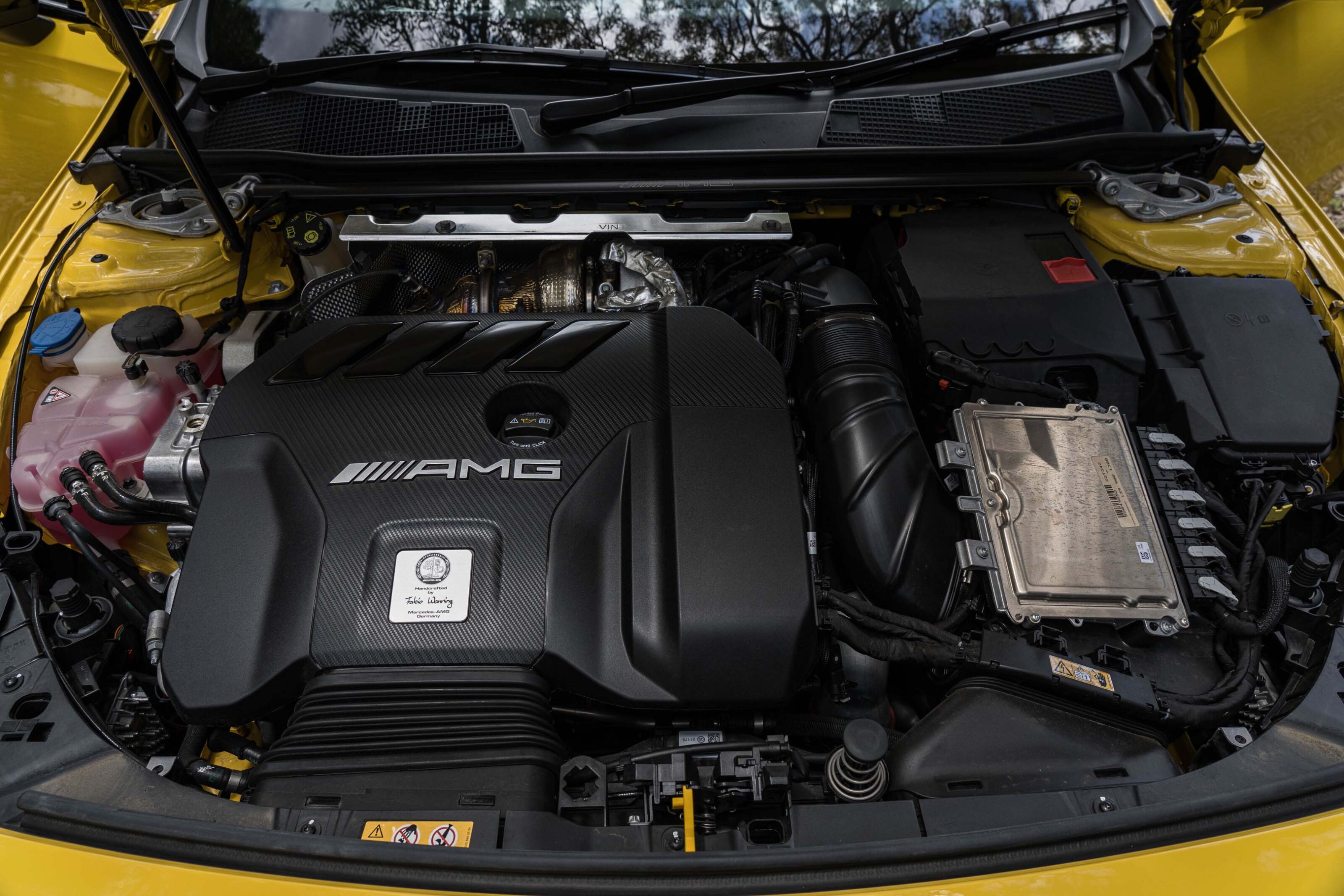
The driveline absolutely dominated the old car but here it’s more part of the ensemble. That’s saying something because, with a staggering 310kW from the 2.0-litre M139 (just check out the size of the turbo) and a colossal 500Nm, it could have just been the same thing all over again.
In a way, the fact it’s a bit less obnoxiously and gloriously loud probably helps make it feel more coherently put together as a package.
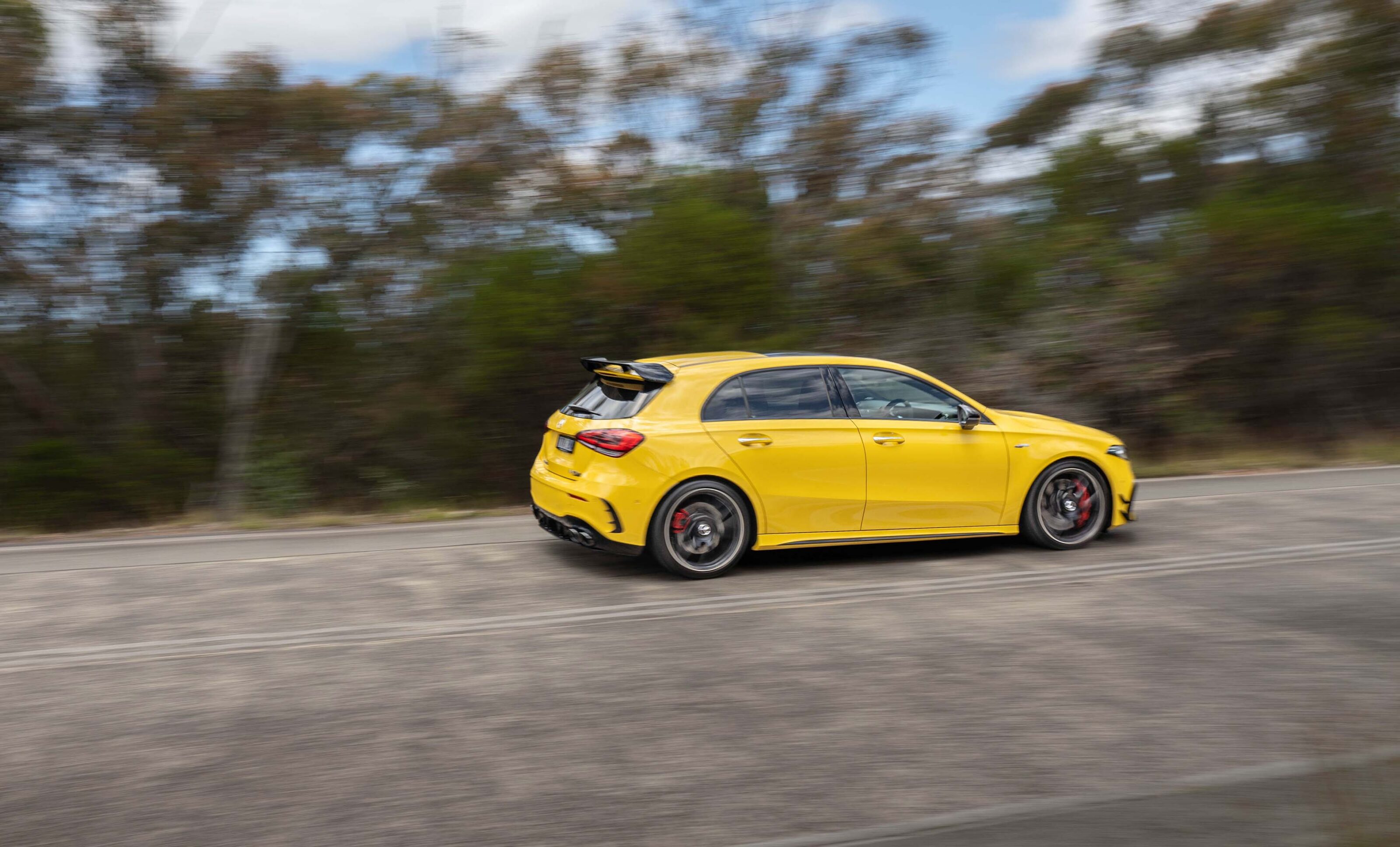
On the road and in Comfort mode, it’s very well-mannered for a machine capable of such big numbers. One of the things I love about the A45 is the Manettino-style dial on the steering wheel for quickly switching between modes.
Why there are so many modes is anyone’s guess because not only do you have Sport, Sport+, Individual and Race, you can individually select suspension and exhaust modes with the console-mounted buttons.
Although it’s kind of odd, who am I to deny owners a chance to really fiddle about with their settings?
I basically switch between Comfort and Race because life’s too short for halfway (unless it’s wet). Race is just brilliant and is what makes this car great where the old one wasn’t. It becomes an absolute weapon on the road, with the neutrality of the lower modes giving way to a far more adjustable and tail-happy attitude.
That translates to a lot more fun in the twisty stuff because you’re not just hanging on like in the old car. You may not be going a lot faster, but you’re having more fun doing it, which is more in AMG’s wheelhouse.
A C63 is sideways a lot more often than an Audi RS4 or even a rear-wheel drive M3, so it was always a bit odd that the old A45 felt more like a small GT-R that went a bit hard on the baked beans.
And the thing about Race is that the ride comfort holds on. Some M cars lose the plot on bumps and lumps but even with 19-inch wheels and a short wheelbase, the A45 never descends into anarchy. It’s not wafty, obviously, but it’s not uncomfortable.
With huge, effective brakes and a super-sharp eight-speed transmission that cheerfully takes its orders from either its own well-tuned electronic brain or your paddle shifts, you really are having a great time even when commuting.
The positivity of the steering, reacting to your inputs at just the right rate, caps the whole thing off. It’s tremendous fun.
How is it on fuel?
| Fuel consumption (claimed) | 8.9L/100kmu00a0 |
| Fuel consumption (trip computer) | 12.2L/100km |
| Fuel capacity | 51 litres |
| Fuel type | 98 RON |
As you might expect, with just a 2.0-litre engine and a rolling road, the official ADR figure is perhaps deceptively low – but I don’t need to tell you that.
It’s hardly a secret that it doesn’t really work for a car like this.
Having said that, with some care, I reckon mid-nines per 100km is more than doable if you drive it sensibly. But where’s the fun in that?
How safe is it?
The AMG A45 S has an ANCAP safety rating dating back to 2019, with a maximum of five stars to its name.
| 360-degree cameras | Forward collision warning |
| 7 airbags | Lane departure warning |
| ABS and stability controls | Lane-keep assist |
| Blind-spot monitoring | Rear cross-traffic alert |
| Exit warning | Reversing camera |
| Forward auto emergency braking (low speed and with pedestrian avoidance) | |
I think it’s not unreasonable to expect reverse auto emergency braking in a car of this price so it’s a bit of a disappointing omission and the forward AEB should probably be a little more broadly talented too.
Warranty and running costs
Mercedes offers a five-year, unlimited-kilometre warranty on the A45, which is pretty good given they already know how hard these cars are used by some owners.
You also get a choice of pre-paid servicing plans costing from $3600 for three years. Four years is $4450 and five years $5150.
As you can see, you start at an average of $1200 per year and fall to $1050 with the longer package. This is no Toyota, then, but maintenance intervals are a surprising 12 months or 20,000km, which is impressive for such a high-performing turbo four.
VERDICT
I said in the introduction that electrification is looming. I don’t have an inside line; that’s a broad comment supported by the C63’s hybrid rebirth with this car’s engine at its heart.
And boy has that upset a few people who will have forgotten all about it in six to twelve months.
Like it or not, the next A45 is going to be partly or fully electric, if indeed we get another one. So this is the line in the sand before we step over into that bold new world.
A turbo four has no right to be this powerful and charismatic, the chassis is so much more interested in fun and, finally, more than matches the theatrics.
So yes, the latest A45 has a legacy to be proud of – not least because it has become an organ donor to a new kind of C63, as well as what will be the last petrol-powered Lotus sportscar – the Emira.
2022 Mercedes-AMG A45 S specifications
| Body | 5-door, 5-seat small hatchback |
|---|---|
| Drive | all-wheel |
| Engine | 2.0-litre four-cylinder turbo-petrol |
| Compression | 9.0:1 |
| Bore/stroke (mm) | 83.0 x 92.0 |
| Power | 310kW @ 6750rpm |
| Torque | 500Nm @ 5000-5250rpm |
| 0-100km/h | 3.9sec (claimed) |
| Transmission | 8-speed dual-clutch |
| Weight | 1535kg |
| Fuel consumption | 8.9L/100km (claimed) |
| Front suspension | MacPherson struts, coil springs, adaptive dampers, anti-roll bar |
| Rear suspension | multi-links, coil springs, adaptive dampers, anti-roll bar |
| L/W/H | 4445mm/1850mm/1412mm |
| Wheelbase | 2729mm |
| Brakes | 360mm discs with 6-piston callipers front / 330mm single-piston calliper rear |
| Tyres | 245/35 ZR19 Michelin Pilot Sport 4S |
| Wheels | 19-inch alloy (no spare) |
| Price | $106,900 + on-road costs |
An 18-year-old Norwegian entrepreneur, Vetle Husby, is developing a third-party accessory for Tesla Model 3 and Model Y electric cars that finally add physical buttons and dials.
Snapshot
- 18-year-old addresses minimalistic Tesla interior with kickstarter
- Accessory adds dials and buttons, but needs a smartphone and Internet connection
- Achieved crowdfunding goal in less than 48 hours, currently in prototype stage
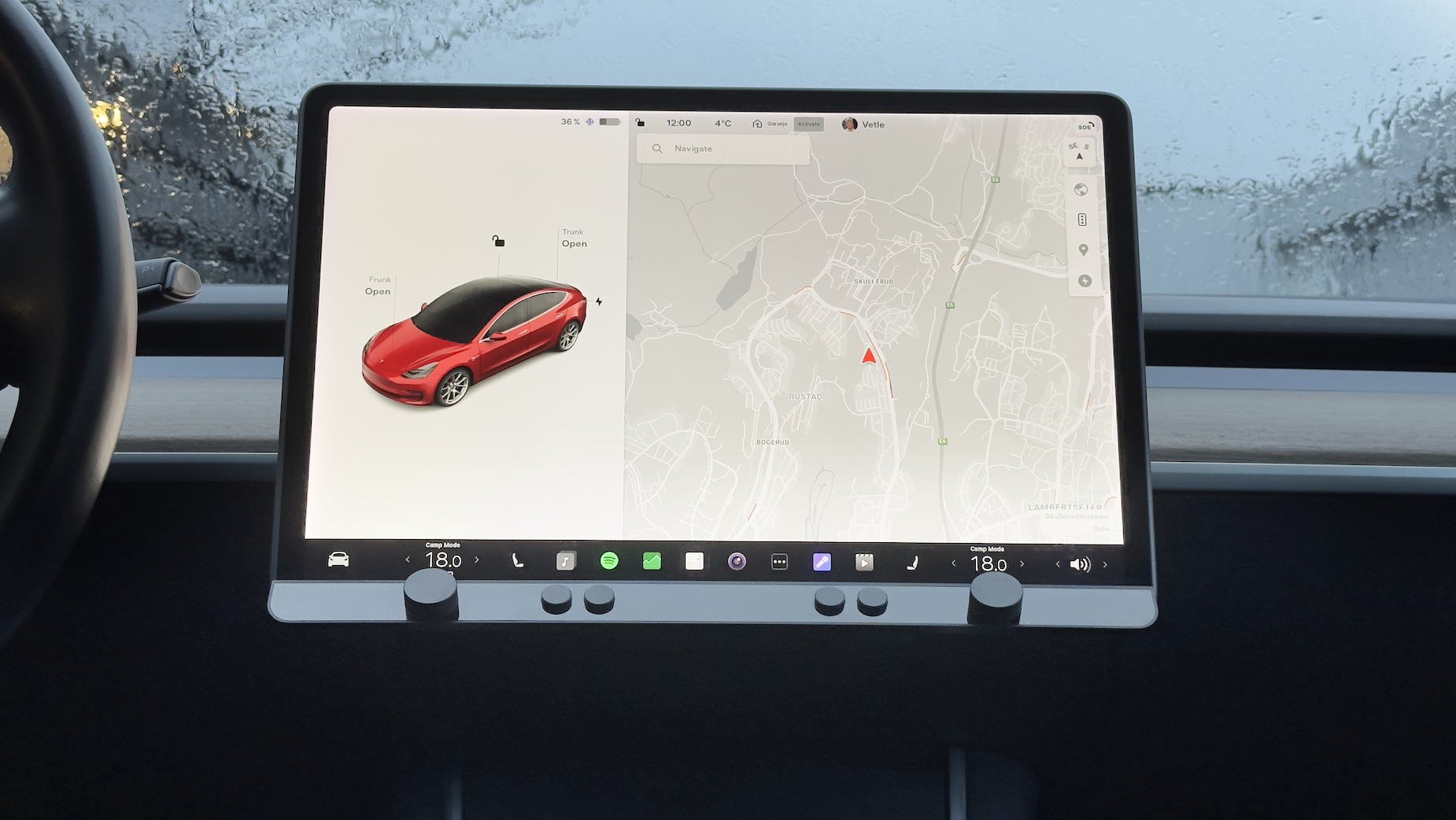
Called Ctrl-Bar (control bar), the accessory is a gloss black bar that attaches to the bottom of the 15-inch touchscreen with two knurled knobs to control the climate control temperature, without needing to tap the screen.
Additionally, four circular buttons can be programmed to control a host of vehicle functions, including toggling the seat heaters, defrost, dog mode, keep climate on, open the frunk and more.
It also adds multi-colour ambient lighting to the centre console – which both the popular Model 3 sedan and Model Y SUV currently lack.
Best Electric Cars Under $65k: Affordable EVs Rated
Welcome to part one of three price-based EV buying guides, this one focused on the most affordable electric cars available in Australia today
Greenmission’s project – which is in its prototype stage and backed by Tesla accessory reseller Abstract Ocean – has passed its crowdfunding campaign goal in less than 48 hours on Indiegogo and will ship globally from June, currently priced at $381.
It’s worth noting, of course, that not all kickstarter projects become a reality.
The startup concedes that the main obstacles include developing the mobile app, establishing a reliable connection, and potential supplier issues and delays leading to higher costs.
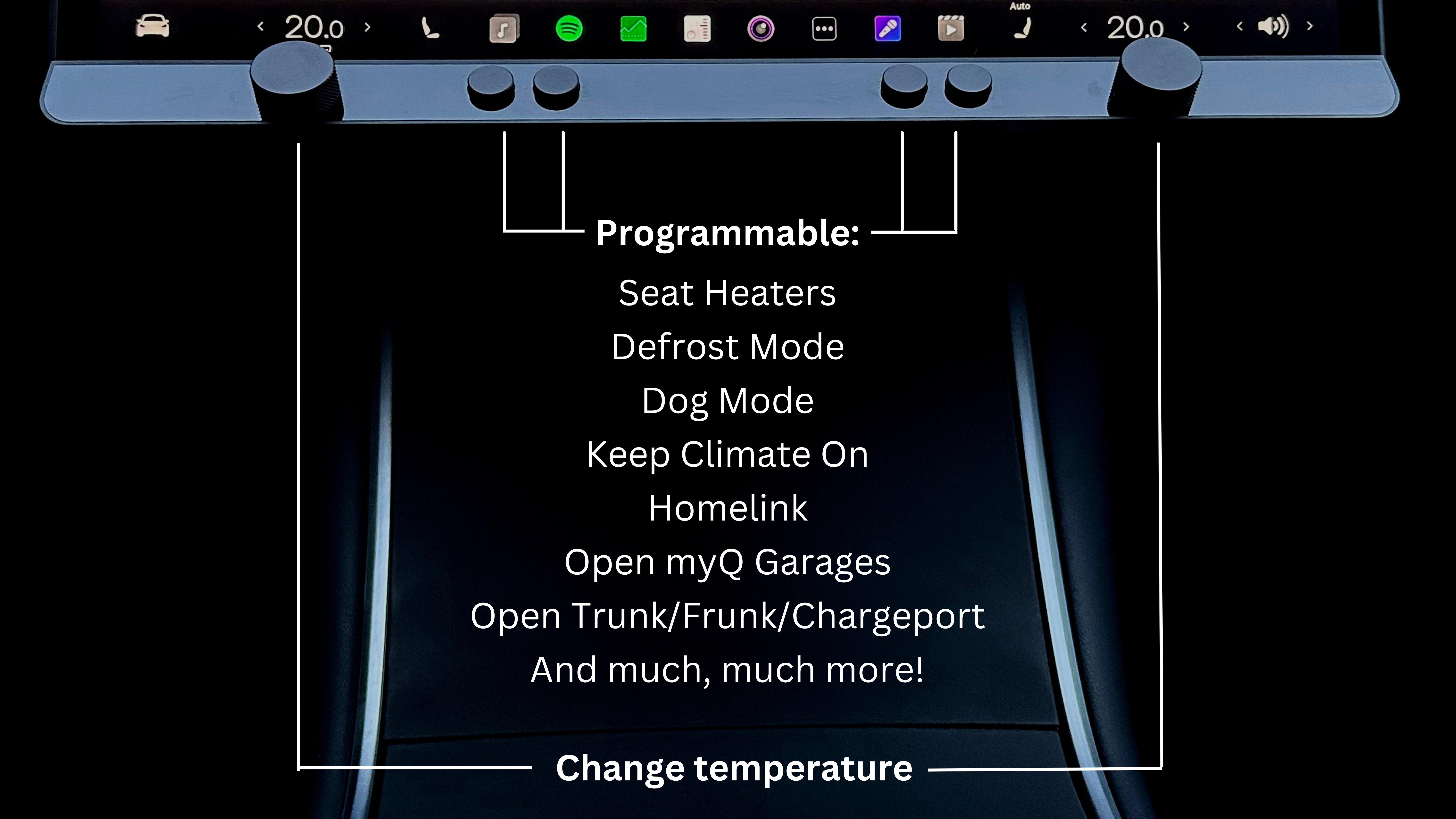
The Ctrl-Bar doesn’t connect directly to the Tesla. It’s powered via plugging into the hidden USB-A port at the rear centre console area and, connects to a smartphone using Bluetooth.
When a dial or button is pressed, the phone will communicate it to the vehicle via the Tesla application programming interface (API) using its own app.
Husby says there’s a slight latency of less than one second, but there’s a screen in the centre of the bar to show your commands in real-time before it’s sent to the car. The app will also “prioritise your privacy, only capturing the data needed to run the services.”
An internet connection is required on the phone, though it doesn’t need Tesla’s Premium Connectivity subscription to function.
The bar itself will also be capable of over-the-air software updates, and the developer plans to implement speed-limit warnings through a paid subscription.
The Ctrl-Bar is another aftermarket solution to address the Model 3 and Model Y’s sparse interior, with many vendors already selling a digital instrument cluster, head-up display, panoramic glass roof sunshade, and more.
Previous reports have mooted an even more simplified Model 3 update is coming this year, even though a Tesla design boss has downplayed the rumour.
Greenmission currently sells a 3D-printed Magsafe compatible wireless phone charging pad solution for older Tesla Model S and Model X EVs.
January 2023: Kia EV6 GT driven in Australia
“This isn’t even my final form”, chuckled the 239kW & 605Nm EV6 GT-Line last year. Now we understand… see our first drive review of the flagship EV6 GT, including a track test, at the link below.
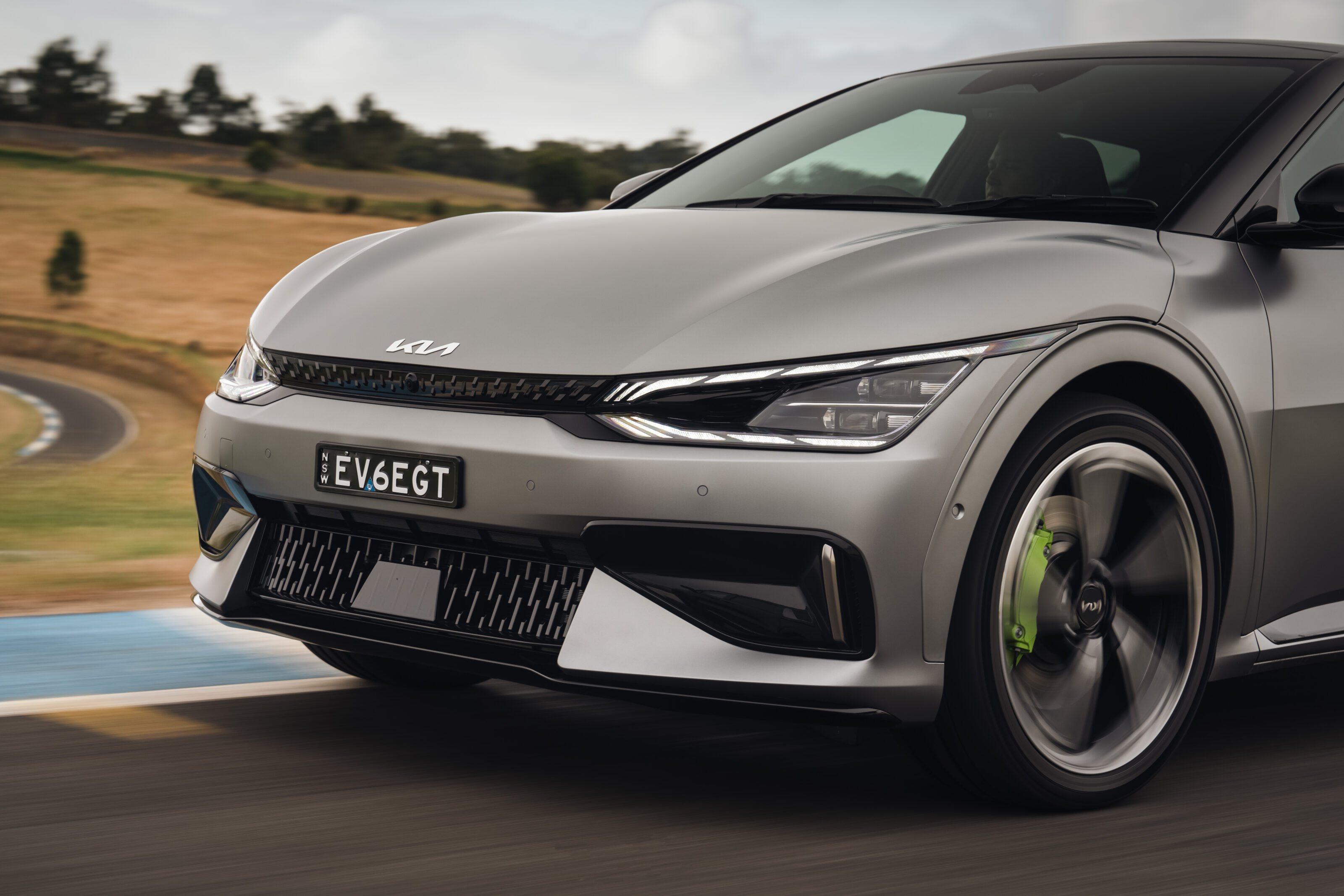
January 2023: EV6 GT joins local line-up
With the arrival of the GT flagship, Kia’s EV6 range has a new hero model. Get all the 2023 EV6 details and pricing at the link below.
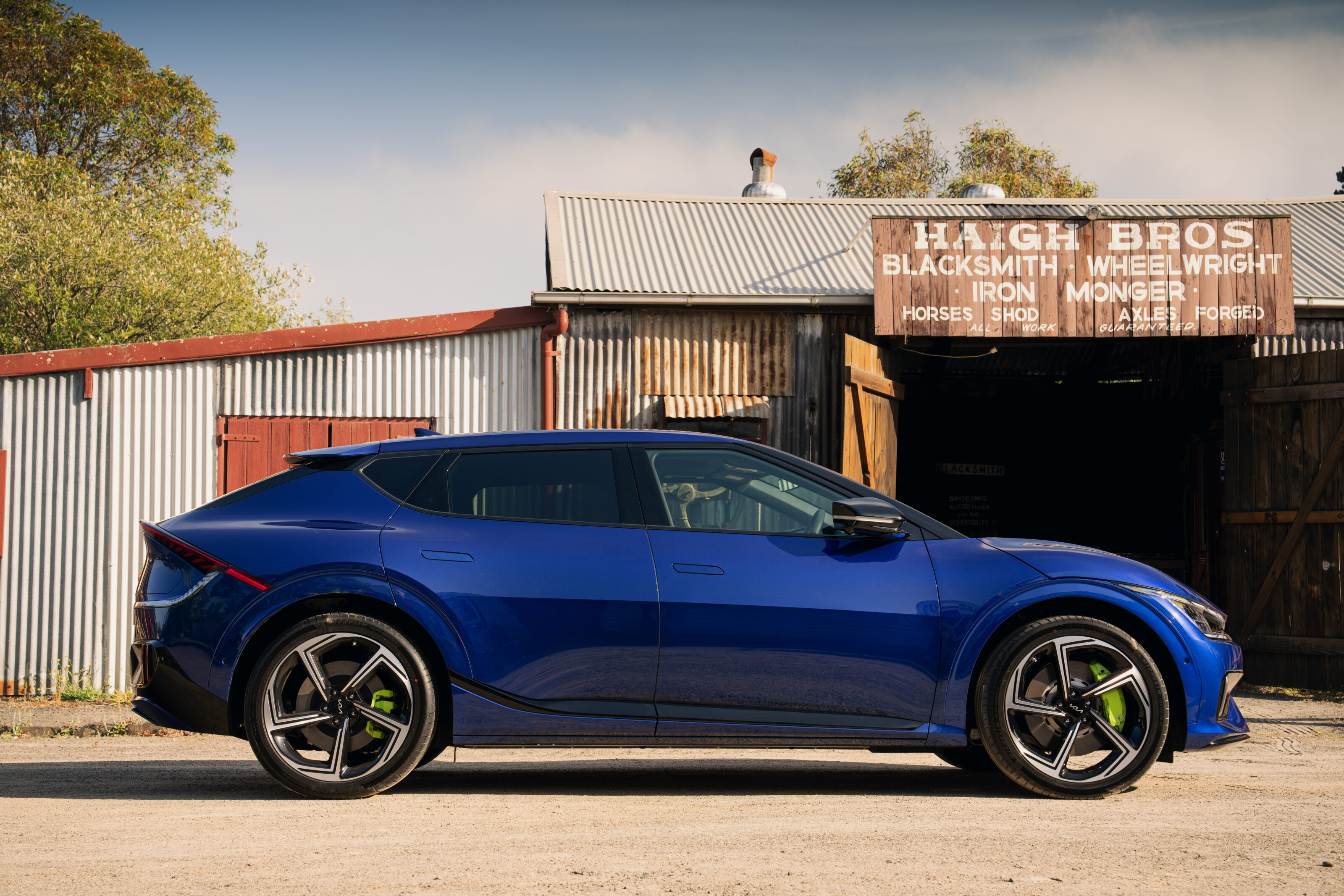
The story to here
December 2022: The EV6 GT – Kia’s most powerful and expensive vehicle yet – is set for an Australian release in January 2023.
A list price of $99,590 before on-road costs was leaked earlier in the month, though Kia is yet to confirm this is the final ask. Still, justifying that expected price are 430kW/740Nm outputs courtesy of two electric motors, for a 0-100km/h sprint time of 3.5 seconds.
Driving range for the E-GMP-based EV6 GT is rated at 424 kilometres on the WLTP combined cycle from the same 74kWh lithium-ion battery pack as cooking EV6 GT-Line and Air variants.
Watch our walk-around review below!
Key Points
- Kia EV6 to be based on E-GMP platform
- Starting price of $67,990 in Australia
- In local showrooms from February 2022
February 25, 2022: Model arrives in local showrooms, Australian first drive
Mike Stevens puts the EV6 through its paces, testing how its driving range performs on a long drive from Canberra to Melbourne. Check out his Australian first drive impressions on the link below.
It’s also the day the EV6 arrives in local showrooms, though with only 500 examples on offer, as well as wait times reportedly blowing out and allocation being staggered throughout the year – getting your hands on one might be trickier than you’d think.
“The Kia EV6 is about to make its mark on the local electric vehicle offering in Australia and has already proven itself as the new halo for the Kia brand, attracting a remarkable level of interest leading up to its arrival,” said Kia’s Chief Operating Officer, Damien Meredith.
“Based on this unprecedented consumer interest, we are confident we could find an Australian home for more EV6’s than the 500 units allocated to our market in 2022.
“We are in constant dialogue with headquarters about accessing more EV6 stock.”
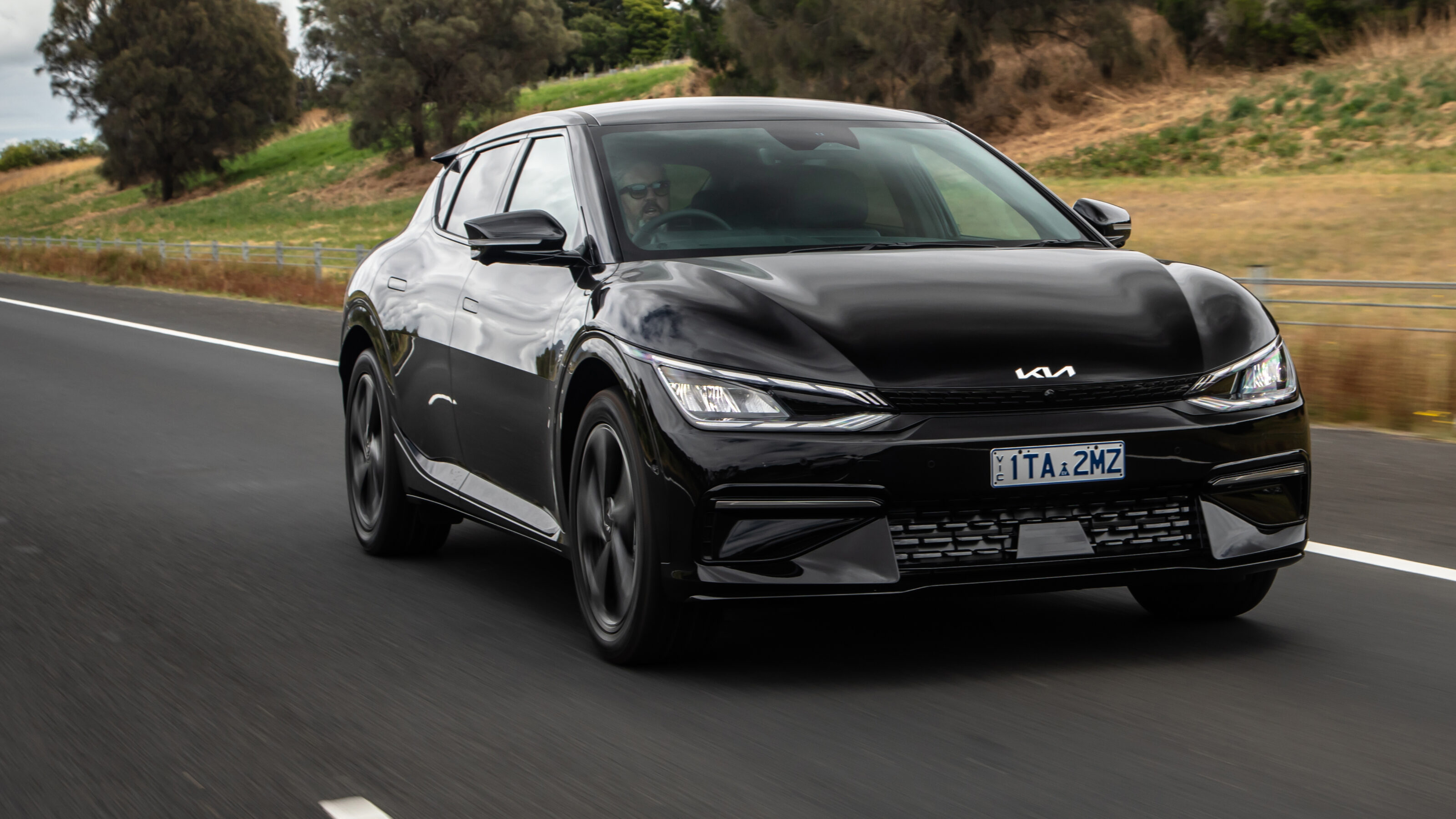
January 28, 2022: Australian pricing and features revealed
Kia looks set to undercut Hyundai with the EV6 coming in at a lower list price than its Ioniq 5 cousin, starting at just $67,990 before on-road costs.
Australian cars are available either in rear- or all-wheel drive guise, although the 77.4kWh battery pack is a standard feature no matter which variant, providing an all-electric driving range of up to 528km.
Read on below for the full breakdown of the EV6’s local pricing and features.
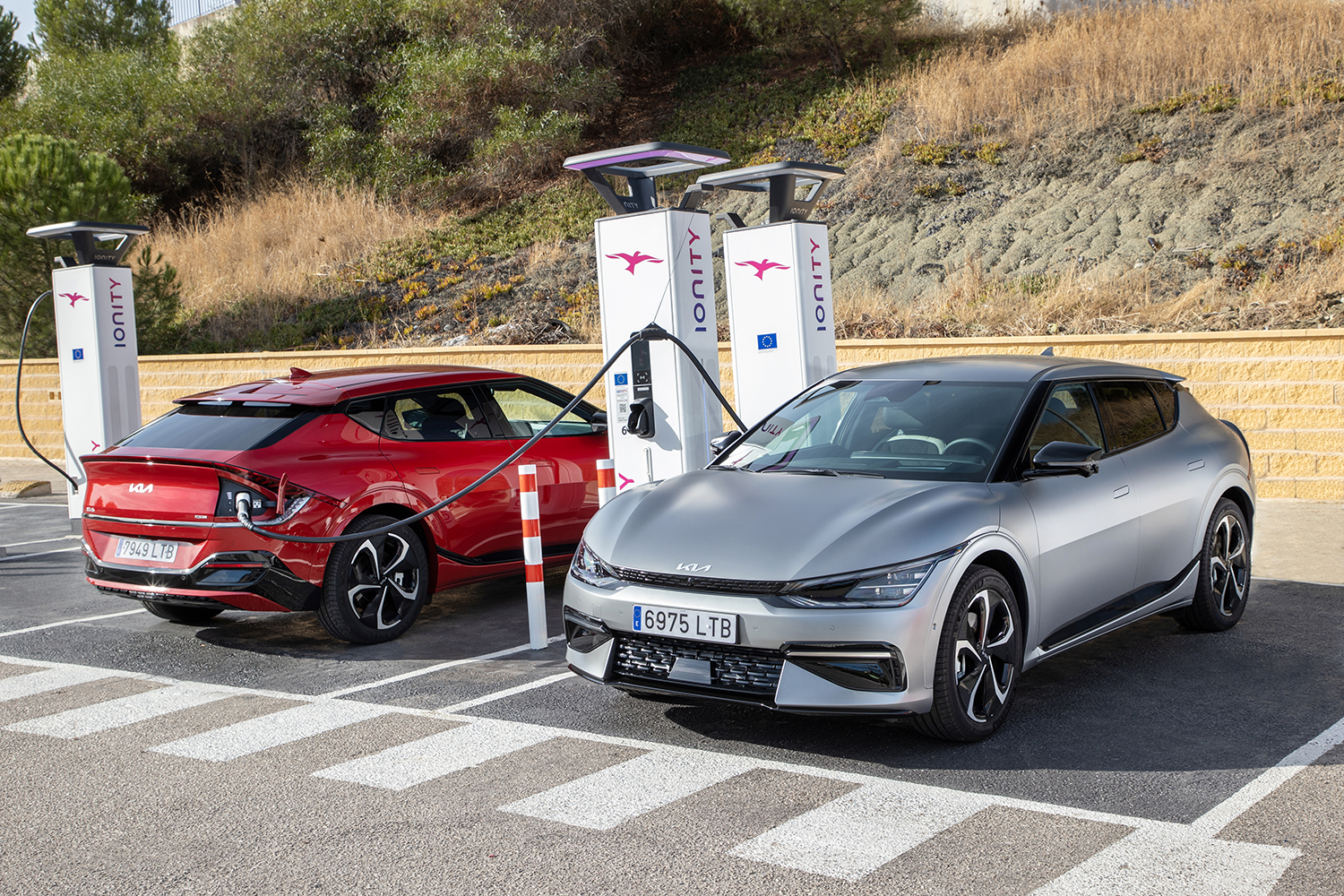
December 10, 2021: First international drive
Angus Mackenzie gets behind the wheel of the EV6 for the first drive impressions of Kia’s latest EV.
Click the link below to watch and read the European review.
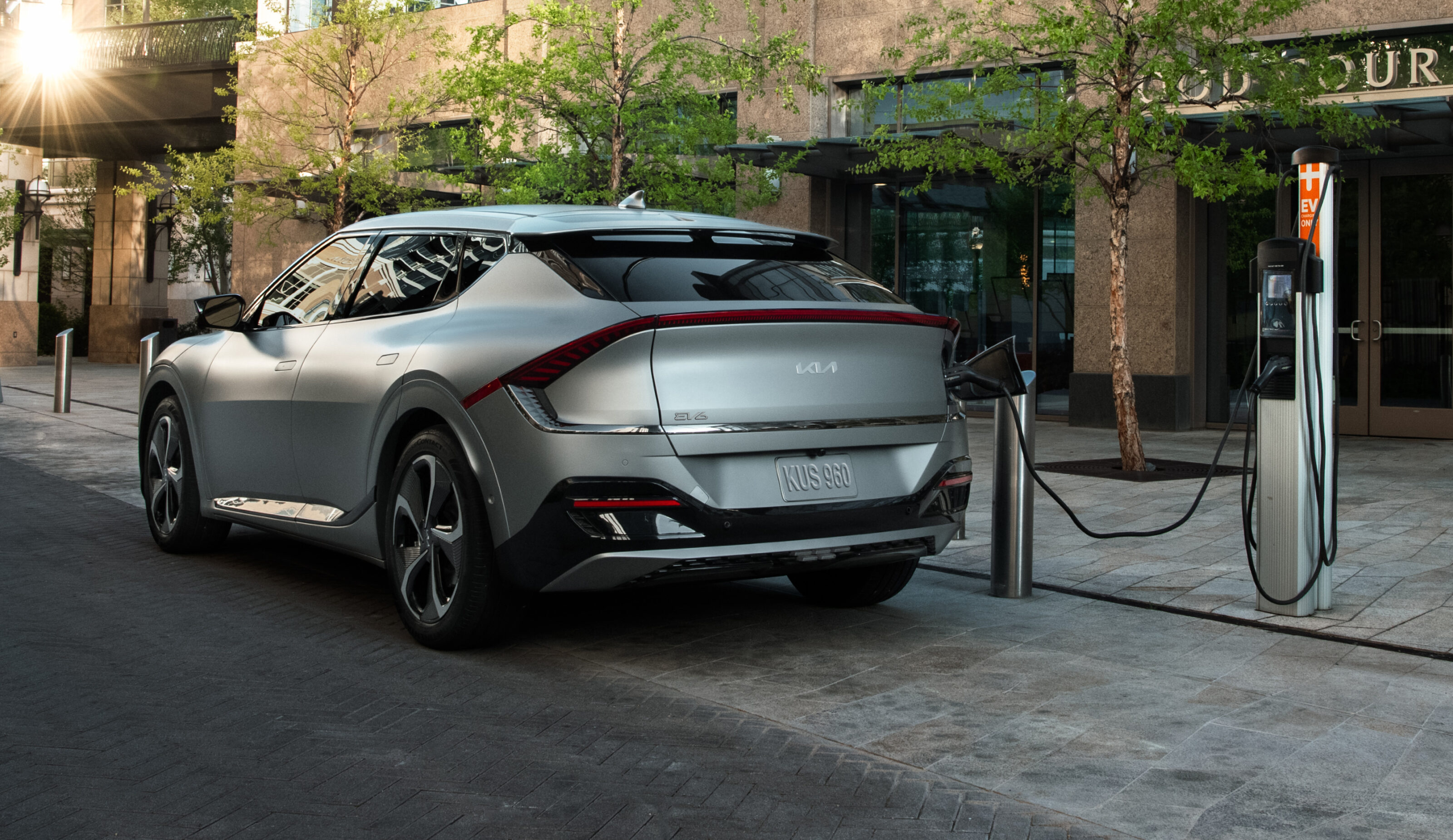
November 20, 2021: EV6 sets US coast-to-coast EV record
The 2022 Kia EV6 has made it into the Guinness World Records after travelling across the United States mainland with the shortest required charging time.
The EV6 needed seven hours, 10 minutes and one second of charging to complete the 4635 kilometre trek from New York City to Los Angeles, with an average of 20 minutes charge time per stop.
Kia’s new record beat the previous record holder, the 2015 Tesla Model S P85D, by more than five-and-a-half hours (12 hours, 48 minutes and 19 seconds).
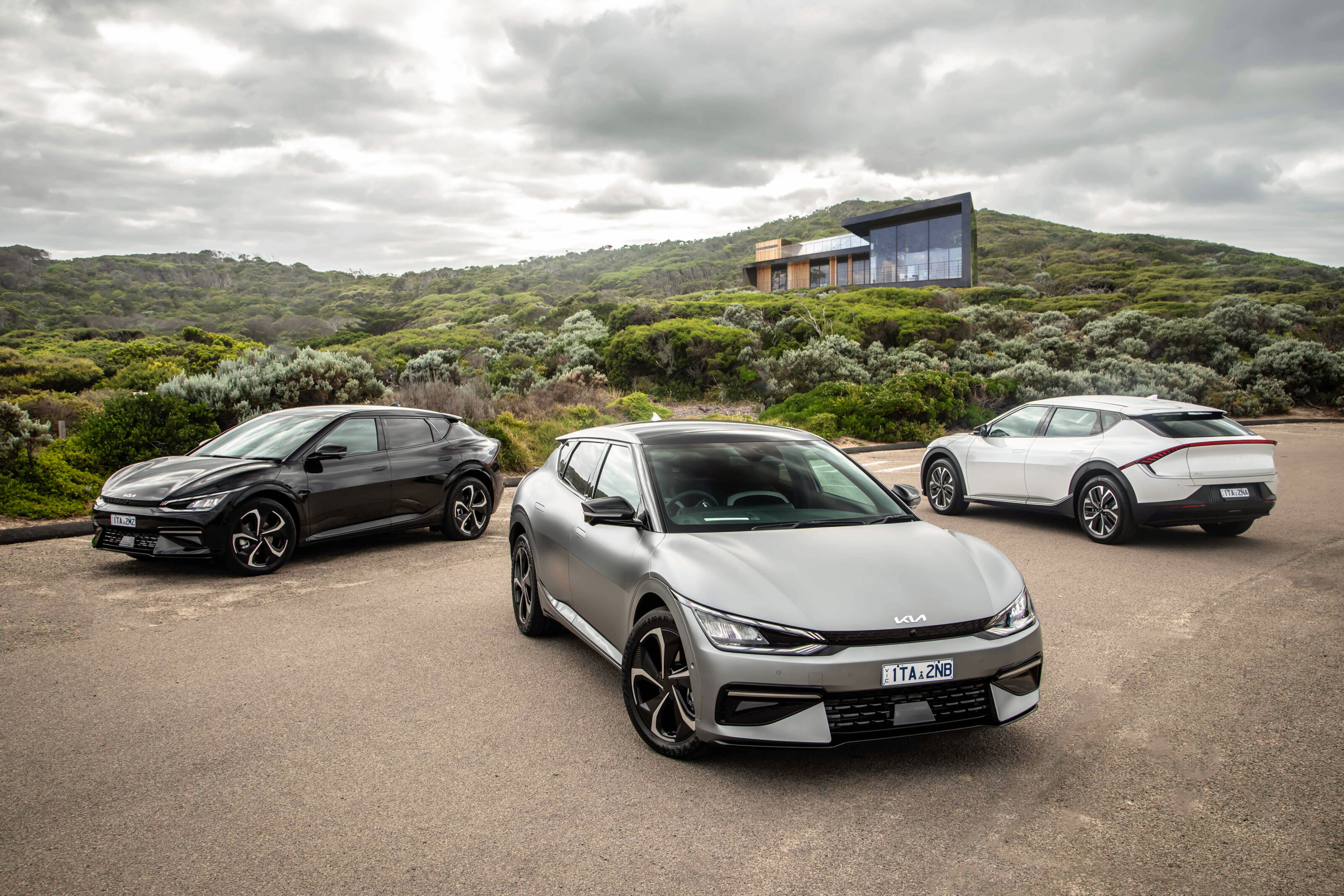
November 16, 2021: Australia allocated 500 EV6 examples
Australia will receive 500 examples of the 2022 Kia EV6 next year, but only two will be allocated to dealerships initially.
Kia confirmed the 500 electric vehicles earmarked for Australia will be staggered throughout the year, but sources told Wheels most Kia dealerships will get just two EV6 models to begin with – a demonstrator, and a vehicle to sell.
Of the 91 Kia dealerships across Australia, a handful have yet to be set up to both sell and service the EV6 – the Korean carmaker’s first dedicated electric car. It’s estimated the first batch will comprise around 160 vehicles
March 30, 2021: Kia EV6 set for Australian berth
Kia has confirmed the EV6 will be available in Australia, although it has not yet confirmed the price or specs of locally-delivered variants.
March 15, 2021: Kia EV6 revealed
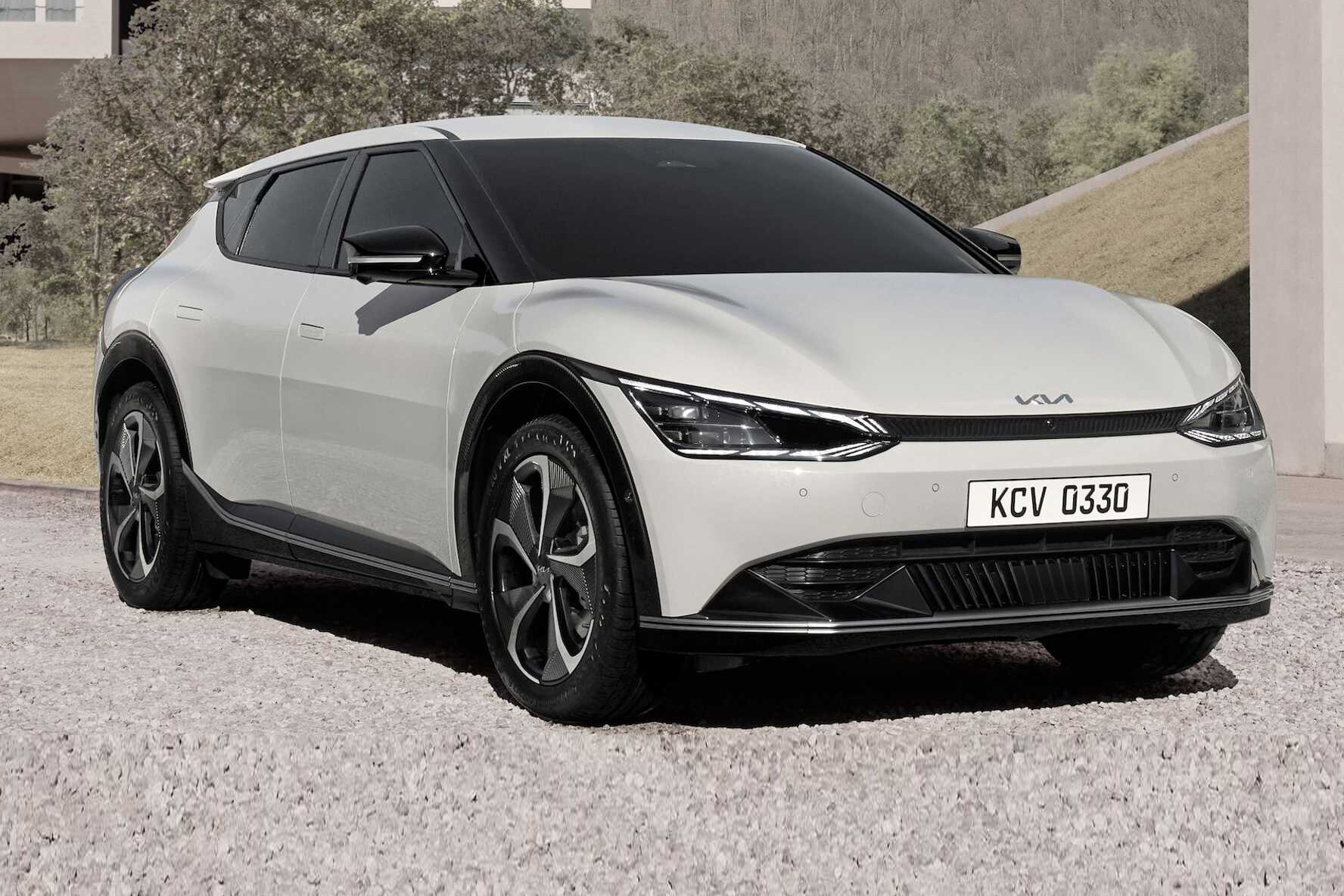
Just days after it was first teased, Kia has formally revealed its first dedicated EV model, the Kia EV6 – bringing with it the Korean carmaker’s new design language.
Apart from its handsome looks, the EV6’s design is notable for being the first Kia model in thirteen years not to have the Korean carmaker’s distinctive tiger-nose grille because, well, it doesn’t need one.
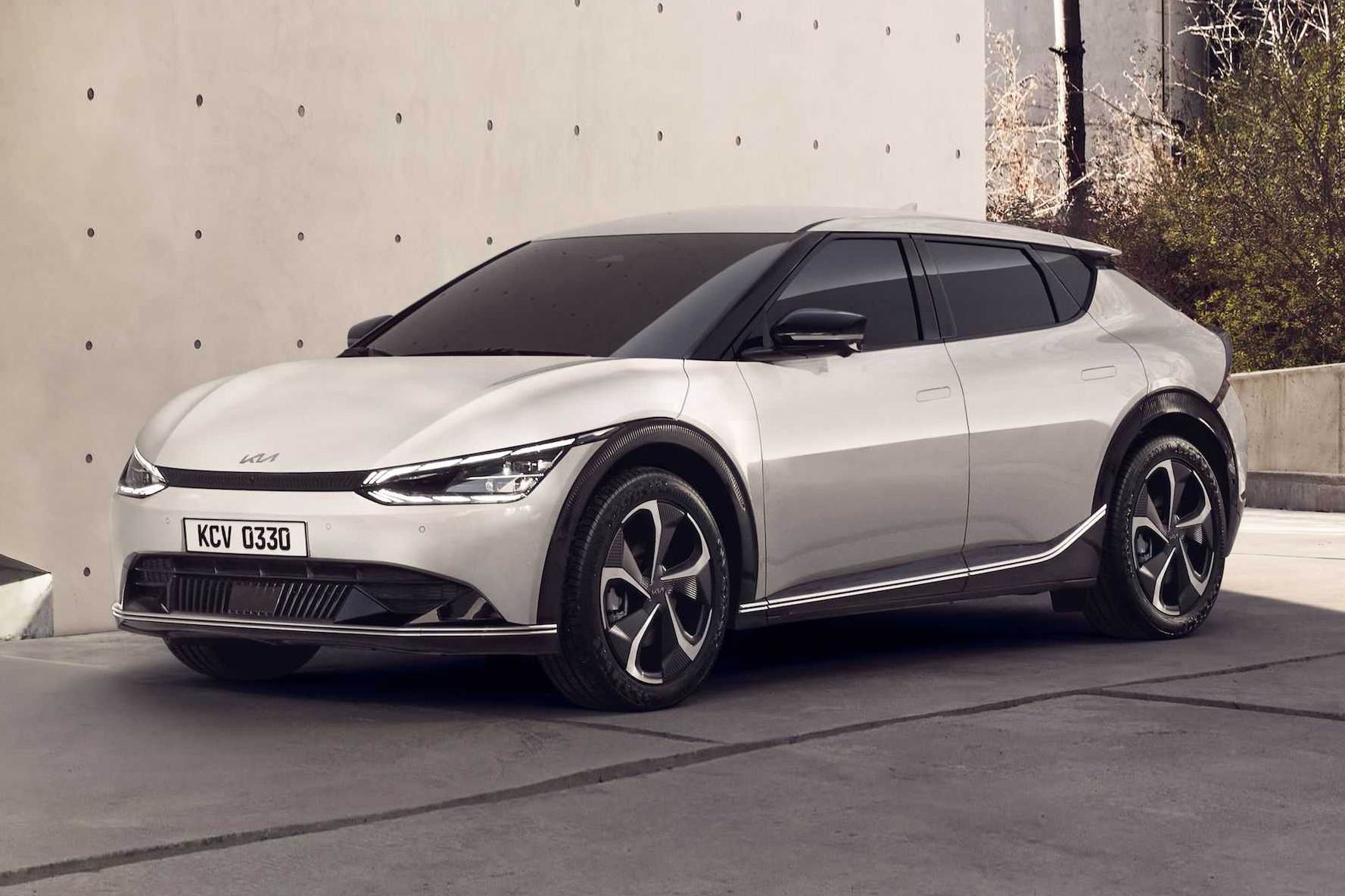
It’s replaced by a new “Digital Tiger Face” as part of its new ‘Opposites United’ design philosophy that relies on five key elements: ‘Bold for Nature’, ‘Joy for Reason’, ‘Power to Progress’, ‘Technology for Life’, and ‘Tension for Serenity’.
What do these even mean? We’re glad you asked.
Bold for Nature is based on interaction with nature, informed by the details, shapes and proportions found both in the natural and human worlds.
Joy for Reason focuses on the feel and ambience of Kia’s future vehicles.
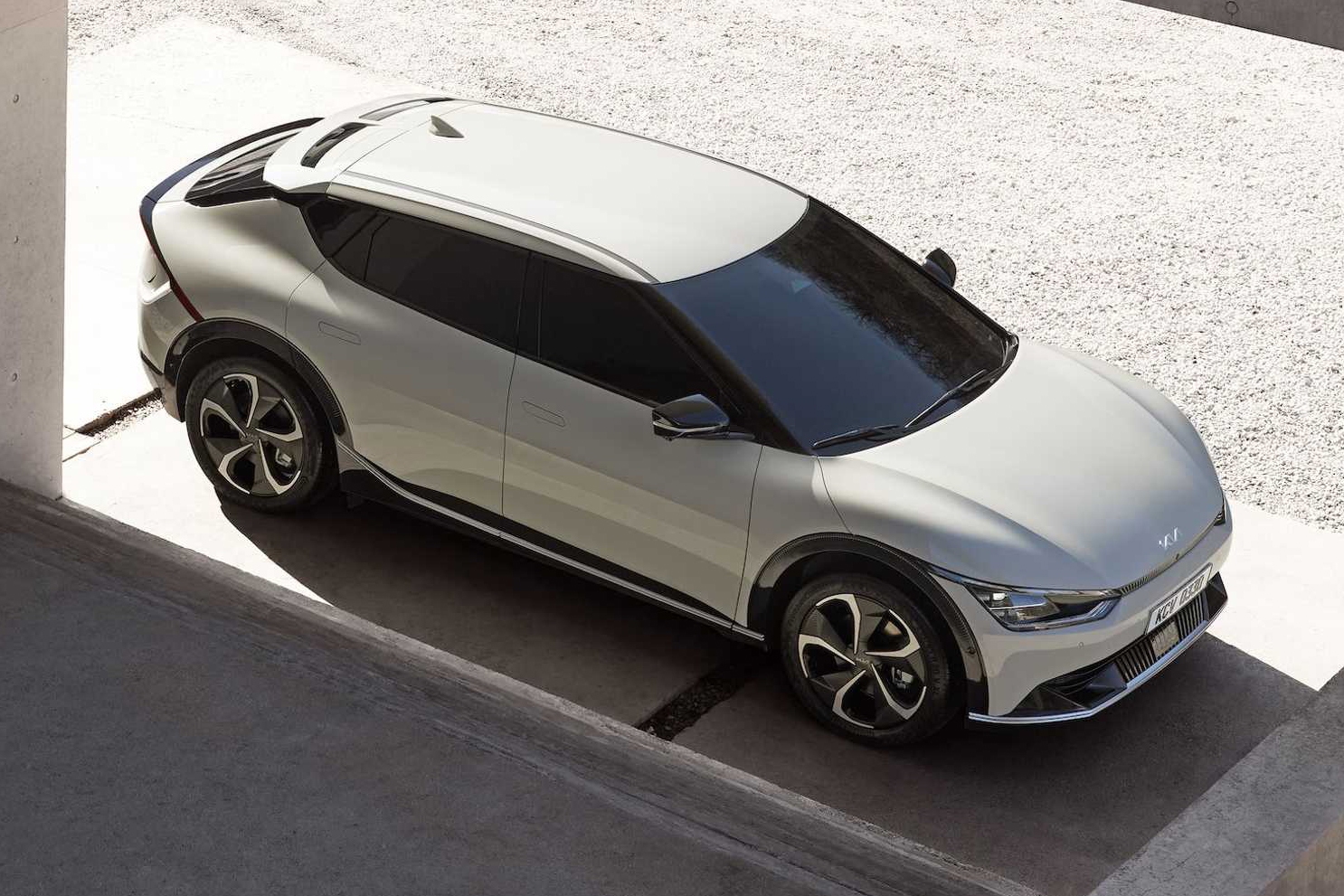
Power to Progress builds on the brand’s current design strengths.
Technology for Life embraces new technologies and innovations to foster positive interactions between humans and machines.
Tension for Serenity evokes the tension between opposing forces and creative contrasts and recognises the design equilibrium that comes from two opposing forces.
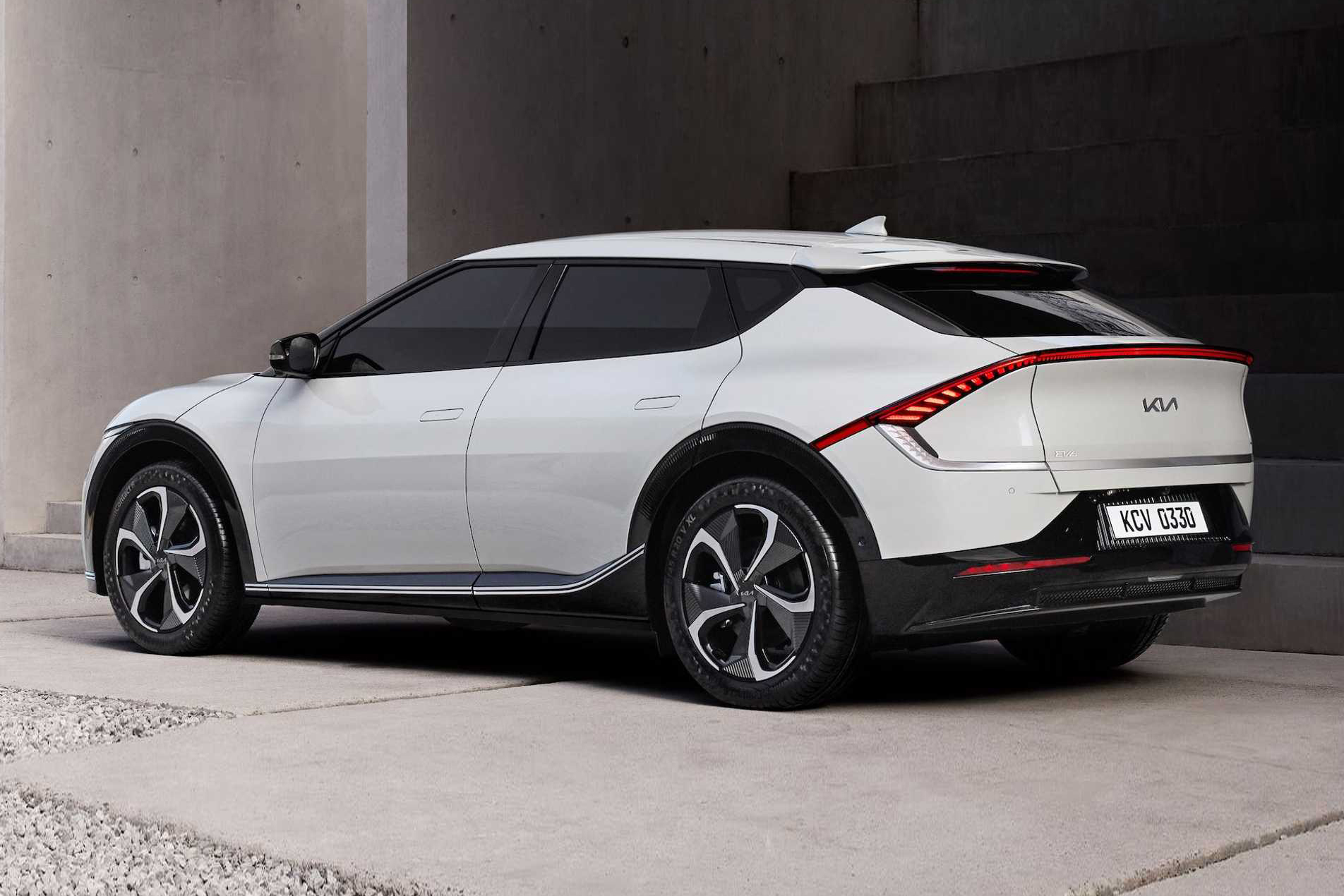
That’s a lot of artistic and marketing guff to digest, but we have to agree it has delivered a very handsome looking coupe-like crossover, with sharp lines and slim dynamic light patterns including the distinctive LED tail-light cluster that extends around to the wheel arches from swept-back rear-end.
Like its recently-revealed Ioniq 5 cousin, the EV6 has been built on Hyundai’s Electric-Global Modular Platform – E-GMP, which allows for a very spacious and innovative interior.
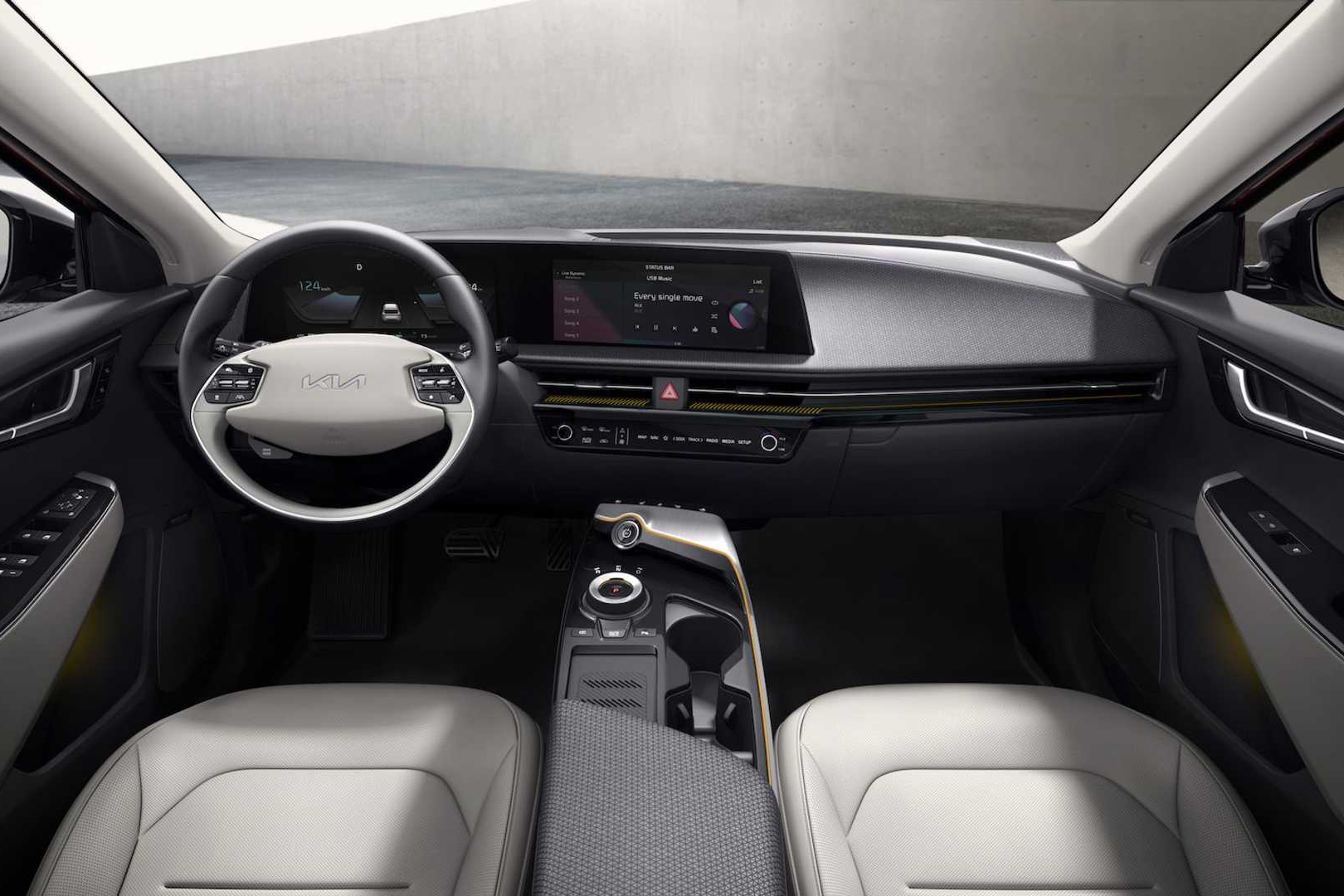
And like the Ioniq 5, it features a seamless high-definition audiovisual and navigation (AVN) screen that melds the digital driver’s display, behind an attractive two-spoke, which now bears the revamped Kia logo.
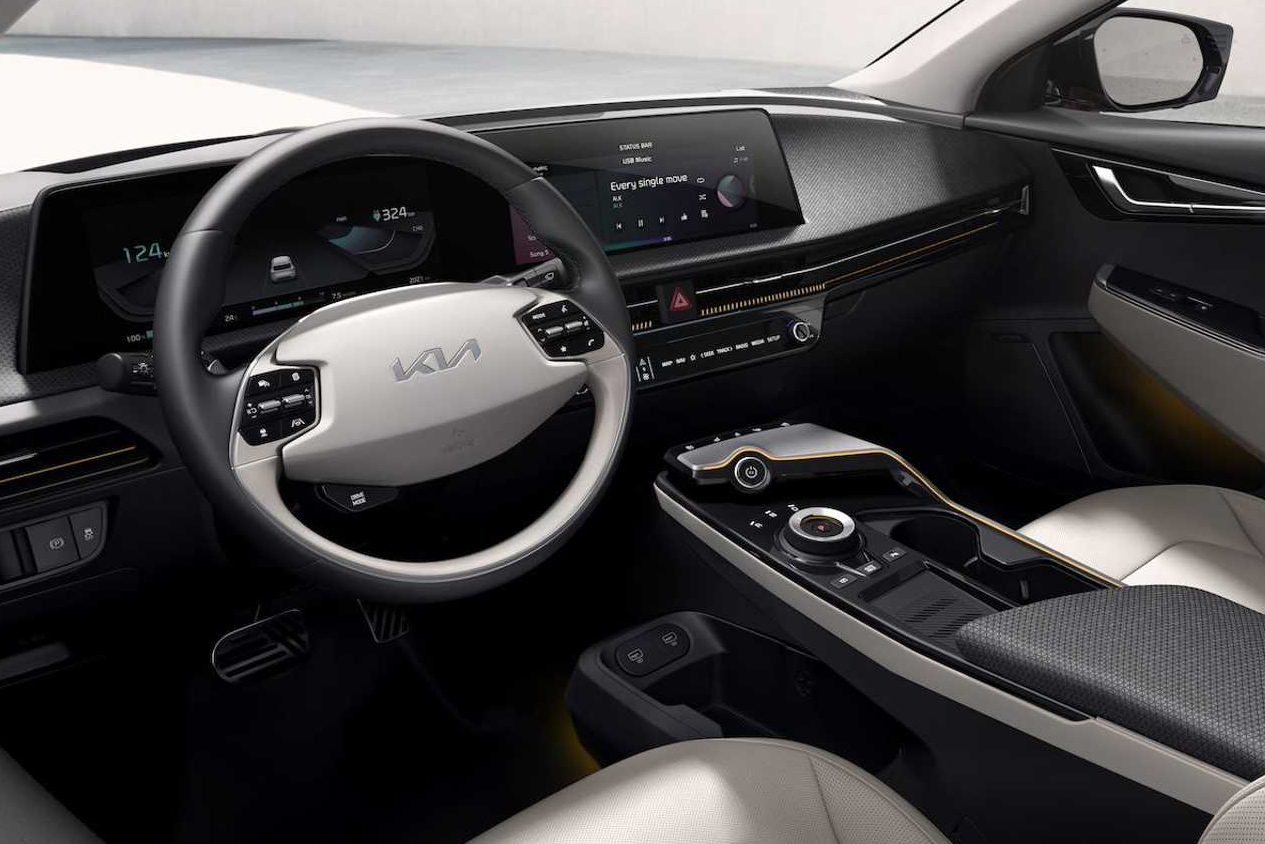
Haptic buttons below the AVN are used to operate the heating, ventilation and air conditioning (HVAC) while below this panel, the dashboard slopes away towards the front of the car, creating a sense of space and openness for the front-seat passengers.
According to Kia, the seats are slim, lightweight and contemporary, and clad in modern, robust fabrics created using recycled plastics.
Performance specs are yet to be released, but expect the EV6 to perform similarly to the Ioniq 5, which offers 58kWh and 72.6kWh battery sizes delivering a driving range up to 480km and an 80 percent charge in 18 minutes on a 350kW ultra-rapid charger.
The EV6, which will make its way to Australia some in 2022, will make its world premiere in March 2021 during a special online event – watch this space.
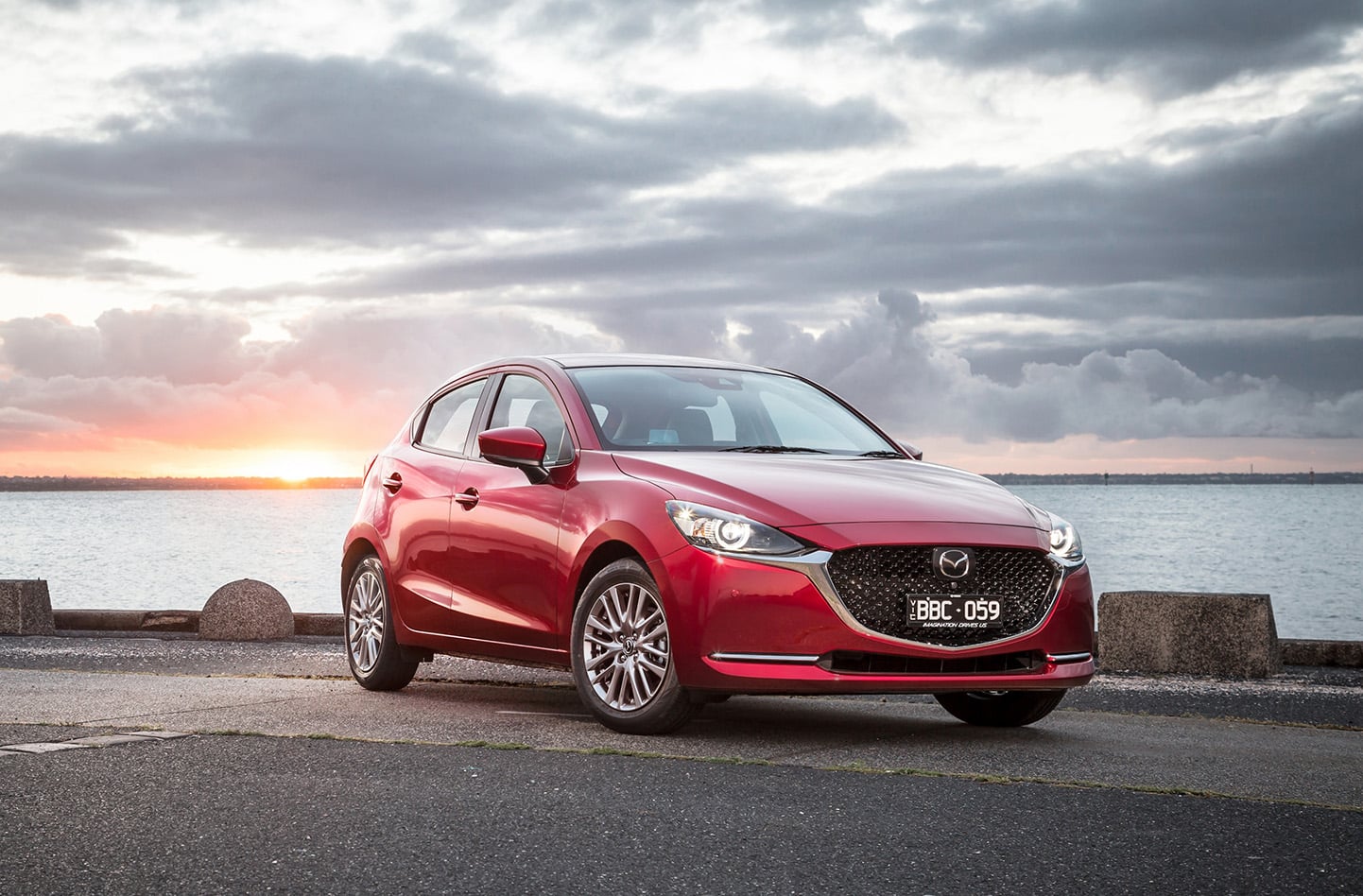
The updated 2023 Mazda 2 has debuted in Japan ahead of its local arrival in the middle of the year.
Snapshot
- 2023 Mazda 2 receives minor exterior facelift
- New interior accents; black roof for Pure SP
- Update due in Australia in mid-2023
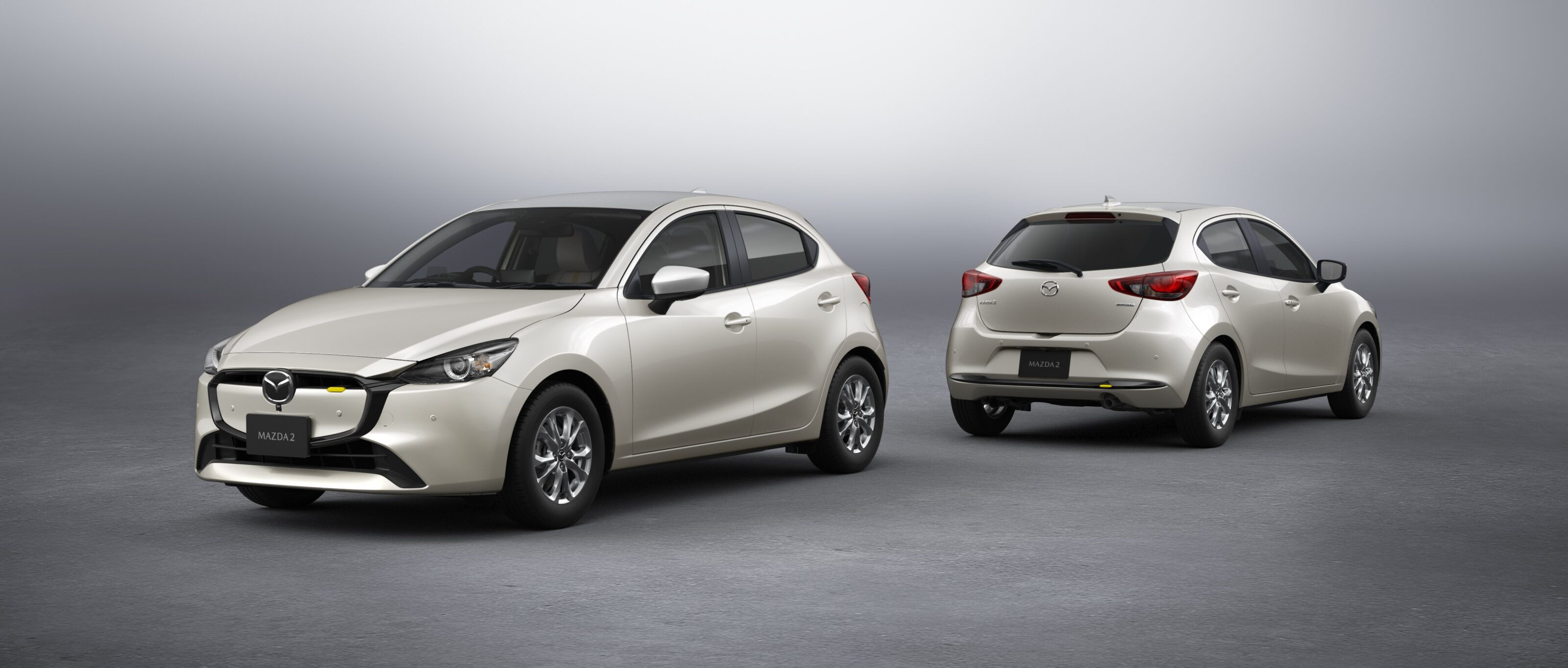
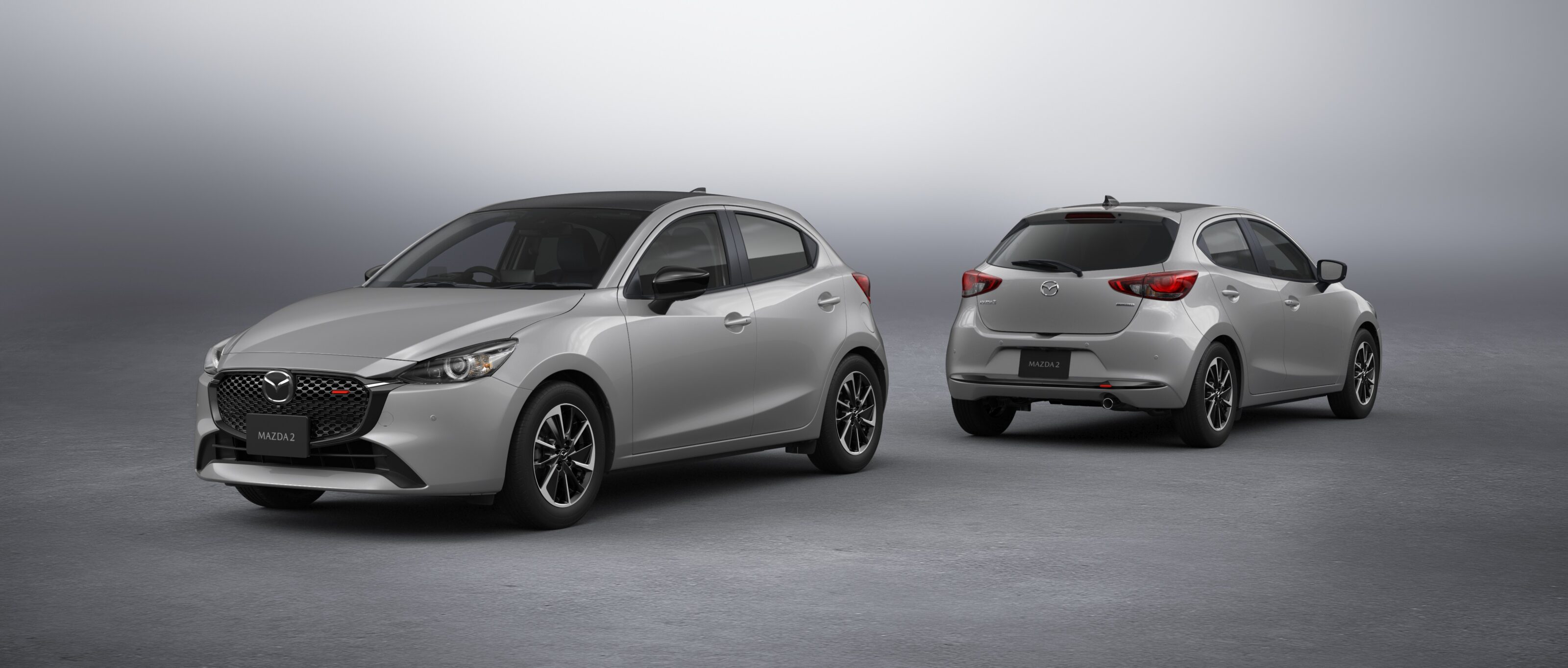
The changes are headlined by a mildly-revised front end with a larger front grille, a new X-shaped lower bumper, and more prominent Mazda badging with an integrated radar sensor.
There’s also a body-coloured, EV-like plate on the front grille for select versions, while the Mazda 2 hatchback will receive an “asymmetrically placed colour accent on the front grille and rear bumper,” similar to the latest CX-5 and CX-8.
Rounding out the styling changes, all hatchback variants, and the range-topping GT sedan, also receive a simplified rear bumper design.
The Mazda 2’s colour palette will expand with the addition of two new metallic finishes – aero grey and airstream blue – to join seven paint options currently available in Australia, with one deletion (likely aluminium metallic).
2023 Mazda 2: Tech and interior updates
Inside, there’s a larger 8.0-inch infotainment screen still running the ageing, pre-update MZD Connect interface in Japan – but the current 7.0-inch screen will remain for Australia.
A previous update for Japan in 2021 also introduced wireless Apple CarPlay, a wireless phone charger, minor engine enhancements, and a variant with a CX-3 Maxx Sport LE-like interior; however, these changes have yet to be applied to our Thai-built version.
But Mazda’s local arm has confirmed the entry-level G15 Pure and Pure SP will receive a new coloured dash trim in white, black or mint, depending on the vehicle’s exterior finish.
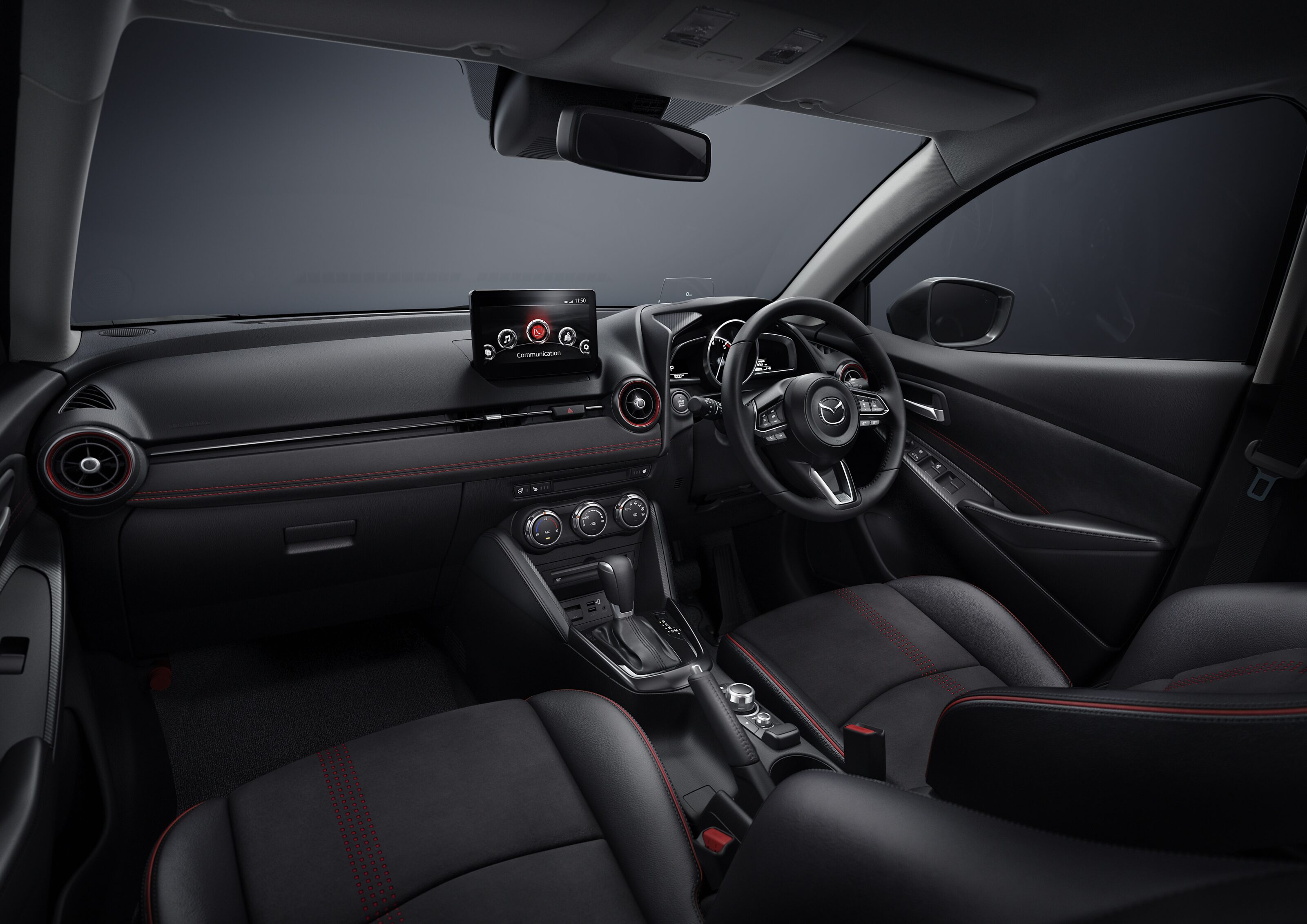
A black roof film will be added to the sportier-looking Pure SP, which was introduced in 2021, while the G15 Evolve and GT will gain red interior accents.
There’s also new black leather/suede upholstery, “aero-focused” 16-inch alloy wheels and dual exhaust outlets for the flagship G15 GT.
In addition, a shark fin antenna will sit atop G15 Evolve and GT variants.
It is the second facelift for the nine-year-old Mazda 2, with a comprehensive update in late 2019 adding a redesigned front, more active safety features, and other new technology – but at a higher cost than the pre-facelift version.
Expect the latest update to bring further, minor price rises for the Mazda 2, which has lost ground to the more affordable MG 3 and now-discontinued Suzuki Baleno in the price-sensitive light car segment.
Last year, the Mazda 2 was Australia’s third best-selling light car, with 5146 registrations. It was outsold considerably by the MG 3 (16,168), followed by the Suzuki Baleno (6124) – but it remains ahead of the Toyota Yaris, which also moved into a higher price bracket with its latest generation in 2020.
When will the 2023 Mazda 2 go on sale in Australia?
The 2023 Mazda 2 hatch and sedan will commence sales in Australia in June, with deliveries set to begin in July. Local pricing and features are expected in the coming months.
Below: The current Mazda 2, in flagship G15 GT hatch guise
Key Points
- Final Edition C63 S Coupe and Cabriolet; and E63 S to launch Feb 1
- Limited numbers coming to Australia
- Price premiums range between $26,000-40,000
As the sun sets on Mercedes-AMG‘s vaunted 4.0-litre V8 engine, already culled from the next-gen C63 (with recent rumours suggesting the E63 is to follow its four-cylinder path), limited-run Final Edition variants dropping nationally from February 1 celebrate the end of the powertrain.
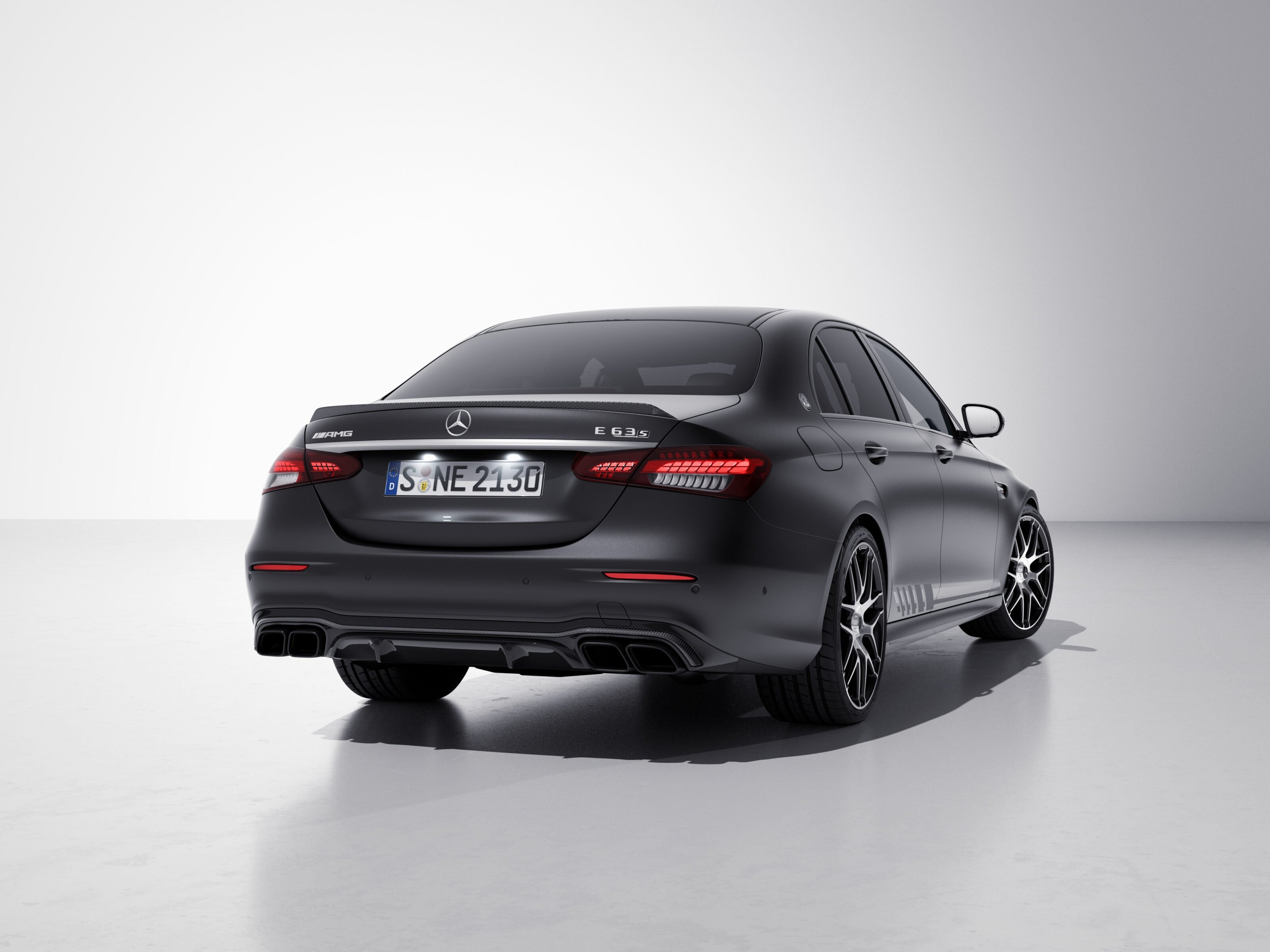
The Final Edition pack is offered on popular C63 S Coupe and Cabriolets, and E63 S Sedan, all of which have received special appearance and equipment appointments to celebrate this much-loved generation of AMG.
Pricing
| C63 S Coupe Final Edition | $218,400 |
|---|---|
| C63 S Cabriolet Final Edition | $239,000 |
| E63 S Sedan Final Edition | $311,900 |
Features
2023 Mercedes-AMG C63 S Cabriolet Final Edition
The final edition package adds, in addition to the existing C63 S Cabriolet:
| MANUFAKTUR Graphite Grey magno paint |
| Yellow and dark grey decals |
| Exterior carbon package |
| 19/20-inch AMG cross spoke alloy wheels |
| AMG cabon-ceramic front braking system |
| AMG Performance seats |
| AMG Performance steering wheel |
| Nappa grey/black upholstery w/ yellow stitching |
| Dark aluminium and matt carbon fibre accents |
| Final Edition badging on centre console |
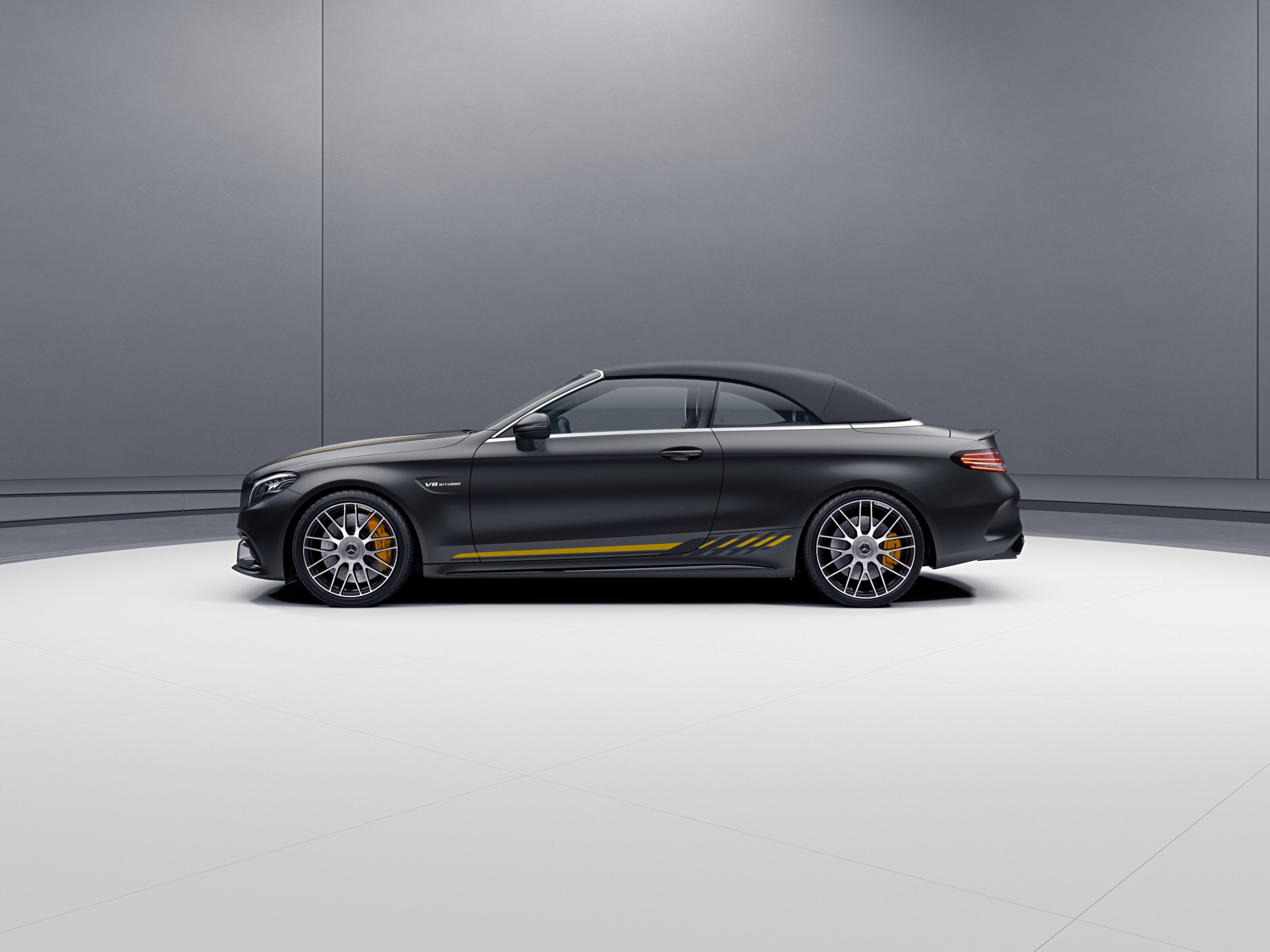
The Mercedes-AMG C63 S Cabriolet Final Edition package is bestowed with Mercedes’ Manufaktur Graphite Grey matte paint with contrasting yellow and dark grey decals.
The Exterior Carbon Package is fitted as standard, along with staggered 19-inch/20-inch cross-spoke alloy wheels and Mercedes-AMG’s carbon-ceramic front brakes.
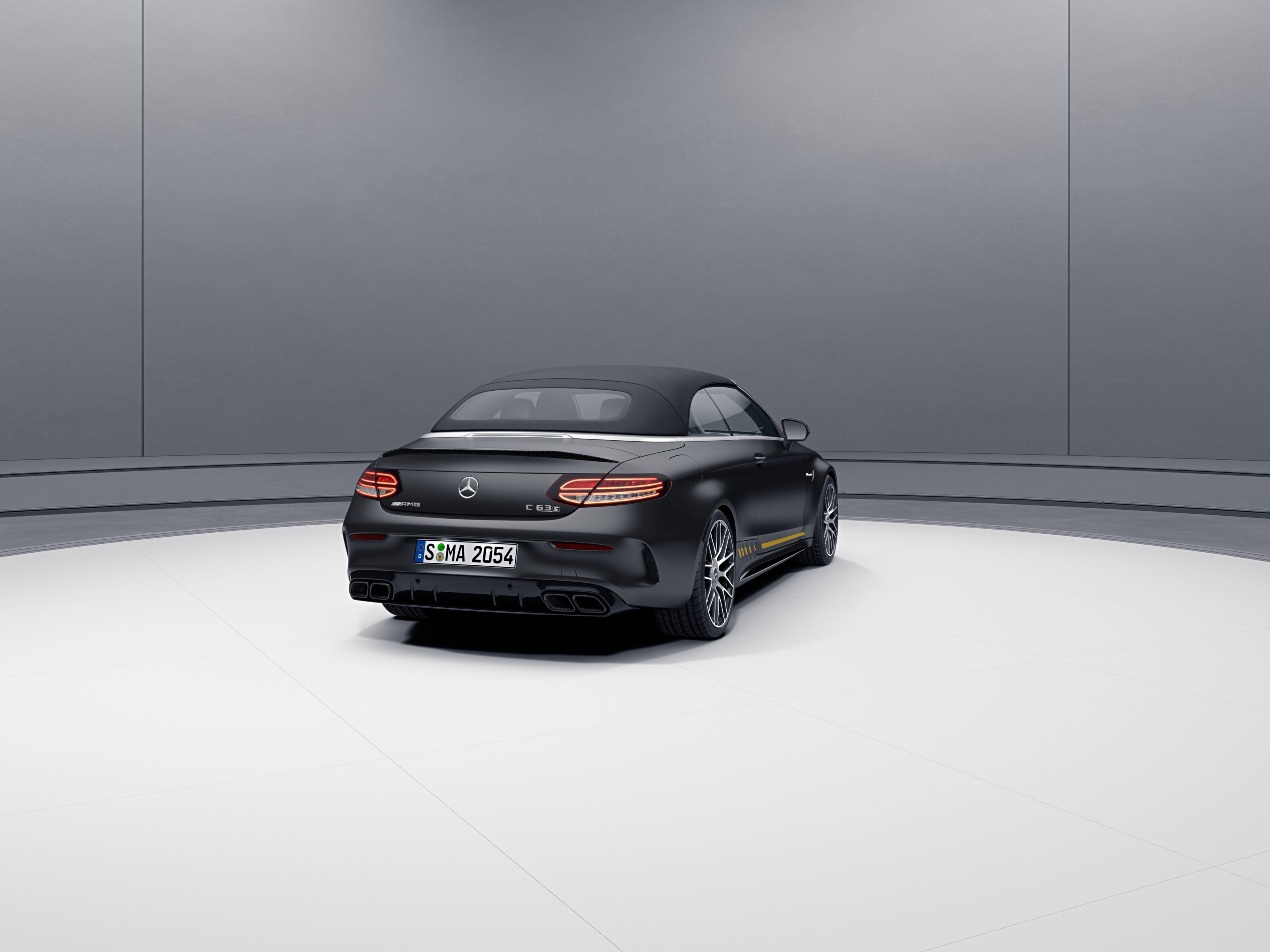
Inside, AMG Performance seats and steering wheel wear Nappa grey and black upholstery with contrasting yellow stitching. The cabin is finished in dark aluminium and matt carbon fibre, topped with Final Edition badging on the centre console.
The Final Edition package for the 2023 Mercedes-AMG C63 S Cabriolet asks $26,400 on top of the existing $212,600 C63 S drop-top, for a total price of $239,000 (before on-road costs).
2023 Mercedes-AMG C63 S Coupe Final Edition
In addition to the standard C63 S Coupe, the Final Edition package adds:
| MANUFAKTUR Graphite Grey magno paint |
| Yellow and dark grey decals |
| Exterior carbon package |
| 19/20-inch AMG cross spoke alloy wheels |
| AMG cabon-ceramic front braking system |
| AMG Performance seats |
| AMG Performance steering wheel |
| Nappa grey/black upholstery w/ yellow stitching |
| Dark aluminium and matt carbon fibre accents |
| Final Edition badging on centre console |
| AMG Aerodynamics Package |
| Final Edition badging on C-pillar |
The C63 S Coupe Final Edition receives the same features as the Cabriolet above, but adds the AMG Aerodynamics Package as standard, plus a distinguishing Final Edition badge mounted externally on the C-pillar.
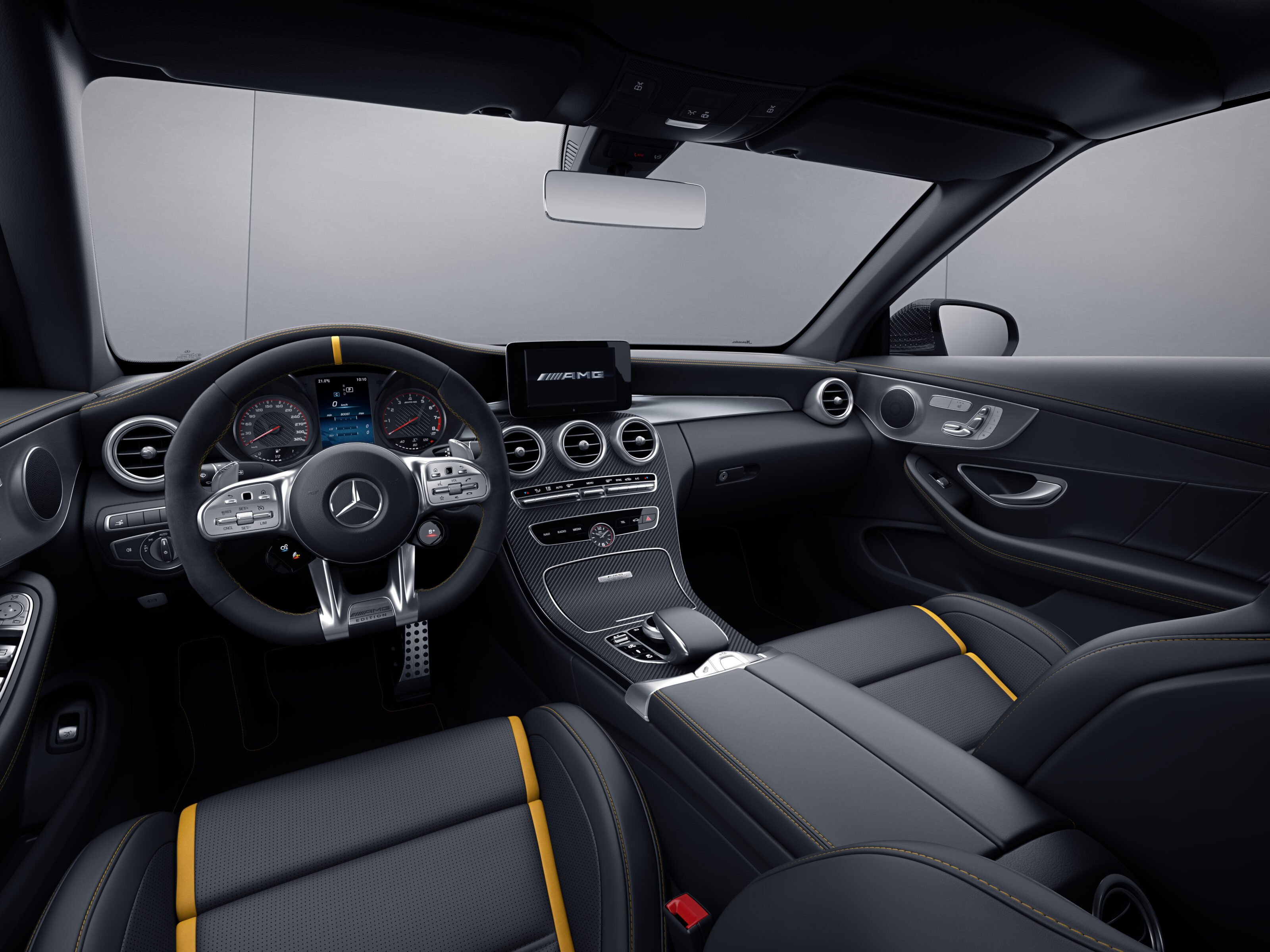
The Mercedes-AMG C63 S Coupe Final Edition package adds $28,400 to the existing C63 S’ pricetag of $190,000, for a total asking price of $218,400 (before on-road costs).
2023 Mercedes AMG E63 S 4MATIC Sedan Final Edition
In addition to the standard E63 S 4MATIC Sedan, the Final Edition package adds:
| MANUFAKTUR Graphite Grey magno paint |
| Decals on side skirts |
| Exterior Carbon Package |
| 20-inch AMG cross-spoke alloy wheels |
| Multibeam LED headlights |
| AMG carbon-ceramic front braking system |
| AMG Performance seats in Nappa grey/black w/ yellow stitching |
| AMG Performance steering wheel in leather/Dinamica |
| Interior carbon fibre accents |
| Final Edition bading on centre console |
| Final Edition badging on C-pillar |
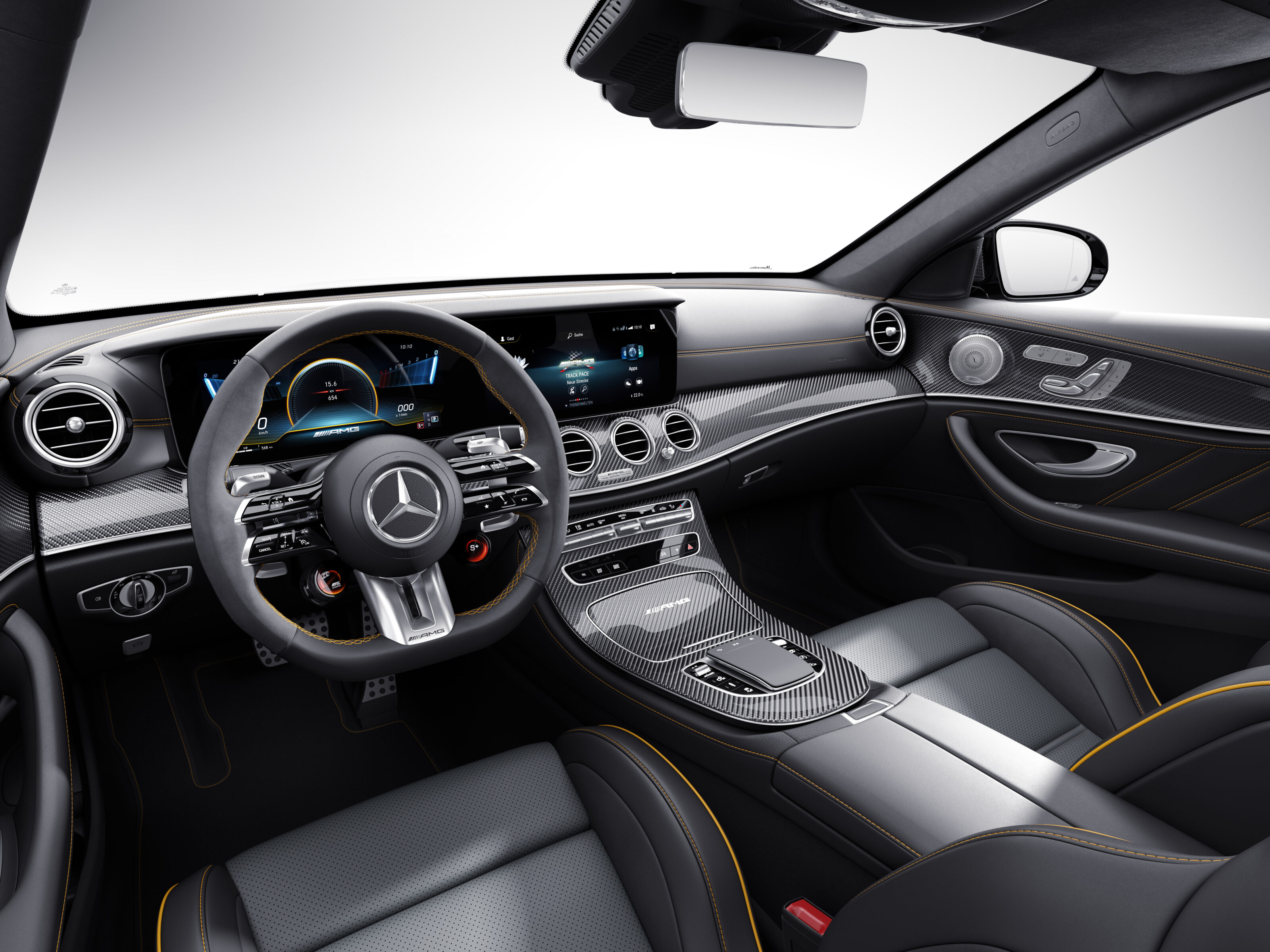
Mercedes-AMG’s bigger boss, the E63 S, which is rumoured to follow its C-Class sibling down the hybridised four-cylinder power path, also receives a Final Edition makeover. Mercedes’ Manufaktur Graphite Grey matte paint features again, along with side skirt decals, a standard-fit Exterior Carbon Package, 20-inch AMG cross-spoke alloy wheels, ‘Multibeam’ LED headlights and the AMG carbon-ceramic brake system.
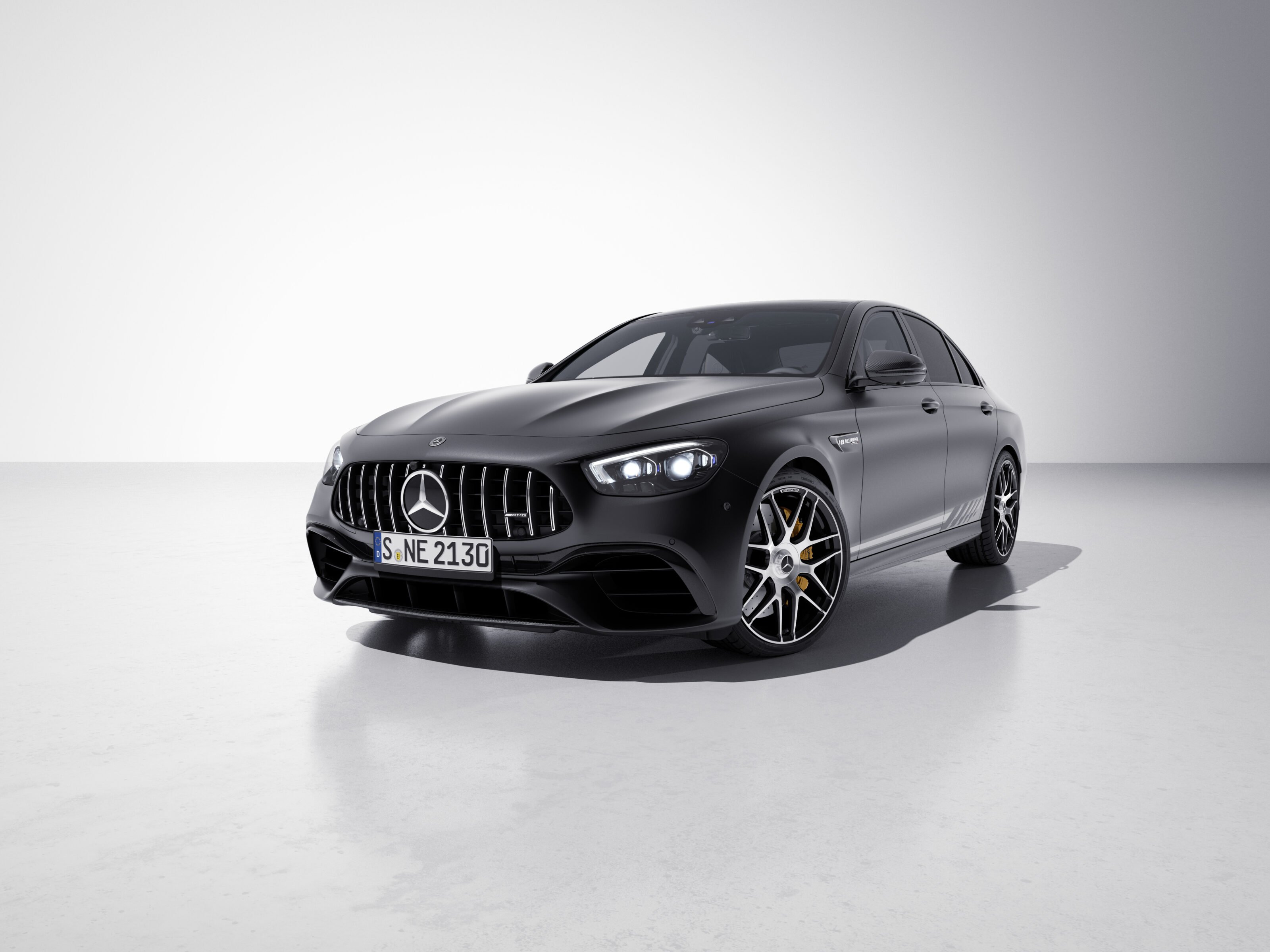
Inside, AMG Performance front seats are had in your choice of Nappa grey or black with yellow stitching, complemented by an AMG Performance steering wheel in leather and Mercedes-Benz’s suede-like Dinamica material. The cabin is accented by carbon fibre, further distinguished by Final Edition badging on the centre console and exterior C-Pillars.
The E63 S Sedan Final Edition package adds $39,900 to the standard E63’s $272,000 asking price. That’s a total of $311,900.
Snapshot
- Akio Toyoda steps down as CEO after 14 years
- Succeeded by 53 year-old Koji Sato
- Electrification and fast-moving industry one reason cited
Akio Toyoda has stepped down as Toyota CEO after 14 years in the top job.
At 66 years-old, Toyoda took the top job in 2009 and is the grandson of Kiichiro Toyoda, who started Toyota’s automotive manufacturing business in Japan after World War II.
Toyoda will be succeeded by 53 year-old Koji Sato, currently chief branding officer and president of Lexus, on April 1. Toyoda will then go on to be chairman of the board at Toyota.
The change is said to be a result of fast-moving electrification in the industry, with Toyoda admitting he sees the need for a younger person to sit at the helm and steer Toyota into the future.
“Younger people should be placed in the right job so they can come up with the answer to what the future of mobility should be”, Toyoda-san said in a statement, adding that “we’re facing a once-in-a-century change in the auto industry”.
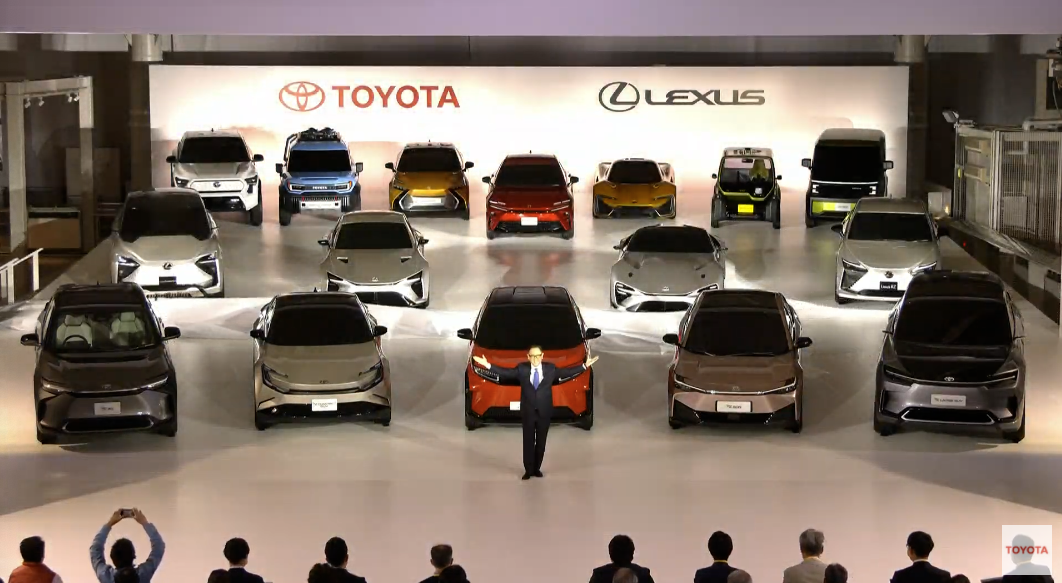
Toyota’s electric vehicle strategy has been a stop-start affair and currently lags behind other carmakers, with Toyoda-san not setting a definitive target like so many other auto manufacturers such as Volvo, Volkswagen, Audi and Jaguar.
In December 2021, Toyoda-san announced there would be 30 new EVs by 2030, with pure electric sales in Europe, China and the United States, however he has since gone on to openly criticise the fast transition to electric vehicles.
Toyoda-san’s caution is understandable, as Toyota is Japan’s biggest company, selling over 10 million vehicles globally in 2021.
Currently, Toyota only has one electric vehicle on-sale in world markets, the BZ4X, which was developed in partnership with Subaru’s Solterra. Both are readying for Australian release this year.
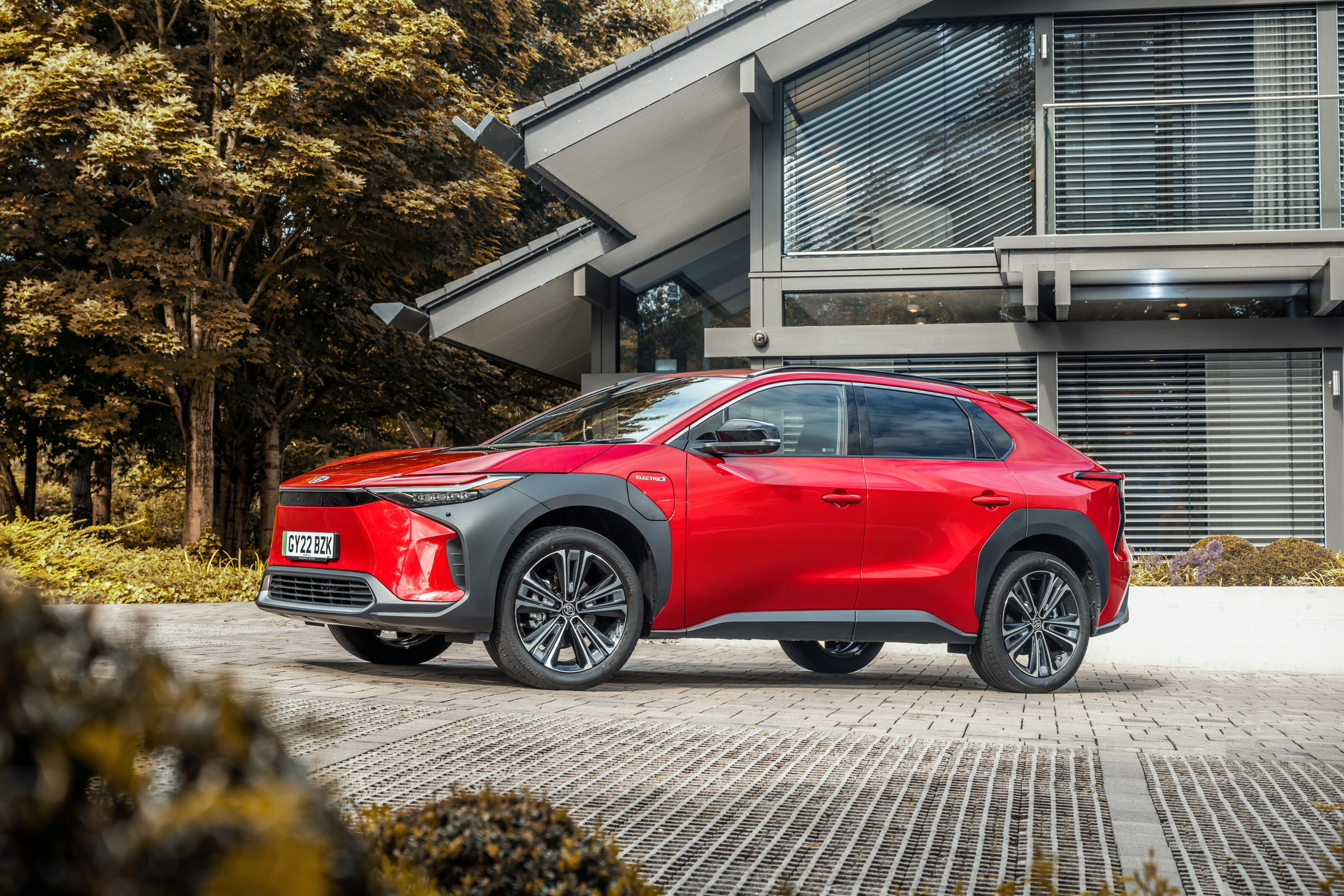
Toyota was expecting its E-TNGA platform under the BZ4X to support rapid electrification, however the brand has revisited the drawing board amid fast-moving rivals such as Tesla and Polestar. New CEO Sato-san will play a crucial role in electrification of Toyota’s range into the future.
It would be cruel to simply look back on toyoda-san’s leadership period as stagnating, though. After declaring ‘no more boring cars’ were to come from Toyota, the motoring landscape has been treated to some gems, including the Toyota 86, rebirth of the Supra, GR Yaris and now GR Corolla.
More to come as news develops.
Snapshot
- Seattle law firm investigating Jeep PHEVs
- EV-only mode disabled in the cold to ‘keep engine healthy’
- Alleges Jeep misled buyers who paid a price premium
American law firm Keller Rohrback is investigating claims from owners that their Jeep plug-in hybrid electric vehicles (PHEVs) can’t use electric-only mode in cold climates.
It applies to the company’s first PHEV models released in the US, including the 2021-2022 Grand Cherokee 4xe large SUV and Wrangler 4xe off-roader.
The law firm is alleging Jeep misled buyers about their vehicle’s electric-only driving capabilities due to the fuel and oil refresh mode (FORM) feature, which keeps the internal combustion engine running to protect it from low temperatures.
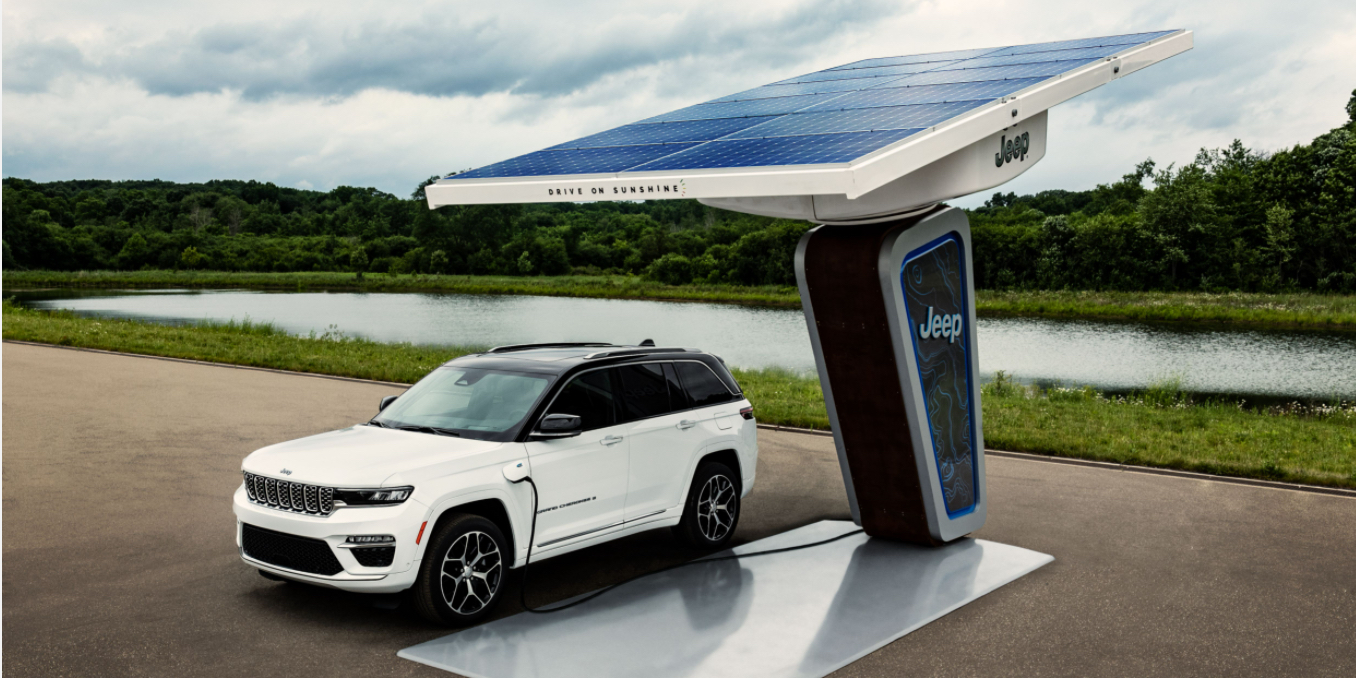
It helps keep gaskets and seals warm and expanded, preventing gasoline from mixing with the oil.
This results in the EV-only mode being “functionally unusable for months at a time during cold weather”, despite owners paying a price premium for the PHEV and its electric driving benefits.
The Jeep Grand Cherokee 4xe PHEV is slated to arrive in Australia this year.
Best Electric Cars, $65k-80k: Australia’s premium EVs tested
In part two of our three price-based EV buying guides, we compare Australia’s electric cars priced between $65,000 and $80,000
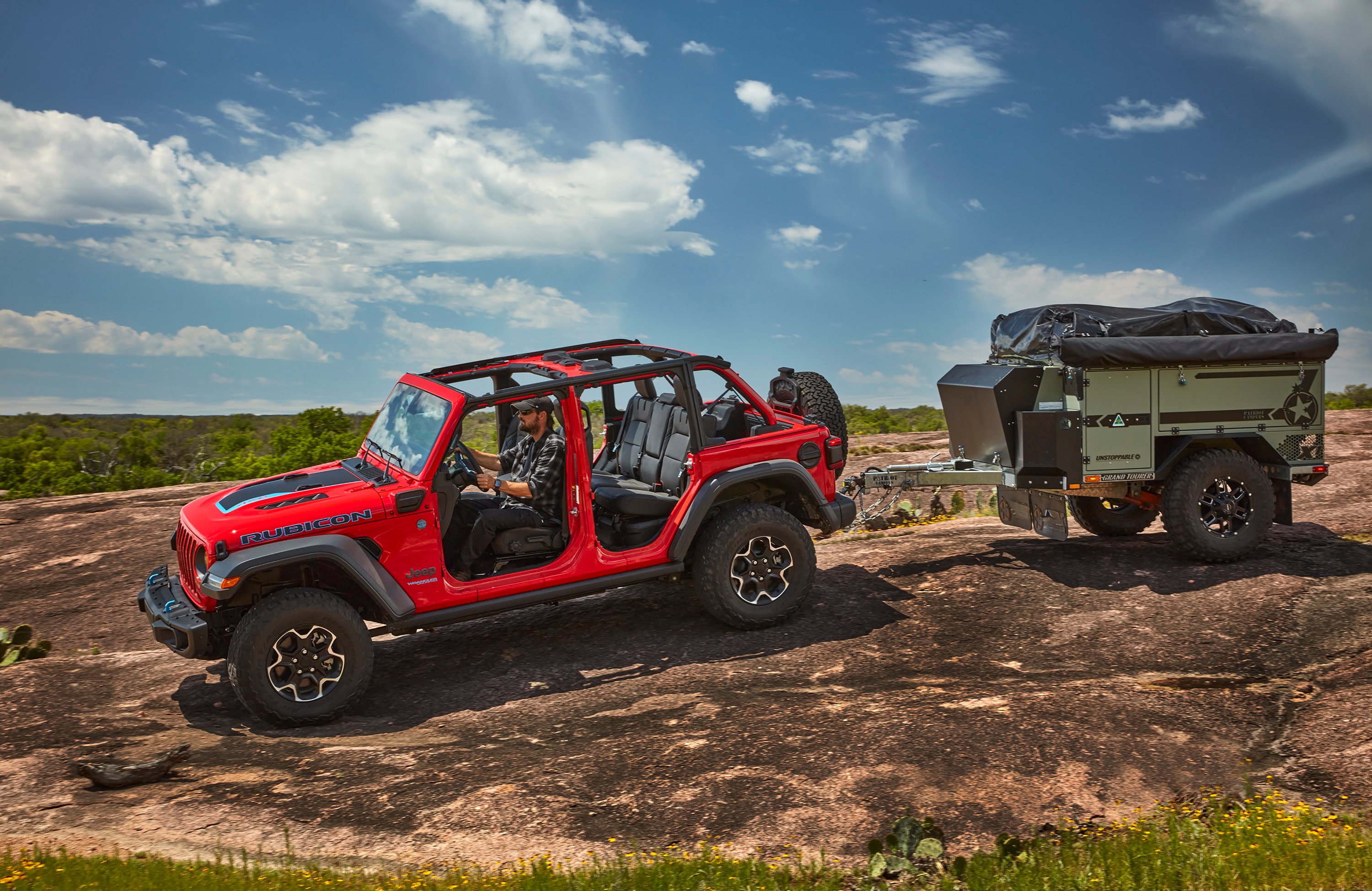
It will join the Grand Cherokee line-up as the flagship variant in shorter wheelbase, two-row guise.
The off-road capable plug-in hybrid packs a 2.0-litre turbo petrol engine with dual electric motors. Combined outputs are 280kW/675Nm and the 4xe drives all four wheels.
Up to 40 kilometres of claimed pure-electric driving range is delivered courtesy of a larger 17kWh battery pack.
Snapshot
- EV6 GT lifts the bar dynamically
- Positioned above entry Air and GT-Line variants
- 430kW/740Nm EV6 GT asks $99,950 and does 0-100km/h in 3.5sec
The much anticipated 2023 Kia EV6 GT has arrived from $99,950 before on-road costs to serve as the new electric sporting halo model, joining the existing two-trim line up, comprising a choice of rear- or all-wheel drive and 800v ultra-fast charging capacity.
Read the EV6 GT review here
Or watch the walk-around video below
2023 EV6 pricing
Kia hopes to steal buyers away from the popular Tesla Model Y, the biggest-selling SUV in the sector.
The entry-level rear-wheel-drive EV6 Air opens at $72,590 (all prices shown are before on-road costs), featuring as standard the long range 77.4kWh battery.
Step up to the rear-wheel drive GT-Line, and driving range drops slightly from 528 kilometres to 508km, while the price tag swells to $79,590.
There is also the all-wheel-drive, dual-motor GT-Line, which is capable of getting to 100km/h in 5.2 seconds, offers 484km and is pitched at $87,590.
The just-launched EV6 GT takes the top spot, asking $99,950 and bears the same 77.4kWh battery, but is equipped with more powerful electric motors (160kW/350Nm at the front, 270kW/390Nm at the rear) delivering a combined 430kW/740Nm and a 0-100km/h claim of 3.5-seconds. Range is down 60km from the GT-Line AWD at a claimed 424km.
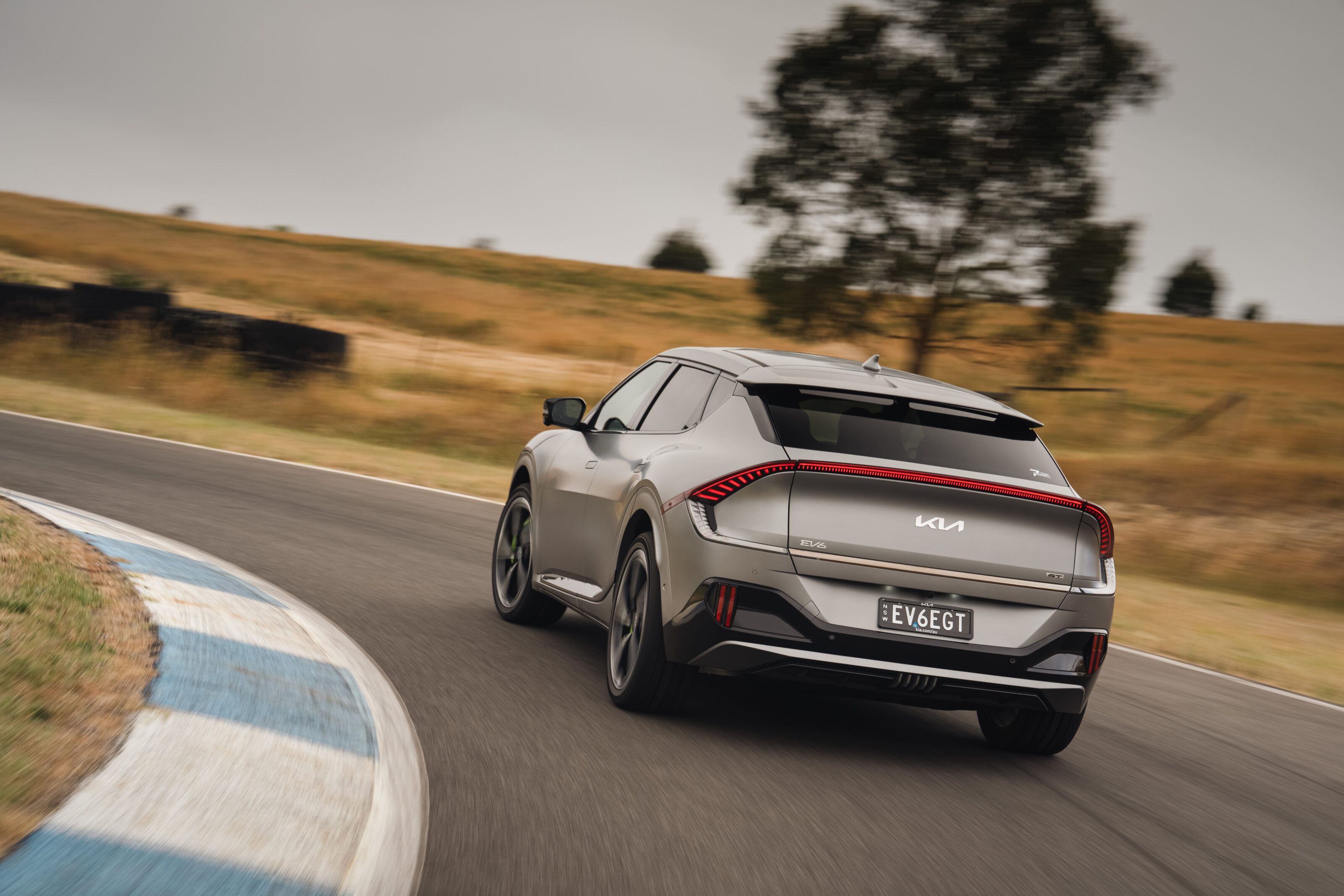
Features
Even the entry-level EV6 Air is generously equipped. Standard equipment includes:
| 19-inch alloy wheels | Frunk LED lighting |
| Low noise, low rolling resistance Kumho tyres | Cloth and artificial leather seats |
| Long range 77.4kWh battery | Artificial leather steering wheel trim |
| LED headlamps and tail-lights | Dual curved 12.3-inch displays |
| Acoustic film windscreen | Wireless phone charger |
| Athermic glass on windscreen and doors | Inbuilt navigation |
| Flush door handles | USB chargers in front seat backs |
| Power folding mirrors | 12v outlet in boot |
| Rotary gear selector | Smart key and push button start |
| Paddles for regen control | Dual-zone climate control |
| LED interior lighting | Rain sensor |
| Vehicle-to-load (interior) | Electrochromatic interior mirror |
| Powered driver’s lumbar support | |
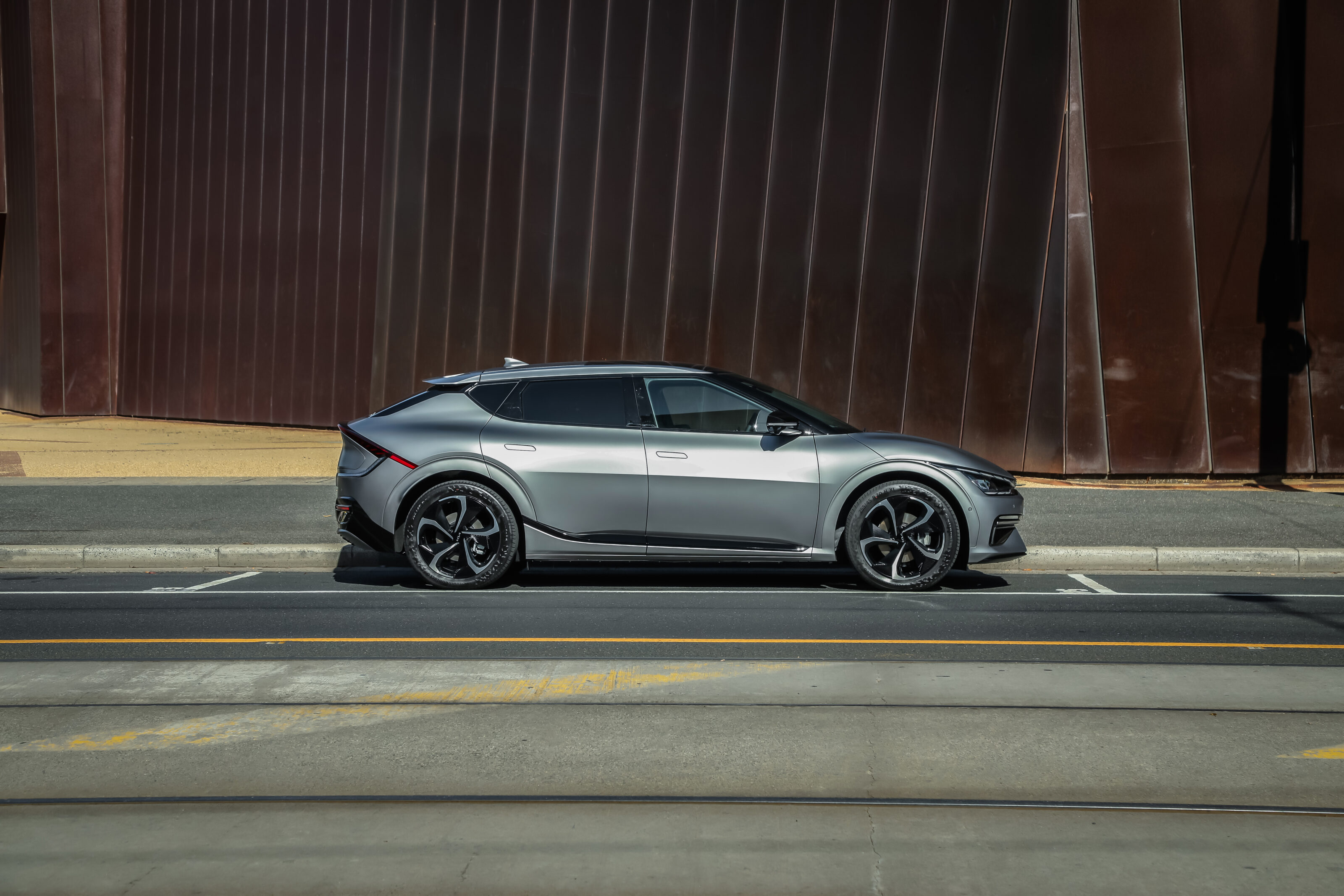
The EV6 GT-Line adds, or includes, as standard:
| 20-inch alloy wheels | 64-colour ambient mood lighting |
| Laminated acoustic front door glass | Active sound design |
| Privacy glass for rear doors and tailgate | Augmented reality head-up display |
| Auto folding flush door handles | 14-speaker Meridian sound system |
| GT-Line body kit | Power driver’s seat with two memory settings |
| Vehicle-to-load (exterior) | Heated and ventilated front seats |
| Wide sunroof (AWD only) | Heated steering wheel |
| Artificial leather and suede seats | Remote smart park assist* |
| Stainless steel luggage sill | Smart powered tailgate |
*This function is not currently certified for use in Western Australia
The flagship EV6 GT adds, or includes, as standard:
| 21-inch alloy wheels w/ Michelin Pilot Sport 4S tyres | Electronic controlled suspension |
| IFS LED head lights | GT body design with Neon Green brake calipers |
| Sequential indicators | GT Mode button on steering wheel |
| E-limited slip differential | Artificial leather and suede sports seats |
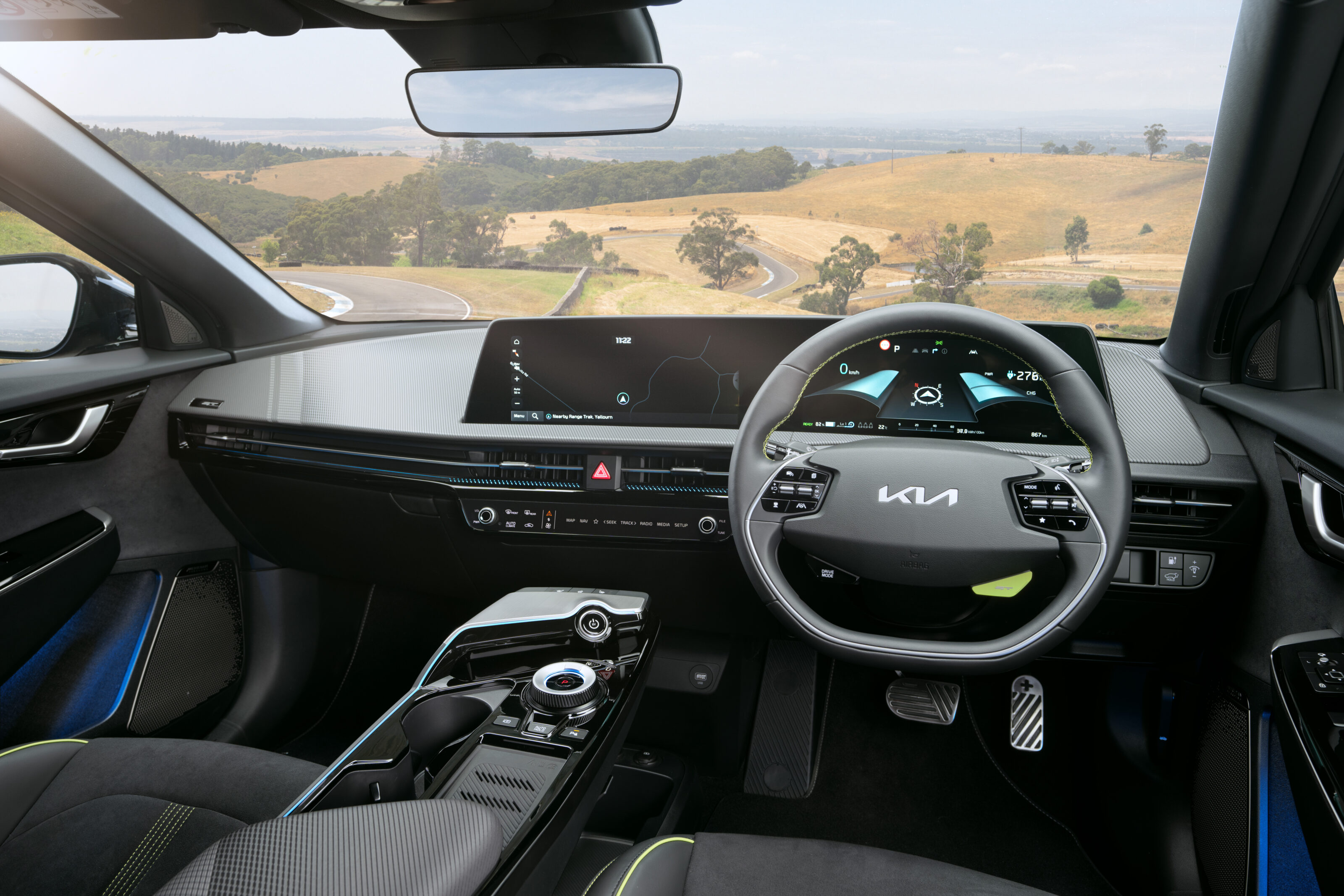
The Air model also incorporates a high percentage of recycled PET materials on the dash, door pockets, carpets, seat fabric inserts and inner bolsters.
No solid paint finishes will be offered, with the Air getting a choice of snow white pearl, aurora black pearl, runway red, yacht blue, steel grey and a new to Kia glacier paint finish.
The GT-Line also gets the first four colours, but does without steel grey and glacier, instead introducing a cost-option moonscape matte grey finish for the first time.
For the flagship GT, runway red is the only standard colour, with snow white pearl, auruora black pearl, yacht blue and moonscape carrying premium/matte paint options.
Engine, drivetrain and fuel economy
The rear-drive single motor installation generates a peal power figure of 168kW with torque rated at 350Nm, which is enough to get the EV6 to 100km/h in a crisp 7.3 seconds.
Opt instead for the dual-motor all-wheel-drive flagship and power is rated at 239kW with a peak torque of 605Nm.
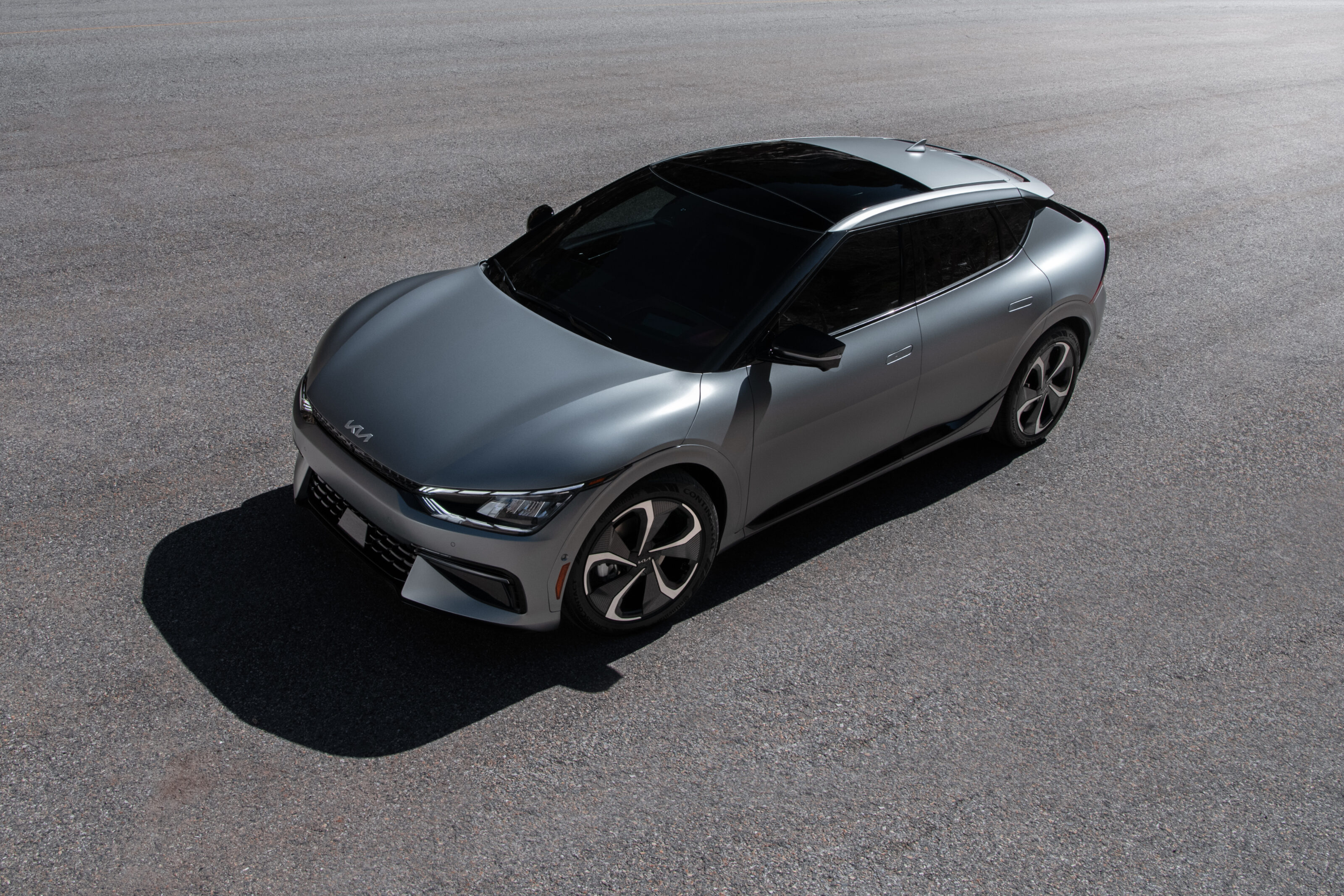
With all versions using the 77.4kWh battery pack, the lighter Air version nets the longest driving range at 528km, with the bigger wheels and extra weight of the rear-drive GT-Line shaving 20km from that figure.
The range-topping dual-motor GT-Line nets 484km. Given that the equivalent Tesla Model Y Long Range is reported to feature a range of 507km, Kia has landed the larger EV6 in much the same ballpark.
The EV6 GT hero suffers a slightly hampered driving range, again, rolling on larger, stickier Michelin Pilot Sport 4S tyres, delivering a claime 424km of range.
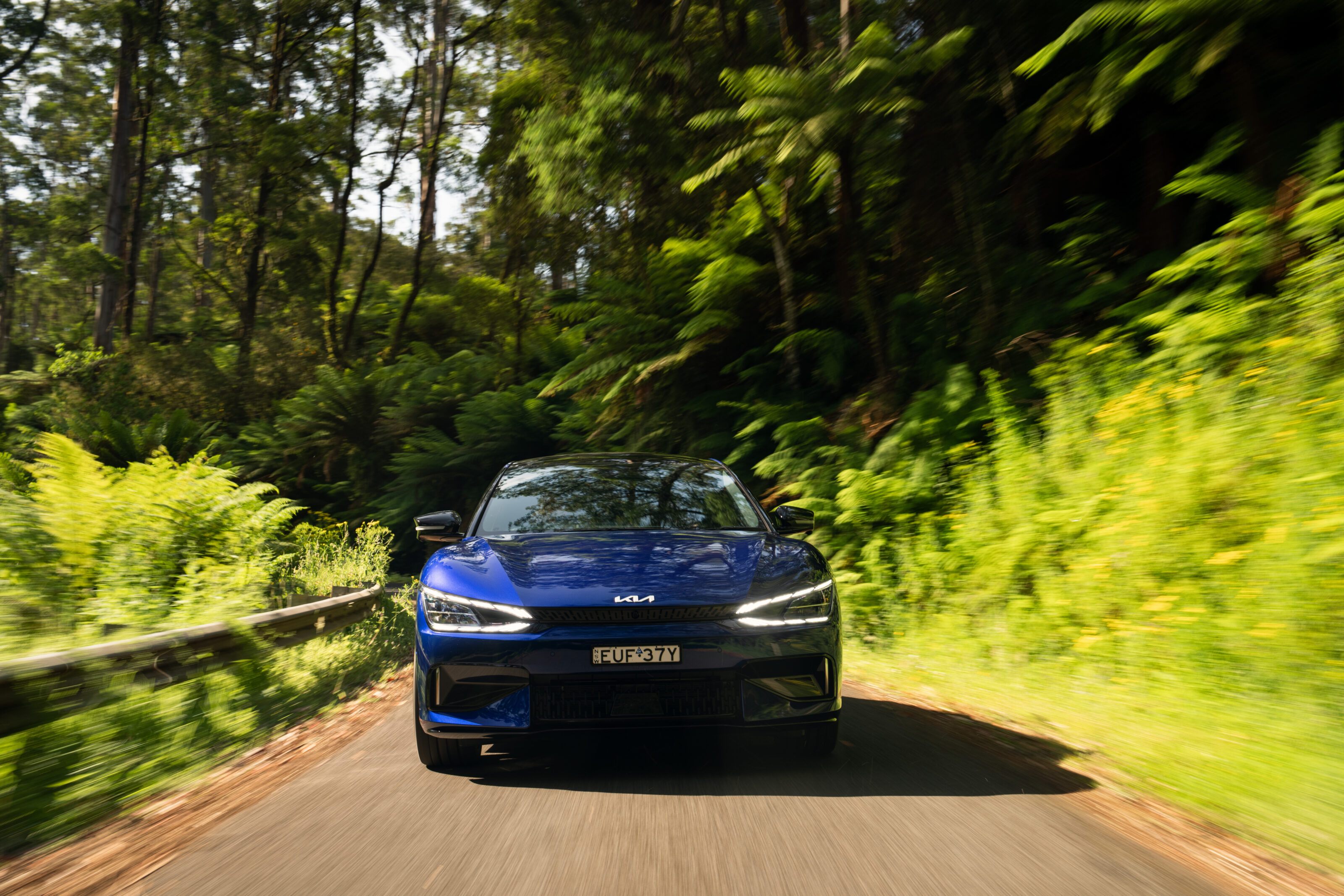
Its high-output motors deliver a claimed 3.5 second sprint from 0-100km/h, with the GT harnessing clever tech like the new e-LSD and torque vectoring to elevate its dynamic capabilities.
The 800v fast charging capacity is also standard on every EV6 model. Unbraked towing capacity is rated at 1600 kilograms.
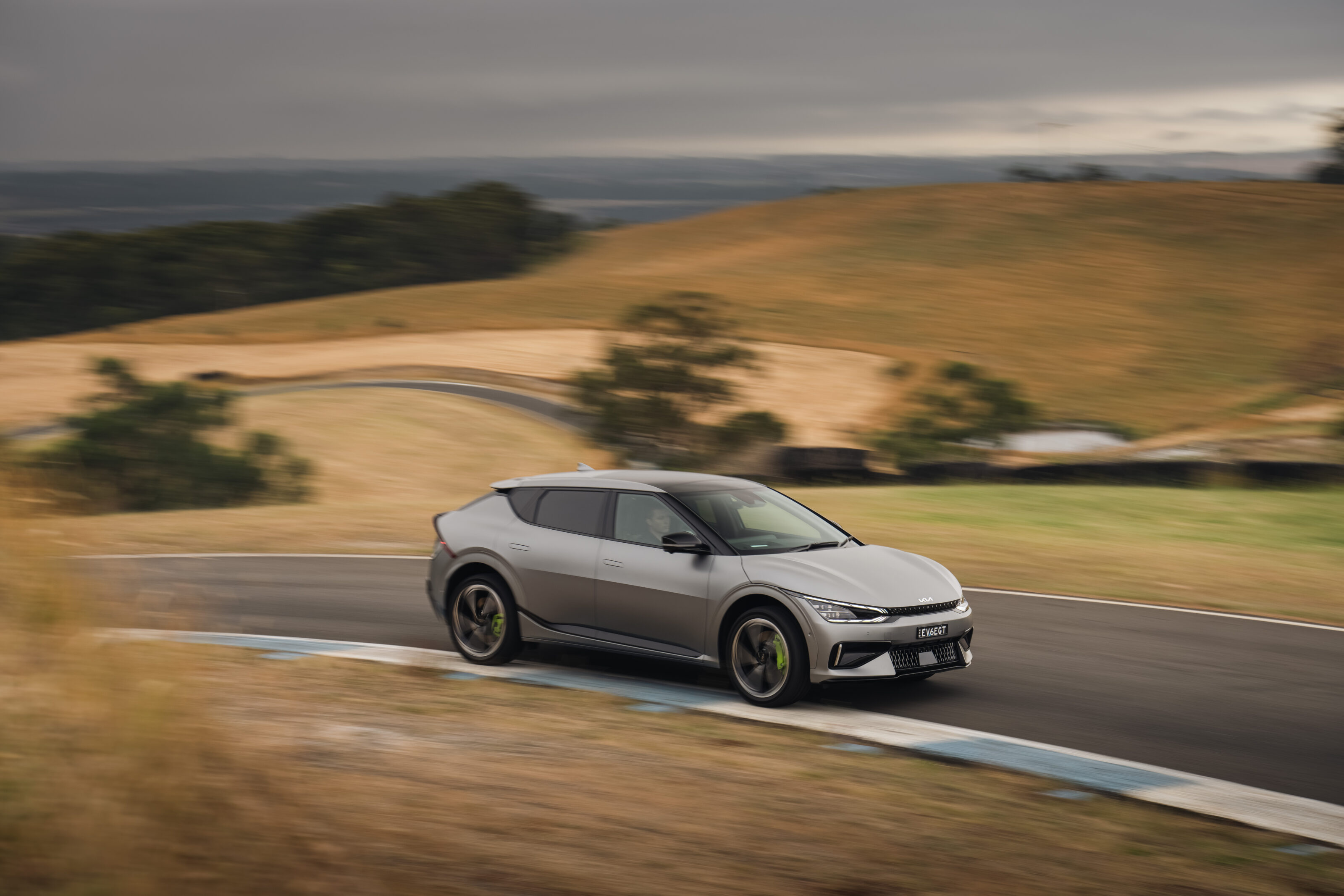
Local suspension tuning of the Sachs dampers has been conducted in order to provide a ride quality that’s somewhere between the very soft Korean domestic market setup and the far firmer European setting.
Dimensions
One thing the EV6 does share in common with its Hyundai cousin, the Ioniq 5, is that it’s a far larger vehicle in the metal than pictures originally suggested.
That said, despite running on a version of the almost infinitely tweakable E-GMP (Electric-Global Modular Platform), the wheelbase of the EV6 is a little shorter than that of the Ioniq 5. Not that you’d guess when climbing inside. It’s genuinely large, with plenty of space for a six-footer to sit in the rear behind an equally tall driver.
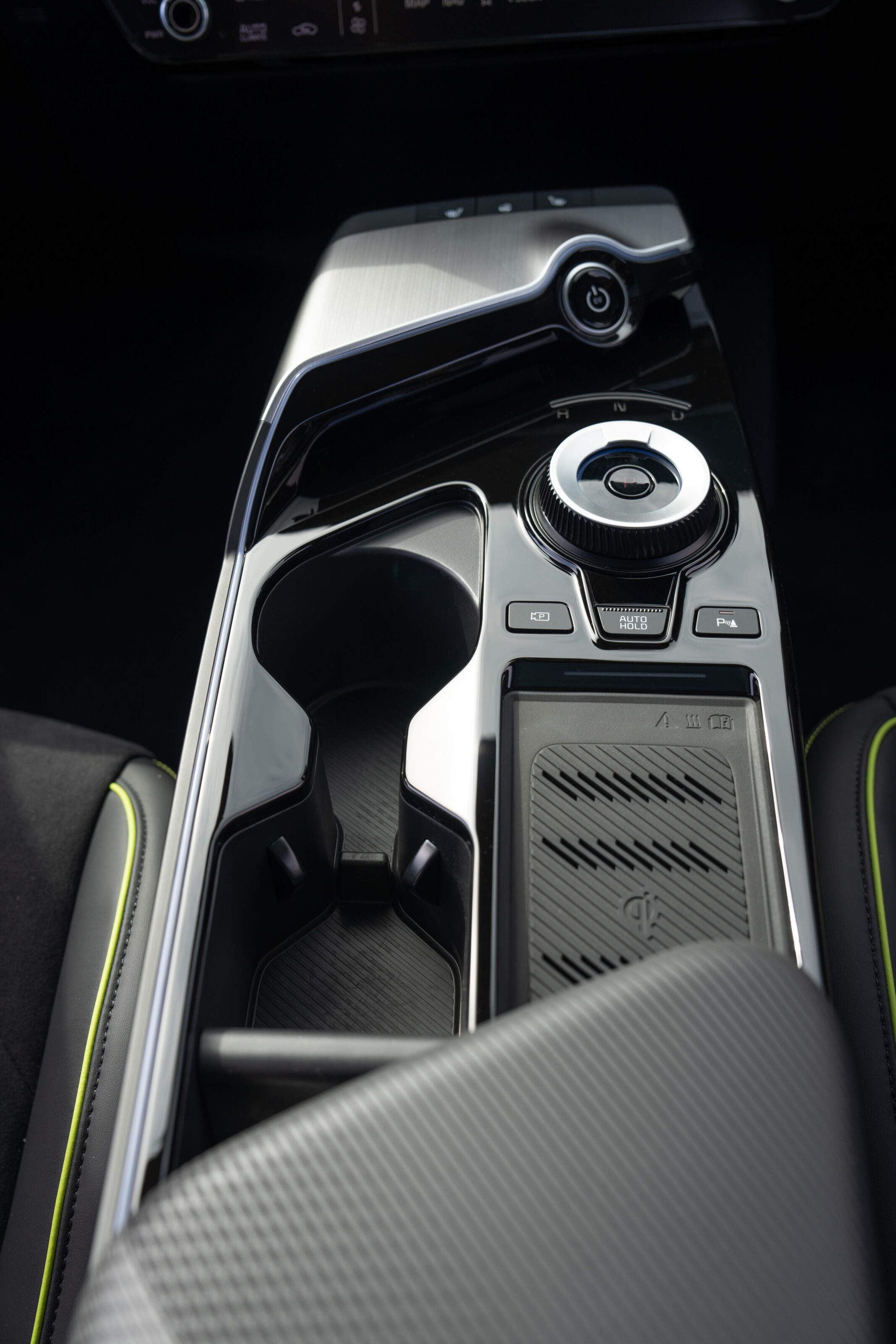
There’s a huge amount of internal stowage space, with generous door pockets, a flat floor, and possible the deepest glove box of any current production vehicle.
The wheelbase measures 2900 millimetres for all models, which is the same as a Porsche Taycan or, if you prefer, a Honda Odyssey – so the EV6 is generously cut. Overall length is 4695mm for the GT-Line variants and 4680mm for the Air, with a width of 1890mm for GT-Line and 1880 for the Air. Single motor models are 1550mm high, with the dual-motor GT Line being 5mm lower, and the GT being 5mm lower again at 1445mm.
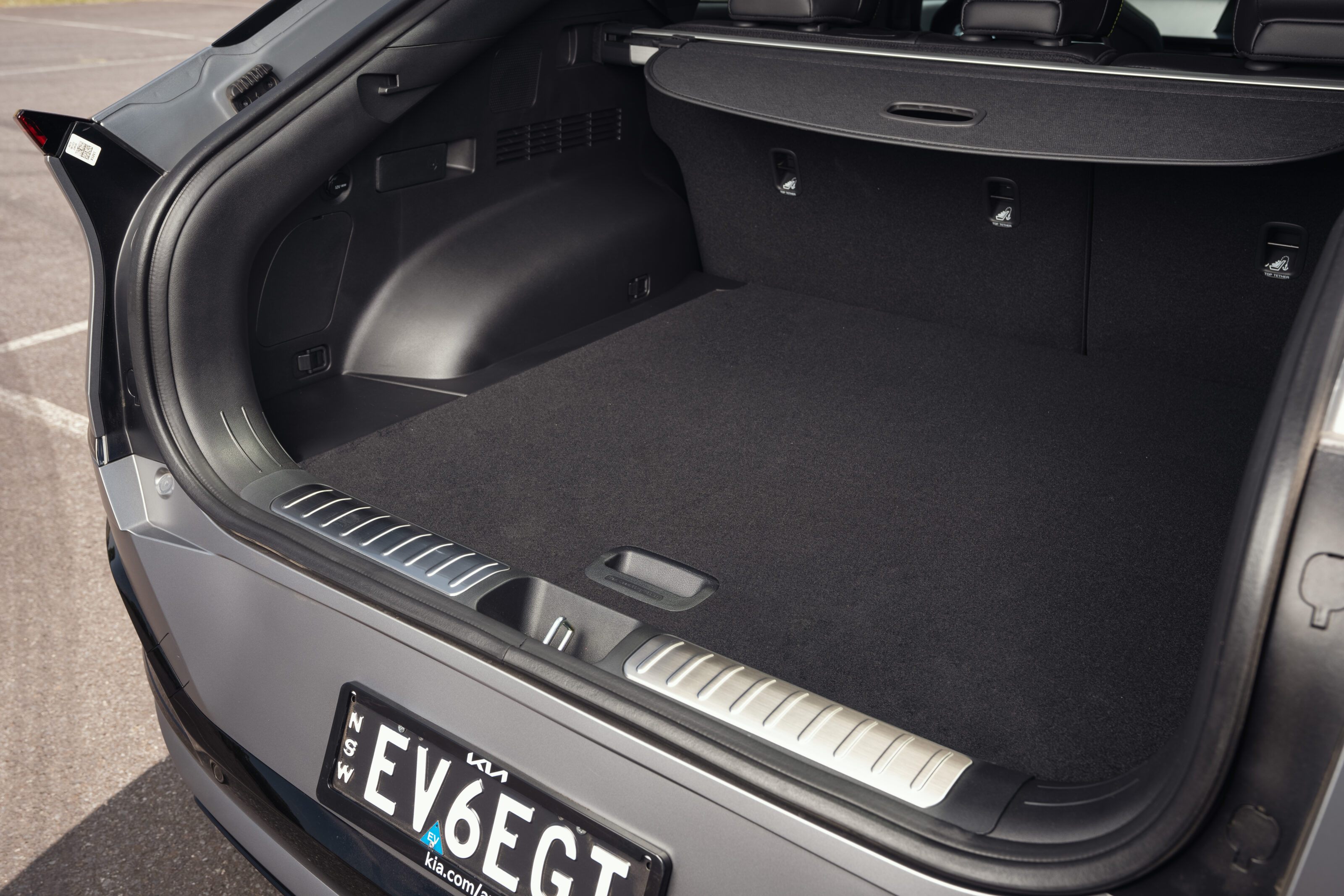
Pop the hatch and you have 490L of luggage space, while dropping the rear seats nets you 1296L. The GT-Line and GT’s 14-speaker Meridian stereo system, however, adds a subwoofer to the boot which eats up 10L of stowage space.
There’s also a frunk up front, which delivers an additional 52L of stowage in the single motor models, while opting for the dual-motor trims that to 20L.
Safety
The Kia EV6 Air and GT-Lines were awarded Five Stars by ANCAP in 2022.
The flagship GT, however, currently stands unrated due to its new sports seats that require rehomologation and testing.
Safety features as fitted to the entry-level Air version include:
| Automatic emergency braking (AEB) with junction turning | Intelligent speed limit assist |
| Lane keep assist with lane following assist | Tyre pressure monitoring system |
| Blind-spot detection | Front and rear parking sensors |
| Rear cross traffic alert | Electronic parking brake |
| Centre side airbag | Temporary tyre mobility kit |
| Multi collision braking | Smart cruise control |
On top of that, the GT-Line also adds:
| Blind-spot view monitoring |
| Power child lock |
| 3D surround-view camera |
Warranty and servicing
The EV6 is covered by a seven-year/150,000-kilometre warranty, with seven-year cover for the battery pack.
Kia offers three different pre-paid servicing packages to the tune of three, five and seven years.
For Kia EV6 Air and GT-Line, these cost $594, 1089 and $1584, respectively.
The flagship GT suffers slightly increased servicing costs, which Kia indicates is due to the more laborious servicing required by the GT’s larger performance brakes.
Kia’s servicing plans for the EV6 GT cost $733 for three years, $1371 for five years, and $2013 for seven years.
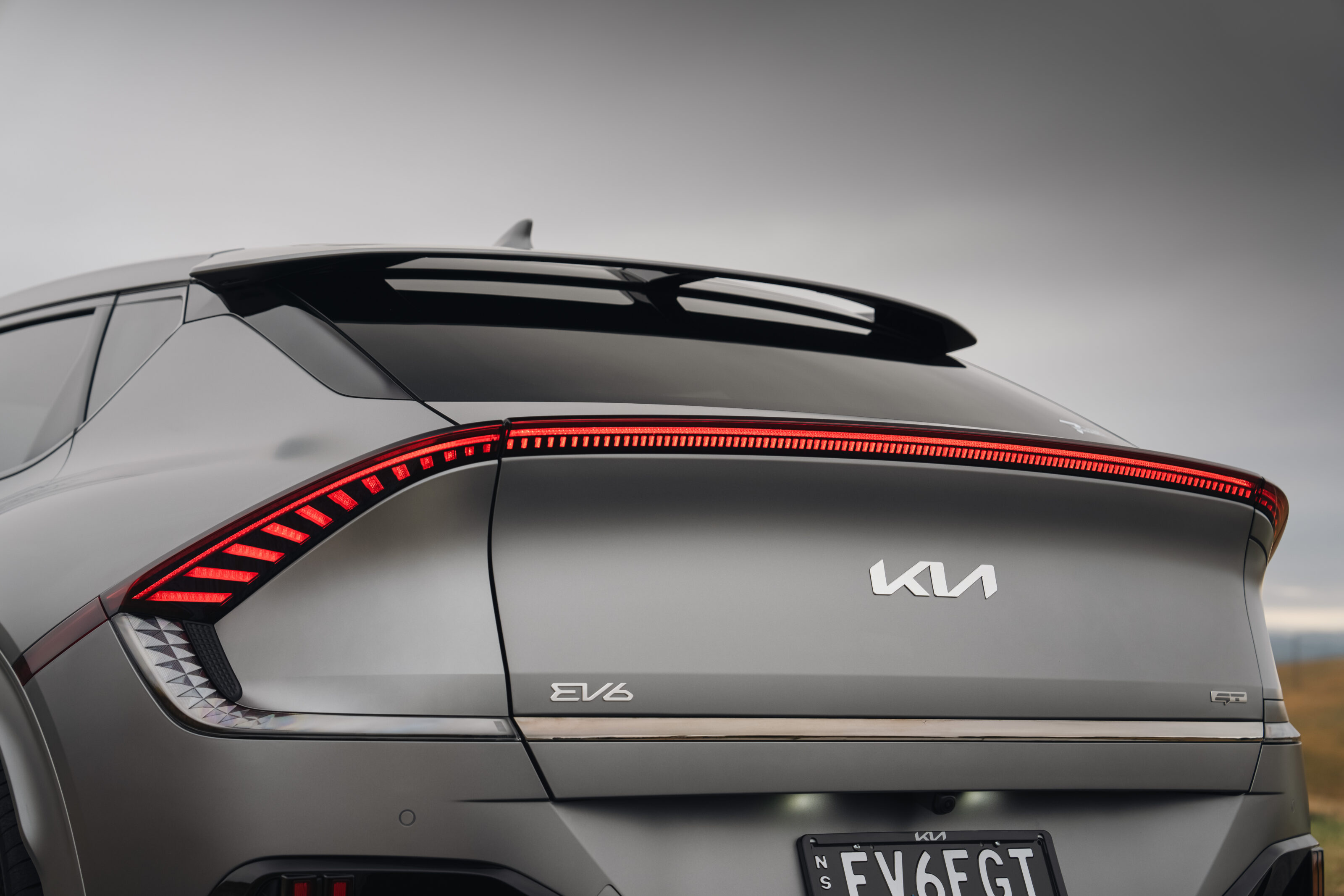
Availability
All three Kia EV6 variants are available to order, though demand still outstrips supply.
At the launch of the Kia EV6 GT, Kia Australia expects to receive around 400 EV6 GTs throughout 2023, according to current shipping plans.
JUNE 2023: We’ve driven the EV9!
Get our full written and video review at the linked story below.
STORY CONTINUES
March 2023: EV9 leaked!
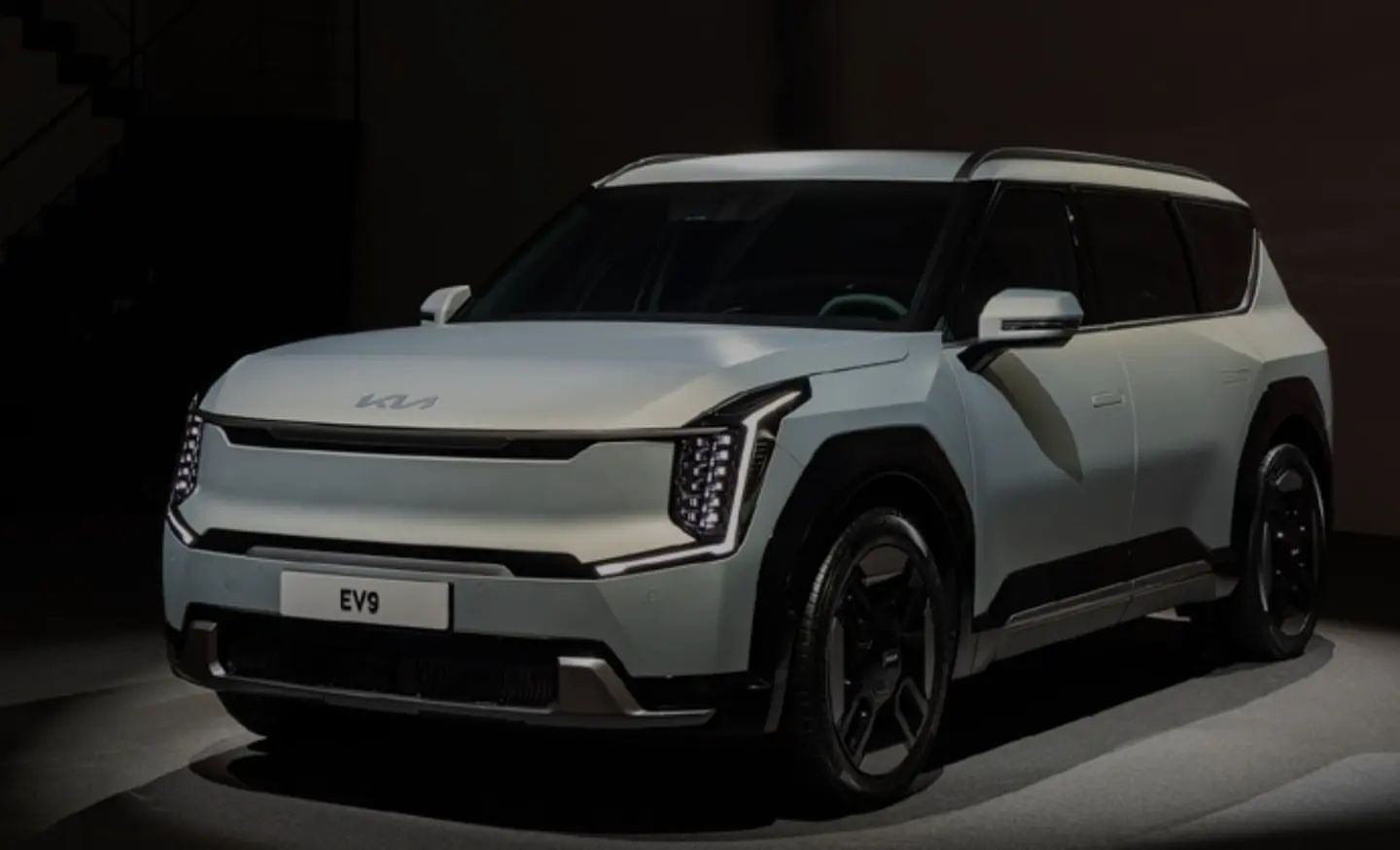
The upcoming Kia EV9 has surfaced in online social media, offering a first clear look at official marketing shots. Get the full story at the link below.
The story to here
Update, Jan 27: Kia EV9 confirmed for Australia!
Despite the public not yet having seen the car in production form, Kia Australia has confirmed that the hotly anticipated EV9 electric large SUV will be entering the Australian market.
At the launch of the high performance Kia EV6 GT, Australian Chief Operations Officer Damien Meredith confirmed “the local introduction of Kia’s EV9 during the second half of 2023.”
Despite the public not yet having laid eyes on the final production vehicle, according to shipping plans from the factory, Meredith expects Australia to receive around 400 EV9s between its local launch some time in H2 (July to December inclusive) 2023.
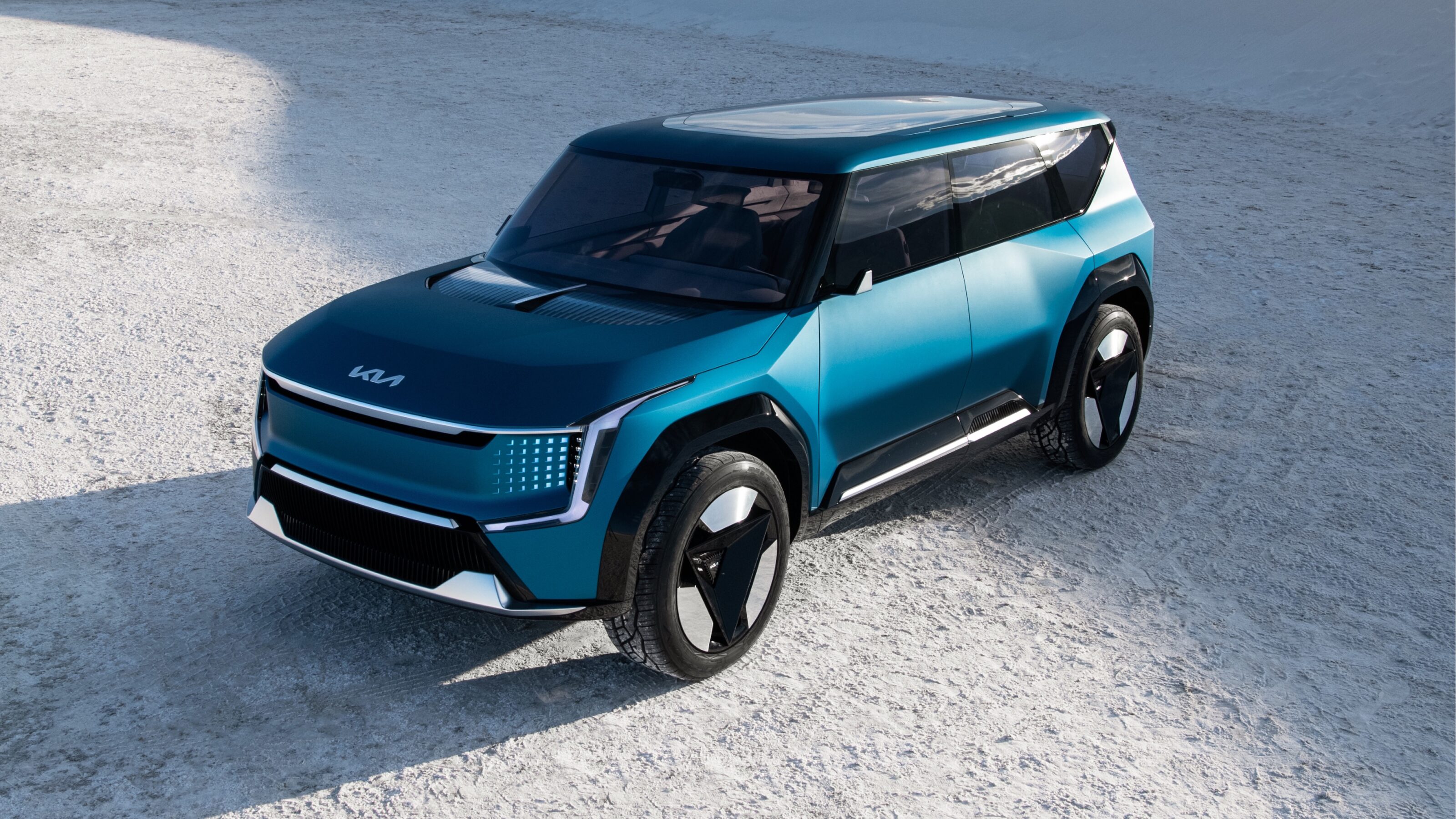
Further details including pricing, features and what the vehicle actually looks like, will be revealed closer to launch.
Our original story, below, continues unchanged
The story to here
Snapshot
- Australia has its hand up for EV9
- Upper-large SUV confirmed for RHD in Europe
- Model spied for the first time
The 2023 Kia EV9 upper-large SUV has been spied in its native Korea, with Australian bosses saying they’re keen for the model to come here in future.
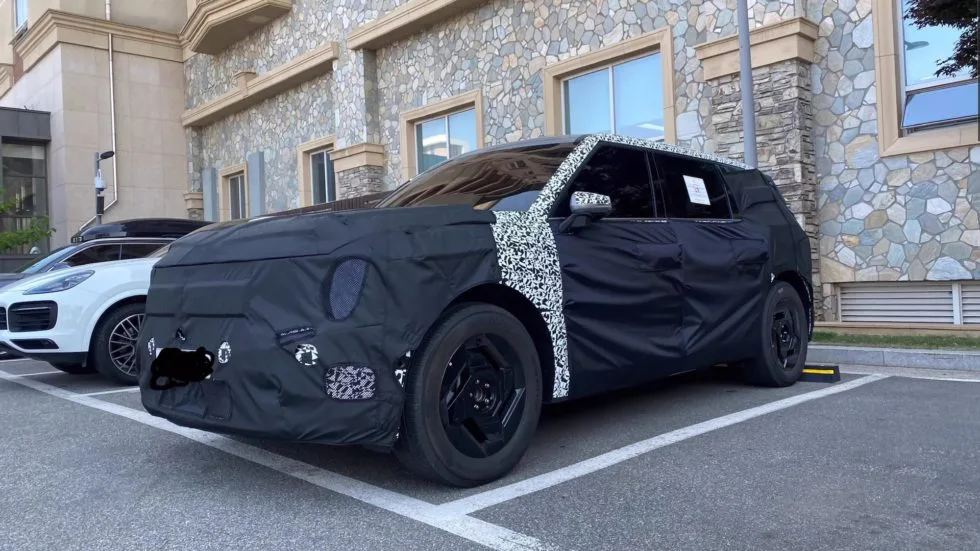
New spy photos posted by The Korean Car Blog show the upcoming electric vehicle’s exterior wrapped in camouflage and heavily cloaked, as well as its disguised cabin.
According to Kia Australia’s General Manager for Product Planning, Roland Rivero, the firm hopes to launch at least two additional EVs in 2023 in two completely different segments, and the local arm “has [its] hand up for EV9”.
“In the absence of Telluride, and I know there’s a lot of opinion on the lack of bringing that model to Australia, we think EV9 has got a lot of potential here,” he told Wheels.
“You look at that upper-large category – which is only a two horse race between the Toyota LandCruiser and the Nissan Patrol – with the average price there being around $96k and it tells us Australians aren’t afraid of a $90k upper-large SUV. There’s an opportunity there – we just need HQ to give us the green light.”
Next year the EV9 will be making its debut in right-hand-drive, with plans to launch in Europe recently confirmed.
With the battery-powered SUV set to go on sale in the UK, it’s a good sign Australia will also get a right-hand-drive version of the vehicle.
“The Kia Concept EV9 is another important marker for us in what has been an incredible journey so far for the new Kia brand,” Kia’s design boss Karim Habib previously said.
“Having made our intentions clear – to become a global leader in sustainable mobility solutions – we have had to carefully assess how the near- to medium-term future will impact every type of vehicle and model. This includes the SUV.”
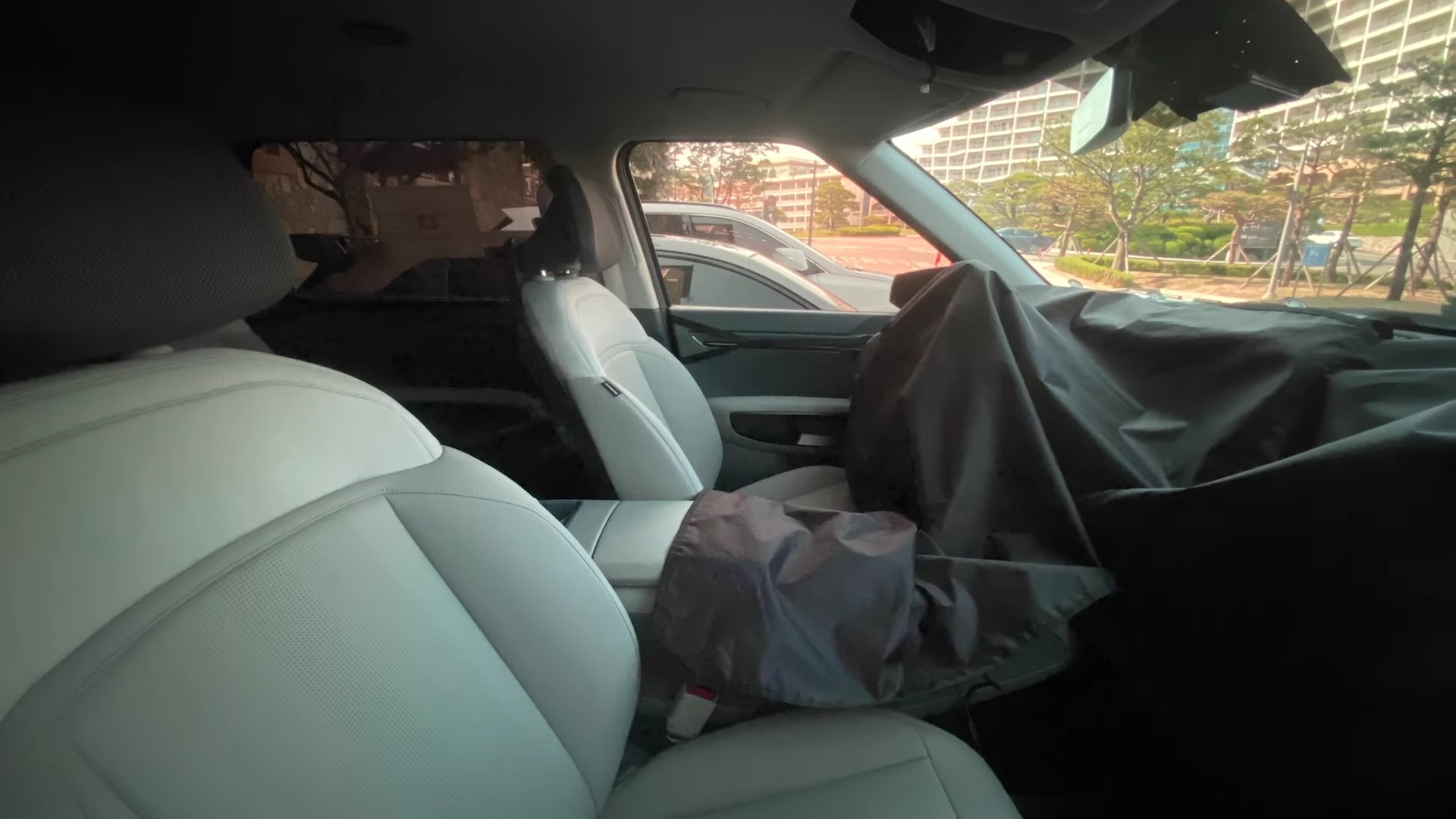
The EV9 has yet to be officially confirmed for Australia – but given the overwhelming success of the EV6 and Rivero’s latest comments, there’s every chance it will come here in the relatively near future.
Speaking on Friday as specification details were released for the new-generation Niro EV and hybrid, Kia Australia’s top boss, Damien Meredith, said the recent introduction of the EV6 “is proving to be more popular than [Kia] could have ever imagined” – another indicator more electric models will soon be heading our way.
While originally referred to as the EV7, the EV9 is set to become Kia’s flagship model, coming in at around 5000 millimetres long – making it roughly on par with the LandCruiser 300 Series and LandCruiser Prado.
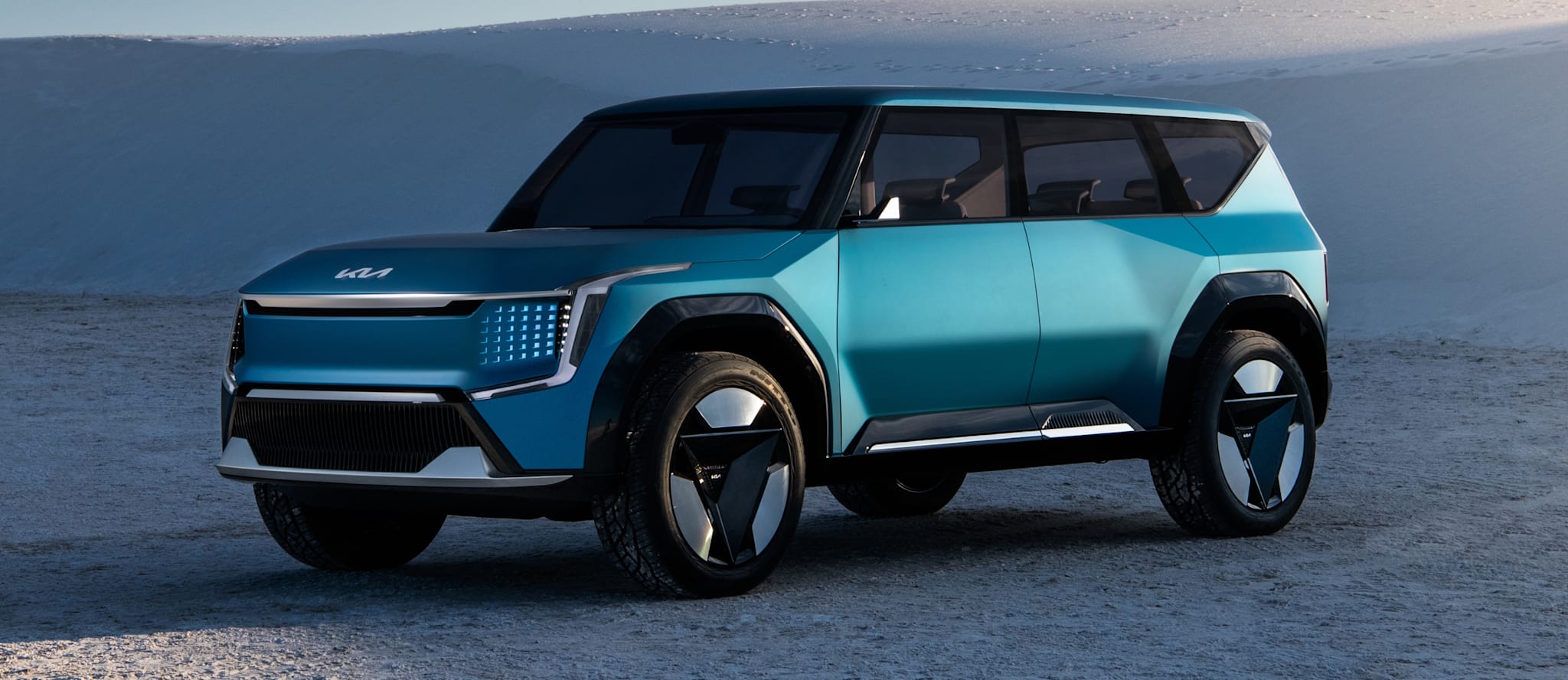
It’s thought the seven-seater EV9 will be on par with the Kia Carnival people-mover, but with more legroom available for third-row passengers thanks to its battery-powered E-GMP platform – which allows for a flat cabin floor.
Occupants can also expect an ultra-wide display akin to that found in the EV6.
As well as over-the-air software updates (OTA), the EV9 will reportedly offer Level 3 autonomous driving technology, known as Highway Driving Pilot (HDP).
Details of the electric powertrain aren’t known at this stage, but the driving range is said to remain at under 500 kilometres, likely matching the 482km claimed for the EV9 Concept.
The 2023 Kia EV6 GT is the sporting flagship of the South Korean car maker’s Wheels Car of the Year-winning battery electric vehicle, and the most compelling Kia to wear the GT badge yet.
Launching in Australia almost a year after the EV6’s initial debut, the EV6 GT offers less battery range than other EV6 variants but delivers blinding pace and a dynamic appetite far beyond its more pedestrian counterparts.
We’ve not seen a six-figure Kia before, let alone one with over 400kW. More significant, perhaps, than what the EV6 GT is, is what it represents. It feels like a statement of intent, a conscious, decisive step in moving the marque to a more premium position.
UPDATE, March 17: EV6 GT v Tesla Model Y Performance
We’ve now had the chance to throw Kia’s hero EV against the top-shelf Tesla Model Y performance. Which is the best buy for a performance-oriented family? Get the full story at the link below.
JUMP AHEAD
- How much is it, and what do you get?
- How do rivals compare on value?
- Interior comfort, space and storage
- What is it like to drive?
- How safe is it?
- Warranty and running costs
- VERDICT
- Specifications
How much is it, and what do you get?
The Kia EV6 GT swings in at $99,590 (before on-road costs), representing a $12,000 premium over a dual motor, all-wheel drive version of the EV6 GT-Line.
For the money, you get the same 77kWh battery currently available, but here it feeds the GT’s high-performance powertrain comprising two higher-output motors, yielding all-wheel drive as well as torque vectoring and a trick limited-slip rear diff.
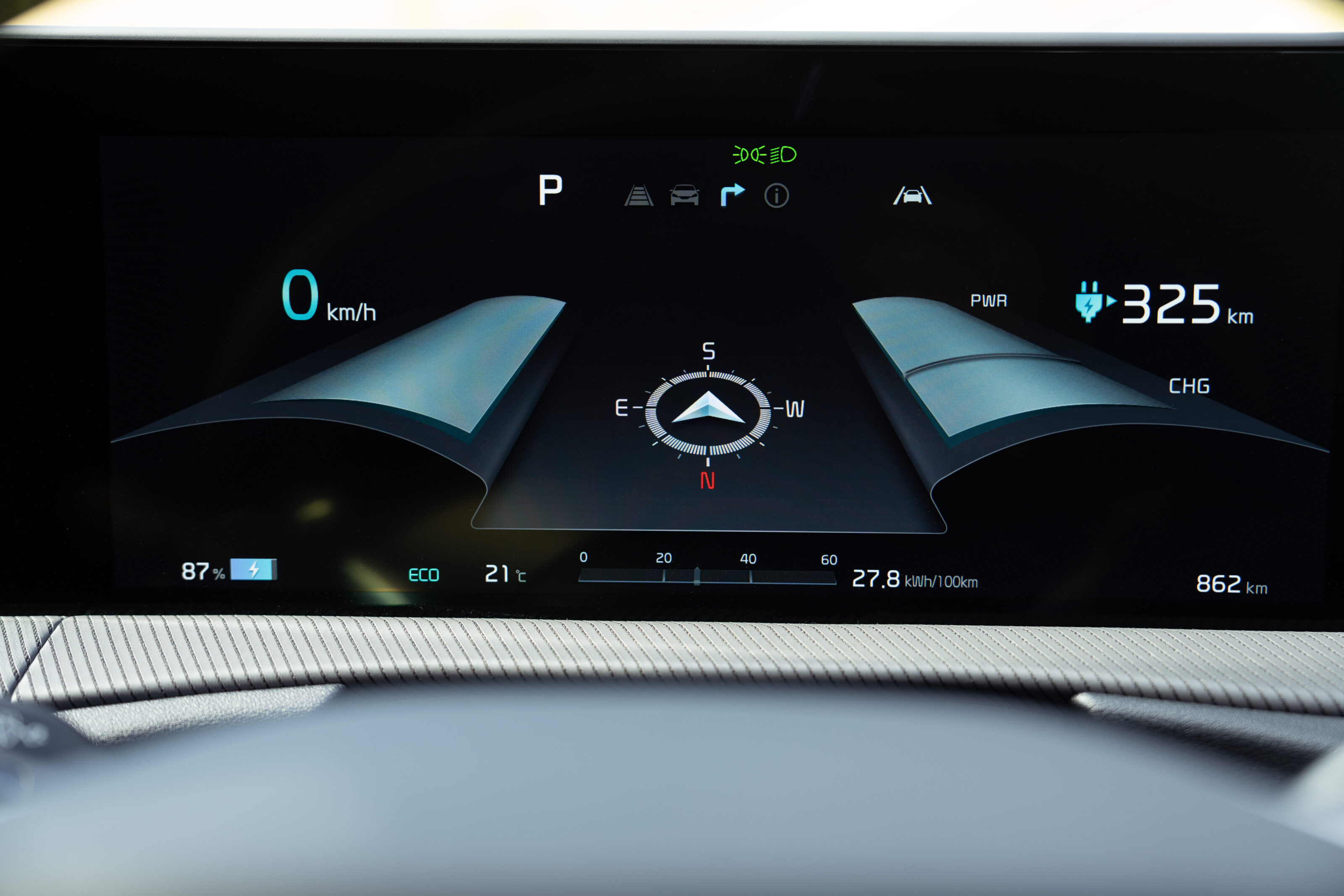
That means 430kW and 740Nm in combined output, a 0-100km/h claim of 3.5 seconds, a top speed of 260km/h, and an on-paper cruising range of 424km.
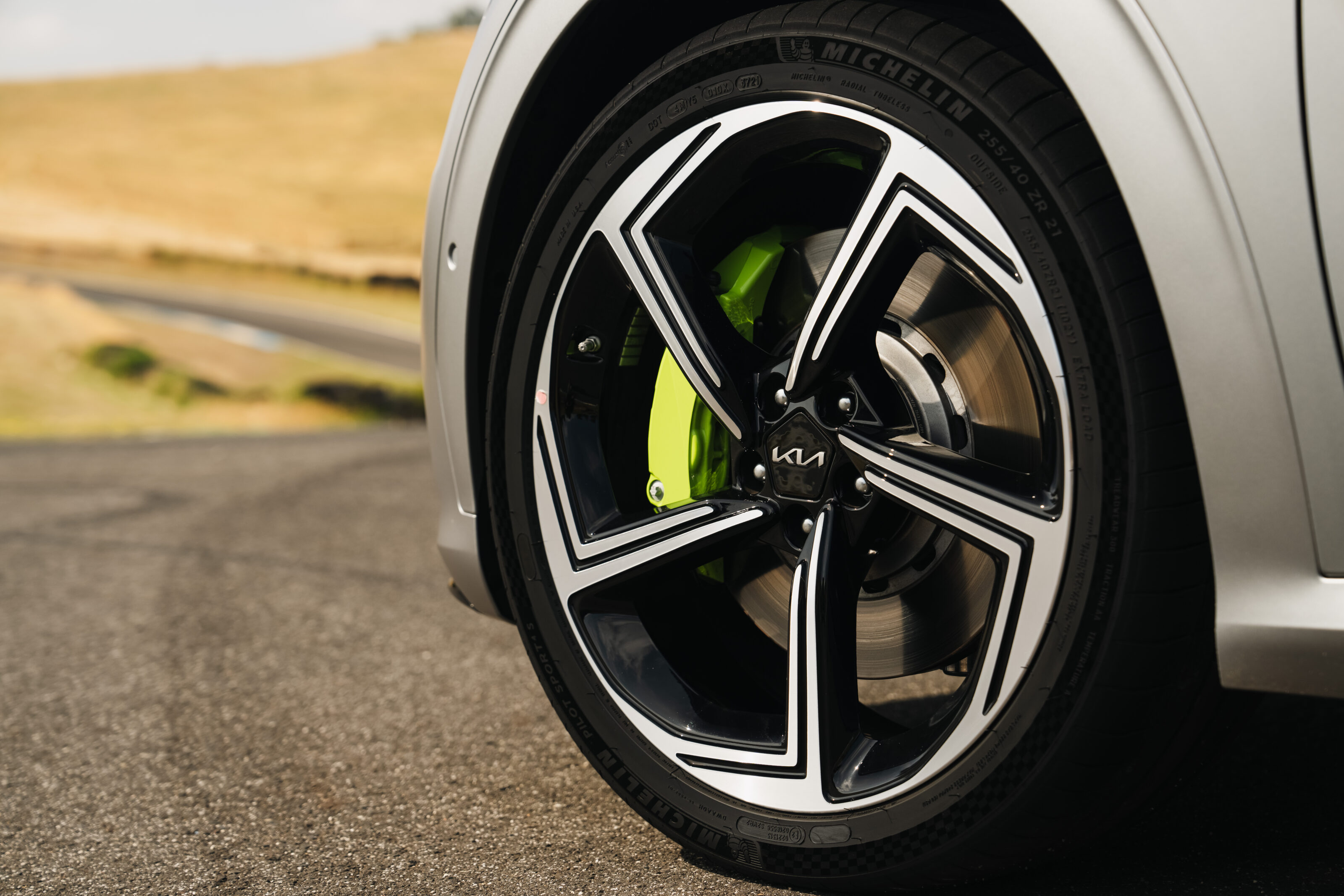
You lose 60km of range from the existing GT-Line’s 484km claim, due to the higher output motors, larger, stickier Michelin Pilot Sport 4 S tyres, and an extra 80kg of mass over the existing GT-Line.
So, there’s less range, but a whole lot more power and dynamism. That can make the EV6 GT hard to place in the minds of buyers. On one hand, there are cheaper EVs that can drive further, though that’s not the brief Kia’s flagship EV6 is looking to fill.
Other than a Tesla Model 3 Performance ($89,900 before on-road costs, claimed 0-100km/h time of 3.3 seconds), it is hard to find a car on sale in Australia that offers an EV6 GT’s level of firepower for the money. The Model Y Performance, slightly cheaper from $94,900, claims 3.7 seconds (though offers a longer claimed range, at 514km).
BMW’s i4 M50 asks a further $30,000, delivering 30kW less. Kia’s star athlete also claims a quicker 0-100km/h time than Porsche’s $197,200 Taycan 4S.
Elsewhere, the EV6 GT comes well equipped, with headline features carried over from the previous flagship GT-Line including dual 12.3-inch widescreens, 14-speaker Meridian stereo, augmented reality head-up display, hands-free powered tailgate, vehicle-to-load capability, panoramic sunroof and a suite of active and passive safety features.
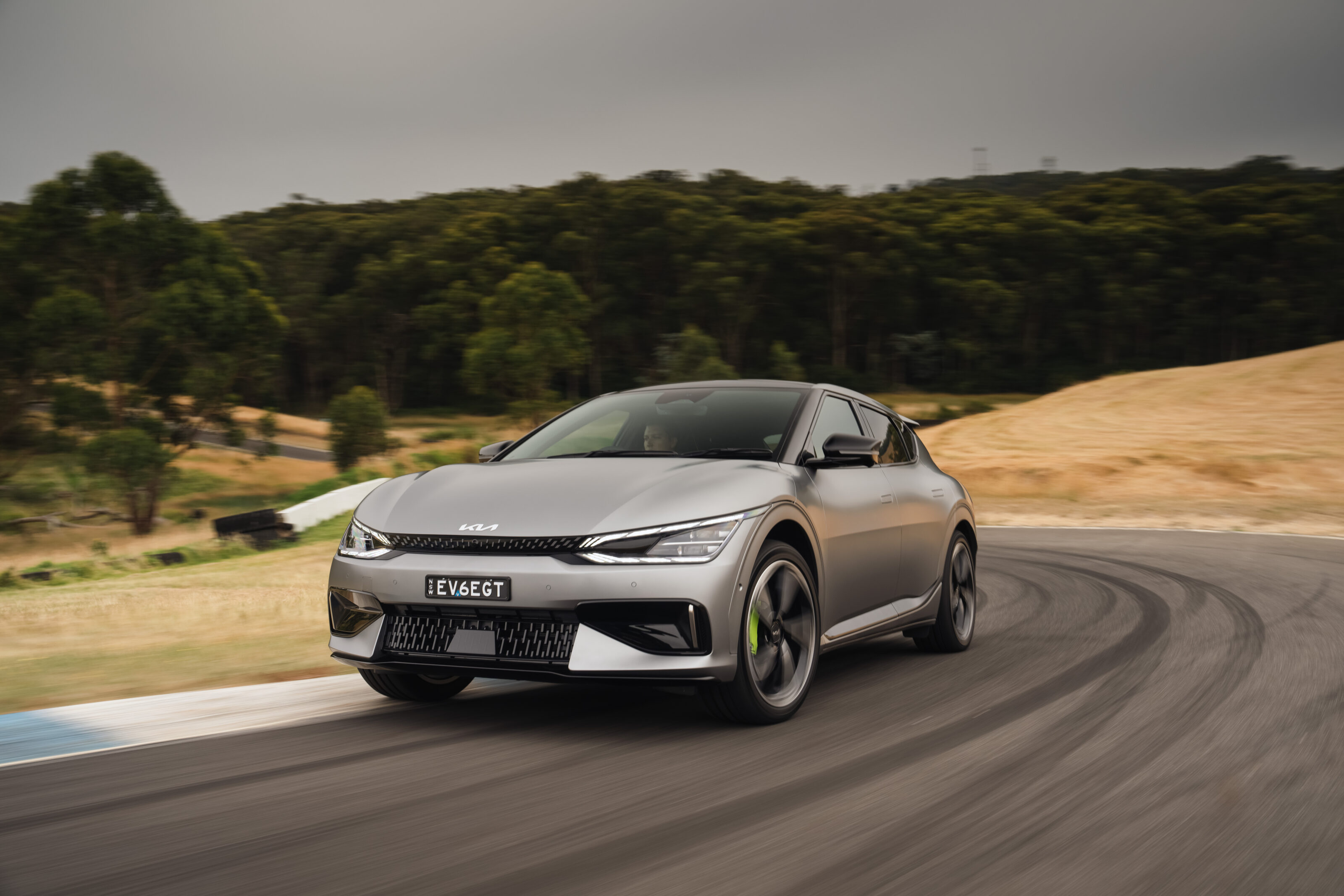
The EV6 GT uniquely gains matrix LED headlights that can selectively block oncoming traffic from its beams, as well as heated sports front seats (cooling function not available at a factory level with these units), artificial leather and suede upholstery, GT-specific bumper trims, green stitching and piping and lime green brake calipers clamping 380mm discs up front and 360mm discs at the rear (EV6 Air and GT-Line utilise 325mm rotors at all four corners).
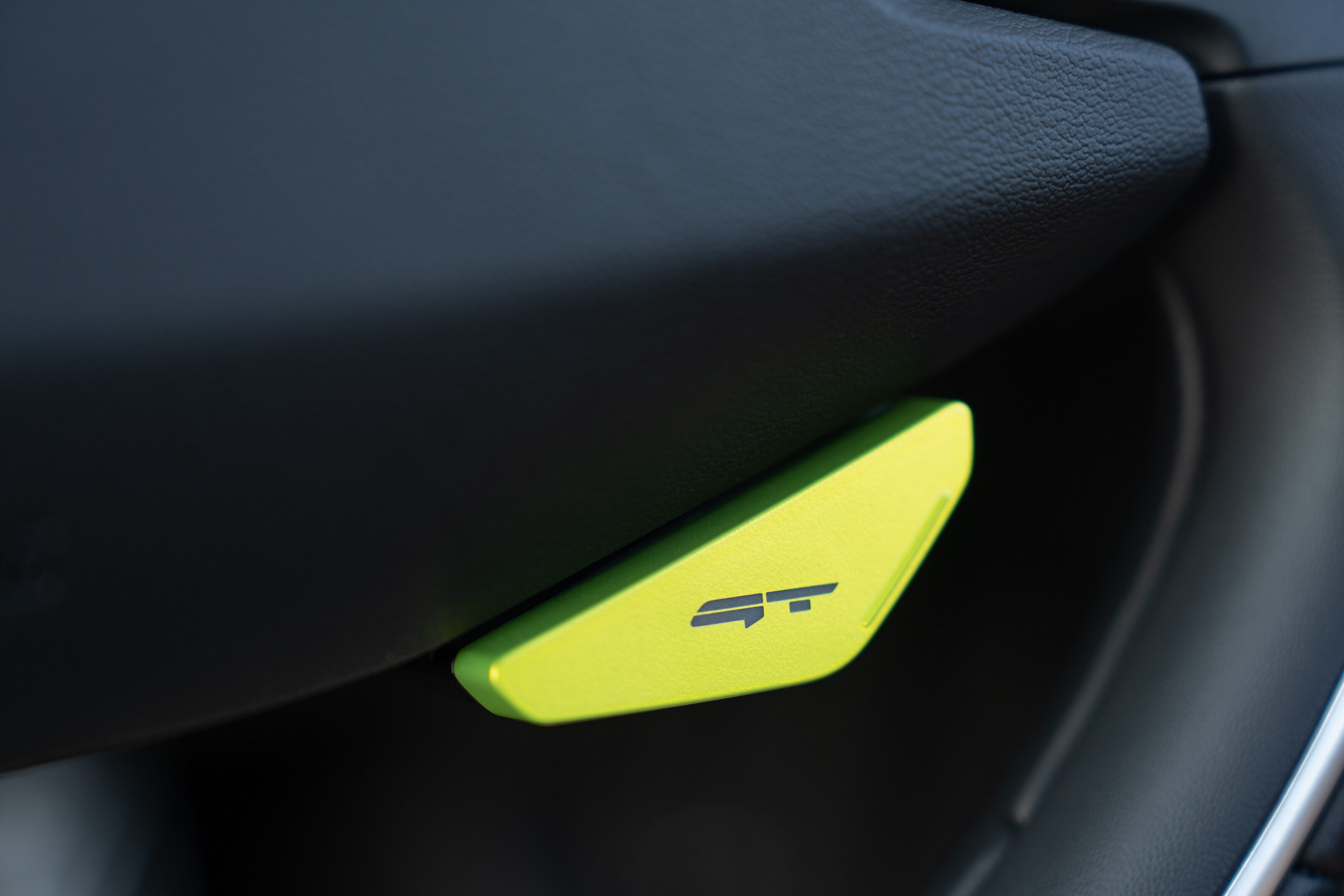
A new GT Drive mode has been added, with a shortcut button mounted on the steering wheel, coated in the EV6’s signature GT green. This can be thought of as something like the ‘N Mode’ button found in an i30 N, a quick catch-all that switches the vehicle into its most dynamic settings.
How do rivals compare on value?
Once supply to Australia eventually takes off, the Tesla Model Y Performance will likely be the most popular EV6 GT rival and is surely a car that Kia looks on with envy and ambition.
The Model Y Performance asks $94,900 (before on-road costs) and offers 413kW/660Nm and can dash from 0-100km/h in a claimed 3.7 seconds. Its 514km WLTP battery range claim, however, is superior to that of the athletic EV6 GT.
Best Electric Cars, $65k-80k: Australia’s premium EVs tested
In part two of our three price-based EV buying guides, we compare Australia’s electric cars priced between $65,000 and $80,000
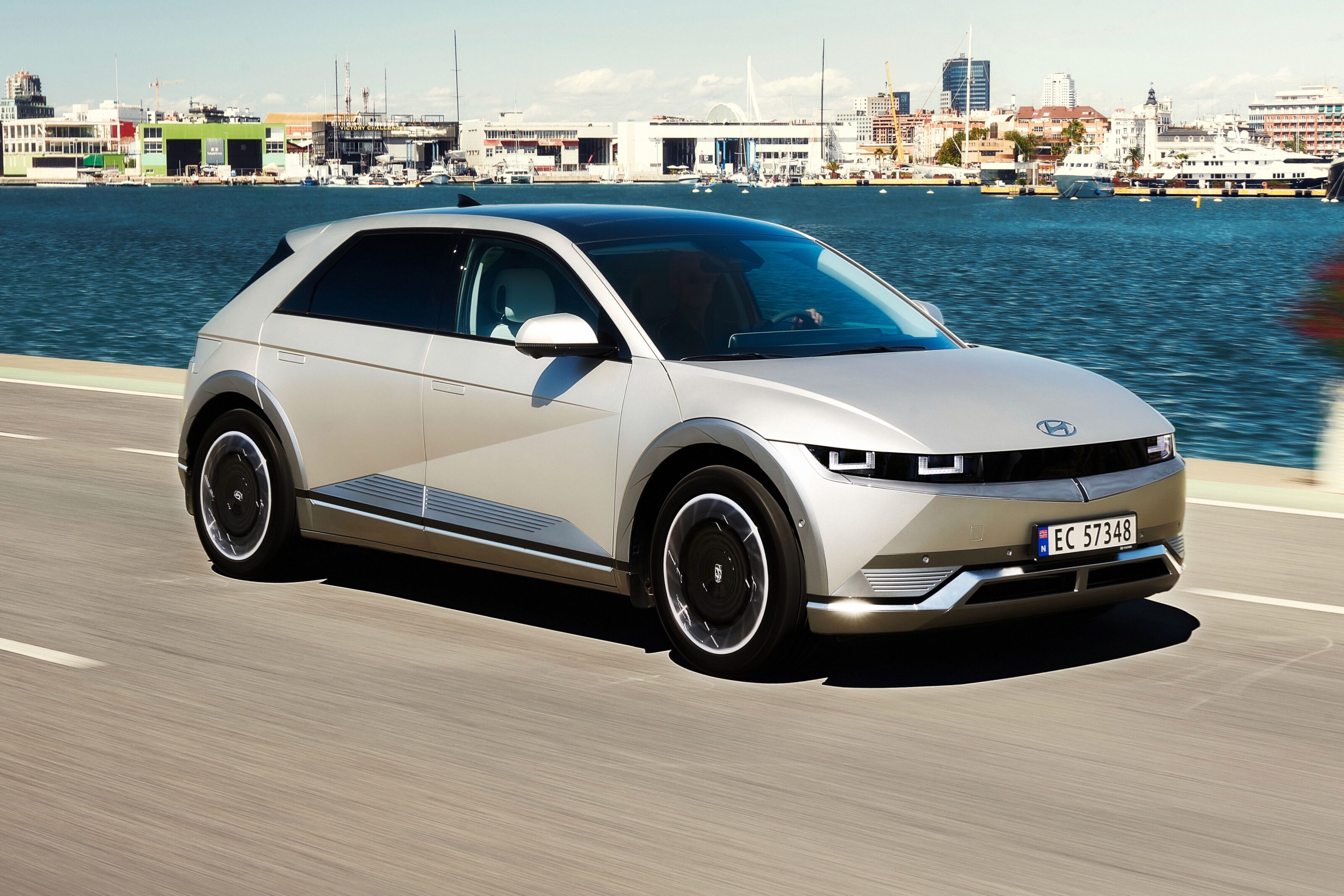
Elsewhere, the EV6’s South Korean counterpart, the funky Hyundai Ioniq 5, sharing its E-GMP platform with the EV6, is due to get a high-performance N version. The Ioniq 5 N is expected to launch locally early in 2024, following a global launch later this year.
Interior comfort, space and storage
Aside from a number of GT-distinguishing accents, the EV6 GT is virtually identical to the existing EV6 variants. Which is a good thing.
Kia’s take with the EV6’s futuristic interior architecture lacks the lounge-like airiness of the adorable Ioniq 5 and aforementioned Teslas, instead tapping into a decidedly more ‘spaceship cockpit’ feel.
There’s a large solid console structure with loads of storage in the large central bin and a dazzling dual 12.3-inch screen array attracting the initial gaze.
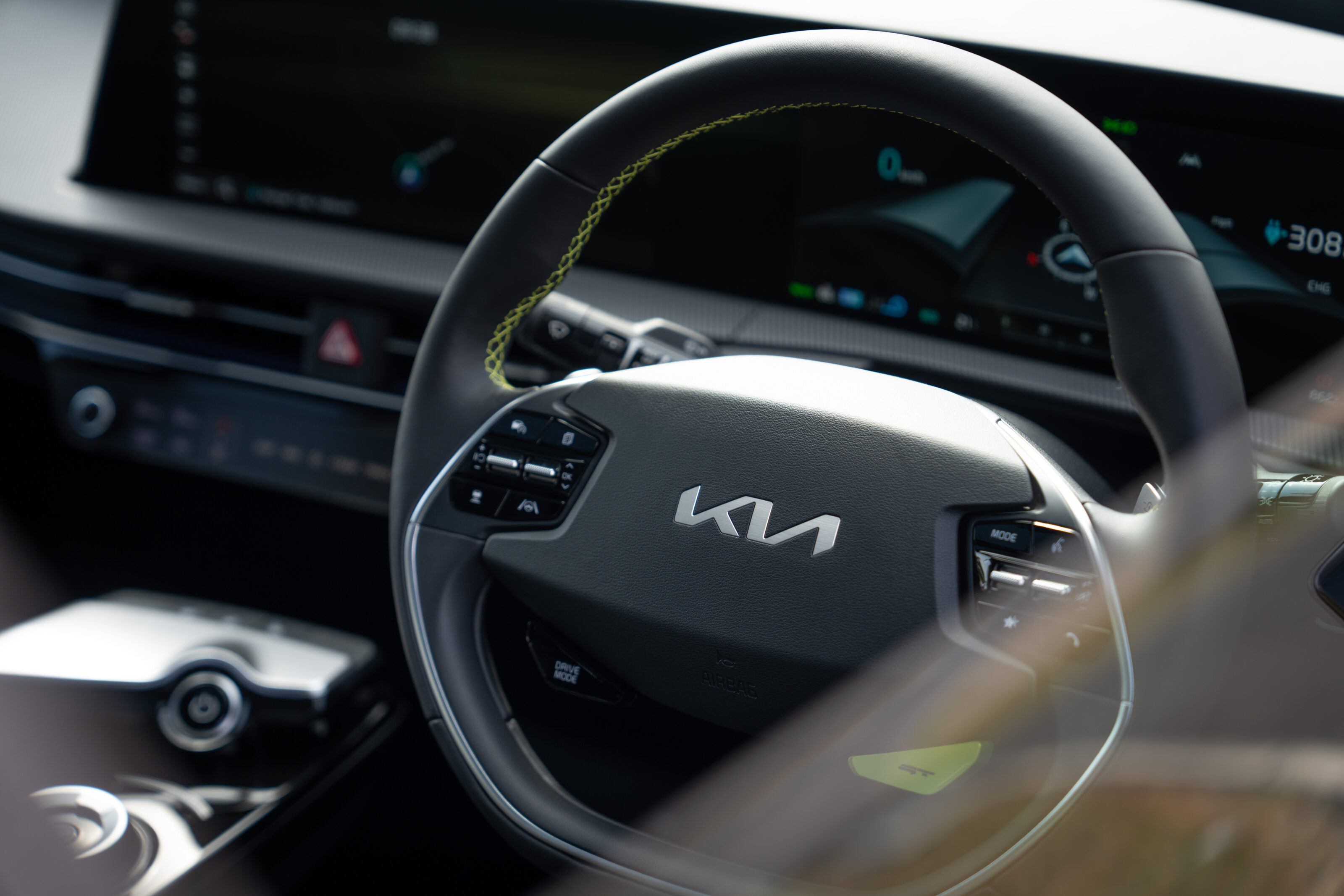
The right-hand screen displays driver and relevant vehicle information (charge state, estimated range etc) while the central touchscreen section handles infotainment needs.
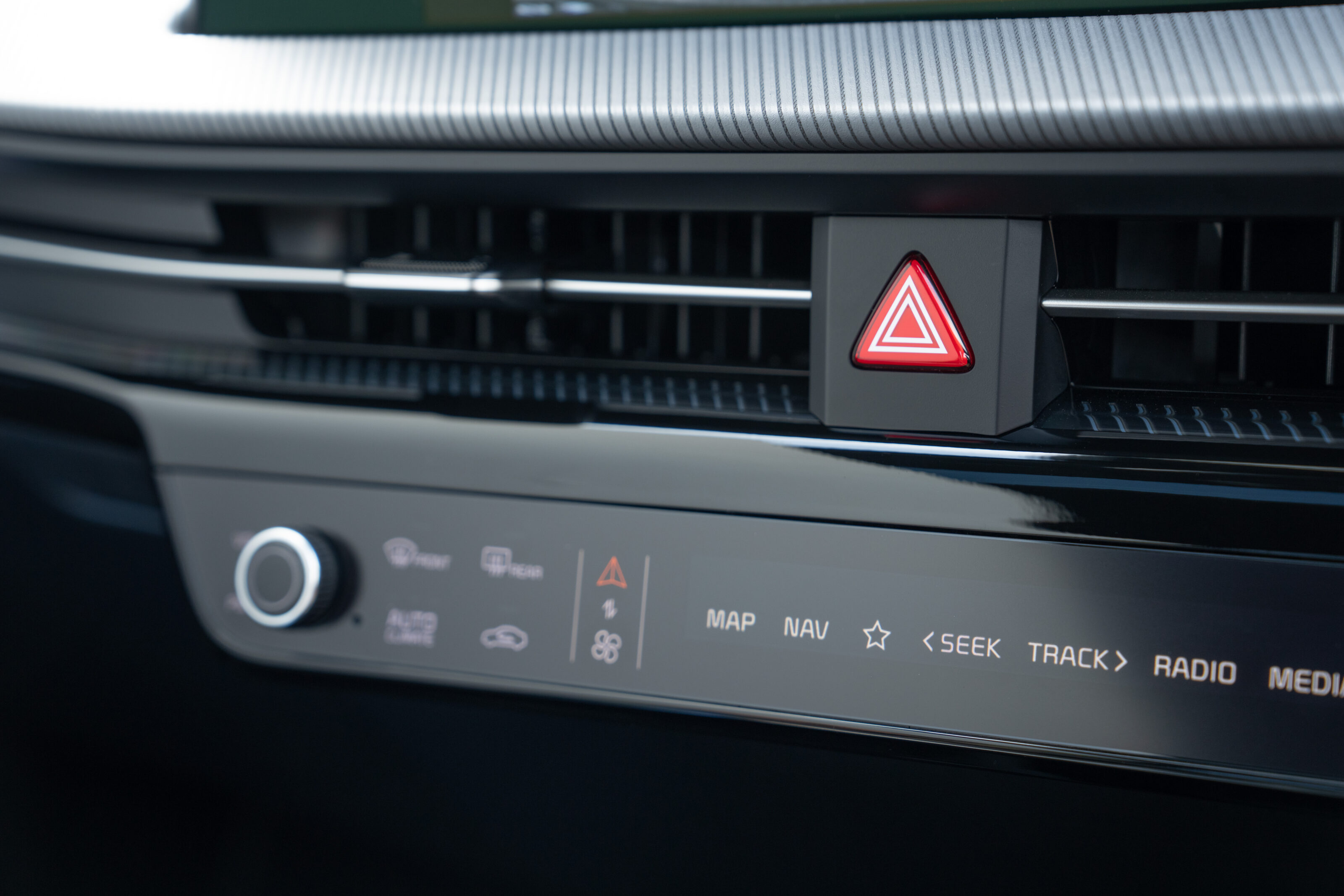
Physical knobs and switchgear are located in a neat stack below the central screen, and can handily switch between climate and media/navigation shortcuts. The toggle is a bit hidden if you don’t know it’s there but, once you do, it’s super intuitive to switch between temperature and volume with the same knob.
A wireless phone charging tray is within easy central reach up front, and the large bottle-sized door pockets are handy.
The new sports front seats feel as snazzy as they look, but are manually adjusted, not powered, and lose the GT-Line’s ventilation functions, which isn’t available on this seat type at a global level. Seat heating remains a feature, however.
As with other EV6 variants, the second row is generously spacious thanks to the electric skateboard architecture, with a flat floor and generous amounts of legroom. Forward visibility for rear passengers is slightly hampered by the sculpted front seats, though.
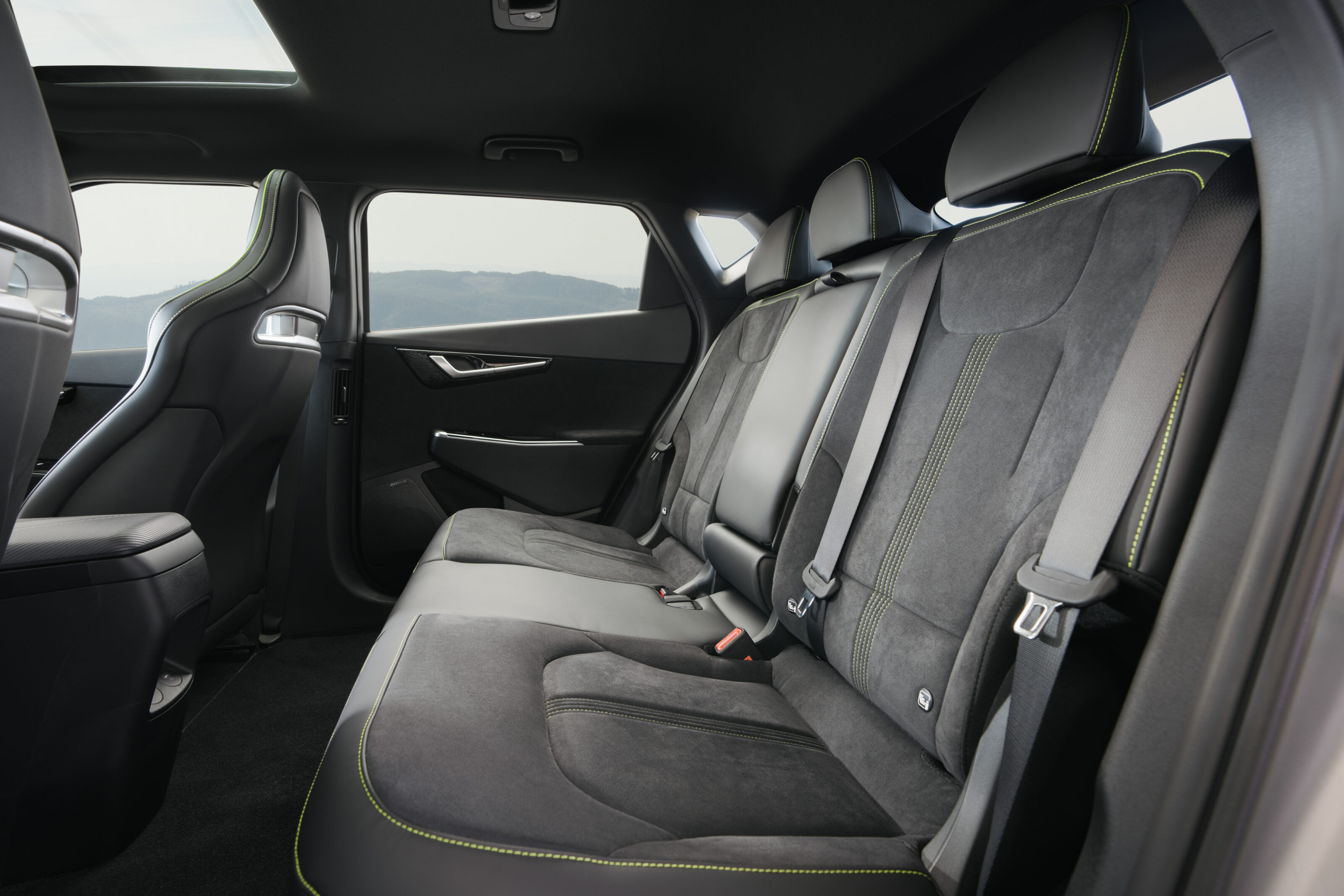
Further back, the boot measures a claimed 480 litres with the second row in place. This is down 10 litres from the entry-level EV6 Air, due to a subwoofer included in the 14-speaker Meridian stereo suite. A small ‘frunk’ measuring 20 litres makes up the difference and then some.
Fold the second row, however, and stowage capacity swells to an impressive 1260 litres.
What is it like to drive?
| Kia EV6 GT figures | |
|---|---|
| Battery size | 77kWh |
| Drive | dual-motor all-wheel |
| Power | 430kW |
| Torque | 740Nm |
| Driving range | 424km |
| 0-100km/h | 3.5sec (claimed) |
| Charging speed | up to 350kW DC |
| Charging time 10-80% | 18min DC |
In the same way that the EV6 GT builds upon existing variants in other areas, the driving experience doesn’t feel far removed from existing EV6 dual-motor GT-Line variants in normal urban driving scenarios.
You can notice the step change in pace, certainly. While even the dual-motor GT-Line lacks the dazzling lightswitch ‘head-smack’ acceleration typical of many EVs, the GT’s more powerful motors and stickier rubber see the new variant deserving of its position as the range’s sporting flagship.
There are more expensive EVs, from more esteemed brands, that the EV6 will absolutely pants at the traffic lights.
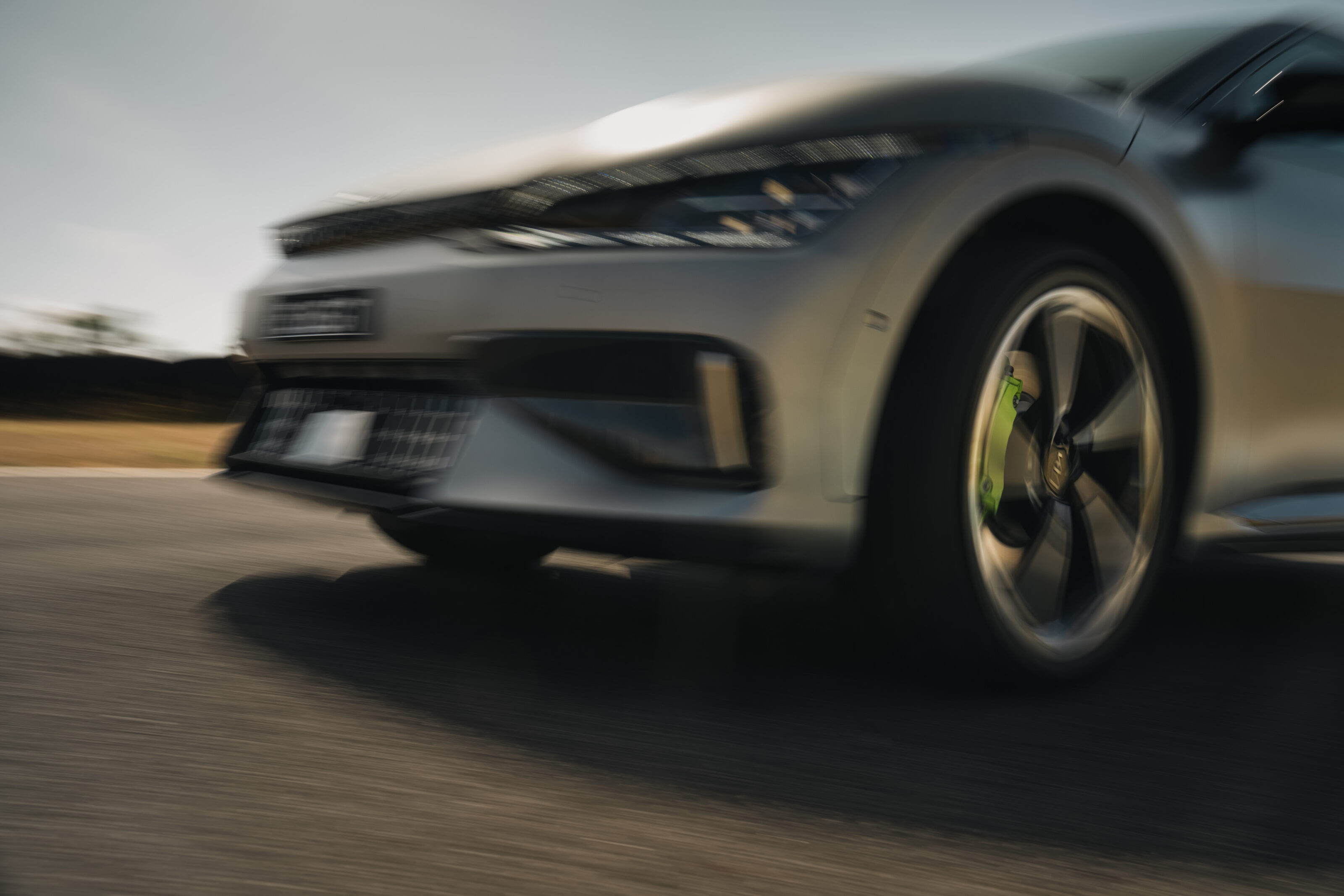
Despite increased bracing in the front strut tops and under the rear boot floor, along with a revised double ball joint front suspension assembly, the sporty EV6 GT hasn’t lost any of its daily driving abilities, with impressive levels and bandwidth and scope throughout the speed envelope.
Localised electronic suspension maps, along with a unique variable steering ratio, makes the EV6 GT feel right at home on Australian roads and it impresses with deft body control regardless of speed.
On slower urban roads, body control is cushy yet composed. You can feel its weight as it drops into potholes or hops up over a jut but excess body movements are quickly contained.
At speed, things are even more impressive, wafting over small ripples and handling larger road imperfections better than any 2620kg car rolling on 21-inch alloys ought to.
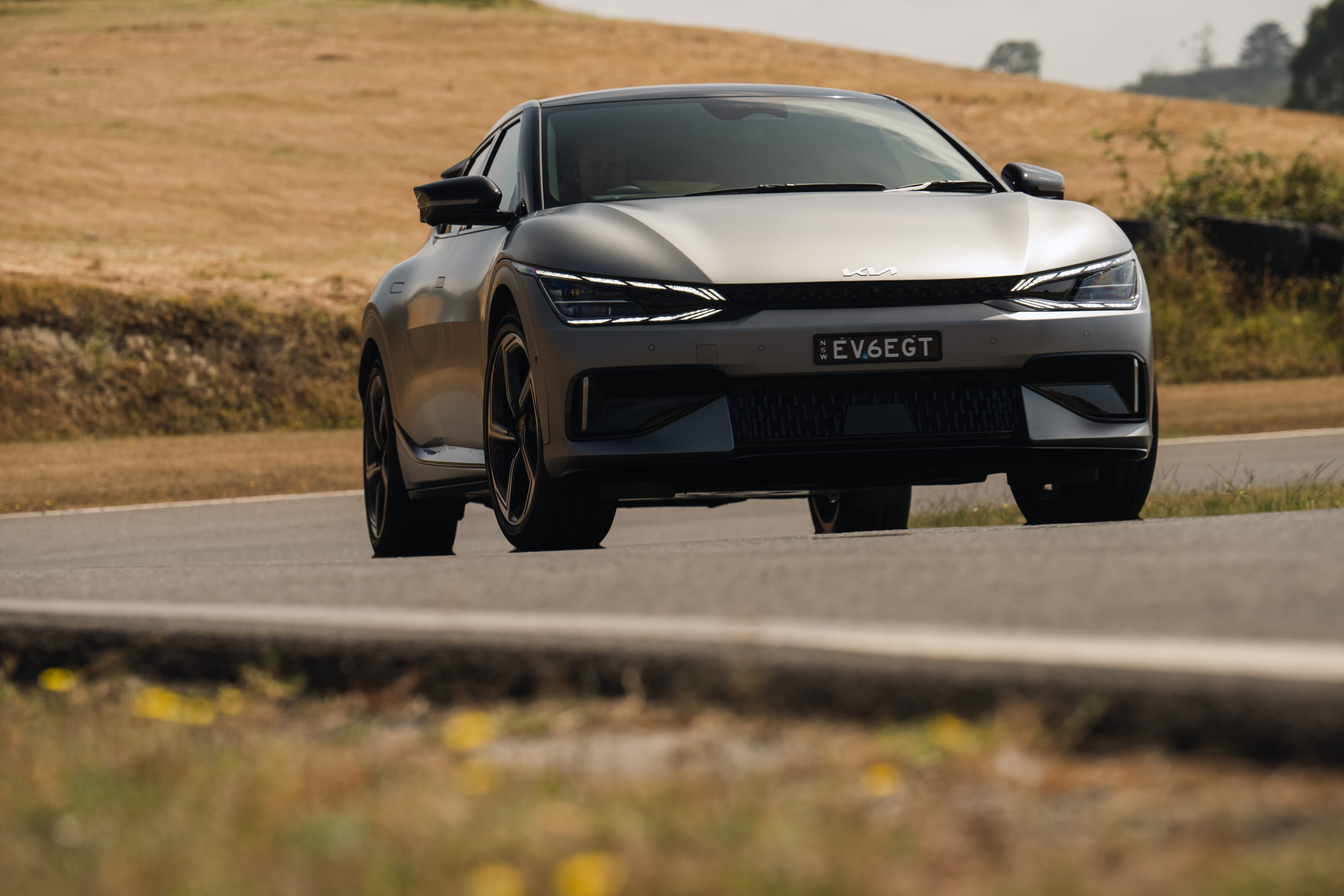
When the launch route transitions away from Victoria’s 110km/h highways into smaller tree-lined back-roads, it feels like an opportune time to test out the new GT driving mode, a handy catch-all setting for when the going gets twisty.
Throttle mapping is sharpened further than the existing Sport mode, with consistent throttle input resulting in a slow but noticeable surge ahead when switching between drive modes.
GT mode also flicks the rear electronic limited-slip diff and torque vectoring management into their most dynamic setting, delivering crisp and decisive direction changes at speed, and the ability to throttle-on shockingly early in the mid-corner-exit phase throughout tight-radius hairpins.
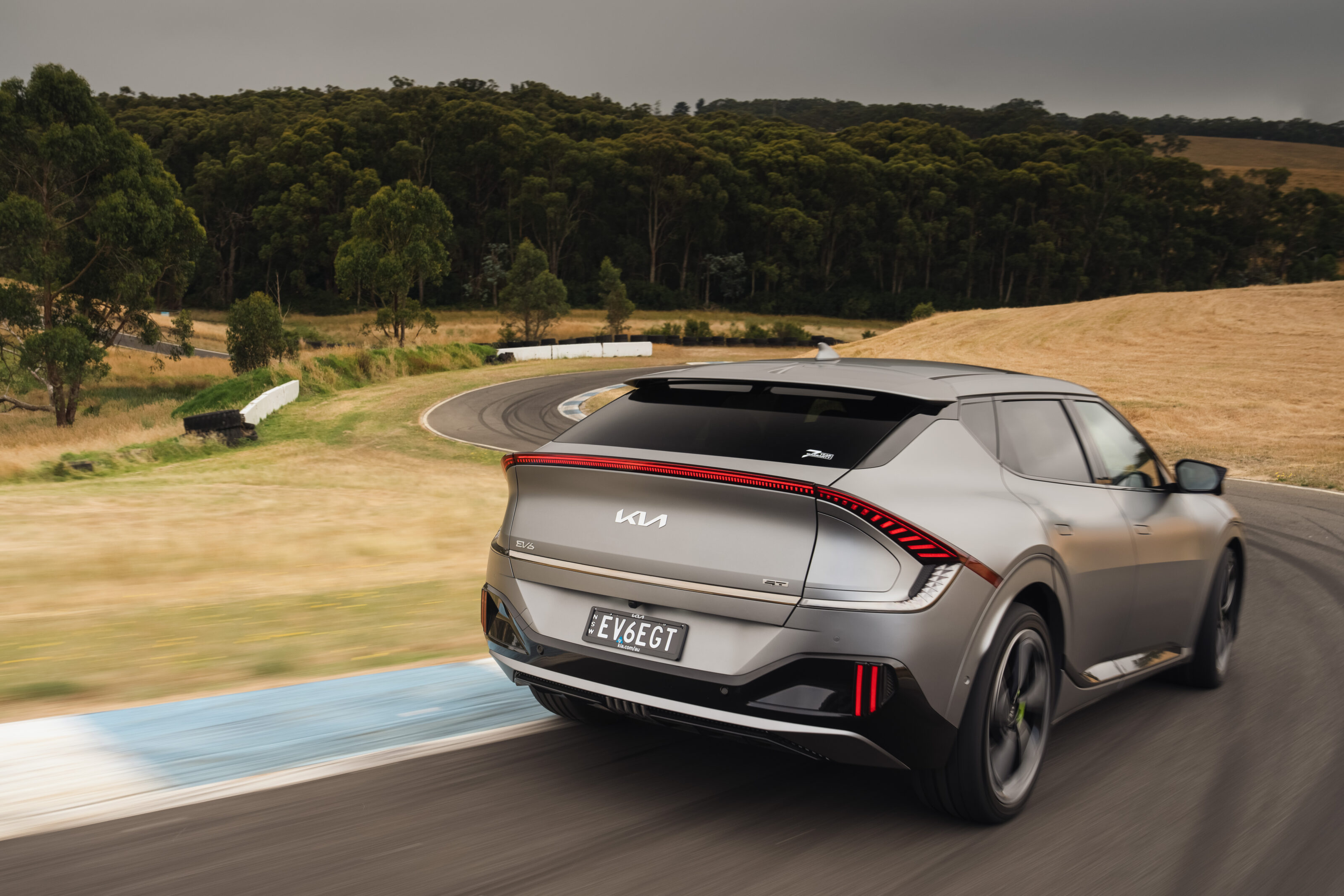
Through flowing corners, the EV6 GT disguises its weight via its low centre of mass, composed direction changes and sheer ease of pace. The driver, however, is sharply reminded of its weight under heavy braking on corner entry, where pedal modulation – and its interplay with assistance from the configurable regenerative braking – is hard to nail down.
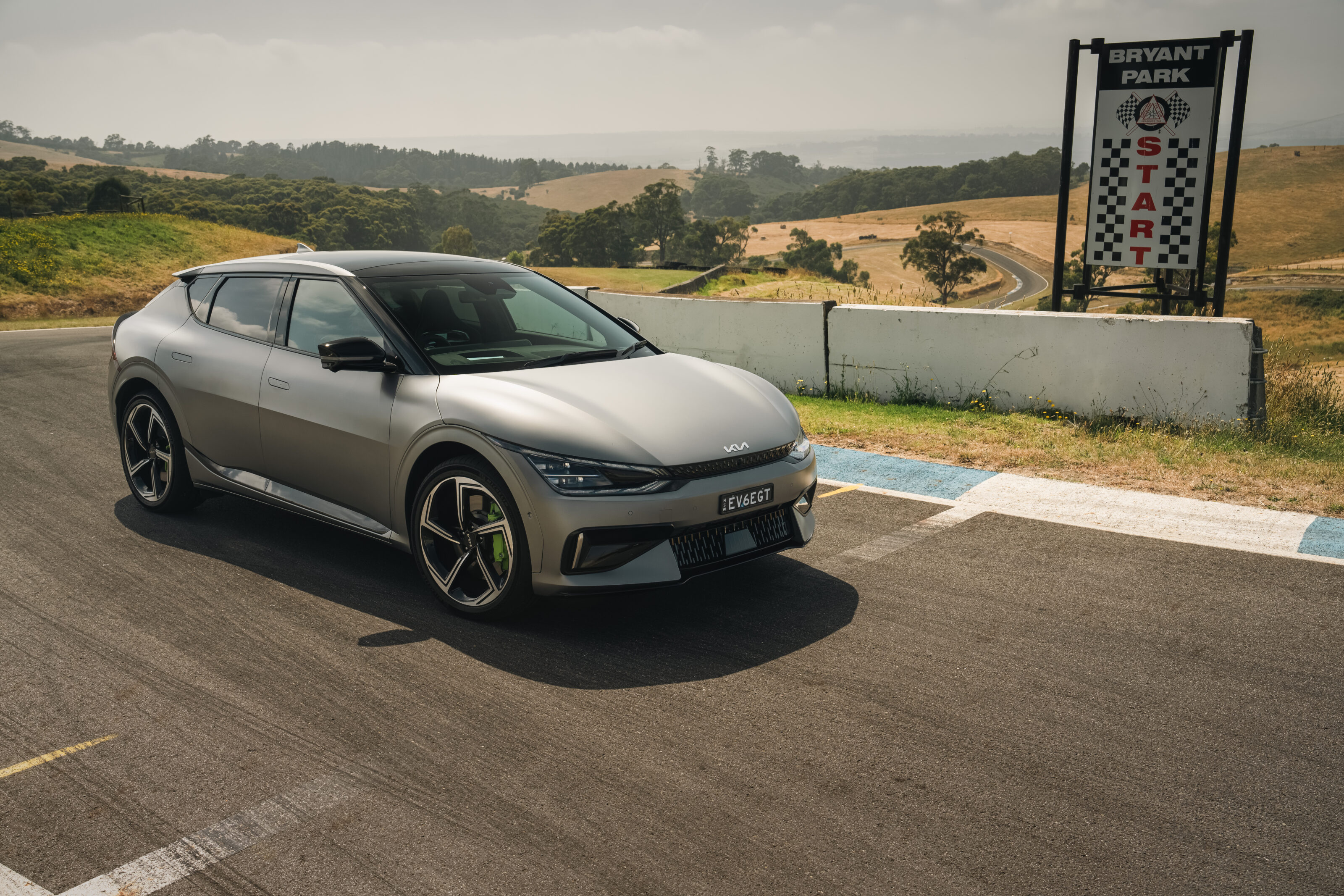
So far the EV6 has impressed, but its greatest challenge lies ahead as we are destined for Bryant Park, also known as Haunted Hills; a hyper-technical and fearfully small, hillclimb track about 3.5 hours out of Melbourne.
For those familiar with this environment, a 2.5-tonne electric SUV with more than 400kW is possibly the most outmatched vehicle that comes to mind.
Again, the EV6 GT’s dynamic poise shines through.
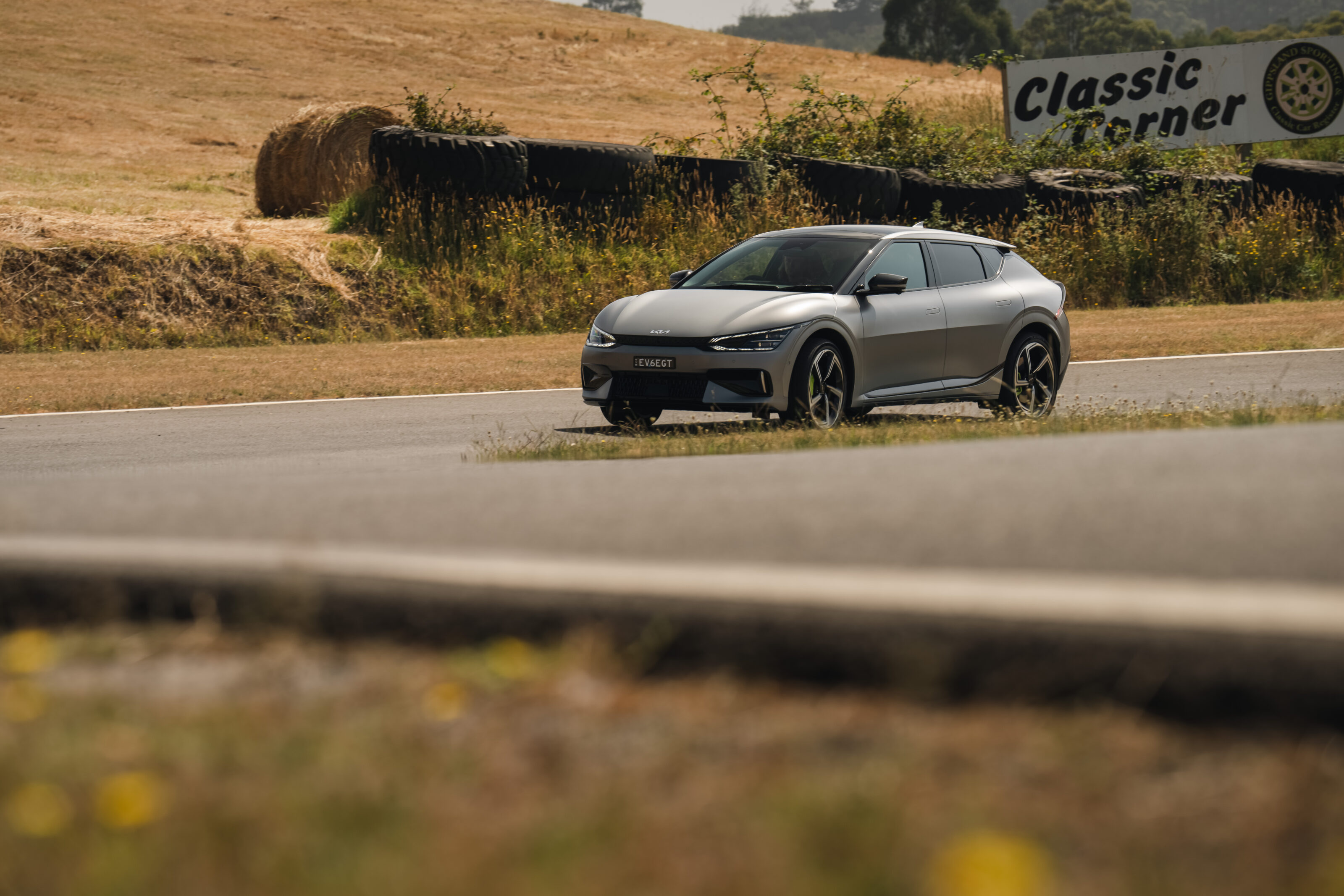
The first few laps were conducted in Sport mode, to get the eye in and to form a basis for comparison.
Here, the car retains a safe understeer bias, with an engaged ESC system and torque-vectoring-by-brake working hard to keep the car neat and tidy.
GT Mode slackens the ESC system and also sharpens the e-LSD and torque vectoring management calibration, encouraging chassis movement and delivering an exhilarating playfulness over crests as the rear end becomes temporarily unloaded.
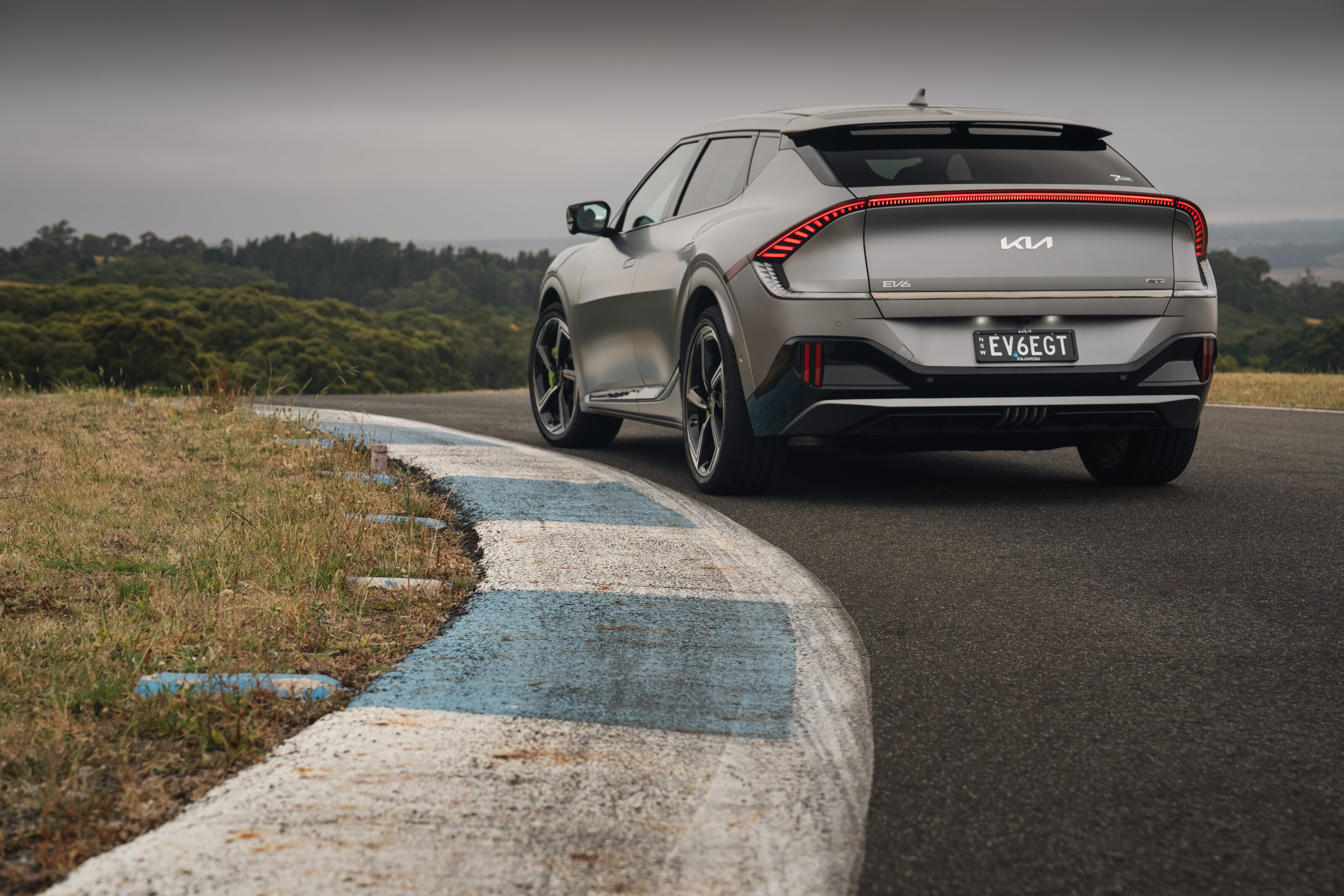
The front end feels more deliberate and alert in GT Mode, you can power down shockingly early and, in this setting, the GT feels eager to rotate in a way EV6s haven’t before.
We must also make mention of Drift Mode, which sadly wasn’t tested on the launch program, but can send up to 100 per cent of torque to the rear wheels and progressively feeds power to the front axles as the steering returns to centre.
How safe is it?
The Kia EV6 GT, specifically, is currently unrated by ANCAP, as the fitment of the GT’s new sports seats requires re-homologation and testing.
However, the EV6 GT bears all the same safety features as the rest of the range, which was awarded five stars in 2022.
The Kia EV6 GT is equipped with dual frontal, side chest-protecting and side head-protecting (curtain) airbags, as well as a front central airbag.
Active safety features include auto emergency braking with junction assist, blind-spot monitoring, rear cross-traffic alert, lane-keep assist and lane following assist, multi-collision braking, intelligent speed limit assist, tyre pressure monitoring, front and rear parking sensors, smart cruise control with stop-and-go function, 3D camera views and more.
Warranty and running costs
The 2023 Kia EV6 GT is covered by Kia’s seven-year, unlimited-kilometre vehicle warranty, with service intervals running every 12 months or 15,000km, whichever occurs first.
Kia offers three different pre-paid service plans for the EV6 GT: a three-year plan for $733, a five-year plan for $1371 or a seven-year plan for $2013.
Servicing the GT is a bit pricier than EV6 Air and GT-Line variants, which Kia says is due to the GT’s performance brakes being slightly more laborious to maintain compared to standard items.
The EV6’s 800-volt architecture enables the 77kWh battery to charge from 10-80 per cent in a claimed 18 minutes using a 350kW ultra-fast DC charger, or in a little over an hour when using a 50kW charger.
VERDICT
Kia’s new EV6 GT raises the bar, not just for the EV6 range, but for Kia as a brand.
It retains the same affable solidity, balance and composure as the existing EV6 while realising a dynamic potential that we always felt lurked beneath the surface but had, until now, remained untapped.
The burning question is if $100,000 is too much for a Kia.
I don’t think that’s an issue here. Not because – or in spite of – what the car is, but more importantly because of what it can do.
Kia’s EV6 GT is a supremely talented thing, and if dynamic driving forms part of your remit, this car will do things even its talented siblings can’t, and that’s a lot.
Specifications
| Kia EV6 GT specifications | |
|---|---|
| Body | 5-door, 5-seat large SUV |
| Boot min / max | 480L / 1260L |
| Drive | all-wheel |
| Powertrain | 77kWh battery; 160kW motor (f), 270kW motor (r) |
| Max power | 430kW |
| Max torque | 740Nm |
| Transmission | single-speed reduction |
| Weight | 2185kg |
| L/W/H/W-B (mm) | 4695/1890/1545/2900 |
| 0-100km/h | 3.5sec (claimed) |
| Price | $99,950 + on-road costs |
| On sale | now |
