
UPDATED January 2023: The Mazda CX-9 seven-seat SUV has performed strongly since its 2016 launch thanks to ample interior space, generous standard features and an ample 2.5-litre turbocharged petrol engine.
The CX-9 set the affordable large SUV space on a different course, trading the segment’s prior sloppy dynamics and cheap cabin materials for Audi Q7 chic on a budget.
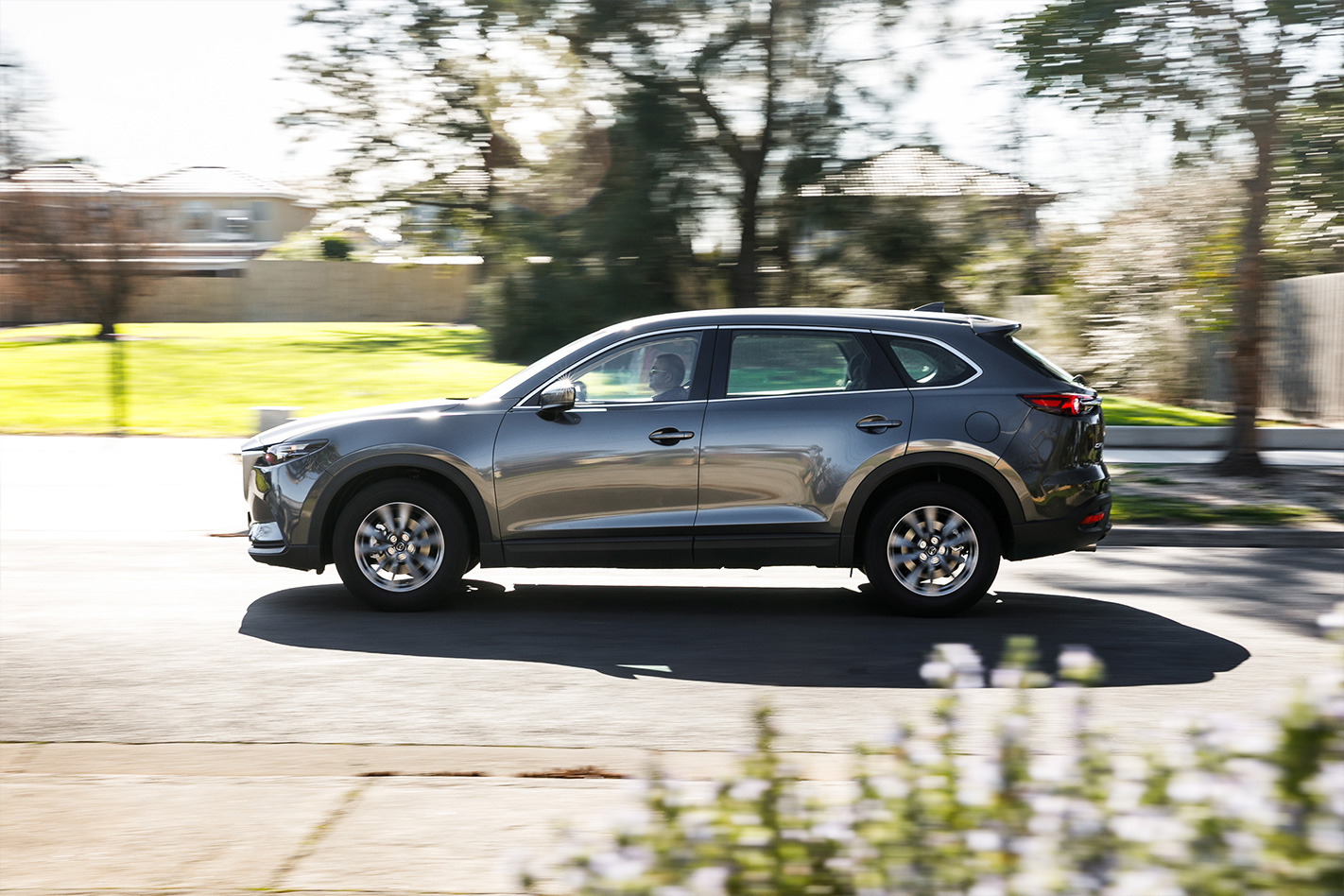
The CX-9’s one weakness remains the lack of a diesel offering, as available in the two-row CX-5, which has the potential to provide better towing power and return leaner fuel economy on highways.
While the seemingly obvious solution would be to shove an oil burner under the CX-9’s bonnet, Mazda opted instead to create a stretched version of the CX-5 with a diesel option, a car we now know as the CX-8. Born specifically for the Japanese market – where the wide-body CX-9 is not sold – the CX-8 first arrived in Australia in 2018.
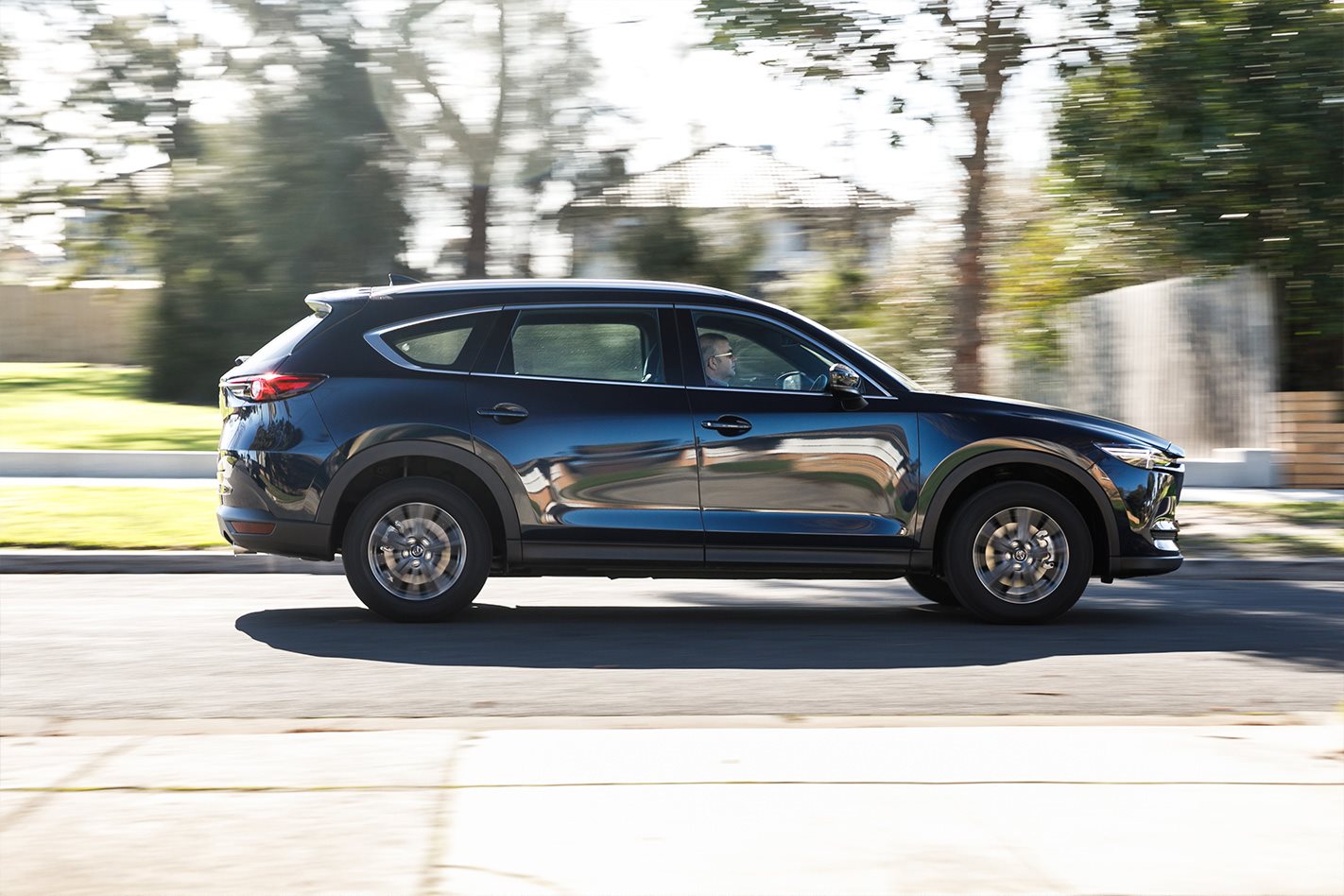
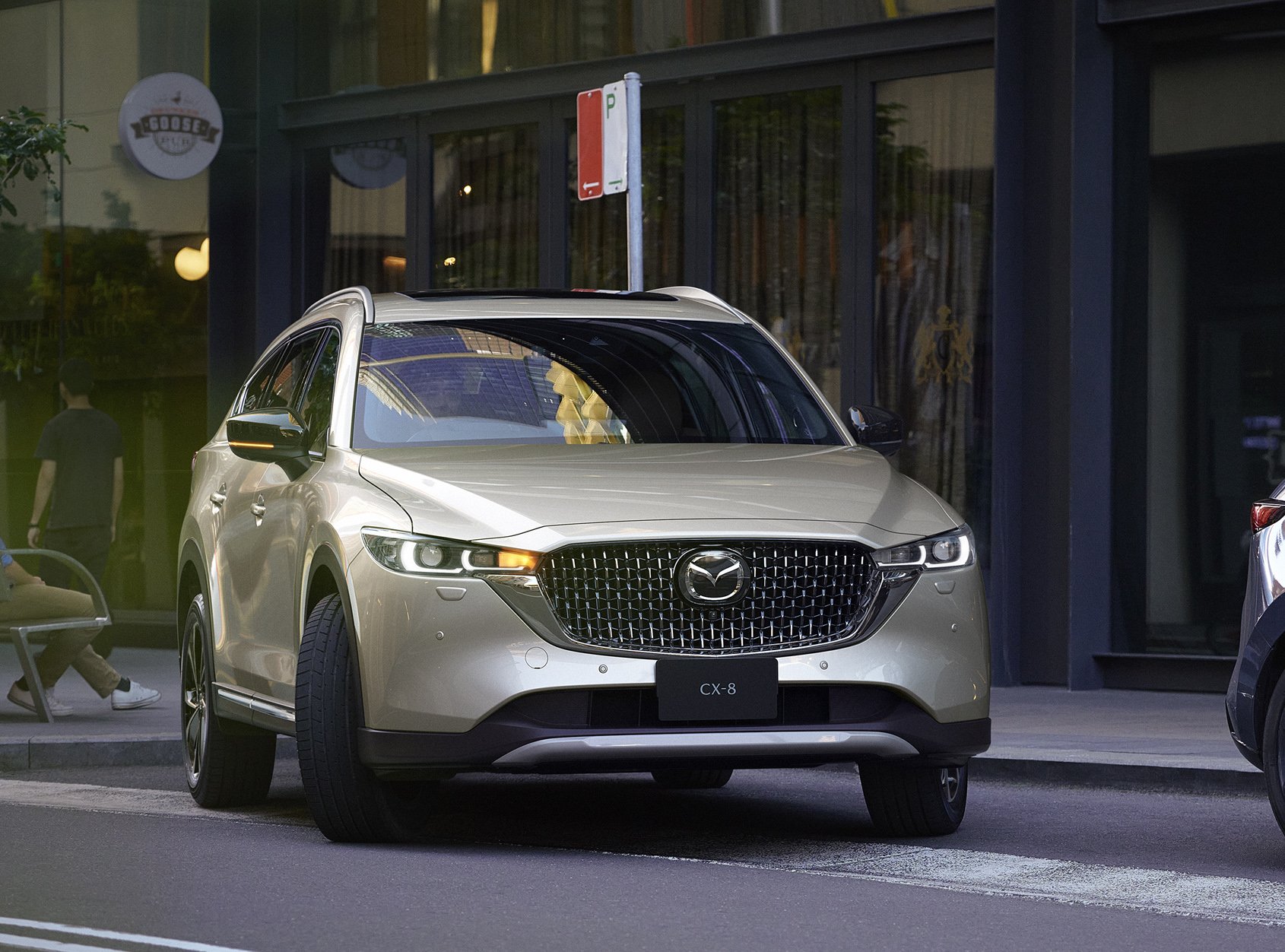
In February 2020, Mazda introduced a 2.5-litre four-cylinder petrol engine to the CX-8 range – also sourced from the CX-5 – to make it more attractive to urban buyers. A facelift is due to land in Australia in March 2023, also lifting visual cues from the smaller CX-5.
To those not in the know, the CX-8 and CX-9 look very similar and perform much the same family-focused mission, albeit with different powertrains. But there are enough differences between them to sway buyers who may not be too fussed about what’s under the bonnet one way or the other.
Let’s see how they stack up.
Jump ahead to what interests you
- What do you get?
- Standard features
- CX-9 and CX-8 dimensions
- Space and comfort
- Which has the bigger boot?
- Performance and fuel economy
- Ride and handling
- Should I consider other rivals?
- Summing up
What do you get?
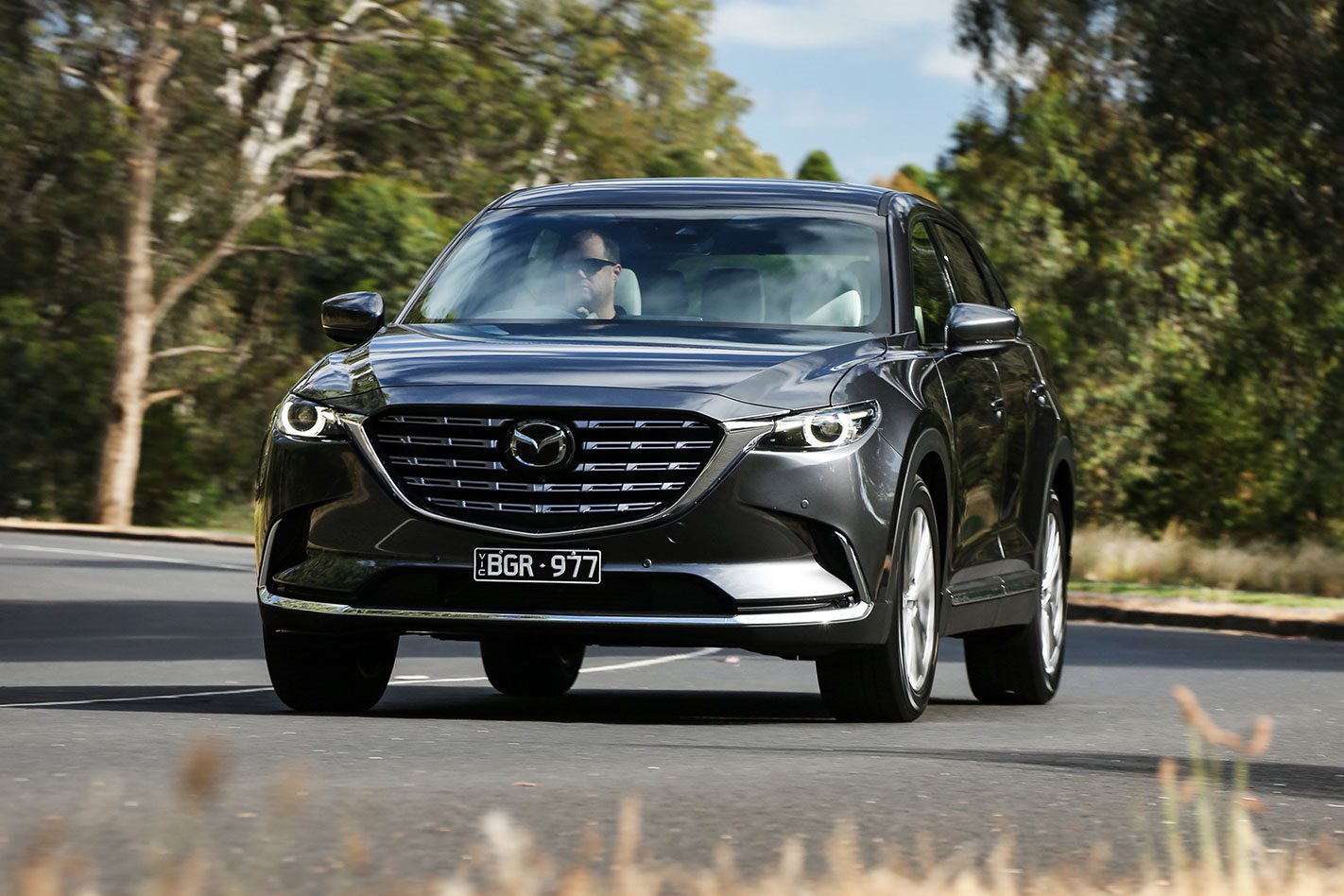
The CX-9 has six trim grade specifications: Sport, Touring, GT, GT SP, Azami and Azami LE. Each has the option of an FWD or, for an additional $4000, AWD – except for the Azami LE, which is AWD only. Pricing ranges from $47,250-74,710 before on-road costs.
In October 2022 the CX-9 range was treated to some small tweaks. The sporty GT SP grade was added with its red stitching, while GT grades and up scored a 10.25-inch infotainment screen.
The CX-8 has a $6760 lower starting price of $40,490 and tops out at $69,890 before on-road costs.
It originally had just two spec grades – Sport and Asaki – giving CX-8 the smallest line-up in Mazda’s stable. This was extended with the 2020 update to also include mid-spec Touring and GT versions, which filled a huge price gap between variants.
In 2021 two more variants were introduced: the Touring SP and Asaki LE, which added a few features over their namesakes.
In January 2022, Mazda dropped the FWD diesel powertrain, which sold in very low numbers compared to the petrol FWD.
The current range sees all six variants (apart from the Asaki LE, which is AWD only), offered in petrol FWD or diesel AWD, with the latter costing an additional $4000.
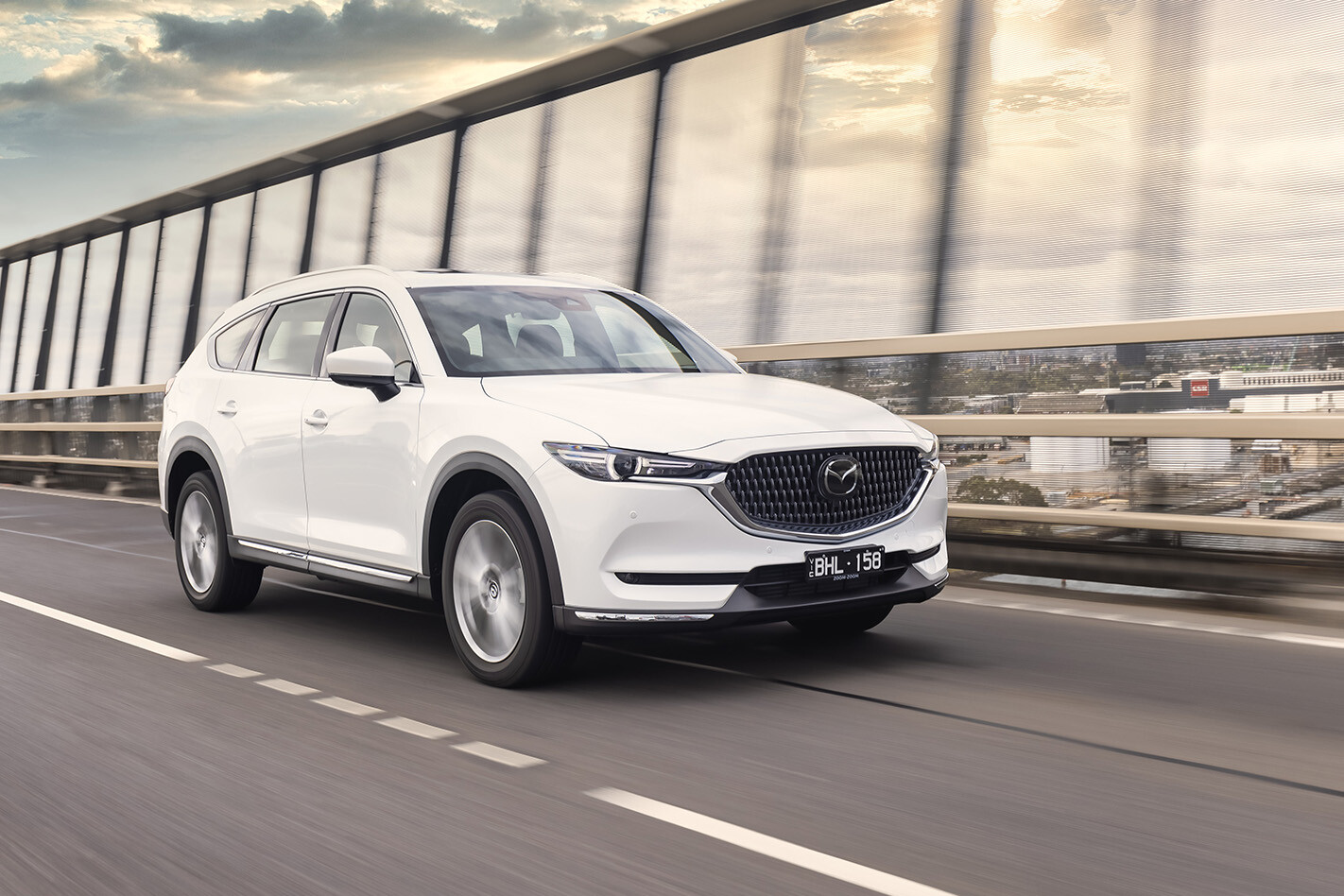
Standard features
Both cars’ entry-level CX-8 and CX-9 Sport grades are very well equipped and have a premium feel despite their cloth trim. See how the variants line up below:
| Mazda CX-9 vs CX-8 Sport spec battle | |
|---|---|
| CX-9 Sport | CX-8 Sport |
| 18-inch alloy wheels | 17-inch alloy wheels |
| 7-inch infotainment system | 8-inch infotainment system |
| Apple CarPlay and Android Auto (wired) | Apple CarPlay and Android Auto (wired) |
| Satellite navigation | Satellite navigation |
| DAB+ digital radio | DAB+ digital radio |
| Head-up display | LED headlights and tail-lights |
| LED headlights and tail-lights | Halogen daytime running lamps |
| Halogen daytime running lamps | Cloth upholstery |
| Cloth upholstery | Leather-wrapped steering wheel and gear shifter |
| Leather-wrapped steering wheel and gear shifter | Three-zone climate control with rear air vents |
| Three-zone climate control with rear air vents | Push-button start |
| Push-button start | Six-speaker audio system |
| Six-speaker audio system | Rain-sensing wipers |
| Rain-sensing wipers | Reversing camera |
| Reversing camera | Power-folding door mirrors |
| Power-folding door mirrors | Auto-dimming rear-view mirror |
| Auto-dimming rear-view mirror | Tyre pressure monitoring |
| Tyre pressure monitoring | Adaptive cruise control |
| Adaptive cruise control | Lane-departure warning |
| Lane-departure warning | Rear cross-traffic alert |
| Rear cross-traffic alert | AEB |
| AEB | |
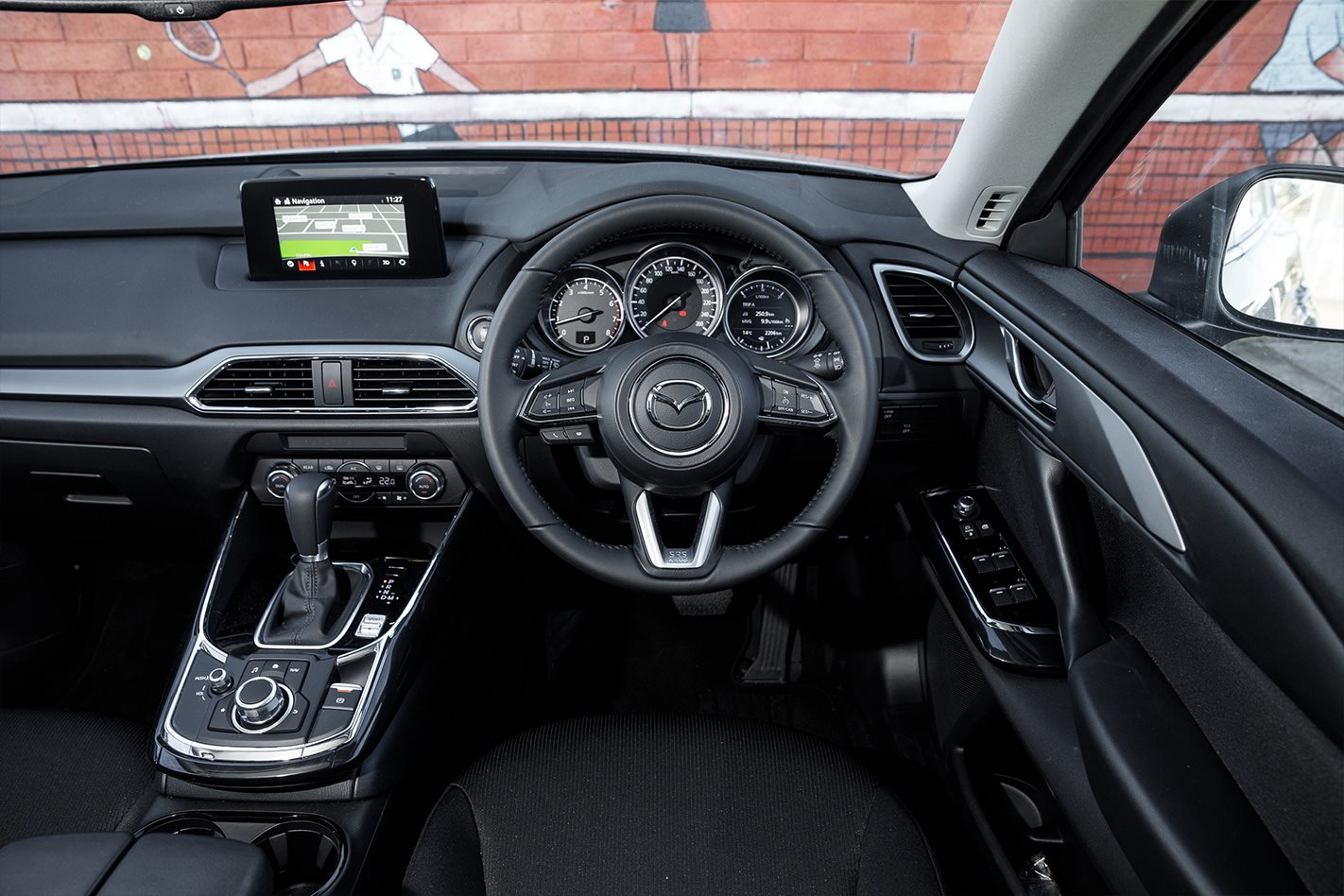
The bigger CX-9 comes standard with 18-inch alloys, while the CX-8 Sport rolls on 17s.
The plush CX-9 Azami and CX-8 Asaki are each brimming with features that are extra-cost options in some pricier Euro SUVs, such as; Nappa leather upholstery, heated front seats premium sound system, remotely operated tailgate, multi-element LED headlights and 360-degree view parking monitor. The LE flagships bring middle-row captain’s chairs
The CX-9 Azami has 20-inch alloys, the CX-8 Asaki 19s. Both carry five-star ANCAP safety ratings.
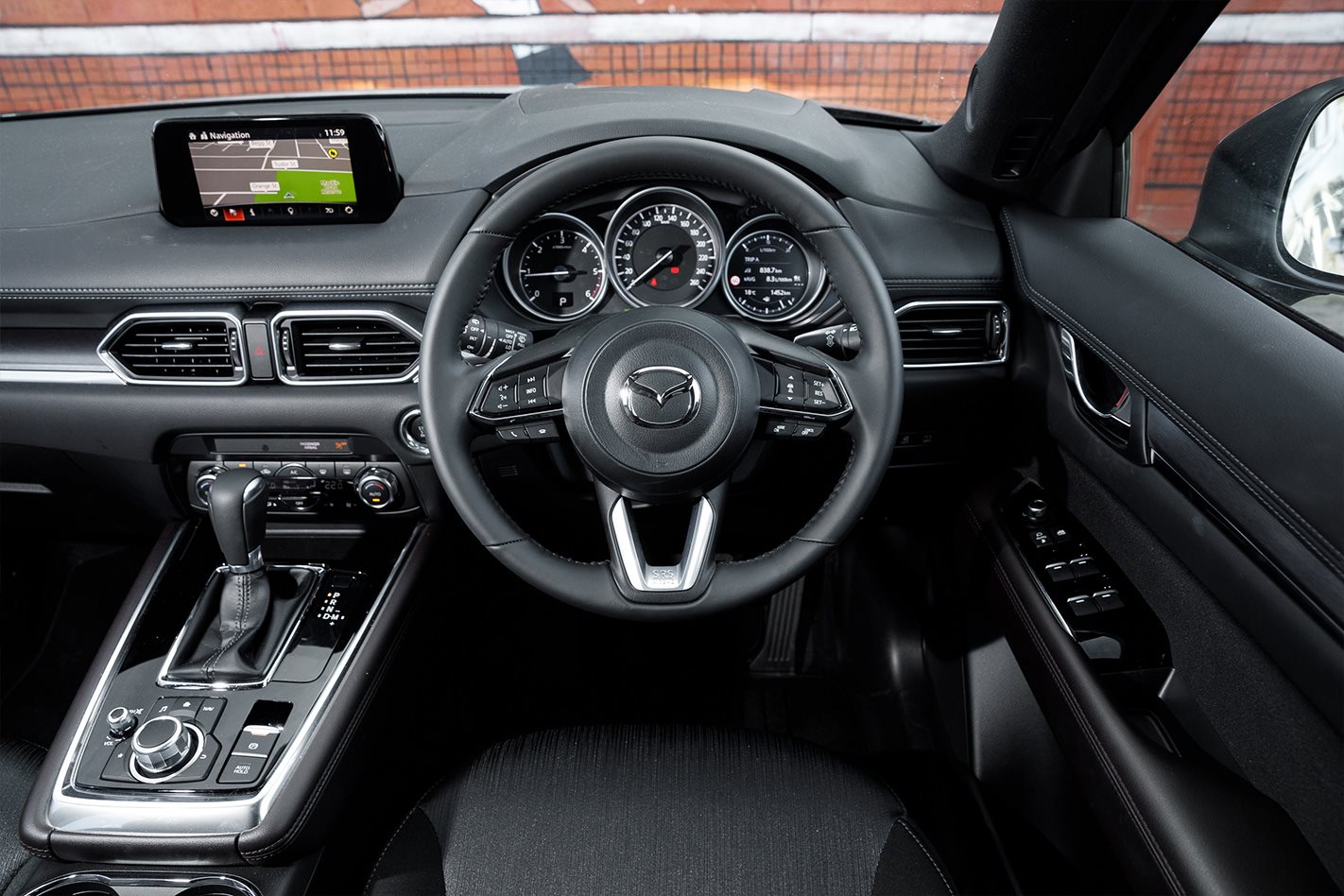
CX-9 and CX-8 dimensions
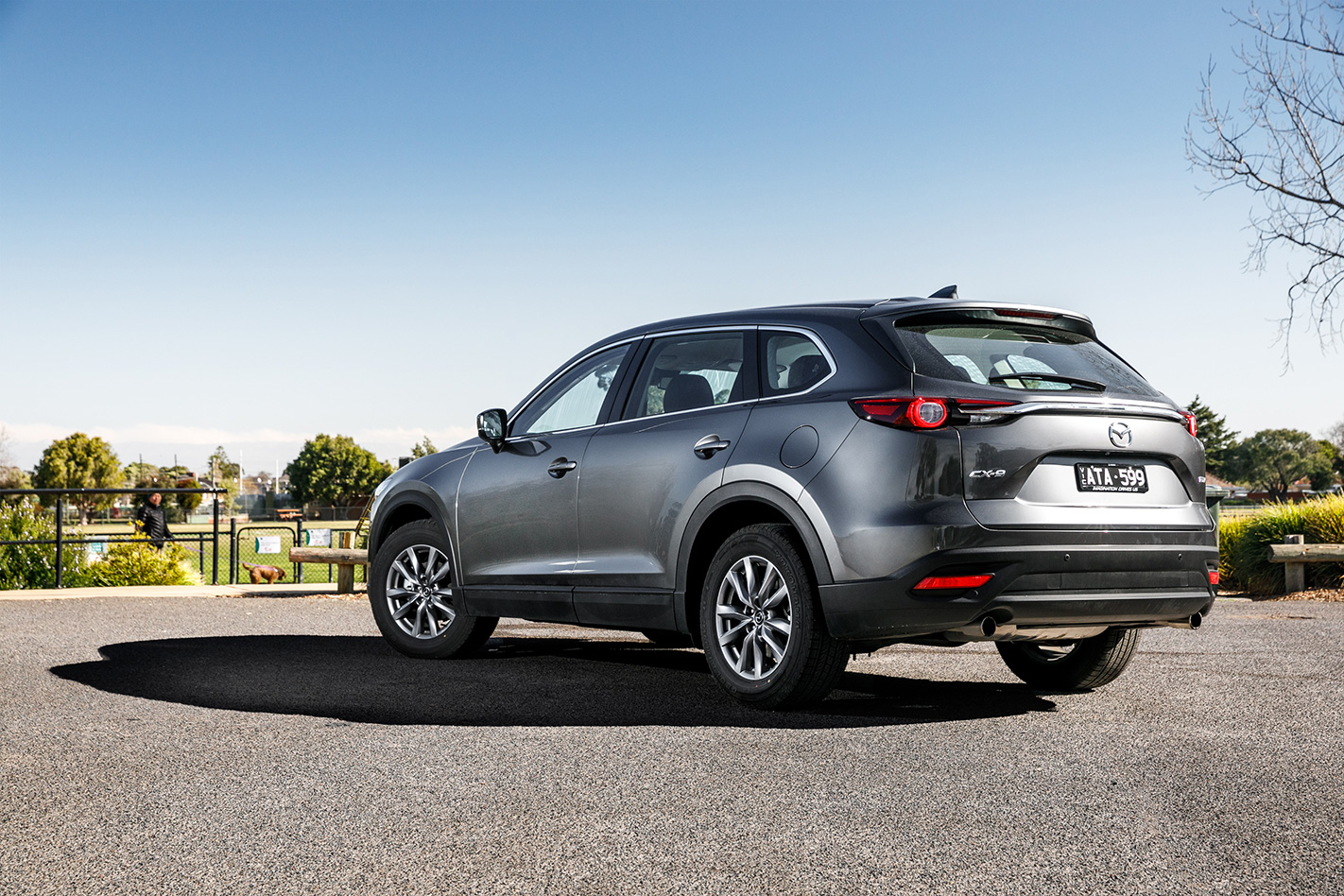
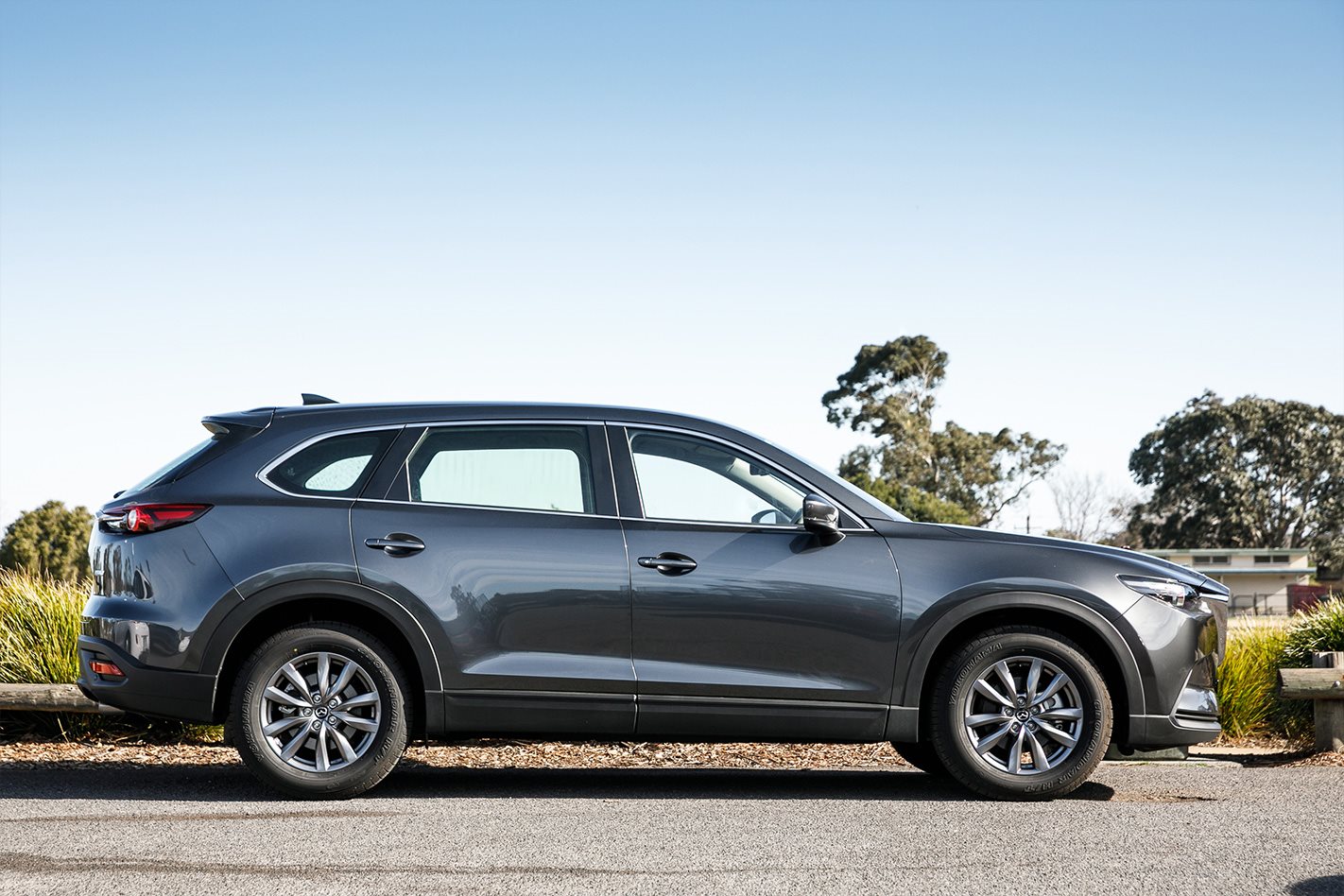
The CX-9 is 5075 millimetres long and 1969mm wide, making it 175mm longer and 129mm wider than the CX-8 (4900mm, 1840mm).
However, both have the same 2930mm wheelbase. This provides the CX-8 with the same legroom in the first two rows. The CX-8’s shorter and narrower shell compromises elbow room slightly, but makes parking a little easier.
Space and comfort
Both cars are very quiet. The CX-8’s diesel naturally dishes out a more gravelly engine noise, but it’s a lot quieter than the CX-5 diesel, with plenty of sound insulation that’s evident by the weight of the bonnet. They also ride very smoothly.
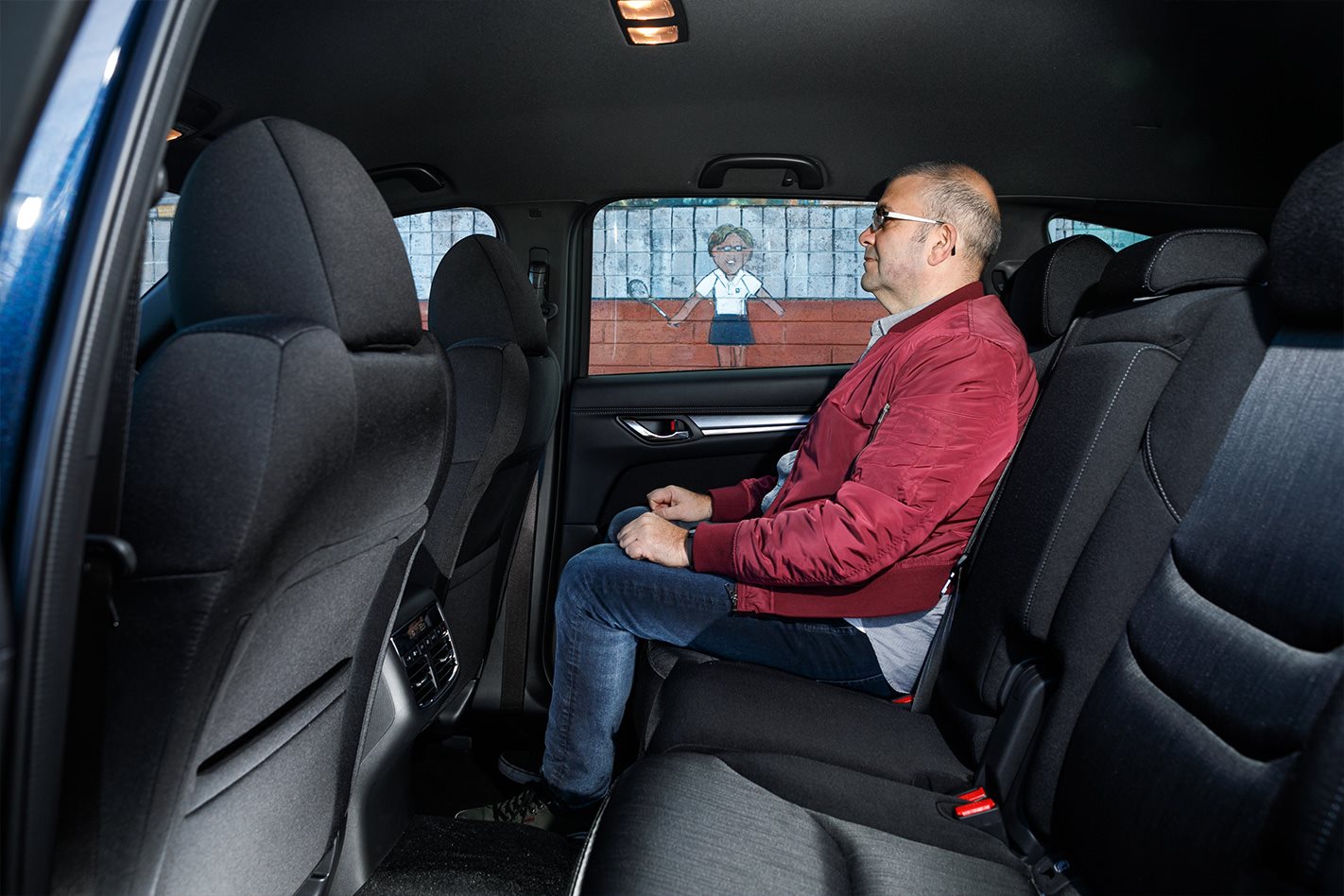
The CX-9’s front seats feel a little wider and more embracing, and second-row seats also feel more comfortable – you sit in them whereas you feel like you’re sitting on the CX-8’s middle pew.
Second-row seats
The CX-9’s second row is comfortable and delivers a good view over the front seats and out the side windows with plenty of headroom. In the Touring, GT and Azami versions, the central fold-down armrest has a handy storage bin and a USB ports.
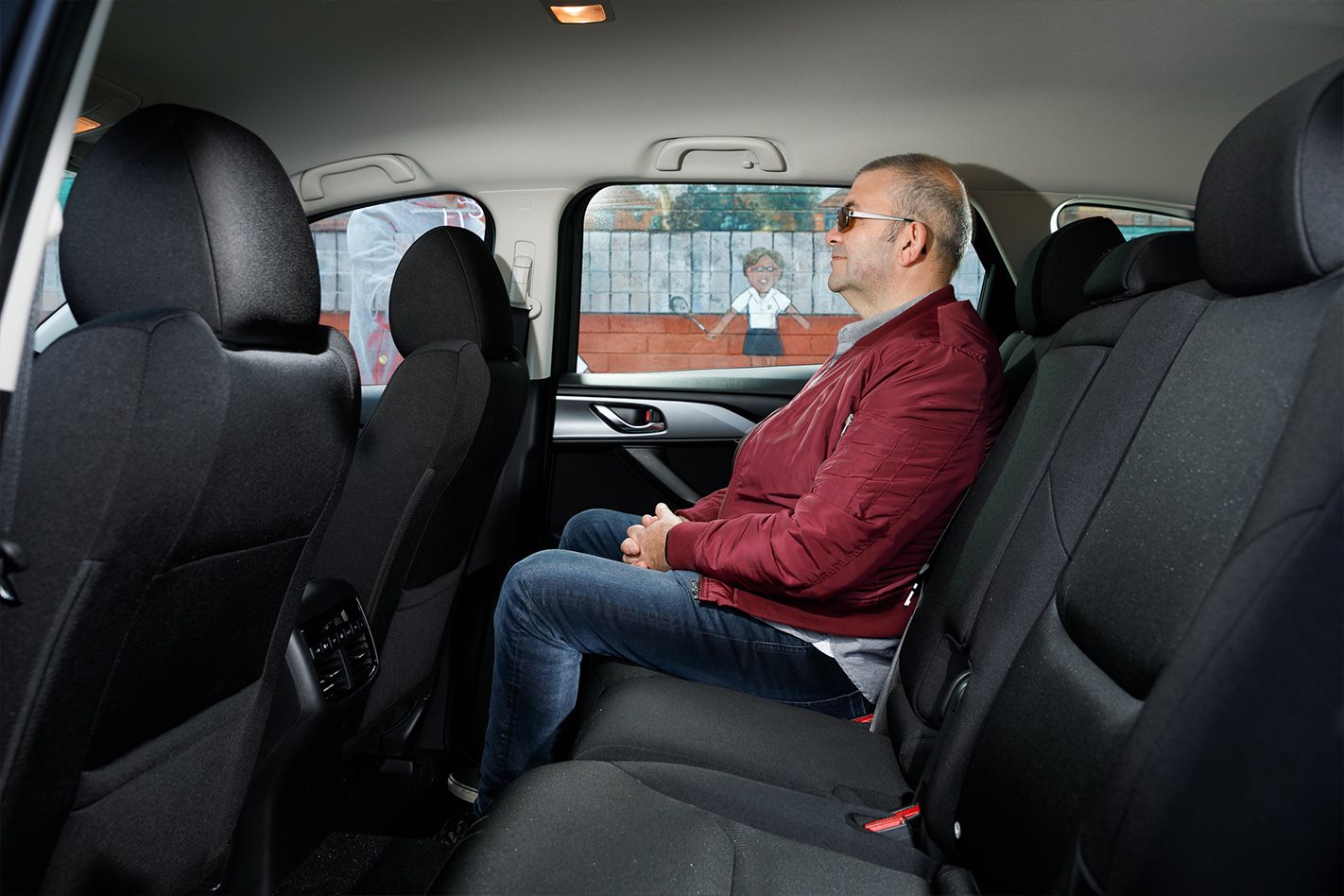
The middle row bench in the CX-8 has to be clever to make up for its smaller size. The bench can slide forward and aft, and the two-position backrest reclines 22-30 degrees from vertical. The rear doors open out to 80 degrees to make getting into the third row easier. All versions have a fold-down centre armrest with storage and two USB sockets. The two outboard seats in the Asaki and Asaki LE are heated.
The range-topping CX-9 Azami LE and CX-8 Asaki LE have two very plush power-operated captain’s chairs with heating and ventilation in the second row. This not only ups the levels of luxury, but means you can leave child seats/baby capsules anchored in place and still easily access the third row.
Third-row seats
The CX-9’s third row provides usable accommodation for adults rather than being a kids-only proposition, while the CX-8’s back seats are designed to accommodate occupants up to 170 centimetres tall, which makes it a little tight for most adults. Once they squeeze in though, most people will cope with a 20-minute run across town.
Children will have no problems, with heaps of leg and elbow room in each car.
Neither car has third-row air vents, but their second rows have dedicated vents and independent air-conditioning controls that also benefit the rear seats.
Which has the bigger boot?
With the third row in use, the CX-8 holds 209 litres of luggage space, which Mazda claims is just enough for two golf bags. There is also a sub-boot below the main boot floor with a large opening and a depth of 100mm, offering 33 litres of underfloor storage space, which is especially useful for valuable or fragile items.
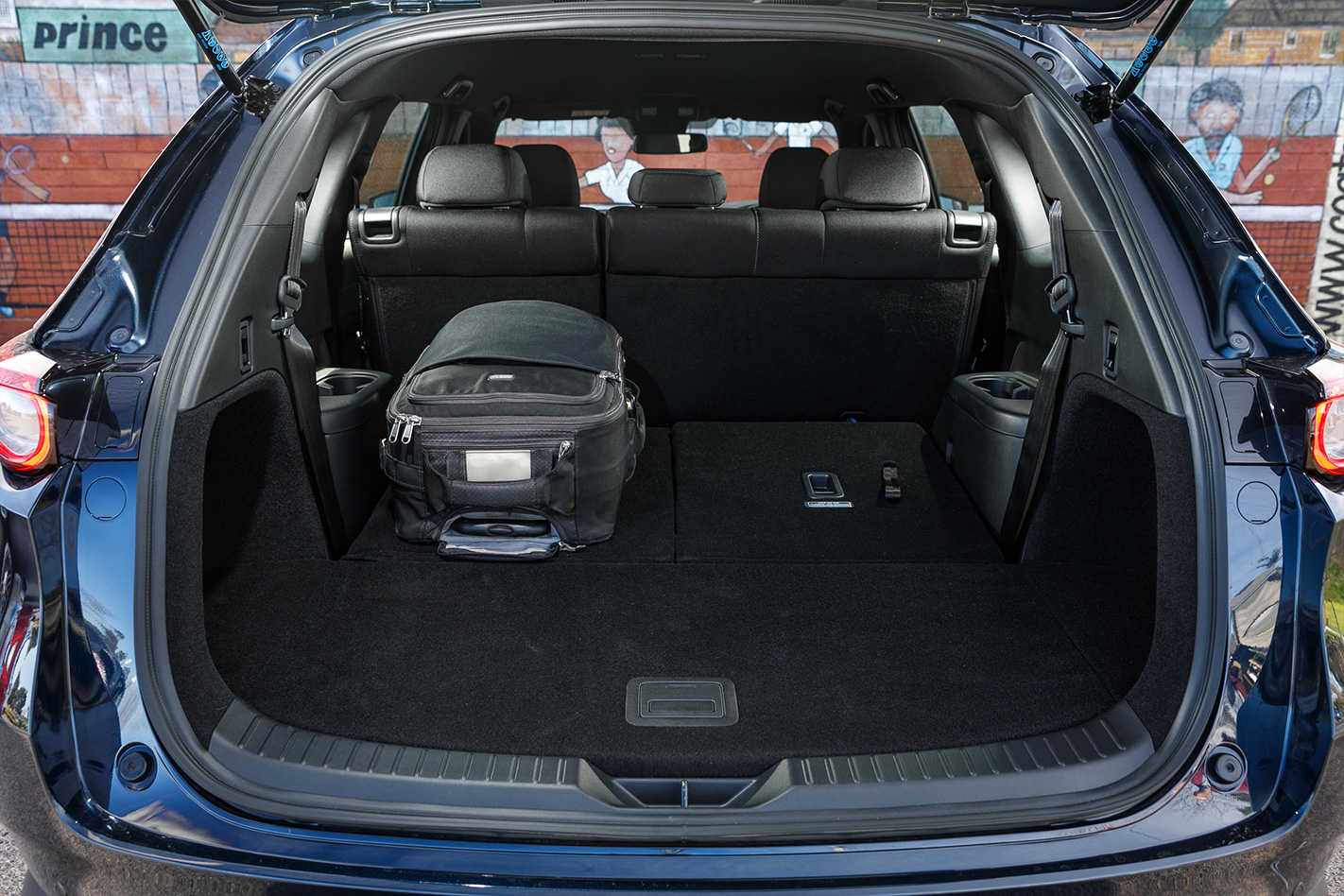
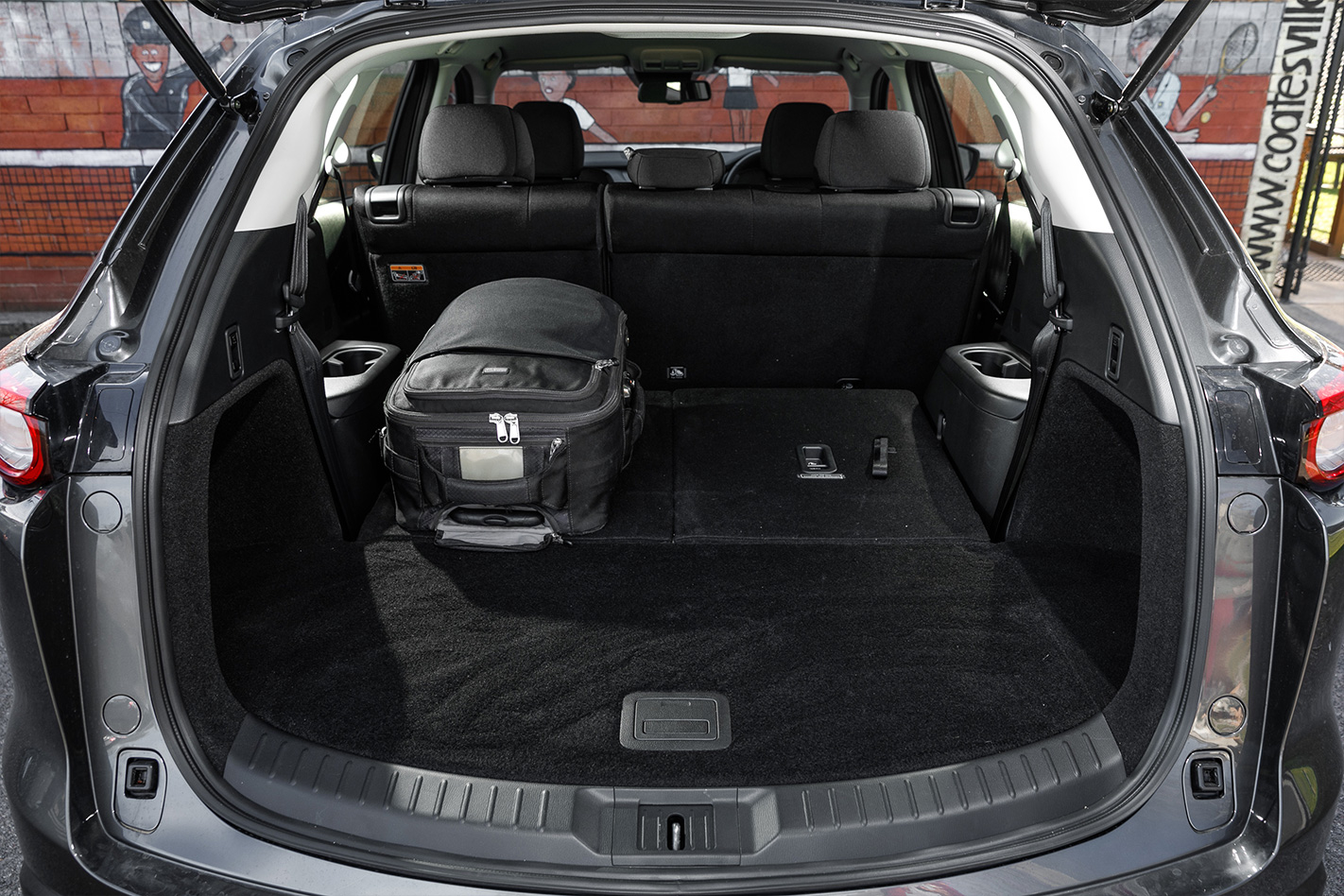
With the third-row seats folded down, the available luggage capacity increases to a sizeable 742 litres in CX-8. Folding down both the second and third-row seatbacks brings a capacious 1727 litres and creates a flat floor space large enough to hold two bicycles. That last figure is slightly more than the CX-9, thanks to the truly flat-folding rear seats.
The CX-9’s additional width increases luggage space behind the third row to 230 litres. In five-seat mode that grows to a substantial 810 litres. Fold the 60:40 middle-row seats down and there’s a van-like 1641 litres of space – enough to accommodate big pieces of furniture.
Both the CX-8 and CX-9 can tow loads up to 2000 kilograms braked, or 750kg unbraked.
Performance and fuel economy
The CX-9’s 170kW/420Nm 2.5-litre four-cylinder turbo petrol consumes as little as 8.4 litres/100km (ADR 81/02 combined cycle), which isn’t bad for a large SUV.
The petrol engine responds keenly from low speeds and pulls with plenty of guts for overtaking. It’s a sporty engine that teams well with a six-speed automatic to give the CX-9 a surprising turn of speed.
The CX-8’s naturally-aspirated 140kW/252Nm 2.5-litre petrol engine has significantly less power and torque, so has to work harder resulting in a slightly higher official combined fuel economy rating of 8.5L/100km – the same engine in the smaller CX-5 consumes 7.5L/100km.
The CX-8’s 2.2-litre turbocharged diesel engine (also shared with the CX-5) consumes just 6.0L/100km in the ADR 81/02 combined consumption cycle.
Although it may have the same 140kW peak power figure, the diesel pumps out a healthy 450Nm of torque. Linked with a six-speed automatic, the grunty CX-8 diesel has no trouble pulling even with a full complement of passengers.
Ride and handling
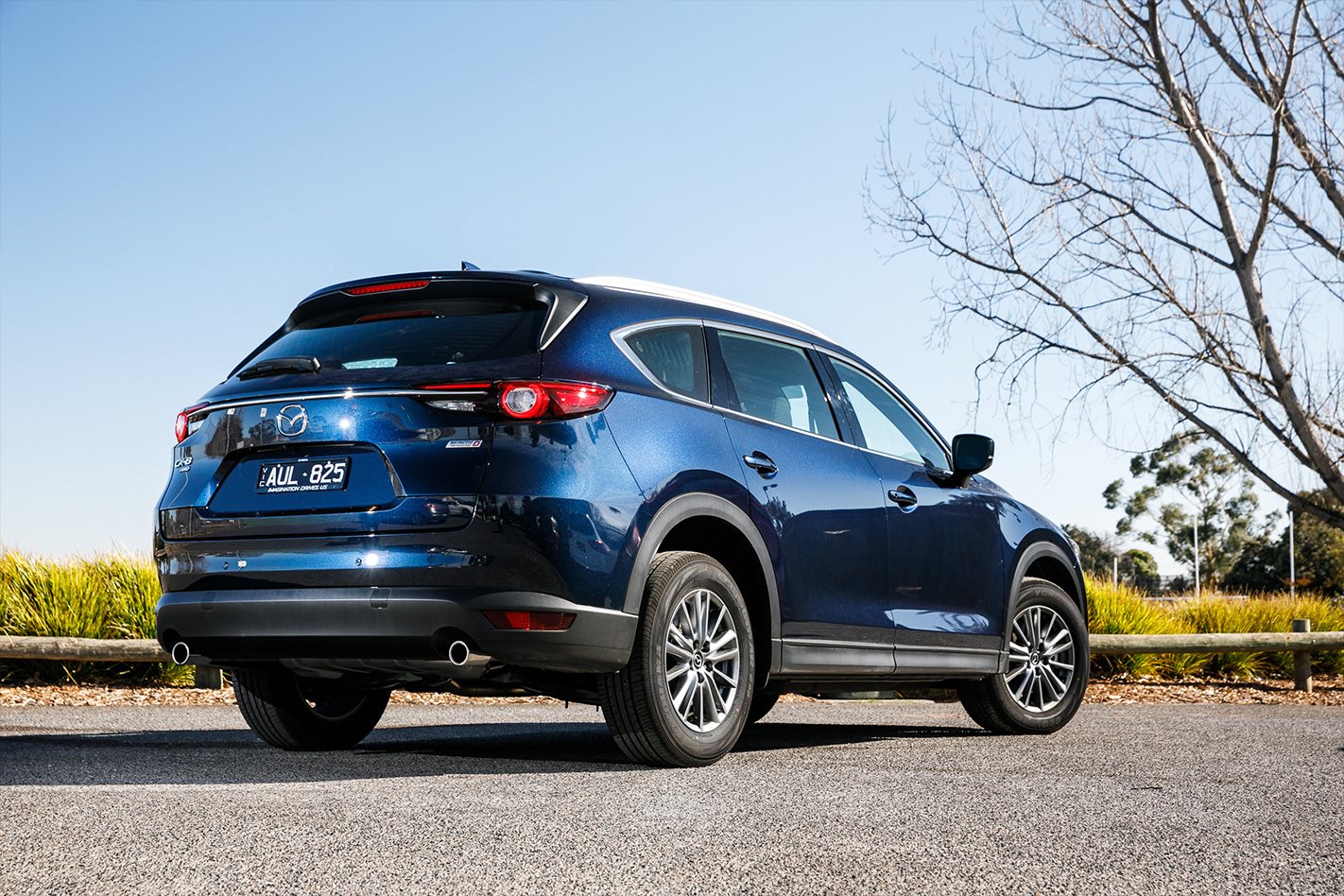
The Mazda CX-9 was lauded as the best-handling large SUV at launch, and remains a genuinely good drive – despite its bulk and high centre of mass. Its greatest strengths are a suspension that brilliantly blends comfort and manoeuvrability, and slick and accurate steering – particularly with the AWD versions.
Despite its slightly smaller dimensions, the diesel CX-8 is about 110kg heavier than the CX-9 due to the heft of its diesel powertrain and additional soundproofing needed. So it drives like a heavier, softer-riding CX-5.
The CX-8’s narrower footprint means it doesn’t feel quite as planted as the CX-9, but overall body control and general dynamics of both the diesel and petrol versions are good and able to shrug off road imperfections. The narrow CX-8 is one of the easier seven-seat SUVs to park, too.
Should I consider other rivals?
The CX-8 and CX-9 both remain sound family SUV choices, but lately there have been some excellent new releases that were blown away in previous-gen form by the CX-9.
From the Koreans, the new Kia Sorento and Hyundai Santa Fe both offer hybrid powertrains and much improved dynamics from previous generations. The same is true of Toyota’s latest Kluger.
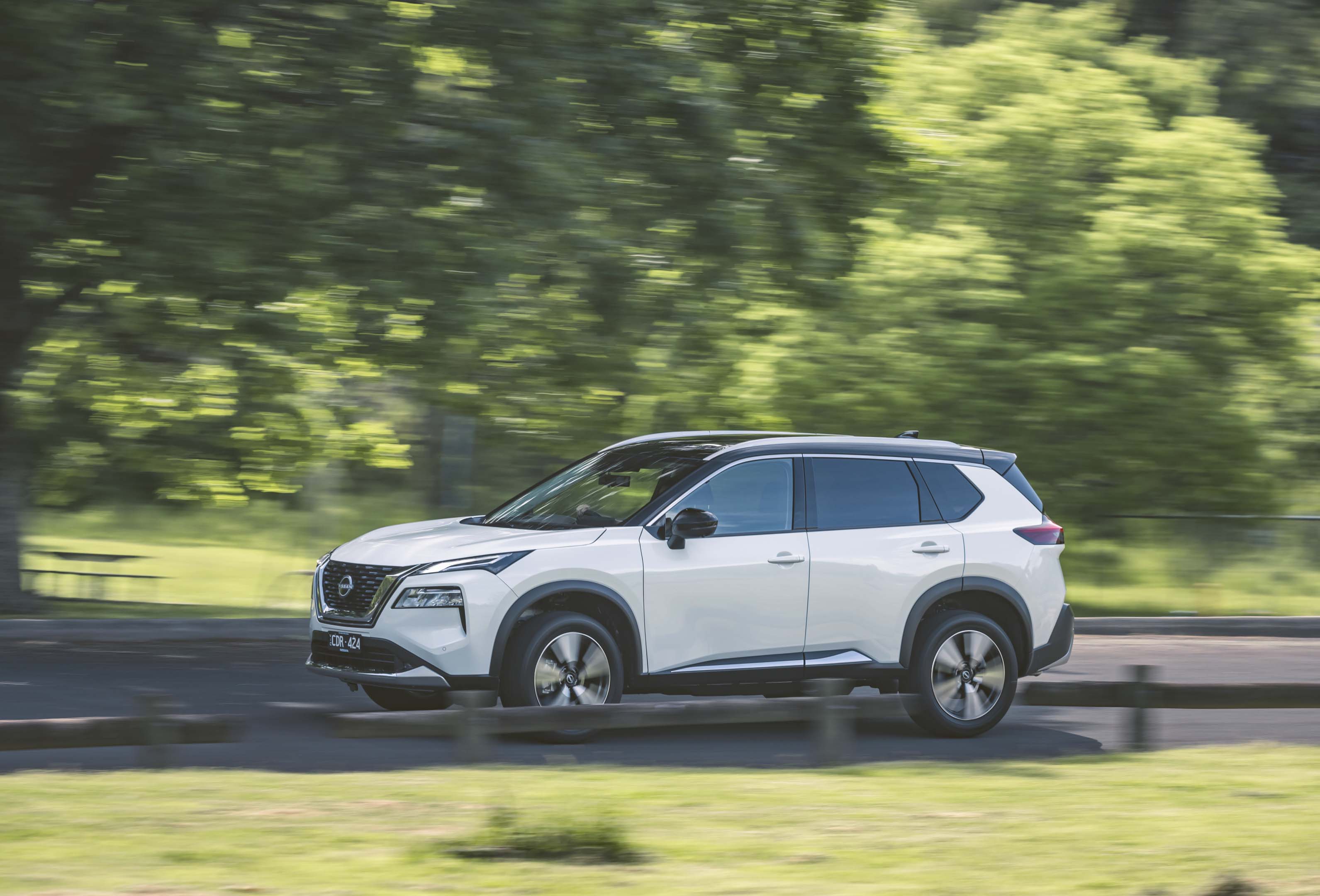
As for CX-8 rivals, Mitsubishi’s new Outlander is much larger than the car it replaces and, although not as generous as the CX-8 for seven, its dimensions are pleasingly compact. The same can be said of the latest Nissan X-Trail, though it’s only available with seven seats in lower-spec trims.
Summing up
Both large SUVs have a place in the Australian market, and that’s a fact further reinforced by the facelifted CX-8 arriving here shortly, as well as Mazda considering the whole plethora of next-gen CX-60 and CX-90 SUVs without axing the current line-up.
Despite coming with a smaller starting price, as well as both petrol and diesel engine options, the CX-8 remains behind the dearer CX-9 for sales – but it has succeeded in bringing people seeking a diesel three-row SUV to Mazda showrooms.
A couple of things going against the CX-8 include less cargo space and the fact the diesel isn’t the best choice if most of your driving is short inner-city runs. And while there is a petrol version, it isn’t quite up to the job of hauling a fully laden large SUV like the CX-9’s turbo is.
Just when you thought Australia’s most popular brand had every conceivable SUV angle covered, along comes the Toyota Corolla Cross.
Adopting and adapting the company’s famous small-car nameplate, the Corolla Cross is to small SUVs what the Yaris Cross is to light SUVs. It slots in between the C-HR compact SUV and RAV4 medium SUV, but also with plenty of pricing overlap.
The Corolla Cross shares its platform – and 2640mm wheelbase – with the Corolla hatch and the C-HR compact SUV.
Here we review the Toyota Corolla Cross GXL AWD hybrid, a mid-upper variant in the range.

JUMP AHEAD
- How much is it, and what do you get?
- How do rivals compare on value?
- Interior comfort, space and storage
- What is it like to drive?
- How is it on fuel?
- How safe is it?
- Warranty and running costs
- VERDICT
- Specifications
How much is it, and what do you get?
The GXL AWD hybrid is the fourth most-expensive Corolla Cross, sitting below all Atmos variants.
It’s priced from $42,250 before on-road costs (or about $46,500 drive-away), meaning it overlaps with some larger SUVs including its stablemate the RAV4.
Prices start as low as $33,000 if you’re content with a non-hybrid petrol model, or from $35,500 for the more efficient petrol-electric drivetrain (both before on-road costs).
The GXL’s exterior highlights include 17-inch alloy wheels, LED headlights, foglights, privacy glass, and roof rails.
Inside, there’s a 7.0-inch digital driver display and a 10.5-inch infotainment screen.

Driver aids include adaptive cruise control, speed sign notification, blind-spot monitoring, rear cross-traffic alert and a panoramic view monitor.
There are some glaring equipment omissions, however, at this price point. The GXL lacks auto wipers, wireless smartphone charging, and a rear centre armrest. Its wheels should arguably be a size bigger, too.
All those features are included on the flagship Atmos, which also adds electric driver’s seat adjustment, heated front seats and steering wheel, a JBL premium audio system, larger (12.0-inch) digital instruments and a panoramic glass roof. Buyers, though, would need a far from inconsiderable $6800 to jump up to this variant.

How do rivals compare on value?
Take either a natural hybrid rival or a popular price rival and the Corolla Cross GXL looks undercooked in the standard gear department.
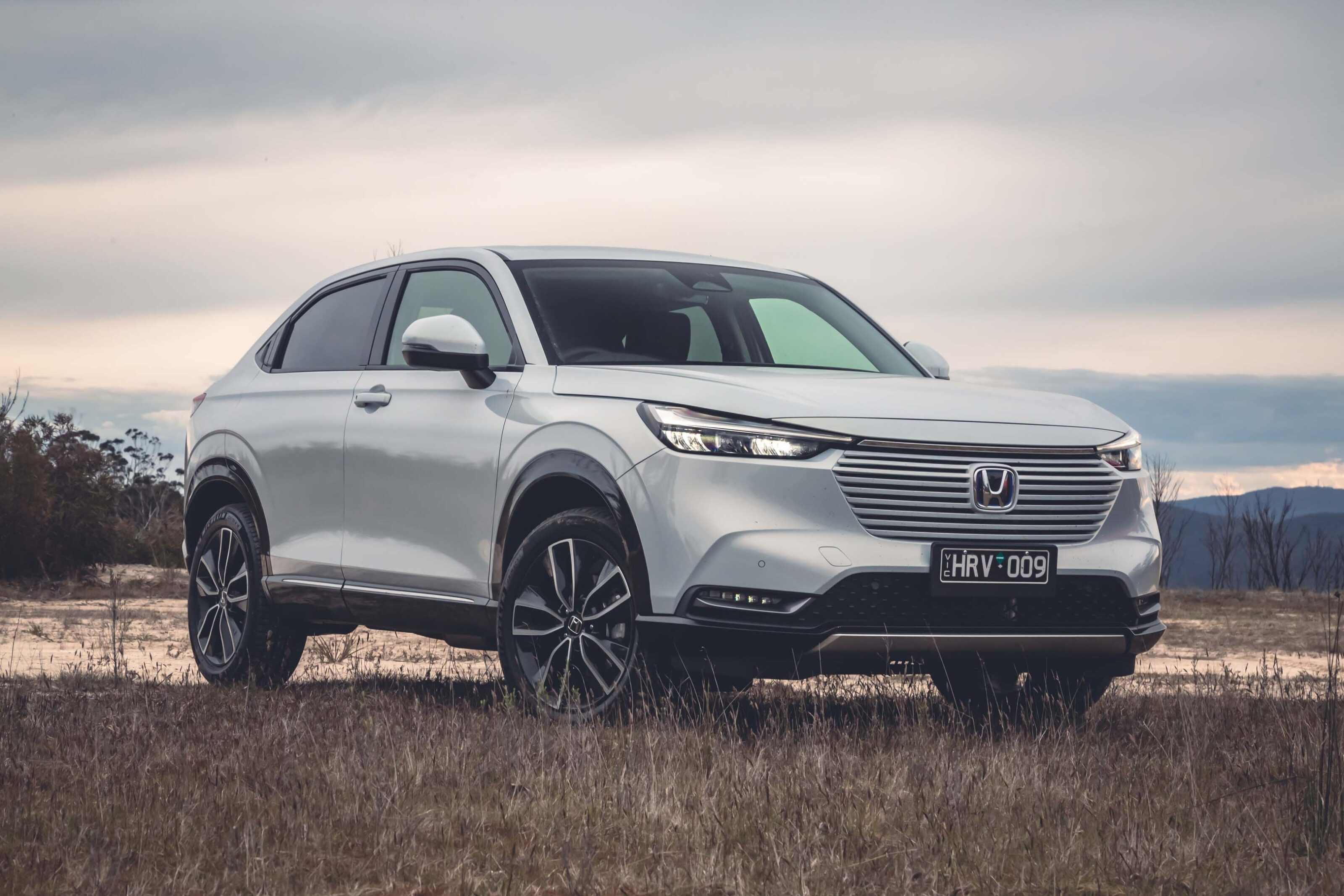
Both the $47,000 drive-away Honda HR-V e:HEV L and $41,990 (before on-road costs) Mazda CX-30 G25 Touring SP AWD have bigger 18-inch wheels, a heated steering wheel and heated front seats.
The Honda also features an auto tailgate while the Mazda has a sunroof, head-up display, leather seats, Bose audio and an electrically adjustable driver’s seat.
Toyota counters to an extent on size as it’s slightly larger than both these rivals; its 4.46m length comparing with the 4.34m HR-V and 4.4m CX-30.
Interior comfort, space and storage
Cabin space is an obvious advantage over the smaller Yaris Cross, though the Corolla Cross is also roomier compared with the C-HR. It makes for a more realistic family SUV.
The GXL’s front seats are also terrifically comfortable, with well-judged bolstering allowing space for varying torso widths while also feeling supportive. Instantly inviting, they’re also great for long journeys.
Not much is clever about storage solutions in the Corolla Cross but basics are covered: cup holders, console bin with 12-volt socket, smartphone tray (but lacking charging capability), and decently sized glovebox and door pockets (with bottle holders).

Even less thought appears to have been put into the interior design. The Corolla Cross’s cabin is dreary and uninspiring, a montage of greys and blacks bereft of any colour.
It contrasts with some of the flair seen in the C-HR and the rugged style of the RAV4. Consider its own segment, and you’ll find a more premium vibe in rivals such as the Mazda CX-30 and Honda HR-V.
Soft materials are applied to the middle dash and upper door cards, and there’s cloth lining for the console cubby and door armrests, though plastics are otherwise of the low-cost variety. A lack of damping for the console cubby lid points to further cost-cutting.

A range of blank buttons on the lower dash are another reminder that you’re not in the top-spec model.
Not even Toyota’s infotainment adds any sparkle to the dash with its uninspiring graphics and menu layout. There’s also only a single USB-A port. Apple CarPlay (wireless) and Android Auto compatibility are standard and highly recommended.
More contemporary USB-C ports are located in the ventilated rear cabin, where adults will find more legroom than in a C-HR (though not a RAV4).

Bottle holders are integrated into the rear doors, but there’s only one seatback pouch and, surprisingly for a fairly high-spec variant, there’s no centre armrest. That will disappoint kids as much as adults looking for somewhere to store their takeaway tea or coffee.
Toyota Corolla Cross boot space
The Corolla Cross’s boot space varies between models, with as much as 436 litres and as little as 380 litres.
Petrol versions, which don’t need to package hybrid battery components, have the most space; the GXL AWD hybrid’s luggage compartment is quoted at 390 litres, further affected by a less compact but more sophisticated multi-link rear suspension layout where front-drive models employ a torsion beam.
Still, that’s a massive 200 litres less than the boot space provided by a RAV4, and even a fraction less than the 390L volume of a front-wheel drive Yaris Cross.
Mini match-up!

On the upside, it’s a fair bit more than the 318 litres offered by the C-HR, while the Corolla SUV also carries an advantage over the CX-30 (317L).
Ideally, though, the Corolla Cross’s 60:40 rear seats would fold down to create a flat cargo bay but instead, there’s a stepped floor (with flaps).
All-wheel-drive models also miss out on a space-saver spare; owners instead get a puncture repair kit.
On the upsie, there’s a conveniently low loading lip, side storage, integrated hooks, four tie-downs and a cargo blind.

What is it like to drive?
The basics
| 2023 Toyota Corolla Cross GXL AWD Hybrid specs | |
|---|---|
| Drive | all-wheel |
| Drivetrain | 2.0-litre petrol + 2 electric motors |
| Transmission | continuously variable automatic |
| Power (combined) | 146kW |
| Torque (combined) | not specified |
| Fuel consumption (combined) | 4.4L/100km |
| Fuel type / tank | 91 RON / 43L |
| Boot space | 390L |
The Corolla SUV shares similar driving characteristics to both its namesake hatch, the related C-HR, and the larger RAV4. And this is a very good thing.
Toyota deserves huge credit for how it has transformed its fleet into a range of cars that are satisfying to drive.
Although the Corolla Cross’s steering is hardly communicative, its lightness and directness make Toyota’s small SUV as easy to navigate through a set of twisties as it is to manoeuvre around town.
While there’s more body roll than you’ll experience in a Corolla hatch or sedan, the overriding sense for the driver is that the Corolla SUV will negotiate corners with a higher degree of dynamic ability than typically found in its segment.

The Corolla SUV will negotiate corners with a higher degree of dynamic ability than typically found in its segment.
The strut-multi-link suspension and sensible wheel/tyre package – 17-inch rims wrapped in chubby 60-profile rubber – adeptly covers all surface bases, providing occupants with a cushioned and largely isolated ride whether coarse country roads or patchy urban streets are involved.
Of the Corolla Cross’s key driver controls, the brake pedal is the main disappointment with its grabby tendencies at low speeds.
The hybrid drivetrain isn’t the quietest when the CVT is lifting revs during harder acceleration but it’s a strong performer. Toyota quotes a believable 7.6 seconds for the 0-100km/h sprint – a time well beyond the segment average.

How is it on fuel?
As you’d hope for a petrol-electric vehicle, the Corolla Cross AWD hybrid is also respectably frugal – about 10 per cent more economical than a RAV4 based on official consumption ratings.
Combined fuel consumption is officially rated at 4.4 litres per 100km – 0.2L/100km higher than the front-wheel drive hybrid but 1.6L/100km better than the 2.0L petrol variant.
Honda’s HR-V hybrid is similar at 4.3L/100km, the GWM Jolion hybrid is higher at 5.0L/100km, and the Kia Niro hybrid leads the way with 4.0L/100km.

We’ve seen as low as 4.0L/100im indicated during our time with the GXL AWD, while a full real-world test with a brimmed and re-brimmed tank elicited a 5.9L/100km average. We ended with a 5.0L/100km indicated average after further urban time with the car.
Both petrol and hybrid drivetrains take 91 RON or an E10 blend.
How safe is it?
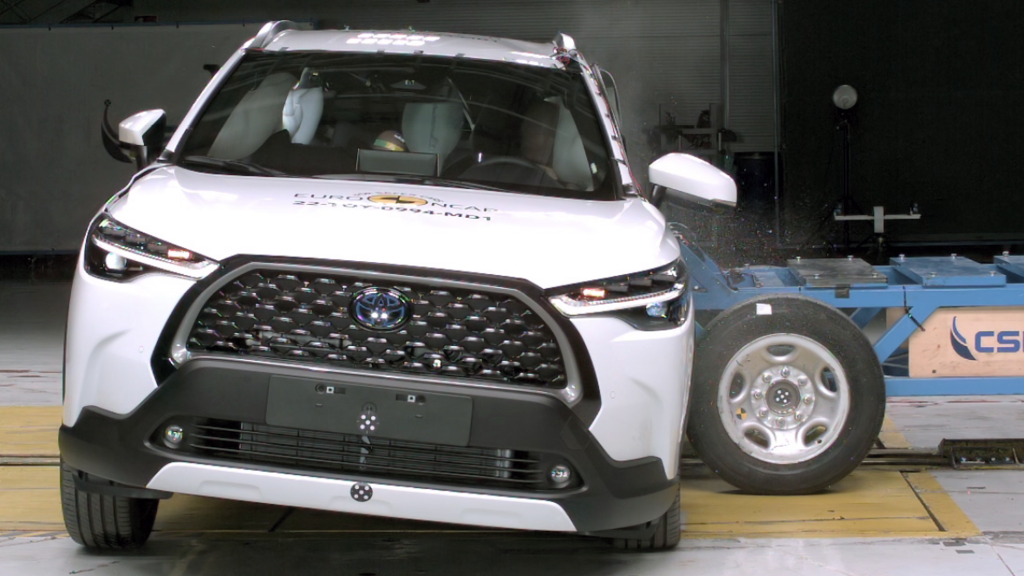
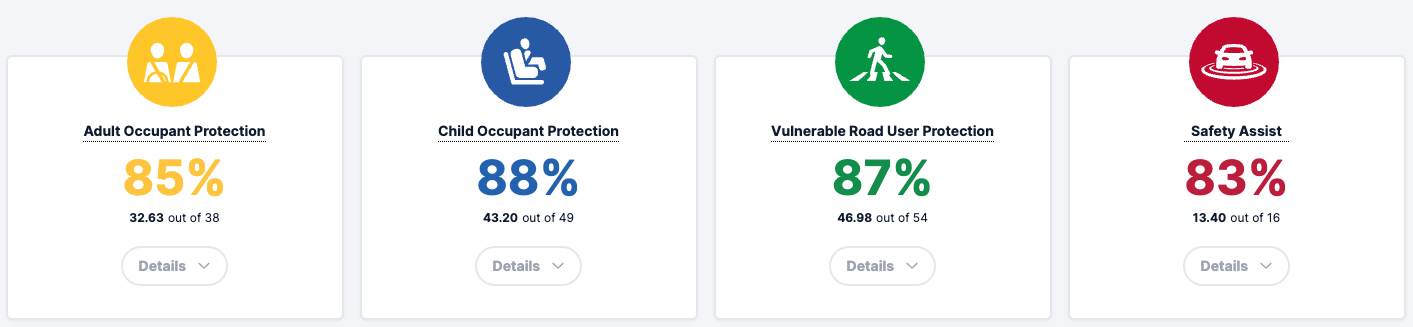
The Toyota Corolla Cross has achieved a maximum five-star ANCAP rating, and is well stocked with driver aids and protective features.
A centre front airbag is among the eight airbags in place, and there’s wide-ranging autonomous emergency braking, front and rear cross-traffic alerts, blind-spot monitoring and adaptive cruise control.
Warranty and running costs
The Corolla Cross is covered by a five-year, unlimited-kilometre warranty. Servicing is every 12 months or 15,000km.
Capped price servicing is cheap at $230 per visit for the first five years or 75,000km.

VERDICT
Australia’s small SUV segment has plenty of good offerings, but has been awaiting a true stand-out star. That hasn’t quite arrived in the form of the Corolla Cross, as it underwhelms in areas such as interior design, infotainment and boot space.
This new entrant, however, offers a more practical alternative to Toyota’s C-HR, while against segment rivals the Corolla Cross impresses with its road manners and the hybrid drivetrain’s mix of performance and efficiency.
2023 Toyota Corolla Cross GXL AWD hybrid specifications
| Body | 5-door, 5-seat small SUV |
|---|---|
| Drive | all-wheel |
| Drivetrain | 2.0-litre petrol engine + 2 electric motors |
| Transmission | continuously variable |
| Power (combined) | 146kW |
| Torque (combined) | not specified |
| 0-100km/h (claimed) | 7.6 seconds (claimed) |
| Fuel consumption (combined) | 4.4L/100km |
| Fuel type / tank | 91 RON / 43L |
| Boot space | 390L |
| Weight | 1545kg |
| Suspension | struts front; multilink rear |
| Length/Width/Height | 4460/1825/1620mm |
| Wheelbase | 2640mm |
| Brakes | ventilated discs front, solid discs rear |
| Tyres | Bridgestone Alenza 215/60R17 (with tyre repair kit) |
| Wheels | 17-inch alloys |
| Price | $42,250 + on-road costs ($46,512 drive-away, Sydney) |
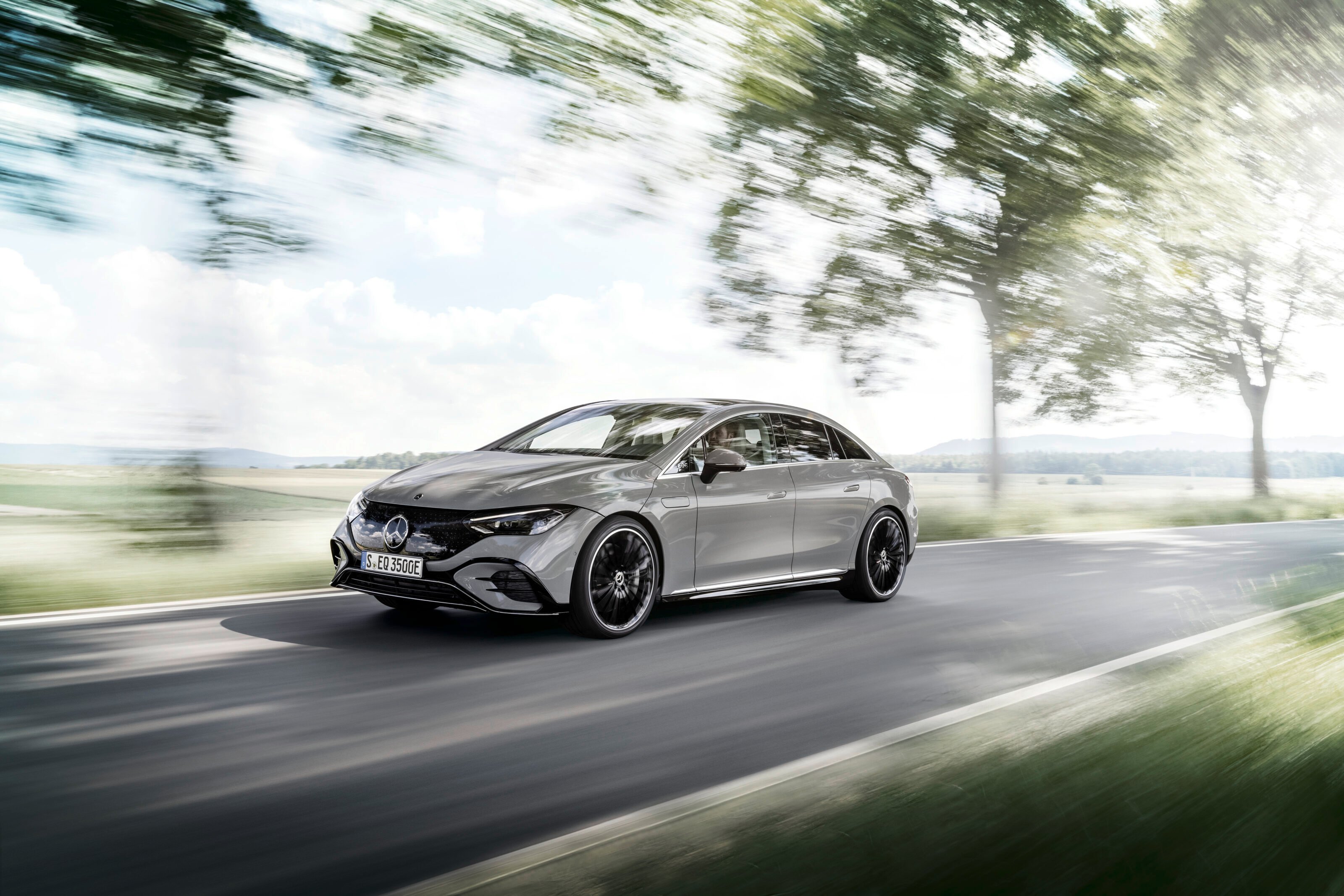
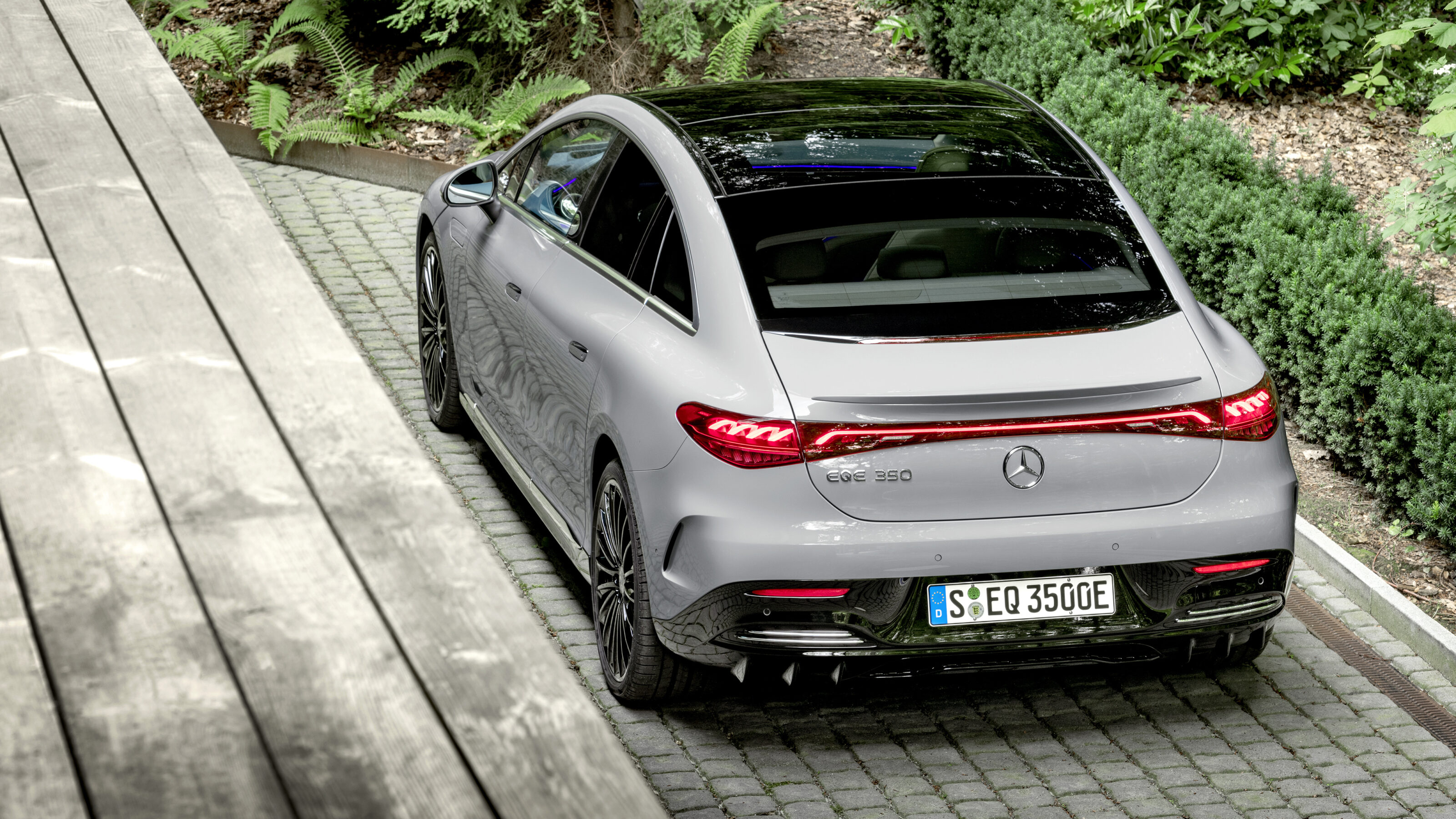
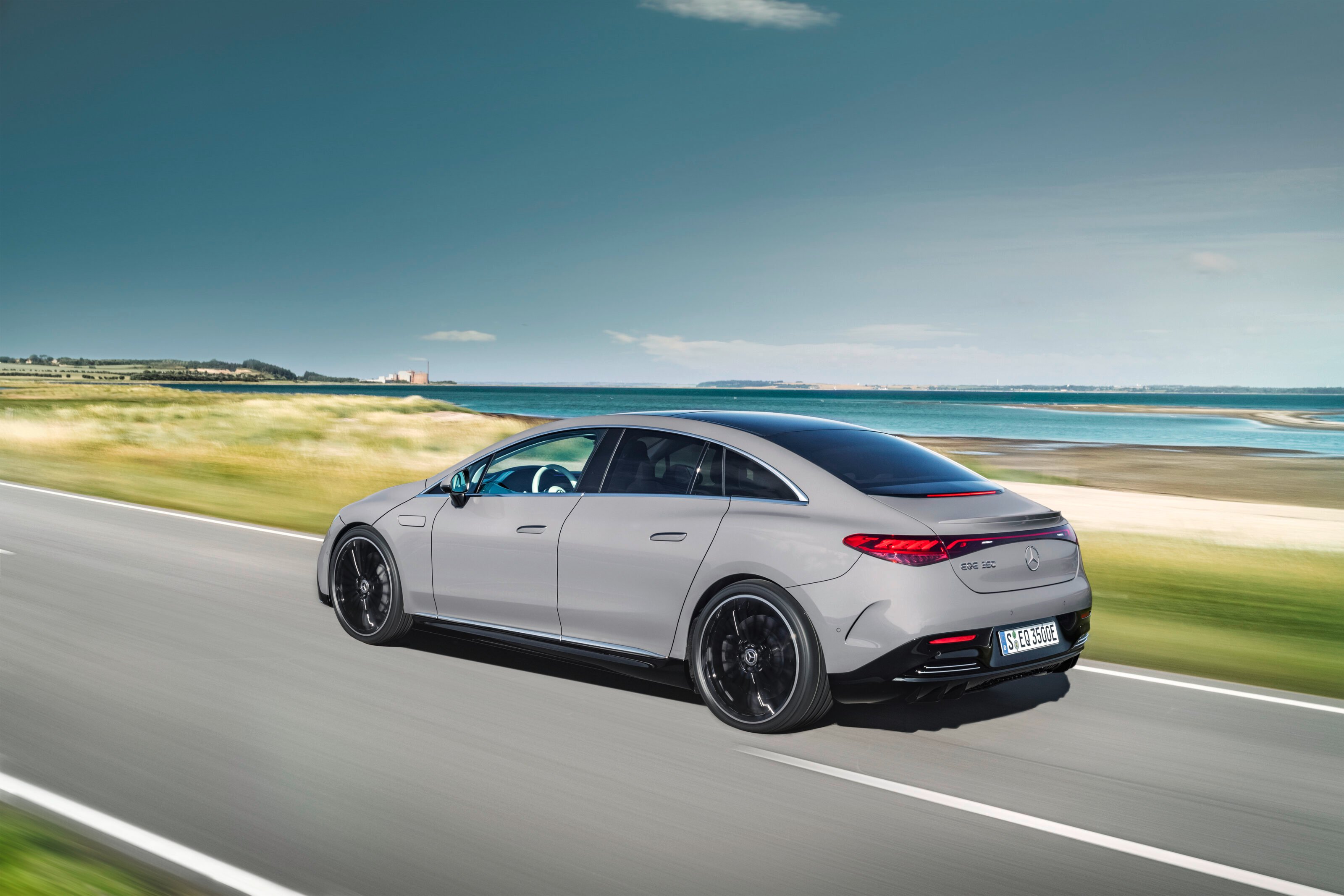
The 2023 Mercedes-Benz EQE range has arrived in Australia, priced from $134,900.
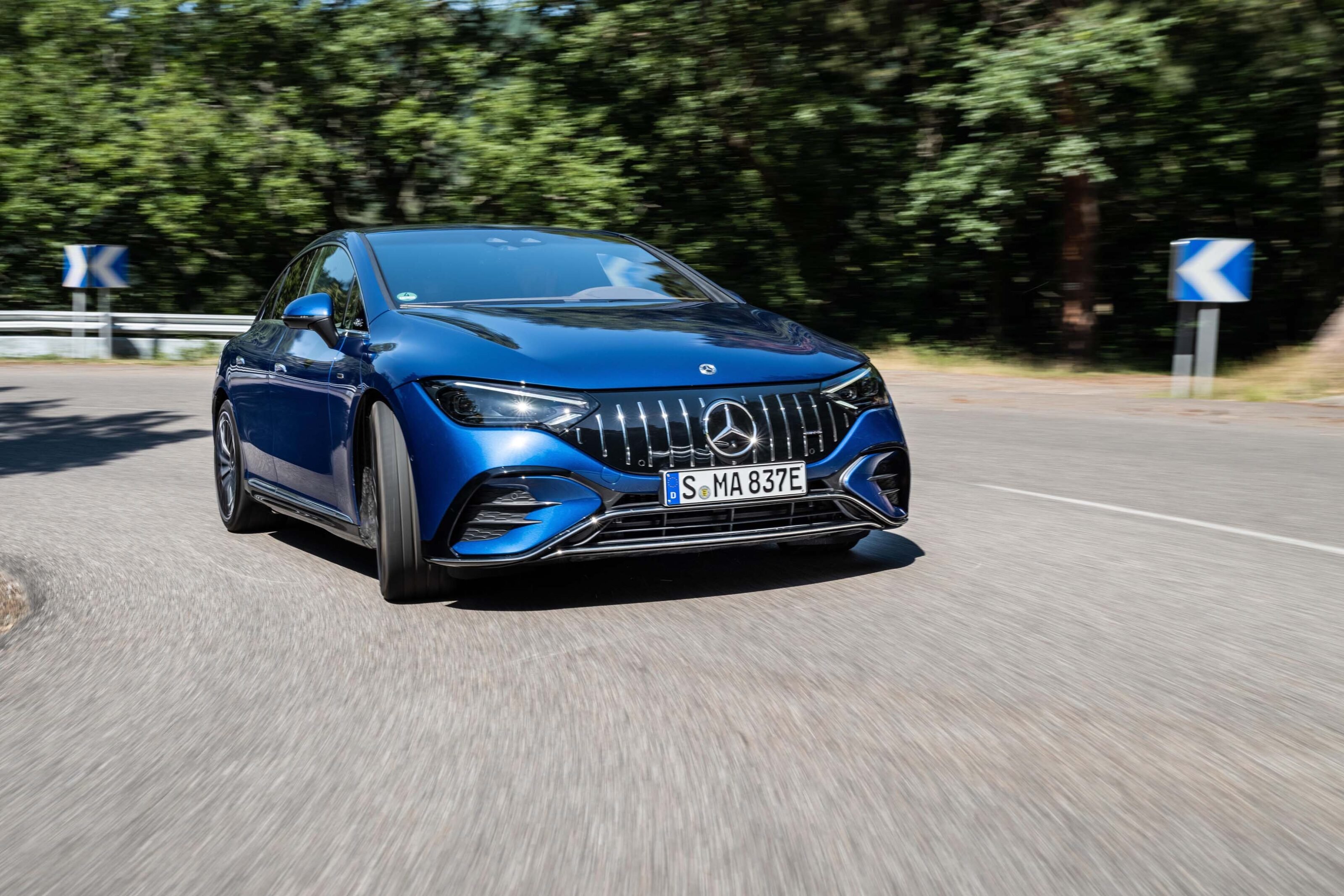
The lineup comprises three variants: the EQE 300, EQE 350 4MATIC, and Mercedes-AMG EQE 53 4MATIC+.
Despite sharing many design cues, the EQE slots in below the larger EQS, inline with Mercedes-Benz’s heritage-steeped model structure.
2023 Mercedes-Benz EQE Australian pricing
*All prices are before on-road costs
| Model | Pricing |
|---|---|
| EQE 300 | $134,900 |
| EQE 350 4MATIC | $154,900 |
2023 Mercedes-AMG EQE Australian pricing
| Model | Pricing |
|---|---|
| EQE 53 4MATIC | $214,900 |
2023 Mercedes-Benz EQE Australian features
Australian Mercedes-Benz EQEs are well equipped with little differences in standard features between the EQE 300 and EQE 350.
The main differentiation between variants is the drivetrain, and subsequent driving range and charging capabilities.
Elsewhere, Mercedes-AMG’s EQE 53 gains a number of AMG-exclusive appointments on top of the more powerful powertrain and extra dynamic talent.
EQE 300
EQE 350 4MATIC
The 2023 Mercedes-Benz EQE 350 4MATIC includes all EQE 300 features as standard, and adds:
2023 Mercedes-Benz EQE options
AMG Line (exterior)
| AMG-inspired body styline |
| AMG-inspired radiator grille |
| 20-inch AMG 5-spoke alloy wheels |
AMG Line (interior)
| Sports style seats |
| Multifunction sports steering wheel in Nappa leather |
| AMG floor mats |
Digital Light package
Guard 360 Vehicle Protection Plus package
| Enables collision detection |
| Enables stolen vehicle assistances |
| Enables emergency key deactivation |
2023 Mercedes-AMG EQE Australian features
EQE 53 4MATIC
| Mercedes-AMG interior |
| AMG Performance steering wheel in Nappa leather |
| Climatised front seats in Nappa leather with AMG styling |
| AIRMATIC air suspension |
| Rear-axle steering |
Powertrain and efficiency
The primary distinction between the three EQE variants are their mechanical makeups.
The entry-level EQE 300 is powered by a 180kW/550Nm motor driving the rear wheels and utilises an 89kWh battery.
Mercedes-Benz has provided an NEDC claim of 626 kilometres of driving range, and a 0-100km/h time of 7.3-seconds. Our searches failed to find a reliable WLTP-rating, however, a real-world driving range of around 550km is more realistic.
The mid-range Mercedes-Benz EQE 350 4MATIC, as its name suggests, is all-wheel-drive, provided by two electric motors – one on each axle – providing a maximum output of 215kW/765Nm to be sent wherever it is needed most. It is also powered by an 89kWh battery.
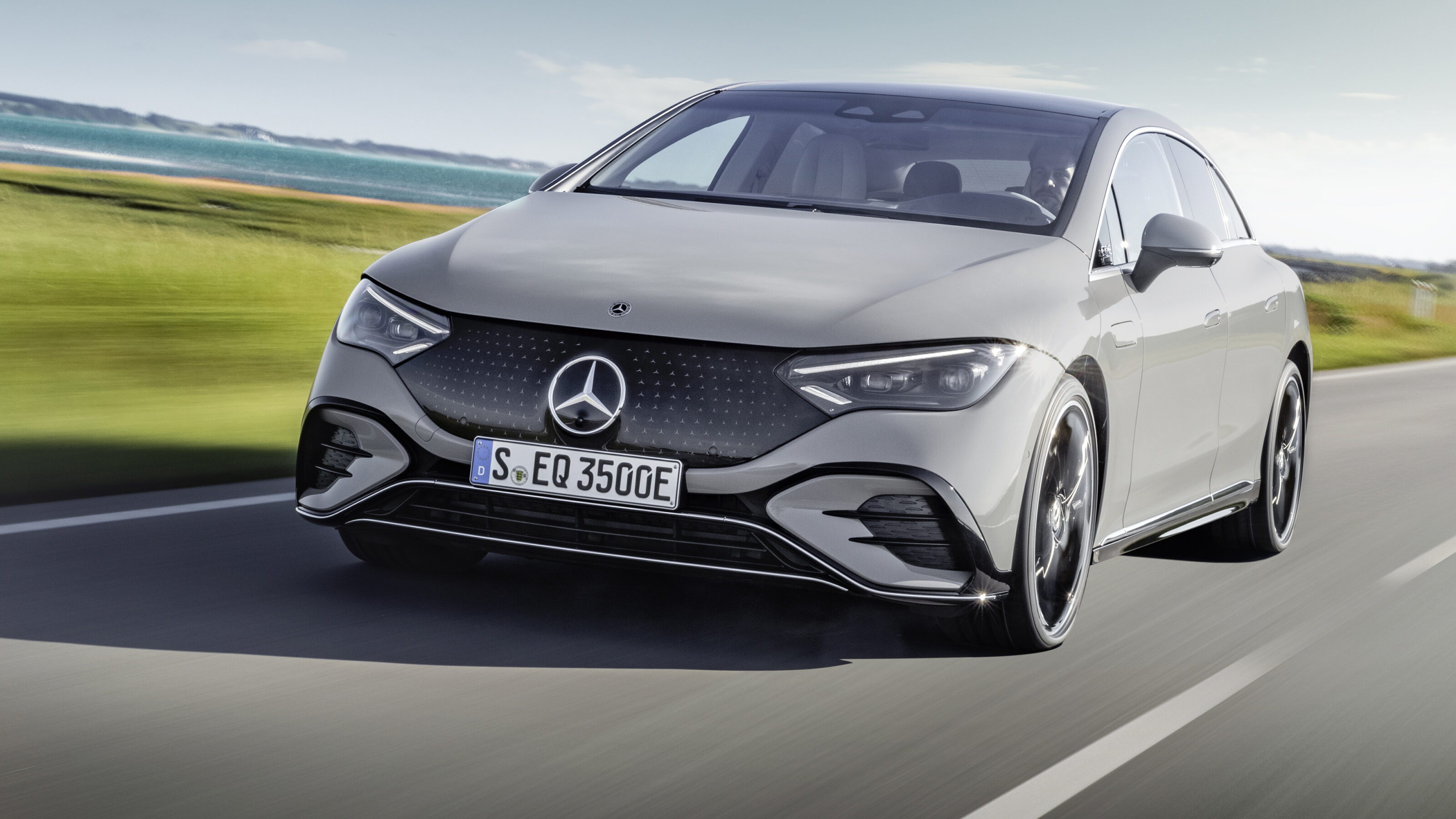
The EQE 350 4MATIC wears an NEDC claim of 590km, and a 0-100km/h time of 6.3-seconds.
Those who value speed over efficiency, however, must look to Mercedes-AMG’s EQE 53 4MATIC. It leverages its 89kWh battery with a powerful twin-motor configuration providing 460kW/950Nm. All-wheel drive, further complimented by rear-axle steering, provides a 0-100km/h claim of 3.5-seconds, with an NEDC rating of 590km.
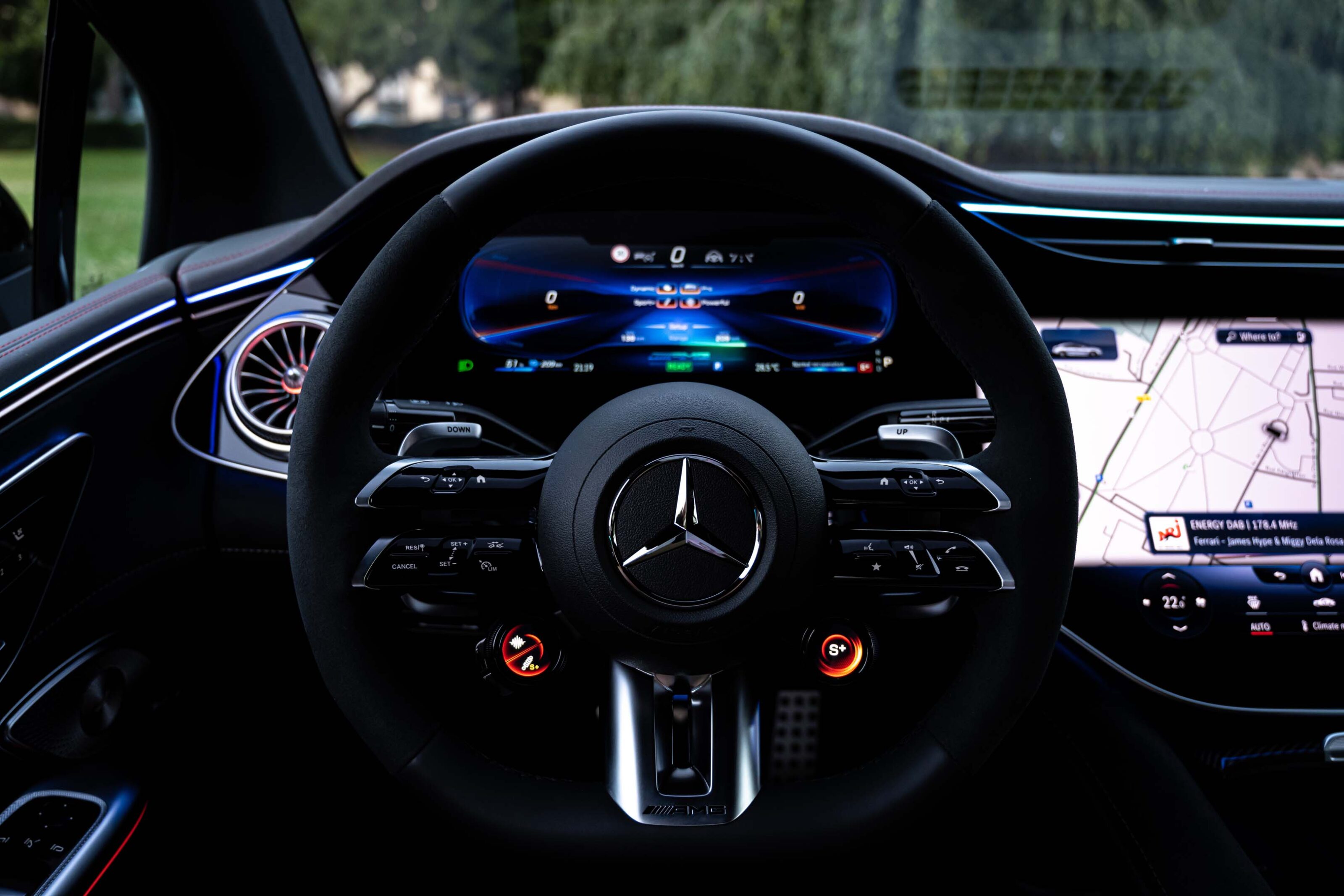
All EQEs will have the ability to charge at a maximum DC rate of 170kW, or with single- or three-phase AC, up to 22kW.
Safety
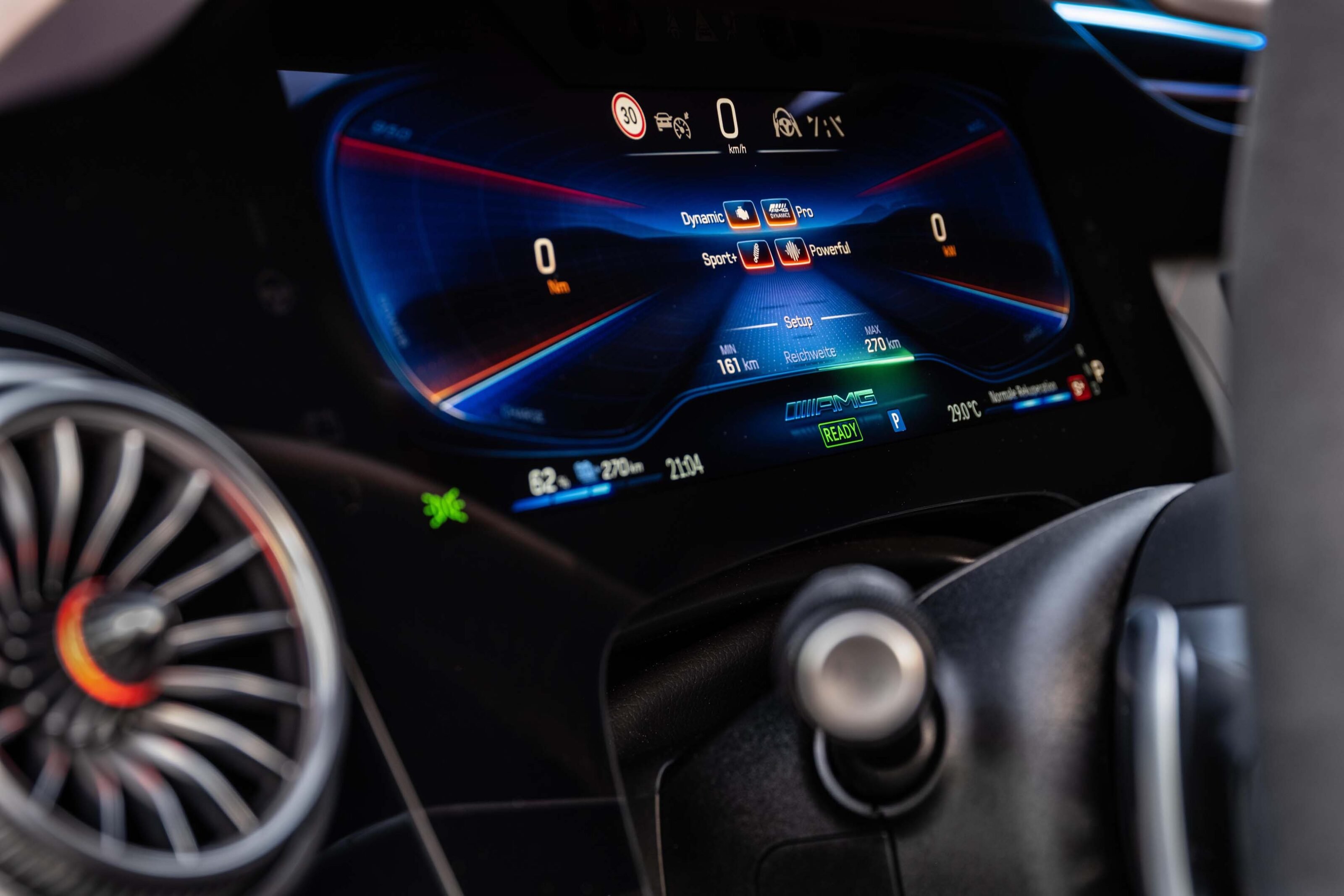
Being a new model, the Mercedes-Benz and Mercedes-AMG EQE range has yet to be assessed by ANCAP, however, its counterpart Euro NCAP has awarded the Mercedes-EQE range five stars.
Standard safety features include:
Dimensions
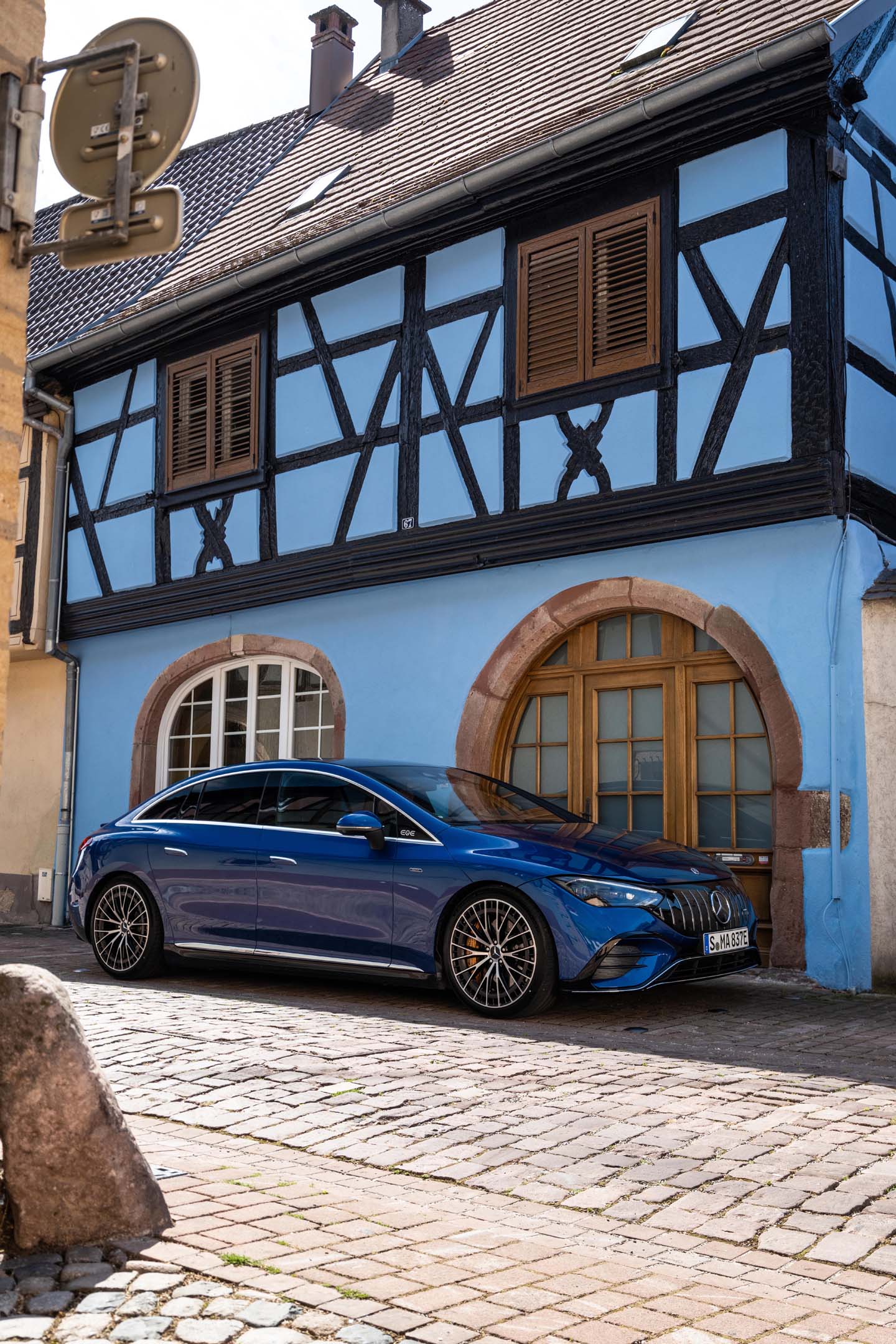
The Mercedes-Benz EQE sedan measures 4946 millimetres long, 1906mm wide, 1512mm tall, with a 3120mm wheelbase.
The EQE’s boot swells in at a respectable 430L, which is larger than the Porsche Taycan and incoming Audi E-Tron GT’s 407L boot – except those cars also offer front storage under the bonnet, which the EQE does not.
Warranty
All EQE vehicles are covered by Mercedes-Benz’s five-year/unlimited-km warranty, as well as a battery certificate for high-voltage units applicable for 10 years or 250,000kms.
Availability
The 2023 Mercedes-Benz and Mercedes-AMG EQE range is on sale today.
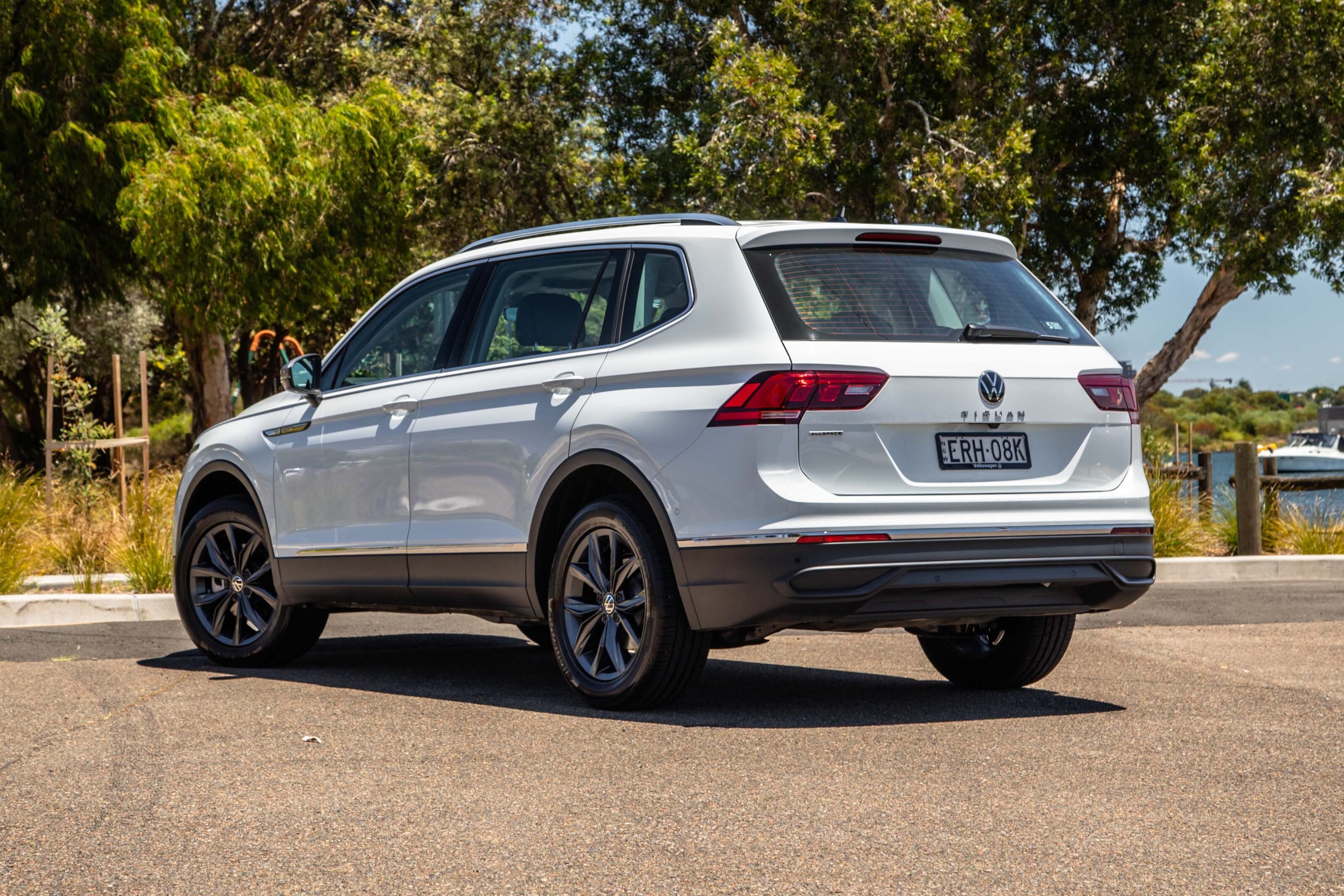
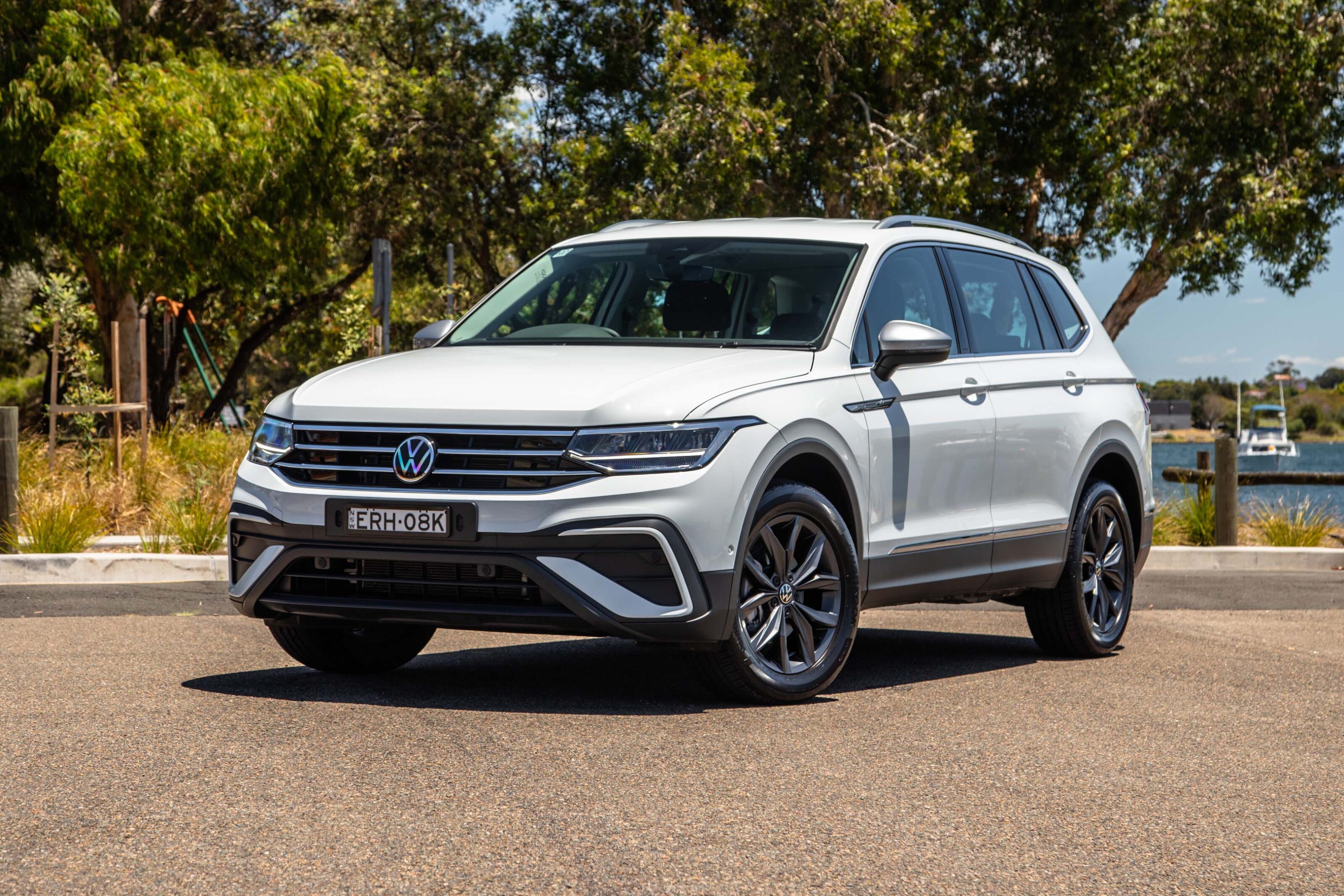
Volkswagen’s Tiguan Allspace makes up 40 per cent of the brand’s mid-size SUV sales mix, a number that still surprises me.
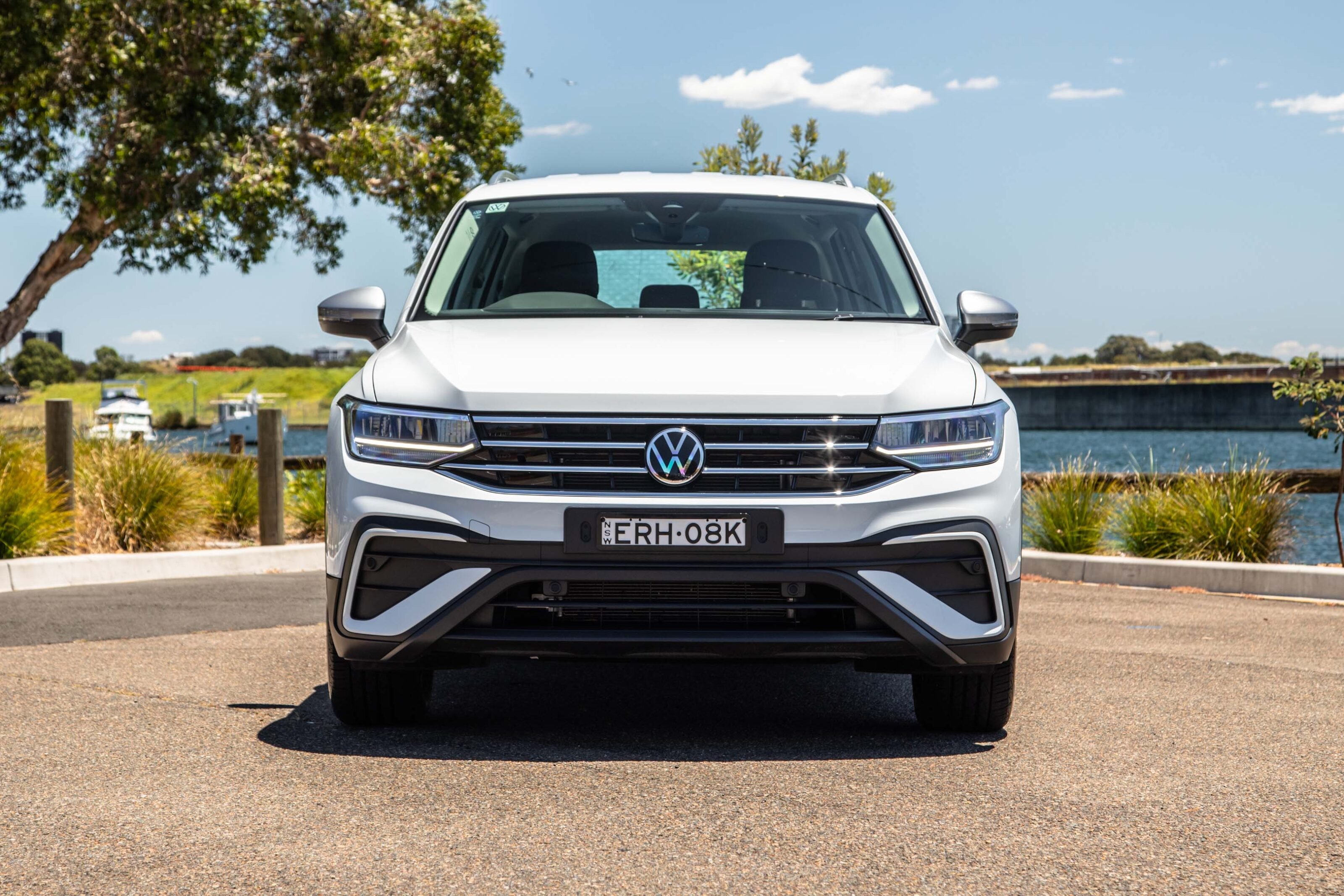
It’s a stealth move, you see, because they look pretty much the same as the standard car because of some swift work with the styling pen building on an already tight design.
As a seven-seat version of the Tiguan, it can carry more people than the Touareg while being not quite such a behemoth or as expensive. As I would have it, it’s for people I would normally talk out of a seven-seater because they don’t need a car that big.
The Tiguan Allspace range stretches from the 110 TSI Life through to the ever-popular 162 TSI with a couple of fun diversions along the way, like the cop-car-based Adventure and the blacked-out Monochrome.
Here, we tackle the entry-level 110 TSI Life to see if makes the grade.
JUMP AHEAD
- How much is it, and what do you get?
- How do rivals compare on value?
- Interior comfort, space and storage
- What is it like to drive?
- How is it on fuel?
- How safe is it?
- Warranty and running costs
- VERDICT
- Specifications
How much is it, and what do you get?
Volkswagen, like most manufacturers, has suffered from shortages of various bits and pieces so a couple of things come and go depending on batches.
The upside was for most of 2022, that the Life kicked off from $43,290 before on-road costs. A recent round of price hikes for the new year bumped this Allspace back to $44,490, though it’s still more affordable than its $44,590 launch price.
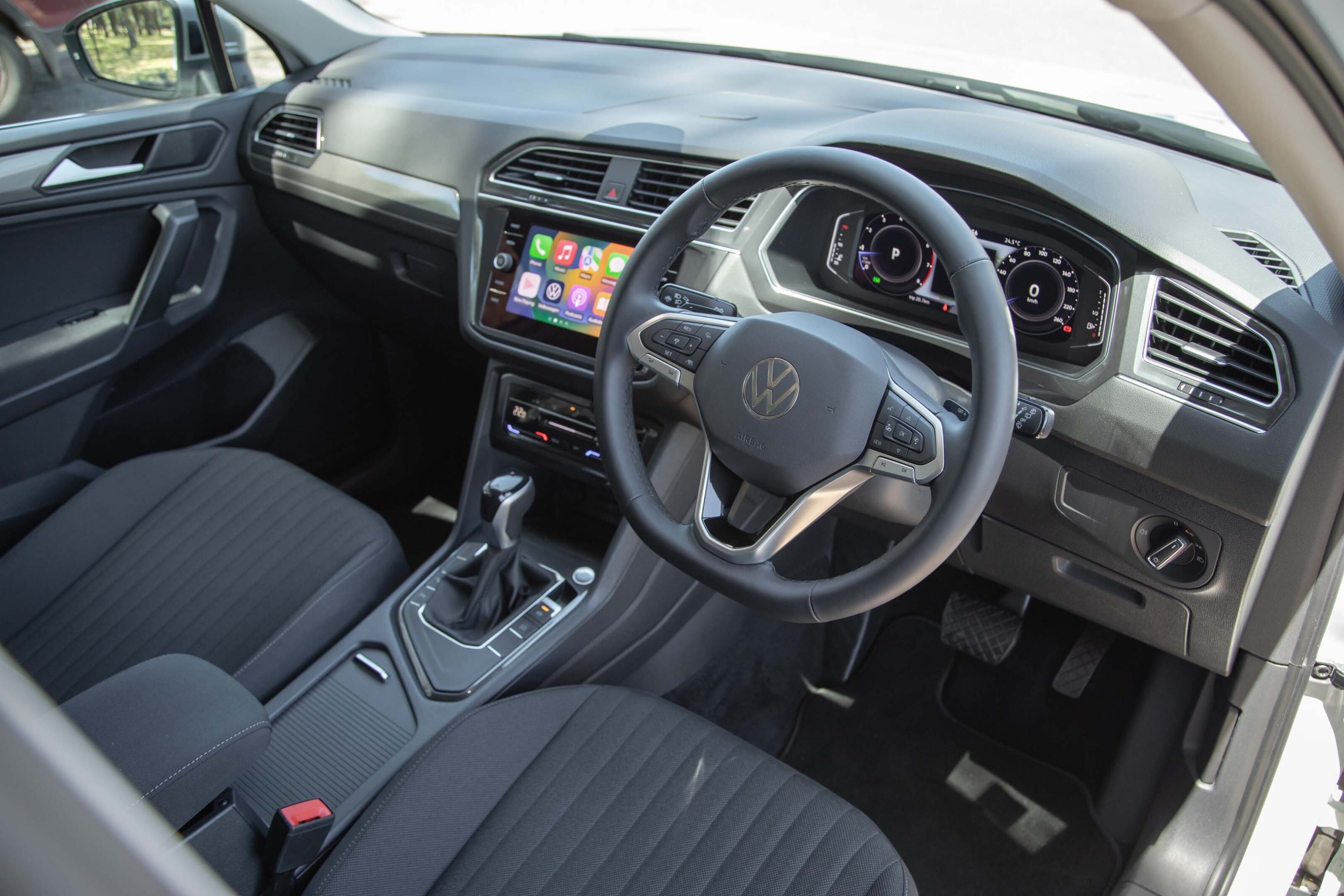
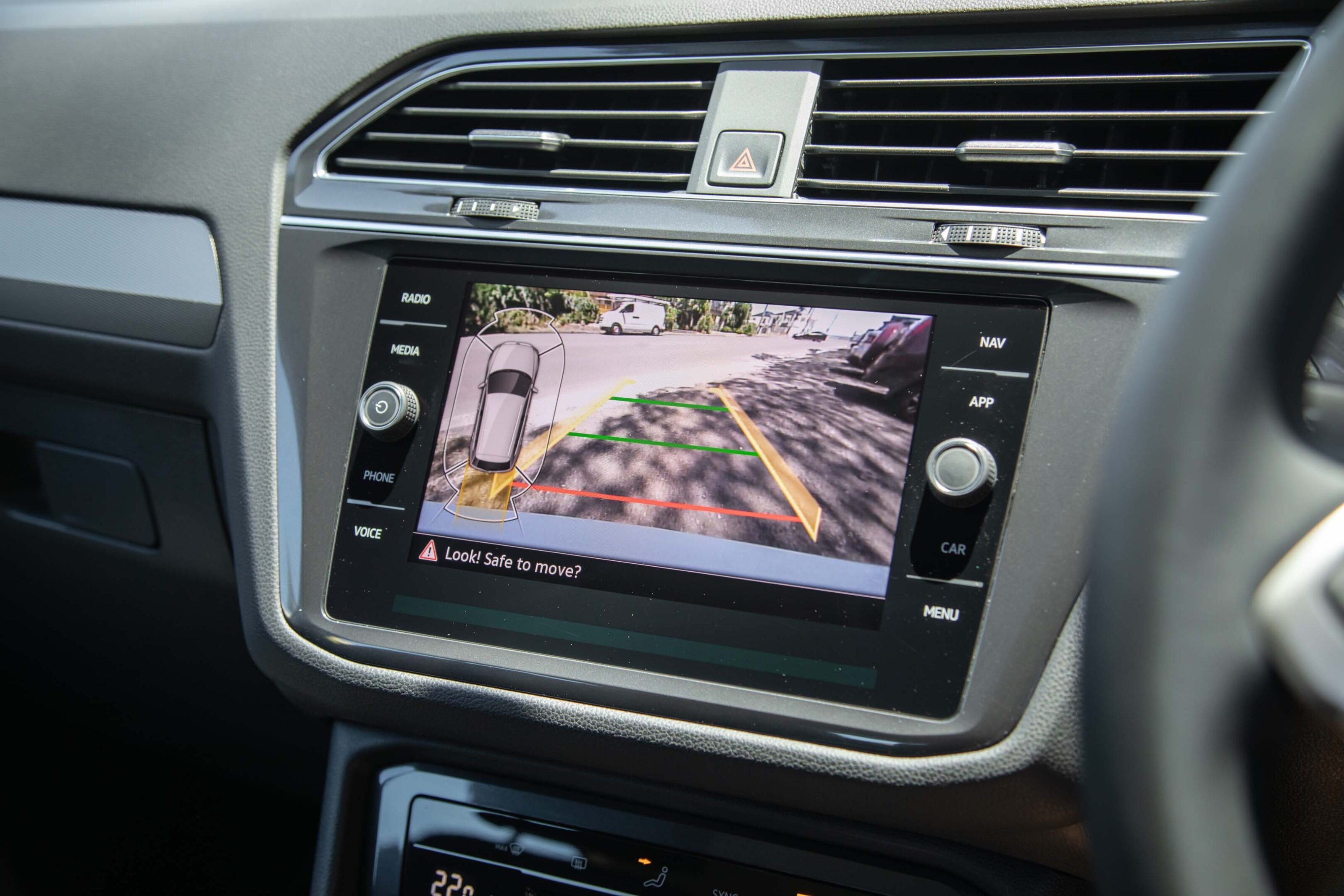
| 18-inch wheels | Digital dashboard |
| 8.0-inch touchscreen | Front and rear parking sensors |
| 8-speaker stereo | Reversing camera |
| Adaptive cruise control | Satellite navigation |
| Auto LED headlights | Space-saver spare |
| Auto wipers | 3-zone climate control |
| Cloth interior | Wireless Apple CarPlay and Android Auto |
| DAB+ digital radio | Wireless charging pad |
I honestly think this is quite a thoughtful spec and when compared with, say, a 5+2 seater Mitsubishi Outlander.
The powered tailgate, which was standard in June, is now a $600 option. White is free, King’s Red is $1100 and the other four available colours are $900.
Luxury package
For a not-messing-around $5500, you can get:
| Comfort sport front seats with heating and adjustable lumbar support |
| Electric adjustment for driver’s seat with memory function |
| Heated and adjustable exterior mirrors with memory |
| Panoramic glass sunroof |
| Vienna leather seats |
How do rivals compare on value?
The Mitsubishi Outlander LS seven-seater, at $39,740 before on-road costs, is the Tiguan Allspace’s cheapest competitor.
It’s a big unit, quite wide and with quite a good interior but without the VW’s accomplished driving dynamics. Despite having more power, performance suffers a little due to its continuously variable transmission.
A Mazda CX-8 Touring SP comes in at $48,390 before on-road costs for a 2.5-litre petrol with front-wheel drive. Its third row is more usable than an Outlander’s but about lineball with the Tiguan’s, which is to say they’re both for occasional use.
The Mazda has a similarly thoughtful spec but compared to the VW is let down by iffy front seats while punching on with more power and a smooth six-speed automatic. Then again, if you were to pit it against the similarly-priced Tiguan 132 TSI, things are closer.
VW Group stablemate Skoda has the Kodiaq, but they’re all up in the $50K range, with all-wheel drive and are generally fully loaded.
Interior comfort, space and storage
For a car of this footprint, it’s remarkably roomy inside.
I mean, it’s not small – 22cm longer than the standard Tiguan – but it also has a longer wheelbase of 2791mm. But it’s smaller than the aforementioned CX-8, which is a hefty 4.9 metres long (nearly as long as a CX-9) with closely matching interior space.
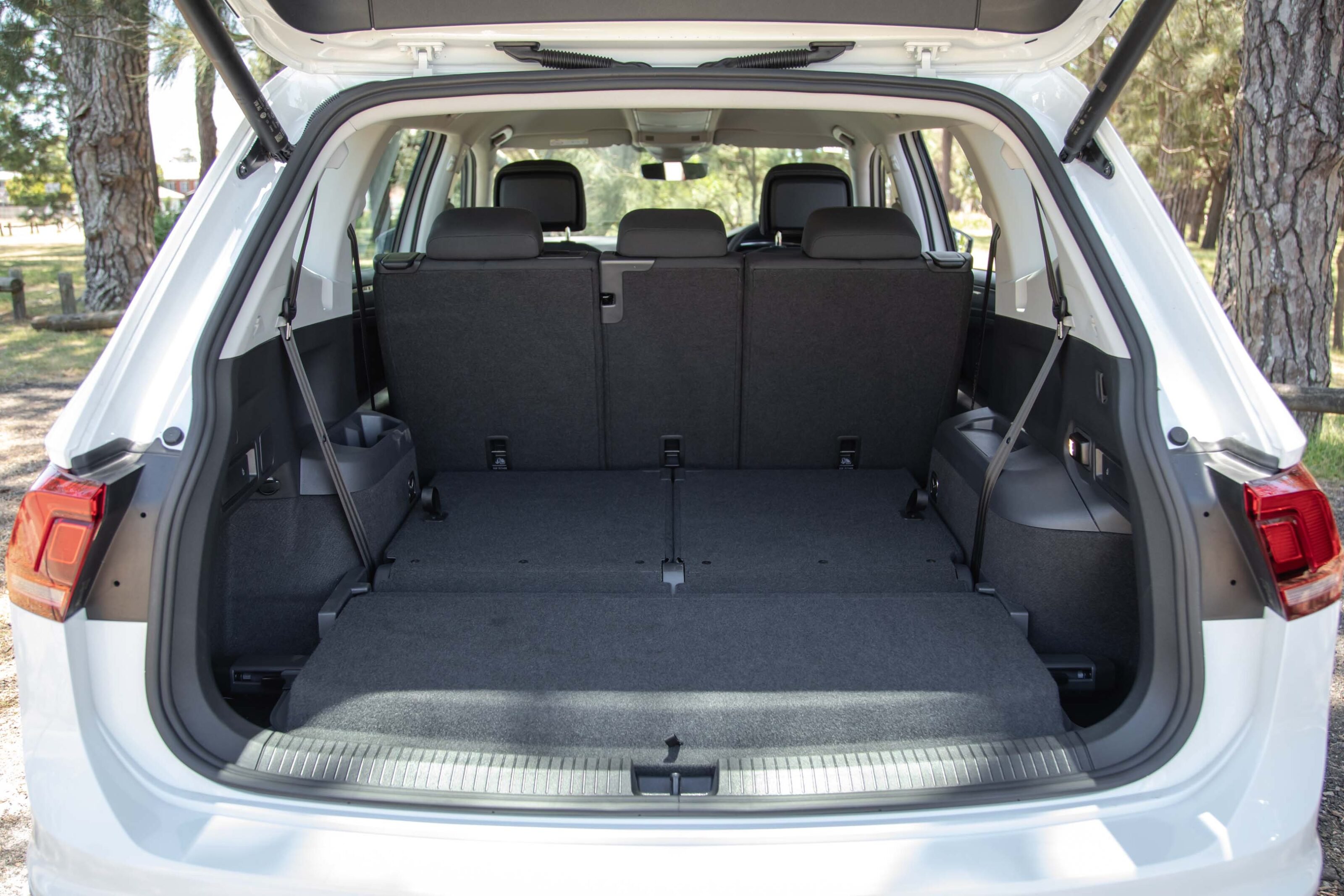
The third row is accommodated by a nearly 11cm stretch in the rear overhang, the longer wheelbase helping accommodate that and also stopping it from looking tail-heavy. With the third row in action, you have a small hatchback’s boot capacity of 230 litres. Not a Polo, obviously, that’s huge for such a small car, but you get my meaning.
With the occasional seats out of the way, you’ll have a 700-litre boot, up by 85 litres on the standard Tiguan. When the middle row is folded, you have 1775 litres, up by 110L.
The Tiguan Allspace’s middle row is very comfortable, split 40:20:40 into effectively individual seats and they work quite well, although three across isn’t going to be a joy. The high transmission tunnel and slightly narrow middle chair put paid to that.
A folding central armrest includes two cup holders, there is a third climate control zone with rear air vents (rare at this price point) and the front seatbacks have handy little pockets for phones. What’s extra clever about them is that they’re at eye level so folks won’t leave them behind.
Taking care of charging are 12-volt and USB-C power outlets, and the huge bottle holders in the doors are handily carpet-lined to reduce noise and clatter from the stuff you put in them.
Back in the third row, you’ve got a 50:50 split, not a lot of legroom and if you’re 180cm tall, your knees in your face. The middle row can slide forward to improve your position, but it’s obviously for kids and even then, patient ones. But they are usable.
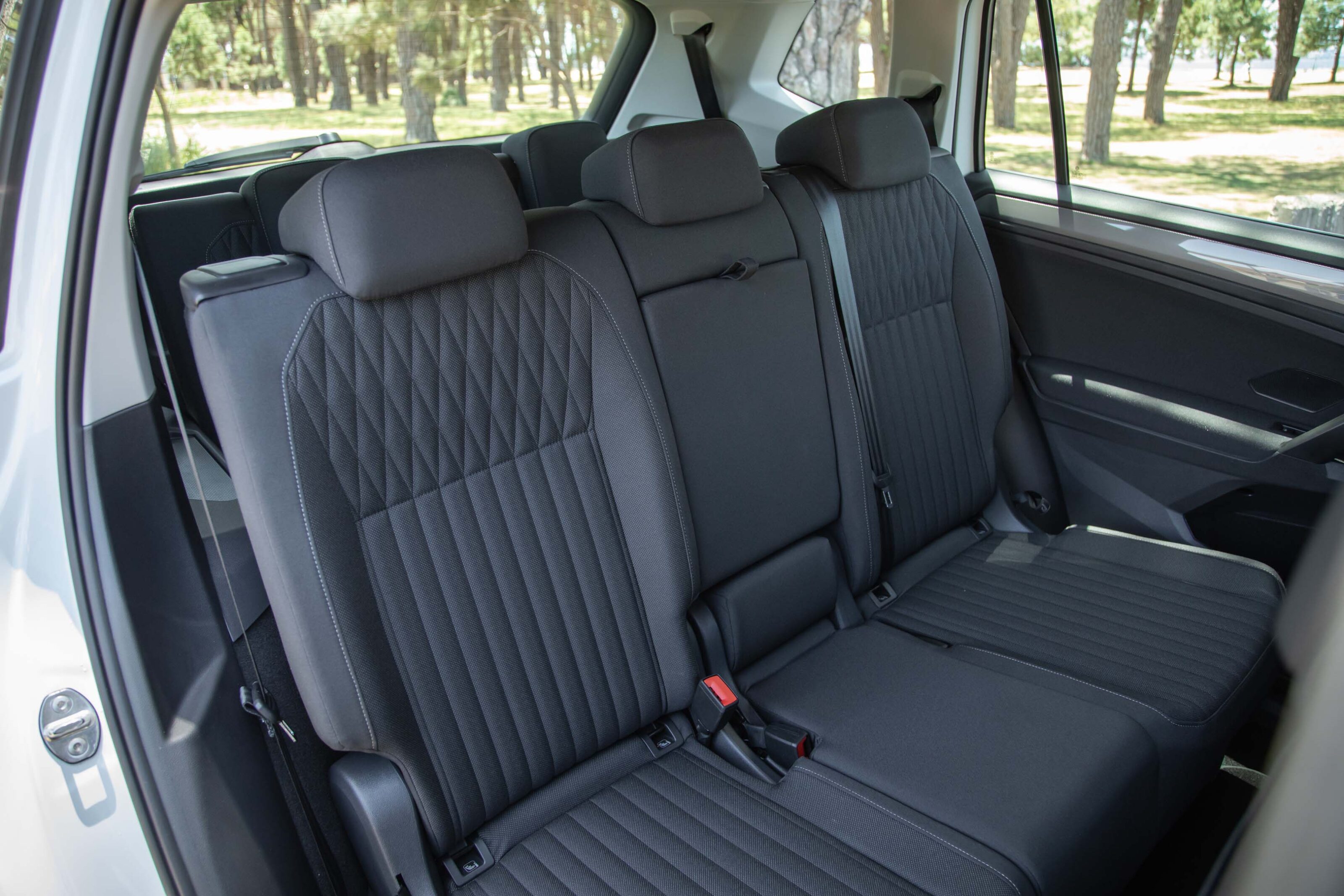
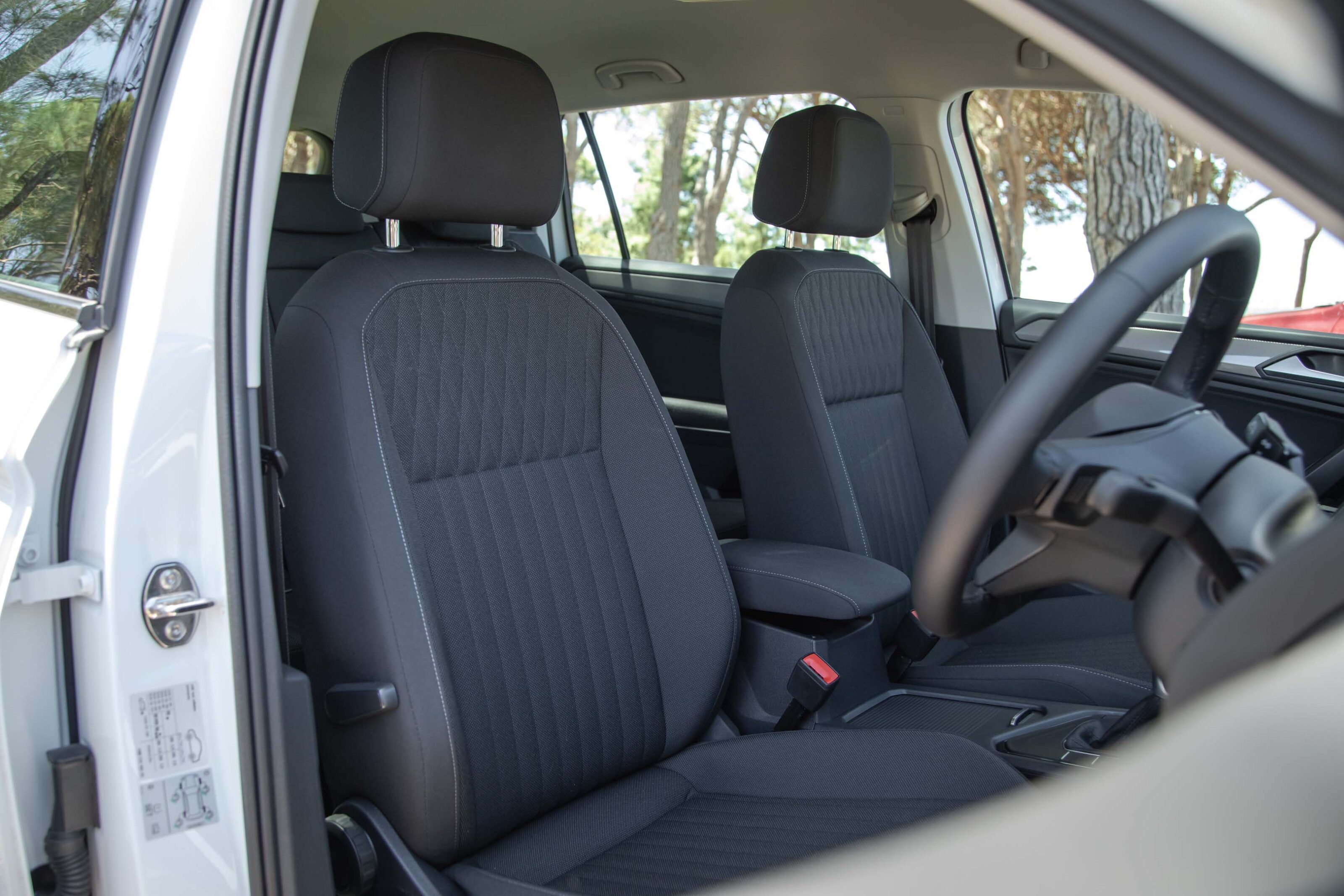
Even here in this entry-level Allspace, the front seats are really comfortable. I can’t speak for really long trips, but they achieve that zero-gravity feel some seats just nail.
I think the cloth trim is part of the feeling because I had a 132 TSI back-to-back with the 110 and it had leather. I didn’t think those seats were as comfortable, so I’d think twice about the Luxury Package, or at least drive a Tiguan with leather if you’re choosy about seat comfort.
The digital dash makes up for the small size of the touchscreen. VW’s much – and I think sometimes unfairly – maligned media software works fine when you’re used to it but could do with a bit of work. The wireless Apple CarPlay connectivity is flaky, too, so I ended up going with plugging in via one of the two USB-C ports up front.
Also up front are two cup holders, a storage tray and an armrest covering a storage bin. Two more big bottle holders grace the doors.
What is it like to drive?
My first drive of the base Allspace was at the launch event last winter, and I remember being quite taken with it.
I think the key here is the 1.4-litre engine’s tractability and the six-speed transmission’s superior overall operation and calibration.
| Drive | front-wheel |
|---|---|
| Engine | 1.4-litre four-cylinder turbo-petrol |
| Transmission | 6-speed dual-clutch |
| Power | 110kW @ 5000-6000rpm |
| Torque | 250Nm @ 1500-3500rpm |
| 0-100km/h | 9.5 seconds (claimed) |
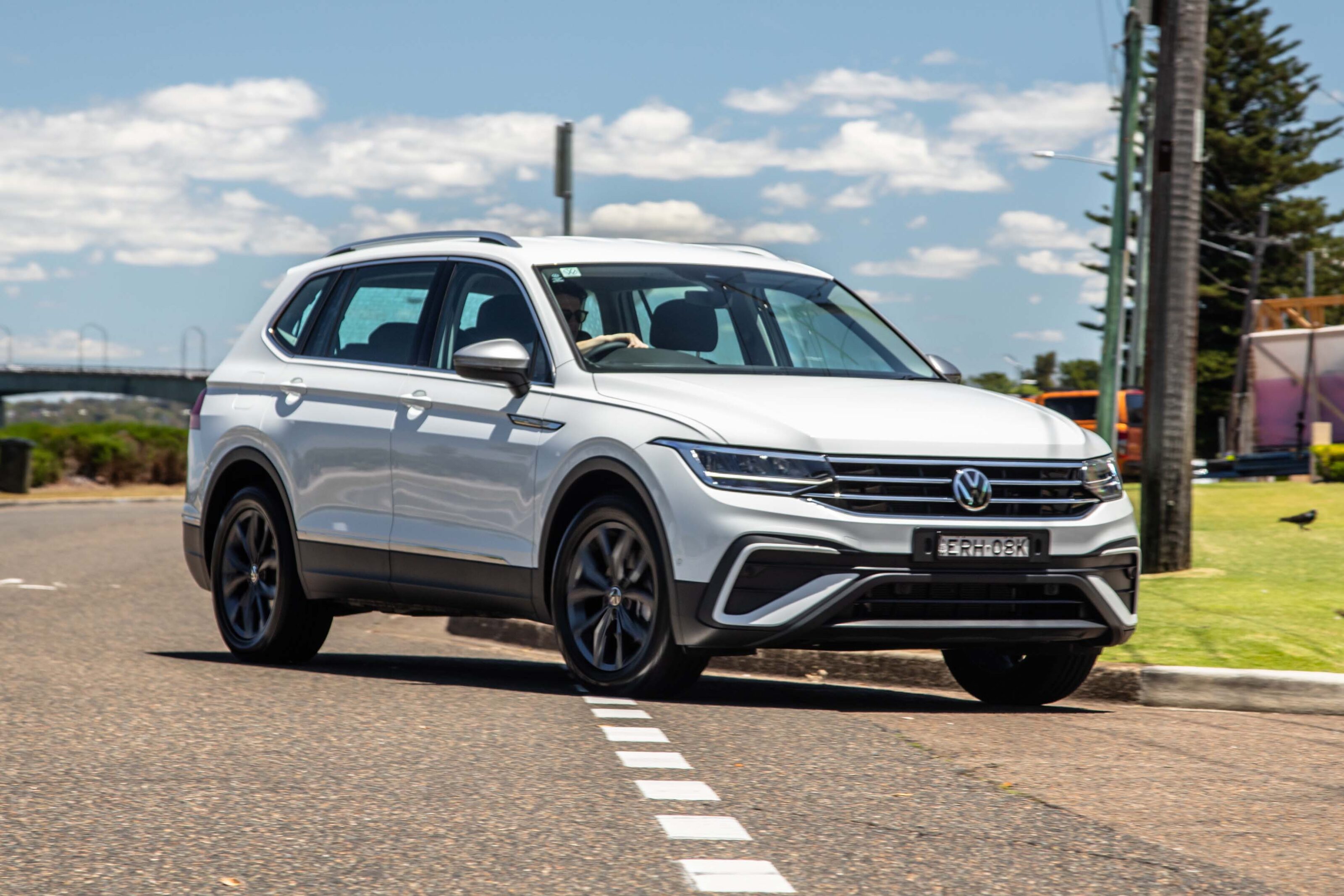
The six-speed dual-clutch auto is less hesitant on the uptake and I think that’s partly because the higher-powered engines have both all-wheel drive and a lot more torque to contend with, so the calibration errs to the more conservative but is ultimately less effective.
At this stage, I will remind you that I am not an engineer and I am indeed speculating based on seat-of-the-pants feel.
My wife also noted how much smoother it felt from the passenger side, so it’s not just me.
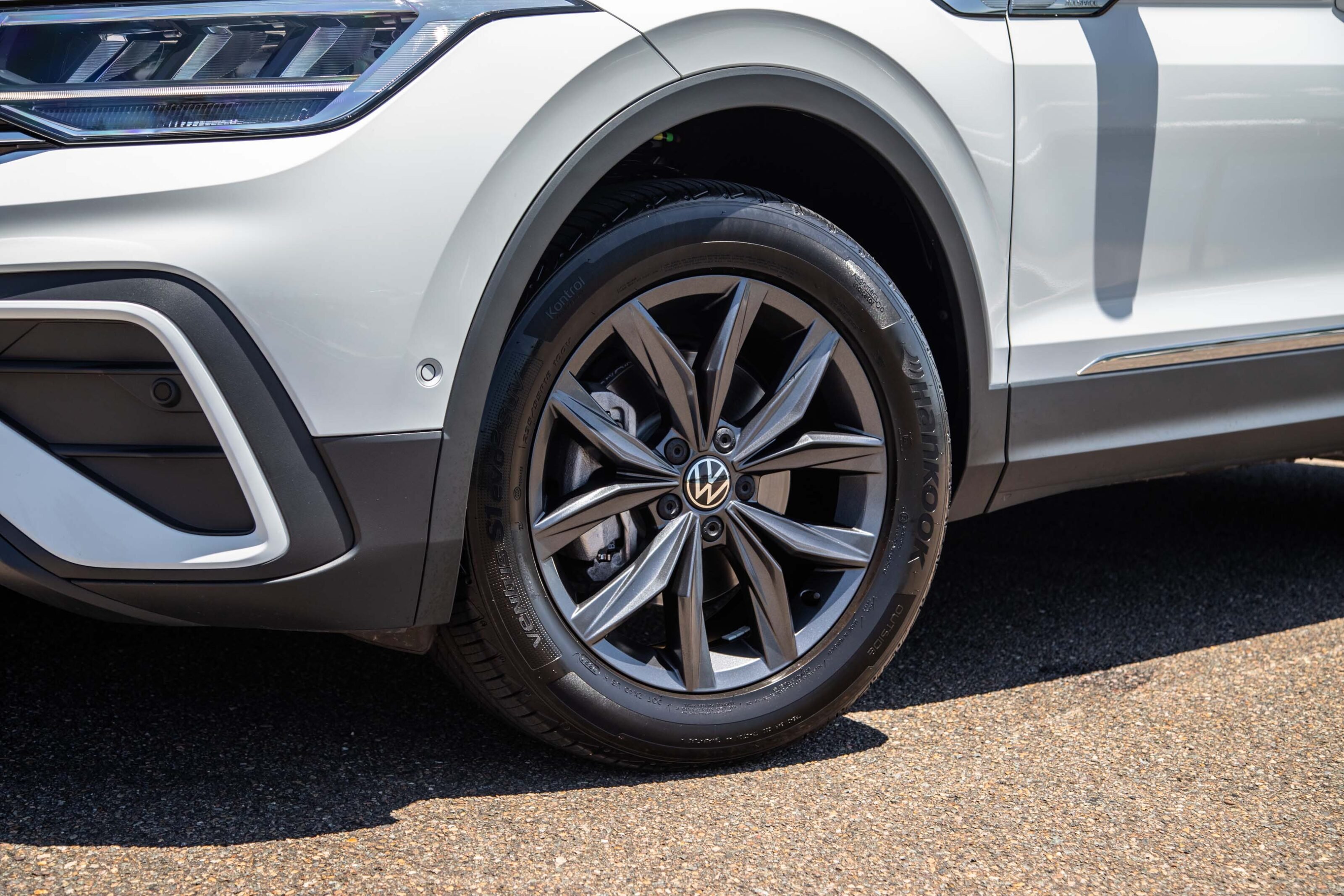
The higher-profile rubber also knocks the edges off the ride of its larger-wheeled brethren, handling bumps and skips more smoothly if not more quietly. Road noise isn’t excessive, but it stands out in what is mostly a very relaxed car.
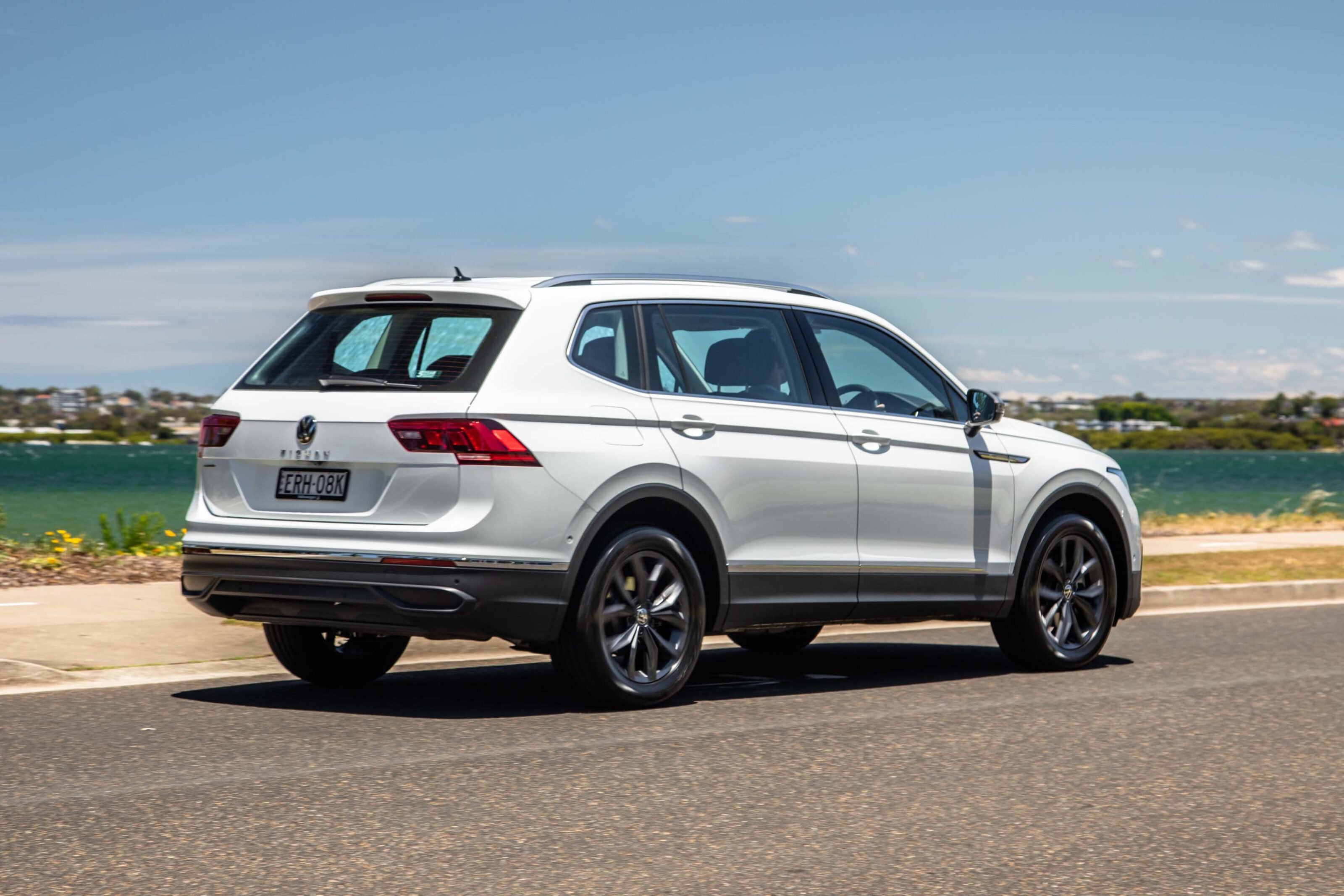
While the edges of the ride are knocked off, the steering feels lighter and so there’s a little less feel. I don’t think that’s a dealbreaker for most people (actually, it isn’t at all), but it’s great for parking and general manoeuvering.
Most of the time you have to keep reminding yourself that this quite sizeable machine is being propelled by a tiny, tiny engine that you’d expect to be more at home in the much smaller Polo, yet despite modest outputs of 110kW and 250Nm it does an admirable job of shifting a roomy seven-seat SUV.
It’s not quick, no, but swift enough and like most cars in the class, a sub-10 second time to 100km/h is more than enough.
How is it on fuel?
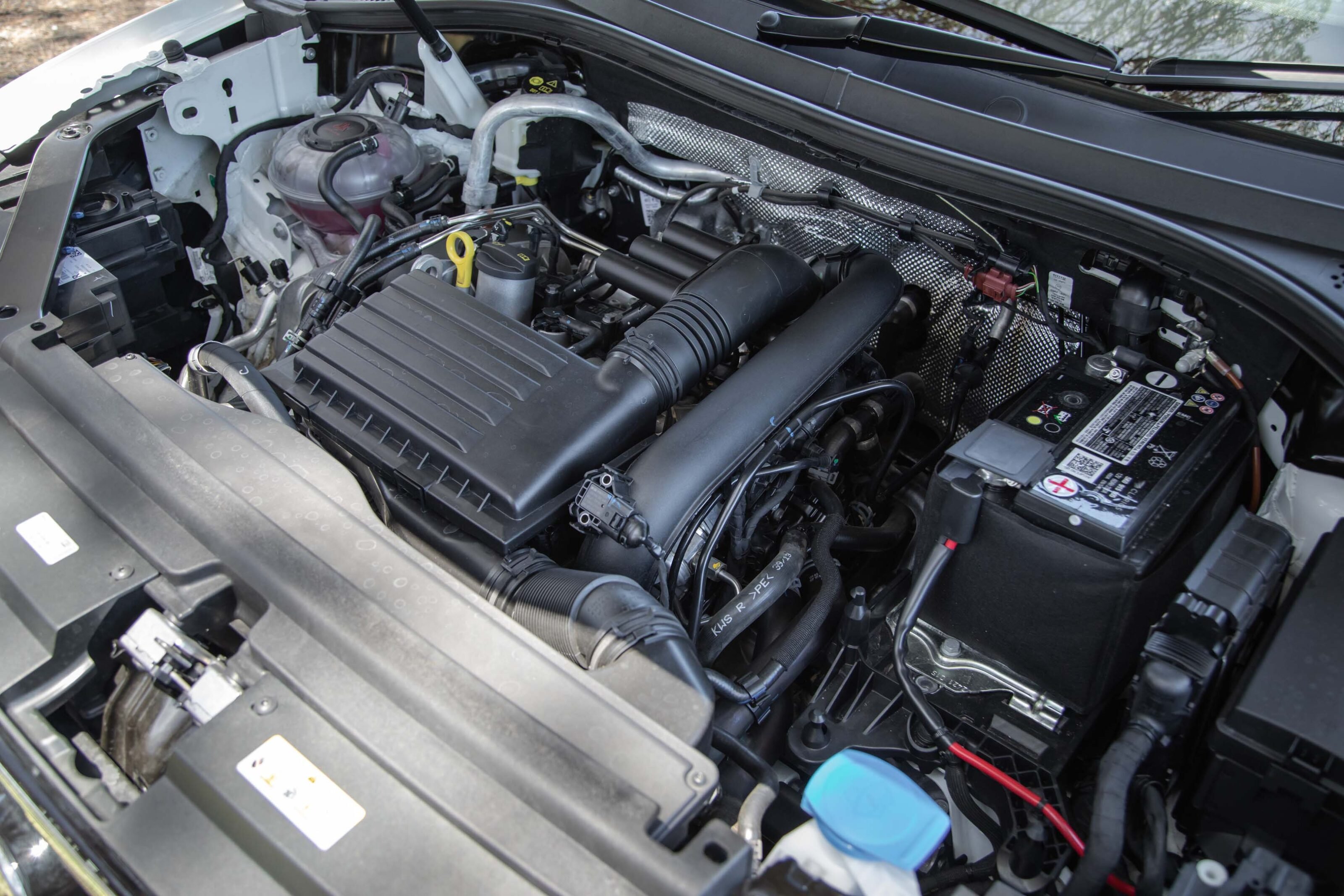
Volkswagen’s combined-cycle claim of 7.7L/100km stood up pretty well in my week with the Allspace 110 TSI, with a trip computer result of 8.2L/100km in mostly suburban stop-start running.
| Fuel consumption (claimed) | 7.7L/100km (combined cycle) |
|---|---|
| Fuel consumption (on test) | 8.2L/100km (trip computer) |
| Fuel tank capacity | 58 litres |
| Fuel type (min) | 95 RON |
How safe is it?
The Tiguan’s 2016 five-star ANCAP rating also applies to the Allspace. Without a centre-front airbag, it’s unlikely that rating would be renewed, so the next iteration due in 2024 will likely sort that out.
| 7 airbags | Forward auto emergency braking |
| ABS and stability controls | Forward collision warning |
| Adaptive lane guidance | Lane-keep assist |
| Driver attention detection | Reverse AEB |
Another reason this car is cheaper at the moment is that rear cross-traffic alert is unavailable for the time being, which is a bit of a blow in a car this big.
Cheeringly – if slightly bafflingly, at least at first glance – reverse AEB remains, so while you won’t know that someone is coming, the car will and will jam on the brakes.
Side assist is also off the menu until some time in 2023, so keep a close eye on its return.
The airbag count includes a driver’s knee airbag and the curtain airbags reach the third row.
Warranty and running costs
VW offers a five-year, unlimited-kilometre warranty, which is about right for the market save for a couple of longer offerings from the likes of Kia and Mitsubishi.
At purchase time, you can opt to pay for your servicing upfront with three- or five-year maintenance plans.
For the 110 TSI, a three-year plan is $1400 while five years is $2600. This isn’t especially cheap but will save you money over the same period compared with pay-as-you-go.
The five-year plan saves a$743 while the three-year one scrimps a more modest $143.
VERDICT
Supply chain issues aside, the 110 TSI could just be the pick of the Tiguan Allspace range.
Most people don’t need or want all-wheel drive, they want transportation. The Allspace is obviously better than just transportation because it’s so good at what it does. If you go for the 162 TSI as almost every else does, yes it has more stuff and it’s faster but the fundamentals are the same.
The front-wheel drive 110 TSI will cope very well with pretty much anything you throw at it, provided it’s on tarmac or a well-maintained dirt road and you’ll be doing it comfortably and effortlessly.
2022 Volkswagen Tiguan Allspace 110 TSI Life specifications
| Body | 5-door, 7-seat large SUV | |
|---|---|---|
| Drive | front-wheel | |
| Engine | 1.4-litre four-cylinder turbo-petrol | |
| Transmission | 6-speed dual-clutch | |
| Power | 110kW @ 5000-6000rpm | |
| Torque | 250Nm @ 1500-3500rpm | |
| Bore stroke (mm) | 74.5 x 80 | |
| Compression ratio | 10.5 : 1.0 | |
| 0-100km/h | 9.5 seconds (claimed) | |
| Fuel type (min) | 95 RON | |
| Fuel consumption | 7.7L/100km (combined) | |
| Weight | 1597kg | |
| Towing capacity (unbraked/braked) | 750kg/1800kg | |
| Gross vehicle mass | 2290kg | |
| Gross combination vehicle mass | 4090kg | |
| Suspension | MacPherson struts front/multi-link rear | |
| L/W/H | 4734mm/1839mm/1689mm | |
| Wheelbase | 2791mm | |
| Ground clearance | 186mm | |
| Brakes | ventilated disc front / solid disc rear | |
| Tyres | 235/55 R18 | |
| Wheels | 18-inch alloy wheels (space-saver spare) | |
| Price | $44,490 + on-road costs |
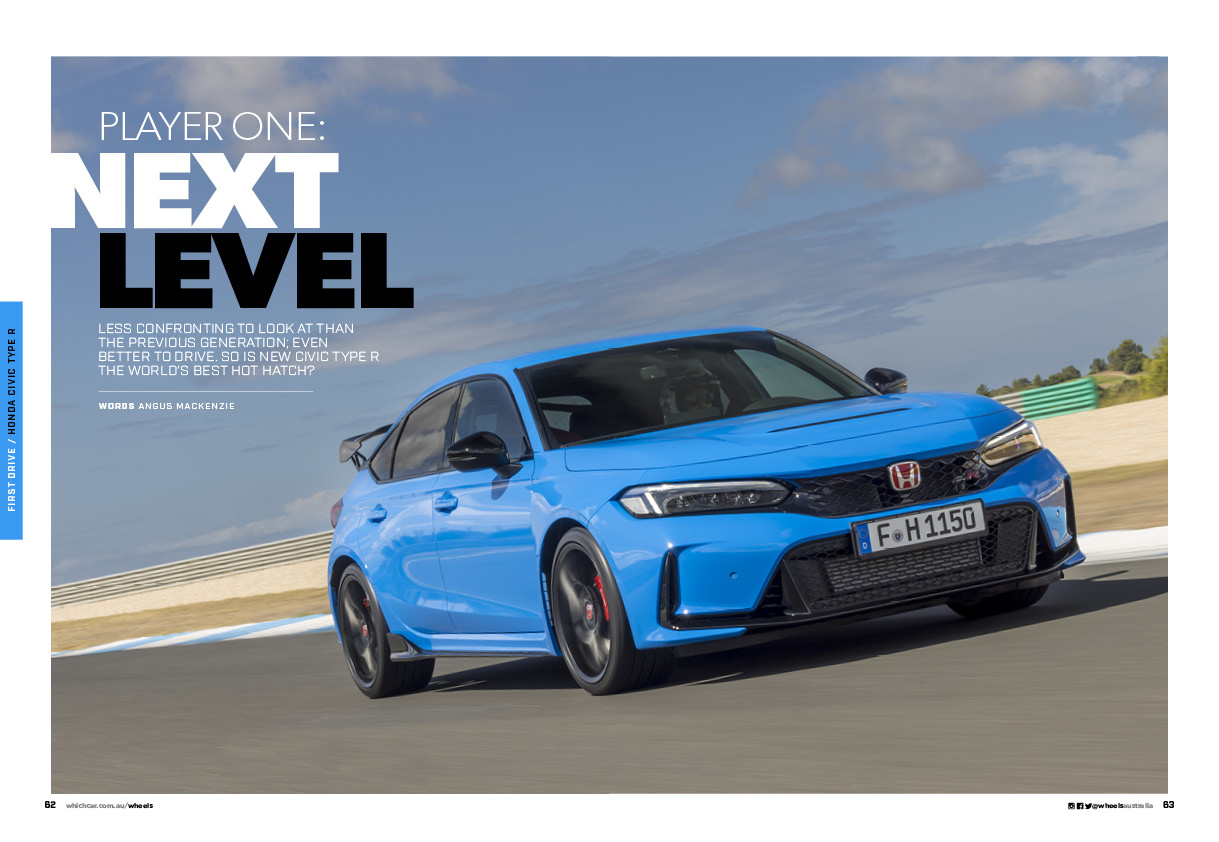
Wheels’ January edition is headlined by two of the most hotly anticipated first drives of 2023.
First up is the Honda Civic Type R, out to establish itself as the world’s greatest front-drive performance car. Our test on both road and circuit provides the answer.
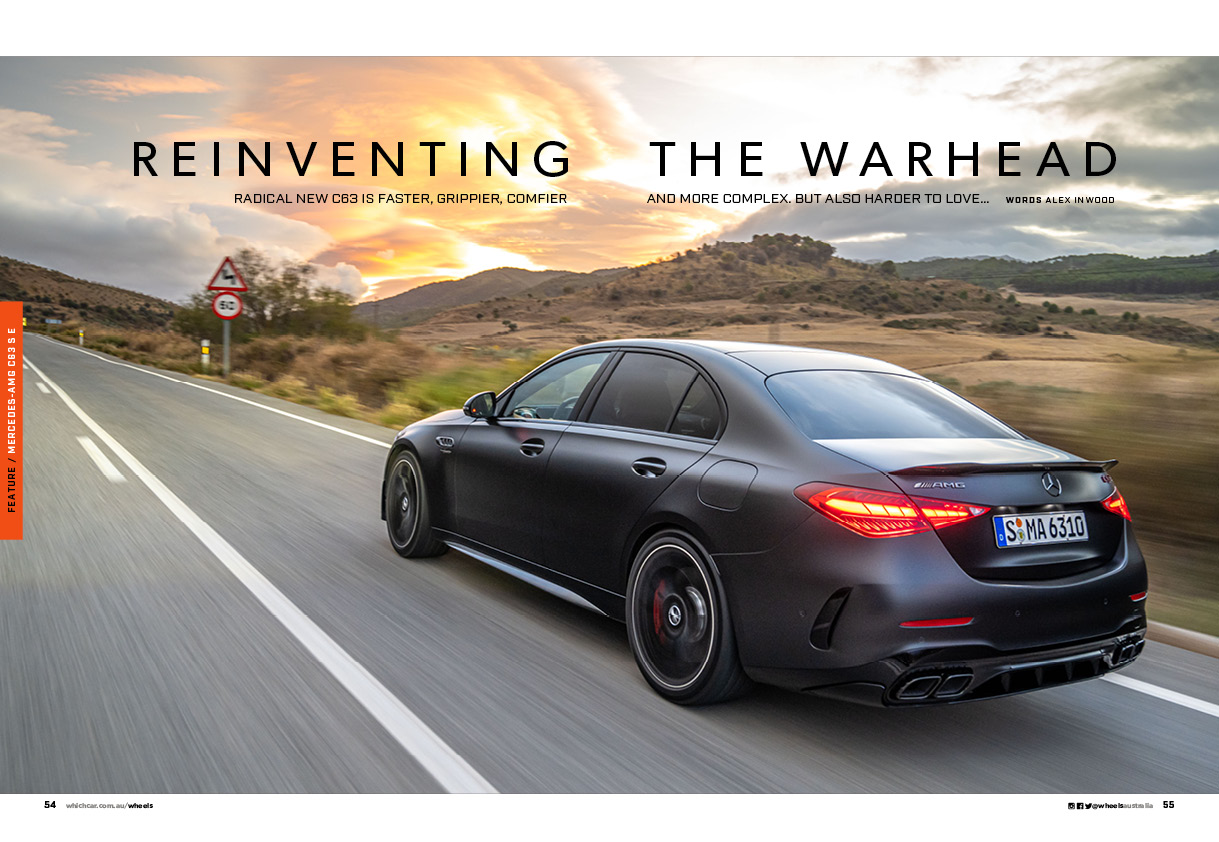
Then there’s the new Mercedes-AMG C63, a car that’s radically changed from its predecessor, with greater breadth of ability and performance on a whole new level. But will fans of the old twin-turbo V8 embrace it?
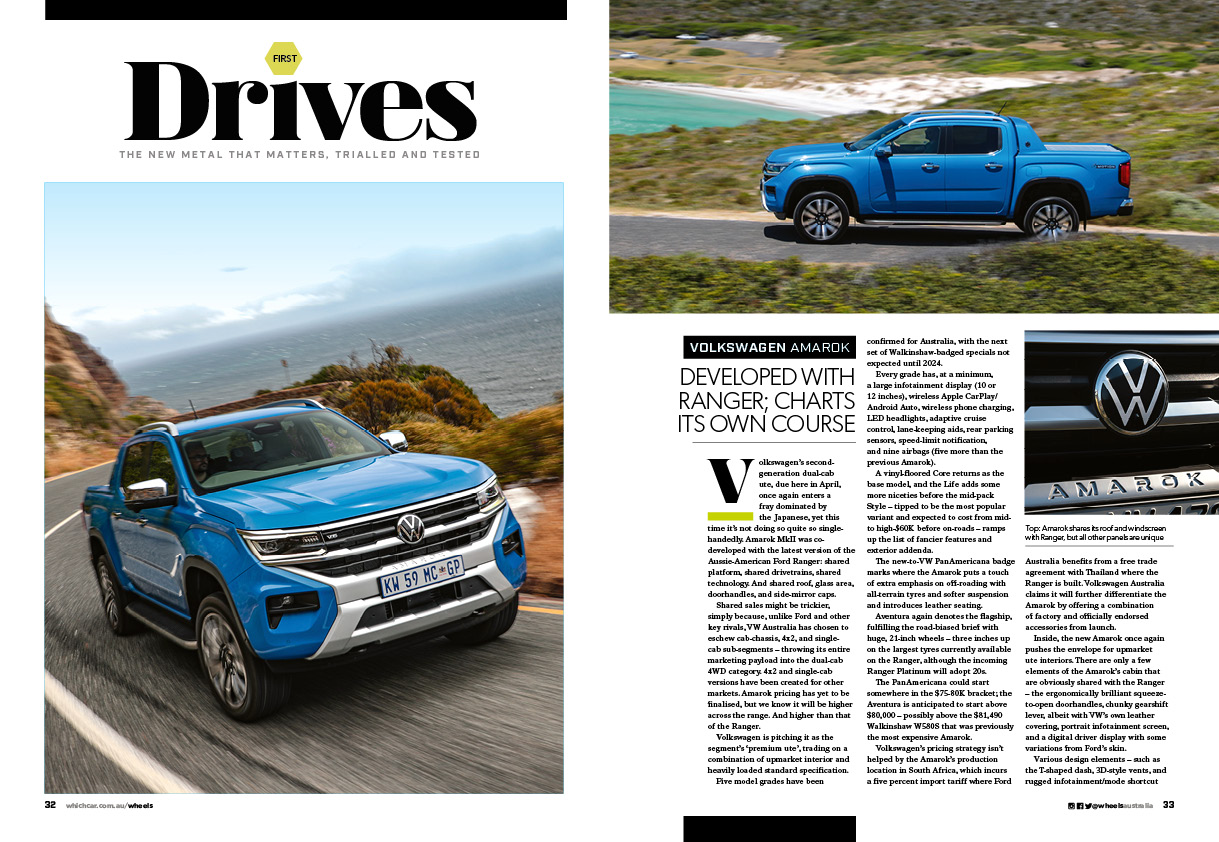
Our first drive of the VW Amarok 4×4 dual-cab ute reveals it to have its own clear identity, rather than simply being a clone of the Ford Ranger with which it was co-developed.
We’ve also driven the Lexus RZ450e, the Japanese premium brand’s medium-size electric SUV, to see if it pushes any boundaries for this segment.
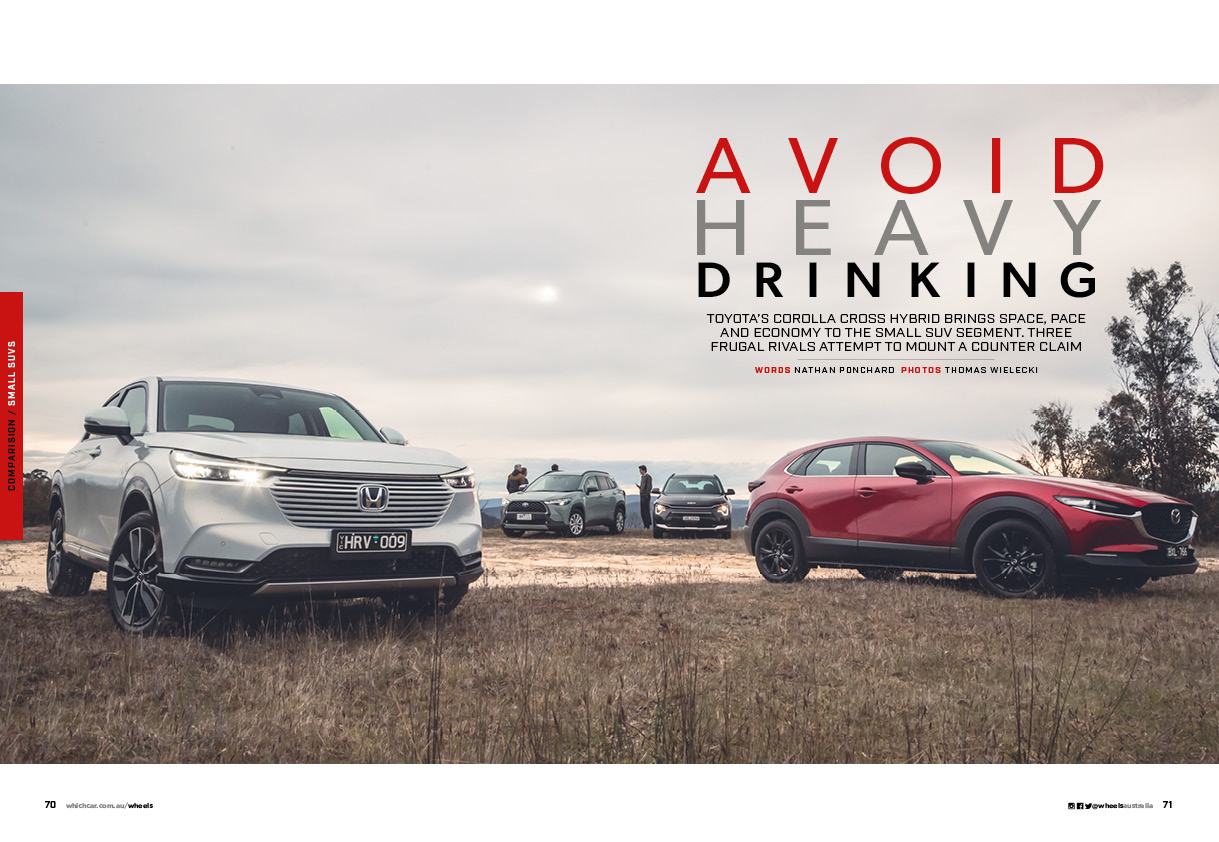
On a more pragmatic level, we’ve pitted the new Toyota Corolla Cross Hybrid against three of its small-SUV rivals: the Honda HR-V, Kia Niro and Mazda CX-30.
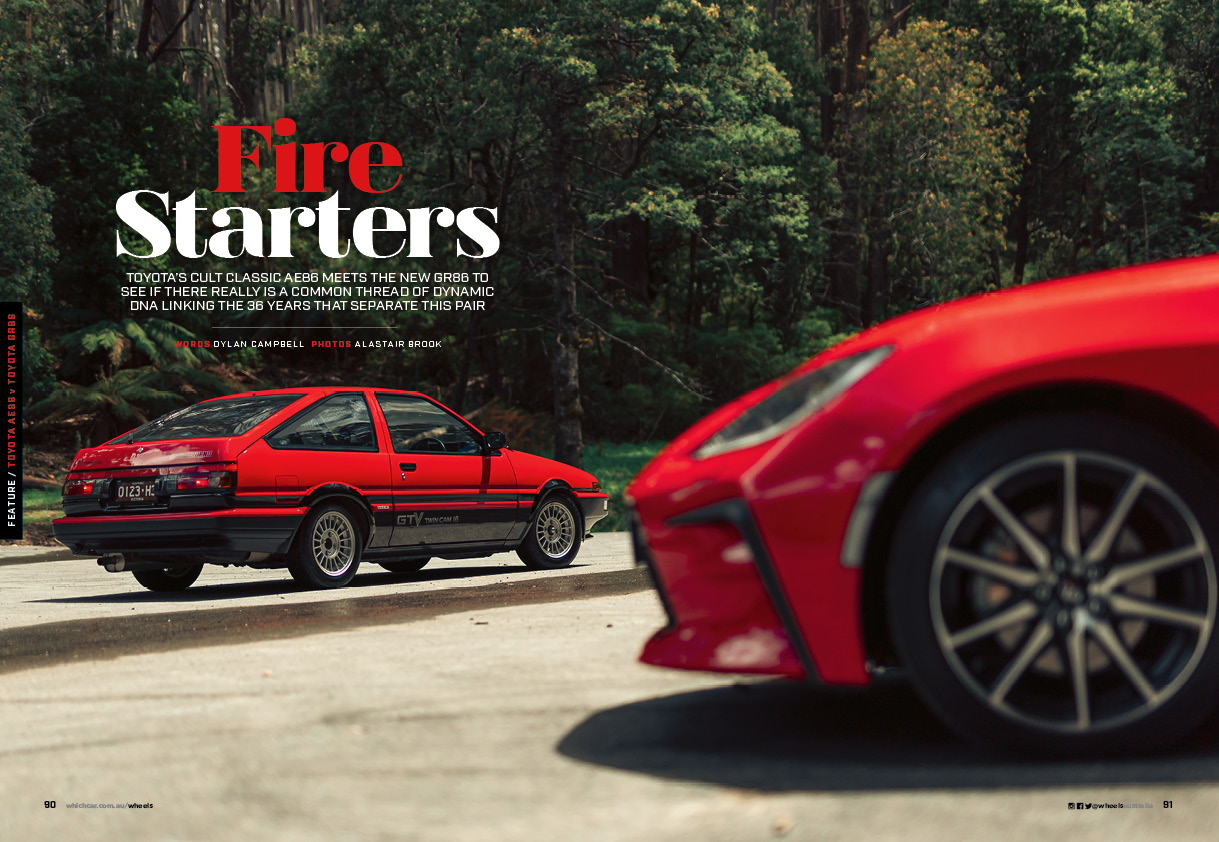
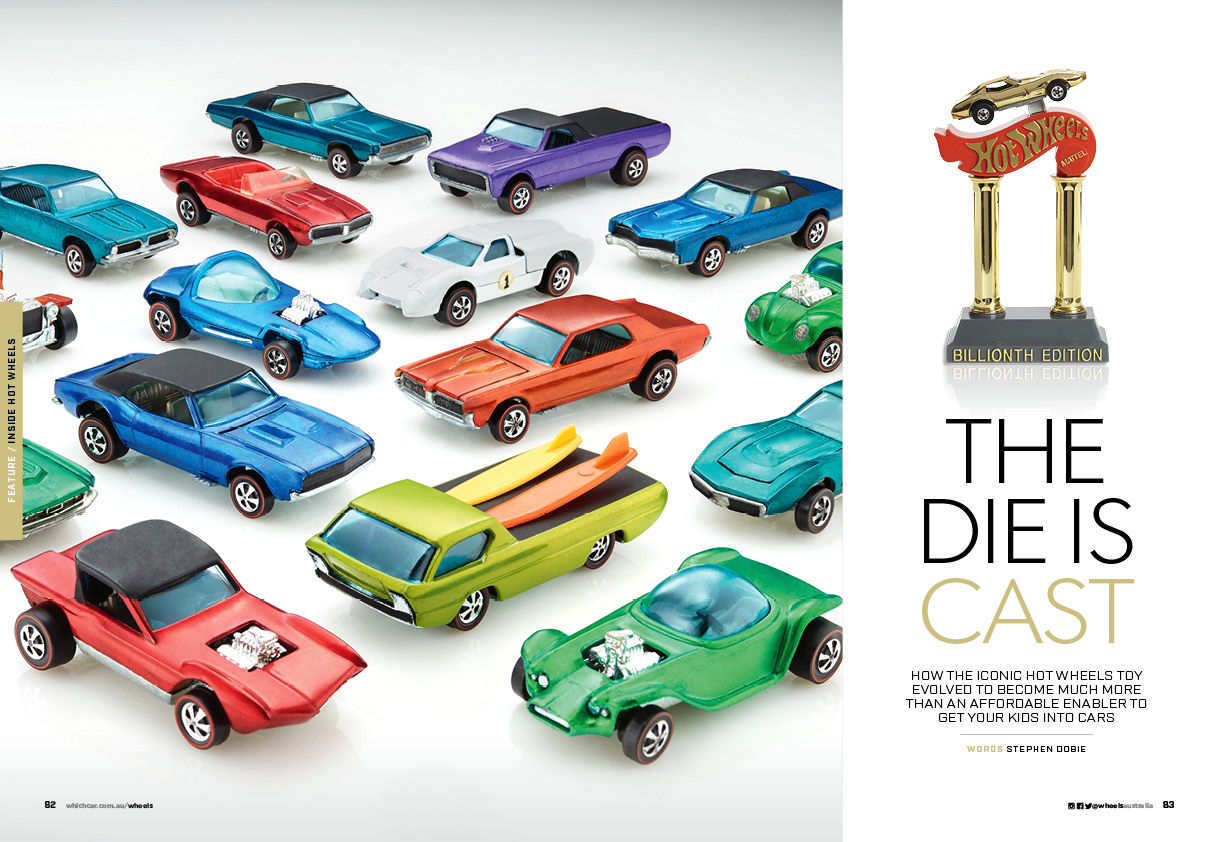
We also visit the Hot Wheels design studio to learn just how much time and attention to detail goes into the creation of these model cars, while former Wheels editor Dylan Campbell pulls the cover off his classic Toyota AE86 and pits it against the new GR86, to see if this pair of rear-drive coupes share any common DNA.
All this and much more in the January issue of Wheels on sale from Monday 16th January.
Not yet a subscriber?
You can subscribe to Wheels magazine from only $59 and we’ll send you a copy of the current issue straight away. Subscriber benefits include:
- Huge savings on the regular cover price
- Free delivery to your doorstep
- Free digital access
- Browse the entire Wheels archive back to 1953
- Exclusive benefits and discounts
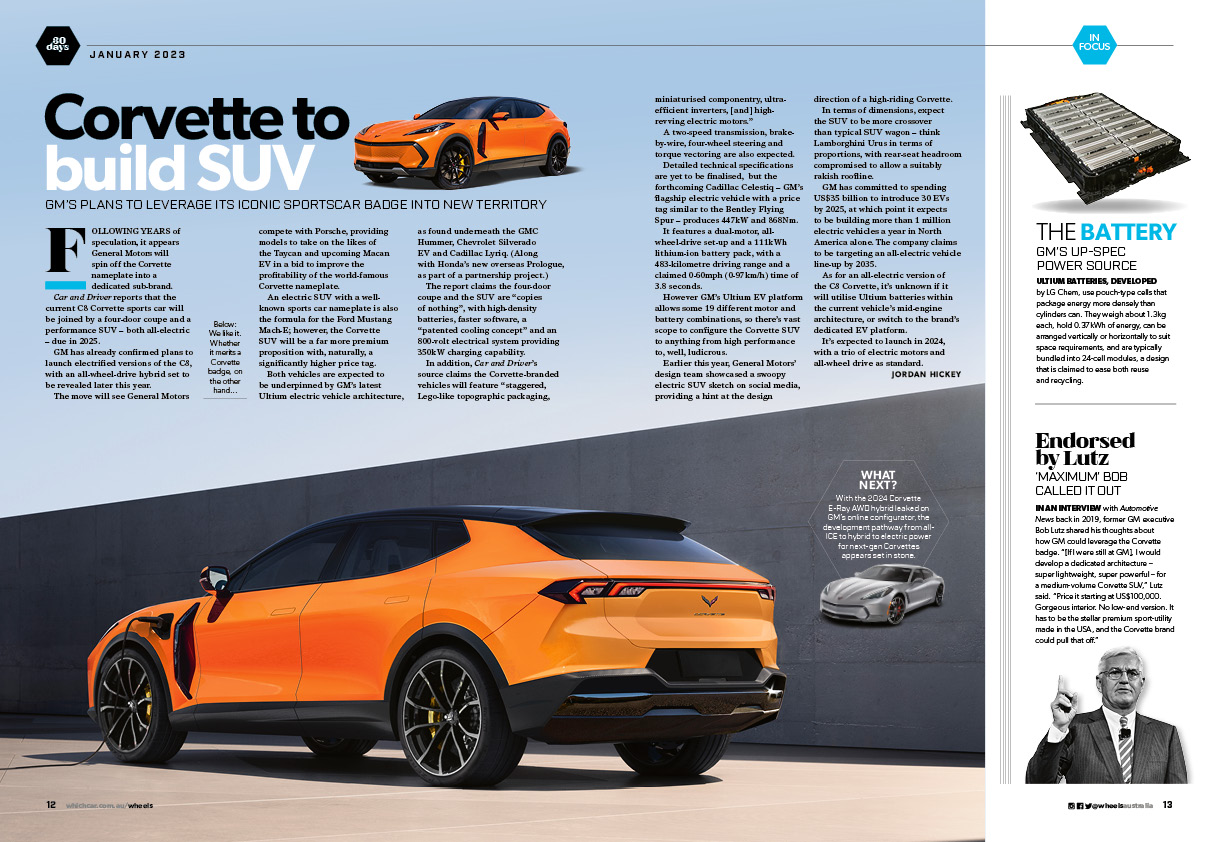
Snapshot
- Up to 20 per cent price cuts in US
- Significant drops in key markets: China, US, Europe
- Lower margins; higher volume to utilise plant capacity
Tesla has been going against the grain and dropping prices of its EVs across the globe after failing to meet sales forecasts in 2023.
Although the electric car start-up from the US dominated EV sales in Australia and set another quarterly record in the final quarter of 2022, stock prices fell when growth didn’t live up to the 50 per cent that Musk promised.
Increasing competition from new start up EV brands – especially in China, but also with GM and Ford cranking up pressure in the US – are challenging influencing Tesla’s market stance, too.
Official sales figures from the Chinese Passenger Car Association saw December Tesla deliveries in China down 44 per cent on November 2022, and 21 per cent lower than the same month in 2021.
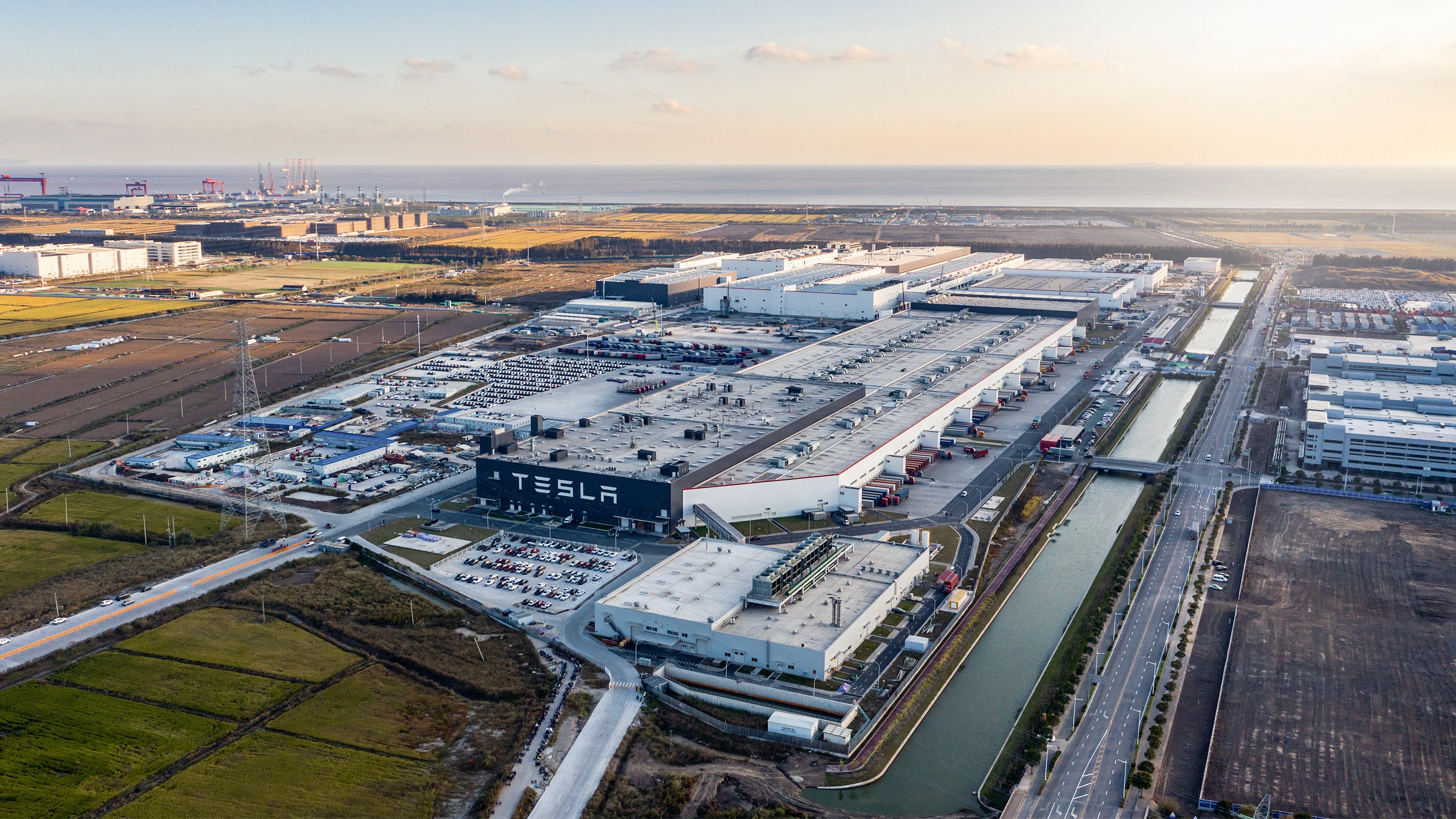
To bolster sales globally, Tesla’s new strategy isn’t to play nice, but instead pushing through significant price cuts, the largest up to 20 per cent, or US$13,000 in its home market for the five-seat Model Y.
Price cuts in China were as high as 13.4 per cent on 3 Standard Range and Y Long Range.
The main cuts come to volume-selling models, the Model 3 sedan and Model Y medium SUV – with prices also recently dropped in Australia too – as Tesla also battles with tumult of Semi and Cybertruck model production with increasing regulatory attention, and fast-flooding EV marketplace.
According to an Automotive News Europe report, Wedbush analyst Dan Ives says the global price cuts have the potential to boost Tesla sales by between 12-15 per cent globally over the next 12 months.
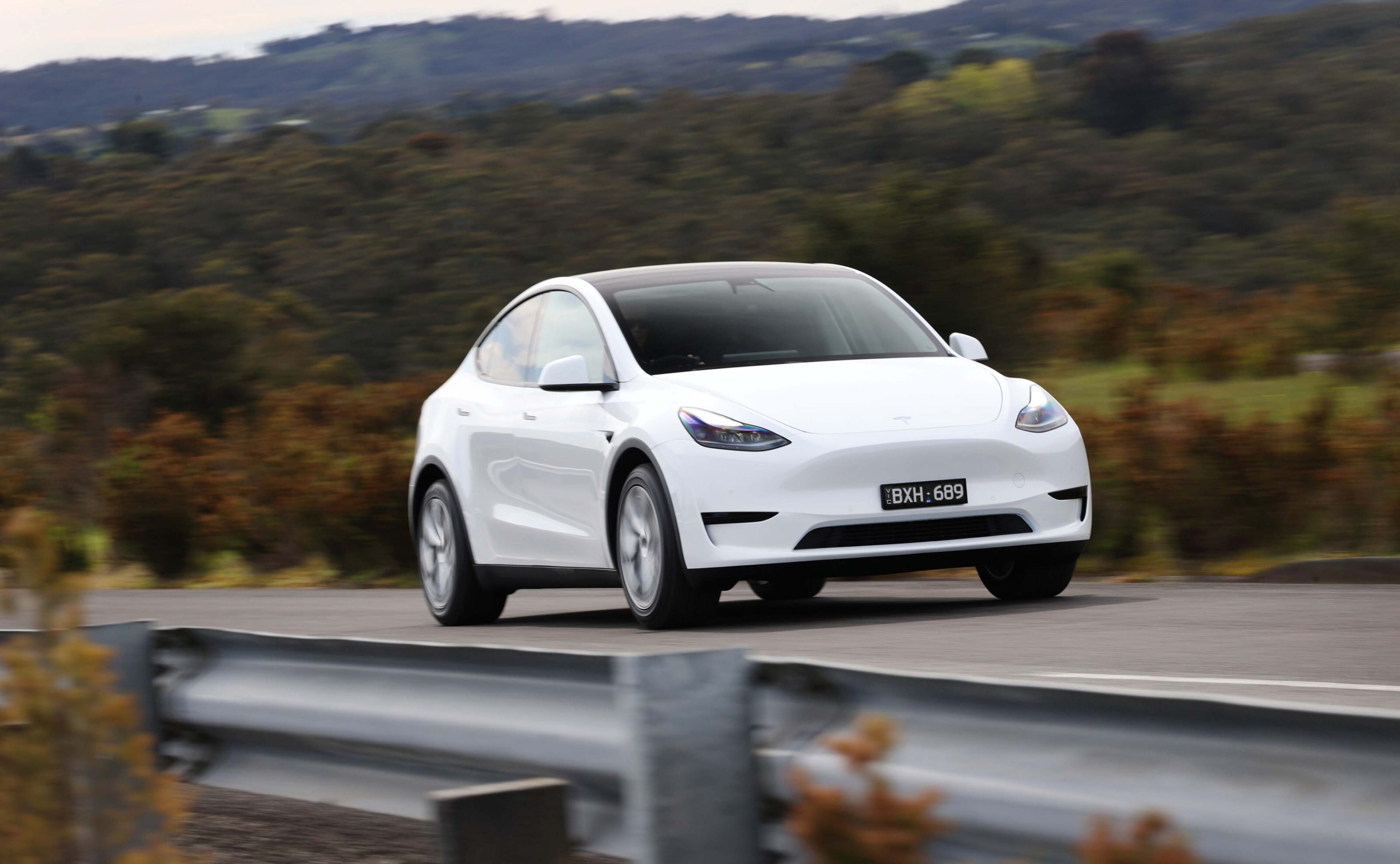
The radical rethink comes as Tesla share values skimmed just above $100 in the fourth quarter of 2022 – partially down to lower-than-expected Tesla deliveries, but Musk’s purchasing of Twitter didn’t inspire confidence in shareholders.
After promoting Tesla China boss, Tom Zhu, the share prices have already improved, hovering around US$120 at time of writing, but still far adrift of their historical US$390 high.
The dangers, however, come in the form of potential slashed profit margins for Tesla that could harm share returns over the next 12 months. Though Tesla says that cost inflation has begun to stabilise on the manufacturing end, which bodes well for the sustained price cuts.
In Australia, Tesla’s latest round of drops were fairly minor, staying under five per cent and returning the single motor versions of Model 3 ($63,500) and Model Y ($68,900) to where they were earlier in the year, rather than wholesale slashing.
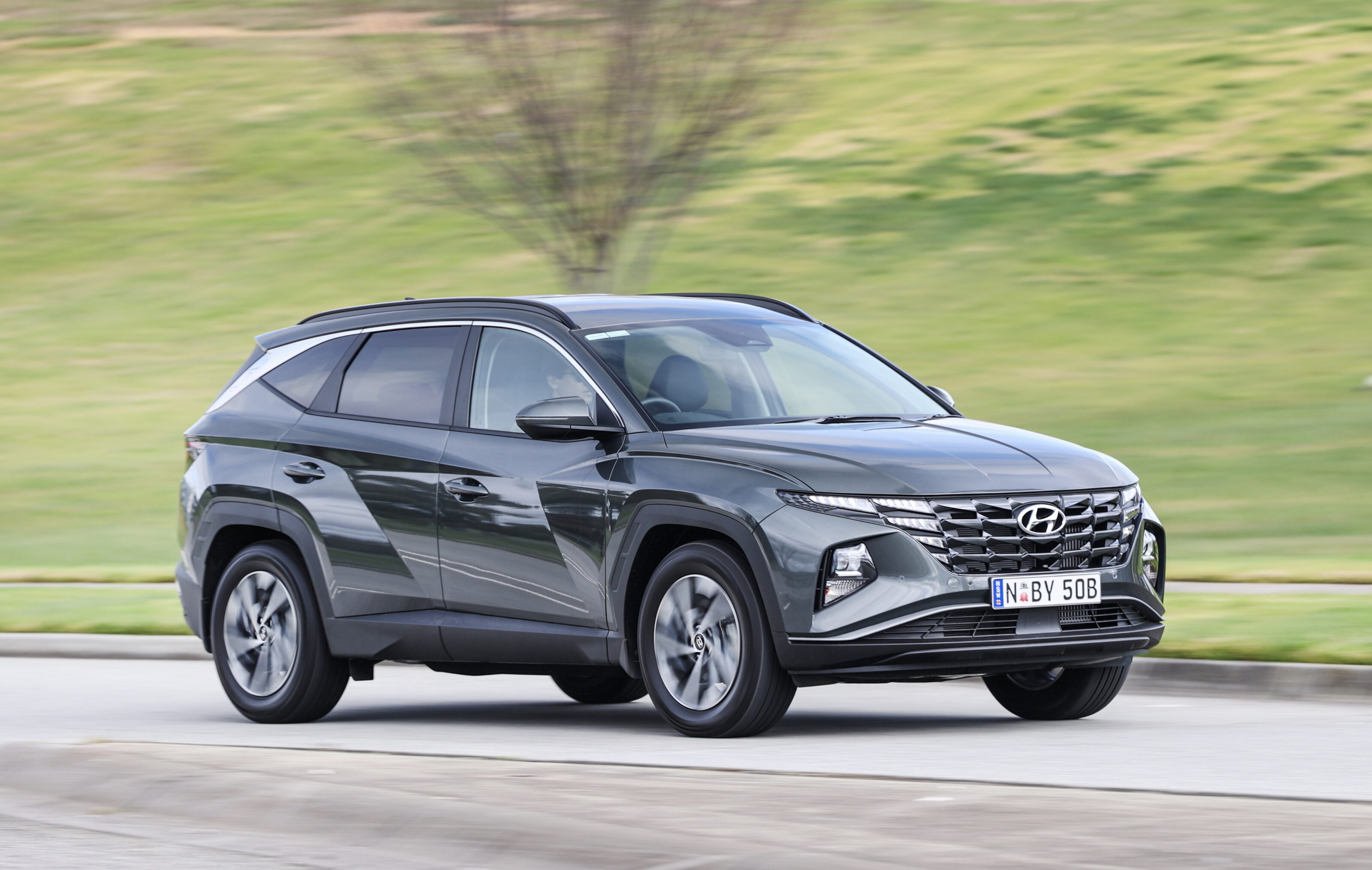
The updated 2023 Hyundai Tucson medium SUV has arrived in Australia.
Snapshot
- 2023 Hyundai Tucson pricing and features
- Bluelink connected-car technology added to Elite and Highlander
- Elite and Highlander up $500; no other changes
For model-year 2023, the popular Tucson family SUV has gained Hyundai’s Bluelink remote connectivity app for the mid-spec Elite and flagship Highlander.
It is the third vehicle in the brand’s local range to gain the connected-car technology, joining the facelifted Palisade launched in mid-2022 and the updated Venue announced last week.
November 21, 2023: New-look 2024 Tucson revealed
Hyundai’s top-selling vehicle updated with Santa Cruz-like front end, plus a new-look dashboard inspired by the Kona and Santa Fe
Story continues: 2023 Hyundai Tucson pricing
The Bluelink system features automatic collision notification, SOS emergency call, a valet mode, built-in voice control, connected satellite navigation, and the ability to lock/unlock or start the engine from the smartphone application.
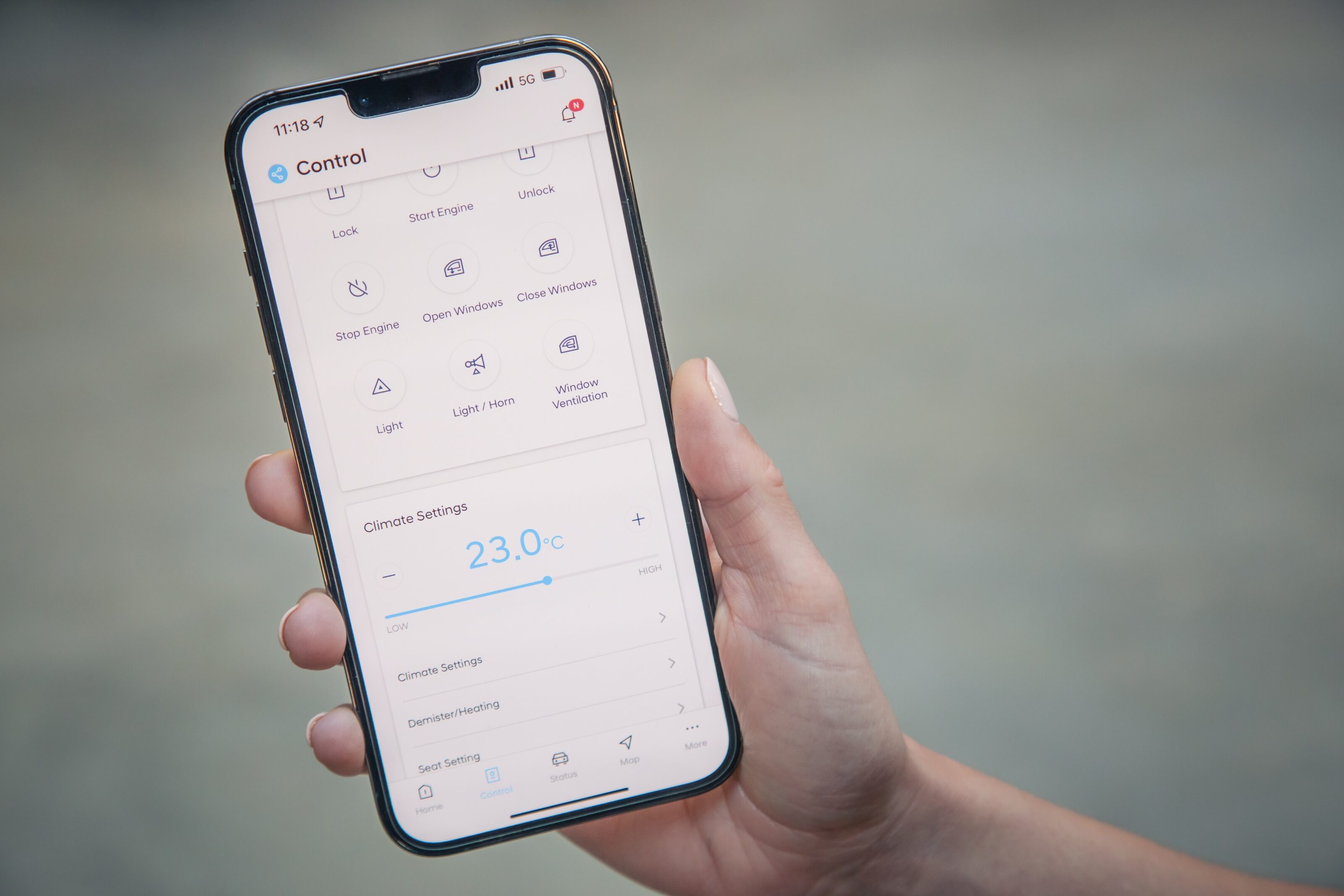
Bluelink is complimentary for the first five years, with a subscription cost to follow after this period. It is similar to the Toyota Connected Services functionality available in the RAV4, but that system is only included at no cost for the first 12 months.
It is accompanied by a $500 price rise for Elite and Highlander variants, with no other specification updates for model-year 2023.
The updated 2023 Hyundai Tucson – a rival to the Toyota RAV4, Mazda CX-5, Mitsubishi Outlander and Kia Sportage, amongst others – is on sale now.
JUMP AHEAD
- 2023 Hyundai Tucson pricing
- 2023 Hyundai Tucson features
- N Line Option Pack, options
- Colours
- Engine, drivetrain, and fuel economy
- Safety
- Dimensions
- Warranty and servicing
- Availability
2023 Hyundai Tucson pricing
Prices exclude on-road costs.
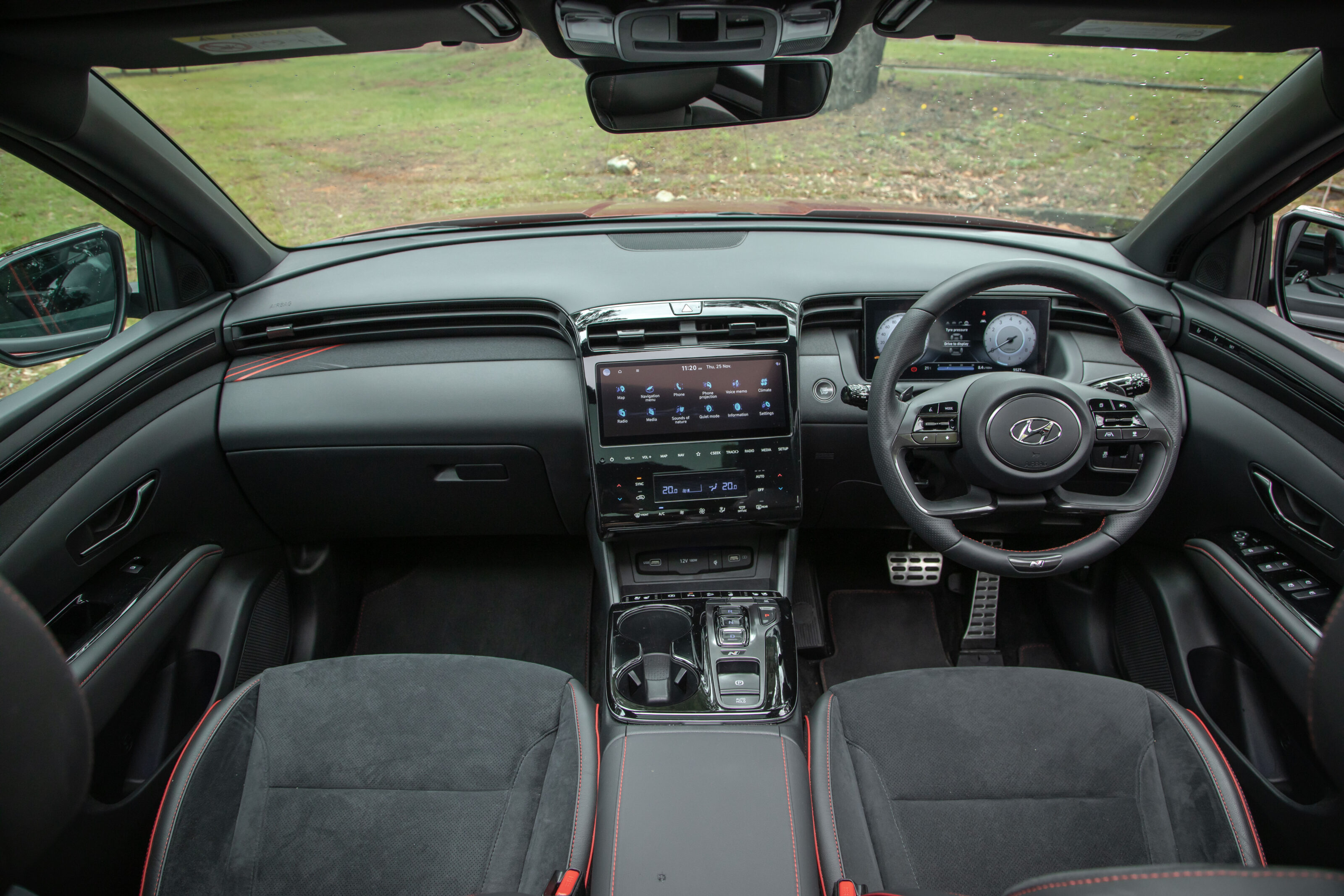
2023 Hyundai Tucson features
Tucson
Elite
Highlander
N Line Option Pack, options
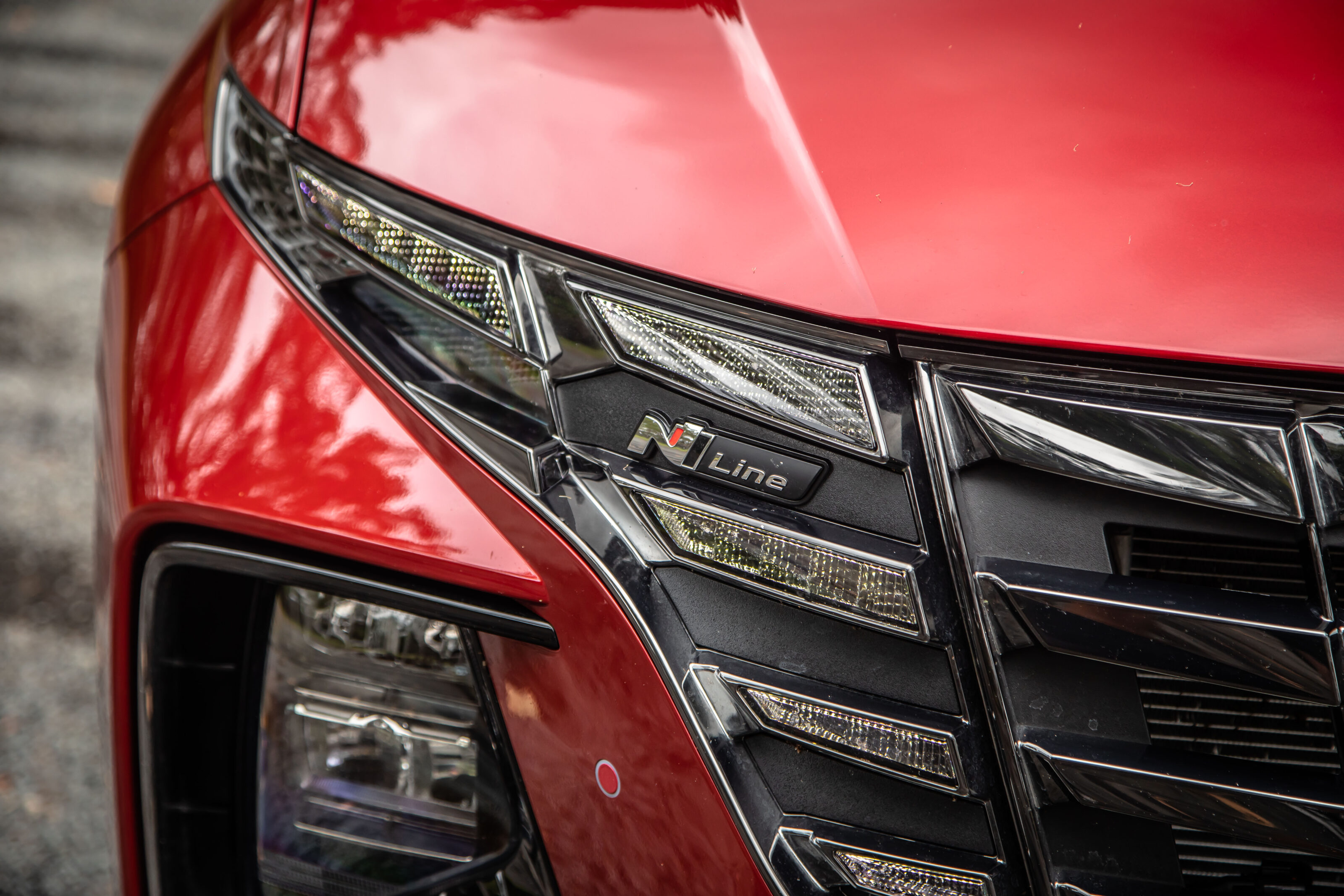
The optional N Line package, available across the Tucson line-up, adds:
* = standard on base Highlander.
Options
- Brown or grey leather (Highlander; $295)
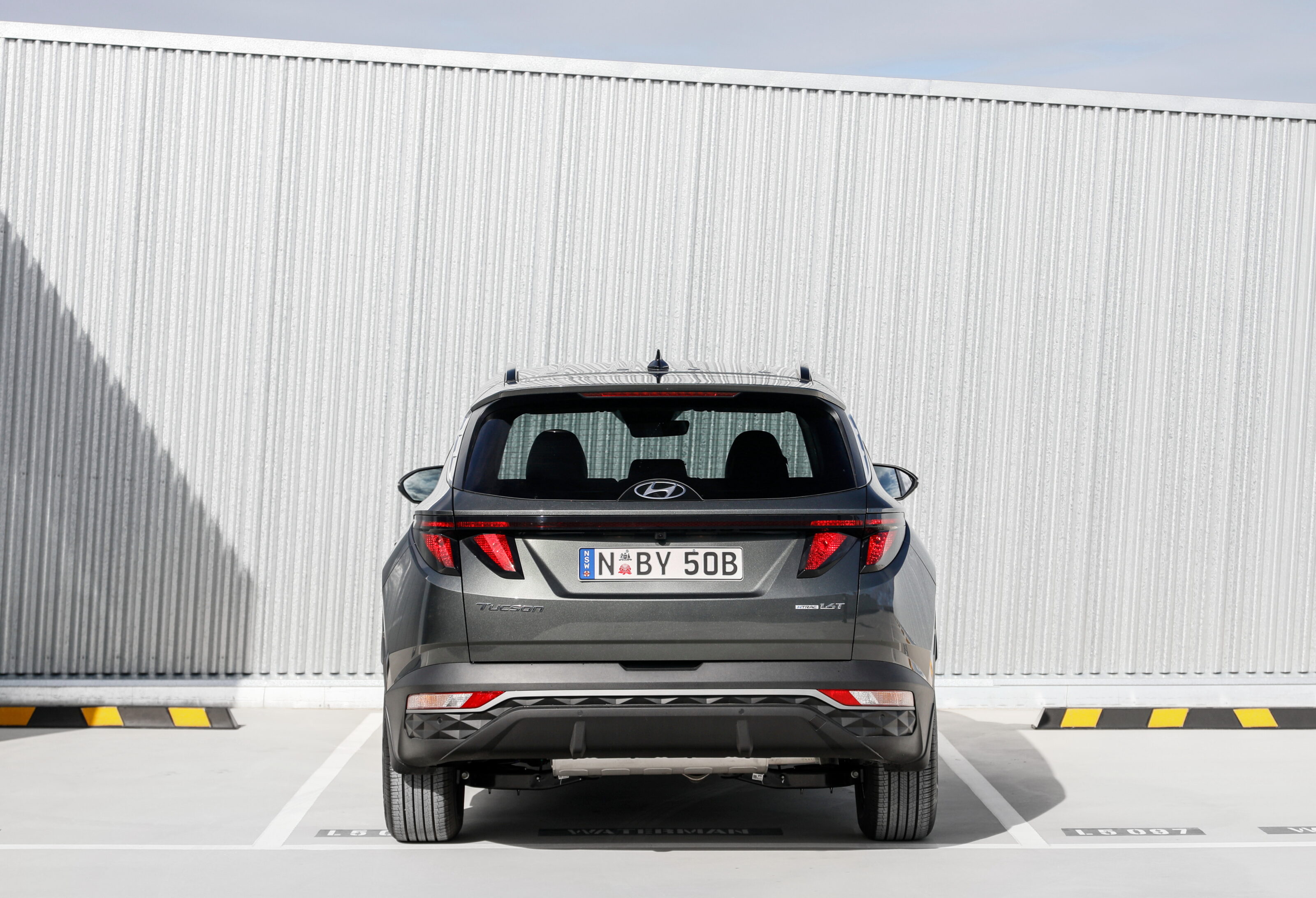
Colours
Metallic paint incurs a $595 premium.
Engine, drivetrain, and fuel economy
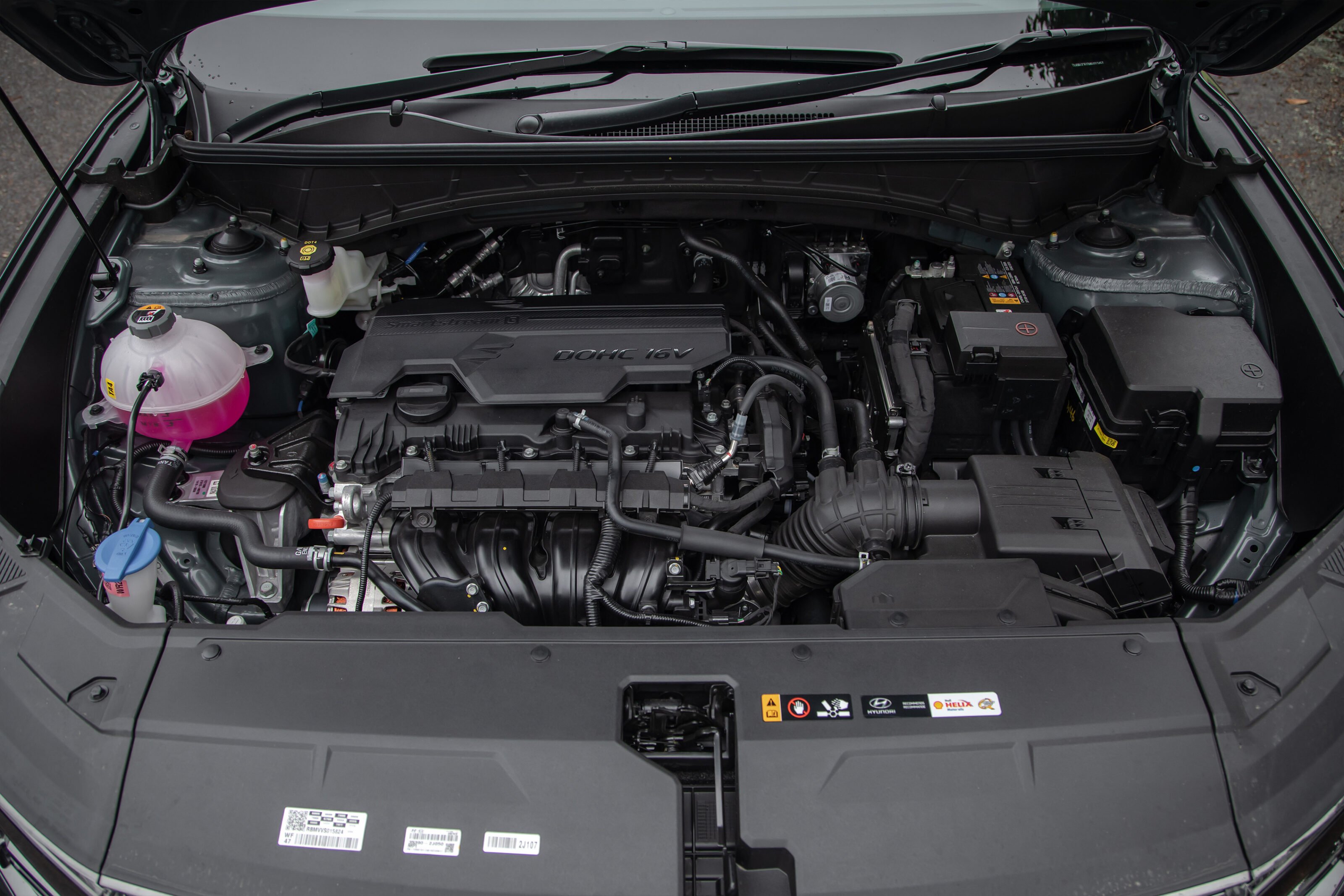
Under the bonnet, the 2023 Hyundai Tucson is available with a naturally-aspirated 2.0-litre four-cylinder petrol engine, turbocharged 1.6-litre petrol, or a 2.0-litre turbo-diesel.
The base engine is a naturally-aspirated 2.0-litre four-cylinder petrol engine mated to a six-speed torque converter automatic.
Power is rated at 115kW and 192Nm, with the drive being sent exclusively to the front wheels.
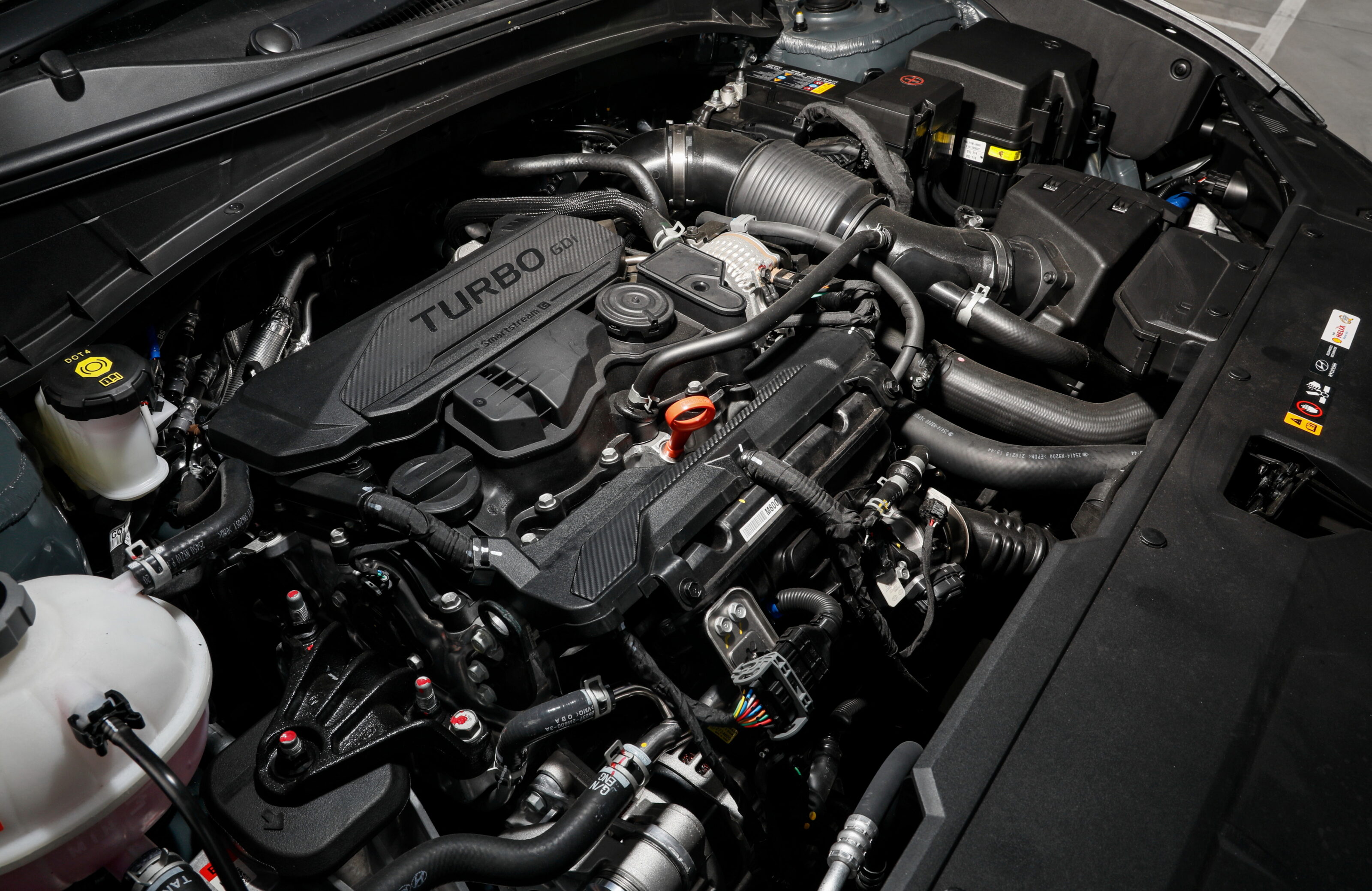
The same four-pot and FWD configuration is standard for the Elite and Highlander, but a turbocharged 1.6-litre four-cylinder engine that sends its power (132kW/265Nm) to all four wheels through a seven-speed dual-clutch transmission is also available.
A 137kW/416Nm 2.0-litre turbo-diesel four-cylinder engine is optional for the Elite and Highlander. It is matched to an eight-speed torque-converter automatic that will also power all four wheels.
The petrol Hyundai Tucson has a 1650-kilogram braked towing capacity, while the diesel version ups its rating to 1900 kilograms.
| 2023 Hyundai Tucson combined fuel economy | ||
|---|---|---|
| 2.0-litre petrol FWD | 8.1L/100km | 184g/km |
| 1.6-litre turbo-petrol AWDu00a0 | 7.2L/100km | 164g/km |
| 2.0-litre diesel AWD | 6.3L/100km | 163g/km |
Safety
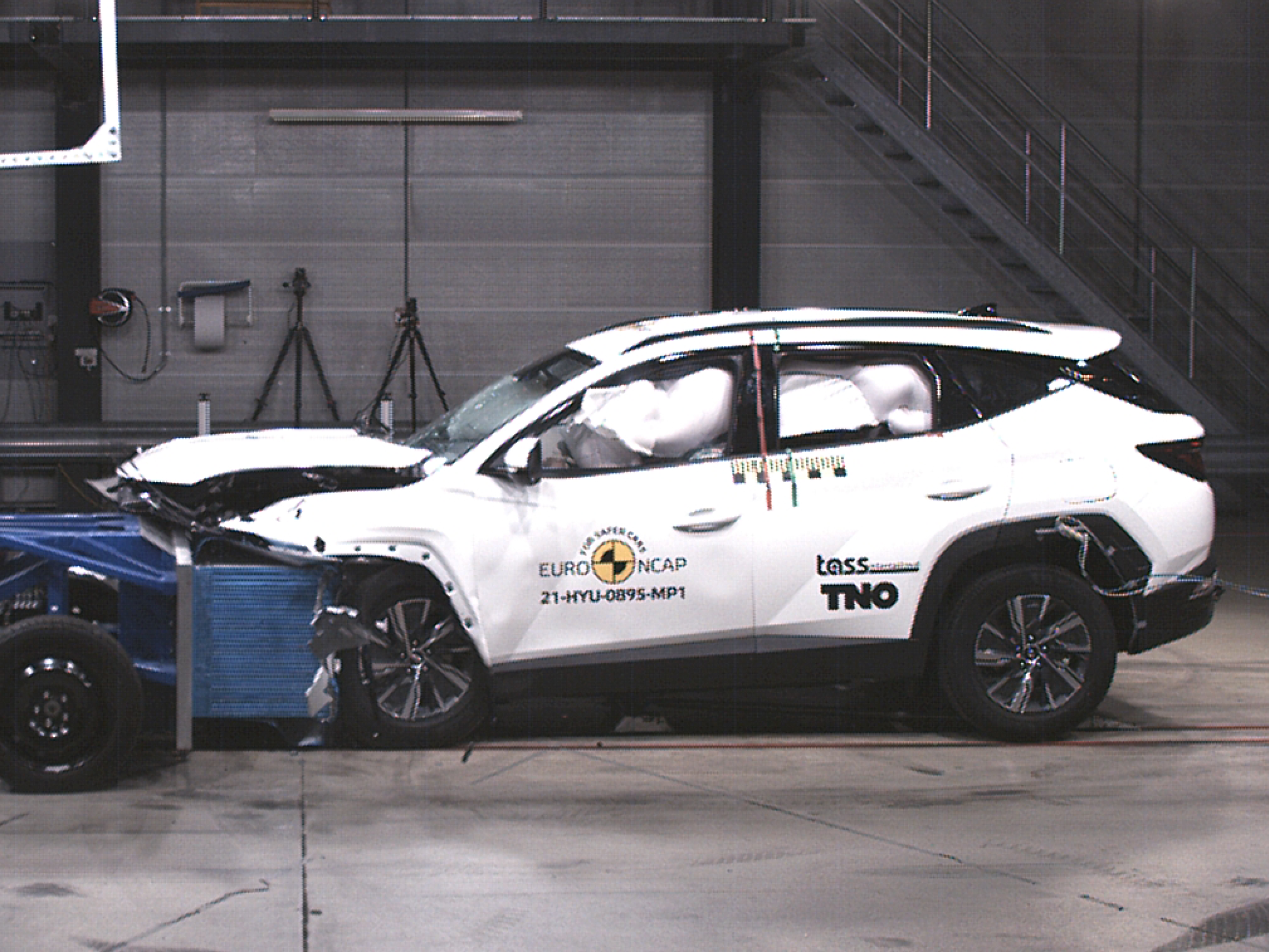
The Hyundai Tucson is covered by a five-star ANCAP safety rating, based on testing conducted in 2021. This score applies to all variants.
It received a score of 86 per cent for adult occupant protection, 87 per cent for child occupant protection, 66 per cent for vulnerable road user protection, and 70 per cent for safety assist.
For the full report, click here.
Seven airbags (dual front, side, curtain, and front-centre) are fitted across the range.
| 2023 Hyundai Tucson active safety features | |
|---|---|
| Autonomous emergency braking (vehicle, pedestrian, cyclist, junction-turning) | Adaptive cruise control |
| Lane-keep assist | Trailer stability assist |
| Lane following assist | Rear occupant alert |
| Blind-spot alert | Safe exit warning. |
| Rear cross-traffic alert | |

Dimensions
The Hyundai Tucson has a 2755-millimetre wheelbase, and is 4640mm long, 1865mm wide and 1665mm tall.
2023 Hyundai Tucson boot space
The 2023 Hyundai Tucson has a 539-litre boot capacity. Folding the second row increases luggage capacity to 1860 litres.
Warranty and servicing
As per the wider Hyundai range, the Tucson is covered by the brand’s five-year, unlimited-kilometre warranty.
Servicing for the naturally-aspirated petrol and turbo-diesel Tucson is required every 12 months or 15,000 kilometres, whichever comes first. The turbocharged variant has a shorter 12-month/10,000-kilometre interval.
Lifetime capped-price servicing is available, with costs dependent on the service interval and powertrain.
Availability
The 2023 Hyundai Tucson is on sale now.
For information on Hyundai’s wait times, click here.
UPDATE: Australian first look at BMW HQ
The new 2023 BMW M2 is here in Australia, and we’ve had a proper up-close look at its styling and features. Check out the video below, and keep reading further down for more details about M division’s hero ‘small’ coupe.
OCTOBER 2022: BMW M2 pricing revealed
Snapshot
- Priced from $119,900
- 6-speed manual standard; 8-speed auto a no-cost option
- Still undercuts the rival Porsche Cayman
The 2023 BMW M2 will cost $30,000 more than the original high-performance coupe when it goes on sale locally in the first half of next year.
BMW Australia has confirmed a $119,900 starting price for the second-generation M2 that was globally revealed today.
It’s a rise of $17,000 over the M2 Competition manual available in 2021, though an eight-speed auto is a no-cost alternative to the standard six-speed manual for the new model. There’s a $10,000 increase when comparing self-shifting models.
The transmissions team up with a revised version of the M3/M4’s 3.0-litre twin-turbo straight-six, feeding the rear wheels only.
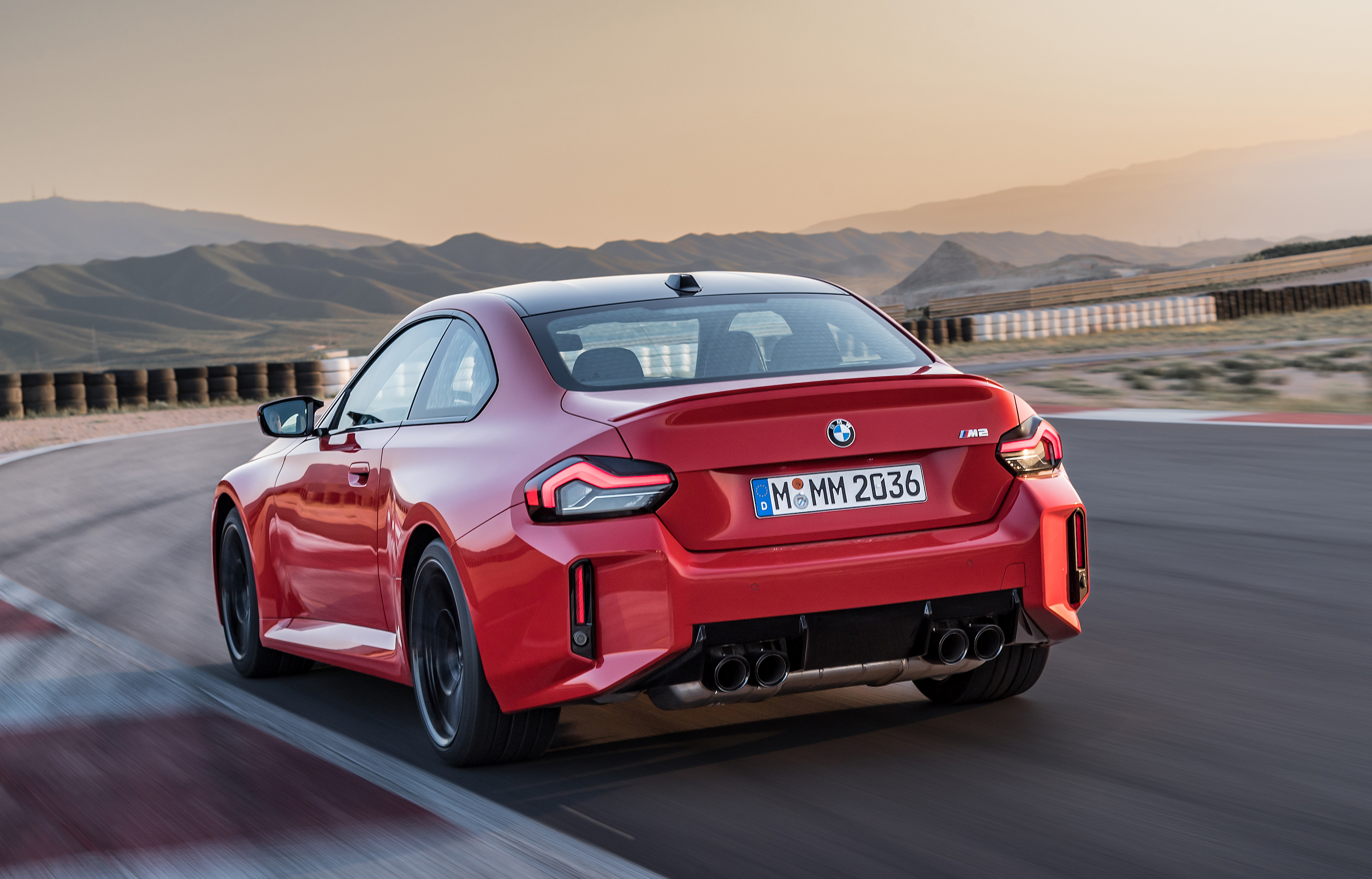
The M2 slots in to retake its natural position as the flagship of the 2 Series Coupe range, priced well above the former top model, the $91,900 M240i xDrive.
Despite the price rise, it also remains significantly more attainable than the M4 coupe that costs from $158,500 in regular guise or from $168,500 in faster Competition form.
The rival Porsche Cayman starts from $122,000.
Australian M2 models will feature a carbon-fibre roof as standard, a feature previously offered only on the M3 and is an option in other markets such as the UK.
BMW says the lightweight roof saves six kilograms, lowering the M2’s centre of gravity.
From March production, BMW Australia says the M2 will be available with M 50 Year badging that celebrates the performance division’s anniversary this year.
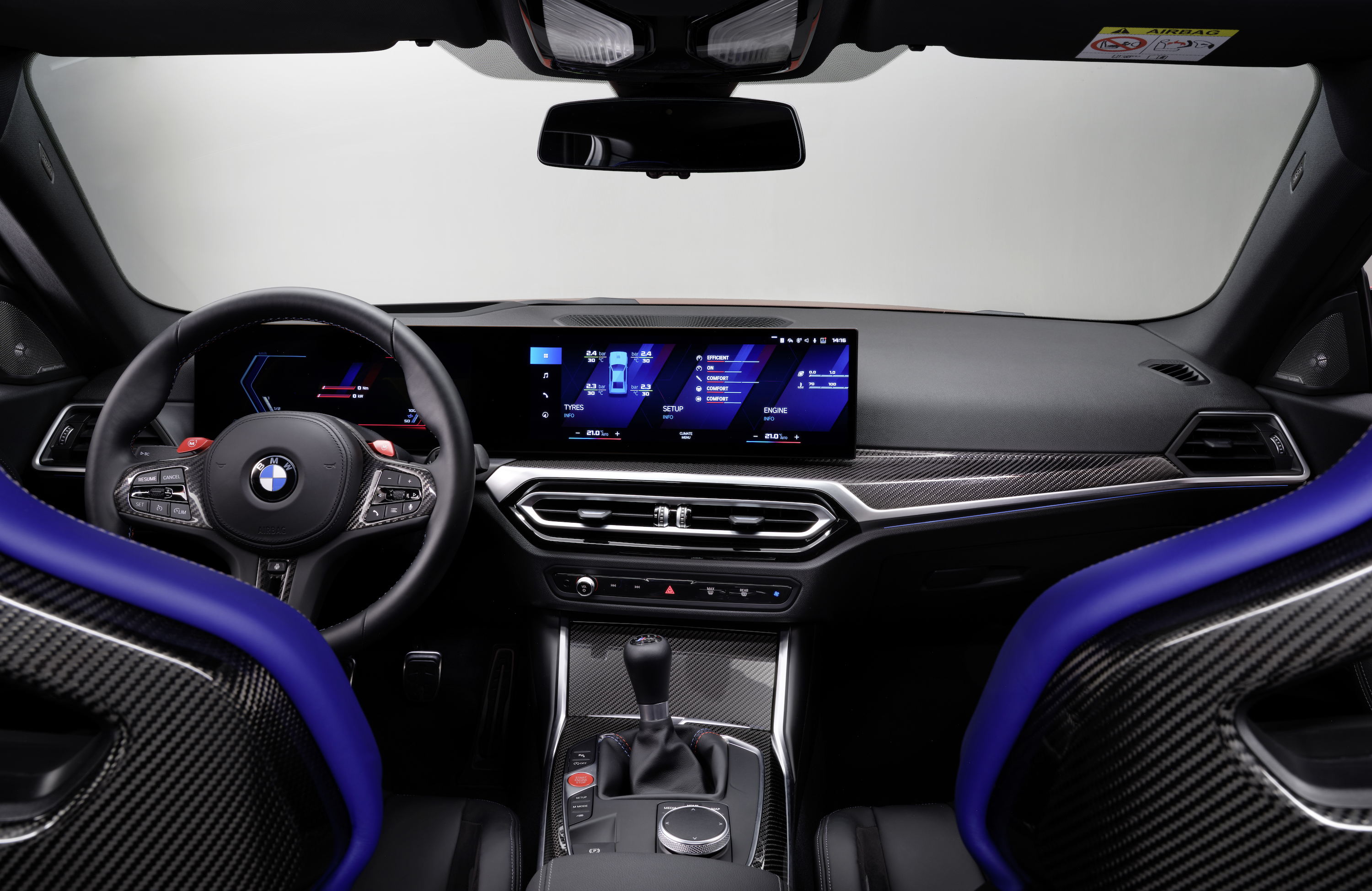
Other standard equipment for the 2023 BMW M2 includes:
Chassis and Exterior
- Staggered M light alloy wheels: 19-inch front, 20-inch rear (with Jet Black or bicolour rims)
- Active M Differential
- Adaptive LED headlights with auto high beam
- Adaptive M Suspension
- M Compound Brake high-performance brakes (blue but also available with red high-gloss callipers)
- Metallic paintwork
Cabin technology
- Head-Up Display
- 12.3-inch digital driver display
- 14.9-inch infotainment display
- Harman Kardon audio system
- Smartphone integration with Android Auto and Apple CarPlay
- Wireless smartphone charging
- Comfort Access system (BMW Digital Key for 8-speed auto)
- Connected Package Professional
- Digital radio
- Driving Assistant
- Adaptive cruise control (replaced with cruise control with braking function for manual models)
- Tyre pressure monitoring system
Cabin comfort and trim
- 3-zone climate control
- Leather ‘Vernasca’ upholstery
- M Sport front seats with electric adjust, heating, and lumbar support
- Heated steering wheel
- M ‘Carbon Fibre’ package (includes CFRP inserts in steering wheel and CFRP gearshift paddles on steering wheel)
- M high-gloss Shadowline with extended contents
- M interior trim finishers Carbon Fibre
- M Lights Shadowline
- M seat belts
- Inclusive paint finishes comprise non-metallic Alpine White and M Zandvoort Blue, and
- Black Sapphire, M Toronto Red and M Brooklyn Grey metallics.
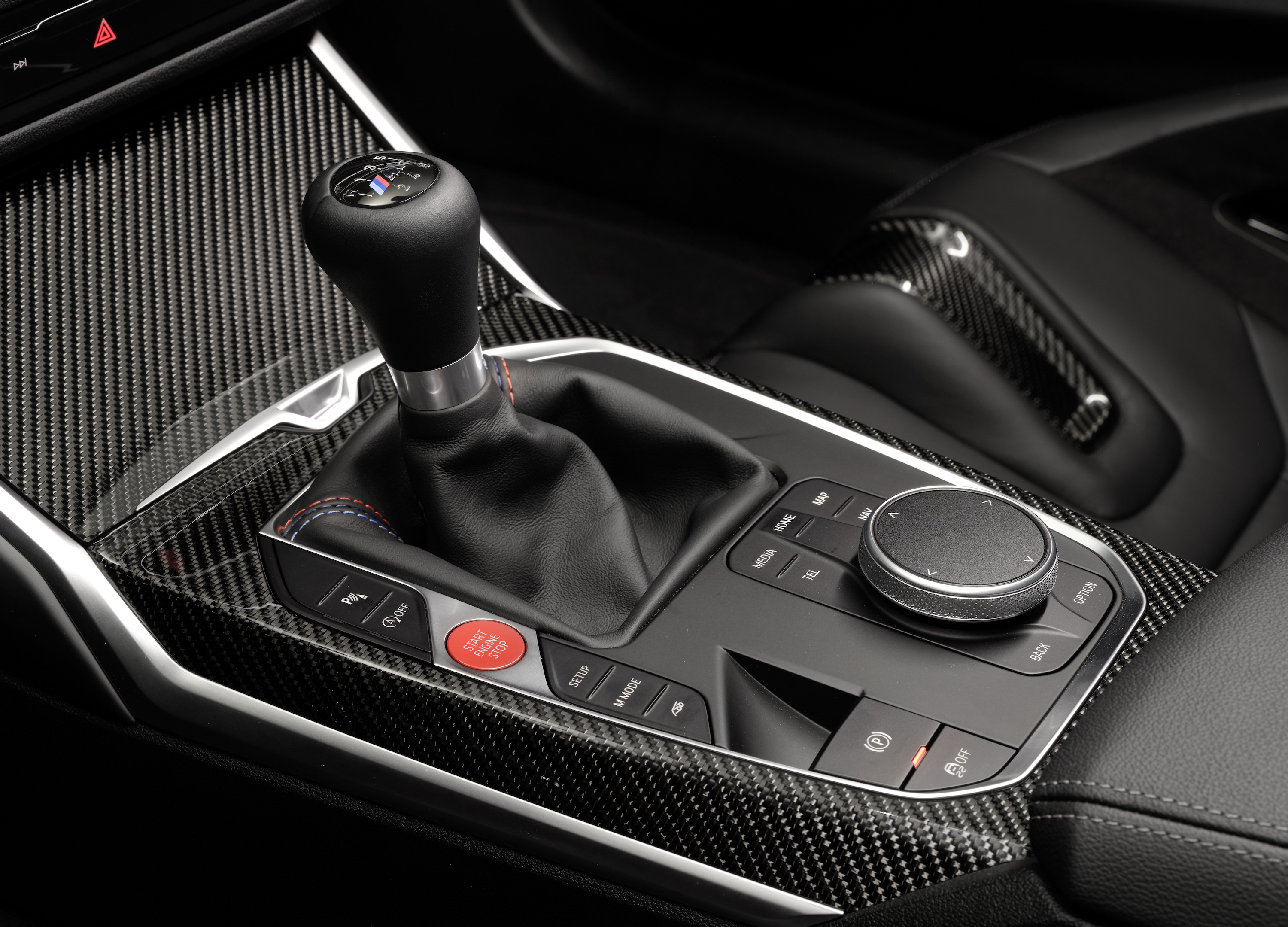
A $14,500 M Carbon Experience package is aimed at buyers serious about track days. It introduces M Carbon bucket seats up front that are claimed to save 10.8kg over the standard seats, adds a removable headrest cover for extra crash helmet space, and introduces various cut-outs to allow for multi-point seatbelts.
The upholstery also switches to ‘Merino’ leather, there are vouches for BMW Driving Experience courses, and the M2’s top speed increases from 250km/h to 285km/h.
BMW says it has sold more than 60,000 examples of the M2 since its 2015 release, with more than 2600 M2s sold in Australia since its arrival in 2016 – when it was priced from $89,900.
One in five BMW models sold in Australia is an M performance model.
“For me, it’s a greenwash, because you cannot say that a car is vegan,” says head of sustainability at Polestar, Fredrika Klarén.
Gothenburg-based Klarén was visiting Australia with her family over the new year, but made time to sit down with WhichCar to discuss Polestar’s plans for the first truly zero-emissions vehicle by 2030, the Polestar 0. You can read the full breakdown here.
Aside from Polestar’s lofty plans for emissions elimination, Fredrika was eager to talk about the dangers of greenwashing in the automotive industry.
For those not familiar with the term ‘greenwashing’, it refers to when a company may use false or misleading information to emphasise the environmental credentials of a product.
“Saying that a car is vegan is a lie to customers”
In the automotive world, terms like ‘zero-emission vehicle’ and ‘vegan interiors’ are a few getting around that are so often exaggerated versions of the truth.
Are vegan car interiors possible?
In Fredrika’s words, it’s not possible for a car in its entirety to be vegan “we have animal products all over the place: we have grease; we have animal content in synthetics; in plastics.
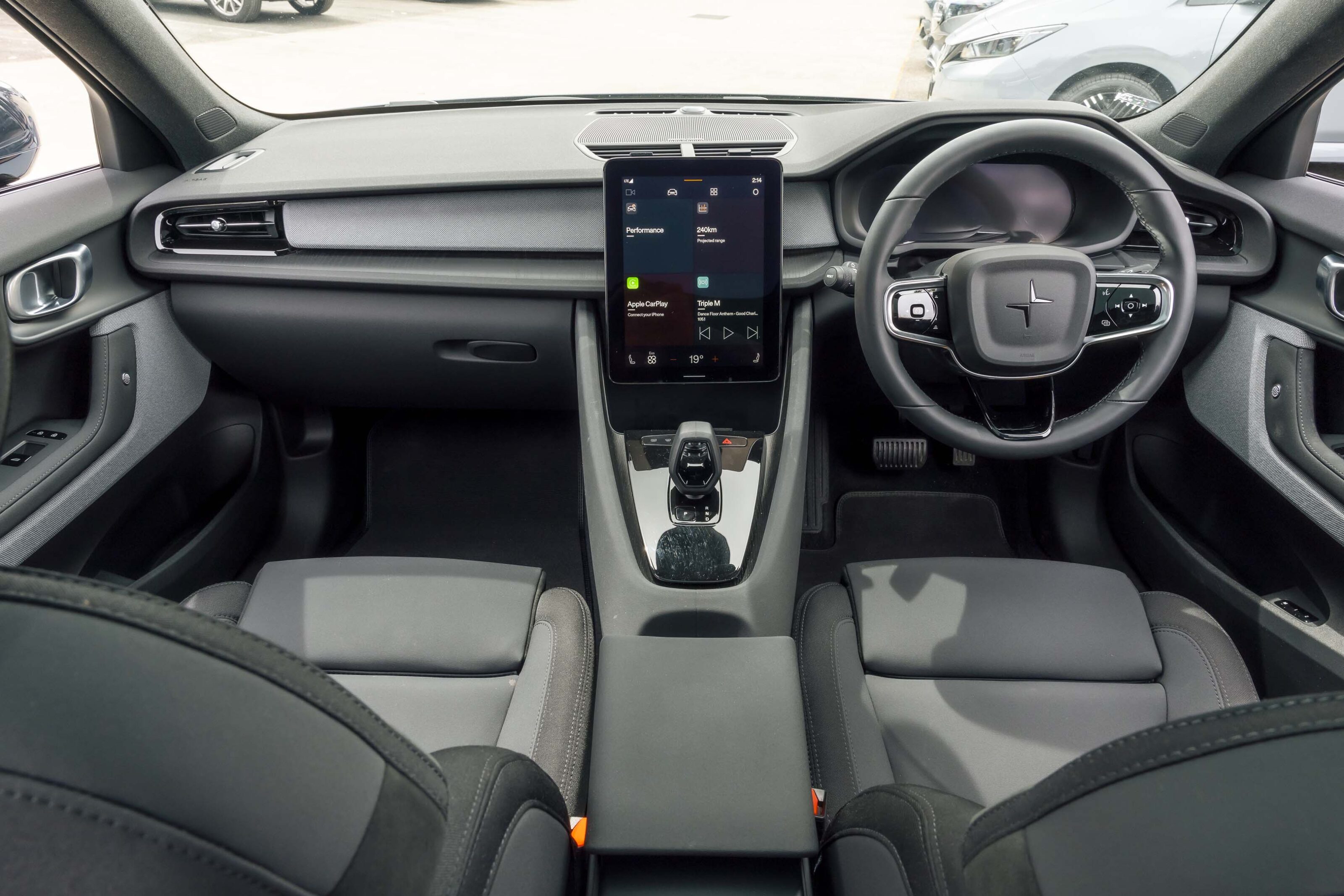
“Saying that a car is vegan is a lie to customers. Yes, you can have a vegan upholstery alternative, like we have because we want to ensure that, as a vegan, you have an alternative to move away from leather if you buy a Polestar 2 – but we will never make a claim that we have provided you with a completely vegan car.”
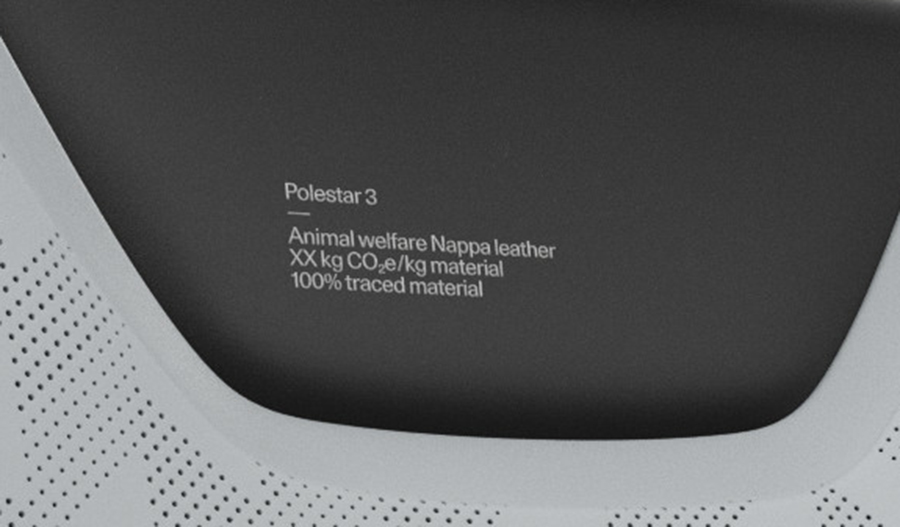
Aside from fully vegan interiors being a myth at the moment, the alternatives are often just as, if not more, harmful to the environment.
In the case of ‘vegan leather’ products (or vinyl upholstery to children of the ’60s and ’70s), the current status textiles rely heavily on Polyvinyl Chloride (PVC). Manufacturing PVC requires chlorine and the process releases harmful dioxins and other toxins into the atmosphere, along with CO2.
Manufacturers, including Polestar, are turning to high volumes of recycled materials for cloth textiles. An example being recycled fishnets used in carpets – Audi’s Q8 E-Tron was a notable early adopter of this – or PET bottles in synthetic fibres.
But shiny, easy-clean faux ‘leathers’ will remain reliant on newly-produced PVC, as it is one of the least recyclable forms of plastic.
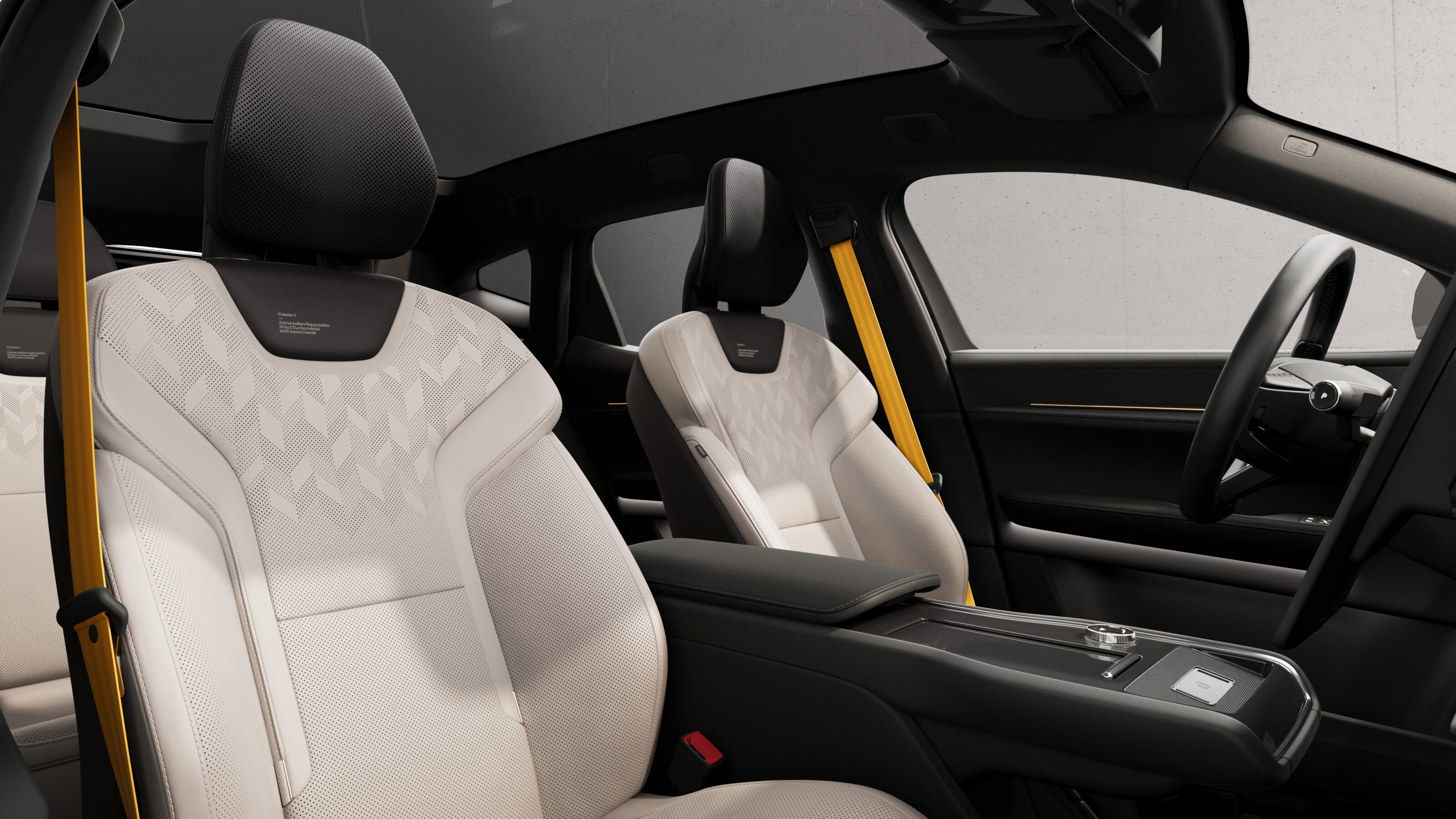
For Polestar, the leather used in its 2 sedan and forthcoming 3 SUV comes as a by-product of the meat industry and makes up less than one per cent of the value of the cow. As long as there is demand to farm meat, says Klarén, leather will remain an otherwise wasted left-over of that CO2 intensive process.
The tanning process is also completed with an eye to sustainability, meaning Polestar minimises the number of harmful chemicals used in its leather dying processes.
UPDATE, April 18 2023: Cyberster unveiled, Australian launch confirmed
The production version of the MG Cyberster has now been unveiled, at the 2023 Shanghai motor show, and it’s coming to Australia. Get all the details at the story linked below.
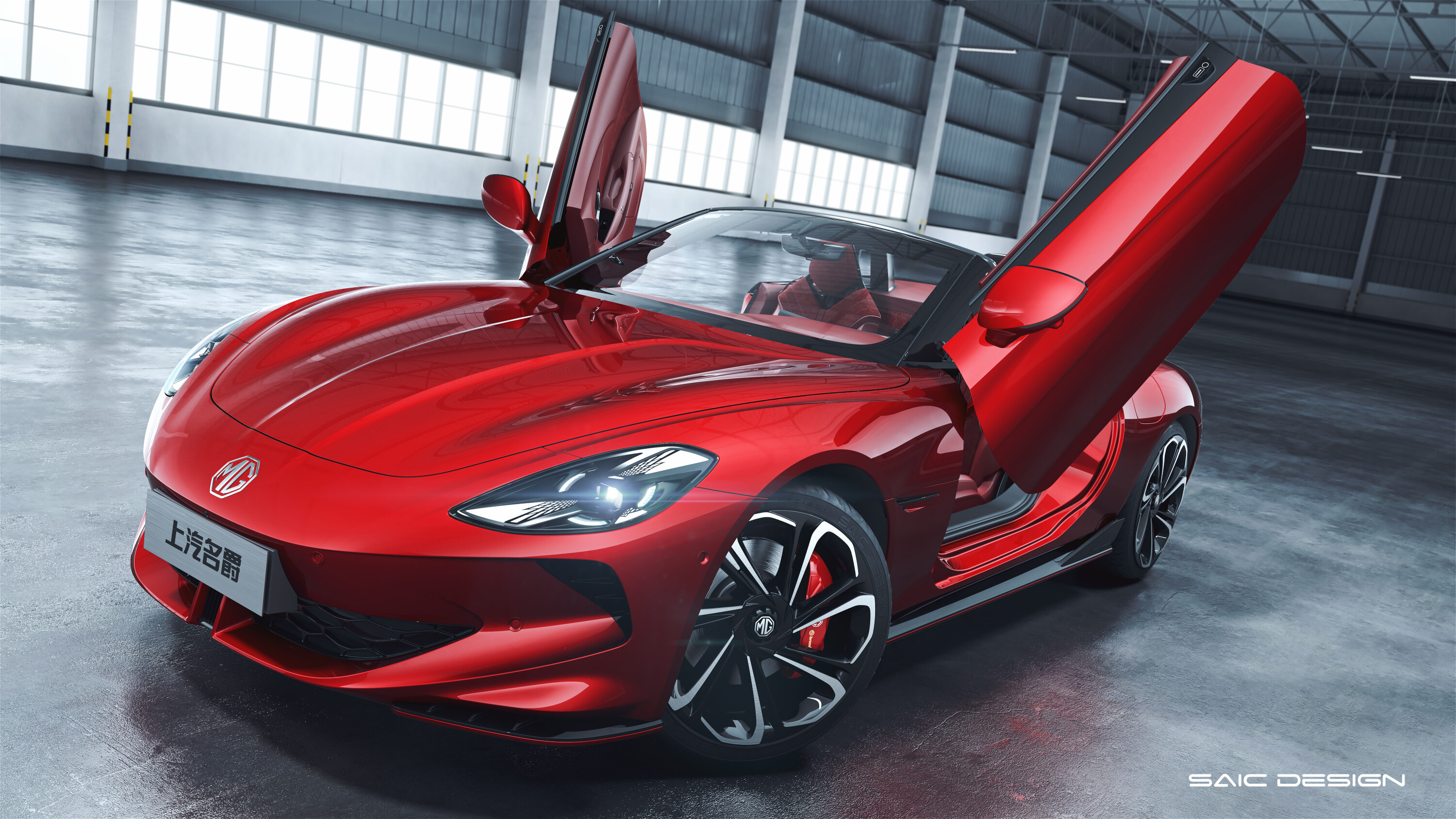
January 15, 2023: 2024 MG Cyberster spied
The upcoming 2024 MG Cyberster electric roadster has been spied testing in China.
A set of images shared on Chinese publication Xcar has revealed our first look at the Cyberster in the open world, following shadowy teasers released by the Chinese brand in mid-2022.
It isn’t the first leak for the MG Cyberster, with patent images helping to guide our rendering of the forthcoming model.
The latest images, therefore, aren’t surprising, with MG’s latest design language – first seen on the MG 4 electric SUV – set to feature.

This includes slim LED headlights and a full-width light strip across the rear, connecting to the arrow-shaped tail-lights inspired by the Union Jack.
Inside, the Cyberster will adopt a yoke-style steering wheel, a curved infotainment display, and a push-button gear selector similar to the Chevrolet Corvette.
UK publication Autocar reports the 2024 MG Cyberster will be unveiled in April, following the cancellation of the Guangzhou Motor Show in November 2022.
Our earlier story, below, continues unchanged.
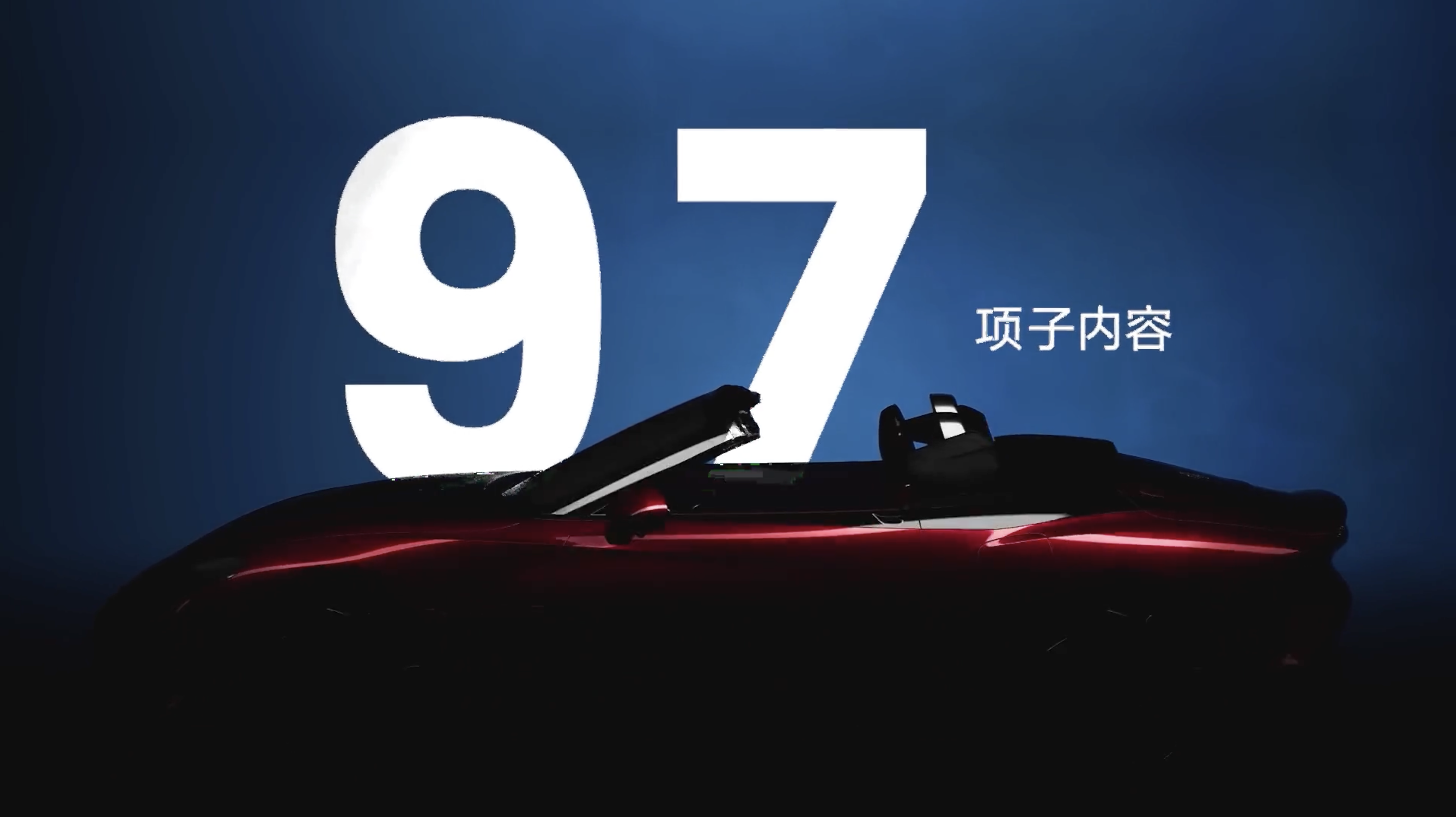
The story to here
July 22, 2022: 2024 MG Cyberster teased in new video
Snapshot
- 2024 MG Cyberster teased, revealing supercar-like design
- Set to feature scissor-opening doors and a yoke-style steering wheel
- Right-hand-drive confirmed, opening the door for an Australian launch
A teaser video for the 2024 MG Cyberster electric roadster has emerged online, revealing supercar-like design elements.
The video, published on MG’s Chinese website, reveals the Cyberster will feature scissor-opening doors, an electrically-folding soft-top roof, arrow-shaped tail-lights, two-tone alloy wheels, and a ducktail spoiler.
It also provides a quick glimpse inside the cabin, showcasing a dashboard angled towards the driver and a yoke-style steering wheel similar to the Tesla Model S and Lexus RZ.
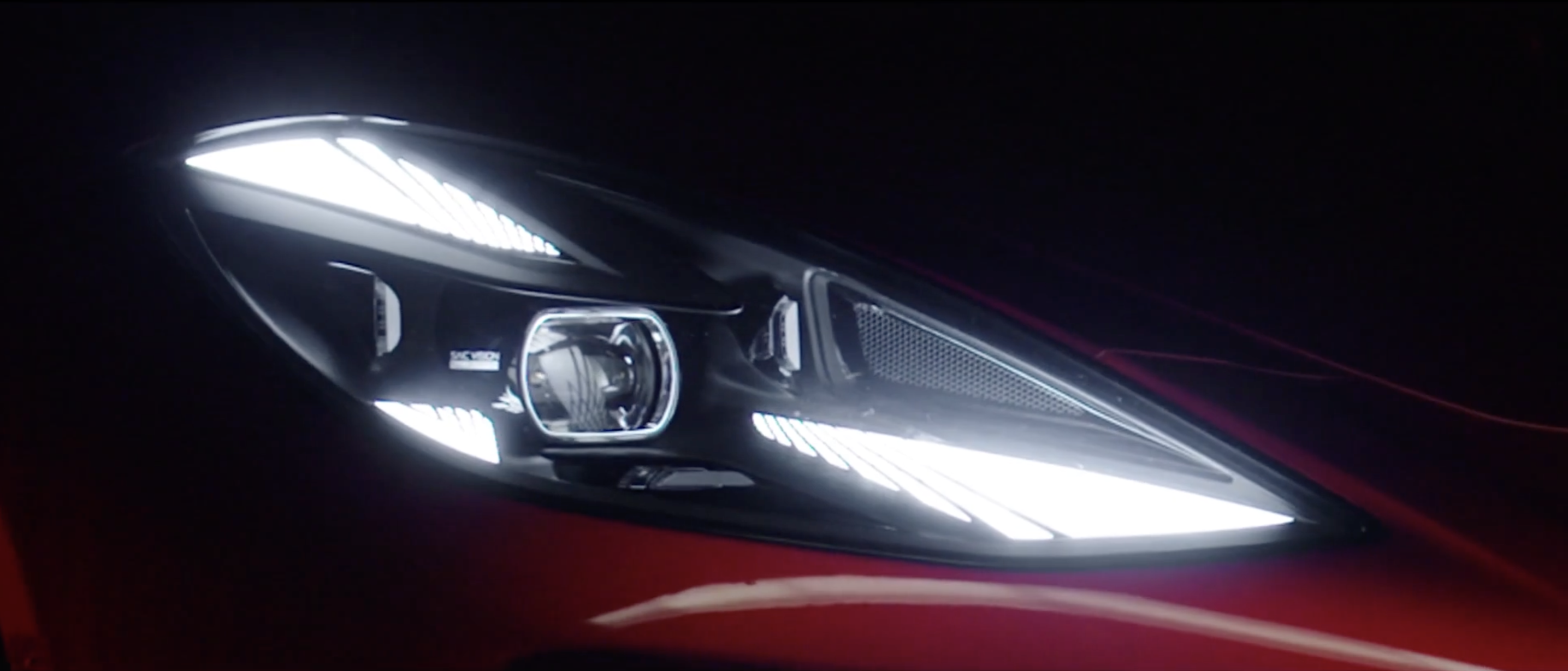
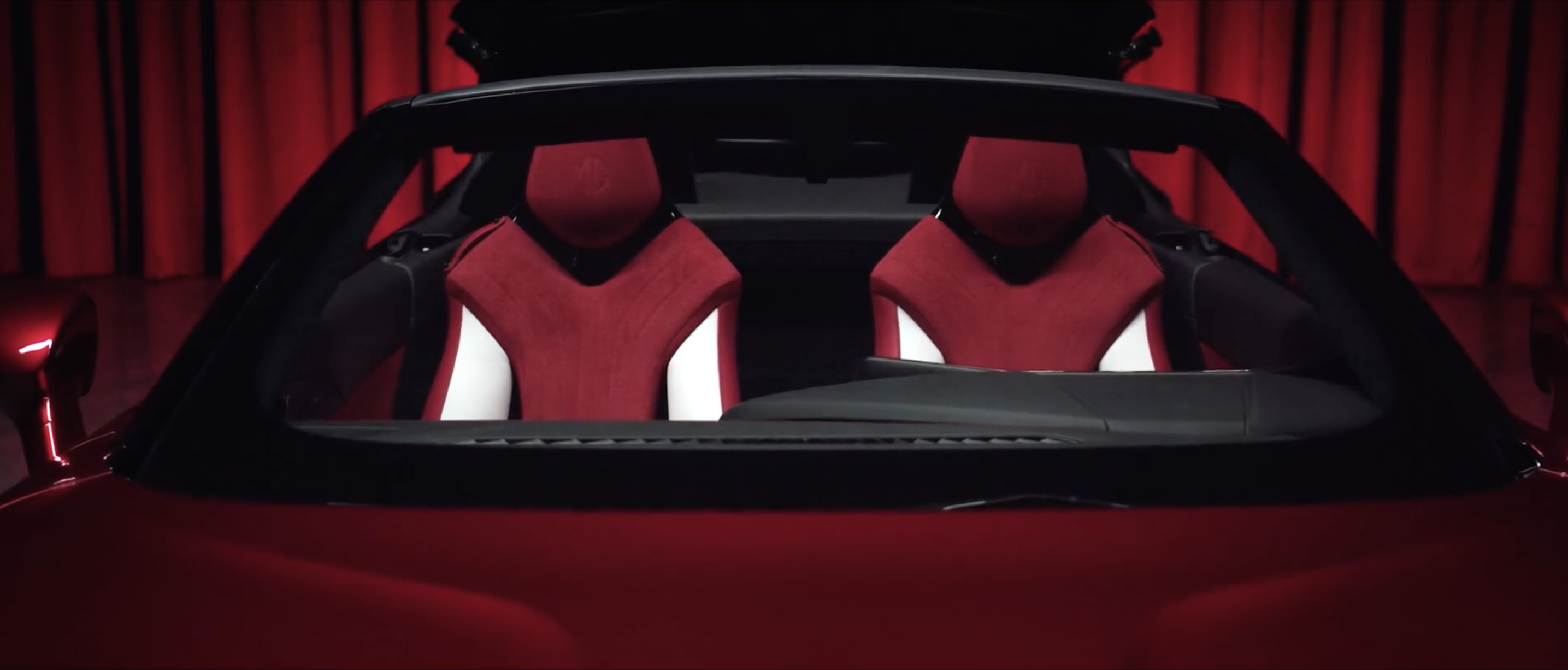
In addition, the teaser shows a freestanding digital instrument cluster, a portrait-orientated infotainment system, a passenger grab handle similar to the Hyundai i30 Sedan, sports seats, and bright red upholstery.
The example shown in the video is finished in a similar red colour to the MG Cyberster concept revealed at the 2021 Shanghai Auto Show, while the overall design has been toned down.
As Wheels revealed in our rendering of the Cyberster last month, following leaked patent images, the electric roadster will wear MG’s latest design language, which first debuted on the MG 4 electric hatchback.
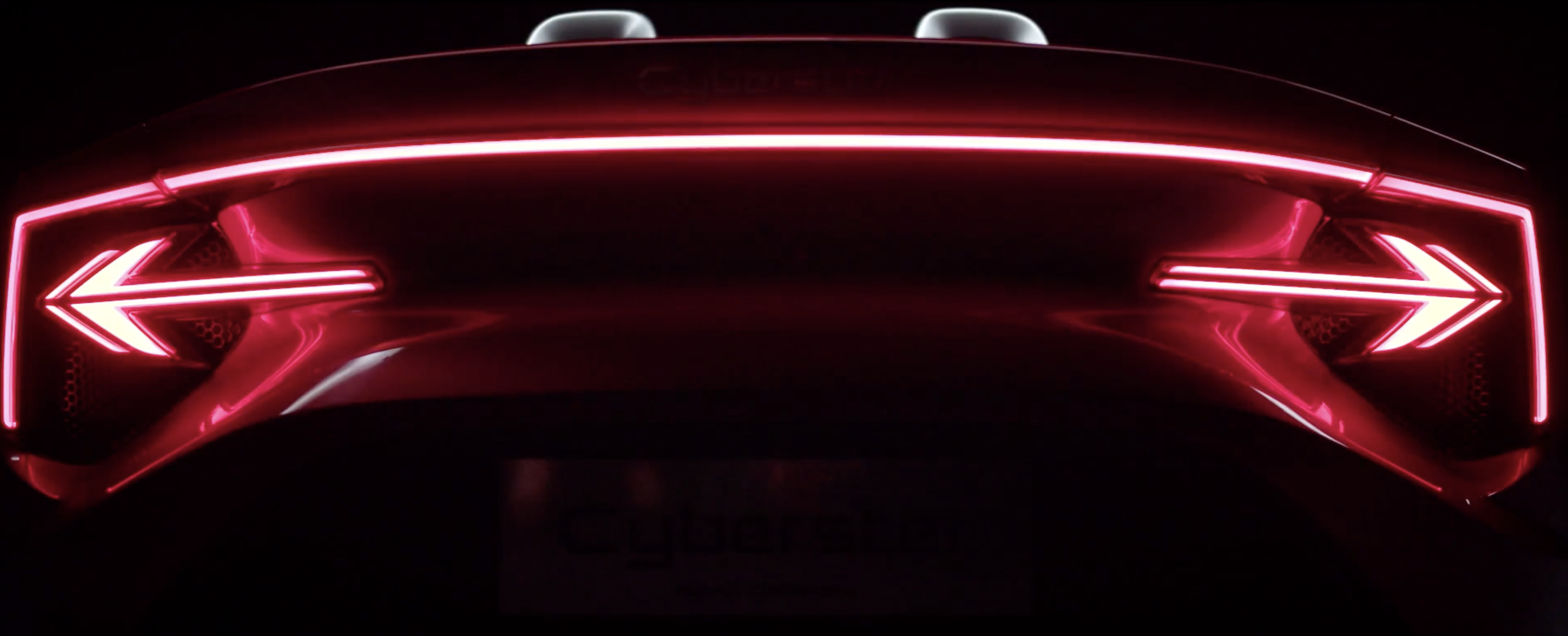
This includes slim LED headlights and a full-width light strip across the rear, connecting to the arrow-shaped tail lights said to be inspired by the Union Jack.
MG is yet to reveal technical details for the Cyberster, but the production version is unlikely to match the concept’s claimed 0-100km/h time of 3.0 seconds and 800-kilometre electric driving range.
However, with the fitment of an electric powertrain and supercar-like parts, the Cyberster is also unlikely to match the circa-$40,000 starting price of the current Mazda MX-5 – but is likely to undercut more-expensive models.
The MG Cyberster will face essentially no competition in the electric convertible space until the Porsche 718 Boxster launches around 2024 or 2025. And the new Tesla Roadster, if it appears.
Other battery-electric roadsters – such as the Lotus Type 135 and Alpine A110 EV – are tipped to arrive later in the decade.
The 2024 MG Cyberster electric roadster is expected to be unveiled within the next year – with a right-hand-drive version confirmed, leaving the door open for an Australian launch.
