
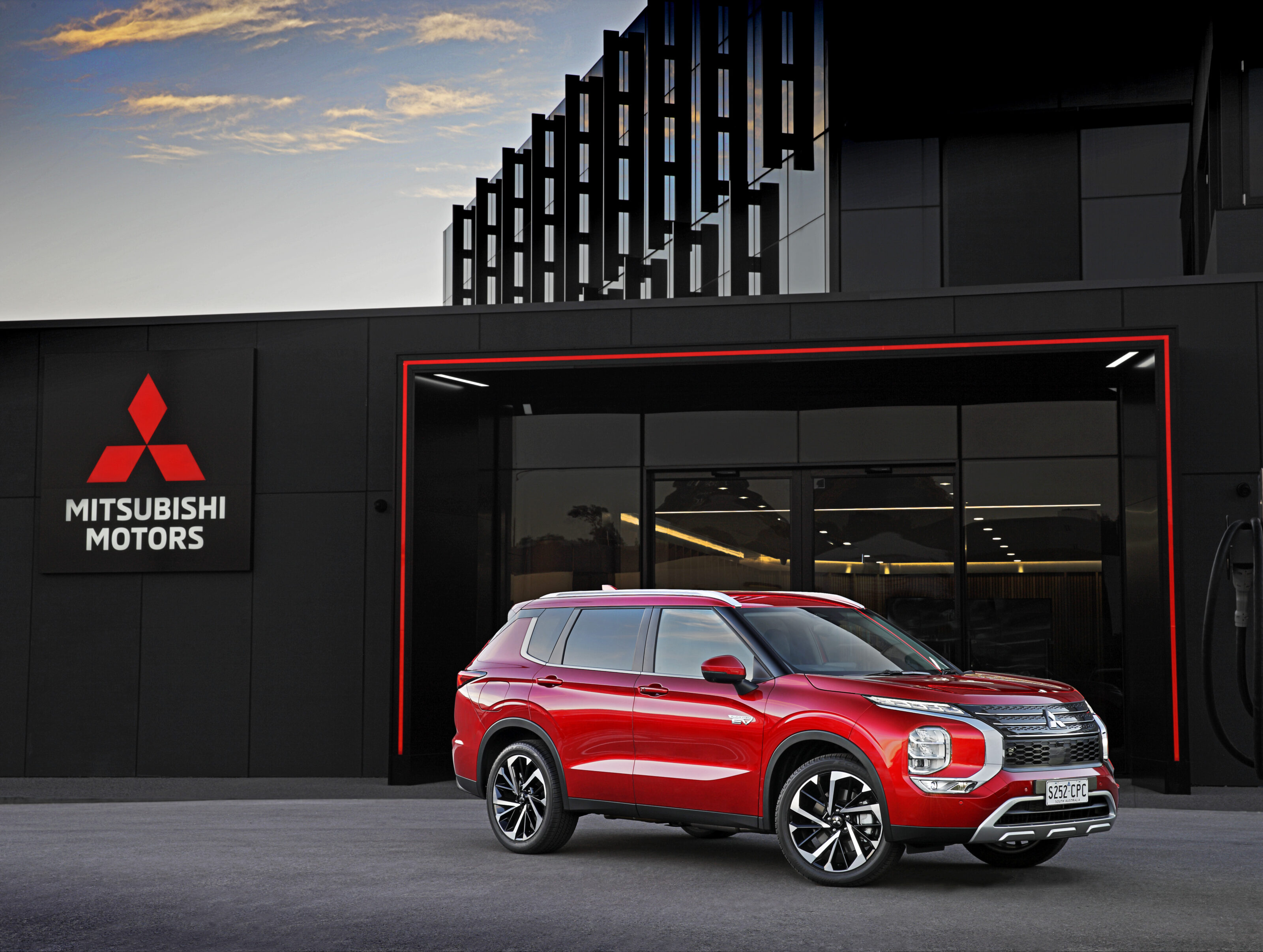
UPDATE: 2023 Mitsubishi Outlander PHEV scores minor update, price rises
The second-generation 2023 Mitsubishi Outlander PHEV has received its first update just months after it launched in Australia.
It mirrors revisions found on the petrol Outlander for model-year 2023, with minor specification changes, new safety technology, and price rises of up to $1500.
The entry-level ES now includes rear autonomous emergency braking (AEB), rear cross-traffic alert and automatic high beam.
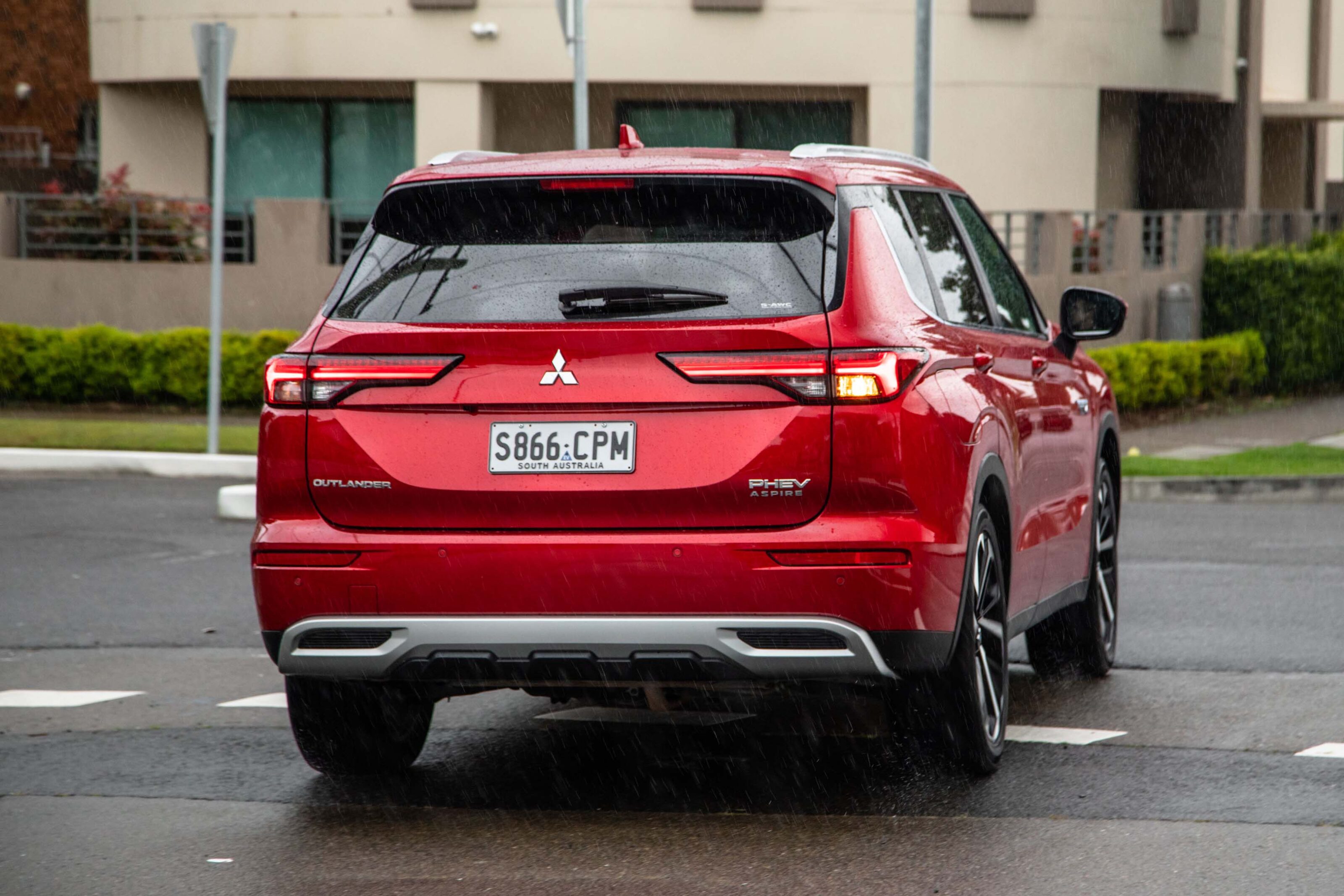
Across the range, there’s a ‘last memory’ function for its auto-hold electronic park brake, while the rear AEB system receives a trailer connection over-ride function to prevent the brakes from automatically engaging when attempting to reverse with a trailer attached.
Wheels has reached out to Mitsubishi Australia to see if a retrofit is available for current Outlander PHEV vehicles.
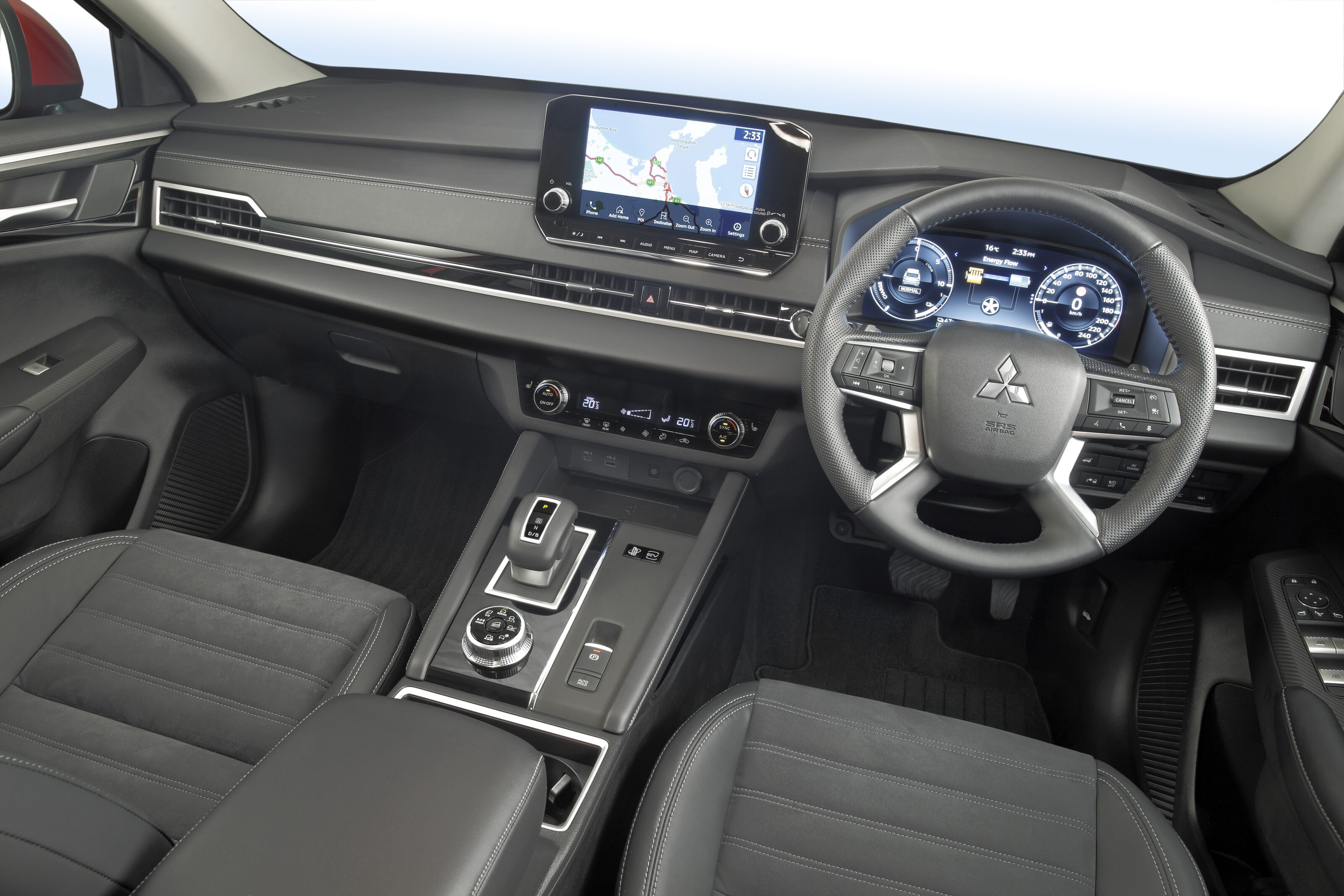
The highest price increase applies to the flagship Exceed and Exceed Tourer, which gain a heated steering wheel and sequential front indicators, while the Exceed Tourer features heated rear seats and additional two-tone paint finishes.
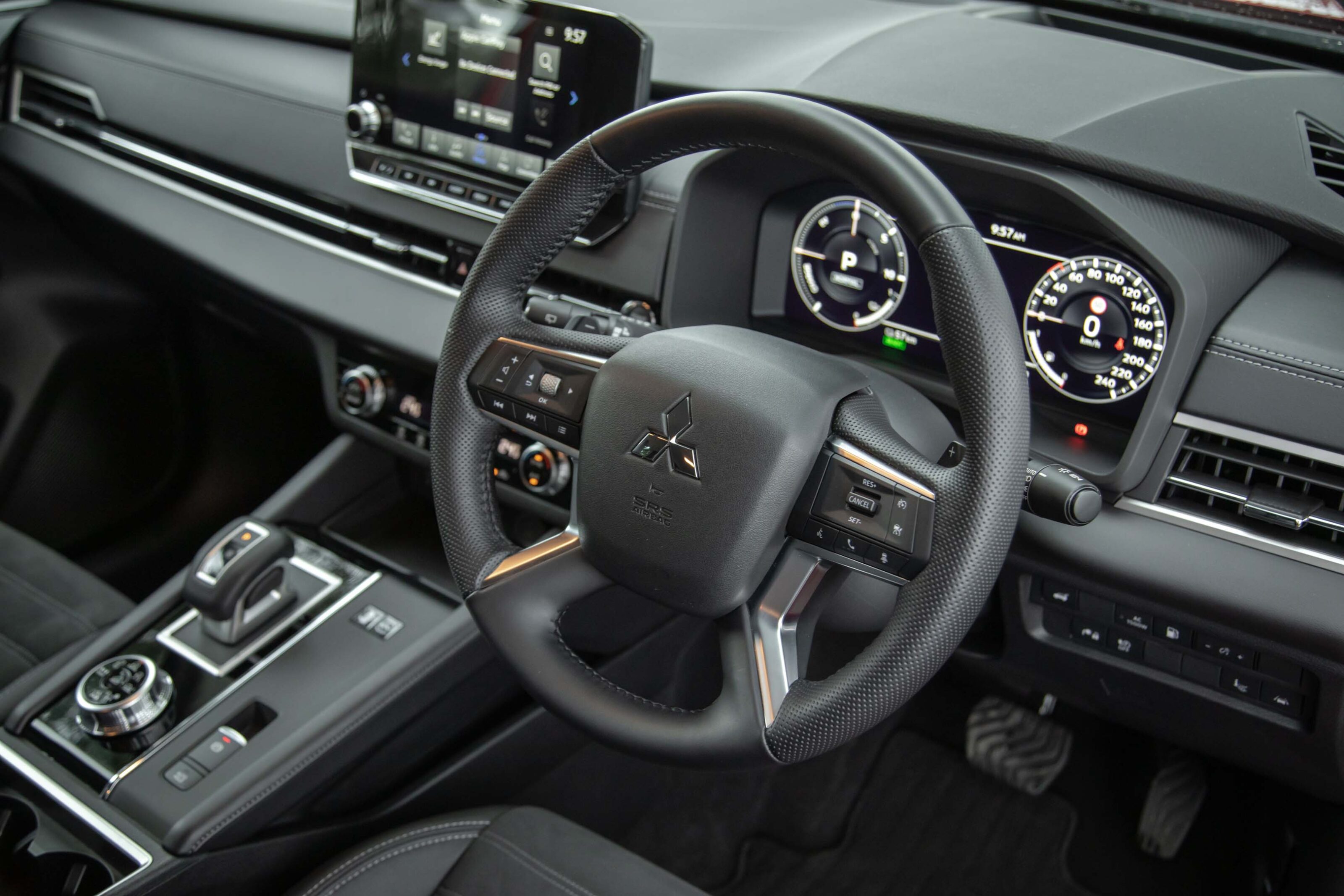
Both grades also now include the brand’s ‘Mi-Pilot’ driving system for semi-autonomous highway steering.
It works in conjunction with the existing adaptive cruise control and lane-keep assist to keep the vehicle within its lane at speeds above 60km/h, or under 60km/h if a vehicle is travelling in front.
The system also features traffic jam assist – allowing the adaptive cruise control to re-engage after coming to a complete stop – and an automatic speed limiter.
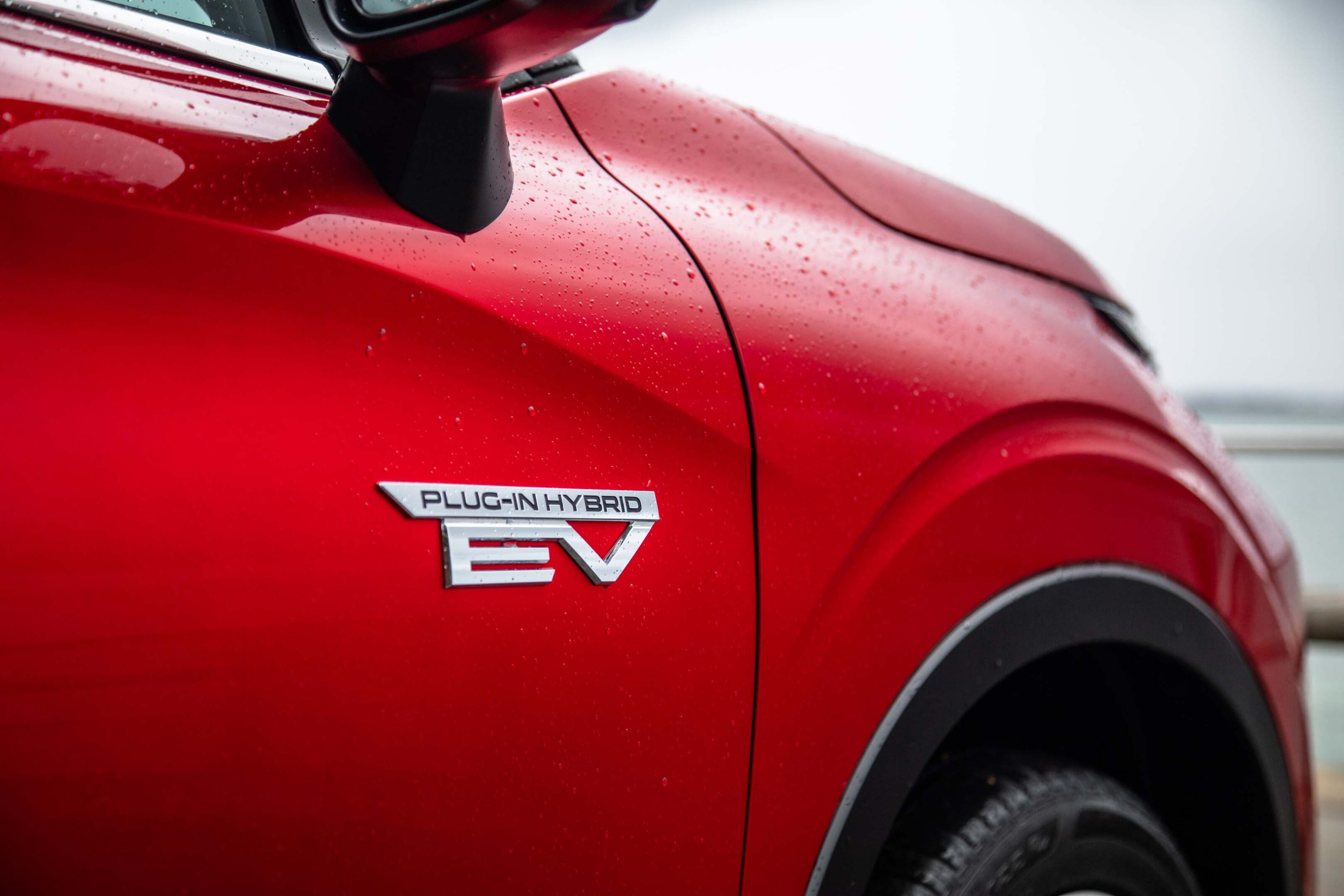
Due to the ongoing semiconductor chip shortage, the auto-tilt side mirror function has been deleted from the Exceed and Exceed Tourer.
The updated 2023 Mitsubishi Outlander PHEV is on sale now, with the first deliveries expected in January.
Our original story, below, has been updated to reflect the new information.
You can see our full first drive and video review of the Outlander PHEV at the link below.
JUMP AHEAD
- Outlander PHEV overview
- Pricing
- Features
- Colours
- Engine, drivetrain, and fuel economy
- Safety
- Warranty and servicing
- Availability
Snapshot
- New Outlander PHEV pricing revealed
- $17,000-plus premium over the standard Outlander
- First deliveries begin on August 15
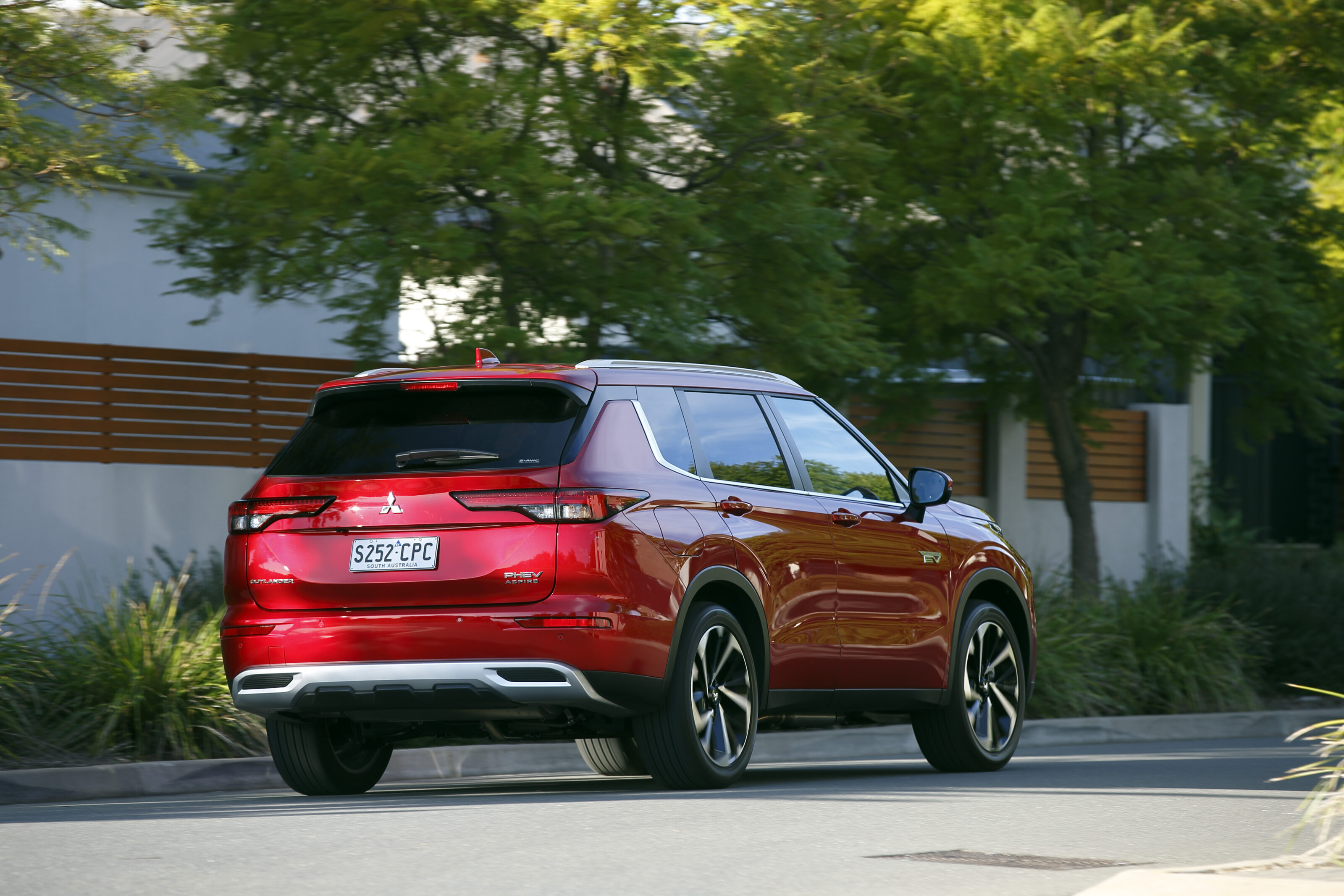
Pricing and features for the 2023 Mitsubishi Outlander PHEV have been confirmed just over a month before the electrified SUV arrives in dealerships.
Set to add an electrified variant to the existing, combustion engine-powered Outlander’s range, the new plug-in hybrid model will aim to put Mitsubishi at the top of Australia’s PHEV sales charts, leaning on the success of its outgoing model.
“Mitsubishi is proud of its pioneering plug-in hybrid EV heritage,” said Mitsubishi Motors Australia CEO, Shaun Westcott.
“With all-new Outlander signifying a significant shift in Mitsubishi’s design philosophy, it’s the perfect vehicle with which to showcase our continued leadership in the PHEV drivetrain space.
Pricing
As expected, the Outlander PHEV commands a hefty sum over its combustion-engine only counterpart, with the electrified model starting out at a $17,600 premium when comparing ES grades, setting the trend for all variants to be over $17,000 more than the standard offering.
Prices exclude on-road costs.
Features
ES
Aspire
Exceed
Exceed Tourer
Colours
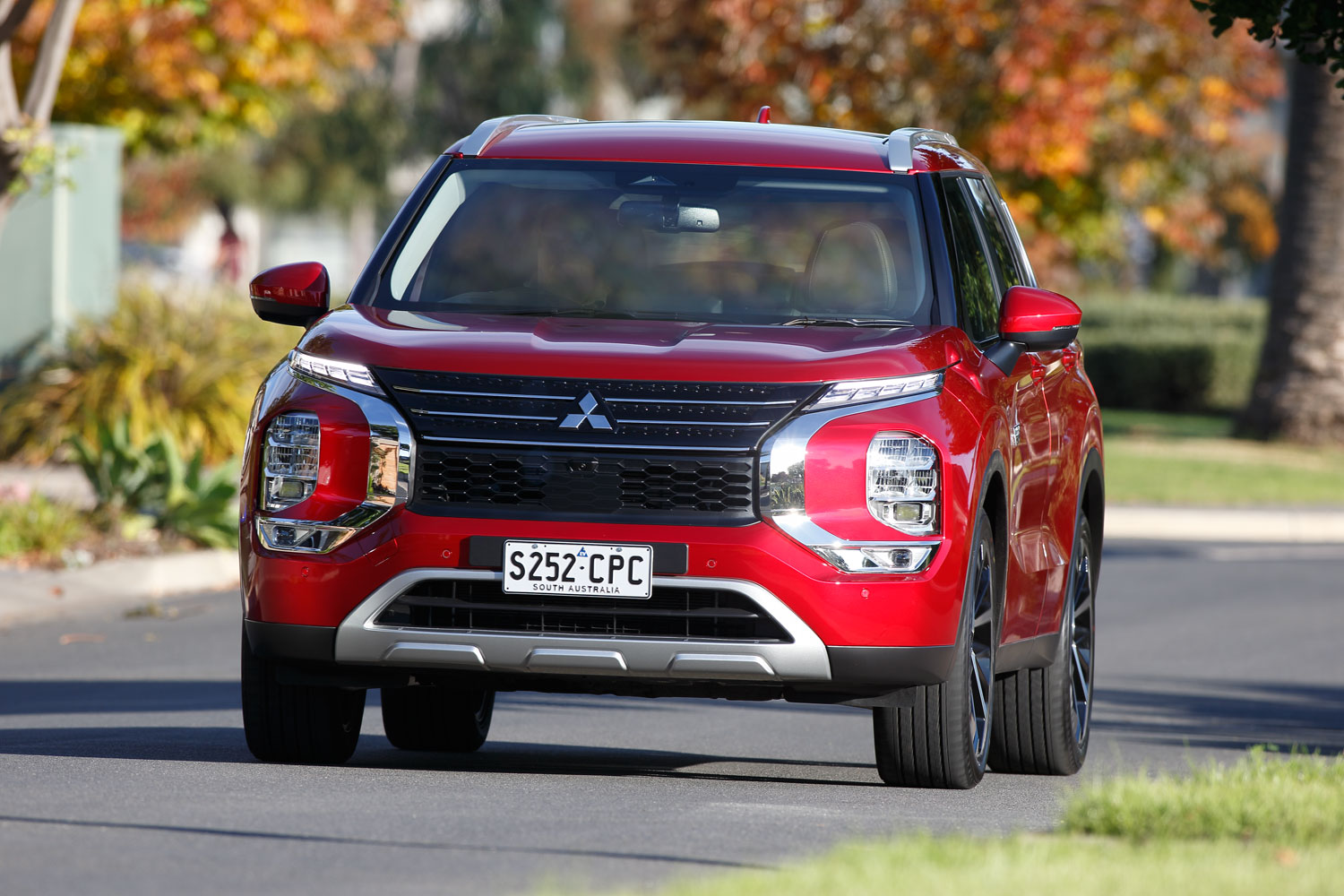
Metallic paint incurs a $740 premium (excluding Exceed Tourer).
A two-tone finish is standard on the Exceed Tourer, paired with black diamond (with a bronze roof), white diamond, sterling silver or titanium (with a black roof).
Engine, drivetrain, and fuel economy
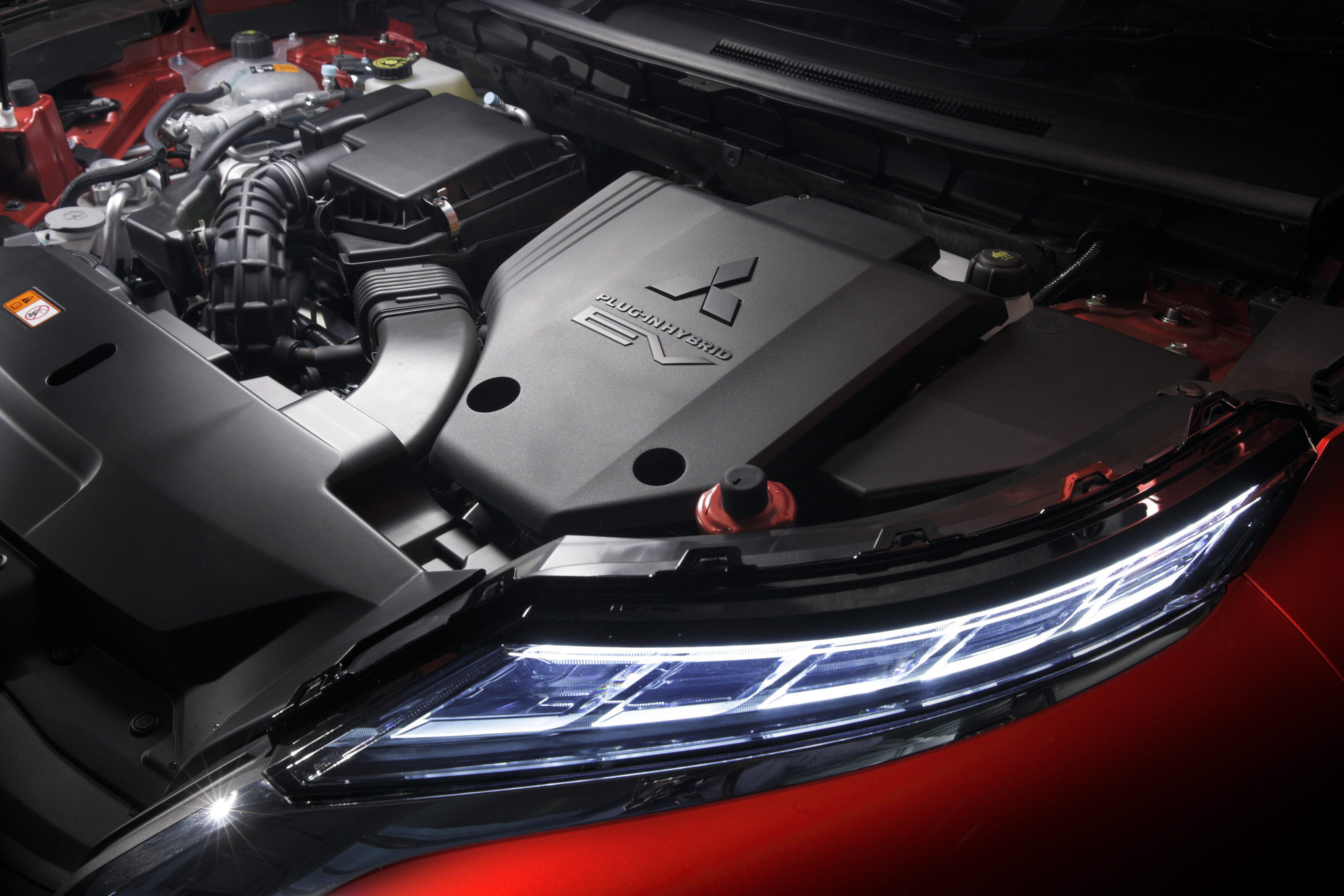
Powered by a 2.4-litre, Atkinson cycle petrol engine, the combustion unit provides peak power of 98kW (up from 94kW in its predecessor).
It is assisted by a pair of electric motors on the front and rear axles – now producing 85kW and 100kW respectively – for a total system output of 185kW and 450Nm.
While higher outputs usually mean lower range, Mitsubishi has equipped the latest Outlander PHEV with a 20kWh battery pack, increased by 45 per cent over the outgoing model’s 13.8kWh pack.
Along with a larger 56-litre fuel tank (up by 11 litres), the Outlander PHEV boasts a combined fuel consumption figure of 1.5L/100km.
The Outlander PHEV is also now able to run for up to 84km in its fully-electric mode on a single charge, 54 per cent longer than the car it replaces.
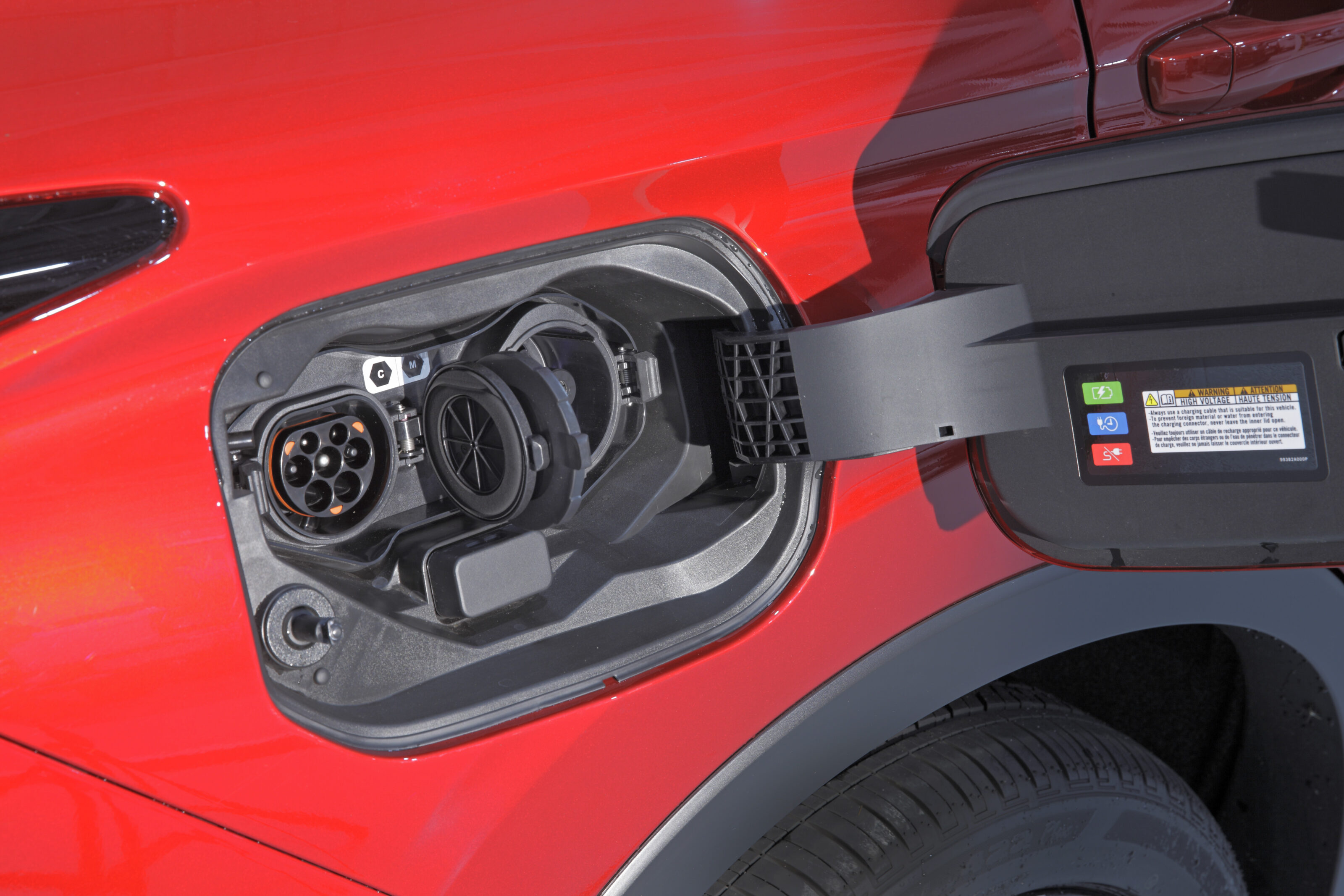
Three charging modes are available in the Outlander PHEV, depending on what facilities are available to its owners.
| Type | Parameters | Time |
| Mode 2 (240V AC domestic) | 0 u2013 100% charge | 12 hours |
| Mode 3 (240AV AC fast with EVSE) | 0 u2013 100% charge | 6.5 hours |
| Mode 4 (DC CHAdeMO) | 0 u2013 80% charge | 38 minutes |
Safety
All grades of the Outlander recently received a five-star ANCAP safety rating, owing to the high level of safety equipment fitted.
Warranty and servicing
As with the rest of Mitsubishi’s model range, the Outlander PHEV is covered by the brand’s base five-year/100,000-kilometre warranty, although owners may be eligible for its extended 10-year/200,000-kilometre warranty if all scheduled services have been completed through an authorised dealer.
The PHEV’s battery is covered by a separate eight-year/160,000-kilometre warranty which applies regardless of the extended offer.
In addition to this, 10-year capped price servicing is also included as well as one year of roadside assistance as standard, extending to four years when the service schedule is adhered to.
Availability
The 2023 Mitsubishi Outlander PHEV is on sale now.
November was a strong month for new car sales in Australia, with almost all leading brands posting good growth throughout the 30 days.
It was also another notable achievement for some of the Chinese players such as MG and GWM, that continued to take top 10 spots – knocking out more established rivals. Furthermore, another Chinese newcomer – electric vehicle maker BYD – entered the sales charts for the first time.
According to monthly results provided by the Federal Chamber of Automotive Industries (FCAI), it was a better November than last year, with 95,080 units registered compared to 80,639 this time in 2021 – albeit down on a COVID-19 struck 2020 in which 95,205 cars found homes.
It puts the market up 18 per cent for the month and 2.3 per cent up with 22,080 more vehicles sold year-to-date.
Though most leading brands posted positive results, Hyundai suffered the biggest mainstream loss at 20 per cent down, though Toyota and Mazda managed to swing things in the other direction up 32 and 43 per cent respectively during the period.
New South Wales sold the most vehicles with 29,545 units shifted, followed by Victoria with 25,534 and Queensland on 20,621.

“The automotive sector is continuing to recover from pandemic related shutdowns, a global shortage of microprocessors and the general supply chain uncertainty we experienced over the last two years,” FCAI Chief Executive Tony Weber said.
“The industry will deliver the one millionth vehicle to the market in 2022 next week. While this is positive news, many customers are still facing extended wait times for their vehicle, with expected delivery dates for some models beyond 12 months.”
Toyota continued to hold top spot among all the carmakers, with second place taken by Mazda and Ford rounding out the top three.
Top 10 models ?
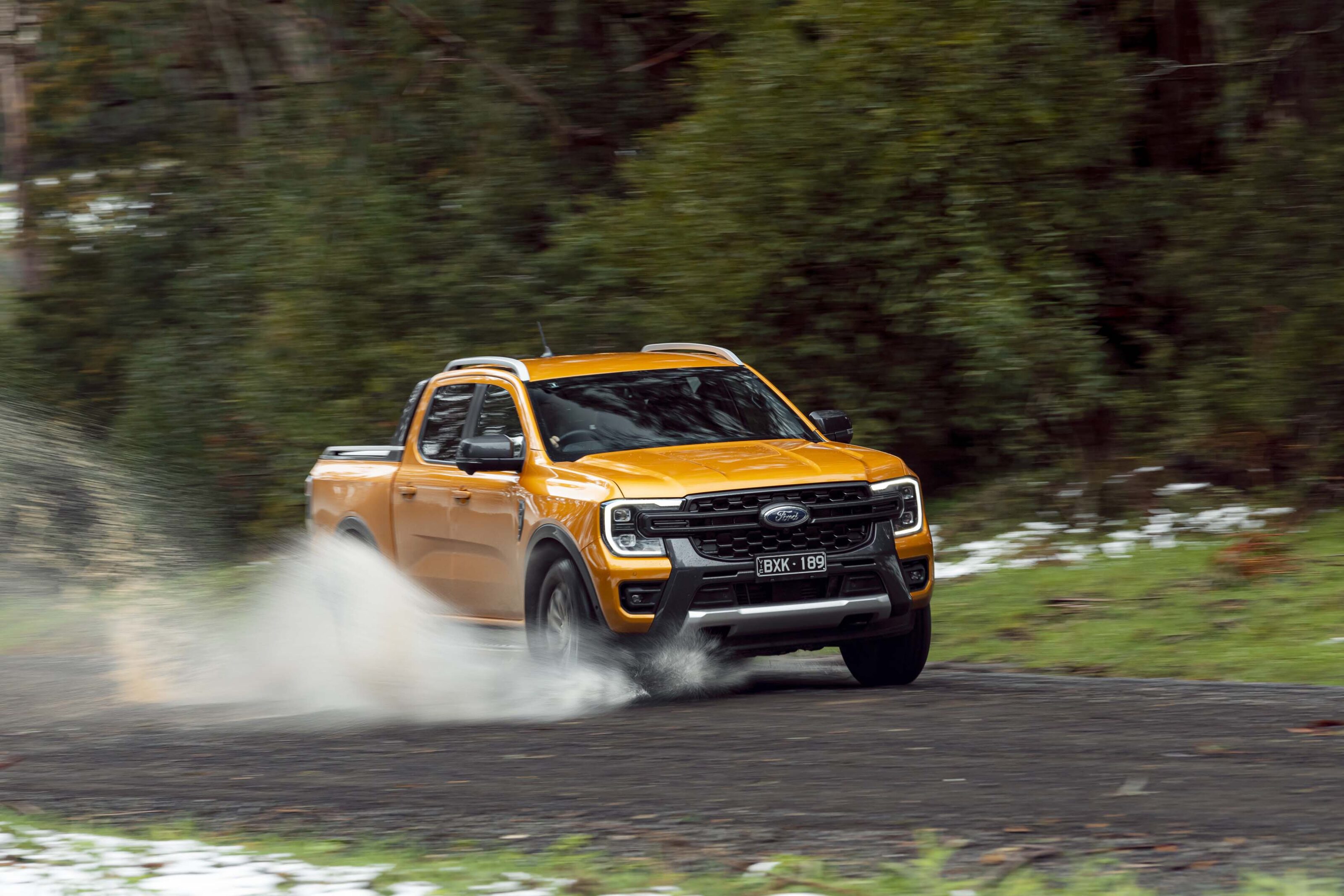
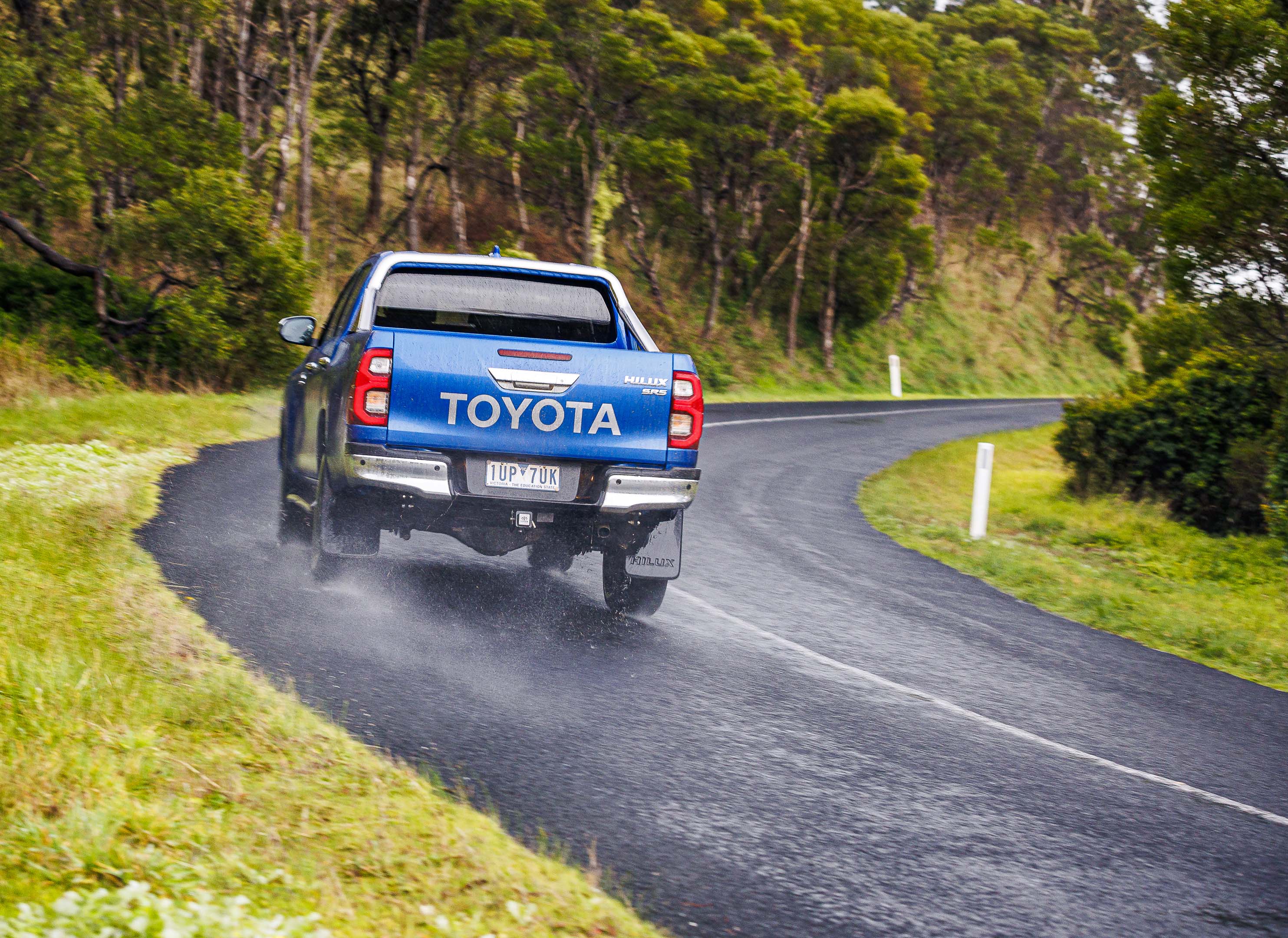
The Toyota HiLux ute climbed back onto the top spot with 5440 sold for November and 60,120 YTD.
Compared to its regular rival, the Ford Ranger, which dropped back to second place for the month with 5073 registrations in November – and came in second year-to-date with 42,816 sales.
However, November was a strange month in that only two utes appeared in the top 10 – with Isuzu’s D-Max just missing out with 1580 vehicles sold. Also absent was the Mitsubishi Triton with just 1498 shifted last month. Both made the top-10 year-to-date, in seventh and fourth place respectively.
Last month was a great one for the Corolla hatch/sedan taking third spot with 3732 sales notched up (up 77 per cent), and it also did fairly well YTD coming sixth with 23,441 cars sold (up 22 per cent).
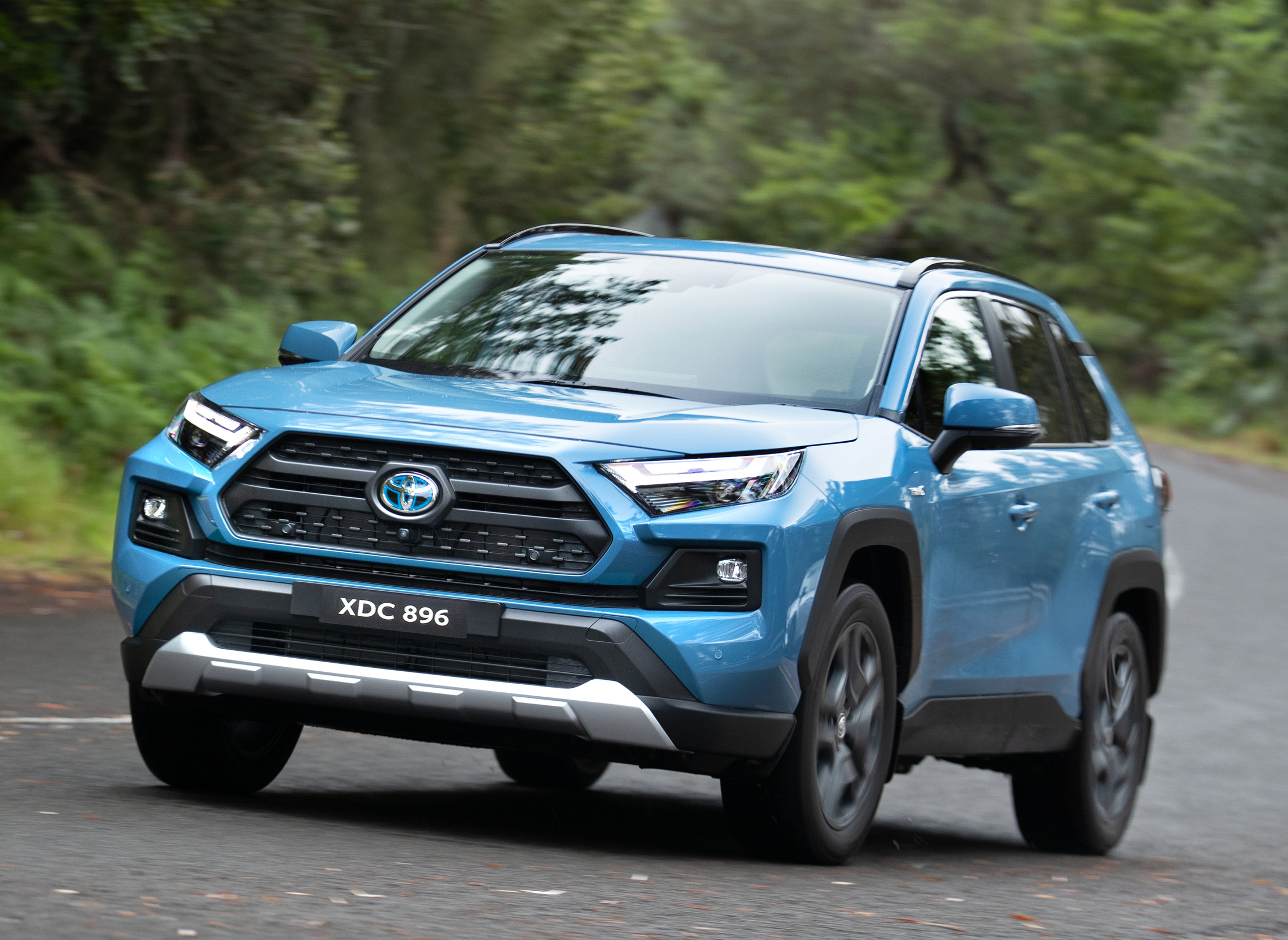
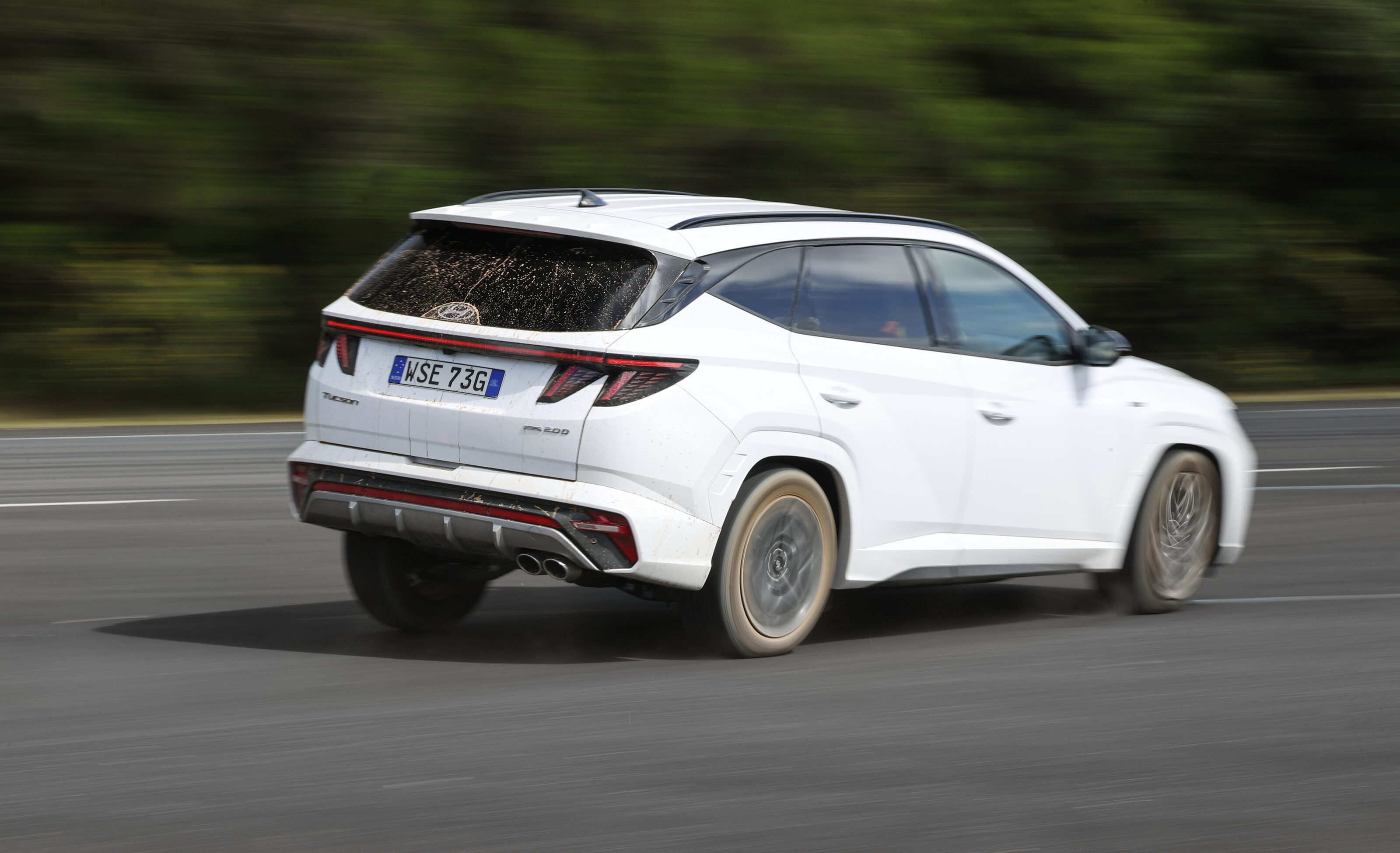
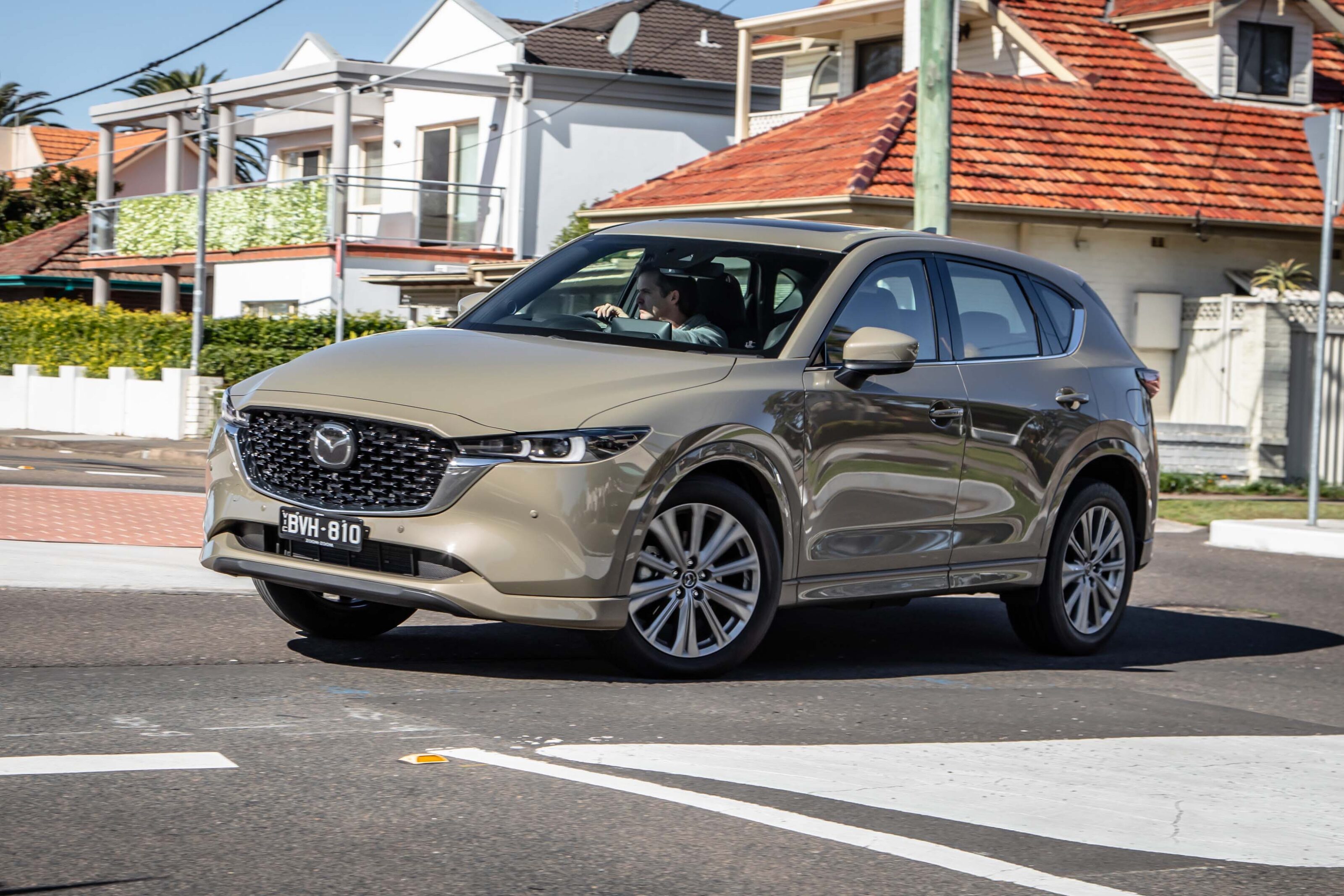
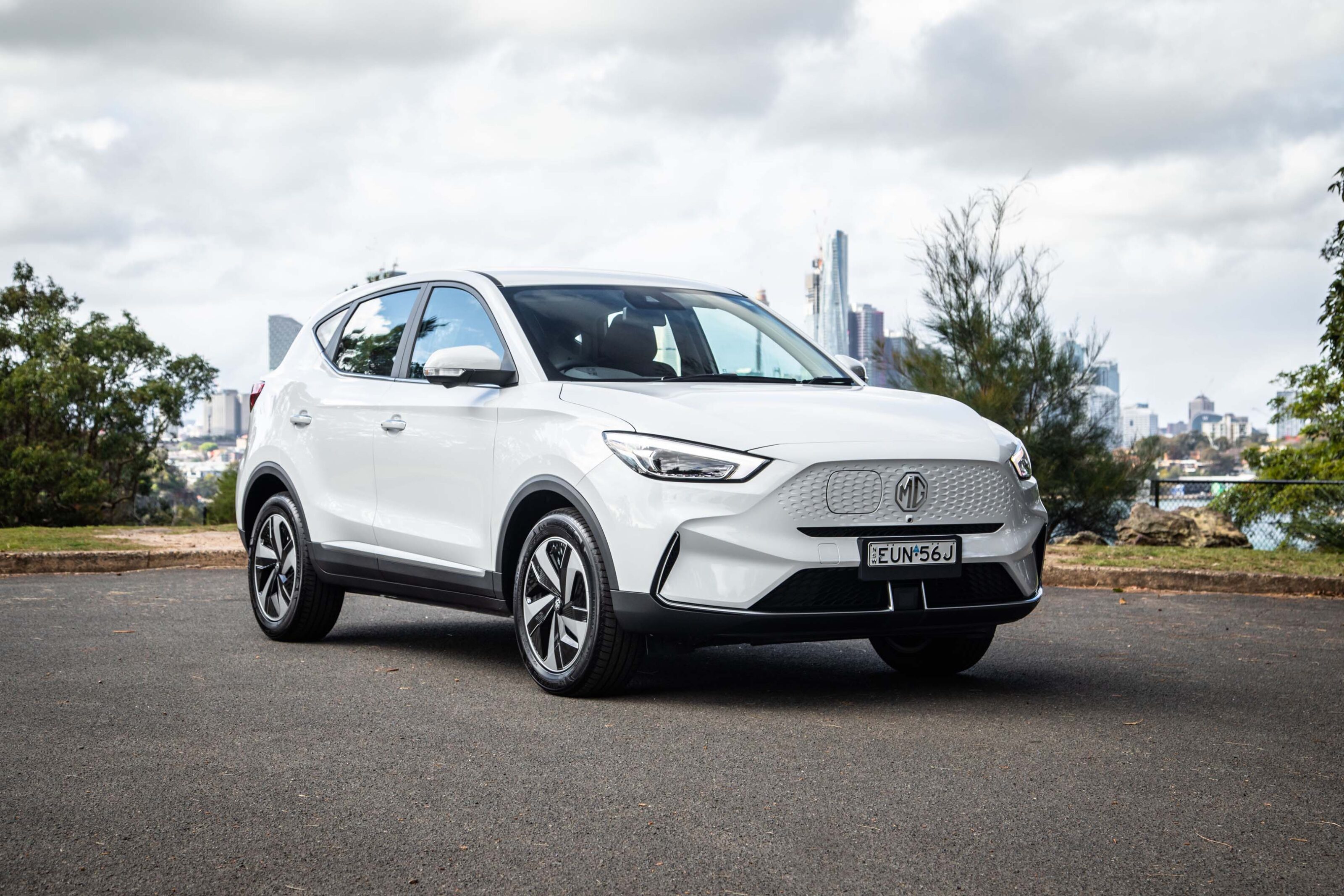
The Chinese-made MG ZS also played a blinder up 94 per cent, coming in fourth for November with 3051 units shifted and knocking several usual contenders such as the Toyota RAV4, Mazda CX-5 and Mitsubishi Outlander down the charts – with the trio filling out fifth, sixth and seventh on 2282, 1949 and 1875. YTD the ZS held a more typical tenth place with 19,410 sales (up 18 per cent).
Closely behind was another trio of medium SUVs: the Kia Sportage and Hyundai Tucson cousins, which are quickly cementing themselves as top-10 players, coming eighth and tenth with 1844 and 1734 shifted respectively with newcomer the Tesla Model Y sandwiched between with 1805.
For the year so far though all three were replaced in the charts by the Mitsubishi Triton and D-Max utes, as well as the Hyundai i30 sedan/hatch on 20,014 and Toyota Prado large SUV on 20,132.
Top 10 cars in Australia: November 2022
| Rank | Model | Sales | vs November 21 |
|---|---|---|---|
| 1 | Toyota Hilux | 5,440 | 29% |
| 2 | Ford Ranger | 5,073 | 15% |
| 3 | Toyota Corolla | 3,732 | 77% |
| 4 | MG ZS | 3,051 | 94% |
| 5 | Toyota RAV4 | 2,282 | 25% |
| 6 | Mazda CX-5 | 1,949 | 147% |
| 7 | Mitsubishi Outlander | 1,875 | 15% |
| 8 | Kia Sportage | 1,844 | 169% |
| 9 | Tesla Model Y | 1,805 | 0% |
| 10 | Hyundai Tucson | 1,734 | 13% |
Top 10 cars in Australia: YTD 2022
| Rank | Model | Sales | vs YTD 21 |
|---|---|---|---|
| 1 | Toyota Hilux | 60,120 | 23% |
| 2 | Ford Ranger | 42,816 | -7% |
| 3 | Toyota RAV4 | 32,652 | 0% |
| 4 | Mitsubishi Triton | 26,382 | 51% |
| 5 | Mazda CX-5 | 25,425 | 11% |
| 6 | Toyota Corolla | 23,441 | -15% |
| 7 | Isuzu D-Max | 22775 | -1% |
| 8 | Toyota Prado | 20,132 | 5% |
| 9 | Hyundai i30 | 20,014 | -14% |
| 10 | MG ZS | 19,410 | 18% |
Top 10 car brands ?
November was a better month for the market’s leader Toyota, with 20,107 sales, up 32 per cent compared to this time last year. Year-to-date it has notched up 214,776 units.
Mazda has jumped back into its traditional second place after a few months falling down the charts with 7549 units sold last month (up 43 per cent) but down year-to-date with 87,218 cars shifted and a seven per cent loss.
In another turn of events, Ford found third place thanks to 7165 of its vehicles finding homes, putting Korean firms Kia and Hyundai further down the rankings than we’ve seen in recent months on fourth and sixth respectively with 6120 sales but still up 25 per cent on last November for Kia and 5519 for sister Hyundai, though down 20 per cent – with Japanese Mitsubishi nestled in between with 5559 sold and a slight dip of three per cent for the month.
For 2022 so far the picture looks a little different, with the Asian trio rising to third, fourth and fifth and knocking Ford back down to sixth having sold 60,463 vehicles compared to Kia’s 72,700, Mitsubishi’s 72,064 and Hyundai’s 68,911.
There were successes for Chinese brands too as MG held its seventh position for the year both for the month and year-to-date with 5497 registrations (up 47 per cent) in November and 44,388 for the year (up 24 per cent), and GWM again appeared in the top 10 sitting in tenth place with 2914 sales last month, up 48 per cent. It was knocked out of the charts for the year though by more traditional players such as Isuzu Ute (32,818) and Mercedes-Benz (29,219) compared to its 21,747 cars sold.
Subaru also made the cut for November in eighth with 3701 units sold (but down seven per cent), and for the year came ninth selling 31,965 vehicles, joined at the lower end of the top 10 by Volkswagen on 3045 cars (down two per cent). Volkswagen was pushed out of the yearly chart though with its 27,887 sales not enough to get it over the line. Also missing was Nissan only shifting 23,951 vehicles for 2022 to date.
Top 10 brands: November 2022
| Rank | Model | Sales | vs November 21 |
|---|---|---|---|
| 1 | Toyota | 20,107 | 32% |
| 2 | Mazda | 7,549 | 43% |
| 3 | Ford | 7,165 | 15% |
| 4 | Kia | 6,120 | 25% |
| 5 | Mitsubishi | 5,559 | -3% |
| 6 | Hyundai | 5,519 | -20% |
| 7 | MG | 5,497 | 47% |
| 8 | Subaru | 3,701 | 37% |
| 9 | Volkswagen | 3,045 | -2% |
| 10 | GWM | 2,914 | 48% |
Top 10 brands: YTD 2022
| Rank | Model | Sales | vs YTD 21 |
|---|---|---|---|
| 1 | Toyota | 214,776 | 4% |
| 2 | Mazda | 87,218 | -7% |
| 3 | Kia | 72,700 | 15% |
| 4 | Mitsubishi | 72,064 | 16% |
| 5 | Hyundai | 68,911 | 3% |
| 6 | Ford | 60,463 | -8% |
| 7 | MG | 44,388 | 24% |
| 8 | Isuzu Ute | 32,818 | 0% |
| 9 | Subaru | 31,965 | -7% |
| 10 | Mercedes-Benz Cars | 29,219 | -5% |
Ups and downs ? ?
Outside the top 10, Fiat (down 93 per cent) and Nissan (down 51 per cent) were the biggest strugglers among mainstream brands.
Successes came for other household names though, with Chevrolet (up 58 per cent), Ram (up 80 per cent), Ssangyong (up 70 per cent) and Volvo (up 59 per cent) all posting large increases in November.

Segments
Unusually, utes were not the country’s most popular vehicle type again last month when combining 4×4 and 4×2 variants, with the former accounting for 16,939 units of a 19,423 total.
There were 20,274 medium SUVs that left showrooms compared to 13,967 in November 2021.
All SUV categories posted growth last month – and the overall SUV share of the market also grew by 32 per cent for the month and seven per cent YTD. Total SUV sales sat at 52,395 for November and 525,537 for 2022 so far (versus 491,351 this time in 2021). For the year so far, medium SUVs and upper large SUVs increased the most by 45 and 251 per cent.

Light-commercial vehicles also increased its share by six per cent in November and 1.5 per cent YTD, again at the expense of passenger cars that were down one per cent of the market last month and nine per cent YTD.
Micro, medium, upper large and people-mover cars were all down by 53, 0.4, 38 and 17 per cent respectively for the 30 day period.
Meanwhile, light, small, large, and sports cars were all up by nine, four, 22 and nine per cent in that order for the month.
Comparatively, year-to-date all these categories experienced decline with the exception of medium, large cars and people-movers, which were all up by six, 22 and nine per cent.
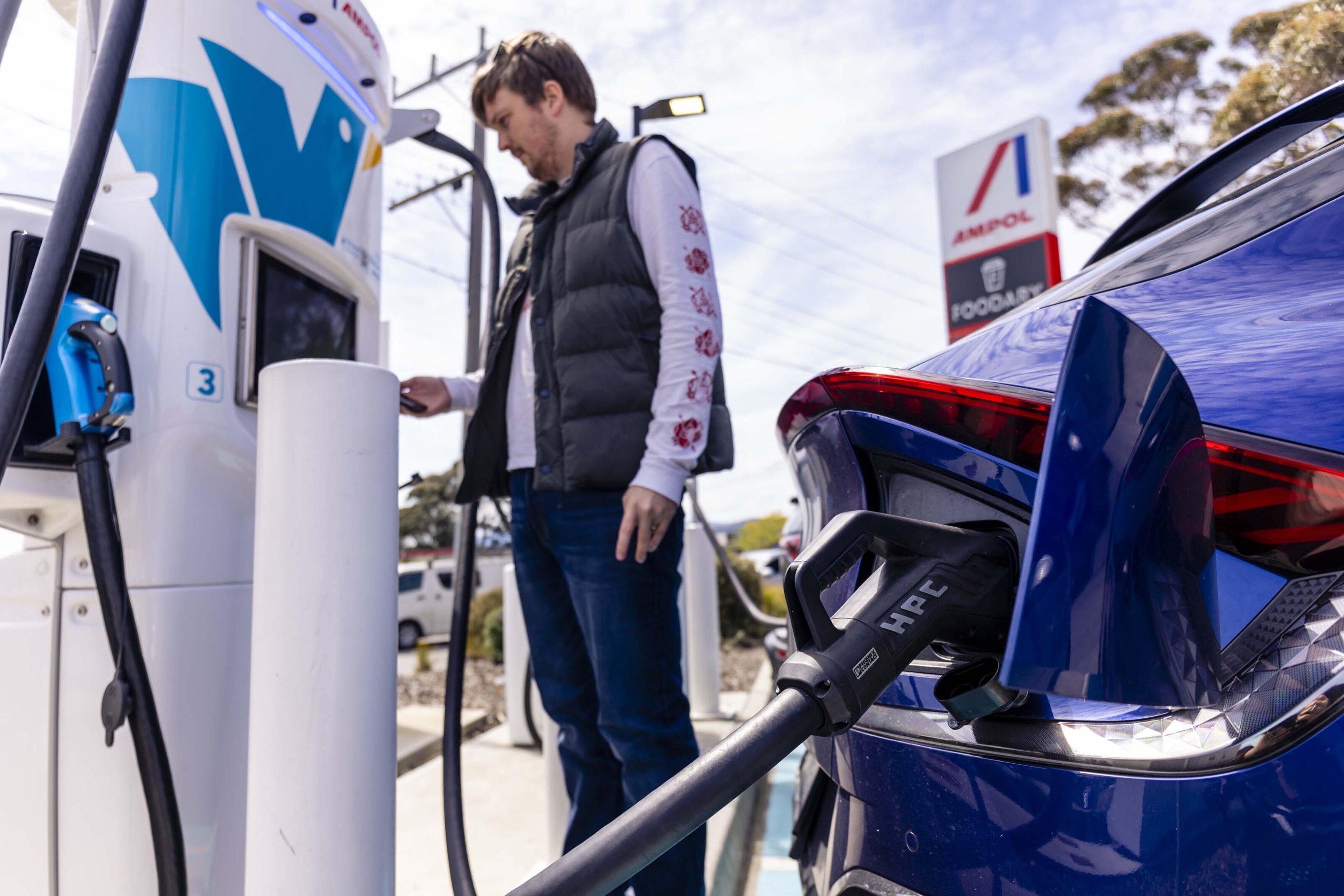
Though not their best month this year by a way, there were still 4457 electric vehicles sold compared to 568 in November 2021 and 28,326 for 2022 so far – increases of 685 and 516 per cent. Almost 850 of those came from new entrant the BYD Atto 3, while Tesla sold 391 examples of the Model 3 and 1805 of the Model Y. Polestar by comparison shifted just 240 of its Polestar 2 sedans last month.
The number of hybrids increased too from 4983 this time last year to 8529 last month, a rise of 71 per cent for the month, and a 16 per cent increase for the year-to-date. Plug-in hybrid numbers were also up a tad by three per cent with 429 sold in November and 5477 for 2022 (compared to 415 in November last year and 3054 this time in 2021).
Fluctuating petrol prices are partly responsible, though state-based incentives and greater interest and investment from the new Federal Government are also likely to have played a part throughout the last 11 months.

In charts ?
November 2022 – Top 10 models
November – Top 10 brands
November 2022 – Overall segment sales
November 2022-2021 category sales
November 2022-2021 category YTD sales
2022 Sales race
November 2022 Australian sales map
November 2022 buyer type
UPDATE: New story, ‘How much more expensive are EVs?’
In addition to this story, we’ve produced a new guide titled ‘How much more expensive are electric vehicles?’, to help you get a clear picture of why EVs cost more than equivalent petrol, diesel and hybrid cars.
You can read that story at the link below, or continue reading this guide!
September 2019: How bad is EV depreciation? Do EVs keep their value?
It’s no secret that the biggest financial hit a new car buyer endures is depreciation, with roughly half of a car’s retail value evaporating after a mere three years of ownership on average… if you’re lucky.
Lately, depreciation has been flagged as a big hurdle for electric vehicle uptake – which is only natural, given the price differential between an EV and a comparably-sized combustion vehicle is on the order of tens of thousands of dollars – but does that mean going electric is setting you up for more economic hardship than normal when time comes to sell?
The short answer is “no, not really”. Here’s why.?
The big picture
If you were to graph three-year retained values of all cars in Australia, the fattest part of the bell curve would be slightly above the 50 percent mark*. Believe it or not, a car that clings on to anything north of 52 percent of its original value can be considered an above-average performer.
And that’s where you’ll find the vast majority of the pure electric vehicles and plug-in hybrids currently on sale in Australia. In terms of their ability to hang onto their value, they actually don’t do so badly.
Except for the Mitsubishi Outlander PHEV.
Pity the Outlander (NOTE: This paragraph references the first-gen Outlander PHEV). Despite being the first mainstream plug-in hybrid vehicle in Australia – and one based on a volume-selling SUV – the electron-munching Mitsubishi only holds on to 42 percent of its value after three years. That’s a poor result, one that’s on the same level as a Tata Xenon, Haval H2 or, get this, a BMW M5. It’s also well under what other combustion-engined Outlander variants achieve, despite its ability to travel for up to 54km on dirt-cheap electricity.
But it’s an outlier.
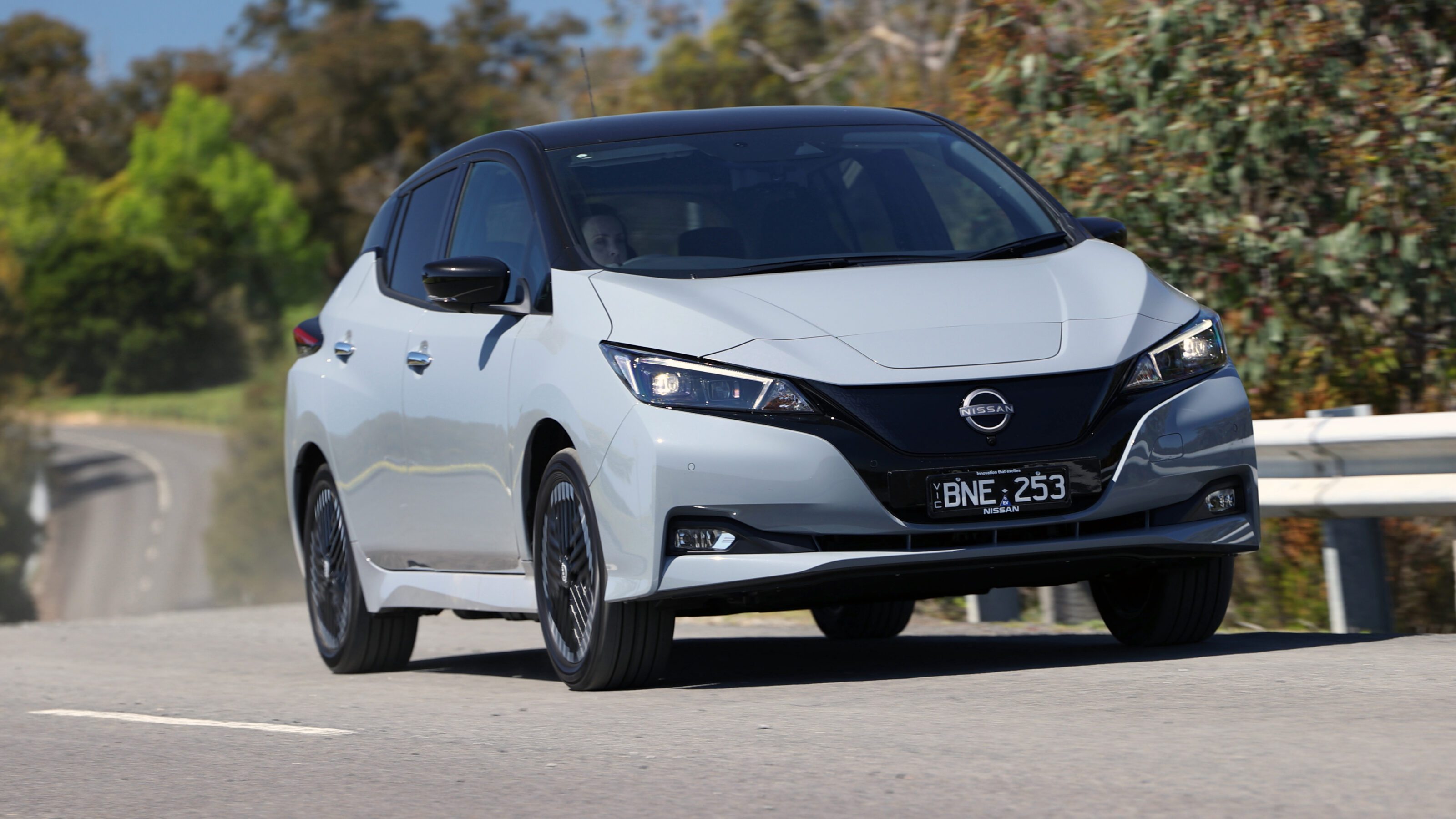
The Nissan Leaf is the next lowest on the retained value totem, but its 51 percent score isn’t quite as dire as the Outlander PHEV’s. The BMW i3 and Renault Zoe each return 53 percent to their owners after three years, and the Hyundai Ioniq achieves 54 percent. This group of battery-electrics are right in the ‘average’ part of the retained value spectrum – not amazing, but certainly not terrible.
Things get interesting from here. The Hyundai Kona Electric is hugely expensive for a small SUV, retailing just shy of $60K, yet it hangs on to 55 percent of its original price at the 36-month mark. That’s still a significant amount of money to wave goodbye to, but consider this: a Toyota Kluger GXL AWD – which is almost identically priced – retains 56 percent of its value, yet that depreciation hit doesn’t deter the thousands of Australians who’ve made the Kluger one of Australia’s most popular new cars.
So if an electric car depreciates at the same rate as a large SUV from one of Australia’s most trusted brands – and one that traditionally performs better than most when it comes to retained value – saying that depreciation is a big downside of EV ownership is flawed. Depreciation is the big downside of buying any new car, and EVs are no exception. Generally speaking, they perform no better or worse than other similarly-priced cars as far as value retention is concerned.
There are some other interesting takeaways here too. While Tesla is the brand most people associate with EVS, and one that’s quite high on the desirability index, the Tesla Model S scores the same as the Kona Electric: 55 percent. The Model 3 fares better with 57/58 percent depending on variant (though it’s so new to the Aussie market that those numbers may shift), but it’s the Model X that’s a more solid performer with a score of 63 percent.
That’s a great result for the Model X, and one that makes it one of the most depreciation-resistant cars in the country.
Jaguar’s I-Pace is slightly behind it with a still-respectable 61 percent (as is Volvo’s plug-in hybrid XC60 T8), while the bigger XC90 T8 is another strong performer with 63 percent. The message is clear: if you want to buy an EV that’s as close to depreciation-proof as possible, make it a big SUV… but not an Outlander PHEV.
Things could be better
So sure, you could buy a bigger conventional vehicle for the same amount of money that you’d spend on pretty much any given electric car, but in most cases you’ll lose the same amount of money when it comes time to sell up.
Don’t let depreciation dissuade you if you’ve decided to go electric and can afford to do so. If you’re just after the most metal for your money, EVs are not for you.
However, looking at retained values of EVs in Europe will make you weep. The Model S retains nearly 61 percent of original value over there, while the Hyundai Ioniq Electric does even better with 61.7 percent. Nissan Leaf? 64.5 percent. No wonder it’s one of Europe’s most favoured electric cars.
The Model X also scores 64 percent, while the I-Pace is the best-performing pure electric of them all, with a huge 74.6 percent retained value after three years. In Australia, the highest-scoring car according to industry data is the Mercedes-Benz C200 with 73 percent.
Why do they do so well? With EVs receiving a lot of support from European governments in the form of lower taxation, reduced/removed congestion charges, and other incentives, it’s no surprise that electric cars are a more enticing prospect on the used car market over there. Unless those measures get picked up over here, EVs in Australia will likely remain on fairly similar pegging in the depreciation stakes compared to other similarly-priced cars .
*Note that these retained value figures, provided to us by industry monitor Glass’ Guide, are intended more as guidelines for trade-in pricing, not necessarily what some owners might get if they were to sell their three-year-old car on the private market. By the same token, the prices you might see in classified ads aren’t necessarily a reflection of actual market value – just what that owner is willing to let their car go for.
The important thing is that the numbers are assessed using a consistent methodology, meaning we get an accurate idea of which cars and brands do better on the used car market.
More EV stories to help you choose the best car for your needs
Kia offers 11 permutations of its Sorento large SUV, from S petrol V6 front-driver with cloth seats and 8.0-inch touchscreen to GT-Line AWD PHEV with quilted leather upholstery and a huge digital driver’s display.
The latest addition is a hybrid which, like the PHEV, is available only in range-topping GT-Line trim with front- or all-wheel drive.
Combining a 1.6-litre turbo-petrol four-cylinder with a gearbox-mounted electric motor, the Sorento hybrid AWD promises combined fuel consumption of 5.8L/100km, mildly better than the diesel, but with far fewer particulate emissions.
And right now, with no true seven-seat electric SUV options in Australia, various flavours of hybrid represent the only game in town for your low-CO2 family hauler. Unfortunately, Kia is only able to secure a handful – around 20 – Sorento hybrids for the Australian market each month.
Here’s the question, then: Is the Sorento GT-Line AWD hybrid worth the predicted 12-month wait over the 10 other Sorento variants?
JUMP AHEAD
- How much is it, and what do you get?
- How do rivals compare on value?
- Interior comfort, space and storage
- What is it like to drive?
- How is it on fuel?
- How safe is it?
- Warranty and running costs
- VERDICT
- Specifications
- Full Sorento price list
How much is it, and what do you get?
The basics
| Body | 5-door, 7-seat large SUV |
|---|---|
| Drive | all-wheel |
| Engine | 1.6-litre four-cylinder turbo-petrol |
| Motor | 44kW/264Nm |
| Transmission | 6-speed torque-converter auto |
| Power | 169kW |
| Torque | 350Nm |
| Fuel consumption (tested) | 7.1 litres per 100km (91 RON) |
| Boot space | 179/608/1966 litres |
| Price | $69,750 + on-road costs |
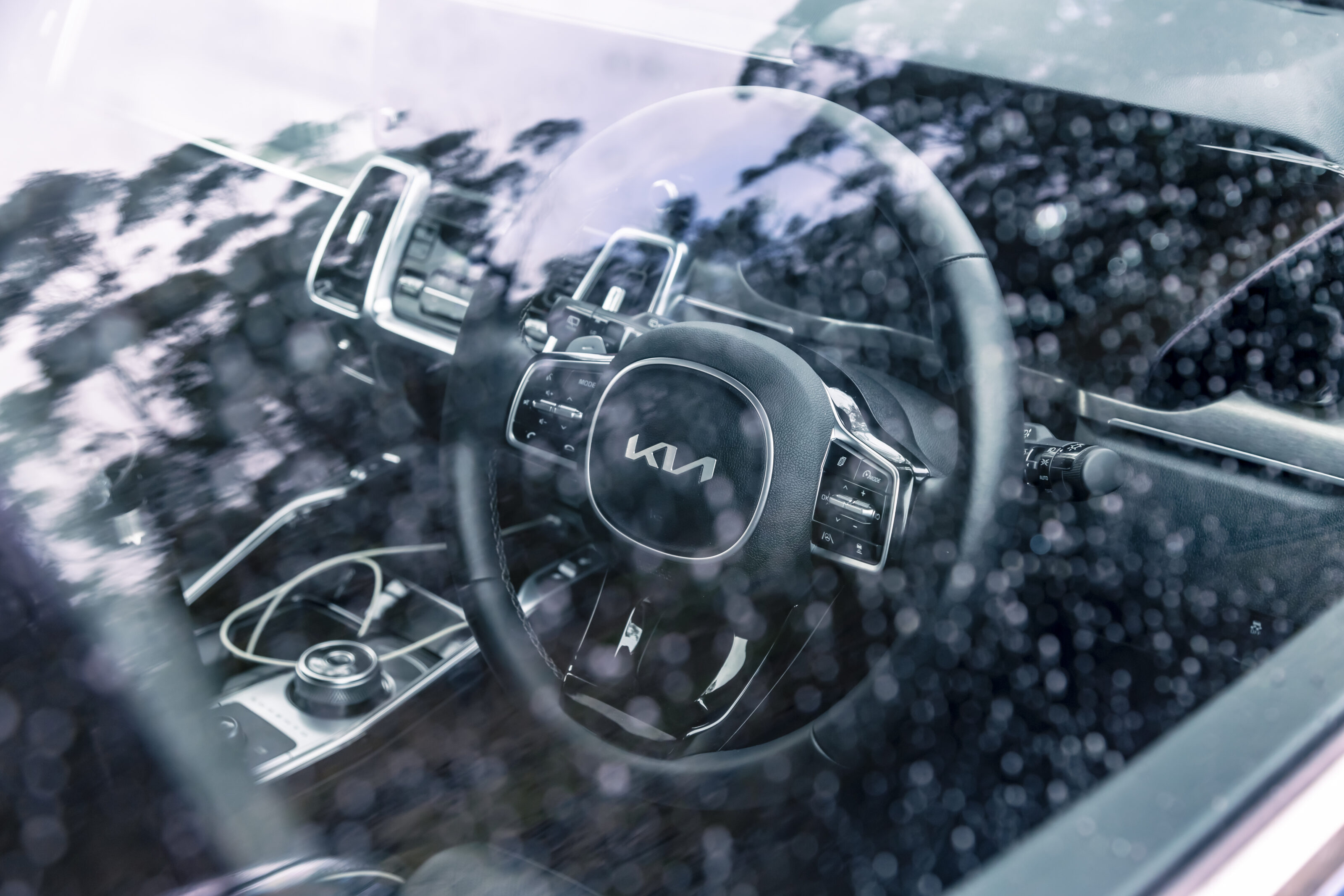
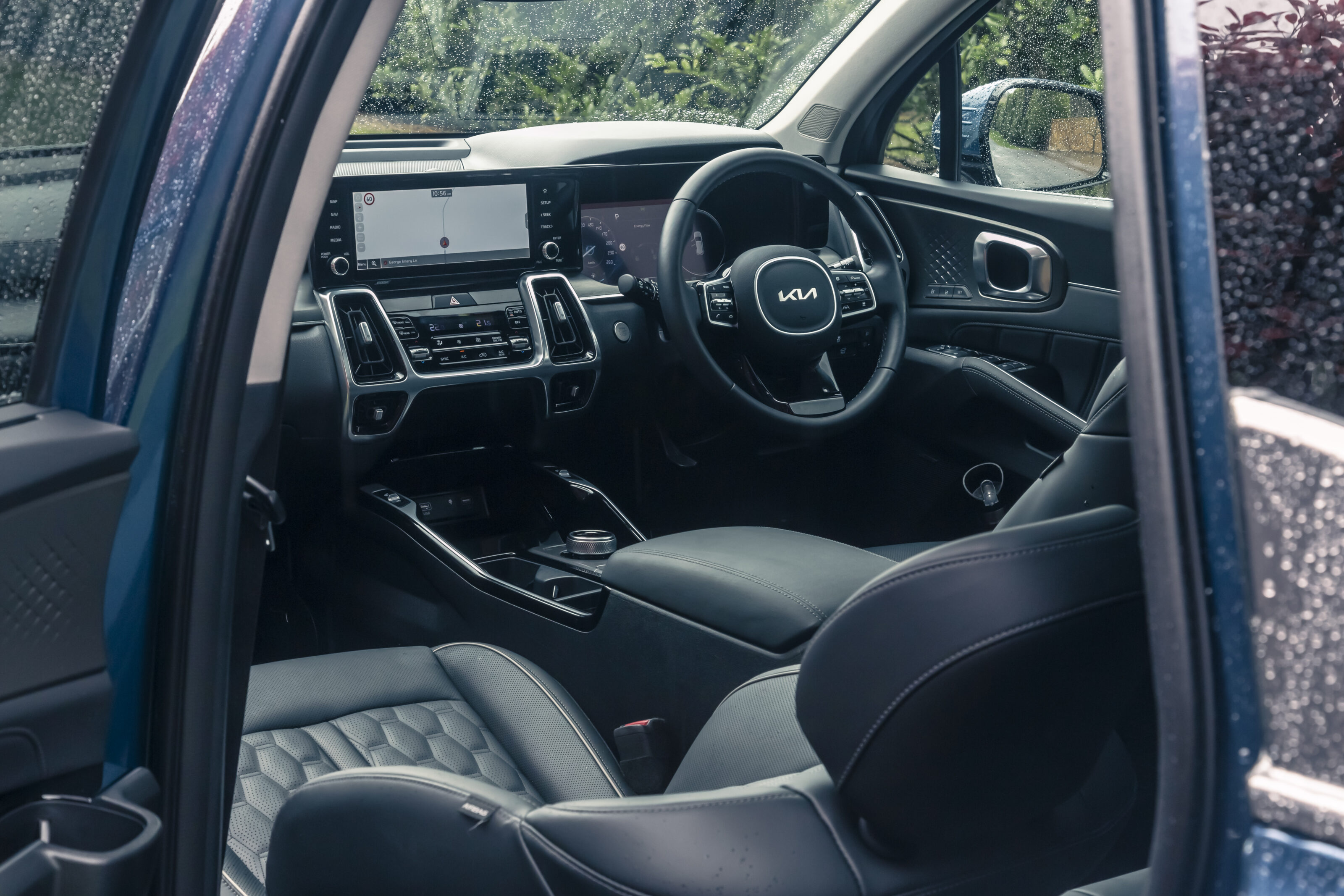
The GT-Line hybrid isn’t cheap, starting at $66,750 before on-road costs, but you do get an awful lot for your money with Kia’s Sorento – it feels like a budget Range Rover, in the best way possible.
You can spend a little more by going for the all-wheel drive hybrid as tested here, which gets the same outputs for $3K more. Aside from hybrid power, you can cut the purchase price by grabbing a $68,990 (drive-away) diesel-powered GT-Line or front-drive petrol V6 for $65,990 drive-away.
Regardless of powertrain, the GT-Line gets classy quilted leather upholstery, and 14-way power adjustable front seats with heating, cooling and memory functions.
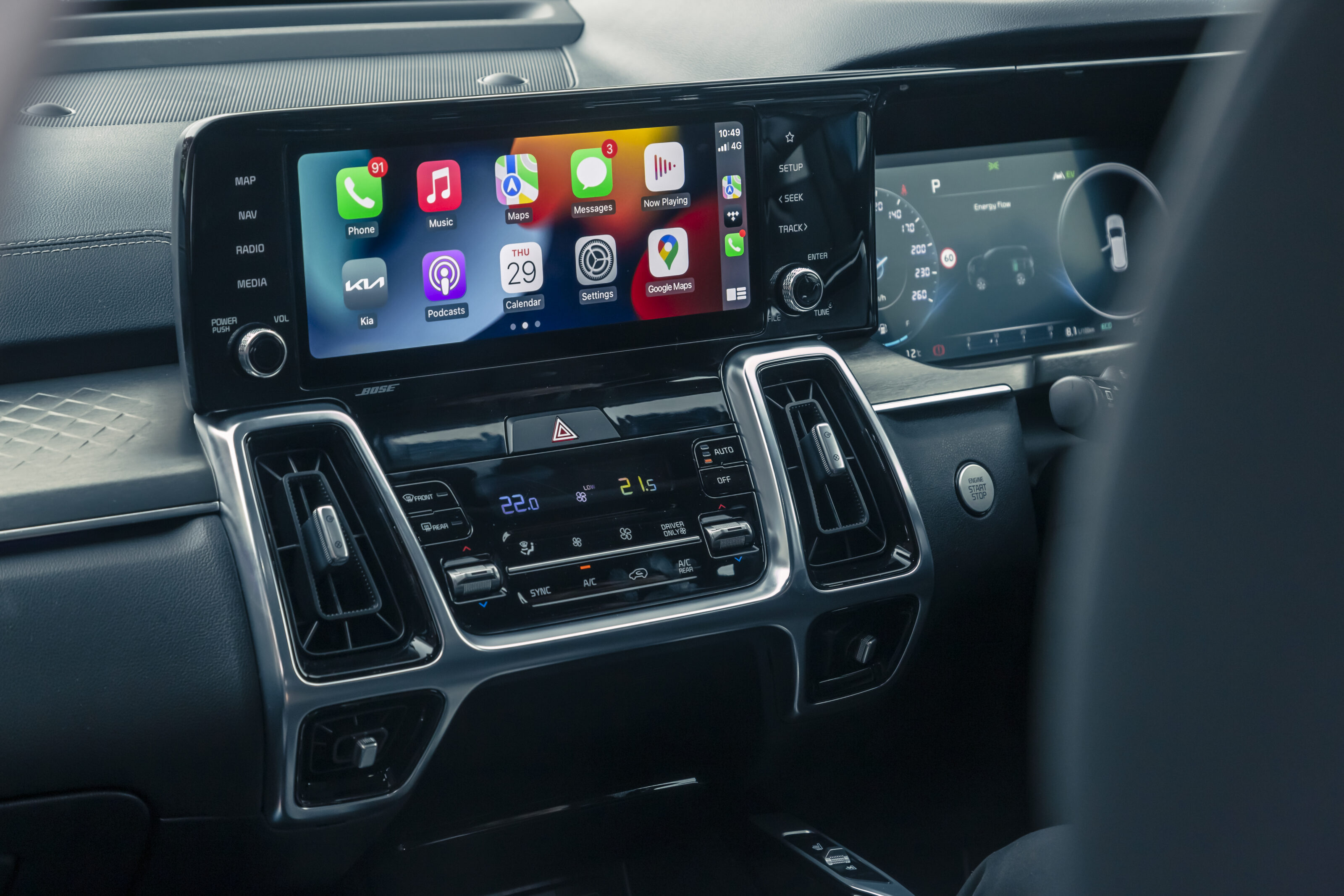
In front of the driver is a crisp 12.3-inch digital instrument display with blind-spot cameras – though no provision to show a map – and a 10.25-inch touchscreen in the centre.
Kia’s infotainment software is attractive and easy to use, but there’s also the ability to mirror your Apple or Android phone using a cable. The 12-speaker Bose sound system fitted to the GT-Line is powerful and clear, and the built-in ‘sounds of nature’ background noise generator ranges from soothing Rainforest to anxiety-inducing Open Air Cafe.
A mix of device charging methods is provided for front occupants, seat including a Qi wireless pad, two USB-A ports and two 12-volt sockets.
Tri-zone climate control features a separate zone for the back seats and there is heating for the outboard positions of the second-row bench. A power tailgate is included, naturally.
How do rivals compare on value?
The Sorento GT-Line’s equipment list reads a lot like the closely-related Hyundai Santa Fe Highlander (from $63,050 before on-road costs), a direct rival but one that has only just introduced an electrified powertrain for the Australian market. The Santa Fe is available with tan leather for an extra layer of class in the cabin.
Compared to a Toyota Kluger Grande hybrid, the Sorento looks pretty affordable by coming in at $5950 less spec-for-spec.
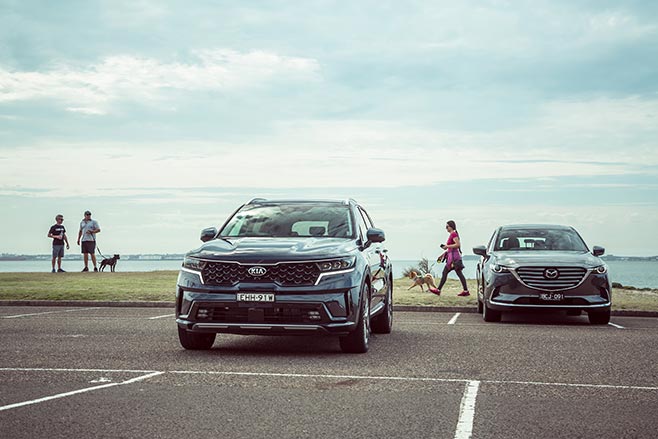
Other rivals worth considering are the equally premium-feeling Mazda CX-9 Azami ($71,750 before on-road costs), surprise-and-delight filled Skoda Kodiaq Sportline ($57,990 drive-away) and Volkswagen Tiguan Allspace R-Line ($58,890 before on-road costs).
Interior comfort, space and storage
The Sorento is equally endowed with attractive design and comfort in the cabin.
Its 14-way power-adjustable front seats offer plenty of scope for all sizes and shapes of occupant to find a position they are happy with (though without providing quite enough under-thigh support). Although they feel hard initially, they provide support for long hours at the wheel.
Plastics quality in the Sorento is generally high, and a huge step up from where this class was previously. There are soft materials on the door and dash top, as well as a nice-to-hold leather-appointed steering wheel. The backlit ‘fish scale’ trims on the doors and dash add another pop of premium to the Sorento’s interior.
There is generous storage for those in the Sorento GT-Line’s front seats, with a huge covered storage area under the armrest, two cup holders, more hidden storage in the centre console and door bins big enough for a one-litre camping bottle or 1.25-litre plastic bottle.
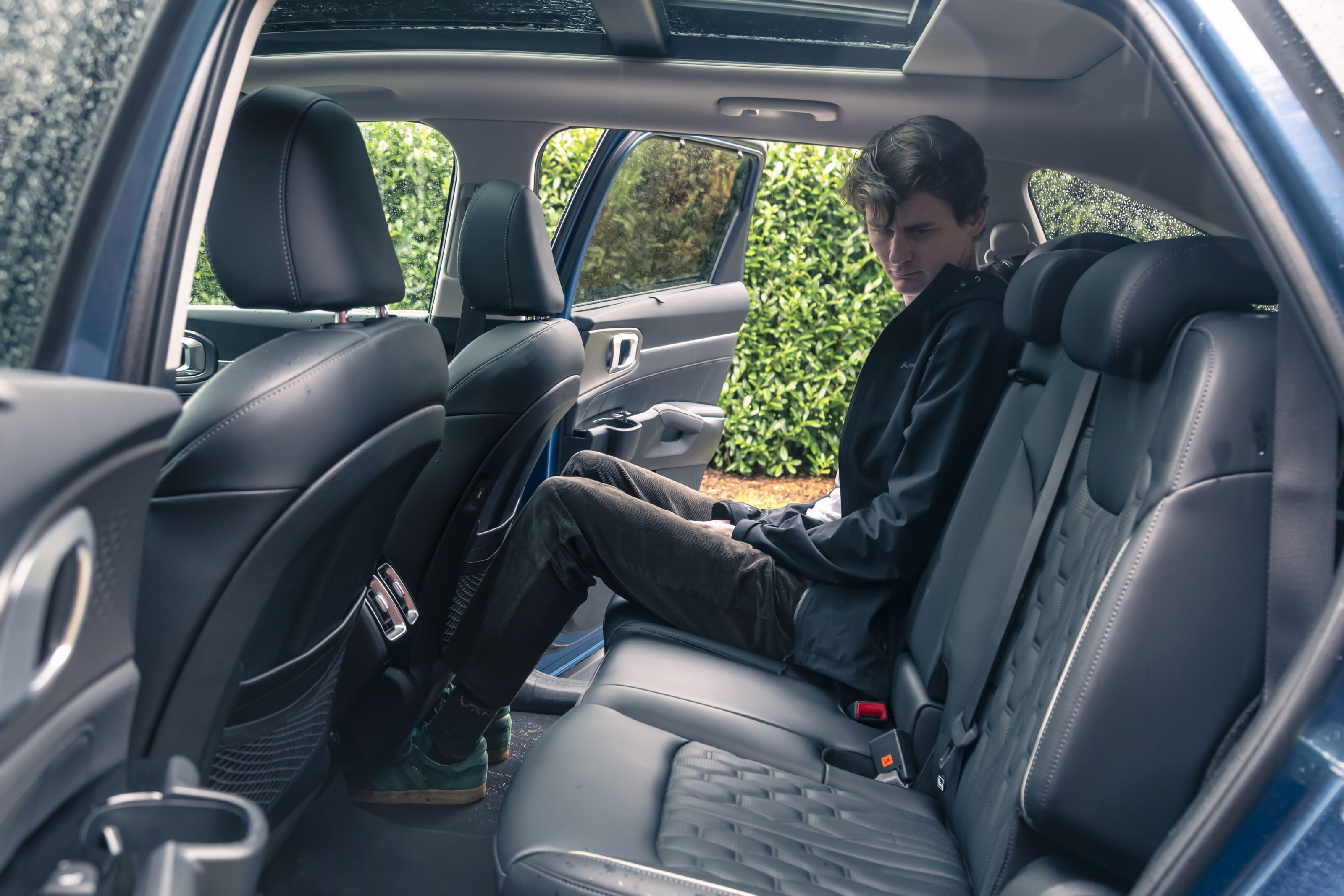
Jumping into the back seat, the Sorento has ample space for adults. The rear bench slides and the backrest has several positions from gangster-lean to engaged office worker.
Second-row passengers get a pair of USB-C charge ports (conveniently positioned in the back of each front seat), a 12-volt socket, fold-down armrest, heating for outboard positions, classy integrated sun blinds, and a separate climate control zone with two vents.
The 2023 Sorento GT-Line hybrid has ISOFIX attachments for both outboard seats in the second row, with top tether points fitted to every second- and third-row seat in the car for maximum child seat flexibility.
Although the third row isn’t ideal for adults, the sliding second row means a compromise can be reached. There’s fan adjustment in the third row, cup holders and even some USB points to charge devices – this is a thoughtfully-equipped SUV.
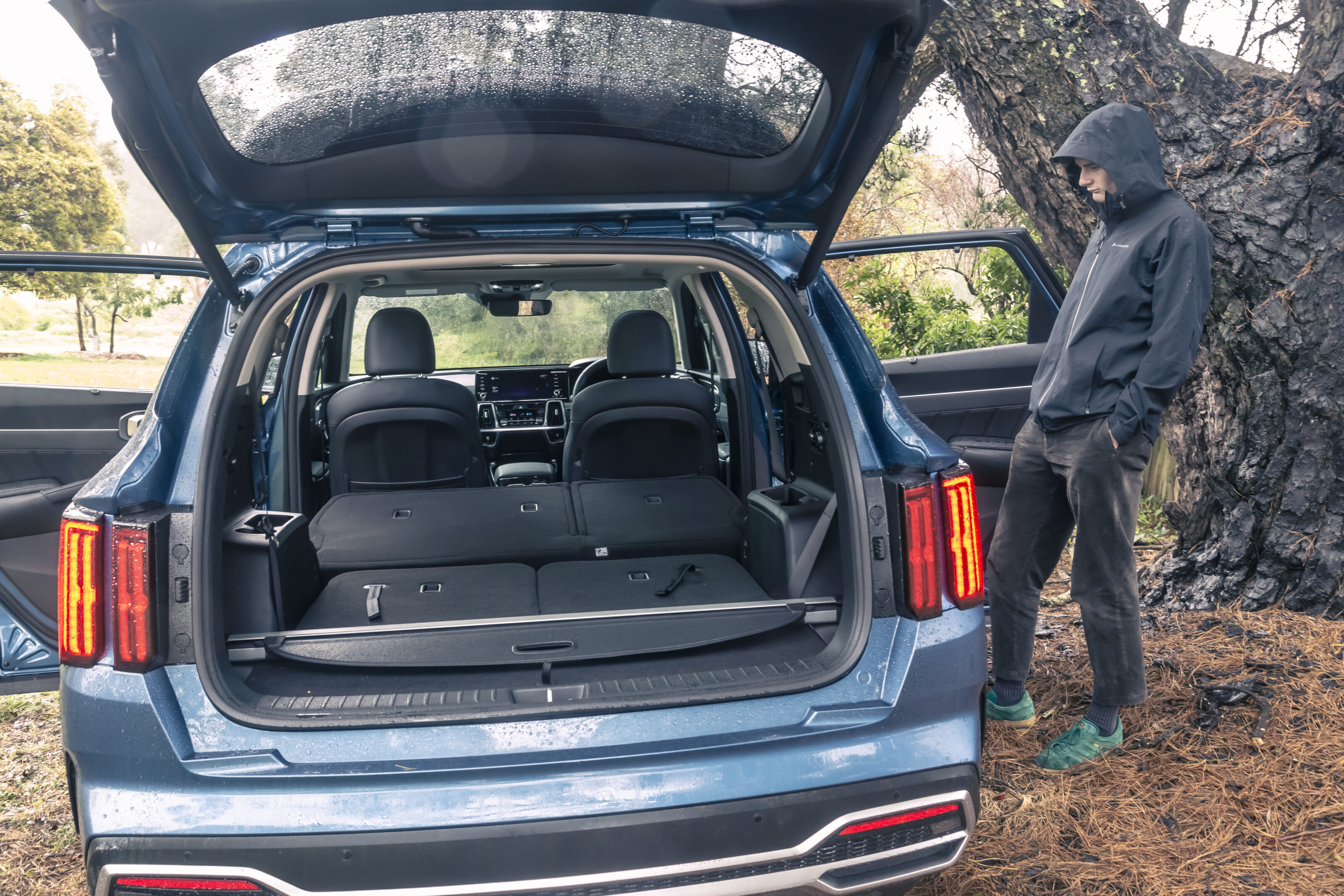
Accessing the Sorento’s third row is made easier by the electrically-actuated second row, no need to jump in and wrench on flimsy plasticky handles. The same is true for folding the second row flat from the boot, just hit the button and the seats fold.
2023 Kia Sorento boot space
When the seats are flat, the Sorento offers 1966L cargo space (VDA). With five seats in place that comes back to a very reasonable 608L.
With all three rows in place the 179L boot space is poky, but enough for school bags or a small shopping run. The Sorento GT-Line hybrid has a full-size spare tyre mounted under the body.
What is it like to drive?
We’ve experienced plenty of Sorento variants since the seven-seater’s Aussie release in September 2020 – including the plug-in hybrid – but this is the first time we’ve sampled the regular hybrid.
The layout includes a 44kW/264Nm electric motor sandwiched between the engine and gearbox with a 1.0kWh battery designed to be rapidly charged and discharged.
Therefore, there is no electric-only range claim – Kia doesn’t have an EV mode button either, unlike the Toyota Kluger – but the Sorento can get itself to about 25km/h using the electric motor.
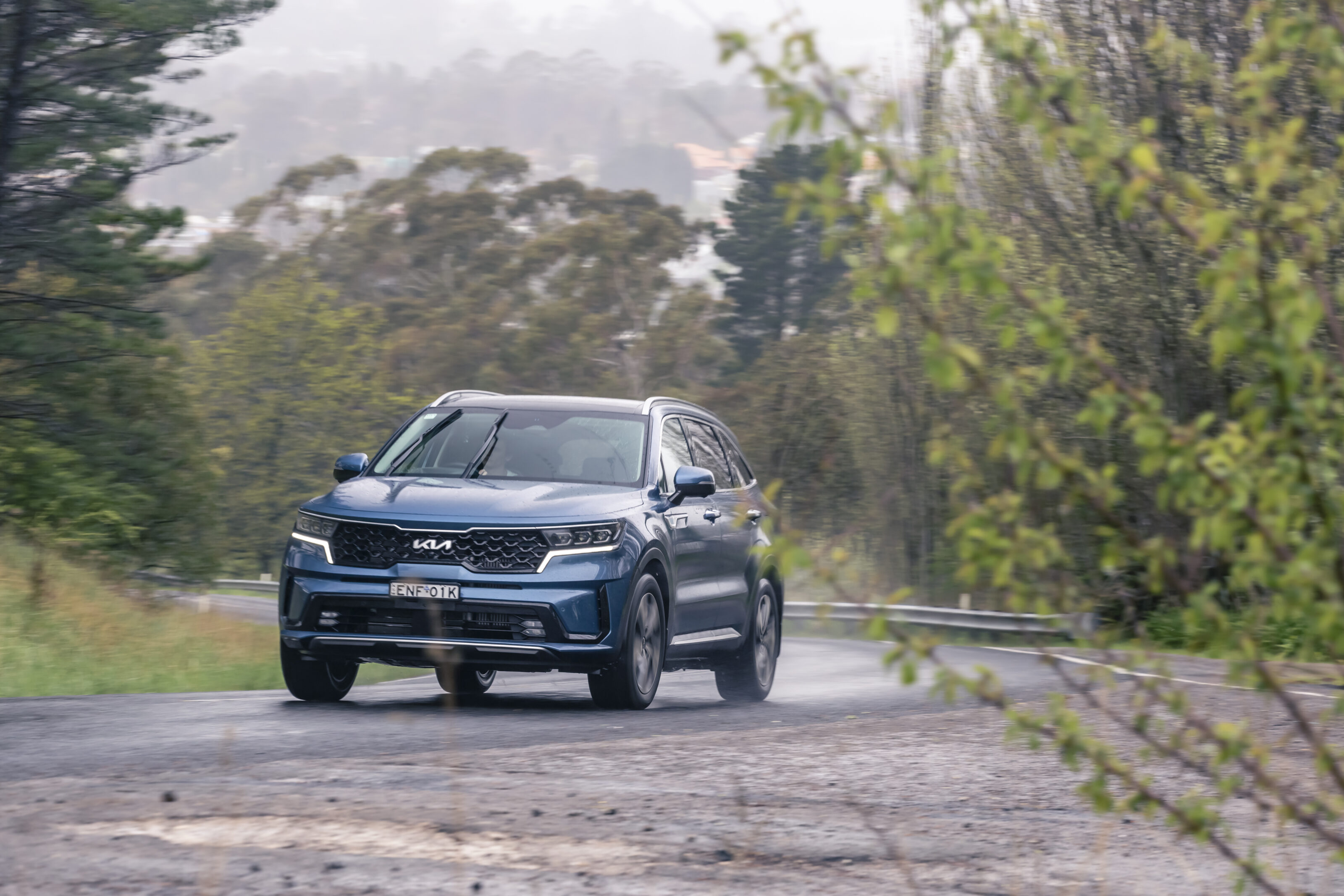
Outputs are rated at 169kW/350Nm regardless of whether you choose the cheaper front-drive variant or this AWD version.
A six-speed torque-converter automatic is used, rather than the continuously variable transmission (CVT) you’d find in a Toyota hybrid product. This sounds great in theory (because, as we know, CVTs are the devil’s work), except with hybrids the CVT ‘rubber band’ quality tends to make for a smoother transition between power sources.
Occasionally, the Sorento’s petrol engine seems to stay running for a little too long. Additionally, during low-speed manoeuvres on steep gradients, the petrol engine takes a moment to kick in and ‘catch’ the Sorento, leading to small unnerving roll-backs.
Ultimately, though, the Sorento’s 1.6-litre turbo-petrol-based hybrid system is pretty refined and up at speed, it feels like it’s blending both power sources naturally to balance good acceleration with frugality.
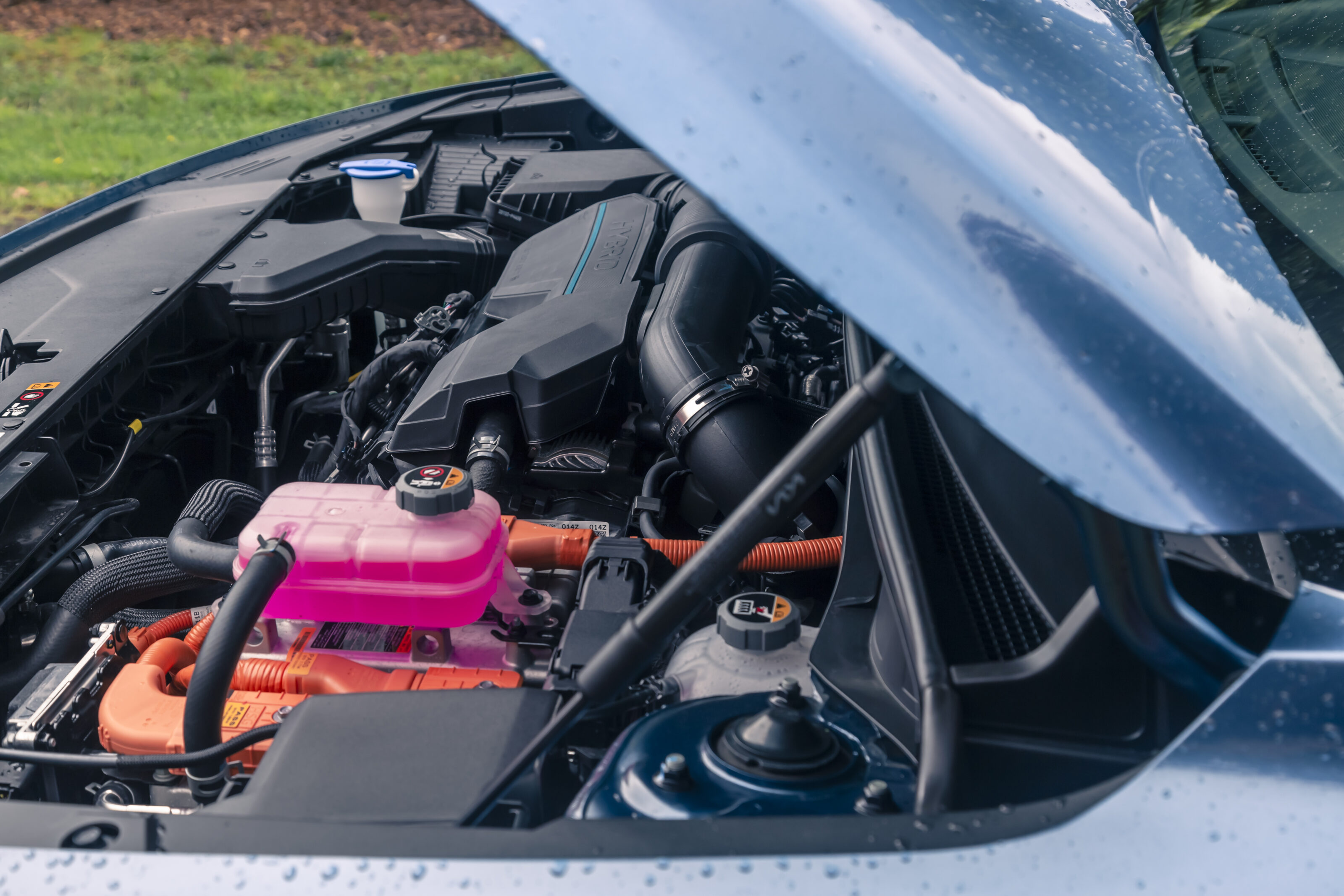
The amount of grunt on offer feels like the 1948kg Sorento would get from rest to 100km/h in about 8.5 seconds, but Kia does not claim a time. The Sorento Hybrid has a reasonable 1650kg braked towing capacity, though a rather restrictive 100kg maximum ball weight.
One of the Sorento’s best aspects has always been its dynamics, thanks partly to the local ride and handling program that imbues this large SUV with excellent back road composure. The hybrid being a little heavier doesn’t harm the Sorento’s inherent talent, meaning you can hustle this seven-seater. Crucially, though, the chassis is planted and safe.
The steering weighting is natural in Smart mode and helpfully firmer in Sport, with an accurate rack that inspires confidence.
Whereas petrol and diesel Sorento GT-Line variants are fitted with large 20-inch alloys that impact ride quality, the hybrid – and PHEV – instead roll on 19-inch alloys wrapped in 235/55 Goodyear Eagle tyres. The ride is still firm and supportive, but not fidgety or uncomfortable above 60km/h.
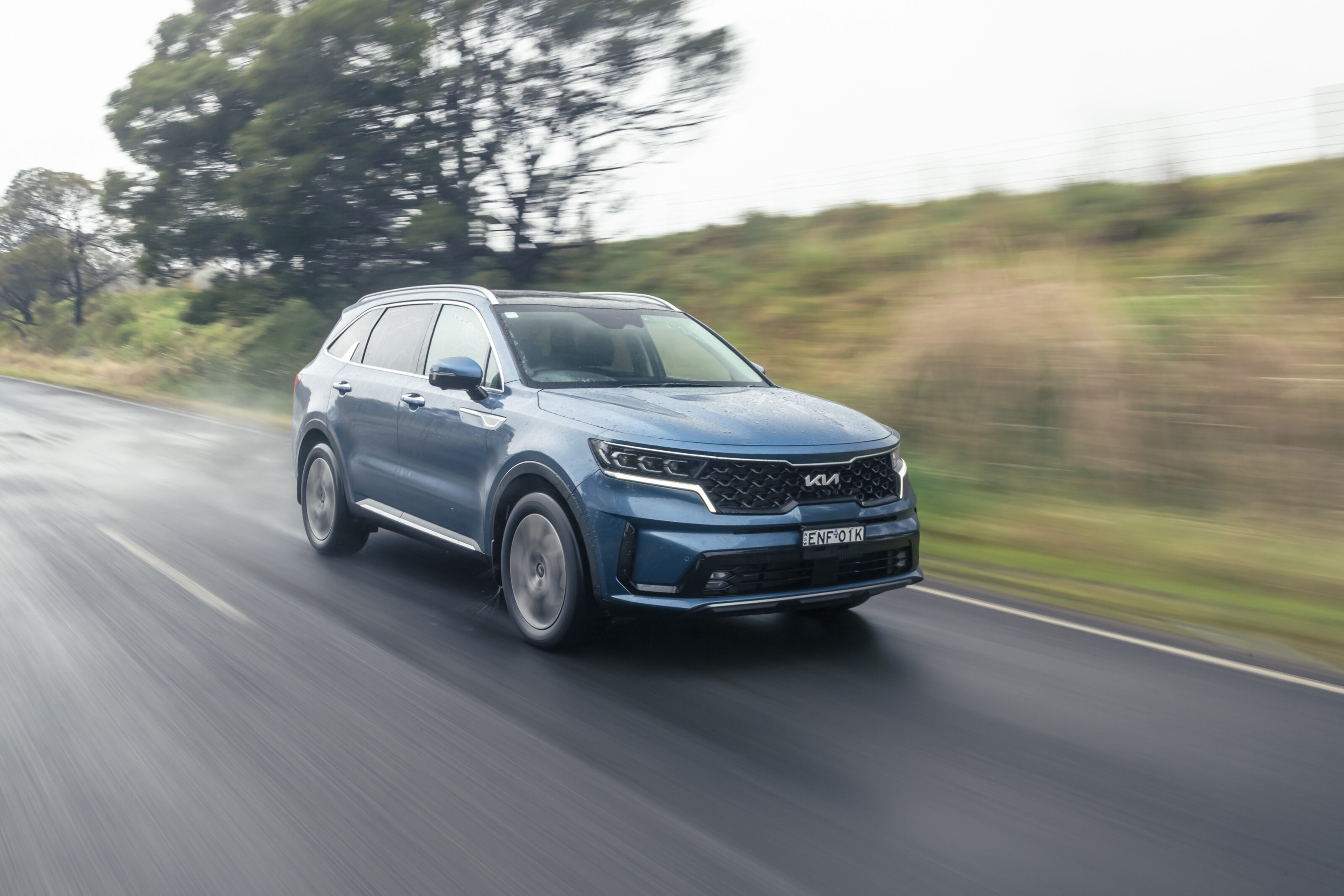
Where the Sorento can occasionally feel stiff-legged is around town. The firm damping results in a ride that’s less plush than rivals – not harsh or crashy, but definitely on the sportier end of acceptable for this type of vehicle.
The Sorento’s road noise insulation is very good though, with minimal intrusion from the sound of suspension components working over bumps. Visibility is also excellent for a vehicle this large. The bulky C-pillars don’t affect rear three-quarter visibility too much, while the high-set driver’s seat gives a commanding view out over the bonnet.
How is it on fuel?
The Sorento GT-Line Hybrid AWD has an claimed consumption rating of 5.8L/100km, which isn’t a whole lot better than the 6.1L/100km the diesel promises.
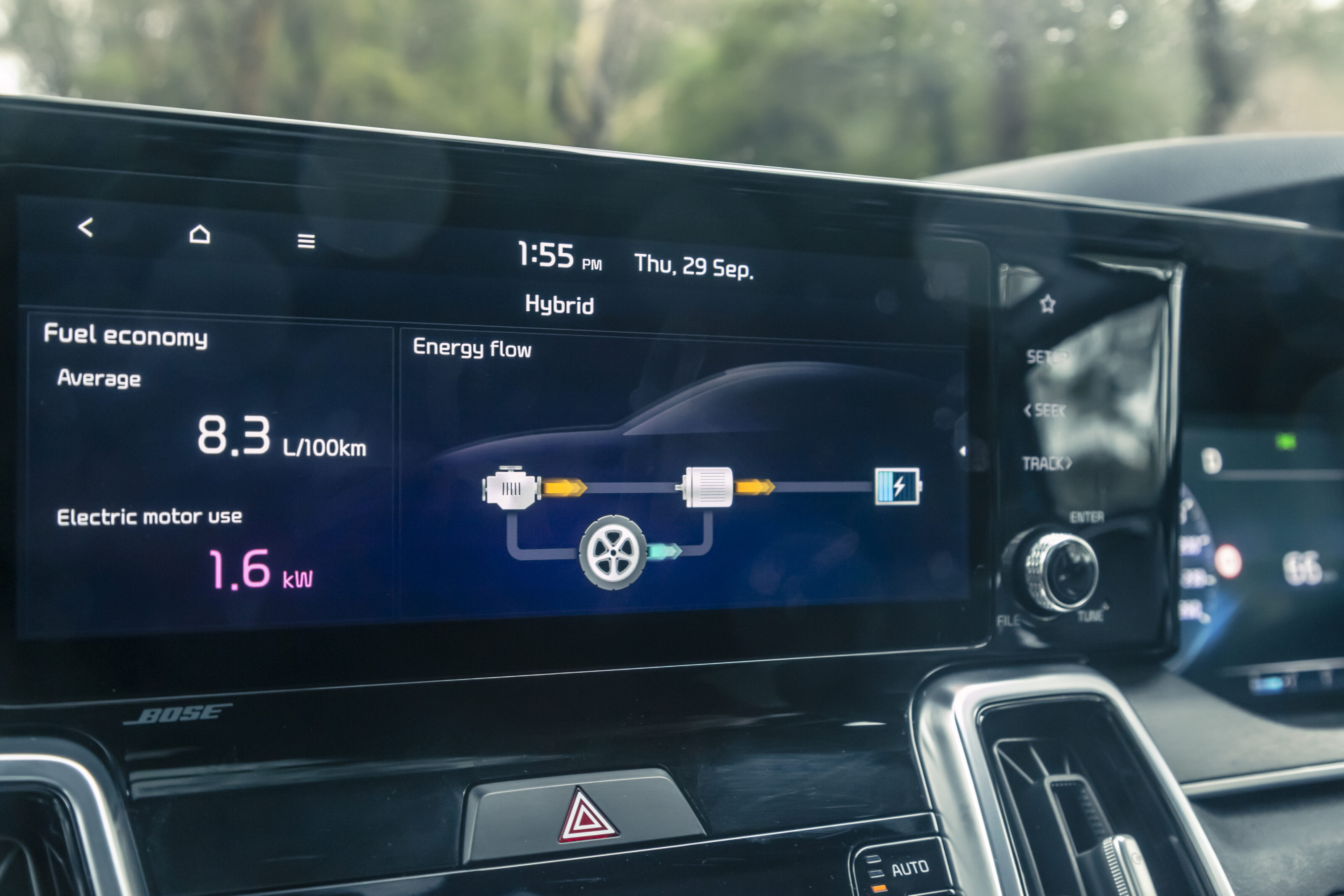
That said, the available 3.5-litre V6 is certainly thirstier, recording 9.7L/100km in combined testing and a whopping 13.7L/100km in the ADR urban cycle, where the hybrid scores 5.9L/100km
Over our week of real-world testing, the Sorento GT-Line hybrid used 7.1L/100km. At the bowser, the Sorento hybrid will drink regular 91 RON unleaded or an E10 blend.
With its consistently low urban fuel economy and lack of diesel particulate filter, the Sorento hybrid makes sense around town, but for country buyers the diesel is probably the better choice as it can dip into the mid-fives when cruising on the freeway.
How safe is it?
The Kia Sorento GT-Line hybrid was awarded five stars in ANCAP safety testing in 2020.
Kia furnishes the Sorento with seven airbags in total as standard, though the side curtain airbags do not extend all the way back to the third row.
The Kia Sorento GT-Line has safety features such as forward auto emergency braking (AEB) with pedestrian, cyclist and junction detection, reverse AEB, lane-trace assist, blind-spot monitoring, rear cross-traffic alert, adaptive cruise control and lane-departure warning.
Additionally, in GT-Line trim, the Sorento has blind-spot cameras that beam a live feed from down the side of the vehicle into the digital driver’s display, great for picking up vulnerable road users such as motorcyclists when turning at junctions.
Warranty and running costs
Kia continues with its excellent seven-year, unlimited-kilometre warranty for the Sorento GT-Line.
Longer warranties are slowly becoming an industry standard, with Skoda recently jumping up to the same guarantee and Mitsubishi offering a 10-year/200,000km warranty when its cars are serviced at a dealer.
The Sorento GT-Line hybrid is, unfortunately, quite expensive to service. Over five years or 75,000km, maintenance will cost $2841 compared to the Toyota Kluger, which over the same period will cost just $1025.
VERDICT
Regardless of variant or powertrain, though, Sorento remains one of the best seven-seaters you can buy right now.
Do you really need to splash the extra cash on a hybrid? And is it worth waiting 12 months for one?
If you want to burn petrol rather than diesel and have the budget as well as time, the answer is yes. The hybrid operation is pretty sophisticated – if not quite as slick as Toyota’s – and it is much more efficient than the V6 around town, without the added faffing around a plug-in hybrid introduces.
For country buyers, and those who do a lot of miles out of town, though, it’s hard to ignore the diesel. The new alloy block oiler that debuted in the Sorento is more refined than the old iron block, and it’s really efficient on the highway with more torque and less complication than the hybrid.
Regardless of variant or powertrain, though, Sorento remains one of the best seven-seaters you can buy right now. Its excellent cabin presentation, oodles of device charging points, up-to-date technology and spaciousness make it an excellent choice.
2023 Kia Sorento GT-Line hybrid AWD specifications
| Engine | 1.6-litre four-cylinder turbo-petrol |
|---|---|
| Power | 169kW |
| Torque | 350Nm |
| Electric motor | 44kW/264Nm |
| Transmission | 6-speed torque-converter auto |
| Body | steel, 5-door, 7-seat large SUV |
| L/W/H/Wu2013B | 4810/1900/1700/2815mm |
| Track (F/R) | 1660/1660mm |
| Weight | 1948kg |
| Fuel/tank | 91 RON / 67 litres |
| Economy | 7.1L/100km (tested) |
| Suspension | Front: struts, coil springs, anti-roll bar. Rear: multi-link, coil springs, anti-roll bar |
| Steering | electric rack-and-pinion |
| Front brakes | ventilated discs (325mm) |
| Rear brakes | ventilated discs (325mm) |
| Tyres | Goodyear Eagle F1 SUV |
| Tyre size | 235/55R19 |
| Price | $69,750 + on-road costs |
2022 Kia Sorento Australian pricing
| Model | List price (exc. on-road costs) | Drive-away |
|---|---|---|
| Sorento S petrolu00a0 | $47,650 | $50,790 |
| Sorento Sport petrolu00a0 | $50,270 | $53,790 |
| Sorento S dieselu00a0 | $50,650 | $53,790 |
| Sorento Sport dieselu00a0 | $53,270 | $56,790 |
| Sorento Sport+ petrolu00a0 | $54,850 | $58,390 |
| Sorento Sport+ dieselu00a0u00a0 | $57,850 | $61,390 |
| Sorento GT-Line petrolu00a0 | $62,070 | $65,990 |
| Sorento GT-Line dieselu00a0 | $65,070 | $68,990 |
| Sorento GT-Line Hybrid FWD | $66,750 | N/A |
| Sorento GT-Line Hybrid AWD | $69,750 | N/A |
| Sorento GT-Line PHEV | $80,330 | N/A |
Related video
UPDATE: 2023 Citroen C5 Aircross facelift delayed
The facelifted 2023 Citroen C5 Aircross medium SUV has been delayed until early next year.
As we confirmed in our New Car Calendar update in September, the C5 Aircross Australian release had been postponed to at least the first half of 2023.
Citroen has not given precise timing, but it will launch in early 2023. Full details are expected in the coming months.
“There has been a slight delay, until early 2023, with the introduction of the facelifted Citroen C5 Aircross to the Australian market,” said a Citroen Australia spokesperson.
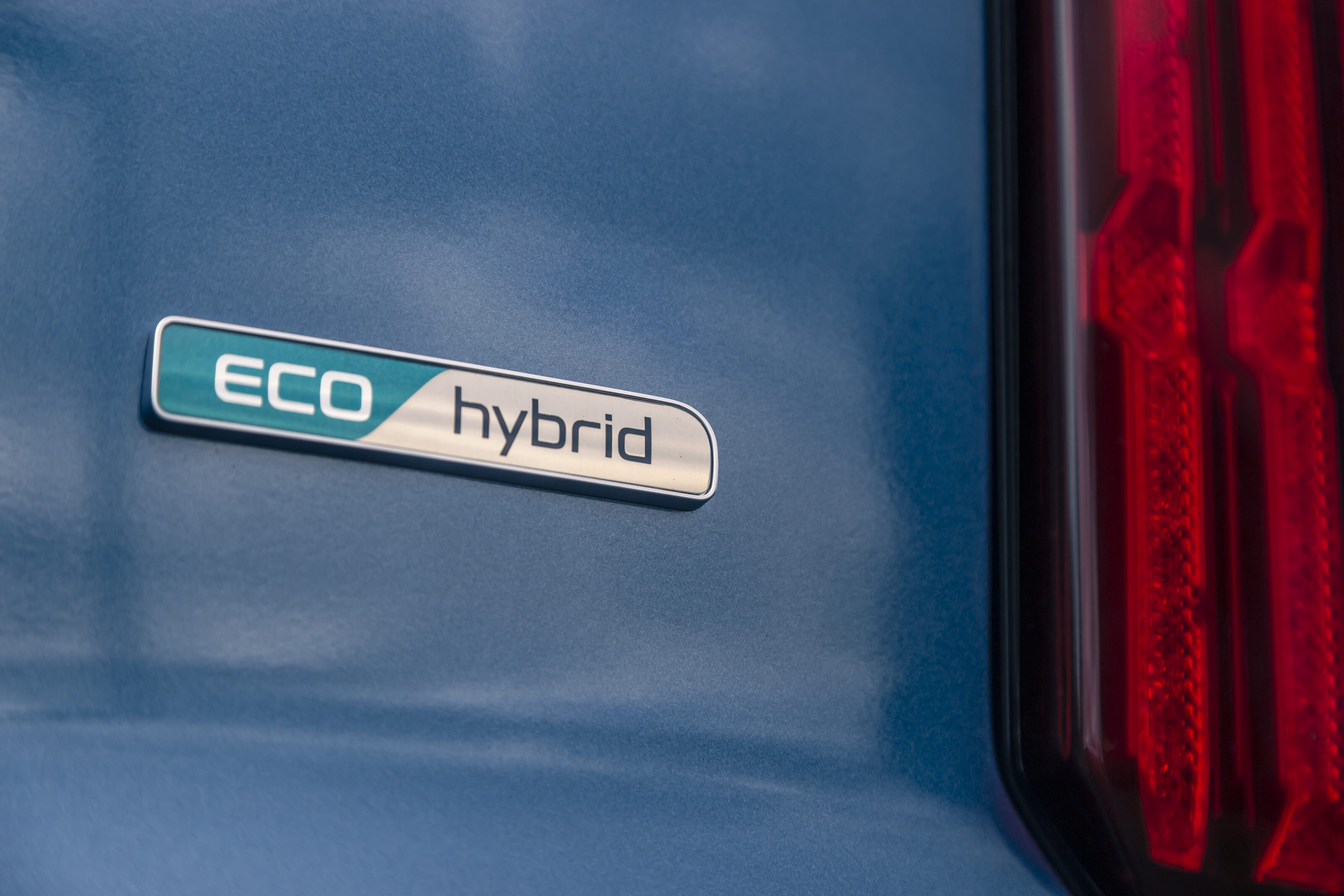
While three four-cylinder powertrains have been approved for sale in Australia – two 1.6-litre turbo-petrol engines, with 121kW or 133kW, and a 130kW 2.0-litre turbo-diesel – only the 133kW petrol is expected locally.
This engine is found in the recently-launched C5 X, and the related Peugeot 3008 and 5008.
A plug-in hybrid, which produces 165kW of total system power, is available overseas.
The PHEV is believed to be under consideration for Australia, with the powertrain currently available on the Peugeot 508, and soon to be offered on the C5 X and Peugeot 308 hatch.
The story to here
January 13: 2022 Citroen C5 Aircross facelift revealed
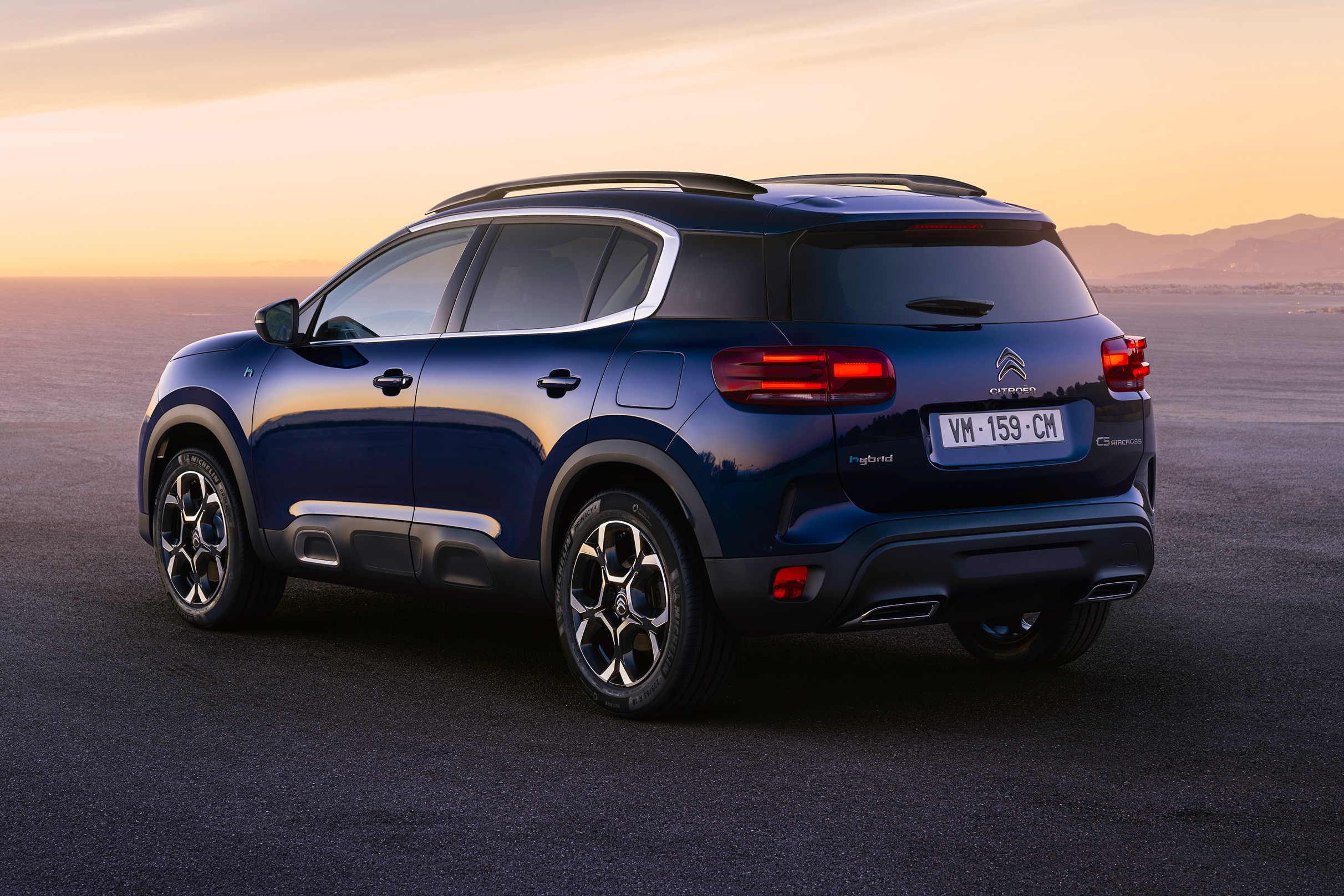
The 2022 Citroen C5 Aircross has received its mid-life update, with curves being replaced by stronger lines and sharper features.
Citroen debuted the new-look C5 Aircross in Europe, showing off a new front-end featuring more traditional headlights, with LED daytime-running lights extending out from the revised grille.
The front bumper also receives a cleaner design, with a skid plate available in either black or silver, matched with new 18-inch alloy wheels.
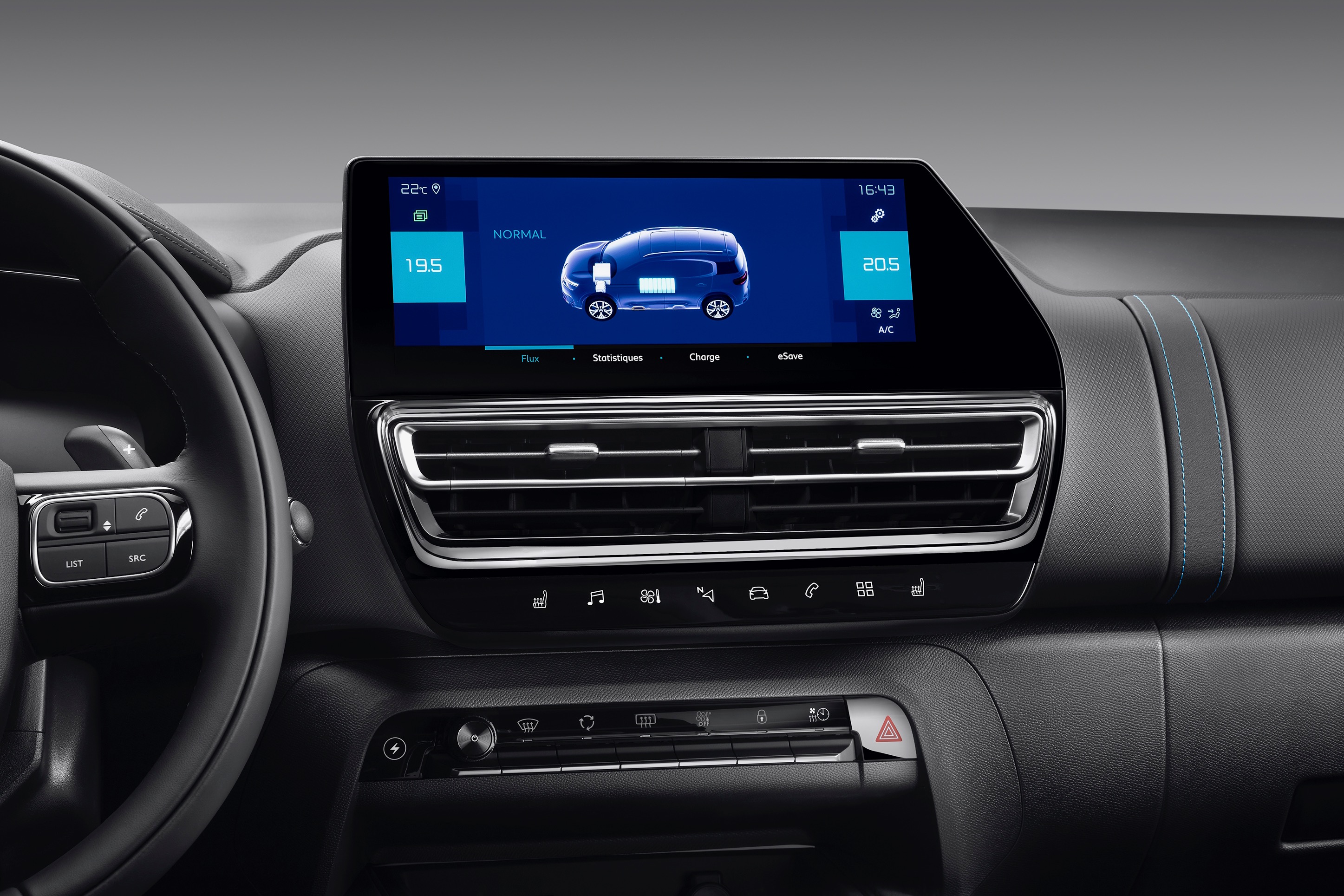
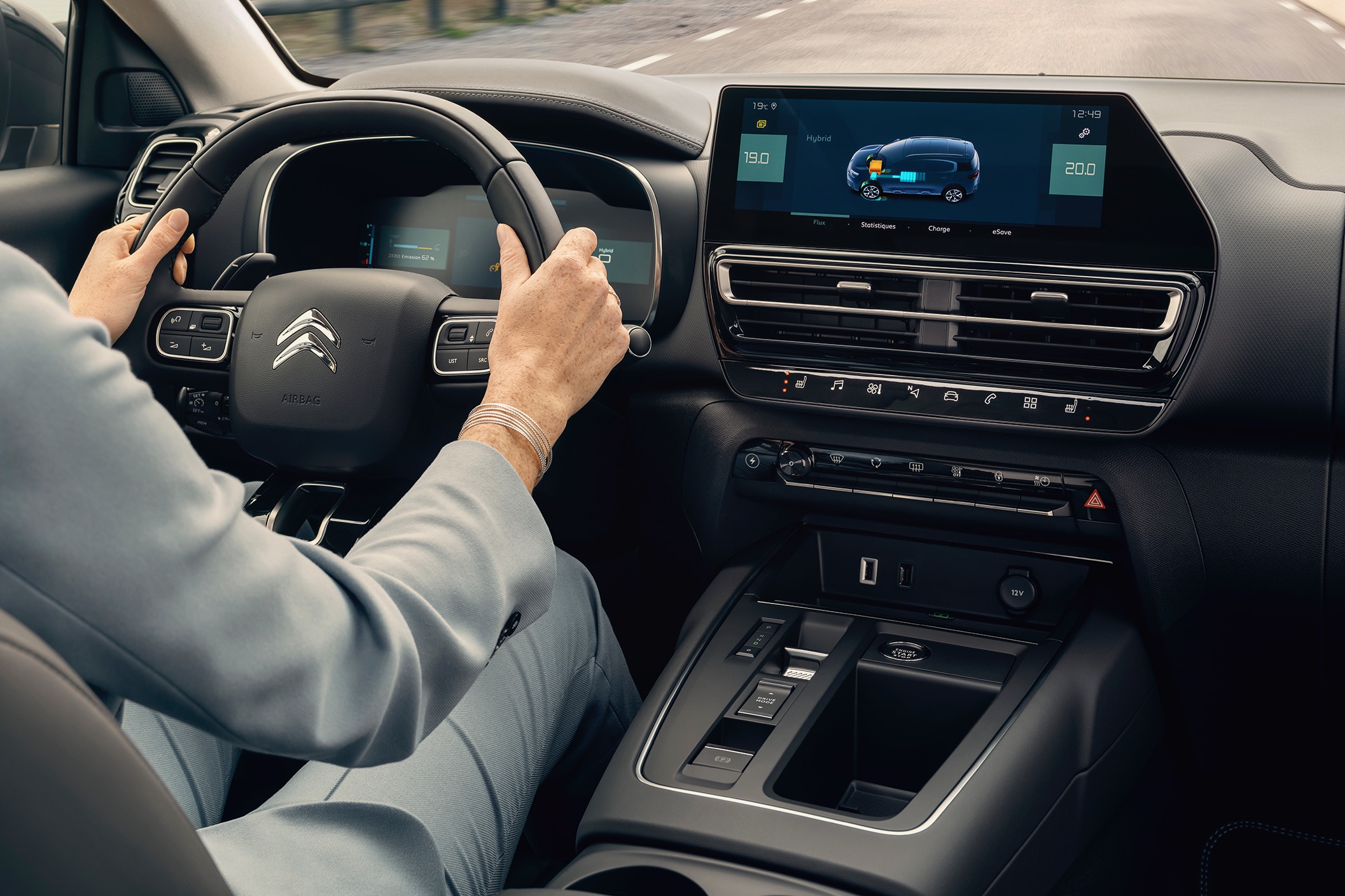
Along with a reworked dashboard, occupants now benefit from a new ‘floating’ 10.0-inch infotainment screen, while the 12.3-inch digital instrument cluster carries over.
A new e-Toggle gear selector is now offered, and with a driving model selection button for Grip Control, along with wireless smartphone charger and two USB ports.
Advance Comfort seats have been borrowed from the wider Citroen range, available with heating and massage functions, finished in a choice of either Alcantara (synthetic suede) or perforated leather.
No changes have been noted under the bonnet, with the C5’s 121kW/240Nm 1.6-litre turbo-petrol four-cylinder engine expected to carry over, along with its six-speed automatic transmission offered locally.
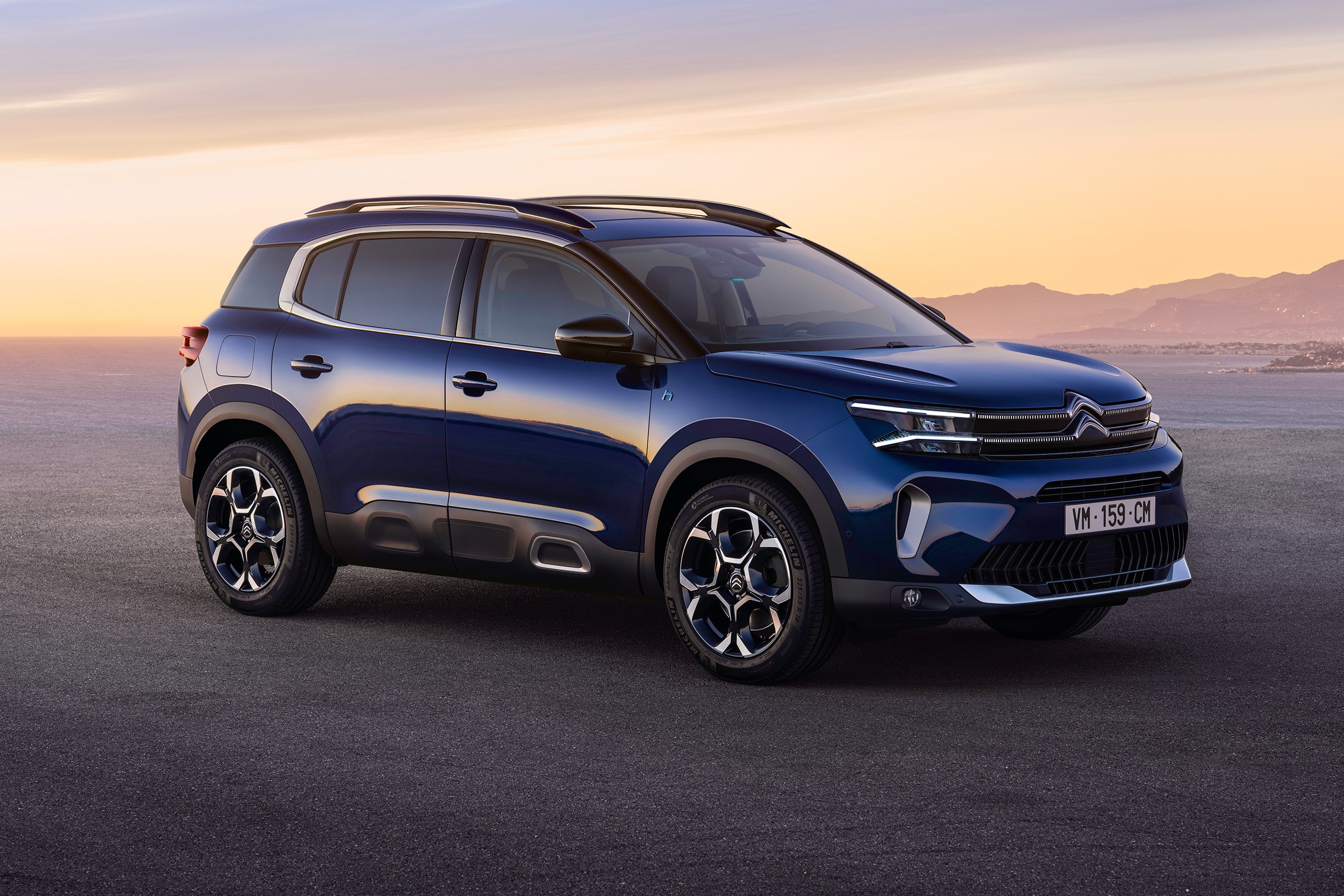
A spokesperson for Peugeot Australia told Wheels the facelifted C5 Aircross is currently undergoing evaluation, with further information expected in the coming months.
There’s also no word at this stage whether the plug-in hybrid powertrain offered in Europe is on the cards for Australia, but the electrified model could help bolster local sales. The model offers up to 55km of pure-electric driving, with a 1.6-litre petrol engine on hand for longer distances.
In Australia, the French brand sold just 58 examples of the C5 Aircross in 2021 – a 35 per cent drop in sales compared with the previous year – accounting for less than 0.04 per cent of vehicles sold in the medium SUV segment.
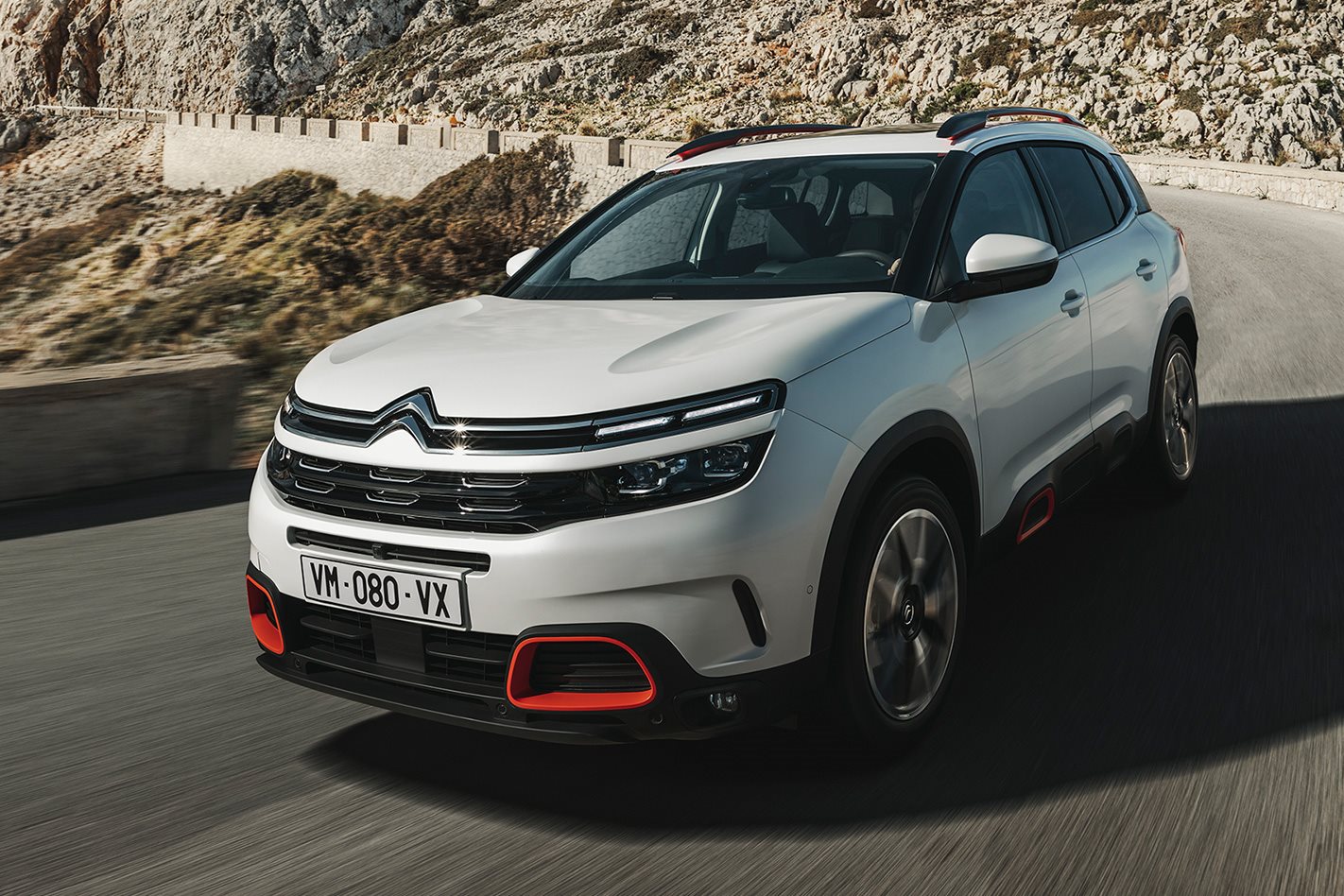
Below: The current 2021 Citroen C5 Aircross
Snapshot
- Czech carmaker accelerates EV plan by four years
- A trio of new dedicated electric SUV models to launch
- Battery costs a key challenge to affordable Fabia-sized EVs
Skoda has brought forward its plans to launch three new battery-electric car models from 2030 to 2026.
The Czech brand is expected to launch a small electric crossover, likely called the Elroq, in 2025. It’ll sit underneath the Skoda Enyaq medium SUV – which is confirmed for Australia – and may even undercut its smallest crossover, the petrol-powered Kamiq, in terms of size.
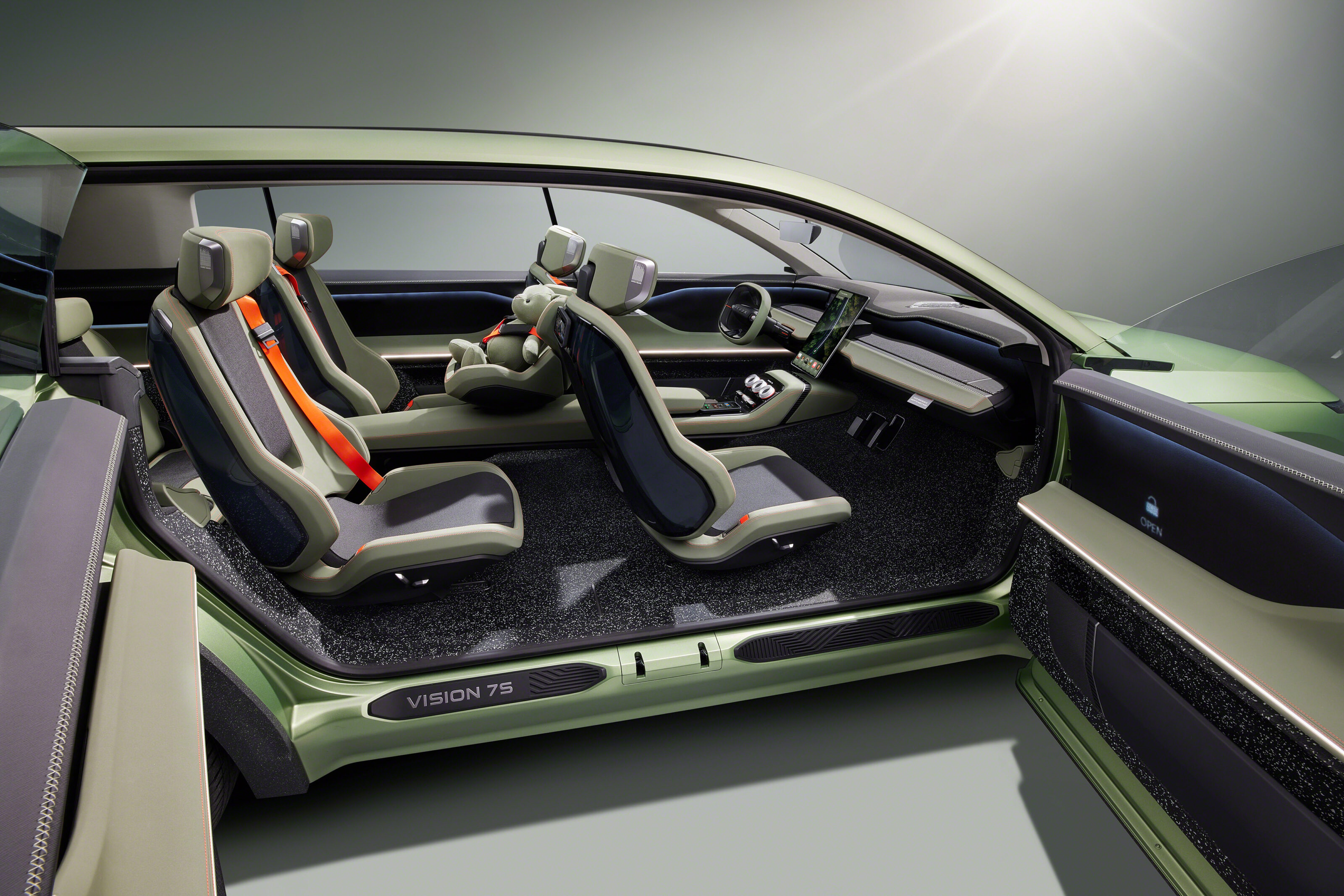
Additionally, a large family electric SUV based on the Vision 7 concept will debut in 2026. It’ll adopt Skoda’s new ‘Modern Solid’ design theme, come with seven-seats, and be one of the last models in the Volkswagen Group to use the current Modular Electric Toolkit (MEB) platform instead of its unified Scalable Systems Platform (SSP) successor.
In the same year, the company is expected to release a more affordable, entry-level city SUV based on a modified entry-level MEB platform shared with the forthcoming Volkswagen ID.Life and Cupra UrbanRebel concepts.
“The biggest challenge at the moment is the cost [of making] battery-electric vehicles, especially when producing a car [of the size of] the Fabia. We will have to stay a little patient,” Skoda CEO Klaus Zellmer told Autocar.
Volvo Cars CEO Jim Rowan recently predicted EVs would reach price parity with internal combustion engine vehicles by 2026 with “technology” allowing automakers to use smaller batteries, but with more range.
The Cupra Born warm hatch will be the first MEB-based EV to land in Australia in the H1 2023, followed by the Volkswagen ID.4 and ID.5 family SUVs later in the year.
The related Skoda Enyaq and Enyaq Coupe has been confirmed for Down Under, but Australians may need to wait until 2024 for deliveries – four years after its European debut.
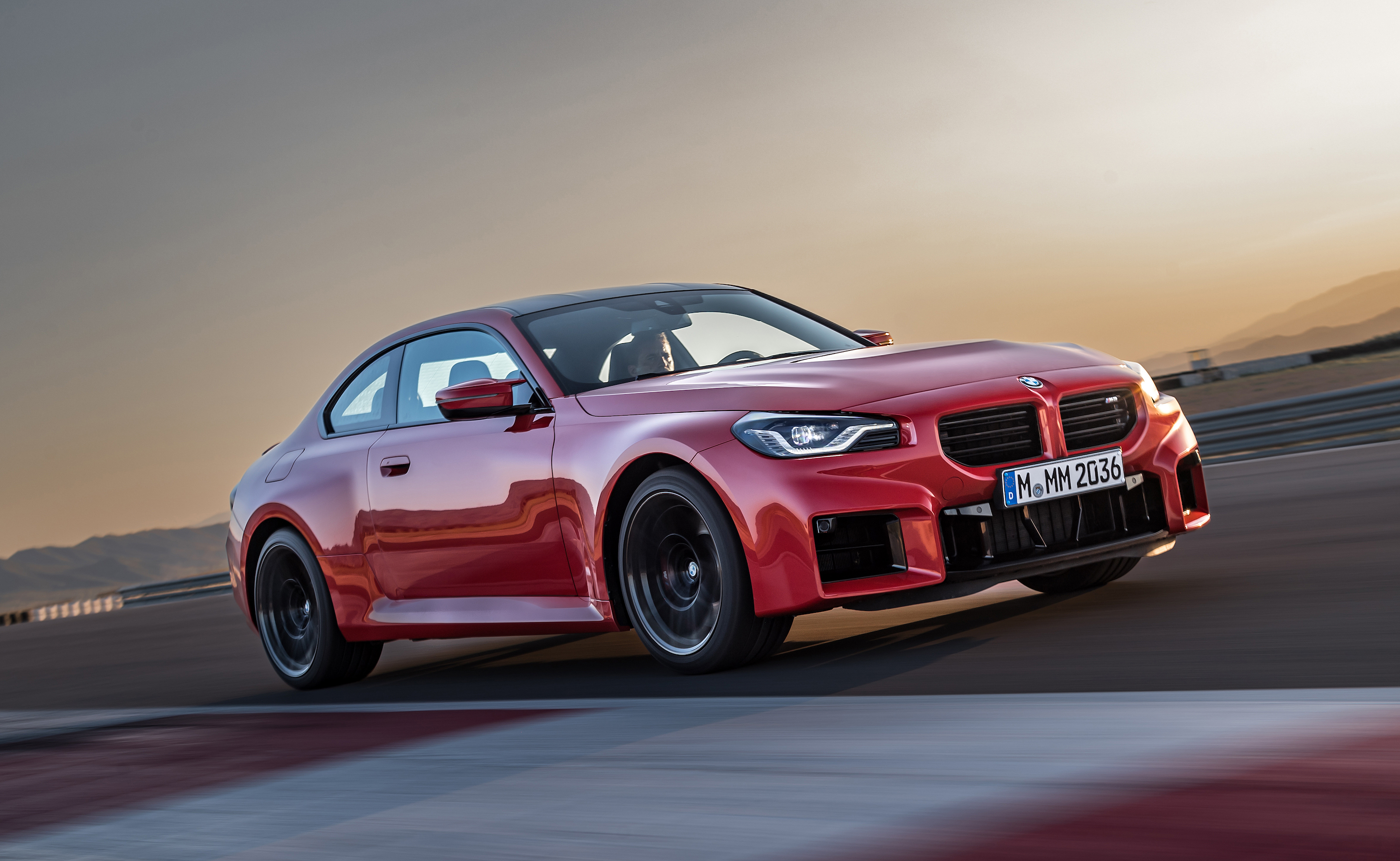
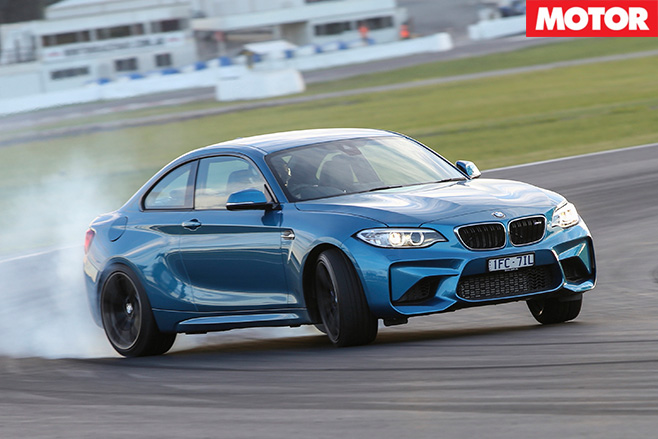
The F87 BMW M2 still looks good today, its brutal fender flares, gaping air intakes and broad stance lend it immense road presence.
But with the new BMW M2 – due to land in 2023 from $119,900 before on-road costs – punters aren’t so convinced.
After seeing it in the flesh, publishing director Mike Stevens informed us the new M2 isn’t as bad as it is in photos… but it could be better.
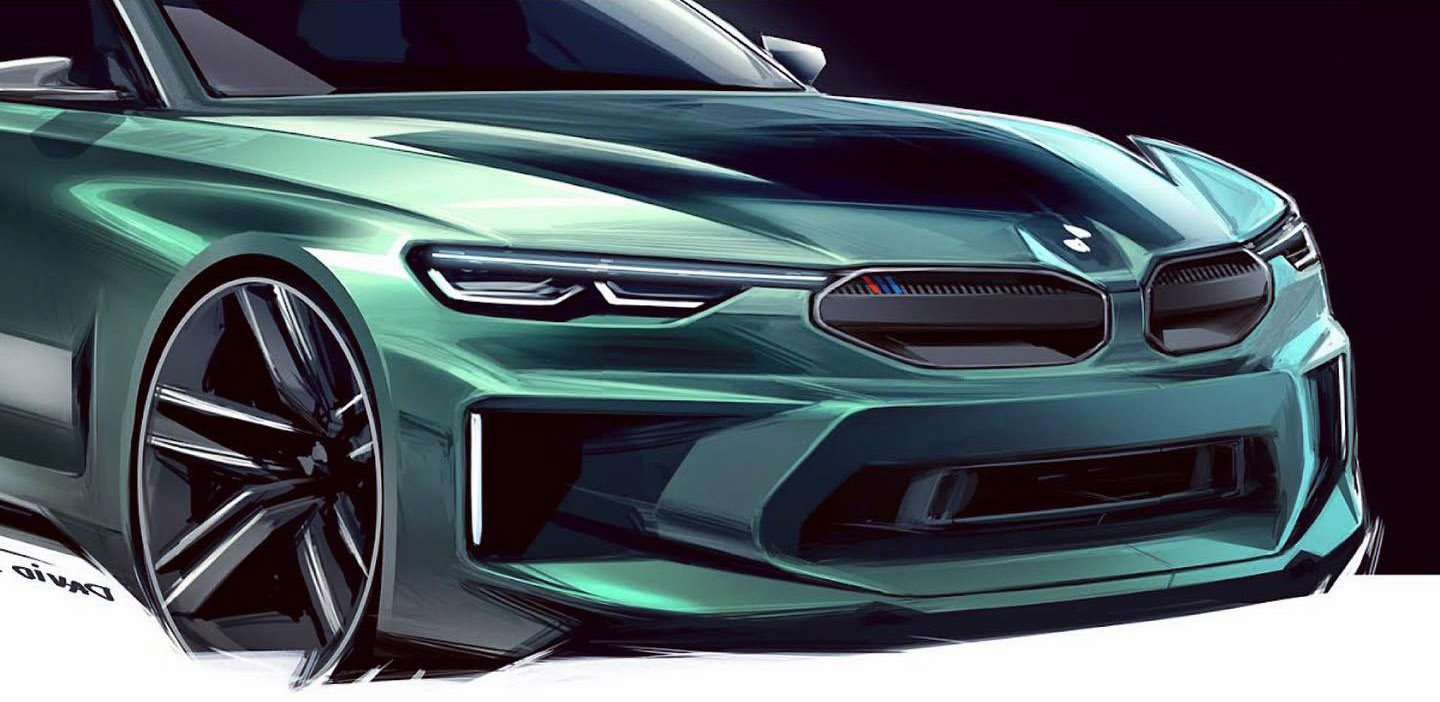
And that’s exactly what Rivian Automotive designer David Schneider did.
Schneider shared these concept sketches on his Instagram. To emphasise the width of BMW’s baby M car, he’s pulled the grilles out making them wider and narrower. The headlights have been given a similar treatment.
The front bumper’s lower air dams have also been addressed, with Schneider retaining the squared off outer profile of the new car’s bumper, but blending it more naturally into the central intake with flowing turns rather than right angles.
https://www.instagram.com/p/Clhj8cCv_lF/
Long time BMW fans will have noticed the G87 M2’s character line is much less pronounced than the previous F87, giving it less muscular definition in profile. The same is true of the G82 M4.
To restore the surface tension of the previous M2, Schneider has implemented BMW’s signature character line that arcs effortlessly from the head to the tail lights, and really emphasises the flared guards.
Schneider hasn’t tackled the rear end of the M2 – arguably its most awkward angle – but the concept sketch proves that there’s room to grow for the current M2.
On his Schenider.sketch Instagram profile, David doesn’t keep it solely Rivian despite having worked at the EV startup for nine years. Instead, he plays around with a whole host of current vehicles, including the Subaru BRZ, BMW 3 Series Touring and more.
What do you think? Is the new M2 growing on you, or do you prefer Schneider’s sketches? Let us know in the comments.
Snapshot
- BEVs saved 6-billion litres of fuel between 2011 to 2021 in the USA
- Americans saved $1.9 billion in fuel costs last year by opting for a BEV or PHEV
- Fuel prices continue to climb, dropping u2018break evenu2019 EV point
The US Department of Energy has found that battery-electric vehicles (BEVs) saved 1.8-billion litres of fuel last year in the States alone – which shockingly equates to just one day’s worth of fuel supply, or 72 olympic swimming pools worth.
The study also found that 3.7-billion kilograms of carbon dioxide (CO2) tailpipe emissions were prevented by 458,000 buyers opting for BEVs over the same period.
In the decade since 2011, BEVs have saved a total of six-billion litres of fuel and prevented almost 12-billion kg of CO2 pollutants from entering the atmosphere.

Plug-in hybrid electric vehicles (PHEVs) – which use an internal combustion engine and battery-powered electric motor – saved around 794-million litres of fuel and reduced CO2 exhaust emissions by 1.8-billion kg from 176,000 PHEV sales in 2021.
By switching to EVs, car buyers dropped US national gasoline consumption by 0.54 per cent last year and therefore estimates American consumers saved A$1.9 billion in fuel costs.
The Biden government passed the Inflation Reduction Act in August, requiring electric car models to be assembled in the US and have at least 40 per cent of battery minerals sourced domestically or from free trade partners by 2024 in order to qualify for a US$7500 EV tax credit.
Fuel prices have skyrocketed this year, partly to do with Russia’s war on Ukraine sparking geopolitical sanctions on the aggressor, which is the world’s largest oil exporter. Although Australia refines oil locally, much of it is exported to other countries in Asia.
As COVID-19 restrictions were lifted in most parts of the world this year, there was more demand for mobility which contributed to higher petrol prices. Currently, the cheapest Unleaded E10 petrol averages at around $2.00 per litre across the nation.
Although electric cars are often more expensive to buy upfront, they are cheaper to own and run and the premium is eventually recouped over time – despite increasing electricity costs.

The Australian federal government recently put its electric car discount policy into legislation, which abolishes the fringe benefits tax (FBT) for EVs in fleets or novated leases and removes the import tax for countries that don’t already have free trade agreements in place like Europe.
So far to the end of October, 23,869 new passenger and light commercial EVs have been sold, which represents a 492 per cent spike compared to the same period in 2021. It’s led by the Tesla Model 3 sedan and recently launched Model Y crossover.
UPDATE: Mach-E production ramps up – Australia still not official, but signs are there
You’d be forgiven if you’ve given up on the electric Ford Mustang Mach-E ever coming to Australia. Especially with the carmaker crowing today of its availability in 37 countries, up from 22 countries in its first year on sale – and Australia still isn’t among them.
On the other hand, Ford also says it has plans “to add more markets next year”, and as our evolving story below suggests, Australia will likely be one of them.
Ford’s announcement today centred on it having now built 150,000 Mach-E SUVs, and it intends to build 270,000 next year as part of an overall plan to send 600,000 EVs to new homes in 2023. By 2026, it expects that number to grow to 2 million annually.
“The plant is buzzing,” said Deborah Manzano, Ford’s director of manufacturing. “There’s a new battery line, new chassis line, additional assembly line, we’re literally maxing out the space to make more Mustang Mach-E vehicles.”
Ford says that “almost all” of the Mustang Mach-E’s growth has come from customers replacing an internal combustion vehicle with electric power. More than 8-in-10 US customers and 9-in-10 European customers have made the Mach-E their first EV.
EV Buyer’s Guide: Electric Vehicles Under $65K Ranked – The Best and The Rest
Welcome to part one of three price-based EV buying guides, this one focused on the most affordable electric cars available in Australia today
The story to here
September 2: Ford Mustang Mach-E looking likely for Australia
There’s still no official confirmation, but an Australian launch of the Mustang Mach-E is shaping up as a sure thing.
Tipped to launch here next year, Ford is expected to make an announcement about its plans for the all-electric Mustang Mach-E later this month.
Wheels understands the Mach-E will play a key role as one of the five electrified models Ford has promised to launch in Australia by the end of 2024.
Already here and en route are the Ford Escape PHEV and two E-Transit variants, with the Mach E and a plug-in hybrid version of the new-generation Ford Ranger set to complete the set of five promised models.
Yet despite the mounting speculation that the Mach E is a sure thing Down Under, Ford Australia boss Andrew Birkic remained tight-lipped when we quizzed him at the media launch of the new Everest and Ranger Raptor.
“I have no comment really in relation to Mach E,” he said. “What we know is it’s an amazing vehicle. New Zealand is taking it, so that has been confirmed, but nothing confirmed for Australia.”
Ford is sending a group of Australia journalists – including our Daniel Gardner, to the Detroit motor show this month – where they will also drive the Mustang Mach E.
Birkic batted away suggestions this was another strong hint the Mach E was destined for Australia.
“I’m not going to provide any further commentary in relation to that vehicle come to Australia,” he said.
Stay tuned for more.
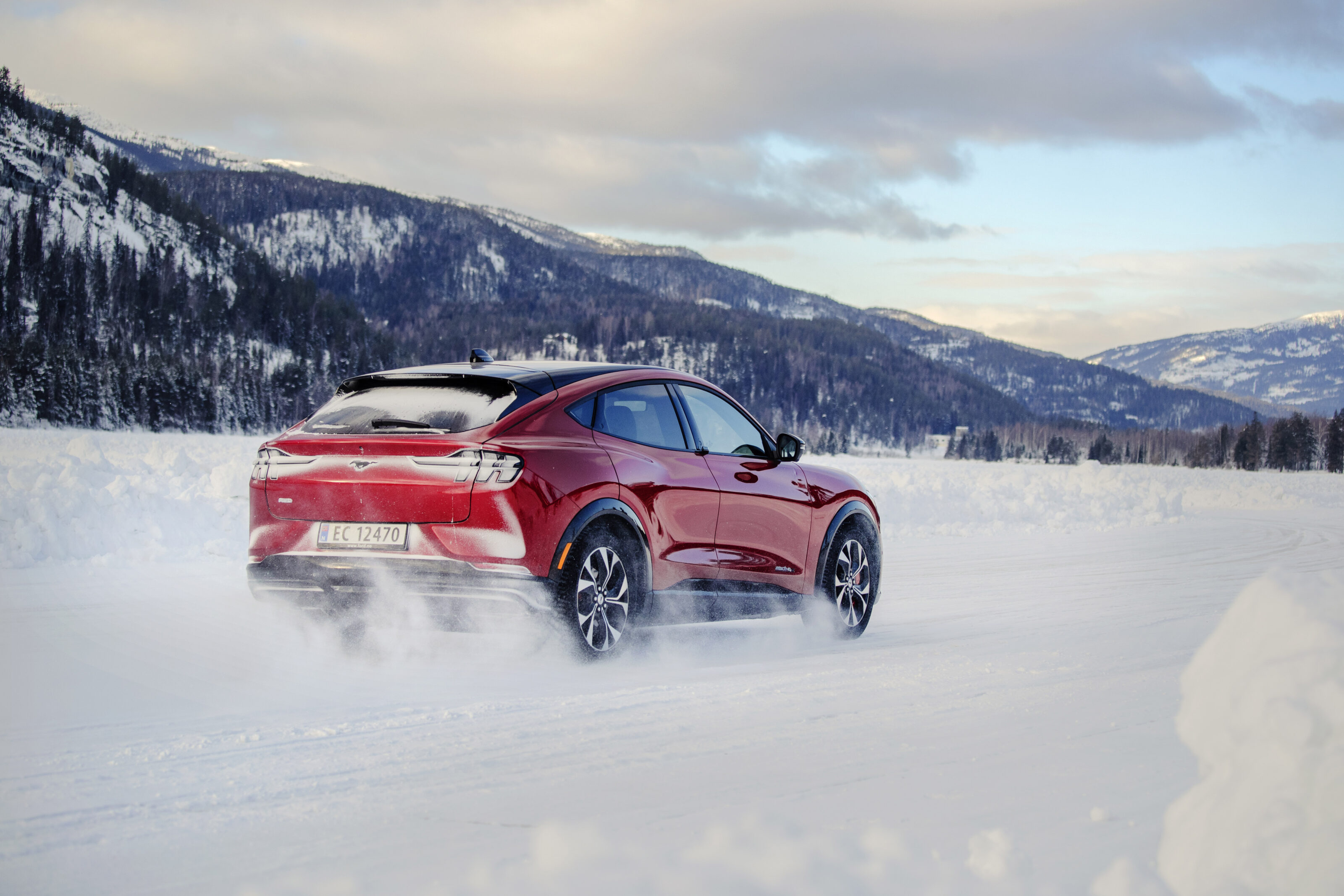
August 11: Recent comments could hint at Mach-E plans
In announcing the exit of the popular Focus ST and Fiesta ST models on August 5, Ford Australia boss Andrew Birkic said the company would continue its focus on SUVs, commercial vehicles… and electrification.
We already know the company’s E-Transit models are bound for Australia, but to make a point of electrification in this announcement – while possibly just an effort to remind buyers that Ford will have at least one offering in the market’s most talked-about new segment – could also be a sly hint the Mustang Mach-E is at least nearing confirmation for Australia.
If Australia had emissions regulations, the Mach-E would likely already be on its way here – in the same way it was legislation that motivated Ford to make some supply available for New Zealand.
But, like Volkswagen – a loud proponent of emissions regulations – the absence of such rules is unlikely to stop the Mach-E coming here. Volkswagen’s ID EVs are on their way, although late, and Ford will likely make space on its production line for our market too.
Watch for more news to come in the weeks and months ahead.
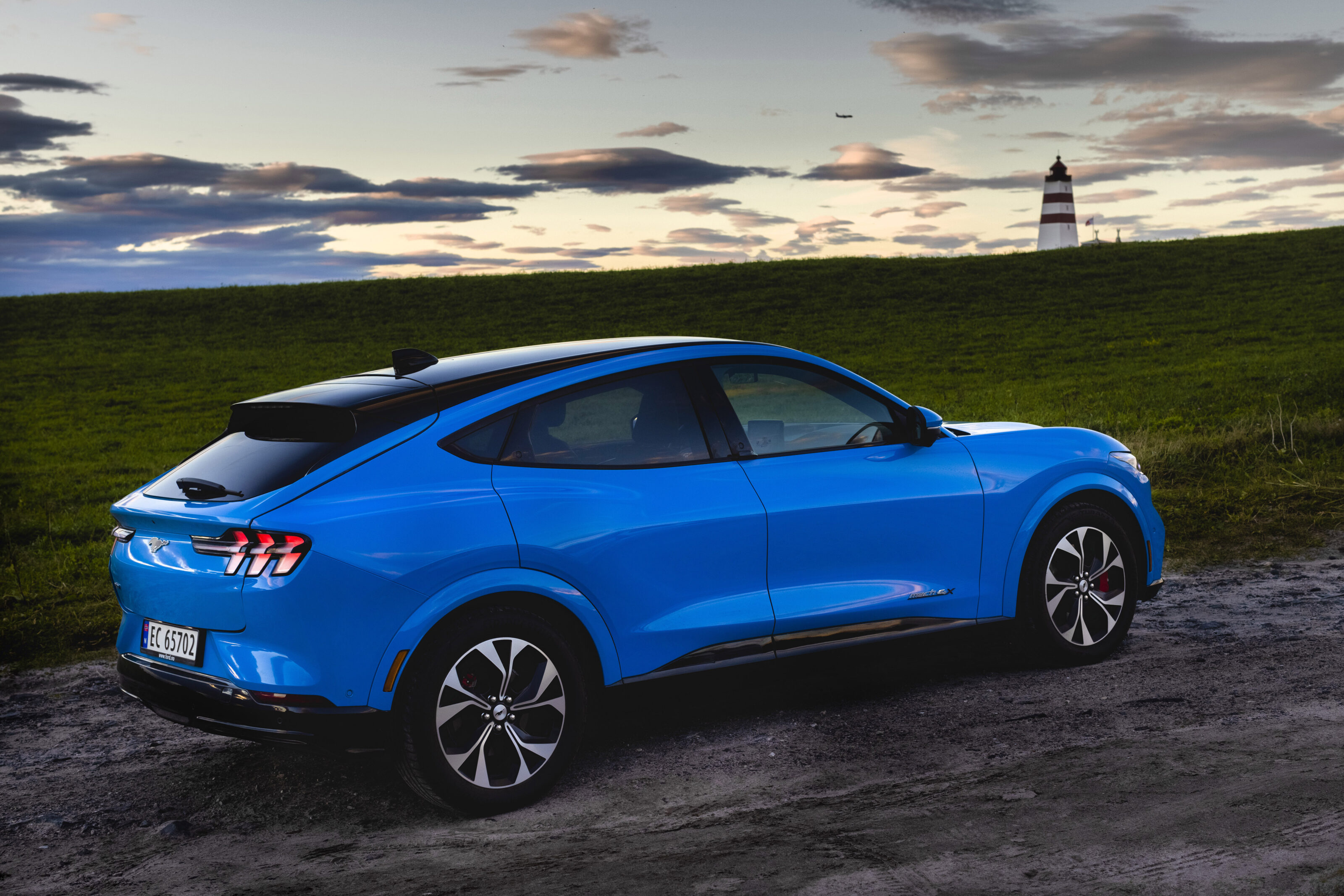
July 26: Ford Mustang Mach-E confirmed for NZ, still “no news” for Oz
Ford has confirmed the Mustang Mach-E electric SUV will arrive in New Zealand in early 2023 – but an Australian launch remains off the cards.
Across the ditch, the 2023 Ford Mustang Mach-E will compete against the Tesla Model Y and Volkswagen ID.4, with sales first commencing in December 2020 for the United States.
A spokesperson for Ford Australia said the company had no information to share on the local prospects of the Mustang Mach-E, without ruling out its launch entirely.
“[The] Mustang Mach-E is a spectacular vehicle and we’re excited for the team across the Tasman. We have no news to share on any plans to introduce Mach-E to Australia,” the spokesperson said.
Right-hand drive examples of the Mustang Mach-E went on sale in the United Kingdom 18 months ago, while Ford trademarked the nameplate in Australia earlier this year.
Two battery options are offered: a 75.7kWh standard range variant, or 98.7kWh extended range option. The flagship Mach-E GT produces 358kW of power and 860Nm of torque, with a claimed 3.7-second time for the 0-100km/h run.
Late last year, Ford Australia announced five electrified models would be rolled out by 2024, kicked off by the Escape PHEV and forthcoming E-Transit all-electric full-size commercial van.
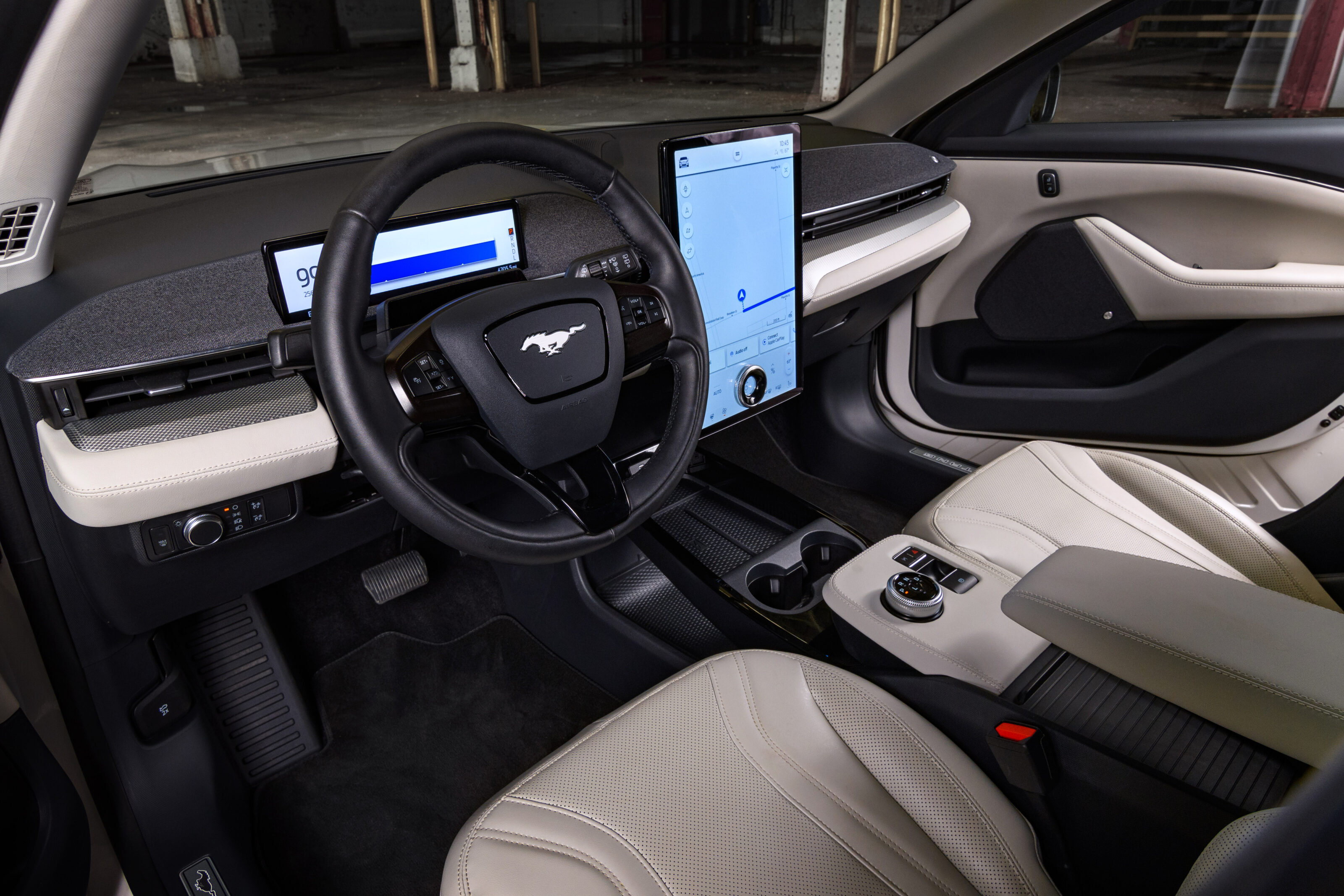
Based on a modified version of the current model’s platform, the smaller E-Transit Custom will arrive in 2024.
“There’ll be more to come,” the spokesperson added, hinting at the two as-yet-unannounced models, which could include an all-new SUV primarily designed for Europe.
However, the Mustang Mach-E remains uncertain for Australia, with strong demand in more EV-centric markets – now including New Zealand, following the introduction of emissions-reducing legislation for vehicles.
Talk of an all-electric Ranger Lightning was hushed at the ute’s local launch this month, but electrification is likely to arrive at some point during the decade-long lifespan of the new-generation T6.2 Ranger.
Meanwhile, the F-150 Lightning remains unavailable in factory RHD configuration, but a factory-backed local conversion has the potential to follow the Australian launch of the internal-combustion F-150 in mid-2023.
New Zealand introduced its Clean Car Standard on April 1, 2022, encouraging carmakers to sell electric or low-CO2 vehicles through incentives, while imposing a fee on high-polluting cars.
Ford New Zealand also offers mild-hybrid versions of the Focus and Puma, the Escape PHEV and Transit Custom PHEV, and a forthcoming Escape Hybrid.
UPDATE, January 2023: Kia EV6 GT driven in Australia
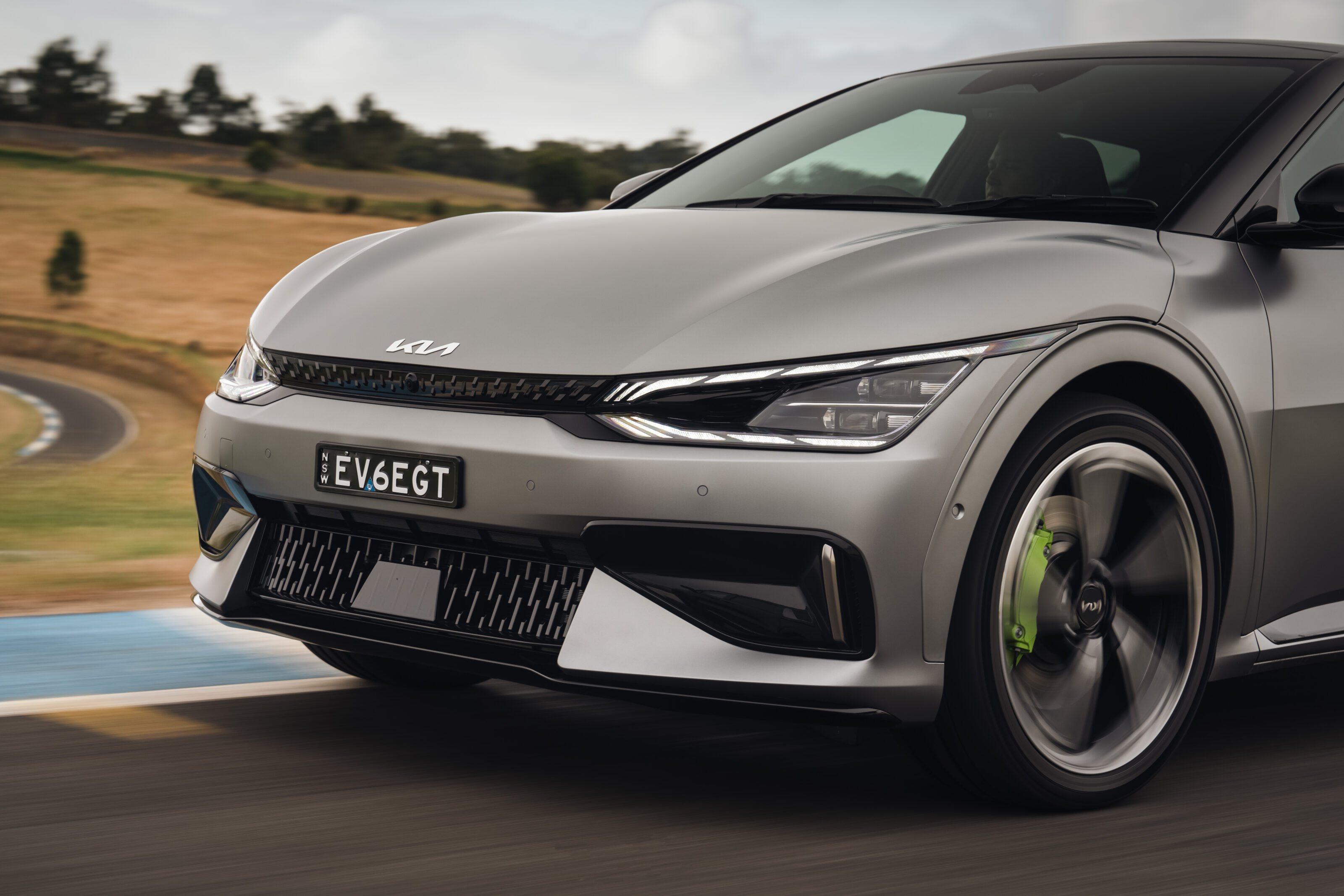
“This isn’t even my final form”, chuckled the 239kW & 605Nm EV6 GT-Line last year. Now we understand… see our first drive review of the flagship EV6 GT, including a track test, at the link below.
The story to here
The EV6 GT is the most expensive Kia ever, and not by any small margin.
We had a sneaking suspicion it would be, but when its $99,590 list price was leaked (technically still to be confirmed by Kia), there was uproar in our comments sections.

“One hundred thousand dollars… for a Kia?”
…was the overwhelming response. Not every comment was the same, but the $100K number definitely caused some price shock.
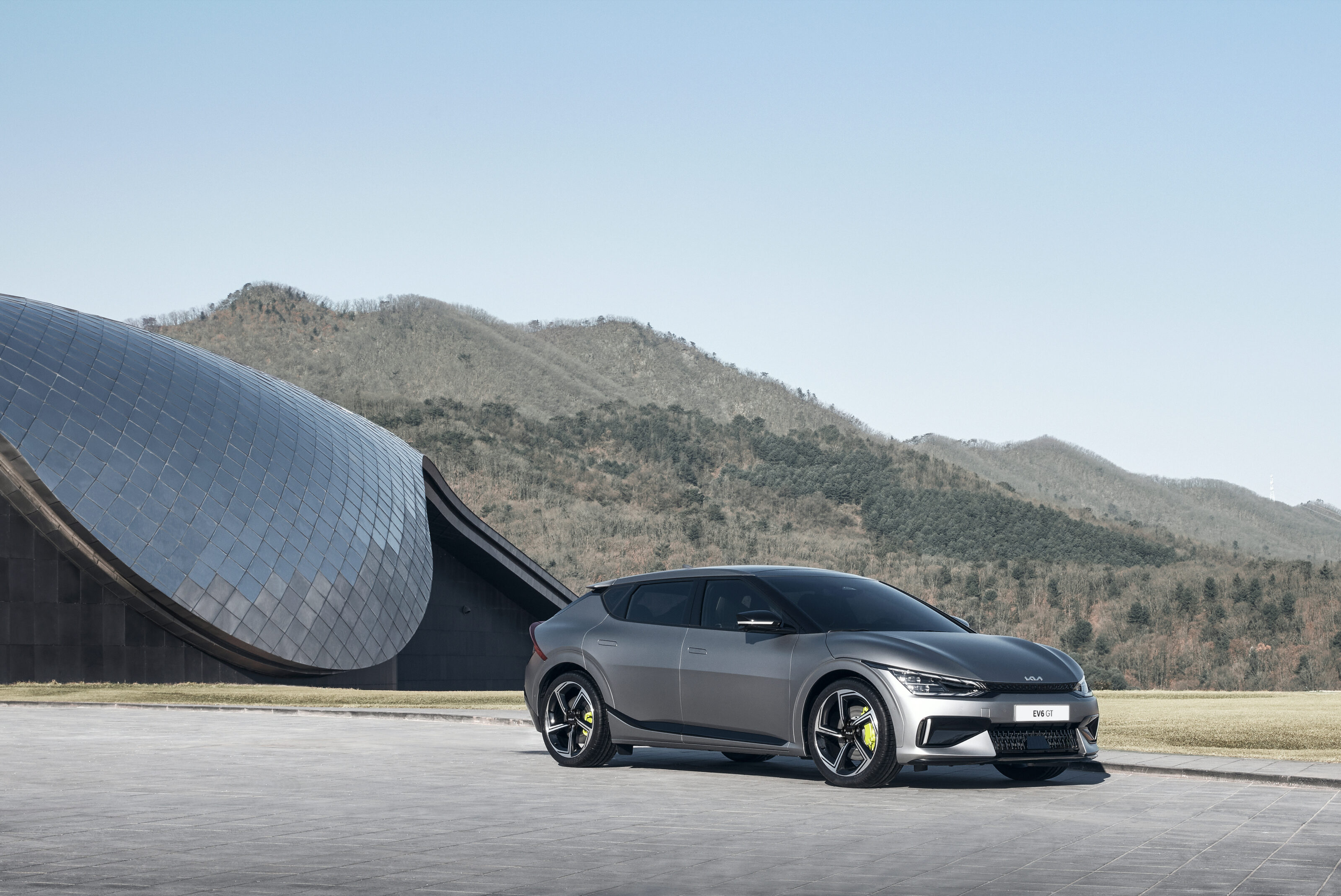
But with 80 per cent more power than the 2022 Wheels COTY champion, is the EV6 GT really such a bad deal?
We’ve broken down the numbers to see what actually matches it. This isn’t a defence of EV6 GT – we think it’s expensive, too – but rather a look at what else is out there, and how rivals compare.
There’s also scorn being thrown at electric cars more generally for being overpriced, which we reckon is worth addressing in bare numbers.
More subjective factors such as handling, ride quality and driver feedback are, of course, not being addressed here – this is a numbers and space game – so stay tuned for related ICE vs EV comparisons soon.
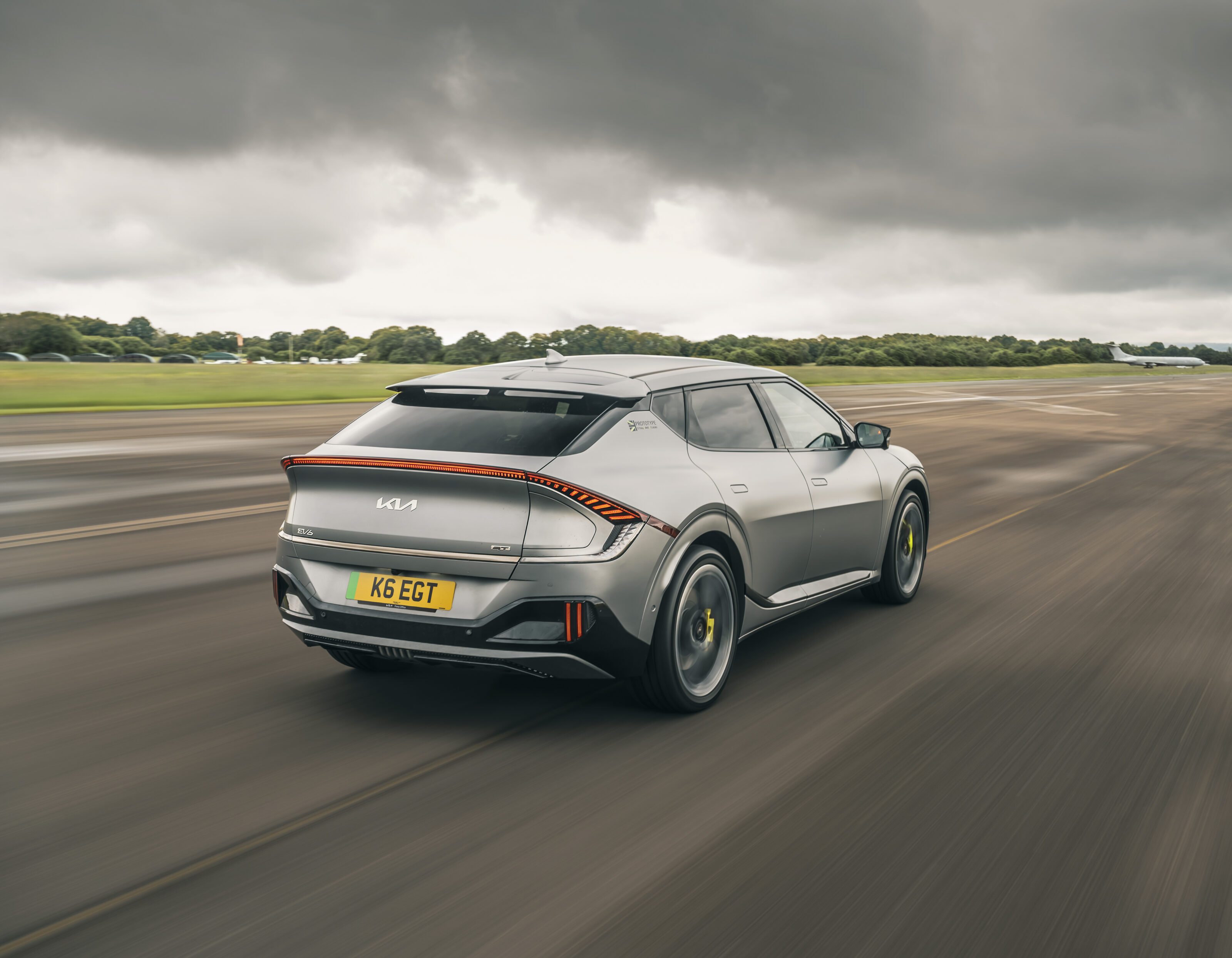
Kia EV6 GT specifications
| Kia EV6 GT | |
|---|---|
| Motor layout | 2 electric motors, AWD, rear locking differential |
| Power | 430kW |
| Torque | 740Nm |
| Gearbox | 1-spd reduction gear |
| Weight | 2125kg |
| Steering | electric rack-and-pinion |
| Tyres | Michelin Pilot Sport 4 S |
| Tyre size | 255/40R21 |
| 0-100km/h | 3.5sec (claimed) |
| Top speed | 260km/h |
Tesla Model 3 and Model Y Performance
The most obvious rivals? Tesla’s Performance range. The Model 3 especially gives the Kia a run for its money. It’s cheaper than the EV6 GT at $93,325 before on-road costs, with an estimated delivery date of February 2023.
It lacks the EV6’s Drift Mode, Australian-tuned suspension and adaptive dampers, however, at 1836kg – around 300kg lighter than EV6 GT – Tesla says the Model 3 performance will hit 100km/h in 3.3 seconds and go on to a top speed of 261km/h.

Tesla doesn’t claim outputs (though EV Database estimates 377kW/650Nm), but the AWD Model 3’s rapid acceleration, 250kW DC charging capability and 547km WLTP range are pretty enticing.
Meanwhile the Model Y Performance’s $98,425 before on-roads price is just a whisker under the EV6’s. It gets to 100km/h in 3.7 seconds, so a little slower than the EV6 GT.
For those comfortable with the digital experience, both Tesla’s 15.0-inch screens with built downloadable games, Netflix, YouTube, satellite navigation and excellent sound systems will certainly appeal. The EV6’s more conventional twin 12.3-inch screens still offer plenty of features, though.
(Stevo adds: Some might argue the Tesla price is justified through it being a more premium car, but, well… no, it’s not.)

EV6 GT vs combustion cars
At Wheels, we aren’t EV apologists, but the fact is you simply can’t get a new, combustion-powered car that’s as fast in a straight line for similar money – as the table below proves.
Of course, this is an on-paper comparison not taking into account the touch, feel, emotional response and overall driving experience that premium manufacturers take great care in crafting. So perhaps we’ll have to line up a comparison with the EV6 GT and some combustion rivals, too.
| Model | Power | Torque | 0-100km/h (claim) | MLP |
|---|---|---|---|---|
| Kia EV6 GT | 430kW | 740Nm | 3.5 seconds | ~$99,590* |
| Audi RS3 | 294kW | 500Nm | 3.8 seconds | $91,391 |
| Mercedes-AMG A45 S | 310kW | 500Nm | 3.9 seconds | $106,900 |
| BMW i4 M50 | 400kW | 795Nm | 3.9 seconds | $124,900 |
| Jaguar F-Pace SVR | 405kW | 700Nm | 4.0 seconds | $149,900 |
| BMW M3 Competition xDrive | 375kW | 750Nm | 3.5 seconds | $169,500 |
| Audi RS6 Avant | 441kW | 800Nm | 3.6 seconds | $229,300 |
| Mercedes-AMG E63 S | 450kW | 850Nm | 3.4 seconds | $257,900 |
*Kia Australia is yet to confirm the leaked EV6 GT list price
And if you want to go much faster in a straight line than a Kia or Tesla, maintaining space for four and the Labrador, then a Porsche Taycan will do it, but you’ll need to go for the 500kW Turbo, which starts at $283,000 before on-road costs and options.
