
For a brief period of time, McLaren was considering putting a Lamborghini V12 into one of its iconic race cars.
In the ‘90s, McLaren was synonymous with Honda in Formula 1, and it paired with BMW for the F1 road car (though that was very nearly a collaboration with Isuzu).
However, the idea of the two powerhouses of Woking and Sant’Agata coming together seems almost surreal.
But, it very nearly happened in 1994.
For several years Lamborghini had supplied engines to a number of mid-field F1 teams to little success.
By 1993 Lamborghini was ready to pull out of the sport altogether, until a handshake deal was struck between Bob Lutz – the head of Lambo’s parent company Chrysler – and McLaren’s notoriously iron-fisted leader Ron Dennis to see if the two companies could join forces.
An all-white MP4/8 was fitted with the Italian V12 for factory McLaren drivers Ayrton Senna and Mika Hakkinen to drive.
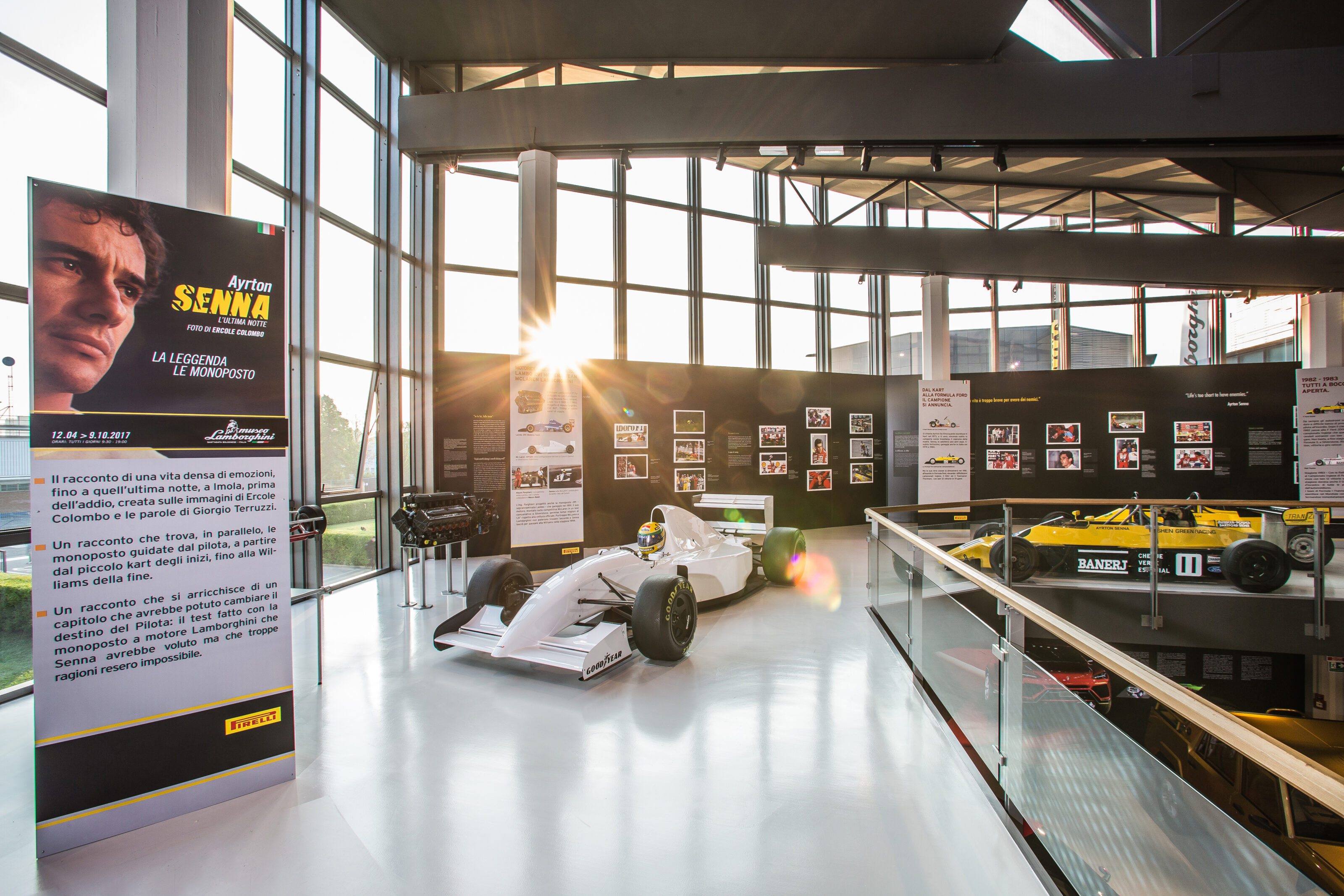
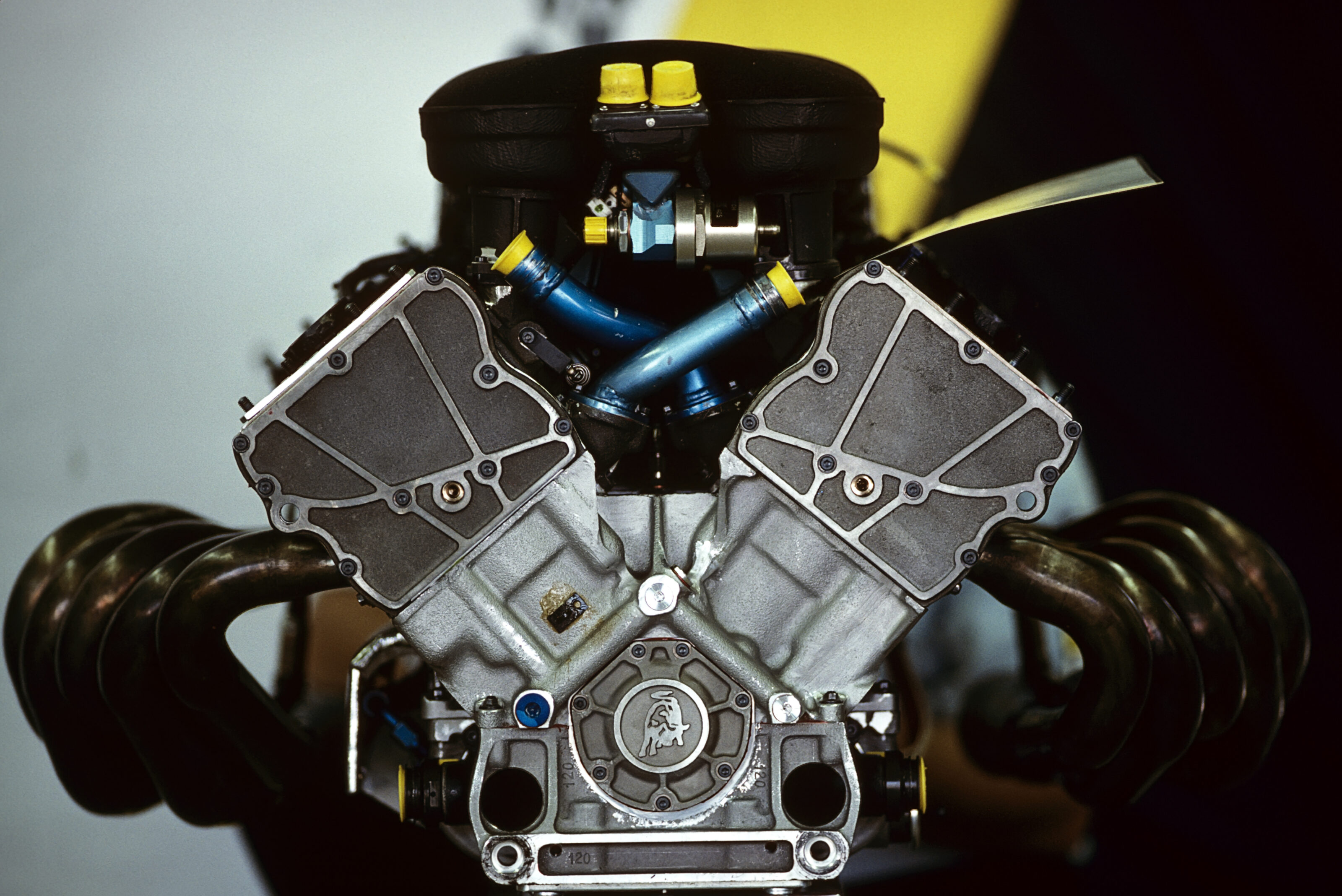
The engine, codenamed LE3512, was a 3.5-litre naturally aspirated V12 designed and built by former Ferrari designer and engineer Mauro Forghieri. It sounded fantastic, but results were hit and miss at best.
Test engines were badged as Chrysler, while the cars that did race with the unit were labelled with “Chrysler powered by Lamborghini”.
When the Lamborghini V12 was first introduced to F1 in 1989 it was reported to be producing 447kW. By the time McLaren completed its test of the engine in ’93, power was said to be in the region of 559kW.
But, as is typical of certain engines from that era of F1, all that power comes with a high risk of complete engine failure.
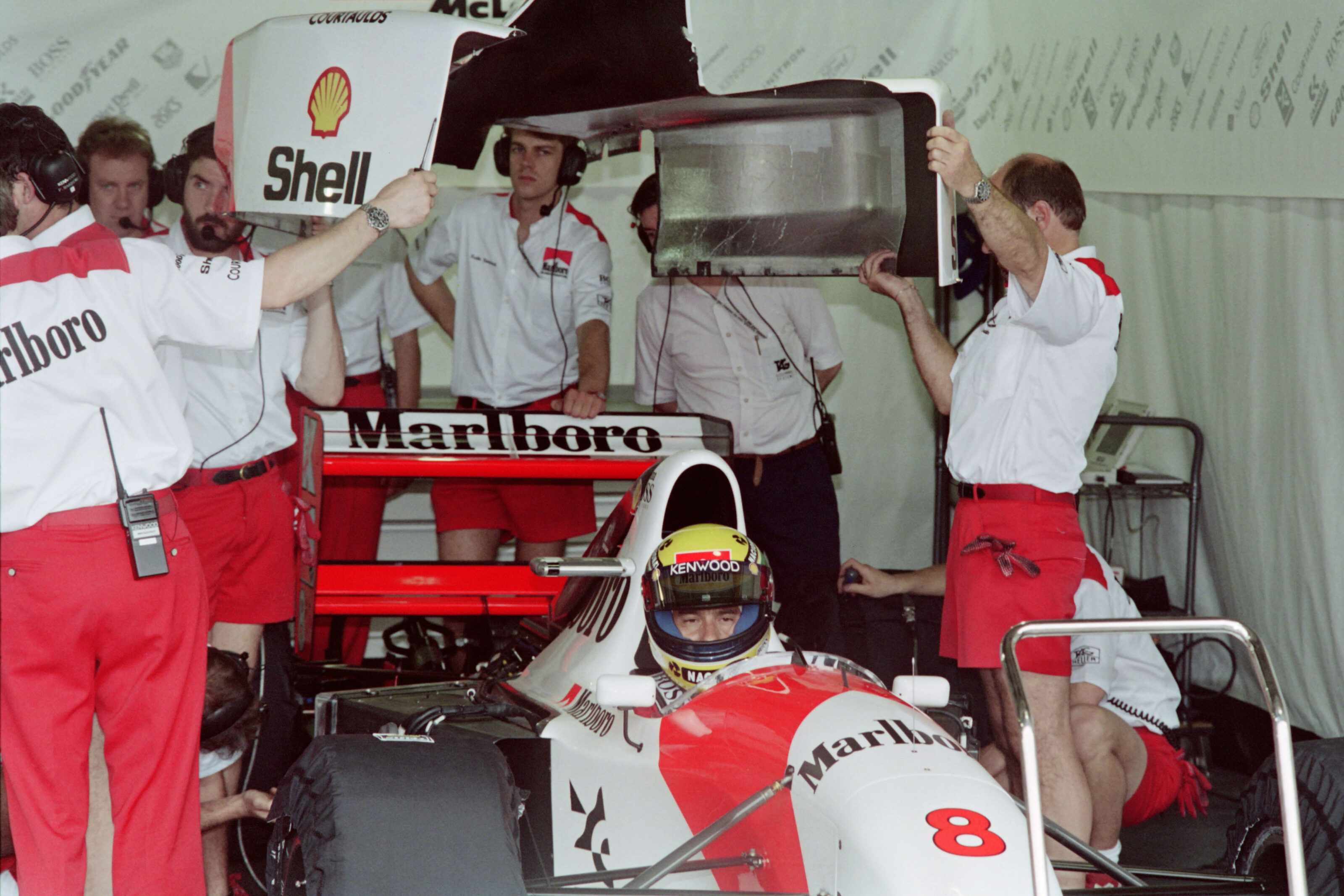
Supercars’ head of motorsport Adrian Burgess worked for McLaren at the time, and recently spoke with the V8 Sleuth about his time spinning spanners on the Italian-British hybrid racer.
“I was on the test team then; we had the Ford DFV wire-spring, basically a customer engine, we were paying for our engines and Benetton had the air valve which was the latest spec engine, they were the factory team,” Burgess recalls to the V8 Sleuth.
“I think they won one race with Michael and we won five with Ayrton.
“Myself, and two other mechanics were the only ones to actually work on that [Lamborghini-powered] car. All of the Lambo testing was our car crew. We went to Pembrey, then we went to Silverstone, then we took it to Estoril.”
During testing McLaren boss Ron Dennis set Burgess and his teammates an ambitious benchmark, which they came close to achieving.
“I remember going to Estoril in Portugal the day after the Grand Prix. Ayrton loved it, he thought [the engine] was great. And coupled with that chassis – our chassis at the time, we were just catching up with Williams with the active – we’d made some really good strides. The car was quick.
“We turned up at Estoril and I think Ron said to the team: “If you’re 5 seconds quicker than the Larrousse with the same engine, then we’ll consider it.”
“We went out and did a qualifying run and were like 4.9 seconds quicker – within half a day we were 4.9 seconds quicker than the Larrousse was two days earlier at the Grand Prix with the same engine.”
Despite being able to make the Lamborghini V12 fast, the McLaren mechanics couldn’t stop it from detonating in spectacular fashion.
“The problem with the engine was that by the time it was warm it normally had handgrenaded itself,” Burgess laughs.
“I think the furthest we went was 19 laps before all of a sudden you could look down through the inlet trumpets and actually see out the bottom! It handgrenaded itself in the most magnificent ways. It was like a Scalextric car dragging con-rods down the front straight at Estoril. The thing just blew up.”
Despite the constant critical mechanical failures, Burgess recalls his time working on the Lamborghini-powered McLaren fondly.
“I’ve got so many good memories about that car; we were so good at doing engine changes on the thing because they were so unreliable,” he recalls.
“We actually did one, from rolling it into the garage to driving it back out the garage, 26 minutes was our best!
“It was such a big engine, everything was spread out, it was actually fairly quick and easy to change. Unfortunately you just changed them quite a lot because they were so unreliable.”
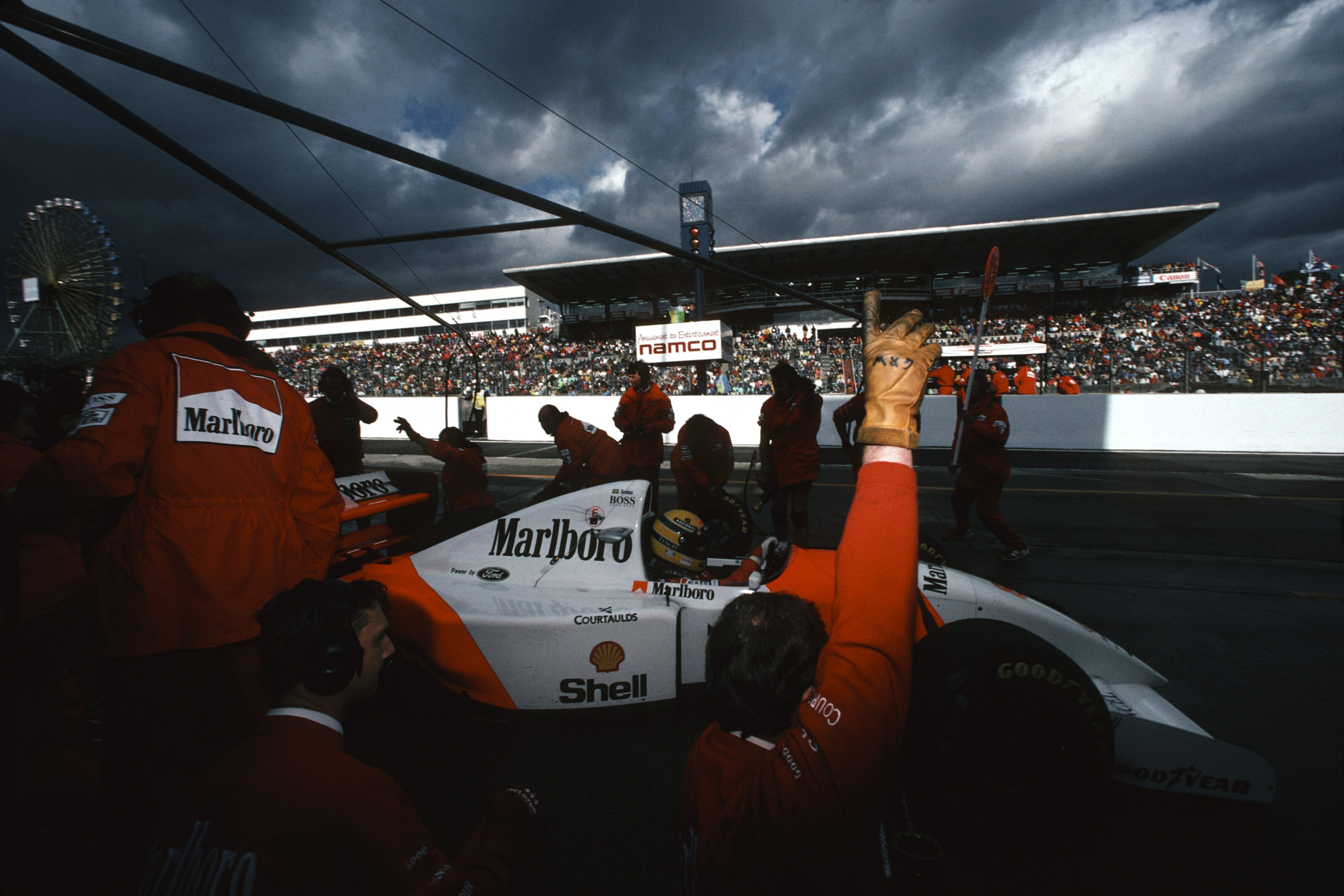
McLaren was using a 507kW Ford V8 engine in 1993. Despite Ayrton Senna wanting to run the Lamborghini V12 as early as the Japanese Grand Prix that same year (an event he would win using the Ford engine), Dennis instead signed Peugeot on as the engine supplier for ’94.
As a result, Senna signed with Williams, who was set to use a 3.5-litre Renault V10 in its FW16.
“Ayrton wanted [the Lamborghini] and I think if we’d taken the engine he’d have stayed with us. He knew the engine was our weakness and we needed a good engine partner. He wanted to take that car to Japan and Adelaide – which ended up being his last two races with McLaren, and ironically he won both those races for us with the Ford,” Burgess explains.
“At the end of the day it came down to Chrysler putting in the money to develop the engine and making it reliable. Ron couldn’t get a deal over the line with those guys and we ended up going with Peugeot.”
With no McLaren deal, that would sign the death warrant for LE3512. History tells us that the Lamborghini engine was one of only five V12 engines used in the naturally aspirated era from 1989–2013.
Imagine electricity transformed into pure petrol… and what you’re seeing is e-fuel. Though it might sound like alchemy, making them involves nothing more than well-proven physics, chemistry and engineering.
It’s likely you’re going to hear a lot more about e-fuels. They’re green, they’re clean and they’re carbon neutral, or very close to it, so they have immense and obvious appeal for anyone who is fond of both the internal-combustion engine and our planet.
There are only two problems: they’re not an efficient way to use precious renewable energy; and they’re not essential, at least when it comes to cars.
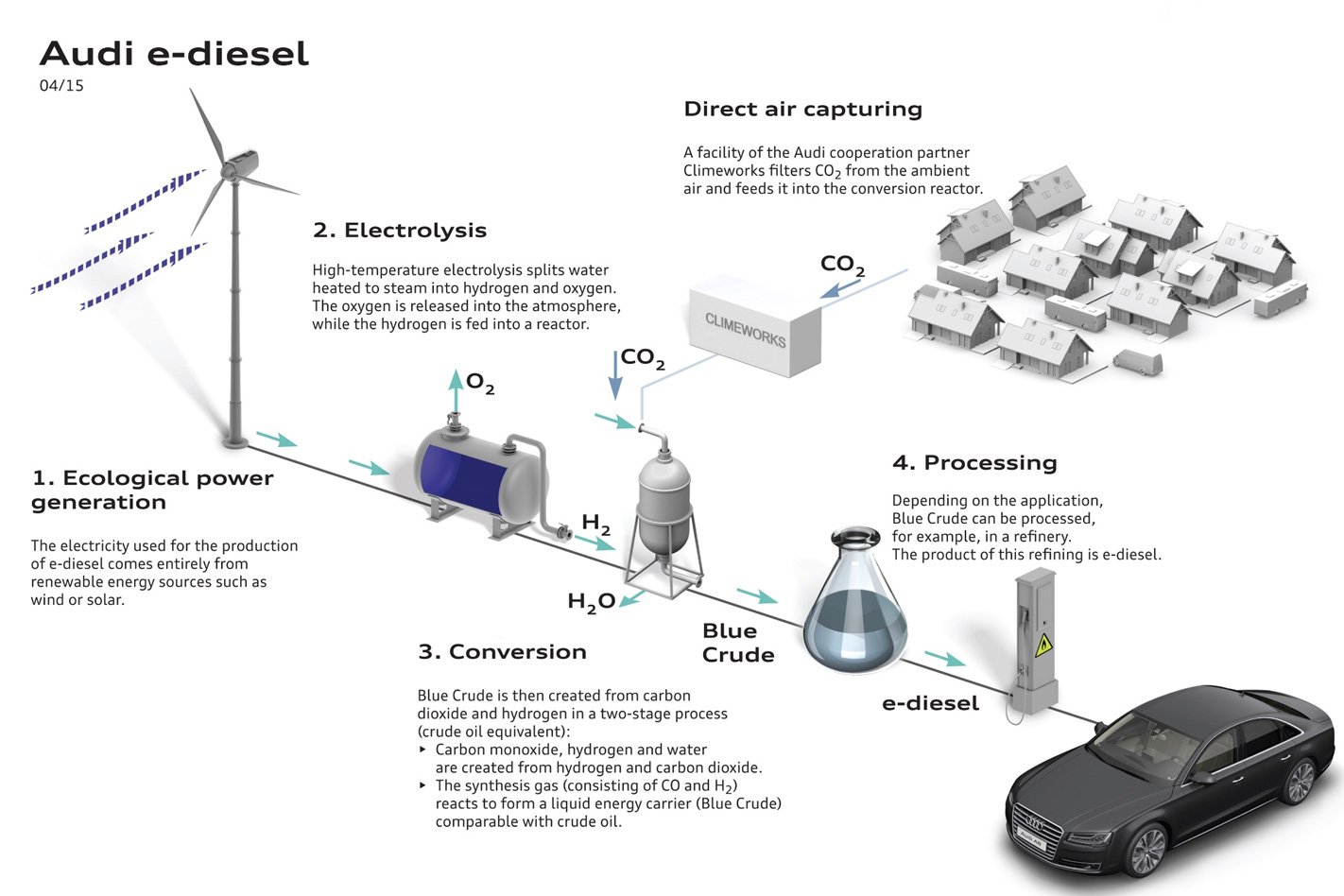
To understand the inefficiency thing, you need to know at least a little about the basics of e-fuel production. So let’s take a look at a specific example, one that’s been getting some attention recently.
Porsche is supporting, as lead customer, a multinational project scheduled to begin producing e-fuel next year. The Haru Oni project in Chile will use power generated by a forest of big Siemens wind turbines. Their electricity will be used to extract hydrogen from water and carbon from carbon dioxide filtered out of the air. The hydrogen and carbon will then be bonded to create methane gas, which will be converted to liquid methanol. Finally, the methanol will be processed to produce petrol.
What’s important to understand is that none of these steps is 100 percent energy efficient. Only around 50 percent of the electrical energy needed to create the e-fuel ends up stored as available chemical energy in the e-fuel. And much of this, around 70 percent, escapes as heat from the exhaust pipe and radiator when the e-fuel is burned in an internal-combustion engine.

Credible analyses of the overall efficiency of the entire chain of e-fuel production and use that I’ve found estimate that only about 15 percent of the electrical energy needed to make the stuff actually gets to the point where rubber contacts road. If the same amount of electrical energy was instead used to charge an EV, it would be able to drive four to six times farther than a vehicle powered by an internal-combustion engine burning e-fuel.
Despite this, e-fuels do have a future. In a world where there’s an abundant oversupply of renewable energy, it makes sense to do something smart with the surplus.
While e-fuel will never be the most efficient choice, it does offer a bunch of advantages; it’s easy to store and transport using infrastructure that already exists, and it can be used in vehicles that already exist.
Analyses of the overall efficiency of e-fuel production and use estimate that only about 15 percent of the energy needed actually gets to the point where rubber contacts road
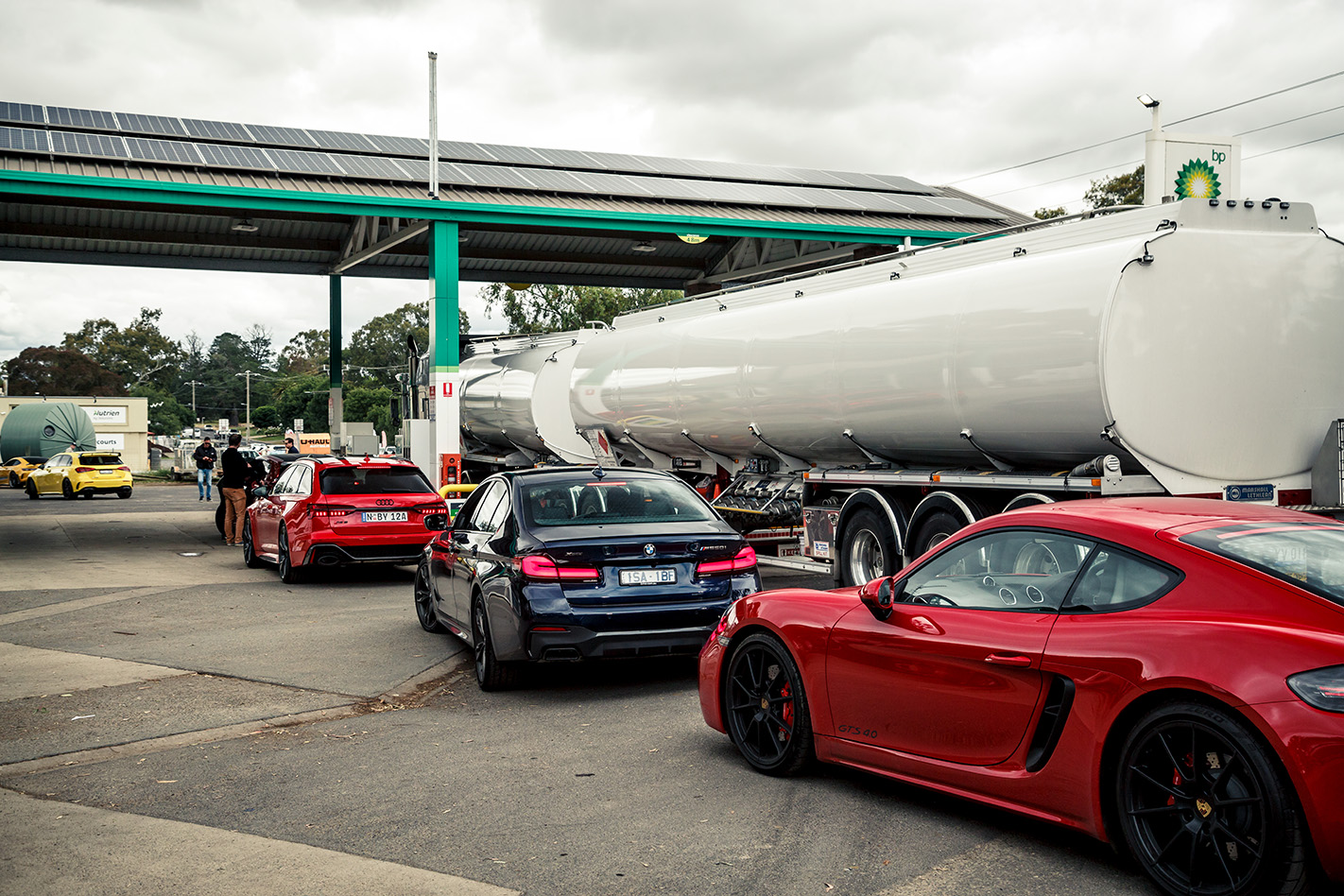
Even assuming the day comes when more renewable energy is being produced than is required to supply immediate daily needs, pouring e-fuel into cars isn’t the most intelligent thing to do with it. Why? There are other important modern transport modes that cannot be made climate-neutral without them. The idea of running international maritime freighters or long-range commercial aircraft on battery or hydrogen fuel cell power is simply absurd. Ask an engineer…
So until some amazing innovation comes along, e-fuels will be essential to making the modern world work in a clean and green way. Everything from shipping a cheap T-shirt from China to jetting overseas for that longed-for holiday or essential business meeting will come to rely on them.
But e-fuels are not essential to keeping our earthbound wheels turning. Porsche may be supporting e-fuel production, but they also happen to have produced perhaps the most persuasive proof that cars can get along just fine without them.
It’s called Taycan.
What is it?
The fourth-gen Hyundai Santa Fe seven-seat large SUV has received a mid-life update, which is when most cars get fresh bumpers and tail-light lenses. Perhaps some tech and equipment tweaks.
Contrary to conventional wisdom, this Santa Fe iteration changes much of the stuff you can’t see and retains a lot of what you can.
Inside and out, it looks like a comprehensive facelift but below the skin lurks a new platform – shared with Kia’s bang-up-to-date Sorento – while a body that is 15mm longer, 10mm wider and 5mm taller than before remains smaller than rivals that approach or exceed five metres in length.
The Active grade tested here sits above the newly self-titled Santa Fe base variant, with the Elite and flagship Highlander offering more tech and visual flair in return for plenty of extra coin.
On paper, the Active represents peak bang for buck in this revised Santa Fe range, but how does it all hang together as a package?
Price and features
The Santa Fe range opens at $44,700 before on-road costs with a V6 petrol engine and front-wheel drive, meaning driveaway pricing around the $49,000 mark in each capital city.
On all variants, a four-cylinder turbo-diesel with all-wheel drive – as tested here – adds $3500 to the bill.
Price rivals within a few hundred bucks of the base Santa Fe are the petrol-only Toyota Kluger (from $44,850) and Nissan Pathfinder (from $44,240), both of which are bigger than the Hyundai and nearing the end of their product lifecycles.
A Santa Fe cross-shopper may also be split between the Mazda CX-8 (diesel from $46,910) and CX-9 (petrol only from $45,990). Likewise, the Kia Sorento opens a couple of grand upstream of its Hyundai cousin but with a smaller $3000 premium for diesel.
The Santa Fe is on average 19cm shorter than its Asian competitors but longer than a Skoda Kodiaq ($46,390), Peugeot 5008 ($51,990) or VW Tiguan Allspace ($40,990).
Our Active diesel comes to $51,800 before on-roads, plus another $695 for its Typhoon Silver premium paintwork.
This buys a substantial step up in luxury ambience over entry level, with partially quilted black leather-appointed seats plus stitched leather-look upholstery across the dashboard and around the centre console.
The Santa Fe makes a strong first impression with its hatchback-like demeanour in urban or suburban driving.
From Active grade up there’s dual-zone climate control, front parking sensors, rain-sensing wipers, rear privacy glass and paddle-shifters plus a new rotary drive mode selector.
Adding to the long list of standard safety tech – more on that later – the Santa Fe Active packs an electronic child lock for rear doors and windows plus features that prevent the doors from being opened if another road user is approaching and remind the driver to check the rear seats for pets, people and possessions before exiting.
The base model’s 17-inch alloys are replaced with 18s on the Active, which also gets electric folding mirrors and puddle lamps.
Considering the modest $3600 Hyundai asks for all these extras on the Active, forking out $6000 more for the Elite plus another $7400 on top of that for the Highlander seems like diminishing returns for mostly toys and trim.
Our ideal Santa Fe would be an Active with integrated rear window shades, media system and powered tailgate from the Elite plus the Highlander’s digital dash with blind-spot camera view.
We’d call it the $3000 Active Family Pack. How about it, Hyundai?
Ownership costs
Hyundai provides a five-year unlimited kilometre warranty, which has become something of an industry standard.
Servicing happens every 12 months or 15,000km – pretty standard stuff – with Hyundai quoting $459 for each of the first five intervals at the time of writing and up to five years’ servicing locked in at this price available for pre-purchase.
That’s a less costly than maintaining a Kia Sorento but more expensive than a diesel Mazda CX-8. Perks of servicing a Hyundai on schedule at one of its dealerships include annual extensions of the standard 12-month roadside assist cover.
During our two weeks with the Santa Fe Active diesel, Hyundai’s fuel consumption claim of 6.1L/100km on the ADR combined cycle proved pretty accurate and a big improvement over the outgoing model’s 7.5L/100km.
Considering the amount of time spent idling and shunting around during video and photography sessions, 6.7L/100km on the trip computer was an outstanding result and provided us with a theoretical 1000km range from the 67L tank, which would cost $87 to fill at $1.30 per litre.
Comfort and convenience
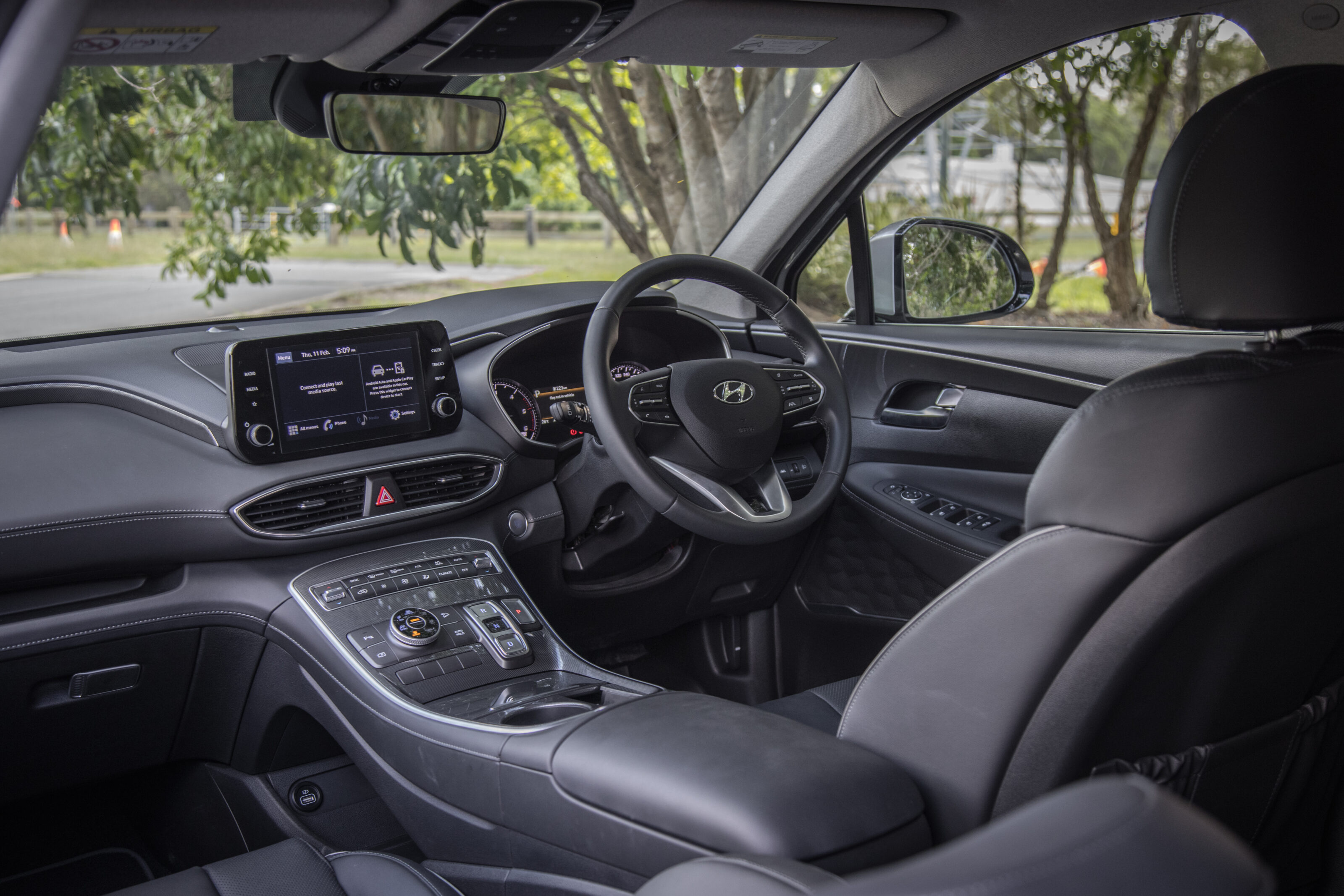
Much of the updated Santa Fe interior layout and look is initially familiar, the most noticeable architectural change being a two-deck centre console – not present in the base Santa Fe – that easily accommodates a loaf of bread and two-litre milk carton on its lower level.
Above, the traditional gear selector has been replaced by metal-look push-buttons alongside redesigned switchgear that is similarly chunky and intuitively located.
Staggered-height cup holders make perfect sense in practice and it’s great to see a conveniently located vertical wireless phone charging pad from base spec up.
A big storage bin is found beneath the central armrest but there is nowhere obvious to store sunglasses. Four USB ports are distributed across the front and middle rows of the Active, while Elite and Highlander have another pair in the third row.
Elite and Highlander variants sport big digital display but our Active shares the base grade’s basic 8.0-inch infotainment system that relies on owners running most functions through Apple CarPlay and Android Auto, the former being unusably glitchy on our test car.
Apart from that, audio quality is decent and a there’s a useful voice memo function that can export your musings to a USB drive.
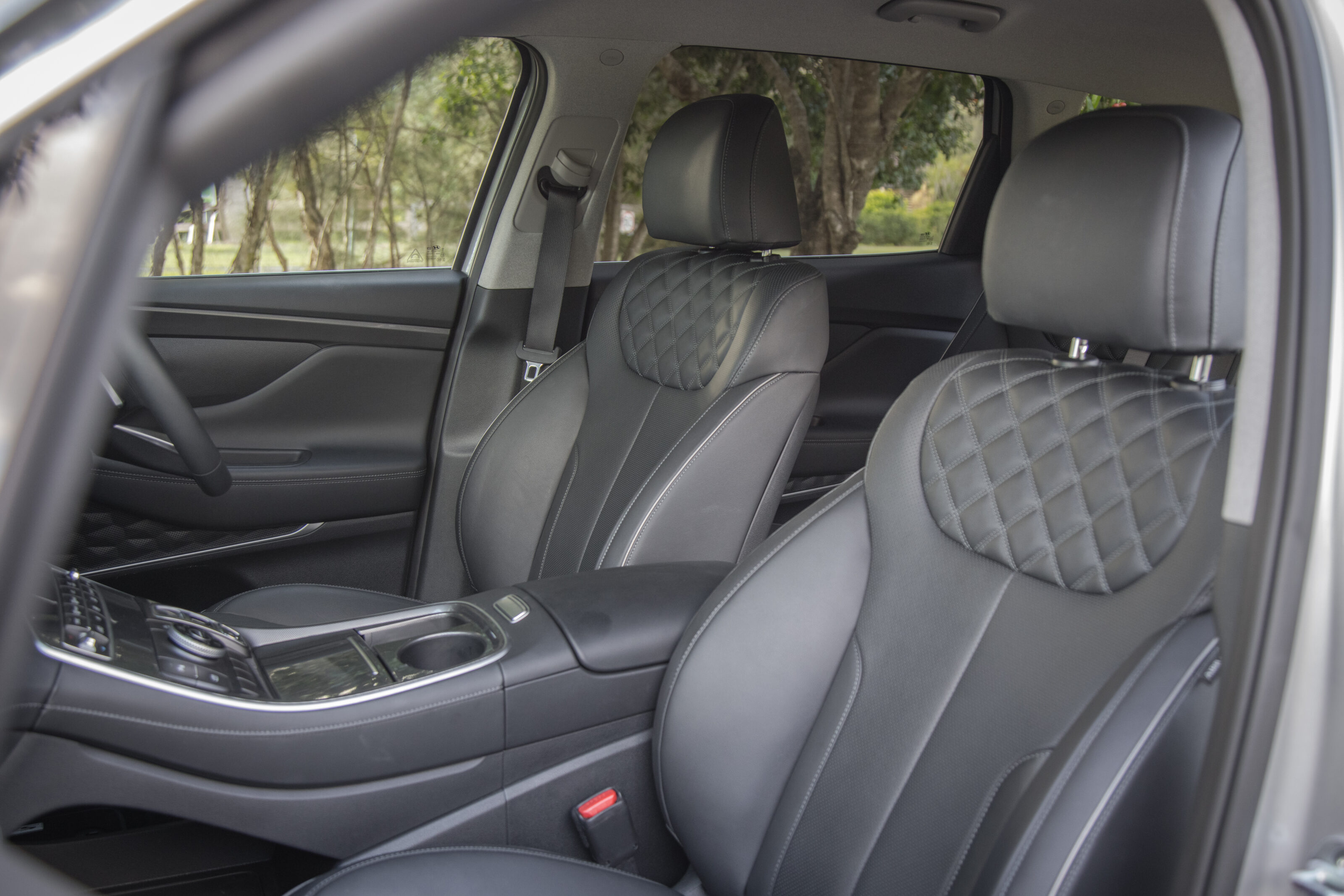
Hyundai might have set a segment benchmark with the Santa Fe’s front seats. Even with the Active’s manual adjustment, support, angle, driving position and long-distance comfort are flawless.
Row two is now much more spacious, to the tune of 39mm in additional legroom for greater cabin flexibility when the independently sliding and reclining sections of the 60:40 split bench are configured to balance capacity between the second row or and third row or boot.
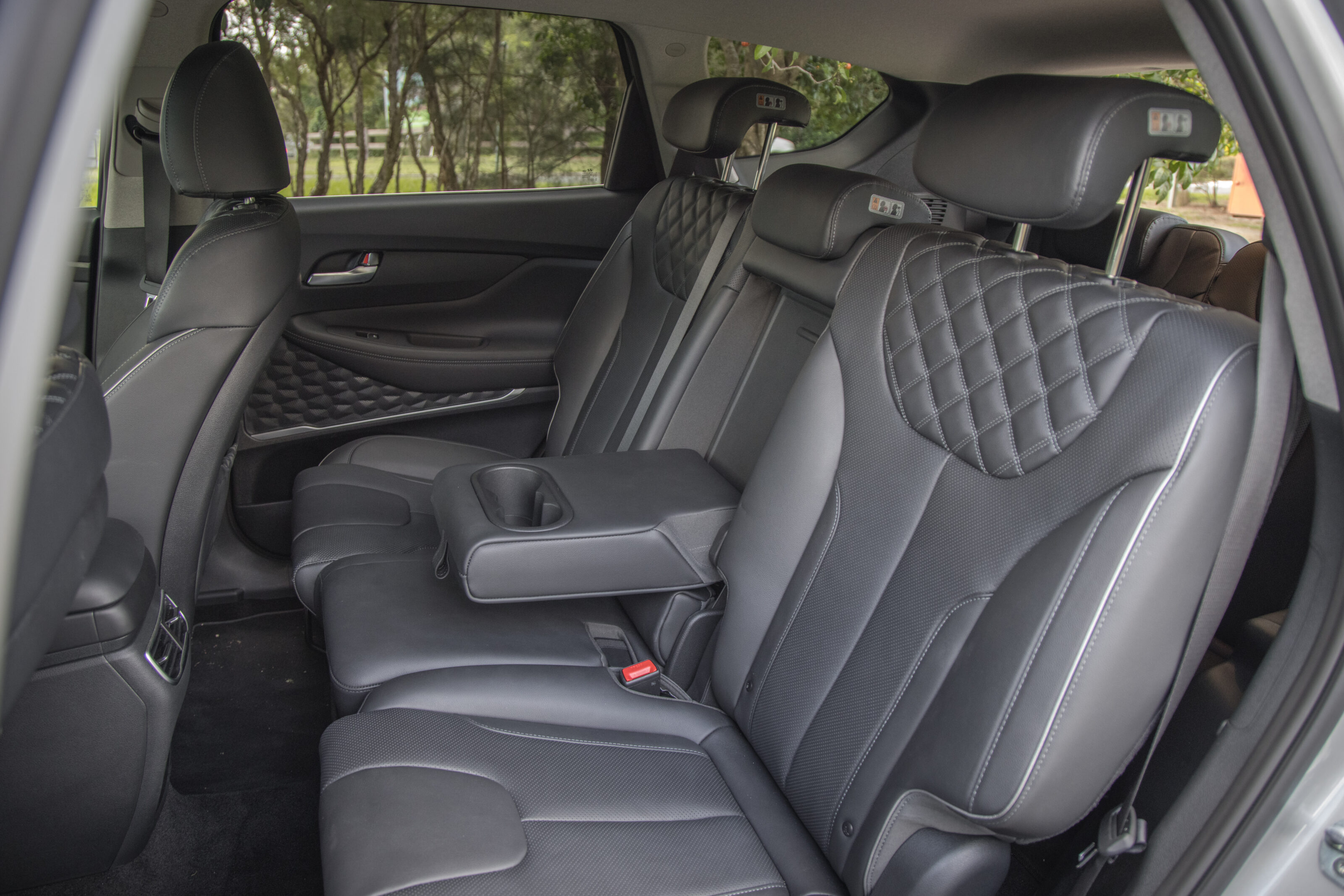
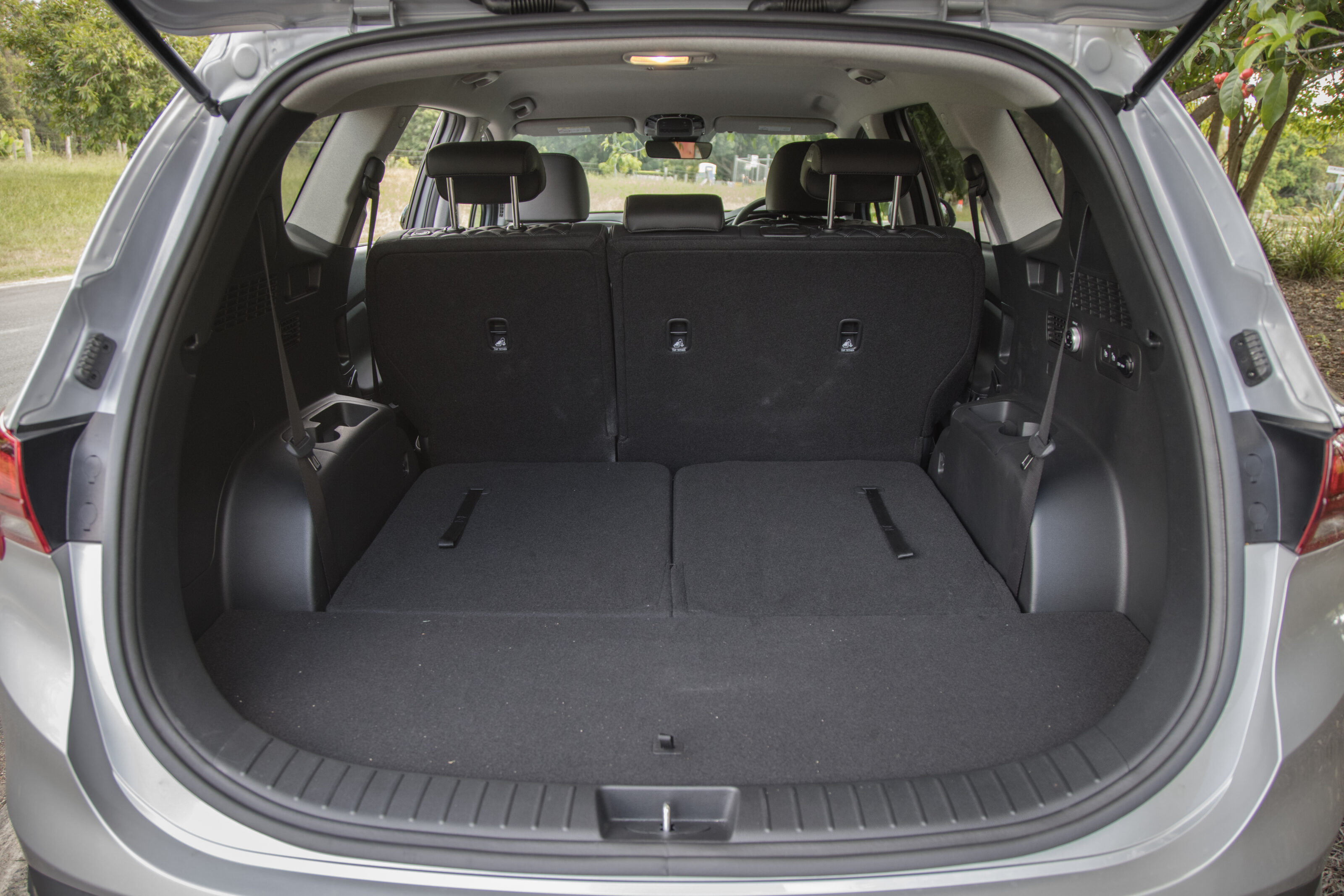
The bigger shell yields an additional 24L of boot space with the third row folded away – now from 571L to 782L depending on how you position the second-row seats – but with the third row in place capacity remains a measly 130L, so good luck on the grocery run.
Seat comfort and space is great in row two, apart from the thinly padded central position.
Capacious map pockets and more usable door bins than those up front are provided, but they’re similarly unsuited to tall bottles. If not using the middle seat, the fold-down armrest offers better drinks holders.
A trio of top tether anchorages offer the possibility of installing three child seats, the outer two of which can be secured using ISOFIX.
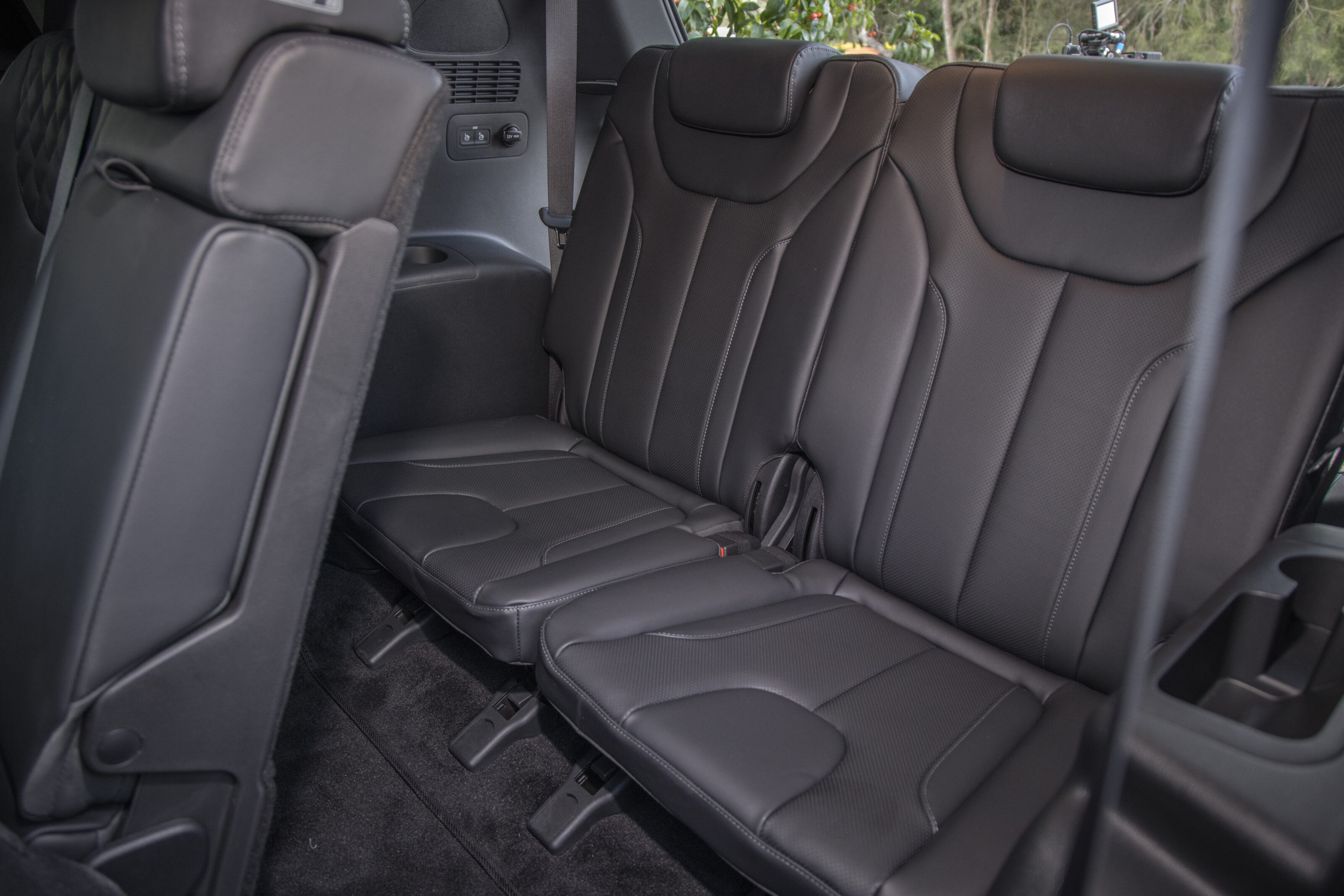
However, the third row remains cramped in all directions and because there are no child seat anchorages back there, the Santa Fe only provides a short window of time between rearmost passengers being no longer legally obliged to use child seats and being too tall to fit. Worse, the side curtain airbags do not extend far enough back to fully protect third-row passengers.
Upsides include generous seat padding, adjustable air-con vents with fan speed control, cup-holders and rectangular storage trays for each seat.
Accessing the Santa Fe’s third row is only possible from the passenger side, via simple push-button activation of the corresponding second-row seat’s tilt-and-slide mechanism.
It’s good to have this on the kerb side when street-parked, but both third-row passengers are forced to file in and out of one door.
Also, the seat release and remote second-row folding buttons invite mid-journey mischief as they’re within easy reach of third-row passengers and can be operated while the vehicle is in drive.
Safety
Hyundai has overhauled the Santa Fe’s standard safety tech suite, with a major upgrade to forward collision mitigation system that can now detect obstacles at junctions and automatically brake to avoid – or at least reduce the severity of – these types of collisions.
Also standard are driver attention monitor, rear-cross traffic avoidance and a blind-spot monitor including collision avoidance assistance. Tyre pressure monitoring is included and all variants come with a full-size spare.
Accurate adaptive cruise control with stop and go function combines with lane-keep assist to reduce driver effort and stress levels on long motorway journeys and in heavy traffic.
However, lane-keeping gets a bit intrusive on narrow twisty roads and takes a long, firm press of the relevant button to disable.
Driver visibility is excellent in the Santa Fe, with deep windows and big mirrors plus a crisp reversing camera image. Kids enjoy a good view out from the second row, although the third row gets little portholes.
There are six airbags – none in the third row – and despite deep engineering changes, the Santa Fe inherits its predecessor’s five-star ANCAP crash-test rating.
Power and performance
Hyundai says it has made the Santa Fe’s 3.5-litre petrol V6 and 2.2-litre four-cylinder turbo-diesel engine options lighter, with less internal friction.
This 2.2-litre four-cylinder turbodiesel develops 148kW – 1kW more than previously – while torque remains at 440Nm, similar outputs but 10Nm down on torque compared with the same-sized diesel in a Mazda CX-8.
On the road, this reduced friction and inertia combine with the new underpinnings to lend the diesel Santa Fe a smoother, quieter driving experience.
It’s effortless once up and running, with swelling mid-range acceleration and unlike the previous Santa Fe, there’s no step-off lag.
This could have a lot to do with the diesel’s new dual-clutch automatic transmission, which we’d wager also helped the big improvement in fuel efficiency compared with the V6 that retains a torque converter auto and is only a tenth less thirsty at 10.5L/100km while outputs have dropped slightly to 200kW/331Nm.
So seamless and intuitive is the diesel’s new cog-swapper in general driving that we regularly forgot it was a dual-clutch. Hyundai has done an impressive job of ironing out so many kinks typical of this transmission type.
Even on challenging twisty roads it always seems to be in the right gear, the revs changing exactly when we’d be making a manual shift using the paddles.
Only hill-starts or tight manoeuvres on inclines reveal a couple of quirks, such as unexpected revving or disconcerting hesitation between reverse and forward gears.

How does it drive?
The Santa Fe makes a strong first impression with its hatchback-like demeanour in urban or suburban driving. It feels uncannily small and nimble for a seven-seat SUV, shrinking around the driver and responding without the expected inertia.
At suburban speeds, ride quality delivers a sense of road texture without intrusive jostling or jolting over surface imperfections. On motorways or country roads it settles into a comfy kilometre crusher, making the Santa Fe a great partner for family road-trips or travelling far and wide for work.
The finer points of handling are going to be of little relevance to the average Santa Fe buyer, but it helps if your family car is an enjoyable steer and sound dynamics can help avoid the complaints and consequences of motion sickness that mum-and-dad drivers dread, forcing them to drive so slowly that an impatient queue forms behind.
Good news on that front. Our Active diesel would happily barrel along a curvaceous country lane without disappointing the driver or alarming their passengers. Few seven-seat SUVs achieve that, none of them Japanese.
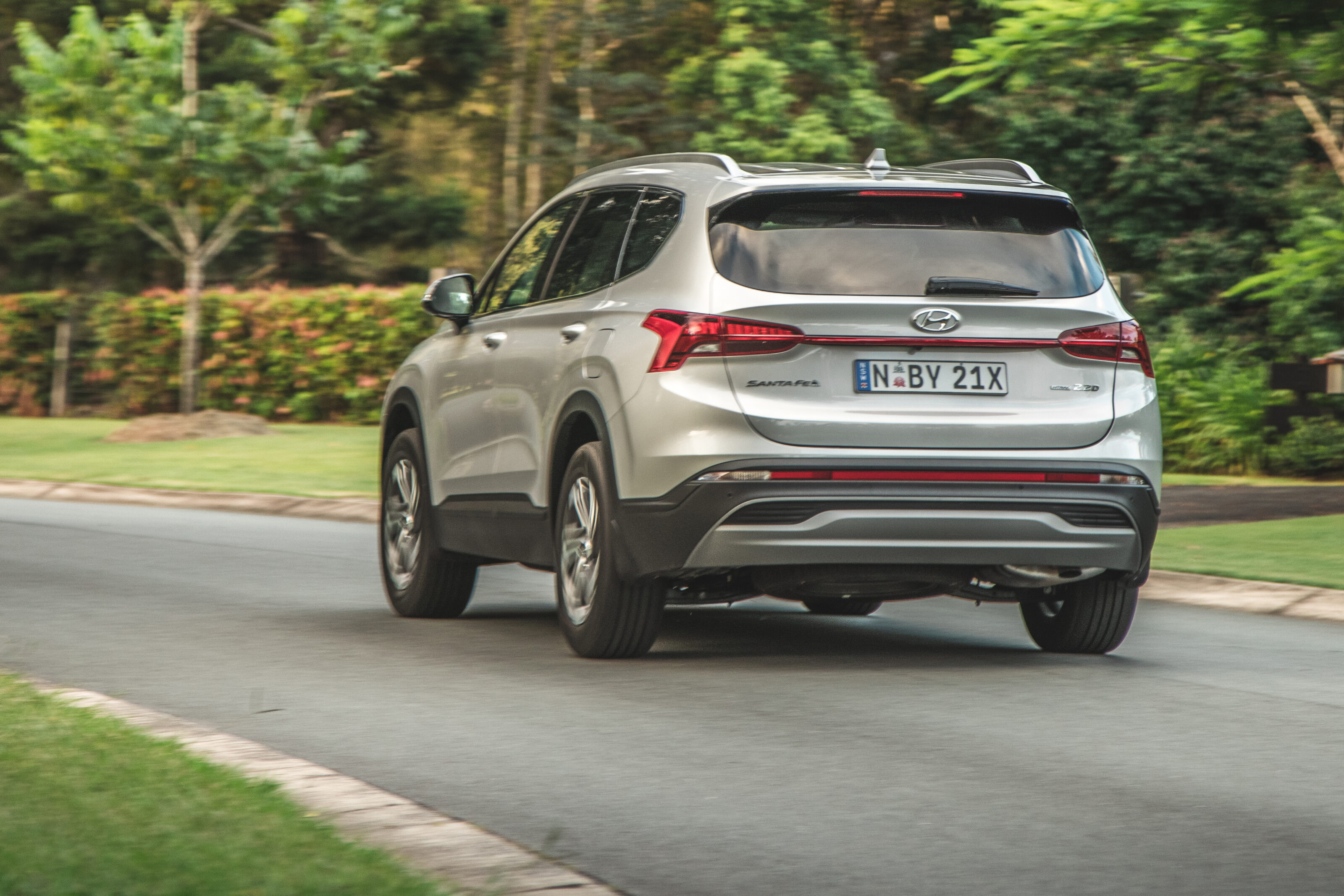
The Kumho tyres provide sufficient rather than spectacular grip, and are quick to start howling when pushed. What stands out is how controlled and predictable this car feels, which is comforting if you ever need to take evasive action with precious cargo onboard.
Patchwork corner surfaces and mid-bend ridges or crests rarely unsettle the Santa Fe, which holds its line doggedly while being surprisingly communicative about what is going on below deck.
These dynamic smarts pay dividends on gravel, where Hyundai’s HTRAC AWD setup also gets the power down with minimal fuss and 60-section rubber provides plenty of sidewall squish to absorb unsealed road craters that would jeopardise the 20-inch rims of a higher-spec Santa Fe.
Sand is the terrain mode that makes most sense on gravel, amping up the throttle response in case the going suddenly gets soft or things end up a bit out of shape mid-corner.
Overall, the updated Santa Fe is an easy-going all-rounder and a pleasure to both drive and be driven in.
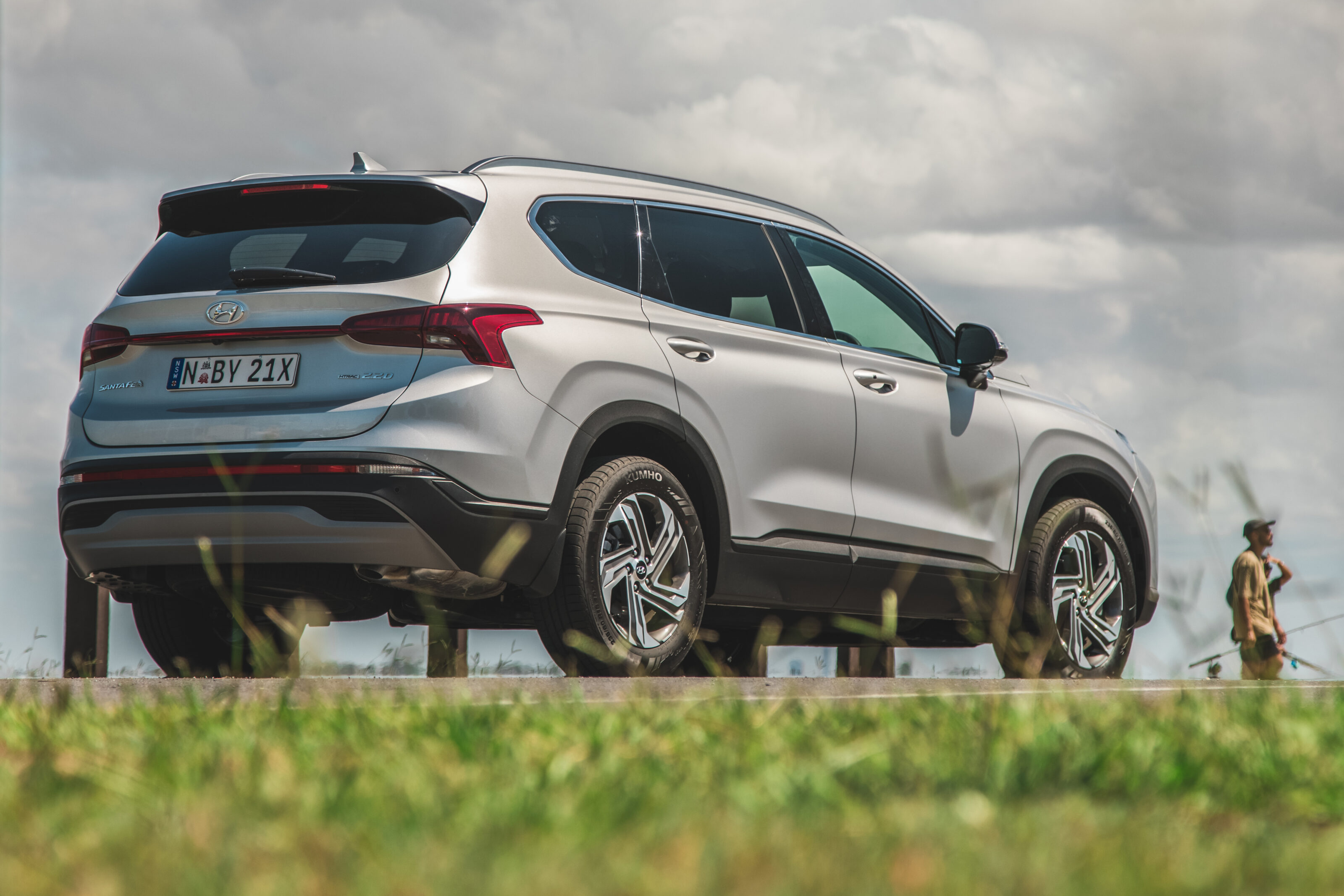
VERDICT
With substantial improvements throughout, a cabin that is better put together with new luxury trim that adds genuine wow factor and a driving experience that has matured without losing its youthful vigour, the new Santa Fe truly ranks among the segment’s best.
And, as is the modern Hyundai way, the value equation is competitive rather than outstanding. But the Active is by far the sweet spot in that regard.
By concentrating on making the interior bigger for second-row passengers it’s as though Hyundai has just accepted that customers will look elsewhere for a more usable – and safer – third row.
Perhaps it’s no coincidence that the company introduced its massive eight-seat Palisade at around the same time.
The Playmate iGenie is one of the fastest tennis ball firing machines you can buy. Wick it up to 11 and it’ll launch from its 300-ball capacity hopper at over 160km/h, at a rate of one every second.
Now I’ve never stood in front of one of these machines to experience the result, but driving the Eildon-Jamieson road in a Porsche 911 Turbo can’t be too different.
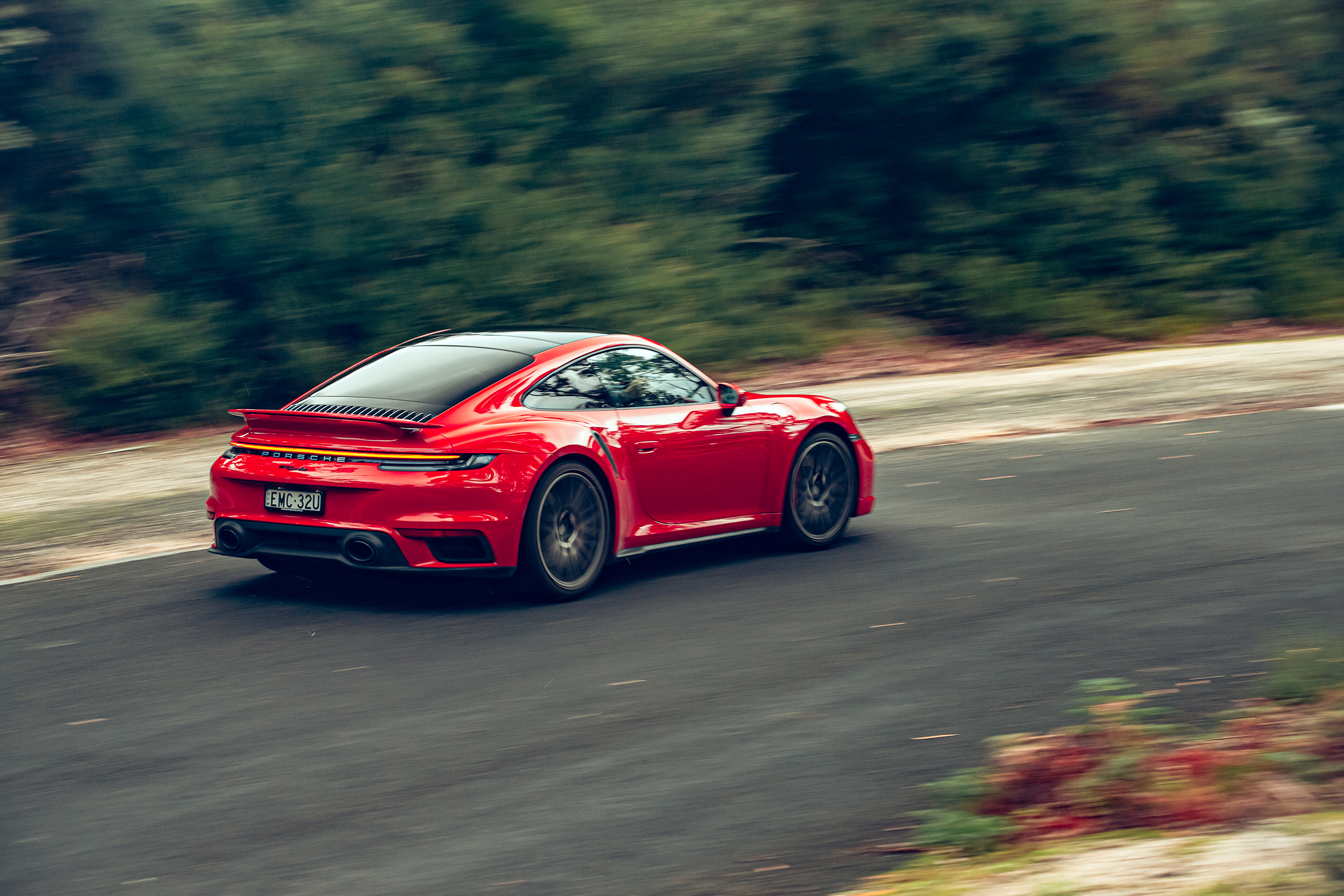
The tightly packed bends explode through the windscreen without pause as your brain struggles to process the almost ridiculous overstimulation.
Perhaps we should have chosen a road a little more sedate. But the 911 Turbo has a number of questions to answer, chief among them whether it has made good on Porsche’s promise that this latest 992 generation has got its bite back.
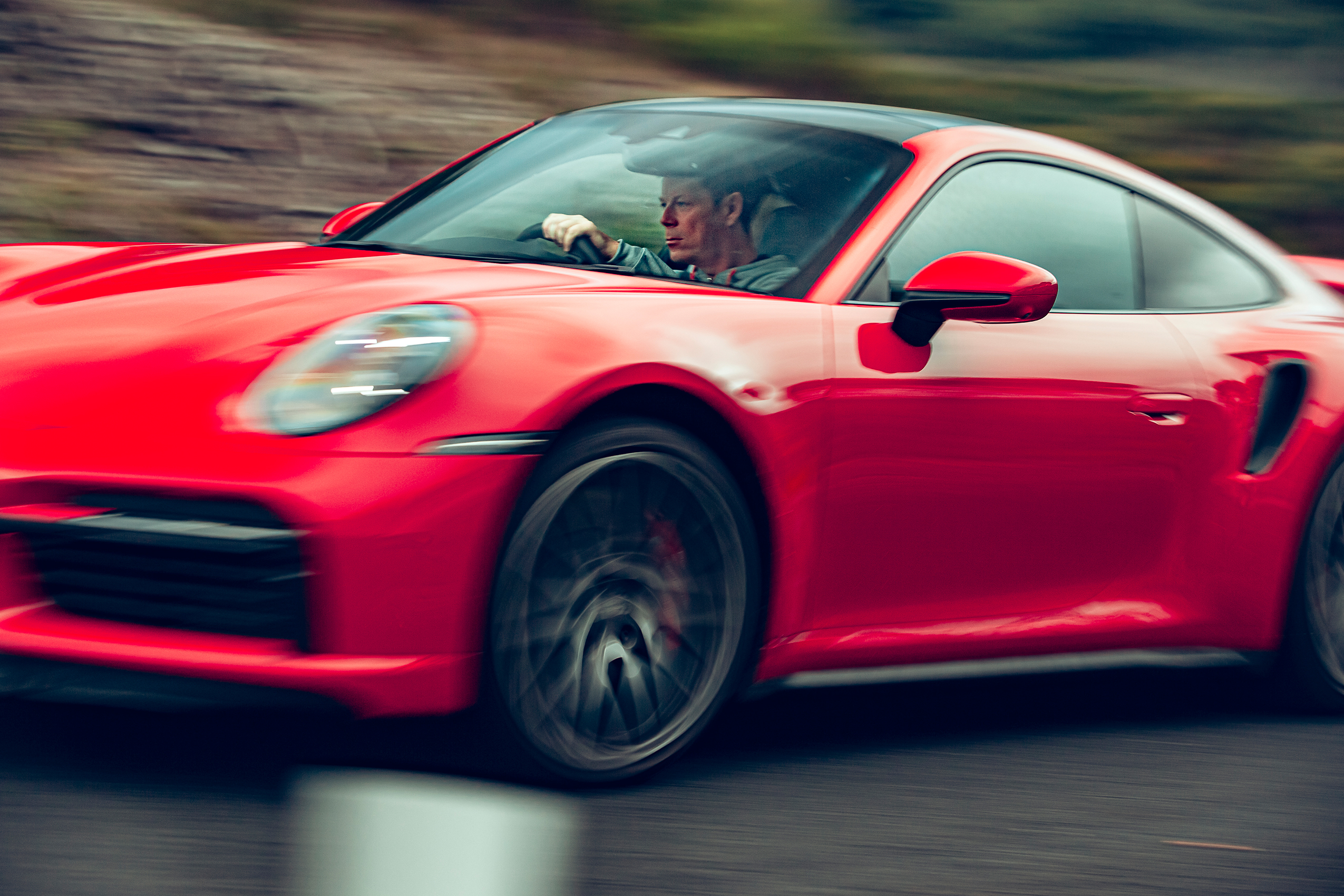
Where previous water-cooled 911 Turbos have gradually morphed into a more GT car role, leaving the GT2 and GT3 models to be honed to a keen edge, perhaps Zuffenhausen felt that the Turbo had become a little too middle-aged, maybe a little too self-satisfied, operating within an admittedly heady comfort zone. Cue the 992.
Now the astute among you will have noticed that this model is the 427kW/750Nm Turbo and not the 478kW/800Nm Turbo S flagship. You’ll save around $75K plumping for the non-S variant, with this car reaching 100km/h in a claimed 2.8s rather than 2.7s of the 911 Turbo S.
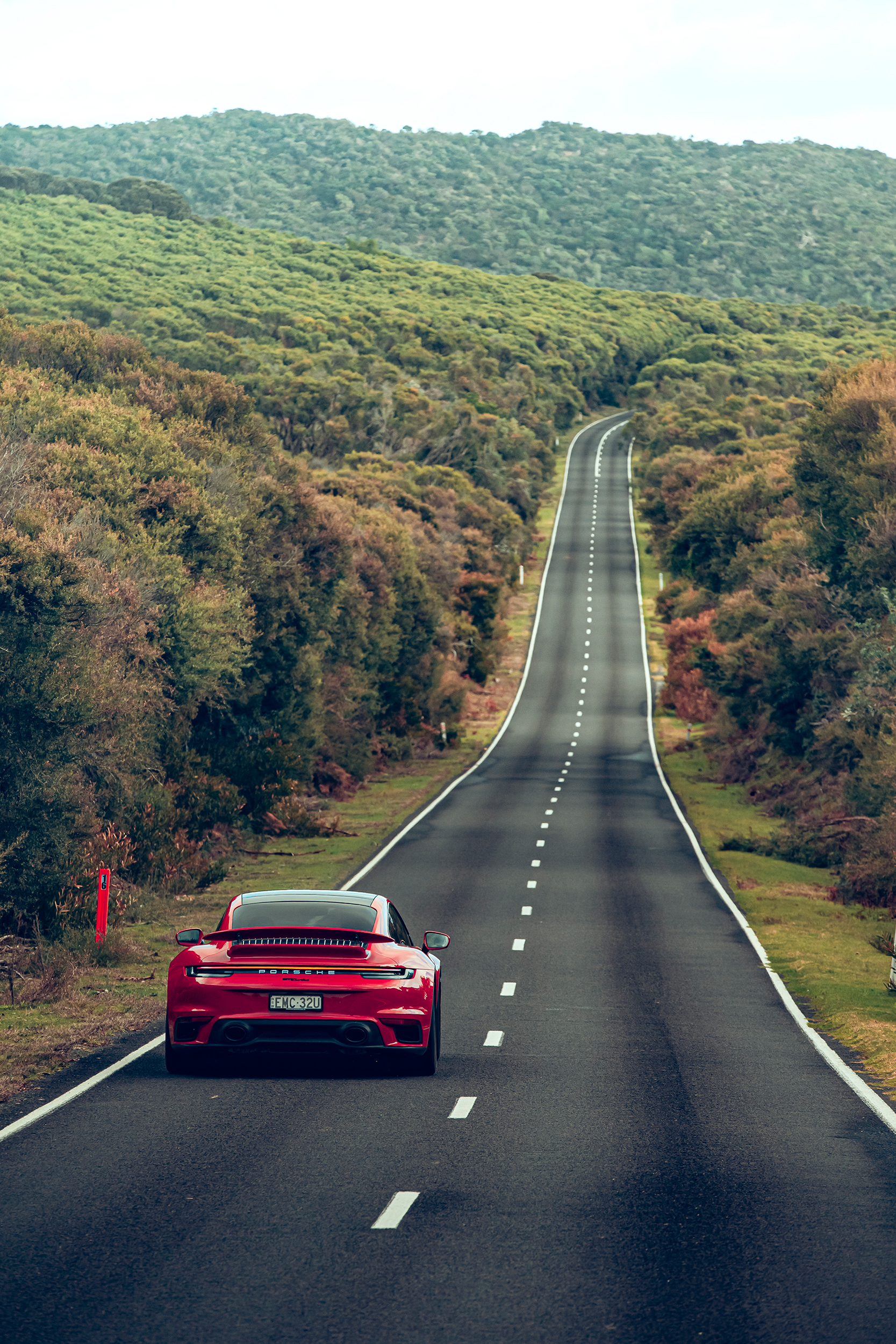
In other words, they’re both so quick that your brain will be too scrambled to notice any great difference in relative ferocity.
We ask whether the 992 Turbo, at a list price of $405,000 before options and taxes still does enough to justify itself in Porsche’s new world where every 911 that doesn’t wear a GT3 badge is now a turbo.
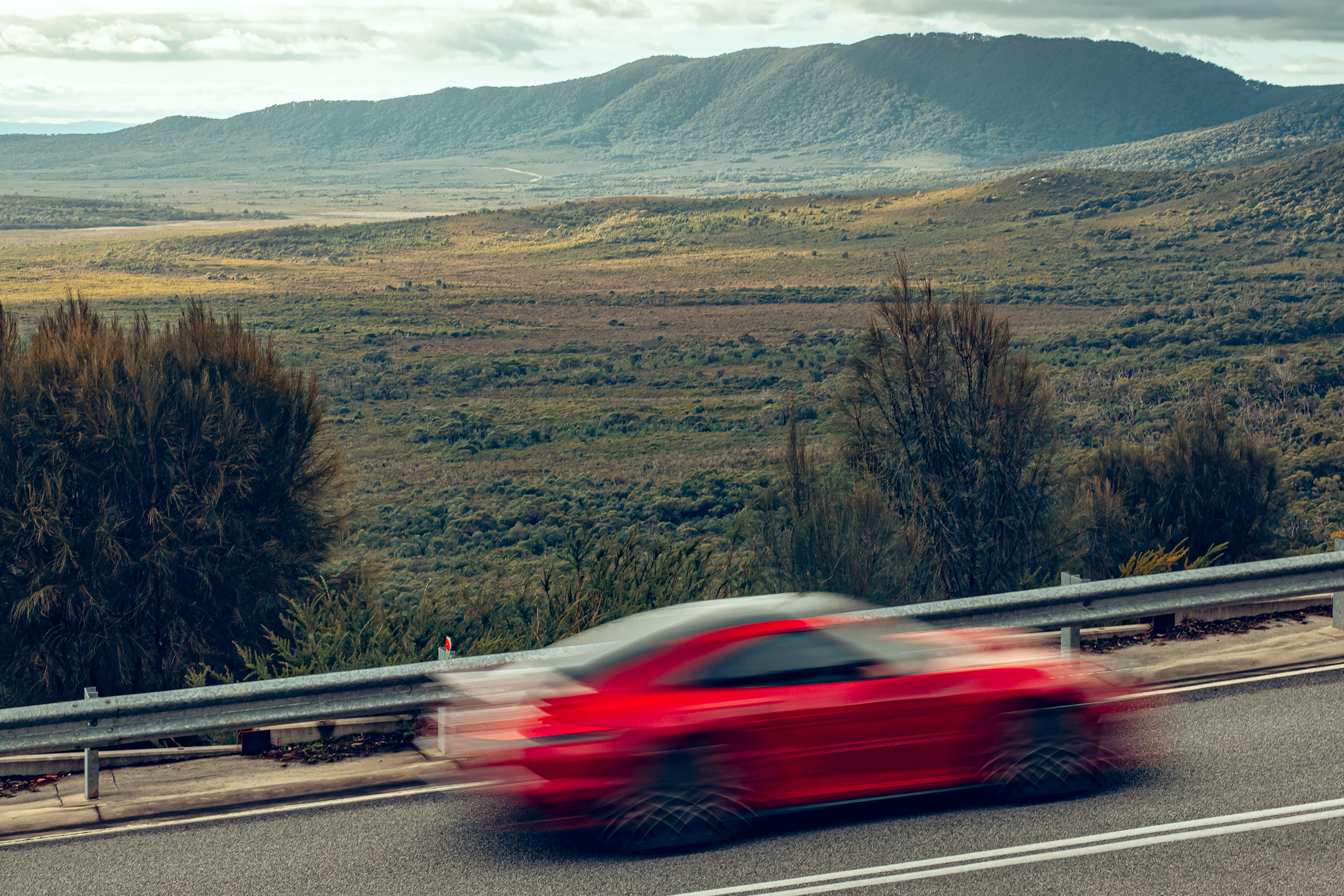
It’s a valid question, as we’ve driven the 911 Carrera and Carrera S models fairly extensively and couldn’t really ask for much more from a road car.
Does the 992 Turbo need to be fierce or should it have leant further into its GT role? What is its place in the new 911 firmament and does it stand up one its own merits here in Australia?
There’s a lot to unpack here. Dive into the video as we run you through what has to be one of the fastest point-to-point cars that money can buy.
Snapshot
- Popularity of the mini 4×4 continues to surge
- Jimny Lite will officially go on sale from August 1
- Metallic single and two-tone paint still available to purchase
The 2021 Suzuki Jimny Lite will start from just $26,990 plus on-road costs when it goes on sale from August 1, 2021.
The base Jimny, which was confirmed for the Australian market earlier this month, has already garnered some serious interest, with Suzuki Australia claiming it has already received well over 100 pre-orders.
In case you missed the details, the new bare-bones, no-frills Jimny will be powered by the same 1.5-litre four-cylinder petrol engine, which produces 75kW and 130Nm.
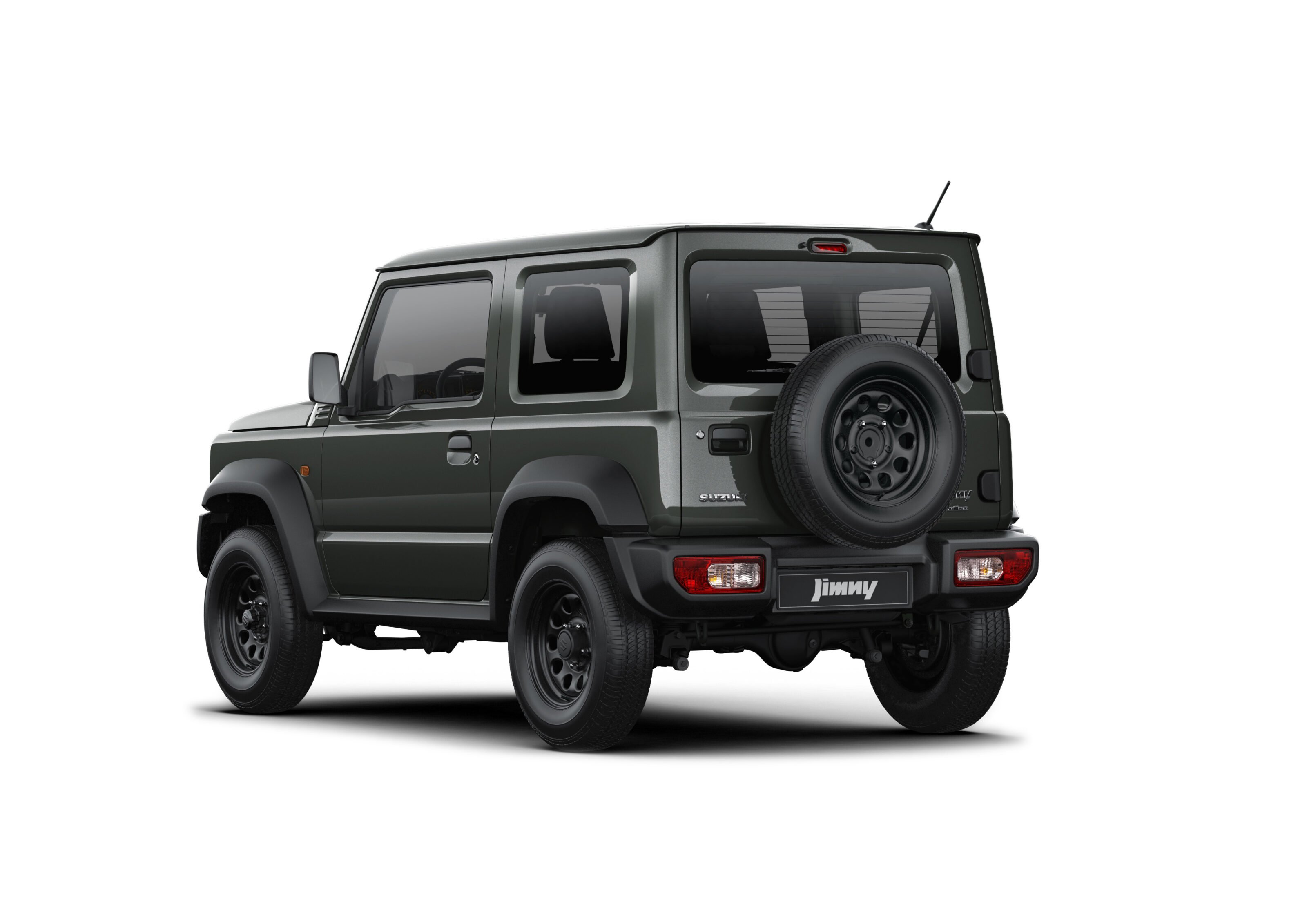
Unlike the standard Jimny, the Lite will only be available with the five-speed manual gearbox.
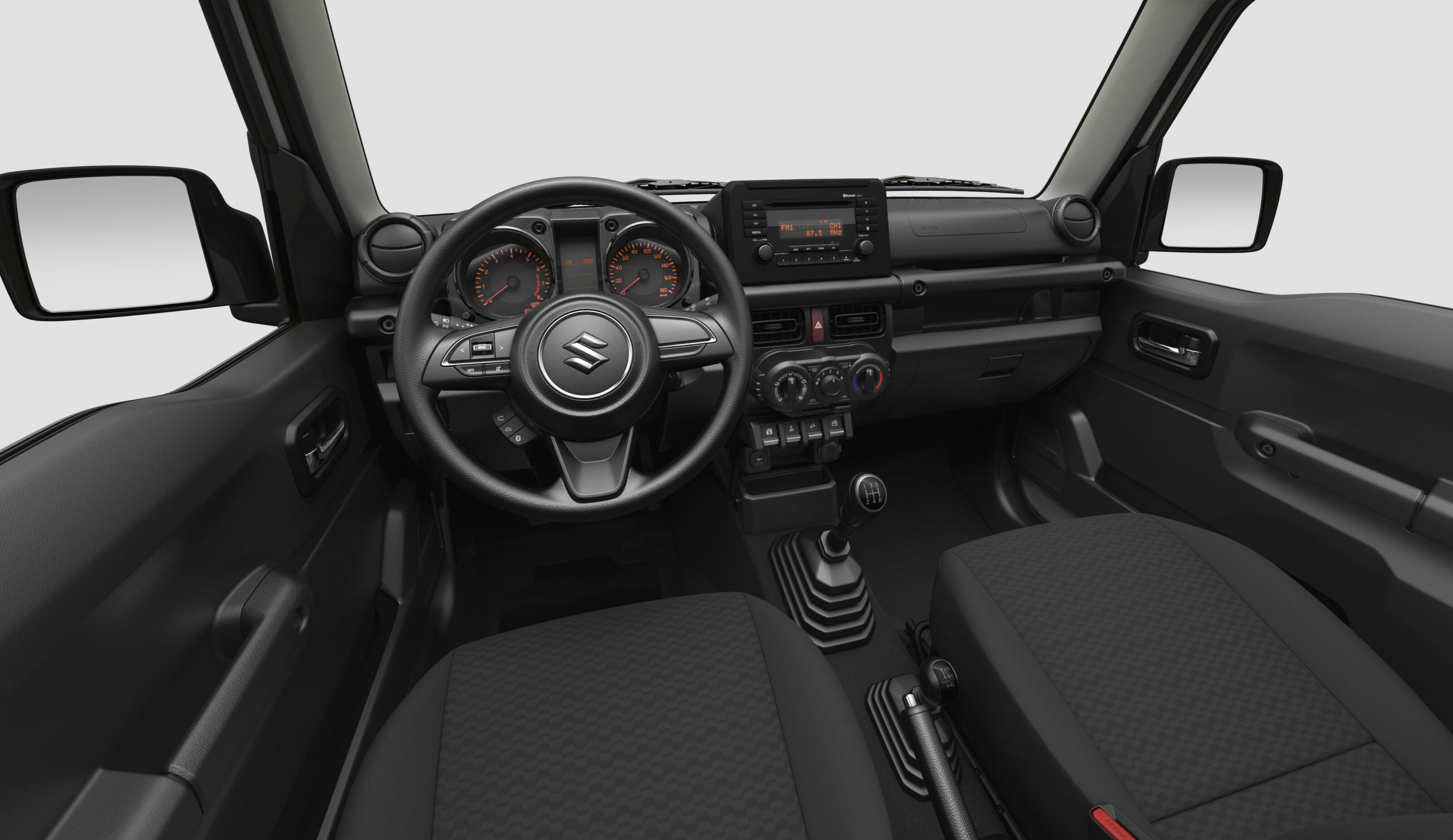
Sat on 15-inch steel wheels instead of the regular alloys, the cheapest Jimny also forgoes LED headlights, favouring halogen units, and also does away with front fog lights and the touchscreen infotainment system with Apple CarPlay and Android auto.
However, the Jimny Lite will still be available with several optional paint schemes, which will set buyers back an additional $695 for single tone and $1295 for two-tone metallic paint.
Colours include white chiffon ivory (with black roof), kinetic yellow (with black roof), brisk blue (with black roof), jungle green, and medium grey.
Michael Pachota, general manager of Suzuki Automotive Australia, said the popularity of the cut-price 4×4 had been profound.
“My phone has been ringing off the hook since we confirmed the Jimny Lite last week. Dealers are keen to know pricing and are ready to place pre-orders to secure customer places in the queue,” he said.
“As I mentioned earlier in the month, we will maintain the fair allocation process based on customer orders with a queue system as we have done with the current Jimny in 2021, making sure the next order in the queue gets the next car to hit Australian soil, every time.”
Potential buyers keen on the new 2021 Suzuki Jimny Lite can contact their local Suzuki dealer to place a pre-order.
The Mercedes-Benz E-Class is perhaps motoring’s cornerstone large luxury limousine. And if home is where the heart is, it beats to a six-cylinder hum. Not strictly nor technically, of course, if traditionally and deservingly, not just in the rich E-Class providence but also in its forebears reaching back to W110 of the Sixties. A half a century later, the straight-six renaissance in today’s W213 was, as much as anything, a fitting homecoming.
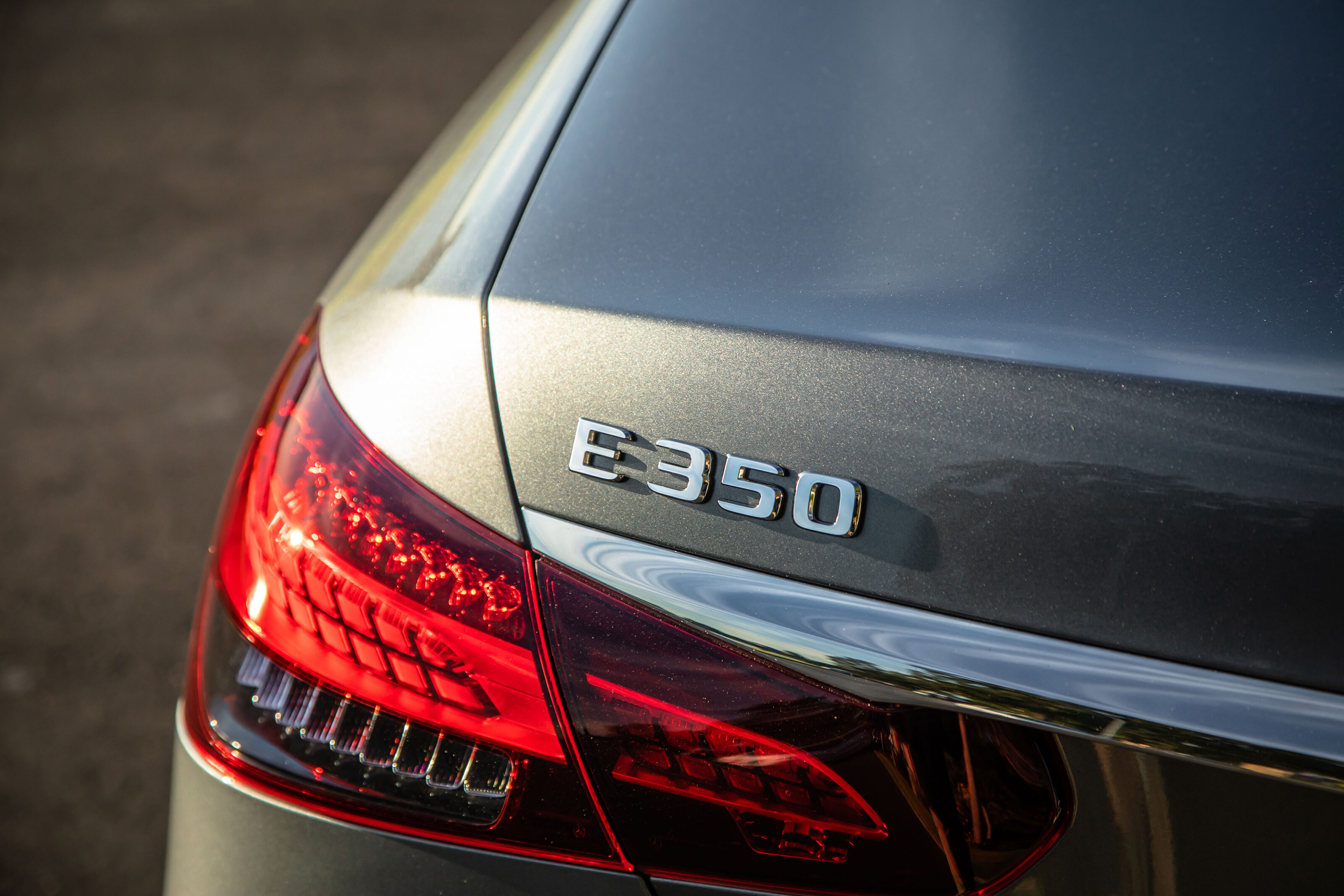
Not now, not in Oz. The high-grade luxo four-door is now the E350, turbocharged four-pot powered with electric ‘mild hybrid’ assistance. Above the staple entry turbo-four E200 also sits the awkwardly named E300e, again turbo-four in a plug-in hybrid format. No big sixer, then, unless you stump for the E53 4Matic+ and all of the AMG pretension it can muster. The ‘450’ inline-six offered overseas skipped the local Mercedes-Benz menu unless, that is, you fancy the, ahem, fancier CLS body style.
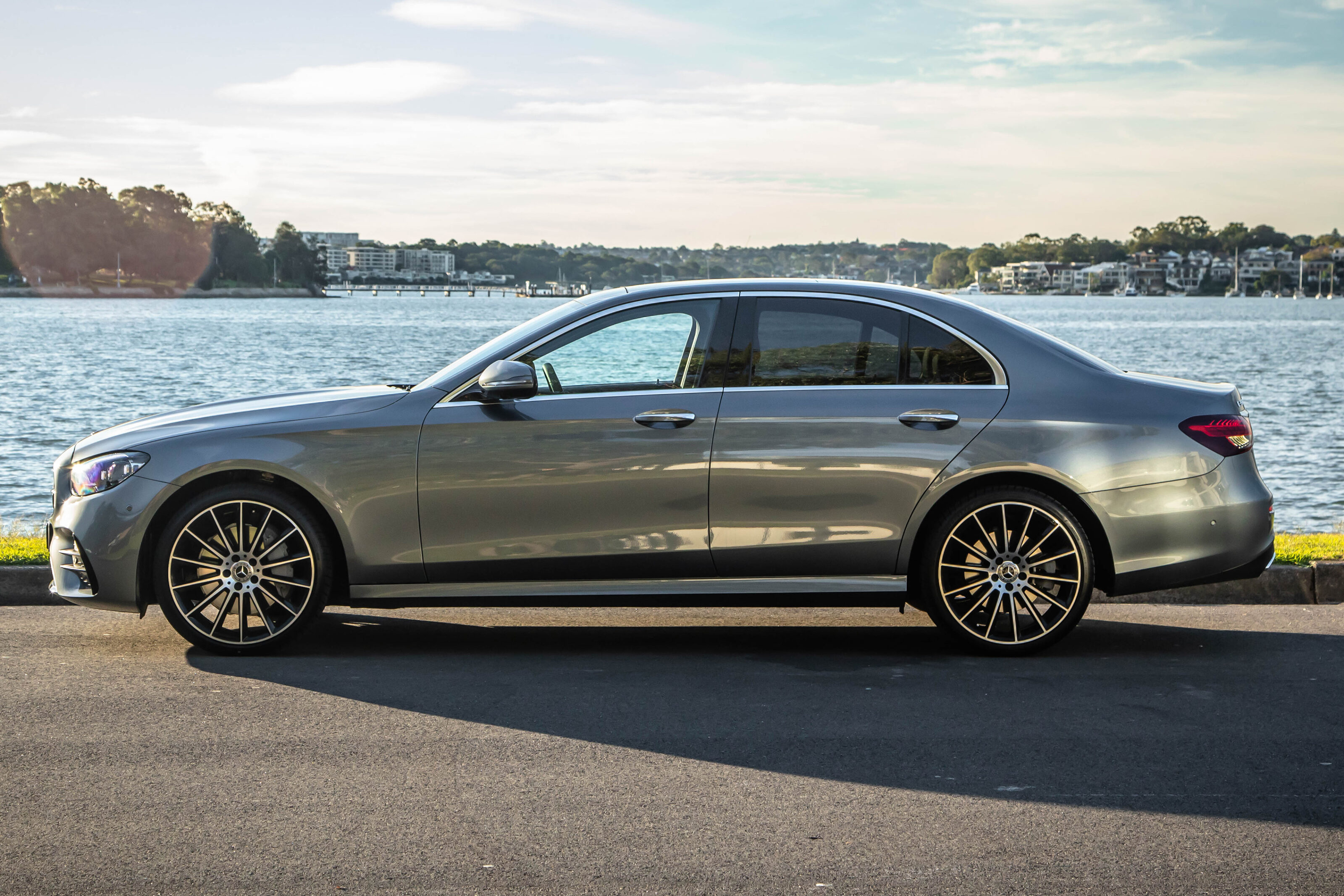
What’s lost in concept can surely be compensated for to a large degree if execution is bang on target. If the E350 delivers the genuine E-Class experience, the complex cocktail that that is, what’s not to like for a stalwart clearly adapting to the times with improved smarts and efficiency through technology, which is, after all, what’s surely expected from premium German figureheads.
The large grey mammal swinging its trunk about the showroom is why should you be drawn to an E350 Sedan, at $127,100 before on-roads, rather than the E300e representing a somewhat tokenistic $3600 saving?
It’s simple. The E350 aims for a forward-thinking method of providing a conventional and familiar internally combusted experience, while its stablemate promises a vastly different PHEV user experience complete with its own pros and cons.
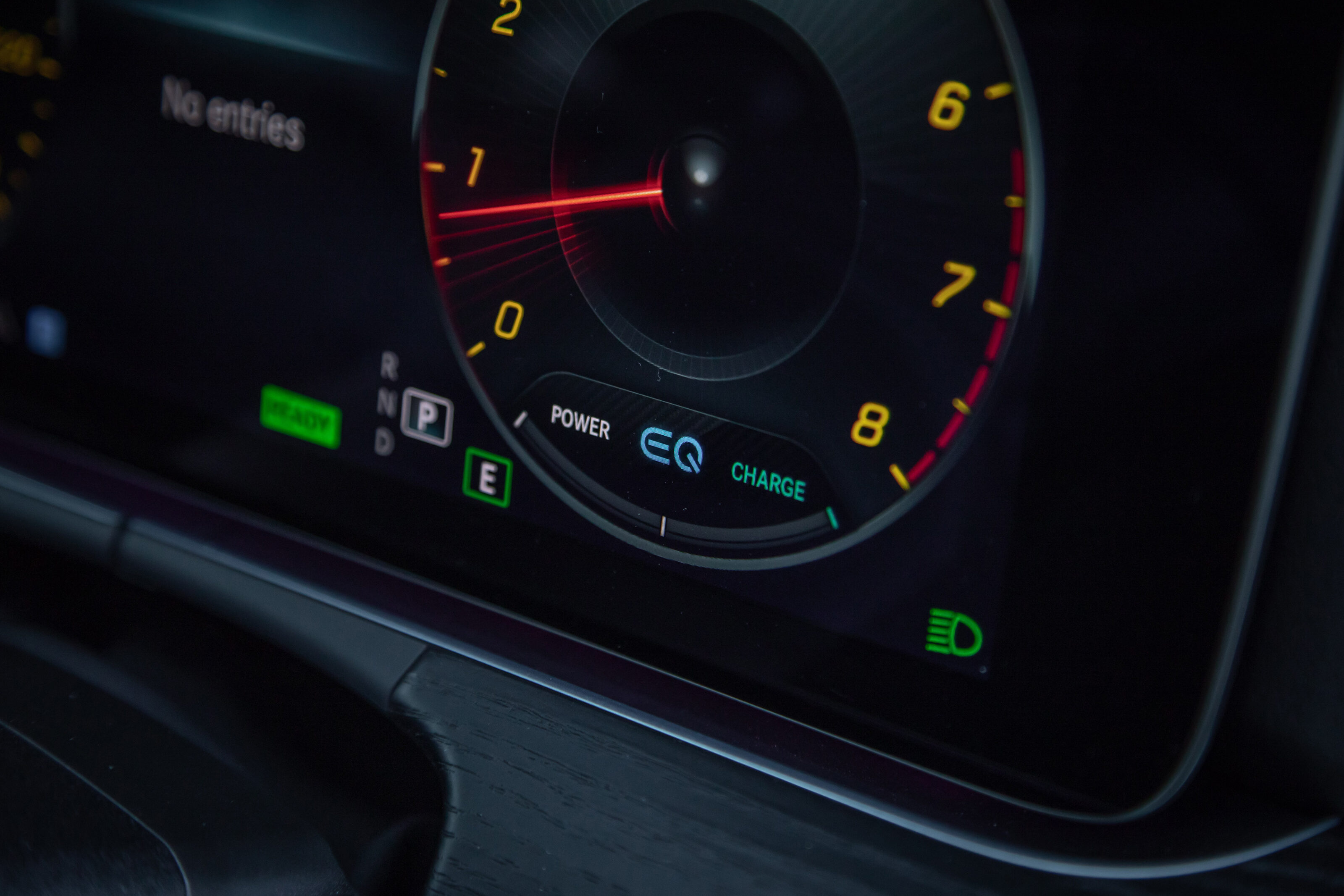
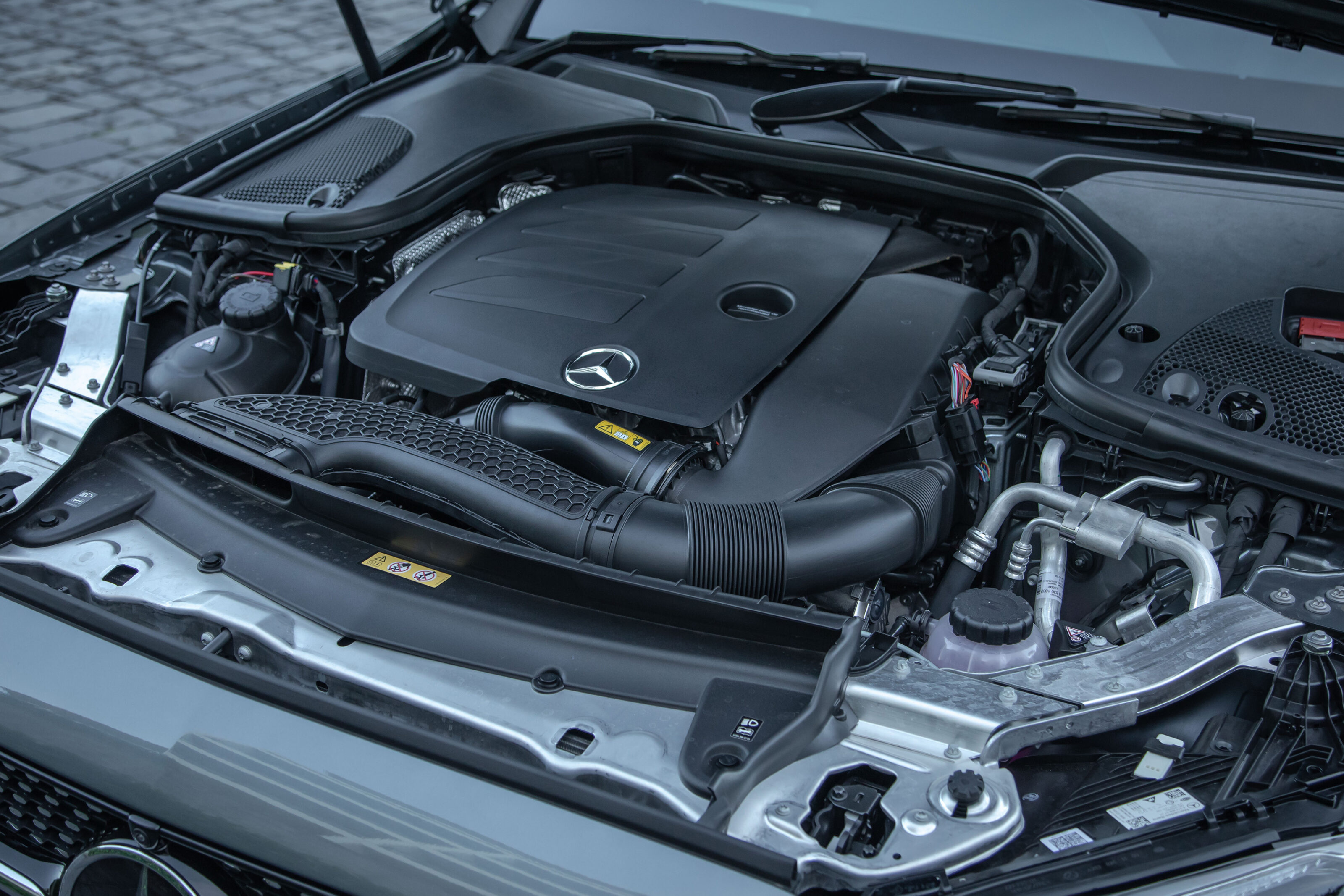
So our test subject fits a particularly healthy M264 2.0-litre turbo four outputting 220kW at 5800rpm and 400Nm between 3000-4000rpm, augmented by an extra 10kW and 150Nm of 48-volt electric-motorised ‘EQ Boost’, fattening torque, filling holes and enhancing thrusts, when and where it sees fit, in short and largely autonomous bursts.
There’s no fuss nor plugging in required, though no dedicated EV drive benefit to speak of bar some very conditional ‘sailing’ off-throttle to trim a little consumption fat.
The degree of normality in the E350 pitch is demonstrated in combined-cycle 7.7L/100km thirst and sprightly 5.9-second 0-100km/h performance, figures that are somewhat fit and thoroughly normal. And because a large chunk of buyer investment isn’t offsetting PHEV architecture supporting a mighty 90kW/440Nm electric motor, as is fitted to E300e, the ‘mild-hybrid’ E-Class four-door exclusively features niceties such as Air Body Control air suspension, multi-beam LED headlight trickery and genuine leather trim befitting the high-spec luxury-leaning variant the ‘350’ is positioned as.
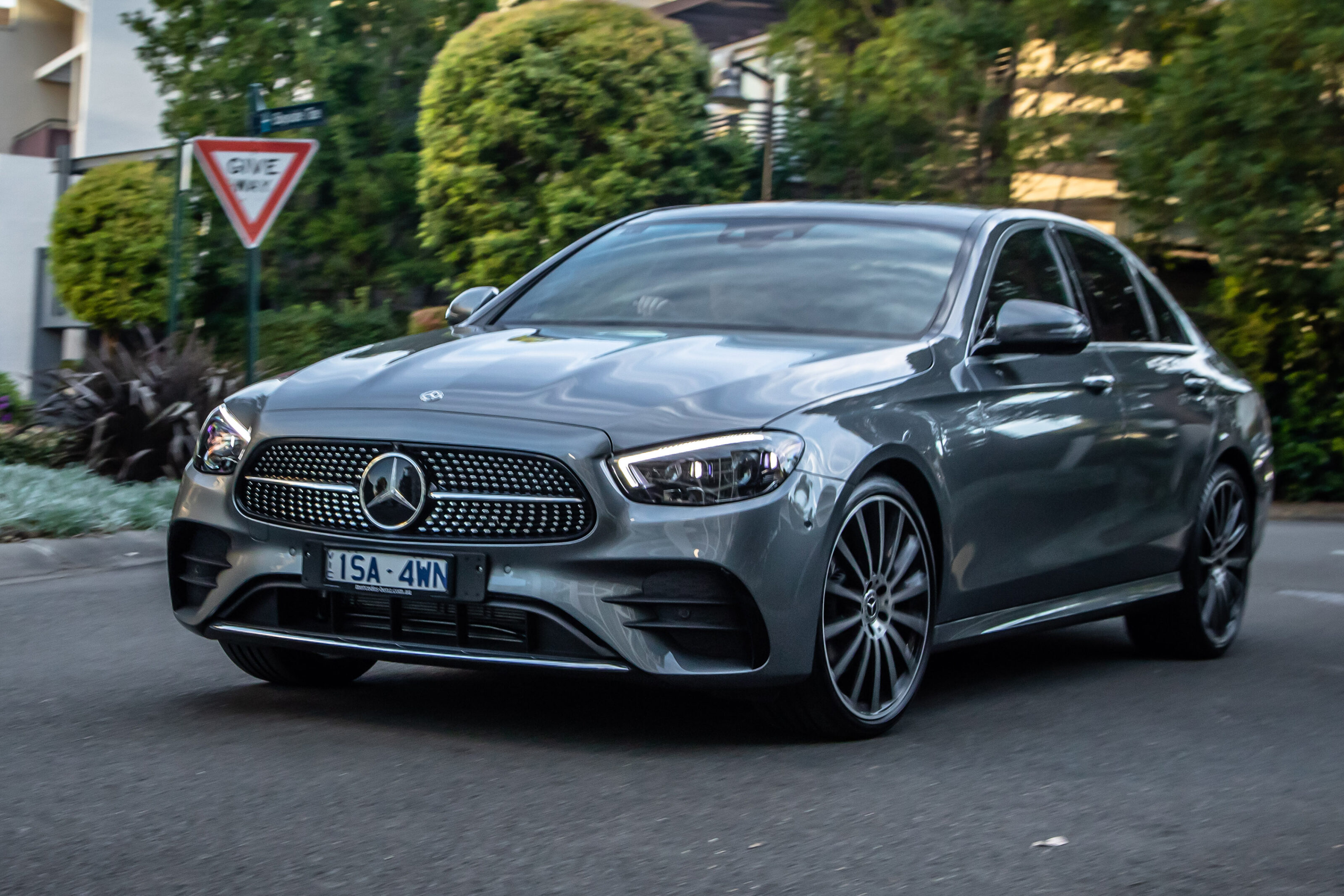
Good impressions of this first local taste of the E350 hinges largely on the effectiveness of ‘EQ Boost-ing’ the E-Class package and, equally and importantly, how little it impacts the grace and dignity of the cornerstone luxury promised.
And the result of initial impressions is a bit of a mixed bag.
Give it the berries and the petrol-electric effect is as tidy as you might hope. Response is immediate, the undertow of torque ramps upwards into strident thrust quickly and progressively, and the thrust on tap as the tacho needle glances off a 6250rpm redline feels full and genuine to its performance claim.
Its 9G-Tronic auto is crisp on the upshift and there are certainly issues with 275mm of Goodyear Eagle rubber hooking up on the dry. Slightly spooky is its eagerness to march with such an inert soundtrack – no foul for the E350’s comfort leanings – though the smooth spinning four can sound a little gruff under full load.
Or such is the net effect in Sport+ drive mode, the most eager of four calibrations (not counting the configurable Individual) and one so highly strung in its appetite for clinging to high engine rpm that it’s simply too flustered and unruly for balanced driving.
The tamer Sport is more flexible and better suited to setting and forgetting, though it does get a little spiky under the right foot as soon as you encounter slow-moving traffic. And I soon discover that it brings out the E350’s most polished and satisfying best.
Comfort mode starts to disrupt the synergy between petrol and electric motivation, the former beginning to feel a touch lethargic and lazy in its lower rpm band, the latter not quite so enthusiastic to fill in torque holes and round out drivability on a gentle or progressive throttle.
That EQ Boost only conspicuously weighs in once you dig in seems like half a trick lost. Dropping further down, to Eco, brings with it a near absence of engine braking – it seems to decouple drive and set the engine to idle – which sails smoothly along a motorway but demands an almost annoying amount of left pedal input modulating when maintaining pace with around-town traffic.
Of four available modes, only one (Sport) comes close to presenting a large-engine vibe in this electro-fattened small-capacity driveline without notable, tangible compromise. So it delivers the effect as promised, just without resolved execution.
Give it the berries and the petrol-electric effect is as tidy as you might hope. Response is immediate, the undertow of torque ramps upwards into strident thrust quickly and progressively…
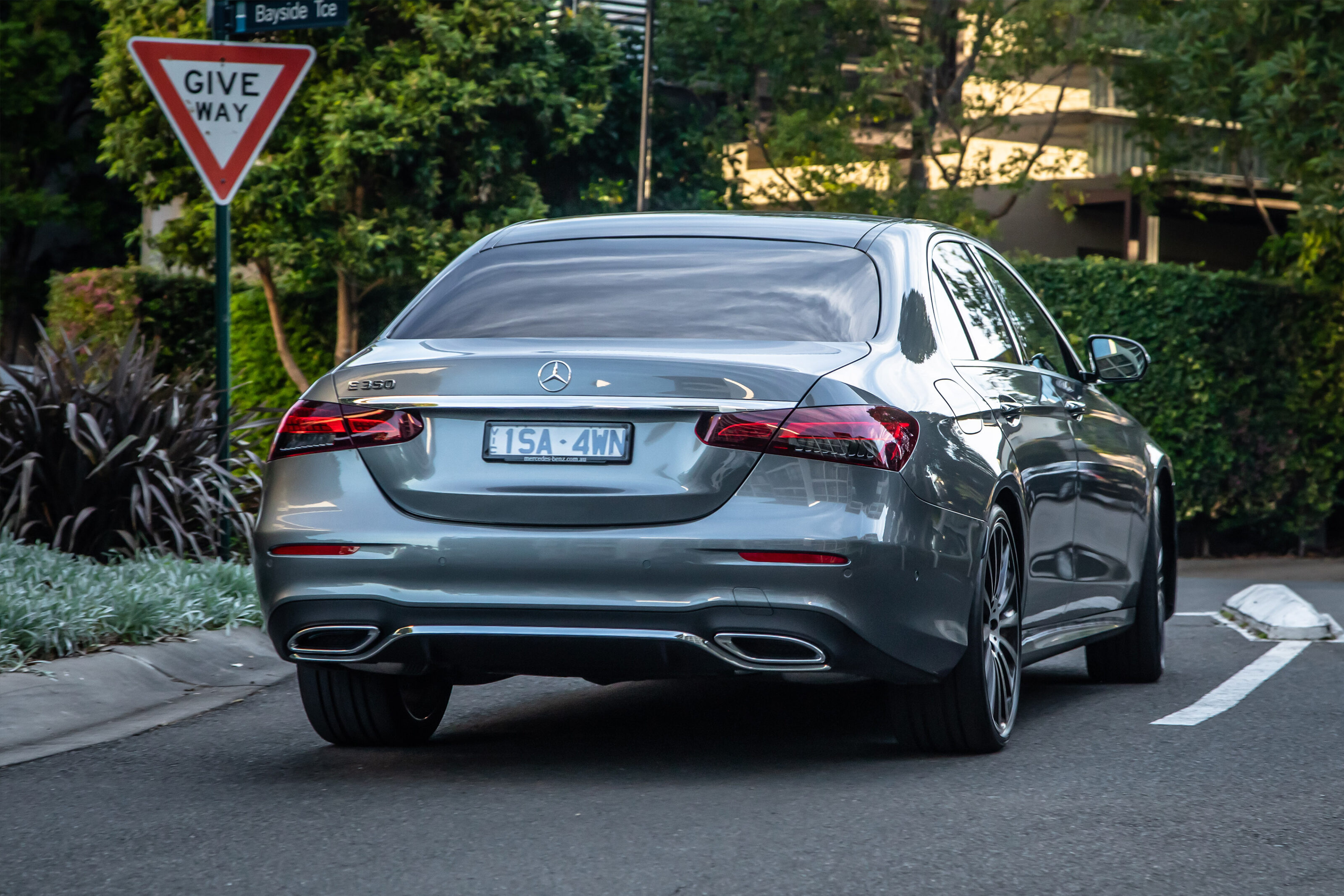
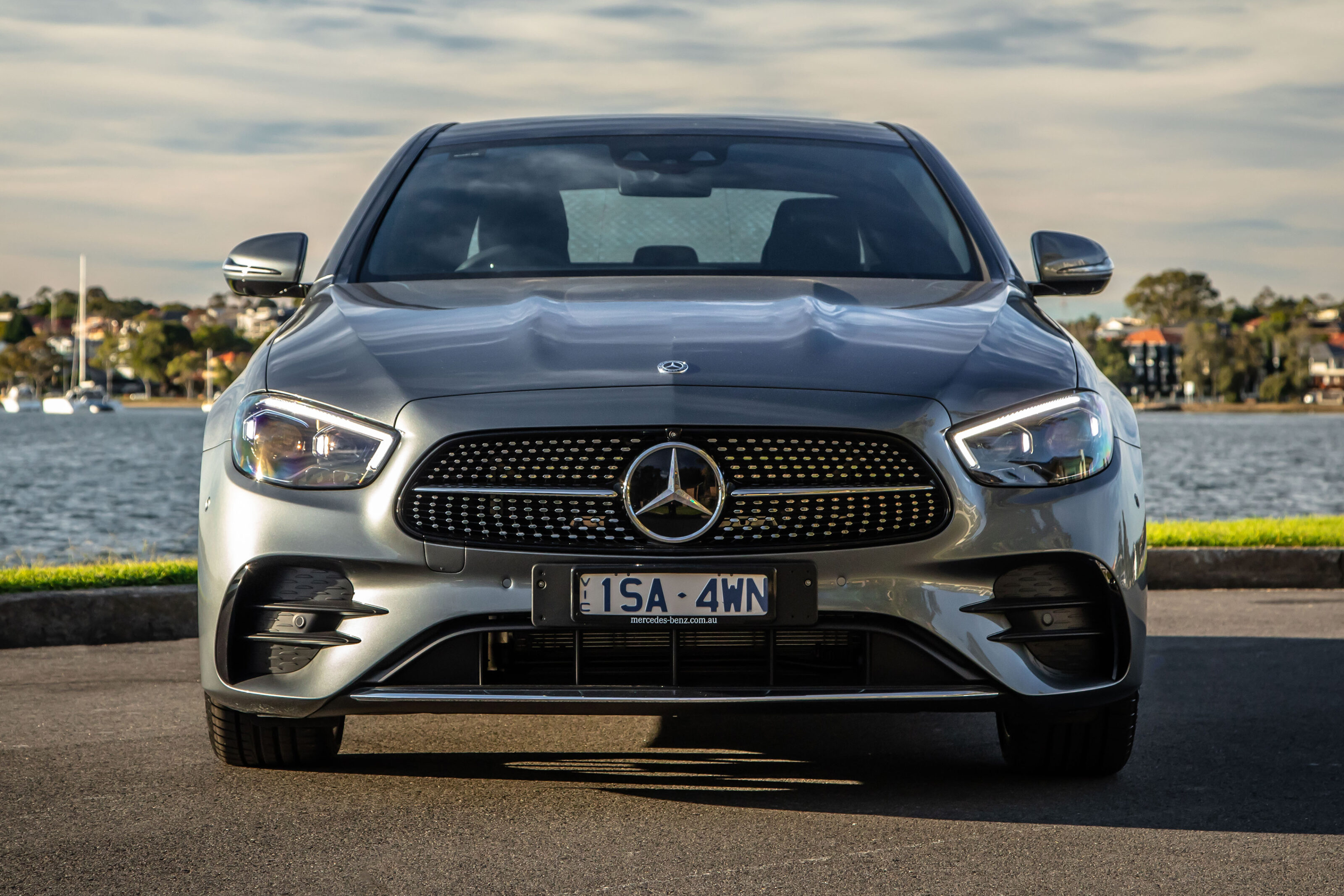
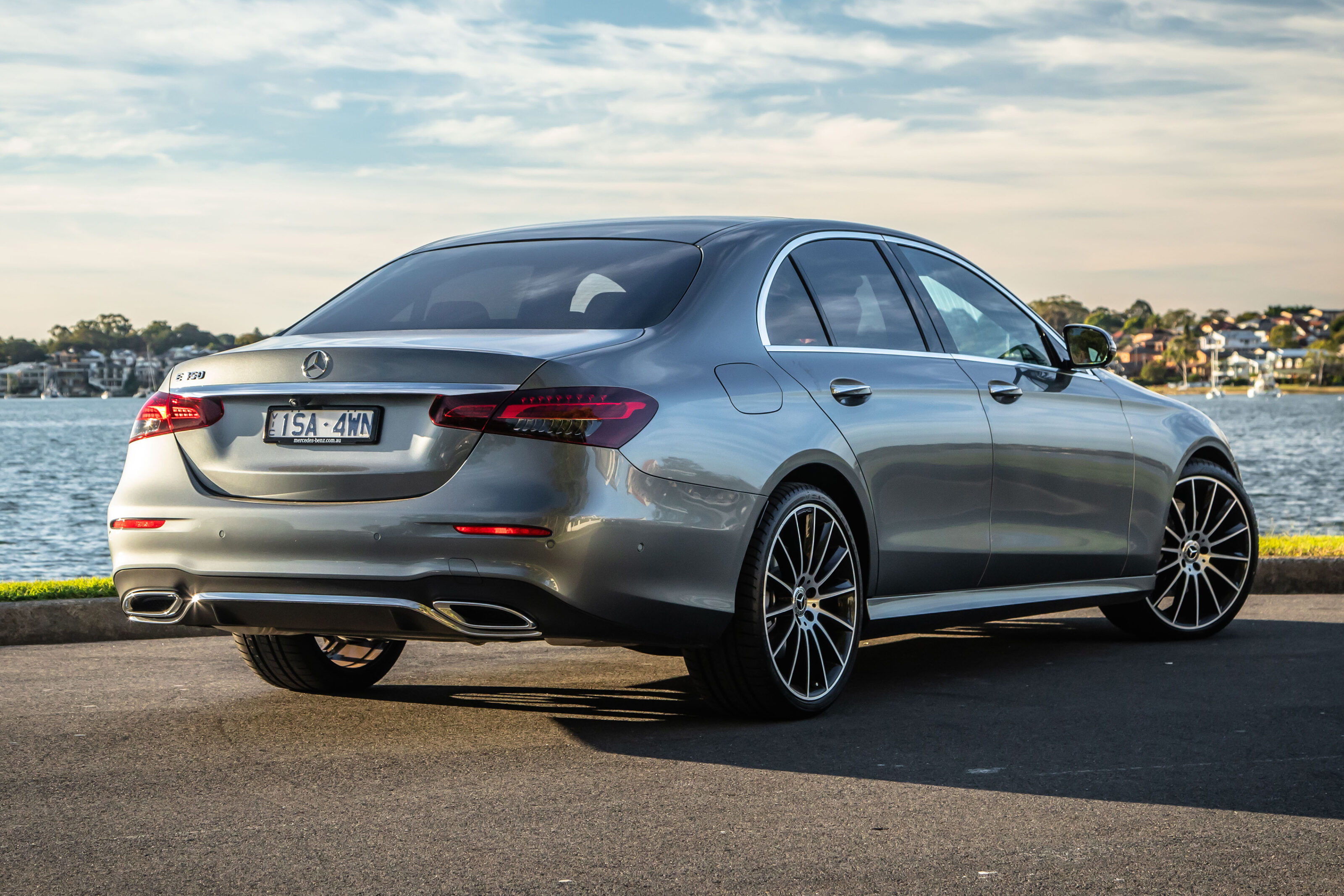
It’s a similar story with ride quality. Those staggered-width 20-inch wheels bring a fetching look and stance to the E350 but their mass and the fitted run-flat tyres, at a slim 35-series up front and licorice strip-like 30-series in the rear, bring a ride comfort compromise that the air suspension tries, and fails, to counteract.
The rolling stock’s reaction to road imperfections small or large is so fierce that you’re forced to set Air Body Control at its softest and most pliant to merely reduce impact shock to even acceptable levels. Thus set, the suspension loses its grasp on body control, particularly roll, resulting a wobble in response to even minor wheel articulation that’s at best mildly annoying, at worst slightly sea-sickening.
Of course, upping suspension firmness through three available settings deteriorates ride quality directly and proportionately.
It’s also surprisingly noisy, at least for E-Class levels of expectation. The tyres thump, the broad 245mm front and 275mm rear footprint rumbles, there’s not quite as much noise isolation and suppression in the cabin as a large Benz ought to offer and, at times, the suspension itself knocks over sharp hits such as speed humps.
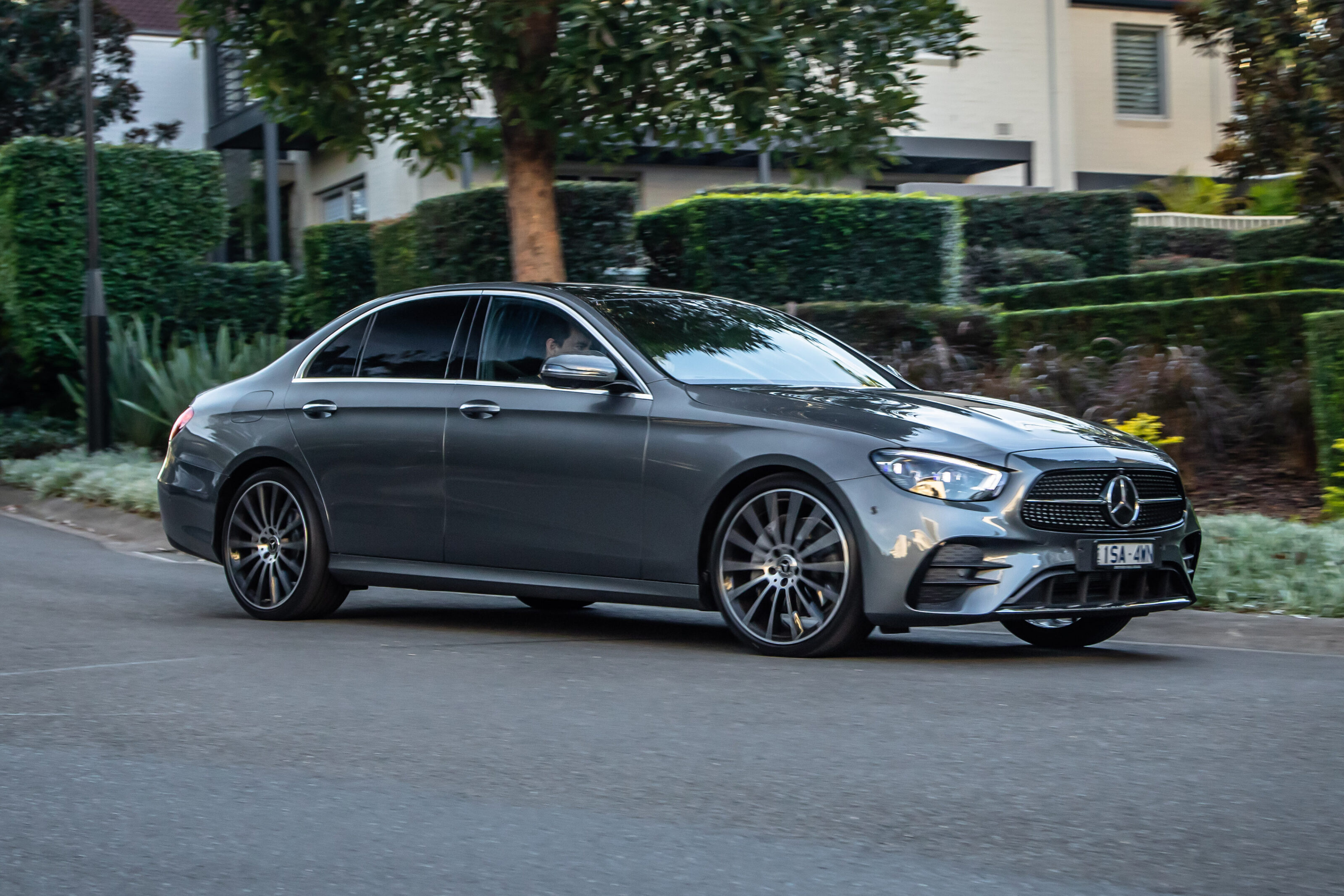
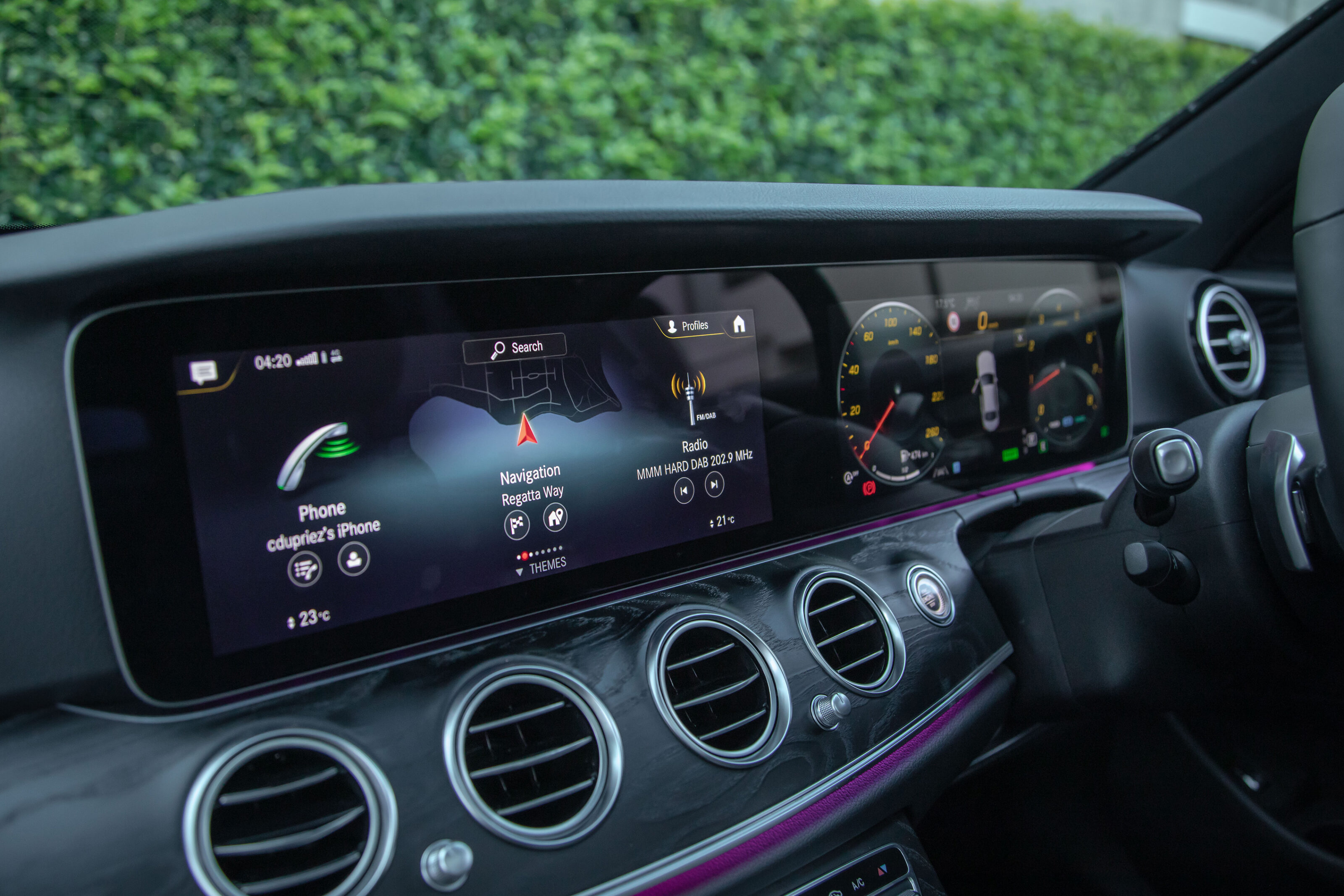
The cabin delivers larger on upper-crust E-Class promise though, (mostly) leather trim apart, almost everything including the dual-12.3-inch widescreen digital eye candy is offered in the E200. From the sumptuous waves of the open-pore black ash wood trim to the nightclub-like ambient lighting, it’s rich and opulent in sheer impact yet neatly avoids seeming overly styled or too fussy.
Mercedes-Benz has pushed this techno-laden design tour de force long and hard and, of course, it seduces many eventual owners. The general stylisation, the MBUX ecosystem and related connectivity fanciness – it’s hard to imagine how the German marque could now step backward and revert to a more classic theme and perhaps harder to question if it should.
The digital interfaces, to split the widescreen effect in two, are nothing short of stunning in everything from impact and clarity to immediacy and logical navigation. Infotainment execution, down to the neat scrolling radio station format and novel swivelling camera views for the 360-degree camera system, are brilliant.
There are, though, a few hiccups: the thumb pad controllers on the futuristic tiller are, at times, clunky in response and it’s really easy to bump and activate the console touchpad inadvertently with your wrist while resting your left hand.
The front seats are merely decent rather than genuinely comfy, suspiciously form-driven in their fetching appearance if let down a little by pronounced lumbar humps and a lack of shoulder support. In fact, the rear bench, with its sculpted base and backs in the outboard positions, is more pleasant and relaxing to spend long journeys in.
Our example of the E350 adds a Vision package ($6600), bringing panoramic roof glass, a head-up display and Burmeister 13-speaker sound, as well as an Innovation pack ($1300) that bolsters MBUX content, including Benz’s camera-based ‘augmented reality’ sat-nav viewing feature.
As tested pricing sits at $135k list. There’s a choice of seven paint colours at no cost, or two ‘designo’ finishes in Diamond White ($1800) and Hyacinth Red ($900) for those after added bling.
Unsurprisingly, the E350 fits the same expansive safety suite as found elsewhere in the E-Class range, including nine airbags, active bonnet, all-speed AEB with cross-traffic assistance, blind-spot monitoring, lane-keeping assistance and evasive steering assistance, plus adaptive high-beam smarts as a feature of the Multibeam LED headlights.
However, the E350 is currently omitted from the five-star ANCAP rating otherwise inclusive of all other W213-based variants. According to Mercedes-Benz Australia, this is because the Euro NCAP-based 2016 assessment predates the mild-hybrid E-Class by a fair measure of time.
The E350 is covered by a five-year/unlimited-kilometre warranty. Servicing is every 12 months or 25,000km, whichever comes first, with Mercedes-Benz Australia offering three- ($2450), four- ($3200) and five-year ($4800) upfront basic service plans.
That the E350 essentially substitutes for a proper six-cylinder, high-spec E-Class in the local line-up is the cross it bears facing review criticism. It’s a decent facsimile but misses in a few key areas.
This EQ Boosted, mild-hybrid turbo-four-pot spin might tick some requisite boxes and return a positive set of data, but it lacks execution where it matters. The powertrain seems to have skipped finishing school. It’s fair to nitpick details, because if there’s a figurehead where excellence in final polish ought to be an expected given, it’s a Mercedes-Benz E-Class.
Elsewhere, the temptation to inject too much of a sporty bent has impacted the E350’s resolve as a luxury-centric prospect, regardless of how big shiny AMG wheels might boost popularity in the showroom.
I do suspect that a six-powered E450 sat on 18-inch wheels would neatly sidestep our test car’s stumbles. Mercedes-Benz does one. It’s just not currently offered in Australia.
2021 Mercedes-Benz E350 specifications
Snapshot
- 61 GLB SUVs built between 2020-2021 affected
- 993 GLE SUVs built between 2019-2020 affected
- Mercedes-Benz is urging owners to contact their preferred authorised dealer to fix the issues
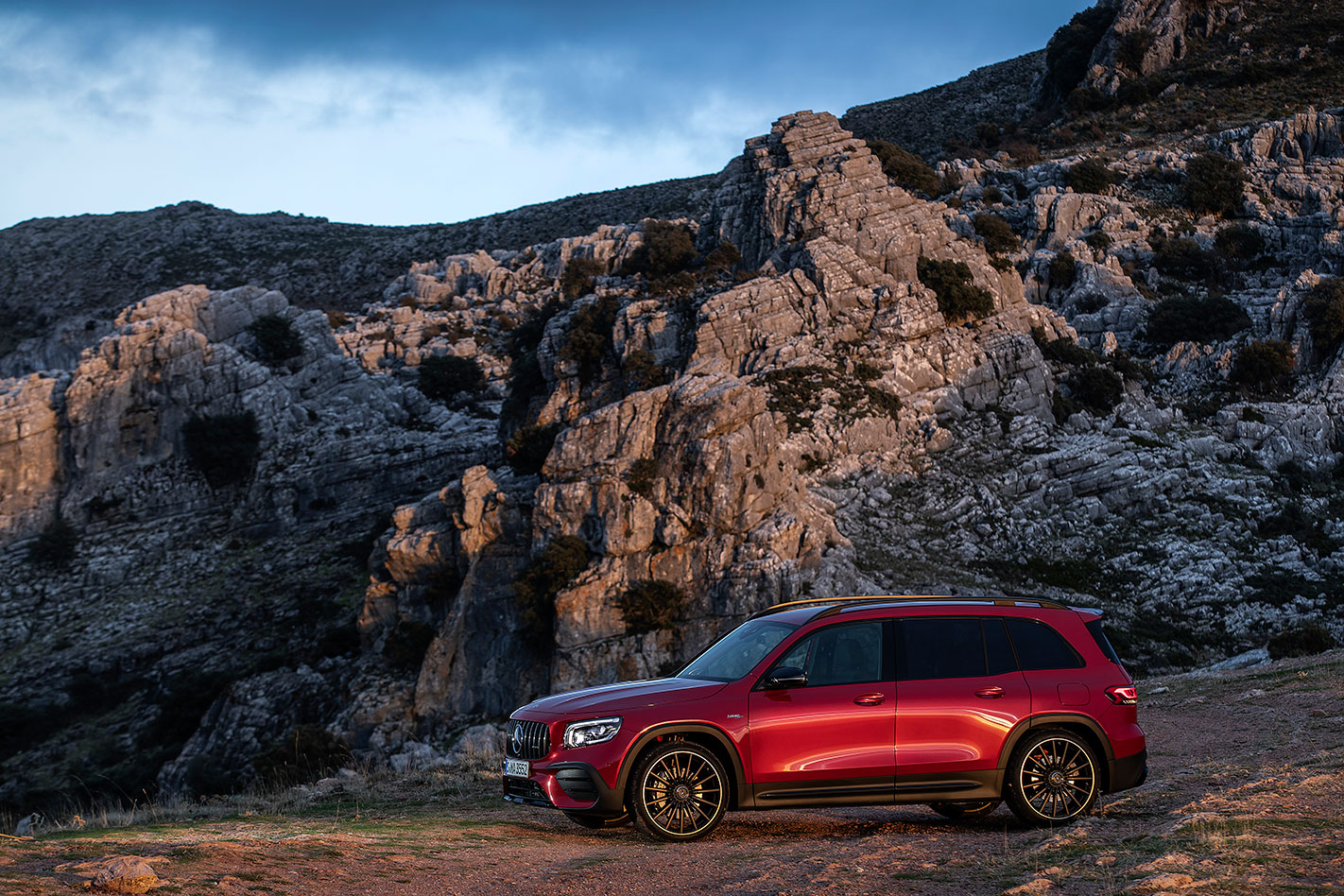
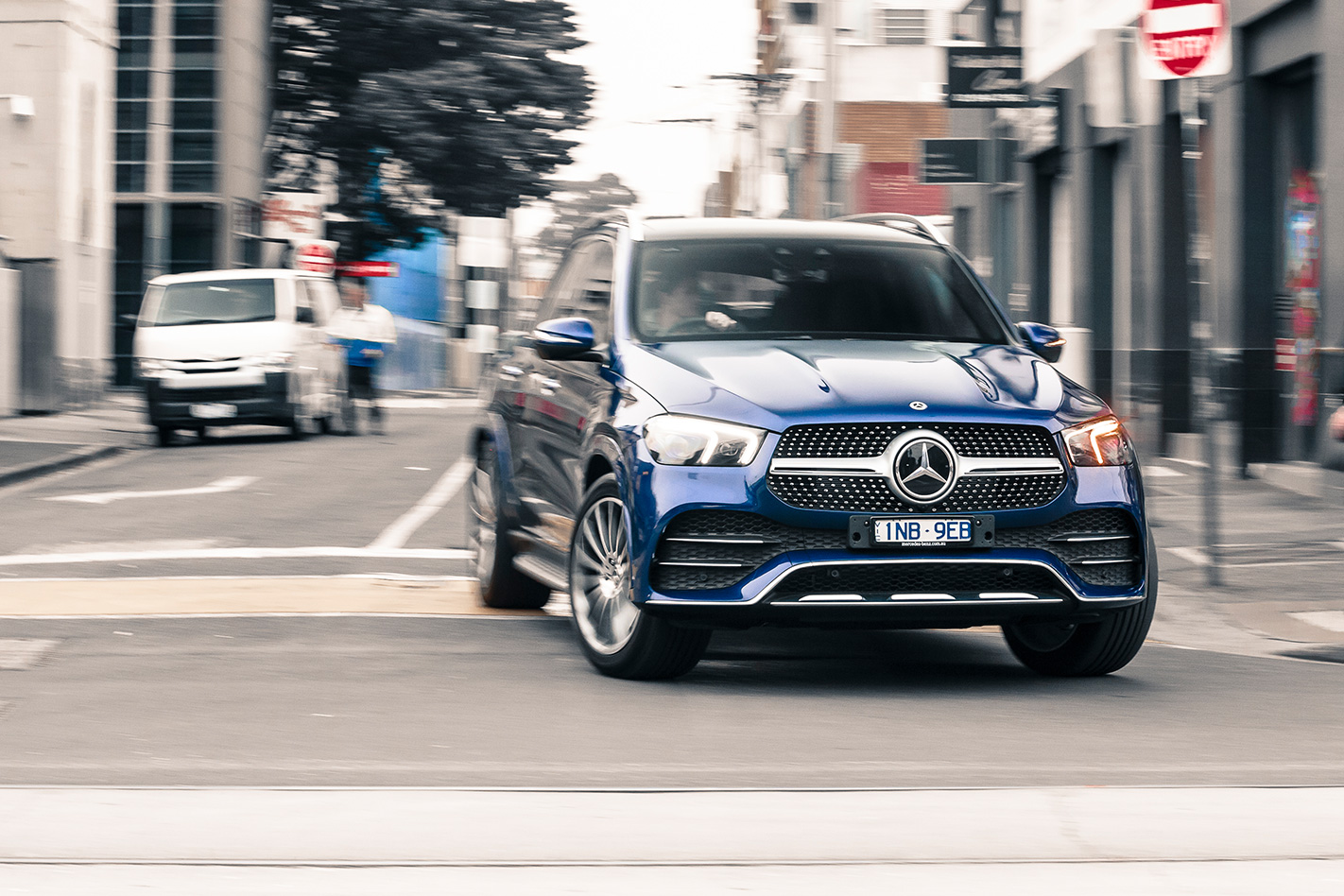
Mercedes-Benz Australia has issued a recall for 61 examples of its GLB SUV built between 2020 and 2021 and 993 examples of its large-size GLE SUV built between 2019 and 2020 due to both vehicles being affected by manufacturing faults.
According to Mercedes, the affected GLB models have side spoilers at the tailgate that may not have been mounted correctly.
This could lead the side spoiler of the seven-seater SUV to detach while being driven in normal situations.
As for the larger GLE, Mercedes has identified that the drain hoses of the air-conditioning system may not be installed correctly.
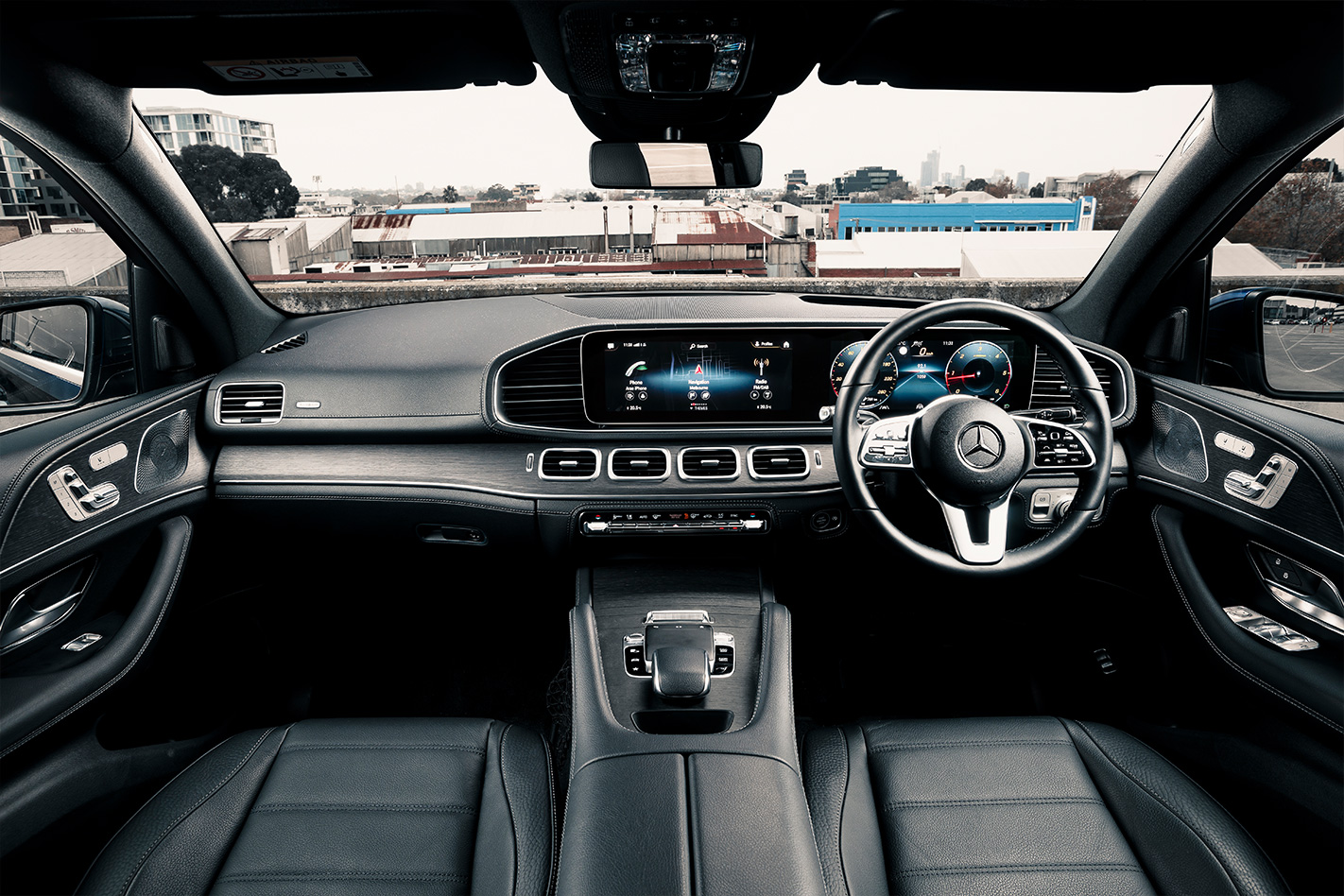
The German marque says this could lead to condensation build-up in the SUV’s cabin, which could cause several electric components to malfunction.
If a malfunction does occur, affected GLEs may not be able to make an automatic emergency call (eCall) in the event of an accident.
The manufacturing fault may also mean the vehicle cannot be unlocked or started, and it could also affect the car’s limp-home mode.
The build-up of moisture on electrical componentry could lead to a short circuit occurring too, which in turn could cause a fire.
Mercedes-Benz Australia is asking affected owners to contact their preferred authorised dealer and schedule an appointment to remedy the faults as soon as possible.
The carmaker has also provided a list of the affected vehicles’ VINs. For GLB, click here, and for GLE, click here.
Snapshot
- VW sets target of no more ICEs by 2035 in Europe
- Net zero emissions planned by 2050
- VW Australia doesn’t think local market is ready for 100% EV uptake
Volkswagen is set to end production of internal combustion engines for the European market by 2035, as it works to achieve a target of 70 per cent EV sales before 2030.
VW sales director Klaus Zellmer detailed the company’s wider plan in an interview with Münchner Merkur this week, suggesting Europe will be the first step while other markets will require longer timelines.
“We will make our entire fleet CO2 neutral by 2050 at the latest,” said Zellmer. “In Europe, we will exit the combustion engine vehicle business between 2033 and 2035, and a little later in the USA and China.
“In South America and Africa, due to the lack of political and infrastructural framework conditions, it will take a good bit longer.”
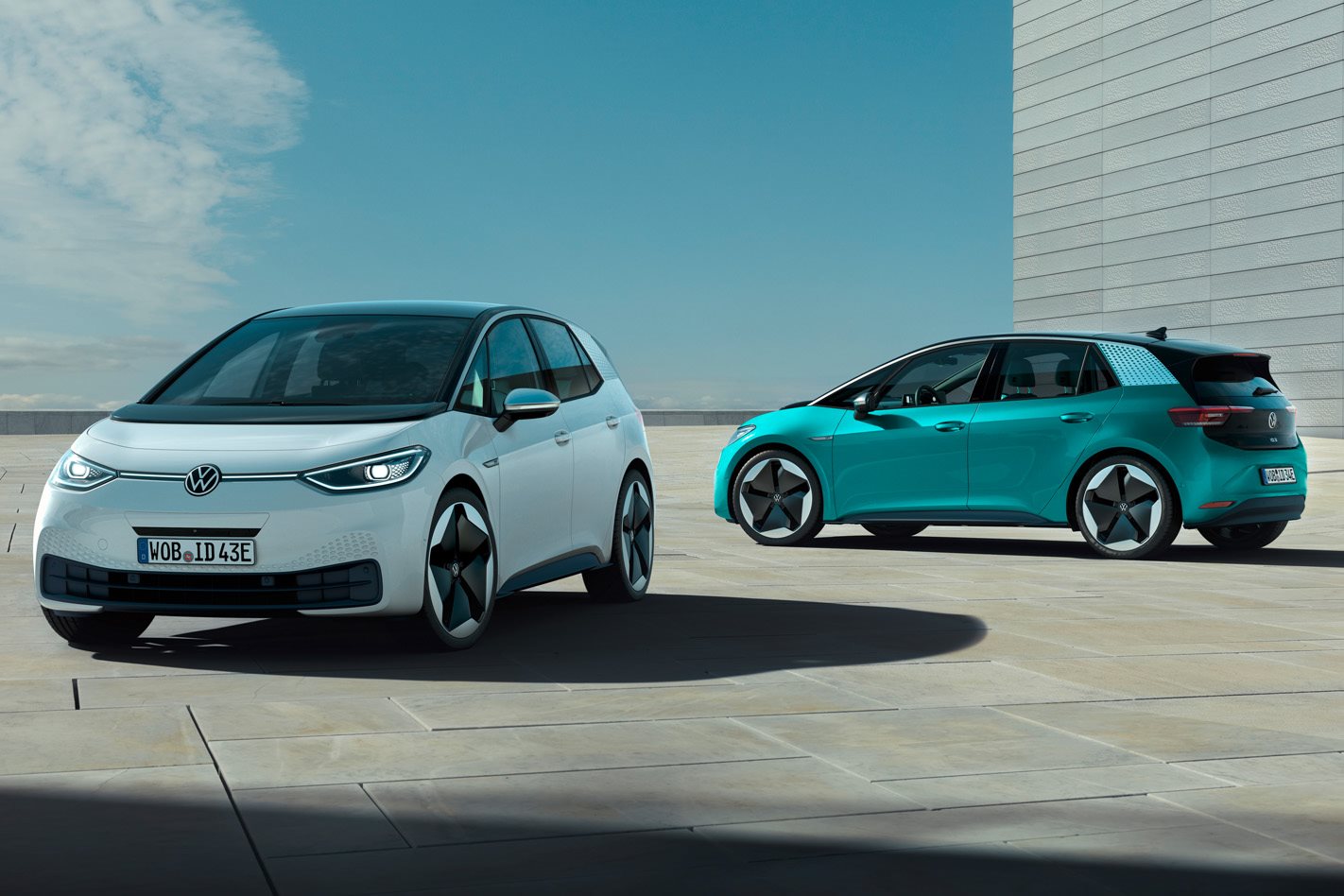
South America and Africa are unlikely to be the only regions requiring a longer timeline, however. Speaking with Wheels today, Volkswagen Australia communications manager Paul Pottinger said the current local conditions surrounding EV policy would make it difficult to replace ICE models with EVs anytime soon.
“Despite the example set by the New South Wales Government’s well-reasoned and progressive EV strategy, the national framework does not yet exist for Australia to be prioritised in Volkswagen Group’s global EV roll out,” Mr Pottinger said.
“Then there are bizarre missteps such as the Victoria Government’s cash grab that actively discriminates against owners of plug-in hybrids while letting off 1990s-derived hybrids that run on high-sulphur petrol.
“Current conditions are not conducive to providing Australians a choice between EVs and conventional vehicles, a choice increasingly available in the Europe, North America and China.”
With VW’s ambition to reach 70 per cent EV sales by 2030 in Europe, it remains clear this target is only for the company’s home continent – given the difference in EV strategies globally, not least in Australia.
VW Group’s luxury brand Audi has already said it will end ICE production by 2025 for all markets bar China, with the goal of introducing electric-only models by 2026 en route to its carbon neutral target, hoping to achieve net zero vehicle emissions by 2050 in line with VW.
Still yet to arrive Down Under, Volkswagen has two EVs in its global range, the ID.3 and ID.4, released in 2019 and 2020 respectively with the hopes of both landing here in 2022.
Snapshot
- Facelift with lighting upgrades set to arrive next year
- Cruiser scores ventilated fron seats
- Powertrain options unchanged
The updated 2022 Toyota RAV4 has been announced today, promising a raft of upgrades when it arrives early next year in a mid-life update for the third-most popular vehicle in Australia.
Toyota Australia has confirmed all variants of the RAV4 will undergo improvements, from powertrain tweaks in the petrol variants to new headlights in the hybrid versions of the model.
With production set to begin in December 2021, the 2022 RAV4’s biggest visible change will come in the form of fog lights upgraded to LED technology across the range – with a new look on the hybrid models – while all versions but the GX will get illuminated door switches.
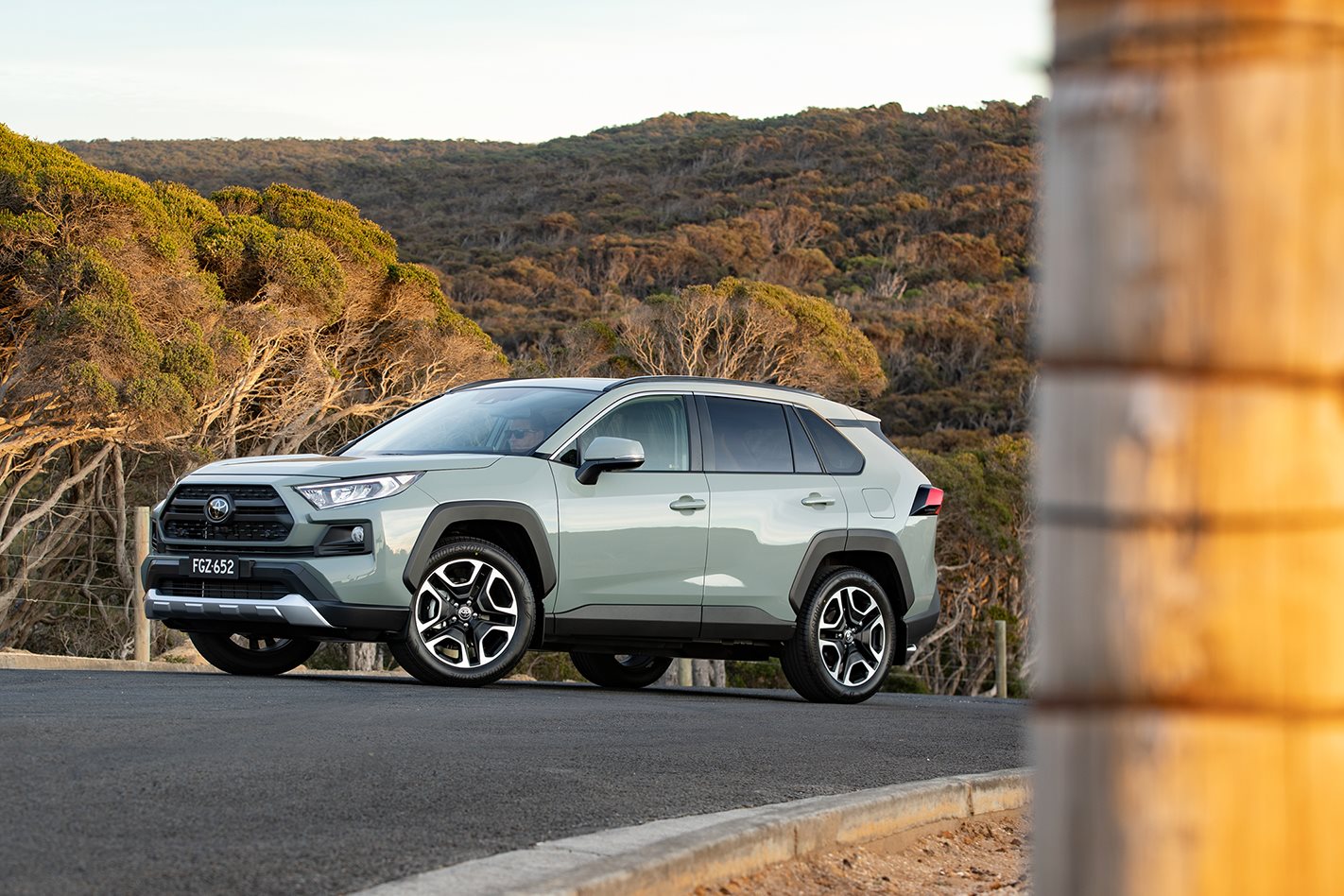
Petrol-powered RAV4s score new-look alloy wheels while the big change is in the engine itself, finally adding stop-start technology to further reduce emissions and fuel consumption in traffic.
The range-topping Edge trim now includes a parking support brake with the existing rear cross-traffic alert system, while the variant below it, the Cruiser, gets an eight-way power adjustable passenger seat, three-stage seat ventilation for the front row and a digital rearview mirror.
Toyota Australia Vice President of Sales, Marketing and Franchise Operations, Sean Hanley, says the update to the RAV4 range will serve as a boost to model’s popularity.
“The RAV4’s mix of style and practicality, and in particular, its hybrid powertrain, really resonates with buyers and these upgrades will add to that appeal,” said Hanley.“While these updates won’t arrive until early next year, Toyota is committed to keeping its customers aware of upcoming improvements and we encourage our customers to speak with their preferred Toyota Dealer about the upgrade on any orders placed.”
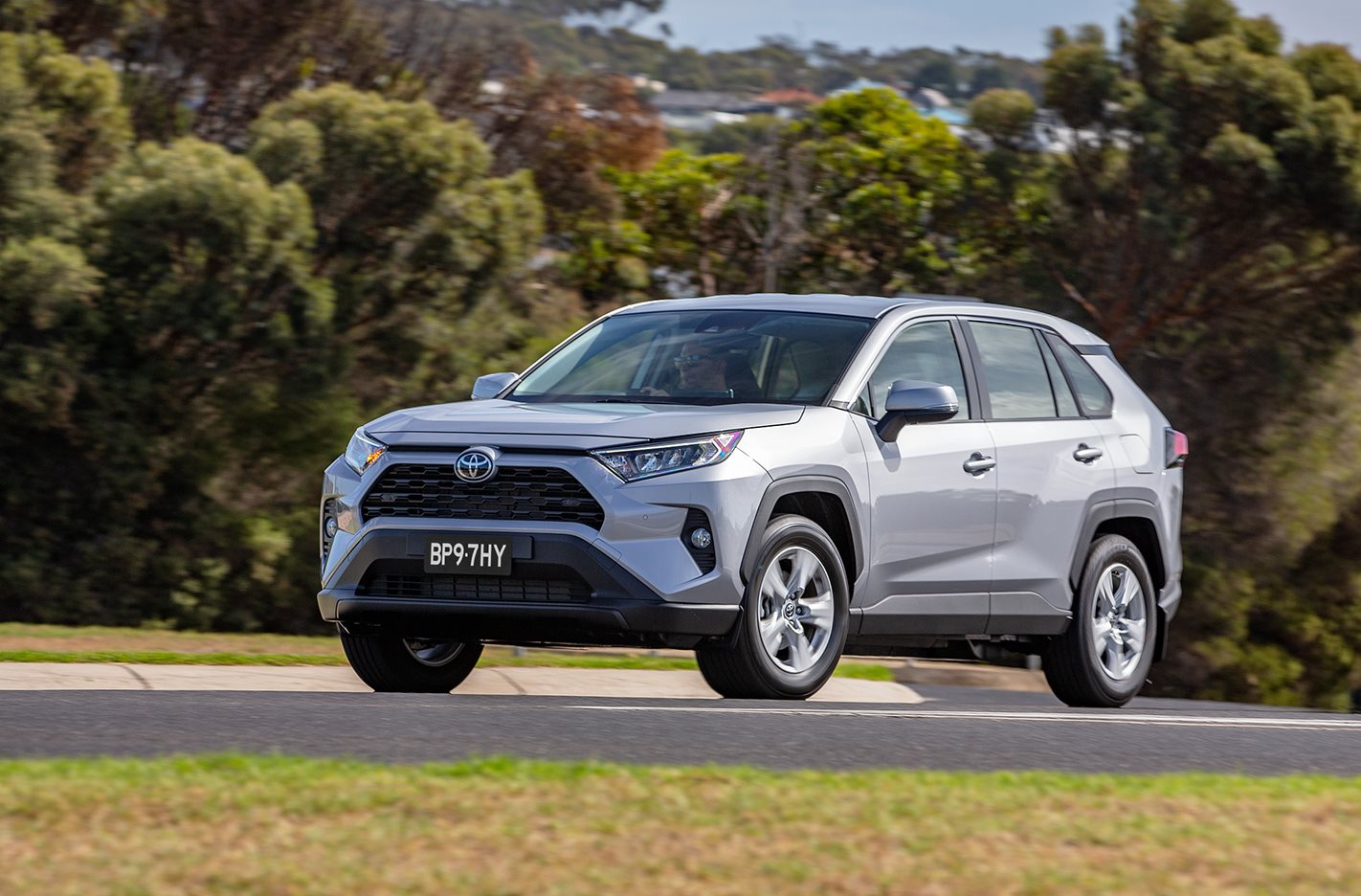
Powertrains will remain the same as the current RAV4 line-up with a choice of two petrol engines available, a 2.0-litre unit making 127kW/203Nm and sending power to the front wheels through a CVT transmission (GX, GXL, Cruiser) or a 2.5-litre 152kW/243Nm engine which is mated to an eight-speed automatic gearbox, only available in Edge all-wheel-drive guise.
Hybrid options remain as either a front-wheel-drive 160kW/221Nm or an all-wheel-drive 163kW configuration, both engines available across the GX, GXL and Cruiser variants.
The RAV4 is coming off a strong May where it sold 4014 units across the month, an increase of 71 per cent on 2020 and helping it reach a total of 17,858 units sold in 2021 thus far.
Counting showroom segments with four or more active vehicles, the Kia Carnival enjoys a market dominance that is second only to the Toyota Camry.
The fourth-generation version of the perennially popular people-mover, introduced at the start of 2021, has only served to emphasise the model’s pseudo-monopoly.
The success of the original 1999 Carnival was based on delivering the average family a seven-seater vehicle from a ridiculously low $29,990 (or from $32,990 for auto over manual).
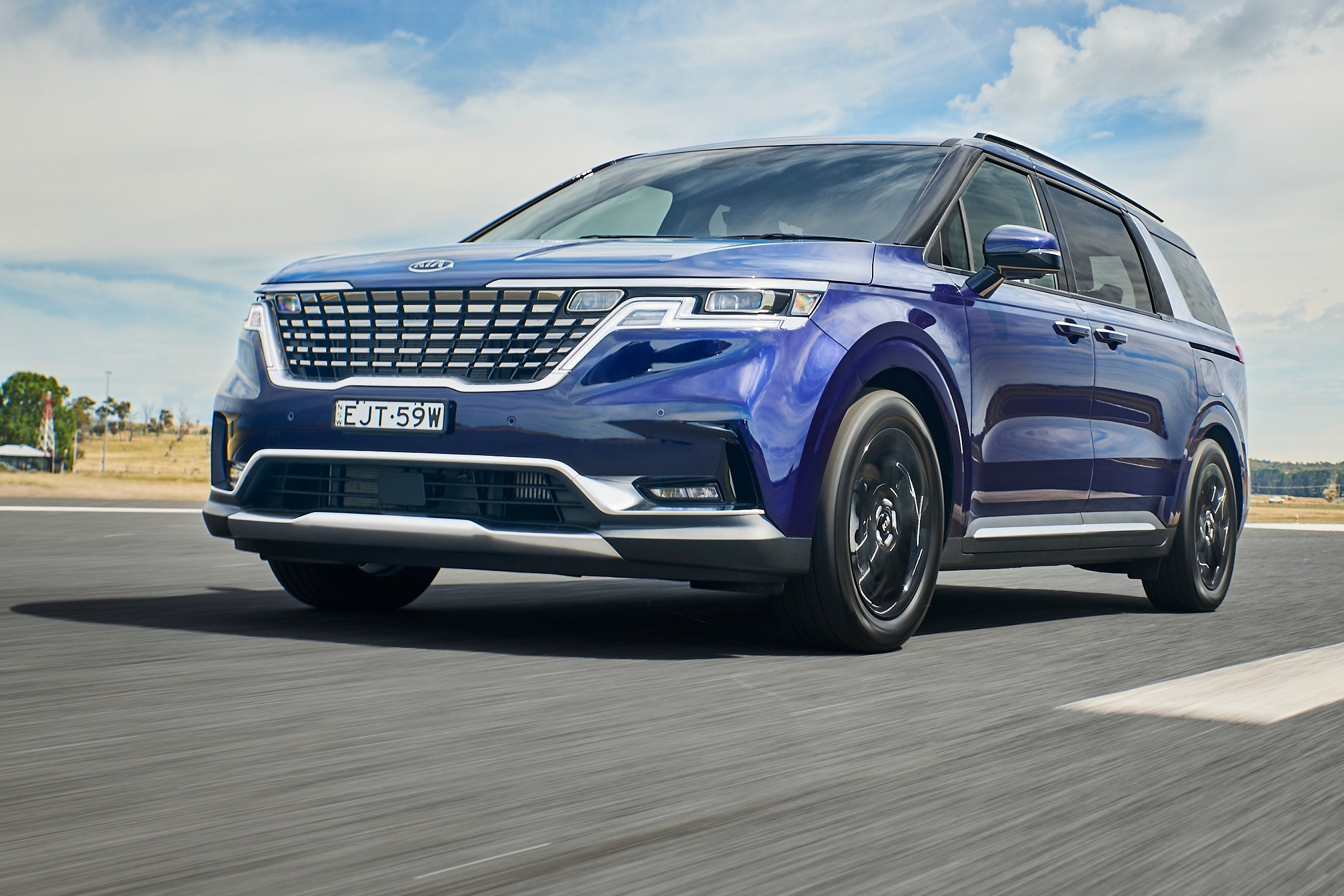
Today’s Carnival builds even more boldly on the styling revolution of 2015’s third-generation, which ditched the frumpiness of the previous models for a fusion of SUV and van body styles. Sports Utility Van? It also went up a notch or two in interior presentation, as well as price.
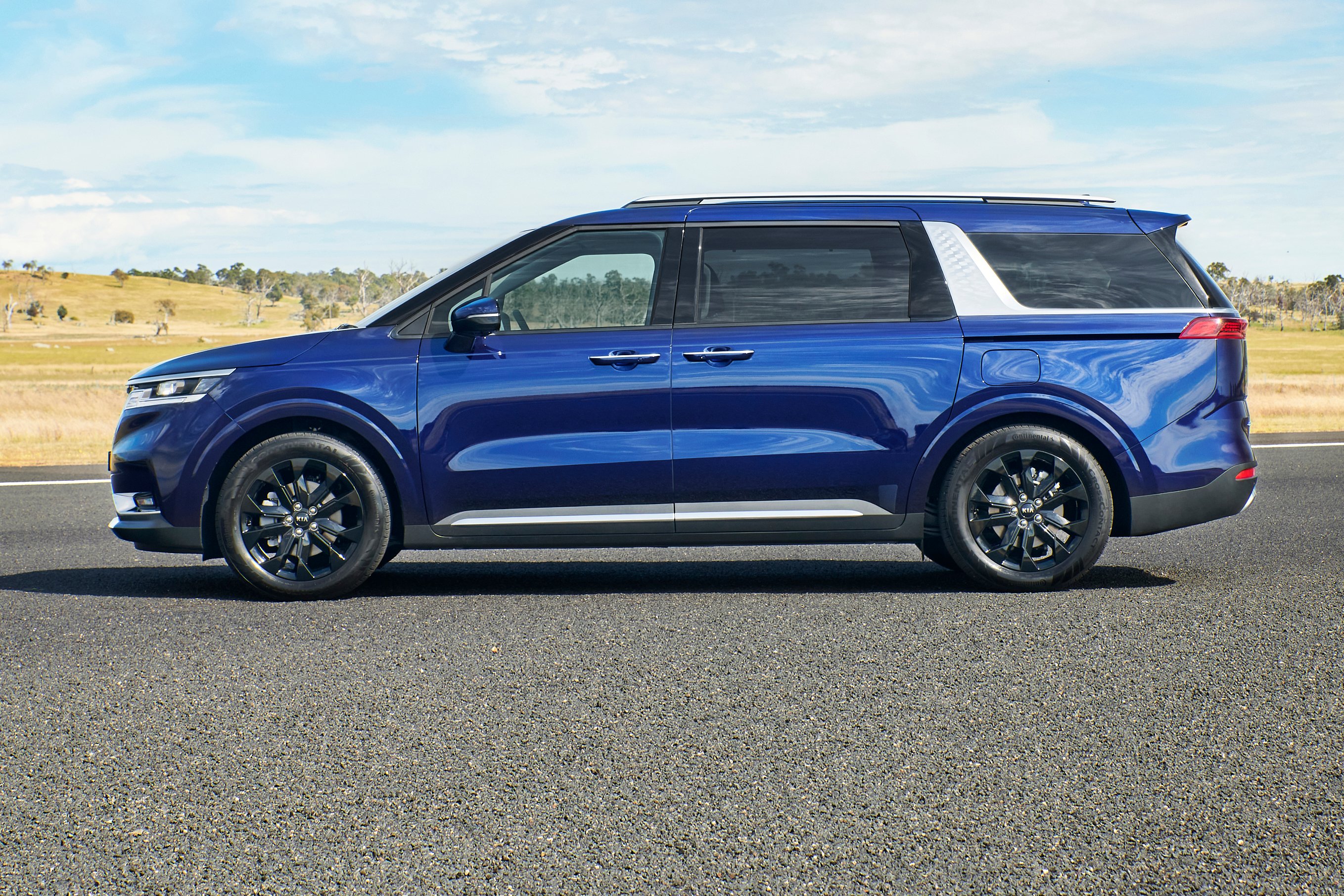
The 2021 Kia Carnival starts higher again – from $46,880 – and the range-topping Platinum costs from $64,680 before on-road costs for a petrol V6.
We’re reviewing the most expensive version here, the Platinum diesel that costs from $66,680 – or essentially $70,000 ($69,990) driveaway.
It’s a lot of money for the average (big) family, but the Carnival is also a lot of car.
This 5.1-metre-long, eight-seater Kia not only offers an extra seat over the throng of seven-seater SUVs but trumps them for space in the boot and third row.
The new Toyota Kluger, Mazda’s CX-9 and CX-8, Hyundai’s Palisade (which is available as an eight-seater) or even Kia’s own large SUV, the Sorento, are all well beaten for both luggage capacity when all seats are in use and for adult space in the third row.
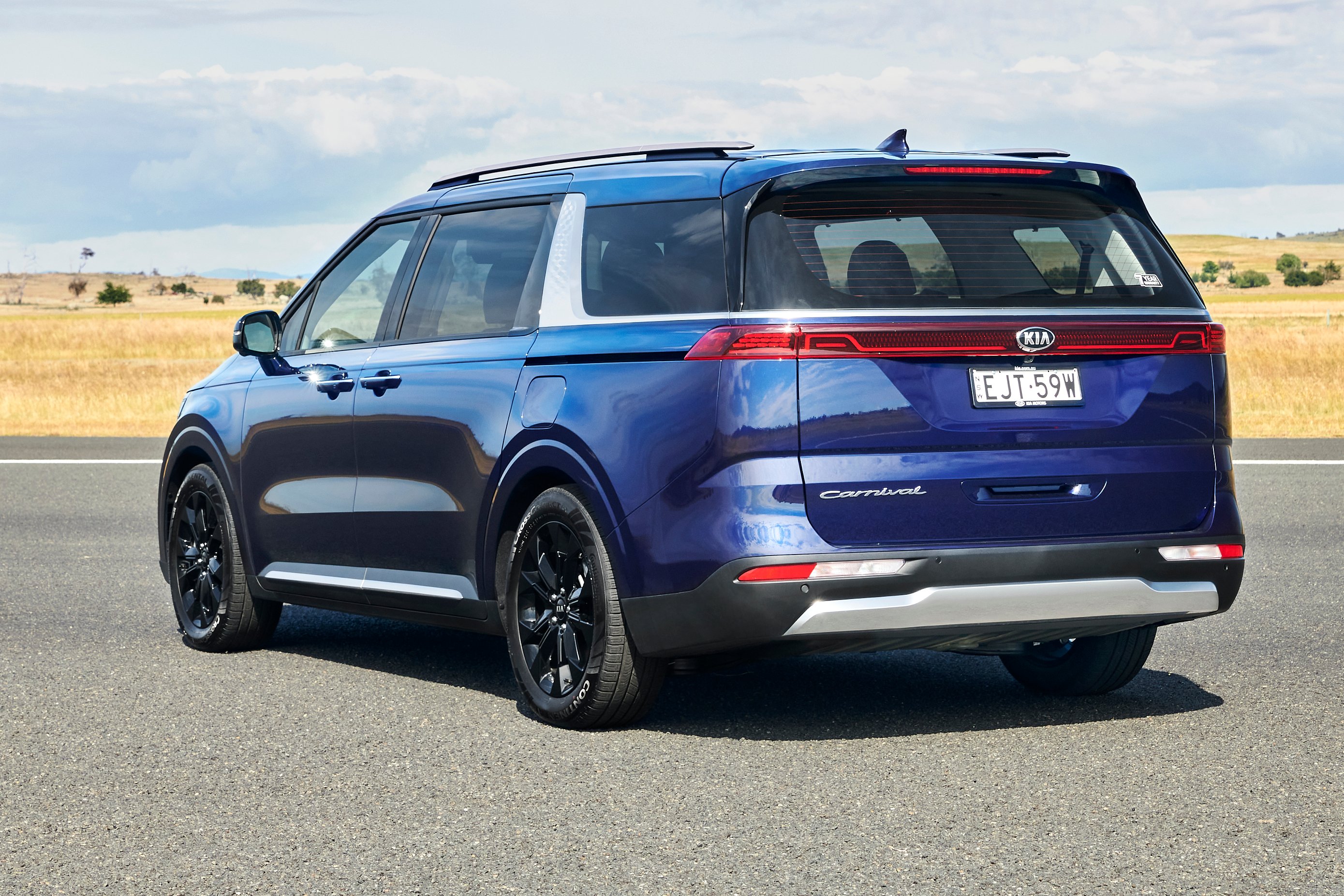
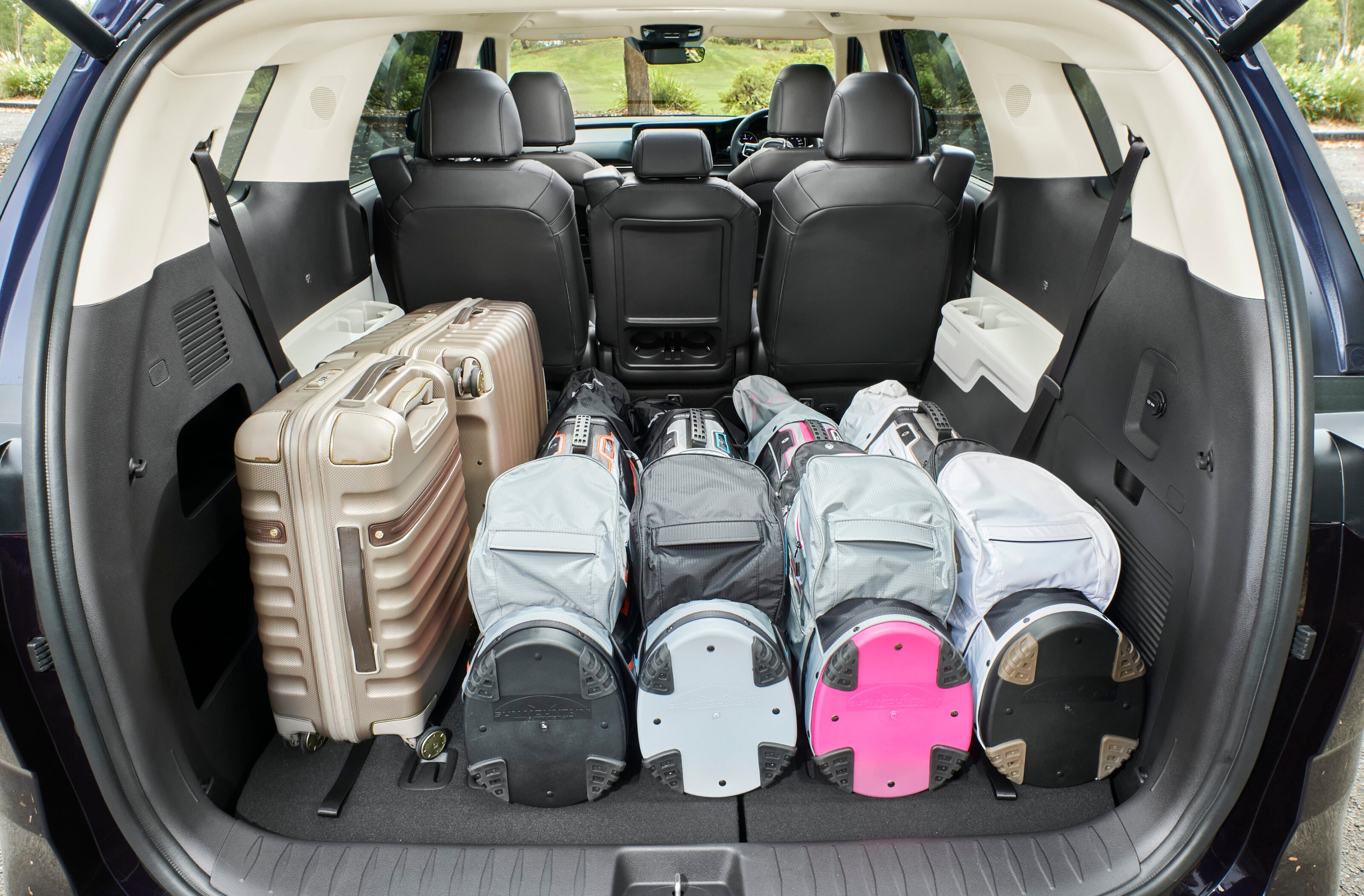
Carnival’s 627-litre boot behind the rearmost seats is super-deep and super-wide. This makes it effective as an airport shuttle but will also allow a family of seven or eight to go on a week’s driving holiday without even needing a roof pod.
The boot’s ability to comfortably take a wheelchair will also be important for families with less mobile grandparents.
Kia quotes 2785 litres for cargo volume with the rear seats flattened. Alternatively, just one side of the 60/40 rear seats can be folded into the floor.
A hands-free auto tailgate is standard on the SLi and Platinum model grades.
We’re reviewing the most expensive version here, the Platinum diesel that costs essentially $70,000 driveway. It’s a lot of money for the average family, but the Carnival is also a lot of car.
Sliding side doors are again a Carnival feature, with SLi and Platinum adding one-pull electric operation. Their convenience can never be underestimated, especially when you find yourself in the middle of the common car park sandwich.
There’s no clever one-touch button operation for the second-row tilt-slide function as in the Sorento; instead, the operation is performed manually via a seat lever. Third-row passengers can’t pull the second-row seat back into place as with some seven-seater SUVs, either – this is done by pulling another lever under the second-row seat base.
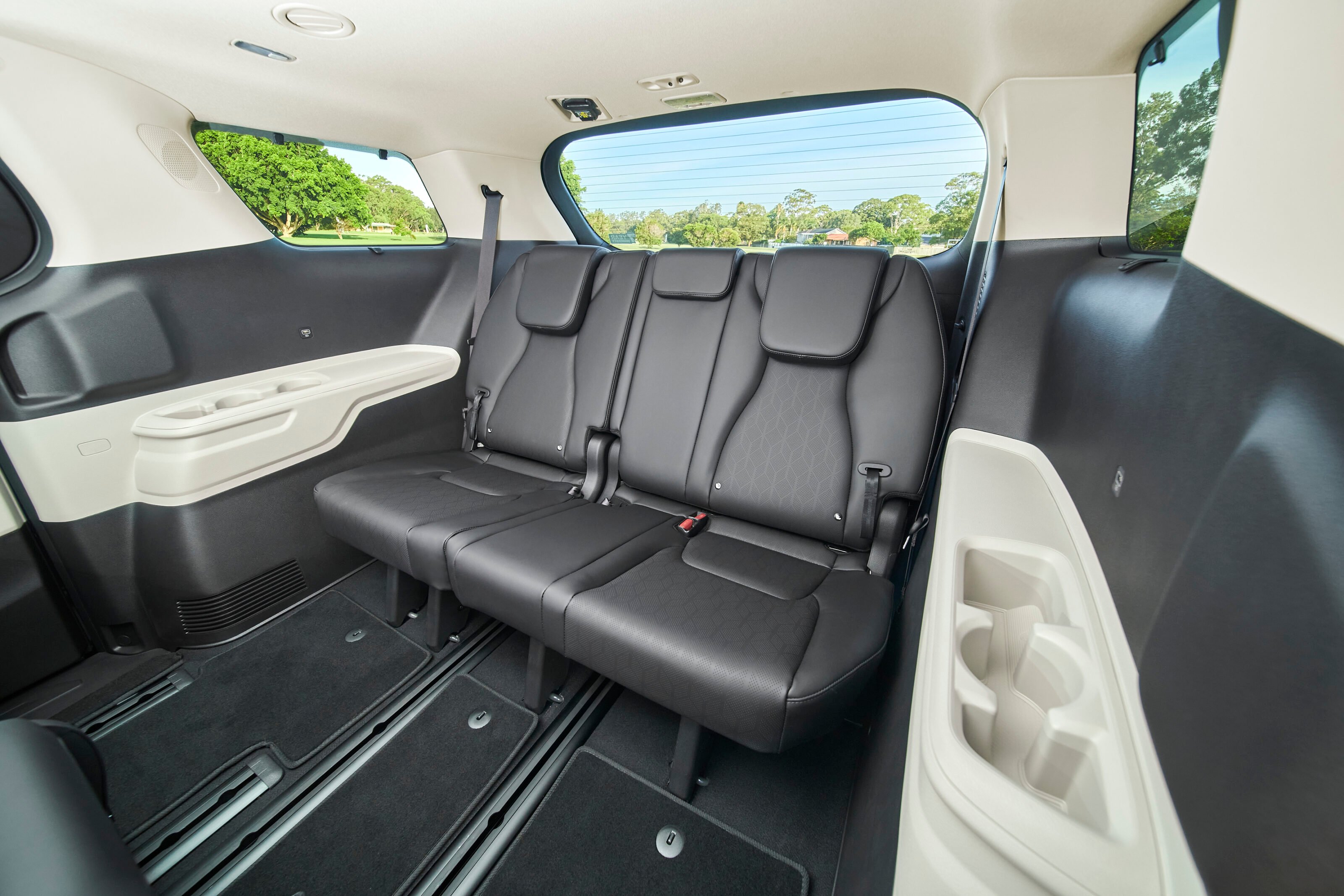
If you’re feeling cruel, you could squeeze three adults into the third row (with the middle serviced by a ceiling seatbelt). Two adults of above average height, however, have an amount of legroom and toe space more than acceptable for longer journeys.
Or parents have the option of fitting child seats. The outer seats feature both top tether and ISOFIX points – a very uncommon combination in the world of people-movers and multi-seater SUVs.
While the Sorento also features ISOFIX points for its two third-row seats, the SUV’s curtain airbags only cover up to the glass area where the Carnival’s extends to the entire row.
A USB port plus storage section with moulded bottle holder are positioned on either side, while air vents are overhead. Third-row occupants in the Carnival Platinum get extra treats: their own speakers (linked to the Platinum’s Bose audio), LED reading lights, and side shades.
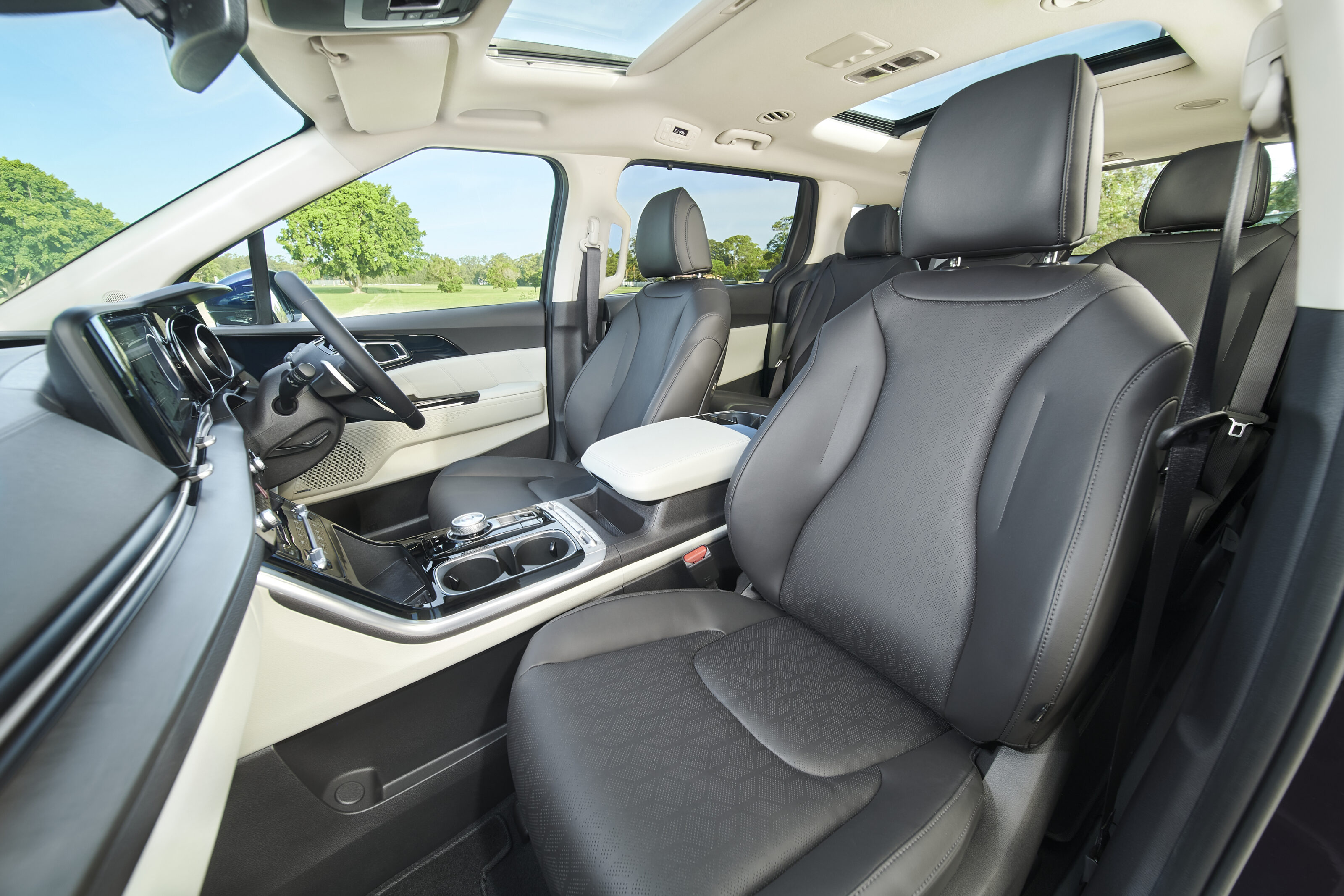
The Carnival’s middle cabin is more spacious, naturally, with limousine-style legroom if the sliding (split) seats don’t need to be positioned far forward to help taller third-row occupants.
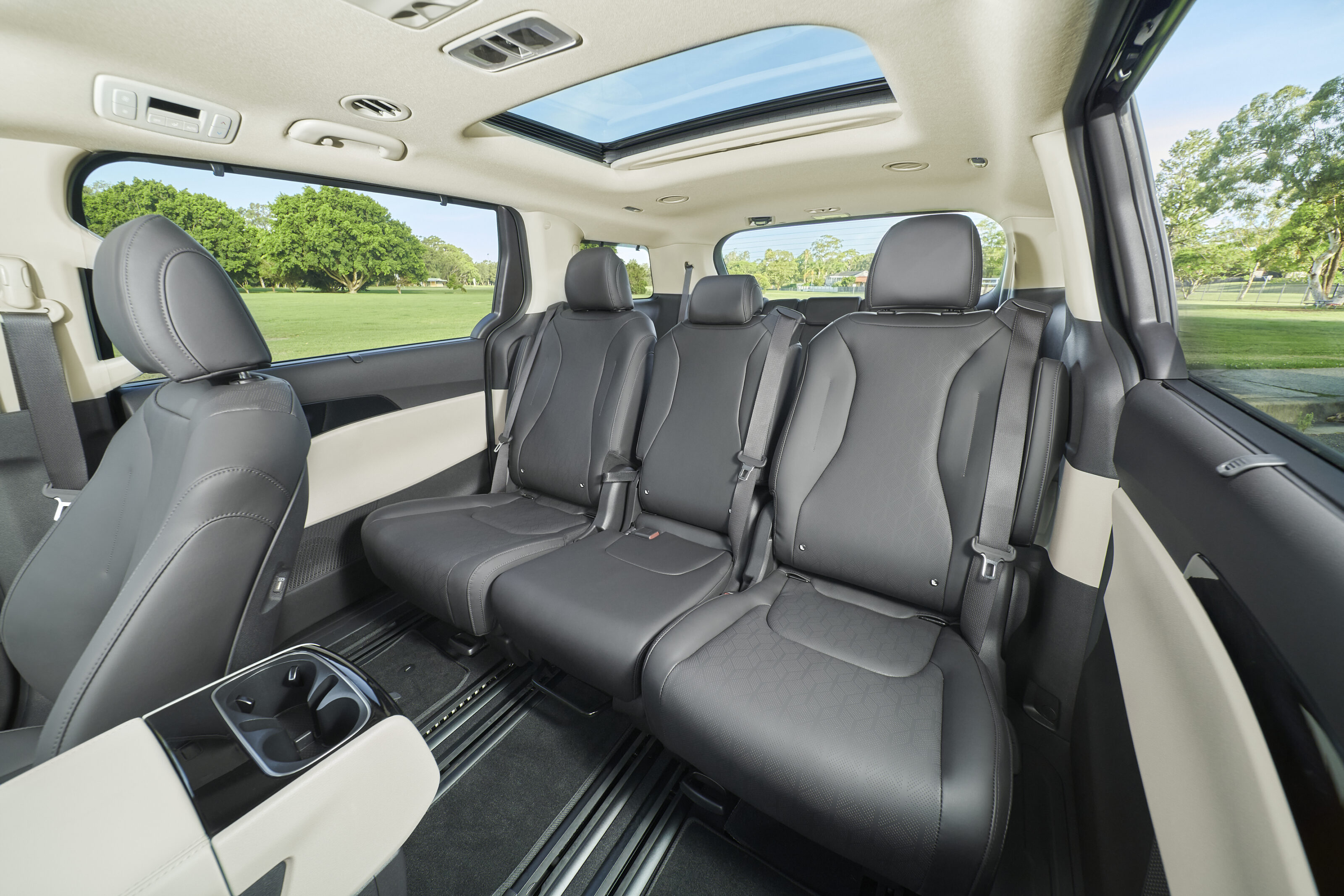
Those seats also recline. And while captain’s chairs are not available, the second row can be customised in a few ways via the middle row’s centre seat: it can be flipped 180 degrees to allow for eye-to-eye chats with the third-row passengers; it can be folded down to become a centre tray with cupholders and smartphone slots for the outboard occupants; and it can be slid forward to bring a younger child closer to the parents in the front seats.
Coat hooks and a bag hook are also included in the second row, as are vents – with full climate control for all but the entry-level Carnival. There are more USB ports here too.
Platinum also adds shades for the side windows, plus dual sunroofs – both of which open electrically: tilt/slide front and slide rear.
All grades feature a system that warns occupants before they’re about to open the door into oncoming traffic; SLi and Platinum add an extra function that disables the sliding doors in the same instance.
And Platinum will also prompt the driver to check the rear seats – in the hopefully unlikely case a parent forgets about their kids!
Speaking of which, there are top tethers for all three middle-row seats plus ISOFIX points for the outboard seats – combining with the rear anchors to give parents the ultimate child-seat versatility.
The Carnival’s generous cabin width ensures three child seats can be placed across the centre cabin, though this complicates access to the third row if it’s needed.
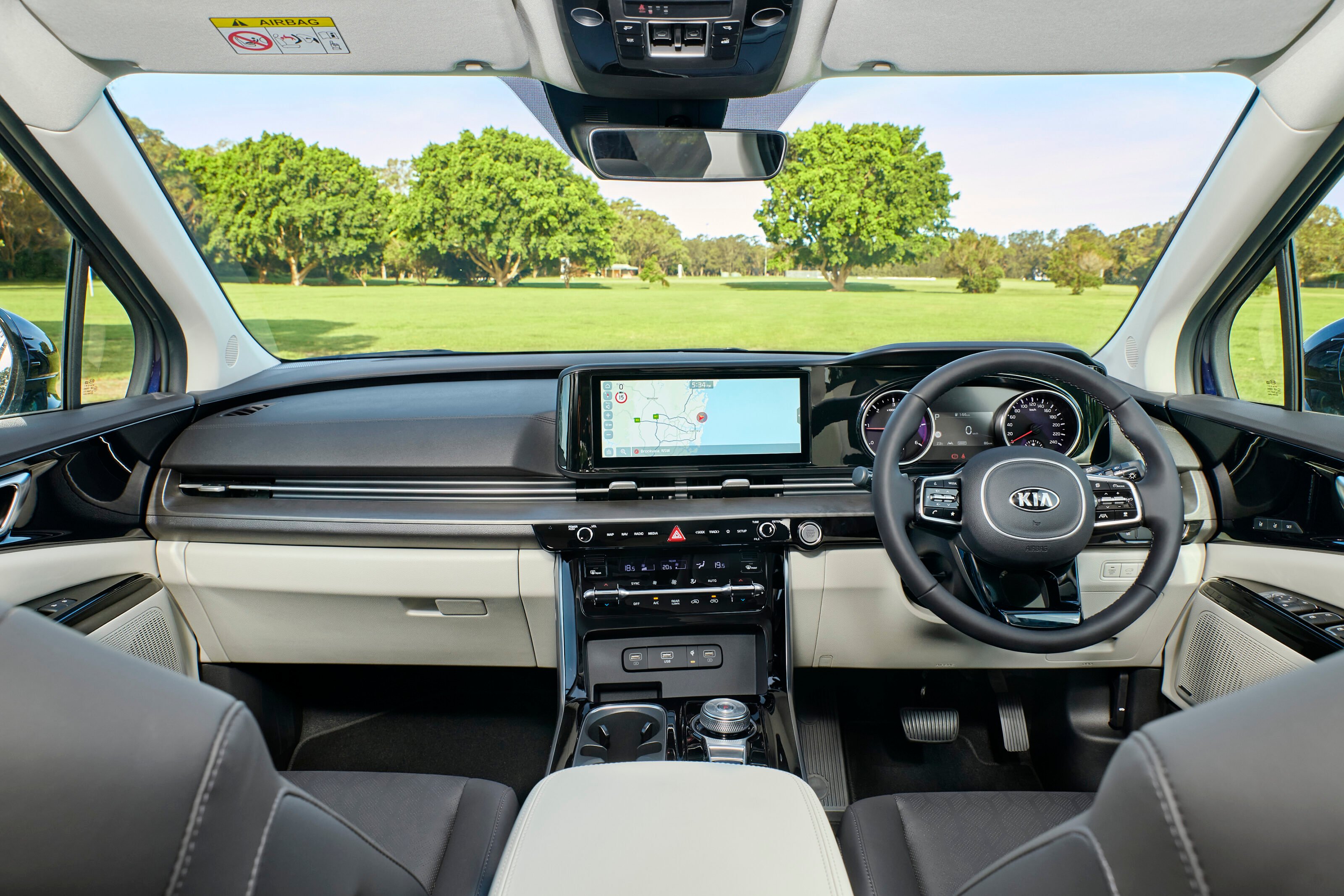
That width is emphasised up front with a huge console box, which features a one-piece lid doubling as an armrest for the driver and front passenger.
Its leatherette lid matches with the mid door trims, which with their lighter colour contribute to a multi-tone interior that helps create more of an upmarket vibe. (Kia can often be guilty of using an excessive amount of black in its cabins, which can have the opposite effect.)
SLi and Platinum models take this further with ‘Premium’ seats – artificial rather than real leather, instead of the cloth of S and Si – plus wood-effect dash inserts. Platinum also features customisable ambient lighting in front and rear door panels.
Front occupants in the Platinum are pampered with heated/ventilated seats, while the driver gets a heating function for the steering wheel.
Door pockets aren’t particularly high, though bottle holders (and a smartphone slot) feature at the rear of the centre console box and two cupholders are found on the centre console.
The Platinum’s centre console looks slightly different to other grades – looking even more sophisticated with its rotary gear selector that’s enabled by the model’s exclusive-to-range shift-by-wire transmission.
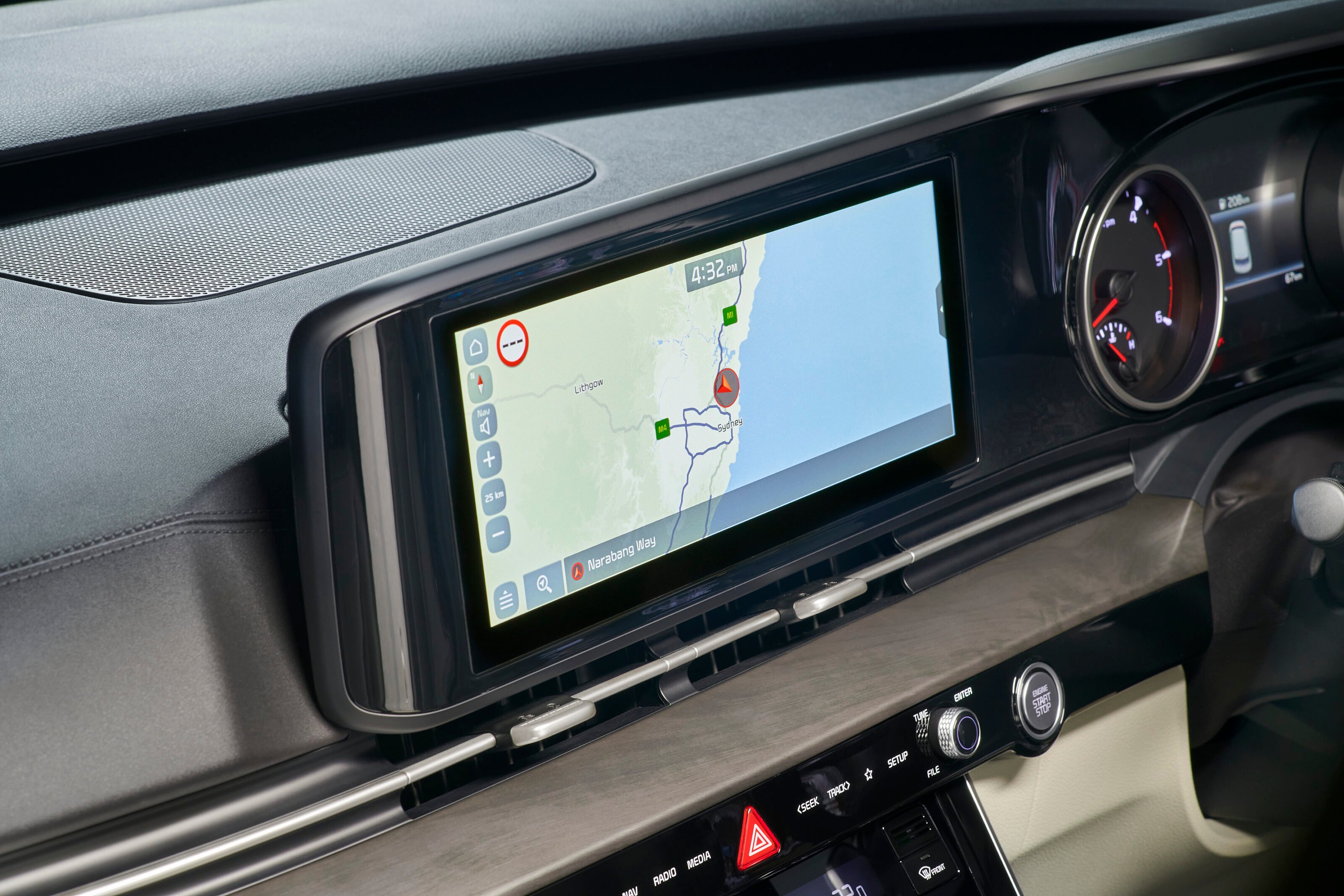
While the Carnival S makes do with an 8.0-inch touchscreen, all other models are fitted with Kia’s impressively wide and slick 12.3-inch touchscreen infotainment system.
The base grade at least compensates for its smaller screen and lack of factory navigation with wireless Apple CarPlay and Android Auto, where the more expensive models require smartphones to be plugged into USB sockets.
Wireless smartphone charging is included on the Platinum only, which will disappoint many buyers. All windows should have one-touch operation, too, but the Platinum has this on the driver’s window alone and the fully digital instrument display found in the Sorento won’t be available on the top-spec Carnival until later in 2021.
Instead, the driver gets conventional dials plus a small centre TFT display for various bits of information.
So terrific is the Carnival’s cabin versatility and functionality that, for many buyers, the way the Kia drives will be almost irrelevant.
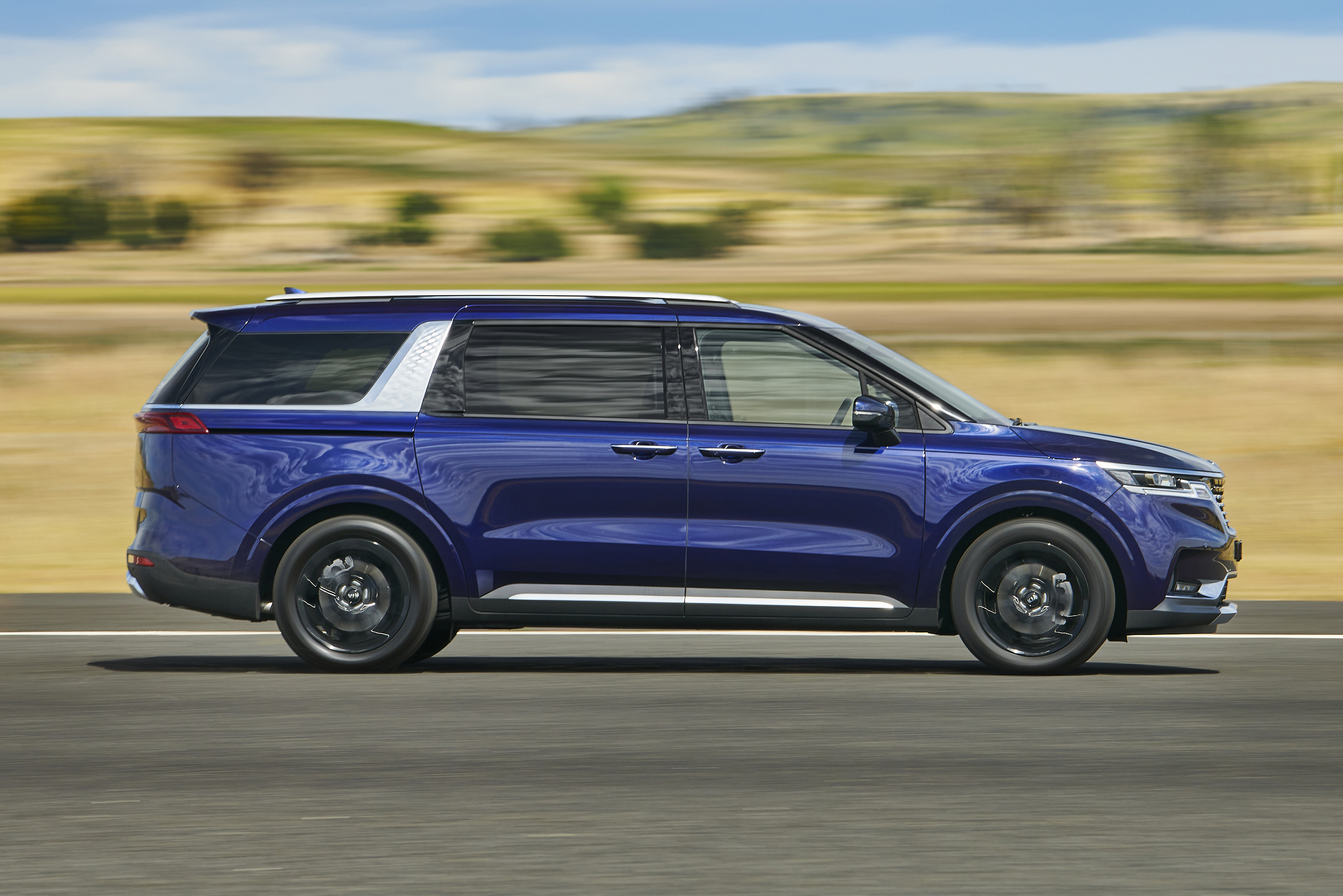
It’s a bonus, then, that the Carnival drives very nicely.
There’s a relaxed nature to the suspension that makes the Carnival a soothing conveyance without becoming excessively bouncy across uneven roads. The Platinum rolls along on its 19-inch wheels with less fussiness than the Sorento GT-Line on same-size rims.
The steering is smooth, too, though it’s also slow – making the people-mover feel less wieldy when negotiating roundabouts or country roads than its seven-seater-SUV cousin and the Carnival’s turning circle is a touch wider than the Sorento’s, but still decent for a big vehicle.
On freeways, the steering can feel particularly vague around the straight-ahead position.
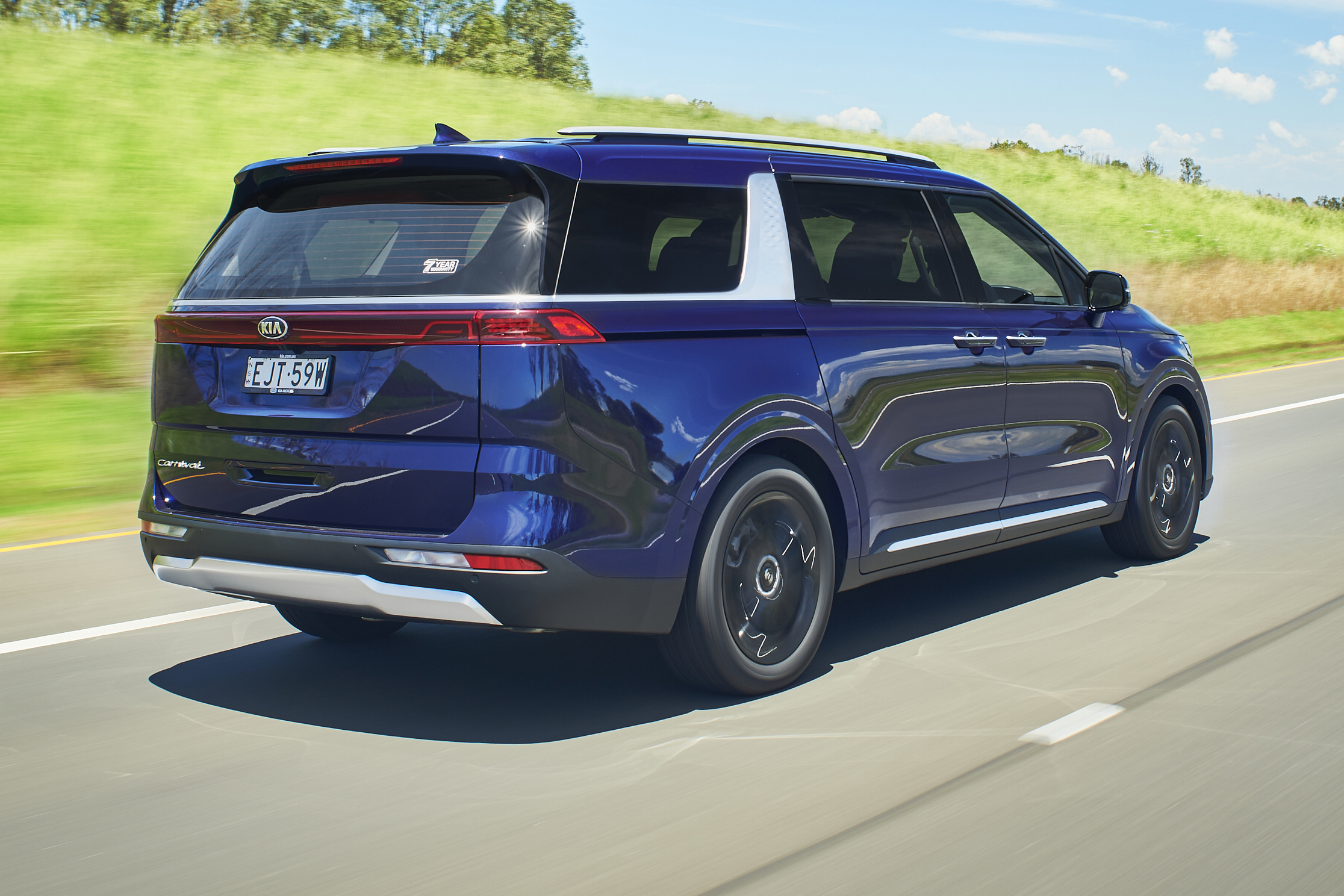
The driving position is more bus-like than the Sorento’s, with the seating feeling more upright. It’s still comfortable, though some extra cushion length or cushion extenders for the front seats would be welcome.
All-round vision isn’t perfect, either, with blind spots over both shoulders but blind-spot monitoring, rear cross-traffic alert and the good-quality 360-degree camera view all help ensure the Carnival doesn’t feel intimidating to drive.
A couple of clever, speaker-based features are available via the infotainment screen: Passenger Talk amplifies the driver’s voice to rear passengers; Quiet Mode directs music to the front seats only to help avoid waking sleeping kids.
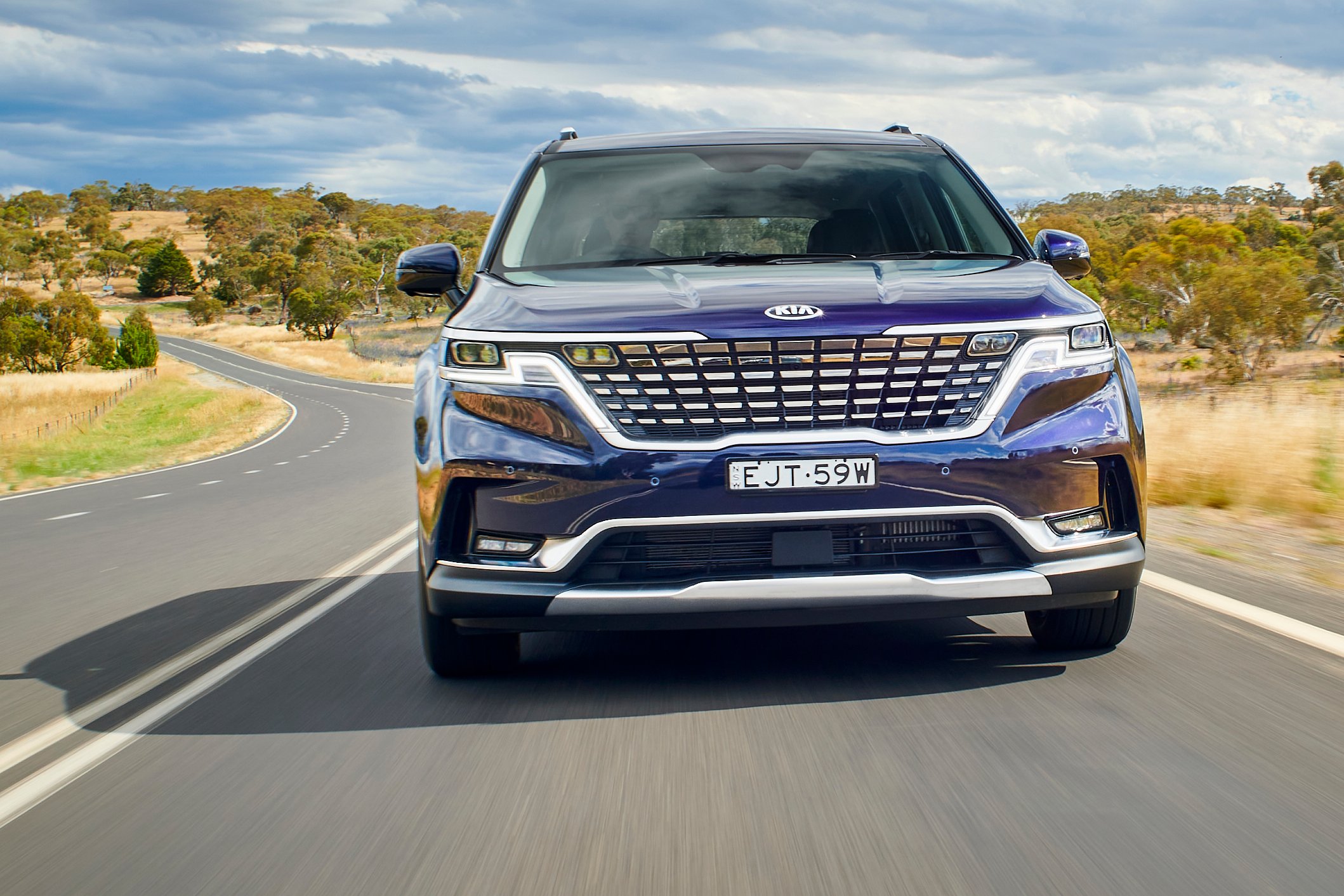
Buyers have two engine options, a petrol V6 or a turbo diesel four-cylinder driving the front wheels via an eight-speed auto.
It’s a case of what engine flavour is preferred or assessing the importance of fuel economy to the family.
The V6 is smooth, strong and sounds pleasant, but it consumes about 50 per cent more fuel every 100km with official consumption of 9.6 litres per 100km versus 6.5L/100km.
The diesel has some characteristic clatter even on a light throttle and feels a touch more sluggish from very low revs, but it then offers more pulling power in its mid-range. The more passengers you have on board, the more that extra torque – 440Nm versus the V6’s 355Nm – becomes useful.
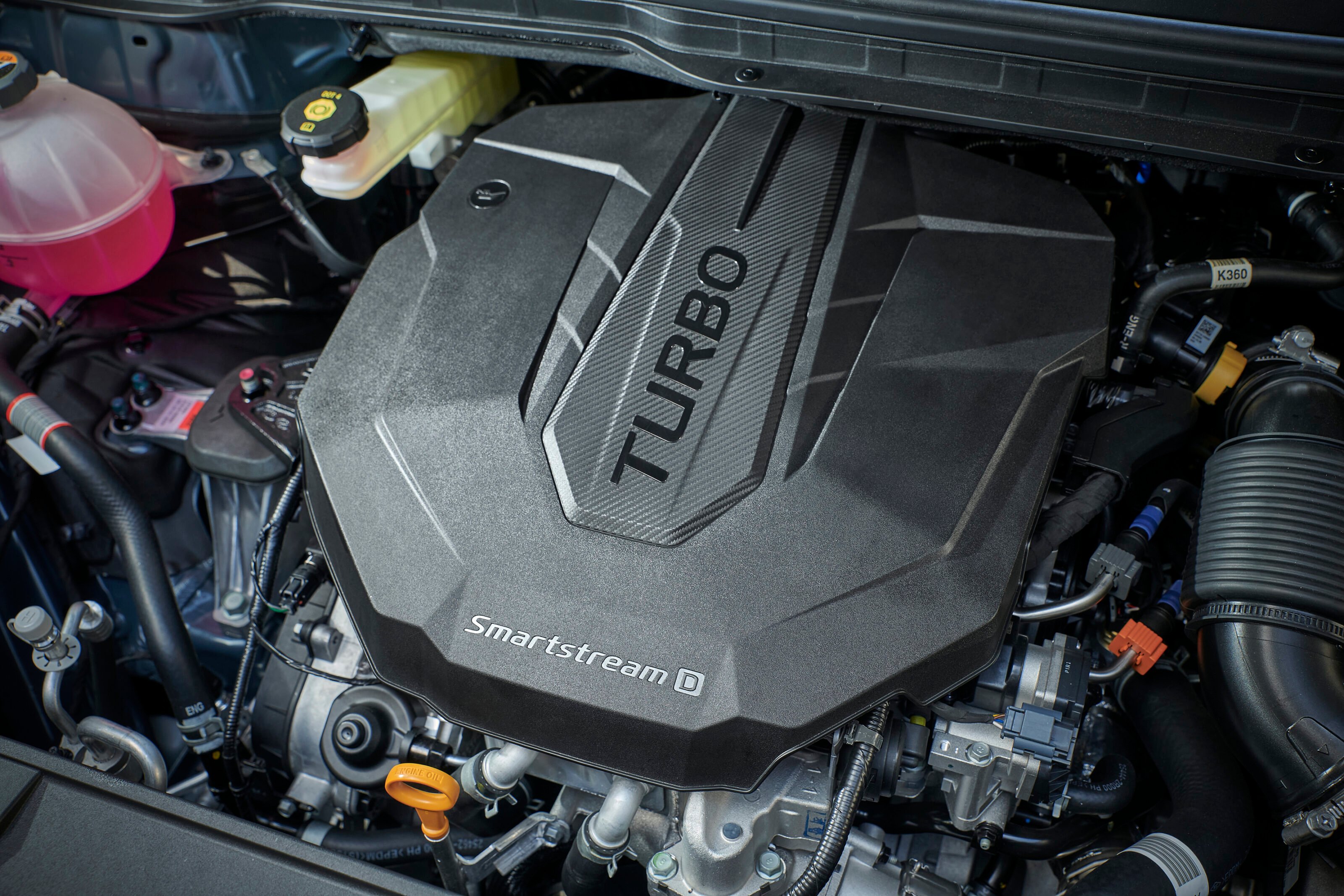
Our Platinum diesel test car returned an indicated 6.9L/100km after about 150km of driving that incorporated an even mix of suburban and freeway running.
Capped-price servicing costs are based on either 12-month or 15,000km intervals and vary from a reasonable $349 per visit to a relatively costly $798 depending on the age and mileage of the Carnival. Owners are looking at not far off $4000 over seven years.
For all that period, though, there’s the brilliant assurance of Kia’s industry-leading warranty.
As bold as the Carnival’s styling is for a people-mover, many buyers will still prefer the design of a SUV.
But while there may be plenty of big seven-seater SUVs that may be more appealing in the way they look or steer, the Carnival is easy and comfortable to drive while offering interior and passenger room that is largely unrivalled.
And while the Platinum variant offers plenty of goodies to tempt families who can afford it, that convenience of space is standard with all Carnivals.
Editor’s note: Some images in this review gallery feature the V6 petrol model, but appearance and trim grade is otherwise identical across the petrol and diesel models.
2021 Kia Carnival Platinum diesel specifications
| Price | $66,680 before on-road costs |
| Engine | 2.2-litre four-cylinder turbo diesel |
| Transmission | 8-speed automatic |
| Fuel consumption | 6.5L/100km combined |
| Wheels | 235/55 R19 |
| Weight | 2134kg |
| Dimensions | L 5155mm x W 1995mm x H 1775mm u2013 Wheelbase 3090mm |
| ANCAP Safety | 5-star |
