
Eagle-eyed observers of some relatively recent electric vehicle releases might have noticed something a bit odd, something which seems like a contradiction of the industry moving towards new technologies.
Drum brakes are slowly becoming more and more accepted as the way forward – and not just from a cost-saving point of view for manufacturers.
They actually have some merit in the world of electrification, acting as a far more efficient part in the life of a car than the more advanced disc and caliper set-up.
For those who are new to the intricacies of how brakes operate, or need a quick refresher, let’s give you a crash course – or crash prevention course if you will.
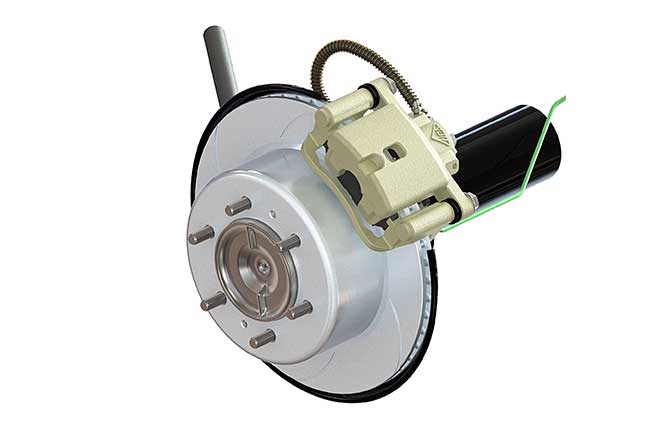
Disc brakes, which you’ll find on pretty much every half-decent new car since the mid-2000s, work by mounting a caliper with brake pads inside it on a hub-mounted disc.
The disc rotates with the wheel but when the brake pedal is pushed, hydraulic fluid forces the pistons inside the caliper to push out towards the disc, squeezing it between the two pads – this friction then begins to slow the car down, converting kinetic energy to heat, hence why you’ll see a lot of vents in a typical disc.
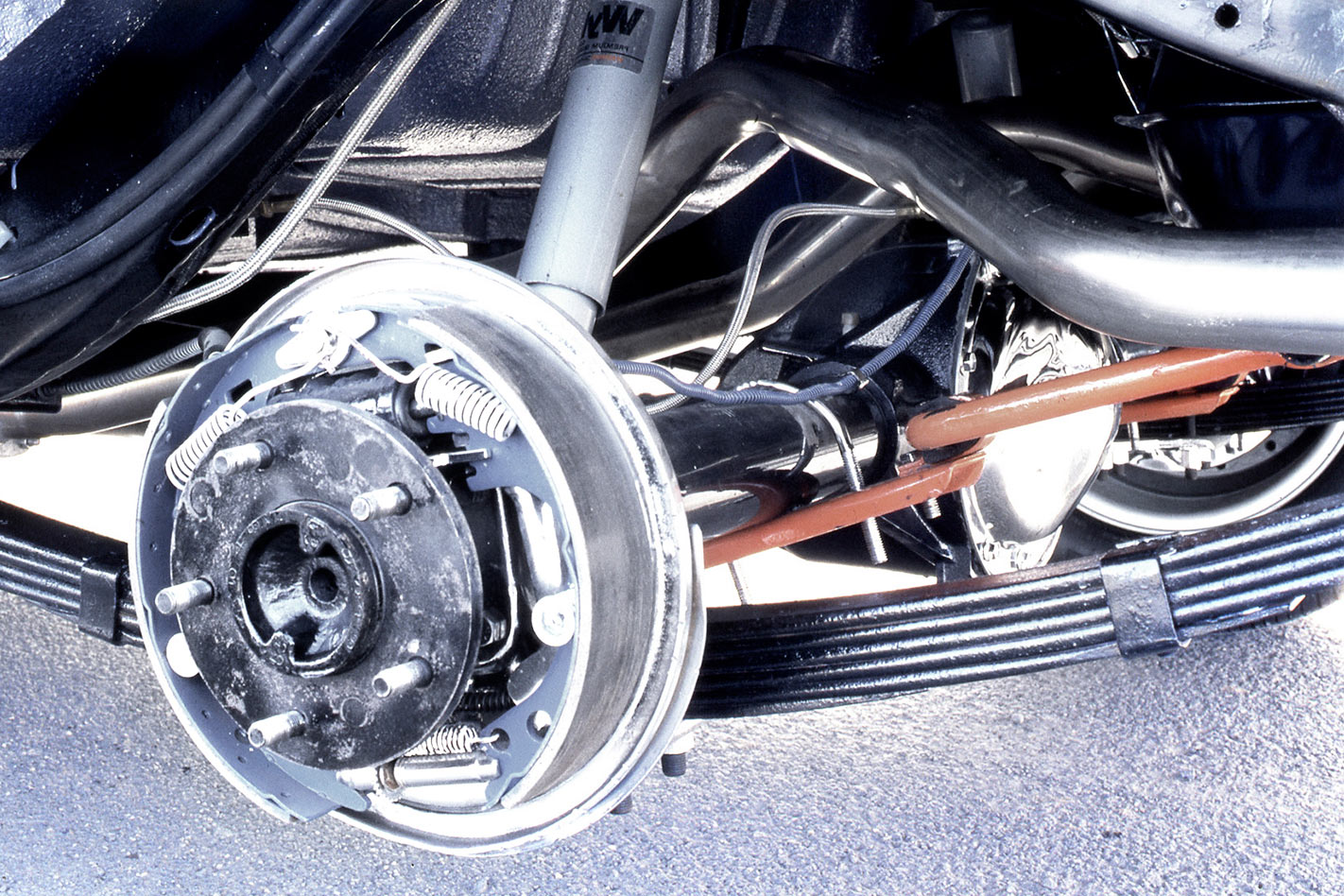
Now drum brakes, which have been around since the dawn of the automobile, operate within an enclosed drum, again attached to the hub but now containing all the relevant parts inside.
Two shoes are usually found in a typical drum and are pushed out by a cylinder within the unit when the brake pedal is pressed, pushing outwards against the inner surface, again creating friction.
Despite being cheaper to manufacture, drums were essentially phased out due to the fact they not only generate more heat than discs but are also worse at dissipating the heat. Additionally, discs can adjust and clean themselves.
However, there is one drawback to disc brakes which is a key weakness of EVs – driving range.
Disc brakes naturally drag the pad against the rotor, ever so slightly creating resistance which increases fuel consumption in most vehicles, or in the case of EVs, reduces their driving range.
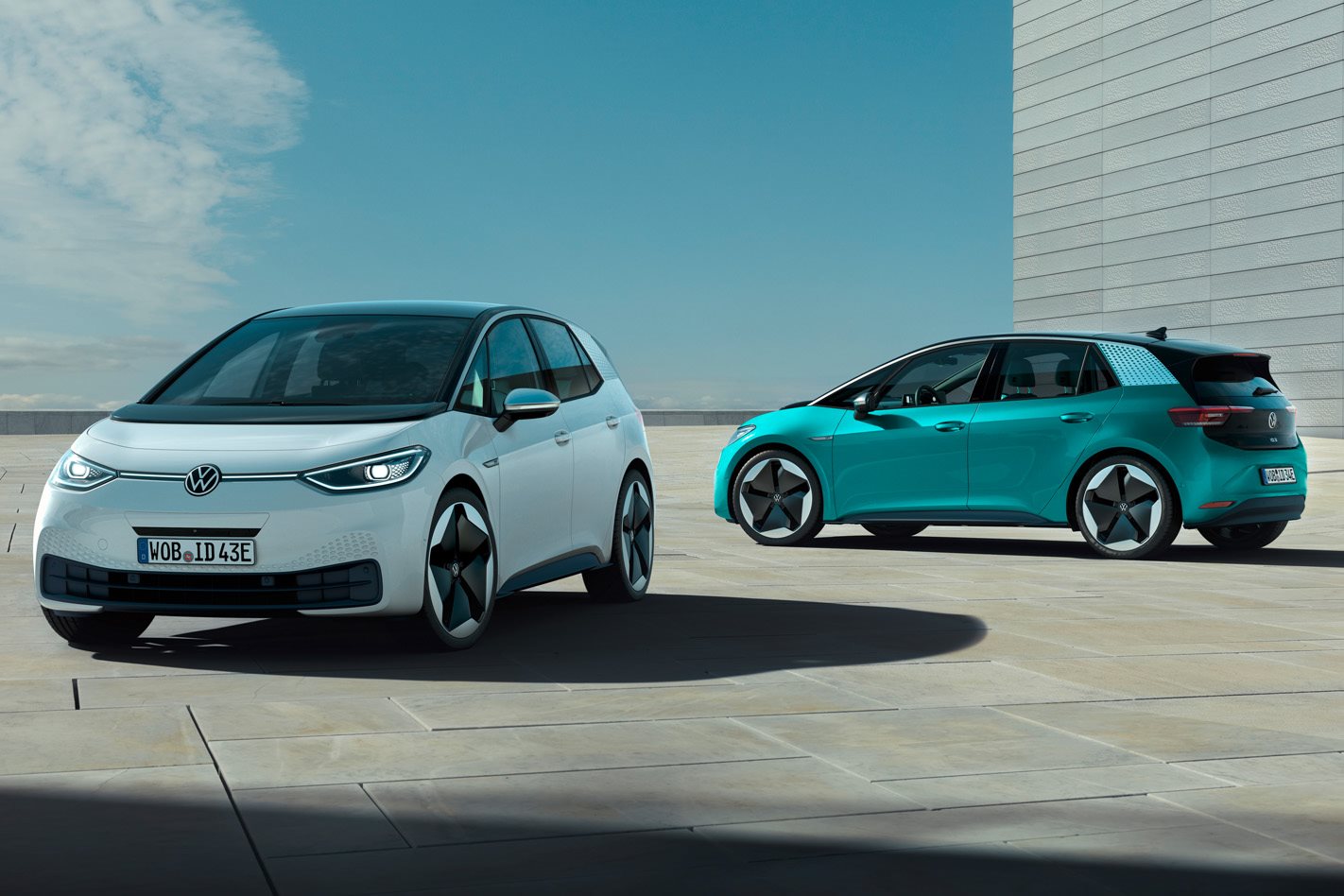
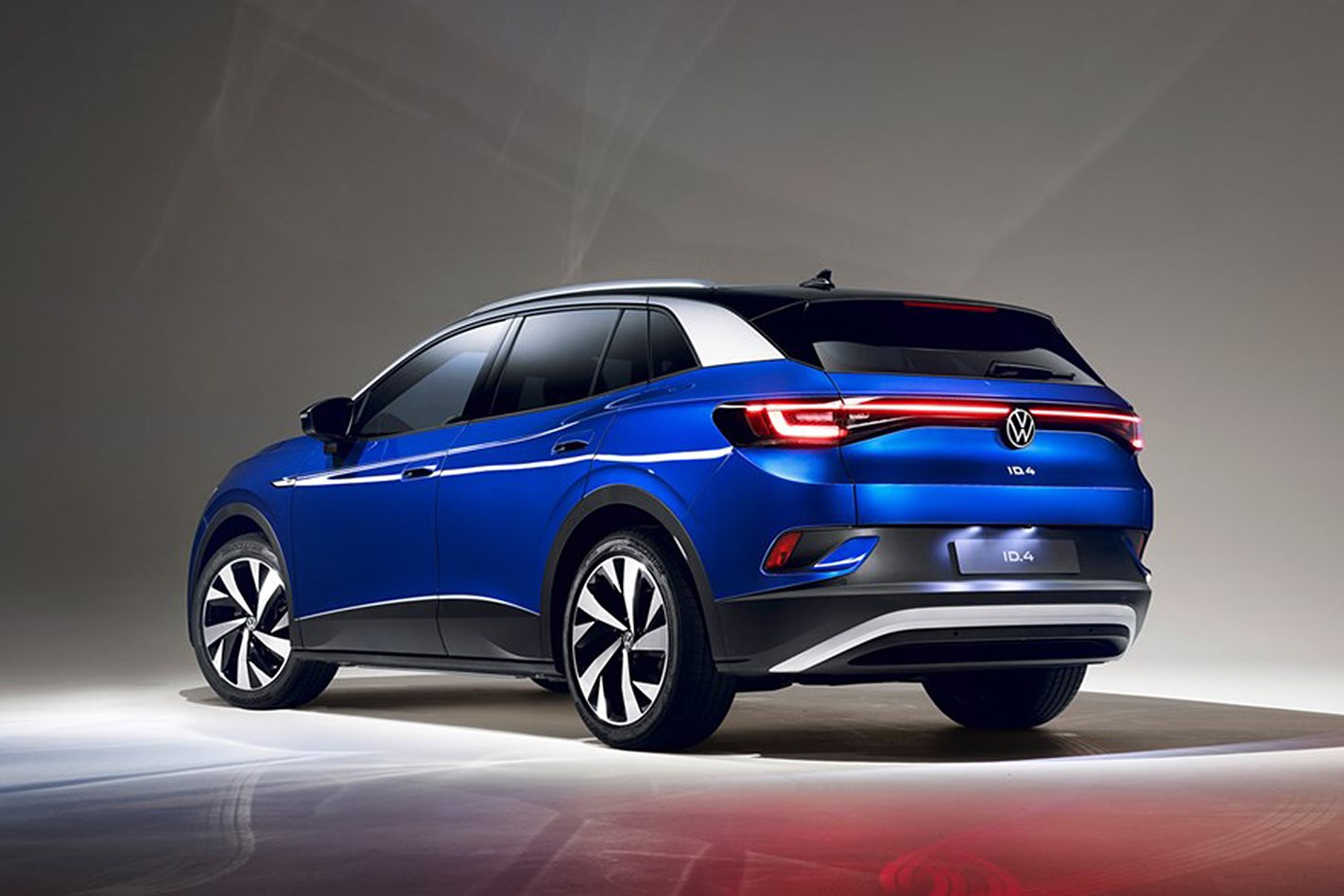
Volkswagen wanted to find a way around this problem when developing its ID.3 and ID.4 EVs, turning to Continental for help in developing a drum brake set-up for the vehicles.
Fitted to the rear axle, the drums are the perfect partner to the rear motor which does a majority of the braking through regeneration, essentially putting itself into reverse when off-throttle or on the brake pedal.
With a large share of the load being taken up by the motor, the drawbacks of the drums having less braking power is negated, also inflicting less wear on them given they are not the primary source of deceleration.
According to a 2020 statement from Continental, the drums fitted to the rear axle of the vehicles have a service schedule of 150,000 kilometres, making them one less expense which needs to be worried about when the vehicle is taken to the mechanics.
One other advantage for drum brakes is their design makes it easier to integrate a handbrake/emergency brake within the drum, meaning seperate mechanisms to fit an electronic parking brake are not required, further reducing weight and increasing driving range.
With manufacturers obsessed with increasing the driving range of their EVs, coupled with a desire to lower production costs, it’s hard to argue against the case of drum brakes making a comeback – just don’t expect red Brembo options any time soon.
Snapshot
- Top-end ’90s performance cars fetching top dollar
- Some modern classics still affordable to regular buyers
- Many beginning to appreciate now
This week brought news of two huge auction prices of 90s Japanese sports cars, an FD RX-7 SP and R32 Skyline GT-R, and that got us thinking – what other 90s classics are out there for the taking?
Though the price of these two cars, which fetched $166,000 and $142,500 respectively, and their ilk may not be attainable to the average punter, there are still some appreciating bargains to be had from the 90s performance era.
The values were little surprise to Street Machine scribbler, former Motor editor, Mighty Car Mods sidekick and all-round automotive thesaurus Iain ‘Marv’ Kelly – who pointed out on his Instagram page that as the income of a new generation rises, so does their desire to buy their own halo cars. Too young to have idolised V8 muscle of the 60s and 70s, they’re now willing to spend big for a slice of Group A (or tuner era) nostalgia.
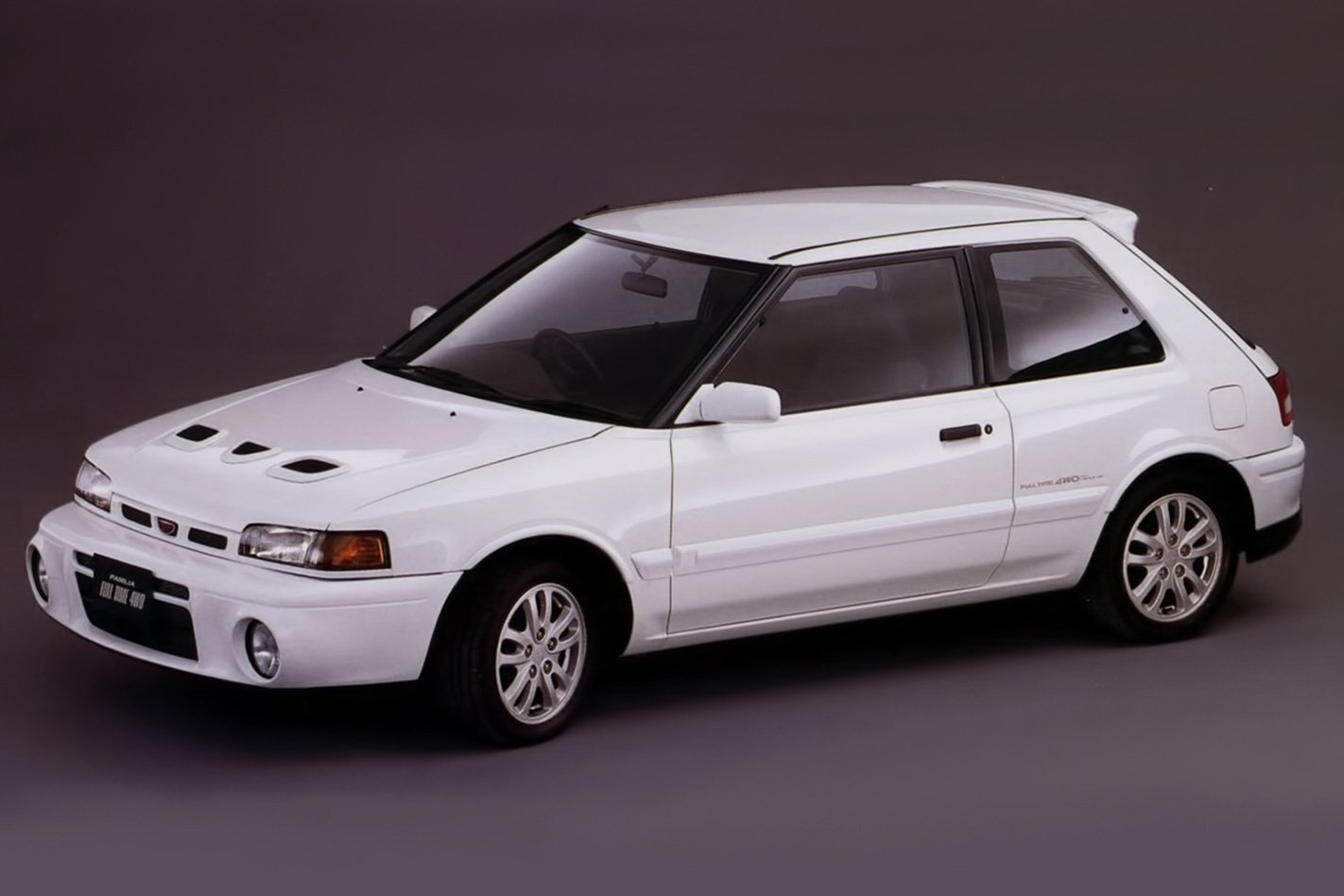
With anything rotary-powered commanding huge dollars, Marv advises turning to the hi-po Mazda 323 Familia GTX or GTR.
Packing a turbocharged 1.8 and a 4WD drivetrain, these cars were never sold new in Australia but plenty were imported around the turn of the century.
Kelly says they’re cheaper than a rival Pulsar GTI-R, too – possibly thanks to the 323’s notoriously weak ‘box. In 2019, our mates at Unique Cars valued a 4WD Familia at around $6250.
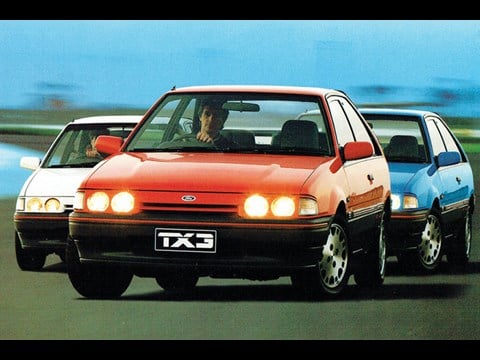
For a less-exotic (though usually cheaper) option, consider a Ford KE Laser TX3. Built on the same platform as the 323, a four-paw version was available with a 100kW, 1.6-litre B6T.
There’s also the Capri Clubsprint, a two-door convertible Laser derivative with the same 1.6 feeding the front wheels only.
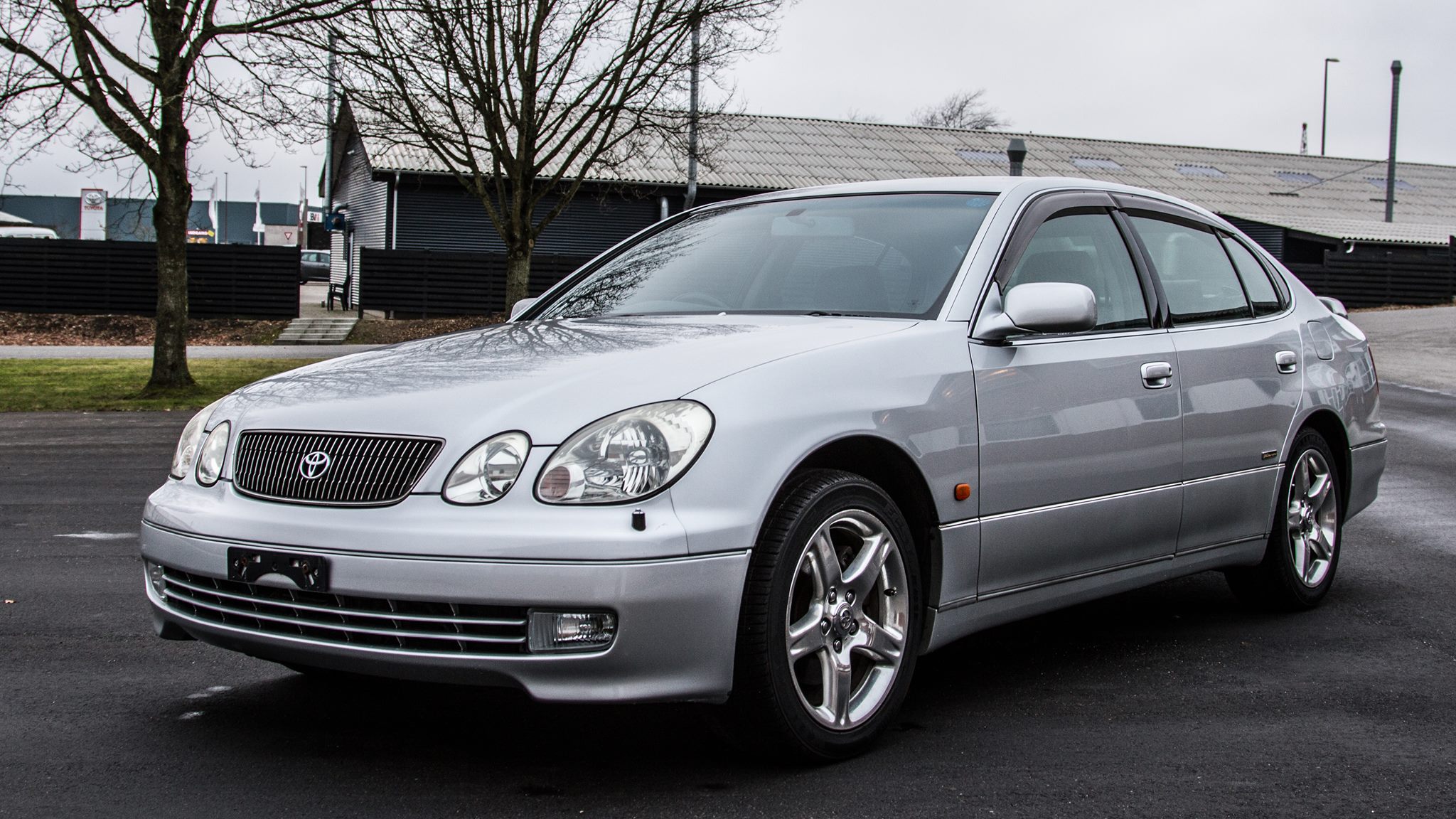
“With JZA80 Supras worth old Porsche money now, the auto-only luxo barge Aristo seems like a 2JZ bargain in comparison,” points out Kelly.
To maximise value-for-money, he suggests a JZS161. You’ll easily find a tidy example for $20k – in fact, there are five Aristos listed online right now, none of which exceed $30,000. You’ll be cruising in far more luxury than a Mk4 Supra, too.”
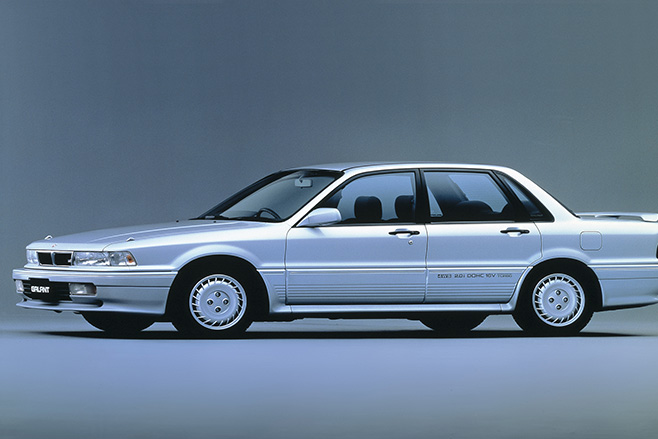
Mitsubishi Galant VR4s seem to have mostly dodged the huge prices attached to their Evo successors, so they’re another item on the ‘buy now’ list.
“[As] the first 4G63 4×4 model to taste WRC glory, they’re sleeper cool, and if you really hunt you’ll be able to find an Aussie delivered example,” he says. “There’s an imperfect but mechanically good example on Gumtree right now, with an asking price of $16,000.”
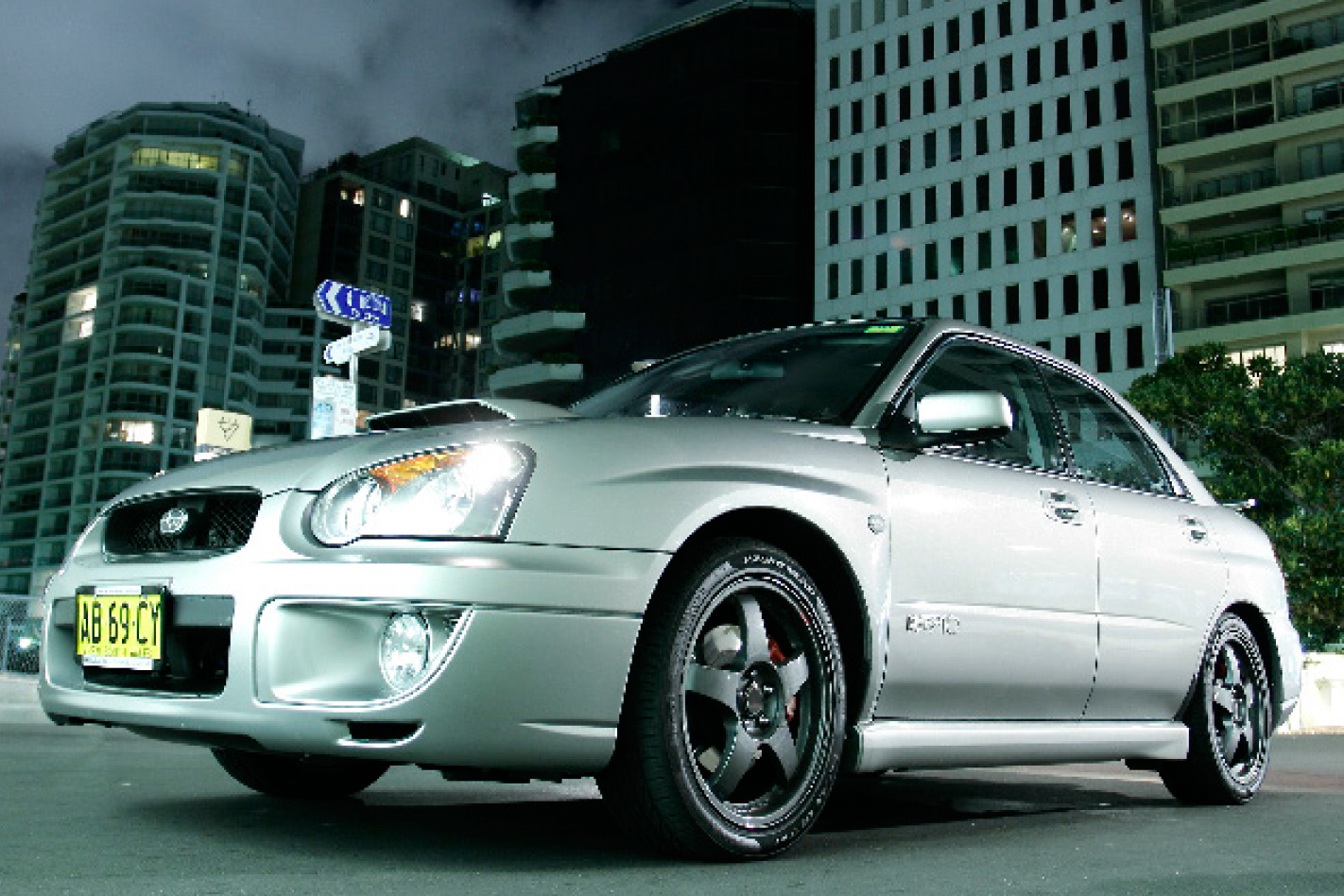
WRX Imprezas are well-known to command strong money, so Kelly believes a tidy, stock WRP10 or Club Spec would make an excellent investment.
“The WRX can legitimately be said to have the cultural impact of classic Camaros in the JDM scene so you won’t go backwards with a clean stock manual example.” Tidy manual WRP10s can be had for well under $30,000 right now.
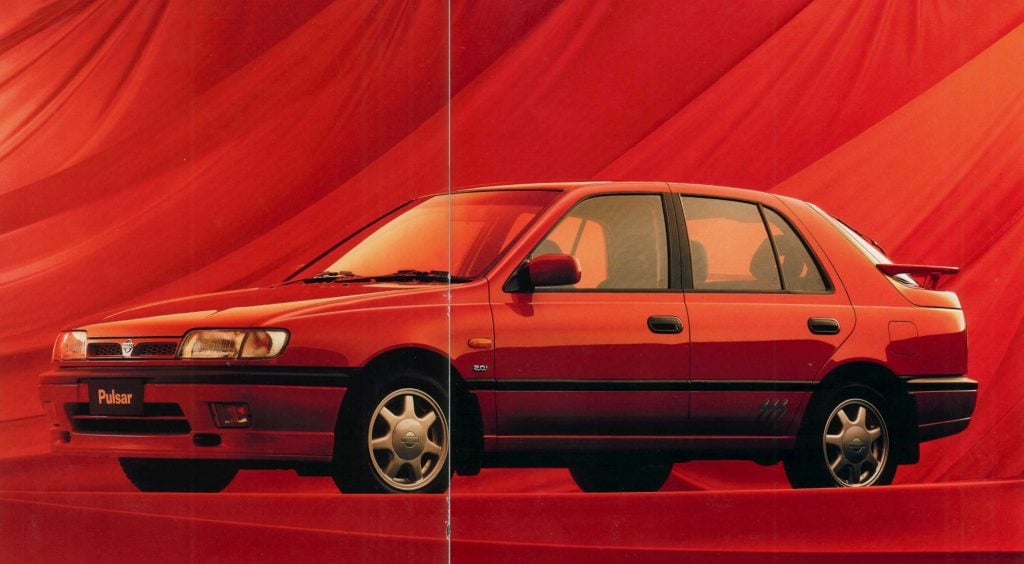
An icon of the Aussie streets throughout the 90s, the N14 Pulsar SSS packed an atmo SR20. Priced under $15,000, he says they’re “still a fun drive equal to any 4AG Corolla.”
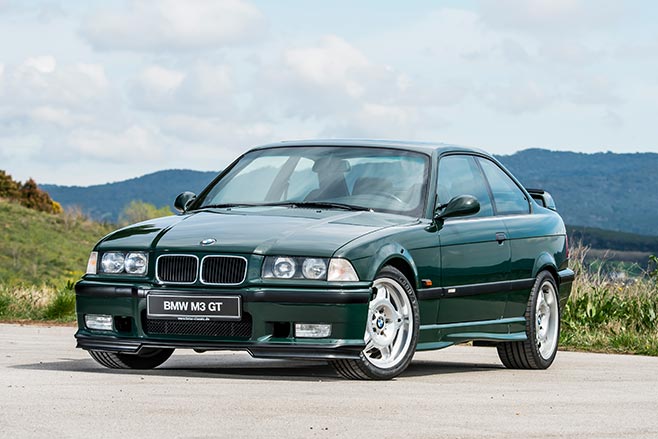
Whilst not quite at bargain-basement prices, it’s his view the BMW E36 M3 is bound to eventually skyrocket. Of course, six-cog cars will always present the best investment.
“If you find a manual example whose interior hasn’t disintegrated, grab it. Especially if it is one of the 15 M3 R models!” A look online shows plenty of ‘standard’ M3s available below $50,000.
We’d love to hear your picks for affordable 90s heroes, so drop them in the comments below!
Snapshot
- Stelvio Veloce priced from $78,950 before on-road costs
- Claimed 5.7 seconds 0-100km time
- Power and torque rated at 206kW/400Nm
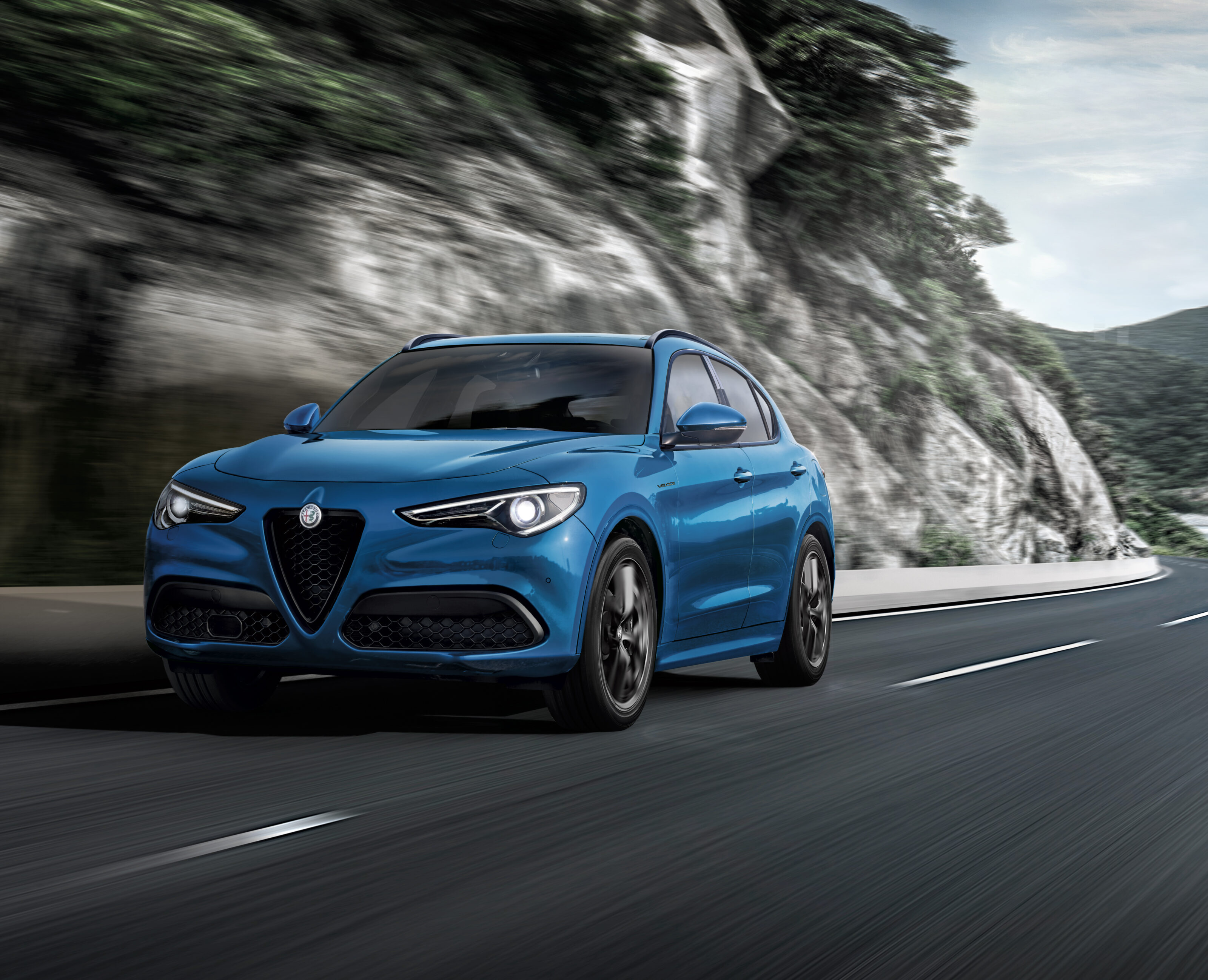
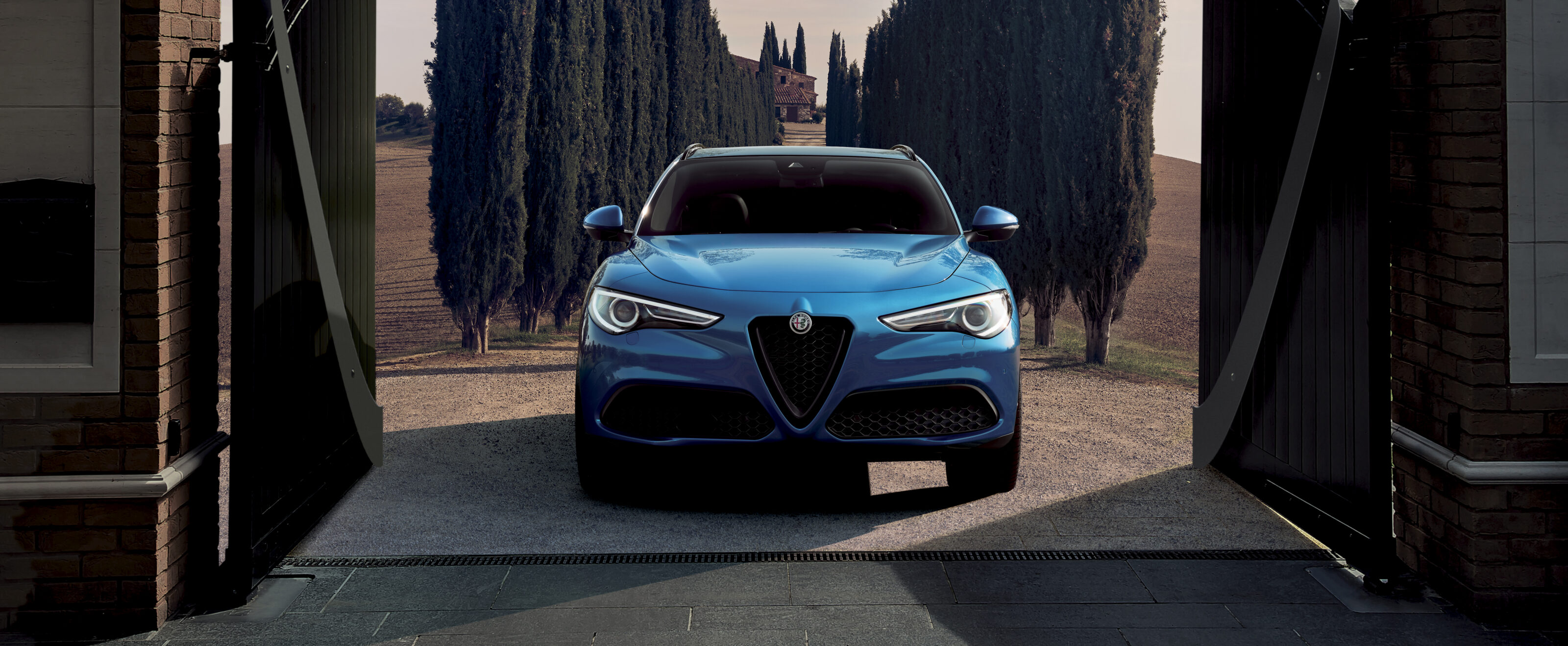
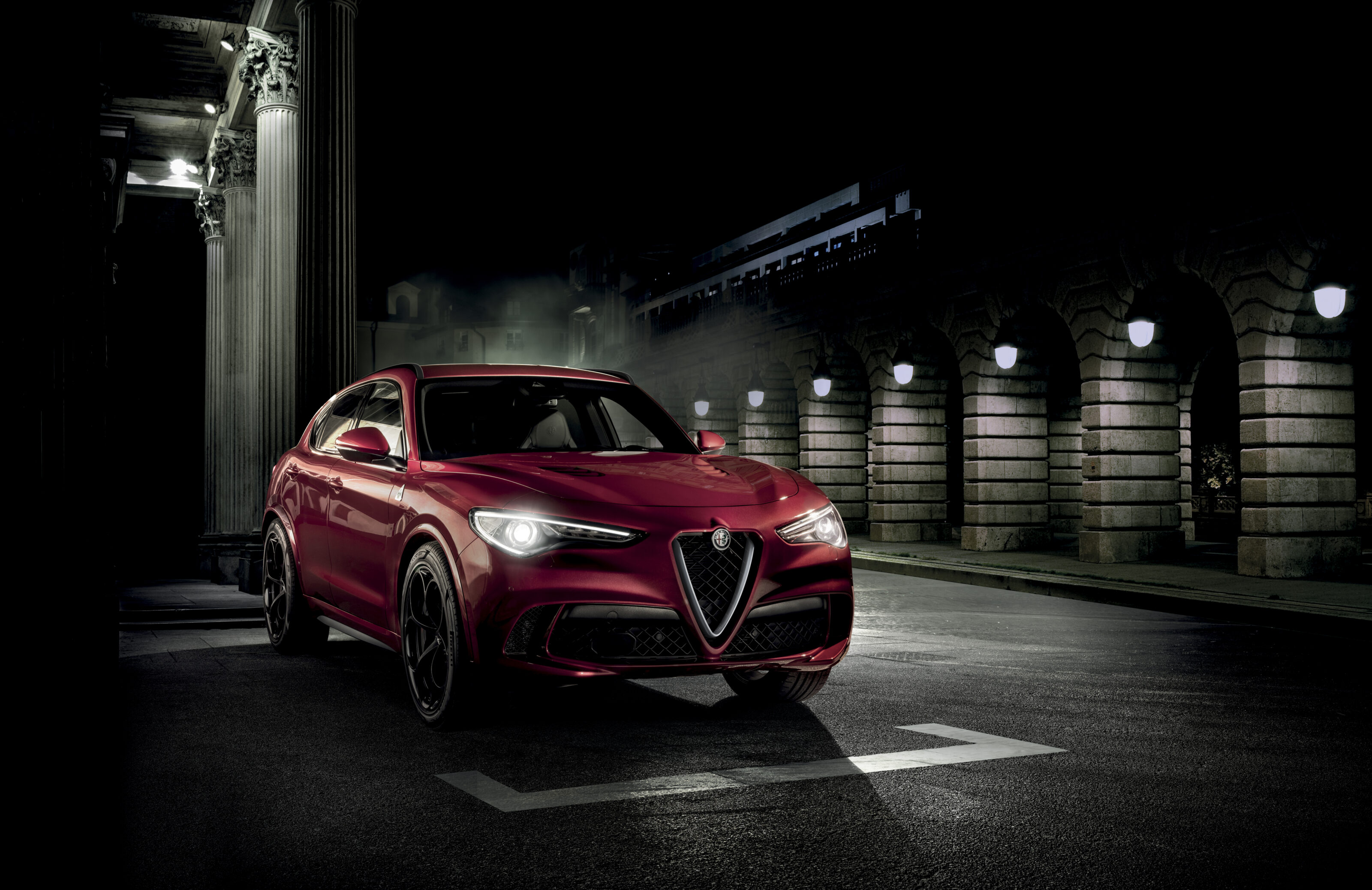
The Alfa Romeo Stelvio Veloce has gone on sale in Australia – completing the model line-up for the brand Down Under.
In the Stelvio range, the Veloce is nestled in between the Sport and Quadrifoglio variants starting at $78,950 before on-roads.
The Stelvio Veloce’s features include; wireless phone charging, an 8.8” touchscreen colour display, heated front and rear seats, and a leather stitched dashboard and door trims. The exterior features dark accents, 20” Veloce wheels with body colour arch trims and a convenient hands-free tailgate.
Features
As standard, over and above what comes on the entry-level Stelvio and Stelvio Sport, the Stelvio Veloce gets:
| Increased engine power +60kW |
| Q2 limited slip rear differential |
| Alfa active suspension |
| Upgraded braking system |
| 20u201d aluminium alloy wheels |
| Veloce body kit with dual exhaust |
| Wheel arch trims in body colour |
| Leather stitched dashboard and door trims |
| 8-way power adjustment for front seats |
| Ambient interior lighting |
| Heated rear seats |
| 10-speaker sound system |
| Hands-free tailgate |
Optional extras on the Veloce include (prices vary):
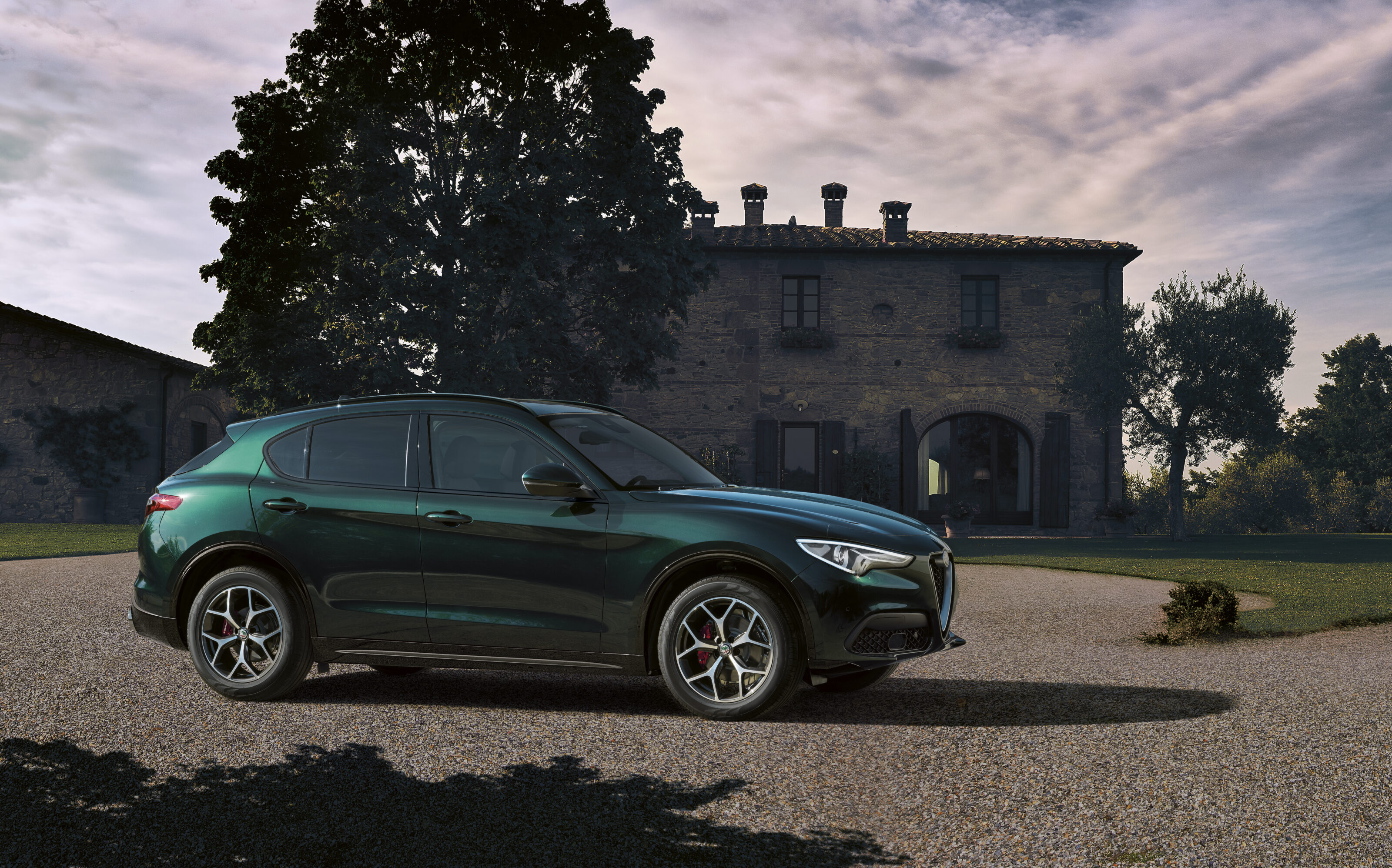
No cost paint options are Alfa Red and Alfa White, while optional colours include; Vulcano black, vesuvio grey, racing green, anodized blue, moonlight pearl and misano blue.
Engine, transmission & performance
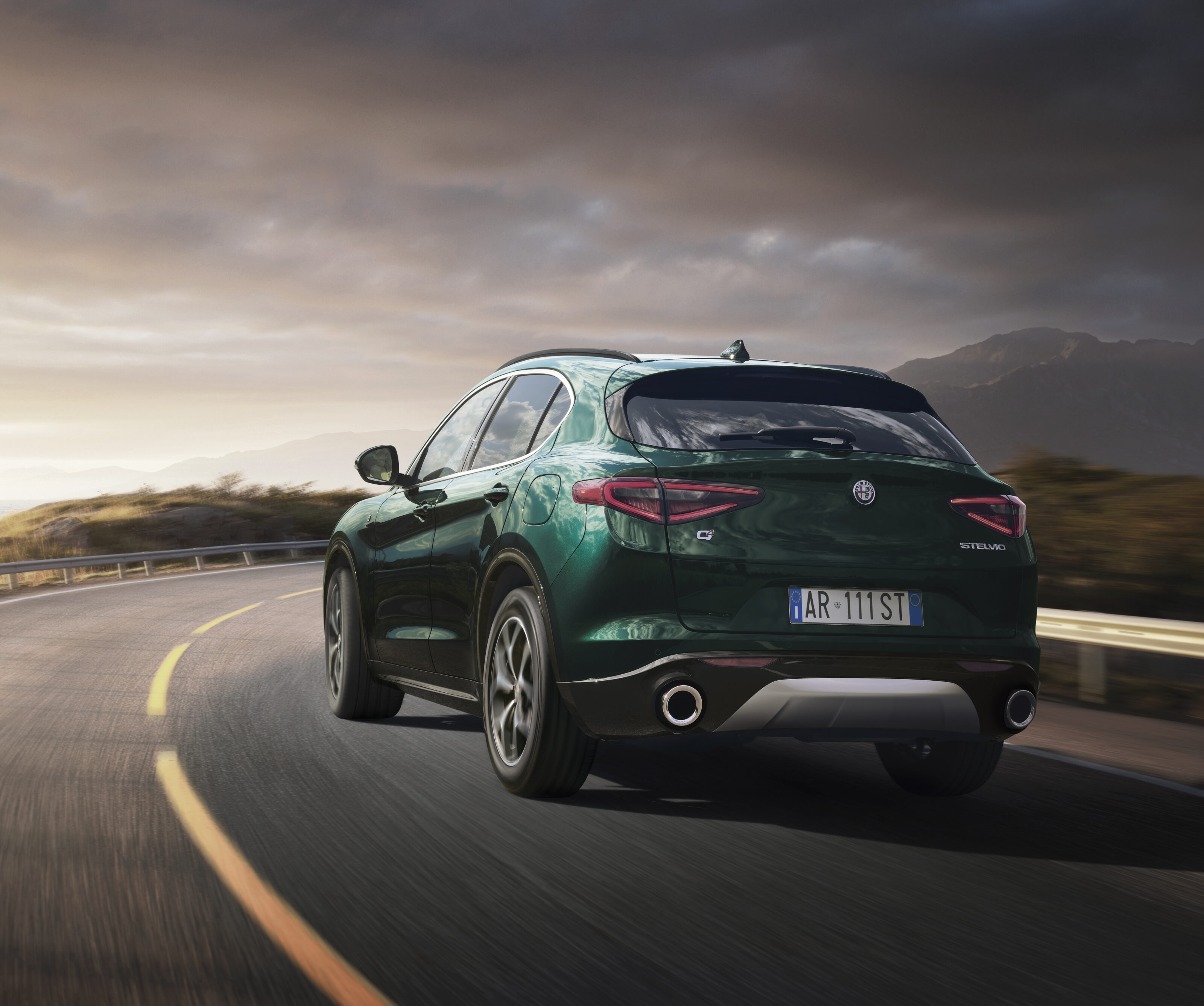
The Alfa Romeo Stelvio Veloce SUV features Alfa’s 2.0L Turbo petrol engine mated to an 8-speed automatic transmission.
The same engine as is found in the Stelvio Sport sends 206kW and 400Nm to all four wheels, compared to the Sport’s 147kW/330Nm output.
The Stelvio Veloce claims a 0-100km/h time of 5.7 seconds, making it quicker than the Stelvio Sport’s claimed 7.2 seconds.
Safety
Safety features now included as standard are:
| Traffic sign recognition |
| Intelligent speed control |
| Active blind-spot assist |
| Driver attention alert |
| Automatic high beam assist |
| Active cruise control |
| Front and rear parking sensors |
| Autonomous emergency braking (forward collision warning) |
| Lane keep assist |
| Blind spot monitoring with rear cross path detection |
| Infrared reflective windscreen |
| Tyre pressure monitoring system |
| Anti-theft alarm system |
Warranty and servicing
The 2021 Alfa Romeo Stelvio Veloce, as with all Alfa models, comes with a three-year/150,000km (whichever comes first) factory warranty, and capped-price servicing, again covering the car for either the first three years or 150,000km.

Availability
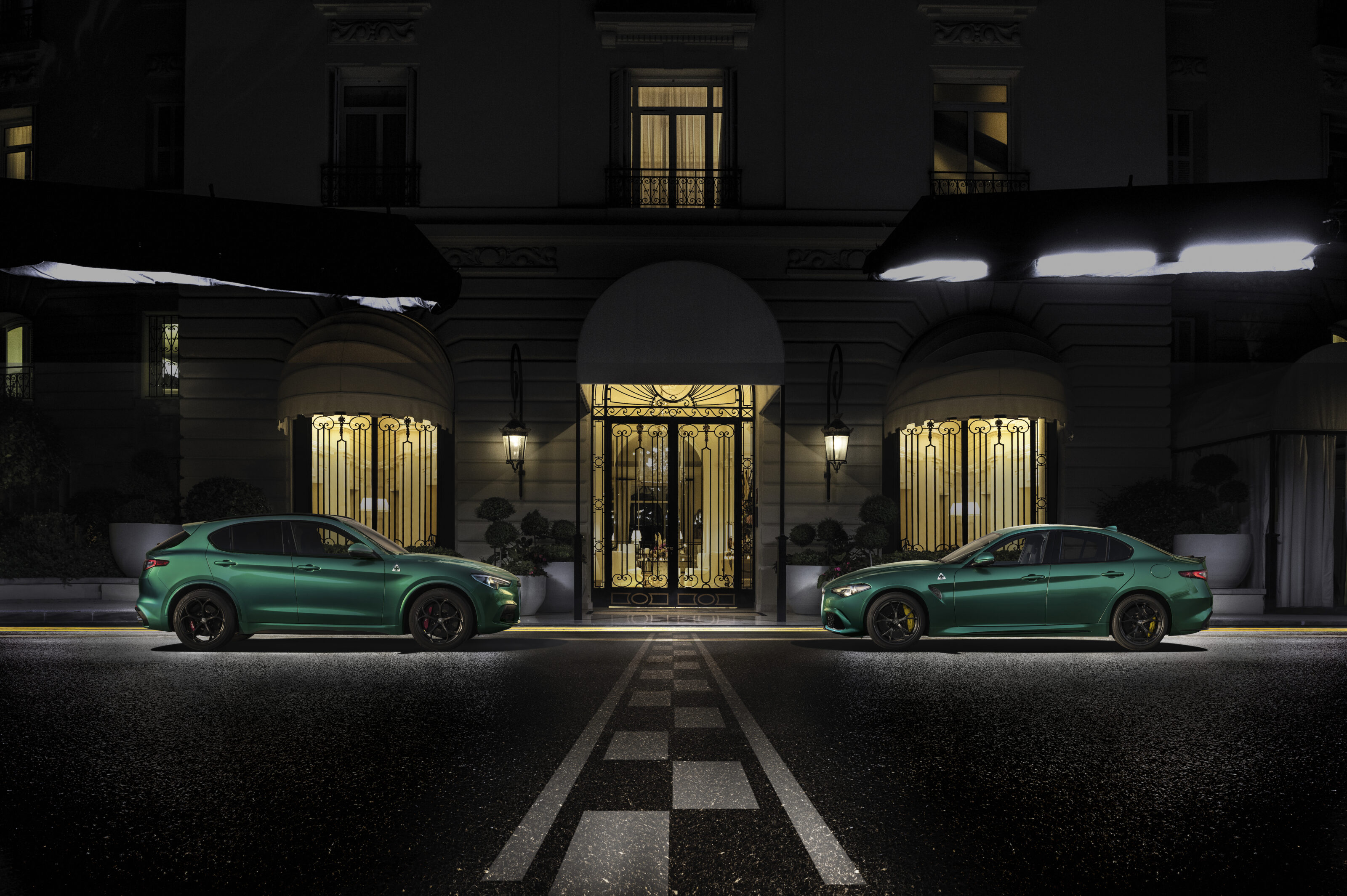
The new addition completes the Alfa Romeo Stelvio and Giulia ranges, with all models available for order and arriving in dealerships in June.
Pricing
The complete 2021 Alfa Romeo Stelvio and Giulia range prices before on-road costs are:
| Stelvio (customer order only) 2.0 Turbo eight-speed AWD petrol auto | $64,950 |
| Stelvio Sport 2.0 Turbo eight-speed AWD petrol auto | $69,950 |
| Stelvio Veloce 2.0 Turbo eight-speed AWD petrol auto | $78,950 |
| Stelvio Quadrifoglio 2.9 Bi-Turbo eight-speed AWD petrol auto | $146,950 |
| Guilia Sport 2.0 Turbo eight-speed AWD petrol auto | $63,950 |
| Giulia Veloce Turbo eight-speed AWD petrol auto | $71,450 |
| Giulia Quadrifoglio 2.9 Bi-Turbo eight-speed AWD petrol auto | $138,950 |
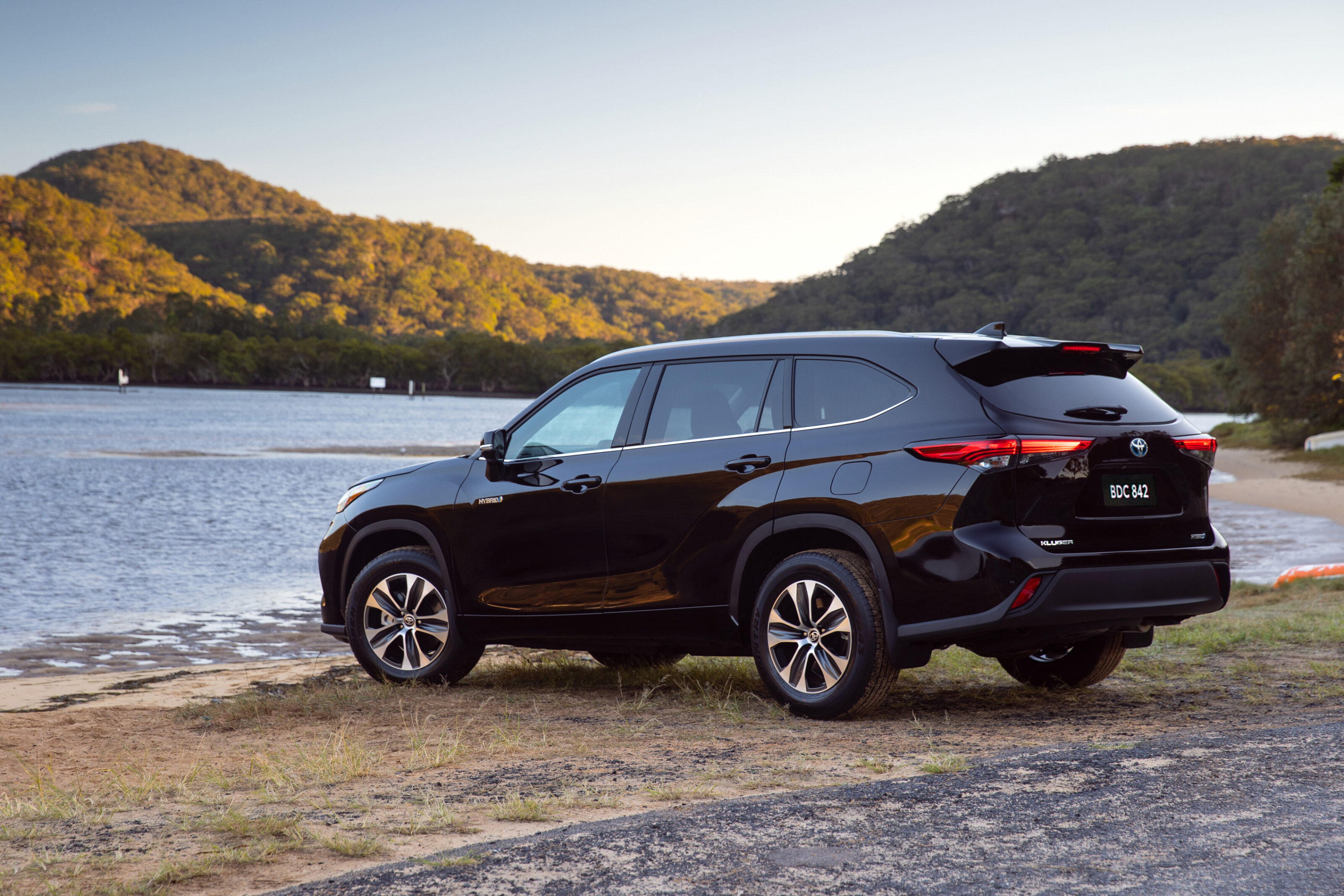
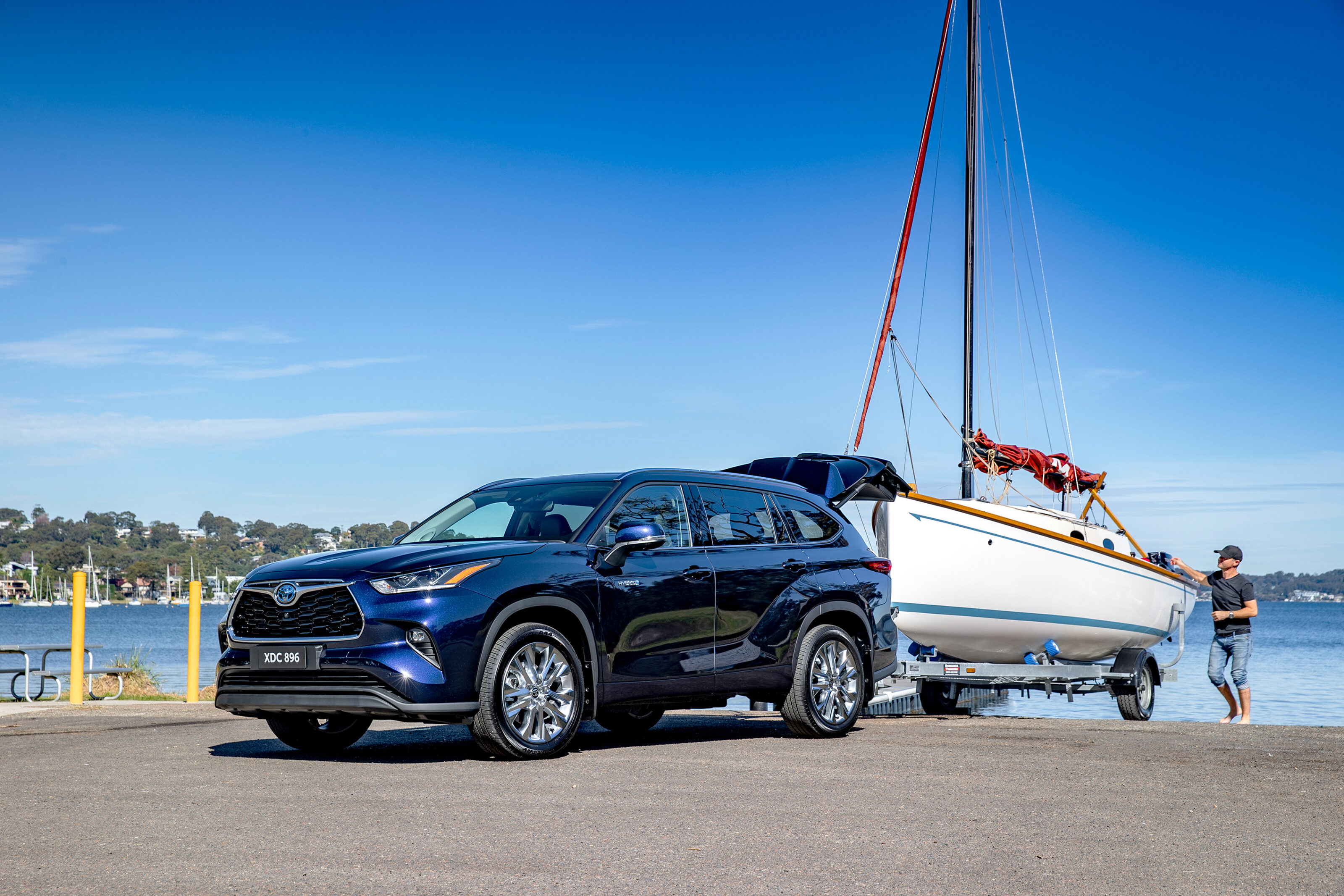
The fourth-generation Toyota Kluger has arrived in Australia – and it’s not only bigger and better than ever but also offers a hybrid powertrain for the first time here.
But how does the large seven-seater SUV compare with major rivals in key areas such as pricing, practicality, technology, safety, performance and fuel economy?
Pricing & Grades
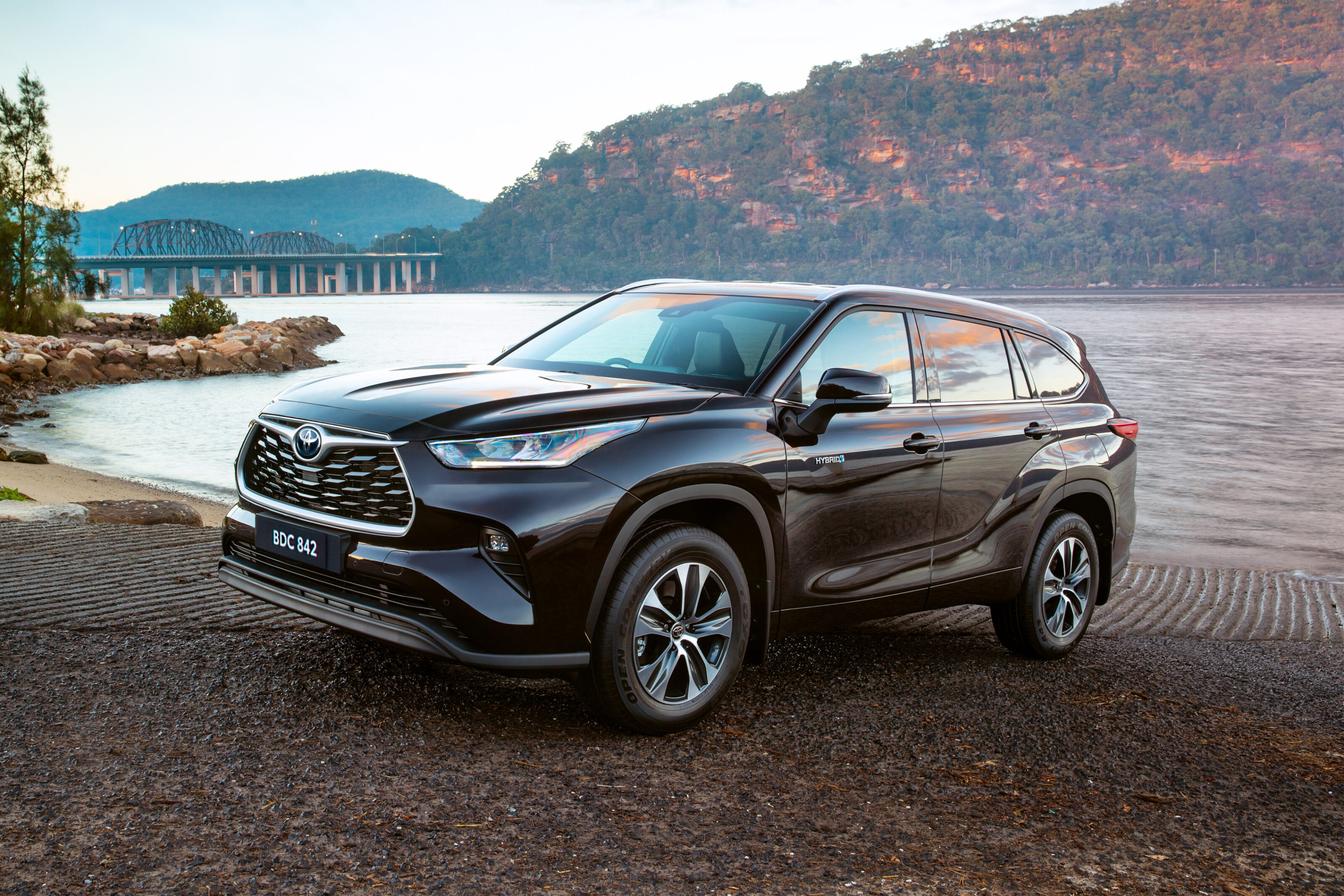
Entry to the Kluger has risen, costing from $47,650. Carry-over trim grades are GX, GXL and Grande and each starts off with a V6 front-wheel-drive arrangement. A $4000 premium adds all-wheel drive for the V6 and another $2500 upgrades to the new hybrid drivetrain. The range-topping Grande Hybrid costs $75,400 before on-road costs are added.
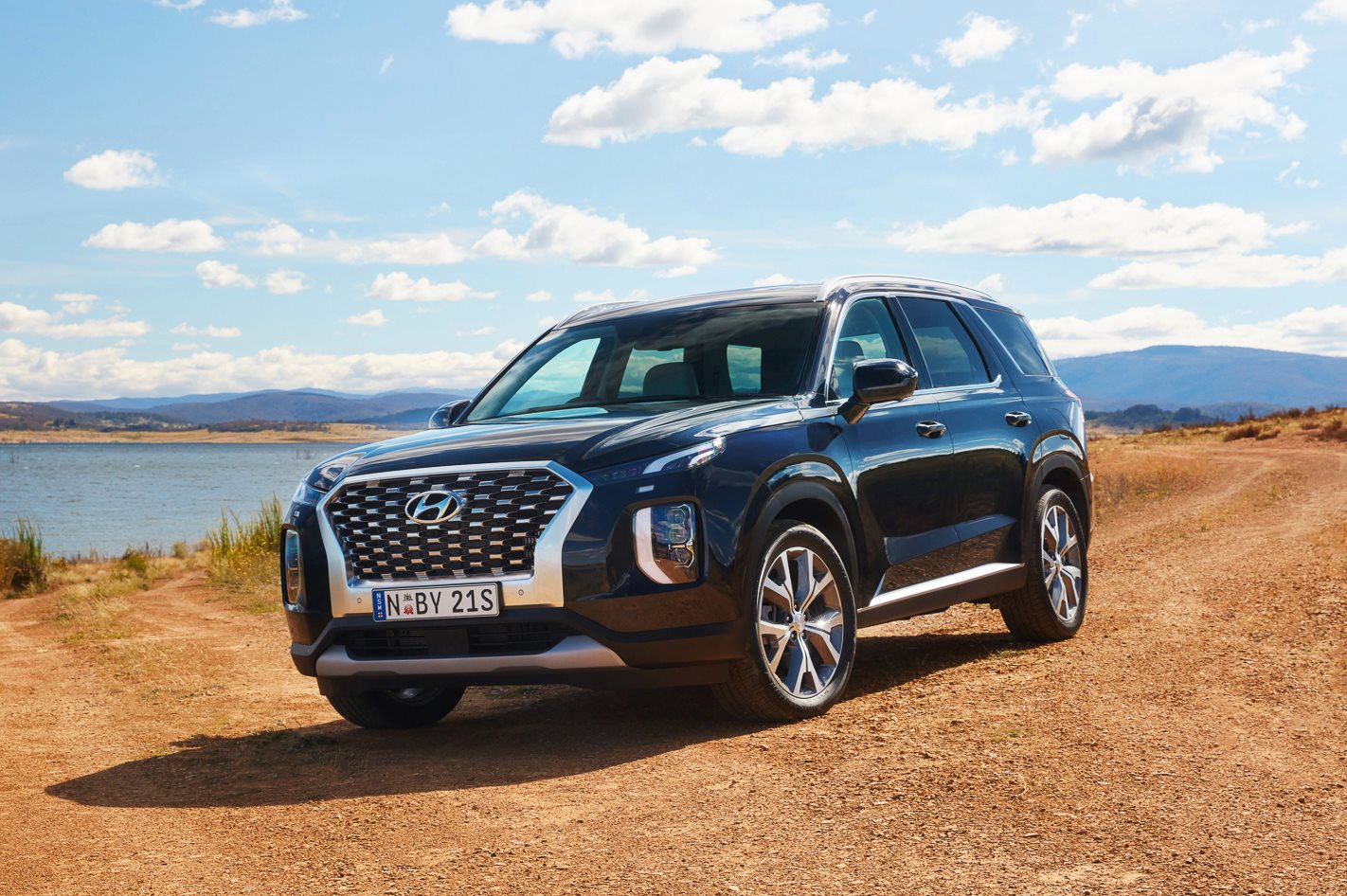
Hyundai has two large seven-seater SUVs. There’s the well-known Santa Fe, which is priced between $44,700 and $65,200, though here we’re focusing on the even bigger, and freshly arrived, Palisade that is closer to the Kluger in size (about five metres long).
The Palisade’s opening price of $60,000 is also in line with the Kluger’s higher-grade models (GXL and Grande) that Toyota expects to be particularly popular.
It shares an AWD 2.2-litre four-cylinder turbo-diesel with the Santa Fe, though has a bigger and more powerful V6 petrol option (also front-wheel drive).
There are just two grades: base and Highlander.
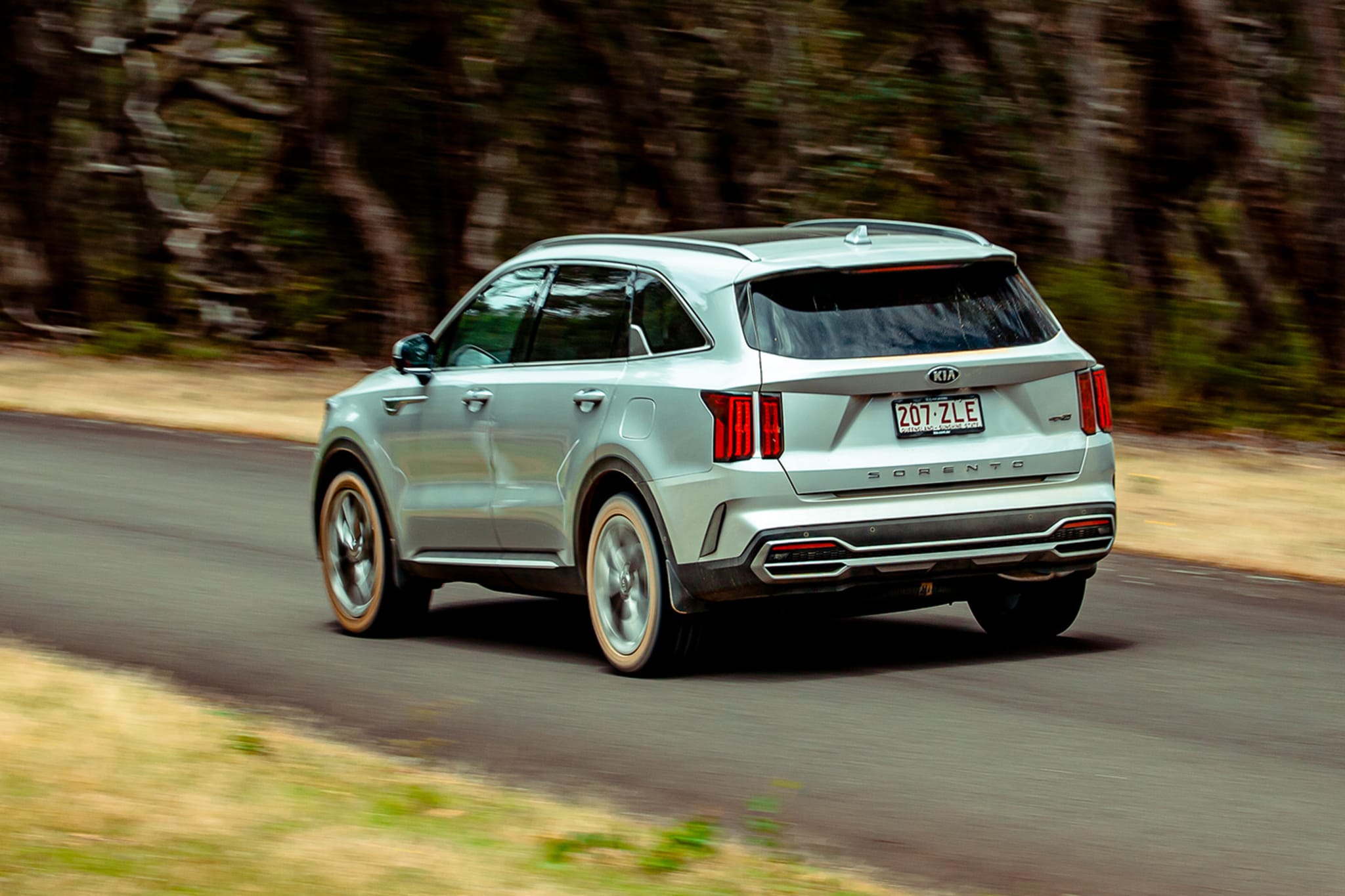
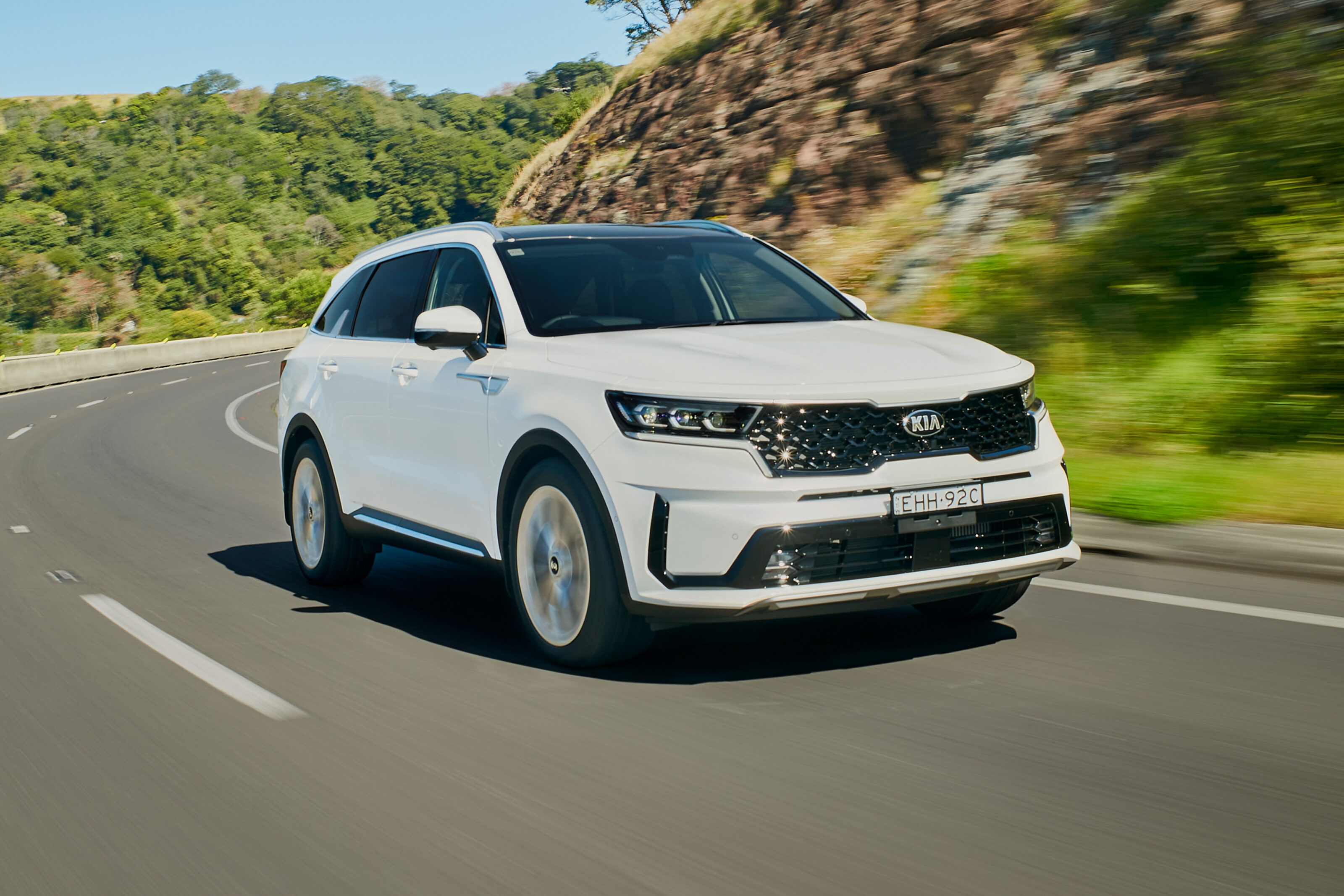
Kia takes on the segment with just the Sorento (though offers another multi-seater passenger vehicle in the form of the hugely popular Carnival people-mover). With four trim grades, the Sorento is priced from $46,850 for a 2WD V6 petrol, or from $49,850 for an AWD four-cylinder turbo diesel.
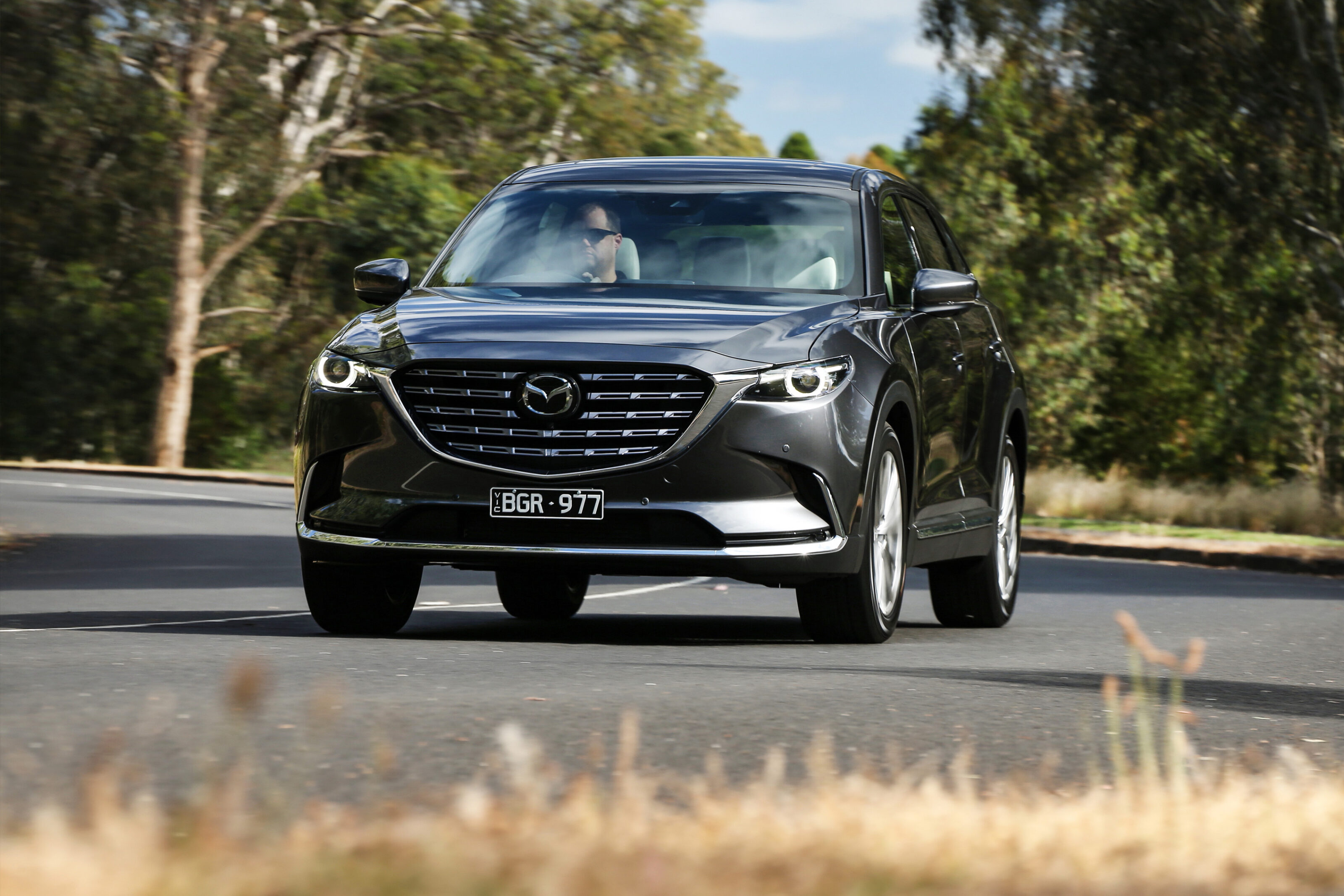
Mazda covers a wide pricing spectrum from as low as $39,990 to $73,975 with its CX-8 and CX-9 seven-seater SUVs. Again, we’re picking the larger model here that is closer to the Kluger in dimensions.
The CX-9 starts from $45,990 and is offered with a single engine – a 2.5-litre turbocharged four-cylinder petrol. Buyers, however, can pay an extra $4000 across the first four variants to swap front-drive for all-wheel drive. The AWD CX-9 range includes an extra Azami variant, labelled LE, that is the flagship model.
Vehicle Size
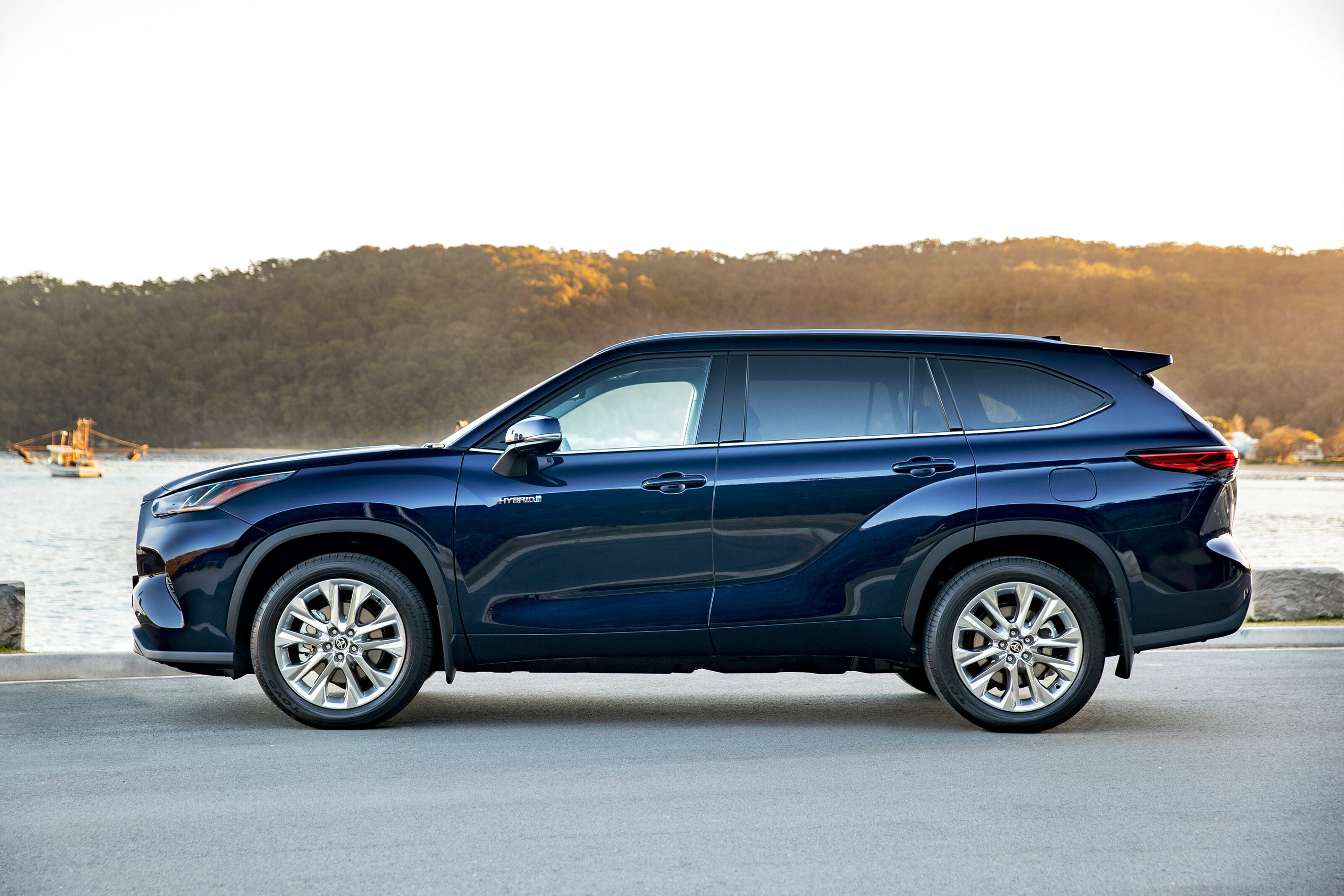
The Kluger has grown in length by 76mm to make it one of the segment’s largest SUVs at 4966mm – almost the same as Toyota’s Prado 4WD, if still a bit shorter than a CX-9 (5075mm).
(Some buyers can find the CX-9 a touch large for their liking, though this is where the shorter, 4.9m CX-8 can step in.)
A Kia Sorento is shorter again at 4.81 metres, and Hyundai’s twin Santa Fe is one of the shortest in class at 4785mm.
Of course, that helps make the 4980mm Palisade a natural addition to Hyundai’s showroom – as does its offering of an extra, eighth seat.
Boot Space
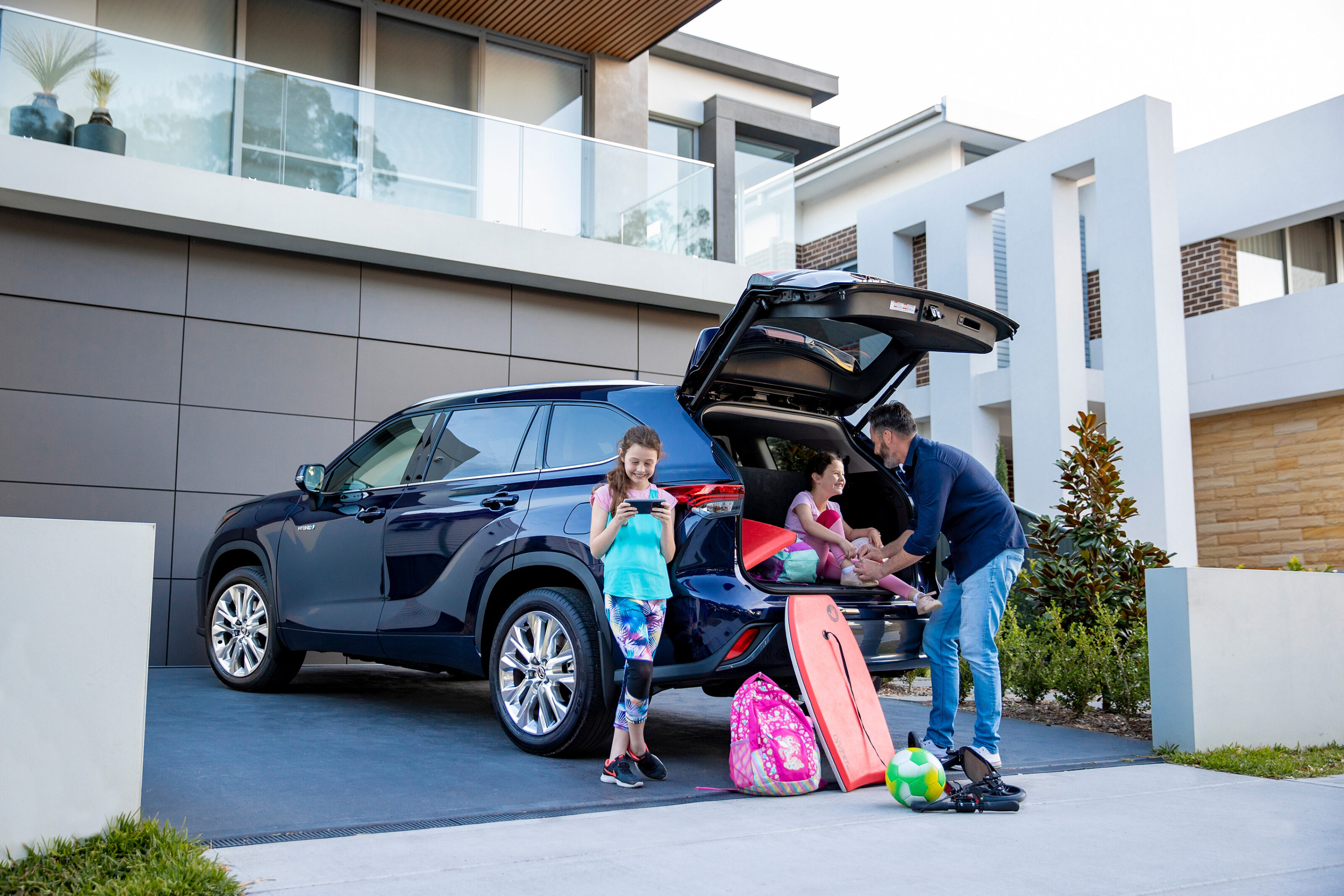
Seven-seater SUVs aren’t renowned for their boot space when all seats are in use. And none here can match a people-mover such as the aforementioned Kia Carnival for being able to accommodate seven people as well as their holiday luggage.
However, the Kluger now comes with an increased capacity of 241 litres that easily swallows a pram or a large number of shopping/sports/school bags.
The CX-9 is close behind with 230L, but the Sorento’s 187L is notably smaller. While the Santa Fe’s indicated 130L is worse again, Hyundai’s Palisade trumps all with its 311L capacity.
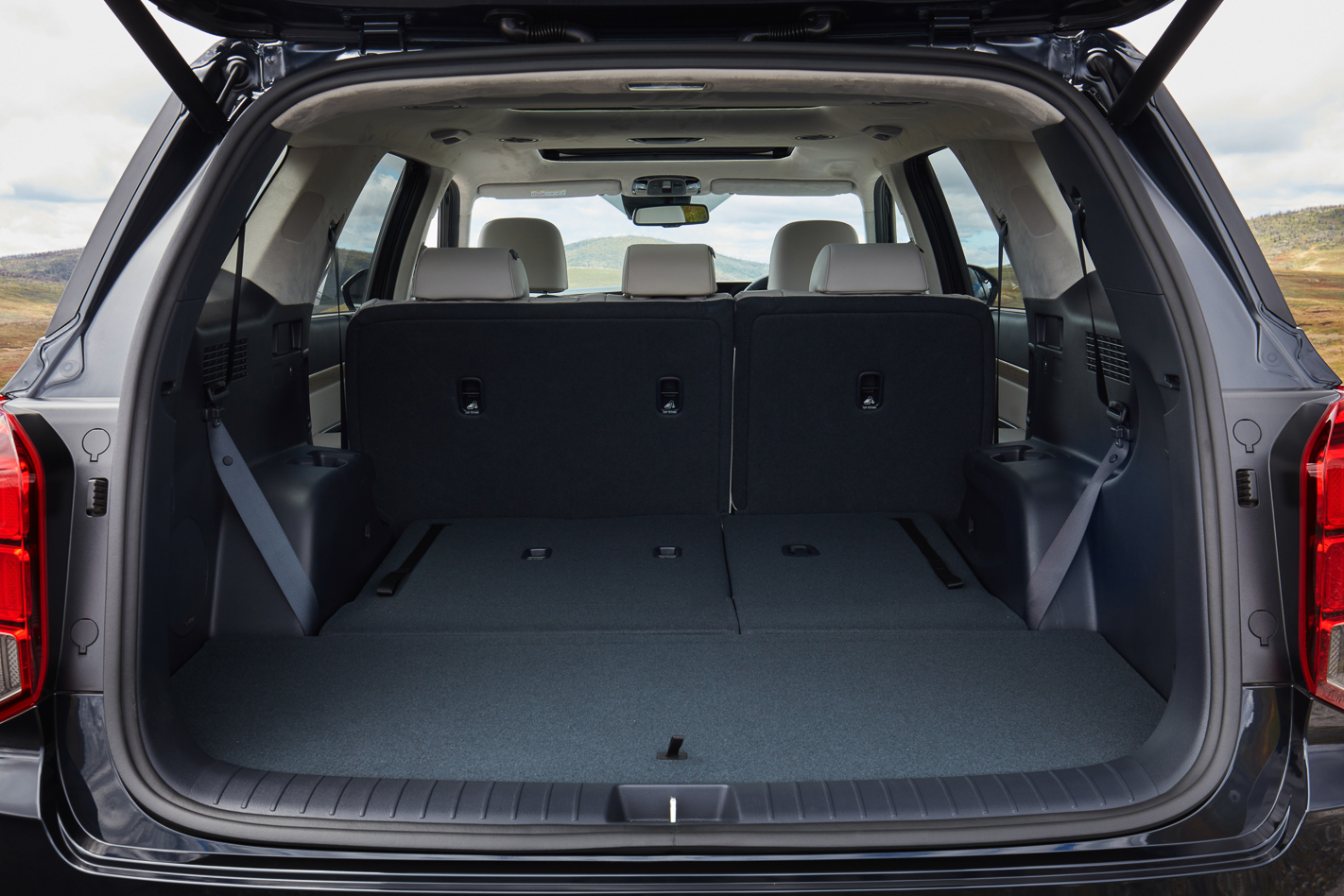
Drop the third-row seats and the Kluger drops down the list of boot volumes. Toyota’s quoted 552 litres places the Kluger behind the Palisade (704L) and Sorento (616L). The CX-9’s main boot is bigger, too, though Mazda’s quoted 810L is misleading as the Japanese brand is measuring up to the roof rather than the top of the seatbacks as with the other models.
Even mid-range and top-range versions of Toyota’s mid-sized SUV, the RAV4, provide a bigger boot – 580 litres when the two-level floor is in its lowest position.
It’s all relative, however, as the Kluger’s boot is plenty big and plenty useful for families.
Automatic tailgates feature only on certain models: Kluger GXL and Grande (the latter with gesture-activated open/close), Palisade Highlander (with gesture open/close), Sorento Sport+ and GT-Line, and CX-9 GT, GT SP, Azami and Azami LE.
Third-row Comfort
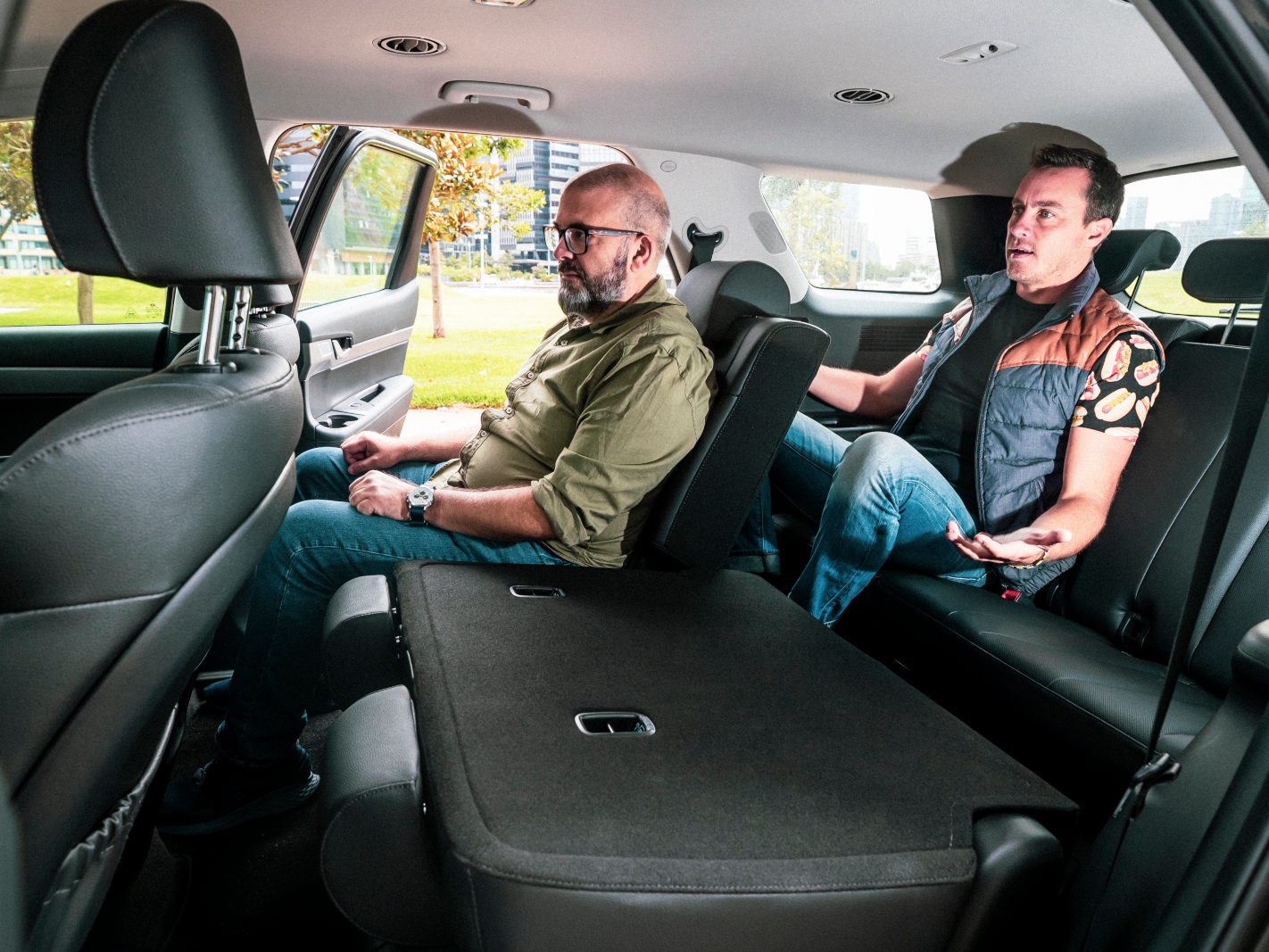
Accessing the third row of the Kluger isn’t a clumsy process thanks to the wide aperture created when the second-row seatback tilts and slides forward via a flap-style lever on top of the seat.
Sit an average-height adult behind a similarly sized passenger and there’s enough knee and toe space to make shorter journeys bearable. Headroom is also decent, ceiling vents help direct air right to the back, and there are cupholders.
It’s a bit tighter to squeeze into the very rear of the Sorento, though the Kia – along with several other models including the Santa Fe and Palisade – have a cleverer one-touch button auto slide-forward operation.
The Sorento’s third row is a bit more cramped and the CX-9 feels a touch more spacious, though to varying degrees all these SUVs ask adults to compromise on comfort.
Older kids and teens will be happier, though parents looking for a seven-seater SUV that’s especially versatile for child seats have plenty to note.
Second-row Comfort
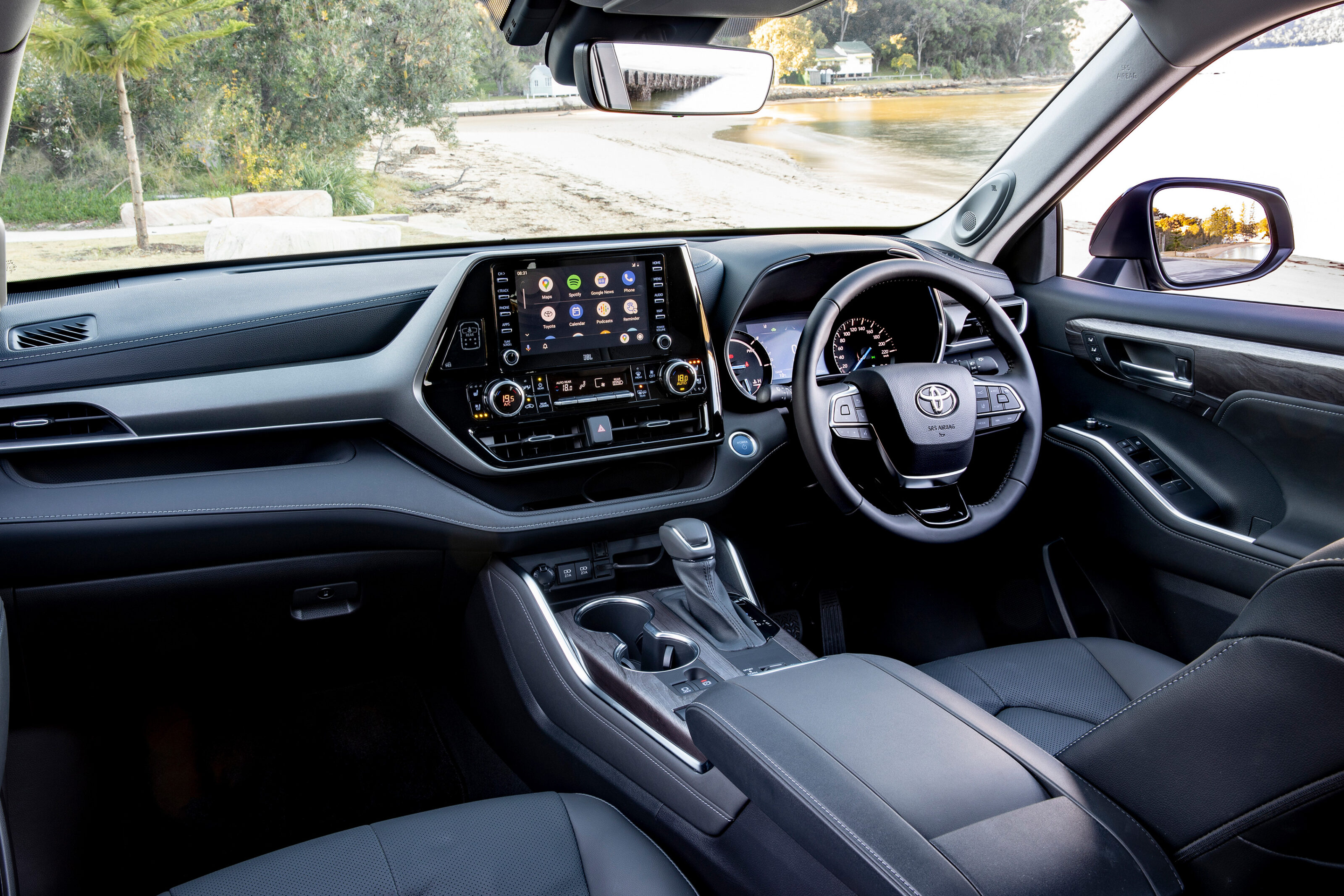
Toyota has added 60mm to the Kluger’s wheelbase, which helps make the cabin even roomier than before – and certainly noticeable in the second row where there’s heaps of legroom. Some extra travel for the 60:40 middle row seats also allows for more fine-tuning of legroom between the second and third rows.
GXL and Grande models add climate control for the middle row, and there are USB ports plus a centre armrest with cupholders.
The Kia Sorento provides cleverer storage solutions. It features a cupholder integrated into the upper section of each rear door, while lower down there’s a dedicated bottle holder. There are also dual seatback pouches rather than the single pouches in the Kluger.
It’s more generous with USB ports, too, with up to seven provided in Sport+ and GT-Line variants, which include a USB-C port in the front passenger seat and another two ports for third-row occupants.
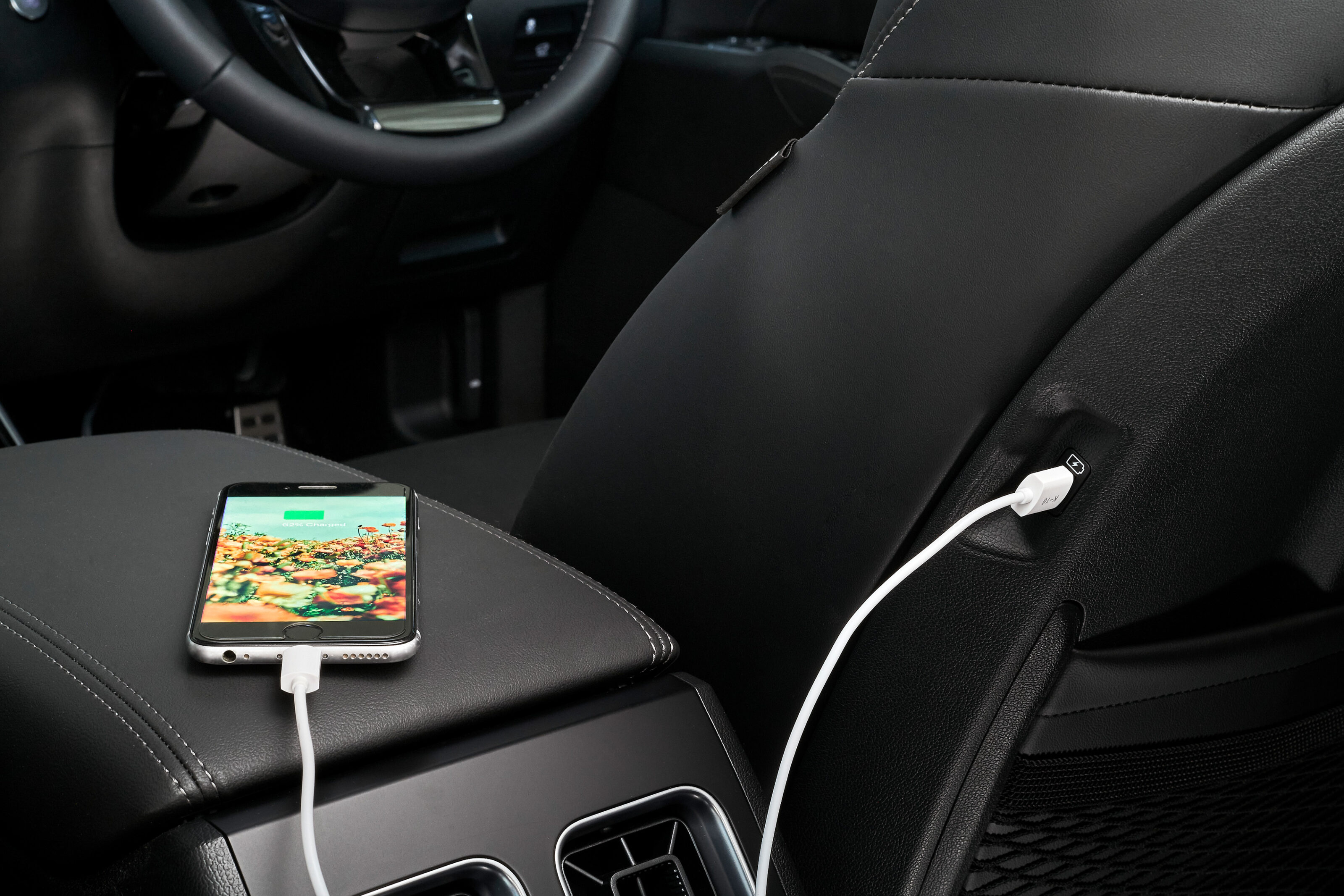
The Palisade matches the Sorento’s seven USBs and ups the cupholder ante with 16 in total, including four for both second and third rows.
Its sliding 60:40 middle seats have even longer travel than the Kluger’s – 220mm versus 180mm – and provides an abundance of space in the centre row.
A three-seat bench is standard, though for no extra cost this can be exchanged for a pair of captain’s chairs (with walk-through for the third row). These feature heating and ventilation in the top-spec Highlander.
The flagship Mazda CX-9, the Azami LE, also comes standard with two individual second-row chairs with heating and recline functions, plus a centre console.
Outer seats of the GT and Azami’s second-row benches also feature heating.
Available USBs depends on the CX-9 variant. The base Sport has just two up front, Touring upwards adds ports to the second row (in the armrest), while the GT, GT SP, Azami and Azami LE all have two additional ports for the third row.
Side window blinds are available on each SUV, depending on variant. Top-spec models only for Kluger (Grande), Sorento (GT-Line) and Palisade (Highlander), though they feature on the mid-range GT and upwards in the CX-9 line-up.
Cloth seats are the norm for lower-spec models in every case, except for the entry-level Palisade that comes with leather-appointed upholstery (but starts from a higher price point than the other SUVs).
Leather-appointed seats – easier for parents to keep clean – are then shared widely among mid-range variants, though smoother Nappa leather is found on CX-9 Azami models, the Palisade Highlander and the Sorento GT-Line.
For buyers seeking more natural cabin light, a sunroof is also offered on certain trim grades.
The Kluger Grande features a moonroof, the range-topping Kia Sorento GT-Line has a panoramic glass roof, the CX-9 comes with a standard sunroof on GT models up, and the Hyundai Palisade Highlander has a dual-pane sunroof with tilt/slide function for the front section (and blind for the rear section).
Child seats

The Kluger’s third row features neither top-tether points or ISOFIX anchors, restricting child seat use to the middle row
Mazda’s CX-9 features top tether points behind its rearmost seats (as does the CX-8).
Hyundai’s Palisade makes up for a Santa Fe shortcoming. Where the shorter seven-seater lacks even top tethers, the longer SUV’s third row features a single ISOFIX latch and dual top-tethers. Palisade can even fit three across the third row, though you would want to know the other adults very well!
Kia’s Sorento provides ISOFIX and top-tether points for both third-row seats.
Common to the Kluger, Sorento, CX-9 and eight-seater Palisade are top-tether points for all three centre-row seats plus ISOFIX anchors for the outboard seats. The seven-seater Palisade skips a top-tether for the centre middle seat.
Infotainment
For those who enjoy a super-sized TV in their lounge, Palisade and upper-spec versions of the CX-9 and Sorento provide the largest infotainment displays – all sharing a 10.25-inch measurement.
The cheapest CX-9 comes with a tiddly 7.0-inch screen, with the next-up Touring upgrading to a 9.0-inch display, and GT upwards adopting Mazda’s biggest display. Sorento’s base model has an 8.0-inch display before other models switch to the 10.25-inch touchscreen.
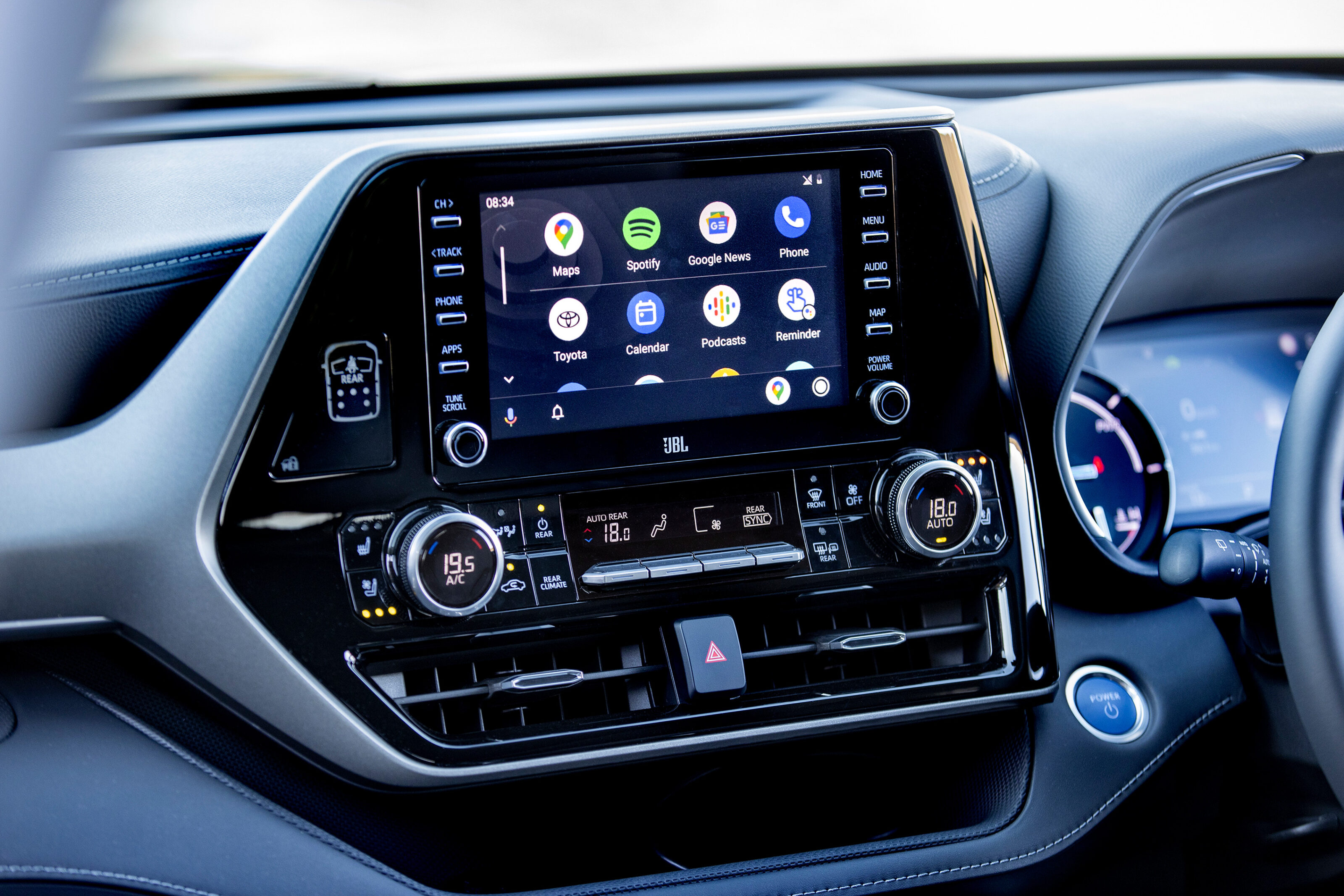
Toyota has given the Kluger an 8.0-inch display that is no larger than the one found in the smaller RAV4 SUV.
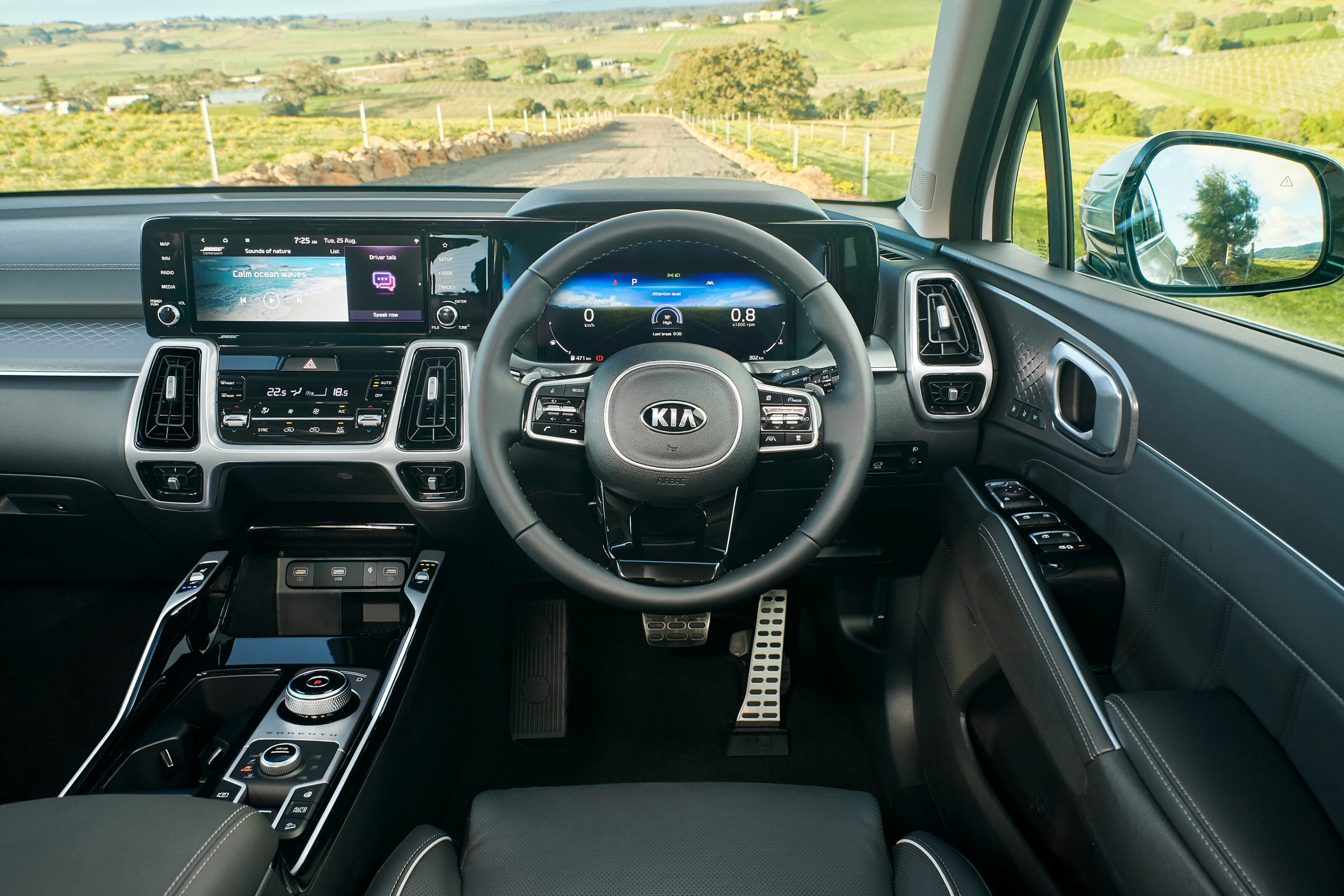
All systems are compatible with Apple CarPlay and Android Auto for those who prefer an interface based on their smartphone. Not all smartphones are necessarily compatible with the Kluger’s mirroring technology, however.
Wireless smartphone charging is an unexpected omission from both the Kluger and Palisade. It’s available on CX-9 models from the mid-range GT upwards and the Sorento, though only the flagship GT-Line.
For audiophiles, a Bose system is standard on CX-9 GT upwards while an Infinity audio is featured on both spec levels of the Palisade. Sorento and Kluger buyers must opt for the most expensive variants to get a branded music system – GT-Line (Bose) and Grande (JBL), respectively.
The base Kluger GX is the only variant of any SUV here not to offer integrated navigation.
All the SUVs come with digital radio standard across the range.
Drivetrains and Fuel Economy
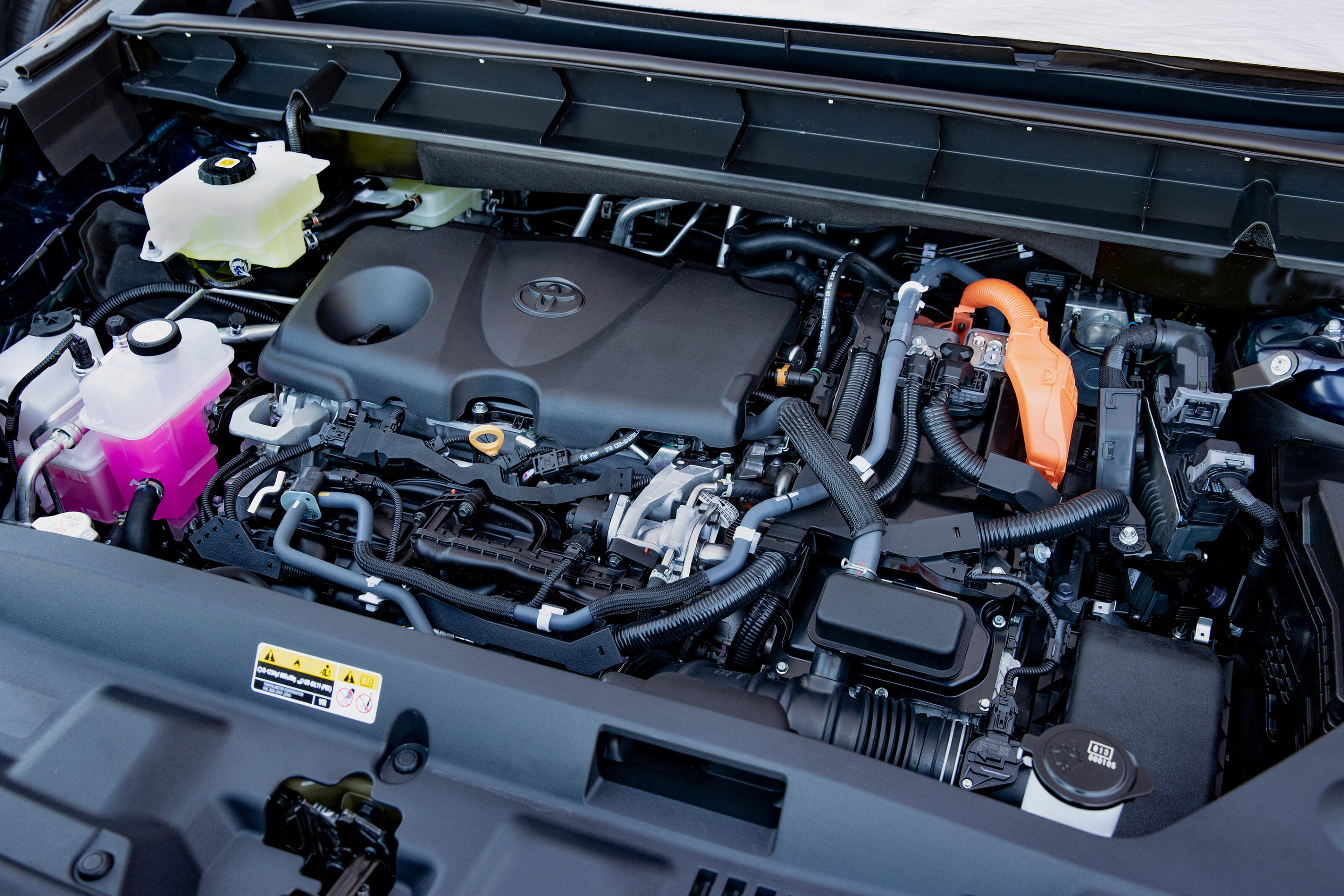
The Kluger is available with a petrol-electric hybrid drivetrain for the first time in Australia. It gives the Toyota a USP for now (a Sorento plug-in hybrid is coming later this year) in a segment dominated by V6 petrol engines and four-cylinder turbo-diesels.
A petrol V6 carries over from the previous Kluger to give buyers a choice, and they can also choose whether to have their V6 with front-wheel drive or pay an extra $4000 for all-wheel drive.
V6 Klugers accelerate more quickly but use more fuel. The best V6 official fuel consumption is 8.7 litres per 100km, whereas the Kluger Hybrid has a combined figure of 5.6L/100km.
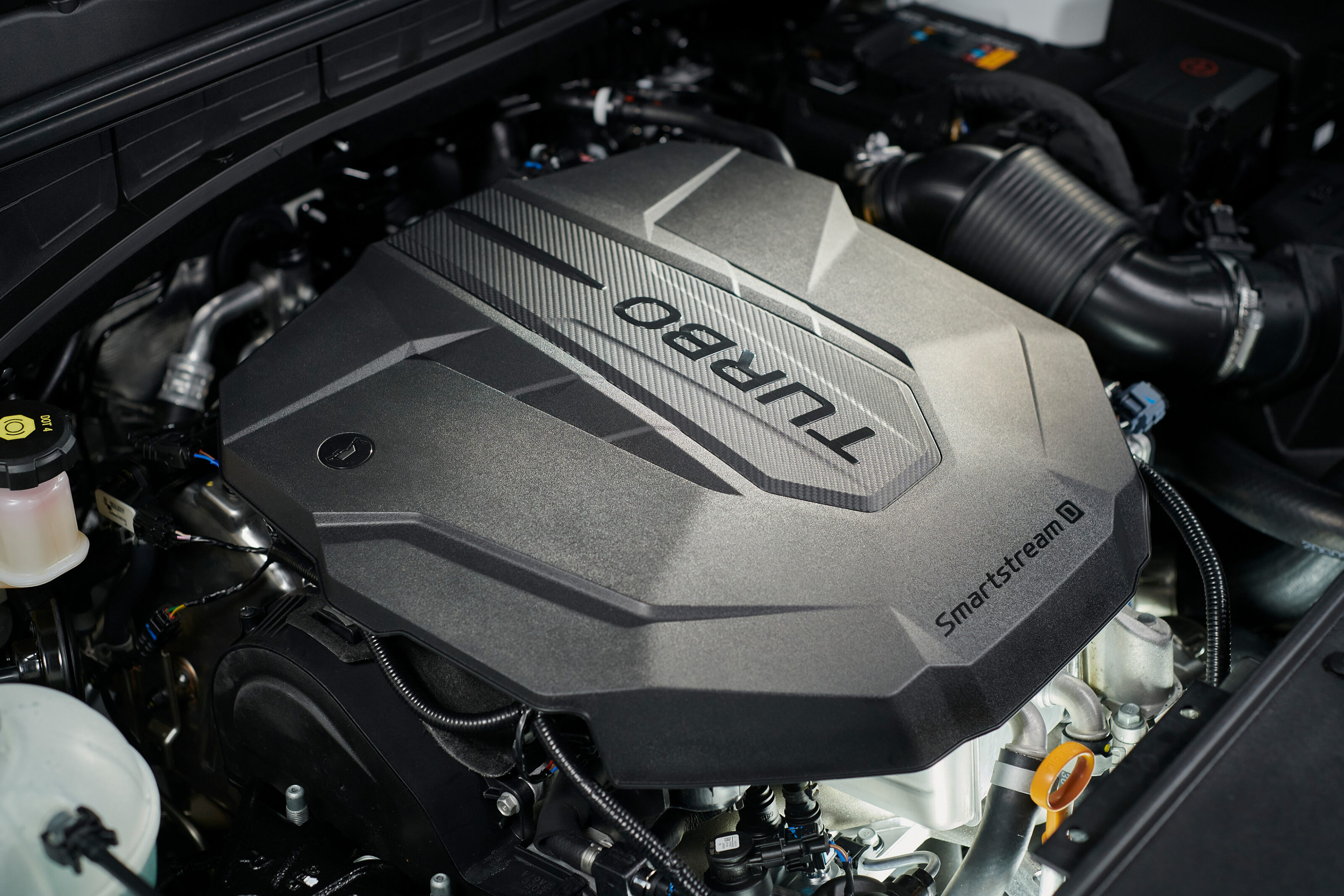
Palisade customers choose from either a 3.8-litre V6 petrol or a 2.2-litre four-cylinder turbo-diesel. The V6 is more powerful but drives the front wheels only (via an eight-speed auto), while the turbo-diesel has extra torque and an on-demand all-wheel-drive system.
The diesel also uses less fuel – 7.3L/100km on the combined cycle versus 10.7L/100km for the V6.
Kia offers a similar choice, with the same turbo-diesel (with AWD) but a slightly smaller V6 petrol that’s 3.5 litres in size (and FWD).
The 200kW/332Nm of the Sorento V6 plays 148kW/440Nm of the four-cylinder diesel, with the latter again the more economical option: 6.1L/100km against 9.7L/100km for the V6.
Mazda makes decisions simpler. While there’s also a choice of front-drive or all-wheel drive, every CX-9 is powered by the same engine – a 2.5-litre turbocharged four-cylinder with 170kW and 420Nm.
A FWD CX-9 sips less fuel (officially) than the V6 petrol rivals, with an 8.4L/100km rating. This rises to 8.8L/100km for AWD CX-9s.
All the V6 petrols run on regular unleaded. The odd-one-out drivetrain featuring a petrol engine is the Kluger Hybrid, which requires premium (95 RON) unleaded.
Safety
The Hyundai Palisade has yet to be tested by the independent crash-test body ANCAP, though the Toyota Kluger, Kia Sorento and Mazda CX-9 all carry maximum five-star ratings. A caveat for the Mazda is that it was tested in 2016 and ANCAP’s assessment criteria has become tougher in recent years.
The Kluger’s individual scores for adult and child occupant protection are high at 90 and 88 per cent, respectively. The Sorento was given 85 per cent for child occupant protection but its adult protection was lower at 82 per cent, mainly owing to a low-scoring performance in the offset crash test.
Another downside for the Sorento (as well as the twin Santa Fe) is that its curtain airbags don’t cover the entire third row as with the other SUVs – just the glass area.
The Hyundai Palisade has yet to be tested by the independent crash-test body ANCAP, though the Toyota Kluger, Kia Sorento and Mazda CX-9 all carry maximum five-star ratings. A caveat for the Mazda is that it was tested in 2016 and ANCAP’s assessment criteria has become tougher in recent years.
The Kluger’s individual scores for adult and child occupant protection are high at 90 and 88 per cent, respectively. The Sorento was given 85 per cent for child occupant protection but its adult protection was lower at 82 per cent, mainly owing to a low-scoring performance in the offset crash test.
Another downside for the Sorento (as well as the twin Santa Fe) is that its curtain airbags don’t cover the entire third row as with the other SUVs – just the glass area.
There’s a further mix of advantages that switch between the different SUVs.
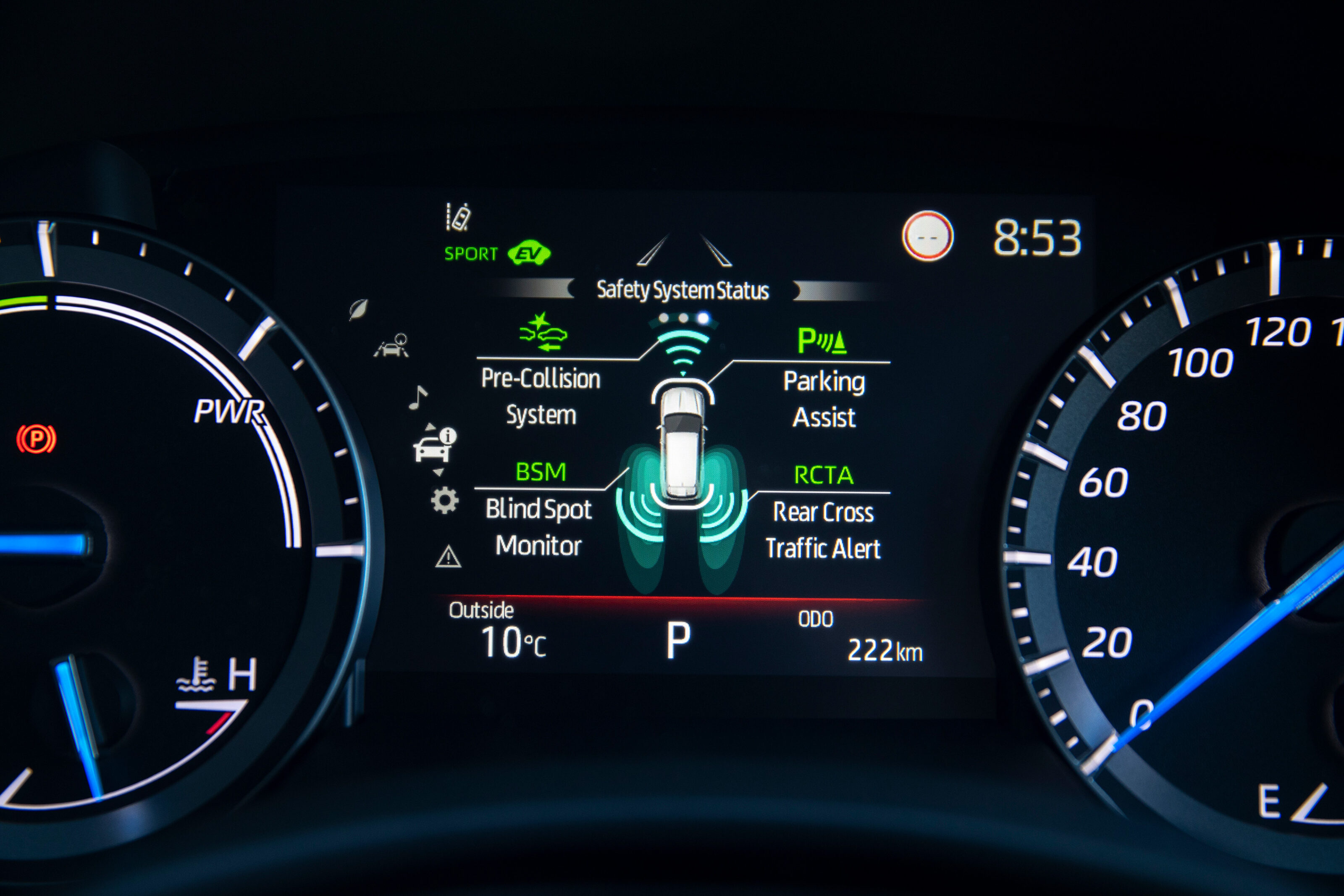
The Palisade Highlander and all Sorentos feature Safe Exit, which warns occupants if they’re about to open a door into oncoming traffic or a cyclist. The Highlander and Sorento GT-Line also add a blind-spot image monitor via their fully digital driver displays.
Mazda and Toyota equip their seven-seater SUVs with camera-based speed-limit recognition systems (one of the new safety features for the Kluger).
Intersection Turn Assistance, which auto-brakes the vehicle if the system senses you’re about to cross into the path of an oncoming vehicle, is also new for the Kluger, matched only by the Sorento here.
A surround-view camera is standard on all range-topping versions – Kluger Grande, Sorento GT-Line, Palisade Highlander and CX-9 Azami/Azami LE.
The Kluger, Sorento and Palisade all come with a full-size spare wheel, whereas the CX-9 opts for a temporary spare.
SUMMARY
If you have multiple members of the family to move around, there are multiple good options in the new-car market.
The Kia Sorento, Hyundai Palisade, Mazda CX-9 and Toyota Kluger are all worthy of being included on any consideration list. A variety of trim grades also accommodate different budgets.
They’re all quite different SUVs, however – each with their pros and cons.
Mazda’s CX-9 is the oldest model here, yet it doesn’t look it among this group, especially when compared with the Kluger and Palisade.
The CX-9 and Sorento cabins are also the most successful in achieving semi-premium interior presentations, with the Kia looking the most contemporary in our view.
The Kluger and Palisade look smart, though the Toyota isn’t helped by its lack of sophisticated dashboard technology. Its infotainment display is relatively small and underwhelming, while it’s also missing wireless smartphone charging and the fully digital driver display offered in the US version.
There’s little to separate the second rows as all these SUVs provide generous space, though only the CX-9 and Palisade are available with captain’s chairs.
The Sorento has the squeeziest third row and its curtain airbags don’t fully extend to cover rearmost passengers as with the other SUVs.
The Kia, however, offers parents fantastic flexibility when it comes to child seats, with ISOFIX points in both the second and third rows along with top tethers. Palisade is next best, followed by the CX-9 with its third-row top-tethers. Securing a child seat isn’t possible in the third row of the Toyota.
However, the Kluger joins the Palisade in offering some genuinely useful boot space if all passenger seats are occupied.
Still, for any families seeking holiday-style boot space behind the third row plus proper third-row comfort for adults, nothing can beat the Kia Carnival – for buyers willing to choose a people-mover over an SUV.
What you’ve read here is a ‘spec battle’
To learn how each model drives, check out review links below – and watch for a full on-road face-off to come in the weeks ahead.
Snapshot
- Mazda plans to introduce five hybrid and three EV cars by 2025
- New universal EV platform will be introduced in the same year
- 25 per cent of all models sold in 2030 will be EV
Mazda has stated its intentions of having an electrified variant of each of its models by 2030, aiming for at least 25 per cent electric vehicles by 2030 as a part of its new global strategy.
Starting from 2022, Mazda is planning to introduce five new plug-in hybrid vehicles (PHEV) as well as three EV models before its new SKYACTIV EV Scalable Architecture is introduced in 2025, underpinning its range of small and large vehicles.
The announcement has come before the new MX-30 is released to the Australian market, marking the first EV from Mazda to go on sale Down Under.
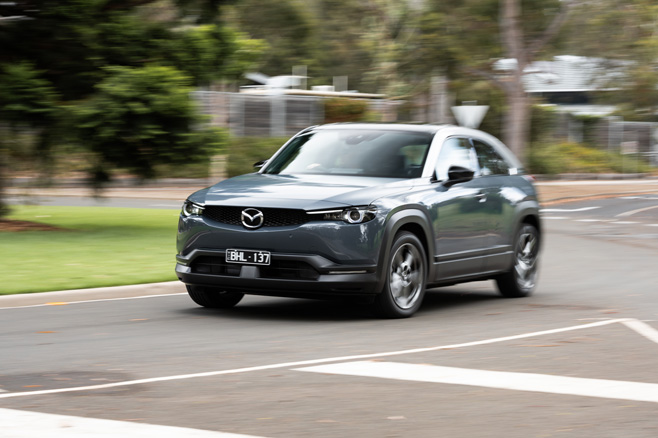
Mazda plans to further develop its existing petrol and diesel Skyactiv engines which are used in its current models, preparing it for hybridisation to expand the range beyond the upcoming MX-30 mild-hybrid.
The larger range of hybrid models and the first EV offerings will be rolled out across Europe, North America, South East Asia and Australia from 2022, allowing Mazda to dip its toes in the ever-growing market of electrified vehicles.
It is unknown whether the goal of having electric options across the range by 2030 will result in the culling of some nameplates due to a lack of EV compatibility, though the expectation of 25 per cent being EV shows there’s still a desire for internal combustion engines within the Mazda line-up.
The Skyactiv engines which currently power Mazda’s vehicles were developed to run with high compression – as much as 14:1 in some instances – delivering higher power and torque while also achieving better fuel economy and emissions.
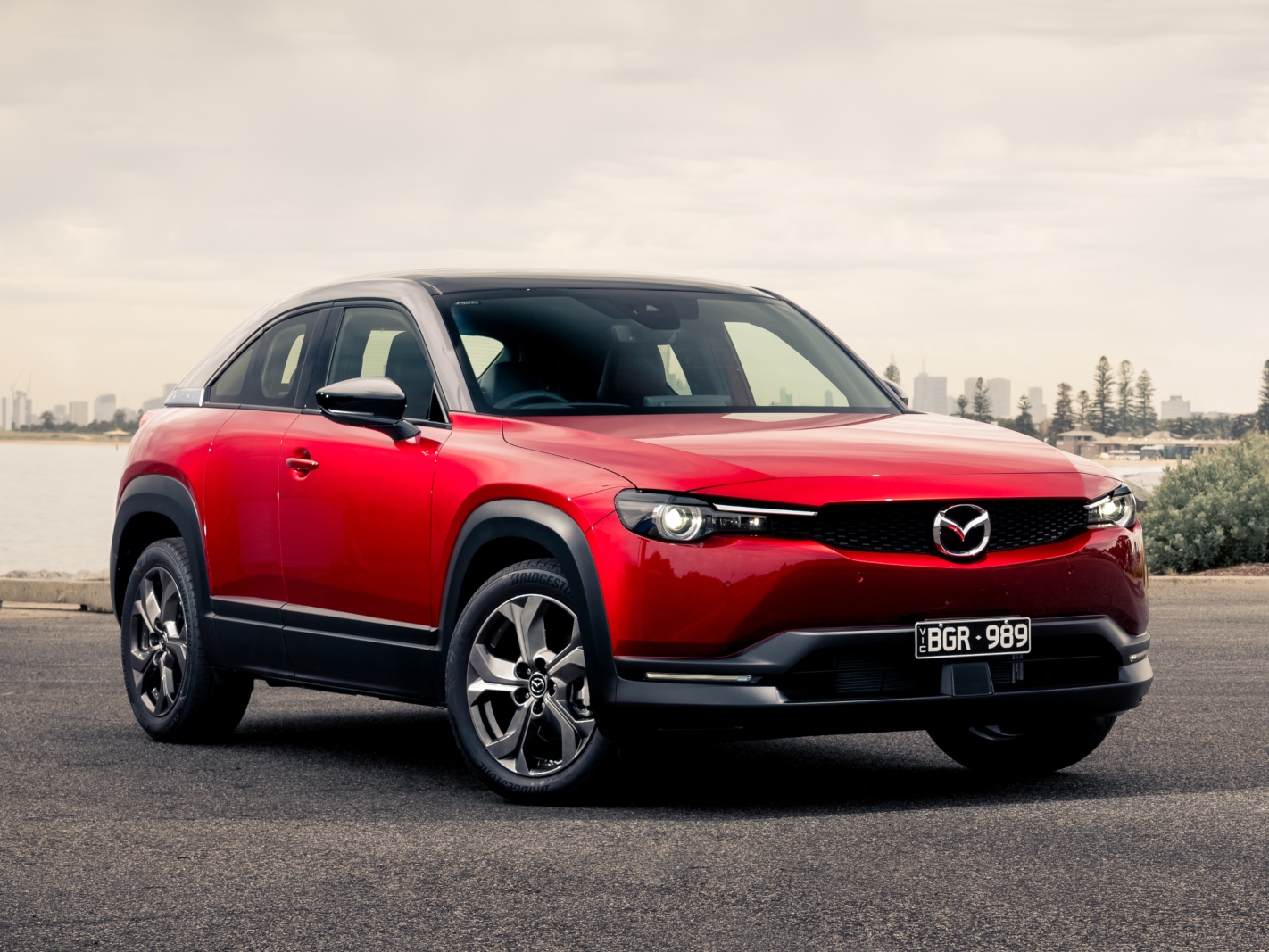
Mazda’s implementation of a universal EV platform for its vehicles comes alongside an investment into autonomous driving systems, with the Mazda Co-Pilot Concept currently being developed, expected to be rolled out in the large vehicles from 2022.
The system will monitor a driver’s condition while travelling and can switch to autonomous driving if it senses a sudden change in behaviour, pulling the car safely off the road and contacting emergency services.
Upgrades to the next generation of infotainment and in-car communication technology are currently being co-developed with other Japanese manufacturers, including Toyota, Subaru, Suzuki and Daihatsu.
Snapshot
- Expected delivery in October
- Priced at $449,500
- Hybrid V6 delivers 500kW and 720Nm
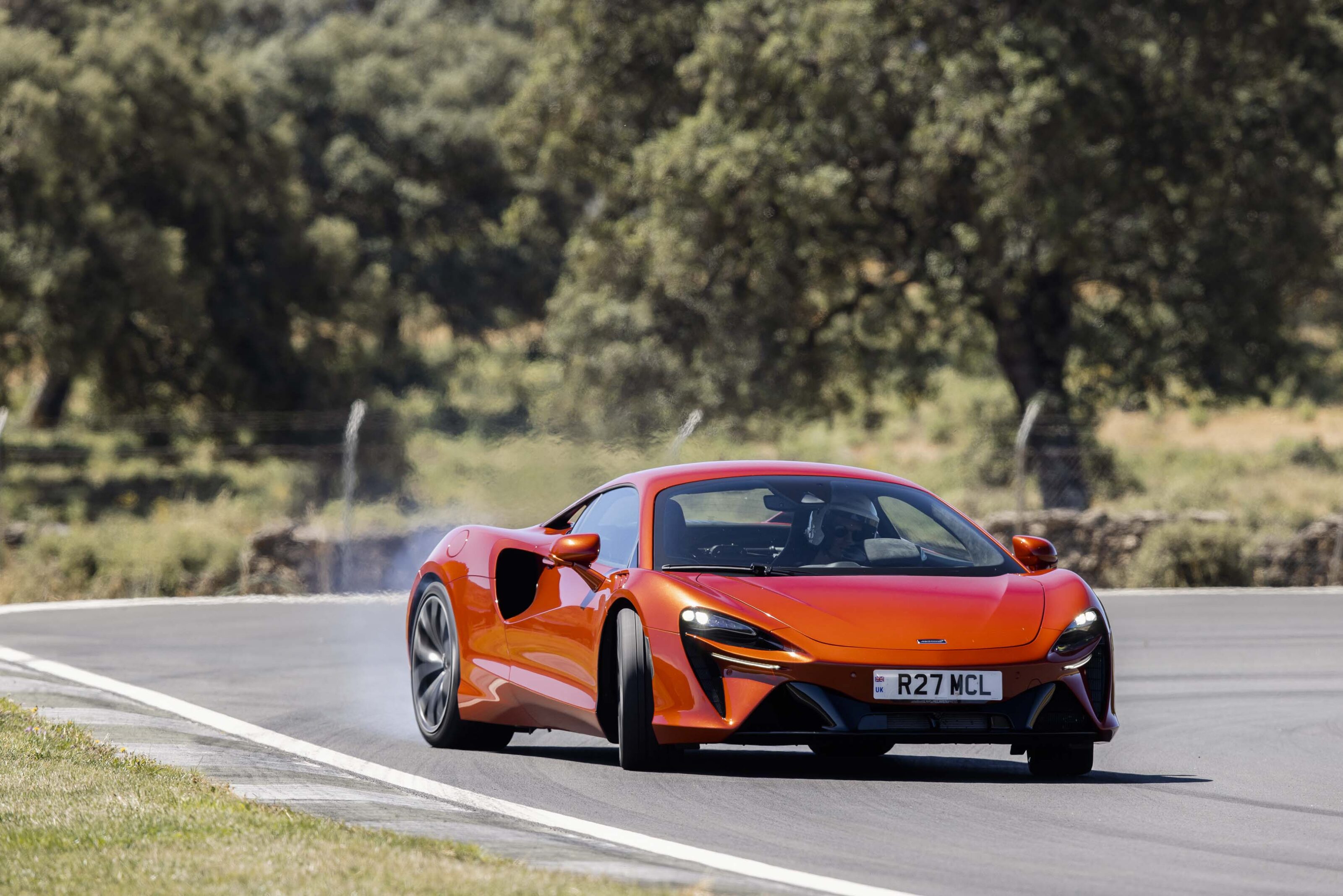
McLaren’s newest supercar, the hybrid Artura, has landed in Australia ahead of its first deliveries starting in October this year.
The low-key unveiling at McLaren Sydney was an opportunity to touch, prod, feel and see the new McLaren before it takes to the road later this year.
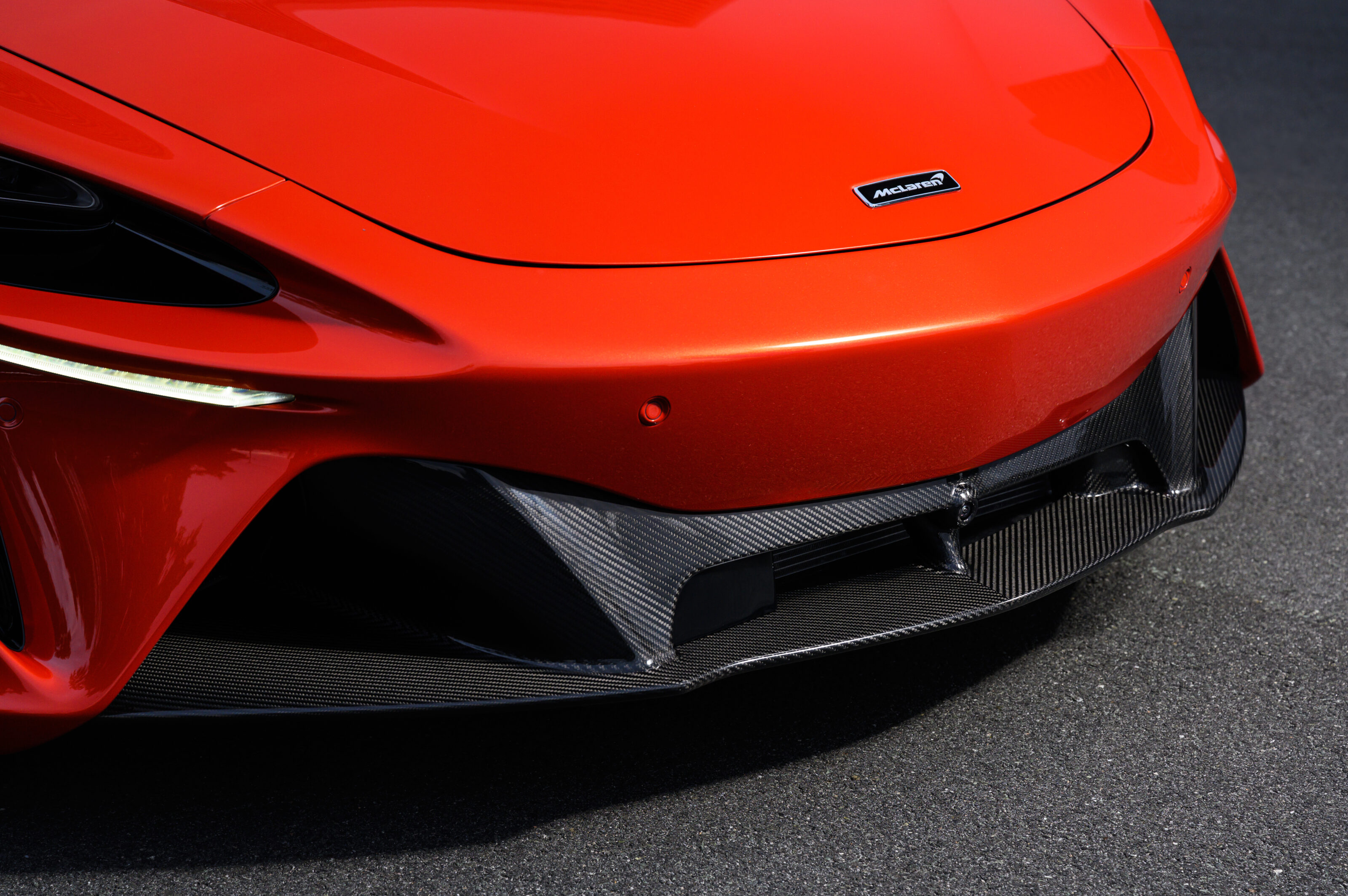
In the carbon, the Artura is a gentle evolution of the McLaren Sports Series 570S and Super Series 720S design themes. While it keeps the 570’s scalloped aero in the doors, the nose is a refinement of the 720’s big change in direction with the socket headlights.
In profile the car is more cab-forward, at least visually. The Artura is built around McLaren’s new carbon tub architecture which now features suspension hard-points, impressive crash structures and a new electrical platform to manage the electrification.
UPDATE, June 2022: Artura driven!
We’ve finally driven the new McLaren Artura, and it’s quite a thing. Catch our review at the link below.
The Artura I’ve just driven is still a work in progress. A car that’s not yet finished. Let me explain.
The story to here
A common complaint of McLarens of old was the awkward entry to the cabin. The side sills are now low enough for you to step in to the car rather than have to stick your backside in first and then swing your legs in. It’s a small but important change.
Once you’re inside the cabin, the seating position feels further forward in the chassis than the 570S it effectively, if not actually, replaces. The new seats are very comfortable and an improvement on those currently available in McLaren’s range.
A new dash architecture is far more cohesive and the new screen looks terrific – even if it was not in operation as this was a pre-production car. The biggest change is the overall feel of the materials, and the fit and finish is much improved. The best things about the cabin, such as the excellent visibility and overall roominess, remain. McLarens are pretty easy to live with.
Behind you is a new, V6 hybrid powertrain codenamed M630. The McLaren twin-turbo V8 is an impressive engine, but unlike the twin-turbo Ferrari engine, has a lot of low-down lag. McLaren says the hybridisation acts early as the engine spools up to give you instant torque before assisting at the 8500rpm top-end, a figure you don’t often see on a turbo engine.
The V angle in the six-cylinder engine is very wide at 120 degrees. RenaultSport F1 tried a 110-degree V angle in 2002 and it didn’t go well. McLaren, however, is confident in its new engine – citing superior packaging which lowers the centre of gravity, creating room for the turbos and ancillaries to be closer to where they need to be.
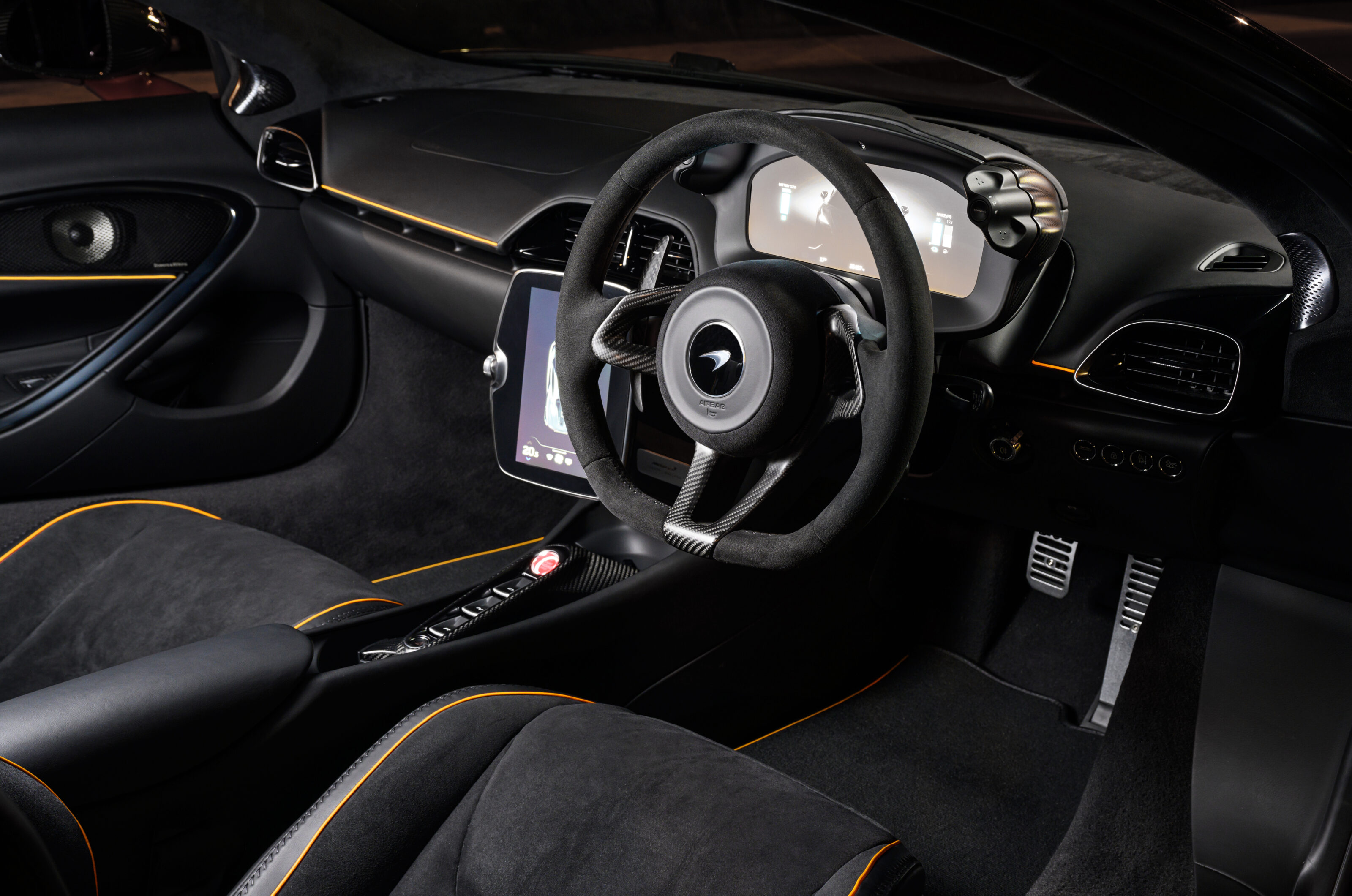
The hybrid V6 delivers 500kW and 720Nm to the rear wheels via an eight-speed seamless shift gearbox. The electric motor – the charmingly titled Axial Flux E Motor can also move the car on its own for up to 30km. The 7.4kWh battery will charge to 80 per cent in two-and-a-half hours from a 240-volt domestic plug and is how the car reverses without an actual reverse gear.
The McLaren Artura starts at $449,500, with first deliveries in the fourth quarter of 2021.
Snapshot
- Combined output of 275kW
- Based on BMW X5
- Uses fifth-gen BMW eDrive tech
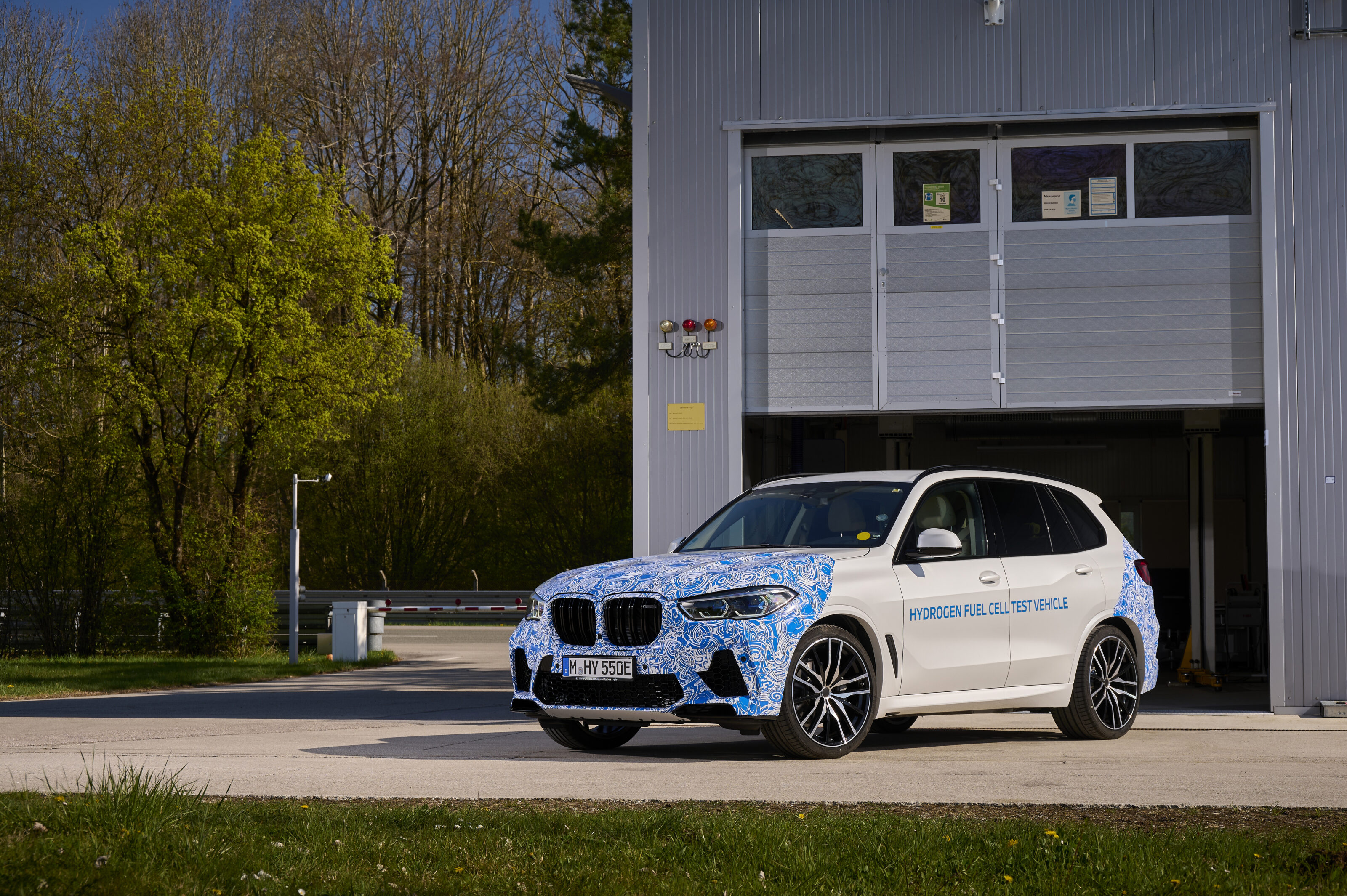
BMW has begun testing a near-production version of a prototype hydrogen-powered car.
The BMW i Hydrogen Next is a pure-electric vehicle which converts hydrogen into electricity using a fuel-cell co-developed with Toyota. The small-series model, based on the X5, is expected to be delivered late 2022.
The drive system in the Next combines hydrogen fuel-cell technology with fifth-generation BMW eDrive technology – already found in the BMW iX3 and in the upcoming BMW iX and BMW i4 – to produce a combined output of 275 kW which is equal to that of the six-cylinder in-line petrol engine currently used in BMW models.
“Hydrogen fuel cell technology can be an attractive option for sustainable drive trains – especially in larger vehicle classes,” said Frank Weber, member of the board of management at BMW AG.
“That is why road testing of near-standard vehicles with a hydrogen fuel-cell drive train is an important milestone in our research and development efforts.”
Like the fuel tank of a conventional combustion-engine model, the hydrogen tank of the BMW i Hydrogen Next can also be filled just a few minutes and has a claimed driving range of several hundred kilometres.
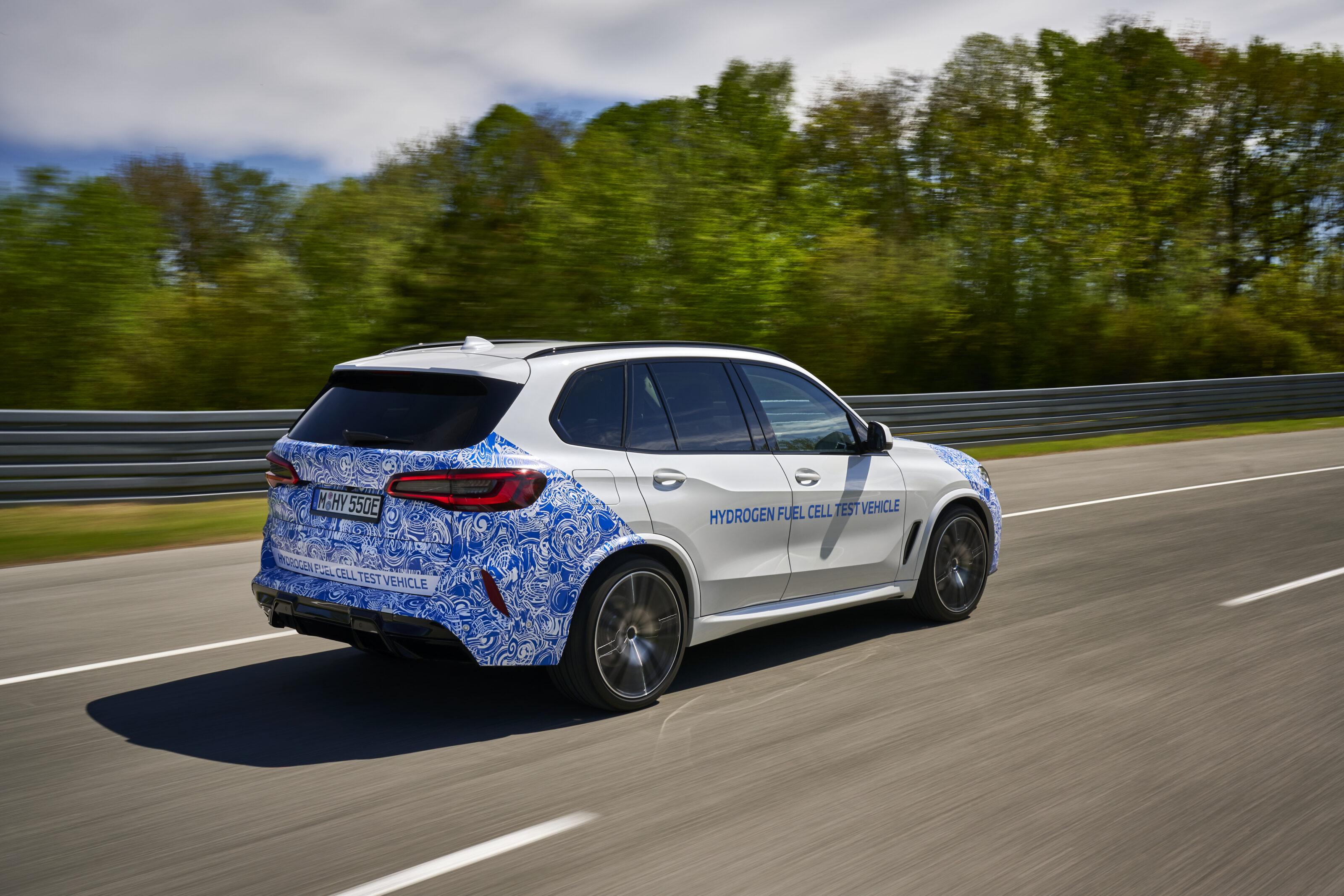
While the prototype’s individual cells come from Toyota, its fuel-cell stack and complete drive system are original to the BMW Group.
The German carmaker has been putting the hydrogen car through its paces on European roads in order to examine how well the CO2-free drivetrain, model-specific chassis technology and vehicle electronics systems work together under real-life conditions.
BMW says it is now fine-tuning the software which controls driving and operating functions.
The fuel-cell system, hydrogen tanks, performance buffer battery and central vehicle control unit have all previously been tested individually and together in hundreds practise runs.
Snapshot
- Romanian firm’s new logo and emblem will usher in new models, including a C-Segment SUV
- Dacia expected to go on sale in Australia in 2022
- Local model offerings still unknown
Romanian automaker Dacia, Renault Group’s no-frills budget label, has released a new logo and emblem.
Due to take effect before the end of June, the makeover, according to Dacia, represents its key values of simplicity, authenticity, robustness, all at a fair price.
The avant-garde-looking typography and aesthetics of the new identifiers have been created in-house by the carmaker’s design team, and represent a rapid departure from its old, commonplace badging.

It isn’t the first time we’ve seen the new branding, though – the Romanian firm previewed its fresh emblem back in January when it was unveiled on the front of its Dacia Bigster SUV concept.
The angular concept’s surprising reveal happened at Renault Group’s ‘Renaulution’ business model presentation, with the Bigster confirming many rumours Dacia will soon enter the C-Segment SUV market with a novel offering.
Based on the Renault–Nissan Common Module Family CMF-B platform, the 4.6-metre long SUV will utilise a number of efficient powertrain options including alternative-energy and hybrid engines.
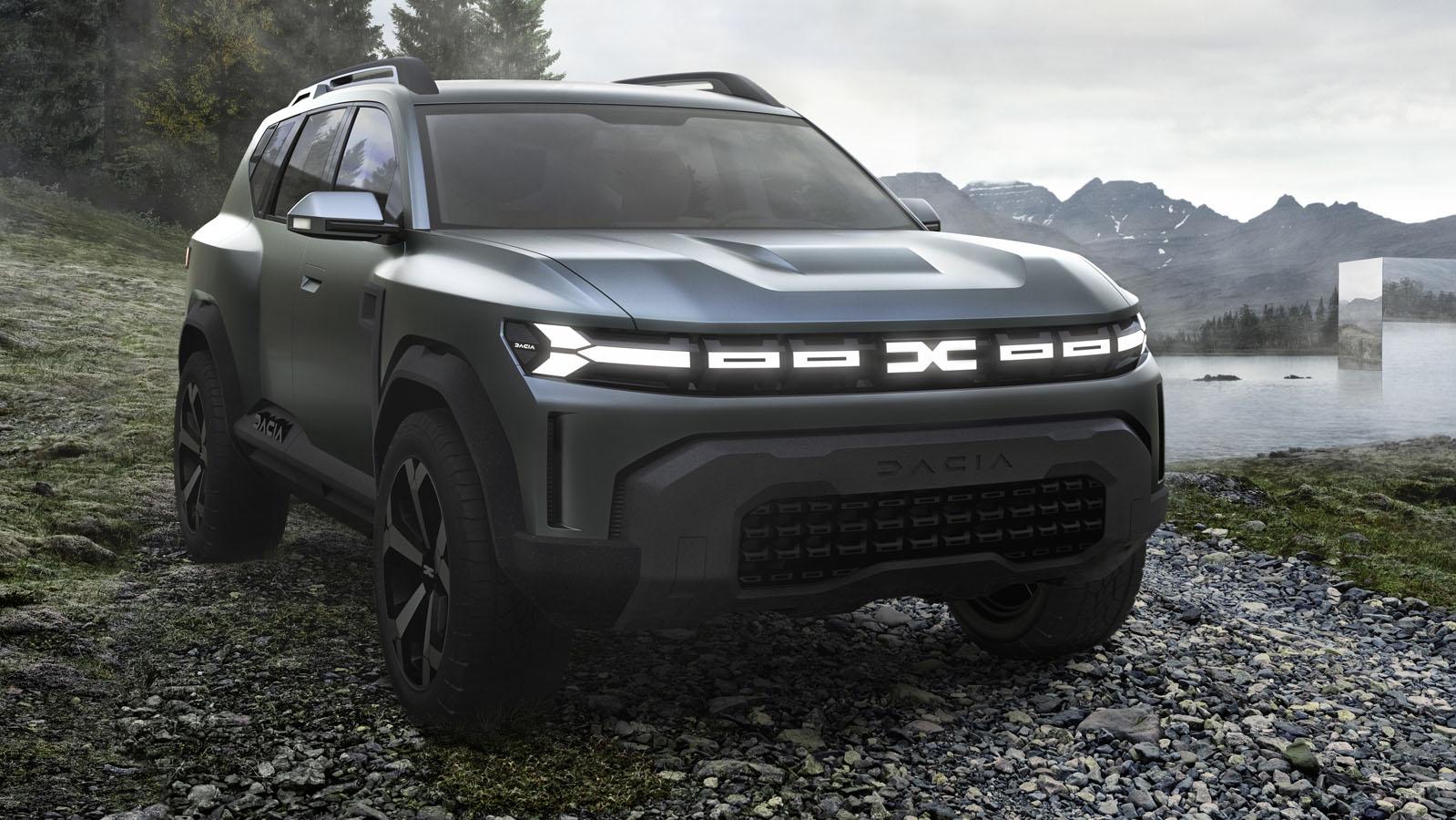
Speaking about the launch of Dacia’s new look, Denis Le Vot, Dacia’s CEO, confirmed the automaker was looking to bring a new C-Segment SUV to market soon. However, the Bigster wasn’t explicitly mentioned in the announcement.
“We want to bring the brand to the next level in terms of segment coverage, so we’re going to enter the C SUV segment in Europe, the biggest segment by far,” Le Vot said.
“We think the platform, the brand, where we are today permits us to have this great, big ambition.”
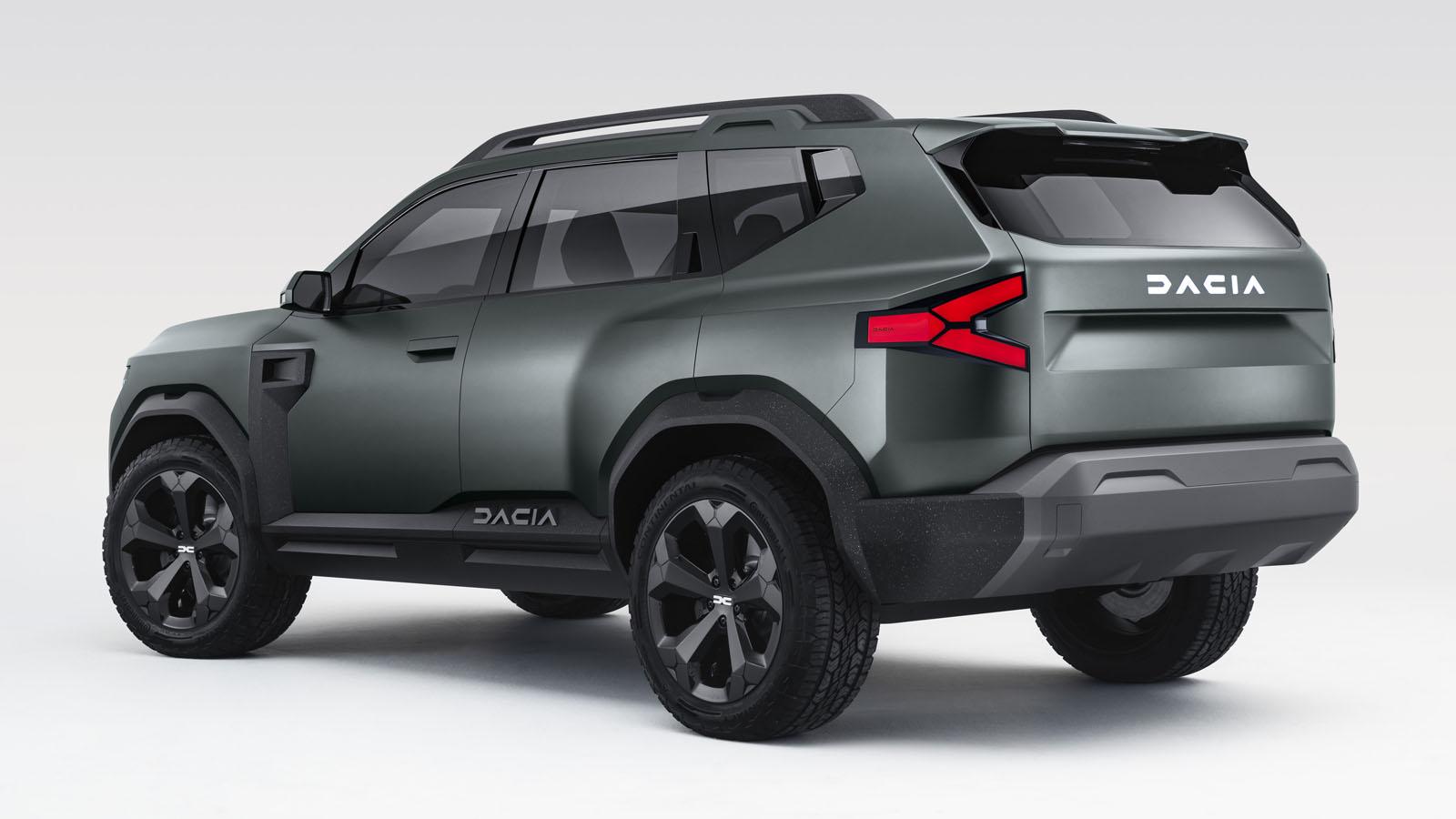
And Aussies could be seeing the new Dacia logo and emblem on home soil in the not too distant future, with reports from earlier this year suggesting Ateco, the third-party importer of Renault, will bring the Romanian brand to the local market in 2022.
It’s not known exactly which models will be offered Down Under, but currently, Dacia’s product line-up includes models like the Top Gear famous Sandero hatchback, Duster small SUV, Spring electric SUV, and Logan sedan.
WhichCar has reached out to Ateco for more details about Dacia’s anticipated launch in Australia, and we’ll update this story with more information as it becomes available.
There is a worrying array of forces conspiring against the Porsche Panamera GTS. The time of big, twin-turbocharged V8 limos that are sold sans batteries is coming to an end. Add to that the fact that the Panamera has siblings within the Porsche family hoping to cut its lunch. With the arrival of the Taycan, the Panamera is no longer the only four-door sedan from Porsche. If you have family-hauling duties the Cayenne is supremely capable, and if driving purity is what you demand, then the Cayman, Boxster, and iconic 911 are all there for your go-fast needs.
Finally, there’s a dizzying array of variants within the Panamera family vying for your attention. So why should the GTS be the one you choose?
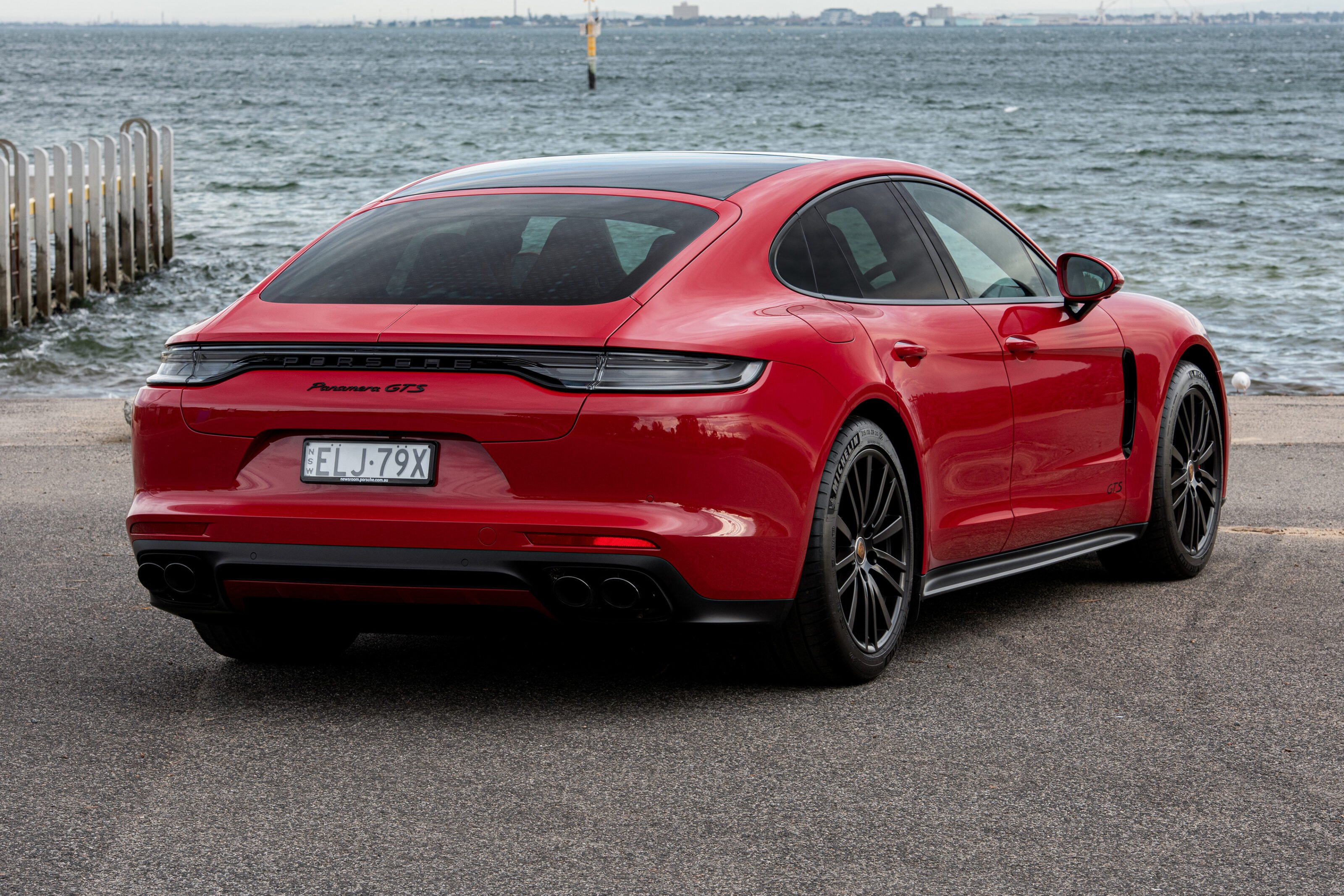
All that paints the Panamera GTS as an underdog, but in the real world it is anything but, with the driving experience being endearing, entertaining, and wholly convincing of its sports limo remit.
Part of that is thanks to the badge. The GTS suffix on this Panamera indicates that the focus is on the driver. It sits lower than its more powerful and expensive sibling, the Turbo S, and has a raft of options fitted as standard to best cater to the enthusiast owner.
Despite its luxury limo credentials, the Panamera GTS still must meet Porsche’s high standards of dynamic prowess while being big, long, and comfortable at the same time. No easy task. That doesn’t mean this executive saloon has forgone any pretence of comfort and luxury – quite the opposite.
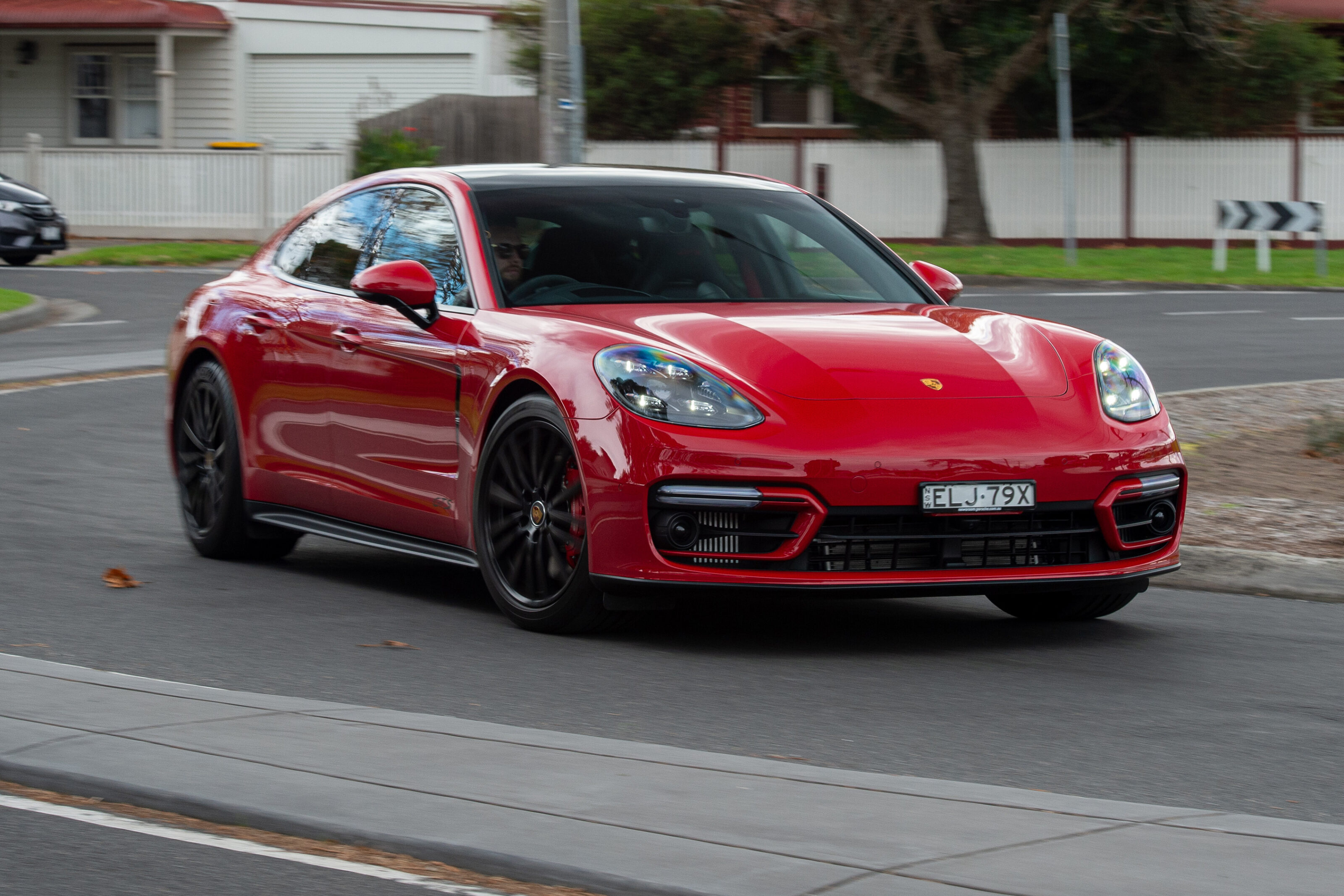
Despite its size and length, it’s on a twisting road that you really uncover the depths of the Panamera’s talents
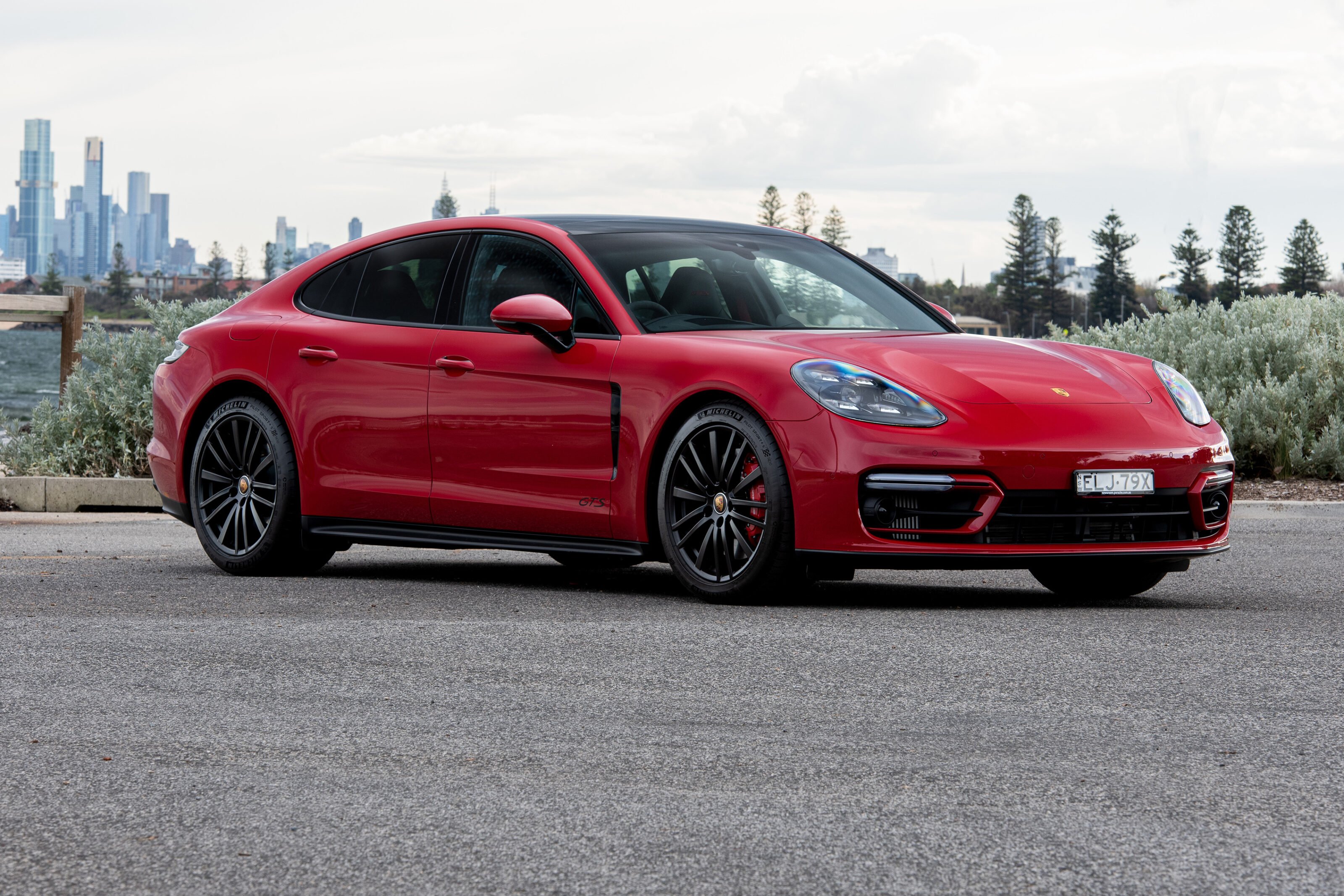
Before we get too far ahead of ourselves, let’s cover the basics. The Porsche Panamera is now in its second generation, and this GTS model sits above the entry-level models, but below the bonkers Turbo S flagship. Under the bonnet is a 4.0-litre twin-turbo V8 that produces 353kW and 620Nm. That’s a 15kW increase over the previous model. While no longer a headline-generating level of grunt, it’s more than enough for most tastes.
Power is sent to all four wheels via an eight-speed PDK dual-clutch transmission, helping rocket the Panamera to 100km/h from a standstill in 3.9 seconds. Considering the Panamera weighs two tonnes, a claimed 0-100km/h time of less than 4.0 seconds is pretty darn impressive. Remember, that’s coming from Porsche, which is notorious for understating exactly how quick its cars are.
Oh, and if you were curious, the top speed is a neat 300km/h. We wouldn’t expect anything less from a German autobahn missile. To cap it all off, there’s space inside for four adults, plenty of boot space, a heavy lashing of leather and Alcantara, and a dizzying array of tech goodies.
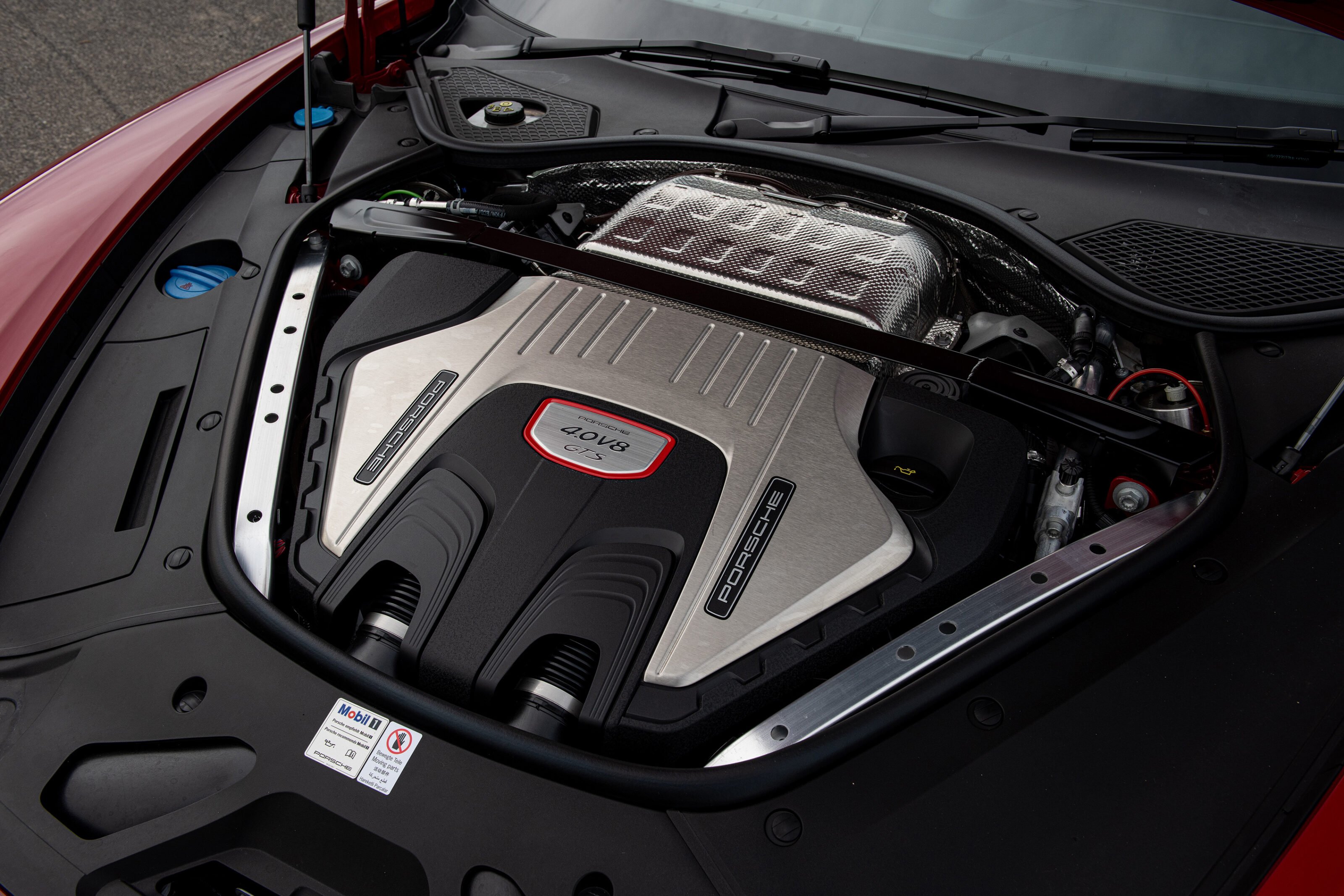
But here’s the catch. You will need to pay a steep price of admission. The GTS starts with a price tag of $309,500 before on-roads – and our test car adds more than $30k of optional extras.
Some of those options we could go without ($740 for interior lighting and $1750 for a 4+1 seating layout). However, others are a must-tick – namely the $9870 Porsche Dynamic Chassis Control Sport (which includes Porsche’s Torque Vectoring Plus system), and $3750 for four-wheel steering.
On the subject of pricing, it’s hard to avoid the consideration that here is a 353kW sports sedan that wears a $309,500 tag. A 467kW BMW M5 CS is $274,900, a 446kW Audi RS7 is $224,000 and a 450kW Mercedes-AMG E63 S lists at $253,900. Couched in those terms, you really have to want the Porsche to stump up that asking price. But then the car has come a long way in a relatively short lifespan.
While unloved when the first generation was revealed, the looks of the Panamera have been subtly matured, with Porsche’s design team introducing the longer wheelbase second generation model in 2017. The exterior styling tweaks also made a world of visual difference. That hard work is slightly undone by the standard 20-inch rims that don’t exactly match the $300K+ price.
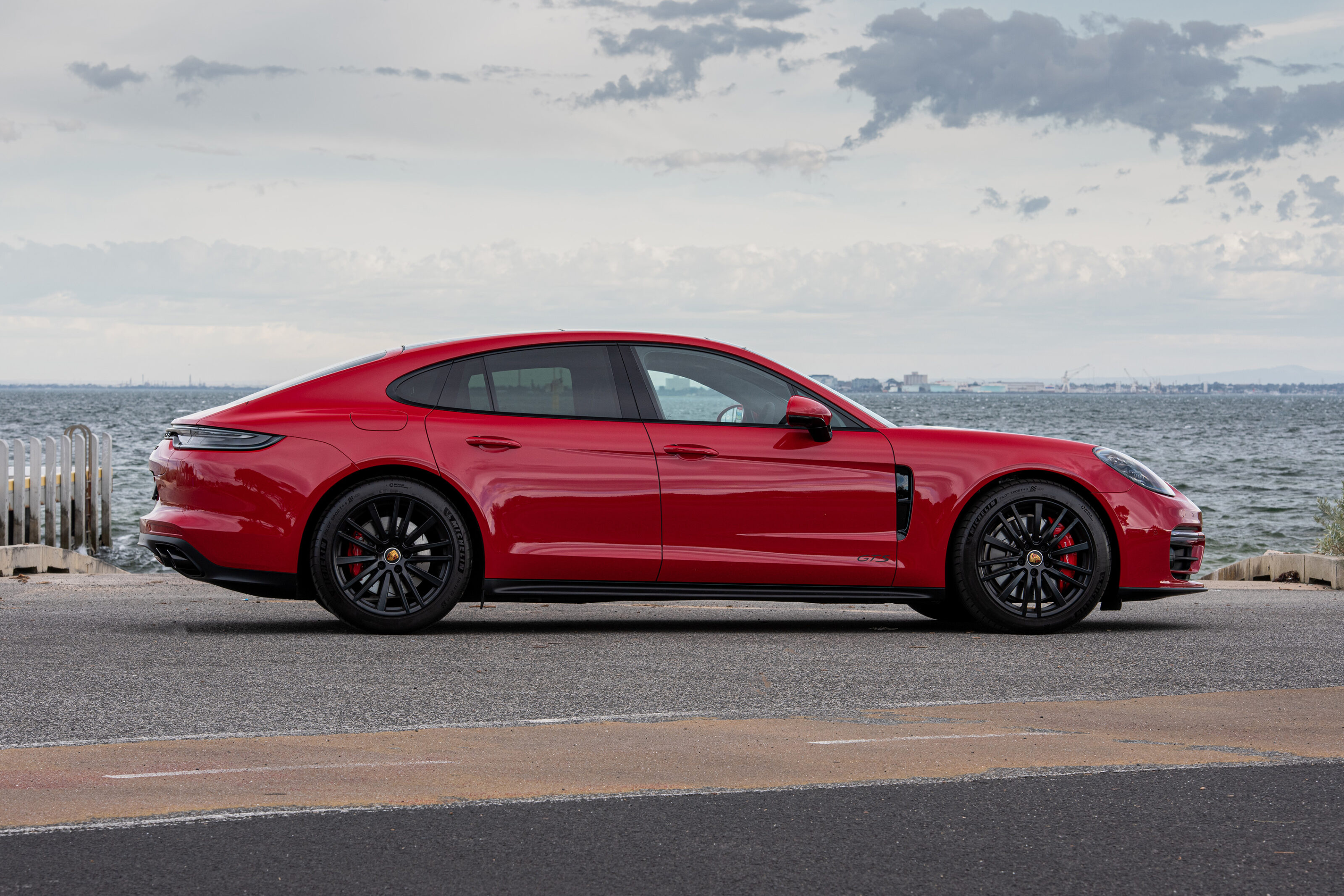
Start the GTS and you are met instantly with a deep, distinct V8 burble. For a period, Porsche actually swapped out the V8 in the GTS, replacing it with a turbocharged V6. While that engine wasn’t bad in its own right, it isn’t quite the same as a healthy bent-eight.
Porsche admits its decision to employ a V8 was an emotional one, and I have to say, it is a damn good choice. It’s not the most characterful engine in the world in terms of rev range or outright power, but the sports exhaust system – which is standard on the GTS – means it’s able to provide plenty of auditory delights.
Power delivery is potent, with peak torque coming on from 1800rpm all the way to four grand. This is actually the same engine as in the flagship Panamera Turbo S, except without the twin-scroll turbochargers, and the boost dropped slightly from nearly 19psi to around 11psi.
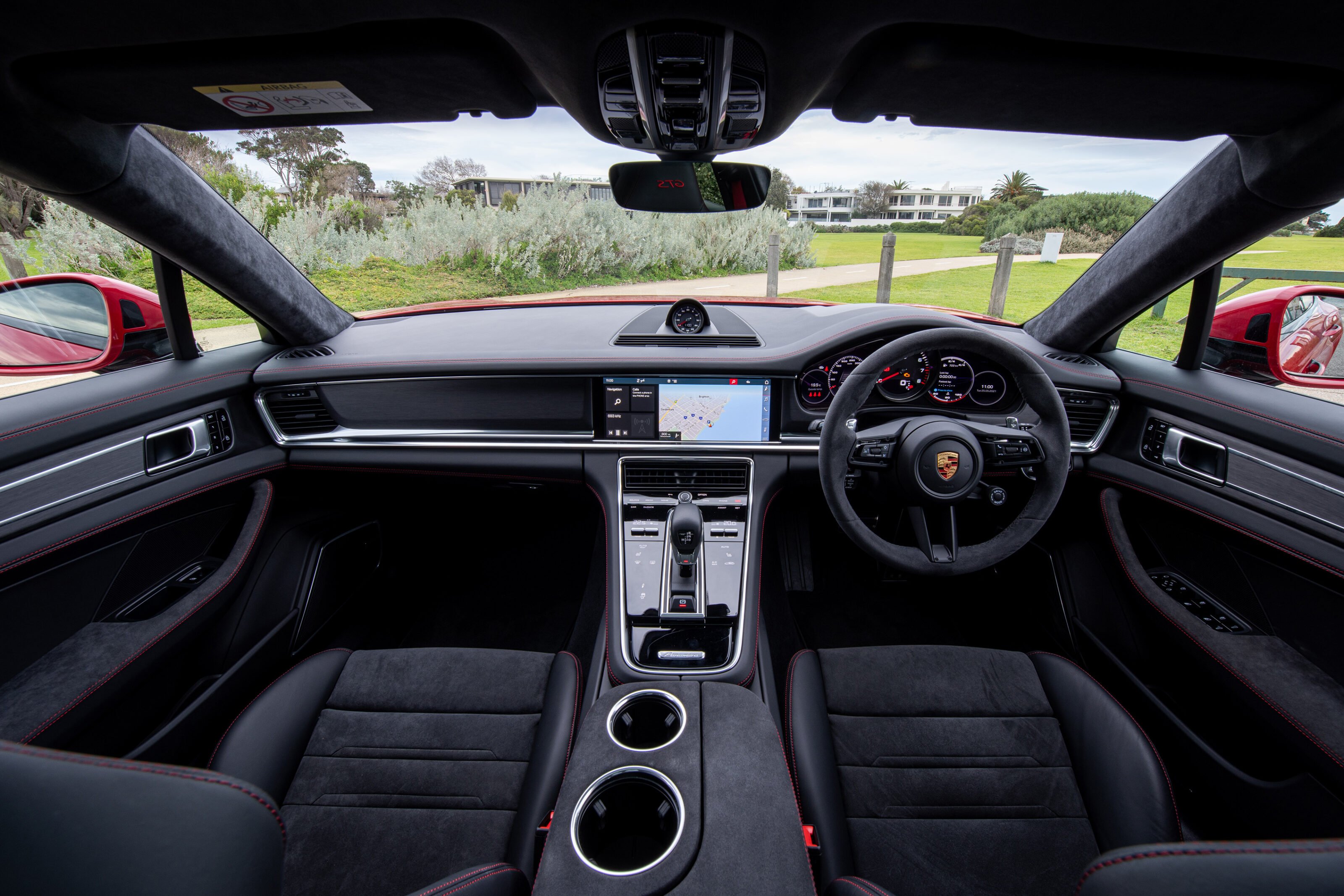
Then there’s the gearbox. Porsche usually nails its transmissions – weird ratios in the Cayman GT4 aside – and this eight-speed PDK dual-clutch is no exception.
Finding a chink in the armour is near impossible. Leave it to its own devices and it seems to have a psychic link, giving you exactly the right gear at the right time.
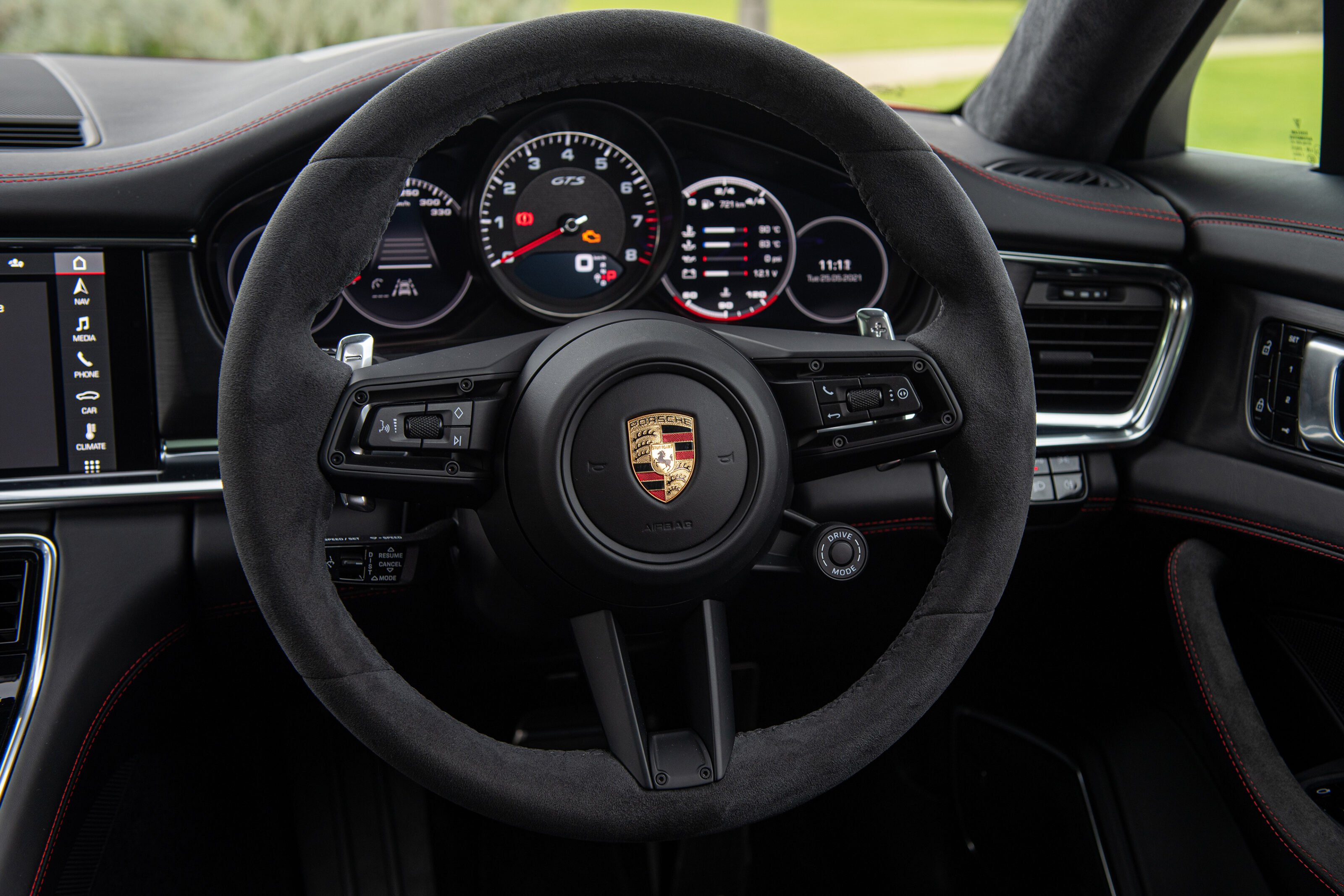
Switch to manual and the shifts are quick and crisp. Pull the paddle and bang, you get exactly what you asked for. It’s also perfectly calibrated to the driving modes, remaining smooth and subtle in Normal, and progressively ratcheting up the intensity through Sport and Sport Plus.
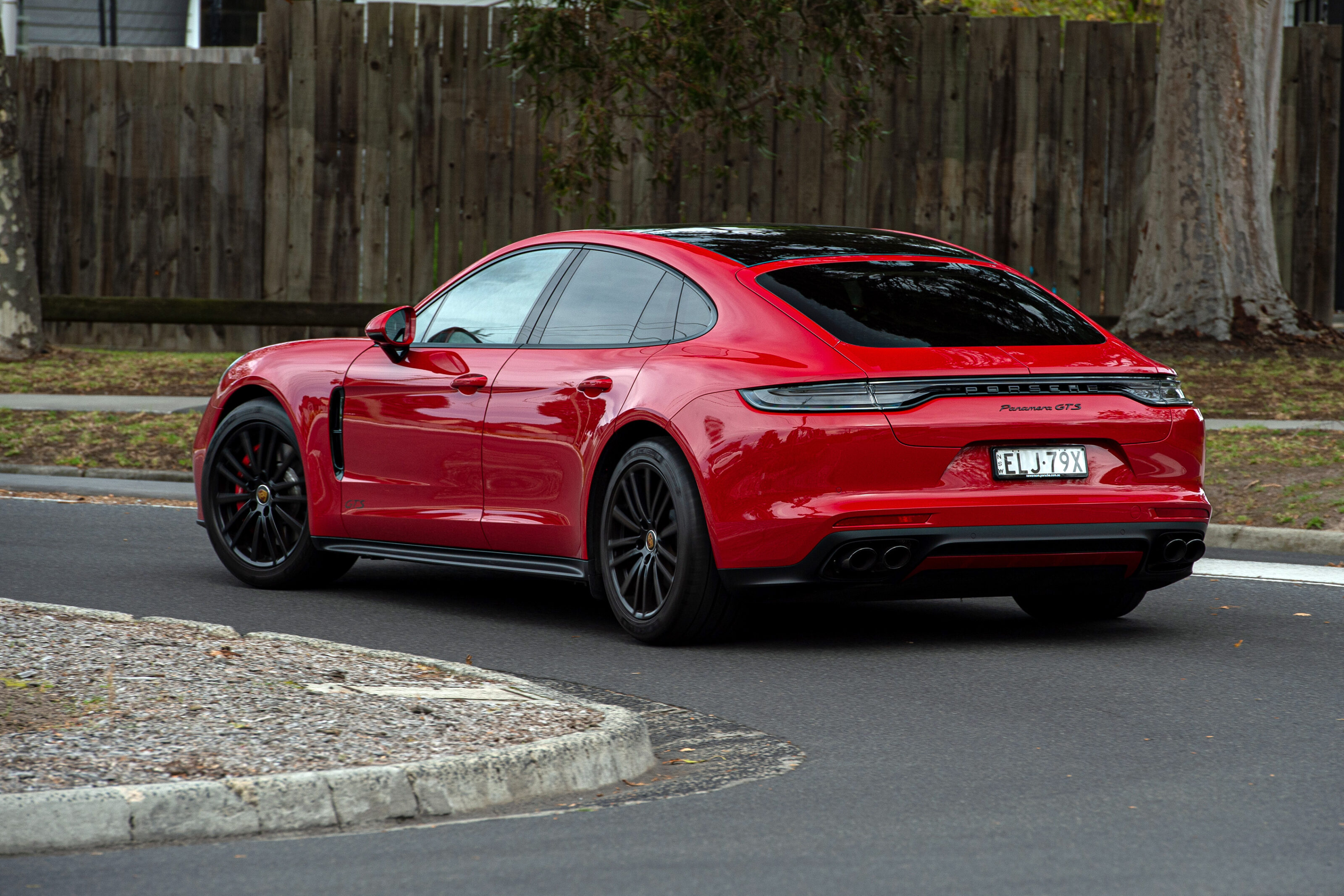
But before we assess its dynamic talents, it’s important to pay credence to the Panamera’s luxury credentials. In its normal setting, the Panamera GTS has a silky smooth ride. It wafts along wonderfully, even on typically pockmarked and deteriorating Australian B-Roads. That’s thanks to the air suspension, which has new damper settings and management system for this 2021 update. For long-distance cruising, the Panamera GTS is a brilliant place to be, getting you to your favourite driving road feeling fresh and relaxed. That is until you have to adjust the central air vents, which you can only do via the central touchscreen after navigating a pair of sub-menus. Frustrating to say the least!
On a challenging driving road, this big sedan is almost as composed as its sportscar siblings when you decide to turn up the wick. The GTS rides 10mm lower than the rest of the Panamera range, and that small difference gives it a hunkered down, confident demeanour. The old thinking that air suspension is antithetical to dynamic ability is long gone, with Porsche’s Active Suspension Management and Dynamic Chassis Control giving the Panamera GTS a respectable level of body control.
Despite its size and length, it’s on a twisting road that you really uncover the depths of the Panamera’s talents. The front end is seriously impressive, which means you can really grab the GTS by the scruff of the neck and chuck it into corners with confidence. The steering is accurate, with a quick, but not too quick ratio. It falls into that Goldilocks window where you don’t need to apply huge armfuls of lock to get the nose pointed into bends, without the twitchiness of super-direct systems. This is aided by the four-wheel steer setup, which gives the Panamera athleticism and stability that belies its size and weight. Oh, and having the rear wheels steer by even the slightest amount is a boon around town given the Panamera’s five-metre length.
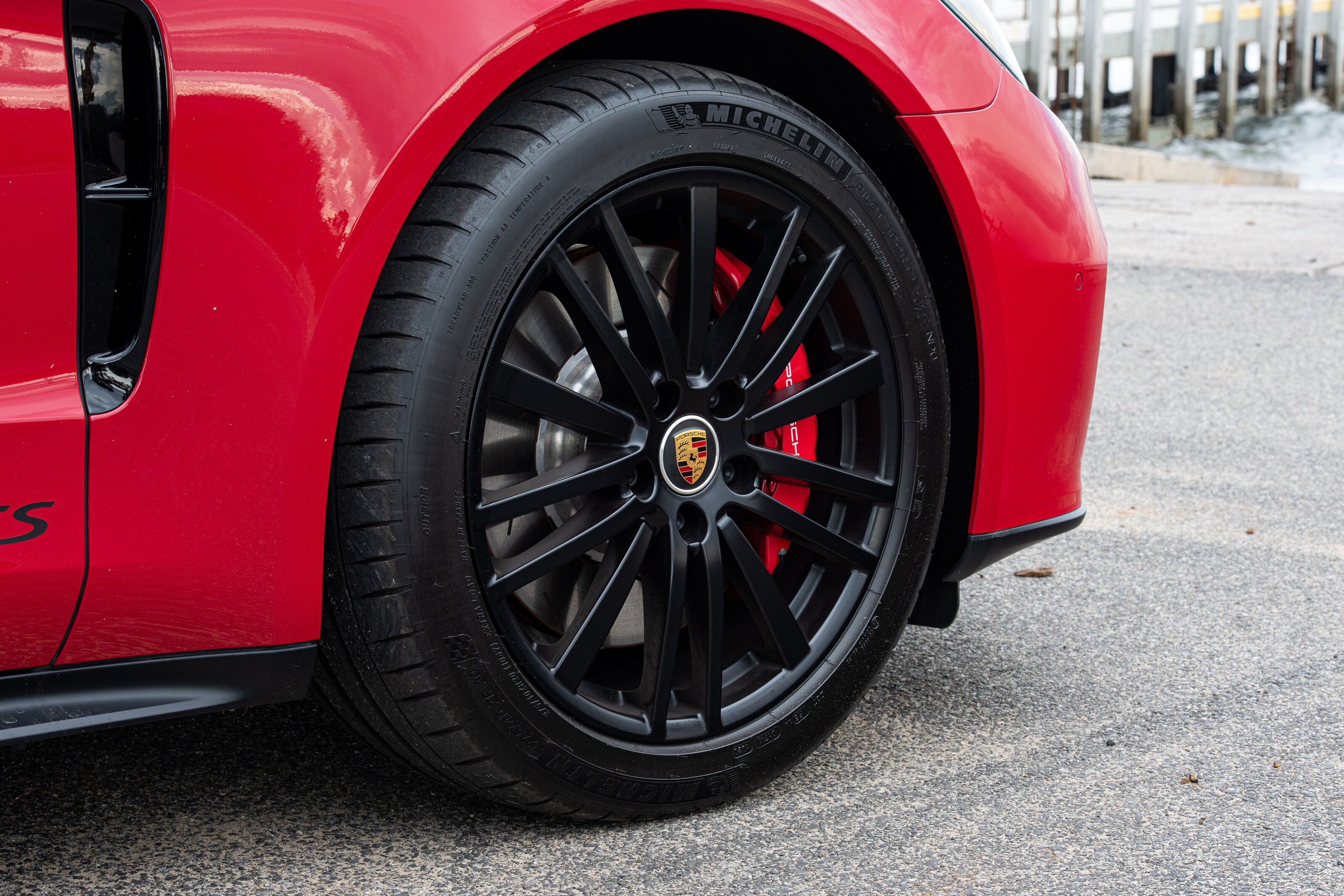
The unsung hero of this dynamic prowess is the rubber. Michelin Pilot Sport 4S tyres feature at all four corners, in pretty significant sizes. The GTS has a sizeable footprint, which it deploys to devastating effect. Want to terrify three of your mates on the way to the ski field? This is the car for you.
Standard steel brakes save you when it comes to the final price tag compared to carbon ceramics, but you don’t lose out in stopping performance. The brake calipers for the GTS are the same as the rest of the Panamera range below it, with six-pot fronts and four-pot rears, though disc sizes are up, with 390mm rotors up front and 365mm at the rear. Despite the two-tonne kerb weight, we didn’t experience any fade during hard driving on a winding road.
Porsche has done something incredible with the Panamera GTS. The concept and character traits you’d want from a long-distance cruising limo, and those exuded by a sportscar seem mutually exclusive. And yet Porsche has distilled a brilliant version of both into one body. This is one of the best executive limos you can buy today, while also possessing some of the finest driving dynamics you can experience with four doors and a boot.
It can be driven calmly every day and it’s an absolute delight, yet when you want to relish in the joys of driving, it also delivers.
There may be purer sportscars in the Porsche family, or more practical SUVs, or quicker four-doors. However, the do-everything ability the Panamera exudes is entirely infectious. This is a car that makes it about the joy of driving, no matter the flavour. A 7 Series could only dream of being as capable in the bends as the GTS, while AMG’s GT63 4-Door is outclassed by the Panamera’s refinement.
The forces conspiring against the Panamera GTS may be strong, but they can’t tarnish the refinement and capability of Porsche’s genre-blending limo. Appreciate cars like this while you can.
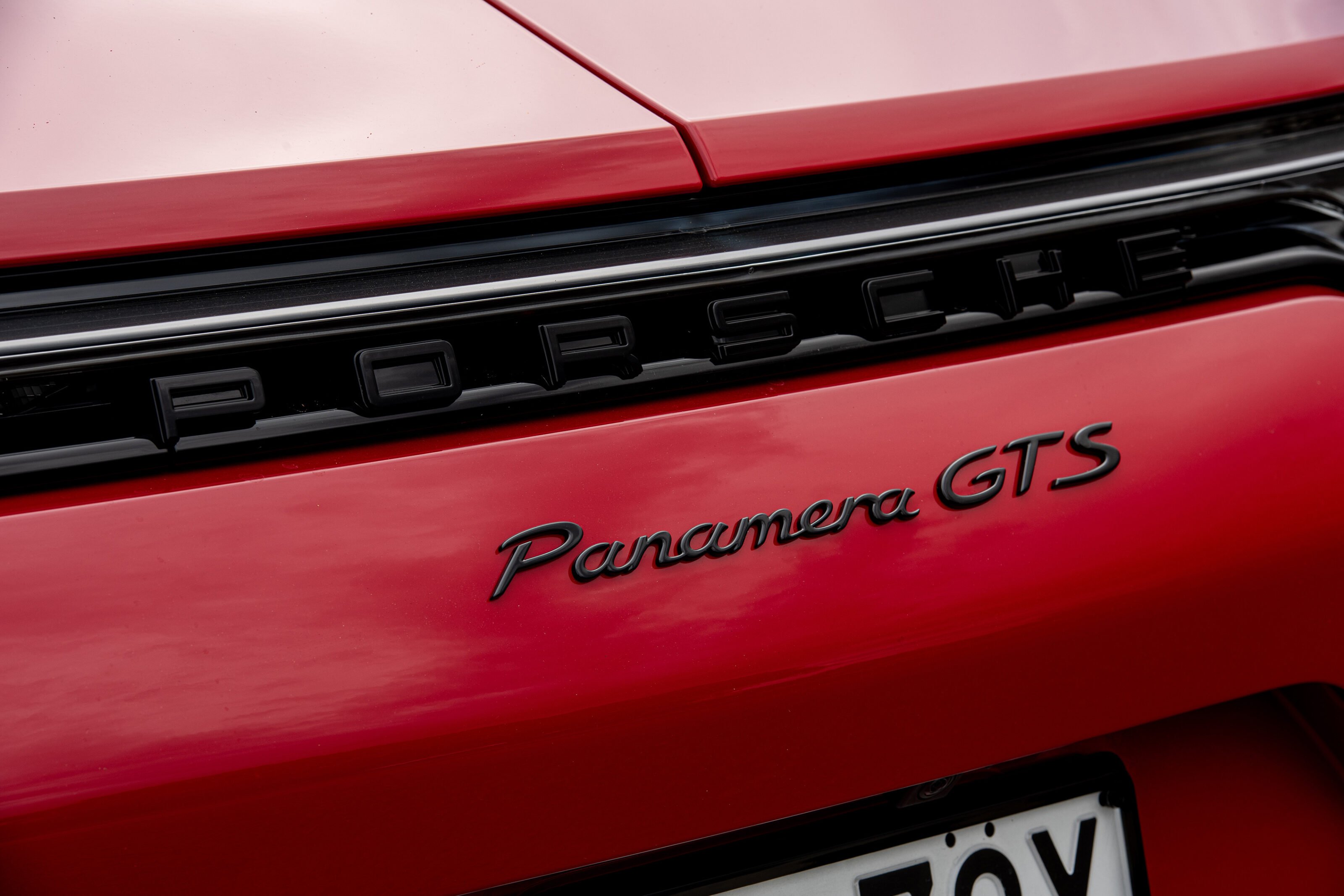
2021 Porsche Panamera GTS specification
| Body | 5-door, 4-seat liftback |
| Drive | all-wheel |
| Engine | 3996cc V8, DOHC, 32v, twin-turbo |
| Bore/stroke | 86.0 x 86.0mm |
| Compression | 10:1 |
| Power | 353kW @ 6500rpm |
| Torque | 620Nm @ 1800-4000rpm |
| 0-100km/h | 3.9 sec (claimed) |
| Fuel consumption | 10.3L/100km (claimed) |
| Weight | 2020kg |
| Power/weight | 174.8kW/tonne |
| Transmission | 8-speed dual-clutch |
| Suspension | Double wishbone, air suspension, anti-roll bar, adaptive dampers (f) Multi-link, air suspension, anti-roll bar, adaptive dampers (r) |
| L/W/H | 5053/1937/1417mm |
| Wheelbase | 2950mm |
| Tracks | 1657/1639mm |
| Steering | electrically assisted rack-and-pinion |
| Brakes | 390mm ventilated discs, 6-piston calipers (r); 365mm ventilated discs, 4-piston calipers (r) |
| Wheels | 20.0 x 9.5-inch (f) 20.0 x 11.5 inch (r) |
| Tyres | 275/40/20 (f); 315/35/20 (r); Michelin Pilot Sport 4 S |
| Price | $309,500 / $340,720 as tested |
Snapshot
- Shannons Winter Timed Online Auction ended May 15
- Modern classic Japanese cars net six-figure sums
- 88 cars sold in total
THE 2021 Shannons Winter Auction concluded on Tuesday, with two iconic Japanese homologation cars selling for big dollars.
The hammer fell on this Mazda FD RX-7 SP for an incredible $166,000 – well above the $100-$150,000 estimated by the auction house. This particular SP shows just 83,362km and was sold at Shannons in 2018 for $112,000, making for a tidy profit on a three-year investment. It’s believed to be the only surviving ‘Brilliant Black’ car. Another SP fetched $74,000 in 2019, this time finished in the more common Vintage Red.
The RX-7 SP was created by Mazda Australia as a homologation special to compete in the 1995 Eastern Creek 12-Hour, which formed part of the Australian GT Production Car Series. Each car received an uprated intercooler, exhaust, ECU and brakes, plus a stout 4.3:1 diff. Peak output from the twin-turbo 13B was upped to 204kW, a boost over the stock 188kW. Other additions included Recaro Kevlar seats, 17-inch BBS wheels and smatterings of carbonfibre. According to Shannons, just 29 RX-7 SPs rolled off the line; 26 were built as road cars, while three were destined for the track.
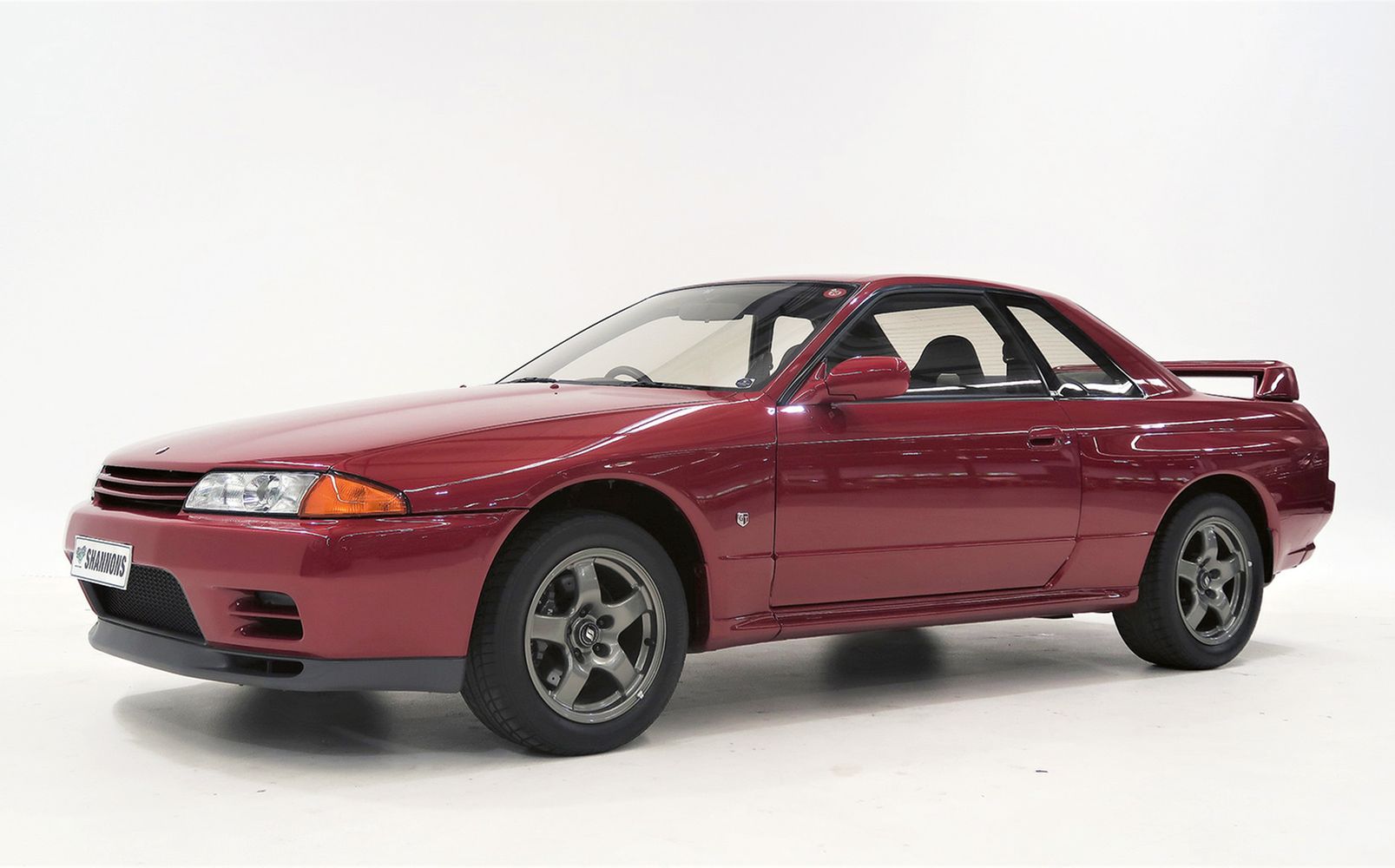
A long-time nemesis of the RX-7 also drew plenty of bidding action.
This late-production R32 Skyline GT-R was expected to sell for between $100,000 and $140,000, eventually squeezing past its estimate to reach $142,500.
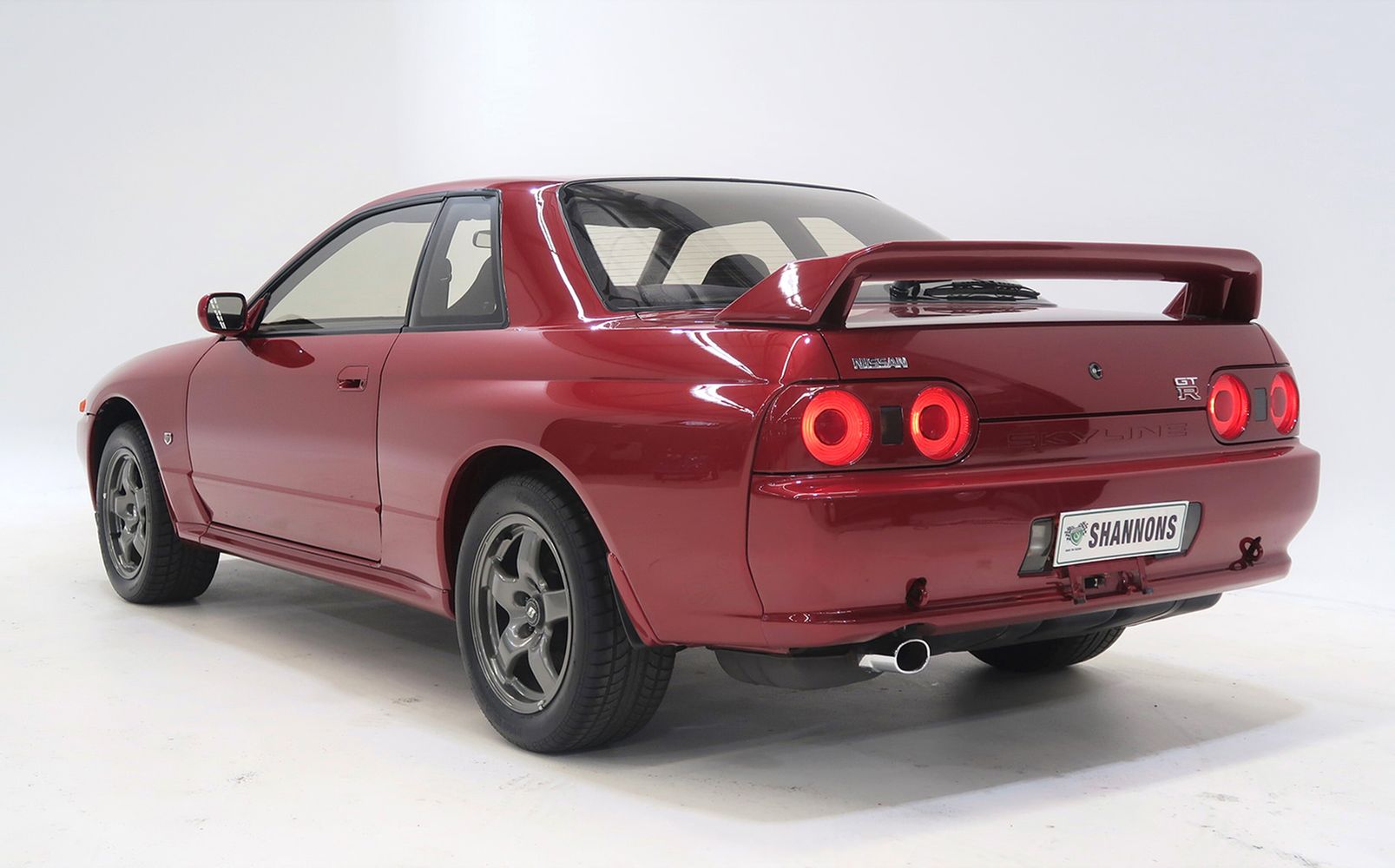
The red coupe fetched the seventh-highest price for a car in this year’s Winter Auction, beating out an LC GT-R XU-1 Torana by just $2500. Of the 13 R32 GT-Rs listed as sold on Shannons’ website, this example realised the highest price by over $50,000, and shows an odometer reading of 104,537km.
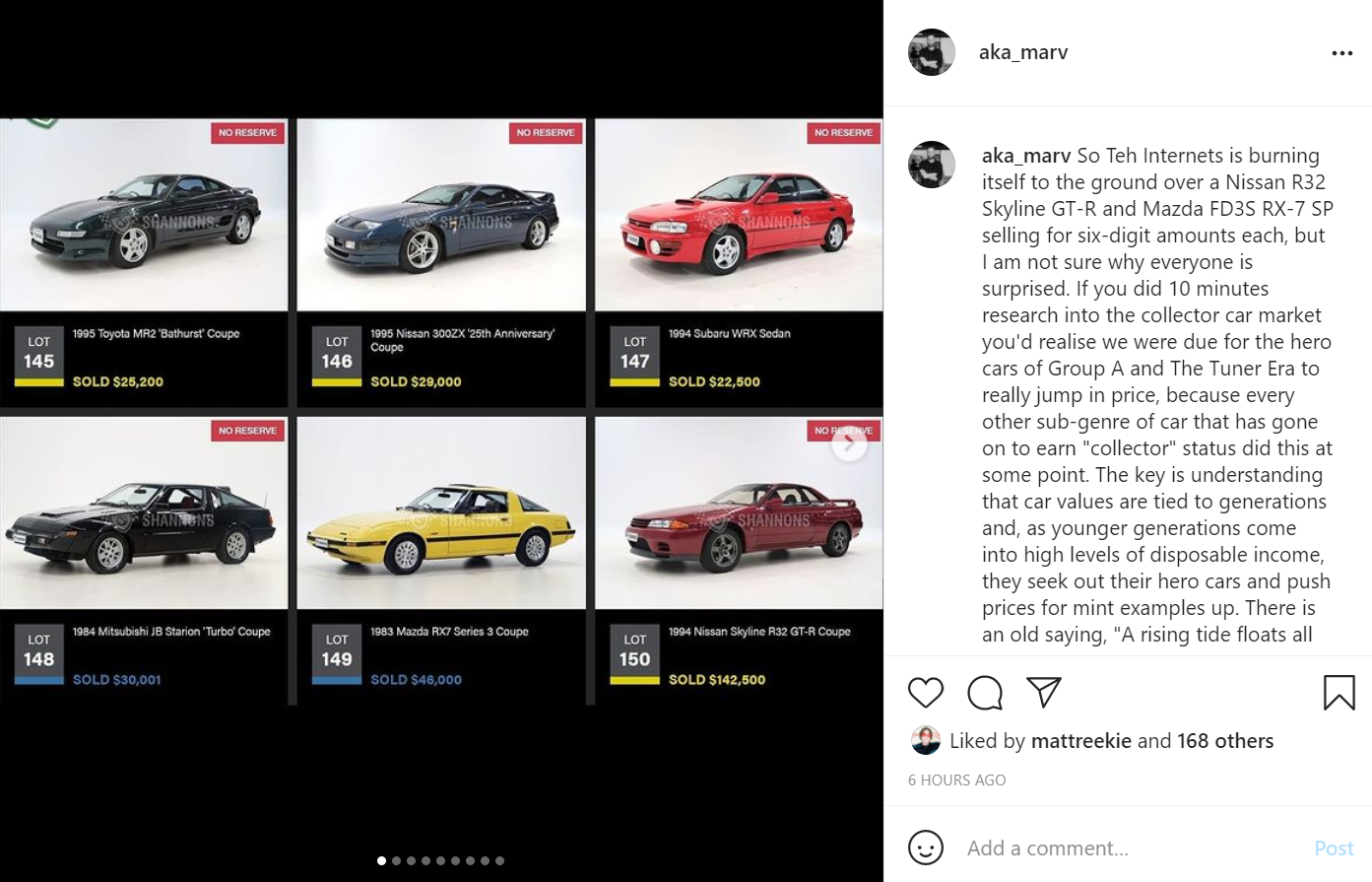
Street Machine journalist Iain Kelly believes the writing has long been on the wall for auction results like these. “[The internet] is burning itself to the ground over a Nissan R32 Skyline GT-R and Mazda FD3S RX-7 SP selling for six-digit amounts each, but I am not sure why everyone is surprised,” he said in a post on his Instagram page. “If you did 10 minutes’ research into the collector car market you’d realise we were due for the hero cars of Group A and the ‘tuner era’ to really jump in price, because every other sub-genre of car that has gone on to earn ‘collector’ status did this at some point.
“The key is understanding that car values are tied to generations, and as younger generations come into high levels of disposable income, they seek out their hero cars and push prices for mint examples up.”
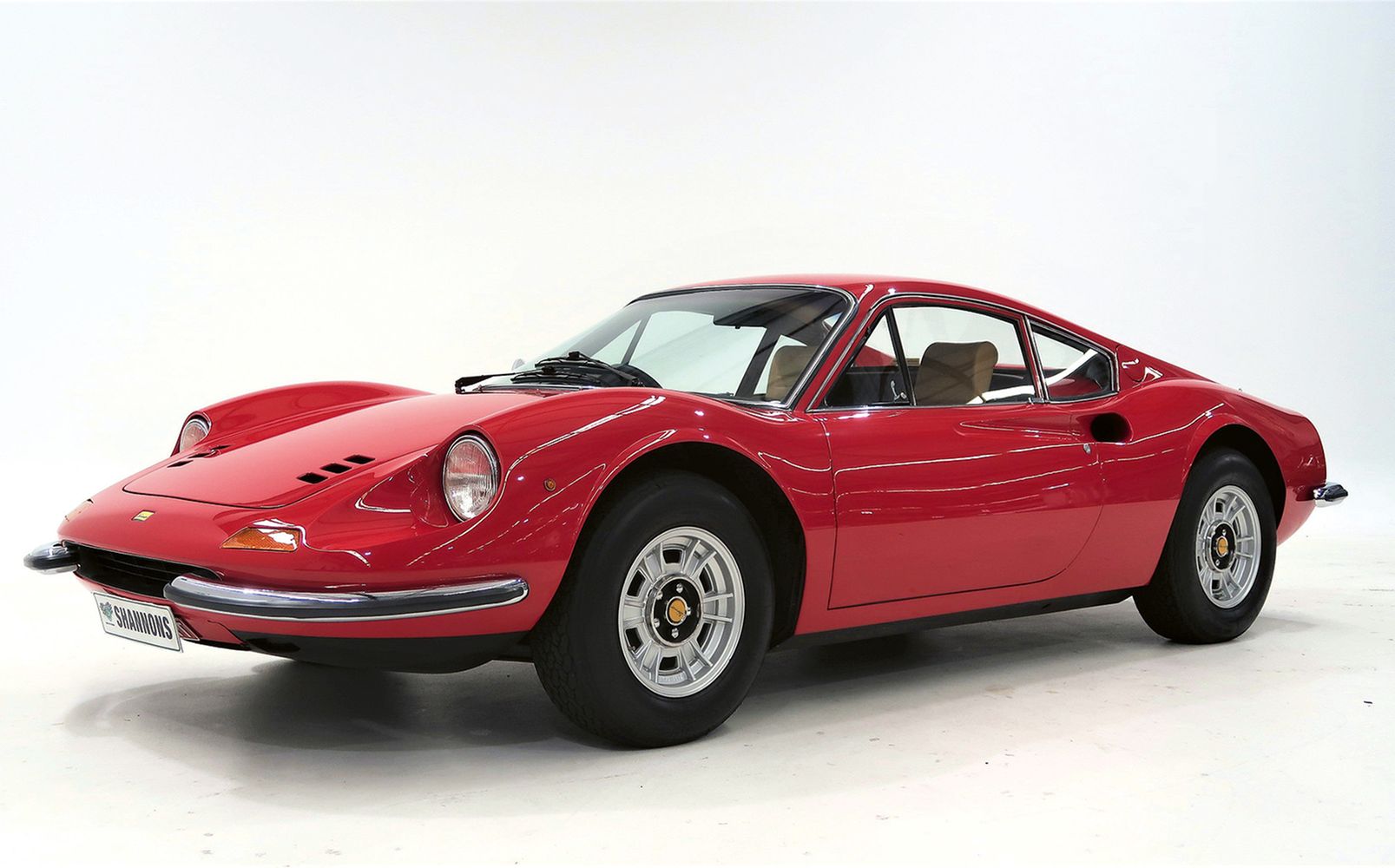
A total of 88 cars were sold at the Winter Auction, the most expensive of which was a 1971 Ferrari Dino 246 GT Coupe. On the other end of the price range, a 1965 Toyota Crown Deluxe sold for just $8700.
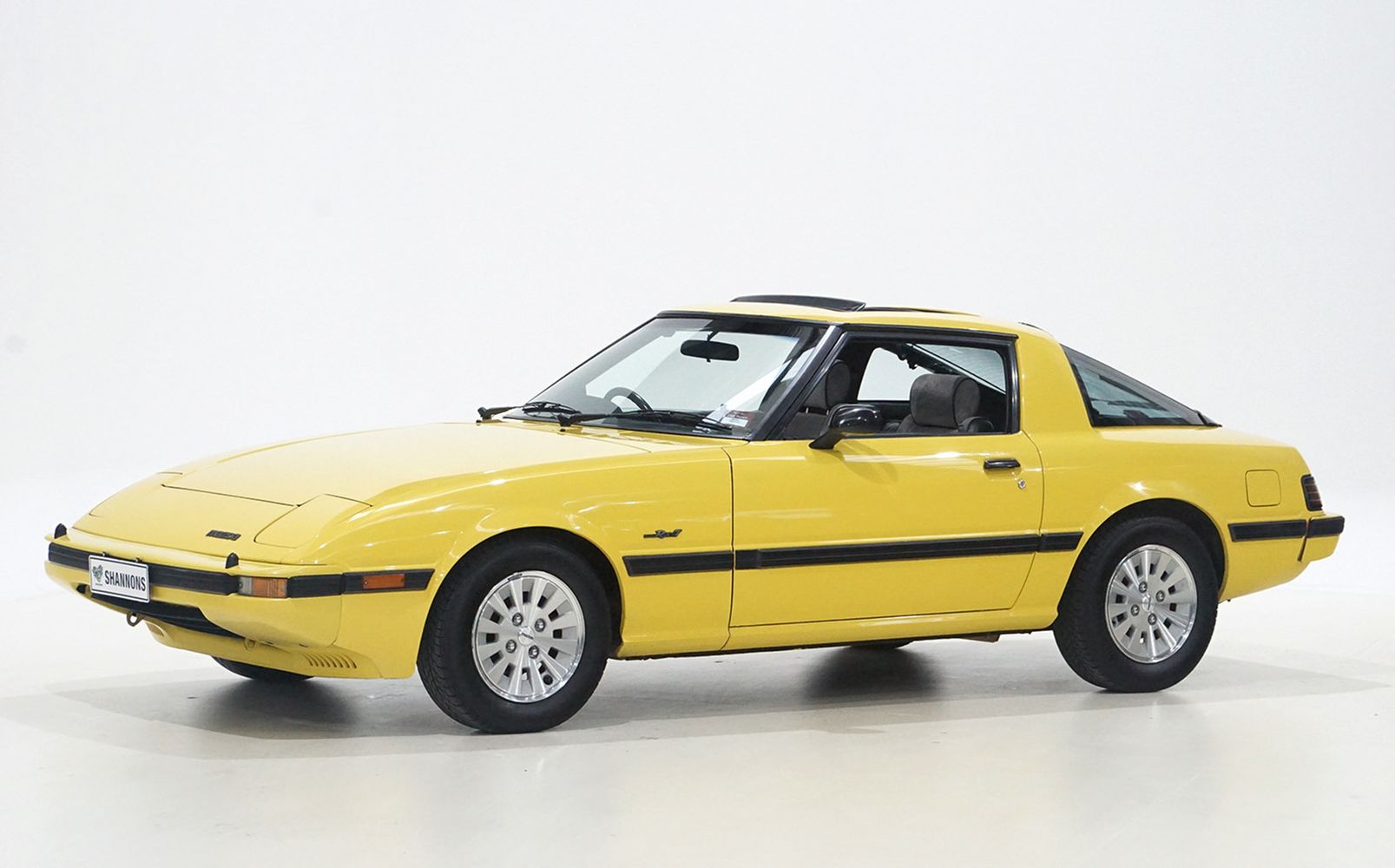
More Japanese highlights included a well-presented, first-generation RX-7 Series 3, which sold at $46,000.
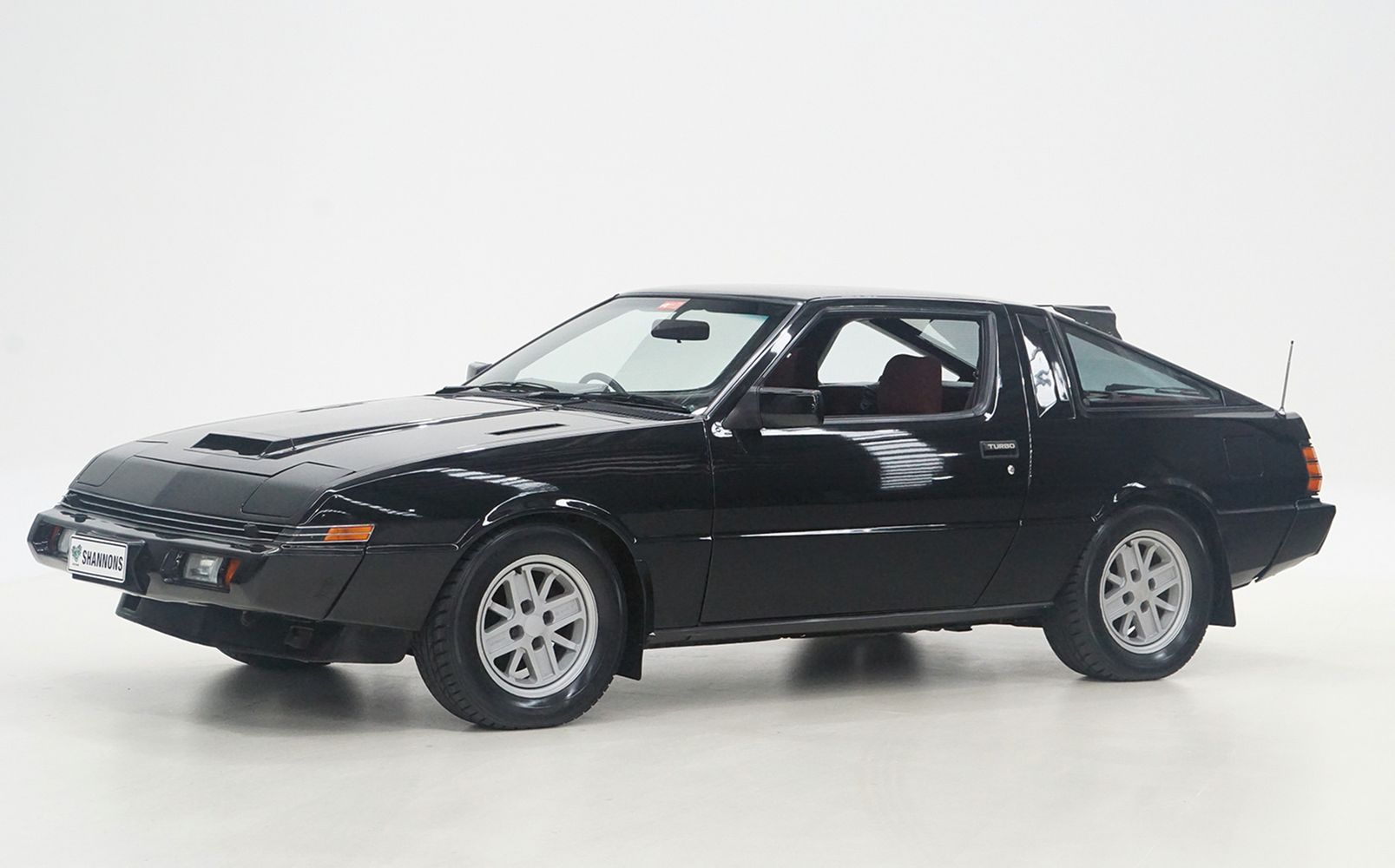
A manual factory-turbo Mitsubishi JB Starion coupe took $30,001, while a Toyota MR2 ‘Bathurst’ edition sold for $25,200.
Weight reduction was the goal of these stripped-down midships, with power steering, ABS and foglights deleted. 382 were made in total. Weight reduction was the goal of the stripped-down, mid-engined Bathurst MR2s, with power steering, ABS and foglights deleted; a total of 382 were made.
