
Snapshot
- Three new special edition variants available
- Prices start from $34,640
- Deliveries expected towards the end of June/beginning of July
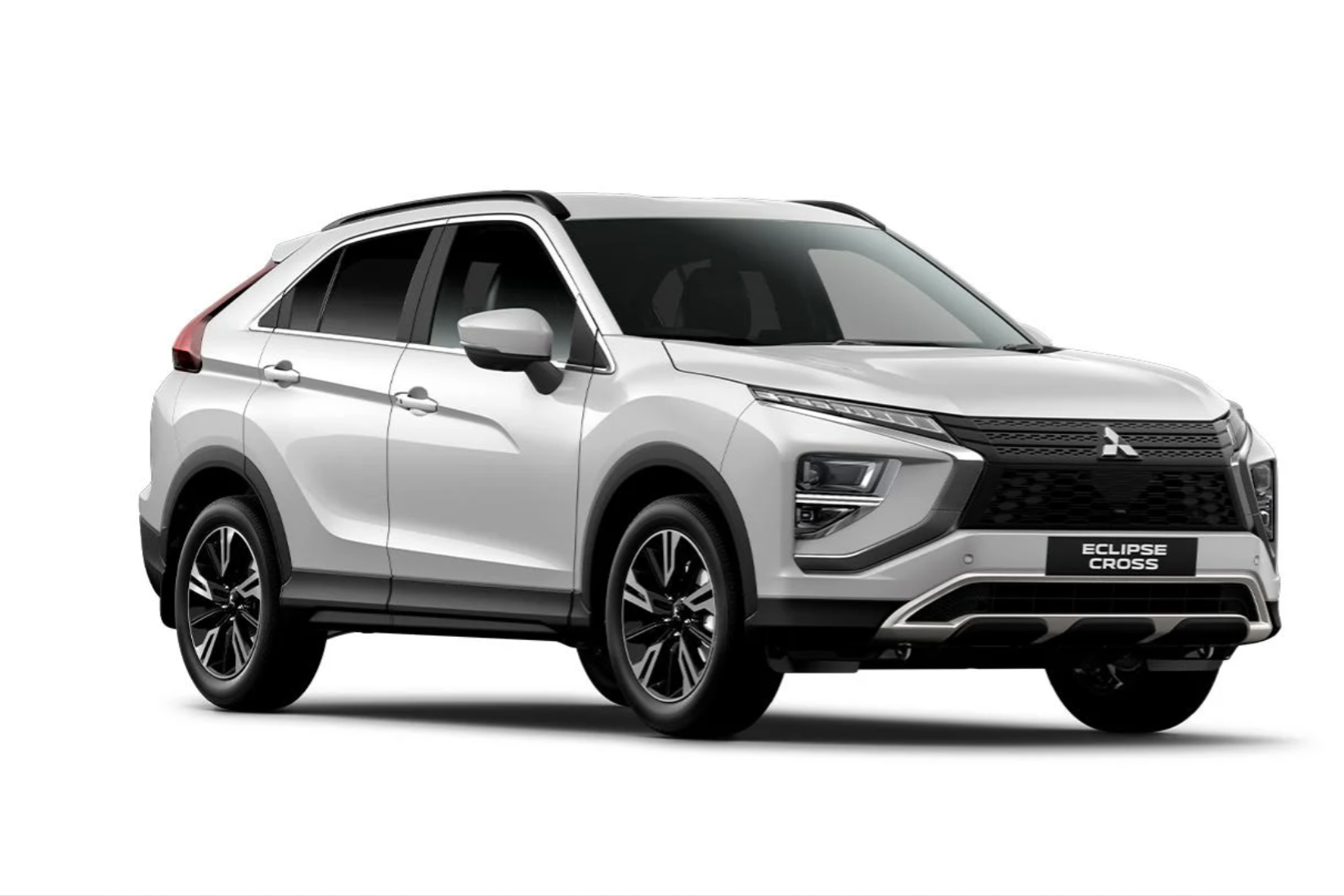
Mitsubishi Australia has revealed new Eclipse Cross special editions for the local market.
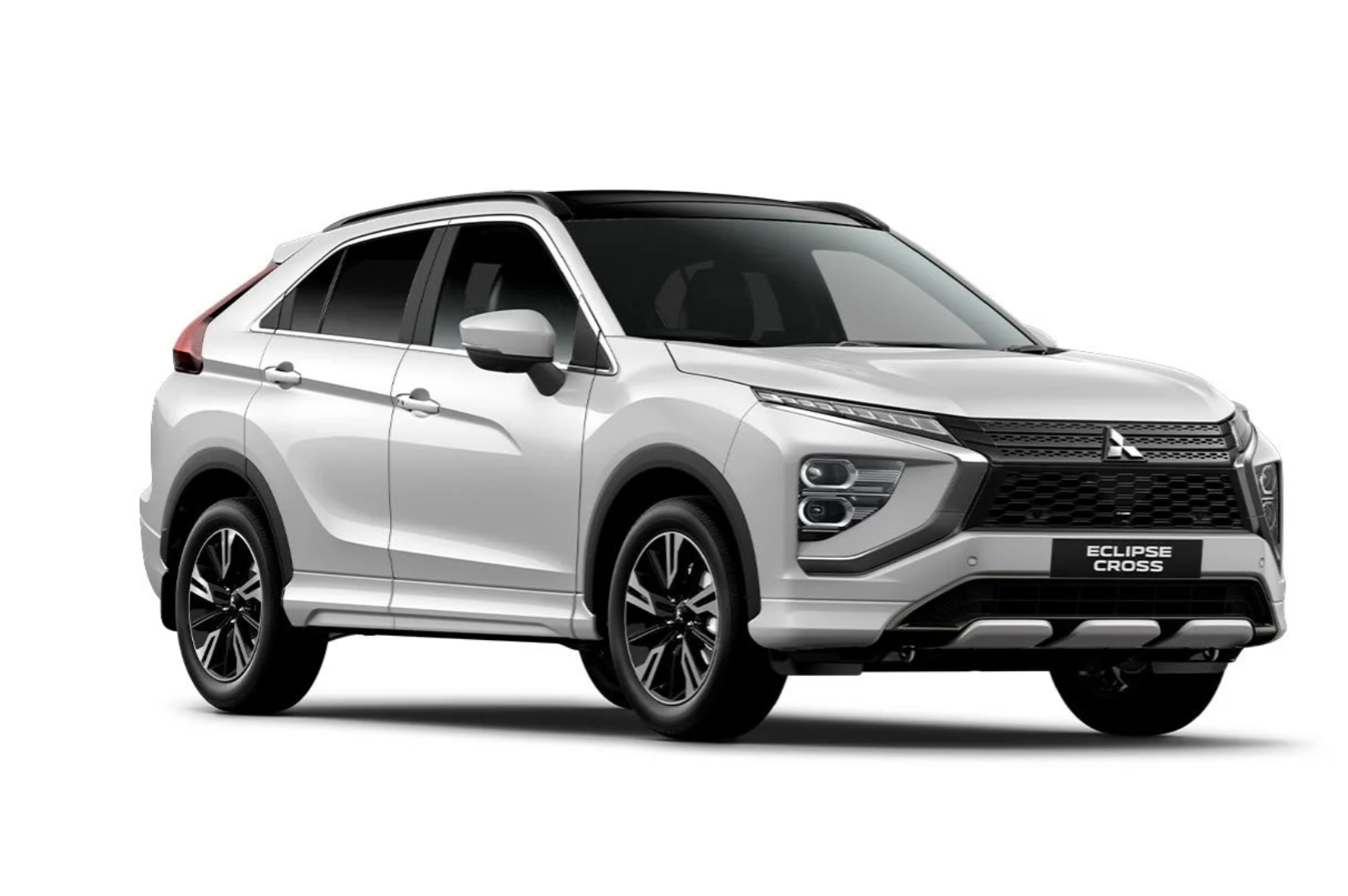
Called the XLS (which comes as a CVT and CVT Plus) and XLS Plus, the novel SUV crossover variants will sit alongside the Eclipse’s regular model range, which includes the ES, LS, Aspire, and Exceed.
The Eclipse Cross, which is based on Mitsubishi’s GS platform, remains a strong performer in the Aussie market, accounting for a 4.7 per cent market share of the sub-$40k small SUV segment, with 585 examples sold in May 2021.
However, the Eclipse’s high-riding sibling, the ASX, which also utilises Mitsubishi’s GS architecture and recently gained new special edition variants, sold more than double the amount of Eclipses last month, with 1202 units being shifted.
Pricing and model range
All three special edition variants of the Eclipse Cross are competitively priced in the model range (prices before on-road costs):
| 2021 Mitsubishi Eclipse Cross XLS 2WD CVT | $34,640 |
| 2021 Mitsubishi Eclipse Cross XLS 2WD CVT PLUS | $37,940 |
| 2021 Mitsubishi Eclipse Cross XLS Plus AWD CVT | $40,440 |
Engines, transmission, and fuel economy
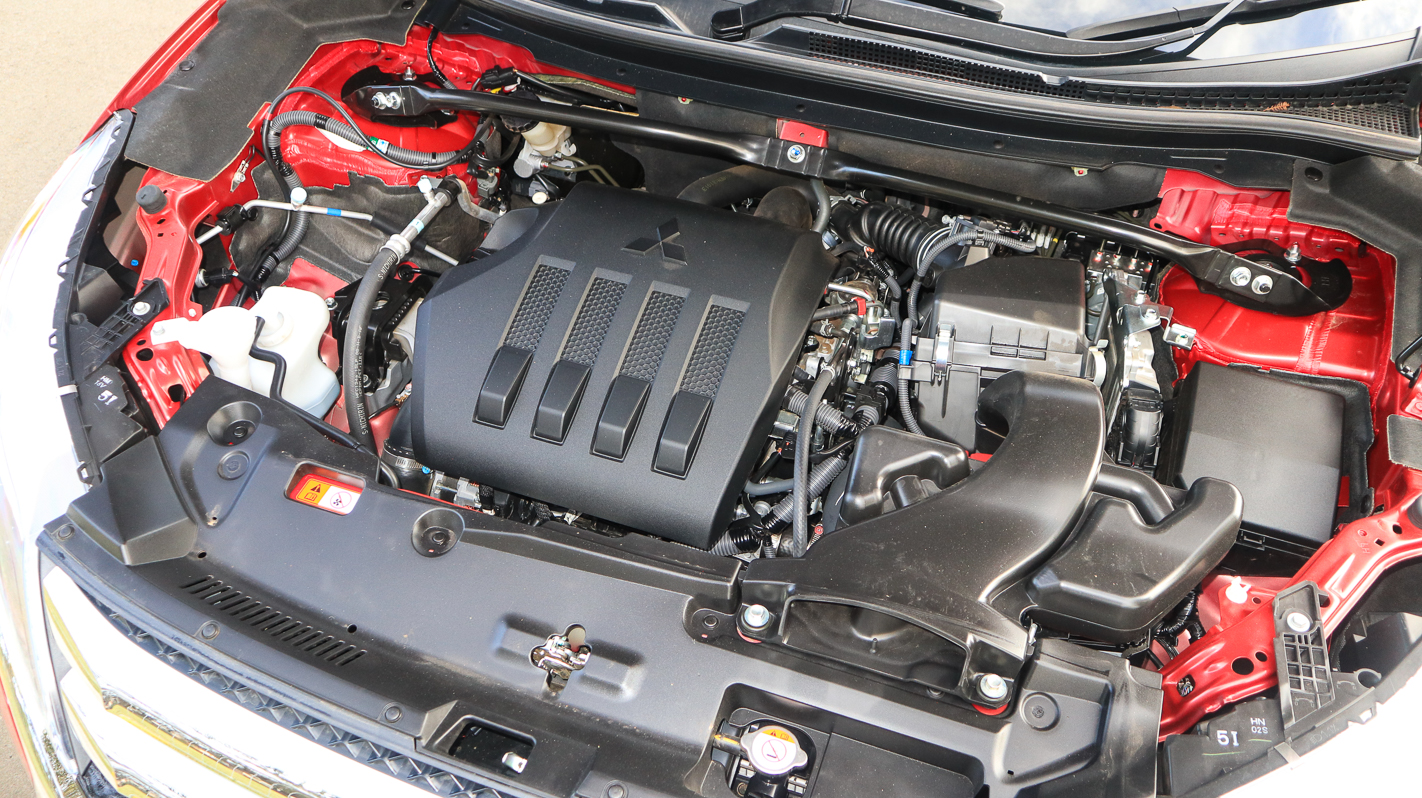
All Eclipse Cross special editions come equipped with Mitsubishi’s 4B40 turbocharged 1.5-litre in-line four-cylinder petrol engine.
Power is rated at 110kW and 250Nm, and all examples utilise a single-speed constantly variable transmission (CVT).
For the XLS variants, drive is sent exclusively to the front wheels, while the pricier XLS Plus scores all-wheel drive.
On the ADR combined cycle, the 2WD variants score a 7.3L/100km fuel economy rating, while the AWD version is slightly thirstier, using 7.7L/100km.
All examples are fitted with a 60 litre fuel tank.
Features
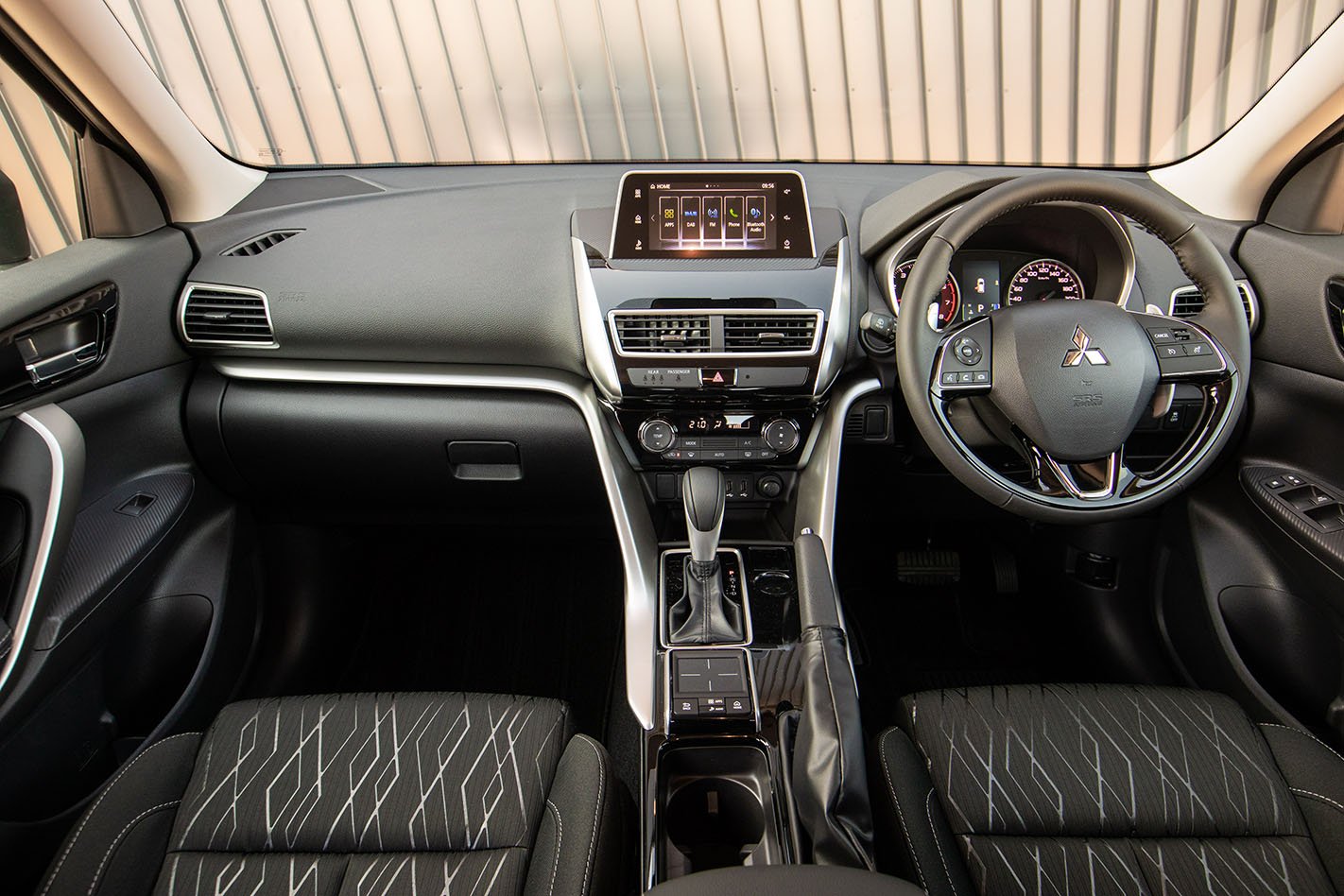
Both the XLS and XLS with CVT Plus come well equipped with standard options that include:
| 8.0-inch touchscreen infotainment display |
| Apple CarPlay and Android Auto |
| 18-inch alloy wheels |
| Four-speaker sound system |
| Cruise control |
| Paddle shifters |
| LED daytime running lights |
| Keyless entry and go |
| Rain-sensing wipers |
| Heated, power-folding exterior mirrors |
| Automatic headlights |
| Leather-wrapped steering wheel |
| Front bumper: piano-black paint with body-colour insert |
| Rear bumper: body colour with gloss-black insert |
| Gloss black radiator grille |
| Micro-suede/synthetic leather combination seat trim |
| Powered driveru2019s seat |
| Heated front seats |
| Dual zone air conditioning |
| Mitsubishi power sound system with eight speakers (four tweeters) |
The XLS Plus adds:
| LED headlamps |
| Double sunroof |
| Leather seat trim |
| Powered front passenger seat |
| Heated steering wheel |
| Satellite navigation |
| Head-up display |
Safety
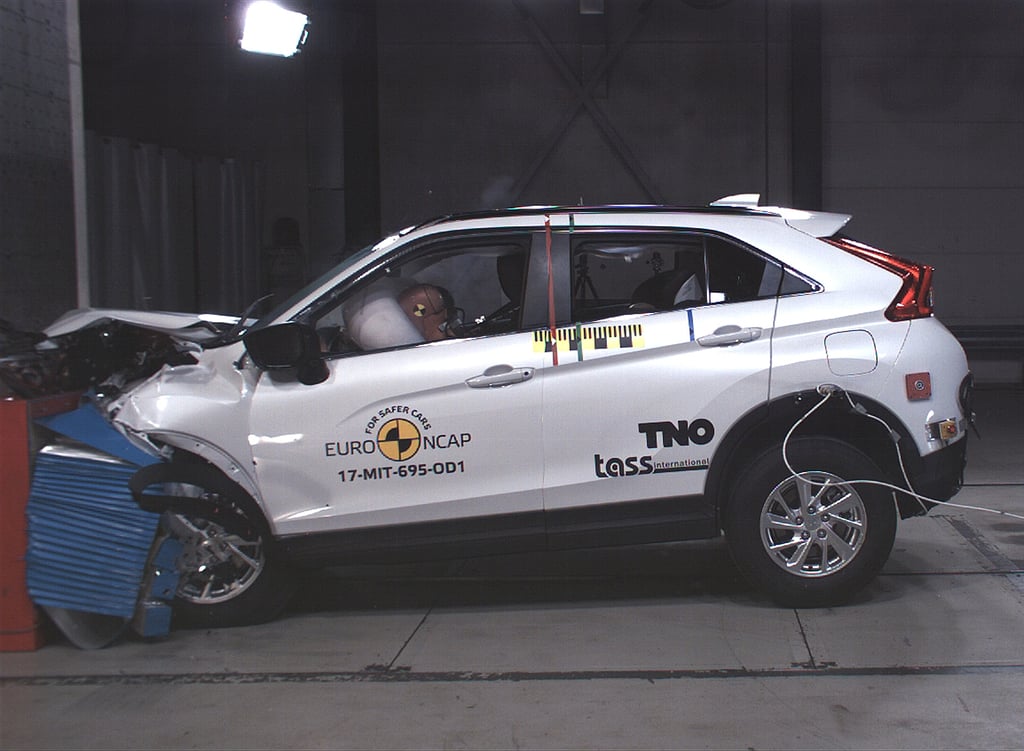
When the Eclipse Cross was tested by ANCAP back in 2017, it received a five-star safety rating.
All special edition Eclipse Cross variants score standard safety features such as:
| Front parking sensors |
| Rear parking sensors |
| Reversing camera |
| Lane-departure warning |
| Automatic high-beam |
| Adaptive cruise control with stop function |
| Autonomous emergency braking with forward-collision warning |
Dimensions, kerb weight and towing capacity
Like the rest of the Eclipse Cross range, these new iterations are 4545mm long, 1805mm wide, 1685mm, and have a wheelbase measuring 2670mm.
The 2WD examples have a kerb weight of 1480 kilograms, while the AWD variant adds an extra 65 kilograms, weighing 1545 kilograms.
Braked towing capacity for all versions is rated at 1600 kilograms.
Warranty and servicing
These new editions of the Eclipse Cross come with a 10-year/200,000-kilometre warranty, and capped price servicing for a period of 10 years is also available to purchase.
Availability
The special edition Mitsubishi Eclipse Cross variants are on sale now at dealers across the country, with a spokesperson for Mitsubishi Australia telling WhichCar customer deliveries are expected towards the end of June/beginning of July.
Snapshot
- Leno beat previous time in new Model S variant
- Record set at Famoso Raceway
- Model S+ set to be even faster
Jay Leno claims he has run a record-smashing 9.2-second quarter mile behind the wheel of a new Tesla Model S Plaid.
Speaking on the Spike’s Car Radio podcast, the TV host and famed car enthusiast says he ran the time at the Famoso Bakersfield Raceway. “I made one pass,” recounts Leno. “I drove up, [I] had the NHRA guys there to make it official. I turned a 9.247@152mph (245km/h). It was unbelievable!”
Until now, the fastest time recorded by a Model S was 10.45@126mph (203km/h), which was achieved by Tesla after rolling out the 2020 ‘Cheetah stance’ update.
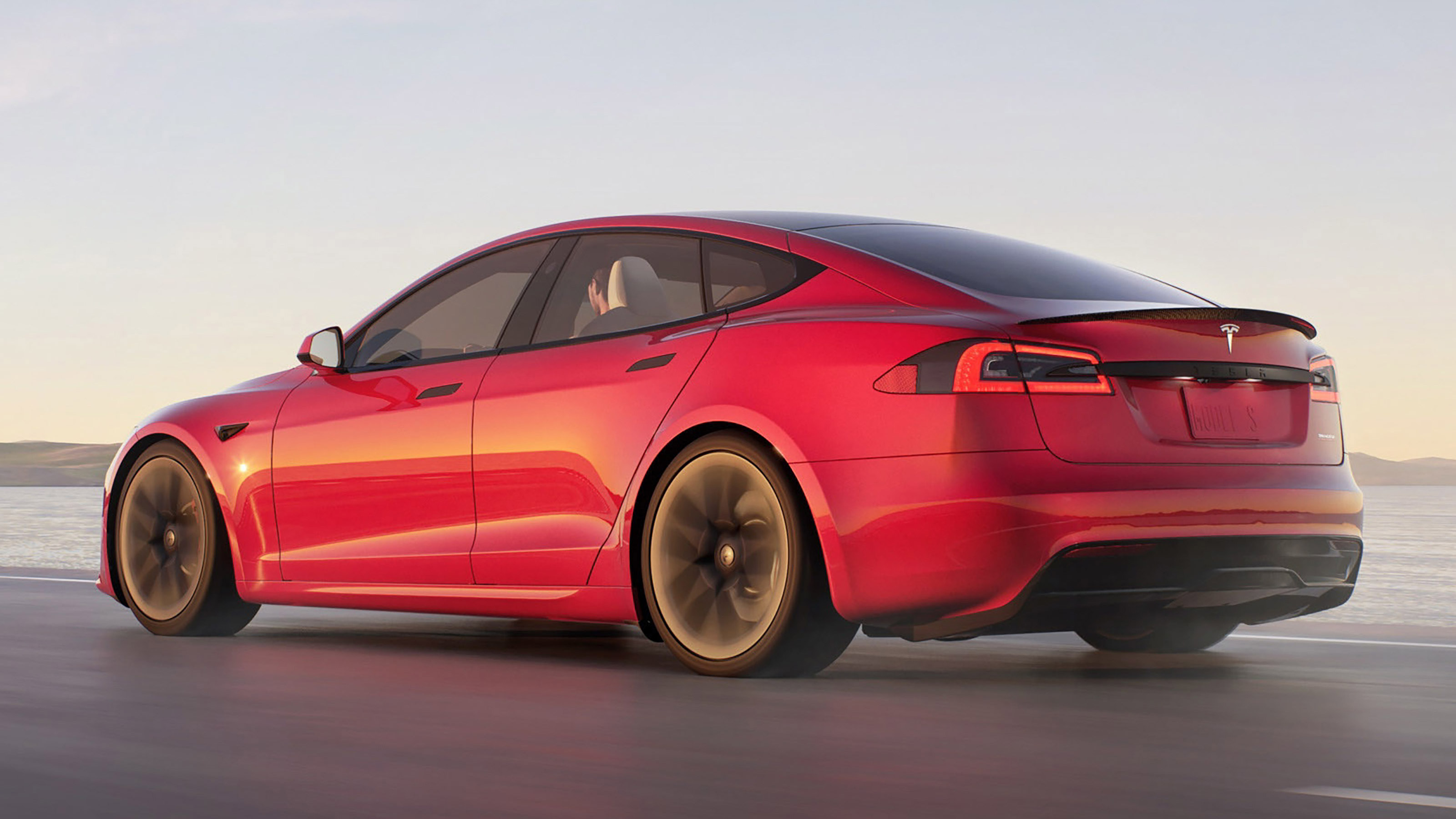
Leno heaps praise on Musk’s work with the Tesla line, reminding the hosts he’s talking about “a four-door car with the air conditioner on.”
The manufacturer’s website lists the Plaid with a peak output of 1,020hp (761kW), with a top speed of 200mph (322km/h). The 2022 Plaid+ again ups power to 1100hp (820kW), which Tesla claims will be enough for eight-second quarter-mile times.
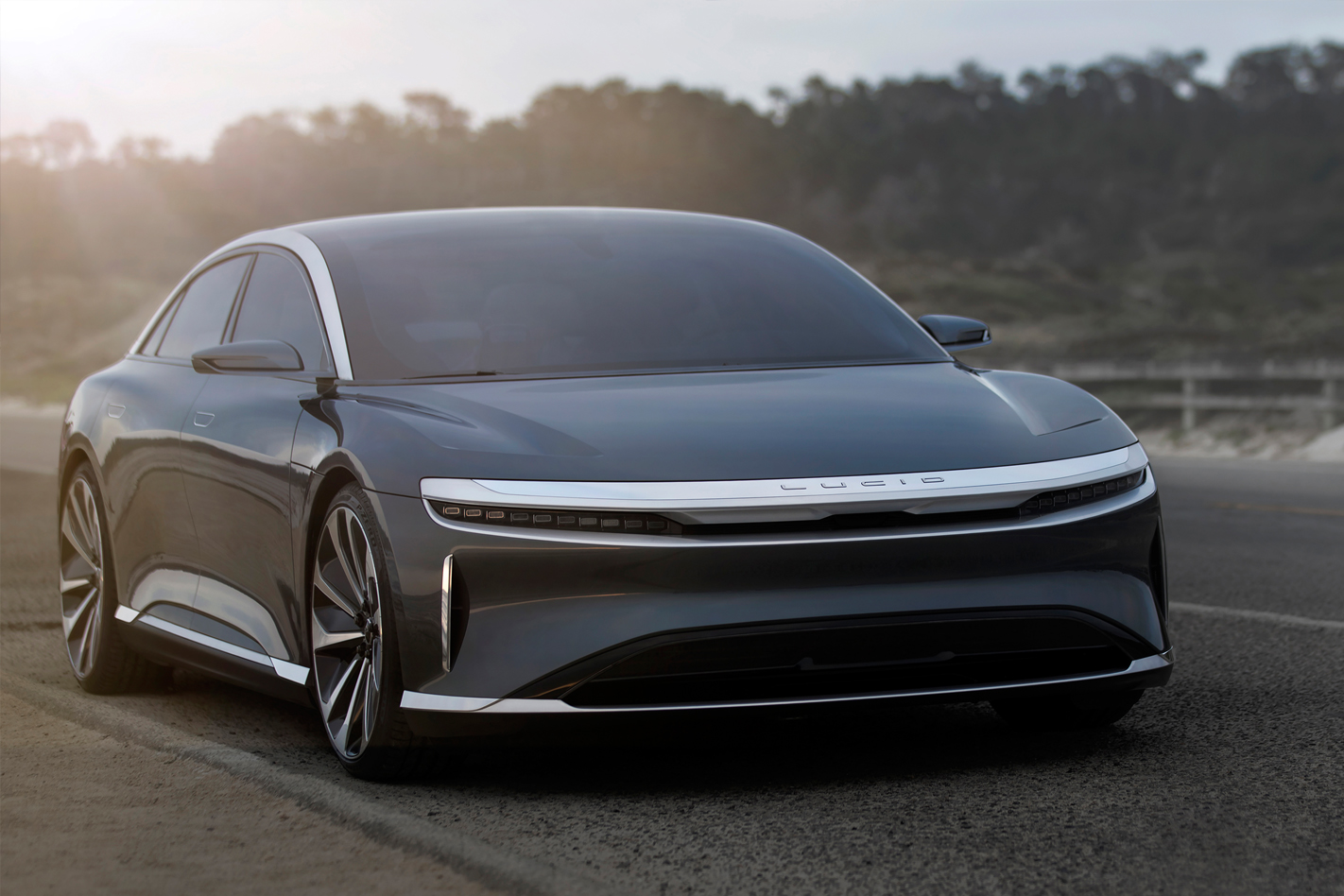
Tesla’s far from the only EV company to be aiming for big dragstrip numbers, with several competitors also recording sub-10-second time-slips. Upcoming rival marque Lucid has promised its Air model will run single-digit times, releasing footage of a prototype recording a 9.91@144mph (232km/h).
Also in the running is the Drako GTE, which claims its 1200hp (895kW) output will make it faster than the Tesla. However, with a price tag of $US1.25million (AU$1.6m), it’s a decidedly different vehicle from the sub $US150,000 (AU$196k) Model S Plaid.
“Competition is great,” says Leno on the podcast. “But it seems like Tesla is ahead of everybody else when it comes to battery technology…everybody else seems like pretenders to the throne to me.”
The Model S Plaid is now available to order in Australia, with delivery estimated to take place between September and October.
Snapshot
- 2022 Ford Maverick set to be officially unveiled this month in the US
- Expected to sell 110,000 units a year
- Fits under F-150 and Ranger in the Ford line-up
Ford USA has shared official teasers of the upcoming Maverick pick-up, set to be officially unveiled to the world on June 8.
A ‘compact’ truck which is smaller than the F-150 (the highest-selling vehicle in the USA), the Maverick will fit into the Ford family underneath the market leading F-150 and the Australian-developed Ranger and is expected to plug a sales gap between the two models.
The carmaker expects to shift 110,000 units annually – which is only 14 per cent of all F-150 sales, but around eight per cent higher than Ranger sales, Ford having shifted just over 100,000 units last year in the States.
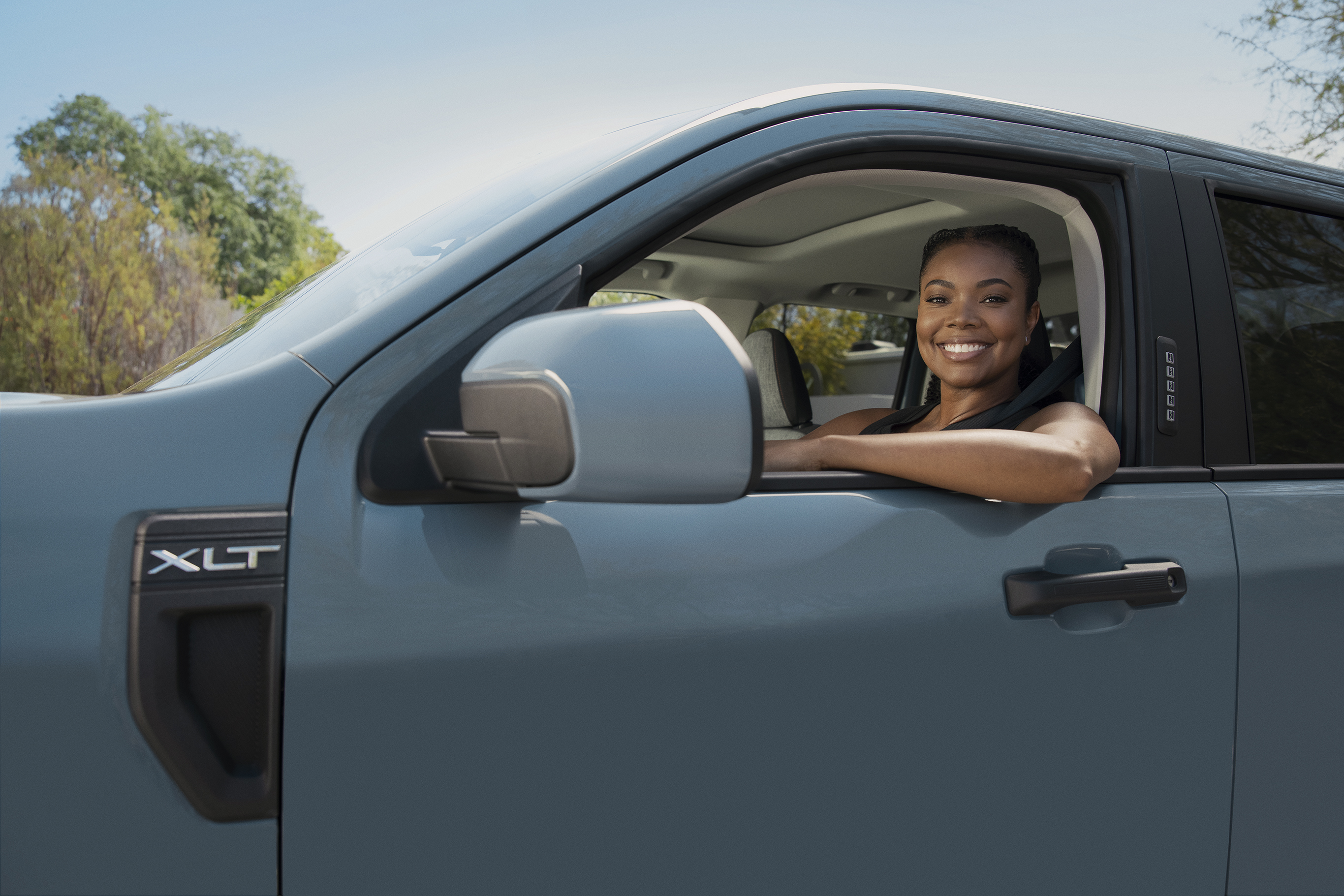
The Maverick will be based on the same C2 monocoque platform as the Bronco Sport and Escape, this time with a dual-cab truck body on top with two turbocharged engine options, either a 1.5-litre three-cylinder producing 135kW/258Nm or a 2.0-litre four-cylinder developing 183kW/373Nm.
Starting out as front-wheel-drive only, Maverick buyers will be able to upgrade to all-wheel-drive as an optional extra, with the engine’s power being delivered to the axles through an eight-speed torque-converter automatic in all iterations.
No plans are being made for the Maverick to come to Australia though Ford hasn’t ruled out a right-hand-drive being made available for the moment.
We’ll bring you more news about the Maverick when it is revealed next week.
Snapshot
- Survey of European drivers found a higher average distance driven by EV owners than ICE vehicles
- 70 per cent of EV drivers experience better range than expected
- High levels of satisfaction with European infrastructure
A study of 7,000 European drivers has shown fully-electric vehicles are clocking up the most kilometres on the roads each year, being driven more on average than their petrol and diesel counterparts.
The research commissioned by Nissan, found, on average, EV drivers travel more than 14,200km annually, while owners of internal combustion engine (ICE) vehicles commute 600km less.
Based on pre-COVID data, the study also looked at attitudes towards EV ownership and operation, not only from the owners of electric vehicles but also those who have their doubts about embracing the technology.
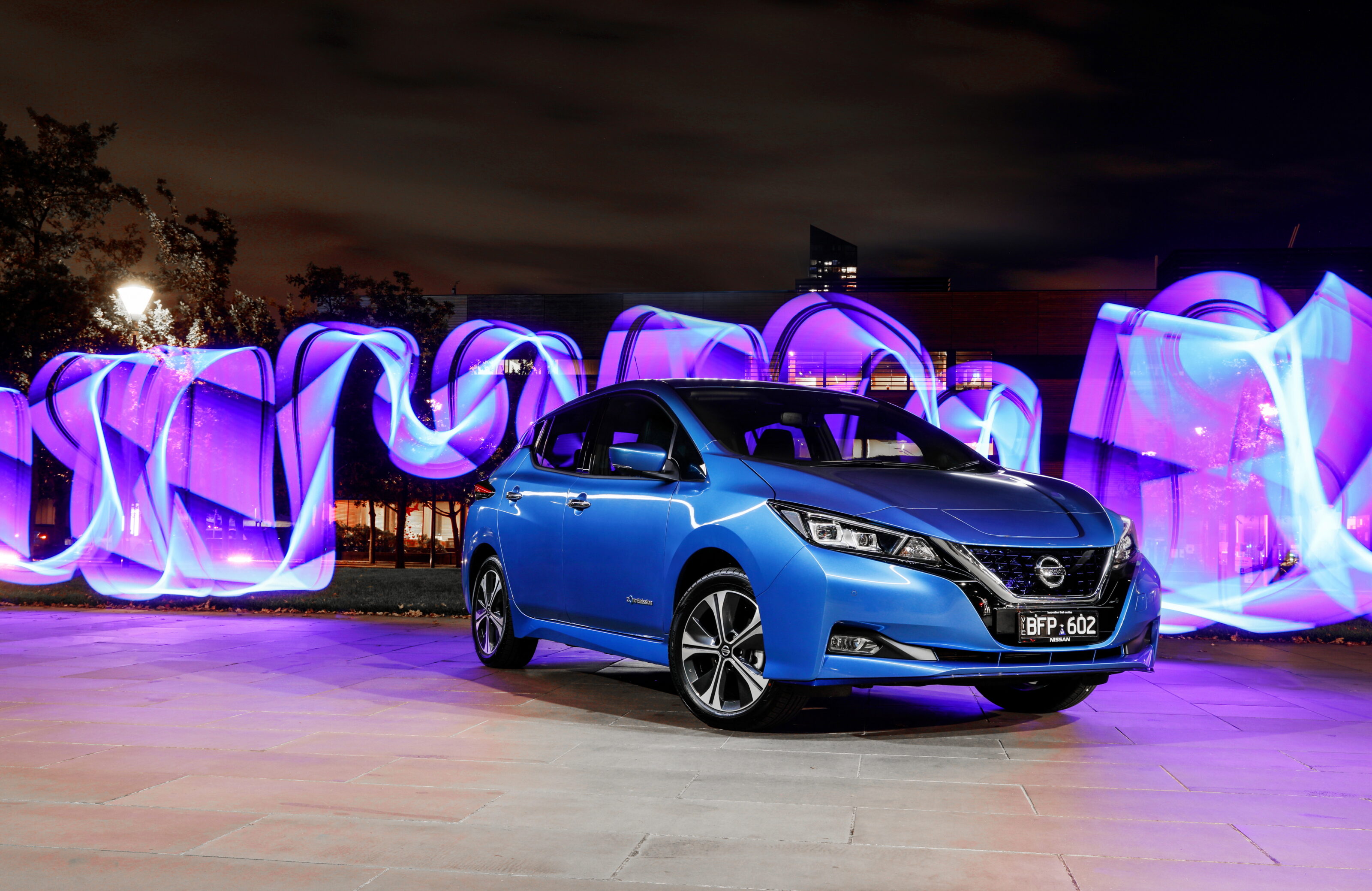
A large majority of existing EV owners are happy with the infrastructure in place, 69 per cent responding they’re satisfied with the charging accessibility available with only 23 per cent saying the most common myth about EV ownership is a lack of infrastructure.
Despite the seemingly high levels of satisfaction within those who already own an EV, 56 per cent of respondents who weren’t considering purchasing an EV said they won’t consider investing in electric due to a lack of charging points, while 30 per cent stated better infrastructure would convince them to make the switch.
While 47 per cent of ICE car drivers believe getting a better range from fuel is the reason not to make the switch, EV owners think differently. In the survey, 70 per cent of people regularly driving an EV responded they had been experiencing better range than expected and 28 per cent stated running out of charge is a myth.
The EV community was also asked to respond to some of the misconceptions surrounding electric cars, with 31 per cent believing the biggest falsehood is a higher cost than ICE vehicles, while 30 per cent think charging time is the biggest reason which turns people off.
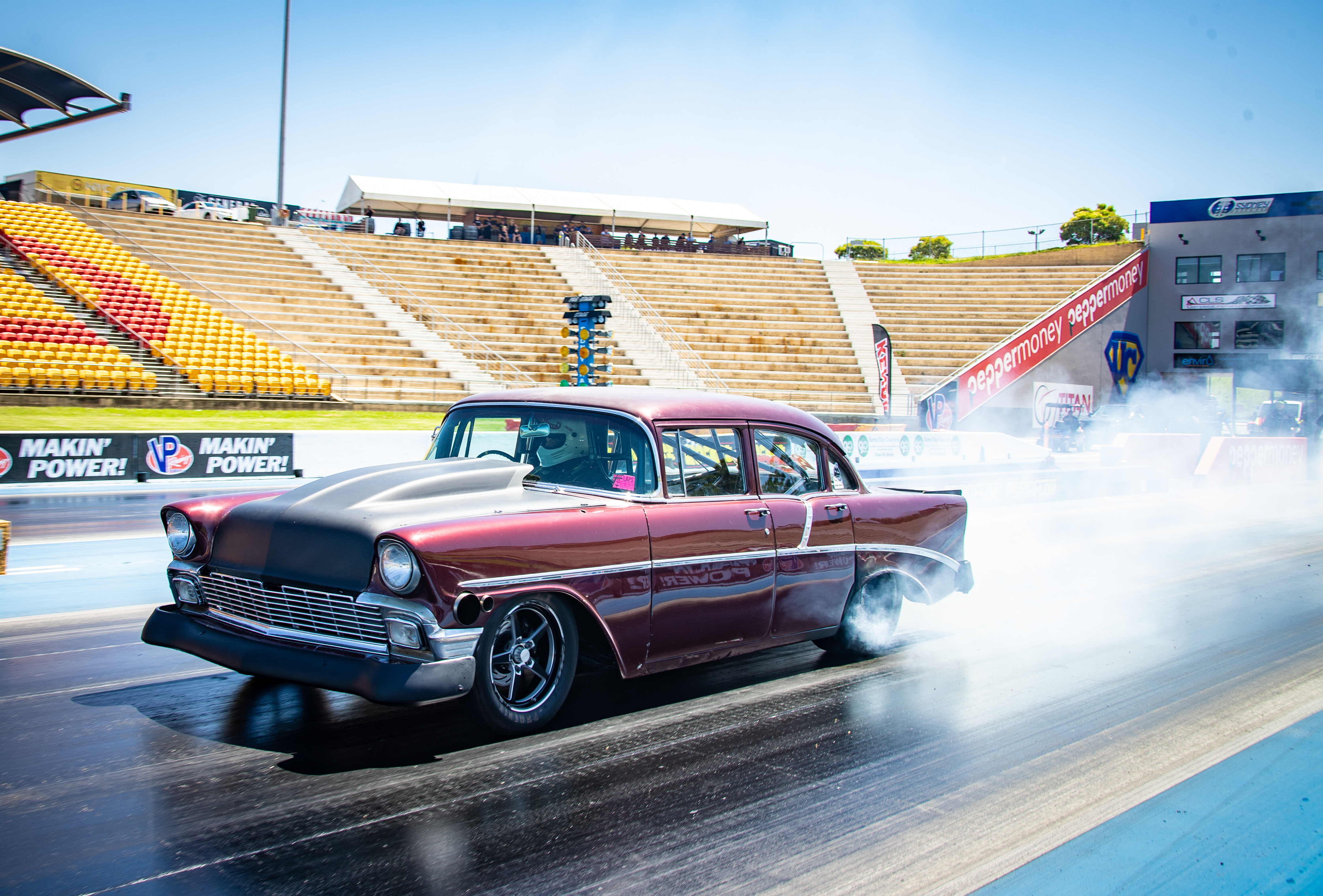
Nissan AMIEO Vice President, Arnaud Charpentier, believes the research will help persuade more people towards EV ownership.
“This research reiterates that electric driving is not only a smart option beneficial to the environment but also a fun, exciting and convenient choice for the owners,” said Mr Charpentier.
“It is no surprise that people now drive EV further than ICE cars. We are confident that with more EVs on the road dispelling myths, range anxiety will soon be in the past.
“With EVs on the cusp of wide-spread adoption, we can be confident these positive findings should help change the opinion of the ICE drivers for whom a degree of range anxiety is still preventing them from converting to electric mobility.”
Nissan Australia currently only sells one EV vehicle Down Under, the Leaf, which entered production in 2010 and is available in two variants.
Introduction: Quick. Silver
Is this the Swiss army knife of small Mercs?
Comparisons can be odious. I’d rolled in to pick up my new long-termer in a Mercedes-AMG A 45 S. I’m going to nail my colours to the mast in quite spectacular/foolhardy fashion here and declare this the most talented hot hatch that’s ever been built. Not going to say best, but without a doubt the most capable. What’s more, the A45 was retina-melting yellow with black contrast alloys. Punchy.
And there, sitting in a forlorn corner of the car park was the vehicle I was due to pick up, an AMG GLA 35 in resale silver. Still very agreeable, but I’d be lying if I didn’t feel that I was arriving with Kim and leaving with Khloe. The A45’s taut focus was replaced by something a bit suburban and, well, adipose. Couple that with a black and red interior that looked as if someone had just flayed a Wiggle and I was left wondering if this was going to be a relationship I’d gel with at all.
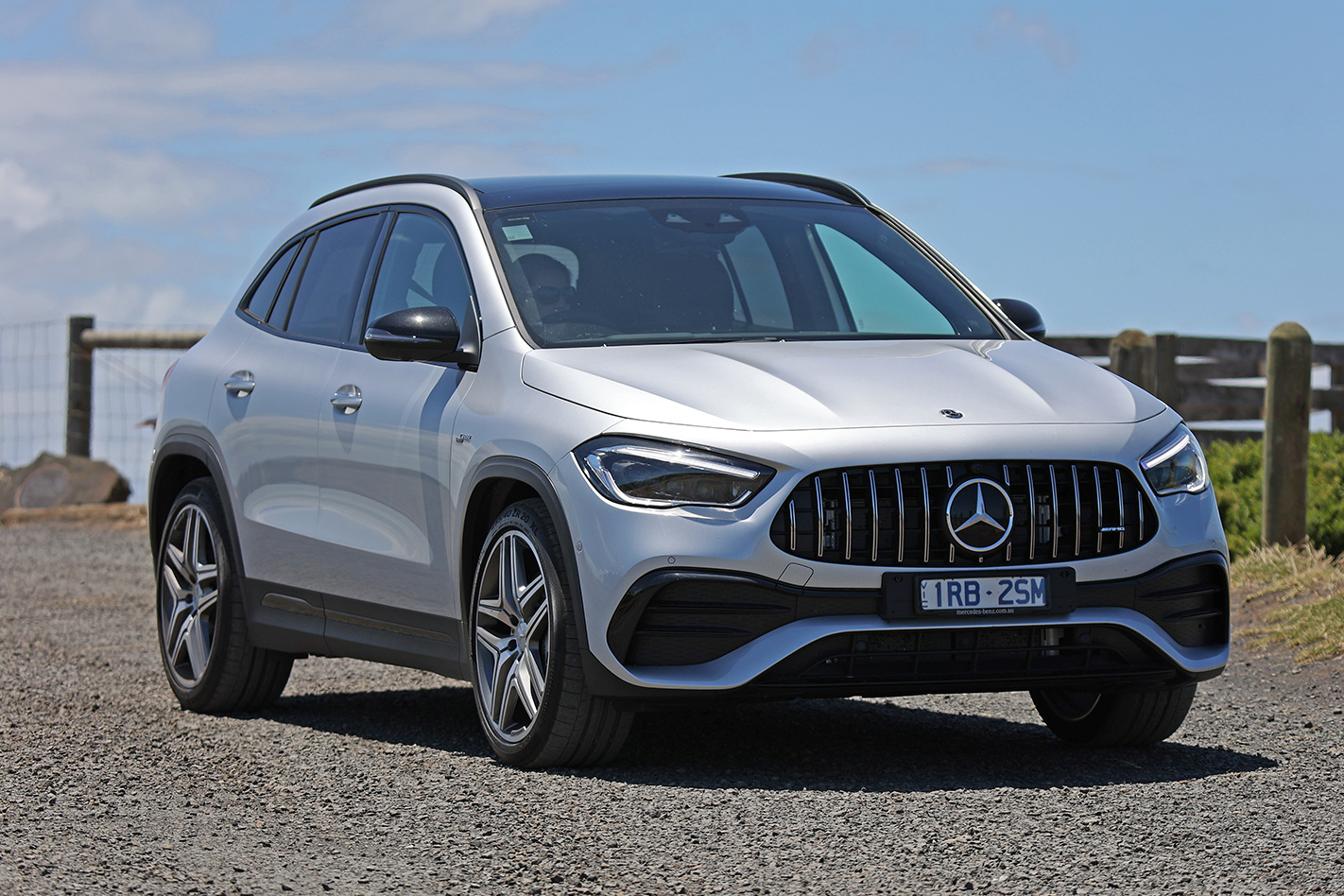
Things picked up rapidly. The seats offered a good deal more padding than the A 45’s cushions and squabs, which aren’t too far off park bench spec. There’s also a stack more headroom, which prevents the cultivation of an Oakley-shaped dent in my scalp on bumpy roads. Finally, there’s a bit more in the way of ride height which, given that plenty of roads from the back of my property are still dirt, certainly gets a tick of approval from me.
I did note that the glitzy piano black transmission surround from the A 45 had been replaced by a more proletarian black plastic, but that’s perhaps no bad thing as it won’t show up fingerprints quite so readily. This being a 35 rather than a 45, there’s no race mode in the manettino dial underslung from the right-hand steering wheel spoke either, but Sport Plus delivers enough whoomphs and bangs from the exhaust to earn the stink-eye from the next door neighbour when he’s working nights.
About the biggest compliment I can give the GLA 35 is that even after stepping out of the hellion A45 S, it didn’t feel slow. A sprint to 100km/h of 5.1 seconds is entry-level Boxster/Cayman quick and I’d bet on the all-wheel drive Merc’s easy repeatability of those numbers every time. I haven’t yet tuned into the optimum permutation of the drive modes, so did the usual and set the Individual mode to comfort suspension and angry everything else. This resulted in a measure of heave, queasiness and generally lax body control on lumpy roads.
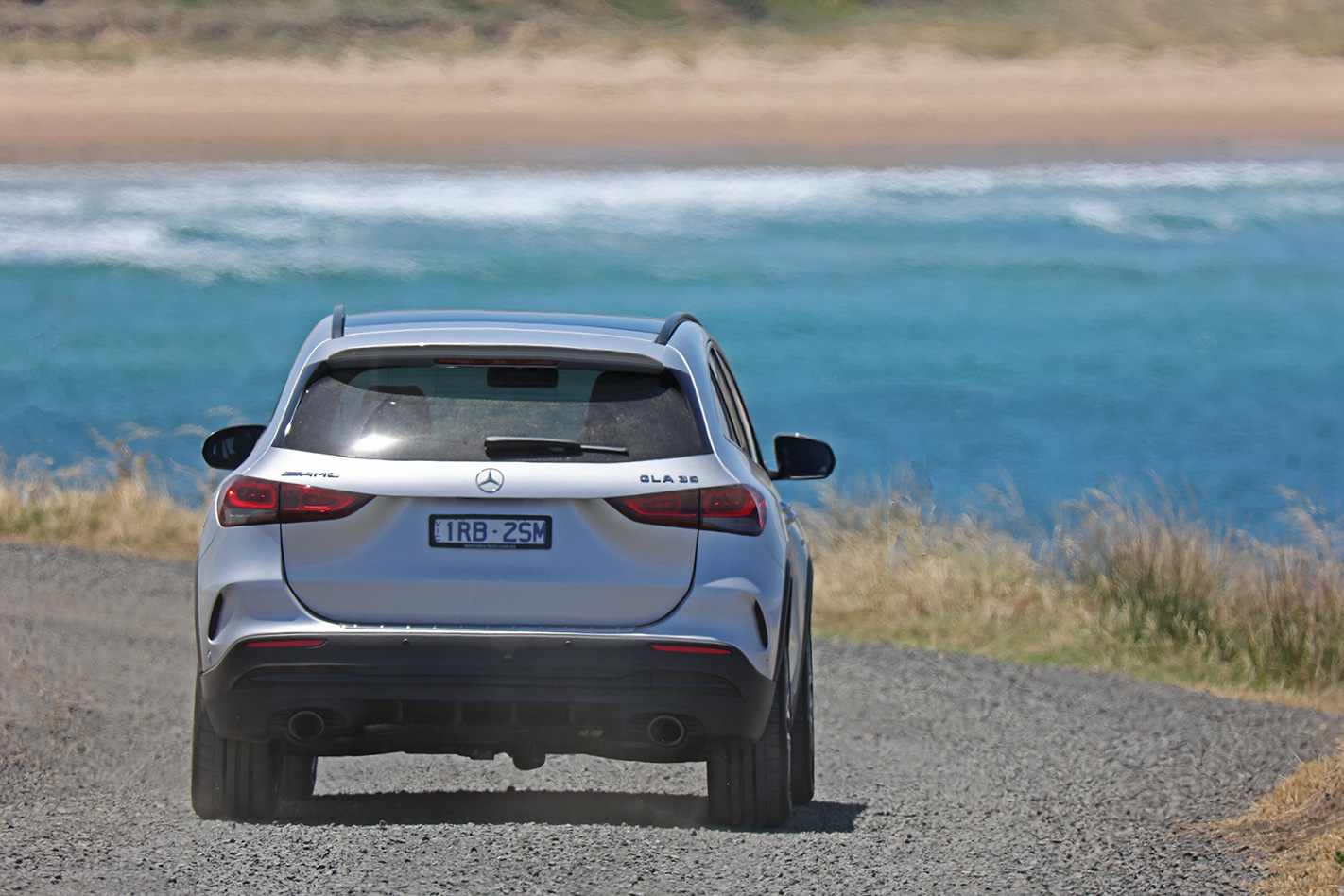
Lashing it down a bit more firmly cuts out the bilious float, but also introduces a measure of nerviness into the secondary response. The ContiSport Contact 6 tyres also resonate a little on coarse chip, but certainly not to the extent of the lower-profile Pilot Sport 4S rubber fitted to the A 45 S.
One curious quirk I’ve encountered is that the GLA 35 is entirely intolerant of the sort of casual tickling of revs at a red light to prevent the idle-stop actuating. Even with a faint breath of revs and the right clog on the brake, it can actuate the launch control system, which then gets itself into a pickle if you pull away gently, jerking inelegantly. I’ll probably just get used to killing idle-stop altogether, as the button is conveniently located adjacent to the starter button.
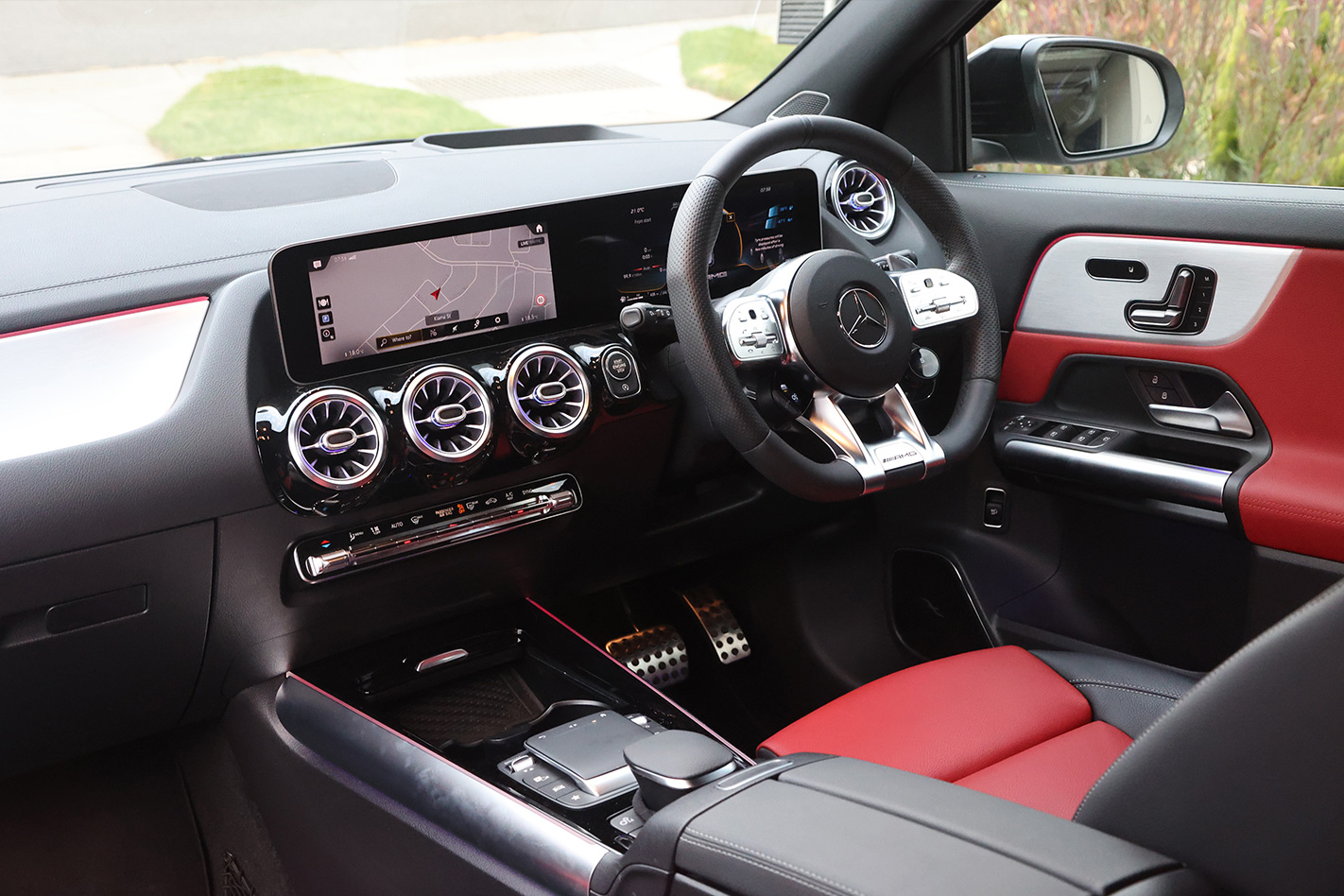
I’ve never run a Mercedes with the MBUX infotainment system as a long termer, so will probably need to pick ex-Wheels Editor Alex Inwood’s brain on how to get the best from it. The voice assistant chimes in with annoying frequency if you so much as mention the word ‘Mercedes’ in the vehicle and it’s now referred to as ‘the M word’. I’m already starting to have nightmares about sitting in an automated car wash and having somebody shout, “Hey Mercedes, open sunroof” at me through a megaphone. I’m putting off the inevitable with the easy familiarity of the car’s excellent wired Android Auto connection.
There’s certainly a steep learning curve involved with the AMG GLA 35 but that often bodes well for a good long-termer, the vehicle revealing itself little by little over the course of an extended tenure. I’m already loving how easy it is to flick the eight-speed dual-clutch into manual mode, or firm up the dampers for a particular set of corners. I get the impression that the complexity of this car means that no two users will ever interact with it in quite the same way. Every time I drive it, I discover a new function. This could continue for quite some time. Some buyers will love that, while others might find such depths unnerving.
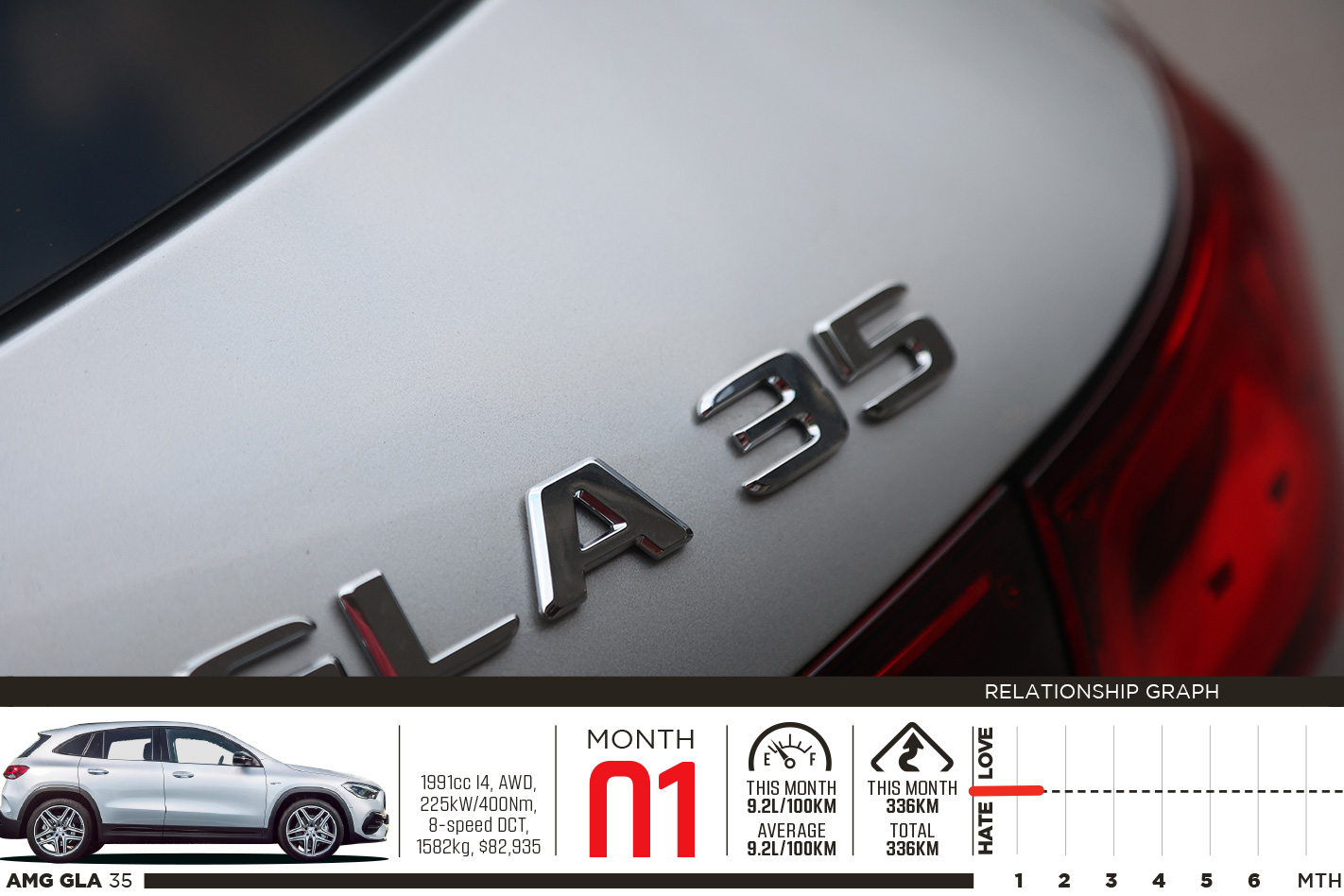
While I’m still trying to get under this GLA 35’s skin, there’s something grin-inducing about running a car that’s as quick as a VFII SS-V in a straight line, which can clamber up my Lhotse Face of a driveway, easily seat four grown-ups, yet drink fuel at a modest 7.4L/100km. In theory. More on that later.
Things we love:
1. Quick enough 2. Exhaust sounds 3. Headroom
Things we rue:
1. Keen launch control 2. Red/black trim 3. Floaty in Comfort
Update 1: Head for the Hills
Enright tries to find the road where the GLA 35 works best
I DROVE A LONG WAY TODAY, in a bid to find something elusive. In just over a month with the Mercedes-AMG GLA 35, I’ve never quite keyed into its whole ride/handling balance. In short, the default Comfort mode is a bit of a soufflé for dynamic driving, while on the other hand, any of the firmer drive modes deliver crisper handling albeit at a severe impost in terms of ride quality.
To that end, I sketched out a 300km drive loop that delivered a mix of road conditions: a rolling country route to Yarra Junction, replicating the Timber Trail route driven in the Jaguar F-Type R in December’s issue of Motor, following that with 25km of dirt on Mt Baw Baw’s awesome South Face Road, and then freeway back home to mine in south-east Melbourne.
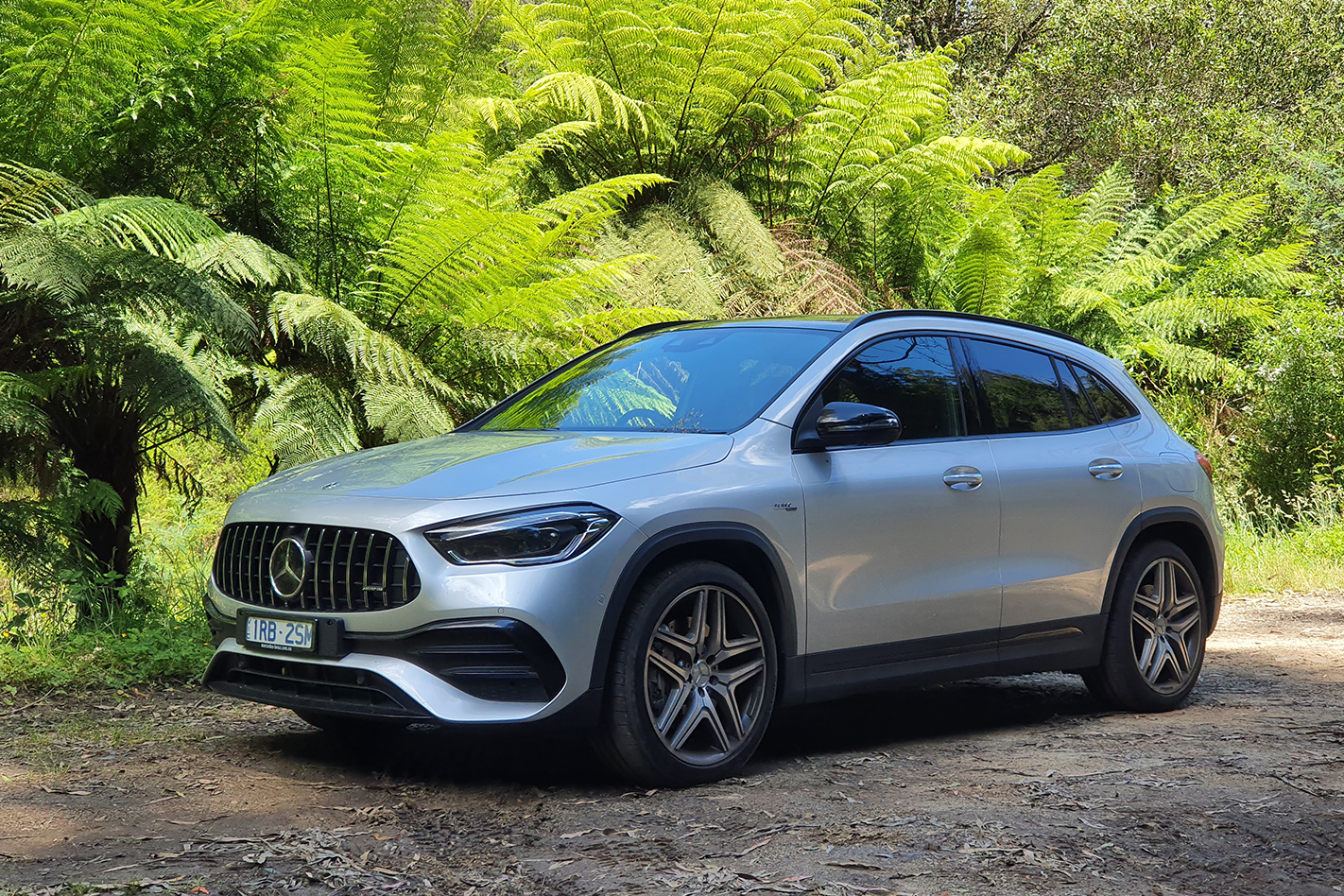
On gently meandering roads, Comfort is fine, yet a bit floaty. Anything that requires a little more commitment through a corner finds that drive mode wanting. The GLA wallows inelegantly onto its outside front hoop, and there’s an uneasy relationship in the kinematics between the front axle’s response and the gearing of the electrically assisted rack.
Click into Sport and things become better, but the roads where this mode pays dividends are patchy, and sharp jolts come smashing through the GLA’s superstructure. Same with Sport+. Only on the smoother bitumen on the final stretch up to Baw Baw Village does the AMG feel properly composed, and there’s proper grin-inducing fun to be had here. Then comes the long dirt section.
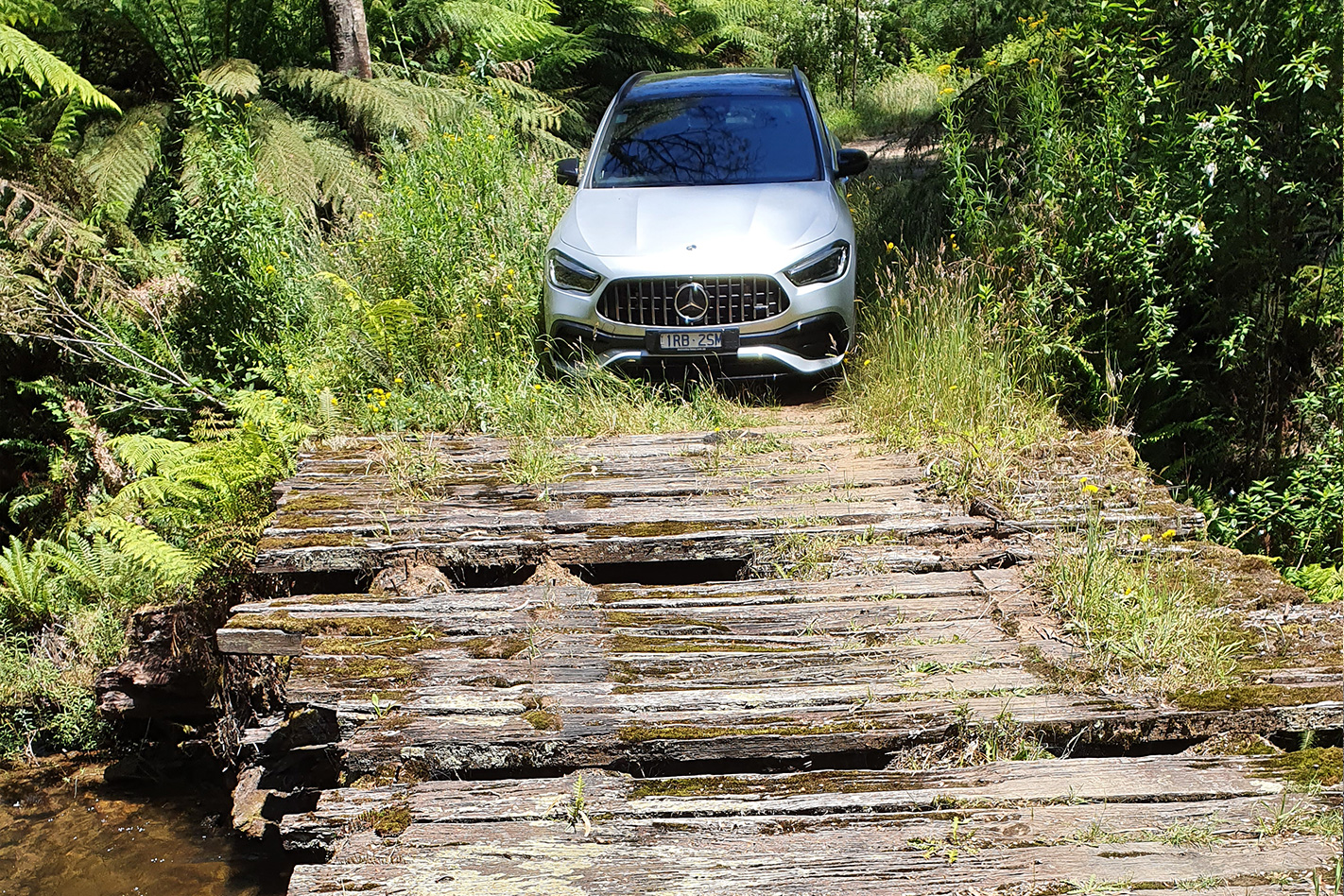
South Face Road isn’t your usual dirt track through the woods. It’s built for vast logging trucks and as a result feels weirdly supersized. Deserted too. You can pick a line and play with it, unsettling the car on the way into these sweepers and nudging it in and out of neutrality with the throttle. Some of these sweeping bends are fast and tree-lined though, so it’s best to temper the heroics. A slight ache in my core muscles shows that the seats want for lateral support, but the driving environment is otherwise good.
The freeway schlep home impresses with one of the very best adaptive cruise control systems I’ve ever used, coupled with a great stereo. I stop for a bite to eat at a servo and I’m reminded of a curious, not to mention painful, issue with this car. All three people who’ve driven the GLA since it’s been in my tenure have managed to open the driver’s door into their shins. We all now sport matching red welts where the bottom corner of the door angles back far more sharply than you’d expect. I manage to absent-mindedly clout myself again.
Nursing a sore shin and a bucket of coffee, I try to order my thoughts. It’s clear that the GLA 35 AMG offers a broad dynamic skill set, but it’s not one of consistent competence. There’s no mode that delivers the sort of sinewy, jinky low-speed fun that you’d expect from this car, one of crisp steering, sharpish throttle, firm anti-roll yet finessed damping. At the same time, it’s still a covetable thing and otherwise lovely to live with.
I’d struggle to look past a Volvo XC60 T6 R-Design on air were I in the market for a quick, stylish and compact SUV for $80-odd grand, but I can see why the AMG will appeal to buyers looking for slick tech and a flintier attitude.
The longer I spend with the GLA35, the more I admire it. Like some people, the more interesting ones are sometimes the ones that take the longest to get to know.
Things we love:
1. Great lights 2. Fast seat heaters 3. Great HUD
Things we rue:
1. Sore shins! 2. Unsettled ride 3. No Race mode
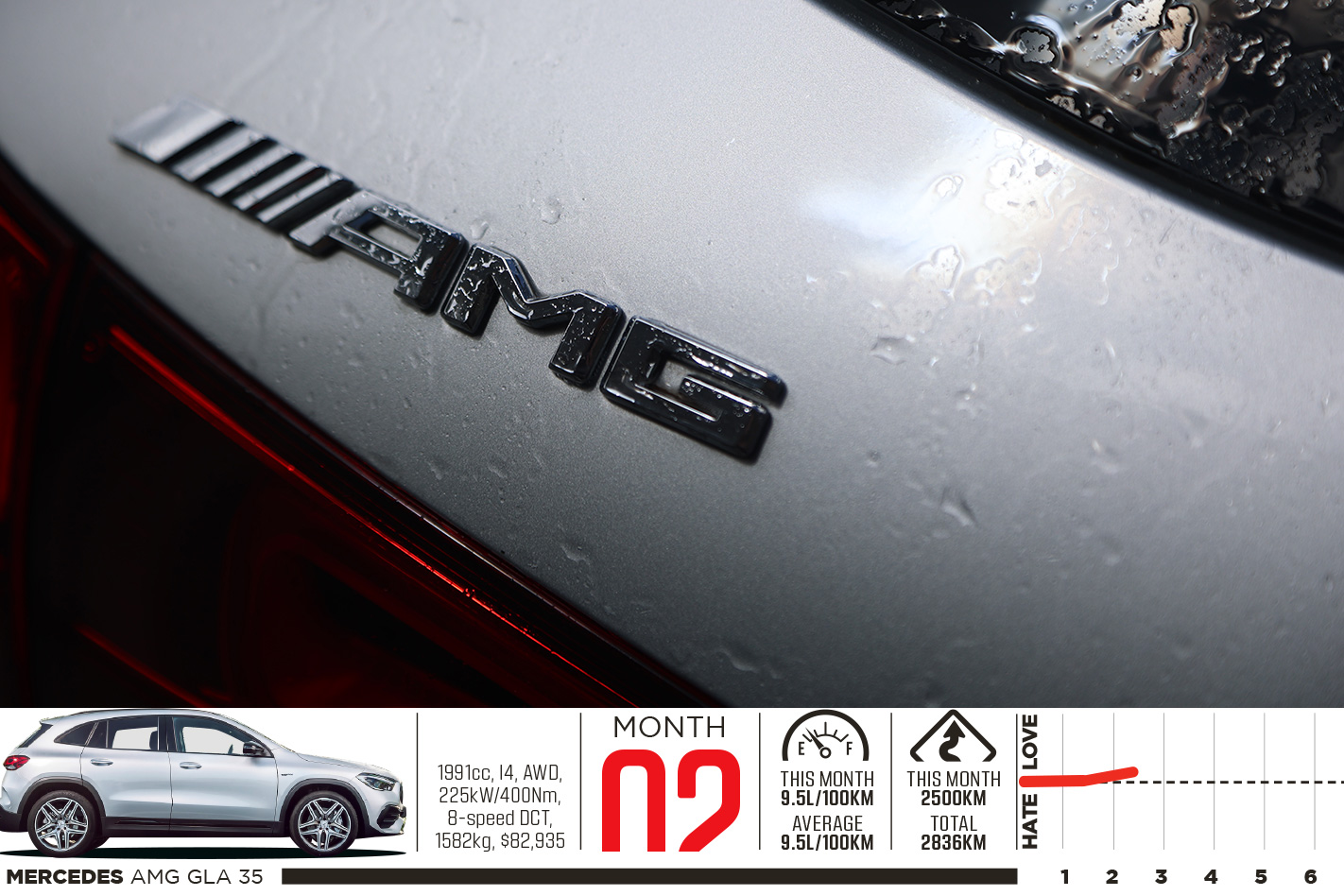
Update 2: Shine On
Dirt-road driving triggers Enright’s very dormant OCD
I’M NOT SURE where you stand on cleaning cars. When I used to work over the aisle at Unique Cars, we tended to separate the owners we engaged with into two discrete categories: drivers and polishers. The former loved dynamics but had less of a fixation on three-bucket systems, while the polishers saw driving as a necessary evil required to move their lifestyle-affirming bauble from one place to another. I liked the drivers.
I’m now wondering whether that’s showing a little too much. I’ve long subscribed to the view that if you own an SUV, it looks better with a bit of dust up its flanks. However, I’ve grabbed the camera to snatch a few shots of the GLA 35 this month and then put it back in the bag because the baby Benz looked more like a Dakar recce car than a cherished long termer.
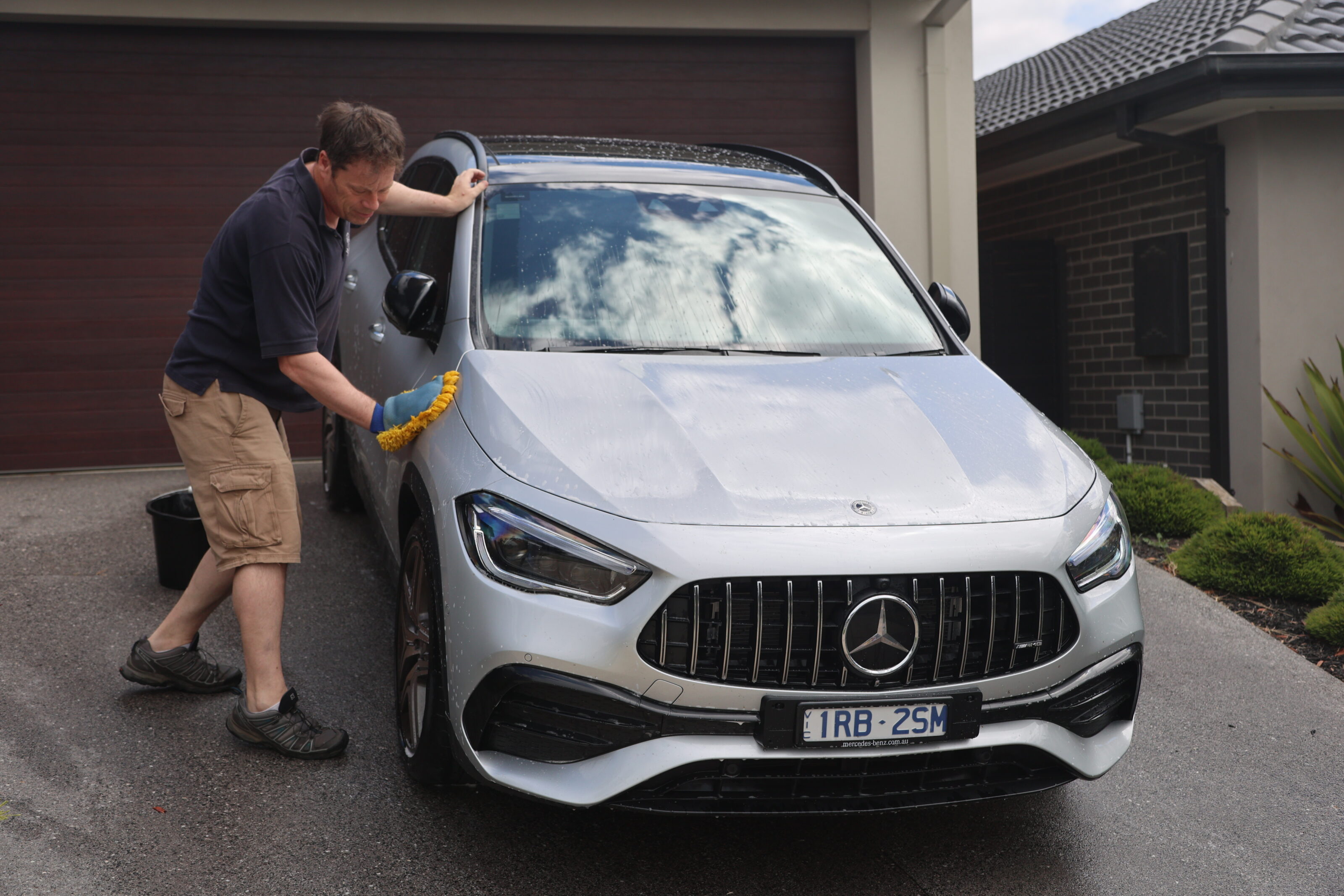
If I wasn’t the Editor here, I’d get a stern ticking off over that. Instead I issued myself a verbal warning and performance managed my way in the direction of a cheapo wash mitt.
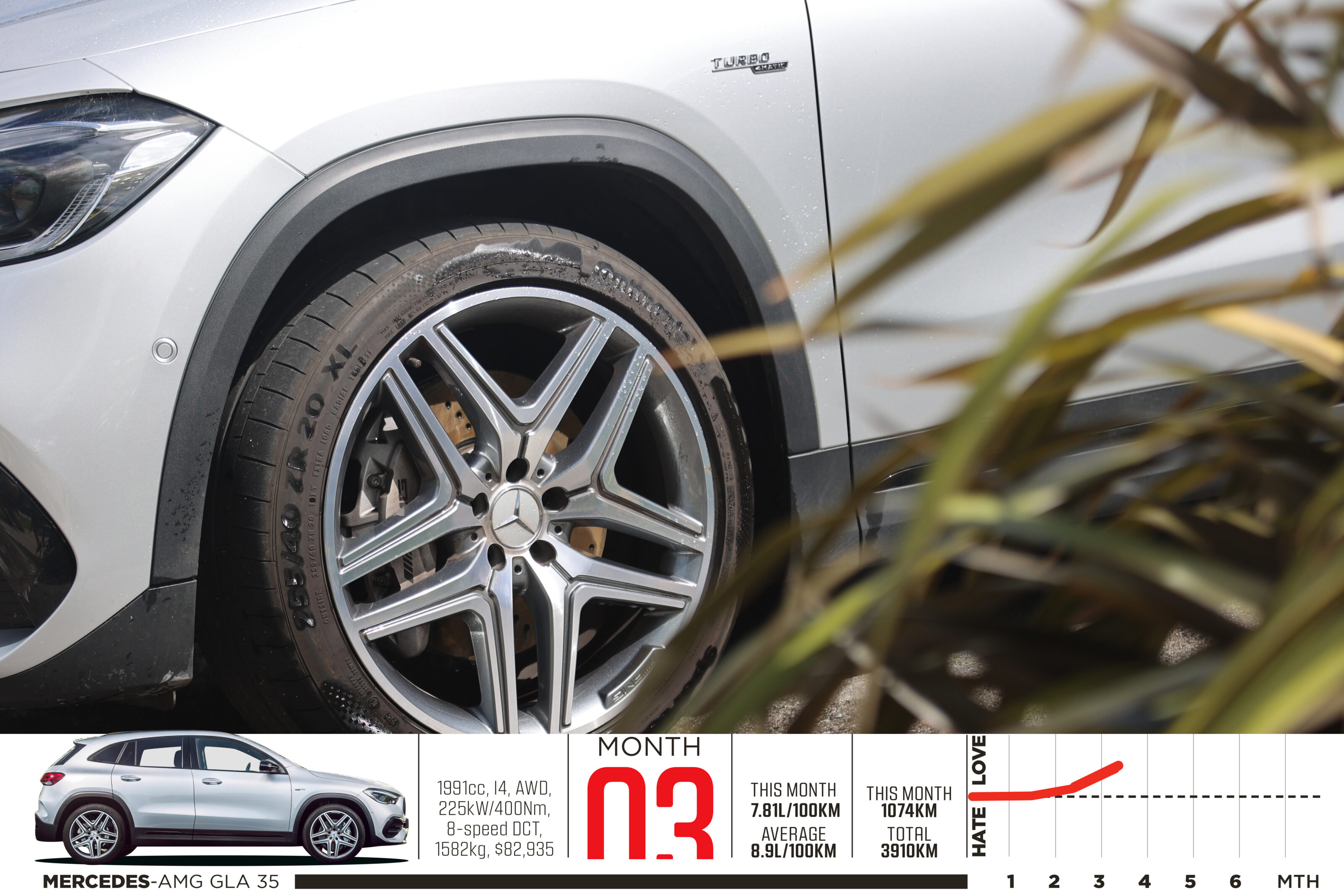
Fortunately the GLA 35 is an easy car to clean. The five-spoke alloys are pretty unfussy and there aren’t a whole lot of extraneous vents, creases or horizontal surfaces to trap dirt. The interior is also easy to keep clean, apart from the inevitable and constant fingerprint smears on the touchscreens. Big door bins and a huge central compartment offer a stack of storage, although we discovered that a smartphone in the door bins can hide almost imperceptibly beneath an overhanging lip.
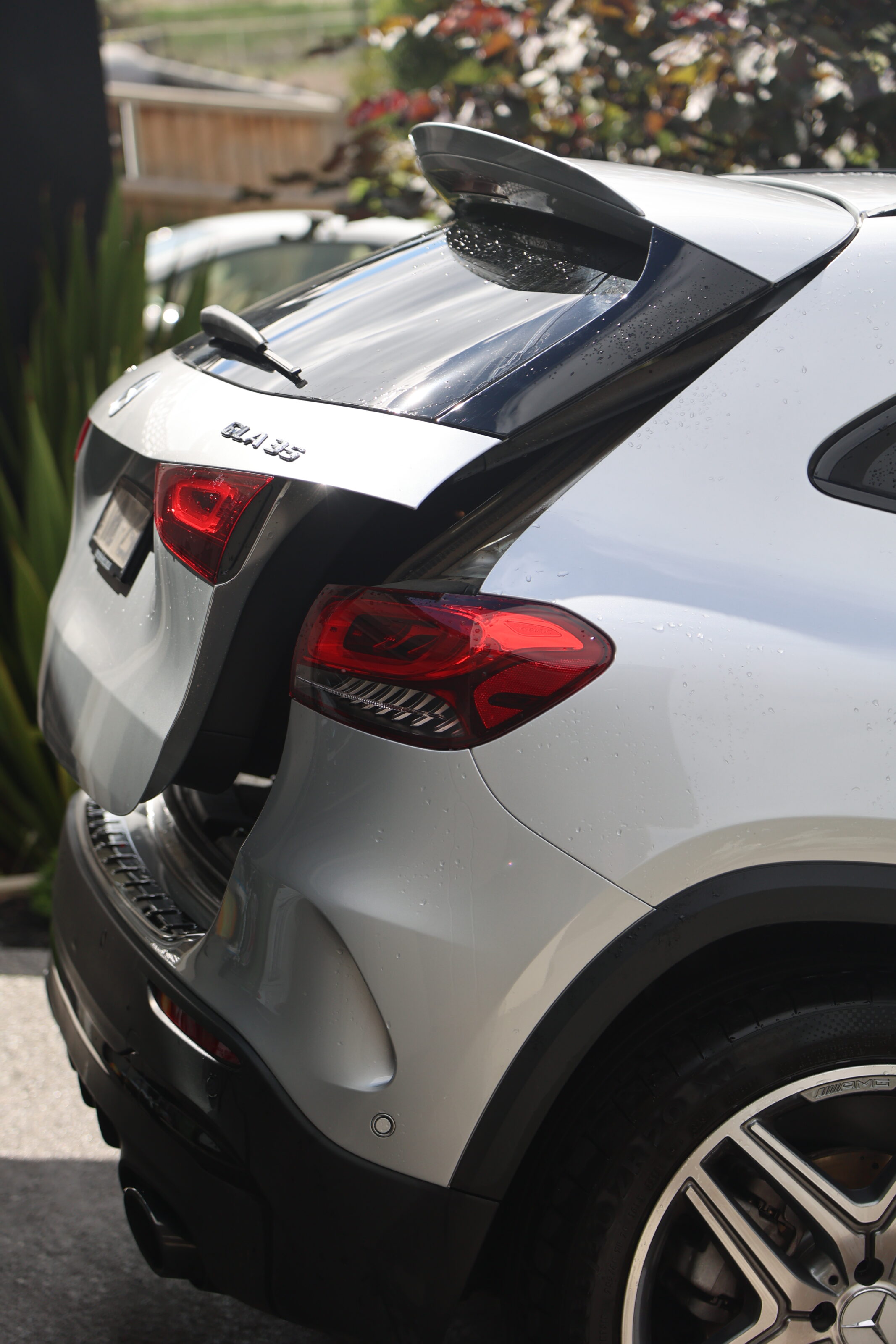
On a few occasions, the electrically operated rear hatch has misbehaved. Press the button on the hatch to close it and it swings through its arc as if it’s about to close, only to halt in the last few centimetres. Walk toward the front of the car, thinking the hatch is closing as expected and it’s easy not to notice that it’s in fact open. I was relieved of two packets of Monte Carlo biscuits due to this, an outrage I expect Mercedes boss Ola Kallenius to rectify forthwith.
Then there are the small calibration issues that need to be ironed out at the facelift, like having to wait for the reversing camera image to clear down off the screen long after you’ve selected a forward gear and are waiting to enter a nav destination. Or the grabby lane-keep assist that always defaults on and which requires a delve through the menu system to deactivate. Or the gear selector that sometimes refuses to select reverse at the first attempt in the middle of a hurried three-point turn. These are all relatively easy software fixes.
I still don’t think the styling is as pretty as the old GLA, which was a genuinely cohesive and deft piece of design. However, perhaps counter-intuitively, the new model is all the better for making the exterior lines a bit bluffer and more of what people expect from an SUV rather than an elevated hatch. In other words, the GLA seems to fit its intended niche that bit better now.
It’s also a bit of a grower. While I’d never give an unreserved thumbs up to the ride and handling of this most un-AMG of AMGs, its other attractions as a daily driver have wormed their way into my affections. The all-weather grip, the M260 engine’s 225kW punch, the (generally) clever infotainment system and the sheer left-field idiosyncrasy of the GLA 35 all weigh in its favour.
I’ve still yet to see another come the other way, which may speak volumes about that difficult-to-pigeonhole quirkiness. Still, I’ll be sorry to see it go.
Things we love
- Quick idle-stop
- Can carry 2-metre load
- Race Start easy
- Forgets drive mode
- Lane-keep default
- Crackly Qi charger
Update 3: Sleeper Sell
You need to be quick on the draw to beat a GLA 35
I THOUGHT I’D GET BORED of launching the Mercedes-AMG GLA 35 off the line. I know I did after a day spent doing exactly that when I first got my hands on a Tesla Model S back in 2015. The novelty wore off. Even trolling Mustang drivers at the lights, eyeballing them and then laughing like a drain as they blared away while I rolled gently off the line palled after time. But that was because I was punching down. Everybody knew a Tesla was lightning quick off a dig.
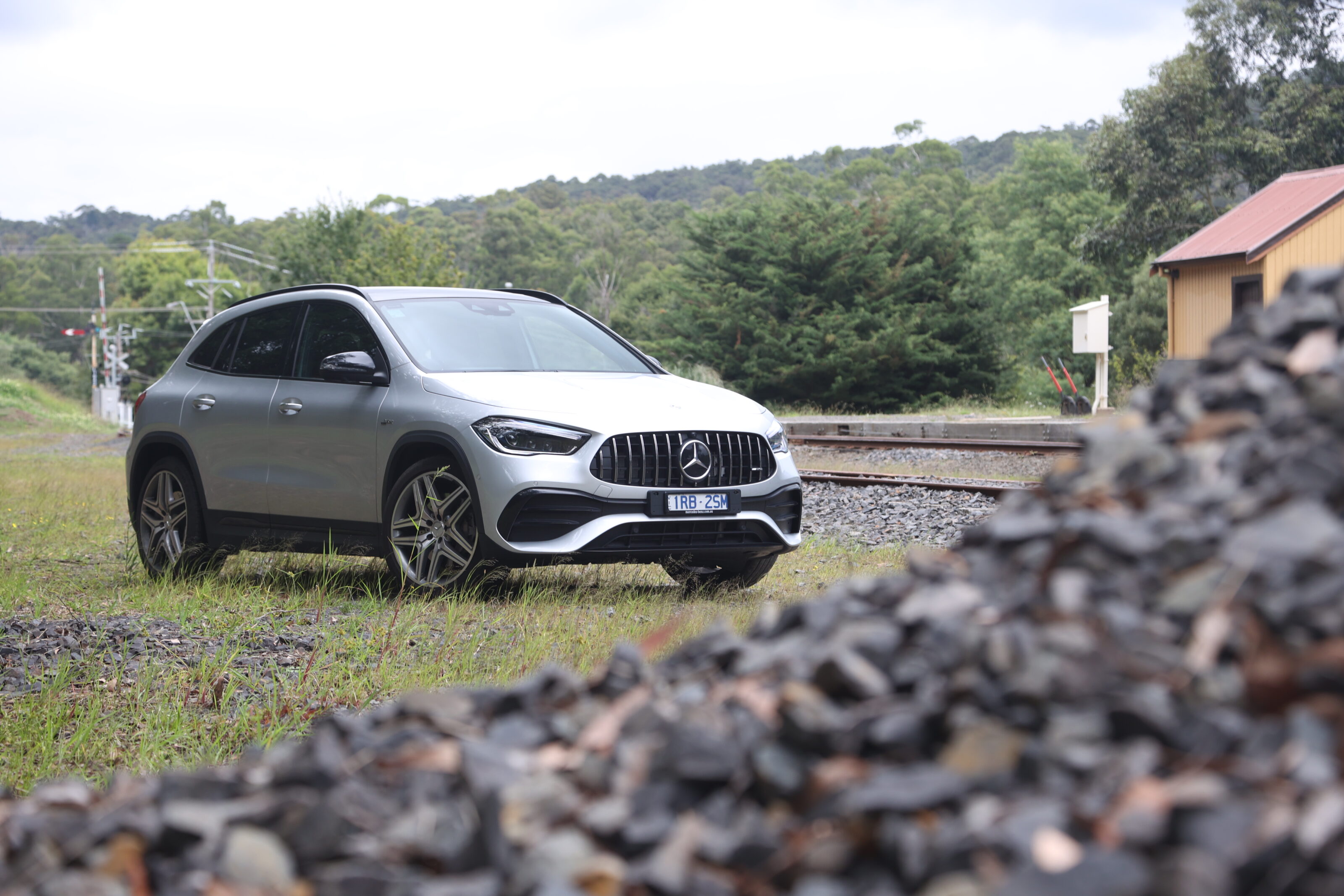
The GLA 35 is different. It looks so innocuous. No big spoilers, no lairy paint finish or stripes; nothing but a slightly frumpy shape. If I owned one I’d probably debadge it to make it even more of a Q-car.
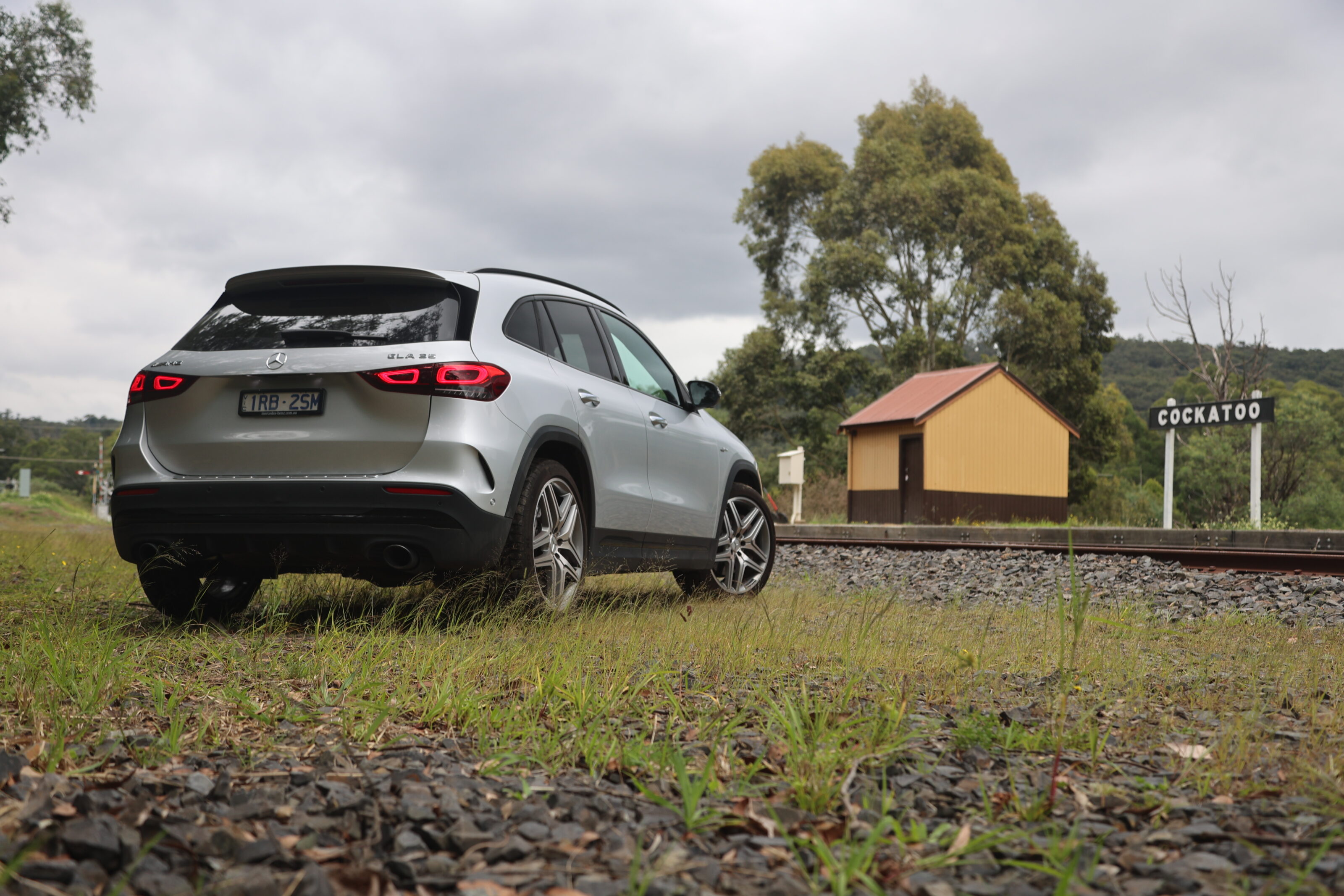
Just out of sheer curiosity, I rigged it up to a VBOX data logger last week and achieved 4.9 seconds to 100km/h, which is not only 0.2 below AMG’s claim, but also seriously bloody quick. It’s almost a full second quicker than the benchmark hot hatch, the Civic Type R and will also smoke the all-wheel drive Yaris GR Rallye. Want to aim higher? How about a 991 Carrera 4 or an Aston V8 Vantage 4.7? Five years ago these were pretty senior performance cars and the GLA has their measure, off the line at least.
Chest-wig chariots like SS-V utes are child’s play for the baby AMG.
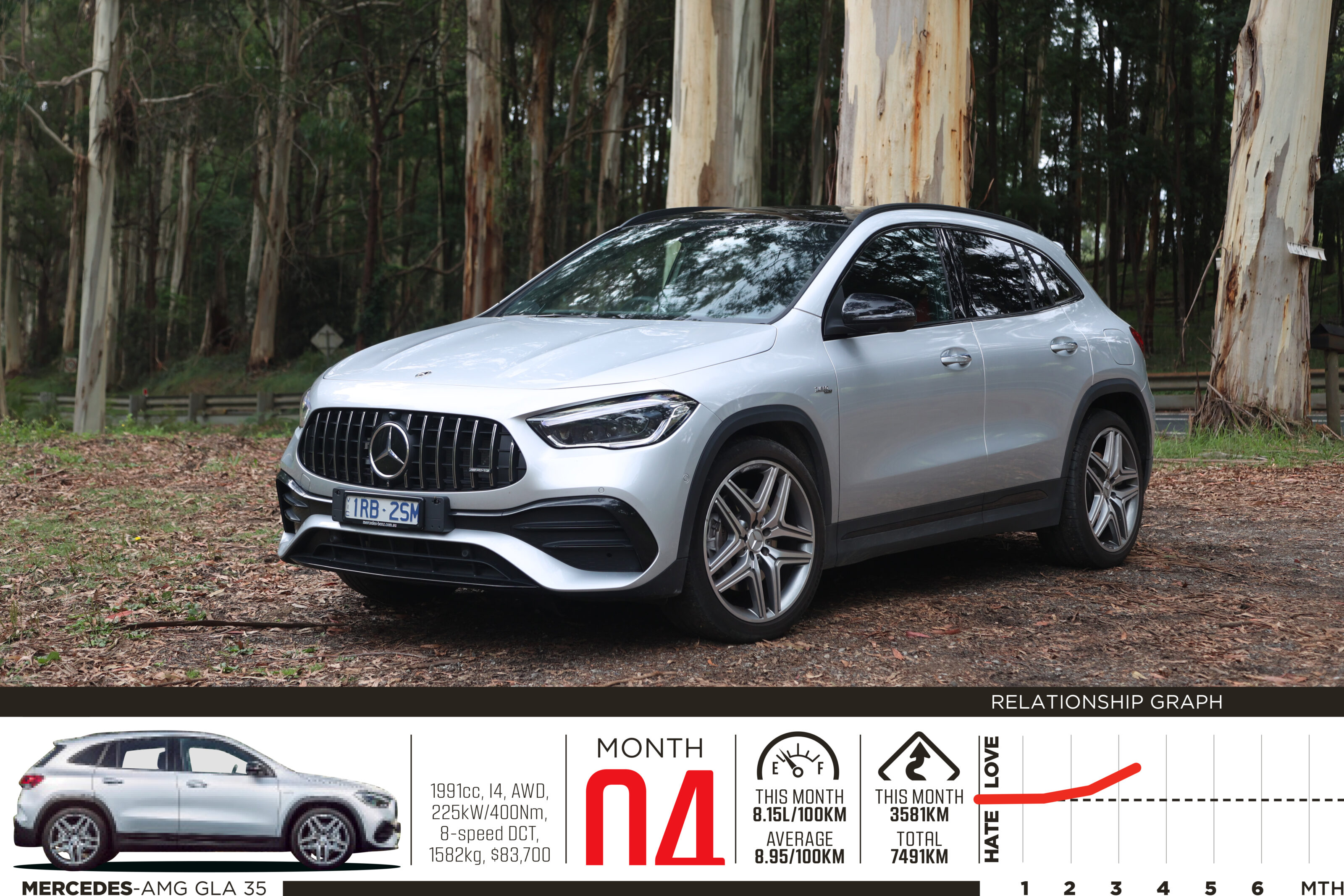
While the GLA 35 is a weapon par excellence for infuriating blokes with Southern Cross tatts, a recent price hike of $765 sees the asking price lift to $83,700. Yes, you are getting a Porsche Macan GTS level of performance, but there’s always that other voice in your head, telling you that you’re driving a Mercedes A-Class on stilts and that this is a Lot Of Money. You’d need to make up your own mind whether those stilts are worth around $11K over the price of the A35 hatch.
Thankfully, I’ve diagnosed the mystery of the non-closing hatch. If there’s anything in the boot which nudges the parcel shelf even slightly out of its first detent as you close the tailgate, the shelf will then trip the sensors and the hatch won’t close all the way, remaining a few centimetres open.
As 1RB 2SM departs the MOTOR garage, you’ll spy a new entrant winging in, with more power, a 50 per cent reduction in the number of driven wheels and a whole lot of new questions to answer. This should be good. – AE
Things we love
- Great lights
- Dual pane sunroofs
- Cabin storage
- Vents shine in mirrors
- Column gearshift
- Seatbelt warning
A rivalry passed down through generations comes together today, as we pit the new 2021 BMW M3 Competition against Mercedes-AMG’s hugely-popular C205 C63 S.
Affalterbach’s flagship sports coupe may be more seasoned than Garching’s fresh-faced saloon, but it hasn’t grown wary with age. Peak power is identical between the two cars at 375kW but it’s the AMG’s hand-built 4.0-litre V8 that holds the torque advantage, producing 700Nm compared with the 650Nm available in the twin-turbo 3.0-litre S58-powered BMW.
AMG’s iron fist may fall to BMW’s velvet punch, however, as diabolical Melbourne winter conditions pour water over any hopes of besting the manufacturers’ acceleration claims. And to make things more difficult; both cars are shod with ultra-focused Cup tyres.
While the C63 is rather point and shoot in its drag race preparation, the younger M3 comes armed to the teeth with technology. In between the ten-stage traction control system, and a drift mode yaw analyser that rewards you with star ratings, lies a launch control system that is incredibly frustrating to engage yet brutally effective in the real world.
From a dig, the C63 S is simply overcome by its own might as its rear end breaks away under the weight of 700Nm. The M3, on the other hand, rapidly rows through the first three gears controlling measured bursts of wheelspin as the C63 recedes into the rear-view mirror.
Our second race sees the two German rivals take on a soft launch in comfort mode: no launch control or race modes, simply plant the accelerator from zero rpm and go.
Again, the C63 devolves into wheelspin as soon as the engine comes onto boost and suffers an even more ignominious defeat.
In horrid, cold and damp conditions, the new BMW M3 managed a rapid 4.8 second 0-100km/h sprint, almost a full second ahead of the C63 S’s 5.7 second best.
The M3 crossed the quarter mile marker over a second’s delta, besting a 12.4 second pass at 197.2km/h compared to the AMG’s 13.6 second pass at 189.7km/h.
Hit the video above to watch both full races, and don’t forget to subscribe to the MOTOR Youtube channel for more drag battles, car comparisons and reviews!
Snapshot
- Facelift plus improved interior tech
- New SX model straddles mid-range gap
- Six-speed auto improves economy
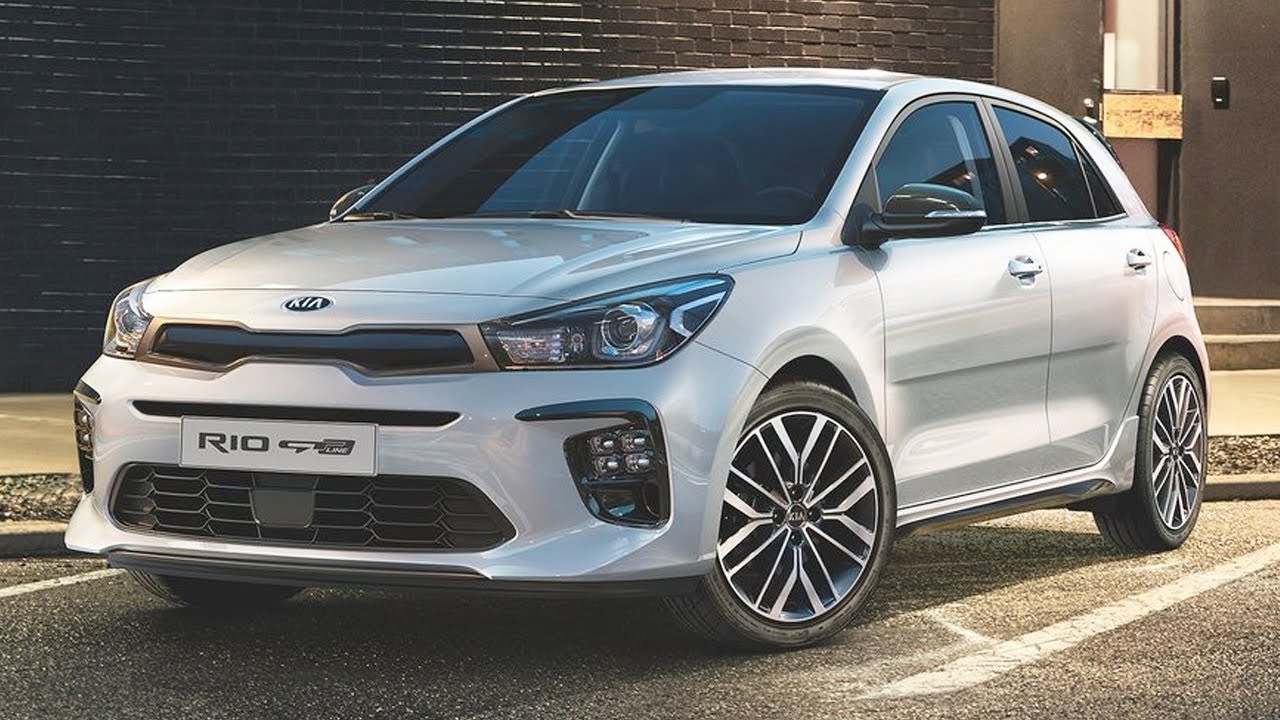
The 2021 fourth-generation Kia Rio has arrived in Australia, bringing improved safety and technology as standard across the range alongside a facelift.
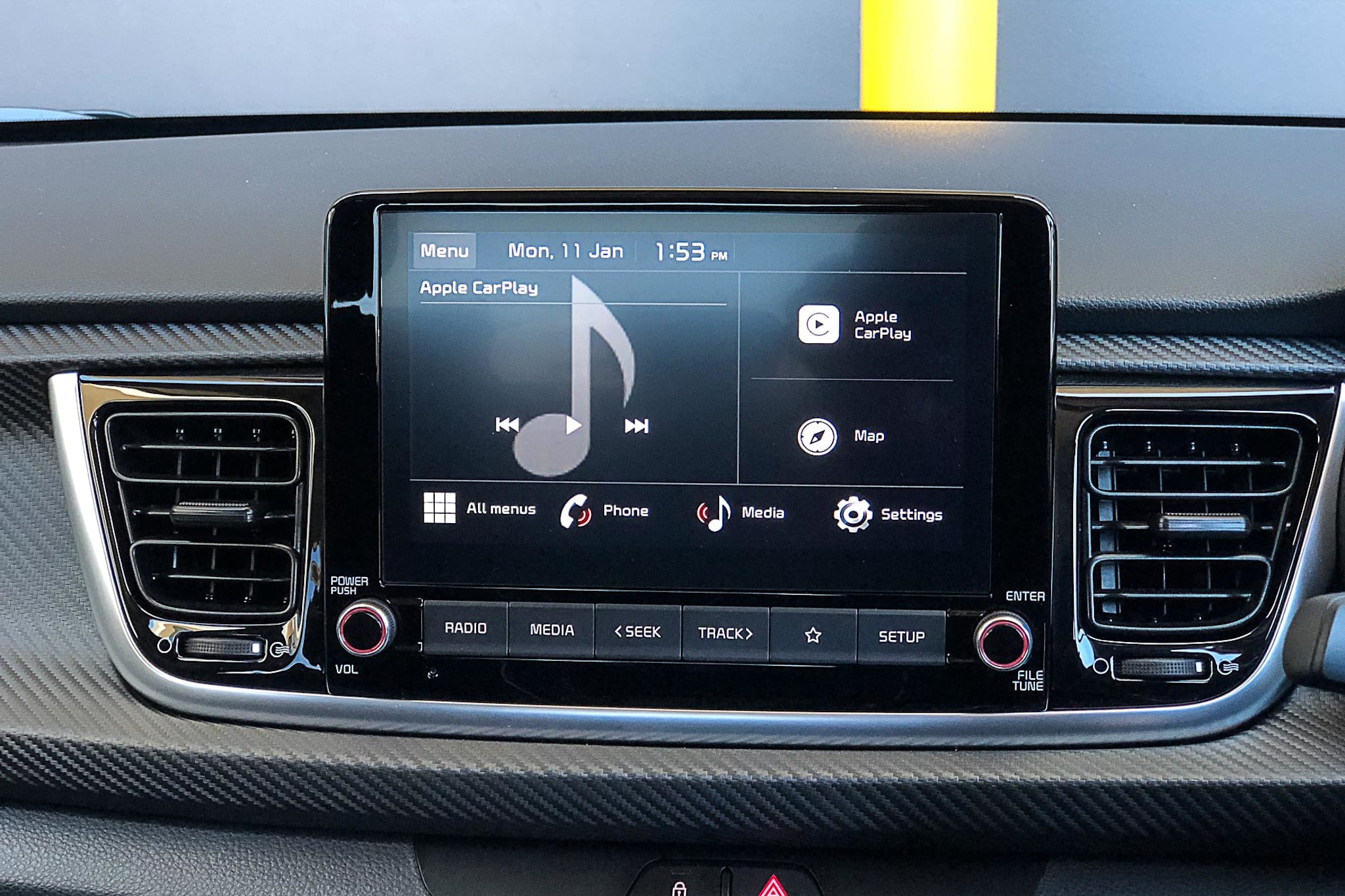
Previously relegated to higher-spec models, an 8” touchscreen with Apple CarPlay and Android Auto has become standard equipment on all variants.
The Rio stable now includes the SX, existing as a middle ground between the base-model S and pricier Sport. Taking a combination of features from the higher-end models without a major price hike.
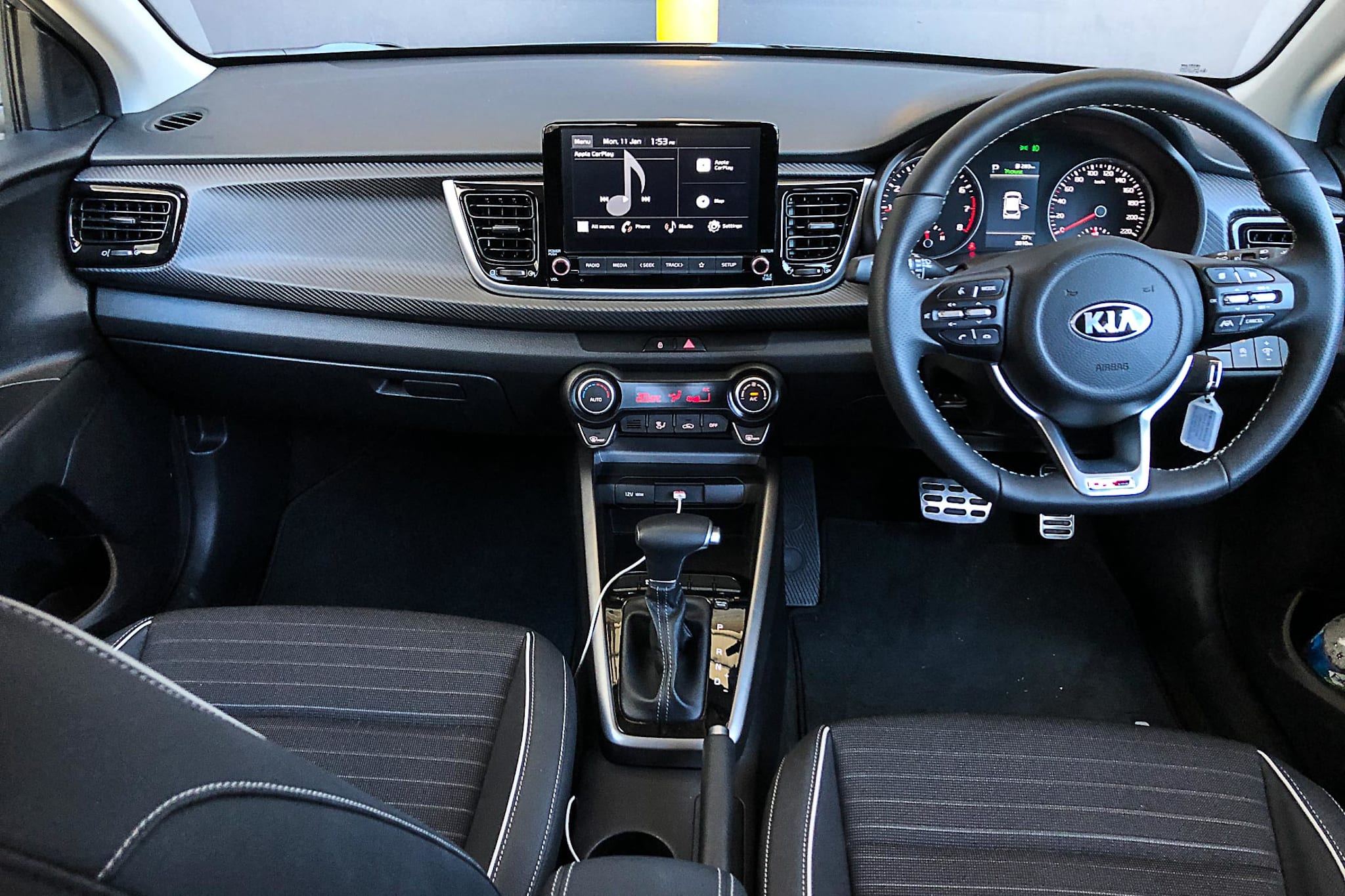
Model range and pricing ?
| Rio S manual | $20,490 |
| Rio S auto | $21,490 |
| Rio SX manual | $21,990 |
| Rio SX auto | $22,990 |
| Rio Sport manual | $22,490 |
| Rio Sport auto | $22,890 |
| Rio GT-Line auto | $24,990 |
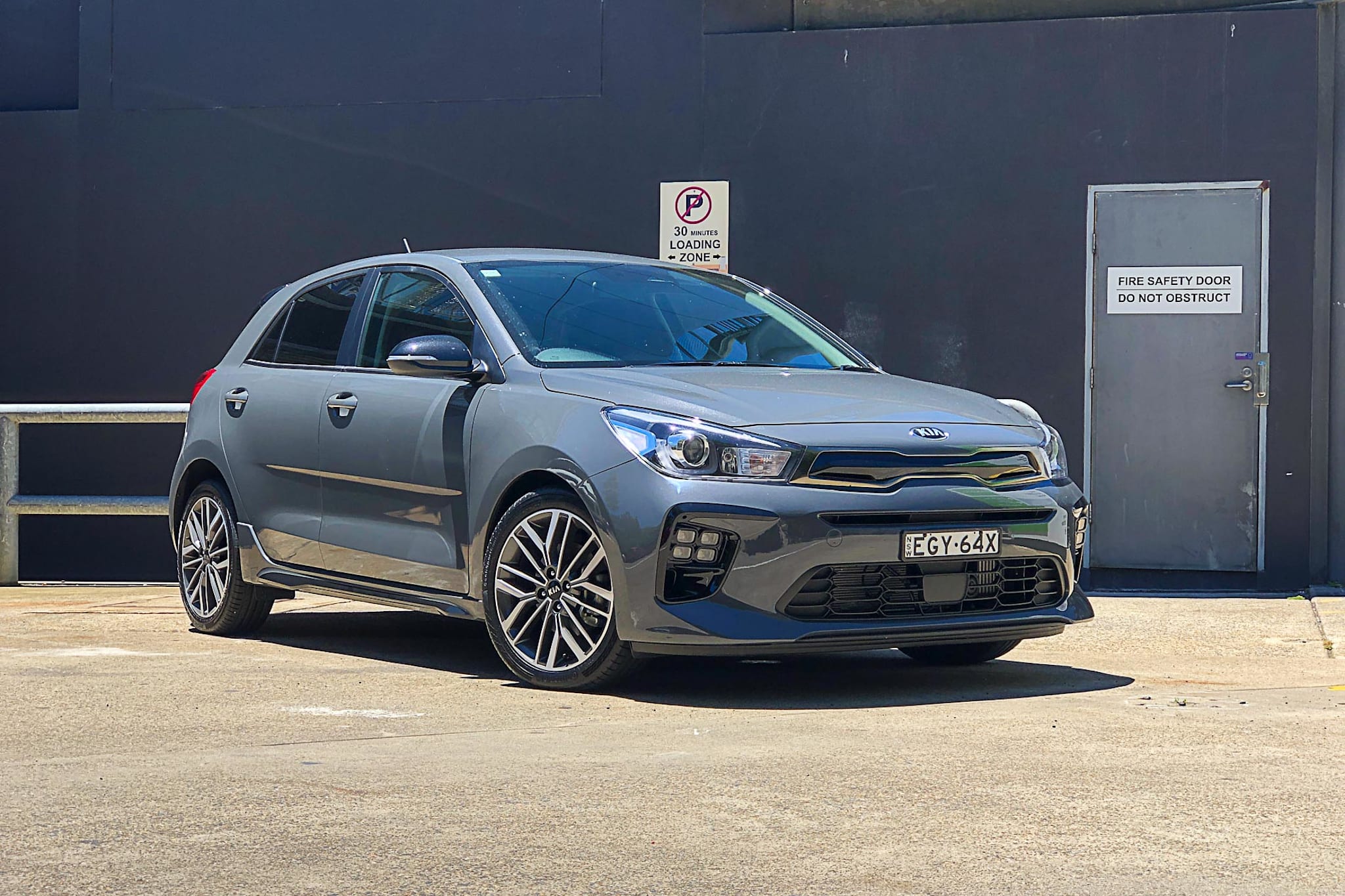
Features
The entry-level Rio S receives as standard:
| 8u201d infotainment touchscreen |
| 15u201d steel wheels |
| Automatic headlights |
| Six-way manually adjustable driveru2019s seat |
| Cloth trim |
| Keyless entry |
| Air conditioning |
| Tilting/telescopic adjustable steering column |
Stepping up to the new Rio SX adds the following:
| 17u201d alloy wheels |
| Cruise control |
| Premium-grade steering wheel and gear knob |
| Powered folding side mirrors with indicators |
| Sunroof |
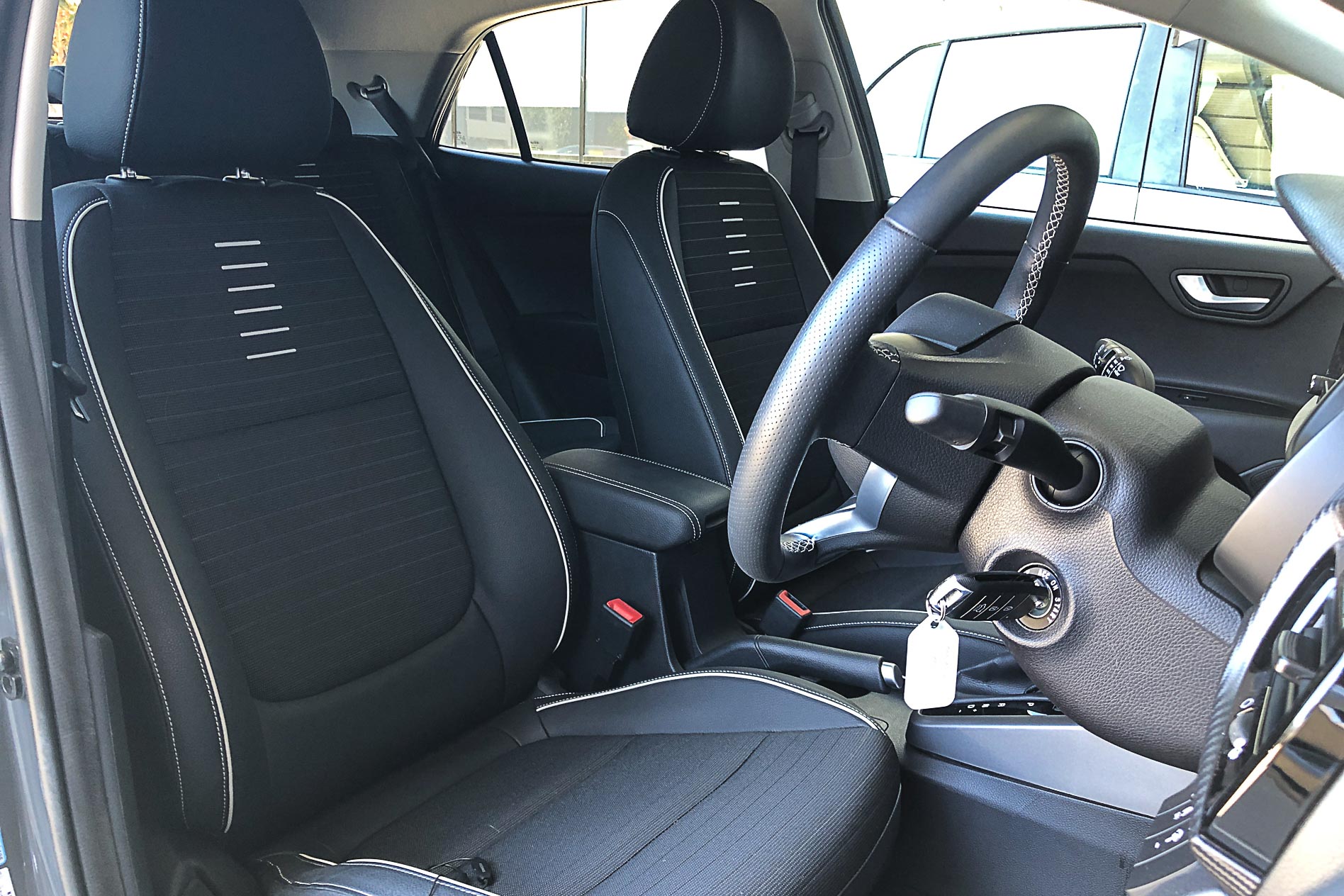
| Leather-look seats |
| Privacy glass |
| Illuminated interior mirrors |
Though many features of the Rio Sport now come with the SX, it’s still first to receive:
| Automated emergency braking |
| Lane keeping assist |
| Driver attention alert |
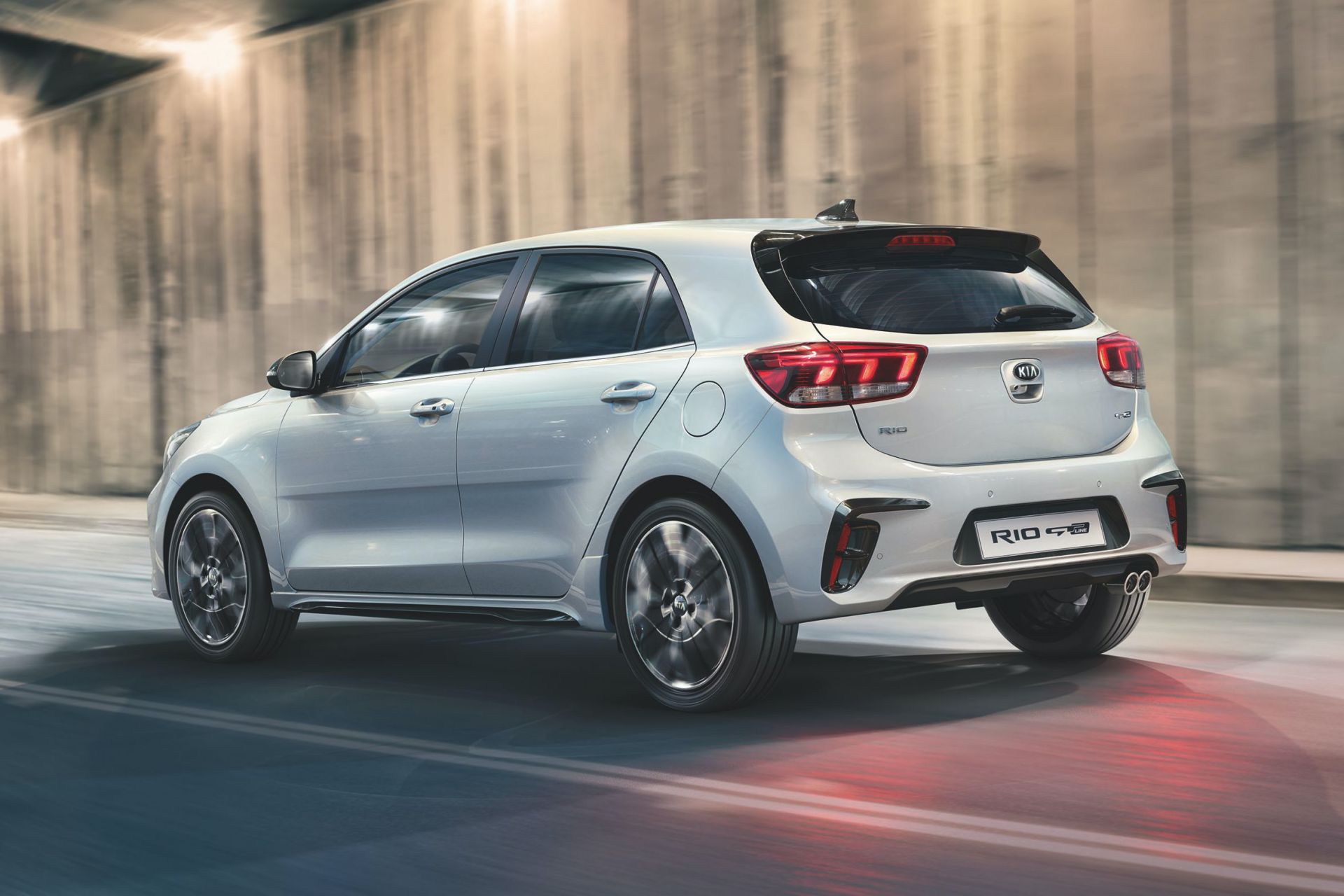
Above the Sport, the athletically-styled GT-Line offers:
| Automated emergency braking |
| Lane keeping assist |
| Driver attention alert |
| Turbo 1.0 and DCT package |
| New 17u201d alloy wheels |
| LED daytime running lights and fog lights |
| Premium seats |
| Unique body kit, spoiler, grille, diffuser and twin exhaust |
| Solar windscreen and front door glass |
| Automatic rain-sensing wipers |
| Sports steering wheel and pedals |
| Carbon-fibre look dash fascia |
| Single-zone climate control with automatic defogging |
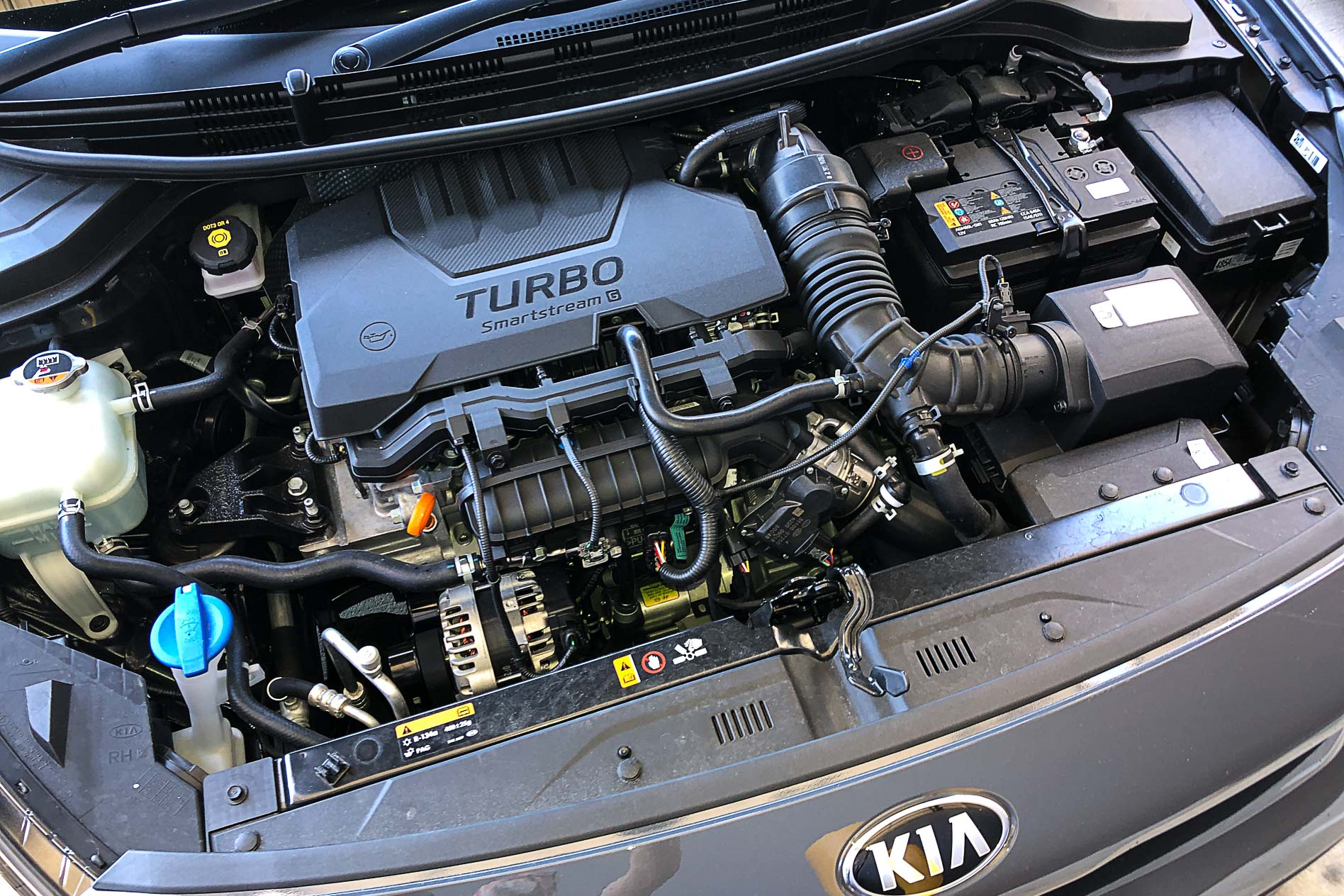
Engine, transmission and fuel economy
The Rio S, SX and Sport models are powered by a 1.4-litre naturally-aspirated four-cylinder producing 74kW and 133Nm of torque. It’s mated to either a six-speed manual or six-speed automatic – gone is the four-speed auto previously available with the Rio S.
The top-dog GT Line instead uses a 1.0-litre turbo three-cylinder, with a seven-speed dual-clutch auto the only transmission available. Power has been trimmed from 2020’s 88kW to 74kW, though torque remains the same at 172Nm.
Kia says the combined fuel usage of the manual 1.4-litre Rio is 5.6L/100km. It’s a jump to 6.0L/100 for the auto, though it’s still a slight improvement on the 6.2L/100 quoted for the previous model. The 1.0 turbo is rated at 5.3L/100, another minor reduction on the previous 5.4L/100.
Dimensions
The 2021 Kia Rio is 4065 long (4070 in GT-Line spec), 1725mm wide and 1450mm tall. With a wheelbase of 2580mm, it’s identical to the Hyundai i20 and marginally longer than the Mazda 2’s 2570mm.
Safety
The base Rio S offers a reversing camera, rear parking sensors, and six airbags. Upgrading to the Sport or GT-Line provides autonomous automatic braking, lane-keeping assist and driver attention monitoring.
Warranty and servicing
The Rio features Kia’s seven-year/unlimited-kilometre warranty, plus 12 months’ free roadside assist. Capped price servicing is offered for seven years or 105,000kms (whichever comes first). For the S, SX and Sport models, that’s the first seven scheduled services, and 14 for the turbocharged GT-Line.
Availability
The full 2021 Rio range is available in Australia now.
Snapshot
- Four special edition ASXs to choose from u2013u00a0ES-L, ES Plus, MR Plus, and XLS Plus
- Prices start from $27,640 plus on-road costs
- On sale now
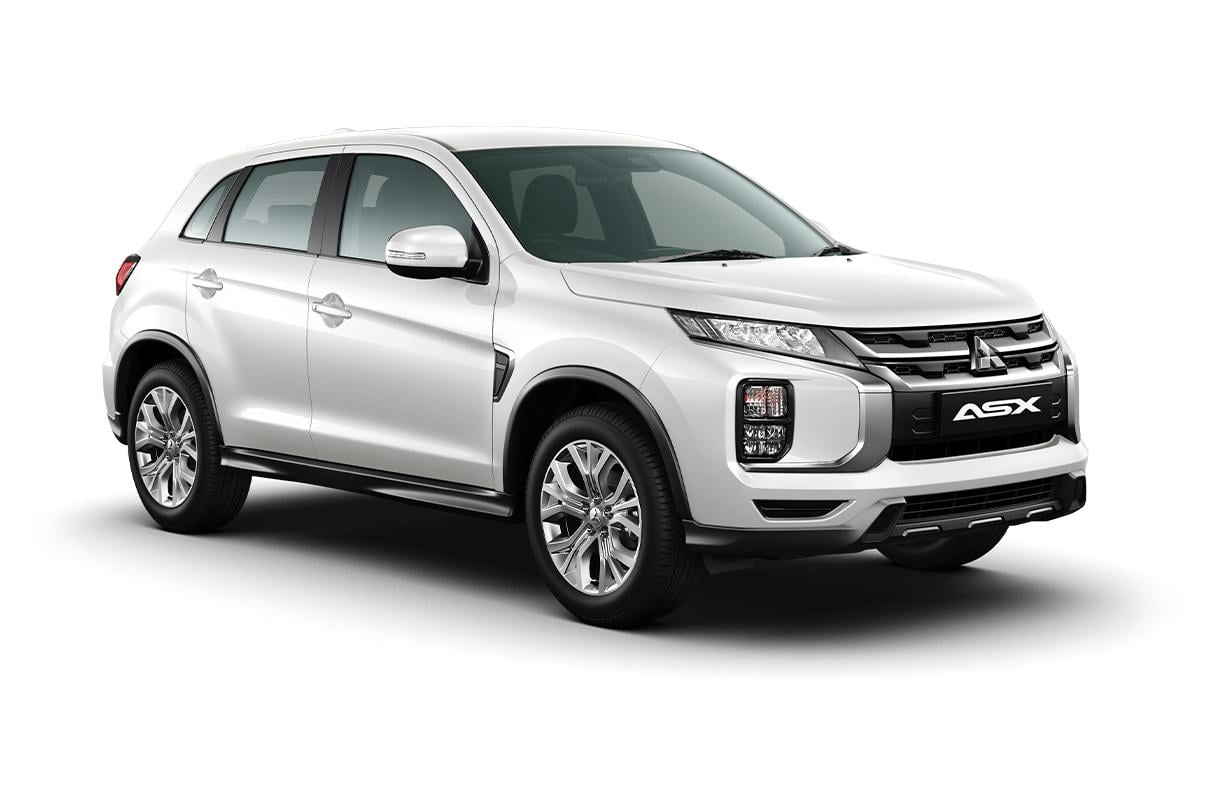
Mitsubishi Australia has revealed no less than four new special edition ASX model variants for the local market.
Called the ES-L, ES Plus, MR Plus, and XLS Plus, these new compact SUVs will take the battle to other segment competitors like Hyundai’s Kona, Mazda’s CX-30, and MG’s current best-seller, the ZS.
The ES-L and ES Plus will utilise the regular ASX’s naturally-aspirated 2.0-litre four-cylinder engine, while the MR Plus, and XLS Plus will be fitted with the larger N/A 2.4-litre four-pot found in the ASX GSR and Exceed.
These new editions will sit alongside the current regular production ASXs, which include the ES, MR, LS, GSR, and Exceed.
Owen Thompson, Mitsubishi Australia’s senior manager of product strategy, said the special SUVs were a chance for the carmaker’s local arm to consult with both local dealers and head office in Japan about the ASX’s model range moving forward.
“We’ve [Mitsubishi Australia] been working together with our product team in Japan to create some special edition models,” he said.
“Over the past year, we’ve worked with our dealers to understand the challenges they have with supply constraints, largely related to Covid-19 but now compounded with the semi-conductor challenges, and also what key features customers want to see.
“We’re testing some of our thinking on range optimisation, and these special editions are available now.”
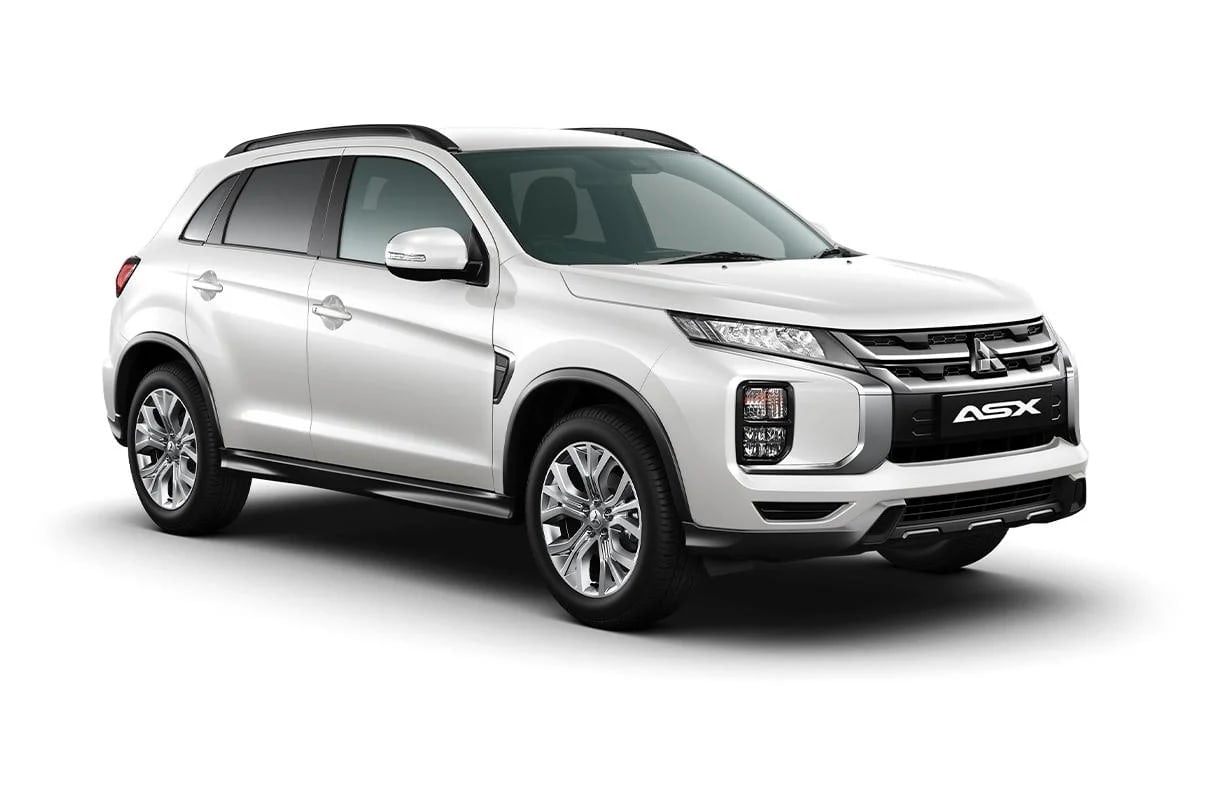
Special edition ASX range and pricing:
There will be four special edition ASX models (prices before on-road costs):
- 2021 Mitsubishi ASX ES-L 2.0 auto – $27,640
- 2021 Mitsubishi ASX ES Plus 2.0 auto – $28,590
- 2021 Mitsubishi ASX MR Plus 2.4 auto – $30,640
- 2021 Mitsubishi ASX XLS Plus 2.4 auto – $33,140
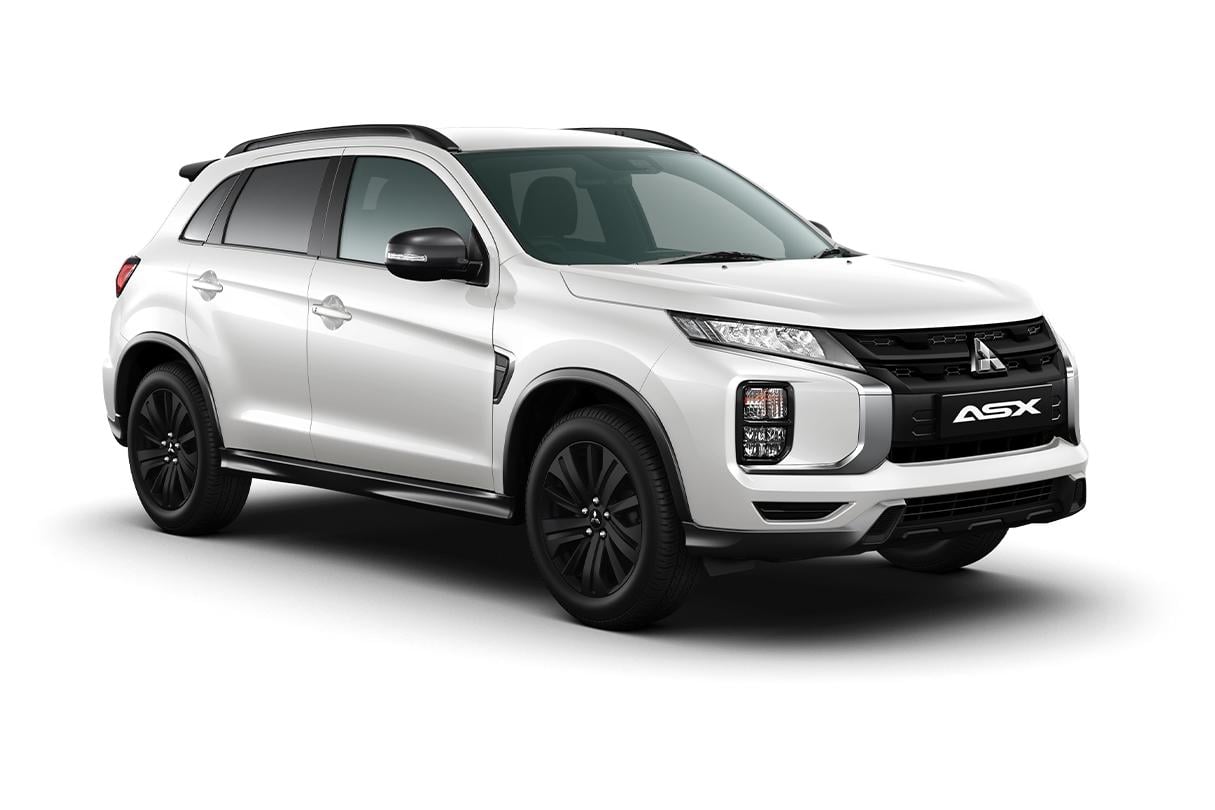
Engines, transmission, and fuel economy
The ES-L and ES Plus are fitted with Mitsubishi’s 4B11 naturally aspirated 2.0-litre in-line four-cylinder petrol engine, which produces 110kW and 197Nm.
The 2.0-litre petrol unit returns an ADR combined-cycle fuel economy rating of 7.6L/100km when using 91 RON.
The MR Plus and XLS Plus employ Mitsubishi’s larger capacity 4B12 N/A 2.4-litre in-line four-cylinder petrol engine, which makes 123kW and 222Nm.
Fuel economy for the bigger 2.4-litre donk is rated at 7.9L/100km on the combined cycle when filled up with 91 RON.
All variants send power exclusively to the front wheels through a single-speed constantly variable transmission (CVT), and all examples are fitted with a 63-litre fuel tank.
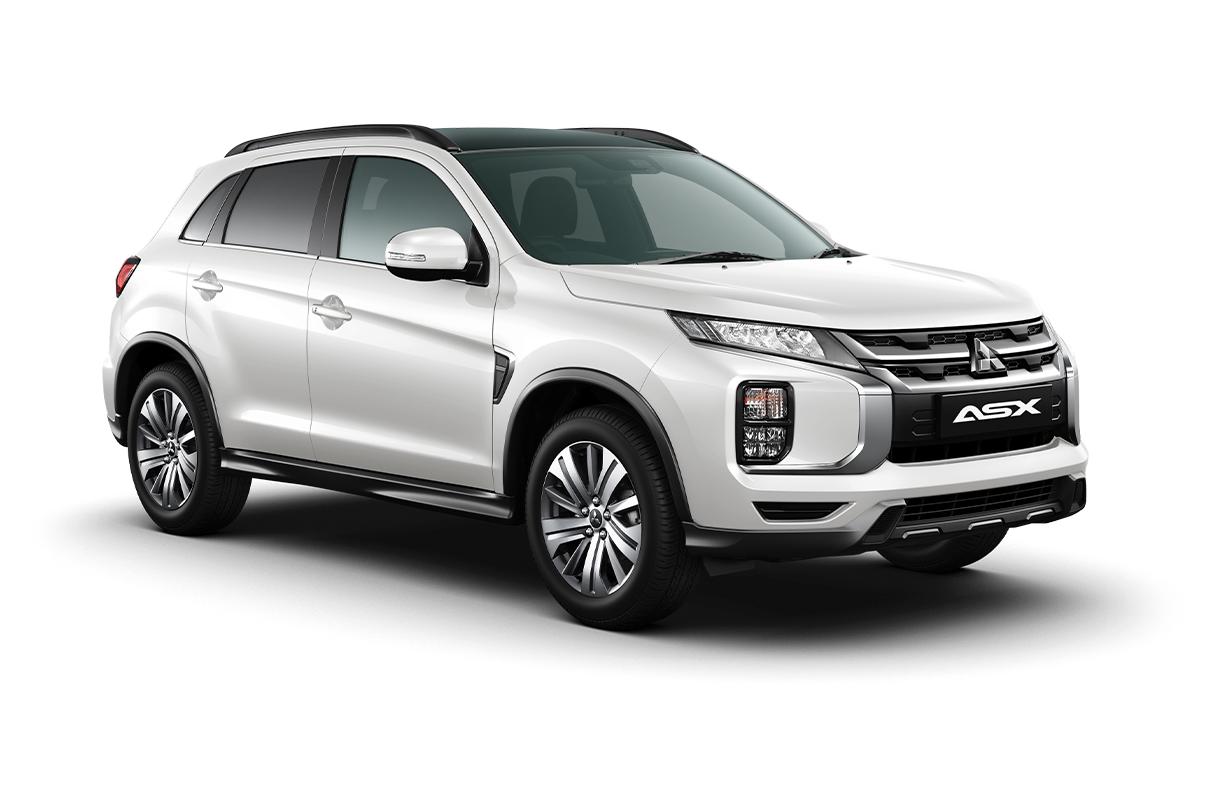
Features
The cheapest special edition ES-L plus comes well-equipped with features which include:
- 8.0-inch touchscreen infotainment display
- Apple CarPlay and Android Auto
- 18-inch alloy wheels
- Four-speaker sound system
- LED headlights and daytime running lights
- Cruise control
- Powered windows
- Leather-wrapped steering wheel
- Climate control
- LED fog lamps
- Turn indicator in mirrors
- Chrome side garnish
- Privacy glass
- Smart key
- One-touch push-button start
- Paddle shifters
- Six-speaker hi-fi with two tweeters
- Sophisuede knit/synthetic leather seat trim with red stitching
- Synthetic leather door inserts
- Silver power-window switch panel
- Black rear spoiler
- Two-tone 18-inch alloy wheels
- Dark argent metallic radiator grille
- Chrome belt-line moulding
- Automatic headlamp levelling
- Panoramic roof with mood lighting
- Satellite navigation
- Leather seat trim
- Powered driver seat
- Heated front seats
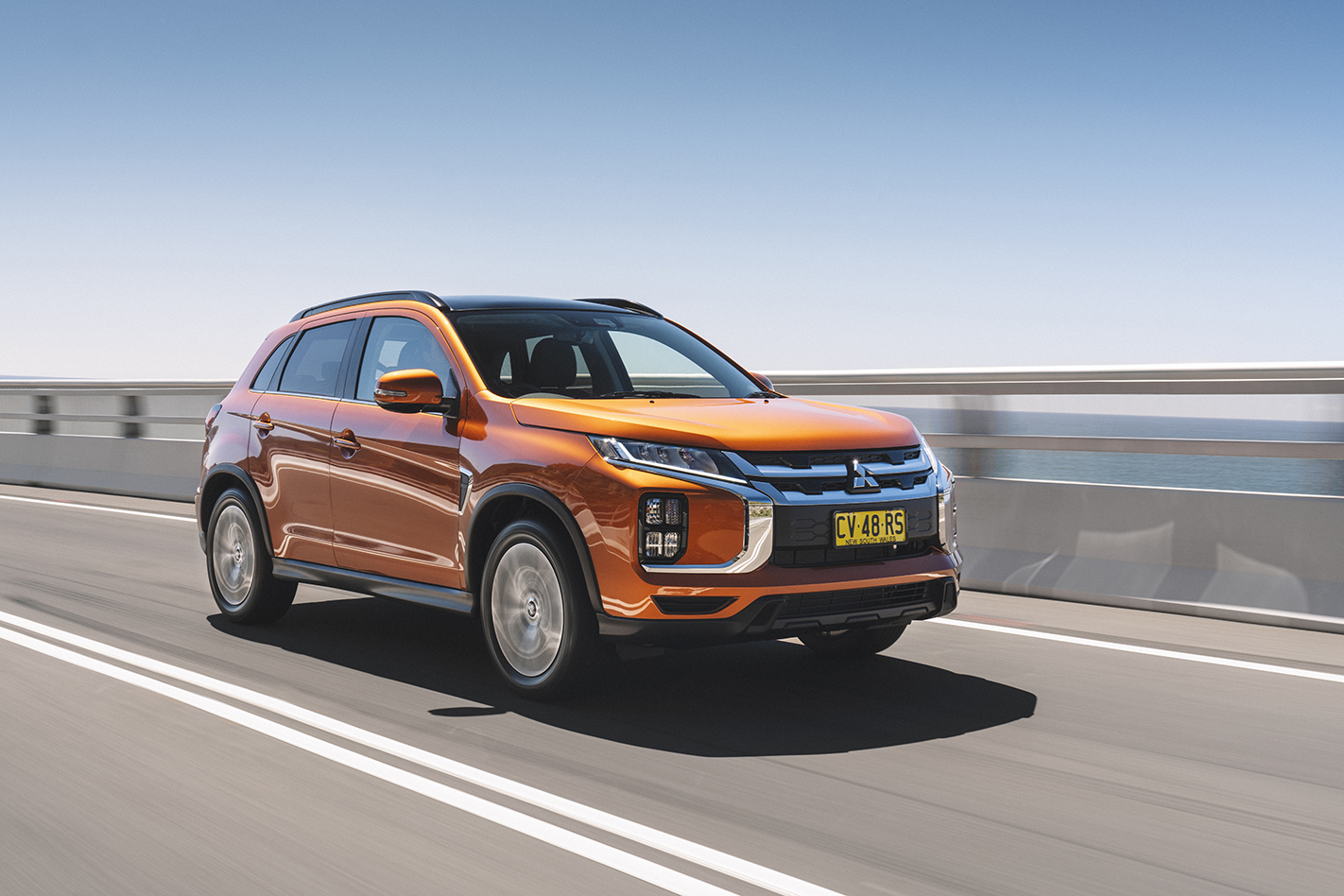
Dimensions, kerb weight, and towing capacity
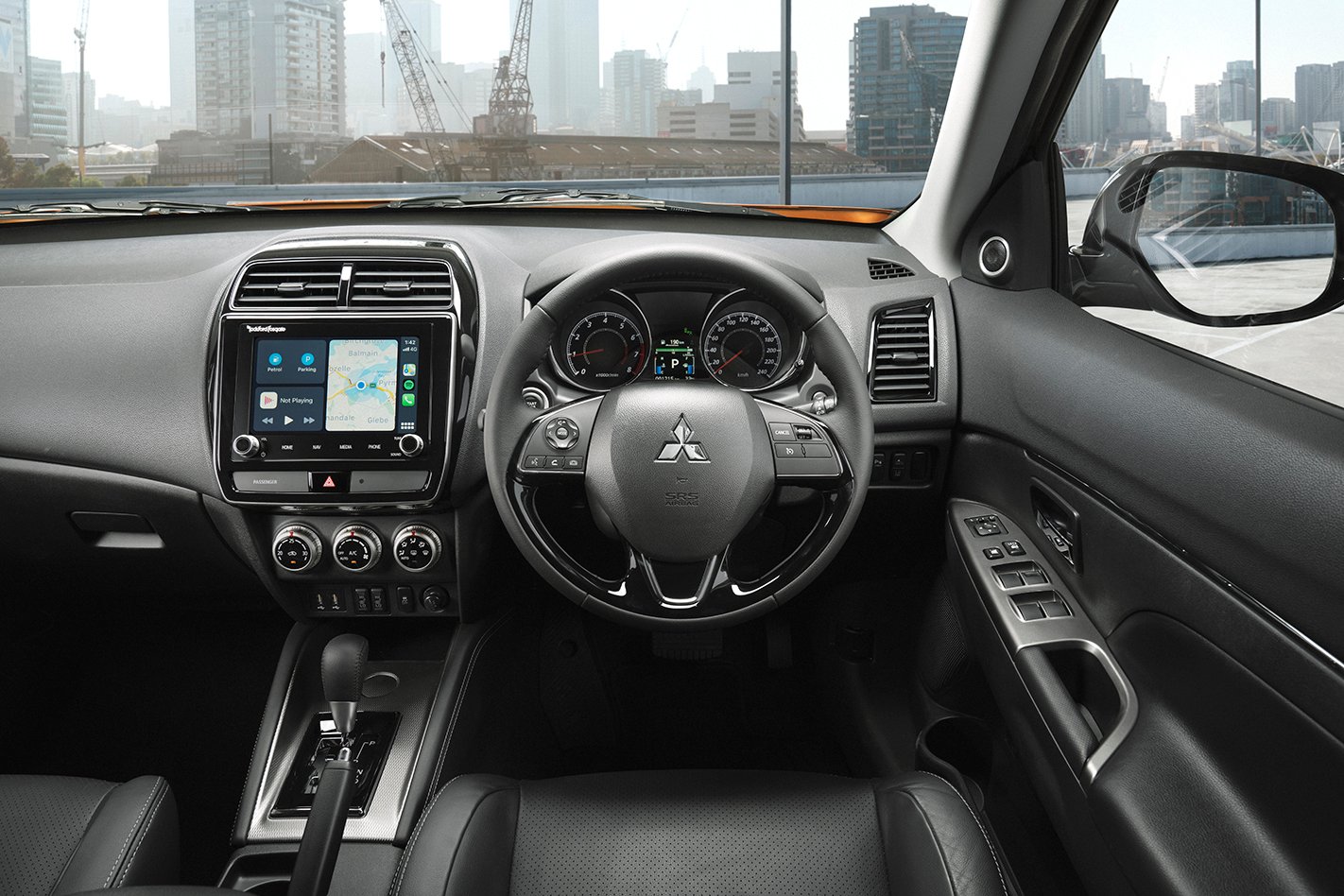
All the special edition compact SUVs have identical dimensions to the regular ASX range, measuring 4365mm long, 1640mm tall, and 1810mm wide. The wheelbase measures 2670mm.
The 2.0-litre equipped variants have a kerb weight of 1380 kilograms, while the 2.4-litre engined iterations incur a 10 kilogram weight penalty, weighing 1390 kilograms.
Braked towing capacity for all ASXs is rated 1300 kilograms.
Warranty and servicing
Like all Mitsubishi passenger vehicles, these new ASXs come with a 10-year/200,000-kilometre warranty.
Capped price servicing for a period of 10 years is also available to purchase.
Availability
The special edition Mitsubishi ASXs are on sale now at dealers across the country, with a spokesperson for Mitsubishi Australia telling WhichCar customer deliveries are expected towards the end of June/beginning of July.
Month 1: you’re not a Puma!
It’s not the first time Ford has rolled out this nameplate
Price as tested $36,140
This month 996km @ 7.4L/100km
As a bloke whose formative automotive years were littered with numerous subscriptions to increasingly obscure English car mags (Cars and Car Conversions, anyone?), the Ford Puma does not, to me, signify small urban crossover.
The evocative name speaks to a small, slightly ungainly but half-decent little coupe of the late 1990s that – for one ill-fated limited edition known as the Racing Puma, at least – even came with Alcon brakes and a slightly spicy 1.7-litre four-potter, destined to be flung at hedges in the English countryside by people willing to pay a $5000 or so premium over the Subaru WRX of the same era.
So, not many.

This, then, is not the Puma of old – yet the two share some similarities. For one, both can name the Fiesta as kin, and both are driven through the front end.
That’s pretty much where the story ends, though. The 2020 Puma has a very different role in Ford’s car-free, SUV-heavy future, shoring up a small crossover campaign that’s been pretty badly dented by the underdone and unloved EcoSport.
Built upon Ford’s reasonably handy B2E platform, Australian-spec Pumas come in three flavours – the $31,990 drive-away Puma, the ST-Line you see here and the range-topping ST-Line V at $36,990 drive-away.
Our ST Line wears $650 worth of Lucid Red paint and a Parking Pack that, at $1500, includes adaptive cruise control with stop/go start, evasive steer assistance and lane centring, active park assist, front parking sensors and blind-spot monitoring, for a total ticket of $36,140 drive-away.

Ford says that the drive-away pricing would be offered until the end of 2020, but my guess is you’ll be able to reference these numbers as a starting point on the dealer’s lot.
What do you get for your money? A compact five-door, five-seat crossover, with a decent little 92kW, 170Nm three-potter, a well-behaved seven-speed dual clutch gearbox, a nicely presented interior with Ford’s generally excellent Sync 3 multimedia set-up, a decent array of active and passive safety and an inoffensive demeanour.
While it’s the small SUV category that gets all the glory, the light SUV space is starting to gain a little ground.
Mazda recently shuffled its batting order, bumping the dominant CX-3 down a rung to make way for the CX-30, and while it starts at a drag-’em-in $22,710 for the Neo Sport manual, our Puma ST-Line compares better with the $32,840 sTouring.
The 1440kg Mazda has more engine capacity with its extra cylinder, but the numbers are all pretty similar, with 110kW and 195Nm playing the 1205kg-odd Puma’s 92kW and 170Nm. When it comes to boot size, though, the Puma’s 410 litres is a clear winner over the Cx-3’s paltry 264-litre space.
How will it fit into the Robson lifestyle? We’re in a transition phase, actually; our kids have all but grown and our hobbies have changed, meaning that we are looking at moving down in size and price bracket for the next purchase.

The new generation of compact crossovers provides a variety of options from mild to wild for people in our position, and I’m interested to see whether the Puma can worm its way into the affections of the Better Half during its four-month stay.
“It’s pretty zippy,” she remarked early on, “and I like that the indicators are on the correct side of the steering wheel.”

It’s these small details that can set a car apart; I’ve got a mate who flat-out refuses to buy a car with the indicator stalk on the right side of the column. Fussy? Maybe, but it’s his money.
For mine, the Puma is an odd one to get a grasp on initially. The ride/handling compromise, for one, immediately jars with me – quite literally, with what feels like a real lack of wheel travel making for a brittle, bump-laden ride on even moderately pockmarked surfaces.
For me, this is where a crossover should excel, using its extra ride height to bring compliance and suppleness to the party.
Its steering, too, is oddly lifeless and disconnected, with no relationship to speak of between driver’s hands and the road surface. Mel doesn’t mind it, though, so what do I know?
Practically speaking the smallish but tallish Puma fits our tall kids (168cm and 184com respectively) well enough.
Given their ages, too, the front seats are used more than the rears, which are now largely the domain of small, yappy child substitutes.
So it’s the cut and thrust of suburbia for the Puma for the next few months, with the odd intra-city run thrown in for good measure. We’ll play with tyre pressures to try and calm the ride and report back, too.
Update 2: Boot scooting
A hard and fast rule for any car entering Chez Robson is the ability to lug large, dirty bicycles. How does the diminutive Puma fare?
Price as tested $36,140
This month 442km @7.3L/100km

The modern mountain bike is a pretty amazing device – but, just like televisions and cars, they have subtly grown in stature over the years to the point where they almost need their own transportation systems.
My after-hours life for the past 20 years has involved mountain biking in some form, and the transportation thereof. Ergo, I’ve never had an MX-5 or a Lotus Elise on long-term duty.
Compact SUVs, though… I’ve had a few and the results have been mixed when it comes to adding two more wheels, some carbon-fibre and smelly bike kit. At first blush, though, the Puma has the runs on the board in the boot capacity stakes, especially when you’re eyeballing its rivals.

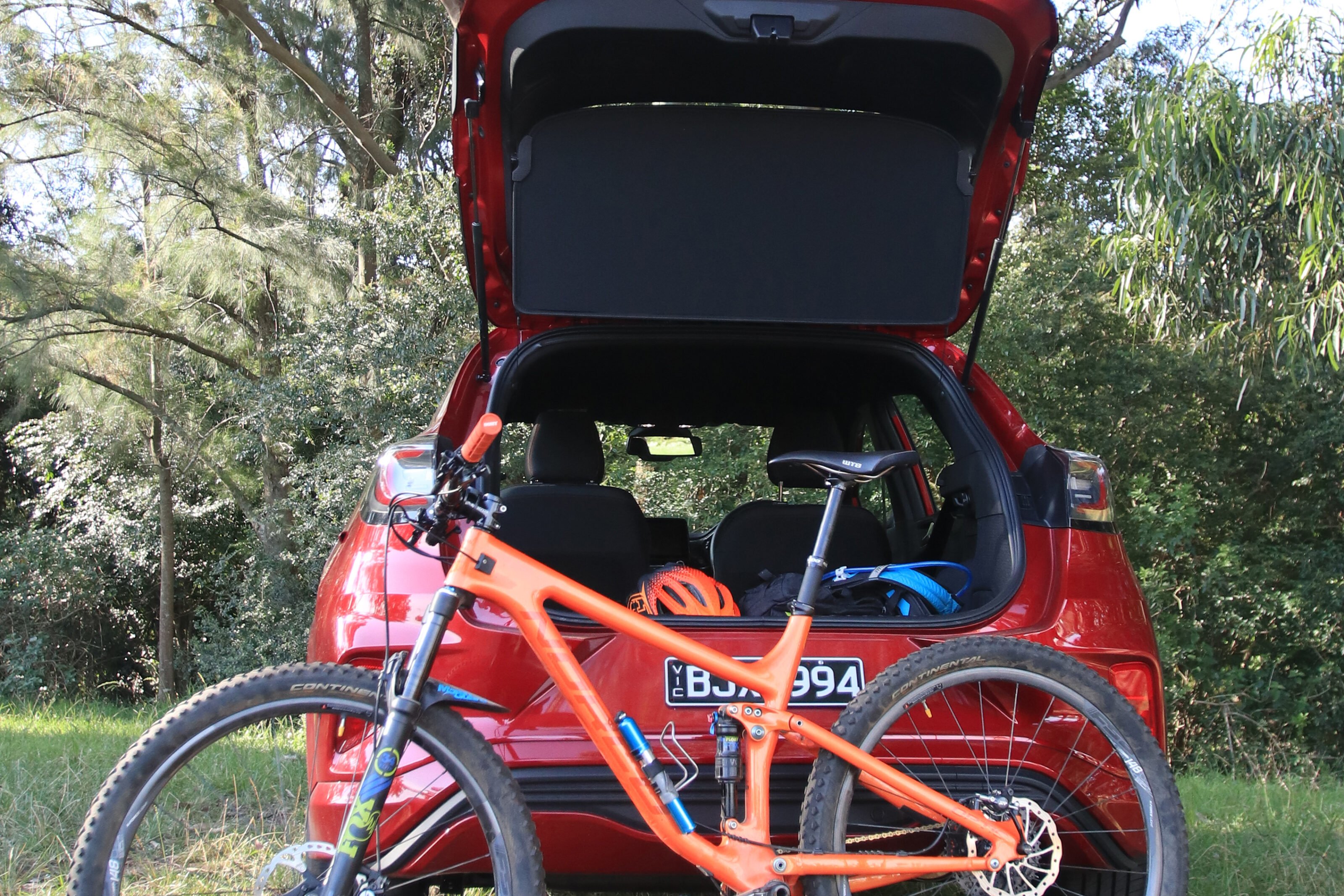
For example, the claimed boot area of 410 litres smashes the CX-3’s capacity by 60 litres, but falls short of the Juke’s frankly amazing 422-litre claim. However, adding wooden blocks to a cargo area is one thing… I need to see for myself whether my wee orange beastie can snug into the Puma.
Dropping the seats is relatively easy; there are no levers in the cargo area but the stretch to reach them is not a long one.
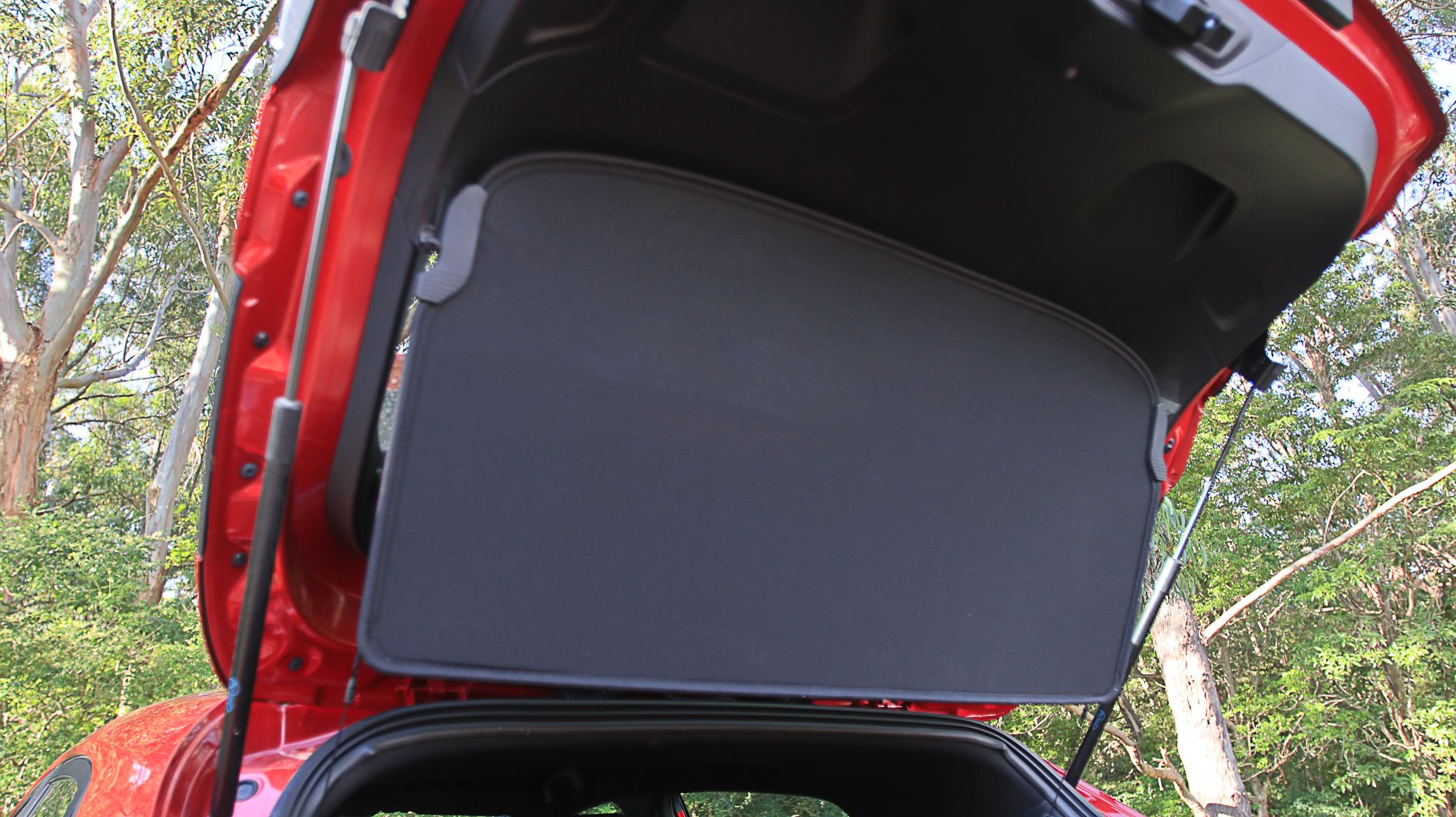
The rear belts can’t be restrained, which is annoying, but the novel cargo area cover (below) rises out of the way with the tailgate, which is bloody handy. I can’t tell you how many cargo covers have ended up in my shed.
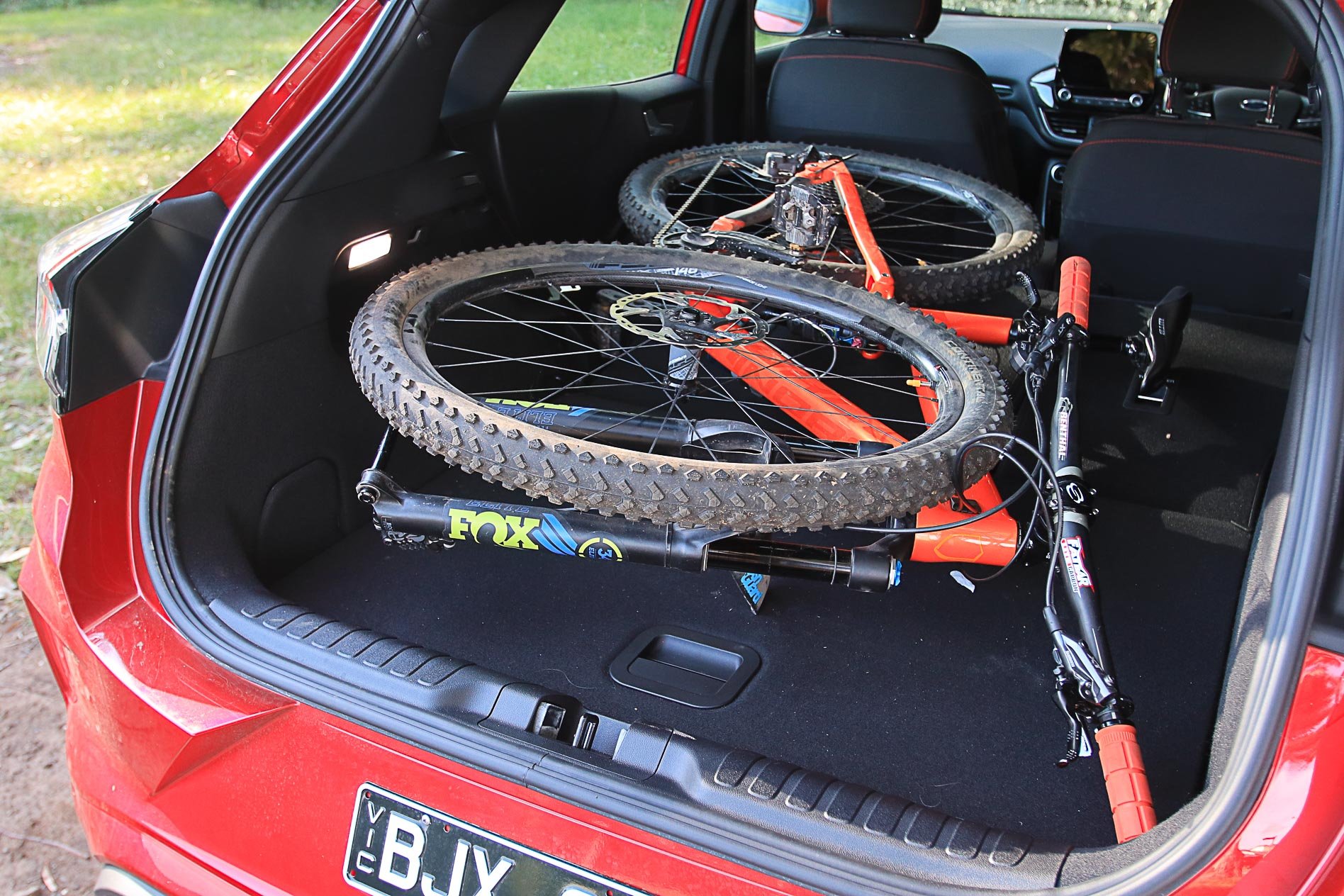
Inserting my Norco Optic with both wheels on was never going to happen, to be fair, but dropping out the front wheel is not a drama.
However, the Puma’s boot floor-length is not quite long enough, so I’m forced to slide the front passenger seat almost all the way forward to accommodate my unwillingness to drop the rear wheel out of the bike (leaving it in means the chain is much less likely to lube up the seats).
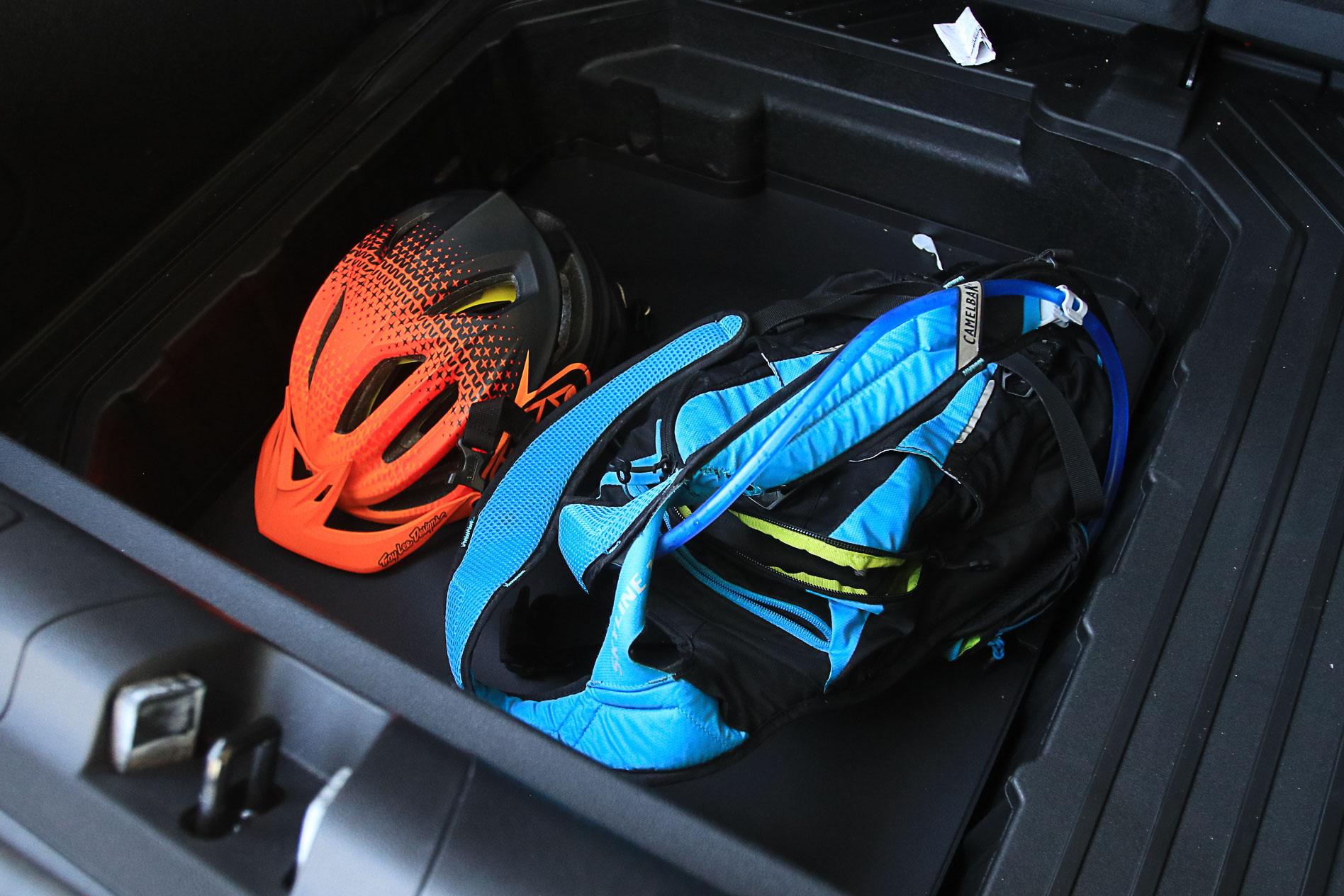
With biking comes gear, which needs to be stashed. A somewhat convoluted system to raise the Puma’s boot floor (below) to create a level surface also reveals a 60-litre wet bin – similar to what the Territory had back in the early ’00s – which hides a helmet, Camelbak and other stuff easily.
So I’d called that a result. Two bikes could be squeezed in the rear without wheels mounted, I’d suggest, and the relatively low roof height could see a pair of bikes chucked up top, too.
Much palaver is made about the flexibility of crossovers, but often it’s a hollow claim. The Puma, though, has kicked off things in the right way.
Update 3: Them’s the brakes
Robbot gets toey in the Puma
Price as tested $36,140 This month 606km @ 7.3L/100km Total 4694km @ 6.9L/100km
I’ve been blessed/cursed with sensitive feet. No, I don’t mean I break out in hives if I expose them to saltwater or anything like that. It’s more how my tootsies interact with the pedals of a car; in particular, the middle one.
I have no idea why I’m so fussy with brake feel. It’s not like I was subjected to ritualistic sensory training as a child that set me up for a life of being overly judgemental about vehicle retardation.
So what do I like under my right (or left, I’m fine either way) foot? I like a medium-high pedal, with a low-resistance transition to a well-modulated, fulsome engagement that is consistent right through the application, and one that transitions off-brake just as nicely.
Not fussy, then.

But as I guide the Puma through our local urban landscape, wincing every time I try and balance that crucial point between activation and retardation, I can’t help but wonder why any car feels any different to any other – ever. Look at the bits and bobs required to make a brake work in a modern car. A pedal, lines to carry fluid, a booster to multiply your pedal effort, a caliper, pads and a rotor. Not much, then.
Sure, tyres have a role to play, and electronics also have a say, but the fundamentals of a modern braking system are tick-box items now, over-engineered, costed to within cents of their lives, their physical existence and associated terabytes of testing data collated (I imagine) as ones and zeroes on a hard drive that can be called up at whim should an engineer want to replicate a task. Pedal pivot angles, brake line length, caliper type, piston diameter… it’s all science now, surely.
For whatever reason in the Puma, though, it feels like there’s an extra millimetre or kilopascal or something that’s been added to an engineering file somewhere that has the effect of rendering the Puma’s brake pedal as an on-off switch.
Brush the pedal at suburban speeds and there’s a wall of fuzzy, muted resistance that provides almost nothing in terms of slowing effort before – wham! – stage two kicks in like an Apollo rocket dropping its primary stage, standing the Puma on its nose.

Your passenger, long tired of your endless car shenanigans, gives you their best side-eye glare, even though there is nothing that can be done to amend it from your side. The feeling improves with more speed onboard… but honestly, at sub-60km/h velocities, the Puma’s brake feel makes me want to walk home. And three drivers are reporting the same thing, so it’s not just me.
So to my question; why does this even have to happen? The Puma rides on the older B2E platform, so it’s not as trick as the new C2 version that rolls beneath the larger Escape – but the last Fiesta was a terrific little thing, with loads of brake feel and a sweet balance at the pedal.
Yes, there’s pad feel variance, and I do wonder if a different compound would improve it. The Dunlops on the Puma are quiet and supple, so I don’t suspect them at all.

The curiously tied-down nature of the Puma’s suspension tune is a bit player, though; firm off the top, the springs don’t allow for sufficient pitch to contribute to brake feel at lower velocities.
Putting aside that (large for me at least) grievance, the Puma’s life in suburbia continues unhindered. The harder, less luxurious plastic surfaces between the front seats are holding up well to the generalities of life, the three-cylinder engine continues to impress with its surprising vim, and the combo of the faultless Sync 3 screen and digital dash still feels special every day.
Update 4: Farewell – Last Drinks
Ford’s small SUV exits stage left, while its custodian also call it quits. Will they miss each other?
Price as tested $36,140 This month 441km @ 7.3L/100km Total 5135km @ 6.9L/100km
FEELS a bit ironic, actually… As I sign off on my two-decade-long automotive journalistic stint to move into the car industry proper, I’m a little bemused by the fact that the last car I’ll officially drive on the job is Ford’s Puma.
It’s a car I had high designs on, too… but personally, despite the relative praise received during our Car of the Year 2021 testing, the little Puma is very much not my cup of tea.
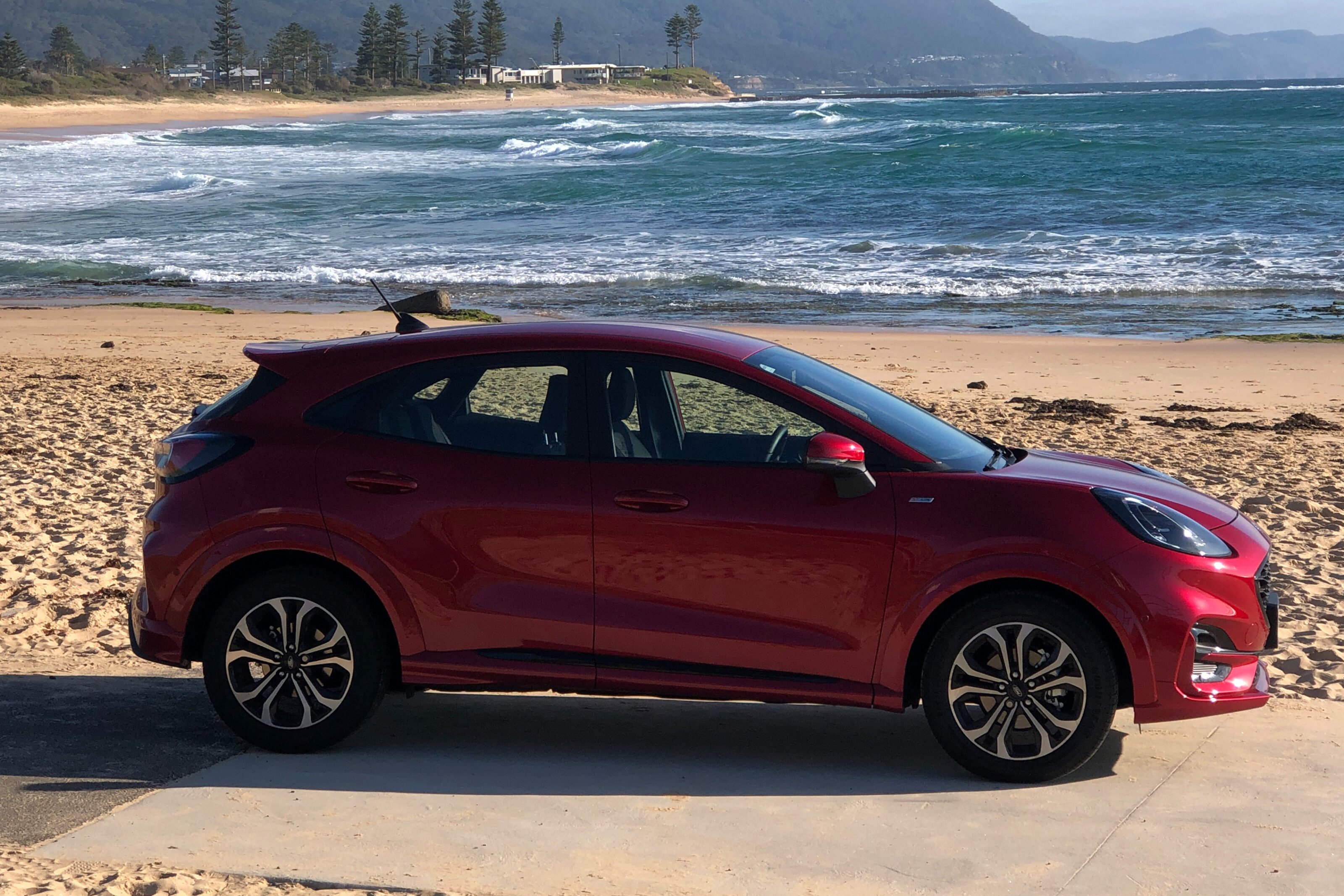
Plopped into the burgeoning small SUV arms race like an unwanted puppy, the turbo three-pot Puma has unfortunately disappointed me at almost every turn – and I’m reminded of that failing every time I pause for the damn door to unlock with a sensor key that won’t actually unlock itself without me having to push a button.
That in itself is perfectly okay – but why oh why can the same key then remotely operate the bloody start button inside the cabin?
There is a way around it, and it’s one that the teens in the Robbo household enjoy; the Puma can be unlocked with one’s suitably app-equipped smartphone. Called FordPass, the app requires a mere moment of the car’s time to do its internet-y things before turning into a pseudo keypad for the Fiesta-based Puma. It can give you odometer figures, a fuel reading, the car’s location and its tyre pressures, too, along with a searchable copy of your owner’s manual.
It can also remotely lock and unlock the doors, yes, if you hold the requisite button down on your phone for quite a long time. It can also start the car from a distance, should you want to cool things down inside – but this is predicated on whether you’ve got the correct level of cooling set up in the car beforehand.
One can’t, sadly, simply drop all four windows by holding the unlock button down – almost my favourite use of a key fob button ever – to let hot air out, which would have involved, I’m sure, a lot less computer programming.
One can, somewhat disturbingly, lock one’s keys inside the car using the smartphone app, though – which seems like a really, really bad idea to me. I’ve tried locking the keys in, and it’s an absolute possibility.
If your next move is to allow your phone to run out of charge or to accidentally drop your device in the sea, you are pretty firmly stuck. And you wouldn’t have been stuck if you hadn’t used the app, right?
I complained at length last month about the brake pedal feel (in short, not great), and I have similar feelings about the steering response and take-off acceleration.
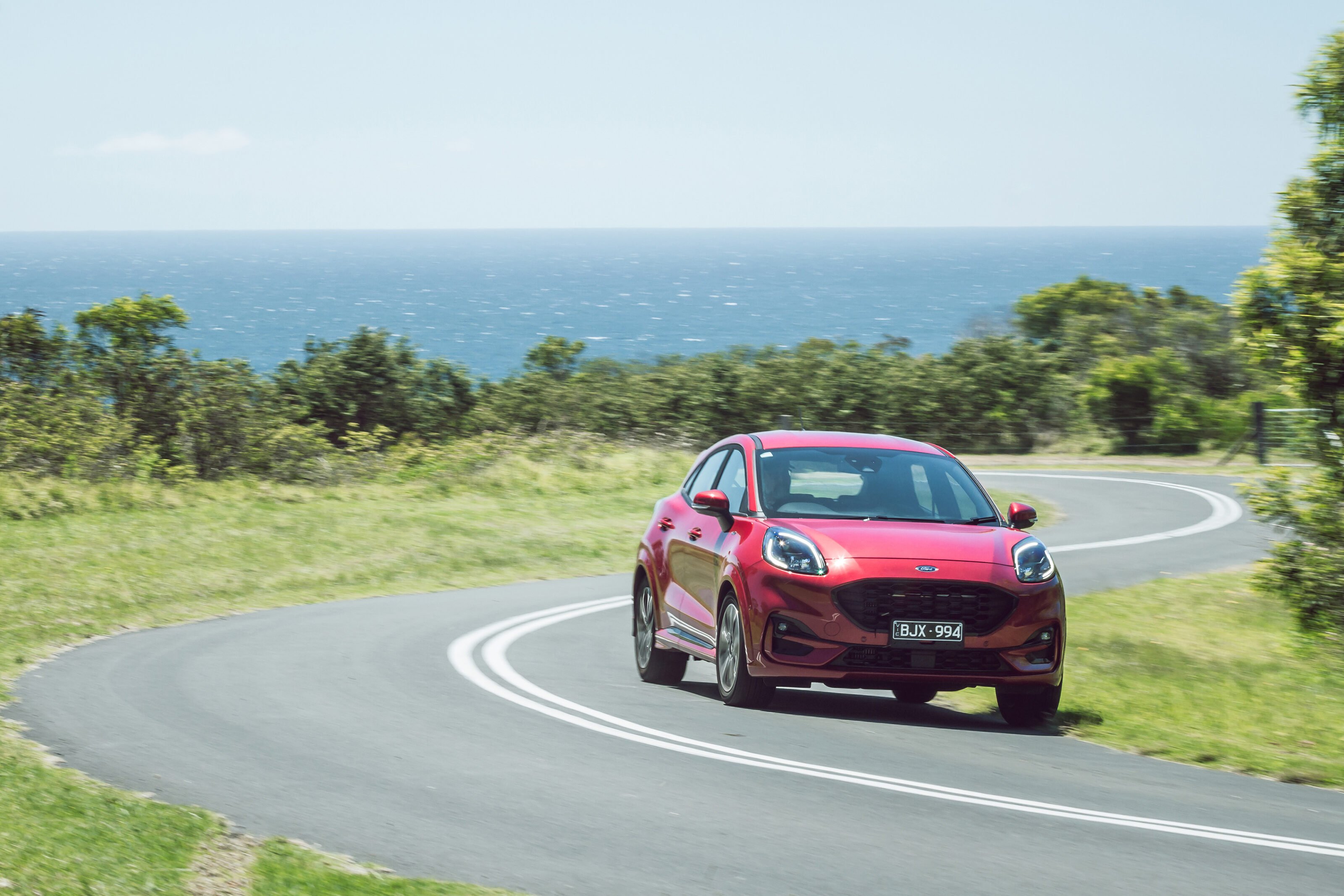
These three items put together are the quintessential basics to get right in a small urban crossover. There are no ifs, buts or maybes; it’s what a customer feels on a test drive and it’s what they feel every day.
It’s almost impossible, in fact, to be smooth at the controls of the Puma. The nothing-then-everything brake pedal ratio, the dragster-like take-off from rest and imprecise, floaty steering feel from centre… in a class where it needs to match up to cars like the Mazda CX-3 and Kia Stonic, just to name two, the Puma just needs to be better. It’s got a strong engine, sure, and the dual-clutch gearbox is a good match at cruising speeds, but the too-short first gear and often aggressive initial clutch engagement really spoils things.
So I’ll sign off from this, my last ever car review for this august journal, with a recommendation; have a good, hard think about what you’re looking for in a small SUV, and if you do come back around to the Ford Puma, don’t say I didn’t tell you so. Over and out.
Of the motoring nameplates with real staying power, Hyundai’s Sonata doesn’t come immediately to mind. But seven generations stretching back to 1985 is a long and successful innings even if the often humble and honest mid-sized four-door isn’t quite as prosperous for its maker as it once was.
Enter the all-new eighth-generation Sonata, designated DN8, its local release bringing a single variant blending robust turbocharged power, coupe-like presence, N Line warmth and tree-topping appointments and tech.
Boring is gone, replaced by ostentation aimed at buyer heartstrings and hopefully enough panache to dust off the stigma of mainstream sedan humdrum.
Yes, Sonata wants to place in the somewhat modest contingent of so-called ‘semi-premium’ offerings pushing upmarket to steal thunder from the lower rungs of genuinely premium Euro figureheads.
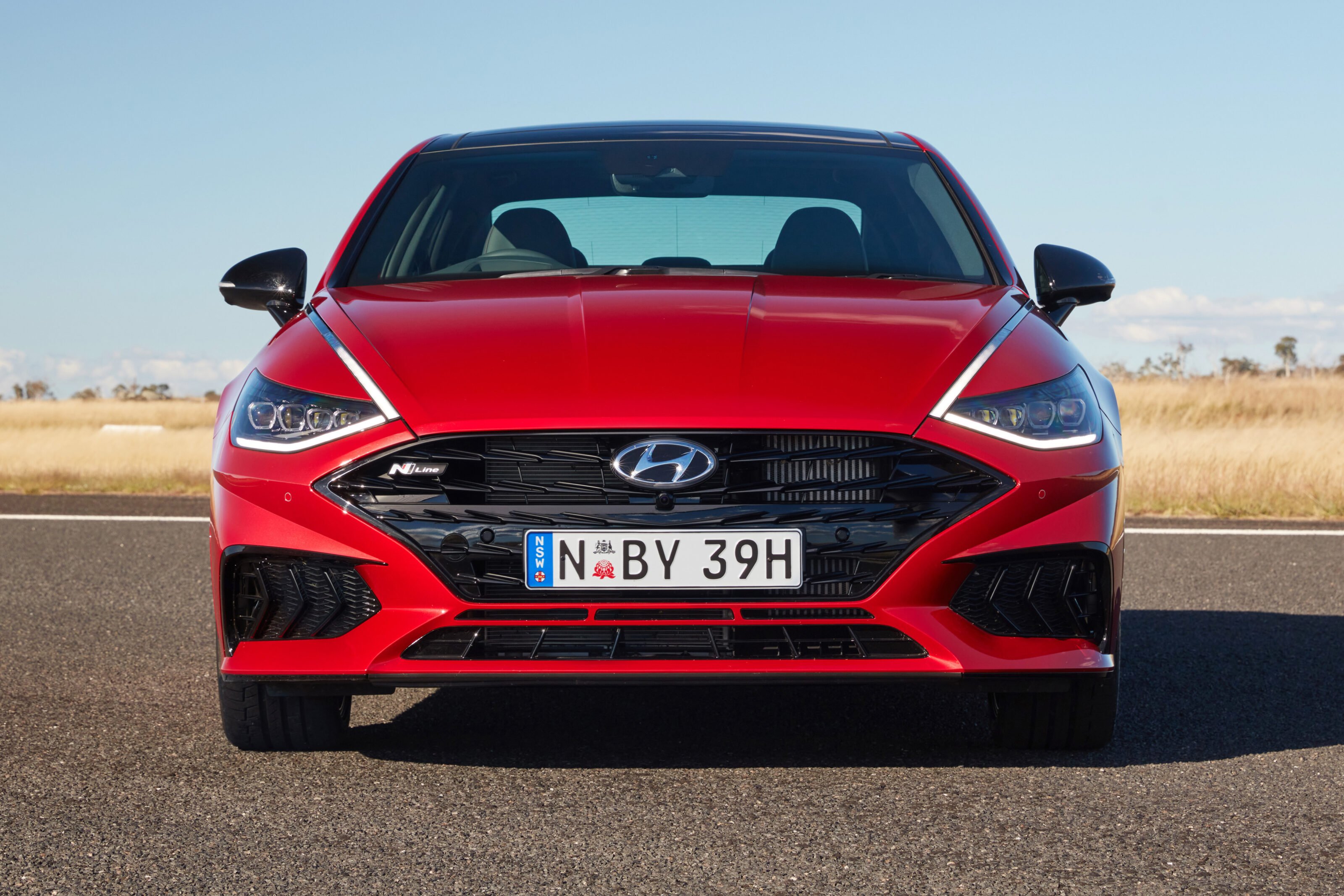
The new, stylised sedan exemplifies the fledging N Line’s shift in branding from a bit warm and sporty to a designation for the ‘have’ variants offering higher-grade powertrains and more fulsome bells, whistles and luxury than have-not versions, as it spreads hastily across Hyundai’s model ranges.
Kudos to Hyundai Australia for continuing to push four-door sedan relevancy, both in the mid-sized Sonata and the recently released small-segment i30 Sedan – the only right-hand-drive development globally – to bolster local showrooms when many of its rivals are consolidating their increasingly homogenised ranges to pander to ute and SUV buyers.
The importer is under no delusion that either sedan range will sell a motza by steering wedded shoppers away from the usual suspects, but the suggested logic is that a good many SUVs occupy two-vehicle households and this “chic coupe-like four-door,” as it calls the Sonata N Line, aims to fit that second-car bill parked up next to a Tucson, Santa Fe or Palisade.
Price and Value
The one and only Sonata N Line is $50,990 before on-roads. By comparison, the segment-smaller i30 Sedan N Line Premium automatic flagship is $13,700 more affordable.
At 4.9 metres in length, the Sonata N Line straddles the medium and large segments, so while viable four- and five-door cross-shops are dwindling, they are still more numerous than you might expect.
Mid-sized alternatives, categorically at least, include the Mazda 6 Atenza ($50,090 list), Skoda Octavia RS ($47,790 list) and Honda Accord VTi-LX Hybrid ($50,490 list).
The large-sized rival Hyundai name checks is Kia’s Stinger, the entry turbo-four-powered 200 S ($49,550 list) undercutting Sonata N Line a little and wanting a fair bit more investment for the high-grade GT-Line ($57,230 list).
From the Sonata N Line’s ask is roughly a five-grand walk up to an Audi A4 35 TFSI ($55,900 list) and into properly premium Euro territory, though there’s a huge disparity in standard equipment fitment between the top of the mainstream and the primo ground if you’re in it for more than mere badge cachet.
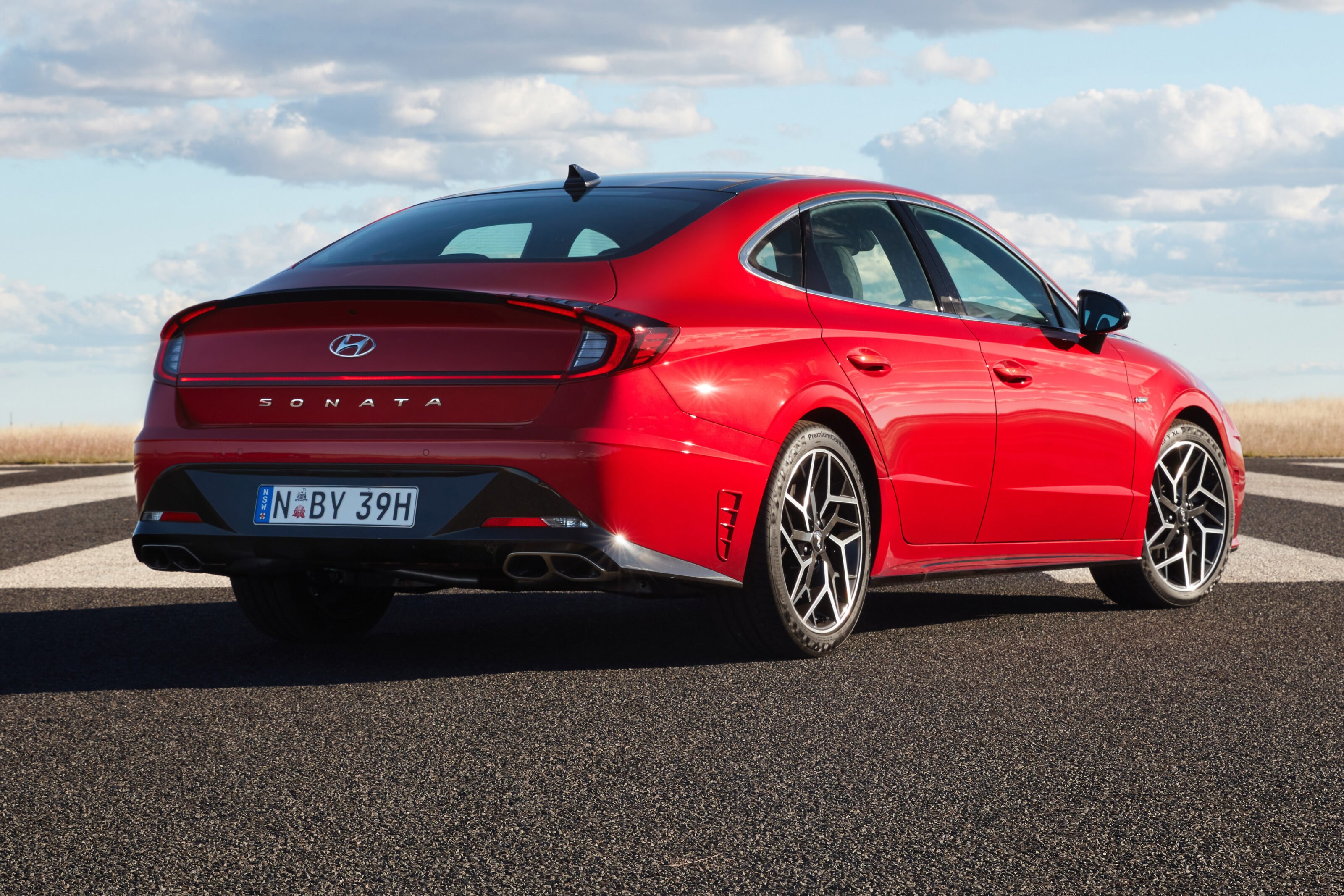
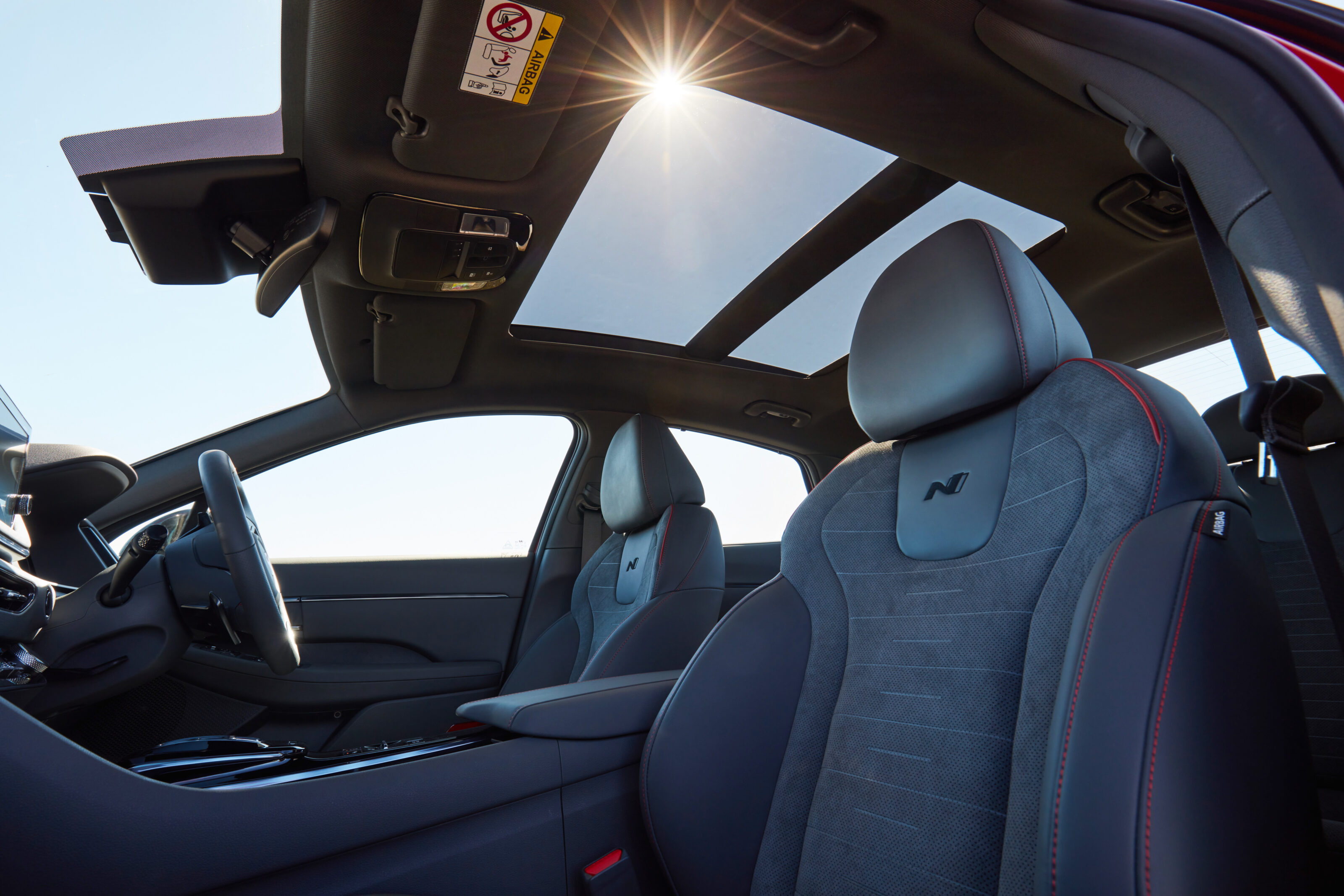
The features and equipment list wants for little. Outside, the Sonata N Line fits 19-inch wheels, 245mm rubber, N Line styling, full LED lighting, power-folding and heated mirrors, front and rear camera systems with parking sensors at both ends and a panoramic glass sliding roof.
Adaptive cruise control with stop and go is standard. Premium paint, though, is an extra $595.
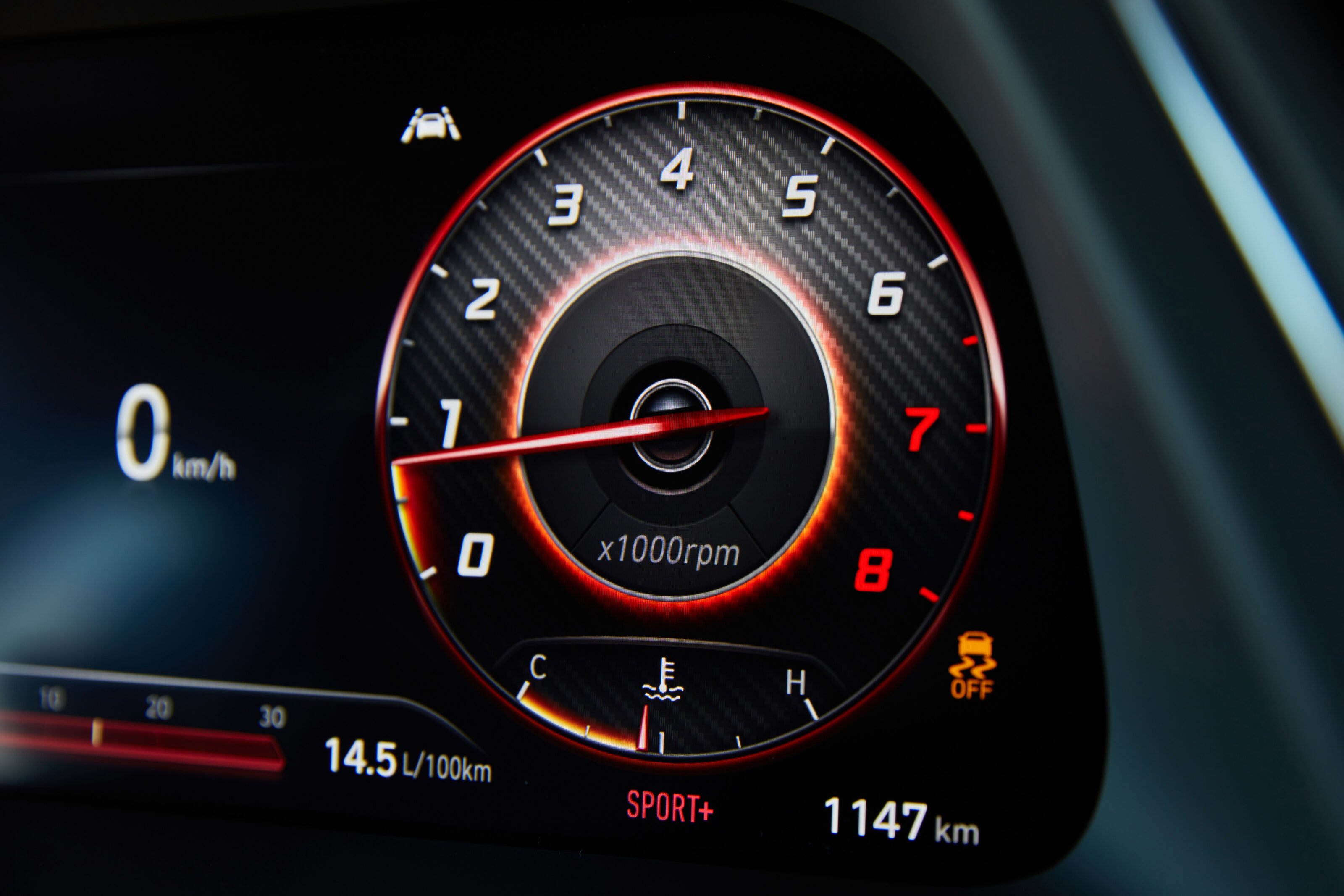
Inside, the cabin features 12.3-inch digital driver’s instrumentation, a head-up display, suede and Nappa leather seat trim, seat cooling up front, seat heating in all outboard positions, 12-way driver’s seat adjustment, dual-zone climate control and rear window blinds.
Infotainment is Hyundai’s high-spec 10.25-inch touchscreen design with sat-nav, wireless phone charging, digital radio, Apple and Android smartphone mirroring and 12-speaker Bose-branded audio.
Features included in the global N Line menu and featured in the local release include shift-by-wire transmission control, drive mode selection, Active Sounds Design sonic enhancement and noise cancelling, as well as powertrain functions such as launch control and N Power Shift functionality.
Living with the Hyundai Sonata N Line
As mentioned above, this new Sonata is on the larger side of ‘medium’, both longer and lower than the generation this eighth take replaces.
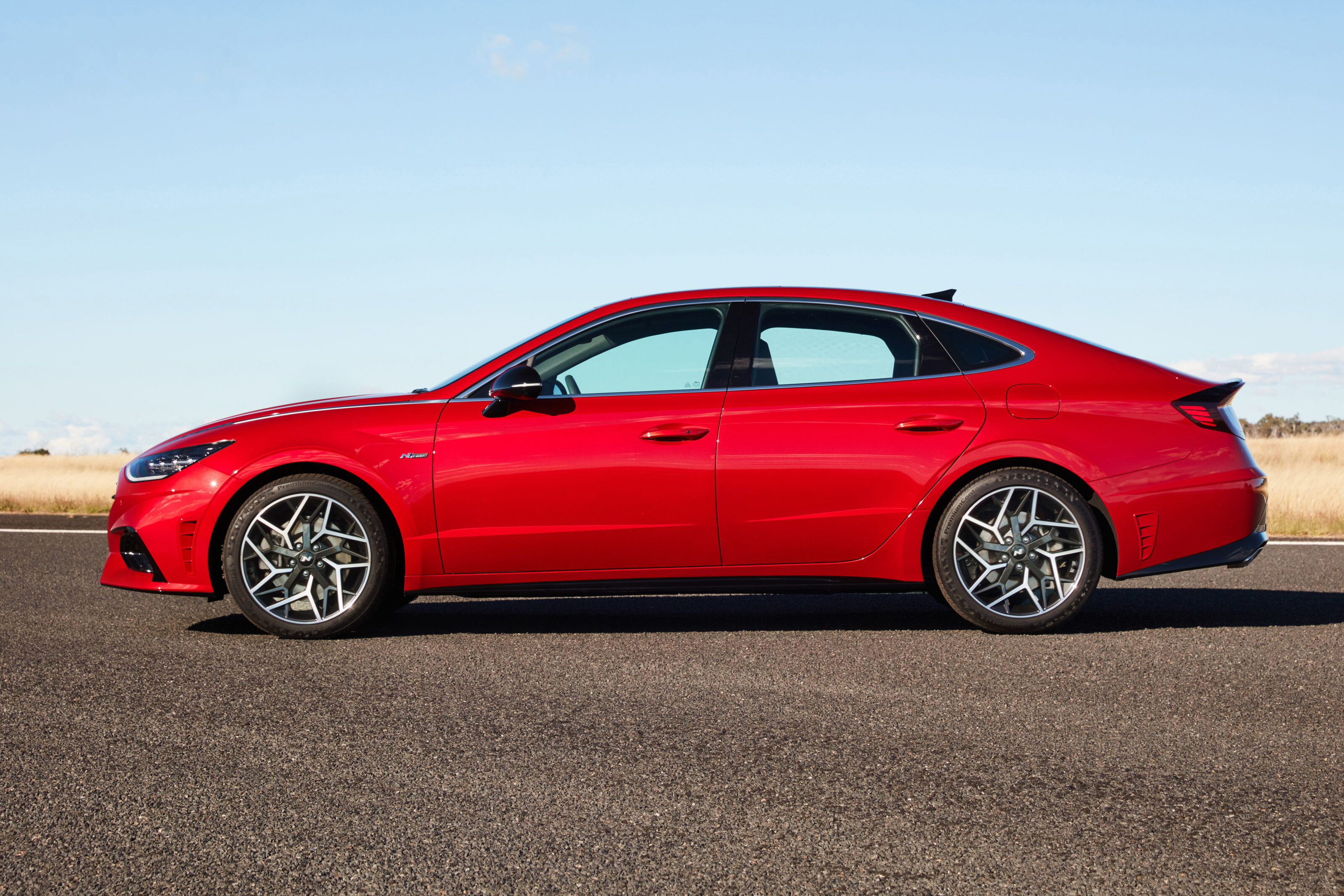
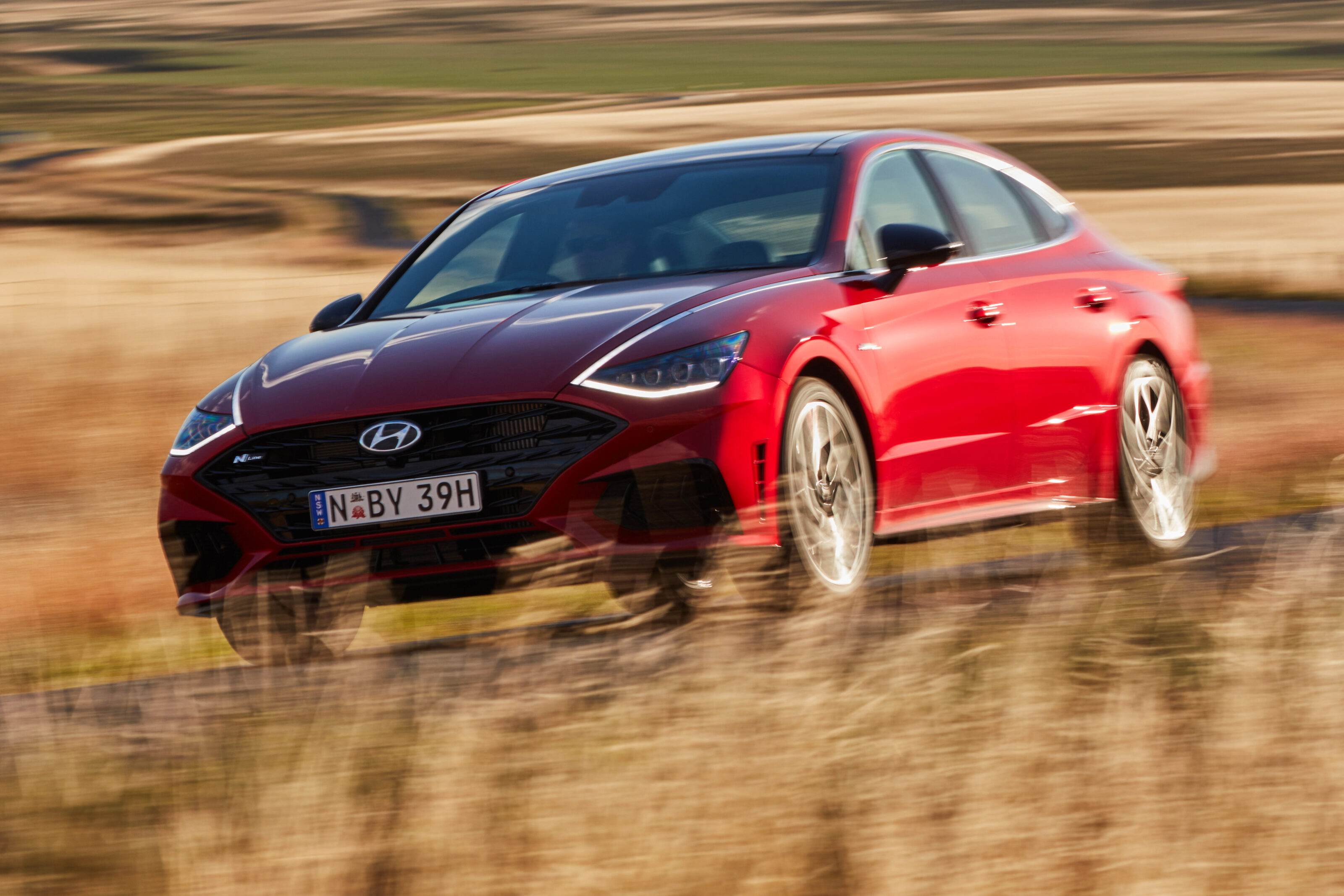
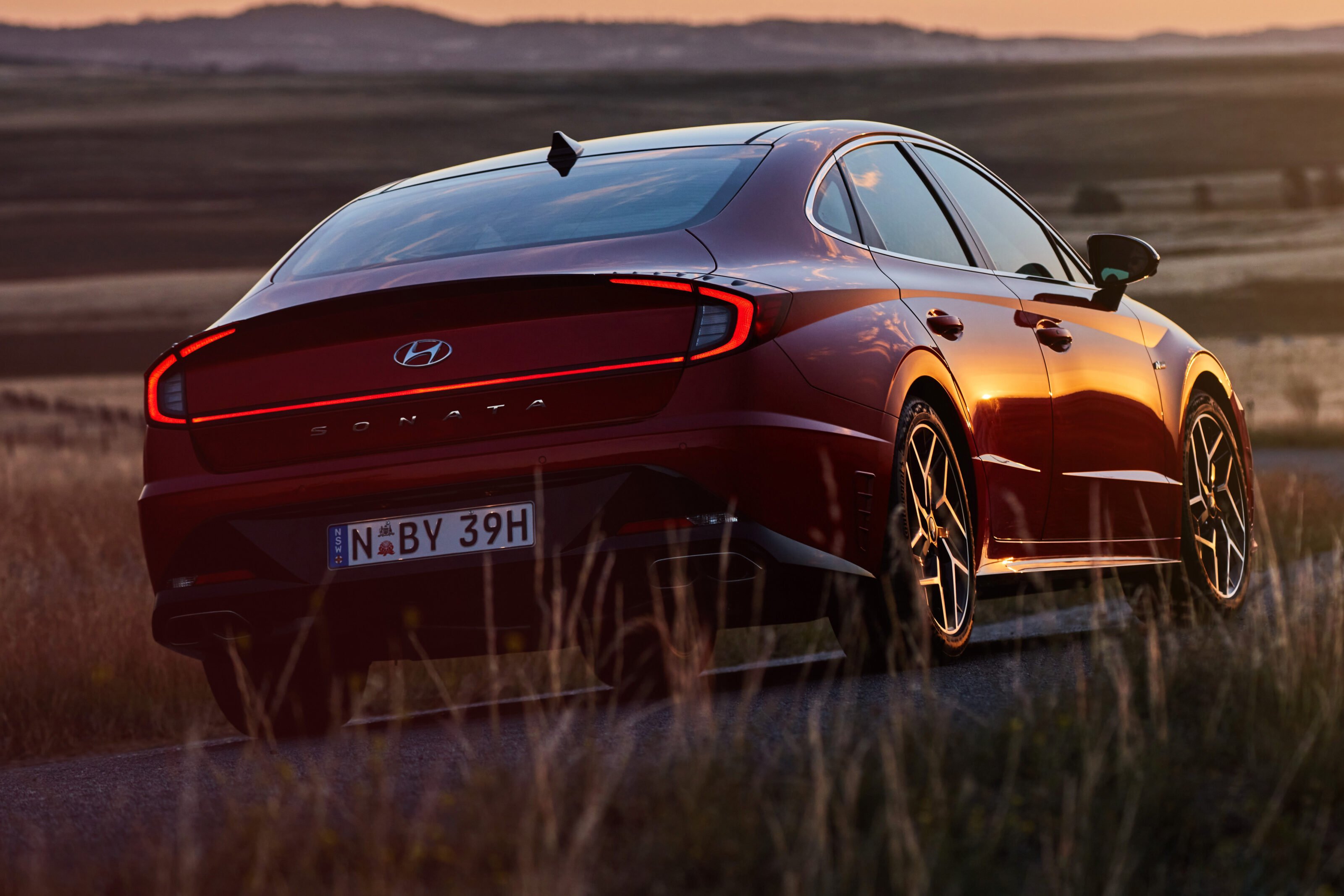
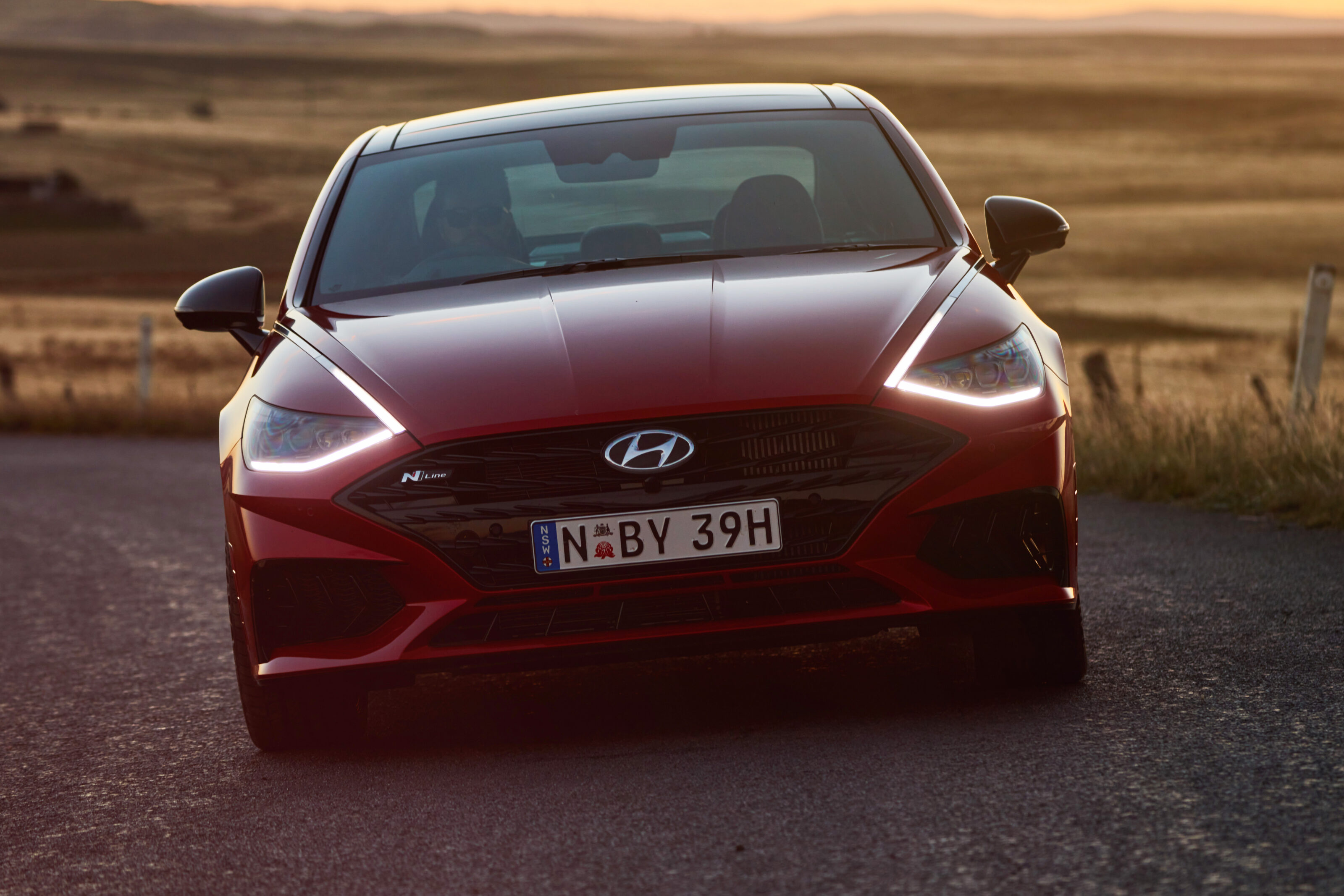
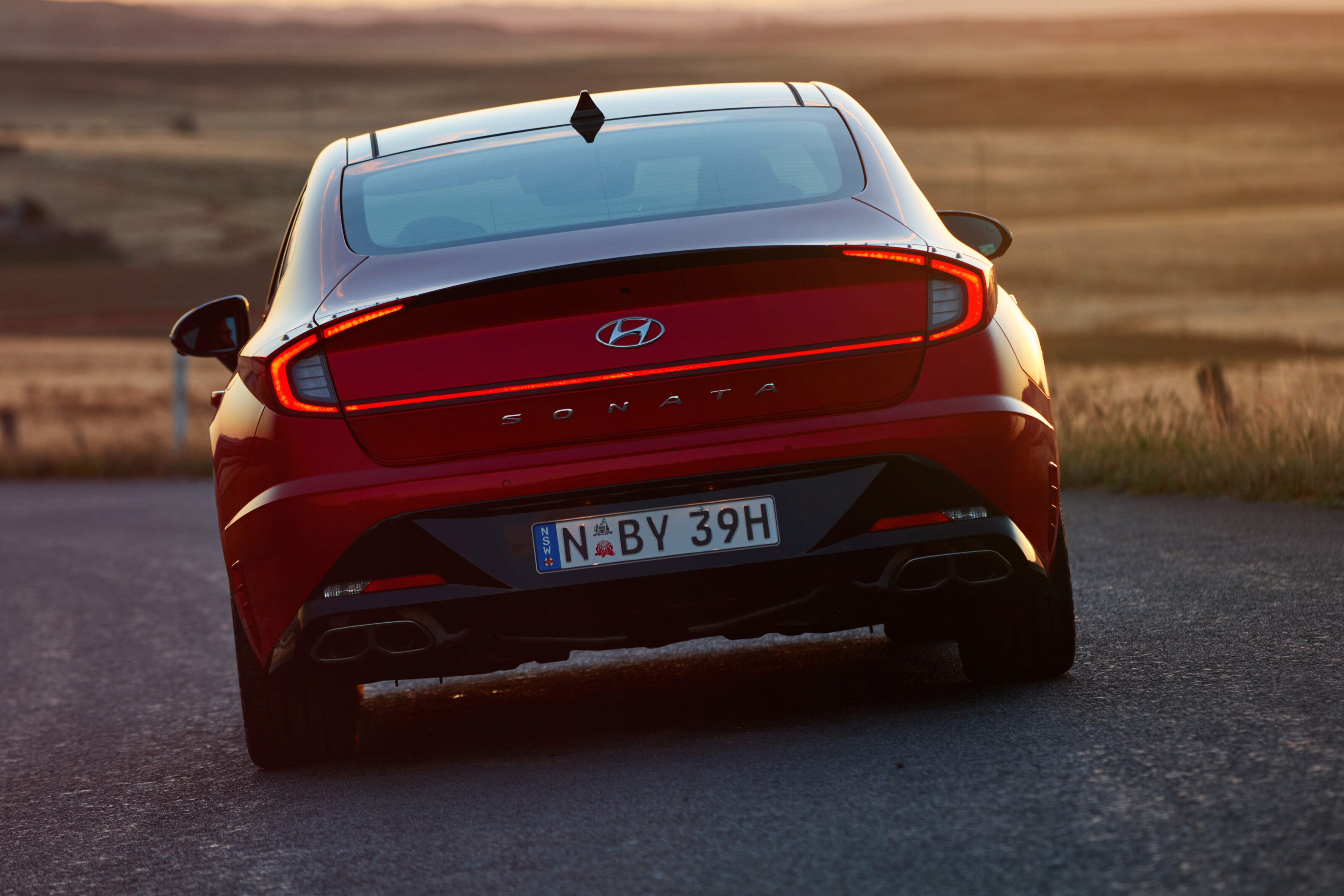
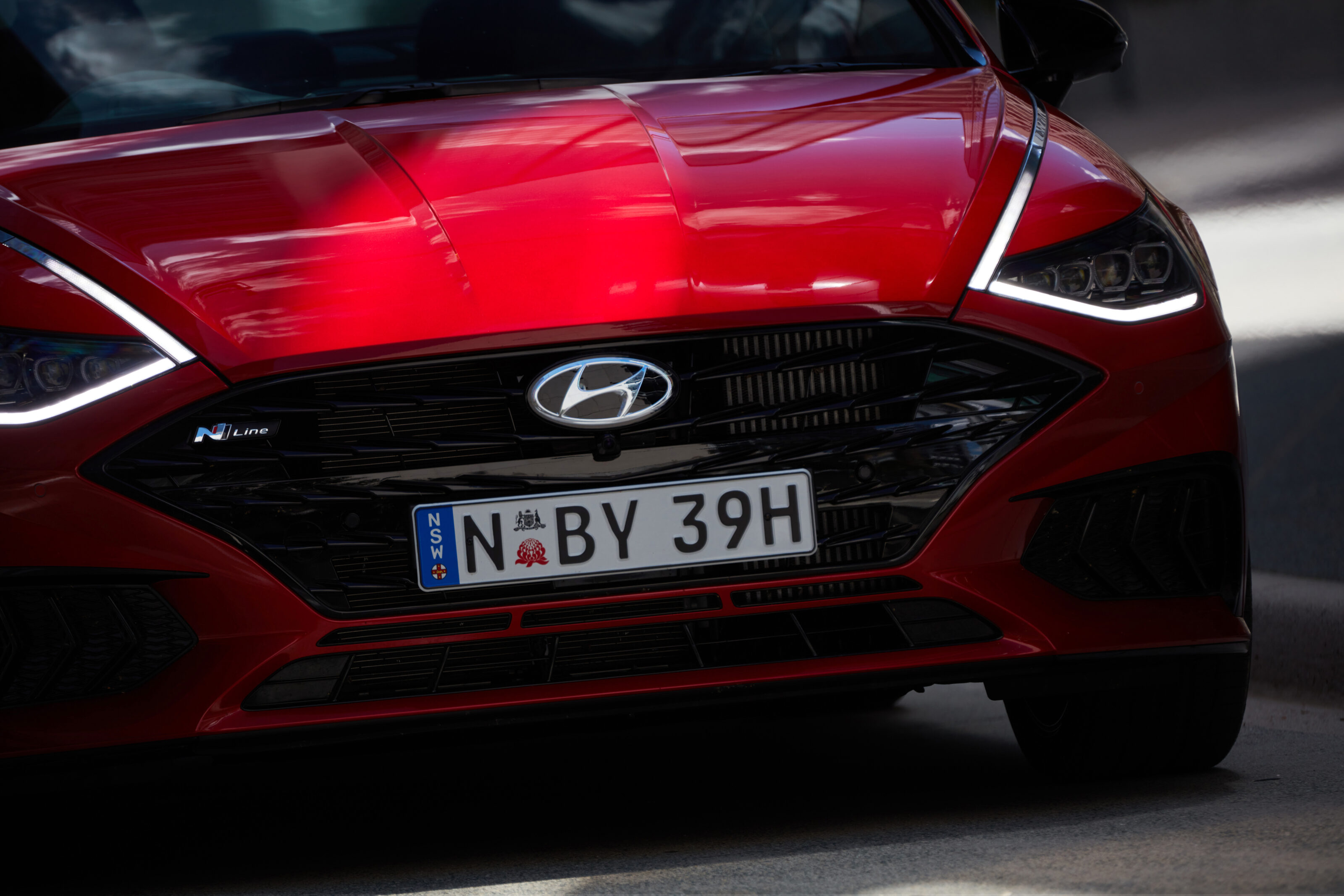
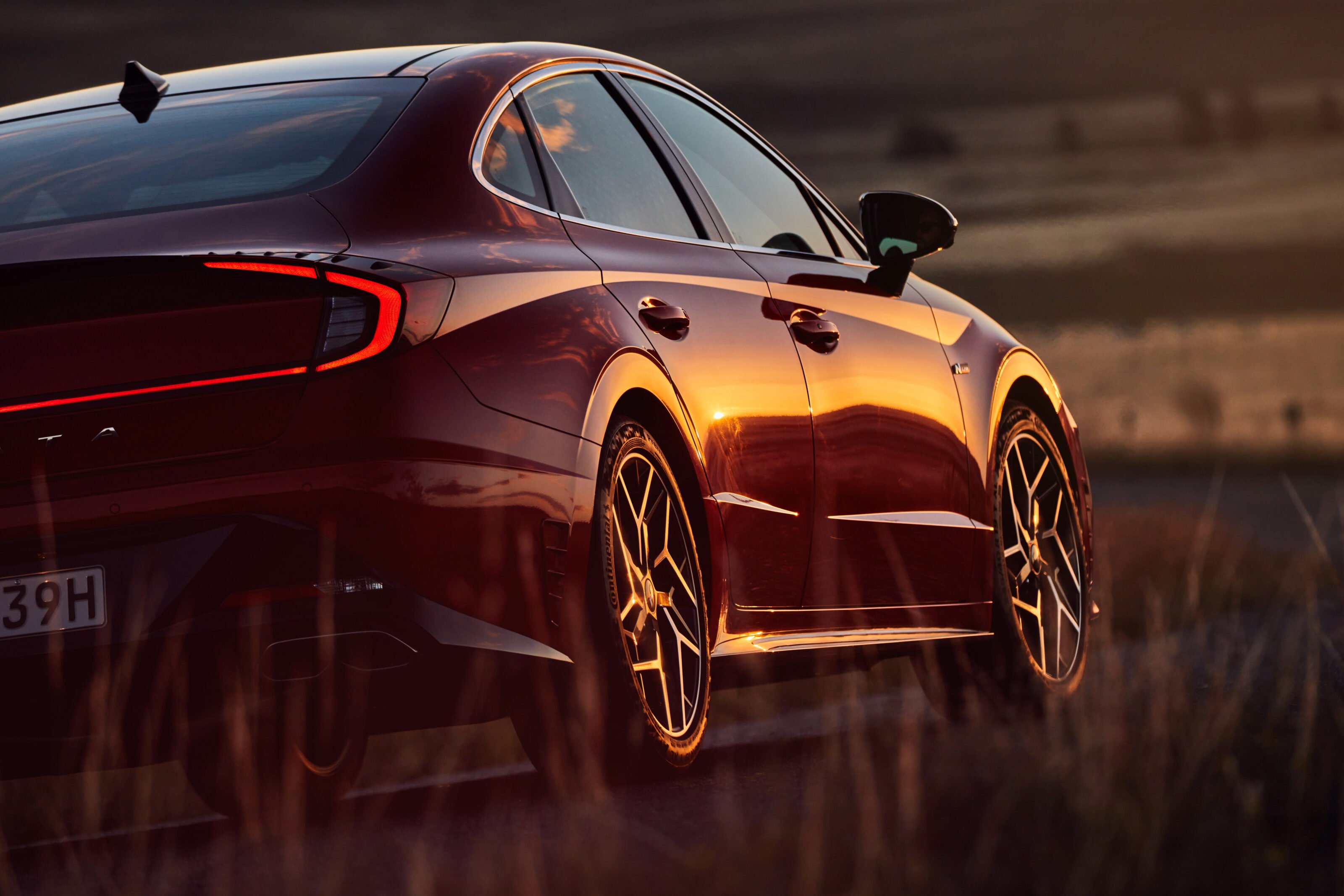
Hyundai’s “coupe-like four-door” flaunts a bold character line yet looks quite sinuous in profile, its tidy rump framed by a neat H motif in the LED taillights and restrained wheel styling. But the nose is something else, its broad-grille snout, gaping N Line vents and upswept LED headlights conspiring to look as polarising as it is distinctive.
The whole front fascia pushes itself over the top with LED daytime running lights that stretch halfway along the bonnet crease, inside the chrome garnish, and linking the headlights to the window frames.
You won’t miss an approaching Sonata N Line bearing down in your mirrors.
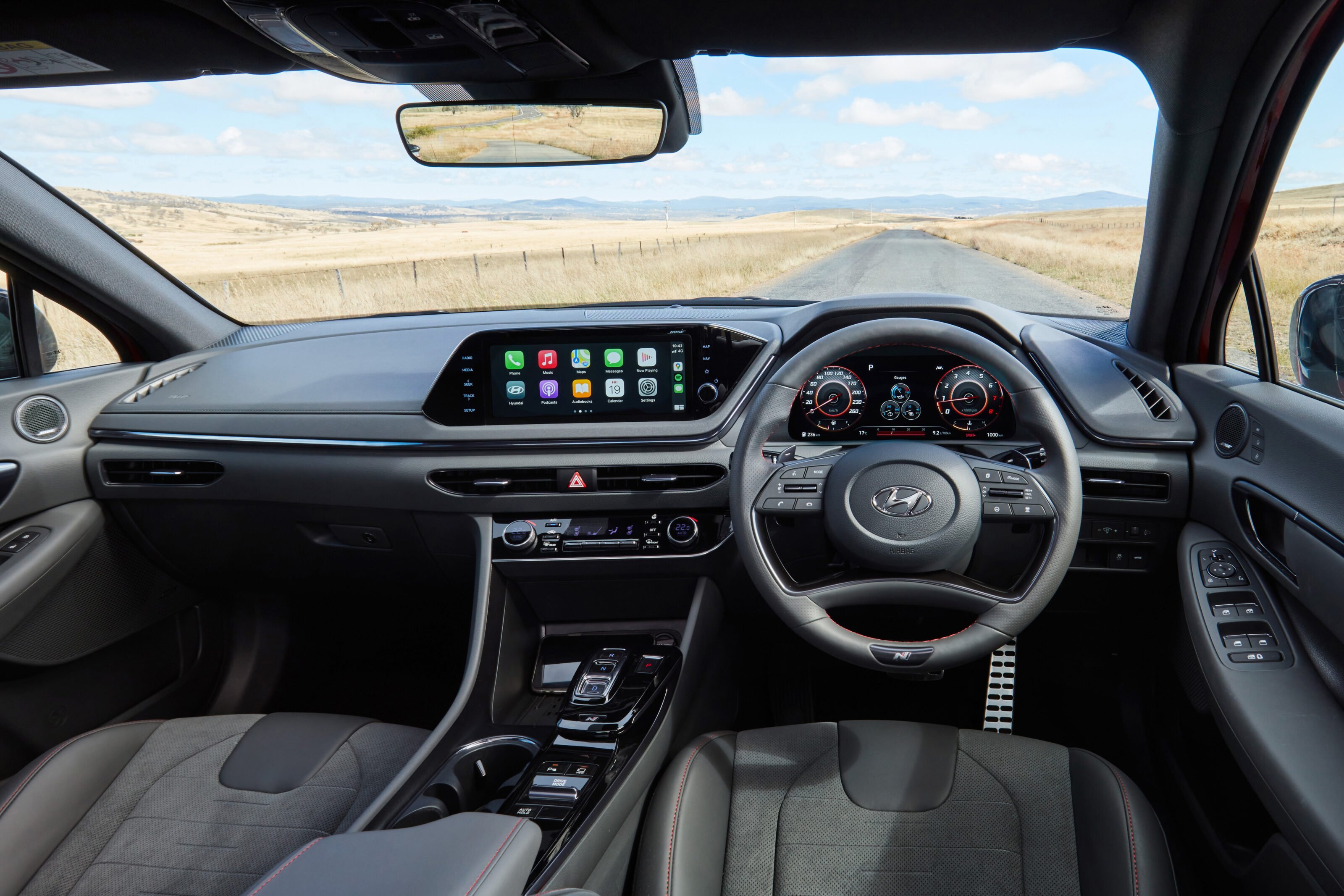
The cabin is equal parts adventurous and restrained, its novel four-spoke wheel and shift-by-wire push-button transmission controller – as shared with the Santa Fe large SUV – dragging the otherwise conventional interior design in a fresh direction that looks more Genesis-lite than a straight rip from the book.
The to-and-fro continues with the eye-candy drawcards of large 12.3-inch digital driver’s display, Hyundai’s latest high-end family 10.25-inch touchscreen infotainment system and head-up display, with expanded content such as vision from the blind-spot cameras. There’s plenty of whiz-bangery, then.
It’s all housed within a demure mid-grey colour scheme of materials that are nice, if just shy of seeming genuinely premium, with plastics and textures that are neat, hardy and in some areas merely workmanlike.
For example, the ornate stalks are classy, while some of the centre stack buttons seem a little more part-binned.
The driver’s screen is beaut; pin-sharp and clear, with a variety of skins tied to different drive modes that owe more than a touch of inspiration to Benz (Normal, Custom) and Audi (Sport and Sport Plus).
Covering the excellent seats are genuine suede and Nappa leather, a rung about the fakery you’ll find in smaller-segment N Line fit-outs. They provide excellent comfort and support that can be tuned 10 ways on the driver’s side, complete with a neat graphic in the touchscreen as an upmarket touch.
A bit of a head-scratcher is the absence of any sort of mood lighting to add some colour contrast and interest to the scheme’s stolid greyness.
Sonata brings little new to the infotainment system as fitted throughout Hyundai’s high-grade model variants, fully loaded with features if nothing much new or different bar the Bose audio effect, which gets boomy the instant you look at boosting the bass adjustment if you can actually find the damn thing tucked away in the submenus.
The curious Sounds Of Nature ambient effects – footsteps through snow, water through plumbing – is included, of course, if merely as a feature of difference you’ll likely never be compelled to actually use.
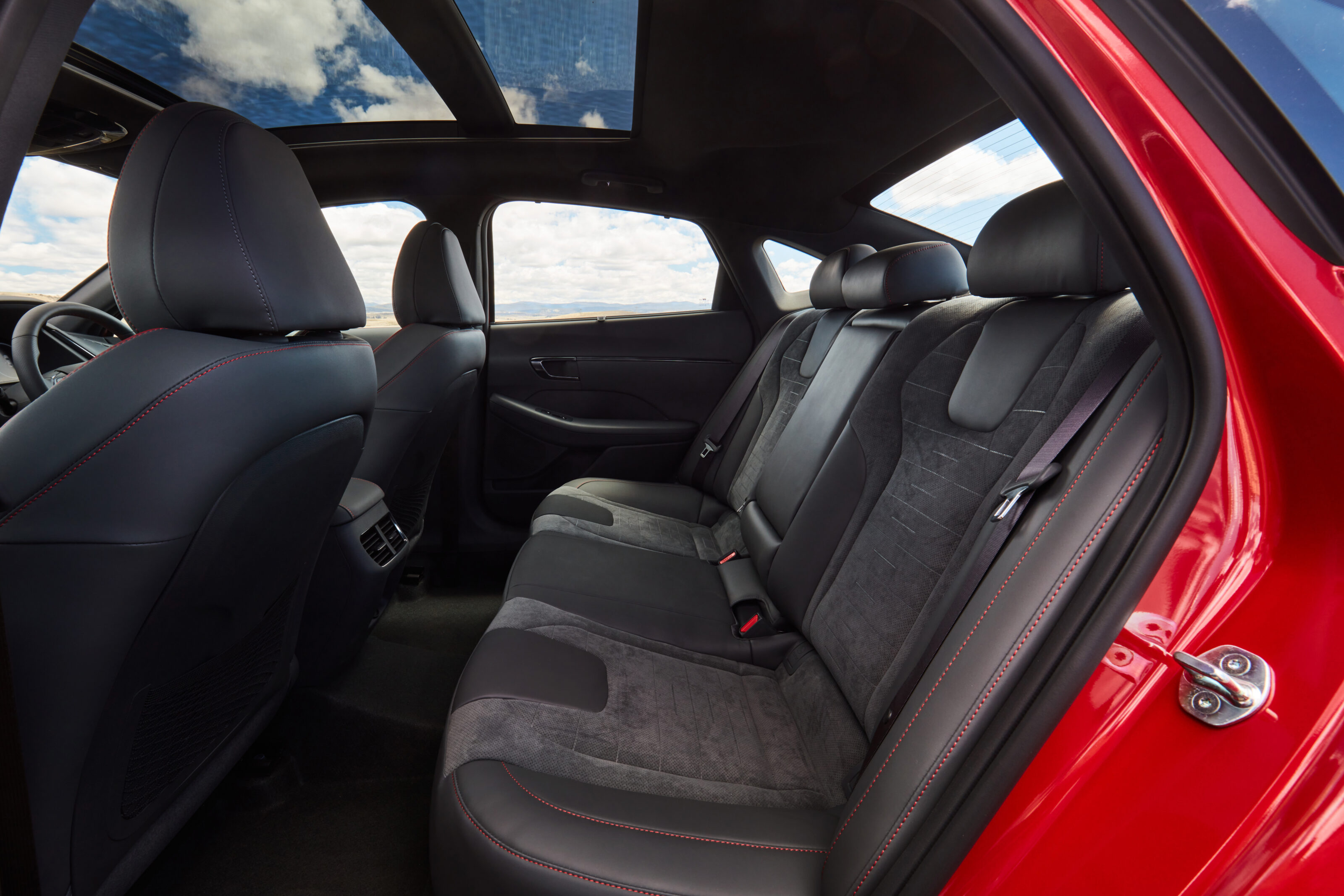
Second-row accommodation offers fantastic, large-car-like legroom and an airy ambience that is impacted slightly by limited headroom as a result of the sloping, coupe-like roofline and a bulky lump created by the sliding glass roof mechanism.
Still, you’d have to climb well into plus-sized SUVs to find long-haul adult-oriented comfort to match the Sonata, though the pronounced hump in the middle seatback creates a bit of a natural four-seat configuration in spite of the centre seatbelt fitment.
It’s a thoughtful fit-out in the back too, with retractable window blinds and dedicated seat heating controls in the armrests, air vents in the rear of the console and a sole USB outlet.
Beyond the 40:60 split-fold seatbacks is a humongous 510 litres of deep, broad and flat boot space atop a cavity that fits a space-saver spare yet could easily house a full-sized option, though it’s worth calling out that the boot aperture is surprisingly shallow.
There’s more of an executive grand touring vibe to the Sonata N Line interior than there is of over sportiness. And arguably all the better for it.
Engine, transmission and driveline
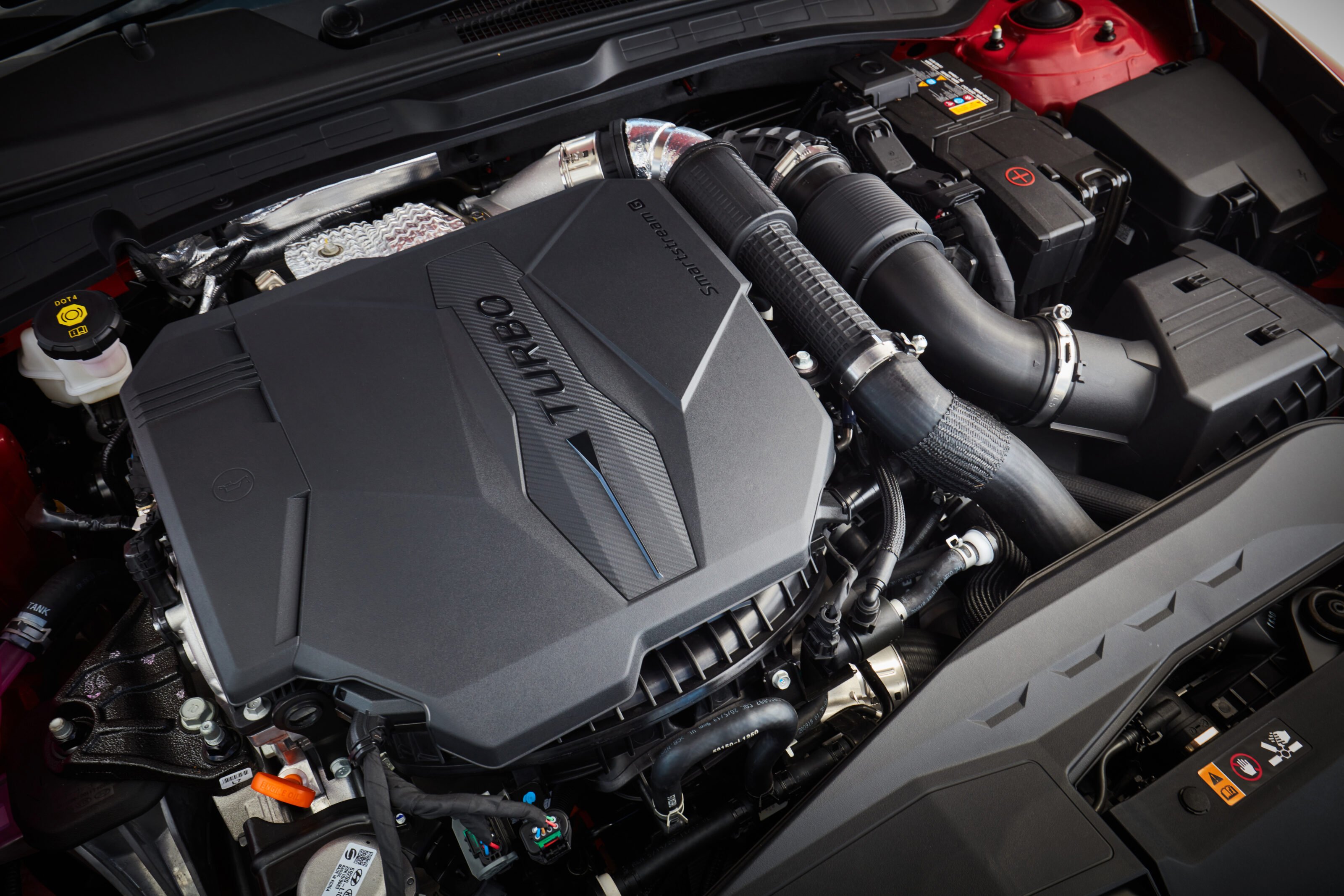
N Line format or not, 2.5 litres of turbocharged four-cylinder motivation is fittingly ample for a car as big as the Sonata has grown into and, at 1623kg, weighs as much as it does.
Stats are healthy enough, with 213kW clocking on at 5800rpm (despite the displayed 6500rpm redline) and a fairly surly 422Nm across a flat plane between 1650rpm and four grand. This SmartStream G2.5 T-GDi is direct-injected and fits a two-step variable induction system with water-to-air intercooling, is Euro 5 compliant and happily runs on lowly 91RON or E10. The advertised combined fuel consumption claim is 8.1L/100km.
It drives the front wheels via a ‘wet’ eight-speed dual-clutch transmission, rather than the dry-clutch-type set-up found in small-segment N Line models. Part of the advantage of the wet system is torque rating – this transmission is also fitted to Santa Fe V6 – and it’s also more inherently refined in shift calibration.
Clearly the brief here was to lean spec further towards cruiser than firecracker. Still, that hasn’t stopped Hyundai injecting a bit of fizz into the powertrain and its support systems to dial in a bit of vibe and extra capability.
For example, N Power Shift is a feature of Sport and Sport Plus drive mode – that latter automatically defeating stability control – that widens the throttle opening during upshifts for a sharper, more pronounced thump.
It also features launch control and when all and sundry are called to duty it’s claimed the Sonata will hit 100km/h from a standstill in 6.2 seconds, which is not too shabby if hardly breathtaking.
There is a manual mode for the dual-clutch, but regardless of how you set it the transmission will rev-match on the downshifts provided you’ve got the drive mode planted in Sport Plus.
The Sonata N Line also fits fairly large 345mm front and 325mm rear anchors when dialling things back to a dull roar.
Speaking of which, there’s an Active Sound Design feature that injects a bit of sonic mojo to proceeding when the red mist descends and integrates a bit of NVH noise cancelling for the remainder of the driving experience. That said, the system wasn’t fitted to the pre-release test cars available at the local launch program.
Unlike many Hyundai Australia releases, the Sonata N Line gets a global rather than a tailor-made domestic ride and handling tune, though the local arm did have input on hardware spec early in the car’s development to help achieve a requisite “flavour”, it’s claimed.
Driving the Hyundai Sonata N Line
This new N Line doesn’t set out to inject a spasm of melodrama into Hyundai’s mid-sized four-door providence and that’s pretty clear from the first turn of a wheel. This is, after all, still a Sonata.
Its default character is polite and somewhat reserved, free of fuss and fanfare. But what it neatly sidesteps, with dignity, is feeling cheap and unsubstantial.
The engine is quite poky, scaling onto its torque plateau cleanly, rewarding with ample thrust with a flex of the right foot and without needing to chase the redline. It’s a faithful transmission, too, slipping neatly between cogs and shafts, riding the thick of the engine torque without any unruly over-enthusiasm.
Bar a few minor low-speed, part-throttle nibbles in the driveline, there’s a nice blend of linear gusto befitting the cruiser brief the N Line so clearly errs toward.
Sport mode does as expected, alerting response, tightening the upshifts, swelling up usable muscle without much in the way of unruliness. It is largely unnecessary around town and perfectly cooperative when the back-road twisties beckon, where the Sonata can slap down a decent dose of kick-down punch whenever and wherever required.
Sport Plus? You might occasionally want it, though the Sonata N Line rarely seems to need it.
The shortcoming is vibe. The soundtrack, or at least the soundtrack sans any Active Sound Design trickery at play, is a bit anesthetised. Compared to, say, the rorty V6 in a Santa Fe – of all things – it’s downright drab.
There’s a fairly clinical and somewhat vanilla manner about which powertrain conducts itself that’s perfectly fine for a role as cruising grand tourer but simply doesn’t really encourage you to dig in and have a red hot go.
It’s a similar story for the rest of the driver-machine engagement. The steering is faithful and it points confidently while the nose tracks the desired line, it’s just that the direction finder is somewhat numb and bereft of life – activating Sport mode to reduce some assistance merely introduces a more leaden sheen to the control. It’s decent, if fairly uninspiring.
That ‘global’ suspension tune offers middling ride quality with a bit of a sharp edge, particularly across the rear axle that fits monotube dampers Hyundai claims are actually quite firmly set.
The upshot is that the Sonata N Line is quite stable and surefooted when carrying speed and regardless of mid-corner lumps and bumps it massages ample lateral grip from its 245mm Contis.
Indeed, the more enthusiasm you throw at it and the more speed it carries, the more confidence the four-door brings to the party.
But it’s no dance party. The Sonata N Line, while amply competent, isn’t all that lively on its feet. It harnesses grip for pace and much of the time, particularly in slower corners, you’re chasing the nose and keeping it tidy.
The real trade-off is that the ride becomes a little too terse around town where the Sonata N Line is clearly at its happiest and there’s a touch too much slap and suspension noise when carrying speed on a highway or across crook urban surfaces.
It’s not bad by any measure but the suspension doesn’t quite isolate the cabin from the nasties as much as a flagship luxury-leaning sedan should, mainstream badge or not.
Hyundai’s mid-sized sedan could benefit from dialing in softer primary ride, but herein lies the trap of marketing flagship variants – its luxury-leaning offerings – under the N Line banner: the maker is compelled to inject a level of dynamic competency once the heat is cranked up, even if the sense is that it forces some compromise on a particular model’s core mandate.
Whatever the case, a thoroughly spirited Sonata only really delivers so much so far in that pursuit.
That said, it’s a genuinely enjoyable and largely unflustered daily driver. Nothing about its on-road manner is what you’d call unpleasant. But there are a few areas that could do with a little more polish and finishing to deliver that genuinely premium experience this sedan is clearly chasing.
Its assistance systems are generally pretty good. The Blind Spot View Monitor system is quite handy in Sonata because the kerb-side mirror is perched well wide of peripheral vision, though the display’s frame rate seems a bit slow at times.
And the lane-following auto-steering function doesn’t seem to fight driver input as enthusiastically as other Hyundais, though its alert to regain steering control is prone to false-positive activation.
How safe is the Hyundai Sonata N Line?
The Sonata N Line is yet to be tested by ANCAP.
In terms of active safety enhancement, the four-door is well loaded. The autonomous emergency braking system is all-speed and features cyclist and pedestrian avoidance as well as junction turning assist, all including associated collision warning prior to AEB activation.
Both the blind-spot monitoring and rear-cross traffic alert systems are more advanced than some on the market as they feature active collision avoidance, be it via steering and/or braking intervention.
It fits both run-off-avoiding lane-keeping assistance and its related lane-following functionality, though the latter is considered more of a convenience system for sporadic auto-steering during long-haul highway driving.
Also included in the safety suite is exit warning, to prevent you from swinging a door into traffic or cyclists, as well as rear occupant alert, driver attention monitoring and the fitment of six airbags.
How much does it cost to run the Hyundai Sonata N Line?
Servicing intervals are 12 months or 10,000km, capped at $350 per visit across the first five visits.
The Sonata N Line is covered by Hyundai’s five-year/unlimited-kilometre warranty.
As pointed out prior, mid-sized four-door comes with an 8.1L/100km official combined consumption figure and will happily run on regular 91RON or E10 fuel from its 60-litre tank.
VERDICT
This new generation brings a considerably more attractive and compelling Sonata. And while its upmarket N Line treatment draws much to like together in an appealing all-round package, it doesn’t really present any benchmarks apart from, perhaps, being a torchbearer for Hyundai’s latest design approaches.
It does nothing badly though little of it is particularly remarkable or outstanding.
That’s certainly not a bad outcome, given the Sonata N Line experience clearly favours measured balance over fire. It offers plenty of presence on the outside and feel-good factor on the inside.
And on-road, be it behind the wheel or as a passenger, there are plenty of reasons why you’d want to grab the Sonata key over an SUV alternative. It does a make for neat ‘other’ car and offers enough goodness to viably consider as the sole option, even as a roomy and practical family hauler.
Thing is, the Sonata N Line could stir the soul a little more – in soundtrack, in driving engagement – and, equally, it could be a little more plush and refined as the cruiser its maker claims it is. Nothing is broken that requires major fixing, perhaps, but a bit of massage here and polish there might make a downright likeable machine genuinely desirable. It’s just not quite there yet.
Specifications – Hyundai Sonata N Line
Body: 4-door, 5-seat sedan Drive: front-wheel Engine: 2497cc in-line four, DOHC, 16v, single turbocharged Bore/stroke: 88.5 x 101.5mm Compression: 10.5:1 Transmission: ‘wet’ eight-speed dual-clutch automatic Power: 213kW @ 5800rpm Torque: 422Nm @ 1680-4000rpm 0-100km/h: 6.2sec (claimed) Fuel consumption: 8.1L/100km (combined/claimed) Weight: 1623kg kerb Power/weight: 131kW/tonne Suspension: struts, multi-links, anti-roll bars (f/r) L/W/H: 4900/1860/1445mm Wheelbase: 2840mm Tracks: 1610/1617mm Steering: electrically assisted rack-and-pinion Brakes: 345mm ventilated discs, single-piston calipers (r); 325mm solid discs, single-piston calipers (r) Wheels: 19 x 8.0-inch (f/r) Tyres: 245/40 R19 (f/r) Continental PremiumContact 6 Price: $50,990 before on-road costs
