
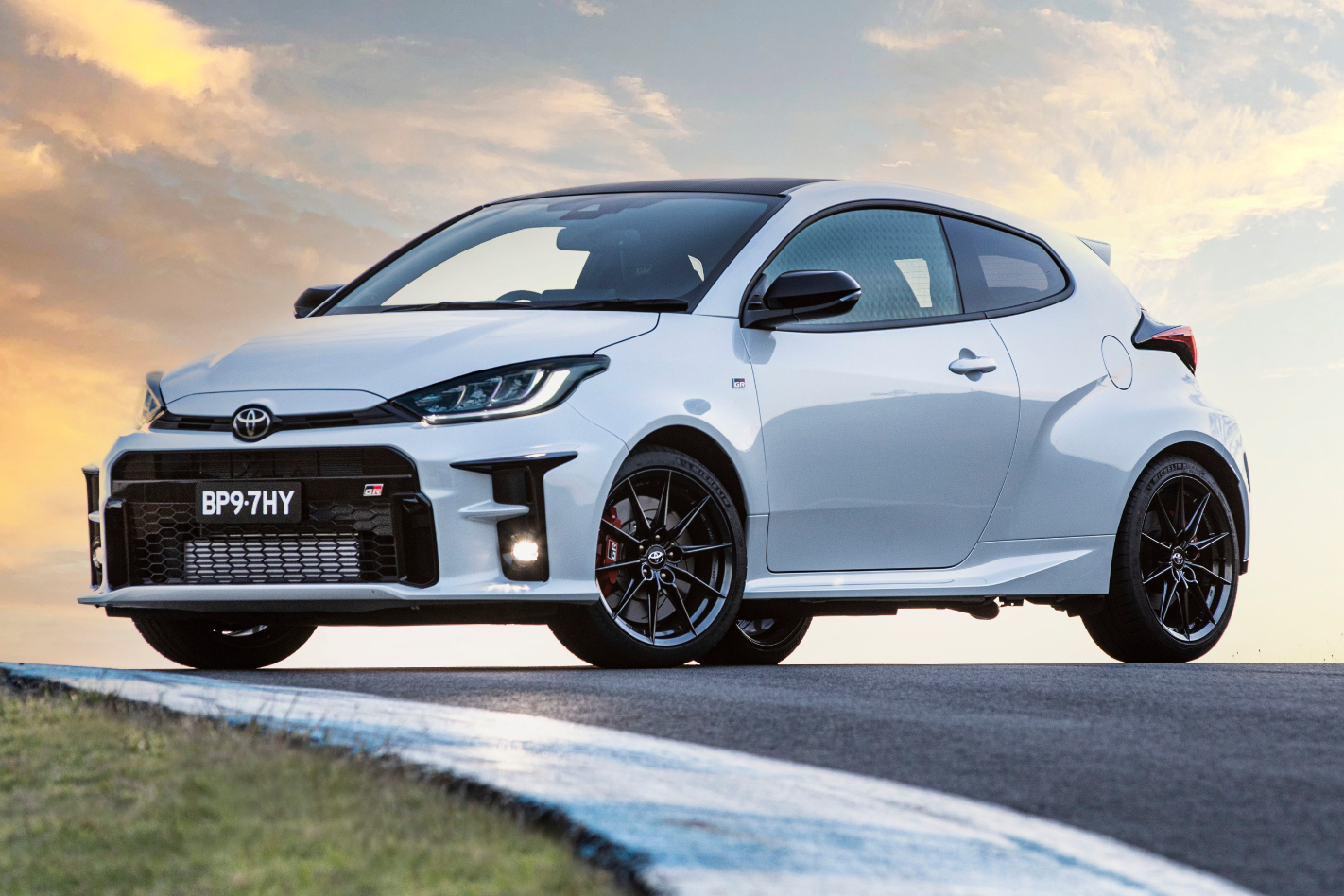
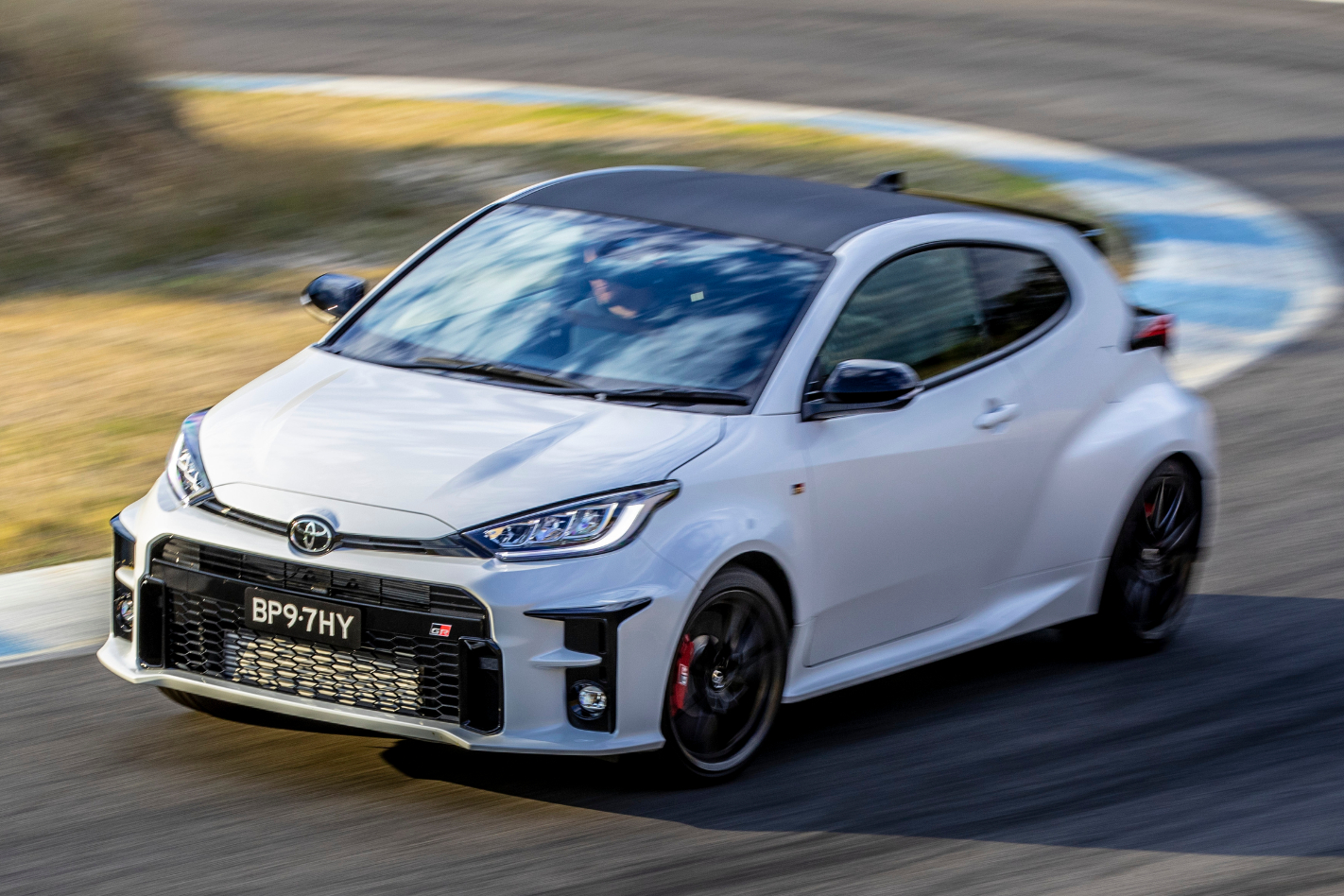
The 2021 Toyota GR Yaris Rallye is now on sale Down Under, and it’s offering a suite of performance parts that should propel it to the front of the hot hatch market.
Chief among the new bits of kit are a pair of Torsen limited-slip differentials that sit over the front and rear axle, providing better traction and power management as well as increased dynamic prowess on track.
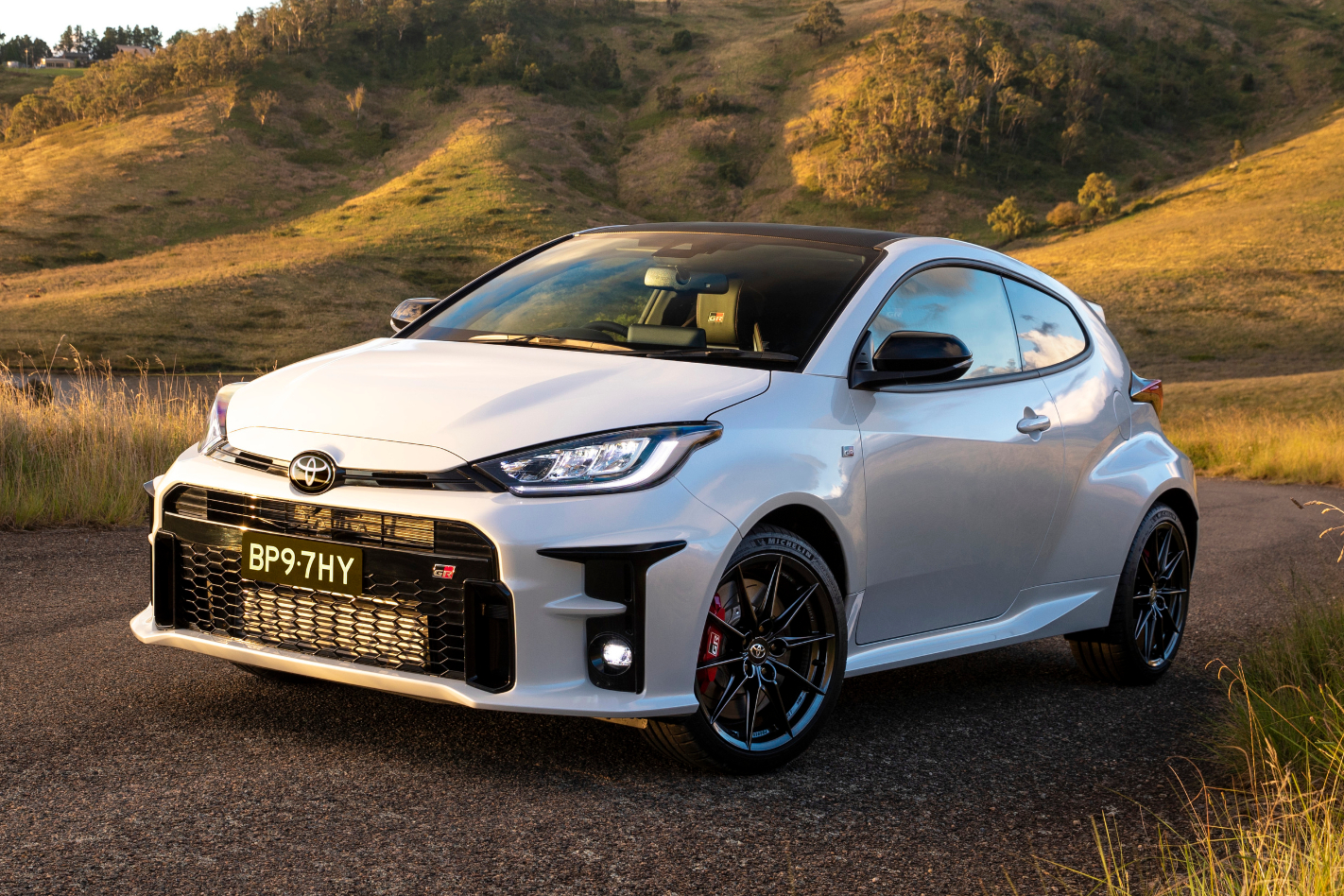
The Rallye’s suspension has also been tweaked by the boffins at Gazoo Racing, now sitting lower and stiffer on the road thanks to harder springs and bigger anti-roll bars.
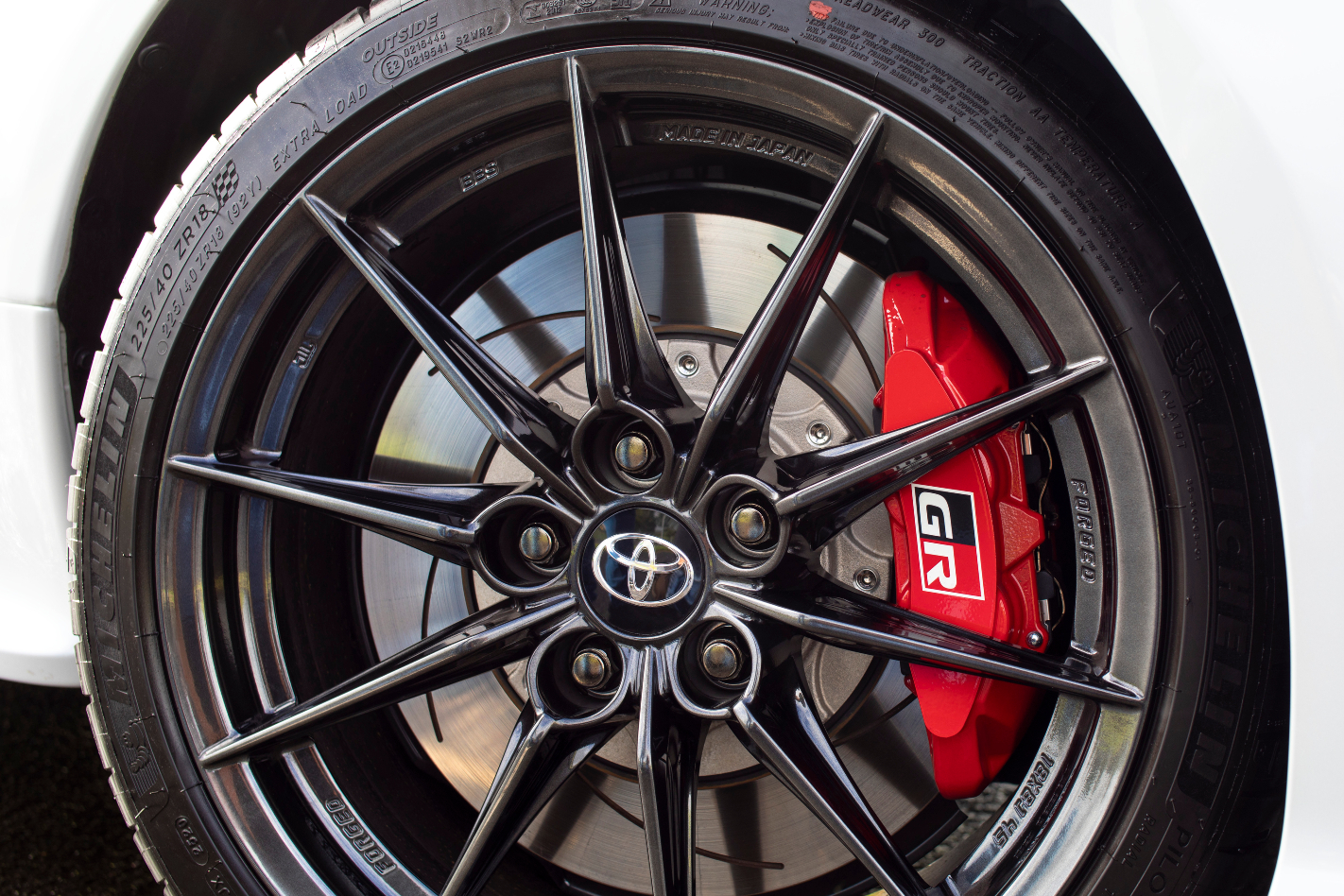
Gone are the normal 18-inch wheels found on the regular GR Yaris, in their place, Toyota has adorned the hotter hatch with a set of 10-spoke lightweight 18-inch BBS forged alloy wheels shod in Michelin Pilot Sport 4S tyres measuring 225/40ZR18.
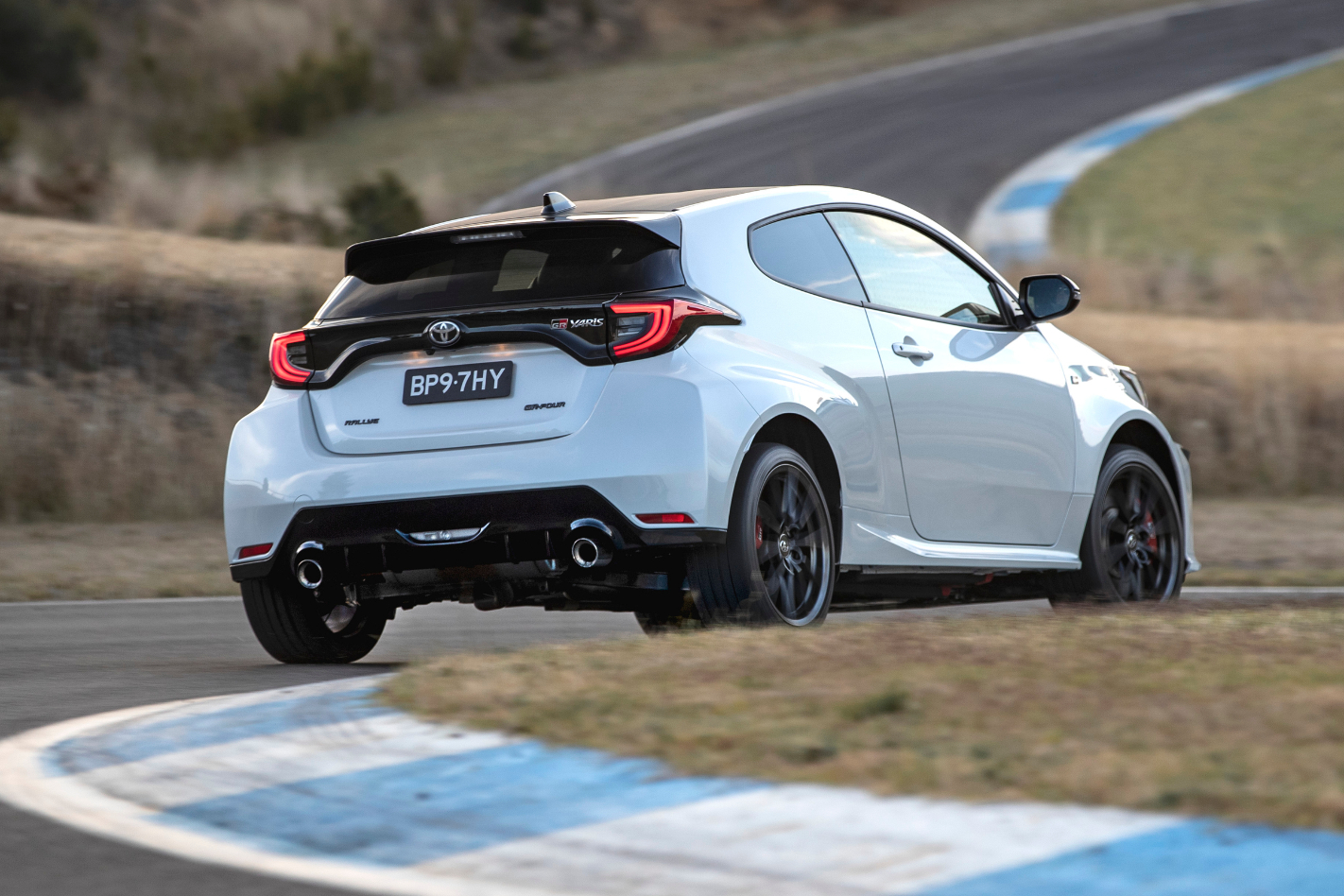
The aggressive front fascia of the Rallye also accommodates improved front brake ducting, which will help provide extended braking performance.
Powering the Rallye is the same 1.6-litre single-scroll turbocharged three-cylinder petrol engine found in the standard GR Yaris.
The hot triple produces 200kW and 370Nm, and thanks to the trick AWD system and slick-shifting six-speed manual with rev-matching, the Yaris can sprint from 0-100km/h in 5.2 seconds, topping out at a limited 230km/h.
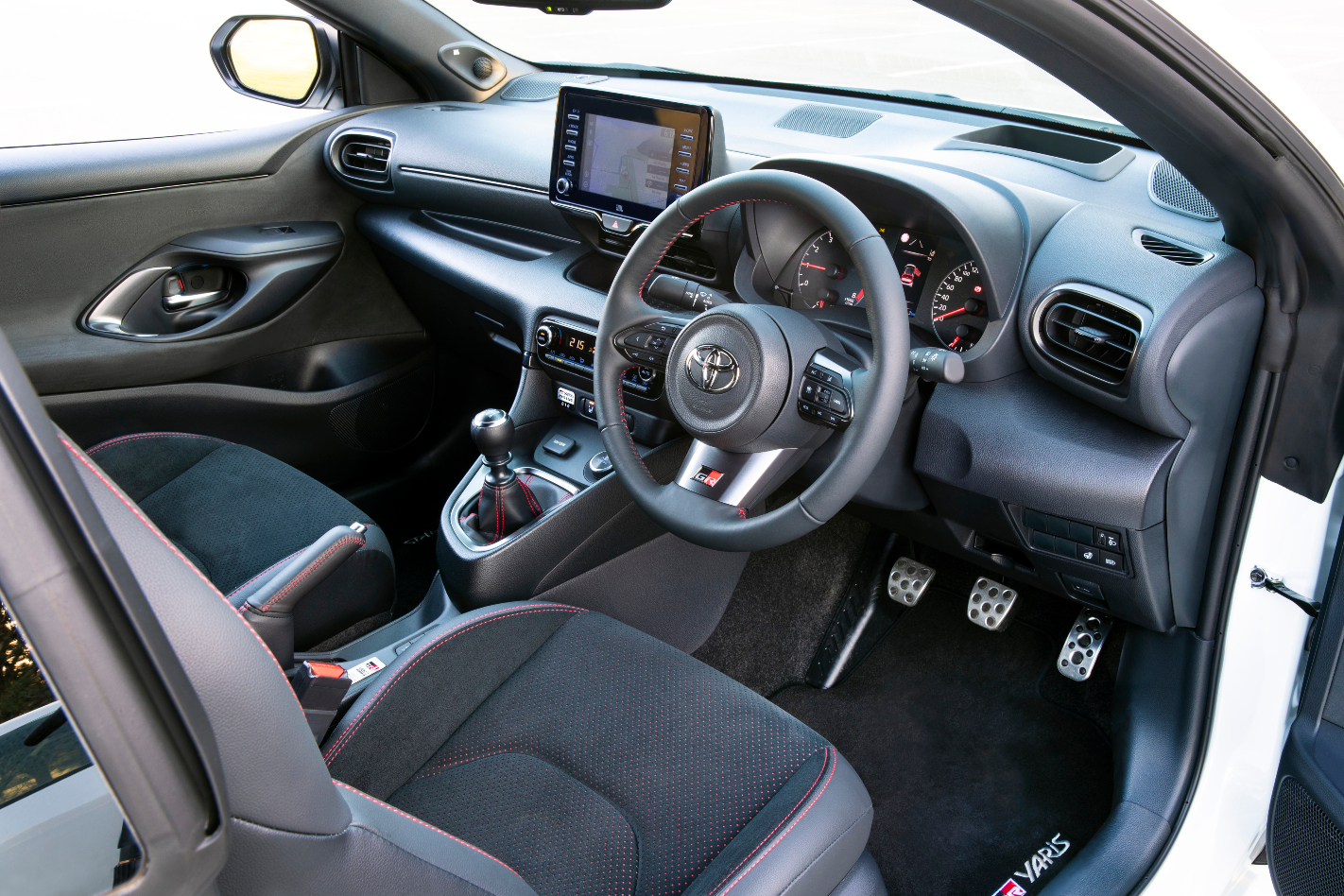
Inside, the track-honed hatch gets synthetic leather-accented sports front seats with hugging bolsters, red stitching and perforated Ultrasuede inserts.
Each of the special edition hatches will also score a uniquely numbered GR Yaris Rallye plaque, which will sit on the centre console. An additional Rallye badge will also feature on the rear.
Other standard features of the interior include dual-zone climate control, keyless entry and start, an eight-speaker JBL audio system, and an advanced infotainment system with seven-inch touchscreen display.
The Rallye has also been fitted with Toyota Safety Sense technologies including autonomous emergency braking, intersection assistance, adaptive cruise control, lane-trace assist and road-sign assist.
Other standard safety features include emergency steering assist, auto high beam, blind-spot monitoring, a digital head-up display, six airbags and a reversing camera.
The GR Yaris Rallye, unlike its regular sibling, only comes in one colour – a unique Frosted White crystal pearl paint. Painted red brake calipers are also standard.
With the Rallye now hitting showrooms Down Under, the first 200 customers to put down deposits on the track-ready model will pay a special introductory price of $56,200 driveway.
For all those who buy in after that, be prepared to pay $54,500 plus on-road costs for the hardcore GR Yaris.
MORE: Yaris stories MORE: All Toyota stories
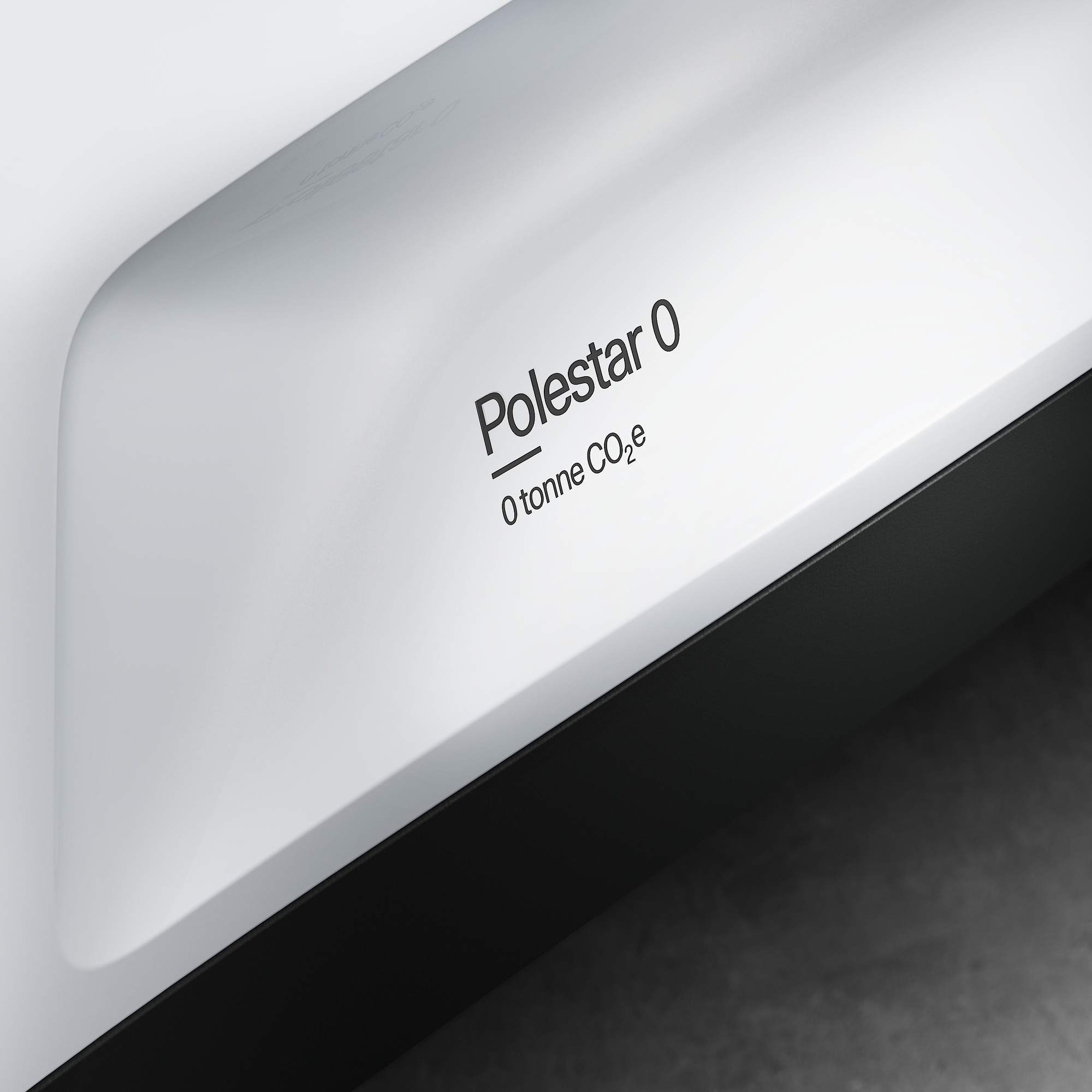
Electric vehicle brand Polestar has announced it plans to create a completely climate-neutral car by 2030, known for now as the Polestar 0 project – and that the company’s entire operation will be emissions-free by 2040.
If it achieves its goal, the manufacturer expects it will be the first company to make a truly climate-neutral car.
Currently, the former Volvo tuning division turned EV-focused performance marque produces two models – the Polestar 1 hybrid supercoupe and Polestar 2 fully-electric sedan.
The Chinese-owned company also has an electric SUV in the works, the Polestar 3, along with a sleek new fastback sedan based on the Precept concept that was revealed in early 2020.
Unclear for now is which of these new offerings, if not one of the brand’s existing models, will form the basis of Polestar’s ambitious climate-neutral plan.
Today, a carbon-neutral operation is most often achieved through offsetting emissions – by planting more trees to capture the carbon dioxide produced through manufacturing. The specific number of trees to be planted is based on calculations around the emissions from building a car.
But Polestar wants to go one step further and completely alter the way its cars are made. Thomas Ingenlath, Polestar CEO – and former Volvo design boss – claims carbon offsetting is “a cop-out.”
“[The] Polestar 2 leaves the factory gates with a carbon footprint. In 2030 we want to present a car that does not.”
Manufacturing an electric vehicle generally requires more carbon emissions than internal-combustion vehicles, because of the processes involved in producing the battery packs.
Figures from Polestar released in 2020 show the Polestar 2 requires roughly 64 per cent more emissions to build than the Volvo XC40. But over the course of its lifetime, the company claims, the Polestar 2 has fewer emissions than the XC40.

The news was released alongside the carmaker’s first annual review which details Polestar’s energy consumption and resulting emissions, as well as the emissions of its suppliers.
Polestar’s Head of Sustainability, Fredrika Klarén, added: “We’re electric, so we don’t have to worry about combustion engines producing toxic emissions – but that doesn’t mean our job is done. We will now work to eradicate all emissions stemming from production.”
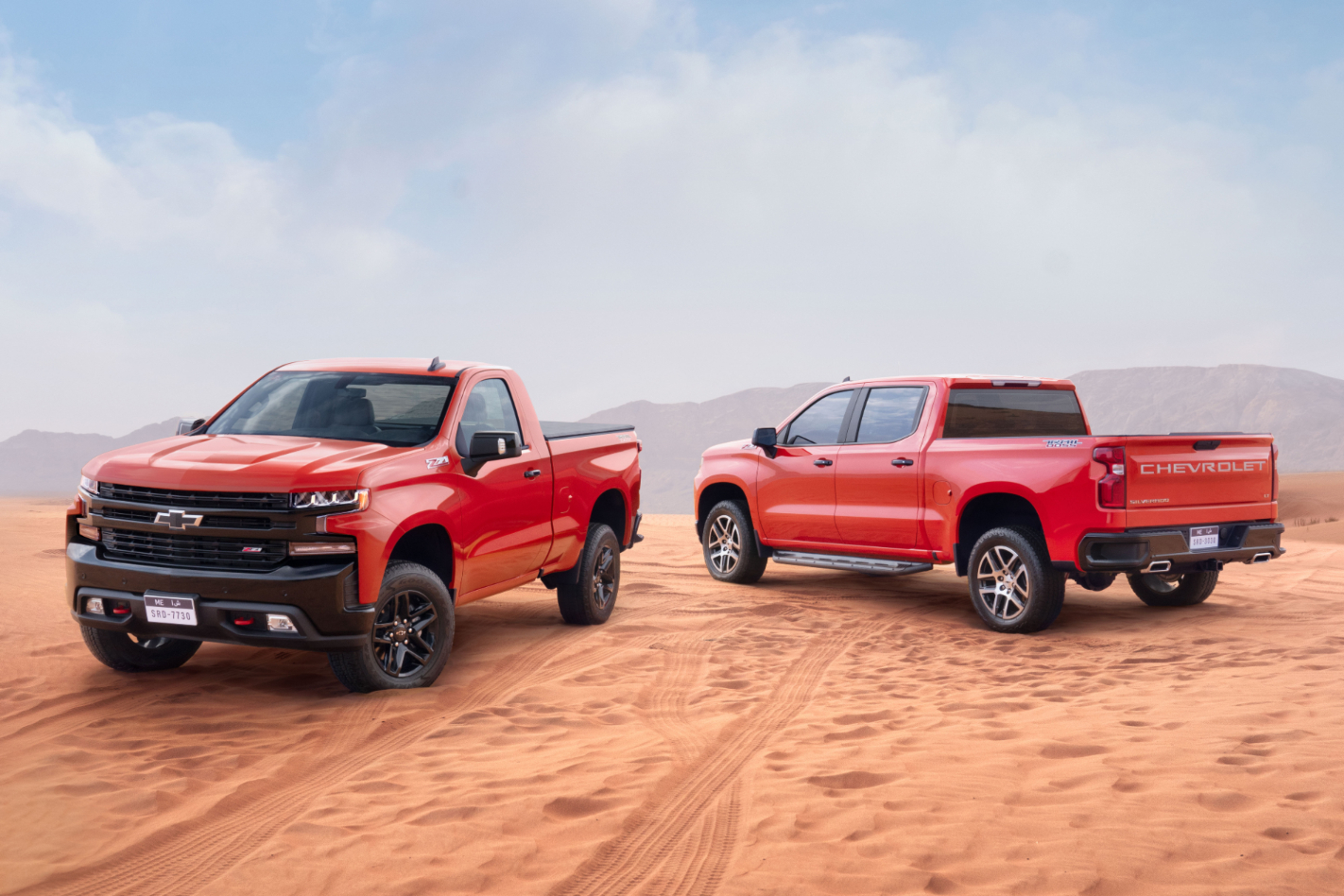
General Motors is building a fully electric version of its lauded Silverado pick-up truck.
According to GM President Mark Reuss, the EV Silverado will be built at the automaker’s Factory Zero manufacturing facilities in Detroit and Hamtramck, Michigan.
The pick-up will be built alongside GMC’s new electric Hummer, and both vehicles will share the same EV Ultium Platform architecture.
GM says the electric Silverado has been designed and developed from the ground up as a purely EV vehicle.
Driving range is claimed to be more than 640 kilometres from a single charge, although GM hasn’t confirmed exactly how many batteries or motors will be used to power the truck.
However, as the Silverado is being based on the same platform as the Hummer, it isn’t hard to imagine that the same 20-module double-stacked battery pack could be an option.
If that’s the case, power could be rated as high as 619kW and 1350Nm, which would make the EV Silverado the most powerful version of the moniker ever created by GM.
“The vehicles coming from Factory ZERO will change the world, and how the world views electric vehicles,” said Reuss.

News of the electric pickup comes in the wake of GM’s recent announcement that the automaker is planning to deliver more than one million electric vehicles globally by 2025.
WhichCar reached out to General Motors Speciality Vehicles (GMSV) to find out whether or not Australia will be seeing the EV Silverado in local showrooms, but the brand wouldn’t confirm which US models, if any, might be likely to make it to our shores anytime soon.
A spokesperson for GMSV said: “At GMSV we’re focusing on bringing three exciting vehicles to Australian and New Zealand truck and performance car enthusiasts – the Chevrolet Silverado 1500, Chevrolet Silverado 2500 and the all-new, right-hand drive, C8 Corvette.”
MORE: Silverado stories MORE: All Chevrolet stories
There’s nothing minimalist about Scandinavian brand Volvo’s sales in 2021.
The Swedish car maker – Chinese-owned since 2010 – is Australia’s fastest-growing luxury brand with sales above 100 units, according to the latest official showroom data.
Volvo has sold 2617 cars after the first three months of the year, equating to a 67 per cent increase on the same period last year and putting the company on track to reach its bold annual target of 10,000 sales.
This would be more than double what the company sold just a few years ago – 4681 units in 2017 – and nearly 30 per cent higher than its record 7779 sales achieved in 2019.
Ongoing global parts shortages and production delays created by the COVID-19 pandemic could still scupper Volvo’s five-figure hopes, but for now momentum is on its side.
Sales are up 44 per cent – or 804 vehicles – when comparing first-quarter results for 2021 and its record year of 2019.
As in 2019, Volvo’s SUVs are doing all the hard yards. The S60 sedan and V60 wagon account for just 17 of the company’s Q1 total; the small XC40, mid-sized XC60 and large XC90 account for the other 2600 sales.
The XC40 is Australia’s best-selling Volvo with 1117 units to date, with the XC60 not far behind with 1052. The larger, seven-seater XC90 is the third most popular at 431 units.
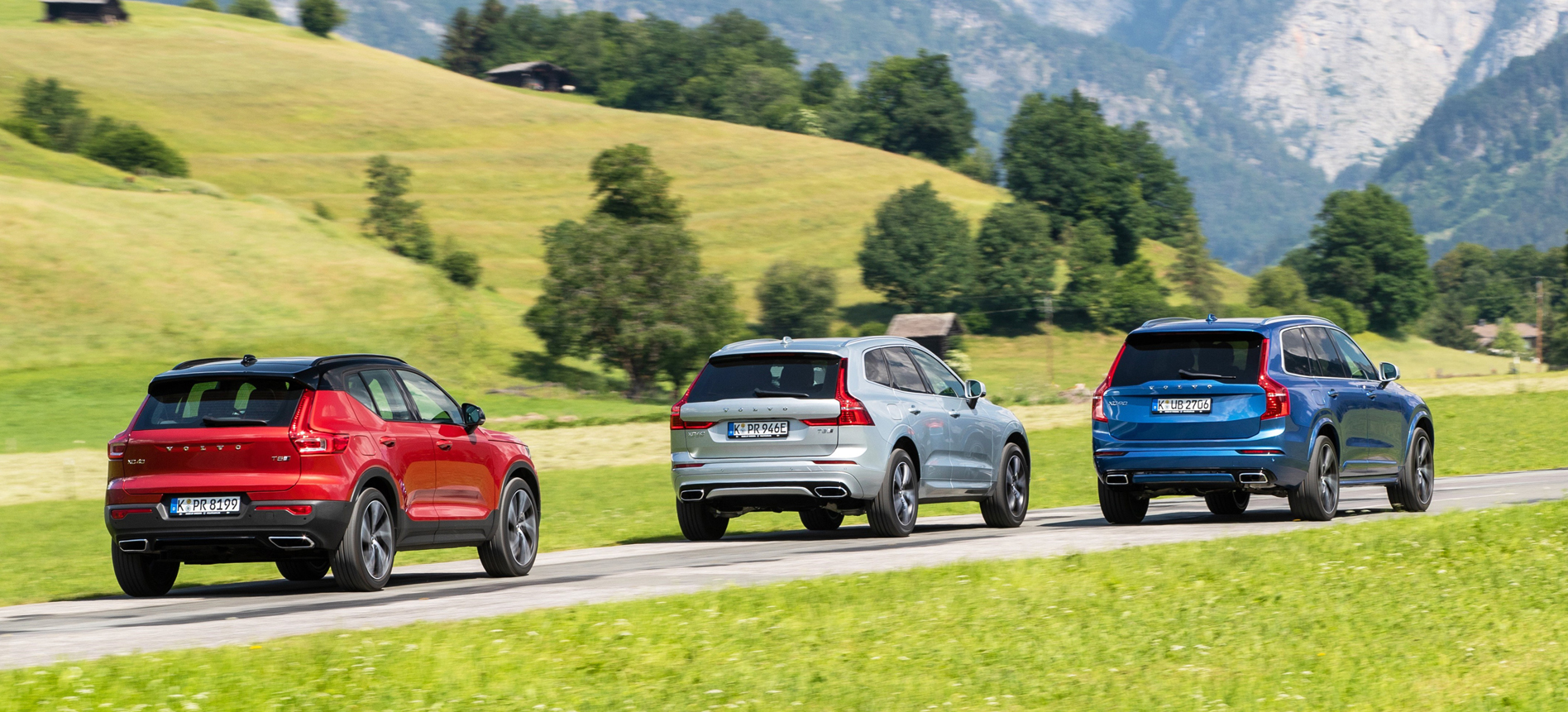
Volvo SUV sales up to the end of March are up 78 per cent on the same period last year, leading luxury rivals despite offering fewer models.
Mercedes-Benz is the next best luxury-brand performer for SUV sales, up 36 per cent. Audi SUVs are up 33 per cent, with eight and four per cent rises for BMW and Lexus, respectively.
The Volvo XC40 is the second most popular small luxury SUV, behind the Audi Q3, and the XC60 is currently the third biggest-selling medium luxury SUV – and not far behind either the second-placed BMW X3 or leading Mercedes-Benz GLB.
The XC90 trails the BMW X5, Mercedes-Benz GLE wagon, Range Rover Sport, Land Rover Defender and Lexus RX in the large luxury SUV segment, though can count several notable scalps including the Audi Q7, Porsche Cayenne and Volkswagen Touareg.
Volvo Cars recently announced all its vehicles would be fully electric by 2030. Locally, the company is already shifting to a predominantly electrified showroom with mostly mild-hybrid or plug-in hybrid variants.
The first fully electric Volvo, the XC40 Recharge Pure Electric, is due here later this year, and in 2022 it will be joined by the C40 Recharge electric car.
A baby Volvo SUV, expected to be called the XC20, is widely reported to be in development.
Volvo Sales in Australia: 2010-2021
- 2021 forecast: 10,464*
- 2020: 7700
- 2019: 7779
- 2018: 6693
- 2017: 4681
- 2016: 5878
- 2015: 4943
- 2014: 4693
- 2013: 5174
- 2012: 5375
- 2011: 5272
- 2010: 4945
MARCH 2021: TOP 10 MODELS
- TOYOTA HILUX – 5319 – up 49.6% YTD
- FORD RANGER – 3983 – up 28.2% YTD
- TOYOTA RAV4 – 3522 – up 17.8% YTD
- MAZDA CX-5 – 3022 – up 74.3% YTD
- TOYOTA COROLLA – 2892 – up 2.8% YTD
- HYUNDAI I30 – 2514 – up 35.5% YTD
- MITSUBISHI TRITON – 2492 – up 37.5% YTD
- TOYOTA LANDCRUISER – 2244 – up 78.0% YTD
- ISUZU D-MAX – 1994 – up 35.9% YTD
- NISSAN X-TRAIL – 1932 – up 46.0% YTD
TOP 10 BRANDS
- TOYOTA – 21,319 – up 21.2% YTD
- MAZDA – 10,785 – up 58.2% YTD
- HYUNDAI – 6852 – up 29.1% YTD
- MITSUBISHI – 6430 – up 7.1% YTD
- FORD – 5977 – up 23.1% YTD
- KIA – 5802 – up 2.6% YTD
- NISSAN – 4559 – up 30.2% YTD
- SUBARU – 4212 – up 39.3% YTD
- VOLKSWAGEN – 3358 – up 17.0% YTD
- MG – 3303 – up 167.7% YTD
Snapshot
- New Caddy will be based on VW’s MQB platform
- Short and long-wheelbase variants available
- Deliveries expected to begin in July 2021
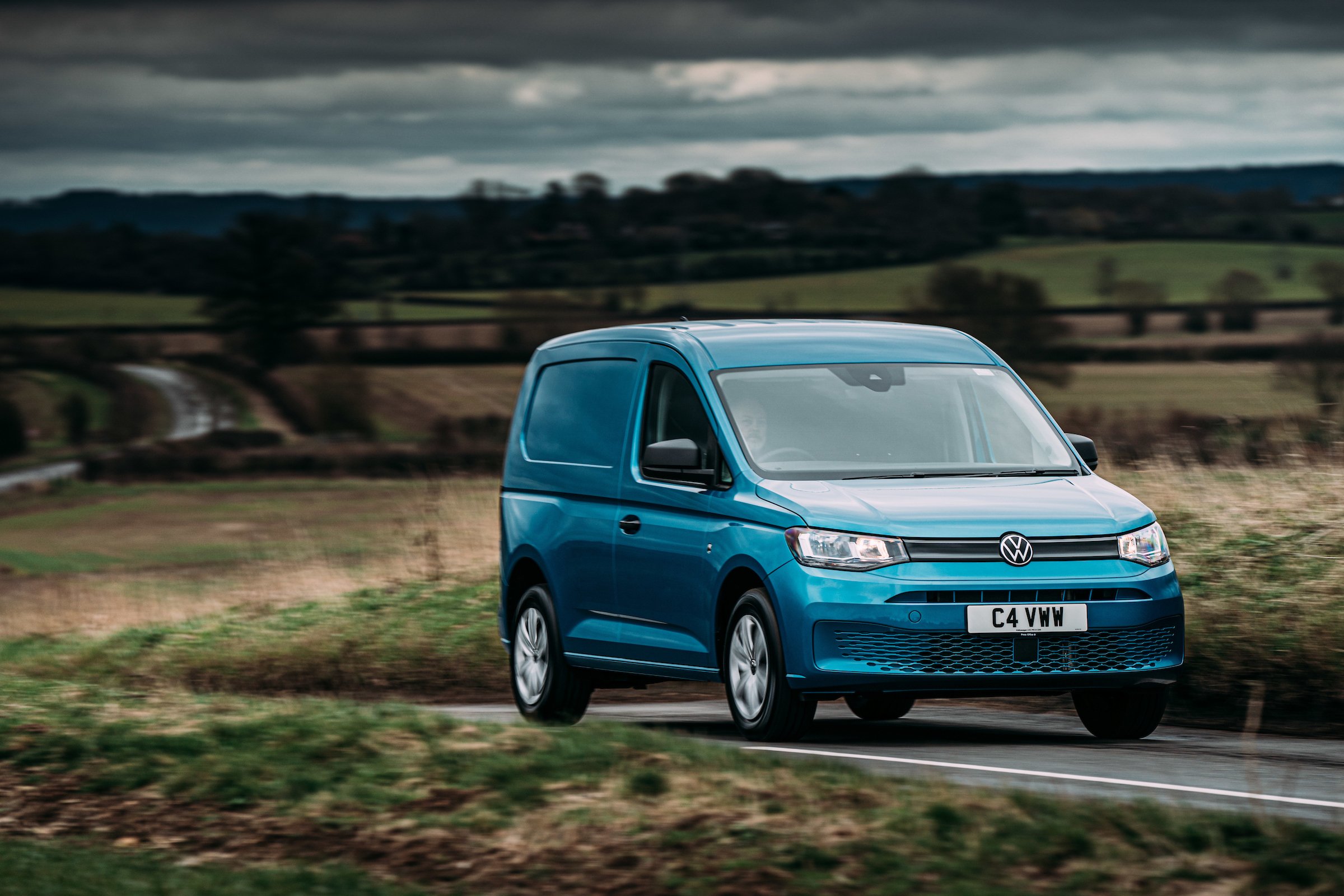
The 2021 Volkswagen Caddy is finally arriving Down Under, after being unveiled in Europe in 2020.
Starting from $34,990 (plus on-road) costs, the new Caddy is available in many different guises for commercial and passenger applications.
The fourth-generation Caddy is the first to be built on VW’s MQB modular platform, which also serves as the base for other models such as the Polo, Golf, and Tiguan.
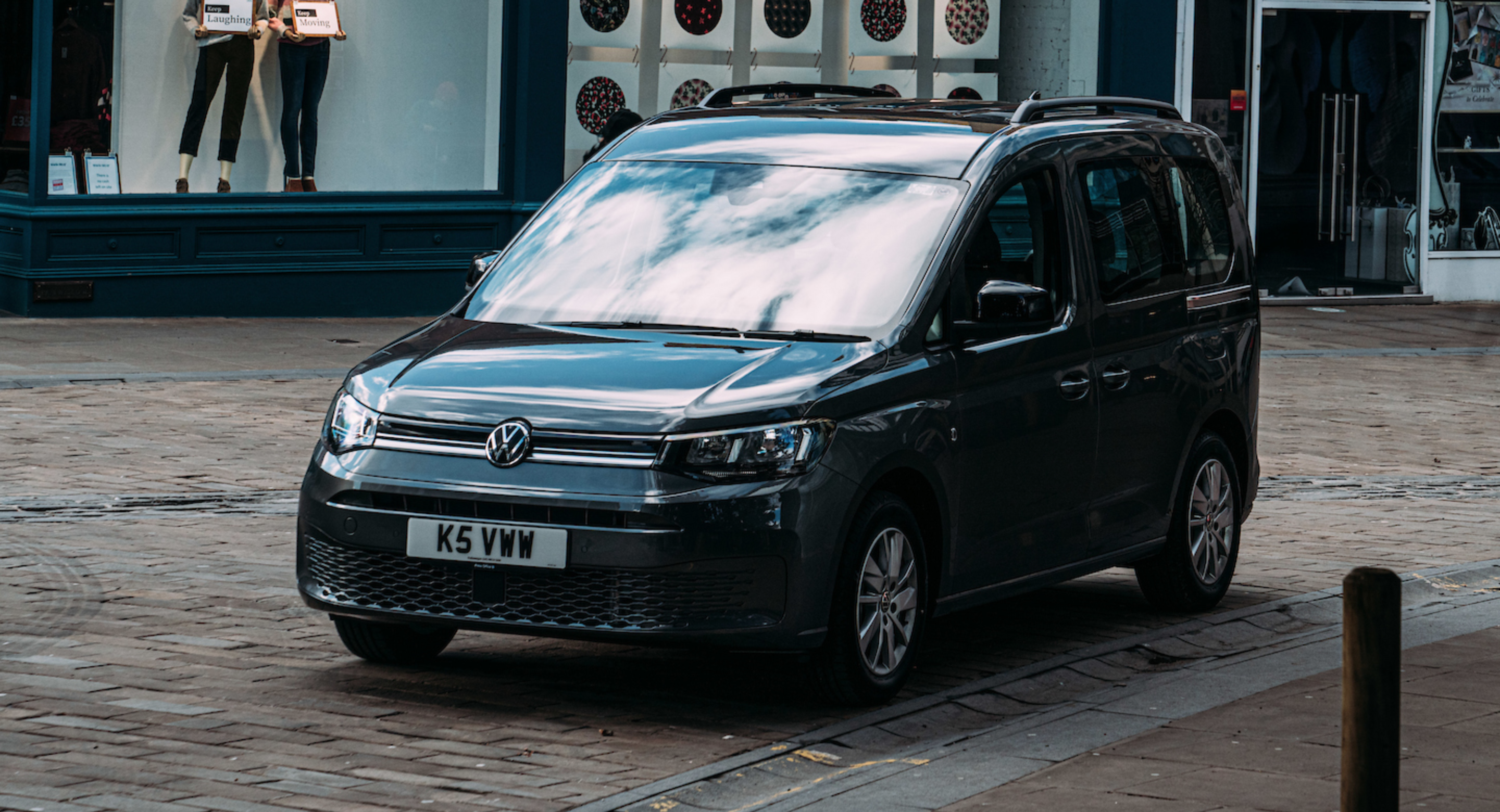
The Caddy can be had in either short wheelbase (SWB) or long-wheelbase (Maxi) forms.
However, compared to previous generations, this latest iteration is easily the largest, with even the SWB measuring almost 100mm longer than its predecessor.
The latest version of the moniker scores a raft of safety features such as a driver alert system, rearview camera, and autonomous emergency braking.
Inside, the Caddy also has a 8.25-inch touchscreen infotainment display, and people mover variants will be able to option an even larger 10.0-inch touchscreen.From launch, just one engine will be available for Aussie customers, despite the myriad different powertrain choices the Caddy is offered with elsewhere across the globe.
Pricing and model range
From launch, there will be seven different iterations of Caddy available, four intended for commercial purposes, and three for passenger use (prices do not include on-road costs):
- Caddy Cargo TDI280 6-SP – $34,990
- Caddy Cargo TDI320 7-SP – $37,990
- Caddy Cargo Maxi TDI280 6-SP – $36,990
- Caddy Cargo Maxi TDI320 7-SP – $39,990
- Caddy Maxi TDI320 7-SP – $45,490
- Caddy Life Maxi TDI320 7-SP – $49,990
- Caddy California Maxi 7-SP – $54,990
Engine, transmissions and fuel economy
The 2021 four-generation Caddy will only be available with one engine option for the Australian market. However, VW has said other powertrain options might be a possibility later in 2021.
For now, all Caddys will come equipped with VW’s EA288-Evo TDI 2.0-litre four-cylinder turbo-diesel motor.
Power will be sent exclusively to the front wheels through either a six-speed manual transmission (for Cargo vehicles only) or a seven-speed dual-clutch transmission (DSG).
Commercial buyers will also be able to choose between a TDI280 or TDI320 state of tune, with the former producing 75kW/280Nm with the manual and the latter making 90kW/320Nm with the DSG.
Volkswagen has yet to release fuel consumption figures for the 2021 Caddy range.
Features
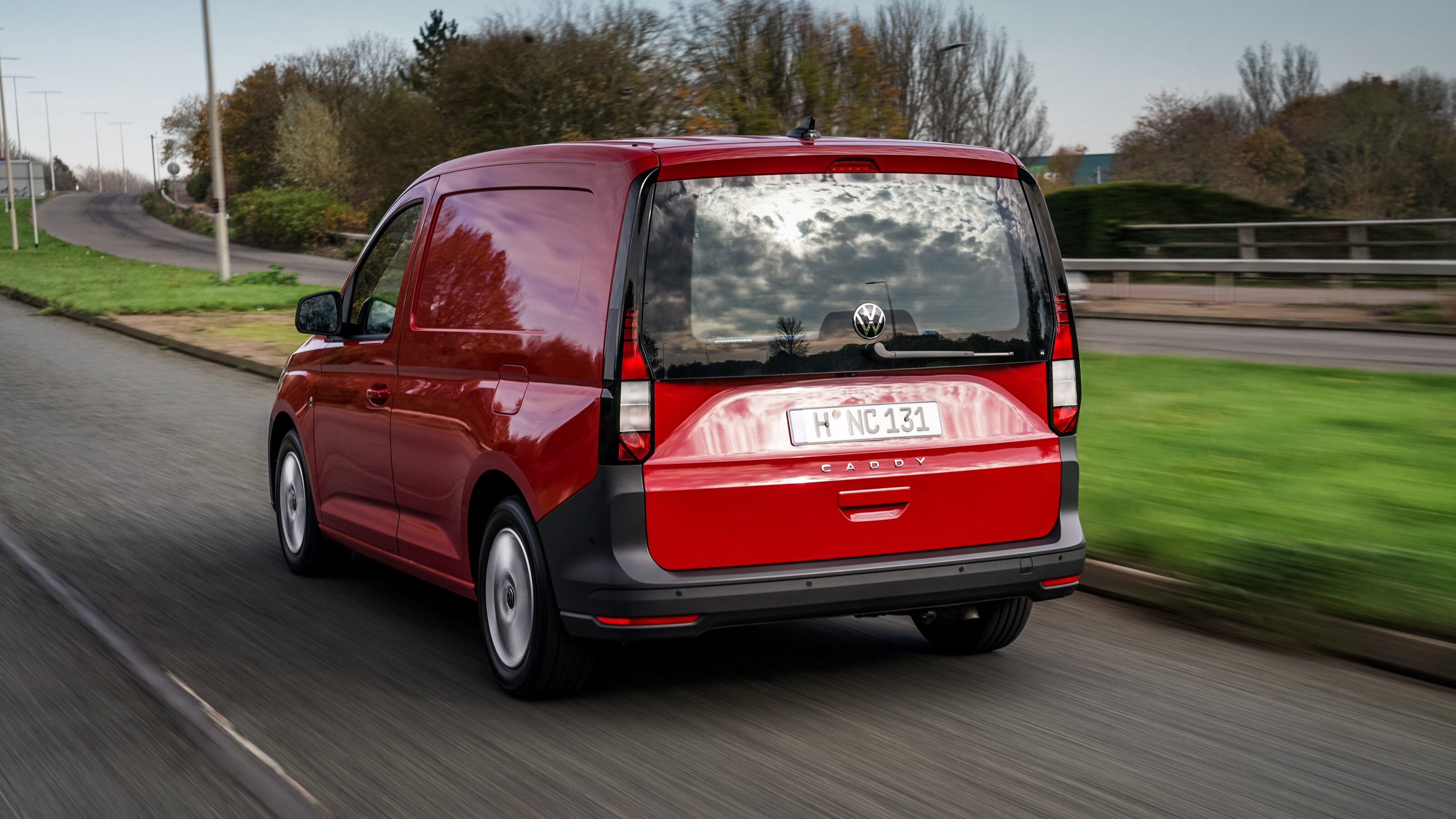
All of the Caddy Cargo commercial variants come as standard with features such as:
- Rear combination lamps
- Cruise control system with speed limiter
- Single passenger-side sliding door (SWB)
- Dual sliding doors (Maxi)
- Rear wing doors with window apertures
- Central locking system with separate cabin and cargo locking
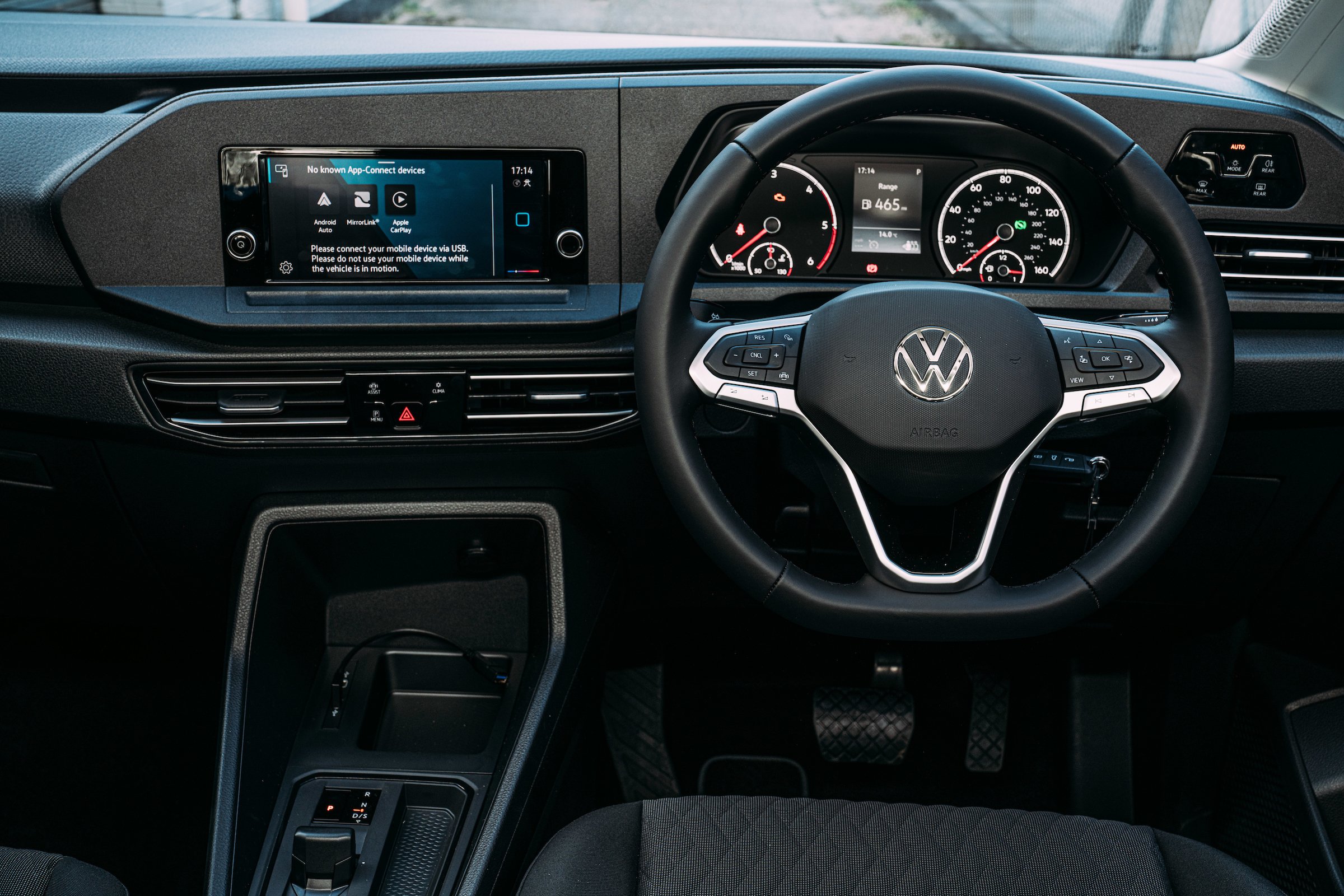
- 8.25-inch ‘Composition’ infotainment touchscreen and app connect
- Leather-wrapped multifunction steering wheel
- LED interior lights in the cabin and rear cab
- 12V sockets
- Multi-function display plus
- Two USB type-C ports
- Seven seats, three in the second row and two in the third, all removable
- Child seat anchors and top tethers
- 8.25-inch ‘Composition’ infotainment touchscreen and app connect
- LED reading light in passenger compartment
- LED tailgate surround lighting
- Luggage compartment cover which folds and is removable
- Black painted exterior mirror housings, body-coloured door handles, and silver sliding door rail
- Tailgate with window aperture
- “Trialog” seat trim
- Digital driver’s dash
- Dual-zone automatic climate control with allergen filter
- Central locking and keyless start
- Auto-dimming rearview mirror
- Rain sensing wipers
- Two 12V outlets, one in the load compartment and one in the dashboard
- Powered tailgate with window aperture
- 17-inch ‘Barahona’ alloy wheels
- Black roof rails
- Automatic headlight control with separate DRL, entry and exit lighting
- 17-inch ‘Colombo’ alloy wheels
- Dual-zone automatic climate control with allergen filter
- Digital driver’s dash
- Central locking and keyless start
- Heat-insulating front side windows, 74 per cent light-absorbing glass in rear side windows and rear window
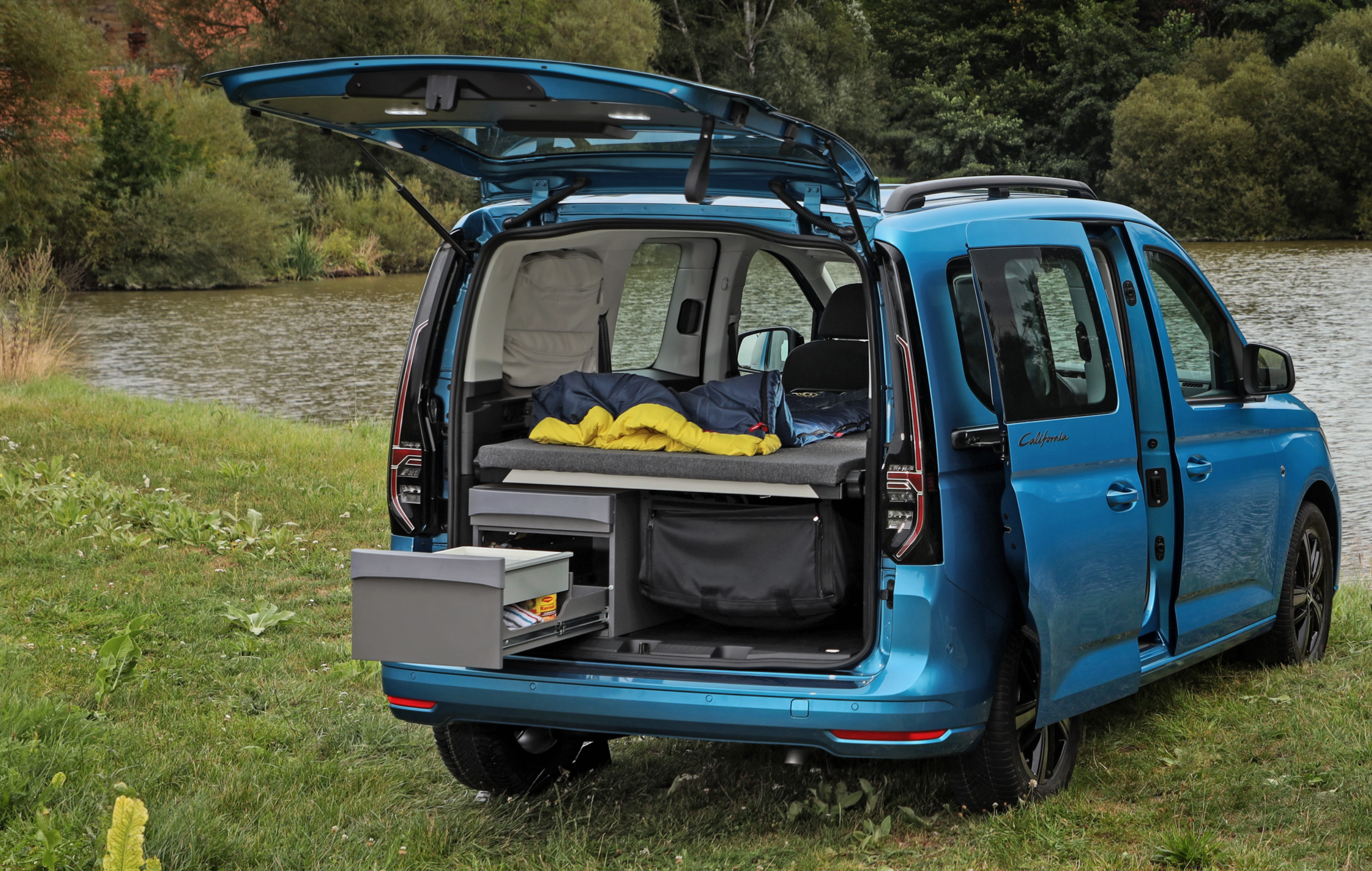
- Foldable bed
- Storage bags for the rear side windows
- Darkening covers
- Dimmable LED lights
- LED lights in tailgate
- Dual ventilation grids with integrated fly screens
- Foldable table and two chairs
Dimensions
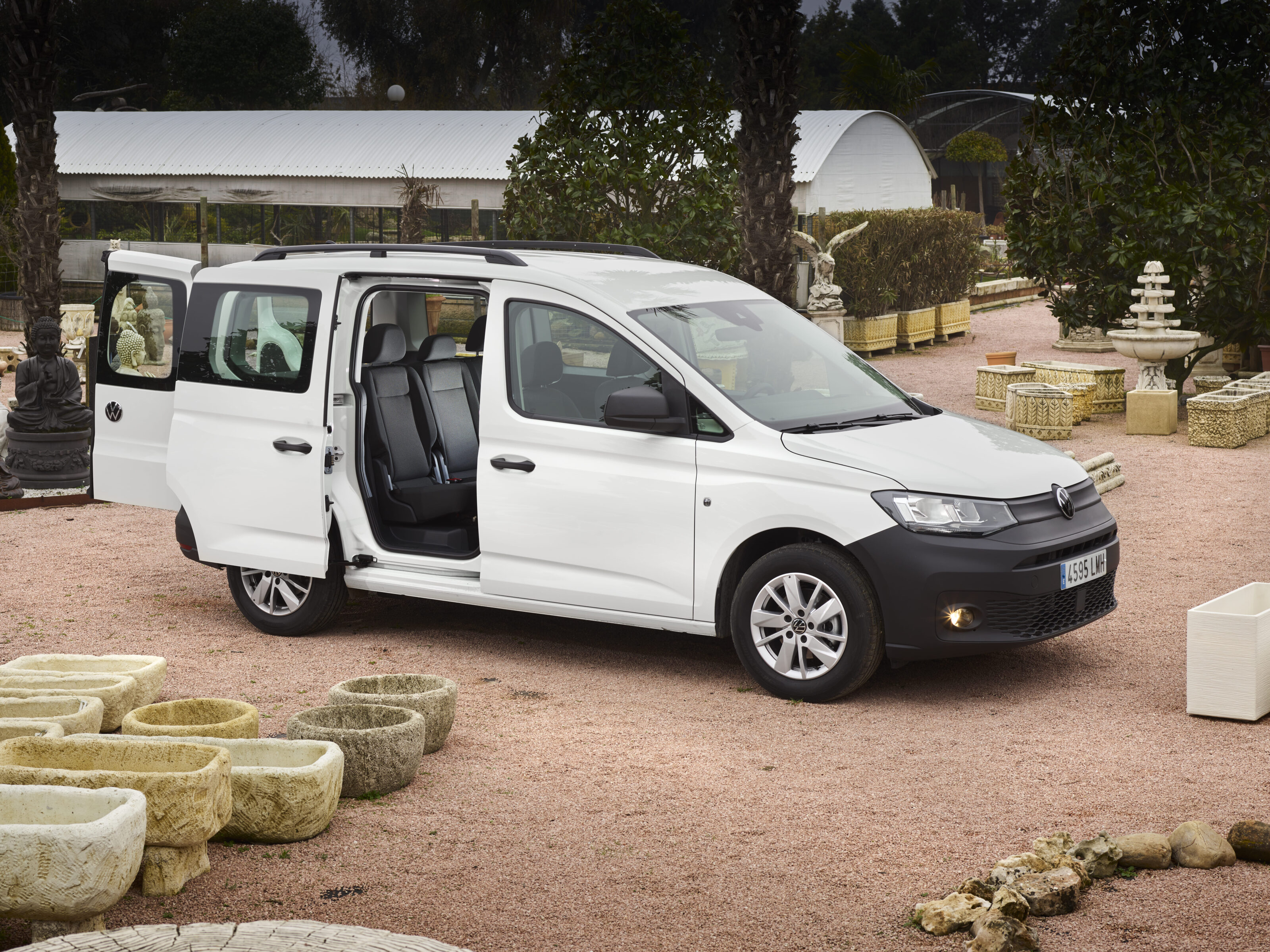
The Caddy SWB variants are 1797mm long, 2100mm wide, and 1856mm tall with a wheelbase measuring 2755mm.
The Maxi long-wheelbase iterations are 4853mm long, 2100mm wide, 1860mm tall and have a wheelbase 215mm longer than the SWB, measuring 2970mm.
The SWB can take a maximum 724 kilogram payload, while the Maxi can shift a 754 kilogram payload. Both examples have a 1230mm wide cargo bay.
Safety
Being the new kid on the block, the 2021 Caddy is yet to receive an ANCAP safety rating.
For Cargo models, the following safety features are standard:
- Autonomous emergency braking
- Driver alert monitoring
- Electric parking brake with auto-hold function
- Reversing camera
- Rear parking sensors
- Autonomous emergency braking with pedestrian and cyclist detection
- Blind-spot monitoring
- Lane-keep assist
- Rear cross-traffic alert
Warranty and servicing
Like the rest of the Volkswagen range, the new Caddy comes with a five-year/unlimited-kilometre warranty.
Capped price servicing is also included, and owners can pre-purchase a service plan for three ($1200) or five years ($2400).
Availability
The 2021 Volkswagen Caddy range is due to arrive on Aussie shores from July, with dealers accepting customer orders now.
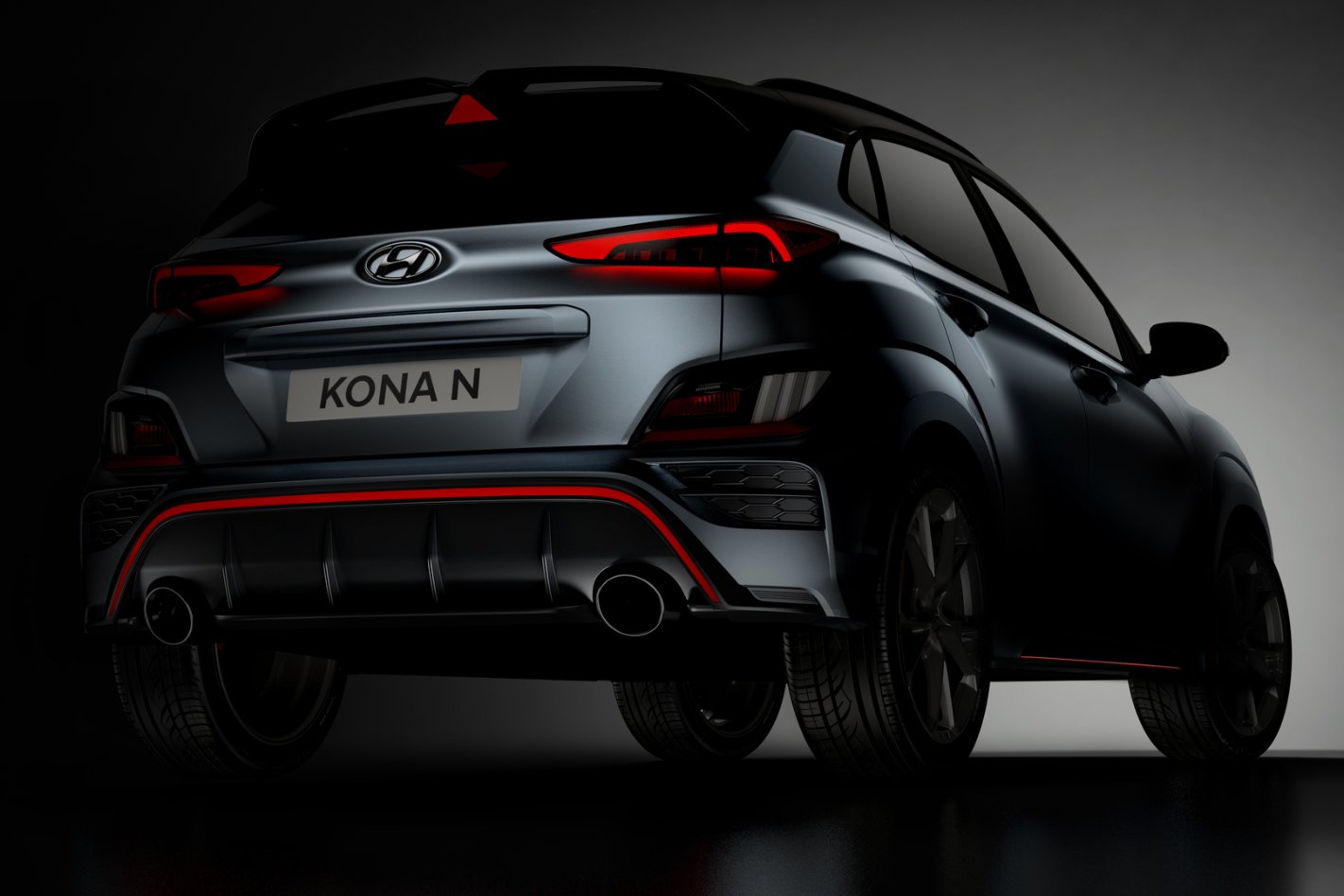
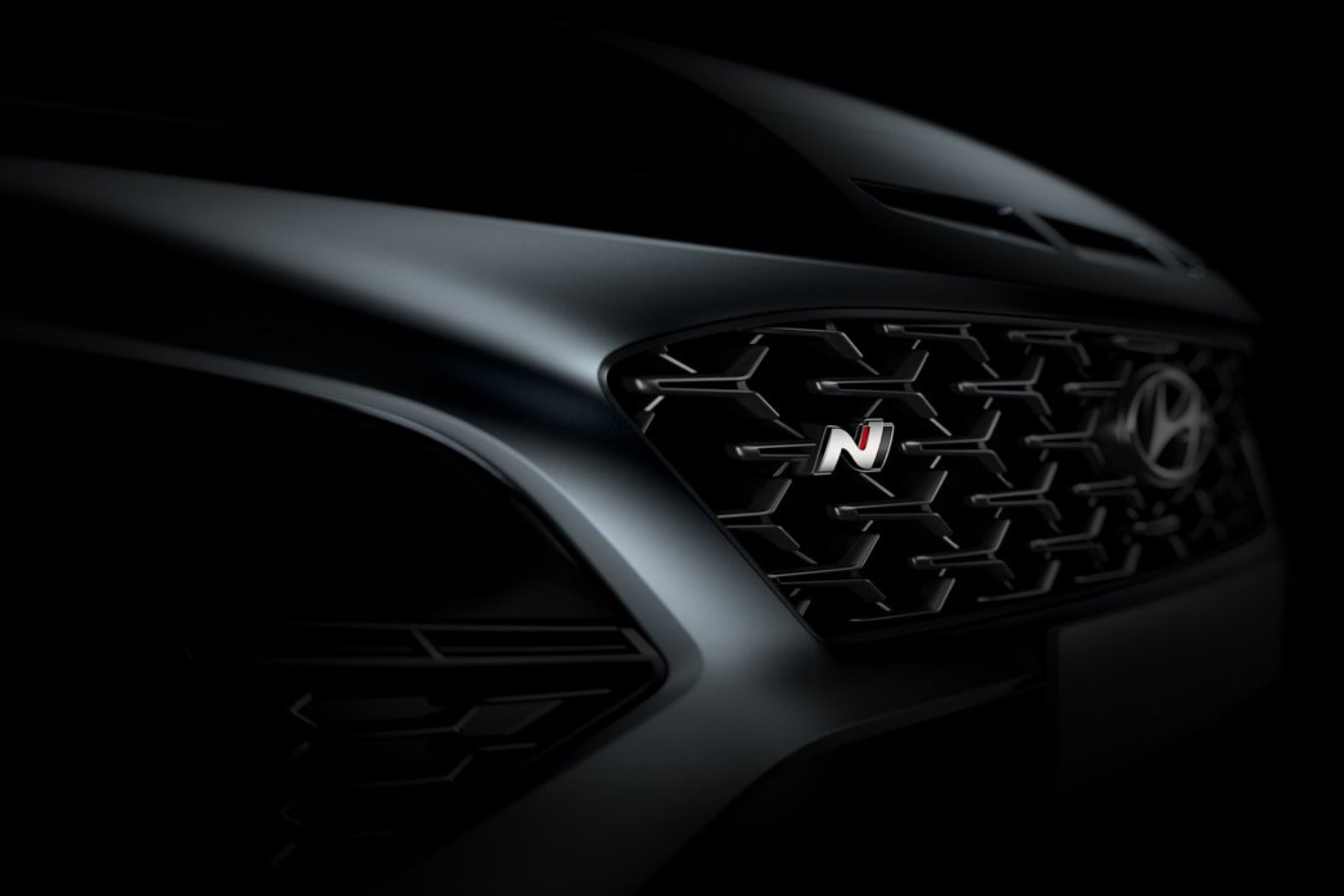
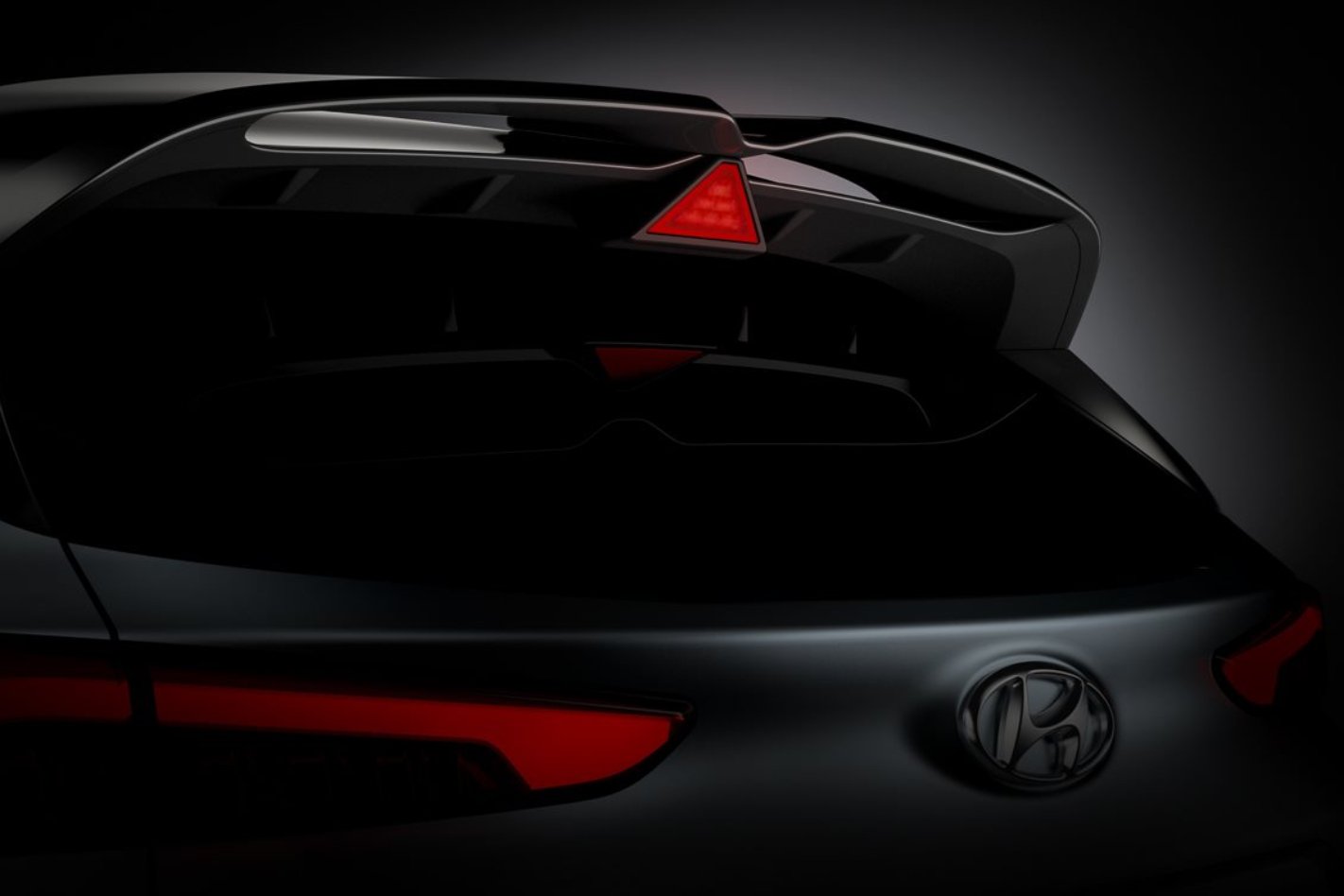
The 2022 Hyundai Kona N performance SUV has had its engine and gearbox details confirmed.
The first high-riding N car will come equipped with the Korean automaker’s T‑GDI turbocharged 2.0-litre four-cylinder engine, which is the same unit found in the brilliant i30 N.
Power will be rated at a punchy 206kW, and while Hyundai hasn’t quoted any torque figures for the turbo four-banger used in the SUV yet, the firm has said: “It features a flat power characteristic that provides more torque and power at mid and high-range RPMs.”
The automaker added: “The new higher amount of torque is utilising more of the engine’s potential in everyday driving situations.”
This higher torque will be sent through Hyundai’s own N DCT eight-speed dual-clutch transmission, which will be based on its standard in-house 8DCT gearbox.
To make it suitable for the performance SUV, the wet-type dual-clutch has been bolstered greatly by a new dual-pump oil system. This incorporates both a high-flow electric oil pump, which cools the clutch and lubricates the gears, and a high-pressure electric oil pump, which sends oil to the accumulator and holds the pressure required to manage the gear shifting.
According to Hyundai, this new system will allow the DCT to tolerate higher levels of torque for performance-oriented applications and ensure that minimal engine power is lost when shifting gears.
And to put the new gearbox through its paces, the N DCT was tested on the fabled Nürburgring-Nordschleife, completing no less than 1350 laps to guarantee it could withstand the most gruelling performance driving.
The transmission gets three unique shifting calibrations, which have been engineered for different applications:
- N Power Shift (NPS) is activated when more than 90 per cent of throttle is applied, which will engage a ‘push feel’ surge during upshifts. The upshift will be accompanied by Hyundai N’s signature snap, crackle, and pop, thanks to a partial cylinder cut of the exhaust.
- N Grin Shift (NGS) will provide maximum performance from the engine and gearbox for a short 20-second burst.Drivers will engage the NGS by pressing a unique button on the steering wheel, which will start a countdown displayed on the car’s dash. Once it’s over, operators will have to wait for 40-seconds before they can engage NGS again.
- N Track Sense Shift (NTS) will be optimised for track conditions and will shift automatically for the driver, allowing them to focus more on steering and throttle.
Shifting of the eight-speed gearbox can be performed manually through either paddle shifters on the steering wheel or the gear knob, and there will be a manual lock-out function that will prevent automatic upshifts at redline.
“The addition of the N DCT allows us to expand on the N brand’s ‘Fun to Drive’ philosophy. By integrating it into the all-new KONA N, we’re enabling all sorts of high-performance driving features and turning the KONA N into a true ‘hot SUV,” Andreas-Christoph Hofmann, vice president of marketing and product at Hyundai Motor Europe, said.
Locally, a prototype of the new Kona N has been spied testing at several locations in Australia in recent weeks, including New South Wales’s Wakefield Park Raceway.
A representative for Hyundai Australia has confirmed to WhichCar that the new performance SUV will be in showrooms in the third quarter of 2021.
MORE: Kona stories MORE: All Hyundai stories
It’s difficult to overstate the impact that the Porsche Taycan has had since it arrived, both on the brand itself and on the wider car industry. Not only has the Taycan redefined what people thought an electric car could do, but it’s also the physical representation of how Porsche has shifted its business focus – and arguably even its whole ethos.
Look at the millions of euros the firm is chucking at digital start-ups if you want proof of that. Porsche even has its own sub-section, called Forward31, designed to build a portfolio of digital business.
It’s all a far cry from the brand-defining victories at the Targa Florio and Le Mans: gone are the days of Porsche representing only class-defining ICE sports cars. The Taycan is now the pivot point for the Stuttgart brand, where its high-performance products are joined by the electric upstart.
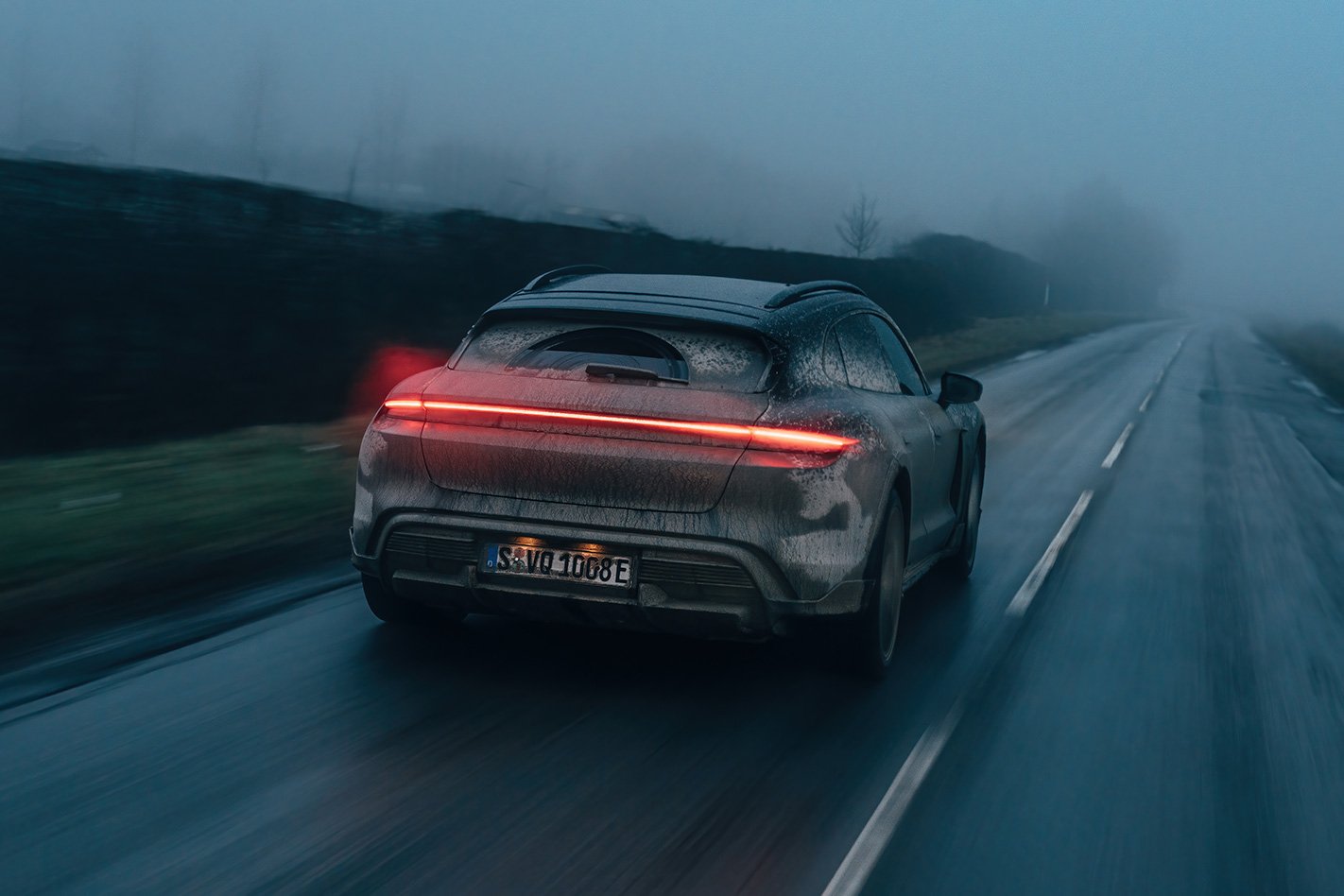
So it shouldn’t come as much of a surprise to learn that the Taycan family is expanding, first to this, the Taycan Cross Turismo. Here we’re driving a prototype version of what will be the Turbo S variant, but it’s not far off what will arrive this winter overseas.
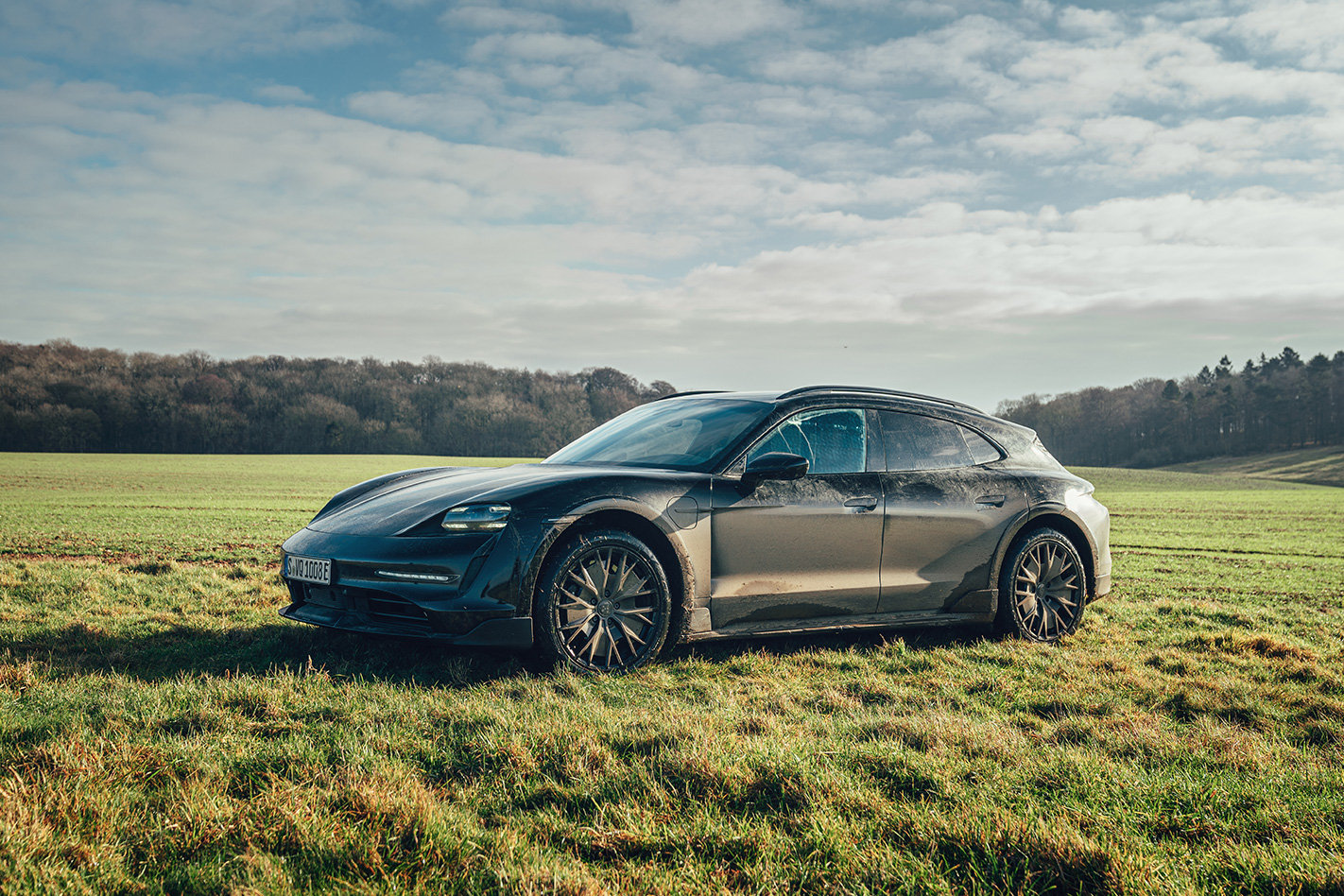
As is immediately obvious from the pictures, this is the more practical version of the Taycan sedan, much like the Sport Turismo is the booted version of the Porsche Panamera hatchback. As such, there’s a healthily sized boot on the Cross Turismo – up to 1200 litres. Below the parcel shelf, the difference doesn’t look as marked (exact figures aren’t available yet), but still, this is very much an electric Porsche that can easily do the whole family-transport thing.
There are further visual distinctions elsewhere, such as different wheels, a larger panoramic fixed glass roof and the roof rails in black (the last two both optional). Like the Mission E Cross Turismo concept from 2018, it comes with wheel-arch extensions, while it’s also the first Taycan to get a tow bar. Don’t go thinking that you can strap your caravan to it, though, because it’s purely to allow a bike carrier to be fitted. How very ‘lifestyle’.
Inside, there’s also an extra 36mm of head room in the rear. That doesn’t sound like much but, coupled with the larger panoramic roof, it certainly helps make the cabin feel airier back there. The Cross Turismo uses the same skateboard battery pack arrangement as the regular Taycan, including the ‘foot garages’, so the rear is comfortable for adults.
The dashboard is largely identical to that of the Taycan saloon, save for a compass instead of the usual Sport Chrono clock. As such, the triple- screen set-up dominates, running all the way from in front of the driver to just ahead of the front passenger. These are all easy to operate, although, as with most touchscreens, there’s an element of ‘prod and hope’ in order to hit the button you want without taking your eyes off the road.
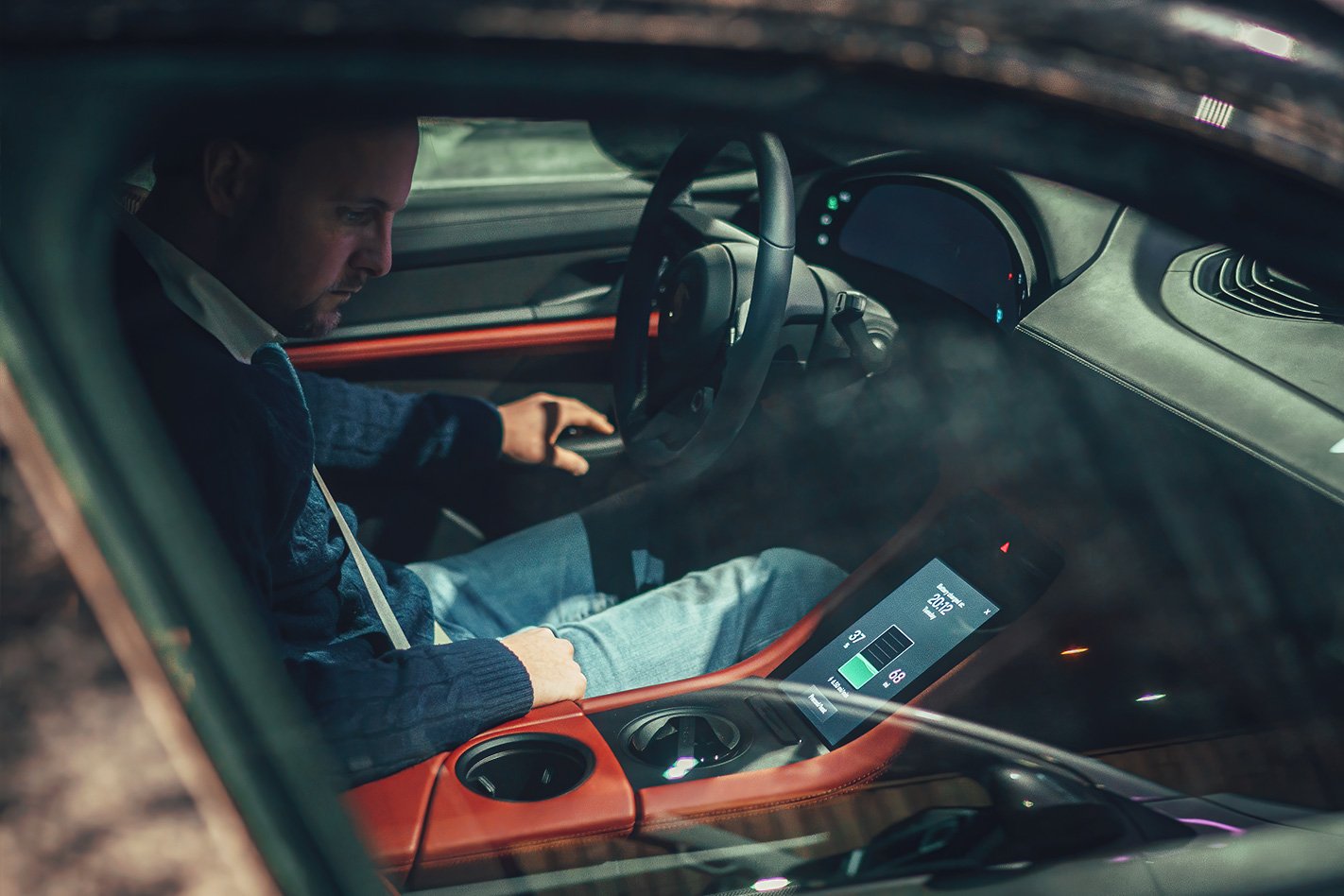
Everything else is ergonomically spot on, though, in the main. You sit nice and low, while the view ahead is clear. The slight blot on the copybook is around the rear window, whose aperture is a bit small.
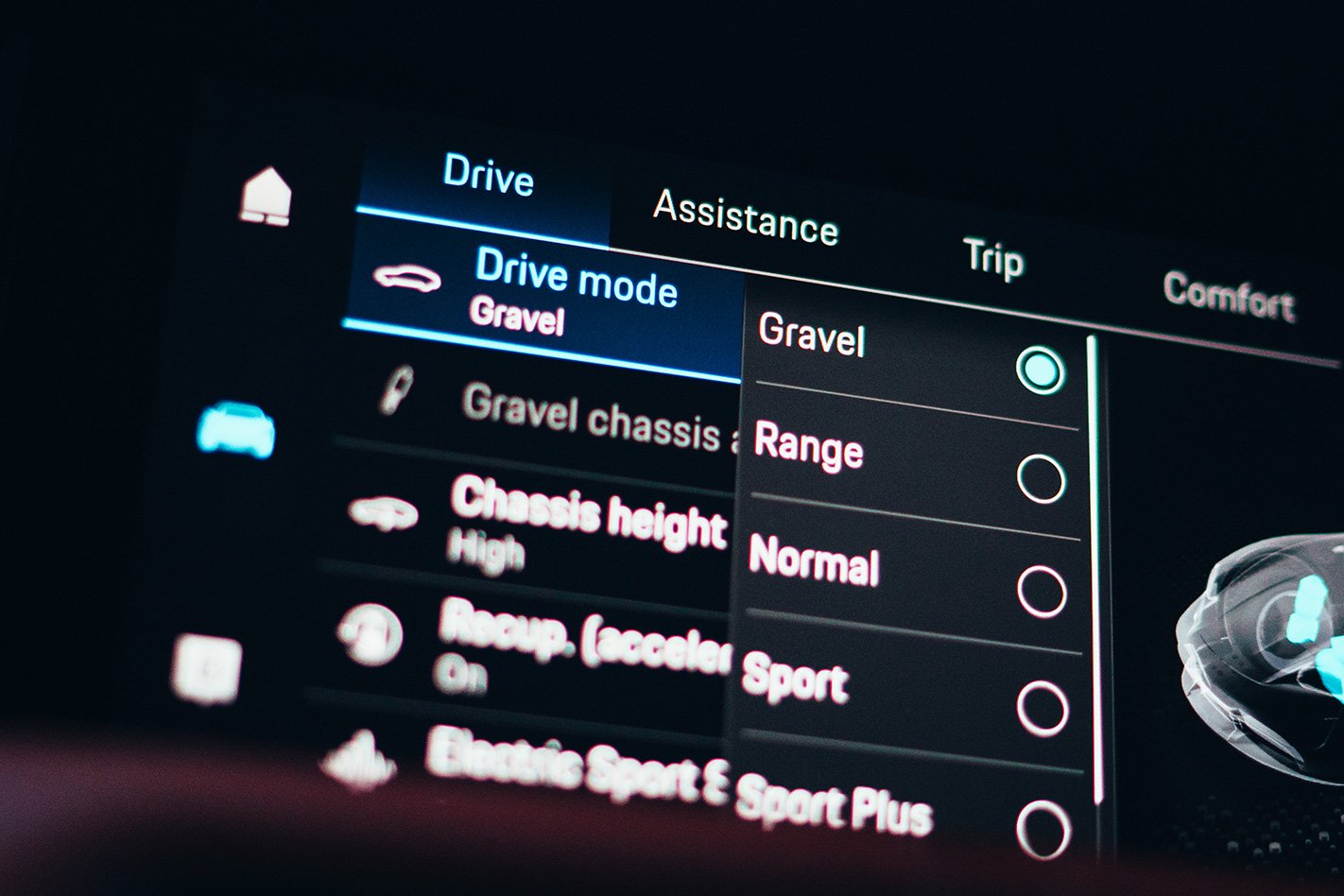
Where this Cross Turismo strikes a different chord is in the ride height: as standard, the car is 20mm higher than the normal Taycan. With the optional off-road pack, the ground clearance rises to a 30mm difference. The car is on full air suspension, so it will sit lower if you want it to or automatically if it needs to from an aerodynamics point of view.
There are five settings in total. Those with a hankering to be the next Elfyn Evans will be pleased to hear there’s also a Gravel mode within the drive settings. We didn’t get to try this on our short run on paved roads, but the fact that it’s offered at least shows you where Porsche’s mindset is with this car.
Confession time: this is technically a prototype, so the final performance figures aren’t signed off on yet, which means the following are estimates. In this Turbo S guise, the car gets the Premium Battery Plus with 93.4kWh and should make 560kW and 1050Nm with overboost. The range should be similar to that of the Taycan sedan, but sadly, this range-topper isn’t slated to lob Down Under.
Like the Taycan, the Cross Turismo gets 800V technology and the ability to charge at up to 270kW. The rate it can hoover up electricity is still something to behold, even having witnessed it quite a few times now. It’s the sort of thing that makes electric cars, and particularly the charging of them, feel truly manageable in the real world if availability and conditions are met. It also means you can be on your way again quickly to experience the frankly ludicrous pace of the Cross Turismo.
If you’ve read anything about the Taycan saloon, you will know that its performance is striking, and this version is no different. The Cross Turismo is four-wheel-drive as standard and gets the same two-speed rear transmission as the regular Taycan. What this means, in theory, is that 0-100km/h should take about 3.0sec (again, this hasn’t been confirmed; it’s 2.8sec on the Turbo S saloon).
For the time being, the bottom line is that my hands aren’t strong enough to hold on to the steering wheel under a full-bore acceleration run.
It’s not so much that the pace is extraordinary; it’s more the instant and seamless delivery of it. No pauses, either from the start or as the figures climb – just a relentless, sense-scrambling wave of torque. The lack of noise doesn’t make it any easier to compute, even with the Electric Sport Sound generator turned on.
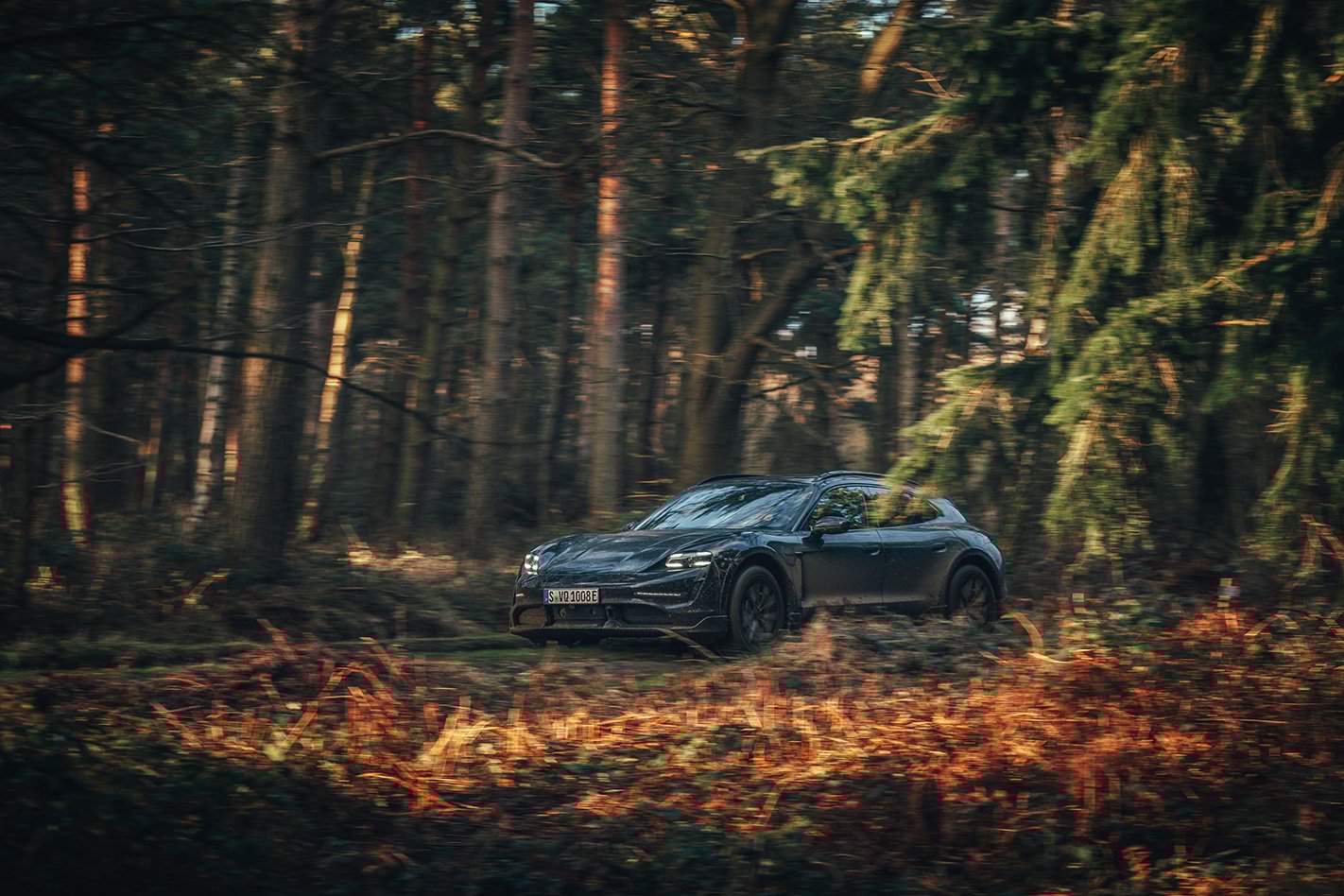
It’s a strange contradiction: your ears are saying you’re going for a relaxing Sunday drive, while your eyes and the rest of your body are screaming that Mark Webber must be behind the wheel. The suspension gets a bit busier and the trees go past faster, but the noise remains perfectly calm.
Of course, this is no different to driving other electric cars. All of them feel relentless. But it still takes some getting used to, and then some.
Once your senses have recovered, it’s also clear that this car rides extremely well. It’s so composed, in fact, that you can tell within the first 20km of driving it. The Cross Turismo runs on 235/40 R20 rear tyres and 245/45 R20 front tyres, so there’s a reasonable amount of sidewall to act as a cushion.
The way it flows across broken tarmac is really quite impressive, and only the sharpest potholes interrupt the calm in the cabin as the mass of a wheel clunks through. One caveat: our car had winter rubber. The normal Turbo S will come on 21-inch rims, so some of that flex will be lost.
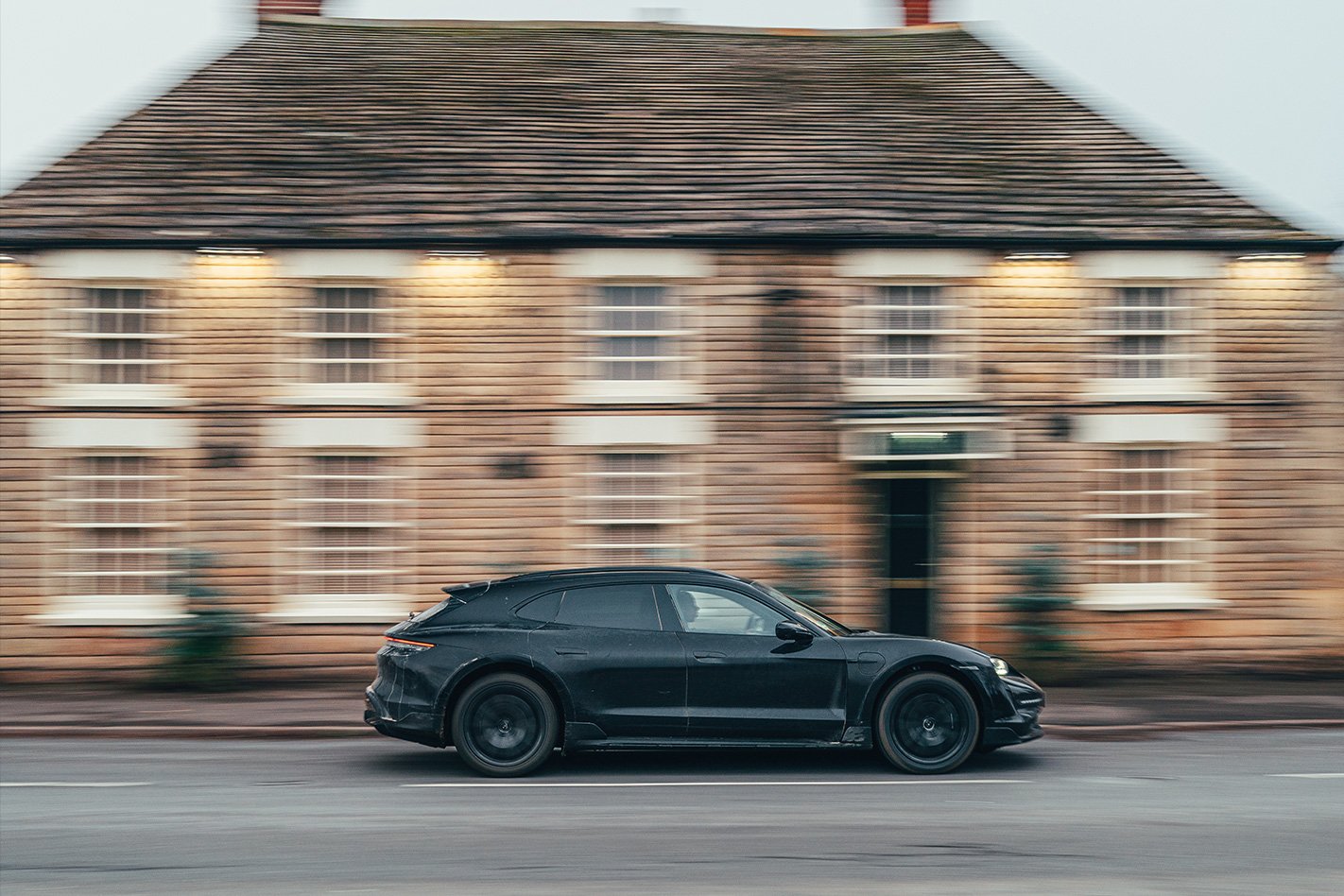
Of the suspension modes, Sport, Sport Plus and Range lower the car, but I wouldn’t bother with those settings. This Cross Turismo variant feels happiest in Normal mode, which best suits the car, not least because the middle suspension setting lets the body roll through corners slightly.
The Cross Turismo does a remarkable job of disguising its bulk, but there’s a bit more pitch here than there is in the Taycan. That’s not necessarily a bad thing, and this is still a wonderfully enjoyable car to thread through a series of bends. With a bit more movement, it only feels more exciting. The grip is impressive and the car is well balanced front to back.
In fact, ‘well balanced’ could be used to describe the whole Cross Turismo package. All the systems seem to be in harmony, so no single element gives too little or too much. Everything feels just right.
That’s pretty much the perfect way to sum up the Cross Turismo. The Taycan shifted our view on electric cars (as well as how we view Porsche performance cars heading into the future) and the Cross Turismo does a great job of following that thread.
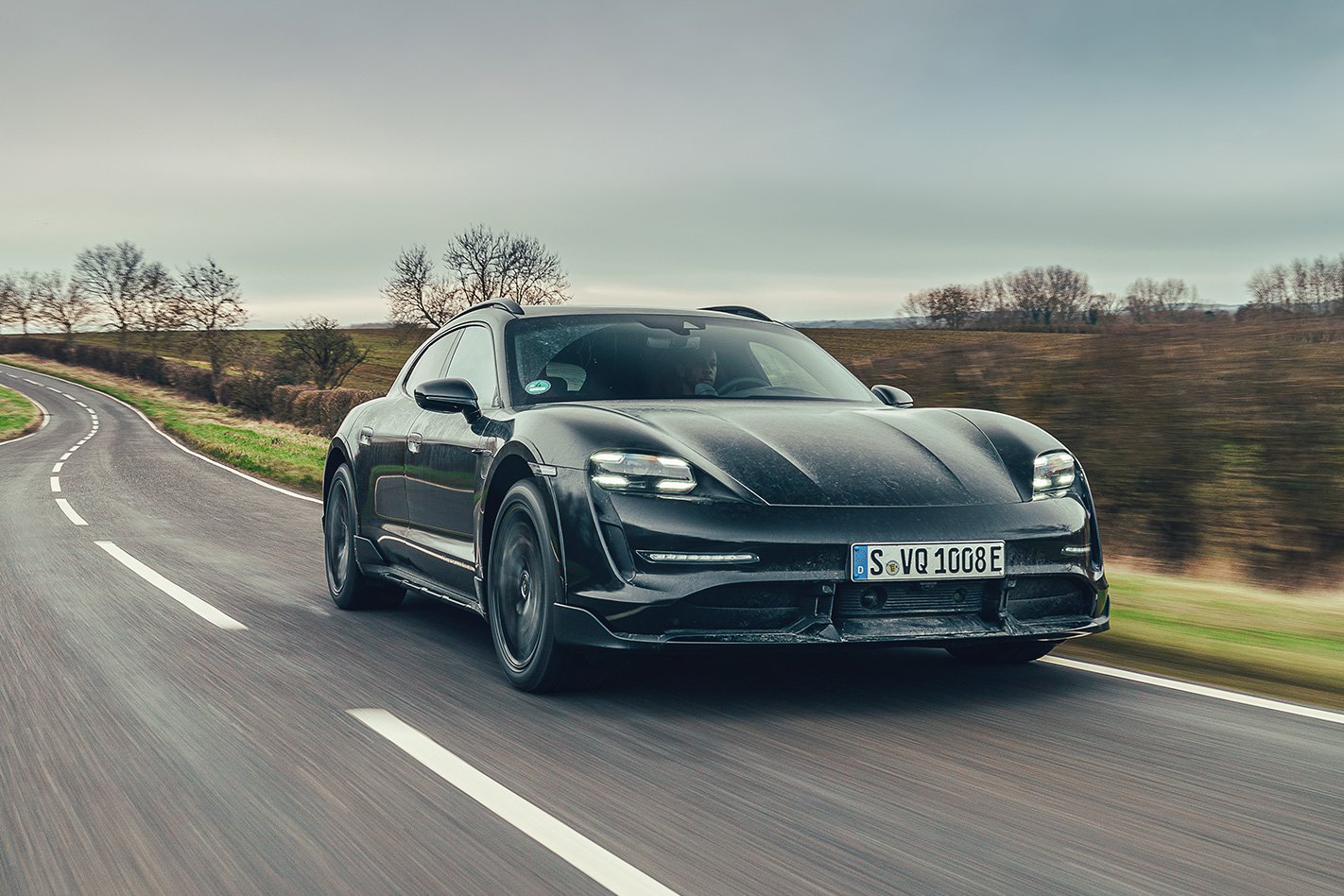
It feels different enough to warrant its place in the Porsche line-up but similar enough to uphold the already impressive Taycan badge. It’s another job well done.
Coming soon to a dealer near you
The Taycan family is about to get crowded. In addition to the sedan that earned a 4.5-star road test rating (Taycan 4S), there’s this Cross Turismo version (in 4S and Turbo guises). We’ve also seen spy shots of an upcoming Sport Turismo. For the latter, imagine the Cross being lowered and losing the cladding and you will be somewhere close.
It’s a brave move to sell two cars that are so closely matched, but as Porsche proved with the Sport Turismo Panamera, there was little cannibalisation between the two, so the firm is happy with the strategy. The global sales split is 70/30 in favour of the sedan over the Sport Turismo, and Porsche is anticipating a similar trend with the two Taycan variants that are so far confirmed.
Long Roof Lowdown
While European markets will get the choice of four Taycan Cross Turismo variants, Porsche has rationalised the lineup for Australia, declining the entry-level Cross Turismo 4 and the range-topping Turbo S. That leaves the two models in the middle of the sandwich for Aussie buyers: the Cross Turismo 4S and the Turbo, both naturally driving all four wheels.
You’ll need to stump up $201,000 before on-road costs for the 4S (around $10K over the sedan) which develops 360kW in standard mode with 420kW/650Nm on overboost. Expect a 0-100km/h time in a crisp 4.1 seconds and a top speed of 240km/h. If your right boot is a bit lighter, you’ll get between 388 and 452km on a charge according to the notoriously stringent WLTP protocol.
The Turbo is priced from $271,200 before on-road costs locally, which only adds a couple of grand to the price of the equivalent Taycan sedan. This leverages the power of 460kW electric motors, lifting to 500kW/850Nm when using launch control or transient overboost. This shaves the 0-100km/h time down to a mere 3.3 seconds, while the WLTP range eases out fractionally to 395-452km.
Other differences? The 4S gets 360mm front and 358mm rear iron brake discs as standard, while the Turbo gets gleaming tungsten-carbide-plated rotors measuring 410mm up front and 365mm out back.
You may well need to break out the tape measure to check whether a Cross Turismo will fit in your garage. The Turbo model is 4974mm long, 1967mm wide and 1412mm tall, and runs on a 2904mm wheelbase. Compared to the already generously proportioned sedan, it’s – 11mm longer, 1mm wider, 31mm higher. The wheelbase is also 4mm longer.
As with the Taycan sedan, the Cross Turismo is a four-seater as standard with an optional fifth seat available. Due to its glass roof and elevated roofline, the Cross Turismo also offers superior front and rear headroom as well as more space in the rear. The 4S features 446 litres of boot space, rising to 1212 litres with the seats folded. That’s on top of 84 litres in the frunk.
The order book is open, so expect Oz deliveries to start in quarter three of this year.
Porsche Taycan Cross Turismo Prototype Specs
Engine: 2 permanent-magnet AC electric motors Drive: all-wheel Power: 560kW Torque: 1050Nm (overboost) Transmission: 1-spd automatic (front), 2-spd automatic (rear) Battery: 93.4kWh, lithium ion Weight: 2295kg (est.)
Mercedes-AMG CEO Philipp Schiemer has confirmed the performance arm of Mercedes-Benz will ditch the GT Roadster in favour of the upcoming SL Roadster.
The boss claims the new SL will be a more balanced car than the one it will replace, providing greater bandwidth for owners.
However, Schiemer was also keen to point out that although he and his team planned on making the SL more rounded than the GT, the SL moniker is still one steeped in motorsport.
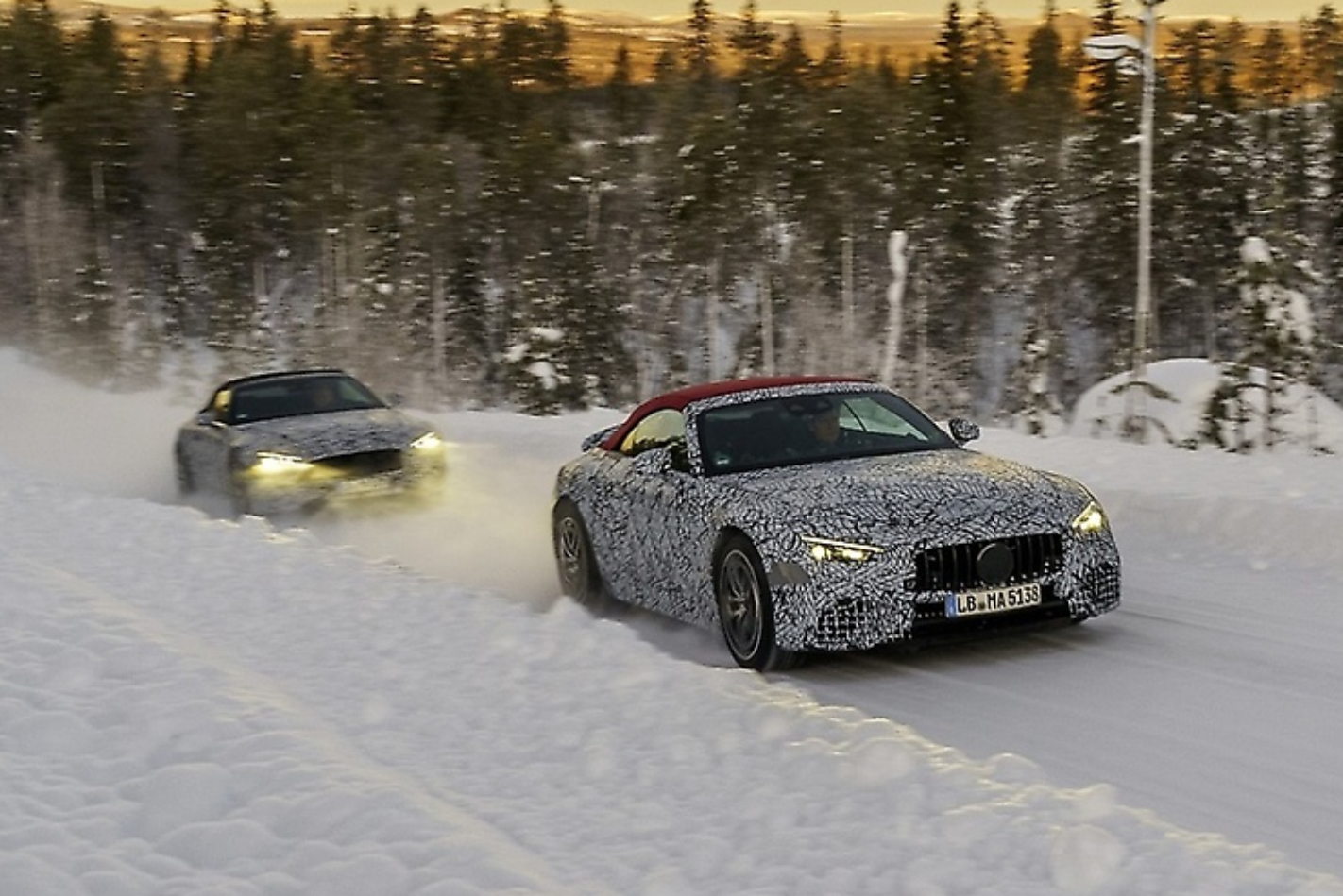
The new roadster will be a fully in-house AMG product, like the GT, and thanks to a leak last year first published on Mercedes-Fans.de, we know there will be more than a few different models in the range.
According to the leak, there will be six different variants from launch:
As evidenced by the leak, most of the new SL line-up will feature Mercedes’s 4MATIC all-wheel drive system.
The SL will most likely share the same chassis architecture as the next GT, which could be unveiled in the first half of 2022.
Schiemer also confirmed, as reported by Car and Driver, that the new SL would be available with 48-volt and plug-in hybrid powertrains, which would support the ‘E’ lettering on some of the model designations.
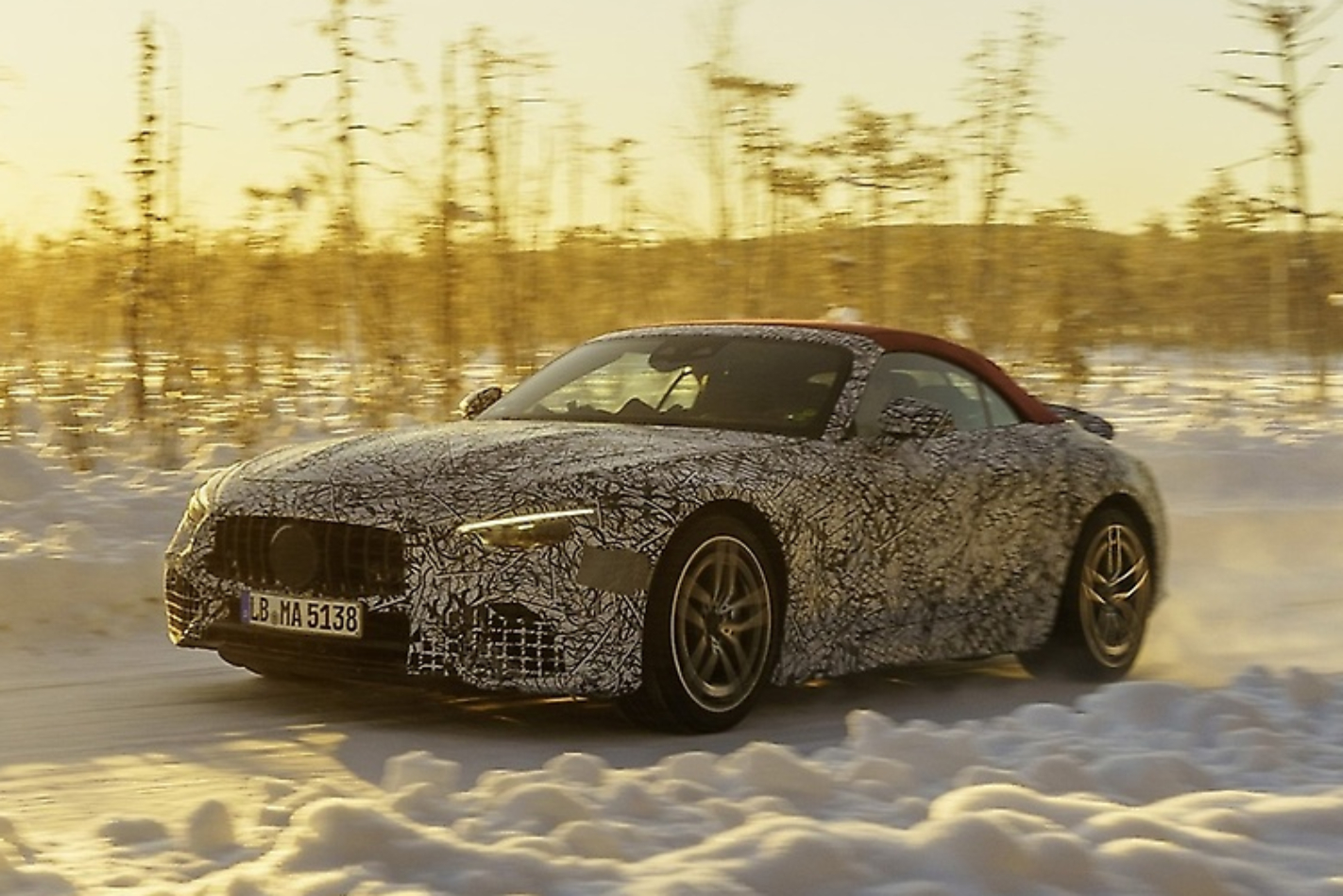
The electrification is rumoured to be mated to Mercedes’s turbocharged 3.0-litre inline six-cylinder engine and AMG’s prolific M176 4.0-litre twin-turbo V8.
The latter of the two engines is also thought to power the SL’s range-topping variant, which will reprise the SL 73 name, albeit with an ‘E’ and ‘4MATIC+’ suffix.
There have been reports that the 73 will have in the region of 600kW of power, thanks to the mighty blown bent-eight under the bonnet, working in conjunction with a rear-mounted 150kW electric motor.
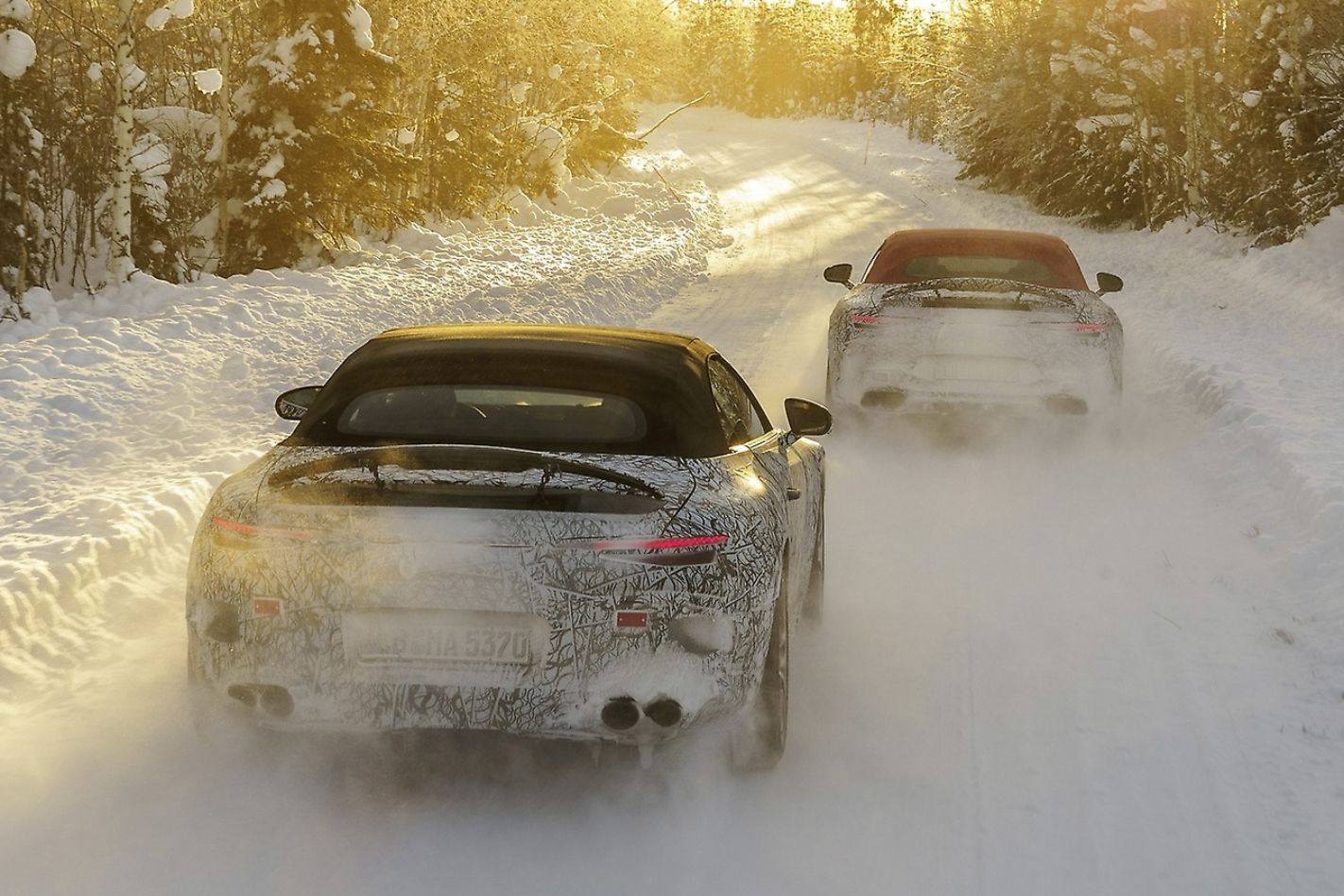
Not much else is known about the new SL at this point, however, Mercedes-AMG is expected to globally unveil the soft-top before the end of 2021.
MG has proved its February sales result was no fluke, by securing a second consecutive month as a Top 10 brand.
The British-turned-Chinese brand sold 3303 vehicles in March, according to official Australian industry figures released today. It was sufficient to place it 10th in the best-selling automotive brands list for the month, pipping Mercedes-Benz by 28 units and trailing ninth-placed Volkswagen by just 50 units.
The rapid rise of MG is remarkable, considering it sold only 600 vehicles in 2017 and still offers only three models. Its 2021 total up to the end of March is already more than its entire sales in 2018 – 3007 units.
After the first three months of 2021, MG has sold 8728 vehicles – more than half of its 2020 sales total, thanks to 163 per cent year-to-date growth.
MG’s MG3 city car, ZS compact SUV and HS mid-sized SUV are all contributing, with the showroom boosted by new variants in the form of the HS PHEV (plug-in hybrid) and the ZS EV that is currently the country’s most affordable electric vehicle.
With 1510 sales in March – up a massive 328 per cent on March 2020 – the ZS wasn’t far off becoming the first Chinese-made car to make it into a Top 10 Most Popular Models list.
The ZS is also up more than 300 per cent year to date.
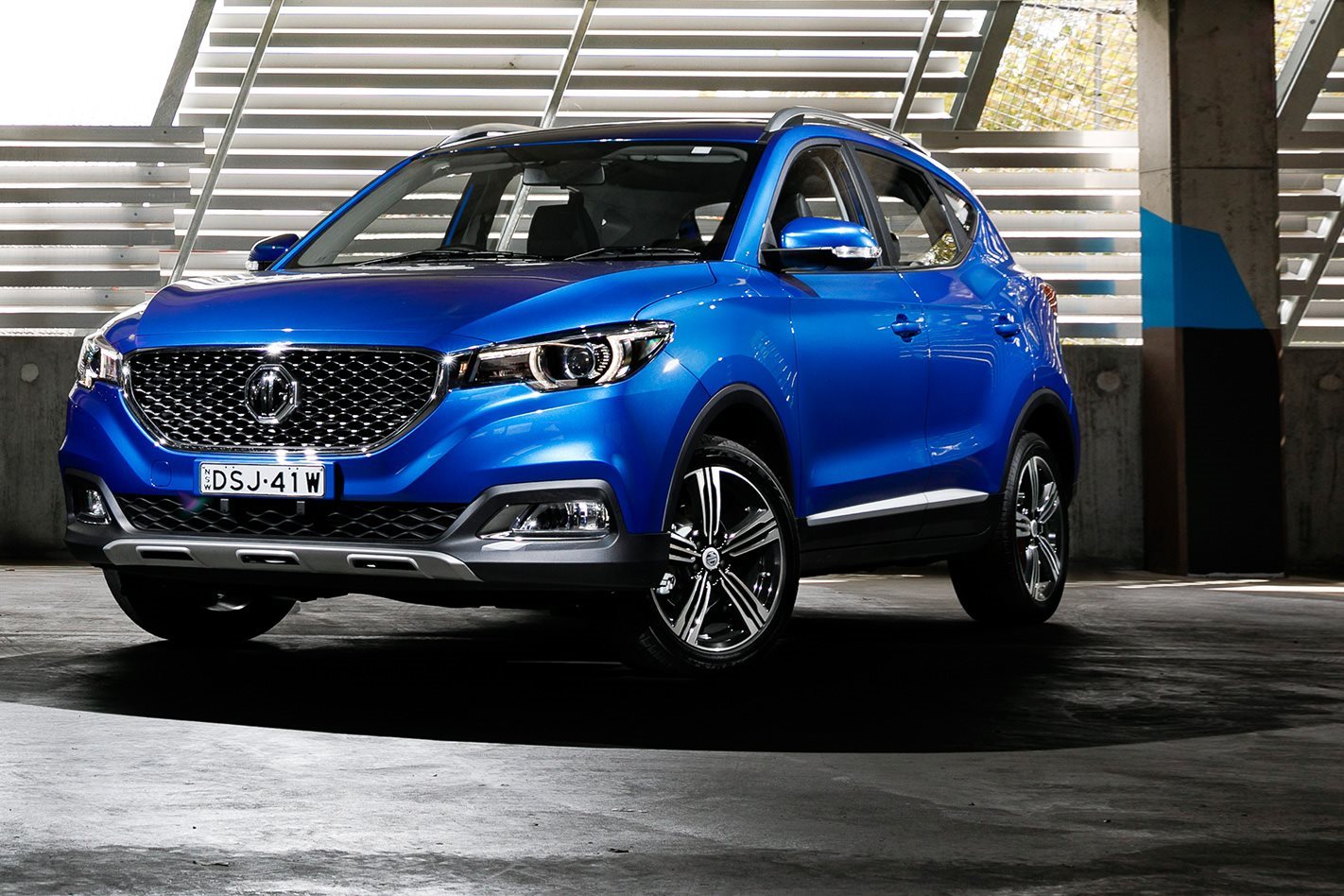
The older MG3 accounted for 1238 sales in March, up 96 per cent month on month and 95 per cent year to date.
MG registered 555 HS models last month – a 127 per cent increase compared with this time last year. The SUV is up 124 per cent year to date.
When taking year-to-date figures into account, however, MG isn’t yet installed in the Top 10 Brands list. A first-quarter total of 8728 sales puts it just outside, with Mercedes-Benz occupying 10th place with 9073.
(That Mercedes figure includes van/ute sales, which we count for a true comparison with other brands but are separated in official VFACTS figures.)
MG wasn’t the only Chinese brand to enjoy a successful March.
LDV, another former British brand, was up 188 per cent to 1468 units, with consistent growth throughout its product line-up.
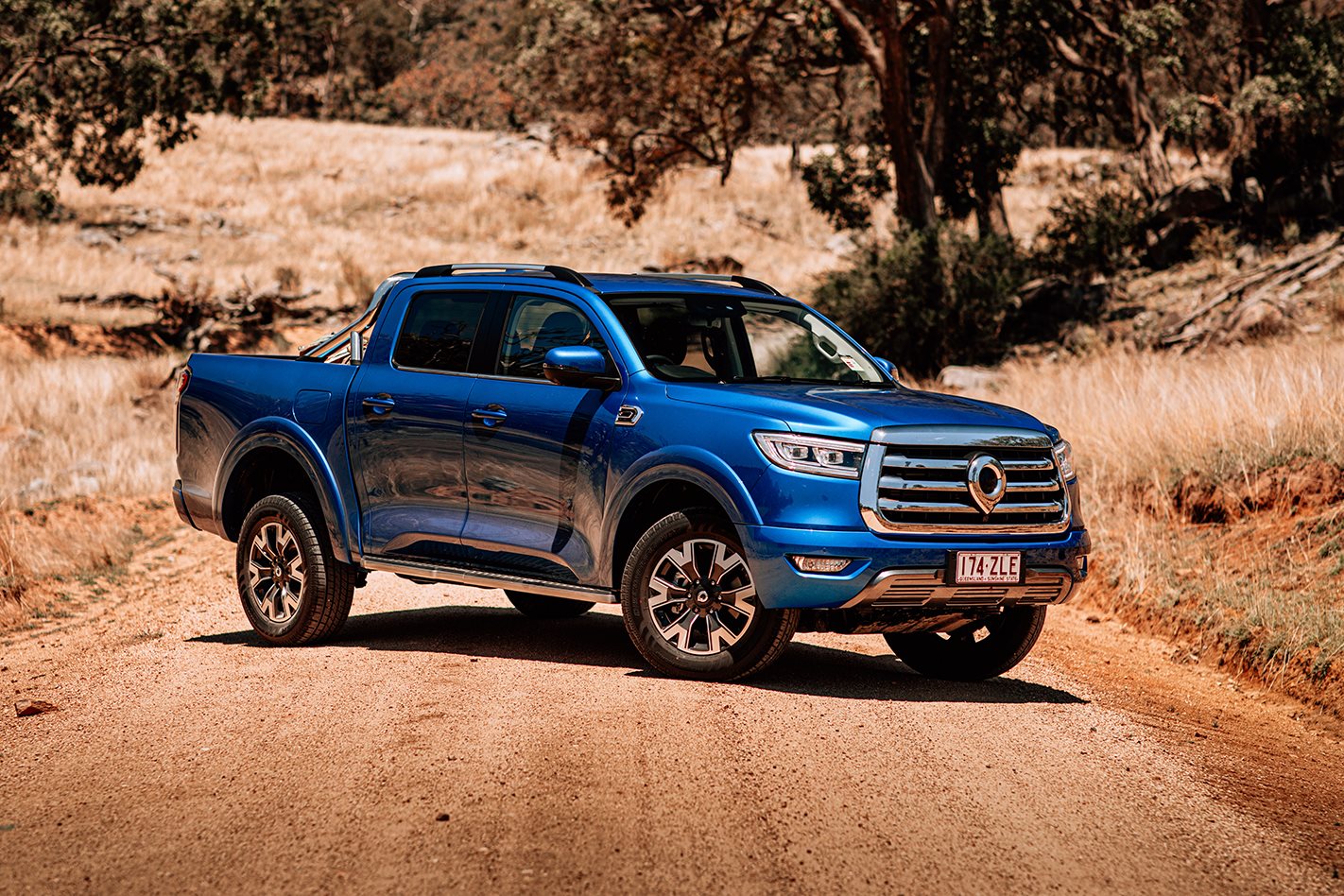
And GWM/Haval was up 173 per cent for 1021 units, with big contributions from the Haval H2 (up 218 per cent month on month) and the new, sharply priced GWM Ute (418 sales).
Cars imported from China have increased 165 per cent year to date – up from 5776 vehicles in March 2020 to 15,275 vehicles in March 2021.
China is now the fourth-highest source of cars for Australia, ahead of Germany (10,436 YTD) and only behind Japan (94,434), Thailand (56,132) and Korea (36,997).
MORE: New car sales results for March 2021 MORE: All VFACTS stories
MARCH 2021: TOP 10 MODELS
- TOYOTA HILUX – 5319 – up 49.6% YTD
- FORD RANGER – 3983 – up 28.2% YTD
- TOYOTA RAV4 – 3522 – up 17.8% YTD
- MAZDA CX-5 – 3022 – up 74.3% YTD
- TOYOTA COROLLA – 2892 – up 2.8% YTD
- HYUNDAI I30 – 2514 – up 35.5% YTD
- MITSUBISHI TRITON – 2492 – up 37.5% YTD
- TOYOTA LANDCRUISER – 2244 – up 78.0% YTD
- ISUZU D-MAX – 1994 – up 35.9% YTD
- NISSAN X-TRAIL – 1932 – up 46.0% YTD
TOP 10 BRANDS
- TOYOTA – 21,319 – up 21.2% YTD
- MAZDA – 10,785 – up 58.2% YTD
- HYUNDAI – 6852 – up 29.1% YTD
- MITSUBISHI – 6430 – up 7.1% YTD
- FORD – 5977 – up 23.1% YTD
- KIA – 5802 – up 2.6% YTD
- NISSAN – 4559 – up 30.2% YTD
- SUBARU – 4212 – up 39.3% YTD
- VOLKSWAGEN – 3358 – up 17.0% YTD
- MG – 3303 – up 167.7% YTD
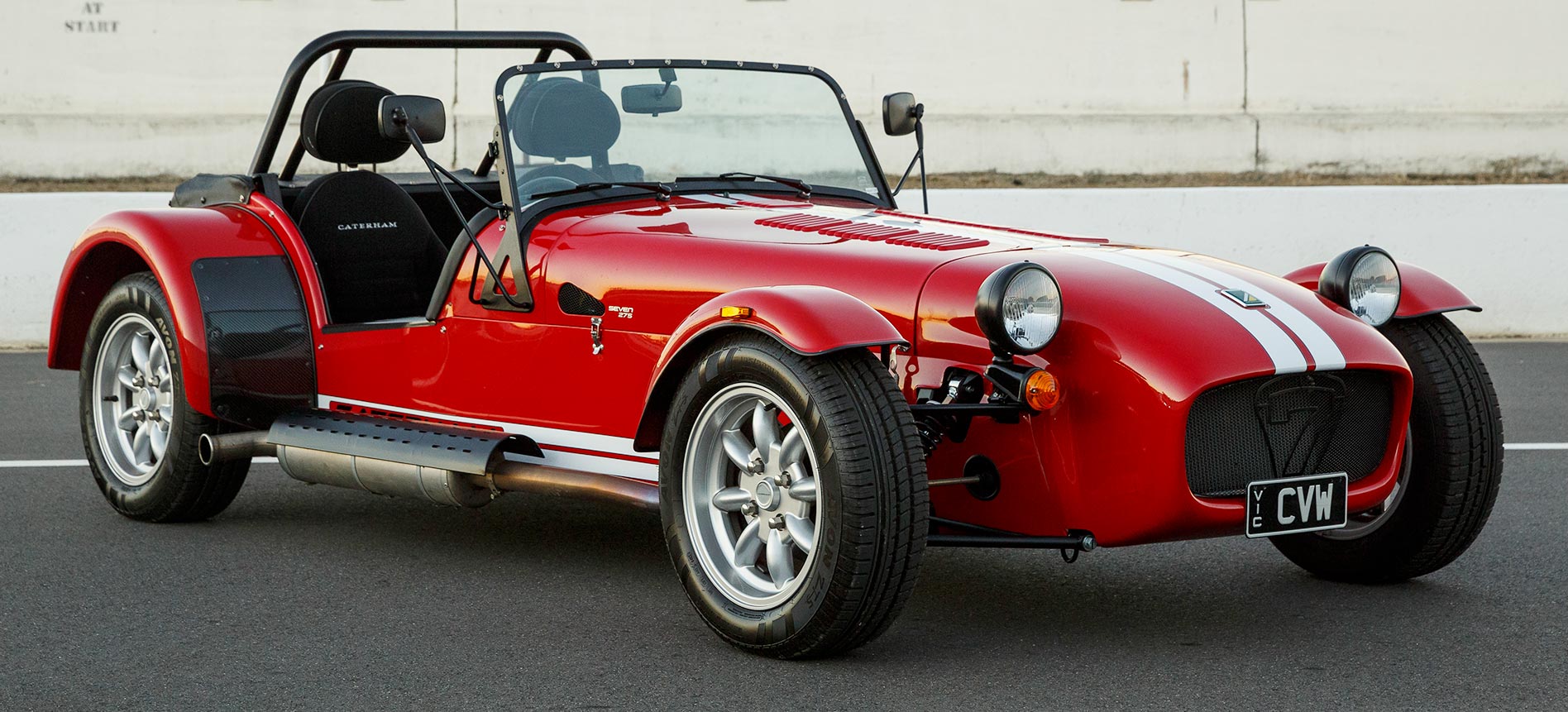
One of Japan’s largest automotive retailer groups has bought the Caterham Cars brand outright.
Japanese importer VT Holdings will take the reins of the small-volume British sports car maker. The takeover was effective from March 31, according to an internal email seen by PistonHeads, but the sum required for the buyout was not shared.
While it may seem scary that an unknown conglomerate on the other side of the world has eaten up the humble British sports car maker, VT Holdings already has intimate knowledge of Caterham’s operation. The importer has handled local Caterham, Lotus and Royal Enfield distribution for a number of years.
The brains behind VT Holdings, Kazuho Takahashi, also has a keen interest in Japanese motorsport, having raced in Japanese Super GT, JGTC and Super Taikyu categories over the past two decades.
“VT Holdings is proud to welcome Caterham to the group,” said new owner Kazuho Takahashi.
“We have not only purchased a globally renowned performance car manufacturer but become custodians of a motoring legend. We will protect and develop the Seven to meet the legislative challenges that lie ahead.”
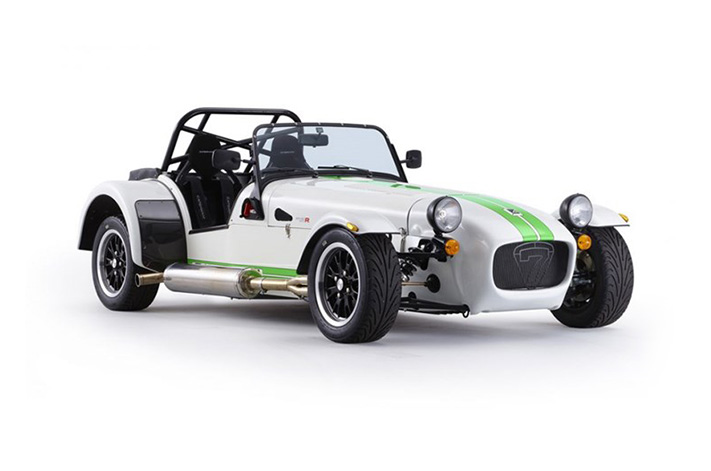
It’s no secret that the boutique British firm has had its struggles in recent history, and a confirmation that VT Holdings will invest in its continued relevancy (in an age of electric powertrain proliferation) is encouraging.
The British Government has stated in late 2020 that every new car sold after 2030 must be powered by electricity (or at least a hybrid), no doubt hampering Caterham’s plans.
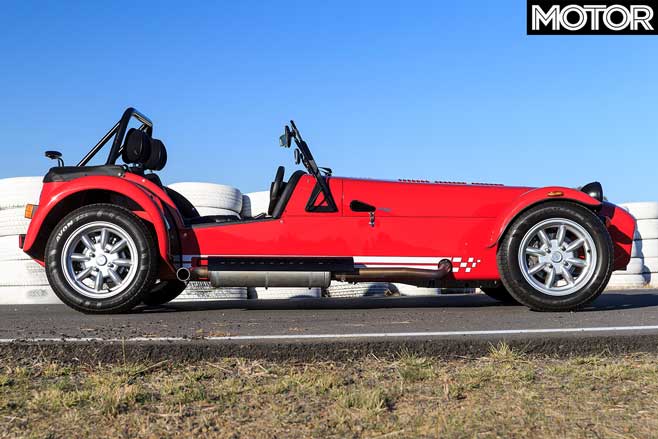
Graham Macdonald, current chief executive of Caterham, said: “Takahashi-san and the team truly understand the DNA of the Caterham brand, our heritage, our customers and our passions. As a team, we’re all excited about starting to write the next chapter for this very special brand.”
