
It’s not often you need to employ slipstreaming on the road, but these are desperate times, friends. The Tesla Model 3 Long Range is currently indicating five per cent battery and displaying a warning to stay below 75km/h if we want to reach our destination.At this point you’re probably thinking ‘oh great, another story about electric car range anxiety but no, while there is a degree of anxiety within this story it’s all the fault of the driver rather than the car.
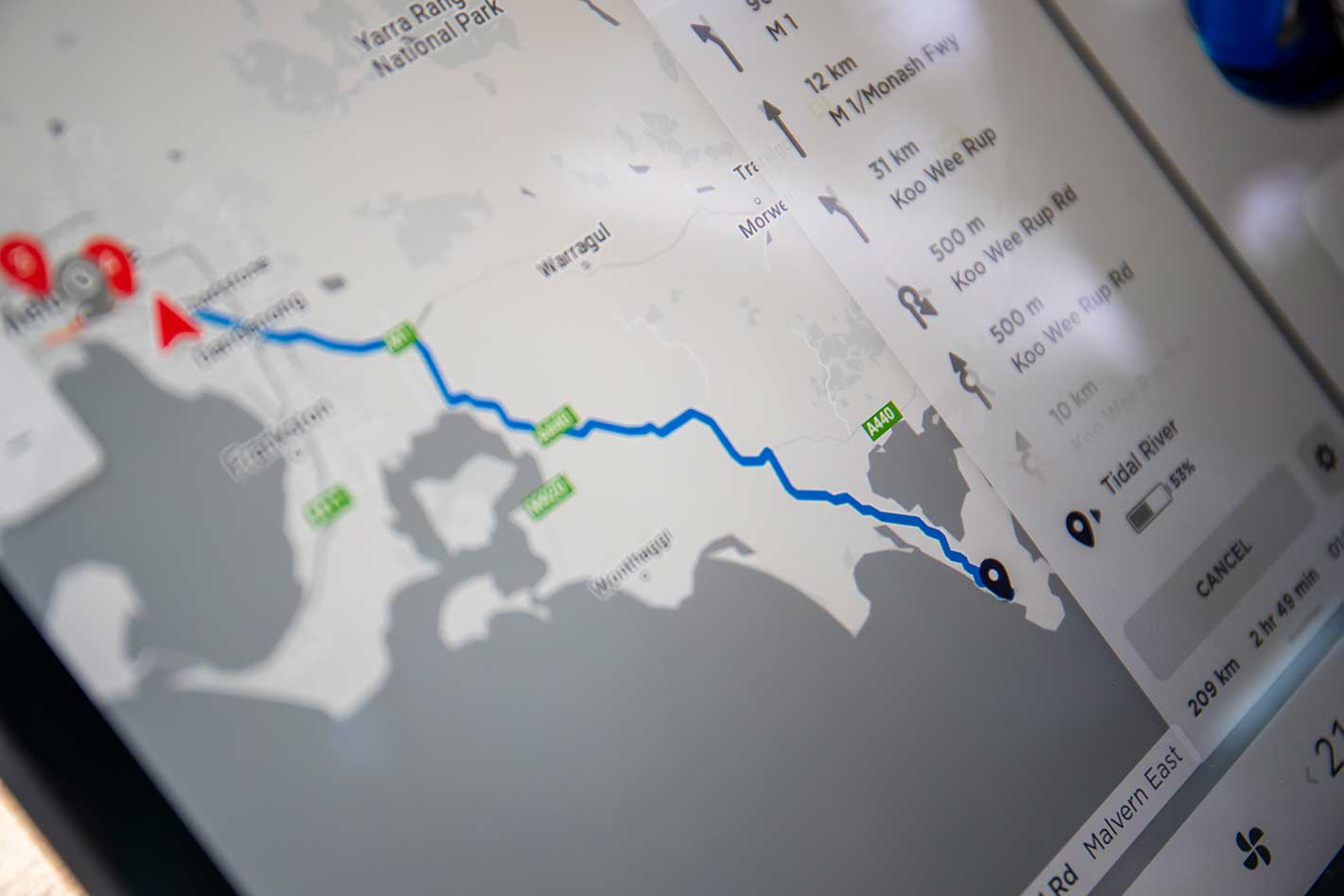
However, this isn’t an effort to eke every last kilometre out of a Tesla Model 3; instead we just want to find out how far you can realistically travel on a typical drive.
It wasn’t long ago that this journey would be fraught with potential headaches. When I first drove a Tesla in late-2014, the original Model S P85, the only option was to do a loop to and from the Tesla PR’s house; there were no chargers and the range was quite limited.
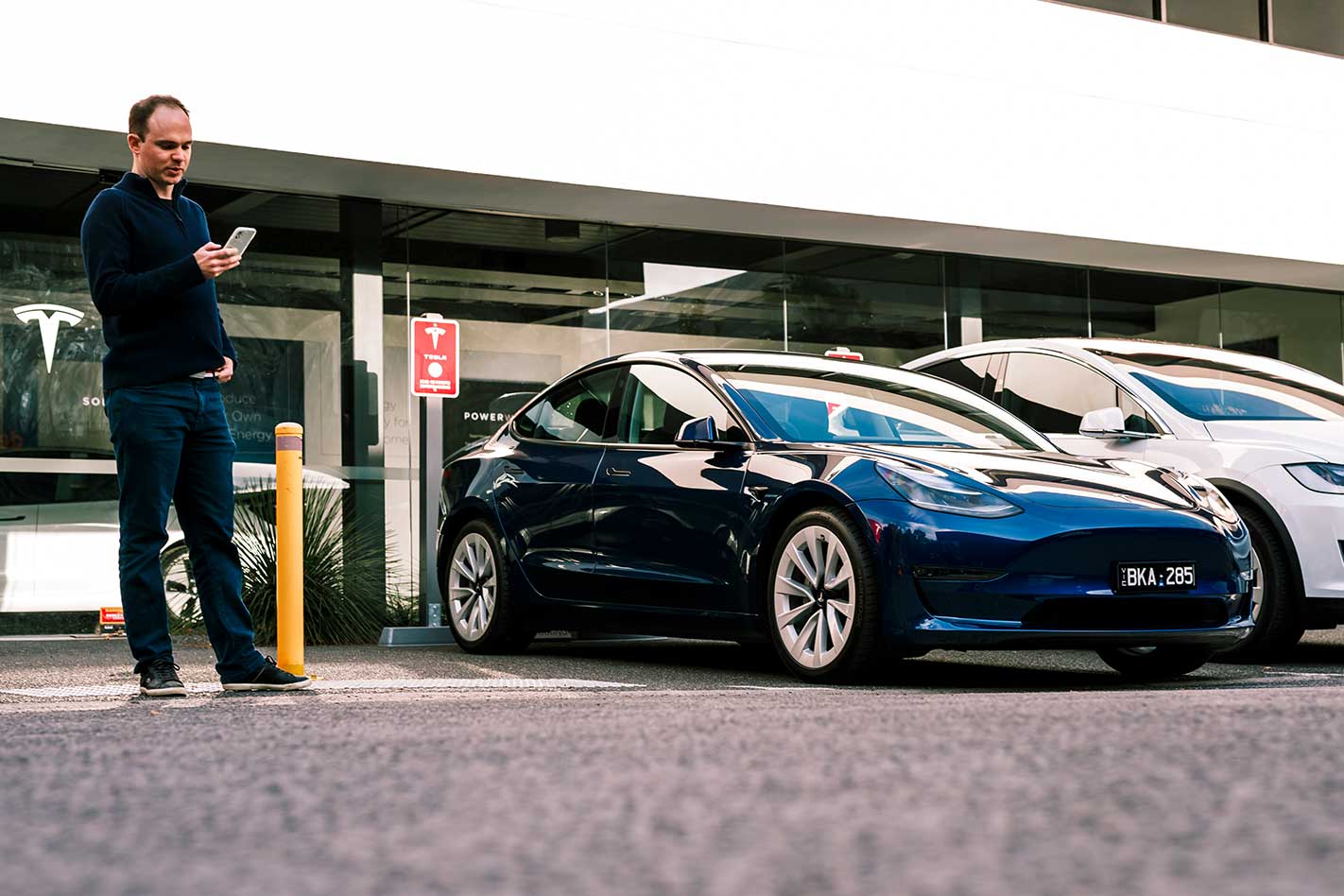
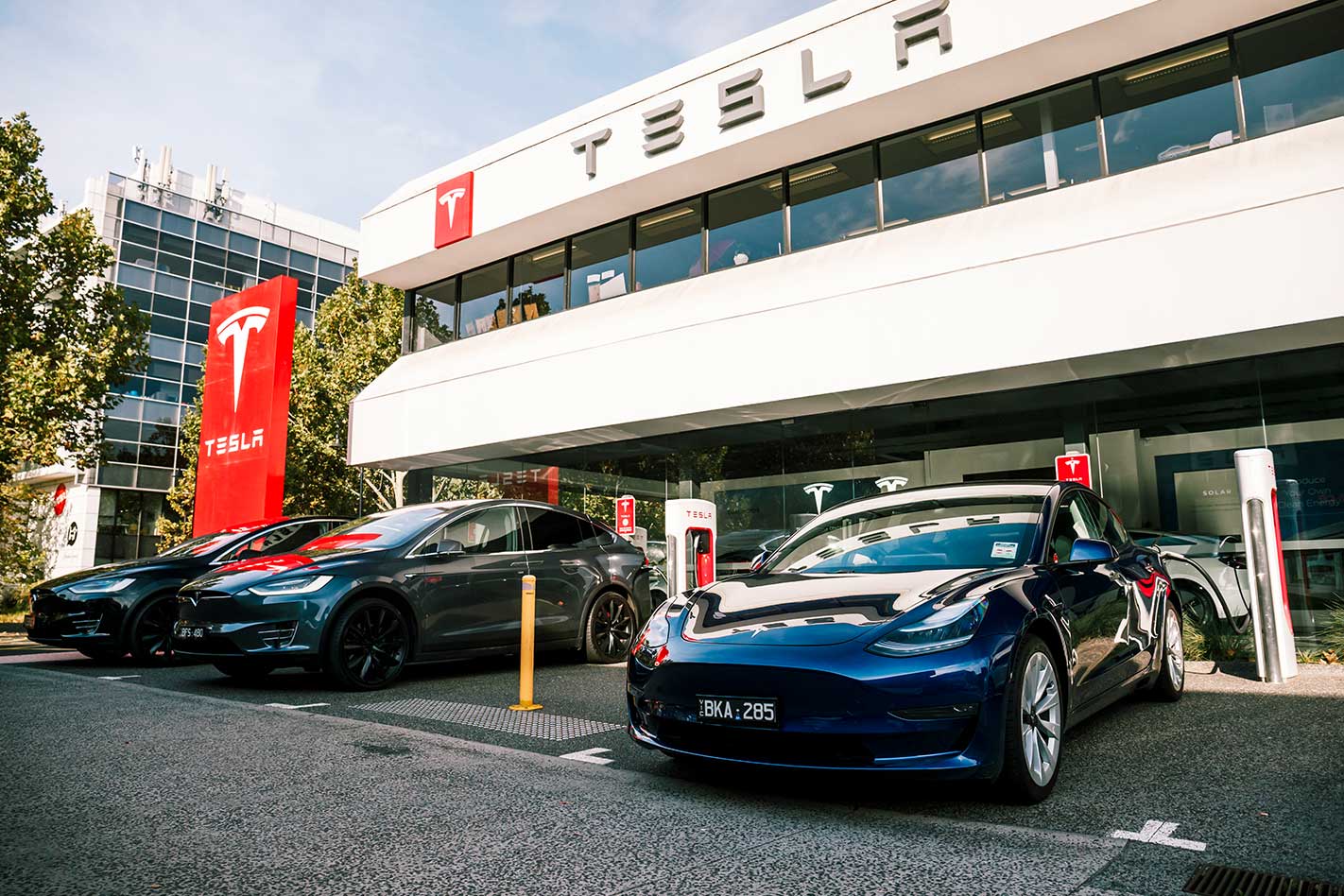
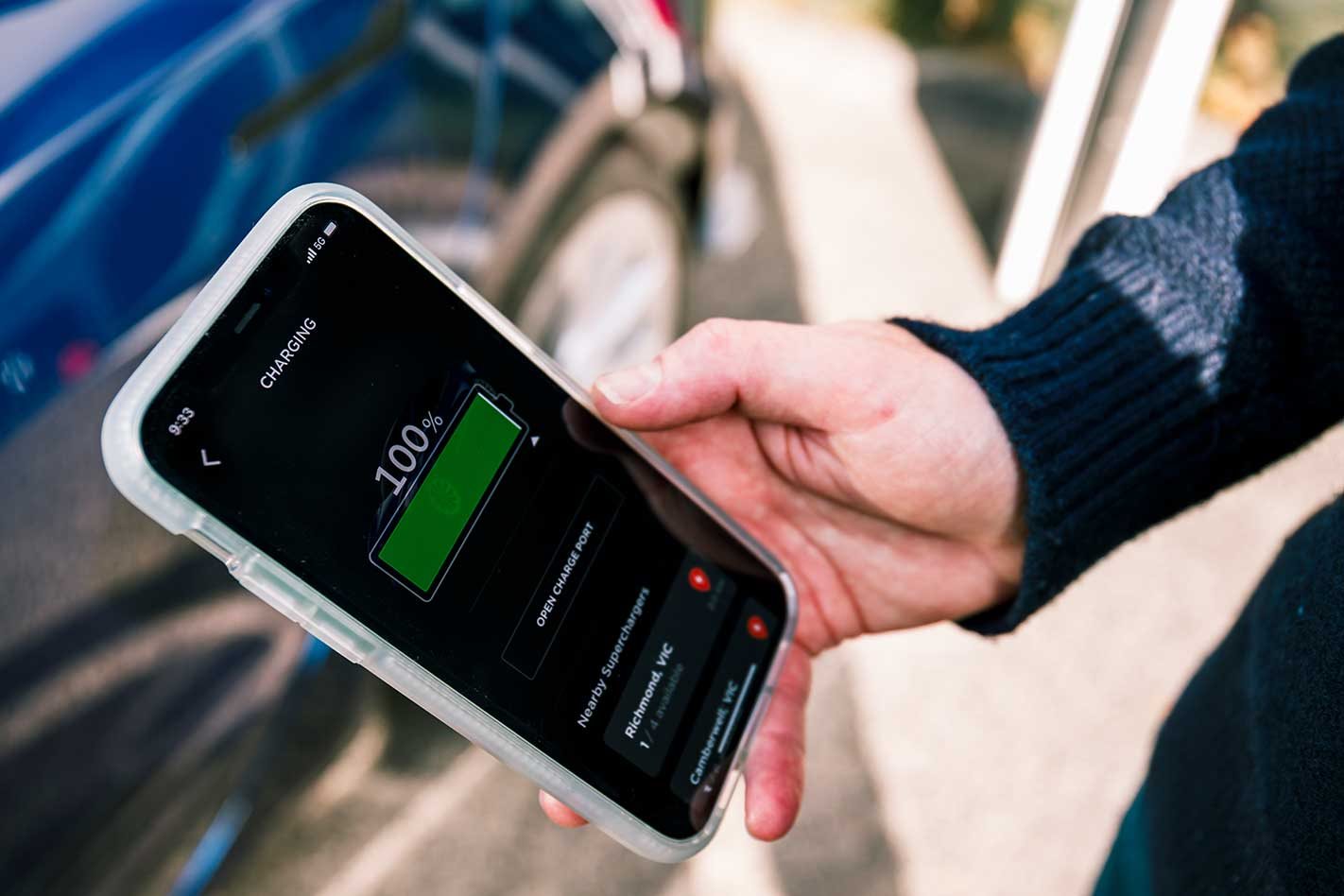
For example, while we weren’t planning to use them on this trip, a quick check on the Plugshare app showed that the pair of 22kW Tesla chargers at Fish Creek were currently unavailable, so we knew not to rely on them.However, as mentioned, our journey starts at the Melbourne Tesla service centre, where a Supercharger tops up the battery to 100 per cent in a matter of minutes.
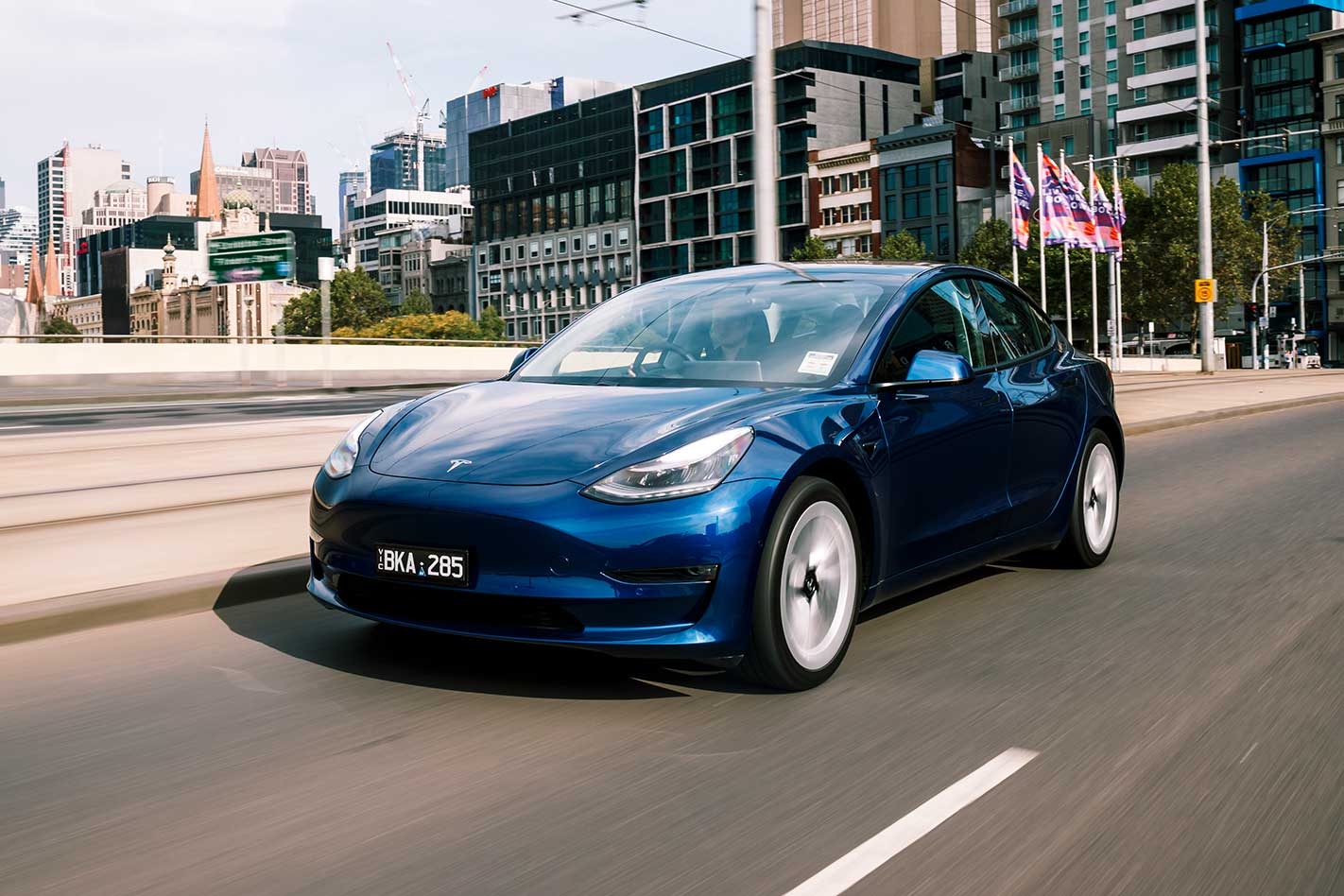
Add $1500 for metallic paint and $6826 in on-road costs and you’re left with an as-tested price of $91,751 driveway, making it a direct competitor to premium Euros like the BMW 330e, Audi A4 45 TFSI and Volvo S60 T8 R-Design.Once underway the Model 3 immediately impresses. It’s fundamentally a very relaxing way of getting around thanks to the smooth, effortless acceleration, low noise, excellent vision and strong regenerative braking effectively allowing for one-pedal driving.
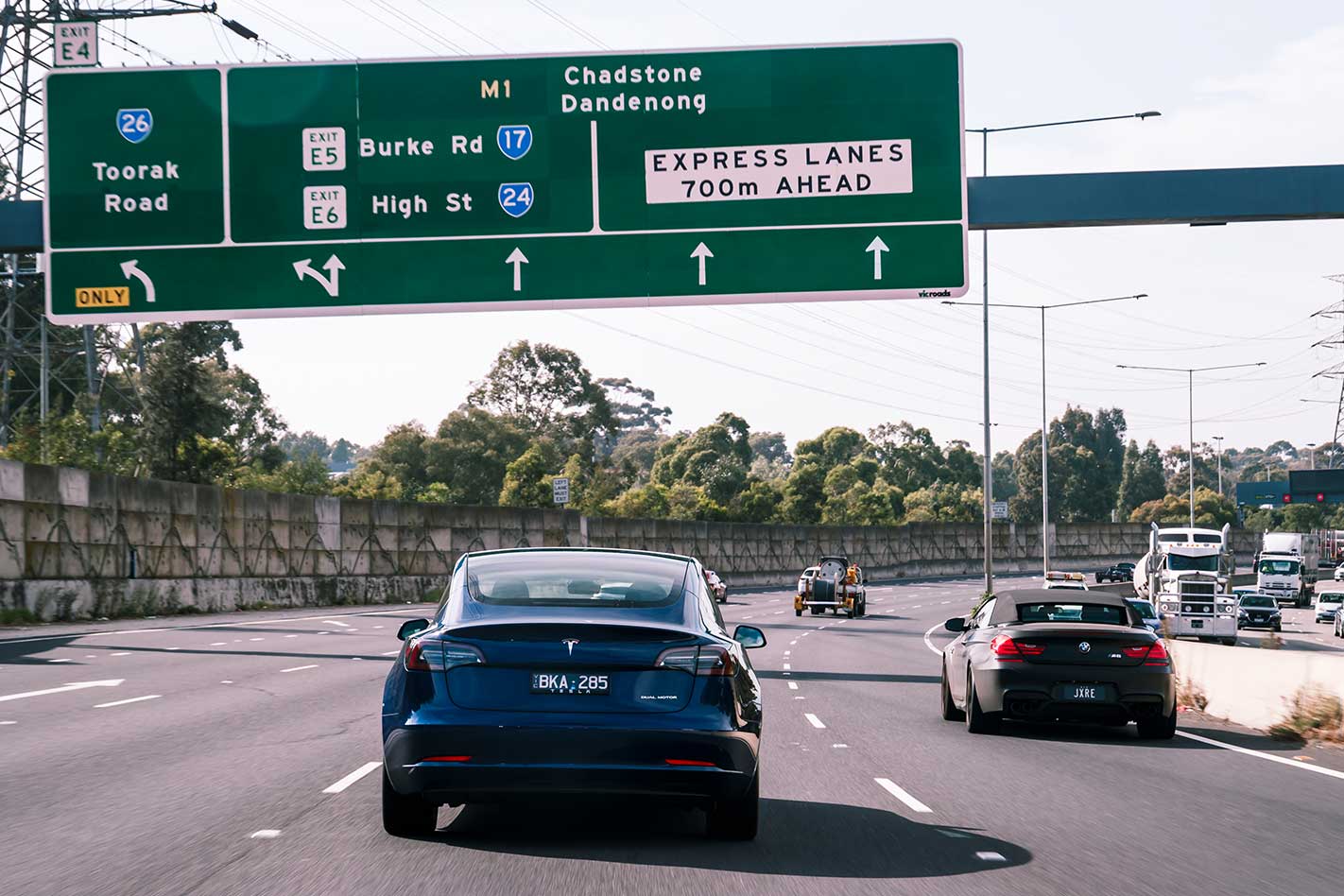
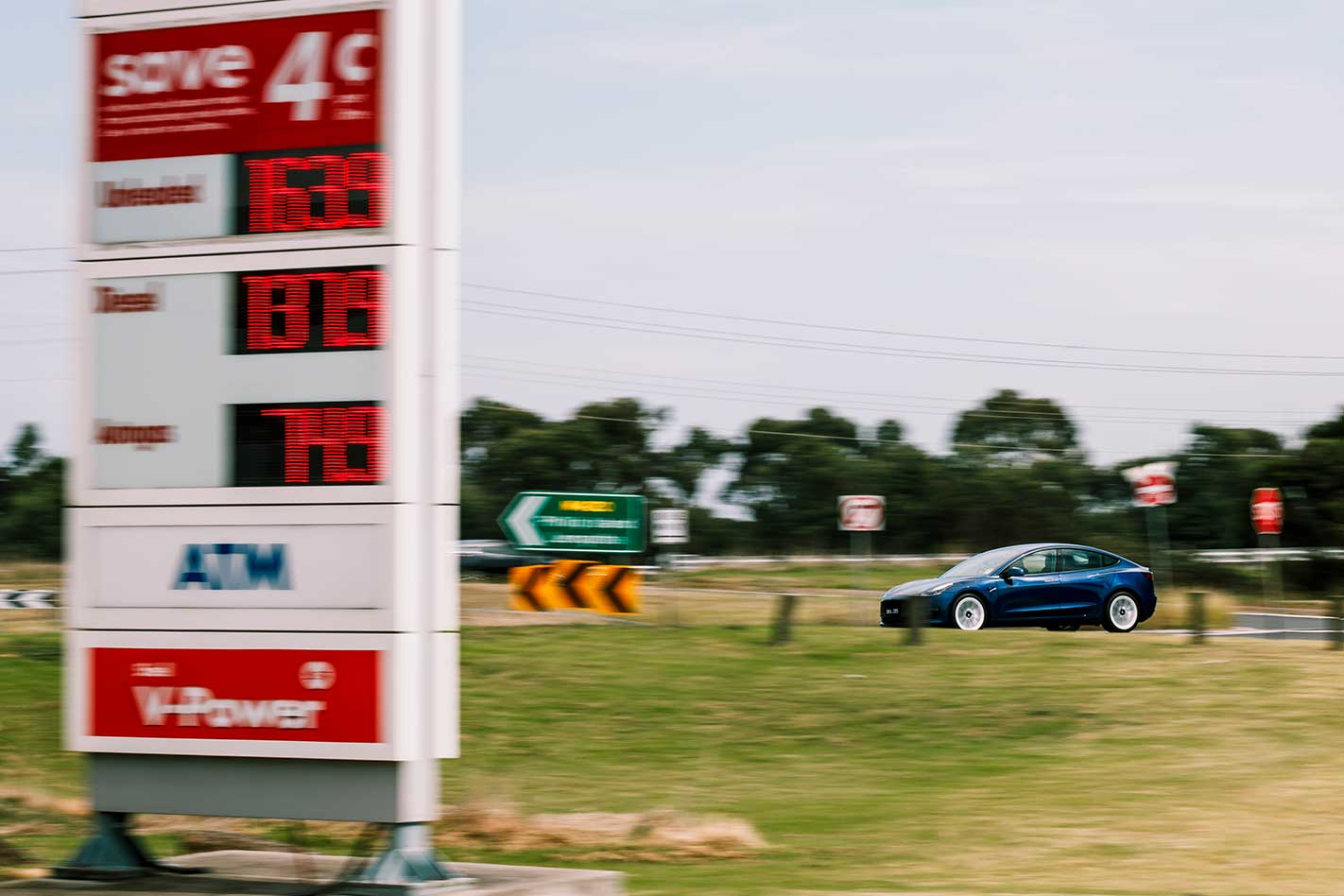
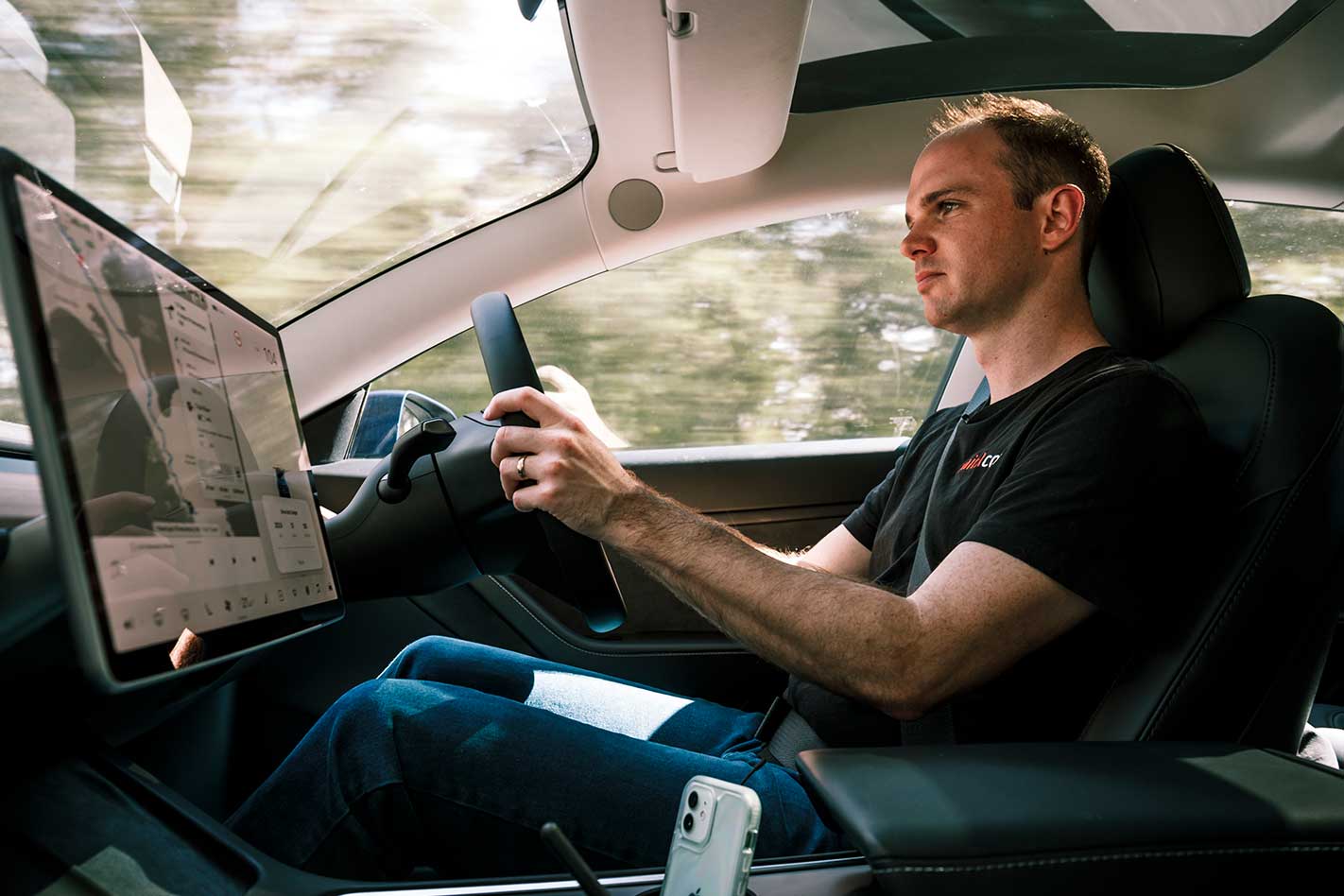
The floor-mounted batteries keep the weight low so it feels lighter than its 1844kg kerb weight and while there’s plenty of grip, the relatively soft suspension means the car moves around and requires input from the driver.The steering doesn’t offer much feedback but it’s light and accurate, as long as it’s kept in Comfort mode; Normal and Sport adding extra effort without added connection.
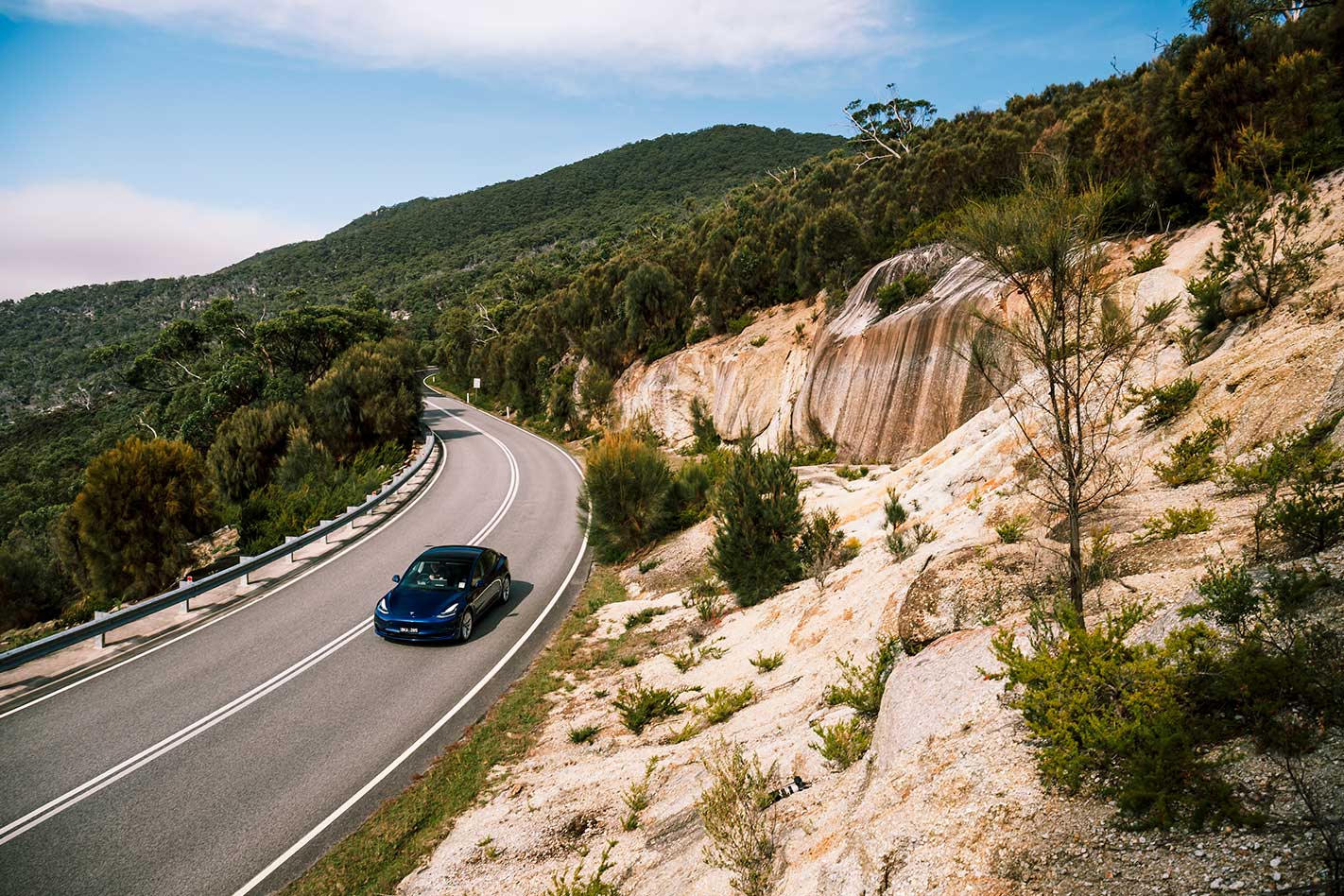
Precise outputs are hard to come by, Tesla preferring to publish 0-100km/h figures rather than power and torque numbers, but scouring the internet suggests figures of 258kW/510Nm for the Long Range.
However that, and the 4.4sec 0-100km/h claim, feel decidedly conservative given the way you’re slammed into the seat under full acceleration.
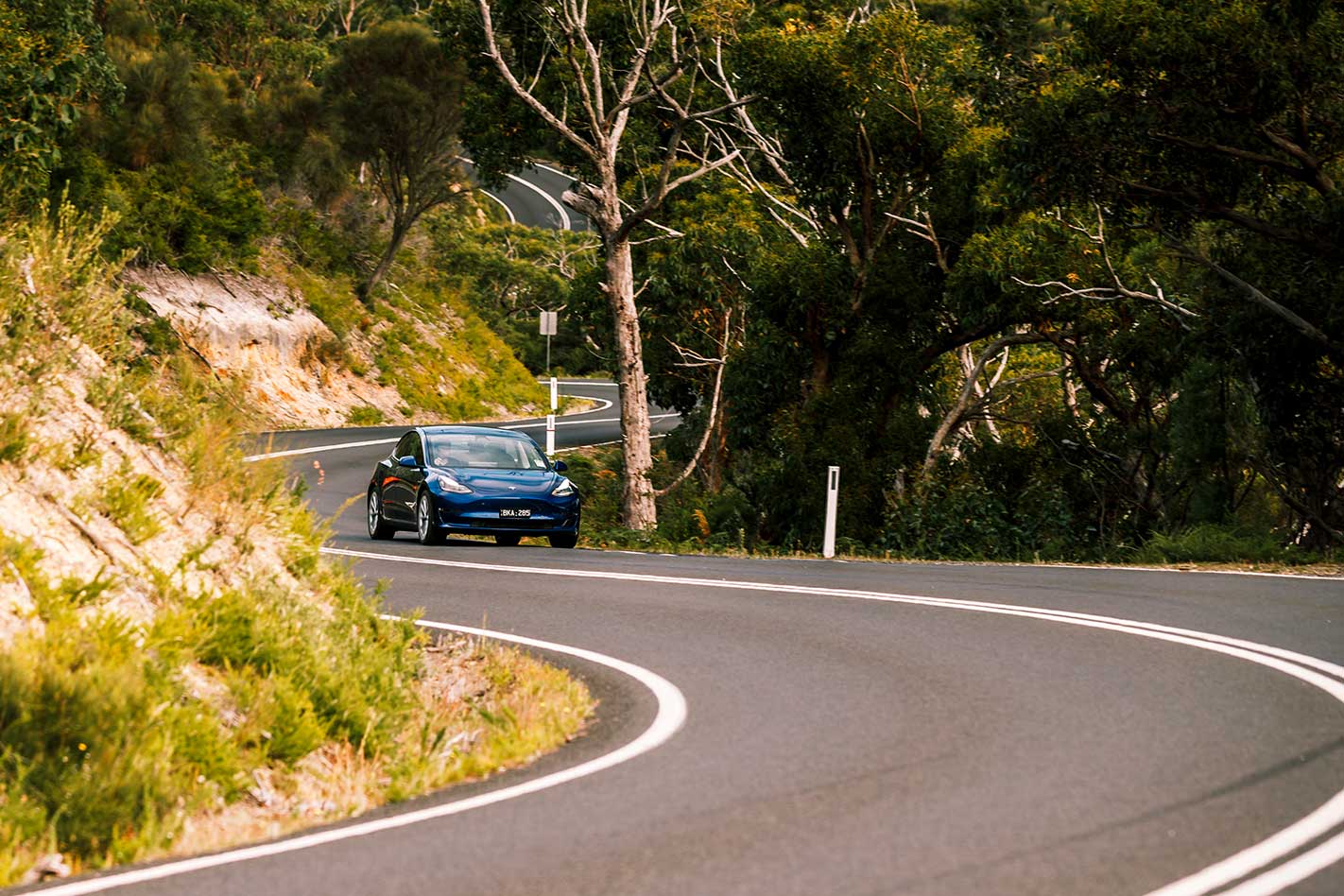
Apart from the obvious switch to a more economical driving style, there are a couple of measures that can be taken to extend range.
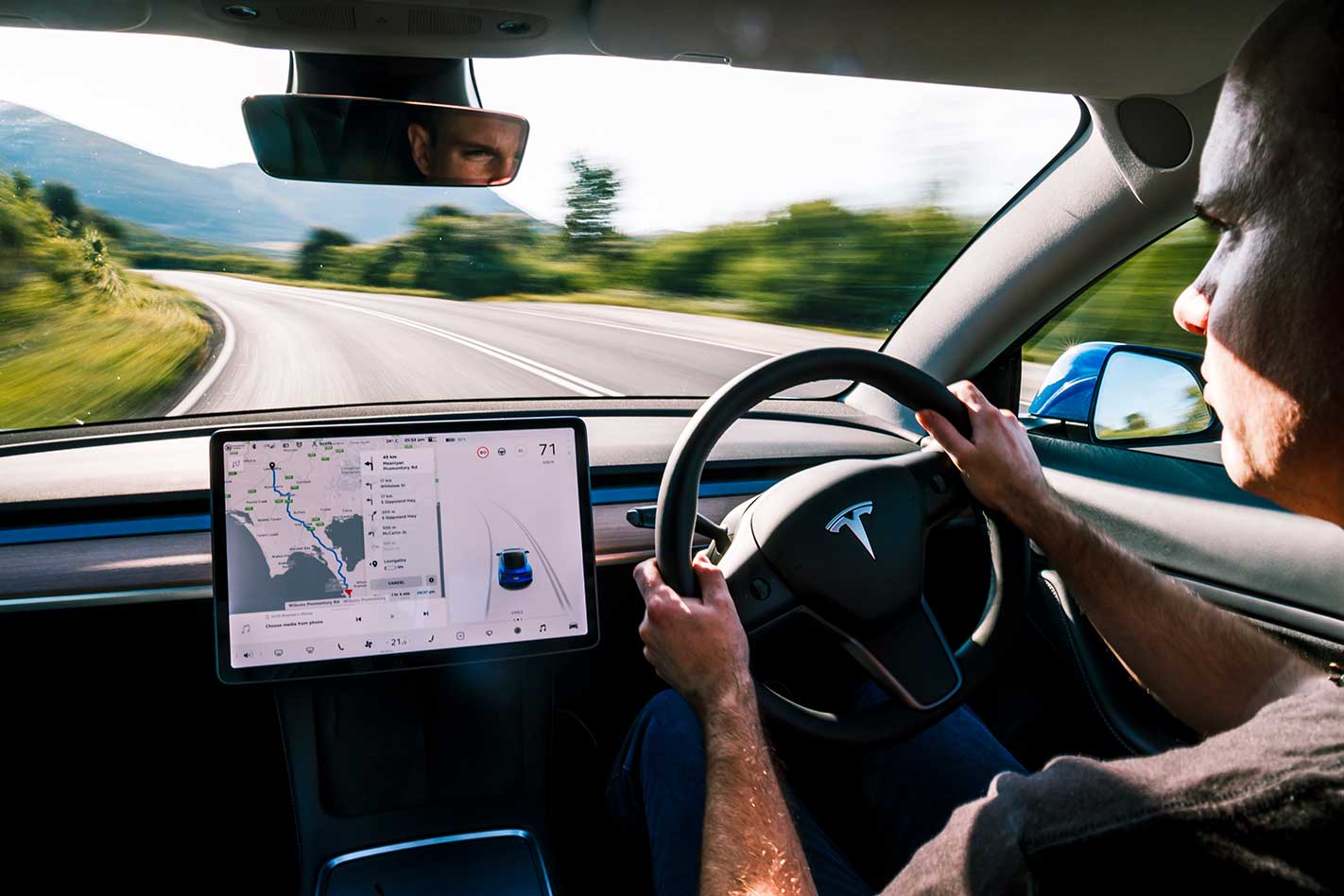
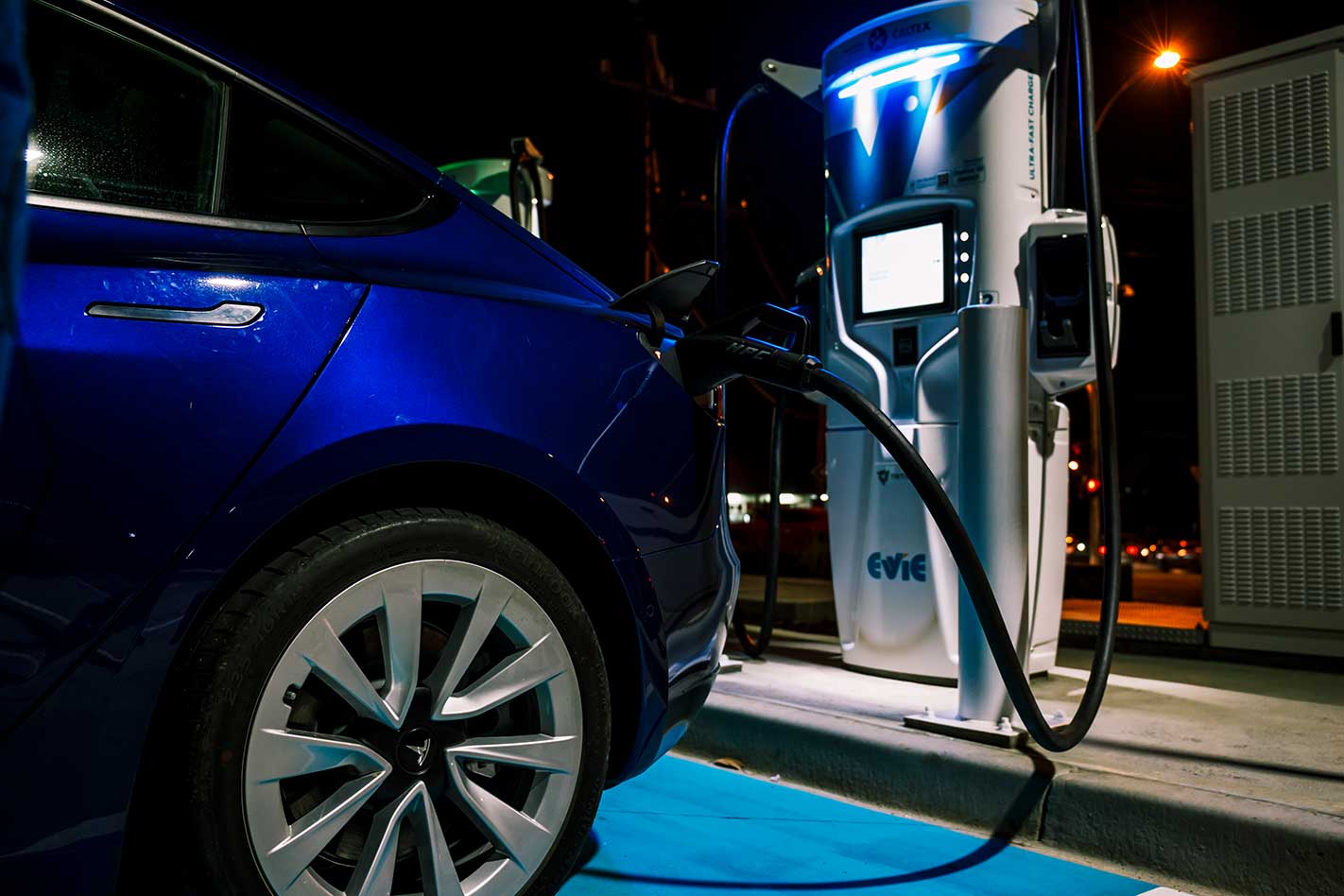
Without the need to produce the visual assets for this feature we would’ve made the return journey to Tesla quite easily, but that’s a moot point as there were numerous opportunities to top-up our battery along the way.
The lesson? Get out and drive your EV, even if you don’t know how to slipstream.
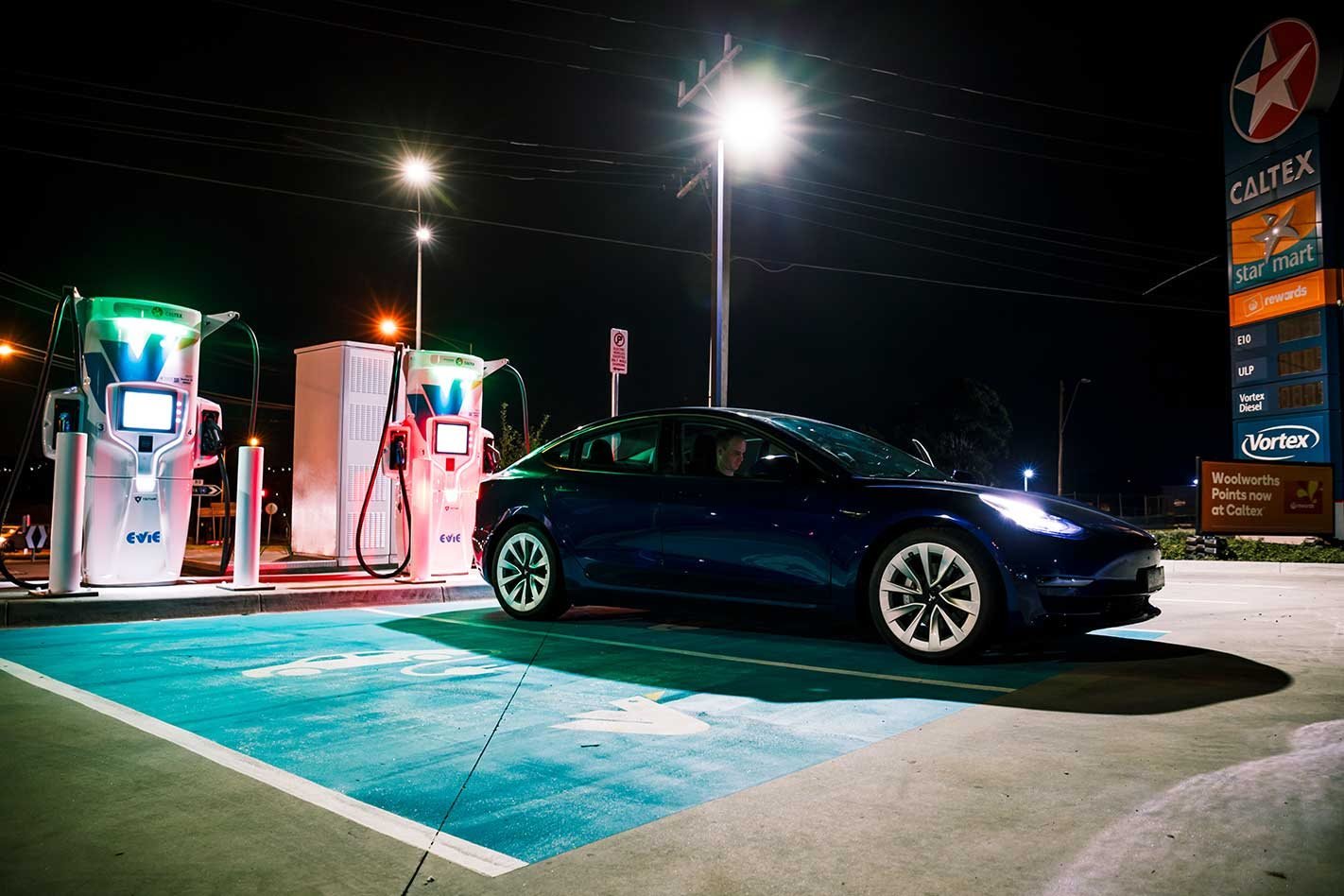
THERE’S NO gentle introduction here. The Toyota Corolla Sportivo is one of the very worst hot hatches you can buy. I know because I bought one.
Like everybody else who did likewise, I was intrigued by the promise of Toyota build quality and Corolla practicality combined with an exotic 1.8-litre engine that featured variable valve timing and lift, and which would scream to an 8200rpm redline.
It sounded like the recipe for a great sleeper right up until that moment you tried to drive one round a corner.
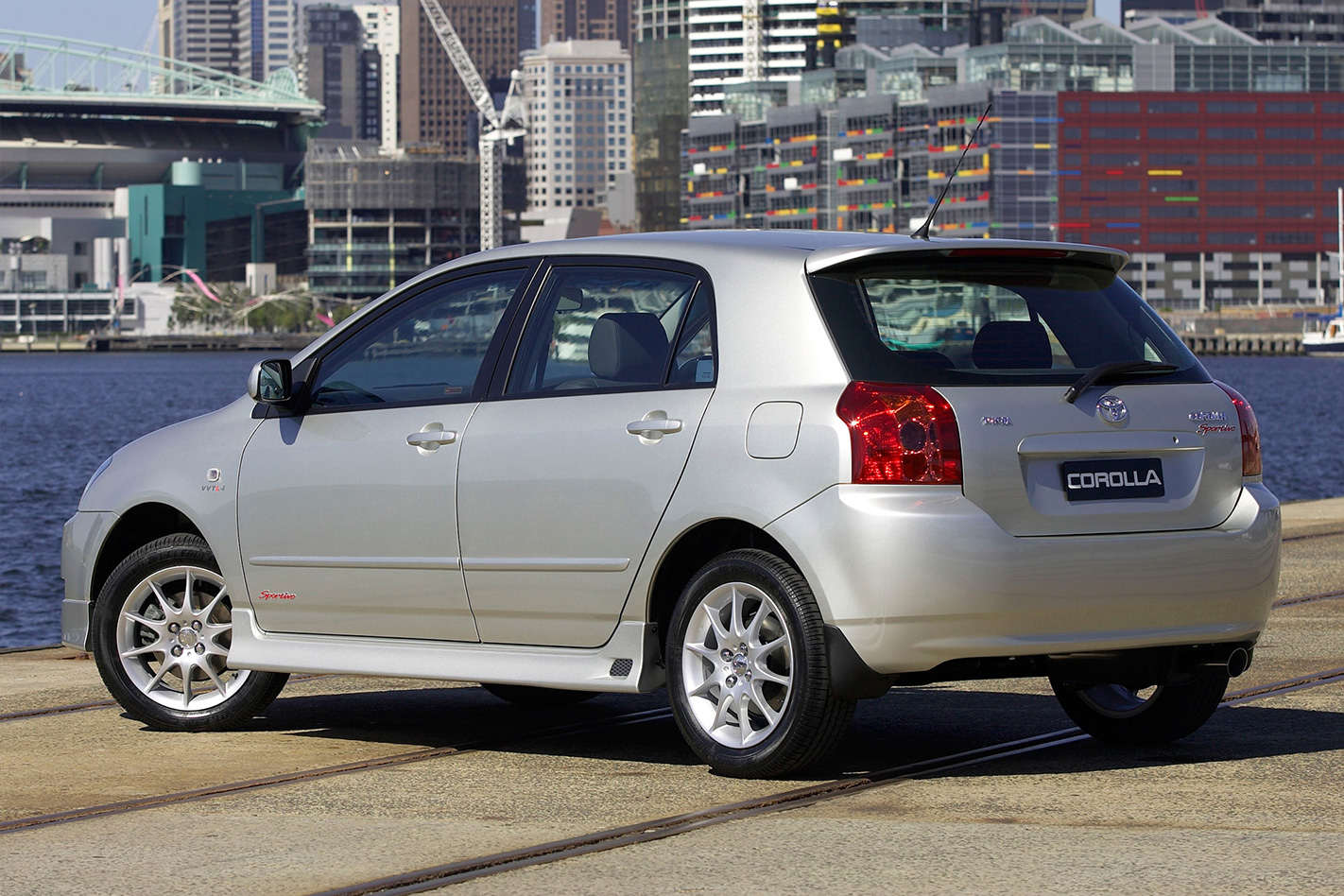
The steering had the sort of nuanced feedback you’d expect from a vintage Atari Pole Position arcade game and the suspension never did a particularly great job of supporting the vehicle through a corner.
The gearshift was long of throw, the ratios for fifth and sixth gears were virtually inseparable, the seats lacked lateral support, the brake discs were undersized for the performance on offer and the interior offered about as much surprise and delight as a battered chicken head in your 10-pack of McNuggets.
As a cohesive performance package, the Sportivo was woeful.
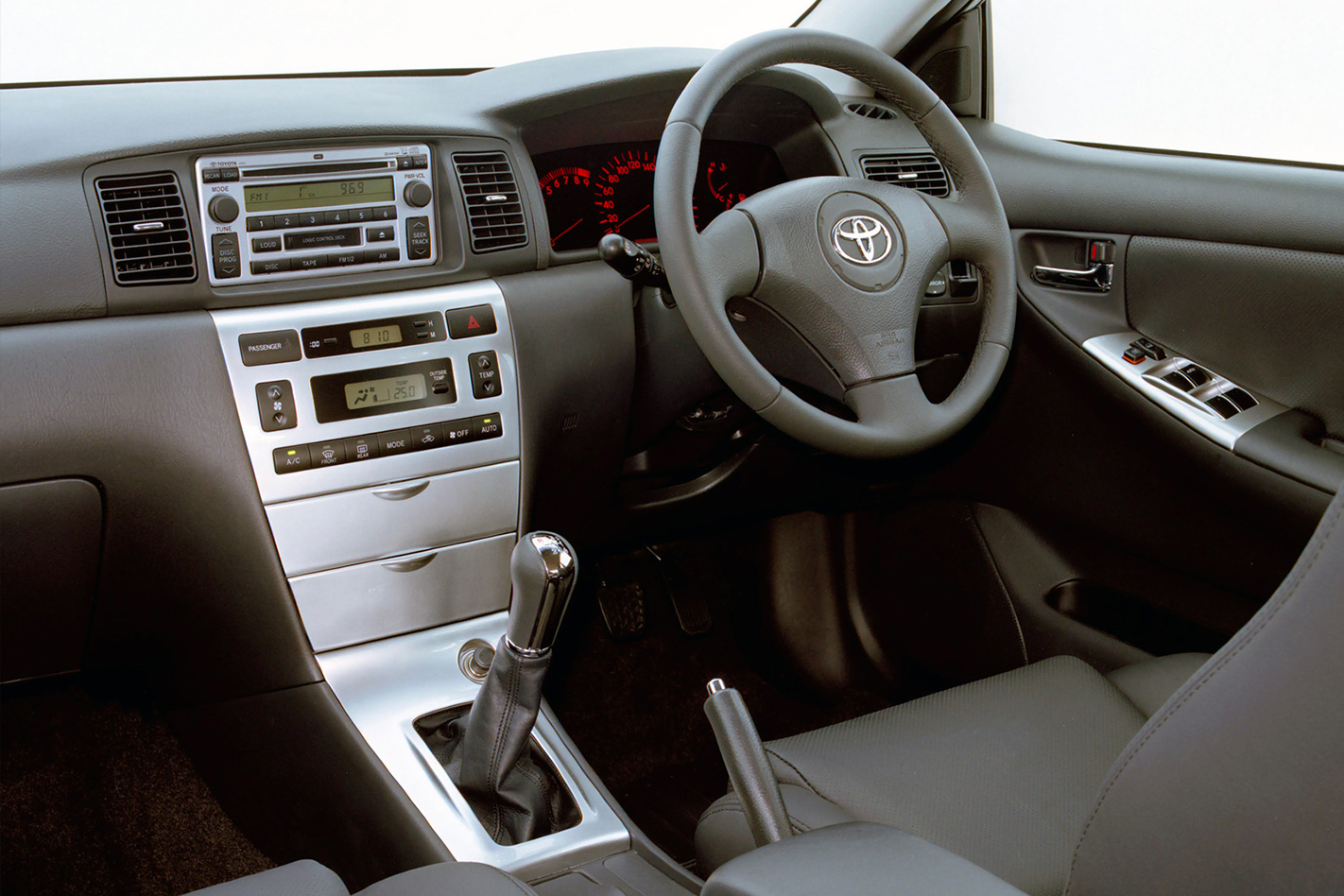
It certainly delivered on that combination of reasons that spurred the original buying decision though. The Yamaha-fettled 2ZZ-GE engine (as used in the Lotus Elise) was absolutely hilarious, switching personality at 6200rpm to zip through that final 2000rpm.
It takes some time for the engine to reach the VVTL-i’s activation, so the Sportivo can feel lethargic off-cam, but a gearshift just before 100km/h means it’s quicker in the real world than its 8.5sec figure suggests.
Accept the Sportivo’s flaws for what they are and it emerges as a cheap way to snag an interesting and reliable hatch.
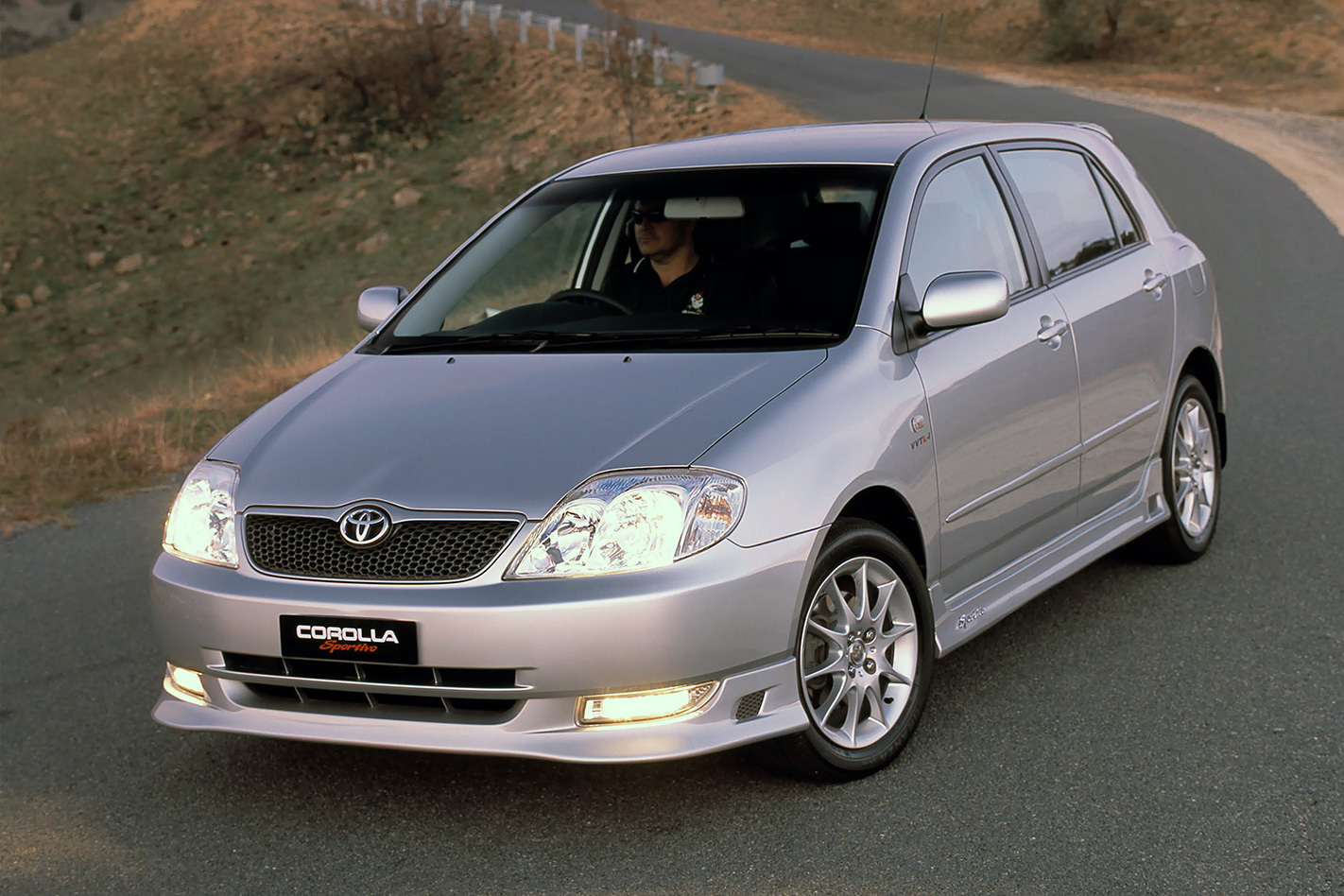
It’s certainly no Civic Type R but it’s a third of the price of an EP3.
There’s hopeless and there’s endearingly hopeless.
I like to think of the Corolla Sportivo as the latter.
2003 Toyota Corolla Sportivo specs
Engine: 1796cc inline 4, DOHC, 16v Power: 141kW @ 7600rpm Torque: 181Nm @ 6800rpm 0-100km/h: 8.5sec Weight: 1223kg
Subaru and Toyota’s joint venture could bear more than one fruit in 2021, with both carmakers posting on their websites that a new car will be unveiled on Easter Monday, April 5.
Crucially, it’s Toyota’s Gazoo Racing website sharing half of the big news, which suggests whatever is planned for will appeal to the driving enthusiasts.

Both websites have the phrase “Let’s make a good car together!” plastered in the description of the online launch event, which will happen via a video stream hosted by Gazoo Racing president Koji Sato and Subaru managing executive officer and CTO Tetsuro Fujinuki.
While the event’s announcement has left many scratching their heads, the most logical conclusion is Toyota will unveil its new GR 86, as Subaru already revealed its new BRZ last year.

However, as WhichCar reported two days ago, it was rumoured Toyota had pushed the launch of its performance coupe, at the behest of the carmaker’s president Akio Toyoda, so engineers could focus on making the Gazoo Racing product more different from the BRZ.
That’s not to say the launch couldn’t still happen, but with whispers that the GR 86 would be delayed by nearly 12 months, it did sound less likely until this launch was announced, especially considering the alleged changes that were being made.
Revised suspension, a different engine tune and even bespoke gearing have been floated on the rumour mill, which would take engineers time to develop and get right.
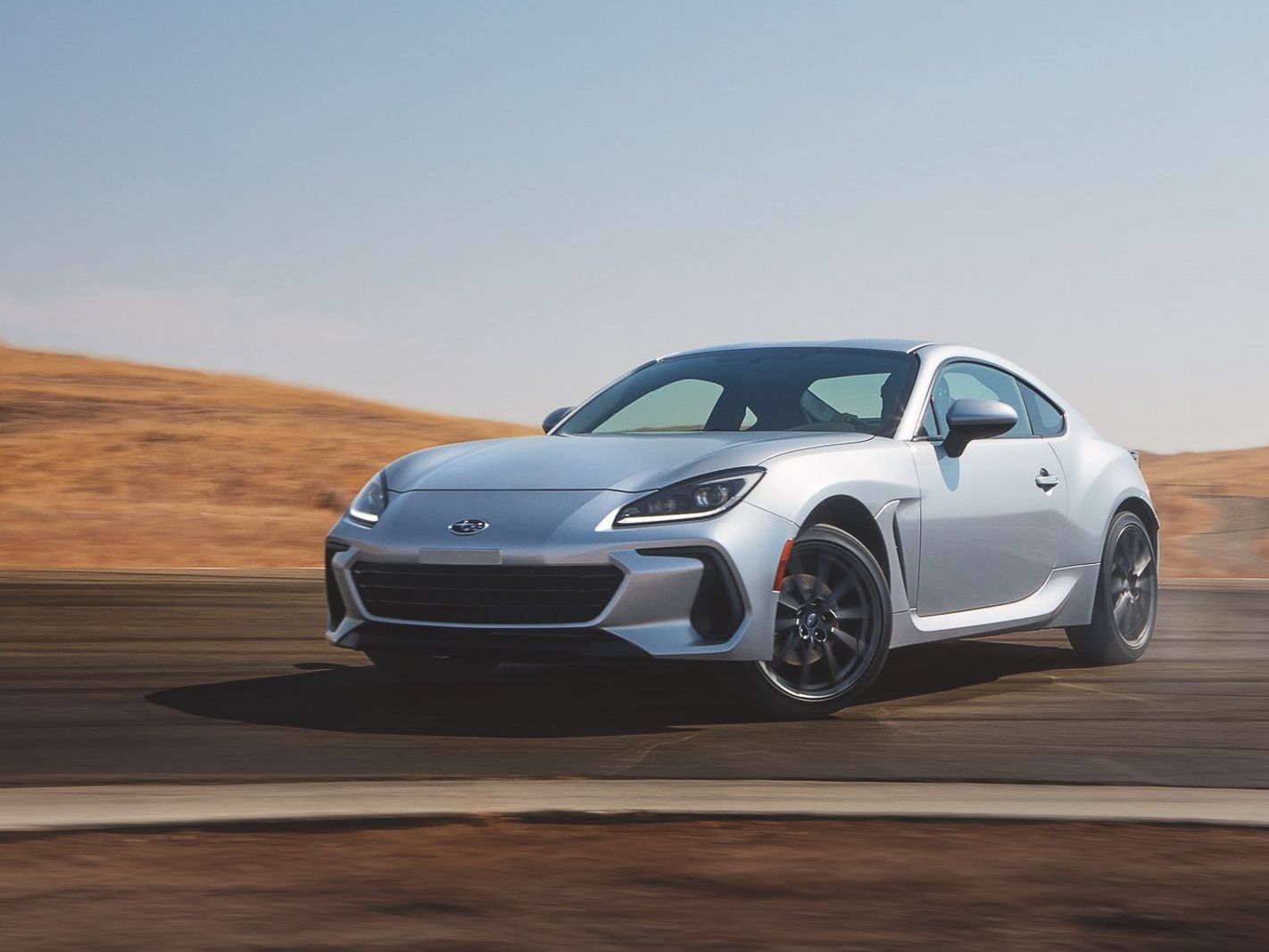
Alternatively, if it isn’t the GR 86 that Toyota Gazoo Racing and Subaru are launching in a week and a bit, another possibility is the rumoured hot hatch the two marques have been reportedly working on.
Last month, WhichCar reported that both Subaru and Toyota were planning an all-wheel drive, turbocharged hot hatch based on Subaru’s Impreza, and that it might be Toyota’s attempt at reviving the Celica GT-Four moniker.

It is unlikely that this is the car we will see on Monday week, as reports also suggest the hot hatch is still well over a-year-and-a-half away from being unveiled, but stranger things have happened.
There’s also a small chance this release could be the co-developed all-electric vehicle the two brands have been working on, which has reportedly been in development since 2019.
Whatever the case, we’ll find out shortly, and anyone wanting to watch the live event can head to Subaru’s website or Toyota Gazoo Racing’s website.
Be sure to watch this space too, as WhichCar will be updating this story as more details become available.
MORE: Toyota 86 stories MORE: Subaru BRZ stories MORE: All Toyota stories MORE: All Subaru stories
It might be self-defeating to disclose this so early on, but the most dramatic change on the new 2021 Mercedes-AMG E53 Coupe is the price.
At $164,800, the new E53 Coupe offers a $14,900 discount on the previous version. Why? As we understand it, the new E53 has to cover the yawning price gap the E450 Coupe has left in its wake after leaving the range.
Luckily, from what we can see, the E53 has not lost anything important in the process. Standard equipment remains as healthy as before, like the Vision package that includes a heads-up display, Burmester sound and a panoramic sunroof with heated glass. Nappa upholstery features as well.
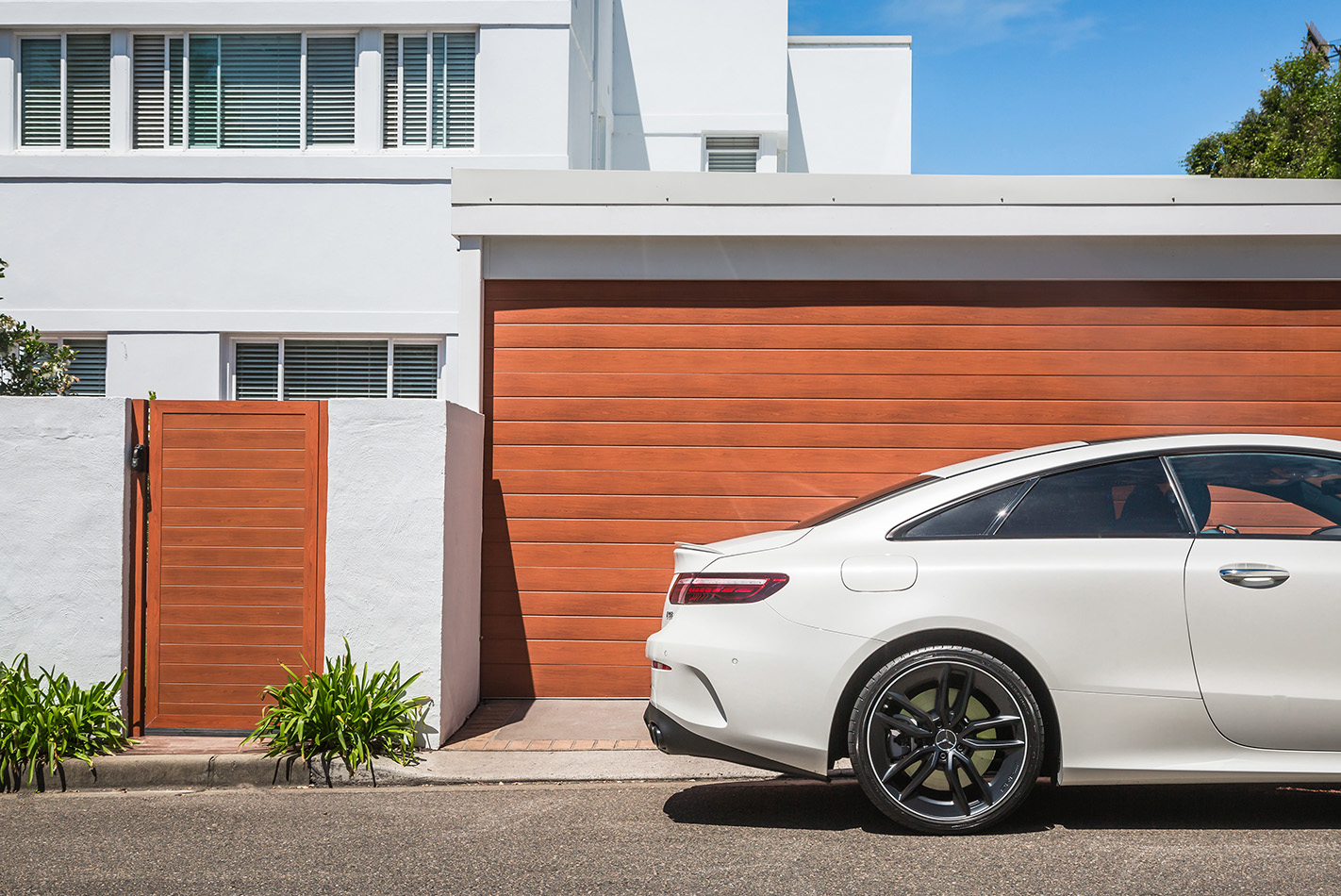
The E53 makes do with the same updated bumper and headlights from lesser variants but fits vertical Panamerica-style slats into the radiator grille. Black mirrors also set it apart. The rear bumper carries over the same quad-exhaust-tip arrangement for extra menace, while you can spot its rear differential cooler fins from floor height.
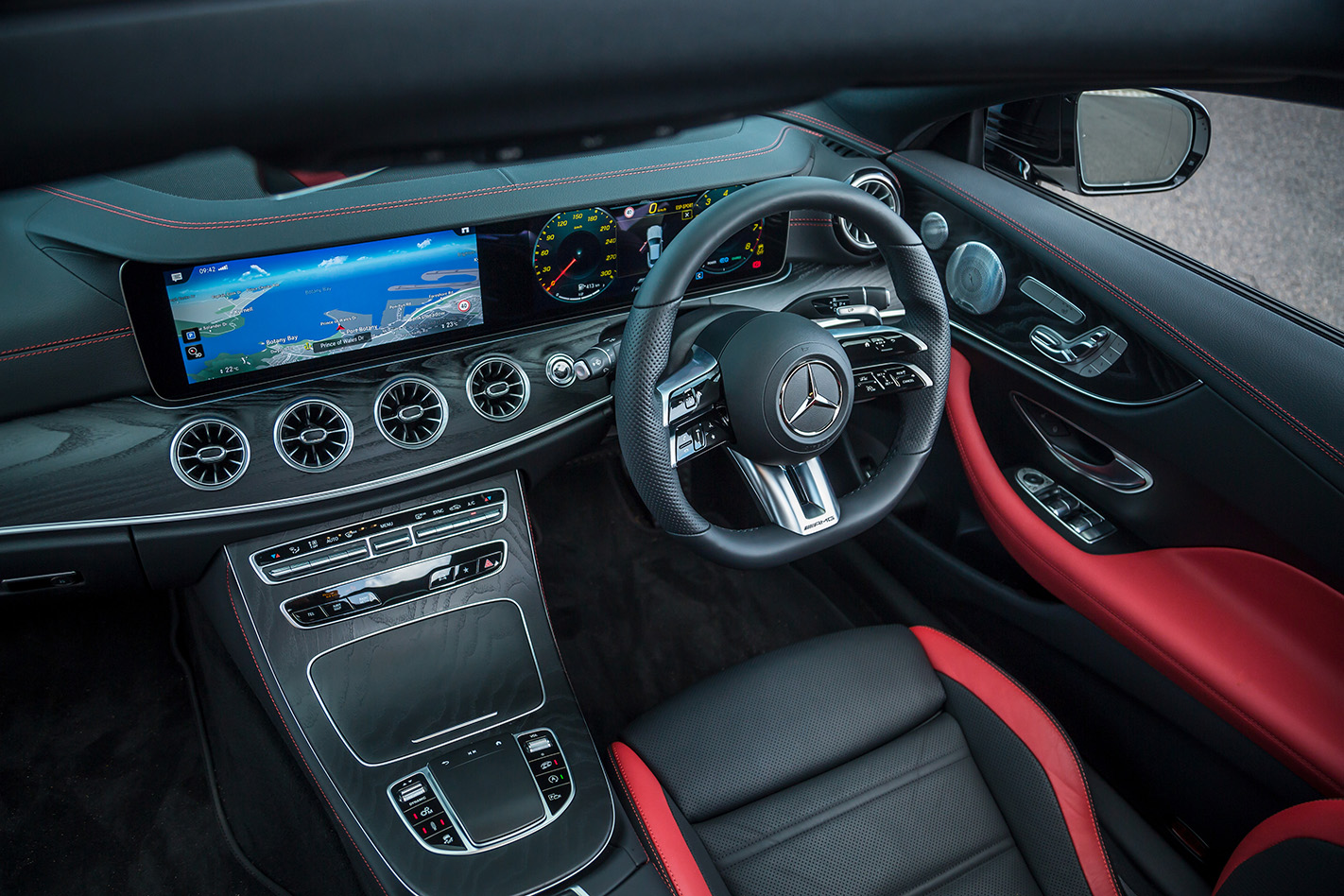
Inside, an MBUX infotainment system replaces the old rotary dial in the centre console with a trackpad. It teams up with a new steering wheel, also found in the new S-Class, as access points to the dual 10.25-inch dash widescreens that come with the AMG Track Pace app.
Engine-wise, the E53-spec inline six-cylinder engine carries over and now features in other models since it debuted with the Coupe in 2018. The GLE, CLS and four-door GT now have 53 versions that have displaced the twin-turbo V6-powered 43 variants.
While you might hear their engine described as twin-turbocharged, the second turbocharger is an electrically powered compressor. It is plugged into the 48-volt electrical system and helps instantaneously produce boost to aid torque down low.
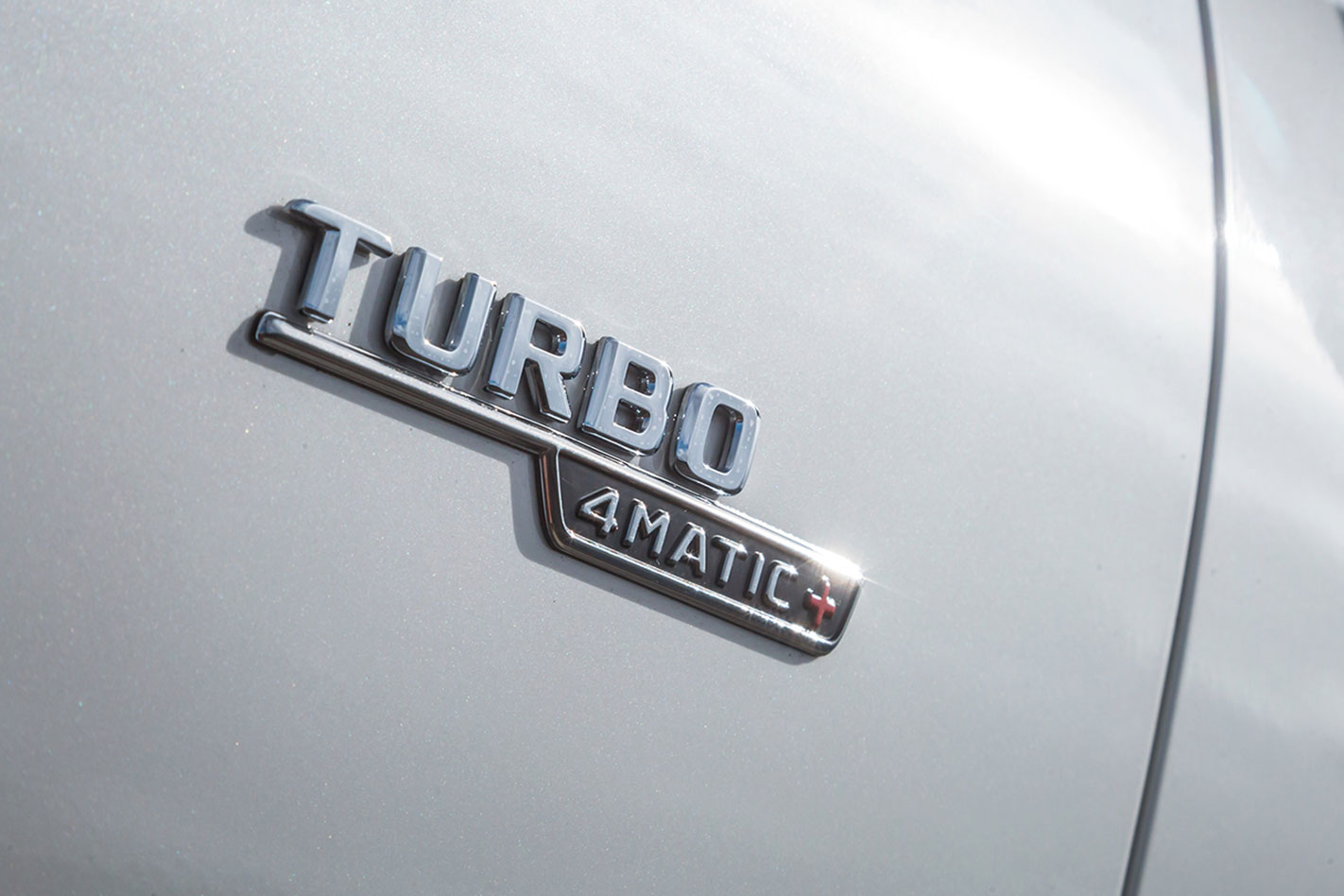
A nine-speed automatic transmission still features downstream and is coupled with an all-wheel-drive system. Mercedes says its electro-mechanically controlled centre clutch allows for fully variable torque distribution.
Surprisingly, it is hard to place the E53 among its peers. For instance, a BMW 840i fits the bill as a two-door coupe with four seats and presents a rear-drive point of difference.
But the 840i is priced well beyond the E53 at $202,900. It justifies this with extra stuff like laser headlights and wireless smartphone mirroring. And the BMW also uses a more advanced semi carbonfibre reinforced chassis, so it is significantly lighter than the E53.
Audi, meanwhile, has no equivalent-sized two-door coupe for the E53. Instead, the RS5 presents a closely matched alternative on price at $150,900. Although we should mention that while the RS5 scores turbocharged six-cylinder all-wheel-drive performance, it is a more serious proposition. Being smaller than the E53 it also loses out on boot space.
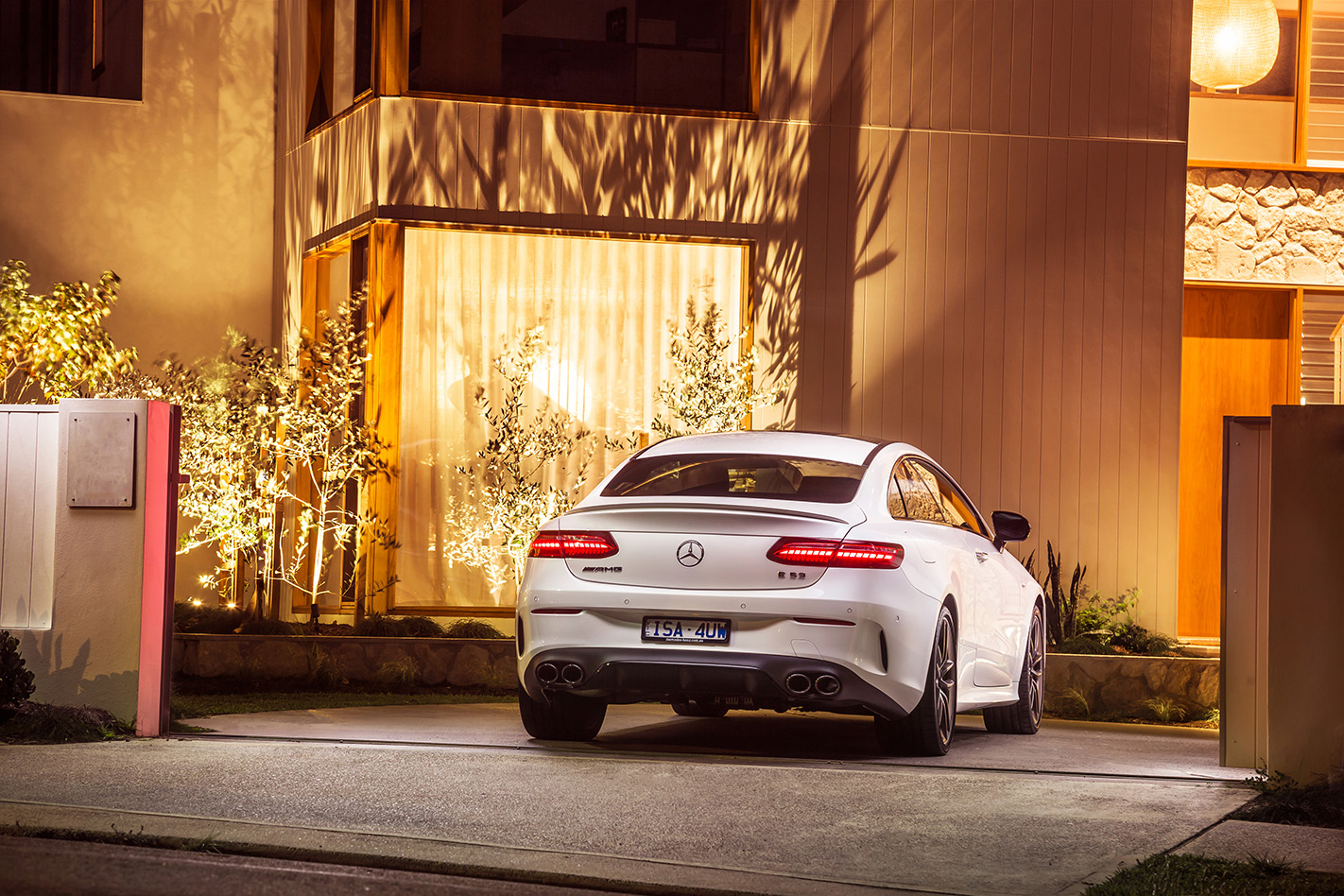
As for weekly expenses Mercedes-Benz also claims the E53 can muster 9.3L/100km on an ADR-approved combined driving cycle, which means you can expect around 700km worth of driving range from its 66-litre tank.
Or, if driving-range is not so important, unleashing the E53 remains a delight. A heavy kerb weight figure labours the e-motor and petrol engine down low, but it at least sounds good. Even with a particulate filter, it develops into a dense howl as the revs unfurl towards a 6500rpm redline.
We have no reason to doubt the claim that this E53 can run to 100km/h from rest in 4.4 seconds. It feels fast and has loads of grip. In corners, though, it never threatens to indulge in the claimed ability of rear-wheel-drive.
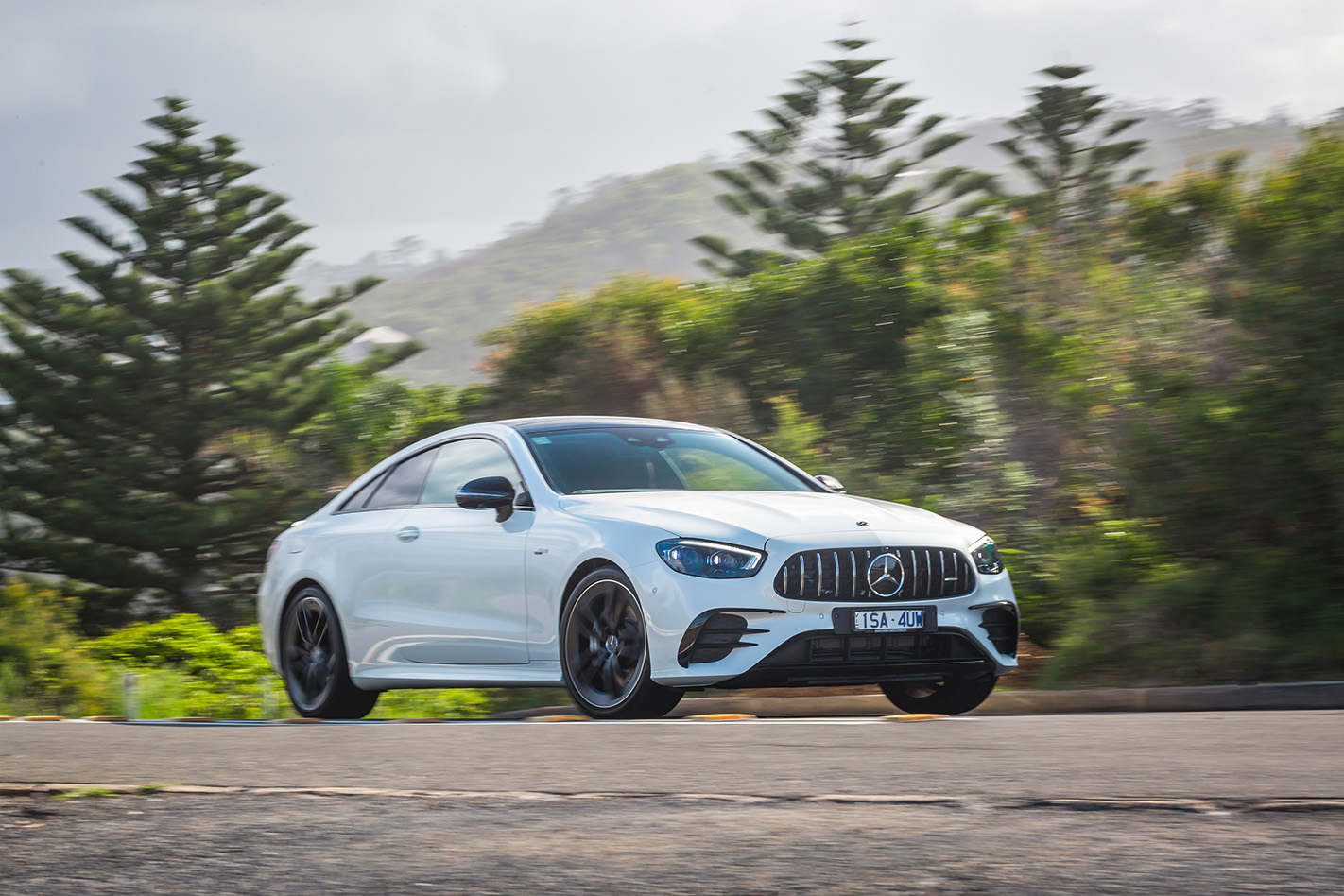
You struggle to wind up commitment beyond seven-tenths as broken surfaces and mid-corner bumps upset its hold on the road to remind us the E53 is not a backroad carver.
AMG tuned air dampers and springs equal a sweet ride over low-speed compressions that underscore its purpose as a grand tourer on steroids. Yet the low profile tyres still do a terrible job of insulating the cabin from aggressive deflections. But they do contribute to some much-needed steering feel.
It is a delight to use the shift paddles, their larger surface area making them easy to find. And you sometimes stay in manual mode only to enjoy their cool, metal touch.
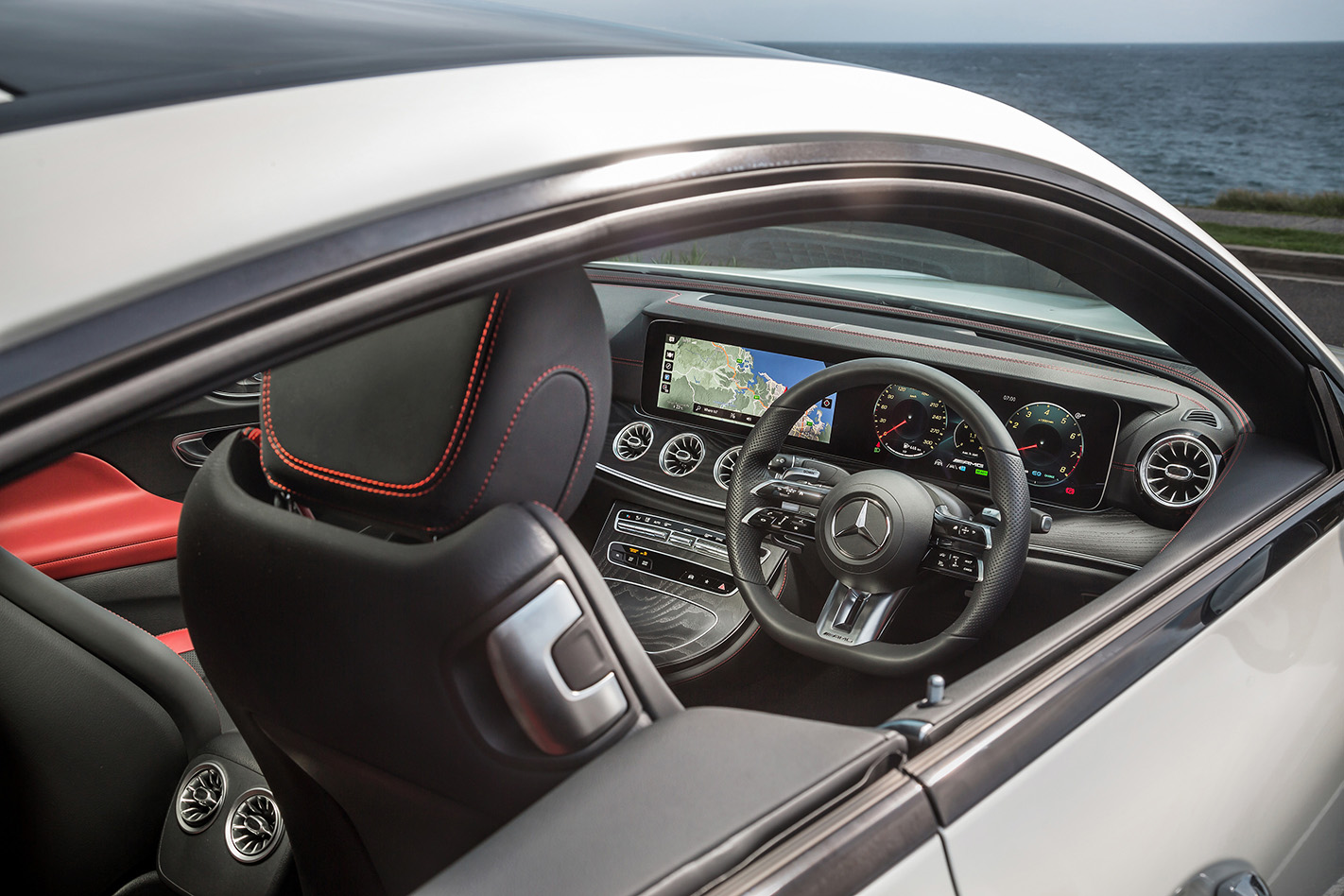
The new E53 cockpit also offers a refreshing break from other AMGs. The steering wheel controls, minimalist centre console and steering-column gear-lever equal a pared-back workstation that sets a new standard for simplicity.
The steering wheel segments functions across each pad on the double-stacked spokes on its horizontal plane, which goes a long way to helping you remember each button and simplifying control of both the MBUX and digital driving cluster on the fly.
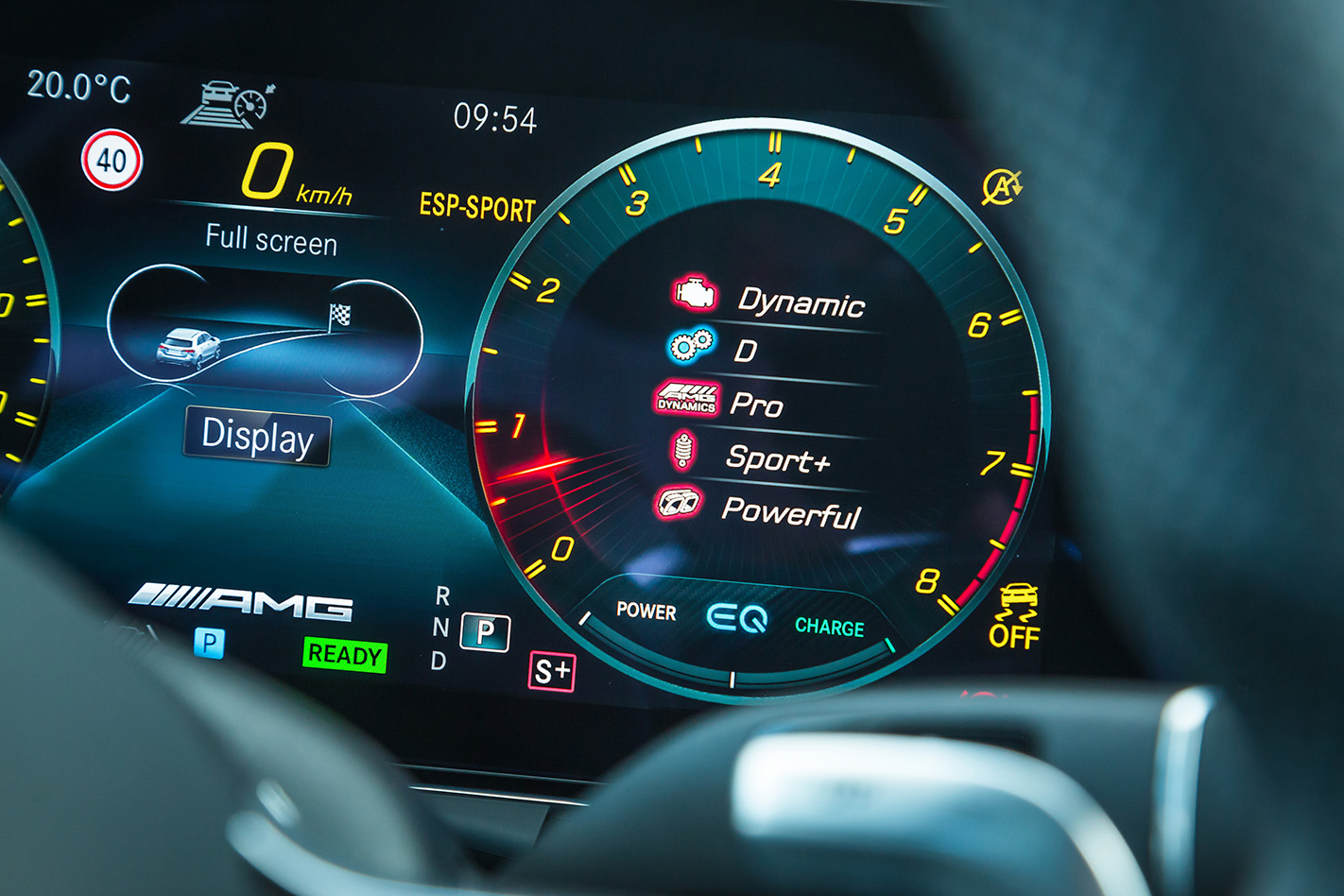
In essence, the E53 ticks all the boxes it should. Between the gorgeous styling, sumptuous luxury and driver-centric cabin, it feels special while parked. Everything else on top of that is a bonus.
But the E53 can fall victim to its success. While its straight-six engine is smooth, sonorous and tuned to work with its hybrid system and an electric compressor to perfection, there are times it can struggle to get moving under is own weight. We must remember, as well, that its engine has more power and almost as much grunt as the first turbo M3.
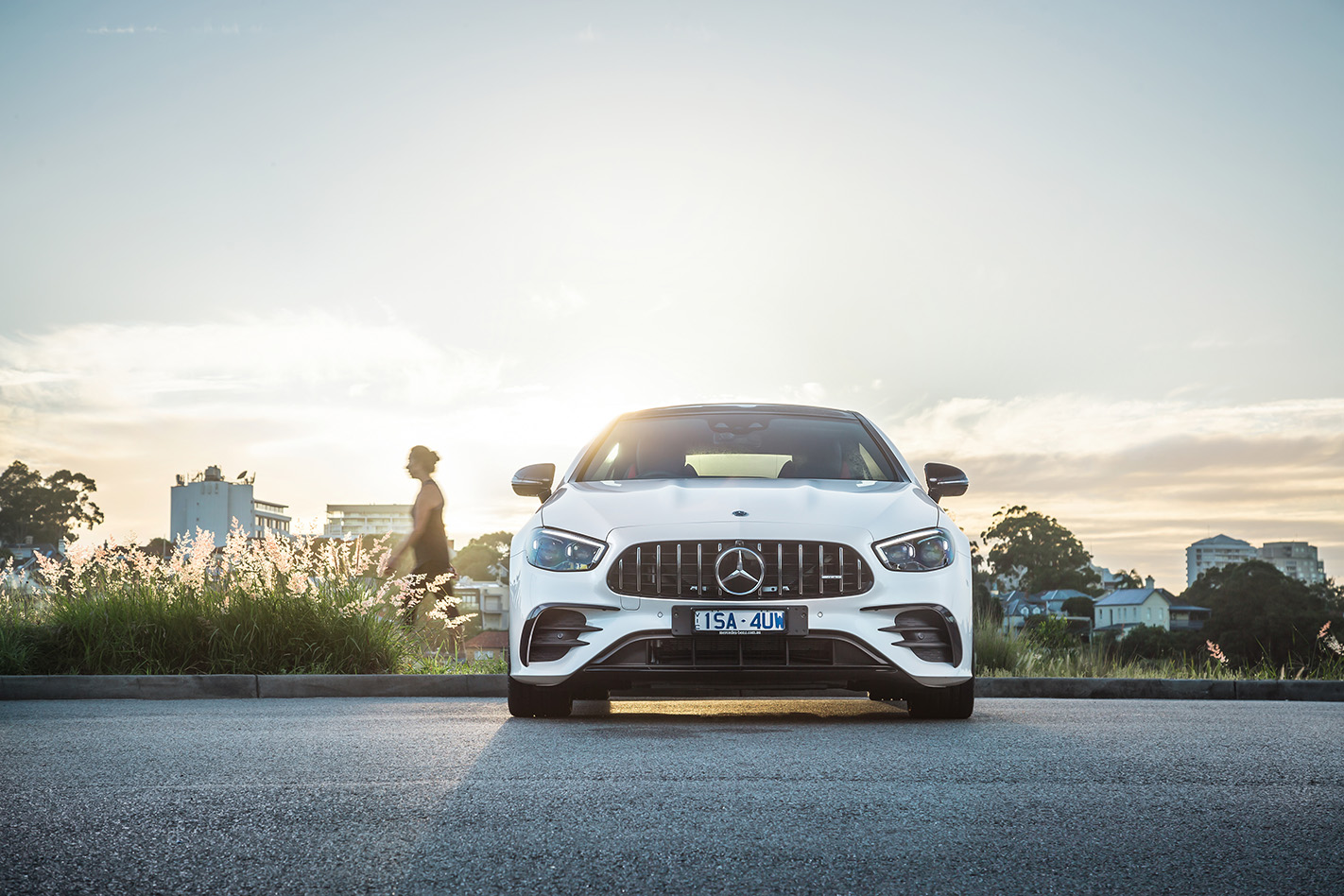
Verdict 8.0/10
Likes: Great noise, smooth powertrain, high-end styling, sumptuous cabin, good primary ride
Dislikes: Shoddy secondary ride, porky weight
Specifications
BODY: 2-door, 4-seat coupe DRIVE: all-wheel ENGINE: 2996cc inline-6, DOHC, 24v, turbo, s/c, e-motor BORE/STROKE: 88.0mm x 82.1mm COMPRESSION: 10.5:1 POWER: 320kW @ 6100rpm TORQUE: 520Nm @ 1800-5700rpm WEIGHT: 1946kg POWER-TO-WEIGHT: 168kW/tonne TRANSMISSION: 9-speed automatic SUSPENSION (front): multi-links, air suspension, adaptive dampers SUSPENSION (rear): multi-links, air suspension, adaptive dampers L/W/h: 4964/1852/1449mm WHEELBASE: 28mm TRACKS: 1628/1598mm (f/r) STEERING: electrically assisted rack-and-pinion BRAKES (front): 370mm ventilated discs, four-piston calipers BRAKES (rear): 360mm ventilated discs, single-piston calipers WHEELS: 20.0 x 8.0-inch (f); 20.0 x 9.0-inch (r) TYRES: 245/35 R20 (f); 275/30 R20 (r) Price: $164,800 ($185,455 driveaway)
A senior Hyundai executive has called on the Australian government to “stop looking under the ground and start looking toward the sky and embrace renewable energy”.
The Korean carmaker’s senior vice president and head of fuel cell centre division Dr Sae Hoon Kim said Australia is in an enviable position to become a global leader in renewable energy and a producer and exporter of green hydrogen.

Speaking by video at the launch of the 2021 Hyundai Nexo hydrogen fuel-cell vehicle in Canberra this week, Dr Kim said: “Your great country is one of the world’s leading exporters of coal and gas, we all know this.
“[But] Australia has one of the best opportunities in the world to produce renewable energy thanks to your abundance of solar energy. There is also a vast amount of space, so you can make the most of the incredible resource you have.
“Australia could power the world, you may think this is an exaggeration, but I believe the potential is definitely there.”
Dr Kim also praised the Australian Capital Territory’s efforts to transform its government fleet to zero emissions vehicles led by its energy and its emissions minister Shane Rattenbury.
Rattenbury, who also spoke at the Nexo launch, called on the Commonwealth government to match his government’s move to a zero emissions vehicle fleet.
Speaking on the eve of the opening of a hydrogen refuelling station in Canberra and the delivery of 20 Hyundai Nexo hydrogen fuel-cell vehicles for the ACT Government vehicle fleet, Rattenbury said he’d love to see the Federal Government adopt a policy similar to President Joe Biden’s pledge to revamp the 645,000-strong US Government fleet with electric vehicles.
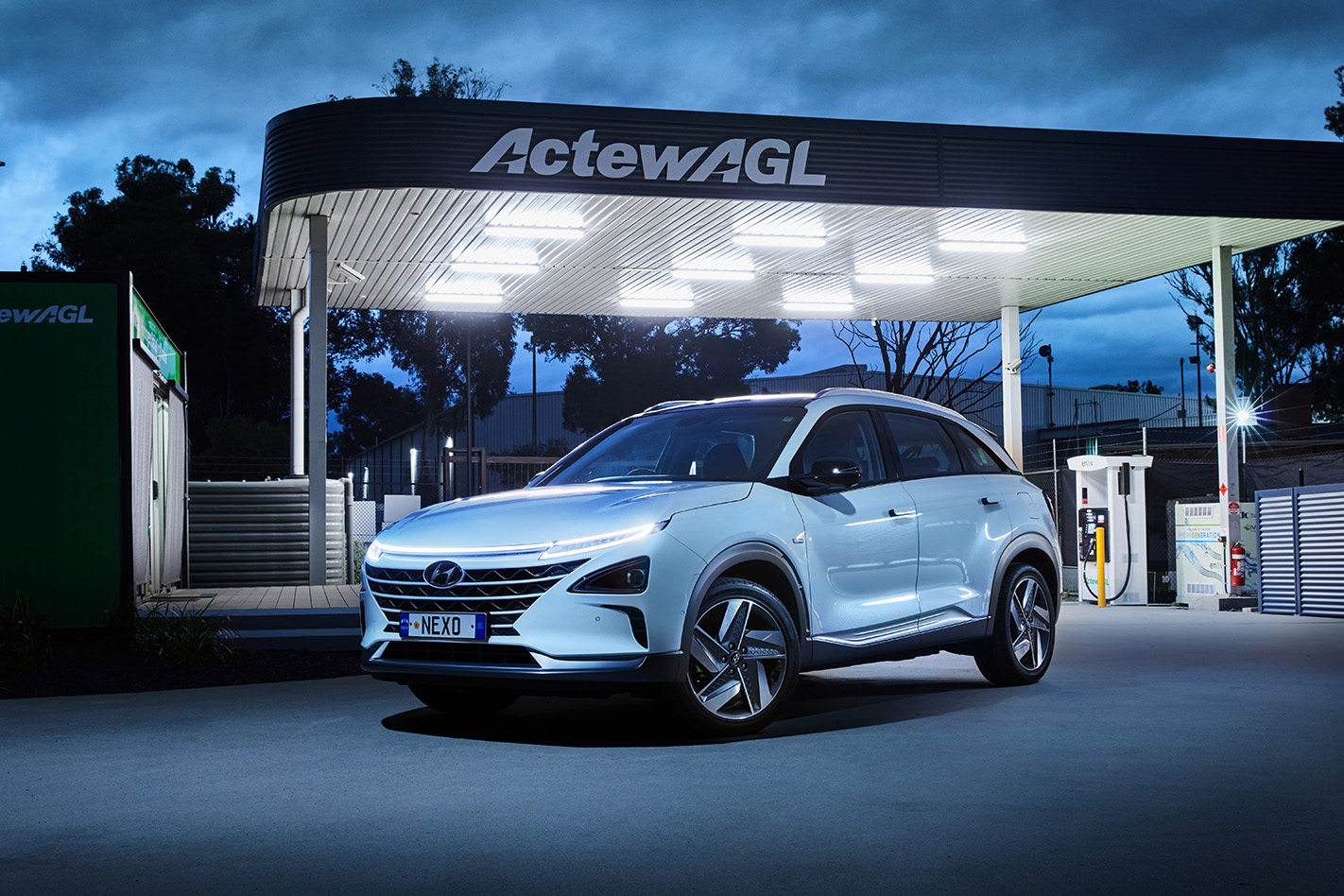
The smallest state or territory government in Australia, the ACT government has the largest fleet of zero-emission vehicles in the country which Rattenbury said has allowed it to demonstrate their viability.
“We are demonstrating very practically the new vehicles coming into the market and the possibility that a zero-emission vehicle future is possible and practical in Australia,” he said.
“The federal government may not think so, it certainly hasn’t ruined the weekend in the ACT,” he said in reference Prime Minister Scott Morrison’s anti-EV sentiments during the 2019 Federal Election campaign.
“If the Commonwealth took on this sort of policy that we’ve put in place we can create a market to give the suppliers confidence to bring the vehicles into the country in a way that then make them more available for the average Australian. It would bring the price down, it would create supply, the mechanics will start to train on these vehicles…
The suspected successor to Ferrari’s ballistic LaFerrari hypercar has been spotted testing at the Italian marque’s Fiorano racetrack.
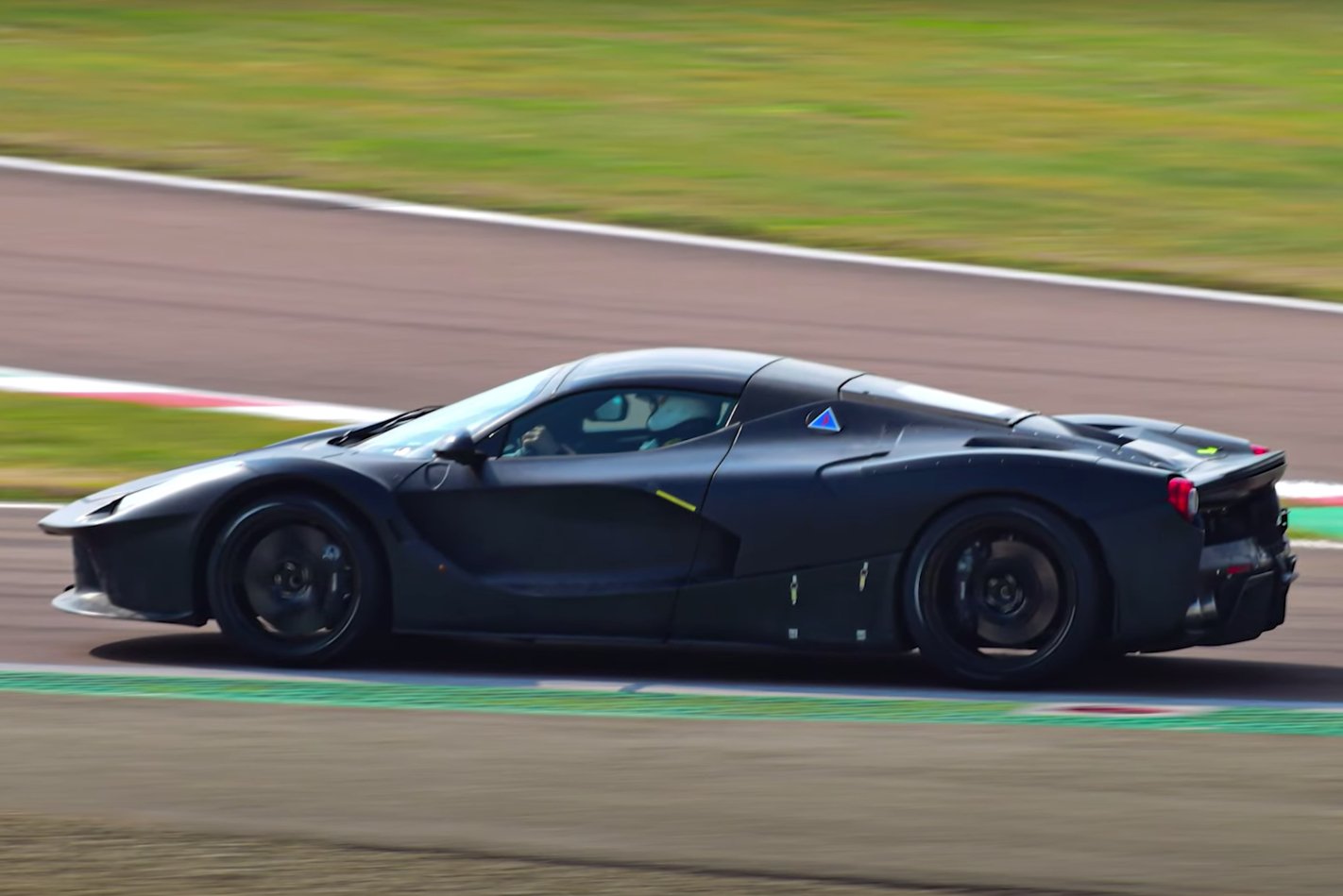
The test mule, flanked in shoddy-looking matte black LaFerrari Aperta body panels, was spied by YouTube channel Varryx recently at the famed track.
Although appearing to have similar dimensions to its predecessor, the prototype looks to be sporting a new front bumper and splitter combination, as well as a bespoke engine cover and a uniquely shaped roofline.
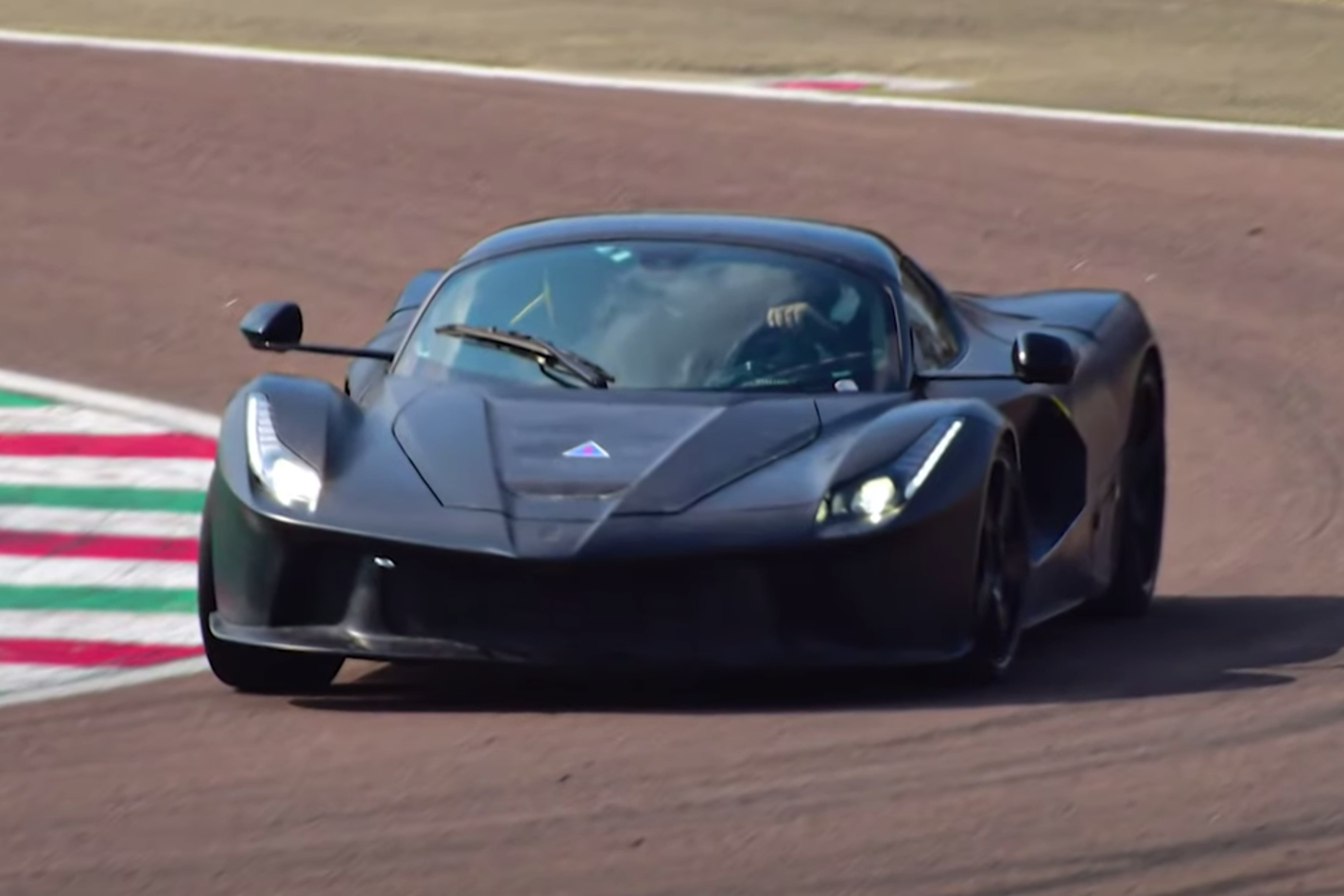
The prancing mule’s front bonnet also has a big blue battery isolation sticker plastered on it, indicating some form of hybridisation in the hypercar’s drivetrain.
However, while LaFerrari had a mild-hybrid system used to augment its performance, the new car can be seen testing silently on track in what appears to be an electric-only mode.
There’s no reason for panic though, as the spy footage also shows the prototype is equipped with the same quad tailpipe layout as the LaFerrari.
Nothing has been confirmed yet, but we’re quite certain this new interpretation of the ultimate Ferrari will have some variation on the glorious F140 V12 slung behind the cockpit.
This new car will also most likely have less power than the recently released Ferrari SF90 Stradale, with the carmaker’s senior vice president of sales and marketing, Enrico Galliera, hinting the LaFerrari replacement will focus more on aerodynamics and lightweighting.
How long will we have to wait to see this hypercar in production-spec? Well, historically, Ferrari releases its road-going acme every ten years or so, with the Ferrari Enzo launched in 2002 and the LaFerrari in 2013.
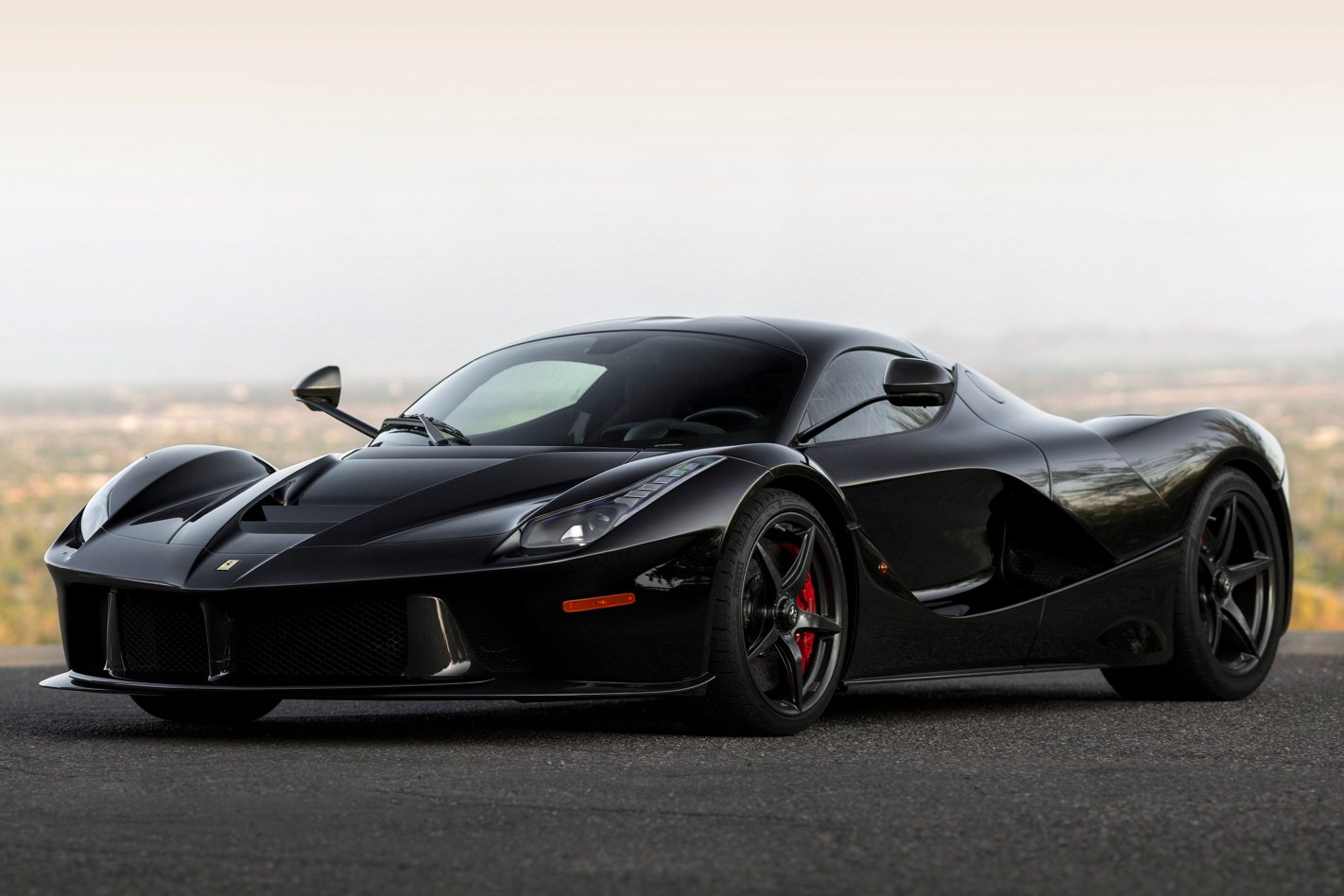
Ferrari’s last flagship V12 hypercar, the LaFerrari.
It’s not unreasonable to guess the car could be slated for a 2023 or 2024 launch if its development hasn’t been impeded by the Coronavirus pandemic.
Make sure to watch this space as WhichCar brings you all the latest updates about Maranello’s next marvel.
UPDATE, April 9: The 2021 Haval H6 is now on sale in Australia and the Chinese automaker has confirmed the price of the medium-size SUV’s two top variants.
The middle-spec H6 Lux 2WD will start at $33,990 driveway, while the range-topping H6 Ultra will start at $36,990 driveaway for the front-wheel drive version and $38,990 driveaway for the four-wheel drive version.
Haval has also confirmed that all H6 SUVs will come with the automaker’s seven-year/unlimited-kilometre warranty, and capped-price servicing will be available across the model range.
March 26: Haval has revealed details about its upcoming H6 SUV weeks before it’s due to hit local showrooms in early April.
The medium-sized SUV will be available in three different guises from launch, with an entry-point H6 Premium model said to cost $30,990 drive-away.
The aggressive RRP is sure to heat things up in the small and medium-sized SUV market, with the H6 Premium beating out several of its competitors on price by thousands of dollars, such as Toyota’s RAV4 GX ($36,916 drive-away) and Mazda’s CX-5 Maxx ($32,990 drive-away).
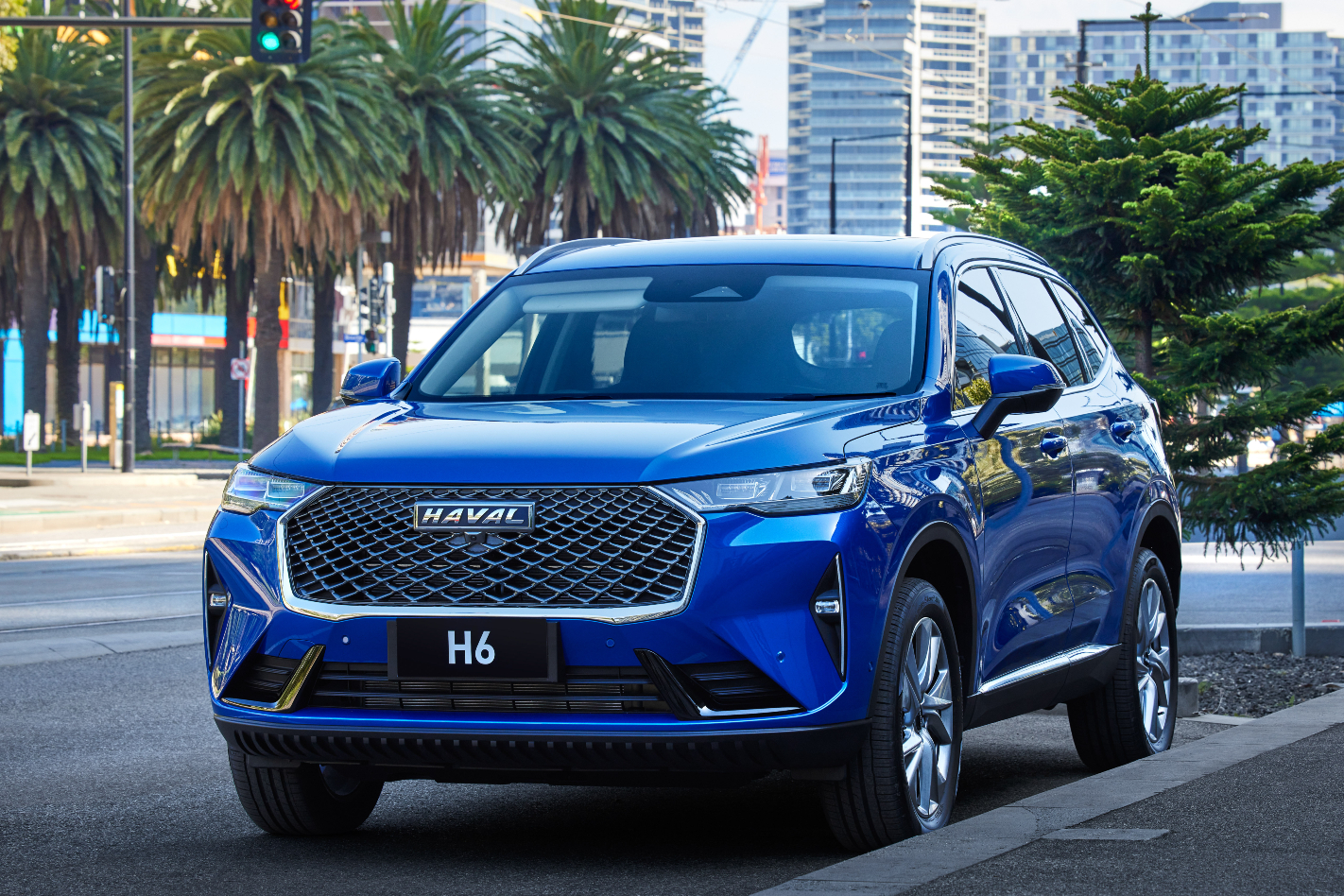
The H6 Premium will also come laden with tech and features normally reserved for cars with a higher price tag.
Inside the new cabin owners will be able to enjoy a 10.25-inch colour LED digital dash, 10.25-inch touchscreen infotainment system, Apple CarPlay and Android Auto as standard.
Standard safety features are also prevalent in the H6 Premium, with the mid-size SUV offering seven airbags, autonomous emergency braking with pedestrian and bicycle detection, lane-departure warning, lane-keep assist, traffic-sign recognition, lane-change assist with blind-spot monitoring and a reverse camera.
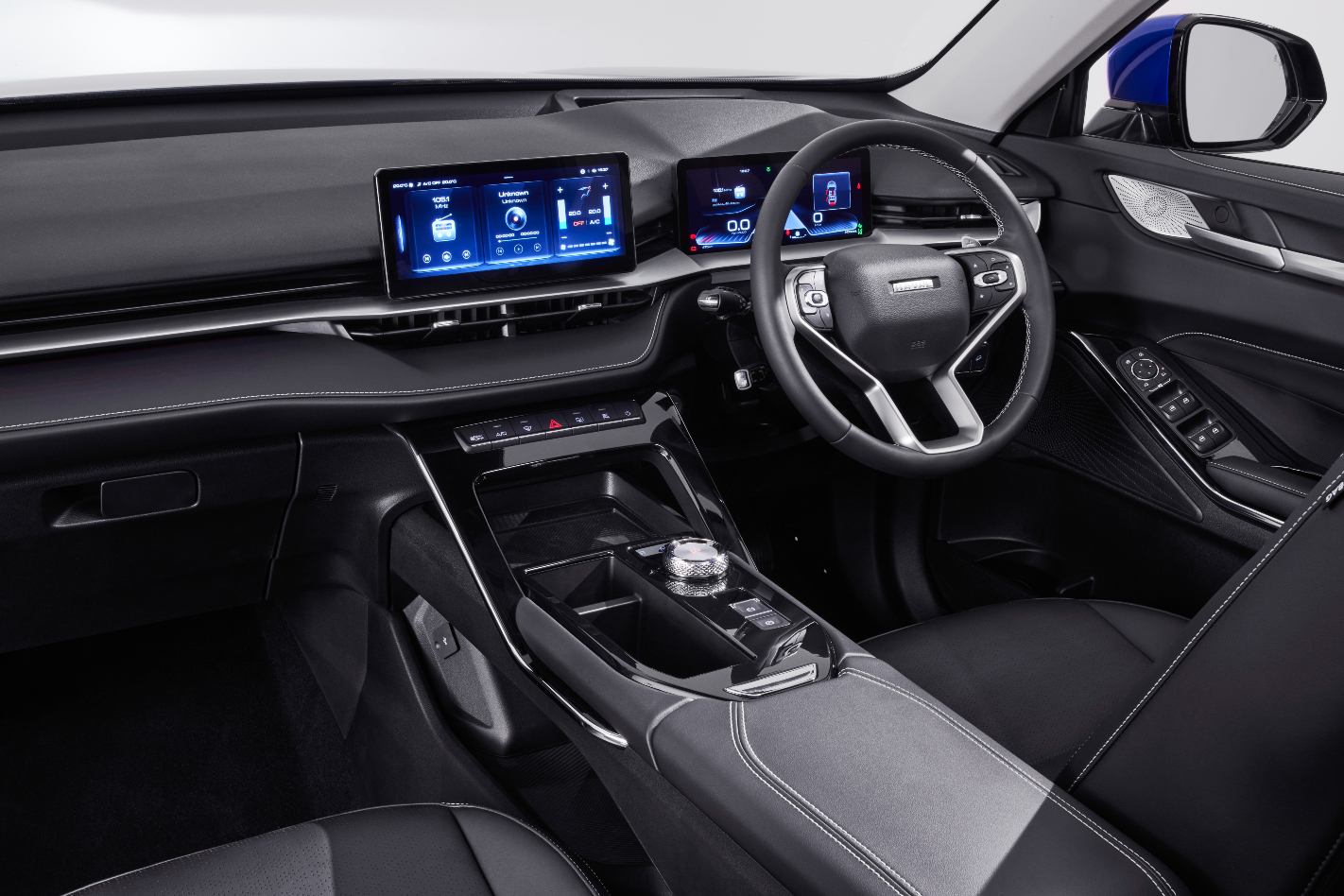
The H6 middle-tier model, the “Lux”, will add further features such as a leather steering wheel, dual-zone climate control, adaptive cruise control with “stop and go” capability, intelligent cruise assist, 360-degree camera, eco-leather seats, and an eight-speaker DTS audio system.
The range-topping H6 Ultra will be available in both front-wheel drive and all-wheel drive. It will also score a panoramic sunroof, auto tailgate, 12.3-inch touchscreen infotainment display, head-up display, wireless charging, heated steering wheel, four-way adjustable electric front seats with both heating and cooling, and an automatic parking assistant.
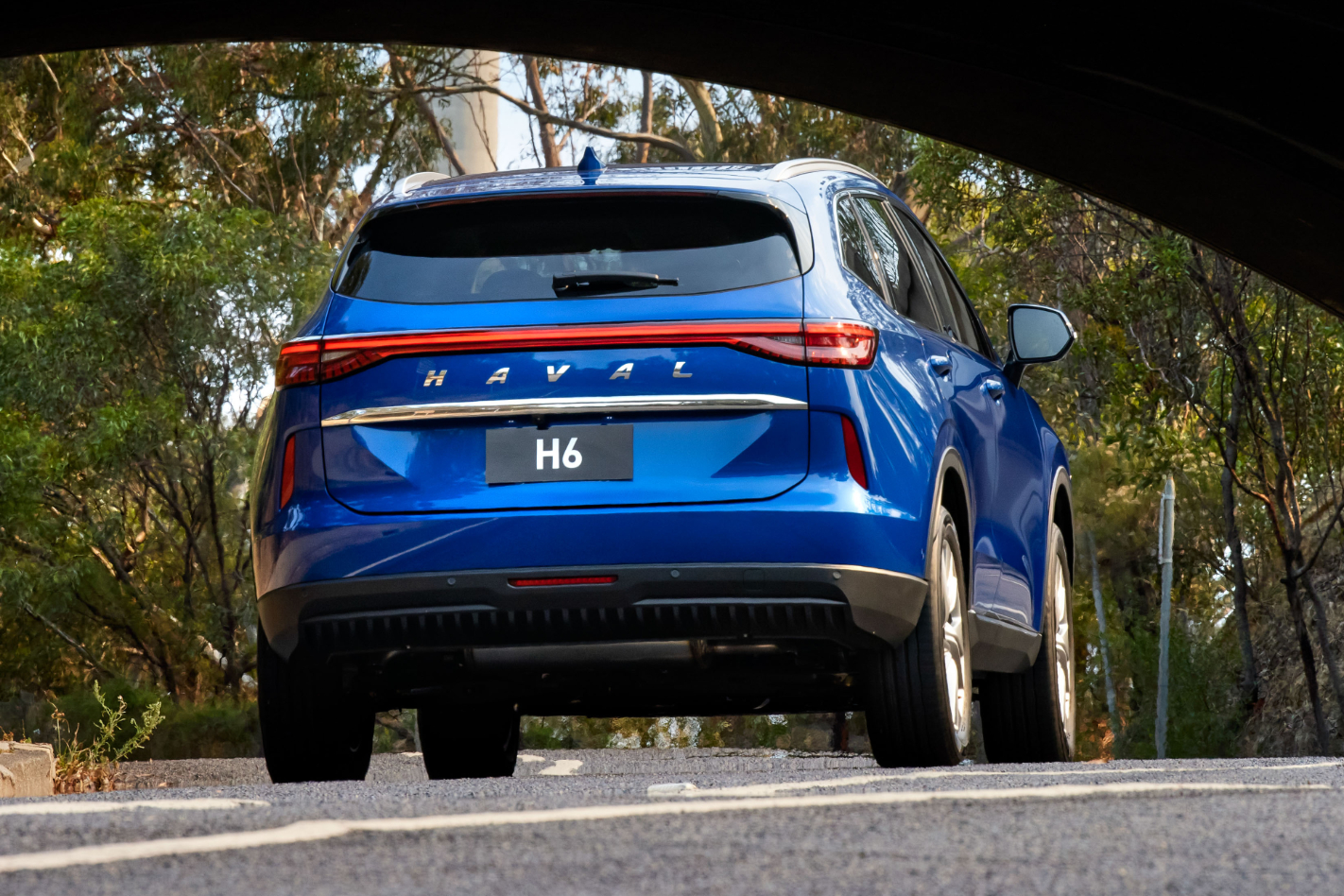
Powering the new H6 is a 2.0-litre turbocharged four-cylinder petrol engine, which produces 150kW and 320Nm – 5kW and 5Nm more than the outgoing H6.
Power will be sent to the front wheels (or all wheels in the Ultra) via a seven-speed dual-clutch transmission.
WhichCar has reached out to confirm local pricing for the H6 Lux and Ultra, and we will update this story as soon as details become available.
MORE: H6 stories MORE: All Haval stories
A new industry-led voluntary emissions reporting scheme has tabled its CO2 emissions results for the first time, providing an insight into how the industry is tracking towards its 2030 targets.
The Federal Chamber of Automotive Industries (FCAI) separates the targets into two categories: the MA category (passenger cars and light SUVs) and the MC+NA category (heavy SUVs and light commercial vehicles).

Results released focus only on the industry as a whole for now. Individual manufacturer performances will be released in April 2021.
The MA outcome for 2020 was 150gCO2/km (grams of CO2 per kilometre travelled) and the result for the MC+NA category was 218gCO2/km. The outcomes sit against a target of 154gCO2/km for MA and 197gCO2/km for MC+NA.
Towards 2030, the industry is aiming for a 4.0 per cent annual reduction for MA and a 3.0 per cent annual reduction for MC+NA.
The overall goal in 2030 is to have CO2 emissions under 100 gCO2/km and for MA vehicles and MC+NA vehicles under 145 gCO2/km.
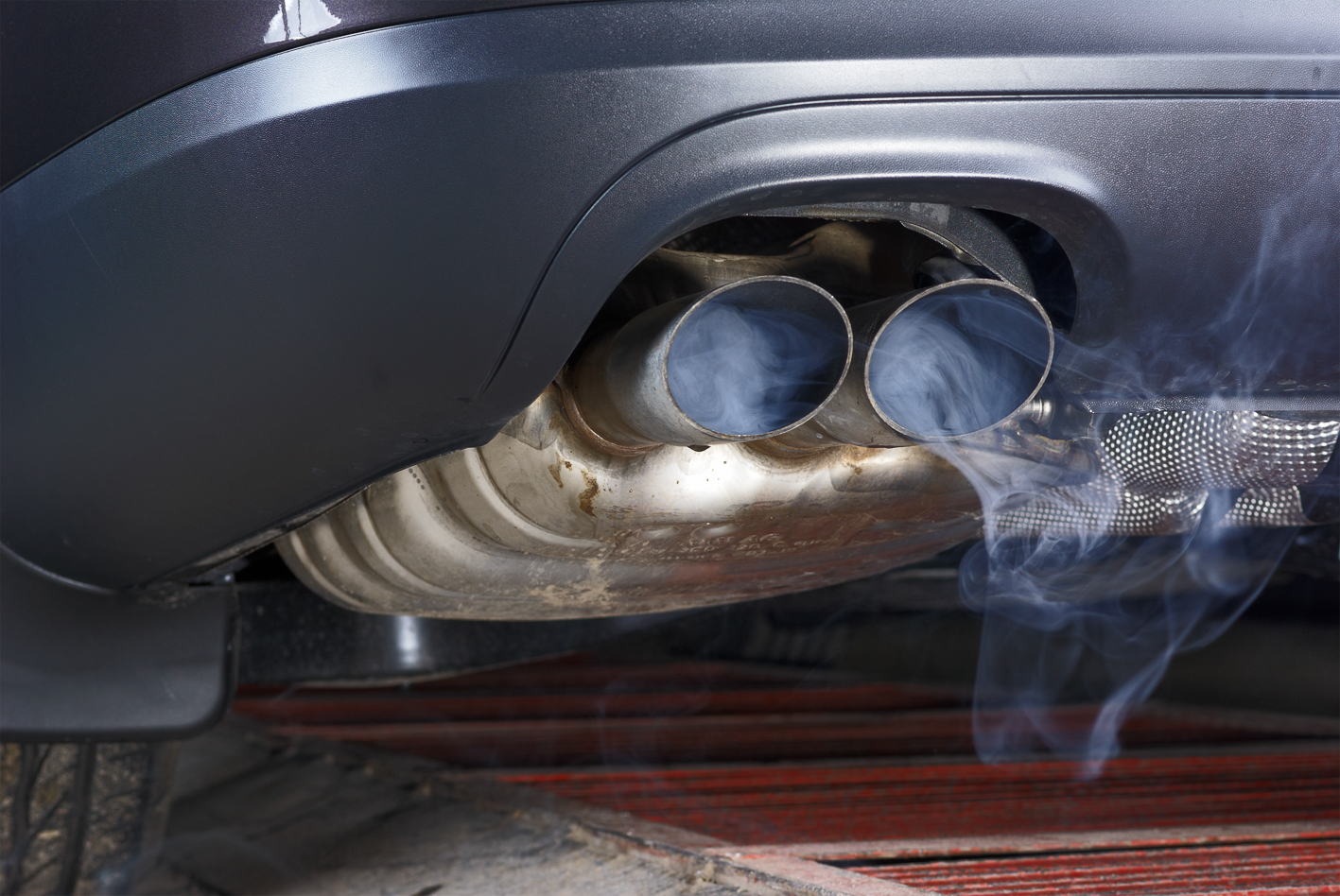
According to the results, the sector is ahead of its MA category (passenger and light SUV) targets, though is behind on its MC+NA (heavy SUV and light commercial) commitments.
CO2 results are gathered using a sales-weighted average, jointly supplied by the FCAI and the car manufacturers themselves.
The initiative is designed to bring about more choice in the new car market. New, more fuel-efficient cars and more fuel-saving tech will become more commonplace in Australian car dealerships under the scheme, or at least that’s the goal.
There are no penalties for manufacturers which aren’t hitting their targets, the FCAI hopes that consumer choice directs carmakers to hit the new Standard’s CO2 emissions targets.
It came about mid-way through 2020 after the FCAI pushed the government to implement such a scheme for years.
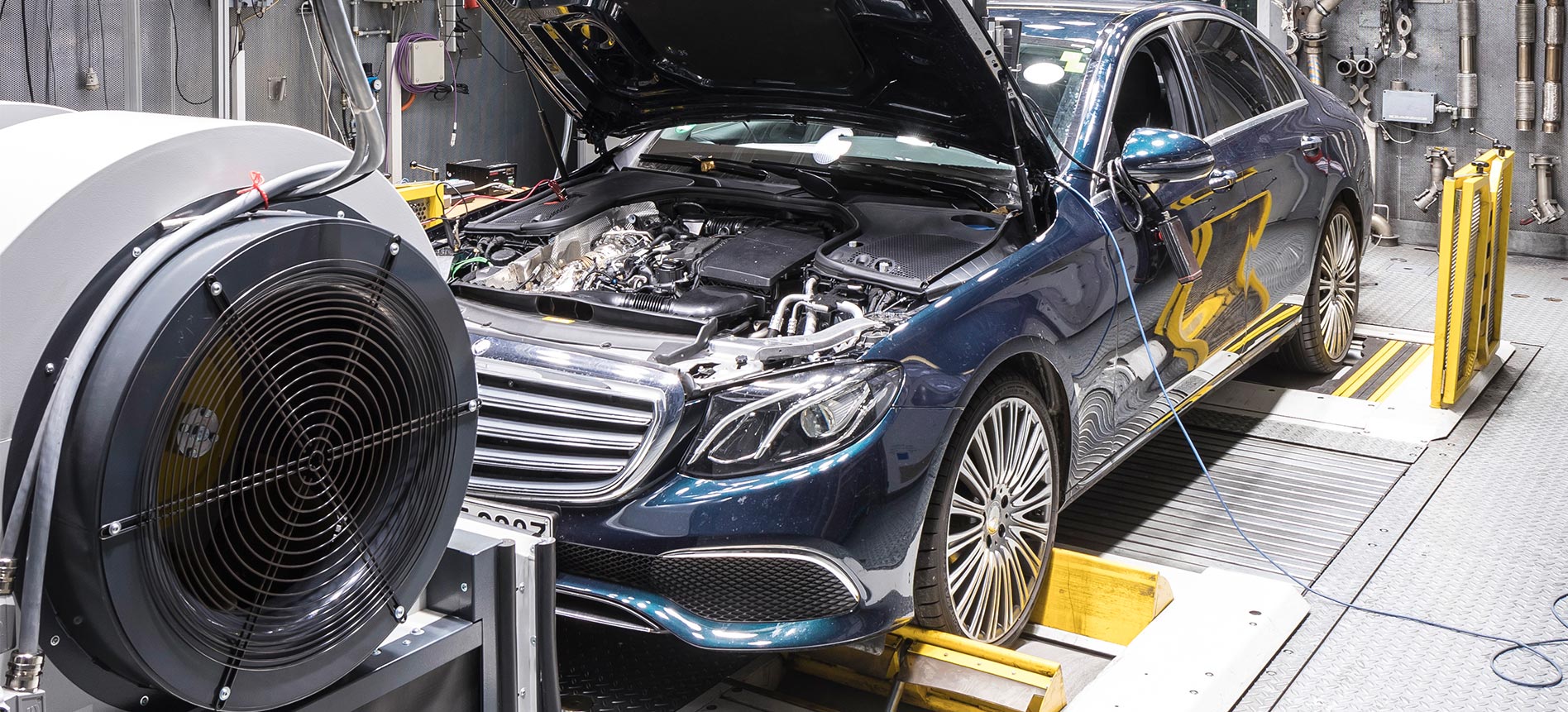
The FCAI has implemented the standard in place of governmental regulation, and all manufacturers involved are committing of their own volition.
“It is important to acknowledge that today’s release marks the start of this journey to 2030,” Tony Weber, FCAI chief executive, said.
“It will be a long, challenging road and each of the companies supplying vehicles into the Australian market will move ahead in ways that meet their own specific product development and launch programs.
“There is no doubting the commitment and direction of FCAI member companies to lowering emissions with the increasing availability and acceptance of zero and low emission vehicles – from full electric through to hybrid and fuel-efficient internal combustion engines.”
However, Weber points out several reasons why CO2 emissions goals have been spread out over the next ten years – as opposed to yearly targets like those in Europe.
“First, the CO2 results for 2020 reflect the type of vehicles Australians are choosing to drive, with sales of SUVs and light commercial vehicles regularly now more than 50 per cent of new vehicle sales every month,” Weber said.
“The fuel efficiency of these larger vehicles is improving with each new model release, however, the nature of the market and customer preferences need to be considered when comparing Australia’s emissions result with other countries.

“Second, the model development cycle for new vehicles can range from 5-10 years depending on the type of vehicle so the emissions reduction will continue to improve as the latest technologies arrive on our shores.”
Lastly, Weber stated that Australia’s fuel is the lowest quality in the world.
“We urge the Federal Government to accelerate the improvement of Fuel Quality Standards for Australia’s market fuels as this will enable the introduction of more of the fuel-efficient vehicle technologies already on the roads overseas,” Weber said.
What is the Hyundai Nexo?
The Nexo fuel cell electric vehicle (FCEV) is the first hydrogen vehicle to be certified in Australia for sale to the general public.
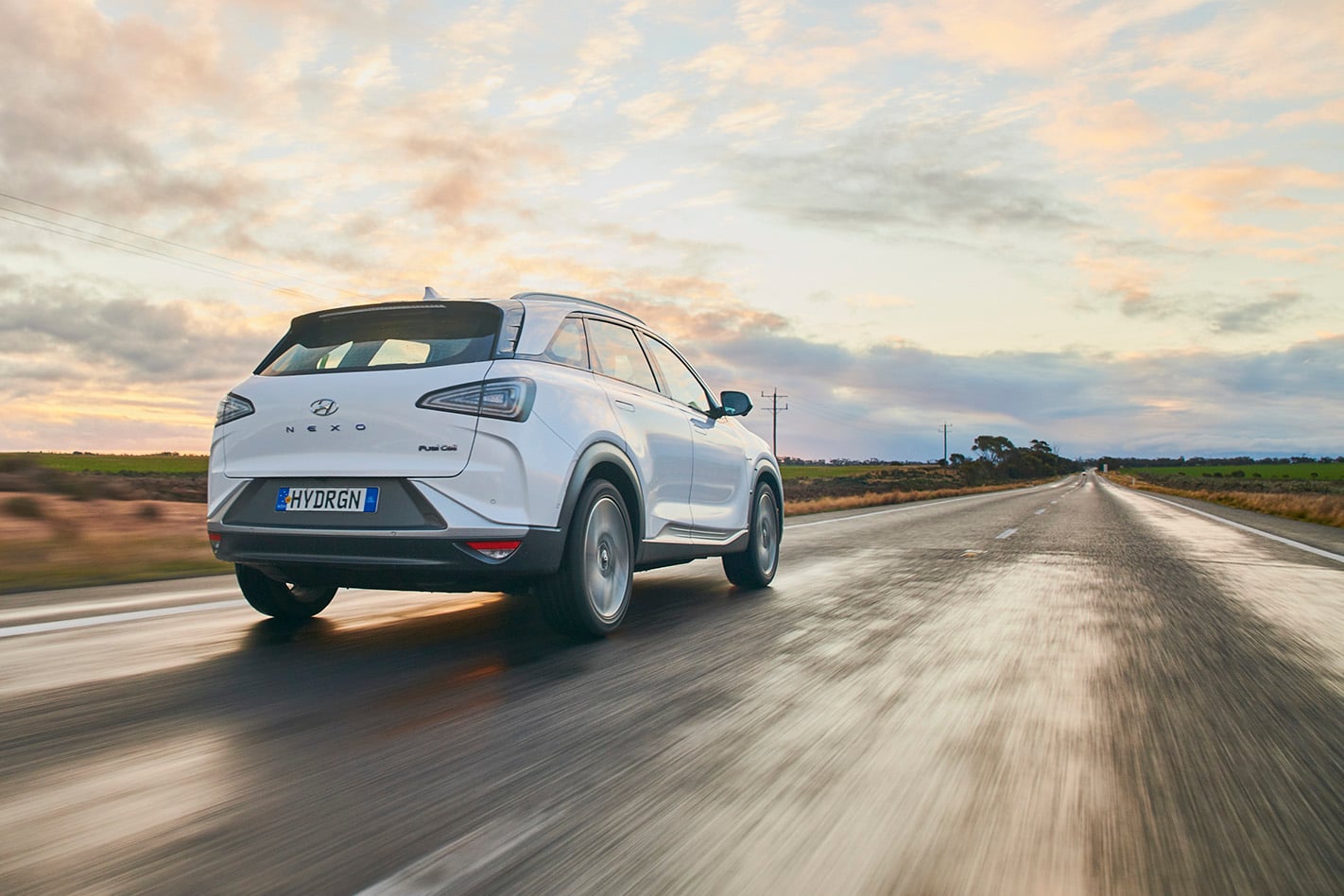
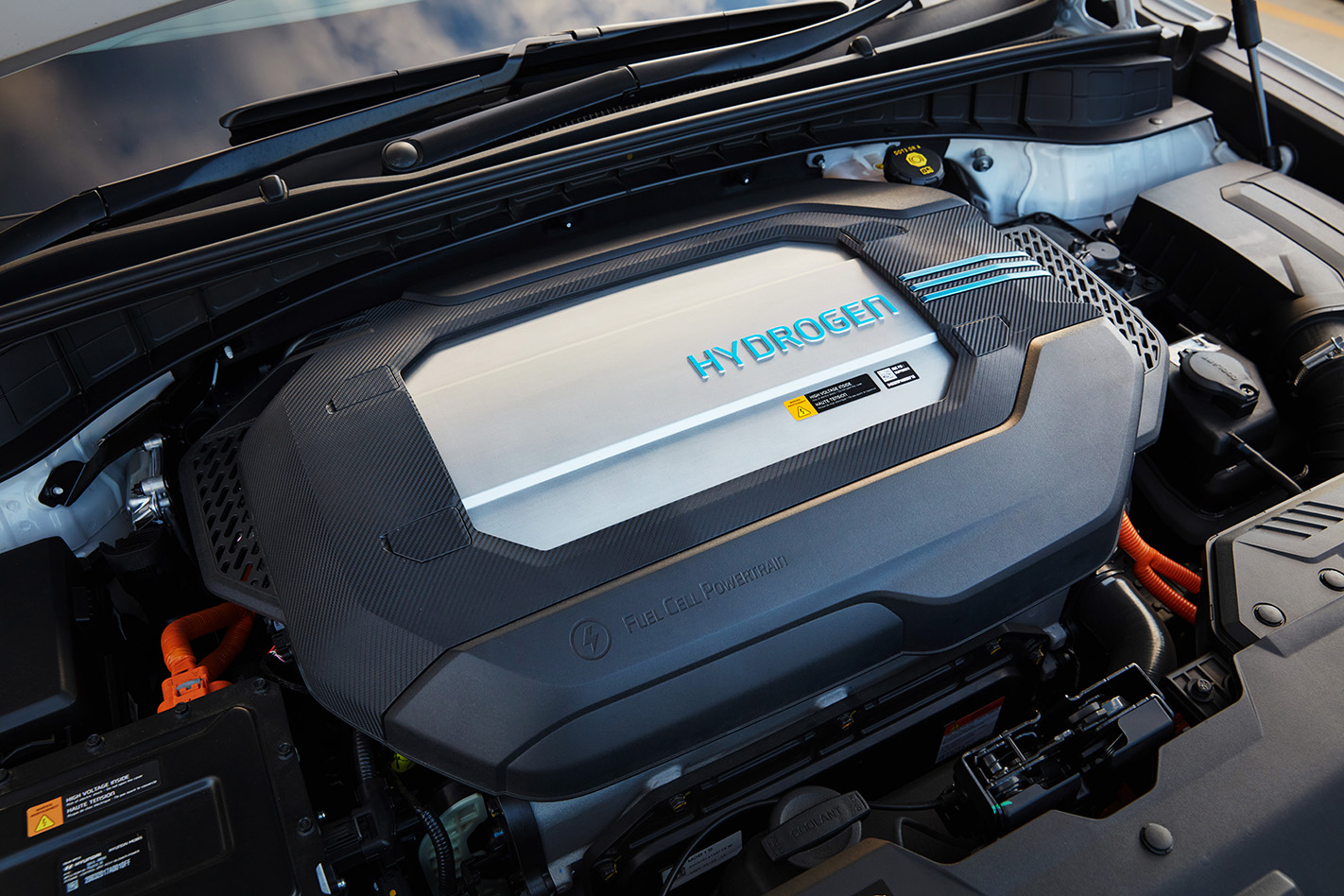
About the size of the new Hyundai Tucson, it is driven by a 120kW/395Nm electric motor that is powered by electricity created by combining air and hydrogen (the latter stored in three high-pressure fuel tanks built into the rear end) in a 95kW fuel cell located under the bonnet.
The fuel cell also provides electricity to a 1.56kW lithium-ion polymer battery, which, like a mild hybrid system, provides a power boost when taking off from a standing start, while also running the Nexo’s 12-volt electrical system.
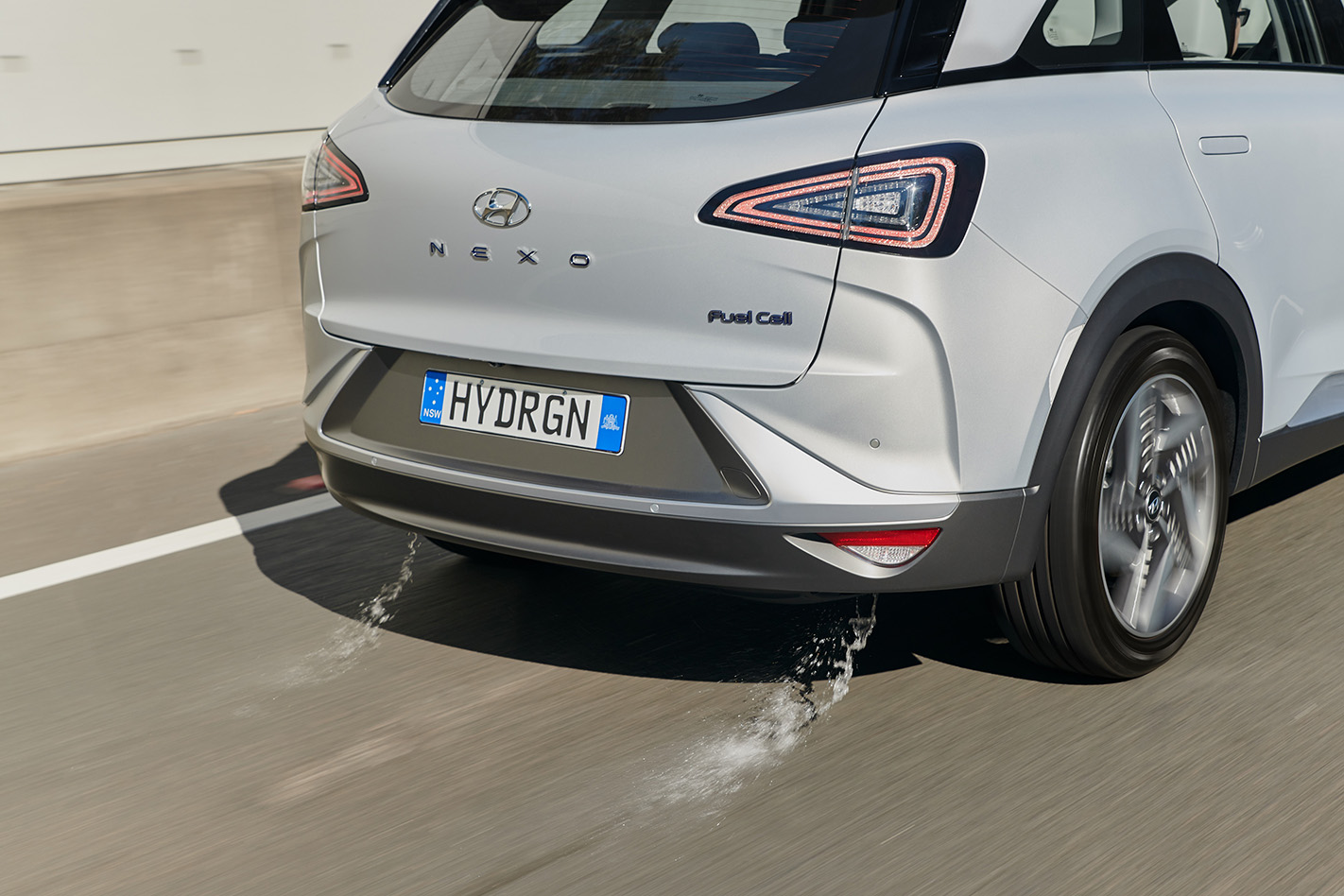
When filled with compressed hydrogen, created with renewable energy, the Nexo can claim 100 per cent emissions-free driving, with the only byproducts from the fuel-cell process being pure water and purified air.
What is the Hyundai Nexo like to live with?
While the Nexo is certified for sale in Australia you can’t actually buy one. If you want to be an early adopter of hydrogen you can lease one through Hyundai’s all-inclusive loan programme, which covers service and maintenance and will also wear the depreciation, meaning there are few running costs.
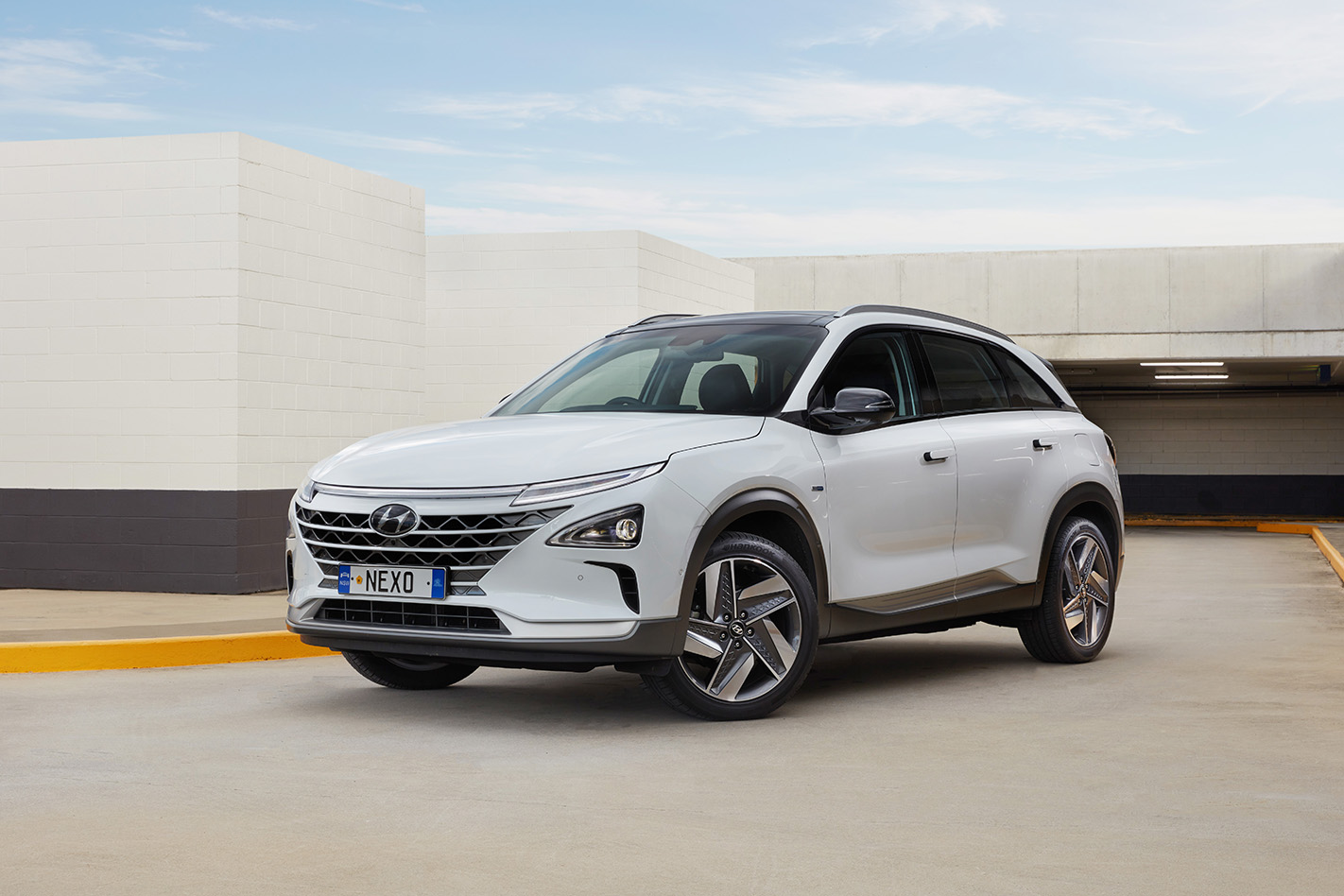
As for specific leasing costs, Hyundai is a little coy about that because of the various factors involved in the all-inclusive deal – but we were told to think of it as being equivalent to leasing a large premium-spec SUV.
Of course, there is an even bigger catch to owning a Nexo and that’s the lack of hydrogen refuelling stations in Australia – at the moment there are only a few public stations that are open or under construction in Canberra, Melbourne, Sydney and Brisbane.
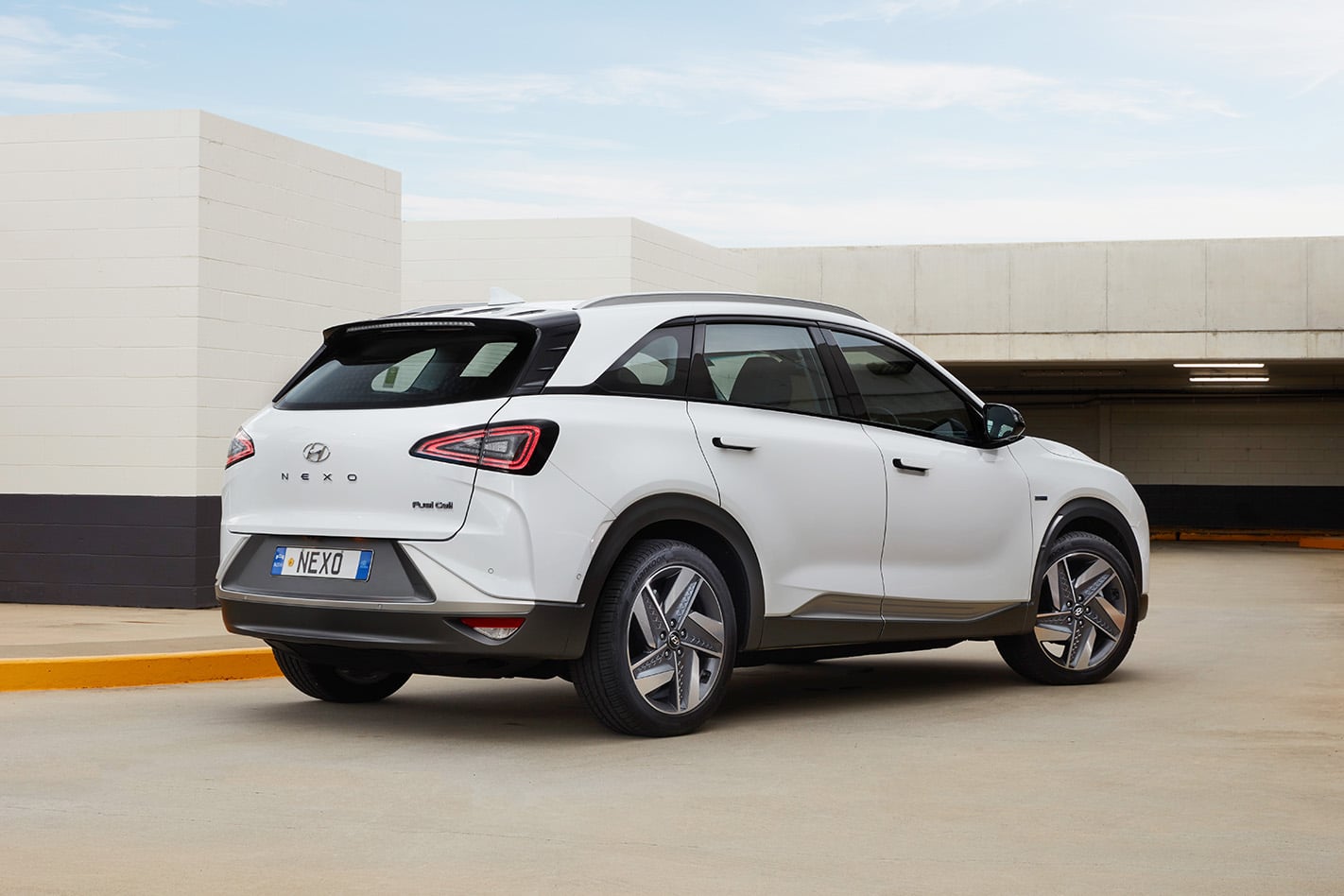
With a 666km WLTP range this obviously limits where you can travel across our big brown land but for somewhere like the ACT, which just became the first city in Australia to open a public hydrogen refuelling station, it’s a very handy way to enjoy emissions-free driving.
Not only is the range significantly longer than most battery-electric vehicles on the market, refuelling only takes about five minutes and isn’t too different to filling a car up with petrol or diesel – it’s actually a little easier as the nozzle locks into the car’s fuel port which means you don’t have to hold on to it.
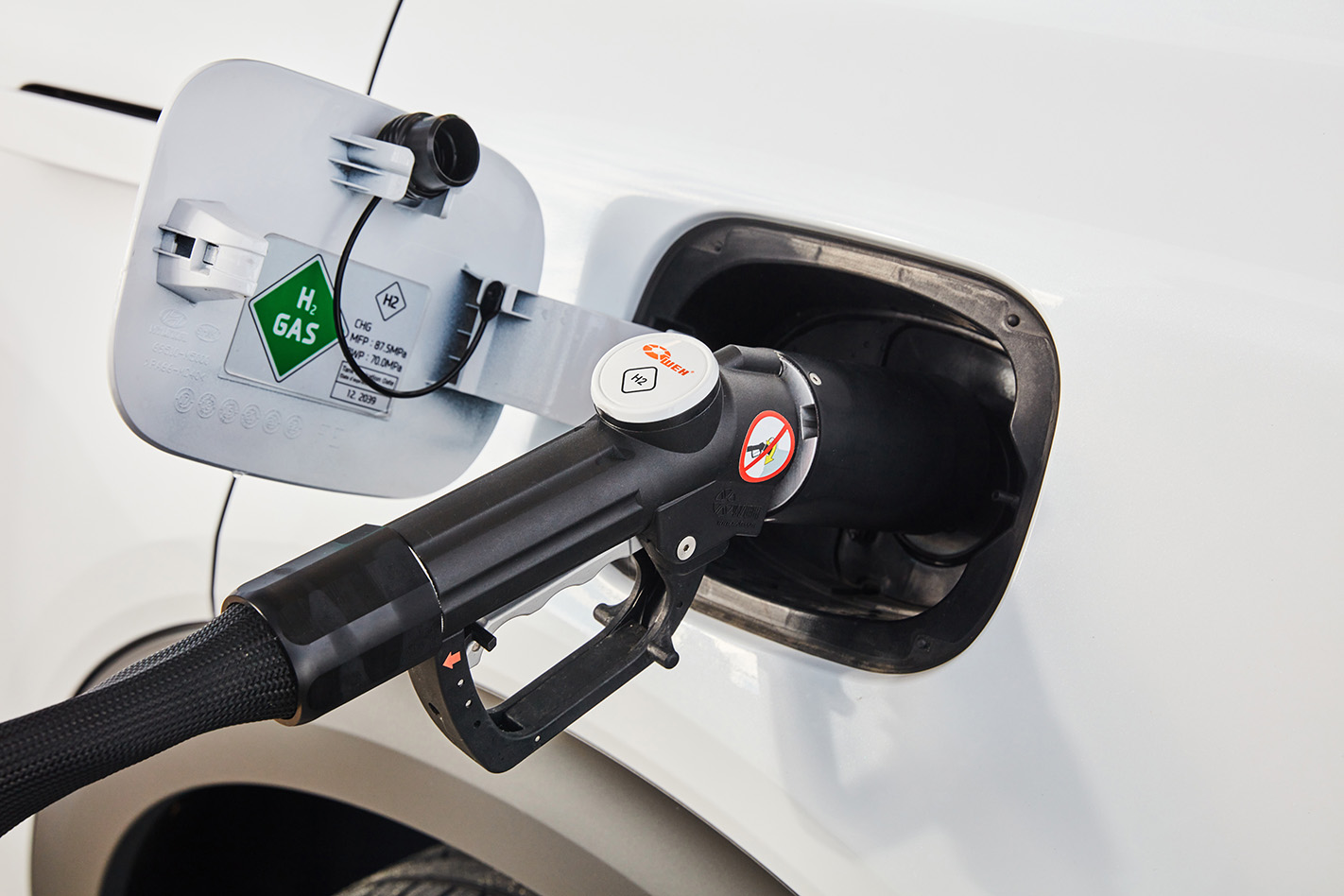
Instead of litres, compressed hydrogen is measured in kilograms and the Nexo’s three tanks take up to 6.3kg combined. According to its official fuel consumption rating, the Nexo consumes 0.95kg per 100km, which wasn’t far below the 1.1kg/100km I averaged in my relatively short time driving it around Canberra and surrounding countryside.
At the moment the retail price of hydrogen fuel is about $13 per kilogram, which makes the cost of filling this about the same as a comparable diesel SUV – though hydrogen at the Canberra refuelling station, primarily built to fuel the ACT Government’s own fleet of 20 Nexos, will be free for the first year.
So what does an FCEV early-adaptor get when they sign on the dotted line to take delivery of a Nexo medium SUV?
Quite a lot: the Nexo is available in a single premium-spec variant that’s similarly equipped to the range-topping Highlander trim in its other SUVs such as the Santa Fe and Palisade.
A key difference is that its interior trim is mostly produced from bioplastics, 34kg of which are applied in the form of the interior surfaces, carpet, headliner, door trims, seats and console.
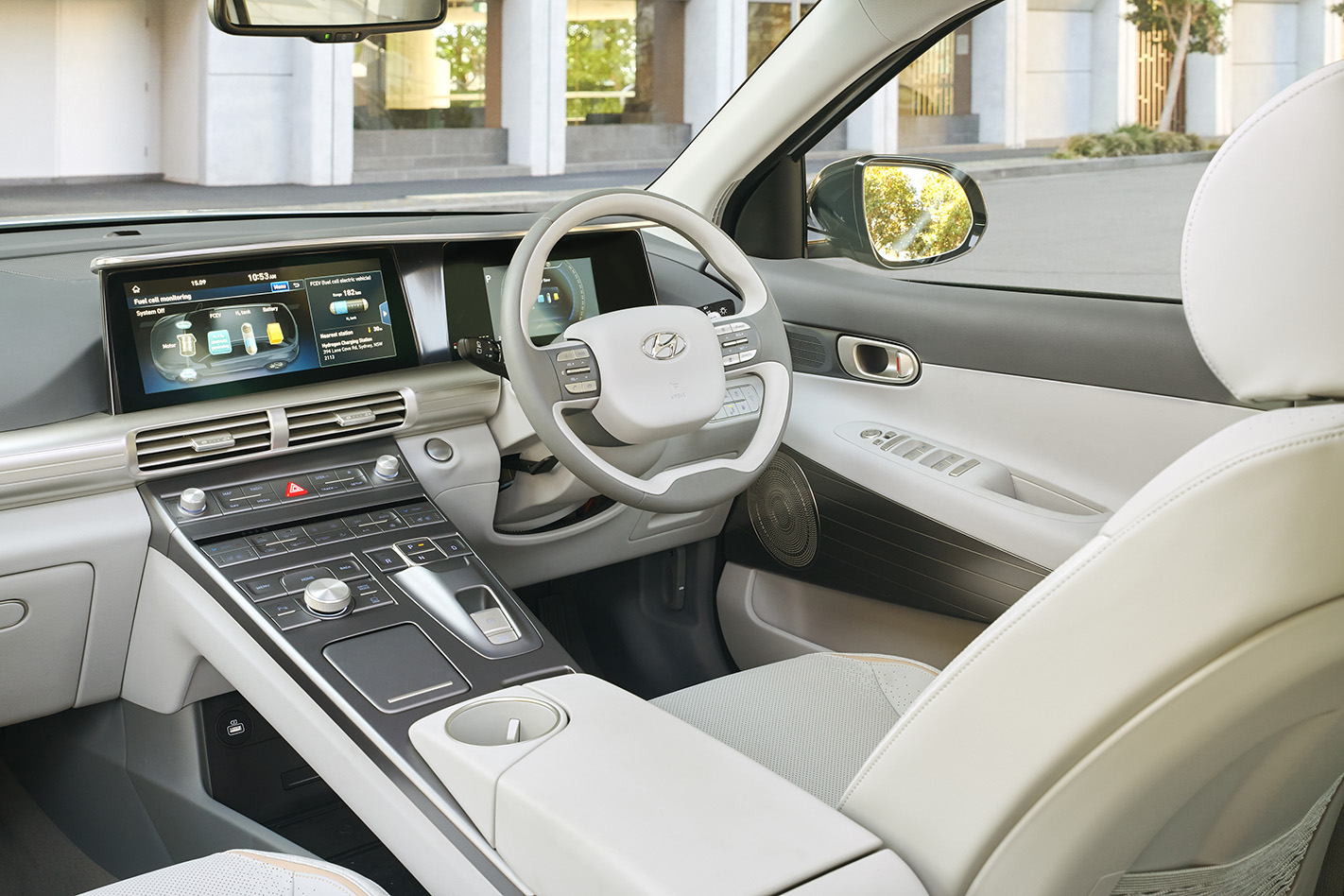
According to Hyundai, the use of biomaterials contributes to a 12kg reduction in CO2 footprint per vehicle during manufacture.
The surfaces look and feel good, so much so you’d think you’re in a luxury German SUV – I particularly like the feel of the headliner and the fabric-like side trim that complements the leather seat upholstery.
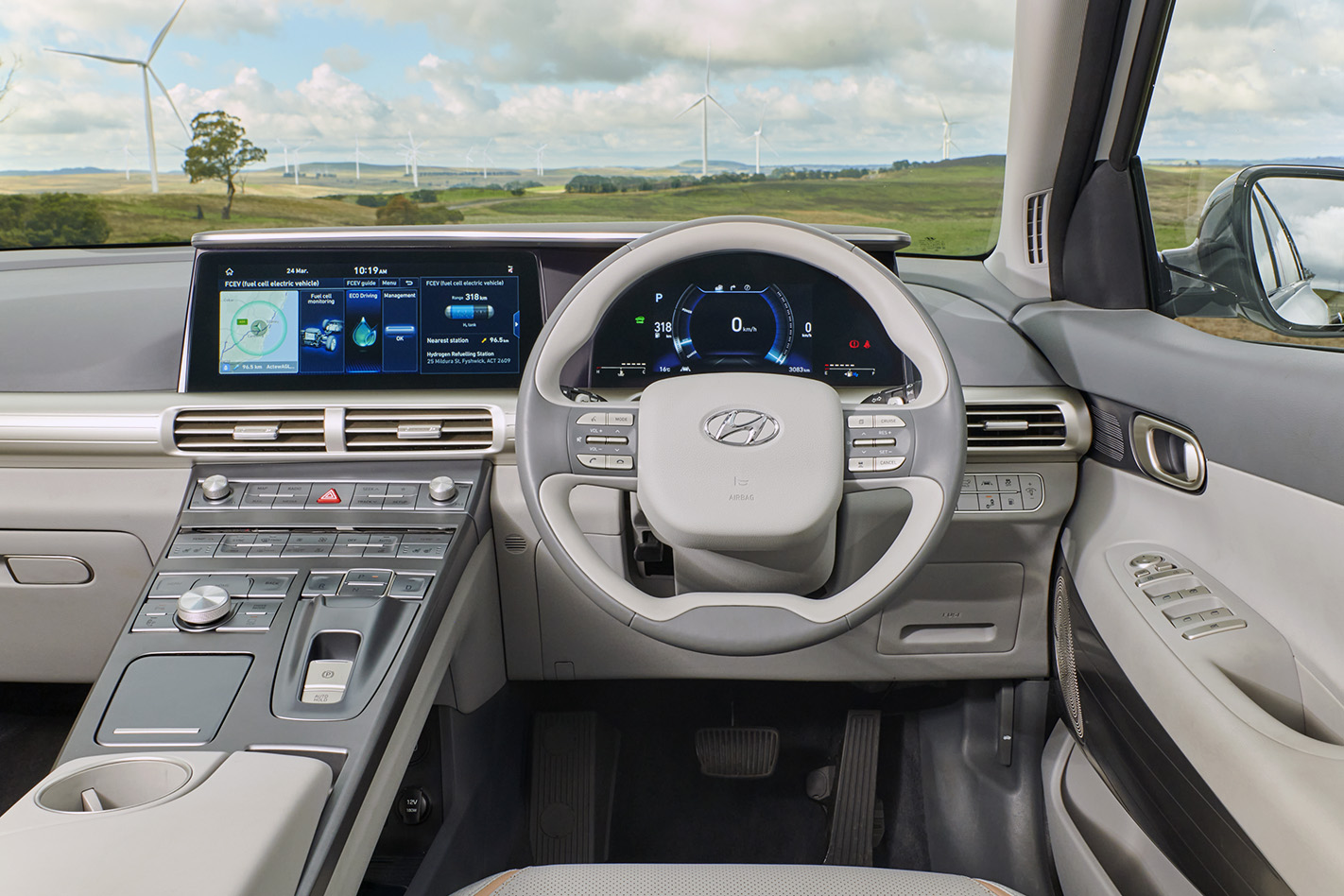
There are two interior colour options, two-tone Stone Grey and Dark Blue. I much prefer the pictured Stone Grey over the blue, which looks like a throwback from the 1990s.
Interestingly the Stone Grey is only available with two of the four available exterior colours, White Cream Mica and Dusk Blue Metallic, while the Dark Blue trim comes with Cocoon Silver and Copper Metallic.
The Nexo’s standard features list includes a 7.0-inch digital driver display and panoramic 12.3-inch infotainment screen that runs in-built satellite navigation and synced content via Android Auto or Apple CarPlay.
The screen also tracks and displays eco-driving performance and will direct you to hydrogen refuelling stations via sat-nav, allowing route planning and range calculation as you drive.
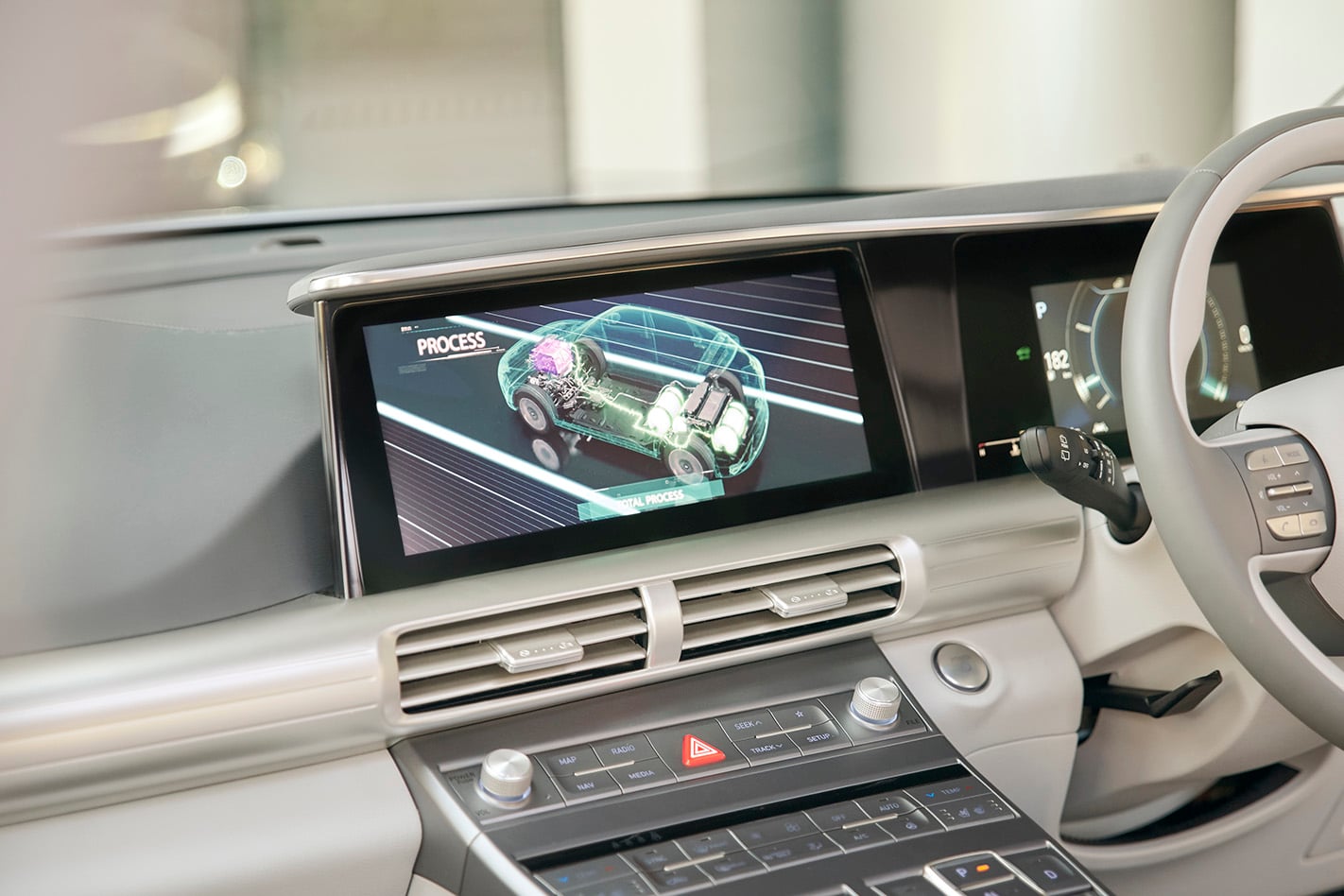
Other interior features include leather-appointed upholstery, power-adjustable front seats that are heated and ventilated, heated rear outboard seats and a heated steering wheel, a sunroof, wireless smartphone charger and Hyundai’s ‘SmartSense’ active safety suite.
The Nexo’s plush front seats are a nice place to be. The driver’s seat has 10-way power adjustment and the passenger eight. They’re separated by a chunky ‘bridge’ style centre console that spans the dashboard and storage tub above a tray where you can store other items including your phone that can be charged wirelessly or through a USB port.
The top of the console is a mass of physical buttons to control everything from media, air-conditioning and seat heating/ventilation as well as housing the push-button gear shifter and driving mode selector.
I’m not really sure how I feel about this – on one hand, it looks impressive and all the buttons are close to hand. But it looks a bit too busy for my liking. I normally prefer physical buttons and switches to on-screen controls, although Hyundai manages to balance the two well in the Palisade, in which the big centre console looks far less cluttered.
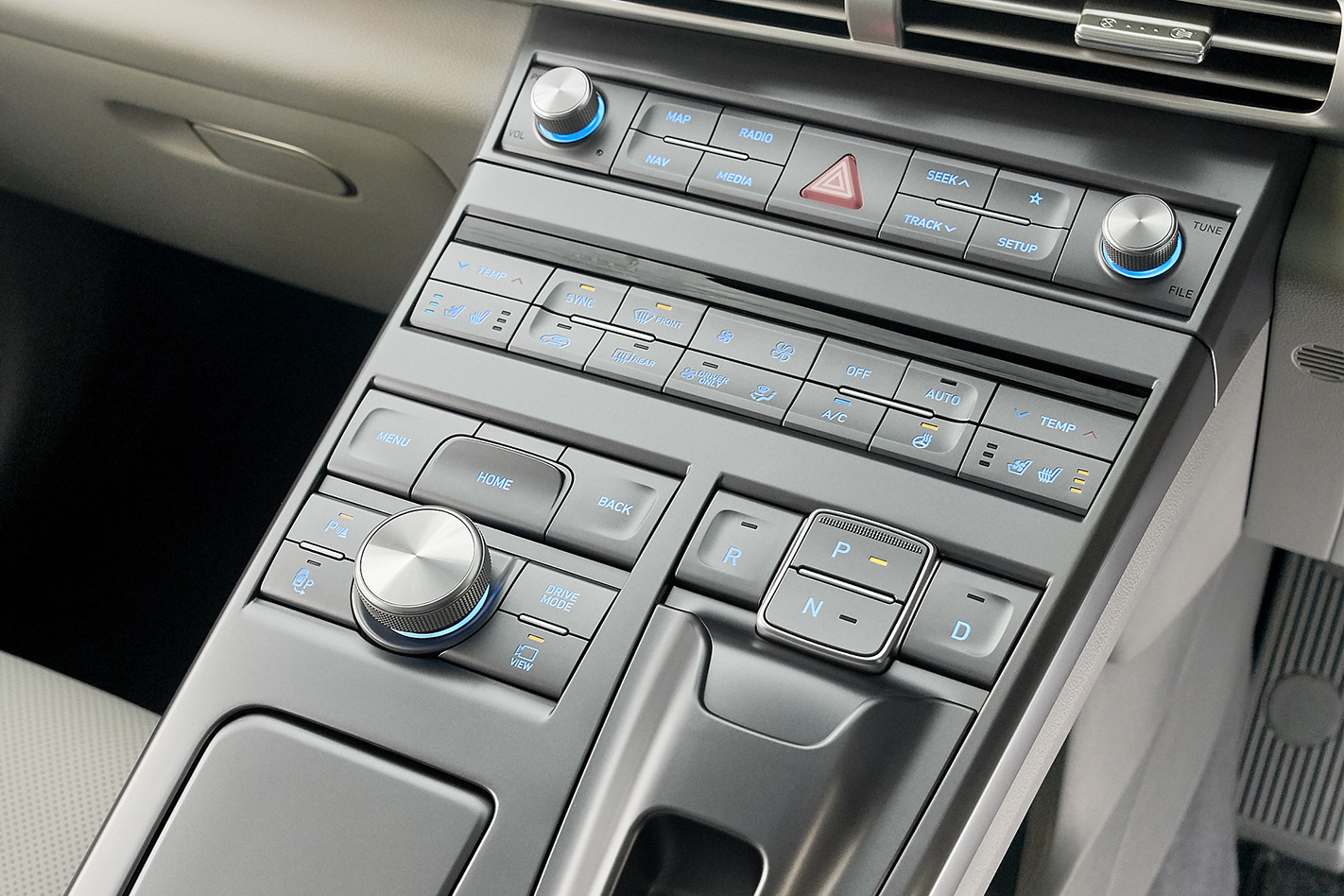
Such is the dominance of controls on the centre console that there is only space for one cup holder for the driver, though for the front passenger a nifty one pops out of the dashboard near the glovebox.
The rear seats are also very comfortable and offer a heap of leg and knee-room and plenty of space under the front seats for your feet. The middle seat would be tight for a third adult, but there’s only a shallow bump instead of the transmission tunnel for more legroom.
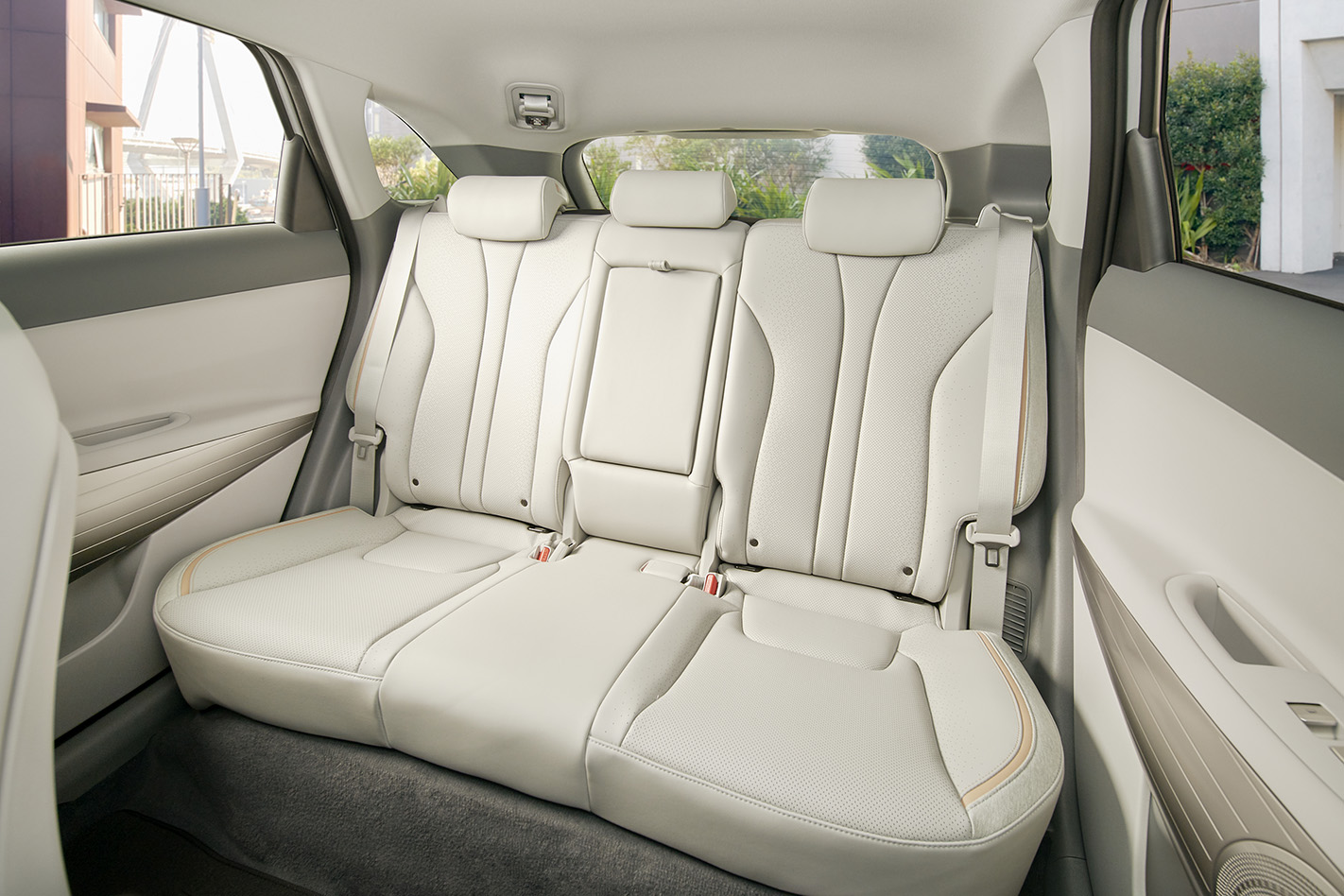
The rear seatbacks recline about 20 per cent and there’s good headroom despite the sweptback roofline.
There is seat heating for the outboard seats, air vents behind the centre console and a 12-volt socket, though there are no USB ports back there.
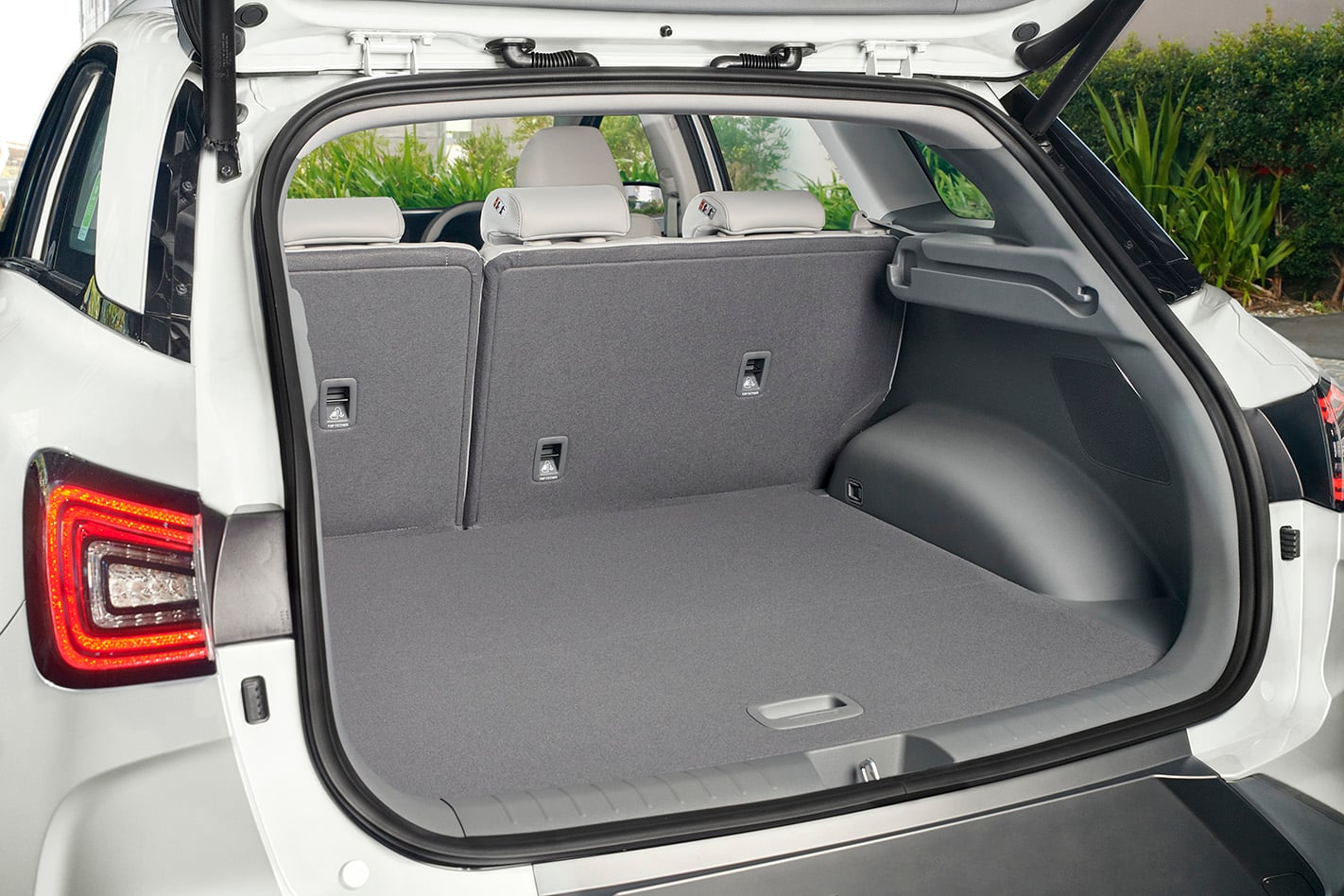
Behind the back seats is a 461-litre boot, which is a little tight for a medium SUV. The space itself is long and wide but rather shallow because of the three carbon-fibre hydrogen tanks, each about the size of a beer keg, taking up all the space below.
This also means there is no space for a spare wheel, though there is a tyre repair kit.
On the road, the Nexo is a very quiet car. Of course, there is no engine sound and wind noise is well-contained even around the mirrors. Tyre roar can be loud on coarser surfaces but that could be because it’s more noticeable due to everything else being so quiet.
What is the Hyundai Nexo like to drive?
What’s remarkable about the Nexo FCEV is how unremarkable it feels to drive compared to an ICE SUV.
The 120kW/395Nm motor, which drives the front wheels, has similar output to a four-cylinder turbo engine and performs accordingly. It doesn’t have that head jerking instant take-off like a BEV, but it does take off instantly thanks to the additional 15kW mild-hybrid battery boost.
It has two drive modes, Eco and Normal. Normal mode brings a very SUV-like 0-100km/h acceleration of 9.54 seconds on its way to a top speed of 179km/h. But it does it effortlessly and there’s plenty of power in reserve for when you need it, such as when overtaking – much like a turbo engine.
The Nexo’s ride and handling are excellent for an SUV. It has a decent-sized footprint on the road, with a 2790mm wheelbase and 1614mm/1625mm front and rear wheel tracks, making it feel well planted.
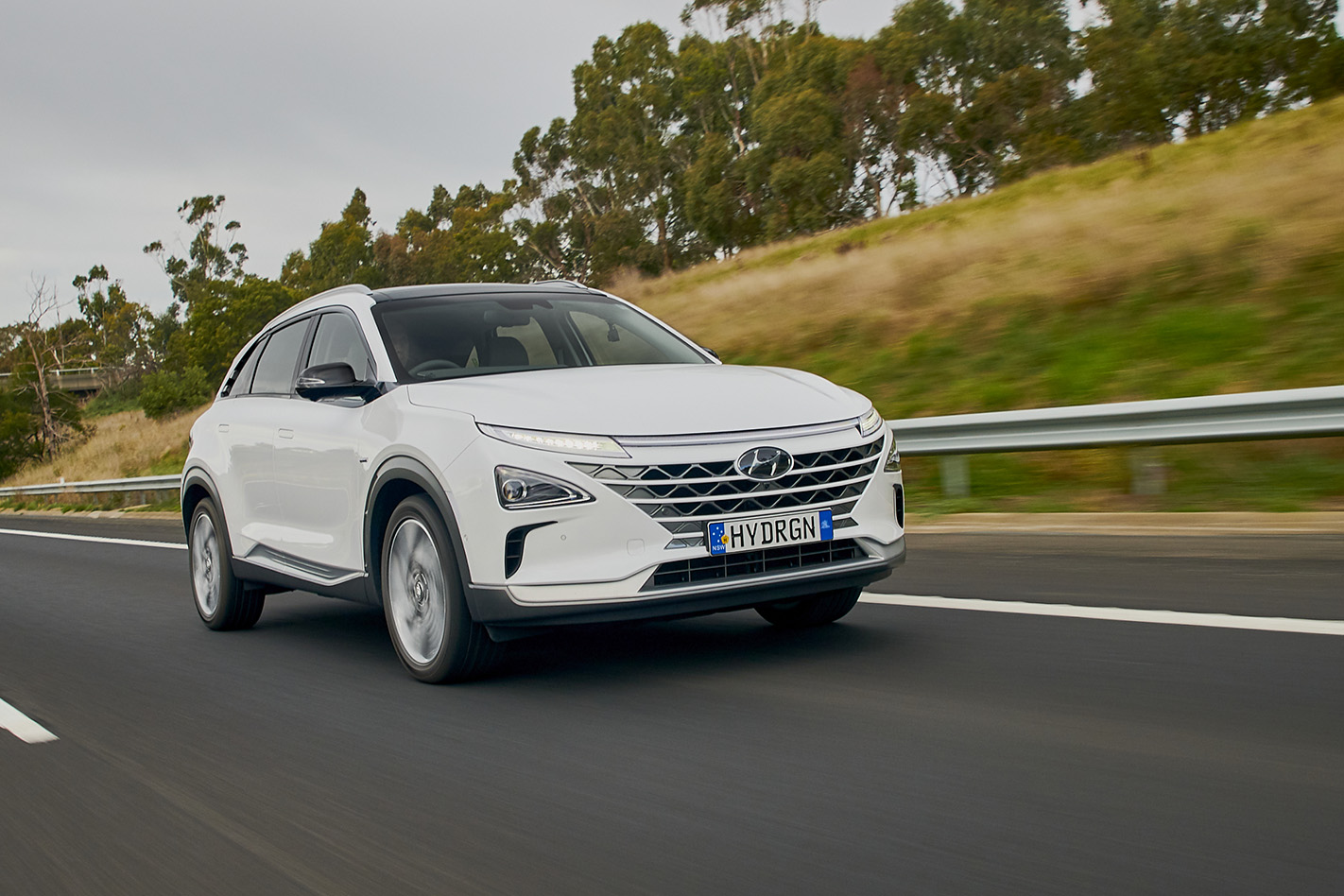
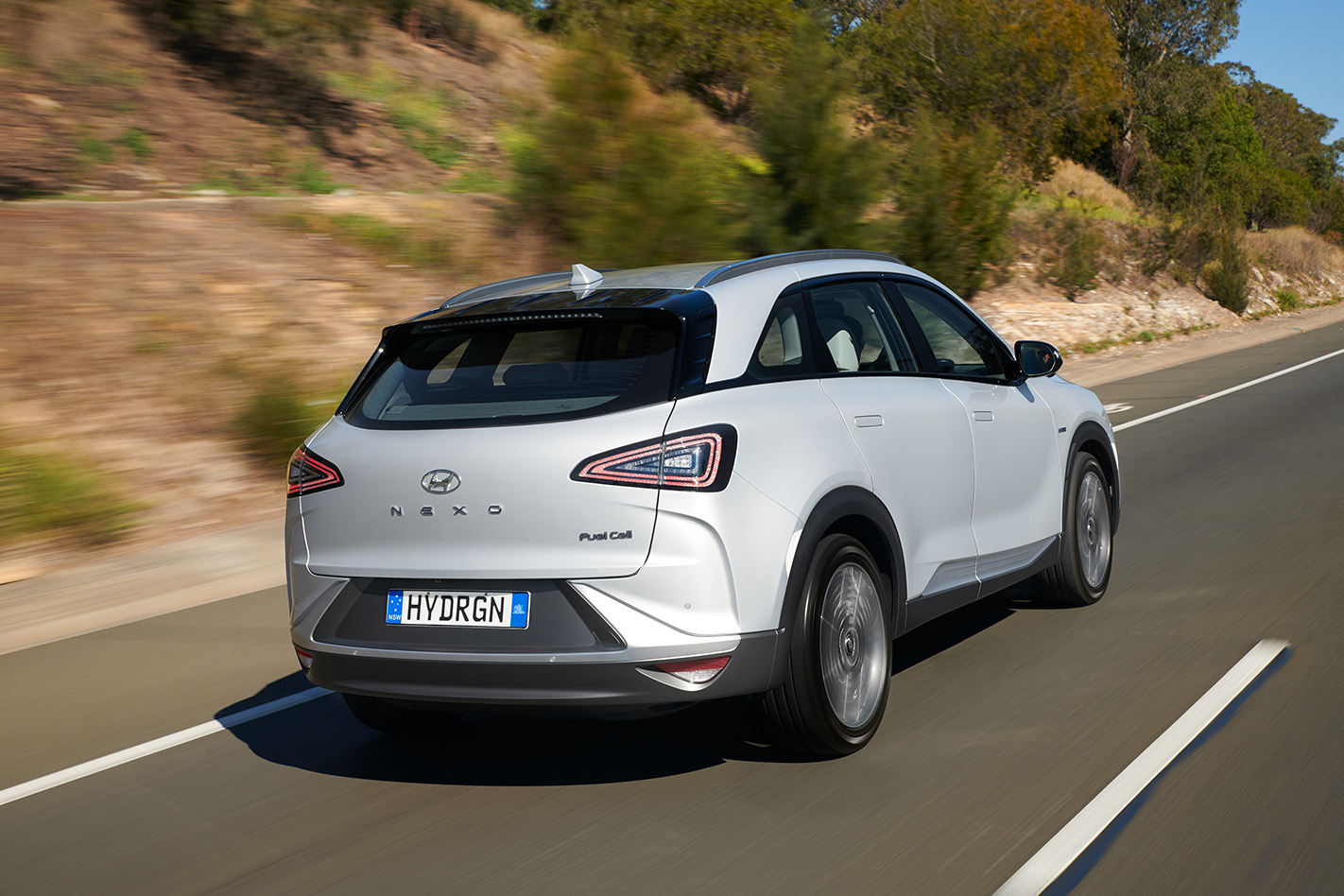
Despite having a fuel-cell under the bonnet and heavy hydrogen tanks over the rear wheels, the weight distribution doesn’t feel any different to an ICE SUV so the front end acts just as you’d expect to. It handles nicely, with body roll well contained around bends and there is good rear-end compliance.
Like most Hyundai models available here, the Nexo has undergone an extensive tuning program for local conditions and, riding on its 19-inch Hankook Ventus S1 SUV tyres, it seems to glide over smoother roads while on rougher surfaces its multi-link rear suspension absorbs most road imperfections with minimal secondary movement.
The power steering, with column-mounted motor, feels nicely weighted and direct.
Apart from the relative silence, one way to tell the Nexo drives under electric power is its regenerative braking which, like the Hyundai Kona Electric, can be set from to three different levels using paddle shifters on the steering wheel. If you prefer to drive without it, the Nexo has good stopping power with disc brakes all round including 320mm ventilated rotors at the front.
This is an enjoyable and comfortable vehicle to drive and you should have no issues staying in the saddle for all of its 666km range, bladder permitting.
What is the Hyundai Nexo like for safety?
The Nexo comes with Hyundai’s ‘SmartSense’ active safety suite, including autonomous emergency braking, driver attention warning, a radar-based blind-spot collision avoidance assist system, lane-keeping assist, lane-departure warning, rear cross-traffic collision-avoidance assist, and adaptive cruise control with ‘Stop & Go’.
The lane-departure-warning can be pretty irritating in narrow roads, but there is a button to the right of the steering wheel to turn it off.
The Nexo has good all-round vision which helps with parking and negotiating tight spots, but there are some handy aids should you require additional help. These include a 360-degree parking monitor to help avoid hidden obstacles such as bollards.
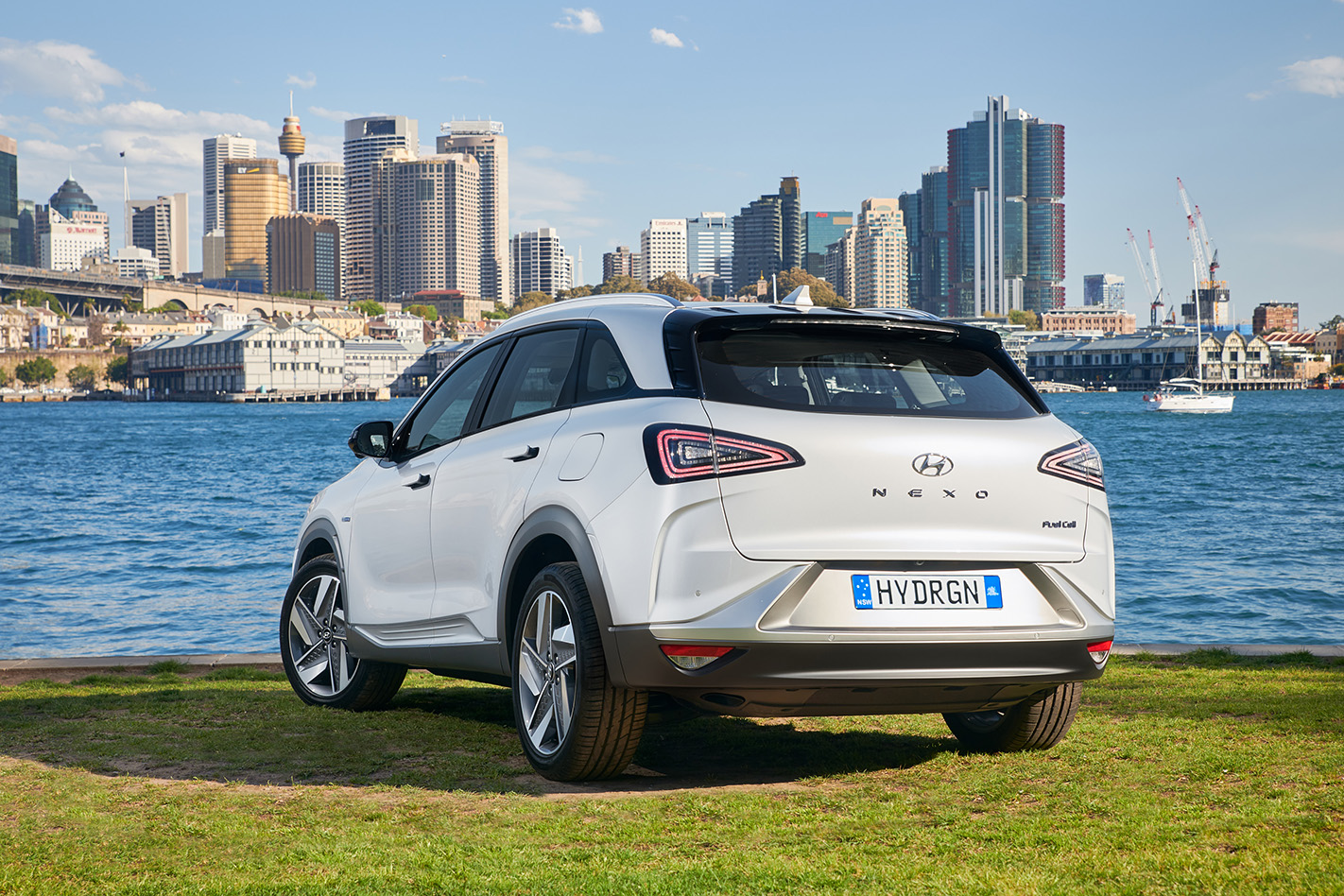
And if you need to park in a particularly tight spot, the Nexo also comes with a remote smart parking assist system that uses ultrasonic sensors, allowing it to be moved in and out of parking spaces from outside the vehicle via controls on the key.
Passive safety includes six airbags including front and side inflators for the driver and front passenger and front and rear side curtains; roll-over sensor, ISOFIX child-seat anchors for the rear outboard seats and three rear top tethers.
The Nexo has a five-star ANCAP safety rating based on its 2018 Euro-NCAP testing that saw it score very well in most categories including 95 per cent for adult occupant protection and 89 per cent for child occupant protection.
The Verdict
Unless you live in Canberra you won’t be seeing too many Hyundai Nexos on the roads for a while due to the fact there are currently so few places to refuel them.
That’s a shame because this really is an excellent SUV and a great showcase for the benefits of emissions-free hydrogen propulsion, not least convenience.
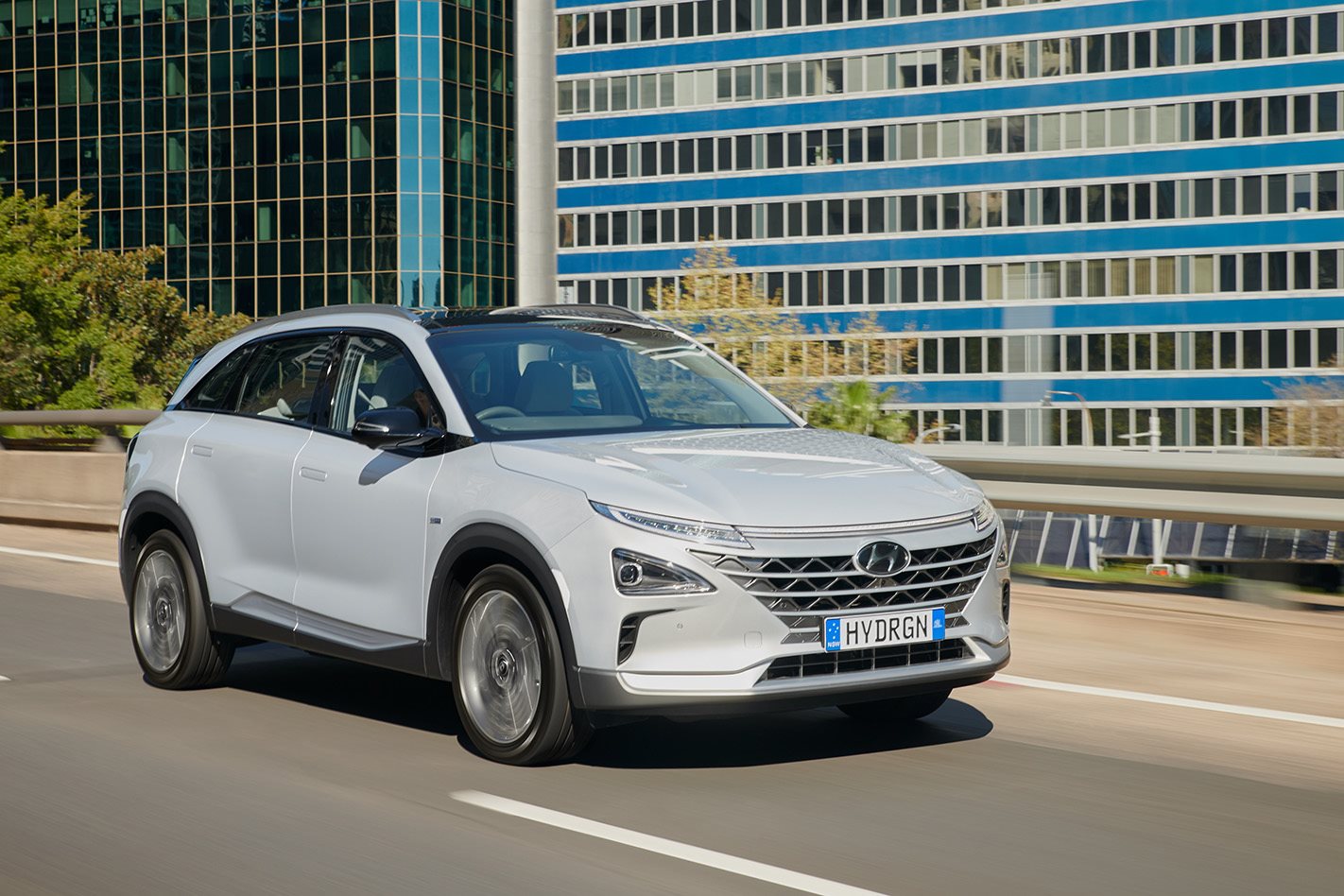
That said this is no prototype – the Nexo one of the most polished Hyundai vehicles I’ve driven and is the result of 20 years of research by Korean carmaker, much of it carried out in Australia, with all the hard work done by its ix35 Fuel Cell predecessor. Apart from the scarcity of hydrogen filling stations and a slightly small boot, it seems to present few compromises compared to ICE or BEV vehicles.
The good news is that even the EV-phobic federal government is seriously looking at green hydrogen as a future fuel for a range of applications including mining and public transport, a byproduct of which will be cheaper vehicles and the proliferation of refuelling stations.
Here’s hoping this will occur in the first-generation Nexo’s lifetime and it, and the second-generation Toyota Mirai, are the first of many FCEVs to hit Australian roads in private hands.
RATING 8.5/10
PLUS Emissions-free driving, cabin space and comfort, ride and handling MINUS Hydrogen scarcity, small boot space, you can’t actually own a Nexo
2021 Hyundai Nexo FCEV specifications
Body: 5-door, 5-seat medium SUV Drive: FWD Motor: Permanent magnet synchronous motor Combined Power: 135kW Torque: 395Nm Battery Lithium-ion Polymer Fuel (hydrogen) consumption: 0.95kg/100km (combined) Weight: 1814kg Power/weight: 64w/kg Transmission: Single-speed reduction gear Suspension: MacPherson strut/multi-link L/W/H: 4670/1860/1640mm Wheelbase: 2790mm Tracks F/R: 1614/1625mm Brakes: Front ventilated/rear solid discs with regenerative braking Tyres: 245/45 R19 98W Hankook Ventus S1 evo2 SUV Wheels: Alloy 19-inch 7J +48 Price: POA (lease only)
Ford has officially announced its Mondeo passenger car will be killed off globally in March of 2022.
The household name has witnessed a steep decline in sales over the last decade, as global appetites for crossovers and SUVs overtake the demand for medium-sized sedans and hatchbacks.
The Mondeo moniker was retired in Australia last year, and although it always reviewed well with the press, it never really made an impact Down Under with consumers.
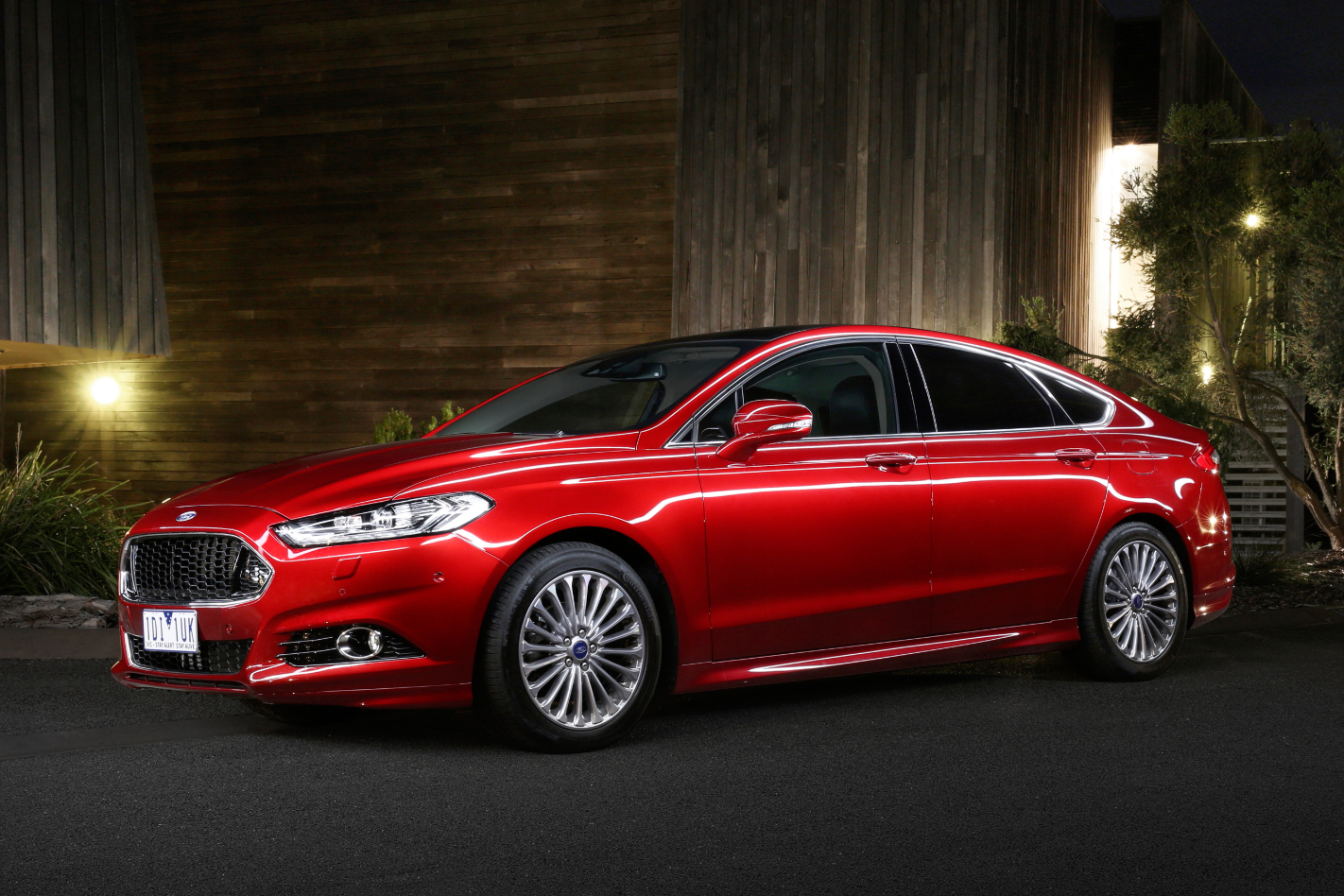
By contrast, the Mondeo was a tour-de-force in Europe, and in the UK it was the darling of middle-management and sales reps across the country, with diesel-powered Mondeos taking British motorways by storm.
To date, Ford has sold over five million Mondeos in the European market, and at its peak, the popularity of the model was such that Ford UK sold over 86,000 units in 2001 alone.
However, the British arm of the Blue Oval sold less than 3000 examples of the Mondeo last year – the writing was all but on the wall.
It was hoped the Mondeo name may be salvaged, with rumours circling last year that Ford may end up slapping the title on a yet-to-be-released small SUV.
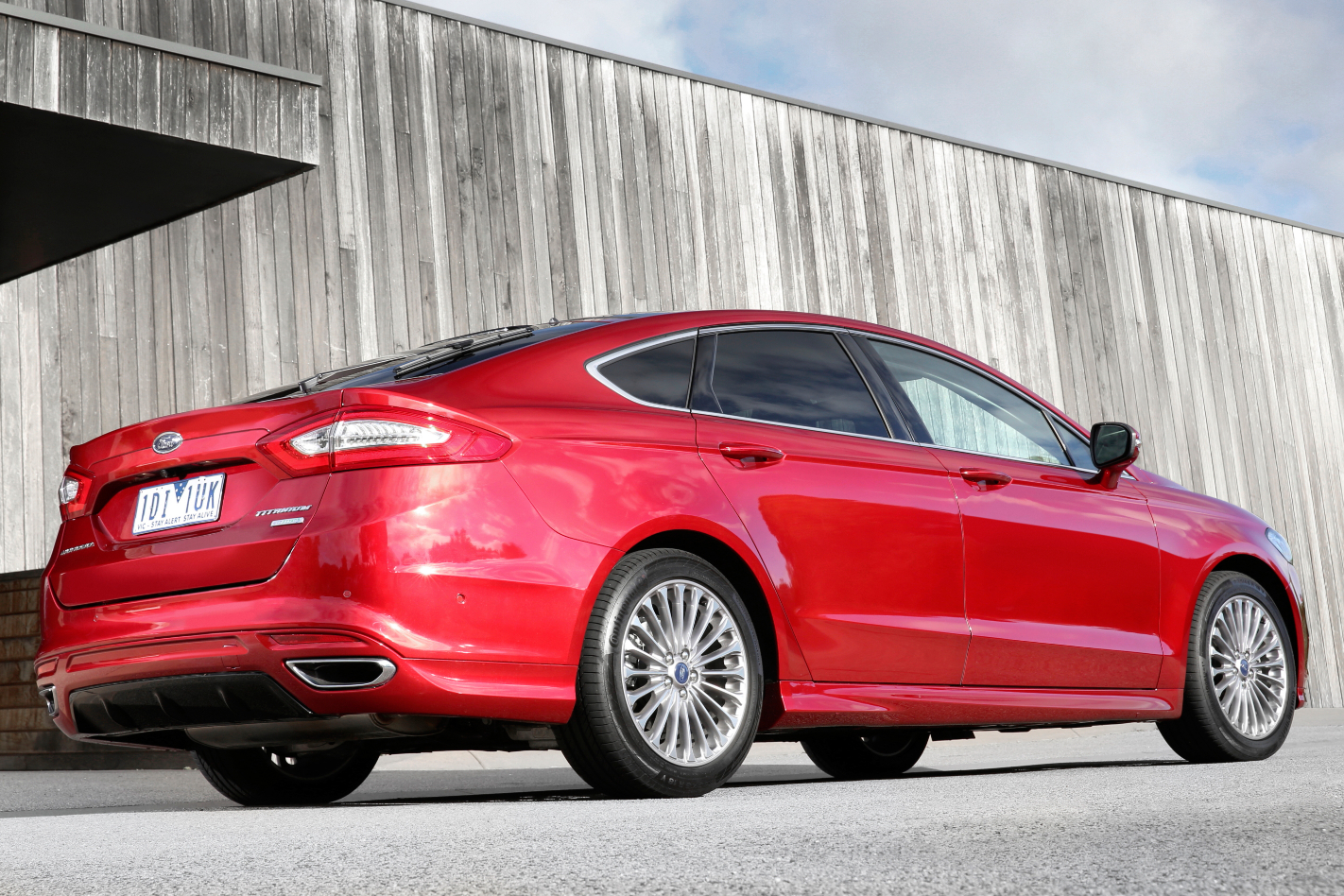
According to a report from Auto Express though, Ford has no plans to recreate a namesake for the European market.
“While we do not comment on speculation concerning our product plans, we can state that we have no plans for a future Mondeo in Europe,” Ford of Europe said in a recent statement.
When production of the Mondeo does cease at the automaker’s Valencia production facility in Spain next year, Ford will utilise the extra production capabilities to focus on models like the Kuga and Explorer PHEV.
This push towards electrified crossovers and SUVs comes in the wake of recent news that all Ford models slated for the European market will be electrified by 2026, and by 2030, the marque will be an electric-only carmaker in the continent.
MORE: Mondeo stories MORE: All Ford stories
