
In mid-October 2019, Lamborghini reported a production milestone: Huracan number 14,022. That seemingly random figure brought the Huracan, in just five years, level with its predecessor Gallardo’s total production over 10 years – and made the Huracan the most successful model in Automobili Lamborghini’s 56-year history.
That figure is also roughly equal to all the Lamborghinis built from 1963 up to the Gallardo’s introduction in 2003.
Back in the day, it didn’t take much to be a Lamborghini production record holder. Consider the Countach, ubiquitous on bedroom walls around the world – yet just 2049 built, over 26 years. And before that, the Lamborghini Espada, a runaway sales success with a measly 1227 examples over 10 years.
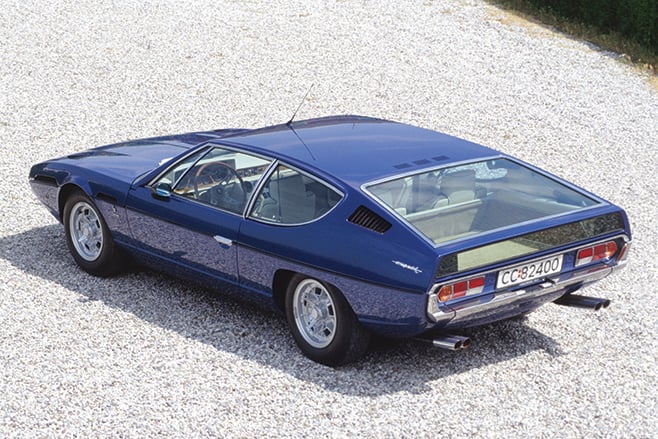
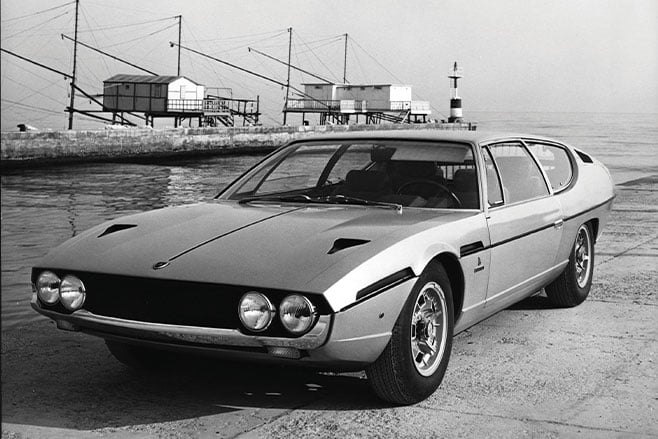
Introduced at the 1968 Geneva Salon and named for a bullfighter’s sword, the Espada was only Lambo’s fourth model. It had been previewed a year earlier as the Marzal show car, designed by Bertone’s Marcello Gandini to a four-seater brief from Ferruccio Lamborghini himself.
The production Espada would lose the Marzal’s transverse rear-mounted engine, dramatic glass gullwing doors and honeycomb-louvred rear engine cover. Chassis designer Giampaolo Dallara installed the 3.9-litre quad-cam V12 and five-speed manual gearbox up front in a fabricated steel chassis, marking a departure from the earlier 400 GT’s ladder frame.
The steel body’s tall roofline allowed generous rear headroom. Rearward visibility was aided by large side windows and a vertical glass panel beneath the tailgate. The large clamshell bonnet, extending down to the shoulder line, was forward-hinged for engine access. NACA ducts fed air to the cabin.
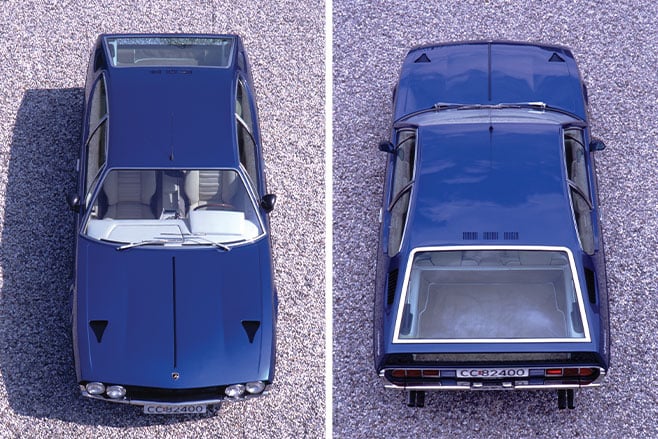
Selling alongside the hero Miura (1966-’73), the Espada didn’t claim to be the performance flagship: compared with the 400 GT it superseded, the Espada was longer, wider and more than 160kg heavier, at 1635kg. Still, the 0-100km/h sprint was dispatched in a swift seven seconds, and top speed was 250km/h.
There are three recognised series of the Espada, the S1 giving way in 1970 to the S2 with a Miura-spec engine raising power from 242 to 260kW, and introducing vented disc brakes, restyled grille and a (thankfully) revised dashboard. The 1972 S3 copped a more significant interior freshen-up – and replaced Fiat 124 tail-lights with Alfa Romeo GTV2000 units, just for the record.
Power play
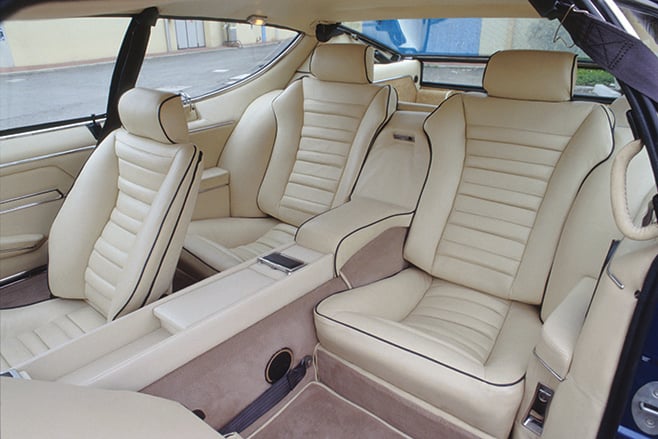
Ferrari defector Giotto Bizzarrini designed Lambo’s V12, an all-alloy, 60-degree, quad-cam with six Weber carbs. Capacity hit 3929cc for Espada, and high-compression S2 raised power to 260kW at 7500rpm/393Nm at 5500rpm. Wishbone and coil suspension; four discs behind 15-inch Campagnolo alloys. Three-speed Chrysler auto option arrived in ’74.
Cutting a dash
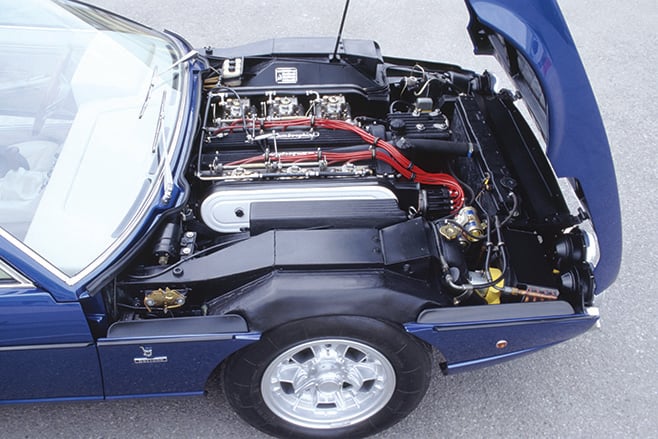
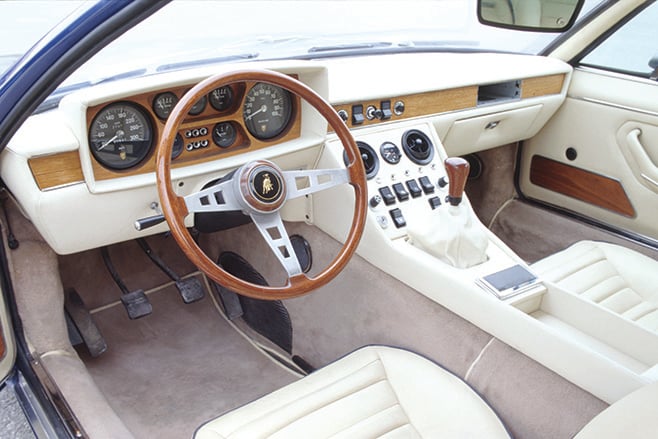
The early Espada dash was a Marzal-esque mangle, improved in S2, more so in ‘wrap-around cockpit’ S3 (pictured). Tall transmission tunnel allowed four-adult comfort in the leather-trimmed interior, with Ford-sourced vents and BMC Mini column stalk. Rear side windows were top-hinged, and air-con and power steering standard. from ’72.
1968 Lamborghini Espada by the numbers
- 1227 Espadas built, a Lambo record until Countach (2049)
- 187 S1 cars built (versus 575 x S2 and 465 x S3)
- A$235,000 price guide for ’77 S3, Classic Throttle Shop, October 2019
- 100mm longer than the 400 GT 2+2 yet a proper four seater
Month 1: Genesis and revelation?
Price as tested: $79,950
This month: 363km @ 10.2L/100km
The driver of the white Kia Stinger pulled alongside me in the cafe car park, an expensive racing bicycle fastened to racks on his roof. I noticed his eyes drinking in the profile of the Genesis G70, admiring the luscious, tri-coat metallic Havana Red paint and stylish, black-chrome 19-inch wheels. “Nice car, mate; the V6?” he asked. I nodded. Then came the kicker: “So you bought the one in the dinner jacket, eh?”
There was no malice in his quip; more just a joking observation that he knew his Stinger and my new long-term G70 were cuddling Korean cousins.
But hopefully this bloke is in a minority, because if you’re a company like Hyundai, embarking on the monumental task of establishing a global premium brand, you could probably do without people associating your debut sports sedan with the circa-$20K cheaper offering from sister company Kia.
But did the pedal-pushing Stinger driver have a point? This G70, which I’ll be running for the next six months, and priced at $79,950 in top-spec Ultimate Sport guise, does share a platform, engine, gearbox and plenty of other hardware and systems with the two upper-spec Stingers, priced at $50,190 and $60,790 respectively. So yes, part of my mission will be to establish just how successfully the G70 distinguishes itself from its group stablemate. Of greater relevance, though, given Genesis’s brand positioning, is how the G70 rates as an ownership/value proposition compared to a BMW 3 Series, Audi A4, or the local segment king, the Mercedes C-Class.
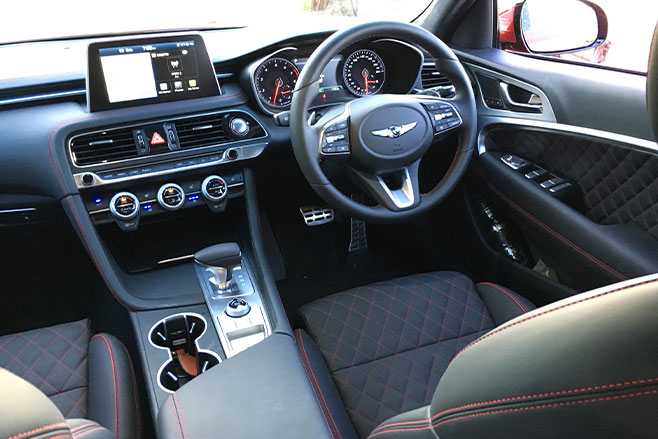
So how does the Genesis stand up to the showroom-browser test against the established Euros? My first impressions are positive, with a couple of caveats. The front seats are brilliant, with fantastic adjustable under-thigh support, and their perforated leather, with red diamond-pattern stitching, feels premium, as do the generous splashes of aluminium trim around the logically laid-out cabin.
Less impressive is the dinky 8.0-inch multimedia screen and its basic-looking graphics. There’s nothing wrong with the system’s functionality, but given how important this feature is to buyers, especially those in the premium segment, I’m mystified how Genesis thought such a budget-looking installation was going to cut it.
In terms of equipment, I’m yet to notice anything missing that I’d consider of real value. There’s no auto-parking function, which I’d never use, nor any kind of pilot-assist self-driving system, which would likewise be a mere novelty item. The stuff I do really care about – a legible head-up display with speed-sign recognition, heated and cooled front seats, and a belter of an audio system from Lexicon, with 660w of amplification and subwoofers (mounted here in the floor under the front seats) – is all present. The only option for lesser G70 models is a sunroof; in this spec it’s standard, meaning there’s nothing for buyers to consider adding.
First driving impression is how well the refinement brief has been nailed. At idle, the seat cooling fans are more audible than the engine, and on the move in normal driving, it remains silken and super hushed. The calibration of the eight-speed auto is nicely intuitive in Comfort mode, and there’s a shedload of torque – the V6 feels stronger than the figure of 510Nm suggests. I’m also cheering that the low-profile Michelin Pilot Sport 4 rubber doesn’t incessantly convey every surface imperfection into the cabin. The ride has real compliance and isolation.
I’m looking forward to a full exploration of the G70’s sporting cred in a few weeks on a drive up to Forster, about 3.5 hours north of Sydney, which will take in the blissfully bendy Lakes Way. I’m excited not just to have a proper pedal, but also because I’ll be collecting a very precious bit of cargo. Actually, if Jake and Elwood Blues had a dyslexic brother, he may have even paused to observe, “We’re on a mission from dog…”
Month 2: We got sold a pup
Genesis excels as we see a (wo)man about a dog
This month: 1896km @ 11.1L/100km
I felt a green flush of envy when the email pinged in my inbox. ‘Fido Fridays!’ said the subject line. The note from Wheels’ publisher went on to say that the last day of the working week would now be a dog-friendly one, acknowledging the benefits to staff morale when there’s a couple of happy woofers waggling around the workplace. (Plus the endless humour, surely, from discreetly tipping a glass of water next to a pot plant then suggesting to the dog’s owner that they should mop that up.)
My jealousy of this new initiative was two-fold. Firstly, it was for the Melbourne head office, whereas I’m the Sydney-based solo operative. Further, I didn’t own a ‘Friday Fido’, nor a dog for any other day of the week, as it happens.
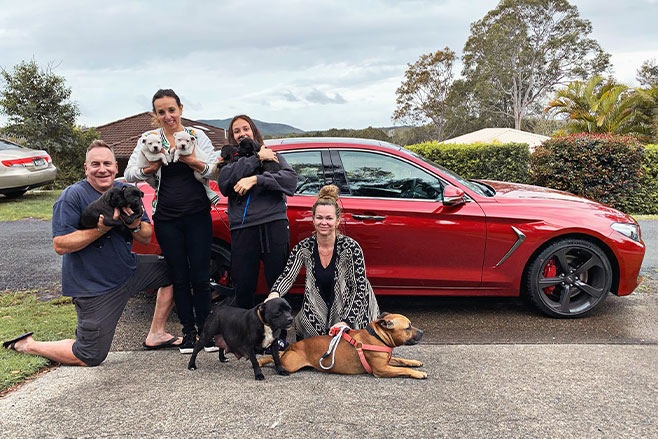
But the second part of this problem was easily fixed. A friend’s pair of Staffordshire terriers had recently produced a litter of pups, and a quick Facetime call to the family on the NSW mid-north coast introduced me to a tiny brindle female who stared at me with beseeching doe eyes down the video phone. No idea what she was thinking, but it was love at first sight from my end.

Fast-forward several weeks and the Genesis was packed for a there-and-back dash in a day, meaning an enlightening seven hours behind the wheel. My lanky 17-year-old daughter eyed up the kiddie-sized rear legroom and decided to ride side-saddle, propping herself up with pillows and stretching lengthways across the back seat. Clearly she was sufficiently comfortable to fall straight to sleep; no surprise given the ungodly (for a Gen Z, remember) departure time of 7:00am.
Up front, it was a chance to enjoy the G70’s polished expressway manners. Tyre noise from the 19-inch Michelins is not too intrusive; wind noise pretty well suppressed, and the engine is virtually inaudible at 1700rpm in eighth gear at an indicated 115km/h cruise. Fuel consumption, in the low-13s around the suburbs, fell away to a more palatable low-8s, giving us a cruising range of over 700km (about three hours’ more driving than my bladder can handle these days).
It was all very serene and peaceful, till I went and destroyed all that as we hit the Lakes Way just past Bulahdelah. My girls are nothing if not understanding, and held on grimly but uncomplainingly as your correspondent conducted some deeply scientific dynamic assessment.
The upshot? This is a really engaging, enjoyable car to hustle hard, at least until fast, bumpy sweepers implore you to dial it back a notch. It’s only then, with the adaptive dampers in Sport mode, that the top part of the stroke gets a bit flustered. On smoother surfaces, the slick steering, ample traction and LSD help make this a wholly convincing sports sedan.
As for Fido Fridays, Zoe is currently small enough to be smuggled in a tote bag, so for now, every day’s a Friday.
Month 3: Twist in the tail
The battle for COTY’s best oversteerer award
This month: 647km @ 11.8L/100km
It was only Day One of COTY, and already my inner 13-year-old was bouncing around my head and trying to escape via my mouth. Andy Enright was delivering his presentation of the Genesis G70 pair to the judging panel, and there was lots of detail to absorb as to how the Korean sedans stacked up against the criteria.
If you’ve arrived at this page having made your way via our COTY coverage, you’ll know that the G70’s packaging wasn’t celebrated (rear legroom tight; boot aperture small), nor was the efficiency of the V6. Curiously, the G70 doesn’t even have an idle-stop system, much less any mild-hybrid tech to try and pull the consumption number down.
All of which is entirely relevant when putting a car under the COTY microscope, so we were all there dutifully penning our pre-testing notes, but my inner adolescent was screaming, “Yeah, but it does beaut skids!”
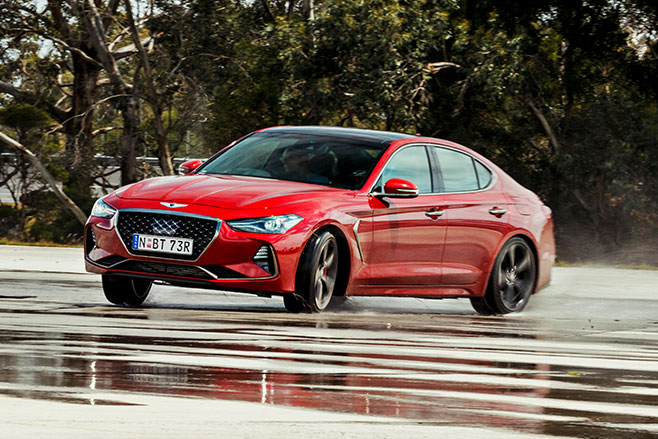
Last time I checked, this was not part of the COTY criteria, but the classic rear-drive dynamics inherent in the G70’s layout is a pointer to the broader character of the car, and in terms of driver involvement, that counts for plenty.
In other global markets, the G70 is offered with all-wheel drive, and while I haven’t driven the 3.3 in this layout, I’m not sure it would bring a whole lot of real-world benefit in Australia. It’d almost certainly curb some of the car’s enjoyable wriggly-bum charm, and then there’s the other fact that in the current rear-drive layout, the steering remains uncorrupted by torque flow, and retains the sole job of handling directional changes.
The other interesting thing COTY burped up was some directly comparable data for the G70 and BMW’s 340i xDrive, the latter surely a closer mechanical match-up for my G70 than the 330i we pitched against a 3.3T Sport (Wheels, Oct ’19) based on price proximity.
In terms of dry stopping from 100km/h, there’s barely anything between them: the BMW manages it with just a 20cm advantage (38.8m vs 39m). The German car is marginally quieter on coarse-chip, though: 71.2dB versus the G70’s 72dB.
So while the G70 didn’t land any meaningful scoring shots under the harsh glare of the COTY spotlight, it was telling that when the photographers wanted a couple of cars to get some slides on, it was the G70 and the Porsche 911 that were the natural choices. As the G70 was flung around the wet skid pan, full counter-steer lock applied and the rear Michelins creating their own micro climate of finely atomised spray, I had to resist the urge to cheer like a proud dad watching a favourite son plant a screamer in the back of the net.
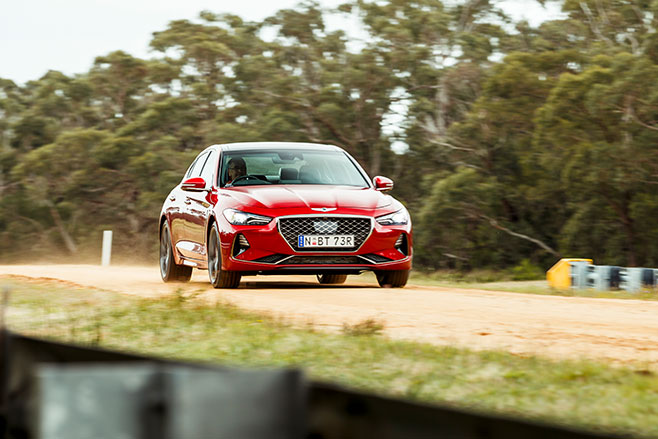
Did I mention that it does beaut skids?
Month 4: Pack Hacks
Sedan constraints mean getting loaded in the G70 isn’t as simple as it could be
This month: 624km @ 11.6L/100km
Ignore the automotive application of the term ‘parcel shelf’ and it sounds like a terrific thing; the place you come home to and find the courier has left you the cool stuff you forgot you ordered after a boozy night on eBay, like that Porsche 911 barbecue apron and the nose-hair trimmer.
But really, in a car, who puts anything on the parcel shelf? Unless you’re a Camry-owning Uber driver with a tissue box dressed up with a decorative doily back there, or you actively want to be hit in the back of the skull with a six-pack while under heavy braking, I’d say no-one.
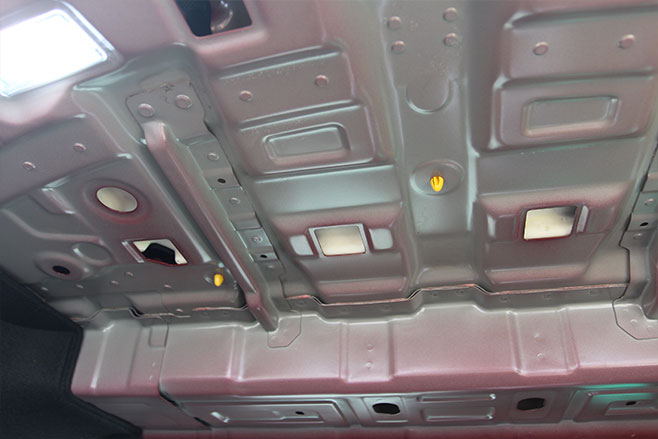
I’ll go a step further and declare the parcel shelf the work of Packaging Satan. It’s a mostly useless impediment to making full use of folding rear seats, sitting there virtually mocking you as you attempt to load and then later access large items in the boot.
At least, that’s how I’ve come to see the parcel shelf in the G70. Okay, it may justify its existence on the basis of structural rigidity and a place to house the rear audio speakers, but mostly it just sits there getting in the way.
I’m sure the Genesis product-planning gurus considered a sportback design at some point for the G70, but no doubt it was torpedoed by a clinic of Chinese customers who inexplicably think that a bootlid and fixed rear glass are automotive status symbols that show the world they’ve really made it.
Working as the parcel shelf’s evil offsider in this dastardly double-act is the G70’s small boot aperture. Recently I gave a friend a lift to the airport, and loading her full-sized suitcase required a technique usually reserved for a postman trying to stuff a parcel into a mailbox slot. First, get one end in, then shove, swear a little, then open the passenger door and drag the thing in over the folded rear-seat backrest. Similarly, transporting my bike requires removal of the front wheel, and even then, surgical precision is needed to find the specific angle at which the frame and seat post can clear the rear inner wheelarches.
But the real kicking came the weekend I needed to drive to the other side of Sydney to save a few hundred bucks on a discounted washing machine. My partner saw the transportational outcome of this a mile away, and lit up brightly as she tossed me the keys to her Honda HR-V, saying, “Oooh, cool; car-swap day!”
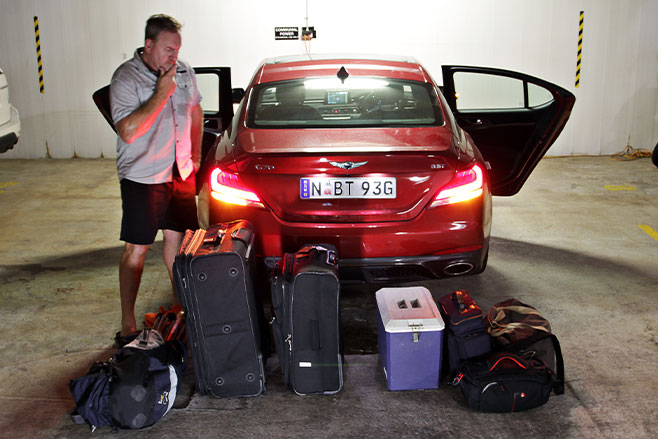
Here’s my final gripe (I promise)regarding packaging. Genesis wants to be taken seriously as a premium brand, and I think we can all agree that one key element to being perceived as ‘premium’ lies with attention to detail. A car needs to imbue that feeling that the designers have considered every small aspect of how you use the vehicle, and have ensured that mantra of ‘a place for everything, and everything in its place’ has been resolutely applied. So it’s disappointing – perplexing, actually – to first open the boot of the G70 and see that no specific cubby has been created for the first-aid and roadside-assistance kits, nor the warning triangle. All three appear as a complete afterthought, as if someone has gone, “Huh? I didn’t know we needed to include this stuff! Um, throw me the Velcro…”
Seriously, these items really are attached with that magical micro hook-and-loop fastening system that adheres them to the boot carpet, meaning they sit right in the spot where you may want to load, I dunno, a suitcase or a bicycle…
Cool it, pal: G70’s remote HVAC settings
After a bit of faffing around with the registration process, I now have the G70 synched to the Genesis Connected Services app on my phone, and had a chance to assess its usefulness. Most handy for me is the remote start and ‘cabin condition’ function.
When the car has been parked in the summer sun, the ability to hit the Engine Start button on the screen, and automatically set the HVAC to full Arctic Chill mode for five minutes before I actually return to the car, is great for making me (marginally) less sweaty than James Brown’s jockstrap. Just a shame the G70’s black dash acts as a major heat sink, and takes so long to cool after the car has been parked in the sun.
Month 5: Let’s sweat the details
Small stuff counts at the big end of town
This month: 1345km @ 11.4L/100km
In what was an unsettling epiphany recently, I was alerted by a reader’s letter to the possibility that some of you are not nearly as fascinated by the minutiae of my motoring life as I am. You come to this section for car facts, dammit. Lots of pithy, irrefutable facts.
So, as I pointed the G70 west towards Bathurst for a media event at Mount Panorama recently, I made a vow: I would concentrate on nothing but the finer details of the Genesis owner/driver experience, and leave out all the fascinating bits about dogs, girlfriends, bicycles and ’90s rock.
Let’s start with the radar cruise. It’s mostly very good, and holds the prescribed speed within a couple of km/h even in hilly terrain. If I was calibrating it, I’d make the acceleration phase a bit quicker once a slower car in front has moved aside, but overall it’s supremely intuitive to set, adjusts in single-kay increments, and works about as well as you could reasonably expect from a camera and binary code.
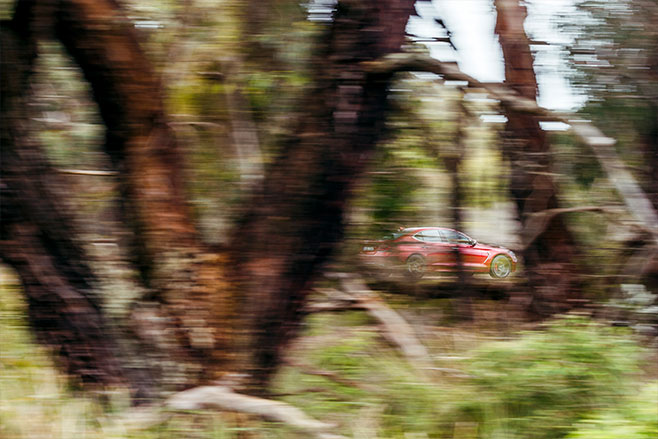
I’m less enamoured with the lane-keep assist though. For starters, it’s not infallible, and I do what I do with every car: automatically hit the button to disable it, because phantom tugging at the wheel to admonish me creeps me out.
Let’s talk cabin liveability. The fundamentals of seat comfort, driving position, visibility, instrument clarity and HUD are all great. I’m less crazy about the too-small bottleholders in the front doors, while the centre console box is adequate, not generous. Overall, the cabin design feels utterly conventional, and leaves plenty of room for a bit more thoughtfulness and design flair in further iterations.
Of the five drive modes, I really only use two: Comfort, for 90 percent of my driving; and Custom, into which I’ve mapped the firm damper setting, aggressive engine and trans calibration, but retained the lighter, more nuanced steering weight.
That leaves me wishing for a manual hold mode for the transmission, which only retains a paddle-selected gear for 20 or so seconds.
Then there’s the aural performance in Sports mode. It’s pleasant, but just too tame. Given Comfort is so hushed and refined, surely there’s scope to calibrate Sports mode for louder, more invigorating aural fireworks?
Okay, now I’m nit-picking. To slap myself out of it, I rolled onto the Mount Panorama circuit as a soft twilight embraced the mountain, disabled the ESC and had a few runs up and down from Skyline to the Elbow. Oooh yeah.
Details count for plenty, but they lose relevance if the fundamentals don’t shine. The G70 has got this side of its game well sorted.
Month 6: That’s a rap
Far from perfect, but deeply likeable G70 leaves its mark as a pivot point for Korea
This month: 1345km @ 11.4L/100km
Overall: 4756km @ 11.7L/100km
My local barista Ricky rates himself as a bit of a car guy, and relishes the fact that his cafe’s service window faces out onto a quiet street that sees a diverse and often interesting range of metal pulling up as owners arrive for their fix.
“So what’s Genius like, then?” he asked a while ago as he brewed my double shot. We had a slightly awkward moment as I had to point out that it’s Genesis, and explain that the G70 is part of Hyundai’s premium brand. I also had to add that if it had been called a Genius, that would have been stretching the truth just a fraction.
But I’m unsure if Ricky’s lack of brand awareness is a symptom of Genesis not doing enough to promote itself in Australia, or just that he’s not as much of a car guy as he thinks he is. I suspect it’s the former, because very few people who took a passing interest in the car during my six-month tenure knew what it was, where it came from, or what segment it was targeting.
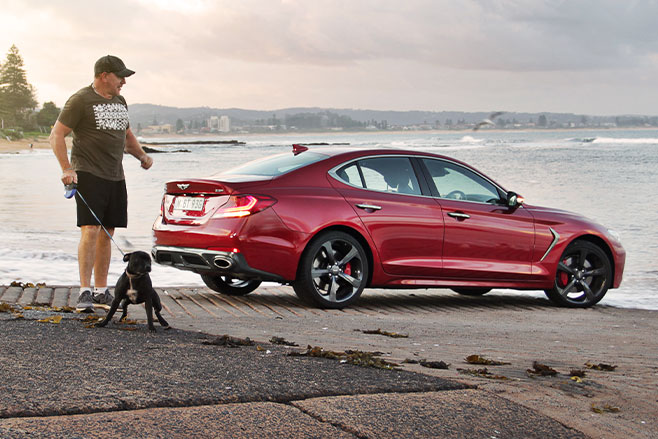
Perhaps even more concerning, from Genesis’s point of view, is how little attention the car attracted generally. Is the styling not sufficiently distinctive? Or is it largely invisible to Aussies because it’s not an SUV or an EV?
Personally, it was both those facts that endeared me to the G70. As much as we talk about modern SUVs driving as adroitly as high-riding hot hatches, the truth is they just don’t deliver the flat, pointy, responsive handling that comes with the lower CoG of a well-sorted sedan (or wagon). It was this dynamic engagement that made the G70 so satisfying on every drive, whether just touring around or having a bit of a back-road blast.
Yes, the downside is the slightly more cumbersome entry and egress, as well as the extra care needed over deep gutters and some speed humps. And I’ve already moaned enough about the compromised packaging of a small-booted sedan compared to the cargo-friendly attributes we take for granted in a mid-size SUV. But I was able to overlook these issues every time an opportunity presented itself to lean on that eager, grippy front end, enjoy the slick steering, the fine roll control, and the brilliant power-down from the LSD-equipped rear end.
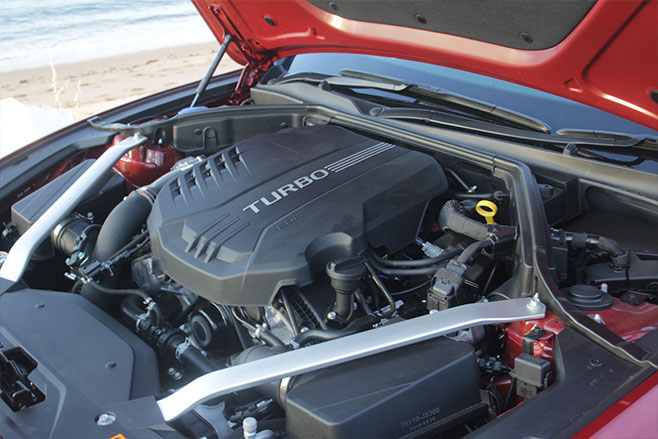
As for the powertrain, there was never a moment where I felt the extra expense of the twin-turbo V6 over the 2.0-litre turbo four was an unnecessary indulgence. The premium is a bit over $10K, depending on which of the three spec levels you choose, so easy for me to say when it’s not my money, right? You may also opine, “Oh, with such draconian speeding laws, there’s no point; when would I be able to use the extra power?”
But to use an audio expression, it’s all about ‘headroom’ – you don’t buy a 500-watt amplifier because you want to listen to music at ear-bleed volumes, you buy it because of the smooth, effortless way it reproduces sound at normal listening levels. The G70 is a perfect automotive example of this: I reckon I had the thing pegged up against the limiter for 60 seconds or so in the entire time I had it, but the grunty, effortless shove was something I appreciated on every drive. Never underestimate how enjoyable it is to feel a strong engine whipping you along at only middling revs, minimal NVH, and zero mechanical stress.
It does like a drink, though – my overall of 11.7L/100km was 15 percent above the official combined figure of 10.2. The transmission features a decoupling ‘coasting’ function, but that’s it for dedicated efficiency measures, so ample room for improvement.
Which sums up a few other areas of the G70. In many ways, this feels like a ‘nearly there’ effort, where the final layer of polish and detail – like multimedia, touch points and interior design flourish – have been overlooked.
For conclusive proof of this, just take a close look at the presentation of the GX80 SUV due late this year. This, folks, will be the model that will really establish Genesis as a bona fide player, and grab your (and Ricky’s) attention.
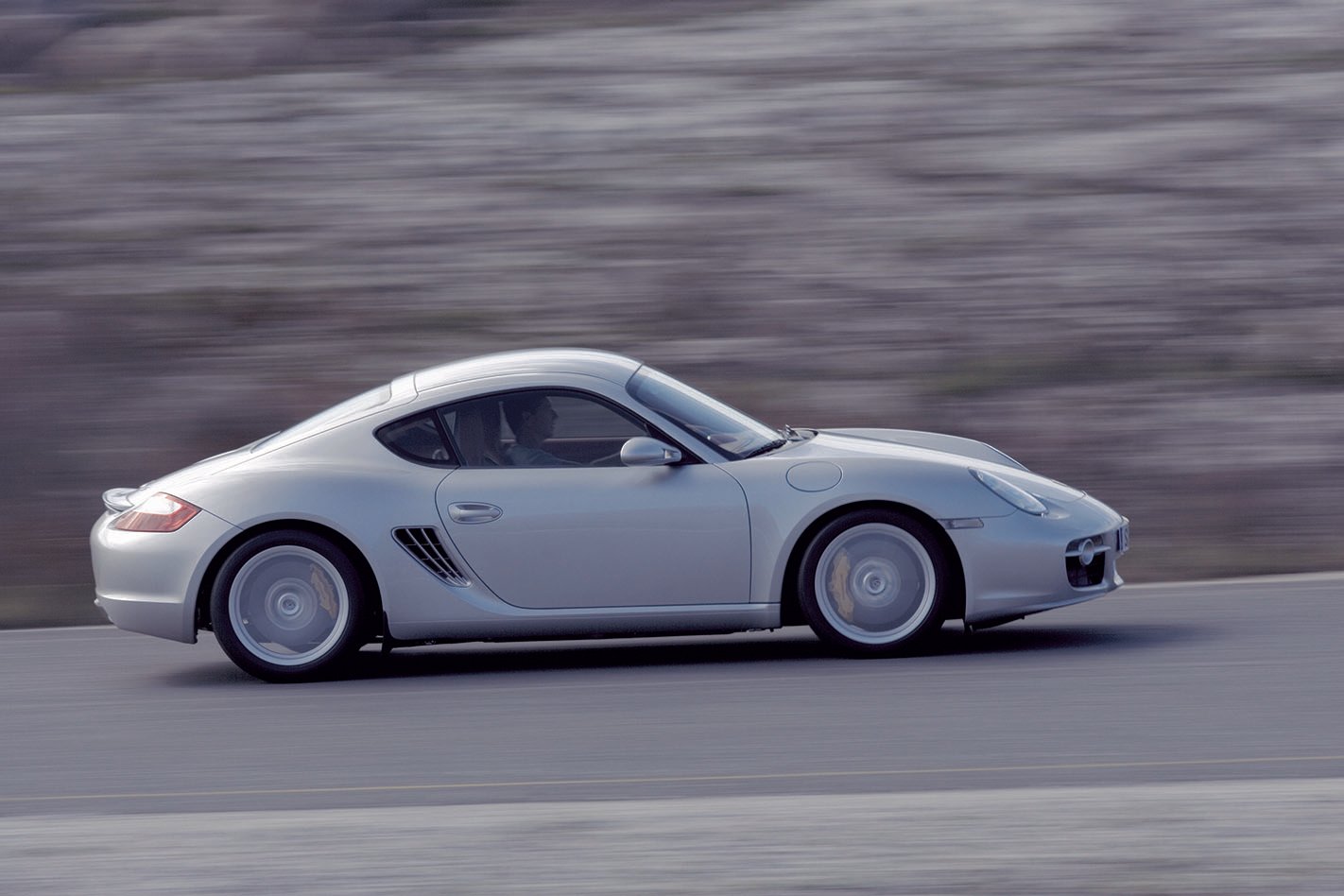
Pick almost any used performance car and they tend to scribe a U-shaped line of desirability as they age. Some dip deeper than others, others tease that temporal nadir fore and aft a little. Porsche’s 987 Cayman is a case in point. When the 217kW/340Nm 3.4-litre Cayman S first arrived in Australia, back in March 2006, it seemed like Zuffenhausen’s magic bullet, faster around a circuit than a 997 Carrera and more focused than the 3.2-litre Boxster, which ceded 11kW and 20Nm to its hard-top sibling.
Of course, Porsche wasn’t shy in positioning the newcomer as a more serious driver’s car than the Boxster and pricing it accordingly, adding $16K to the price of the Boxster S for the privilege and, in the process, bucking the convention that convertibles are a price-plus version of a coupe. That wasn’t to last – the 718 generation finally saw Porsche come clean on that score.
A 180kW/273Nm 2.7-litre base Cayman was subsequently introduced in February 2007, priced from $118,000. This, in turn, was replaced by the 195kW/300Nm 2.9-litre lump in a June 2009 facelift. At the same time, the 3.4-litre engine gained direct injection to help lift it to 235kW/370Nm. The old Tiptronic S auto transmission was swapped for the six-speed double-clutch PDK ’box and a limited slip diff was introduced as a factory option. The problematic intermediate main shaft (IMS) bearing design was also redesigned.
Australia never received the limited-run Cayman S Sport or the 777-unit Design Edition 1 that were offered in some right-hand drive markets in 2008, but we did get the swansong for the 987c program, the lovely 243kW/370Nm Cayman R of 2011 complete with aerokit, 19-inch wheels shared with the Boxster Spyder, a 54.8kg strip-out and a passive suspension setup that was 10mm lower than a Cayman S with Porsche’s Active Suspension Management (PASM). Only 500 were ever built and they’re still in very strong demand.
By the time it was due to be replaced in 2012, the Cayman had enjoyed a six-year innings and had burnished its reputation as one of the finest-handling cars Porsche had ever built. Thing is, it wasn’t the most robust car to ever wear the Porsche crest yet its cachet is on the rise again. Here’s how to bag a good ’un.
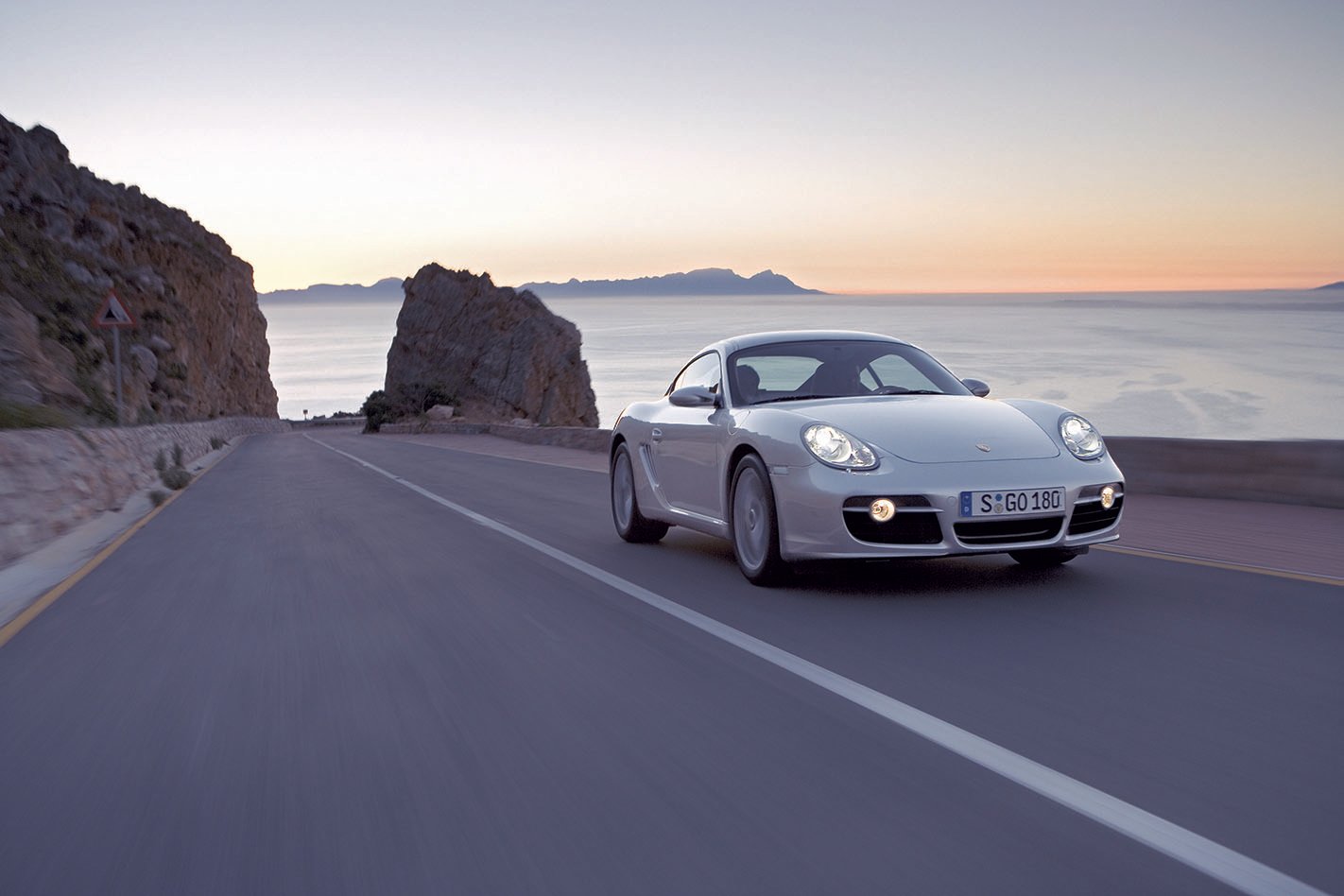
IN THE MARKET FOR A PORSCHE 987 CAYMAN?
Sales of the 987 Cayman were never as strong as the equivalent Boxster, the soft-topped car outselling it globally by around three to one, largely on account of the Cayman’s then-divisive styling and the fact it cost more than the roadster. However, the usual adage of ‘when the top goes down, the price goes up’ never really applied to the Cayman. Its relative rarity means that a Cayman S is typically worth around 15 per cent more than the equivalent Boxster.
Manual cars were initially trading lower than automatic/PDK models but that trend has reversed in recent years as vehicles with three pedals have seen demand spike.
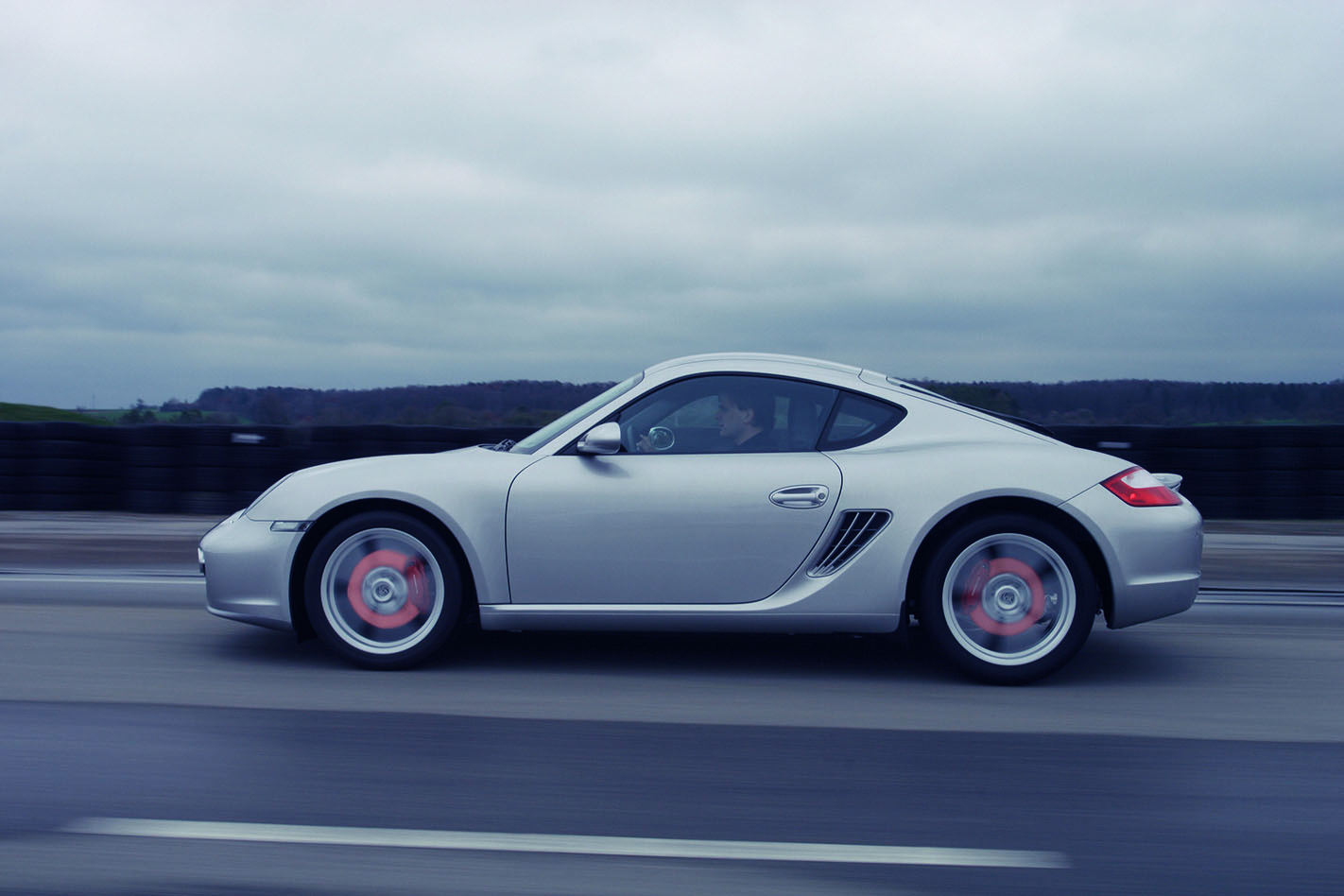
PORSCHE 987 CAYMAN BODY & CHASSIS
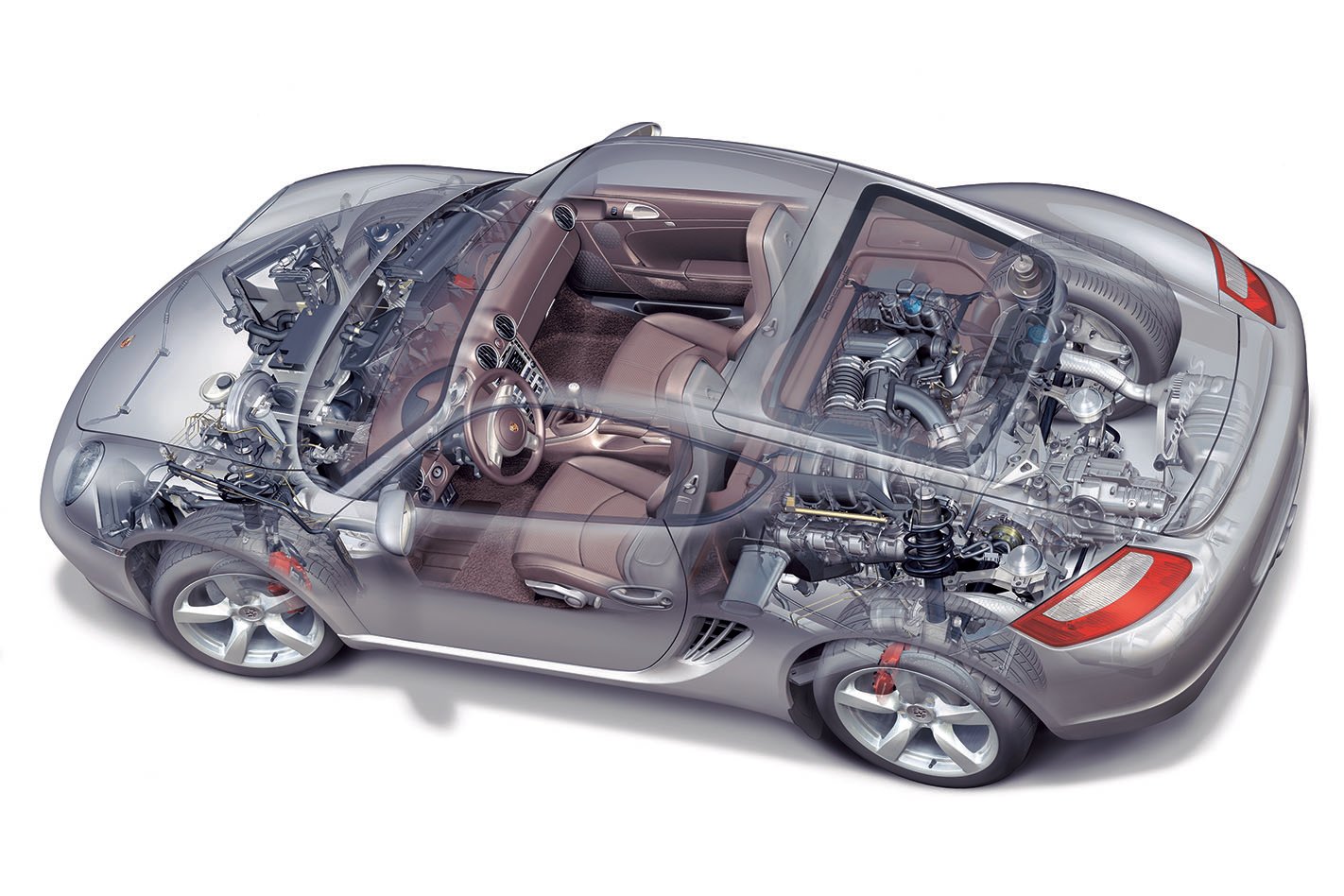
The Cayman body is primarily steel, with aluminium panels used for the bonnet and doors, so check these panels for dents. The rear hatch is notorious for rattling, especially on the Finnish Valmet-built cars. There’s also a plastic panel behind the tail lights that can vibrate and owners have reported that fitting a piece of foam to this rectifies this issue. Another ‘home fix’ popular with 987 buyers is a set of grilles fitted to the front intakes which prevents wet road detritus sitting on the radiators, which retails at more than $1000 per side. The paintwork on the 987 is typically good, so any poor quality paint finishes are often a sign of accident repair.
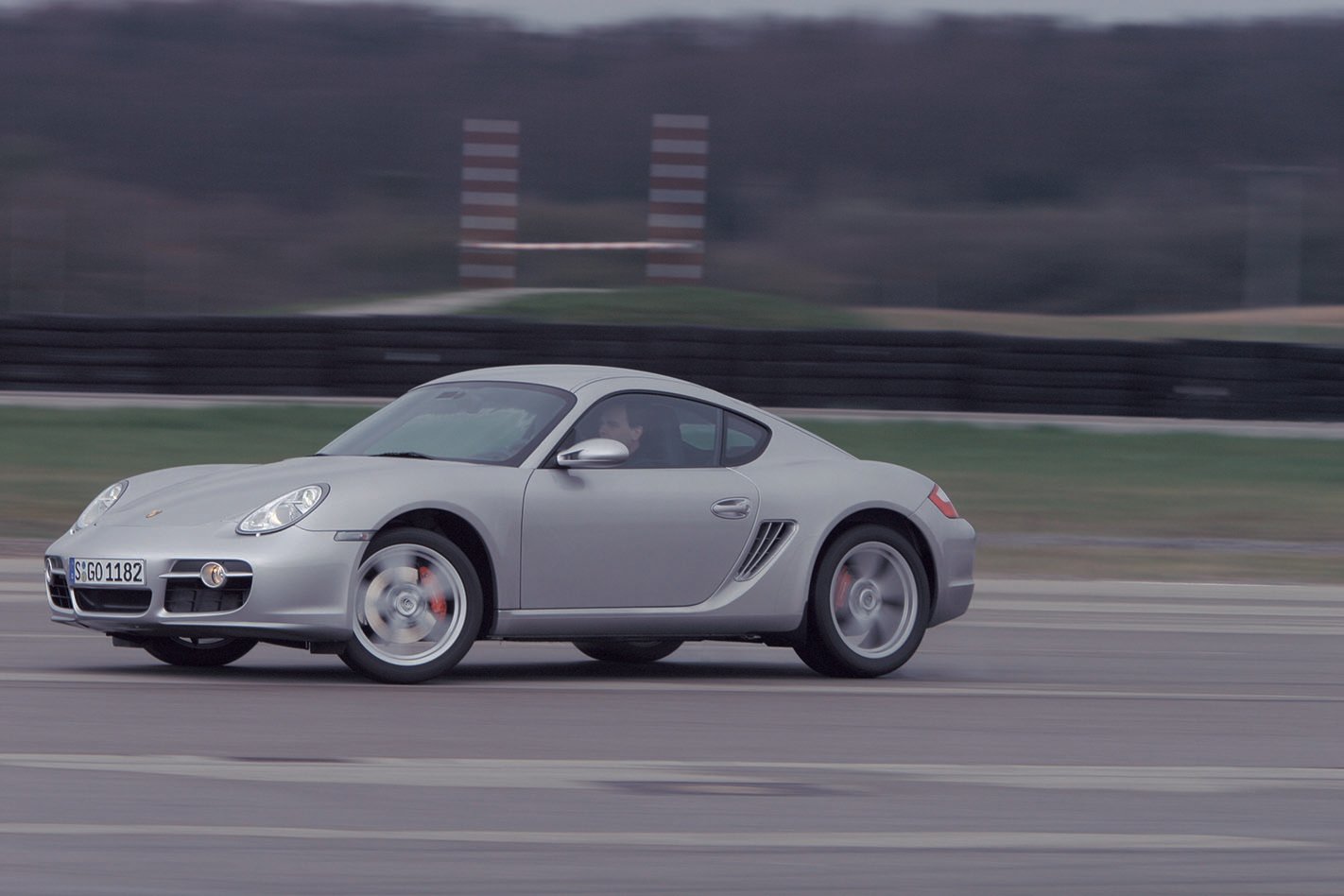
PORSCHE 987 CAYMAN ENGINE & TRANSMISSION
So what of the big three issues that affect the M96/M97 family of engines? Cylinder bore scoring is a relatively rare issue on Caymans, typically affecting the 3.4-litre engine more than the smaller units, so look for persistent white smoke after start up or a tapping from one side of the engine. The intermediate main bearing (IMS) was strengthened by Porsche in 2005 and completely redesigned for the Cayman facelift, so it’s far less of an issue than in early Boxsters. The third gremlin, the rear main seal (RMS), can weep oil and, in the worst cases, contaminate the clutch friction plate. Also check for ignition coils and spark plugs. Because the front-left plug is so hard to reach, many Caymans will still have an ancient OE-fit item down there.
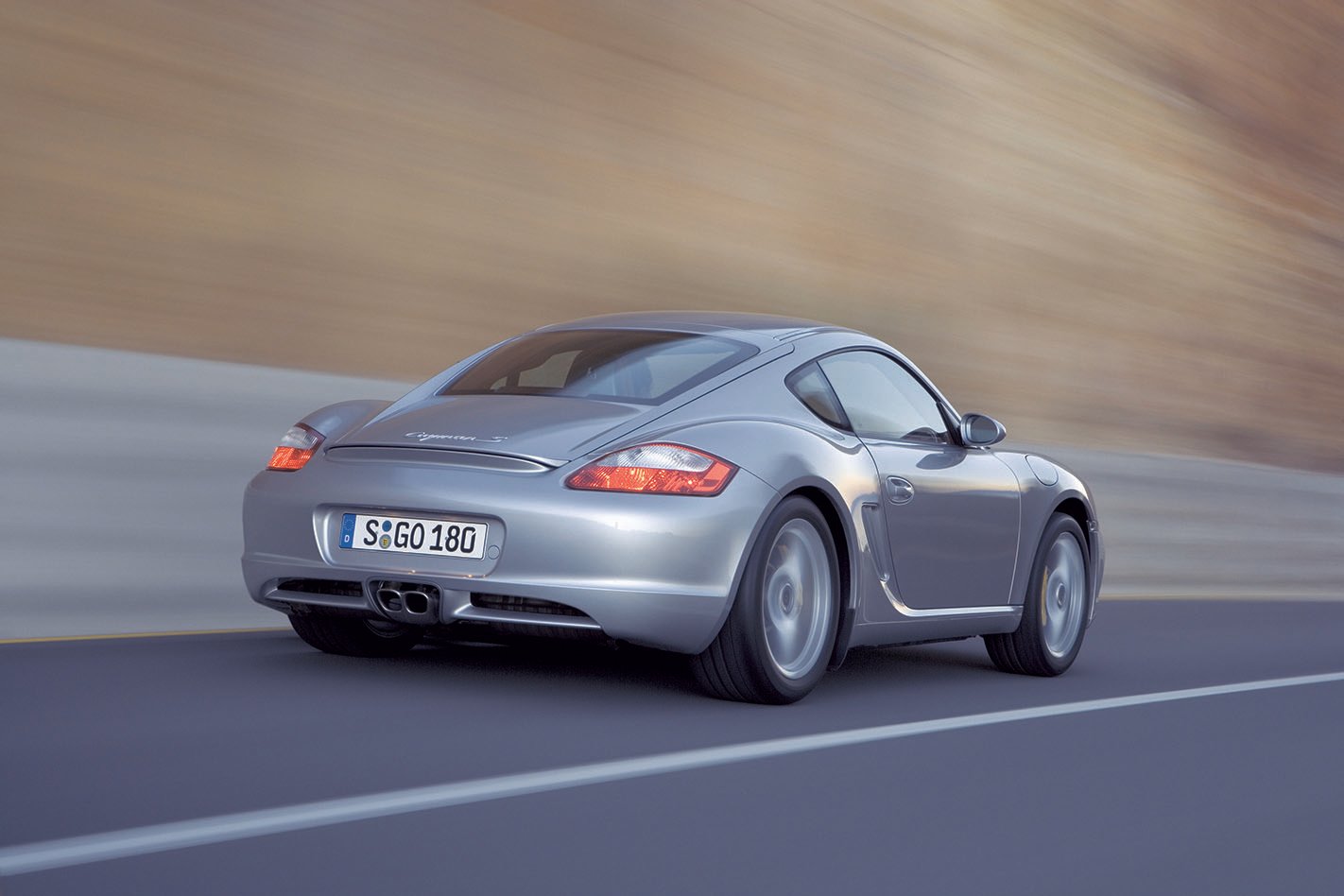
PORSCHE 987 CAYMAN SUSPENSION & BRAKES
Cayman suspension tends to be fairly sturdy, but anything rubber will degrade over time. Fitting the beefier track-rod ends from the second-gen cars is a popular 987 mod. Steering pumps can overheat if you’re giving the car a real workout on track. Brake performance is decent, from both Cayman and S. The former got 298mm front vented discs and 288mm rears, while the S featured the bigger 318mm front rotors, 299mm rear units and red-painted calipers. Carbon ceramic brakes were a very rare option take-up given that they represented 20 per cent of the price of an S alone, but last well if they’re not subjected to circuit use.
PORSCHE 987 CAYMAN INTERIOR & ELECTRICS
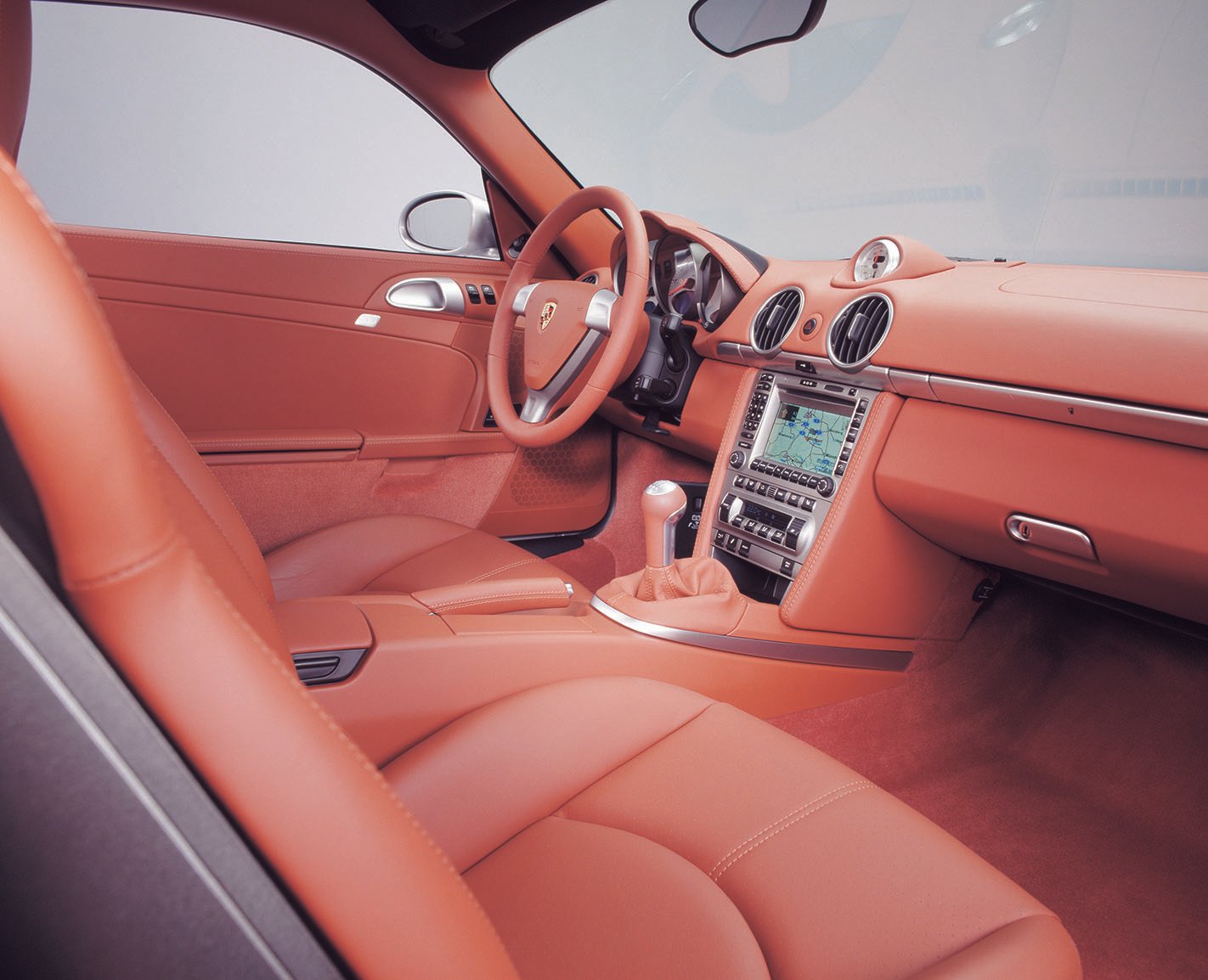
The minor controls can wear, especially frequent-use items such as the air conditioning switches. Check that the air-con works, as condensers often go on the fritz. Water ingress around the side window seals is also a recurrent complaint. Check seat bolsters for damage. Facelift models also got much better looking steering wheel designs.
OTHER OPTIONS YOU MAY CONSIDER
1. BMW Z4 M COUPE
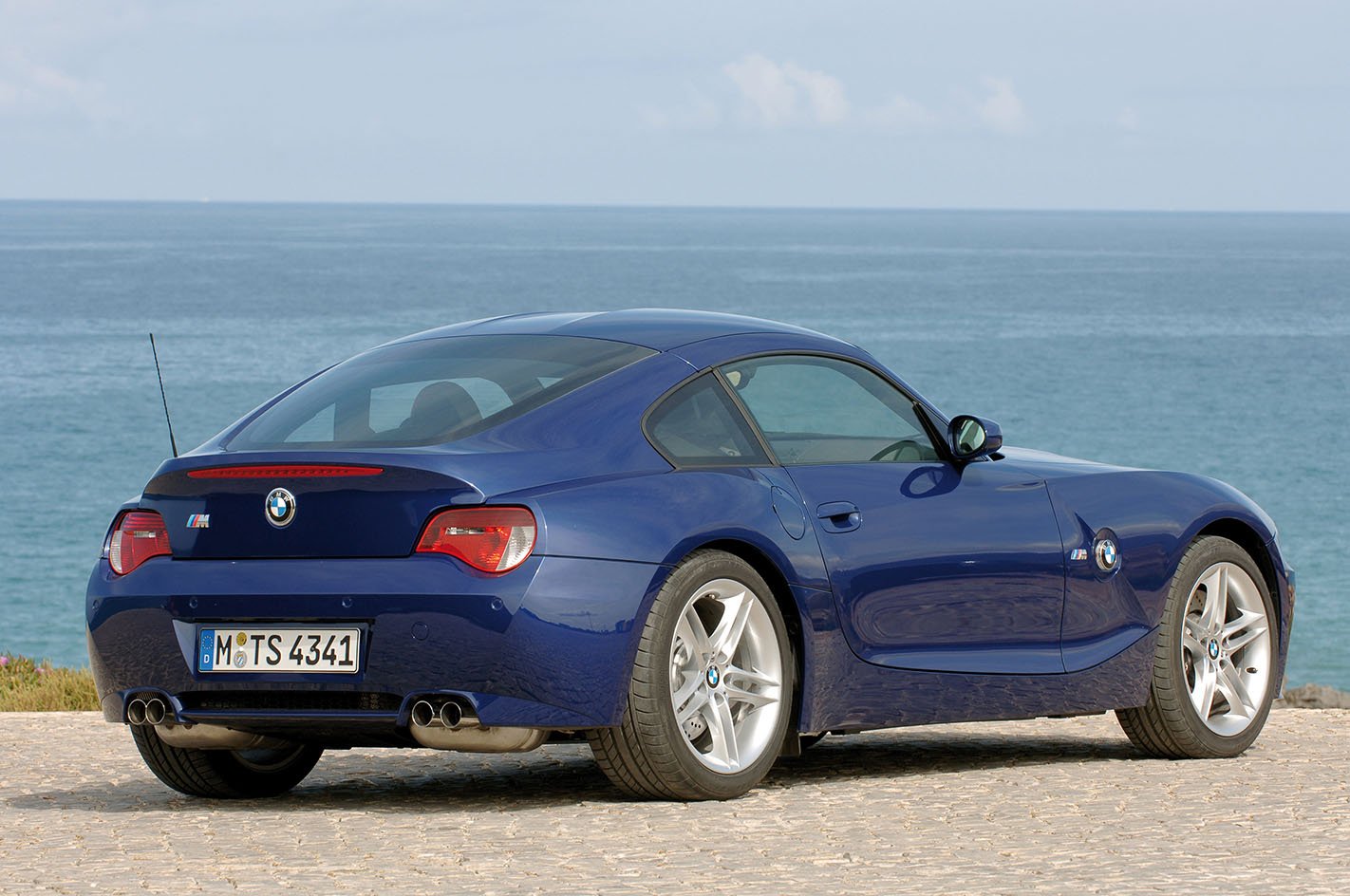
A bit more of a hot rod feel thanks to your fundament seemingly parked on the rear axle, but certainly no less exciting than a 987. Was forever overshadowed by its Z3M predecessor, but make no mistake, the Z4 is a better car. Getting hard to find $50K cars now.
2. NISSAN 370Z
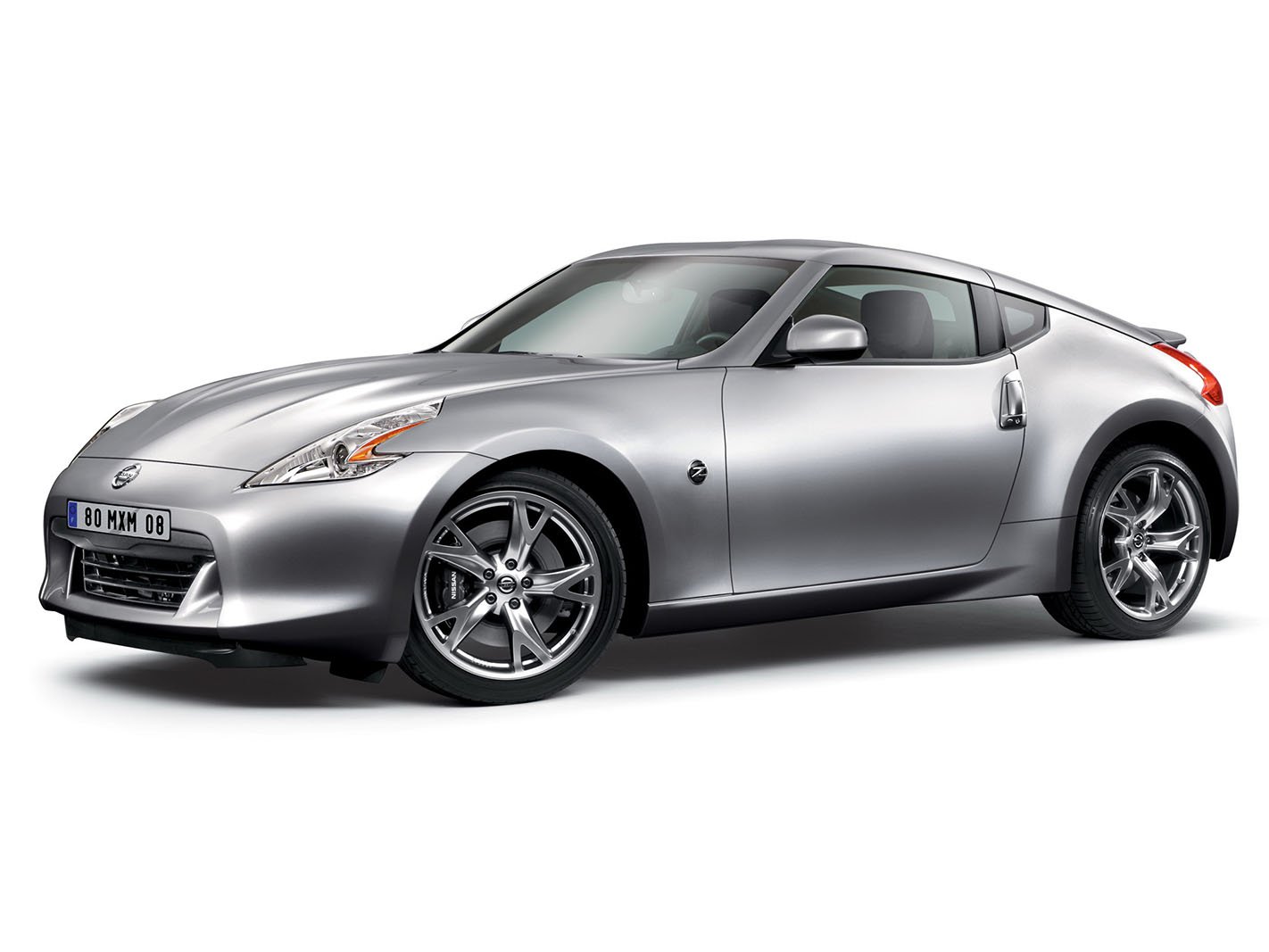
It seems to have been going longer than the Stones yet we still love the big-hearted Nissan. Feels heavy next to the lithe Cayman, but it’s hard to ignore the VFM. For the price of a scruffy ‘07 Cayman S, you could nab a mint, low mileage 370Z a decade younger.
3. FORD MUSTANG GT
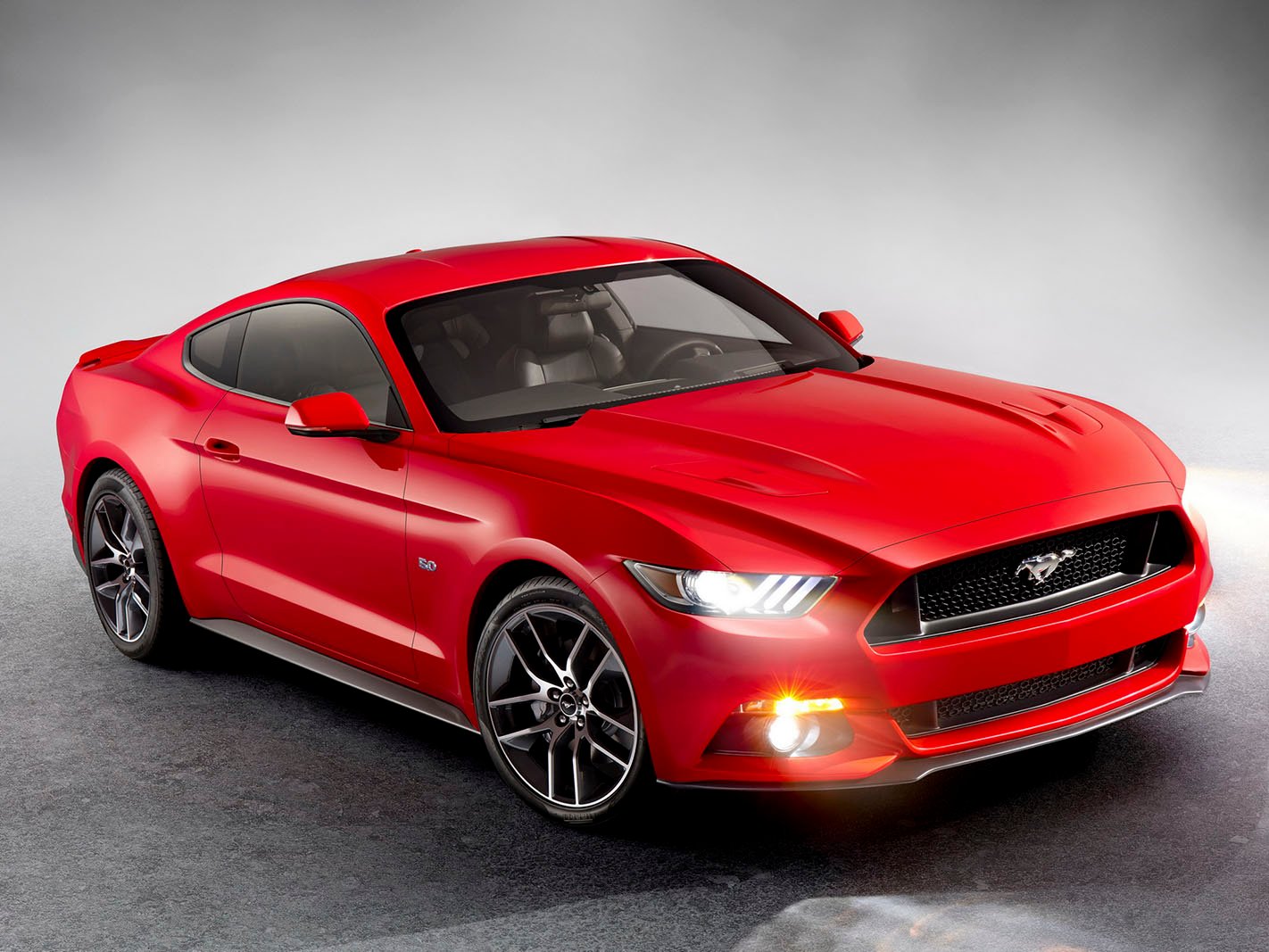
A different take on the quick coupe, but a 2017 Mustang GT will set you back around $45K and delivers plenty of poke. It won’t stay with a Cayman in the twisties but life is sometimes more about the size of your grin than the cold science of peak apex speeds.
PORSCHE 987.1 CAYMAN S SPECS
Body: 2-door, 2-seat coupe
Engine: 3436cc flat-six, DOHC, 32v
Power: 217kW @ 6250rpm
Torque: 347Nm @ 4200rpm
Transmission: 6-speed manual / 5-speed tiptronic auto
Weight: 1370kg
Used range: $45,000-$55,000
Japanese brands have dominated the latest Consumer Reports vehicle reliability survey in the United States, taking out the podium places in estimating a car’s likelihood of experiencing problems.
The influential study by the non-profit organisation includes responses from 329,000 of its members and looks at makes and models sold in the US, not all of which are available or relevant to Australia, with many sourced from different factories to the same models sold here.
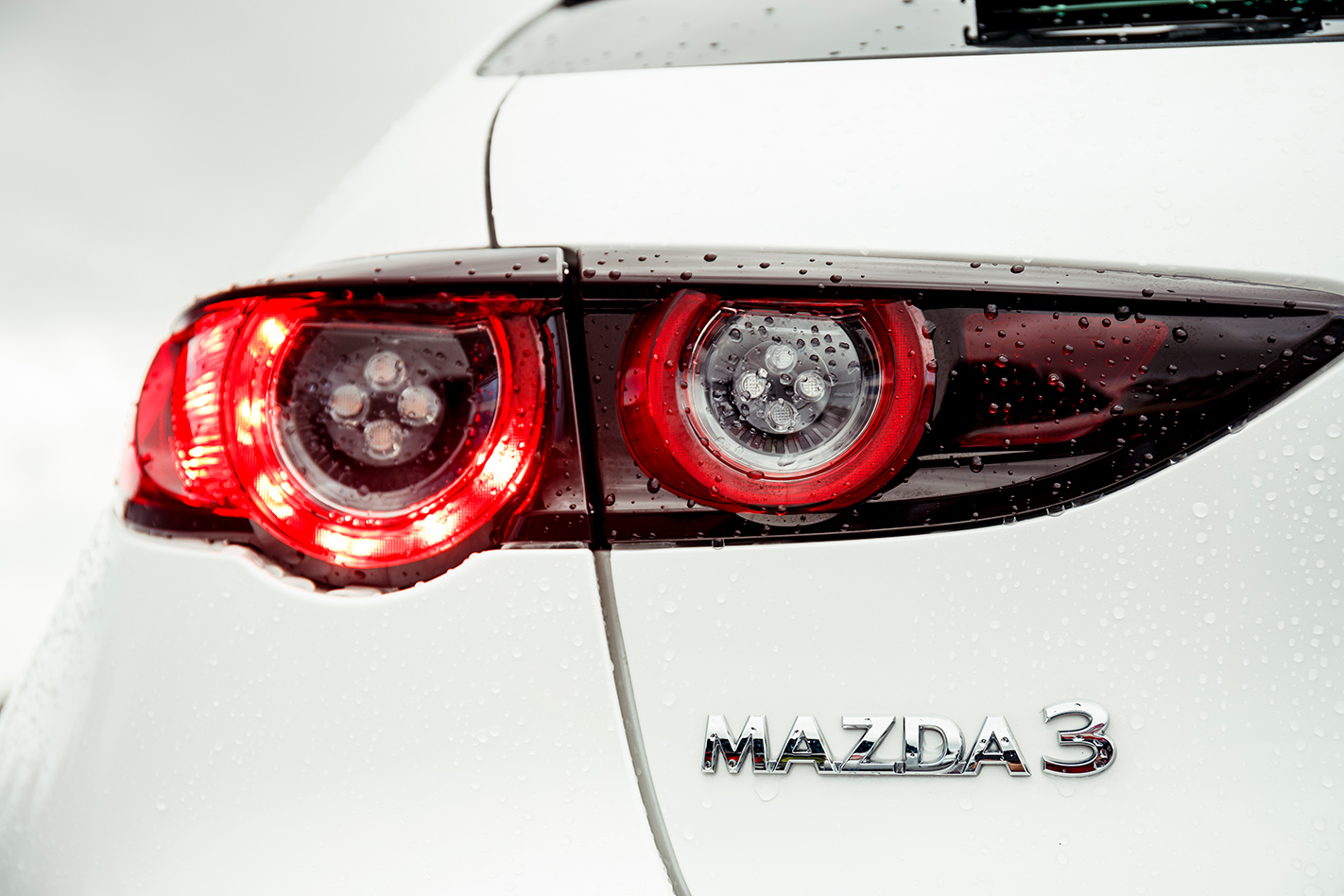
The 2020 Consumer Reports Auto Reliability Surveys ranked Mazda as the number one brand, pipping third-placed Lexus, which often dominates independent quality surveys.
While CR praised Mazda’s relatively simple model range, it pointed to “ongoing problems” with the Lexus LS limousine, something that hurt the otherwise “outstanding” vehicles from the luxury brand.
The senior director of auto testing at Consumer Reports, Jake Fisher, said the reliability rankings were designed to help owners predict how reliable their next new car will be.
“A car might be great to drive and have all the features you want, but all that won’t matter to you much if you have to keep going back to the dealer for repairs,” said Fisher.
Lexus parent company Toyota finished in second, with CR pointing to ongoing issues with the RAV4’s reliability as a rare blip on an otherwise reliable lineup.
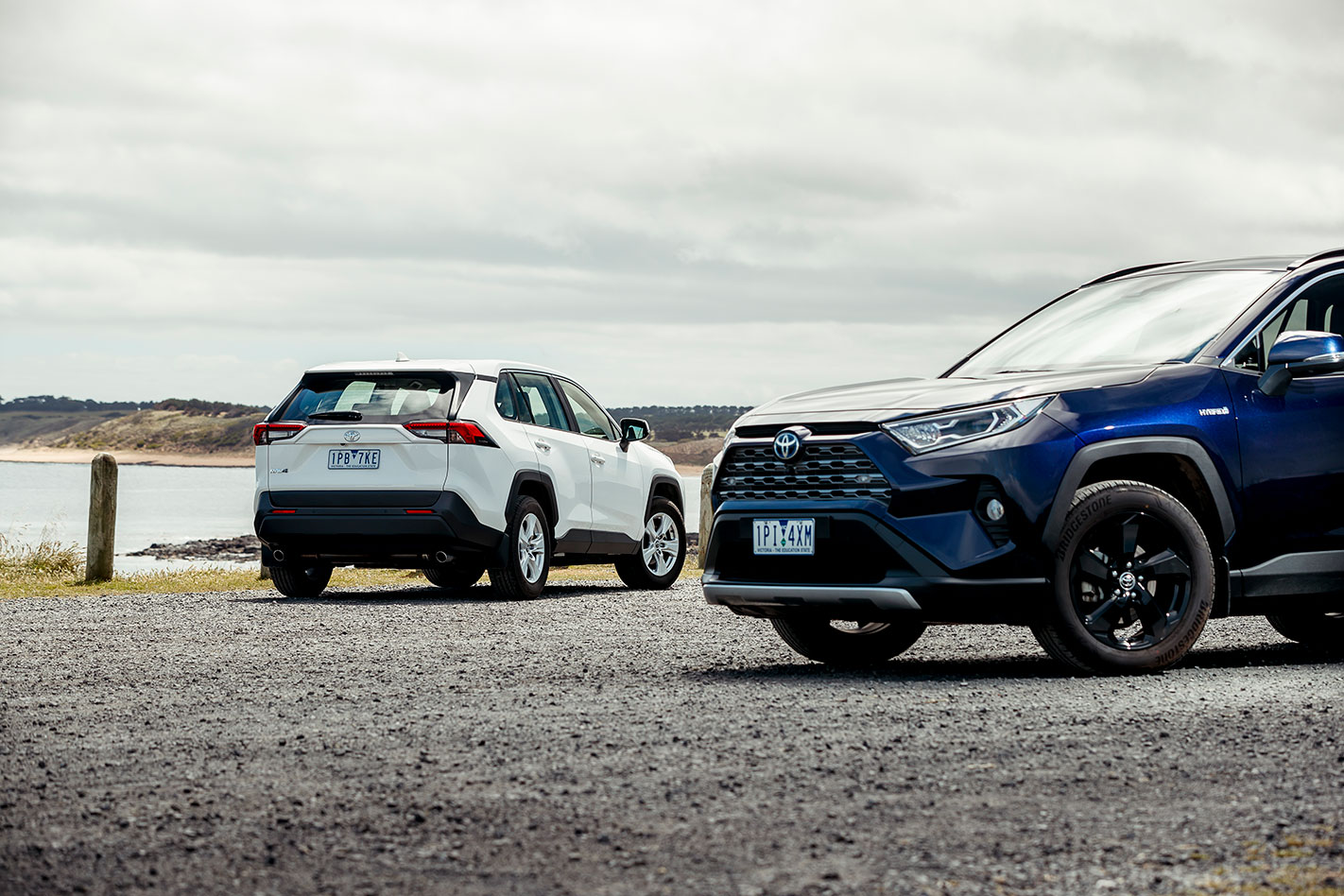
Despite dominating the brand rankings, Mazda only had one car – the CX-5 – sneak into the list of the top 10 most reliable cars, outdone by the Toyota Prius, Lexus NX, Buick Encore (which is similar to the Holden Trax), Lexus GX (similar to the Toyota Prado), Honda HR-V, Hyundai Kona, Audi A5 and Audi A4.
But due to extensive component sharing across the lineup Consumer Reports predicted “all Mazdas will have above-average reliability”.
As the other end of the list that ranked 26 brands was Ford’s luxury offshoot Lincoln, which was penalised because its “historically reliable sedans” are no longer on sale and the newer SUVs had reports of various problems.
Second last was Tesla, a brand that polarises with its infotainment and electric technology but one that has long struggled with quality.
The popular Model 3 was ranked as Tesla’s most reliable model but the upcoming Model Y SUV (above) that is shared so many components with was deemed to have “build quality issues with body hardware and paint, and some drive system failures”.
Mercedes-Benz was also singled out for its GLE SUV, described as “one of the least reliable models in our surveys, with drive system failures, emission sensor issues, power equipment problems, and in-car electronics headaches”.
Luxury rival Audi had its A4 and A5 rated as having “outstanding reliability”, although the recently-arrived Q8 SUV and all-electric e-Tron were “much worse than average”.
The e-Tron was indicative of sub-par results for many electric models, including the Kia Niro EV and Tesla Model Y.
However, simpler and more affordable EVs were less problematic, according to Consumer Reports, which said it was typically not the electric drive systems causing dramas for EV owners.
The Chevrolet Bolt was “one of Chevrolet’s most reliable models”, something tempered by the Chevrolet Silverado being ranked as the least reliable vehicle, with the Colorado joining it in the list of the 10 least reliable vehicles ranked.
Consumer Reports said new tech and new architectures could cause issues early in a car’s life.
“There are plenty of new cars that have reliability problems because they’re using a new transmission, infotainment system, or other unproven component,” said Fisher. “In most cases, it takes a little time to get everything straightened out, as anyone who has ever bought the first version of a car knows.”
While the 2020 Consumer Reports Auto Surveys covered 26 brands, many others were not ranked, including Alfa Romeo, Jaguar and Land Rover, because Consumer Reports said it did not have sufficient data.
Other relatively new arrivals, including the Mercedes-Benz EQC and Porsche Taycan, were also not ranked because of a lack of data.
2020 Consumer Reports most reliable major automotive brands
| 1 | Mazda |
| 2 | Toyota |
| 3 | Lexus |
| 4 | Buick |
| 5 | Honda |
| 6 | Hyundai |
| 7 | Ram trucks |
| 8 | Subaru |
| 9 | Porsche |
| 10 | Dodge |
| 11 | Infiniti |
| 12 | BMW |
| 13 | Nissan |
| 14 | Audi |
| 15 | Kia |
| 16 | GMC |
| 17 | Chevrolet |
| 18 | Volvo |
| 19 | Jeep |
| 20 | Mercedes-Benz |
| 21 | Cadillac |
| 22 | Ford |
| 23 | Mini |
| 24 | Volkswagen |
| 25 | Tesla |
| 26 | Lincoln |
TURBO. GT3. RS. These nameplates have earmarked the ultimate Porsche in a model range for decades.
But as well as promising otherworldly thrust or nerve-tingling engine revs, these iconic badges have also shadowed the Gran Turismo Sport’s renown.
STOP! Subscribe right now to the planet’s best performance mag by clicking HERE!
While the first GTS appeared with the Porsche 904 Carrera in 1963, then the front-engine 924 and 928 later on, it wasn’t until the Cayenne GTS in 2008 that the badge began to nestle itself permanently each model line-up.
What is the Porsche Macan GTS?
Slowly the GTS has shown it’s designed to be the best of the rest, integrating select bits from either GT or Turbo variants into the regular car without spoiling the brand’s renowned on-road manners.
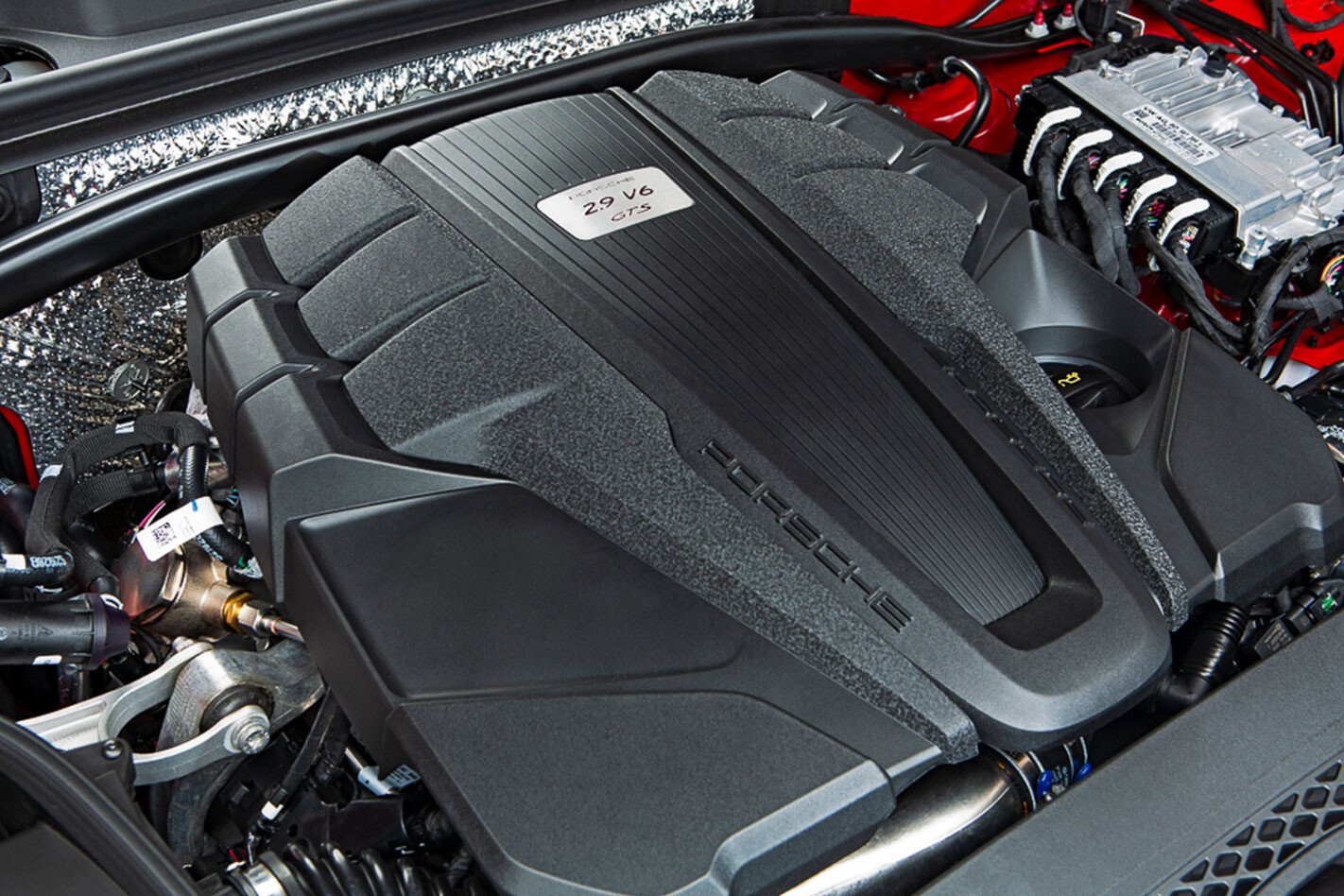
This rings true under new Macan GTS’s bonnet. Unlike the entry-level model’s weedy four-cylinder engine or even the 3.0-litre S, the GTS borrows the Turbo’s 2.9-litre twin-turbo V6.
It’s the same unit that first debuted in the Audi RS4 and then the Porsche Panamera, but outputs are detuned from 324kW/550Nm in the Macan Turbo to 280kW/520Nm, an 18 per cent drop in power and five per cent fall in torque.
This translates to a 0-100km/h claim of 4.7sec when optioned with the $2390 Sport Chrono package that adds launch control to the car’s seven-speed PDK transmission.
What’s it like to drive?
And while that is four-tenths behind the manic Turbo on a stopwatch, unleashing the GTS is still an eye-widening experience.
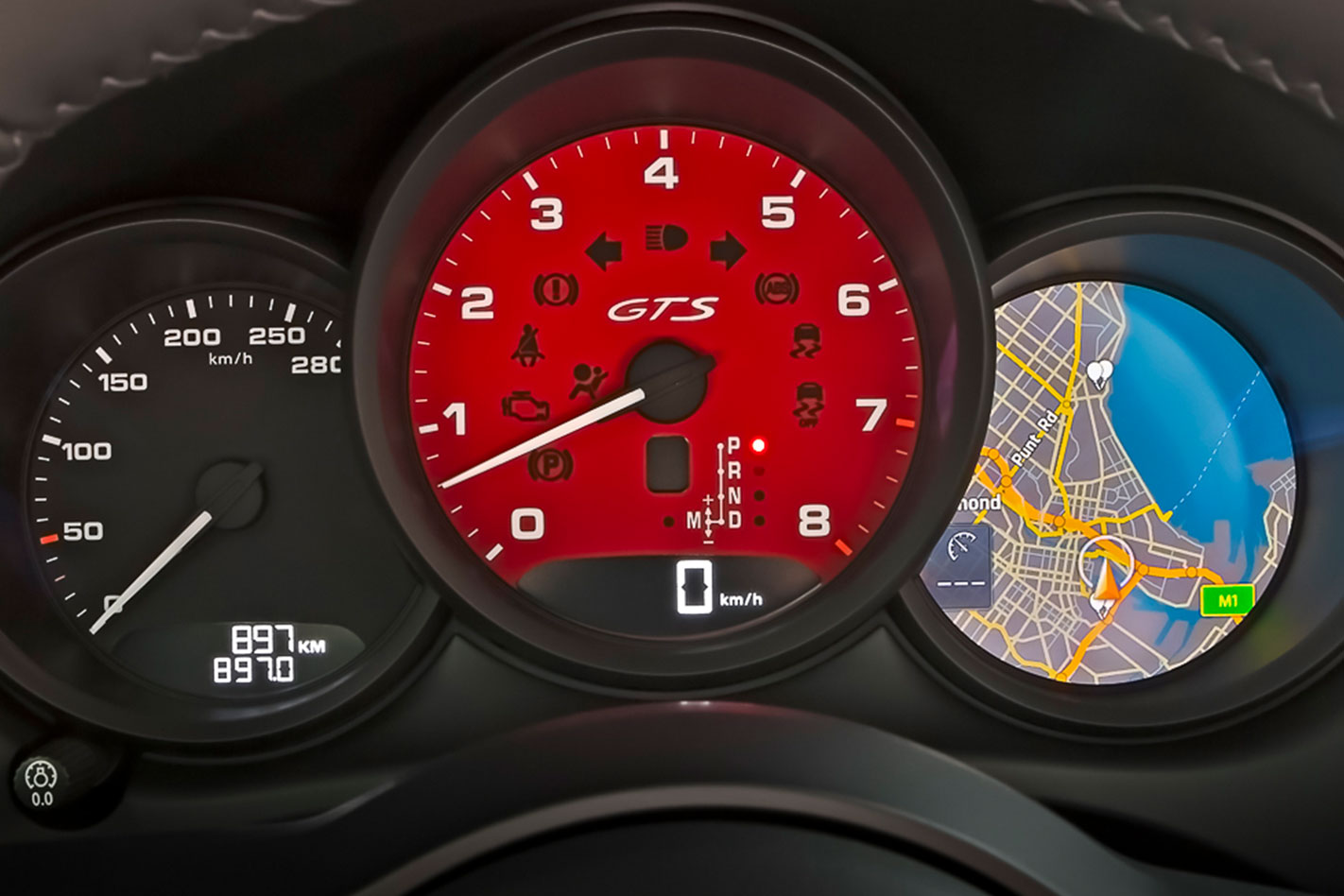
But the Macan GTS responds to the road with more enthusiasm than a Macan S when you’re up to speed. Standard-fit adaptive damping lowers the GTS 15mm on unique 20-inch RS Spyder wheels that carry a surprising amount of tyre profile – despite their diameter.
Our GTS adds $3100 air suspension and scores a sophisticated ride quality in return. Its multi-mode damping offering varying degrees of comfort to pair with a firm secondary ride setup.
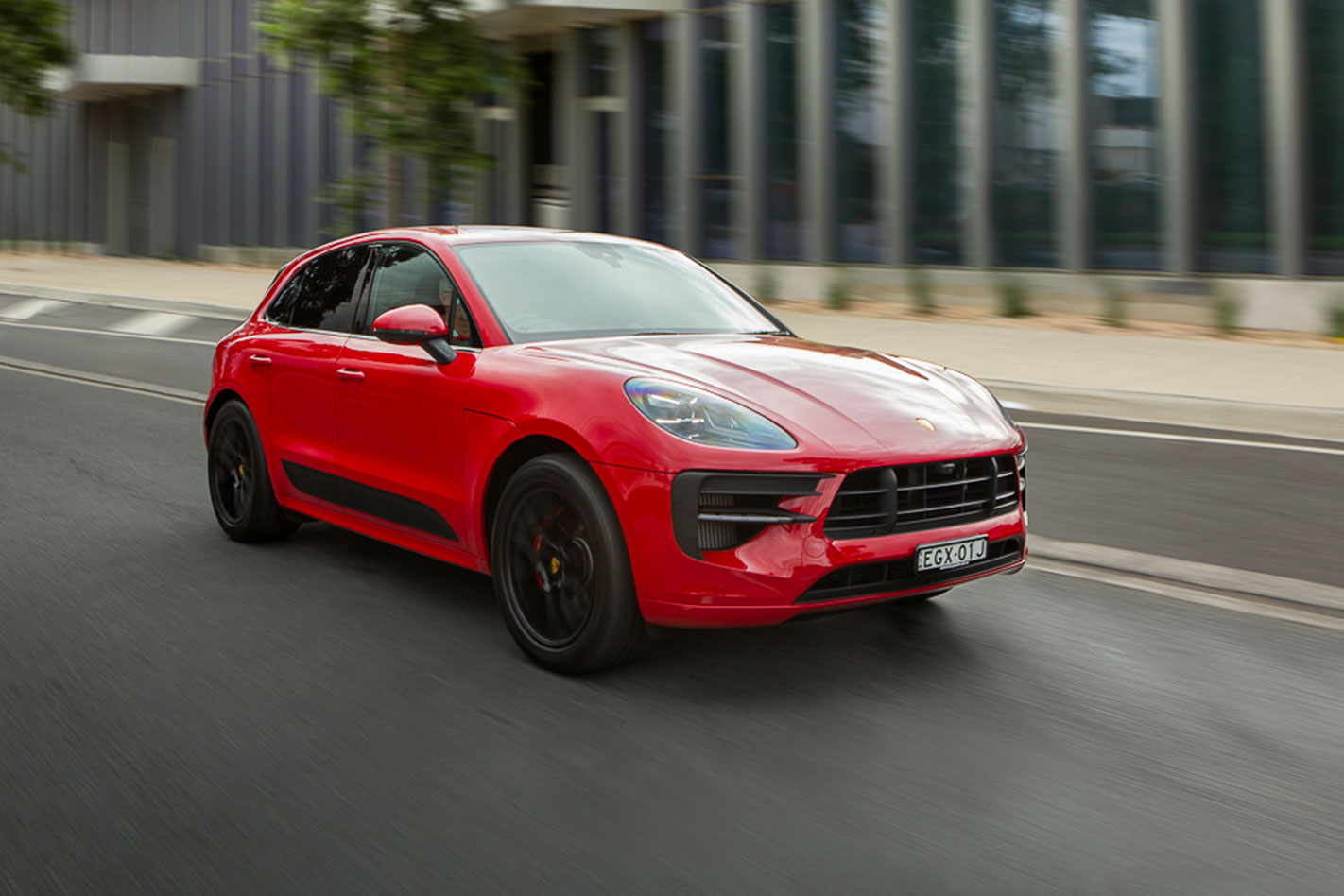
Yet, there’s ample grip on offer – as well as options on how to use it.
The GTS is comfortable adjusting its attitude all the way through a corner, driving in with the nose before squatting under power on the way out. But we’d stick with the regular suspension if you’re after steely responses.
Helping the cause here are brakes from the S version that offer as much feel and control as the electric steering. But they’re far from being as involving as the standard-fit sports exhaust.
Otherwise a $5050 version on the standard Macan and S, the system unlocks a proper, hard-edged growl from the V6 that would otherwise struggle to generate ample theatre inside and out the cabin.
Pricing and specs
The Macan GTS doesn’t shout about how it justifies its $11,500 increase above the regular S. It’s always championed subtlety. Quickly, though, the value reveals itself.
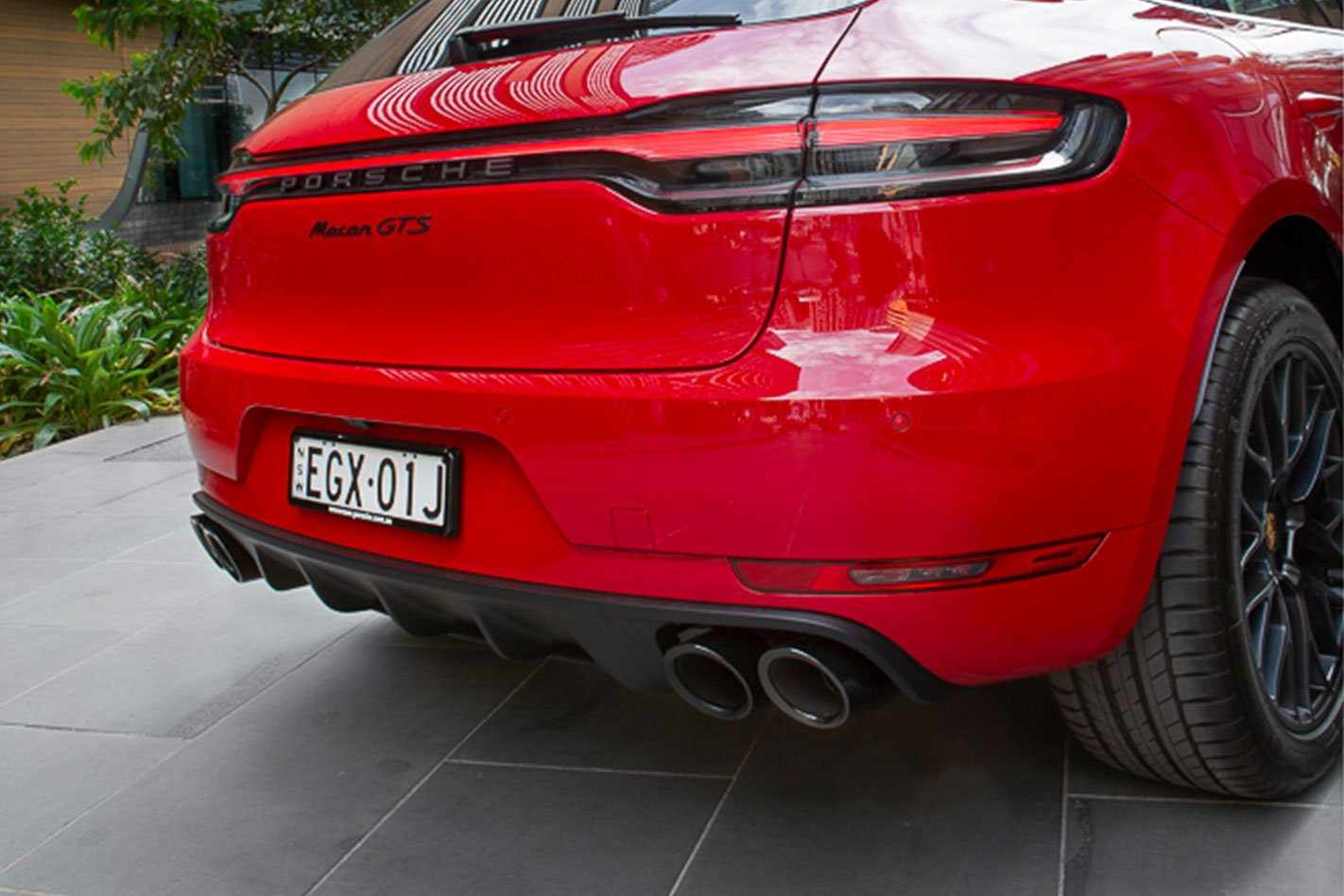
A SportsDesign package leads the way here, treating the front grille, rear spoiler, side skirts and unique rear diffuser in matt black. It otherwise costs $6220, already closing the price gap to the S when you consider the sports exhaust’s price.
Leather inside the GTS cabin is stitched with a signature Carmine Red, while the rest of the space feels particularly full fruit – even if there wasn’t our test car’s optional audio and carbon fibre inserts.
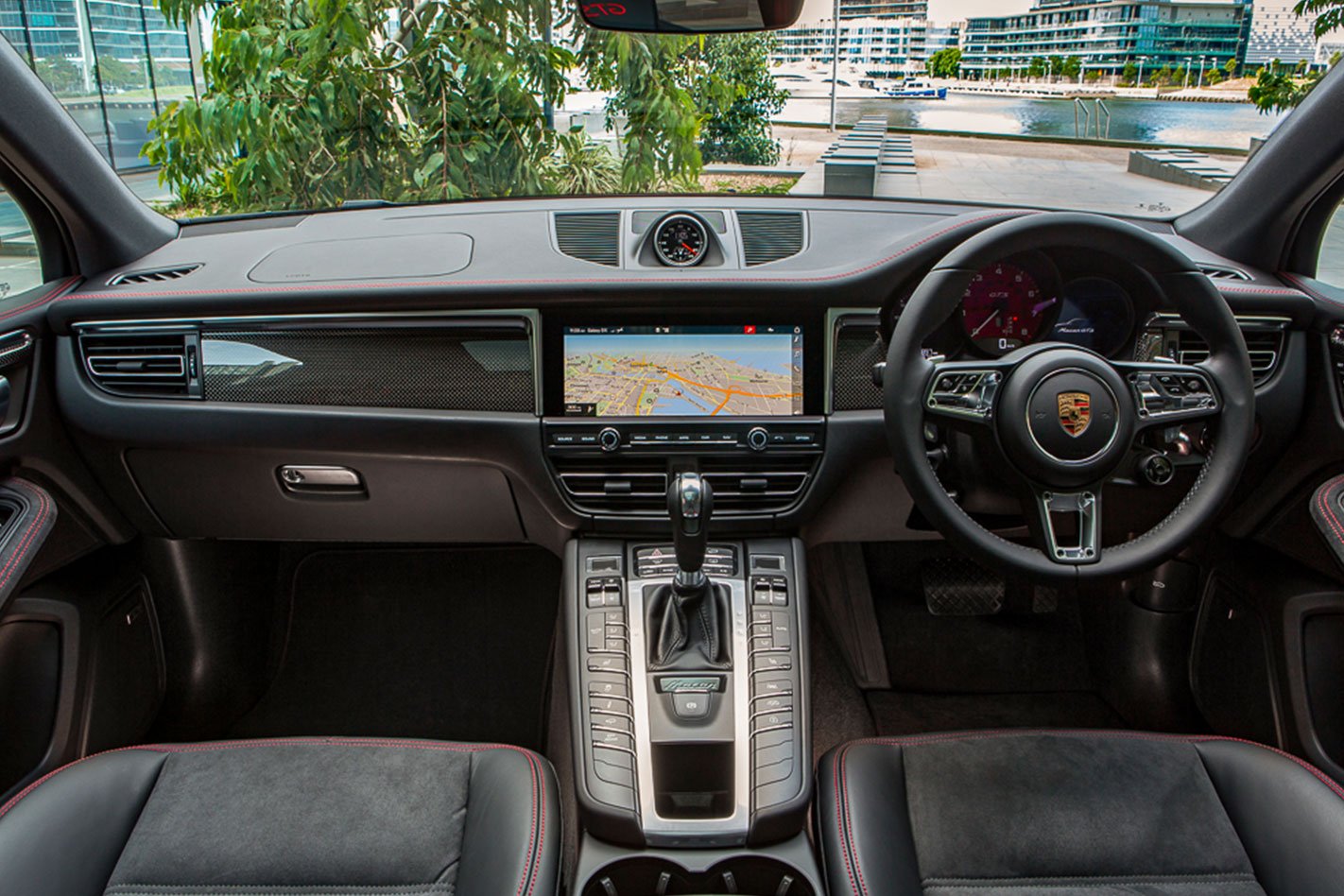
While this Macan won’t be the most memorable GTS in recent memory – that honour goes to the 997-series 911 GTS – it delivers on the badge’s ideals in spades. And that bodes well in the mid-size performance SUV market stacked with rivals from Mercedes-AMG, M Performance, Jaguar and Audi.
Verdict
Rating 4/5
LIKE: Feels special, price and performance balance, pretty looks
DISLIKE: Body roll, expensive options
Specs
ENGINE: 2894cc twin-turbo V6, DOHC, 24v
POWER: 280kW @ 5200-6700rpm
TORQUE: 520Nm @ 1750-5000rpm
0-100KM/H: 4.7sec (claimed)
WEIGHT: 1910kg
PRICE: $112,300
Before you go, make sure you subscribe right now to the planet’s best performance mag by clicking HERE!
Has Genesis really got what it takes to achieve its lofty goals?
There’s no doubt that the cars – including the brand spanking new G80 sedan that we’re in Canberra to drive – are bloody good; fabulous interiors, loads and loads of clever tech to both protect and entertain, and genuinely considered exterior styling.
As well, parent company Hyundai is certain to back its bet on its fledgling luxury upstart for as long as it takes – especially given that its new global president, Euisun Chung, formed the brand under his watch as vice president in the early part of this decade.
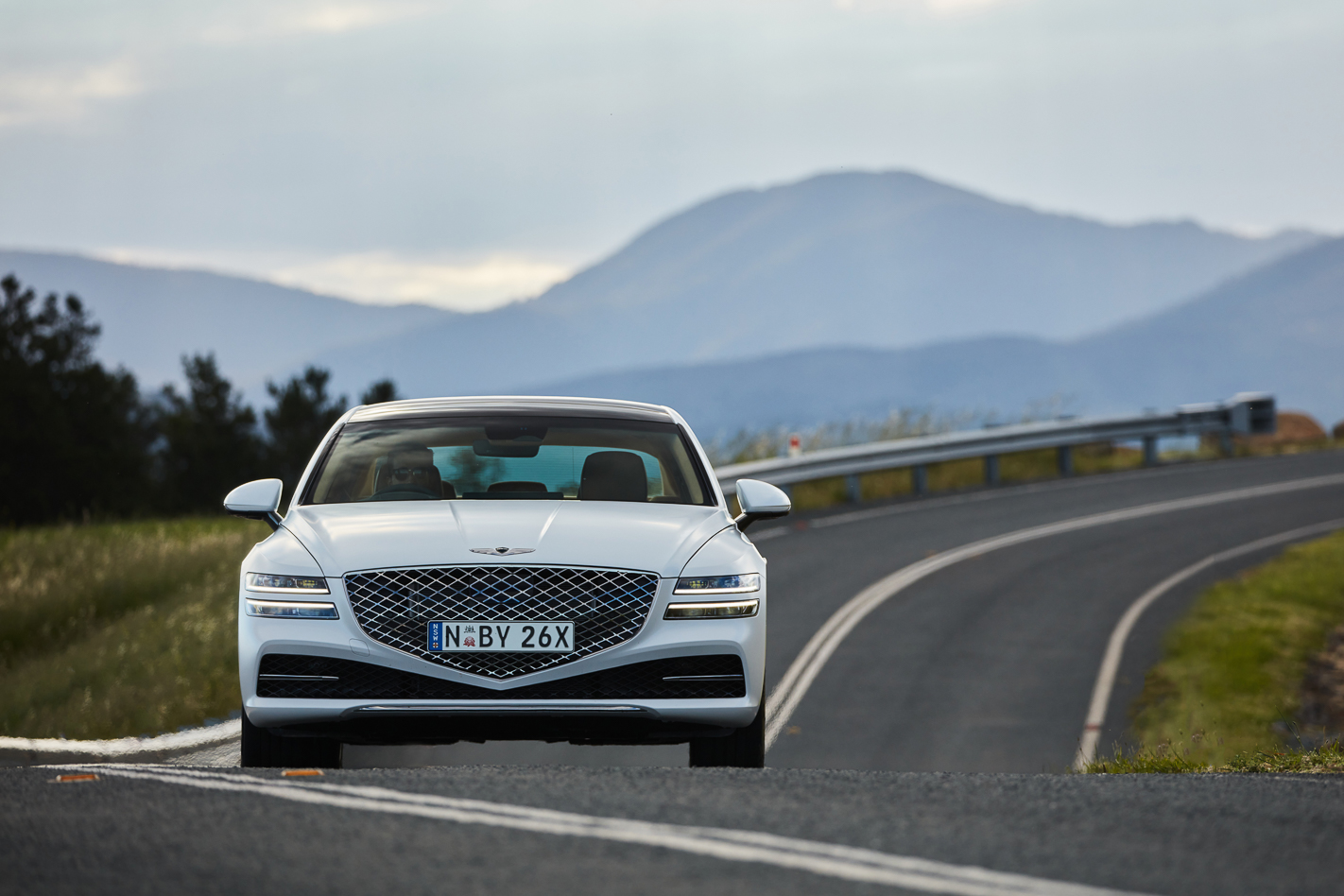
Add to that bulletproof powertrains and the Australian-centric bespoke ride/handling set-ups that its rivals dispensed with eons ago, and – on paper at least – Genesis is starting strongly in a race that won’t be won in the first year. Or even, in the case of Lexus, the first 20. Or perhaps ever.
It’s got the job ahead of it… somewhat ironically, it’s in danger of being outsold in 2020 by a brand which also figured on its chances of claiming a slice of the premium pie, Infiniti, which bolted the doors closed late last year.
What is the Genesis G80?
Built on top of parent company Hyundai’s latest M3 platform, the new G80’s role is simple; create enough noise and distraction to shake potential customers out of their Euro – or Japanese, for the matter – loyalties and give them enough reasons to switch their allegiances for now and forever.
It replaces the previous G80, which started its Australian residency in 2014 as a Hyundai Genesis before being – somewhat cynically, I feel – recycled as an “all new” (their words, not ours) Genesis in 2019.
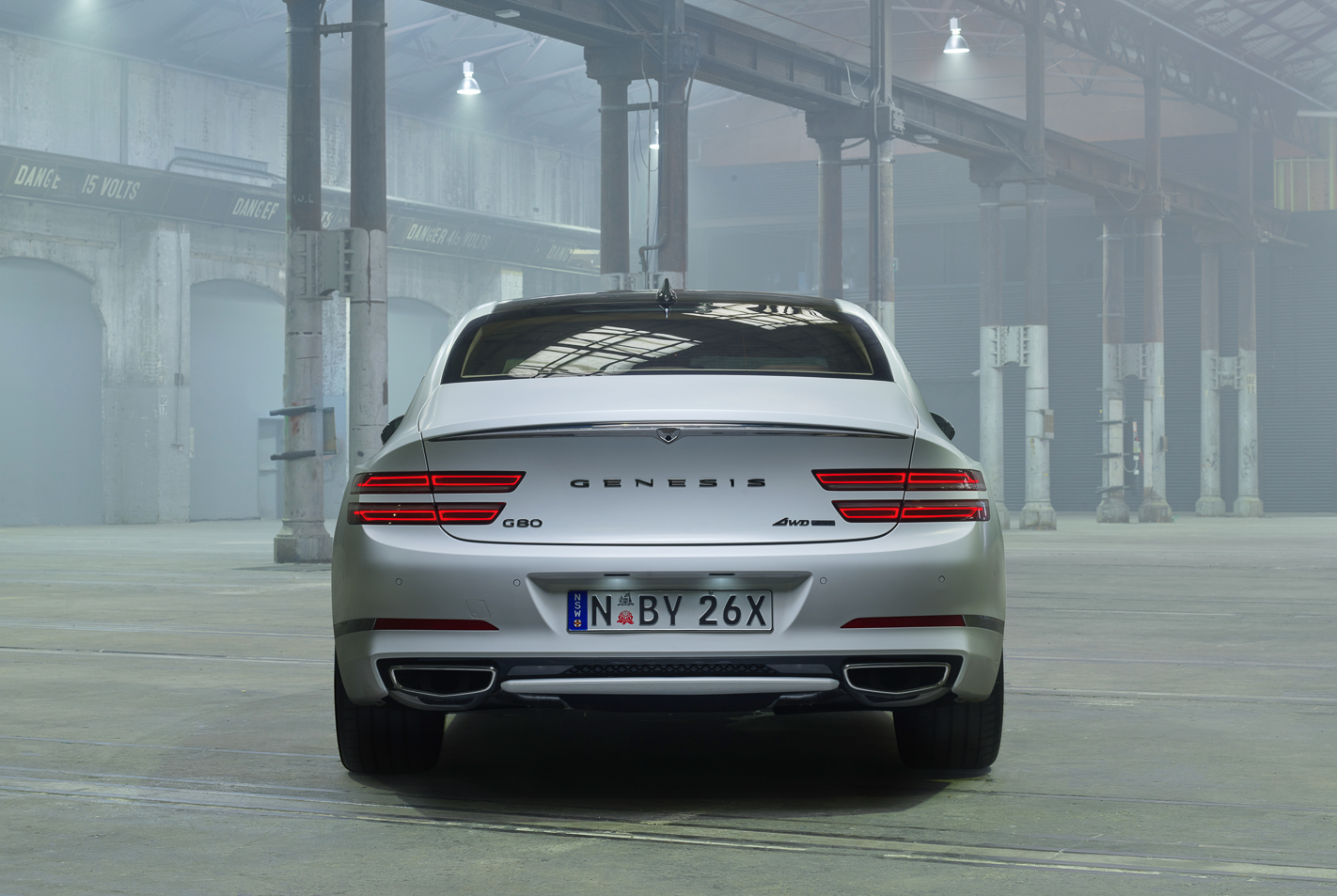
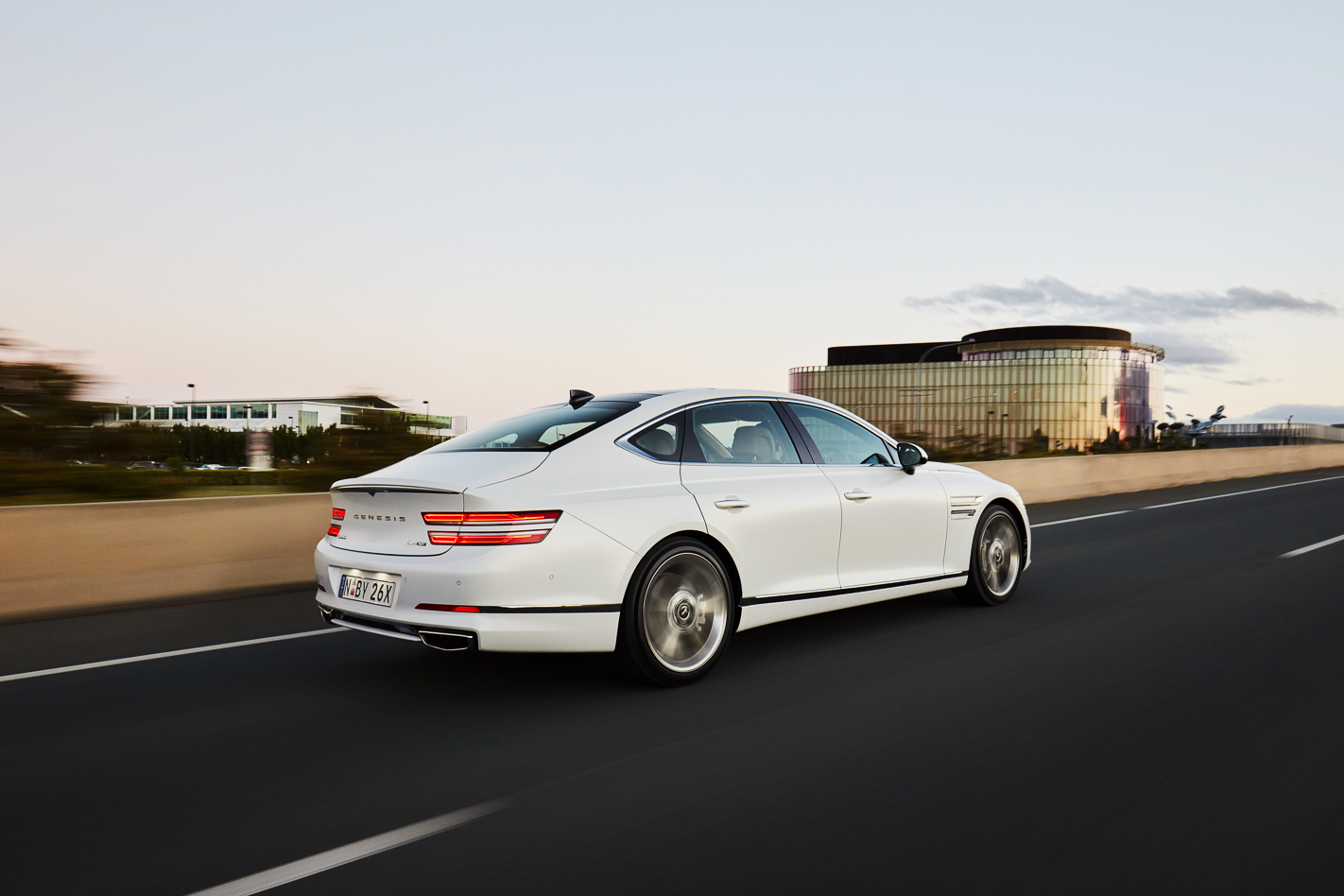
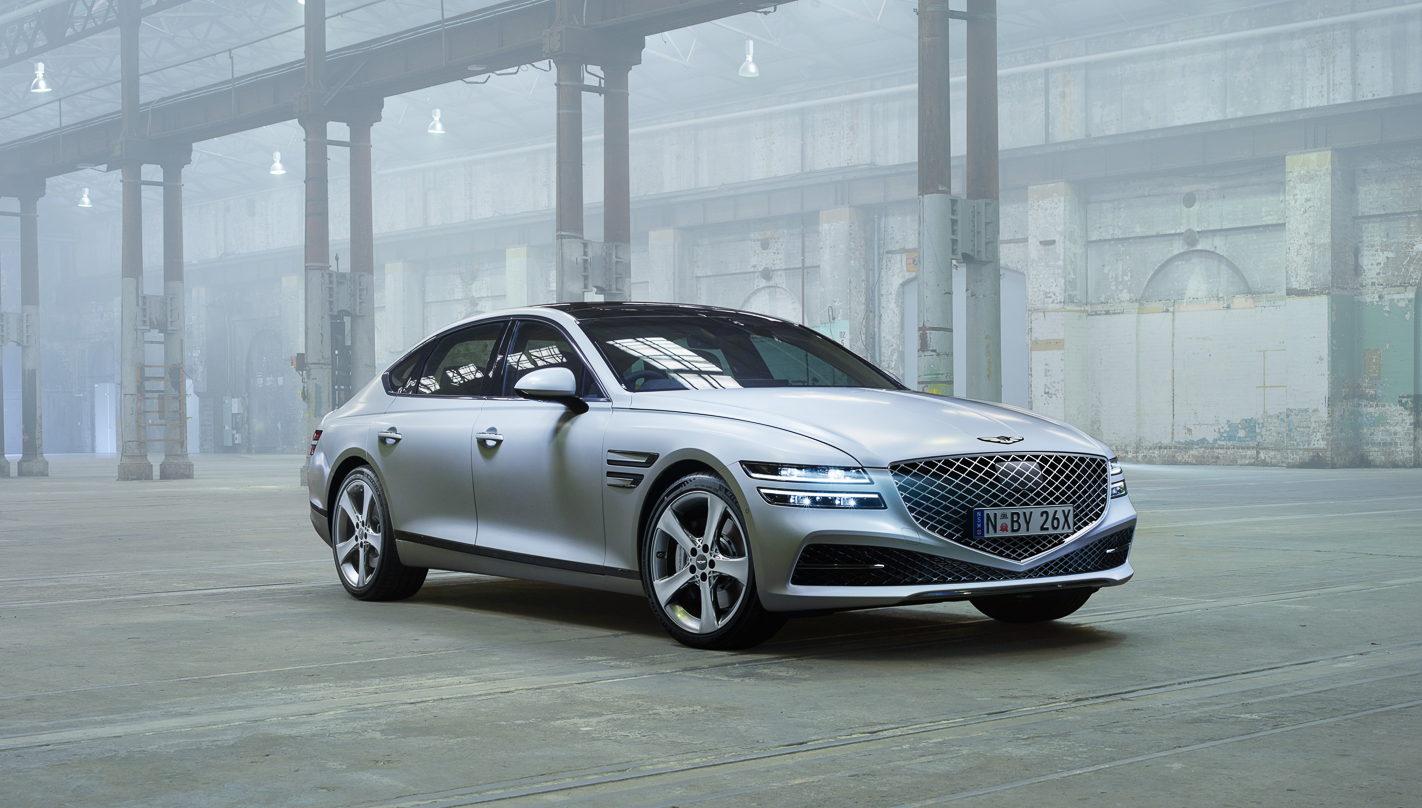
On pure presence alone, the large G80 already has the runs on the board. It’s big, and manages to stay juuust this side of brash.
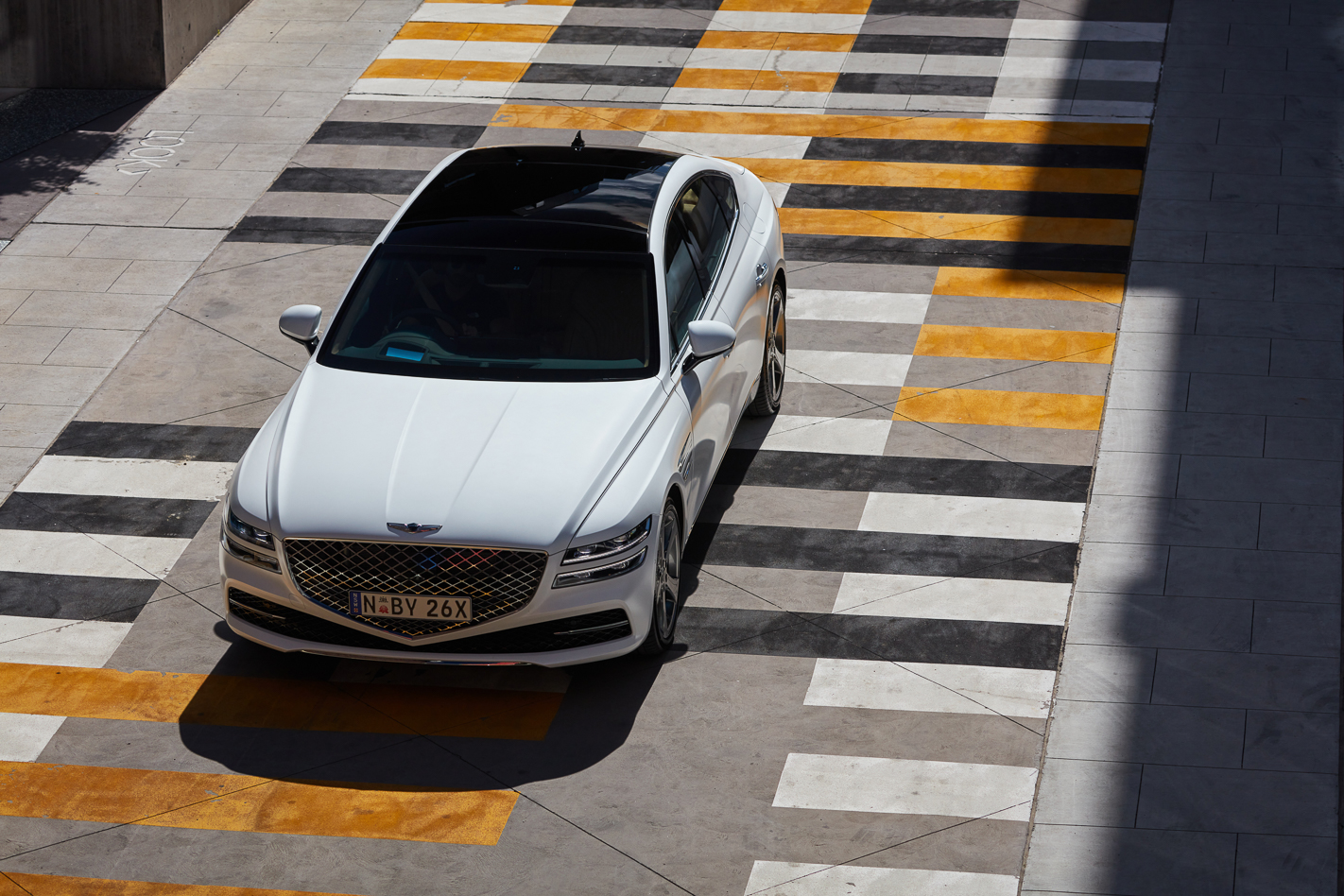
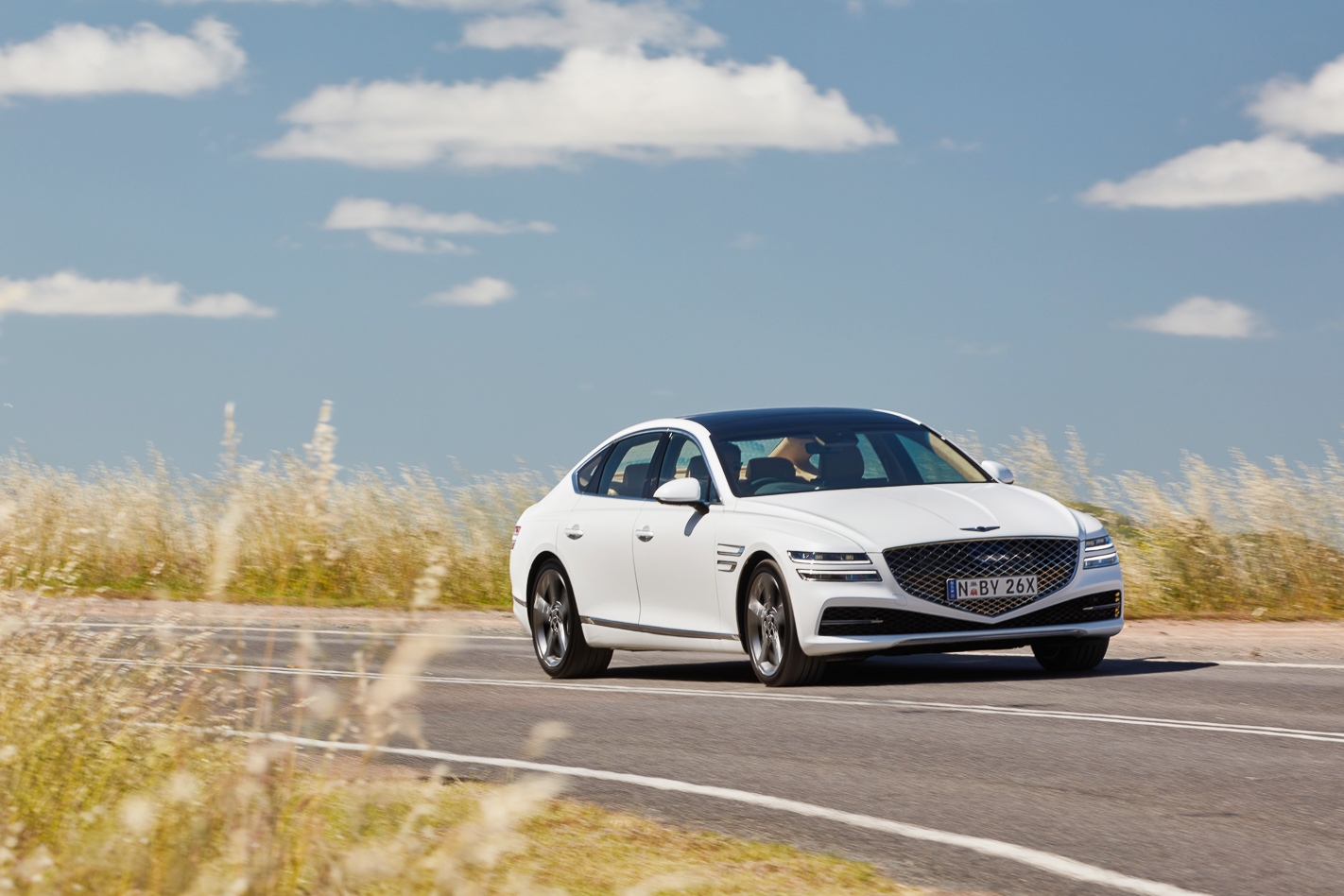
At the front its all about the light signature – the headlights are divided yet still connected with the bodywork, sitting astride an enormous grille that will make BMW feel a little better about itself.
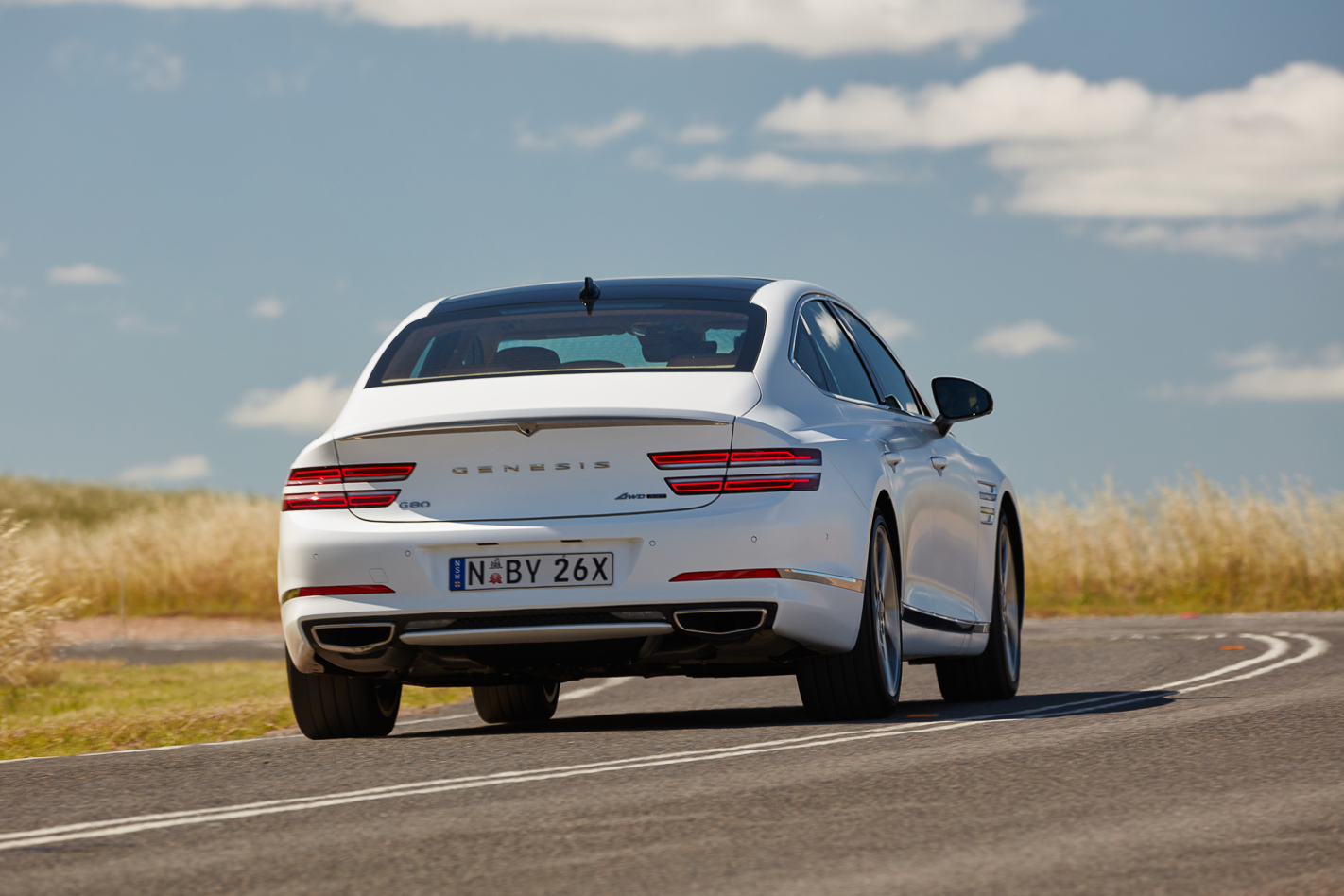
Those vertical lighting structures stride down the side of the G80, with faux vents on the front guards and a subtle crease along the rocker panel tying into the G80’s horizontal taillights.
Big rims – up to 20 inches on the top-spec variants – work well with minimal overhangs, while a speccy $2000 matte paint finish sets the G80 apart. Just be careful how you wash it, we’re told.
Price and value
Mechanically, the G80 can be had in rear- or all-wheel-drive, and with the choice of a 2.5-litre turbocharged four-cylinder with 224kW and 422Nm (rear-drive only), or an all-wheel-drive 3.5-litre twin-turbo V6, which makes 270 and 530Nm.
The only gearbox choice is an eight-speed torque-sensing auto, the V6 gets bigger front brakes, while the chassis itself is independently sprung at the rear.
Michelin Pilot Sports are the tyre of choice on both variants, too.
Spec-wise, you want for little with the G80, even with the $84,900 entry-level five-seat rear-drive 2.5T.
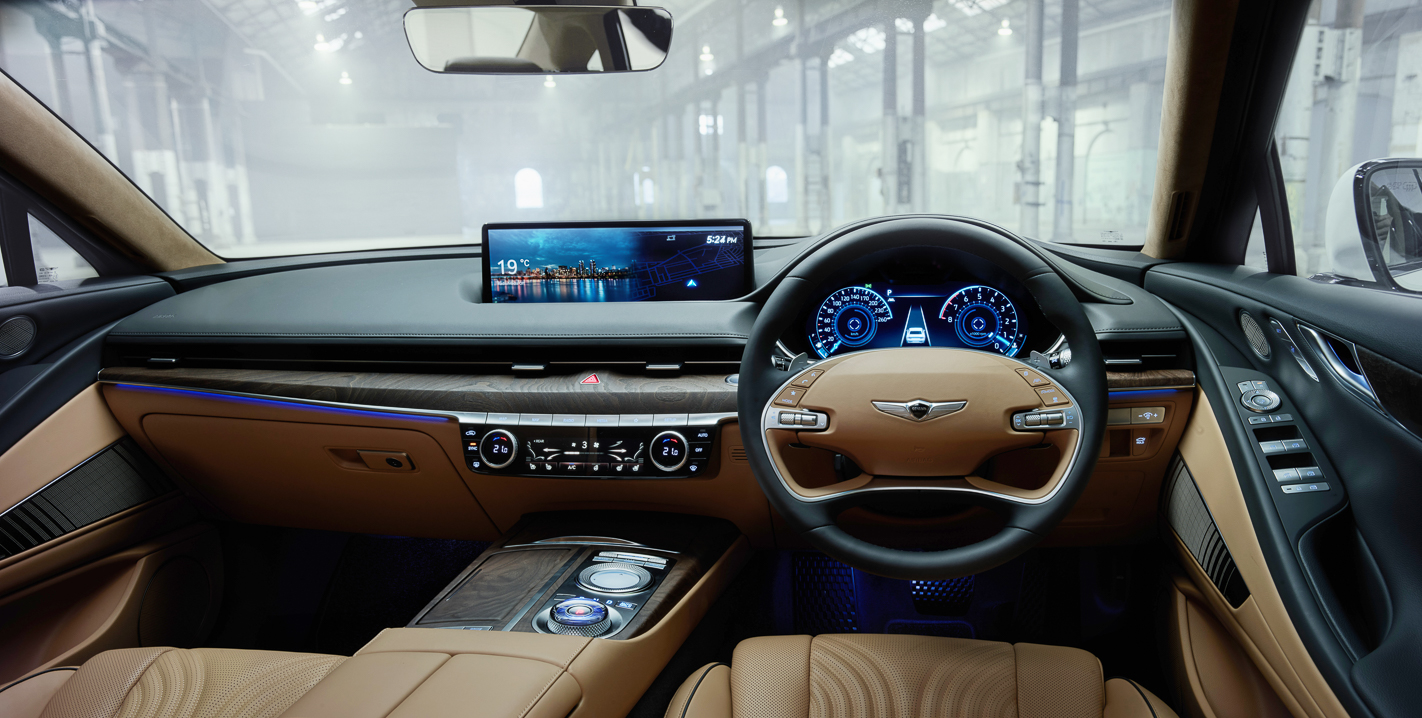
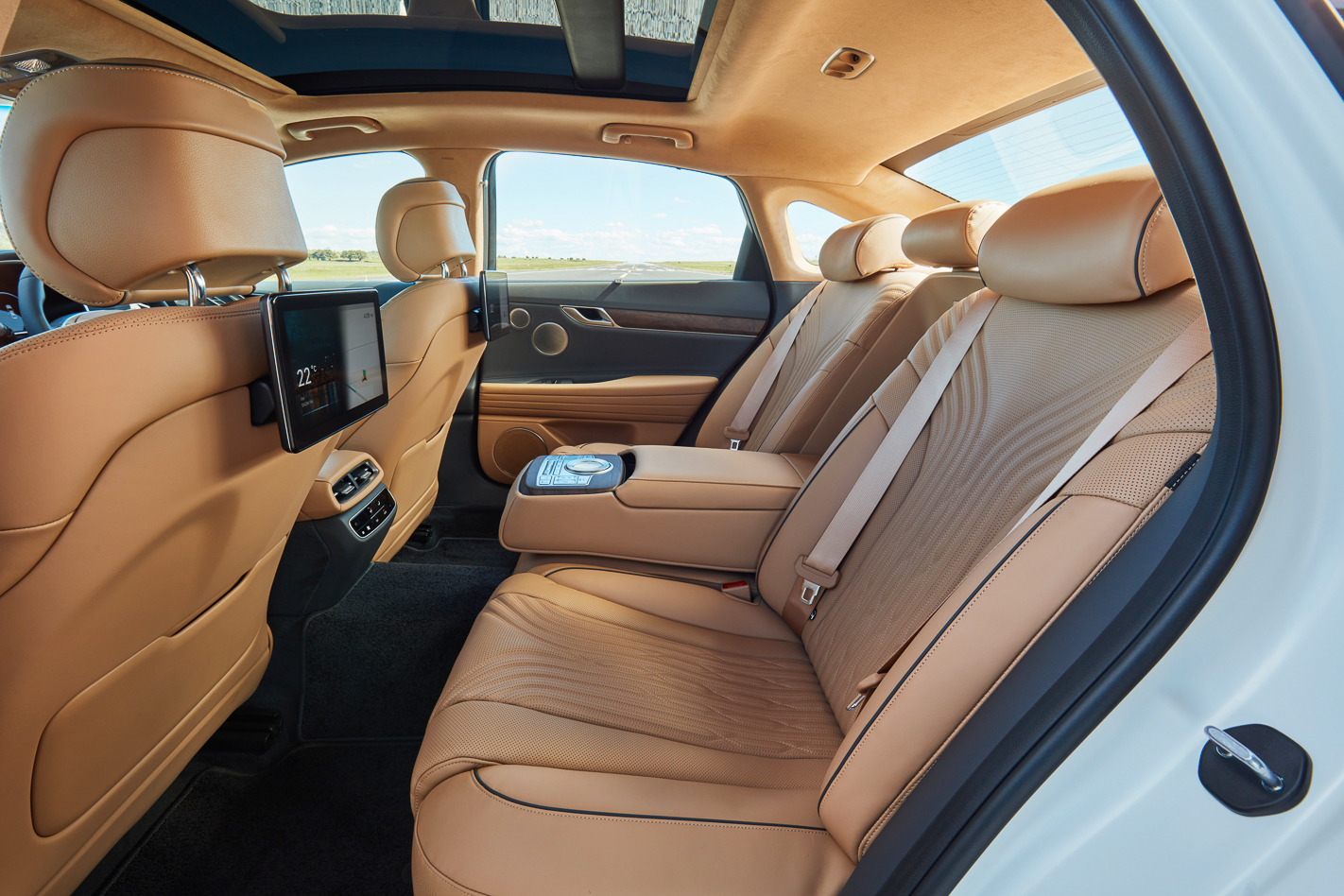
Open-pore wood trim and leather abounds in the spacious, airy cabin, while knurled metal details on crucial controls lift the G80 from pleasant to special.
The two-spoke steering wheel won’t be to everyone’s tastes, but the driver’s position is pretty spot on in most respects.
The seats are heated, vented and adjustable every which way, there’s inductive charging for your phone, a huge 14.5-inch multimedia screen, a digital dash, a panoramic sunroof, automatic headlights and wipers, 19 or 20-inch rims, a powered tailgate and loads more as standard.
There’s plenty of standard safety kit including ten airbags and clever adaptive cruise control, but you need to add a $13,000 Luxury pack to get the finer pieces of the puzzle, like parking collision avoidance and remote parking assistance.
What’s the Genesis G80 like to drive?
A brief blast of the $99,900 3.5-litre twin-turbo petrol-equipped variant reveals a softly-sprung chassis backed by light, accurate but filtered steering feel.
Its brakes are interesting; Genesis has fitted an integrated electric brake booster that enables engineers to tune the pedal feel.
Comfort mode, for example, gives the pedal a softer, more modulated stroke, while Sport mode firms up the first centimetre of pedal travel for a more precise feel.
There’s plenty of linear urge from the new-gen twin-turbo six-potter, even given it’s pushing around more than 2.5 tonnes, though its note is stilted rather than sonorous.
The almost five-metre-long sedan has a locally tweaked handling package that favours ride over roll support almost to a fault.
Even though its adaptive dampers are linked to a front-mounted camera to read terrain and send data back to amend the ride in almost real-time, the overall demeanour is one of a plush city-slicker, not a back-road bruiser.
Anything wrong with the Genesis G80?
Not all that impressive at first blush is the overcomplicated interface with the multimedia screen; it can be accessed via a dial, console buttons, handwriting recognition, touch and steering wheel controls, but it’s still not as intuitive as it should be.
Apple CarPlay and Android Auto mirroring, too, can’t fill the whole centre console screen, while the relative age of the system means that the G80 can’t yet offer wireless support, rendering the inductive charger redundant when using your phone.
Genesis reveals its second SUV – the GV70
You also have to spend big – $13,000, to be exact – on a Luxury pack which gives the G80 a clever noise-cancelling system that uses mics in and out of the car to quell rumble.
It also adds remote parking capability, which is sure to impress the neighbours.
How safe is the Genesis G80?
With an almost bewildering array of active and passive safety aids, the G80 earns a maximum five-star ANCAP safety rating based on Europe NCAP crash data.
Ten airbags (including a front centre/side airbag), AEB for every occasion including front, front-cylist, cross-traffic front and rear, junction assist and lane oncoming AND change assist, blind-spot assist for side and rear, sophisticated adaptive cruise control, rear occupant detection that can honk the horn if motion is detected and loads more is all standard.
How much does it cost to own the Genesis G80?
Genesis has lofty plans to flesh out its local range with market-relevant products (read: SUVs) and its service and support offering is also strong, though it still lacks a physical presence in many key population areas.
That service offering includes a five-year unlimited-kilometre warranty, five years of free servicing, five years of sat-nav map updates, five years roadside assistance and five years of service pickup/dropoff valet help.
The 3.5-litre petrol engine consumes a reasonably high 10.7L/100km on the combined economy cycle, and its 73-litre tank (bigger than the 2.5-litre G80’s by some eight litres) means a theoretical range of about 680km and a cost per tank of around $100-110.
Verdict
Will the Genesis G80 impress luxo sedan owners sufficiently to want to trade in their Audi A6s, BMW 530s and Mercedes-Benz E300s?
Quite possibly. Value is a strong buzzword in this new world, and while premium names are currently enjoying salad days of strong sales on the back of cancelled holidays and the like, there’s always a clique of people looking to move into something a little different and who will be wise to a good value proposition.
The G80’s overt yet attractive styling, its mature and refined presentation and its generous equipment levels will definitely bring eyeballs to the brand – but the real trick is to convert those eyeballs into bums on seats.
Audi is bringing greater choice to a number of its model lines, introducing power bumps to the TT and A4 Allroad and adding a petrol engine option to the Q7 range.
The most notable change sees a 55 TFSI variant added to the previously diesel-only Q7 range, rolling a 3.0-litre petrol V6 into the large SUV where there was previously no petrol engine on offer.
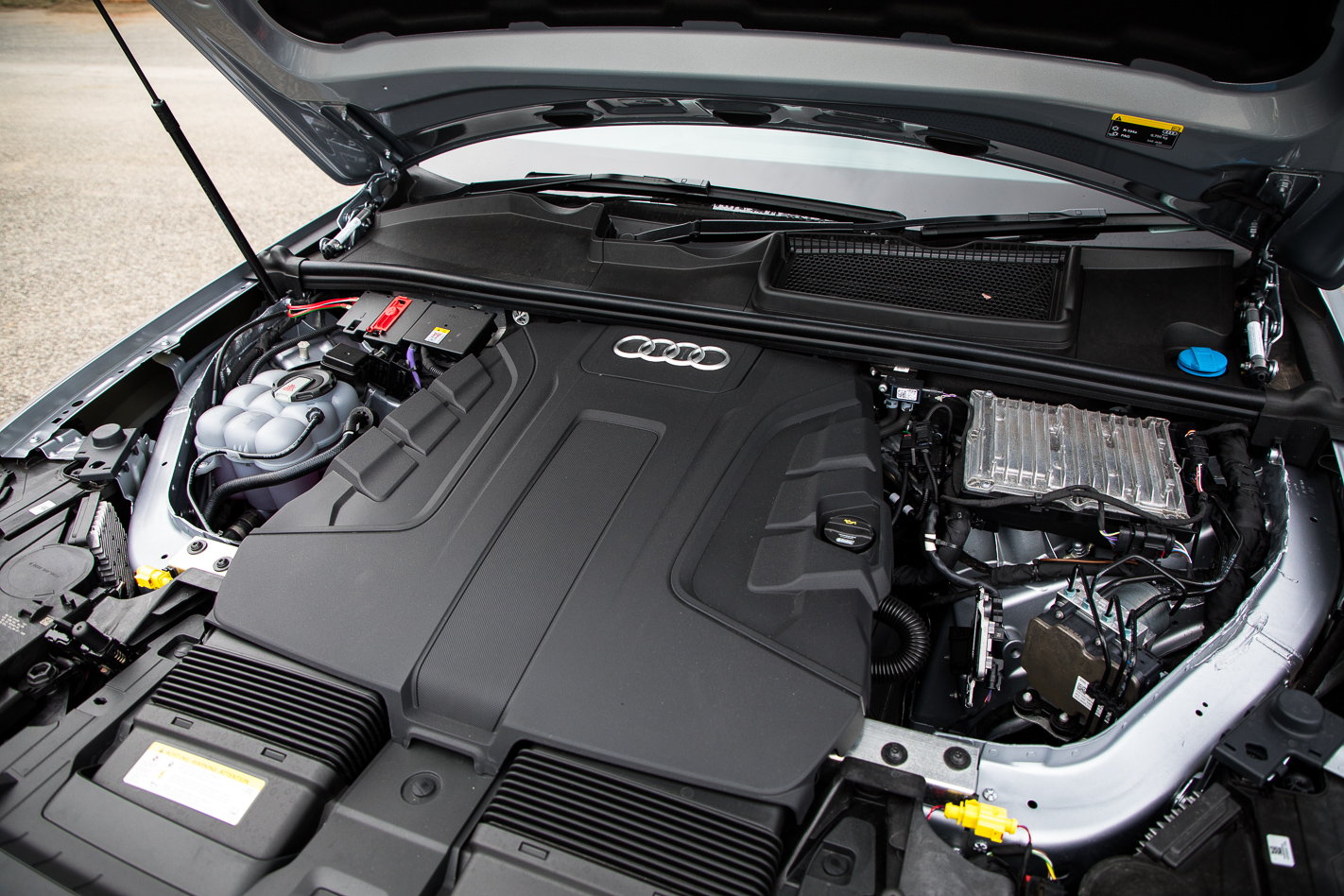
That 250kW/500Nm engine offers a better level of performance to its diesel stablemates, too, sprinting from zero to 100km/h in 5.9 seconds. This makes it the quickest in the range behind the S variants.
The sporty Audi TT coupe also benefits from a power bump, with a range-topping 45 TFSI quattro variant joining the line-up.
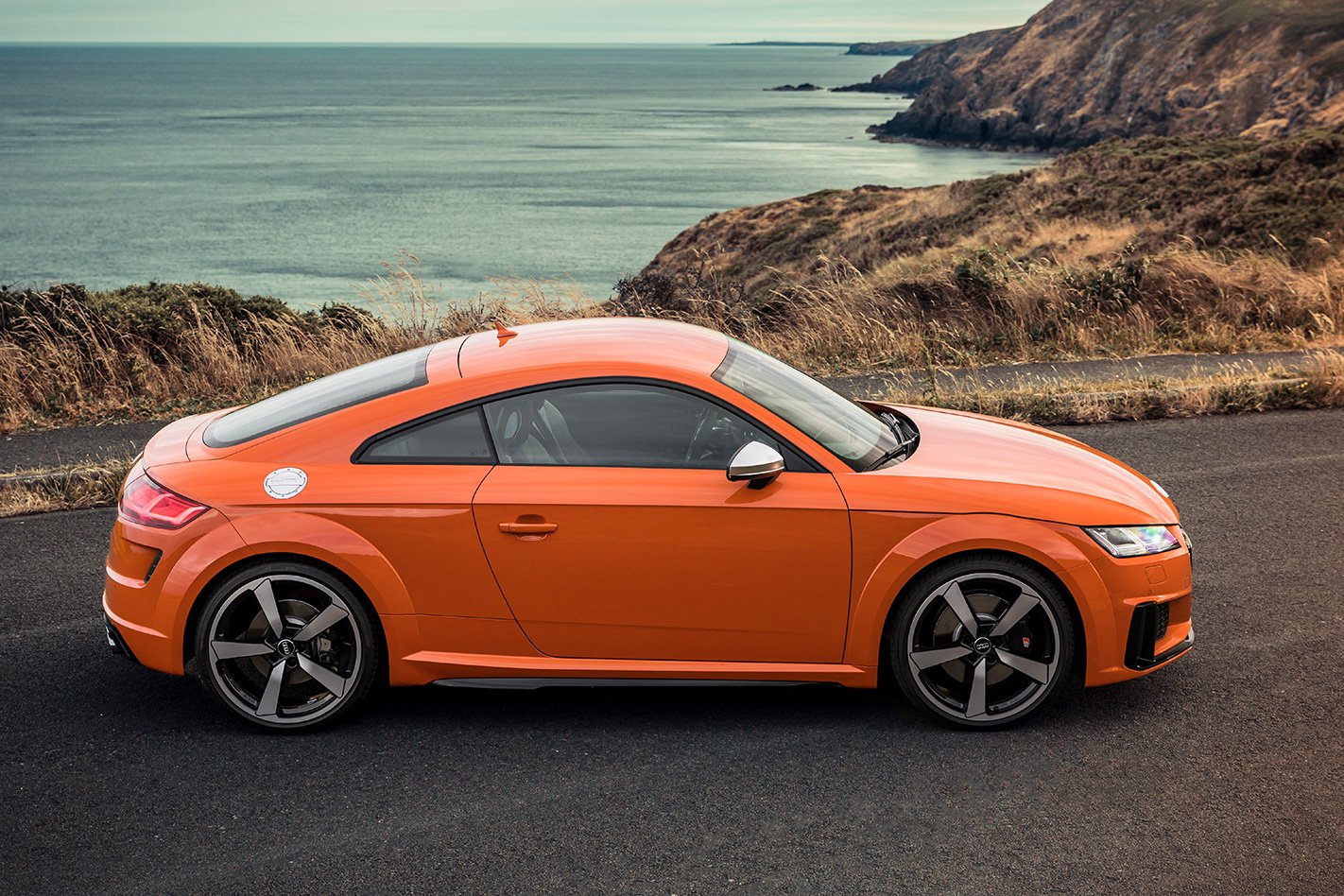
A step-up in power to 180kW/370Nm means this new TT becomes the fastest non-TTS/TTRS Audi TT ever, delivering a zero to 100km/h time of 5.2 seconds, thanks in part to a new seven-speed S tronic dual-clutch gearbox.
Similarly, the A4 Allroad 40 TDI gets a boost with an additional 10kW over its predecessor.
The (very) mild-hybrid 2.0-litre turbo-diesel sends 150kW and 400Nm to all wheels, and sprints to 100km/h half a second faster than the pre-update.
The A4 Allroad 40 TDI is also one of the most fuel-efficient Audis on sale, with a claimed 4.9L/100km combined consumption figure.
Customers can walk into dealerships and buy a TT 45 TFSI today, while the new-engined Q7 55TFSI and boosted A4 Allroad 40TDI will join the line-up in early 2021.
Updated Audi pricing
- Q7 55 TFSI – $121,300
- TT 45 TFSI – $80,900
- A4 Allroad 40 TDI – $70,700
For many people, Euroa has been just a name on a big green sign ever since the completion of the Hume Highway bypass in 1992.
It’s a popular stopover for people heading to and from Sydney or Victoria’s snowfields; however, all most of them see of the historic north-east Victorian town are the fuel pumps and Maccas at the giant Shell service centre.
But there is something else at the servo’s giant car park that makes this an attractive destination for EV owners – a Chargefox charging station with four DC terminals that complement the Tesla Supercharger station in town.
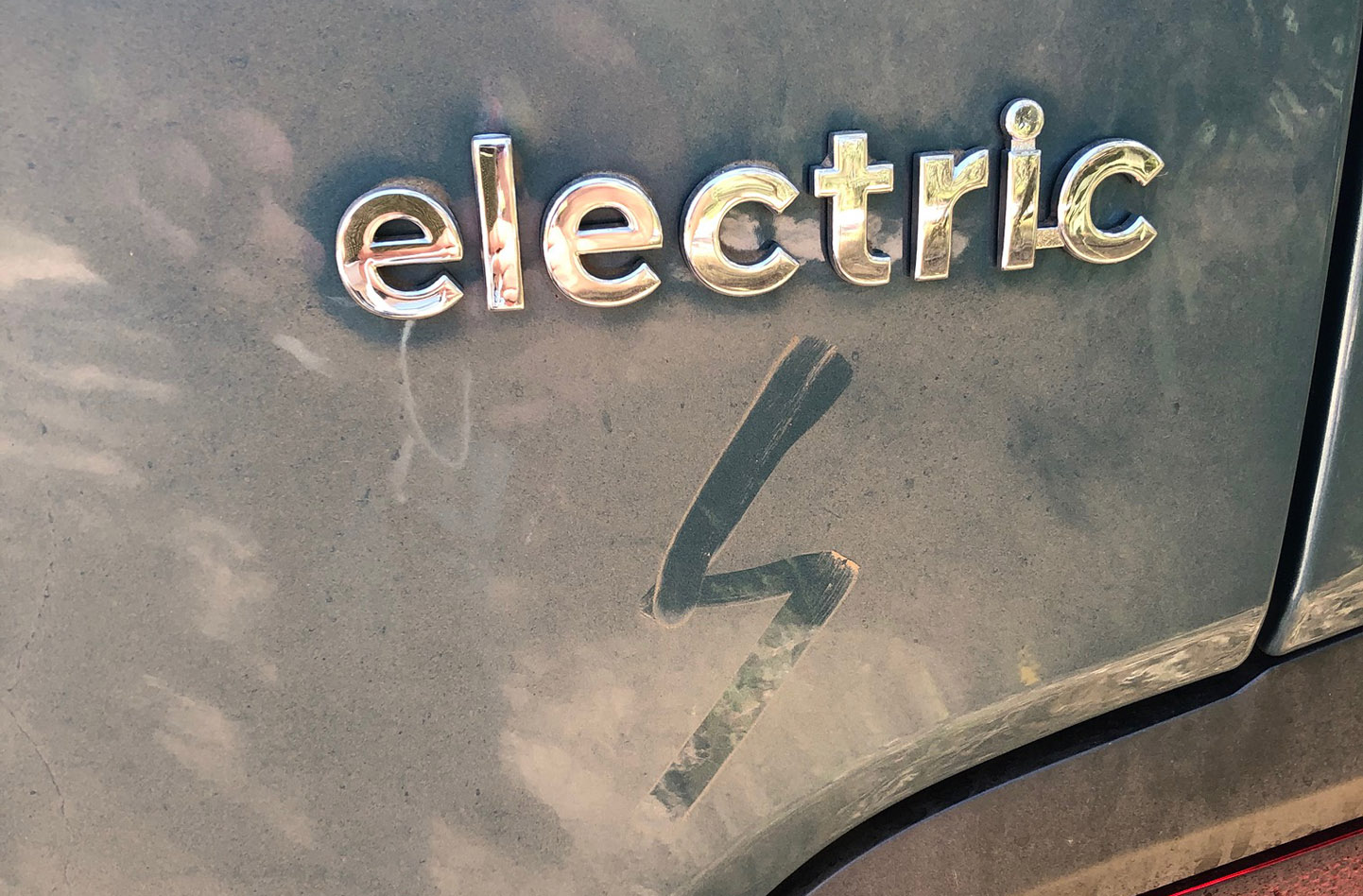
Euroa is also just 162km from Melbourne and about the same distance from Albury. This brings it in real-world range of most EVs, with some – like the Hyundai Kona Electric – able to easily make it there and back.
But it would be a shame to just stop in Euroa just to charge your EV, as there some great hidden gems to explore, making it a nice and relatively quiet place to spend a day or two.
Attractions
There’s plenty to see around Euroa, particularly if you venture east of the Hume Freeway into the Strathbogie Tableland, which has some great driving roads amongst the spectacular rocky outcrops.
These lead to some easily accessible attractions, including Polly McQuinns, a weir on Seven Creeks located 25km from town.

Once a natural creek, it was dammed in the 1920s creating a spillway and deep-water pool that at low flow makes for an inviting swimming spot.
An even better place to cool off is Gooram Falls, which is downstream from Polly McQuinns and a 10km drive away. Located in a rugged gorge the falls consist of two cascades separated by a flat rocky area.
It’s quite a sight at peak flows, and during drier times you can walk right down to the rocks to dip your feet or have a splash.
Getting close to the water at the upper falls can be a challenge for some because of all the rocks, but there is a moderate walking track leading to the lower falls.

The entrance to the falls off the Euroa-Mansfield Road isn’t very well signposted so if using GPS slow down as you approach the turn as it’s easy to miss.
The car parks at Polly McQuinns and Gooram Falls have barbecue facilities and are easily accessible by two-wheel-drive vehicles all year.
Driving between the two we decided to check out the Forlonge Memorial on the road of the same name.
The well-kept monument commemorates Eliza Forlonge, who with her sister-in-law Janet Templeton, introduced the first fine-wool Saxon merino sheep into Victoria.
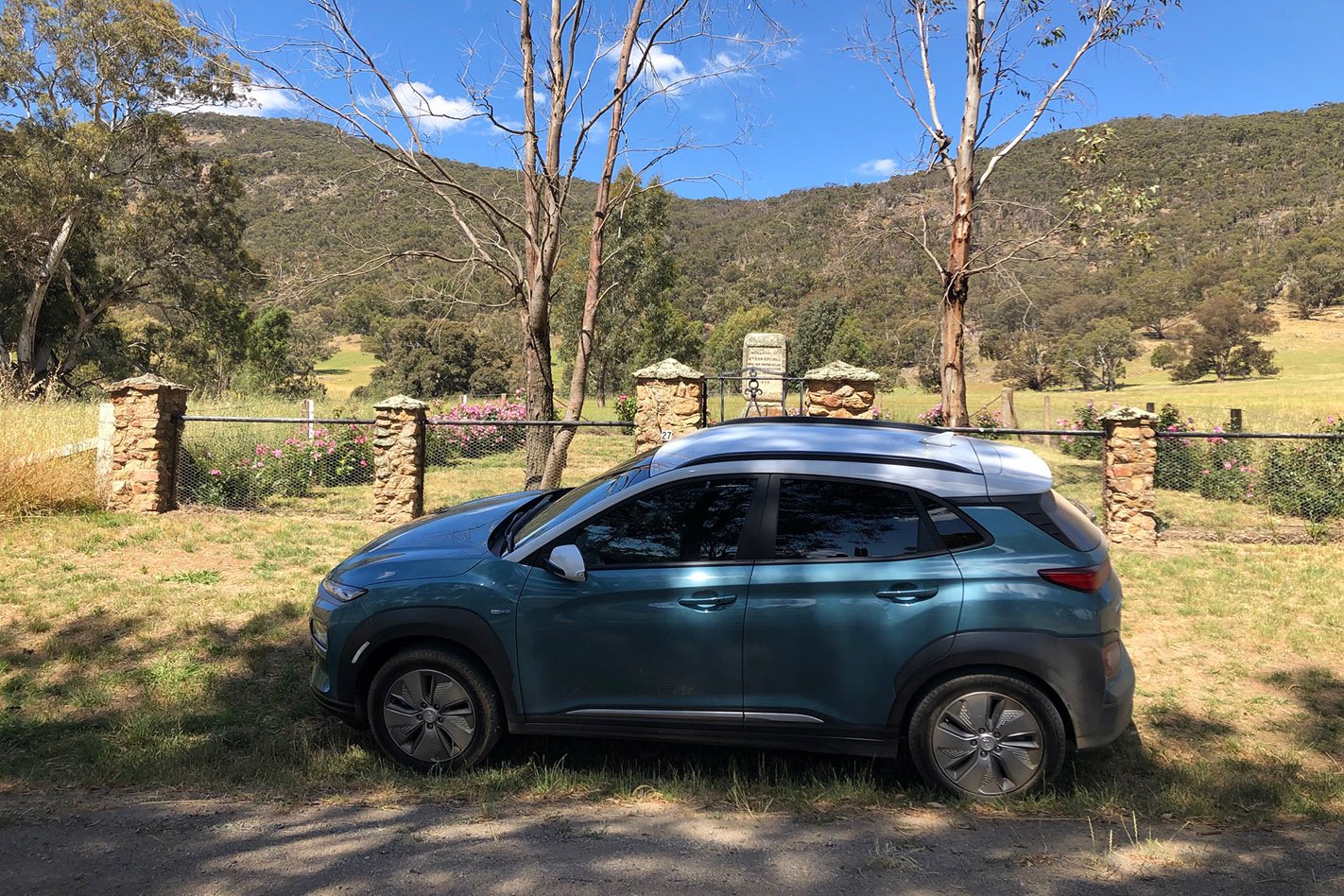
I must confess my reasons for going there was really to try the Kona Electric on the gravel road, which it handled really well.
I actually preferred driving on dirt than on some rougher bitumen roads in the area that made for a bouncy ride on the Kona’s city-centric suspension.
Wining and dining
While you’re out and about you can visit the Maygars Hill Winery at Longwood East, which produces a limited amount of fine red wines sourced from Shiraz and cabernet sauvignon grapes hand-picked from its 2.4-hectare vineyard.
Interestingly, owners Jenny Haughton and Ian Dickson also have a mustard crop which is used to produce biofuel to power the farm’s tractor and Volkswagen Caddy van.

Maygars Hill doesn’t have a restaurant but it does host special events.
It also has an award-winning cellar door and a pet-friendly three-bedroom cottage amongst the vines with great views of the Strathbogie Ranges. Prices start at $160 per couple.
The site of the vineyard named after Lieutenant Colonel Cecil Maygar, who earned the Victoria Cross during the Boer War for rescuing a comrade under heavy fire.
He went on to serve in the First World War, including Gallipoli, but later died from wounds received during the famous Battle of Bersheba in Palestine in October 2017.
A statue of Maygar and two other local Victoria Cross recipients, Lieutenant Frederick Tubb and Corporal Alexander Burton (both decorated for bravery at Gallipoli) are the main features of the VC Memorial Park in Euroa.
Just around the corner, you’ll find Northern Republic in the 150-year-old Old Flour Mill on Kirkland Avenue.
The huge wood-fired pizza oven betrays the Italian influences of this fine-dining establishment, whose menu includes authentic gourmet pizzas and spuntini (snack) dishes for sharing.
It also stocks a huge range of wines, many local to Victoria’s north-east region as well as some Italian varieties.
This is up there with one of the many great fine-dining experiences that have popped up in regional Victoria during recent years.
Accommodation
As well as the cottage at Maygar’s Hill there are several accommodation options in and around Euroa including caravan parks, bed and breakfasts and motels.

Because we stayed just the one night we chose the Jolly Swagman Motel on Clifton Street. The room was spacious, clean and comfortable and the service friendly, which made it a relative bargain for $135 per night.
EV charging and range
Distances
Euroa is situated off the Hume Freeway between Melbourne and Albury. It is just over 160km from each of them, but you’ll want at least 200km range to be on the safe side in real-world conditions, particularly in summer when you’ll need air-conditioning.
There are also some decent hills to negotiate especially during the trip up from Melbourne.
Battery consumption
I travelled from Melbourne and used about 40 per cent of the Kona’s 65kw battery each way and averaged 14.8kW/100km getting there and 13.6kW/100km on the trip back.
The main reason for the lower consumption on the return journey is it’s mostly downhill from the Great Dividing Range at Seymour.
Coincidentally, I returned home with 162km range to spare when I arrived home.
Charging
I used the Chargefox station at the Shell Service centre on the Hume Freeway at Euroa, which has two 50kW rapid and two 350kW ultra-rapid chargers
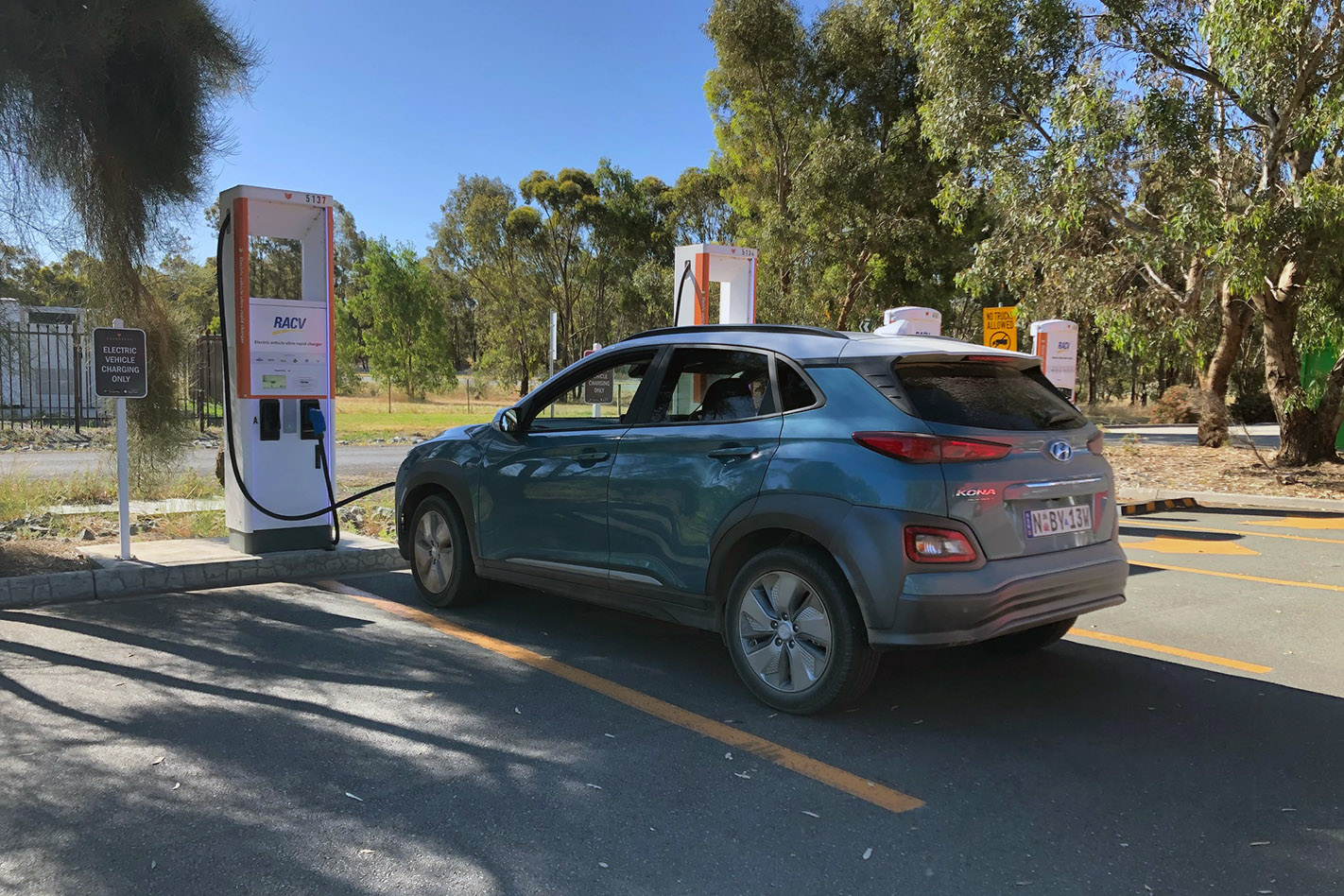
The ultra-rapid charger took 39 minutes to charge the 65kW battery from about 34 to 84 per cent. The 33.74kWh charge was priced at 40c/kWh, for a total cost of $13.50.
That’s pretty good for a full weekend of emissions-free driving that would have drained the fuel tank of a petrol-powered Kona.
The Chargefox station at Euroa has CCS2 and CHadeMO plugs, but there’s no joy if you want to charge your plug-in hybrid via a Type 2 port.
It is about a half-hour walk into town should you want to kill time during charging, or there are several food options at the service centre.
As mentioned above there is also a Tesla supercharger in the middle of Euroa on Kirkland Avenue, which has six 120kW rapid chargers.
Affordable sports cars are few and far between, and rear-wheel-drive ones are even rarer. The Subaru BRZ, launched in 2012 alongside its identical twin, the Toyota 86, came as a breath of fresh air, but after eight years there was uncertainty around its return for a second generation.
Thankfully, the alliance has produced the BRZ 2.0, which will be followed by a reborn 86 in short order. Of the two cars, though, it’s the BRZ that carries the lion’s share of Subaru’s know-how – and the latest one, which will lob into Australia late next year – shows off even more of that Subaru DNA.
Here’s how we think the new 2021 Subaru BRZ is better than its predecessor.
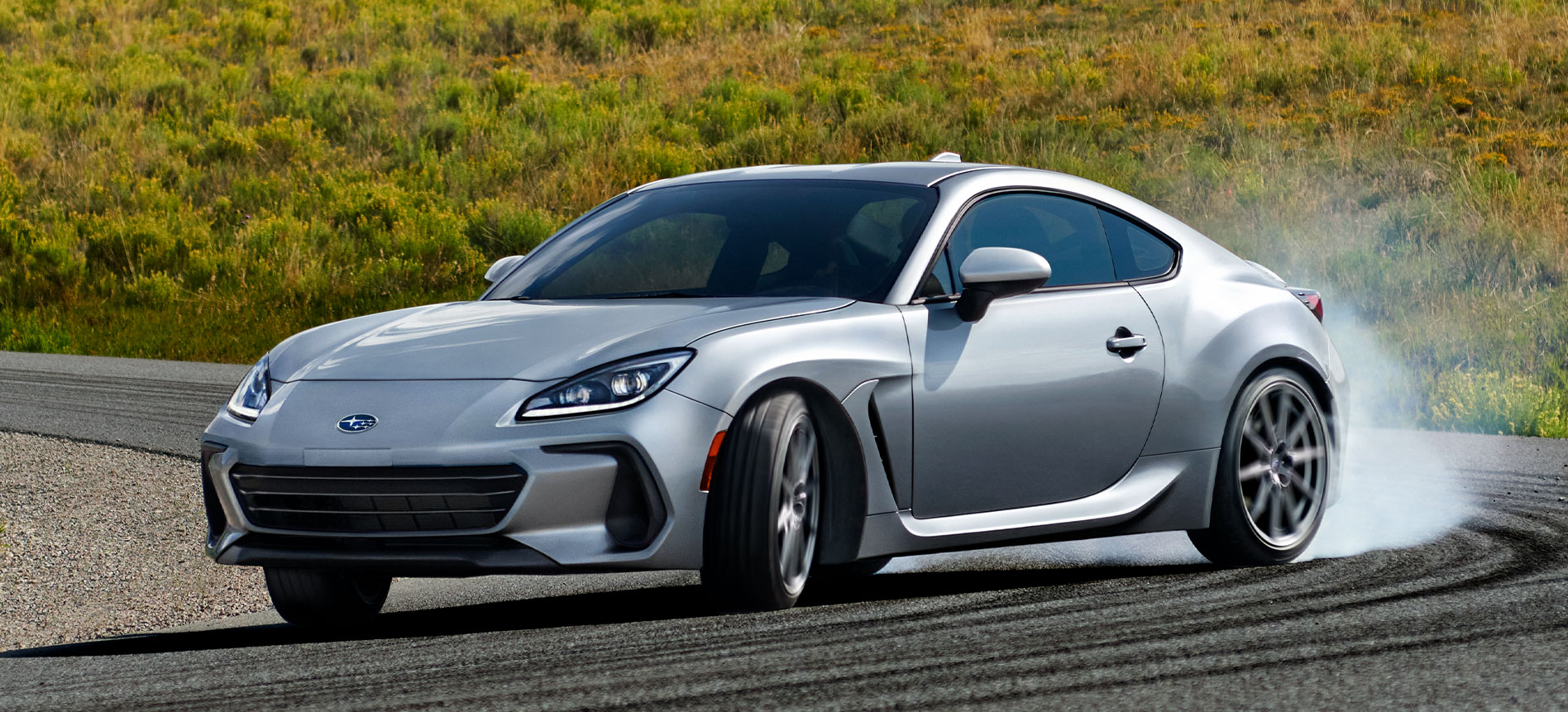
1. No replacement for displacement
While many were crying out for the addition of a turbocharger to the next-gen BRZ, Subaru has upped its performance in the old-school way.
The 2021 BRZ will get a larger-capacity, naturally aspirated, 2.4-litre opposing-piston (or boxer) four-cylinder engine which sends 170kW/250Nm to the rear wheels.
This marks an increase of 12 and 18 per cent, respectively, compared with the outgoing 2.0-litre boxer engine.
Crucially, that torque number appears much lower in the rev range at 3700rpm, rather than the outgoing’s figure appearing at 6400rpm.
This should give the BRZ more urge when accelerating out of corners.
The engine redline is at 7500rpm and maximum power arrives at 7000rpm, meaning it still needs to be revved to be enjoyed.
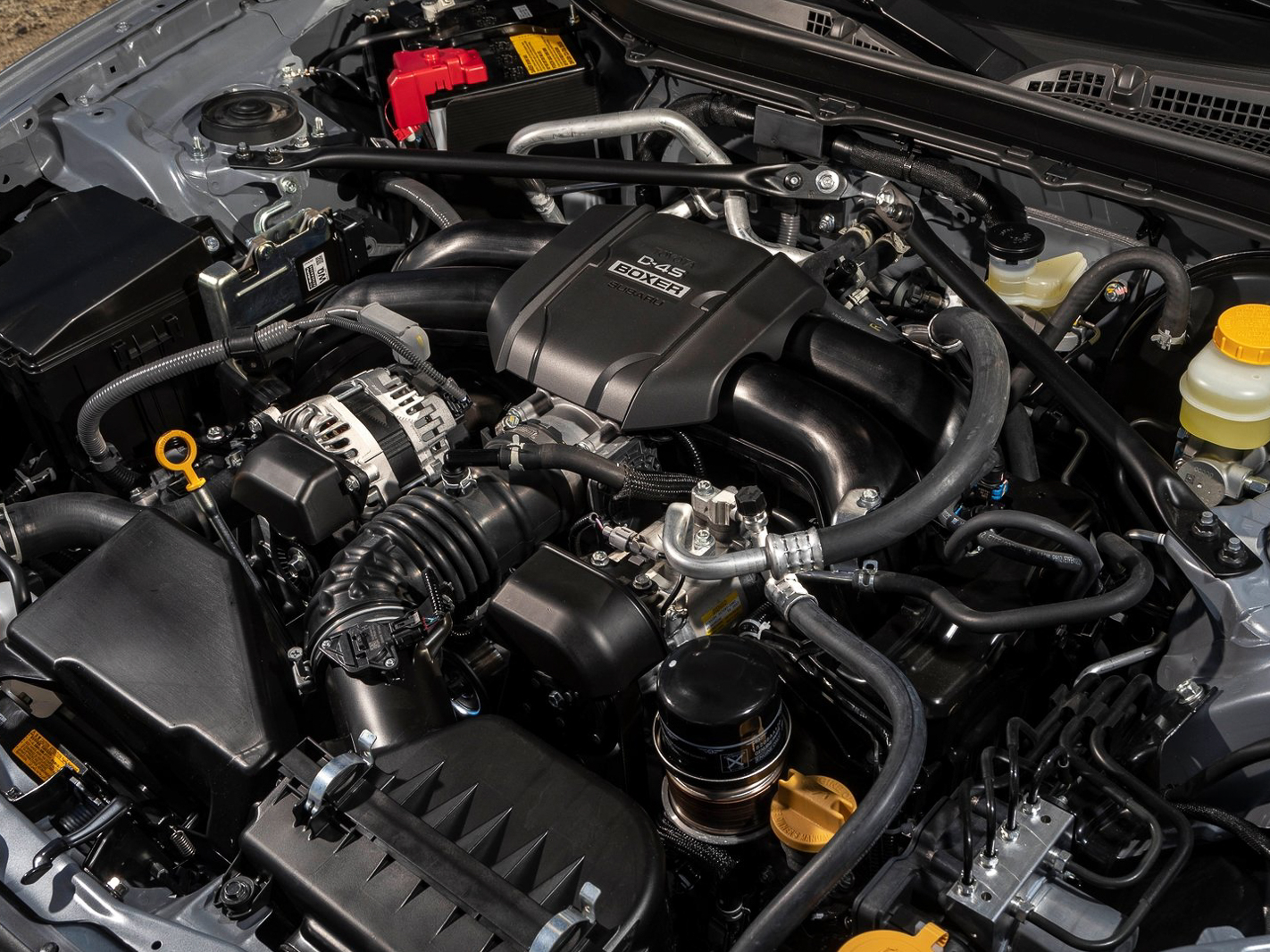
True, it’s not the turbocharged beastie many were hoping for, but the new engine should go a long way to addressing the torque criticisms of the original BRZ.
2. Lower, leaner, stiffer
Key dimensions have also been altered for the 2021 BRZ, representing a lower, lighter and more rigid new car.
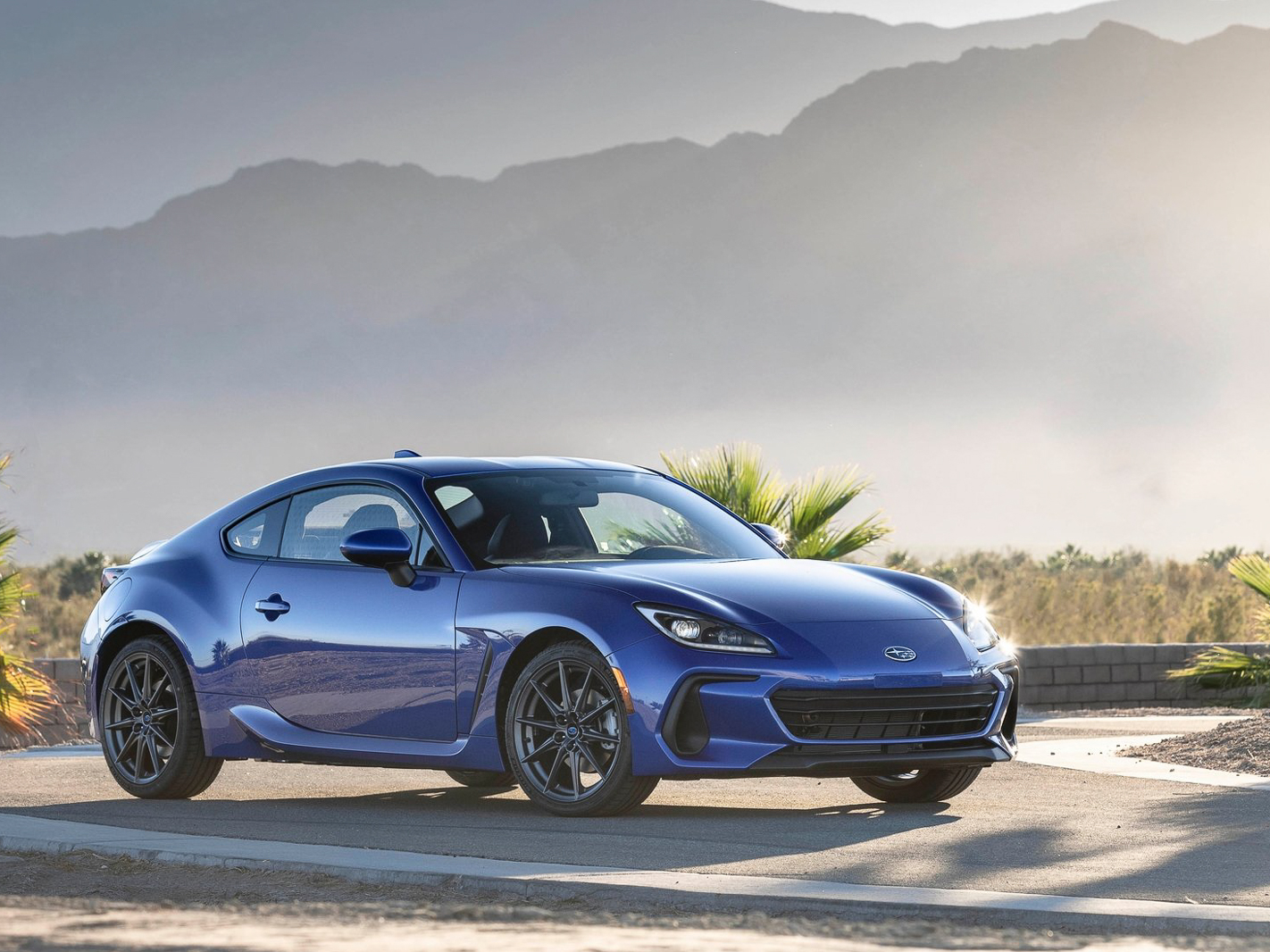
Its wheelbase is five millimetres longer than the previous car (below), the body is 22mm longer and the roof is 10mm lower than before.
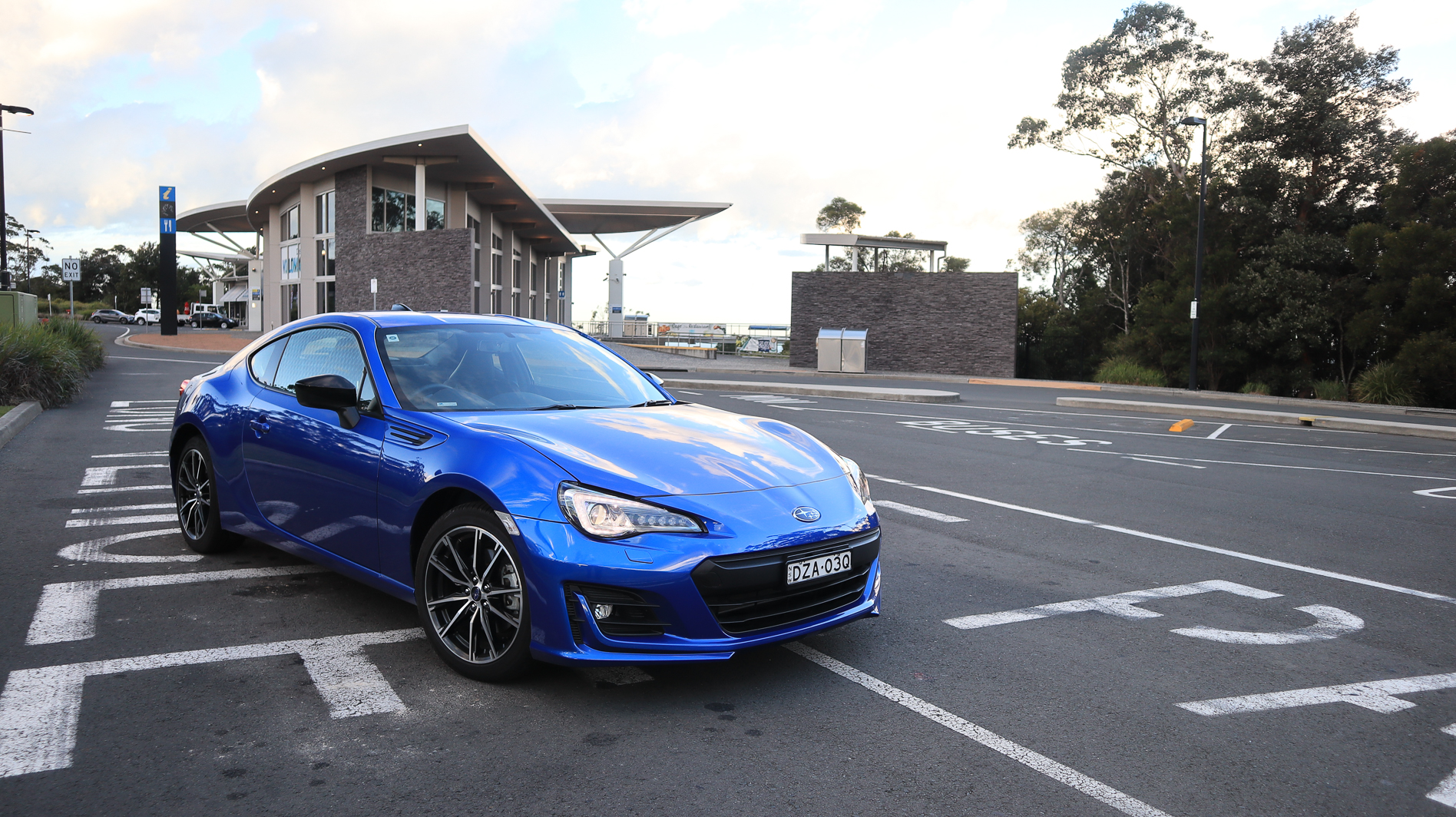
Additionally, Subaru says torsional rigidity is improved by 50 per cent, while use of aluminium in the roof, quarter panels and bonnet has allowed the BRZ to stay light.
It’s actually only 4-12kg heavier than the old one depending on specification, which is an amazing achievement given the use of a larger engine and more safety gear.
3. Get a grip
Another frustration for serious track-goers in the previous generation car was the lack of grip from its under-done tyres.
Because some variants were shipped with tyres that were also fitted to hybrid cars – where grip is the enemy of endurance – the BRZ has long been saddled with the criticism that its ‘Prius tyres’ were not nearly wide or grippy enough to deal with sports car-levels of lateral movement.
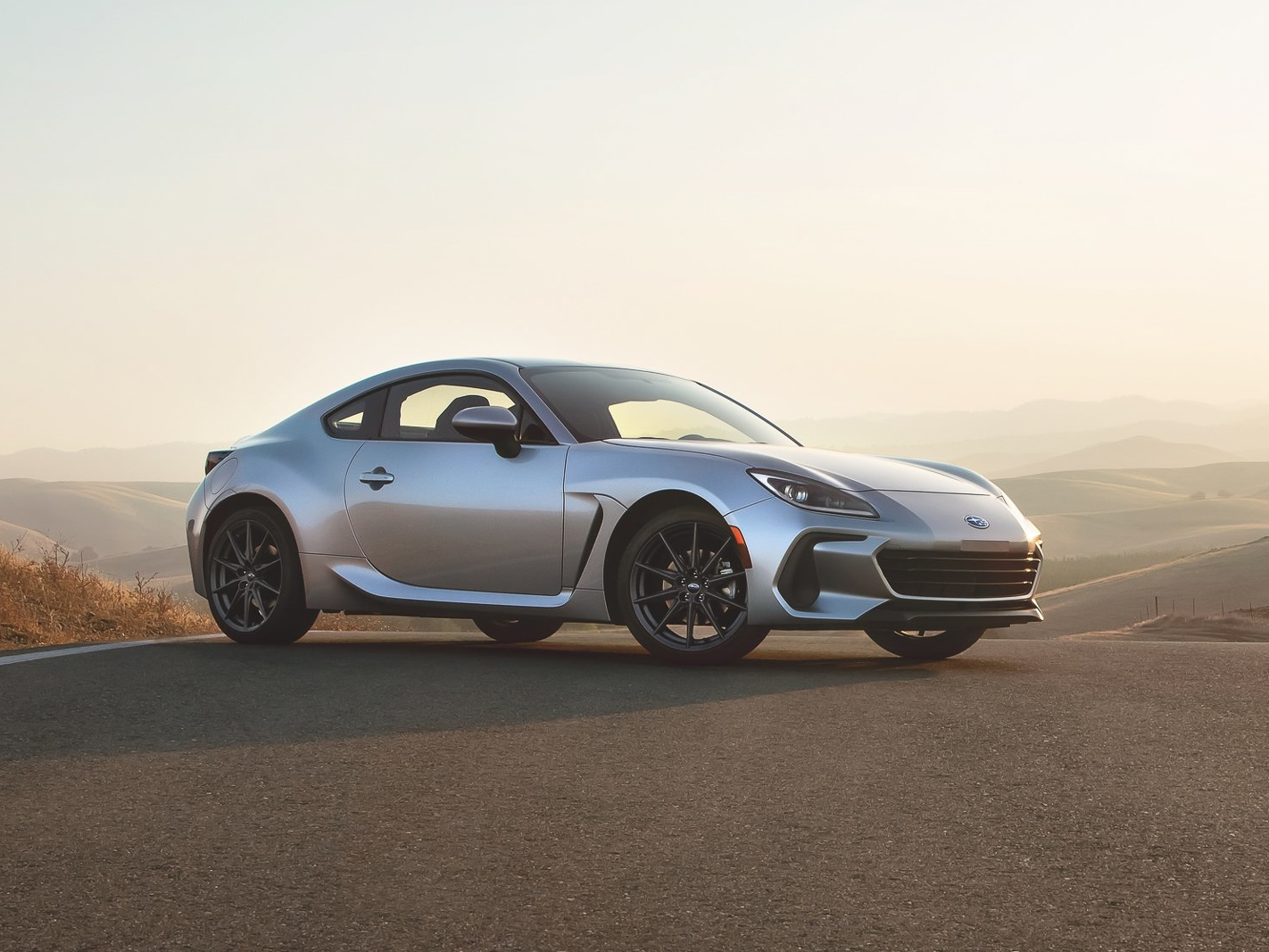
This new car does away with those concerns by speccing Michelin Pilot Sport 4 tyres, which are fitted to a new set of 18-inch alloy wheels.
4. Multimedia modernised
The 2021 Subaru BRZ will get a major upgrade in the infotainment department, equipping an 8.0-inch touchscreen Subaru multimedia system with Apple CarPlay and Android Auto smartphone mirroring as standard.
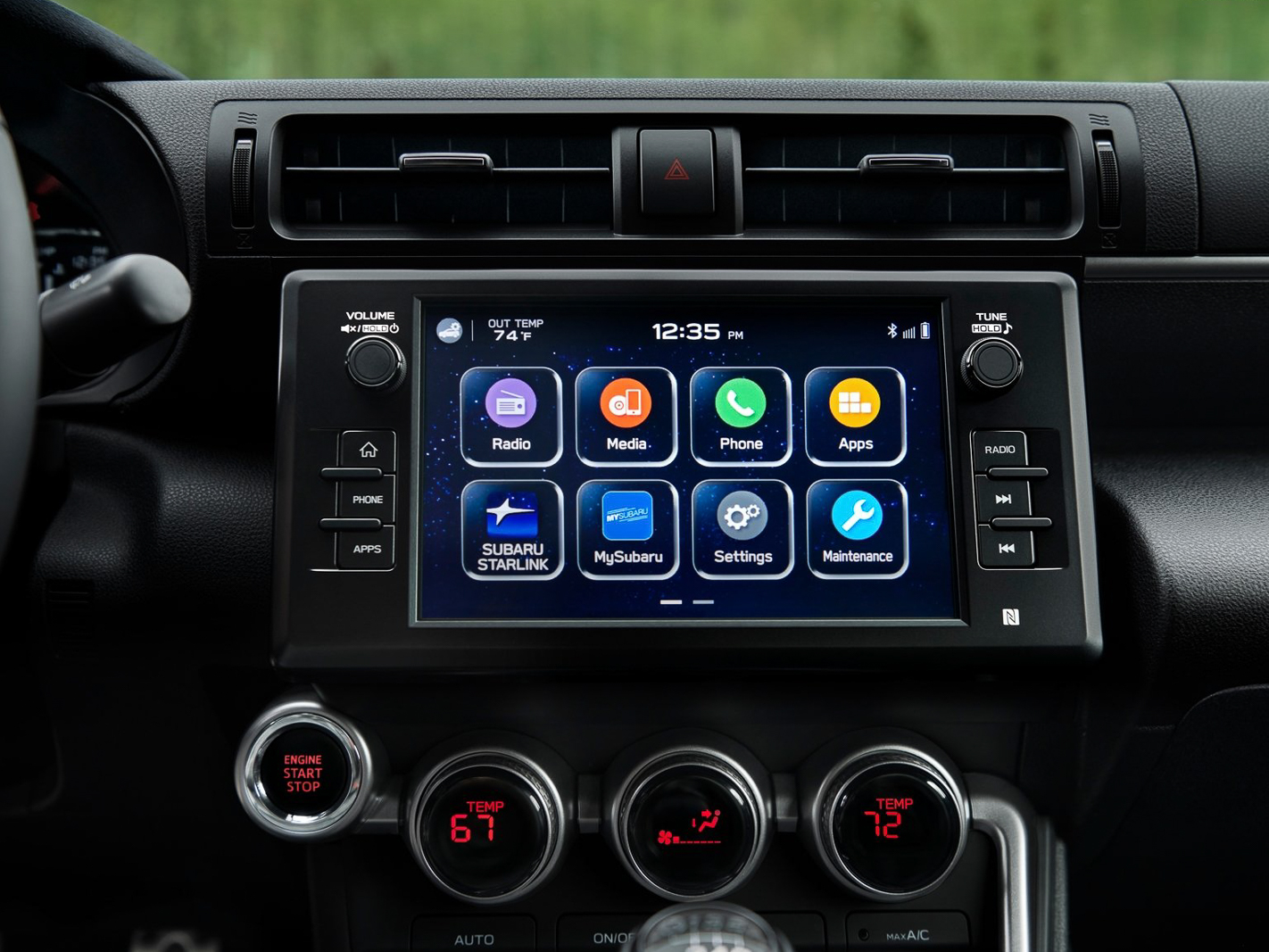
For better or for worse, the old analogue instrument cluster has also been replaced with a 7.0-inch TFT screen that can change between multiple driving mode layouts.
Will we miss the old-school dials? Only time will tell, but it’s a sign that the BRZ has grown up.
5. Safety first
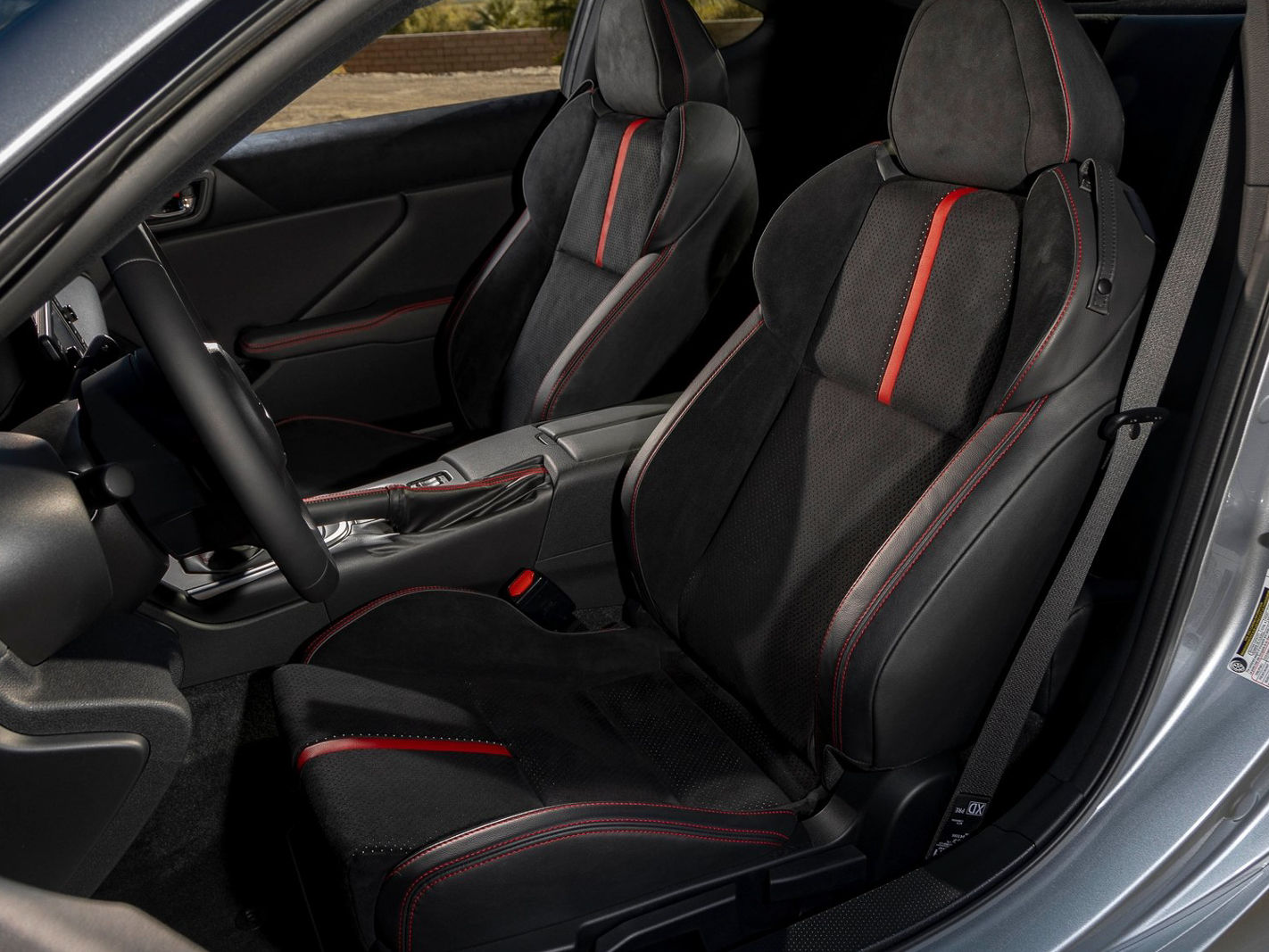
The BRZ’s safety has been overhauled, and now uses Subaru’s stereo camera-based Eyesight driver-assist technology.
It includes for the first time crucial safety updates like autonomous emergency braking and active cruise control, but it will only appear in automatic transmission-equipped versions.
Subaru also says that it should perform better in collisions due to a stronger, stiffer body-in-white that relies on larger volumes of high-tensile steel and enhanced passenger protection systems.
As before, Subaru provides the platform of the car while Toyota chips in with top-end engine components.
The platform has been derived from Subaru’s modular system that sits under everything from the XV to the incoming Outback.
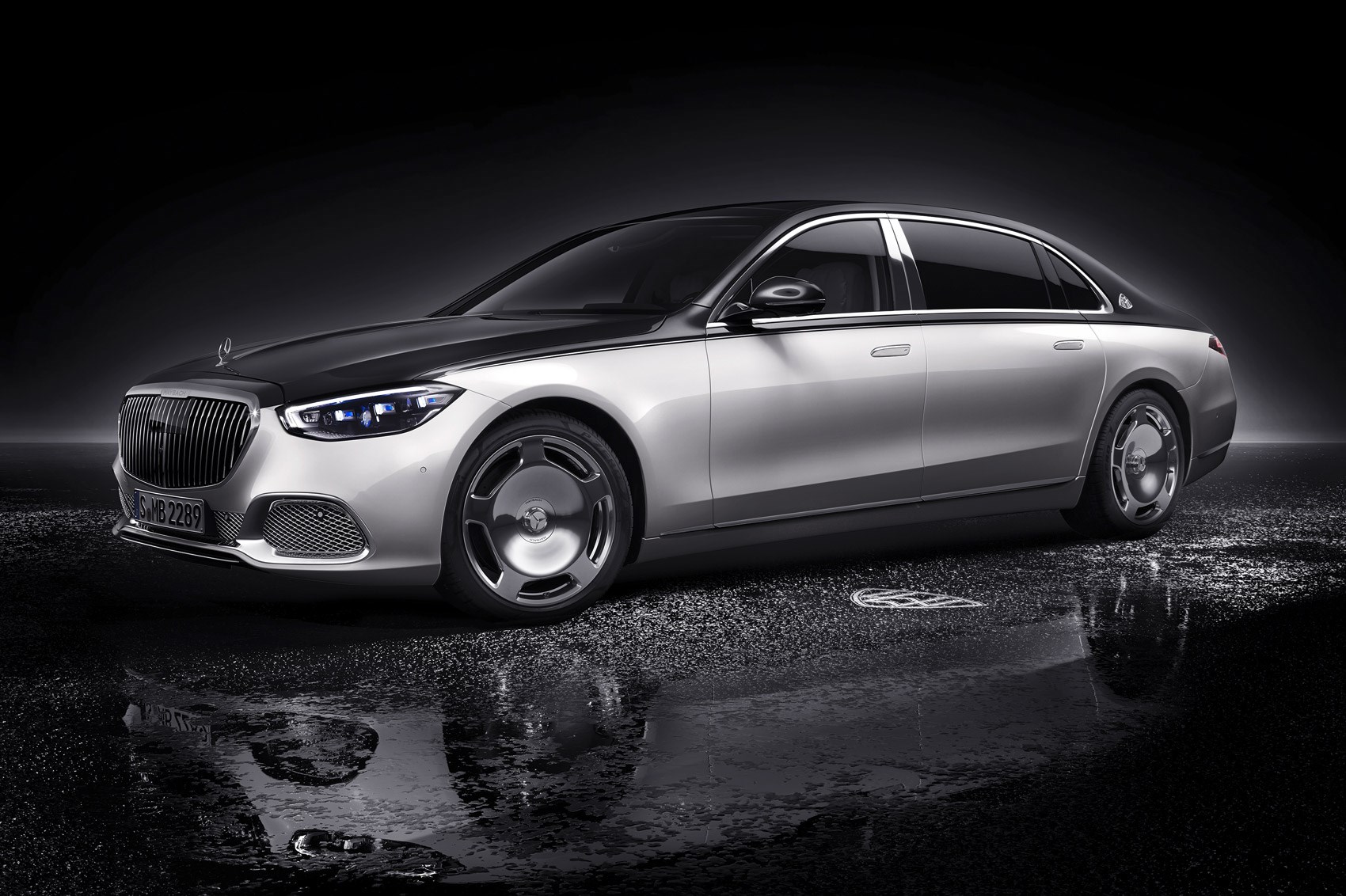
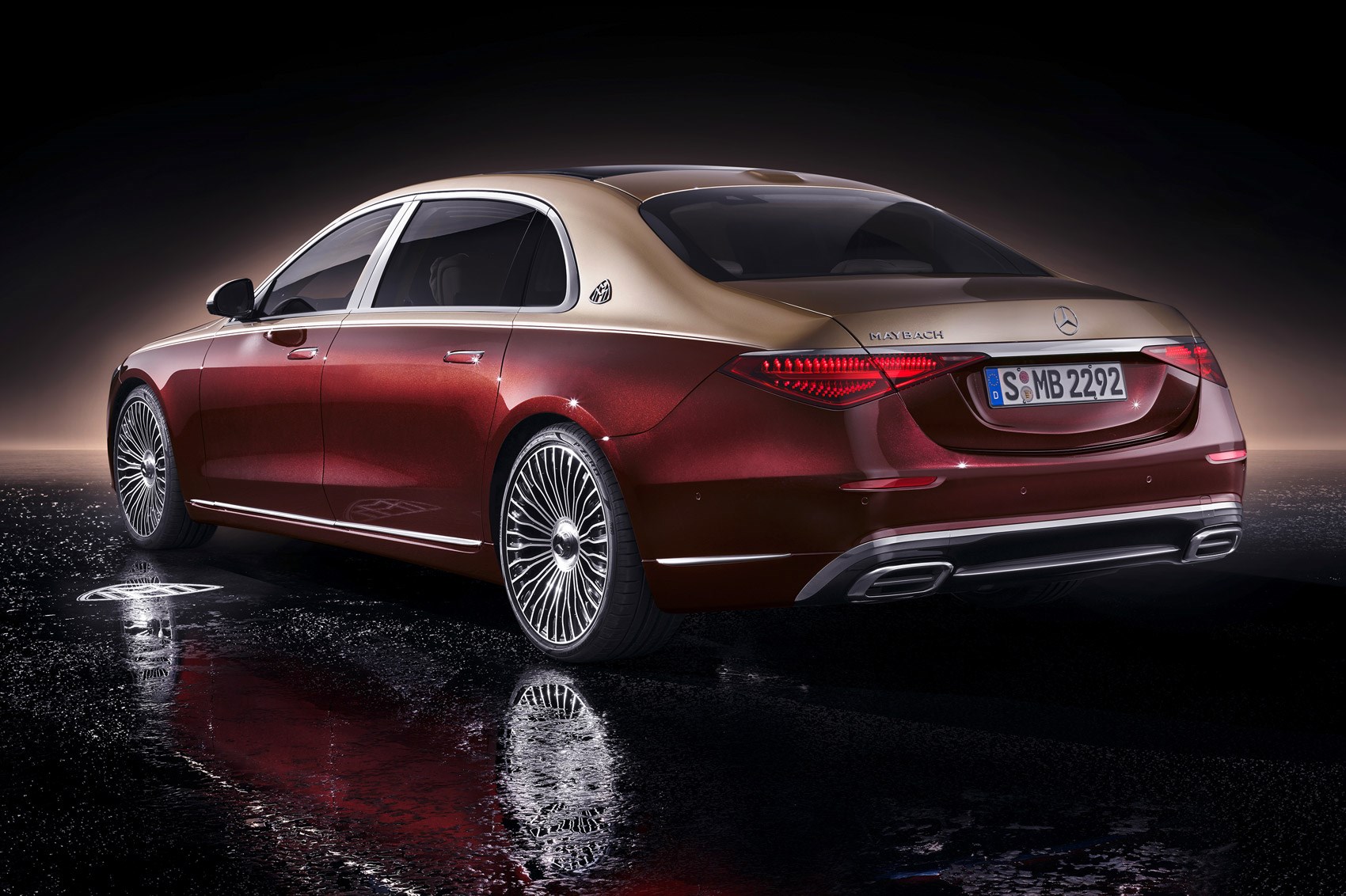
Mercedes is continuing its efforts to reshape Maybach as a luxury flagship for its already luxurious cars, with this being the latest creation: the Mercedes-Maybach S-Class.
The new model is 18cm longer than the long-wheelbase S-Class, with Mercedes saying it almost entirely benefits those in the rear.
Bespoke Maybach details include a different front grille and a central parting trim piece on the bonnet and badging on the C-pillar. Two-tone paint options (which takes Mercedes a week to apply) and the return of Merc’s iconic Monoblock wheels are also available.
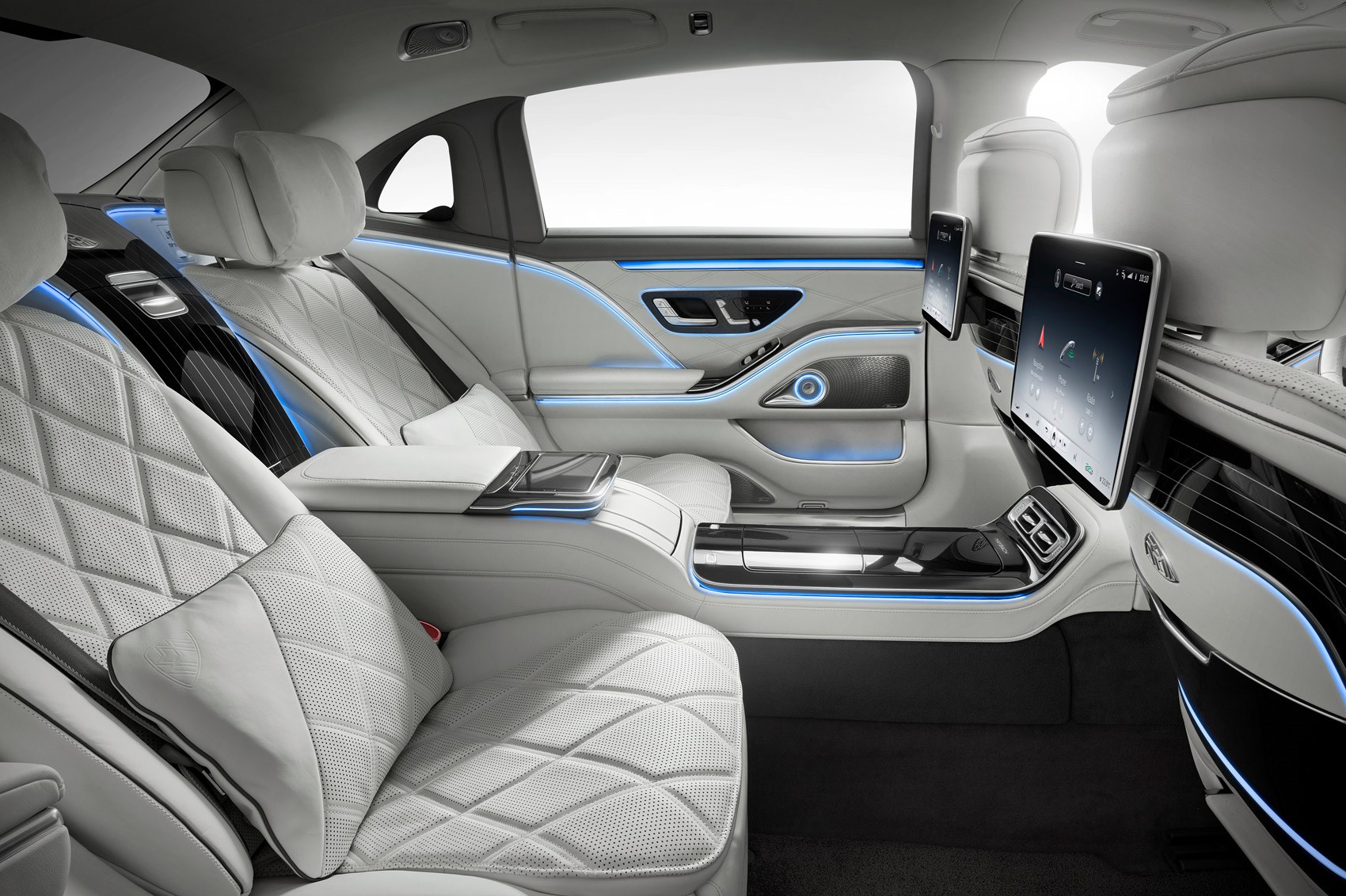
While these are options on a normal S-Class, the Maybach S comes with the Executive Seat package, which converts the three abreast seating in the rear into two reclining armchairs with tables and infotainment screens in the rear, and the Chauffeur package, which allows the backrest of the front passenger seat to tilt forward beyond the 90-degree position for more legroom.
Other options include the S-Class’ E-Active Body control, as is rear-wheel steering, digital headlights and more.
Mercedes is commencing a staggered launch of the Maybach S-Class. The USA and Chinese markets will get their first deliveries in April 2021 and will be available to wider world throughout the rest of the year.
For more on the standard S-Class, keep reading.
It’s hard to be an innovator these days – everyone’s at it. Which makes life difficult for the all-new S-Class.
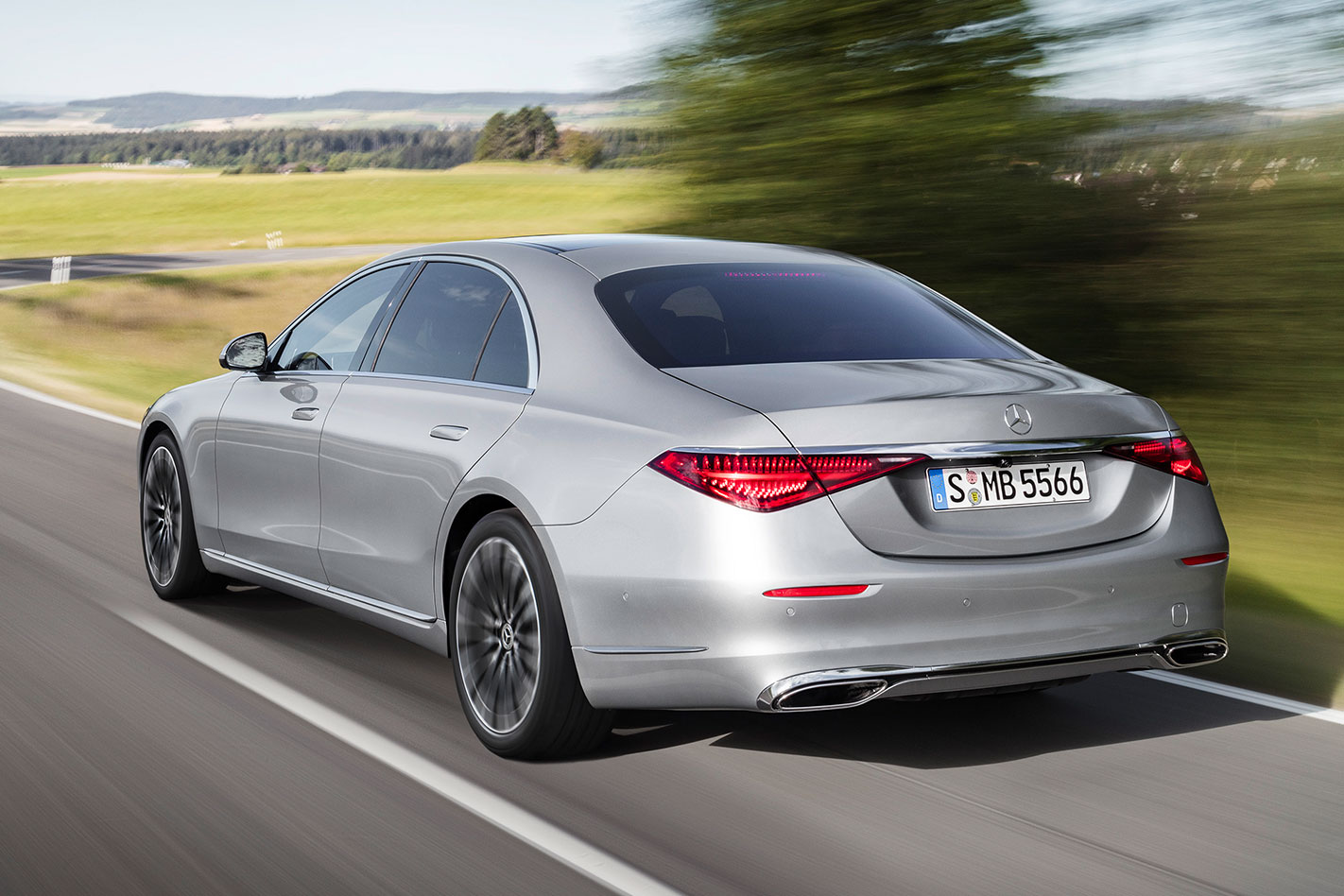
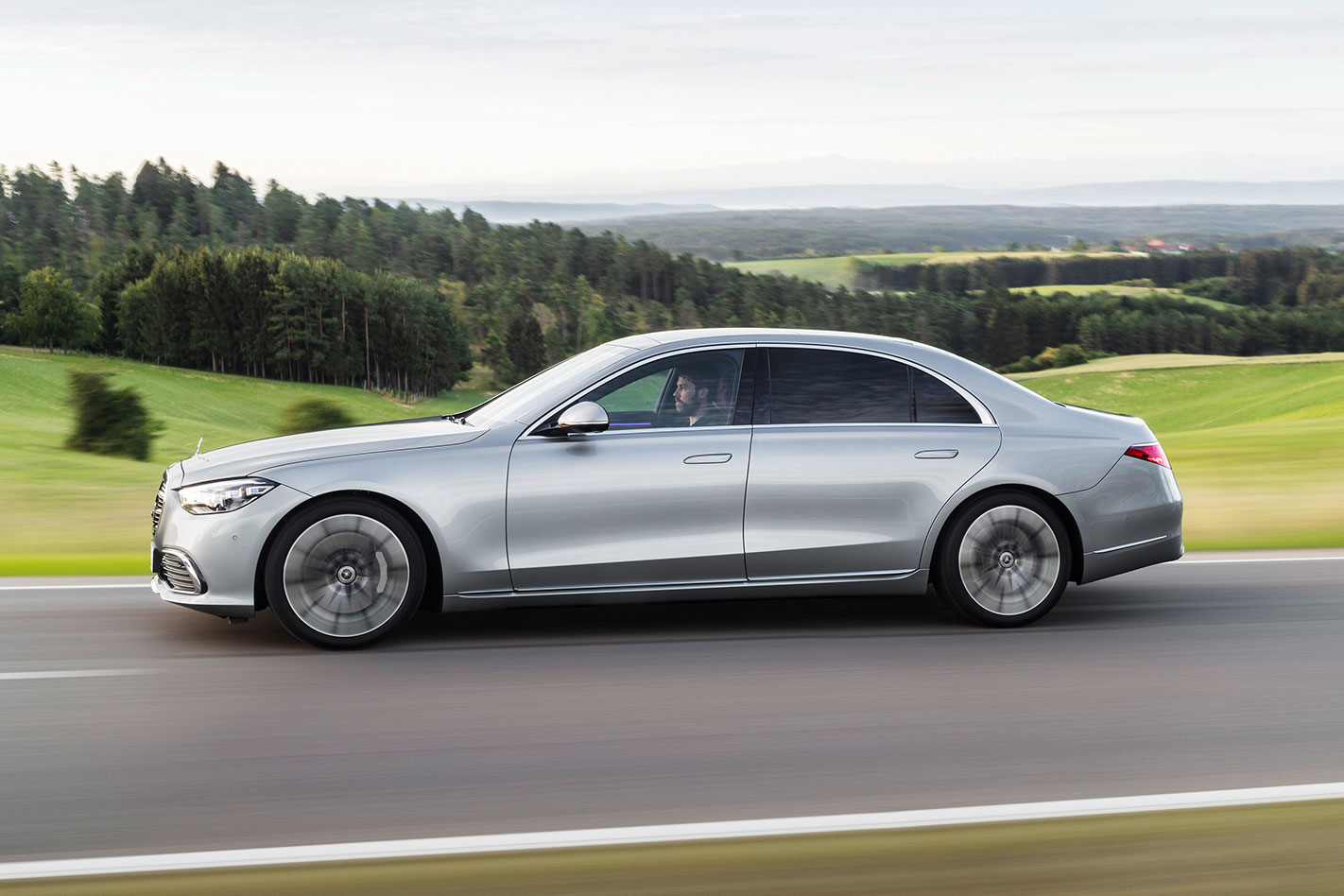
Back in the good old days, the S-Class was a beacon of future thinking and genuine technological advancement. The new S-Class still lives up to this legacy but must compete with a talented host of rival impostors cutting its grass.
The seventh generation of Mercedes-Benz’s luxury limo flagship (codenamed W223) does this through incremental advancements in key areas instead of wholesale change.
The first is a huge augmented reality head-up display, which Mercedes says is the equivalent of having a 77-inch TV screen placed 10 metres in front of the car. The system projects info such as turn-off arrows “virtually and precisely” onto the road in front of the driver.
Powering the new S-Class will be a combination of traditional combustion and plug-in hybrid engines. An S500 3.0-litre turbocharged straight-six and S580 4.0-litre twin-turbo V8 (both mild hybrids) will be available. An S580e plug-in flagship pairs the smaller engine with a 28kWh battery and electric motor for a combined output of 375kW and electric-only range of 100km.
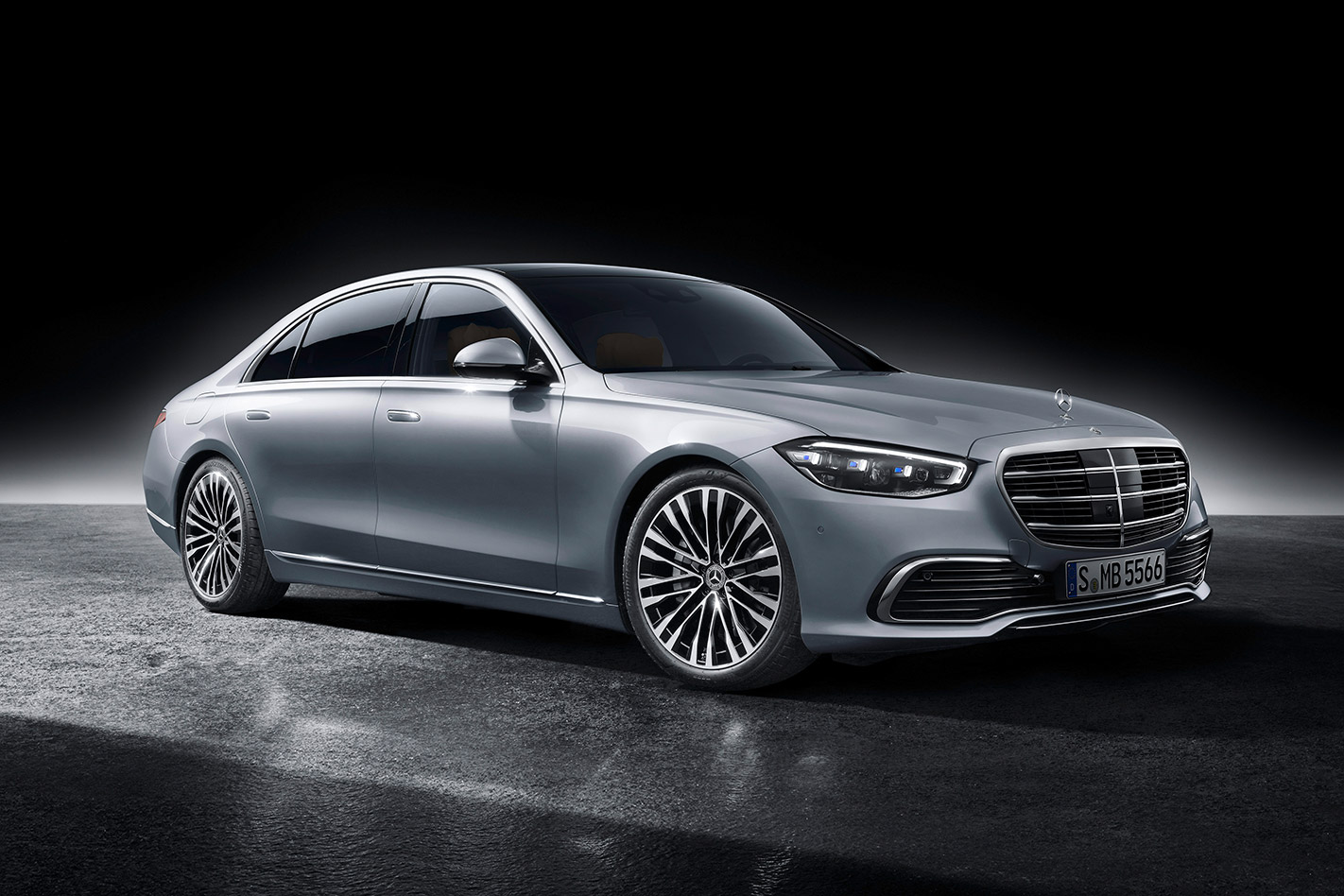
Unlike prior generations, there will be no coupe or convertible S-Class models with those variants being replaced by the next-gen AMG GT and SL-Class.
All up, there can be a total of five screens in the cabin of this latest S-Class, all running the second generation of Mercedes’ MBUX infotainment system, which now supports 27 languages.
The fully digitised driver instruments can now display in three dimensions. Using eye-tracking technology, the S-Class renders a 3D image to allow for spatial perception of displayed info without 3D glasses.
Computing grunt and processing power is a large part of this new S-Class, and the luxury sedan has a data bandwidth of 41.8 gigabytes per second – more than enough to mine bitcoin if that takes your fancy.
As is traditional, Mercedes has used the S-Class to debut genuine, life-saving safety technologies. The first is a frontal airbag for rear-seat occupants, which deploys from the back of the front seats, using a tubular structure to inflate and ‘catch’ the head of those riding in the outer rear seats.
The optional ‘Drive Pilot’ system is purported to allow the S-Class “to drive in highly automated mode at up to 60km/h” in certain conditions from the second half of next year. This autonomous technology will only be available in Germany initially, before being rolled out in other markets. Mercedes claims it “allows secondary activities such as the in-car office.”
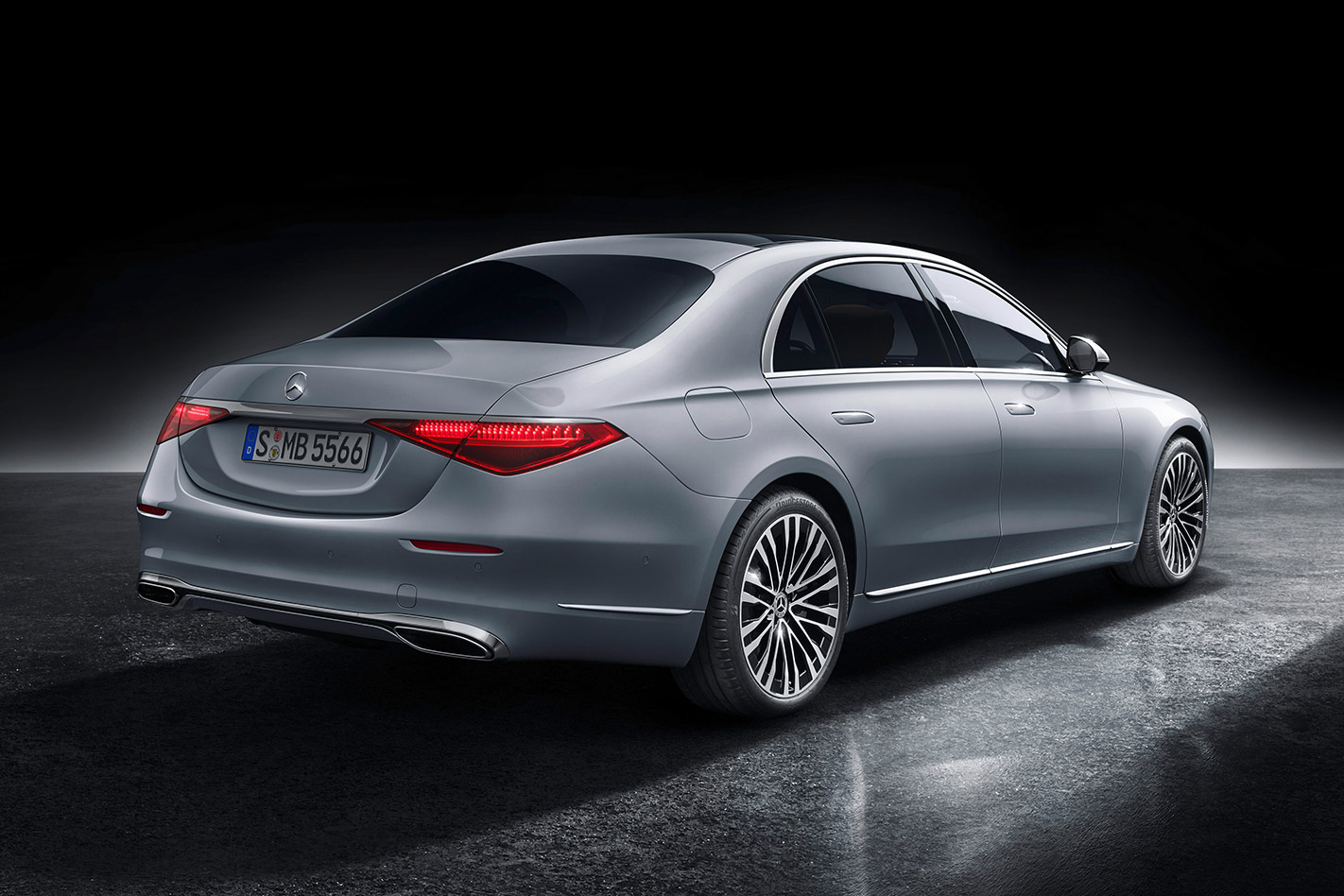
Nine out of 10 S-Class buyers opt for the long-wheelbase version, so Mercedes has added an advanced rear-wheel-steer system to aid the lengthy sedan’s manoeuvrability.
The optional system can angle the rear wheels by up to ten degrees, reducing the turning circle of a LWB AWD variant by 1.9 metres, to 10.9m.
A new interior brings with it improved comfort, with elbow-room for the driver increasing 38mm, 23mm for rear passengers, and headroom growing by 16mm in the back. Boot capacity has grown to 550 litres, up 20 litres compared to the outgoing model.
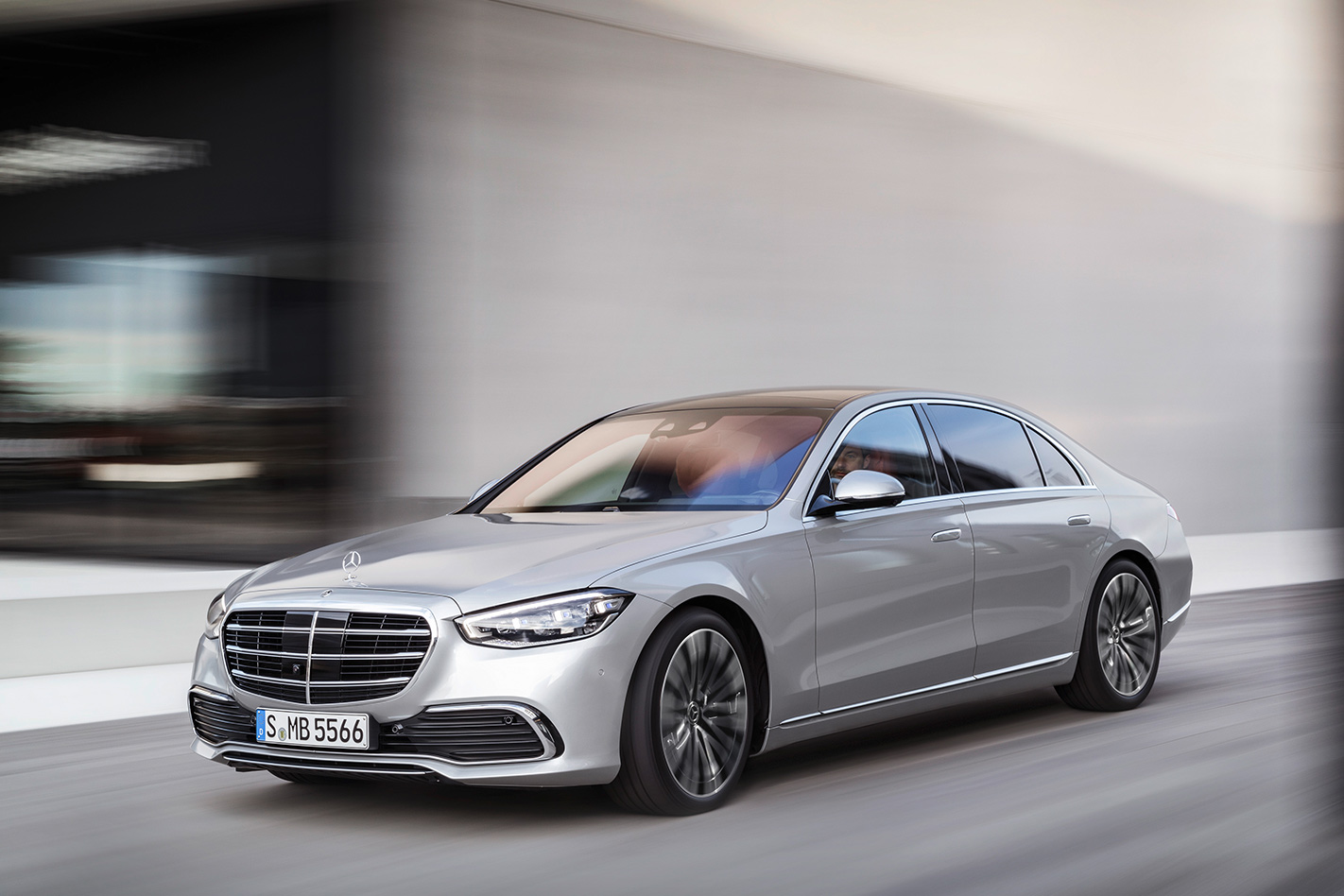
So while the technology battle in the luxo executive sedan segment continues, the S-Class still appears to hold an edge.
FIVE OF THE COOLEST PIECES OF TECHNOLOGY IN THE 2021 MERCEDES-BENZ S-CLASS
- LED headlights use micro-mirrors to project custom images and warnings onto the road
- More than 50 electronic components can now be updated over the air, including MBUX
- When a possible side impact is detected, the body can rise 80mm in a few tenths of a second
- Overhead cameras predict driver needs, like lowering rear sunblind when checking blind spot
- Active suspension analyses road conditions and makes adjustments 1000 times per second
