
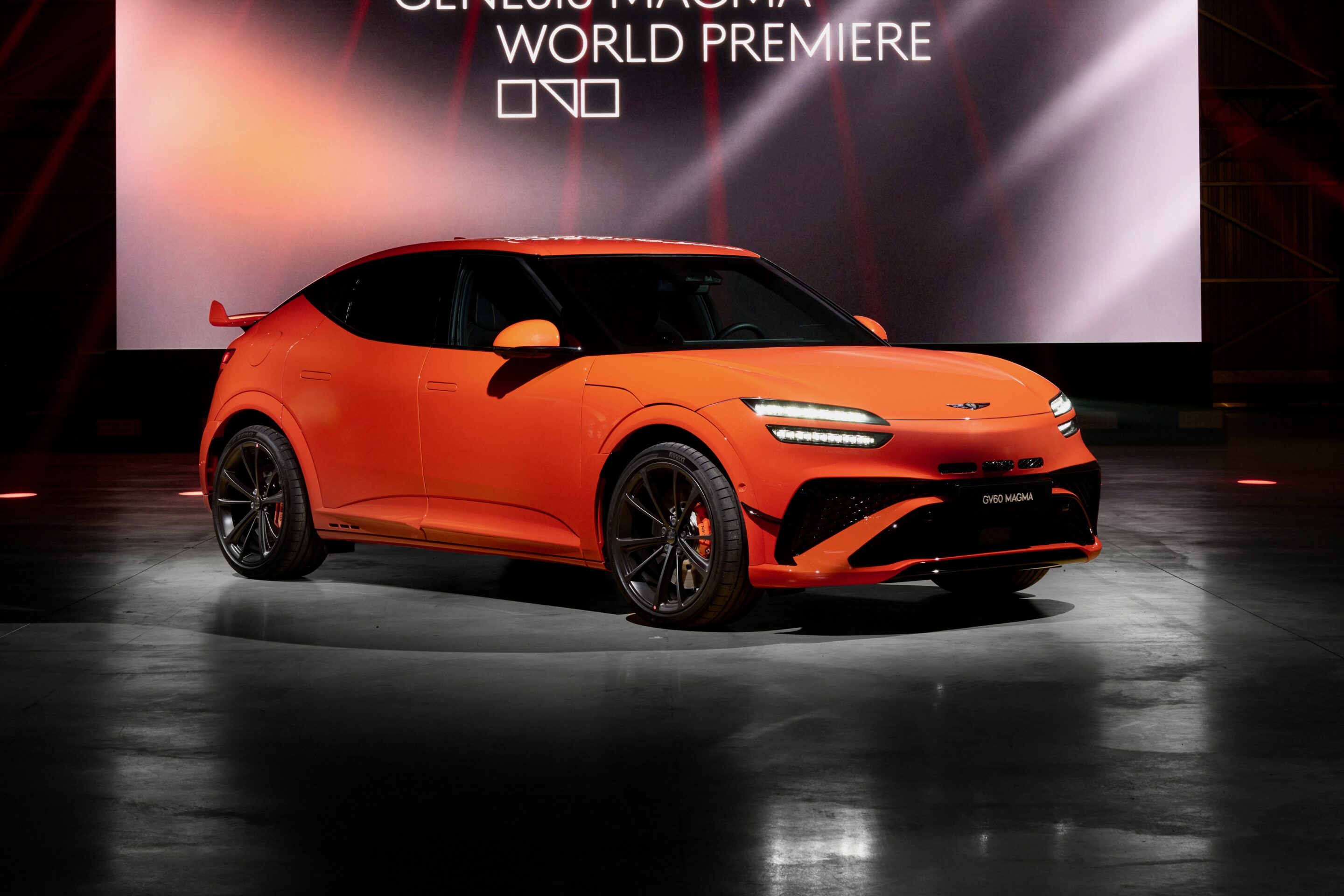
The first production car from Genesis’ new performance sub-brand Magma has been revealed and confirmed for Australian sales in early 2026. Borrowing much from the Hyundai Ioniq 5 N, the new Genesis GV60 Magma has been revealed overnight, signalling a much racier future for the South Korean luxury brand as it launches its equivalent of BMW M and Mercedes-AMG.
The GV60 Magma is a rival to the likes of the Tesla Model Y Performance, Alpine A390 and even the Porsche Macan Electric. It’s powered by the same dual-motor, all-wheel drive set-up found in the Ioniq 5 N.
With Boost mode activated, the car produces 478kW of power and 790Nm of torque – 20Nm more than the Ioniq 5 N. Combine that with its launch control, and the GV60 Magma will do 0-100km/h in close to three seconds and rocket to 200km/h in just 10.9 seconds. Top speed stands at 264km/h.
As well as the powertrain, the GV60 Magma has borrowed the virtual gearshift system from its siblings. This adjusts the e-motors’ output, torque delivery and regenerative braking so when the driver pulls the paddle behind the steering wheel it feels like they’re changing gears in a petrol-powered performance car – a feature we love in the Ioniq 5 N.
When you’re not trying to embarrass supercar owners away from the lights, the car’s two e-motors produce a combined 448kW of power and 740Nm of torque. A range figure hasn’t been confirmed yet, but we expect the 84kWh battery will be good for around 450km, while a maximum charging speed of 240kW means a 10 to 80 per cent top-up will take as little as 18 minutes.
There are three main drive modes: Sprint, GT and My. With My Mode, drivers can customise settings for the electronic limited-slip differential (e-LSD), stability control system and other tech. There’s also a Drift mode, which adjusts the e-motors’ output and the e-LSD to make the car more rear-biased for better sliding, and a special Magma mode.
However, this car is not designed to be a total hooligan. Genesis says the GV60 Magma has been set up to deliver an ideal balance between cornering stability and ride comfort. The chassis features adaptive dampers, plus hydro-bushings to help absorb impacts from potholes and other road imperfections. It also uses active noise-cancelling technology, sound-insulating glass and reinforced door seals to create a serene environment, as you’d expect from a “luxury high-performance car”, which is how the brand describes the GV60 Magma.
Compared with the regular GV60, the suspension geometry and roll centre have been tweaked. Meanwhile, the braking system has been upgraded, including monoblock calipers and large-diameter discs up front that are apparently optimised for the car’s bespoke 21-inch wheels. There’s also a bespoke bumper design with larger air ducts on either side to help cool the brakes.
The three holes on the nose are new too, and these not only improve airflow and cooling, but will be one of the styling cues that distinguishes this and future Magma models. The Magma is 20mm lower than the regular model, and features flared wheel arches that will have helped accommodate the wider 275mm tyres. Finally, there is a huge rear spoiler that Genesis insists is functional and generates downforce, not just attention.
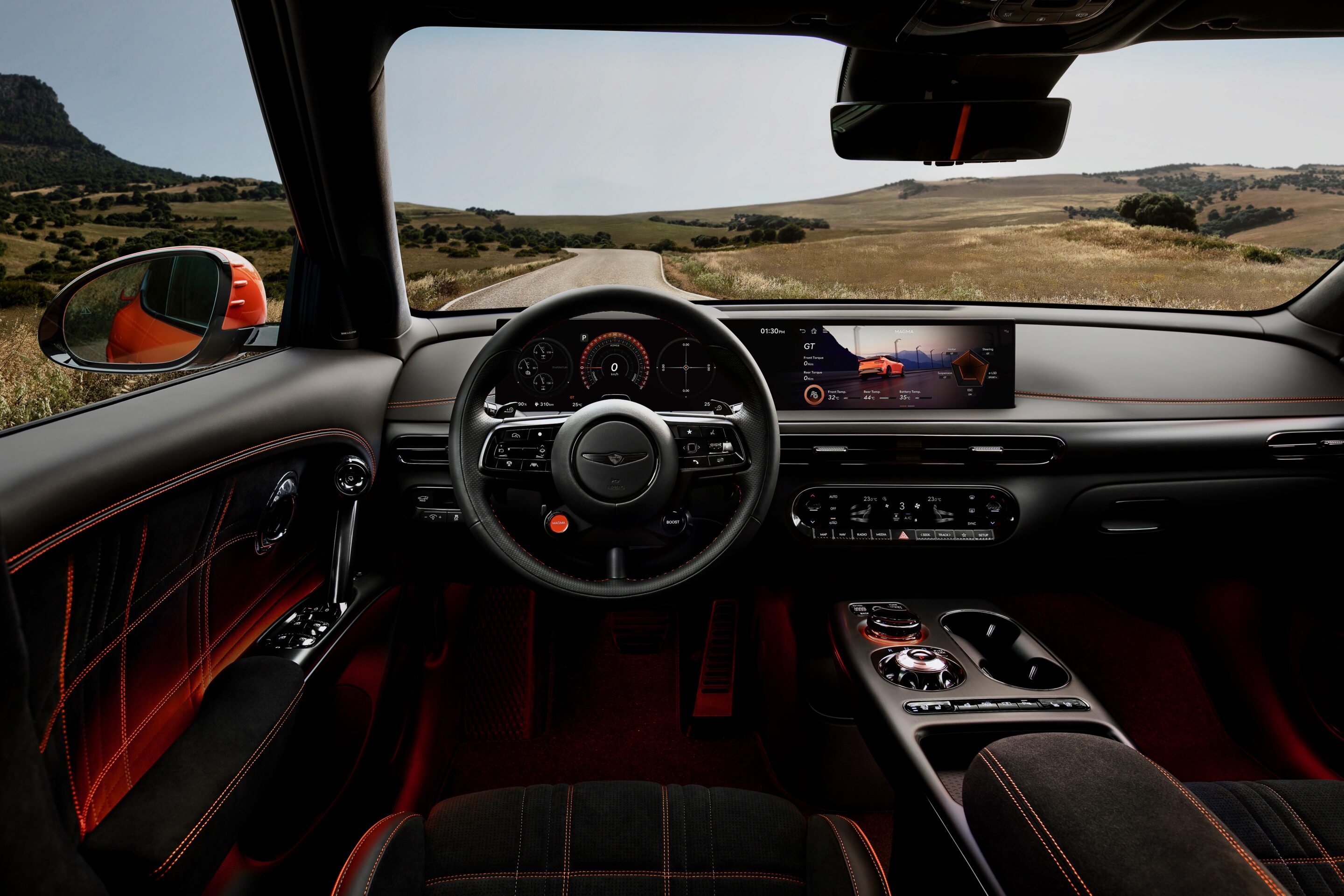
Inside, the seats, door and centre console are trimmed in a premium suede-like material, with the signature Magma orange used for the contrast stitching. There’s a unique steering wheel too, featuring vibrant orange buttons for the drive modes and activating boost.
The Genesis GV60 Magma will arrive in Australia in early 2026, with local pricing yet to be confirmed.
GAC (Guangzhou Automobile Group) has just launched in Australia with big ambitions to become one of the top 10 best selling car brands locally by 2028. But what’s the GAC back story, a brand that has been dubbed the “Chinese Toyota”?
GAC is one of China’s biggest automotive manufacturers, currently placed fourth in annual sales in its domestic market. Headquartered in Guangzhou in south-eastern China, it produces passenger cars, commercial vehicles, EVs, and automotive components. It operates its own brands, as well as joint-venture brands with western manufacturers such as Toyota and Honda.
GAC traces its routes back to 1954, when Guangzhou established its first automotive repair and manufacturing workshops. In that same year, the Guangzhou Bus Repair built its first products – hand made iron-wood buses – that started the rise of the company. At this time, China’s auto industry was extremely small, and much activity revolved around repairing imported or military vehicles.
In the 1960s, the first Hongwei-branded truck was launched, while the production of cars started in the early 1970s, according to GAC. Guangzhou’s regional government supported industrialisation, laying groundwork for a future automotive group.

In the mid-1980s, Guangzhou Peugeot was established, one of the first joint ventures with a western manufacturer in China. Locally producing models such as the Peugeot 505, Guangzhou Peugeot quickly became one of the top three best-selling brands in China and the 505 was considered a hot commodity in the country. By now, Guangzhou was also producing motorbikes, buses and small commercial vehicles.
In 1997, Guangzhou Automobile Group Co. was formally established as an independent state-owned automotive manufacturer, and formed GAC Honda in 1998 to sell Honda products in the Chinese market, such as the Accord sedan, later expanding to the City, Odyssey and Vezel (HR-V). By 2005, GAC Honda was selling 203,200 units annually in China, making it the fifth best-selling car maker, and it had become one of the most profitable automotive joint ventures in China.
In 2004, GAC added another Japanese maker to its line-up, Toyota, and GAC Toyota was formed. Producing products such as the Camry and Kluger in China from 2006, producing both Honda and Toyota products meant that GAC’s growth expanded rapidly. In 2008, GAC Hino was formed to sell trucks and buses, and this period established GAC as a major regional automaker with strong foreign ties, but no homegrown cars yet.
In 2009, GAC acquired 29 per cent of Chinese SUV maker Changfeng Automobile, and purchased the remaining portion in 2011. In 2010, it also purchased a 51 per cent share of another company called Gonow, which also made SUVs and commercial vehicles. GAC’s sales in 2010 hit 724,200, which gained it sixth place on the Chinese domestic sales chart.
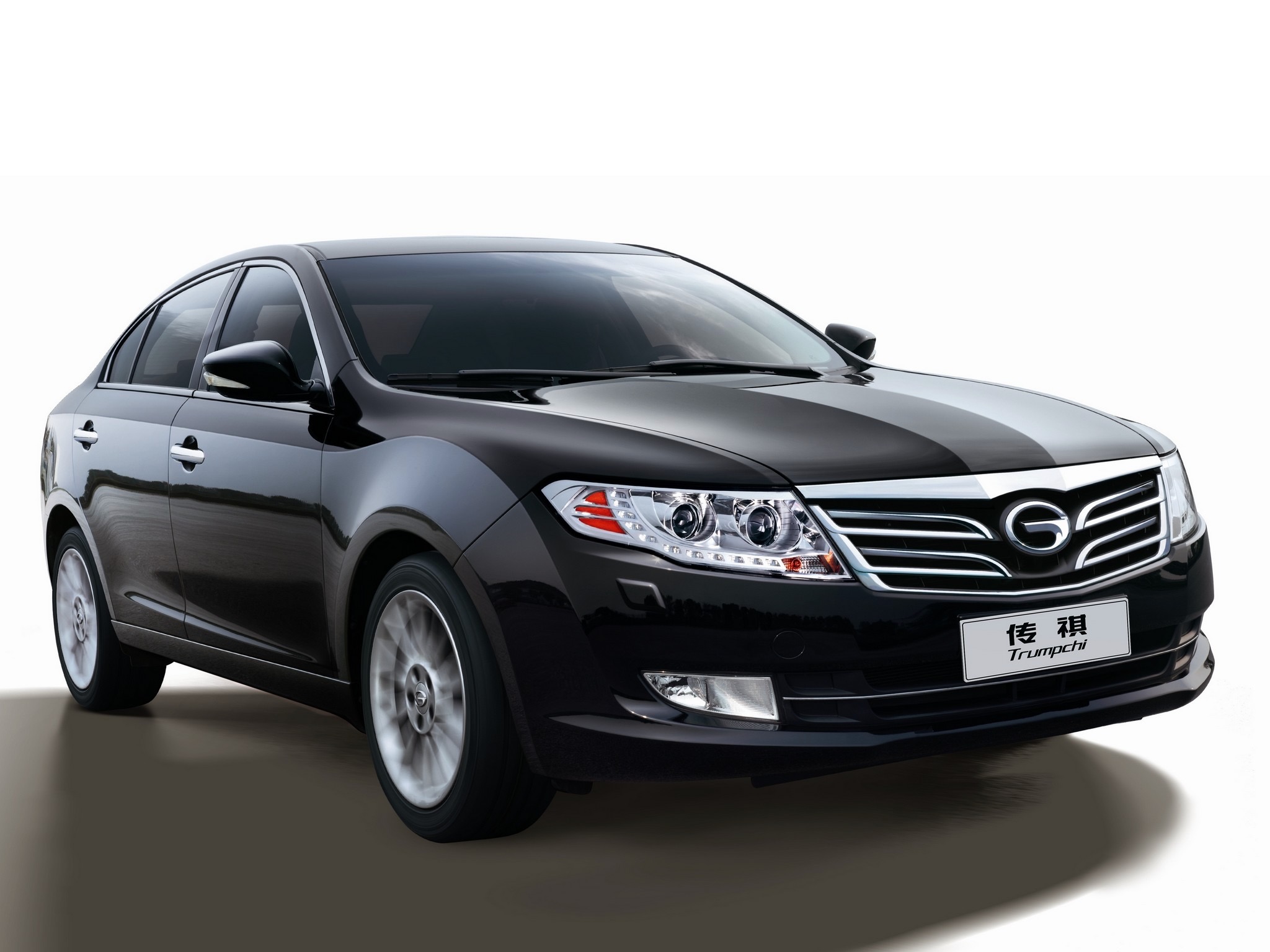
Not long after, GAC decided to start producing its own cars for the domestic market, with the Trumpchi marque first to launch. The Trumpchi GA5 sedan was its first product, which it was actually based on the Alfa Romeo 166, and Trumpchi’s reputation for quality was established. From 2012, an SUV version of the GA5 called the GS5 was produced, and a compact sedan called the GA3 was unveiled in 2013. By the late 2010s, the brand had launched major sellers, including the GS4 SUV that reportedly made Trumpchi a household name in China.
GAC formed another joint venture in 2012 with Mitsubishi, producing cars such as the ASX, Outlander and Pajero for the Chinese market.
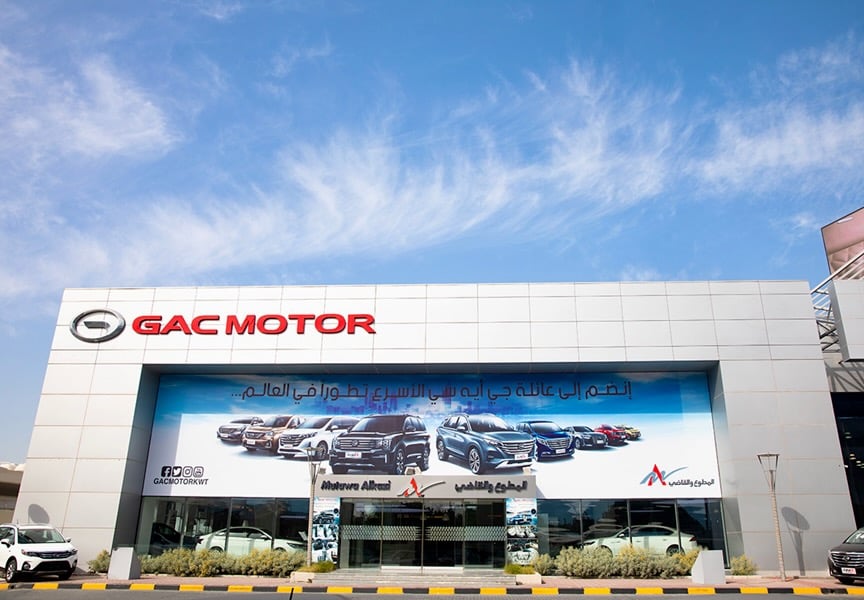
In 2013, GAC launched in its first export market: Kuwait, with Lebanon, Nigeria, Bahrain, the UAE, Philippines, Saudi Arabia, Ecuador, Cambodia, Laos, Panama and Russia all part of GAC’s exports by 2020.
From that point, GAC’s rapid product expansion started with a slew of new products and even some new brands, including Aion as the new energy brand in the GAC Group. Aion was spun off as an independent company focusing on new forms of manufacturing, pure electric architectures, new battery technology and autonomous driving.
In 2015, GAC sold almost 1.2 million cars, almost doubling sales in just five years. In 2016, sales rose to 1.65 million, then 1.9 million in 2017 and to over 2 million in 2019.
Since 2020, GAC has invested heavily in solid-state battery development, hydrogen tech and autonomous driving systems, while also expanding further to markets such as Thailand, Malaysia and Brazil. The Aion brand has become one of the biggest-selling new energy brands in China, and is often compared with rivals such as Zeekr, XPeng and BYD, all of which already have a presence in Australia.
Today, GAC’s key brands include GAC Motor, its export-focused ICE/Hybrid vehicles, Trumpchi (domestic ICE/hybrid brand) and Aion (EV specialist), as well as its joint ventures with Hino (commercial) and both Honda and Toyota. In China, GAC is reportedly known for strong joint-venture reliability (Toyota/Honda quality), EV innovation, better build quality compared with many domestic brands, and its ambition towards global expansion.
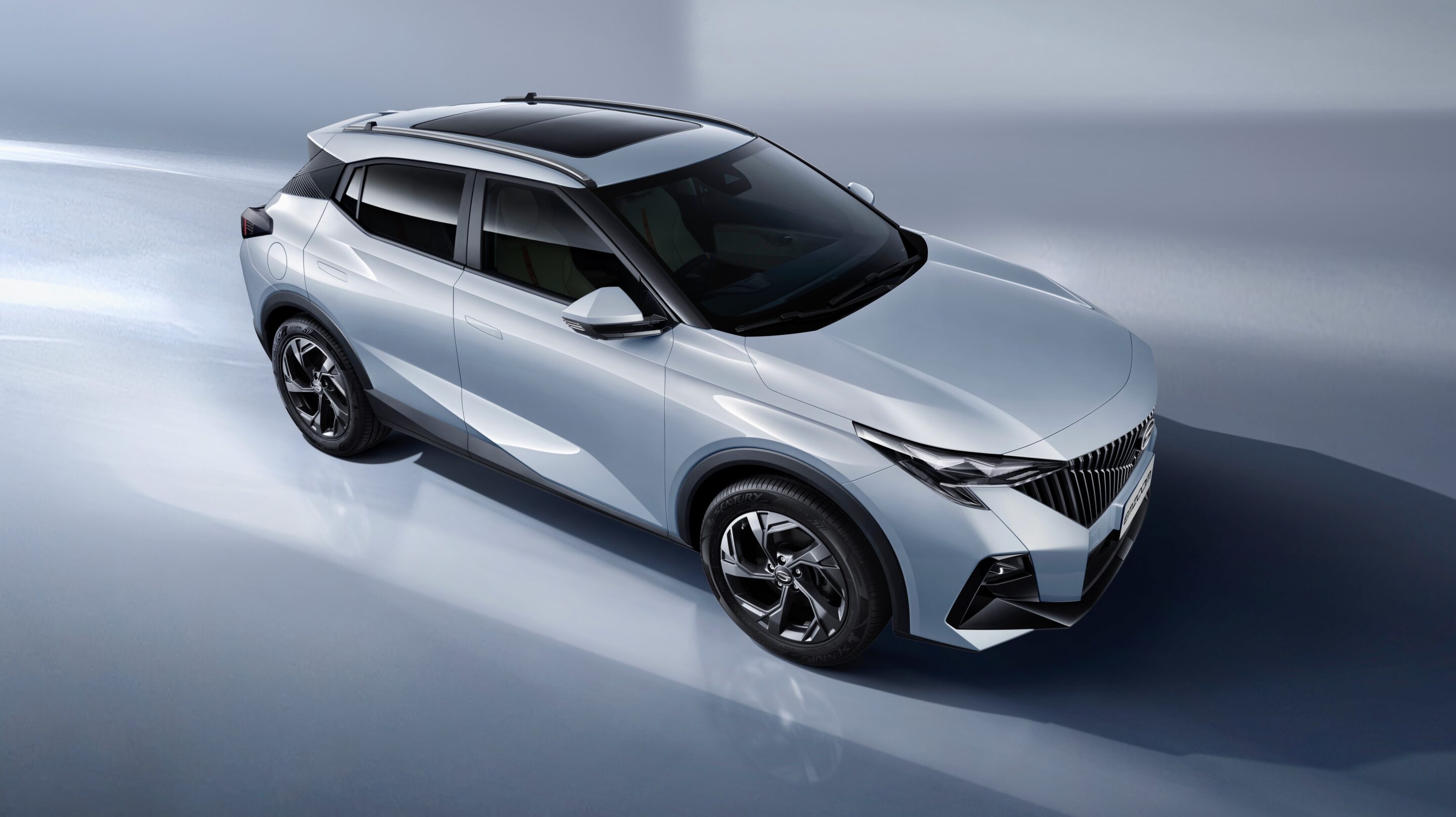
GAC has recently launched in Australia with the Emzoom small SUV (above, priced from $25,590 +ORC), Aion V electric mid-size SUV ($42,990 +ORC) and M8 PHEV MPV ($76,990 +ORC). It has ambitions of becoming a top 10-selling brand by 2028, and plans to introduce more than 10 new models across sedans, SUVs, pickup trucks, and MPVs to our shores in the next few years.
TAG Heuer has introduced a new version of its famous Monaco Chronograph, unveiling a limited-production model that draws heavily on the atmosphere of Formula 1 night racing. The watch, capped at 600 units globally, is the latest evolution of a design first made famous more than 50 years ago.
The Monaco name has long been tied to motorsport culture and popularised well beyond watch-collecting circles thanks to Steve McQueen, who wore one in the 1971 film Le Mans. TAG Heuer has since continued to update the line with modern materials and movements, and the newest release extends that tradition with a focus on bold colour, exposed mechanics and high-contrast nighttime visibility.
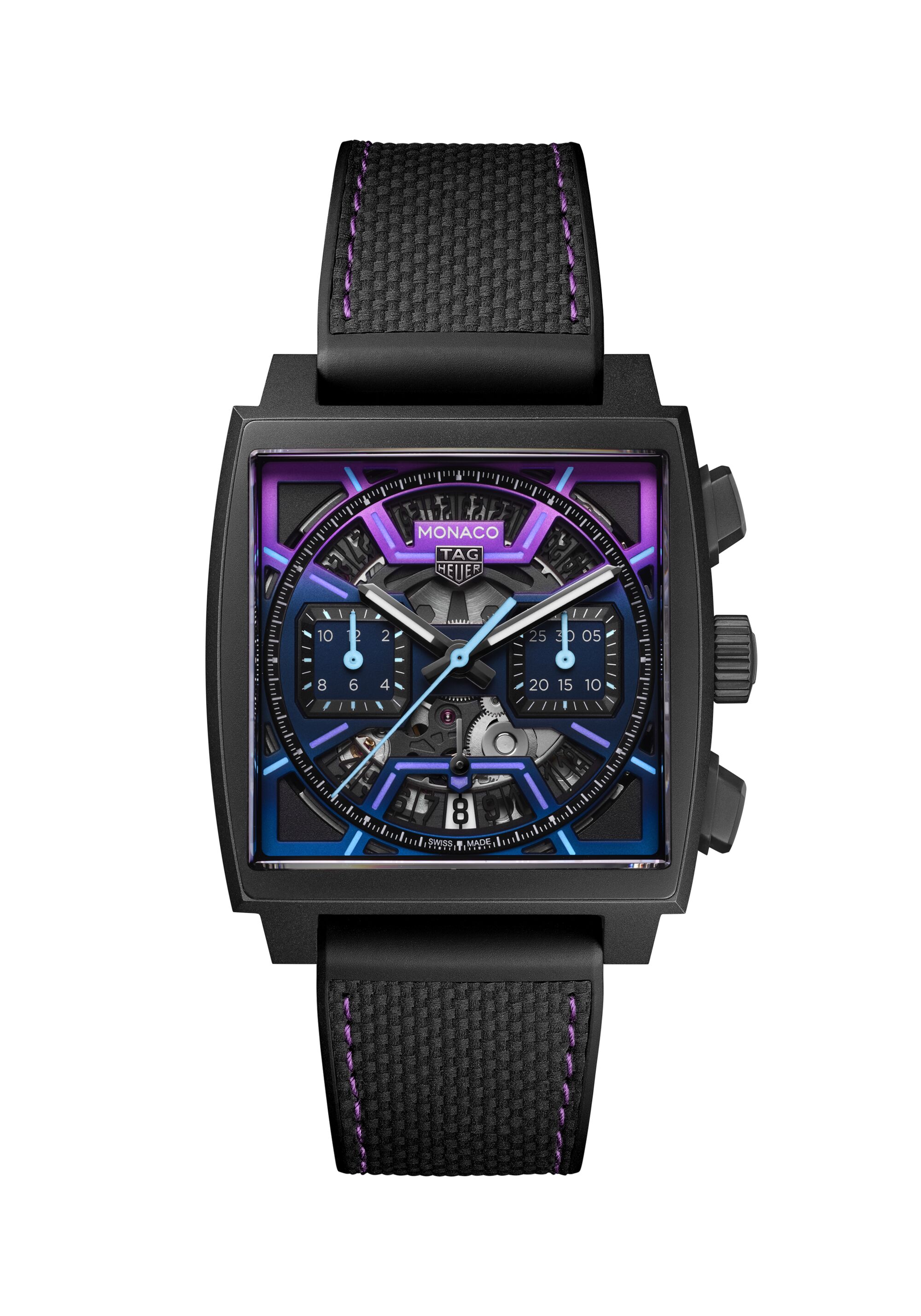
The new edition centres on a 39mm case made from black DLC-coated titanium – lightweight, scratch-resistant and markedly different from the steel cases that defined early Monaco models. The dial is fully skeletonised, revealing the movement beneath while fading from violet to deep blue. TAG Heuer says the gradient is meant to evoke the transition from dusk to darkness, similar to the setting of night races in cities such as Singapore or Las Vegas.
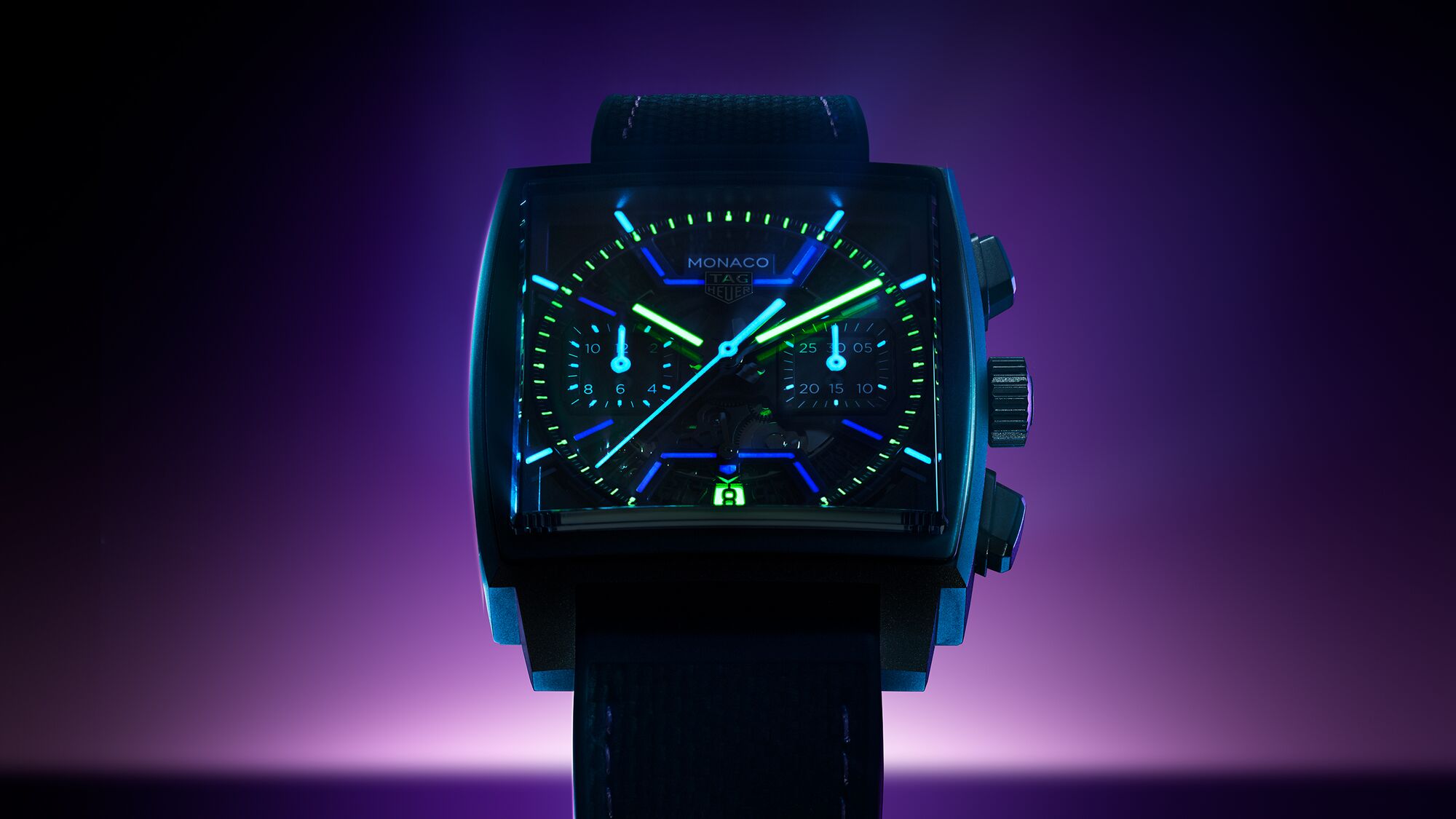
Legibility in low light is a key theme. The chronograph’s hands and markers use multiple colours of Super-LumiNova to create distinct layers of illumination. Blue luminescence highlights the stopwatch function, while green is reserved for timekeeping. Purple lighting elements in the minute track and blue accents around the outer dial add further depth when viewed in the dark. The caseback carries the same colour palette, with an iridescent sapphire window shifting between blue and purple tones.
Inside, the watch runs on TAG Heuer’s in-house Calibre TH20-00 automatic movement, visible from both the front and rear thanks to the open-worked architecture. The movement is designed for improved efficiency and offers bidirectional winding for more consistent power delivery.
The strap mixes rubber with embossed leather and includes purple stitching to align with the dial’s colour theme. Each watch is individually numbered and delivered in special packaging created exclusively for the edition.
While the Monaco collection has taken many forms over the years, TAG Heuer’s latest release positions the watch squarely within the spectacle of modern motorsport, offering a highly stylised interpretation aimed at collectors drawn to the visual drama of racing after dark.
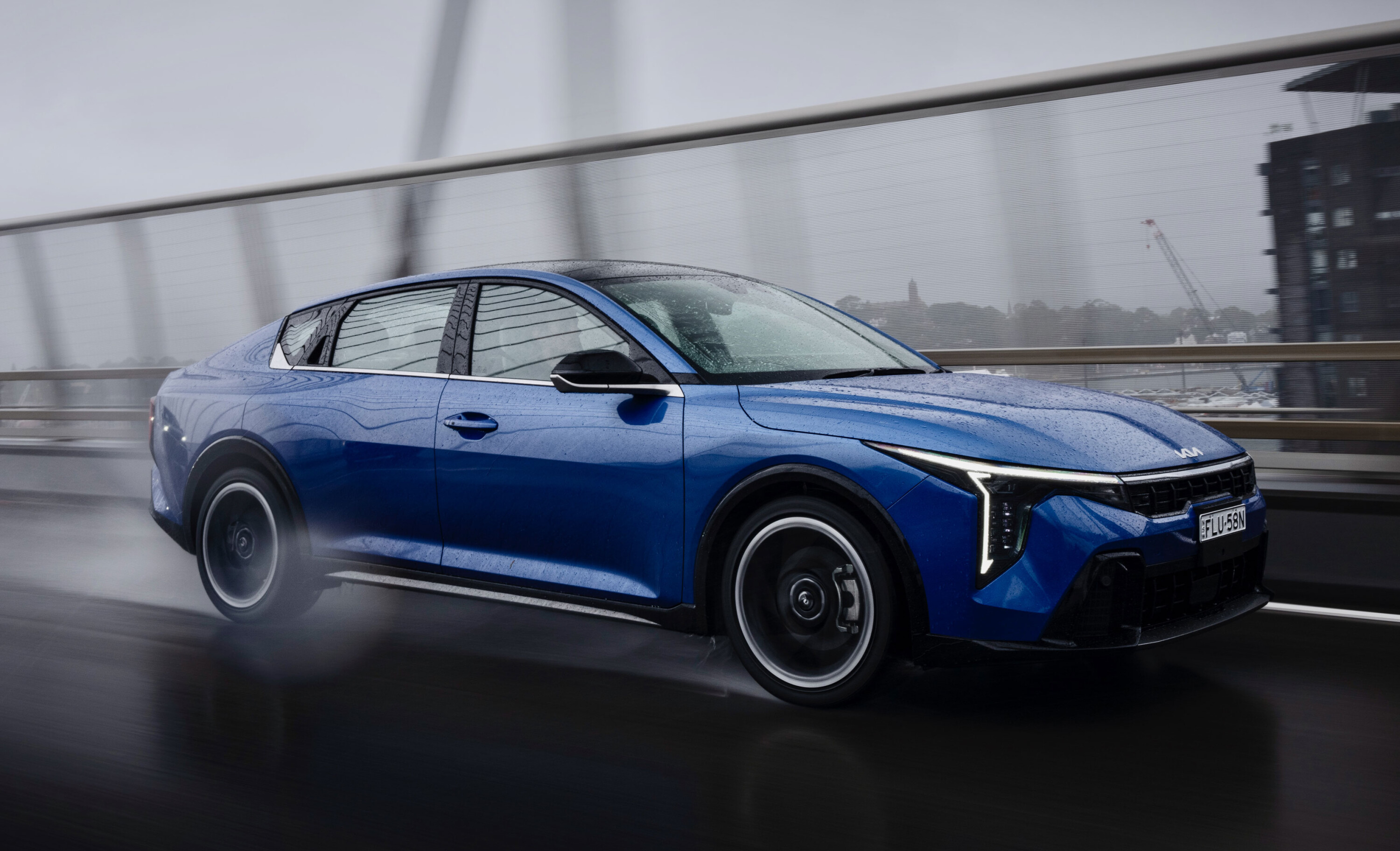
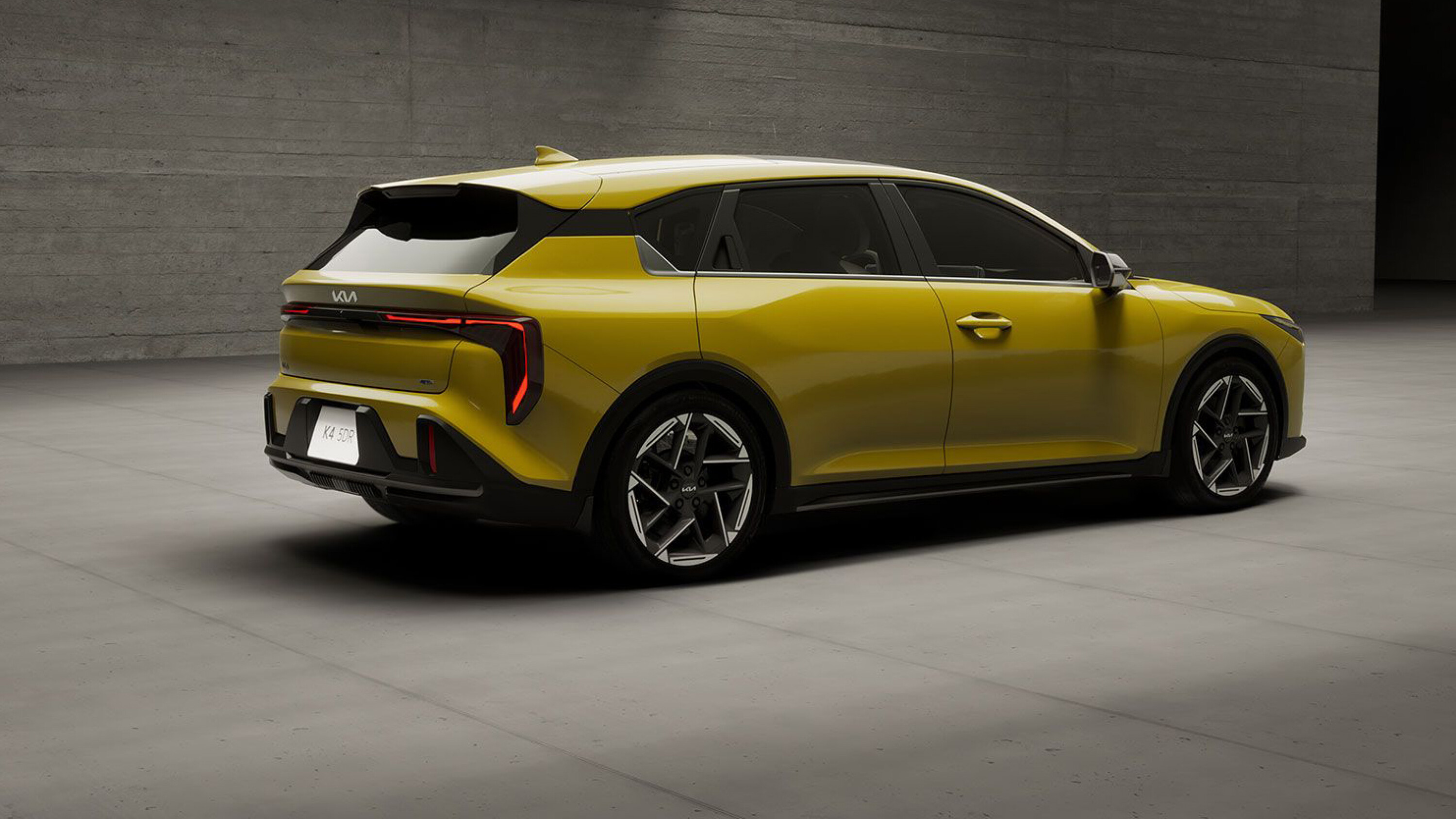
Kia Australia has announced local pricing and specifications for the upgraded 2026 Kia K4 range, which will enter local Kia dealerships soon.
Priced from $32,090 plus on-road costs, the K4 range starts $1500 higher than before, but naturally aspirated models have gained a new 2.0-litre petrol engine that’s a lot more efficient than the one it replaces. The K4 hatchback is also now available, and is priced identically to the sedan that’s already on sale.
Under the bonnet of the non-GT Line models in the K4 range is a new 2.0-litre Atkinson Cycle four-cylinder petrol engine making 110kW of power and 180Nm of torque (-2kW and 12Nm on the older engine). It’s now mated to a CVT automatic transmission, which replaces the former six-speed auto, and its combined fuel consumption is now rated at 6.0L/100km (6.1L/100km for the hatchback), which is down a significant 1.4L/100km. Its claimed CO2 emissions of 139g/km (143g/km) are also a big improvement of 28g/km.
The 142kW/265Nm 1.6-litre turbo-petrol and eight-speed automatic transmission in the K4 GT-Line remains as before. It uses as little as 6.7L/100km of fuel on the combined cycle and emits 158g/km of CO2.
The K4 hatchback is new to the range having been revealed later than the sedan. It measures 4440mm long, 1850mm wide, 1435mm tall and rides on the same 2720mm long wheelbase as the sedan, making it 270mm shorter and 10mm taller than the sedan. Its bootspace measures 438 litres with the seats up, making it 70 litres smaller than the sedan. The K4 hatchback is equipped identically to the sedan, aside from the addition of a rear wiper.
2026 Kia K4 pricing (plus on-road costs):
| S | $32,090 (+ $1500) |
|---|---|
| S Safety Pack | $34,190 (+ $1500) |
| Sport | $36,690 (+ $1500) |
| Sport+ | $39,090 (+ $1500) |
| GT-Line | $43,790 (+ $800) |
Kia K4 S standard features:
- 16-inch alloy wheels
- Automatic LED headlights
- Heated/auto-folding mirrors
- Keyless entry with push button start
- Height-adjustable front seats
- Cloth upholstery
- Manual air-conditioning with rear air vents
- 12.3-inch touchscreen with over-the-air updates
- Wireless Apple CarPlay and Android Auto
- AM/FM/DAB+ digital radio
- Six-speaker sound system
K4 S safety features:
- 7x airbags
- Autonomous emergency braking with car, pedestrian, cyclist and intersection assistance
- Adaptive cruise control with stop and go functionality
- Adaptive lane guidance
- Lane keeping assistance with lane departure alert
- Blind-spot monitoring (with braking)
- Rear cross-traffic alert (with braking)
- Rear occupant alert
- Safe exit warning
- Auto high beam
- Traffic sign recognition
- Front and rear parking sensors
- Reversing camera
- Anti-burglar alarm
- Tyre pressure monitoring
K4 S Safety Pack adds:
- Upgraded autonomous emergency braking (AEB) system with junction crossing and direct/oncoming lane change detection
- Dual-zone automatic climate control with a 5.0-inch touch panel
- Auto defog system
- 12.3-inch digital driver’s display
K4 Sport adds:
- 17-inch alloy wheels
- Highway driving assistance
- Satellite navigation with 10 years of traffic and map information
K4 Sport+ adds:
- Auto-dimming rear mirror
- Rain-sensing automatic wipers with aero blades
- Synthetic leather upholstery
- Upgraded interior materials
- Heated front seats
K4 GT-Line adds:
- 18-inch alloy wheels
- Multi-link independent rear suspension
- Projector LED headlights and full LED tailights
- 8-way electric driver’s seat with memory and lumbar adjustment
- Sportier exterior styling
- Sunroof
- Heated synthetic leather steering wheel with paddle shifters
- Wireless phone charger
- 8-speaker Harman Kardon sound system
- Ventilated front seats
The 2026 Kia K4 model range is now available to order with the first deliveries commencing soon.
Driving safe in a secondhand car can be surprisingly affordable, the latest Used Car Safety rankings show.
The Mazda3 and similar compact cars are highlighted as a smart choice for bargain buyers in the latest Used Car Safety Ratings. The annual scoring of secondhand safety is done by the Accident Research Centre at Monash University (MUARC) and, like the new-car rankings compiled by the Australasian New-Car Assessment Program, gives a star rating.
But the MUARC results are a sharp contrast to the laboratory-based safety scores from ANCAP because, as well as scoring how a vehicle protects its occupants in a crash, they also include how it avoids potential crashes and its impact on other road users in the real world.
The 2025 ratings cover 546 vehicles produced from 1983 to 2023 using real-world research from more than 9.5 million vehicles and 2.6 million injured road users in police-reported crashes between 1987 and 2025. A 5-Star score was awarded to 130 vehicles and 72 earned the coveted ’Safer Pick’ status from MUARC. But buying safe doesn’t have to be a budget breaker, according to the program director at MUARC, Professor Stuart Newstead.

The cost of safety continues to fall, as almost all Safer Pick vehicles are available for less than $25,000 and more than half have a secondhand price below $10,000.
“It shows a secondhand Mazda3 for under twenty grand will perform really well for you. And that’s what people need to know,” he told Wheels.
He said the latest year-on-year results showed widespread improvements in vehicle safety, as well as the gap between the best and worst performers in the MUARC research.
“The difference between the best and worst is about 15 times. It (the ratings) absolutely shows you what to stay away from,” he said.
He also highlighted the value of ESP – electronic stability control – in road safety, particularly for young and old drivers.
“Stability control should be a must for every novice driver,” he said.
For the first time the MUARC ratings include a 5-Star score for an electric vehicle, while large SUVs and utes continue to under-perform again old-school passenger cars.
“It is the Tesla Model 3,” he said. “It’s a good example of a medium-style car where the basic geometry is good. And it’s not too heavy as an electric car. It manages to score quite well – five stars across the board. It’s a good thing.”
The overall improvement in the safety of Australia’s secondhand fleet shows a jump of more than 50 per cent since it began, as the risk of death or serious injury is 43 per cent lower in 2023 models than in vehicles manufactured in 2001. Even so, Professor Newstead warned about emerging concerns about increasing vehicle sizes and mass and their effect on overall secondhand safety.
Full details of the 2025 Used Car Safety Ratings are available here.
Way back in June 2009, local distribution company Ateco shocked Australian consumers by launching the first Chinese brand on to the local market. GWM – or Great Wall Motors as it was then known – launched with two products in Australia. It’s now quite a distance from its first incarnation and as of June 2025, is now the top-selling Chinese brand in Australia.
Great Wall Motors is headquartered in Baoding in the Hebei Province in China. It was founded in 1984, though has roots as far back as 1976 with an agricultural vehicle workshop in Baoding started by Wei Deliang, who is the uncle of the current GWM chairman Wei Jianjun, through a collaboration with the local government of the Nandayuan Township.
By 1984, the workshop started to produce its own commercial vehicles, and the workshop’s name was changed to Great Wall Industry Company.
Jianjun had started with the company in 1989 and by 1993, it was producing several models, including the CC1020S sedan, but a change in national vehicle regulations forced Great Wall to shift towards commercial vehicles, including the 1996 Deer ute.
The Deer was a big success for the company and enabled it to export its products for the first time in 1997 to the Middle East. The Nandayuan Township privatised the company in 1998, forming the Great Wall Motor Group with Jianjun owning a 25 per cent stake.
In 2003, GWM became the first private Chinese car manufacturer to become a public company through the Hong Kong Stock Exchange and in 2006, entered the European market for the first time with a series of small vans, and in Australia in 2009.
The first-generation Haval H6 was launched in 2011, immediately becoming China’s best-selling SUV for eight consecutive years. Its success contributed massively to GWM’s profits, leading the company to focus on SUVs. To the end of 2024, more than four million H6s have been produced. Even though it only launched in Australia in 2020 in third-generation form, the H6 has sold almost 50,000 units locally.
In 2011, GWM was listed on the Shanghai Stock Exchange and went public again, merging the ownerships of the Wei family and Nandayuan Township into a single investment fund, which is the current corporate structure of the company.
While its focus was on internal combustion engined products, GWM introduced its first EV in China in 2016 and acquired a 25 per cent stake in the Hebei Yujie Vehicle Industry company in 2017, which was a key player in China’s EV market. GWM spun off its battery business into an independent battery manufacture in 2018 and in the same year, established the Ora EV brand as well as signing a joint venture agreement with BMW to produce electric Mini products in China.
In 2020, GWM purchased General Motors’ Thailand plant – the factory where the Holden Colorado used to be produced for Australia – and Great Wall Motors’ official rebranding to GWM also occurred.
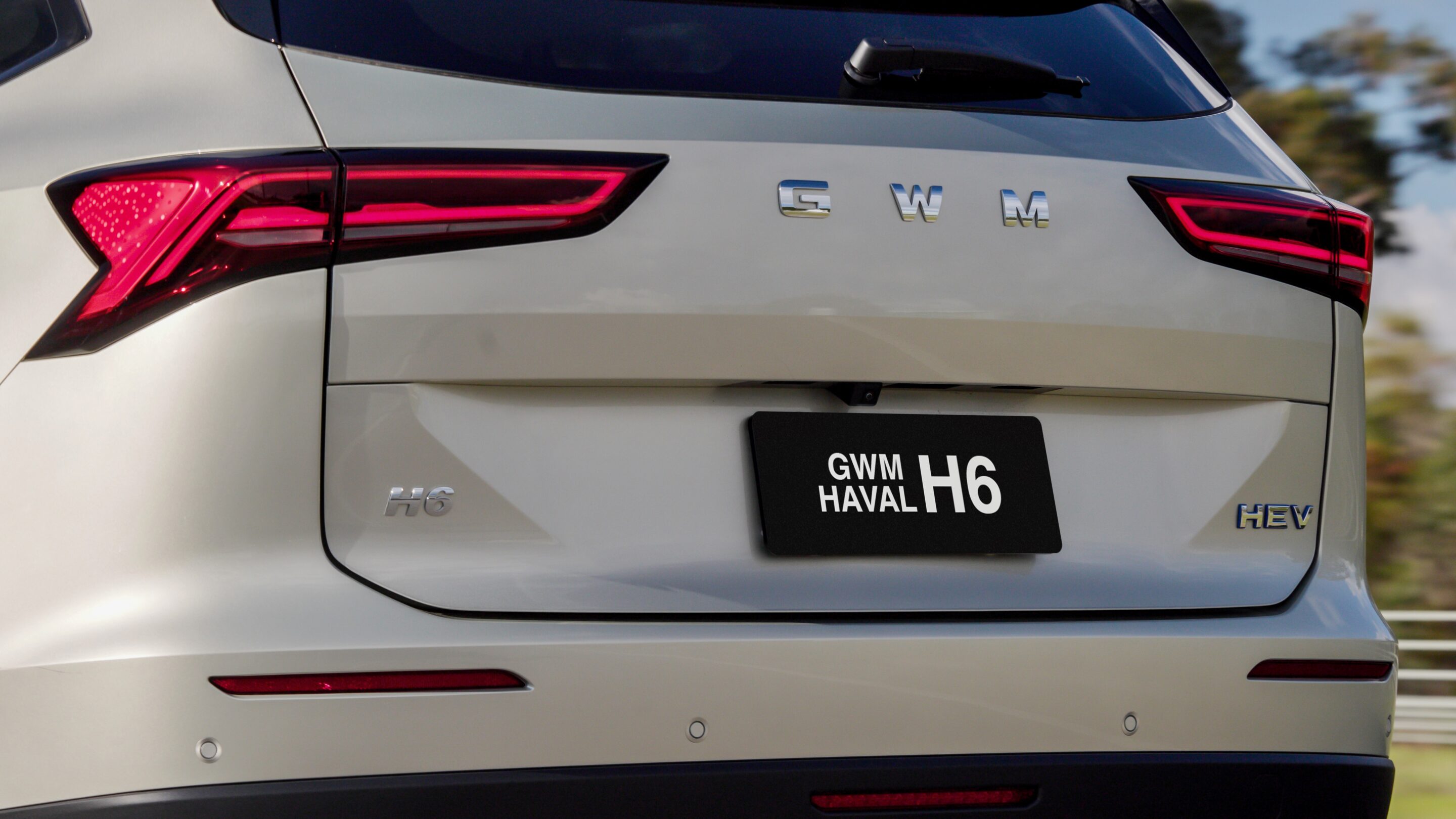
In 2023, GWM announced that it would be adjusting its multi-brand strategy for export markets. Under the new strategy, GWM was the parent company and previously-standalone brands such as Haval, Ora, Tank and Wey were now sub-brands. This change made it easier for export markets, which received select products from all the brands, with – for example – the Haval H6 becoming the GWM Haval H6. Instead of a Haval logo, a new GWM badge appeared.
As of 2025, GWM has 10 production facilities across China, Thailand, Brazil and Russia, and plants in countries such as Pakistan assembling vehicles from knock-down kits.
The brand has also just employed former-Holden ride and handling guru Rob Trubiani to enhance the way its products feel on the road in a number of areas, including active safety systems and even towing. Trubiani’s knowledge in those areas will eventually be applied to global GWM products.
GWM’s total 2024 sales tally reached 1,233,292 units in 2024, with the Haval brand selling 706,234 units and 453,141 units exported. In Australia to the end of June 2025, GWM has sold 25,189 units, an increase of 17 per cent over the same period in 2024 and puts the brand in a good position to hit its 50,000 sales target for the whole of this year.
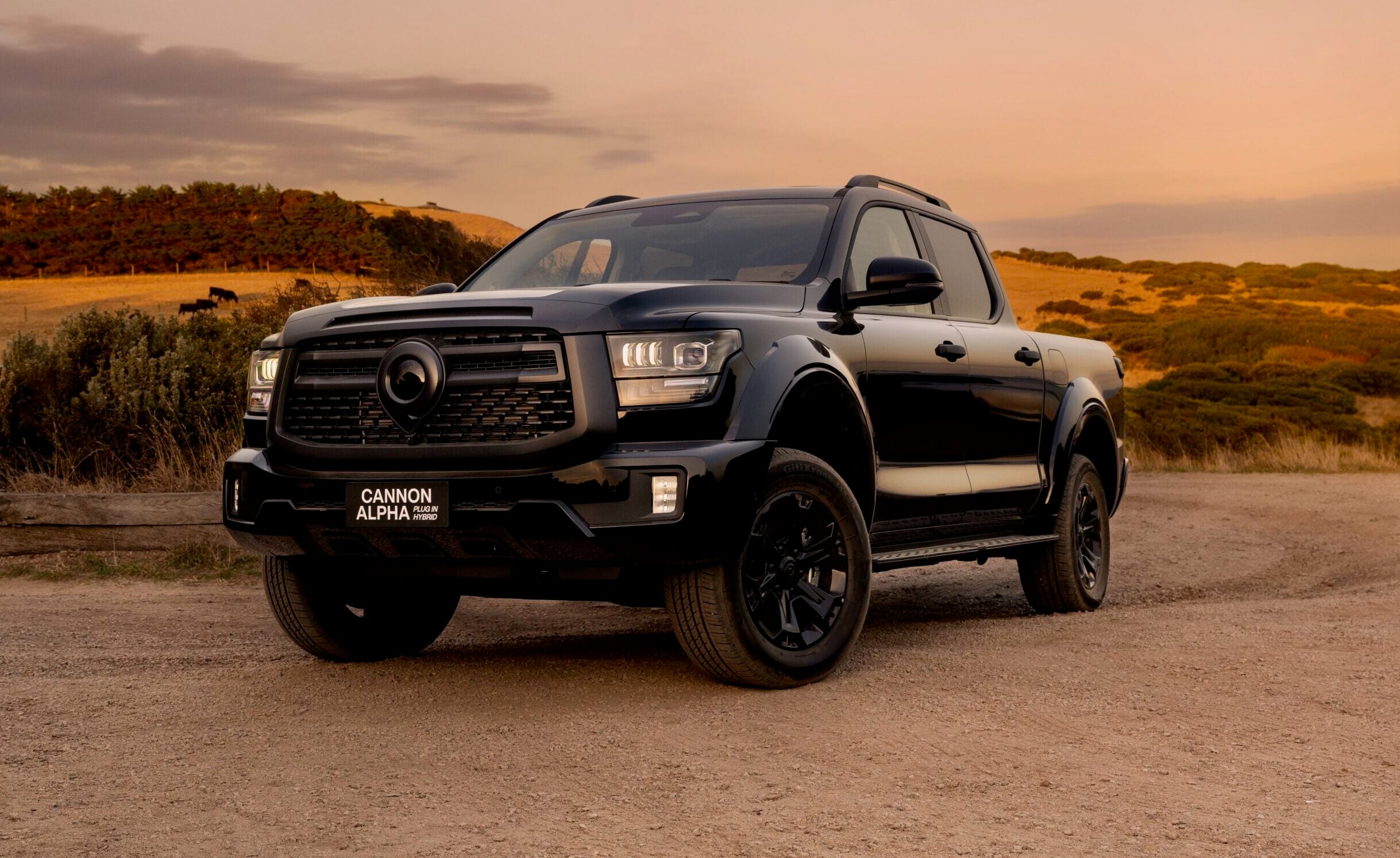
Healthy sales should come as no surprise as it’s been a busy period for the brand in Australia. It’s recently launched a new plug-in hybrid variant of the Cannon Alpha ute (above), a diesel variant of the popular Tank 300 off-roader and the updated Haval H6 mid-size SUV, which has just gone on sale.
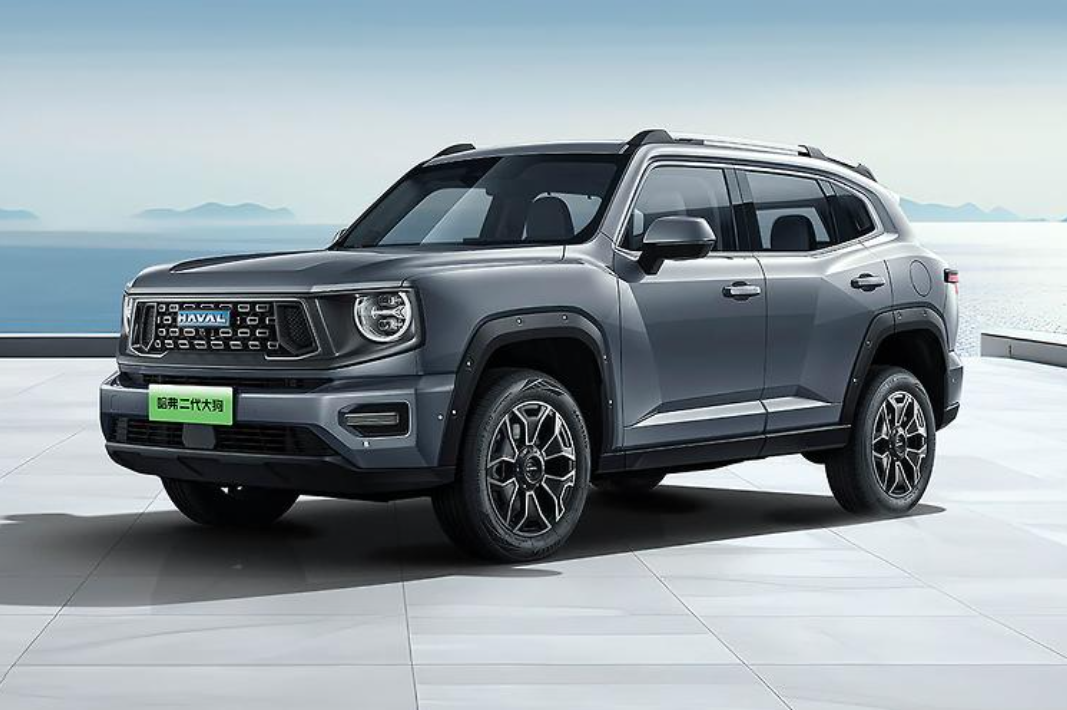
What’s next for GWM in Australia? First cab off the rank is the new Haval H7 mid-size SUV (above), which will be launching in the third quarter of 2025 to sit in between the H6 and Tank 300 SUVs. Afterwards, a new plug-in hybrid version of the Tank 500 large SUV will also be launched.
The brand will reportedly have three EVs in its showrooms by the end of 2026, while new hybrid and plug-in hybrids will also be added to the range to further bolster its NVES compliance.
Looking further into the future, the brand recently revealed a new plug-in hybrid powertrain with a V8 engine that may also allow it to develop a larger ute than the Cannon Alpha, potentially for the North American market.
According to local GWM staff, the brand is at the beginning of its journey, with “plenty more to come”.
Who owns GWM?
GWM (Great Wall Motors) is a Chinese automotive manufacturer founded by the Wei family and later combined its ownership into an investment fund, which now controls the company. Wei Jianjun started the company as a small repair shop in 1984
Where are GWM cars made?
Aside from its home market China, where all Australian-spec products are produced, GWM produces cars around the world, including places such as Thailand, Bulgaria, Russia and Brazil with a facility in Spain planned for the future.
Are GWM and Haval the same company?
Haval is one of GWM’s sub brands, much like Tank and Ora. In China, these brands are sold under the GWM umbrella with many products for each brand, but in export markets like Australia, all are sold under the GWM brand.
How many cars does GWM sell each year in Australia?
GWM sold 42,782 cars in Australia in 2024, a record number that placed the brand in the top 10 for sales for the first time. So far in 2025, GWM’s sales are even stronger and are sitting at around 35,000 sales to the end of October 2025 for a predicted 52,000 unit result by the end of December.
Which cars does GWM sell in Australia?
GWM Haval Jolion
The Jolion is GWM’s small SUV product that appeals to small families and those looking for a second car. Pricing starts at $26,990 drive away for the base Premium model. Both 1.5-litre turbo-petrol and 1.5-litre hybrid drivetrains are on offer and the hybrid is one of the cheapest on sale in Australia.
GWM Haval H6
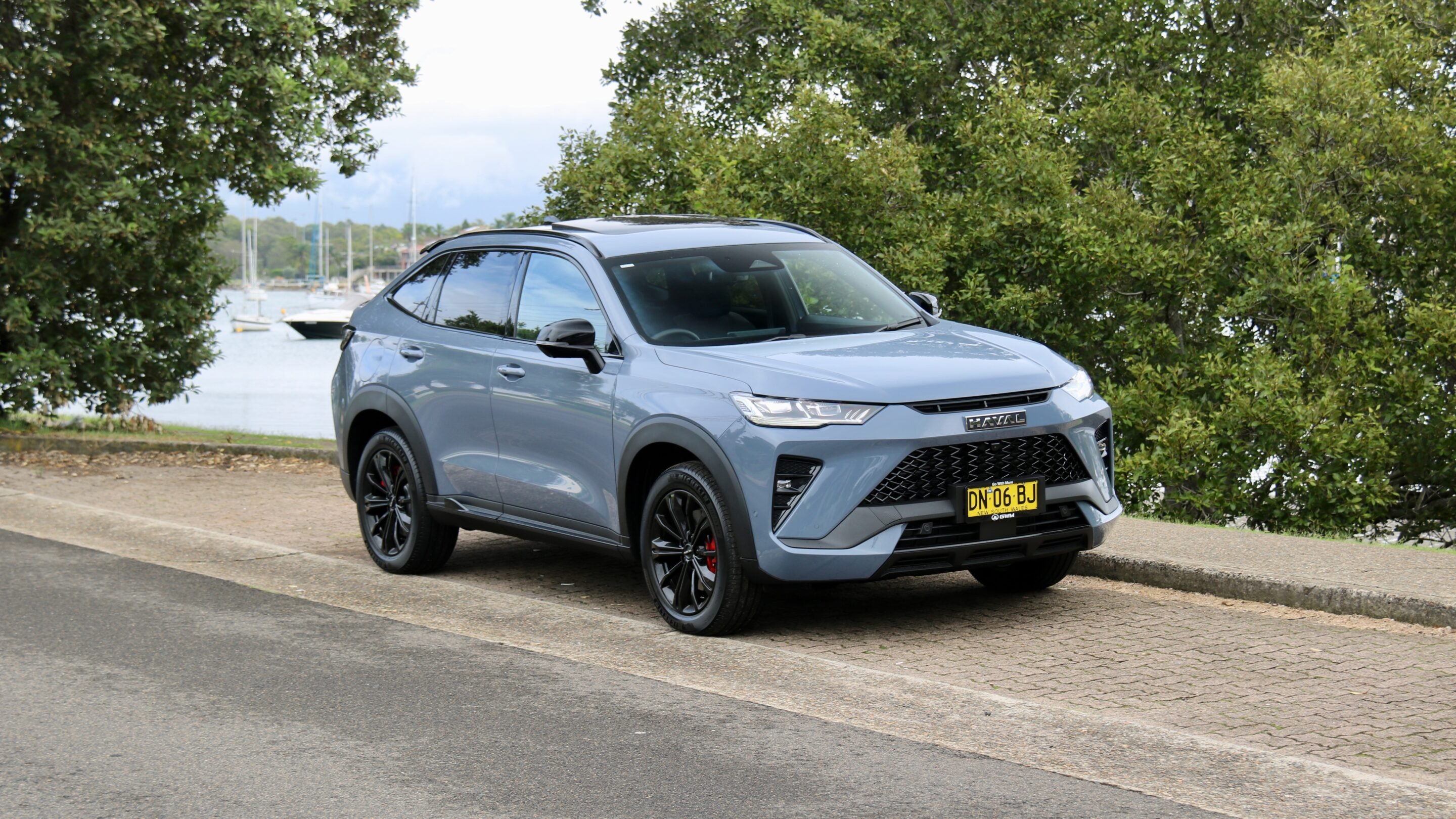
The H6 has been one of the best-selling GWM products in Australia since it launched in 2021. Competing in the mid-size SUV segment, the H6 is priced from $35,990 drive away and it has a wide range of powertrain options: a 2.0-litre turbo-petrol, 1.5-litre turbo hybrid and two forms of 1.5-litre turbo plug-in hybrid with the most powerful capable of a 4.9-second 0-100km/h sprint time.
GWM Haval H6GT
The H6GT is the sportier-looking coupe version of the H6, and is available with either the 2.0-litre turbo-petrol or a 321kW 1.5-litre turbo-petrol plug-in hybrid. Pricing starts from $45,990 drive away, and the H6GT line-up is quite well equipped as standard.
GWM Haval H7
The H7 is the newcomer to the GWM Australia range. It takes the underpinnings of the H6 and H6GT but puts them underneath a boxier and more rugged-looking body. The H7 is only available with the 1.5-litre turbo hybrid in Australia, giving it good performance (it makes 179kW of power and 530Nm of torque) yet good claimed fuel economy too (it’s rated at 5.7L/100km).
GWM Tank 300
The Tank 300 is one of GWM’s biggest success stories in Australia as it provides rugged styling, strong four-wheel drive ability and excellent value for money. It’s priced from $47,990 drive away and offers 2.4-litre turbo-diesel, 2.0-litre turbo-petrol or 2.0-litre turbo-petrol hybrid drivetrain options, as well as generous standard equipment.
GWM Tank 500
The Tank 500 is GWM’s large SUV in Australia, offering seating for seven and the choice of either a 2.0-litre turbo-petrol hybrid or plug-in hybrid drivetrain, the latter making a serious 300kW of power but also capable of travelling 120km on electric power.
GWM Cannon
The Cannon is GWM’s ute offering in Australia. Pricing starts at $36,490 drive away for the single cab chassis variant, ranging to $51,990 drive away for the top-spec off-road themed XSR. Engine choices are either a 2.0-litre or larger 2.4-litre turbo-diesel, and a nine-speed automatic transmission is standard with the larger engine.
GWM Cannon Alpha
GWM is unusual in that it offers not one but two mid-size utes in Australia, and the larger Cannon Alpha is one of the most luxurious utes you can buy. It’s available with a 2.4-litre turbo-diesel engine or a 2.0-litre turbo plug-in hybrid drivetrain, as well as features like a panoramic sunroof, a split-opening tailgate and even electric-reclining rear seats.
GWM Ora
The Ora is GWM’s electric car in Australia. It’s a small hatchback that’s priced from $35,990 drive away, making it one of the cheapest new EVs on sale. It features a 57.7kWh battery for a claimed WLTP driving range of 400km, as well as a long list of standard features.
KGM Australia has announced pricing and specifications for the KGM Torres Hybrid, which is its first hybrid offering locally, ahead of first deliveries commencing in December. Priced from $45,000 drive away, KGM has made the Torres Hybrid is $7000 more expensive than the equivalent petrol model, but is both more powerful and more fuel efficient – plus, it also includes more standard equipment.
The Torres will compete against other hybrid mid-size SUVs like the Toyota RAV4, Hyundai Tucson and GWM Haval H6.
The KGM Torres Hybrid pairs a 1.5-litre turbo-petrol engine with two electric motors and a 1.8kWh LFP battery powering the front wheels via a dedicated hybrid transmission. Total system output is 150kW, made up of 110kW/220Nm outputs from the petrol engine and 130kW/300Nm from the electric motors.
Combined fuel consumption for the Torres Hybrid is rated at 5.6L/100km – 1.8L/100km less than the less powerful petrol Torres – and with CO2 emissions of 127g/km.
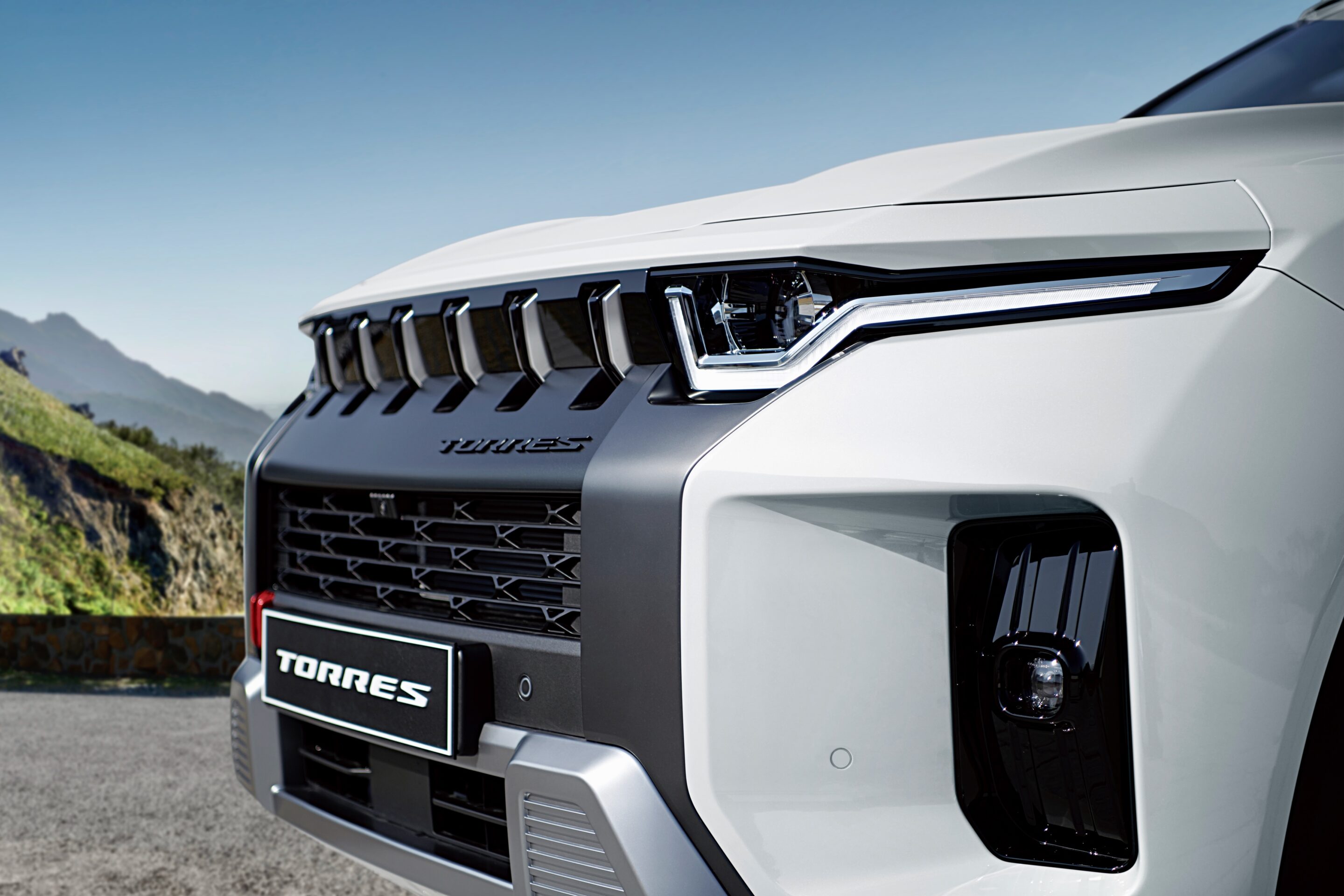
Pricing for the Torres Hybrid starts at $45,000 drive away for the entry-level K30, which is $7000 higher than the petrol Torres ELX that it lines up with. However, the hybrid is better equipped with features such as a leather steering wheel and adaptive cruise control.
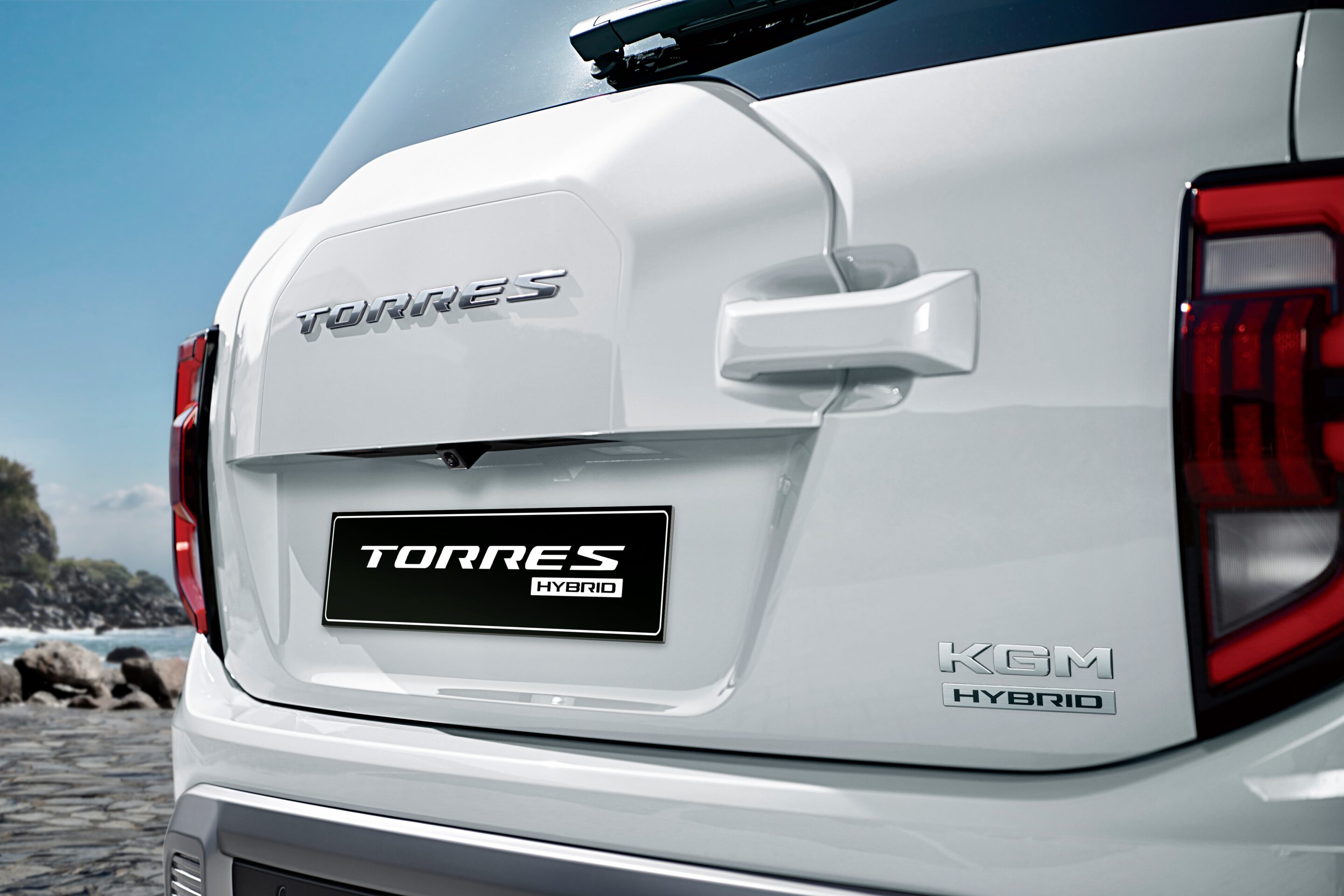
Unlike some other hybrid mid-size SUVs, the Torres Hybrid doesn’t lose bootspace compared to the petrol model, with KGM still claiming 465 litres with the seats up (703 litres to the ceiling) and 1526 litres with the rear seats folded. However, its 1300kg braked towing capacity is 200kg less than the petrol model.
2026 KGM Torres pricing (drive away):
| K30 | $45,000 |
|---|---|
| K40 | $48,000 |
KGM Torres K30 standard features:
- 18-inch alloy wheels
- Automatic LED headlights and front and rear daytime running lights
- Rain-sensing automatic wipers
- Heated/auto-folding mirrors
- Keyless entry with push button start
- Cloth upholstery
- Dual-zone climate control
- Leather steering wheel
- 12.3-inch digital driver’s display
- 12.3-inch touchscreen
- Apple CarPlay and Android Auto
- Interior ambient lighting
Torres K30 safety features:
- 8x airbags
- Adaptive cruise control
- Autonomous emergency braking with forward collision warning
- Lane keeping assistance with lane departure warning
- Front vehicle start alert
- Auto high beam
- Driver attention alert
- Front and rear parking sensors
- Reversing camera
Torres K40 model adds:
- Power tailgate
- 20-inch alloy wheels
- Leather-look seats
- Heated front seats
- Heated steering wheel
- Rear door sun blinds
- LED front fog lights
- Blind-spot monitoring with rear cross-traffic alert
- Lane change-collision warning
The KGM Torres Hybrid will go on sale in Australia on December 1, with local deliveries due to commence then.
There’s no question that Hyundai is on a big product roll at the moment. From the futuristic Ioniq 5 and ballistic Wheels COTY-winning Ioniq 5 N, to the bold and beautifully practical Santa Fe, Hyundai’s line-up continues its significant upgrade.
The latest to receive a new generation is the Palisade large SUV, with Hyundai giving it an upmarket look and a properly luxurious interior vibe, a gutsy new powertrain that’s also an in-vogue hybrid, plus Hyundai’s newly-extended seven-year conditional vehicle warranty.
For now, there’s only one Palisade model available in Australia: the top-spec Calligraphy. Cheaper models will be part of the line-up in the future, but 83 per cent of previous Palisade sales were the Calligraphy, so Hyundai Australia decided to launch with that model first.
2026 Hyundai Palisade pricing (plus on-road costs):
| Calligraphy 8-seat | $89,900 |
|---|---|
| Calligraphy 7-seat with second row captain’s chairs | $90,900 |
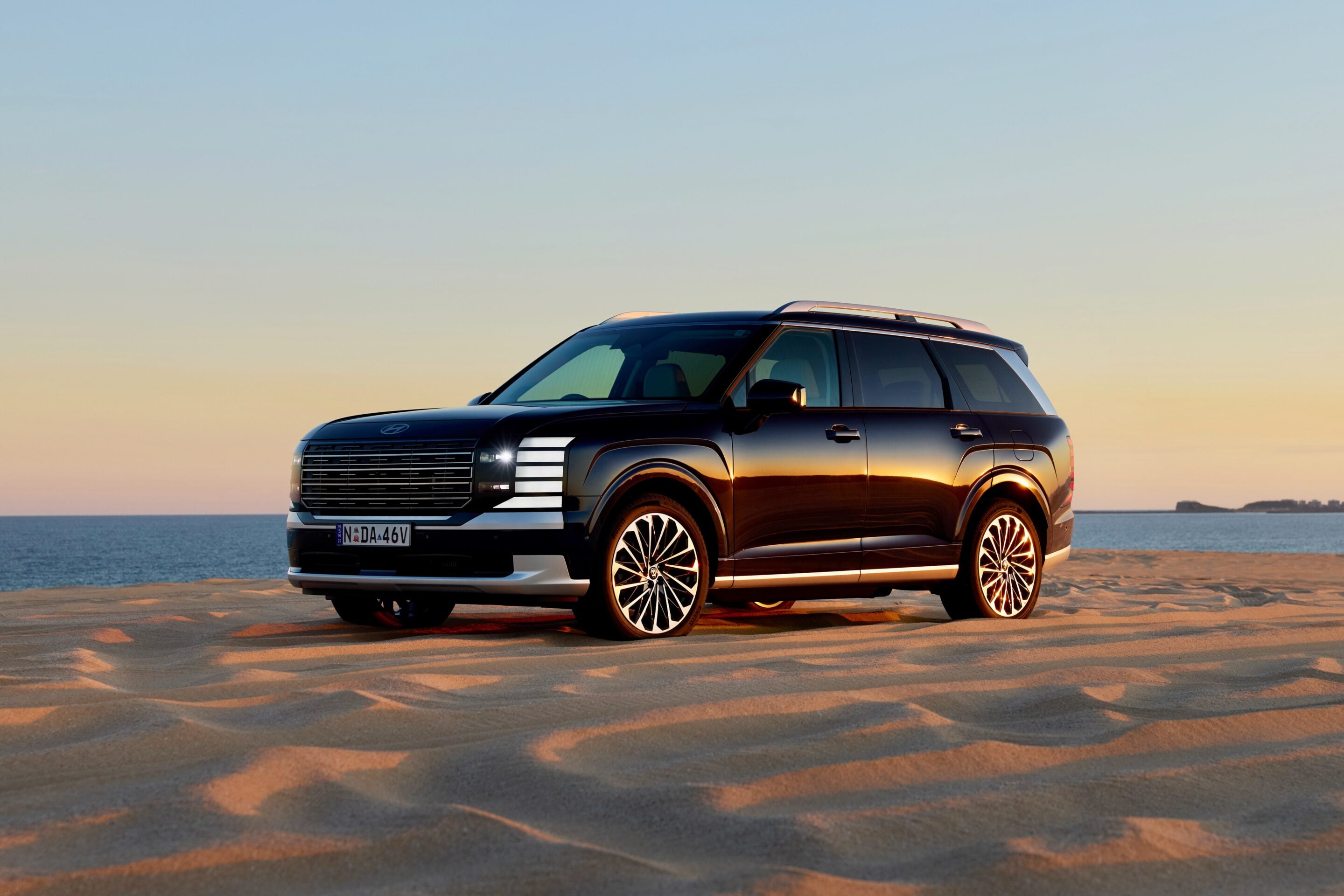
It’s true that near-$90,000 plus on-road costs is not cheap, and it’s a full $12,750 more expensive than the top-spec Santa Fe Calligraphy, but the Hyundai Palisade Calligraphy is fully loaded with standard equipment – even the third row of seats is heated, for example. Find the full list of standard features below.
So far, the only drivetrain available in the 2026 Hyundai Palisade line-up is a new 2.5-litre four-cylinder turbo-petrol hybrid making strong 245kW and 460Nm outputs. That’s mated to a six-speed automatic transmission and an all-wheel drive system as standard – unlike the previous Palisade, there’s no front-wheel drive model available just yet, nor pure petrol or turbo-diesel options.
The 2.5-litre hybrid drivetrain was the correct choice for the Hyundai Palisade in Australia as it combines the power of the previous V6 engine but with the low-end torque and efficiency of the previous 2.2-litre turbo-diesel. It’s rated at 6.8L/100km for combined fuel consumption and 154g/km for CO2 emissions, and we got a slightly higher 7.8L/100km result, which is still quite good for such a big vehicle. The Palisade uses 91RON regular unleaded fuel as well, and its 72-litre fuel tank gives a long range.
The previous Palisade was comfortable to drive, and the new model is no different. Australian-spec models received a local suspension tune against softer South Korean and North American models, and while we haven’t driven those versions, the Aussie Palisade model handles competently. It features frequency-select front dampers, self-levelling rear dampers and a unique power steering tune. The result is impressive ride and handling, despite its obvious size.
A big improvement for the new Palisade compared with the old one is refinement. While the four-cylinder hybrid drivetrain could still be quieter under even moderate throttle, its road and wind noise levels are relatively hushed.
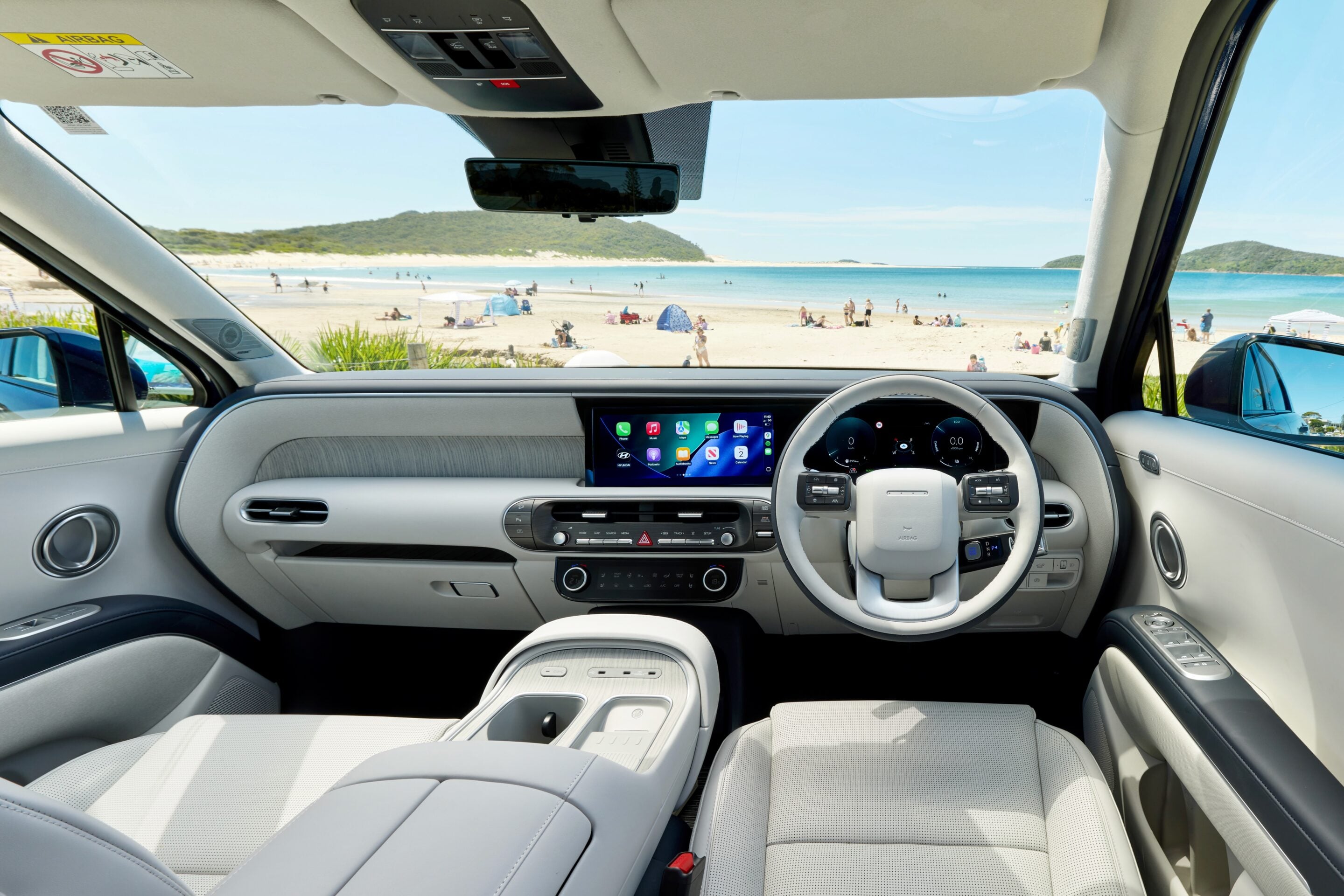
Inside the cabin is an impressive space and a big step forward compared with the previous Palisade. For starters, it’s got leather or leather-like trim almost everywhere you touch, while there’s an added depth to the trim pieces and switchgear that wasn’t previously present in the Palisade. It’s not quite to the level of Genesis, but it certainly feels plusher than the Santa Fe and Ioniq 5.
Not only is the Palisade’s cabin plush, but it’s also quite practical with a lot of available storage. That includes large door bins, a huge central box, a big open tray and then large open cupholders with a wireless phone charger next to them. Front seat comfort is excellent, especially for the driver and their 18 ways of adjustment, including the ‘relaxation’ mode that throws the seat back in the best thing since lie-flat seats in airline business class.
The dual 12.3-inch screen layout used in the Palisade is one we’ve seen before in the Santa Fe, but it still works well. The touchscreen layout is dead easy to use, while the screen quality is sharp as well. The 14-speaker Bose sound system could use a bit more bass, but it’s still clear and warm.
Move rearward and unlike many other seven/eight-seaters we’ve seen, rear passengers are still very well catered for. The second row is huge, with ample room for people above six-foot tall, and amenities are seemingly endless with a separate climate zone, multiple charging options, sun shades, door pockets and even heating and ventilation for the outboard seats. Plus, if you don’t need eight seats, for an extra $1000 you can choose the captain’s chairs for a seven-seat layout – they’re electrically adjustable like the standard pews but add a walk through to the third row.
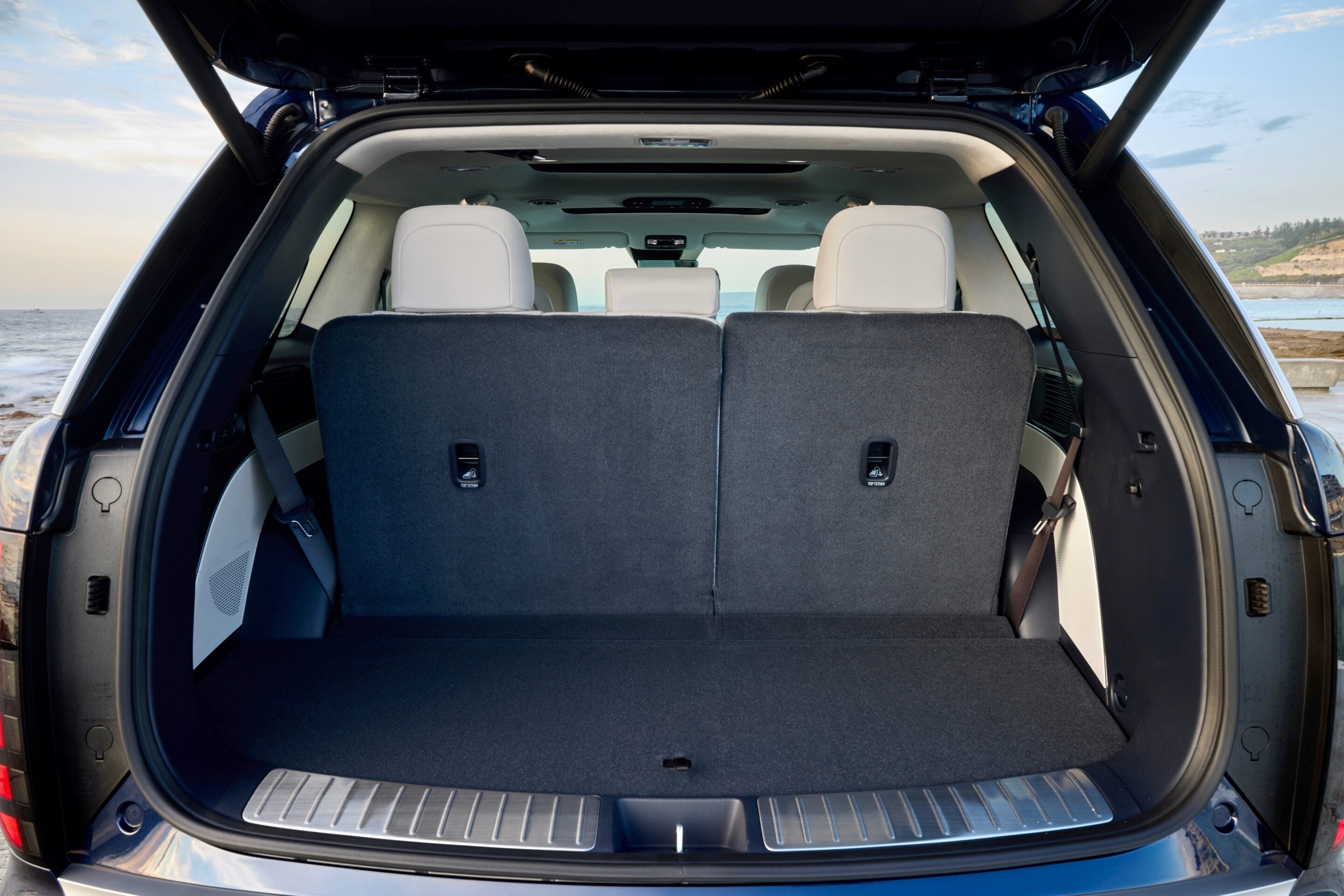
Speaking of the third row, it’s also excellent. Third rows that are functional for everyday use by folks of many sizes are rare – most are small and only for kids – but the Palisade’s is just that. Plus, it also has heated seats, air vents, speakers, charging and cup holders so those back there won’t feel shortchanged. Those with child seats will be happy to know that the third row features two both top-tether and ISOFIX points as well.
With all the seats erect, there’s 300 litres of space in the Palisade’s boot, which expands to 712 litres with the third row folded. Impressively, the boot features hooks, side storage, under floor storage and even a full-size alloy spare wheel. Folding the second row unlocks a huge 2081 litres of space and huge potential for trips to Ikea.
The 2026 Hyundai Palisade Calligraphy is an impressive product, no matter which way you look at it. Its step forward in luxury and overall quality is instantly noticeable, but it’s also somehow even more practical than before, great to drive, very comfortable and both efficient and strong when it comes to performance. Only the short 10,000km annual service requirements, lack of cheaper models and lower towing capacity compared with the previous model grate, but even so, Hyundai’s product roll has continued nicely with the new Palisade.
Hyundai Palisade specifications:
| Model | Hyundai Palisade Calligraphy |
|---|---|
| Price | $89,900 plus on-road costs |
| Drivetrain | 2497cc inline four-cylinder turbo-petrol hybrid |
| Transmission | Six-speed torque converter automatic, all-wheel drive |
| Peak power | 245kW (@ 5800rpm) |
| Peak torque | 460Nm (@ 1800rpm) |
| 0-100km/h | 7.5 seconds (est.) |
| Combined fuel consumption/CO2 emissions | 6.8L/100km, 154g/km |
| Fuel tank/size | 91RON regular unleaded, 72 litres |
| Dimensions (length/width/height/wheelbase) | 5065/1980/1805/2970mm |
| Tare mass | 2175kg – 2304kg |
| Boot | 300 litres (third row up)/712 litres (third row folded)/2081 litres (third + second rows folded) |
| Warranty | Seven-year (conditional on servicing at Hyundai dealer)/unlimited km with 12 months roadside assistance that’s topped up with each service |
| Service intervals/cost | Annual/every 10,000km, $2600 for five years/50,000km ($520 per year) |
| On sale | Now |
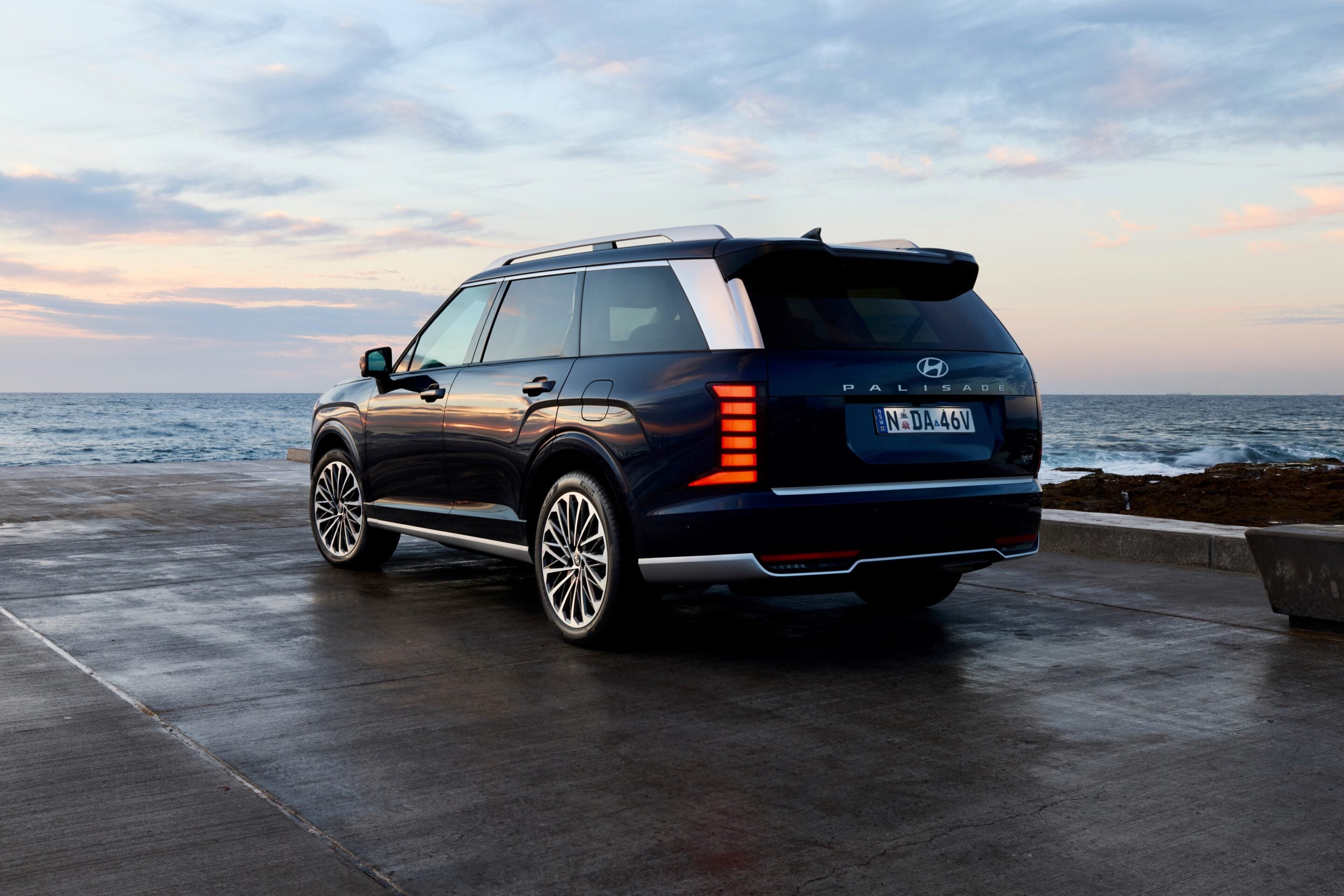
Palisade Calligraphy standard features:
- 21-inch alloy wheels with a full-size alloy spare
- Automatic LED exterior lighting with front and rear daytime running lights
- Automatic rain-sensing wipers
- Dual sunroofs
- Roof rails
- Keyless entry with push button start
- Key phone functionality
- Electric tailgate with easy open functionality
- 18-way electric driver’s seat with memory
- 12-way electric front passenger seat
- Heated leather steering wheel
- Nappa leather upholstery with a suede headliner
- Heated seats in all rows
- Ventilated front and middle row seats
- Rear privacy glass
- 12.3-inch digital driver’s display
- 12.3-inch touchscreen with live services and over-the-air updates
- Wireless Apple CarPlay and Android Auto
- AM/FM/DAB+ digital radio
- 14-speaker Bose sound system
- Satellite navigation with live traffic
- 6x100W USB-C chargers
- Wireless phone charger
- Power-folding second and third rows of seating
- In car camera
- Head-up display
- UV centre console steriliser
- Vehicle-to-load (V2L) functionality
Palisade Calligraphy safety features:
- 8x airbags
- Autonomous emergency braking (AEB) with pedestrian, cyclist and intersection assistance
- Adaptive lane guidance with lane keeping assistance
- Intelligent speed limit assist with traffic sign recognition
- Blind-spot monitoring with a blind-spot camera
- Safe exit assist
- Rear cross-traffic alert (with braking)
- Adaptive cruise control with stop and go functionality
- 360-degree camera
- Automatic rear braking
- Auto high beam
- Side, front and rear parking sensors
- Automatic parking
- Smart park assist (remote control parking from the key)
- Rear occupant alert
- Traffic sign detection with speed limit alert
- Rear automatic emergency braking (low speed)
The new 2026 Nissan Navara ute, confirmed for an Australian release in the first quarter of 2026, has finally been revealed after a lengthy teaser campaign.
Sharing almost everything with the current Mitsubishi Triton, the new Navara – codenamed ‘D27’ – has been brought into the modern age with Mitsubishi’s help. It’s slightly larger than the old model, more powerful, more fuel efficient, more tech-filled and more spacious inside.
On the face of it, the 2026 Nissan Navara appears to be mostly identical to the Mitsubishi Triton on which it’s based, though there are devils in the detail. Unique Navara design features include the headlights and tailights, bumpers, bull bar-inspired V-strut grille surround and mesh grille.
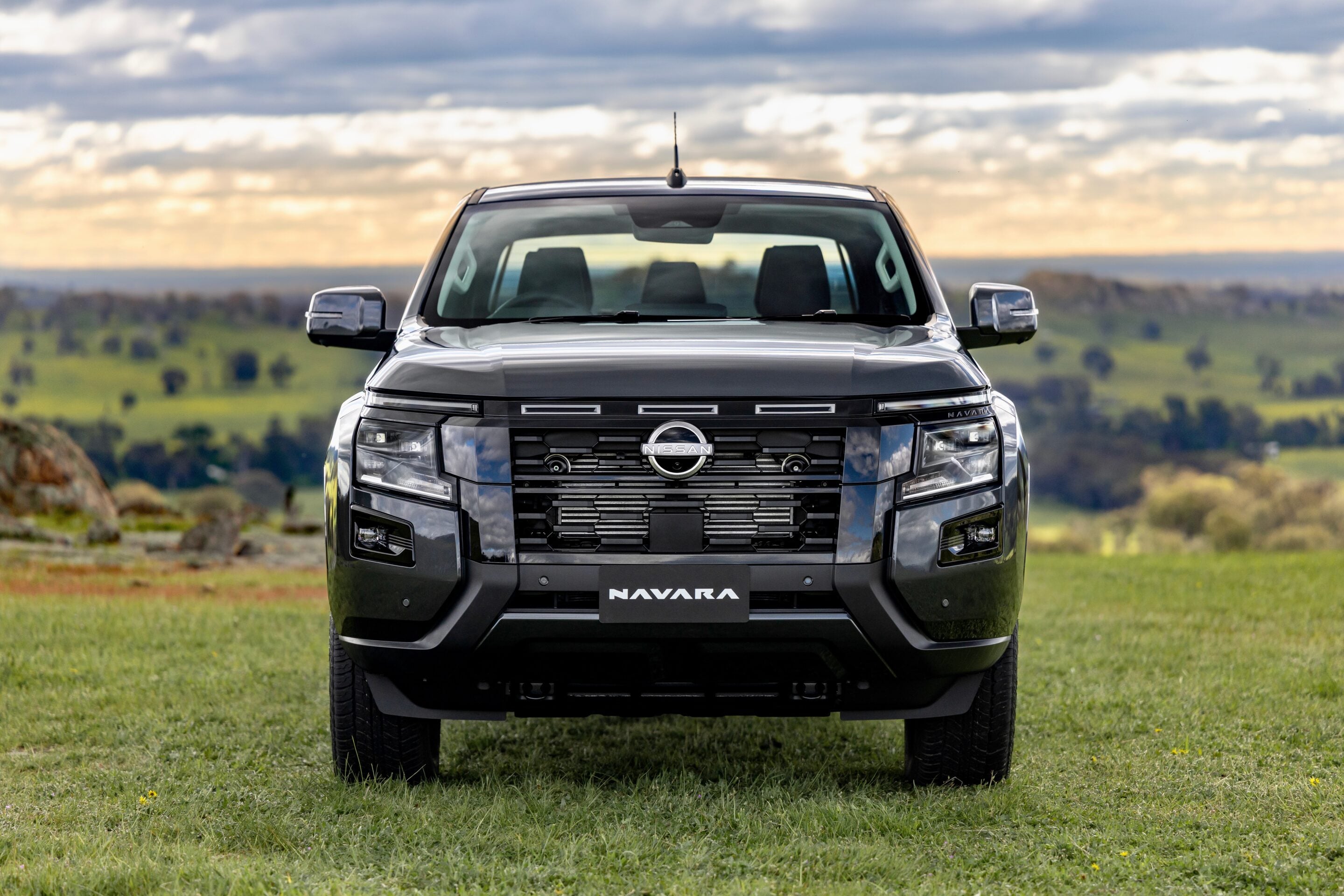
The 2026 Nissan Navara measures 5230mm long and rides on a 3150mm long wheelbase – for an extra 42mm of rear legroom than before – which are identical numbers to the Triton. Its 228mm ground clearance is slightly better than the previous Navara, and as previously reported, Australian company Premcar tuned the suspension for local conditions. Unlike the previous Navara and its coil spring rear suspension, the new model features the Triton’s leaf springs.
As with the Triton, the whole 2026 Nissan Navara range uses a 150kW/470Nm 2.4-litre twin-turbocharged four-cylinder diesel engine, which is an upgrade compared to the current Navara’s 140kW/450Nm 2.3-litre twin-turbo diesel. The Triton’s 7.7L/100km combined fuel consumption rating is likely to carry over to the Navara, which is a 0.2L/100km improvement on the current Navara.
A six-speed automatic transmission will be standard and unlike the Triton, four-wheel drive is standard as well, though two four-wheel drive systems will be offered: one with the traditional 2H, 4H and 4L modes and the other a more sophisticated system with the upper-spec ST-X and Pro-4X models upgrading to a permanent system (2H, 4H, 4HLc, 4LLc) with an open centre diff to allow all-wheel drive running on bitumen.
Active safety features have been significantly boosted, which include eight airbags, autonomous emergency braking, adaptive cruise control, lane keeping assistance, blind-spot monitoring, cross-traffic alert, a 360-degree camera and driver attention monitoring, many of which aren’t available on the current Navara.
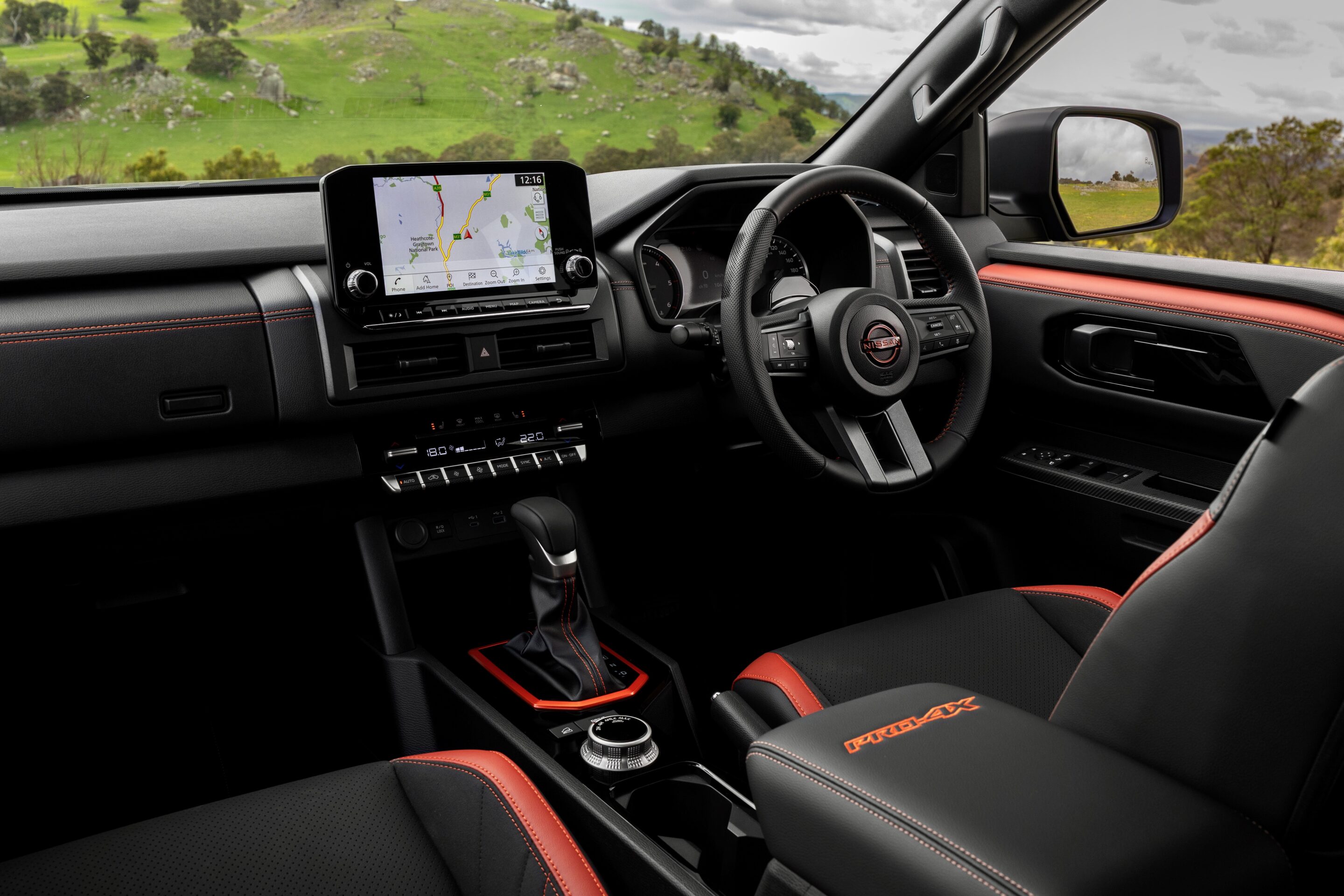
Inside the 2026 Nissan Navara is identical to the Triton, save for Nissan-specific graphics and trims. Otherwise, the design carries over, as do features such a 9.0-inch touchscreen with wireless smartphone mirroring and a 7.0-inch driver’s display. Nissan is yet to reveal which models will receive what equipment, but the whole range is likely to receive the full suite of safety features.
For the first time in the local Navara range, Nissan’s ‘MyNissan’ connected services will be available, which allows owners to control the air-conditioning, call emergency services, track a stolen vehicle and remote door locking and unlocking.
The 2026 Nissan Navara will go on sale in Australia at the end of the first quarter of 2026 with local pricing and specifications to be announced closer to then.
Porsche has revealed its first fully electric Cayenne, a model the company says marks a significant turning point for its long-running luxury SUV range and its broader transition toward electrification.
Arriving more than two decades after the original Cayenne reshaped the brand’s global fortunes, the new battery-powered version will sit alongside existing petrol and plug-in hybrid variants rather than replace them outright.
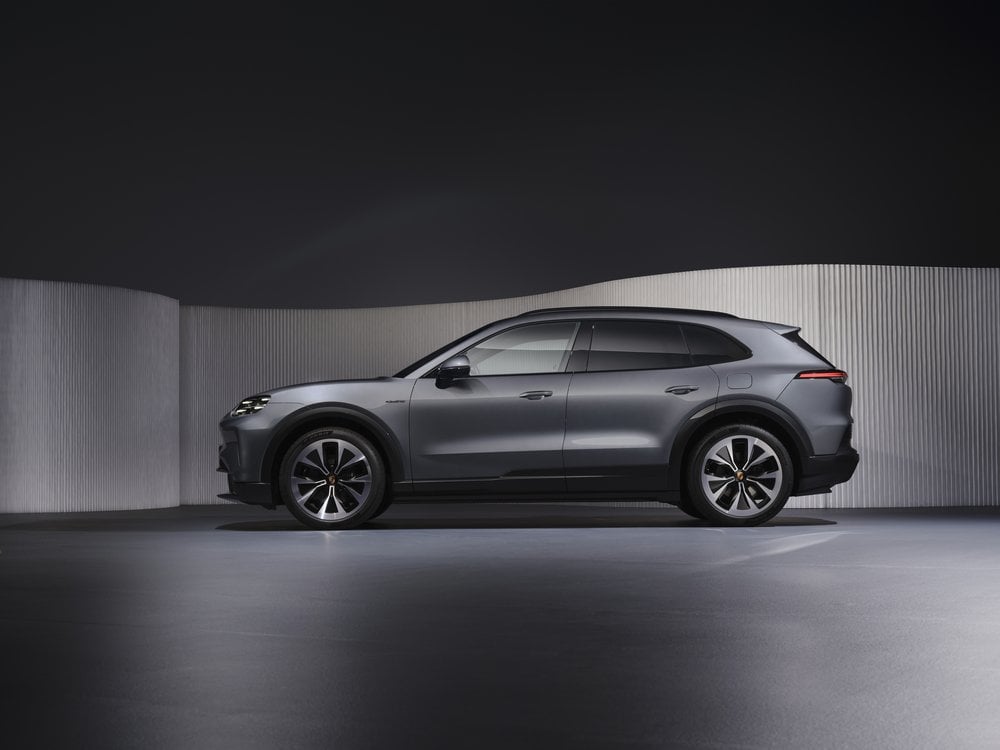
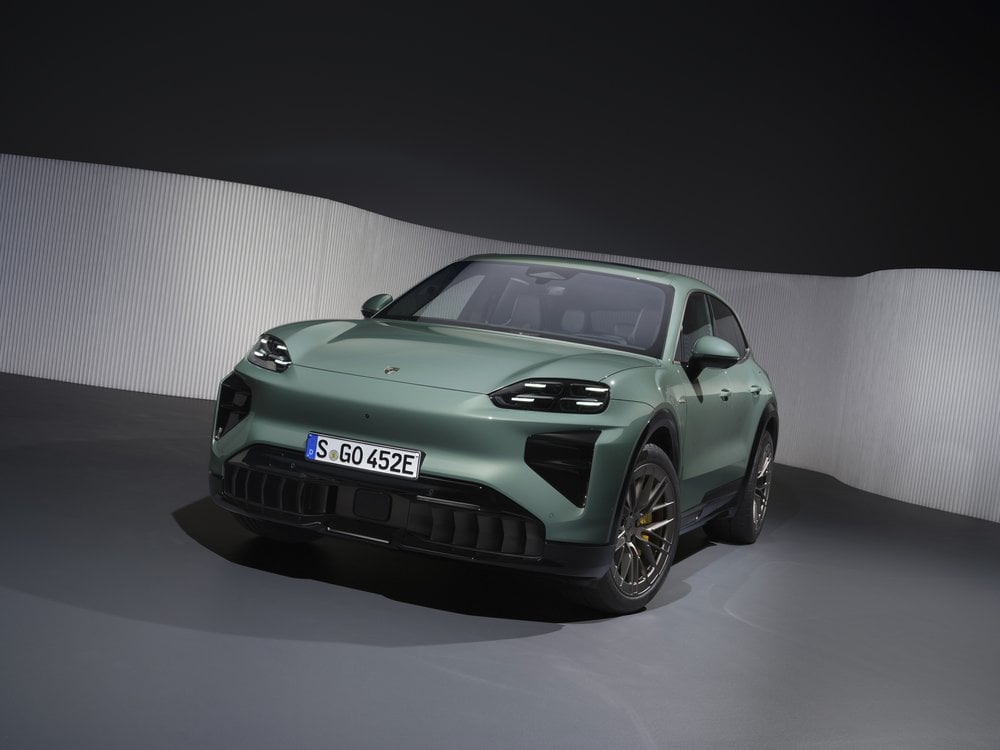
The new line-up consists of two versions at launch: the Cayenne Electric (below) and the more powerful Cayenne Turbo Electric. Both use all-wheel drive, new drive motors and a high-voltage 113kWh battery. In its most aggressive settings, the Turbo variant can deliver extraordinary outputs, with peak power hitting 850kW when launch and temporary boost systems are engaged. Porsche claims 0–100km/h in 2.5 seconds and a top speed of 260km/h, placing it among the fastest SUVs on sale.
Energy recovery tech borrowed from Formula E racing allows the Cayenne Electric to recuperate up to 600kW under braking, meaning most deceleration is handled by the motors rather than conventional brakes. Adaptive air suspension is standard across the range, while the Turbo also offers torque-vectoring, rear-axle steering and a new active suspension system designed to counter body movement during cornering or off-road driving.
Porsche says the long-distance ability of the electric Cayenne was a priority. Under European testing, the regular model can travel up to 642 kilometres per charge, while the Turbo is rated slightly lower. With 800-volt architecture, DC charging speeds peak at 390kW and, in controlled test conditions, have reached 400kW. The company reports that charging from 10 to 80 per cent can take under 16 minutes. Porsche will also offer inductive wireless charging as an option, allowing owners to recharge by parking over a ground plate.
The new model sits on a slightly larger footprint than the petrol Cayenne, with an extended wheelbase delivering more rear-seat space. Boot capacity ranges from 781 to 1588 litres, with an additional 90-litre front compartment. Towing capability remains strong, with a maximum rating of 3.5 tonnes depending on configuration.
Exterior styling takes cues from existing Cayenne models but pushes further toward aerodynamic efficiency, with new lighting units, smooth body surfaces and active aero elements including movable cooling flaps, an adaptive roof spoiler and rear aero blades on the Turbo. The drag coefficient is listed at 0.25, placing it among the most streamlined SUVs in its class.
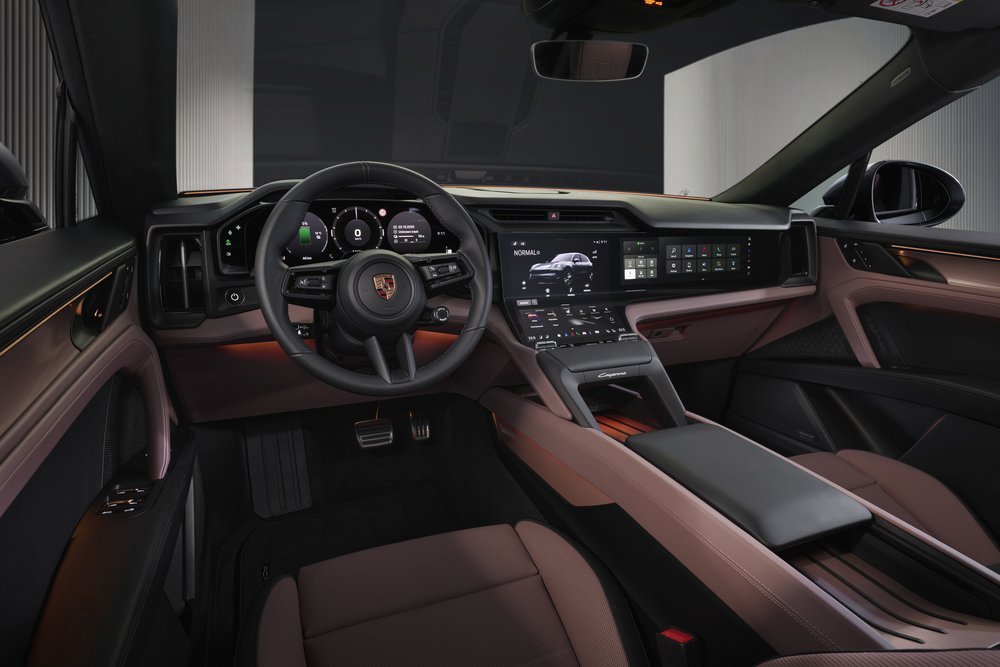
Inside, Porsche has introduced its largest digital display setup to date. A curved OLED “Flow Display” spans the centre console, paired with a digital instrument cluster and an optional passenger screen. A new voice-control system uses AI to interpret more complex requests, while the cabin itself can be customised extensively through various design packages and Porsche’s special-order programs.
Australian-market cars will add several features as standard, including a tyre repair kit, privacy glass, upgraded parking assistance, digital radio and a wider range of no-cost paint options.
Australian deliveries are expected to begin in the third quarter of 2026. Local pricing starts at $167,800 for the Cayenne Electric and climbs to $259,900 for the Turbo Electric.
