
This story was first published in 2013. As the 2024 Australian Grand Prix draws close, now’s the time to revisit those racing driver dreams.
Mercedes-AMG has announced Australian pricing for a new limited edition of the G 63, the Grand Edition.
Production will be limited to 1000 examples worldwide, with a “strictly limited number of vehicles” available to Australia. Mercedes has not said what that number looks like.
Snapshot
- Gold-coloured exterior and interior details
- 1,000 to be sold worldwide
- $413,561 (exc. on-road costs and dealer delivery)
1
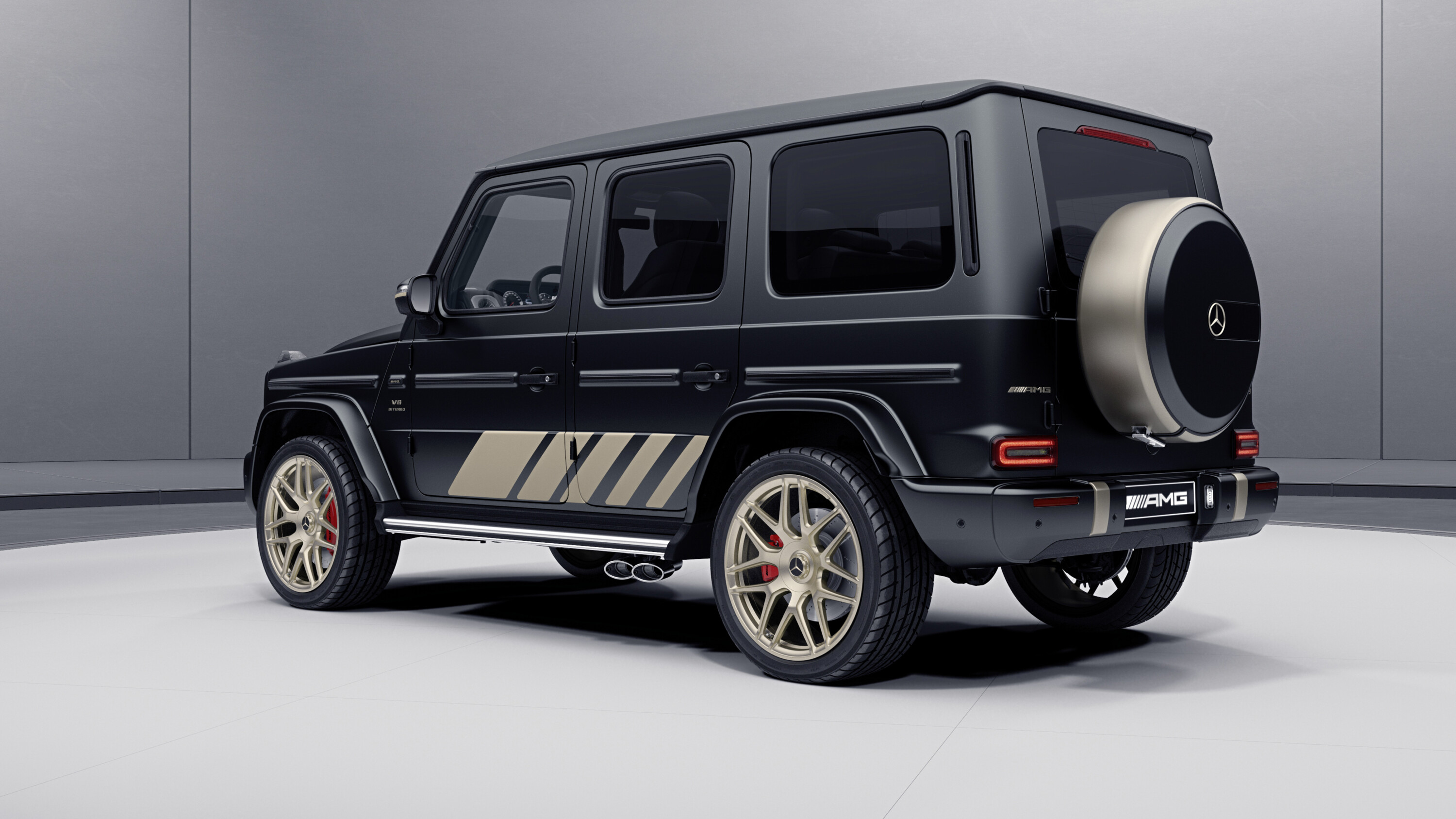
The AMG G 63 Grand Edition celebrates “the success story of the G 63”.
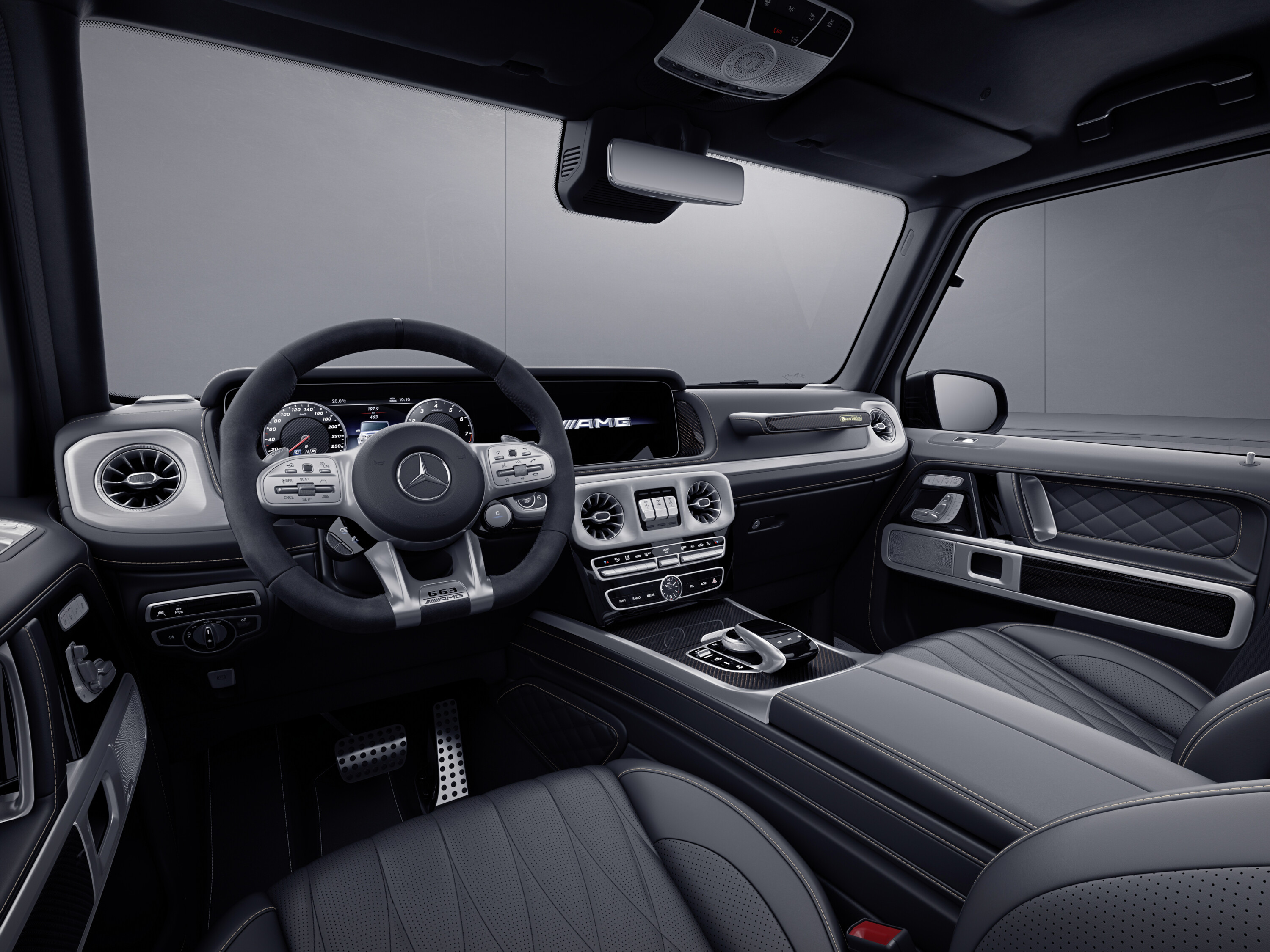
The Grand Edition features aesthetic rather than mechanical changes, centred on Manufaktur night black magno (Mercedes-speak for matte) paintwork paired with “distinctive” Kalahari gold magno exterior and interior details. As the ‘regular’ AMG G 63 is rarely criticised for lacking power, revisions to the appearance are probably sufficient.
The gold-coloured design elements have been chosen to highlight the direct lineage of the modern Mercedes-AMG G 63 back to the first G model released in 1979, according to Mercedes-AMG. This is the first time the G-Class is available from the factory with gold star and AMG logo on the grille.
1
| Exterior details finished in Kalahari gold magno: | |
|---|---|
| Mercedes-Benz star on the grille | Front optical underride protection |
| AMG grille logo | Side foiling |
| Mercedes-AMG bonnet badge | Mercedes star in the spare wheel inlay |
| Front and rear bumper inlays | Spare wheel ring |
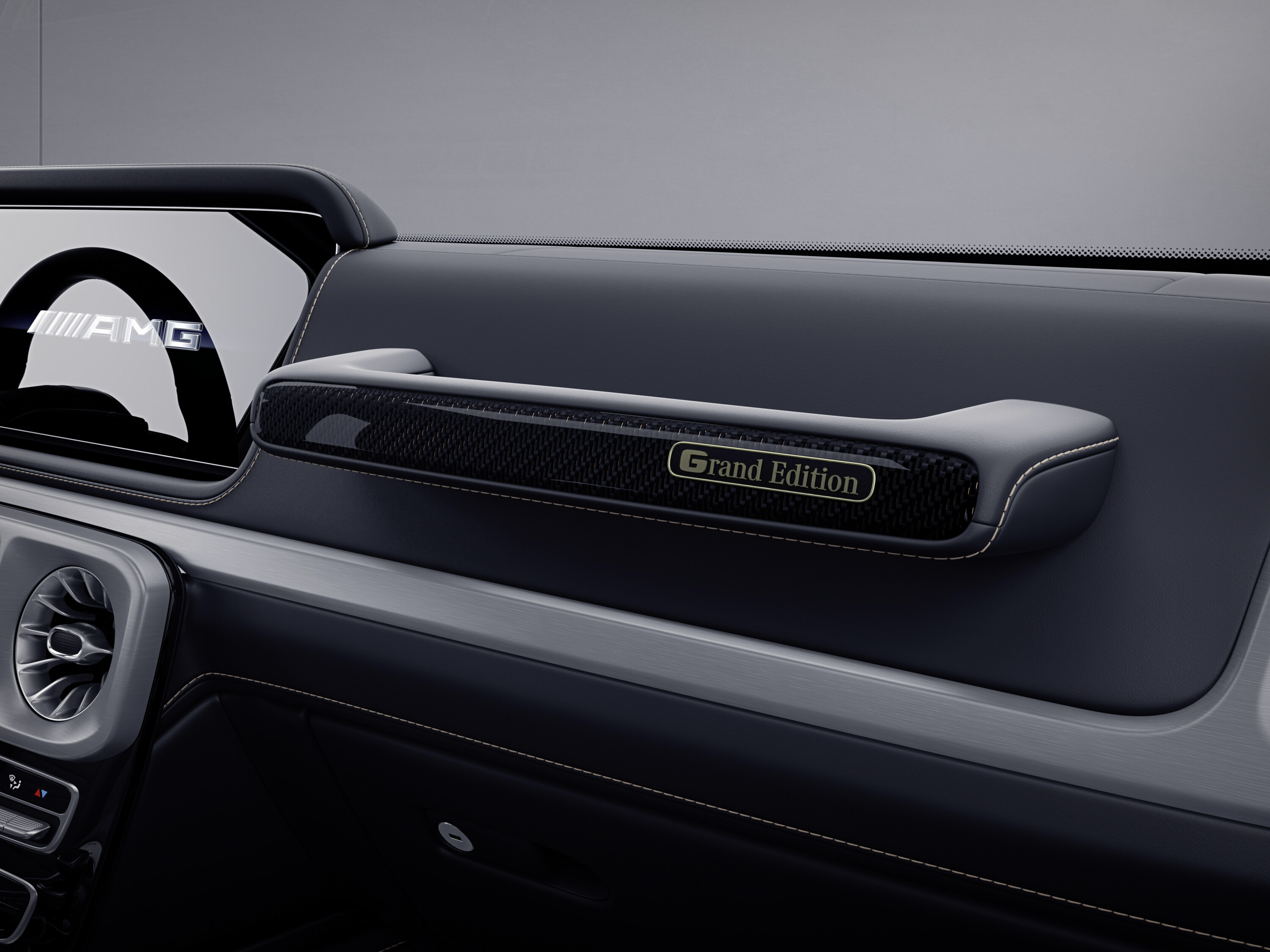
Styling is further enhanced with 22-inch AMG-forged alloy wheels rendered in tech gold, secured by matte black central locking nuts set with Mercedes stars in tech gold. The exterior theme is continued inside with contrasting classic black trim and gold-coloured highlights.
The AMG Performance steering wheel is clad in DINAMICA microfibre and features a steering wheel clasp with aG 63 plaque.
1
| Kalahari gold magno interior features: | |
|---|---|
| AMG emblems (on black door sill trims with illuminated border) | Front optical underride protection |
| Gold stitching on seats finished in G MANUFAKTUR black Nappa leather | Side foiling |
| Plaques bearing a gold AMG logo and gold edging set into the backrests | Mercedes star in the spare wheel inlay |
| Black floor mats decorated with gold stitching | Spare wheel ring |
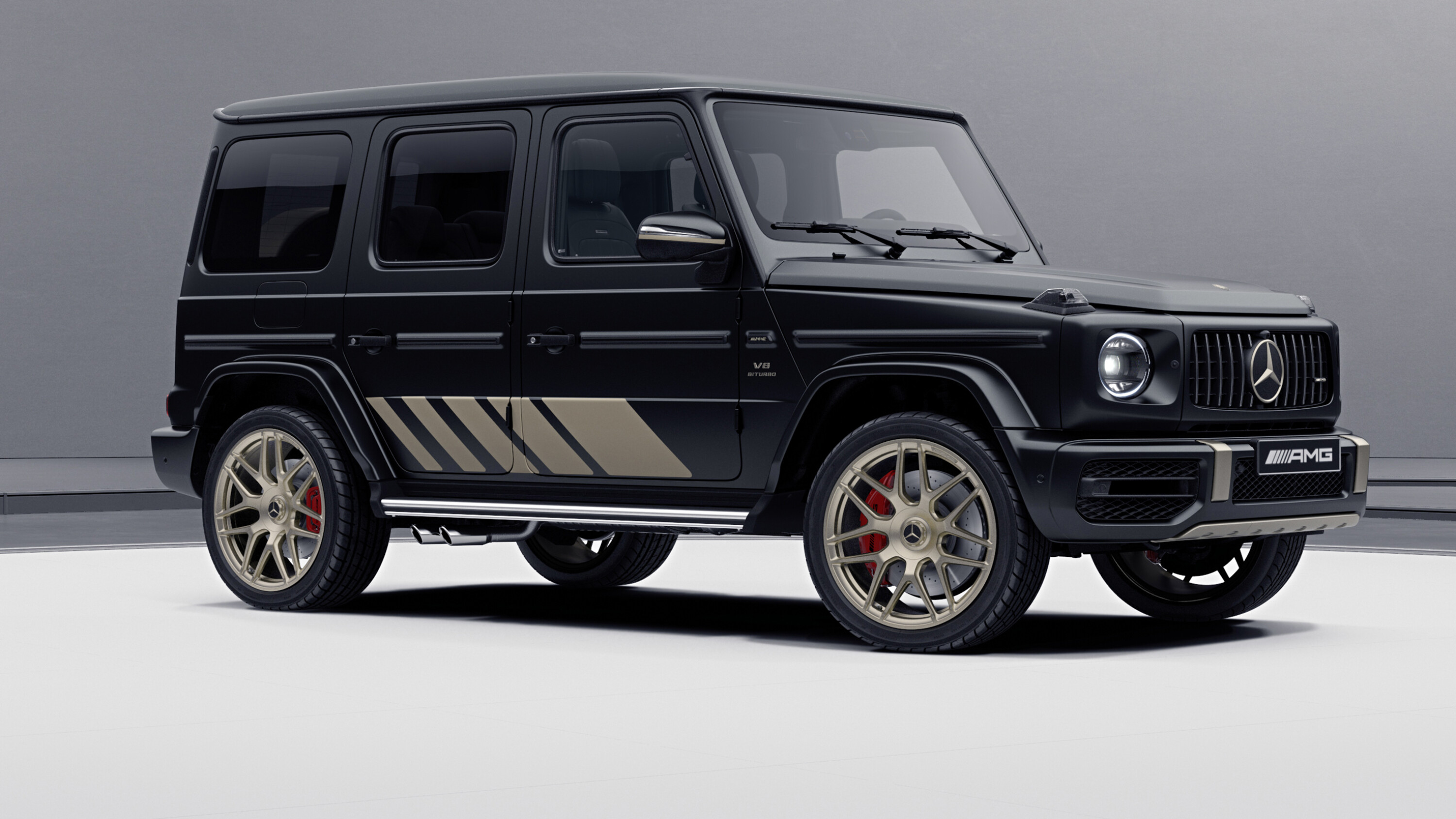
| Passenger side roof grab handle Inlay trim piece is carbon with copper thread | |
1
Pricing
The Mercedes-AMG G 63 Grand Edition package in Australia is priced at $50,000 over the $363,561 vehicle purchase price (excluding on-road costs and dealer delivery).
Some people talk about athletes exuding a presence, an aura, when they walk into a room.
I’ve never bought that, but Nico Rosberg does have a fat-free, lean tautness that’s the physical hallmark of his trade as he enters the lobby of the Mercedes AMG F1 plant in Brackley, Northamptonshire, where we begin our chat before being ushered towards a waiting Mercedes-Benz S-Class.
It’s today’s interview location, taking us to the Mercedes engine facility in Brixworth, where Rosberg is needed for a TV feature. It’s 50 kilometres away. Far enough, I’m hoping, for him to tell me what it takes to make a Formula 1 car go as quickly as possible.
To explain to me the techniques needed to get the best out of it. Not that you or I could do it, you understand – but in the way that a surgeon might explain the procedure he has just accomplished, I’m hoping to comprehend the theory.
So, Nico, can you disseminate the skills you’ve learnt in a 17-year karting and single-seater career into less than an hour, please?
I’m not sure he thinks he can, but he’s prepared to have a go.
I start by asking what the driving environment is like and what he can see from his F1 car’s cockpit. “You can see the top of the tyres,” he says. “You can see maybe 20 metres ahead, and nothing before that. But you don’t notice that because you’re travelling so fast.”
The HANS device doesn’t restrict your head movement at all, he says. “You can turn your head as much as you want to.
But there is quite a big blind spot because you can’t see a car until very late.”
The pedals are the same size, the brake unassisted and the throttle relatively heavy. The seating position is tight, narrow and leant backwards. The steering is direct and fast.
“There’s 180 degrees [of lock] one way and the other way, more or less,” Rosberg says. “But you never use that, other than in Monaco. Usually, you’re using a little bit – up to 90 degrees both sides.”
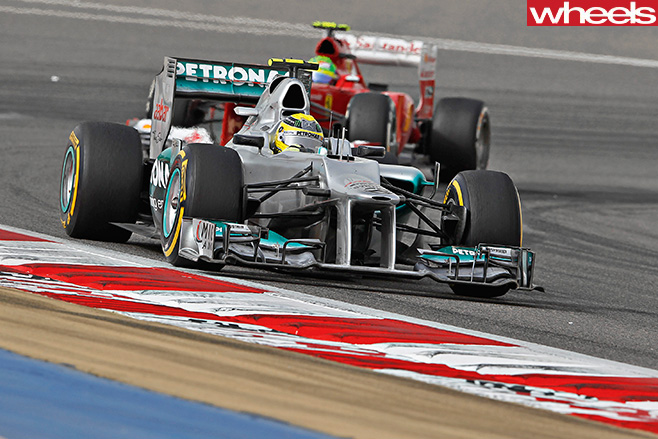
And the weight? “You can set it up as you want – you need to keep some heaviness to keep some feel to it, but it’s quite light in general. You need feedback through the steering wheel, because it’s very sensitive to when you’re locking up and turning. There’s more feel [than in a good road car] – loads more.”
So what about these corners, then? They’re the only things that separate one driver from another, aren’t they?
A braking point, Rosberg says, is “literally a specific point. It can be markings on the road, bumps, the 100-metre boards, all sorts of things like that.”
Unhelpfully, however, depending on fuel load and tyre wear, this point “changes all the time”. And particularly so given the sensitivity of last season’s tyres. Rosberg says that even at very high speeds it’s possible to lock the wheels under braking, which surprises me.
Nevertheless, he suggests that it’s best to hit the unassisted left pedal “very hard”. And while there’s a big weight transfer in an F1 car, unlike a road car, “It’s not in pitch movement, just in straight-ahead movement. You have to push against the steering wheel hard, otherwise you fall [down] into the seat.”
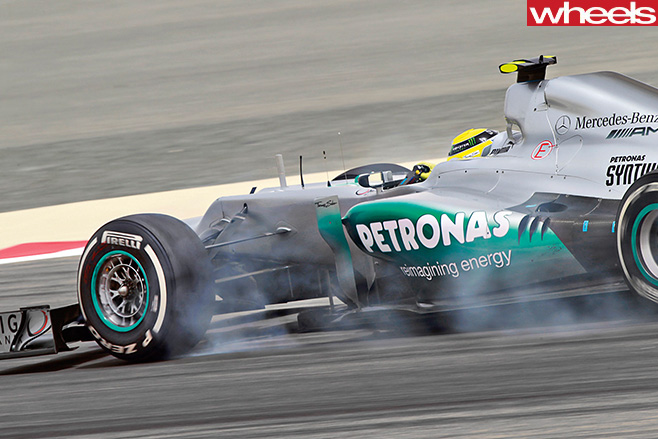
Braking, Rosberg explains, is where the big difference between race cars and road cars lies. “In the first part of braking, you hit it as hard as you can. There’s so much grip because there’s so much downforce.
But then, as you’re slowing down, the grip of the car is reducing at the same time. So you have to ease off the brakes to get maximum deceleration.”
Do F1 drivers trail the brakes into the corner, gradually easing them off even as they turn? “Yeah, a lot. All the way to the point where you go on to the throttle, you’re holding [the brakes] in,” Rosberg says.
But it’s those tyres again. “If you steer and brake, it’s a longitudinal deceleration and a lateral acceleration. It can easily overload the front tyres,” Rosberg says.
All being well, you’re on the way to the apex. “We accelerate at the apex, but you have to be very careful feeding in the throttle,” says Rosberg. “As soon as you feel the rear going, you have to wait again.”
Is any lateral slip at all advantageous? “Yeah, yeah, of course,” he says. “You just need to find the right balance. There comes a point where you lose too much, so it’s finding the right amount.”
I wonder if that means a neutral steer point, where the steering wheel is straight and the car is effectively slipping across the track. It’s what I’ve been told is fast. “That is the fastest way to drive,” says Rosberg. “It’s like the rally guys: always driving on the rear. Because with understeer, you have to wait and wait and wait and wait until the car drives around the corner. Whereas with oversteer … it’s just the fastest way.”
Wonderful news.
And on top of that theory, “You always have little secrets everywhere, definitely,” says Rosberg.
“And it’s very small things. Often one driver is finding it here, and the other is finding it there, and you look at the others and take bits and pieces and try it yourself. There’s many, many small pieces happening all the time.”
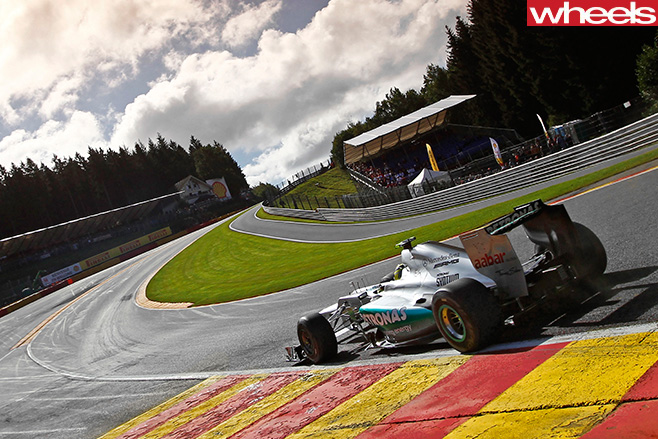
Which all sounds fine. If, that is, you’re driving to your preferred style, and drive as fast as you can. But, curiously, for drivers who will mostly have spent their careers taking part in races that last 20 minutes, perhaps half an hour or so, in F1 they’re usually not driving flat out.
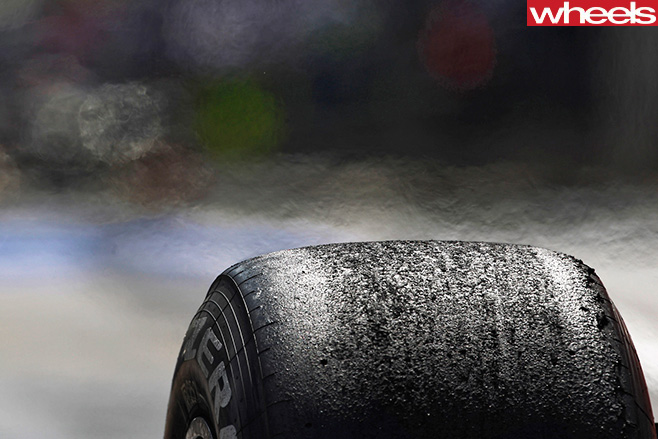
The tyres are “very sensitive”, says Rosberg, particularly in their softest form. It added an intriguing unpredictability to lasts season’s racing. “You really have to drive so carefully; don’t put any aggressive steering inputs into it because you lose time straight away. That’s a very recent thing. It didn’t used to be like that. You used to be able to just push and drive fast.”
Which, I think, deals with the theory about as well as we’re going to during a conversation across the seats in an S-Class. So one more thing: it must be incredible fun. “Oh, yeah, for sure. It’s amazing!” says Rosberg. “Especially the qualifying lap, when you can go for all the limits. Because nowadays you can’t do the push, flat out [all the time], so it’s different.
“But for qualifying you can go flat out. And as Mario Andretti said, if it all feels under control, you’re not going fast enough.”
?
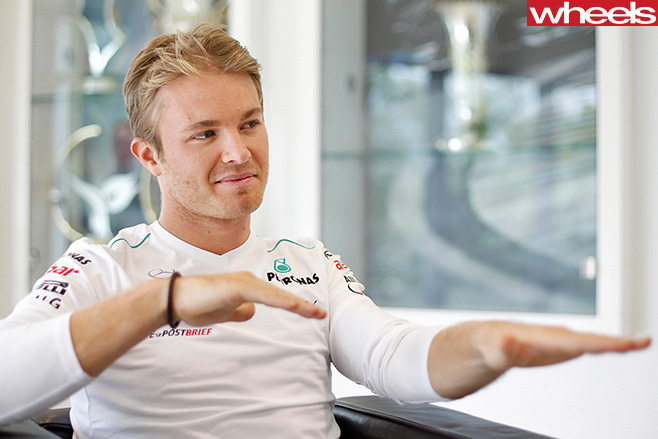
Nico Rosberg’s 10 steps to driving like a professional
STEP ONE: Throttle timing
“We accelerate at the apex all the time,” says Nico. “You have to be careful feeding the throttle. And as soon as you feel the rear going, you have to wait again.”
STEP TWO: Precision
Modern F1 tyres are very sensitive. “You have to drive so carefully,” says Nico. “Don’t put any aggressive steering inputs into it.”
STEP THREE: Never stop learning
“To be fast takes me quite a while,” admits Nico. “Right up until qualifying, because you’re adapting all the time, to a new car, to new lines, and you’re analysing how you can do better. It’s a process that continues.”
STEP FOUR: Fitness in the seat
Under braking there’s a big forward weight transfer. “You have to push the steering wheel very hard,” says Nico. “Otherwise you fall down into the seat.”
STEP FIVE: Brake brake brake!
Rosberg says the braking points for his F1 Mercedes change all the time. “It’s like every lap in this racing car is different. No two laps are the same.”
STEP SIX: Know your car
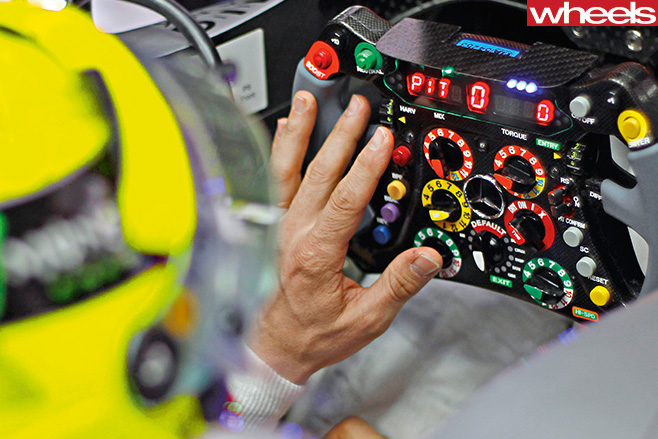
Engines spin right up to 18,000rpm. There’s no rev counter, only shift lights, and a bewildering array of additional switchgear.
STEP SEVEN: Did we mention tyres..?
The new tyres wear quickly. Nico says it makes driving “like long-distance racing, where you have to take it easy and make no mistakes. It’s very, very difficult to get that right.”
STEP EIGHT: Clutch
There’s no clutch pedal, just a lever on the steering wheel. Travel is only about 10mm and, says Nico, “there’s no feel”. No wonder Webber struggles.
STEP NINE: Mind the field
It’s no easier to follow other cars closely than it used to be in F1. However, Nico believes that “much bigger speed differentials” between cars have made it look that way.
STEP TEN: TYRES!
Tyre degradation means that drivers can only push really hard in qualifying. The race is all about managing wear.
Australia’s EV Council has published its Electric Vehicle Industry Recap for 2023, covering statistics, charging infrastructure progress, and policy development.
Australian Electric Vehicle Industry Recap 2023
- Australian EV sales (including BEVs and PHEVs) grew by 120%
- The total Australian EV fleet surpassed 180,000 electric vehicles
- Charging infrastructure locations increased by 75 per cent on the previous year, with 348 locations added across Australia
1
8.45% of 2023 new vehicle sales in Australia were electric vehicles
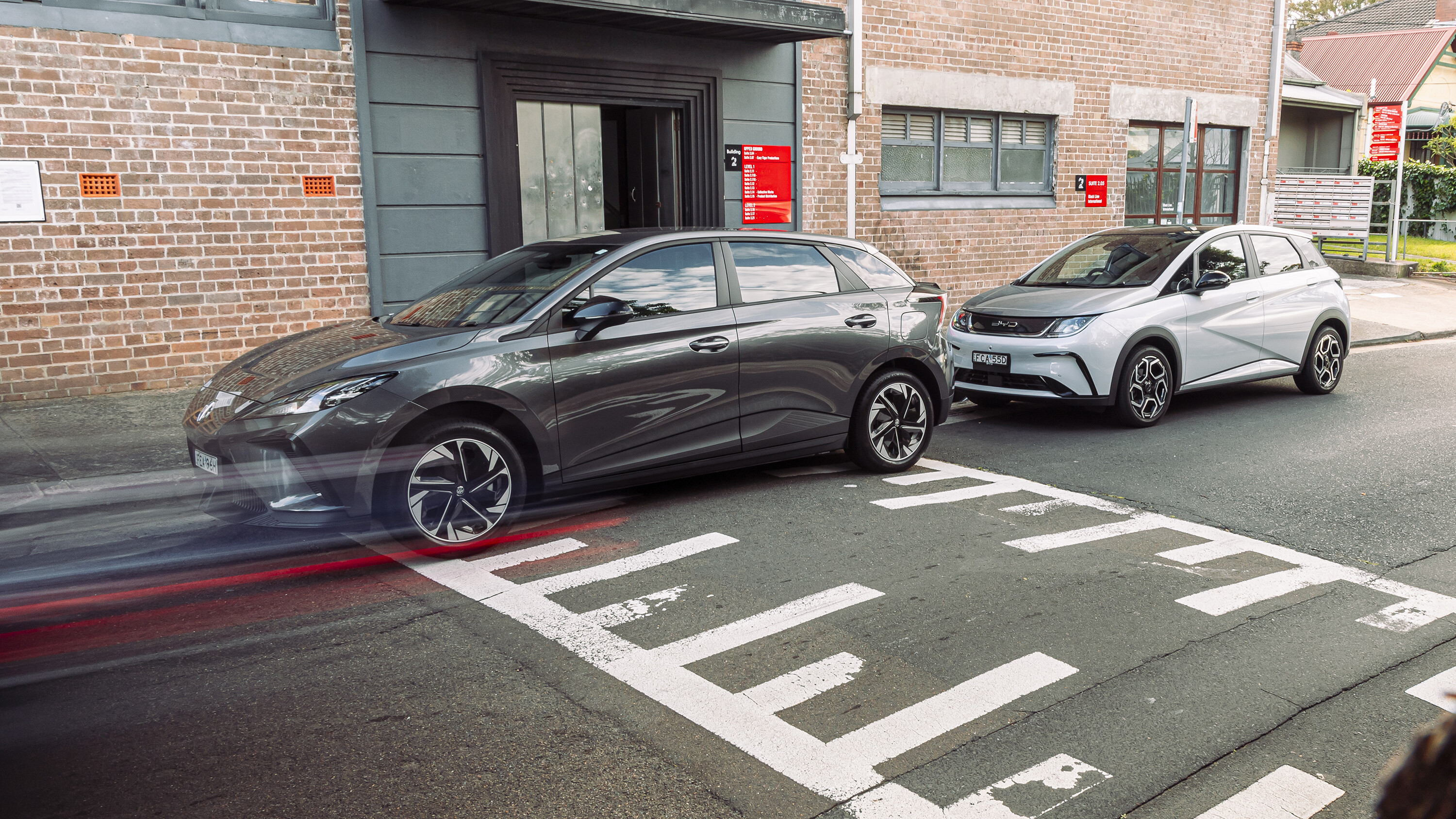
If you feel like you’re seeing more Teslas, BYDs and Outlander PHEVs out there, you aren’t imagining it. Nearly 9 percent of 2023 new vehicle sales in Australia were pure electric vehicles (BEVs and PHEVs).
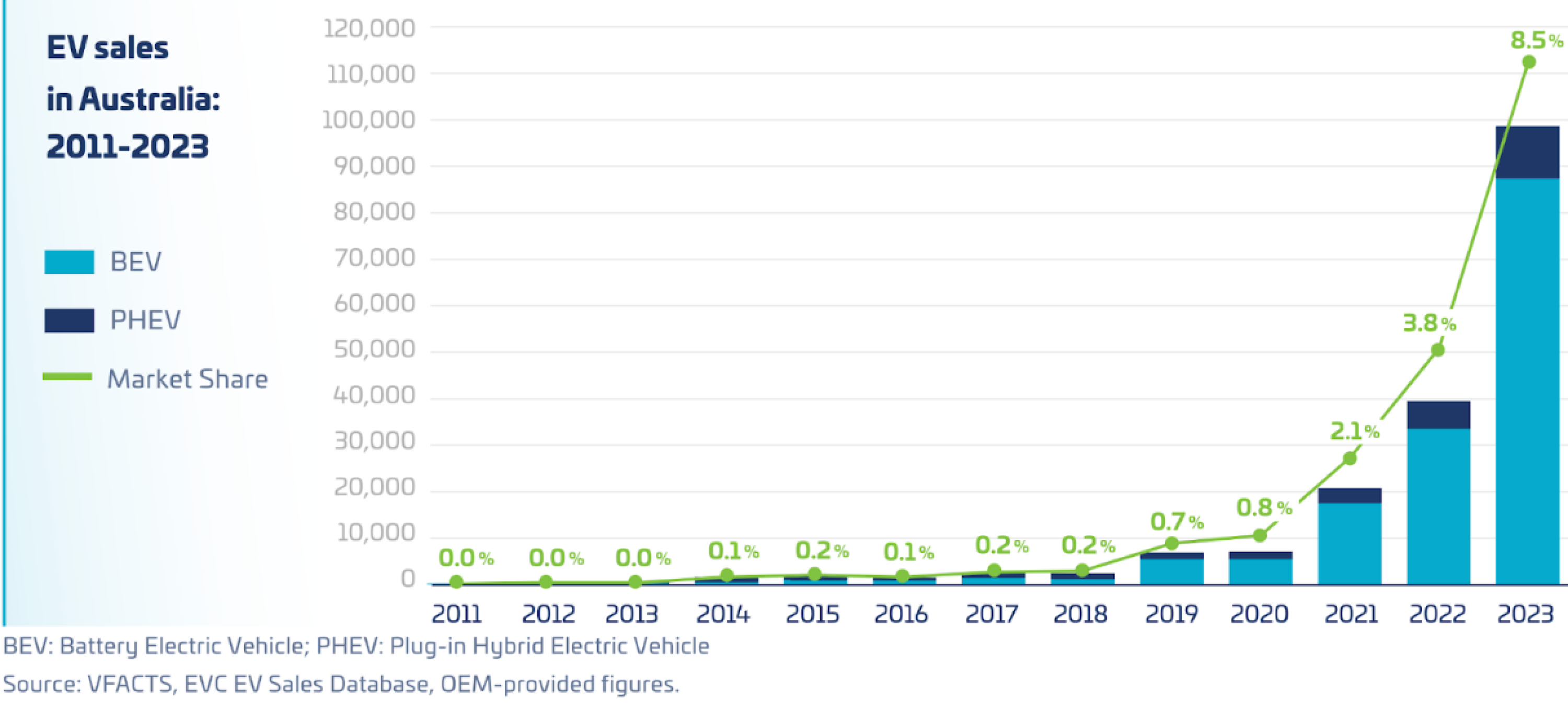
Starting from a low base, that number represents a 120% increase over 2022 (up from 3.81%), in an expanding, record-setting year for the overall market. In total, VFACTS data shows 98,436 EVs were sold in 2023, compared to 39,353 in 2022 – a 150% increase year on year.
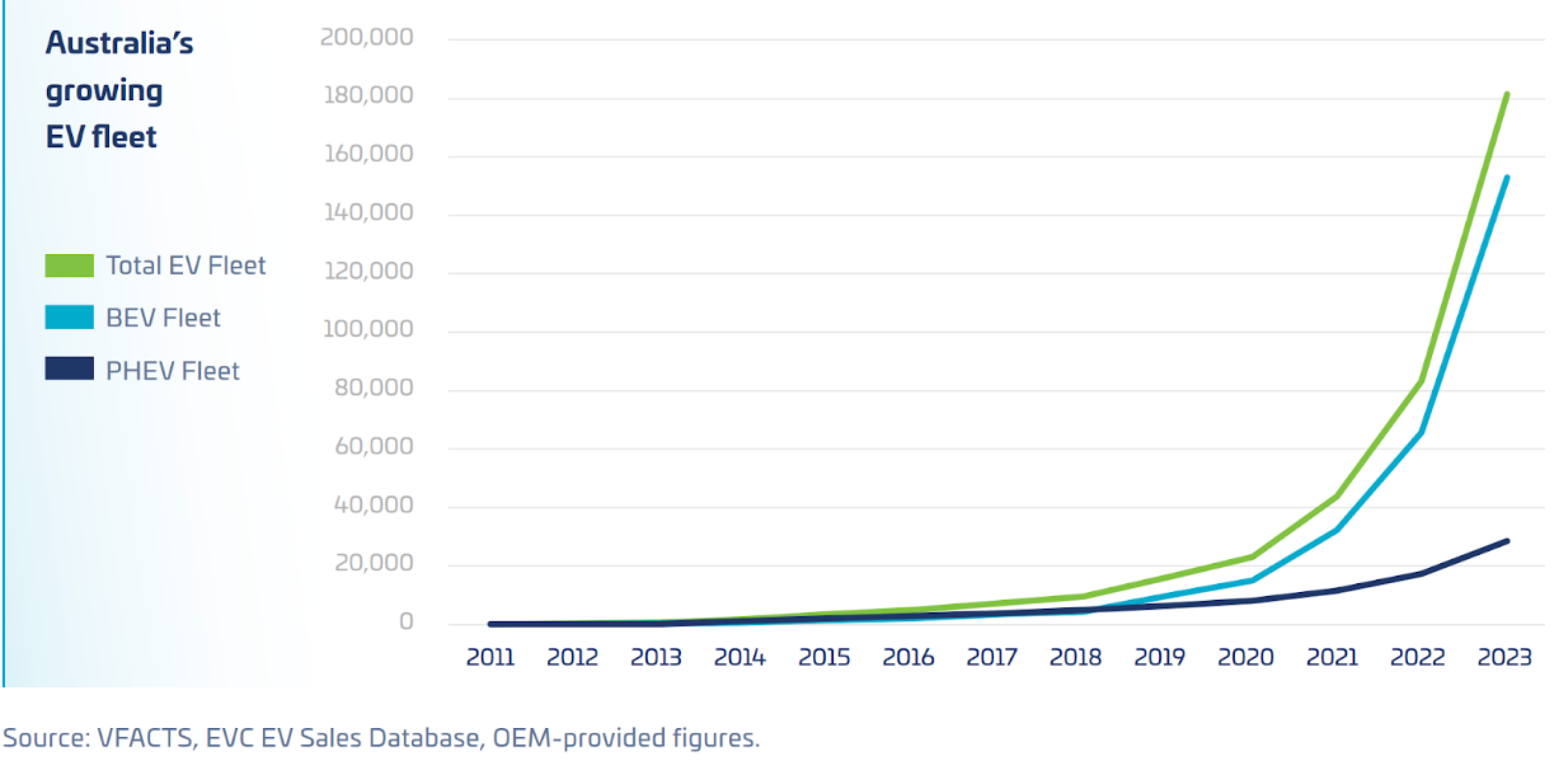
No surprise, the increase in EV sales from the 2010s to the present has been explosive, growing exponentially since around 2017 – as shown below.
1
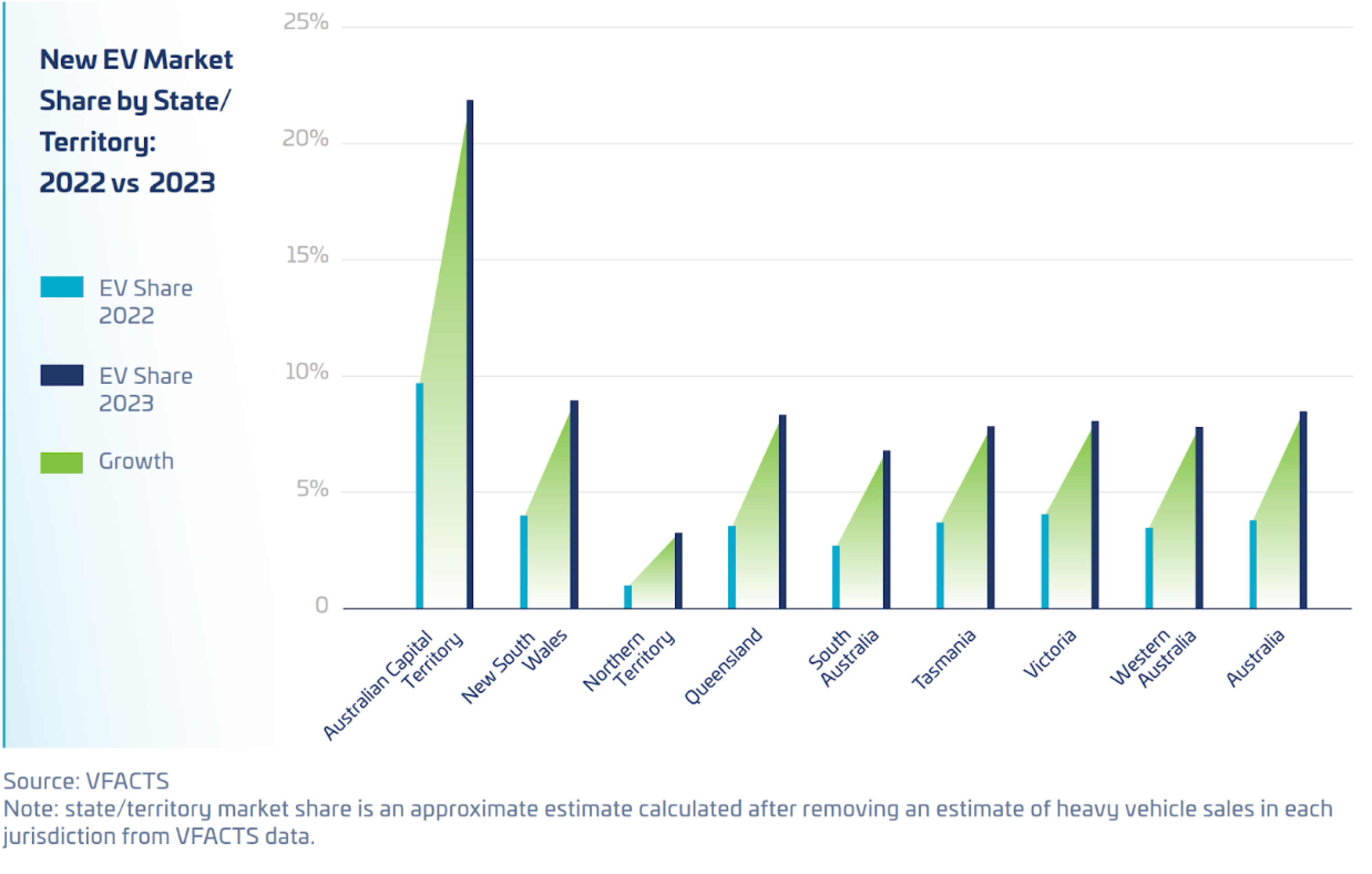
The ACT is still leading the nation
Australia’s capital extended its lead for EV market share in 2023, with electric cars making up a significant 21.9% of all new vehicles sold.
The EV Council suggests the territory government’s strong leadership on EV policy is partly responsible, although all other regions experienced strong growth in EV sales as well.
The NT trails other states and territories, but the report notes that EV sales in the Territory more than tripled in 2023 compared to 2022.
1
Australia’s EV Fleet
There are now over 180,000 EVs on Australian roads, with BEVs comprising over 80,000.
EVs now represent approximately 1% of the total light vehicle fleet in Australia. The BEV fleet exhibits similar growth since 2017 as EV market share.
The Electric Vehicle Council considers that support from all Australian governments will be necessary for the nation to achieve a 100% zero-emission vehicle fleet by 2050, including legislating the government’s recommended design for a New Vehicle Efficiency Standard.
1
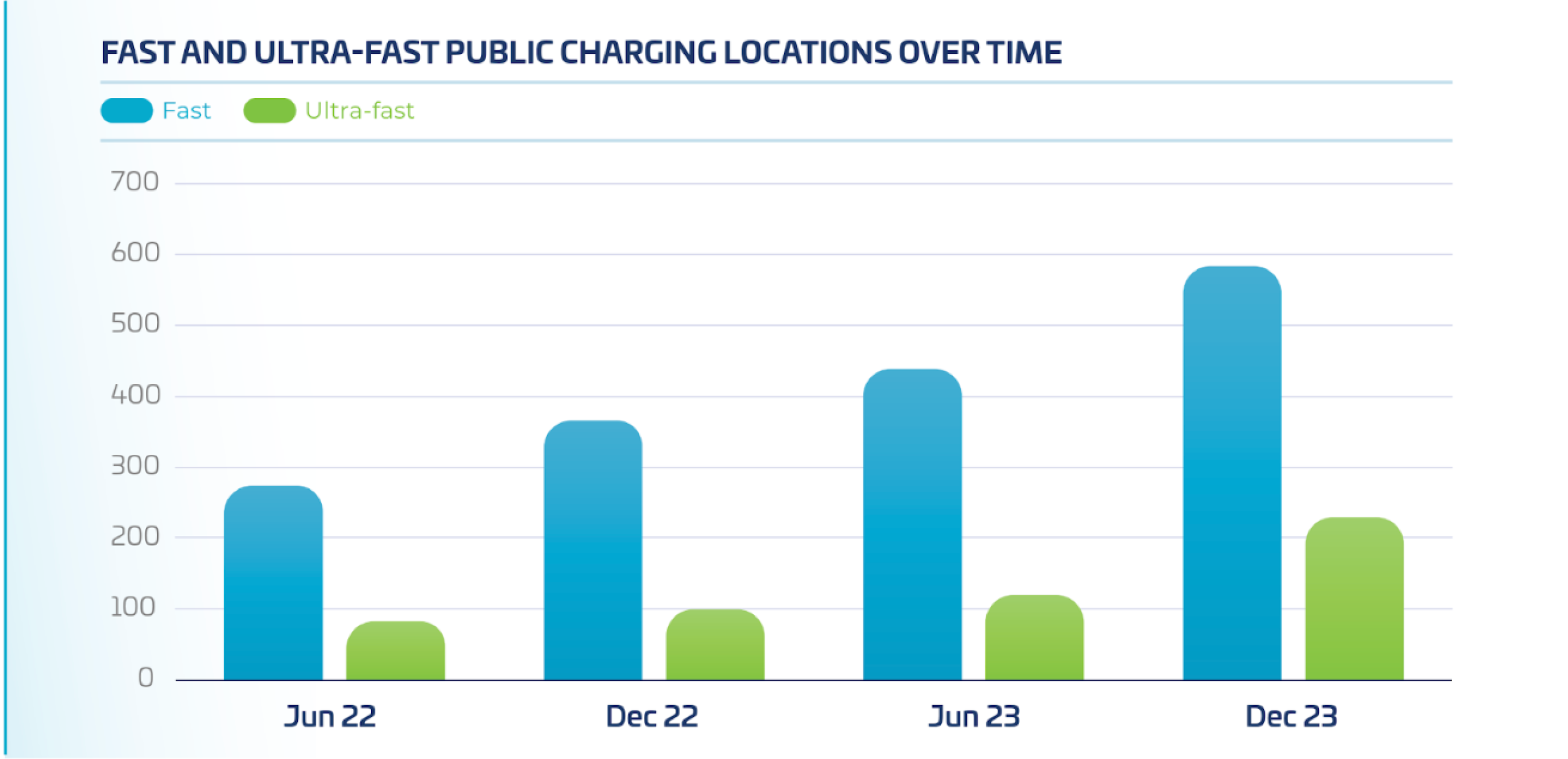
583 fast charger locations & 229 ultra-fast charger locations
One of the most common EV concerns cited in the report, along with range and charging time, is constrained charging infrastructure.
This is becoming less of a material risk, however, as there are now 583 fast charger locations & 229 ultra-fast charger [see table below] locations in Australia.
While those figures are nowhere near the number of petrol stations (which has developed over a century or so), it’s a 75% increase on 2022.
1
Fast and ultra-fast charger numbers steadily increased through 2022 and 2023
| Types of charging: | |
|---|---|
| DC Fast Charging | 24 u201399 kW |
| DC Ultrafast Charging | 100kW+ |
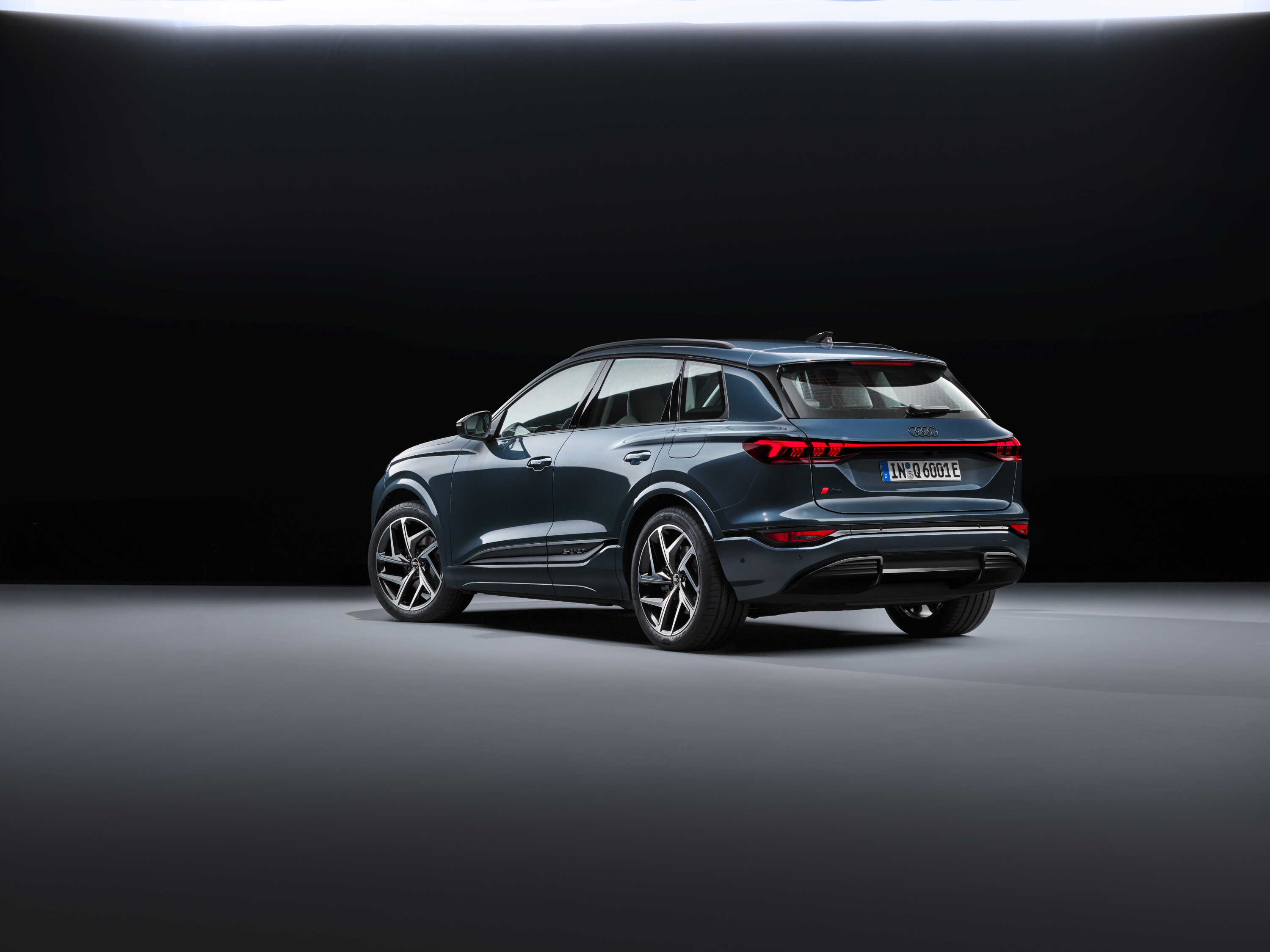
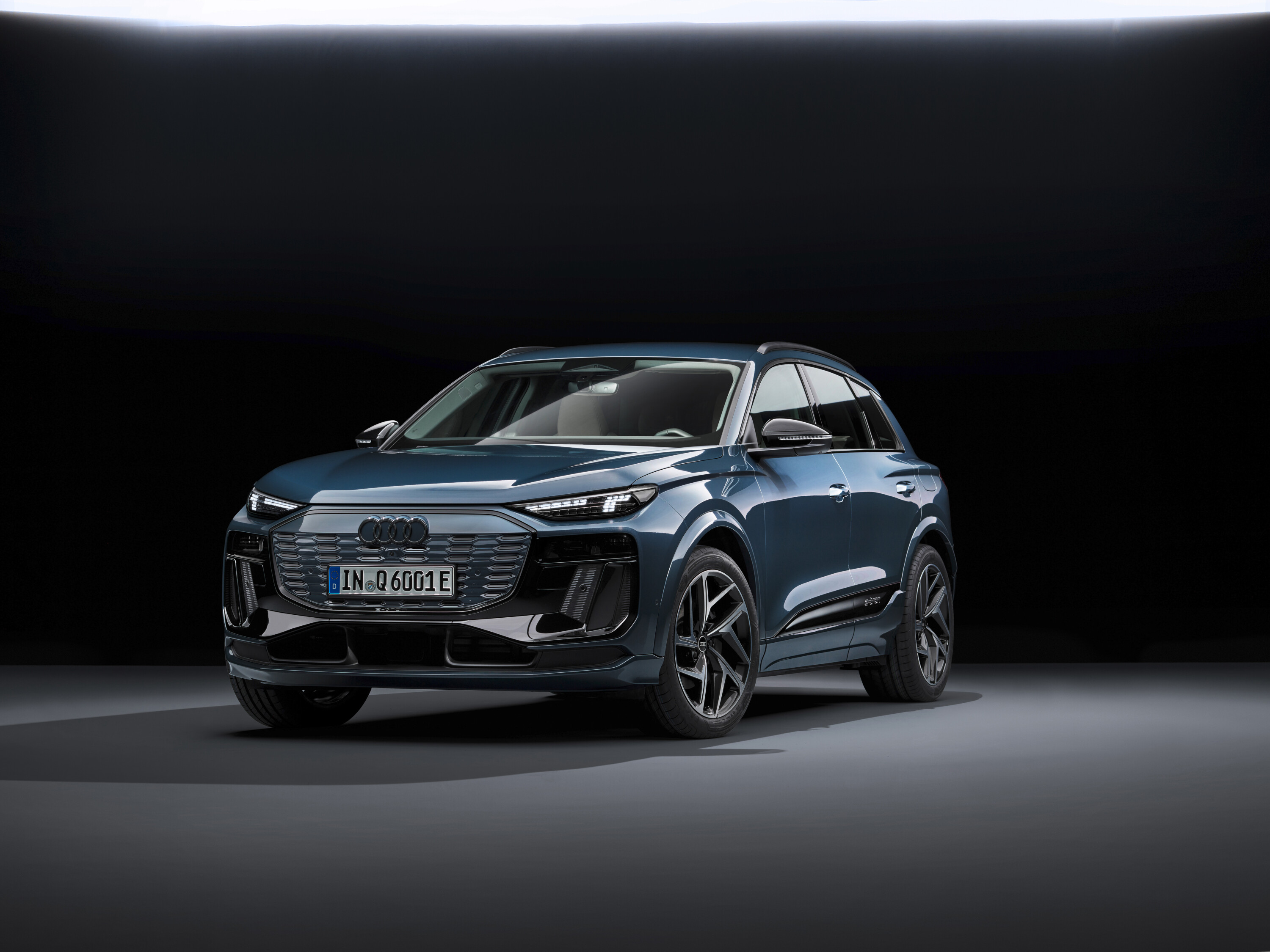
The 2025 Audi Q6 E-Tron electric SUV has debuted as a sibling to the latest Porsche Macan.
At launch, the Q6 E-Tron will be available in dual-motor all-wheel drive form or the sportier SQ6 E-Tron with two entry-level rear-drive models due later.
It has been confirmed for Australia, with more details – including launch timing – due to be announced in the coming weeks.
1
The Q6 E-Tron and Macan are based on the Volkswagen Group’s dedicated Premium Platform Electric (PPE) architecture first announced in 2019. The Audi A6 E-Tron sedan and wagon will follow later this year.
Despite the shared technical underpinnings, Audi says the “flexibility of the PPE helps in giving the future models their independent character and the typical Audi DNA”.
The Q6 E-Tron also sports the newly developed E1.2 electronic architecture, which faced several delays during its development. It has five high-performance computers that control all vehicle functions, such as the safety systems, infotainment, and backend network.
1
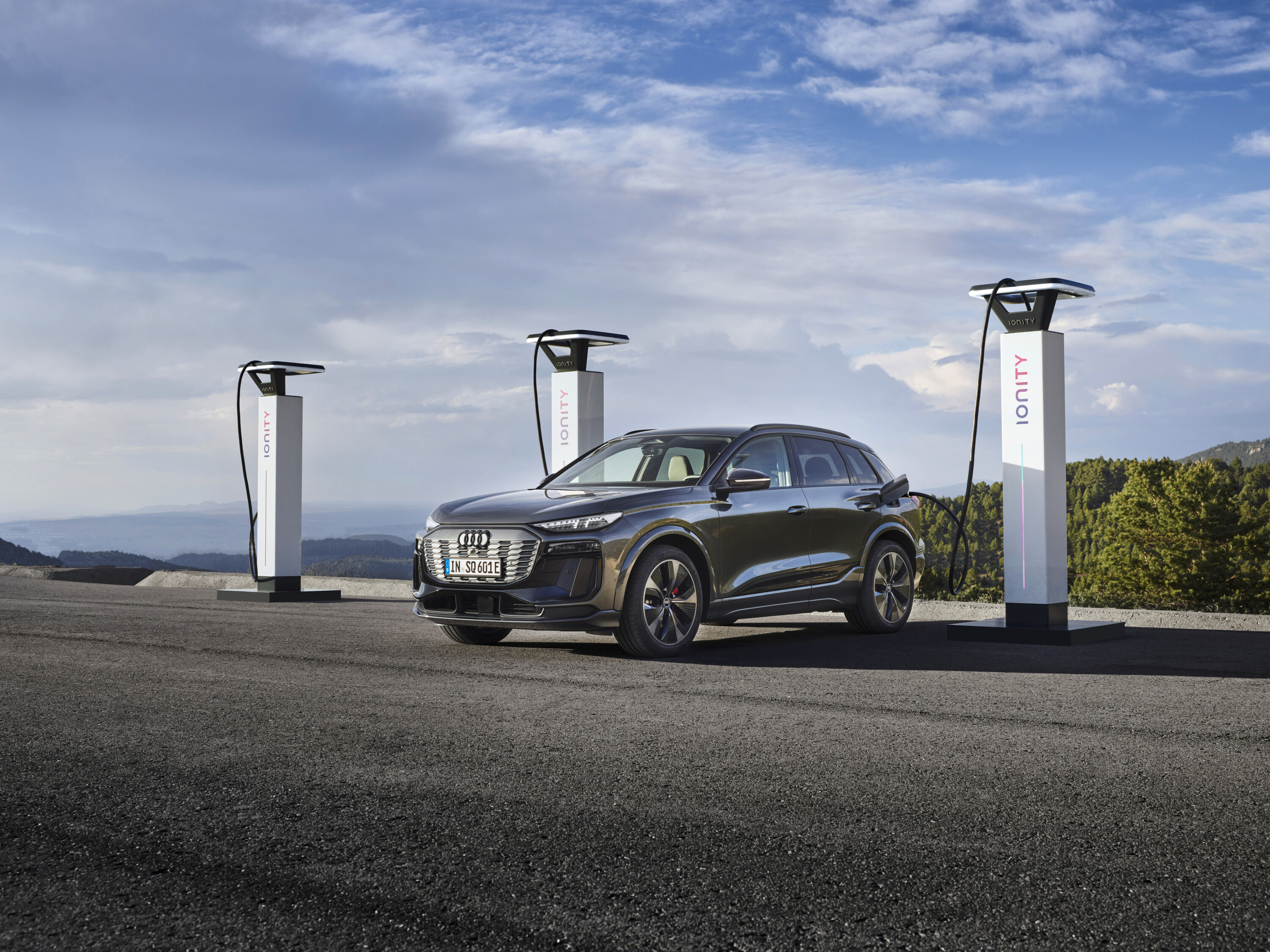
Under the skin, the Q6 E-Tron has a 100kWh lithium-ion battery pack (94.9kWh usable) with an 800-volt electric architecture allowing a 270kW maximum fast-charge rate.
Audi claims 255 kilometres can be added in 10 minutes at a high-power charging station, while a 10 to 80 per cent top-up is possible in around 21 minutes at the highest speed.
At compatible 400-volt charging stations, ‘bank charging’ allows the 800-volt battery to automatically divide into two batteries at equal voltage, which can be charged in parallel at up to 135kW each.
The all-wheel-drive Q6 E-Tron has a WLTP-rated 625-kilometre maximum driving range. Its dual-motor powertrain produces 285kW for international models, with a claimed 0-100km/h sprint time of 5.9 seconds.
1
In North America, it will produce 315kW – or 340kW with launch control – for a quicker five-second 0-60mph (97km/h) sprint time.
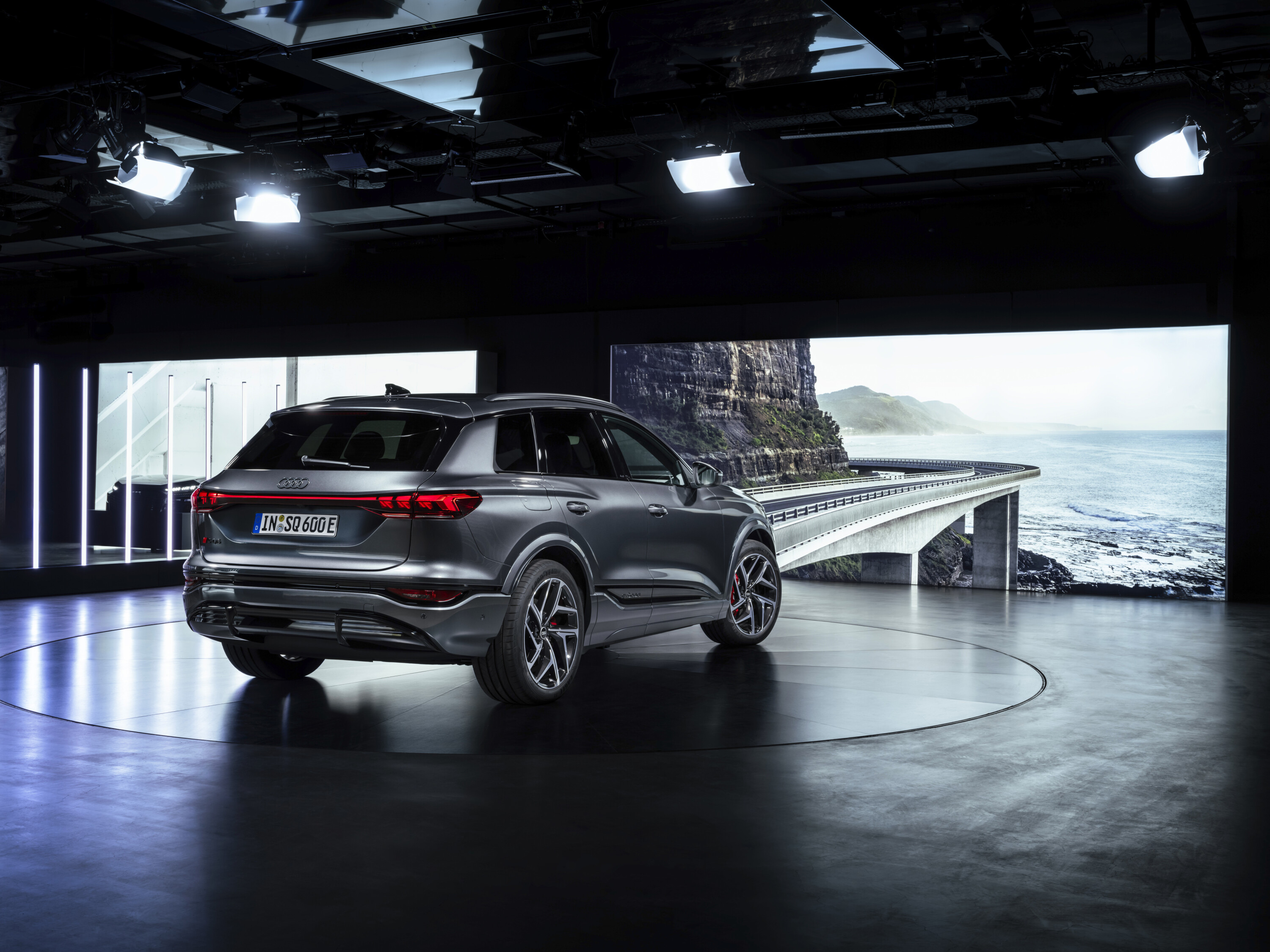
The SQ6 E-Tron makes up to 380kW with launch control activated, with a 4.3-second 0-100km/h time. It has a slightly lower 598-kilometre maximum driving range.
Audi has taken advantage of the high-voltage battery position to partially redesign the front axle to position the control arms in front of the suspension arms, which is said to improve kinematic properties.
1
The steering rack has also been fixed to the sub-frame, while its Quattro all-wheel-drive system has rear-biased torque distribution with wider rear tyres.
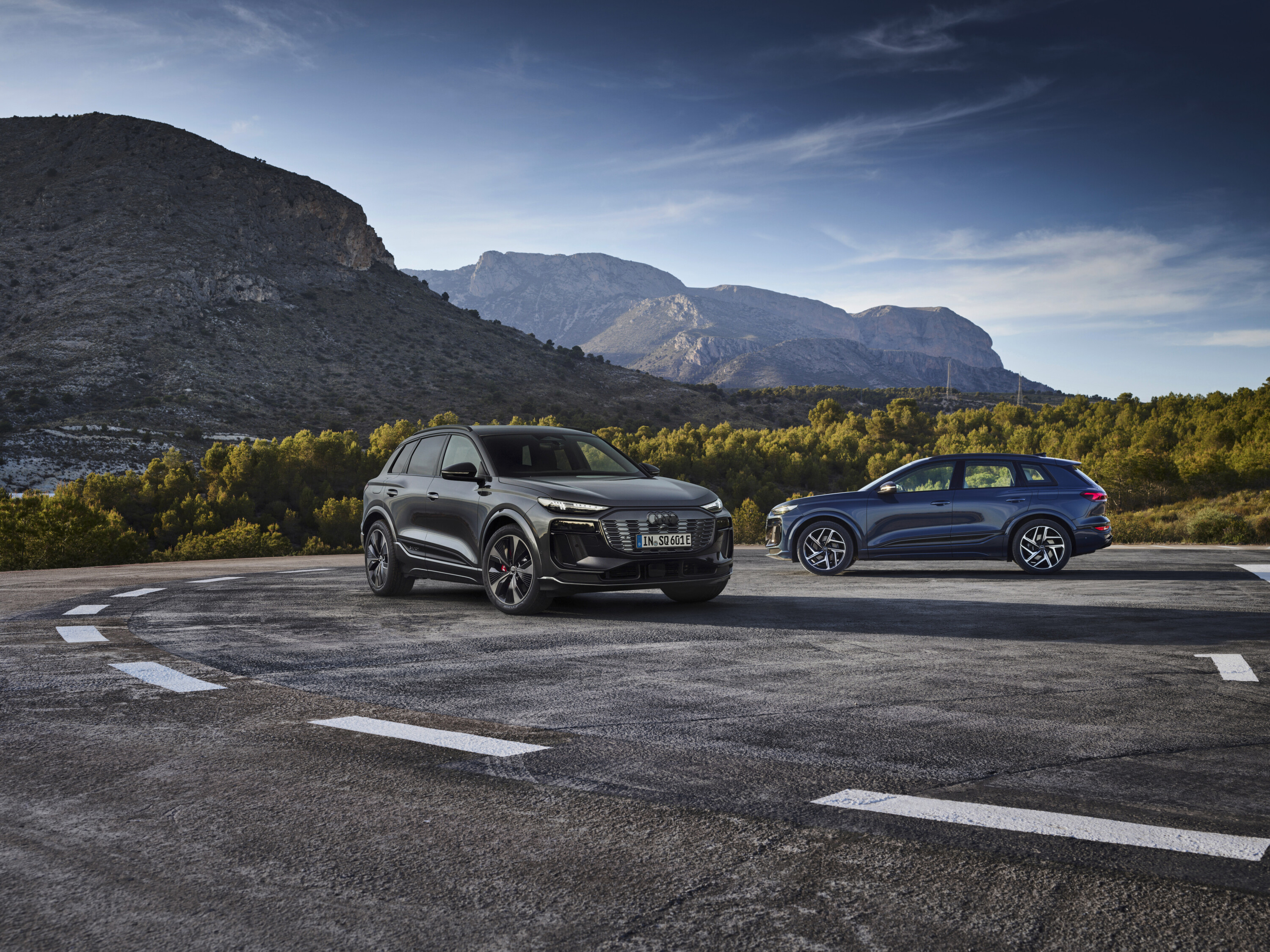
In addition to debuting the PPE architecture and E1.2 electronic components in an Audi, the Q6 E-Tron also wears the German brand’s latest styling language for its EV models, including a split headlight design, a closed-off ‘singleframe’ grille, and shortened overhangs.
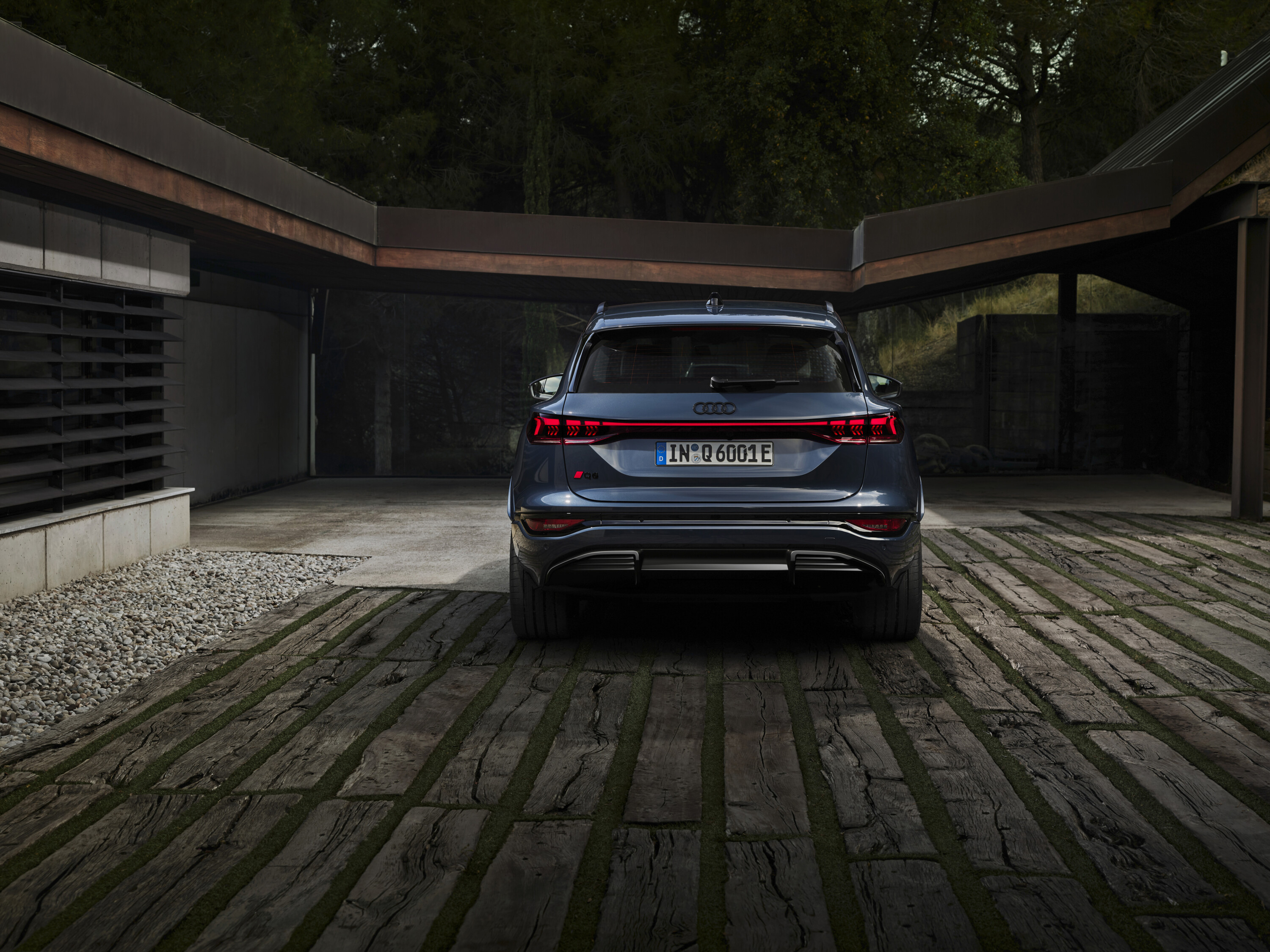
Second-generation digital OLED tail-lights with 360 segments can generate a new image every 10 milliseconds. These images can warn to other road users about accidents, breakdowns, or critical driving situations.
1
The matrix LED headlights also include eight customisable light signatures for the daytime running lamps.
Measuring 4771mm long, 1993mm wide and 1648mm tall, with a 2899mm wheelbase, the Q6 E-Tron is closest in size to the internal-combustion Audi Q5 – as well as other midsize electric SUVs such as the Tesla Model Y, BMW iX3 and Genesis Electrified GV70.
While it might rival the Model Y and iX3 in size, the Q6 E-Tron won’t match them in price. In Europe, it will start from €74,700 (AU$124,000) – which, if applicable to Australia, would see it slot directly between the $90,000 Q4 E-Tron and $155,000 Q8 E-Tron electric SUV models.
1
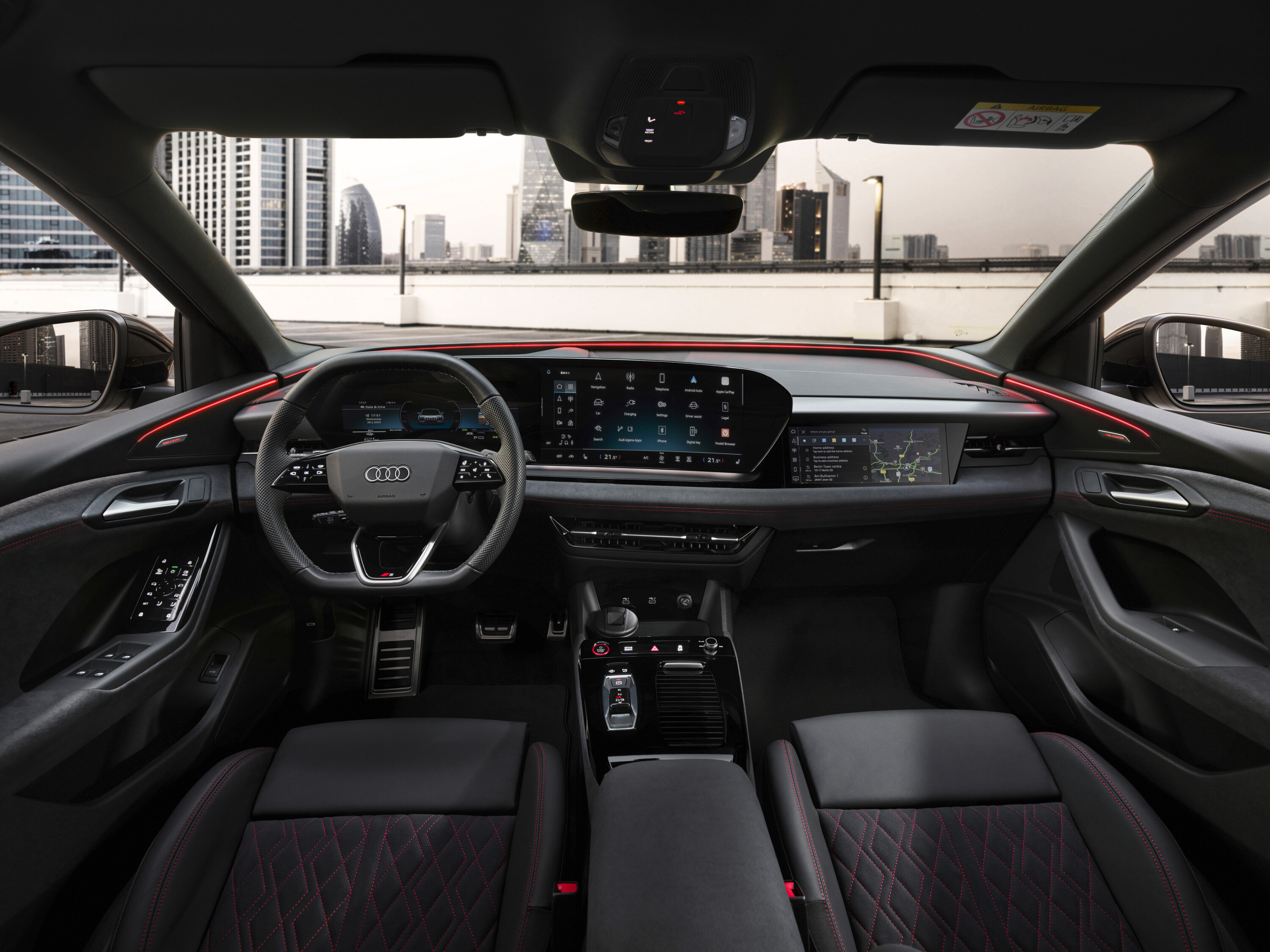
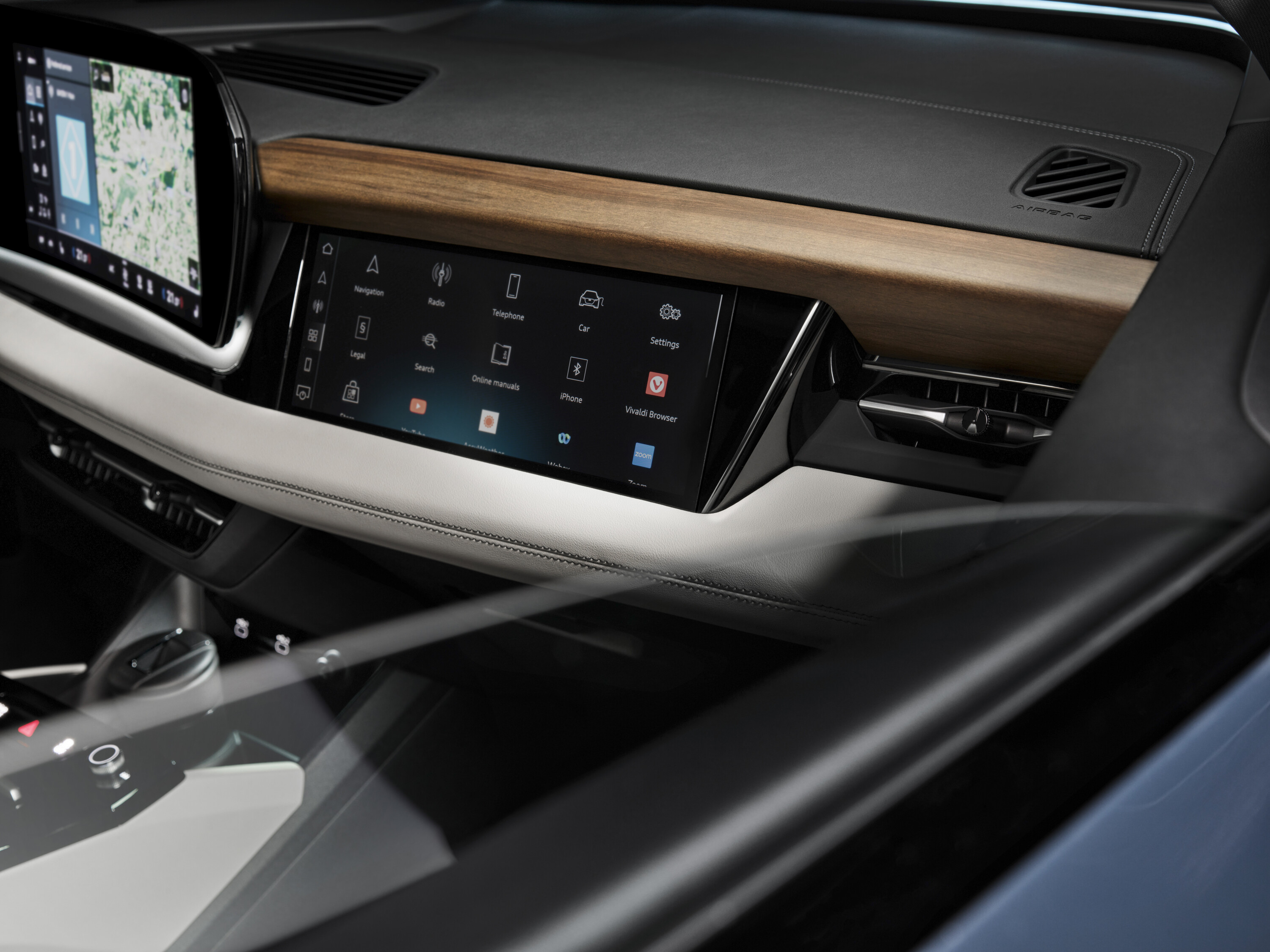
Inside, it features a panoramic curved display with an 11.9-inch digital instrument cluster and a 14.5-inch infotainment system.
There’s also an optional 10.9-inch front passenger touchscreen with a privacy layer to prevent it from distracting the driver.
For the first time in an Audi, the infotainment system runs the Android Automotive operating system, which supports over-the-air software updates and third-party app downloads, such as YouTube.
Other available features include a 20-speaker, 830-watt Bang & Olufsen audio system, artificial intelligence support for the built-in voice assistant, and an optional augmented reality head-up display that can show ‘floating’ elements at up to 200 metres away.
1
The ambient lighting system covers the wider interior with a “variety of communication functions”, such as when the indicators are activated.
Boot space is rated at 526 litres with the second-row up or 1529L with it folded down, while there is an additional 64 litres available in the front boot.
A new active safety feature available in the Q6 E-Tron is ‘adaptive driving assistant plus’ which uses high-resolution map data and “swarm data from other vehicles aggregated in the cloud to improve the handling” to further assist with highway driving, in addition to the adaptive cruise control and lane-keep assist.
1
Audi claims the plastic components in the front compartment and front section covers, as well as the windshield and HVAC intake covers, are made from recycled materials.
In addition, the outer roof section is made from scrap steel, some of which is sourced from end-of-life vehicles.
The 2025 Audi Q6 E-Tron is the brand’s first all-electric model produced at its plant in Ingolstadt, Germany. It will launch in Europe between July and September 2024, with its Australian launch set to follow later.
MORE
Everything Audi
Formula 1 car designers live between the lines of the rulebook, stretching their creativity to devise the most competitive race cars possible, regardless of how they may look.
Downright bizarre-looking things have turned up on the grid at various times in the sport’s history. Some have been outlawed before making a race start, some of them sealed their own fate by failing spectacularly, and some of the weirdest aero ideas have actually worked.
With aero remaining a perpetually hot topic in the F1 paddock, Wheels takes a look back at some of the oddballs the sport has spawned over the years.
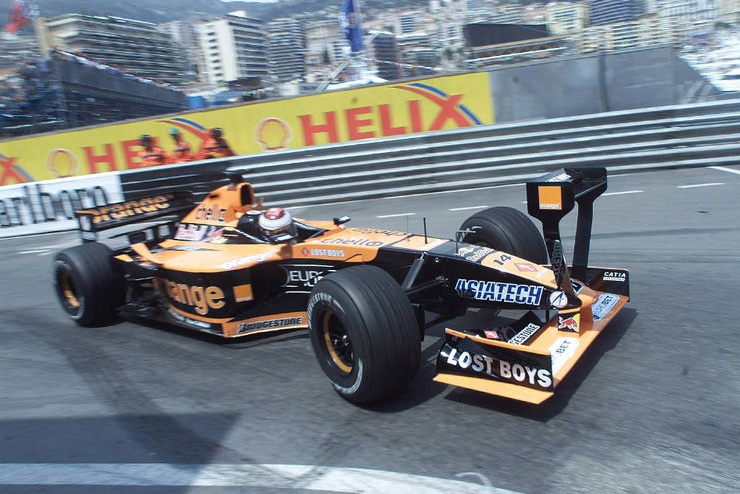
2001 Arrows A22 ‘Top Wing’
Arrows employed this front-end oddity for the Monaco GP in 2001. It was seen on track in practice – driven by Max Verstappen’s old man, Jos – but quickly deemed a vision impairment and outlawed by the FIA.
Similar nose cone aero aids turned up in the ‘crazy wing’ era on cars like the 2006 BMW Sauber F1.06 and the 2008 Honda RA108.
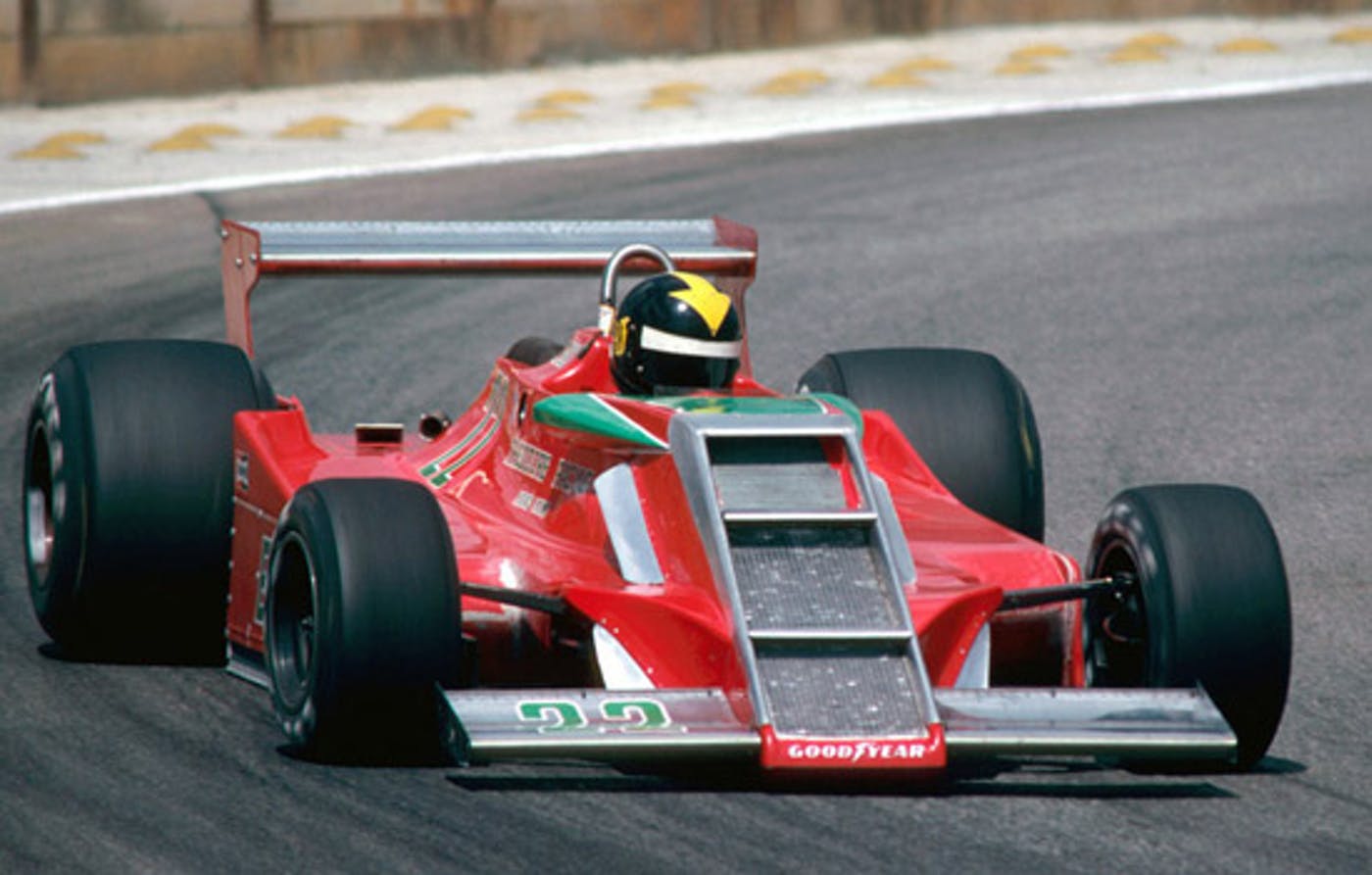
1979 Ensign N179
This three-tiered nose cone design didn’t last a full season. The Ensign N179 had radiators mounted in its stepped front end for enhanced cooling, but it was slow and ran well off the pace.
A more conventional front end was adopted part way through ’79 and everybody tried to forget about this aberration.
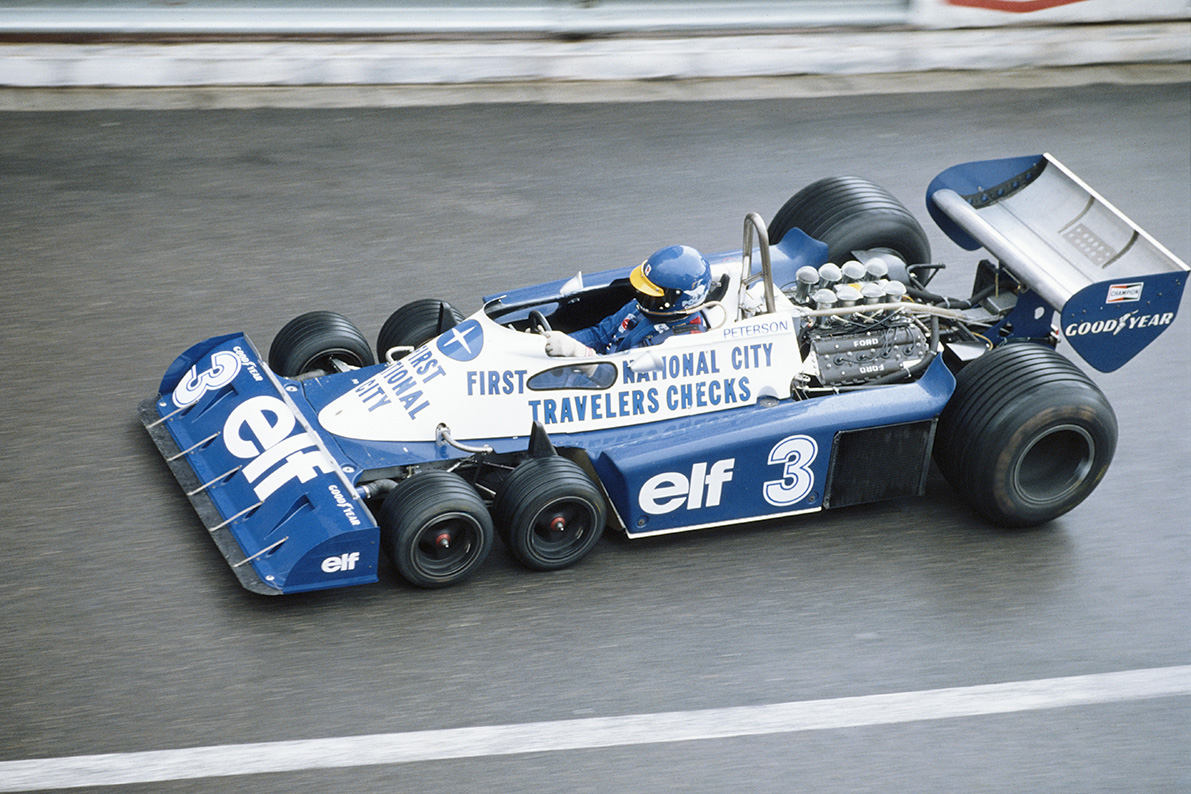
1976 Tyrrell P34 ‘Six Wheeler’
The only six-wheeled F1 car to actually compete also managed to win a race.
Tyrrell ran four, small diameter front wheels on the P34 to minimise air disruption and reduce drag, and it worked, though reportedly understeer was a problem.
Six-wheeled F1 cars were eventually banned, but not until much later. Ferrari had a go at the idea with the 1977 Ferrari 312T6, which ran four tyres on a single rear axle but it was too wide and unreliable and never raced. March (2-4-0) and Williams (FW07D and FW08B) both tested six-wheelers with four wheels on two driven rear axles, though they also never competed.
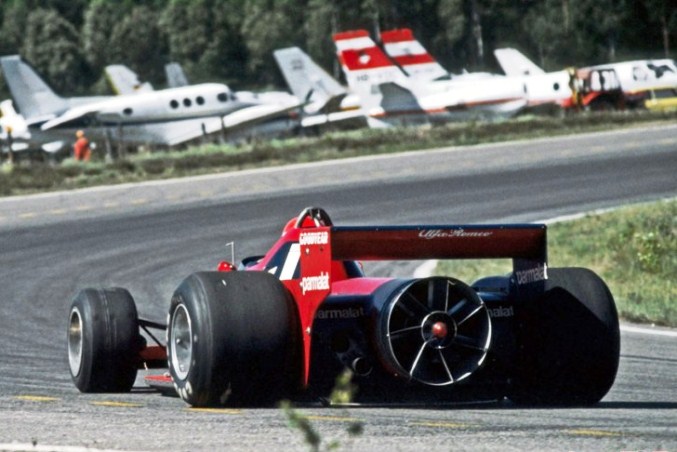
1978 Brabham BT46 ‘Fan Car’
At the 1978 Swedish GP, Brabham stunned pretty much everybody with this revolutionary contraption.
In essence, a huge turbine at the back sucked the car onto the road and allowed it to carry enormous speed through the bends.
Niki Lauda drove it to an easy victory; however the BT46 would never race again in this trim after the sport’s governing body pressured Brabham into withdrawing it due to the dangers of such high cornering speeds.
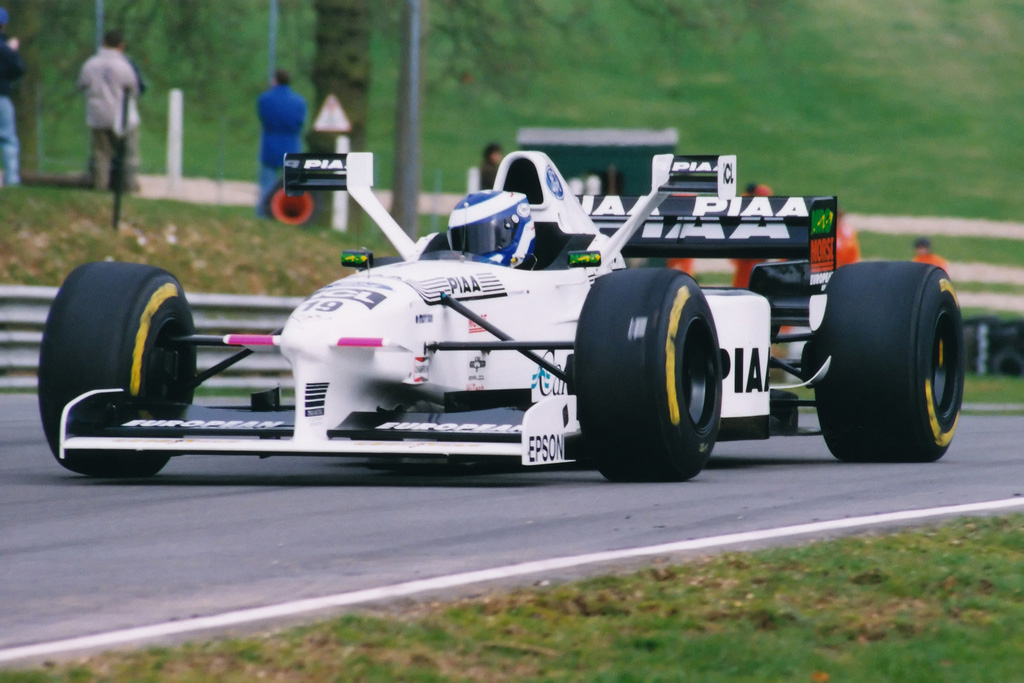
1997 Tyrrell Ford 025 ‘X-Wing’
Tyrrell makes a second appearance on our list, long after its ill-fated six-wheeler.
1997 was a rough year for the team as it languished at the bottom of the grid, though not without its share of the spotlight. Notable designer Harvey Postlethwaite penned these novel sidepod aero aids, as well as the single blade nose cone, and the car became known as the X-Wing for obvious reasons.
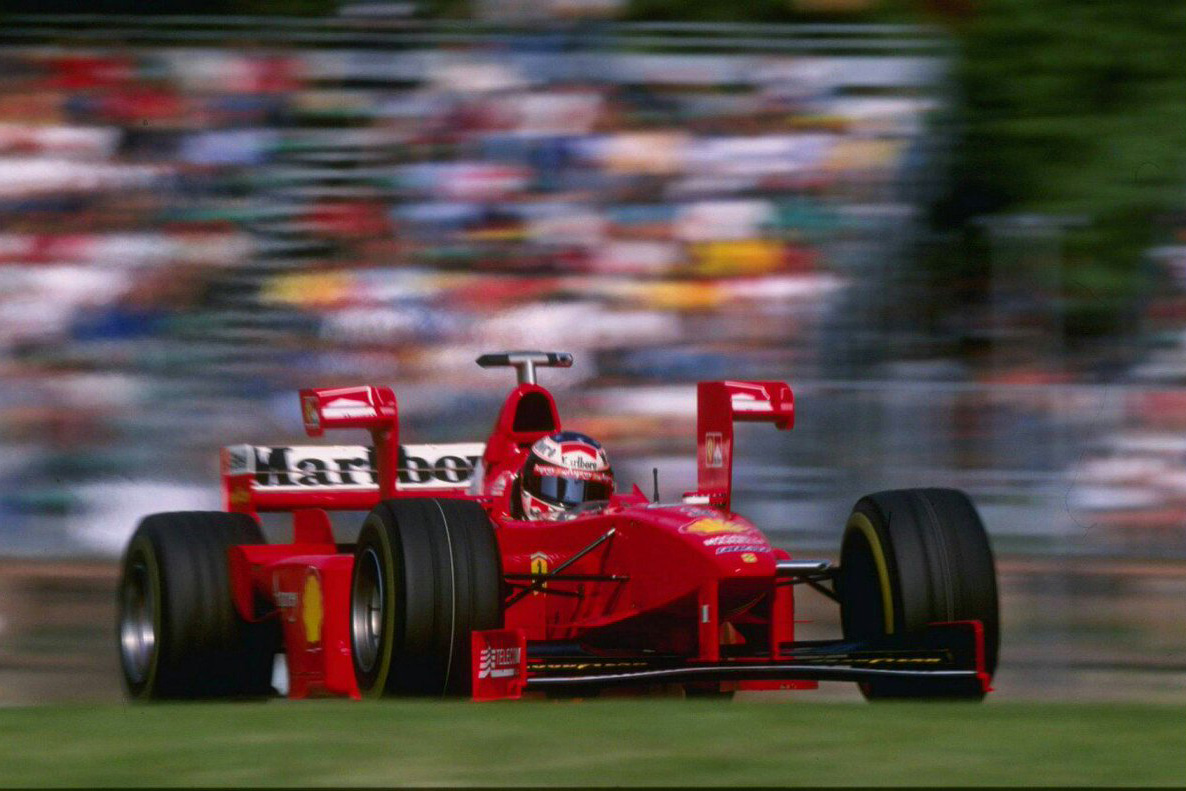
1998 Ferrari F300 ‘Tower Wings’
Nobody thought too much of Tyrrell’s invention during the ’97 season, but a rule change for ’98 saw several other teams introduce similar setups.
Ferrari, Jordan, Sauber and Prost all ran some variation of the ‘Tower Wings’ idea in the first half of the season until the FIA brought out its axe and banned them on safety grounds.
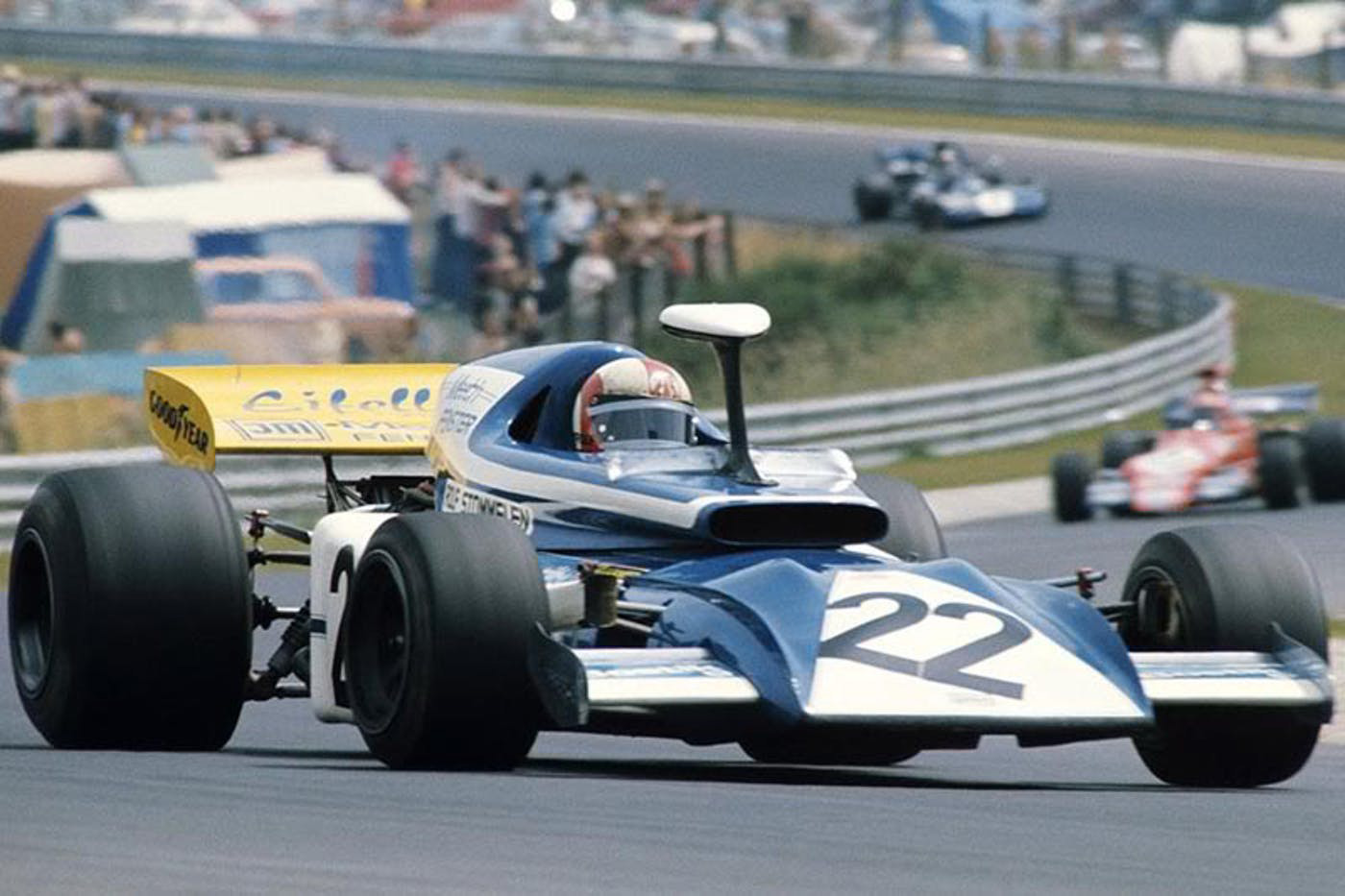
1972 Eifelland Type 21 ‘Periscope’
New to F1 in ‘72, Eifelland raced the Type 21 with a mirror in front of the driver that was also designed to reduce drag.
The team never found competitive pace and disappeared from the grid before the end of the season, but a similar concept appeared on the Jordan EJ11 in practice at Monaco in 2001 before it was banned as a safety hazard.
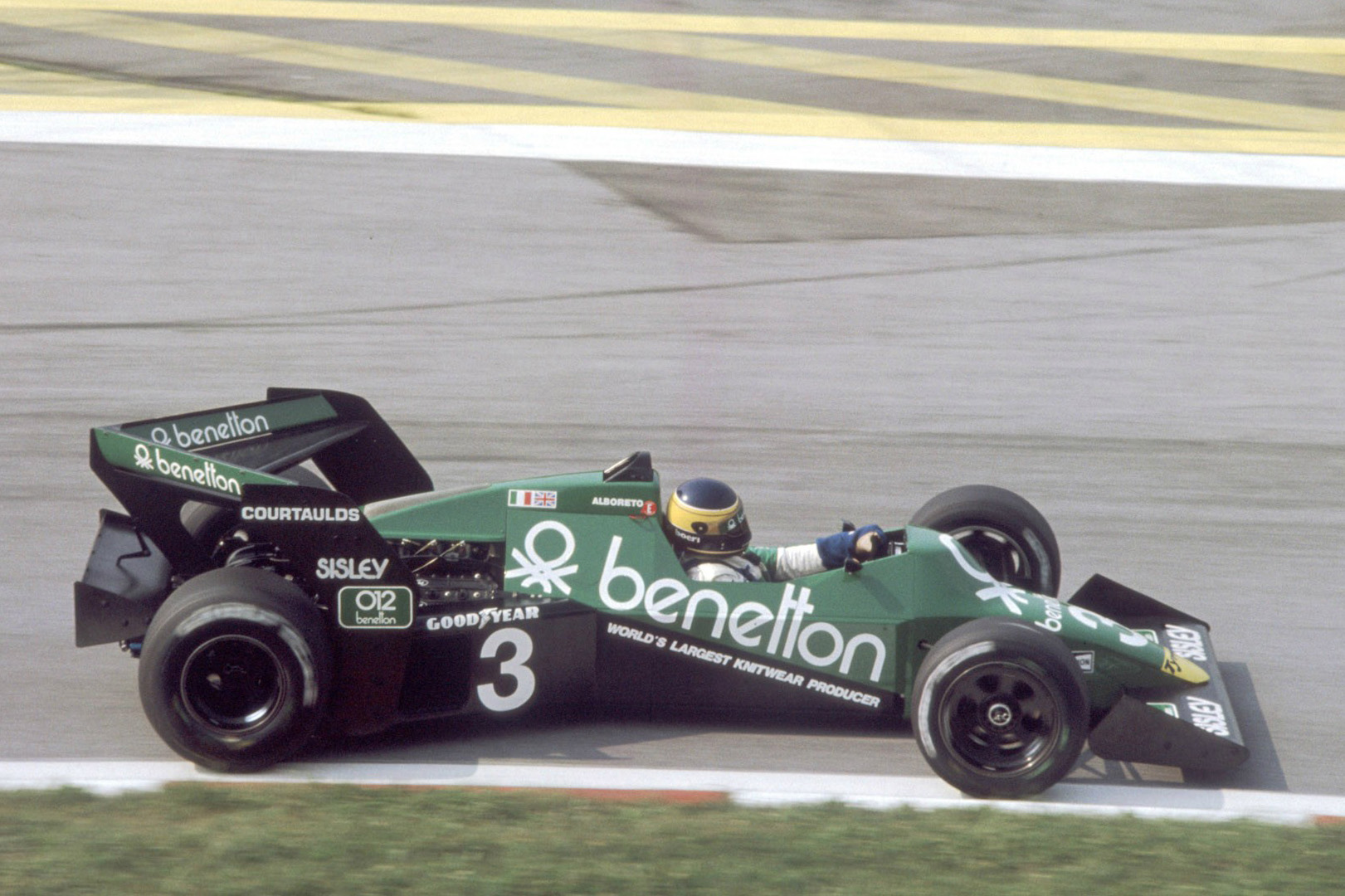
1983 Benetton Tyrrell 012 ‘Boomerang Wing’
Tyrrell appears for a third time, cementing it’s position as an experimental favourite in our books.
This triangular wing design made a brief appearance before the team realised it had no tangible benefits over conventional rectangular wings and the design was ditched.
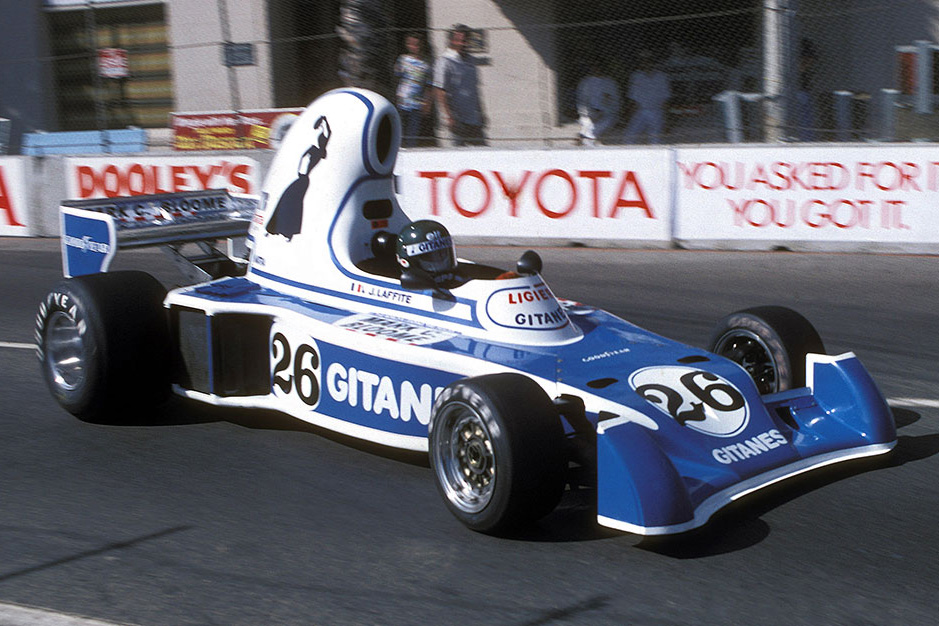
1976 Ligier JS5 ‘Teapot’
F1 has seen some big airboxes in its time, but none as out of kilter with the rest of the car as that of the Ligier JS5.
This wacky design appeared in Ligier’s first year of F1 and only lasted half a season before a rule change would limit the height of cars and force Ligier and other teams back to their drawing boards.
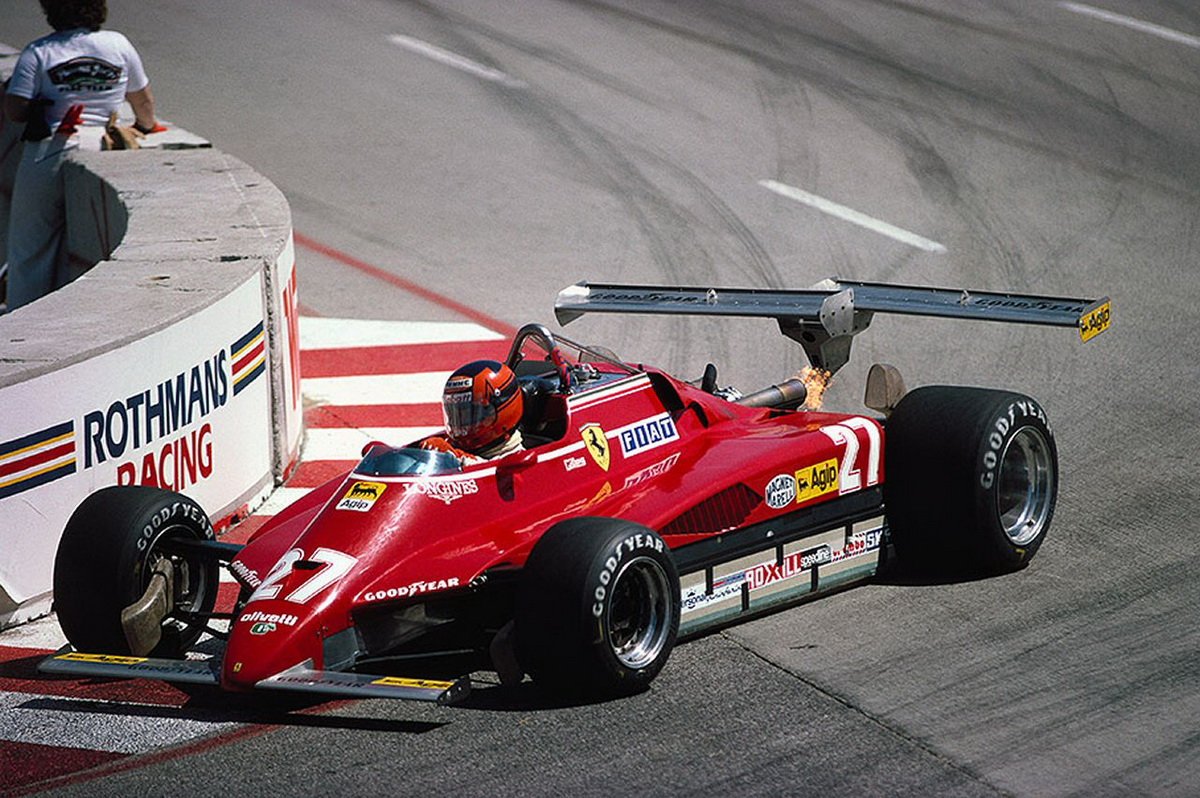
1982 Ferrari 162C2
At the US Grand Prix in 1982, Ferrari deviously exploited a regulation loophole.
The rules at the time stated a maximum rear wing width, but did not specify how many rear wings a car could have. Gilles Villeneuve raced the Ferrari 162C6 as-seen and finished third, but multiple teams launched a protest after the race and the car was disqualified.
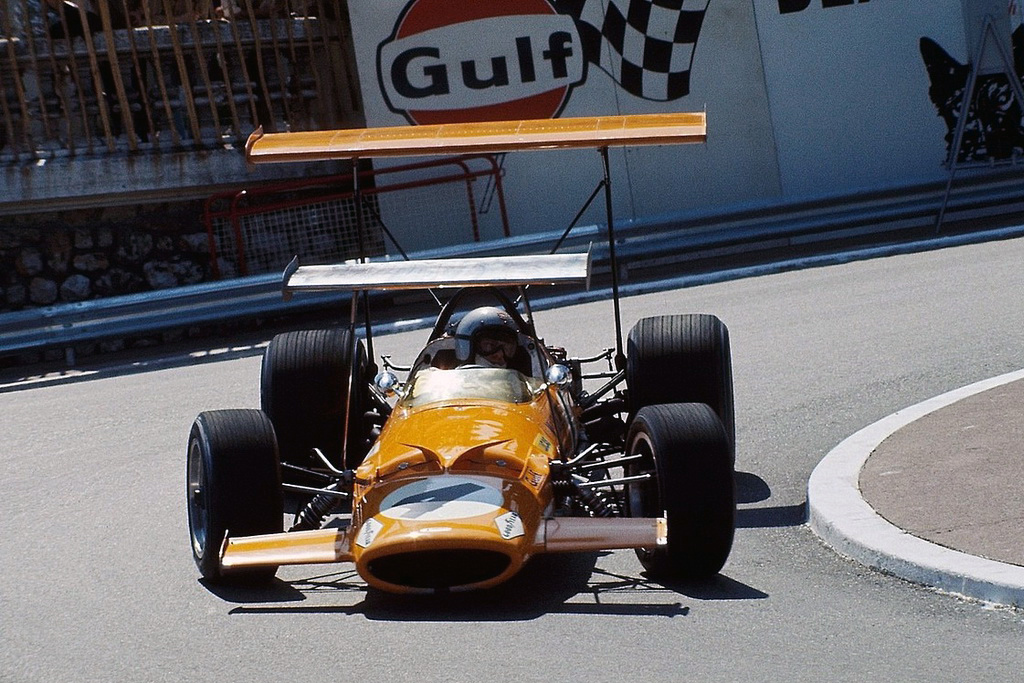
1970 McLaren M7C “Double Wing”
The M7C came about at a time of extreme aero experimentation in Formula 1. The front wing was mounted directly to the suspension and did have a positive impact on aerodynamics, though structurally it was questionable.
Other teams copied it with similar setups of their own for circuits demanding high downforce, until the FIA banned them due to their weakness and safety risk.
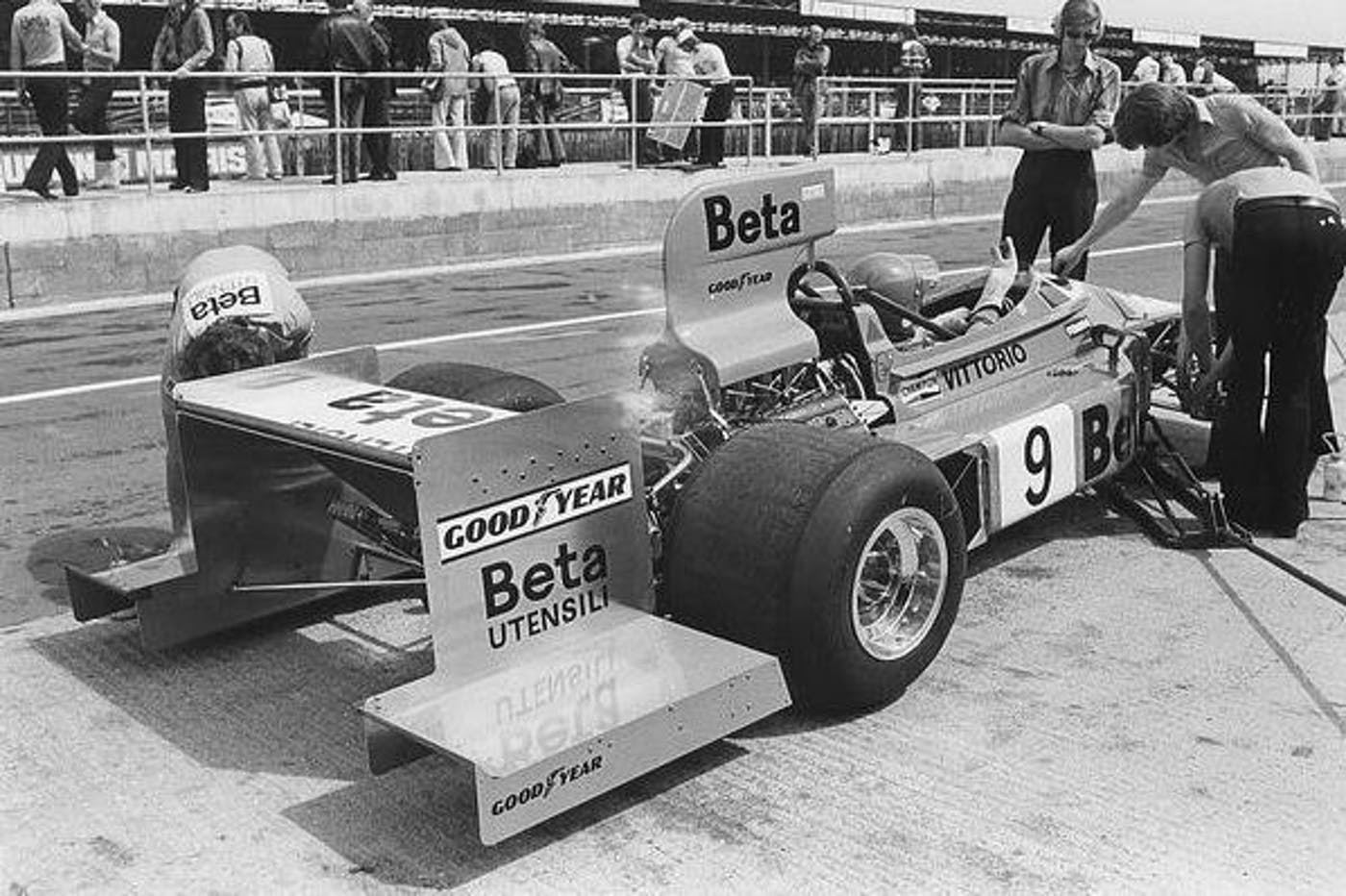
1975 March 751 “Skirting Boards”
Some have listed the March 751 among the ugliest F1 cars of all time, and that was before the team flirted with the idea of this suspended diffuser-style rear wing.
The car actually won the curtailed ‘75 Austrian GP that finished in miserable weather after just 29 laps out of 54.
Wheels thanks Ryan Lewis for the original version of this story, first published in 2017.
Nissan and Honda may be close to a technology and platform sharing deal, with both brands confirming the start of a feasibility study this week.
Beginning with a memorandum of understanding, the talks will focus on electrification and “intelligence”, with the latter likely to take the form of advanced safety systems.
“It is important to prepare for the increasing pace of transformation in mobility in the mid-to-long-term, and it is significant that we have reached this agreement based on a mutual understanding that Honda and Nissan face common challenges,” said Nissan president and CEO, Makoto Uchida.
His counterpart at Honda, Toshihiro Mibe, said the automotive industry is undergoing a “once-in-a-century transformation” and that both companies aim to cooperate on technologies and knowledge they hope will “enable us to become industry leaders by creating new value for the automotive industry”.
Where are Nissan and Honda on EVs right now?
The announcement comes at crunch time for both brands, their paths to this point having been marred with interruptions, apparent indecision and an unwillingness to make the same big bets their European, American and Chinese counterparts have taken on.
Nissan and Honda both have a history of pioneering in electrification, and both have EVs available in markets around the world right now – but, like compatriot brands Toyota and Mitsubishi, neither has shown any readiness to take on the sort of large-scale investment and production programs that have pushed Korean rivals Hyundai and Kia to the forefront of volume-selling electric cars.
Today’s announcement also follows news in late 2023 that Honda and GM had killed the EV partnership that resulted in the Honda Prologue electric SUV that has only just recently launched in the US.
Apart from the North America-exclusive Prologue, Honda’s only electric passenger vehicle available right now is the HR-V-based e:Ny1 in Europe, although it also offers hybrid versions of the HR-V, ZR-V, CR-V and Civic. A new hybrid-powered Prelude coupe was unveiled in November. It had previously launched the compact Honda E hatch in Europe, but killed it in January 2024 after just four years on the market.
Around the same time, Honda revealed its “0 Series” EV plans, previewed by an Odyssey-like ‘Saloon’ and a people-mover dubbed Space-Hub. Only the former has been confirmed for any sort of production future, targeting a 2026 global launch.
Then there’s the new Afeela EV brand, launched together with Sony.
Whether Honda will share its 0 Series platform and technology with Nissan is unclear, but will likely form part of the partnership discussions.
Honda has previously announced plans to sell around 2 million EVs annually by 2030, but 2023 saw the Japanese brand sell fewer than 15,000 – almost all of them in China.
Nissan’s current electric passenger car range includes the ageing Leaf hatch and the fresher Ariya. The Ariya was unveiled in 2020, but pandemic-related issues saw its overseas launch delayed until 2022, while the brand’s Australian arm has still not confirmed timing for a local launch.
As part of the Renault Nissan Mitsubishi Alliance, Nissan confirmed a 15% investment in the group’s Ampere platform in February 2023 (Mitsubishi confirmed its involvement in October), with plans to launch new-generation electric replacements for the Qashqai, Juke and Leaf.
As with Honda’s 0 Series program, it remains to be seen if this potential new partnership will see Honda gain access to the Ampere platform or if it will be limited to Nissan’s own EV systems.
Shared production capacity will likely also form a part of the strategy, but again, neither brand has offered any clear view on what their talks will cover.
MORE
Everything Honda
MORE
Everything Nissan
There seems to be no stopping BYD right now. Sales are soaring and its line-up is swelling, so perhaps it’s only natural that such success has bred enough confidence to launch a luxury offshoot.
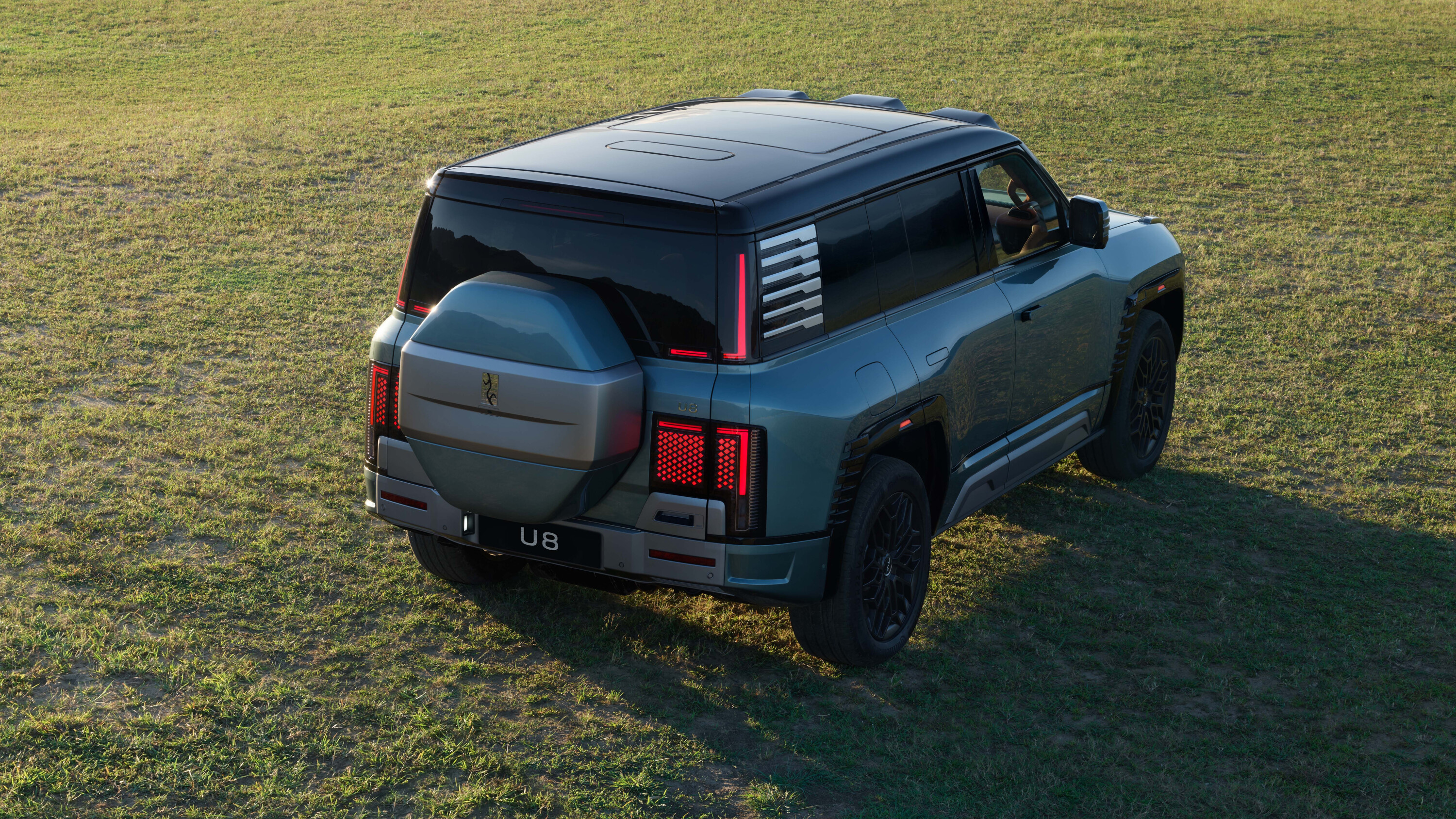
It’s probably reductive shorthand to say Yangwang is the Lexus to BYD’s Toyota when this Yangwang U8 SUV aims to swim in a different pool entirely (all too literally, as you’ll discover). Priced at the equivalent of $230,000 in its native China, this truly is evidence BYD is punching upwards.
See one up close and you might assume it’s worth its stocky price in materials alone, so vast is the U8. It measures 5.3 in length, over 2m in width and tips the scales at 3460kg – almost enough to warrant additional training and a driving licence upgrade in some territories.
1
JUMP AHEAD
- How does the Yangwang U8 weigh so much?
- So what’s the point?
- So you haven’t tried that feature out…
- When will we see this monster in Australia?
How does the Yangwang U8 weigh so much?
It’s had a heck of a lot of technology thrown at it. As you’d expect with BYD paying the bills, the powertrain is heavily electrified.
There’s a 220kW electric motor at each wheel for a monstrous 880kW total. The battery capacity, though, is just 49kWh; most of the U8’s power comes from a 200kW 2-litre four-cylinder petrol engine that acts as a range extender.
So while Yangwang claims an overall range figure of 1000km, just 180km of that can be achieved purely on electric power. The battery can still be topped up separately, though, accepting up to 110kW of DC charge.
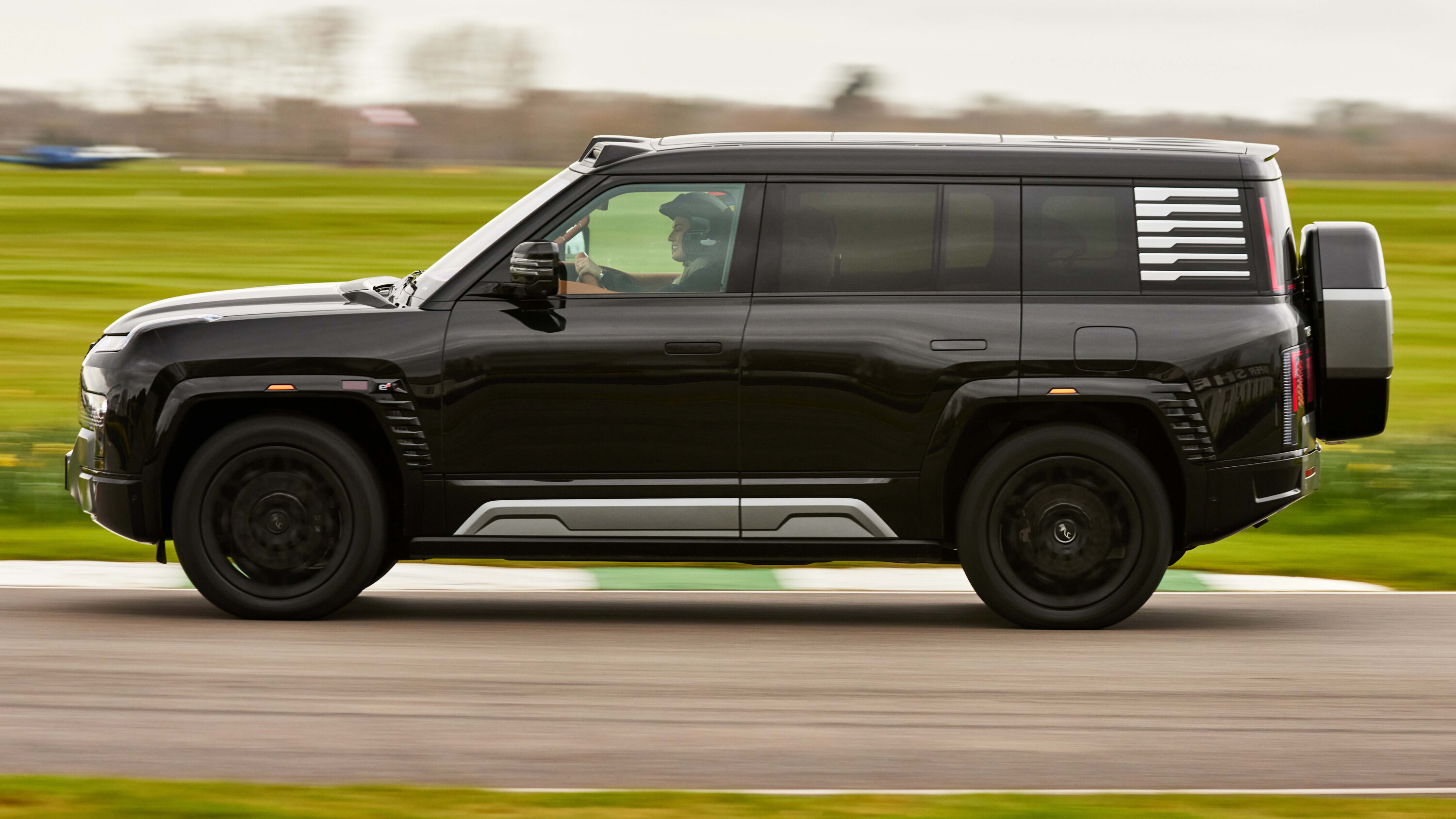
1
Which means charging up to 80 per cent in under half an hour, something that simply wouldn’t be possible with the amount of cells you’d need to make this a pure EV.
A wheel at each motor gives this car its TikTok-pleasing party trick; dubbed by Yangwang as the ‘vehicle origin turn’ – or ‘tank turn’ in internet parlance – the vehicle can spin up to 360 degrees on the spot as the motors on one side of the car turn slowly in the opposite direction to the others.
It looks bewitching from outside, feels even crazier inside, but will soon gnaw at the chunk of your brain that’s predisposed to mechanical sympathy. Surely the diffs and tyres can’t be enjoying themselves as much as your audience?
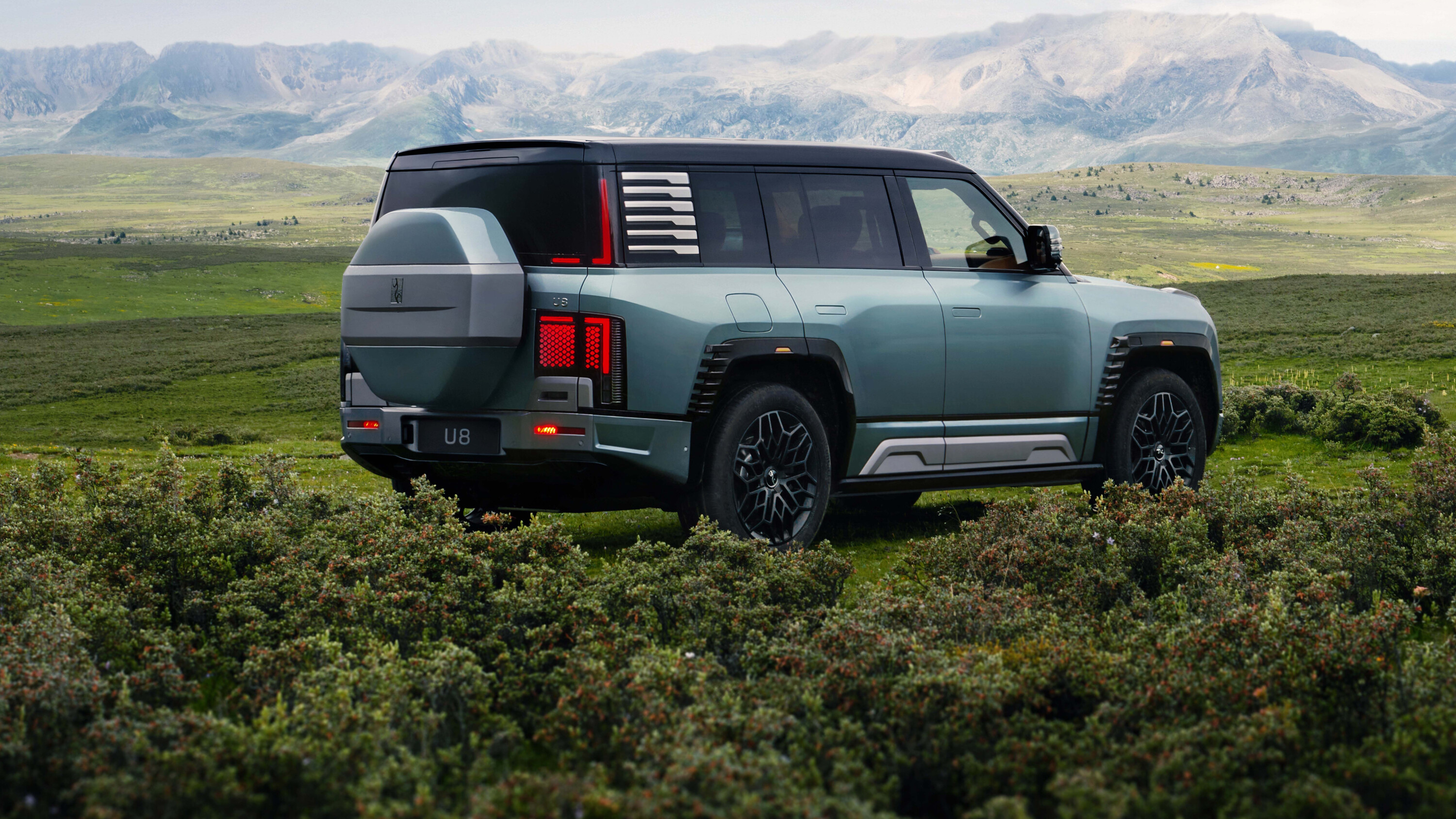
1
So what’s the point?
Well, the U8 has already claimed its Instagram moment of fame and an all-new brand has found a large (if fickle) audience before the car’s even launched. So the job’s arguably done.
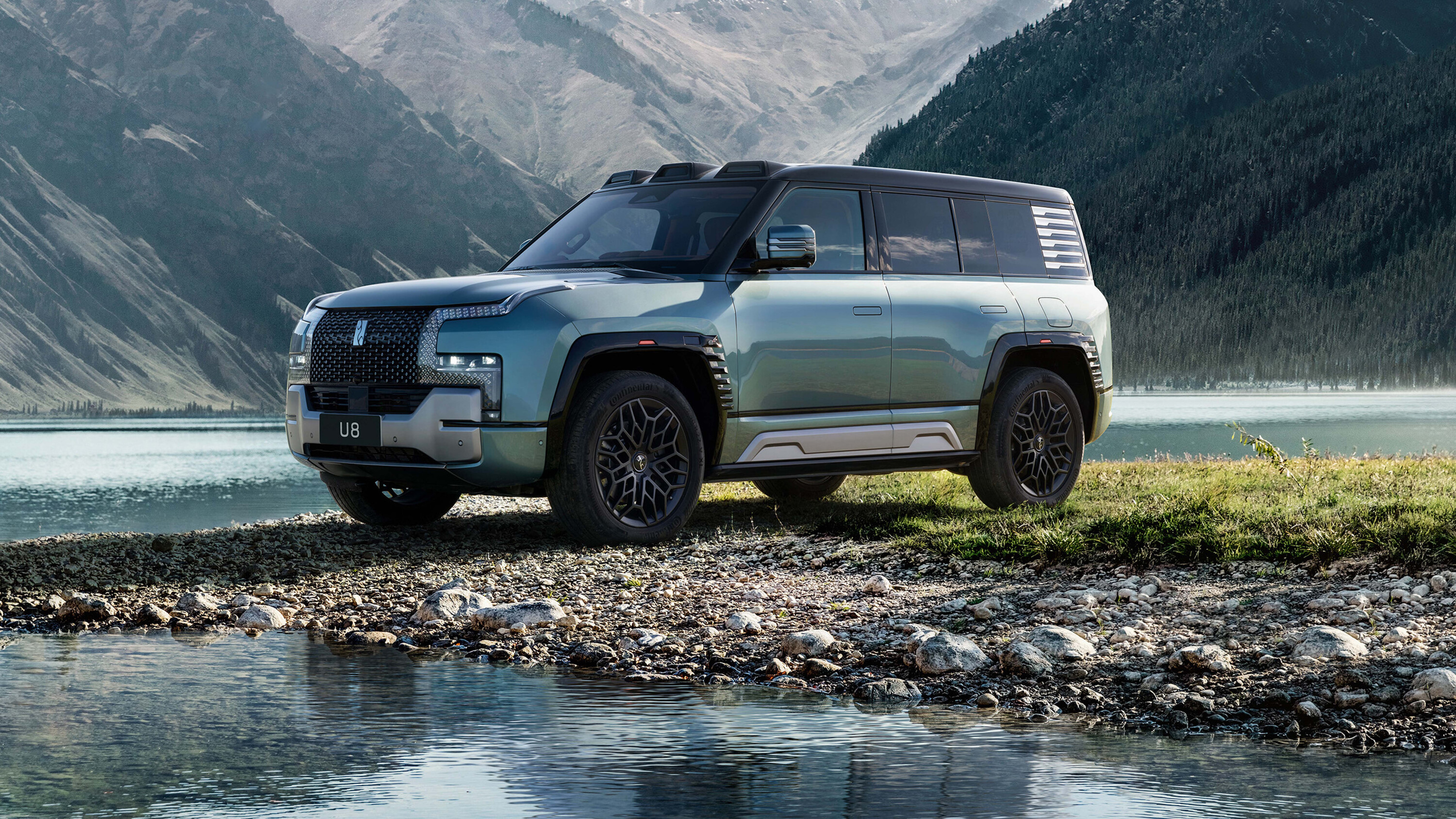
Tank turns are the glistening cherry on top of this car’s proposed off-road ability.
Its body-on-frame construction is allied to over a dozen electronically controlled all-terrain modes and a whole array of suspension settings that, if the teaser videos are to be believed, will make this thing a true monster away from smooth tarmac.
1
Its 36-degree approach and 35.4-degree departure angles ally with the individual wheel control yielded by BYD’s new e4 platform to make this a properly flexible off-road tool, albeit one draped in thick layers of interior tech and luxury.
Unlike the now ironically named Dolphin and Seal, this car actually swims, too; get yourself too deep into a body of water and the car can apparently float for up to 30 minutes, with its appropriately sealed electric propulsion system whizzing away below the surface to direct you safely back to shore.
It’s not another party trick, rather an emergency back-up that calls for an immediate trip to the dealer should you ever activate it.
1
So you haven’t tried that feature out…
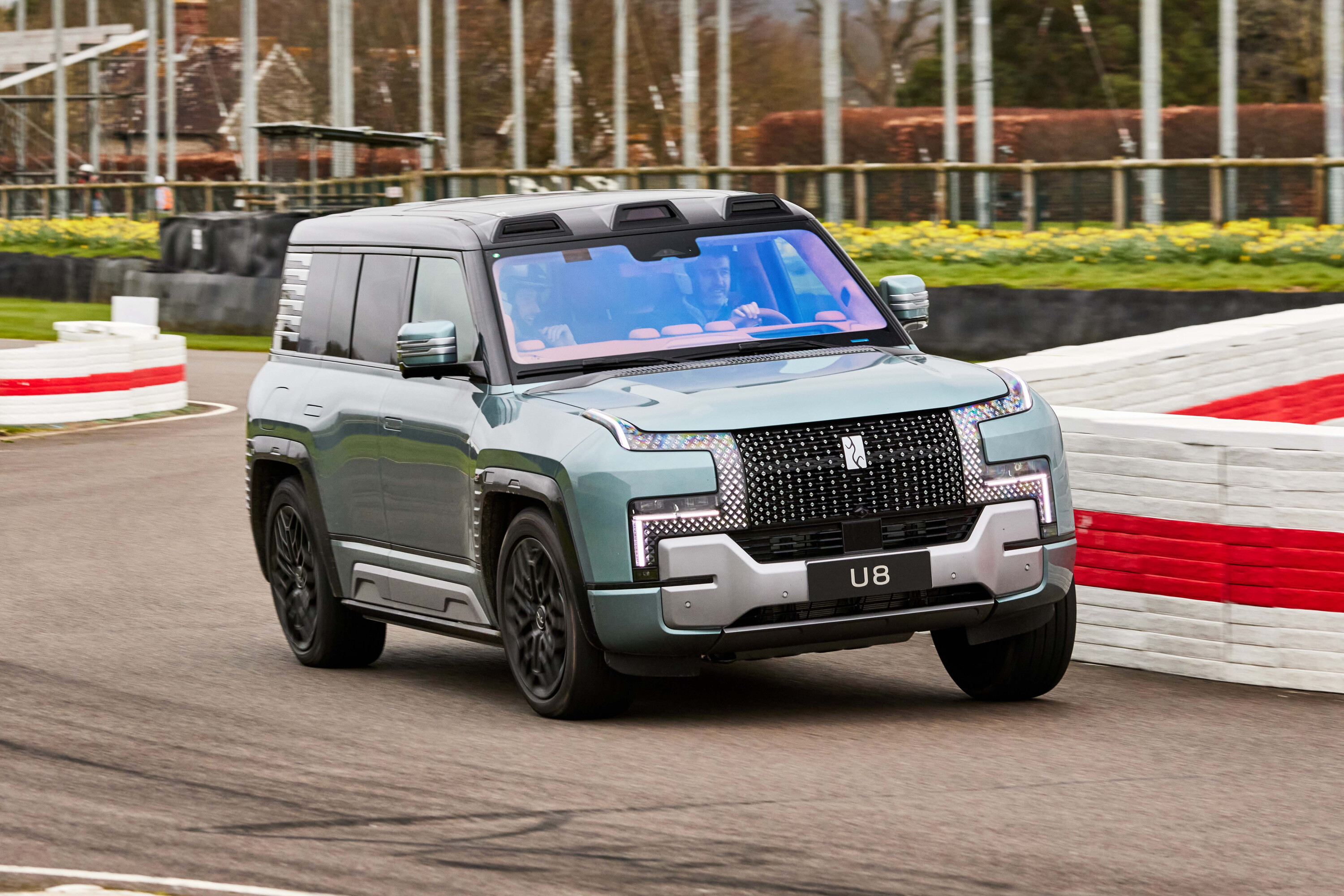
No, and our first go of this 4×4 goliath actually took place on a race circuit. Goodwood Motor Circuit, in fact, one of the fastest and fiercest tracks in Great Britain owing to its antiquated ideas of ‘run off’ and ‘margin for error’.
Truly an odd place to throw around almost 3.5 tonnes of decadent 4×4, but owing to how early our access to the car is, the required homologation for on-road driving wasn’t possible. And the UK is a little bereft of sand dunes to idly bash…
The result was entirely predictable, the car’s stability control systems cutting in starkly even with the U8 in its sportiest modes and our cornering speeds and steering inputs kept subtle. Trigger the safety systems and a ‘cornering speed too high’ warning blazes across the digital dial display.
1
Yet the continuously adaptive damping and the torque vectoring capabilities of the e4 setup ensured the U8 wasn’t a total shambles. Out of its depth, sure. But a circa 3-tonne Range Rover Hybrid would hardly have felt like a trackday special beside it.
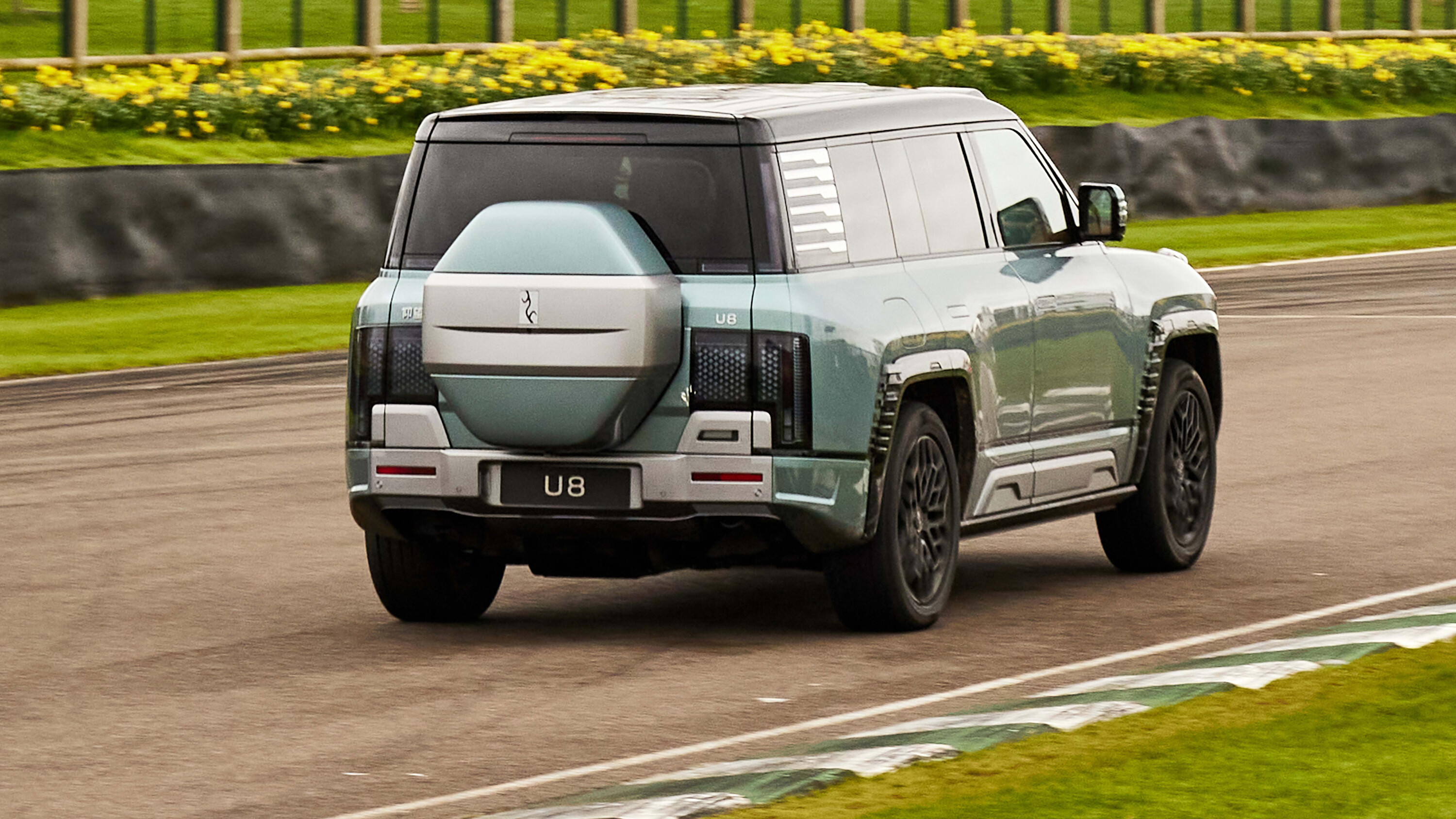
What was disappointing was how little of the full 880kW output we managed to extract, the power display on the dashboard rarely showing north of 400kW even as we kept our foot welded to the floor down the Lavant Straight.
Either the claimed 3.6sec sprint to 100km/h is reserved for a designated launch or the struggling battery power after sustained laps couldn’t entertain it, however much the engine was buzzing away in the background.
1
We eagerly await a much more in-depth drive to truly dig into the U8’s menus and its slightly dizzying drive modes.
Indeed, tech has been wantonly thrown at the U8. Those three, taxicab-like protrusions above the windscreen contain spotlights, night vision and a Lidar that scans the road ahead to educate the adaptive damping as well as open up the potential for autonomy.
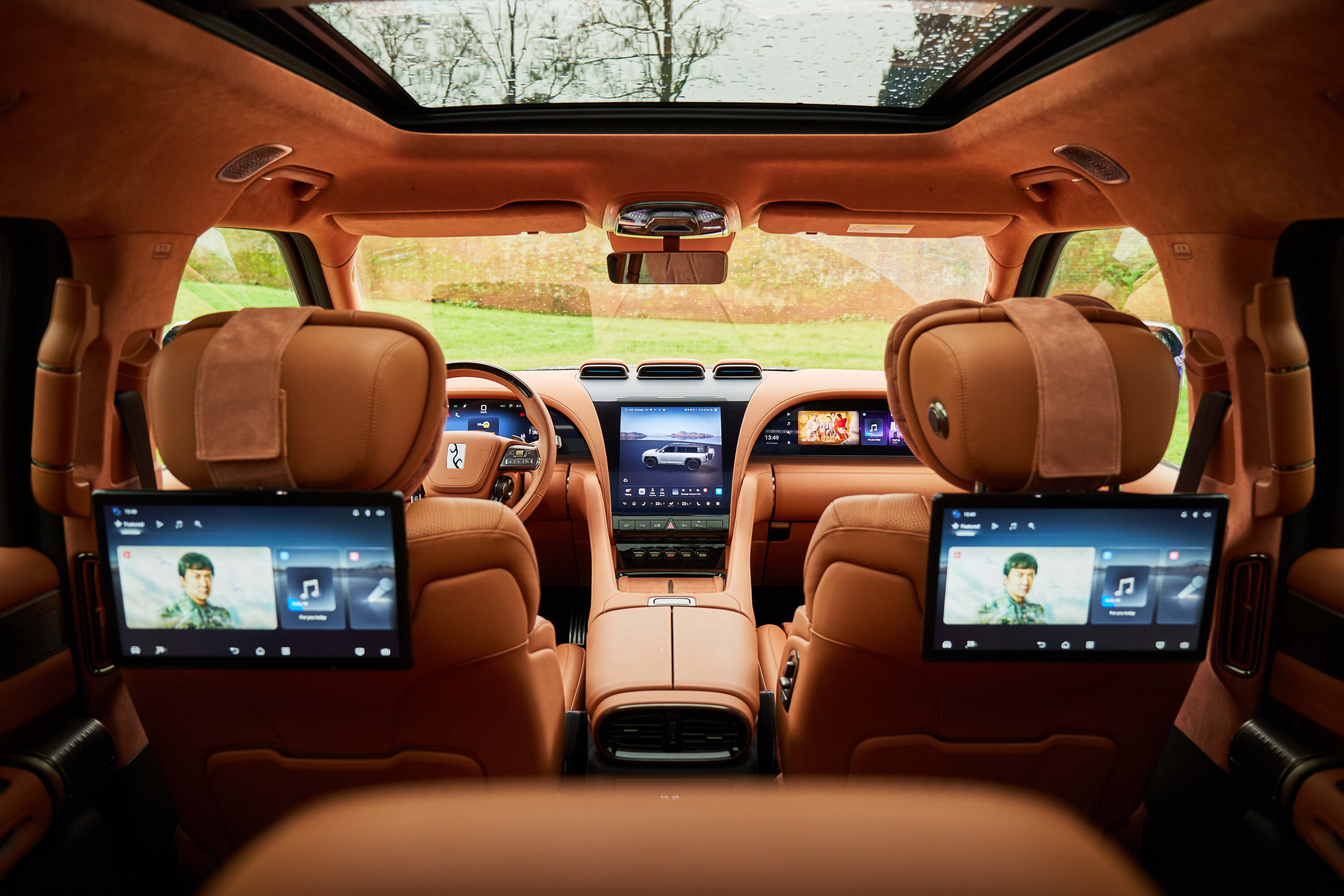
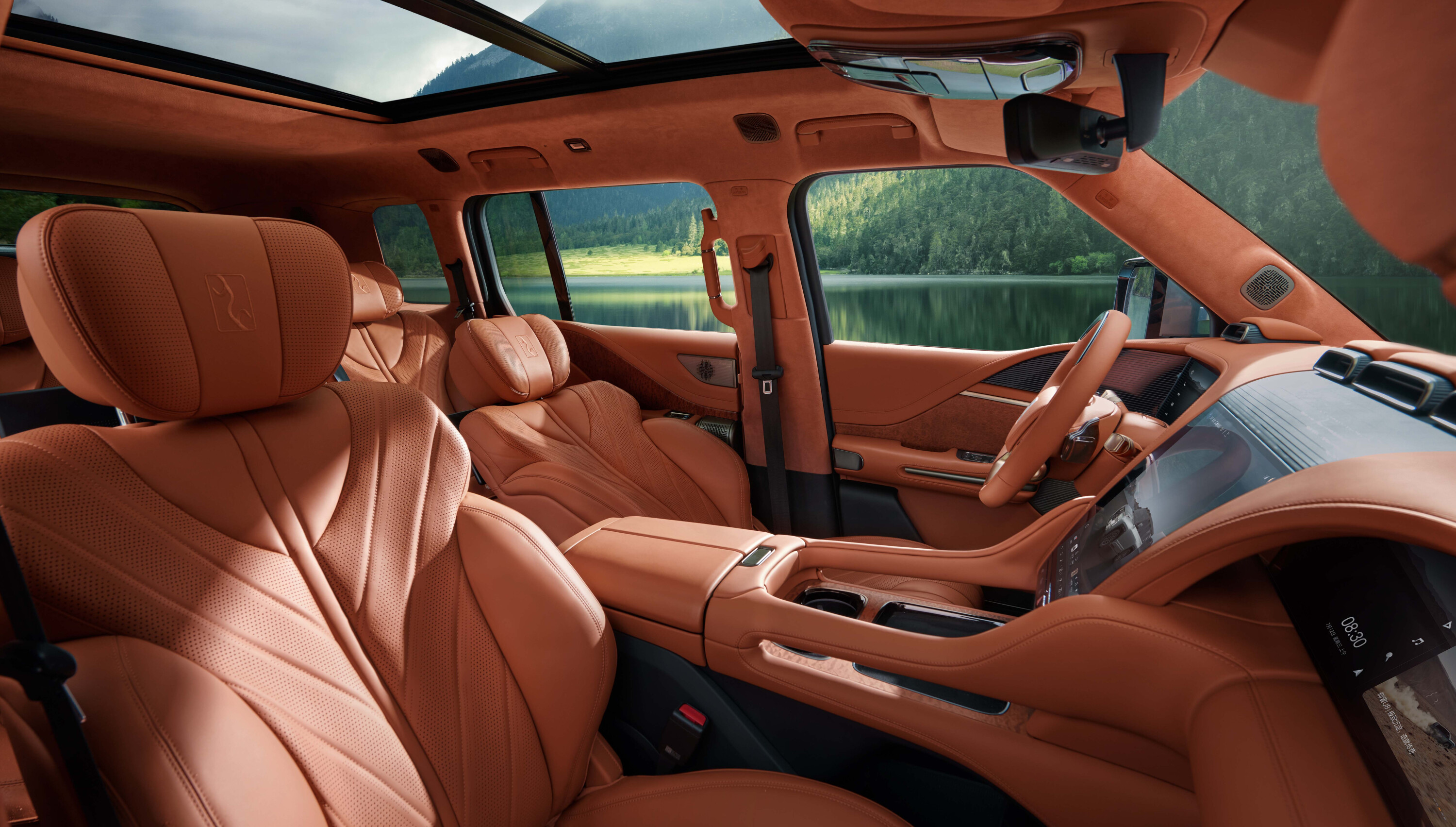
The interior is festooned with screens, with three across the dashboard – the central 12.8in display being a 2K curved OLED – and a pair to luxuriate rear passengers. The Nappa leather is smart and we don’t even mind the retro wood inlays. While not quite knocking on the door of a Bentley for interior ambience, it all feels legit for Yangwang’s blockbuster launch car.
2
When will we see this monster in Australia?
While the Yangwang U8 is doing well in China, shifting almost 4000 units so far, sales outside of its homeland are still somewhat TBC.
Our improbable Goodwood trackday (in a left-hand-drive car) was part of BYD sticking its toe in the water to gauge reaction. A reaction is certainly what it’s achieved across the plains of social media.
Quite how it navigates both the real world and rougher terrain will decide just how much we crave the U8’s stocky presence on Aussie soil (and sand, and rocks, and water…). Be sure to let us know where your heart currently lies in the comments box below.
MORE
Everything BYD
MORE
SUV Buyers Guide
March 21: Kia K4 unveiled
This is the new Kia K4, and if it looks familiar, you might be having flashbacks to the smaller K3 unveiled in August last year.
March: Kia K4 teased
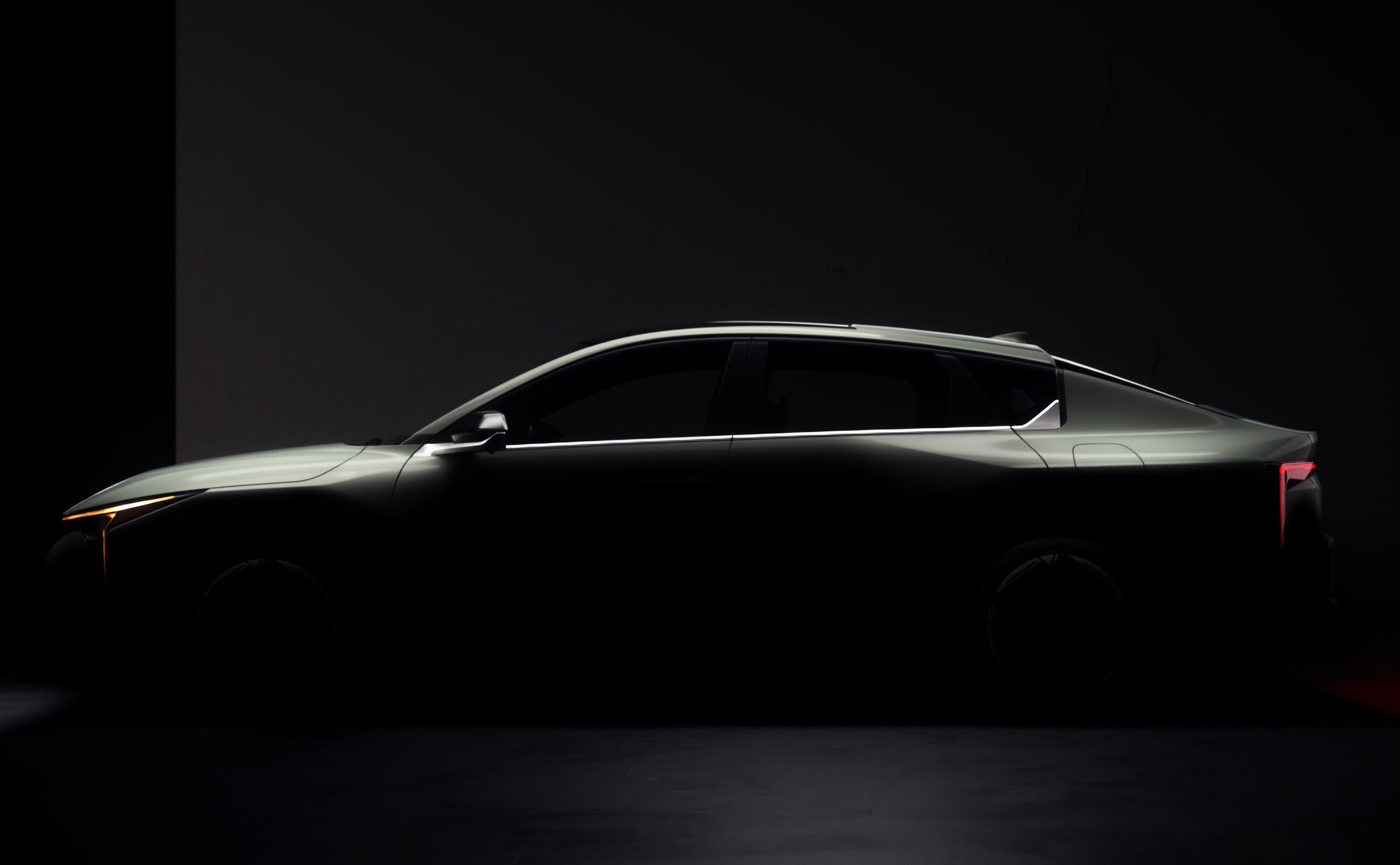
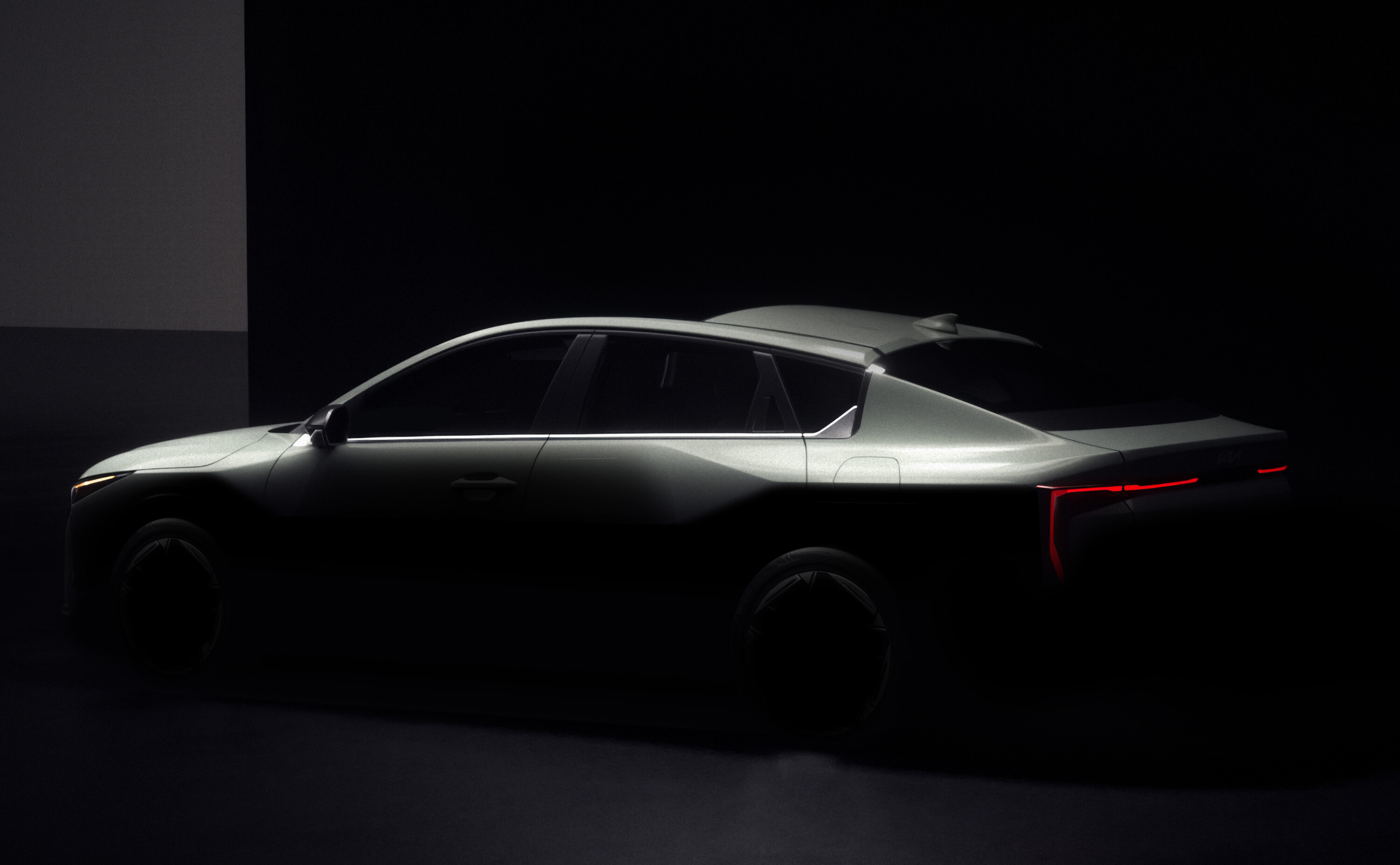
The 2025 Kia K4 sedan has been teased ahead of its design reveal on March 21 and full public debut at the New York Auto Show on March 27.
The K4 – which will debut in sedan form first – will replace the Cerato small car, which is also called Forte in North America and K3 in Korea and China. It is also expected to replace the European Ceed model, which is currently available in hatchback, ‘Xceed’ SUV and ‘Proceed’ shooting brake forms.
K4 is a new name for Kia outside of China. The next-generation small car slots between the recently unveiled K3 light sedan – which replaces the Rio – and the midsize K5 that replaced the Optima in 2020.
The K3 and K5 sedans are not available in Australia due to left-hand-drive-only production.
Replacing the current third-generation Cerato introduced in 2018, the K4 adopts Kia’s latest design language shared with the latest EV9, Sorento and Picanto, as well as a liftback-like appearance reminiscent of the axed Stinger sports sedan with hidden rear door handles.
“K4 introduces new standards for design, innovation and driving appeal to the compact sedan sector,” said Kia.
1
While the interior has not yet been shown, expect to see a modernised dashboard with a larger infotainment system and a digital instrument cluster running the brand’s newest ‘CCOS’ software, which supports over-the-air software updates, Kia Connect functionality, and wireless Apple CarPlay/Android Auto for variants with built-in satellite navigation.
It will be based on the same ‘K3’ platform as the latest Kia Niro, Hyundai i30 Sedan and Hyundai Kona, which are available with evolved versions of the Cerato’s current 2.0-litre non-turbo and 1.6-litre turbo four-cylinder petrol engines – plus a 1.6-litre petrol-electric hybrid.
If the closely related Hyundai i30 Sedan is a guide, the K4 should feature Hyundai and Kia’s ‘Smartstream’ version of the non-turbo 2.0-litre with a CVT automatic transmission – instead of a traditional six-speed unit – and the Atkinson combustion cycle for improved fuel efficiency.
1
The i30 Sedan’s power output is slightly lower than that of the older unit found in the Cerato, at 110kW and 180Nm versus 112kW and 192Nm.
The 1.6-litre turbo currently found in the Cerato GT could receive an eight-speed torque-converter automatic instead of a seven-speed dual-clutch, if it is carried over into the new model.
The Kia Cerato was introduced in Australia in 2004, and more than 185,000 examples have been sold since then – more than other long-running nameplates such as the Rio, Sportage, Carnival and Sorento.
MORE
Everything Kia
The Climate Council has polled Australians on the question of fuel prices, fuel consumption, and greenhouse gas (GHG) emissions.
Polling 1126 Australians, the Council’s survey found that most of us want cleaner cars that are better for the environment and better for our back pocket.
The poll suggests sentiment for the proposed New Vehicle Efficiency Standard is strongly in favour of pushing carmakers into offering cleaner engines and more electrified options – at least among those who ‘took a side’.
Results of the national poll show a majority of participants (80%) feel pressured by high, and rising, petrol bills (irrespective of whether fuel prices are rising in real terms). Almost the same number of respondents (74%) cited a reduction in vehicle emissions as important for tackling climate change.
Climate Council modelling indicates the New Vehicle Efficiency Standard (NVES) proposed by the federal government will significantly reduce fuel prices and GHG emissions.
What we know about the Aussies polled
The survey did not look to driver status as a metric worth recording, although all respondents were adults.
The Climate Council’s survey shows that of the 1126 people polled, most were in NSW (366) and Vic (299), followed by QLD (218), WA (113) and SA (79). Tasmania appears have been left out of the poll.
There were 537 male respondents and 589 female, with apparently none identifying differently. Age groups were divided between 18-34 (316), 35-54 (391), 55+ (419).
725 respondents live in capital cities, with the remaining 401 described as ‘non-capital’. 634 claimed paid employment and 248 said they are retired. Household incomes were evenly split, with 368 described as low income, 316 as middle income, and 365 as high income. 447 said they have dependent children, 679 claim they do not.
When it comes to the NVES as a means for bringing these changes about, respondents were less united – but the largest group is clearly in favour.
While 65% of respondents agreed that ‘Australians deserve access to the same cleaner and cheaper-to-run vehicles that manufacturers currently sell in other countries with fuel efficiency standards’, only 52% agreed the NVES ‘will help cut fuel bills for Australian households’.
Likewise, only 54% supported using the NVES to make new vehicles sold in Australia more efficient.
However, among those not on the fence, support for the NVES was the strongest result. Only 14% said they oppose the idea, with 33% undecided.
Some manufacturers have been criticised for not selling their cleanest models in Australia – a sentiment reflected in the poll results.
With concern about rising fuel bills and climate change on the rise, 65 percent of those polled agree Australians deserve access to the same cleaner, more efficient cars that are already being sold overseas.
The Climate Council considers that implementing the NVES will incentivise manufacturers to sell their most efficient models in the Australian car market, in turn saving money and reducing emissions.

1
“We’ve heard a lot of self-interested talk lately from multinational car brands about what Aussies want to drive,” said Climate Council Head of Advocacy, Dr Jennifer Rayner.
“The answer couldn’t be clearer: the majority of Australians want cars that are cheaper to run and don’t pollute our air and climate.”
“The big brands aren’t bringing cleaner, cheaper cars to Australia right now, even though they’re already selling them in the millions overseas. An effective New Vehicle Efficiency Standard can change that”, said Dr Rayner.
“Australians understand our dirty cars are costing us, and our environment, far too much. Mums and dads are particularly feeling the pinch of high petrol prices, and they’re worried about the risks of escalating climate change for their kids. Cleaning up our cars is a practical solution on both fronts, and Aussies know it. That’s why a majority supports this standard.”
The Climate Council says the NVES will reduce running costs and health impacts associated with vehicles without impacting prices.
Dr Rayner has accused major manufacturers of acting in their own interests, rather than Australia’s.
“The Federal Government should listen to what Australians want and deliver the NVES as soon as possible”, she said. “ Big car brands trying to block it are speaking only for themselves, not for our community.”
With an overall length of 4.44m, some might say that the car the Mini Countryman has evolved into for its third generation can’t truthfully wear a moniker like ‘mini’ any more.
But, say Mini executives, “people asked for a Mini with more room” and that’s exactly what the company has delivered in its new model. At the back, its boot has grown by as much as 52 litres for up to 505L (or 1530L with the rear seats folded), while seating for up to five adults is comfortable and spacious thanks to a wheelbase that now measures 2692mm.
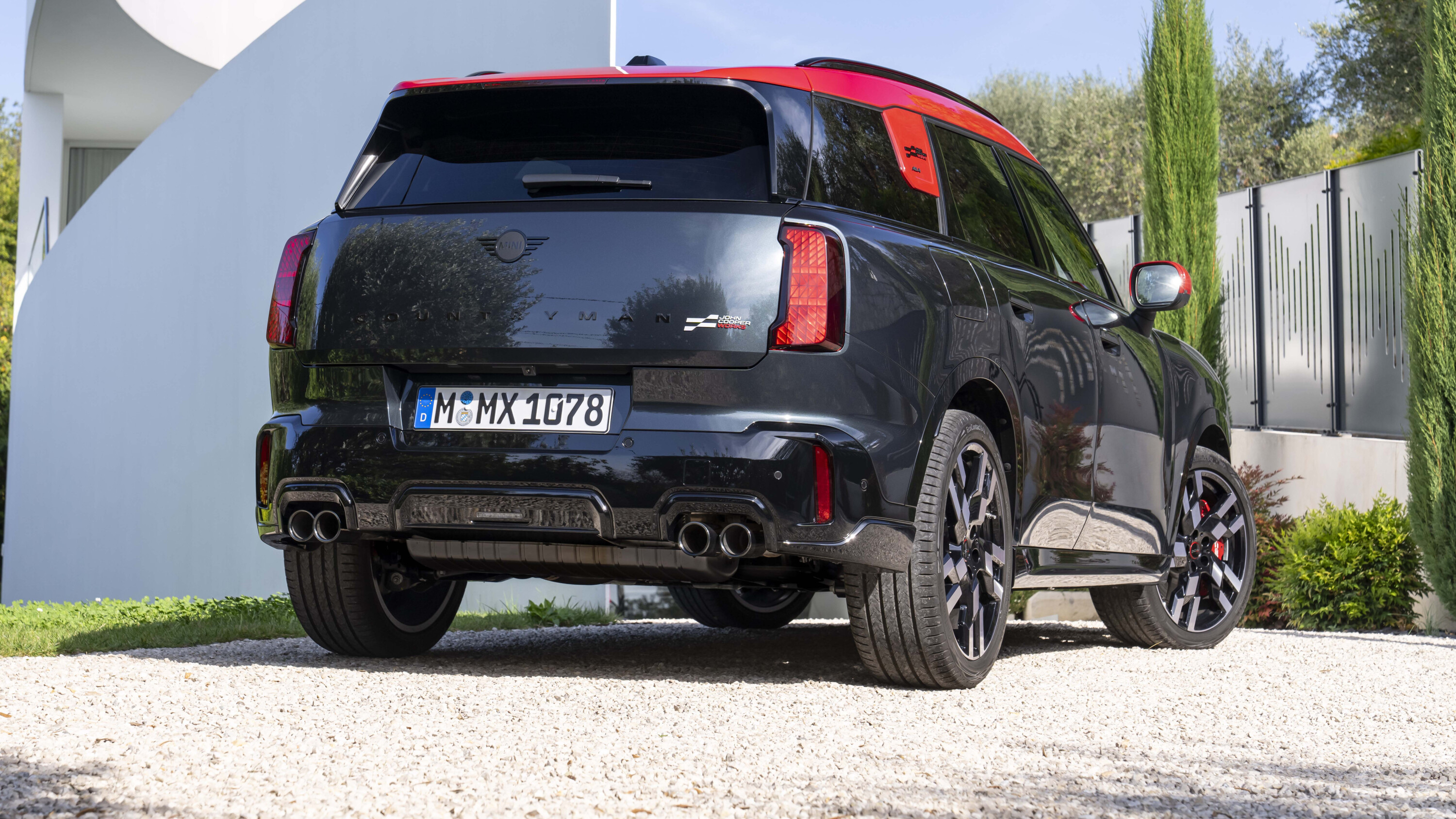
But there’s much more to the new Countryman than sheer quantity, especially at the pointy end of the family. As before, a JCW version headlines the more conventional Countryman line-up.
1
The JCW gets a 2.0-litre turbo petrol four with 233kW and 400Nm sent to all four wheels through a seven-speed dual clutch transmission.
It’s easy to forget this is the largest Mini to date when at the wheel, with a nimbleness and willingness to change direction that’s unusual in the little but not so little SUV realm. Its ride is firm but forgivable and a reasonable trade for excellent cornering grip and composed body control.
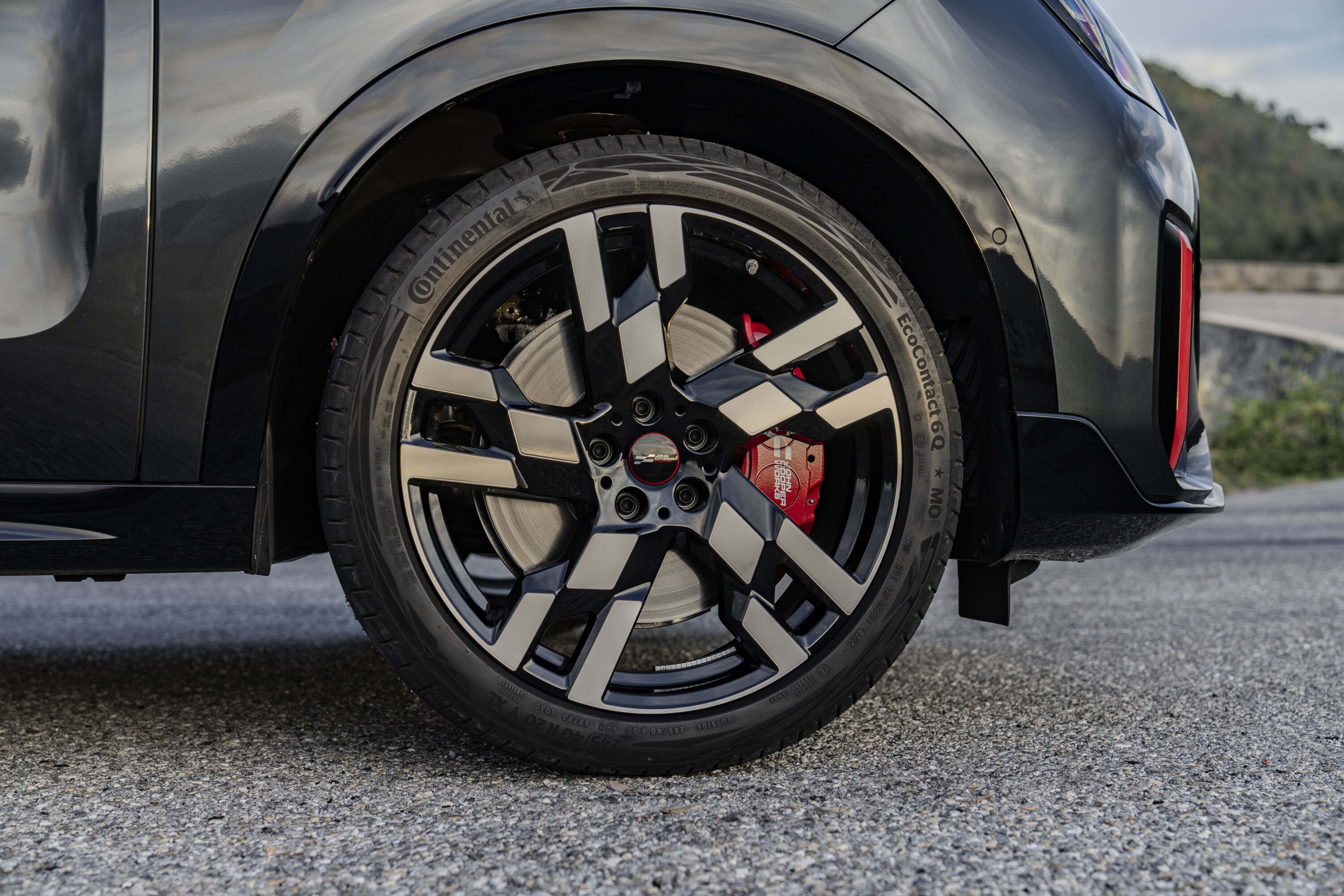
The real compromise, though, is likely in all-terrain ability. We weren’t given a chance to hit unsealed tracks or anything more serious – but Pirelli P Zero rubber on 20-inch wheels, no off-road specific hardware and a decidedly car-like ground clearance mean this SUV is most at home on asphalt, while the ‘country’ in its name is best enjoyed passing quickly through winding lanes.
1
If you want the scenery to flash by even faster, a new Boost button is offered, switching the JCW into a particularly manic mode for 10 seconds. Buyers will likely love the raucous sound, the powerful brakes and balanced dynamics.
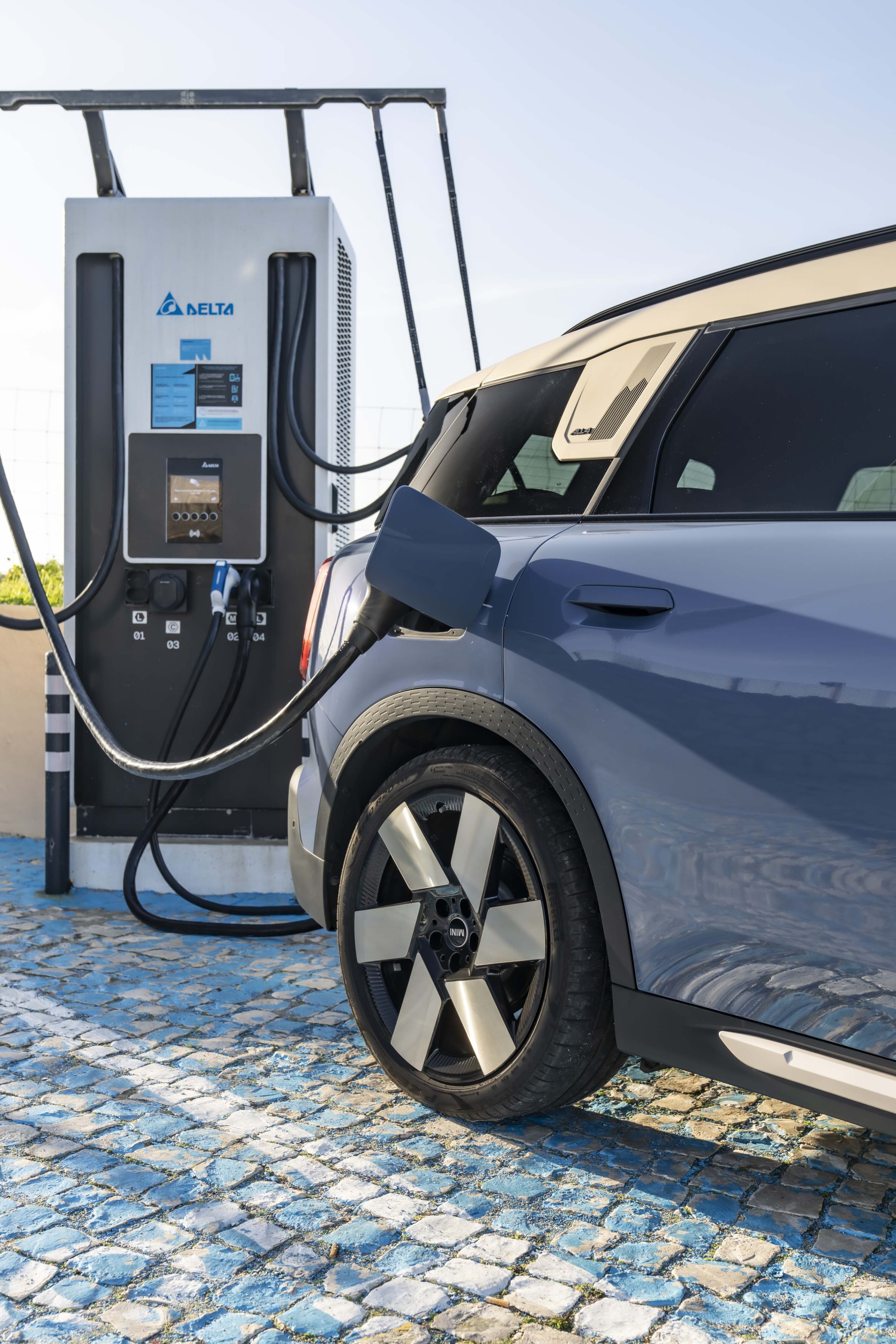
But, if performance and practicality are the Countryman’s reason for being, then the first electric version has probably stolen the JCW’s thunder – silently.
1
Also arriving in Australia in the third quarter of 2024, the Countryman E and SE bring a choice of two battery powered versions.
A 150kW single-motor model opens the range from $64,990, but the SE gets two motors 230kW and only 30km shorter range with a claimed WLTP of 432km.
Our first sample was of the flagship SE Favoured which gets the most kit and features for $77,990. Yes, even the flagship sneaks in under LCT.
Zero-100km/h acceleration takes 5.6 seconds – just two tenths behind the JCW, while its monstrous and highly accessible 494Nm makes the electric version faster in practice.
Then there’s the ride which has a little of the classic EV thump as it tries to hide a 2000kg kerb weight, but balances ride quality and high-speed body control beautifully. It’s not the best EV ride we’ve encountered, but it comes very close.
Thoroughly developed throttle mapping and clever motor controls result in monstrous traction and confidence coupled with a light but sharp steering set up.
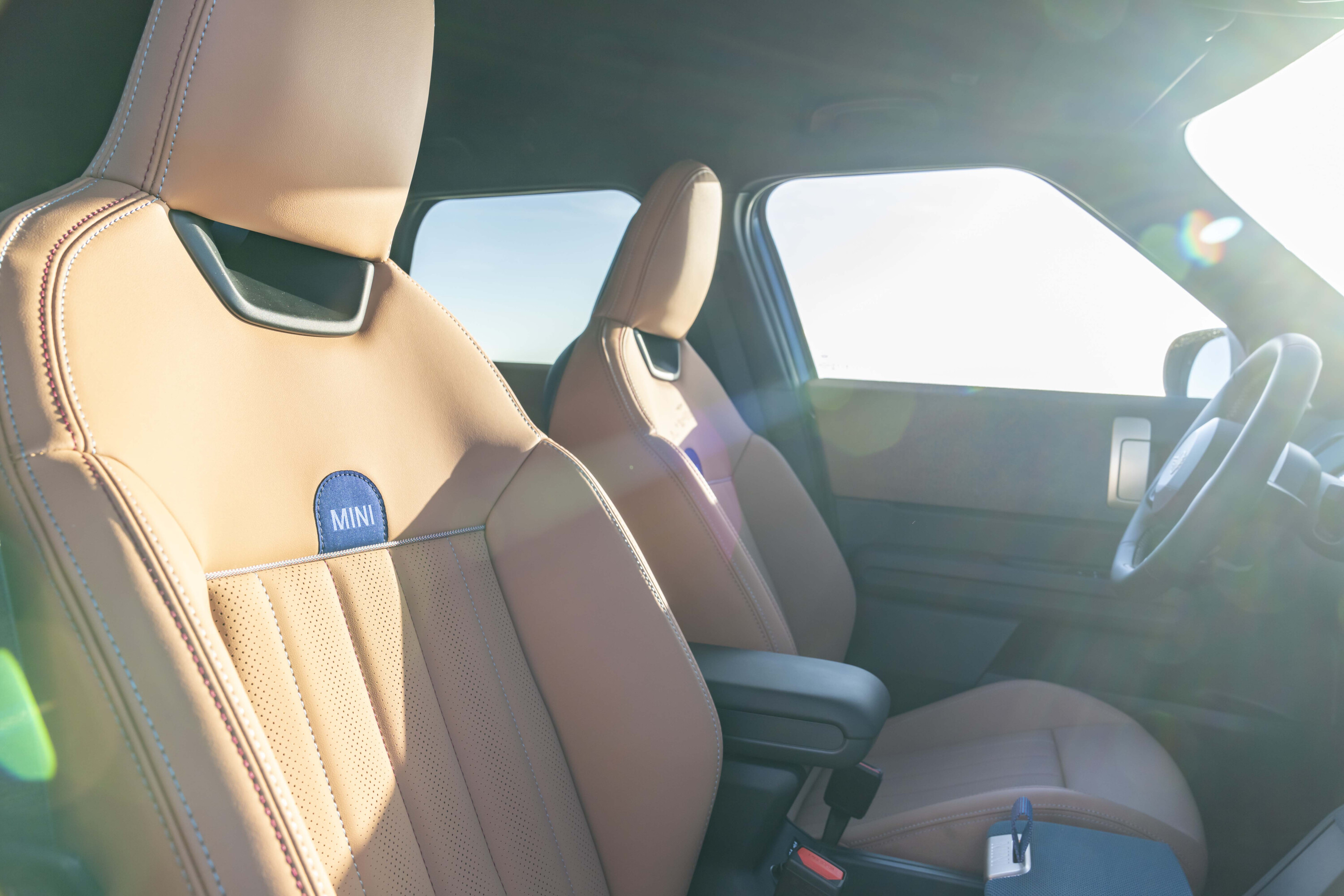
Will anyone care that this is the first Mini to be built outside the UK? They shouldn’t. Everything appears to have been screwed together as well as any recent model and, if anything, this Countryman sets new standards in cabin quality and design.
2
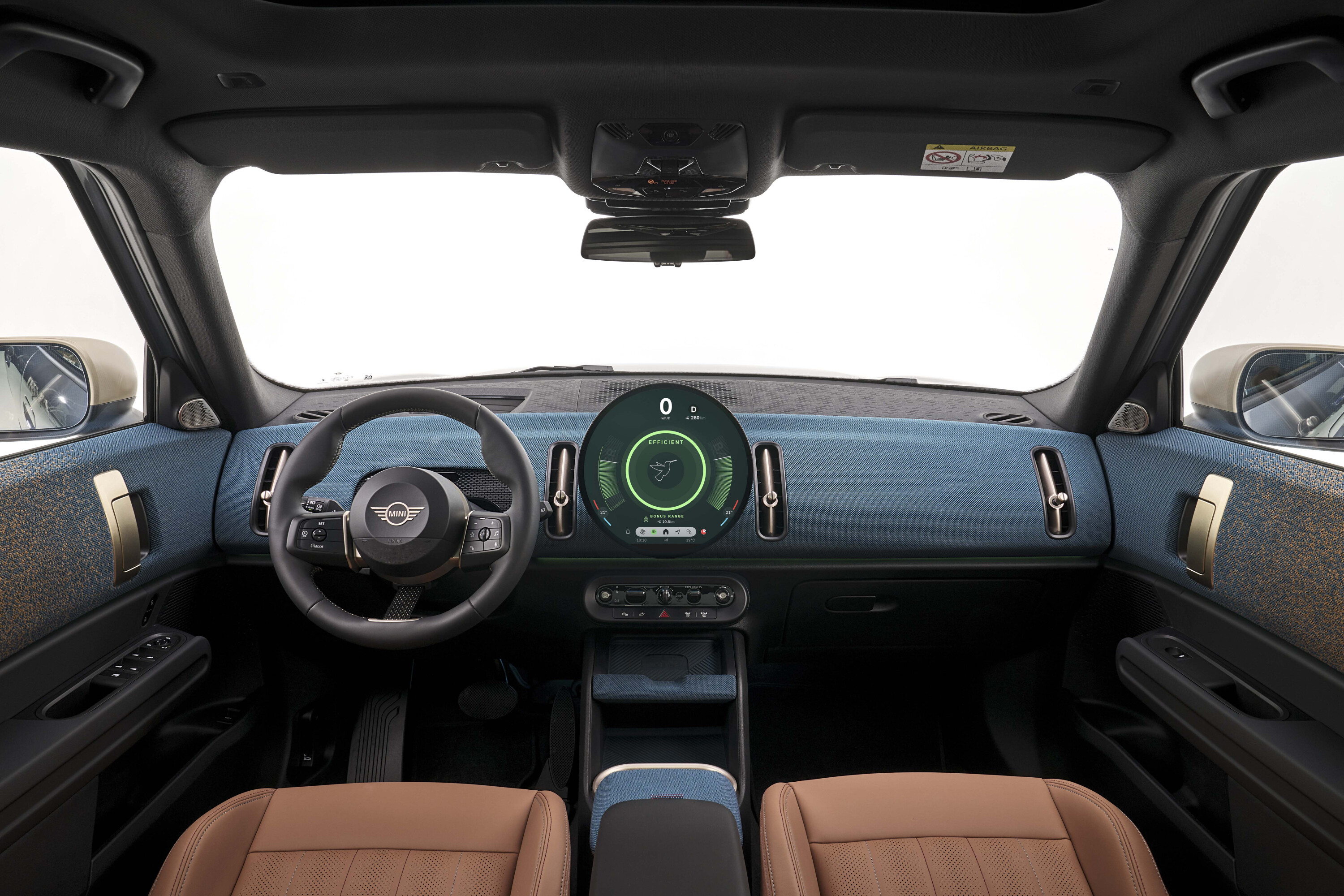
The new circular 9.4-inch central touchscreen forms the centrepiece of Mini’s Operating System 9 and is stunning in its graphics, aesthetic and operation as well as providing one of many retro nods to Minis passed.
But while previous models required the driver to glance away from the road, the new Countryman has a head-up display as standard – even if it looks a little aftermarket (the steep windscreen rake prevented the use of a regular HUD).
A retro toggle switch panel balances the futuristic touchscreen above, lovely recycled knitted fabrics that cover most of the dash and door trims fade from Petrol blue into Vintage brown, and colour changing LED ambient lighting glows through at night.
Oh, and there’s a selfie camera which looks at everyone in the car and made us a little paranoid.
A choice of Experience Modes are in keeping with Mini’s fun nature, display different digital themes and generate unique sounds when accelerating or braking with each introduced by its own jingle and something Mini calls ‘earcons’. It’s all good fun but never at the cost of function and practicality.
1
VERDICT
For now, Mini’s first electric Countryman is the pick of the bunch, providing the most compelling option in the new family.
That is, until a fourth JCW Sport option arrives for the SE later down the line and Mini’s performance hierarchy will likely be restored.
MORE
Everything Mini
MORE
SUV Buyers Guide
