
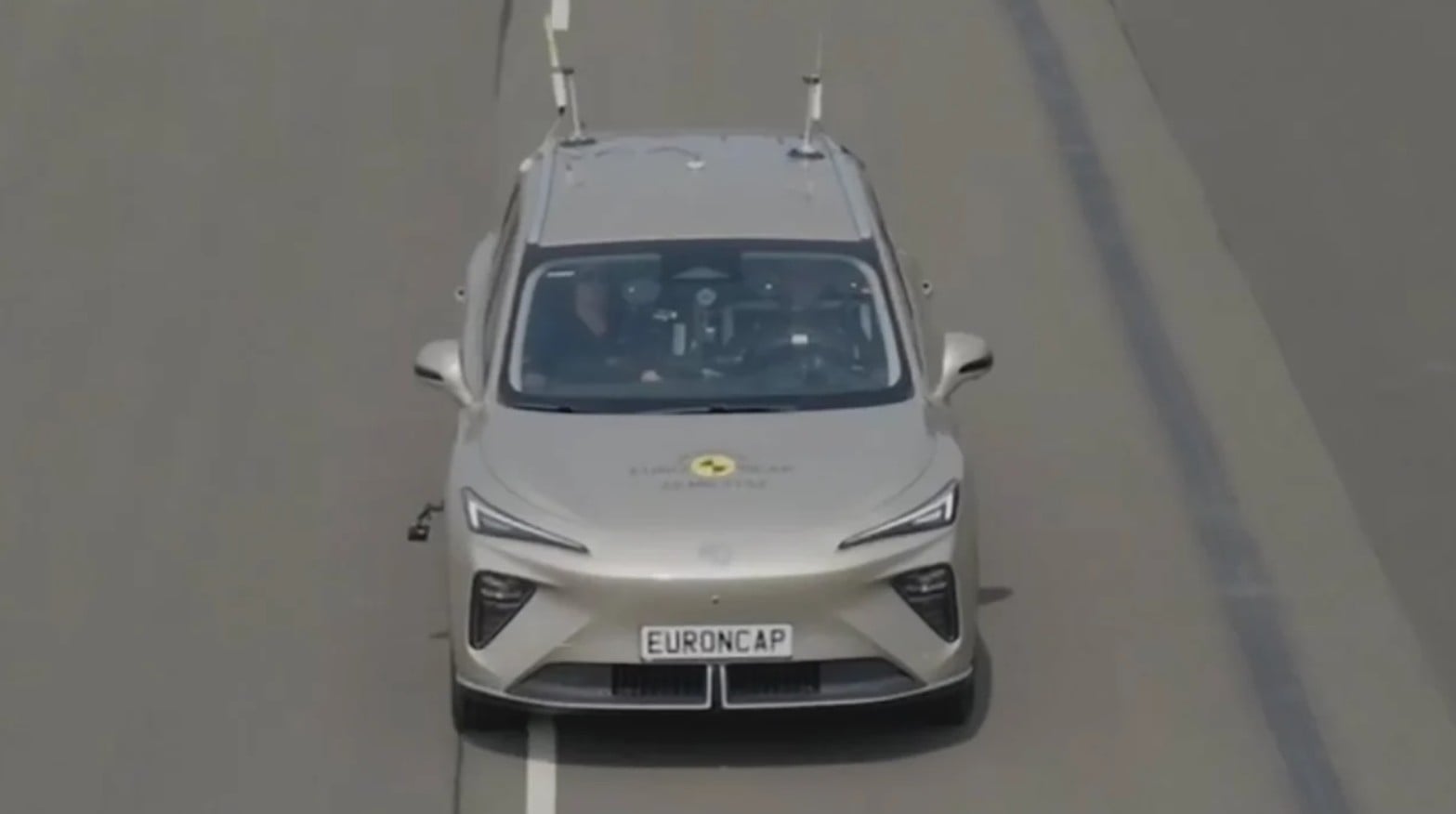
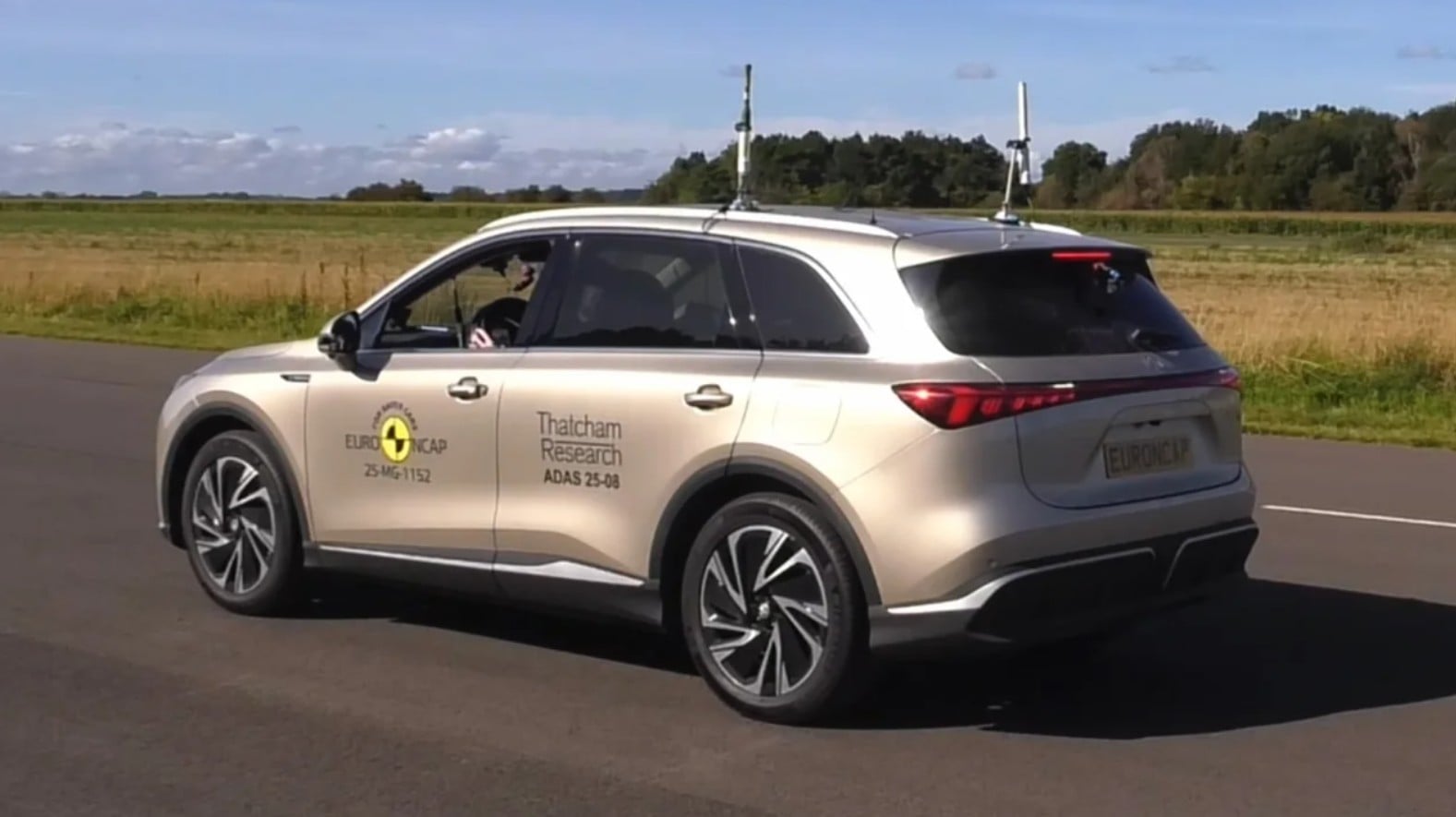
The upcoming MGS6 EV has been accidentally uncovered – not through an official launch or press photos, but via Euro NCAP’s crash test footage, giving the world its first look at MG’s next all-electric SUV in rather dramatic fashion.
While it’s not the debut MG likely planned, there’s a silver lining: the new model achieved a five-star safety rating from Euro NCAP, performing strongly across all key categories. The S6 EV earned 92 per cent for adult occupant protection, 85 per cent for child occupant safety, 84 per cent for vulnerable road users, and 78 per cent for safety assist systems – an impressive result for the yet-to-be-announced model.
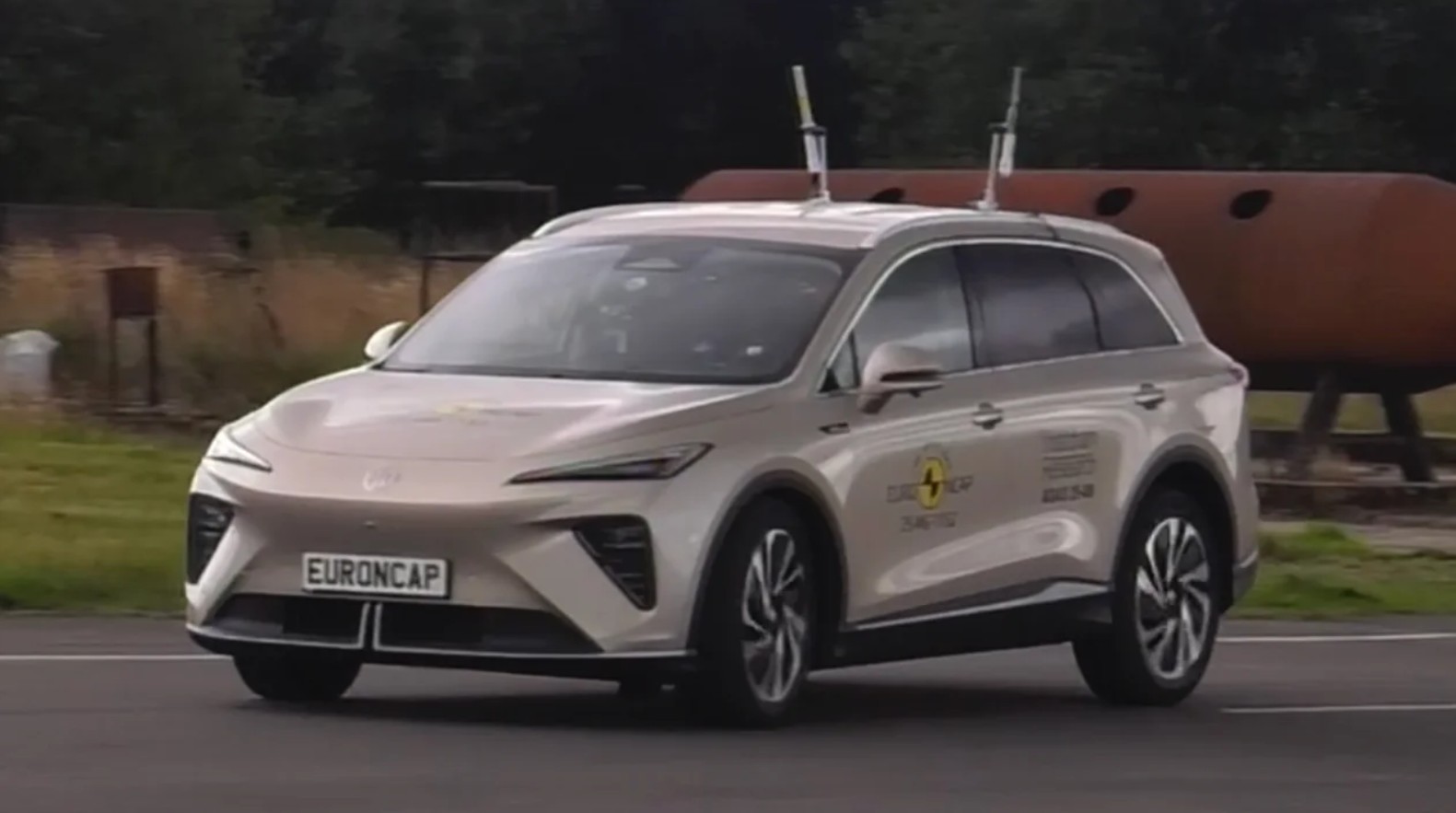
Stylistically, the S6 EV draws inspiration from the smaller MGS5 EV, but introduces several notable changes. It sports sharper headlights, revised front and rear bumpers, and a longer wheelbase. The rear design features a slimmer full-width light bar, chrome accents, and a faux diffuser, giving the SUV a more premium, athletic stance.
The extended overhang and boxier rear profile suggest a roomier cabin and larger cargo area compared with the S5 EV. Screenshots from the crash-test footage reveal a fully digital instrument cluster and a three-spoke steering wheel similar to MG’s current EV range, though the rest of the cabin remains under wraps. Expect a large central touchscreen in line with the brand’s latest design language.
MG hasn’t officially confirmed technical details, but the new model is expected to ride on the Modular Scalable Platform (MSP) that also underpins the MG4 and S5 EV. This platform can accommodate wheelbases up to 3100mm, giving the S6 EV room for a larger battery – likely the 77kWh unit from the MG4 Extended Range.
Given that the S5 EV offers up to 480km on a charge, the S6 could push that figure closer to 550km, bringing it into competition with mid-size electric SUVs such as the Skoda Enyaq, Volkswagen ID.4, and Nissan Ariya. Charging speeds should sit around 140–150kW, enabling a rapid 10–80 per cent top-up in about 30 minutes.
MG executives have previously hinted that the brand plans to expand into new SUV segments as part of its EV growth strategy. The S6 EV will likely sit above the S5 EV and below the upcoming IM6 SUV, targeting the popular C-segment category where models like the Renault Scenic E-Tech and VW ID.4 currently dominate.
According to sources in the UK, MG plans to offer three variants of the S6 EV when orders open towards the end of November. Pricing has yet to be confirmed, but early indications suggest it will maintain MG’s reputation for strong value.
An Australian launch is expected in the next few months, following European deliveries. The addition of the S6 EV will give MG one of the most comprehensive electric SUV line-ups in the country, spanning from the affordable MG4 hatch to the larger IM6.
KGM has broadened its Torres SUV range with the introduction of a new hybrid powertrain, designed in collaboration with Chinese electric vehicle giant BYD. The new “Dual-Tech Hybrid” system is aimed at enhancing the Torres’ competitiveness in the ever-crowded mid-size SUV segment and has just been rolled out in Europe.
Formerly known as SsangYong, the Korean automaker has long been known for offering strong value for money, and the Torres Hybrid appears to follow that formula. UK pricing is expected to start from around A$68,000 for the top-spec K40 trim, undercutting the entry-level petrol K30 variant by roughly A$1,500.
Under the bonnet, the Torres Hybrid pairs a 1.5-litre turbocharged petrol engine with two electric motors, driving through a six-speed e-DHT automatic transmission. The system produces a combined output of 175hp and 300Nm, which propels the 1,670kg SUV from 0–100km/h in about 9.0 seconds, before reaching a top speed of 180km/h. The hybrid system also enables the Torres to tow up to 1,300kg, making it suitable for light caravans and small trailers.
KGM says the hybrid setup allows for up to 95 per cent of city driving on electric power alone, with EV-only operation possible at speeds of up to 100km/h. A three-stage regenerative braking system recovers energy while slowing down. Official fuel economy is rated at 6.1L/100km, which is respectable though not class-leading – rivals like the Toyota RAV4 Hybrid and Nissan Qashqai e-Power remain more efficient on paper.
This marks KGM’s first-ever hybrid powertrain, and it comes with nine distinct driving modes to optimise performance for various conditions. Drivers can select from EV mode for electric-only operation, HEV mode for the best balance between petrol and electric power, or an engine-only mode to conserve battery charge.
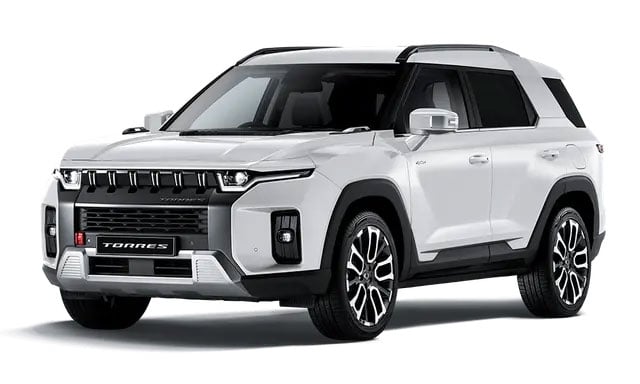
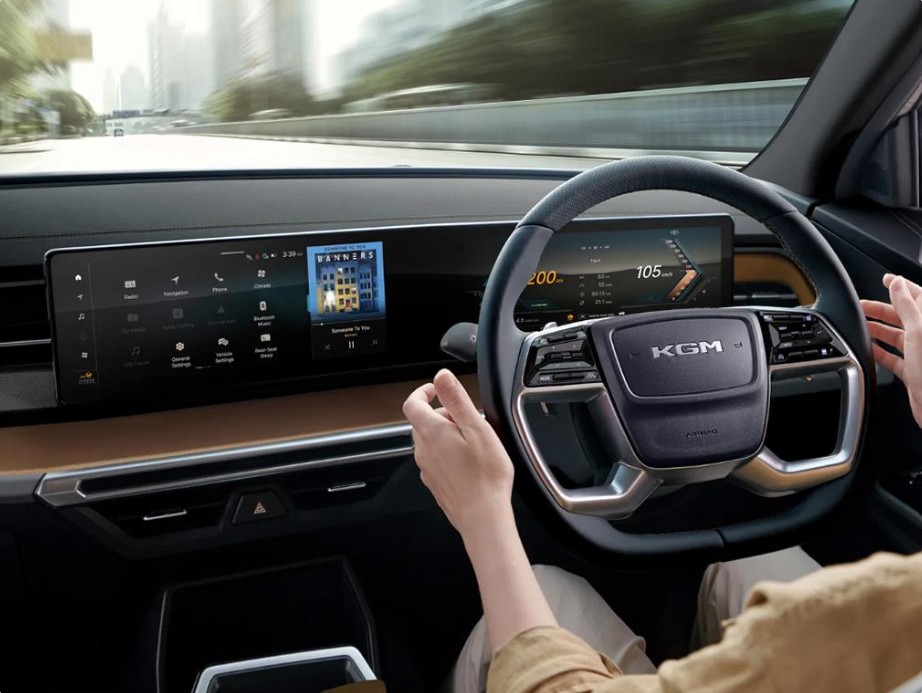
The Torres Hybrid joins the existing petrol-powered Torres and the all-electric Torres EVX, creating a full range that covers every major powertrain type. The K40 trim level includes a host of premium features, such as dual 12.3-inch displays (one for infotainment and one for the instrument cluster), heated and ventilated power-adjustable front seats, dual-zone climate control, a reclining rear bench, and ambient interior lighting with 32 selectable colours.
A comprehensive suite of driver-assistance technologies and safety systems rounds out the offering, including adaptive cruise control, lane-keeping assist, blind-spot monitoring, and autonomous emergency braking.
KGM says the Torres Hybrid will arrive in Australian showrooms by late 2025, with a starting price below $50,000 expected for entry-level grades. Once launched, it will compete directly against established favourites such as the Toyota RAV4 and Mazda CX-5 — but with the added appeal of BYD-developed hybrid technology and KGM’s reputation for robust value.
Plug-in hybrids represent one of the hottest niches in the Australian car market at the moment. Sales of PHEVs are up 144 percent against last year, with many of those sales coming at the expense of pure battery-electric cars. Doesn’t it seem a bit strange, then, that Mercedes-Benz, a company with some track record with plug-in hybrids, has only been able to offer the massively expensive AMG C63 S E performance for those that want the ability to charge overnight?
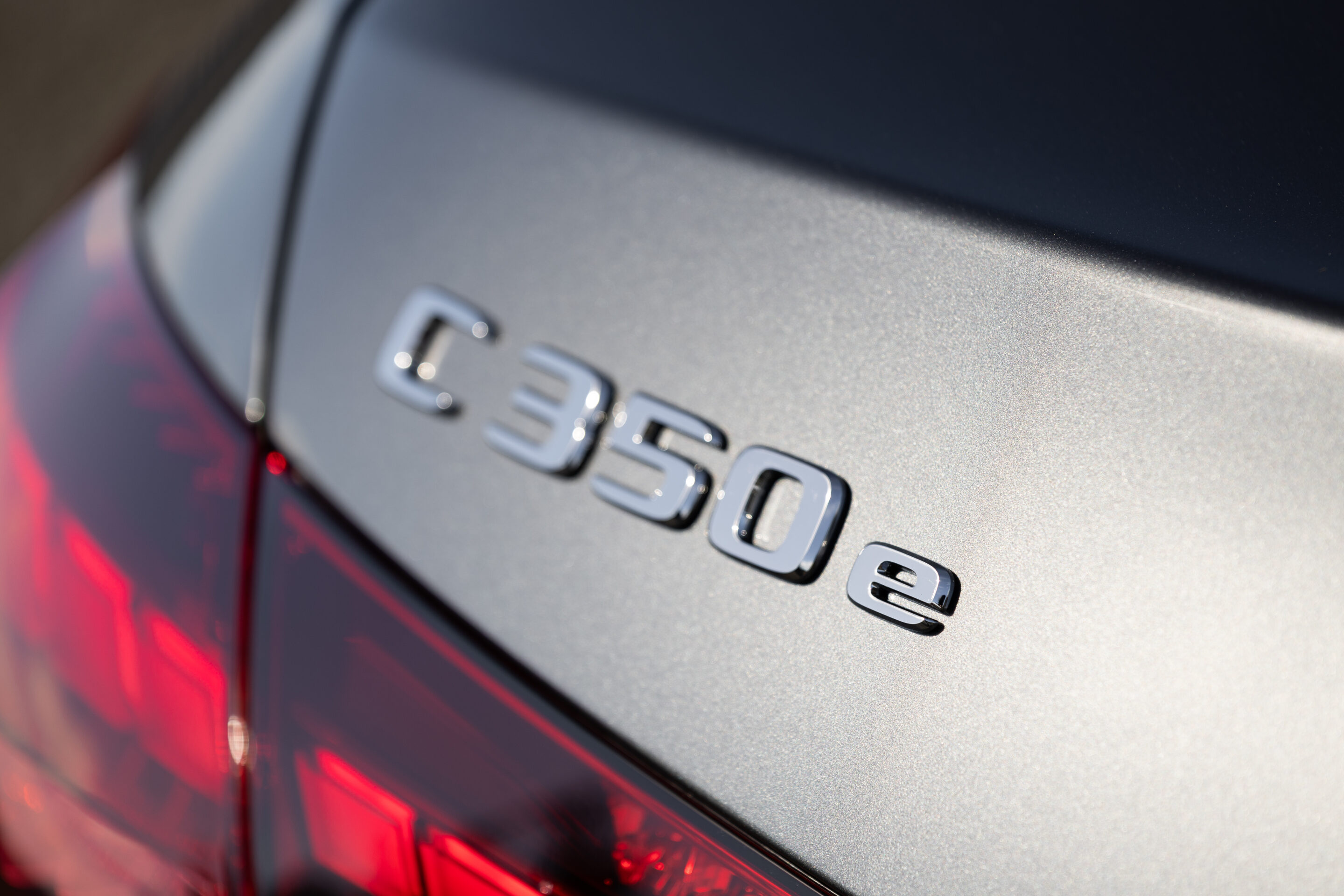
Until 2021, you could buy the previous generation C 300e but, in a case of history repeating, Mercedes was probably some way ahead of its customers in its push to electrification. Thankfully some measure of rectification has arrived in the shape of the new Mercedes-Benz C 350e. Priced at $98,200 plus on-roads, it’s a mere $100 more than the standard C 300 which performed well in a recent Wheels group test versus the BMW 330i and the Audi S5.
The timing actually works beautifully for Mercedes, given that there’s no Audi A5 on offer right now with plug-in capability, and BMW Australia has quietly deleted the 330e PHEV from its rationalised line-up in order to concentrate on the fully electric i4 eDrive 35. In other words, it’s as if the two biggest rivals have rolled out a red carpet and invited Mercedes to have at it, for the time being at least.
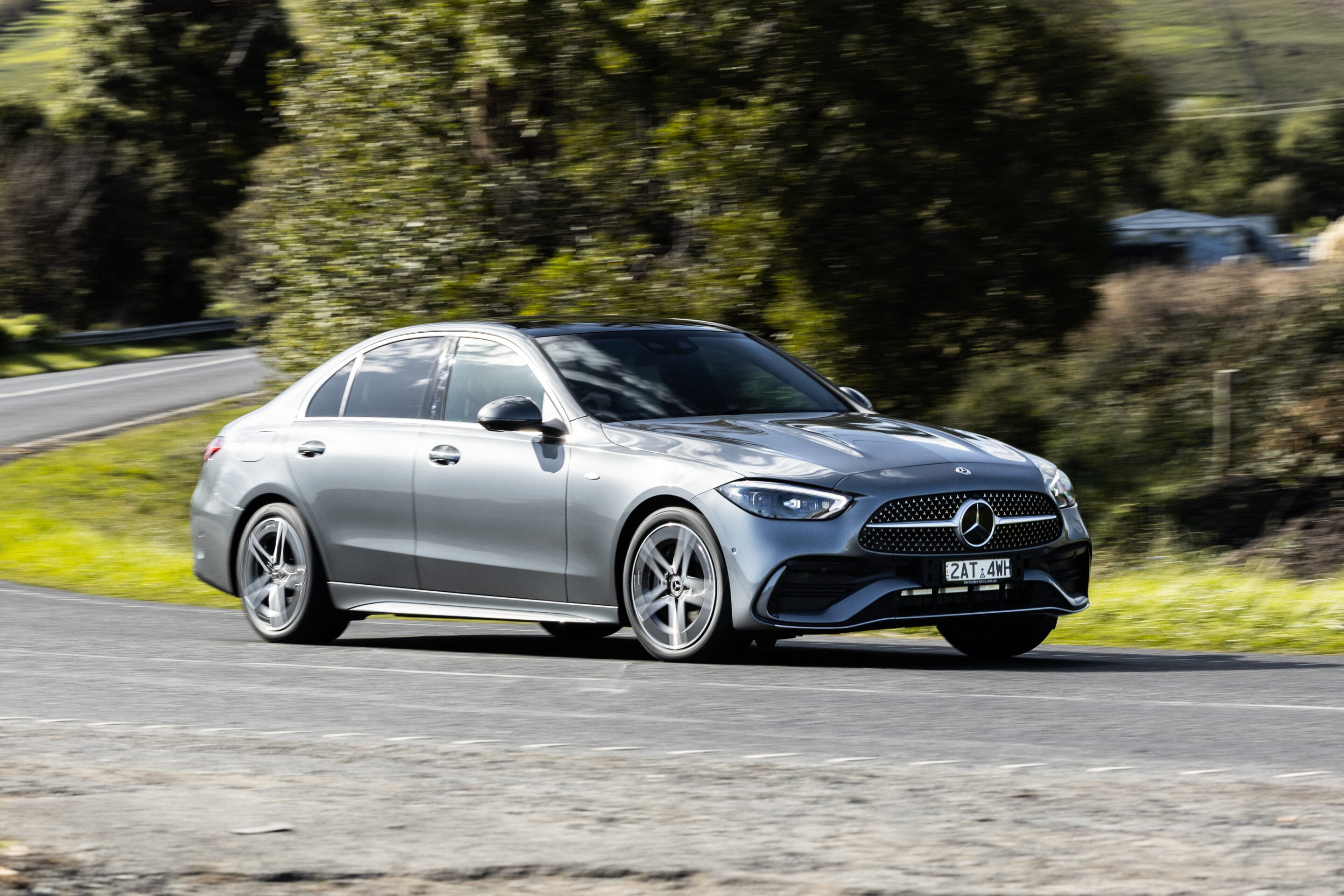
Those with longer memories might well recall that Mercedes have offered a C 350e plug-in hybrid in Australia before. That car arrived in 2015, and didn’t do particularly well, largely due to the fact that it had a claimed electric-only range of 31km, with real-world use hovering around the 25km mark. It was also quite underpowered, the 60kW electric motor struggle to heave 1705kg of car up the road. It’s instructive to see how far the tech has developed over the course of a decade.
Whereas the current petrol-engined C 300 makes 190kW and 400Nm from its 2.0-litre four-cylinder engine, that additional $100 outlay nets you 230kW and 550Nm from the new C 350e. Its 2.0-litre internal combustion engine fronts up with a relatively understressed 150kW and 320Nm while an electric motor chimes in with up to 95kW and 440Nm, both of these power sources combining to drive solely the rear axle.
In terms of equipment, the C 350e mirrors the provision of the C 300, which means AMG Line styling, heated sports front seats with memory function, a flat-bottomed steering wheel, head-up display, Artico trim and ambient lighting for the cabin, a panoramic sunroof and keyless start. It also features as standard a 15-speaker, 710-watt Burmester stereo, Digital Light projector LED headlights (including Ultra Range high beam) and comfort suspension with rear self-levelling. Driving Assistance Package Plus, which promises ‘partially automated driving’, is also standard, as is augmented reality satellite navigation.
There’s also a couple of welcome features on this plug-in model that you might not expect to find. The first is self-levelling air suspension on the rear axle, which keeps the body (and lights) level even with a heavy load in the back. The other is pre-entry climate control which means that you’ll never have to get into a freezing or baking car again. Simply set it to activate five minutes before you’re due to leave and the cabin will be at your perfect temperature.
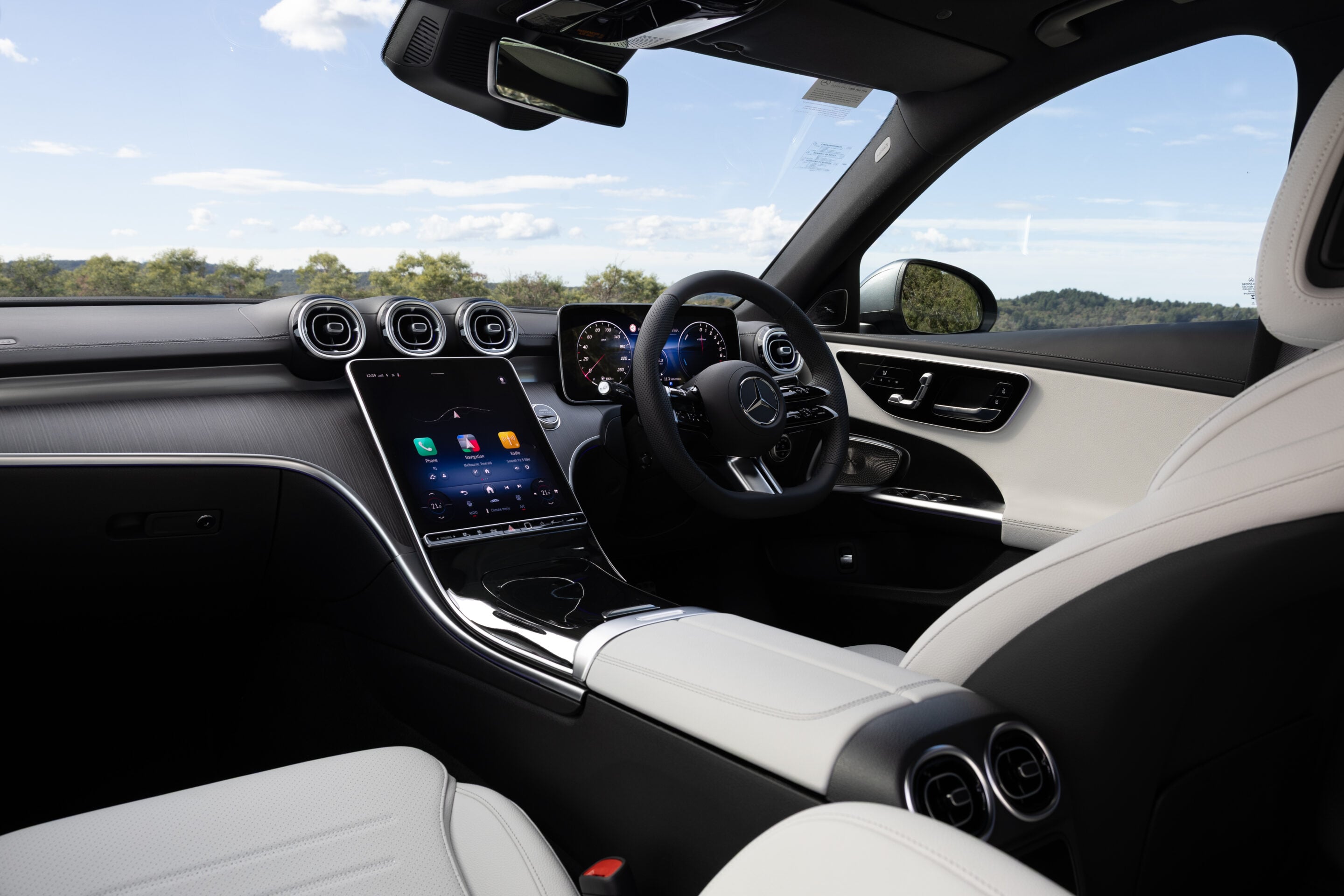
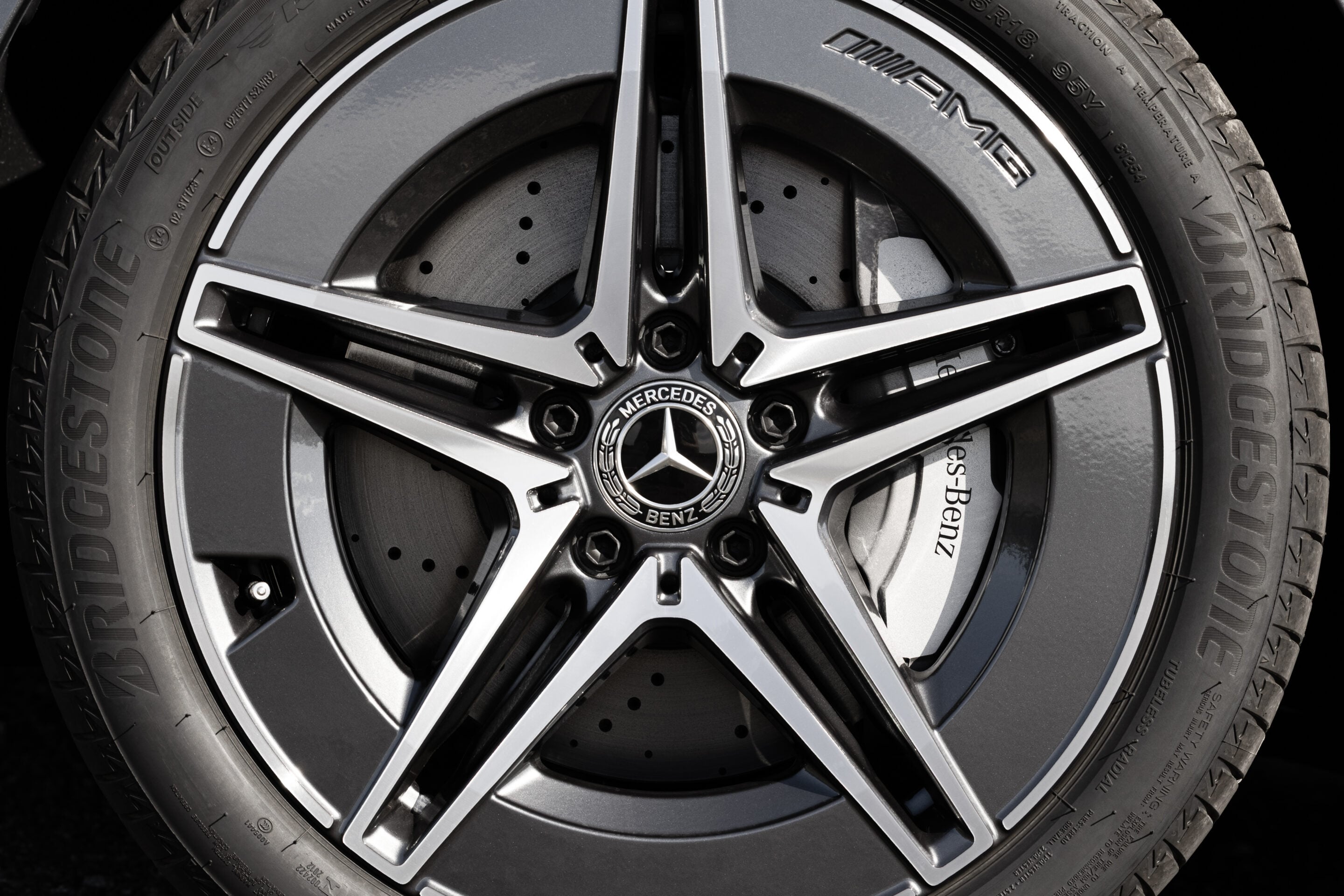
Perhaps the wisest decisions on the C 350e’s spec sheet are the eighteen-inch wheels and the Comfort suspension setup, which together deliver a beautifully polished ride quality. If you’re particular about a smooth ride and haven’t quite decided whether you ought to get the C 350e and the C 300, get the plug-in hybrid. It’s noticeably better. It’s also significantly more cossetting than its SUV sibling; the GLC 350e. If you miss the days when a Mercedes-Benz rode with maturity and an imperious disdain for surface imperfections, then this C 350e emerges as a very welcome throwback.
In certain regards it’s a little bit off that it does, because the C 300 will stay in the range. Mercedes admits that the PHEV might not appeal to older buyers, but should they choose the mechanically more conservative C 300 instead, they’ll be buying a firmer riding car, albeit still not one that feels like a trolley jack on poor roads.
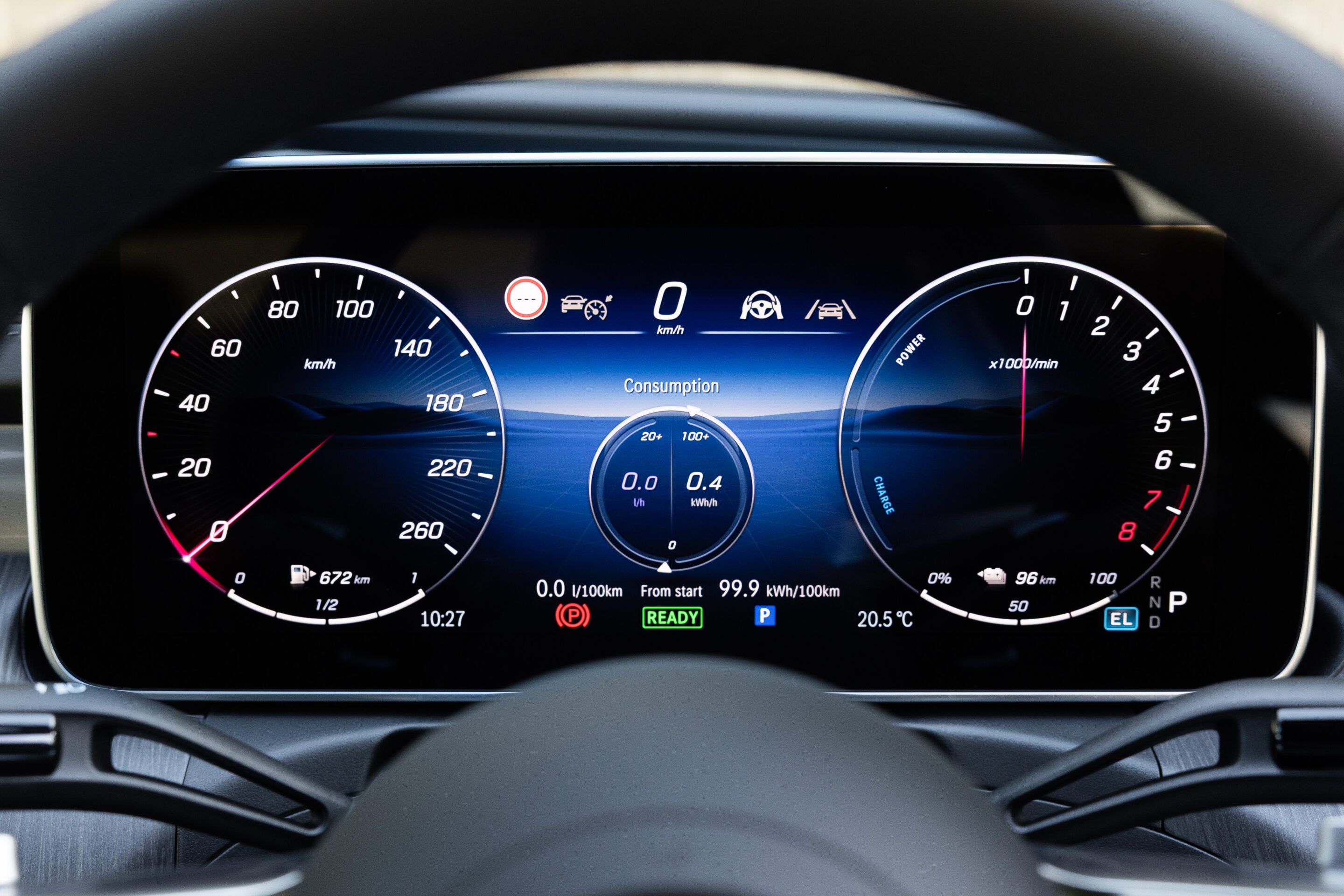
The hybrid system is beautifully polished, offering a trio of PHEV-specific drive modes. Battery Hold retains the charge you have in the 96-cell pouch-type lithium ion battery. Switch to Electric and you can drive on pure electric power at speeds of up to 140km/h. Hybrid mode does exactly what you expect, blending electricity and fossil fuel where required and recuperating smartly to keep adding juice to the 19.53kWh (net) battery pack where possible.
The way the wheel-mounted paddles are calibrated is so smart it needs to become industry standard for PHEVs. When in Sport mode, they function as sequential gear shifters, allowing you to ping up and down the nine-speed transmission at will. In any other mode, their functionality changes to adjustable electric recuperation. Click the left-hand paddle to enter D- mode, which offers maximum re-gen. It’s a great way of keeping speed in check on downhill grades while feeding the battery and acts as a near one-pedal mode, without quite having the ability to bring the car to a dead stop. There’s also a balanced D setting and a more freewheeling D+ mode.
It’s effective too. We set out on our drive loop with 100km of electric range showing. After 86km of driving across a mixture of urban and country roads, it was still registering 66km of range remaining. When fully charged, Mercedes claims an NEDC range of 104km, and given how clever the recuperation system is, that seems achievable. As is always the way with plug-in hybrids, the NEDC fuel consumption figure is almost meaningless, in this case being quoted as 1.5L/100km. The C 350e also requires 95RON fuel and the fuel tank is also a little smaller than that fitted to the rest of the C-Class range, measuring 50 litres versus the usual 66L.
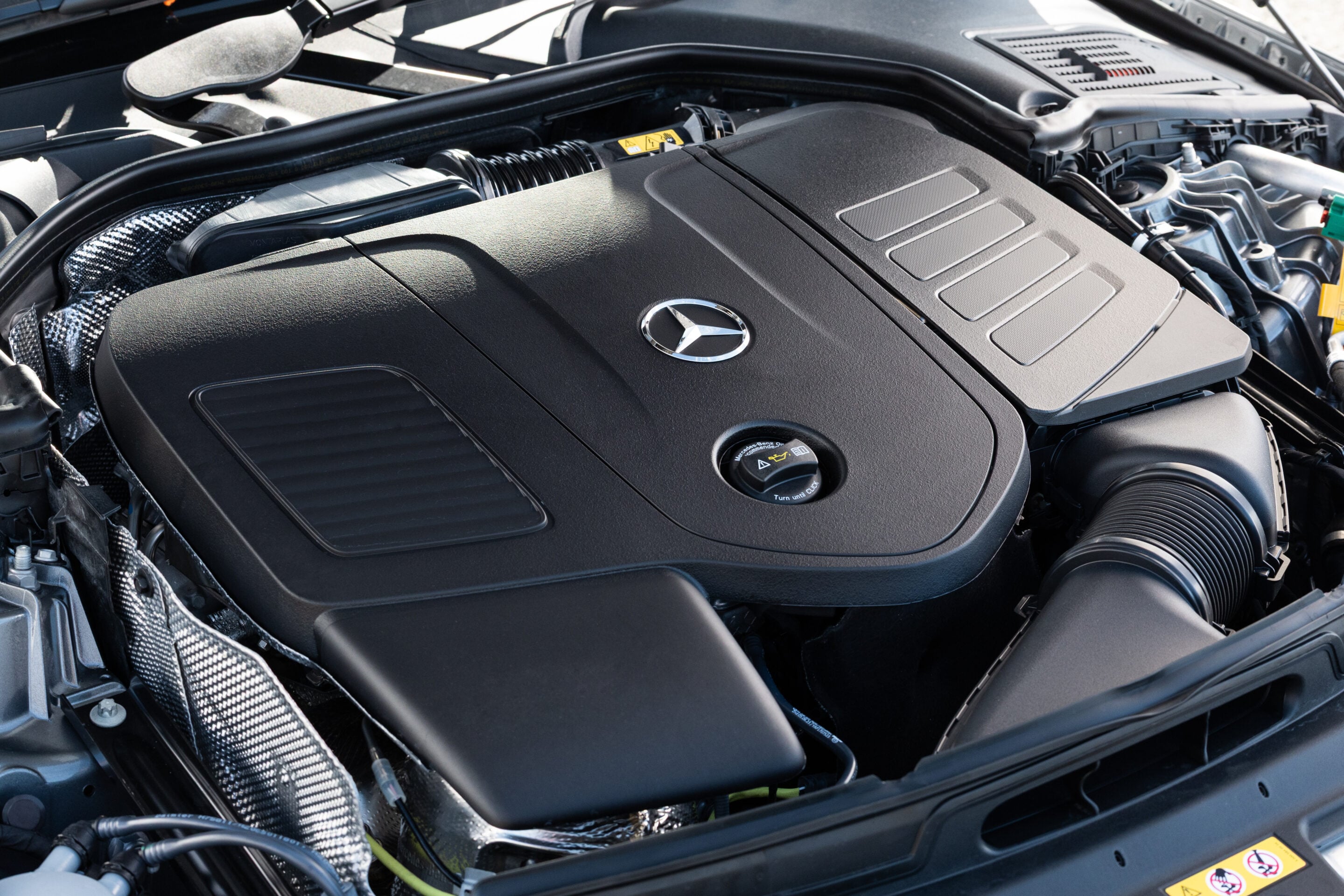
The M254 2.0-litre internal combustion engine is refined enough for the most part, and engages smoothly when under way. It only sounds a bit gravelly when it kicks in at idle. When both the engine and the 95kW electric motor are entrained together, the C 350e accelerates strongly. The factory claims a 6.1-second 0-100km/h time and full throttle will have the 225/40 R18 Bridgestone Turanza T005 tyres at the limit of their available traction.
The steering is well-geared and accurate, in-car refinement is excellent, and the Artico-upholstered sports seats offer decent support when cornering. At times, the engine can hold a gear too high in hybrid mode which can be momentarily annoying, and the first part of the brake pedal’s travel, as it begins to engage the electric motor’s re-gen, doesn’t feel entirely natural. The box that houses the head-up display could also be upholstered in something less reflective, as on sunny days it can cast a reflection on the windscreen right where the driver’s eyes are typically trained.
Accommodation in the vehicle is respectable for this class of car, with the C-Class’s 2865mm wheelbase being 14mm longer than a BMW 3 Series but 37mm shorter than an Audi A5. There’s more space in the rear than both, however, although the back seats feel a little austere with just a set of vents and no USB ports, coupled with a chunky transmission tunnel.
The boot opens electronically and features a set of buttons to automatically drop the rear seats. Unfortunately, the battery is packaged beneath the boot floor, which robs about 40L of space. Normally cutting the available space by less than 10 percent wouldn’t be a make or break issue, but in the case of the C-Class sedan, the boot was already quite long but not very high. Making its height lower still will mean that many typical holiday hardshell suitcases just won’t fit. This is probably the car’s biggest practical shortcoming. Fitting the battery there also means that there’s no spare wheel, so the C 350e relies on the sidewalls of its run-flat tyres to get you out of a spot.
The C 350e is also rechargeable from either an AC home setup or a DC fast charger, although the latter capability represents a $1500 option. At home, using an 11kW wallbox, it’ll charge from empty to full in two hours. On a public DC charger, it’ll recharge at a peak rate of 55kW, which will get you from 10-80 percent in 20 minutes. The Mercedes me Charge Public system also allows you to find and navigate to a Chargefox charger, start the session and pay using either the infotainment system, the Mercedes me Charge RFID card or the Mercedes me phone app.
It’s easy to be seduced by the idea of the Mercedes-Benz C 350e. Refined, relatively inexpensive to run, well equipped, possessed of genuine accelerative punch and yet agreeably discreet, it’s a strong package. The tight boot is the only real demerit point, but if you’re not in the habit of loading your sedan to the gunwales, it’s otherwise hard to fault.
It also serves to remind us how good cars of this type can be. Sales of the C-Class are down by 31.2 percent year on year, with the 3 Series and A4 faring even worse. Registrations of heavier, less efficient SUVs have grown correspondingly. After driving the C 350e, not needing to own an SUV seems a privilege. Try it. You’ll see.
Specifications
| Model | Mercedes-Benz C350e |
|---|---|
| Price | $98,200 before on-roads |
| Engine | 1999cc 4-cylinder, DOHC, 16v, turbo, plug-in hybrid |
| Peak power | 230 kW |
| Peak torque | 550 Nm |
| Transmission | Nine-speed automatic |
| 0-100 km/h | 6.1 seconds |
| Battery size | 25.4kWh (gross) 19.53kWh (net) |
| Electric range | 104km (NEDC) |
| Fuel consumption | 1.5L/100km (NEDC combined) |
| Fuel tank | 50L |
| L/W/H/WB | 4755/1820/1450/2865mm |
| Warranty | 5yrs/unlimited km |
| Available | Now |
Swiss watchmaker TAG Heuer has unveiled a limited-edition timepiece celebrating the 75th anniversary of Formula 1, underscoring its long-standing connection with motorsport. The new Carrera Chronograph Tourbillon Extreme Sport | F1 75th Anniversary Limited Edition will be restricted to just 75 individually numbered pieces, each engraved with a year representing one of Formula 1’s world championship seasons between 1950 and 2024.
The release continues TAG Heuer’s tradition of linking horological innovation with racing heritage. Since the original Carrera model debuted in 1963, inspired by Mexico’s Carrera Panamericana road race, the collection has symbolised precision and endurance on and off the track. The brand’s historical ties to motorsport deepened in the 1970s when Jack Heuer partnered with Ferrari, developing advanced timing systems that supported the team’s championship wins in 1975.

This new edition reflects both the brand’s modern technological approach and its legacy as Formula 1’s official timekeeper. Each watch features a 44mm sandblasted titanium case, complemented by an 18-carat yellow gold fixed bezel and black DLC-coated crown and pushers. A black rubber strap and matching titanium buckle add a sport-focused finish suited to the Carrera’s racing lineage.
The open-worked dial exposes the in-house Calibre TH20-09 Tourbillon movement, which offers a 65-hour power reserve, a column wheel and a vertical clutch. A checkered-flag motif and transparent sapphire caseback reveal the intricate mechanics, framed by a golden Victory Wreath – a symbol of Formula 1 triumphs.

Design elements such as the Formula 1 logo at 12 o’clock and the “F1 75” insignia on the bezel and caseback link the watch directly to the championship’s milestone anniversary. Yellow gold accents across the chronograph hands and sub-dials enhance contrast and legibility, echoing the high-visibility instrumentation of racing cockpits.
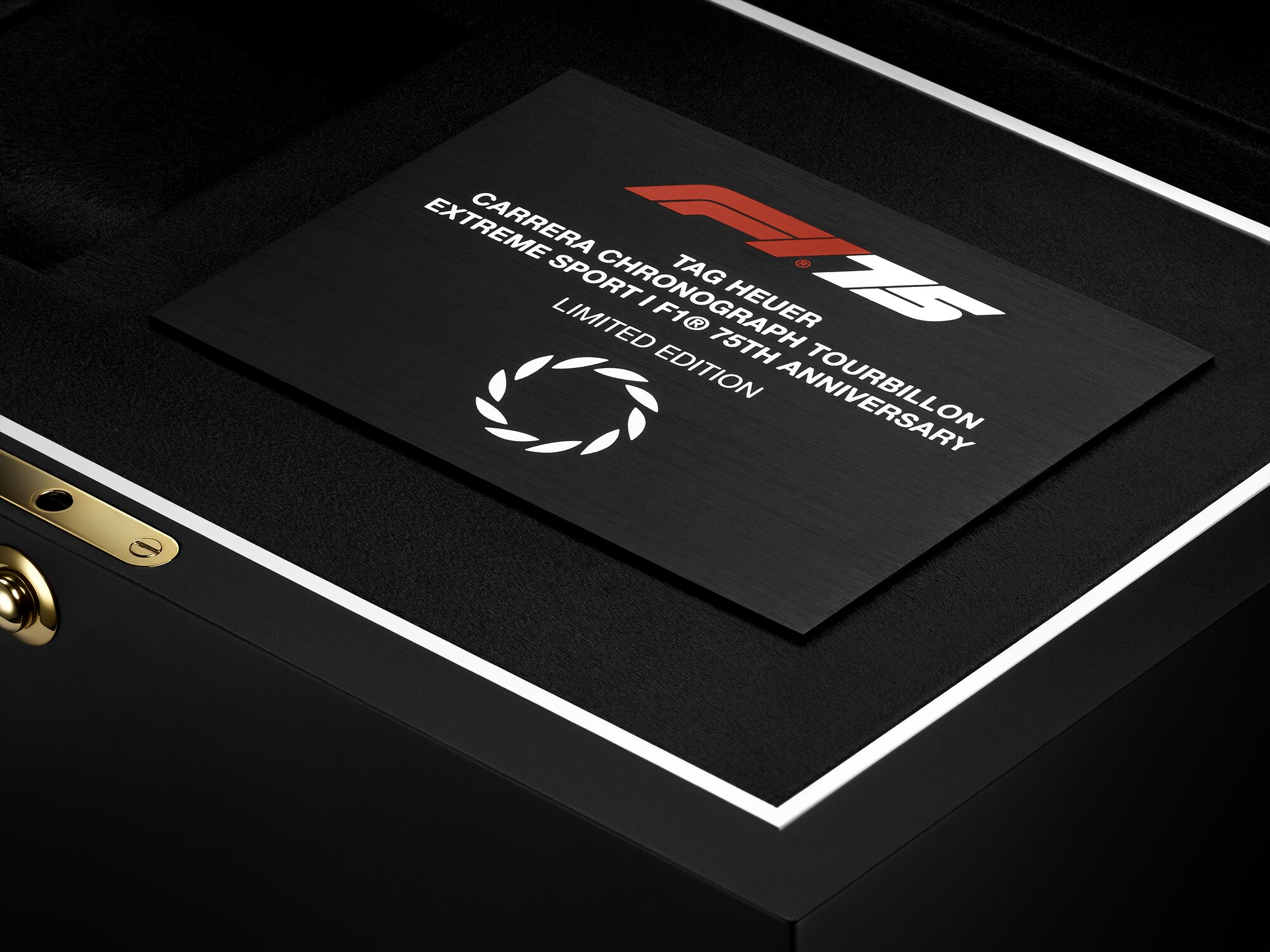
Each piece is presented in a commemorative black box bearing the official F1 75 branding.
Celebrating 165 years of watchmaking, TAG Heuer says the new Carrera Chronograph Tourbillon represents the culmination of decades of innovation at the intersection of motorsport and horology – an enduring tribute to both Formula 1 champions and the pursuit of precision.
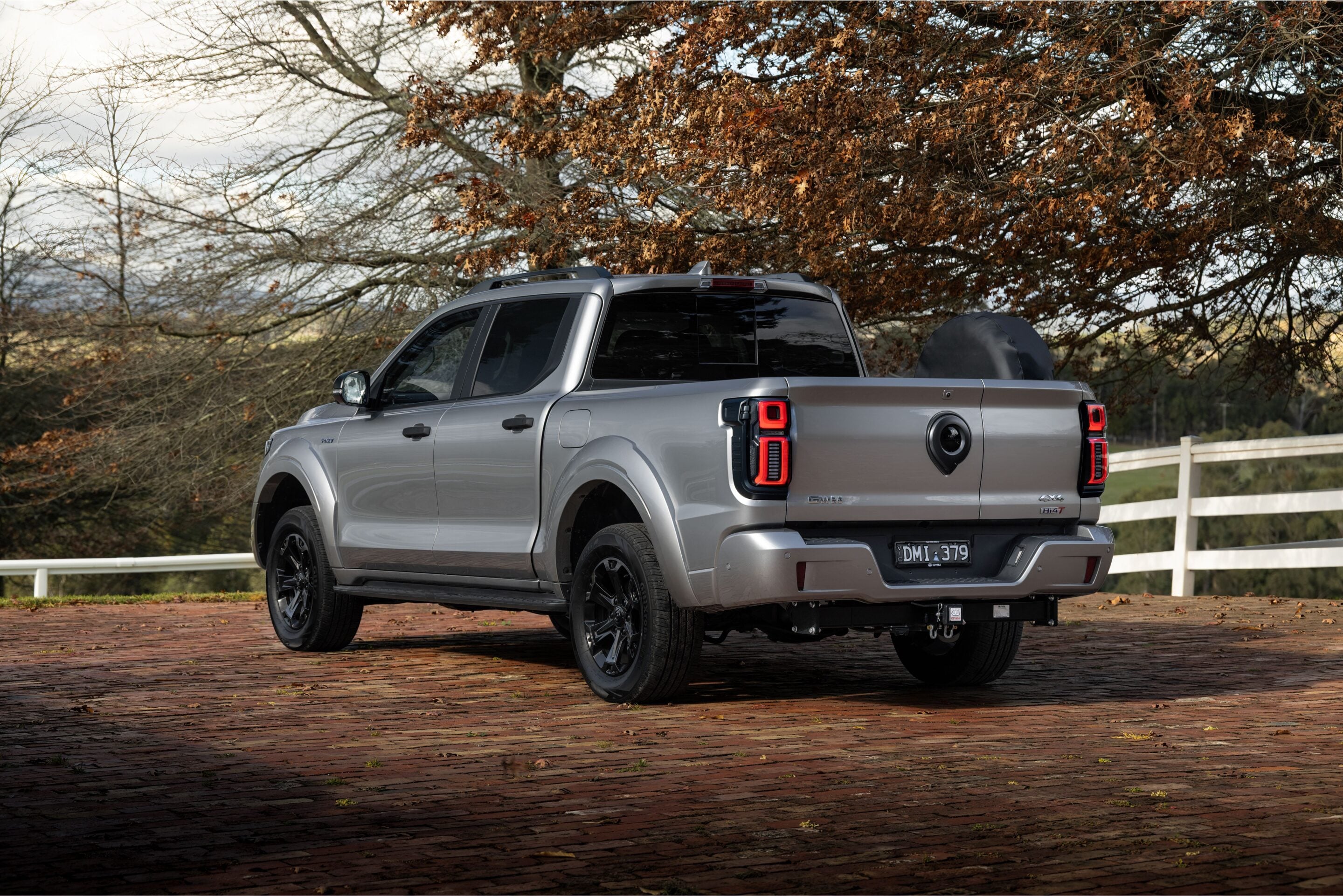
GWM offers regular dual-cab, cab chassis and now what it calls “large luxury utes” in Australia. And, that’s where the Alpha PHEV we’re testing here fits into the equation. According to the Chinese manufacturer, the Alpha PHEV is a “luxury hybrid ute, designed for both rugged terrains and refined comfort”.
Making its way into the Australian new car market as the second plug-in hybrid dual-cab available, GWM was able to see just how much interest there was in the technology, given the immediate popularity of the BYD Shark.
GWM has combined a 2.0-litre, turbocharged petrol four-cylinder with a nine-speed automatic, integrated electric motor and two batteries that deliver 37.1kWh. Cannon Alpha has a single electric motor integrated between the engine and gearbox, meaning the electric power is delivered through the transmission and transfer case to the front and rear wheels, as the case may be.
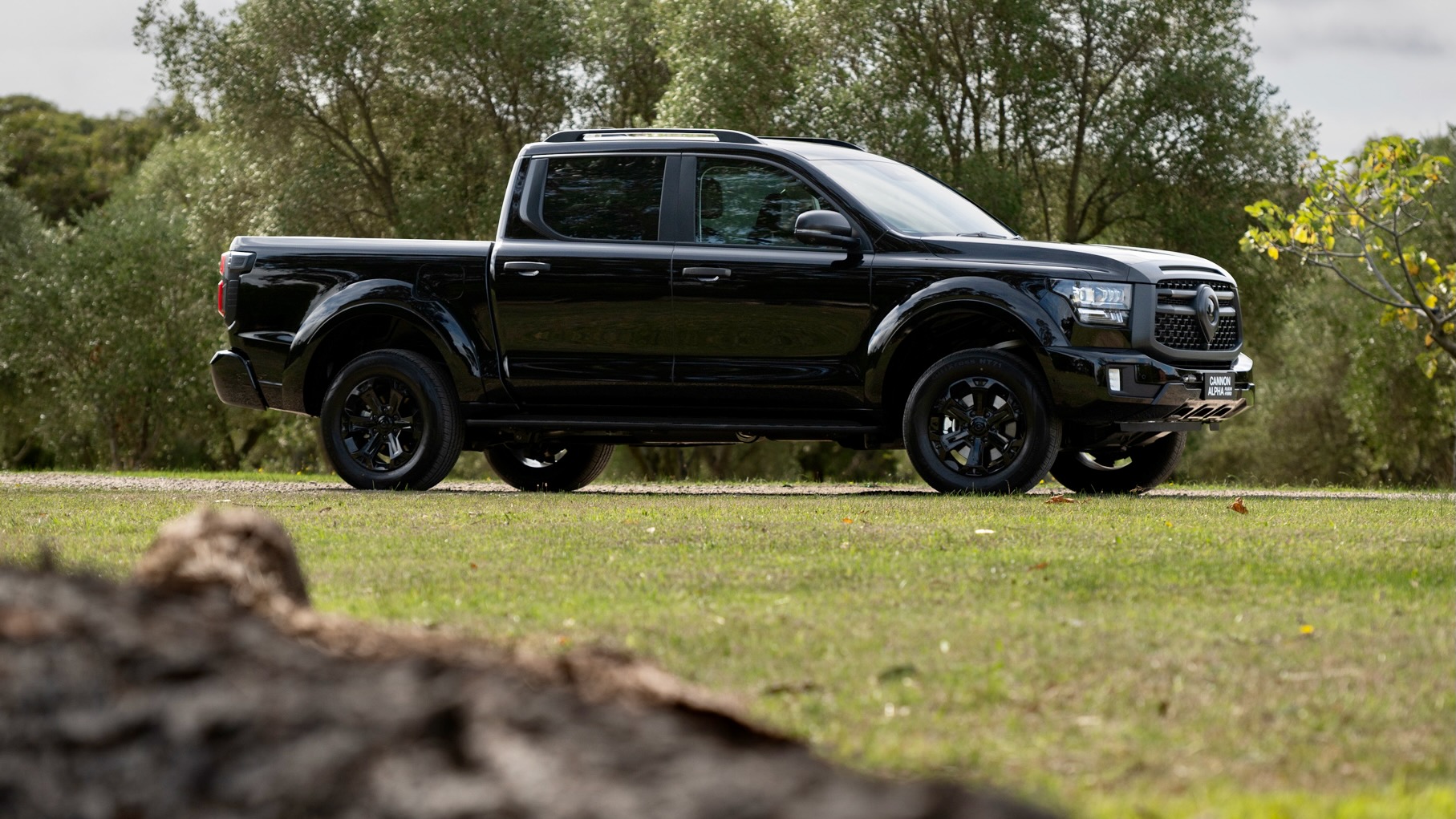
What’s most interesting from a testing perspective – beyond the PHEV capability – is the physical size of the Cannon Alpha. It looks – and feels – a few percentage points bigger than the regular dual-cab crowd, and as such, GWM can hang its hat on a larger tray than the standard model, along with an extensive list of premium equipment.
That’s where we’ll look first, because price is key at this end of the segment, and it’s the reason buyers will consider a dual-cab from a challenger brand.
Standard equipment
Buyers can choose between two specification grades of the Alpha PHEV – Lux and Ultra. Lux starts from $59,990 before on-road costs, just a few grand more than the BYD Shark. Step up to Ultra and you need to part with $66,990 before on-road costs. Even at Lux specification, there are plenty of standard equipment highlights including a 12.3-inch infotainment screen, 360-degree camera, digital driver’s clusters LED headlights, LED tail lights, dual-zone AC, selectable 4WD, a locking rear diff and electrically adjustable ‘leather look’ seat trim.
Step up to Ultra and GWM adds a switchable front diff lock, 60:40 split tailgate, panoramic sunroof, a larger 14.6-inch infotainment touchscreen, 10-speaker Infinity audio system, head-up display, heated and cooled front seats, heated and cooled rear seats, electrically adjustable rear seats, wireless smartphone charging front and rear, an opening rear window, heated steering wheel and ambient cabin lighting.
It’s fair to say that the ask to step up to the Ultra specification grade is justified by the added standard equipment, and while the PHEV Cannon is understandably more expensive than the sharply priced regular version, it’s still compelling value for money. In short, $66,990 positions it well beneath the top-spec variants of the established segment leaders.
The 2.0-litre petrol four-cylinder is turbocharged and generates a respectable 180kW and 380Nm. Combined that with the 120kW and 400Nm added by the electric motor though, and you get chunky outputs of 300kW and 750Nm – way beyond the offerings of the standard dual-cab brigade.
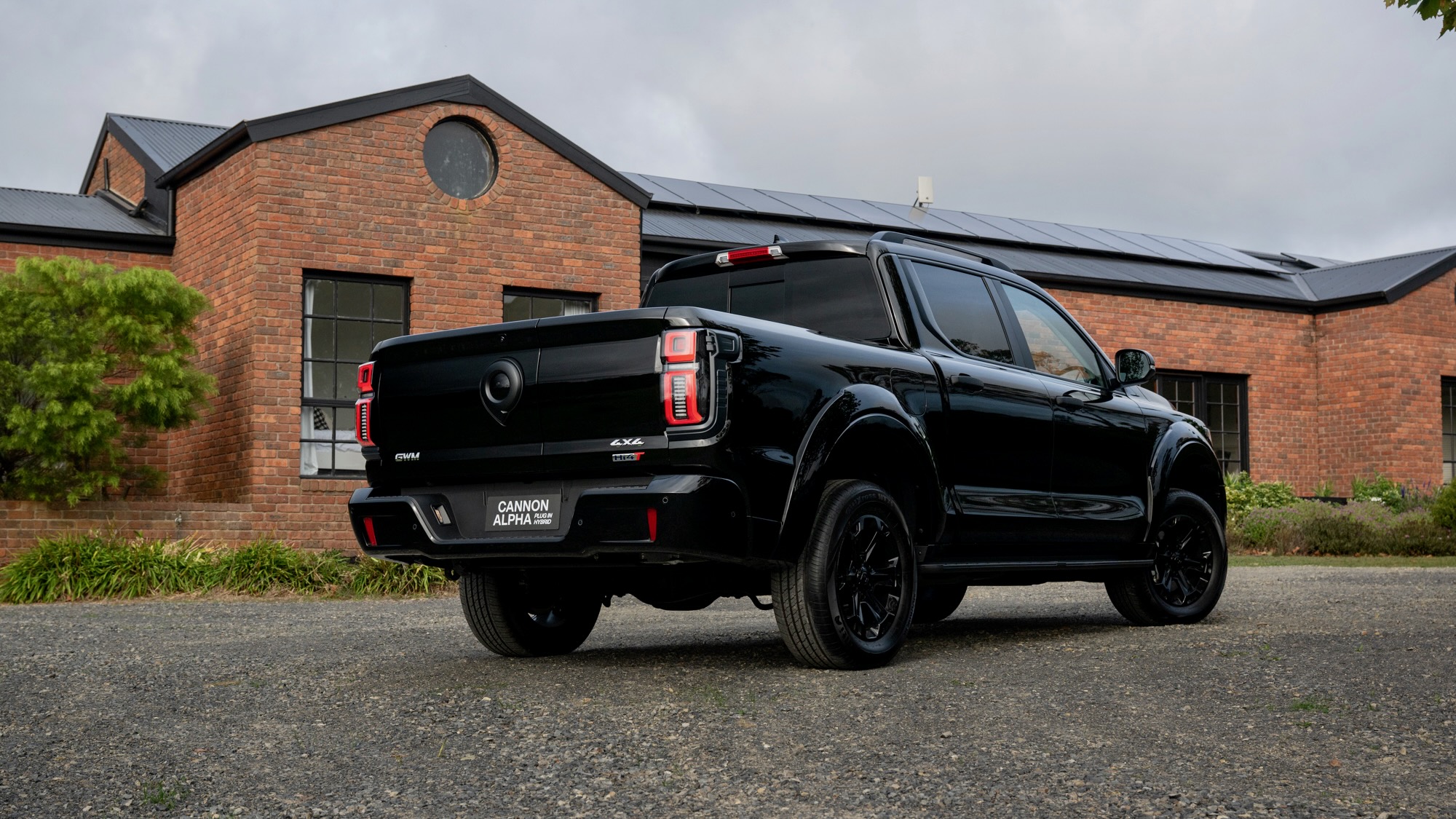
Interior and technology
It’s here, inside the cabin, where the larger size of the Cannon Alpha PHEV is most noticeable. You’ll be in no doubt that its larger than a Ranger or HiLux for example, and it’s almost identical in dimension to the BYD Shark it goes head-to-head with. In the front section of the cabin, there are touches we don’t love – like the timber paneling along the dashboard – or the piano black trim, which is prone to showing fingerprints and dust no matter how hard you try to keep it clean. The analogue clock is a matter of personal taste, but broadly speaking, the cabin is well designed and well executed.
The wireless charging slots are in the right place to be out of the way and keep phones safe, and the cupholders are useful, but the power outlets are buried down near the driver’s ankle in a spot that isn’t the first place you look and not the most sensible spade for them.
There’s more room everywhere inside the cabin – the second row most noticeably and if you’re a family buyer with tall kids, you’ll love the flexibility and comfort of the Alpha PHEV’s second row. The seats, which are electrically adjustable, mean you can slide the base forward, to tilt the backrest back, thus not sitting as upright as you otherwise would. It’s a small addition, but it makes a big difference. The added cabin space means legroom is never an issue.
The heating and venting in the second row of our tester is a bonus, along with air vents and power for charging devices. Strangely, the Alpha PHEV doesn’t have a regular wall-type plug, despite offering vehicle-to-load capability.
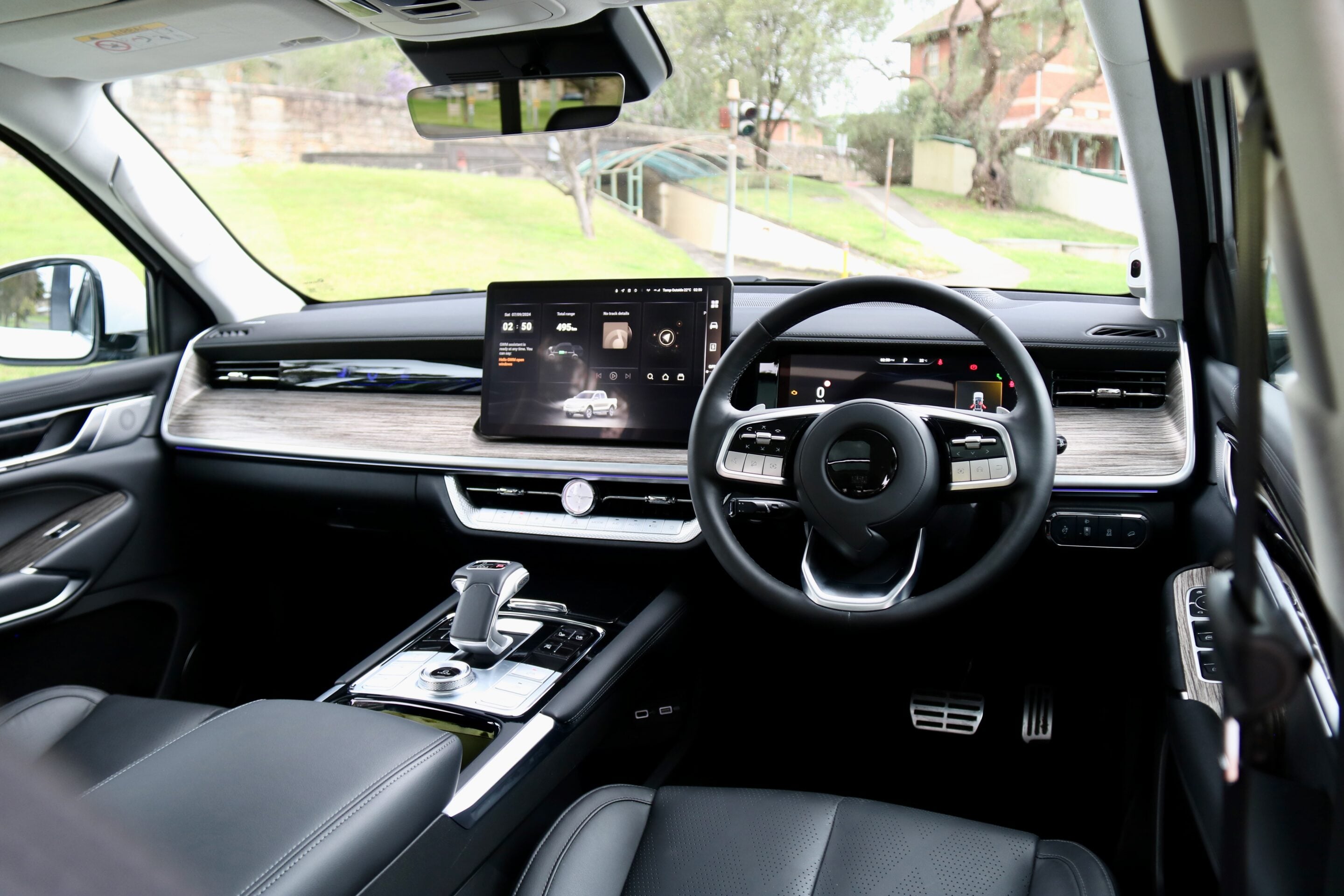
The screen on our tester was crisp and responsive to commands, once you worked out that you had to put some pressure on the screen to register said command. No volume dial for the auto system is a minor annoyance, while swiping down from the top of the screen displays some useful shortcuts.
The smartphone connection was rock solid for us on test, and it’s really only the lack of a volume dial that grates. When you switch over to smartphone mirroring, you lose the swipe down shortcut function, so the lack of a dial is even more apparent. You can of course, use the stetting wheel controls if you want to.
What’s it like to drive?
GWM Cannon Alpha PHEV’s selectable 4WD system allows for all-wheel drive on sealed surfaces, which is a bonus in a segment that still doesn’t cater for it across all models. If you’re anything like me, you’ll put the Alpha in 4WD, and leave it there.
GWM claims 1.7L/100km on the combined ADR cycle, but keep in mind, the majority if that first 100km will be done on electric power, using no fuel at all until the battery is depleted. During our time with the Cannon, we used no fuel at all of course, whenever we drove in EV mode, but averaged 10.7L/100km in regular driving, with the battery depleted.
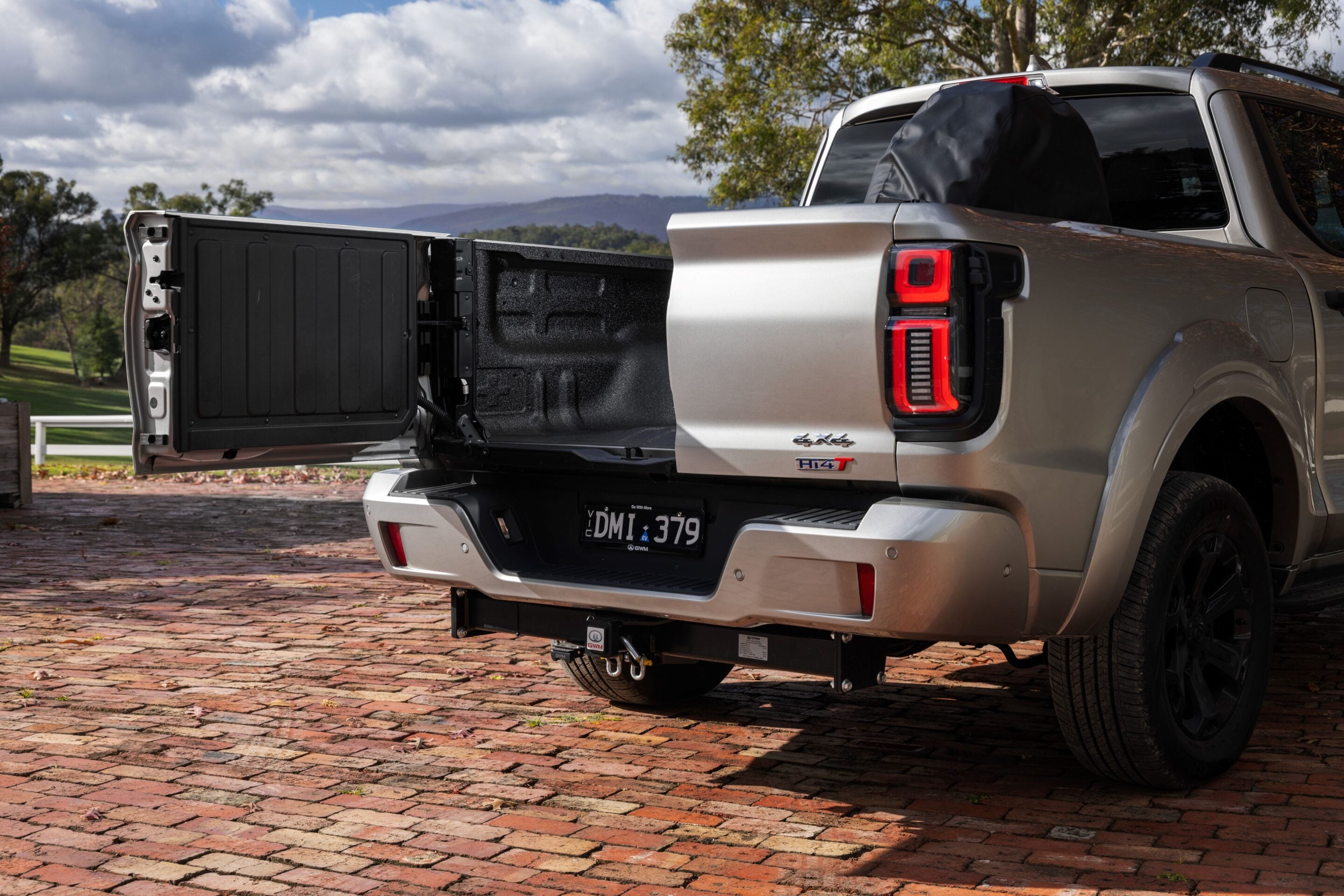
In regard to electric driving, GWM claims 115km – based on the NEDC testing regime – but expect to see closer to 100km electric range in the real world. What that means, for most of you, is that you could easily commute to and from work each day without using any fuel, and then charge back up overnight with a regular wall socket at home. It’s why, for so many drivers, a PHEV makes sense.
Given the Cannon Alpha PHEV has a coil-spring rear end – rather than leaf-spring – you’d expect a light and unladen ride quality, and GWM has delivered. Coil springs, especially around town without weight in the tray as so many of you use dual cabs, are demonstrably more comfortable, compliant and SUV-like than leaf springs, and you’ll like the ride of the Alpha PHEV if you’re coming out of a regular dual-cab.
While the 2810kg kerb weight is heavier – understandably – than the non-hybrid dual-cab options, the whopping torque figure means the Alpha PHEV actually feels quite punchy.
Nail the throttle from a standing start and it gets cranking with urgency, likewise if you need to roll up to highway speed from the on-ramp. It’s a big dual-cab, and you’re aware of it, but it’s also quite spritely.
Keep in mind the longer than dual-cab standard wheelbase means you need to be careful around town on tight inner-city streets, but the ride quality more than makes up for it. We found the steering, brakes and transmission to be excellent no matter what speed you’re doing. Whether you’re in traffic or on the highway, the Alpha PHEV behaves nicely, making it a solid daily driving option.
Should you buy a GWM Cannon Alpha?
As is the case with GWM’s non-hybrid dual-cab, the value proposition offered by the Cannon Alpha PHEV is compelling. Both grades offer sharp pricing, but the range topper is our pick – with enough added equipment other than justify the ask.
It makes a hell of a lot of sense to consider a PHEV if you’re the kind of buyer most Aussies are. That is, you live around town, undertake a pretty regular and repeatable weekly commute, but still want the flexibility of easy long-haul touring when the opportunity presents itself. And so far as PHEV dual cabs go, the Cannon Alpha PHEV is at the top of the pile.
Specs
| Model | 2025 GWM Cannon Alpha PHEV |
|---|---|
| Engine | 2.0-litre, turbocharged, four-cylinder petrol |
| Power | 300kW |
| Torque | 750Nm |
| Transmission | Nine-speed automatic |
| L/W/H/WB | 5445mm/1991mm/1924mm/3350mm |
| Kerb Weight | 2810kg |
| Tow rating | 3500kg (braked) |
| Payload | 685kg |
| Price | $66,990 (Ultra spec before on-road costs) |
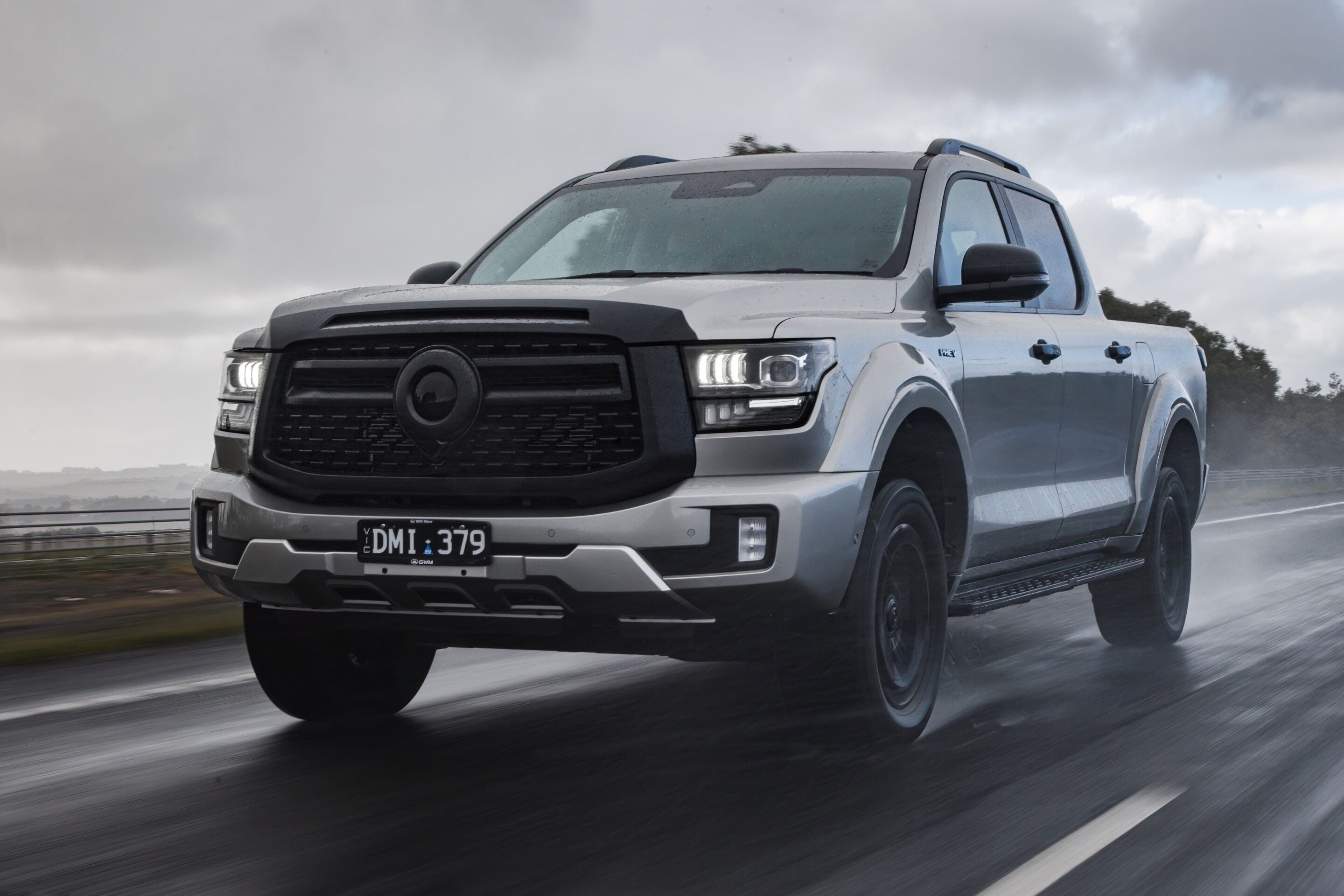
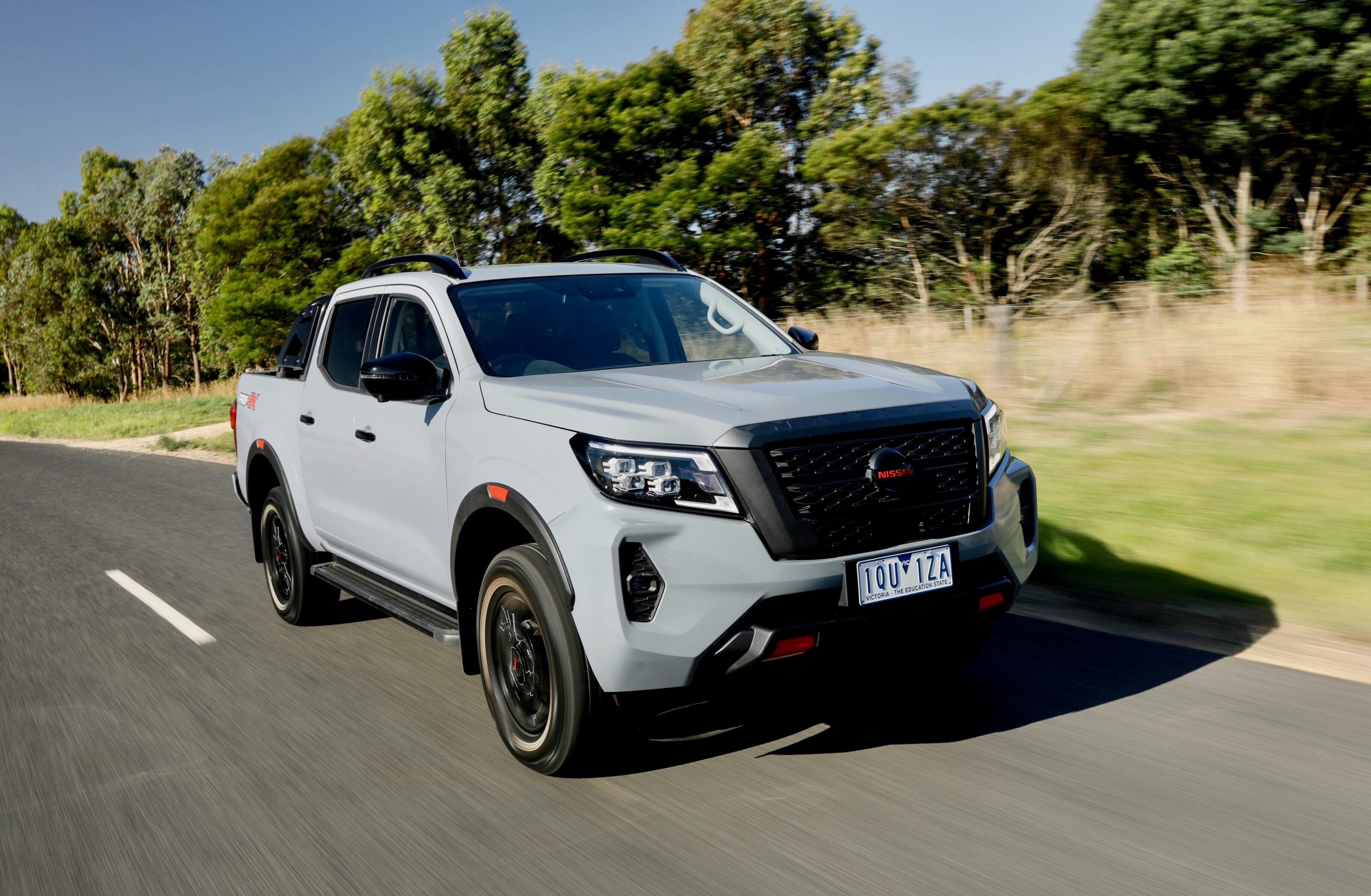
Nissan has confirmed that the next-generation Navara will make its global debut on November 19, 2025, marking the latest chapter in one of Australia’s most enduring ute success stories.
In the lead-up to the reveal, the company has released a short heritage film tracing the Navara’s 39-year journey across Australia and New Zealand. The video, part of Nissan’s “Defy Ordinary” campaign, celebrates the model’s evolution from a dependable workhorse to a refined, multi-purpose pickup for both work and family life.
The film revisits iconic Australian settings – construction sites, boat ramps, and outback trails – highlighting how the Navara has adapted to meet the demands of local customers since its Australian debut in December 1986. Over that time, Nissan has sold more than 420,000 Navaras across Australia and New Zealand.
“For nearly 40 years, Navara has been writing its story alongside Australia’s own evolution,” said Andrew Humberstone, Managing Director of Nissan Oceania. “Every generation has learned from the previous one, and every Australian customer has taught us something about what matters most in a ute.”
Nissan says the upcoming Navara’s design and engineering have been guided by insights gathered from decades of customer feedback. The new model will feature design elements inspired by past generations, while incorporating modern technology and advanced capability to meet the expectations of today’s drivers.
Although full details remain under wraps until the November reveal, Nissan has confirmed the vehicle’s development is firmly rooted in Australian and New Zealand testing and feedback, ensuring it maintains its reputation for toughness, reliability and versatility in local conditions.
The next-generation Navara will launch in Australia and New Zealand during the first half of 2026, coinciding with the start of the model’s fifth decade in local markets.
The heritage campaign and teaser film signal Nissan’s commitment to evolving the Navara in step with its loyal customer base – balancing rugged capability with contemporary refinement as the brand enters a new era.
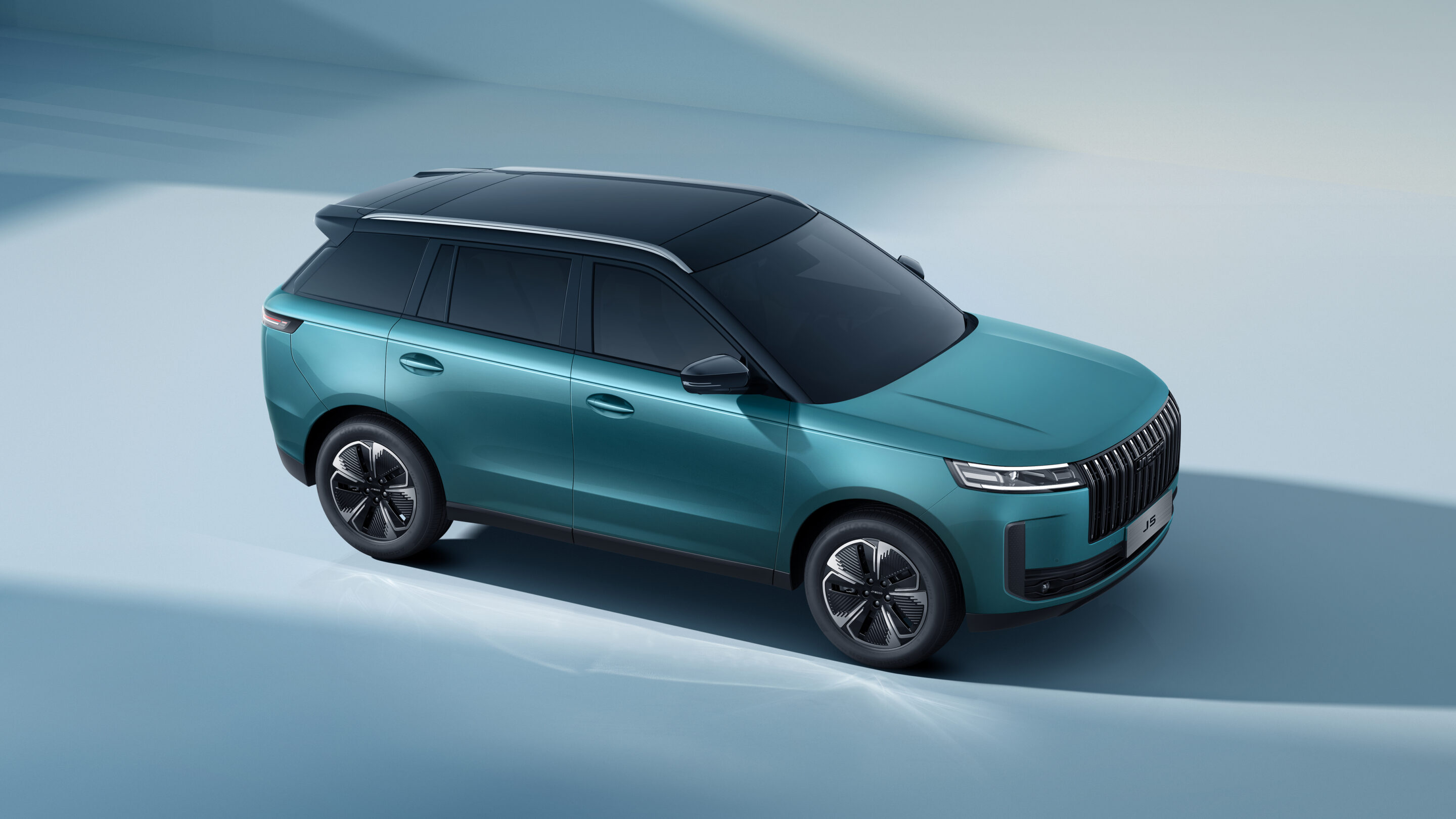
Jaecoo has confirmed that its latest addition to the SUV range, the Jaecoo J5, will launch in Australia in early 2026, expanding the brand’s presence in the compact SUV segment.
The J5 builds on the introduction of the larger J7, adopting the same rugged-yet-refined design philosophy while targeting drivers seeking a smaller, more urban-friendly vehicle. Three powertrain options will be available: a 1.5-litre turbo petrol engine (108 kW/210 Nm) paired with a CVT; a series-parallel hybrid system; and a fully electric version boasting a 402 km WLTP range.
Design-wise, the J5 continues Jaecoo’s signature aesthetic with strong vertical lines, wide shoulders, and the brand’s distinctive waterfall grille. The exterior draws inspiration from natural landscapes, blending rugged off-road cues with a streamlined, modern profile.
Inside, the J5 aims to maximise space and comfort, featuring a 2620mm wheelbase that accommodates five adults and a 480-litre boot expanding to 1284 litres with the rear seats folded. The cabin incorporates a 13.2-inch infotainment touchscreen, wireless Apple CarPlay and Android Auto, an 8.0-inch digital driver display, and a six-speaker audio system.
According to Roy Munoz, Chief Commercial Officer for Omoda Jaecoo, the J5 represents “a significant step forward for Jaecoo in Australia, offering more choice in new-energy powertrains and an accessible path to premium motoring”.
The J5 will be equipped with a comprehensive driver-assistance suite designed to reduce fatigue and enhance situational awareness. Advanced systems such as adaptive cruise control, autonomous emergency braking, lane-keeping assist and blind-spot monitoring are expected to feature across the range.
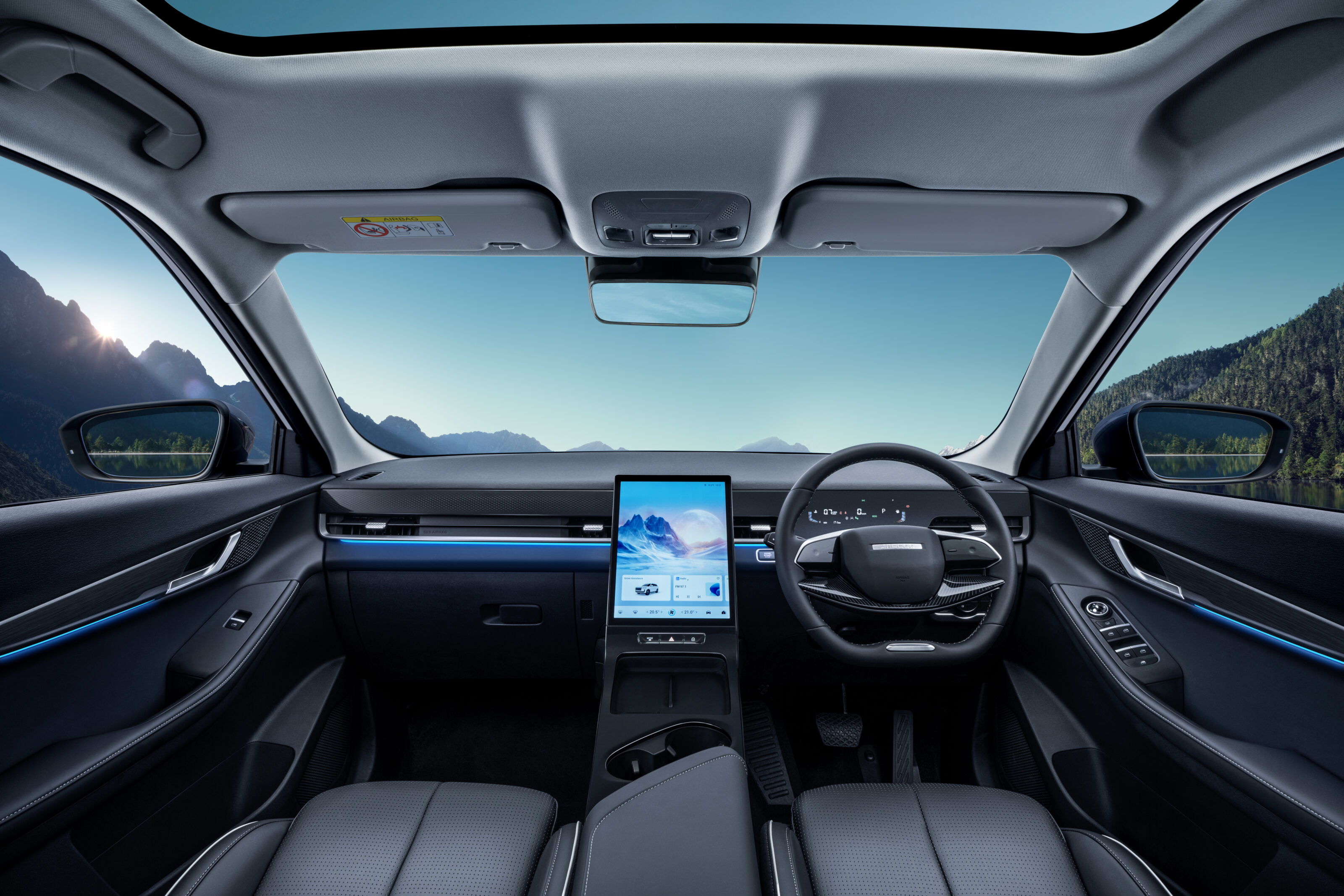
The J5’s hybrid and electric versions mark another step in Jaecoo’s electrification strategy, positioning the brand to compete in one of Australia’s fastest-growing SUV categories. The new vehicle’s combination of road-trip practicality with urban sophistication is designed to appeal to both city commuters and weekend travellers.
Full pricing and specification details will be announced closer to its February 2026 launch, with Jaecoo confirming that the model will be sold through its growing national dealer network.
Mazda is preparing to unveil a bold new concept car at the 2025 Japan Mobility Show, offering the clearest glimpse yet of the brand’s future design direction – and possibly its next high-end four-door model.
A teaser image released by Mazda reveals a low, elegant silhouette featuring a long bonnet, flowing roofline and fastback-style tail. The design appears to evolve from the current Mazda 3’s aesthetic, but with a grander, more dramatic stance that points toward a rear-wheel-drive luxury saloon or four-door coupe rather than a traditional hatchback.
While enthusiasts have speculated about a return of the RX-7 sports car, this new vehicle is expected to sit higher in Mazda’s lineup, potentially becoming a flagship model above the CX-60 and CX-80 SUVs.
Both SUVs share Mazda’s rear-wheel-drive-based platform, which was originally engineered to support a sedan inspired by the 2017 Vision Coupe Concept. That plan was shelved several years ago as the brand prioritised its global SUV range, but strong international demand – particularly in Australia and North America – is reportedly reviving internal discussions about a luxury four-door return.
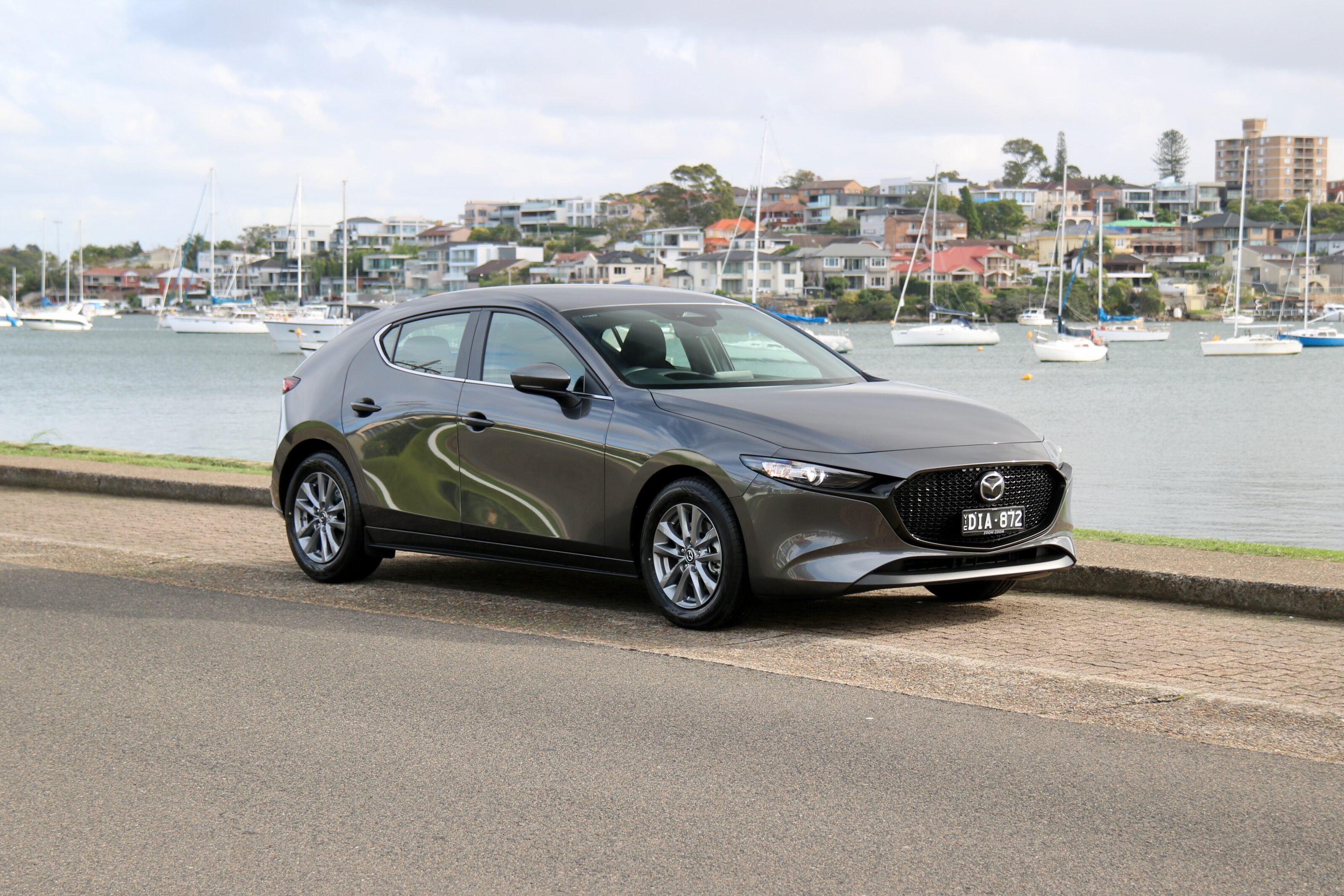
The concept also aligns with Mazda’s push into premium territory, leveraging its new inline six-cylinder petrol and diesel engines and plug-in hybrid systems. Given Mazda’s growing focus on electrified drivetrains, the upcoming concept is expected to feature either hybrid or plug-in hybrid power, rather than a fully electric setup.
In addition to the concept, Mazda will showcase updates to its carbon-neutral e-fuel program, part of the company’s broader strategy to reduce emissions across its range while maintaining the distinctive driving experience that defines the brand.
More details about the concept’s design, interior and powertrain will be revealed when the Japan Mobility Show opens its doors on October 30 in Tokyo.
With both Australia and the United States being key export markets for Mazda’s premium vehicles, it’s likely this new model – if approved for production – will be developed in right-hand drive for local buyers, marking Mazda’s strongest signal yet of its ambition to compete directly with European luxury marques.
There are quite a few firsts with the new Porsche 911 GT3. Essentially the mid-life update of the 992 generation of the 911, known to marque devotees as the 992.2, the changes to this car look subtle but it’s a vehicle that breaks some new ground, for a GT3 at least. We’ll get to that in a bit, because there’s a big one that you probably weren’t expecting.
The backstory here is that noise and emissions regulations are doing their best to kill cars like the GT3. It’s powered by a naturally-aspirated 4.0-litre flat-six, which makes the same 375kW as its predecessor, while peak torque has fallen by 20Nm to 450Nm. At first glance, this would seem a bit of a capitulation on Porsche’s part, but that’s far from the case.
The base engine in effect develops significantly more power than the old unit, but it then has to exhale through an exhaust with four catalytic converters and two particulate filters. It’s like trying to run a 400m while wearing an N95 mask. In order to win back the losses caused by all of that strangulation, Porsche has had to really go to town on the marginal gains.
To that end, the 992.2 GT3 gets camshafts from the prior GT3 RS, which feature a longer duration, flow-optimised throttle valves to improve cylinder filling. This claws back 3kW alone, but more efficient cooling and a host of other small detail changes keep the engine and the spirit of the GT3 alive. To compensate for that torque shortfall, this version of the GT3 now has an eight per cent shorter final drive in both manual and PDK configurations. Slightly long gearing was perhaps the outgoing car’s most significant issue, if you can call it that.
Now, granted, none of these changes are particularly earth-shattering, but they do matter to GT3 buyers, who obsess over the smallest details. They’ll already know that this is the first GT3 that you can buy with a Weissach Package, formerly reserved for the RS models. They’ll also know that the de-winged Touring version of the GT3 also offers rear seats, too. So with this GT3, you can buy a very toned-down four seater with a manual gearbox or a two-seat, paddle-shift track rat with all the stripes and wings. It’s up to you.
With virtually every other 911 GT3, from the 996 in 1999, we’ve wondered how Porsche could improve on what seemed almost like perfection at the time. Each time we’ve been shown that there was quite a lot of headroom in the formula. Of course, given the time frames in which cars are developed, Porsche is already at work on the next model. As ex-Porsche senior engineer Jost Capito once said, he never wanted to buy a car that he’d developed, because by the time it was launched it was an old car and he knew that something better was on the way.
That point stands, and it’s why, this time round, the GT3’s place in the world feels different. For the very first time, Porsche has another model in its range that points to a bright future beyond the GT3’s natural aspiration template. The 911 GTS, with its electric turbo and hybrid drive system has strings to its bow that the GT3 can’t possibly match. What’s more, to get into a GT3 after you’ve driven a GTS highlights quite where the next GT3 could be improved. And not slightly. By huge leaps and bounds. Purists may yelp at that, but if anyone can marry the clever electrics of the GTS with the emotion required of a GT3, you’d bet on the white coats at Weissach.
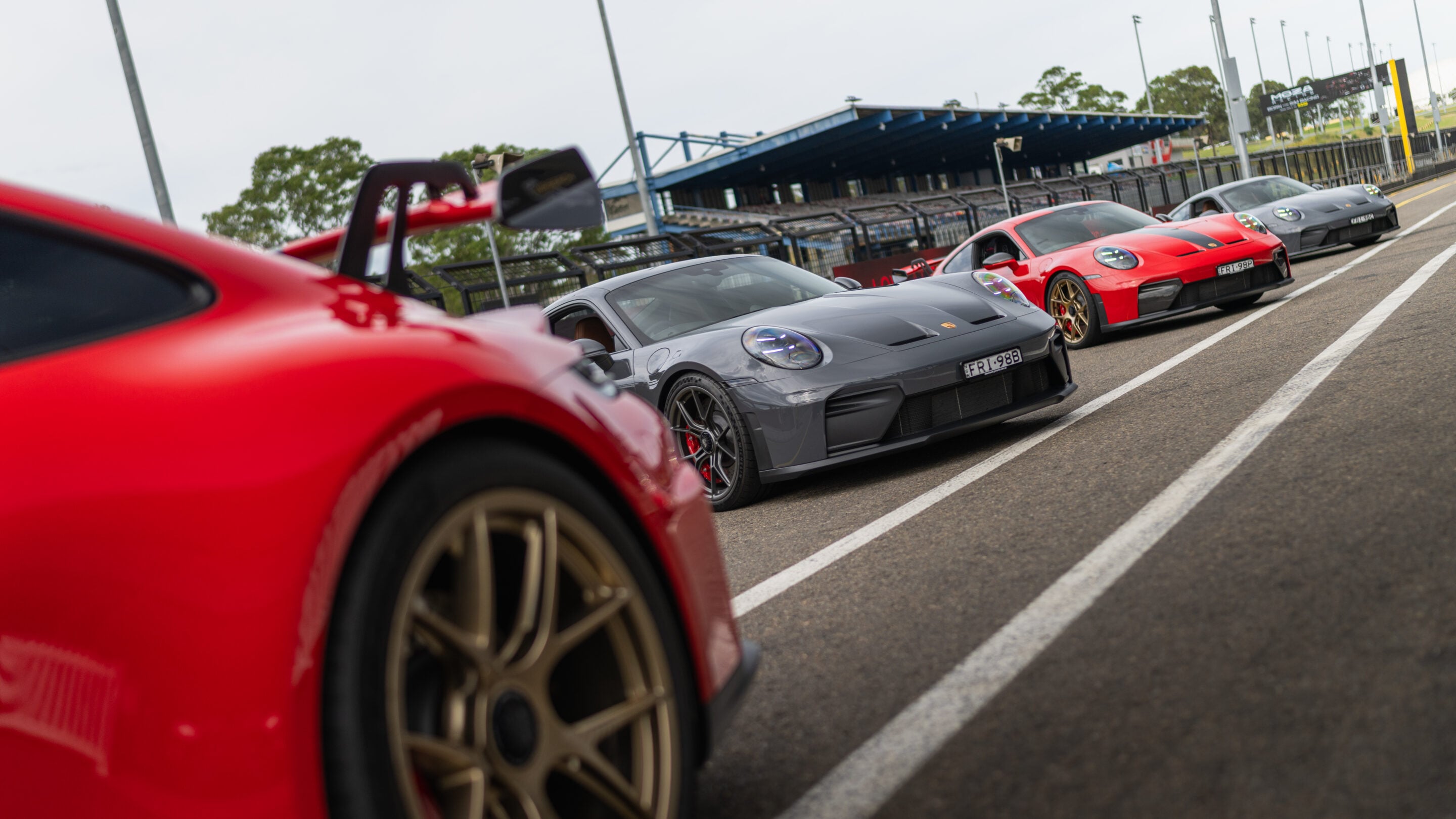
We’re at Sydney Motorsport Park to try the 992.2 GT3, so this is purely a track test of the new car. It seems appropriate, given that there’s no GT3 RS version of the 992 available at the moment, so this is as focused a track 911 as Porsche currently makes. We also get to drive the standard GT3 and the Touring, in both manual and PDK guises.
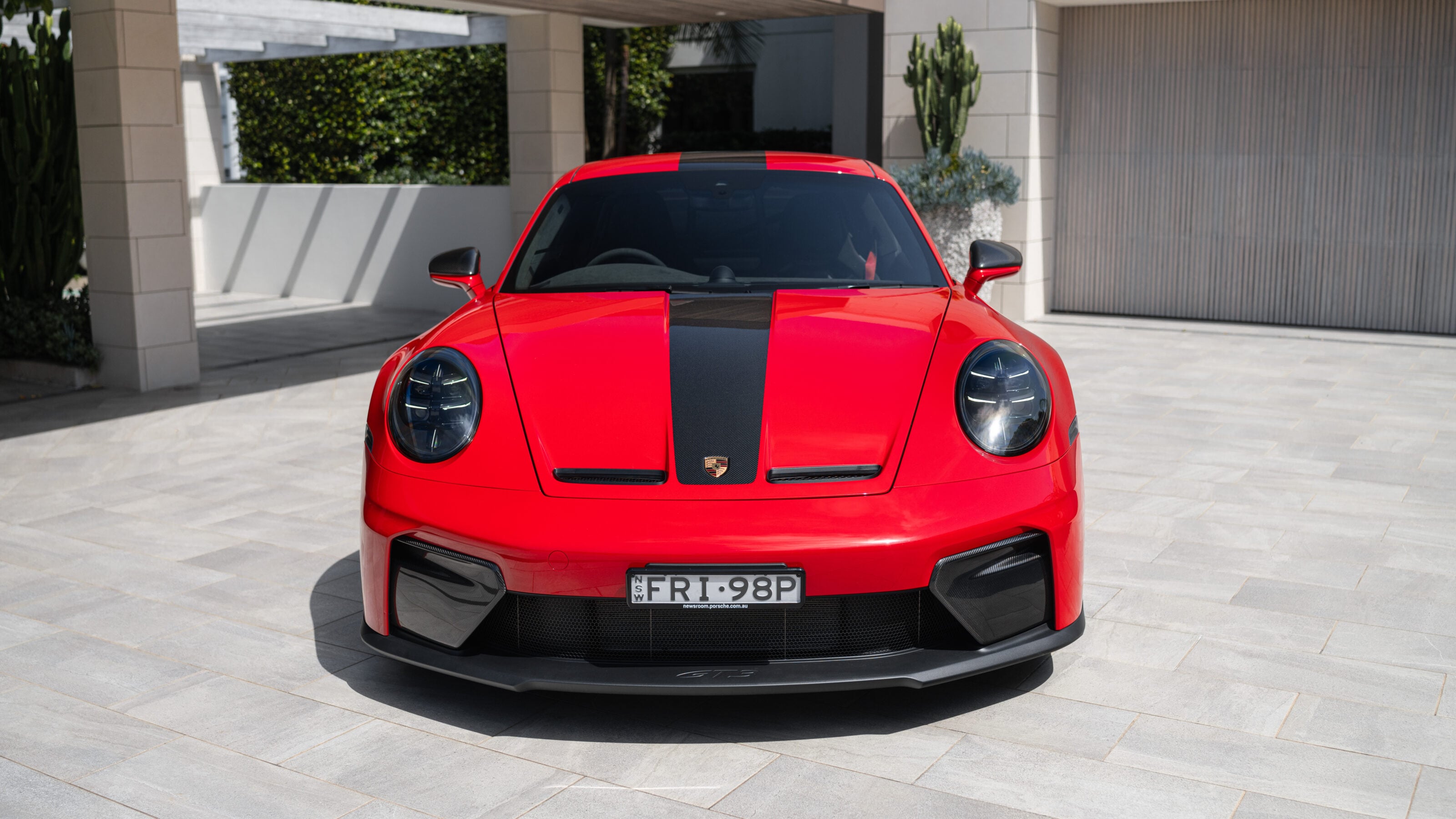
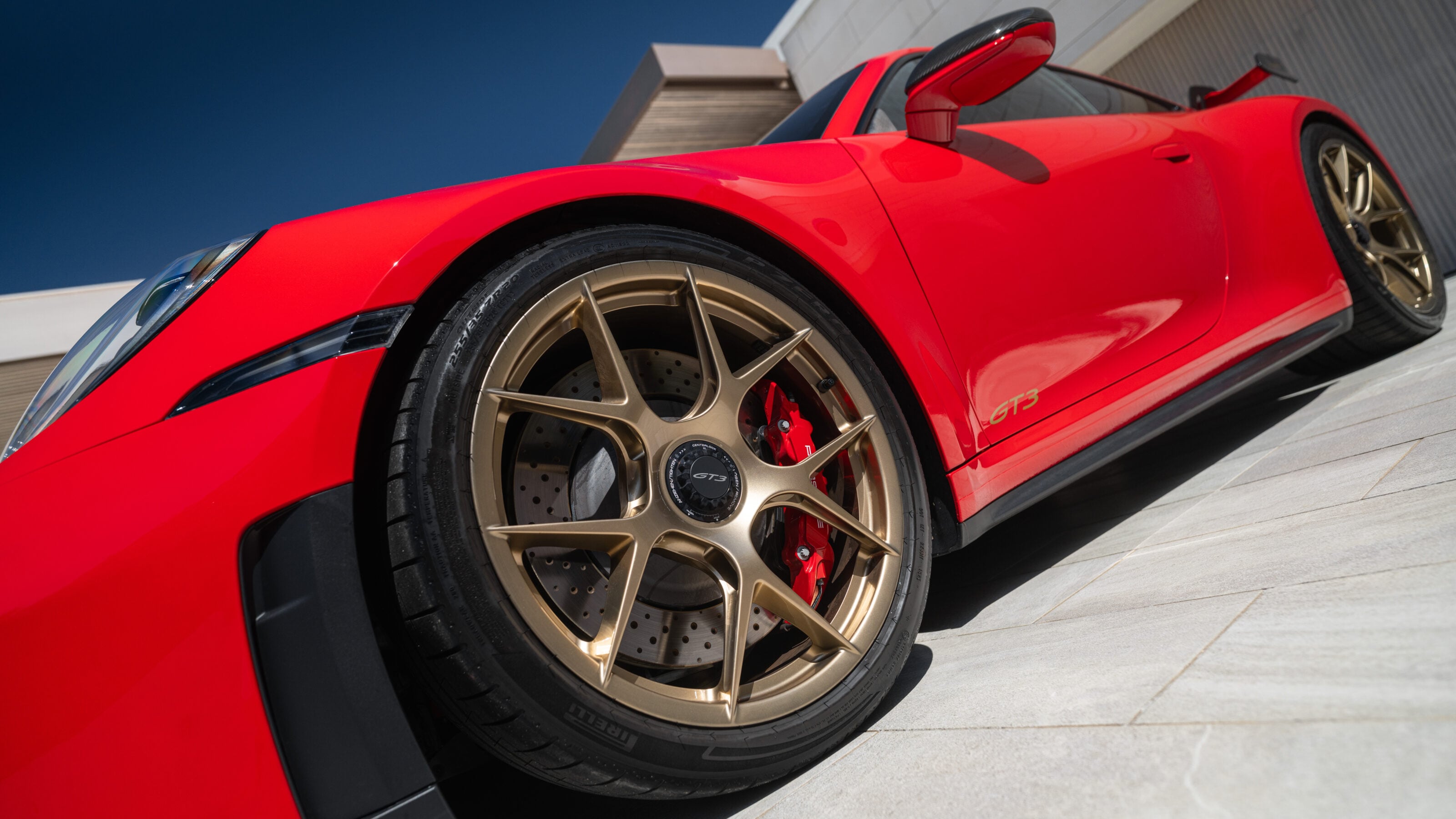
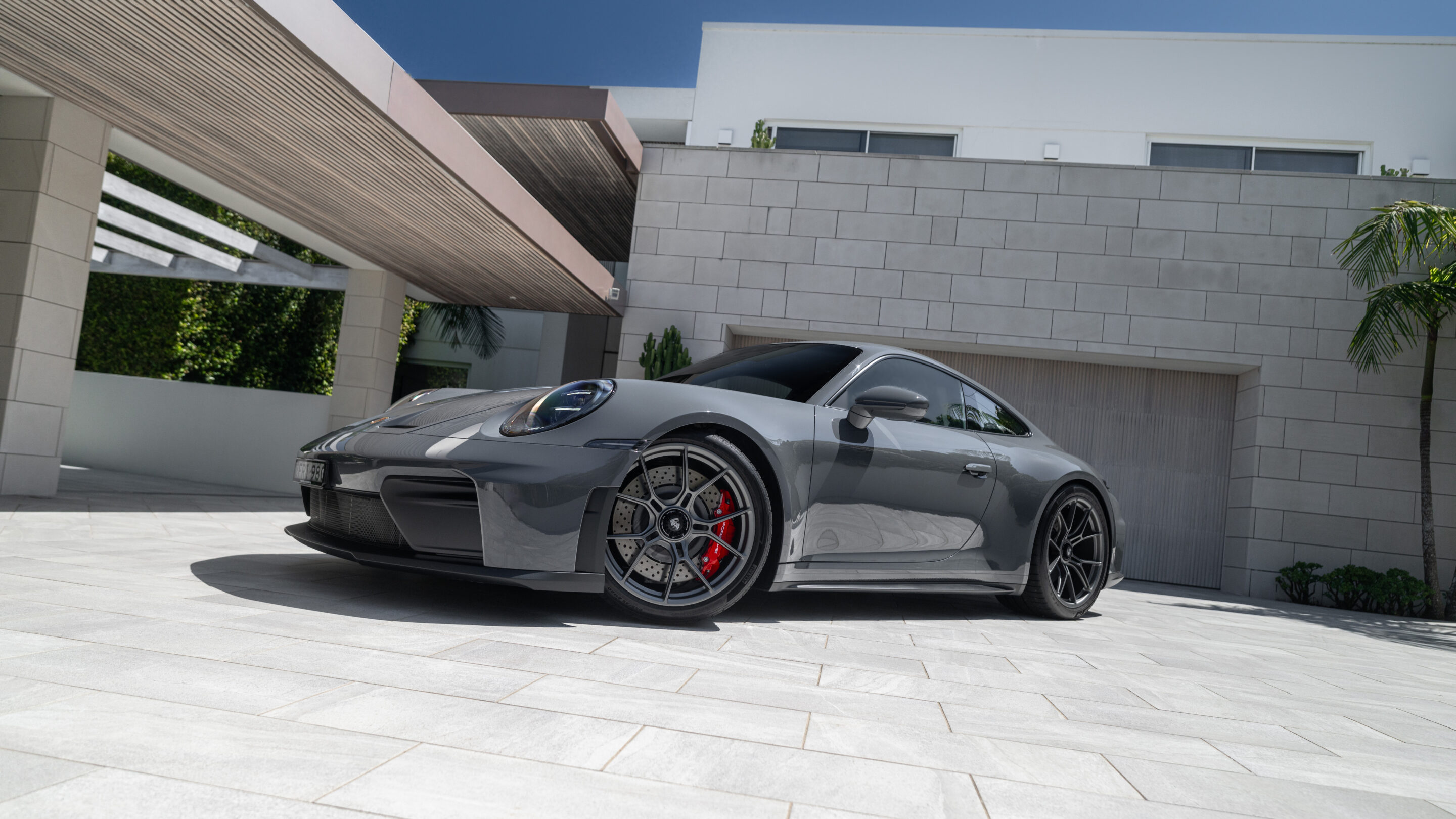
Rather helpfully Porsche have accentuated the difference between the two cars by opting for Guards Red painted GT3s, finished with Weissach Package and gold magnesium alloys. They look incredible, completely at home in the pit lane. By contrast, the Tourings are in blink-and-you’ll-miss-it Slate Grey Neo with an appropriately refined Black and Cohiba Brown two-tone cabin. Debadge one and swap the bonnet panel for one without the twin nostril intakes and many would be hard-pressed to identify it as a GT3.
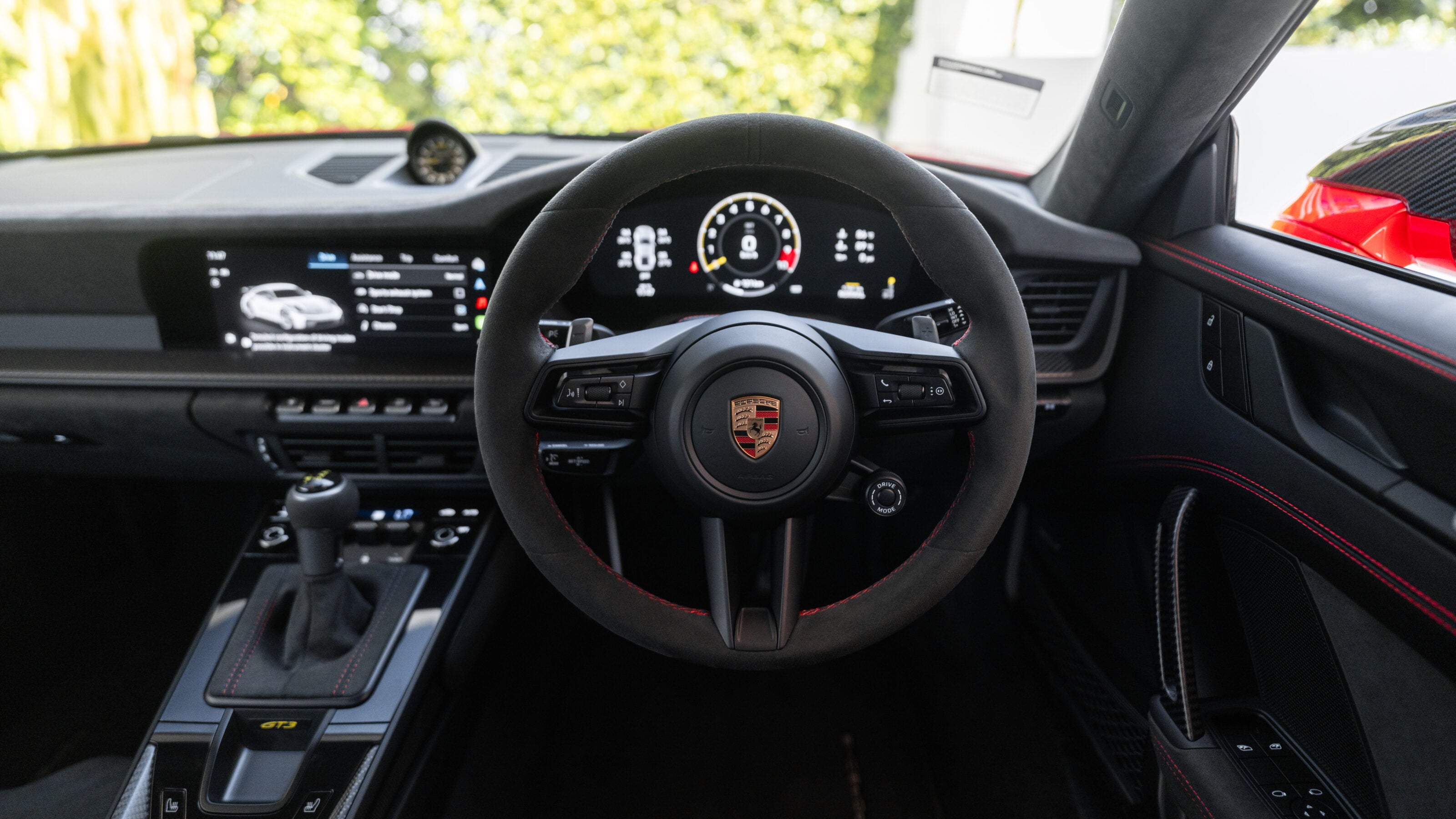
Porsche has worked at giving the GT3 a modest visual refresh and the Touring model is the biggest beneficiary. Gone is the ungainly jutting underbite of the earlier 992 Touring, replaced with a more cohesive and integrated front end. In both variants, the re-contoured front diffuser, the shape of the spoiler lip and modified fins on the underbody serve to increase downforce. The matrix LED headlights can be specified with an optional white accent ring, and now integrate all the lighting functions, without the need to stud the lower apron with any lighting elements. Move round to the back and the air inlets, diffuser and the rear lid have been tidied up. The rear wing of the GT3 now features angled rather than vertical end plates.
Peer beneath the car at the front and you’ll spot new teardrop-shaped trailing arms on the front wishbones, which help brake cooling and, by reducing drag in the front wheel arch, help speed the air through, reducing pressure and increasing downforce. The suspension geometry has changed to introduce more anti-dive up front, borrowing that from the GT3 RS. The dampers have also been modified, with more travel before hitting the smaller bump stops, something that GT3 owners had signalled was an issue when running the car across kerbs on race circuits.
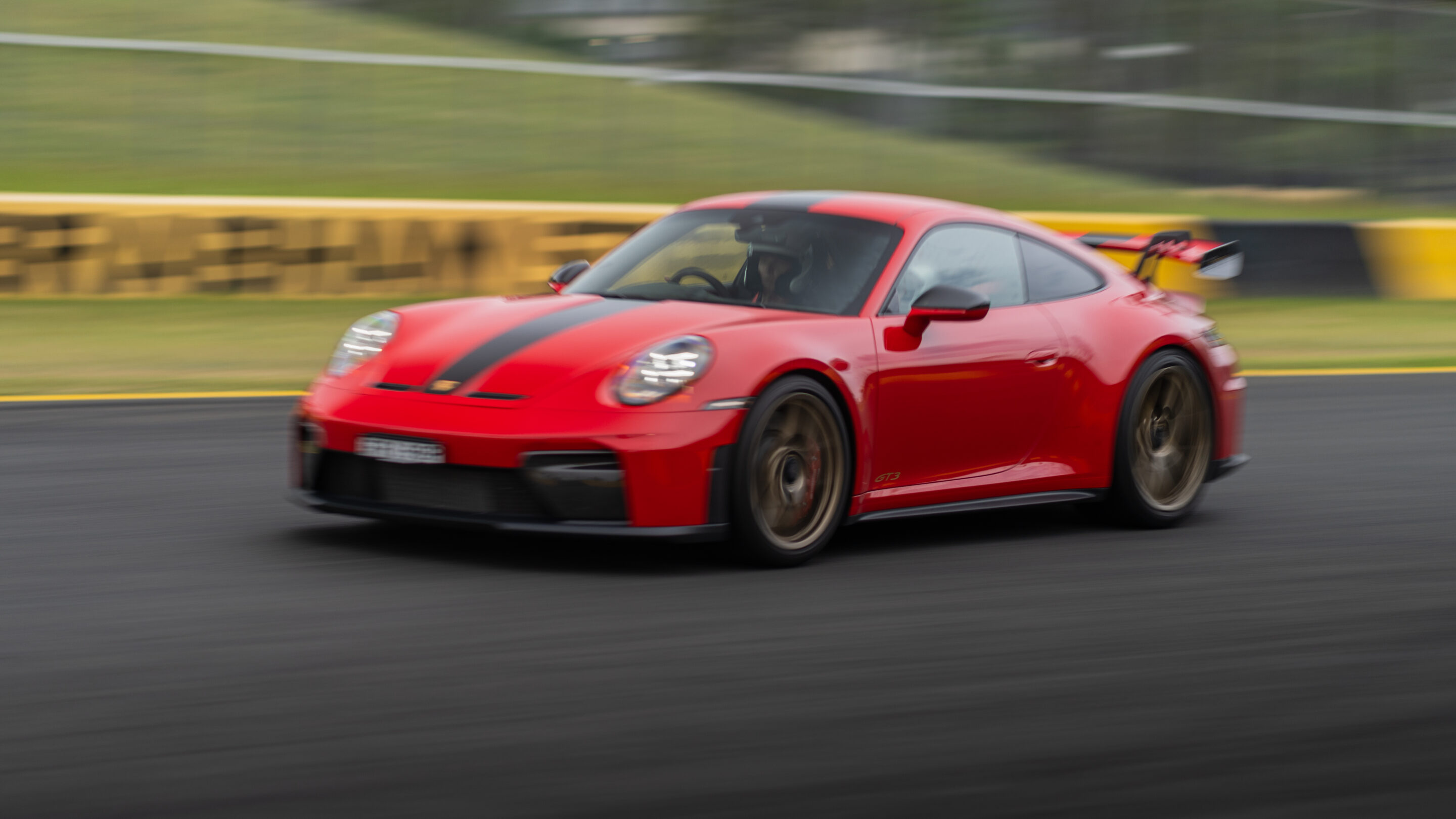
The GT3’s new Weissach Package costs $46,371. Alternatively there’s the full Lightweight package for $71,120 which bundles in the roof painted in the exterior colour as well as the stabiliser, coupling rods and shear panel on the rear axle made from carbon fibre. Magnesium forged wheels and lightweight door panels are also part of the package. In conjunction with the standard 6-speed GT sports gearbox, the shortened gear lever from the 911 S/T is used. In front of the gear lever, a plaque with the inscription Leichtbau is a tasty bit of one-upmanship.
Should your budget be a little less expansive, a Club Sport package for track use is available for the GT3 at no extra cost. This includes track day fare like a bolted steel roll cage in the rear, a six-point harness for the driver and a hand-held fire extinguisher. You will already need to have specified the lightweight sports bucket seats ($13,120) on the configurator as a prerequisite for the Club Sport pack, as the racy belts won’t work with the normal sports seats.
Unlike the rest of the 911 range, which adopts push button start, you still twist a knurled ‘key’ on the GT3’s dash to fire up the 4.0-litre six. It settles to a high but smooth idle. We’re in the manual Touring first, which gives us a chance to exercise the six-speed manual gearbox. It’s a lovely setup, although the shorter final drive means you’ll have to grab at gears a little quicker than you remember. That’s no great hardship, the shift feel is excellent and the pedals are perfectly set up for heel and toe. Alternatively, switching into Sport mode can enact auto-blipping on downchanges, so you get to compare your footwork against that of the robot. The gear lever is 10mm shorter than in the old GT3, adopting the measurements of that in the limited-run S/T.
Up front, Bathurst 1000 winner Luke Youlden is in a 911 GTS. He’s obviously dawdling so that we can keep up, but nevertheless, it’s clear that when accelerating out of the slower corners at SMP, the GT3 just can’t match the electrically-assisted GTS. The Carrera takes tens of metres out of the GT3 here, which we attempt to claw back under brakes and by taking advantage of the GT3’s bigger tyre footprint. Despite the humbling pace of the car up front, the Touring is doing a good job of making us feel reasonably heroic. The dampers certainly seem to be doing a decent job when monstering some of the kerbs, and the brakes – iron discs on all cars – are typically great, with the improved cooling helping to reduce fade on the bigger stops at SMP.
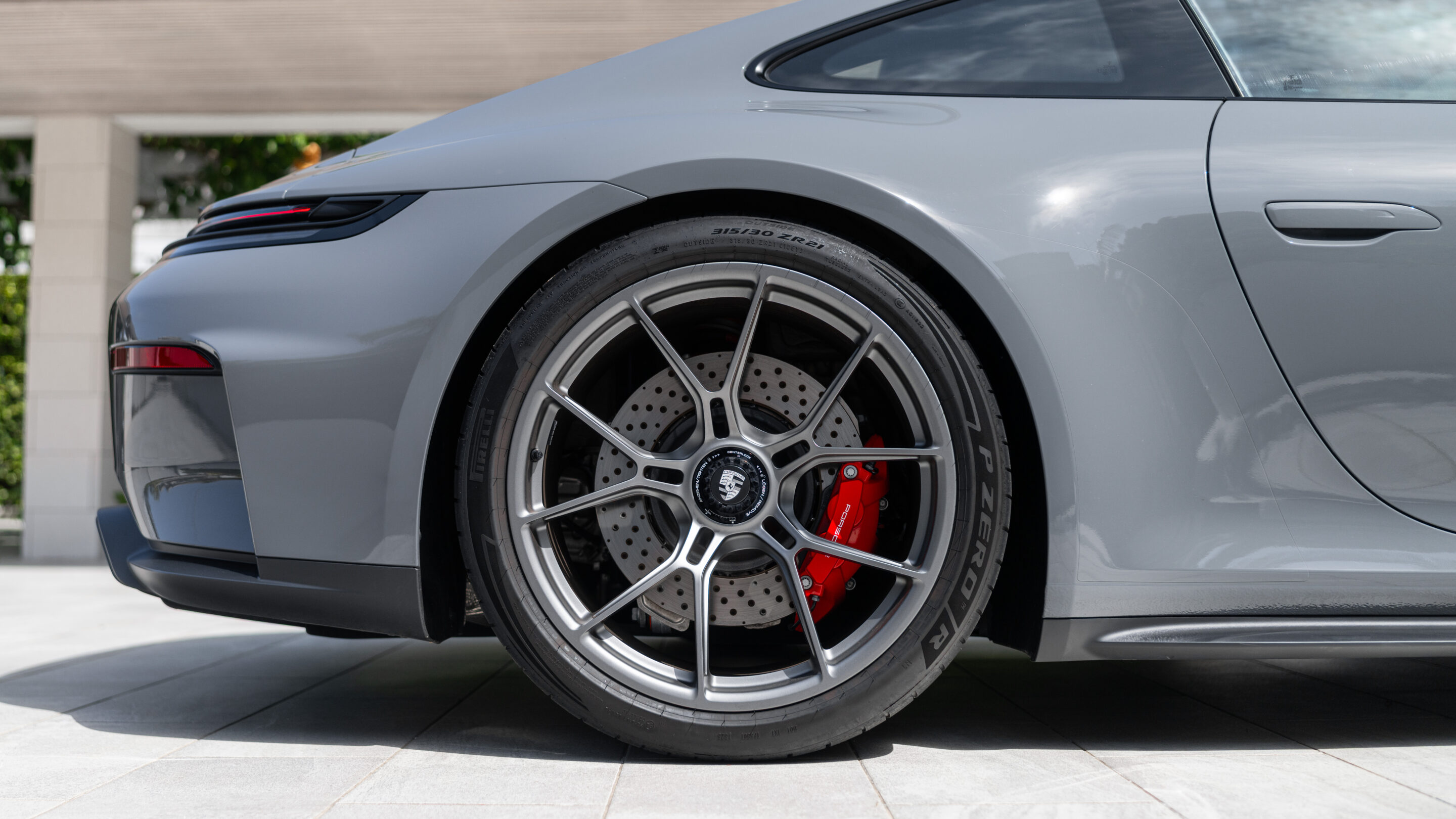
After a few laps, we get to switch into the be-winged GT3 with the Weissach package and seven-speed PDK shift. It instantly feels a good deal more serious, bucket seats hugging your hips and a carbon cage blocking much of the rear-view. Both cars run the same suspension settings and wear the same staggered Pirelli P Zero R rubber: 255/35 ZR20 up front and 315/30 ZR 21 at the rear.
Come barrelling into the near-90-degree right of Turn Four and you can feel where the new GT3 is now more composed. Having exited Turn Three and accelerated cleanly through and over a crest, you’re then into a dip as you attack Four. Under brakes, the nose of the car stays really composed, with the result that the rear of the car feels more stable as you turn in. Even if you get off the brakes a little eagerly to pick up the throttle, the front end won’t wash wide like an old GT3. The car feels flatter, faster, more composed and, as a result, more forgiving.
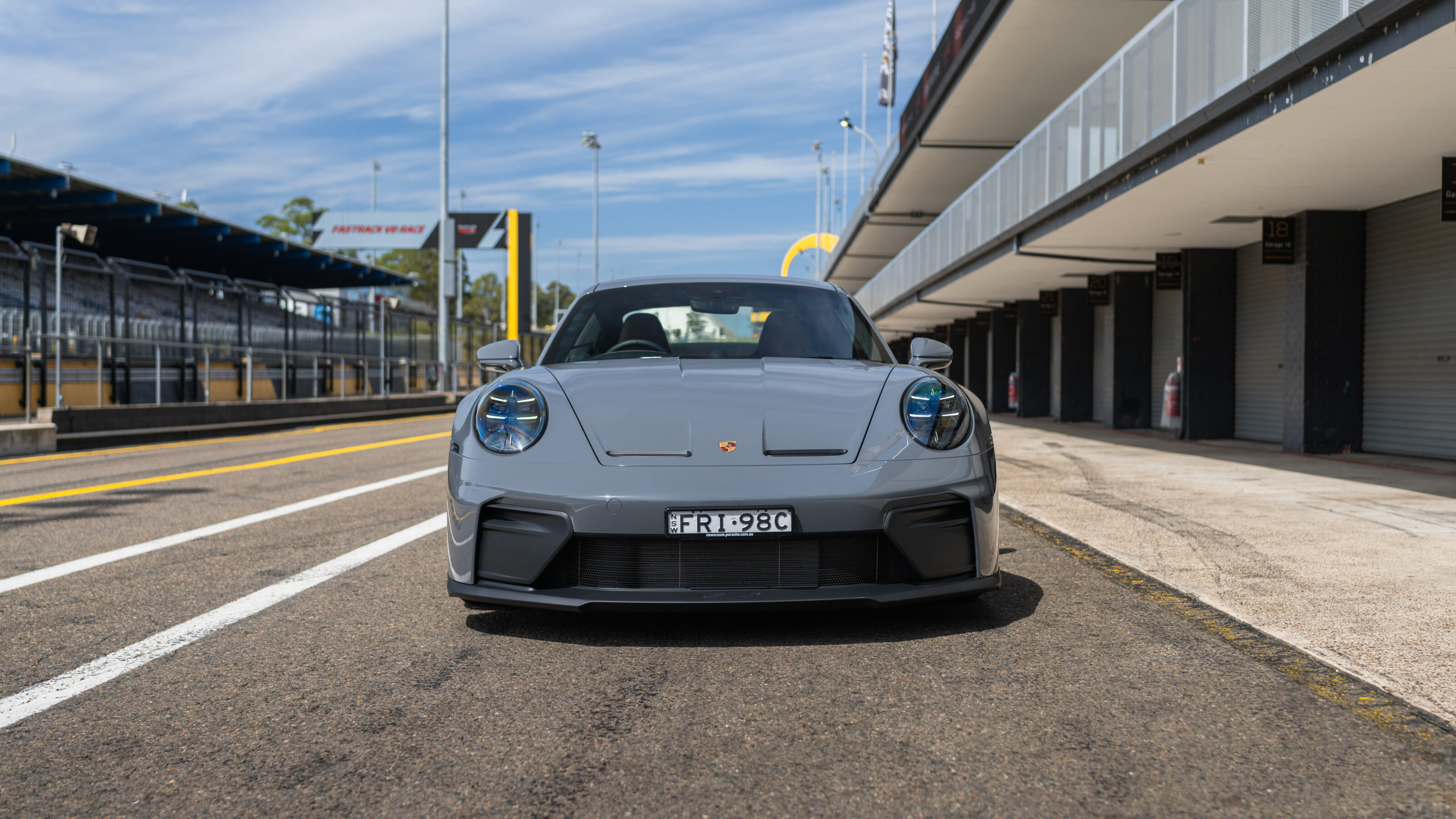
The GT3 feels absolutely imperious through the high-speed sweeper of Turn Seven, and then it’s hard on the brakes and down through the gears for the hairpin of Eight. It’s out of here onto a quasi-straight that you really miss the torque-fill of that GTS, which is making its full quota of 610Nm at 3000rpm, where the GT3 will be developing around a third of that figure. I’m not advocating turning a GT3 into a low-rev lugger, but technology is showing us how the next car’s performance envelope could be significantly enlarged.
The new digital dash is a neat installation, although die-hards will probably miss the analogue clocks. I love the clarity of the new dial pack, and you can even rotate the rev counter so that the 9000rpm redline is located vertically, like something from the Mille Miglia. It’s a lovely touch. Another piece of thoughtfulness is the fact that the headrest pad is removable. This means that if you’re wearing a helmet, and especially if you’re teaming it with a HANS device, your head isn’t cranked forward by the padding and you can drive in a more natural position on track.
All too quickly we’re directed back to the pit garage. The 992.2 GT3 offers a little more utility and pace without dumbing down the format. Porsche has had to work its socks off just to make tiny improvements over the outgoing model, and that cost and effort doesn’t seem particularly sustainable. It’s a joyous experience, watching that needle rocketing to the redline, knowing that in order to get this car to within 2kg of the last one, a whole heap of internal sound deadening was binned. You still get the same goose bumps and you’ll laugh out loud the first time you soar through those upper registers. It hasn’t lost anything in the way of specialness.
What it might well have lost is the war against progress. Porsche’s drivetrain engineers have developed a new tomorrow, and the GT3 feels a little like the best version of yesterday as a result. Marry the best of both for the next 911 GT3 and we’ll have something very special indeed. Here’s to progress.
Mercedes-Benz has unveiled its most ambitious design statement yet – the Vision Iconic, a sculptural electric show car that bridges more than a century of heritage with a bold technological future.
Described by Mercedes as “a sculpture in motion,” the Vision Iconic embodies both opulence and innovation. It reinterprets one of the brand’s most recognisable hallmarks – the Mercedes-Benz radiator grille – into a modern, illuminated “digital status front.”
Inspired by classic models such as the W108, W111 and 600 Pullman, the new iconic grille combines a chrome frame, smoked-glass lattice and integrated contour lighting, with a glowing three-pointed star crowning the bonnet.
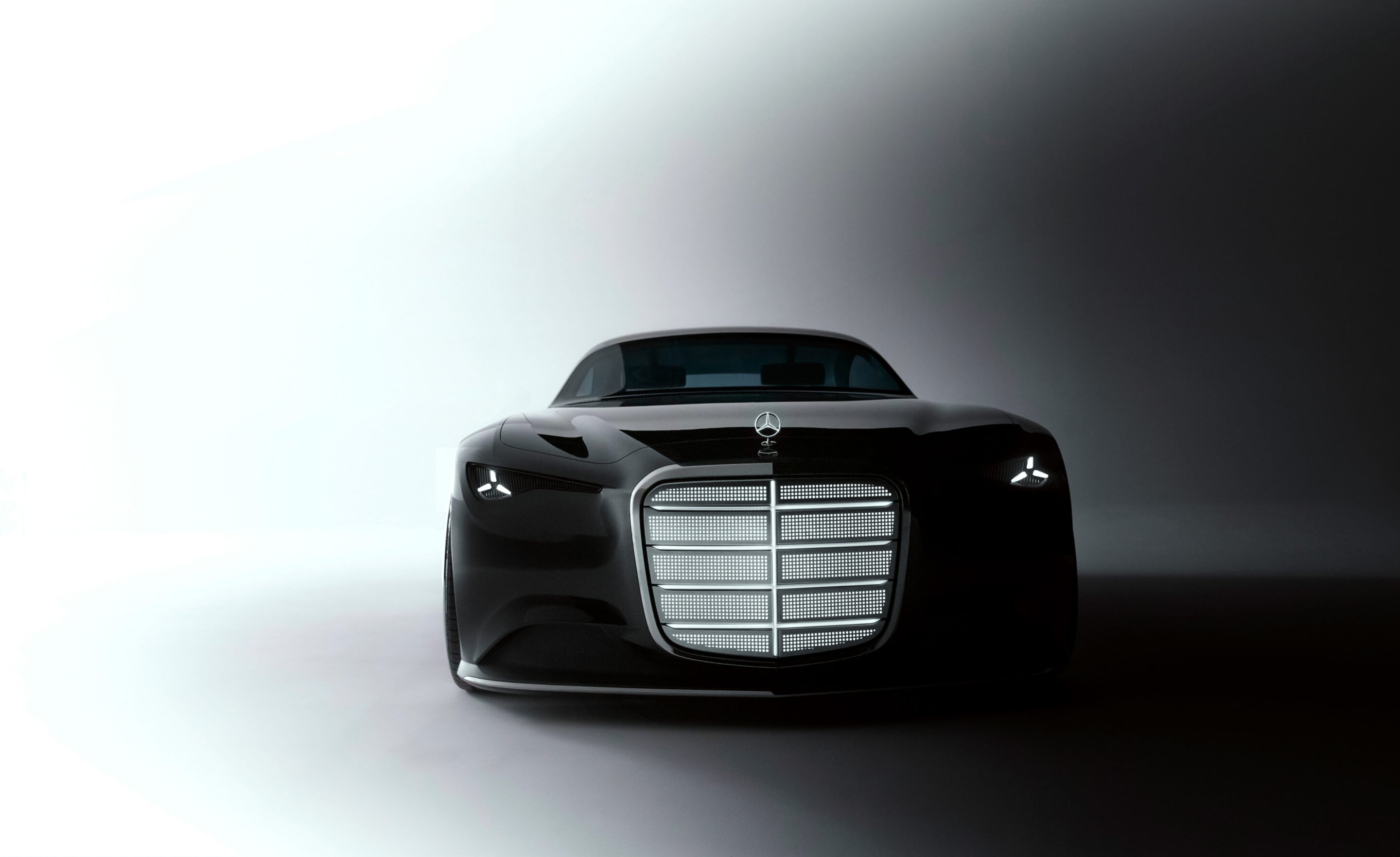
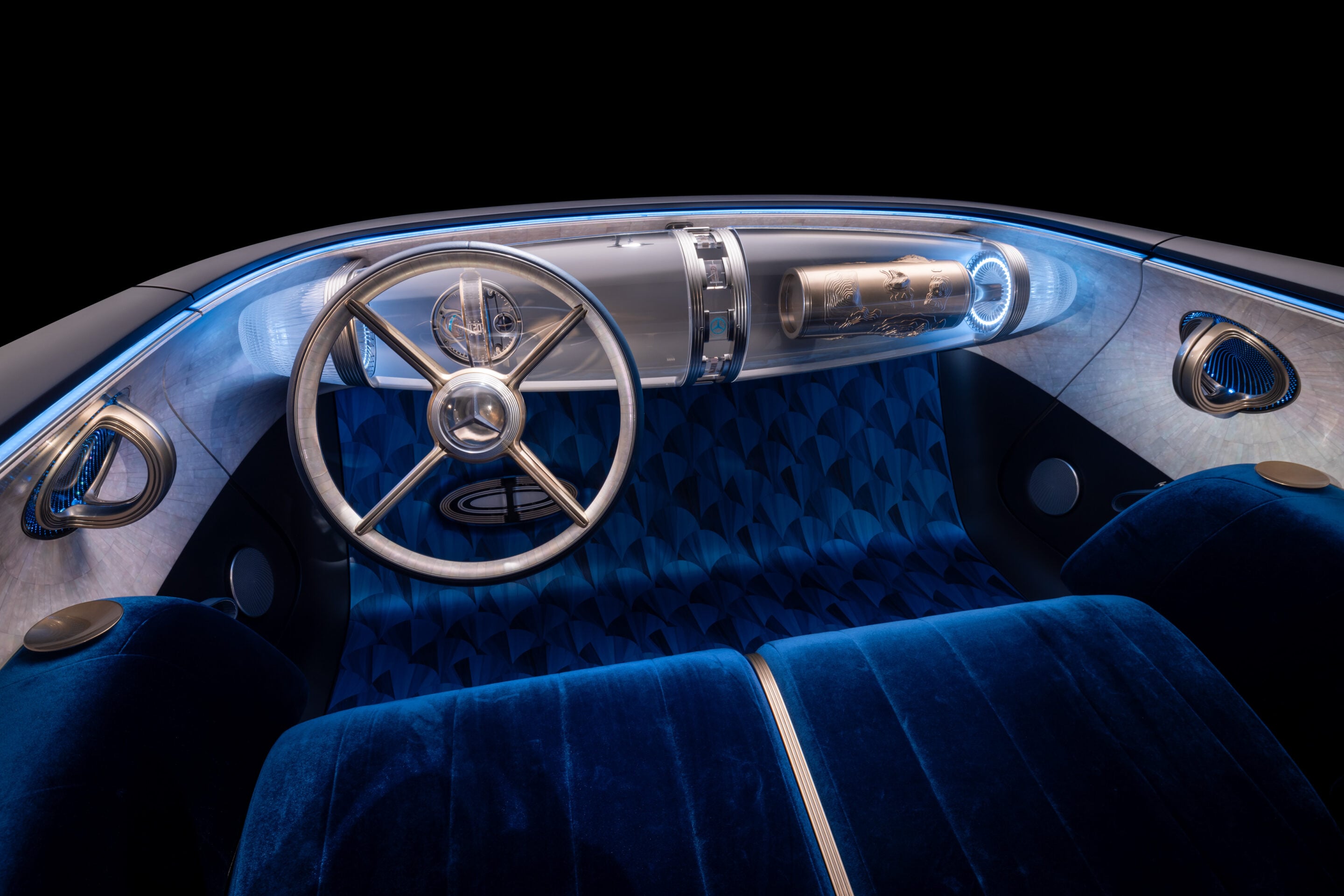
According to Chief Design Officer Gorden Wagener, the Vision Iconic channels the “pure essence of Mercedes-Benz,” with sweeping Art Deco lines, a flowing silhouette, and craftsmanship reminiscent of the marque’s golden age. Inside, the car transforms into a lounge-like sanctuary, merging hyper-analogue artistry with digital luxury.
The centrepiece is a floating glass structure known as the “Zeppelin,” complemented by mother-of-pearl marquetry, brass accents, and deep blue velvet seating. The cabin evokes an atmosphere of timeless refinement, with the Mercedes-Benz logo suspended in glass within a four-spoke steering wheel.
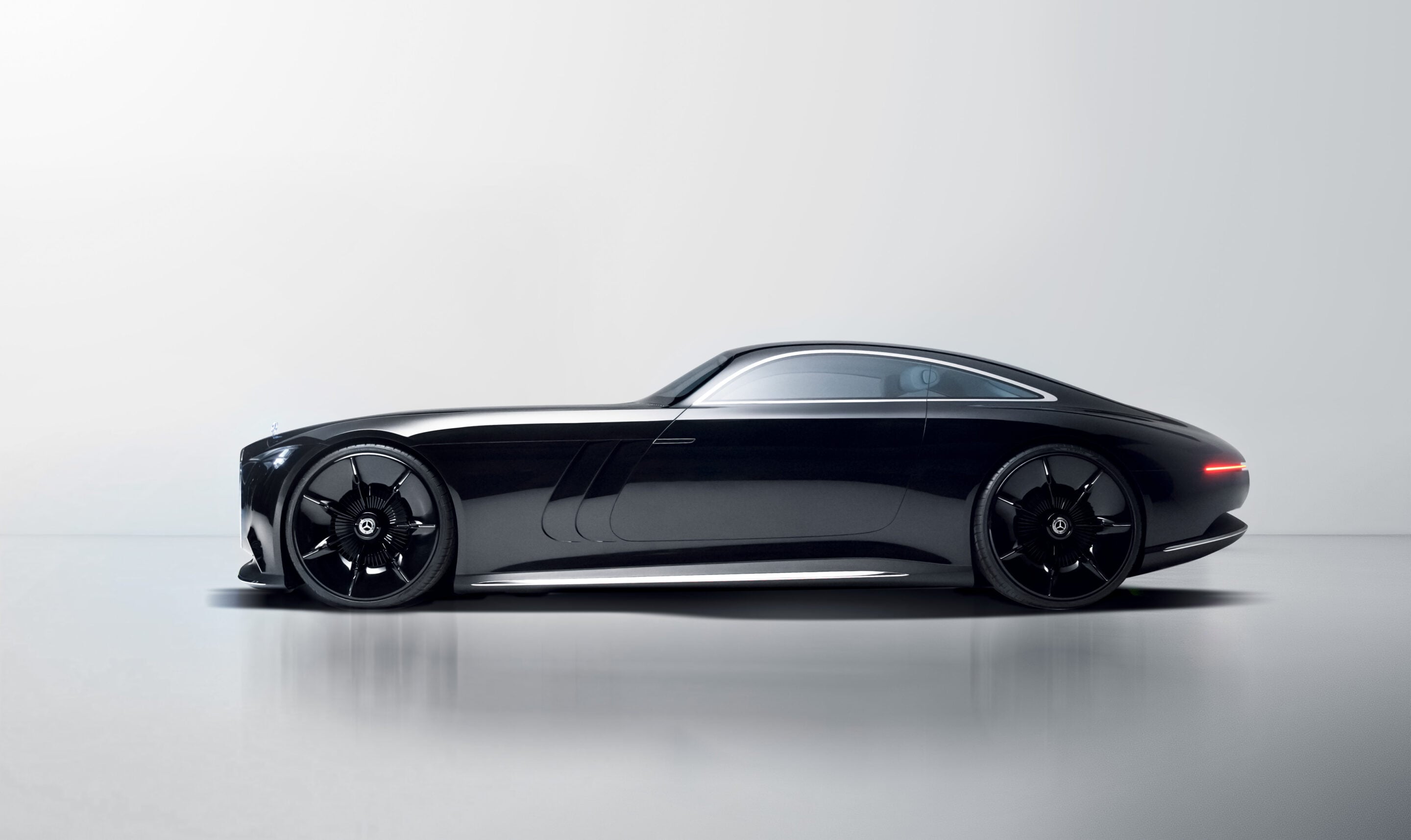
Technologically, the Vision Iconic serves as a showcase for next-generation systems. It introduces neuromorphic computing, mimicking the human brain to boost processing speed and reduce energy consumption in autonomous driving by up to 90 per cent. The concept also supports Level 4 highly automated driving, allowing occupants to relax or stream media while the vehicle handles traffic and parking independently.
A pioneering solar paint adds to its innovation, capturing sunlight to generate energy and potentially extending driving range by up to 12,000 kilometres per year under ideal conditions. Complementing this is steer-by-wire technology for enhanced agility and interior flexibility.
To celebrate the concept’s debut, Mercedes-Benz also revealed a capsule fashion collection, reflecting the Vision Iconic’s blue and silver-gold tones with 1930s-inspired detailing – in keeping with the brand’s fusion of style, art and advanced mobility.
