Best Large SUVs

Gallery 1
Contenders
- Kia EV9
- Volvo XC90
- Hyundai Palisade
- Mazda CX-90
- Toyota Landcruiser Prado
- Hyundai Santa Fe
- Chery Tiggo 8
- MG QS
- Kia Sorento
- Toyota Kluger
- Land Rover Discovery
- KGM Rexton
- GMC Yukon
- Nissan Patrol
- Audi Q7
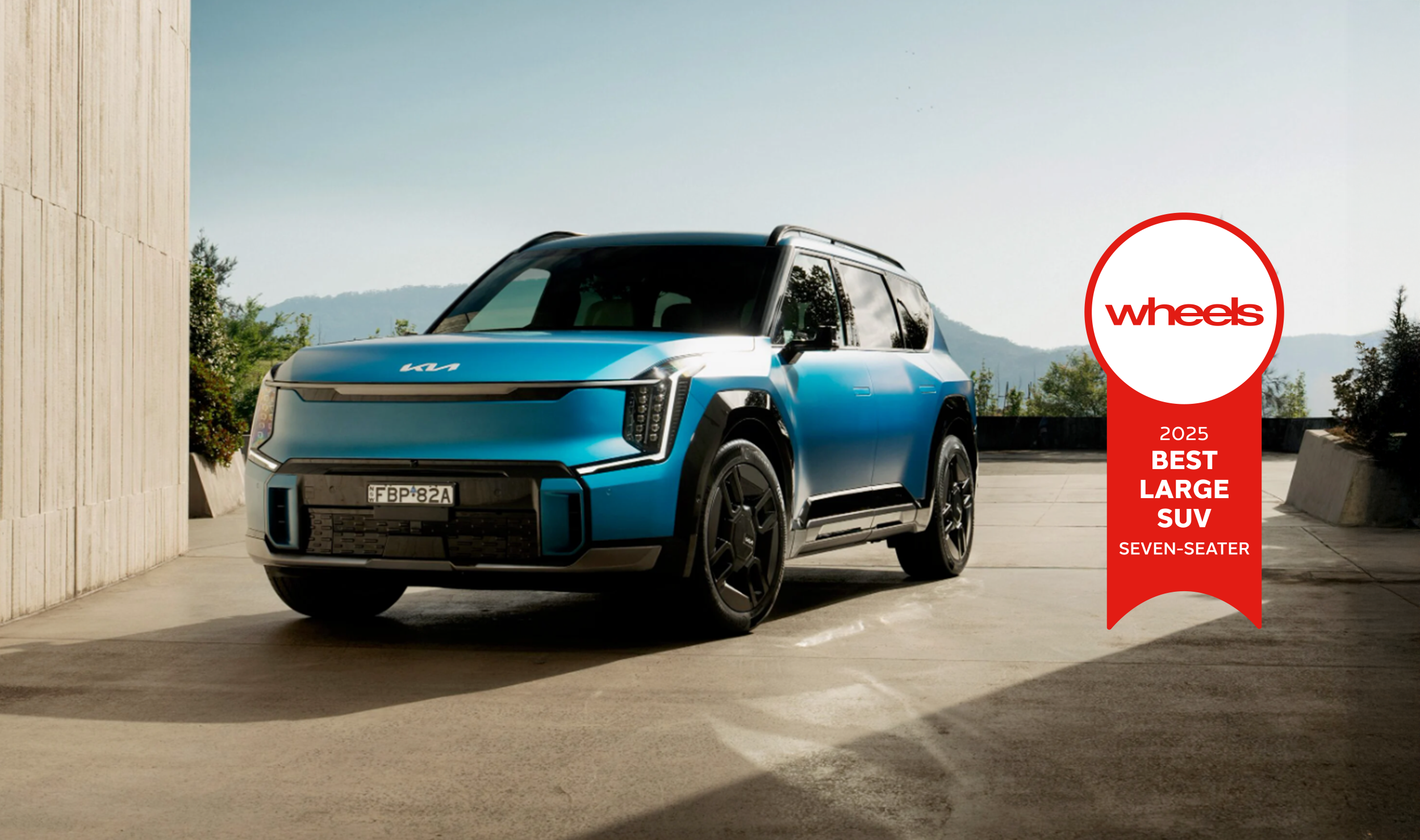
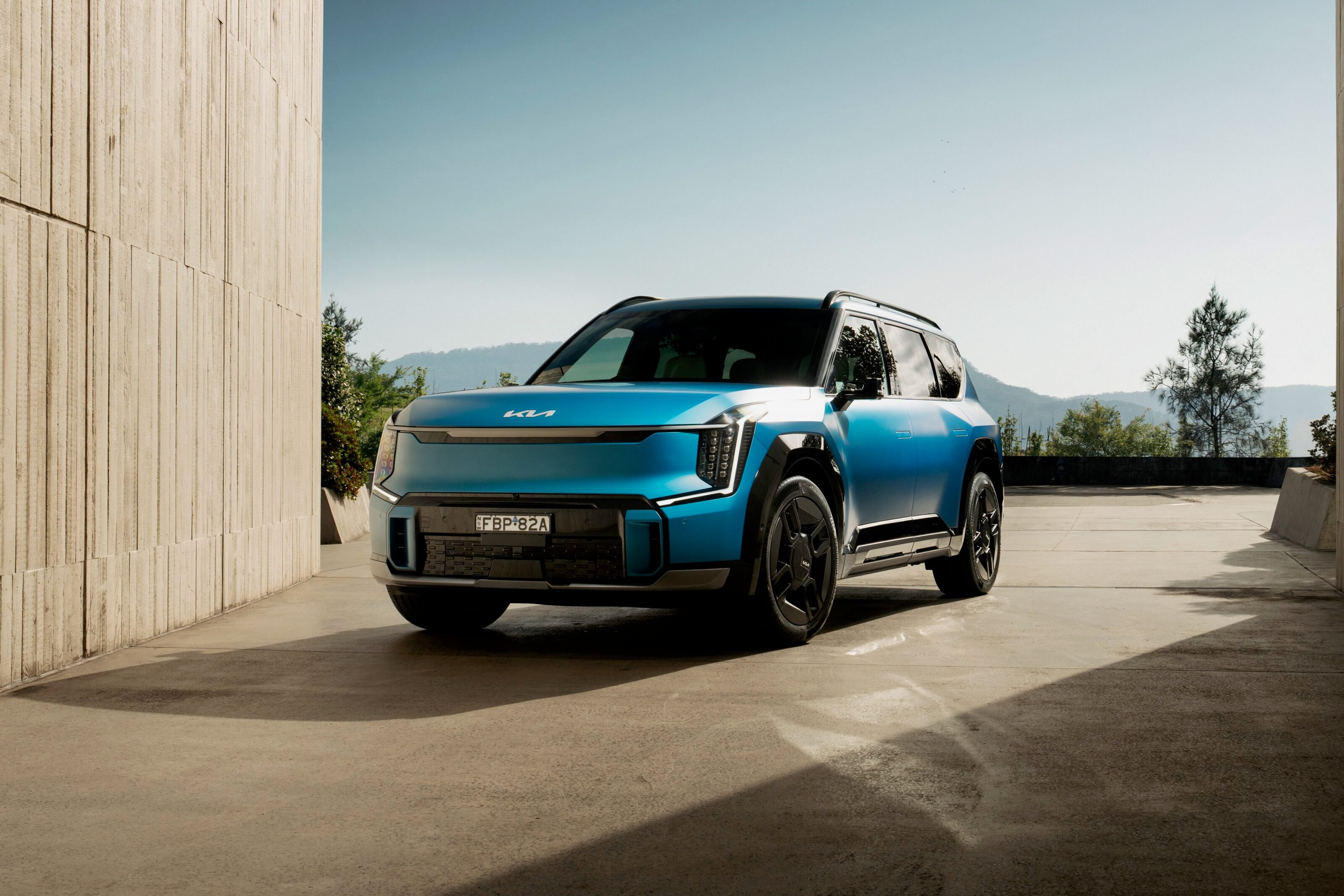
Winner – Kia EV9
1
Price: From $97,000 plus on-road costs
Battery size/claimed range: 76.1kWh, 443km (Air); 99.8kWh, 512km (Earth)/505km (GT-Line)
Drivetrain: Single motor (Air), 160kW/350Nm; Dual motor (Earth and GT-Line), 283kW/700Nm
Dimensions (length/width/height/wheelbase): 5010-5015/1980/1755-1780/3100mm
Bootspace: 333L (third row up)/828L (third row folded)/2318L (third + second row folded)
Warranty/roadside assistance/service intervals: Seven-year/unlimited, up to eight years, annual/every 15,000km
Five-year service cost: $1351
| Driving | |
|---|---|
| Interior | |
| Practicality | |
| Overall value | |
Things we like
- Huge cabin carries seven with ease
- Excellent charging speed performance
- Loaded with equipment
Not so much
- No spare wheel
- Not cheap to buy
- Some interior trims could feel more special
Kia shocked us when it launched the EV9 upper large electric SUV in late 2023. Its futuristic styling, comfortable driving experience and hugely practical cabin mean that it has massive appeal as a large SUV, especially when it comes to carrying seven passengers, which is still a rarity for electric vehicles.
Thanks to the EV9’s huge size and clever packaging, even the third row of seating can comfortably carry adults with plenty of third row room and amenities such as air vents, charging ports and cup holders. The windows are large so that it doesn’t feel claustrophobic and it features both top tether and ISOFIX points for child seats. Moving forward, the second row is even larger with palatial legroom and enough width for three adults to sit comfortably. In the front, there’s plenty of storage space, comfortable seats and great visibility.
Even in entry-level Air trim, the EV9 offers a solid driving range, with a claimed 443km (WLTP) achievable, though that increases to over 500km in higher-spec models thanks to a larger 99.8kWh battery. The e-GMP platform the EV9 uses offers some of the highest charging speeds on the market, with a 10-80 per cent charge achievable in a maximum of 24 minutes.
Thanks to local tuning, the driving experience of the EV9 is very comfortable, and it tackles bad roads with ease, despite the large wheels. It’s also very quiet, thanks to ample noise insulation. The EV9 is a very impressive large SUV with quick charging, ample range and performance stats, a huge comfortable cabin and a pleasant driving experience.
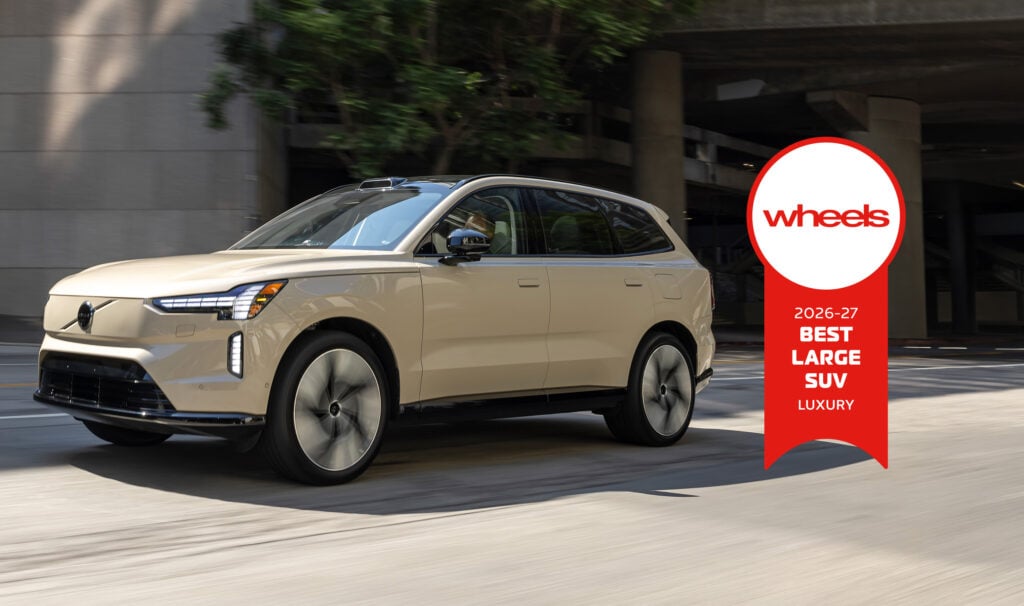
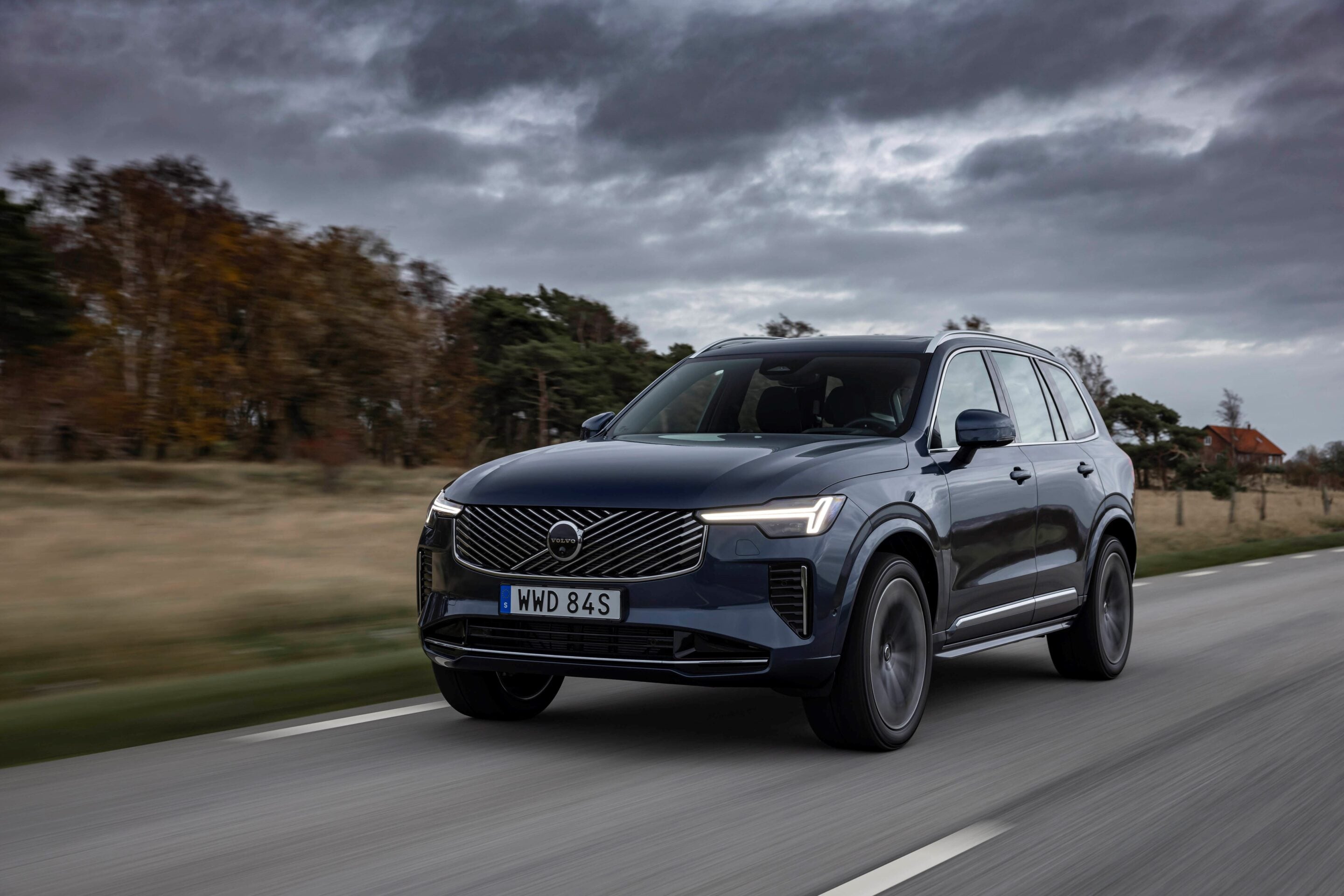
Volvo XC90
1
Price: From $104,990 plus on-road costs
Drivetrains/fuel economy/CO2 emissions: 2.0-litre four-cylinder turbo-petrol, 8-speed auto, 183kW/350Nm, 8.1L/100km, 185g/km; 2.0-litre four-cylinder turbo-petrol plug-in hybrid, 8-speed auto, 340kW/709Nm, 1.8L/100km, 40g/km
Dimensions (length/width/height/wheelbase): 4953/2008/1776/2984mm
Bootspace: 302L (third row up), 680L (third row folded), 1874L (third + second rows folded)
Warranty/roadside assistance/service intervals: Five-year/unlimited km, five years (extendable up to eight years in total), annually/every 15,000km
Five-year service cost: $3870
| Driving | |
|---|---|
| Interior | |
| Practicality | |
| Overall value | |
Things we like
- Excellent cabin quality and spaciousness
- Relaxing to drive
- Punchy drivetrains
Not so much
- Only two drivetrain options
- Not cheap to service
- New infotainment system hides features in menus
Launched way back in 2015, it’s easy to forget that the Volvo XC90 was the first modern-era Volvo in what was a product revolution for the brand. It launched on a new modular platform and was the trailblazer for the brand’s sales boom, with every Volvo released since then only building on its excellence.
The XC90 was – and still is in a lot of ways – the daddy of the large SUV segment and even though it’s now past 10 years old, is ageing gracefully. In fact, it just had an update with a new infotainment system and lightly revised styling to keep it fresh against newer rivals. But the XC90’s basics were so insanely well covered that it barely needed an update: its cabin still feels great, while all of its rows of seating are quite spacious and carrying seven adults is easy for it.
Just two engine options remain for the Australian XC90: the 183kW 2.0-litre turbo-petrol B5 or the 340kW T8 plug-in hybrid that adds a supercharger and electric motor to the B5’s drivetrain, for a claimed 77km travel on a single charge. Both use an eight-speed automatic transmission, and while the XC90 is not sporty, it is very comfortable, even on its large wheels.
Pricing for the XC90 range starts at $104,990 plus on-road costs for the B5 Bright, and $130,990 +ORC for the T8 PHEV, with both models quite well equipped, including a panoramic sunroof, new Google infotainment system with Google Maps navigation, Matrix LED headlights with adaptive high beam and a full suite of active safety features.
The Volvo XC90 remains a wonderful choice in the seven-seat large SUV segment. It’s practical, excellent quality, lovely to drive, well featured and just a delight to experience. There are now only two remaining drivetrains and it’s not cheap to service, but if you’re after a large luxurious SUV, we think the XC90 should be your first test drive.
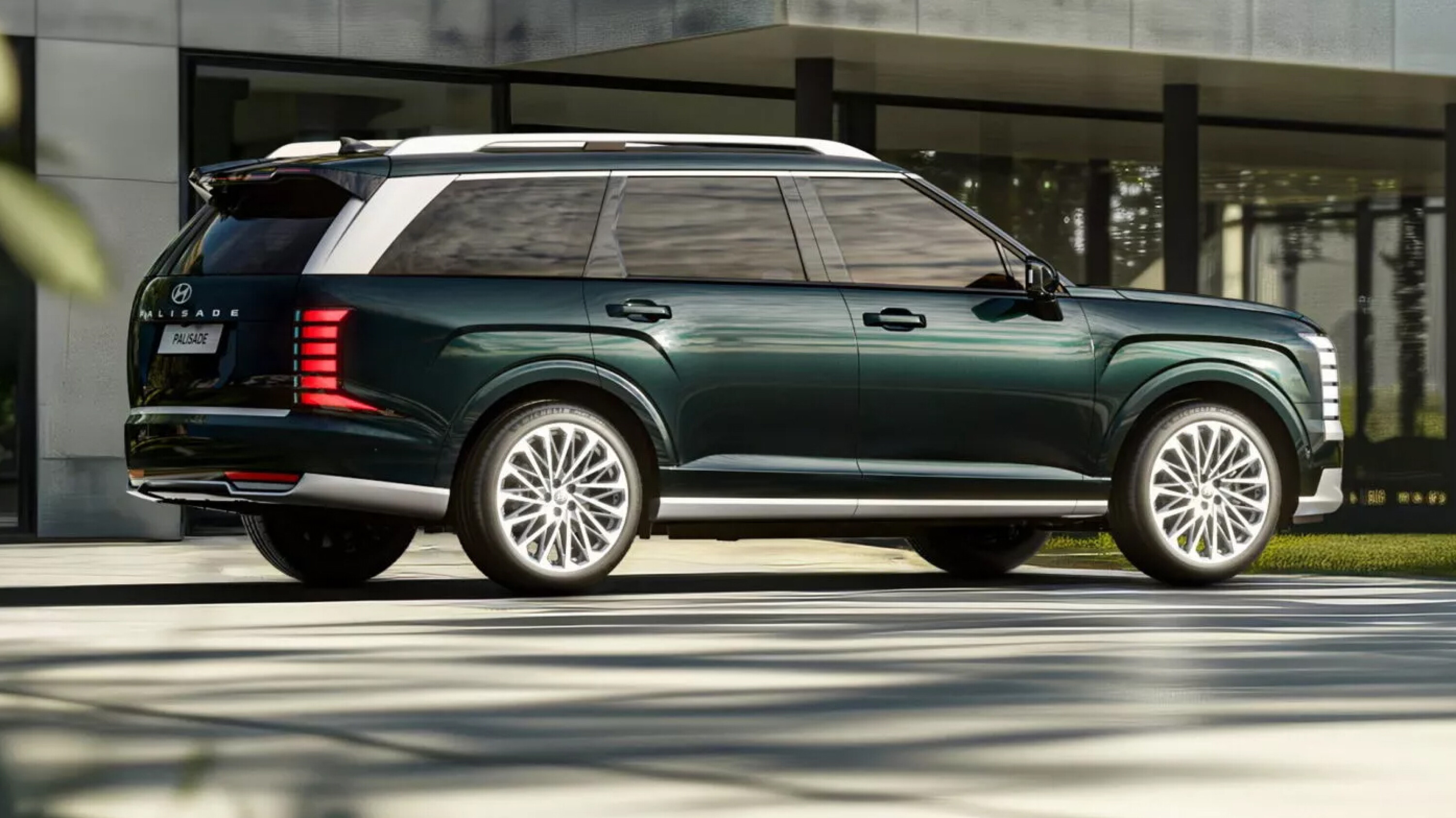
Hyundai Palisade
1
Price: From $75,900 plus on-road costs
Drivetrains/fuel economy/CO2 emissions: 3.8-litre petrol V6, 8-speed auto, 217kW/355Nm, 10.7L/100km, 251g/km; 2.2-litre four-cylinder turbo-diesel, 145kW/440Nm, 7.3L/100km, 193g/km
Dimensions (length/width/height/wheelbase): 4995/1975/1750/2900mm
Bootspace: 311L (third row up)/704L (third row folded)/1297L (third + second row folded, to belt line)
Warranty/roadside assistance/service intervals: Five-year/unlimited km, service-activated, annual/every 15,000km
Five-year service cost: $2414 (V6), $2622 (diesel)
| Driving | |
|---|---|
| Interior | |
| Practicality | |
| Overall value | |
Things we like
- Massive interior space
- Excellent drivetrain options
- Pleasant to drive
Not so much
- New model about to launch
- Thirsty petrol V6
- Interior tech not as up to date as other Hyundais
Though it’s about to be replaced by an all-new model, the Hyundai Palisade is a great choice for a $70,000+ large SUV thanks to its good value for money, huge interior space and pleasant driving experience. Pricing starts at under $70,000 for the entry-level Elite, but we strongly recommend the upper-spec Calligraphy because it’s even better equipped and feels more luxurious inside.
There are two drivetrain choices for the Palisade range: a 217kW 3.8-litre petrol V6 that’s front-wheel drive only or a 145kW 2.2-litre four-cylinder turbo-diesel that drives all four wheels. The former will drink quite a lot of fuel and easily overpowers the front wheels that do its gripping, so we think the far more efficient, refined and punchy diesel is the pick for Palisade buyers.
The Palisade’s driving experience is pleasant thanks to a well-tuned ride quality, accurate and well-weighted steering and even though it’s a large vehicle, it doesn’t feel quite so large thanks to excellent visibility.
Even though the Palisade uses a lot of old-tech Hyundai features such as the infotainment software and digital driver’s display but they still work quite well, though it would be nice to see wireless smartphone mirroring. Besides that, the Palisade’s cabin is noteworthy for being absolutely huge inside, with room for adults even in the third row, and with ample amenities on offer in each row as well. The third row in particular is one of the best on the market with ample space and even three top tether points and even an ISOFIX point for child seats.
The Hyundai Palisade is an excellent large SUV thanks to its range of talents: it’s very practical, well priced, very well equipped, drives well and is covered by a solid service and warranty program. Sure, newer Hyundai models feel more modern and the petrol V6 engine is thirsty and only drives the front wheels, but there’s still a lot to like about the Palisade.
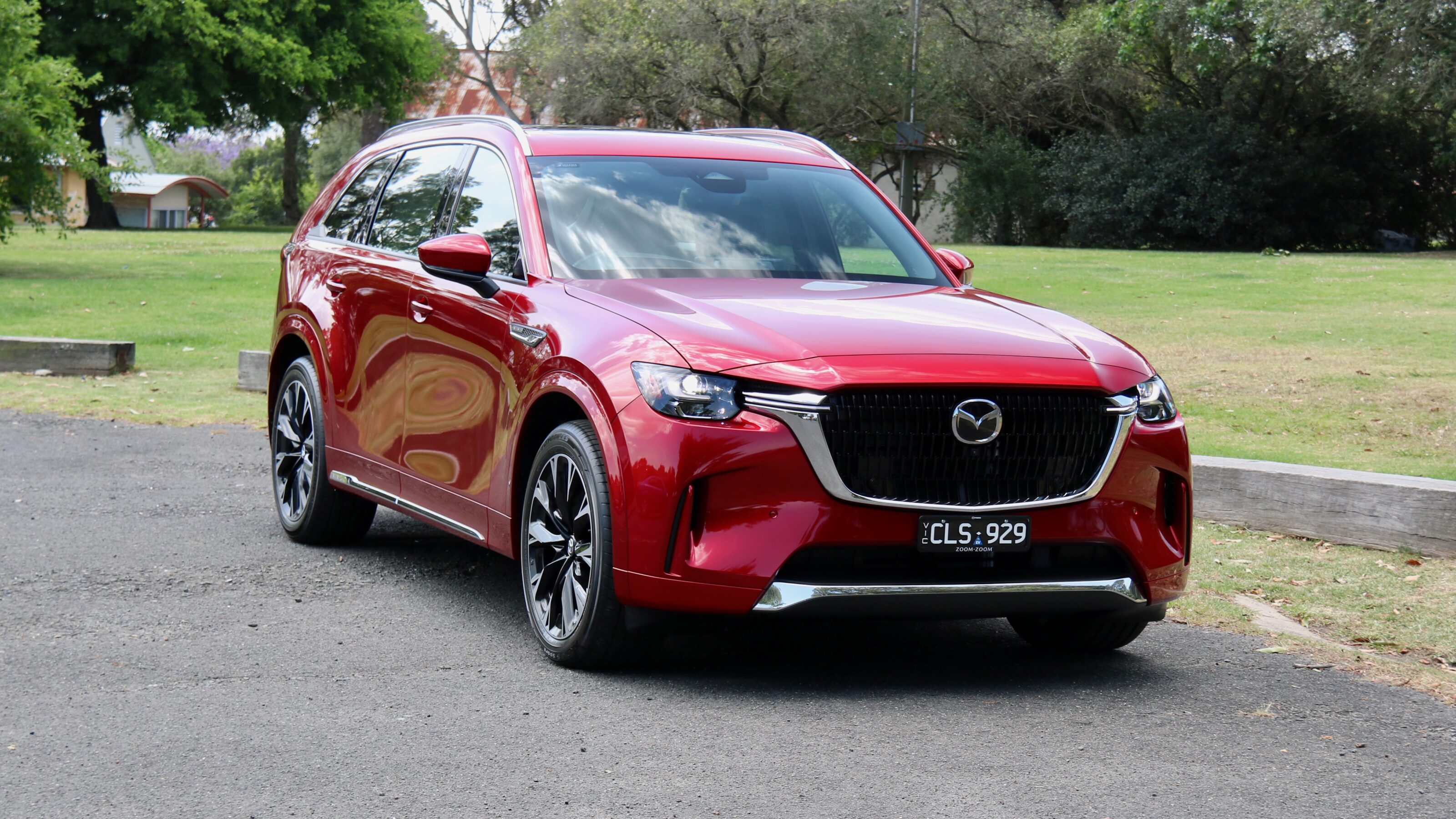
Mazda CX-90
1
Price: From $69,795 plus on-road costs
Drivetrains/fuel economy/CO2 emissions: 3.3-litre inline six turbo-petrol, 8-speed auto, 254kW/500Nm, 8.2L/100km, 189g/km (G50e); 3.3-litre inline six turbo-diesel, 8-speed auto, 187kW/550Nm, 5.4L/100km, 143g/km (D50e)
Dimensions (length/width/height/wheelbase): 5120/1994/1745/3120mm
Bootspace: 257L (third row up), 608L (third row folded), 2025L (third + second row folded)
Warranty/roadside assistance/service intervals: Five-year/unlimited km, five years, annual/every 10,000km (diesel) – 15,000km (petrol)
Five-year service cost: $3367 (diesel) – $3544 (petrol)
| Driving | |
| Interior | |
| Practicality | |
| Overall value | |
Things we like
- Engaging handling
- Huge interior space
- Excellent quality
Not so much
- Jerky gearbox
- No PHEV option yet
- Too-firm ride
Replacing the popular and lovely CX-9, the Mazda CX-90 was launched as Mazda’s largest and most expensive product ever in 2024. Now priced from $69,795 plus on-road costs in base Touring form – it was almost $75,000 +ORC when it launched before Mazda cut prices – we think the best model in the range is the mid-spec GT, which is priced at $78,795 +ORC.
The mid-range CX-90 is well equipped and feels luxurious enough inside to not needing to move up to the top-spec Azami, with leather trim everywhere and large 12.3-inch displays covering in-car tech nicely. Front seat comfort is good without being excellent – more adjustment would be appreciated – while the second and third rows of seating are spacious for adults.
The third row of seating in the CX-90 is larger than the CX-9 it replaced, with ample room for two adults. Amenities include air vents, charging ports and cup holders, though no independent fan speed controlling. The windows out could be larger due to the CX-90’s sloping rear, but two child seats are catered for with top-tether points (not ISOFIX).
On the road, the CX-90 is a mixed bag. Negatives first: the gearbox and suspension tuning needs refinement for a more luxurious vibe, as they’re just too noticeable currently. But aside from that, there’s a lot of positives, such as the refined and punchy drivetrains and engaging handling. We love both the ‘G50e’ petrol and ‘D50e’ drivetrains, with the petrol capable of strong performance and the diesel excellent fuel economy in the real world.
Regardless of drivetrain chosen, the CX-90 is expensive to service, and there’s no plug-in hybrid drivetrain option yet (it exists in other markets but just not in Australia yet). But otherwise, there’s a lot to like about the Mazda CX-90, especially when it comes to driving dynamics, performance, cabin space and standard equipment. In our opinion, spend the extra for the mid-range GT as, importantly when you’re spending this much on a car, it looks and feels expensive.
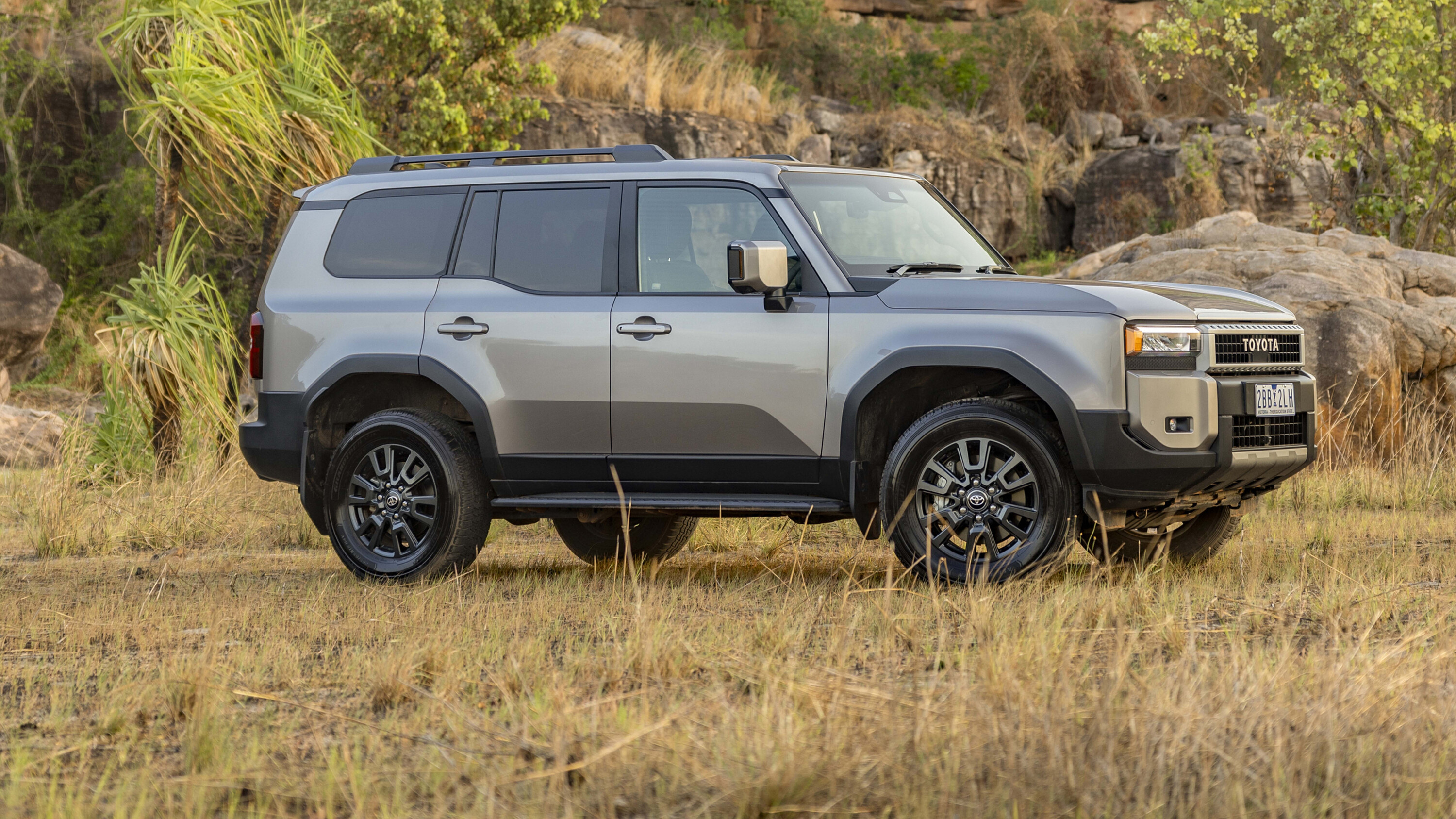
Toyota LandCruiser Prado
1
Price: From $72,500 plus on-road costs
Drivetrains/fuel economy/CO2 emissions: 2.8-litre four-cylinder turbo-diesel, 8-speed auto, 7.6L/100km, 200g/km
Dimensions (length/width/height/wheelbase): 4990/1980/1925/2850mm
Bootspace: 954L (seats up), 1895L (seats down) (seven-seater: 182/906/1829|L)
Warranty/roadside assistance/service intervals: Five-year/unlimited km, no roadside assistance, six-monthly/every 10,000km
Five-year service cost: $3900
| Driving | |
|---|---|
| Interior | |
| Practicality | |
| Overall value | |
Things we like
- Go-anywhere ability
- Refined and modern cabin
- Big improvement in driving experience over the previous model
Not so much
- Agricultural engine
- Expensive
- Seven-seat version’s boot is compromised
If you’re searching for the most popular large SUV, this would be it. With almost 16,000 sales under its belt to the end of June 2025, the Toyota LandCruiser Prado is one of the best selling vehicles in Australia. Even though it’s more expensive by up to $12,000 than the model it replaced, the new Prado is better equipped, better to drive, much better looking and still very practical and capable.
Pricing starts at $72,500 plus on-road costs for the entry-level GX and tops out at $99,990 for the top-spec Kakadu, which adds a whole host of luxury features over lesser Prado models. But even the entry-level Prado GX is well equipped, especially where safety features are concerned and the mid-spec GXL – which is expected to be the most popular Prado model by far – is equipped with features such as synthetic leather upholstery, electric driver’s seat adjustment and heated and ventilated front seats.
The whole Prado range uses the same 2.8-litre four-cylinder turbo-diesel engine and eight-speed automatic transmission with a 48V mild hybrid system – a turbo-petrol hybrid exists in some markets, but isn’t yet sold in Australia. That’s a shame because even though it saw noise reductions compared to the old model, the diesel is still loud and unrefined and we wish the more expensive LandCruiser 300 Series’ V6 diesel was used in the Prado.
While the engine is largely the same as before, Toyota has improved the driving experience of the new Prado significantly with a more refined feel from behind the wheel. The ride quality is far better damped than before, and it can now tow a 3500kg braked trailer, which is a 500kg improvement on the old Prado. There are also new off-road features so that it ventures even further off road than before, and it concedes little to the LC300.
The new Prado’s cabin is also far more upmarket than the previous version, with higher-quality materials and much newer infotainment and digital driver’s displays that make it feel more expensive inside. Seat comfort is excellent, and all rows of seating have ample room for passengers – though the packaging of the third row of seating and 48-volt mild-hybrid system could be improved. The third row does not feature any child seat points, but it does have air vents in the roof, cup holders and USB charging ports.
Overall, the new Toyota LandCruiser Prado is a big improvement on the previous model, and it’s easy to see why it’s so popular. It’s more refined in every way, better equipped, easier and more satisfying to drive and even more practical with even better off-road ability than before. The unrefined engine could be improved however, and no model is cheap, but there’s no doubt that Toyota will continue to sell every Prado it can make.
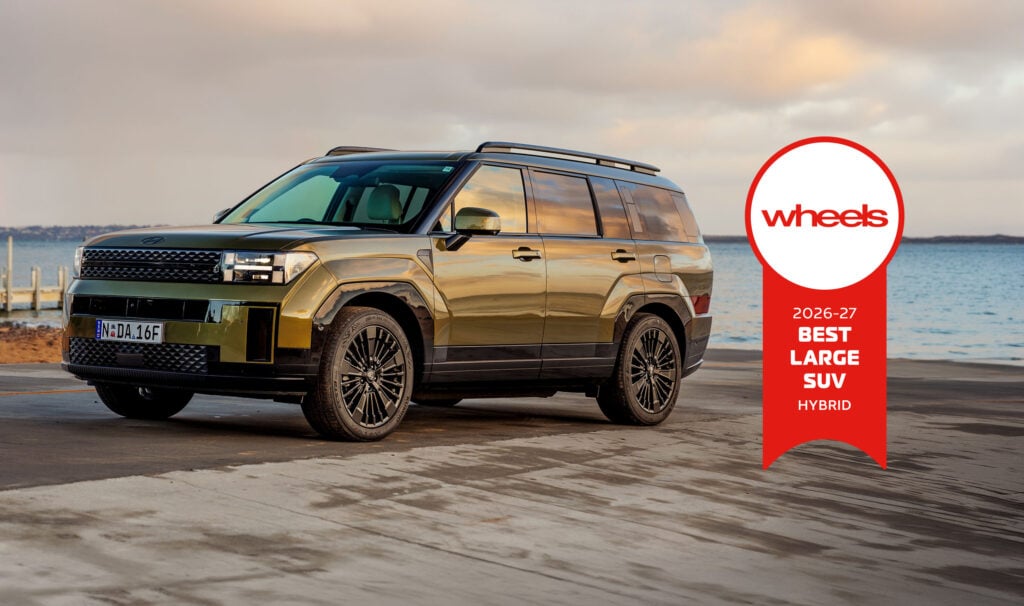
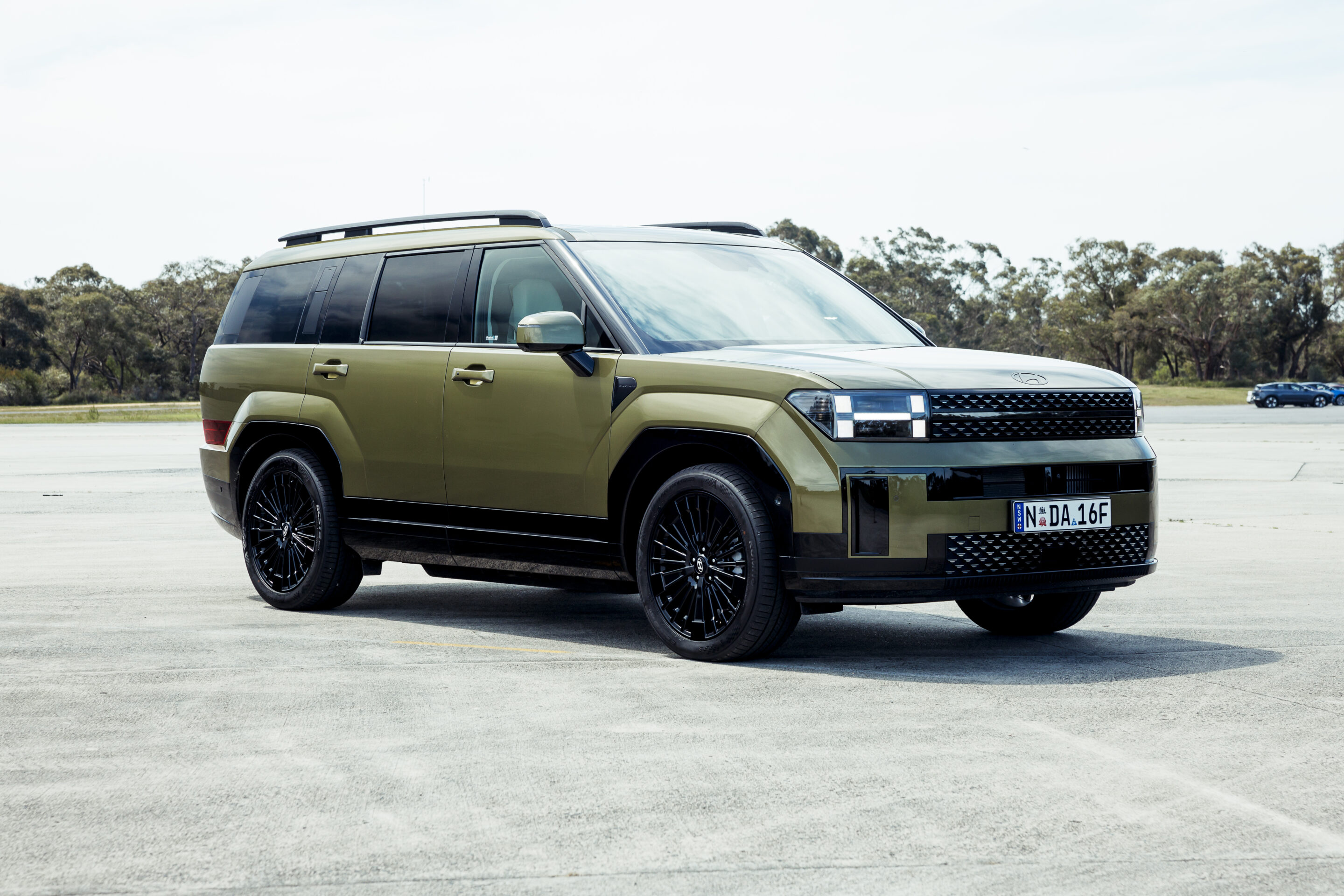
Hyundai Santa Fe
1
Price: from $53,000 plus on-road costs
Drivetrains/fuel economy/CO2 emissions:
2.5-litre four-cylinder turbo-four, 8-speed DCT, 213kW/420Nm, 9.1L/100km, 212g/km; 1.6-litre four-cylinder turbo-hybrid, 6-speed auto, 173kW/367Nm, 5.6L/100km, 128g/km
Dimensions (length/width/height/wheelbase): 4830/1900/1770/2815mm
Bootspace: Unknown (third row up)/628L (third row folded)/1949L (third + second row folded)
Warranty/roadside assistance/service intervals: Five-year/unlimited km, service-activated, annual/every 10,000km
Five-year service cost: $2425 (2.5T), $2439 (hybrid)
| Driving | |
|---|---|
| Interior | |
| Practicality | |
| Overall value | |
Things we like
- Distinctive styling
- Spacious and practical cabin
- Loaded with kit across the range
Not so much
- Calligraphy model’s pricing is getting up there
- Lazy response in eco mode
- 2.5T’s dozy transmission
If you’re searching for a bold and distinctive-looking family SUV, look no further than the Hyundai Santa Fe. While the previous four generations were some of Hyundai’s best products over the years, none of them could be called especially interesting to look at. Enter generation five and its boxy, funky shape, which is certainly one of the most instantly noticeable large SUVs on the market.
Inside the Santa Fe is a spacious and practical cabin that feels well thought through by its designers. Each row has more than enough space for adults, with the third row a noticeable improvement on the previous Santa Fe and more spacious than key rivals such as the Kia Sorento. It also features top tether points, air vents, cup holders and even a fan speed controller.
There are two available drivetrains in Australia: a turbocharged petrol 2.5-litre four-cylinder unit making 213kW of power, or a 173kW 1.6-litre turbo-petrol hybrid. Both engines are available as front-drivers in the base model but are otherwise paired to all-wheel drive throughout the range, and every Santa Fe model is quite comfortable and relaxing to drive, with a well tuned ride quality and light steering. The boxy styling helps with visibility as well.
Hyundai’s five-year/unlimited km warranty covers the Santa Fe, and its service costs are reasonable at a maximum of $2439 for five years/75,000km, though its warranty looks short against some other manufacturers on the market. Counting against the Santa Fe is that it’s not cheap at the higher end of the model range, the lazy drivetrain response in eco mode and the 2.5T’s lazy dual-clutch transmission that can stumble a bit in low-speed driving.
But otherwise, the Hyundai Santa Fe proves to be a very worthy large SUV thanks to its insanely practical cabin, value for money, long list of equipment, comfortable driving experience and reasonable running costs. That it also looks unique and characterful is only a bonus for those wanting a more distinctive family chariot to keep ahead of the Joneses.
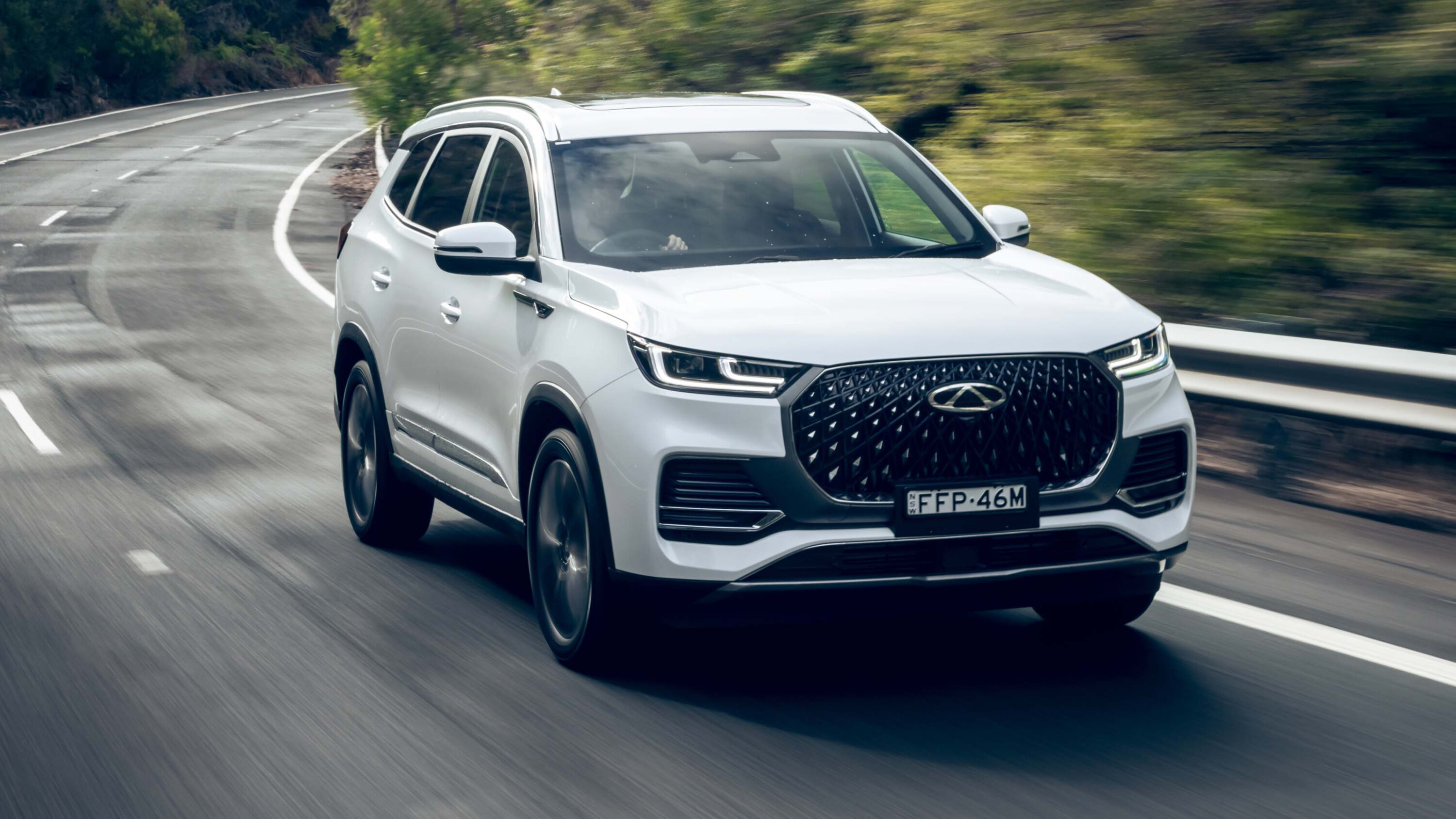
Chery Tiggo 8 Pro Max
1
Price: From $41,990 drive away
Drivetrains/fuel economy/CO2 emissions: 2.0L turbo four-cylinder petrol, 7-speed DCT, 180kW/375Nm, 8.1L/100km, 191g/km; 1.5-litre turbo four-cylinder plug-in hybrid, 255kW/525Nm, CVT, 1.3L/100km, 30g/km
Dimensions (length/width/height/wheelbase): 4724/1865/1718/2694mm
Bootspace: 117L (third row up), 479L (third row folded), 739L (third + second row folded)
Warranty/roadside assistance/service intervals: Seven-year/unlimited km, 12 months (renewed with each service up to seven years in total), annual/every 15,000km
Five-year service cost: $1495
| Driving | |
|---|---|
| Interior | |
| Practicality | |
| Overall value | |
Things we like
- Very sharply priced and well equipped
- Two drivetrain choices, both with good performance
- PHEV gives 95km of claimed EV range
Not so much
- Boot and third row aren’t huge
- Suspension and driver aids need finessing
- Petrol engine is thirsty, dual-clutch auto dozy
If you’re looking for the ultimate bargain seven-seater large SUV in Australia, look no further than the Chery Tiggo 8 Pro Max. Priced from just $41,990 drive away – or, currently thanks to a manufacturer’s special, $38,990 drive away – the Tiggo 8 Pro Max is excellent value for money and even the entry-level Urban features equipment such as heated and ventilated front seats, a 360-degree camera and a full suite of active safety features.
But there’s more to the Tiggo 8 Pro Max than its low pricing, with a well finished cabin that is comfortable and well featured with tech. A dual 12.3-inch screen set up is easy to use and looks impressive – especially for the price – and the physical buttons located underneath the screen and on the centre console make it easier to use. The Tiggo 8 Pro Max’s cabin is also practical, with ample space in the first and second rows of seating, though the third row is small and while there are air vents and cup holders, no support for child seats.
The Tiggo 8 Pro Max offers two drivetrains in Australia: a 183kW 2.0-litre turbo-petrol or a 255kW 1.5-litre turbo plug-in hybrid, with both providing more than ample performance. The PHEV also offers an impressive 95km of electric driving range before the petrol engine even switches on, and a claimed overall range of more than 1200km. The 2.0-litre turbo-petrol engine sounds good and provides more than enough performance, though the dual-clutch transmission suffers from indecisive low-speed behaviour, much like many others of the breed.
On the road, the Tiggo 8 Pro Max is quite refined with low road noise levels, though its suspension and active safety features need some finessing. The ADAS systems are over sensitive and the suspension needs more refined damping to better deal with low speed bumps. The steering also lacks feel, but it is perfectly light for urban driving. The 360-degree camera that’s standard across the range is impressively high definition for the price as well.
There’s definitely more to the Chery Tiggo 8 Pro Max than just its excellent value equation thanks to its good quality interior finishes and tech, strong powertrains and refined driving experience. The new plug-in hybrid drivetrain also provides a healthy EV driving range, and over 1200km of total driving range too. It’s not perfect thanks to its small boot and third row, need for finessing of the driver assistance systems and suspension and thirsty petrol engine, but if you’re after a bargain large SUV, just know that there’s much more to the Chery Tiggo 8 Pro Max than just its low pricing and healthy equipment levels.
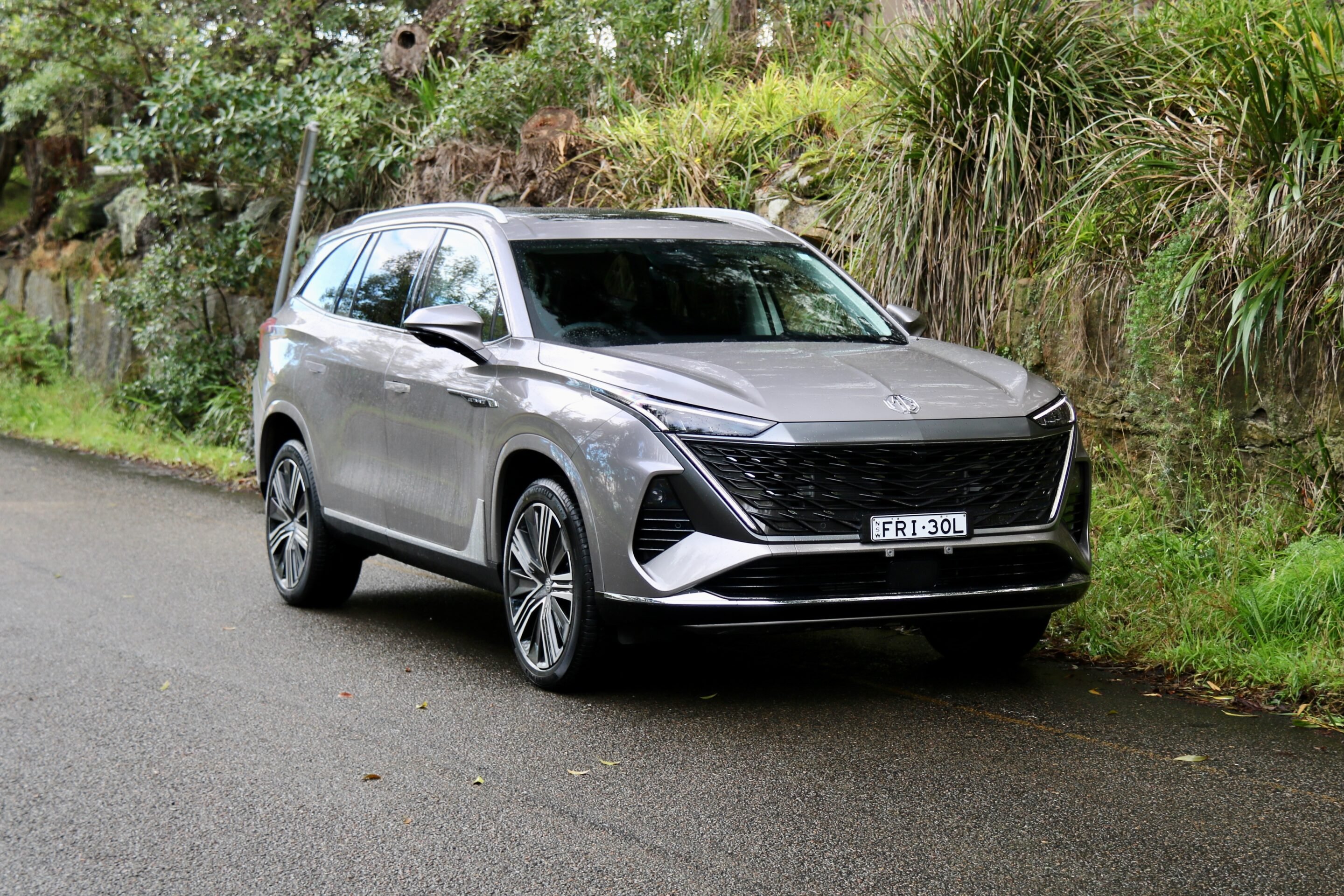
MG QS
2
Price: From $46,990 drive away
Drivetrains/fuel economy/CO2 emissions: 2.0-litre four-cylinder turbo-petrol, 9-speed auto, 153kW/360Nm, 8.8L/100km, 198g/km
Dimensions (length/width/height/wheelbase): 4983/1967/1778/2915mm
Bootspace: 203 litres (third row up)/517L (third row folded)/1052L (third + second row folded)
Warranty/roadside assistance/service intervals: 7-year/unlimited km (extendable to 10 years/250,000km if serviced at MG), 7 years, annual/every 15,000km
Five-year service cost: $3442 (Excite), $3618 (Essence)
| Driving | |
|---|---|
| Interior | |
| Practicality | |
| Overall value | |
Things we like
- A lot of metal for the money
- High quality and spacious cabin
- Lovely ride quality
Not so much
- Very expensive to service
- Can be thirsty, no hybrid powertrain
- Dozy response from a standstill
MG is undertaking a huge product expansion in Australia, entering segments it’s not previously played in. The QS, the brand’s new large SUV, is the biggest product to ever wear the MG badge and its first seven seater too. But as you’d expect for an MG, its value equation is sharp and it’s priced from just $46,990 drive away for the entry-level Excite.
Measuring 4983mm long, the MG QS is one of the largest seven-seat SUVs, and it’s even 118mm longer than the Toyota Kluger. Its big sizing makes it one of the roomiest seven-seat SUVs on the market, with adult-carrying capacity for the third row. The second row is vast as well, while front seat occupants will find a modern space with high-quality materials.
For now, only one engine is available in the QS: a 153kW/360Nm 2.0-litre turbo-petrol, mated to a nine-speed automatic transmission. The base Excite is a front-driver, with the upper-spec Essence adding drive to the rear wheels as well. While it’s strong at speed, it feels sluggish off the line thanks to odd tuning, can also be thirsty, especially in urban driving – a hybrid drivetrain would solve both issues, though the QS is yet to offer one.
Otherwise, the driving experience of the QS is pleasant, with a well-controlled ride quality – despite the huge 20-inch wheels on the Excite and 21s on the Essence – and excellent refinement, with little in the way of road noise. Its active safety features are big improvements on earlier MG models, though accessing their settings in the touchscreen still takes too many presses.
MG covers the QS with a seven-year/unlimited km warranty that can be extended to 10 years/250,000km if serviced through an MG dealership, however, its service pricing is quite expensive at a minimum of $3442 for the Excite and $3618 for the Essence. That’s on average between $688 and $723 annually for the first five years, which compares unfavorably when the Chery Tiggo 8 Pro Max, also with a 2.0-litre turbo-petrol engine, asks just $1495 for its first five services or less than half that of the MG.
Overall however, MG has played the large SUV game well with the QS. It gives large SUV shoppers yet another option to consider, one that presents quite well with a spacious cabin with quality materials, a pleasant driving experience with little electronic nannying to annoy, and excellent value for money from its low asking price to its long list of equipment.
Kia Sorento
2
Price: From $50,880 plus on-road costs
Drivetrains/fuel economy/CO2 emissions: 3.5-litre petrol V6, 8-speed auto, 200kW/332Nm, 9.8L/100km, 222g/km; 2.2-litre four-cylinder turbo-diesel, 8-speed DCT, 148kW/440Nm, 6.0L/100km, 158g.km; 1.6-litre turbo four-cylinder hybrid, 6-speed auto, 169kW/350Nm, 5.4L/100km, 122g/km; 1.6-litre turbo four-cylinder PHEV, 6-speed auto, 195kW/350Nm, 1.6L/100km, 36g/km
Dimensions (length/width/height/wheelbase): 4815/1900/1695/2815mm
Bootspace: 179L (third row up)/608L (third row folded)/1996L (third + second row folded)
Warranty/roadside assistance/service intervals: Seven-year/unlimited, up to eight years, annual/every 15,000km
Five-year service cost: $2580 (V6), $2637 (diesel), $3009 (hybrid), $3409 (PHEV)
| Driving | |
|---|---|
| Interior | |
| Practicality | |
| Overall value | |
Things we like
- Wide range of drivetrains to suit a wide range of buyers
- Great value for money across the range
- Lovely to drive thanks to local tuning
Not so much
- V6 petrol is quite thirsty in the real world
- PHEV is expensive to buy and service
- Hybrids only at the top of the range
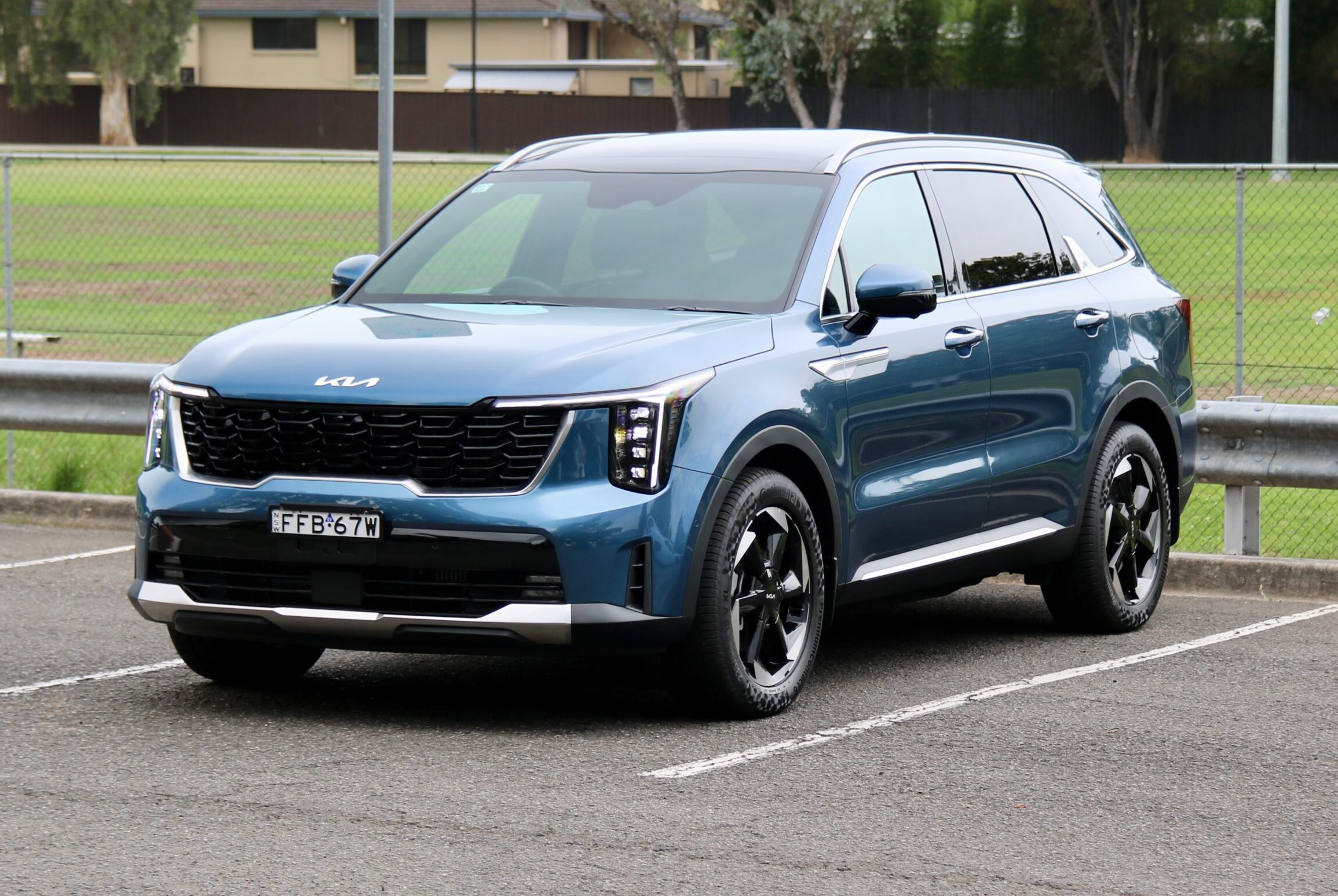
Kia is absolutely killing it at the moment with an impressive lineup that is – deservedly – winning it big sales in Australia. While products such as the new Tasman ute and EV9 electric upper large SUV take all the headlines, the Sorento seven-seat SUV does a lot of heavy lifting in sales – so far this year, it’s Kia’s third-best selling vehicle with over 5000 sold to the end of June. So what’s so good about the Sorento?
Starting at $50,880 plus on-road costs for the entry-level Sorento S with a 3.5-litre petrol V6 and a front-wheel drive drivetrain, the Sorento range offers strong value for money. But we still think that top-spec models are solid value for money thanks to their very long lists of standard kit. While a GT-Line hybrid is around $80,000 drive away, it’s also absolutely loaded with features.
Four drivetrains are available with the Sorento: the aforementioned V6, a 2.2-litre turbo-diesel and two 1.6-litre hybrid options, one a regular hybrid and one a plug-in unit with up to 68km of electric driving range (WLTP). 80 per cent of buyers in Australia choose the diesel, as it’s punchy, fuel efficient and unlike the V6, is mated to an all-wheel drive system. More would choose the hybrid if it were offered in lower grades, but alas, it’s limited to the top-spec GT-Line for now.
Thanks to Kia’s local ride and handling tuning, the Sorento drives very well for the segment. Its ride quality is tuned well with a taut but comfortable feeling, especially at higher speeds – plus, it handles well for a big seven-seater SUV as well that even enthusiasts will be happy from behind the wheel.
The Sorento’s cabin is good quality, with its new infotainment screens – introduced with the mid-life facelift – impressively slick to use and well-featured. Storage space in the front cabin is excellent, with plenty of spots to hide trinkets, and it’s a similarly positive story moving rearward with ample space in the second row and enough space for kids in the third row, including two top tether child seat points.
It’s easy to see why the Kia Sorento has become one of the brand’s best selling cars in Australia. It’s covered by a long warranty, it’s great to drive, has a range of models and drivetrains, a lot of standard equipment and a practical interior. More hybrid availability would be great as the petrol V6 is thirsty and diesel fuel isn’t suited to everybody, and the PHEV is expensive. But overall, the Sorento is a great product worthy of strong consideration in the large SUV segment.
Toyota Kluger
1
Price: From $62,410 plus on-road costs
Drivetrains/fuel economy/CO2 emissions: 2.5-litre four-cylinder hybrid, CVT auto, 184kW, 5.6L/100km, 128g/km
Dimensions (length/width/height/wheelbase): 4966/1930/1755/2850mm
Bootspace: 241L (third row up), 1150L (third row folded)
Warranty/roadside assistance/service intervals: Five-year/unlimited km, no roadside assistance, annually/every 15,000km
Five-year service cost: $1400
| Driving | |
|---|---|
| Interior | |
| Practicality | |
| Overall value | |
Things we like
- Excellent hybrid drivetrain and efficiency
- Relaxing to drive
- Well equipped
Not so much
- Third row feels small thanks to tiny windows
- Expensive throughout the range
- Cabin quality could be better
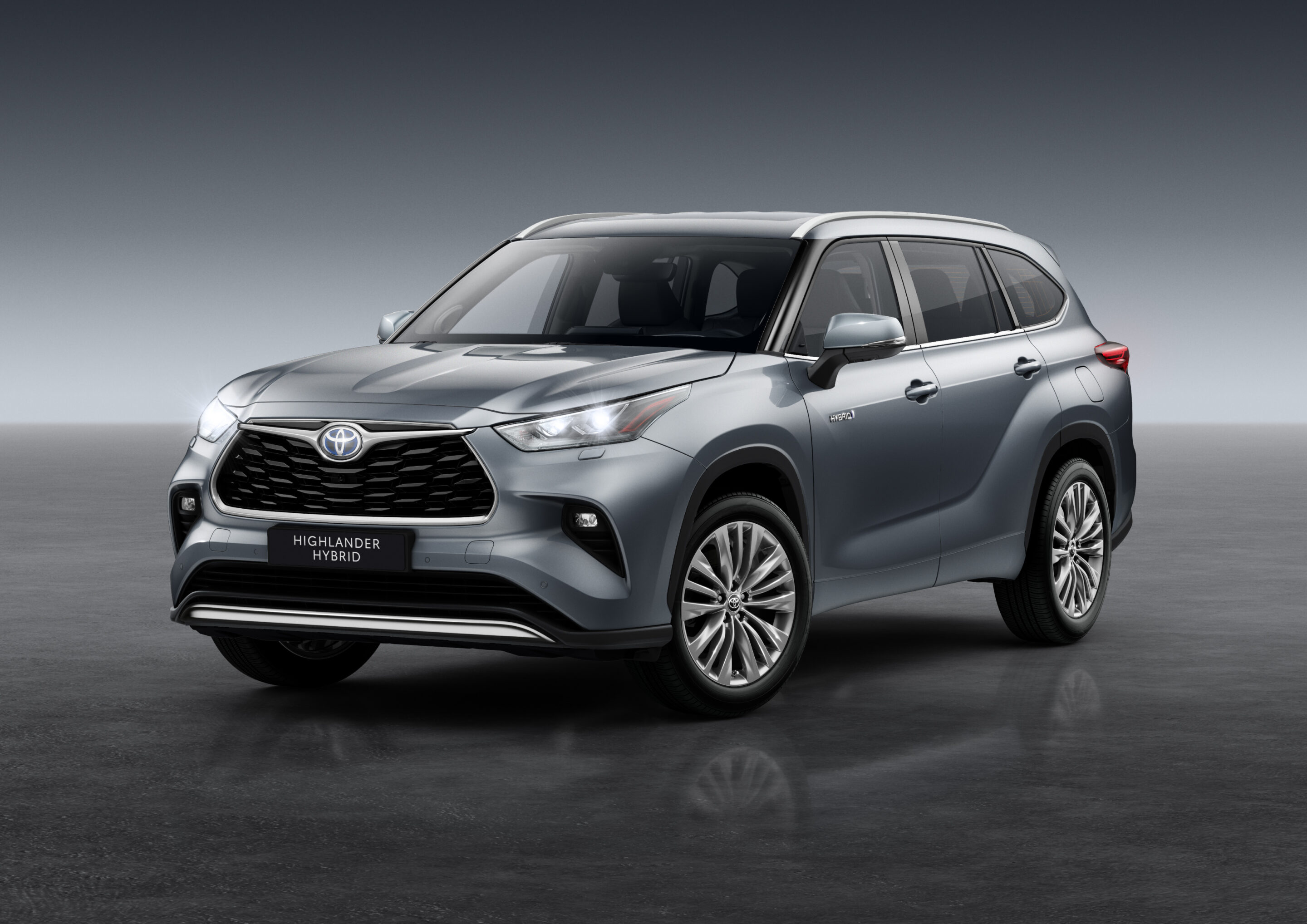
The Toyota Kluger has been one of the best-selling seven-seat SUVs in Australia since it first landed in Australia in 2003 and now in its fourth generation, that popularity has not slowed down. Prices start at $62,410 plus on-road costs for the entry-level GX and rise to more than $90,000 once on-road costs are included. Three models are available: GX, GXL and Grande.
While it launched with a 3.5-litre petrol V6 and a 2.5-litre hybrid drivetrains, the V6 was replaced with a torquier 2.4-litre turbo petrol, but nowadays the hybrid is the only available option. It provides ample grunt with 184kW on offer, but also excellent fuel consumption at a claimed 5.6L/100km. All new Kluger models in Australia are equipped with an all-wheel drive system.
On the road, the Kluger is extremely comfortable with a soft suspension set up that gives it an excellent ride quality. It’s quite easy to drive, with quick steering and good visibility, and all the controls are well weighted. The front cabin is quite practical with ample storage space, though material quality is a bit lacklustre, especially in the top-spec Grande.
Third row seating could be better as well. Access is excellent thanks to the sliding middle seat, but there are no child seat points in the rear and the small windows make it feel smaller than it is. The second row is huge, however, and three adults will be more than comfortable. Amenities include a third climate zone, air vents, map pockets and large door pockets.
Competition is tough, but the Toyota Kluger’s practicality, low running costs, ample performance from its hybrid powertrain and comfortable driving experience continue to win it many fans in Australia. The next generation of Kluger is likely not far off, and we’re hoping it has a more spacious feel and higher quality materials inside, but the current model is still a great family car.
Land Rover Discovery
2
Price: From $117,219 plus on-road costs
Drivetrains/fuel economy/CO2 emissions: 3.0L inline six turbo-diesel, 8-speed auto, 258kW/700Nm, 7.5L/100km, 199g/km (D350)
Dimensions (length/width/height/wheelbase): 4956/2073/1888/2923mm
Bootspace: 258L (third row up), 1274L (third row folded), 2391L (third + second rows folded)
Warranty/roadside assistance/service intervals: Five-year/unlimited km, five years, annual/every 20,400km
Five-year service cost: $3500
| Driving | |
|---|---|
| Interior | |
| Practicality | |
| Overall value | |
Things we like
- Excellent cabin quality and spaciousness
- Relaxing to drive, standard air suspension
- Punchy diesel six
Not so much
- No petrol or hybrid options
- Feeling a bit long in the tooth
- Upper-spec models get expensive
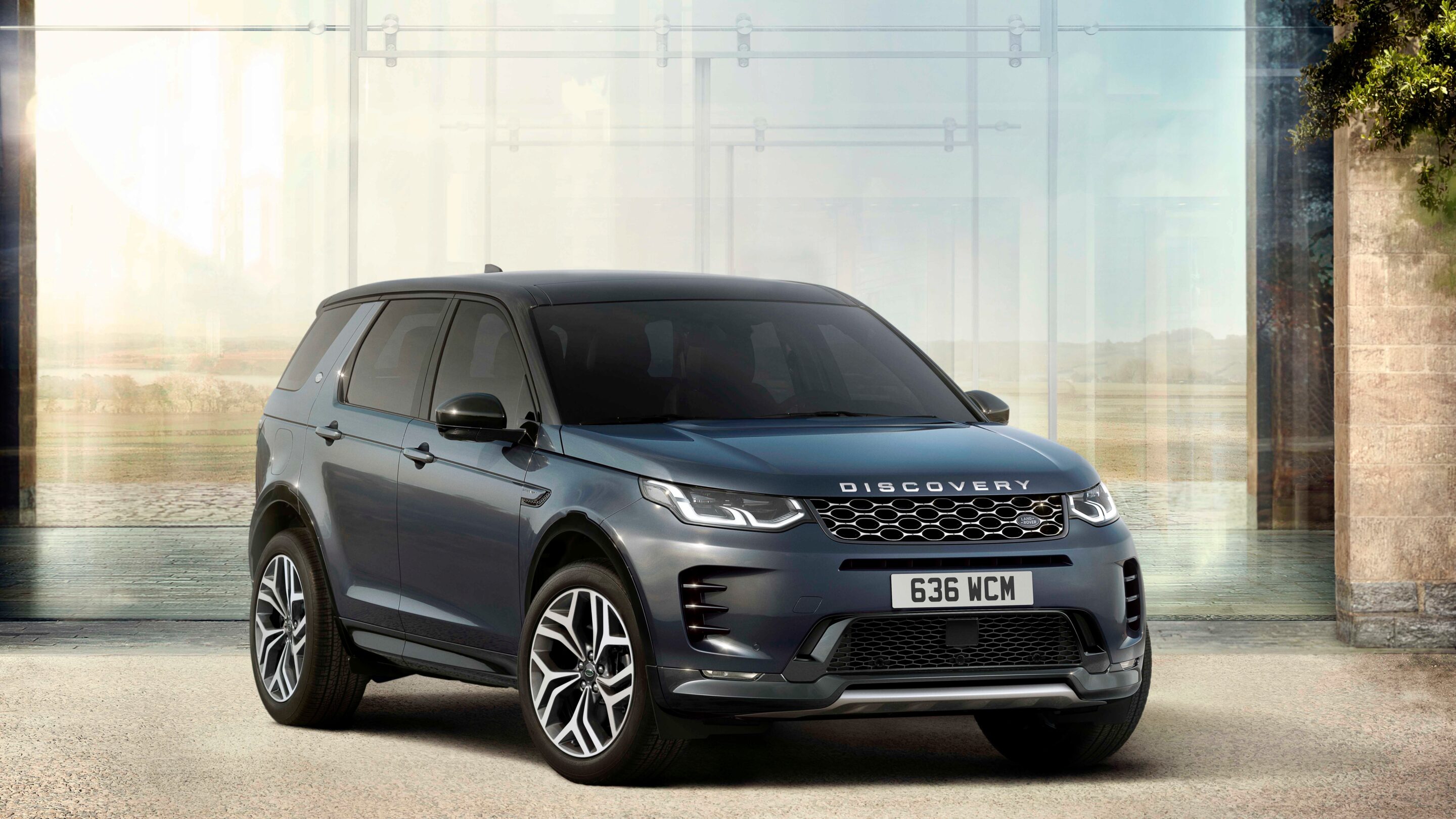
These days, the Land Rover model range is all about the Defender and Range Rovers. But if you’re searching for a seven-seater Land Rover, the reality is that the best model is the Discovery. The Discovery Sport, Range Rover and Defender 110 and 130 are each available with seven seats, but the Discovery’s third row is better for adults as it’s a taller vehicle. Pricing for the Discovery range starts at $117,219 plus on-road costs, and four models are available: S, SE, Gemini and top-spec Tempest.
The third row of seating in the Discovery can easily hold two adults, with ample headroom, and impressively the third row also includes two top tether points and even two ISOFIX points as well. Depending on model, the third row of seats can also be had with heating. The second row is large as well, with two more ISOFIX and three more top tether points, plus ample amenities for passengers.
The front cabin of the Discovery is high quality with leather trim seemingly everywhere, while at the centre of the dashboard is Land Rover’s latest ‘Pivi Pro’ infotainment system with wireless smartphone mirroring, DAB+ digital radio, online services and sat-nav. A thumping Meridian sound system is standard across the range.
The only available drivetrain in the Discovery in Australia is a twin-turbocharged 3.0-litre diesel inline six making strong 258kW and 700Nm outputs. Despite the grunt and the Discovery’s huge size, it only consumes a claimed 7.5L/100km of diesel on the combined cycle. On the road, the Discovery is extremely comfortable thanks to its standard air suspension and if you’re looking for an off-roader, the Discovery is great at that as well.
Overall, while it’s not cheap to buy, the Land Rover Discovery is an excellent all-rounder as a seven-seat large SUV. Its interior is high quality, feature-packed and spacious for seven occupants, plus its V6 turbo-diesel offers ample performance and reasonable fuel economy.
KGM Rexton
1
Price: From $52,000 drive away
Drivetrains/fuel economy/CO2 emissions: 2.2-litre four-cylinder turbo-diesel, 148kW/441Nm, 8-speed auto, 8.7L/100km, 223g/km
Dimensions (length/width/height/wheelbase): 4850/1960/1825/2865mm
Bootspace: 236L (third row up)/872L (third row folded)/1806L (third + second row folded)
Warranty/roadside assistance/service intervals: Seven-year/unlimited km, five years, annual/every 15,000km
Five-year service cost: $2298
| Driving | |
|---|---|
| Interior | |
| Practicality | |
| Overall value | |
Things we like
- Excellent value for money
- Good to drive, great off-road
- Refined powertrain
Not so much
- No hybrid option
- Missing some features such as sat-nav
- Third row not huge
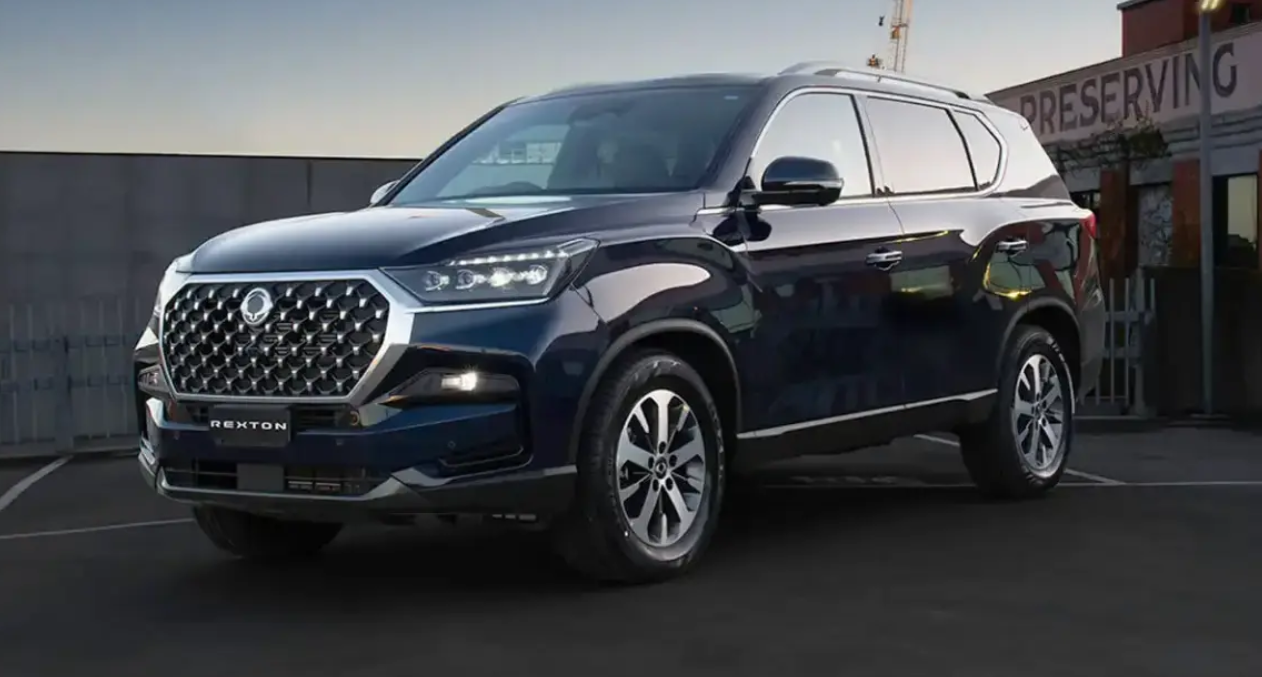
The KGM – formerly SsangYong – Rexton is a charming and practical seven-seat large SUV which offers a lot for buyers. While its interior could be a bit more modern, it’s well finished with good quality materials and comfortable seating as well. Unlike a lot of large SUVs, the Rexton can easily venture off road thanks to its ladder-frame chassis that it shares with the capable Musso ute, while its excellent refinement makes it seem more car-like than you’d expect from a ute-based SUV from behind the wheel.
Inside the Rexton is a refined and good quality cabin, though it’s hardly the most modern in the segment. A new 12.3-inch touchscreen was fitted recently, which is quite easy to use, though doesn’t feature wireless smartphone mirroring or sat-nav in Australia.
The second row of seating is comfortable and offers a reasonable amount of space – two adults will be quite comfortable – while the third row is smaller and is really only for children and there are no child seat points. The boot behind the third row isn’t huge either, but there’s a lot of space with the third row folded, and even more with the second row folded as well.
The Rexton range uses a 148kW 2.2-litre turbo-diesel engine mated to a part-time four-wheel drive system and an eight-speed automatic transmission. It’s quite refined for the segment, with low engine noise and ample road noise insulation as well, and the transmission is quick to shift gears. The driving experience is comfortable, though not quite as comfortable as car-based competitors, but unlike those cars, the Rexton is actually a good off-roader.
If you’re after a large SUV with seven seats, the KGM Rexton is a good choice – especially if you’re planning to do some off-roading. While it’s not the most modern or up-to-date for technology, it drives well, its diesel engine is grunty and it offers good comfort and reasonable space for seven people.
GMC Yukon
1
Price: From $174,990 plus on-road costs
Drivetrains/fuel economy/CO2 emissions: 6.2L petrol V8, 313kW/624Nm, 10-speed auto, 12.8L/100km and unknown CO2 emissions
Dimensions (length/width/height/wheelbase): 5360/2057/1943/3071mm
Bootspace: 3480L (third + second rows folded)
Warranty/roadside assistance/service intervals: Three-year/100,000km warranty, three years, annual/every 12,000km
Five-year service cost: No capped price servicing
| Driving | |
|---|---|
| Interior | |
| Practicality | |
| Overall value | |
Things we like
- Huge cabin carries eight adults with ease
- Punchy V8 engine, comfortable to drive
- Loaded with equipment
Not so much
- No diesel or hybrid drivetrain option
- No capped price servicing
- Missing features such as sat-nav
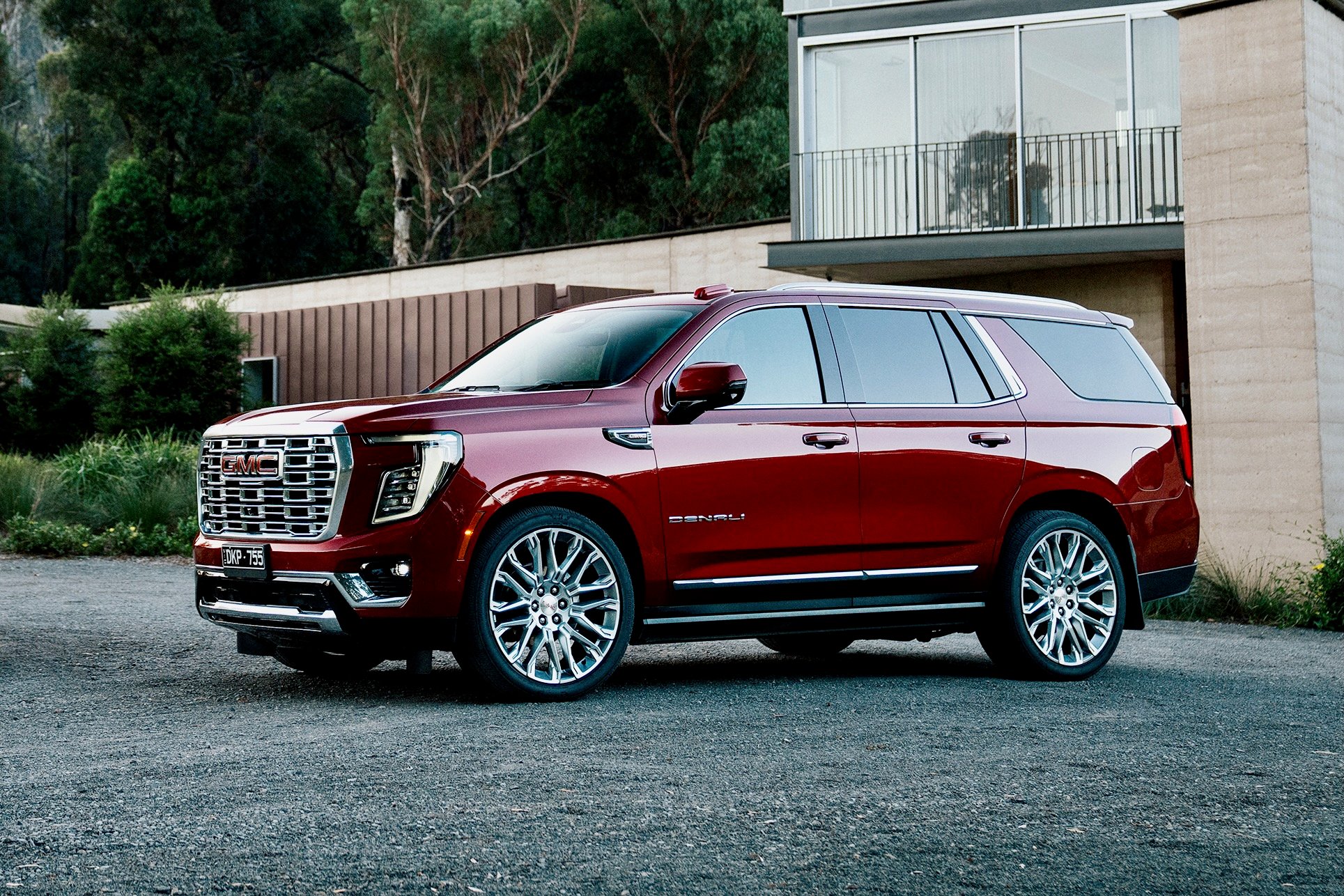
General Motors Special Vehicles (GMSV) launched the GMC Yukon in Australia earlier in 2025, providing a huge luxury V8 SUV for Australian buyers. Competing against cars such as the BMW X7 and Mercedes-Benz GLS, the Yukon is only offered in high-spec Denali form in Australia and is priced from $174,990 plus on-road costs.
While Australia doesn’t receive the Yukon in long-wheelbase form, the short-wheelbase model still offers a huge amount of rear space for passengers. Like only a few other large SUVs here, the Yukon actually seats eight people and all eight seating positions can easily carry a full-size adult. The second row of seating offers two ISOFIX points and three top tether points, with the third row offering two top tether points.
The front of the Yukon Denali is dominated by a huge 16.8-inch touchscreen with wireless smartphone mirroring, though no inbuilt sat-nav. The screen quality is good and it’s easy to use, while the 11.8-inch digital driver’s display is attractive as well.
Under the bonnet of the Yukon is a 6.2-litre petrol V8 engine, which is by far the largest in a large SUV in Australia. Making 313kW of power and 624Nm of torque, the Yukon’s V8 sounds wonderful and its 10-speed automatic transmission shifts smoothly. The Yukon’s 12.8L/100km combined fuel consumption is not small, however, and we wonder why the six-cylinder diesel engine in other markets isn’t sold in Australia. On the road it’s very comfortable thanks to its air suspension and adaptive dampers, but there’s no getting away from that it always feels large.
If you’re looking for a ‘large and in charge’ vehicle and have the coin to run it, the GMC Yukon Denali will fit the bill perfectly. It’s not cheap to buy, and it will be expensive to run thanks to its huge petrol V8 engine and lack of capped-price servicing. But it’s extremely comfortable to drive, well equipped, and very spacious.
Nissan Patrol
3
Price: From $95,600 plus on-road costs
Drivetrains/fuel economy/CO2 emissions: 5.6-litre petrol V8, 7-speed auto, 298kW/560Nm, 14.4L/100km, 334g/km
Dimensions (length/width/height/wheelbase): 5175/1995/1940/3075mm
Bootspace: 467L (third row up), 1413L (third row folded), 2623L (third + second row folded)
Warranty/roadside assistance/service intervals: Five-year/unlimited km (10-year/300,000km if serviced at Nissan), up to 10 years if serviced at Nissan, annual/every 10,000km
Five-year service cost: $2495
| Driving | |
|---|---|
| Interior | |
| Practicality | |
| Overall value | |
Things we like
- Excellent petrol V8 one of the last left
- Well equipped across the range
- Off-road special Warrior adds more attitude and capability
Not so much
- V8 is thirsty and expensive to run
- Complicated child seat situation
- Feeling dated in some areas
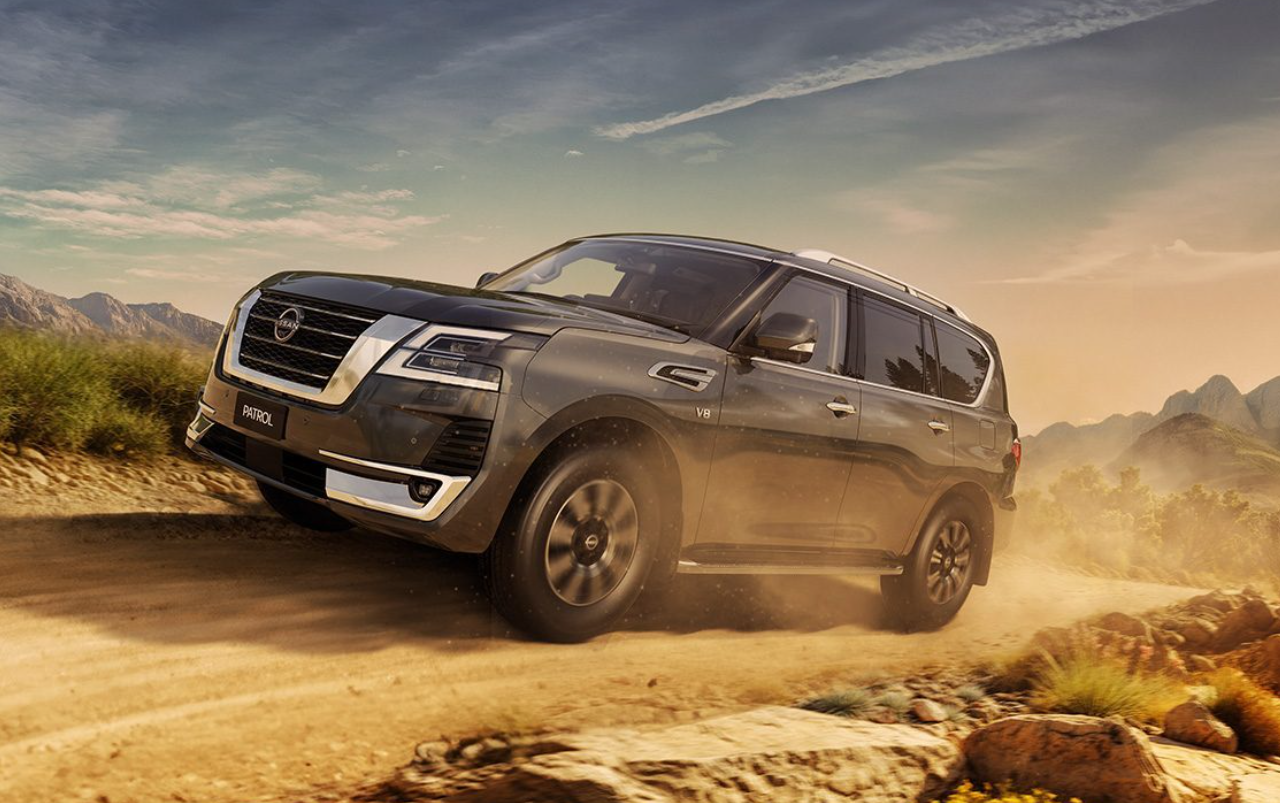
Although there’s an all-new model overseas that’s due in Australia sometime in 2026, the current-generation Nissan Patrol is still quite popular locally and that’s down to a number of factors: its great off-road capability, practical cabin, long equipment list, good value for money and its stonking petrol V8 engine and smooth seven-speed automatic transmission.
The Australian-spec Patrol received a big interior update earlier in 2025 with a new dashboard layout, a new 12.3-inch touchscreen with wireless smartphone mirroring and a new 7.0-inch digital driver’s display. The quality inside the Patrol is good, with leather trimmings everywhere.
The second and third row seating zones in the Patrol are spacious and comfortable, though child seating is not well catered for. There are two ISOFIX points in the second row outer seats, as well as two top-tether points but the points are located at the rear of the second and it’s quite a reach. There is only one top tether point in the third row as well, so the Patrol can only hold three child seats. Like the Yukon and Palisade, the Patrol can hold up to eight occupants.
The Patrol uses a powerful and refined 5.6-litre petrol V8 engine that’s mated to a seven-speed automatic transmission and a full-time four-wheel drive system. That gives it stonking performance, a lovely sound and great towing and off-road ability.
Nissan’s new 10-year/300,000km warranty (if serviced at Nissan past the five-year mark) is one of the best in the industry as well, while its $499 annual service cost for the first five years is reasonable as well. Overall, while the current generation Nissan Patrol isn’t the youngest car on the market, it’s still a great option for those wanting a large SUV that can tow and go off-road – it’s not the most modern inside, but is still comfortable and well equipped.
Audi Q7/SQ7
1
Price: From $108,815 plus on-road costs
Drivetrains/fuel economy/CO2 emissions: 2.0-litre four-cylinder turbo-petrol, 8-speed auto, 185kW/370Nm, 9.3L/100km, 210g /km (45 TFSI); 3.0-litre V6 turbo-petrol, 8-speed auto, 250kW/500Nm, 9.0L/100km, 205g/km (55 TFSI); 3.0-litre V6 turbo-diesel, 8-speed auto, 170kW/500Nm, 7.0L/100km, 184g/km (45 TDI); 3.0-litre V6 turbo-diesel, 8-speed auto, 210kW/600Nm, 7.1L/100km, 187g/km (50 TDI); 4.0-litre twin-turbo petrol V8, 8-speed auto, 373kW/770Nm, 11.8L/100km, 271g/km (SQ7)
Dimensions (length/width/height/wheelbase): 5066/2018/1707/3005mm
Bootspace: 295L (third row up), 740L (third row folded), 2050L (third + second rows folded)
Warranty/roadside assistance/service intervals: Five-year/unlimited km, five years, annual/every 15,000km
Five-year service cost: $3820 (Q7), $4600 (SQ7)
| Driving | |
|---|---|
| Interior | |
| Practicality | |
| Overall value | |
Things we like
- Excellent cabin quality and spaciousness
- Great to drive
- Punchy drivetrains
Not so much
- No plug-in hybrid any longer
- Not cheap to service
- Feeling its age in some areas
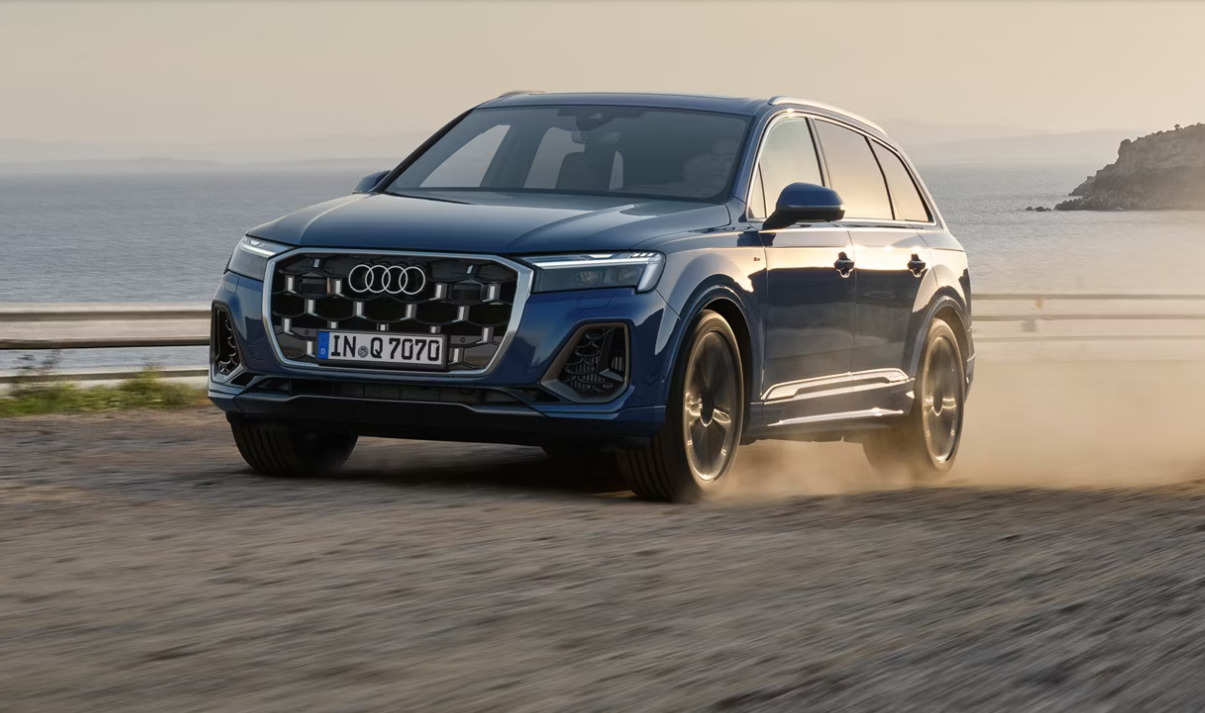
The Audi Q7, first revealed way back in 2005, was the company’s first SUV and has long been a great choice for a premium large seven-seat SUV. Even today in its second generation, still sells well and offers a wide range of models and powerplants for buyers to choose from. There are newer options around, but despite its age, the Q7 still looks and feels special.
As you’d expect from an Audi product, the cabin of the Q7 is excellent quality and bang up to date with tech. Its 10.1-inch touch and 12.3-inch digital driver’s displays are attractive, feature-packed and easy to use, while seat comfort is also excellent. Storage, however, could be better in the front seat but the whole Q7 range is well equipped.
The second and third rows of seating in the Q7 are all equipped with top tether points for child seats, so that five child seats can be fitted – plus, two ISOFIX points in the second row as well. Thanks to its size as well, even the third row of the Q7 is spacious – more so than if you optioned a BMW X5 or Mercedes-Benz GLE with their optional third rows.
Audi offers a range of powerplants for the Q7 range, from a modest 185kW 2.0-litre turbo-petrol to the stonking 373kW twin-turbo V8 in the SQ7, each engine is punchy and refined. We’d buy the 3.0-litre diesel V6, as most customers do, as it’s got more than ample performance, yet reasonable fuel efficiency at from 7.0L/100km combined. You can, however, no longer buy the former plug-in hybrid Q7 drivetrain – but it’s still offered in the Q7’s Q8 sibling.
On the road, the Q7 is great to drive thanks to its excellent refinement, great ride and handling balance from its adaptive air suspension and ample performance, regardless of which engine is chosen. It’s easy to see why the Audi Q7 has always been a popular product for the company as it just does everything quite well, including a spacious and excellent quality cabin, keen driving dynamics, excellent refinement and a great range of engines.
Follow WhichCar/Wheels on Google
Click the button below to make WhichCar by Wheels a preferred source for your news.

We recommend
-
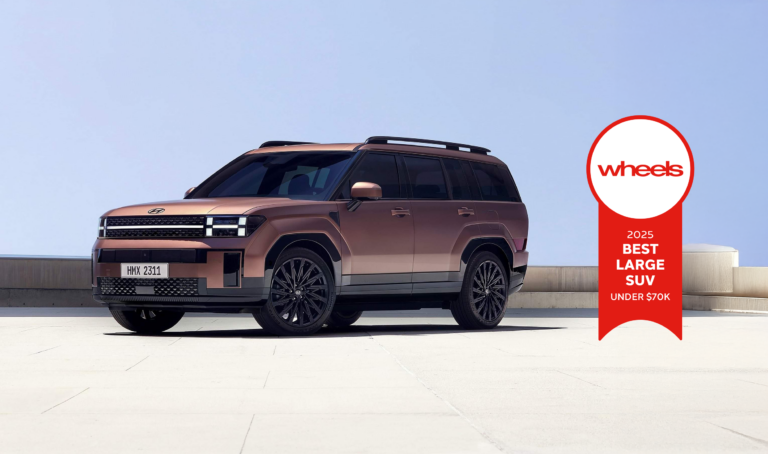 Best Large SUVs
Best Large SUVs 2025: Under $70K
Wheels Best Large SUVs 2025: Under $70K highlight affordable, spacious options for families which offer up to seven seats, versatile practicality and strong value for money.
-
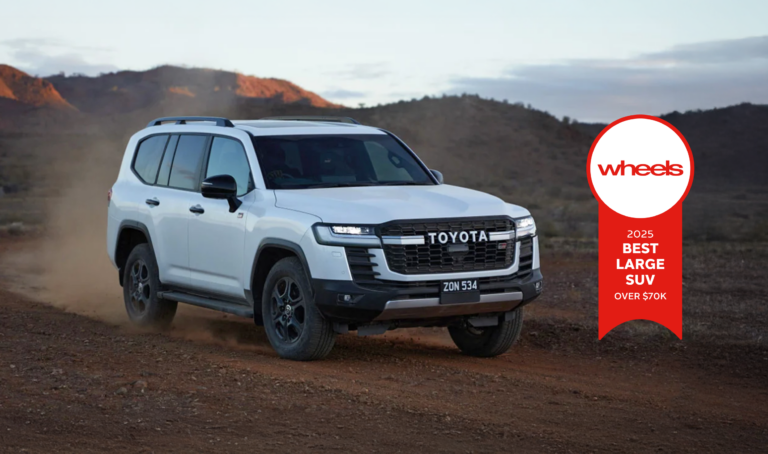 Best Large SUVs
Best Large SUVs 2025: Over $70K
Wheels' Best Large SUVs 2025: Over $70K – see our standout after assessing practical cabins, latest technology, performance and all-round capability in the higher price bracket.
-
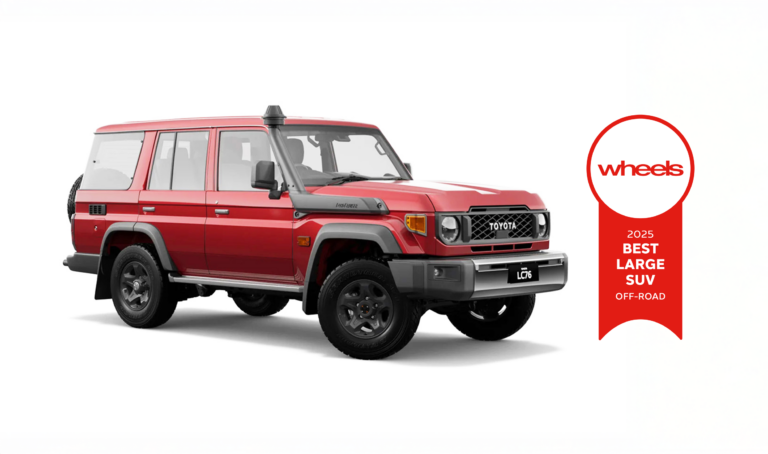 Best Large SUVs
Best Large SUVs 2025: Off-road
Our Best Large SUVs 2025: Off-road combine power, space, and rugged capability, offering families and adventurers refined comfort, advanced technology, and confidence on any off-road terrain.
-
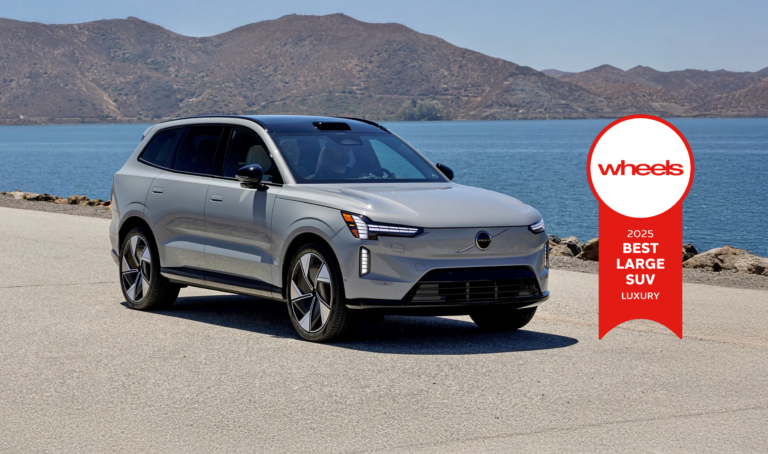 Best Large SUVs
Best Large SUVs 2025: Luxury
Wheels' Best Large SUVs 2025: Luxury, where craftsmanship, technology and comfort combine to deliver premium driving experiences.
-
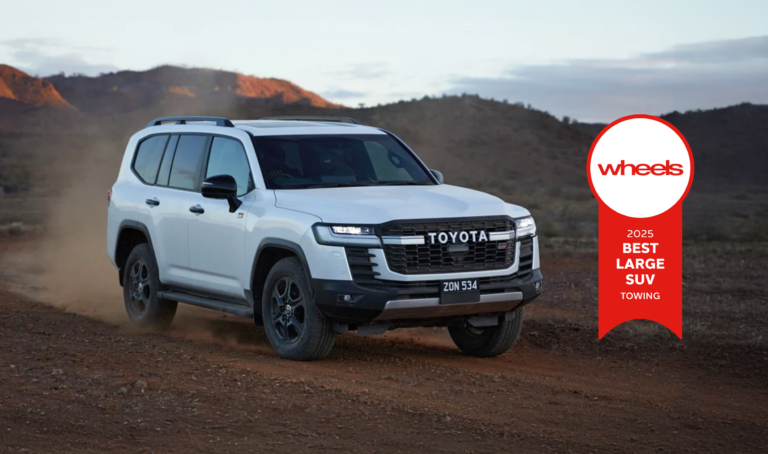 Best Large SUVs
Best Large SUVs 2025: Towing
The caravan, the fully laden trailer – for when you need to haul a load, these are the best options among the large SUVs on the market.