Less than 10 years ago, Audi revealed a confusing change to its engine variant naming, but this year’s new A5 range marked the end of that.
Now, the still-new ‘evens for electric, odds for oldschool’ model naming plan is also into the bin.
It was almost exactly two years ago that the then Audi boss Markus Duesmann told Germany’s Auto Bild about its new hodgepodge hopscotch naming plan.
“In the future it will be like this: the odd numbers will be the combustion engines and the even numbers will stand for the battery-electric vehicles. The successor to today’s A4 will be called the A5 and today’s A6 will be called the A7. The A4 and A6 will then be electric.”
(Duesmann resigned not long after that interview, replaced by Gernot Döllner, although Forbes reported at the time that Duesmann was pushed.)
As of today, that plan is done.
The company is returning to its trusty model that will once again align names with their style and size – although the latter has just-as-often been used to set body styles apart.
Where once there was a Cabriolet in the A4 range, for example, there was later the A5 Coupe, Cabriolet and Sportback – the latter effectively a ‘liftback sedan’ – to sit alongside the A4 sedan and Avant wagon.
Exactly how Audi would apply the Sportback name varied, though: the A7 Sportback was similar in concept to the A5 Sportback, with its coupe-like roof over a four-door body, whereas the A3 Sportback is a vaguely wagon-esque hatch rather than a ‘four-door coupe’, and it retained the A3 name. It could hardly take the A4 name, after all.
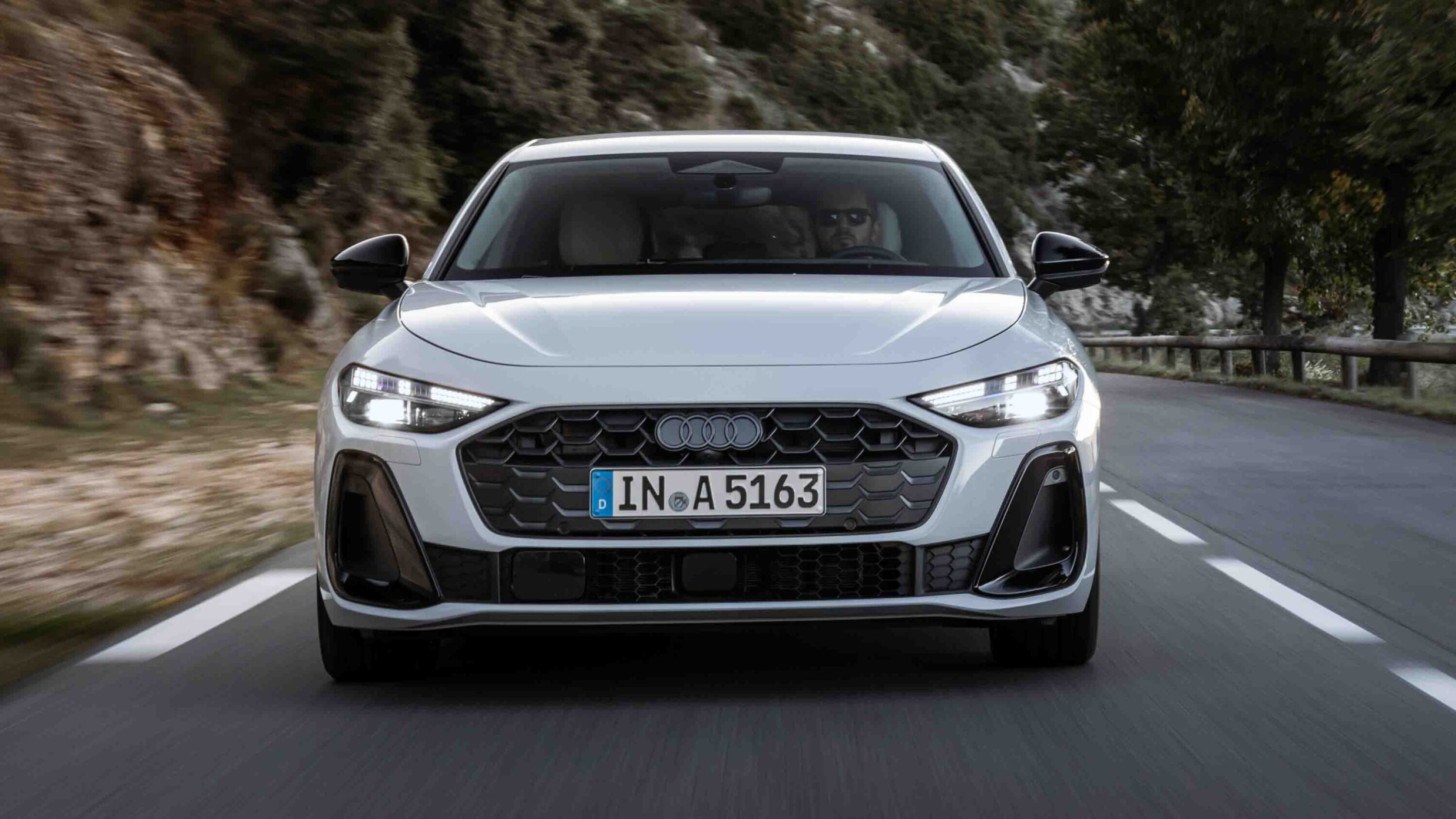
Last year, Audi gave us a new-generation A5 range that would officially replace the A4 as the brand’s mid-sized combustion model (albeit with electric assistance in most variants).
Even then, Audi’s odd plan was to have the A4 debut as an exclusively all-electric range.
Indeed, Audi executives confirmed to this writer at the A5 launch event that the now seemingly redundant e-tron name would continue, worn on every next-gen A4 model – as though in recognition that nobody but Audi would know the even-numbered name meant ‘all electric’.
I’d love to say my grilling at breakfast is what drove this week’s reversal, but Audi board member Marco Schubert insists the decision was made to “follow the wishes of our customers as well as feedback from our international dealers”. Fine.
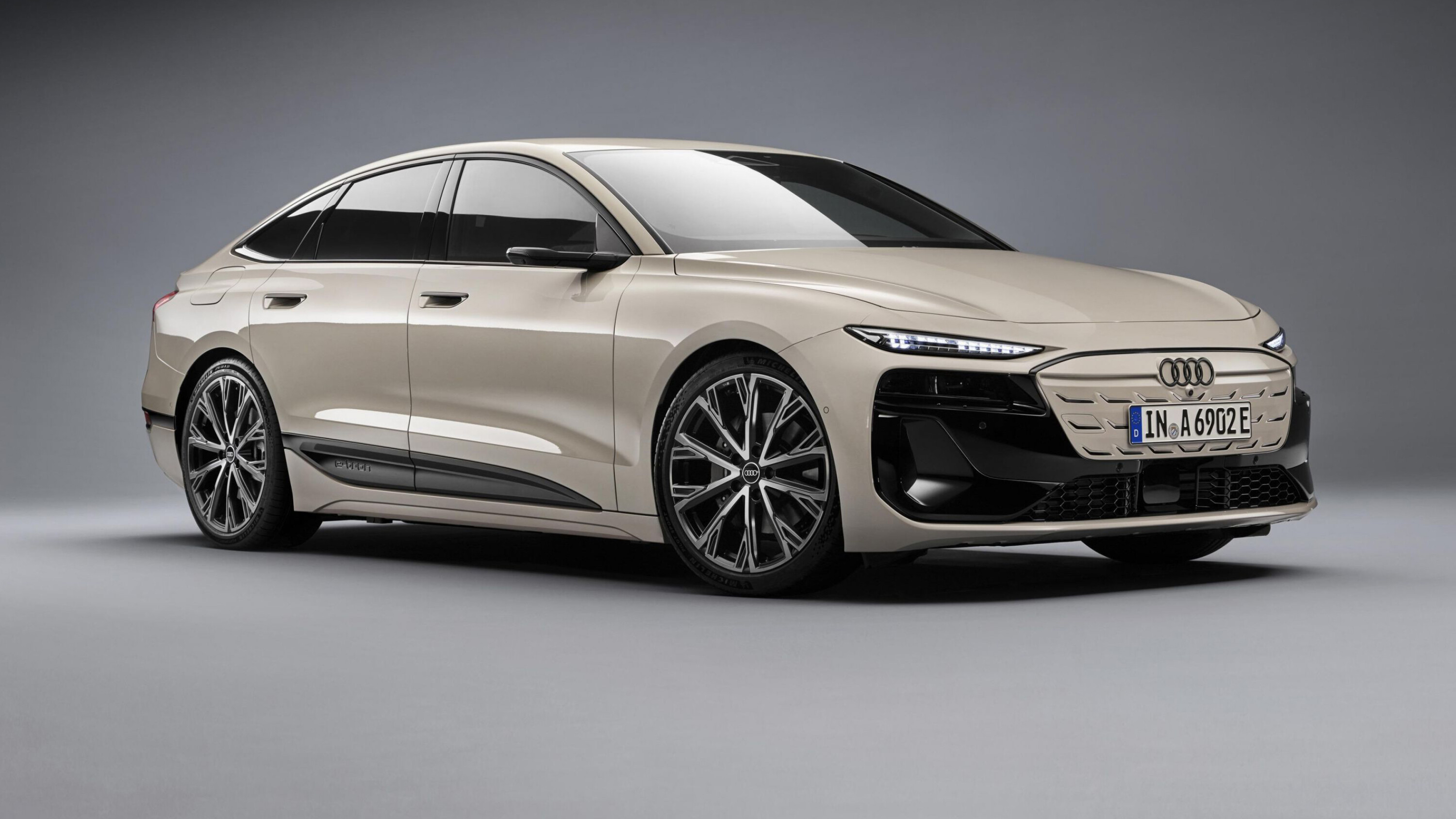
What happens from here is still a little unclear. Audi says the “first” new model returning to the old ways will be the new A6, to be revealed on March 4.
Rather than debut as an all-electric range, per the new-old plan, it will once again be offered with a combustion engine, alongside the electric A6 E-Tron unveiled in August last year.
And then? Insert shrug emoji. No matter what, though, Audi says “no retroactive name changes are planned concerning models already on sale”.
Will we still get a new A4?
According to an Autocar report in late 2023, yes we will, sometime this year – but whether it will still be electric-only is unclear, as is just how it’ll differ from A5 that was supposed to replace all combustion versions of the A4.
Dizzy yet? Close your eyes for a while, and then… watch this space.
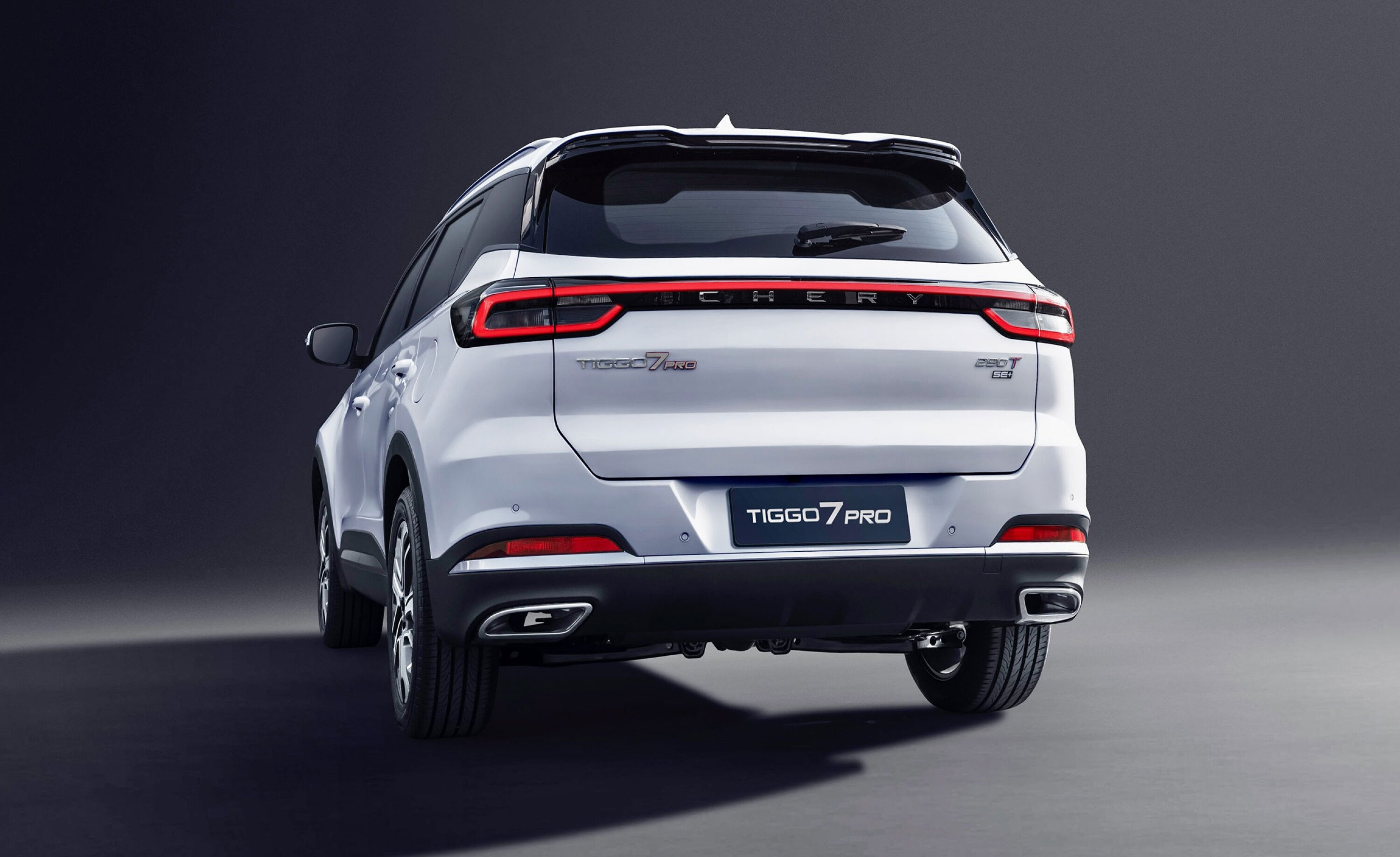
Chery has released an updated version of its Tiggo 7 Pro mid-size SUV with a revised model lineup that has slashed the price of entry significantly to under $30,000 drive away. In doing so, Chery has made it the cheapest mid-size SUV in Australia.
Previously priced from $36,990 drive away, the Tiggo 7 Pro range has been consolidated to just two models – the SE and the SE+ – with both variants now available from local Chery dealerships.

Compared with the previous entry-level Urban, the Tiggo 7 Pro SE is now priced at $7,000 less and has lost only heated front seats, a four-way electric front passenger seat, a panoramic sunroof and ambient lighting.
Those features are now standard on the SE+ at $33,990 drive away, which is priced $8,000 less than the previous mid-spec Elite. The former top-spec Ultimate has no equivalent in the updated lineup, meaning features like all-wheel drive, 19-inch alloy wheels and front seat ventilation are no longer available locally.
As before, a turbocharged 1.6-litre four-cylinder petrol engine is the sole engine option, producing 137kW of power and 275Nm of torque. It’s matched to a seven-speed dual-clutch automatic transmission and power is sent to the front wheels only.

The claimed combined fuel consumption for the Tiggo 7 Pro is 7.0L/100km with claimed CO2 emissions of 163g/km.
The updated Chery Tiggo 7 Pro lineup is available from local Chery dealerships now.
Chery Tiggo 7 Pro pricing (drive away):
- SE: $29,990
- SE+: $33,990
Chery Tiggo 7 Pro SE standard equipment:
- 18-inch alloy wheels with a full size spare wheel
- Dusk-sensing automatic LED lighting
- Rain-sensing automatic wipers
- Keyless entry with push button start
- Remote start
- Heated exterior mirrors
- Roof rails
- Synthetic leather steering wheel and seat upholstery
- Six-way electric driver’s seat
- Dual 12.3-inch touchscreen and driver’s display
- Satellite navigation
- Wired and wireless Apple CarPlay and Android Auto
- 3x USB ports
- Eight-speaker Sony sound system
- Dual-zone automatic climate control with rear air vents
Tiggo 7 Pro SE safety features:
- Eight airbags (including a front centre unit)
- Autonomous emergency braking (AEB)
- Lane keeping assistance with lane departure warning
- Blind-spot monitoring with red cross-traffic alert (with braking)
- Driver monitoring
- Speed limit information
- Adaptive cruise control with traffic jam assist
- Lane change assistance
- Auto high beam
- Reversing camera
- Front and rear parking sensors
- Rear collision warning
- Door exit alert
- Tyre pressure monitoring
- Alarm
Tiggo 7 Pro SE+ adds:
- Black alloy wheels
- 360-degree camera
- Panoramic glass roof
- Electric tailgate
- Auto-folding mirrors
- Heated front seats
- Four-way electric front passenger seat
- Frameless rear mirror
- 50W wireless charger
- 12V socket in boot
- Multi-coloured front cabin ambient lighting
- Cargo blind
Let the countdown begin: the next Toyota Corolla is likely to rear its head sometime this year or early next. Here’s everything to know so far.
Snapshot
- 13th-gen Corolla expected to debut late this year or early next
- Design cues anticipated to evolve from the current model, as with new Camry and next RAV4
- Powertrains likely to focus on hybrids, possibly with a plug-in hybrid variant
- No all-electric Corolla-badged EVs expected
- Will we see another GR Corolla??
F L A S H B A C K
When Toyota’s ‘E210’ twelfth-generation Corolla debuted in 2018, it was something of a revolution to the brand, debuting its sportiest and most progressive design themes in years.
That new Corolla was also one of the first models to ride on the brand-new ‘Toyota New Generation Architecture’ (TNGA) platform, which at that time had only reached Australia in the form of the C-HR and Prius – both regarded as fun if imperfect steers.
Following its Australian launch in late 2018, minor updates followed in 2022, along with the switch to a hybrid-only range in 2024.
Of course, there has also been the debut of the long anticipated GR Corolla, unveiled in 2022 ahead of its 2023 launch in Australia.
The GR, now also available with an automatic transmission for winners and grinners, has returned the Corolla name to a place of pride among enthusiasts – so it’s worth hoping we’ll see the badge and formula continue into the next generation.
F L A S H F O R W A R D
Barring any strange decisions out of Aichi, the next Corolla will likely be offered with hatch and sedan bodies again, along with the wagon that remains a mainstay in wise and tasteful Europe.
We shouldn’t expect the wagon to be seen here, of course. The style hasn’t been popular in Australia for years now, and the current longroof Corolla is only built in Europe.
Still, if the new model’s Japan plant again adds the wagon to its production lines, it could be a different story. (I wouldn’t bet on it.)
What else can we expect from the 2026 Toyota Corolla?
There still haven’t been any spy photos of the new Corolla, although that’s nothing unusual for Toyota – the big T is especially gifted at keeping its new products under wraps, especially within Japan.
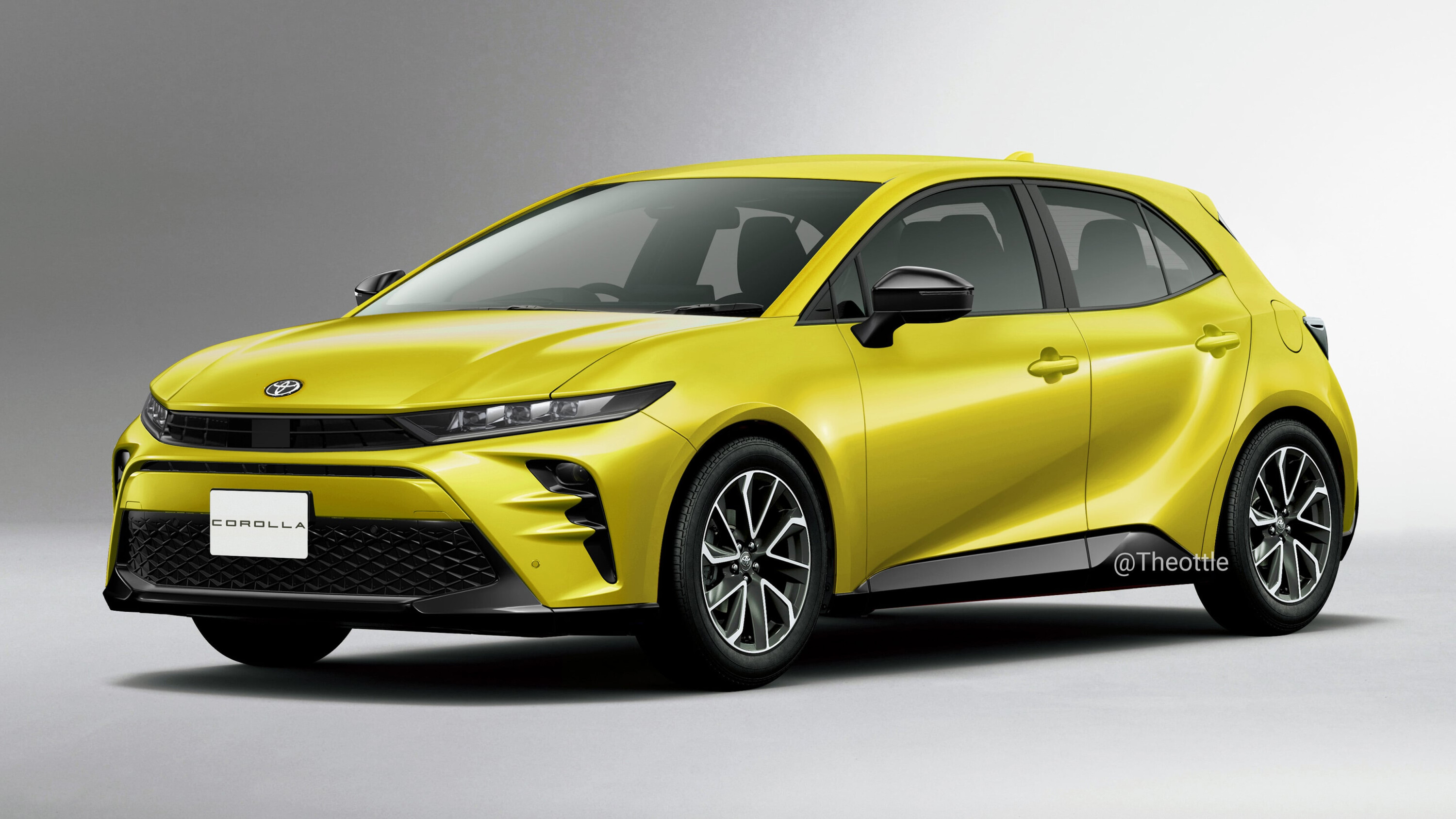
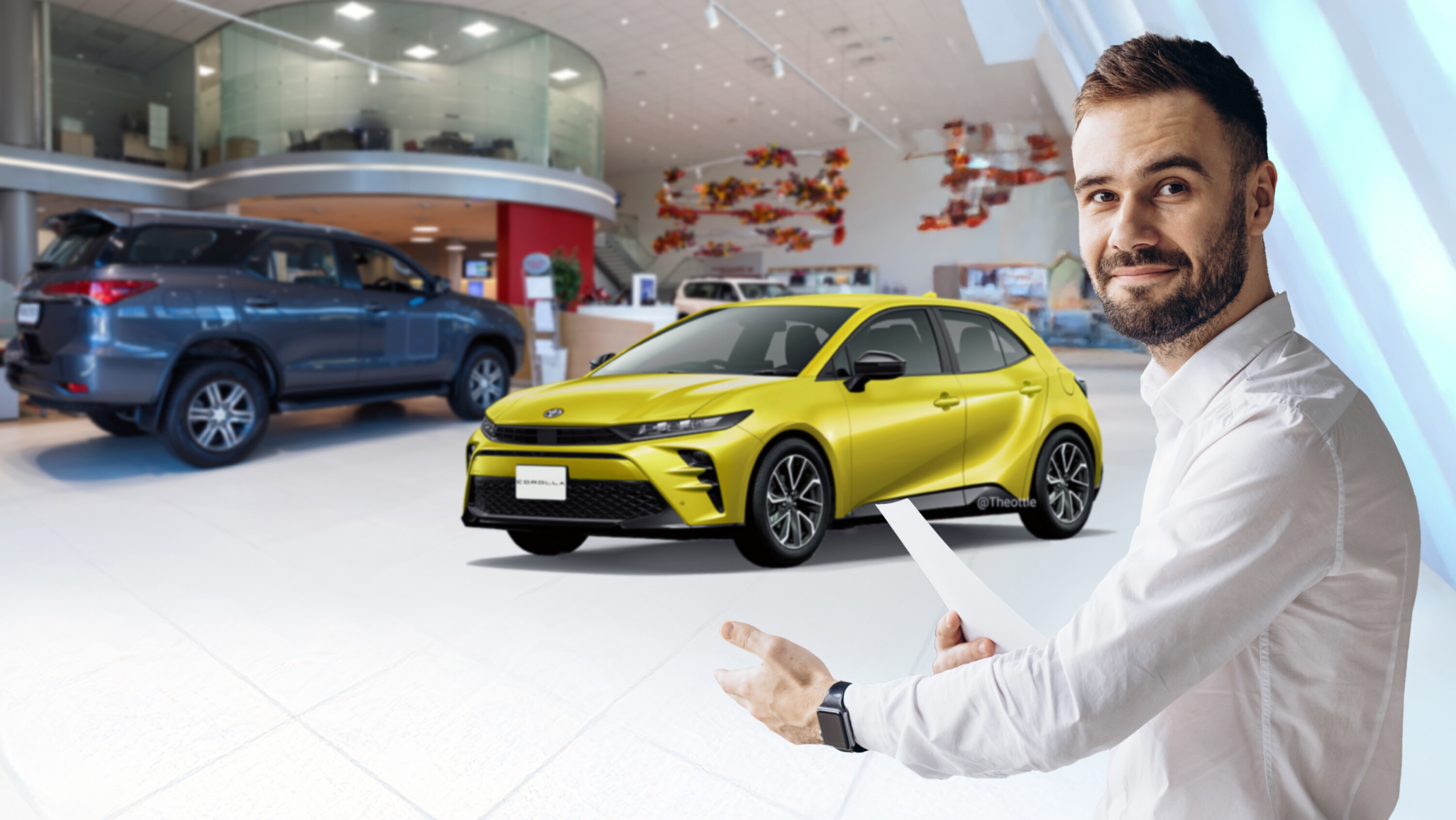
But, for your viewing pleasure, our mate Theottle the digital wizard has developed three unique looks – speculative, of course – at the new generation.
Whether Toyota will move the Corolla to its new hooked headlights (which Theo says he simply doesn’t like!) or stick with a more conventional as rendered here, remains to be seen.
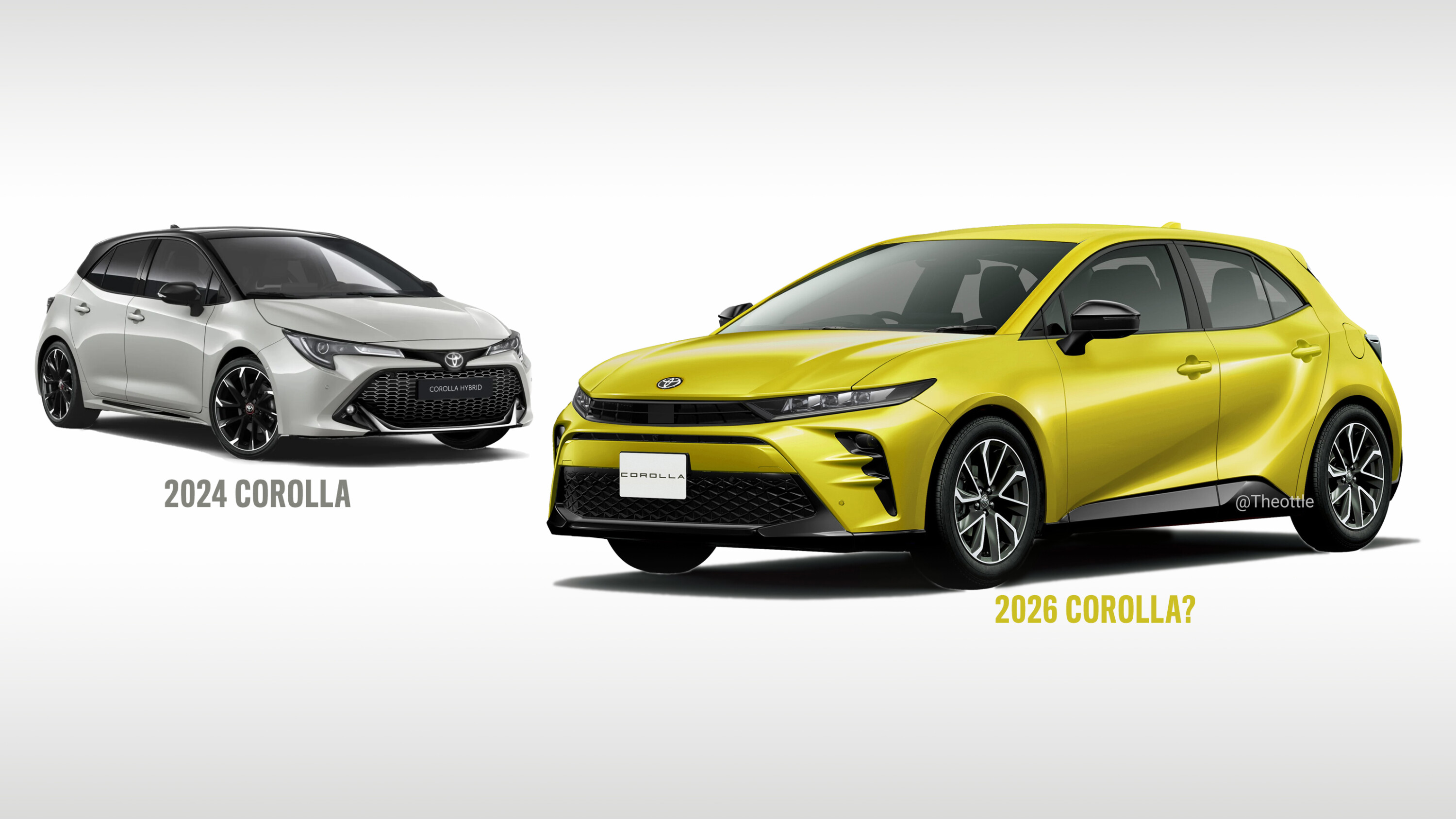
In crafting his take on the next Corolla hatch, Theo has looked to the current model for his lead on how to style the middle section.
Given the look of the new Camry and the anticipated ‘more of the same’ approach Toyota appears to be taking with the next RAV4, this might not even be that far from what we’ll eventually get.
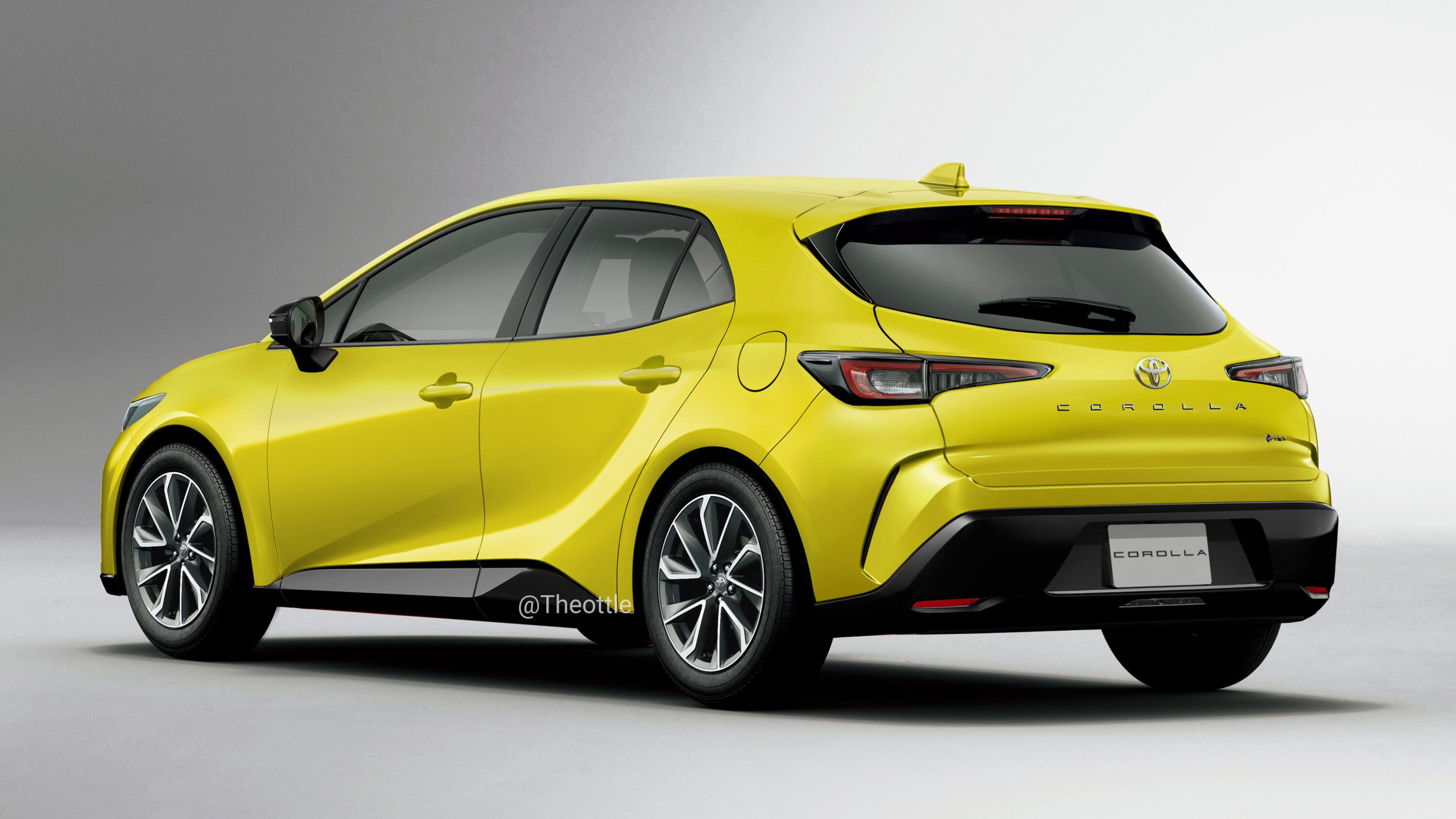
At the rear, we see the hatch decked with tail lamps that repurpose the existing corners – an increasingly common and handy cost saving for many brands – but with an updated lid that smooths out the design worn by the current model.
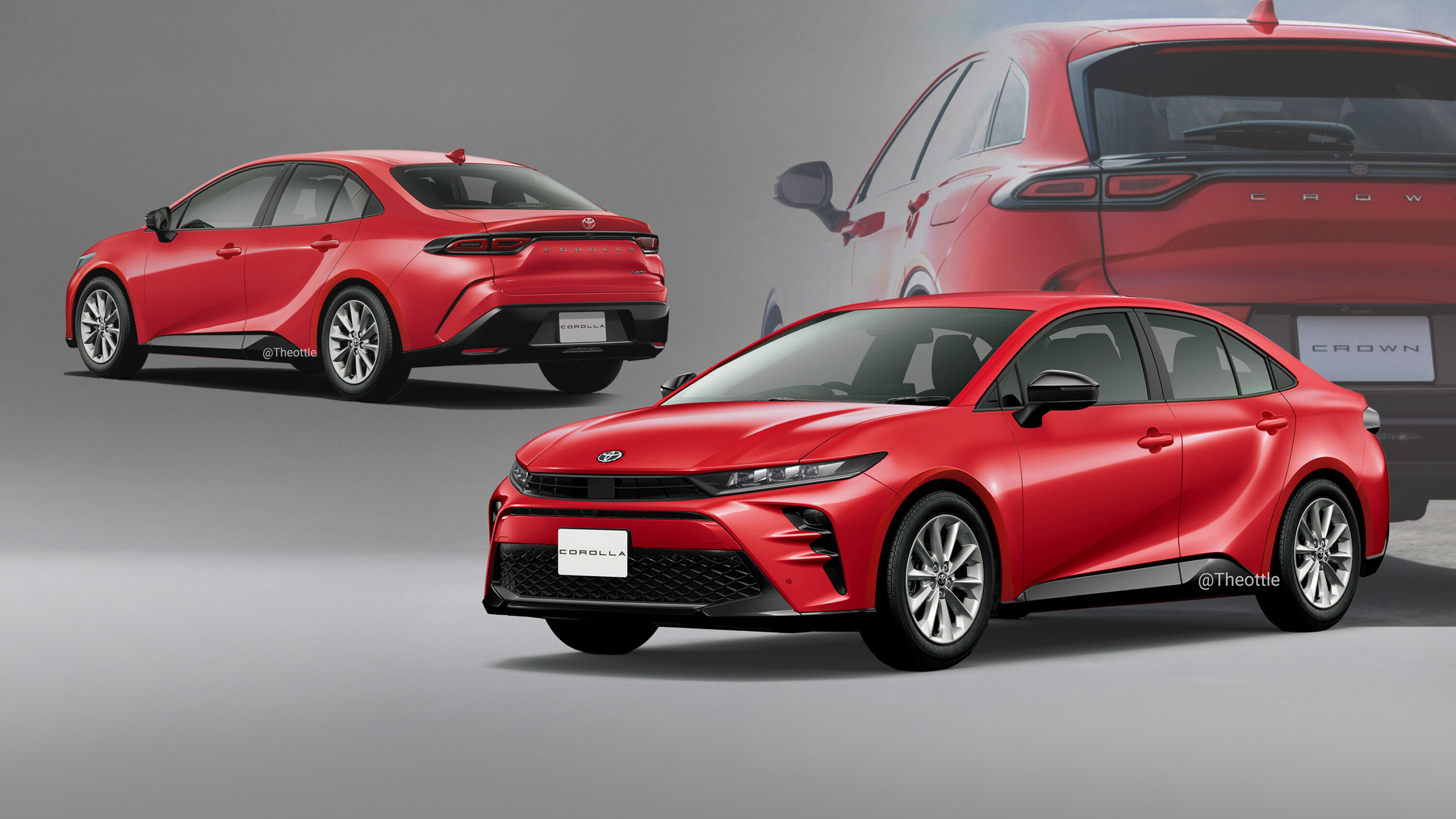
Don’t be surprised if the hatch and sedan bodies once again wear unique front and rear styling – something which has long been a trend in the Corolla line.
For the sedan shown here, Theo has carried over his hatch’s face, the lazy scamp, but adapted the tail lamps of the overseas Crown Sport SUV at the rear.
Indeed, the rear end makes up the main change, with the doors and front half of the glasshouse all shared with the hatch. It’s a level of likeness we rarely see in the wider Corolla family, but it would go a long way to giving the range a more consistent feel.
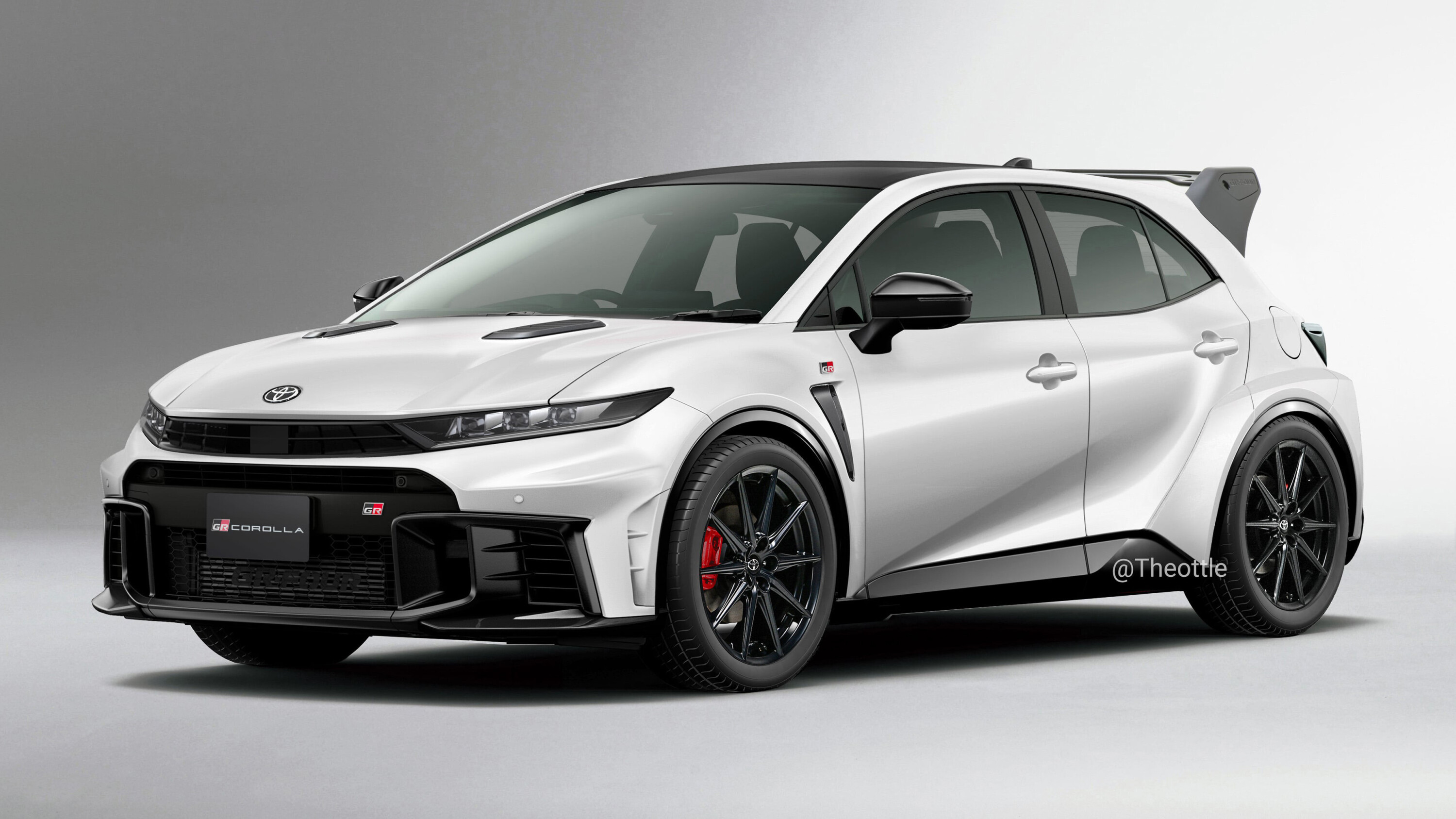
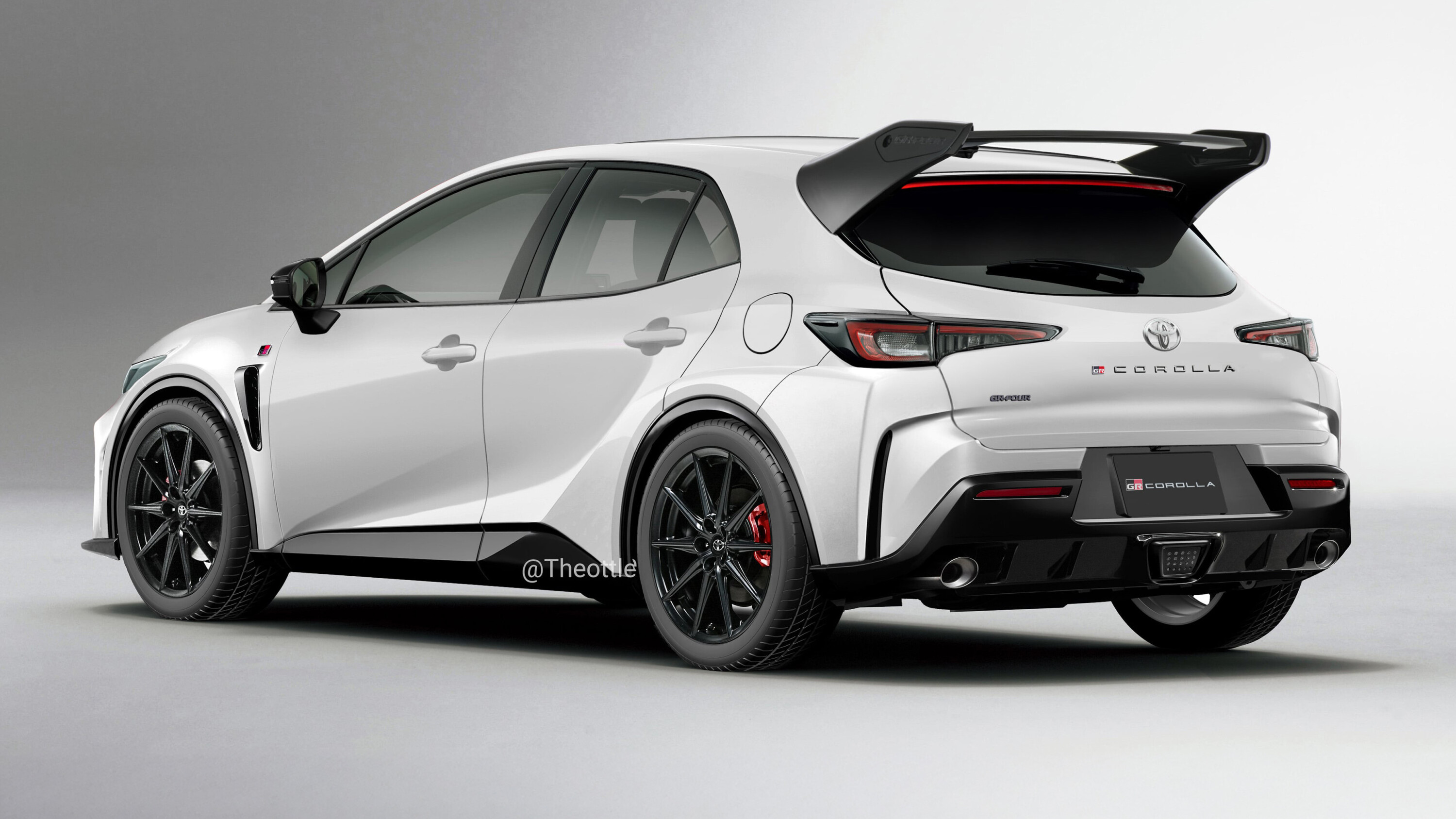
💪 At last we come to the hero GR Corolla, which gains what I’d call a more cohesive and athletic look with Theo’s next-gen concept, along with a rally-ready rear wing to keep it planted.
Hold thine horses, however: There’s no confirmation the next-gen Corolla will include a GR model – but if it does come, you should expect to see some form of advanced electrification adding to its outputs while reducing emissions.
It ticks all the boxes at our end, in terms of those menacingly capable looks, but what do you think? Tell us in the comments!
🧰 Architecture
An evolution of what we’ve seen in the 12th-gen range is expected, but expect a greater focus on electrification.
The new Corolla will likely ride on an evolution of the current TNGA-C platform, although Toyota has also developed a new platform it calls E3 – an architecture that borrows from the TNGA toolbox while focusing even more specifically on hybrid, plug-in hybrid EV and full-EV drive systems.
That platform, announced in late 2021, was developed for Toyota’s European production lines, but we could very likely see aspects of it appear in the rest-of-world Corolla family.
⚙️ What will power the new Corolla?
Corolla the 12th has been sold with a 125kW 2.0-litre ‘atmo’ petrol engine, and a 103kW 1.8-litre petrol-electric hybrid system – but the latter is now the only powertrain on offer in the regular range.
We could also at last get a plug-in hybrid EV variant in the new Corolla line-up, with the sort of driving range that should satisfy Toyota’s local bosses.
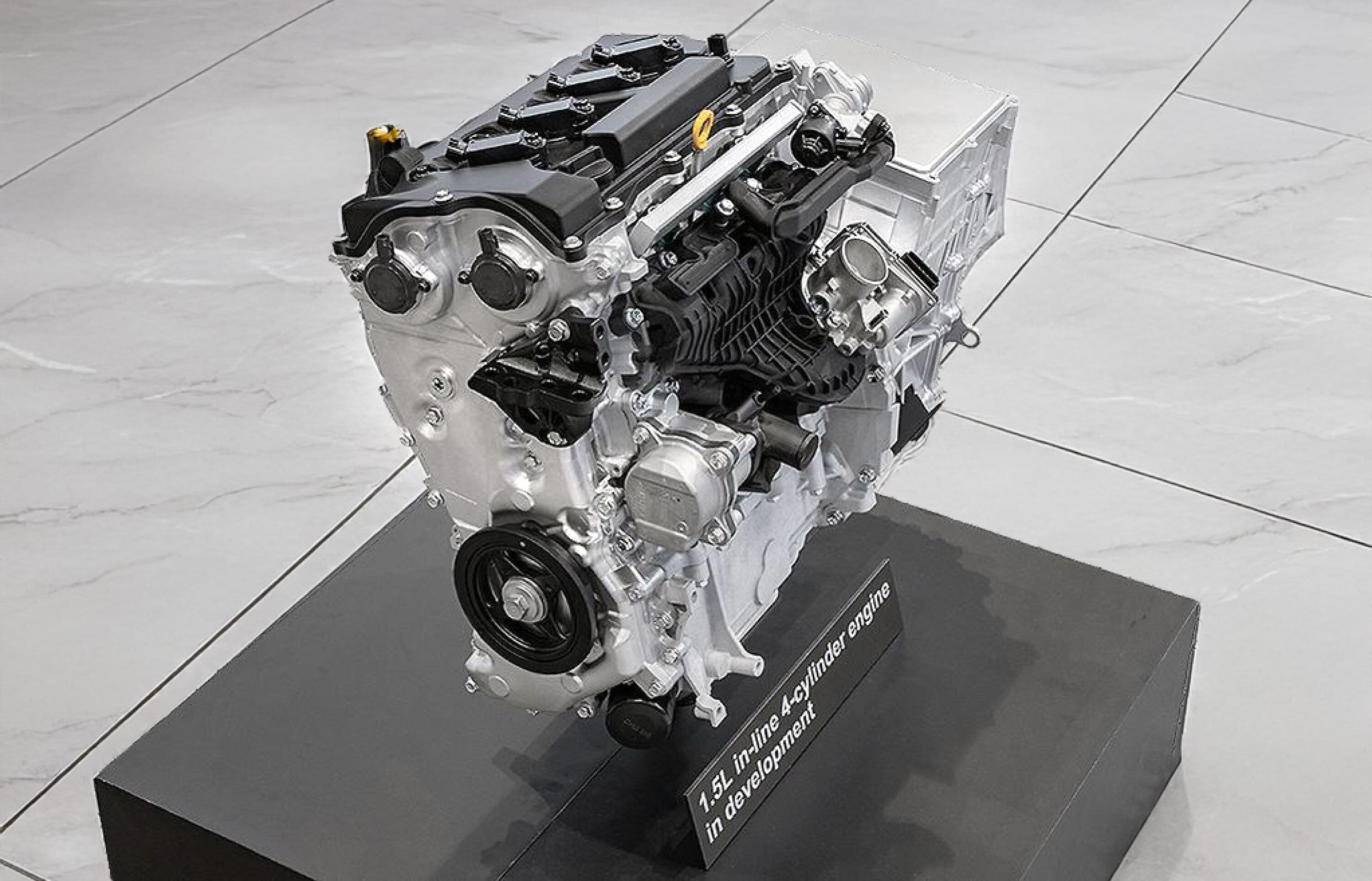
EV in the streets, hybrid on the highway?
Reports out of Japan suggest Toyota will use its new 1.5-litre petrol engine mated to a new electric motor and its solid-state batteries to reach 2100km (🤯) off a full tank of fuel.
Toyota has previously said the solid-state batteries will be the preserve of flagship EV models, but if BestCar’s report linked above is correct, it might be planning to make an exception for PHEVs.
Whatever the case, we can at least expect to see that new 1.5 mill in regular Corolla Hybrid models. While the current Corolla Hybrid lists fuel consumption figures as low as 3.9L/100km, this new system could see a number much closer to 3.0L/100km.
An all-electric variant isn’t on the cards, or at least not in the regular range.
Toyota has confirmed a Corolla-sized, BZ3-badged electric sedan for China as part of its partnership with BYD (which went official with this announcement), but it has yet to reveal any plans for such an offering in Australia – apart from the BZ4x already available here.
How much will the new 2026 Corolla cost?
A bit. The days of a ‘cheap and cheerful’ Corolla are well behind us, after all.
In the current line-up, the Corolla’s now hybrid-only variants range from $32,110 for the Ascent Sport hybrid to $39K for the sportier ZR hybrid, excluding on-road costs.
As with every new model, the next Corolla is sure to see prices increase by a few grand – so expect a starting point around $35,000.
The third-generation VW Tiguan is set to arrive in Australian showrooms in May 2025.
It’s been a long wait, following the global reveal back in 2023 – and the wait will be longer still for those seeking a seven-seat Tiguan Allspace replacement, with its successor the Tayron not due here until later in the year.
Snapshot
- Five variants, including an R-replacing 195TSI R-Line
- New tech includes available HD Matrix LED headlights, DCC Pro adaptive chassis, and larger infotainment screens
- Increased size brings improved practicality, with boot space growing to 652 litres
The five-seat 2025 Tiguan line-up will include the 110TSI Life, 110TSI Elegance, 150TSI R-Line, 150TSI Elegance, and 195TSI R-Line.
For those not clued in on the ‘TSI’ nomenclature, it means buyers will have only petrol models to choose from in this new-generation Tiguan range.
Diesel was always going to be off the menu, but the company’s Australian arm confirmed with Wheels in 2023 that it had initially been “very interested” in the plug-in hybrid EV variant before deciding that the incoming ID.4 electric SUV – due, at long last, around March – will satisfy those looking for Tiguan space in an EV form.
Likewise, the hero R badge won’t return in its single-letter form, with the outgoing Tiguan range having dropped the 225kW/400Nm flagship in late 2023.
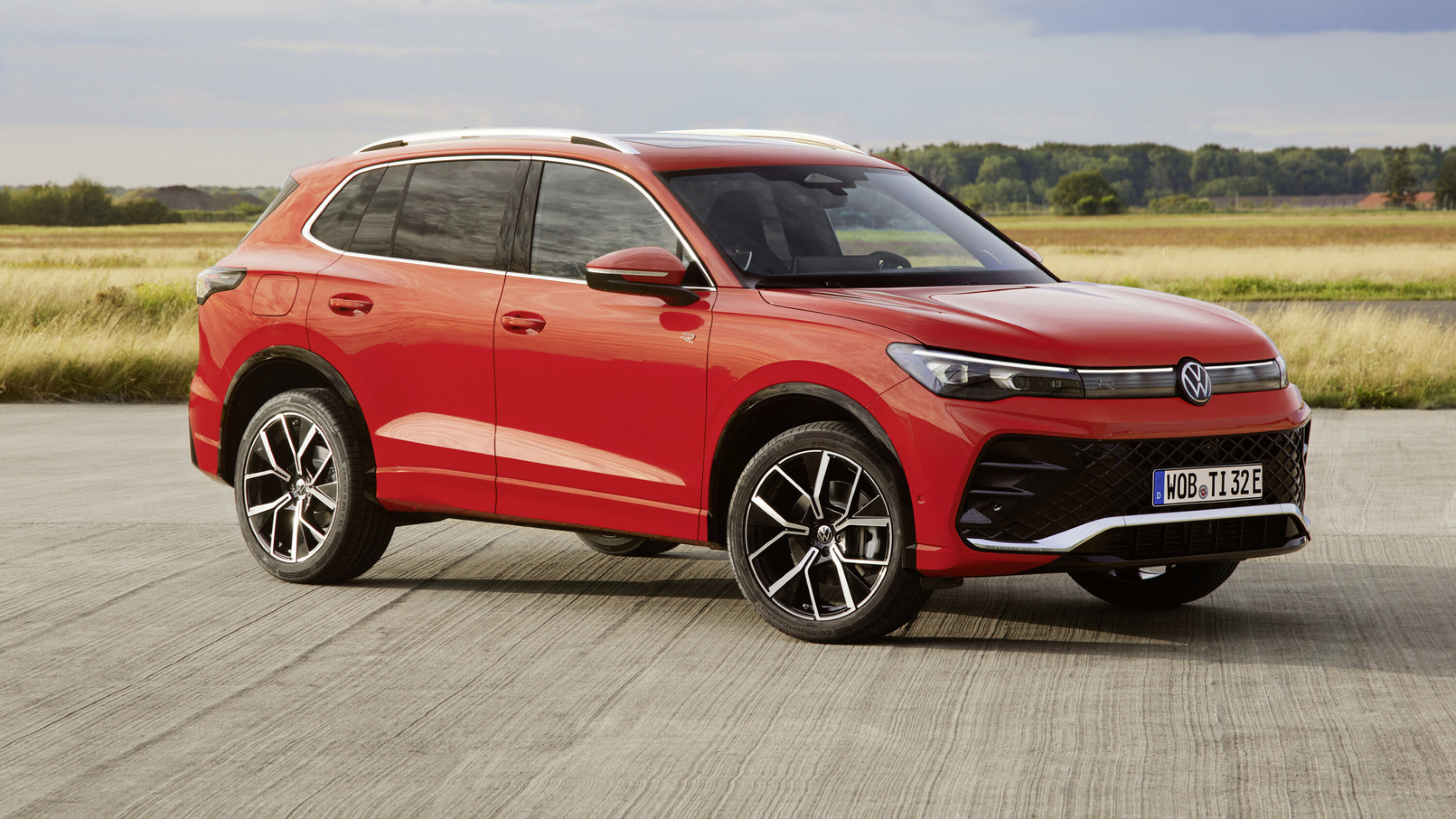
In its new third-gen form, the Tiguan will instead get an R-Line model with nearly as much puff and a matching torque figure: 195kW and 400Nm.
That’s joined by the DCC Pro active chassis control system, shared with the 150TSI R-Line and Elegance models. All-wheel drive and a seven-speed dual-clutch auto round out the 195TSI R-Line package.
At the other end of the range, the entry-level 110TSI Life and 110TSI Elegance are driven by a familiar 110kW/250Nm 1.4-litre turbo petrol engine, matched to a six-speed dual-clutch automatic and front-wheel drive.
All new Tiguans ride on VW’s latest MQB Evo platform.
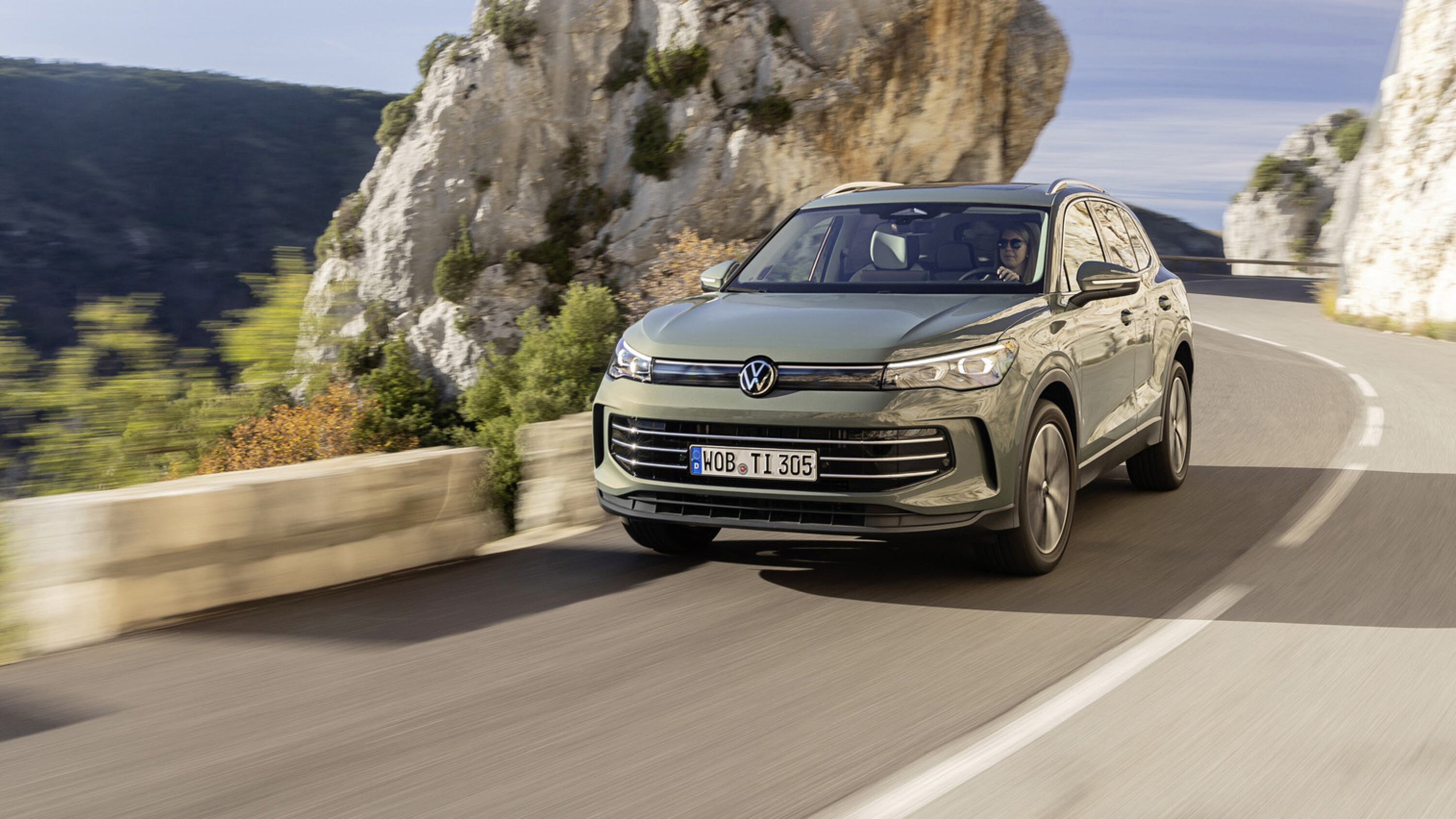
2025 VW Tiguan equipment levels
Pricing for the range won’t be announced until closer to launch, but here’s what buyers will find in each trim grade.
110TSI Life
- 19-inch alloy wheels
- Keyless entry with alarm
- Powered tailgate
- Area View 360-degree camera
- Digital driver’s display
- 12.9-inch main touchscreen with satellite navigation
- Wireless App-Connect
- Wireless smartphone charging
- DAB+ digital radio
- Driver Assistance:
- Travel Assist (adaptive cruise control and Lane Assist)
- Front Assist with pedestrian and cyclist monitoring
- Side Assist with rear traffic alert
- Side exit warning
- Front cross-traffic assist
- Oncoming vehicle braking with swerve support
- Park Assist Plus
- Dynamic Road Sign Assist
- Nine airbags (including centre airbag)
110TSI Elegance (adds over 110TSI Life)
- Chrome roof rails and trim, rear privacy glass
- LED Plus headlights with illuminated grille strip
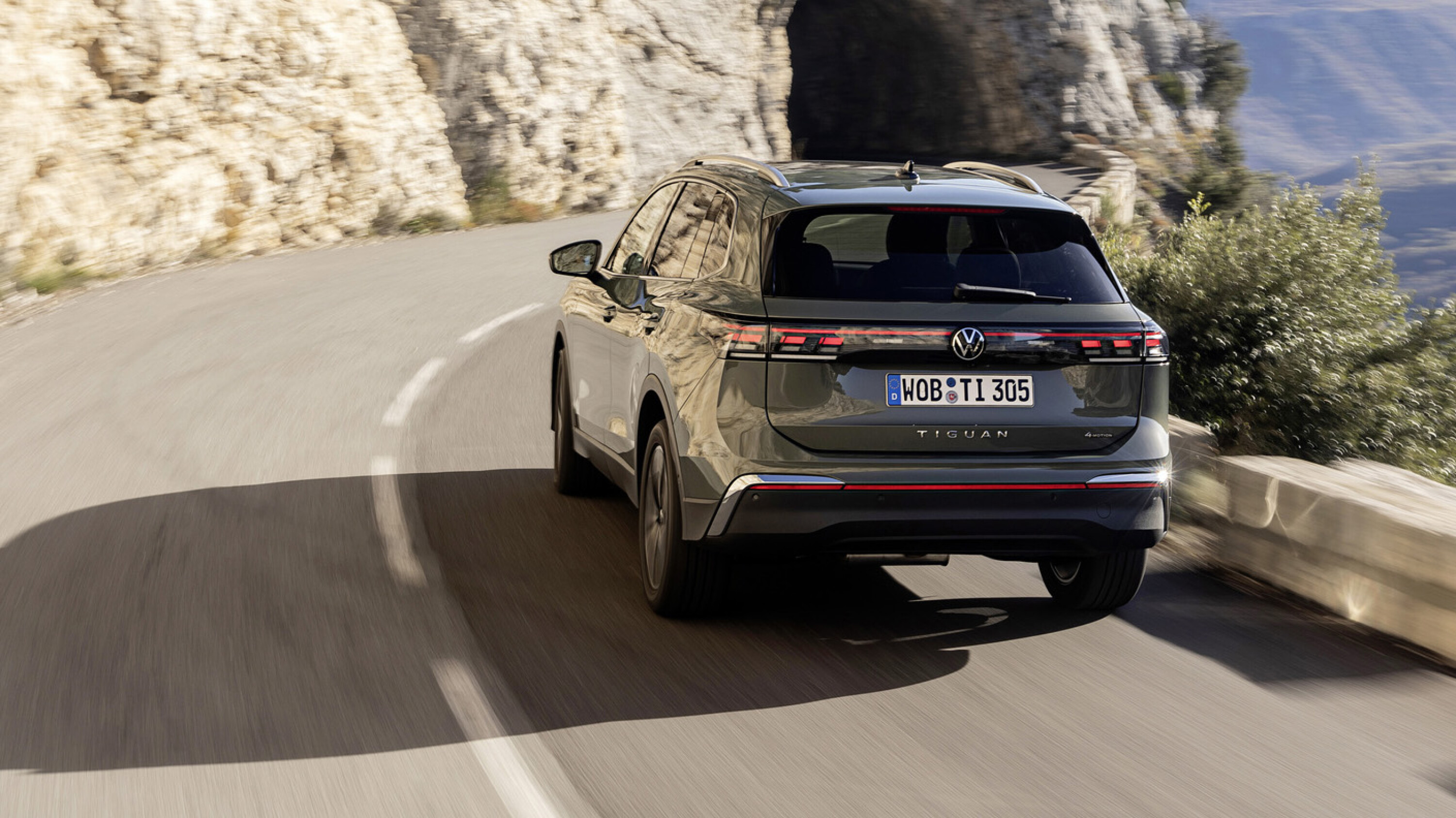
- LED tail-lights with illuminated centre strip
- Leather-appointed upholstery, front comfort sport seats with power adjustment, heating, ventilation, and massage functions
- Options:
- Panoramic sunroof
- Sound & Vision package (head-up display, Harman/Kardon premium audio)
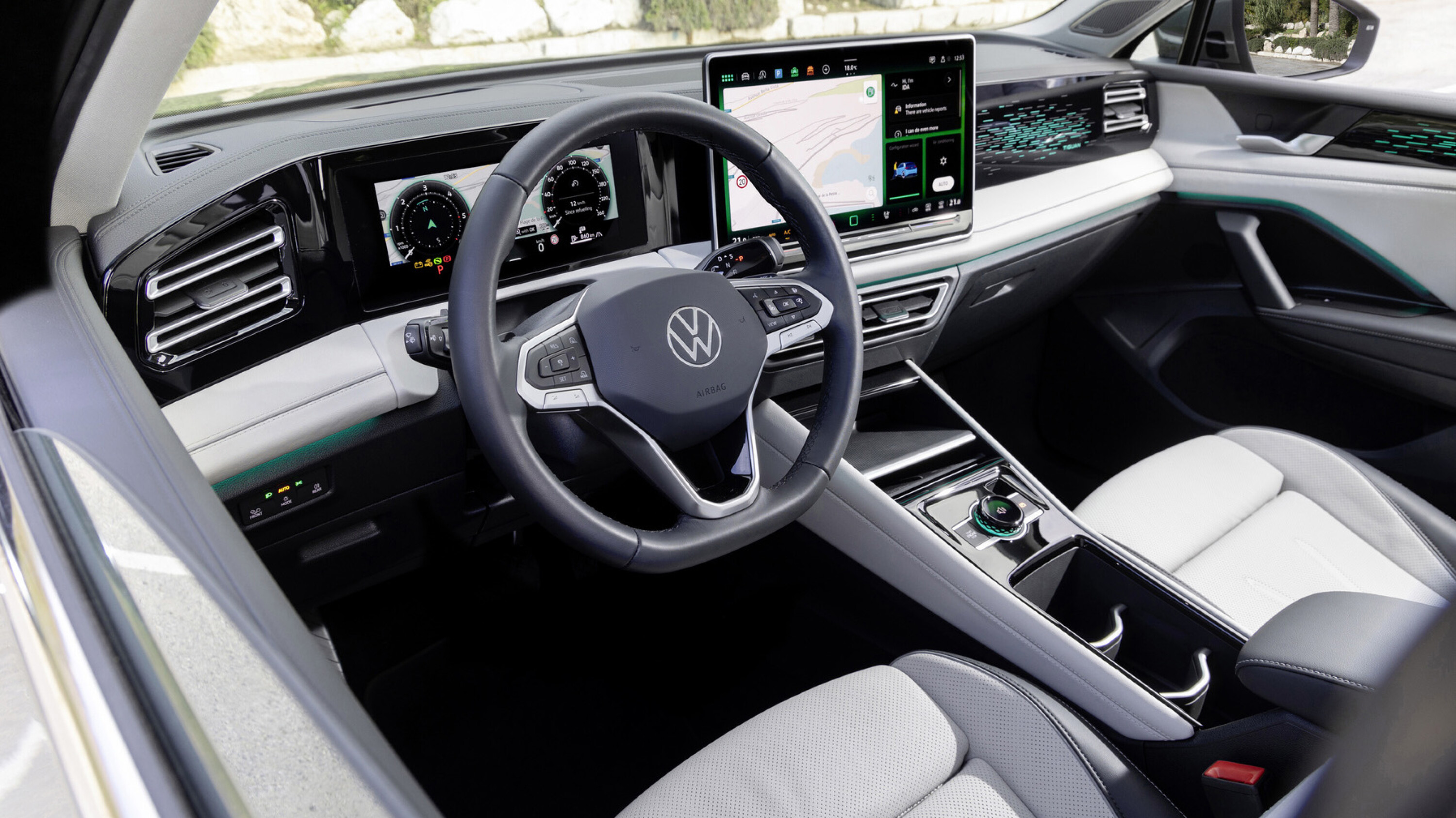
150TSI Elegance (over 110TSI Elegance)
- 4MOTION all-wheel drive
- 0-100km/h in a claimed 7.1 seconds
- Sound & Vision package
- HD Matrix LED headlights with adaptive high-beam
- LED Plus rear tail-lights with dynamic indicators
- 15.0-inch Discover Pro Max navigation system
- Adaptive chassis control (DCC Pro)
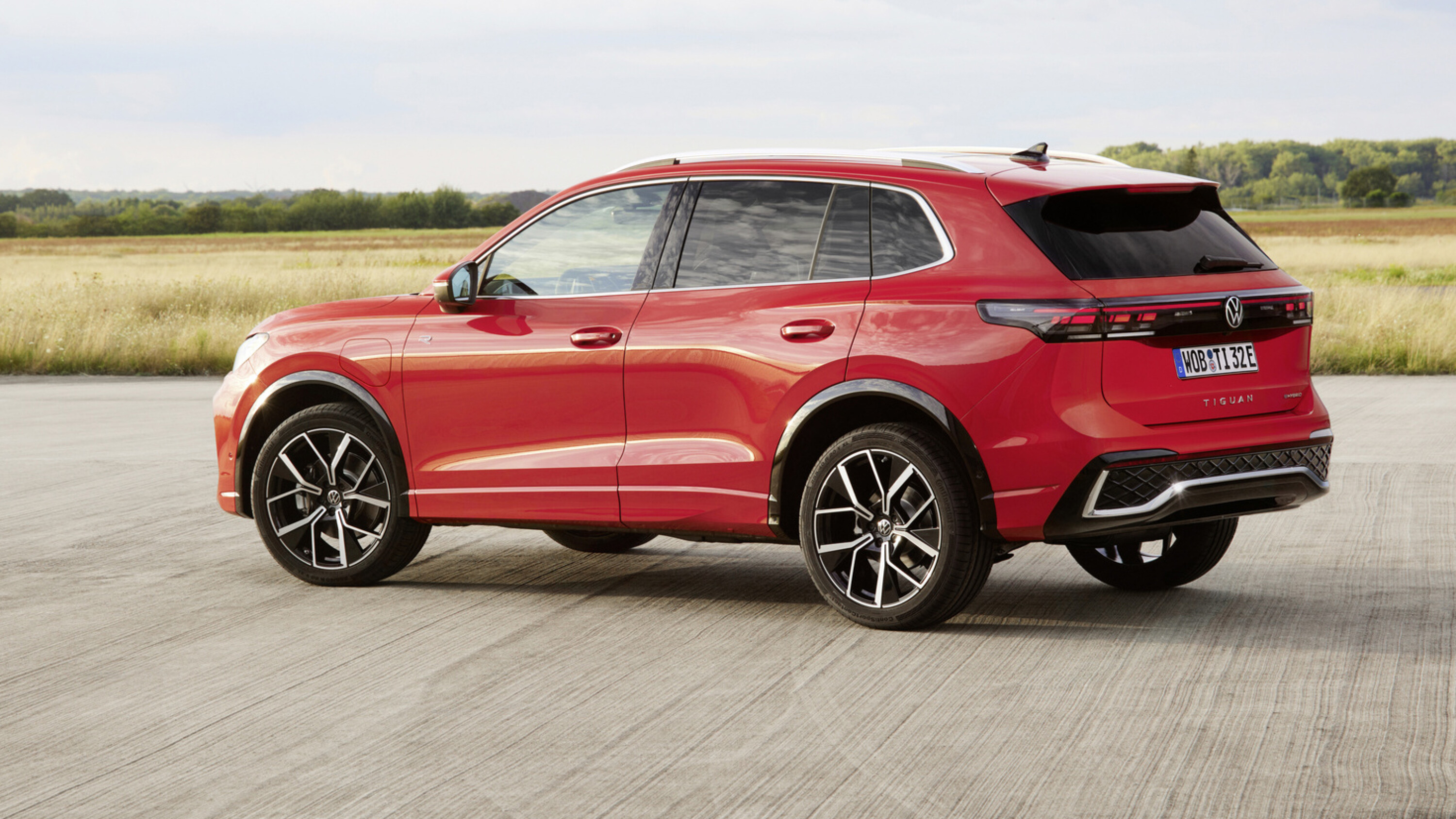
150TSI R-Line
- R-Line body kit, unique 19-inch alloys
- LED Plus headlights
- Premium LED tail-lights with dynamic indicators
- Sports seats with integrated headrests, sports cloth upholstery
- Progressive steering
- DCC Pro
- Options:
- Panoramic sunroof
- Sound & Vision package
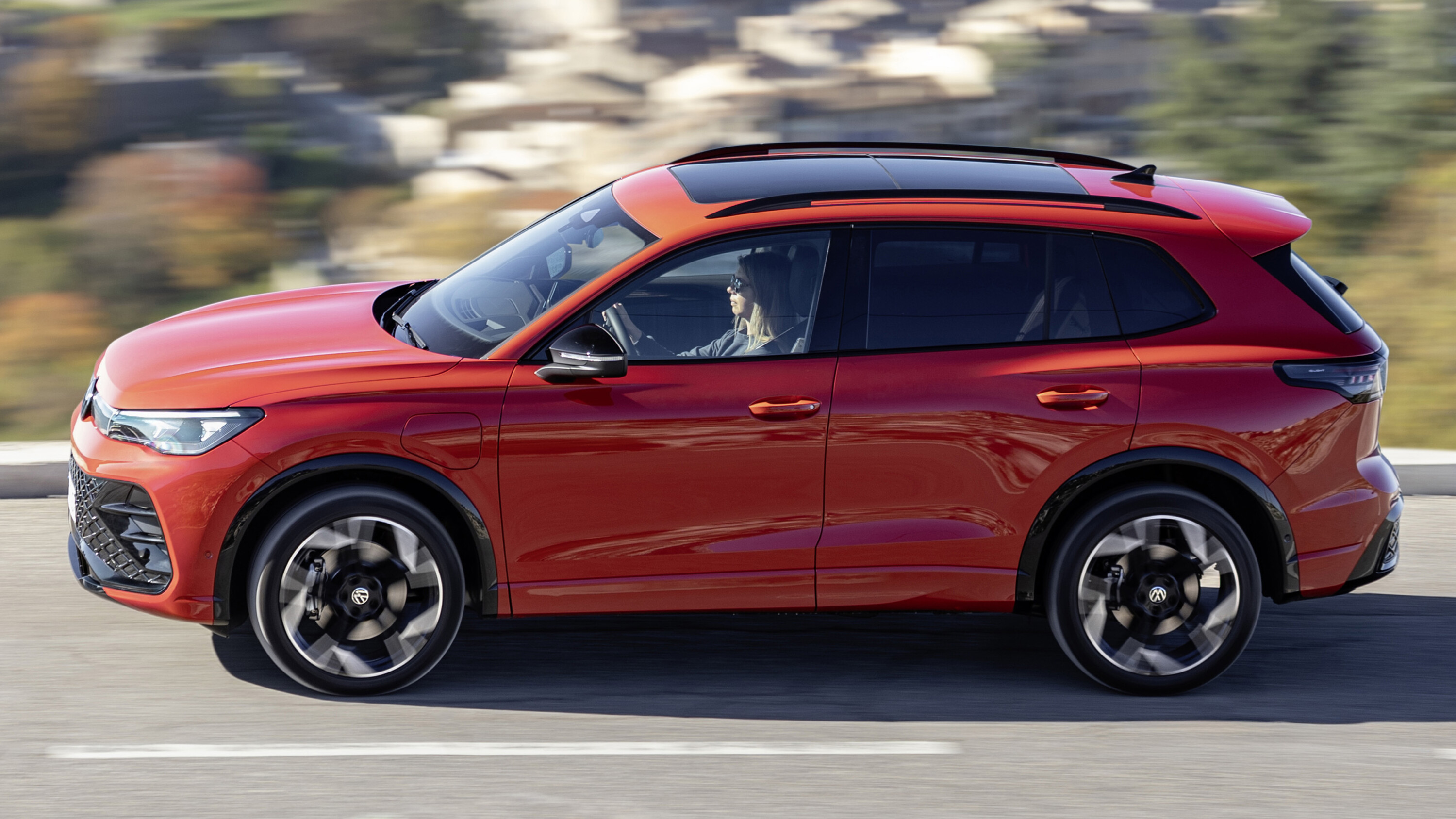
195TSI R-Line
- 2.0-litre turbocharged engine with 195kW and 400Nm
- 0-100km/h in a claimed 5.9 seconds
- 20-inch Leeds alloy wheels
- Leather-appointed upholstery, front comfort sport seats with electrical adjustment, memory, heating, ventilation, and massage functions
- Heated steering wheel
- 15-inch Discover Pro Max navigation
- Head-up display
- HD Matrix LED headlights, dynamic light assist
- Premium LED tail-lights with dynamic indicators
- Harman/Kardon premium audio system
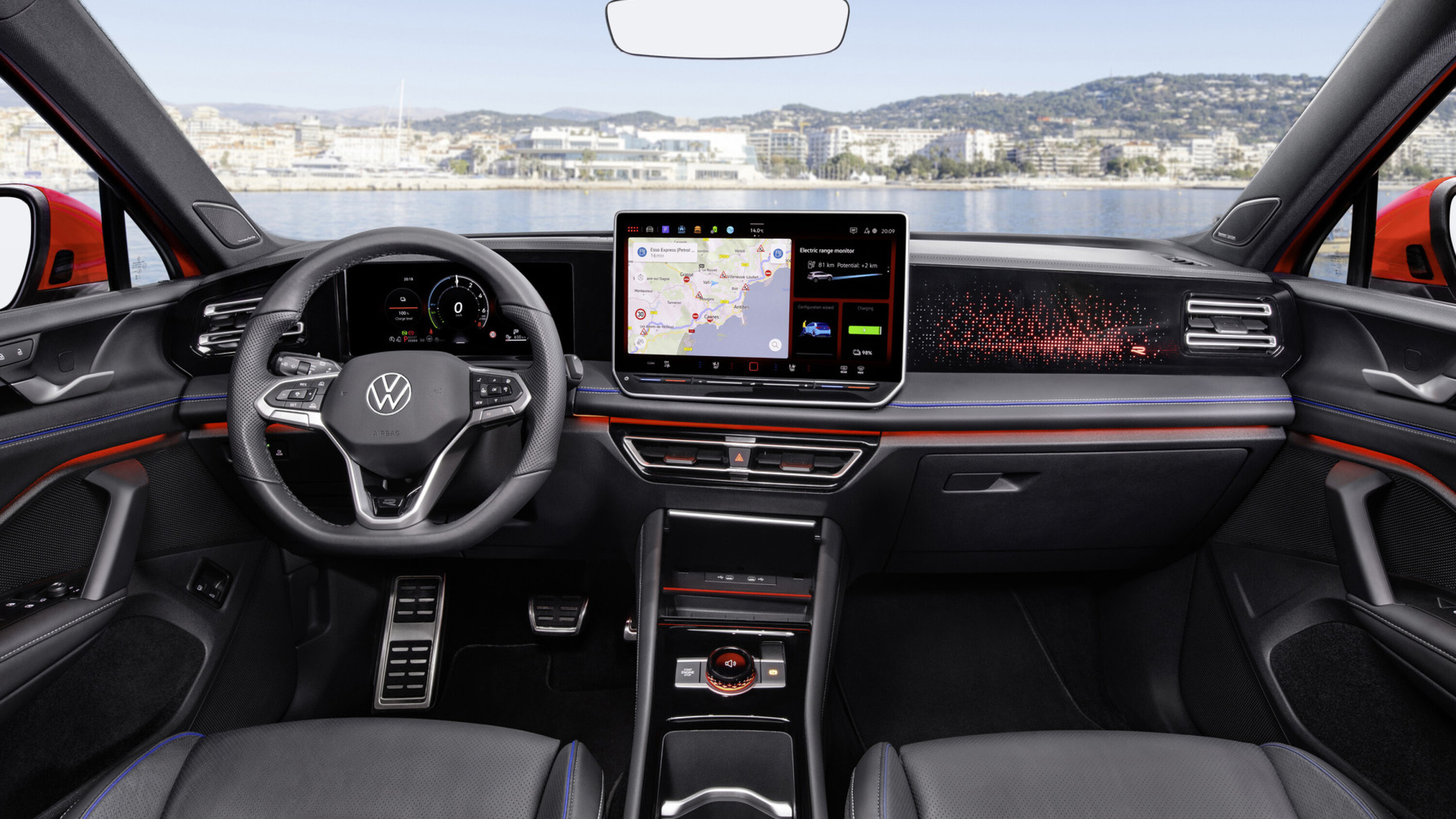
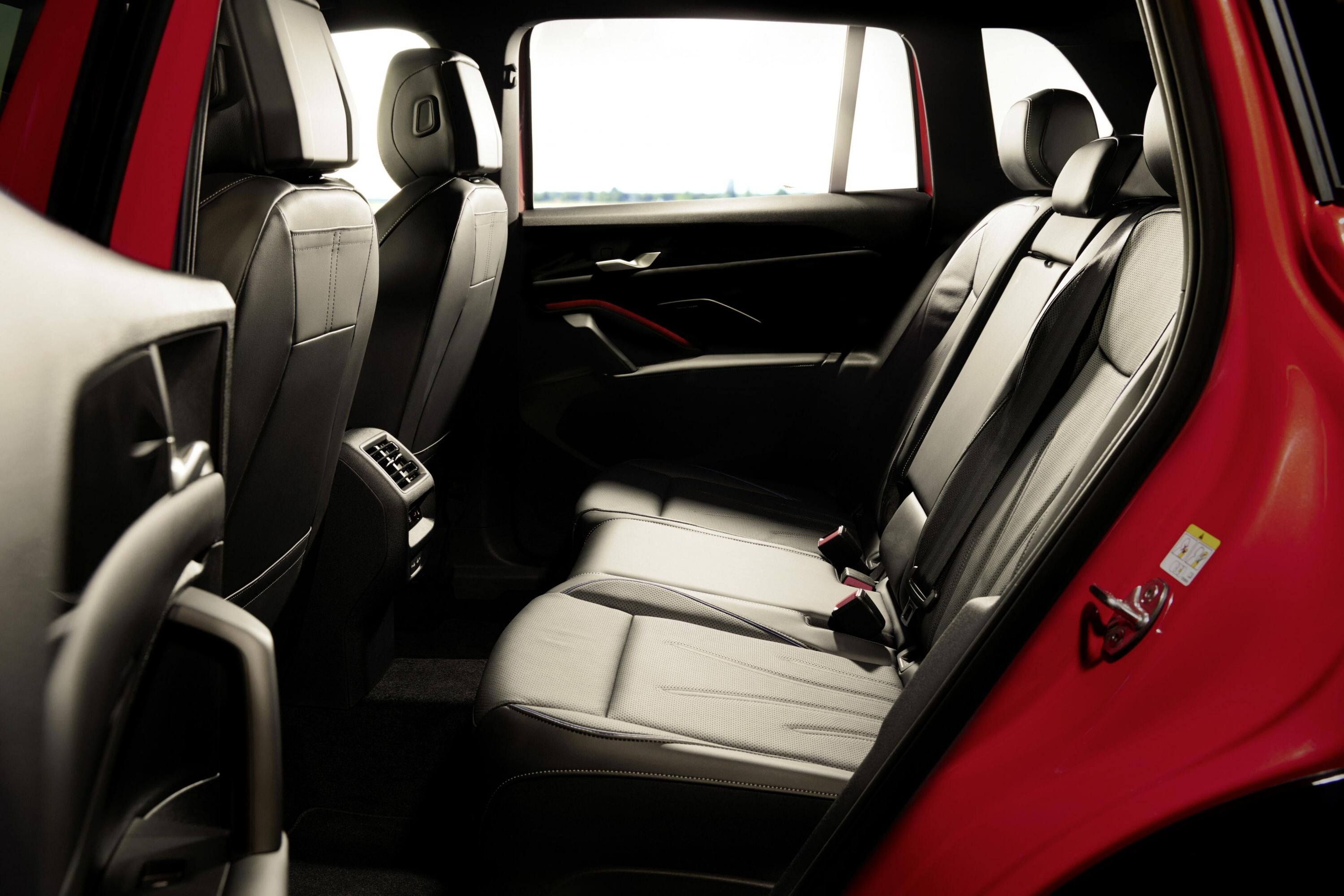
All models get an upgraded interior experience with soft-touch plastics on mid- and lower surfaces, bringing the Tiguan a touch closer to its premium cousin, the Audi Q5.
It’s a point the brand’s local leadership is keen to focus on, with product and marketing boss Nathan Johnson describing the third-gen Tiguan as a “mini Touareg—with luxury specification and outstanding customer value”.
“The all-new Tiguan proves that value and elevated appeal can coexist – long a Volkswagen hallmark,” Mr Johnson adds.
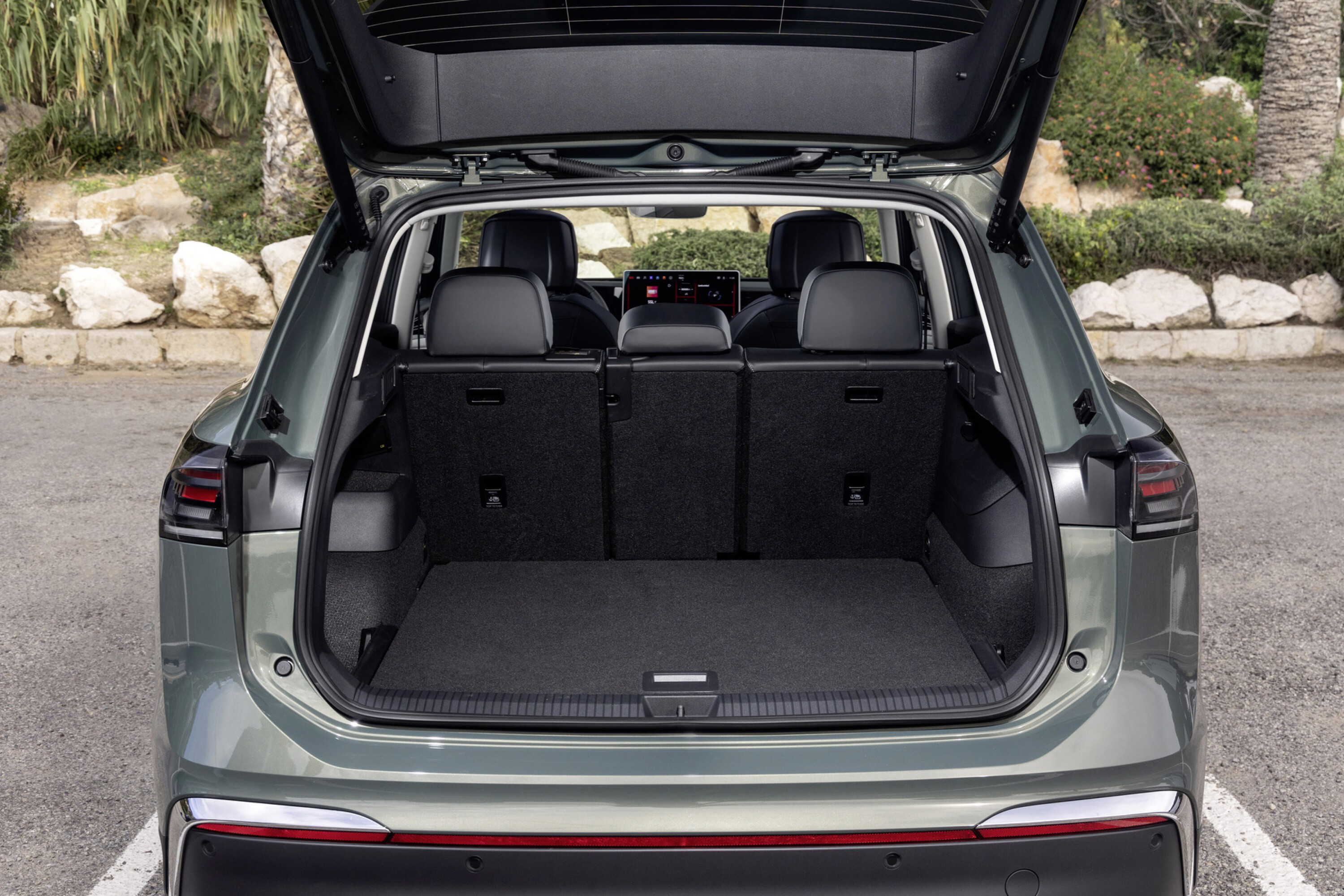
2025 Tiguan: Boot space
While the ‘mini Touareg’ tag is intended to draw attention to interior refinement, the new Tiguan is also 30mm longer than the model it replaces, with boot space increased by 37 litres to a fairly mighty 652 litres with the rear seats up, or up to 1650 litres with the rear seats folded.
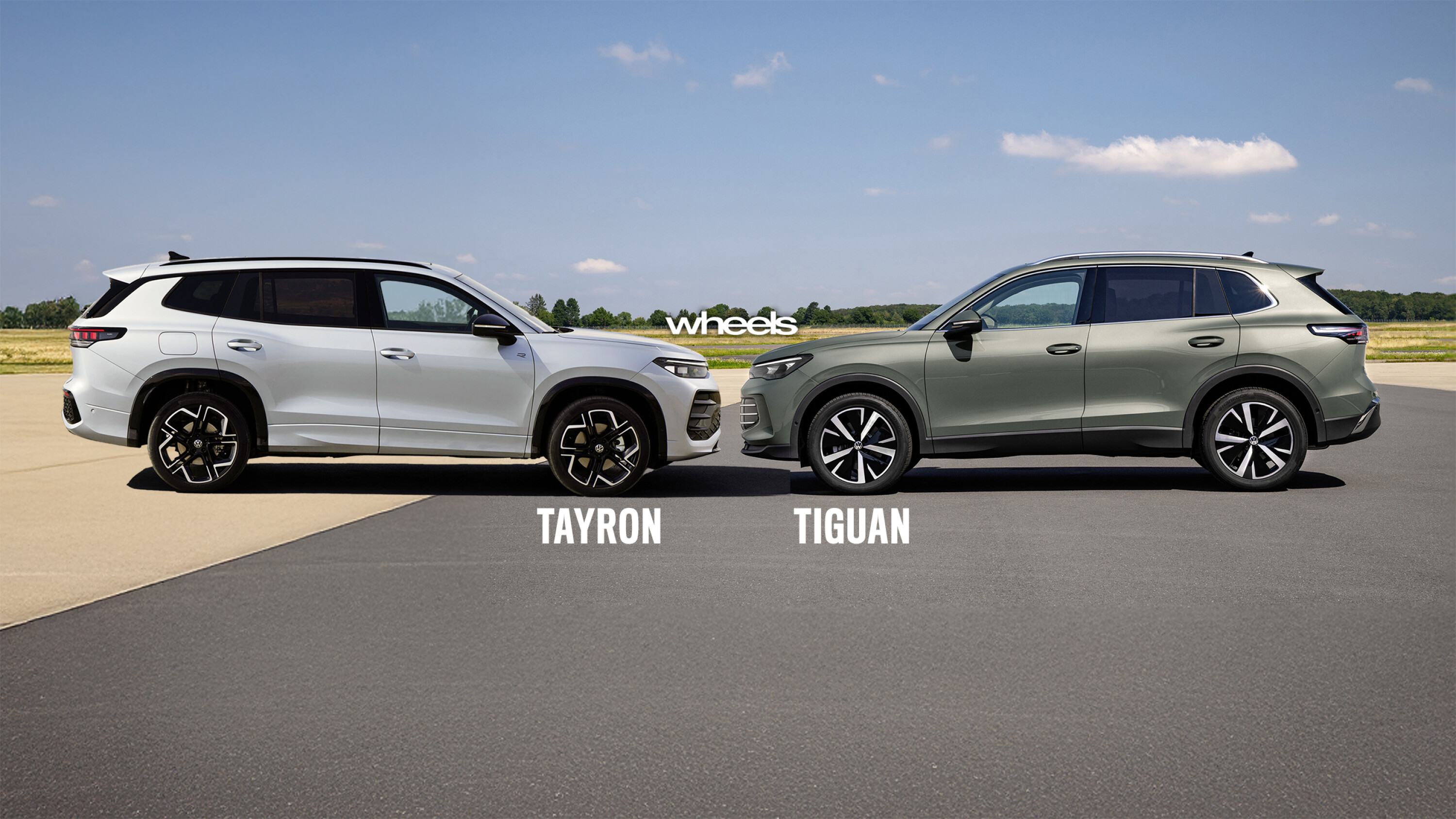
The Tiguan remains a five-seat midsize SUV, but late 2025 will see the arrival of the Tayron, a direct successor to the Tiguan Allspace complete with identical styling and a stretched body to accommodate a third row.
Watch for more on the new Tiguan to be released in the weeks leading up to its May debut.
Quick. Give me the elevator pitch for a Kia Cerato. I’m guessing it would go something like: reliable, inoffensive, fairly cheap, great warranty.
That set of attributes would have been more than enough for old Kia. But today’s Kia? It has some loftier ambitions, and it became fairly clear that launching a new Cerato would merely create a link to the past when it’s instead laser-focused on future aspirations.
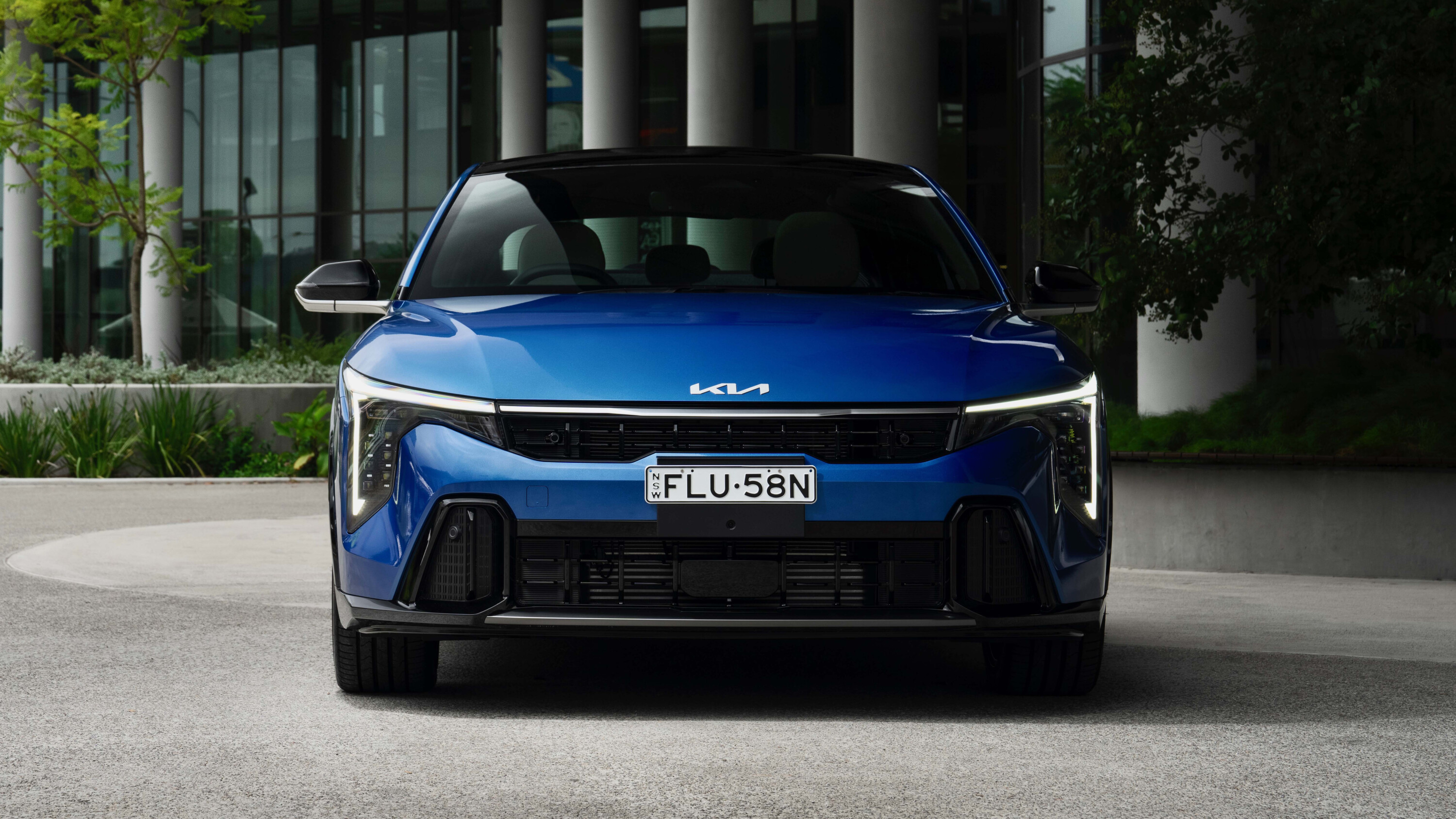
To that end, say goodbye to Cerato, and hello to the Kia K4.
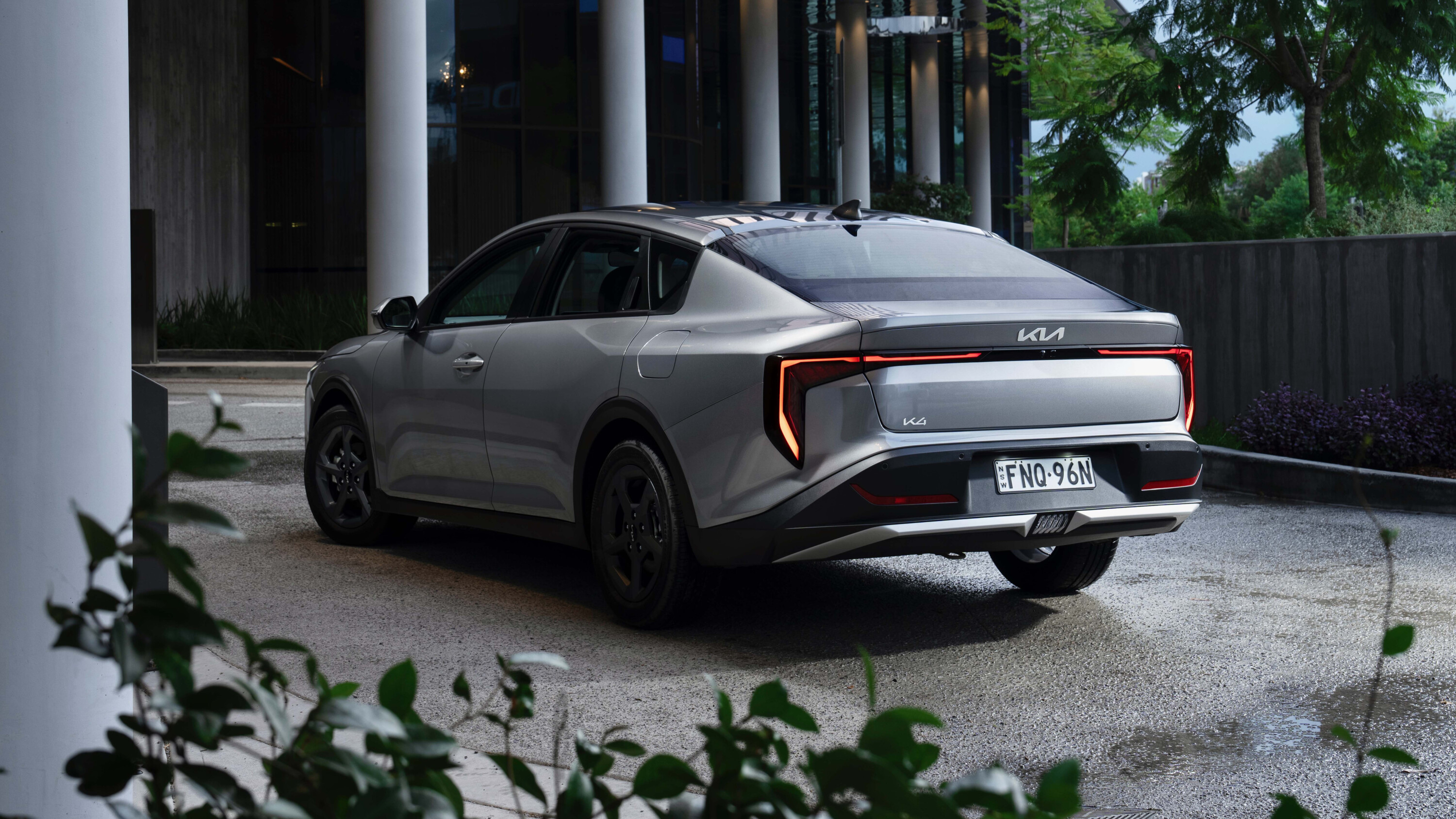
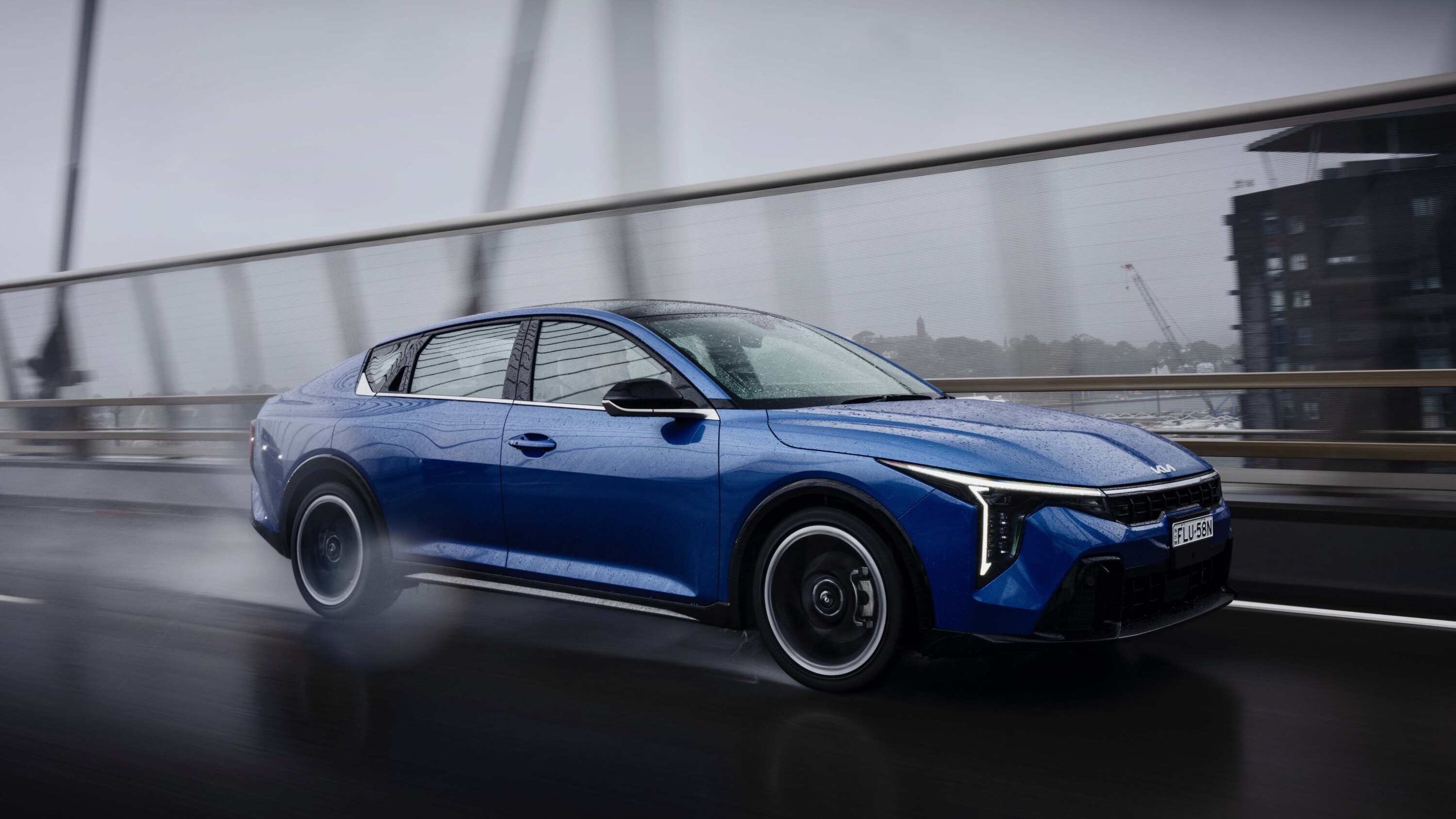
The Koreans hesitate to call it all-new, because the engines and some suspension components are carried over – but not a whole lot else is, so if you expect the K4 to look and feel like a Cerato, well, it doesn’t.
A big reason for that, for the time-being at least, is down to where the car is built.
We’re used to Ceratos being built in the Hwaseong plant in Korea, but this K4 hails from the Monterrey plant in Mexico. Because of this, at the moment, the prime export market for the K4 is the US – and if there’s one thing we know about Americans, it’s that they love a boot (or trunk) on their small cars.
Yep, the K4 will be a sedan only, right through to the tail end of 2025 when the factory is set to start building hatches.
It’s also a fairly big sedan: through a quirk in the way the FCAI categorises cars, the hatch version just squeaks into the ‘small car’ category, which applies to all K4 variants.
Nevertheless, at 4710mm long and 1850mm wide, it casts a bigger footprint than any pre-VN Commodore. Or, for a more contemporary reference, a Tesla Model 3. So it’s a sizeable hunk, more resembling a slightly shrunken Stinger than an upscaled Cerato.
JUMP AHEAD
- What’s on offer
- What does the Kia K4 cost?
- A look inside + safety
- What’s it like to drive?
- Space and storage
- Warranty and servicing
- Specifications
What’s on offer
The 2025 Kia K4 range starts at $30,590 for the entry-level S that virtually nobody will buy, as fleet managers will be drawn to the far better equipped K4 S Safety Pack at $32,690.
Above this is the $35,190 Sport, followed by the $37,590 Sport+.
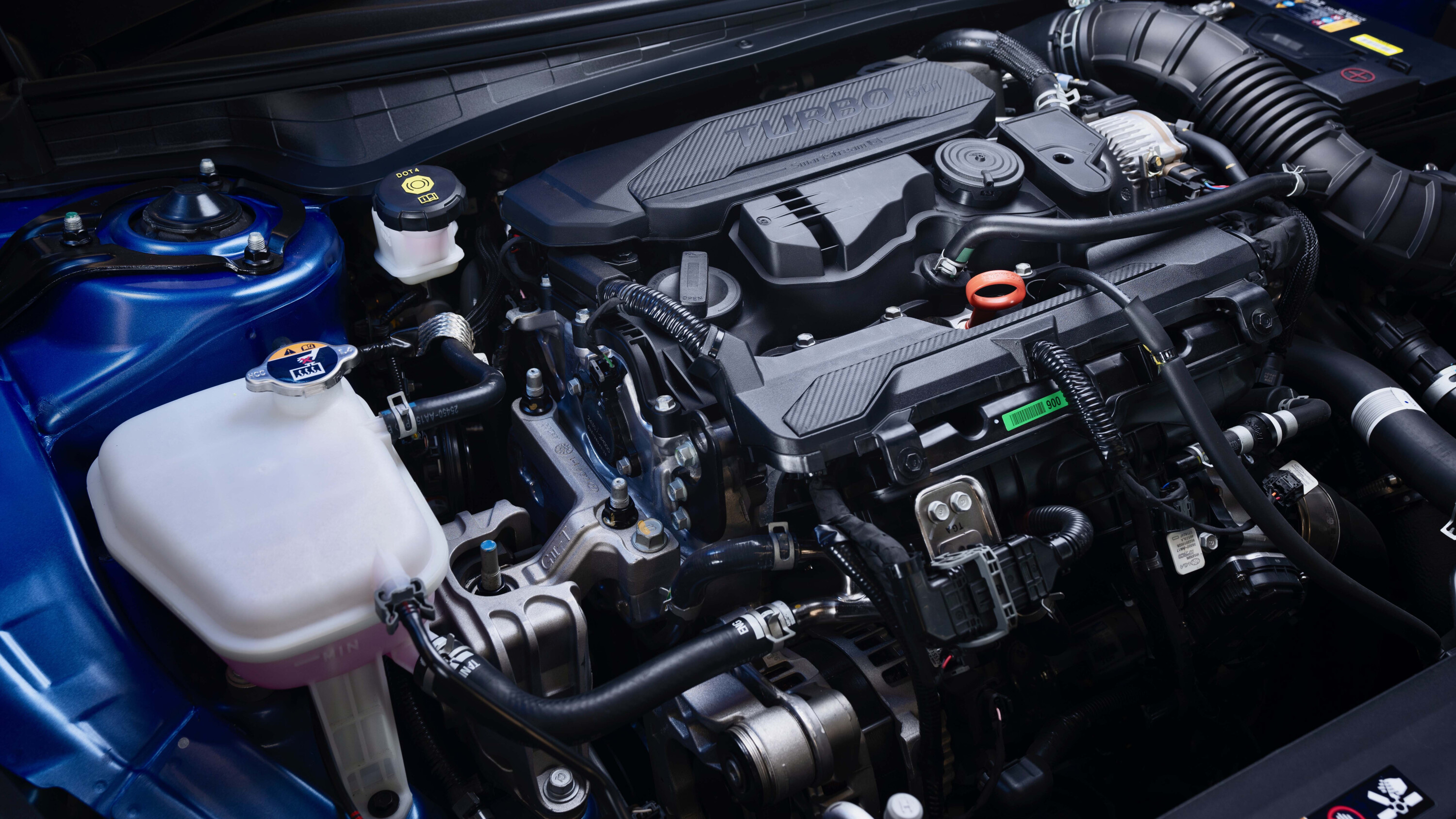
All are powered by the same carryover 2.0-litre naturally-aspirated engine, good for a rather breathless 112kW and 192Nm, sent forward through a six-speed auto. The car’s posterior is kept off the bitumen by a comfort-tuned torsion-beam suspension.
Kia expects the most popular version with private buyers to be the flagship $42,990 GT-Line, and this one’s a very different kettle of K4. Instead of the 2.0-litre wheezer, it sports a turbocharged 1.6-litre four, which develops a more satisfying 142kW/264Nm and upgrades its hind quarters to multi-link suspension for a tauter, more dynamic handling bias.
The old seven-speed dual-clutch ‘box is consigned to history too, with this new GT-Line one getting an eight-speed auto instead.
What does the Kia K4 cost?
Prices have been bumped up considerably.
Naturally, Kia will point to the fact that the K4 is a bigger, safer and better-equipped car than its predecessor. The argument is not without merit, but it still means you’re expected to find at least an additional $3500 at the entry level and around $6000 at the top of the range when trying to align Cerato and K4 prices.
It’s worth something at least that these are national drive-away prices, rather than regional RRPs to which you’d need to add things like CTOP, stamp duty and registration.
Clear White is the only non-cost colour, and there are seven other paint finishes including Honeydew and Wave Blue which are new to Kia’s palette.
Rivals?
If you’re cross-shopping, you might also be looking at the related Hyundai i30 Sedan, which not only offers a hybrid option but also delivers the 1.6-litre turbo engine from $36k.
The Mazda3 sedan is also worth a look if sheer space is not the overriding criterion, while the quietly lovely Skoda Octavia Select ought to also appear on your shortlist for test drives.
The big hitter at the pice point is the Toyota Camry, which features a 170kW 2.5-litre hybrid engine for $39,990 in Ascent trim or $42,990 in Ascent Sport guise. That’s hard for the K4 to counter.
A look inside + safety
Jump inside the K4 and much will be familiar if you’ve been exposed to recent Kia, Hyundai or Genesis fare.
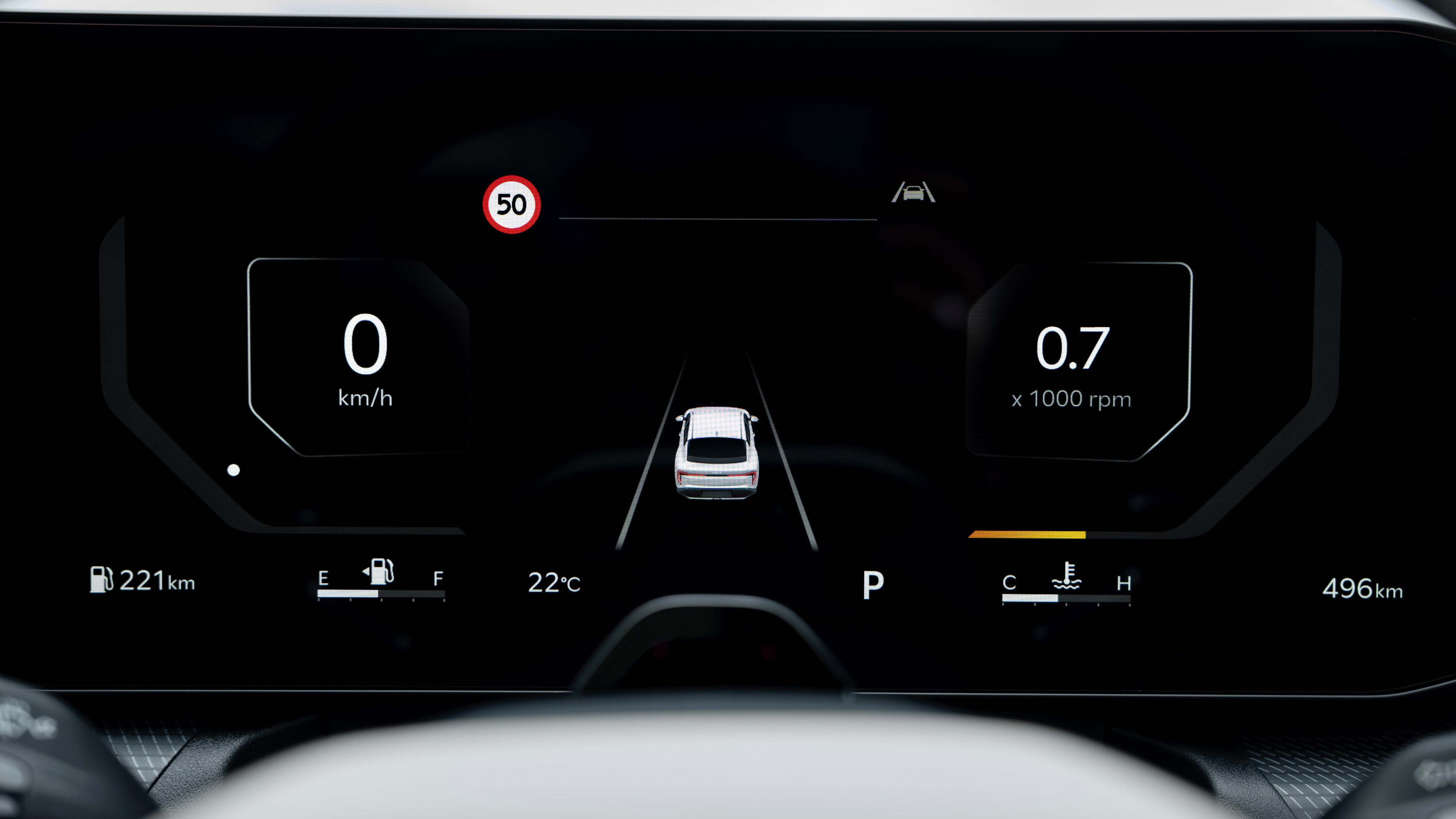
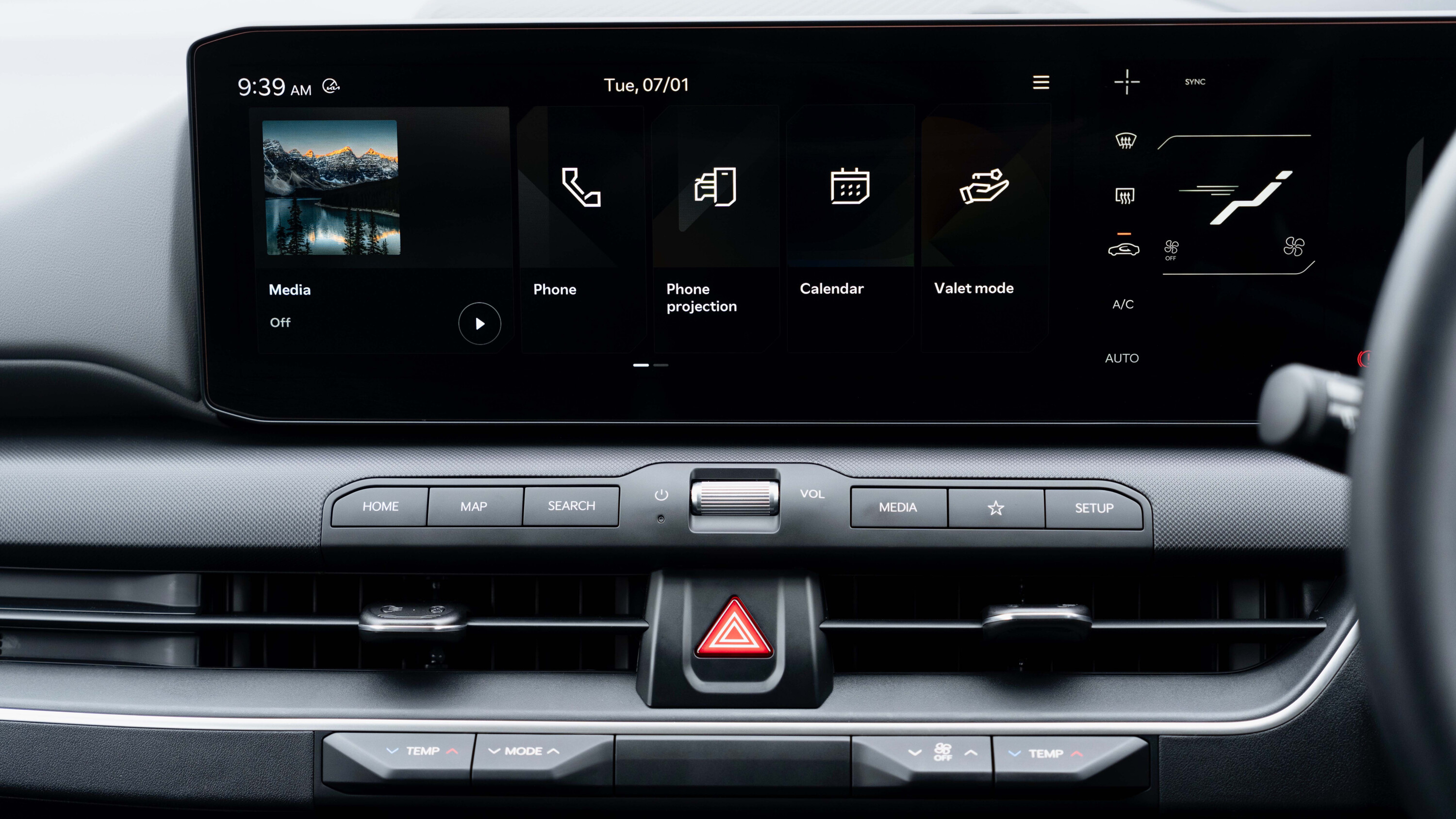
On all but the base S model, the fascia features two widescreen 12.3-inch displays with a five-inch ‘climate control supervision’ screen between them. The screen in front of the driver, which houses the clocks, is multi configurable so you’re able to select analogue-looking virtual dials or a more contemporary digital readout.
This ccNC architecture supports over the air updates and will also work with a Kia Connect app for your smartphone. Go for the entry-level S and there’s a smaller, more basic instrument binnacle.
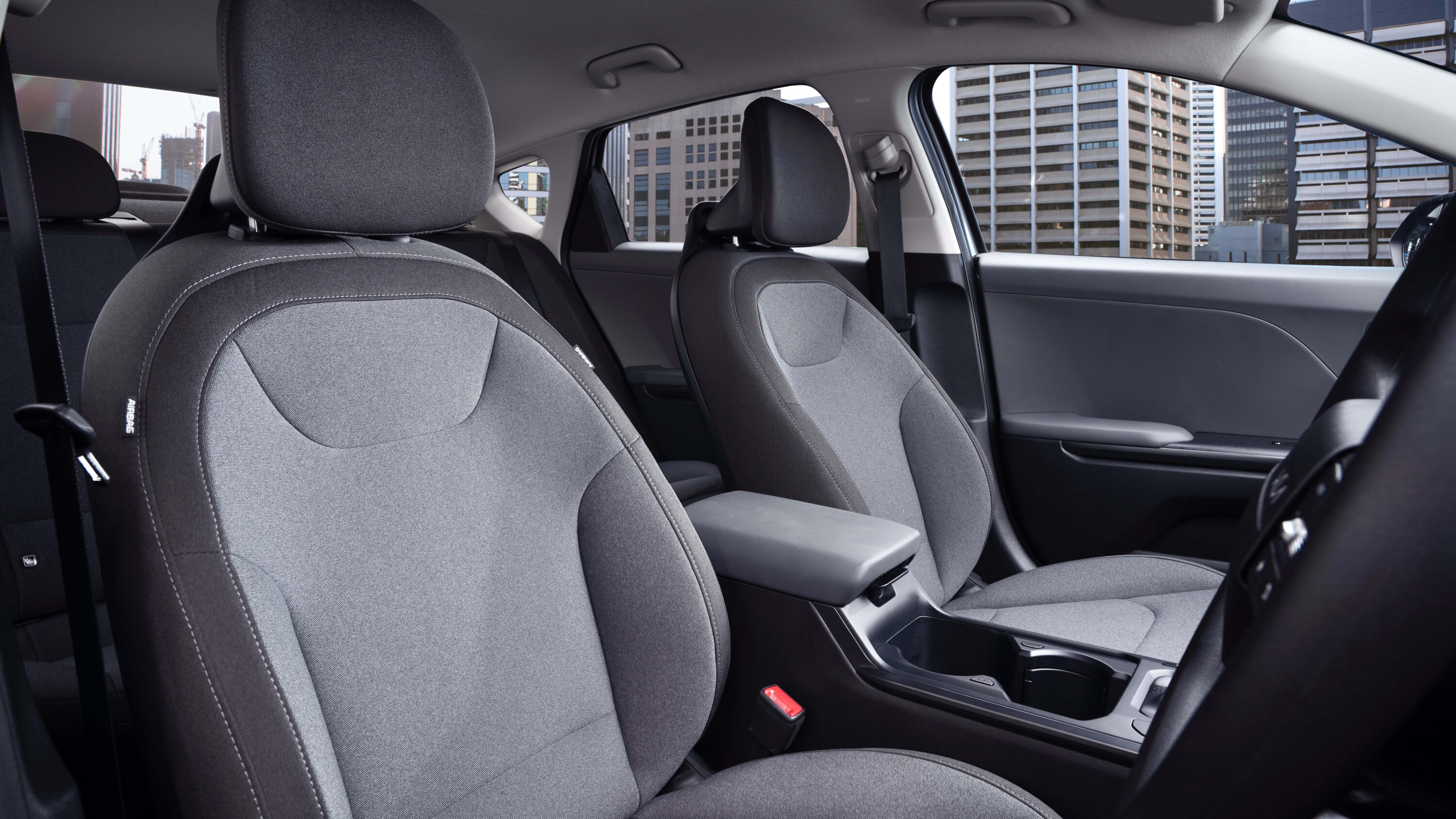
While wireless Apple CarPlay and Android Auto are part of the deal as standard, Kia has only seen fit to equip the range-topping GT-Line with a wireless charging pad – which means you’ll probably need to plug your phone in to charge with a cable anyway. Call it a rare instance of shortsighted cost-cutting in an otherwise well-judged cabin.
Given that the lack of safety gear on the base S means it’ll probably only net a four rather than a five-star safety score when ANCAP tests the car, we’d skip this one. The S Safety Pack is a far better proposition, adding the dual screens, dual-zone climate control, enhanced automated emergency braking with junction crossing detection and oncoming lane change detection. That’s an extra $2100 well spent.
The Sport swaps out the 16-inch alloys for 17-inch rims, adds native sat-nav, auto de-fogging for the climate control, lane change-assist and ‘level 2’ autonomy for the adaptive cruise control suite.
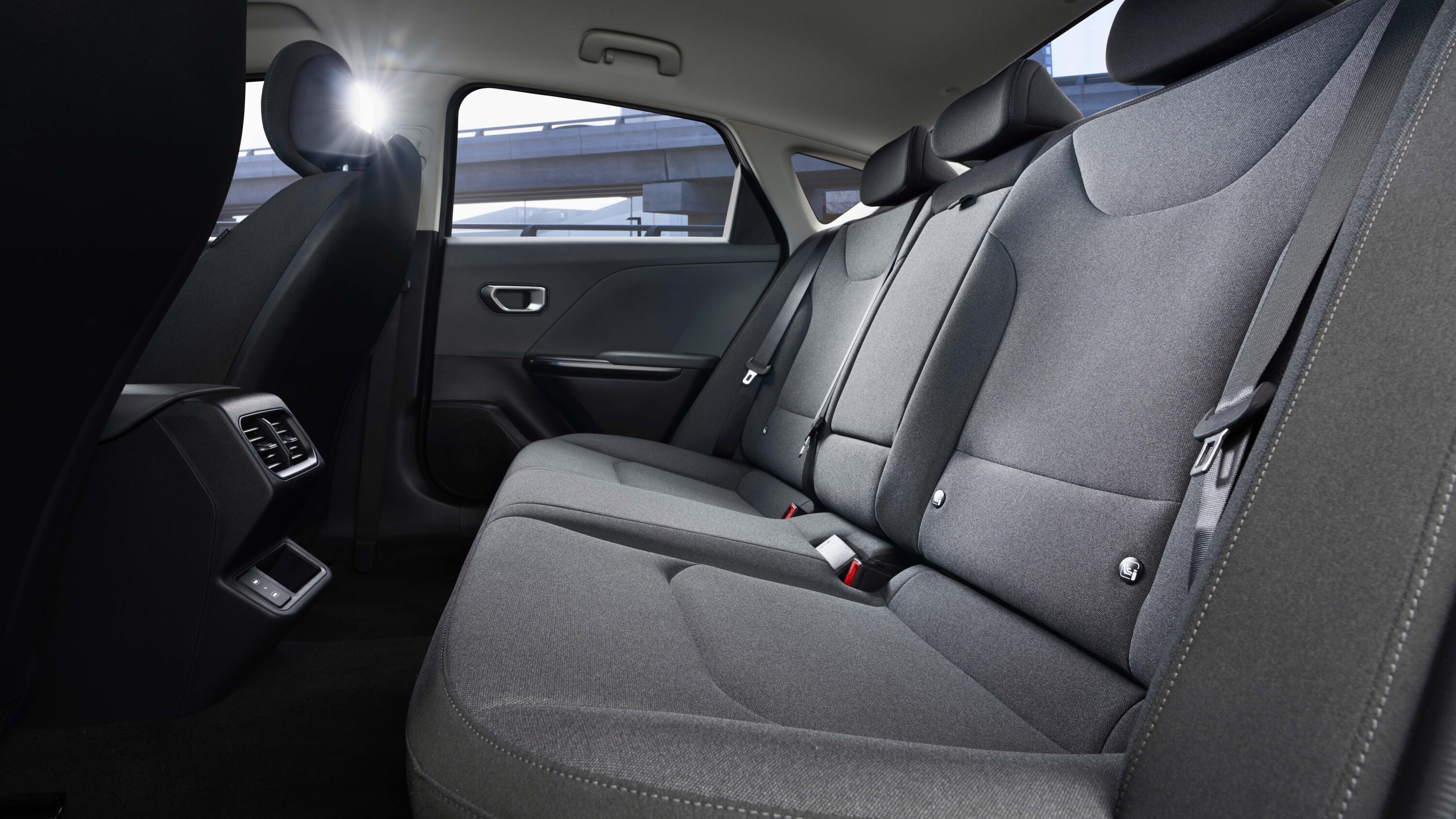
Don’t fancy cloth seats? In that case, you need to step up to the K4 Sport+ with its grey synthetic leather trim, and heated front seats too. It also features an auto dimming rear mirror, an athermic windscreen, rain-sensing wipers, and some upgraded trim details inside.
The GT-Line can be identified by its 18-inch wheels, high-gloss exterior styling, bigger brakes and glass sunroof, along with eight-speaker Harmon Kardon audio, black embossed synthetic leather seats with heating and ventilation up front, a heated steering wheel, ambient interior lighting, an alloy pedal set and a 10-way electric driver’s seat with memory function.
The front passenger still has manual controls, though, which seems a miss when you consider the price tag.
What’s it like to drive?
We got to sample the naturally-aspirated 2.0-litre Sport and the 1.6-litre turbo GT-Line on Australian roads. The 2.0L is an engine you’d probably describe as just about adequate.
It’s a shame that Kia never saw to apply the more modern turbocharged unit across the range, because it would make the K4 a far easier car to recommend. As it stands, the 2.0-litre is loud when pressed, not particularly economical, and its torque shortfall vexes the six-speed automatic’s drive logic to such an extent that on any sort of open road, it starts mooing, unsure of what gear it should be in.
There’s a reason it sounds like a CVT. Kia’s ‘Intelligent Variable Transmission’ is a version of a CVT with artificially mandated gears. It’s adequately refined in low-demand scenarios, but drops its bundle somewhat when you ask a little more of it. That’s a shame because there are many other aspects of this K4 that are excellent.
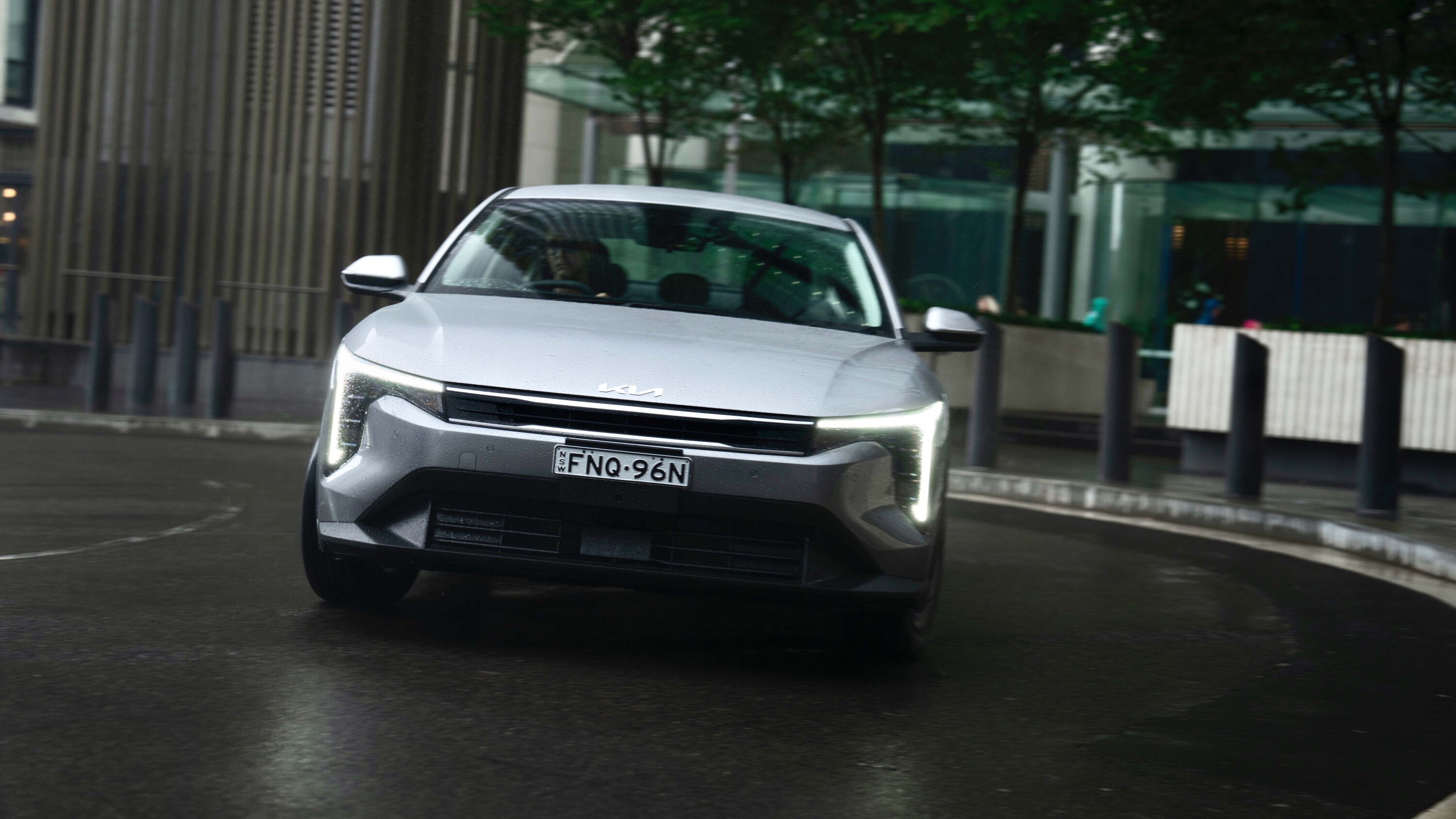
The chassis is well up to the task, and the torsion beam rear end is well calibrated and forgiving, while the front end offers resolute grip.
The steering takes a moment or two to key into once you’ve managed to dial out the perpetually intrusive lane-keep function, but you quickly adapt to its slightly odd on-centre feel.
The 1.6-litre turbo GT-Line is a far more dynamic proposition, delivering the torque to drive the K4 out of corners convincingly. The ride is slightly compromised by the lower profile of its 18-inch tyres, although not unacceptably so.
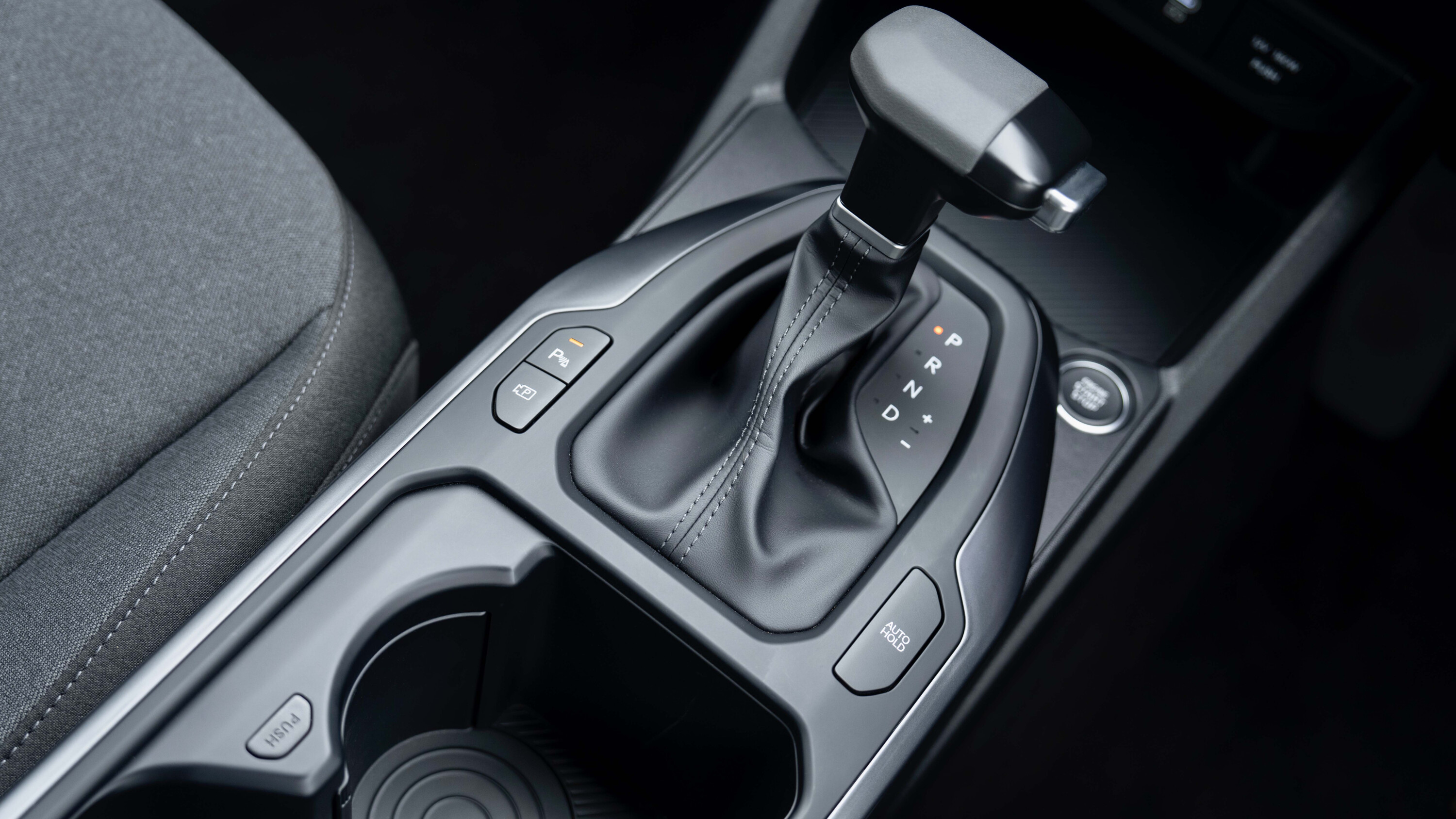
Unlike the 2.0-litre, it also gets wheel-mounted shift paddles if you’d rather take over the gear-changing duties yourself. Fortunately its Sport mode seems to do a pretty good job of selecting a gear by itself.
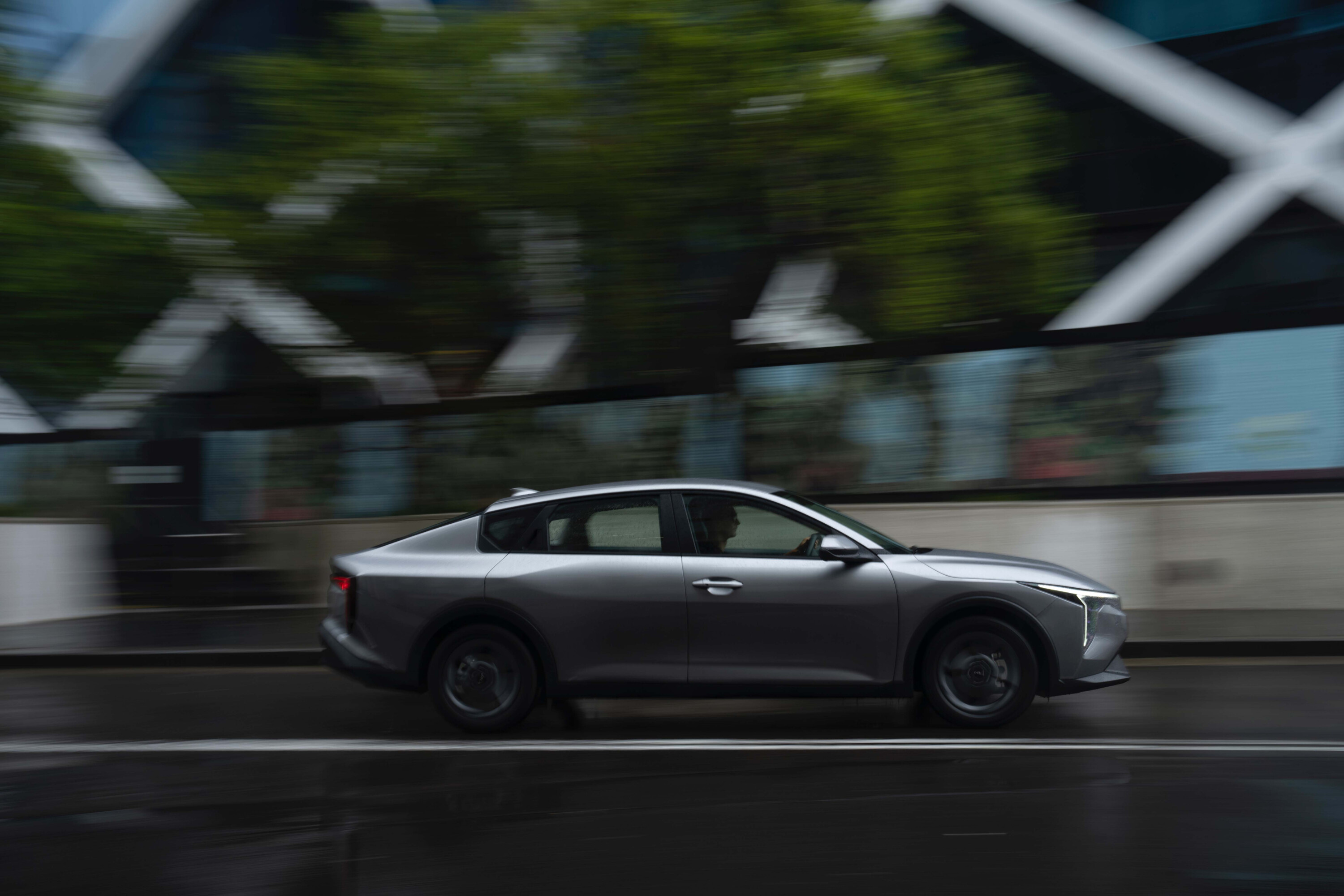
It’s a genuinely fun car to pedal up a challenging road and, were you looking for a car that could do the family duties and entertain, it’s a very presentable choice.
But, after driving both powertrain options, I reckon Kia has missed a trick: the chassis setup of the 2.0-litre offers the better everyday ride and handling balance for most target buyers, so a more cohesive line-up would have been to have started with a 2.0-litre S Safety Pack, and topped out with the existing 1.6 turbo GT-Line.
Between those two bookends could have been an intermediate comfort-spec trim with the 1.6 turbo engine, eight-speed torque-converter auto and the cheaper torsion-beam rear-end on 17-inch alloys.
Were that car to exist, it’d be my automatic pick of the range – and this line-up would likely have netted the K4 an across-the-board five-star ANCAP rating.
Space and storage
The K4 ticks a bunch of boxes in the practicality column, albeit with the caveat that it is a sedan.
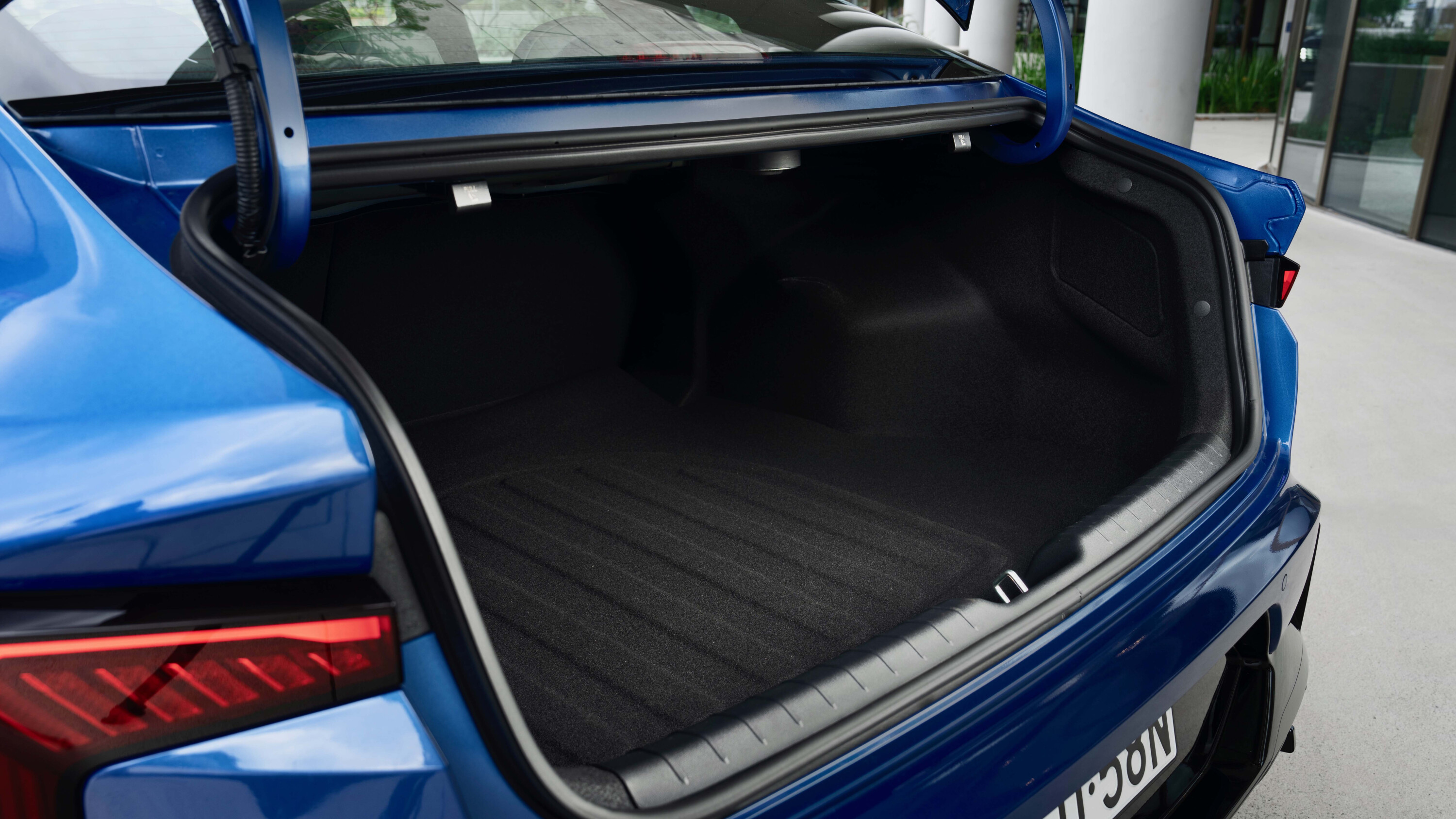
The boot’s claimed to measure 508 litres, which is vast, and beneath its rather flimsy-feeling floor there’s a space-saver spare.
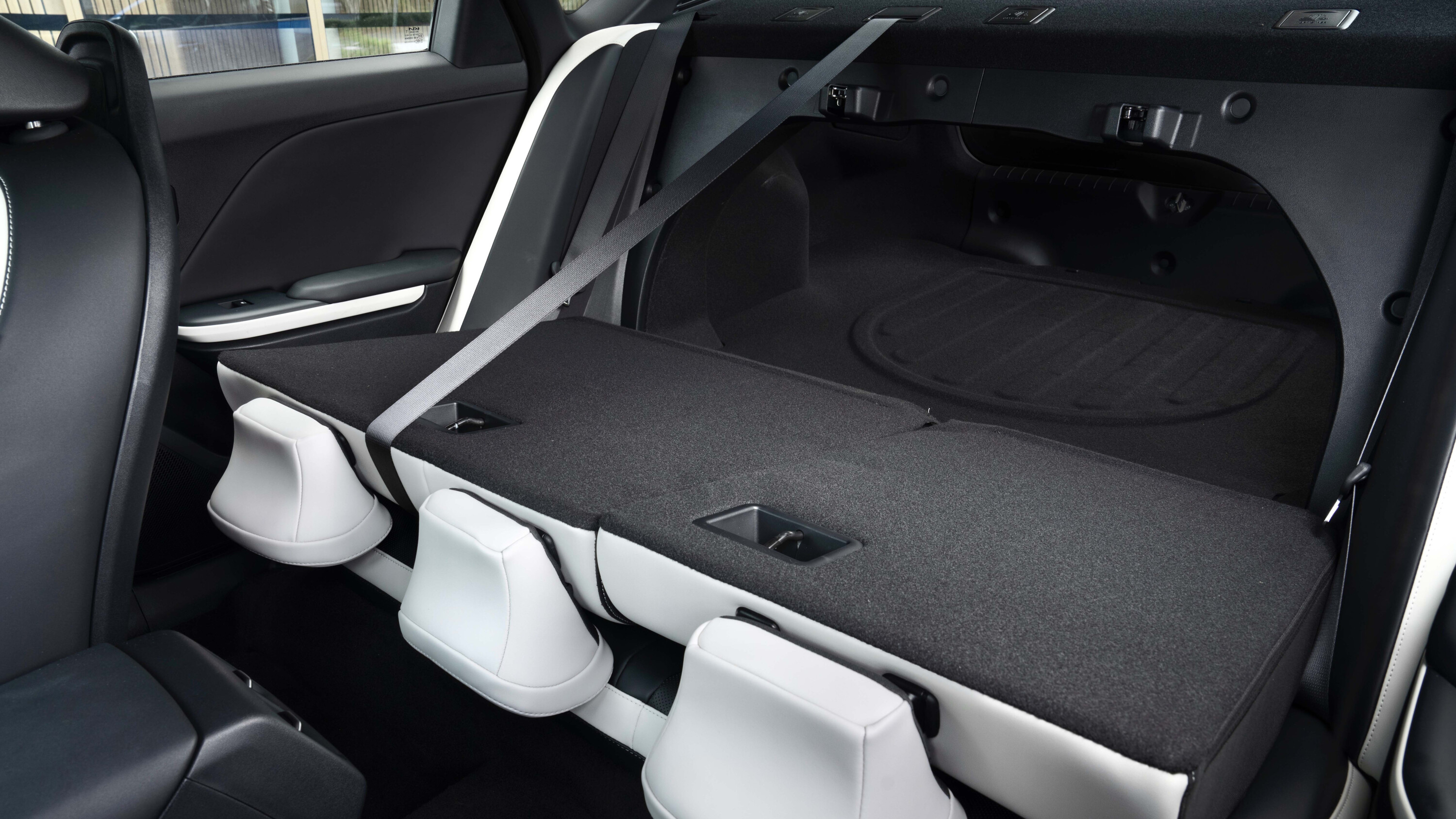
Be a little careful if you’re ramming gear into its rear end, though, because the absence of a plastic trim panel on the upper section means bulky suitcases have the capacity to damage the rear speaker cones if they start moving around in the boot. There are a pair of pull tabs in the boot that can drop the 60:40 split rear bench for even more space.
The cabin features a decent amount of oddments space, with a generously sized pair of cupholders in the centre and a deep lidded console that’s flock-lined. The glovebox is a fair size and the door pockets are big enough for a fairly specifically-sized drinks bottle, and the rear door pockets are even smaller.
There’s decent headroom in the rear, and knee-room has gone up by a hefty 56mm over the old Cerato, thanks to a longer wheelbase. Rear passengers get a pair of USB-C ports to power their devices, but not a whole lot else in terms of amenity.
Materials quality is good throughout the cabin, but in the front there’s a fairly obvious bifurcation between the softer touch materials on the dash-top and the harder, scratchier plastics lower down, with the cheaper materials running across the top of the glove box.
The door handles are also very susceptible to smeary fingerprints, and a one-touch electric window is only fitted to the driver’s door.
All models get seven airbags, rear seatbelts are now fitted with pretensioners, and all models also get a driver attention monitoring system.
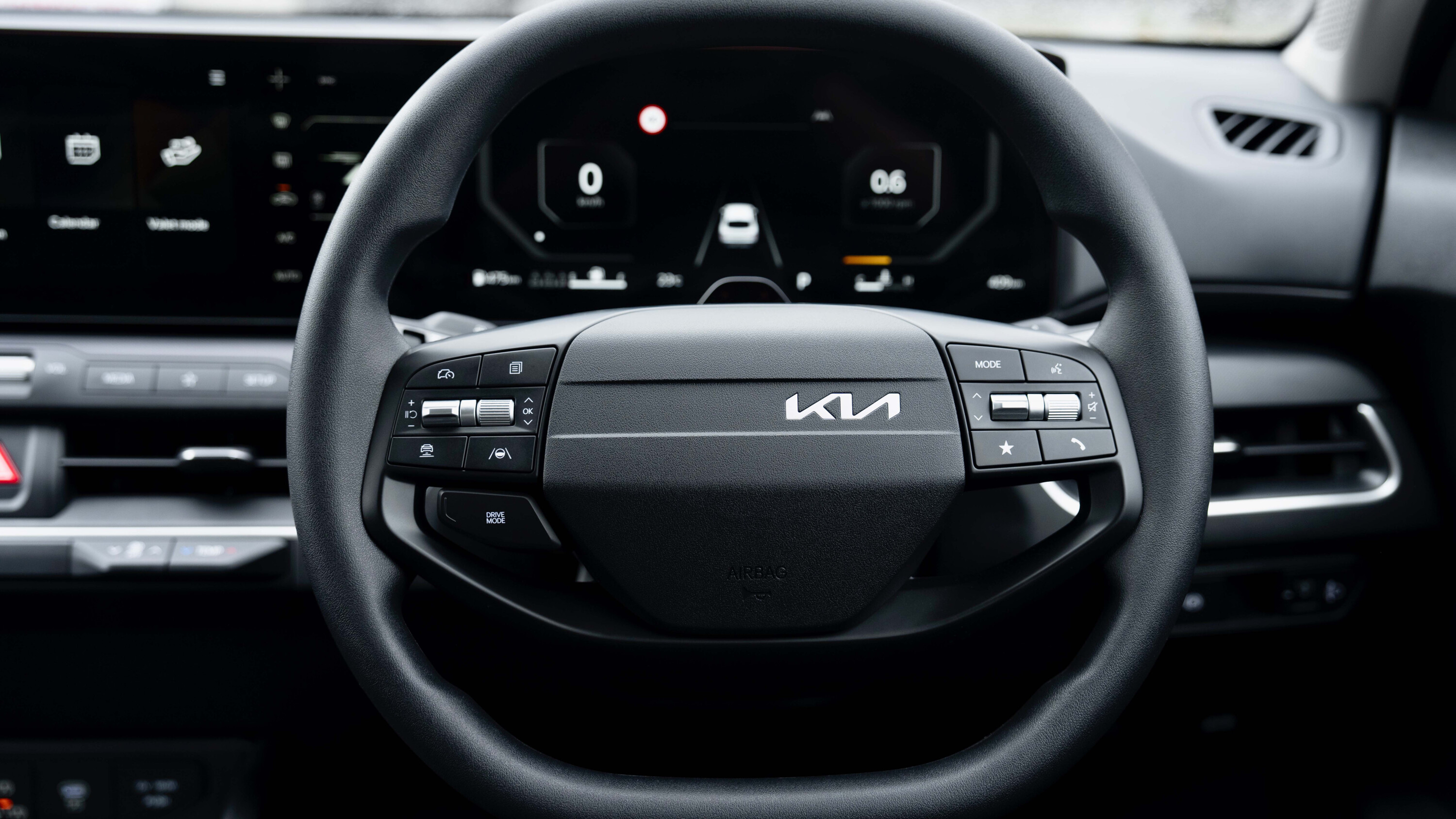
The steering wheel is an intriguing shape on the 2.0-litre models with a flattish top and bottom, a bulging centre boss with offset Kia logo and some nicely integrated controls.
The GT-Line gets a sportier-looking three-spoke wheel with the drive mode dial incorporated into the vertical spoke.
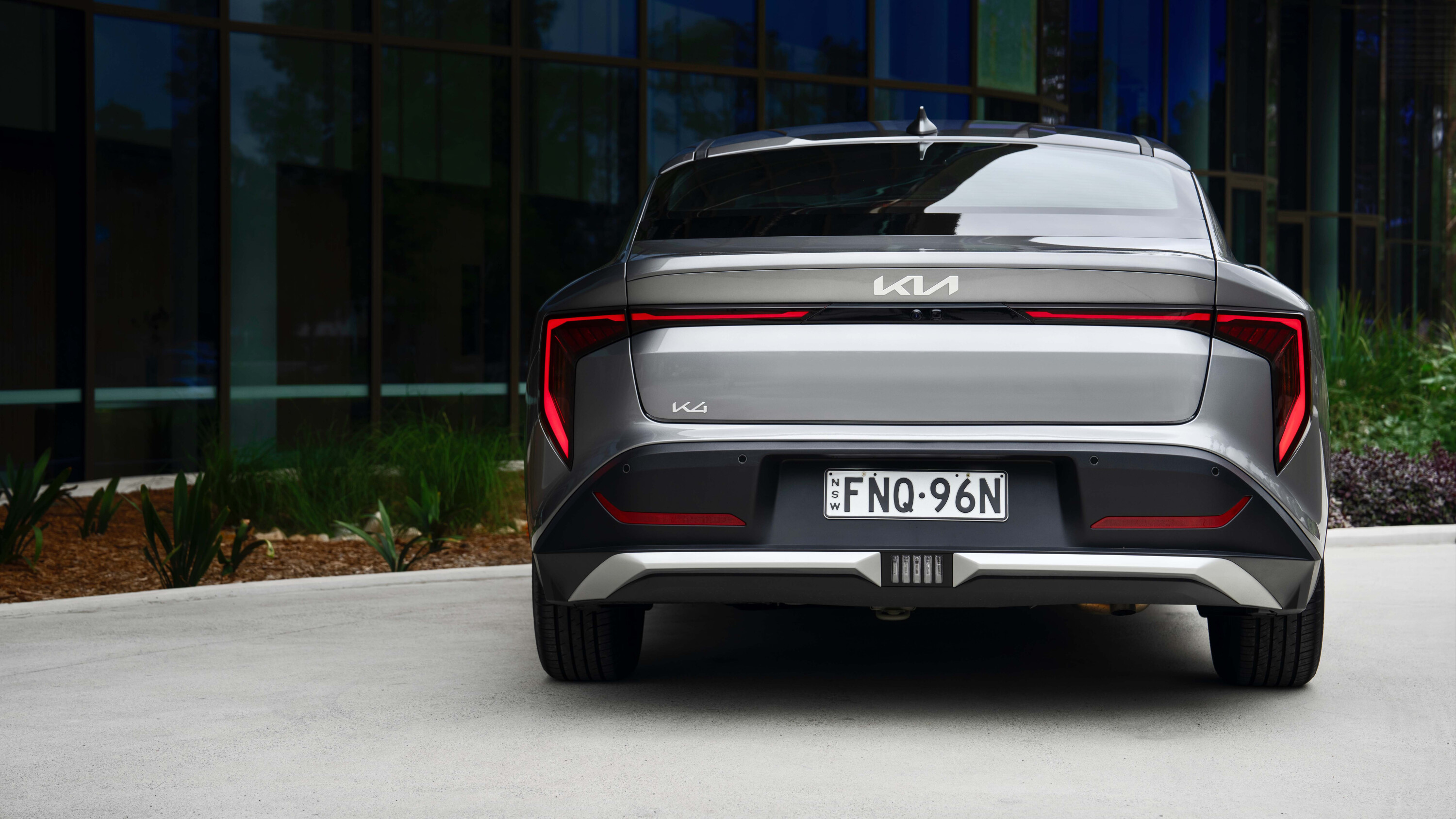
Visibility out of the car is helped by the rear-quarter windows, but the rear-view mirror peers back through a very shallow rear screen, making it necessary to rely on the camera system when reversing near obstacles.
Warranty, servicing and ownership
As with all Kias, the K4 carries a seven-year warranty, and there’s a capped-price servicing deal on offer too.
Should you want to run that deal through a three-year / 30,000km ownership period, that would come to around $1200 for the 1.6-litre models and $1350 for the 1.6-litre turbo GT-Line.
Prefer a seven-year 70,000km deal to match the warranty? That’d tot up to around $3200 for the 2.0-litre and $3850 for the GT-Line. At the time of publishing, these figures are still subject to review from Kia, but don’t expect the final numbers to differ greatly.
Fuel consumption
As noted above, the turbo version of the K4 may be a little more expensive to service, but you could well claw that premium back through improved fuel economy.
Whereas the 2.0-litre engine will return 7.4L/100km, the 1.6-litre gets 6.7L/100km. Over 70,000km, those numbers would equate to 4690 litres of fuel consumed for the 1.6 versus 5180 litres for the 2.0-litre.
At a nominal $2 per litre, that’s a $980 difference, more than the $650 variance in servicing costs between the two engines.
VERDICT
The Kia K4 emerges as a likeable and capable addition to the range, albeit one with a slightly spotty spread of talents – which is a little frustrating.
The underwhelming and outdated 2.0-litre engine is a miss, and you need the firmer-riding and more expensive GT-Line flagship to get the engine and transmission that the K4 deserves. Maybe that’ll change when the inevitable hybrid version appears.
Until then, the K4 remains endearing and broadly capable, but ultimately underachieving. When the old Cerato comprised 20 percent of all Kia’s sales in Australia, that could be a short-term issue, at least until the hatch arrives.
As it stands, the K4 sedan is good enough to earn a recommendation for those who don’t demand too much – but, as we’ve seen time and time again, Kia is capable of so much more.
| 2025 Kia K4 GT-Line specifications | |
|---|---|
| Model | 1.6 GT-Line |
| Engine | 1598cc 4cyl, DOHC, 16v turbo petrol |
| Max power | 142kW @ 6000rpm |
| Max torque | 265Nm @ 1700-4500rpm |
| Transmission | 8-speed automatic |
| Economy | 6.7L/100km |
| Weigh | 1433kg |
| 0-100km/h | 7.9s (est) |
| Price | $42,990 drive away |
| On sale | Now |
Beloved by both royalty and rap stars, Louis Vuitton is a byword for high-end luxury, the French retailer famed for both the heritage and craftsmanship of its fashion and accessories.
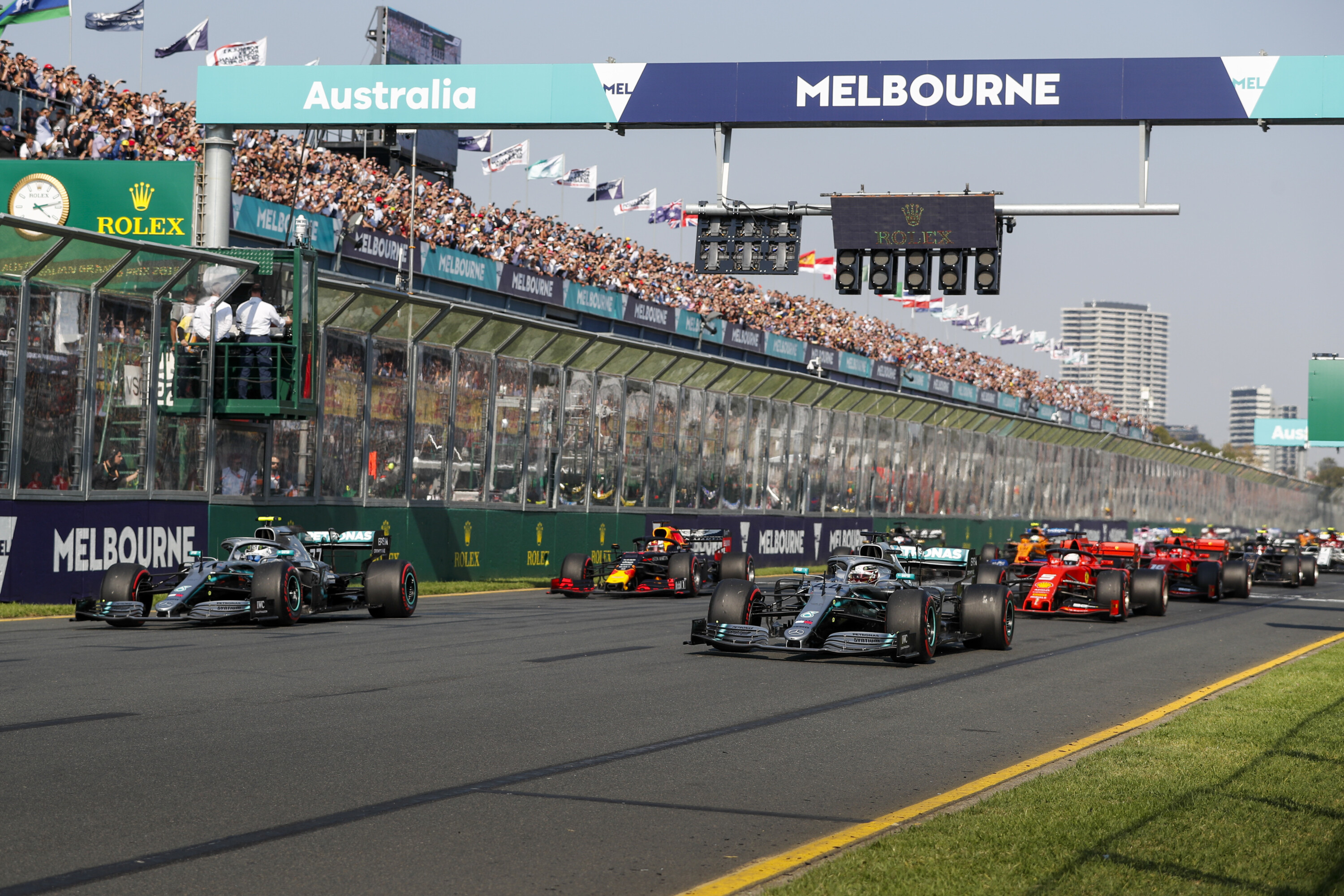
News that Louis Vuitton’s parent company LVMH had signed on as a Global Partner of Formula 1 for 10 years beginning in 2025 is now followed by the announcement ‘LV’ will be the title partner of the season’s first race in Melbourne.
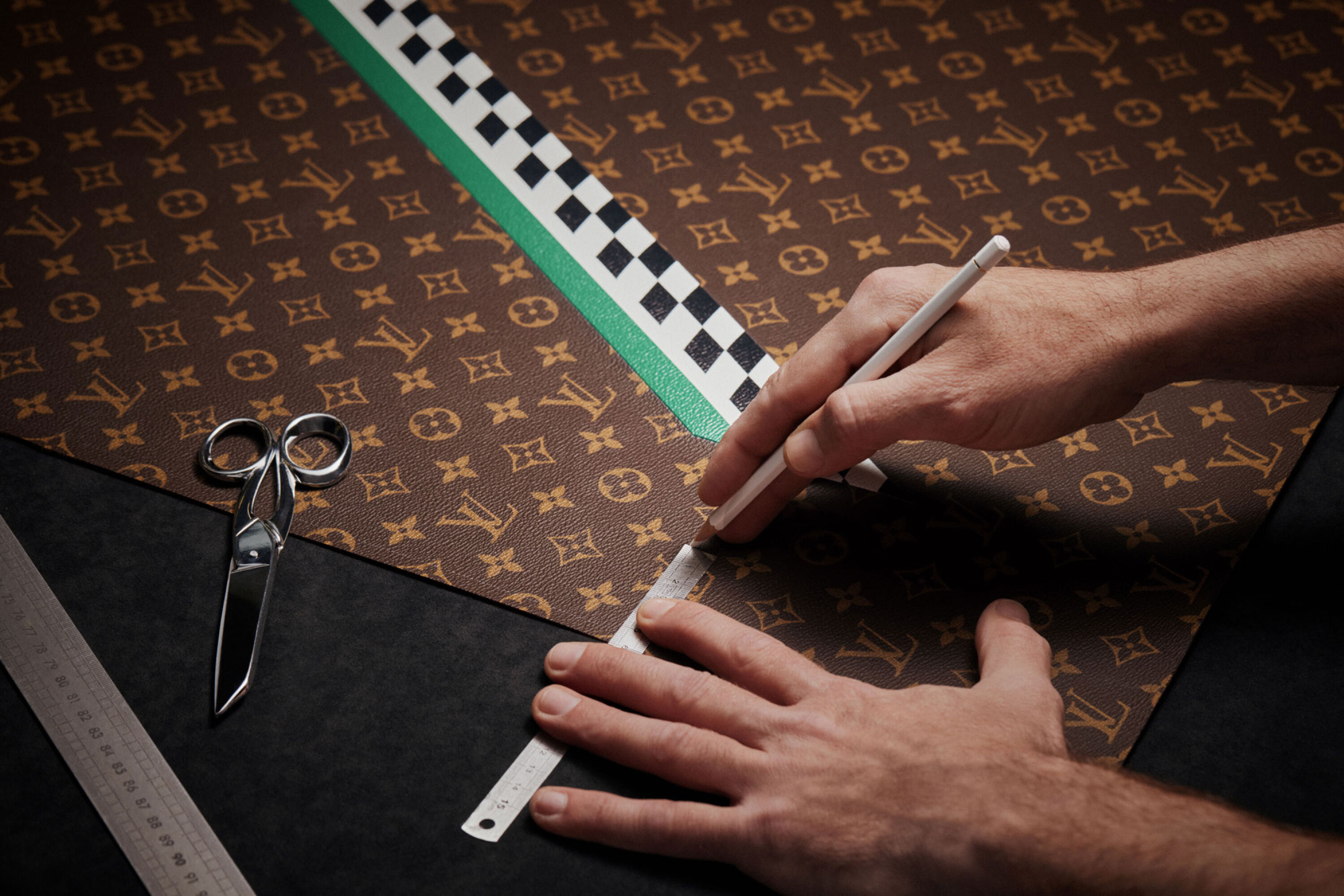
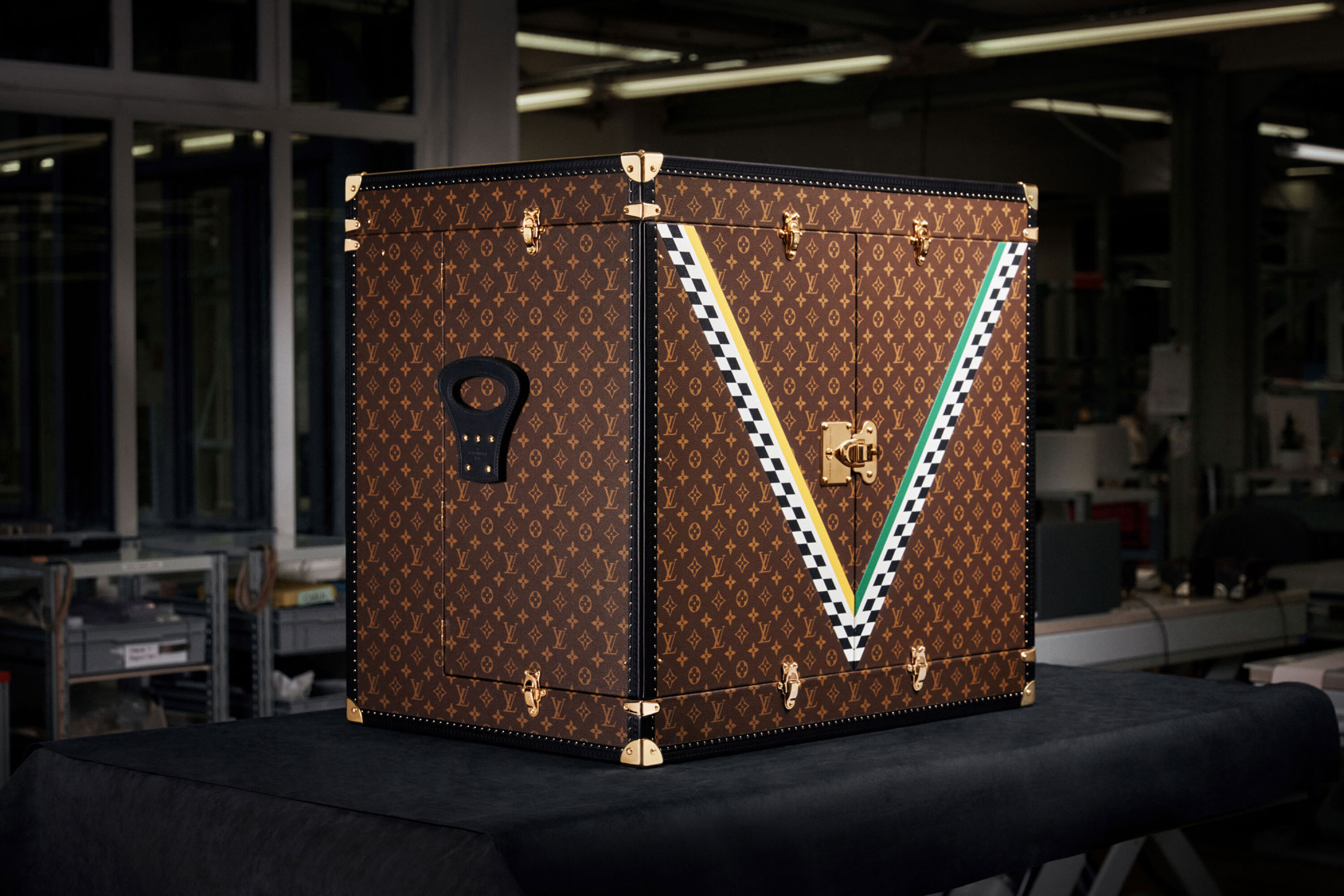
At what will now be known as the Formula 1 Louis Vuitton Australian Grand Prix 2025, the famous brand will be highly prominent via trackside signage (a first for the brand) and its famous Louis Vuitton Trophy Trunks being presented to mark the achievements of the top three finishers. The new trunks will bear the iconic Louis Vuitton ‘V’ in a unique local colour scheme against the classic brown background.
The luxury brand has previously presented a Trophy Trunk at the Formula 1 Grand Prix de Monaco between 2021-2024, and has also presented products to winners in other sports competitions including football, sailing, and the Olympics.
“We are thrilled to welcome Louis Vuitton as Title Partner for our first 2025 race,” said Stefano Domenicali, President and CEO, Formula 1. “The entry of Louis Vuitton not only enhances the experience of our sport, but celebrates the union of luxury, craftsmanship, and the highest expression of automotive competition.”
Founded in 1854 by French designer and businessman Louis Vuitton, the fashion house is renowned the world over for its invention of the ‘Art of Travel’ – its collection of luggage, bags and accessories designed to be both elegant and practical. In the years since its range has extended to ready-to-wear, shoes, accessories, watches, jewellery, and fragrance.
The Formula 1 Louis Vuitton Australian Grand Prix 2025 gets underway in Melbourne March 13-16.
BMW has chosen the Bathurst 12 Hour endurance race and its beautiful Mount Panorama backdrop as the place to unveil a new international model for the first time in Australia.
The BMW M3 CS Touring was revealed at the iconic circuit on Thursday, a new addition to the BMW M line-up of motorsport-derived CS models and a follow-up to the M xDrive launched in Australia in 2023.
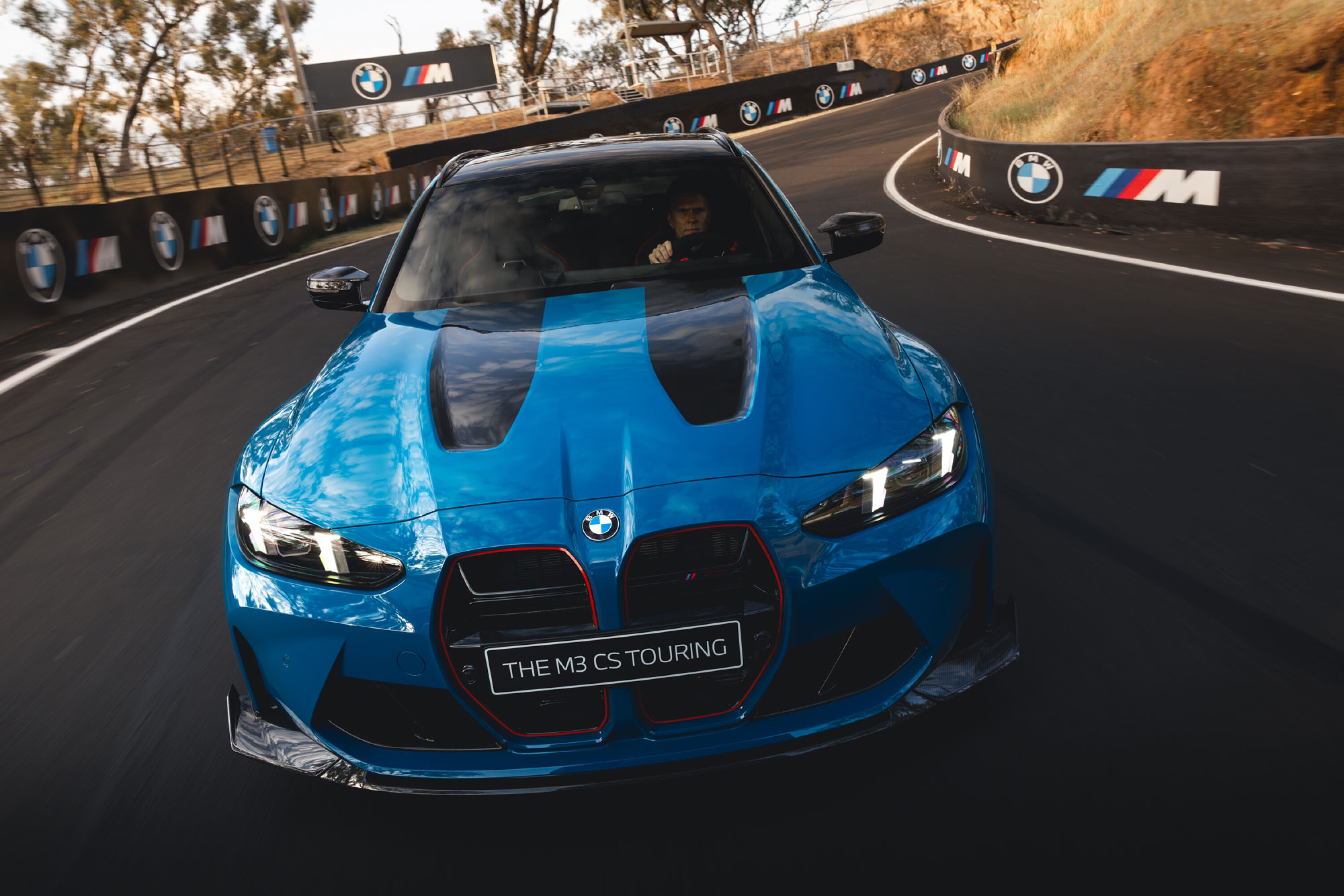
The CS models boast increased engine power output, custom design features and reduced weight through the use of carbon fibre reinforced plastic (CFRP) components.
The Australian reveal of the global model was justified by the presence of the BMW M Team WRT at Bathurst, in which a pair of BMW M4 GT3s will compete in the outright Pro class for a third successive year. Nine-time MotoGP champ Valentino Rossi will do shifts in one of the cars on his return to the mountain.
The all-wheel drive BMW M3 CS Touring features a 3.0-litre six-cylinder in-line engine utilising M TwinPower Turbo technology. Maximum power output is 405kW – a 15kW increase on the M3 Touring Competition with M xDrive – while peak torque is 650Nm.
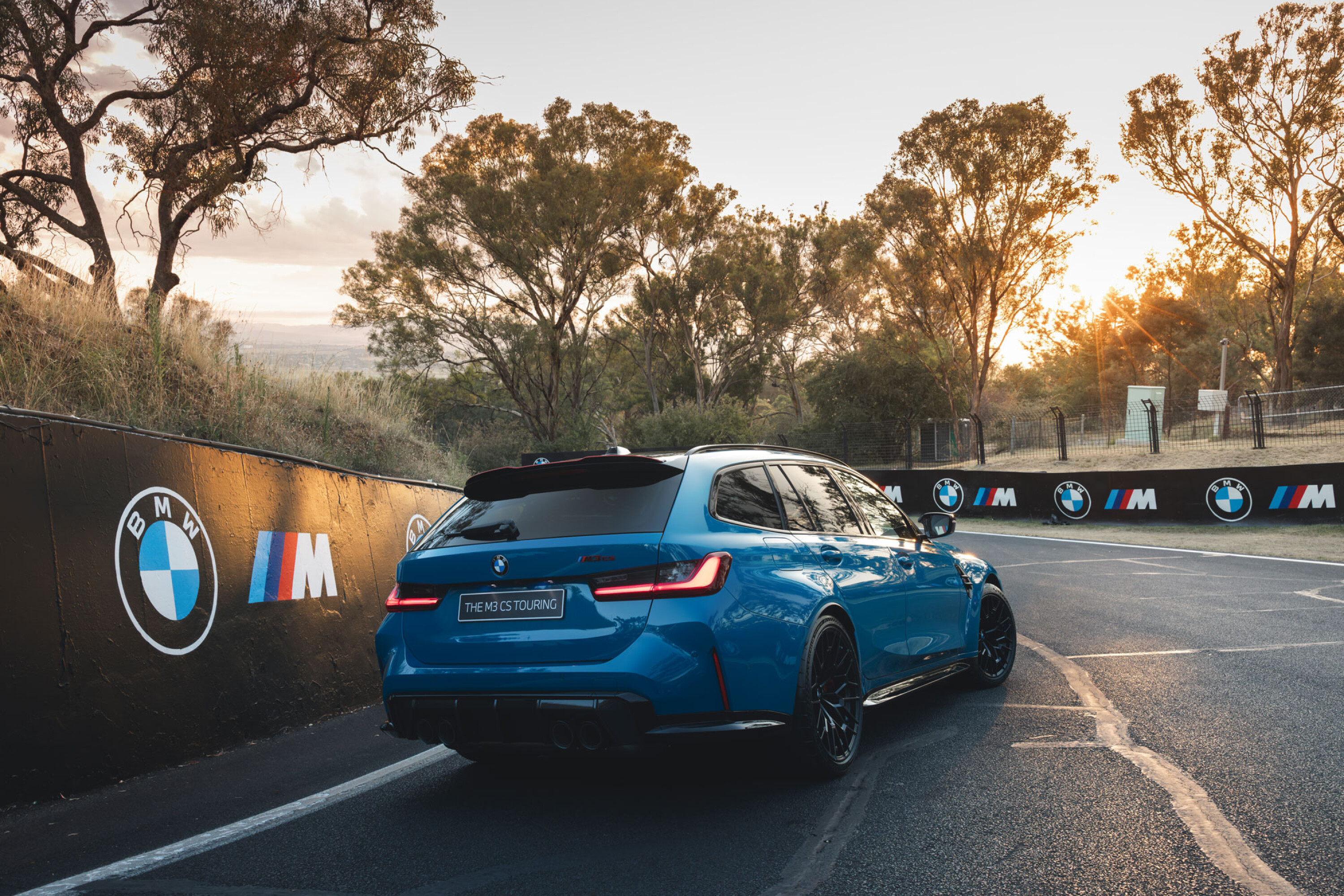
The M3 CS Touring can achieve the standard 0-100km/h sprint in 3.5 seconds, and from zero to 200km/h in 11.7 seconds, with a top speed of 300km/h.
The use of CFRP for the car’s bonnet, front splitter, front air intakes, exterior mirror caps and rear diffuser, as well as interior elements such as the bucket seats, delivers a total weight saving of 15 kilograms compared with the M3 Touring Competition with M xDrive.
The exterior CFRP elements contrast with the available colours for the M3 CS Touring including British Racing Green, Laguna Seca Blue, Frozen Solid White and Sapphire Black metallic.
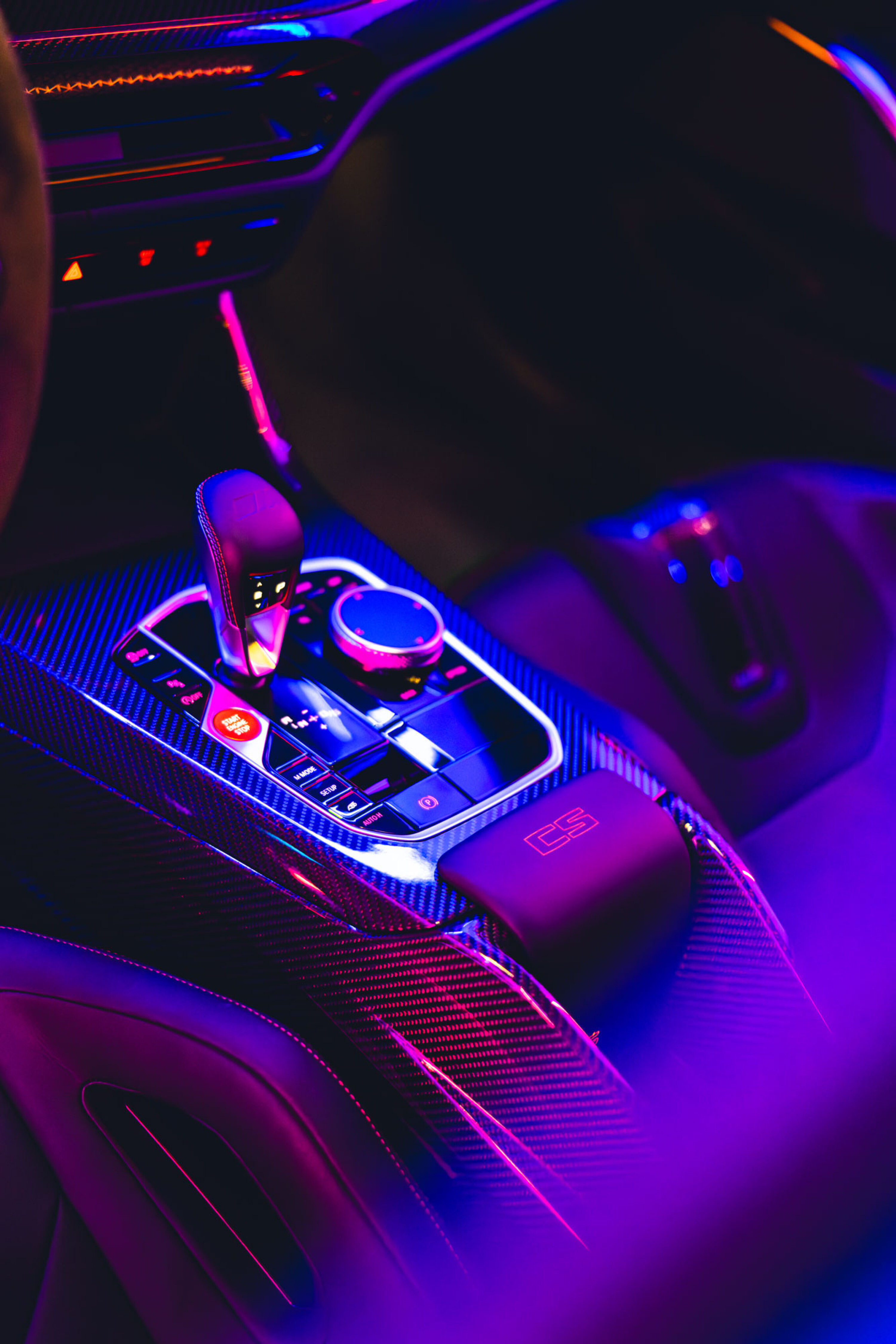
Inside, the performance credentials of the CS Touring are clear with electronically adjustable and heated M Carbon bucket seats for the driver and front passenger – complete with integrated head restraints and illuminated “CS” model badges – an M Alcantara steering wheel in a three-spoke design and additional CS badging on the centre console and sill plates.
A 12.3-inch instrument display and 14.9-inch control display deliver essential information and visual elements to the driver, from M Shift Lights to vehicle set-up, tyre pressure and temperature.
Customising the driving experience to match the conditions is achieved via the M-specific Setup button on the centre console for configuring the engine, chassis, steering, brakes and M xDrive. It also features M Drive Professional, integrating track-optimised functions such as M Drift Analyser and M laptimer. BMW Live Cockpit Professional and BMW Head-Up Display with M-specific content delivers cloud-based navigation system BMW Maps, smartphone integration and telephony with wireless charging.
Customer deliveries of the M3 CS Touring are expected in the middle of 2025, with pricing from $253,900 (RRP, includes GST and LCT but excludes on-road costs).
BMW M3 CS Touring – Local specification
- CS-specific factory equipment
- CS model-specific Full Leather Merino upholstery
- 19 and 20-inch M light alloy wheels star spoke 827M wheels
- M Compound brake, red high-gloss
- M Carbon bucket seats, electric and heated
- M Alcantara steering wheel
- Adaptive LED headlights with yellow icons
- M Carbon exterior package
- M Driver’s Package (300km/h top speed and BMW M Advance 2 Driving Experience course)
- Carbon fibre bonnet
- Carbon front splitter
- Titanium Exhaust with tailpipes in Black matt
- CS specific engine mount
Carry over equipment from BMW M3 Touring Competitive with M xDrive:
- M xDrive
- Adaptive M Suspension
- Alarm system
- Ambient Lighting
- Automatic 2-zone air conditioning
- Comfort Access system
- Connected Package Professional
- DAB+ tuner
- Interior trim finishers, Carbon Fibre
- Live Cockpit Professional with Head Up Display
- M Seat belts
- Seat heating, front
- Tyre pressure indicator
- Tyre repair kit
- Wireless charging for smartphone
Equipment specifically added to M3 CS Touring:
- M front end strut brace
- Driving Assistant
- Parking Assistant
- Sun protection glazing
- Choice of BMW Individual Paintwork
The remodelled BMW iX electric SUV has been revealed ahead of Australian arrivals later in the year with updated styling, faster charging up to 195kW and up to 700km of range.
The biggest upgrades to the facelifted iX are under the skin, where all models have been given a larger battery. The former 71kWh unit in the base model has been replaced with a new 94.8kWh unit, the 105.2kWh battery in the mid-spec model is now 109.1kWh and the 105.2kWh battery in the top-spec car has been replaced with a 108.9kWh unit.
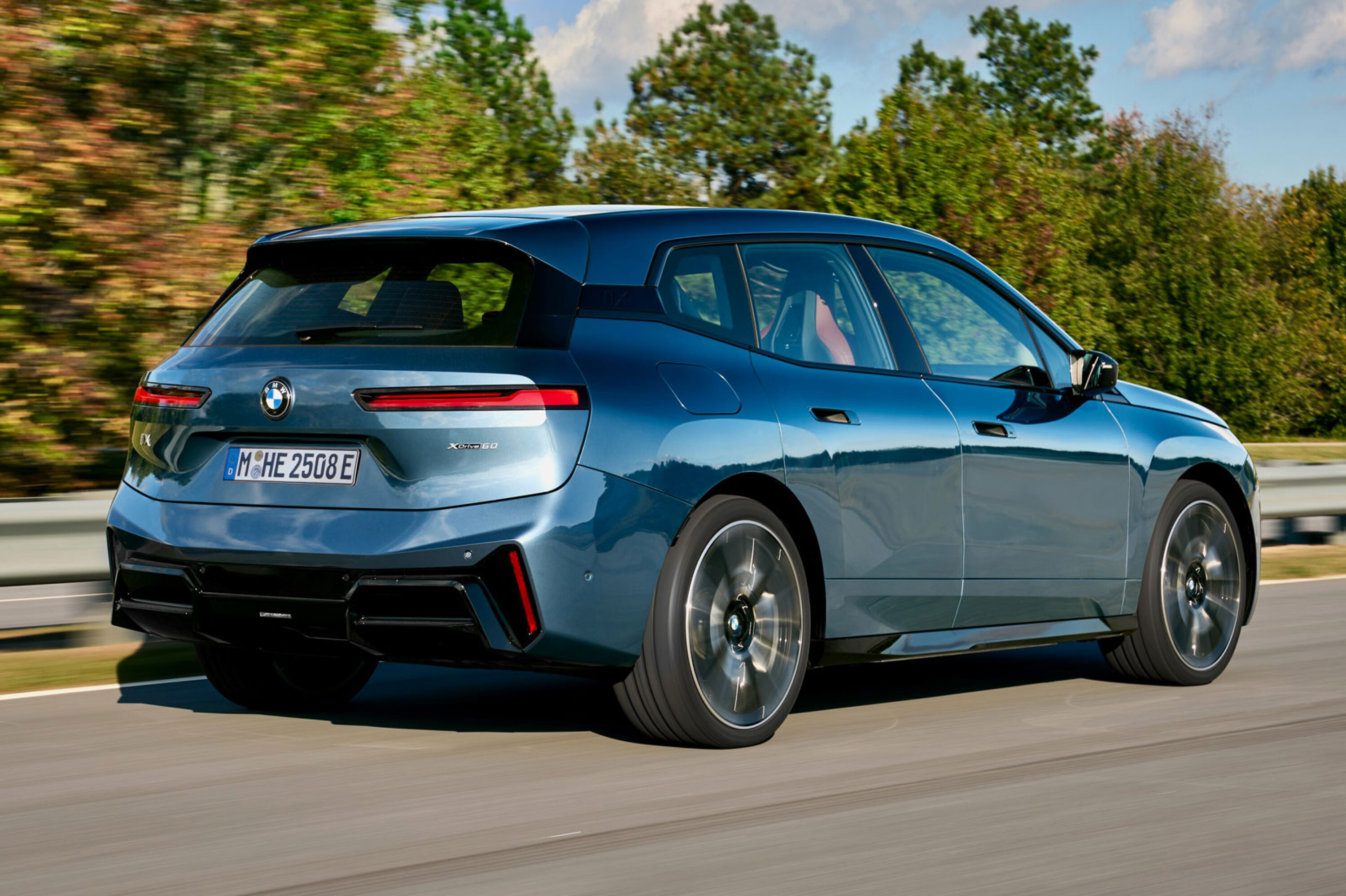
The larger batteries, a new inverter for the power electronics system and “other efficiency measures” have boosted driving ranges by up to 40 percent: the entry-level xDrive 60 is rated for between 563km and 701km (WLTP) depending on wheel size – which is up on the former 550-631km rating of the xDrive50 it replaced.
The base-spec xDrive 45 is now rated at between 490km and 602km – up from between 372km-425km – and the top-spec M70 at between 521km and 600km, which is an increase from between 502km and 561km in the M60 that it replaced.
BMW has also added faster charging for all models – the xDrive 45 can charge at up to 175kW – up from 150kW – for a 34 minute 10-80 per cent charge, while both the xDrive 60 and M70 can now charge at up to 195kW.
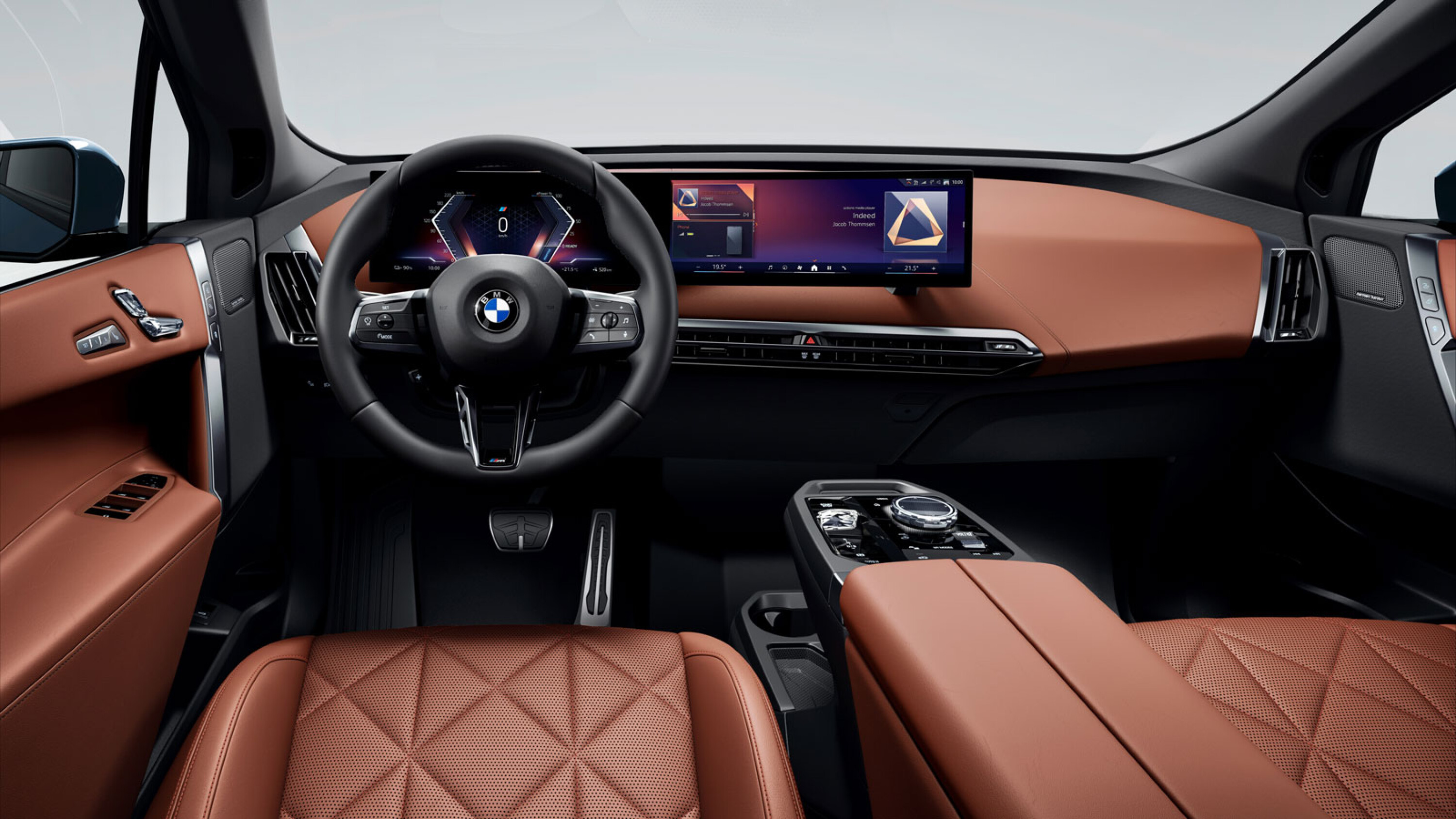
Outputs have also increased: the xDrive 45 now makes 300kW/700Nm, the xDrive 60 400kW/765Nm and the M70 now at 485kW/1,100Nm.
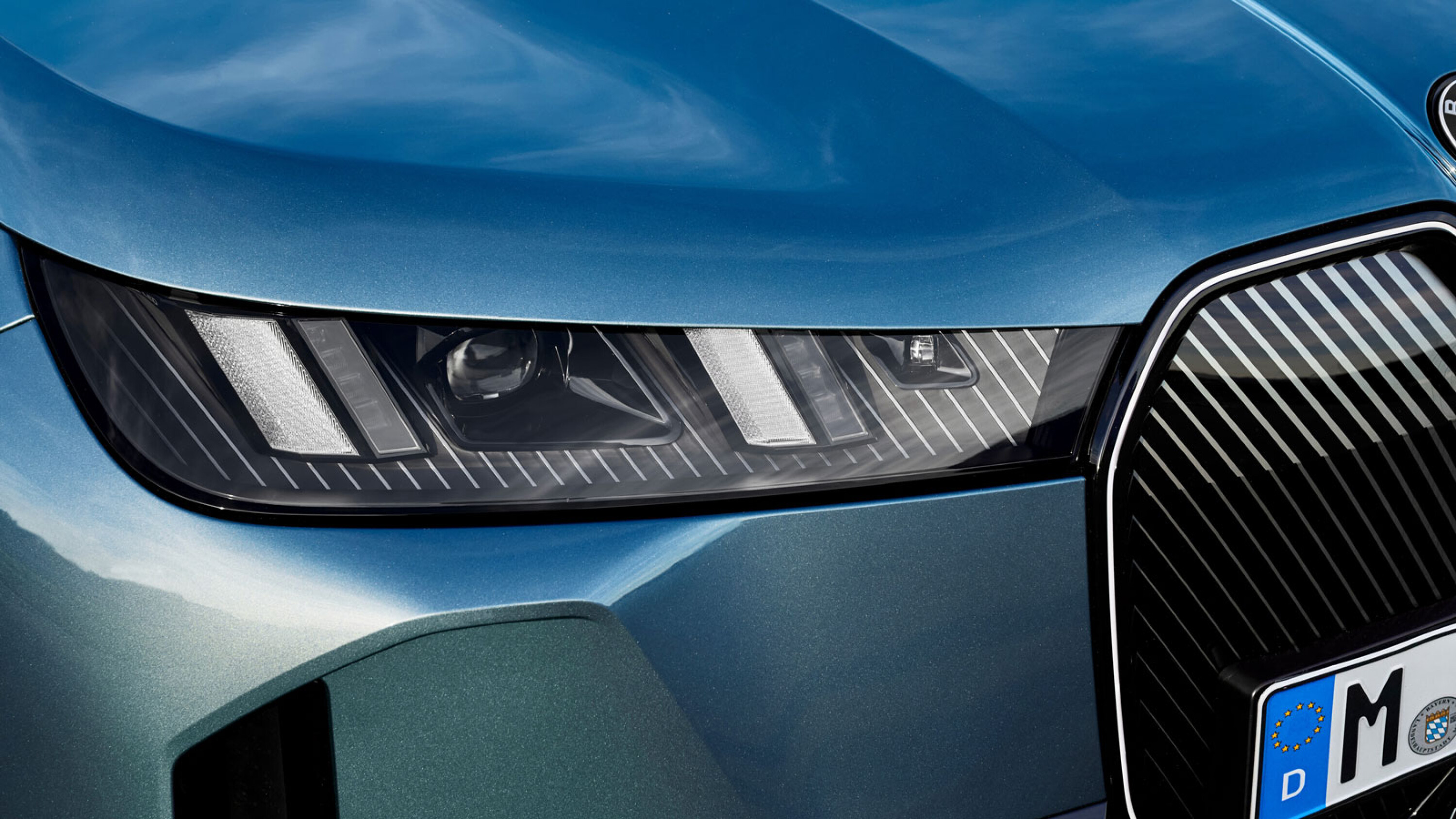
Exterior changes include revised bumpers, wheel designs, the addition of BMW’s ‘Iconic Glow’ illuminated grille and new adaptive LED headlight signatures with the brand’s new vertical elements.
Buyers will have the choice of an M Sport Package for the first time with different bumpers and wheels, while there are new colour options and wheel designs up to 23-inches in size.
Changes inside the iX include the latest iDrive 8.5 infotainment software and new trims such as a synthetic leather-look in the M Sport package. Available features include a panoramic glass roof, either Harman Kardon or Bowers & Wilkins sound systems and soft-close doors.
BMW has also updated the iX’s safety systems, including a new level 2+ semi-autonomous driving system that can drive on dual carriageways at up to 130km/h, which also includes an automatic lane change function when the driver looks in one of the side mirrors.
BMW Australia will announce full pricing and specifications of the updated iX range in March ahead of local arrivals later in the year.
Mercedes-AMG will be the most prominent brand at this year’s prestigious Meguiar’s Bathurst 12 Hour race, with eight teams fielding one car each in four different categories. The race will be held this coming weekend at Mount Panorama, commencing at 5:45am on February 2.
With Australia’s most iconic track as the venue, the Intercontinental GT Challenge (IGTC) starts the 2025 season with vehicles from nine different manufacturers and six classes of car for the race: Pro, Pro Am, Bronze, Silver Cup, GT4 and Invitational.
The two performance teams – Mercedes-AMG Team Craft-Bamboo Racing and Mercedes-AMG Team GMR, as well as 75 Express and Scott Taylor Motorsport – will be competing in the Pro class.
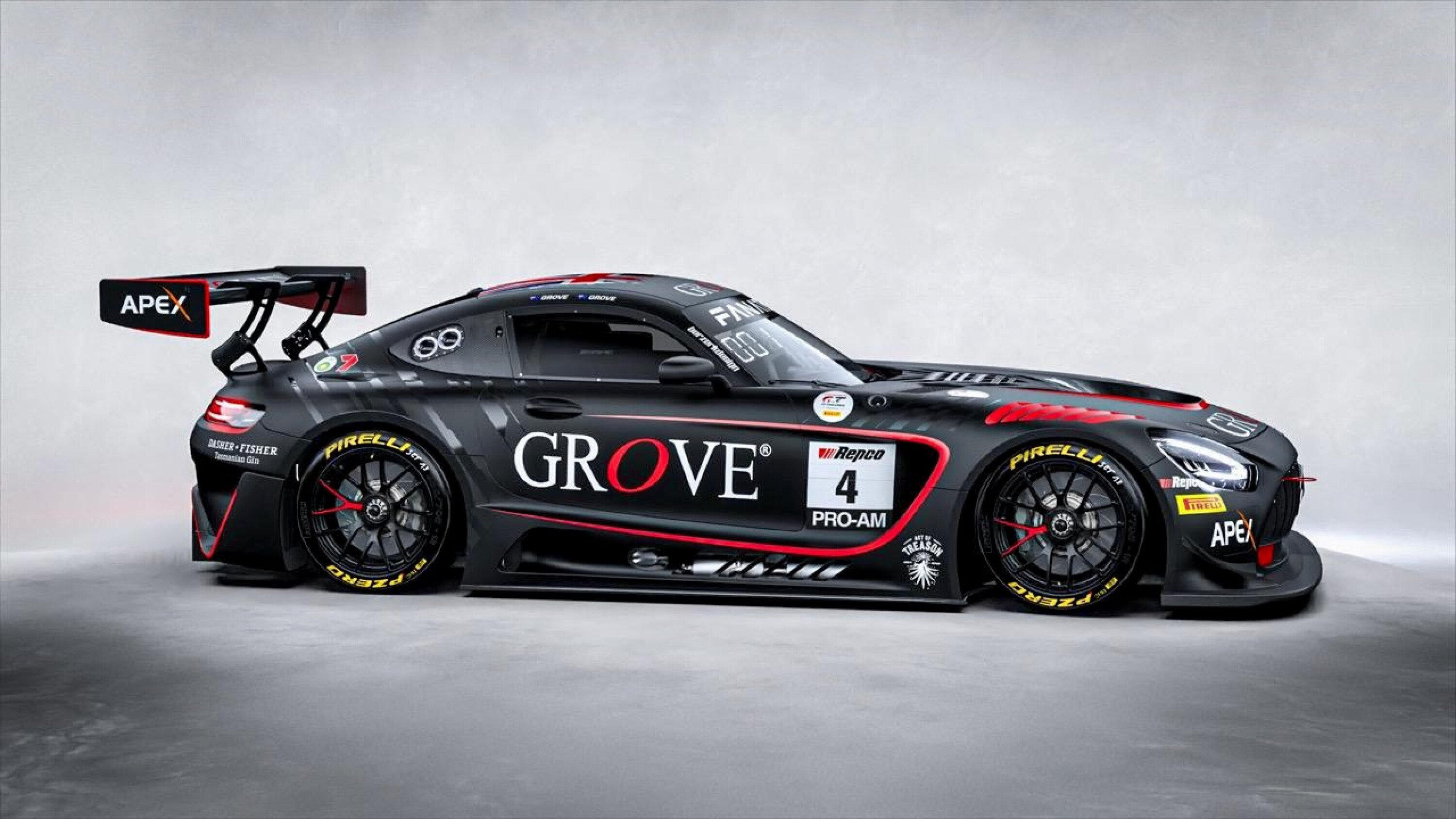
Grove Racing and Heart of Racing by SPS have entered two cars in the Bronze category, while Supabarn Supermarkets/Tigani Motorsport will enter in the Silver Cup and Team Nineteen in the GT4 classification.
The Bathurst 12 Hour is the first round of the 2025 IGTC, with four more rounds to follow this year: the Nurburgring in Germany and Spa in Belgium in June, Suzuka in Japan in September and the final round in Indianapolis in the USA in October.
The IGTC has been held since 2016 and is in its 10th year.

In addition to Mercedes-AMG, teams using cars from brands such as BMW, Porsche and Ferrari all feature in the championship.
Mercedes-AMG has previously claimed this race three times: in 2013, Bernd Schneider, Thomas Jäger, Alexander Roloff drove a Mercedes-Benz SLS AMG GT3 to victory for Erebus Motorsport; in 2022: Jules Gounon, Kenny Habul, Martin Konrad, Luca Stolz triumphed in a Mercedes-AMG GT3 for Triple Eight Race Engineering; and in 2023, Jules Gounon, Kenny Habul, Luca Stolz won for SunEnergy1 Akkodis ASP Team in a Mercedes-AMG GT3.
Mercedes-AMG will also host 200 of its customers trackside at the Rydges hotel as qualifying gets underway on Saturday before the race on Sunday.
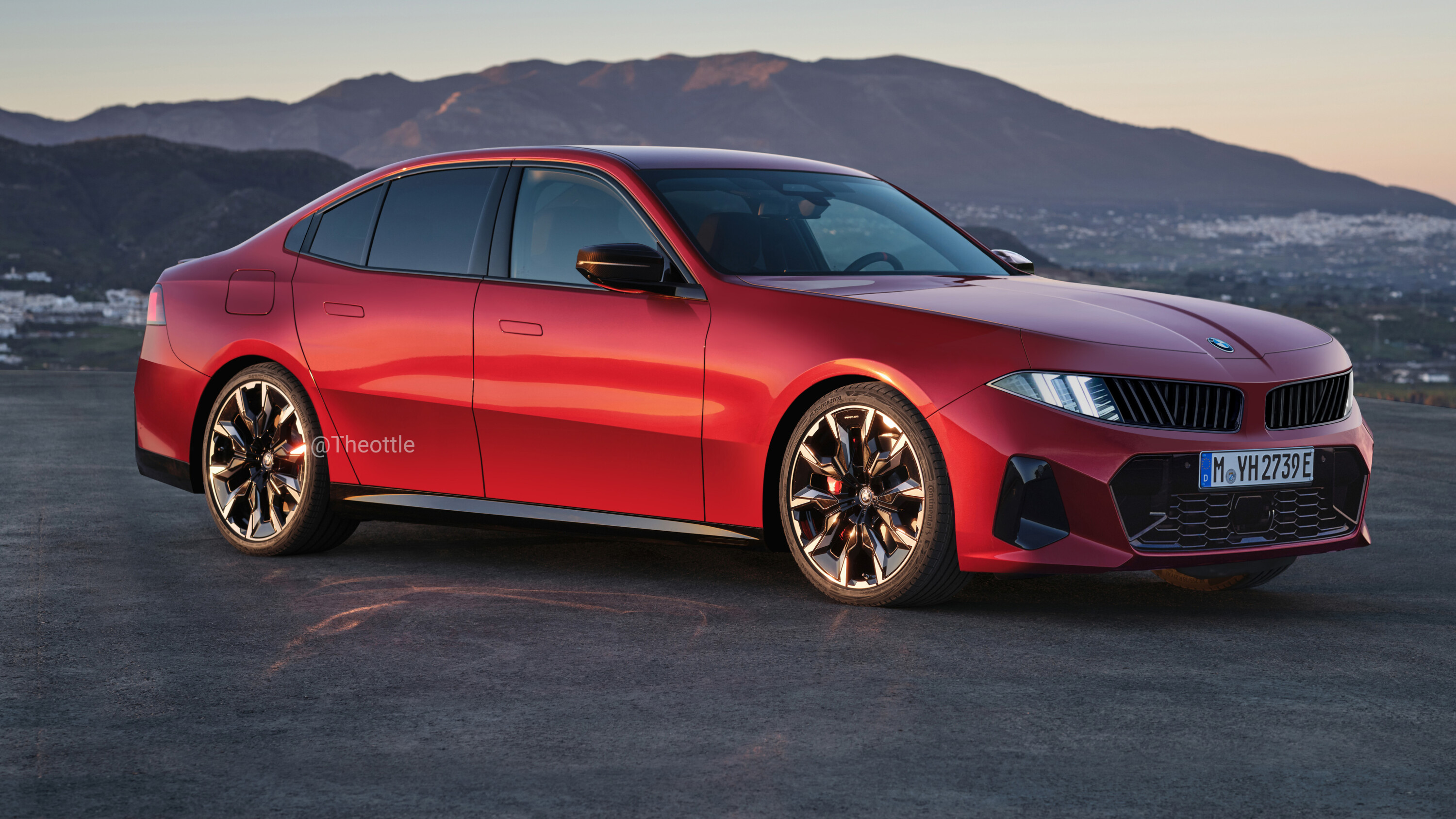
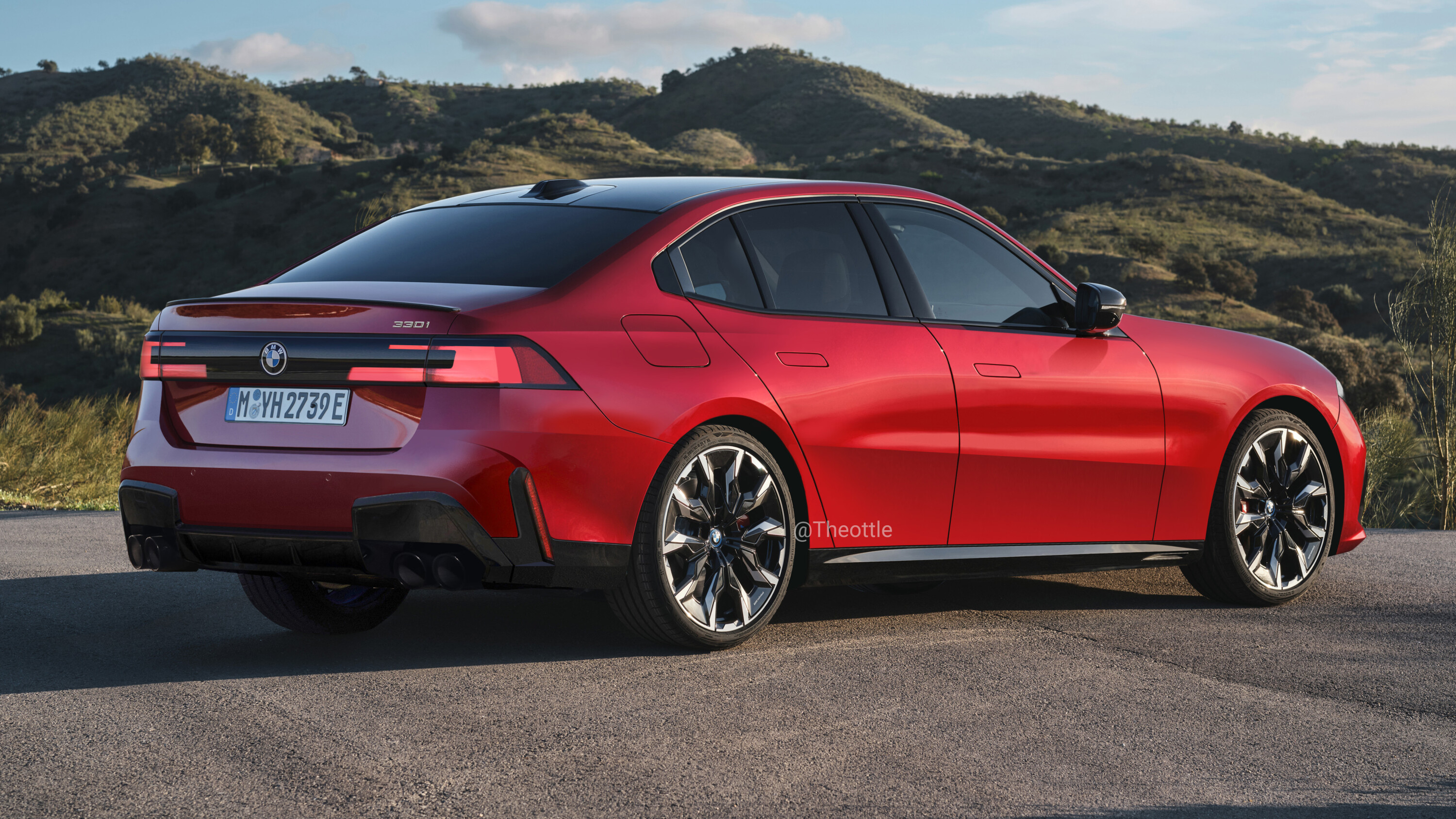
All the talk around BMW’s 3-badged sedan in recent years has been about the upcoming electric i3 – but this could be our clearest look yet at how the petrol version will look.
These speculative renderings by Photoshop wizard Theottle – based on spy photos published by enthusiast site BMW Blog – suggest we can expect the new 3er to share some key design cues with its electric counterpart.
Key among them is BMW’s retro-inspired new-look face, following the 2023 Neue Klasse concept’s throwback styling.
It’s expected the new i3 will skew much closer to the Neue Klasse in its final design, as imagined by Theottle not long after concept’s unveiling,
However, the regular 3er – likely to be known as the G50 – looks set to wear a more conventional skin but with its own take on the Neue Klasse grille and headlights.
If that’s how it plays out, these latest renderings could prove to be an accurate look at what we’ll see either later this year or in early 2026.
This thinking may have been made more concrete in a recent interview, too, with BMW’s chief development officer Frank Weber telling Green Car Reports: “We can only have one design, there is no difference between an ICE car and a battery electric car”.
Perhaps in reference to the distinct design differences between the Mercedes-Benz E-Class and the electric EQE (among others in the range), Weber added that brands styling their EVs differently to their conventional models is “probably one of the biggest mistakes some of the competitors were doing”.
For the most part, BMW’s latest range of EVs and combustion models have shared broadly identical styling, such as the BMW X1 and iX1, the 4 Series Gran Coupe and i4, the 5 Series and i5, and the big 7 Series and i7 twins.
BMW isn’t exactly immune to the ‘errors’ it claims of others, though, with the iX electric SUV standing apart as an anomaly in the range.
And, as the below side-by-side photos show, the new 3 Series and i3 appear to have unique bodies with only the front (and rear?) styling to connect them.