
The Bend’s long, long main straight is a happy place for PCOTY 2020 performance testing. A smooth, grippy surface and plenty of rubber laid down by numerous tyre-burning race starts makes for, in general, fast times.
But first, an embarrassing confession: Morley and I had completed all the cars only to discover the Driftboxes didn’t have data-saving memory cards in them. While the numbers had been written down, the Driftbox only displays figures to one decimal place rather than the two it records to, so we hastily grabbed our helmets and re-ran all the cars in double-quick time in order to obtain accurate figures.
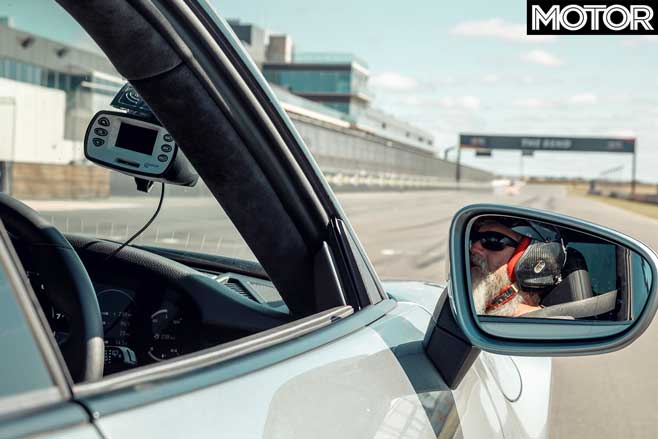
Thankfully, due to our earlier ‘practice’ runs, despite the haste we managed to match the earlier figures to within a tenth. So without further ado, in alphabetical order, this is the class of PCOTY 2020.
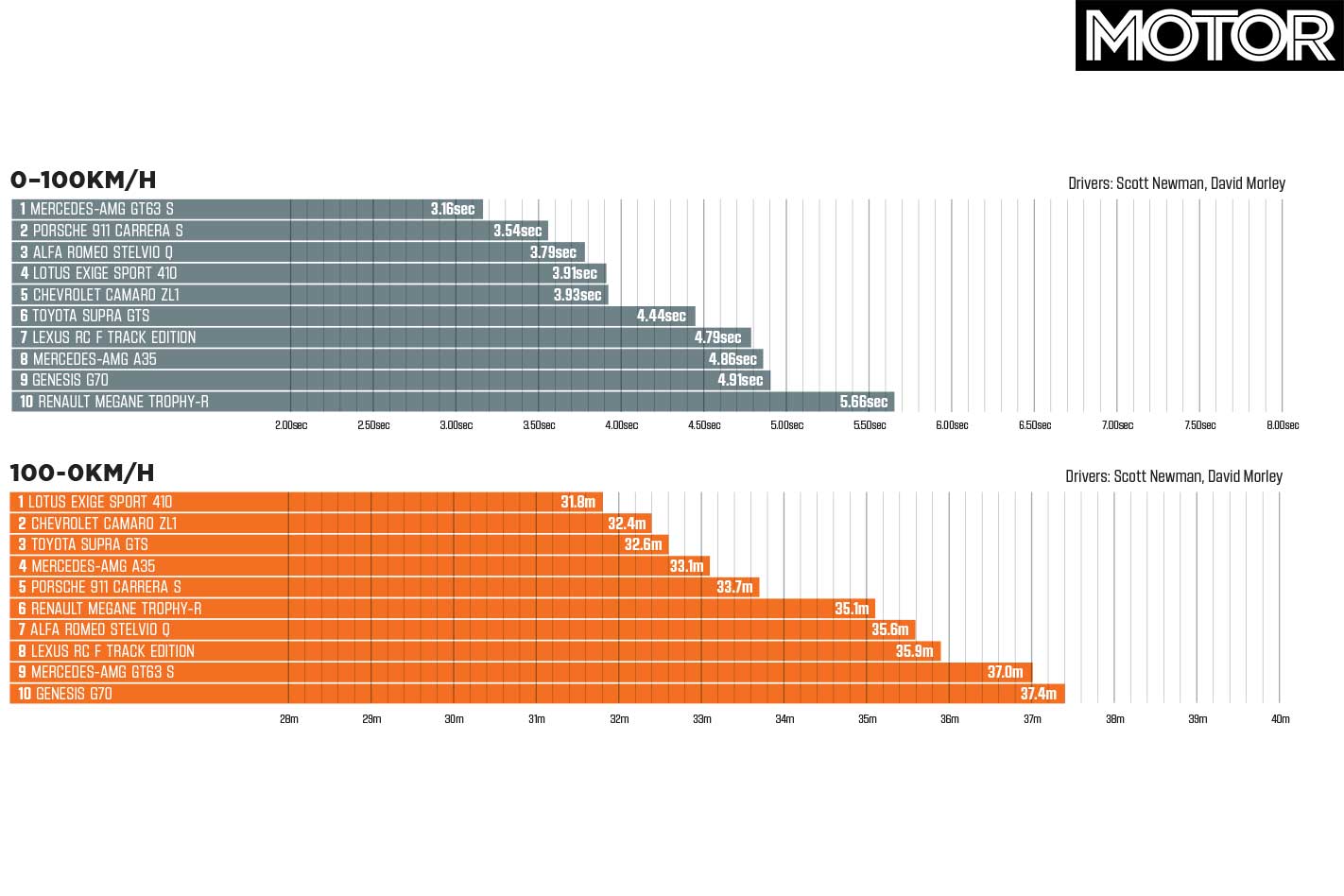
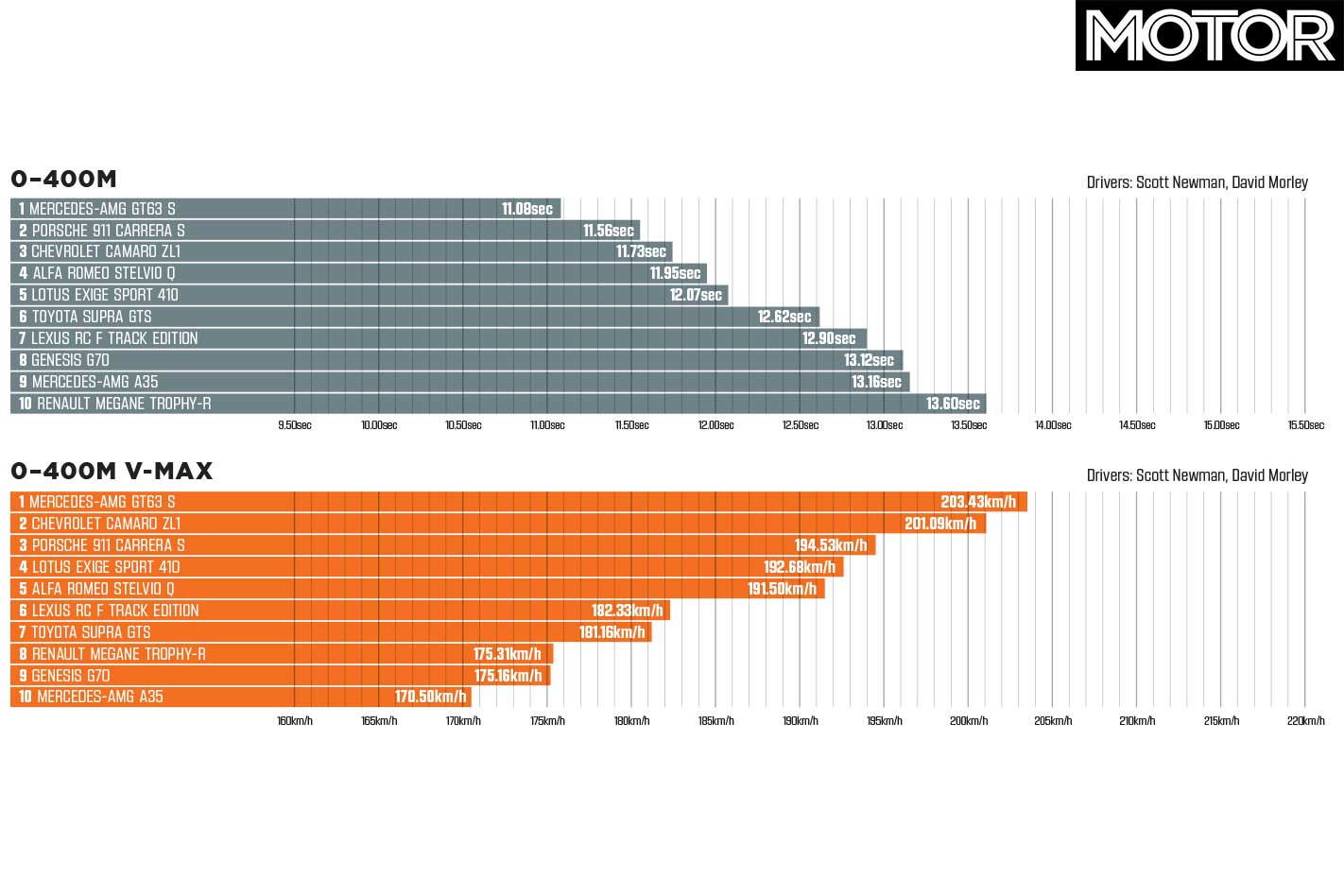
The Alfa Romeo Stelvio Q doesn’t look like your standard athlete, but a 375kW/600Nm 2.9-litre twin-turbo V6 provides plenty of motivation, while all-wheel drive rockets the Italian SUV to 100km/h in just 3.79sec and through the quarter-mile in 11.95sec at 191.50km/h. Yep, an SUV running sub-12sec quarters. It makes a suitably throaty six-cylinder growl in the process and stops remarkably well too, pulling up from 100km/h in just 35.6m.
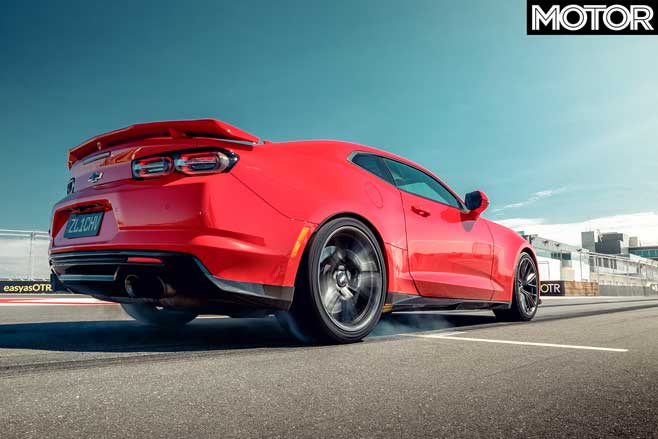
Unsurprisingly, the rear-drive Chevrolet Camaro ZL1 can’t match the Alfa off the line, but with plenty of heat in the massive rear Goodyear Eagle F1 Supercar 3s a cautious take-off and short-shift into second gear brings up 100km/h in just 3.93sec.
From there on the 477kW/881Nm ZL1 can’t be stopped, steaming through the 400m mark in 11.73sec at a whopping 201.09km/h. Only one other car would top that figure. But it could have been better; an earlier run flashed up 11.6sec at 205.0km/h. The Camaro also stops as well as it goes, pulling up from 100km/h in 32.4m.
The speed of the 2020 field is evident in the fact that the Genesis G70 is the second-slowest entrant here to 100km/h despite managing an impressive 4.91sec. Over the rest of the quarter the G70’s potent 272kW/510Nm 3.3-litre twin-turbo V6 does its thing, lifting it one place with a 13.12sec at 175.16km/h, though stopping again is more of a struggle, the G70’s 37.4m the longest in the field.
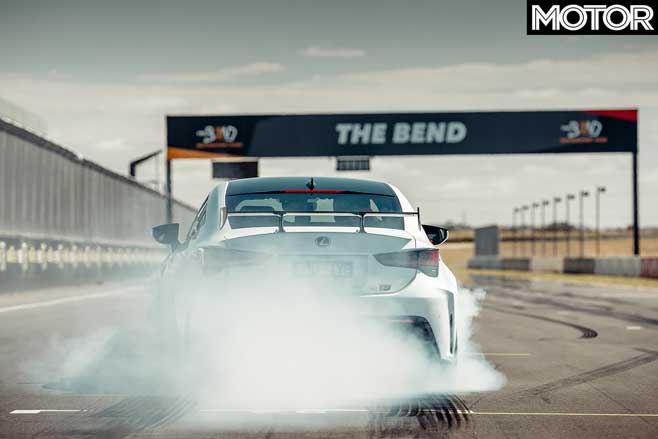
Nevertheless, the strength of the G70’s bang-for-buck equation is evident in the fact that the Lexus RC F Track Edition can only improve on the Genesis’s efforts by a tenth or two, despite costing almost $90K more. The Lexus V8 is a sweet, free-revving thing and numbers of 4.79sec and 12.90sec at 182.33km/h aren’t shabby, but equally the Track Edition isn’t going to blow you away with its sheer speed.
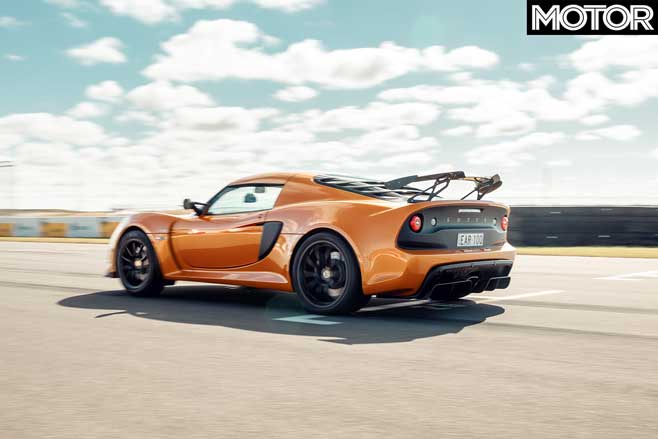
The Lotus illustrates what a real ‘Track Edition’ can do. A supercharged V6 in an 1100kg body makes for ample acceleration; we couldn’t quite match the figures achieved earlier in the year, but 3.91sec to 100km/h in a manual rear-driver is still pretty handy.
What’s more, the Exige Sport 410 has the grunt to sustain the charge, crossing the quarter-mile in 12.07sec at 192.68km/h, more than 10km/h up on the Lexus. That lack of weight comes in handy on the decel too, the Lotus stopping quicker than any other car in the field from 100km/h at just 31.8m.
AMG tends to do a pretty mean set of stoppers also, the A35 coming to a halt in 33.1m. Its acceleration isn’t quite so impressive, though it uses its 225kW/400Nm to good effect, launch control catapulting Merc’s semi-hot hatch to 100km/h in 4.86sec before its relative lack of punch becomes evident, the quarter-mile requiring 13.16sec at 170.50km/h.
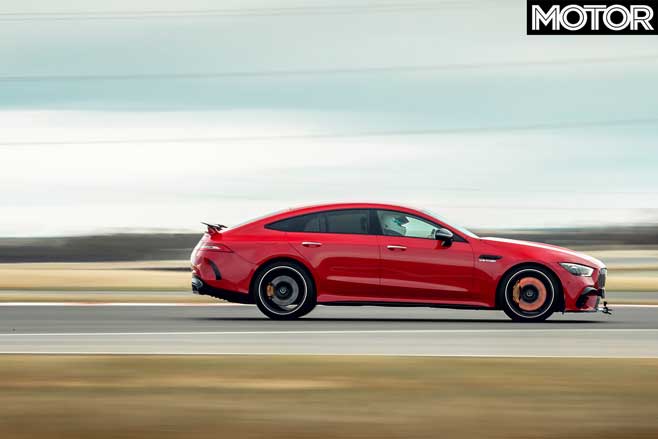
Lack of punch isn’t something you’ll ever worry about in the A35’s big brother; the GT63 is out of this world. Sadly, our timing equipment chucked a wobbly (11.3sec quarter-mile at 184.8km/h? Yeah, nah…) but thankfully we’ve tested the big Merc before and there’s no reason to believe our PCOTY test car is any slower. Figures of 3.16sec 0-100km/h and 11.08sec at 203.43km/h for the 400m make it easily the speed king of this year’s contest. The monster carbon brakes struggled though, taking 37.0m to arrest the two-tonne GT63.
As ever, the Porsche 911 does more with less. Outputs of 331kW/530Nm aren’t groundbreaking, but the 992 Carrera S scorches to 100 clicks in 3.54sec and completes the quarter in 11.56sec at 194.53km/h. Remember, 992s will only get quicker from here on! Braking is also impressive, with a 33.7m effort.
The Renault Megane RS Trophy-R is the quickest front-driver we have ever tested, if only by fractions of a second over the Honda Civic Type R. Launching it is a right pain, with all manner of electronic protections getting in the way (4000rpm soft rev limit when stationary, no clutch drops allowed), but cajole the Frenchie off the line correctly and it will whip to 100km/h in 5.66sec and to the 400m mark in 13.60sec at 175.31km/h. The slowest car in the field, sure, but pretty brisk for a hot hatch.
Last but by no means least is the Toyota Supra GTS. It likes a little bit of wheelspin off the line but then it’s just a case of ensuring you click through the closely stacked ratios in time to rattle off an impressive 4.44sec 0-100km/h and 12.62sec quarter-mile at 181.16km/h. It stops equally effectively, shedding 100km/h in just 32.6m. A fine way to round out a very speedy dectet.
PCOTY 2020 – The Performance Numbers
0-100km/h Acceleration and 100-0km/h Braking Numbers
0-400m Drag Performance Numbers
What stands out?
The Mazda 2 looks good, feels nice inside, and is more fun to drive than most city cars. Its 1.5-litre engine is very easy on fuel, and delivers plenty of power. Auto braking is standard, on both the hatch and the sedan.
What might bug me?
Not much – the spare tyre is a space saver, and its 80km/h recommended top speed could bother you if you get a flat far from home. But for a car intended mainly for city use, it’s a defensible choice because it frees up some boot space.
What body styles are there?
Five-door hatchback and four-door sedan.The Mazda2 drives its front wheels, and it is classed as a light car, lower priced.
What features do all Mazda 2s have?
Full colour touchscreen displaying Mazda’s MZD Connect infotainment system that’s easily controlled with a dial on the centre console.Android Auto and Apple CarPlay smartphone mirroring, AM/FM/digital (DAB+) radio, Aux and USB inputs, Bluetooth connectivity for phone calls and audio streaming, and audio system with least six speakers.Reversing camera and rear parking sensorsCruise control, power windows, air-conditioning, keyless entry and push-button start.Leather-wrapped gear shift knob, handbrake handle and steering wheel.Buttons on the steering wheel for operating the cruise control, the sound system, and your phone.Hill launch assist, which helps you start on an uphill slope by controlling the brakes automatically.G-Vectoring Control, a Mazda technology that makes the car respond more consistently to the steering wheel.City-speed autonomous emergency braking (Mazda calls this Smart City Brake Support – Forward), blind-spot monitoring, rear-cross traffic alert, lane departure warning, lane keeping assist.Six airbags. Electronic stability control, which can help you control a skidding car and is mandatory on new cars. (For the placement of airbags, and for more on Mazda2 safety systems, please open the Safety section below.)Every Mazda2 carries a five-year, unlimited kilometre warranty.
Which engine uses least fuel, and why wouldn’t I choose it?
The Mazda 2 is only available with a 1.5-litre petrol four-cylinder petrol engine that consumes as little as 4.9 litres/100km with the six-speed manual gearbox or 5.4 litres/100km with the six-speed automatic transmission, based on official test figures.The engine has a fuel-saving feature that allows it to shut down automatically when the car stops, and start again when you take your foot off the brake to drive away.The manual gearbox is only available with the cheaper G15 Pure hatch and sedan versions.The G15 in each variant name reflects the 1.5-litre engine size as part of Mazda’s new naming convention.
What key features do I get if I spend more?
The least costly Mazda 2 is the G15 Pure, which replaced the old Maxx spec and comes with cloth seats, 15-inch aluminium alloy wheels, and the features in all Mazda 2s. It is available as a hatch or sedan, which each costing the same, and comes standard with the manual gearbox. The automatic transmission costs about $2000 extra.Spend more for a Mazda G15 Evolve and you get the automatic transmission as standard, a head-up display that shows your speed and other driving information on the windscreen at eye level, and traffic sign recognition to help you keep track of the speed limit.The Evolve also has climate controlled air-conditioning that lets you set a temperature, and LED daytime running lights, inbuilt satellite navigation, shark fin antenna, rain-sensing windscreen wipers.The Evolve is only available as a hatchback.The most expensive Mazda 2, the G15 GT has hatch and sedan versions, and gains adaptive cruise control, 360-degree parking monitor, seats trimmed with leather and synthetic suede, front parking sensors and advanced keyless entry that lets you unlock the car without having to take your key out of your pocket or bag.
Does any upgrade have a down side?
The Evolve and GT versions aren’t available with a six-speed manual version, which is more affordable and quite fun to drive.The Evolve isn’t available with a sedan version that offers a bigger boot than the hatch.Wheels on the Evolve and GT can’t turn as far left and right inside the wheel arches as the smaller wheels on the lower-spec models, which extends their minimum turning circles by about half a metre.Five colours are available standard, three more, Soul Red Metallic, Poly Metal Grey Metallic and Machine Grey Metallic, cost about $500 extra.
How comfortable is the Mazda 2?
Elegant design, high-quality plastics and pleasantly tactile controls bring a sense of maturity to the Mazda 2 that is found in few other cars of this size or price.Front seats provide good support for drives of up to two hours, and the driving position is comfortable – thanks in part to the tilt and reach adjustable steering column.Tyre noise is a long-time Mazda bugbear. The 2 marked a big improvement when launched, but was not as quiet as the refinement benchmark for the class, the Volkswagen Polo. The tyre roar is most noticeable on coarse-surface country roads – in the city, it’s not such a problem. Mazda added insulation for the update of April 2017, which has helped.In contrast, the Mazda’s ability to isolate its occupants from a bumpy road surface places it among the most comfortable light cars at open-road speeds.The Mazda 2 is measured in its steering response. The initial turn of the wheel brings a smooth change of direction – a pleasant change from the previous-generation car’s over-eagerness. Similarly, the car responds progressively to the accelerator and brake pedals.
What about safety in a Mazda 2?
Every Mazda 2 has an autonomous emergency-braking system that Mazda calls Smart City Brake Support – Forward. It relies on a laser sensor and is effective at speeds below 30km/h. If the sensor detects a looming obstacle – typically another car that has slowed suddenly – the car will warn you of the risk, and if necessary apply the brakes automatically. The idea is to save you the indignity, expense, and injury risk, of low-speed.The Mazda 2 also has a host of additional active safety currently features found in few of its rivals including blind-spot monitoring, rear-cross traffic alert, lane departure warning, lane keeping assist.Blind-spot monitoring uses rear-facing radars to detect and warn you of vehicles lurking near your rear corners, which might not appear in your mirrors. Rear-cross traffic alert also looks behind you when you are reversing – say from a driveway or shopping-centre parking space – and lets you know if another vehicle is about to cross behind you.The most expensive Mazda 2, the G15 GT has adaptive cruise control that uses a radar to help it match the speed of the car in front up to a selected speed and help maintain a safe distance.Other safety features include stability control that’s mandatory in all new cars, rear parking sensors, seatbelt reminders for all seats, six airbags, and city-speed auto emergency braking – a broadly based safety package that stands out among cars of this size and price.Thin, well located A-pillars (those either side of the windscreen) afford good vision for tight corners and roundabouts, increasing primary safety – with help from exterior mirrors that are mounted on the doors rather than in the corners of the windows.The airbags are in the usual places, offering more side protection in the front than in the rear. There are two airbags directly in front of the driver and front passenger; one outside each front seat to protect front occupants from side impacts at chest level; and curtain airbags extending down each side that protect front and rear occupants from side impacts at head level.The Australasian New Car Assessment Program (ANCAP) awarded the Mazda2 hatch and sedan five stars for safety, its maximum, in September 2015.
I like driving – will I enjoy this car?
Yes. The Mazda 2 is among the best light car choices for buyers who enjoy their driving. Hatchback and sedan drive like more grown-up cars with good reason: their chassis is a revised version of that found beneath the larger Mazda3.The Mazda 2 inspires confidence and is fun to thread along a favourite country road. Responsiveness and feedback from the steering increase as you turn the wheel further into a corner.Mazda 2s on sale since an update of April 2017 benefit from mildly modified suspension aimed at helping the car ride and corner more steadily. In addition they gained Mazda’s G-Vectoring Control, which manipulates the engine imperceptibly when you turn the steering wheel – transferring weight to the front tyres in a way that is said to improve feel and response from the steering.Even the lower powered, ‘standard-spec’ engine is energetic. It sounds good too, and is fun to rev on the open road.The Mazda 2’s automatic gearbox chooses the right gear decisively. And the manual gearbox is one of the best at this price level: it is smooth and satisfying to operate.
How is life in the rear seats?
The bench rear seat offers good shoulder and leg room for two, and a comfortable cushion. On the negative side, a rising window line and large front headrests limit vision, which might be a factor for children.The seat can carry three passengers, with lap and sash belts for all. Squeezing three adults across the back of a Mazda 2 – or any light car – is a recipe for discomfort over the long haul. However, it’s handy to be able to do so for short trips.
How is it for carrying stuff?
The Mazda 2 hatchback, although small, is quite good at swallowing cargo. The boot aperture is smaller than those of some alternatives, however. Mazda quotes cargo capacity at 250 litres with the 60/40 folding seatbacks upright.The Mazda 2 Sedan has significantly more boot space at 440 litres.
Where is the Mazda 2 made?
The Japanese-designed Mazda 2 is manufactured in the brand’s Rayong, Thailand, plant.
What might I miss that similar cars have?
Turbocharged light cars such as the Renault Clio and Volkswagen Polo respond more eagerly to the accelerator pedal – particularly from low speeds.Other light cars worth considering include the Honda Jazz, Suzuki Swift, Peugeot 208, and Hyundai Accent.
I like this car, but I can’t choose which version. Can you help?
Sure. The cheapest Mazda 2, the G15 Pure, in either hatch or sedan, is our pick of the line-up. Both body styles bring desirable features such as alloy wheels, active safety features and excellent infotainment and it’s the only version available with a choice of manual or automatic transmission.If you’re sold on an automatic hatchback, the Evolve brings some desirable extras, such as head-up display and climate control air-conditioning, for just $1500 more
Are there plans to update the Mazda 2 soon?
This third-generation Mazda 2 arrived in late 2014 as a hatchback, and a sedan was added in late August 2015. With the arrival of the sedan, cruise control was added to Neo versions of both body styles, and Maxx and Genki models gained reversing cameras.A more comprehensive update arrived in April 2017, dropping the CD player but bringing Mazda’s G-Vectoring Control to enhance cornering, and making auto-braking standard (it had been optional). Blind-spot monitoring and Rear cross-traffic alert were added at the Genki and new GT trim level.In December 2019 Mazda gave the Mazda 2 a slight facelift and trimmed down the range to just three specification grades. The entry-level Neo spec was deleted with the Maxx, Genki and GT renamed the G15 Pure, G15 Evolve and G15 GT respectively to be in-line with the brand’s latest nomenclature introduced in the new Mazda 3.An all-new Mazda 2 is not expected before 2021.
It should be no surprise that film director and producer Jim Glickenhaus has a flair for drama when revealing information about his new cars, most recently the Glickenhaus 007 Le Mans Hypercar
“An American car hasn’t won First Overall at Le Mans since 1967. It’s time.”
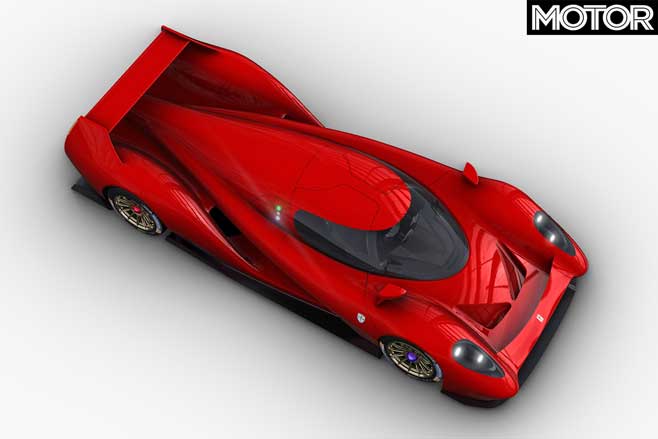
So, here it is. The final version of the 007 hypercar has been revealed ahead of its intended debut at the 24 Hours of Le Mans in the 2020–21 season.
Founder (and self-proclaimed “chief cook and bottle washer”) of SCG Jim Glickenhaus kept his thoughts on the eventual race rather short, unlike the race itself.
“We will be standing in the rain at Le Mans, watching a car we created blur past. It will be a proud day for us and America.”
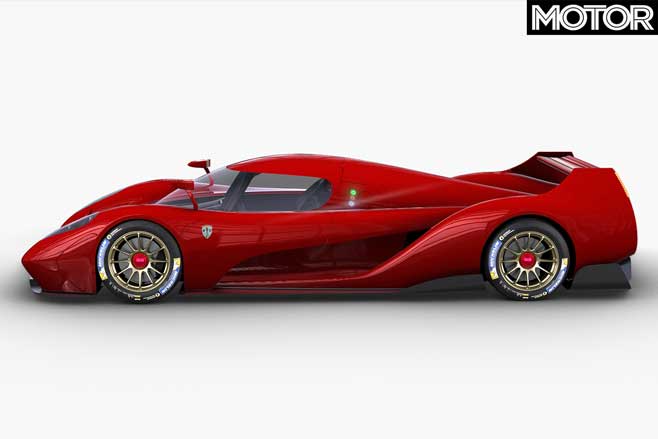
The engine details have also finally been confirmed. It’s a 3.0-litre twin-turbo V6 as suspected, possibly Alfa Romeo in origin but branded for Glickenhaus.
The V6 was chosen over a V8 due to, according to Jim Glickenhaus due to it being “smaller, lighter, and easier to sculpt aero with.” Its better fuel efficiency also had a part in that decision, with the car weighing 1100kg likely also helping its efficiency.
But we think the V6 should be enough – Glickenhaus claims it’s able to run reliably producing 626kW for 30 hours straight. 24 should be easy then, right?
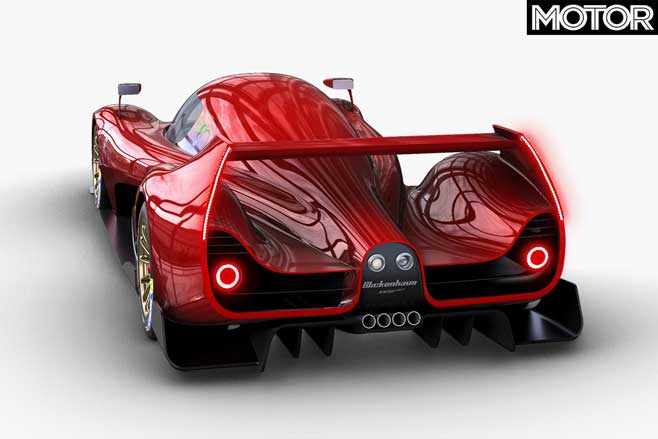
Not one for subtlety, Glickenhaus asks “can your supercar do that?”
“If it can’t race the 24 Hours of Le Mans, it’s not that hyper.”
Though it’s primarily destined to take to the track, the SCG 007 racer will also spawn a limited run of road cars according to the brand’s founder.
“In addition to our factory LMP1 race cars, we will also offer customer LMP1 race cars and a limited run of road-legal 007s,” Glickenhaus said in late 2019.
Given the race car has a price tag of €2,000,000 (that’s AUD$3.24 million to us), we can’t imagine a road car would be cheap at all.
- Young Kiwi right on the pace
- Noncommital about US future
- Aussie IndyCar legend impressed with performance
The Kiwi finished behind Indy 500 winner Alex Rossi, while Penske teammate and Toowoomba native Will Power topped the day.
It’s a huge boon for McLaughlin, who’s set to race in the IndyCar series in a one-off drive later in the year.
“INDYCAR racing is really fast,” he said after the test. “There is so much grip in these cars. It is hard on your neck for sure man. I’ve been training really hard for this and I’m really happy with the car. The speed I can carry through the corners. It’s insane. I’m getting used to being able to use the aero. You feel every bump. The g-forces are huge. Your neck gets a hammering. There is no power steering. In the V8 cars, we are quite lucky with that. You really have to force the car. We are going 250k through the corners, so it is full-on. I have a new sense of speed.”
McLaughlin, who will return to Australia to rejoin his DJR Team Penske Supercars outfit for the 2020 season, is still being cagey about when or if he will go to the US to pursue his career.
“I’d love to get to America one day, that’s my ultimate goal,” he said. “Whether that is here or anywhere, I just want to try and be here one day. I love the country, I love the people and I love the sport that it is. We’ll see what happens.”
—
After his first-ever drive of an IndyCar, Scott McLaughlin has the racing world talking. The young Kiwi and two-time defending Supercars champion had earned a chance to put himself firmly in the frame for a future outside the Antipodes, and he didn’t waste it.
As a reward for those two championships, and for winning the Bathurst 1000 last year, team owner and industry doyen Roger Penske gifted McLaughlin seat time on an IndyCar rookie test day at Sebring in Florida – a track that McLaughlin has never seen, and in a 560kW open-wheel monster than he had never driven.
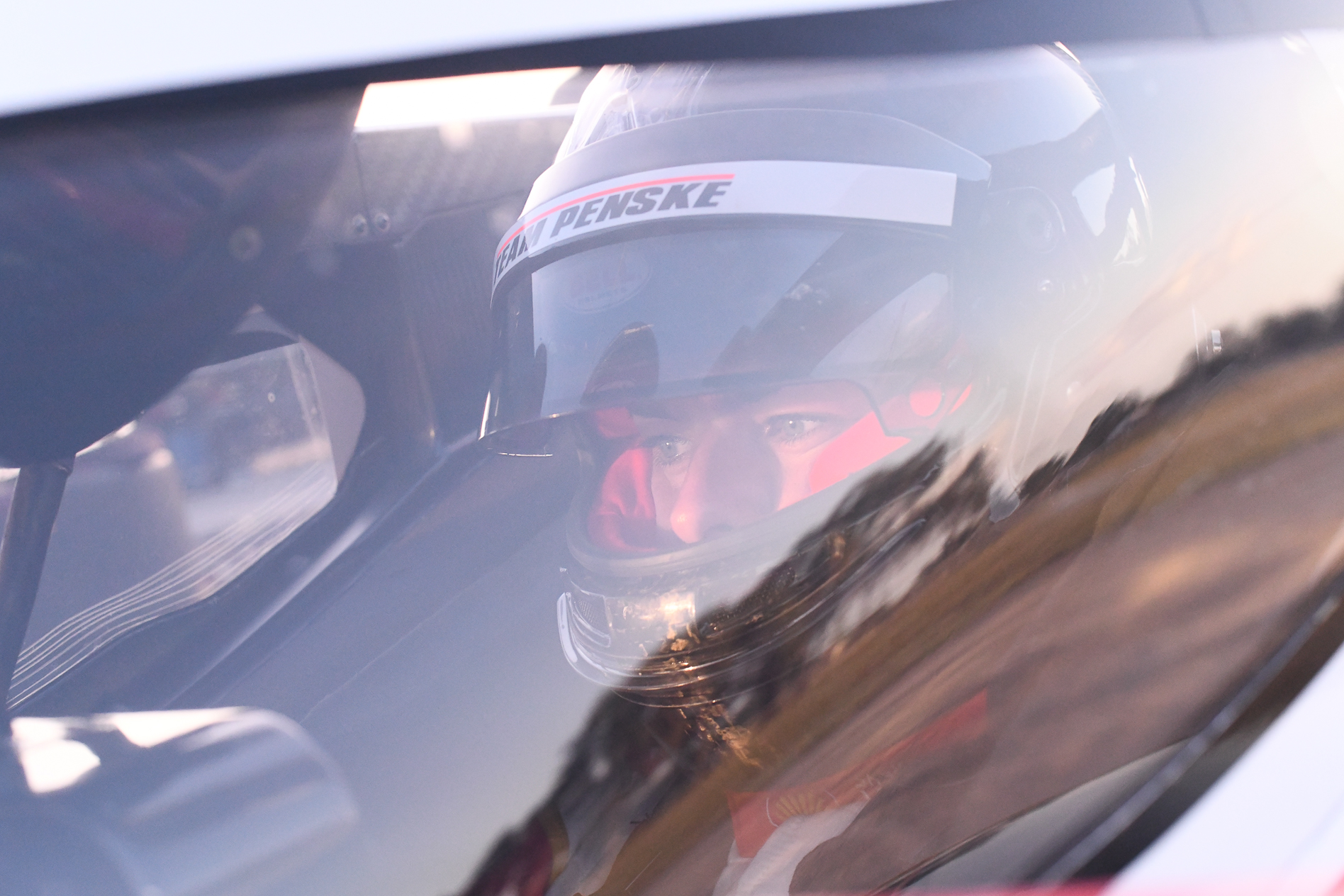
McLaughlin’s proper Penske test
And it was not a hit-and-giggle affair, either – it’s not the Penske way. A large complement of crew (some 40 in all) was on hand, as was Penske’s most trusted lieutenant Tim Cindric, Penske alumni Rick Mears and current drivers Simon Pagenaud, Will Power and current champion Josef Newgarden.
Track time in any lead series is a precious commodity, and McLaughlin knew he had to hit the ground running – and like any good race driver, he needed to keep an eye on his lap times relative to his competition.
“I was able to prep with Penske in a simulator, and I came in knowing the track and knowing which way to turn – and I’ve turned plenty of laps on iRacing,” McLaughlin told US-based Racer magazine. “But the biggest thing for me was the braking – the first time I hit the pedal, I thought my head was going to rip off and hit the steering wheel!
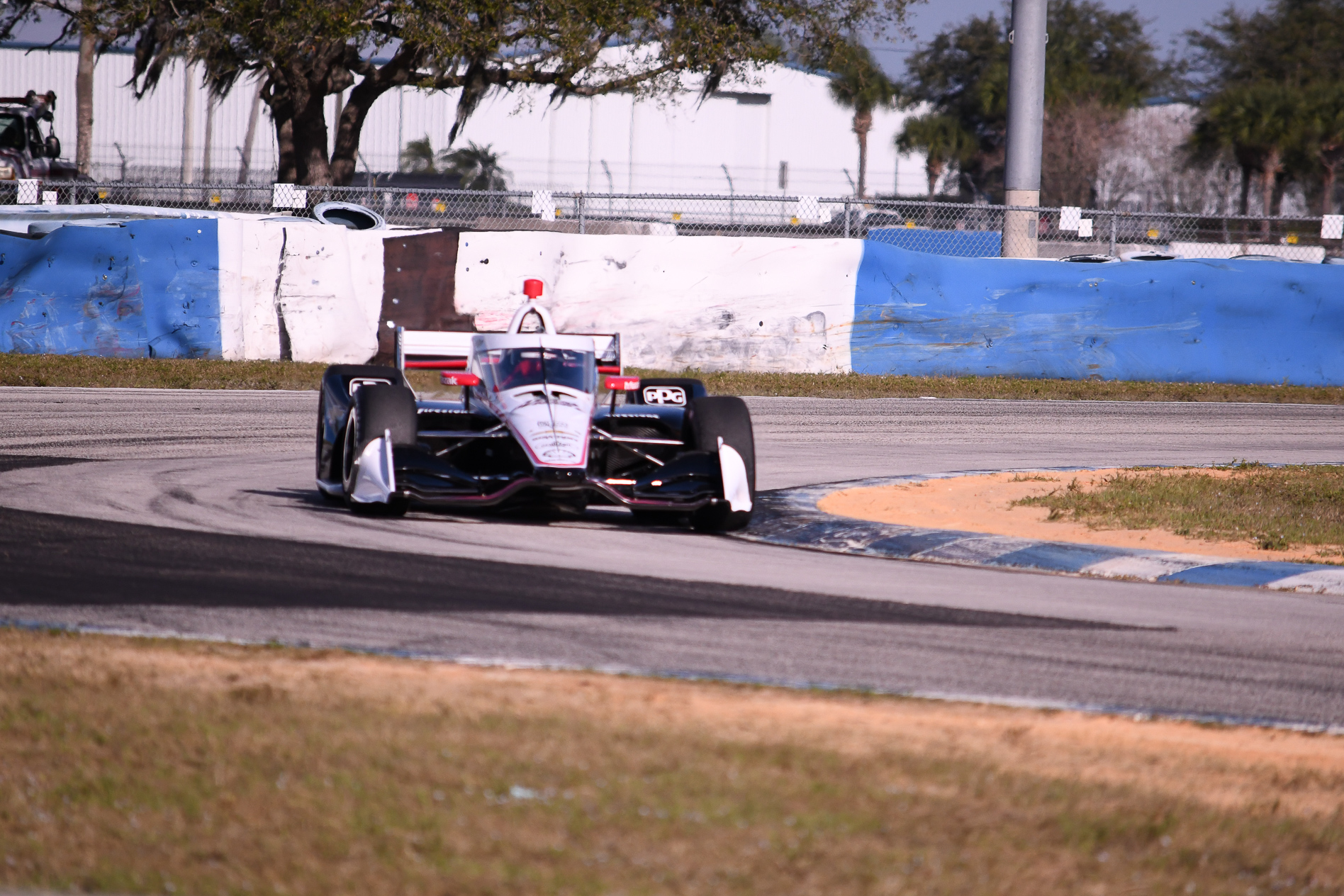
“I’ve never driven anything else in my career, really. You can do as many laps as you want in the simulator, but when you’re going around and your head is shaking around and your eyeballs are rattling out of your head, it’s fantastic, it’s so cool.
“In the end, we turned over 140 laps, got through a big program and tried a lot of things for the team, and I got a really good feel for the car. At the end of the day it just clicked. It probably happened at the wrong end of the day on the wrong set of tyres, but that was a really proud moment for me.”
Will Power pleased for Mclaughlin
Watching the test from the pitlane was former Indy 500 winner and 2014 series champion Will Power, the Toowoomba native who exited 2019 as the Indycar driver with the most victories in the preceding decade, and he was impressed with what he saw.
“Scott did a good job,” he told WhichCar. “He got the hang of the car by the end of the day.”
Power, whose career is closer to the end than the start, could well be the key to McLaughlin making the transition to the US after at least one more season in a Penske Mustang Supercar, but McLaughlin is keeping his feet firmly on the ground.
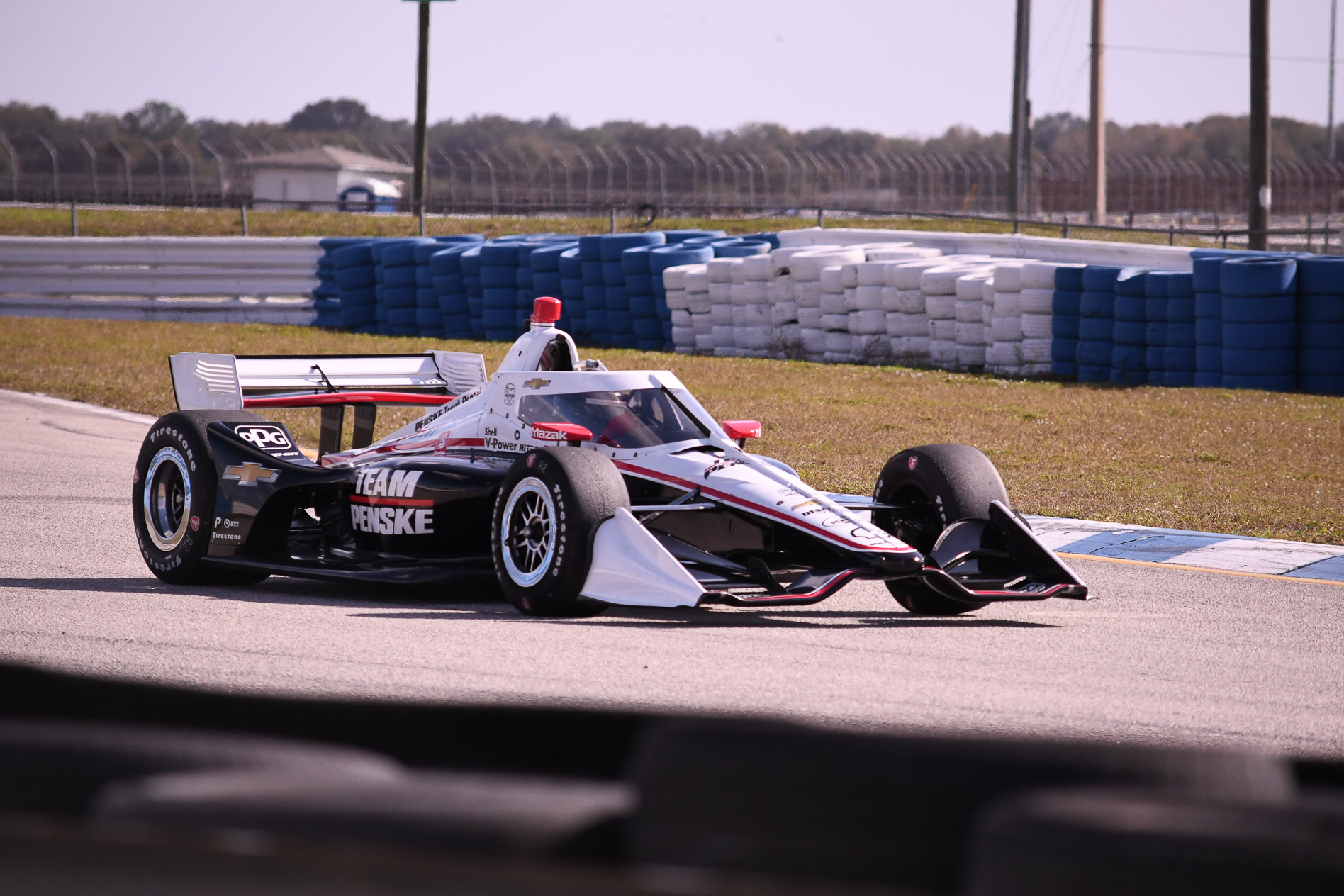
“Today was an opportunity,” he said. “I’m thankful for that. Where it goes, I’m not sure, but I’ve always been interested in racing outside of Australia, especially now that I’ve ticked my goal of winning the Bathurst 1000 and a couple of championships… but I’m heading home tonight, back to Brisbane and straight back into to the workshop and training.
“I’ve made it really clear to the team that I’d love to try and pursue opportunities in the States, and I’m really happy that today went well.”
And it did go well, finishing the day with a best lap time of 53.3sec, just four-tenths of a second behind reigning Indy Lights champion Oliver Askew, and a second away from the best lap of the day.
“For me today was huge,” he reflected. “I’ve always been an IndyCar fan. Scott [Dixon] is a bloody icon in New Zealand which is why I’ve always kept an eye on what went on in IndyCars. Now to drive for Roger in Team Penske in Australia, and then to drive an IndyCar, was like a life achievement for me. It was very cool.”
A quick chat with Scott McLaughlin after his rookie IndyCar test
Thoughts on the day?
SM: Unreal, the car is a beast. It’s everything I dreamt of. I’m so thankful to Roger, Tim and Team Penske to be able to come over here and run an IndyCar. It’s a dream come true. It’s been a big day. 141 laps, the neck is pretty sore. We held on and did a long run at the end, and I got a feel for everything. Qualifying runs, race runs, long runs, fuel loads and pit exits so it was really cool.
What was the biggest challenge/difference?
SM: Trusting the aerodynamics. Trusting the grip underneath me was probably the biggest thing I learned. It’s very hard to come out of the habits I’ve gained driving Supercars over the last 10 years. To jump into this, where there is hundreds of pounds of downforce is really cool and so exciting. Hopefully I’ll get another opportunity, who knows. But I’m really proud, and it’s a big tick on my bucket list for sure.
What was it like working with the team?
SM: It was really cool. I think we had half the crew here form the whole shop, so there were 40-odd people. Really good people, they got me comfortable in the car, that was the main focus. Once we did that, we went through a plan that the guys had, using this test for future races down the track. Hopefully I’ve done my bit for the team.
Thoughts on the aeroscreen?
SM: I was quite oblivious to the windscreen. I didn’t really notice it. Probably towards the end, as it got darker I started noticing reflections off the dash, that was probably the main thing I noticed. I think it’s a really good thing, doesn’t really affect the drivers and it actually looks really cool, and I’ve been a long-time IndyCar fan.
How was it having Will, Simon, Josef and Rick here to support you?
SM: I can’t believe it that they were all here, including the legend Rick Mears. Just to bounce ideas off all of them. Simon was a big help at the end, in regards to telling me how to give my feedback as I wanted to go in a certain direction. We went that way towards the end, and it felt so good. I owe a lot to those guys for coming, they could easily have stayed at home, but it shows how good Team Penske is not only here, but in Australia as well.
How would you wrap up your feelings about the day?
SM: It’s an overwhelming sense of achievement. I’m very proud to have been chosen to do something like this, to have the trust from the team to bring a whole crew and a truck all the way down to Florida to give me a go. It’s a massive bucket list, and hopefully there is more later on.
OF ALL the hardships a person has to face, none is more punishing than the simple act of waiting. And we waited a very long time for Toyota’s Supra. Were you supremely patient, you’d have scratched 6053 hash marks into the wall for the sixteen and a half years between the end of fourth-generation Supra production and the start of the fifth. Heck, it took 12 years for the FT-HS show car to morph into the production Supra.
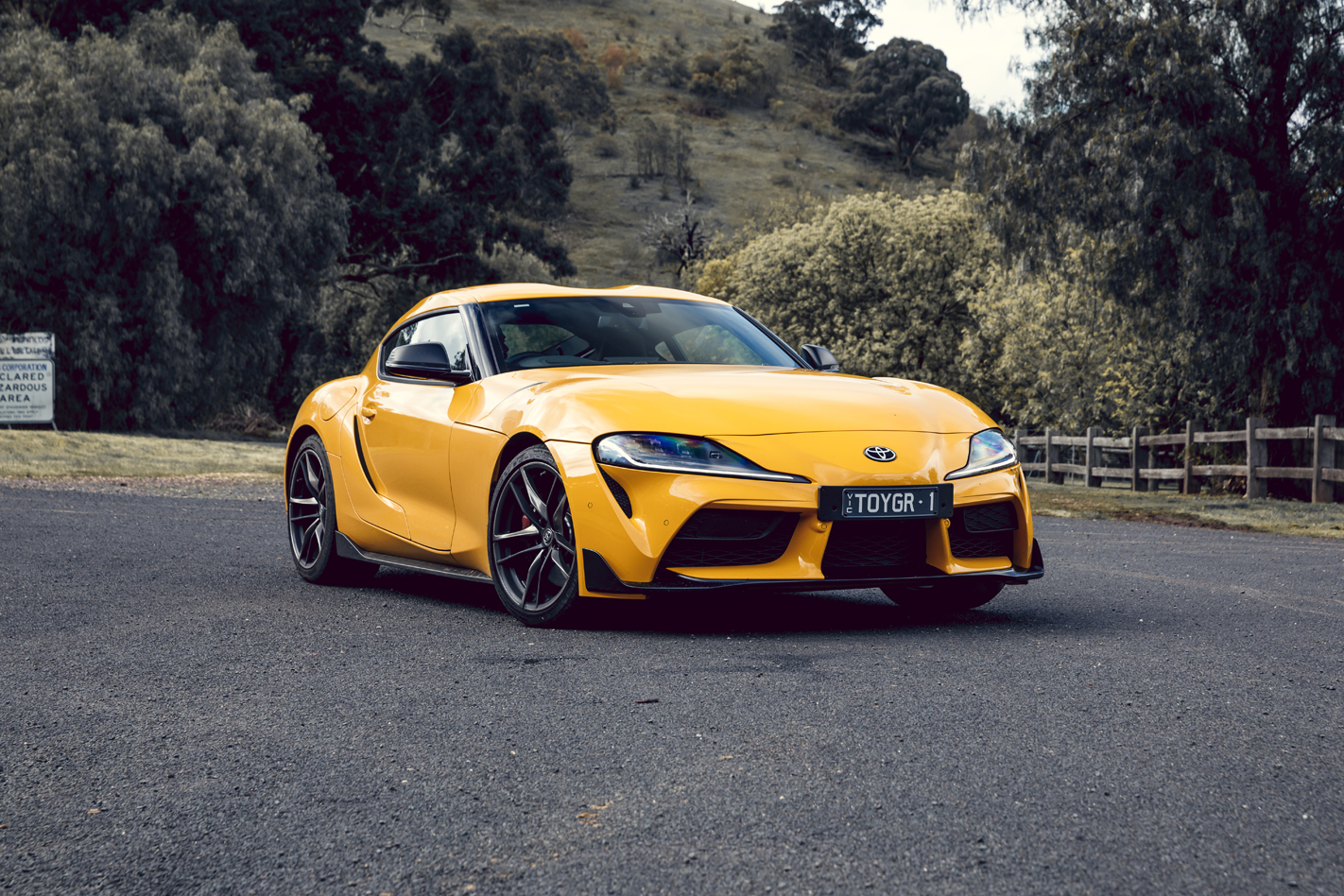
What’s more, the longer we waited the more our anticipation and expectations built, to the extent that the GR Supra could never really live up to the hype. A combination of misty-eyed nostalgia, the legend of Smokey Nagata, Top Secret, the Mid Night Racing Club, Gran Turismo and, yes, the Fast and Furious franchise had lifted what was a respectable GT coupe to near-deity. And then we got a rebodied BMW Z4.
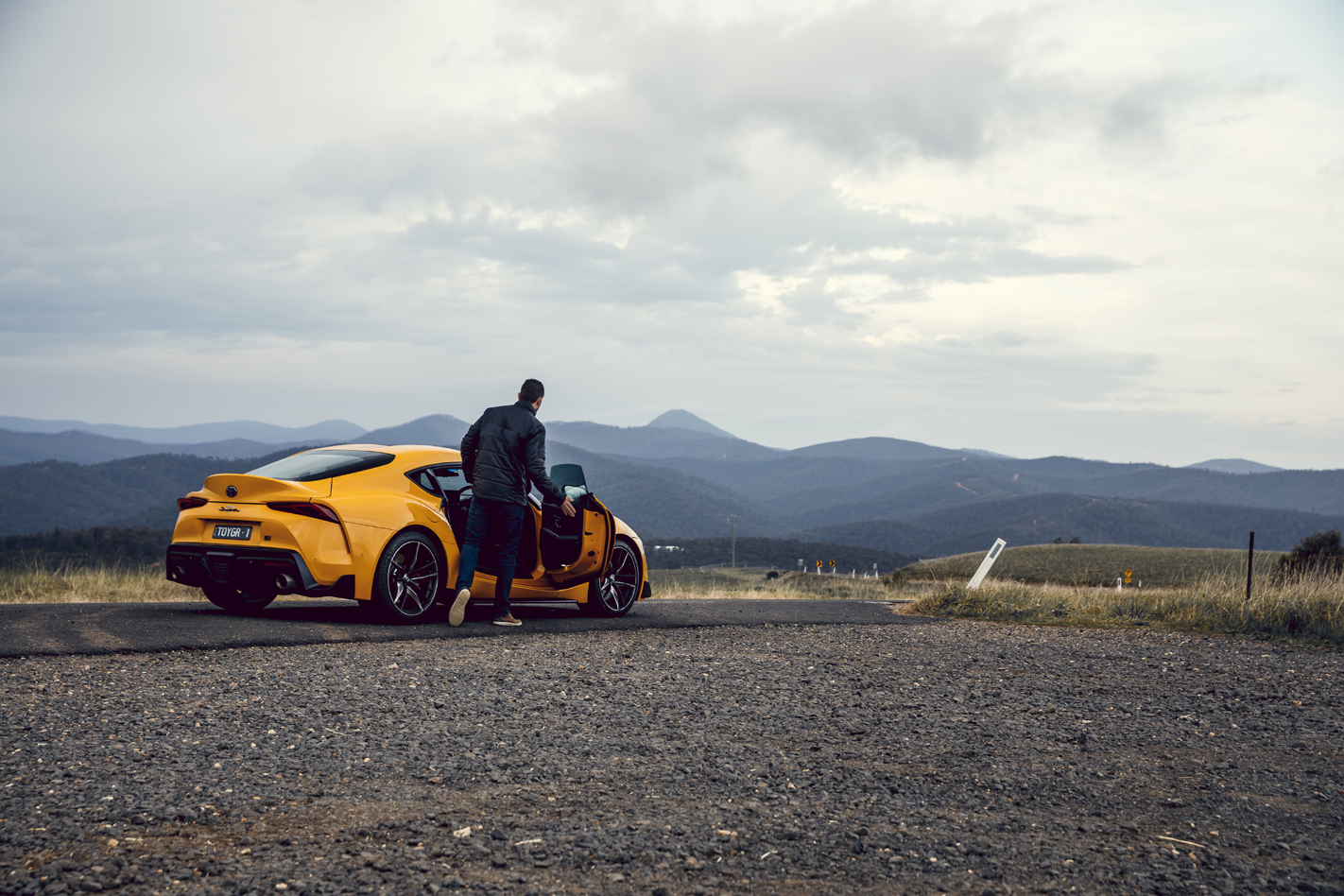
For the first Wheels road test of the Supra, we headed to the remote location of Licola, a village tucked into an inaccessible nook in the Victorian high country. It boasts a permanent population of 2, has no grid power or mobile signal, but is ridiculously overendowed with well-sighted, traffic free 100km/h posted corners. It’s not far from perfect to put the Supra through its paces.
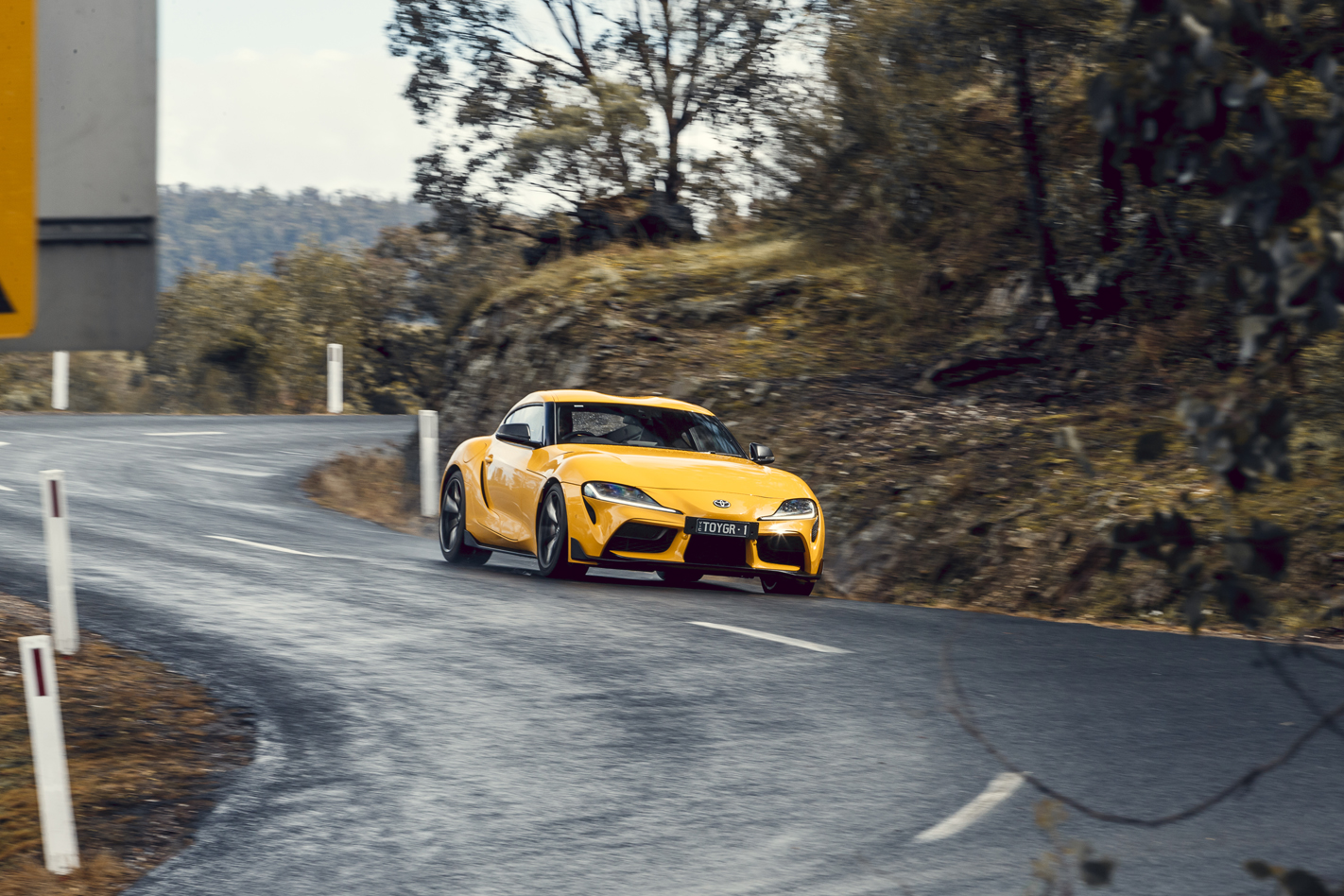
You can read how the Supra stacked up against the reigning champ, the BMW M2 Competition, and the revitalised Audi TT S here, but if you’re pushed for time, here are the cliff notes.
It’s a deeply surprising car. No, its BMW genes aren’t what you’d describe as artfully concealed, but settle into the snug cabin, get used to the big 373mm steering wheel and no bulkhead behind you and you’re set for some fun. At first, the Supra can feel surprisingly soft for something that’s shorter of wheelbase than an 86. There’s a certain polish to its controls that feels well engineered, but not exactly what you expect from such an aggressive looking thing.
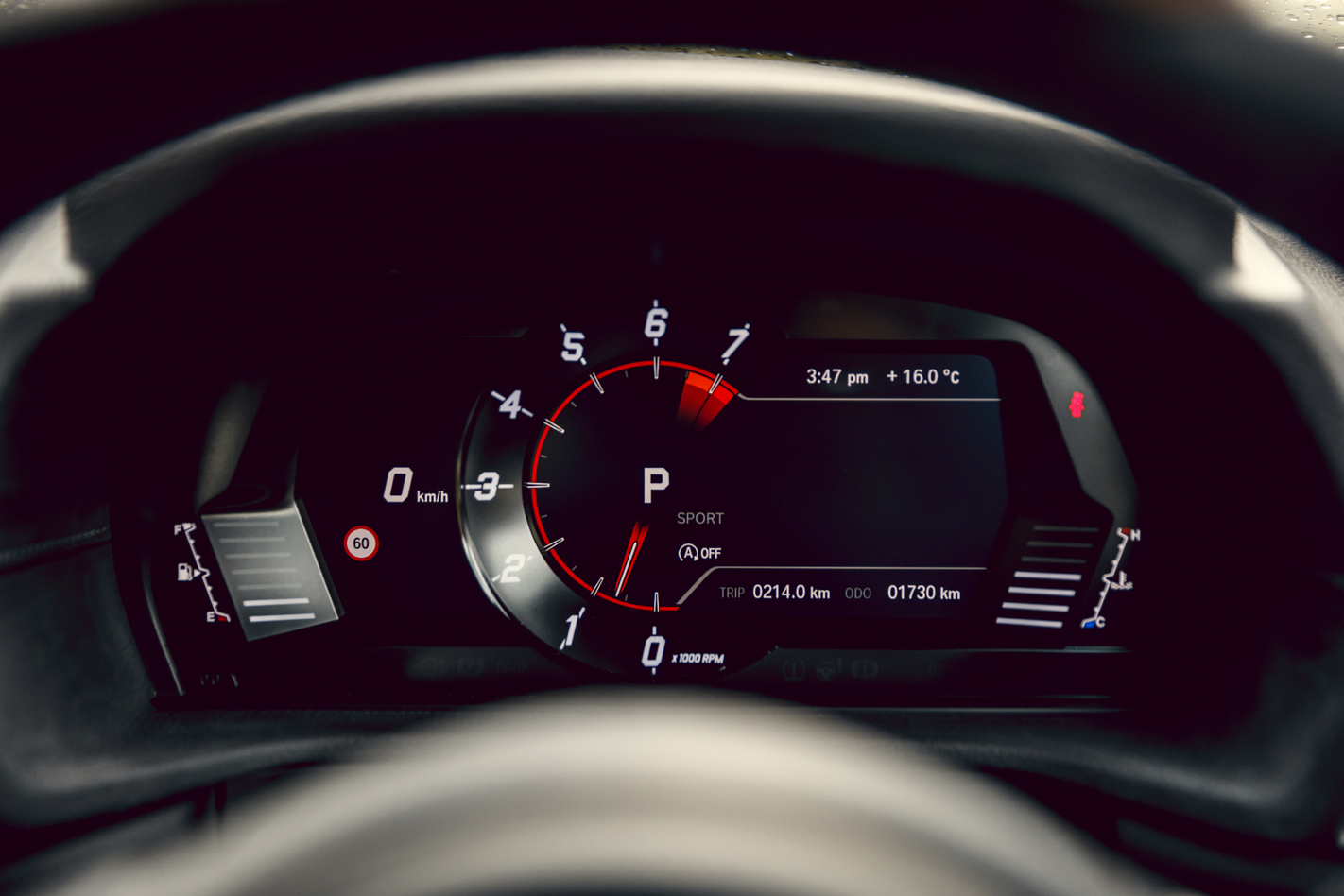
Indeed, if you drive the Supra gently, it’s a pleasant thing, albeit fairly loud. During testing a Car of the Year, we discovered that it possessed the loudest cabin in the entire 31-car field and by some margin. We also discovered that the diesel Touareg was quieter than an electric Tesla, which demonstrates that there’s no substitute for objective testing.
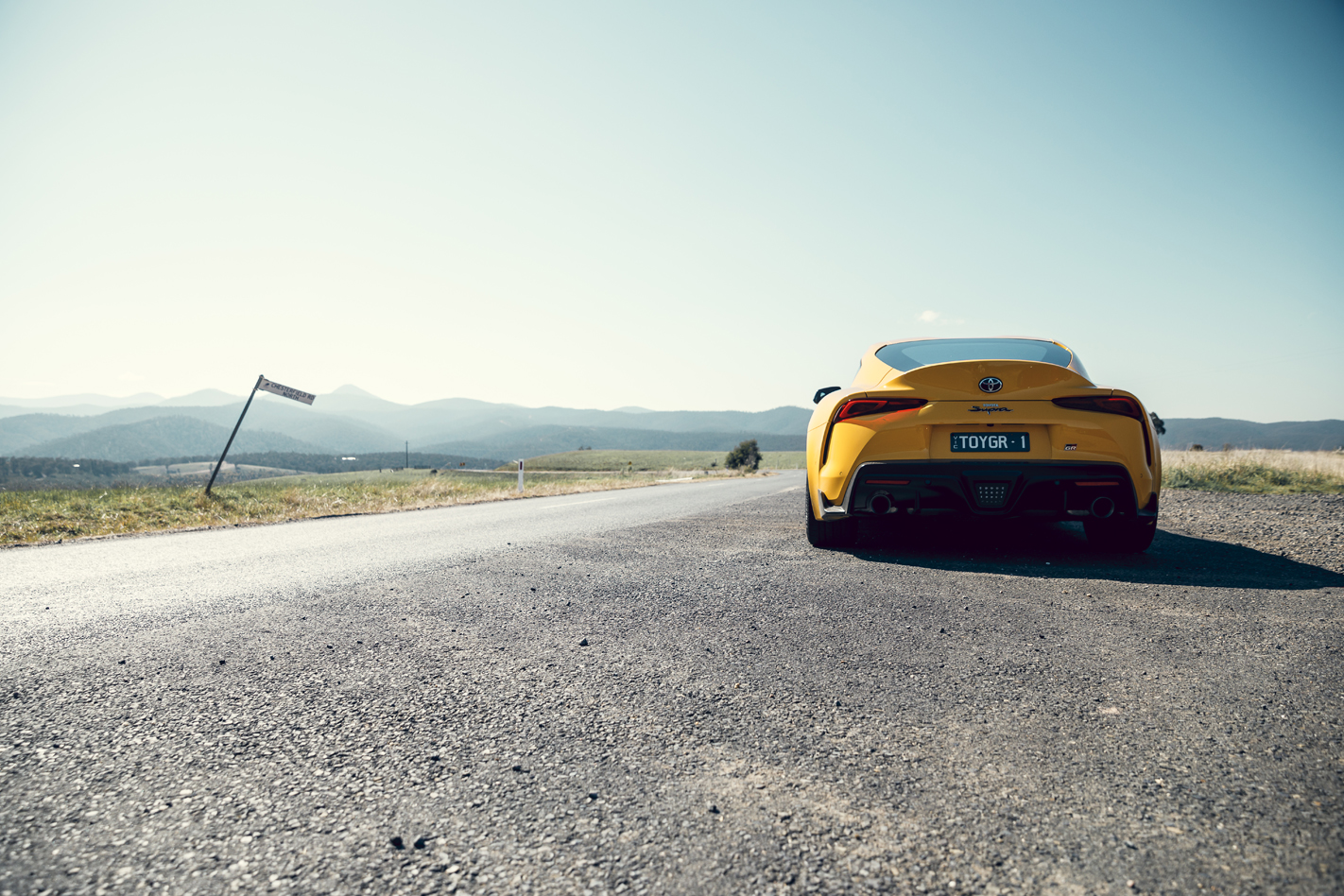
Nevertheless, the Supra has, like its esteemed predecessor, a certain degree of grand touring ability. Pick it up by the scruff of the neck and fling it at a challenging mountain road and it easily outperforms the old stager. Outperforms some more esteemed contemporary names too.
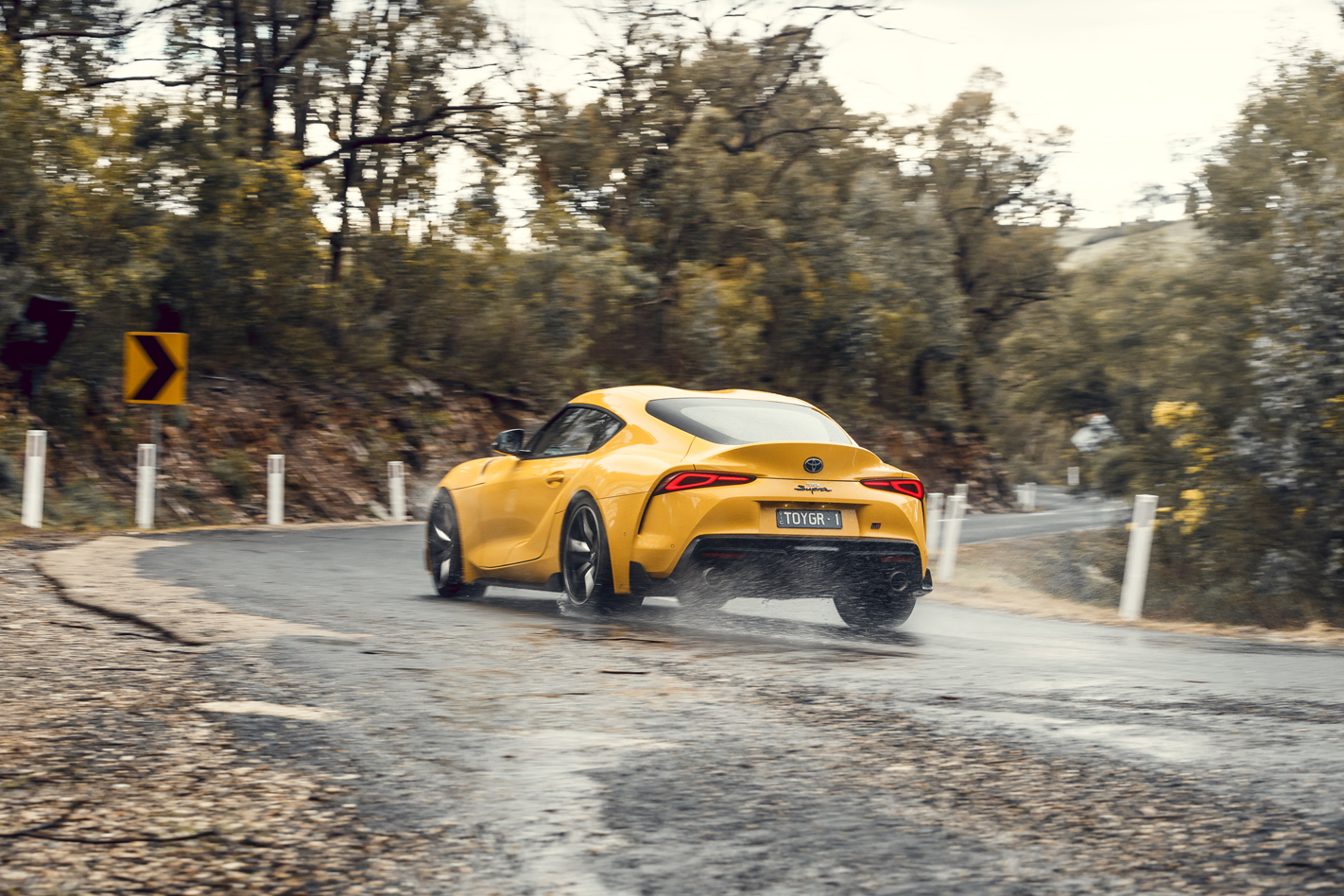
The steering is measured, the ride is just supple enough to prevent the oversquare footprint being too upset on poor surfaces and the logic of the eight-speed ZF auto is extremely good. The spring rates are such that if you manhandle the car into a corner it can shift its weights a little clumsily, so it rewards a smooth turn in. It gobbles up the ground on a cross country route.
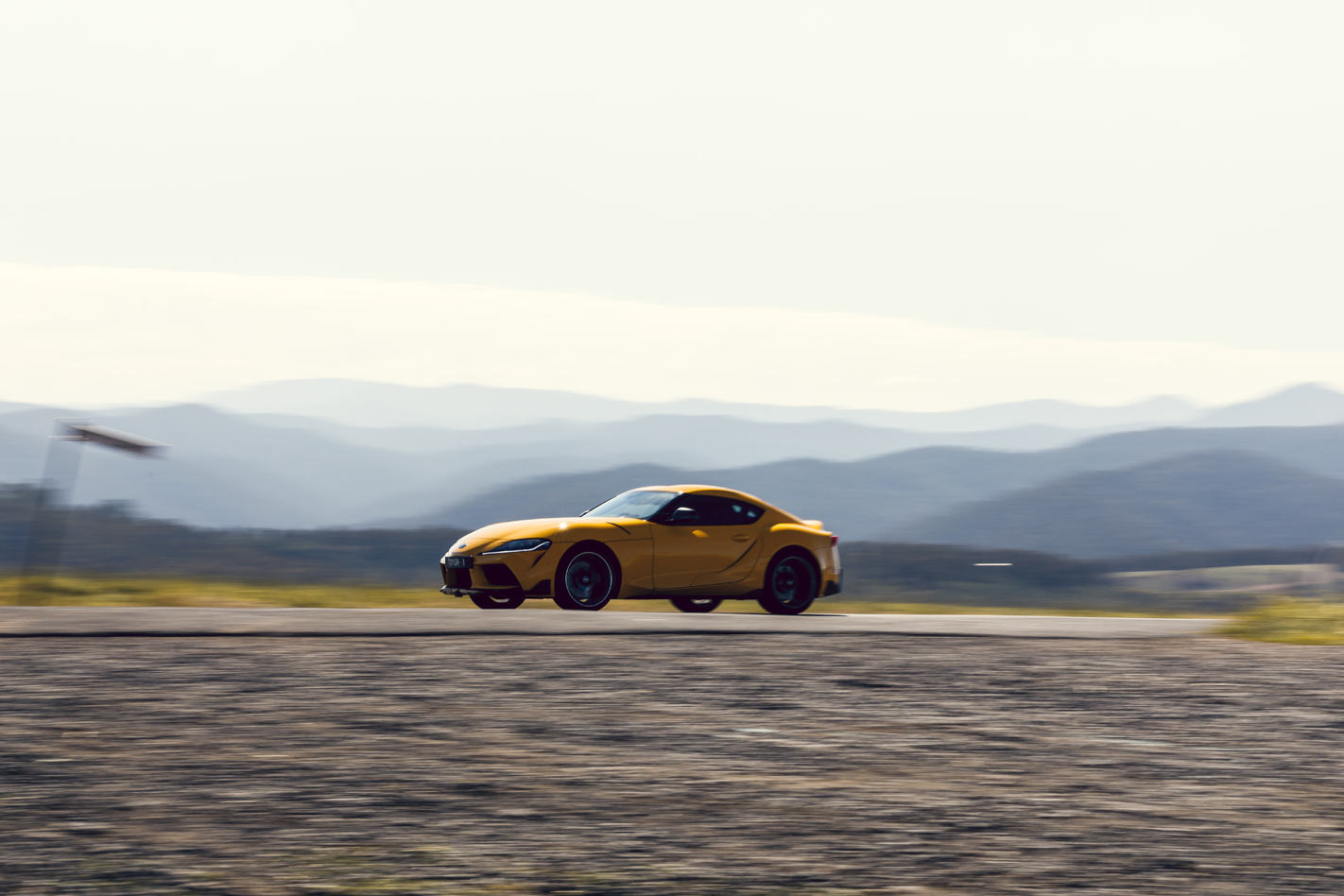
An admission. We had to nix a whole bunch of footage for the TV segment because the thing looked too fast for the show. Seriously. Some of the mid-corner footage was banzai. Even with a closed road section, we had to select some of the tamer looking stuff. If you’re looking for a quiet road and have a day to spare, do yourself a favour. Set the nav for Licola.
Anyway, enough of me. Settle in and watch editor Inwood going for a pedal in the Supra. Apart from its tiger print plates, it’s a lovely thing. Worth the wait? On balance, I reckon so.
Sign-up here to get the weekly Wheels highlights
The Aston Martin Vantage Roadster has just broken cover, with the British carmaker announcing it’s already available to order for deliveries to begin later this year.
Australians can expect to see the Vantage Roadster hit the streets in Q3 2020, with pricing starting from $315,000, which is just $15K more than the Coupe.
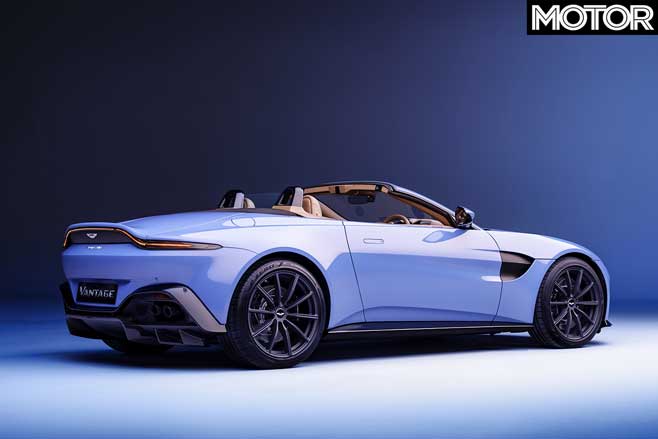
With the same AMG-derived 4.0-litre twin-turbo V8 as the Coupe, producing 375kW and 685Nm, the Vantage Roadster is capable of a 0-100km/h sprint in 3.7 seconds according to Aston, just a tenth off the pace of its Coupe sibling.
Its extra 60kg over the coupe contributes to this, and puts the Roadster at 1590kg.
As with the Coupe, the Roadster features adaptive damping, ‘dynamic’ torque vectoring, and an electronic rear differential, though the rear dampers and ESP software have been tweaked to better suit the Roadster.
If unexpected rain catches you off-guard, the Roadster’s roof can be raised in 6.8 seconds at speeds of up to 50km/h. Aston also says despite the roof mechanism, a 200-litre boot will fit the unofficial yardstick of convenient sports car storage space – a full-sized golf bag with accessories.
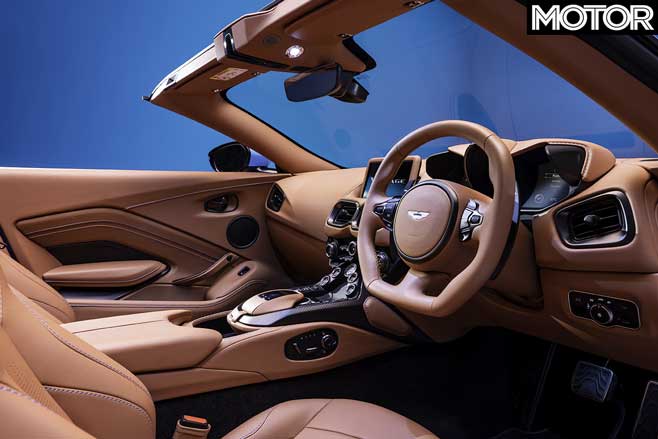
Aston Martin CEO Andy Palmer says the drop-top is an important part of the Aston range for customers, particularly those who enjoy “the true definition of the sports car experience.”
“Open-top Aston Martins are always firm favourites with our customers, so it’s very exciting to introduce the Vantage Roadster,” says Palmer
“For many, driving with the roof down is the true definition of the sports car experience as it truly brings your senses to life.
“Vantage has always delivered the purest of thrills, but in Roadster form that adrenaline rush is set to go to the next level.”
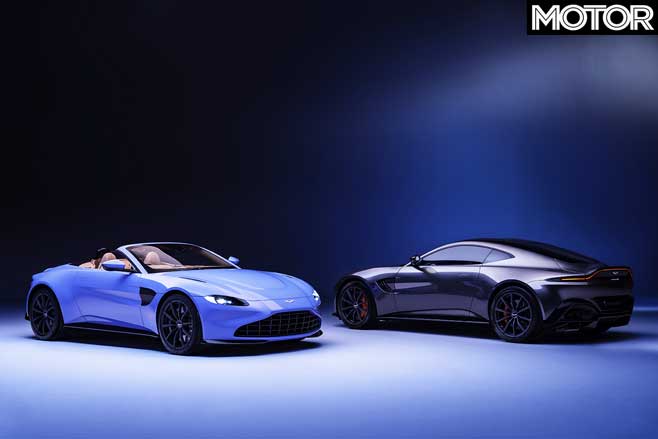
When the hard-top Vantage was originally revealed to journalists in Melbourne, Aston Martin chief designer Marek Reichman was on hand to discuss the also-present DB11 Volante, saying Aston Martin’s process involves designing the Coupe and Roadster/Volante version of each car in parallel, rather than simply cutting the roof off the Coupe.
This is likely one of the reasons Aston’s road car engineering boss Matt Becker is confident in saying there were no concessions in the Vantage’s driving experience when designing the Roadster.
“Convertible sports cars are often seen as compromised when compared to their Coupe equivalents, but the Vantage Roadster remains absolutely dedicated true to its mission of delivering precise, agile and expressive handling dynamics combined with stonking straight-line performance.
“And of course, there’s the added dimension of driving a great-sounding sports car with the roof down.”
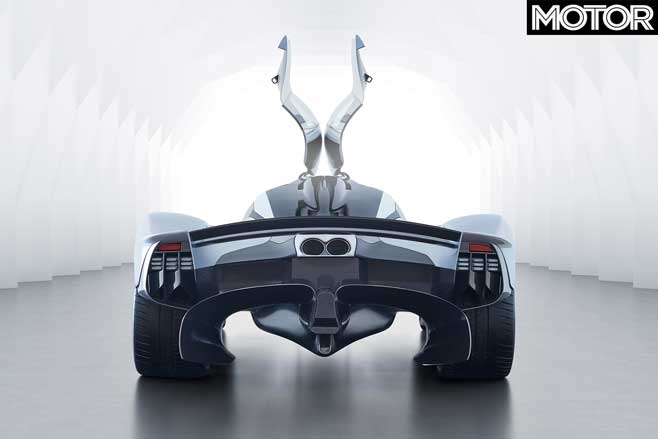
The Formula One-inspired Aston Martin Valkyrie hypercar will no longer be coming to Australia.
The local branch has confirmed that despite earlier intentions of making the AUD$5m hypercar street legal Down Under, it has fallen foul of the notoriously strict Australian Design Rules (ADRs).
“It’s not homologated for here,” Aston Martin Regional Director Asia Pacific Patrik Nilsson confirmed to MOTOR at the recent Bathurst 12 Hour.
“There are some markets where, because it’s so low volume, some of the requirements for homologation just make it unviable,” he added. “So you won’t have homologation in the US for instance, same for Australia.”
Aston Martin couldn’t say which ADR or ADRs were specifically responsible for the nixing of the Valkyrie, although a MOTOR insider hinted it was related to noise.
“I don’t have a list of what exactly it contravenes,” said Kevin Wall, Regional Manager Australia & New Zealand at Aston Martin.
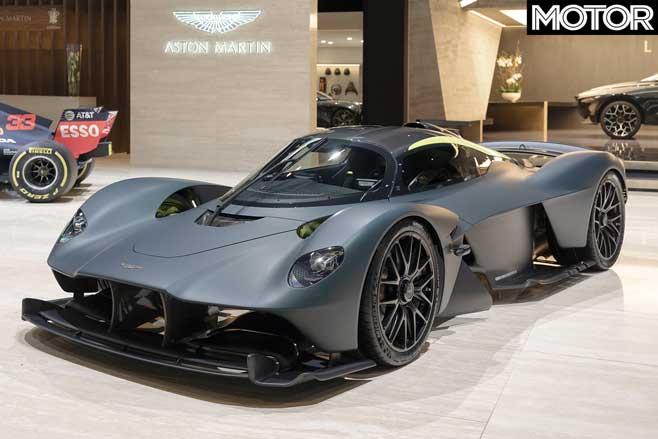
Wall said the Valkyrie was originally intended to be legal in Australia. “Absolutely, [but] it’s out of our control,” said Wall.
The Valkyrie may still attract some Australian customers who decide to garage and drive their vehicles overseas. Aston Martin hinted that some cars are headed to New Zealand.
When first deliveries are made in the next 12-18 months, the howling Valkyrie is expected to be the McLaren F1 of its generation and go down as one of the fastest road cars in history.
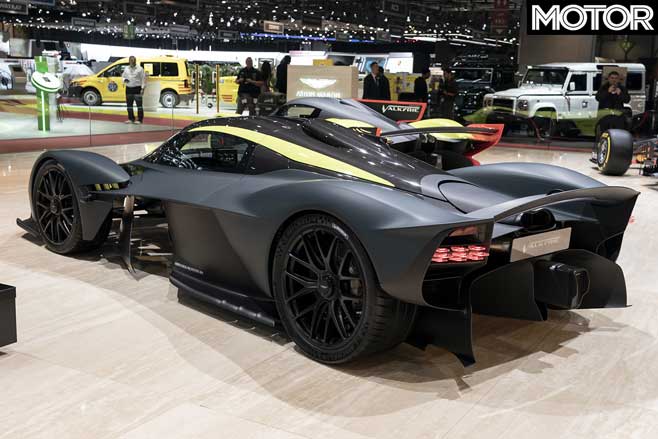
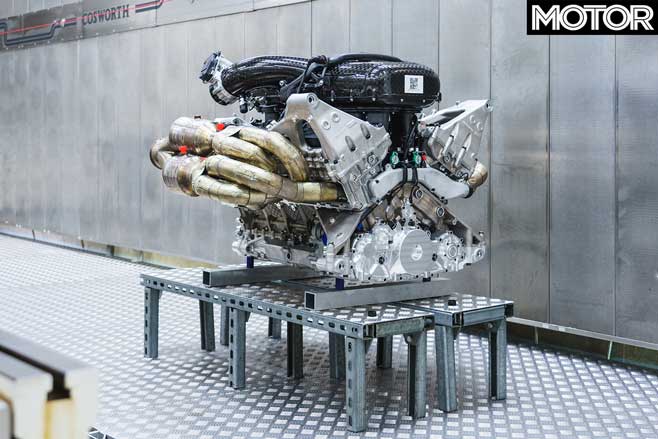
Powered by a bespoke, 6.5-litre Cosworth naturally aspirated V12 producing an estimated 865kW in conjunction with a mild hybrid system, and designed by renowned F1 engineer Adrian Newey, in overseas markets the Valkyrie is expected to cost a cool AUD$5m. Weighing approximately 1000kg and promising F1 levels of performance, only 150 will be made.
Meanwhile the Valkyrie’s smaller mid-engine sibling the Valhalla is still expected to be road legal and offered in Australia.
With development still in progress, deliveries are not expected until at least 2022. “You won’t have pens down, stopping design for another year potentially,” said Nilsson.
While global production will be limited to just 500 units, Nilsson wouldn’t say how many are coming to Australia. “I don’t want to be unfair but that segment of the market is so small,” he said. “Whatever number I would say, would potentially directly impact the value of the car in this market”.
With a price estimated between AUD$3m and AUD$5m, the Valhalla could become Australia’s most expensive car.
The Valhalla, dubbed ‘Son of Valkyrie’, is expected to be powered by a mid-engine 1.6-litre turbocharged V6 producing approximately 735kW thanks in part to a mild hybrid ‘KERS’ system.
Weight is expected to be a higher 1350kg with the vehicle focusing more on daily usability.
Remember school sports day? Your feelings on this event, a chance to perform in front of students, teachers and parents, were probably dependent on your athletic prowess. Perhaps it’s different in this ‘everyone wins a prize’ era, but when I was a kid success meant cheers from your peers, while failure led to jeers and tears.
Essentially, the PCOTY track day is MOTOR’s version of school sports; some cars relish the opportunity to strut their stuff, others just want the whole ordeal to be over.
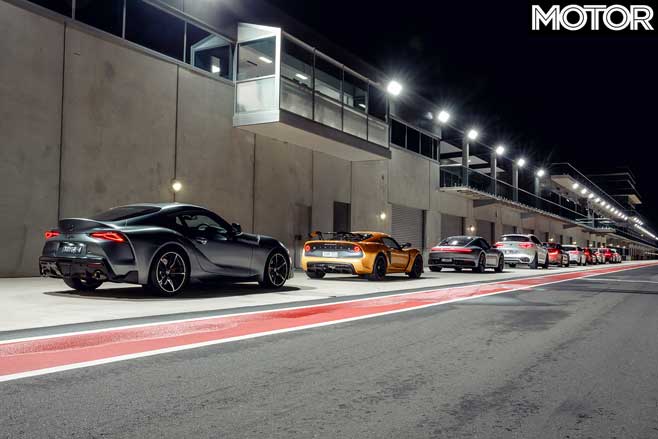
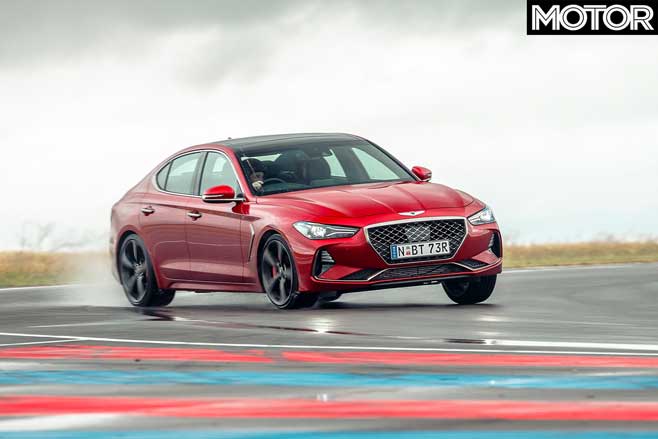
No prizes for guessing which category the Genesis G70 falls into. Hot-lapping The Bend’s West Circuit wasn’t in its design brief and it’s quickly apparent that this quasi-luxury mid-sizer prefers a gentler pace, its 1:40.7sec lap time earning it the wooden spoon. It doesn’t do much wrong; it’s just not at all designed for this type of driving.
There are no complaints about the engine, the 3.3-litre twin-turbo V6 singing a sweet song and motivating the G70 to north of 220km/h down the long main straight. It’s difficult not to draw comparisons with the Kia Stinger, for while the two aren’t direct rivals they share mechanicals and the resemblance is clear behind the wheel.
The Genesis is the better operator, but so it should be given its $20K premium. Like the Stinger, the G70’s eight-speed auto doesn’t have a manual mode per se, but flick the paddles and it won’t revert to automatic down the next straight like the Kia. It steers accurately enough and the balance is relatively benign up to, say, eight-tenths, at which point the rear end begins to slip. Time this with the arrival of turbo boost and the result is a lurid slide, which finds favour with the photographers.
Like the Stinger, the G70’s brakes and tyres are badly underdone; this much power deserves Michelin Pilot Sport 4 S rubber (the current Michelins lack that crucial ‘S’) and it takes only two laps for the brake pedal to hit the floor. It’s all very well to say a car isn’t designed for circuit use, but all a track really does is simulate consecutive hard stops (three in the course of a lap in the case of the West Circuit) and the Genesis isn’t up to it.
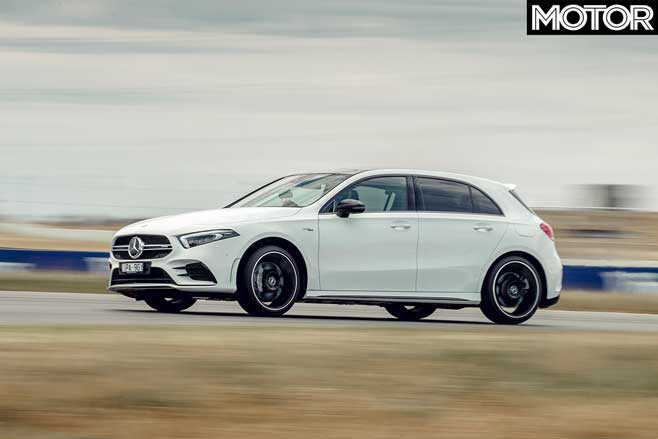
Happily, the Mercedes-AMG A35 is. It might only undercut the Genesis by a solitary second (1:39.7) but it’s much more comfortable on track. With just 225kW/400Nm to play with, there are no prizes for guessing that the A35 isn’t the quickest thing in a straight line, its 208.62km/h V-max almost 40km/h less than that recorded by its GT63 S sibling, which basically uses two A35 engines and then some.
Outright grunt aside, however, the A35 is a fun little package. Gentle front-end push is its default behaviour, but the new Haldex system reacts quickly enough to prevent power understeer rearing its ugly head and a quick flick with the steering under brakes swings the tail wide. It could use more engine – the fun’s over by 6000rpm – and a quicker gearbox but then that’s what the A45 is for. As it stands, the A35 is a nice, sensible semi-hot hatch.
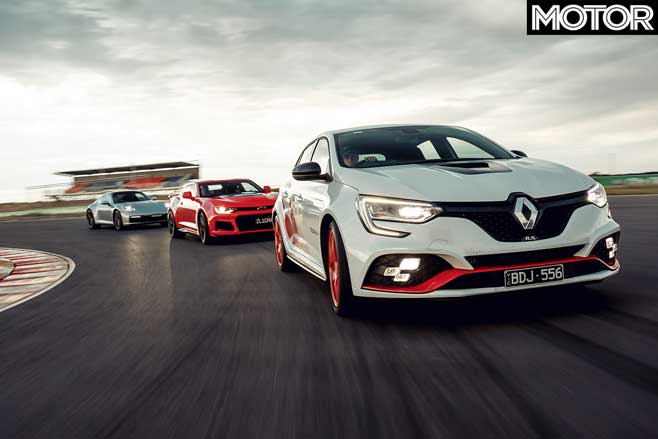
Sensible isn’t a word to describe the Renault Megane Trophy-R – I mean, just look at it. It has stickers, bright red wheels and a massive slab of plastic where the rear seats should be. It’s built for the track and is the current Nürburgring front-wheel drive record holder – albeit with the carbon wheels and brakes that will only adorn one car in Australia – which only makes the fact that it’s a bit underwhelming at The Bend even more disappointing.
Make no mistake, it’s very good – quick, grippy and accurate – but it gives its speed quite easily so you’re left craving more. Once up to temperature, the trick tyres offer so much grip that most throttle adjustability is eradicated and while there’s enjoyment to be found in the Megane’s precision, I can’t help feeling a Honda Civic Type R on these tyres would be more enjoyable again. And probably quicker.
Nevertheless, the Trophy-R is an improvement on the standard Megane RS280 sampled at this venue 12 months ago, but enough to justify that $75K price tag?
While we’re asking questions: what to make of the Stelvio Q? Like the Megane Trophy-R, this high-riding Alfa set a lap record around the ’Ring, though its 7min51.7sec SUV benchmark – 11.6sec slower than the Megane – has since been beaten by the Mercedes-AMG GLC63 S.
At The Bend the places are reversed, the Stelvio besting the Renault by 1.7sec, but it’s a deeply strange experience. It feels a bit like those celebrity sporting matches featuring recently-retired players; the skills are still evident but the athleticism has clearly suffered. All the Stelvio’s component parts are great – the engine is super strong, the gearbox nicely responsive, the brakes hold up well and there’s certainly adequate grip – but they’re installed in a bodyshell that feels well out of its depth.
Softening the dampers helps. Set to full stiff the suspension feels to be constantly fighting a losing battle against its mass; pressing the ‘bumpy road’ button allows the weight shift to be used as an advantage by adjusting the Stelvio’s attitude – it’s probably not any quicker but it is more fun.
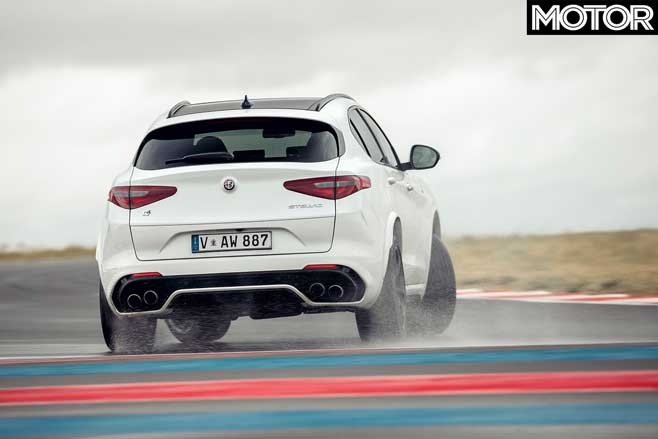
Sadly, despite being ‘off’ in Race mode the ESP will step in if it feels the situation is getting out of hand and the all-wheel drive system can be frustratingly inconsistent, at times allowing plenty of power oversteer, at others focusing on total traction.
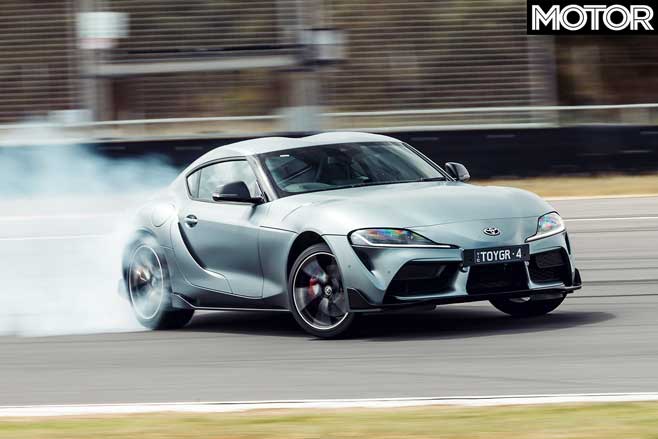
No such dramas with the Toyota Supra; simply stick it in Sport, turn the electronics off (if you’re comfortable enough, otherwise the ‘Traction mode’ is very good) and drive the wheels off it. The brakes could be better and the steering is unnecessarily weighty in Sport, but otherwise there’s very little to complain about. It’s a surprisingly sharp sports car, with strong lateral grip and an unwillingness to relinquish it.
The suspension is quite soft and initially the body movement can feel a little odd, but quickly you learn to trust the car to settle and dig deep into its reserves. Burrow down far enough and you’ll find the rear end will edge wide under brakes and 500Nm of turbocharged torque will hold it there for as long as you wish. Yes, as you’d hope for a Japanese sports car (yeah, yeah, BMW blah blah) the new Supra drifts like a champion.
As does the Lexus RC F Track Edition. With a 351kW/530Nm 5.0-litre V8 turning the rear tyres that mightn’t come as a surprise, but what does is the extra effervescence the Track Edition displays compared to the standard RC F. Its enhancements primarily shed weight, but whether it’s the diet, the extra grip of the Pilot Super Sport tyres or the result of more subtle tweaks, the front end bites with newfound enthusiasm.
The steering is still pretty mute, but at least you now have confidence it’ll stick when committing to a turn. And commit you can, safe in the knowledge you don’t have a million turbocharged newton metres to manage on corner exit. The RC F’s V8 is a perfect illustration of ‘enough’ power, the outputs nicely matched to what the chassis can cope with.
Other cars may be faster – though a 1:34.7sec isn’t too shabby – but the appeal of being able to drive the Lexus lap after lap, its circuit-spec brakes and tyres showing little sign of stress, shouldn’t be underestimated, especially with that rev-happy atmo V8 singing beyond 7000rpm.
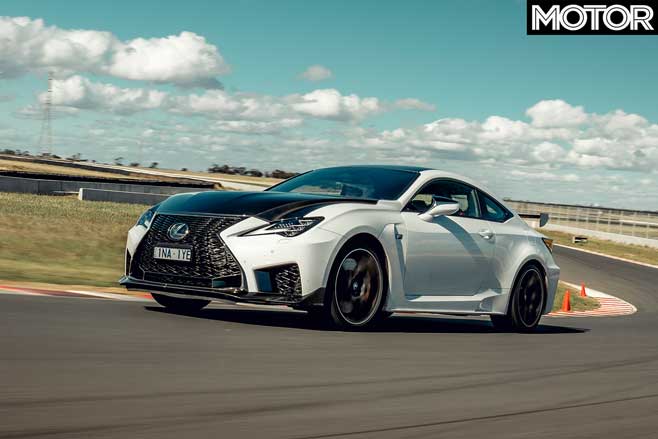
Despite the weight loss, you can still feel the Track Edition’s girth in direction changes and it seems to find bumps no other car notices on The Bend’s seemingly super-smooth surface, bouncing up and down through the Turn 10 kink in a unique manner.
Now we’re getting serious. There’s no other way to say it, the Camaro ZL1 is a beast. It’s an all-out assault on the senses as you peer out of the pillbox-style windows, your ears bombarded by V8 bellow and supercharger whine, your head spinning in concert with the rear wheels as each attempts to deal with the effects of 477kW/881Nm.
The experience is made more intense by the super short gearing, each ratio used for a mere nanosecond before the next one is required; this makes selecting the appropriate gear for each corner a challenge, particularly as the mighty 6.2-litre supercharged V8 has a torque band as wide as the massive 305mm rear Goodyears.
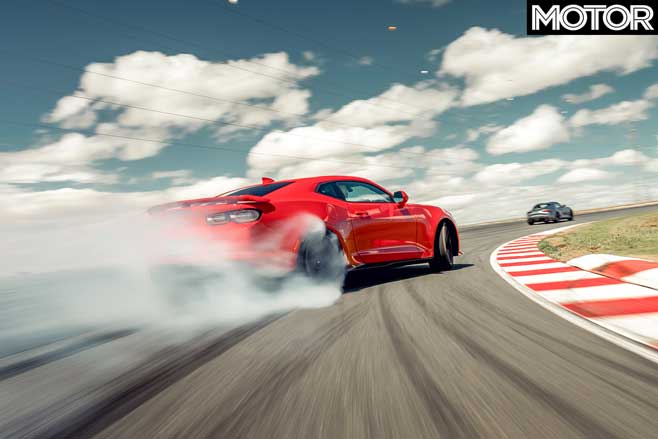
Ah, yes. Tyres. You’re probably aware that the Goodyear Eagle F1 Supercar 3s fitted to the ZL1 in the US didn’t pass the ADRs for road use, but are available as a $1000 ‘Track Pack’ so given we’re on a track we decided to use them, as it seems reasonable to assume most owners would do likewise. Unsurprisingly, they love The Bend, but the ZL1 itself rejects any notion that American cars can’t do corners.
To be frank, it handles brilliantly for such a big machine. The super-heavy steering is weird, though you get used it, but it controls a front end that can be placed with precision, while as long as you don’t ask for every kilowatt at once, traction is incredibly strong. There’s fantastic balance, too, with real adjustability using the throttle and brakes. As I said, the ZL1 is a beast.
The Lotus couldn’t be more different, which makes the fact it and the ZL1 are so similar in pace all the more remarkable. Remember the school sports day analogy? Well, if the Genesis is the nerdy kid that wants to stay home, the Exige Sport 410 is the athletics team captain who’s been training for weeks. It’s built to lap all day and will do so with a noise like an endurance racer at full noise. Morley, Robbo and our tame racer Michael Almond are unashamed fans, but I’m not convinced.
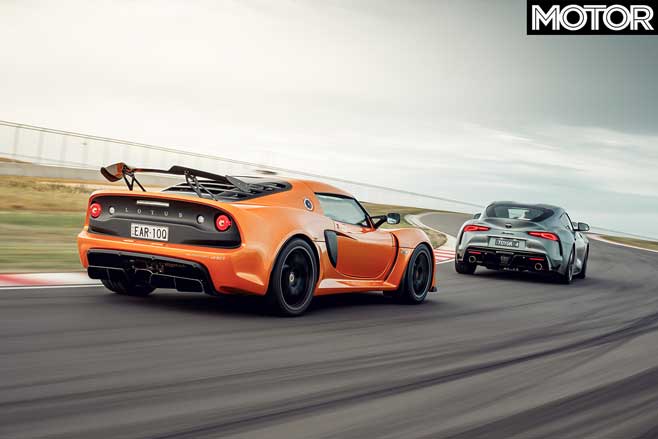
Driving the Exige is an absolute event; virtually every other car feels doughy and full of rubber after the lightweight Brit and you know that everything it does is the work of you and you alone. Trouble is, if you’re going to be an out-and-out track car, either be blindingly fast, utterly brilliant at the limit or, preferably, both.
The Exige is quick (1:33.7) but only a second ahead of the far porkier Lexus and while it’s great fun up to nine-tenths, right at the limit, just when you hope it would come alive, it becomes quite sensitive to pitch and a bit spooky. For most people, a Cayman will be faster and more fun.
Speaking of Porsche, it’s really dropped the ball with the new 992 911. Just kidding, it’s utterly brilliant.
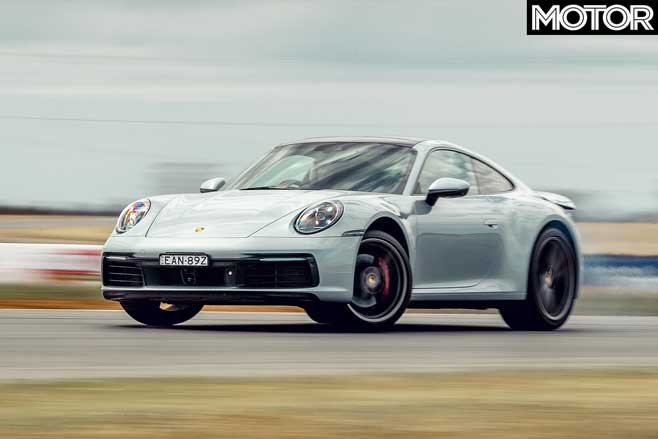
The widened front track makes it easier to drive quickly than ever, the engine delivers its substantial power in a beautifully linear fashion, the steering chats away to you constantly, the brakes shrug off the demands of track work, it’s rewarding to chase a lap time in yet if you want to hoon about like an idiot it’s more than happy to oblige. It’s sublime, its feedback providing reassurance to the less experienced and its malleability and speed a challenge to sports car veterans. But, with a 1:30.6, it’s not quickest.
No, this year that honour goes to a 2025kg luxury sedan-coupe-hatchback-thing. The AMG GT63 S is an incredible triumph of engineering and technology over physics, besting Stuttgart’s sports car by over a second (1:29.5). Obviously, having 470kW/900Nm helps, the monster Merc hitting 245.81km/h at the end of the straight, but it’s in the bends that the GT63 really warps your mind.
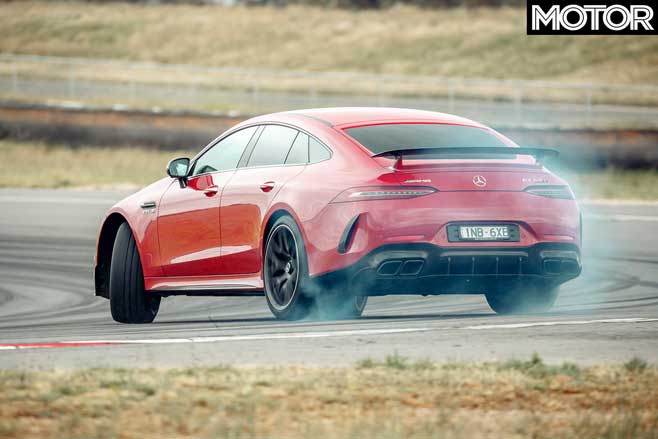
How can a car this big turn in with such alacrity? And resist understeer like it hasn’t heard of the term? Huge Cup 2 tyres do their part, as does the clever all-wheel steer system, but credit also has to go to AMG’s 4MATIC+ system.
If, by some miracle, you’ve steamed into a corner hard enough to push the front tyres wide, adding throttle actually corrects the problem, presumably by overdriving the outside rear to right the ship. If you’re really silly with the throttle it’ll slide into oversteer, but in general you simply teleport to the next corner on the back of that insane 4.0-litre twin-turbo V8. Unless you select Drift Mode, that is, which specialises in turning Michelins into fluffy white clouds. So, with the races run and won, it’s the beefy posh kid that’s going home with the ribbons. Bet you didn’t see that coming!
PCOTY 2020 – The Professional’s View
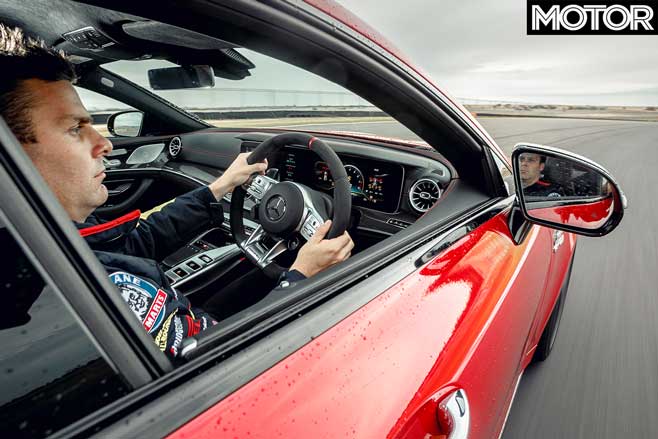
Carrera Cup Pro racer Michael Almond gets the honour of becoming PCOTY 2020’s professional helmsman. So we set him off in each of our finalists to get a laptime around The Bend’s West Circuit and get his two cents on each of them.
01 – Mercedes-AMG GT63 S (1min 29.5sec)
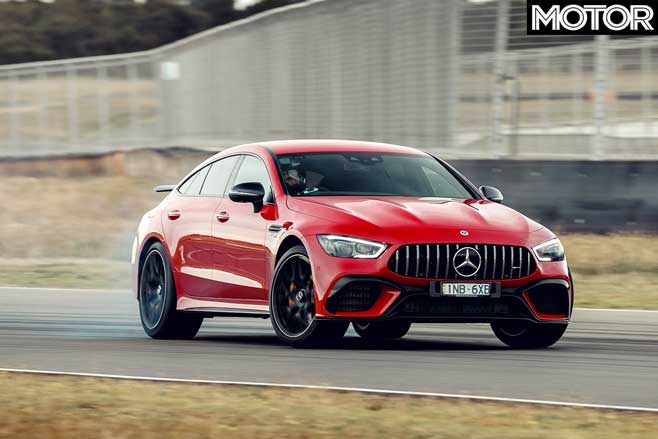
“I had to look and check I wasn’t in the AMG GT3 car I raced. This thing is wild. Sounds awesome. For such a big car it feels nimble. Brakes are amazing but they faded hard after a lap. Power delivery is easy to control… the engine is unbelievable.”
02 – Porsche 911 Carrera S (1min 30.6sec)
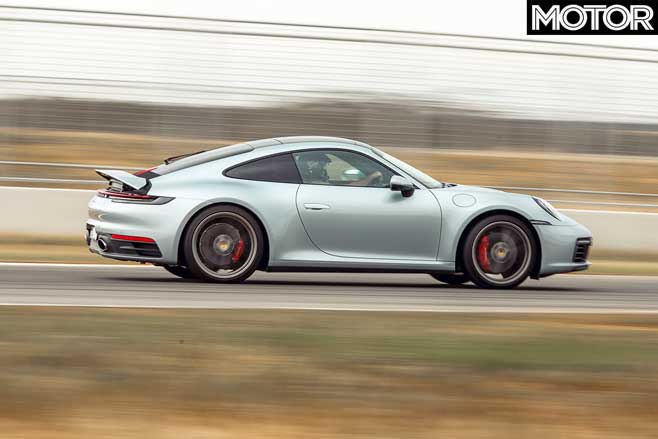
“I would’ve thought it’d be a little bit quicker, but it felt like there was a little bit of understeer. It would’ve been nice to have a grippier tyre. Gearbox is amazing. Plenty of grunt, you can barely tell it’s turbo. Comfortable, chuckable, solid.”
03 – Lotus Exige Sport 410 (1min 33.7sec)
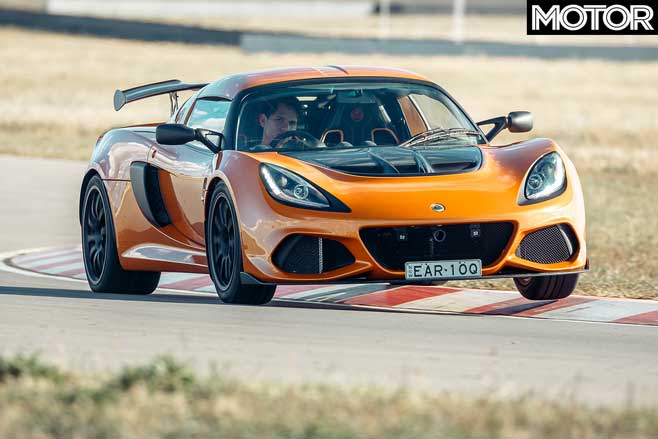
“Fantastic car. Gearbox is very direct and solid. It’s nimble, there’s a lot of front-end grip no matter where you are. Brakes are strong and you can brake deep because it’s light. Could do with a little more power. A little dancey at speed, but that’s exciting!”
04 – Chevrolet Camaro ZL1 (1min 34.0sec)
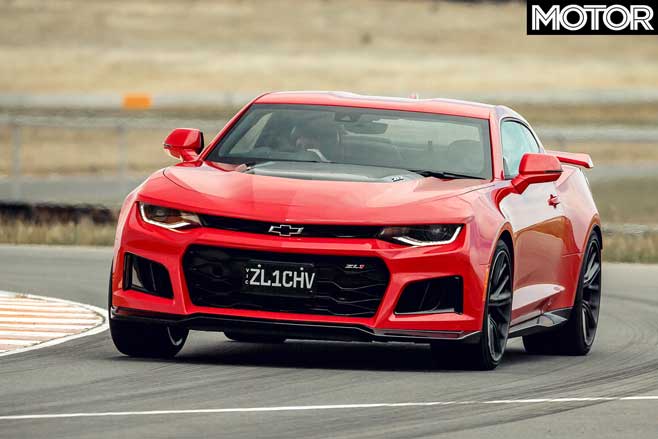
“I had it in race mode but on the in-lap I turned traction off… I reckon I could’ve gone quicker without it. It’s a bit cautious. But it’s got so much grunt, it pulls hard in a straight line. It’d be hard work to control with a manual. It doesn’t feel overly heavy.”
05 – Lexus RC F Track Edition (1min 34.7sec)
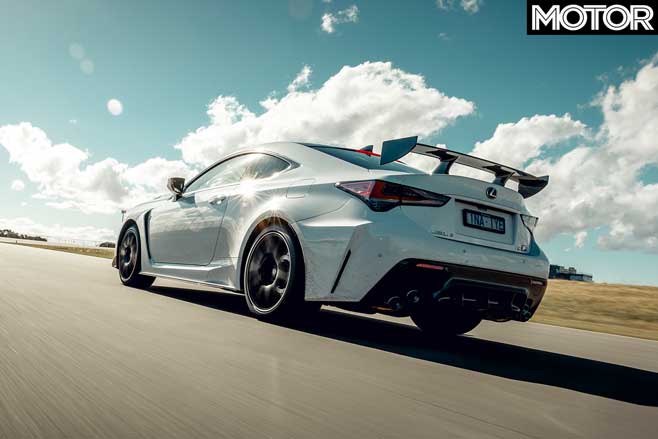
“I really like this. Very linear power, and slow corners you need to shift down to second. It’s easy to manage the throttle and balance mid-corner. Really strong, direct brakes. It’s quite stable, and neither understeery or tail-happy. Steering was a bit light.”
06 – Toyota GR Supra GTS (1min 35.4sec)
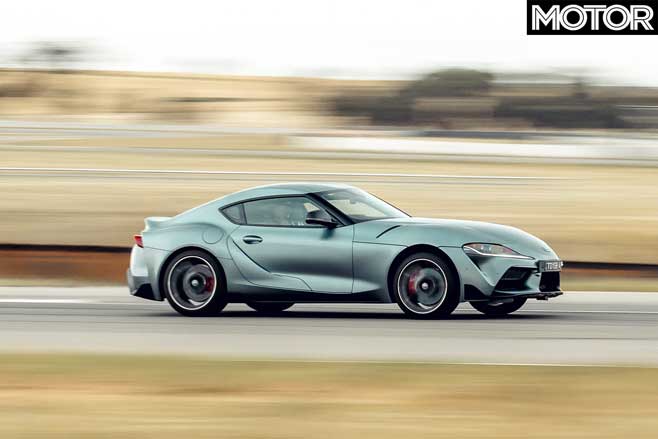
“A lot of grunt with low-end torque around 3000-3500rpm. On some corners you can leave this in third and it pulls out strong. Brakes are well-balanced… the car was very stable under brakes. I was never worried about the rear coming out either. Good car!”
07 – Alfa Romeo Stelvio Q (1min 36.1sec)
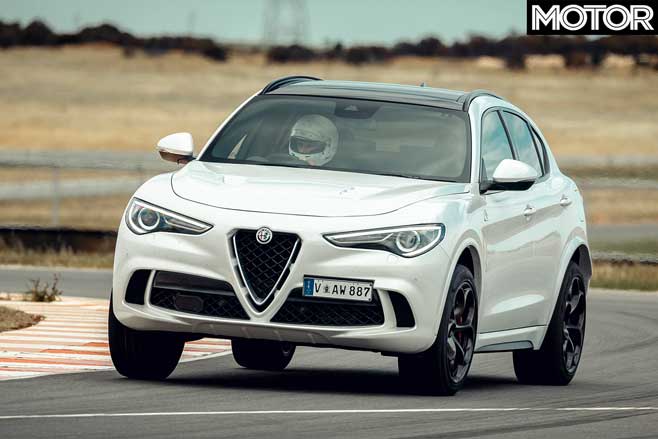
“You forget you’re in an SUV. It’s nimble with lots of grunt. Gearbox is awesome, downshifts are precise. Stable through high-speed turns, and can be balanced on throttle. Brakes are amazing for such a big car. Biggest weakness is the front end push.”
08 – Renault Megane Trophy-R (1min 37.8sec)
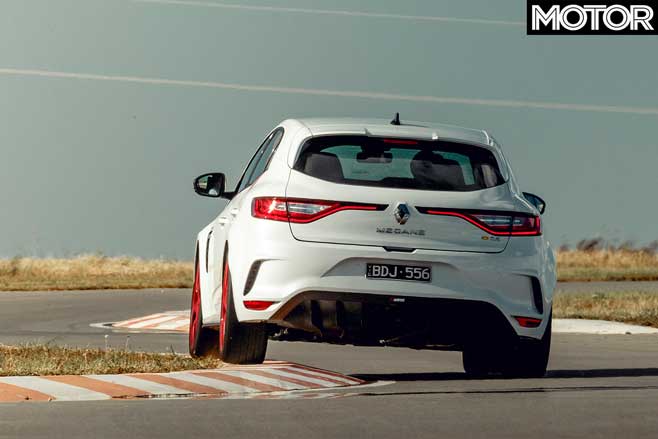
“It’s a cool-sounding car with big slabs of low range torque, but doesn’t understeer or torque steer. It has plenty of front-end. The tacho has a confusing redline… it took me two laps to realise I was short-shifting. It didn’t seem to make a massive difference.”
09 – Mercedes-AMG A35 (1min 39.7sec)
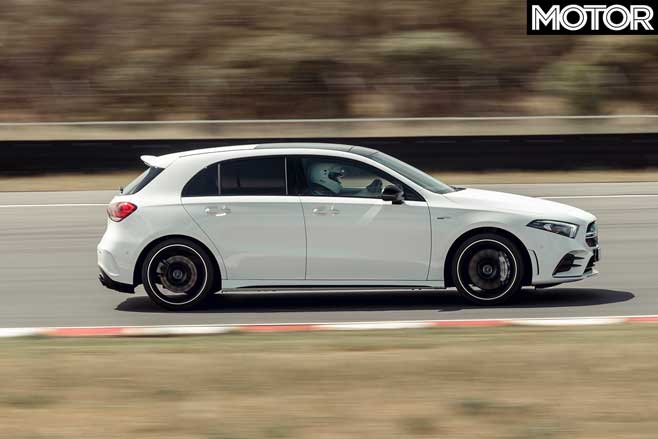
“Quite a punchy car, throttle response is really good and the power is very linear. Pulls all the way to redline. Gearbox is really intuitive left in sport auto, never missed a gear. Brakes are really strong. It rotates nicely on slow corners, but too fast and it pushes.”
10 – Genesis G70 (1min 40.7sec)
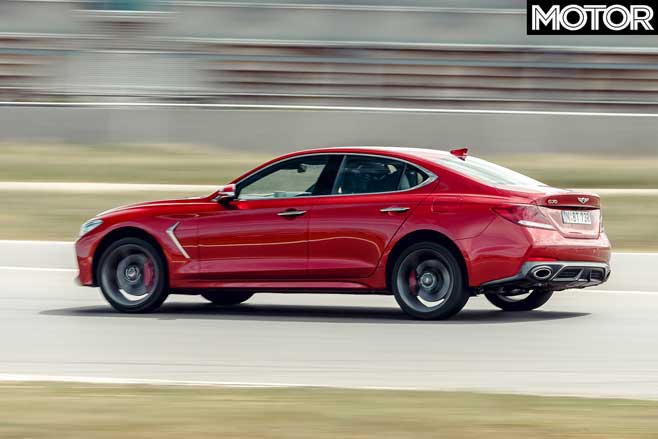
“It’s got a lot of power, particularly on slow corners in low gears… you can light the rears up nicely. It feels heavy and has a lot of roll. Brakes were fantastic but definitely faded. Initial turn-in is a little vague but once you’re towards the apex there’s more front-end there.”
PCOTY 2020 – Lap Numbers
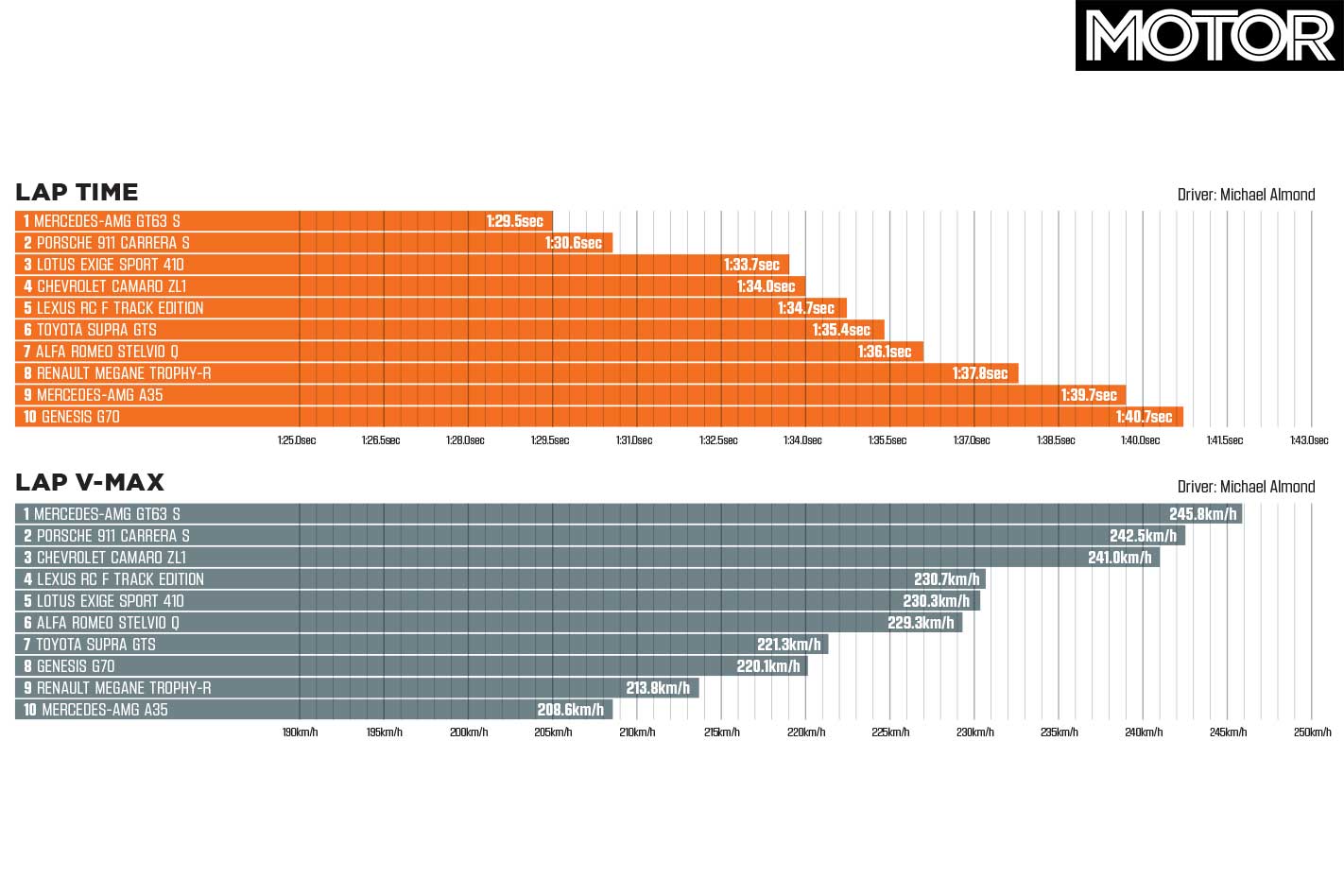
The Bend West Circuit, 20˚C, dry. Driver: Michael Almond Official timing supplier: www.vboxaustralia.com.au
PCOTY 2020 – The Inside Line
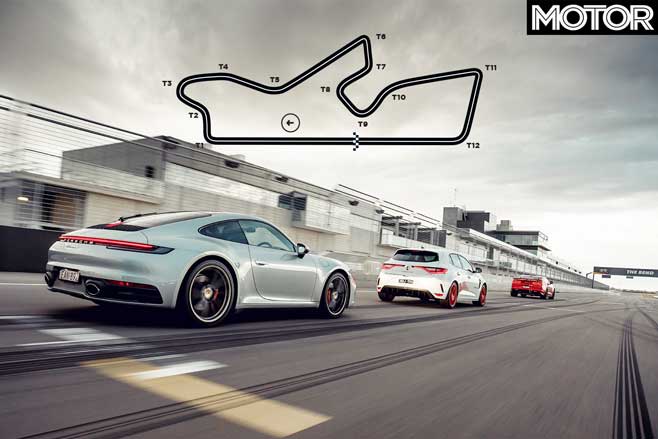
The Bend’s West Circuit – PCOTY’s ideal playground It’s tempting to look down on The Bend’s West Circuit. It is, after all, the shortest and simplest of the many configurations available, but that doesn’t make it easy. It’s a great circuit for testing road cars as the surface isn’t abrasive, there aren’t too many big stops, there’s a nice variety in corner speeds heading left and right and even a bit of undulation thrown in for good measure. A fast car will top 250km/h down the long main straight while the super-quick Turn Five kink is probably the most exciting corner on the circuit.
DIESEL is fast regaining its infamous distinction as a dirty word with manufacturers dropping oilers from their respective line-ups down under.
Frugal, small-capacity turbo petrol engines, hybrids, plug-in hybrids and full electric vehicles are becoming mainstays because of their economy, efficiency and emissions figures.
BMW is the latest marque to axe a diesel variant, with the petrol-powered 320i rendering the outgoing 320d’s place within the 3 Series range obsolete.
The entry point remains the $64,900 320i, with its 135kW/270Nm four-cylinder turbo petrol chosen over the disembarking $67,900 320d and its 140kW/400Nm four-cylinder turbo diesel.
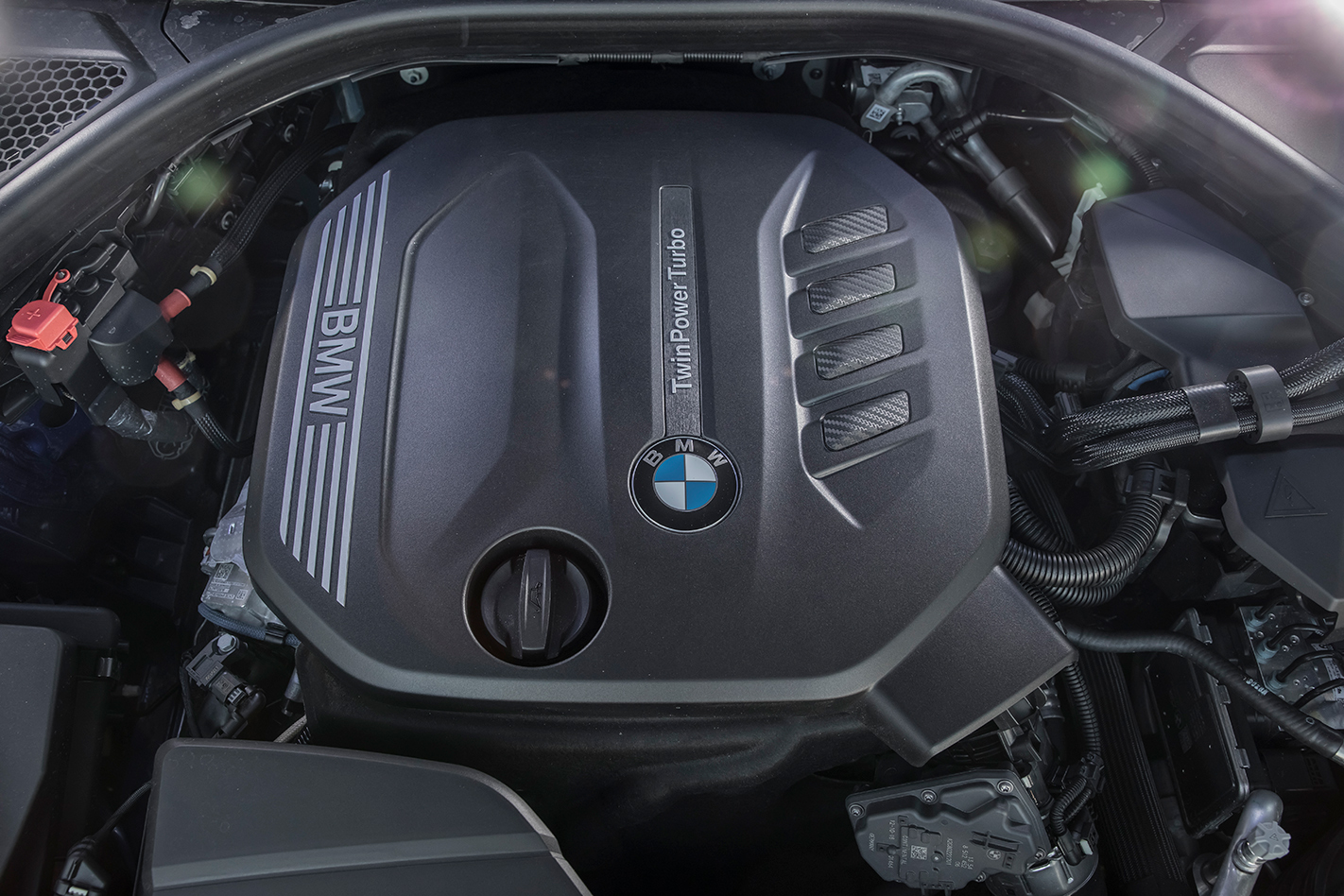
BMW’s all-new 3 Series was launched locally last year, and was the most popular passenger car from the German manufacturer in January’s new-car sales figures. It was BMW’s third most popular new model after the X1 and X3.
According to BMW Australia’s Product Communications Manage, Nick Raman, the decision to discontinue the 320d was made late in 2019.
“We studied the market and the needs of our customers and decided to discontinue the 320d,” he told Wheels.
“We also recently introduced the highly specified 320i, which joins the 330i Sedan and Touring, 330e PHEV and M340i.”
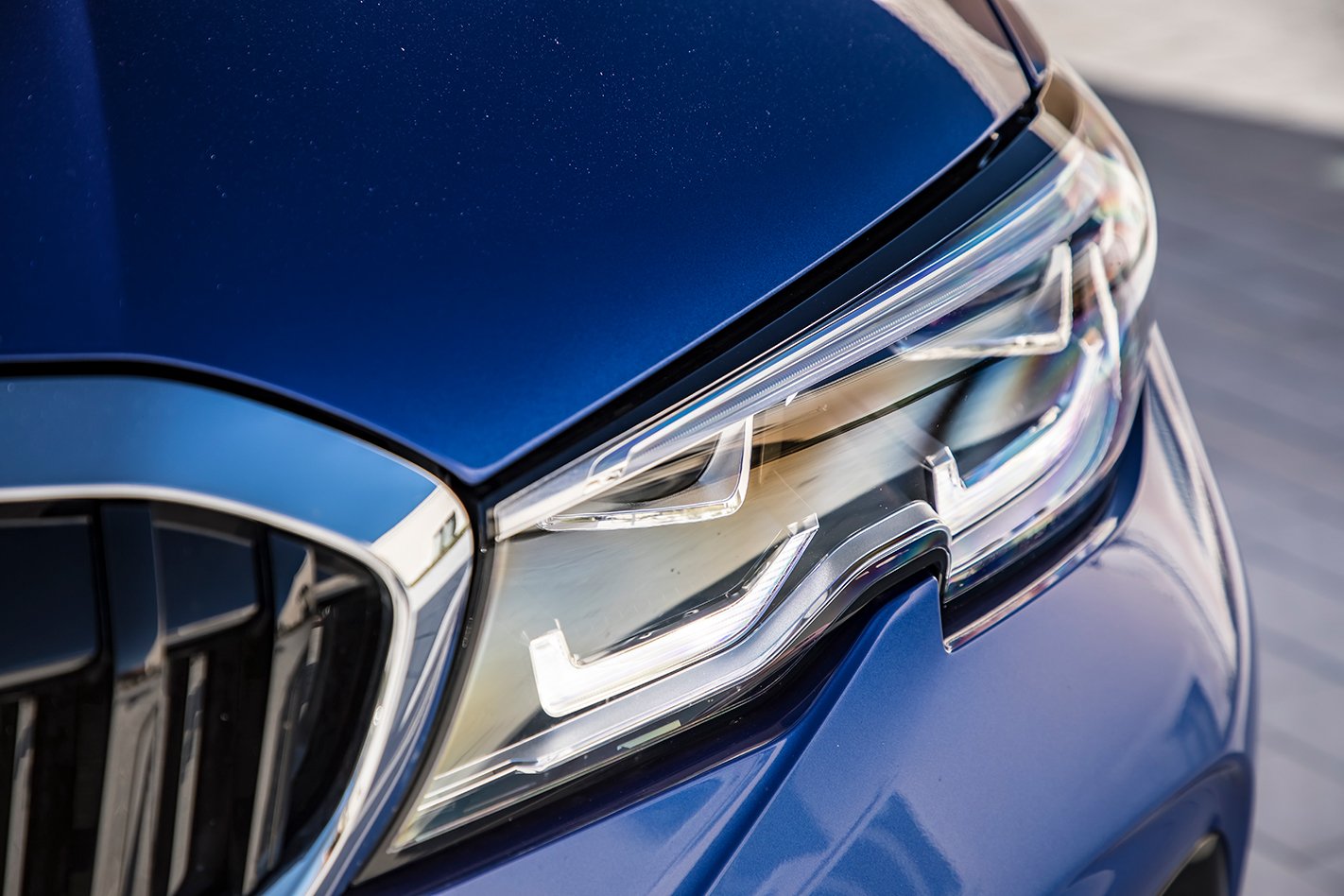
While electrification is being infused into the automotive industry at a rapid rate, fuel-efficient small-capacity turbo engines still offer great potential in terms of performance an economy.
This is a big reason for the decision to cull the diesel 3 Series according to Raman, with buyers seeing the benefits in both parameters when buying a passenger car.
“Since we began turbocharging our four-cylinder petrol engines we have seen a decline in the take-up of diesels in our passenger-segment vehicles,” Raman said.
However, the shift isn’t being seen in the SUV segment, with models like the BMW X3, X5 and X7 returning a strong proportion of diesel sales thanks to the venerable 3.0-litre inline six.
What do you think – would you buy a diesel over a comparable petrol/hybrid option?
Hi WhichCar,
I’m finally in a position to buy myself a new car this year, but I will need a bit of assistance from my old car at trade-in time to get it over the line.
It’s a Mazda 3 from 2013, and I’ve looked after it pretty well, with all services done through my dealer. However, there are a few items which will need attention.
Which leads me to my question. How much is too much when it comes to spending money on fixing up a car you’re only trading in?
If I leave a few things, like a slightly chipped windscreen and tyres that are a bit worn, will I still get a good trade-in price? Does cleaning your car increase trade-in value? I really just want to get the most money for my trade-in.
Thanks for any advice you can offer. Really love the website and the TV show!
Katie
Balmoral, NSW
Hey Katie,
We’ve reached out to our secret dealer – no, not that kind of dealer! Mr X is a former new and used car salesperson who has given us great advice before, so I thought I’d get his opinion here./Tim
The best advice is to look after your car. Keep it clean (inside too) and regularly serviced. The money spent in these areas will mean you can actually get top dollar when you trade it in.
It’s a spend versus reward situation. Give it a clean, sure, but don’t pay for it to be done.
If the tyres are legal, go with it. Dealers will calculate tyres in the appraisal and most likely be able to buy a new set for less than what the average punter could.
The only exception is if the tyres show obvious signs of… let’s just say spirited driving, like feathered edges and the like. Change at minimum cost.
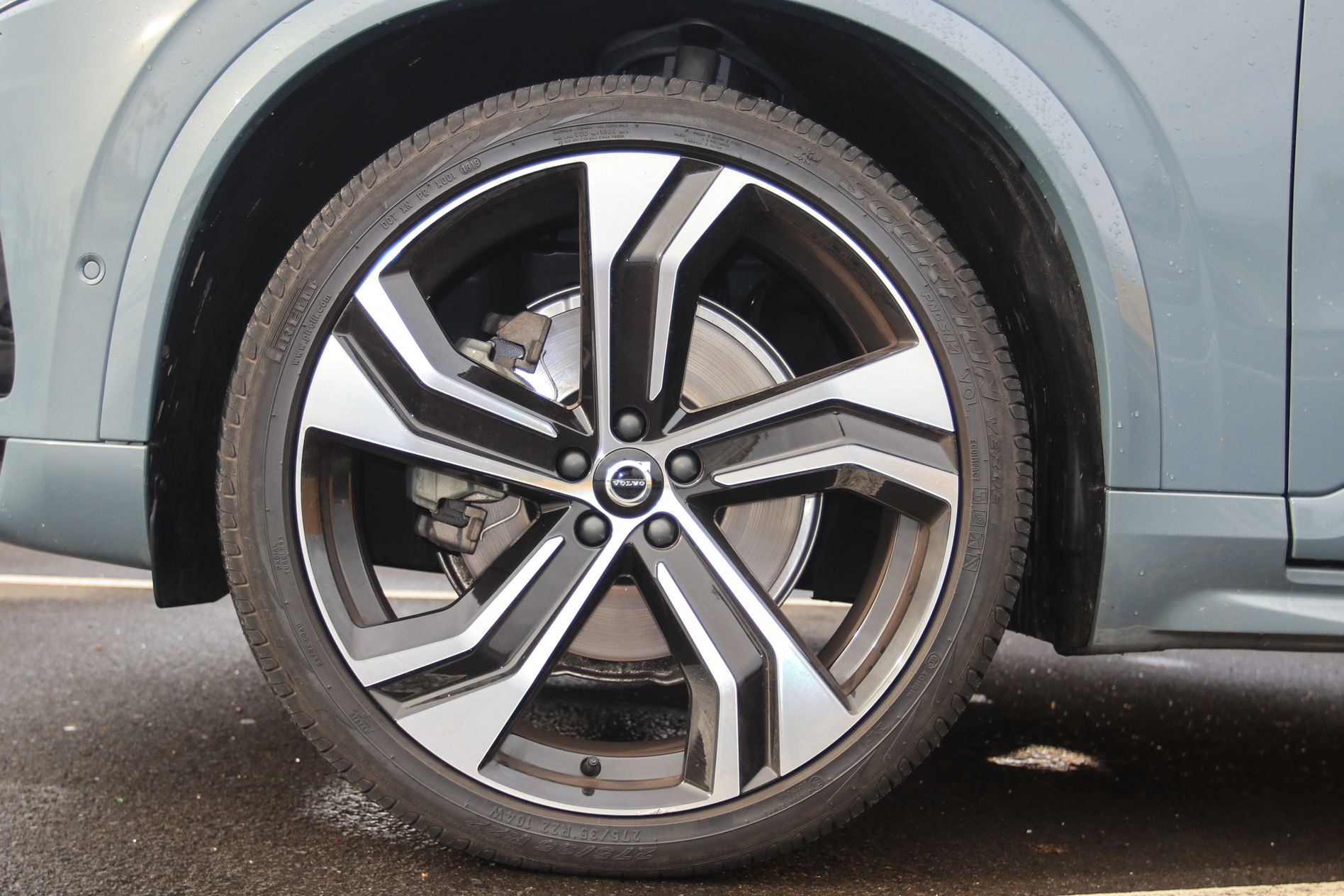
Headlining, for example – the fabric that lines the roof of your car and which can sometimes droop – is a relatively cheap fix and makes a huge difference.
Chipped windscreen? I’d treat that the same as tyres. Insurance policies can be a free or cheap way to repair or replace a windscreen.
These things will be less important as the odometer gets higher. Engine and driveline should be the focus to really get the most back at trade-in time. A basic service could be the best couple of hundred bucks you could spend.
Depending on the age of the car, a timing belt replacement could pay off and actually mean you’ll get to sell it, and not have to give it away.
If it were me, I’d always sell a car 10,000km before a belt change is due, or alternatively use all of those kilometres and use the lure of a new timing belt as peace of mind to a dealer or prospective buyer.
