
Kanagawa, Japan. I’m deep in the bowels of a Tokyo Police Station, wondering quite what the hell I’m doing here. It’s taken 45 minutes, so far, to pay a parking fine that took all of five minutes to receive. And as I sit here, alone, in some random quiet corridor in this labyrinthine building, I can’t help but wonder if I’m about to become a diplomatic incident.
It’s somewhat ironic, too, that I should find myself in trouble with the law for this most minor of indiscretions, given the last 24 hours I’ve had. I’ve been hot on the tail of the mysterious Mid Night Club, the exclusive and secret clique of street racers that streaked across Tokyo’s public expressways at speeds of more than 300km/h, in the ’80s and ’90s.
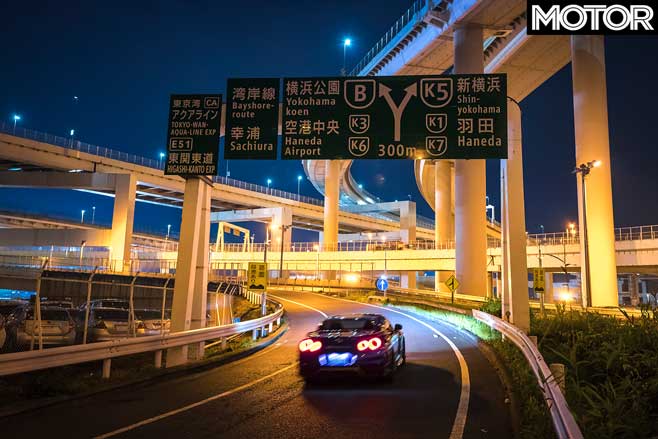
No retelling of the story of Nissan GT-R would be complete without delving into its starring role in this most infamous of underground street racing scenes. Formed in 1982, the Mid Night Club, or Mid Night Racing Team, would meet, as its name suggests, in the middle of the night, and host full-blown races up the multi-lane expressways that skirt Tokyo’s Bay Area. While other underground clubs focused on street drifting or point-to-point time trials, the Mid Night Club was all about top speed.
It was difficult to join and there was only ever an average of 30 members at any given time. It legendarily attracted a well-to-do membership of accomplished businessmen in their thirties and forties, and was governed by a strict honour code.
No members were to share details of their private lives, and you weren’t to ask. And no member was to ever needlessly endanger the safety of another racer or, crucially, a member of the public. Break this rule and expulsion was swift.
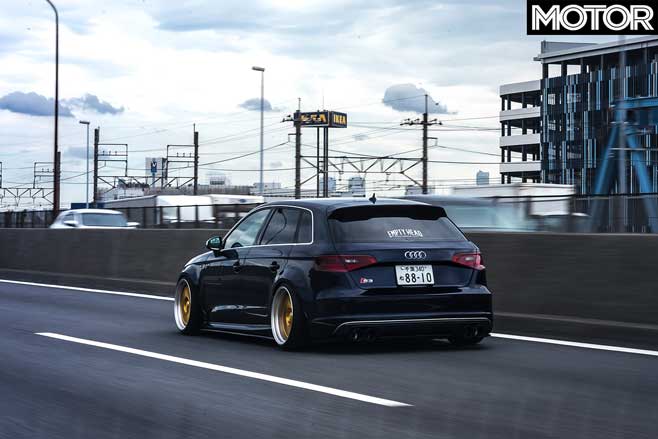
The club was also known for its clever means of clandestine organisation. In the times before mobile phones (remember those?) members were told to grab a certain newspaper, in which details of the next meet-up would be communicated via a cryptic classifieds ad. ‘Interested in discounted leather handbags? Meet at the Daikoku rest stop between 11pm and 2am’ read one ad. All to keep things on the down-low, you understand.
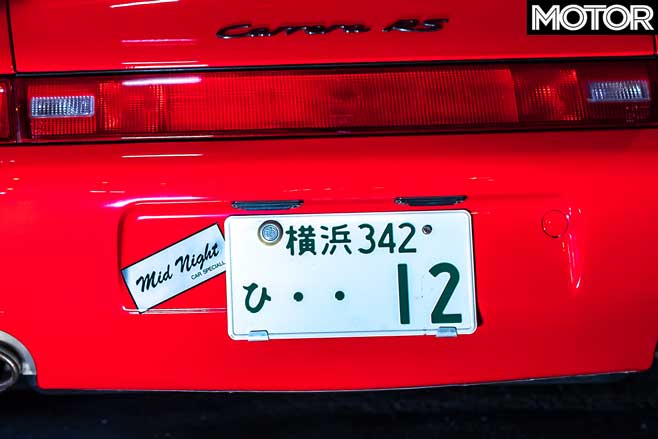
Despite the secrecy, Mid Night Club members would wear their high-speed penchants on their sleeve – or their front bumper to be precise. Members would identifiable by way of a small, rectangular sticker on the front bumper that read “Mid Night Car Speciall”, sometimes complimented by “Mid Night” in a scripted font across the top of the windscreen. But apply this trademark insignia to your own car with no membership, and you could find the decals torn off. Or worse.
On the streets themselves, races were won and lost based on whether you could ‘lose’ your rival, or reach a certain point on the expressway first. Quite how this all managed to go on for nearly 20 years sort of says something about the effectiveness of the local Tokyo police at the time (and now – have you ever paid a parking fine in Tokyo?).
Although supposedly, despite being a chronic nuisance, the Mid Night Club kept things clean and maybe, just maybe, earned a modicum of begrudging respect from some of the police that were trying to catch them.
That was until 1999 when the brakes for the Mid Night Club were jammed on hard. Two members of the outlaw motorcycle gang, the Bosozoku, taunted the Mid Night Club into a high-speed race that would end in tragedy.
Chancing upon slow traffic, there was a monumental smash in which the two Bosozoku motorcyclists were killed and eight drivers hospitalised, six of them members of the public. In the midst of a media storm, the Mid Night Club, having forgotten its own honour, and in the most Japanese way possible, promptly disbanded.
Of course, it was always the cars that made the Mid Night Club. To be eligible for entry, your machine must have been capable of at least 250km/h, not just because the races took part in the realm of 300km/h but also because local police cars were limited to 180km/h (as are all new Japanese cars). And so the Mid Night Club attracted everything from Ferraris to highly modified, late-model Toyota Supras and Mazda RX-7s, and countless Porsches.
The most infamous of all Mid Night Club cars was the maroon, ‘Yoshida Specials’ Porsche 911, also known as Black Bird, a 460kW turbocharged-to-within-an-inch-of-its-headgasket 930 Turbo, built to eclipse the v-max of German tuner RUF’s own infamous CTR Yellowbird. That benchmark? 347km/h. Supposedly Black Bird – on the public expressways in Tokyo, recall – never quite got there.
There was another car popular amongst the Mid Night Club crowd for its high-speed stability, availability, and ease with which huge power (and top speed potential) could be unwound from its 2.6-litre twin-turbocharged inline-six: the Nissan Skyline GT-R.
Curiously, the current head of GT-R at Nissan, Hiroshi Tamura, owns a heavily modified R32 GT-R. Only a few years ago, he was interviewed with his car, which sported a not-particularly-discreet “Mid Night Car Speciall” sticker on the front bumper. Naughty.
In 2019, 20 years after the Mid Night Club unceremoniously dissolved, MOTOR hears remnants of its bad boy culture still remain to this day. And so myself and photographer Ellen Dewar crank ourselves up to 900km/h and jet the 8185km from Melbourne to Tokyo, in what must be the most useless envoy Australia has ever sent to Japan, to see what we can find.
Of course, with a chance we might actually meet some old Mid Night Club members – we do have it on good authority where to find them – we’re not going to risk showing up in a hired Daihatsu Mira. So we’ve organised something a bit spesh.
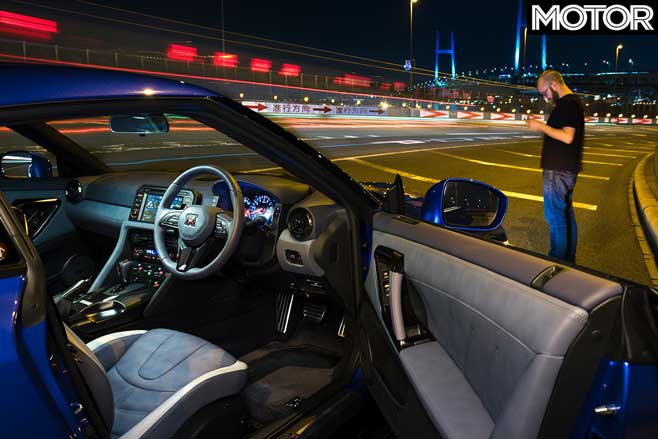
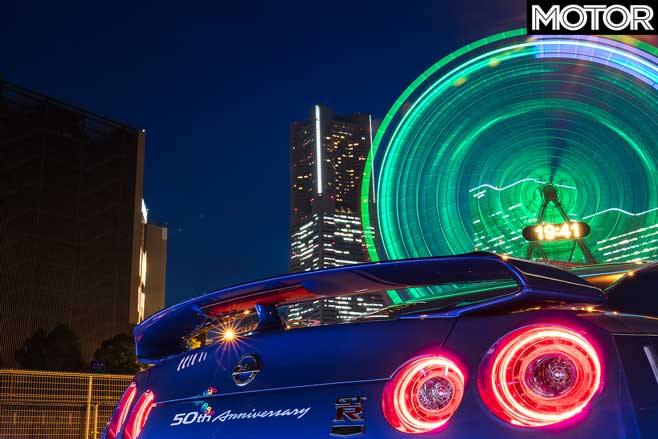
Our own Nissan GT-R is the 2020 reheat, the 50th Anniversary Edition, no less. For the latest minor update, Nissan has built off the relatively-large 2017 facelift. The 2020 entry-level GT-Rs, on which our Anniversary Edition is based, now get bigger turbochargers contributing to 2kW/1Nm more grunt (but it was hardly feeling underpowered to begin with).
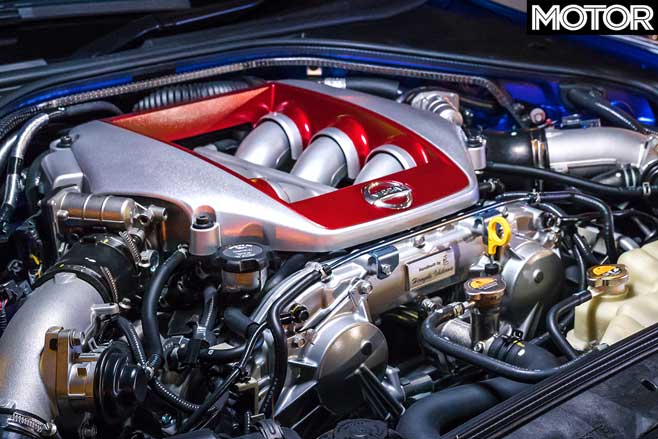
It now has 421kW and 633Nm, good for 0-100km/h in three-point-something-low seconds (Nissan no longer claims 0-100km/h times for GT-R, apparently). There’s a new titanium exhaust supposedly improving the bark of the R35’s 3.8-litre twin-turbo V6.
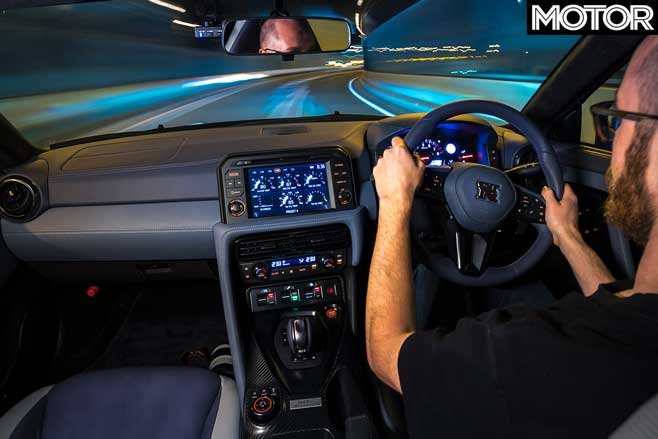
The electric steering is newly programmed for better feel, weight and refinement; as are the adaptive dampers, now promising an itty bitty better mix of ride comfort and body control. There’s a bigger brake booster for better pedal feel. And the twin-clutch auto has had its brain replaced yet again, now smoother than ever, and with more aggressive manual downchanges in R-mode; and a new R-mode automatic program for those who like to leave it in D when they have a Dig.
All these minor changes represent yet another minor step in the evolution of this generation GT-R. This isn’t a road test so don’t think you’re about to read how all these tweaks have ‘transformed’ this into the ‘best’ GT-R ever, although that probably would be the case. We can only say, it still whirs and whines like some military-grade machine at low speeds, although it’s as smooth and clunk-free as ever.
And unhinged-fast. It does sound a little angrier, although the exhaust is not noticeably louder than before. Largely, if you drove a 2007 R35 against a 2019 R35, refinement would be the biggest difference.
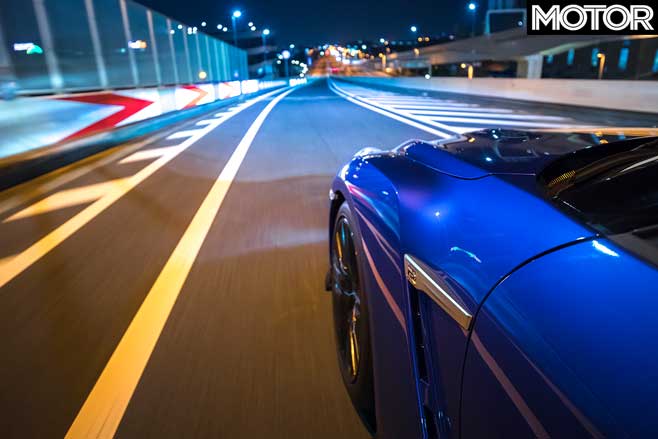
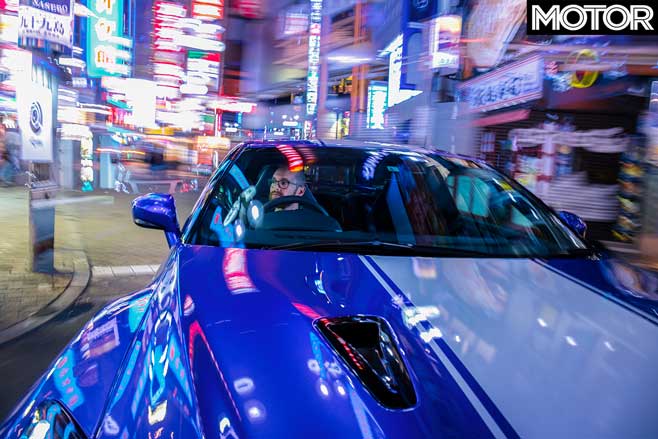
There isn’t much special about our 50th Anniversary Edition, either, it must be said. The dazzling blue-and-white paint is where it’s at, applied in four layers and called Bayside “Wangan” Blue, named, incidentally, after the very freeway the Mid Night Club used to use as its own Nardo. Even more coincidentally again, 2019 marks the 50th anniversary since the first sections of this iconic freeway were opened.
Upon bolting ourselves into our blue-and-white, computer-ised beast, a warm Tokyo day turns quickly to a warm Tokyo night and we make a beeline straight for a car park off the freeway. But Daikoku Futo is not just any car park.
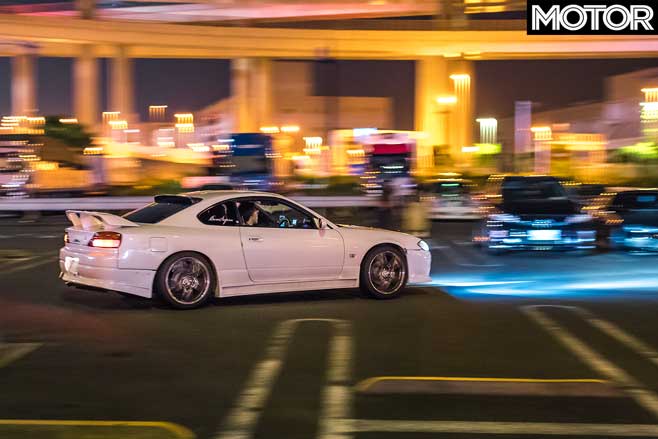
Nestled low in like a bird’s nest of swirling concrete on- and off-ramps, it’s about as big as a soccer field and flanked at one end by the bright lights of a yet another Japanese convenience store. But this is holy ground for Tokyo car lovers.
Show up about 8.30pm on any given night and, if you’re lucky – there is no guarantees – you might be treated to a Cars & Coffee-esque feast of classic Japanese cars, Italian exotics and everything in between. Beware, however – it’s not easy to get to, or to get out of, and not just because of the incredible cars coming and going.
That was our experience the night we arrived. I am overjoyed, and relieved it must be said, that I’ve not brought photographer Ellen to a dark car park with nothing but Japanese truck drivers scratching their nether-regions. There are 720Ss, Aventadors, RX-7s of every vintage, countless 180SXs and Silvias, Subaru WRXs and, delightfully, a white, replica ‘Hakosuka’ 1970s GT-R and a white R34 GT-R.
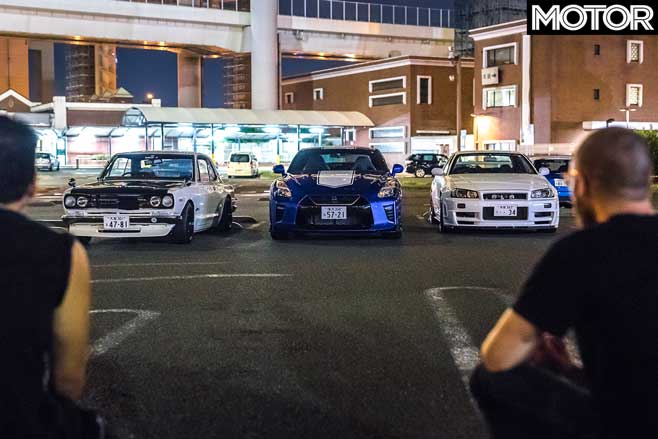
Despite the language barrier we take advantage of the well-known Japanese friendliness and generosity and manage to cajole both into flanking our brilliant blue R35 for a shot. Both owners know what it is and are visibly excited as they poke about it. Although the teenage son of the R34 thinks I’m referring to Mid Night Club, the computer game, when I ask, rather than the real thing. Concerning.
For the next three hours, cars blare in and out of the car park, their loud exhausts heard but not seen on the high-rising concrete ramps all round. It’s a great atmosphere, very relaxed. As a Japanese car lover who’s wanted to come here for many a year, it’s an overwhelming place to be.
And then we spot them.
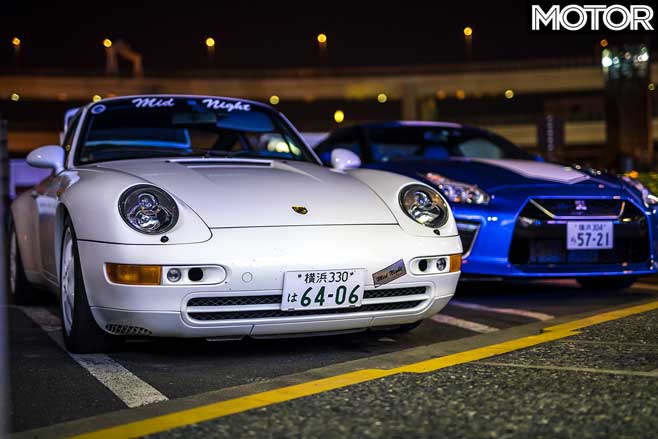
In a far-off corner of the giant, shadowy car park, in the light of the convenience store, is a red Ferrari F430 Scuderia and white Porsche 993 Carrera, both with engine covers up. On the front of the Porsche is a sticker reading “Mid Night Car Speciall”.
Two well-dressed Japanese men in their forties loiter by the cars. They speak good English, too. Tak and Shin tell us the engine covers are up to let the cars cool down faster.
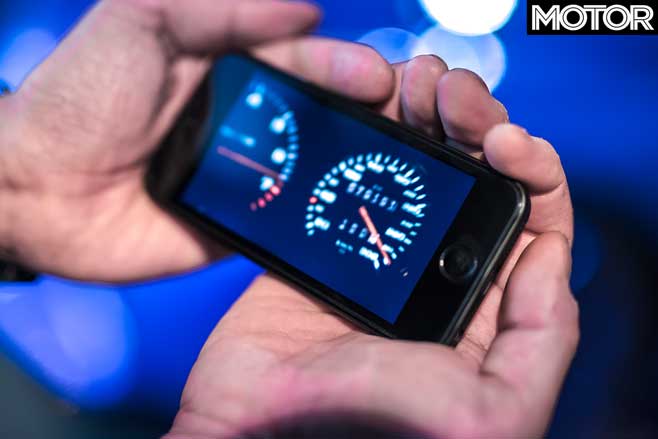
I cut to the chase as quickly as I can. “Were you members of the Mid Night Club?” Yes, they say, making no effort to hide it. They tell us the high speed races aren’t a thing anymore, but many of them remain friends regardless. “What’s your top speed record?” I have to ask. With a smirk, Tak pulls out his phone and shows us a blurry, shaky video of a Porsche speedometer nudging 300km/h. I note that it was taken in 2015…
Another car pulls up and I have to calm myself down. It’s a red Porsche 964 911 Carrera RS, the early ’90s precursor to the modern day GT3 RS. It has a “Mid Night Car Speciall” sticker on the rear bumper.
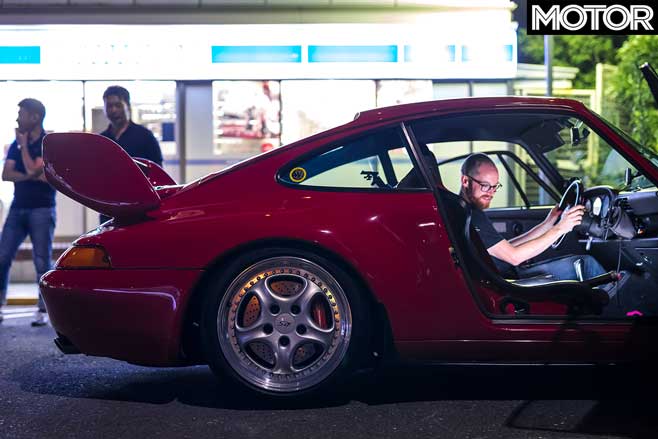
Another business-looking man in his forties, the three men know each other. This man’s record is 285km/h. “There are no speed cameras in the tunnels,” he smiles. Generously, he lets myself and Ellen take whatever photo we need in the car. Sitting in it, I notice a photo of a small girl on his keyring. And that the tachometer has been rotated so that 300km/h is at the very top.
Fortunately they all speak decent English and effectively tell us these cars still get around. And that they still meet at Daikoku Futo, late at night, which is now obvious. It’s brilliant to see.
Myself and Ellen ourselves have to hit the freeway to continue photography. The next few hours are honestly a blur as myself and the GT-R are at Ellen’s beck and call. At one point I’m stopped right in the middle of the famous Shibuya ‘Scramble Crossing’ as pedestrians swarm the car, and the wisdom of doing such a thing just to get a photo, in the age of terrorism, occurs to me right in the middle of doing so.
Later, at about 3.30am, we are getting a photo on the side of the freeway (which remains busy all through the night) when a Toyota 86, with a loud exhaust, tears past at what must surely be more than 200km/h.
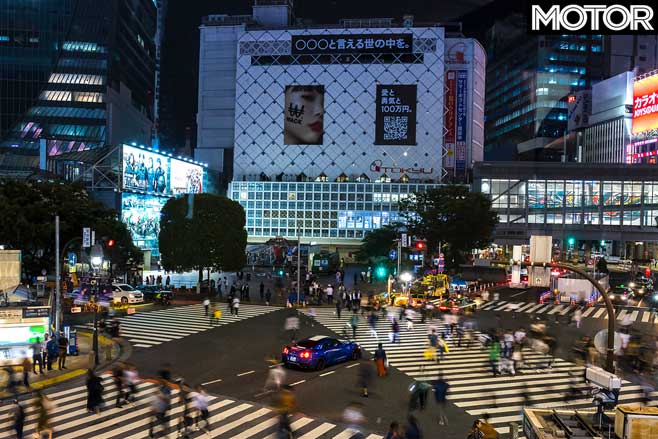
It seems while the Mid Night Club and yesteryear’s high speed antics are gone, the outlaw, high-speed spirit, from what we saw, lives on late at night on the expressways of Tokyo, just in the most discreet of ways.
Our story was supposed to end here, but at a loose end the next day we decide to drive north to Top Secret, the famed Japanese GT-R tuner, to see if we can meet its founder, a man called Kazuhiko “Smokey” Nagata.
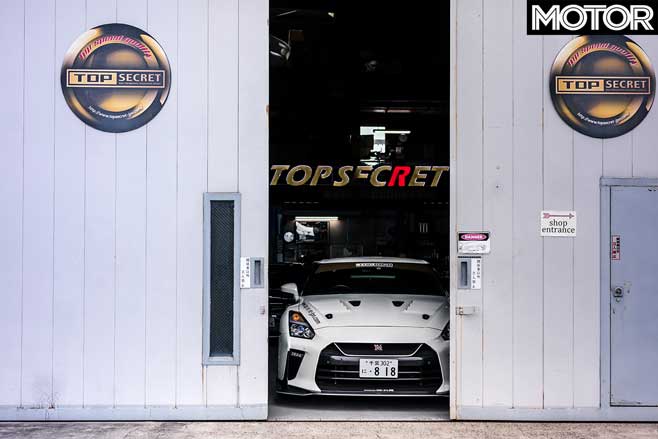
Top Secret’s building lives up to its name. Like an aircraft hangar, the big vertical front door is ajar when we arrive, through which we spy a bewinged, white R35. Smokey, coming over to greet us with a smile, is just one of two people present, and he’s tinkering away under the bonnet of an old Bluebird.
Having to weave through a bunch of dusty GT-Rs of every vintage, packed in like sardines, sadly the language barrier is very real and the Google Translate app can only get us so far. But we are able to glean a few important things.
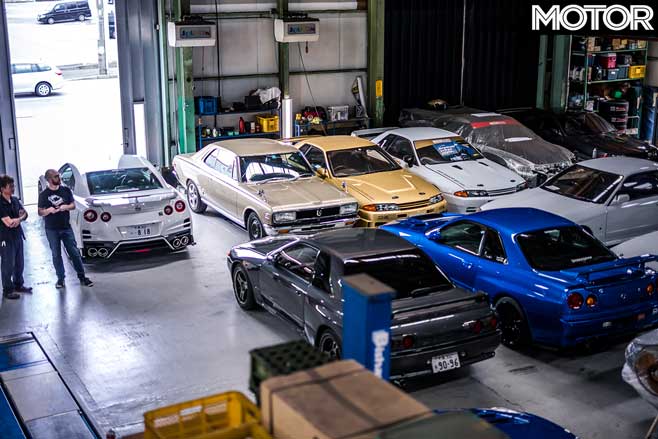
Those being, he plans on doing more high-speed runs at some point. That business is going well. He knows Hiroshi Tamura, the current boss of GT-R at Nissan. And that he was not a member of the Mid Night Club. Curiously. His friends were.
We have to cut our time sadly short (this could be a whole feature on its own) and head back to the hotel. As I’m driving down the Wangan Freeway in our own near-600 horsepower GT-R, though daylight, a clear stretch opens up and the temptation, after all this talk of speed and ignoring the law, is strong to offer a MOTOR-style tribute in honour of the Mid Night Club.
But the fear of speed cameras is strong, as there are apparently many, and the motorway speed limits even by Australian standards are farcically low (and almost universally ignored). We’re not going to end up in a Tokyo police station today – well, not for speeding anyway.
The Wangan Freeway
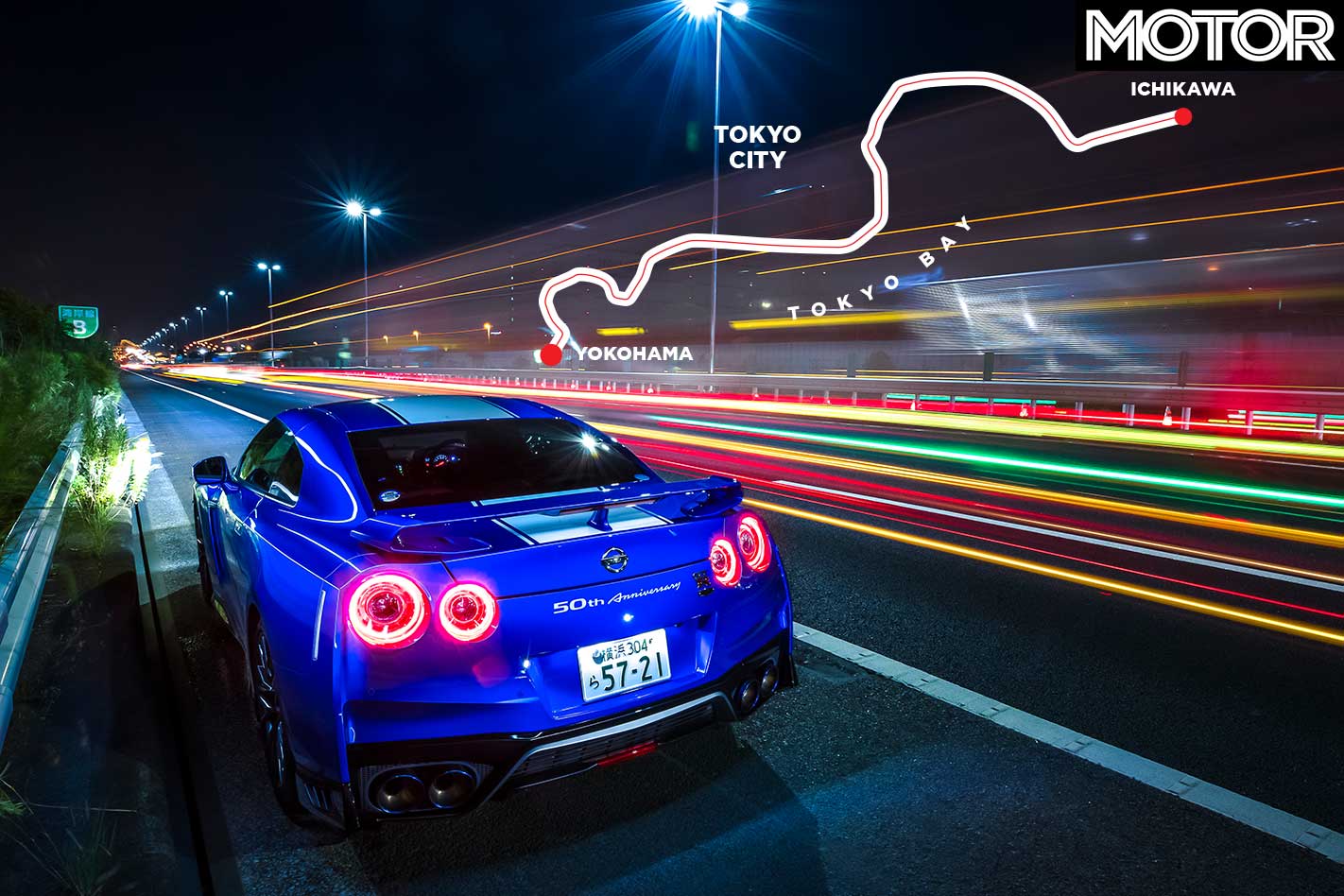
IT’S NOT often the road we’re profiling is just a freeway, but that’s exactly what played backdrop to the high-speed Tokyo street racers of the ’80s and ’90s. The “Wangan” is a multi-lane motorway stretching 70km along Tokyo bay and frankly we can see the appeal of going as fast as possible on what is otherwise a dull and featureless motorway.
Who is Smokey Nagata?
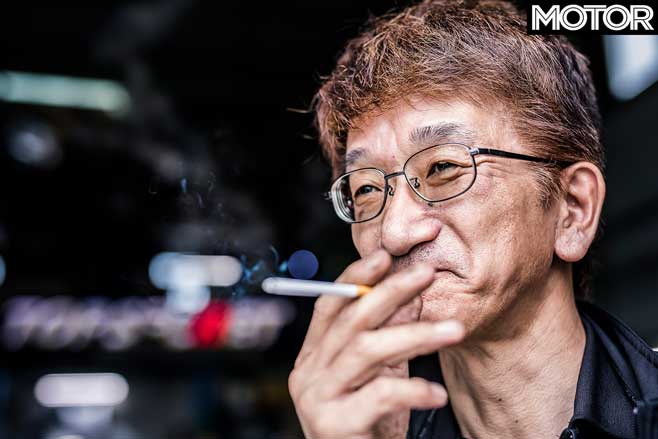
Kazuhiko “Smokey” Nagata is the founder of legendary Japanese tuning house Top Secret. A small, quiet man looking to be in his forties, he is friendly, has a love of cigarettes and has a cheeky attitude. You’d never guess he also loves horsepower as much as any Street Machiner, enormous burnouts and flipping the bird at the law.
Infamous for high-speed, late-night freeway antics of his own, there is a video on YouTube of him in a mega-horsepower R33 GT-R, doing the most enormous burnout in the middle of the motorway before clocking 328km/h in a Tokyo tunnel. Another video depicts him doing 317km/h in the UK, late at night, in a highly modified Toyota Supra. He was caught and deported.
He’s also been at it in New Zealand. We invited him to Victoria.
1. The Dany Bahar fiasco is now well and truly in the company’s rear-view mirror
And senior Lotus staff would quite like to consider that turbulent chapter closed for good. No-one will estimate how much damage it did to the brand’s credibility, but suffice to say it was a period of almost comical optimism.
At the 2010 Paris motor show, Lotus unveiled five new cars in a bid to move away from its low-margin model and move upmarket to rival Ferrari, Aston Martin and Porsche. The world called a collective bullshit.
The controversial chief executive was dismissed from the Norfolk-based company in June 2012 and filed a £6.7 million (A$12.3 million) lawsuit against Lotus owners DRB-Hicom, claiming the sacking also left him out of pocket after DRB-Hicom bought Lotus parent Proton from the Malaysian government in 2012. Then, in 2014, Bahar settled a claim for unfair dismissal with the sports car company’s Malaysian owners a month before his lawsuit was due to be heard in a London court.
Lotus is currently run by Phil Popham, who took over after former CEO (and Bahar successor) Jean-Marc Gales left in 2018. Popham was previously global operations director for Jaguar and Land Rover, but left four years ago to take control of luxury boat builder Sunseeker.
2. The company is no longer on the bones of its financial backside
No-one is saying how much Chinese parent company Geely, who bought Lotus in 2017 (adding it to a portfolio which includes Volvo, Lynk & Co, and Proton) is investing into the business, but the figure of US$1.5 billion (A$2.2 billion) has been estimated in media reports. Our well-placed source reckons the product plan is well advanced, and the funding required for it over the next 10 years is allocated.
“I’ve been here for 16 years, and never seen anything like the changes currently being undertaken, says Louis Kerr, Lotus’s head ‘vehicle architect’. “The upgrades and expansion of the facilities, the investment in technology and people, is all huge. It’s an incredibly exciting time at the company.”
3. Recruitment and infrastructure investment have been in overdrive
Lotus has been hiring like it’s draft week in the AFL. CEO Phil Popham says his decision to take the Lotus role was only made after several meetings with Geely’s senior management, including chairman Li Shufu, after being persuaded how seriously the Chinese company takes its new subsidiary. Director of sales and aftersales Geoff Dowding brings a wealth of experience from his time at Bentley.
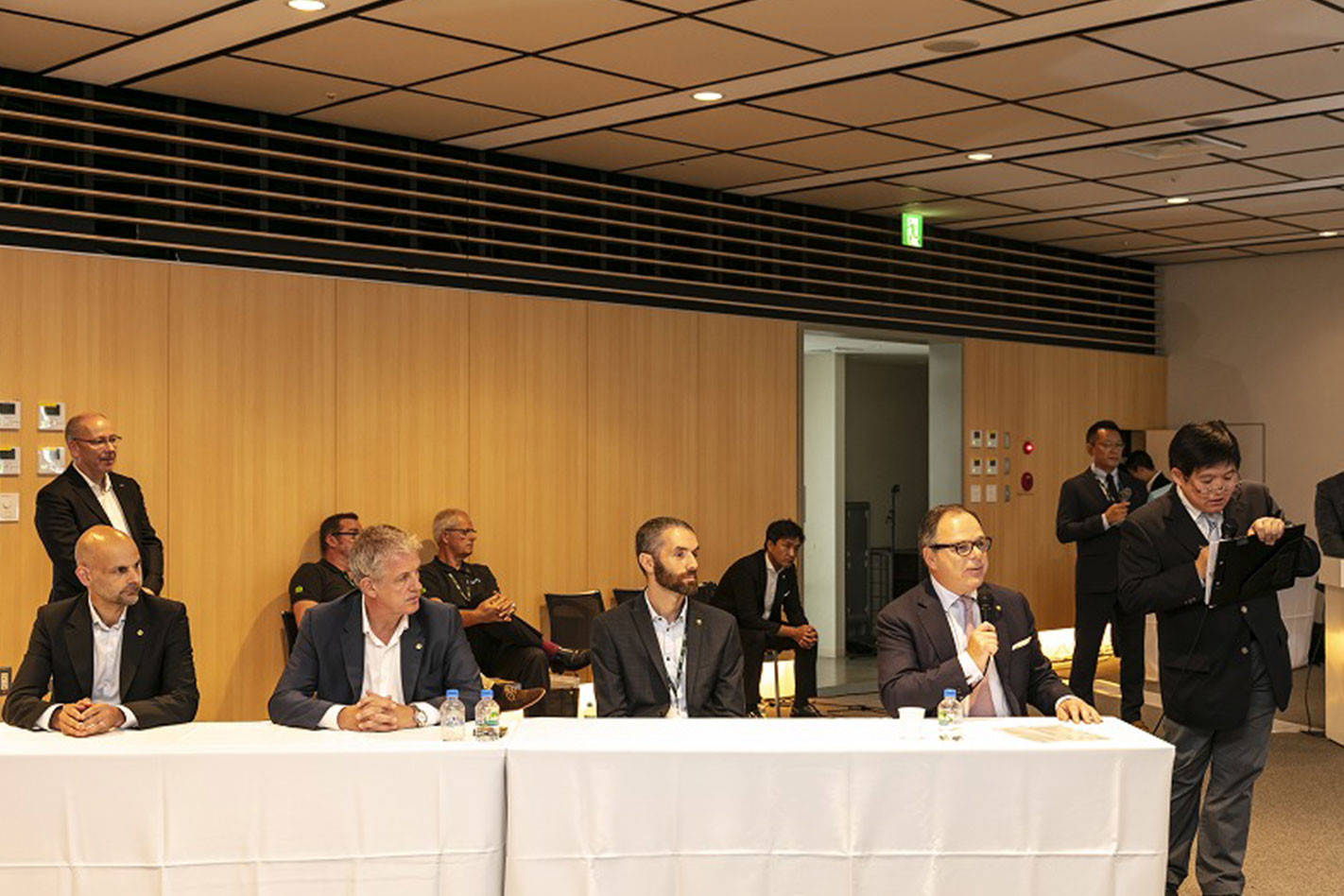
Also with a Bentley background is Uday Senapati, who was recruited in August 2018 as executive director of corporate strategy. Head of VIP sales is Ian Gorsuch, who has worked at McLaren and Aston. The vehicles dynamics team has also been strengthened with a raft of new arrivals, including Wayne Doyle who was most recently at Apple.
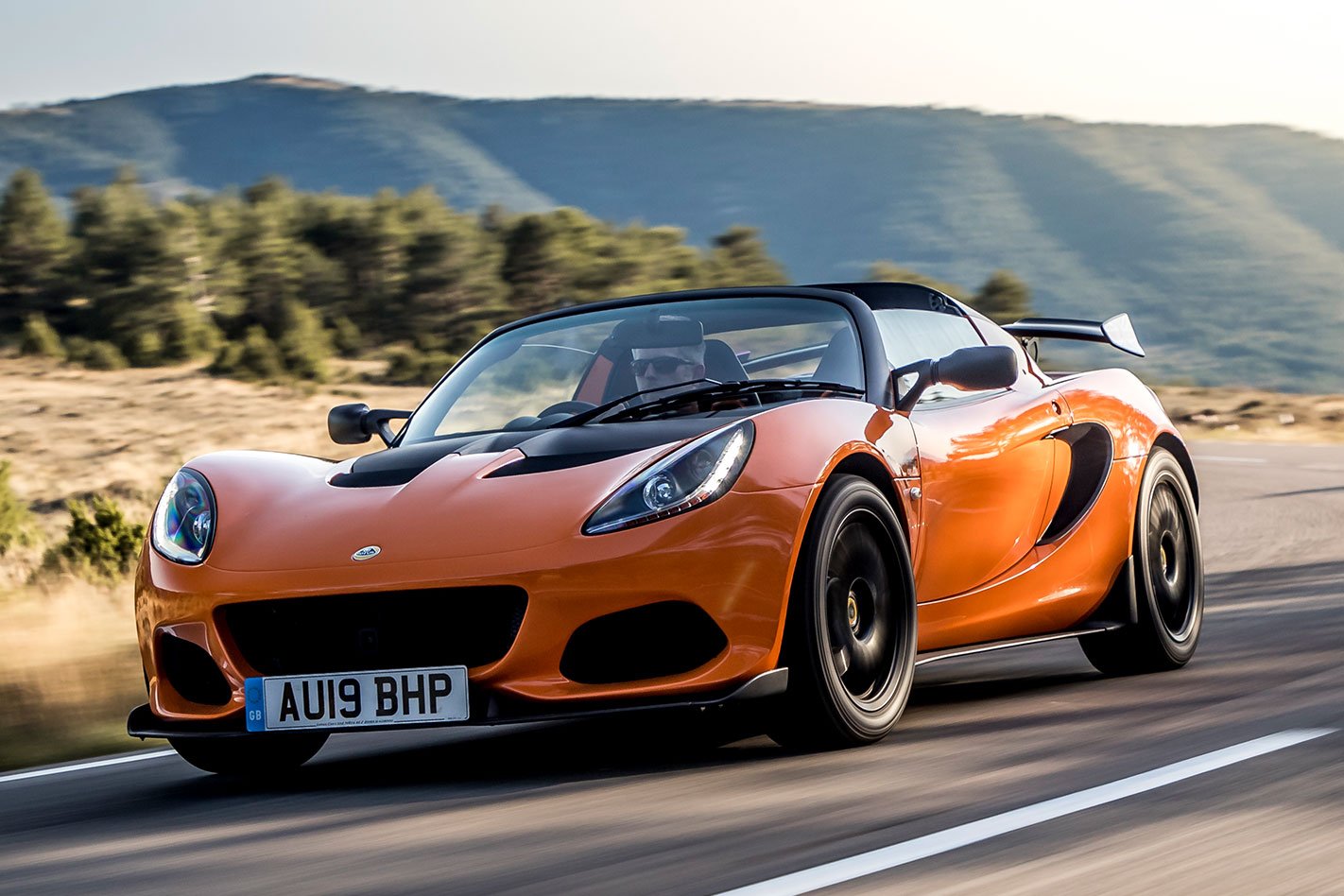
Further to all this has been the establishing of a new advanced engineering department, not at Hethel company headquarters but in the English midlands. The strategy is to be better located near the cream of the UK’s automotive technology firms, and to create greater opportunities to hire the 200 or so new recruits who may seek a more centrally located workplace.
4. Its EV hypercar, the Evija, is doing its job
That is, initially at least, to get the Lotus brand back on the automotive map, to showcase the technical capability of the company, and make a statement of intent in terms of future powertrain strategy.
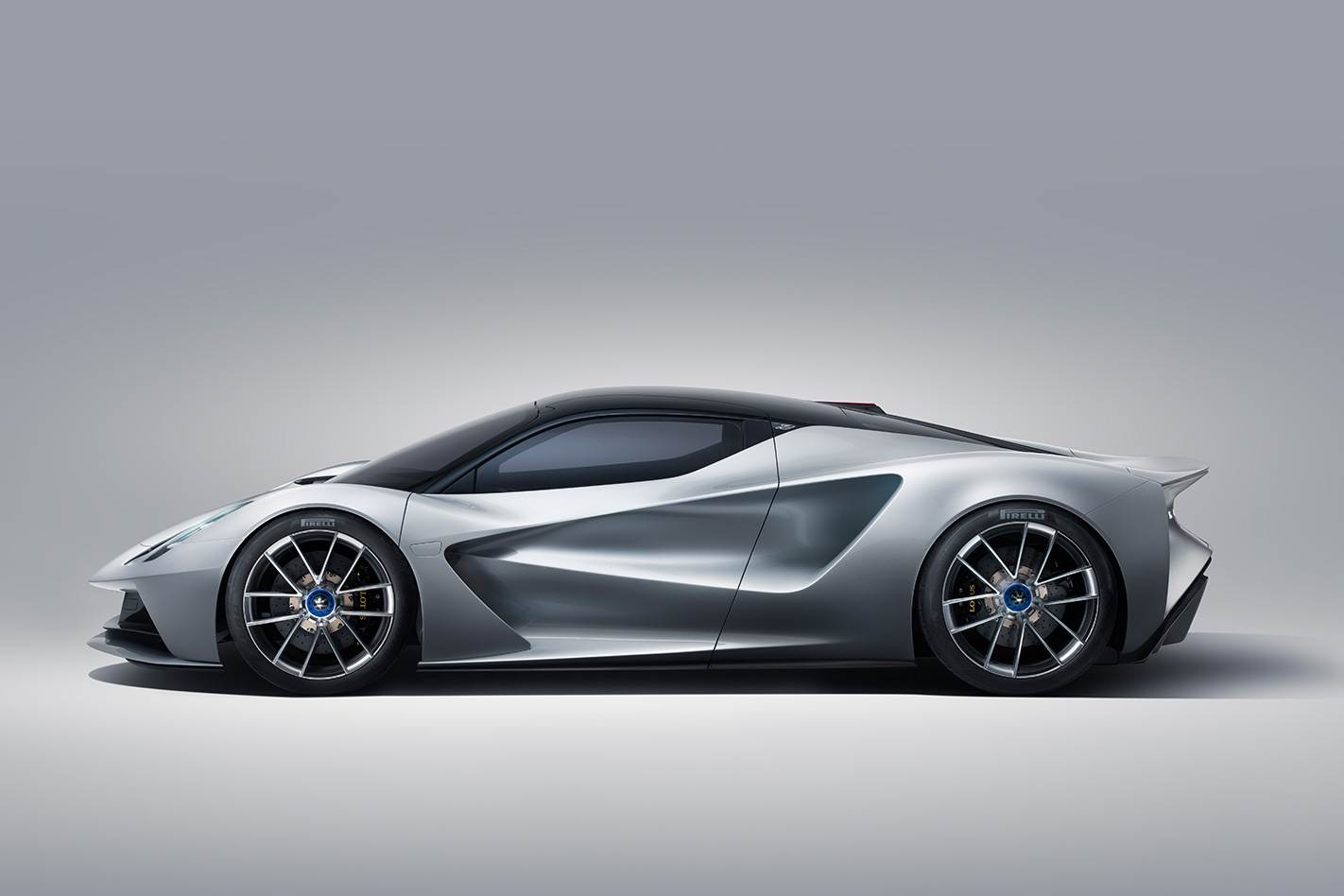
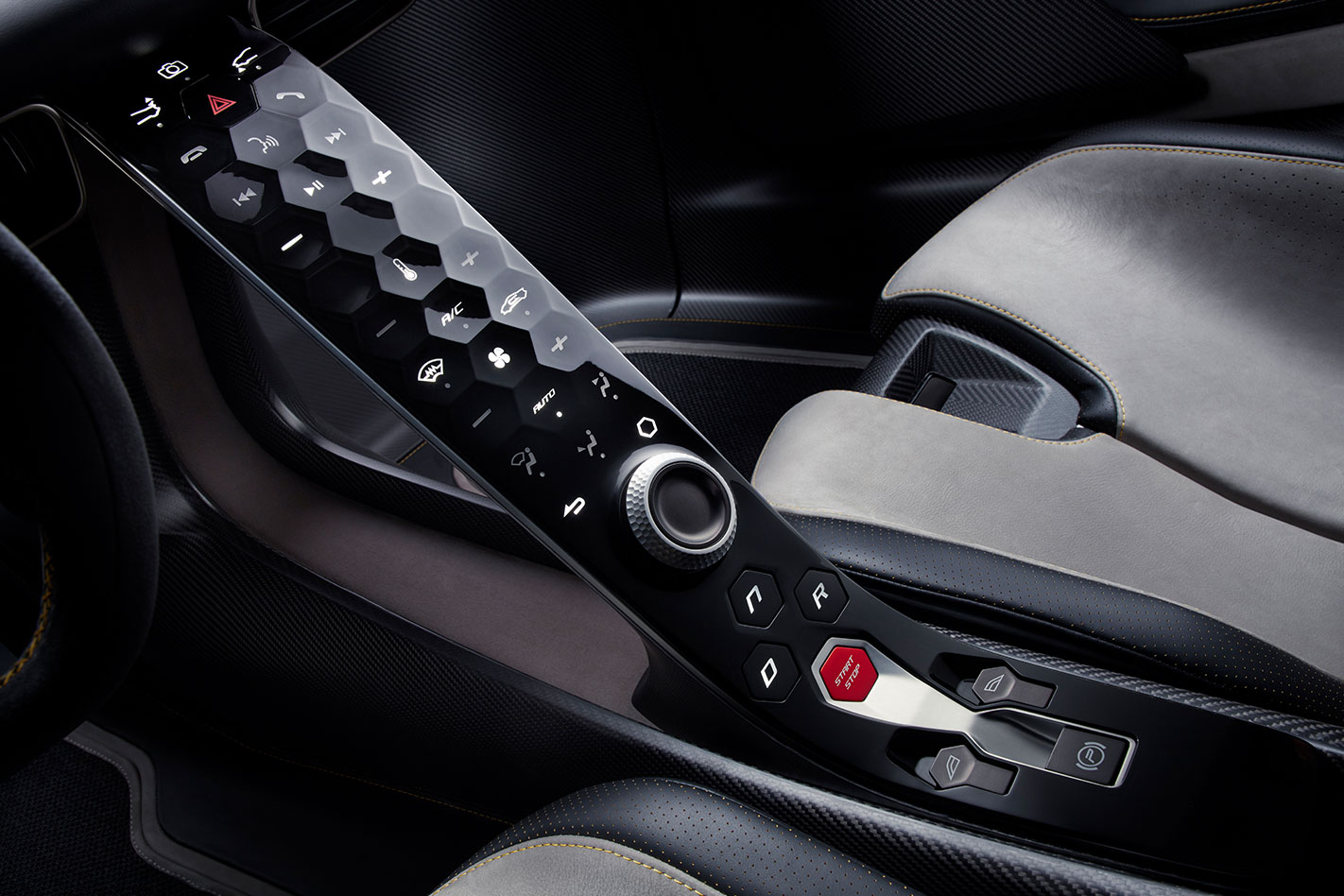
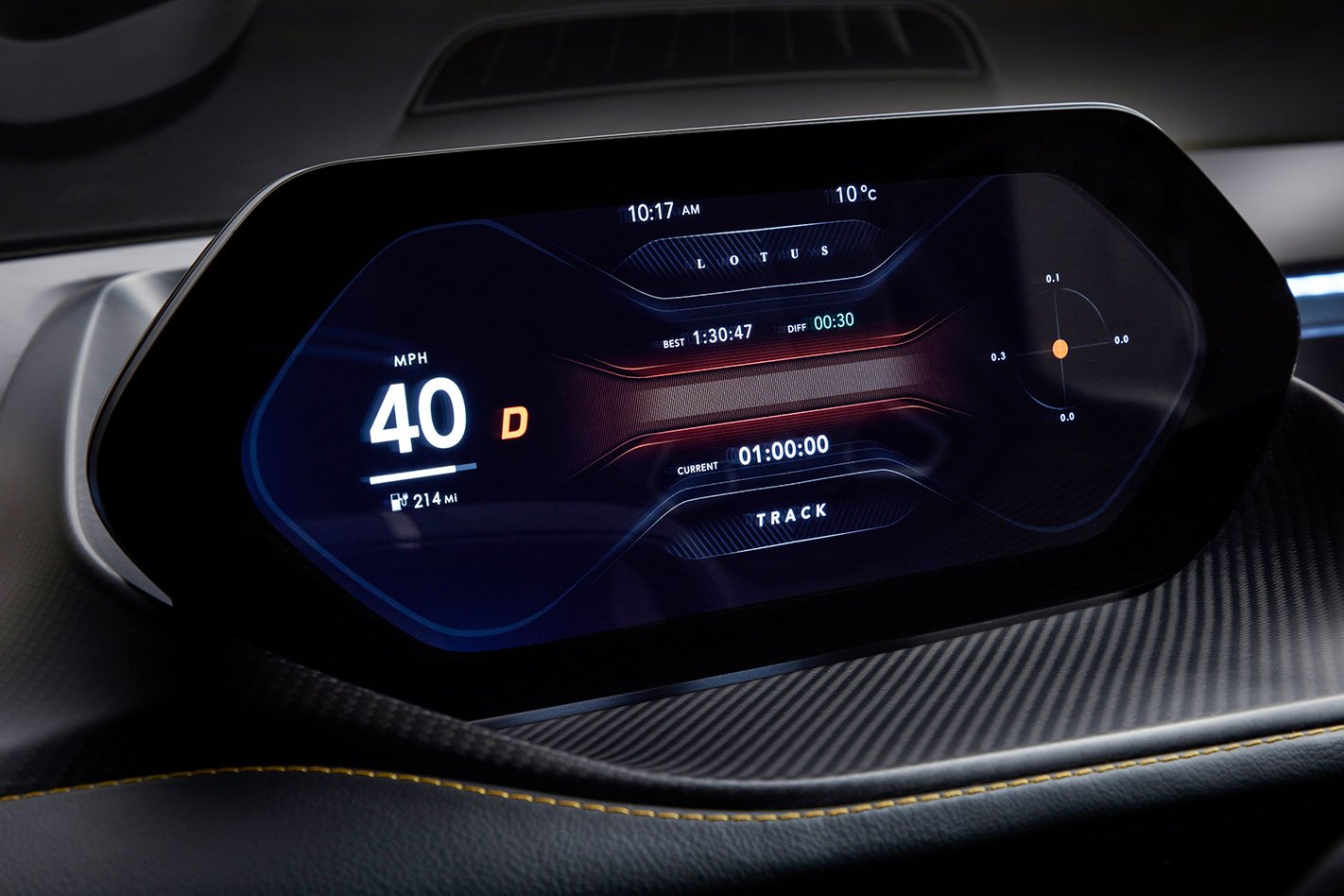
The EV hypercar is claimed by Lotus to be the most powerful (1471kW and 1700Nm), have outrageous performance (0-100km/h in under 3sec, top speed of 320km/h ) and have the most energy-dense battery and the most powerful motors. It’s also light for this category – 1680kg, with 640kg of that being the battery, located behind the driver and comprising modules stacked in a flat-topped pyramid configuration.
The collaboration with Williams Advanced Engineering is no doubt costing a bundle, but at £1.7 million (A$3 million, plus taxes and charges) for each of the 130 cars it will build, Lotus is confident it will turn a profit. Provided, of course, it can sell that full complement.
5. Evija is no smoke-and-mirrors concept
Okay, the one-off display car currently doing the rounds of the globe is not fitted with the production-spec powertrain, but it’s otherwise identical to what customers will receive. The carbon tub, composite upper structure and body panels – all supplied by CPC, Italy’s most advanced composites company – is exactly to production spec, as is the stunning, minimalist interior. The section of the factory at Hethel that will handle assembly is being prepared for a build program commencing in May/June 2020, with the first customer cars delivered late next year.
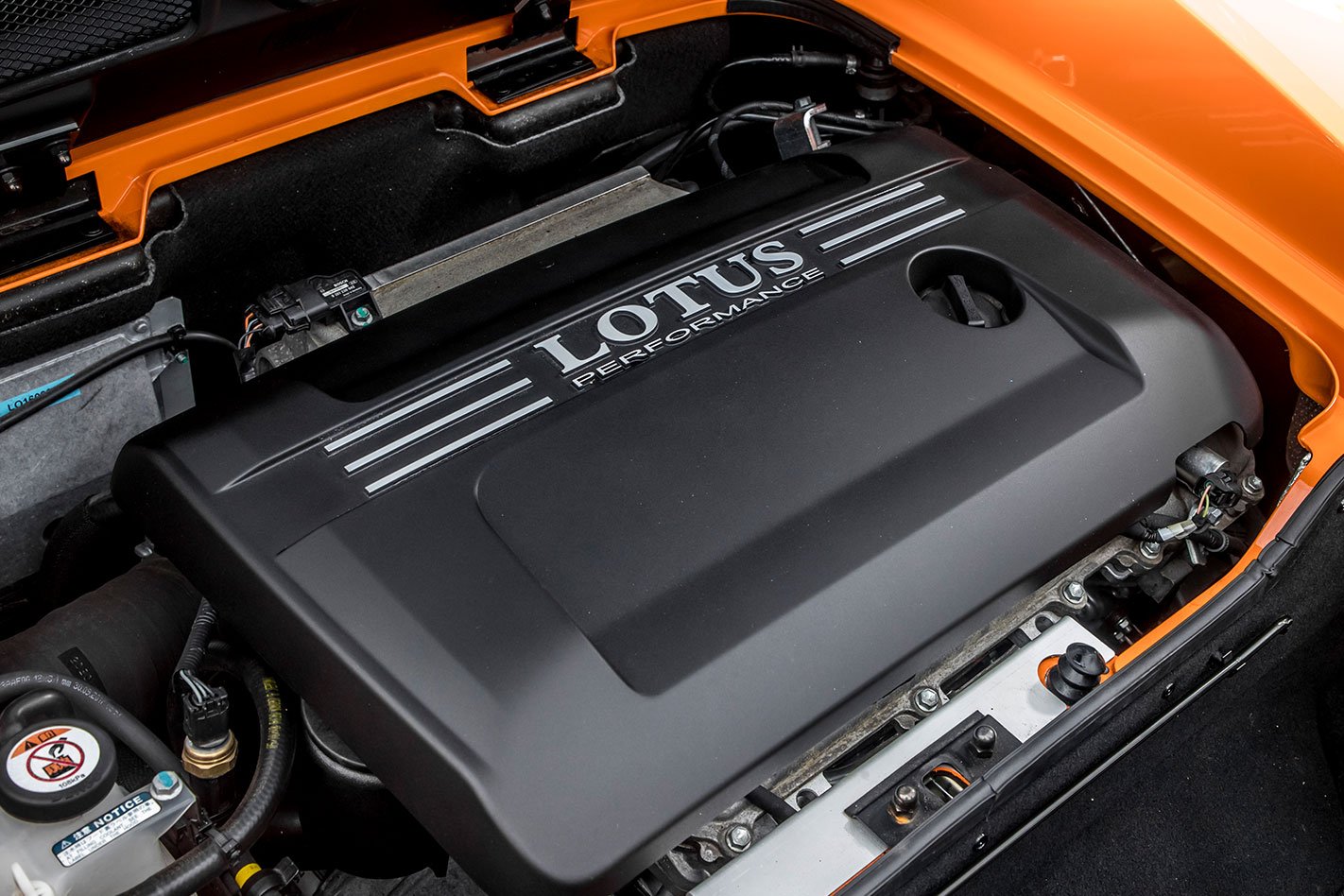
6. The Geely ambition runs deep, as do its pockets
Geely boss An Conghui said he was keen to emphasise how important his new subsidiary is. “We are making plans. We want to bring back the heritage of Lotus to be one of the top performers in the luxury sports car segment,” he said. “Lotus used to be ranked alongside Ferrari and Porsche, so we need to come back in that rank again.”
7. There’s an SUV on the way
The only real question is, which segment will Lotus target? Some media is speculating that Lotus wants a slice of where the Cayenne and X6 sit. Our intel suggests it will be sized more towards Jaguar F-Pace / Alfa Stelvio, and aiming to undercut the performance variants of those models for weight, and have their measure for dynamics and driver satisfaction.
The Lotus SUV was confirmed in the last interview previous CEO Jean-Marc Gales gave just before he quit in 2018. Lotus’s new boss, Phil Popham, also nodded to Hethel building a new SUV.” The brand has the potential to go beyond sports cars – and that includes an SUV,” he told automotive media in June 2019, “but we have to make sure it’s true to the brand. We are not going to stick a Lotus badge on someone else’s product. We have access to a lot of technology, resources and platforms as part of Geely. An SUV could be on a group-derived platform but engineered for Lotus.”
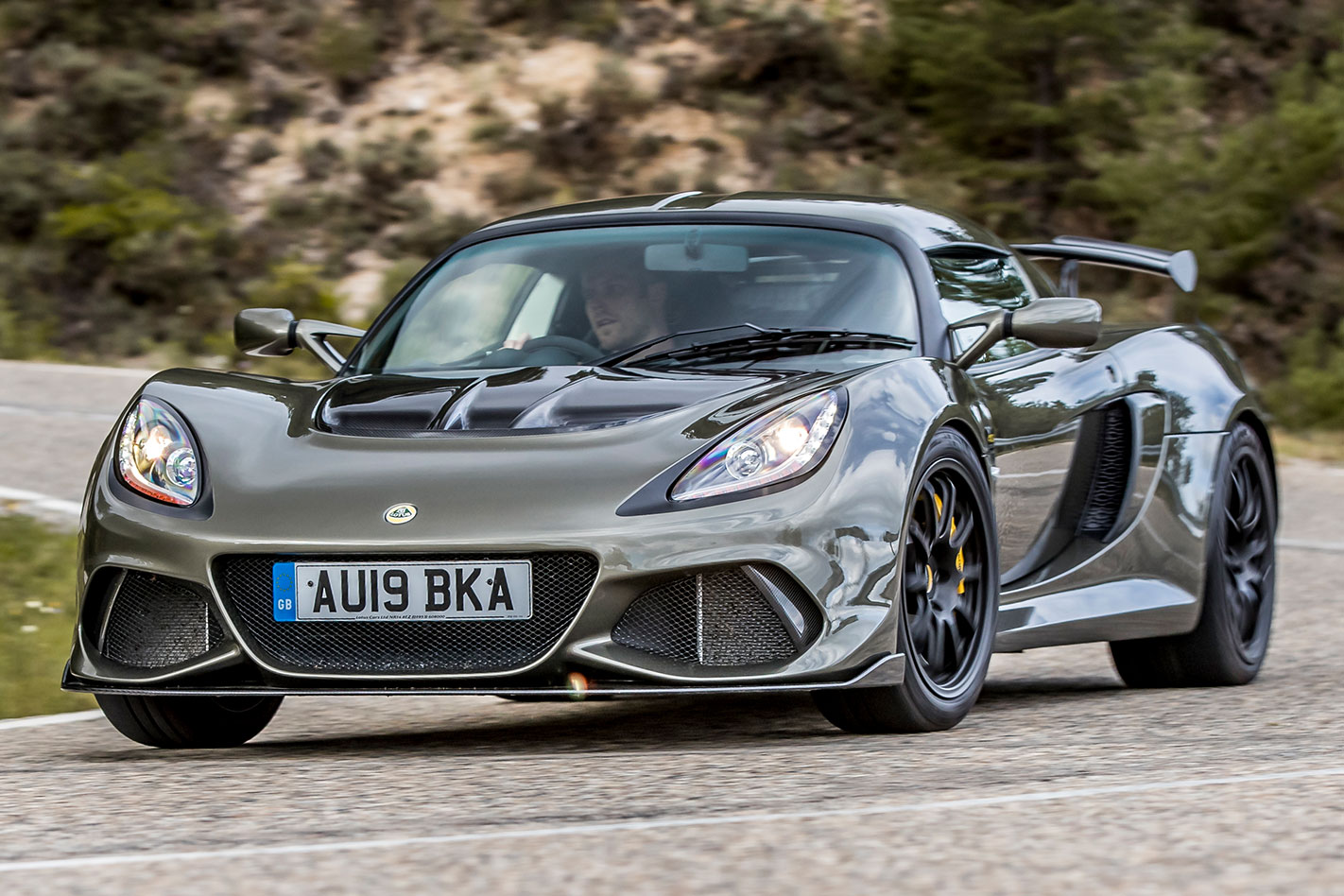
”It would still be lowest in its class, maybe the widest in its class to hold the road well, certainly the lightest, certainly the best on track. It needs to feel, drive and look like a Lotus.”
While the existing HQ will remain the base of operations for its performance cars, the crossover is likely to be built in Geely’s new plant in Wuhan, China, which will be outfitted to build internal combustion, hybrid and electric vehicles across Geely’s portfolio.
8. China and the USA will underpin sales growth
Due to the costs and complexity of emissions legislation and CARB compliance, only the Evora is currently sold in the USA, via a dealer network of 40. Likewise, in China, only the Evora is offered. But all future models will be built to be compliant in these two huge markets.
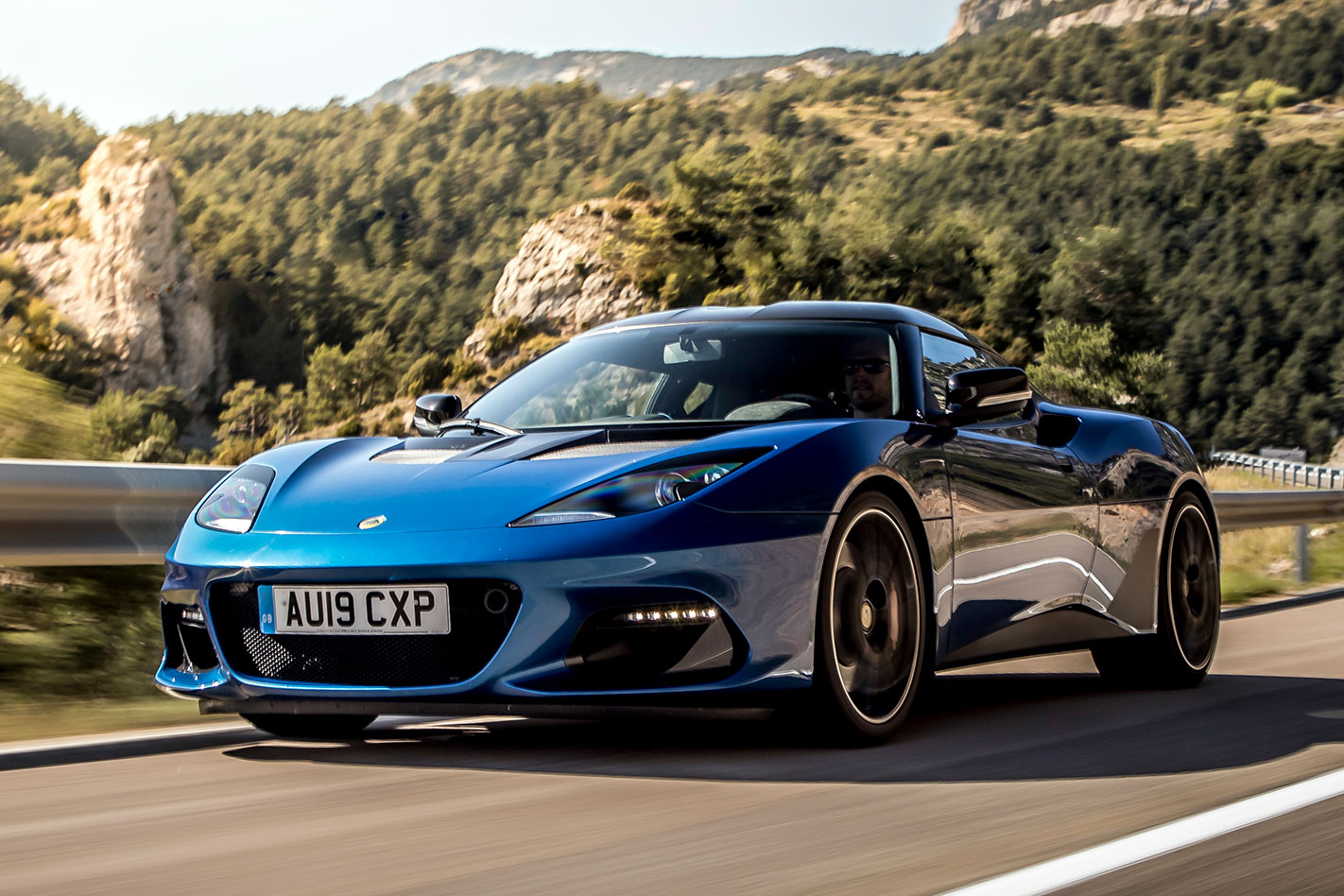
The company made just 1632 cars in 2018 and expects to top 1700 this year. Given Hethel’s production capacity stretches to 5000, there’s still headroom for a supercar, but industrial logic may propel the more practical Lotus SUV out of Norfolk and into the Volvo production network. After all, the cars will share components, though they won’t be spun wholesale off Volvo’s SPA platform underpinning the 60 and 90 vehicle ranges.
“I wouldn’t talk about a platform: that’s nothing more than a set of components, perhaps 30 to 80 main modules,” former CEO Gales told CAR magazine. “These are components Lotus can share; it can be an engine, an autonomous radar system, a wiring harness which can be adapted to the cars.”
If you were looking to the previous generation of Nissan GT-R Nismo for a guide as to how much the new generation of ultimate Godzilla will cost, you’ve made a slight error.
Nissan Australia has announced local pricing for the 2020 Nissan GT-R Nismo, and it’s not great news if the $300K mark was your target spend.
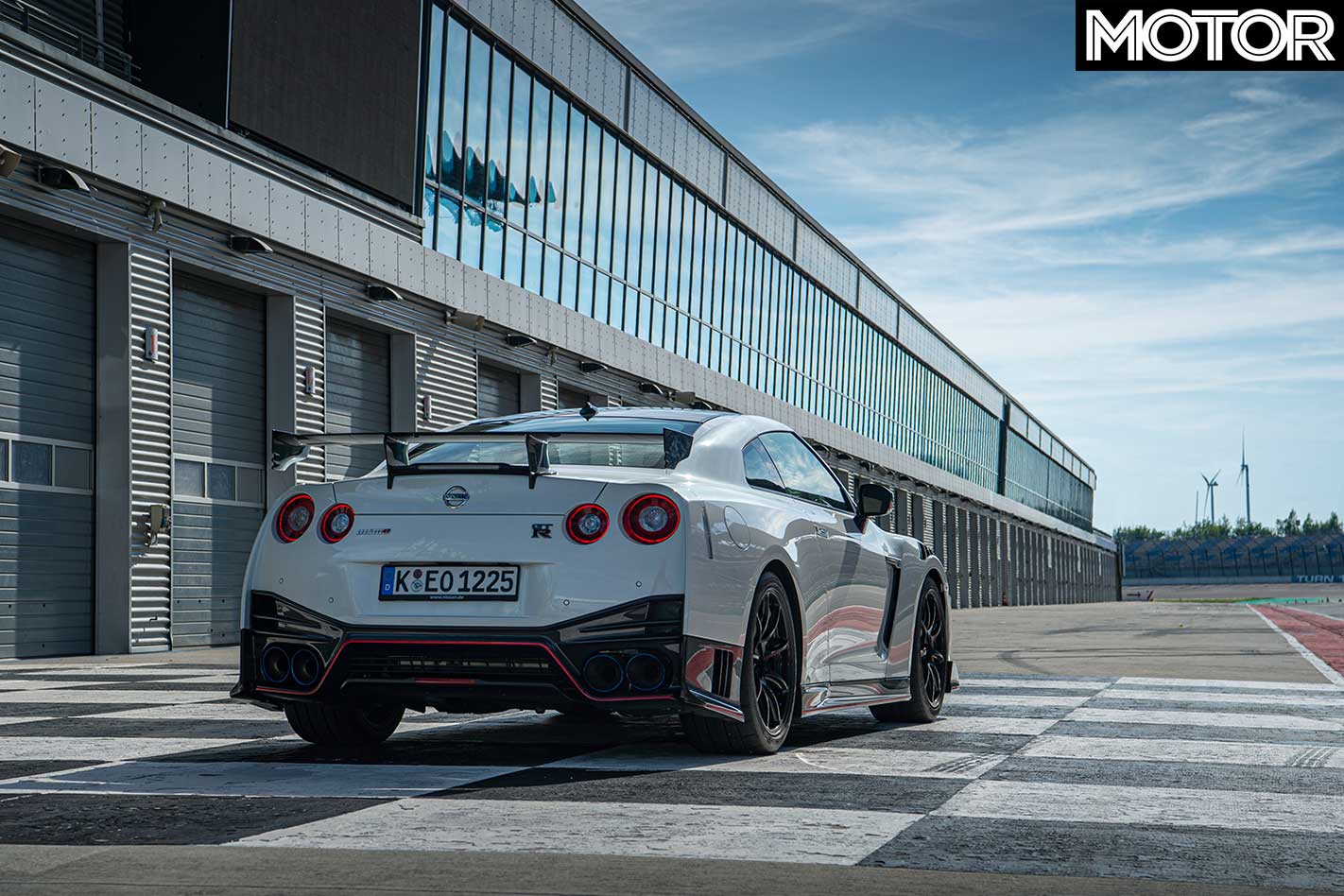
At an eye-watering $378,000 MSRP, the new GT-R Nismo now rivals the likes of the Lamborghini Huracan LP580-2 and McLaren 570S for showroom spending. That’s not an insignificant price jump.
But for that extra cost, the Nismo also cops a host of new additions and more power, making Nissan’s most capable car even more potent.
For example, the 3.8-litre V6 dons new turbochargers, essentially plucked straight from its GT3-racing cousin, which allow the engine to produce a healthy 441kW of power and 652Nm of torque.
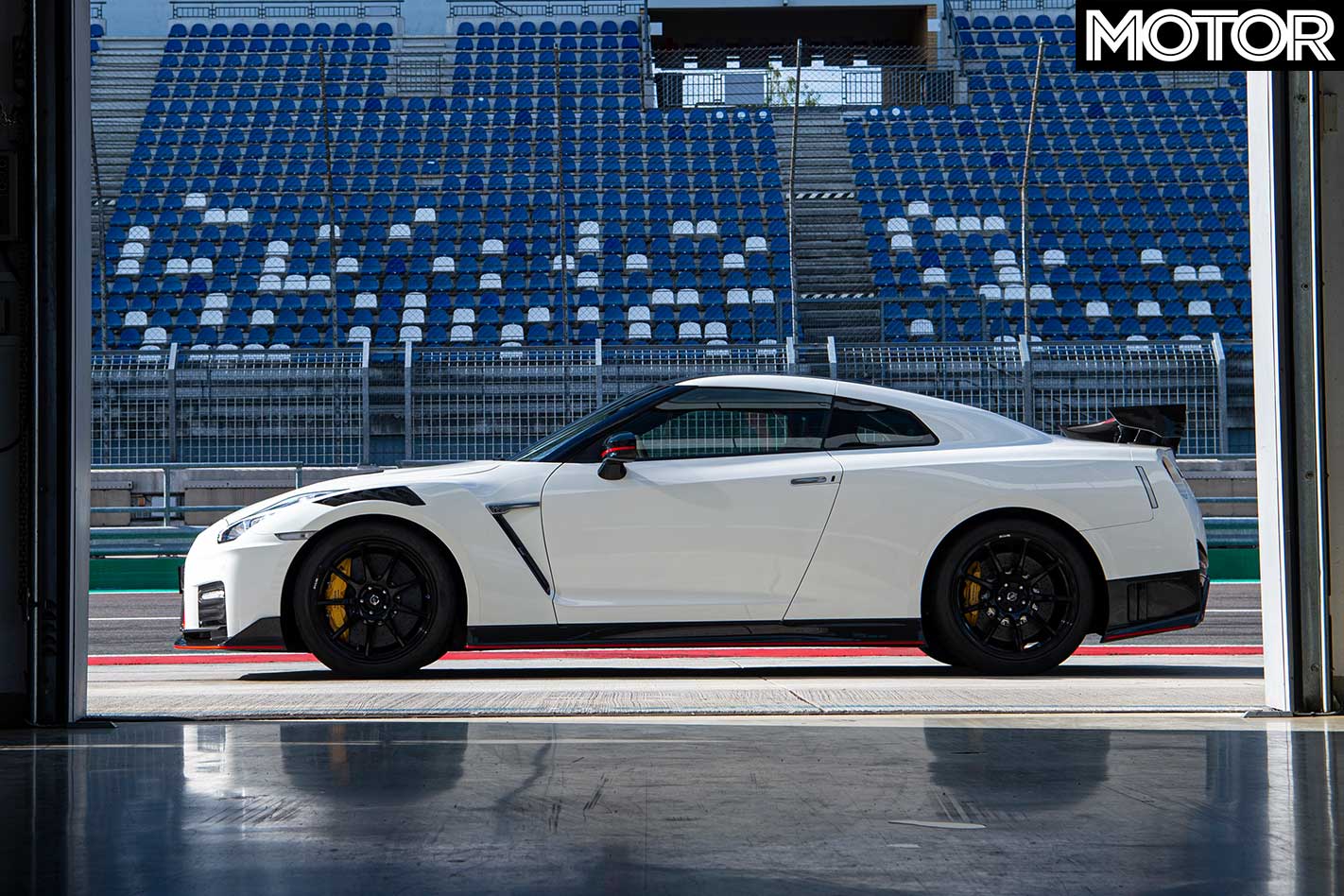
Putting that power to all four wheels, of course, is a revised 6-speed dual-clutch gearbox which Nissan says “shifts gears more aggressively and intuitively” thanks to a new ‘R’ mode.
Updated suspension tuning also provides a better driving dynamic, Nissan says, with “better linearity and precision than ever, requiring minimal corrections even at high speed.”
Its Bilstein DampTronic shocks were retuned to account for the car’s now lighter weight (by about 30kg), with revised spring rates providing what Nissan says is a more liner steering response.
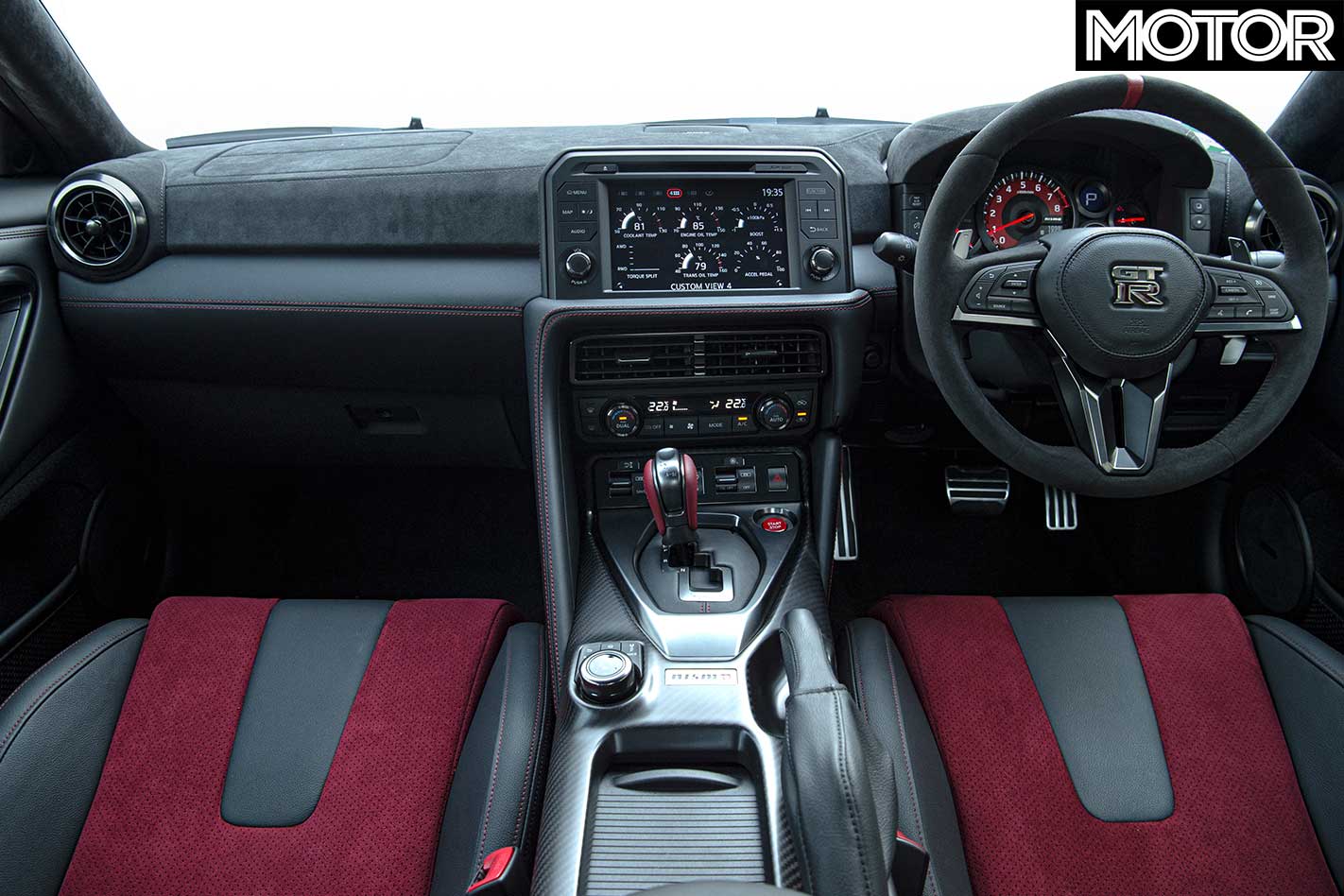
A set of 20-inch Rays aluminium wheels are just 100 grams lighter (for the whole set) than the wheels on the previous Nismo but are more rigid thanks to a new 9-spoke design.
Finally, the brakes have been upgraded to a set of carbon ceramics, with six-piston front calipers grabbing huge 410mm discs, and four-piston rear calipers on 390mm discs.
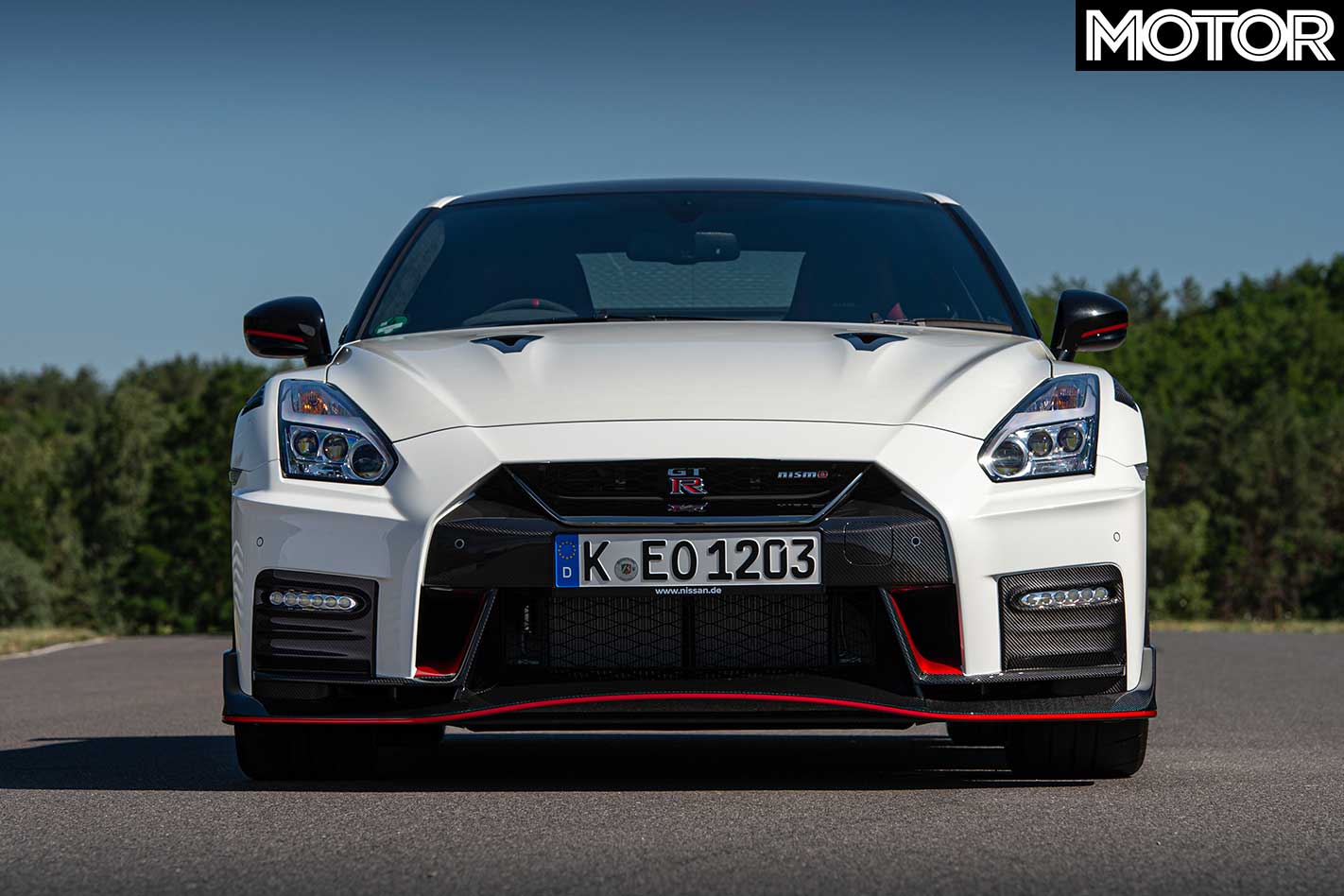
Nissan says the rotors are also much lighter due to their carbon and silicon carbide structure, allowing a total drop in unspring weight of 16.3kg.
The 2020 Nissan GT-R NISMO is on sale now.
Days after Mazda filed a patent for a double-wishbone front-end construction, two of the brand’s different nation-specific offices have made official announcements regarding a new EV… and something related to the rotary engine.
First, the news that has us most intrigued, and perhaps slightly confused.
Chang’an Mazda announced, on China’s social media platform Weibo, that it’s set to make a rotary-related announcement in a few days’ time.
It’s expected Mazda’s front-end patent is related to a new rear-drive platform (one which could end up being shared with the next-gen Toyota 86), but Mazda has kept clear of connections to the rotary engine despite the fact it’d fit nicely in the snug engine bay.
But Chang’an Mazda’s post (which we translated through Google, so be prepared for some estimation) tells us to prepare for the next generation of rotary in six days. This, however, was posted on September 20.
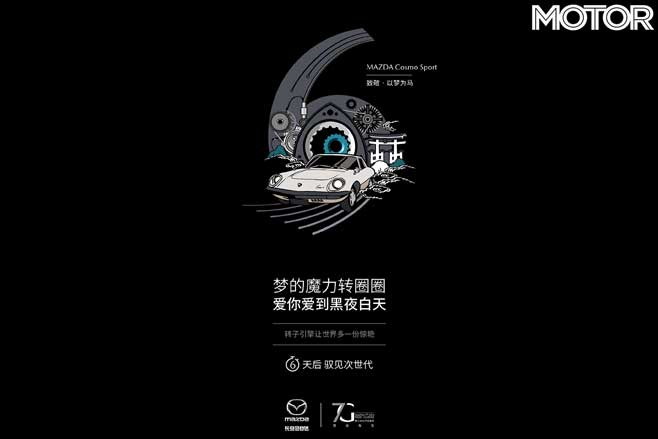
The text on the image, underneath an illustration of a famously rotary-powered Mazda Cosmo, appears to read very roughly:
“Dream magic circle, Love you to love the nighttime, The rotor engine makes the world amazed, See the next generation after 6 days.”
But, at the same time, Mazda Australia sent out a press release to media which told of a new BEV coming, due to be announced at the Tokyo Motor Show.
“A completely new model, the EV will be the third instalment in Mazda’s new-generation lineup. As a fresh option designed to form a deeper bond between car and driver, the new EV continues Mazda’s focus on human centric design…”
Given Mazda’s specific statement that it’s a battery electric vehicle, it’s unlikely the rotary is to be involved in this new model.
If not for Mazda’s ‘BEV’ confirmation, it’d almost look like Mazda was set to revive the Cosmo name for a model to introduce a new powertrain to the brand’s lineup, much like the original did with the Wankel rotary back in the 1960s.
The BMW M4 M Heritage Edition will be making its way to Australia in extremely limited numbers.
Well, at least that’s what we’re calling it. The car’s official title is the BMW M4 Edition ///M Heritage but that makes no sense so forgive us for using a bit of licence.
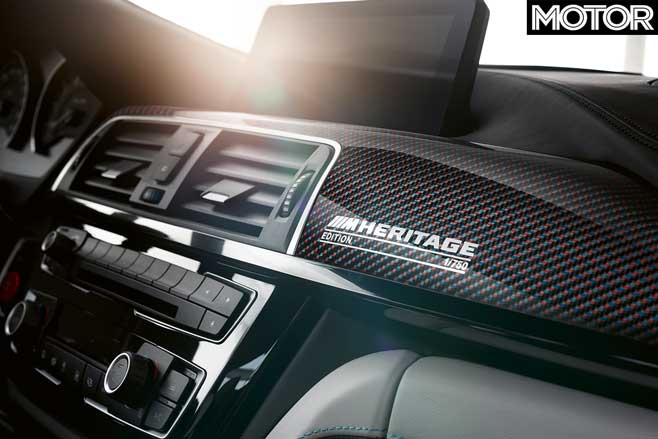
Limited to 750 units worldwide, just six examples will arrive Down Under in early 2020 priced at $167,529 before on-road costs, an $11,000 premium over the M4 Competition on which it is based.
The mechanicals remain the same: a 331kW/550Nm 3.0-litre twin-turbo six, seven-speed dual-clutch gearbox, rear-wheel drive with an electronically controlled limited-slip differential and 20-inch ‘666 M’ star spoke alloy wheels, finished here in Orbit Grey.
What differentiates the M Heritage Edition is its colour palette, with three hues available from BMW’s Individual range that “embody BMW’s rich and prosperous motorsport tradition”. Each is matched to an interior colour scheme.

Edition 1 is Laguna Seca Blue with grey/black upholstery and contrasting turquoise stitching; Edition 2 is a darker Velvet Blue, again with grey/black upholstery with Velvet Blue/orange stitching; finally, Edition 3 is Imola Red II with red/black upholstery and red-yellow stitching.
All models are fitted with carbon fibre trim featuring M colours, ‘1/750’ lettering on the dash and door sills, embroidered headrests and a carbon roof with a decorative M stripe.

While not pitched as such, the M Heritage Edition will be somewhat of a last hurrah for the F82 M4, with the controversial BMW Concept 4, revealed at the recent Frankfurt Motor Show, previewing the new 4 Series.
The two-door version of the current G30 3 Series is expected to appear in 2020, along with the new M3 and, presumably, the M4. Production of the F80 M3 ended in August 2018 as re-homologating it under the new WLTP emissions regulations didn’t make sense at the end of its lifecycle, but the M4 lived on with the installation of a petrol particulate filter.
Jeep Australia could be up to half-a-million dollars poorer on Sunday if Richmond wins the AFL Grand Final.
The American SUV brand has been the Richmond Tigers’ major sponsor since 2011, and after seeing the club through its rebuilding period is enjoying having its Helvetica Bold moniker front and centre in its recent success that includes the 2017 AFL Premiership.
WhichCar understands that a clause in the sponsorship deal includes a huge bonus for reaching the Grand Final, plus an additional payment should the Tigers hold the premiership cup aloft. In short, a Richmond flag will cost Jeep up to $300,000 – and that’s on top of the estimated $1.5 million annual sponsorship fee.
The deal, which also applied in 2017, is similar to one Hawthorn had with the Tasmanian Government, which saw it receive $150,000 to reach the Grand Final and another $150,000 for winning it.
Such deals aren’t so much about rewarding performance, but for the additional exposure the brand receives as major sponsor for the team well beyond the regular season.
Either way, it will be a six-figure sum that Jeep will be happy to pay, as it provides extended access to one of the largest footy fan bases in the AFL.
Greater Western Sydney has a while to go before its membership numbers can rival Richmond’s, but if the AFL’s newest team ends up saluting the MCG crowd on Saturday there will be big smiles at Kia Australia’s Sydney head office.
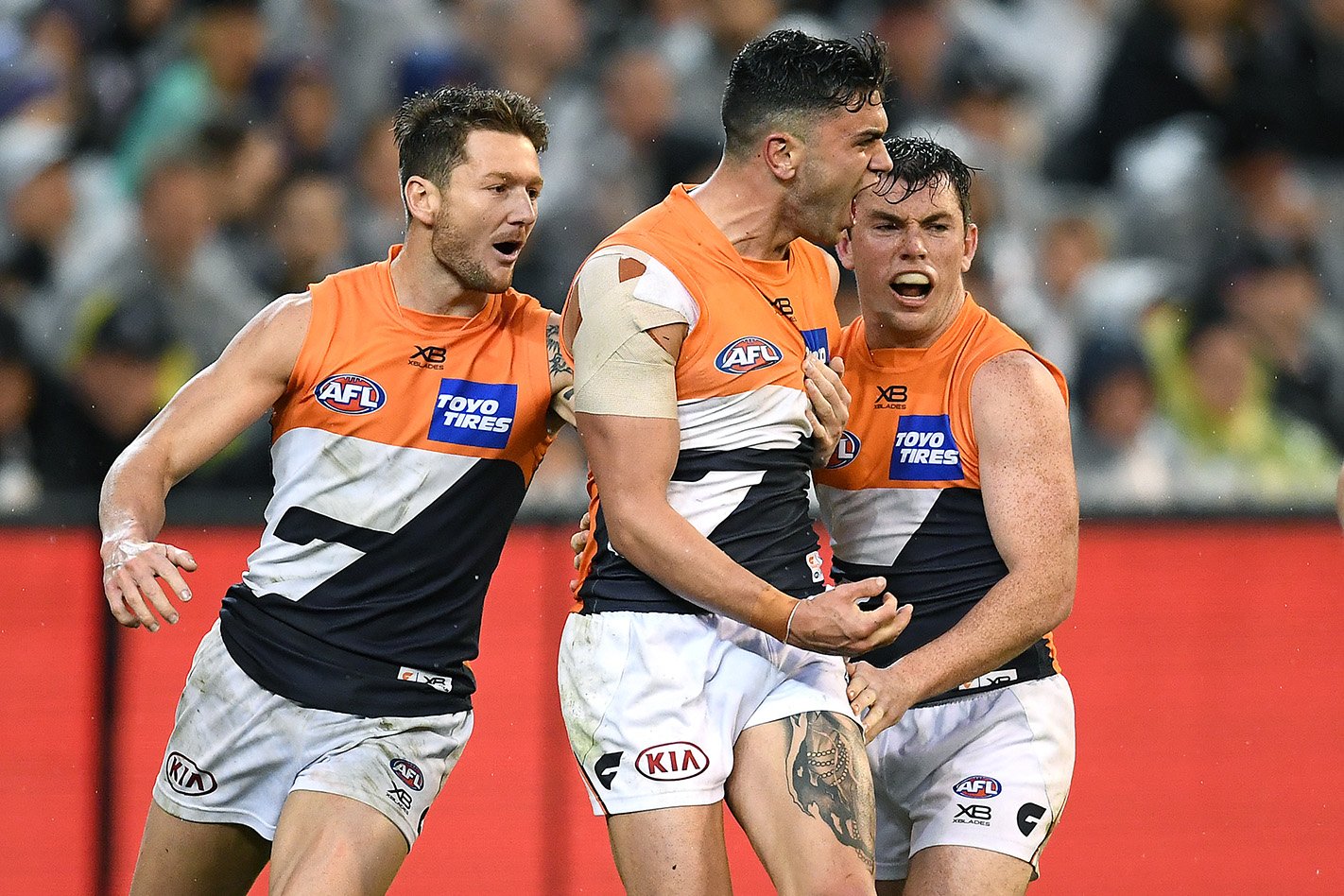
The Korean carmaker has a strong involvement with sport in Australia, most famously as naming sponsor of the Australian Open tennis, with Roy Morgan research showing that 3.5 million Australians associate the brand with the Grand Slam tournament.
However, its first major foray into AFL sponsorship proved disastrous, with its association with Essendon coinciding with the club’s 2013/14 implosion over the performance supplements saga.
Kia hasn’t had too much luck with Rugby League either, being the major sponsor of the Canterbury Bulldogs which last year delivered the wrong kind of exposure when players were filmed and later charged for their obscene behaviour during post-season Mad Monday celebrations.
Kia’s mid-level ‘shorts sponsorship’ of GWS is a bit more modest, but for once it’s aligned with a footy team that – Toby Greene’s fascination with faces aside – has barely put a foot wrong this season and is just one game away from holding up the Premiership Cup in just its eighth year of existence.
A Kia Australia spokesman told WhichCar the company has played a small role in GWS’s success but that it is very pleasing to see.
Cars and football sponsorship
The motoring industry has long been a keen supporter of the AFL/VFL. Toyota has been the League’s major sponsor since 2004 and at the beginning of this year inked a record $74 million four-year contract that for the first time will include the AFLW (women’s competition).
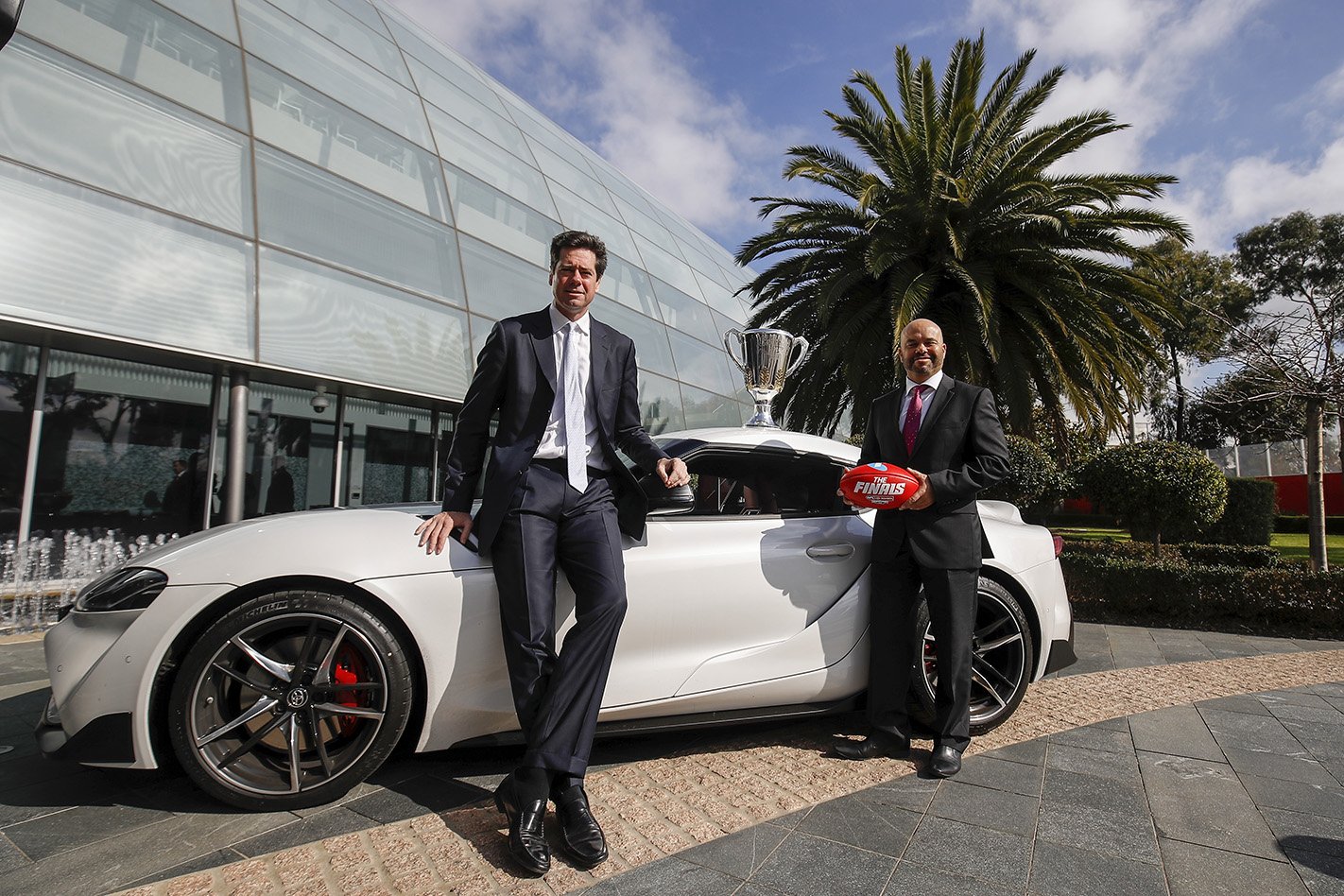
AFL supporters span all social demographics across each state, which makes the sport fertile ground for car manufacturers. A 2014 survey showed that on average, around 13 percent of football club members intended to buy a new car in the next four years.
Which is why Toyota is happy to dish out $18.5 million per year and why other brands feature on team jumpers.
Incredibly, Ford recognised football’s marketing potential as early as 1925, when it started building Model Ts in Geelong and decided to sponsor the local footy team. The Blue Oval has been a fixture at the Geelong Football Club ever since, and will be at least until the end of 2020 taking the partnership to a world-record-breaking 96 consecutive seasons.
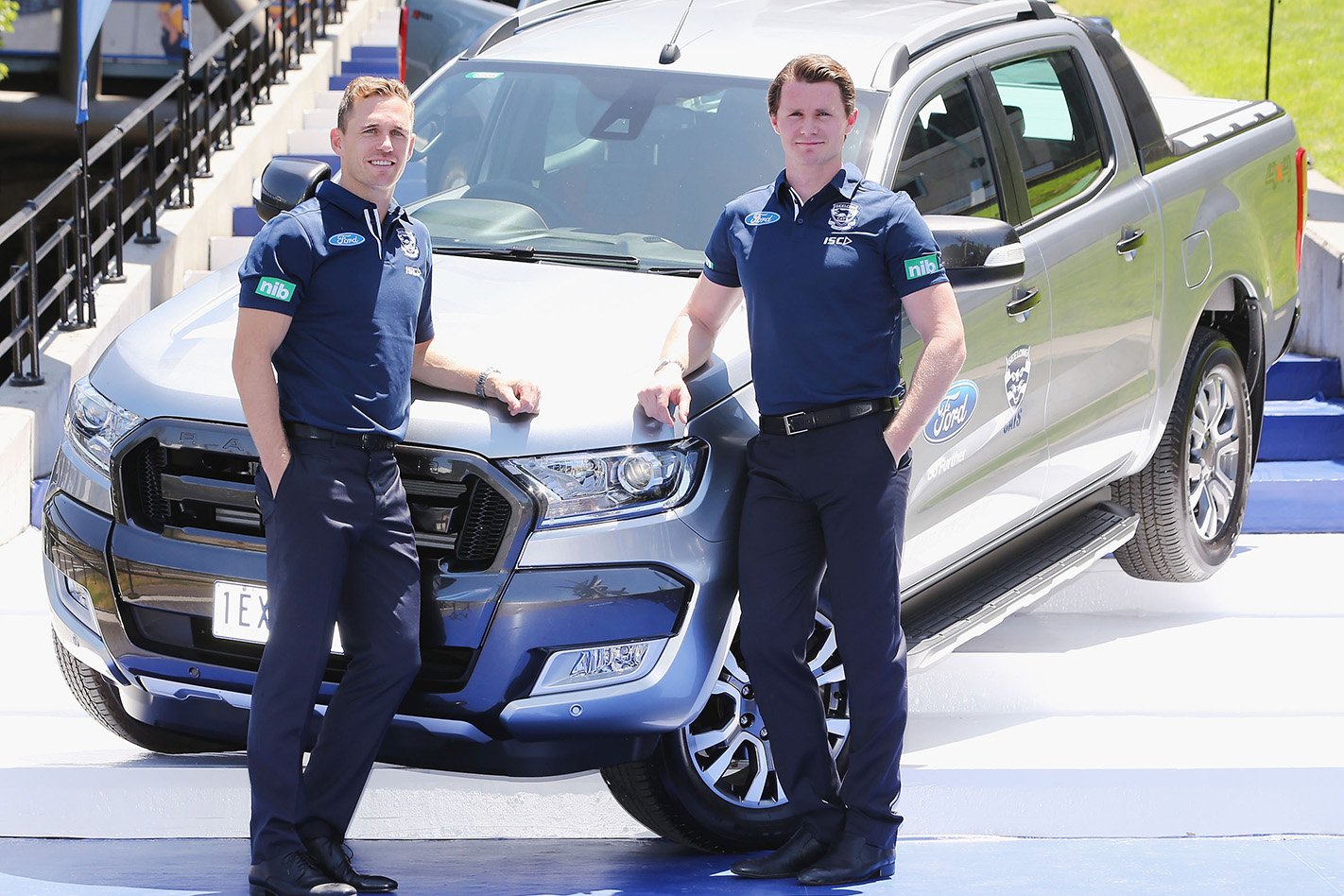
The Adelaide Crows have enjoyed Toyota sponsorship since joining the AFL in 1991 and for a time a marketing campaign saw the side called the Camry Crows. This season was the 21st year that North Melbourne jumpers featured the Mazda logo.
Other car companies involved as major or key sponsors with AFL clubs during the 2019 season include:
- Jaguar – Melbourne
- Holden – Collingwood
- Hyundai – Brisbane and Carlton
- Mercedes-Benz Vans – Western Bulldogs
- Nissan – Hawthorn
- Renault – Port Adelaide
- Volkswagen – Sydney
In a couple of days, someone is set to become the new owner of a barely driven 1997 Honda Integra Type R. Or, as it’s known in the country in which it’s for sale, an Acura Integra Type R.
The DC2-generation Type R has travelled only 9959km, which suggests its one owner either isn’t much a fan of its widely praised driving ability, or they foresaw its status as a future classic.
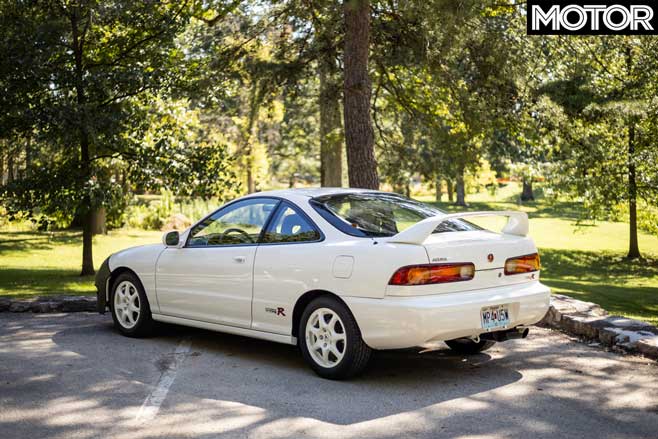
Either way, someone’s willing to put down more than USD$70,000 (Its current bid equates to about AUD$106,000!) in a BringATrailer auction that’s winding down this week.
As just “one of 320 US-market examples built for the model year,” it’s set to break what auction house Barrett-Jackson called a new record in 2018, when it sold a 1200-mile example for USD$63,800. That’s 1930km and roughly AUD$94,500 to us.
According to the BaT listing, this Integra in white (the only colour available to the US) is sporting “a new timing belt, tensioner, and water pump,” with the car “offered for sale with its original window sticker, maintenance records, factory manuals, period literature, a clean Carfax report, and a clean Missouri title in the seller’s name.”
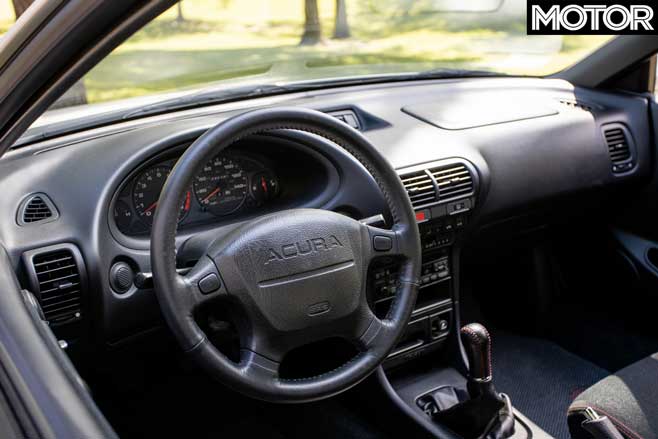
Of course, time catches up with most cars eventually, and this one isn’t perfect. The listing says the “seller notes scratches on the rear bumper.” The front, however, seems to be protected most of the time by a black wrap-around cover.
With the auction due to end in two days from time of publication, chances are bids for this Type R will continue to roll in.
Truth is, the facts around Toyota’s second-generation 86 and Subaru’s BRZ successor are still sketchy.
Japanese title Best Car has speculated that the models will switch to an all-new platform based on Toyota’s latest TNGA architecture, with the 2.0-litre FA20 four-cylinder engine set to be ditched in favour of abigger Subaru-sourced 2.4-litre FA24 flat-four boxer lump, good for around 160kW.
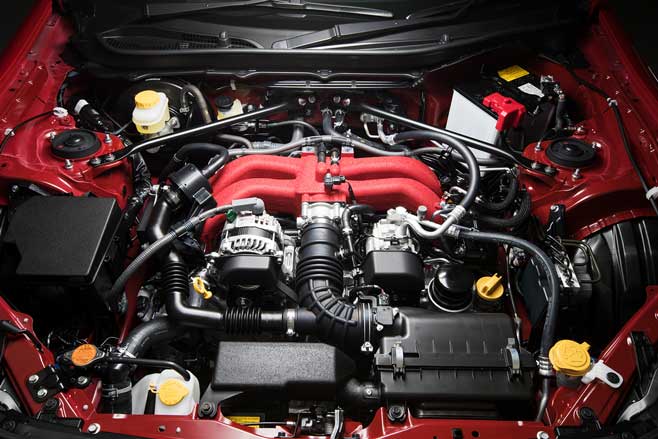
The bad news is that 160kW still isn’t a whole heap of beans. And with the 250kW Supra in Toyota’s line-up, there’s now a definite ceiling on how powerful the 86 can be. Yet in American Subaru products, the FA24 is good for 190kW and 376Nm. That’d be enough to get our attention.
Of course, there’s always a chance that Toyota and Subaru will revisit the whole 86/BRZ template and move on from the naturally aspirated engine. As Porsche has demonstrated with late-shape 911s, the move to turbocharged engines hasn’t done a whole lot to compromise driver engagement.
Whether a manual gearbox will be included is also open to question. Back in 2008 when the 86 was being developed, it was one of Tetsuya Tada’s non-negotiables. But in the first half of 2021? Will the market have moved on to the extent that three pedals and a stick no longer make any sense from a commercial perspective?
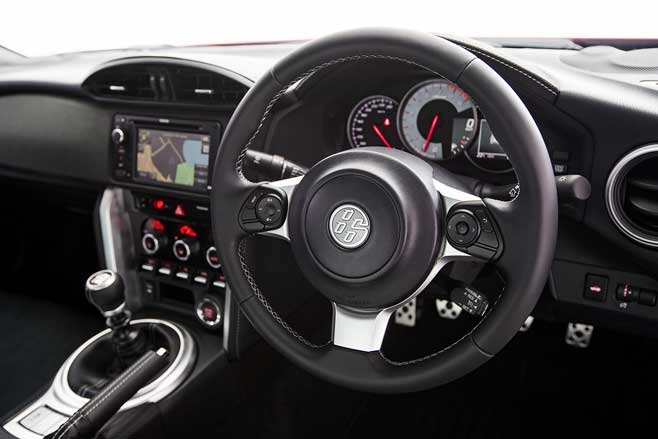
The outgoing 86 saw demand shift towards automatic boxes. When it was launched, 58 percent of buyers wanted to change gear themselves. Nowadays that figure stands at 33 percent globally and the trendline continues to wither. Here in Australia, it still stands at 55 percent for manuals.
I’d still like to see the fundamentals continue. Sales of the 86/BRZ dropped away because the vehicles didn’t seem to have any coherent development strategy. What could have been a franchise that grabbed punters and kept them hooked never played out that way. The BRZ tS with its grippier tyres was about the only dynamic variation and that was a step in the wrong direction. And once Toyota 86 buyers had owned their cars for a couple of years, there was no model for them to graduate to. They were lost to the brand.

That’s changed with the Supra and it’s a vehicle instrumental to the 86’s future. Smart product management would split the 86 into two specific lines: a 150kW entry-level car that developed from the price point and appeal of the outgoing model and a 200kW GR version retailing at around $50K that plugged the gap to the entry level $85K Supra. Those outputs are based on using the FA24 lump. Go turbocharged and there’s considerably more flexibility available to Toyota and Subaru.
So what would you like to see? You’re the customers who Toyota and Subaru need to impress so you’re the ones best positioned to outline your requirements. Hit up the comments and let us – and them – know.
Australia’s discussion about road safety is singular in its tone. Across the nation state governments and police forces are working on a plan dubbed Toward Zero – with the goal of reducing the number of deaths on our roads to nil.
Admirable, though improbably difficult, as it may be, Toward Zero’s focus on deaths is taking focus away from a worrying trend that is emerging. More Australians are being injured on our roads every year, and a significant portion of those pose a ‘high threat to life’.
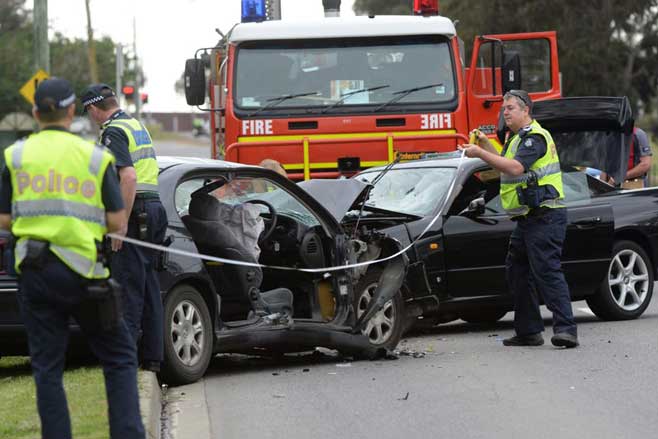
In Victoria alone, between 2013 and 2019, hospitalisations from a result of traffic crashes have risen 38 percent. In the same period the road toll fell 12.3 percent.
According to the latest annual road trauma statistical summary, released by the federal Department of Infrastructure, Transport, Cities and Regional Development, injuries on the road have risen nationally for the last decade, while fatalities have fallen in the same period
It states that in 2016 the rate of hospitalised injuries per 100,000 people was 35 times the fatality rate. Traffic crashes are the second highest cause of hospitalisations in Australia, accounting for 12 percent, behind falls (41 percent).
The 38,945 hospitalisations across the country in 2016 represent a nominal increase of 3.6 percent each year since 2015.
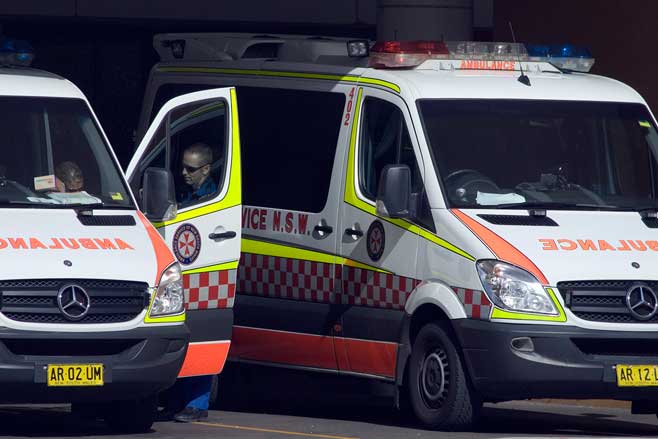
Released last year, the report only has data on hospitalisations up to 2016, and it states this data set is only comparable with 2013 due to a break in records on July 1, 2012.
The TAC keeps a record of both fatalities and hospitalisations in Victoria, with a six-month lag in reporting, meaning 2018 is the last complete year available.
Last year 8636 hospitalisations occurred as a result of traffic incidents, compared to 213 fatalities. In 2013 those numbers were 6252 and 243 respectively.
Interestingly, there’s a disparity in geographic location when comparing deaths and hospitalisations on Australian roads. According to 2018 national road trauma statistics, almost two thirds of road deaths occur in regional and remote areas, while about two thirds of hospitalisations occur in major cities.
While the reason for the rapid rise in hospitalisations is unclear, it could be attributed to the improving safety of modern cars.
A quarter of national hospitalisations from traffic incidents result in ‘high threat to life’ injuries, while in Victoria the number of stays in hospital over 14 days has grown steadily.
The numbers should be a wake-up call for everyone who believe the number of deaths on our road each year is the only measure of success when it comes to measuring driver safety in Australia.
Victorian road fatalities vs hospitalisations (2013-18):
| Year | Fatalities | Hospitalisations |
| 2018 | 213 | 8636 |
| 2017 | 259 | 8471 |
| 2016 | 290 | 7745 |
| 2015 | 252 | 6841 |
| 2014 | 248 | 6459 |
| 2013 | 243 | 6252 |
| 6-year average | 250 | 7400 |
| 6-year increase | -12.3% (-30) | 38.1% (+2384) |
A police officer in Fremont, California almost found himself in a very awkward situation when his Tesla Model S patrol car almost died when in pursuit of an alleged criminal.
The situation was first reported by The Mercury News, with audio of the pursuit being uploaded to YouTube.
“I am down to six miles of battery on the Tesla so I may lose it here in a sec,” Officer Jesse Hartman can be heard saying while in pursuit of a ‘felony vehicle’.
“If someone else is able, can they manoeuvre into the number one spot?,” he asks fellow officers
However, shortly after Hartman’s request for another officer to pick up the lead, the suspect began driving on the shoulder of the highway.
Police then called off the chase, which had lasted roughly eight minutes, for safety reasons.
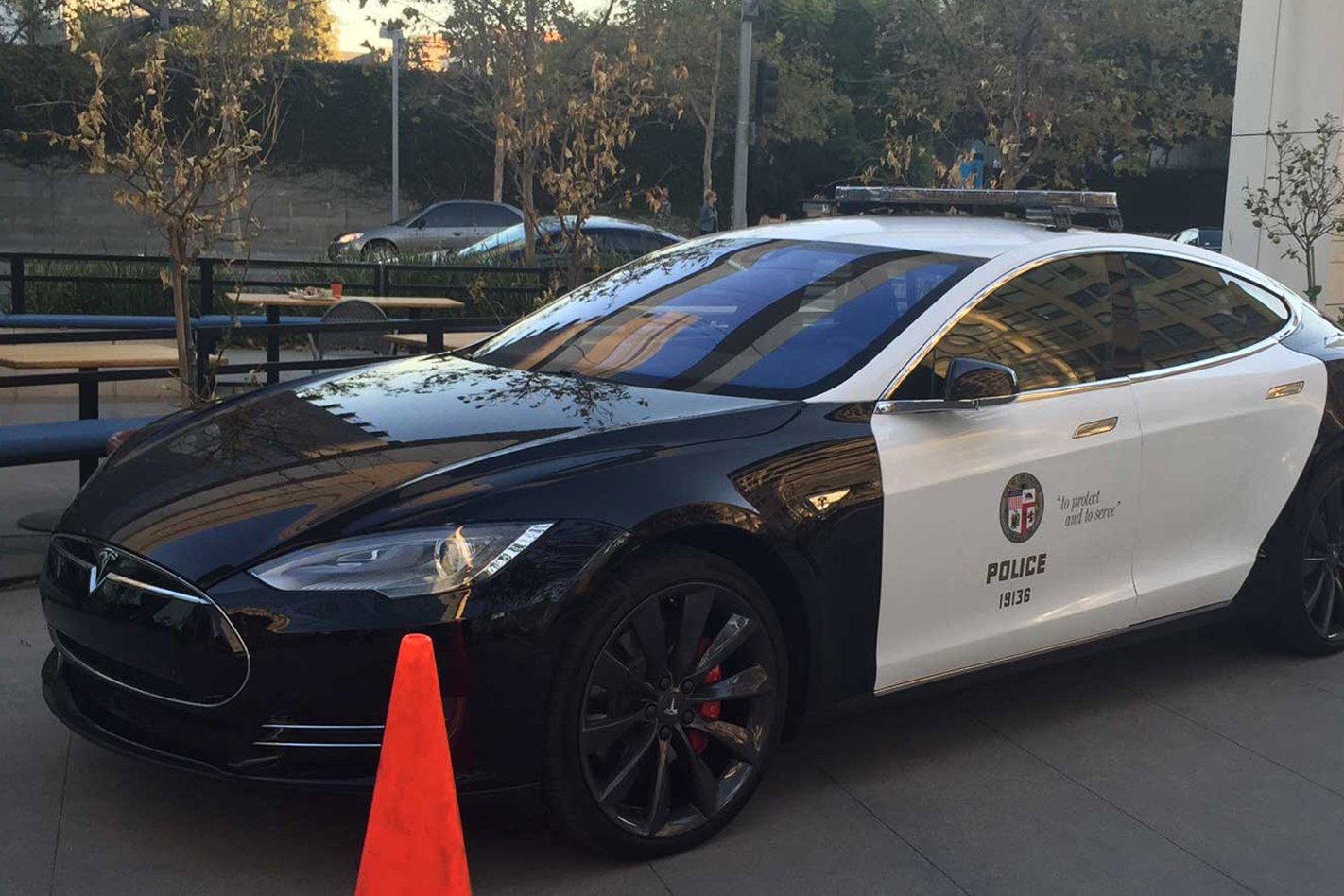
Hartman had to make another stop before he could return to the station.
“I’ve got to try to find a charging station for the Tesla so I can make it back to the city,” Hartman he is heard saying over the radio.
The Model S patrol car was recharged in San Jose, before returning to home base.
Why the low battery you may be wondering? Well, according to Police the Model S wasn’t recharged after the previous shift, meaning the battery level was lower than normal. The fact the Tesla could almost perform two straight 11 hour shifts, is impressive.
The Freemont Police force is using the 2014 Model S patrol cars as part of a pilot program to determine if electric vehicles are suitable for policing duties.
It was purchased for US$61,000 last year, and was modified before being put into use in March 2019. Mercury News reports the purchase price of the Tesla is approximately US$20,000 more than a new Ford Explorer police vehicle, but the department expects to recoup costs in the long run through saving on fuel and maintenance costs.
Fremont Police Captain Sean Washington has previously gone on the record stating he is impressed with how the Tesla has been performing as a cop car, which has been involved in at least one other pursuit, and usually finishes a shift with 40 to 50 percent battery life remaining.
As for the suspect, California Highway Patrol later found the vehicle crashed into some bushes not far from where the chase was called off, with the driver nowhere to be seen.
