
If you reckon those Shell V-Power Mustangs are dominant, think again. Nearly 30 years ago, the Group A racing version of the R32 Nissan GT-R was as close to unbeatable as it gets.
It was so good, so technically advanced, it killed the category. Worldwide, homologation icons like the Ford Sierra Cosworth RS500 and BMW M3 Evo just couldn’t compete against the Japanese all-wheel-drive wonder.
In two years, the car dubbed ‘Godzilla’ – an Aussie sobriquet that went viral globally before the internet era – changed the face of touring car racing forever. No more homologation specials, no more all-singing, all-dancing production-based racers.
Rarely has such a great race car been so vilified. Local fans hated the GT-R and rivals resented it. That enmity resulted in Jim Richards’ immortal line “You’re a bunch of arseholes” to the baying audience as he celebrated his and Mark Skaife’s flood-shortened victory at Bathurst in 1992.
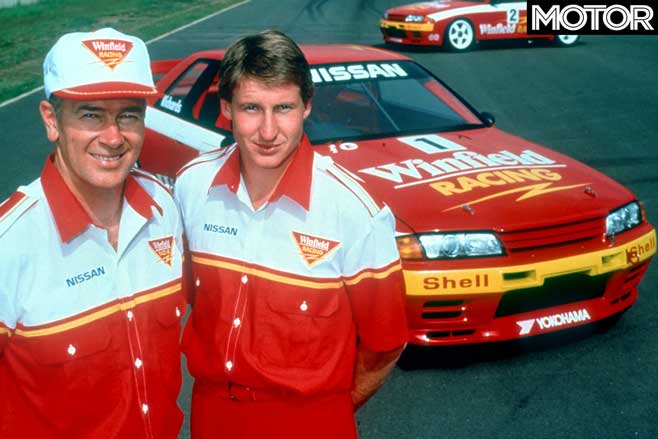
V8 legends Richards and Skaife, guided by acclaimed Nissan team boss Fred Gibson, established the GT-R in Australian motor racing folklore – and infamy – by overwhelming the opposition in ’91/92. Ford folk hero Dick Johnson and his Sierras, the factory backed BMWs and Holden’s game Group A Commodore were eaten alive by Godzilla. But, contrary to popular opinion, the GT-R was a monster to drive.
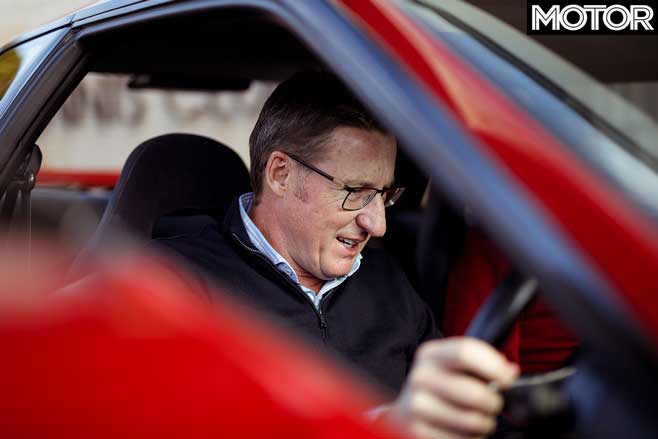
Alongside the racing program, Nissan Australia – in the final throes of its 25-odd years as a local manufacturer – ADRed the R32 GT-R for limited sale here. At $110,000 – an extraordinary amount back then – the 100 cars proved very slow to move.
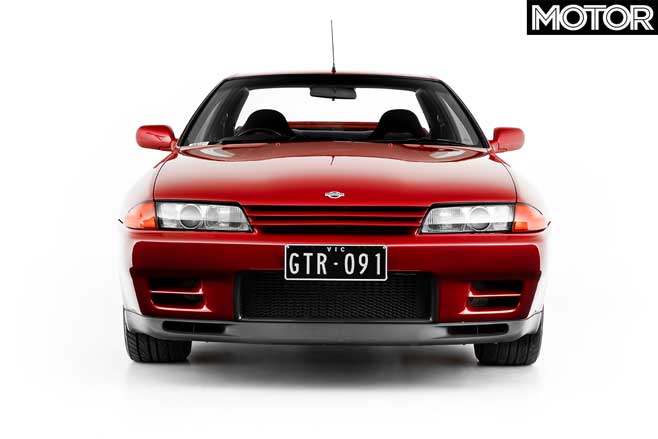
Now, of course, Aussie R32s are gold. Nissan Australia recently bought back this red example and it was driven, nostalgically, by Skaife as part of our reminiscence.
We’ve gathered Skaife, Gibson and former Nissan Oz product planning, design and Special Vehicles boss Paul Beranger at Kooyong Lawn Tennis Club in Melbourne to recount the Godzilla racing tale.
Two things to remember. Introduced in mid-1991, Nissan Australia’s new halo car was a Skyline GT-R. And the Skyline sedan had been the company’s locally made six-cylinder Commodore/Falcon fighter until 1988.
Aside from the Skyline tag, they were unrelated. But the more closely aligned DR30 Skyline RS and HR31 Skyline GTS-R had carried the Nissan flag in Australian Group A from 1986-90. The R32 GT-R took over late in the ’90 season, helping Richards win Nissan’s first Australian Touring Car Championship.
He won the title again in ’91 before Skaife ascended in ’92, with their GT-R monstering Mount Panorama in both years to finally end the Nissan Bathurst quest that had begun in 1981 with the fast but fragile Group C Bluebird Turbo.
How the R32 Skyline GT-R road car got to Australia has been covered previously in MOTOR’s special 50th-anniversary “GT-R Week” celebration. It was an attempt to directly link the early ’90s racing program with a model actually sold here. All very tenuous and, as it turned out, horrendously expensive exercises for both the road and race versions.
For the racing R32, the Gibson squad had to make a lot of changes to make it competitive locally and contain costs, despite generous factory backing.
“You have to remember that our touring car category in Australia was very competitive, and the thing is, a Japanese-spec race car wouldn’t win here,” Gibson says. “It wouldn’t be quick enough against the Ford Sierras and Holden Commodores. So we had to homologate the parts on it that we wanted on the car with the FIA through CAMS to make the race car a better car, and that took a lot of work.”
Adds Beranger: “Nismo in Japan wasn’t too impressed when we told them we needed to change their pride and joy.”
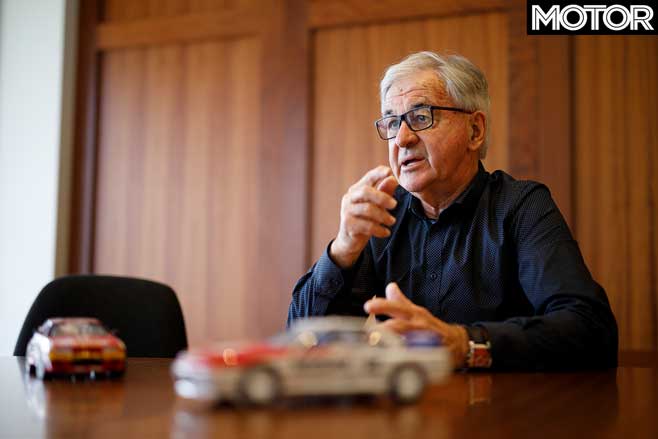
However, Nismo quickly came on board to help the upstart Aussies get the best out of the Godzilla racer.
“It was a very complex car and the Japanese offered us support to do it, and from the very beginning we had Japanese engineers in Australia,” Beranger says. “And clearly their job was not only to help, but to report back. And, therefore, I believe they were continually explaining to Japan what we were doing.
“Japan wasn’t negative about it – they were offering suggestions – but I think at the same time they became aware and realistic that what we were doing was probably in advance of what they were doing.
Part of the problem was that in Japan they didn’t really have to develop the car because they controlled the formula. The more they developed, the more they had to spend, whereas we had to keep developing, and at every race the car changed. The Japanese were aware of that.”
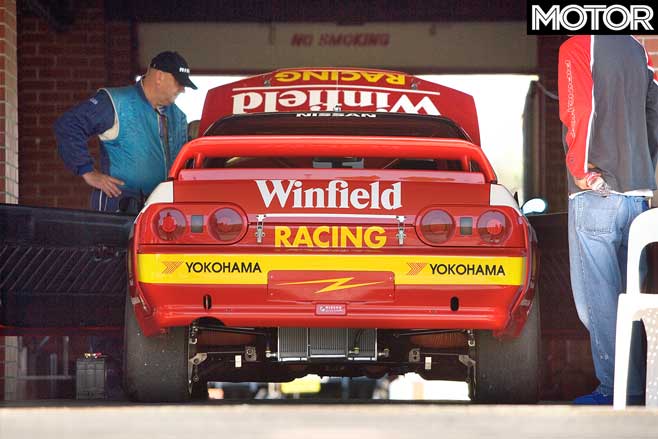
The Aussie overhaul of the R32 racer was comprehensive, as Gibson explains: “Suspension, wheels, gearbox, clutch, engine… Like cylinder blocks, for example.
“We put an engine on the dyno and cracked the block because of the extra power we were trying to get out of it with a different engine management system. So they had to make special blocks for us. They were good at doing that, but it took time – and money. A lot of money.
“A part of going local was to save money because the Japanese parts were just silly money.
“A competition water pump from Japan was about $15,000 and all they did was change the impeller on it, which we could do here and use the normal water pump. A dog box gearbox was $60,000.
“Nismo were there to make money, whether we were Nissan or not. They still charged an arm and a leg. So we went away from using Nismo stuff.
“The wheels, the suspension, the gearbox were all local. They made the cylinder blocks, but the Electromotive engine management system was done for us in America. We did it all ourselves, which was still very expensive, but not as expensive as getting all the bits from Japan.
“Our budget was huge. We were very fortunate to have good sponsors as well as Nissan Australia.”
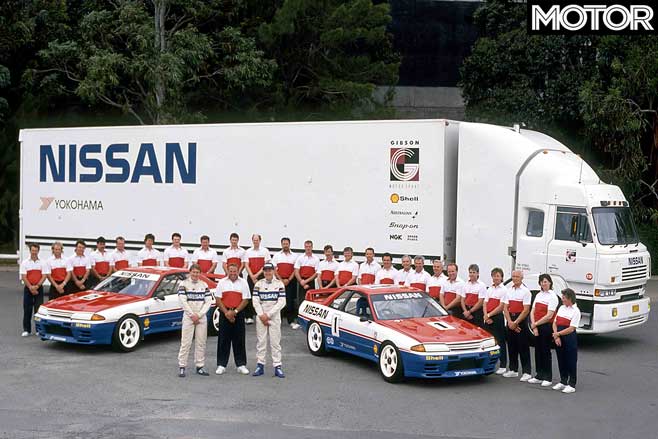
Beranger: “We had no alternative (than to do local development) because we would’ve gone broke quicker if we hadn’t done that. And that caused some angst between us and the Japanese. The Japanese (management) in Australia wanted to know why we weren’t using NISMO parts. We had to show them actual receipts to prove the big difference in cost.
“The problem was that Nismo owned the Group A series in Japan. All the cars were raced with Nismo parts, so it was a closed shop, whereas in Australia, we’d never looked at it that way. We’d always had Fred to do what we needed to.”
By 1992, even Nissan Australia was baulking at the cost and Winfield came on board as sponsor, boosting the factory’s $1 million contribution to a $4 million annual budget. More than a quarter of a century later, that’s a figure most Supercars teams would envy.
“We were struggling when we first did GT-R because we didn’t have enough money to do the job properly,” Gibson reveals. “We were lucky to have cigarette money come along because it was a very expensive car to run.”
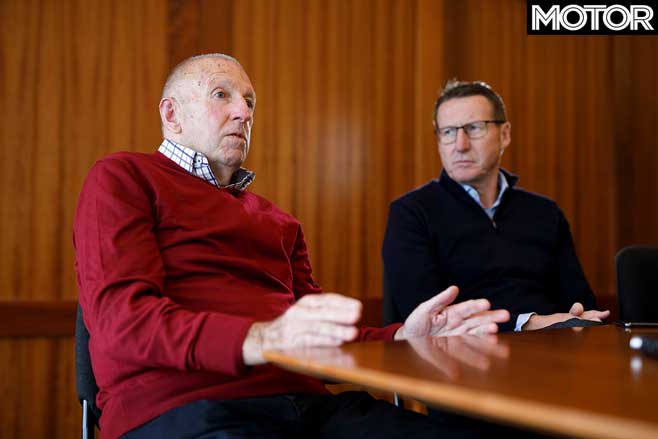
Initially, Gibson was enthused by the on-paper specifications of the forthcoming Group A R32.
“When Paul first told me we were going to have a twin-turbo six-cylinder Skyline, I thought ‘Wow, that’s going to be great’. I expected it to be a V6 twin-turbo,” Gibson says.
“When it lobbed with a straight-six twin turbo, it was pretty rare. One of the problems was that the engine was long and hung out over the front subframe, so the car was front-heavy. If it had been a compact V6, it would have been a rocketship.”
Heavy to begin with, Godzilla’s racing weight was increased from 1350kg to 1500kg as CAMS tried – unsuccessfully – to rein in the ATCC-devouring monster. Following intensive development and refinement, the red rockets were producing 650 horsepower (485kW) in race trim – later reduced to 620 – and, with the boost wound up, 700bhp (520kW) for qualifying, with drive to the four wheels controlled by what was then sophisticated computer management.
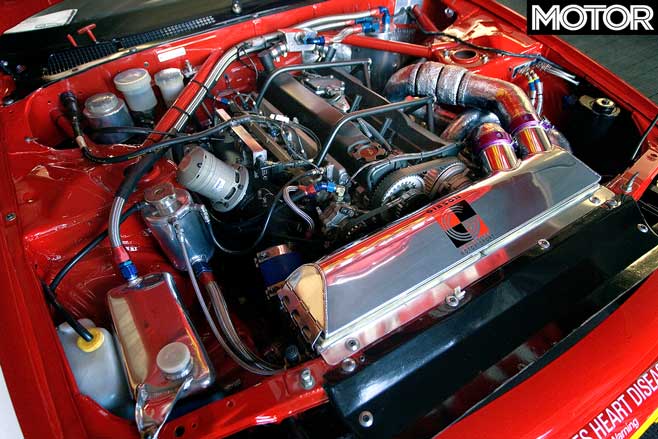
In full flight, both Gibson and Skaife remember that the 2.6-litre twin-turbo straight six “bellowed”.
“It was already a heavy car, but they (CAMS) just kept putting weight on it,” Gibson says, clearly still bitter. “We were handicapped because we built a better mousetrap within the regulations. We did our homologation properly – and that took time and money.
“We became the benchmark for GT-R in the world.”
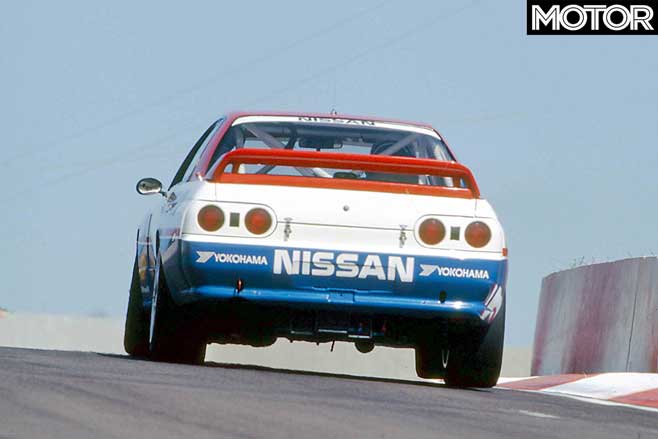
So well developed were the Australian GT-Rs that when Gibson received offers to compete in the Fuji 500 in Japan and the Macau Grand Prix’s Guia touring car race, Nismo vetoed the idea for fear of being upstaged.
Despite the historical myth that the R32 GT-R was unbeatable from the outset, Gibson is adamant it took a lot of intensive local work to capitalise on the car’s inherent advantages.
“It was very unreliable at the start,” Gibson says, shaking his head. “It was a nightmare. A lot of work had to go into the car and we had to develop it. We used a lot of Australian suppliers to help us get it right.”
Godzilla became so dominant that Berganger reveals that even rival teams expressed interest in switching to the four-wheel-drive monster.
“When people realised the GT-R was going to be the gun car, they knocked on our door and wanted to run GT-Rs – until we told them the budget,” he recalls. “Two things killed that (customer cars) – one was the budget required, and the second was that they would have to deal through Fred because Nismo didn’t want to deal with independent teams in Australia. They said they were happy to supply through Gibson Motorsport.
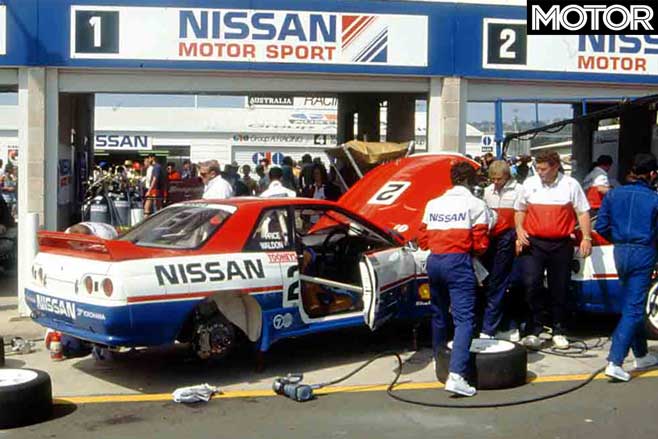
“And, motorsport being what it is, those people always believed they’d get second-rate service because Fred would be the works team and the rest would get hand-me-downs. There wasn’t enough money in it for those team owners plus the development costs.
“Fred was successful, of course, with the GIO car which ran under him, but the rest of the people – and I mean oil company-sponsored teams – actually knocked on my door and asked us if they could be part of GT-R. Ultimately they walked away from it because of the cost of doing it, even compared with a Sierra Cosworth RS500.”
According to Mark Skaife, while the R32 GT-R racer was the class of the field, it still wasn’t easy for he or Richo to extract its full performance once it was fully sorted.
“It was the most technically advanced touring car of the day by a long margin,” Skaife says. “But it was hard to drive. Its outright pace was similar to today’s Supercar, but with a smaller tyre and no aero. I mean, it would have had lift.
“And when it was finally handicapped to 1500 kilograms, it was a big, heavy car with small tyres and no aero. It was a real handful. In the slow stuff the car was obviously great, but in the fast stuff it was wild.
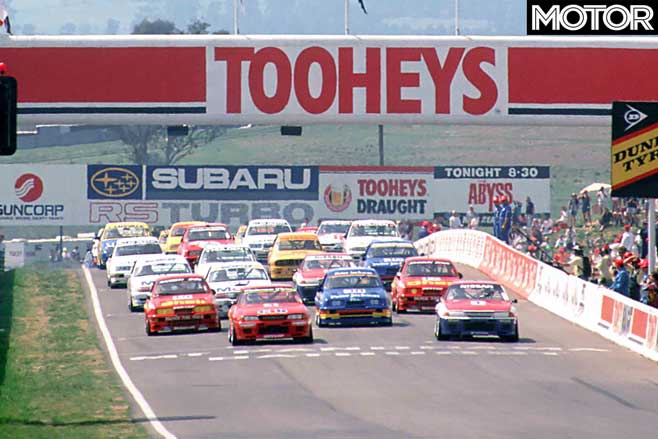
“Its big advantage was in the wet, especially at places like Mallala, Amaroo Park and Winton (tight, twisty tracks).
“When it rained, the thing was just a weapon.”
But even in the wet the GT-R couldn’t defy the laws of physics. Richards was on slicks when he crashed while leading Bathurst in ’92, running out of grip in the flooding downpour and triggering the red flag that stopped the race.
In those days, the result was decided by the positions on the lap before the cancellation, handing victory to Richards and Skaife. The controversial finish enraged the fans, who had been incited by Dick Johnson’s claim that he and John Bowe should have been the winners in their second-placed Sierra because they were still actually running when the race was declared.
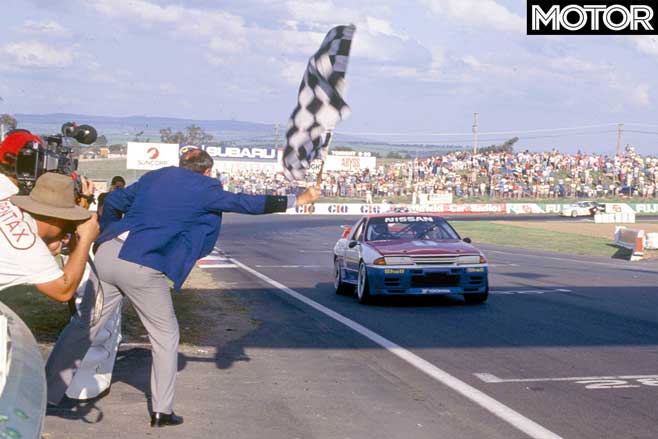
More than a quarter of a century later, Gibson remains defiant, maintaining the race was in the bag regardless.
“Didn’t matter,” he scoffs. “We were going to win anyway. We had the best drivers and the best team, and the car was a good car. Simple as that. But the car was a good car because it was developed within the regulations to be a good car.”
Gibson, who won the 1967 Bathurst 500 in a factory Ford Falcon GT – the first for a V8 – starting the arms race that led to the homologation specials that ruled from the late 1960s through the ’70s, rates the R32 GT-R’s success as the highlight of his team management/ownership career.
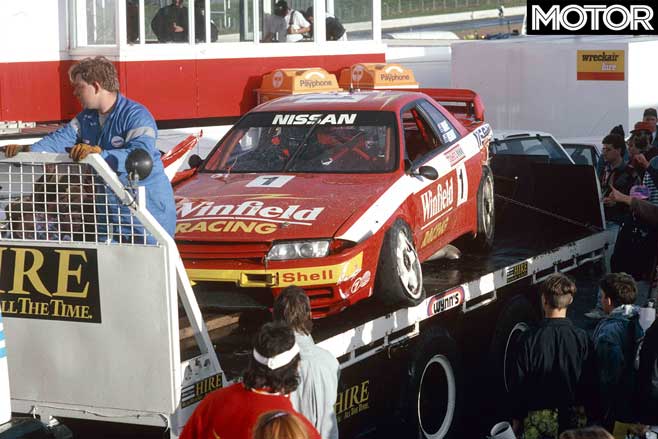
“Oh, for sure,” he says. “Having the people that engineered the car, designed some of the equipment for the car, was very satisfying. We had to do so much in-house ourselves – the engines and the whole thing. The only thing we didn’t do was the (Australian) Holinger gearbox.
“The rest we did ourselves. We got new things cast and I still have all the old drawings for that. All those things we got done to make it a better car were done because we had good people. The people made the difference.”
Gibson went on to again win the ATCC with Skaife in a V8 Commodore in 1994 and also the ’99 Bathurst 1000, before a contentious involvement with a Ford factory team established in 2001 to run Holden defector Craig Lowndes.
Skaife made his name in Godzilla amid great controversy and relates the regulatory crackdown as a cautionary tale for the currently dominant DJR Team Penske Mustang team.
“Roger Penske was talking to me in Perth (in early May) about the recent parity issues (that had been suggested for the Mustang) and I said, ‘Well, in the Gibson Motorsport days, when the GT-R won everything, they changed the rules completely, going back to V8 racing the next year’. So we had to change from Nissan to Holden in just three or four months.
“So I said to Roger, ‘If you take your parity debate right down a road of domination, that’s what happens.’”
Winner of five touring car titles and six Bathurst 1000s, Skaife, who has been heavily aligned with Nissan and Holden in his racing career, also remembers the R32 Skyline GT-R road car fondly.
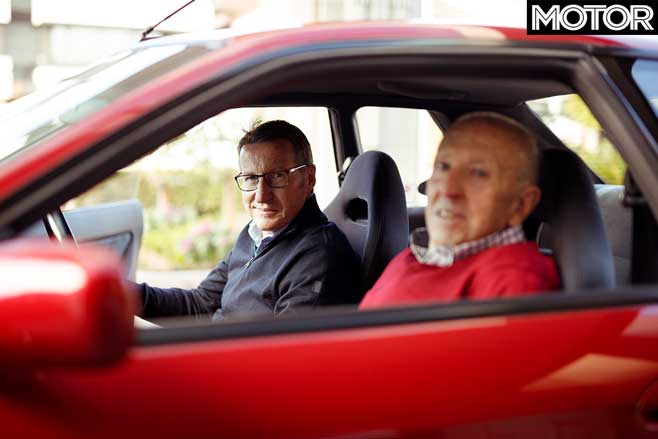
“I had one as a company car,” he says. “Freddie got me a car after I won the (1992) championship and then I ended up buying one. It was just the absolute gun car of the day. They had a really tough road presence about them. I had mine for many years before selling it. Of course, I should have kept it.”
Skaife’s GT-R roadie was a red pearl metallic version – what normal people would call maroon – which is the same hue as Nissan Australia’s original-patina collection car, which we brought along for the interview.
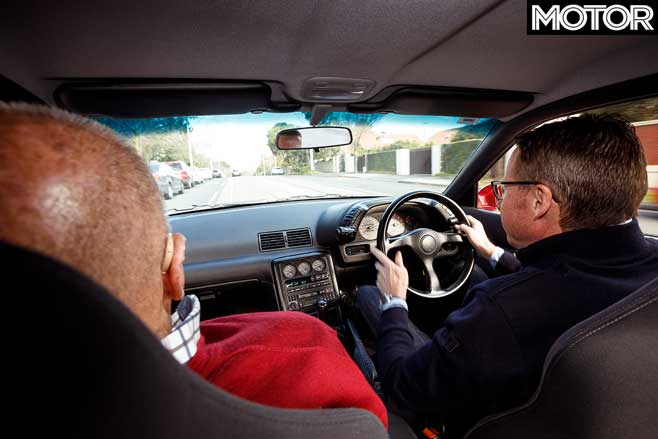
Skaifey took Gibbo for a nostalgic blat around Melbourne’s inner eastern suburbs and came back impressed.
“It’s pretty basic, but very sporty,” he said. “It was like an (E30) M3. It didn’t have all the creature comfort stuff, but it was very high-tech and phenomenally fast.
“The cornering was amazing, especially for the time. It’s still very impressive to drive now.”
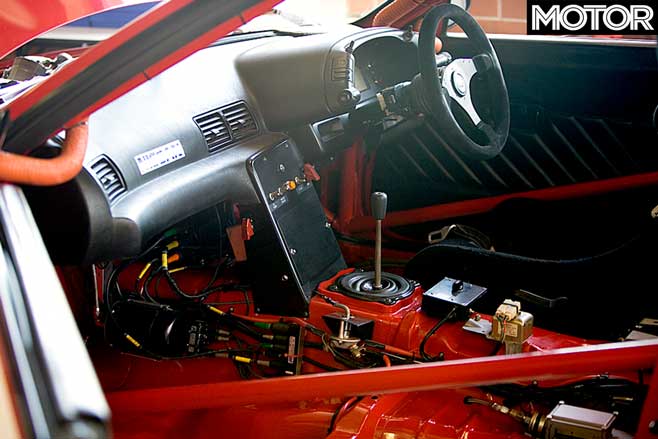
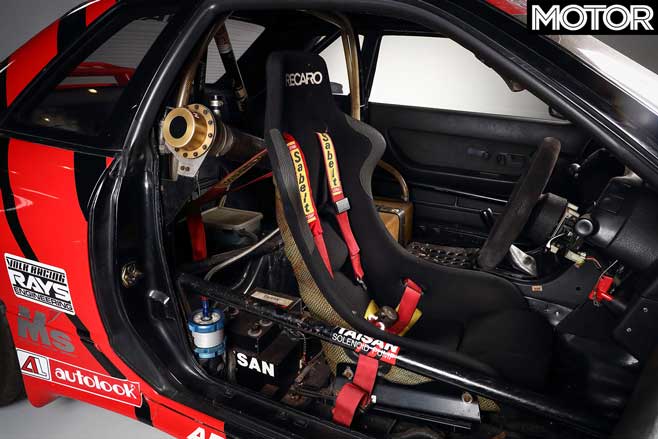
Amazingly, the all-conquering Aussie GT-R race cars were built from stripped road cars rather than bare bodyshells. “We nearly cried when we got the first three cars,” Gibson winces. “They were complete new road cars, and we had to pull them all apart and build them into race cars. All the stuff we had to throw away! We ripped them apart for the bodyshells.”
Gibson, Skaife and Beranger all bury their heads in their hands when they consider how much all those discarded parts would be worth now. The Aussie R32s – including the privateer version used by driver-turned-TV-talker Neil Crompton – all survive with collectors in period liveries.
When Skaife raced in Japan
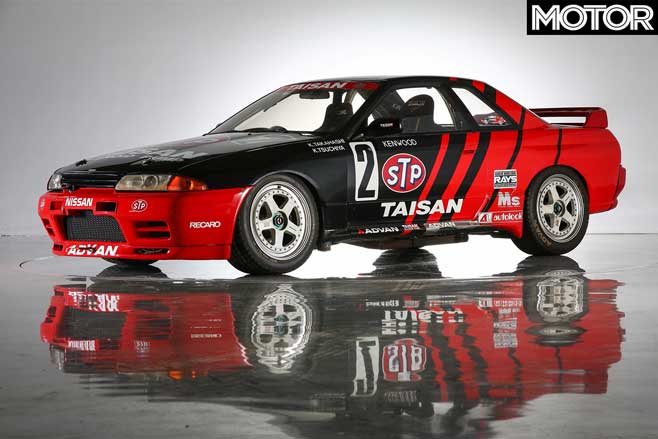
Mark Skaife found out just how good his locally produced Group A R32 GT-R was when he raced a Japanese customer car (pictured) in 1991.
While Gibson Motorsport had been ‘dissuaded’ by Nismo from entering races in Japan and Macau, Skaife secured drives with the semi-factory Taisan team, co-driving with Keiichi Tsuchiya. They finished third in the ’91 Fuji 500, but Skaife failed to finish the Guia classic at Macau.
He recalls that the exercise confirmed the superiority of the Australian-developed GT-R, which deviated so much from the Japanese version.
“It was good for us to go and drive because we actually ended up putting our (Australian Holinger) gearbox in it and a few other things.
“It highlighted just how good our car was in comparison. The difference was massive – (the Japanese car) was just not in the same league.”
So impressed was the Japanese team, it considered buying a Gibson car, but the move was blocked by Nismo.
“That would have shaken the establishment up,” Skaife smiles ruefully.
Australia’s category-killing Godzilla was the ultimate expression of Group A, the last international touring car category to rely on wild homologation special road cars. No four-wheel drive, computer-controlled Ford Sierra Cosworth RS500 or BMW M3 Evo would follow. Group A was replaced by 2.0-litre Super Touring, while Australia went with local V8s.
Sitting on the frozen, broken earth of the Bathurst cemetery, the ticking of the Porsche’s boxer engine slicing the frigid air as it cools, my mind slips back.
Suddenly it’s 1995, I’m eight years old and I’m clinging to my father’s shoulders as he meanders through the crowd at the Toohey’s Bathurst 1000.
Touring car fans jostle us as they pass, the bulge of a promo girl’s butt catches my wide-eyed stare, petrol fumes flare my nostrils. Even the rotting smell of the mud under our feet, comes back, turned to a sticky mess by the morning’s rain.
Then, unexpectedly, dad stops. “Here you go mate,” he says pressing a small white box into my hand. “This is all I can give you, until you can buy your own.”
The box, bought from a track-side stall, is rectangular, with seven silver letters emblazoned across the top: PORSCHE.
Inside nestles a leather key ring, a perfect Porsche logo shining in gold and silver from its centre. It is, at that moment, the most precious thing in the world to me.
It’s rare to be able to pinpoint the exact moment your life changes. But there, in a dirty merchandise tent on Pit Straight, my feet an inch deep in rotting mud, my future was laid out before me.
Suddenly the single idea of driving, and possibly owning, a Porsche was all that mattered.
“I’ll own one Dad, I promise,” I beamed.
Flash forward 10 years and it’s an even colder memory. My ass is wet, my socks covered in frost as the blue and red lights of an ambulance scream past, missing the skinny, half-naked boy.
I flag them down, screaming: “He’s here! Help him!” They’ve come for my Dad, and he won’t be coming back.
Later, huddled together under the hospital’s harsh lights, my family looks like a flock of lost sheep. I can see through the narrow windows of the operating room, and I watch as an army of doctors inject, pump and squeeze. “It’ll be okay,” I whisper. “He’ll be okay.”
Four hours later, in a stark white room, sitting on a hard wooden stool, I find out he won’t be. A faceless doctor comes in and delivers the bad news: “It was an aneurism…”
Suddenly my Porsche key ring doesn’t seem so important.
Cars, I’ve discovered, are much more than simply collections of metal, plastic and wiring. They transport memories. Emotions.
Ones I couldn’t escape when I tagged along on Wheels’ ultimate Porsche comparison. Following the three Porsches in a support car, memories kept invading my mind; snapshots of my Dad. Sock-sliding competitions to the mumbled words of Bruce Springsteen (the only man who could eat a burger and sing at the same time, according to Dad), transforming our old trampoline into a soccer goal, sitting on his knee to steer the family car. The fact we were driving to Bathurst, my old home town, only made the memories sharper.
Then the moment came. I’d been told I was no chance of even sitting in the Porsches, but after telling the tale of my keyring to editor Corby, a set of Boxster S keys flew across the table.
“Go and see your Dad.”
Turning the key and hearing the Boxster’s engine fire, then, was an emotional experience, the fulfilment of a 13-year dream. Driving the topless Boxster through the frozen streets of Bathurst at dawn, I realised cars don’t just transport memories. They create them.
But now, sitting on the frozen earth of my Dad’s grave, none of that matters. Inside I’m still an excited eight-year-old boy, running towards my Dad, yelling at the top of my lungs.
The fact that the keys to this Porsche won’t sit on my treasured keyring doesn’t matter. I don’t think Dad would mind.
Check out our huge Advice section right here!
G’day WhichCar,
Can you help me with an argument I’m having with a friend of mine? He’s in the market for a new car, and he’s convinced that he wants a dual-cab ute.
His argument is that a dual-cab can take five people, can carry stuff from the hardware store or to the tip, and that he can go “to the outback” (his words) if he wanted to.
He also reckons he’ll be able to see traffic more easily, and that the 4WD will be safer for his wife to drive the kids.
He lives pretty close to the centre of Adelaide and works in an office (not a mine or a building site!), and the only time he gets outside is to cook a barbeque, so I reckon he’s a bit mad.
I think he should get something like a decent-sized station wagon or even an SUV (even though I don’t like them personally), because I reckon that a dual-cab ute is not exactly a great city car.
What do you guys reckon?
Cheers
Paul, Glenelg, SA
Hey Paul,
There’s no doubt that the dual-cab ute ticks the boxes of a lot of Aussie new car buyers. If the Toyota HiLux doesn’t top the monthly sales charts, then the Ford Ranger does!
Of course, Australia’s unique love of the dual-cab came about largely thanks to the ability to buy them a little more cheaply if a customer could provide an Australian Business Number (ABN).
Over the ensuing decade or so, the notion of a true dual-purpose work-and-play vehicle has shifted towards something that’s now more a passenger car than a true work truck.
As you point out, people love the idea of having one vehicle that can do everything, and that notion is often blended with the idea that the dual-cab could also facilitate that oft-discussed ‘trip to the Outback.’
In this case, I’m with you – I reckon your mate is barking up to the wrong tree wanting a dual-cab. For one, it sounds like his work commute is relatively short, so he won’t see much in the way of fuel economy gains by using a heavy diesel-powered ute.
As well, modern dual-cab utes are equipped with diesel particulate filters than need highway speeds to work properly. A short city commute is absolutely the worst scenario for a modern diesel engine to live in.
When it comes to the notion of improved handling because of the 4WD systems generally used in dual-cabs, again he’s a bit downwind of the facts.
Basic physics tell us that a ute’s centre of gravity is much higher than that of a sedan, hatch or wagon, and it’s generally quite narrow in its wheel-track width relative to its height.
That simply means that a dual-cab ute is inherently less stable than, say, a station wagon. Think how easy it is to push over a bookshelf as opposed to a wooden chest, and you get the idea.
As well, the 4WD system onboard the vast majority of utes on sale today is designed specifically for offroad work (the Mitsubishi Triton is a notable exception here), and often isn’t even able to be used on dry, sealed roads.
If the ute doesn’t come with a limited-slip rear diff, the chances of a spin in wet weather is actually higher. Off road-centric tyres and light steering means that there is less grip and less control available to the driver at key moments.
(Bear in mind, I’m speaking in generalities – most modern dual-cabs are now equipped with traction control as a minimum, which helps a lot.)
There is a perceived advantage in being able to see further ahead in traffic thanks to better visibility – but that only comes about because everyone else is also sitting up high in their dual-cabs or SUVs!
For me, another furphy around dual-cab ownership is the notion that you’ll be back and forth to Bunnings every week hauling a load of lumber for a new aviary, or lugging tonnes of dirt to the tip for disposal.
Sure, if you’re in the midst of renovations that you’re doing yourself, there may be a kernel of truth there, but really… will you throw a bunch of lumber in the back of your shiny new $50k ute and scratch that paint?
The same goes for the idea of the ‘great escape vehicle’. While it’s an awesome dream we’ve all held at one point or another, the argument simply doesn’t pan out in the vast majority of ownership cases.
Stock dual-cab utes are pretty damn capable these days, but to push over into something that’s capable of conquering Birdsville’s Big Red, more investment in tyres, snorkels, recovery gear and the like is needed – and these add-ons aren’t ideal for city dwellers.
Big off-road tyres, for example, are noisy and grip-compromised on the road, while bolt-on accessories are easy targets for thieves.
What we are overlooking here, though, is that your mate sees himself in a dual-cab, and while we can suggest all we like that he’d be better off in a Toyota Kluger or even a nice Holden Commodore Sportwagon, the argument will probably fall on deaf ears.
By all means, point out the potential pitfalls of dual-cab ute ownership, but don’t be surprised to see him rolling up your driveway in one if that’s what his heart truly desires.
It’s not often kids make the news on the motoring scene, but this week we marvelled at the talents of two incredible young people including an eight-year-old German boy nicked for caught speeding in his Mum’s Volkswagen Golf – the very same we wrote about last week!
The kid might have been able to avoid police if he was using the WAZE navigation app, but according to one Aussie state police minister, that could be illegal too.

We were also in awe of this Aussie youth who pretended to be hit by a car – his insipid performance just might have been believable if the car wasn’t stationary and equipped with a dash-cam. The video is quite amusing but, it’s an example of how the affordable technology is helping fight the growing number of insurance scams.
Sport was also front-and-centre this week, with baseball gloves inspiring a new airbag design, and Nissan revealing a new golf ball that makes putting yips a thing of the past. We also looked at how you can race some of the world’s best professional drivers without getting off your couch.

On a sad note, the father of supercars including the iconic Porsche 917 racer and Bugatti Veyron, and former Volkswagen Group chairman, Ferdinand Piech (above) died at the age of 82. Piech leaves an incredible legacy and is a strong link to a surprising story that SUVs are helping to secure the future of supercars.
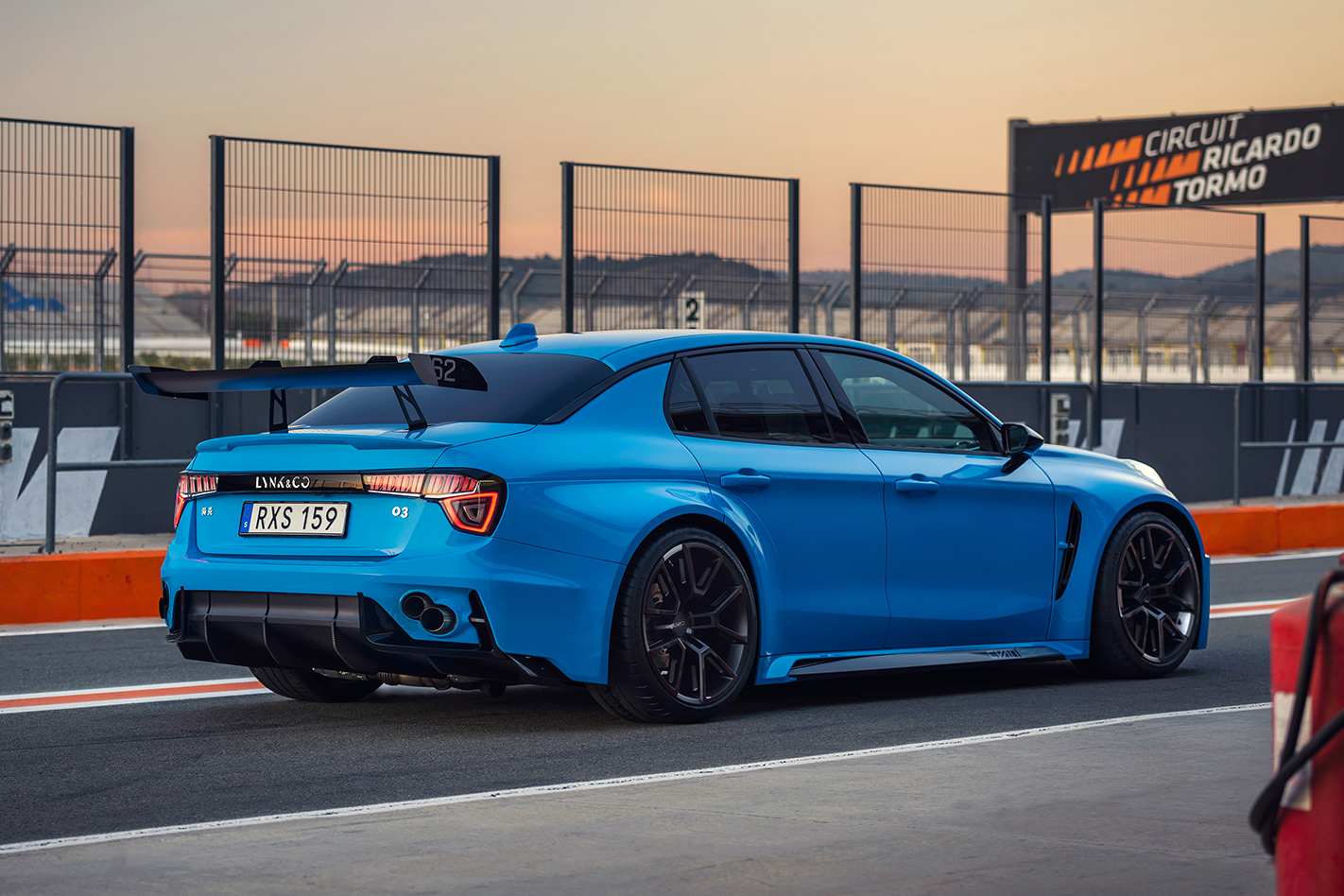
Indeed it was a big week for local performance enthusiasts, with news that GM is working on the most powerful engine to be shoehorned into a car with a Holden badge, and an unknown car company is in line to become Australia’s next performance hero.
Meanwhile, Ferrari launched its F8 Tributo at a glittering event in Sydney however, it wasn’t all good news for the Prancing Horse this week, with more than 200 of its cars sold here since 2017 recalled due to a fire risk.
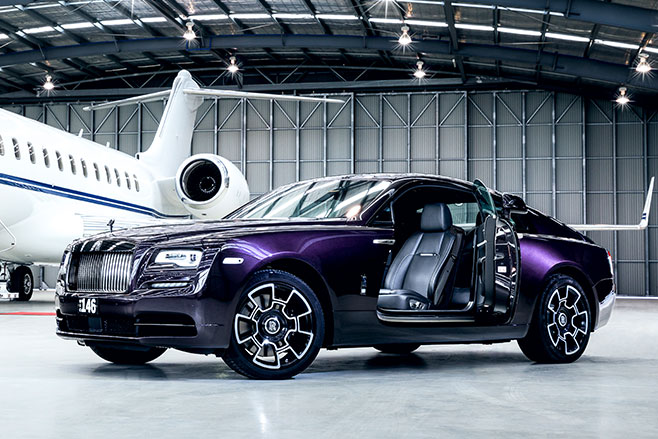
Speaking of big bucks, we reviewed the near-million-dollar Rolls Royce Wraith Black Badge because, well, someone had to.
Back in the muggle world, Peugeot confirmed its stunning 508 wagon will be joining the sedan version in Australia, Toyota dropped its thirsty V8 petrol LandCruiser, Mitsubishi updated its enduringly popular Outlander medium SUV, and we donned the fluro vests to review the Mitsubishi Triton GLX+ club cab, and all-new Toyota Hiace SLWB diesel van.
Oh, we also uploaded another Wednesday Hump Day Quiz, so test your knowledge if you haven’t already. Until next Friday, keep an eye on WhichCar – the best source of car information, entertainment and advice.
The history of godzilla mirrors the history of Godzilla – the Nissan Skyline GT-R.
The earliest incarnation of Godzilla emerged from the Japanese Skyline a decade after the earliest incarnation of Godzilla stomped all over the Japanese skyline. Both were distillations of twin Japanese passions – science fiction and science fact.
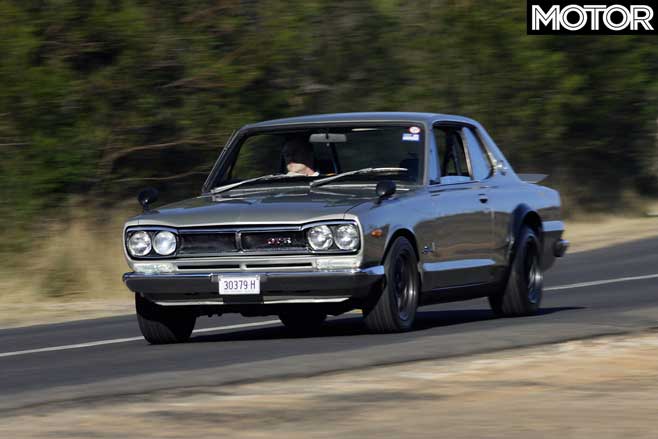
One Godzilla was a post-WW2 mutant that would go on to become a legend, the other a post-WW2 mutant that would go on to become a legend. And back then, neither was even called Godzilla, but the evolution into the king of the monsters had begun.
Those early Godzillas were sophisticated for their day, and still possess a retro-futuristic coolness that turns heads today. But they have aboutas much in common with the Godzilla we know today as a 300-metre CGI megafauna has in common with a man in a rubber suit kicking over cardboard buildings.
The Godzilla that made the rest of the world sit up and scream in terror came decades later, when technology finally caught up to its creators’ ambitions. In 1989, Godzilla shocked motoring critics with its brutal speed, driven by astonishing new technology, and enraged onlookers – or a pack of arseholes, depending on who you ask – in Bathurst, who were somehow affronted that the fastest car should win. And in 1998, Godzilla shocked movie critics with its brutal unrelenting boneheadedness, driven by astonishing new CGI.
Both Godzillas were at the technological cutting edge of their time, and shifted the whole game downfield when the rest of the world realised how far behind they really were. But what we didn’t know at the time was that Godzilla was also at the cutting edge of another modern trend: the reboot.
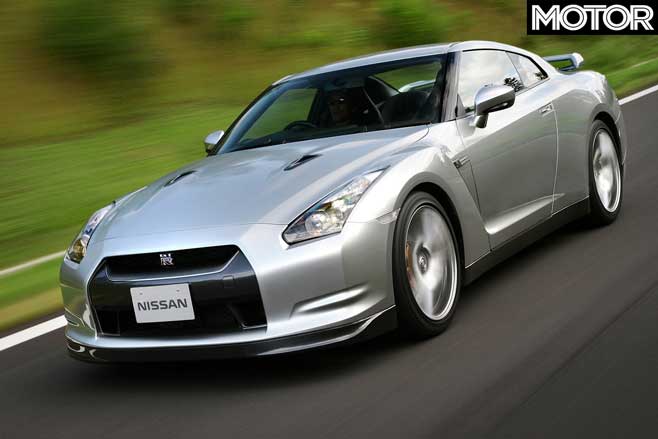
Think back, back into the mists of time, way back into the distant memories of 2007. The first generation iPhone was released. YouTube was only a year old. Facebook had only just become open to the general public. And the R35 GT-R was unveiled, a demented sci-fi hypermobile that blew minds with its face-melting high-tech all-paw performance.
Nissan was the king of the world. Who knew what technological wizardry they were going to come up with next? We all waited agog for the next magic trick to emerge from behind the Nismo curtain. Turns out it was… the R35 again, with slightly different stuff attached.
Then the R35 again, with other different stuff. Then the R35 again, and now – the R35 again.
It feels a bit like the planning meetings in the backrooms of Legendary Pictures. “We did Batman, right? Then Godzilla. Those were great. Next up, Batman again. Then Godzilla again. Then another Godzilla, then another Batman, then Godzilla – can we do Godzilla versus Batman? Get the lawyers on the phone, ask if Batman can fight Godzilla.”
Now both Godzillas are being rebooted again, one fighting King Kong, the other with new turbochargers and a carbon fibre roof. And of course it’s amazing. It’s amazing because it was always amazing, and the Nismo wonks have spread a little extra amazing on top, like adding chocolate icing to a larger bowl of chocolate icing.
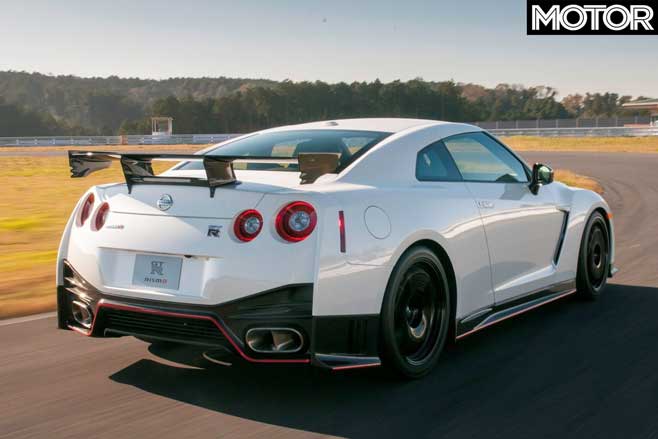
But it’s the same amazing. And call me spoiled, but it feels a little bit like a shelf full of Readers Digests in the age of Twitter. It might be great stuff, but it’s not new great stuff. And after 12 long years, even the sharpest katana will have lost some of its cutting edge.
Sure, the venerable beast has shed some weight, about on par with Matt Preston wearing a thinner cravat. And the engineers have tweaked the old girl to keep her fresh. But 2007 wasn’t about tweaking. That was about the mind-blowing new. I miss that, in this age of endless reboots. The Lion King. The Jungle Book. Ghostbusters. Robocop. Roseanne. Hellboy. Godzilla. And Godzilla, and Godzilla, and Godzilla. It’s time for evolution to make another leap.
The current-gen Renault Megane RS is getting a bad rap. Unfairly.
While most reviewers have become stuck comparing it to the previous, supposedly more engaging Megane, most who buy one won’t care what the last car was like, unless they owned one. We’re sure there will be a few trading in for the newer model.
And, pardon my French, but: c’est très bien.
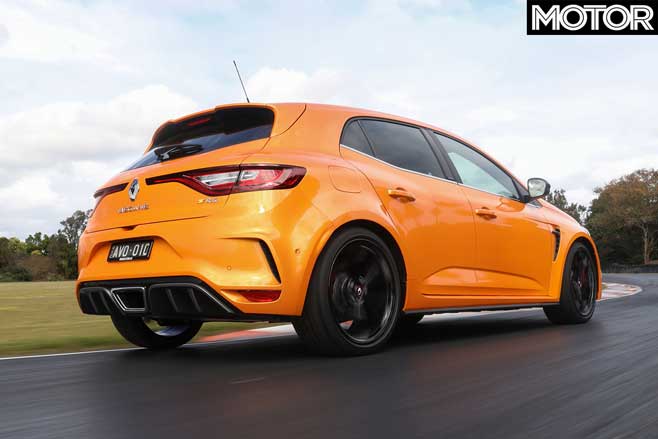
There’s something to be said for its styling alone, which is elegantly aggressive. Pumped guards and relatively subtle ‘sporting’ features like vents behind the wheel arches and a rather deep-looking diffuser.
Inside, unfortunately, it’s a different story. The materials feel a little cheap and the layout of the centre console is frustrating – the touch-screen infotainment feels like using a 10-year-old iPad that’s given up years ago, and the cruise control function sits near your left elbow. But we’re not going to analyse the interior and styling too much, given it’s essentially the same as Megane RS280 models we’ve already driven.
This is the first time we’ve been able to get our hand on a Cup chassis car with Renault’s 6-speed dual-clutch (called EDC). Originally, it wasn’t to be offered here, but Renault Australia changed its mind.
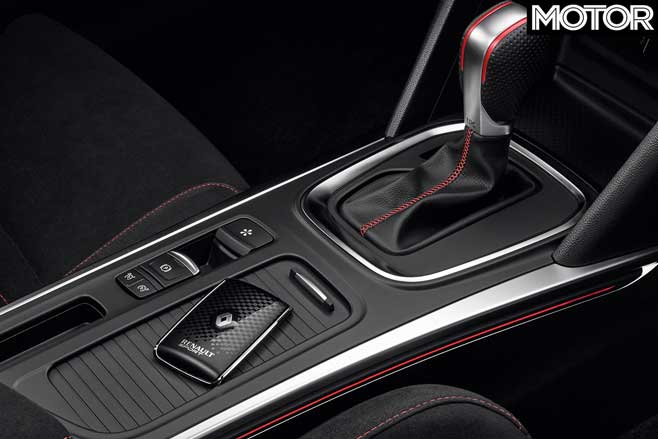
And we’re glad it did. Given the choice, it’s manual every time for this reviewer, but one exception to that is the current Megane RS. The EDC is snappy, characterful, and remains smooth enough out of Sport mode to be decent on a commute. The manual has an odd clutch take-up and its shifter feels somehow both numb and notchy.
This means that on a winding road, I’d rather be tapping a paddle back than rowing though the gears – but only in the Megane RS.
Luckily, if you like to be kept busy, the Megane has other tricks to keep you entertained.
Its ‘4Control’ all-wheel steering is a divisive aspect of the car within the MOTOR office, but if you like your cornering sharp, then you’d likely be on Team 4Control. Its Bridgestone Potenza S001 tyres (wrapped around 19-inch wheels and 7.5-inches wide all ‘round) do a fine job of keeping the car on course, too, though it’ll become more playful the harder you push, and in the wet it requires very gentle pushing.
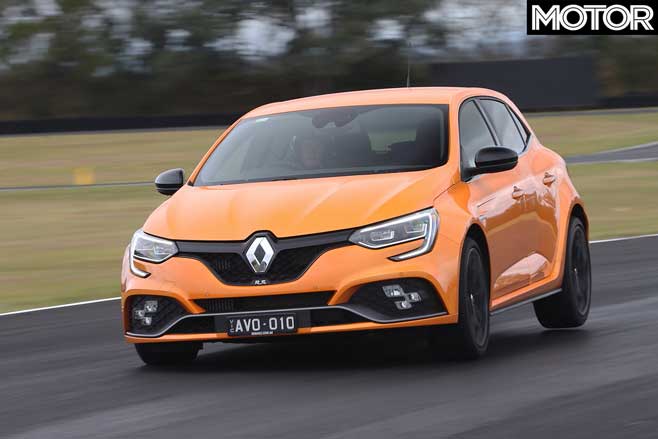
It’s because of the 205kW and 390Nm hiding under the bonnet that you’ve got to chose your right foot moments properly in the wet, as the front wheels will spin (and tramp) from a standstill, and all four paws will sometimes lose traction briefly if you tip it in too hard mid-corner.
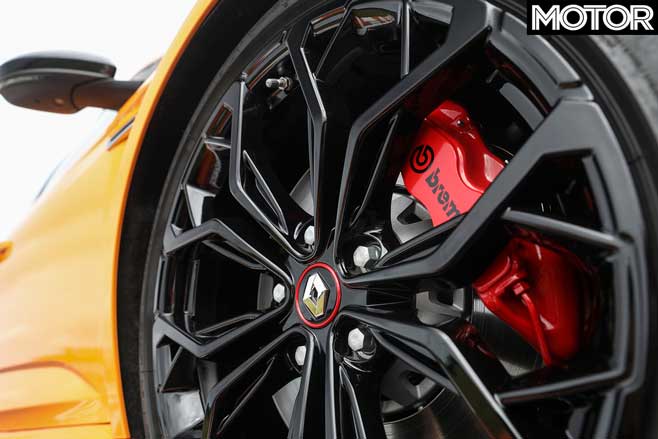
When it’s dry, however, you’ve essentially got free reign to throw it into bends at almost silly speeds, where the rear wheels can carry the rear through for a sharp turn, and a dab on the (progressive, almost sycophantic) Brembo brakes swings it around a little harder if need be. It’s a good lesson in front-driven oversteer and adjustability for sure.
With torque on tap, and the Cup’s mechanichal front diff, it’s also easy to launch out of a corner facing exactly where you’d like to be, usually without need for a sharp wheel movement to straighten out.
Perhaps one of the most overlooked advantages the EDC gets over the manual is the sound, which snaps and burbles on upshifts and overrun respectively. It does occasionally sound ‘manufactured’ from inside the cabin, like it’s trying to replicate intake ‘whoosh,’ but it’s a welcome addition nonetheless.
The same can’t be said about its ride quality on Melbourne’s ‘rough surface ahead’ streets, but we’re leaning towards that being the fault of the roads department rather than of Renault Sport engineers.
If you want a softer chassis, the Sport variant beckons for a little less at $50,490 but missing out on the diff would be a shame. The Cup EDC seems to be the pick of the Megane range, especially if the $70K-ish Trophy-R doesn’t sounds like a bargain.
2019 RENAULT MEGANE RS280 CUP EDC SPECS Engine: 1798cc inline-4, DOHC, 16v, turbo Power: 205kW @ 6000rpm Torque: 390Nm @ 2400-4800rpm Weight: 1450kg 0-100km/h: 5.8sec (claimed) Price: $51,990
Like: EDC more fun than manual; many torques; nimble steering; looks Dislike: Pricey; interior quality and weird quirks; EDC more fun than manual
Rating: 4 out of 5 stars
The Wheels Verdict: The new 3 is a massive step forward for Mazda. Yes, it’s more expensive than before, but given the improvements to the product, the monetary increase feels about right. It seems those back at Mazda HQ have been taking lessons in German.
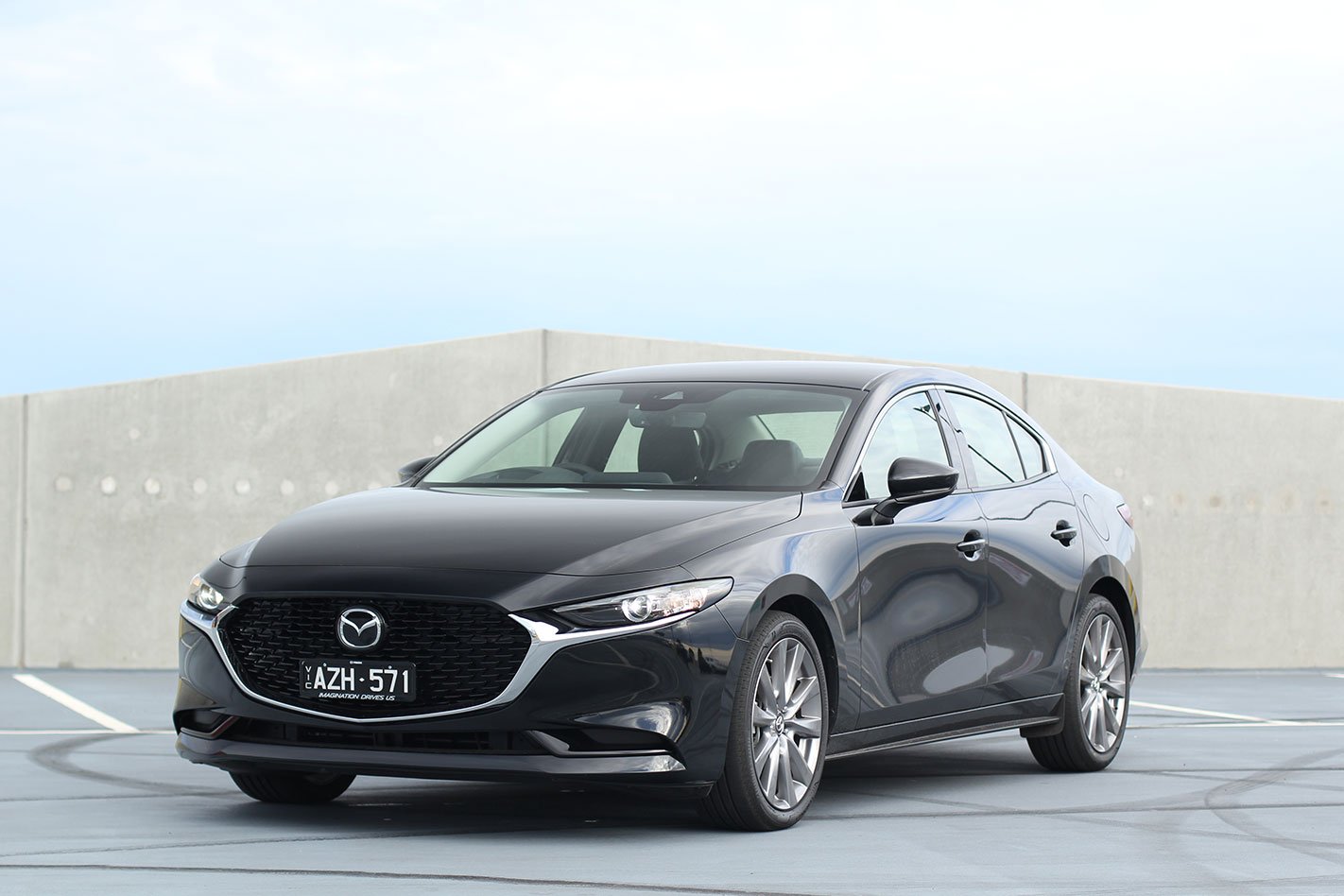
WHAT IS THE MAZDA 3 G25 GT SEDAN?
It’s the booted version of the already proven hatch – and it’s a looker. G25 also signifies the bigger, more powerful 2.5-litre four-cylinder engine. It’s sans forced induction, but generates a healthy 139kW. At $34,490 the G25 GT isn’t cheap, but it comes packed with standard features.
WHY WE’RE TESTING IT
While the market for small, front-wheel drive sedans with sporting pretence is relatively modest, the GT straddles the line between performance and affordability. We were yet to test this specific variant, but with the 3 being a volume seller down under, we thought we’d better give this niche models the once-over.
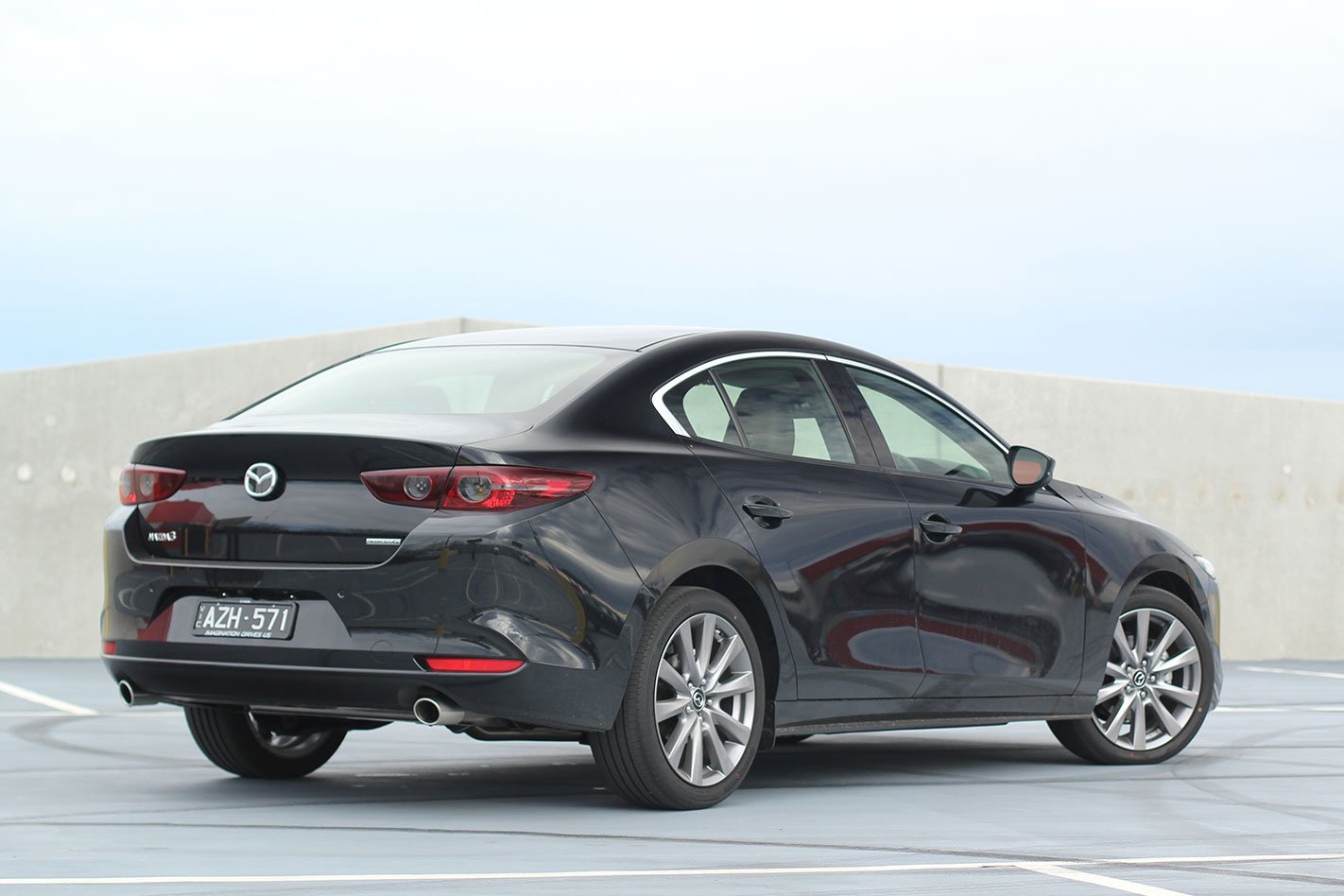
MAZDA 3 G25 GT SEDAN REVIEW
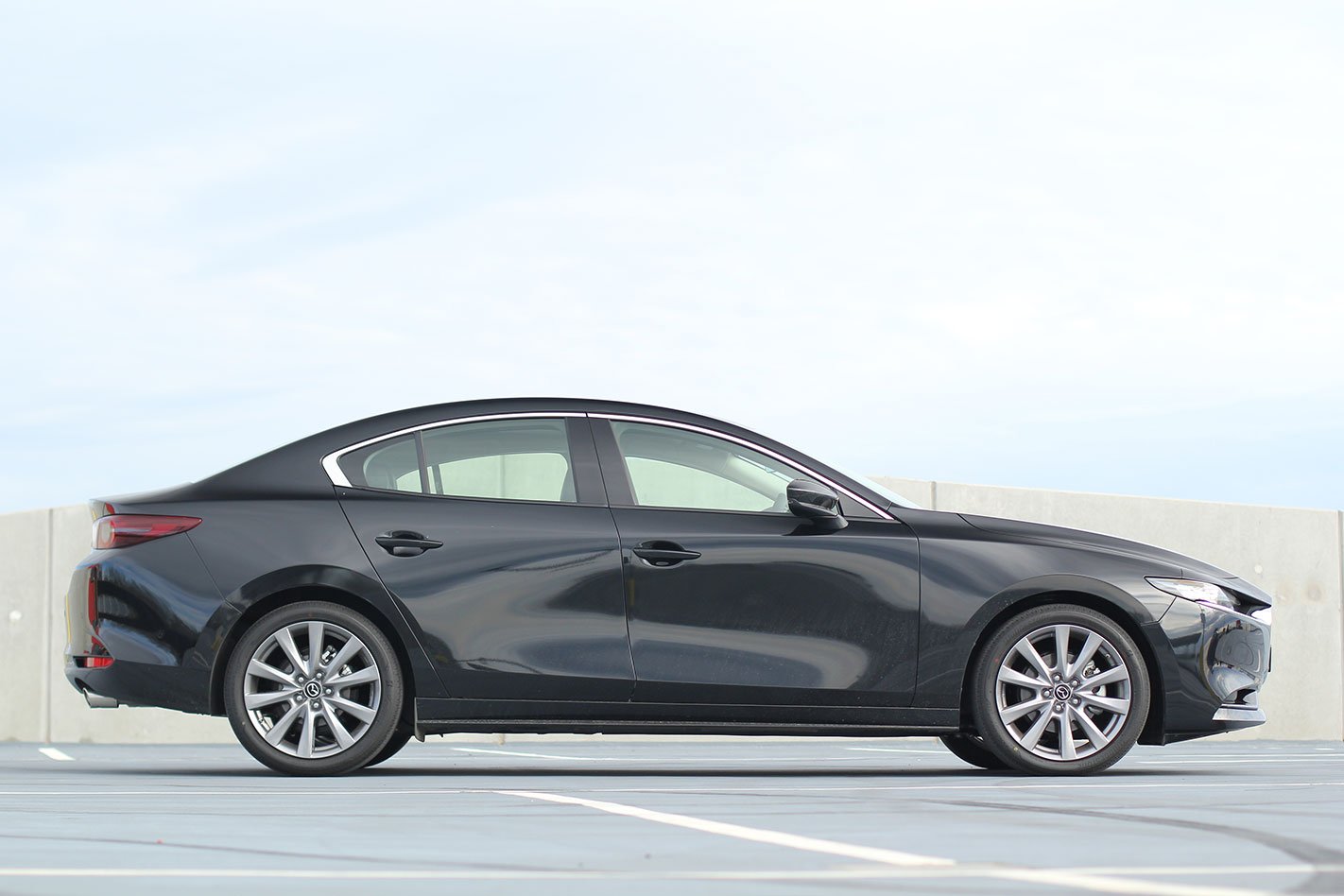
Sedans are often the ugly ducklings compared to their hatch and wagon siblings. However, that’s not the case with the new Mazda 3. The upmarket styling cues suit the sedan; so much so that it looks every bit a mini-me Mazda 6 and embodies the Japanese marque’s luxury push.
Slide inside and this philosophy is immediately apparent. Forget cheap plastics and antiquated graphics. The G25 GT is bang-on in terms of quality and modern design – it’s as if those behind the scenes have been sneaking a look at Audi’s homework. The soft-touch dash, handsome screens and tactile controls that ooze premium finesse combine to create a near-premium ambience.
The G25 GT is stacked with kit. It scores i-Activsense safety tech which includes AEB, lane-keep assist, lane-departure warning, traffic-sign recognition and forward collision warning. The 8.8-inch display supports smartphone mirroring with Apple CarPlay and Android Auto, while the GT also comes with heated seats and steering wheel. There’s also leather upholstery, a head-up display and a 12-speaker Bose sound system.
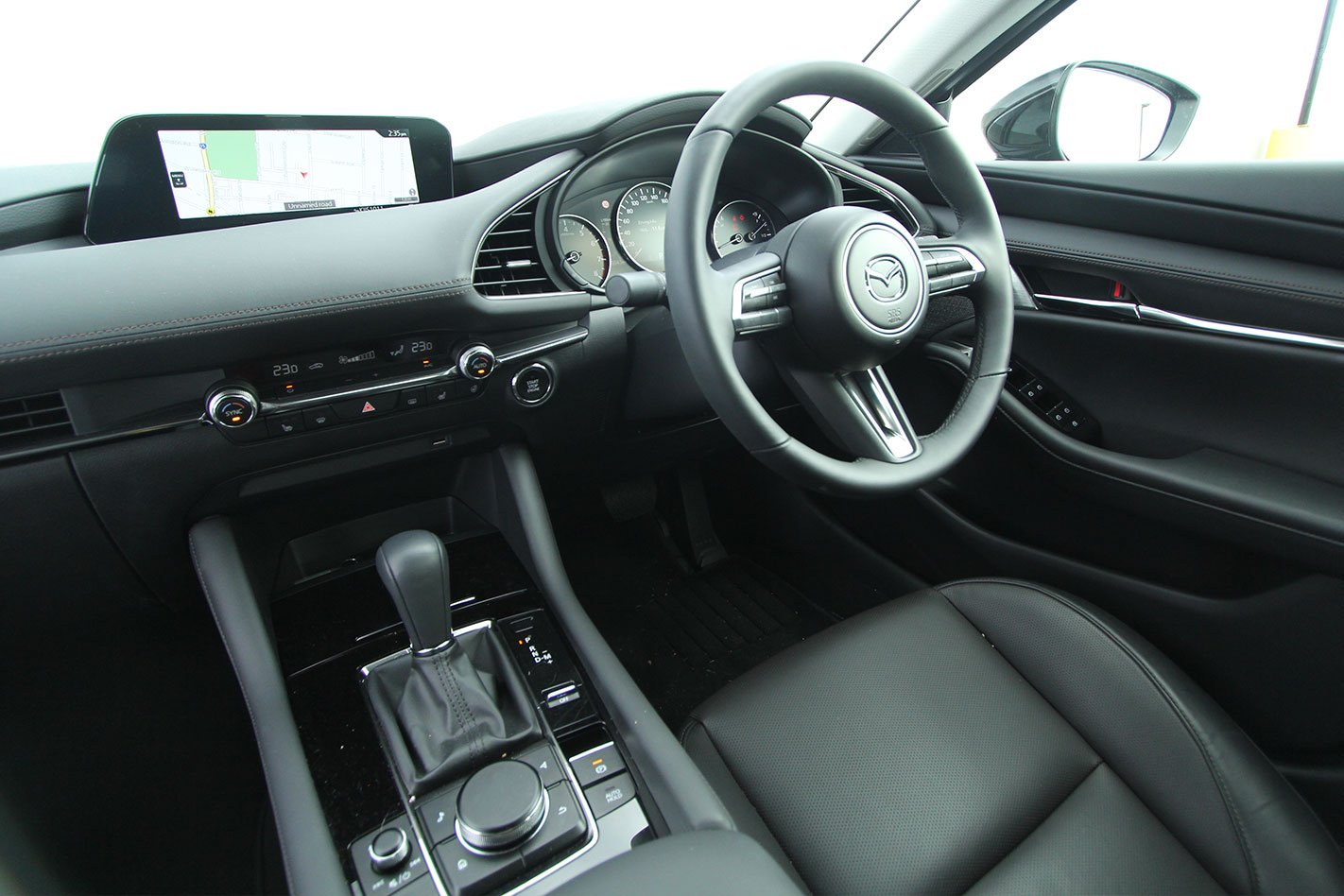
The wheelbase is the same length as the hatch, but the sedan is 20mm longer overall, affording a sizeable 444-litre boot. Plus, with a lower belt line, the back seat isn’t as claustrophobic as the hatch and rear vision improves markedly. It isn’t without fault, though, as entry and egress is hampered by the forward positioning of the B-pillar and the infotainment screen isn’t touch enabled – although the control wheel located behind the gear leaver is easy to navigate.
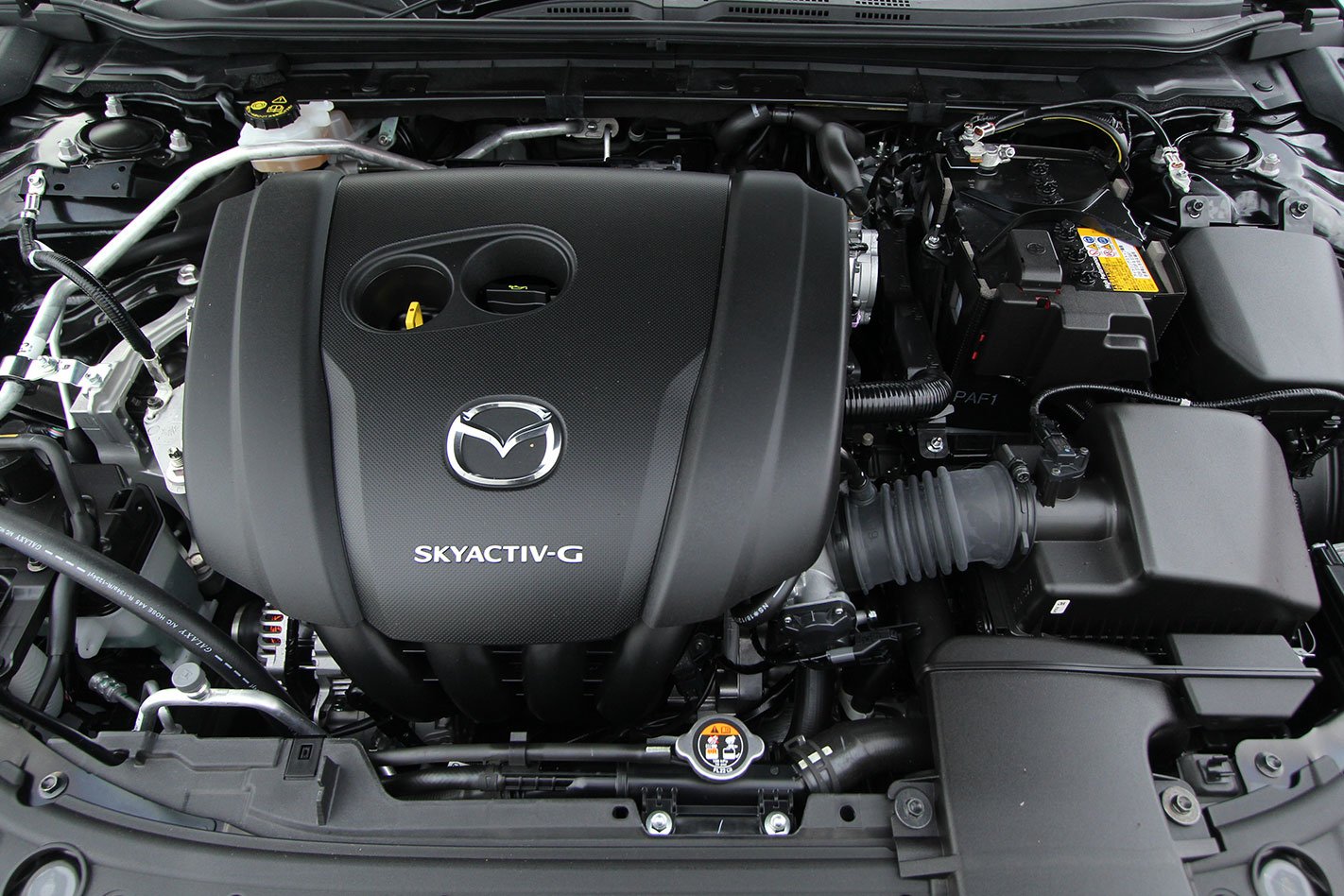
Powering the sportier 3 is a 139kW/252Nm naturally aspirated Skyactiv-G unit. At 2.5-litres it’s not a small engine and the extra torque over the 2.0-litre is appreciated. The performance available is respectable, if not sparkling, but the ratios of the six-speed auto (six-speed manual is $1000 cheaper) are well judged. Idle stop helps achieve the combined consumption figure of 6.5L/100km, but sadly there’s still a wait (expect early 2020) for the much-vaunted Skyactiv-X compression ignition engine.
Dynamically, the Mazda 3 shines. The open road reveals a fluidity, lightness and capability that would rival some hot hatches in terms of enjoyment if not outright pace. At speed the steering feels connected, the powertrain responsive enough and there’s a level of body movement that clearly signals he car’s limits. The trade-off is a ride quality that, when confined to city limits, is harsh. Tramlines, manhole covers and sharp imperfections do transfer into the cabin. It’s a shame given that many of Mazda’s issues surrounding NVH levels have been addressed.
Ultimately the 3 sedan is no poor relation to the hatch. In many ways it’s the more appealing body style despite Mazda projecting a 60/40 sales split in favour of the hatch. The GT offers great spec for the price with an interior that puts more expensive brands on notice. The fact it’s wrapped in an attractive, pragmatic and athletic body is the icing on the cake.
MAZDA 3 G25 GT SEDAN RIVALS
Kia Cerato GT sedan, Hyundai Elantra Sport
MAZDA 3 G25 GT SEDAN PRICE AND SPECS
- Model: Mazda 3 G25 GT Sedan
- Engine: 2488cc 4cyl, dohc, 16v
- Max power: 139kW @ 6000rpm
- Max torque: 252Nm @ 4000rpm
- Kerb weight: 1376kg
- Transmission: 6-speed auto
- Economy: 6.5L/100km (claimed)
- 0-100km/h: 8.6sec (claimed)
- Price: $34,490
- On sale: Now
It seems that not a week passes without the WCW team having to mark the passing of another global motoring demigod. Austrian engineer and German-brand heavy hitter Ferdinand Piech died this week, giving us the opportunity to look back at his influence over a long and colourful career.
Among the countless cars that Piech has a stake in you’ll find the 1980 Audi Ur Quattro, Porsche 917 and even the Bugatti Veyron. And as if that wasn’t enough, he was instrumental in making Audi and Volkswagen the global heavyweights that they are today.
It’s also worth mentioning another car that Piech championed – the Volkswagen Phaeton. The German brand’s luxo pioneer struggled to garner a significant audience despite having many good attributes. And there are plenty of other examples that litter automotive history.
Andy, Dan and Scott chat about their favourite cars that nobody bought. Which Volkswagen does Dan secretly lust after? What hot hatch does Scotty wish had a better run? And Andy nominates a high-performance Honda.
Tune in to find out which cars they discuss, the solution to future fine car flops, and much more.
If you’re on the go, you can find WhichCar Weekly on all manner of podcast apps including iTunes and Podbean. Please rate, subscribe and leave a review! You can also follow the day-to-day happenings of the WhichCar team on Facebook, Twitter and Instagram @whichcarau.
Listened to the show? Help us out:
- Leave a note in the comment section below.
- Leave a review on Apple Podcasts/iTunes
- Subscribe to our podcast
Missed out on McLaren’s incredible – and incredibly limited – Speedtail? Good news, its descendant, the McLaren GT has launched in Australia with a more ‘affordable’ base asking price of $399,995.
From the outset McLaren says the GT features “DNA honed from the Speedtail” and is meant to provide owners with the space, comfort, and usability of a grand tourer in a mid-engined package. It might not be ‘Speedtail-lite’, but there is plenty to differentiate the GT from the rest of the pack.

For starters, the GT is built on a new carbon fibre tub known as the MonoCell II-T, which features a new upper structure that allows engineers to carve out a 420-litre luggage area in the back.
According to McLaren, the GT’s rear luggage area is big enough to swallow a golf bag, or two pairs of skis, along with luggage. That is not inclusive of the additional 150 litres of boot space in the front.
Not only that, McLaren says the new carbon fibre structure doesn’t compromise on weight, with the GT’s kerb weight quoted at 1530kg. While heavier than any other McLaren on sale in Australia, it is nearly 100kg lighter than an Aston Martin Vantage or Ferrari 812 Superfast.
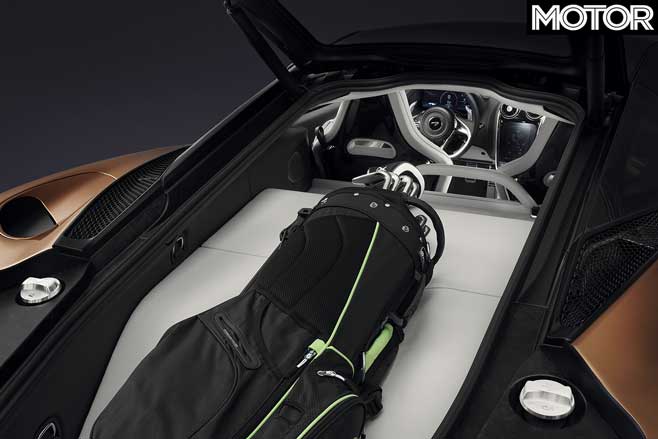
Also specific to the GT is new sophisticated Proactive Damping Control suspension control software that was derived from the 720S’ Optimal Control Theory, tailored for occupant comfort rather than outright track performance.
Power comes from yet another derivative of McLaren’s twin-turbo V8, this time around it’s a 4.0-litre version tweaked to deliver 456kW and 630Nm. Coupled to a 7-speed dual-clutch, the GT is able to get from 0-100km/h in 3.2sec and 0-200km/h in 9sec.
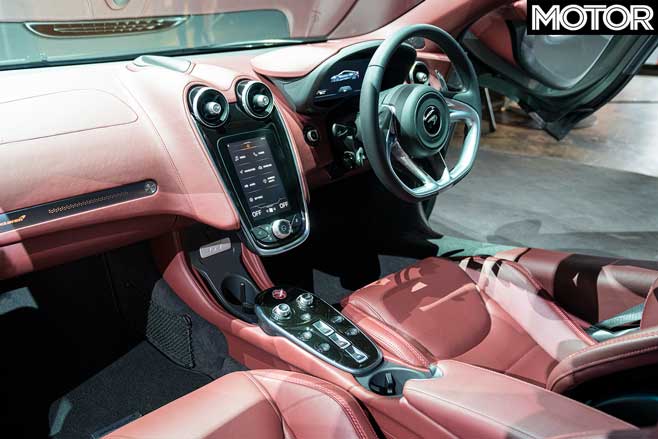
With its suspension, steering, and brakes optimised for grand touring duties, McLaren claims that the GT is a new entry to McLaren’s range of supercars, and complements the existing Sports, Super, and Ultimate Series.
It’s available to order now from Australian McLaren dealers.
Waze, a navigation app for phones, helps road users avoid congestion – and avoid contributing to it – by providing alternate routes for traffic to follow.
It also allows users to log accidents, road works, police stops and other potential road stops by tapping on the screen.
The app, owned by Google, is much the same as any maps software with live traffic data (which is also built into many modern vehicles), but Western Australia Police Minister Michelle Roberts told Nine News that while the app is legal, users could be breaking the law when using it.
“If you’re entering any information, if you’re touching the screen for example, then you are breaking the law,” Roberts said.
“How would you feel if you hit a pedestrian, or a kid on a bike, because you were distracted because you were using an app like this.
“Using it to avoid police is just stupid, it’s putting your life at risk, but more importantly it’s putting other road user’s lives at risk.”
Though the use of a phone is illegal in most circumstances, GPS apps can be used if the phone is in a secure cradle. According to Western Australian law:
“It is an offence to create, send or look at a text message, video message, email or similar
communication while driving. The GPS function of a mobile phone may be used by a driver only if the phone is secured in a mounting and the driver does not touch the phone at any time (www.ors.wa.gov.au).”
This rules out touching the screen to input the location of a car accident that might bring a freeway to a halt, or if police have setup a road stop.
However, the Waze app is now available on Apple CarPlay and Android Auto connected vehicles, which means the software is integrated into the car’s touchscreen system.
It is not illegal to use those functions of a vehicle. With the Waze app on a connected infotainment system, users are able to input accidents, speed camera locations and police presence, among many other hazards and stops.
It is also not illegal to use the app without touching the screen when driving, and it will still find alternate routes and alert drivers to the location of speed cameras and hazard.
One user of the app told Nine that because of the app he hadn’t had a speeding fine for five years, though it was much more than just an alert for where the police are.
“It’s not just about avoiding speeding fines for me, it’s also understanding what’s happening on the roads,” he said.
