
What is the Suzuki Swift Sport?
Back when I was a young lad, the prevailing winds for budding car nuts blew pretty strongly over the V8 heartlands. It was Ford Falcon, Holden Commodore or go the hell home, in the main.
The sub-culture of small, fast and fast had always been there, though, tracing its roots – for me, anyway – back to the ubiquitous Datsun 1600 of the 1970s through to the Toyota Corolla Twin Cam of the following decade.
There was another small-fry star of the time, too – the Suzuki Swift GTI of the mid-1990s used a free-revving 1.3-litre naturally aspirated four-cylinder engine co-developed with the company’s motorcycle division that used all of its 74kW to push around just 835kg.
With independent rear suspension and decent brakes, it was raucous, uncouth and an absolute barrel of laughs.
The Sport made a return with the last-gen Swift with a 1.6-litre nat-atmo four under the bonnet, and the all-new Swift begat a new-gen Sport in 2018.
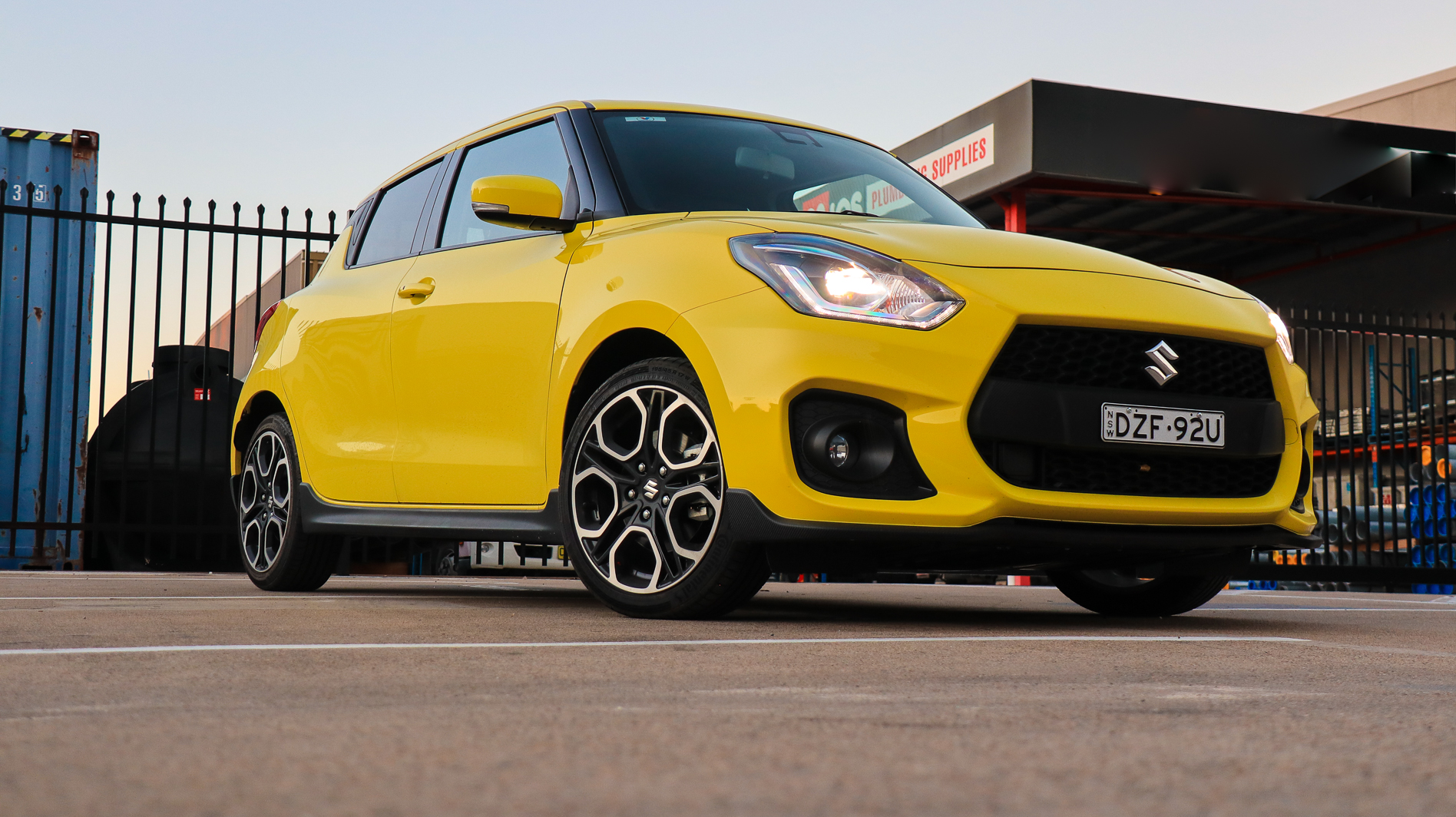
The central tenant of the new Suzuki Swift Sport is the same – a small, front-drive five-door, five-seat hatchback, perky engine and a reasonable price – but the execution is definitely different.
How much is the Suzuki Swift Sport?
The 1.6-litre naturally aspirated engine from the previous car is gone, replaced by a 1.4-litre turbocharged petrol four-cylinder engine out of the larger Vitara, backed by, in our case, a six-speed manual gearbox. (There’s also an auto available if you must.)
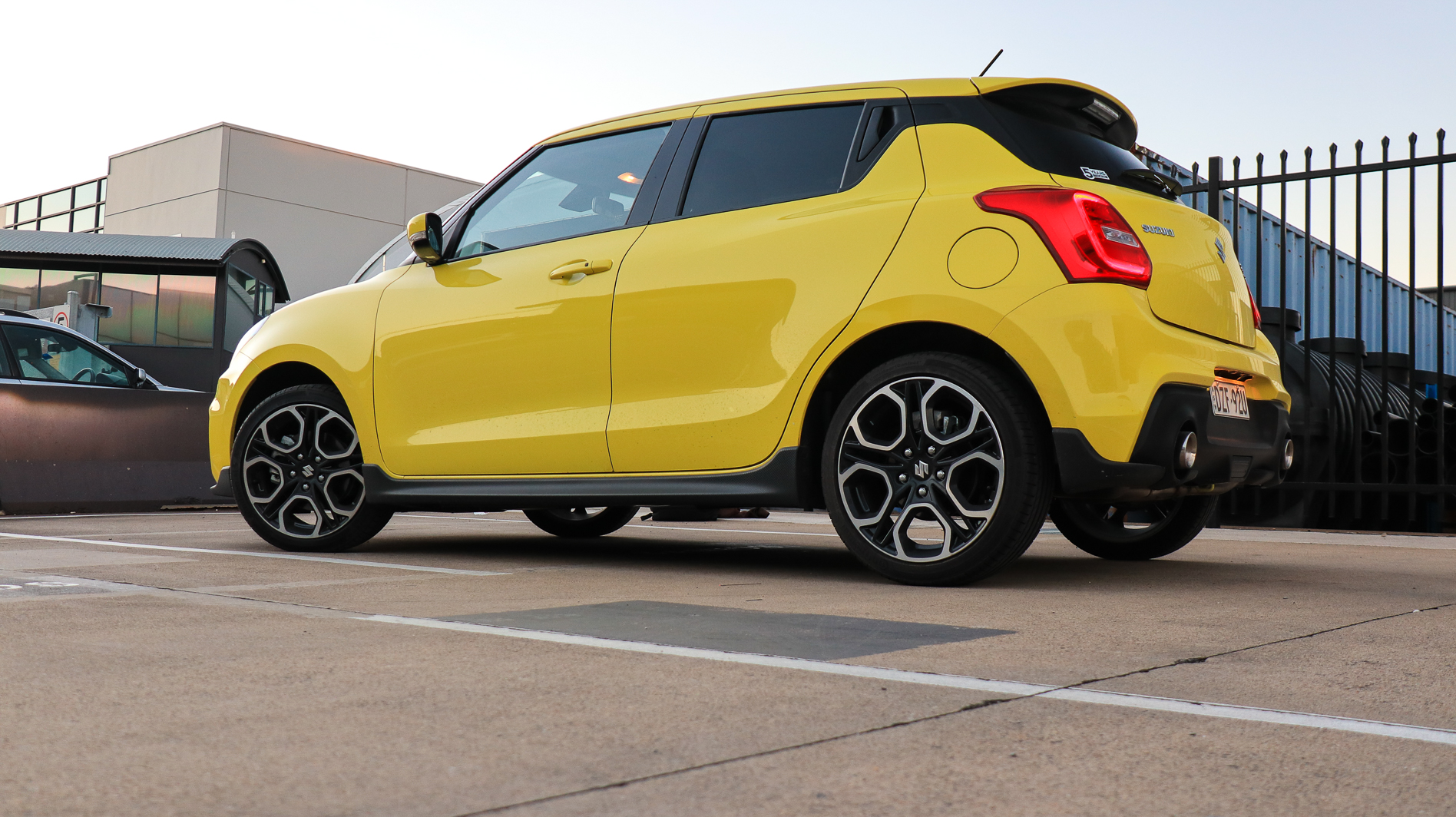
There’s no limited slip diff to regulate the 103kW and – more crucially – 230Nm of torque through the 17-inch wheels, and no driving mode button in sight, either.
Surprisingly, this car is some 90kg lighter than the 2017 model, according to Suzuki. At a claimed 970kg kerb weight, it’s some 145kg (or two passengers) heavier than the original 1990s GTI, and it’s also 14cm longer, 10cm taller and 20cm wider.
In the modern idiom, that’s not a bad weight figure – the modern Swift Sport is a lot safer, for one thing, and offers a lot more kit right out of the box.
At $25,490 plus on-roads, it’s some six grand cheaper than the dual-clutch equipped Volkswagen Polo GTI, which is (until the return of the Ford Fiesta ST, that is) the Swift Sport’s nearest competitor in terms of size.
It’s worth pointing out that the Polo and the Fiesta offer expensive go-faster bits like limited slip diffs as standard, though.
For the money, the Swift Sport is pretty well equipped, with niceties like LED headlights, foggies, 17-alloys, twin exhausts, a nice body kit and a cute little spoiler. The colour palette is pretty out there, too, which is great to see against an ocean of grey and white SUVs.
Who is the Suzuki Swift Sport for?
If you’re looking to claim back some of your misspent youth, or if you’re looking to downsize into something that’s both funky and affordable, the Swift Sport is a great place to start looking.
Is the Suzuki Swift Sport easy to live with?
Inside, there are automatic headlights, keyless entry with push-button start (how we dreamed of a race car like push-button start back in the GTI days!), a simple and good-looking multimedia system with sat nav and smartphone mirroring, decently supportive cloth-trimmed manually operated seats and 60:40 split/fold seats with ISOFIX baby seat mounts.
A big thumbs-up for the content mix; the multimedia system is intuitive and easy to use, for example, and there are easy-accessible charging points and cup holders.
Thumbs down, though, for the lack of even a space-saver spare wheel, and for the omission of a digital speedo.
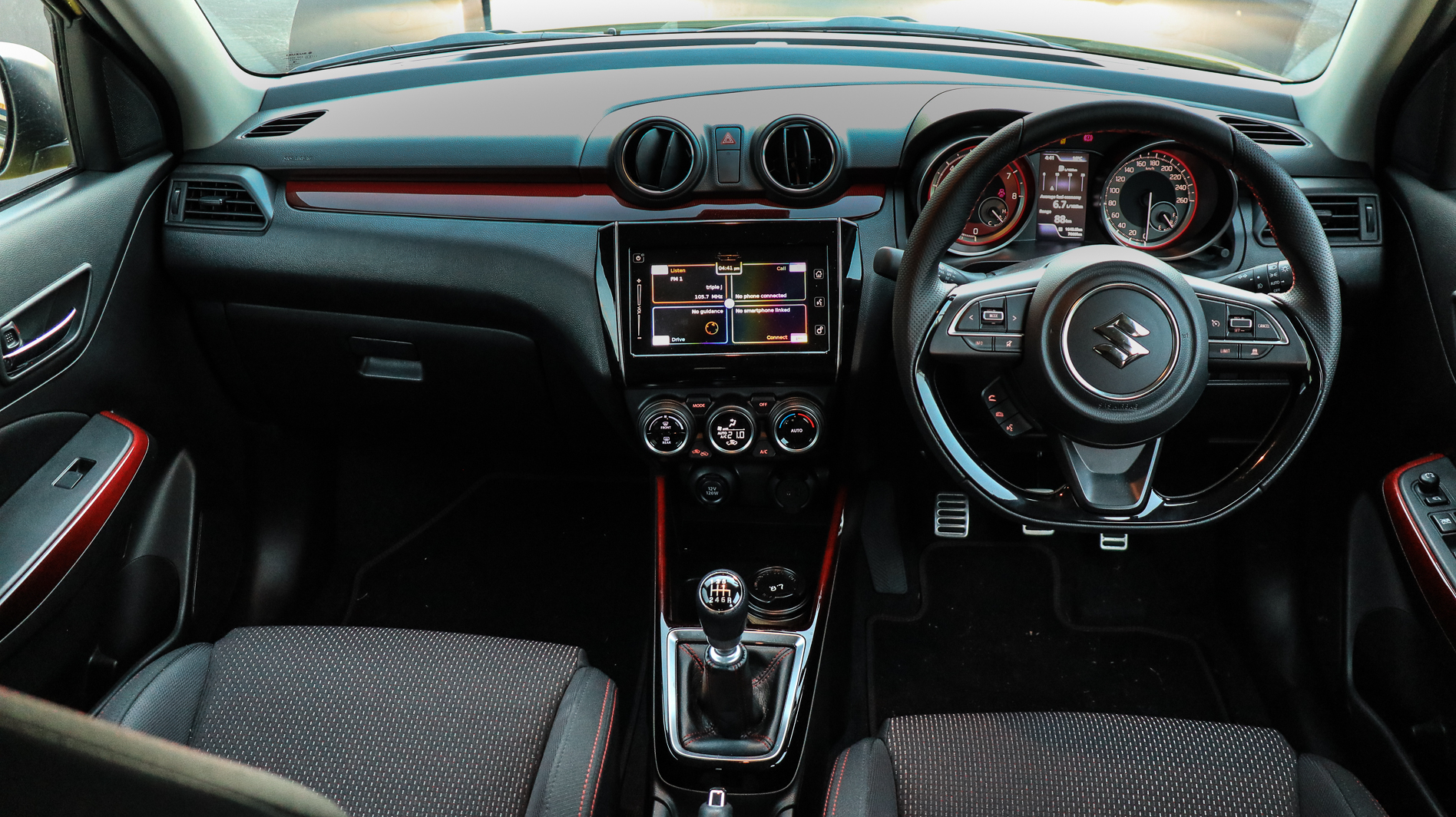
I also missed not having a centre console bin, but there is a small oddment dish in front of the cupholders which holds a phone and wallet.
The relatively high-roofed Swift also means that the rear seats are useful for taller humans, though four big units in the car would get pretty cosy. There is 265 litres of storage space behind the seats – call it two medium suitcases – and you can drop the seats to carry bigger items. You’ll get a bicycle in there with the wheels removed.
The six-speaker stereo’s sound output is pretty rubbish, and that’s exacerbated by a lack of sound deadening that allows a lot of road noise to get back into the squared-off cabin space… but that’s really not the point of the Swift Sport, is it?
How well does the Suzuki Swift Sport drive?
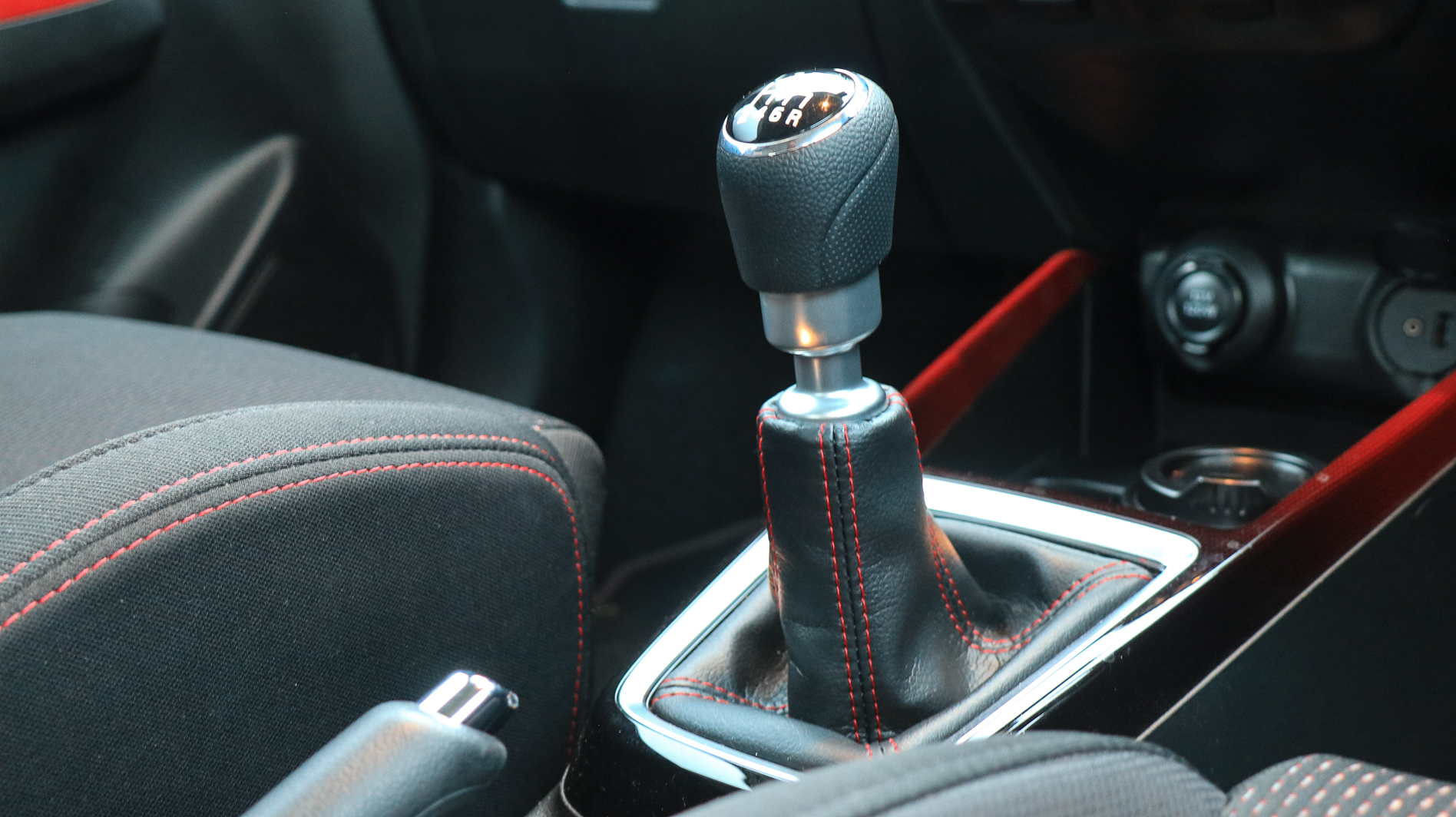
The steering wheel is chunky underhand and adjustable for height and reach, while the sport seat sits nice and low in the car. The clutch takes up just off the floor with plenty of feel and the right amount of weight, though the shifter is a little short for my liking and not especially precise underhand.
But up on the wheel, the Swift Sport instantly teleports me back to the heady early days of the hot hatch… only this one goes a lot harder.
The 1.4-litre engine doesn’t rev especially hard or sound very good, but its turbo-fed torque curve is linear and meaty, providing plenty of motivation from low revs at the right time.
Give it a toe full out of a tighter corner and the unweighted front wheel will chirrup and squirm and scrabble for traction. Sure, a limited slip diff would tidy that up, but to me, it just adds to the character of the car.
An overly short first and second gear, combined with a nose-led chassis tune and genuinely impressive steering feel, means you’re able to peg through a tightening radius bend in a gear higher than you’d expect.
The short wheelbase and wide wheel tracks mean the Swift hangs on well, and even though the multilink rear end has made way for a cheaper torsion beam set-up, the Swift Sport combines compliance and roll stiffness in impressive measure.
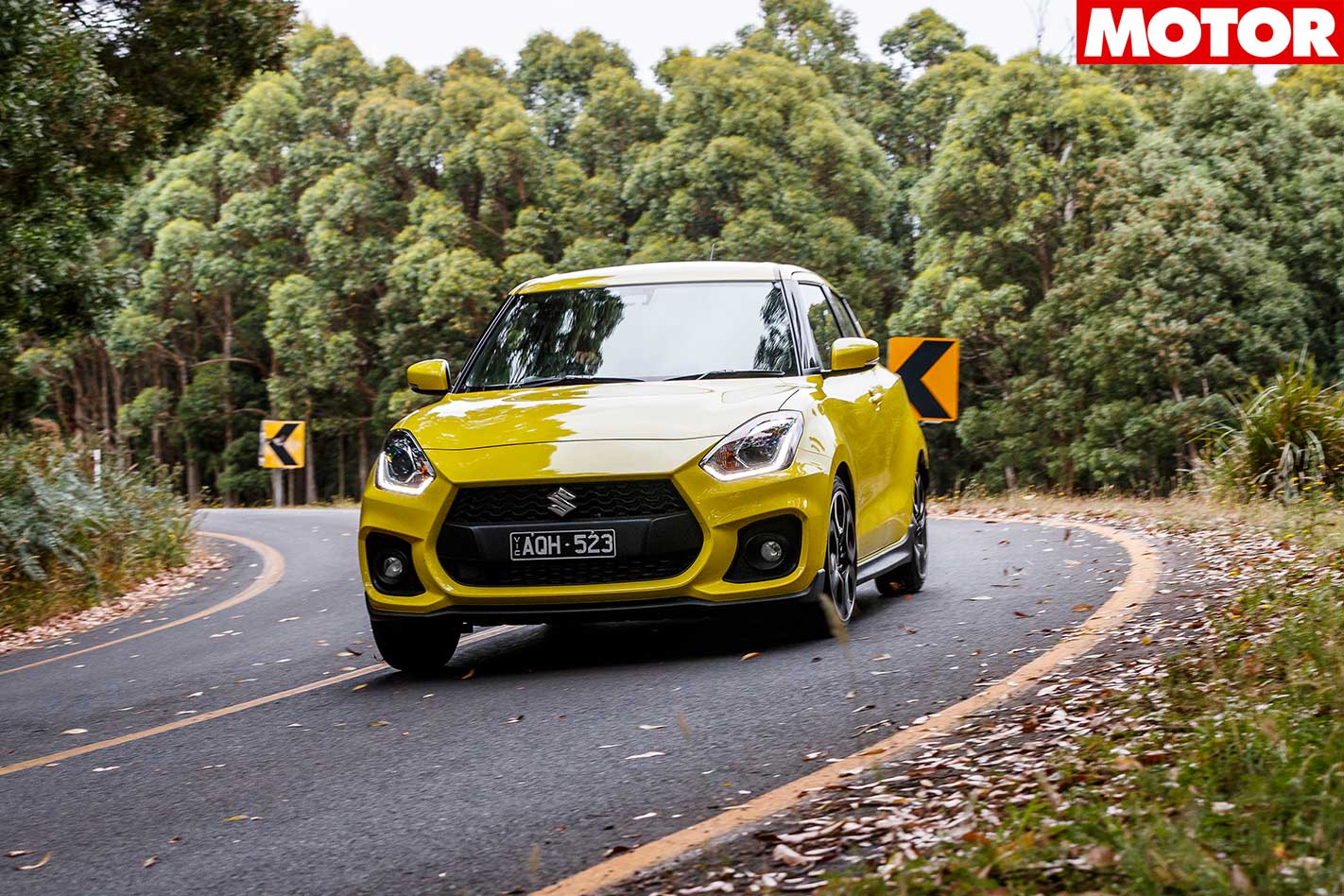
The well-modulated brake pedal engages quite close to the floor, which means heel/toe changes can be a little imprecise, but the actual spacing of the pedals is almost spot on.
Continental’s ContiSportContact 5 tyres are a nice spec, but I’d be upgrading even further to a SportContact 6 or similar to exploit that gorgeous chassis tune and torquey goodness, as well as to improve wet weather grip.
Likewise, I’d be upgrading the brake pads when they wear out to something with more feel and bite; a couple of cheeky laps on a wet track saw the pedal soften a bit, but better friction material and a higher-performance brake fluid swap would yield a set of mighty anchors for not a lot of dough.
On the highway and around town, the Swift is pleasant and well-mannered, with a ride quality that doesn’t stray into bumpy and sporty. The included adaptive cruise control works well at highway speeds, but it turns itself off when the speedo drops under 30km/h so be ready. Ahem.
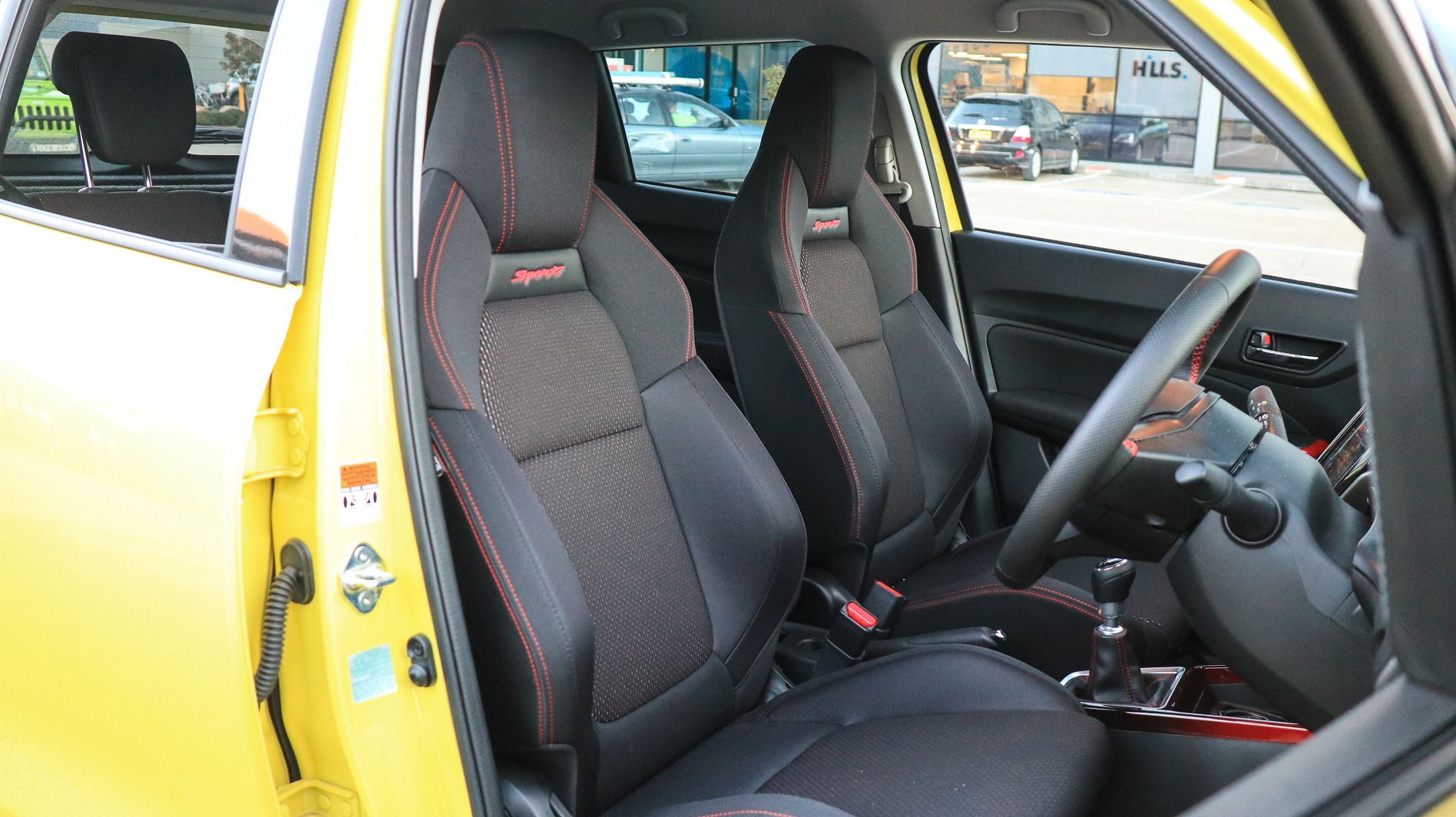
The noise intrusion can get annoying, and the tiny 37-litre fuel tank means there’s not a lot of range to play with – but a combined fuel economy average of 6.7 litres per 100km over 630km of testing (against a claim of 6.1L/100km) means juicing up the Swift won’t be expensive.
Speaking of that, Suzuki has fixed the first three services at $175 each, though it does recommend a notably short six-month/10,000km interval.
Suzuki’s standard warranty offer of three years and 100,000km is shorter than the industry average, too, and I’m not sure that the offer to extend that to five years and 140,000km is worth the stipulation of having to visit a Suzuki dealer every six months for five years.
The Swift Sport does pretty well in the safety stakes, with lane departure warning, AEB, seven airbags and a reversing camera as standard, though don’t wait for reversing sensors to beep – they aren’t there. It scores a top result of five ANCAP stars.
Verdict
The Suzuki Swift Sport extends the small Japanese company’s reputation for the weird and the wonderful – Jimny and Ignis, anyone? – and keeps the notion of an affordable hot hatch alive for a new generation… or for an older one looking for a hit of nostalgia.
Its warranty offering isn’t perfect, and it can be noisy on a highway, but owning a Swift Sport will put a smile on your face as few other cars can.
Specs
Body: 5-door, 5-seat hatch Drive: front-wheel Engine: 1373cc inline-4cyl, DOHC, 16v, turbo Bore/Stroke: 73.0 x 82.0mm Compression: 9.9:1 Power: 103kW @ 5500rpm Torque: 230Nm @ 2500-3000rpm Power-to-Weight: 106kW/tonne Transmission: 6-speed manual/auto Kerb Weight: 970/990kg Suspension: struts, coil springs, anti-roll bar (f); torsion beam, coil springs, anti-roll bar (r) Length/Width/Height: 3890/1735/1495mm Wheelbase: 2450mm Tracks: 1510mm (f/r) Steering: electrically-assisted rack-and-pinion Brakes: 285mm ventilated discs, single-piston calipers (f); 252mm solid discs, single-piston calipers (r); ABS, EBD, ESP, ASR Wheels: 17.0 x 6.5-inch (f/r) Tyres: Continental ContiSportContact5 195/50 (f/r) Price: $25,490
Endurance racing continues to go from strength to strength.
In a world where motor racing categories are struggling to attract or retain manufacturer support, GT racing suffers from almost an embarrassment of riches. Alpine, Aston Martin, Audi, Bentley, BMW, Cadillac, Chevrolet, Ferrari, Ford, Ginetta, Honda, KTM, Lamborghini, Lexus, Lotus, McLaren, Mercedes-AMG, Nissan and Porsche all currently have homologated GT3 or GT4 machinery; not even Formula E and its so-hot-right-now pure electric powertrains can boast such a wealth of manufacturer support.
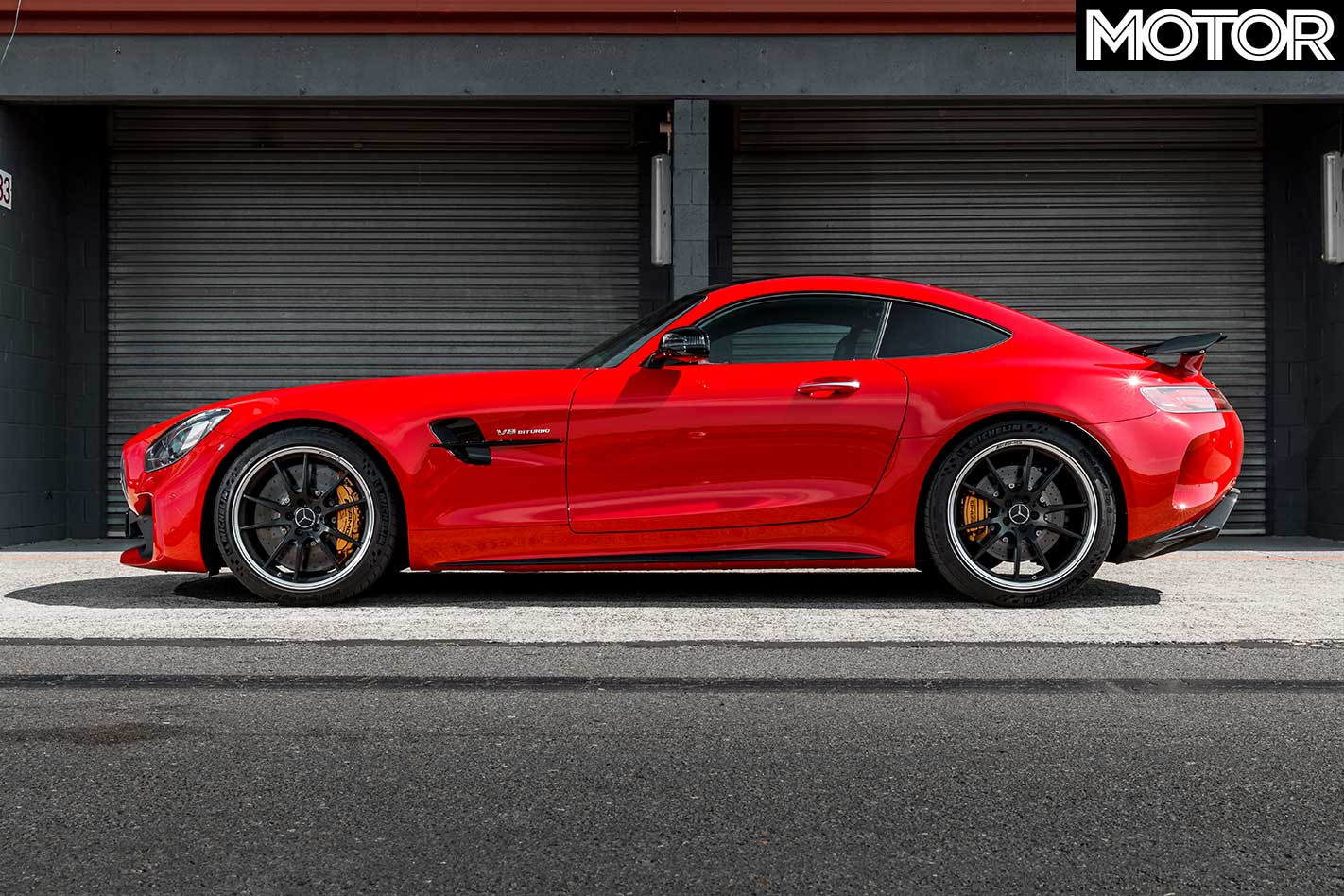
The other advantage GT racing enjoys is market relevance. Unlike Formula E, GT racecars are not only available to purchase but represented in showrooms by road-going counterparts. Mercedes-AMG has long been a supporter, tasting victory at the Dubai 24 Hour, Bathurst 12 Hour, Spa 24 Hour and Nürburgring 24 Hour with first the SLS then the GT.
This gave us an idea for our local drive of the AMG GT R, the raciest of the current range available in Australia: MOTOR’s own endurance test, 12 hours straight encompassing every possible scenario, from racetrack hot laps to mountain road blasts to peak-hour traffic. Let the clock begin.
1100hrs
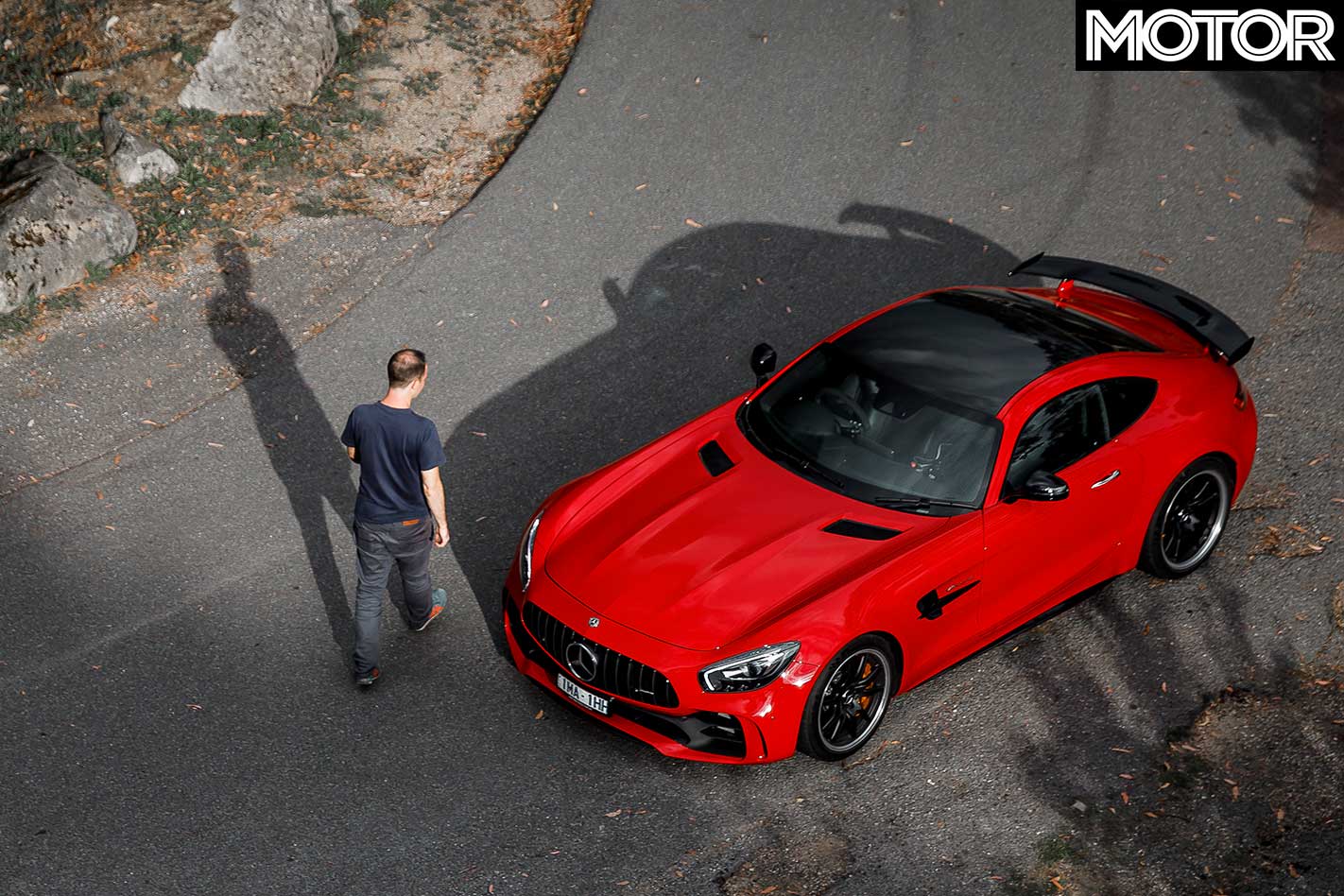
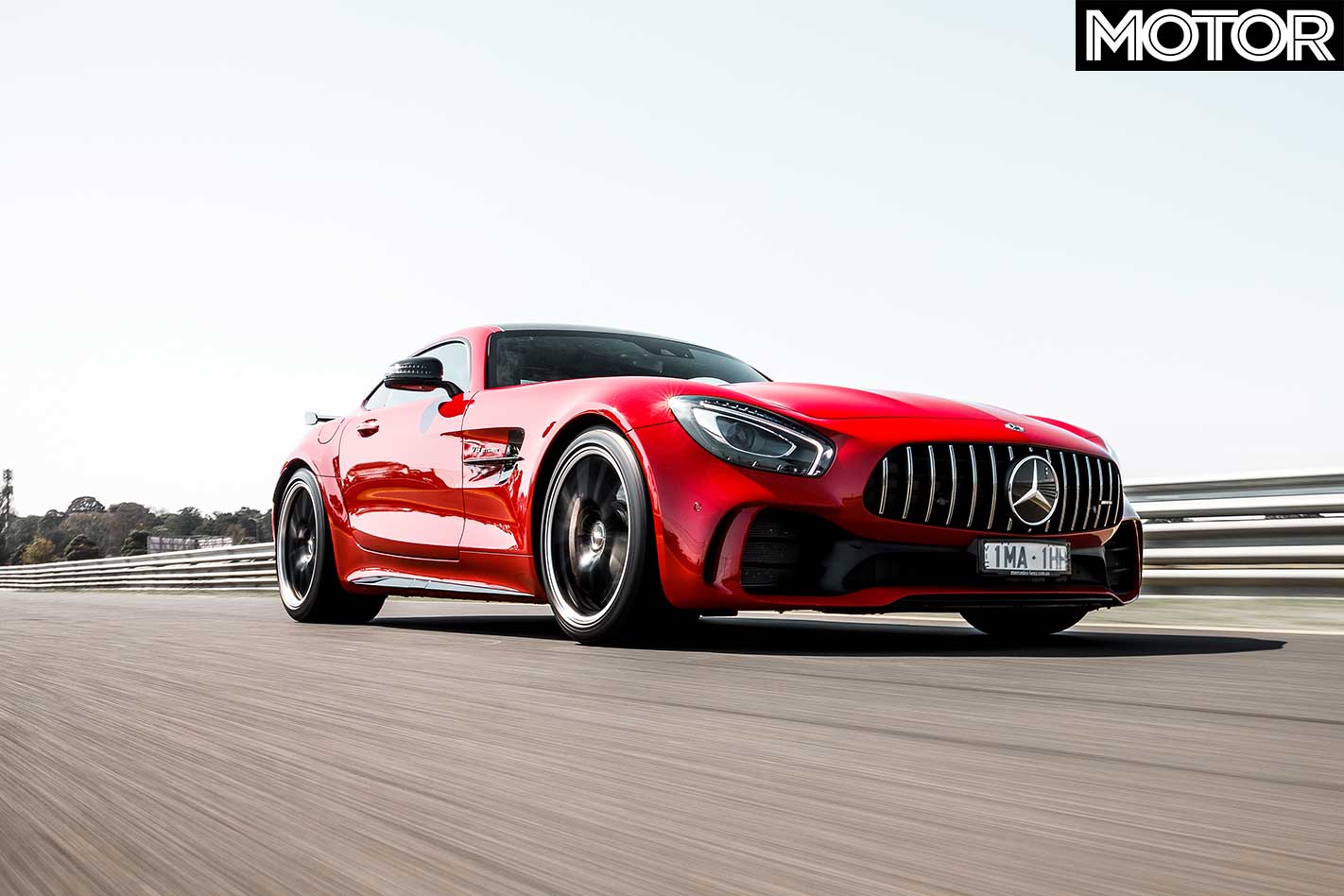
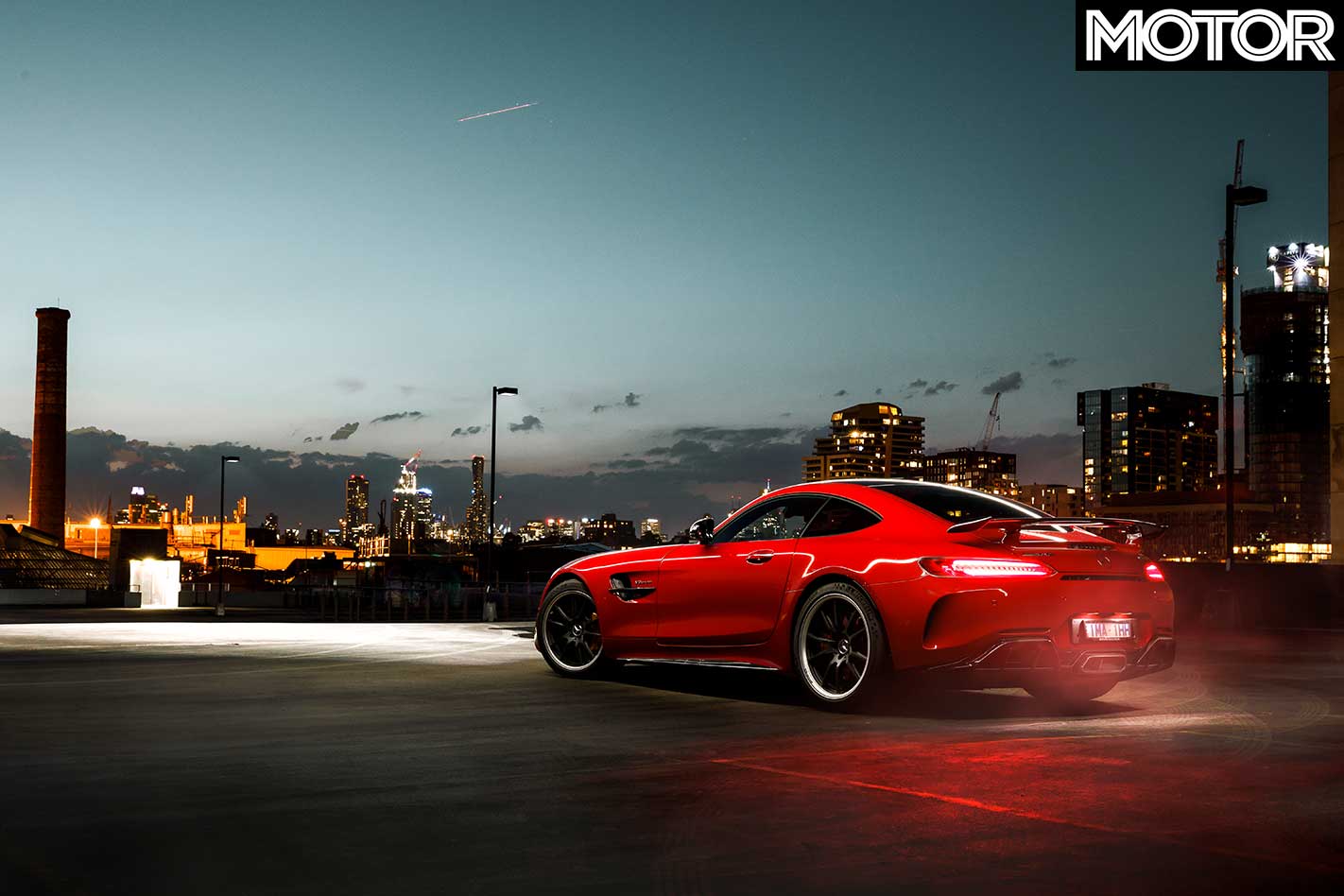
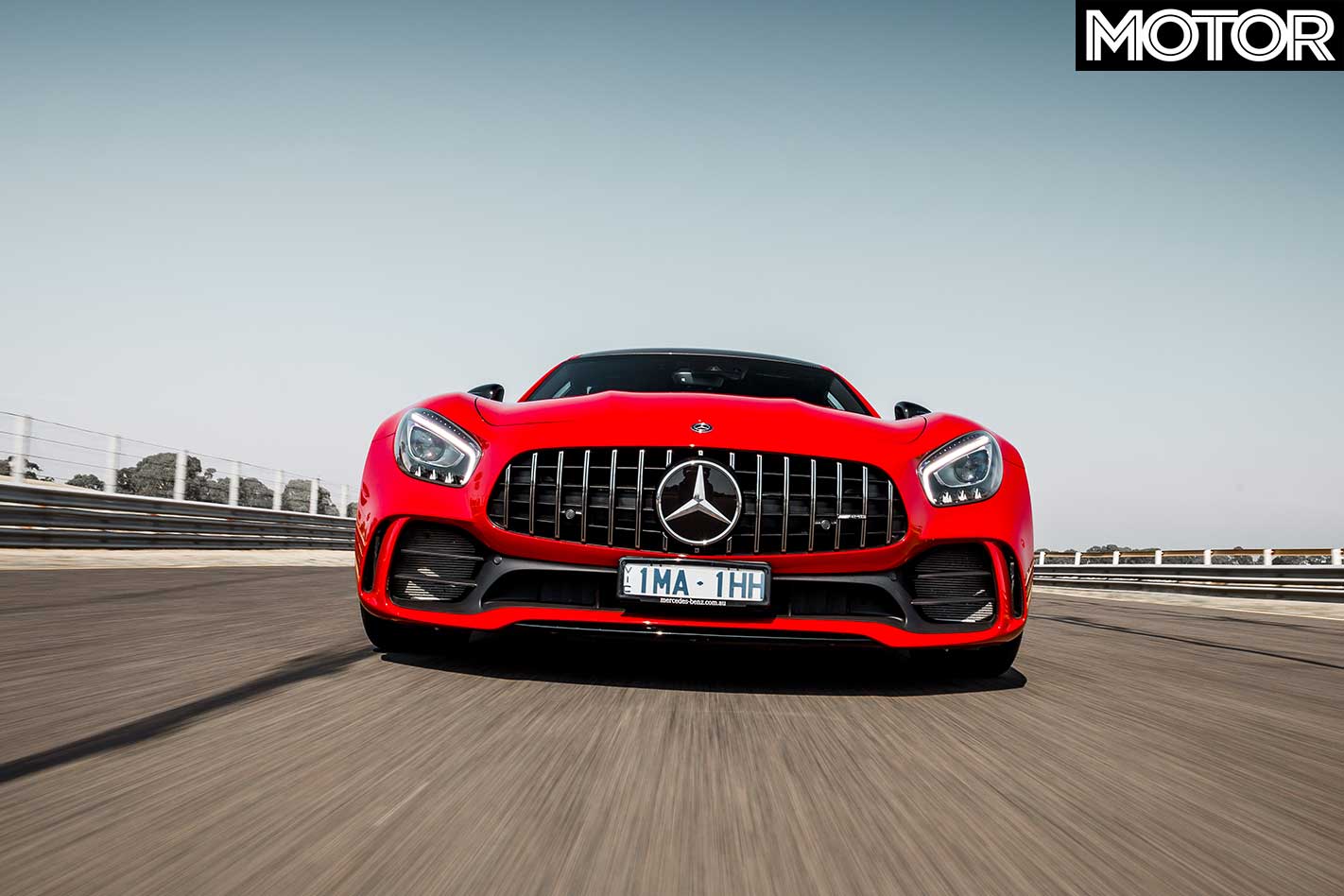
I’d never think to spec a GT R in Jupiter Red, but thankfully someone at Mercedes-Benz Australia did because it might just be the colour that suits it best.
The hero hue is Green Hell Magno, named in honour of the Nürburgring Nordschleife, where the GT R set a blistering 7min10.92sec lap, but in vivid red with black body trim (roof, side strakes, wing, mirrors) and wheels it’s a real automotive power dresser. Even better, Jupiter Red is one of two free standard colours, though the sexy 10-spoke alloys are an extra $3500.
Another no-cost option is the snug, manually adjustable AMG Sports bucket seats which offer superb support, though clambering in and out over the hip-hugging sides will turn the outside of my thigh black and blue the following day.
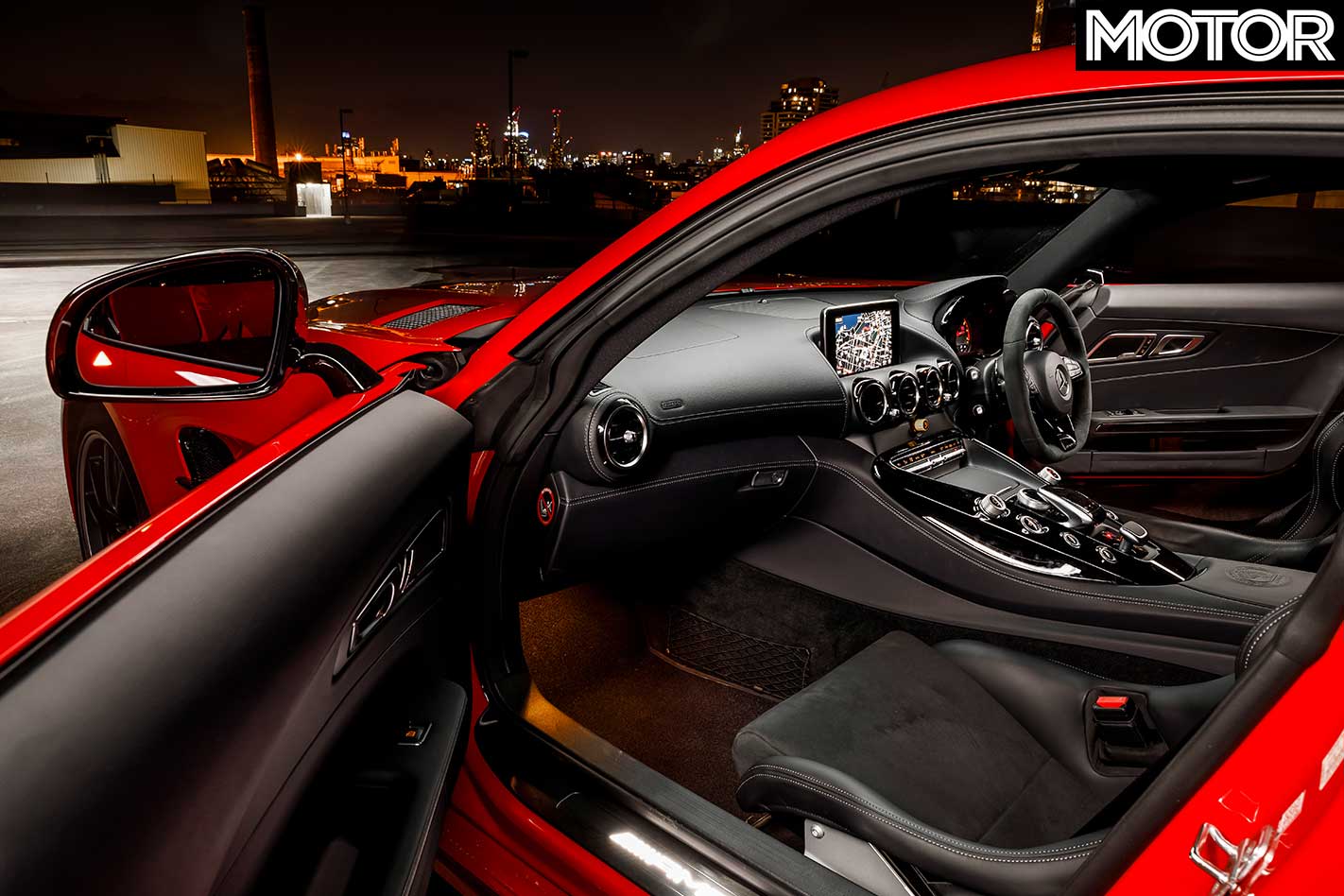
You nestle into a GT, the steep incline of the centre console giving a cockpit-like feel. The console, steering wheel and infotainment have been updated in the recent GT facelift, the latter not a moment too soon, though the questionable ergonomics remain, the gear selector in particular being an awkward stretch. The GT is one car in which Merc’s indicator stalk gear selector would be a welcome improvement.
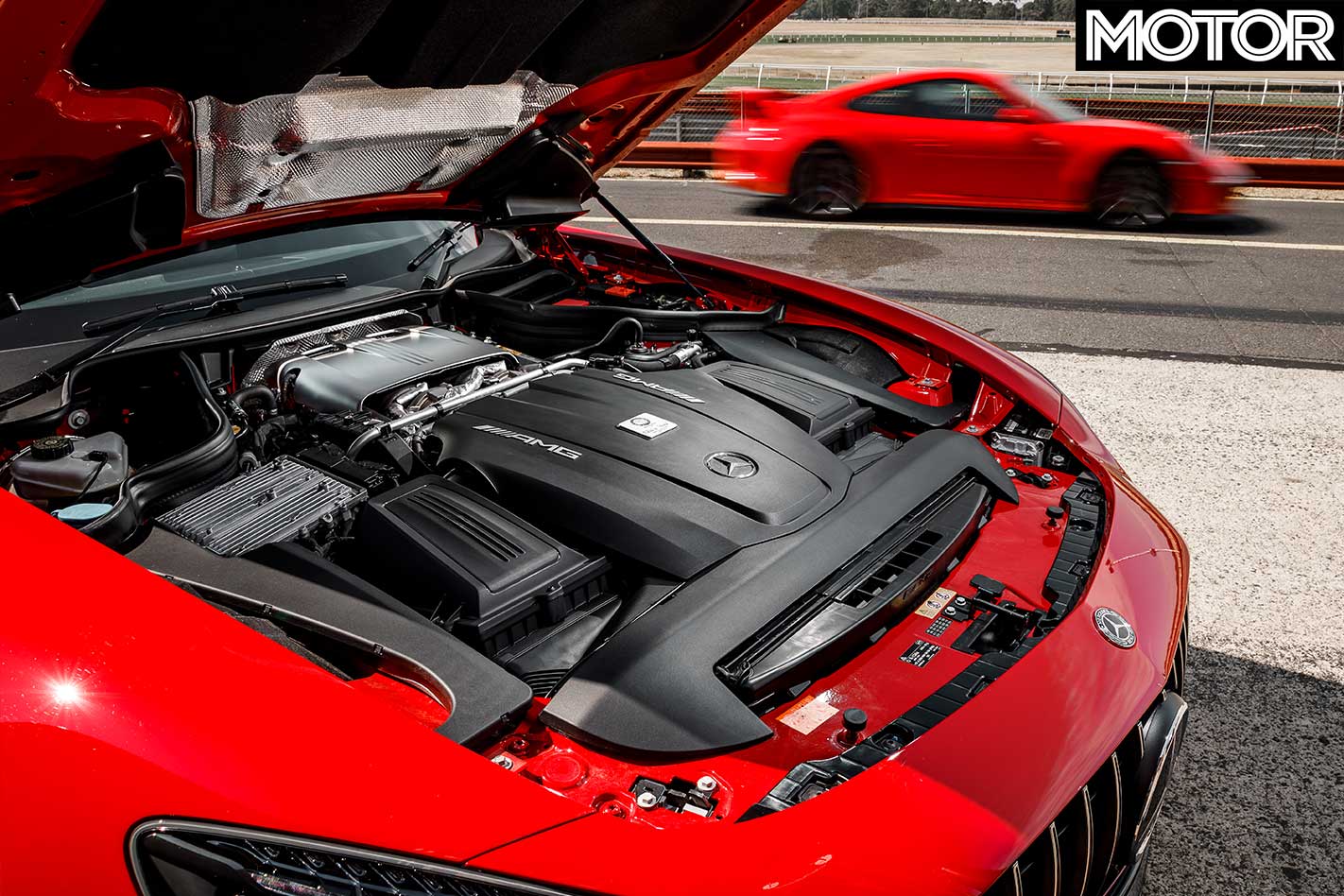
Press the start button and the 4.0-litre twin-turbo V8 explodes into life. The GT’s exhaust note definitely doesn’t need any improvement; it’s the very definition of a guttural roar and even in Comfort mode clearly states the intentions of AMG’s bespoke sports car: get the hell out of the way.
Rumour has it the flagship R is quite a different beast to its (relatively) lesser siblings, capable of greater subtlety as well as more impressive performance, but let’s start with the latter.
1200hrs
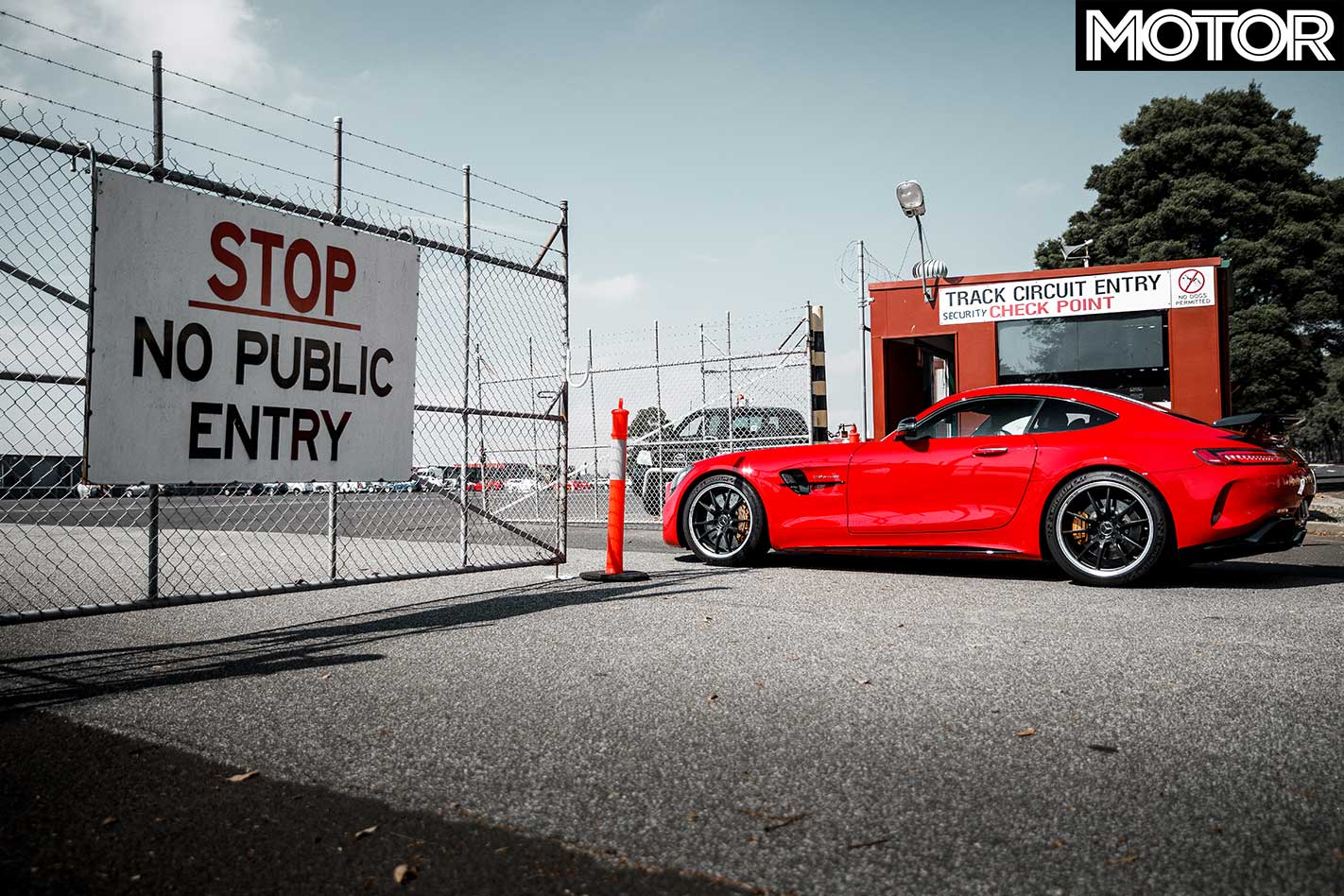
Sandown Raceway. Merc’s insurance prohibits the GT R from sharing a track with any other car but thanks to the kind folks at Evolve Driving we have Sandown to ourselves for an hour during the lunch break of one of its drive days.
Helmet on, lots to do, but before the action can commence it’s two slow laps behind the camera car for Jacobs’ lens. Race mode engaged, the GT R is like Winx in the gates, straining to be unleashed. The violence of the acceleration when the track ahead finally clears is shocking in its ferocity.
No GT could be called anything other than crazily fast, but in its ultimate 430kW/700Nm guise the M178 is like a volcano, gurgling with intent at low speeds before erupting like Krakatoa at full throttle.
Engaging launch control on Sandown’s main straight dials up more than 5000rpm, almost turning the car inside out when the brake is released. A lighter press on the brake allows a 3000rpm stall and rocket-like acceleration.
Traction is still limited in first but from second gear onwards not a kilowatt is wasted, 0-100km/h disappearing in 3.73sec, 200km/h less than seven seconds later and the quarter mile completed in 11.42sec at 207.99km/h.
Our window of opportunity is rapidly closing, but there’s just enough time to attempt a representative lap time. The GT R makes a mockery of my 1min20sec goal, quickly settling into the mid 1min17sec bracket with a best of 1:17.1. It could undoubtedly go quicker, but to do so would require more time and talent than we have available today.
It’s a monster, clocking almost 250km/h down Sandown’s two straights (just 10km/h less than a V8 Supercar) before the $17,500 carbon-ceramic brakes are called upon. The Sport ESP setting is brilliantly tuned, but turning it off completely and activating the trick nine-stage traction control, lifted from the GT3 race car, unlocks even more potential. Set to seven, the system allows enough slip to slide the car off corners while still providing awesome drive. It’s brilliant.
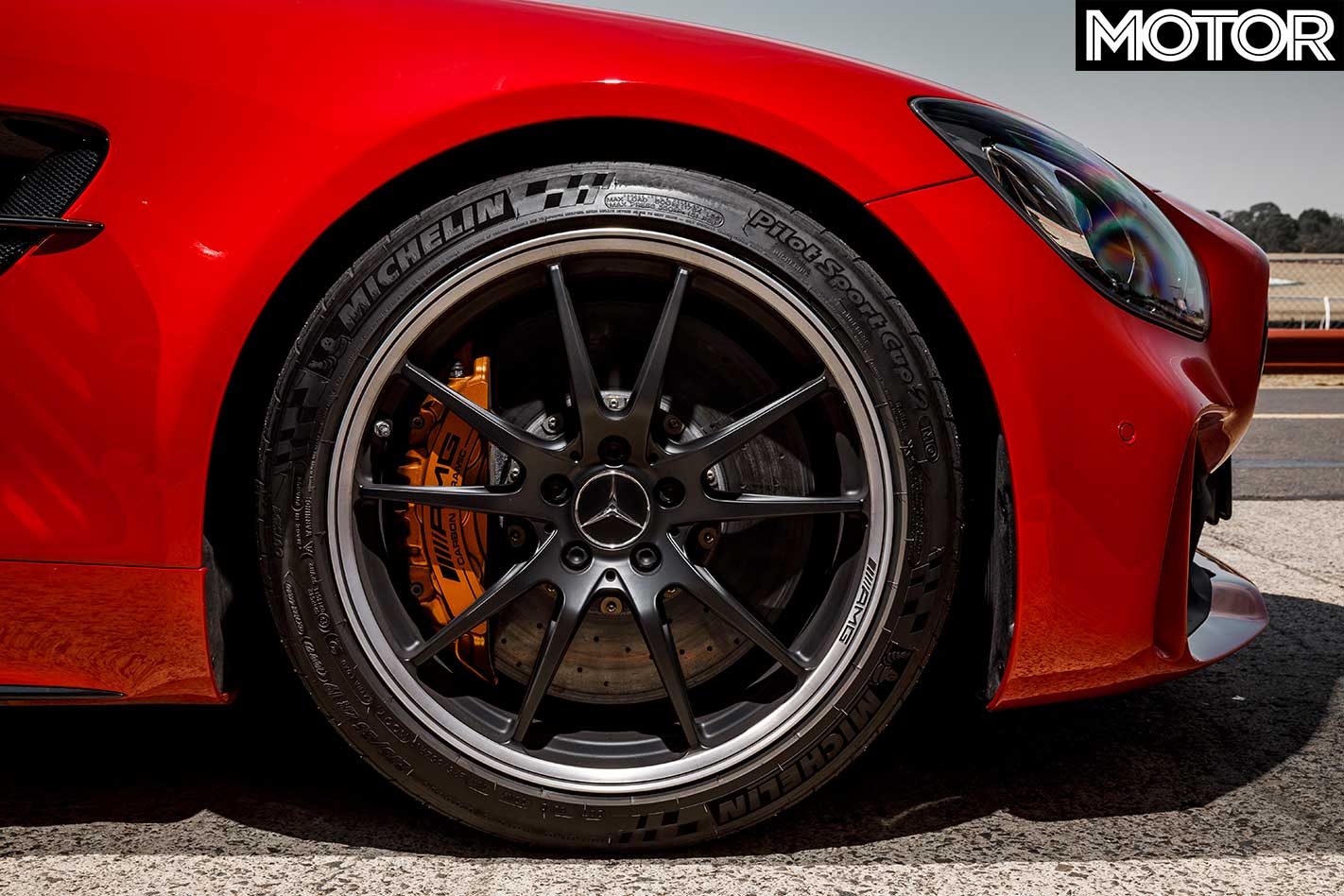
However, while brutally effective, the GT R feels surprisingly uncomfortable at maximum pace. Ask for everything the brakes have and the ABS triggers, extending the stopping distance by some margin. Clearly the huge carbon anchors provide more force than even 275/35 Michelin Pilot Sport Cup 2s can cope with; paradoxically, the GT R feels to stop better with about 75 per cent pedal pressure.
Its biggest shortcoming, though, is its behaviour over bumps. There’s a sizeable compression halfway through the turn 2-3 chicane; attack it and the GT R pogoes half-a-car’s width sideways. Kerbs are to be scaled at your peril and accelerating hard out of the final chicane the car squirms over the bumps, like the front and rear are responding at different rates.
1430hrs
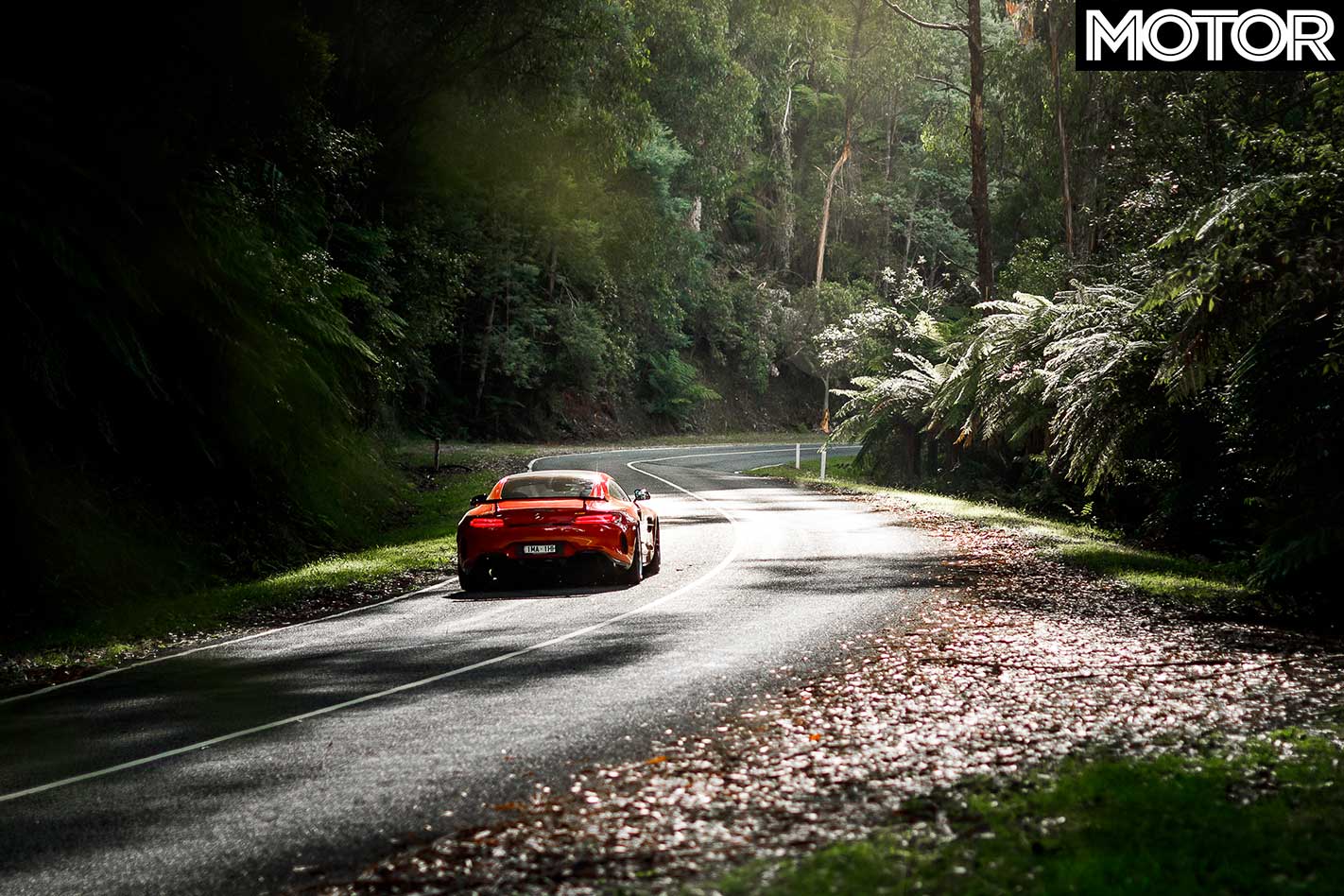
Our route is a simple and well-trodden one. Head east through Melbourne’s outer suburbs, scale the twists and turns of Reefton Spur, a quick dash to the summit of Lake Mountain before completing the loop through the Black Spur back to Melbourne in time for the sunset. At least, that was the plan.
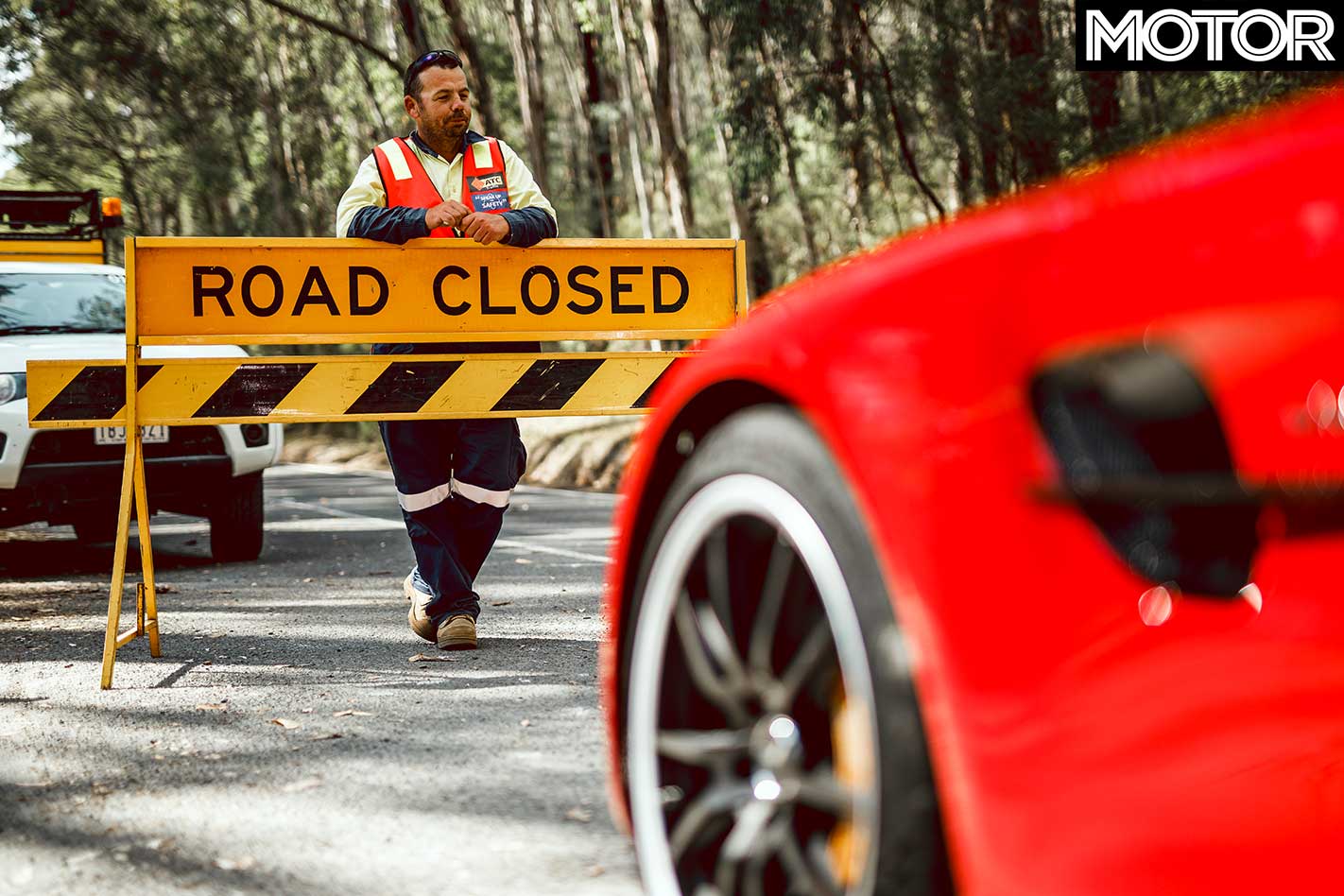
Currently we’re looking at a barricade at the bottom of Reefton and planning our next move while a pair of amused and bemused council workers exercise their smartphones, taking pictures and making calls about this flash sports car that’s all dressed up with nowhere to go. At least it makes for a good photo opportunity.
Our new destination is the summit of Mount Donna Buang, its access road a 16.7km tarmac ribbon of two distinct halves. The first half is bumpy, heavily cambered and often slippery under the overhanging trees, conditions not conducive to the GT R giving its best. Its pace is never in question, but it isn’t just sensitive to bumps, it’s borderline allergic.
The steering is much improved, the nervous dartiness of early GTs calmed, but there’s still little indication of what the GT R is going to do next, particularly in long, fast corners – perhaps the front will skip or the rear will hop, or both will happen simultaneously.
Such behaviour breeds indecision and in a car this fast that quickly erodes confidence.
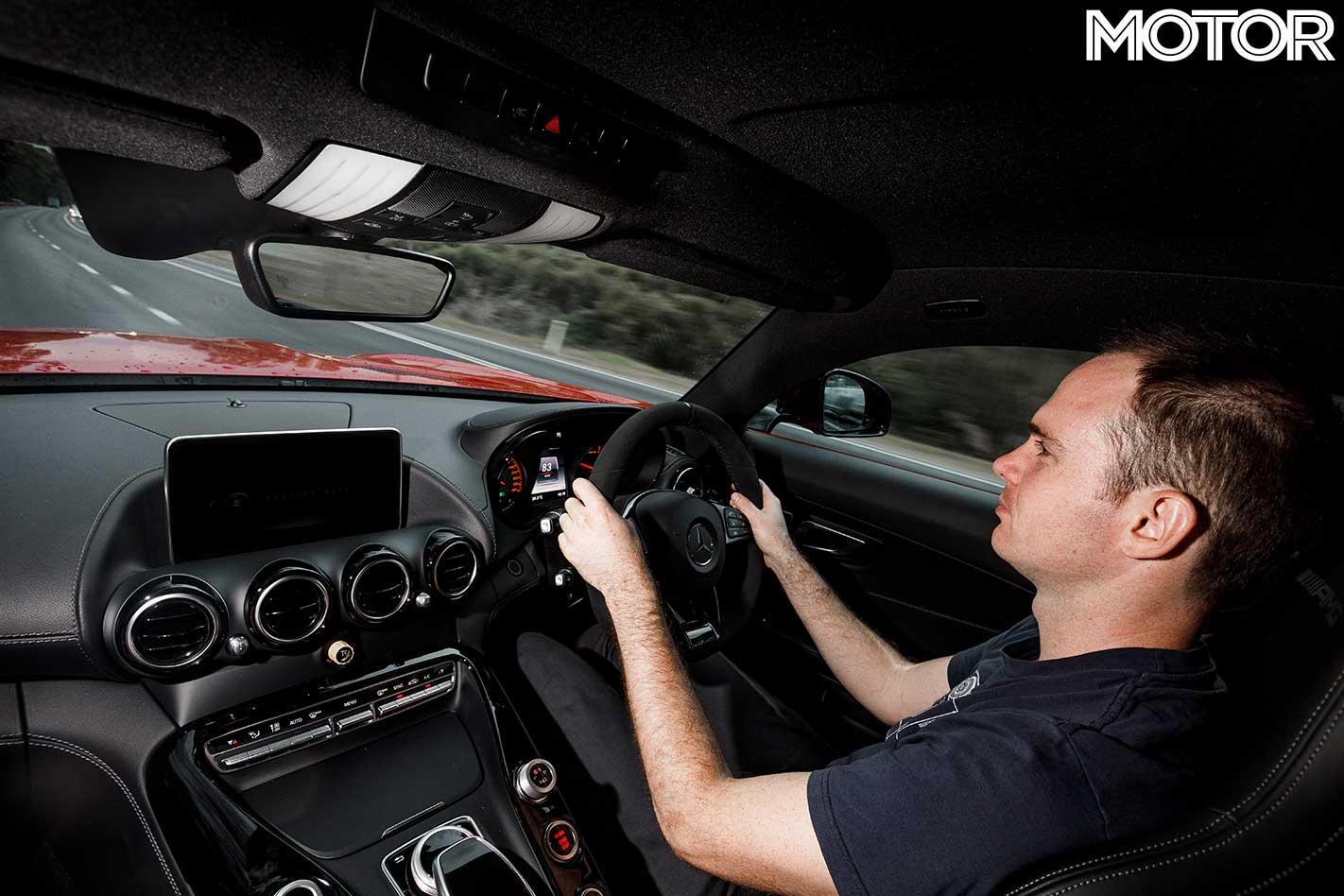
Halfway up, the road changes, becoming drier, quicker and smoother in nature. Here the GT R excels. With a stable, consistent surface beneath them, the fat Michelins provide so much cornering grip the limiting factor is how fast your mind can process information.
The acceleration along each straight is potent enough to promote tunnel vision, the twin-turbo V8 offering endless power and each gearshift – either up or down – is fired through the dual-clutch ’box like a bullet from a gun.
It’s difficult to imagine a more potent production car on this stretch of road. Or a more aggressive one; select Sport Plus or RACE and the cacophony from the exhausts suggests the mufflers have fallen out.
1730hrs
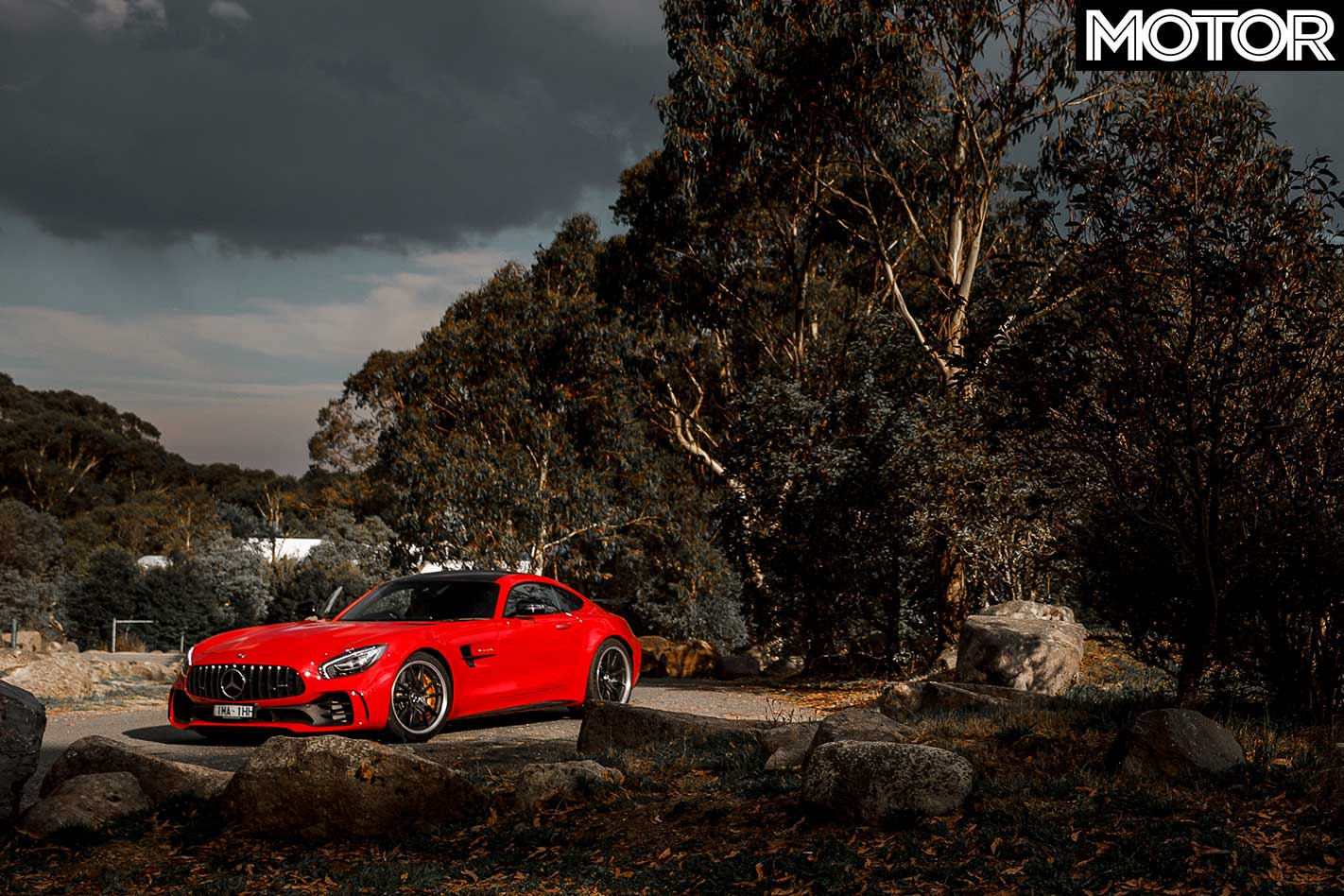
The GT R sits silently but the thunder continues. A trio of storms triangulates our position, slate grey clouds rumbling ominously, making shooter Jacobs somewhat reluctant to climb the giant steel lookout platform to nail the overhead shot, despite my (scientifically untested) reassurances that the lightning doesn’t look like it’s coming this way. Ever the professional, he starts climbing.
Photography done, the descents occur quickly. Both Jacobs and I from the giant conductor we’ve been standing on and the GT R from the mountain itself. What’s remarkable is the amount of traction a 430kW/700Nm rear-drive sports car can generate. Power oversteer takes serious commitment and a heavy right foot; anything less severe is likely to generate understeer or, more likely, just savage acceleration.
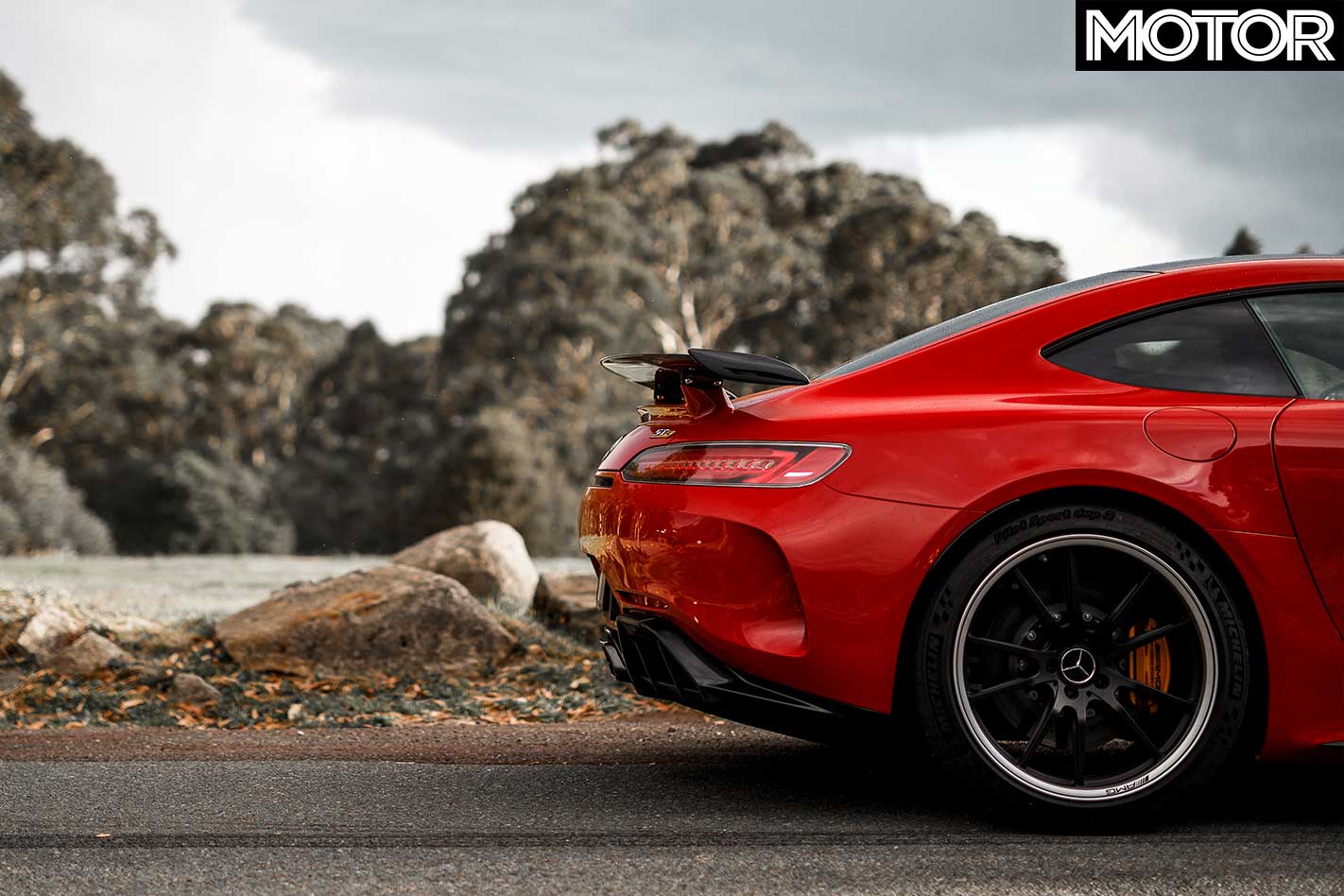
At least that’s the case in the dry. Two-thirds of the way down the mountain, fat drops start to appear on the windscreen as those heavily laden clouds release their watery cargo. The GT R is neutered almost instantly, any pace evaporating thanks to semi-slick tyres and an inconsistent surface.
Traversing through Warburton heavy rain becomes torrential downpour, overwhelming roadside drainage and reducing visibility to virtually nothing. The ESP is still in Sport and any meaningful acceleration results in a judder from the rear axle as the 325mm rear boots spin freely.
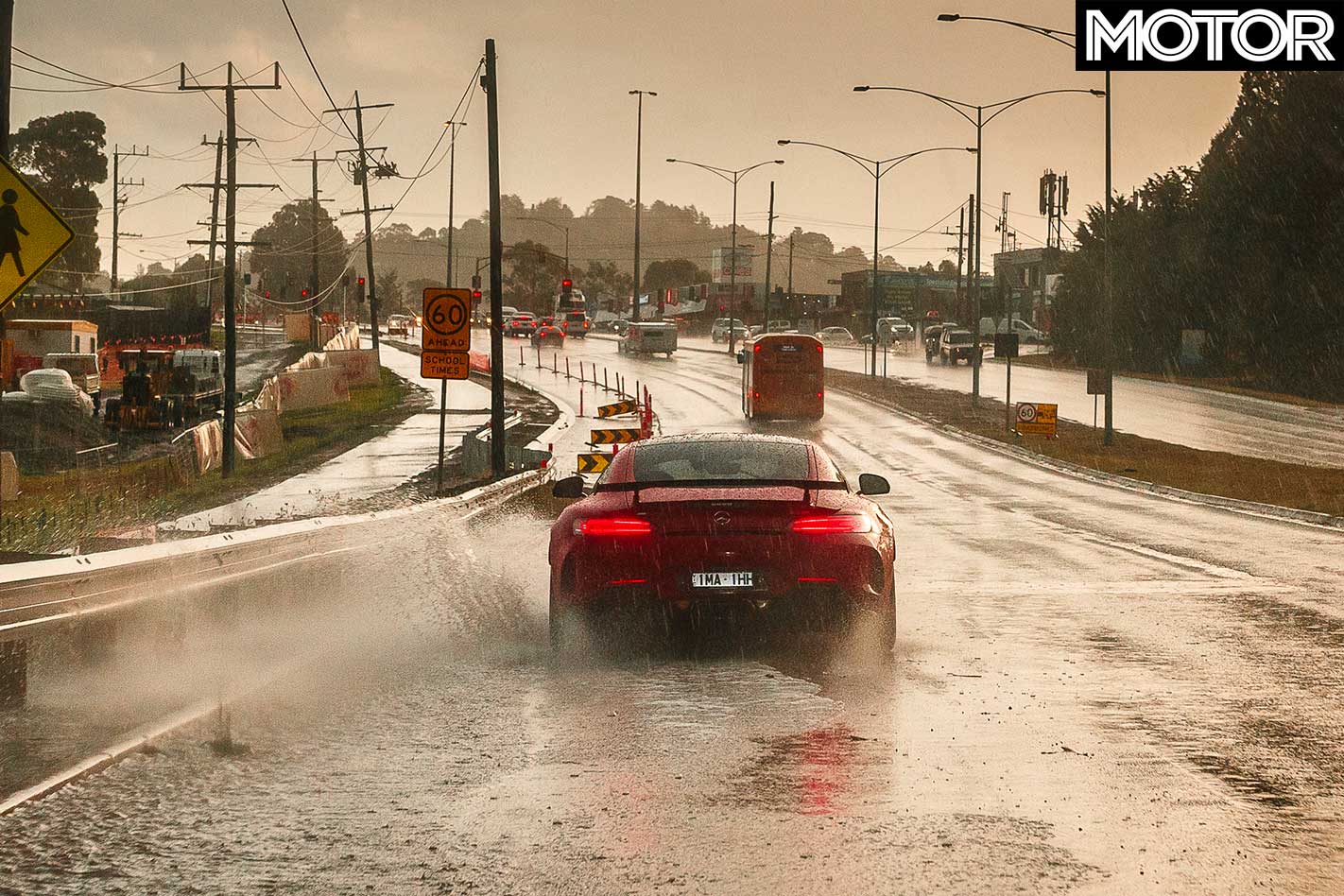
However, turn the ESP off, set the adjustable traction control to halfway and the GT R accelerates without fuss, the electronics allowing the perfect number of kilowatts through that the surface can handle. It’s remarkable.
1900hrs
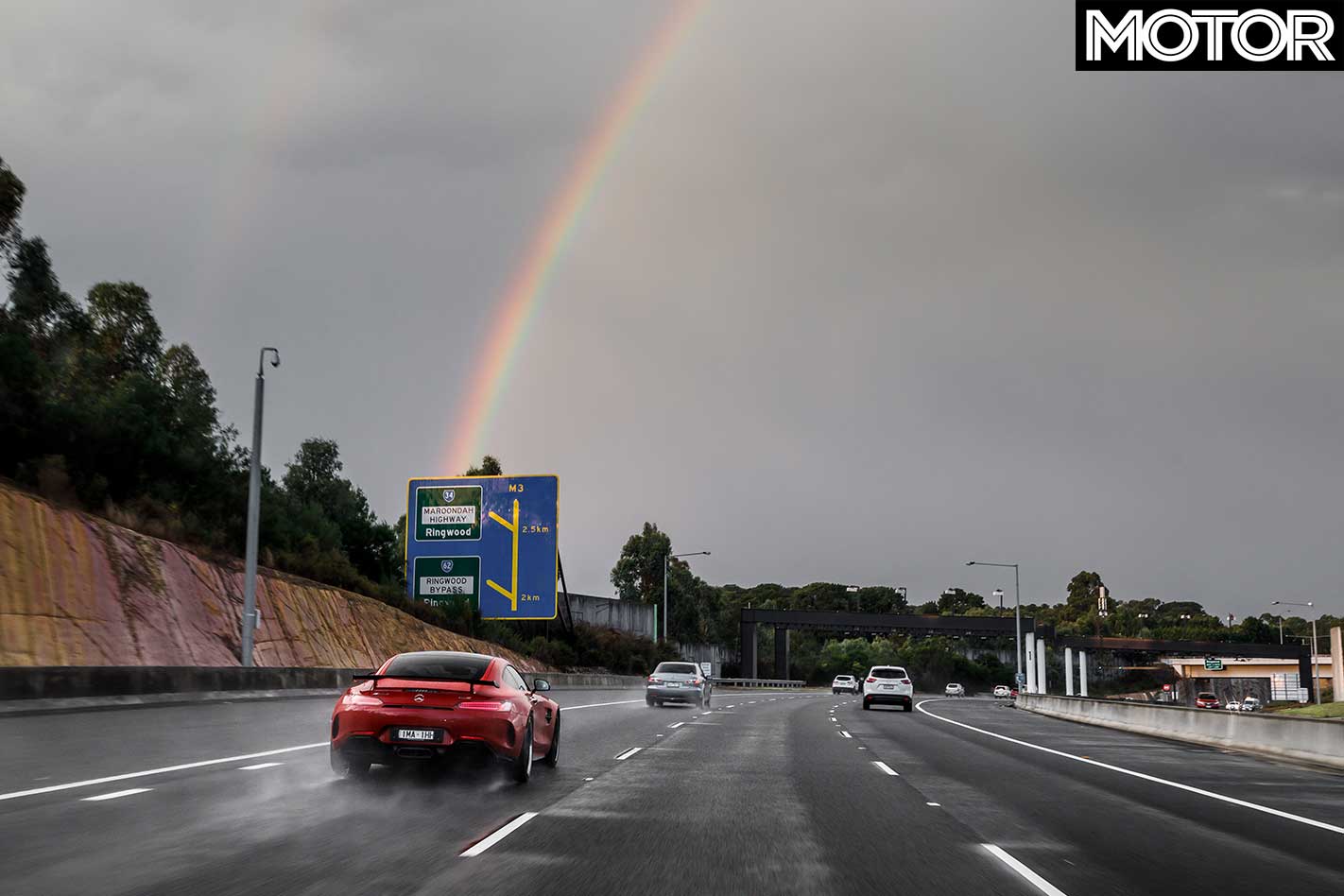
The weather is causing chaos. Much of Melbourne’s eastern roadwork is now under water, one bus driver risking becoming the captain of a 50-seat canoe by boldly (or stupidly) ploughing into floodwater. The low-slung GT R hasn’t the same luxury, burbling around the hazard, the steering tugging this way and that as standing water is encountered.
Driving any GT slowly is a curious experience and the hardcore R is no exception. Logic suggests selecting Comfort is the smart move, dulling the engine’s response and softening the dampers, but doing so makes the car feel out of sorts. Like most of its kind, the dual-clutch ’box doesn’t particularly enjoy stop-start driving and in its sleepiest setting it can be difficult to wake quickly if a sudden bolt of acceleration is required.
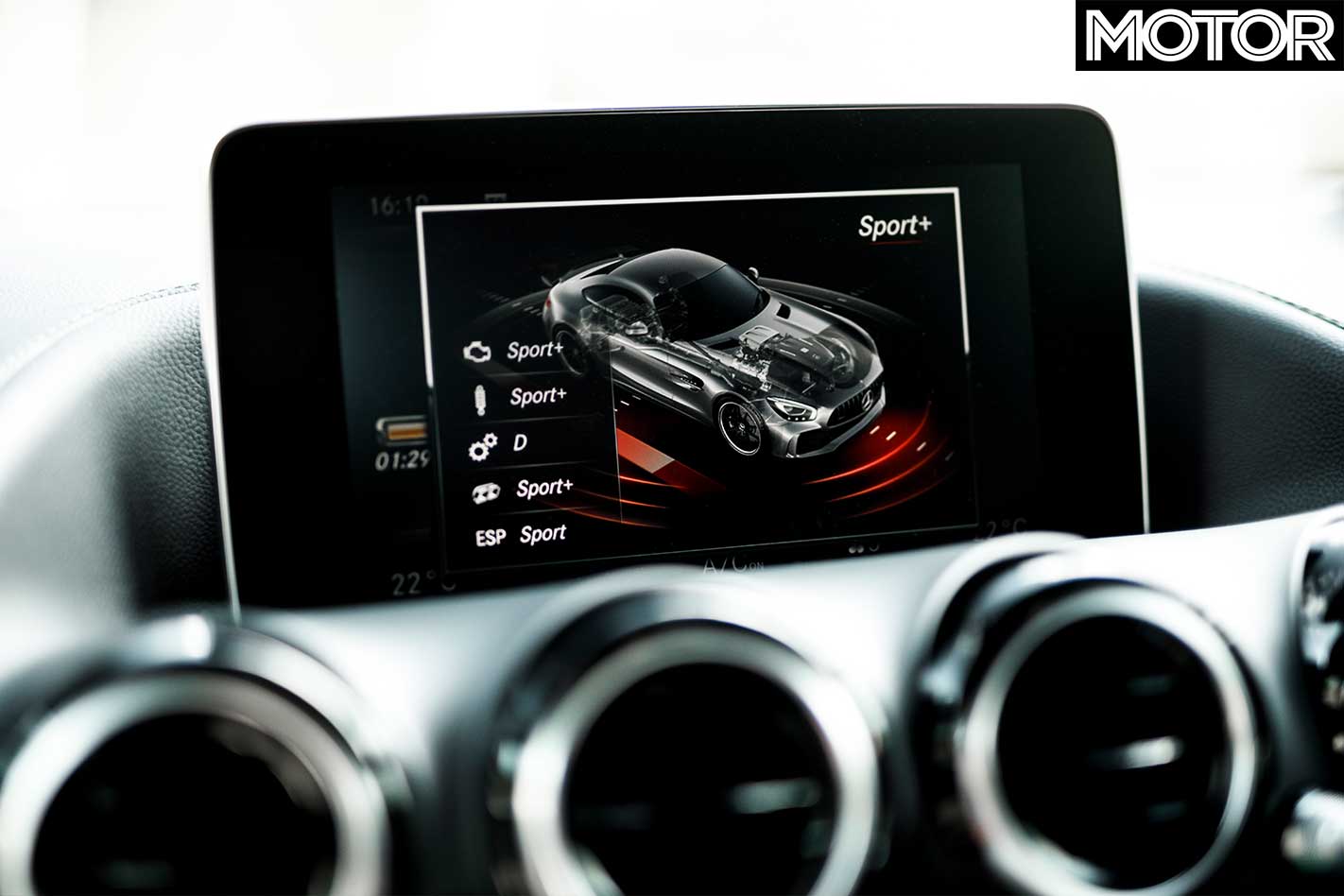
Likewise, the dampers are softer but somehow feel out of sync with the rest of the car. Dialling up Sport Plus doesn’t cause the ride quality to deteriorate like you might expect. In fact, in a way it improves it; the GT R isn’t any less comfortable but deals with road imperfections swiftly and decisively without a thought to occupant comfort. It’s firm, but this is a track-focused sports car – deal with it.
2200hrs
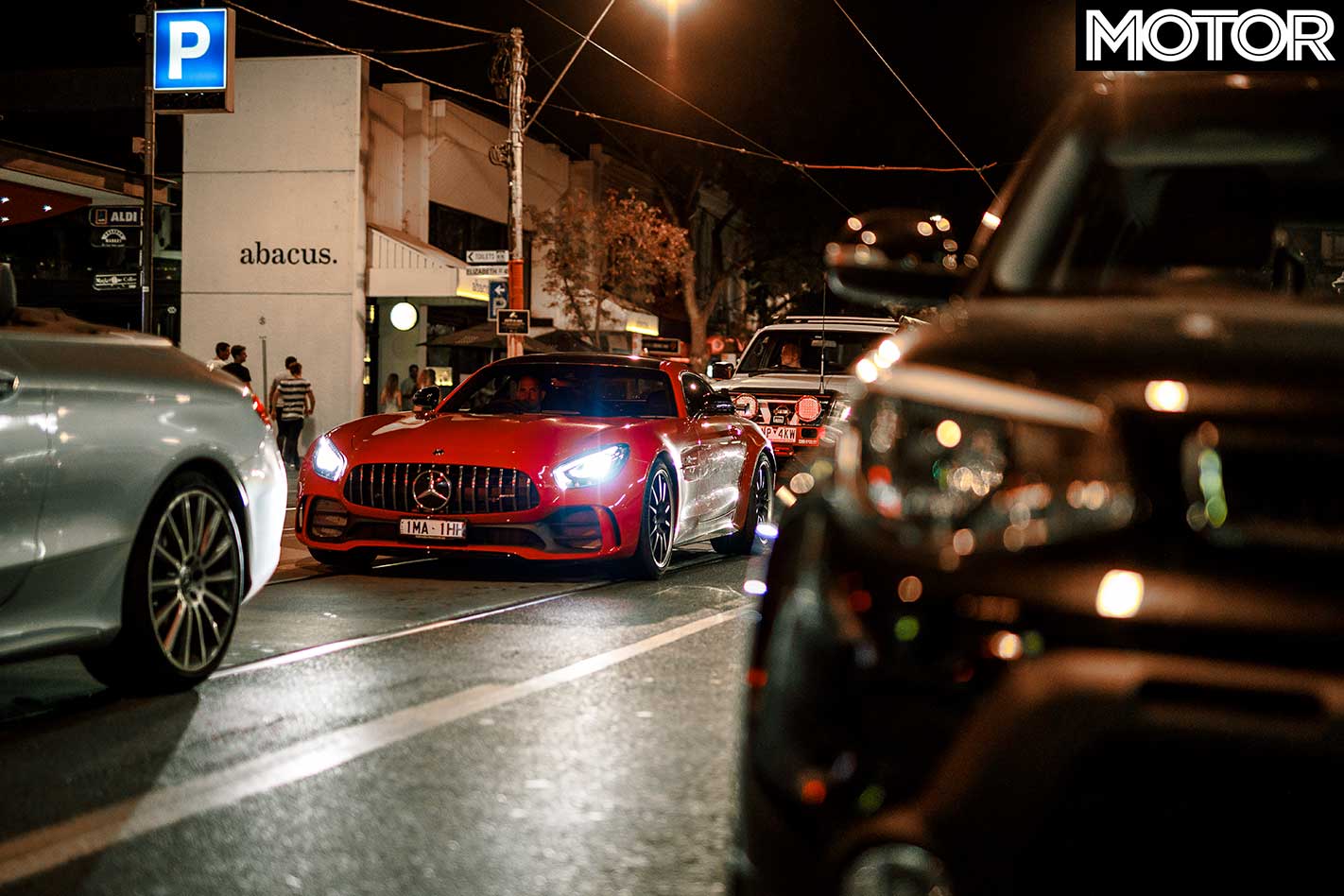
There’s always something worth looking at on Chapel Street on a Friday night. A Porsche 911 Turbo and Bentley Continental GT are worthy of attention, but a freshly arrived Ferrari 488 Pista on optional carbon rims is the highlight. From behind the wheel, it’s easy to forget we’re in a drawcard ourselves – the AMG GT R isn’t exactly common.
Nor is it an easy car to assess. After 11 hours on road and track I find myself out of step with prevailing sentiment, that the GT R is somehow a different beast to the regular GT range. To me it feels like GT concentrate: it plays to the car’s strength (unbelievable speed, noise and presence) without really addressing its shortcomings (suspension compliance; on-limit handling).
The best sports cars somehow manage to be wolves at maximum attack yet sheep during day-to-day driving. The GT S and GT C attempt this duality of purpose by adding trinkets like a glass roof and electric seats, yet end up feeling like wolves in rather silly and unconvincing sheep costumes as their hardcore sport car genes inevitably shine through.
The GT R is the ultimate iteration of AMG’s sports car because it knows it’s a wolf and doesn’t try to be anything but. It has its flaws yet still has enormous appeal as it exudes aggression in the way looks, sounds and performs. Bring on the Black Series.
FAST FACTS 2019 Mercedes-AMG GT R BODY: 2-door, 2-seat coupe DRIVE: rear-wheel ENGINE: 3982cc V6, DOHC, 32v, twin-turbo BORE/STROKE: 83.0 x 92.0mm COMPRESSION: 9.5:1 POWER: 430kW @ 6250rpm TORQUE: 700Nm @ 1900-5500rpm WEIGHT: 1555kg POWER-TO- WEIGHT: 277kW/tonne TRANSMISSION: 7-speed dual-clutch SUSPENSION: double wishbones, coil springs, adaptive dampers, anti-roll bar (f/r) L/W/h: 4551/2007/1284mm WHEELBASE: 2630mm TRACKS: 1693/1683mm (f/r) STEERING: electrically assisted rack-and-pinion; rear-wheel steer BRAKES: 402mm ventilated/drilled carbon-ceramic discs, 6-piston calipers (f); 360mm ventilated/drilled carbon-ceramic discs, single-piston calipers (r) WHEELS: 19.0 x 10.0-inch (f); 20.0 x 12.0-inch (r) TYRES: Michelin Pilot Sport Cup 2, 275/35 ZR19 (f); 325/30 ZR20 (r) PRICE: $351,130 ($372,129 as-tested)
PROS: Vicious engine; incredible pace; looks; traction control CONS: Hates bumps; always ‘on’ RATING: 4 out of 5 stars
The Strip
| Mercedes-AMG GT R | |
| 0-10km/h | 0.36sec |
| 0-20km/h | 0.69sec |
| 0-30km/h | 1.05sec |
| 0-40km/h | 1.44sec |
| 0-50km/h | 1.78sec |
| 0-60km/h | 2.14sec |
| 0-70km/h | 2.52sec |
| 0-80km/h | 2.91sec |
| 0-90km/h | 3.39sec |
| 0-100km/h | 3.73sec |
| 0-110km/h | 4.21sec |
| 0-120km/h | 4.69sec |
| 0-130km/h | 5.21sec |
| 0-140km/h | 5.79sec |
| 0-150km/h | 6.43sec |
| 0-160km/h | 7.12sec |
| 0-170km/h | 7.87sec |
| 0-180km/h | 8.74sec |
| 0-190km/h | 9.62sec |
| 0-200km/h | 10.61sec |
| 0-400m | 11.42sec @ 207.99km/h |
| 80-120km/h | 1.8sec |
| 100-0km/h | 33.92m |
| Speed in gears | |
| 1st | 78km/h @ 7000rpm |
| 2nd | 109km/h @ 7000rpm |
| 3rd | 147km/h @ 7000rpm |
| 4th | 185km/h @ 7000rpm |
| 5th | 232km/h @ 7000rpm |
| 6th | 285km/h @ 7000rpm |
| 7th | 318km/h @ 6420rpm* |
Sandown Raceway, 25˚C, dry. Driver: Scott Newman Timing: VBOX Australia *Manufacturer’s claim
Rod Millen’s sitting in a deck chair, contemplating his driveway. The grass edging is looking a bit secondhand and there are tyre marks on the otherwise perfect bitumen. Seven drift cars come flying past on the lock stops at over 100km/h, the tyre smoke growing ever thicker until the final car is just an ear-piercing buzzsaw of a triple-rotor on the limiter. The old boy waits for the smoke to clear and continues his story.

“So I said to my wife, Shelly, ‘We could turn the driveway into a Goodwood South.’ I already had a lot of my old cars here and I’d built the barns and now I had to pave the road because it was a gravel road in the early days. She set out about eight years ago, because it was my 60th birthday, to race up the driveway with a few friends. We had a lot of enthusiasm from local fans who said let’s make it an annual event. So here we are,” he says.
Calling New Zealand’s Leadfoot Festival the Antipodean version of the world’s most famous garden party is a handy shorthand, and there are parallels. Both are summery events that encompass a sprint up the driveway of automotive royalty, but beyond that there are massive divergences.
Goodwood is now a huge commercial event, with visitor numbers capped at 150,000 a day, drawing on a 15 million population who live within a two-hour drive. Millen’s Leadfoot Ranch is secreted away in a sleepy nook of the north island’s Coromandel Peninsula, proximate to very little.

Millen knows that Leadfoot’s scope is, by comparison, modest. “This event is still in its infancy, but I don’t think it’ll ever get much bigger. We’ll endeavour to attract unique cars and the cool drivers, and our goal is to grow the event in the future, but we’ll never come close to Goodwood. If we can be 20 percent of what Goodwood is, we’ll call that a success, and we’re getting close.”
Whereas Goodwood is a fairly unexceptional track with only one corner, Molecomb, worthy of the name, the 1.6km course at Leadfoot Ranch is a whole lot gnarlier. “Some 25 to 30 years of racing at Pikes Peak influenced how we set up the property,” Millen explains. “Fortunately there’s a very steep part and I said, ‘Wow! That’s where my switchbacks are going.’ So we got out the bulldozer and basically cut through the bush and I had a couple of friends who said, ‘Rod, you know you could make that a lot straighter. You don’t have to do that’ and I said, ‘Yes I do!’”
That’s reflected in the average speeds: Goodwood’s record is 160.5km/h; Leadfoot’s is a mere 120km/h. “We created those switchbacks and what I like about the driveway is that it’s interesting. It’s not high speed. There are some short straights and the spectators can get up close and see the drivers and the cars in action as they’re wrestling the cars around the switchbacks. It’s not just about the amount of power you have, it rewards driver skill, linking corner to corner,” Millen adds.
Ex-WRC Subaru Impreza daily driver
Drift star ‘Mad’ Mike Whiddett’s here in his Red Bull-sponsored ‘Radbul’ MX-5 and he agrees with his host.
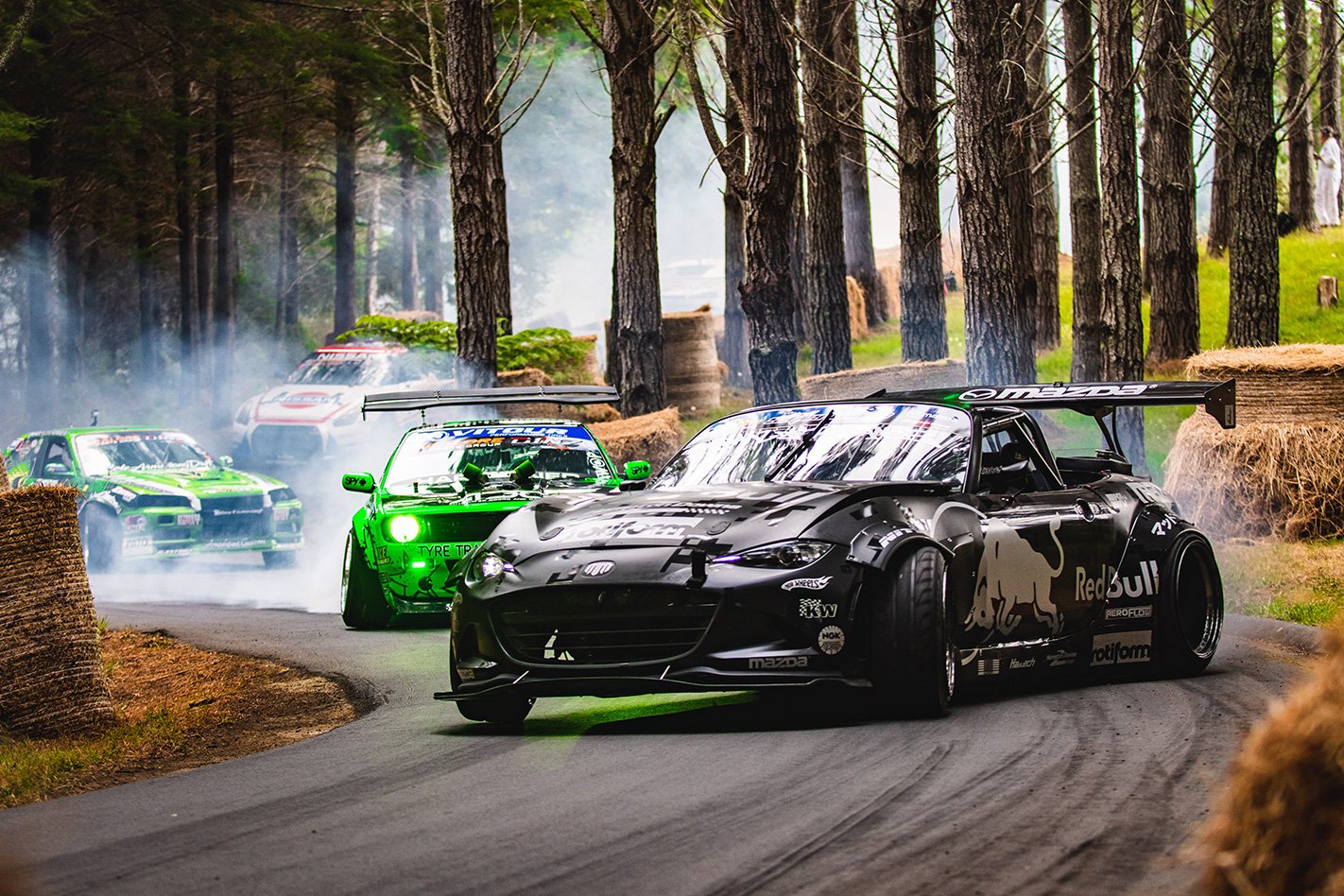
“The key to this course is focus. It’s really tricky for drifting because it’s so narrow. The faster and more committed you are, the easier it flows. It’s cool. When we go as tandem, if you’re the second car, it’s really hard to see. We went up with seven cars and if you’re in that last car, you’re literally blind,” he laughs.
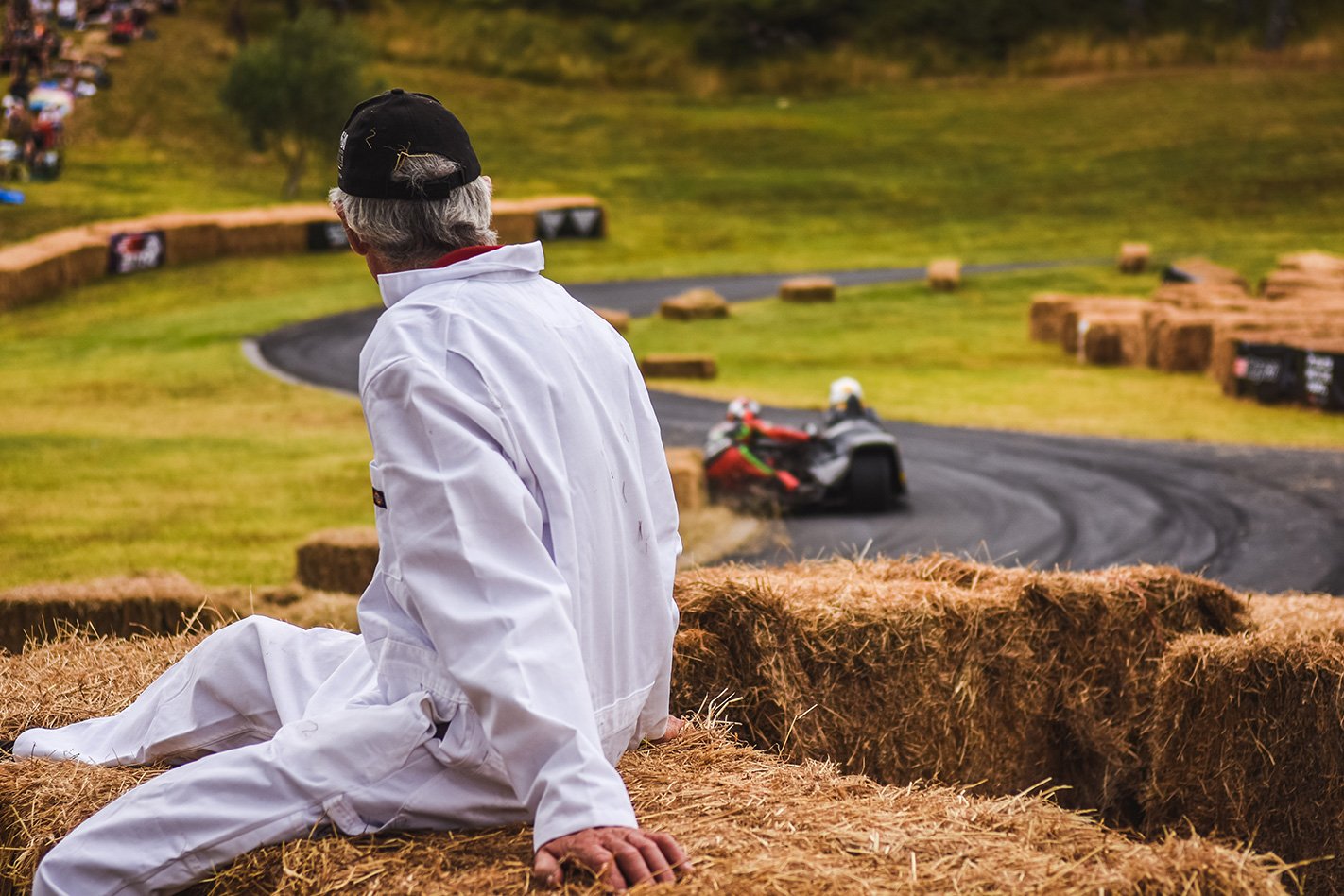
The best section for spectating is up in the forested switchbacks, where the cars tackle a chain of hairpins and are almost close enough to touch. The tyre smoke hangs in the air and you wait for the next car to appear out of the mist, visible vortices spiralling off their wings and flics. Fastest of all is Alister McRae, who’s now won three events in a row in an ex-Possum Bourne WRC Impreza.
“It’s such a short piece of road; very, very technical, so it’s easy to make a mistake. If you miss a gear, you’re well down,” explains McRae, highlighting exactly the fault that dropped Millen’s own Pikes Peak Celica from the podium. “For me, the trick is to take a deep breath at the bottom and then breathe again at the top. I can’t hold my breath for that long, so you’ve just got to get there! You’ve got to carry the corner speed and use as much of the road as possible.”
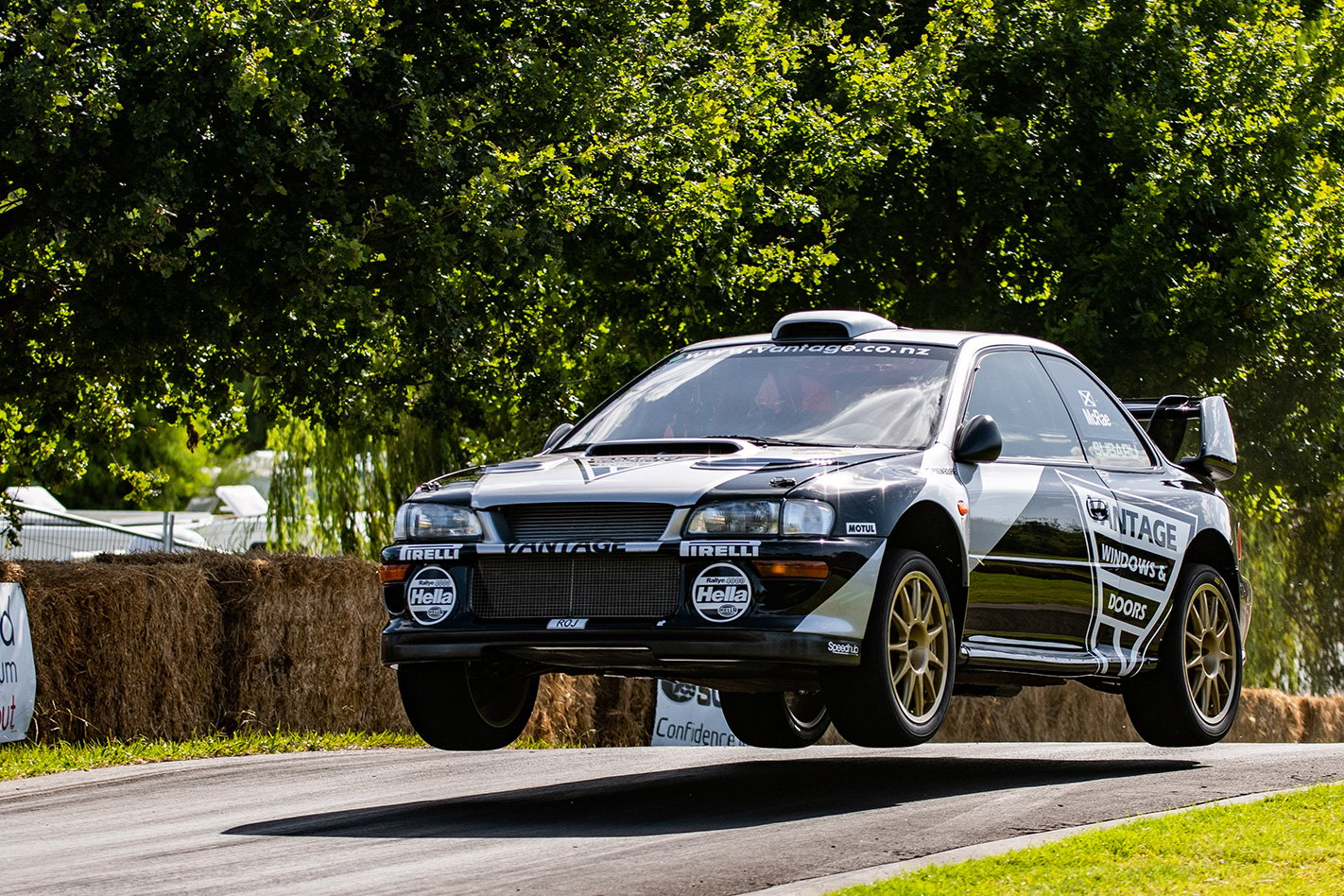
He’s pleased with his run in Sunday’s Top Ten Shootout. “I don’t think there was anywhere I could have really improved, apart from in the trees where it was really dusty. I understeered through there, but apart from that I’d say it was quite perfect. Three on the bounce and five wins with this car now, so that’s not bad. It’s 20 years old so it’s getting better with age. A bit like me,” he joshes.
As impressive as the really quick guys are, it’s perhaps even more fascinating to see the waifs and strays of New Zealand’s garagista culture tackling Rod’s plantation. Citroën Traction Avant with a Windsor V8? How about a Mk2 Escort with a rotary? Or a March mid-engined Nissan Micra? Or if Nissan engine swaps are your thing, an R35 GT-R drift car with the RB26 DETT straight-six lump from an old R32? Unlike Goodwood, where the drivers now hustle to roped-off hospitality areas, at Leadfoot, they hang around and chat.
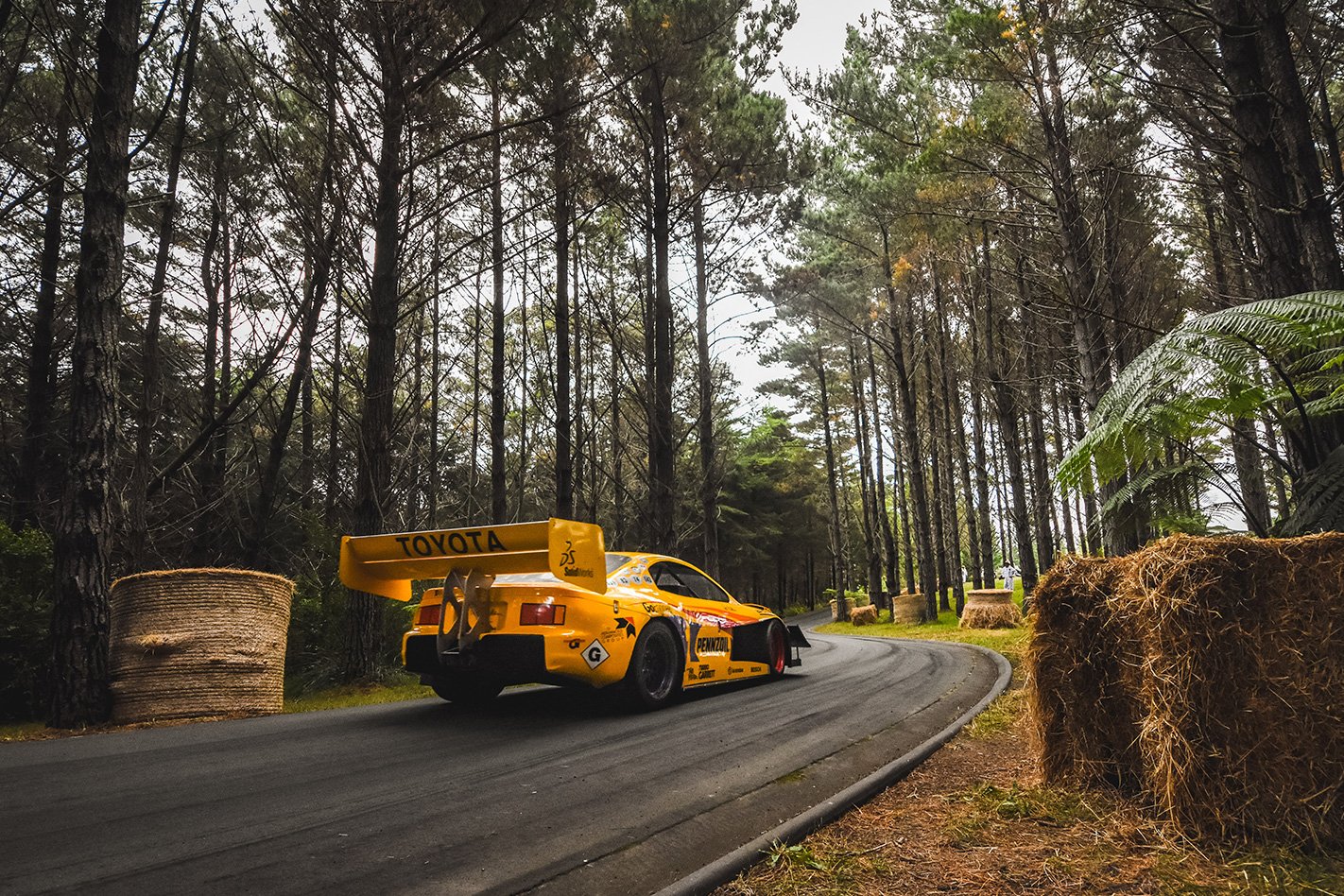
Wander the paddocks and you’ll end up with a sore neck, as it’s hard to figure out what to look at. Rod’s son Rhys, a double Pikes Peak winner himself, is there with the production-class-winning Pikes Peak Bentley Bentayga SUV. “We ran Goodwood in the Bentayga and we entered into the Supercar Shootout and we finished fourth, with only the Aston Vulcan AMR, the Ford GT and the BAC Mono beating us, because there are so many long straights and this thing is a torque monster,” Rhys says.
“Here is much more of a challenge than the Goodwood course but the appeal is very equal. Every other car here will be on a race tyre so you have to know that, as a competitive person, you can overdrive the support of the suspension and the tyre. You need to find that fine balance, and then rinse and repeat. Even on the first run this morning, we’ve seen three or four cars go off. It’s only a minute, but that doesn’t matter. You need to be respectful of the road.”
Later on that evening I take a drive through the ranch, ending up on some sea cliffs overlooking the Pacific Ocean, enjoying a drink next to the wine-cellar mineshaft that runs beneath the house Millen’s building up on the bluffs. Shelly Millen teases Rod about the Ford GT he bought last year, which has only covered 16 miles, due to the fact that Millen only worked out how to refuel it last week; Ford pointing him to a convoluted fuel nozzle hidden in the boot.

It’d be a great facility to explore at your leisure, if only to locate Millen’s rumoured barn full of forgotten Mazda prototypes. Or just to drool over his Pikes Peak-winning Toyota Celica. It’s hard to know where to start. Rod’s clear where it ends, though.
“In my professional-racing career, you always had people to answer to on Monday morning, because they were the ones paying the bills and they had expectations on results. Here, there’s nobody to call on Monday morning, so it doesn’t matter. You’re going back to why you got into the sport. For a few it became a profession, but now it’s back to being a hobby,” he smiles.
An RX-7 powers through the first of the corners into the switchbacks, taking great liberties with track limits and Rod’s edging, the driver flapping at the wheel like a pigeon in a box.
Rod’s chuckling. “My Dad once said a long time ago ‘Boy, there’s lots of action going on there; you look fast but your times are not.’ If it looks like you’re going fast, chances are you’re not.”
It’s an apt metaphor for the event as a whole. Leadfoot has learned to appreciate the value of a slow hand at the tiller.
Assumption simply makes an ass out of you and me, or so the saying goes. Correctly, as it turns out. The rhetoric surrounding the Aston Martin DB11 AMR suggests it will be neither fish nor fowl, the sport-ification of its luxury grand tourer like attempting to turn a Paso Fino into a Thoroughbred. In actual fact, the result is a brilliantly entertaining sports GT with a tremendous breadth of ability.
In my defence, the signs weren’t good. The regular V12 DB11 fulfilled its role beautifully, its plush ride and smooth, torquey twin-turbo V12 making it a fantastic way to cover distance. Its weight and soft suspension prevented it being the sharpest of handlers, but it was refreshing to drive a car that clearly prioritised road comfort over ultimate handling precision.
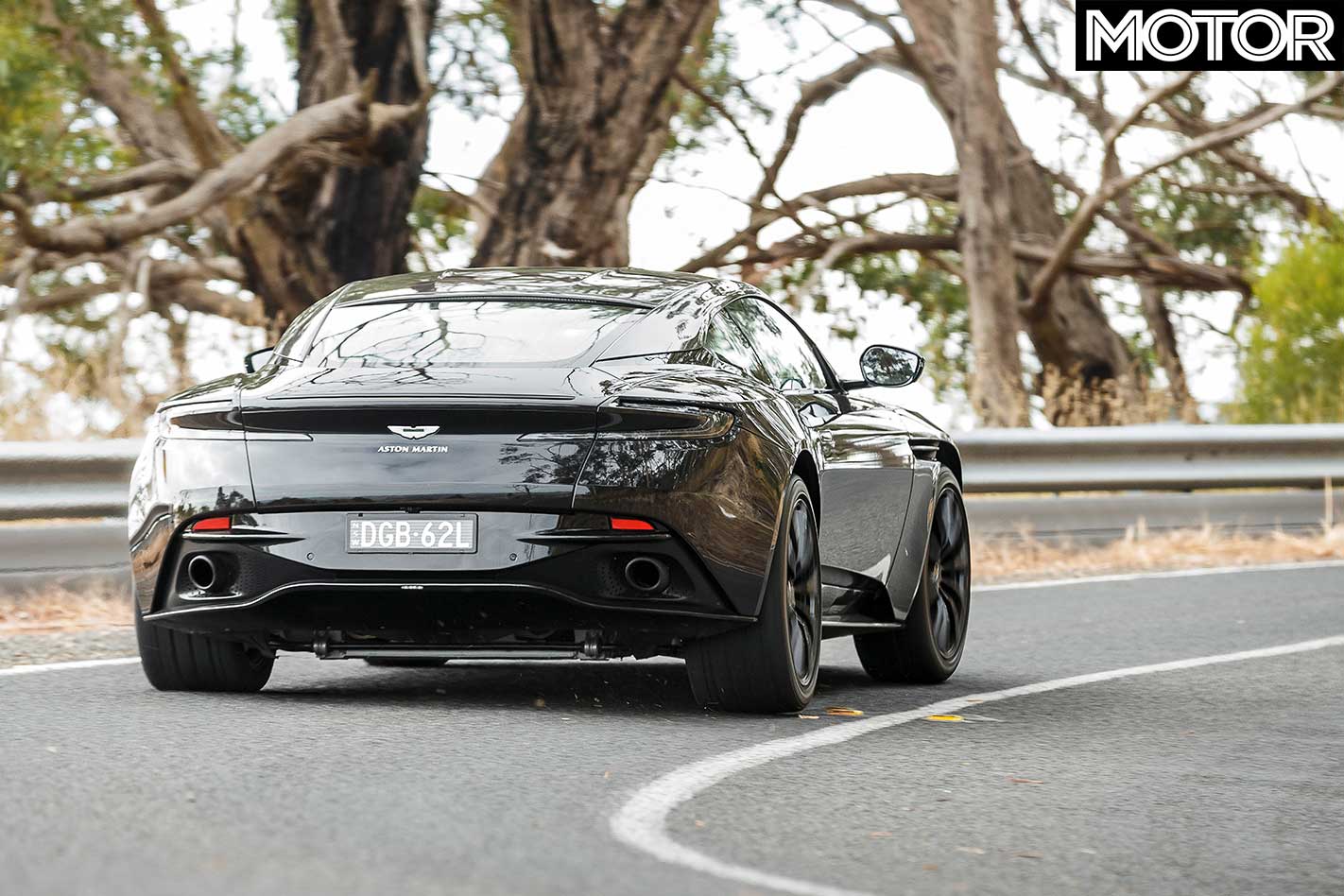
Then came the DB11 V8. Lighter, stiffer and sharper, it was undoubtedly the more dynamic drive, but that lovely loping ride quality was lost resulting in a somewhat confused personality. If you want a sporty V8 Aston, buy a Vantage. So news that Aston was infusing the V8’s character into the V12 to create the more focused AMR wasn’t welcome news. Particularly as the regular V12 was to be dropped.
It quickly becomes clear, though, that whatever chassis changes have taken place – Aston doesn’t provide details – have been expertly applied.
The AMR is perhaps a little busier on patchy roads than the standard V12, but with the three-stage dampers set to comfort it beautifully cushions most bumps, the body gently bobbing before quickly settling. This default mode is soft enough to be unsuitable for press-on driving, resulting in the nose scuffing the tarmac through dips and enough roll for 1795kg to feel unkempt.
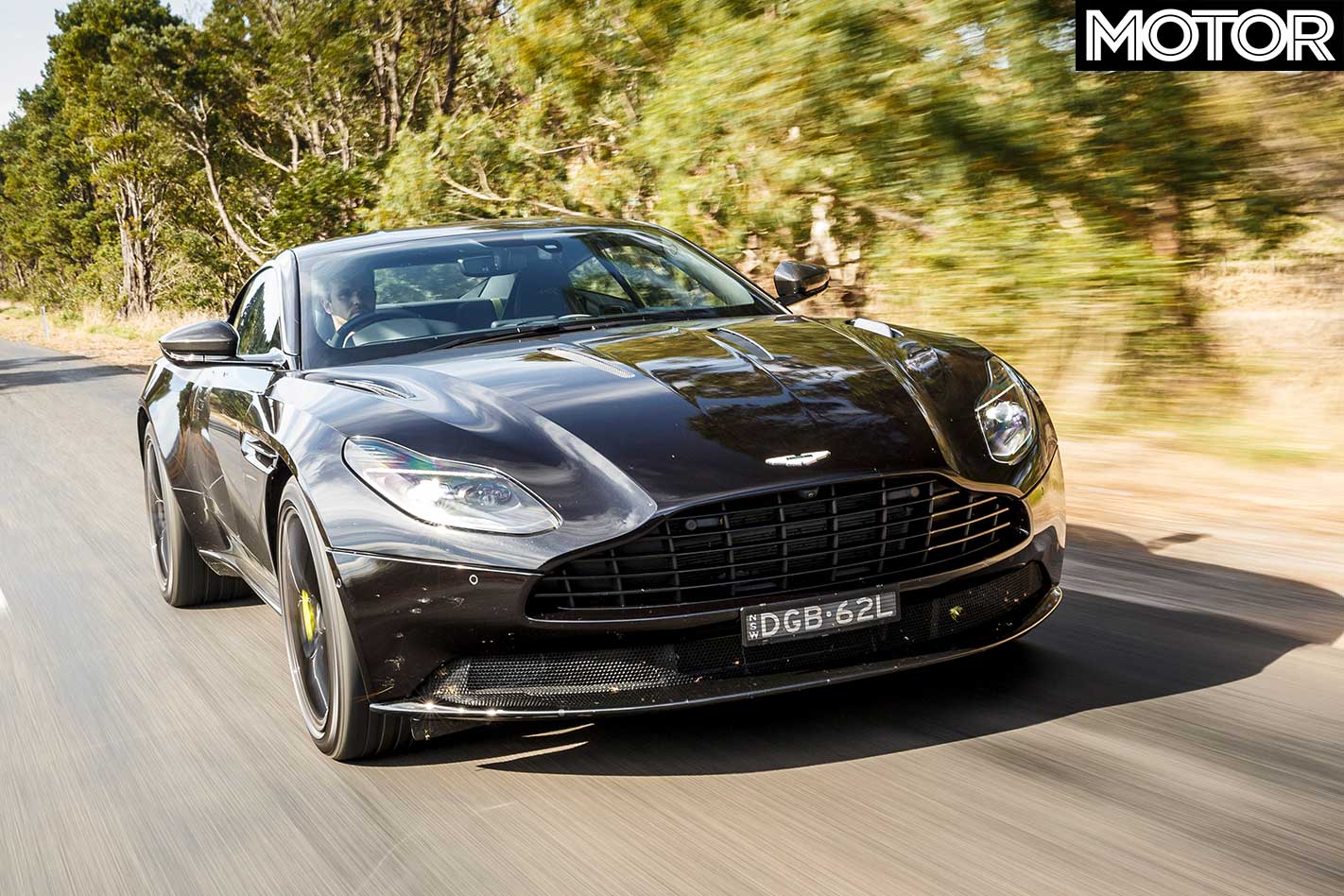
A quick flick to Sport improves matters, but even the stiffest Sport Plus is useable on road, retaining a level of compliance that allows the DB11 AMR to work with the road rather than fight it. The Bridgestone S007 tyres (255/40 front; 295/35 rear) need a bit of heat to give their best, but provide remarkable grip when warm.
There’s tremendous balance, the chassis providing a blank canvas for the driver to use as they see fit. Neat and tidy with gentle understeer? Easy. Lairy with the tail swinging? Happy to oblige.
The AMR can be hustled in a way the standard V12 can’t yet retains its good manners. The steering – operated by the unusual square (it’s not really a wheel) – isn’t overly talkative but the weighting and gearing feel very natural, which is important as the DB11’s a large car and needs to be placed accurately.
Under the bonnet Aston has extracted an extra 23kW from the 5.2-litre twin-turbo V12 for a total of 470kW, though torque remains at 700Nm. This drops the 0-100km/h claim to 3.7sec (-0.2sec) and ups the top speed to 335km/h (+13km/h). You’re unlikely to notice the extra grunt, but you’ll certainly notice the extra noise. A new exhaust unleashes a torrent of rich 12-cylinder music that bystanders swear has a hint of Lamborghini Aventador at high rpm.
The engine itself is beautiful: smooth, powerful and flexible with excellent response, though the initial throttle tip-in is too sharp. The eight-speed auto lacks the swift shifts of a dual-clutch, but if that’s the price for smooth day-to-day operation it’s one well worth paying.
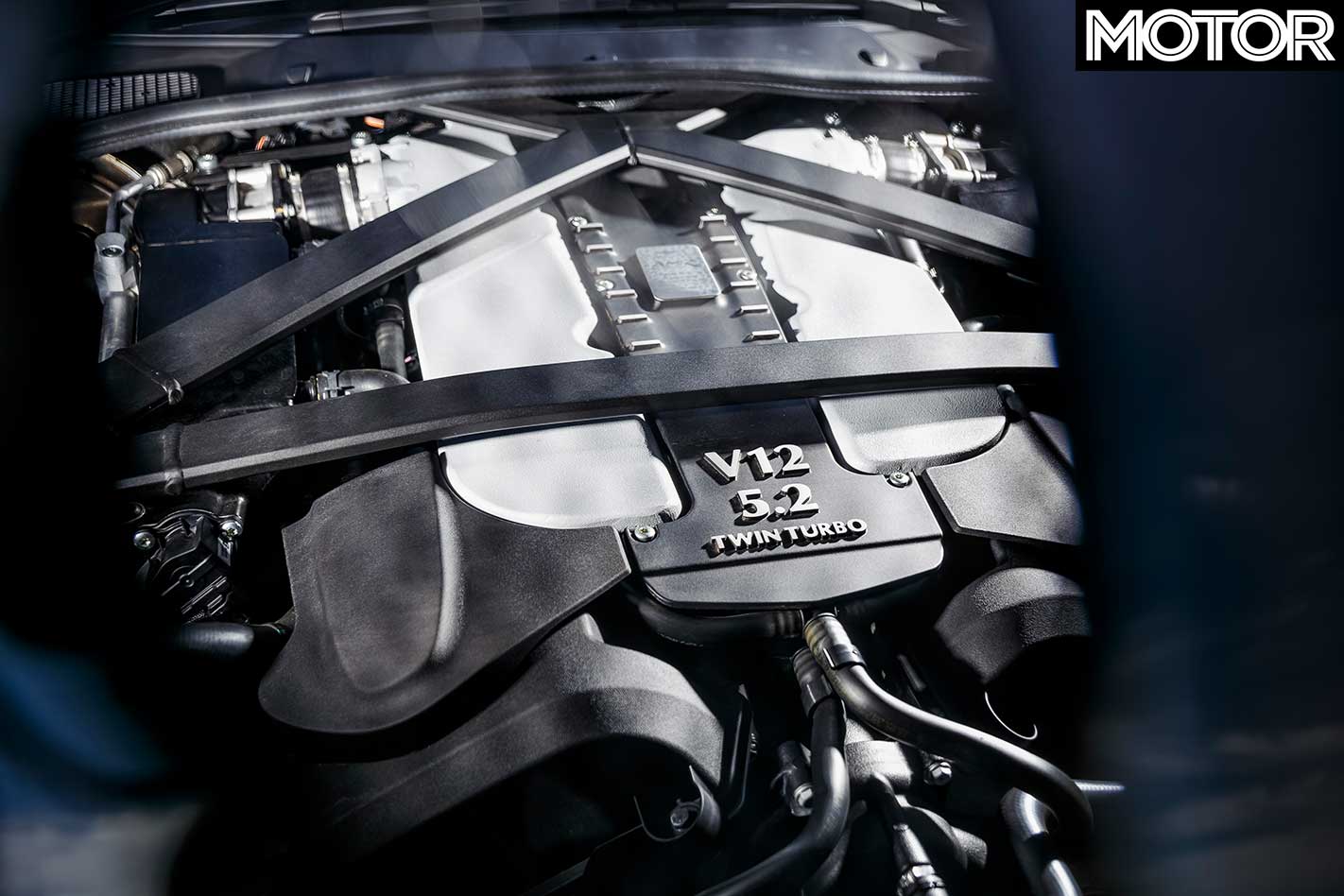
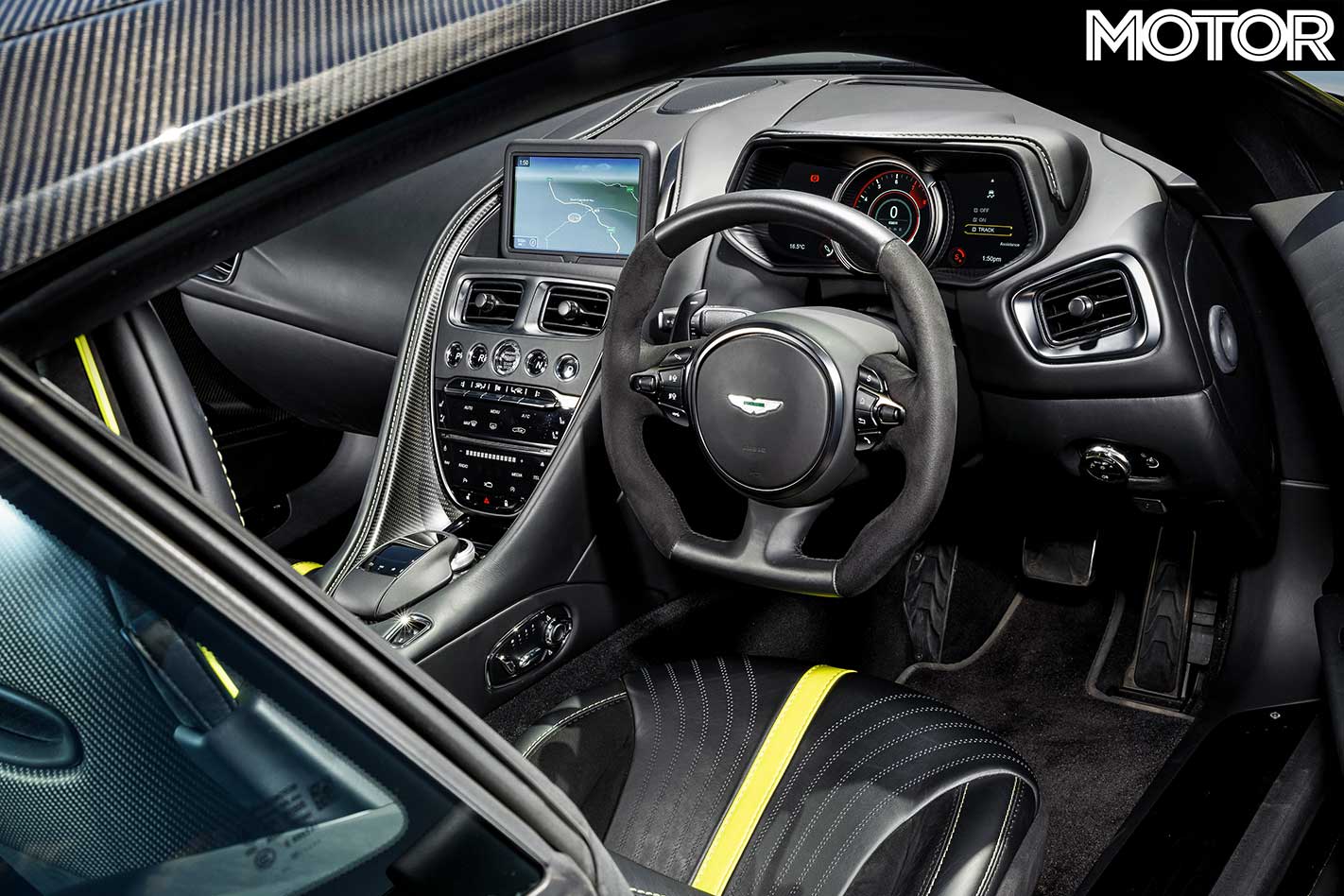
Crucially, for a machine that costs $428,000 ($481,280 as-tested) it feels special. It’s little things, like the way the doors swing upwards as they open, the smell of the leather and the design of the centre console, though Aston badly needs to negotiate access to Mercedes’ latest infotainment.
Like the McLaren 600LT we drove recently, the Aston Martin DB11 AMR manages the neat trick of enhancing the dynamic capabilities of the car while making only the slightest compromise to its everyday usability. It’s easy to drive slowly, engaging to drive quickly and fantastic to look at. It’s difficult to think of a better sporting grand tourer.
2019 ASTON MARTIN DB11 AMR SPECS Engine: 5204cc V12, DOHC, 48v, twin-turbo Power: 470kW @ 6500rpm Torque: 700Nm @ 1500rpm Weight: 1795kg 0-100km/h: 3.7sec (claimed) Price: $428,000
Like: Beautiful, soulful engine; superbly judged ride/handling balance; feel-good factor Dislike: Dated infotainment; throttle tip-in too sharp; can’t think of anything else
Rating: 4.5 out of 5 stars
The BMW X7 is new territory for the German automaker. Up until now BMW hasn’t dabbled in the upper-large SUV space, which left the BMW X5 as its biggest wagon offering while chief rival Mercedes-Benz virtually had that end of the SUV segment to itself with the GLS-Class (formerly the GL-Class).
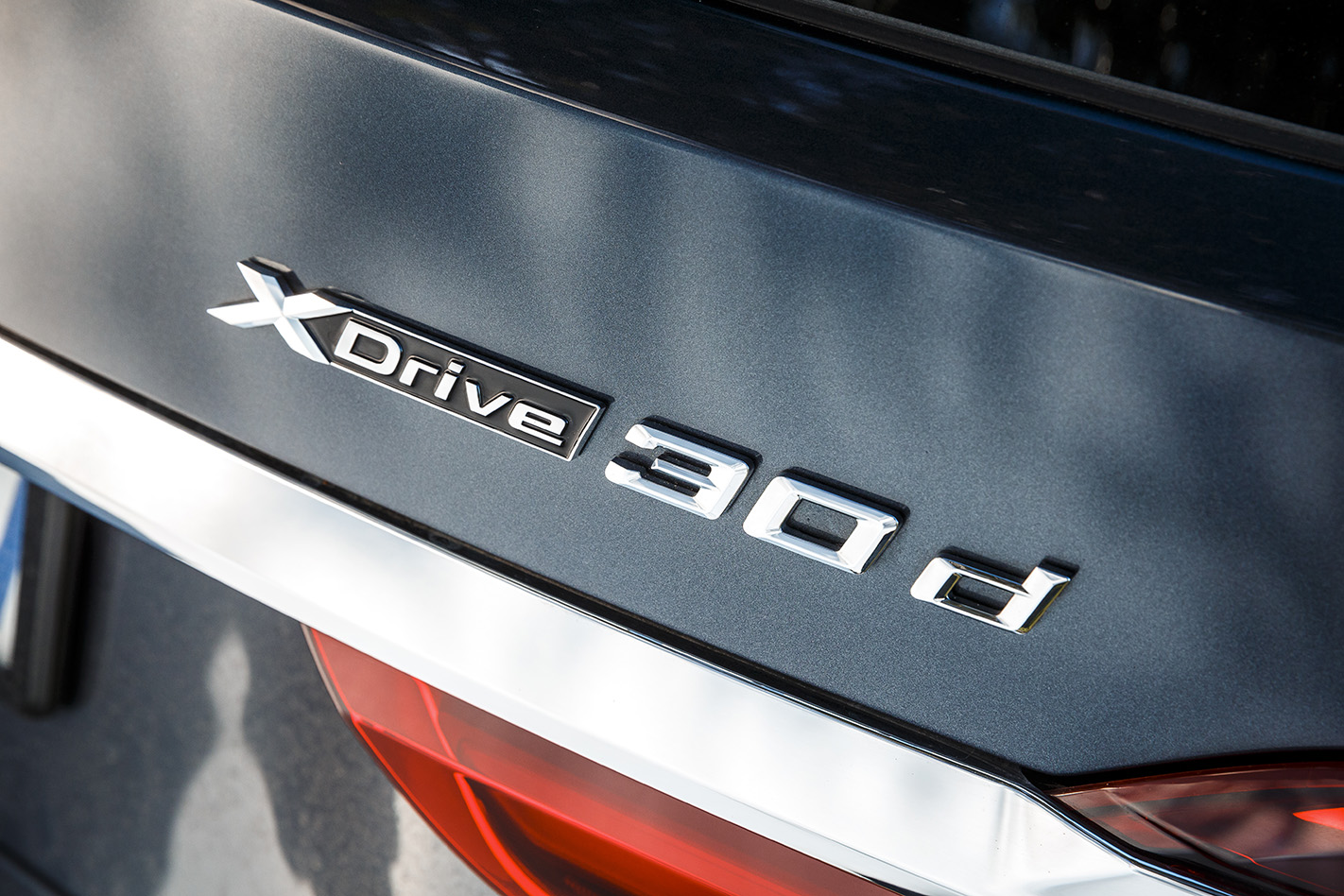
That’s now changed. The X7 is here and represents a significant step up from the X5 in terms of size. Not only that, but it’s virtually a limousine on stilts. Not only is the interior huge, but it’s fitted out with plenty of luxe features and furnishings. The X7 xDrive30d model we’re testing here is the entrypoint to the range, but as we found out it feels far from basic.
VALUE
To hop into the X7 xDrive30d, which for now is the most affordable variant in the X7 range, you’ll need to fork over $119,900 before any on-road costs. A fair wedge of cash, but consider that it’s just under $7K more than the smaller X5 xDrive30d and its value becomes apparent.
Yes, you can get a three-row config for the X5, but in reality it’s more of a 5+2 proposition. If you’re hunting for a proper seven-seat SUV, the X7’s extra spend is well worth it considering its far more capacious interior.
How’s it compare to the competition? Well, the current Mercedes-Benz GLS 350d is a smidge cheaper at $119,100 and makes very similar power and torque, but is on the cusp of replacement. The Audi Q7 is shorter and narrower and thus more aligned with the X5, but also slightly cheaper with a $106,900 retail.
As for the $134,129 Lexus LX 450d, the X7 actually has a sizable price advantage – normally the value relationship is flipped when it comes to BMW/Lexus comparisons. Meanwhile the cheapest version of the Range Rover Vogue TDV6 starts at $190K, meaning it’s not even in the same league. The X7’s value offering is certainly compelling within its segment.
STANDARD FEATURES
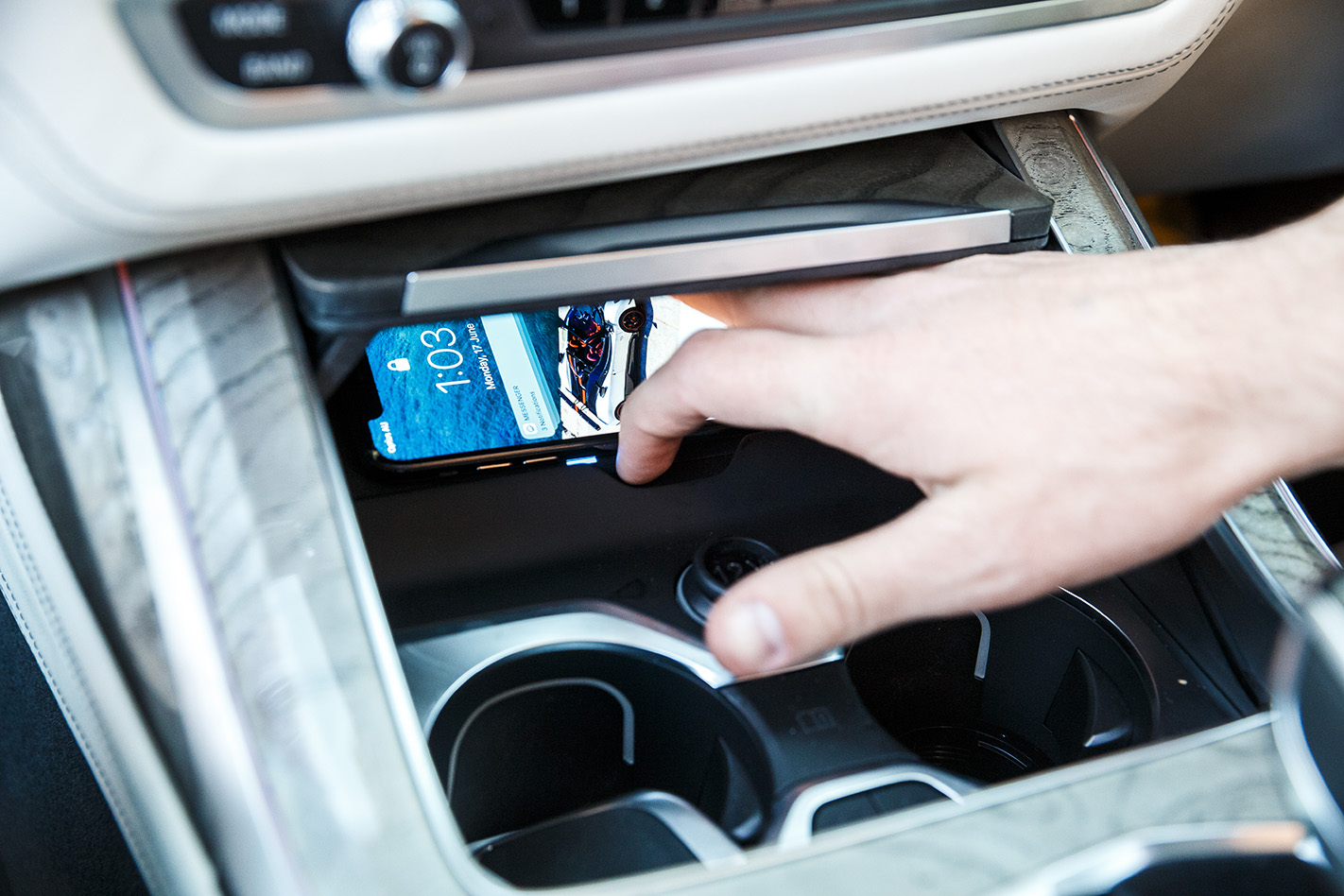
Where to begin. Standard equipment highlights include sumptuous leather upholstery and velour floor mats (velour!), quad zone climate control, soft-close doors, a head-up display, air suspension, power-adjustable front and second-row seats (the fronts being heated), a panoramic glass sunroof (with glass over the third row as well), and a wireless phone charger
Parking assist is also on the standard equipment list, and a pretty handy feature given the X7’s massive dimensions, while the infotainment system is BMW’s latest-gen system with built-in sat-nav, a broad suite of internet-enabled features, media streaming, Apple CarPlay and gesture controls.
Predictably for BMW’s SUV flagship, there’s plenty of scope to enhance that equipment list even further through the options list.
Our tester showed what was possible, with five-zone climate control giving those in the third row their own ventilation control panel, heated and cooled cupholders up front, laser headlamps, a punchy Harman/Kardon premium audio system, ultra-supple leater upholstey on the seats and dashboard, an alcantara headlining and even more electric adjustment for the front seats.
Naturally, that elevates the pricetag somewhat. All of the above bumped up the cost of our X7 30d tester to a hefty $143,050 before on-roads.
SIZE
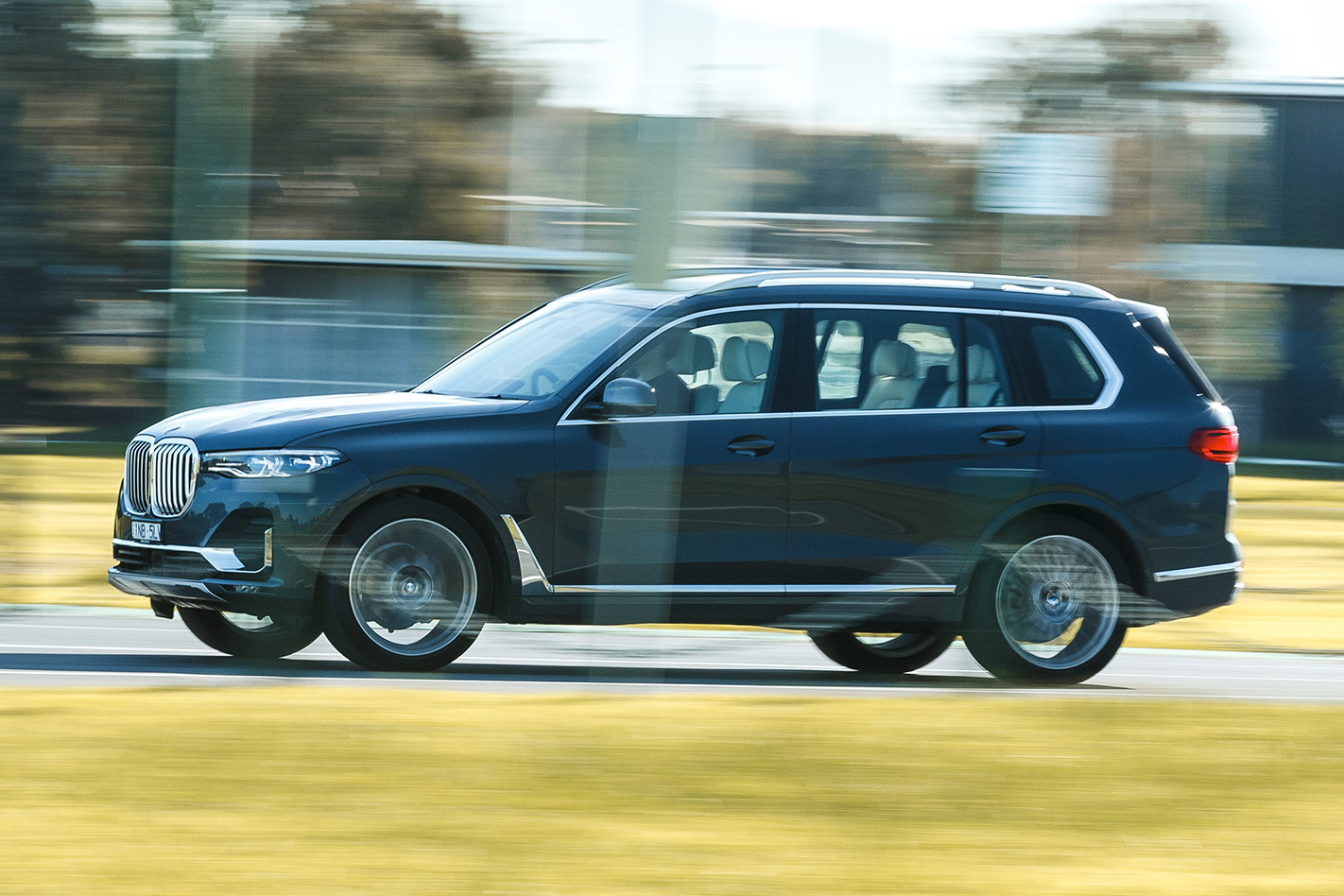
The X7 is massive. Measuring in at 5.15 metres long and 2.0 metres wide, it occupies a fair patch of road real estate. Its 3.1 metre wheelbase is also substantial, and a key indicator of just how much cabin space it boasts. It’s easily one of the biggest SUVs on the market today.
SAFETY
The X7 is equipped with a bevy of driver-assist systems, including ABS, EBD, brake assist, traction control, stability control, lane keep assist, active cruise control, parking assist, a top-down camera view and autonomous emergency braking.
All seats including the third row get three-point seatbelts, while there are five child seat ISOFIX anchorages across the second and third rows. Eight airbags protect occupants in a crash, covering dual front, front side, full-length curtain, driver’s knee and passenger knee.

COMFORT
Think of BMW’s 7-Series limousine. Now jack it up into the air and add another row of seating. That’s the X7: opulent, and elevated.
In fact, the X7’s cabin is one of BMW’s best so far. Following on from the classy X5 that launched last year, the X7 carries similar design themes albeit scaled up to accommodate its more generous internal dimensions. And the execution is flawless.
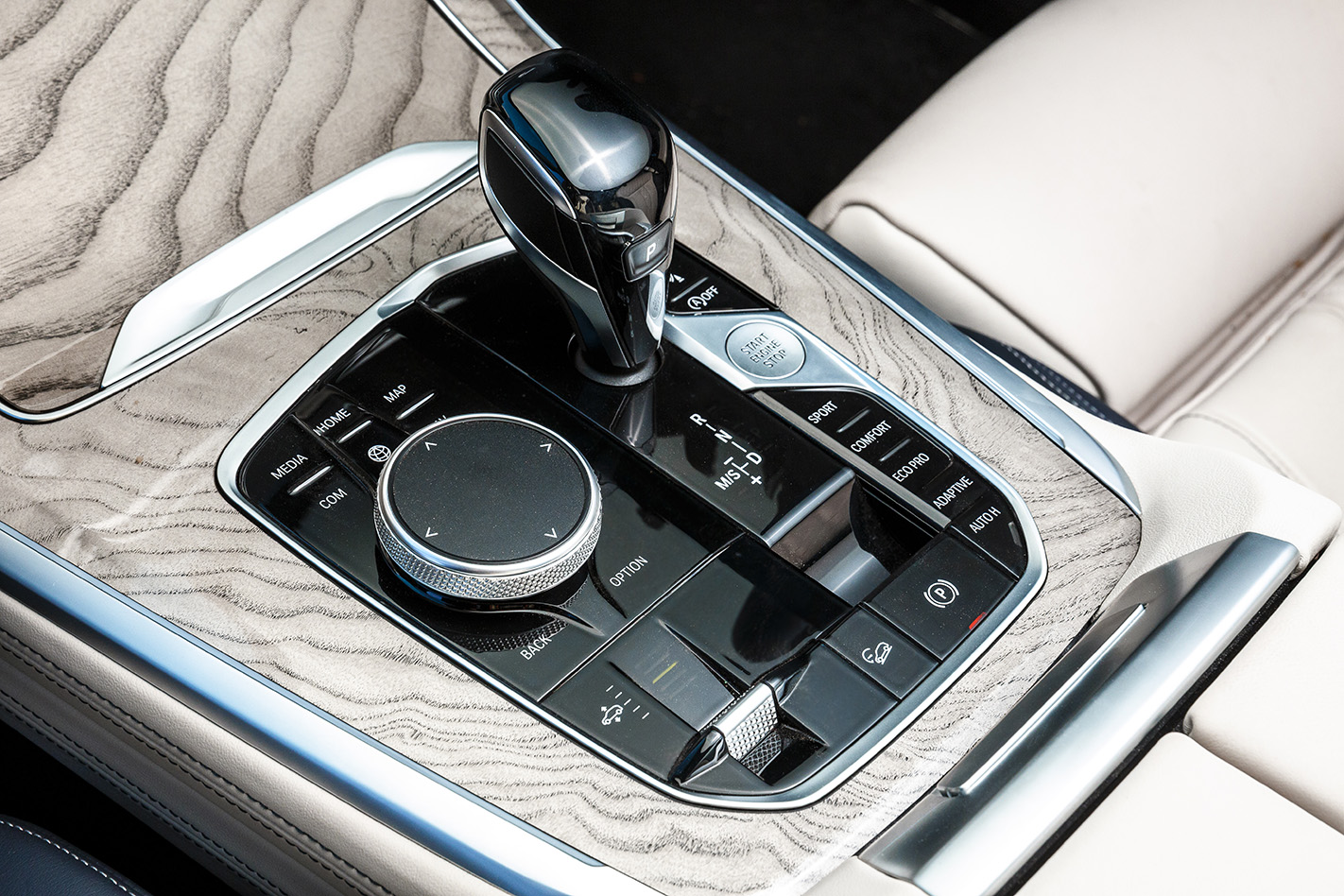
As for the comfort on offer, it’s another BMW-best. The optional front seats can adjust in almost every conceivable dimension to hug your body just-so, and the tall vantage point from the driver’s seat gives a commanding view of the road. The view through the side glass is expansive, the infotainment system is slick and intuitive to use (though the gesture controls take some familiarisation to get the most out of) and as you’d expect, there’s sprawling space aplenty.
The electrically-adjusted second row is similarly commodious, and though the seat cushions aren’t as deeply-sculpted as the front, they still give plenty of support – and enough width across the bench for three adults. Vents on the B-pillars and back of the centre console ensure good ventilation, and the rear climate controls further enhance back seat comfort.
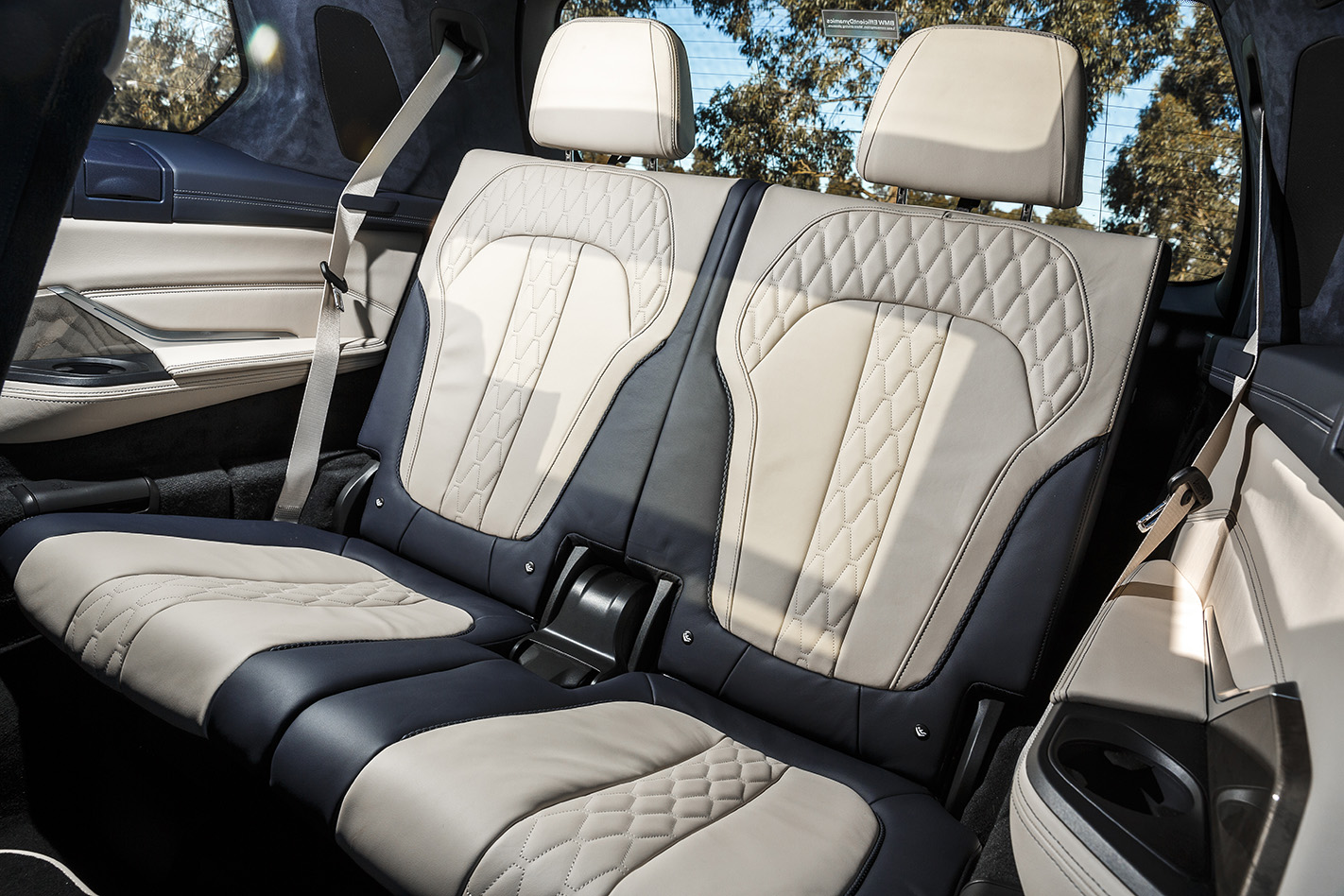
However, the third row is perhaps the most impressive aspect of the X7’s interior.
Simply put, that third row is best-in-class as far as comfort is concerned. Those in the rearmost seats get their own cupholders, leather-upholstered armrests, USB-C charge ports (one per side), and generously-sized quarter-windows that actually provide a decent view of the outside world. Overhead is a fixed glass sunroof with retractable shade, which helps limit any sensation of claustrophobia. This is one of the best third rows on the market, by far, and certainly roomy enough for a pair of adults to be comfortable for a reasonable duration.
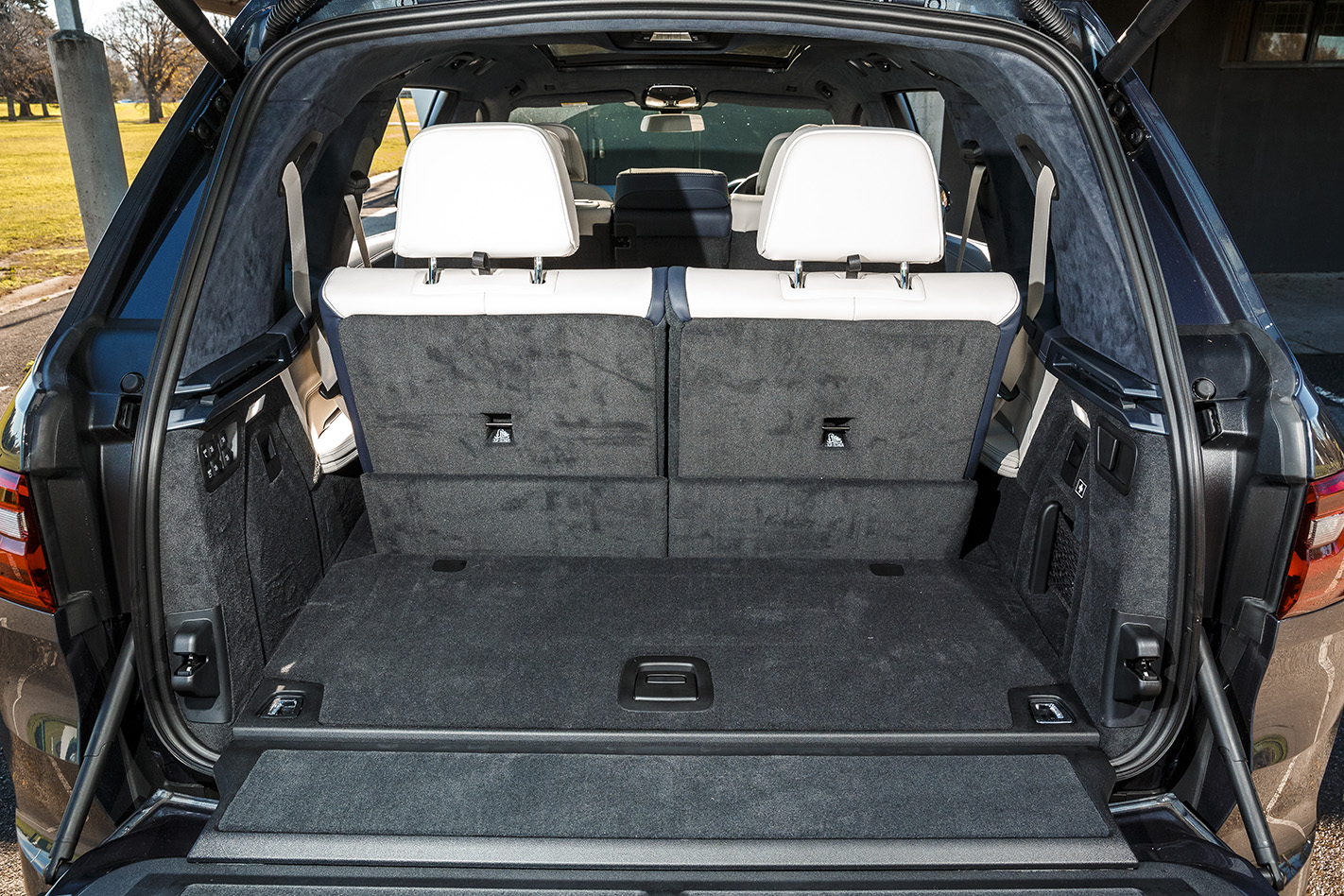
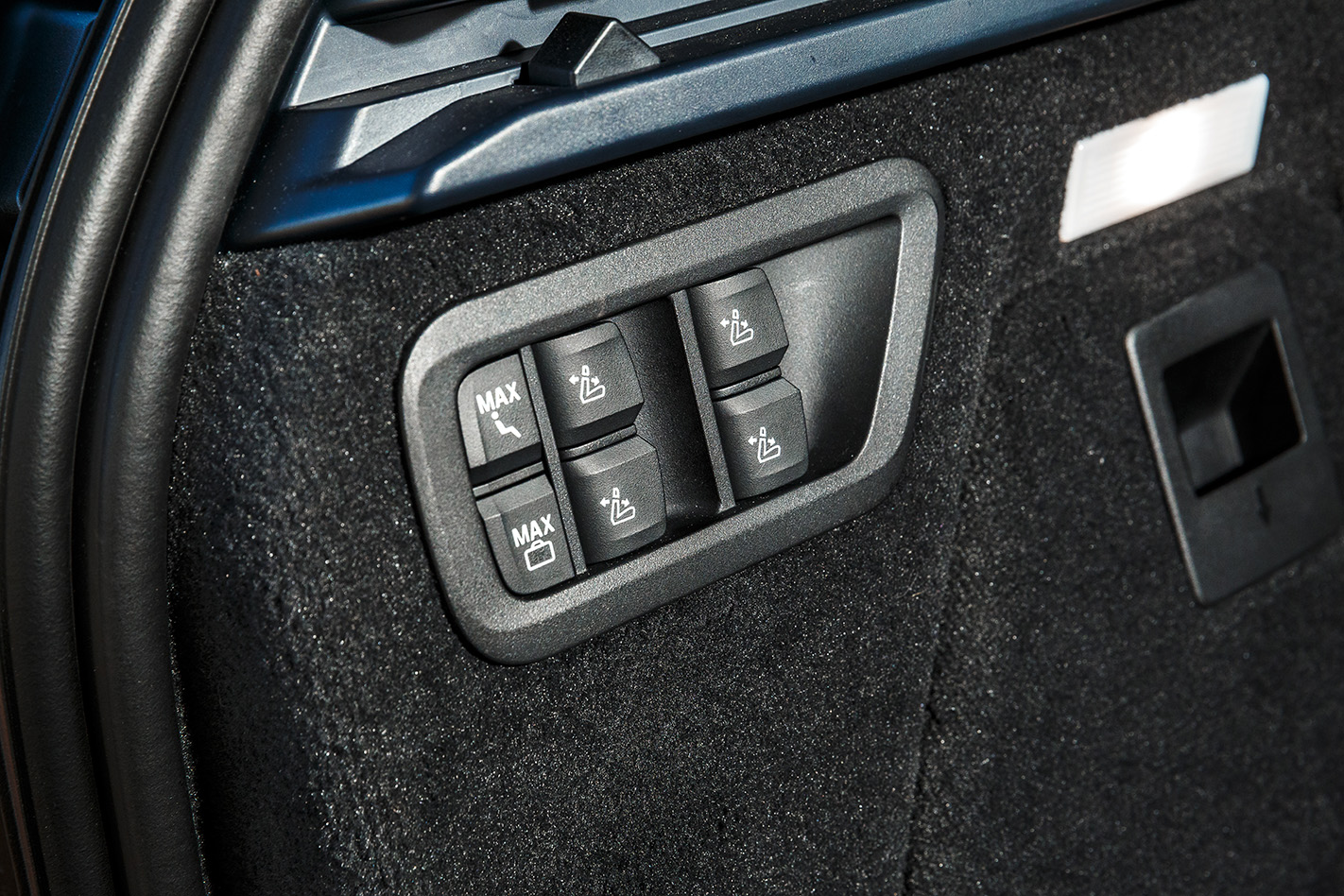
What’s more, there’s still a decent amount of cargo space behind the third row backrests when they’re raised, with enough room between them and the horizontally-split power-operated tailgate for 326 litres of capacity – enough for a couple of suitcases or a week’s worth of shopping. Stowing those seats is also simple, with push-button electric actuation taking care of raising and lowering them.
Downsides? Tipping the second-row seats forward to gain access to the third row is excruciatingly slow, as the process is done electrically rather than manually. Those motors could surely move faster.
ON THE ROAD
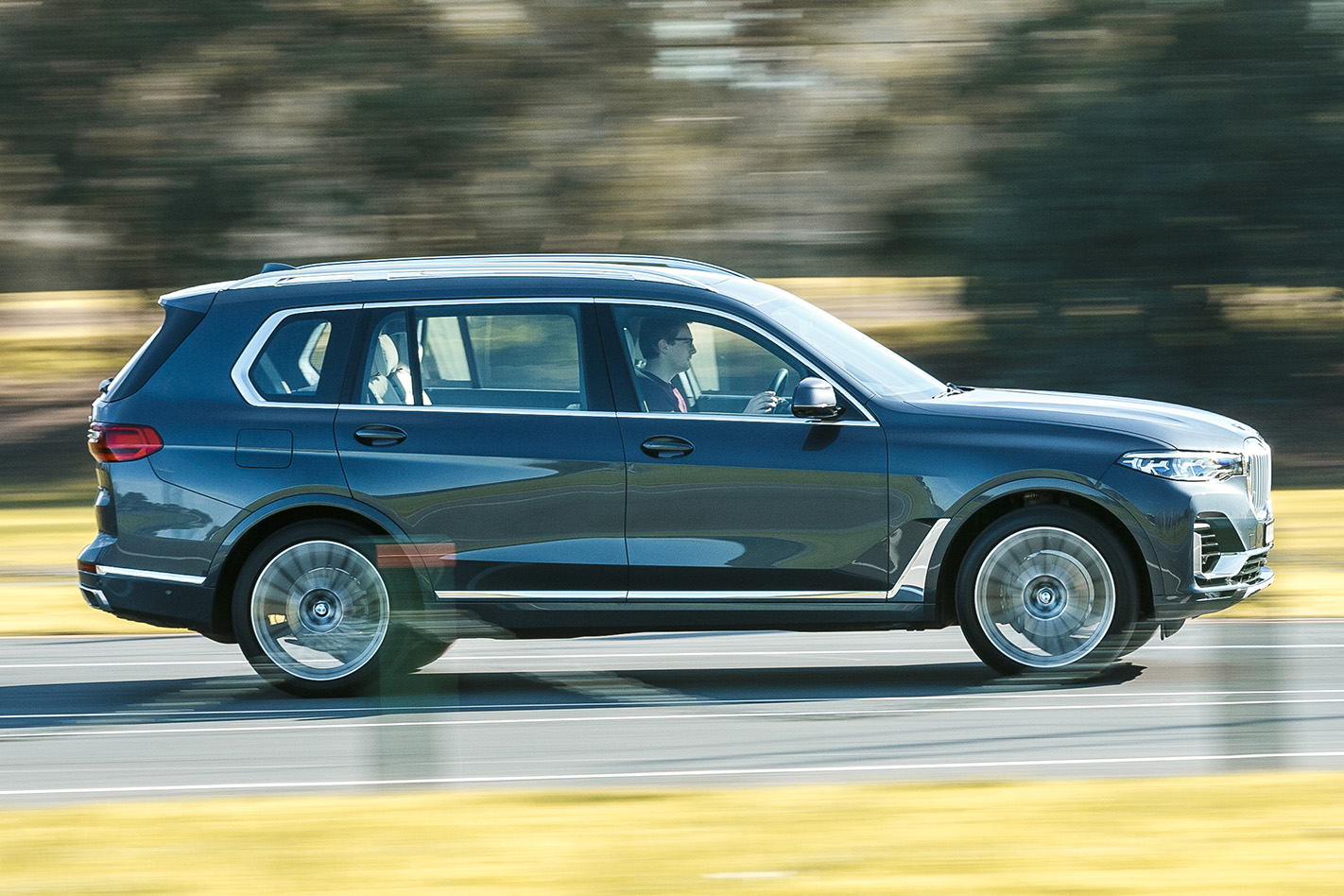
The X7 xDrive30d tips the scales at a hefty 2.4 tonnes, though you’d hardly know it from the driver’s seat. Riding on air suspension and equipped with steering that’s light yet direct, it drives more like a car than a truck.
Part of that comes down to the 3.0-litre turbo diesel six cylinder. Though it’s the least powerful engine currently on offer (the heavy-hitting quad-turbo diesel M50d sits above it), the 30d still enjoys a stout 195kW of power and 620Nm of torque. Power goes to all four wheels via a silky-smooth eight-speed automatic and clever AWD system, and the mechanical combo gets the heavy wagon to 100km/h in a claimed seven seconds flat.
That’s rapid for such a big bus.
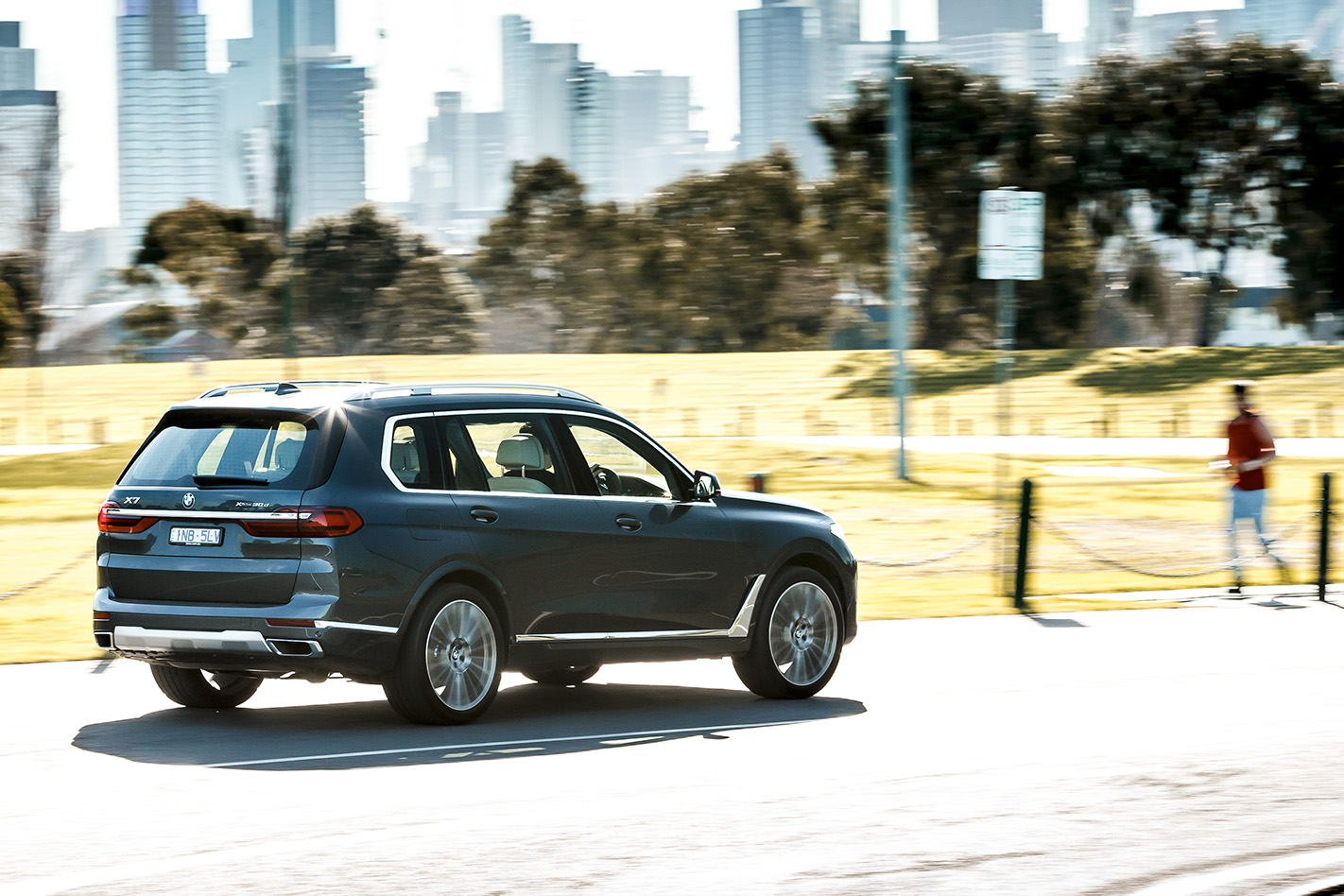
It handles well, too, especially on our tester’s 22-inch alloys. Best of all, though, is its pleasingly supple ride, which irons out all but the worst roads and isolates driver and passengers from bumps and thumps with astonishing effectiveness. Couple that with an engine that’s incredibly quiet, and the X7 makes for a very relaxing long-distance cruiser. If you’re the type who likes the idea of putting the whole family in the car and taking a roadtrip, the X7 is arguably the ideal machine for it.
Heading offroad? Adding more ground clearance can be done at the press of a button, though be aware that your only recourse in the event of a puncture is a can of goo for the run-flat tyres. For those who just want to tow, the X7 is definitely a better choice than the X5. Its maximum braked tow capacity of 2200kg is 300kg up on that of the X5 xDrive30d, and with 620Nm of torque on hand, it should make light work of towing anything you’d care to attach to it.
VERDICT
It’s a strange sign of the times when one of BMW’s most convincing cars is also one of its biggest, heaviest, and priciest. Nevertheless, the X7 is a highlight of the company’s present-day showroom, and a prime example of how good a car can be when it’s been tailored to its intended purpose.
Providing enough space for seven to sit in good comfort is obviously the prime directive, but BMW has gone well beyond that to deliver a car that isn’t just big, but impressively finished, well-equipped, great to drive and competitively priced.
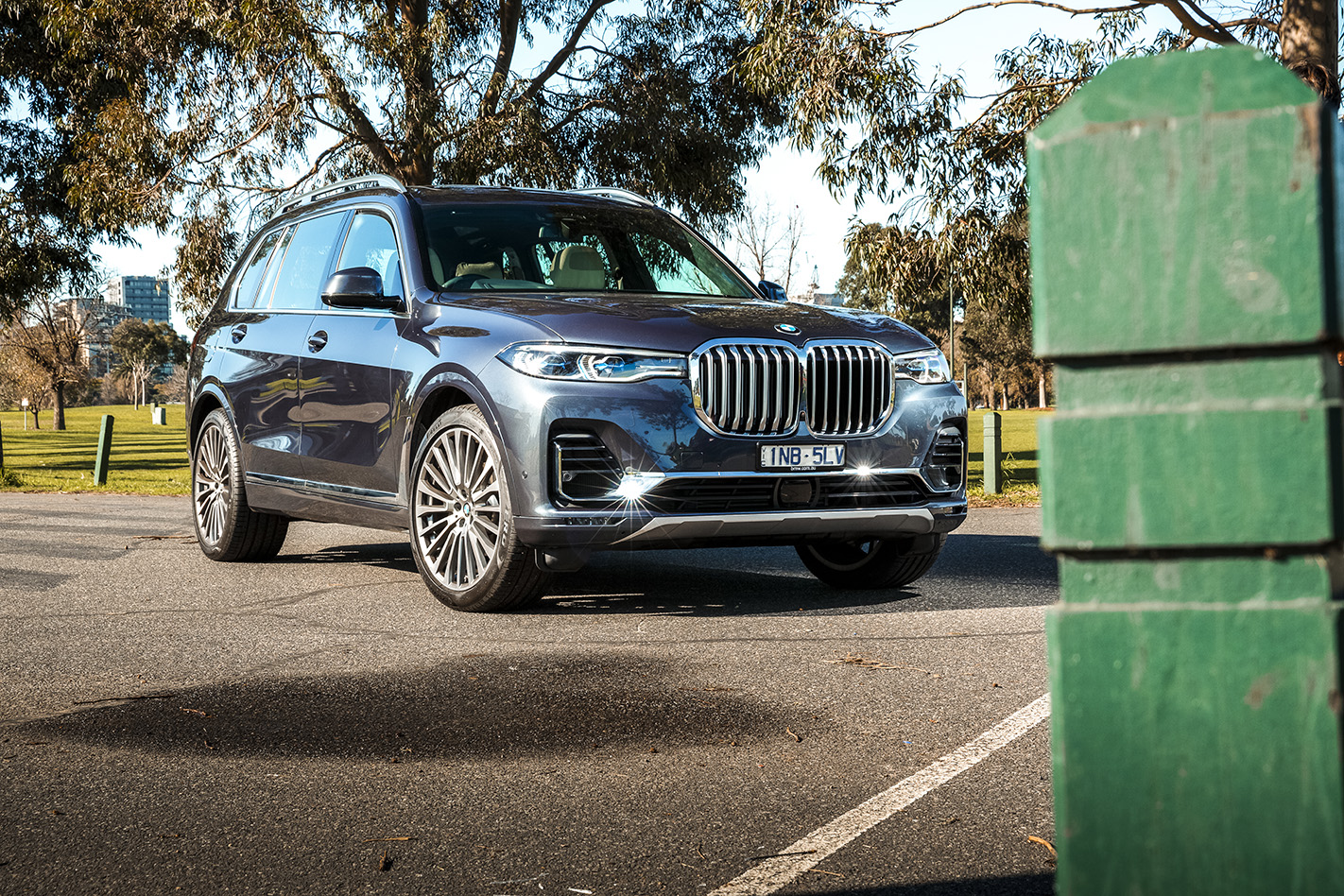
Its front-end design may be a bit to gaudy for some thanks to that super-sized kidney grille, but objectively the X7 is a proper winner in xDrive30d guise.
I just got back from Europe where I watched Toyota win the 87th running of the 24 Hours of Le Mans. What a race, and what incredible dominance by EV-obsessed Toyota, whose two cars were fastest in practice, qualified 1-2 for the race, then crossed the line first and second – but in the wrong order! If Toyota can bring that kind of dominance to its Gazoo performance road car arm, look out AMG, quattro and BMW M!
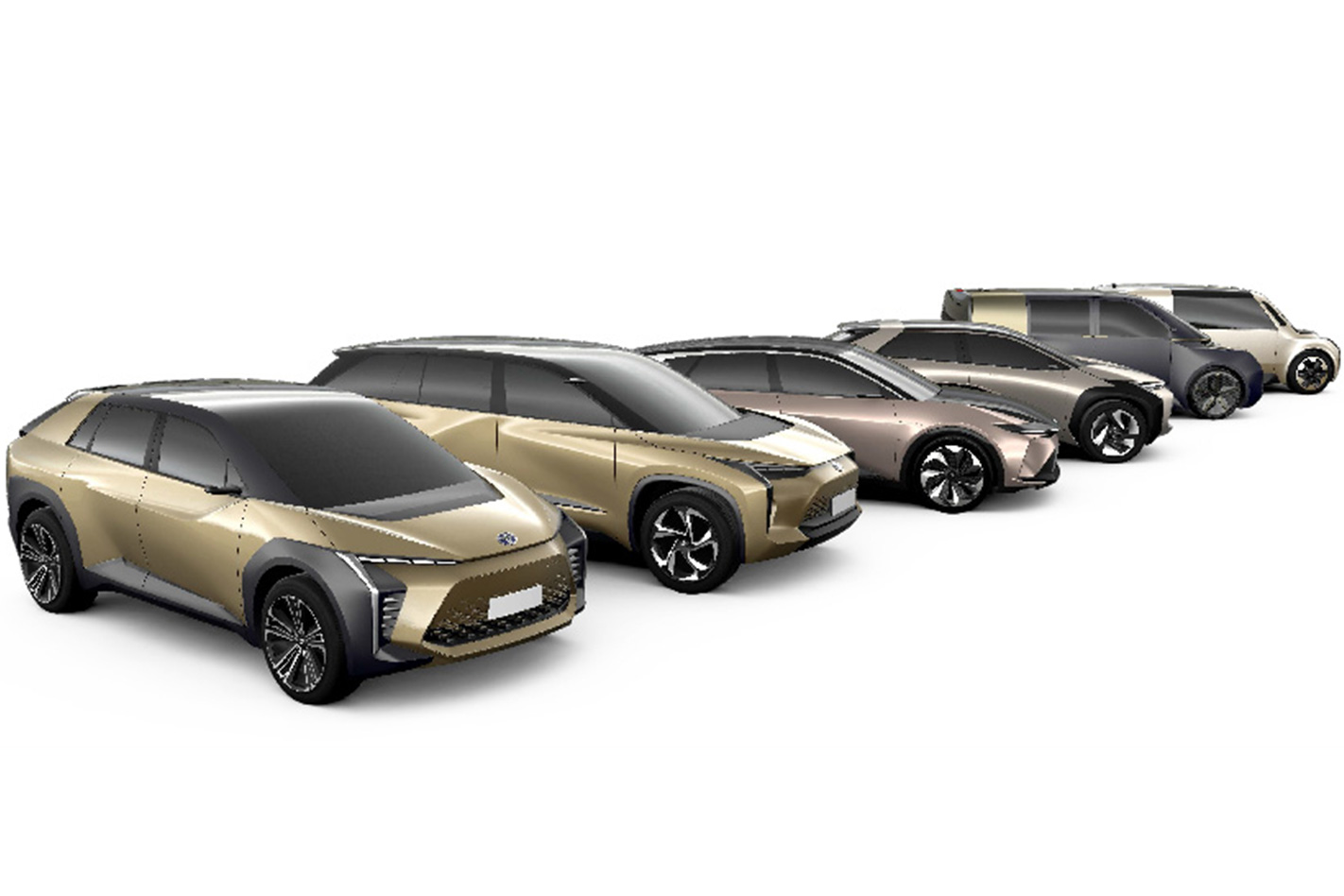
Back in Australia, WhichCar’s end of financial year coverage deepened with this round-up of EOFY specials, we identified seven cars that fall below the $30K write-off cap, and took an in-depth look at claiming car expenses on your tax return.
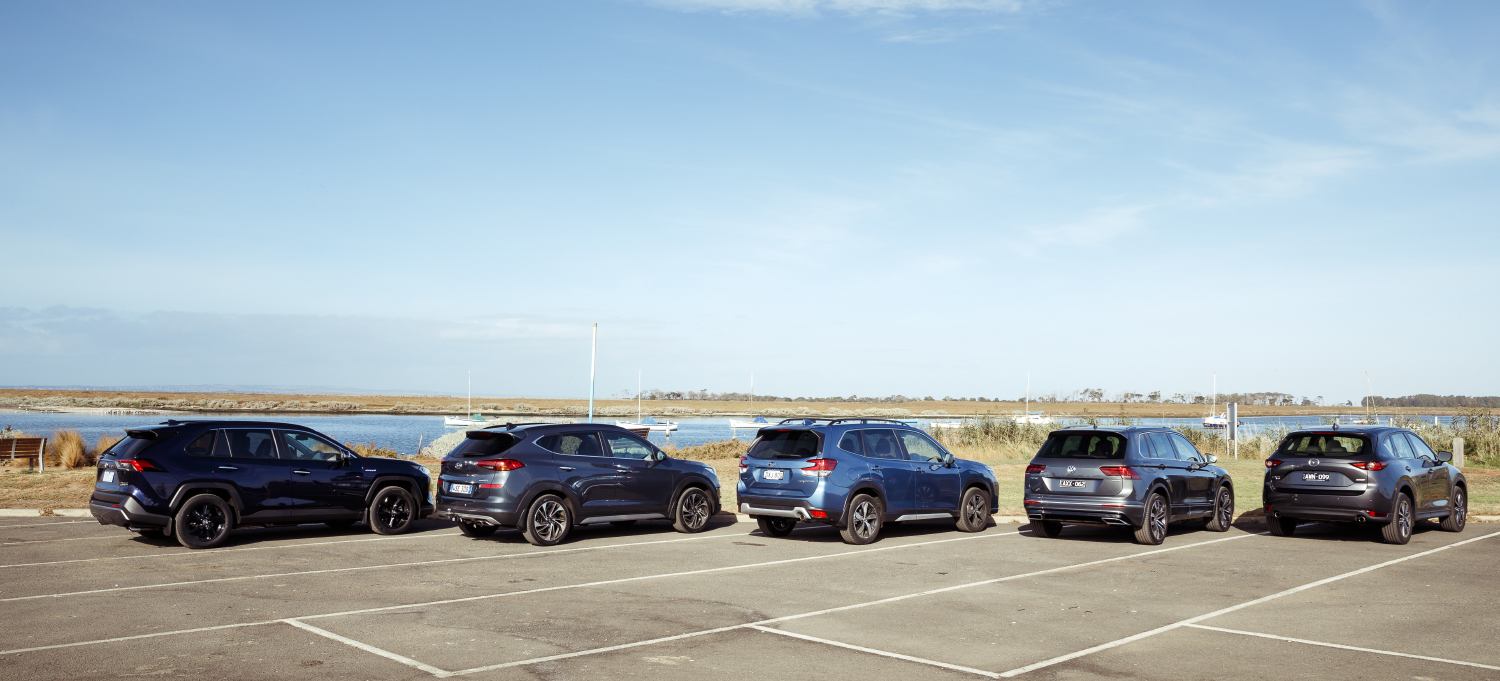
We also published our video reviews of the new Mazda 3 hatchback, the Lexus UX baby crossover, and put five new SUVs together to find the best mid-size family SUV in Australia (hint: It’s not a Mazda). We also anointed our best value sedan and best value performance car, and looked at three ‘little brother’ sports cars that offer almost as much bang as their big brothers for a lot less buck.
We learned that the Mercedes-Benz X-Class has been recalled due to a faulty operator’s manual, and that the new Chevrolet Camaro ZL1’s standard Goodyear tyres are good enough for Australia. We spoke to Genesis boss Manfred Fitzgerald about how this luxury upstart plans to leapfrog its German rivals and become the new world standard in luxury cars.
We took a look at some new cars that are a steal if you wait for the depreciation beast to take huge bites out of their resale value, and we discovered it’s sometimes illegal for passengers to use mobile phones. Oh, and some enterprising American lady turned a brand new Tesla Model 3 into a ute. Now here’s an electric car Australians can surely relate to…
Last weekend we aired the 20th and last episode of WhichCar TV, Season 1. If you missed any of the segments, they’re all online at WhichCar.com.au/TV, so enjoy!
After the trepidation around how autonomous vehicles will kill our love of driving, if we should be ok with giving big conglomerates access to our driving data and questioning what the motivations behind others might be, we can finally report a technology advance we think everyone might be happy about.
In what looks like it will herald a new generation of more hyper-connected safety systems, Hyundai has announced a partnership with Israeli medical artificial intelligence start-up MDGo. The partnership will draw on MDGo’s elaborate AI algorithm, which, in the case of an accident, will be able to measure the degree of injury and alert emergency services in real-time.
What that means exactly is yet to be determined but Hyundai has said that the technology will use a range of sensors in the car to determine injury level and what safety systems have been activated.
MDgo sais that the AI technology will be able to interpret accident data and compile insights regarding the occupants and the vehicle. Then, within seven seconds of impact, send emergency services a detailed analysis of potential injuries, communicated through medical terms.
Hyundai runs its own crash labs in both the US and Korea (pic: Hyundai)
The most valuable part of this technology, however, will be the ability to cut down on critical response time following a high-trauma incident.
“We are excited to partner with one of the world’s leading car manufacturers to bridge the gap between vehicle and medical,” said Itay Bengad, Chief Executive Officer at MDGo in a statement. “Hyundai shares our vision to provide life-saving services by utilising the constantly growing stream of vehicle data to improve passenger safety.”
Furthermore, MDGo and Hyundai claim the AI system will be continually learning and refining its interpretation of different accident scenarios. In a statement, Hyundai wrote, “This process of iterative enhancement is facilitated by hospitals inputting real data on patients’ injuries, which the system compares to its prediction to further refine its analysis.”
Hyundai also claims that the partnership will also help it to enhance the active and passive safety capabilities of its future vehicles.
“Big data gathered from detailed, intelligent analysis of multiple accident scenarios will inform Hyundai of how to bolster crash structures and integrate new technologies to overcome issues identified by the AI analysis.”
With all the fuss about the Aston Valkyrie, you’d think the idea of a berserk British bullet was a new one. The likes of Caterham and Radical have long created super-focused specials, but in 2006 came a car like no other, the Caparo T1.
The work of ex-McLaren engineers, the T1 was intended to provide F1 levels of performance but, thanks to the UK’s liberal transport laws, remain road legal. The word ‘intended’ is used because the Caparo project never really took off. Originally, 100 cars were planned, but just 16 ended up being built. The impending GFC presumably didn’t help demand.
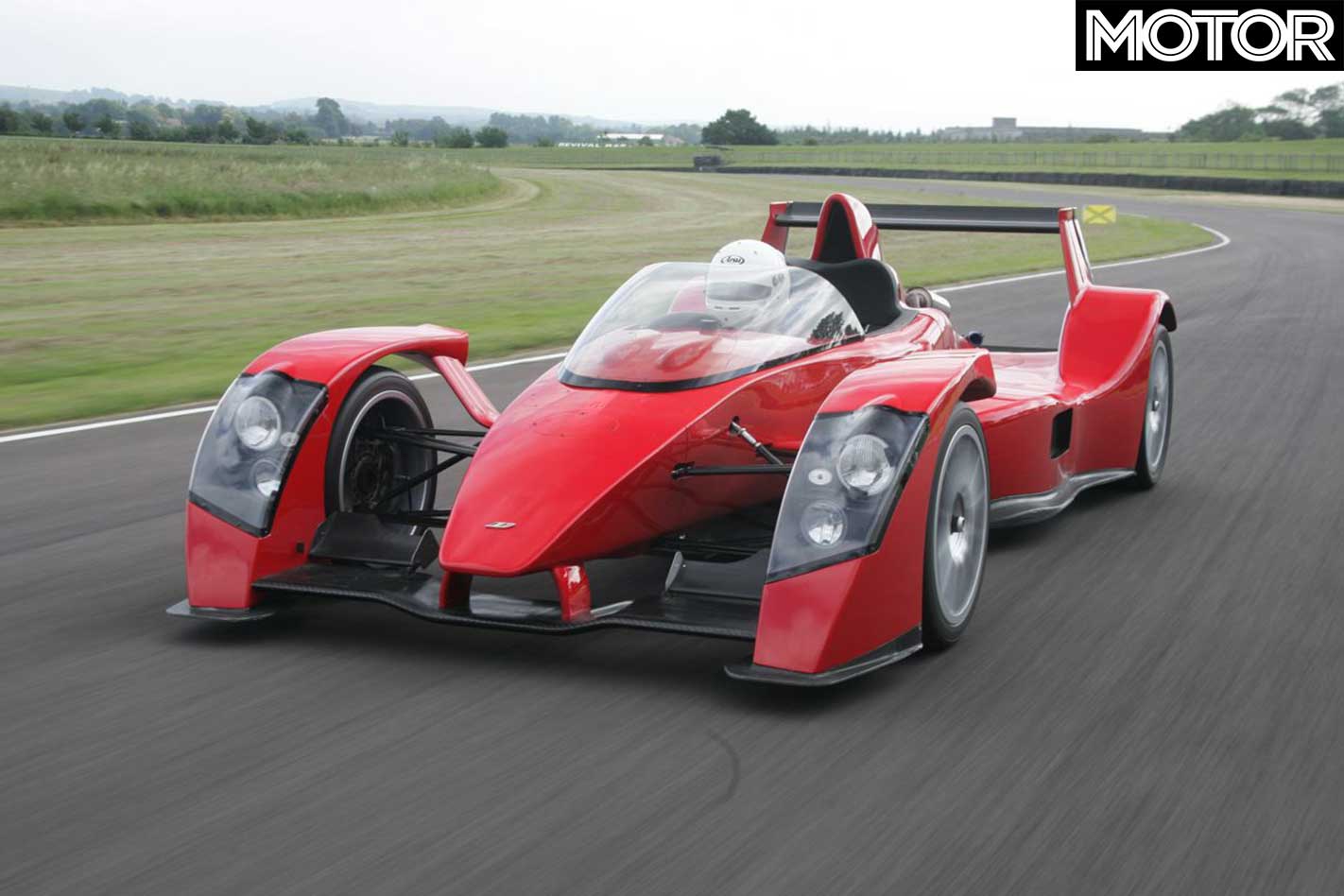
The T1 also had a troubled gestation. Early development cars were released to the press, resulting in Jason Plato catching fire and Jeremy Clarkson saying unflattering things on the TV. At the first press ride day, the two prototypes spent most of the day broken down before one crashed with a Dutch journalist on board.
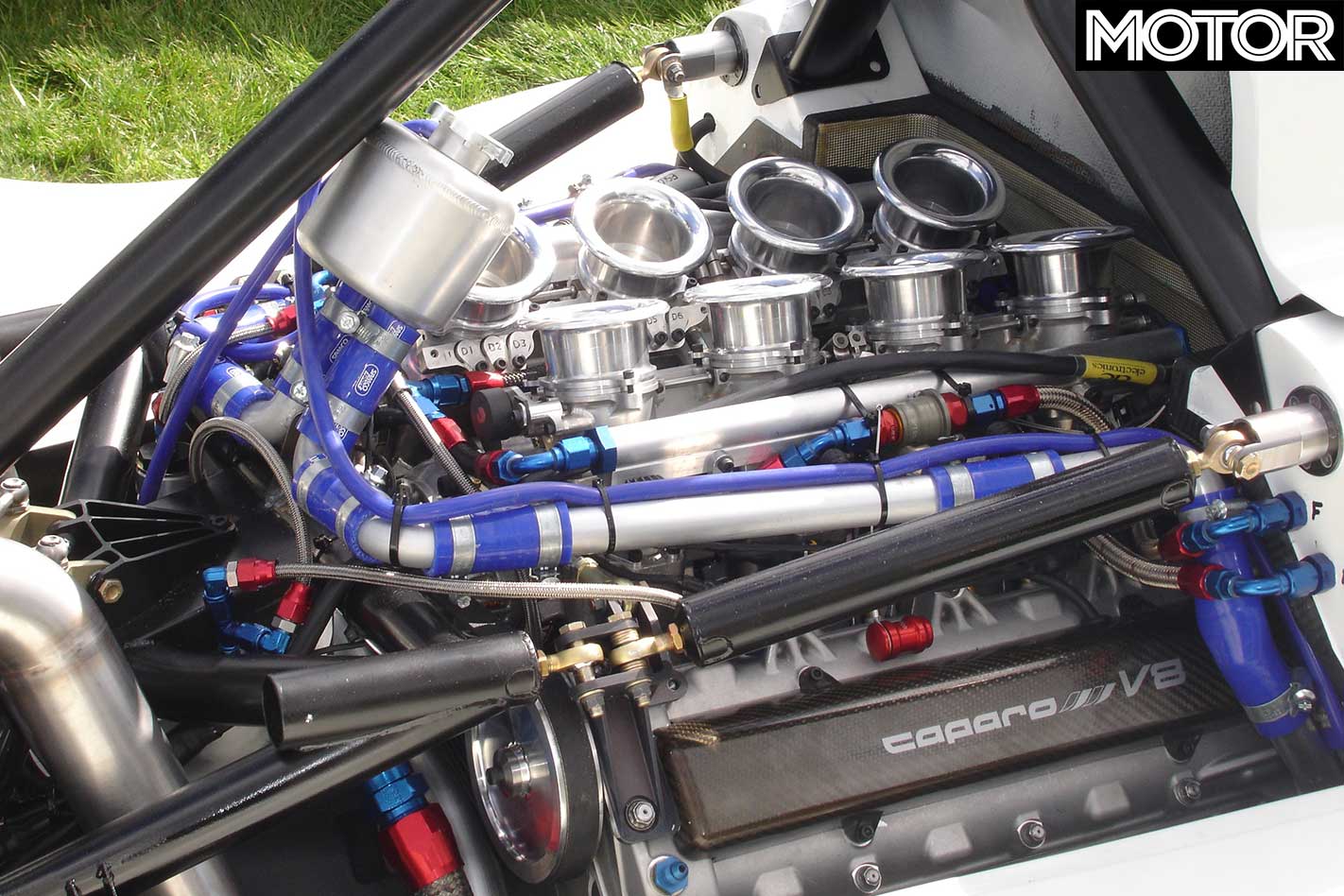
Nevertheless, those final 16 production cars were quite something. The original targets were for a 321kW 2.4-litre supercharged V8 and a 475kg dry weight. The final 3.5-litre atmo V8 increased weight to 550kg, but also swelled outputs to 429kW at 10,500rpm and 420Nm at 9000rpm. A six-speed Hewland sequential gearbox drove the rear wheels and the carbon fibre and aluminium monocoque body produced 875kg of downforce at 240km/h.
UK outlet Evo was the only media to ever record independent performance figures on the T1, its 6.2sec effort to 100mph (161km/h) by far the quickest it had ever seen. By comparison, the GT3 RS elsewhere in this issue took 6.8sec to reach the old ton, but when you consider the T1 was a second behind at 50km/h you get a better sense of its insane speed.
On track, the T1 was unhinged, its 1:10.8sec lap time around Evo’s Bedford test track was 8.6sec quicker than the Gumpert Apollo, which itself set a 7min11.57 Nürburging time. The Valkyrie has quite an act to follow.
2008 CAPARO T1 SPECS Engine: 3.5-litre V8, DOHC, 32v Power: 423kW @ 10,500rpm Torque: 420Nm @ 9000rpm 0-100km/h: 2.5sec (est.) Price (new): $206,188
Niki Lauda wouldn’t have had a lot of time for this. You imagine him looking at the tributes, the speeches and the outpouring of grief both inside and outside the cloistered world of the F1 paddock, raising an eyebrow and asking: “And this is work for you?”
His work ethic was but one aspect of a complex character. At times he could be difficult, intolerant of efforts that didn’t meet his standards, brusque even. But he was never afraid of telling truth to power, whether that be Enzo Ferrari, whose car he described as “shit” only for Enzo’s son Piero Lardi to frantically demur with the interpretation; Boeing, who he faced down over mechanical defects after the Lauda Air 767 crash in Bangkok; or standing up to the Grand Prix Drivers’ Association on Super Licence regulations at Kyalami in 1982. It was exactly this fearlessness to tell the unvarnished truth that endeared Lauda to drivers like Lewis Hamilton and Nico Rosberg, who valued the three-time world champion as a pit lane mentor.
I remember Niki as a guy you needed to prep for. He had an unerring radar for bullshit or a lazy line of questioning and he possessed a great memory for faces. My first encounter with him was unexpected. I was in La Grave, a ski resort in the French Alps at some point in the late ’90s. Think of La Grave as the Nurburgring of ski areas: one lift extending skywards 2000m, no piste grooming, no avalanche control, no signposts, no patrollers. At the bottom of the mountain is a river valley, from which it’s a sharp slog uphill to the tiny 12th-century village.
An old boy was doubled over alone on the hike up, clearly blowing. I shouldered his skis for him and we walked quietly up through the snowstorm to the village. As I handed him his skis, he pulled his hood back and I realised it was Lauda. He thanked me, looked up into the blizzard and muttered, “Maybe a bit too much for me.” More than 10 years later, I was in the paddock at Goodwood when Lauda walked by, grinned, and punched me in the shoulder. “La Grave?” he chuckled. Once again, he’d left me speechless.
It was this ability to catch you on the back foot that helped convince Lewis Hamilton to defect from McLaren – the team which had supported him since childhood – to Mercedes-Benz. Aware that Hamilton needed affirmation of his position in the pantheon of great F1 drivers, Lauda first told the British driver that he was impressed by his pragmatism and lack of emotion clouding his decision-making. Hamilton countered, noting that a great like Michael Schumacher hadn’t come close to winning the F1 title with Mercedes. Then came Lauda’s closing pitch.
“Think of it the other way round,” he said. “If Schumacher couldn’t get the Mercedes team running up front for three years and you next year are doing much better, it makes a huge impact on your personality and people will rate you much higher.” In one sentence Lauda had speared the inherent vanity any great F1 driver needs. The deal was as good as done.
Lauda’s early life and F1 exploits are well documented. Despite winning three world titles he’s probably underrated as a driver. Stefan Bellof’s 6m11s lap of the Nurburgring was deified for years, many overlooking the fact Lauda was the first man to lap the Green Hell in less than seven minutes (6m58.6s), eight years earlier when the track layout was two kilometres longer.
In many regards his race strategy was akin to the canny Alain Prost, who he drove alongside at McLaren and who he pipped to his third and final world title in ‘84 by a mere half-point, able to employ a certain economy of effort behind the wheel. Prost himself recognised the quality of the man. “Okay, he won the ‘84 championship, but I could live with that,” he said. “What was important was the trust between us. I didn’t know Niki when I came to McLaren, but I believed him to be completely honest. By the end of the ‘84 season I was certain of it.”
Above all, Lauda enjoyed his second life after his fiery crash at the Nurburgring in 1976. Perhaps he had three, as partner and former Lauda Air crew member Birgit Wetzinger donated him a kidney in 2005.
Niki Lauda lived these extraordinary lives very well. He’s remembered as a man of action and integrity. “Now,” he said, as he walked away from his last race in Adelaide back in 1985, “now I grow up and do something useful with the rest of my life.” Vale Niki.
Chinese car brand Chery, which briefly sold cars in Australia from 2011-14 through importer Ateco, is back on Australian soil.
Spy pics sent in to Wheels this week raised the question if the brand might be making a comeback, and now Ateco has confirmed to Wheels that its old flame is testing vehicles in Australia – but don’t expect to see a right-hand drive version anytime soon.

The model snapped in camo around Melbourne is tipped to be the new Chery Exeed, and a source has confirmed it is the same model which is rolling down the production line in China for that market.
However, Chery’s presence in Australia is only for testing purposes as it doesn’t build vehicles in right-hand drive – though that doesn’t rule out the budget Chinese marque making a comeback, according to Ateco general manager of LDV Australia, Dinesh Chinnappa.
Speaking with Wheels, Chinnappa says that the importer retains an “on-going relationship” with Chery and that it is “keeping the doors open” for a future endeavor.
If Chery’s lineup was to materialise into something that “met Australian market requirements such as being a relevant product customers want with good pricing and met ANCAP crash rating safety standards,” Ateco would be interested.
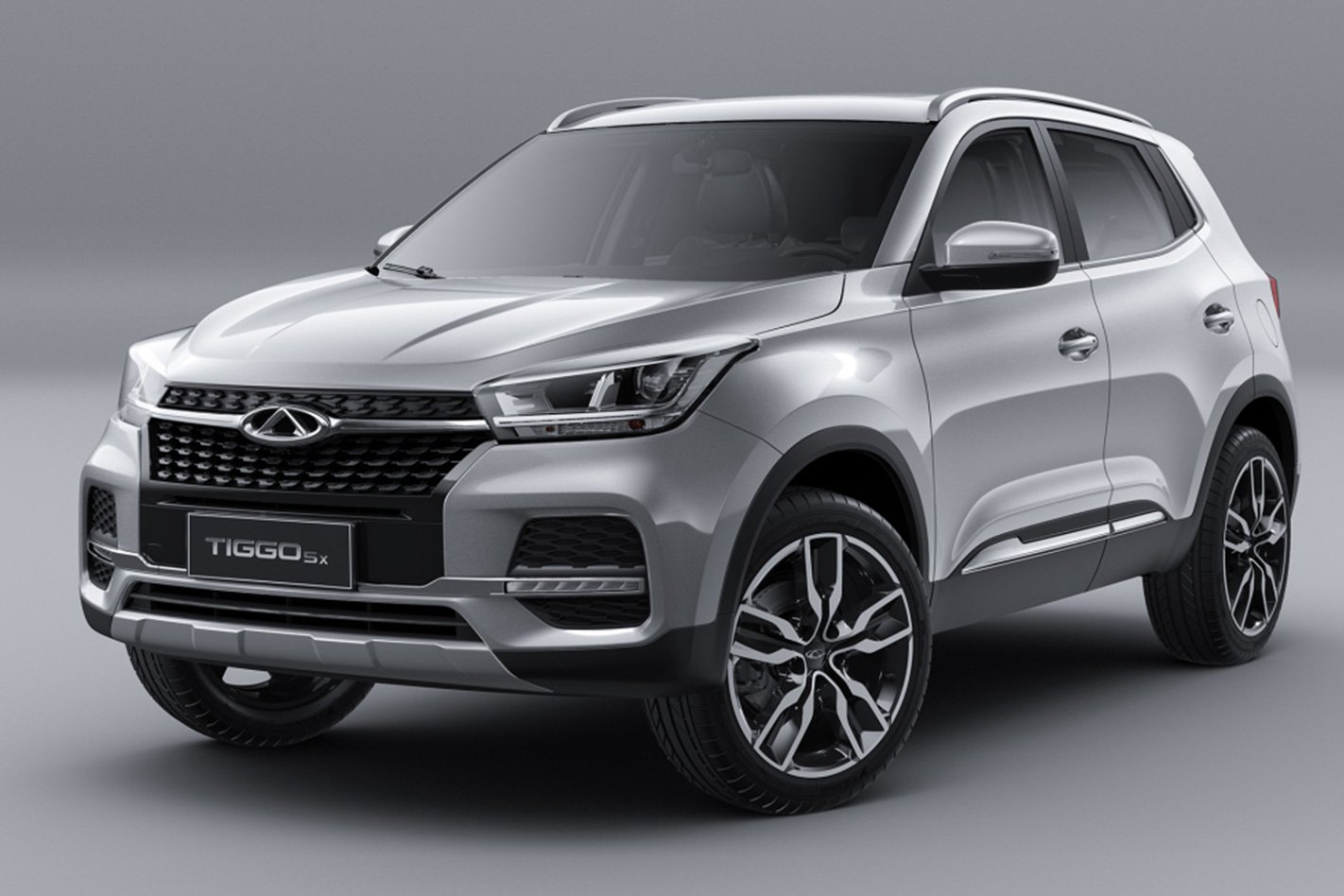
Chery’s major flaw when it was sold here five years ago was lackluster safety standards, which restricted the sale of models in some states.
But Ateco must wait for the Chinese brand to re-activate right-hand drive production first, and then there is an almost two-year wait for homologation in Australia. A Chery comeback appears a long way off yet, but it could be far more successful than its first attempt.
Chinnappa is responsible for LDV, a sub brand of the colossal SAIC automotive group in China. He says that sales for LDV are growing in Australia, proving that there is space for burgeoning Chinese cars to be sales-effective here. MG, another Chinese car brand owned by SAIC, is also on the up.
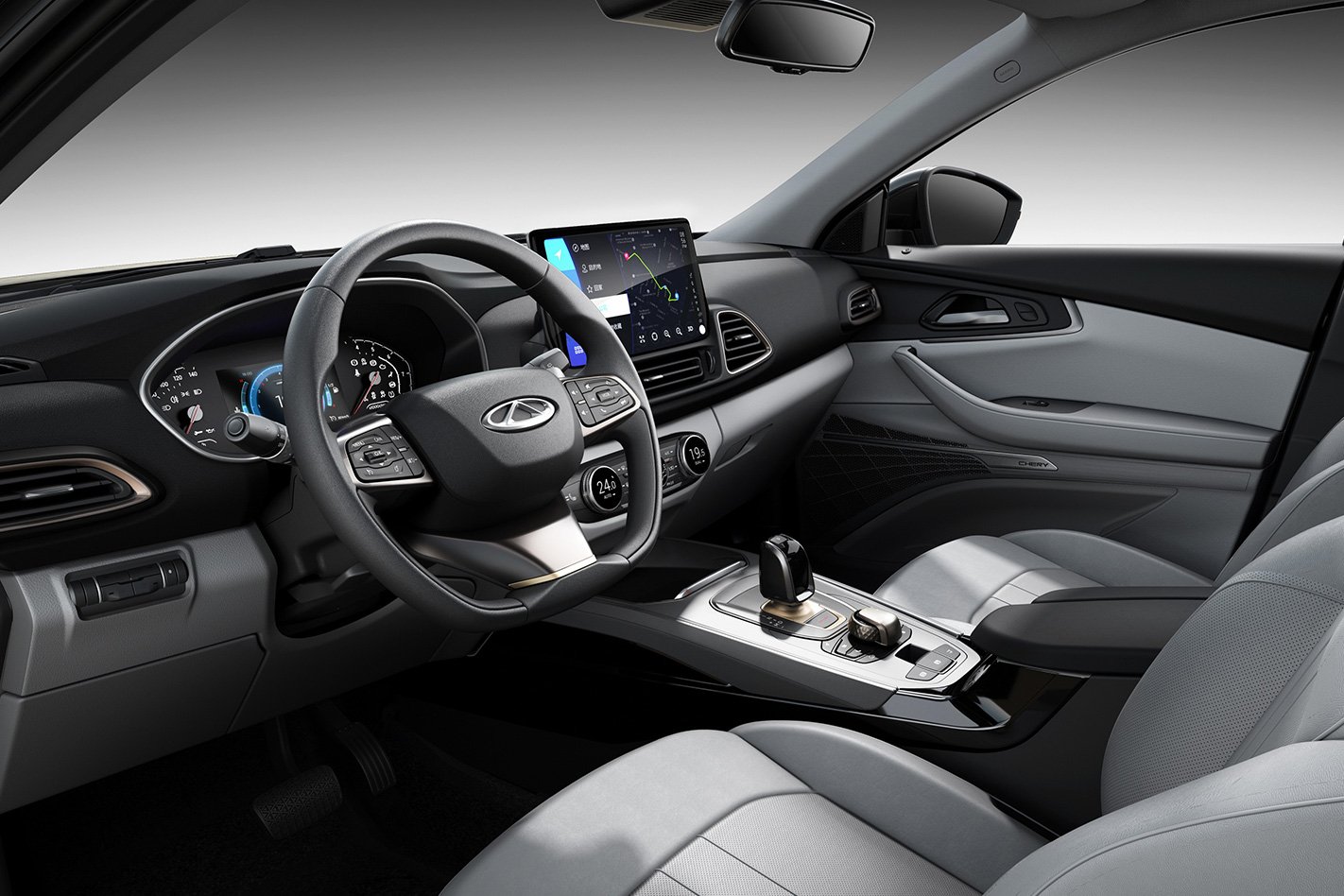
But without a RHD production line, what is Chery doing here?
As Wheels understands, Chery has been testing various vehicles around Melbourne and Sydney, using small automotive and specialist workshops to help with calibration of ABS and ESC systems, autonomous driving technology and ride and handling. For now, there is no immediate plan for it to return to the market.
