
It might not look it, but the Morgan Plus Six is all-new. In fact, it’s the first all-new Morgan in 19 years.
Revealed at the Geneva Motor Show, the roadster is claimed to be “The most dynamically capable Morgan ever produced”.
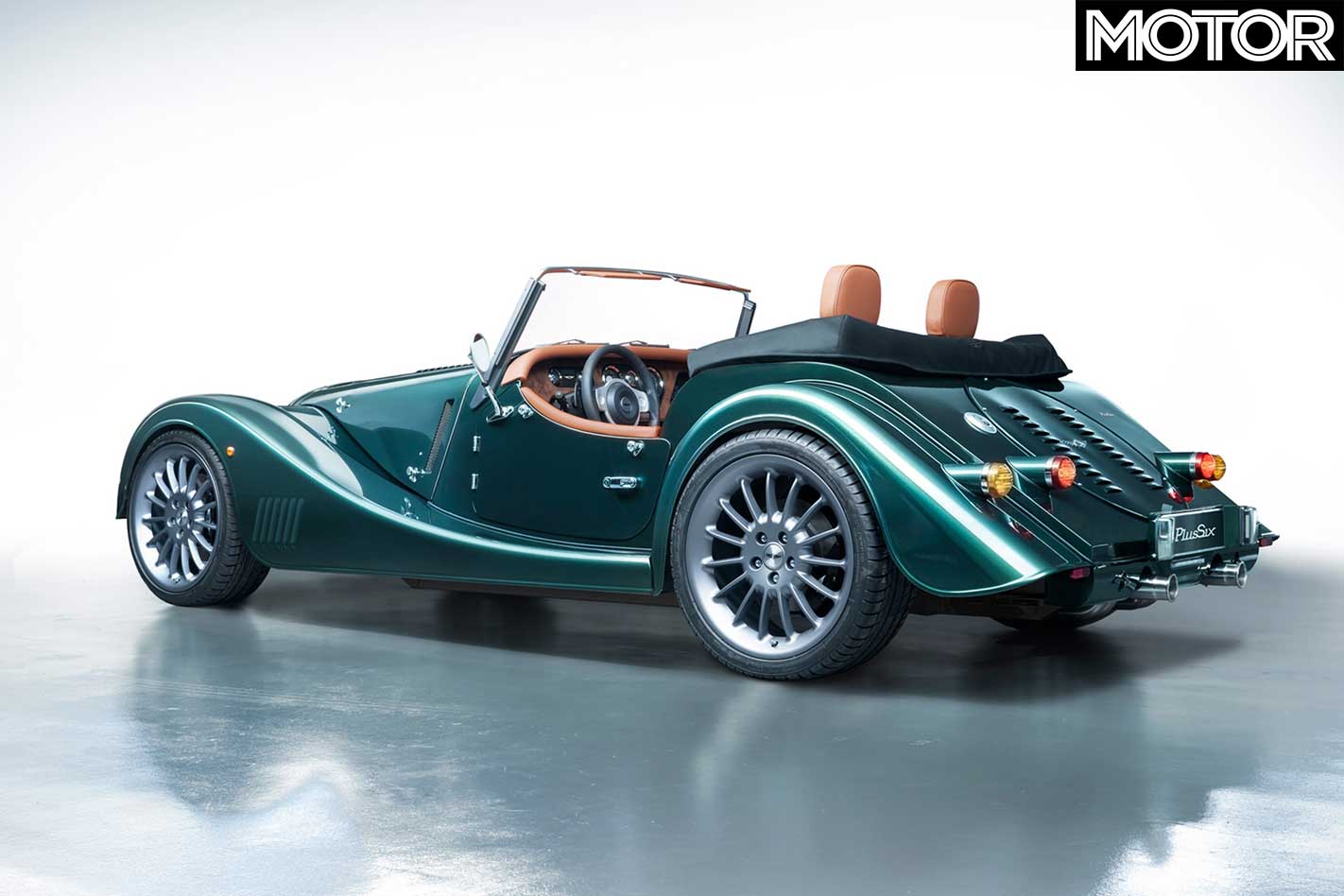
The looks are familiar and so is the engine, though not in a Morgan. Morgan’s long partnership with BMW continues but with the previous generation of engines no longer compliant with the latest European emissions regulations Morgan has switched to turbo six power.
Under the bonnet now resides the B58 3.0-litre turbo six found in a vast array of BMW products. As is the case elsewhere, it produces 250kW and is backed up by a stout 500Nm, fed through an eight-speed automatic gearbox.
It is arguably most at home in the Plus Six, for it has just 1075kg (dry) to motivate. Look out Z4, as the Morgan sprints from 0-100km/h in just 4.2sec on its way to a 267km/h top speed. Its lack of mass helps fuel economy, too, with a claim of just 7.4L/100km.
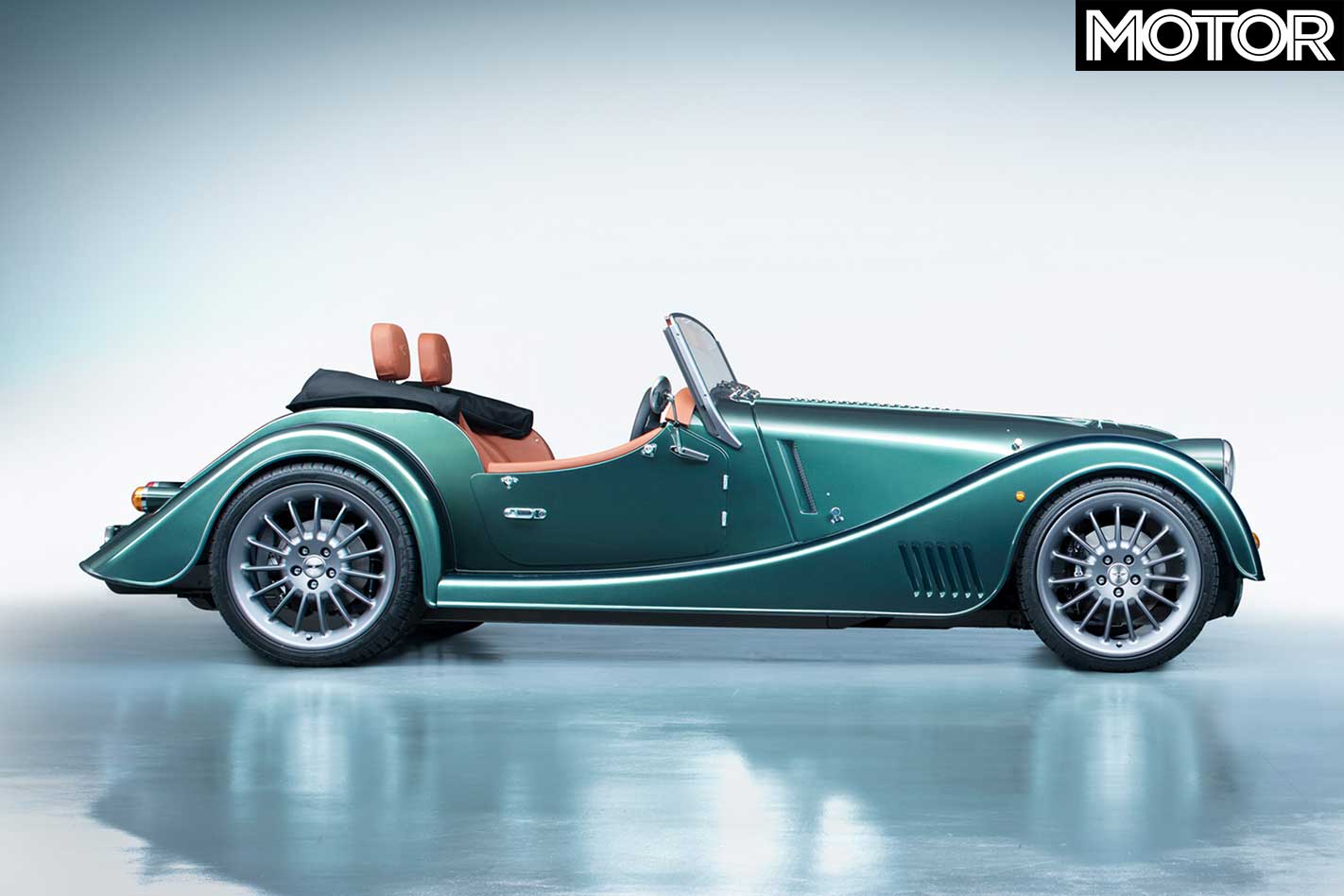
The key to this light weight is the all-new CX-generation platform that will underpin all future Morgan performance models. Made from bonded aluminium with a traditional wooden frame surrounding the passenger cell, Morgan claims the chassis weighs less than 100kg yet is 100 per cent more torsionally rigid than the platform it replaces.
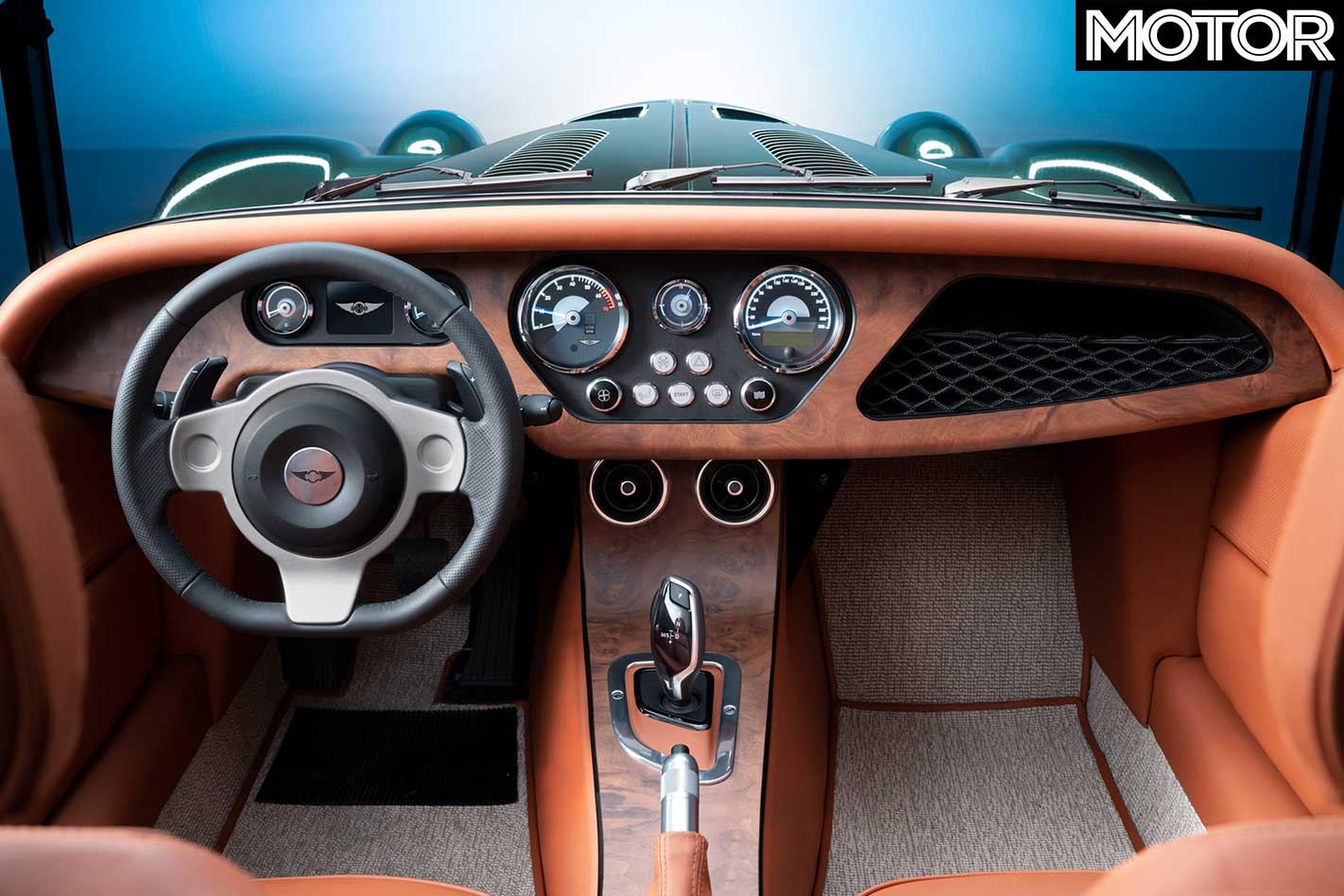
The interior is an intriguing mix. While deeply traditional to look at, it hides a surprising amount of technology including hidden speaker, puddle lighting, an electronic display screen behind the steering wheel and the more obvious clue of the BMW-style gear selector sprouting from the centre console.
Morgan says it offers even greater levels of personalisation with “unlimited wood and colour combinations.” Keeping the weather out is a composite hardtop. Two different First Editions are available for early adopters, one in Emerald Green and one in Moonstone Silver.
We’ll update this story with local pricing and availability as the information comes to hand.
Although it’s the start of a new Supercars season, its as though nothing’s changed, with Scott McLaughlin taking out both races of the Adelaide 500 season opener.
But a lot has changed. We now have a new Mustang Supercar for Ford fans to get behind, and defending champions at DJR Team Penske have gone two from two at the opening racing weekend.
While some were less than enthusiastic about the new Mustang Supercar, its success doesn’t lie.
Mustang Supercar: technical deep dive gallery
But more than Supercars, the Adelaide 500 weekend was action-packed with a multitude of support categories, on-track displays and paddock showcases.
Audi’s R8 LMS Cup showdown hosted two rounds of GT3/GT4-spec racing, Touring Car Masters fought door-to-door for classic racer glory and Brabham’s new BT62 was joined by 1980’s Formula 1 icons for demonstration laps.
Click through the gallery at the top of the article to see more of the action throughout the Adelaide 500 weekend.
DEAN Martin ordering a martini at the Cal Neva Lodge was probably pretty smooth. A Scott Pendlebury no-look handpass in a busy centre circle is also silkily effortless, yet both pale into a lumpen clumsiness compared with the Audi Q7 E-Tron’s idle-stop system. It’s almost molten in the way the 48-volt electrics slur the diesel engine back into life, melding with the torrent of torque from the motors. There’s no audible impact, just a barely perceptible epidermal vibe on the steering wheel.
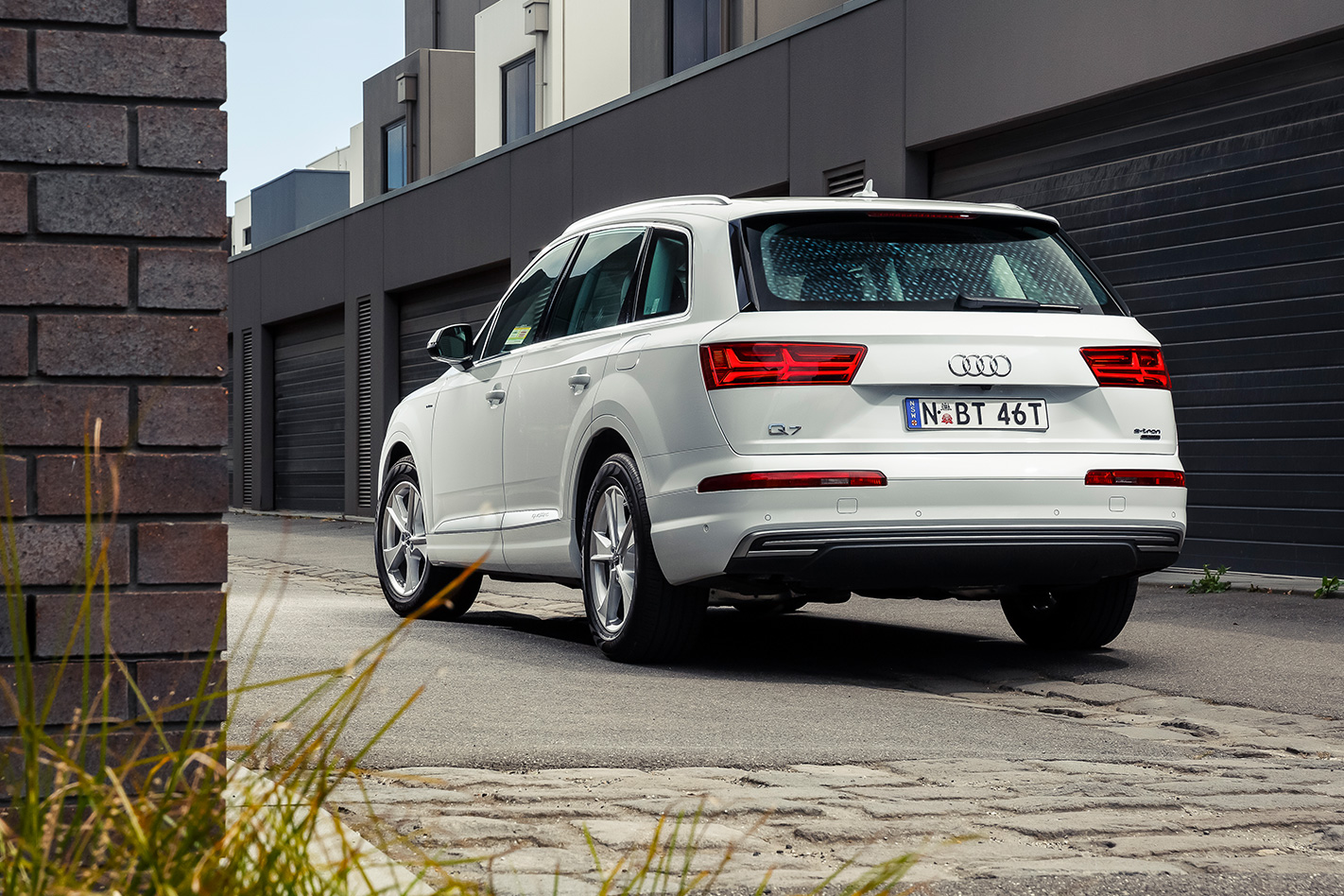
That’s the Q7 E-Tron in microcosm. Ingolstadt’s plug-in hybrid represents a masterclass in making the difficult things seem easy, to massage away any residual stresses you might harbour about the wisdom of a diesel-electric hybrid.
Those concerns are understandable. A petrol engine and an electric motor are a brilliant fit, the zero-rpm torque of the motor creating a lovely diversion from a petrol powerplant’s low-end Newton-metres deficit. A diesel engine doesn’t want for subsonic torque, and adding electrical hardware to an already expensive diesel powerplant contributes to a very costly drivetrain.
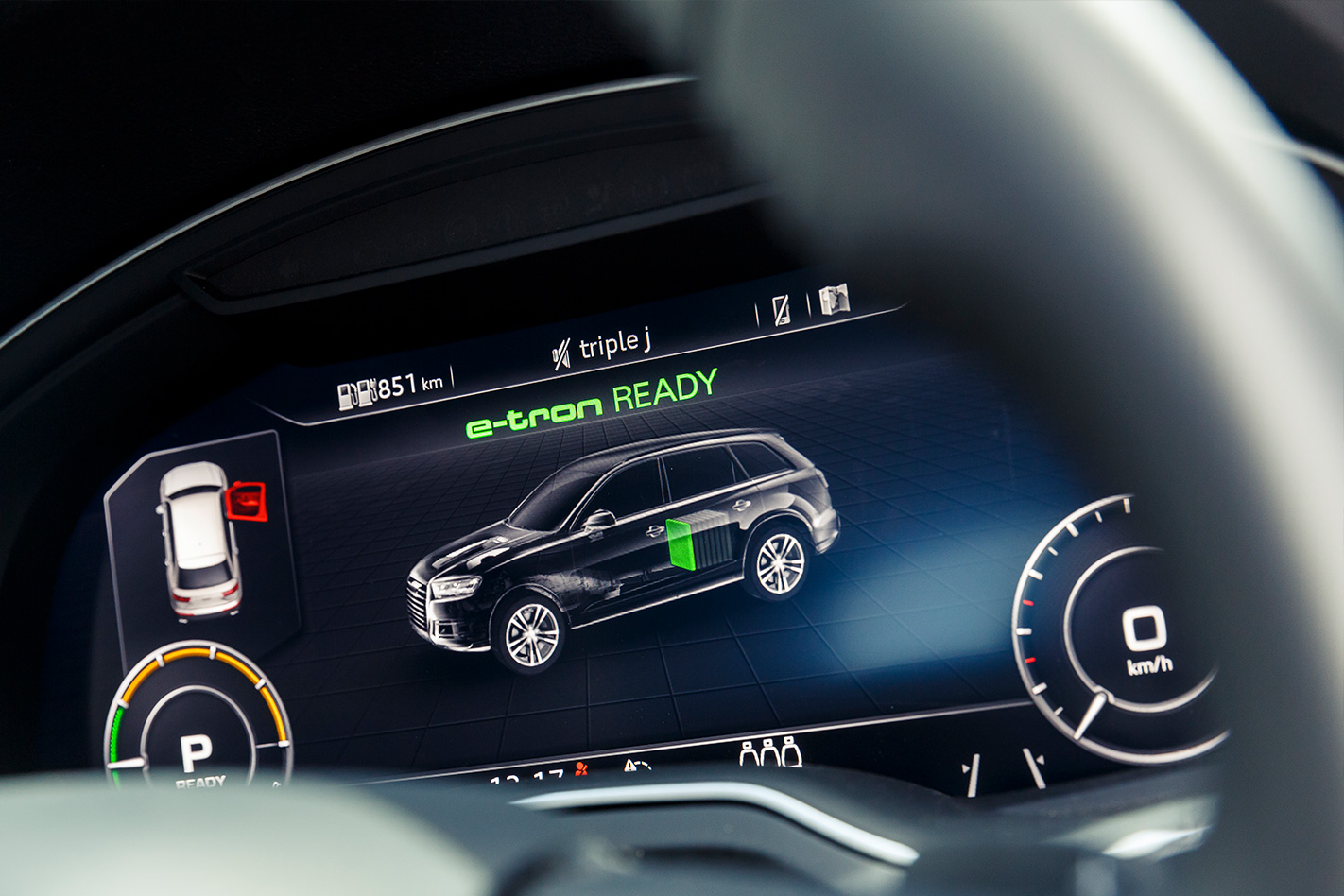
Naturally, you’ll need to be the judge of whether the $35K premium over a conventional 200kW 3.0-litre TDI Q7 represents an attractive return on your dollar, and the E-Tron does without either a third row of seats or a spare wheel, both casualties of battery packaging. The other side of the ledger includes 54km of electric range at speeds of up to 135km/h, a ludicrous claimed fuel economy figure of 1.9L/100km (we were averaging around 7.0 litres in mixed usage).
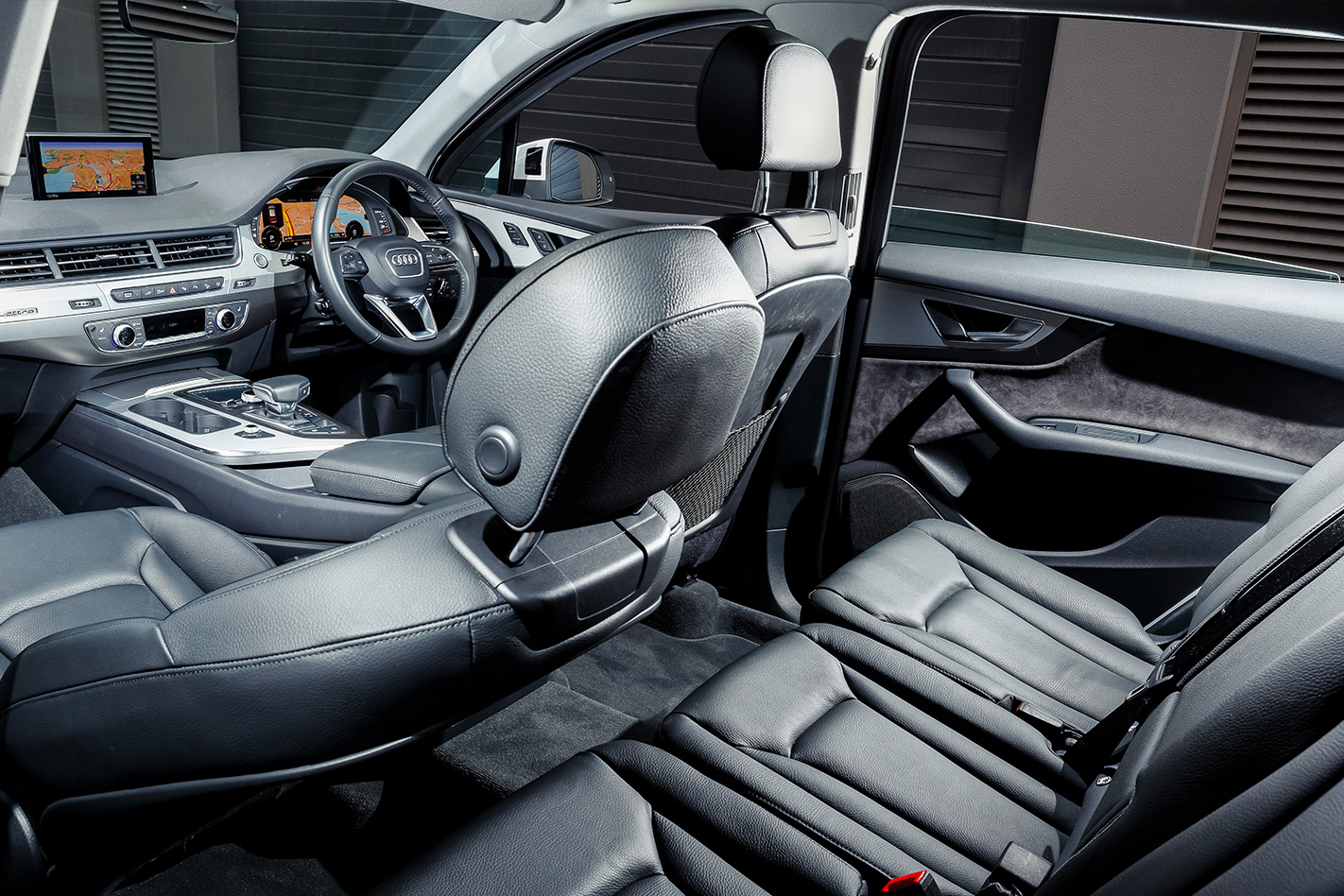
Enter a route into the MMI navigation system and Audi’s predictive efficiency assistant will not only handle the direction finding but will also figure out the most efficient way to use the charge in the battery for any given point on the journey. If the route encounters traffic congestion or urban areas, the Q7 saves the 17.3kWh lithium-ion battery power for those sections of the journey where electric drive makes most sense. It’s genuinely useful fire-and-forget stuff.

I’m not sure if I’ve ever seen a 19-inch tyre that’s any frumpier than the 255/55R19 Pirelli Scorpion Verde balloons fitted to the Q7 E-Tron, but the hybrid’s revised LED daytime running light signature, long roof spoiler and lack of tailpipes distinguish it. A combination of those big sidewalls, optional air suspension and active engine mounts combine to give the Q7 E-Tron an unruffled composure. It’s about as smooth as a diesel-engined SUV gets.
8/10
The Japanese National Police Agency will lift the speed limit on sections of two major expressways in the country’s east from 100km/h to 120km/h.
While the Australian response to road toll has been to wind speeds back, Japan’s police agency says an earlier trial that saw the limit raised from 100km/h to 110km/h did not see a significant increase in accidents. The new limit of 120km/h is officially an extension of that earlier trial, and will run for at least the next year as authorities gather data.
Previous studies by Japan’s transport ministry and the National Police Agency found that increasing expressway speed limits would not result in a corresponding increase in the accident rate, provided enforcement of the new limit was also ramped up.
Those of you who have driven on Japanese expressways will probably know why: even though posted speed limits may say 100km/h, Japanese drivers regularly exceed it by a significant amount. Lifting the official limit to 120km/h is merely adjusting it to what the public has already been doing for years.
Should Australian road authorities and police follow the Japanese example and investigate higher speed limits? Outside of the Northern Territory’s brief move back to derestricted highways between 2014 and 2016, few other jurisdictions have taken a similar approach. The logic of reducing travel times by permitting higher average speeds is often overruled by the common belief that lifting speed limits will encourage hoon behaviour.
But while the argument could be made that modern cars are more than capable of handling a well-engineered Australian highway at 120km/h for long distances, there are question marks over whether the average Australian driver is competent enough to do the same.
Driver licensing tests in most states do not formally require any assessment of an aspiring driver’s ability to drive at highway speed, and new drivers are also speed limited in New South Wales.
There’s also the significant disparity in Australian and Japanese driving attitudes – something that also has an impact on accident rates.
The fatality rate also differs wildly. Japanese car ownership rates are low compared with Australia’s, but if we look at fatalities versus cars registered there’s still a sizable difference.
In 2018 a total of 3532 people died on Japanese roads – given 78.1 million vehicles are registered in that country, that’s a fatality rate of 4.52 per 100,000 cars. The 2018 Australian road toll was 1166 and some 19.2 million cars were registered in Australia at the start of that year, which gives us a rate of 6.07 per 100,000 cars. Clearly, there are factors other than speed at work.
What do you think? Does Japan have the right approach, or is winding up the speed limit irresponsible in Australia given our minimal standards for driver training? Have your say in the comments below.
The Bridgestone Potenza RE-71R is the answer to your problem of loving the occasional track day but having nowhere to store – or not wanting the extra expense or having to cart around – a second set of wheels and tyres.
Delivering meaty and satisfying lateral grip you only get with a track tyre, but with apparently none of the notorious, libellous, classic characteristics of R-compound rubber – such as temperature sensitivity, deafening road noise or a straight-up refusal to work in the wet – we are, to be honest, quite smitten with Bridgestone’s RE-71R.
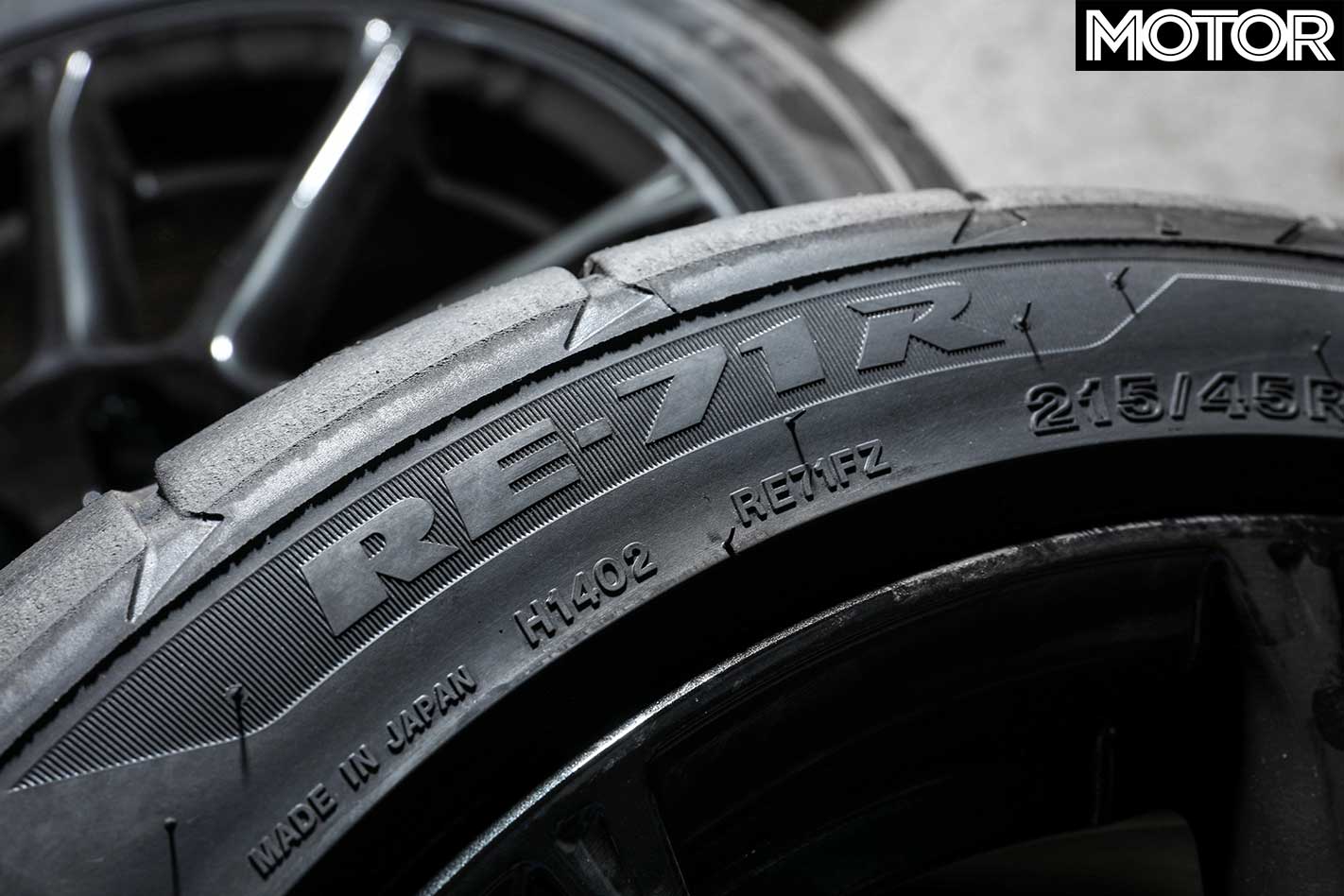
Having bolted them to a new Toyota 86 GTS for our test, we weren’t quite sure what to expect of these tyres, which replaced the popular RE-11A. One look at their aggressive tread pattern – with just two water clearing grooves – and you can imagine your car’s front end pushing wide through slow roundabouts; or the rear end slowly stepping out as you drive gingerly through corners in the wet. Or you having to wear noise cancelling headphones as you drive to work, or considering purchasing an inflatable doughnut to sit on.
Not the case. In fact, after fitting the RE-71Rs, the extra grip and sharper steering response was immediately (and gleefully) obvious the first few corners, even while we were still scrubbing in the tyres. And after spending a lot of time on the RE-71Rs during our test in a variety of conditions, while they look like they’re designed exclusively to swoop apexes and pound over ripple strips, this is a tyre you could easily commute to work on, every day.
For a start, the RE-71R asks you to make far fewer compromises than the traditional R-compound tyre. They are not particularly temperature sensitive, meaning you can use them pretty much from the off. They ride pretty well, certainly not noticeably harsher or jigglier on our 86 test car than the stock Michelin Primacys. And they even offer decent grip in the wet, letting you drive around like you’re on a normal high performance tyre, stress-free. We’ve even heard of people getting up to 25,000km out of a set, driving around on them every day – impressive mileage for such a soft tyre.
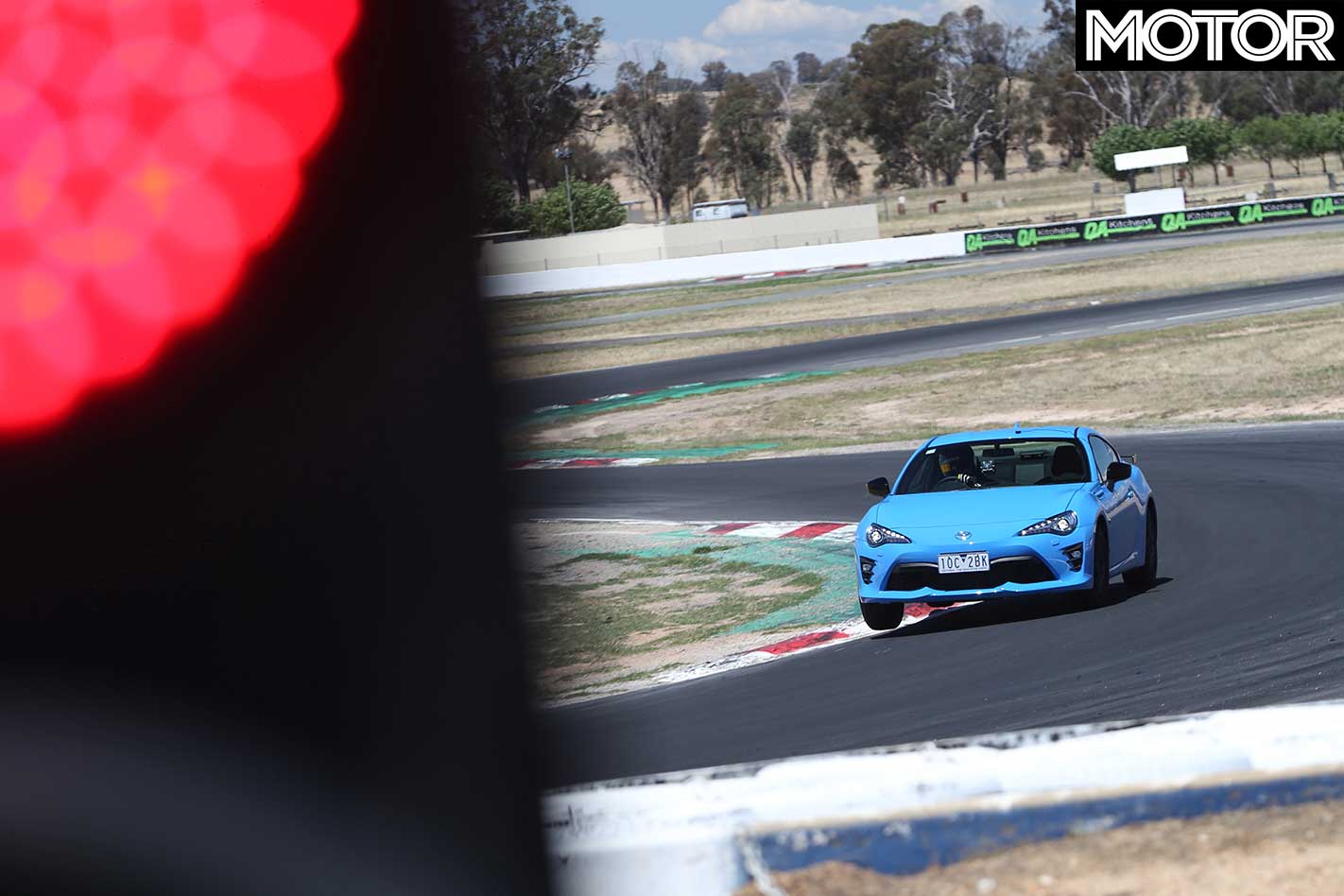
For certain, the RE-71Rs do ask some things of you. We didn’t weigh them, but they felt a lot heavier than some other 215/45 R17s we had around. They can be quite loud on coarse chip roads (although it’s all relative, they’re whisper quiet compared to some other R-compound tyres). They also make some interesting noises we’ve never heard from a tyre before; driving over freshly laid patches of bitumen, there is a loud sticking sound like the tread is so adhesive it is having to peel itself off the road surface. Although this noise is more cool than annoying if we’re honest…
The RE-71R’s all-condition road manners were so much like a regular high performance road tyre that we thought they might also in fact be in the same league as the more road-focused RE003 when it came to on-track performance. Gladly, here we were also wrong.
On track, the RE-71Rs are grippy and communicative, offering exactly the kind of performance you’d expect from a track-focused tyre – and withstanding multiple sessions and abuse with even wear and minimal graining. They’re built for this kind of abuse.
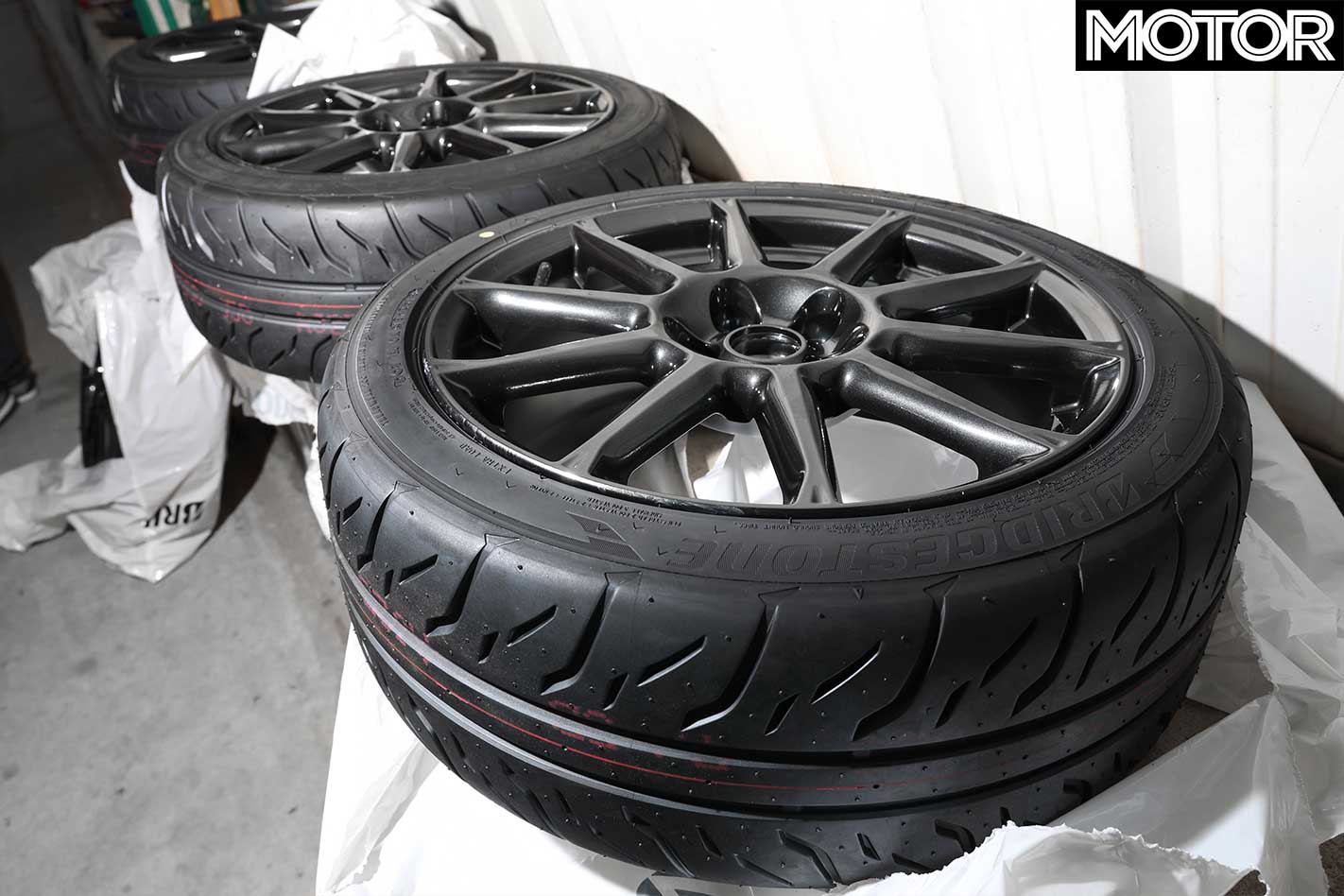
And they feel fantastic on track. In our 86 test car, lateral grip is almost a contrast to the stock Michelin Primacys, the RE-71Rs inviting an altogether different and aggressive driving style, gifting the 86’s front end a new tenacity and letting you basically stomp on the throttle out of corners. Stiffer sidewalls make you feel more connected to the tread face of the tyre, and in the 153kW 86, the sticky RE-71R challenges you to eke out every last km/h of momentum.
Are they fun to drive on? Yes, but in that they offer a satisfying amount of grip. This tyre is going to lock your car down. And when they do let go, it can be more sudden than progressive – exciting rather than fun, if you are wanting to slide around.
Are they very fast? In another test, we compared the RE-71R to the RE003, and literally the cheapest tyre we could buy in 215/45 R17. Around Winton Motor Raceway, same car, same conditions and same driver, the RE-71R was a blistering 2.9 seconds quicker a lap than the RE003, and 5.3 seconds quicker than the el-cheapo tyre we tested. We have, sadly, no reliable lap times for any other track-focused tyres.
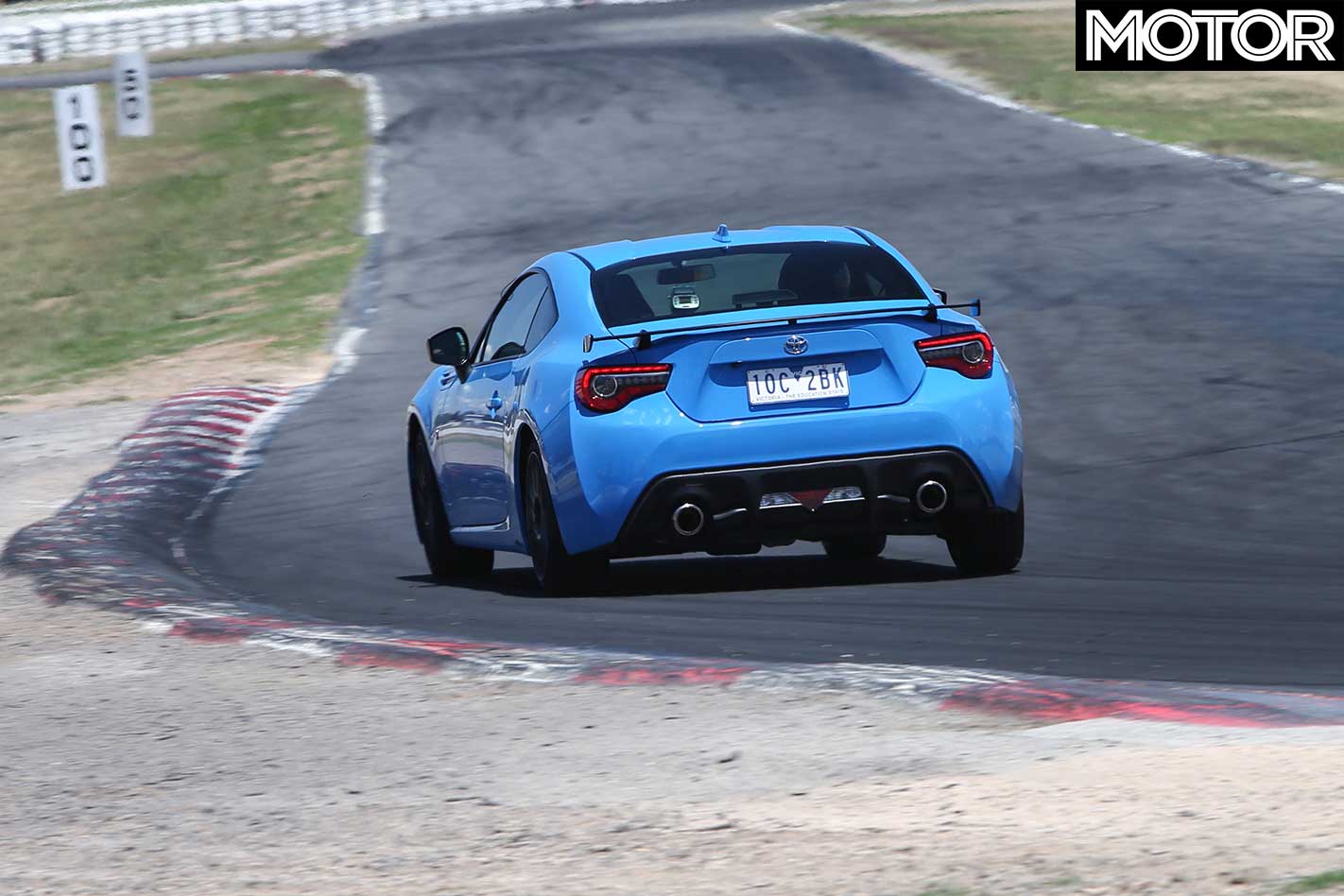
All in all, we are impressed with the RE-71R, a tyre that feels built for the apparently divergent purposes of commuting and track days. And for both these uses, Bridgestone feels to have struck a very well-judged balance.
Of course, there is a compromise being made – the RE-71R is not the most refined high performance road tyre around, and nor would it be the quickest track tyre around a circuit. In that sense, if you intended to use your sports car for commuting and some twisty back road blasts, rather than track work – and where you mightn’t want your car totally glued to the road – you’re better to opt for a more refined, regular high performance road tyre with less grip but more progression, than the sticky but slightly binary RE-71Rs. Particularly as you stand to save a considerable amount of coin.
The same is true for those forced to use their track car in the urban jungle but also remain very concerned with their track day PB. We say continue (or employ) the two-sets-of-wheels strategy, one with the cushiest, quietest tyres available; and another with something stickier, noisier and nastier – and faster – than the RE-71R.
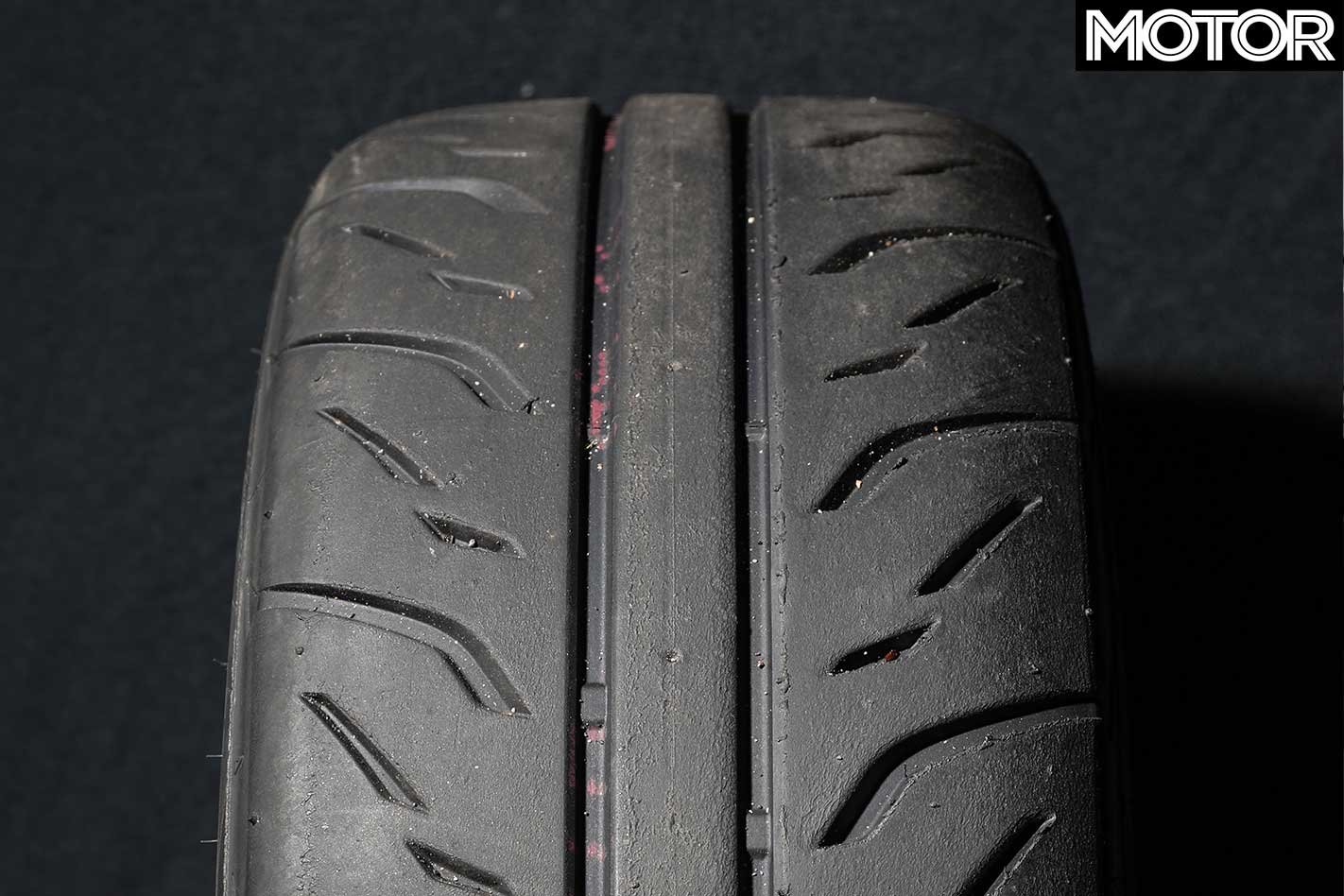
But if the track is the only place you push your sports car hard, and the objective of your track outings remains more to do with thrills than tenths, you should flick the spare set of wheels and old-school semi-slicks and save yourself a bomb by just fitting RE-71Rs. They remain surprisingly suitable for everyday use, but give you the extra grip, and durability, required (and desired) for a track outing.
Rating: 4 stars out of 5
Bridgestone Potenza RE-71R specifications Size tested: 215/45 R17 91W Treadwear: 200 Traction: A Temperature: A Made in: Japan Diameter range: 14 to 20 inch Section range: 185 to 295mm Aspect ratio range: 60 to 30
Price comparison
Bridgestone Potenza RE-71R – $1640 Bridgestone Potenza Adrenalin RE003 – $1300 Yokohama Advan Neova AD08R – $1644 Michelin Pilot Sport Cup 2 – $1972 Michelin Pilot Sport 4S – $1360
*Prices are based on a cold-call to a tyre dealer for a set of 235/35 R19s **Pricing a guide only. Correct as of March 2019.
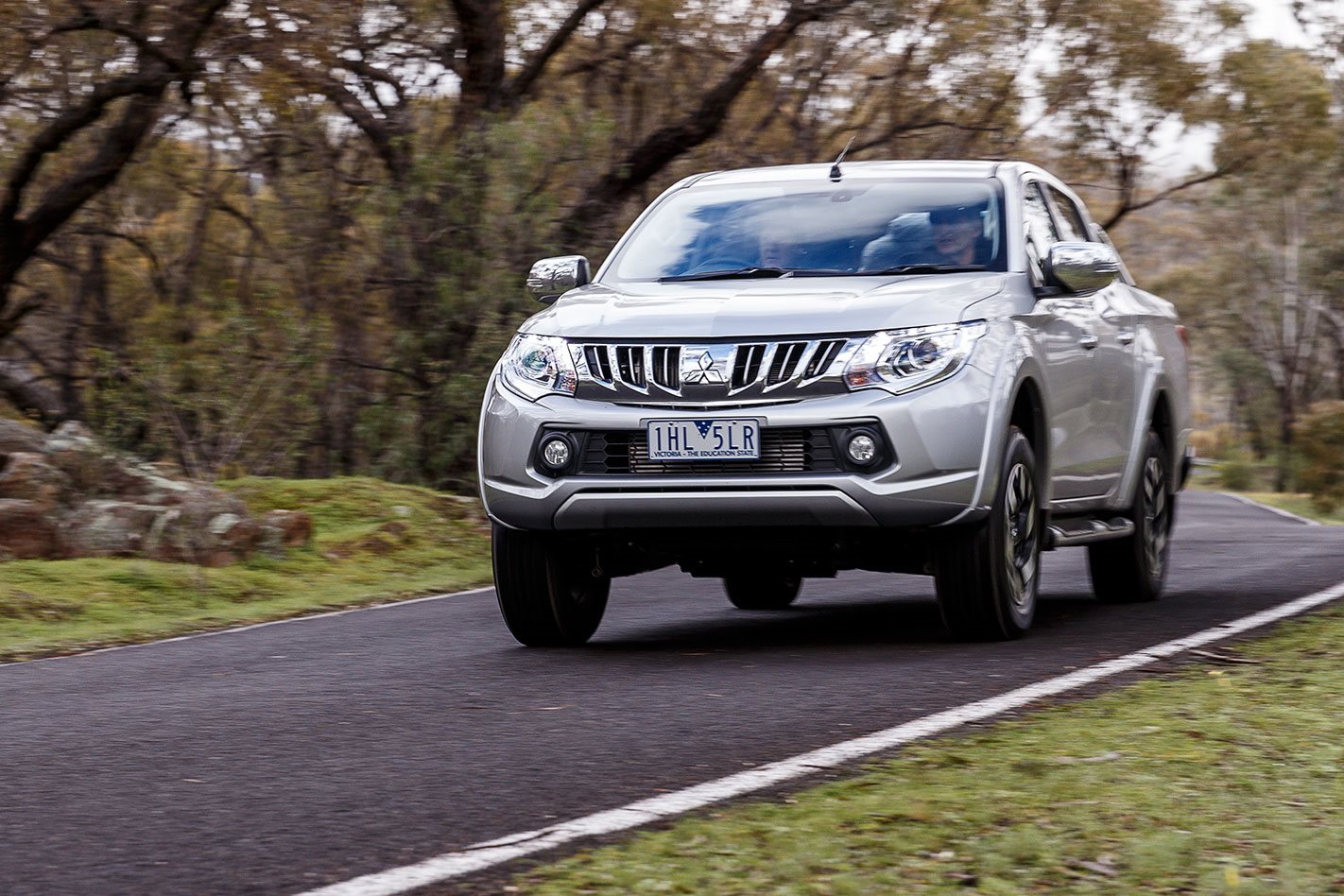
The top-three biggest selling vehicles in Australia are utes, with the Mitsubishi Triton taking the third placing behind the Toyota HiLux and Ford Ranger that’s been long held by the Toyota Corolla hatchback.
Incredibly the Corolla – which has been Australia’s top-selling passenger car for several years – has slipped to seventh place behind the three utes, as well as the Mazda 3, Mazda CX-5 and Mitsubishi’s ASX.
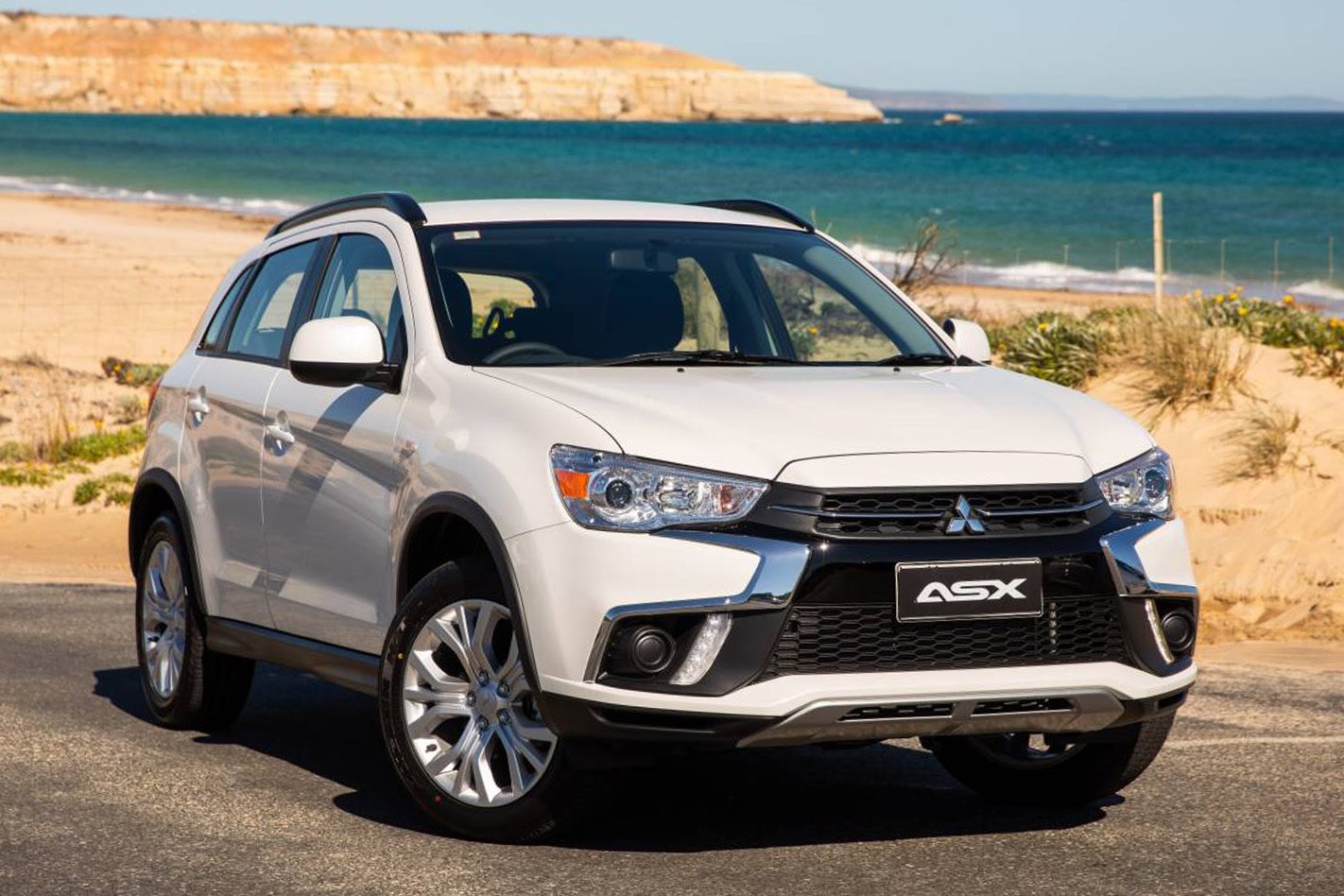
The Hyundai i30, Toyota’s LandCruiser and Toyota RAV4 make up the rest of the top ten.
Mitsubishi sold 3155 Tritons in February, which is 66 percent more than the same time last year. It’s rise to third place caps off an excellent run during previous months that saw its stocks rise during the run-out of the previous model that has continued with the facelifted version featuring additional safety features.
It’s February figure is just 222 less than Ranger, however it still has some way to catch the Hilux, of which 4431 were sold last month.
It’s a different story for the Corolla, though, which has seen its fortunes dwindle since the introduction of the 12th-generation model last year.
February saw 2070 Corolla registrations, a 36 percent drop from the same time last year.
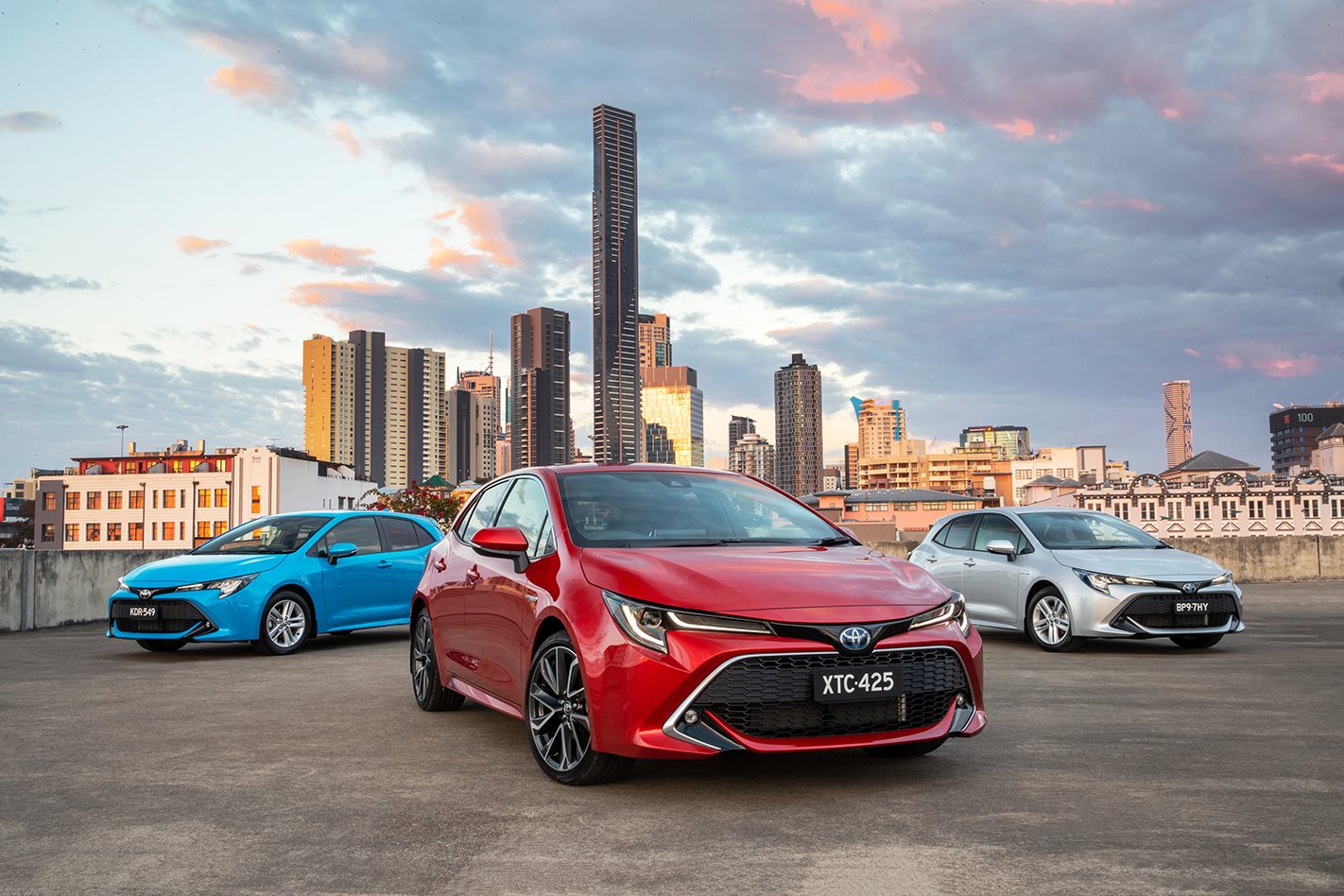
While the new Corolla has been widely lauded as a significant improvement over the previous model in terms of driveability, the deletion of the base Ascent variant will have affected fleet sales, meaning the entry cost has risen from $20,190 to $22,870 for the manual gearbox-equipped Ascent Sport.
The Corolla’s woes have allowed the Mazda 3 (2655) to claim the top passenger car spot during its run-out phase, despite a 9.5 percent slump in sales compared to February 2018. The Hyundai i30 (1929) has also suffered a similar year-on-year drop of 11.6 percent.
Mazda’s medium-sized CX-5 (2357) has again claimed the overall top spot in SUV sales over the smaller Mitsubishi ASX (2122).
The RAV4 (1639), which is also in runout, saw an 11 percent drop, while the LandCruiser (1804), which includes both the 200 and 76 Series models, dropped by just 0.9 percent.
Sales by segment, February 2019
Passenger car – 27,151
SUV – 37,292
Light Commercial – 19,831
Top-5 models by popular segment
Model Feb 2019 YTD
Micro/Light cars | FEB u201819 | YTD |
u00a0 Hyundai Accent | 1232 | 2879 |
Mazda 2 | 1028 | 2009 |
Toyota Yaris | 684 | 1593 |
Suzuki Swift | 657 | 1254 |
Honda Jazz | 446 | 1111 |
Small cars | FEB u201819 | YTD |
u00a0 Mazda 3 | u00a02655 | 5486 |
Toyota Corollau00a0 | 2070 | 4487 |
Hyundai i30 | 1929 | 3820 |
Kia Cerato | u00a01568 | 2994 |
Volkswagen Golfu00a0 | u00a01153 | u00a02384 |
Medium/large cars | FEB u201819 | YTD |
u00a0 Toyota Camry | 1286 | 2535 |
Holden Commodoreu00a0 | u00a0576 u00a0 | 979 |
Mazda 6 | u00a0252u00a0u00a0 | 525 |
Kia Stingeru00a0 | 158u00a0 | u00a0288 |
Ford Mondeo | u00a0106 | 158 |
Small SUVsu00a0 | FEB u201819 | YTD |
u00a0 Mitsubishi ASX | 2122u00a0 | 3940 |
Mazda CX-3 | 1188 | u00a02496 |
Honda HR-V | 1025u00a0 | u00a02068 |
Qashqai | 860u00a0 | u00a01694 |
Toyota C-HR | 719 | u00a01505 |
Medium SUVs | FEB u201819 | YTD |
Mazda CX-5u00a0 | 2357u00a0 | u00a04707 |
Toyota RAV4u00a0 | 1639 | 3439 |
Mitsubishi Outlander | 1524u00a0 | 2838 |
Nissan X-Trailu00a0 | 1420 | u00a02939 |
Honda CR-V | 1266 | 2312 |
Large SUVs | FEB u201819 | YTD |
Toyota Prado | 1569 | 2919 u00a0 |
Toyota Kluger | u00a01000 | u00a01945 |
Subaru Outback | 698u00a0 | 1245 |
Isuzu MU-Xu00a0 | 654 | u00a01135 |
Hyundai Santa Fe | u00a0512 | 1083 |
Utes/Pickups | FEB u201819 | YTD |
Toyota Hilux | 4431u00a0 | u00a08382u00a0 |
Ford Ranger | 3377u00a0 | 5941 |
Mitsubishi Triton | u00a03155 | 4849 |
Holden Colorado | 1302 | 2846 |
Isuzu D-MAX | 1195 | 2054 |
The good news is that more than six million people have checked their cars for deadly Takata airbags, but the bad news is that there is still about 900,000 on Australian roads fitted with them.
To aid the long-running Takata airbag recall campaign, the Federal Chamber of Automotive Industries (FCAI) launched the industry website www.ismyairbagsafe.com.au in 2018 for consumers to check whether their vehicle was fitted with faulty airbags.
To date, more than 6.4 million vehicles have been checked via the website and over one million have been found to be in need of a recall.
“That’s a tremendous result,” said Tony Weber, chief executive of the FCAI.
“The Australian public has visited the website over 6.4 million times, and that’s an indicator of strong engagement for this important safety campaign. More than 100,000 vehicles [are] rectified every month.
However, there is still more work to be done, with more than one million cars on Australian roads with potentially deadly ‘beta’ Takata airbags fitted.
Car companies are now calling for the registration ban – which kicked off in South Australia last September and has extended to NSW, Queensland, Western Australia and the territories – to be extended to beta airbag-equipped cars.
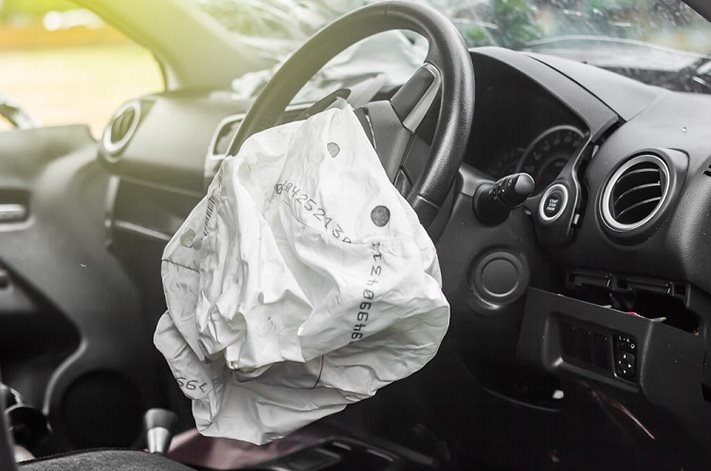
Some industry officials fear that the spotlight on the much smaller number of ‘alpha’ Takata airbags – which have a one-in-two chance of exploding – is taking the emphasis away from beta bags, which have a one per cent chance of incorrectly deploying.
The website joins renewed advertising efforts, with the “Don’t Die Wondering” national ads featuring on television, press, radio, billboards and social media.
The FCAI urges affected vehicle owners to continue using the www.ismyairbagsafe.com.au website or text TAKATA to 0487247224 to check the recall status of their cars.
Mr Weber notes that manufacturers are making it as easy as possible to get the recall done, saying “once a vehicle is identified, vehicle owners can make arrangements with their brand’s local dealer to have all faulty airbags replaced. This work is free.”
WhichCar investigated the recall process mid-way through 2018 and found BMW’s process to be a smooth experience.
Haven’t checked if your car is affected yet?
Visit https://ismyairbagsafe.com.au/ now!
New car sales across Australia have slipped again, as uncertainty about federal politics and softening house prices across the country put the brakes on big-ticket spending.
Almost every car company posted losses compared to their February 2018 sales, including the industry’s powerhouse, Toyota. It fell 10 percent year on year, the company’s worst figure in two years.
Just over 87,100 new vehicles were sold in February 2019, a dip of 9.3 percent on the same period last year. On a year-to-date basis, Australians have bought more than 169,000 new cars so far this year, representing a decrease of 8.4 percent over the same period in 2018.
Auto industry spokesman, FCAI chief Tony Weber says the softer sales are due to a combination federal election pending, several key new models coming on stream and the housing market bubble bursting in both Sydney and Melbourne.
“Given the current challenging economic conditions, including a downturn in the housing market, the automotive industry is not surprised by the slower start to the year,” said Weber.
In light of the impending arrival of its new Mazda 3 small car, Mazda did well to stem its losses to just seven percent to retain second place overall in the Australian market, while strong performances from its new Triton and evergreen ASX saw Mitsubishi (up 19 percent in February and 22 percent YOY) leapfrog Hyundai (down 19 percent) for third place overall.
Softer sales for some of its mainstream cars, including the Tucson and i30, pushed Hyundai into fourth with a fall of 19 percent, just ahead of Ford which dropped just six percent over its February 2018 mark.
Kia managed to buck the trend, lifting four percent and pipping a softening Volkswagen by some 800 cars for the month to hold sixth. A bright spot for VW came via its Skoda brand, though, which posted a 21 percent increase in its fortunes thanks to an improvement in supply.
Nissan (down 19 percent), Honda (off 22 percent) and Holden (down 18 percent in February) make up the rest of the top ten. However, Holden holds seventh place overall in total sales for 2019 thus far, with VW (down 11 percent) taking the tenth spot.
In eleventh place is Subaru, down an astonishing 48 percent for the month, and 33 percent year-on-year. Its Impreza sedan is down by 1000 sales from this time last year, and its popular XV compact SUV has halved its sales numbers over the same period.
Subaru says that the recent factory closure to amend a steering defect has affected its Australian deliveries.
The rot has also set in with some luxury brands dropping big numbers. Mercedes-Benz is down 18 percent year on year and Audi a worrying 27 percent, while Porsche has fallen 51 percent over the same time last year.
Porsche says the turndown was due to a reset in Macan stock levels in the run-up to the new model.
It’s not all doom and gloom, though, with luxury brands like Jaguar (up 36 percent) and Volvo (up 32 percent) posting growth.
After almost 90 years of designing and producing the bodies of cars for brands the world over, Automobili Pininfarina has finally revealed its own car, the 2020 Pininfarina Battista.
The car, called ‘the world’s first pure electric luxury hyper GT’ by the brand, is limited to 150 units starting next year, on Pininarina’s 90th anniversary.
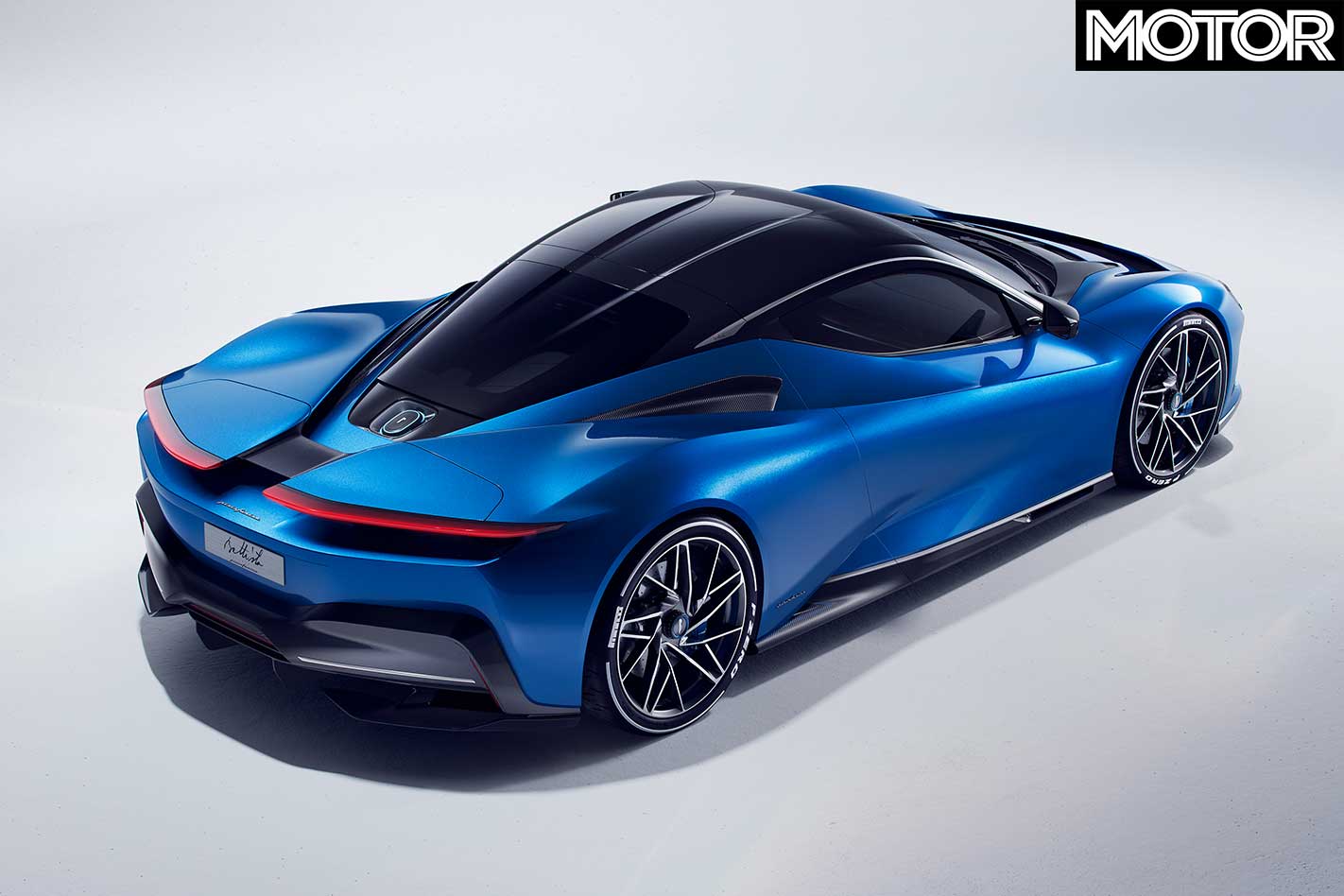
Expectations for the Battista’s performance are set high, as Pininfarina says it’ll be faster than a Formula 1 car to 100km/h thanks to a Rimac-developed battery system.
“The most powerful car ever designed and built in Italy” boasts a sub-2 second sprint to 100km/h, with 1397kW and 2300Nm at its disposal. Pininfarina says it will hit 300km/h in less than 12 seconds.
Onwards from 300km/h, there’s more than another 50km/h left before it hits its top speed.
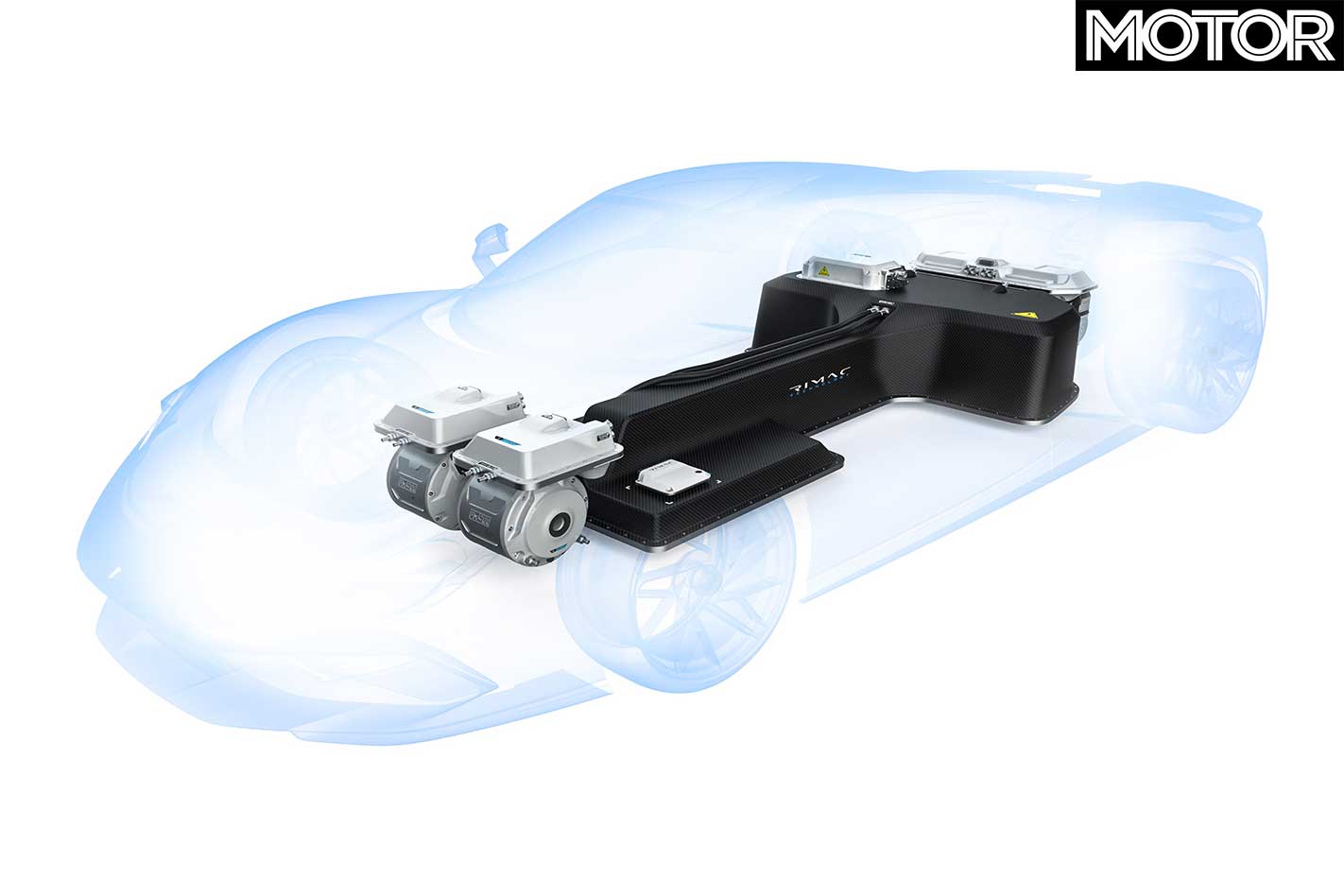
Grip for its four driven wheels is provided by a set of Pirelli P Zeroes specifically designed for the Battista, while stopping power comes thanks to 6-piston callipers on carbon-ceramic 390mm discs.
While an electric car will naturally be heavier than a conventional ICE-powered car due to the heavy batteries, Pininfarina has attempted to allay this thorough the use of a carbon fibre monocoque chassis, with carbon fibre body panels and aluminium crash structures at the front and rear.
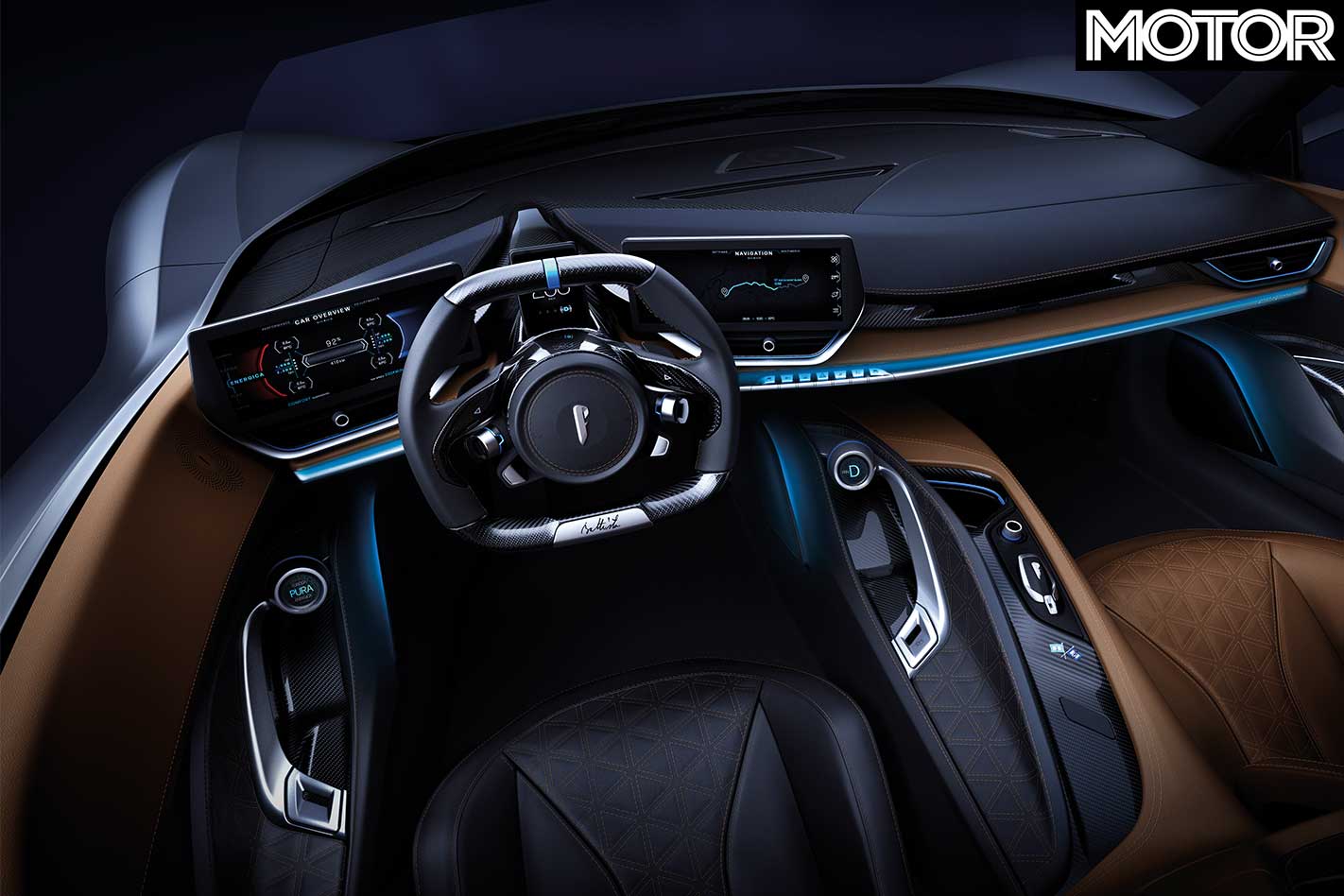
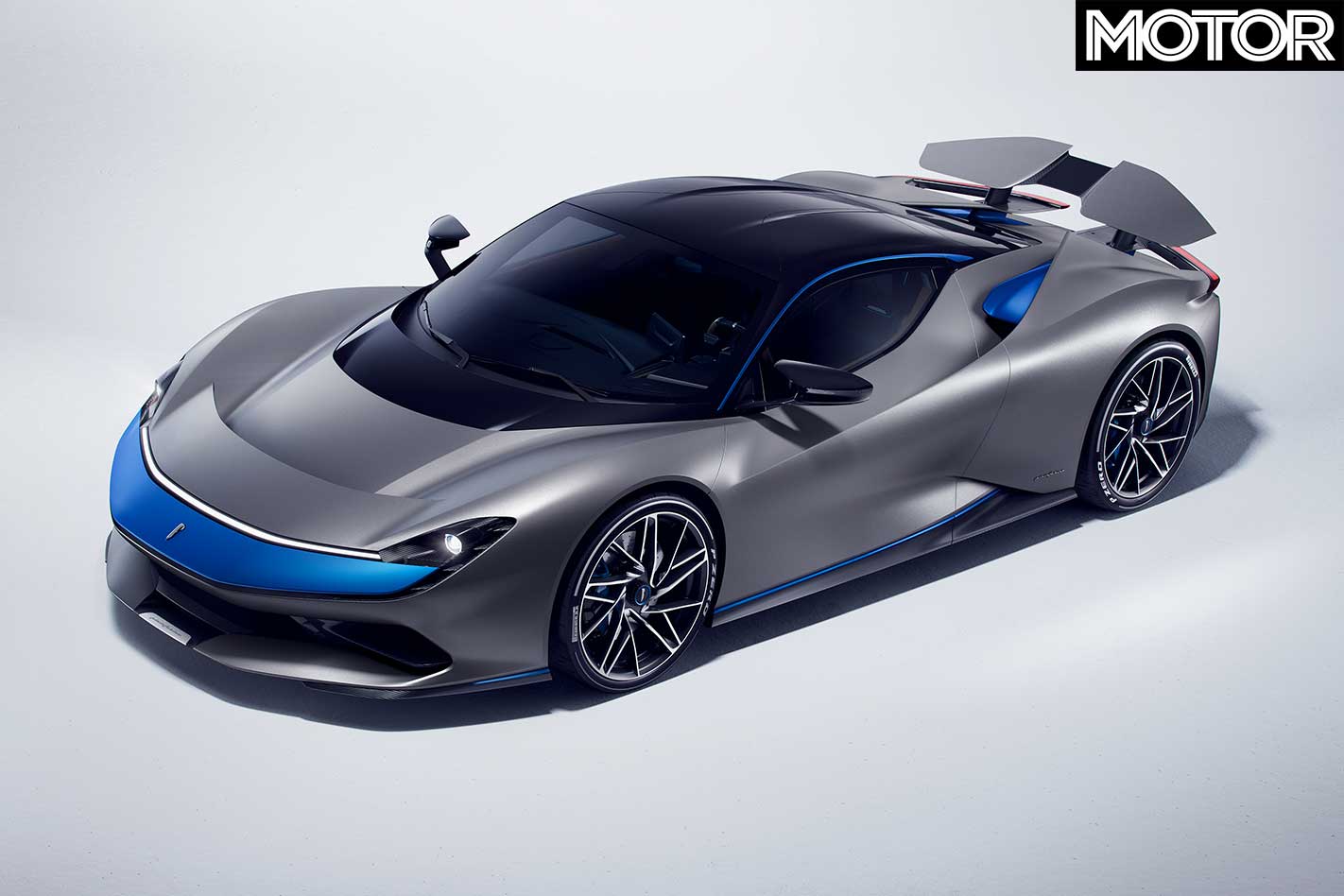
With Pininfarina’s history as a coachbuilder, customisability is a key point for the Battista, with three versions present at the Geneva Motor Show to display how each car can be made unique.
The car is named for Battista ‘Pinin’ Farina, founder of Pininfarina whose grandson is now chair of the brand.
“My grandfather, Battista ‘Pinin’ Farina, was born at a time and raised in a place where the first iconic automobiles were taking shape,” says Paolo Pininfarina.
“The human desire for speed and power was happening in the air and on the race-track. His passion for speed led to him to race track cars and design road cars, with a focus on speed and style.
“Ultimately this combination of racing and engineering experience led to the presentation of the Cisitalia 202 and his well-known links with Ferrari.
“The 202 made my grandfather famous, and it has clear links with the Battista we see today in its execution and its home.”
It’s not yet clear how Pininfarina distribution will take place around the world, so stay tuned to find out if it’ll be possible for any of these 150 cars to make it here.
The 2019 Bentley Continental GT Number 9 Edition by Mulliner is not only a mouthful to say, but also a model marking two significant Bentley events.
The most obvious, if you know a bit about Bentley, is that it marks the brand’s 100th anniversary year. The other is the reason for the name and actual number 9 seen in the grille.
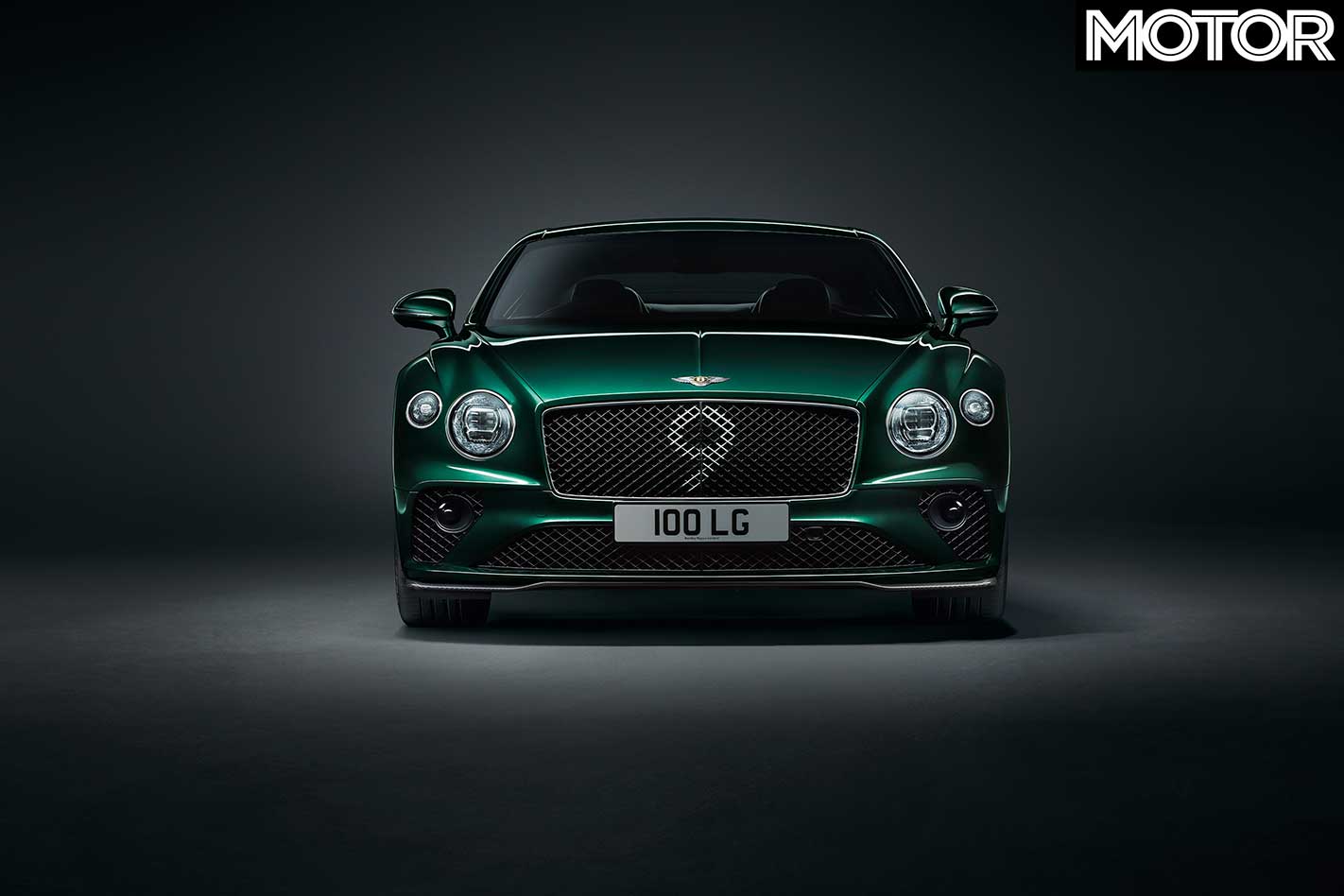
In the 1920s, Sir Henry Ralph Stanley ‘Tim’ Birkin convinced Walter Owen ‘W.O’ Bentley to supercharge enough Bentley 4½ Litre units (named for its rather large inline four engine) to pass the requirements to allow Birkin to enter one into Le Mans. Birkin raced one of these Bentley ‘Blowers’ in the 1930 race.
Birkin’s car number 9 didn’t win, in fact none of the three Blowers finished, but Birkin got his way with the 4 ½ Litre and set the fastest lap during the race.
Just 100 units of the Bentley Continental GT Number 9 Edition will be built to honour the Birkin Blower, each car having a small piece of wood from the original car’s seat displayed in its dash.
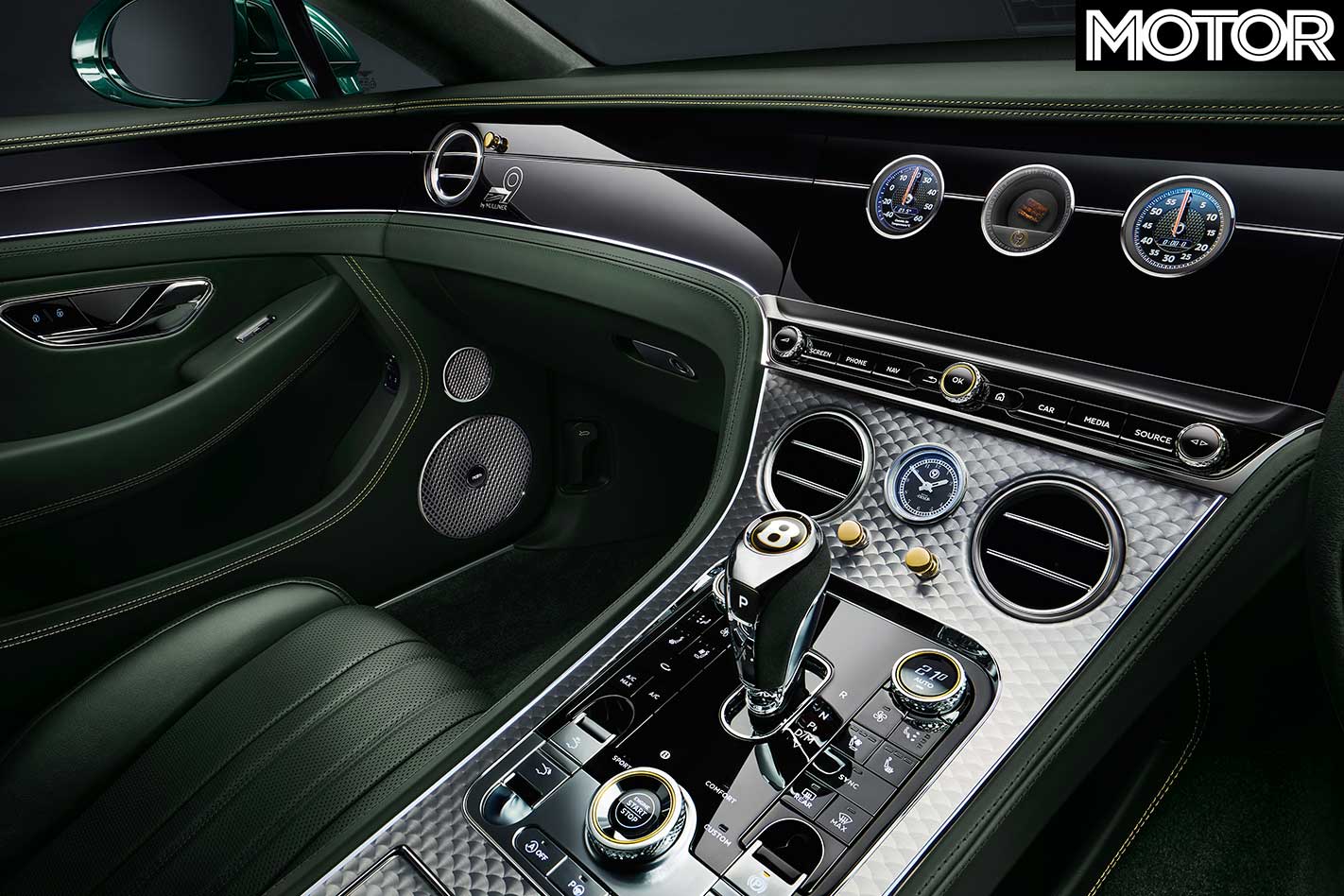
With the standard Continental GT providing the base car, each GT Number 9 will be powered by Bentley’s 467kW 6.0-litre twin-turbo W12.
Customers of the Number 9 can have Viridian Green, honouring the colour of the original Number 9, or Beluga Black paintwork, with a choice of Cumbrian Green or Beluga Heritage hide for the interior.
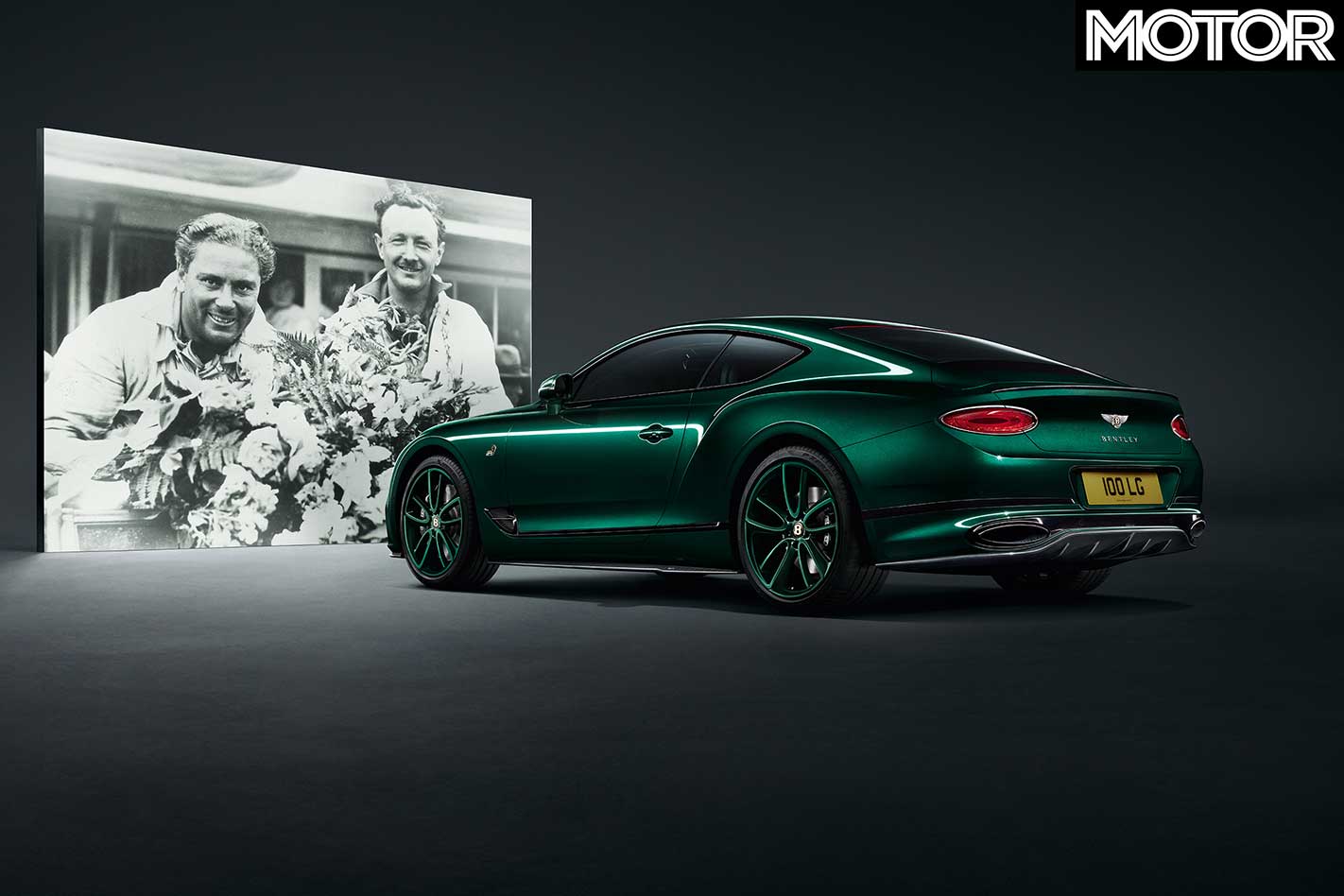
Bentley ‘B’ logos are found on the seat headrests and door panels as they did on the doors in the 1930 4 ½ Litre Blower.
Mulliner has also added a British Jaeger clock to the dash, inspired by the original No. 9 ‘Blower’s’ dials. Similarly, the ‘organ stop’ handles are finished in 18K gold, and the treadplates will have ‘1 of 100’ on them.
