
Ahead of crowning the 2019 Wheels Car of the Year, we wade through the last batch of finalists, the Jaguar I-Pace and Subaru Forester.
See the full episode: Watch at tenplay.com.au (AU) or primetv.co.nz (NZ)
As if you needed some light relief from the judging melee, Scott straps into an affordable Kia sports sedan with a turbocharged sting in its tail. Can you believe the South Korean brand is turning out a vicious rear-wheel drive with a punch that lasts?
See the full episode: Watch at tenplay.com.au (AU) or primetv.co.nz (NZ)
It’s a Wheels Car of the Year extravaganza as we test five of the best new cars to launch in 2018 from all the key players. Following on from last week’s Car of the Year introduction, the judges refine the pack down to just a handful before revealing this year’s winner.
See the full episode: Watch at tenplay.com.au (AU) or primetv.co.nz (NZ)
*New 2019 Hyundai Elantra available from $21,490
*Seven Elantra variants available for 2019
*Base manual-equipped Go misses out on AEB
*Elantra range tops out at $33,990
Hyundai’s latest update for the Elantra small sedan sees the range swell from five to seven variants, with new models at both the bottom and the top. However, its cheapest manual transmission-equipped model still misses out on basic driver safety aids like AEB.
The latest version of the five-seat, four-door Elantra was launched in 2016, and it competes against the likes of the Mazda 3 sedan, the Kia Cerato sedan, as well as the booted versions the Toyota Corolla and Holden Astra.
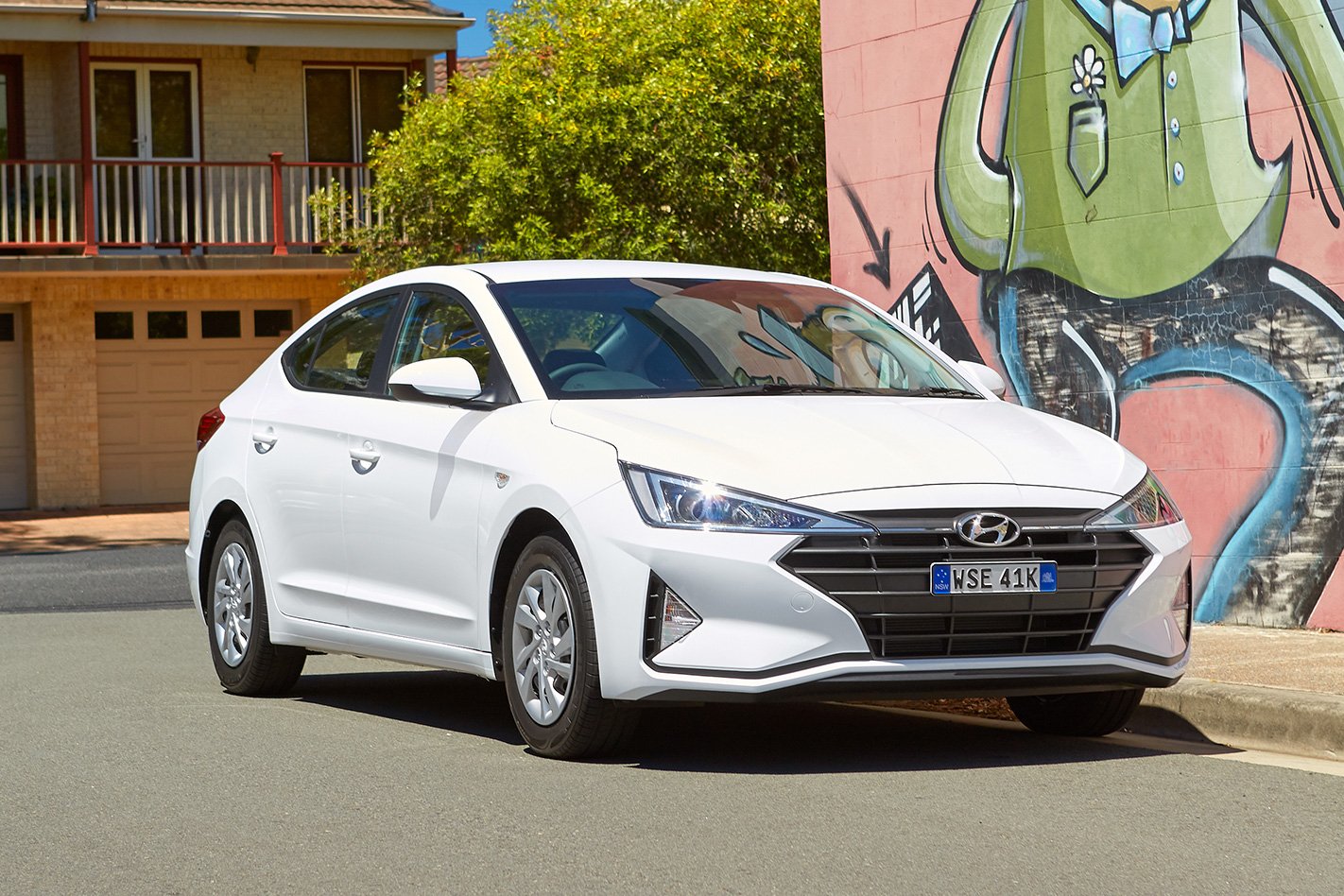
The new, budget-friendly Elantra Go starts at $21,490 (plus ORCs) in manual form, and slots in beneath the previous $21,950 Elantra Active entry point, while the turbocharged Elantra Sport and Sport Premium replace the outgoing single-grade Elantra SR flagship.
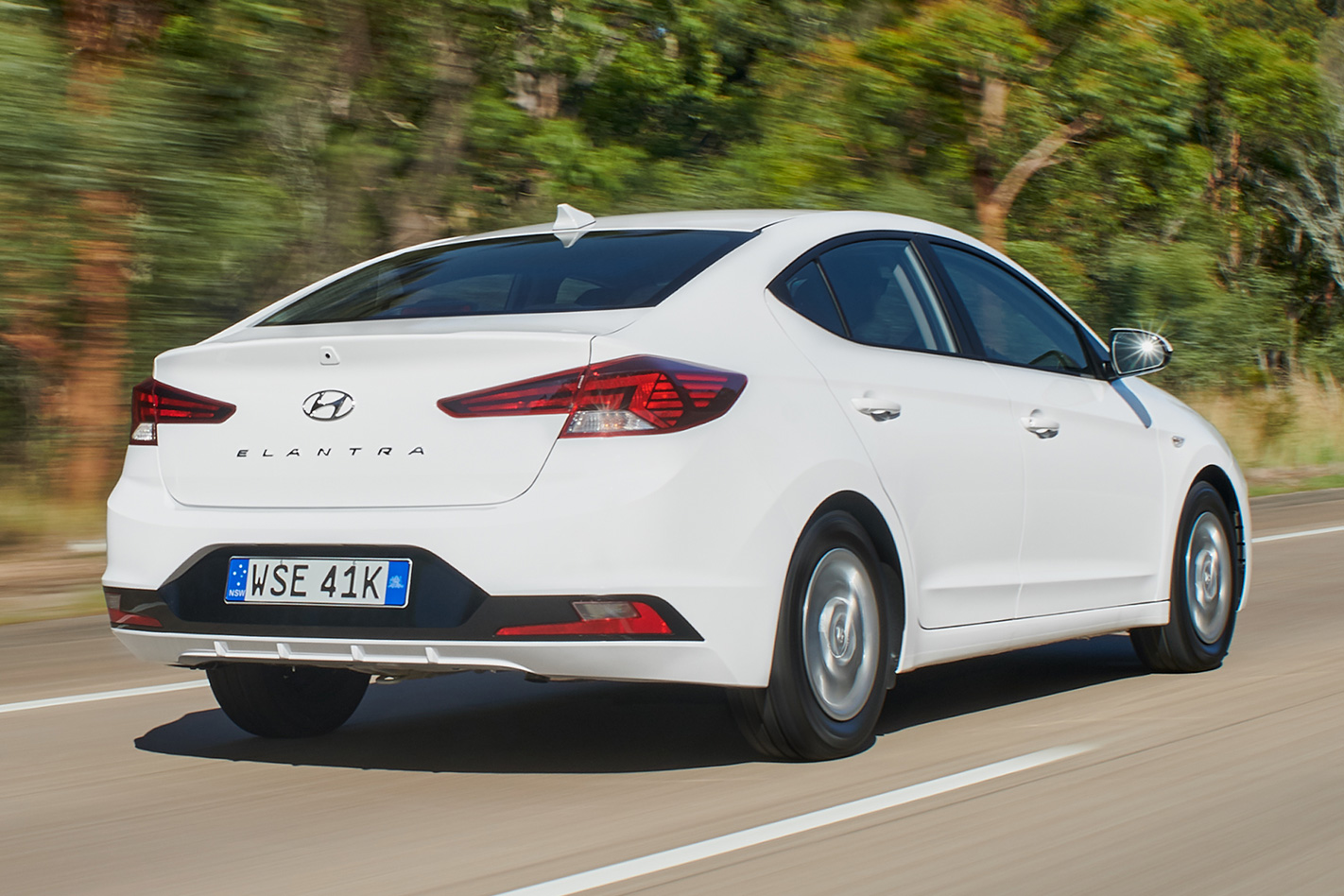
The mid-grade Elantra Elite disappears, though that void is filled by both the Active grade moving up in specification (namely, the adoption of standard sat-nav for its 8.0-inch infotainment multimedia display and an eight-speaker audio system with digital radio) and by the arrival of the Elantra Sport as a less equipment-rich turbocharged option to the Sport Premium.
The $28,990 Sport scores LED headlights, daytime running lamps and taillights, a chunkier body kit and 18-inch rims. It also adds leather-appointed sports-style seats, a black headliner, a sliding centre console lid, keyless entry and, for the dual-clutch models, a paddle-equipped sports steering wheel.
The $31,490 Sport Premium, meanwhile, also receives a sunroof, front parking sensors, an inductive phone charging pads, an extra USB port and a 10-way powered driver’s seat.
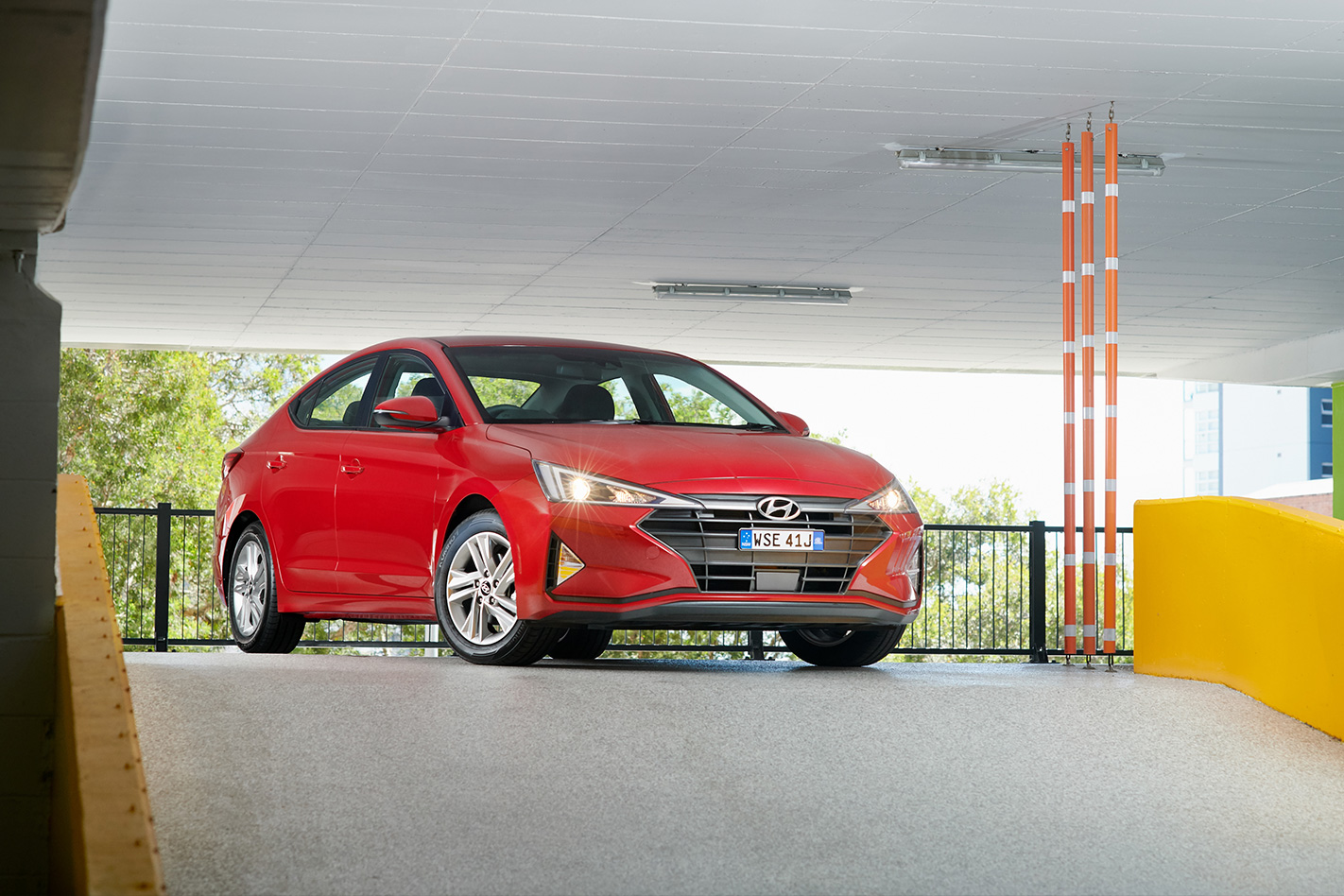
All Elantra models gain a facelifted front end with new bumper plastics, new headlamps, daytime running lights and a restyled bonnet, while at the rear the bootlid sprouts an integrated spoiler and sits atop redesigned tail lamps and a new rear bumper. New wheel designs for the Go’s 15-inch steel wheels and the Active’s 16-inch alloys round out the rest of the exterior enhancements.
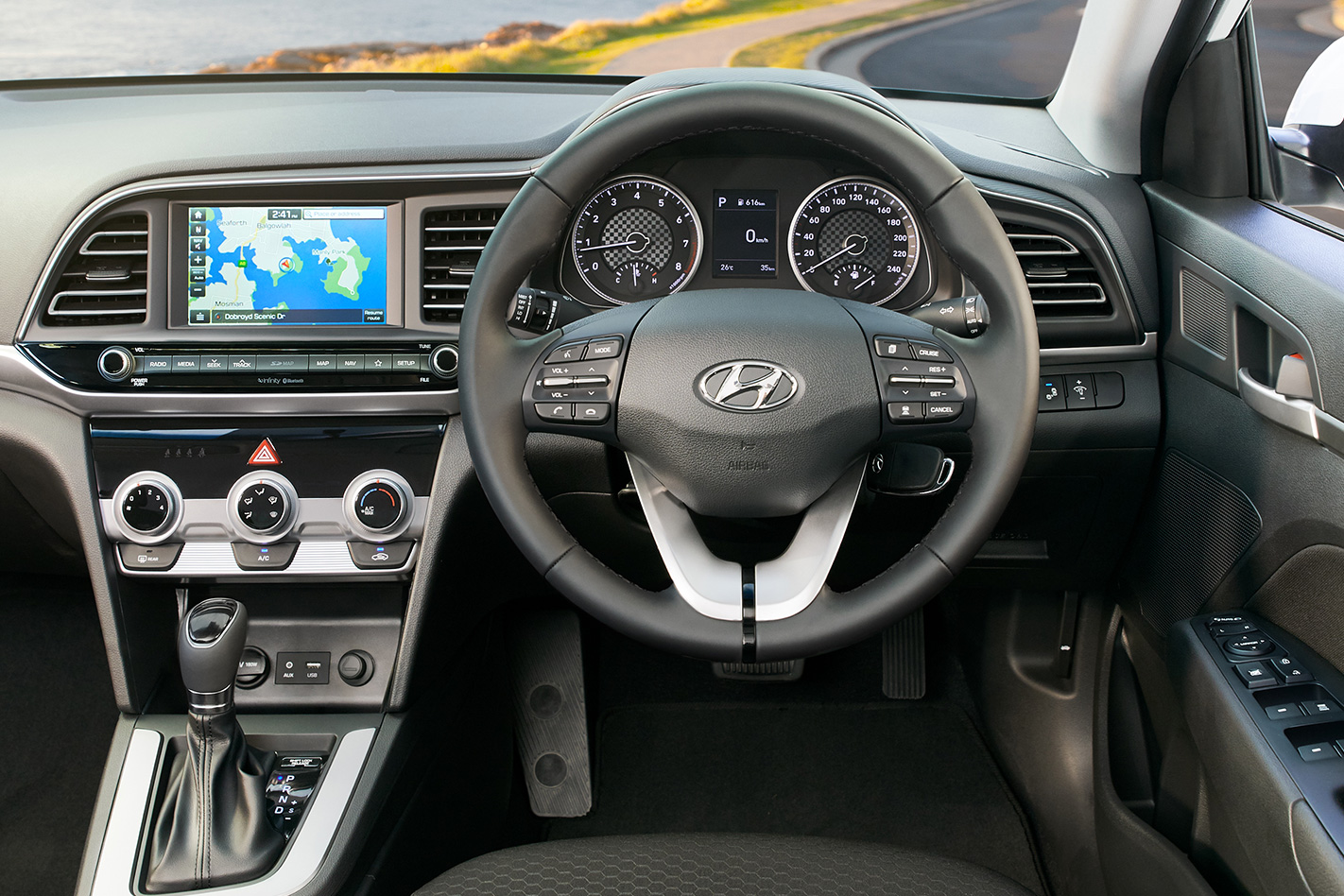
On the inside, a new centre stack design groups ventilation controls across three round switches and the air vent grilles adopt a new motif. The steering wheel is also reshaped, but with no changes to its button layout. Behind the wheel sits a new 3.5-inch colour multifunction display.
Key standard equipment on the base Go includes a rear-view camera, six airbags, a full-size spare, a 7.0-inch colour touchscreen, Apple CarPlay/Android Auto, Bluetooth, dusk-sensing headlamps, front and rear power windows and cruise control.
Step up to the Active, and integrated satellite navigation is added along with a digital radio tuner, a leather-wrapped steering wheel and gear knob, rear parking sensors and power folding wing mirrors.
AEB is a cost option for the Go and Active variants, able to be added if you fork out an extra $1700 for the SmartSense package.
Thinking of buying the base Elantra Go manual? Unfortunately, the SmartSense pack (which also brings blind spot monitoring, rear cross-traffic alert, lane-keep assist and active cruise control) isn’t available at all on that particular model. The Active doesn’t suffer the same problem – it’s now an auto-only proposition.
Powertrains are carry-over, with a 2.0-litre naturally-aspirated four producing 112kW and 192Nm for the Go and Active, taking power to the front wheels via a six-speed manual or six-speed automatic in the Go, or just the auto in the Active.
The Sport and Sport Premium will use the same 1.6-litre turbocharged four-cylinder petrol engine as the i30 N-Line. The engine is good for 150kW and 265Nm, and it’s backed by a standard-issue six-speed manual gearbox.
A seven-speed dual-clutch transmission is available for an additional $2500.
Hyundai says that all of its passenger vehicles are calibrated for local road conditions by an Australian-based suspension tuning team, which works with Hyundai’s head office to improve the steering and handling package of its cars.
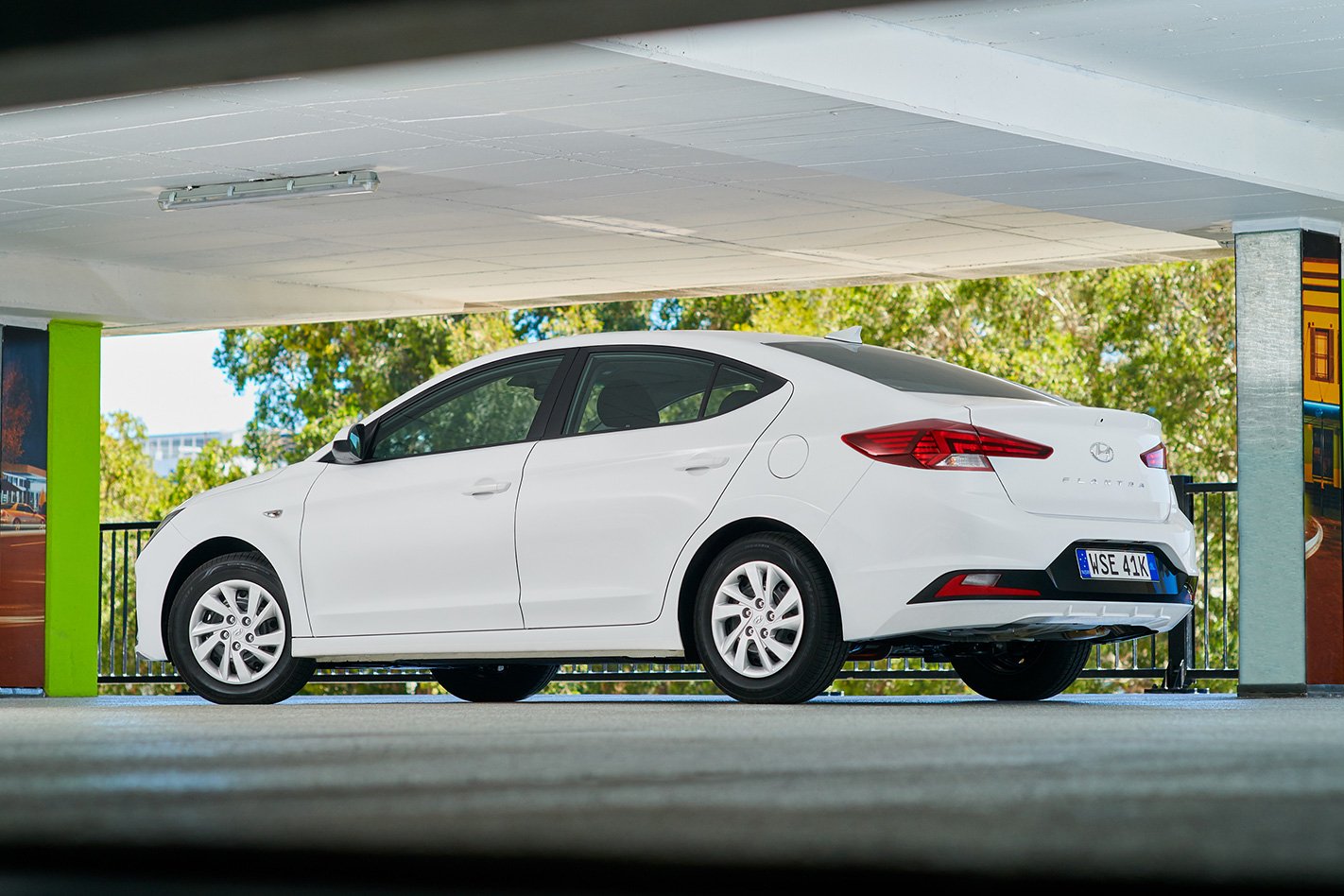
Hyundai Elantra pricing:
- Hyundai Elantra Go manual – $21,490
- Hyundai Elantra Go automatic – $23,790
- Hyundai Elantra Active automatic – $25,990
- Hyundai Elantra Sport manual – $28,990
- Hyundai Elantra Sport automatic – $30,490
- Hyundai Elantra Sport Premium manual – $31,490
- Hyundai Elantra Sport Premium automatic – $33,990
Been getting a little worried about the M3. It’s not a call-a-royal-commission style of worried, more a festering niggle that maybe, it’s not ageing particularly well.
This feature was originally published in MOTOR’s May 2005 issue
It’s just little things that are getting at us, but the list of those little things is growing. Things like the feeling that it’s not as together as it used to seem. That, on its optional 19-inch wheels, it gives up ride, rebound control and grip, and that it seems unable to carry mid-corner pace like it used to. That it’s just not as harmonious as it once was. Shame.
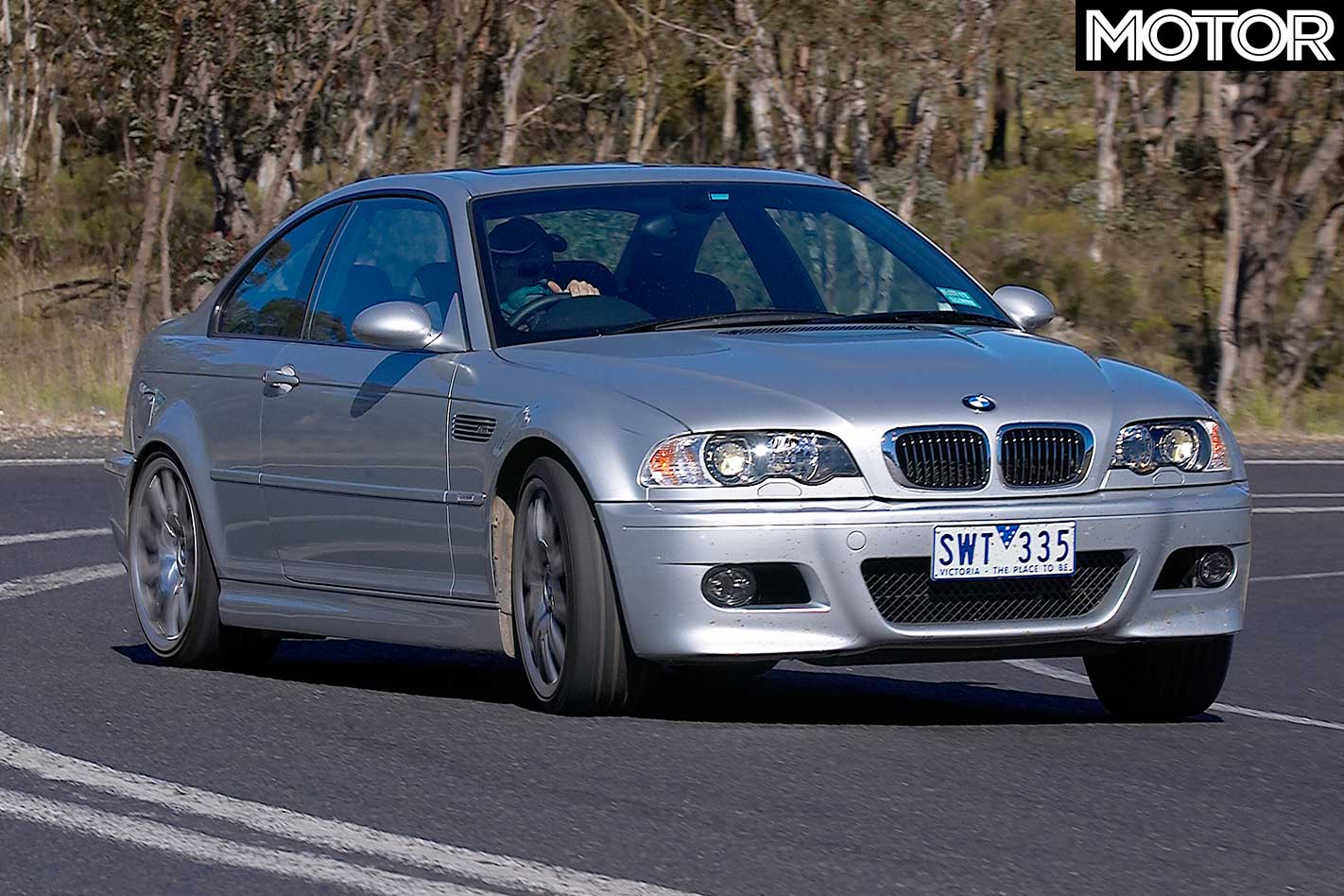
This feeling’s been sneaking up for a while, dating roughly from its comparo with the previous generation Porsche Boxster S back in February 2003. The Boxster gave up, for example, 61kW and a trick diff, and still squared away the lap times at Wakefield…
But as that shock faded, so another arrived, when the Audi S4 won a close points decision against the BMW in July last year. So, as it struggles to keep its gloves up against a horde of fast, accomplished newcomers, where does the M3 stand?
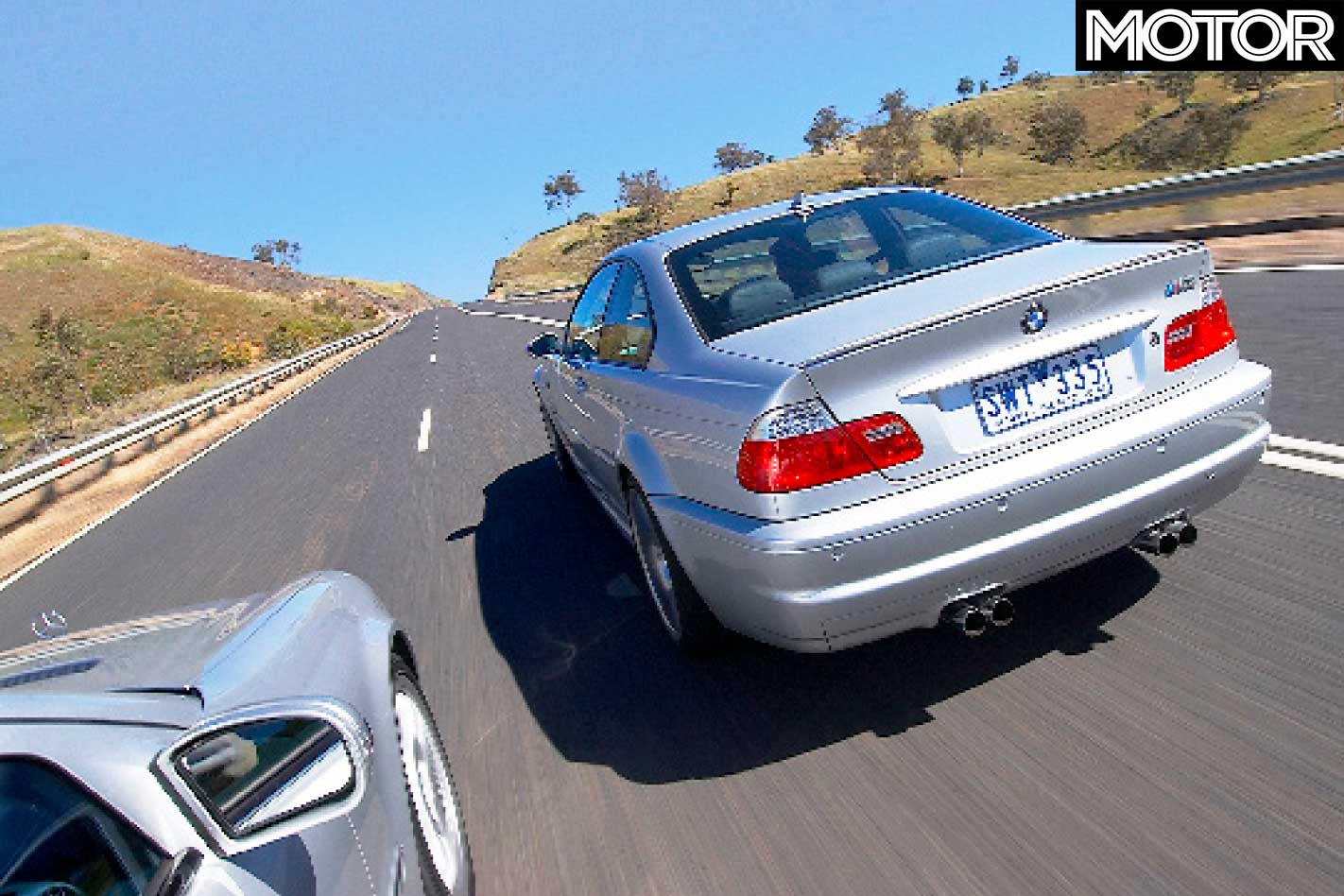
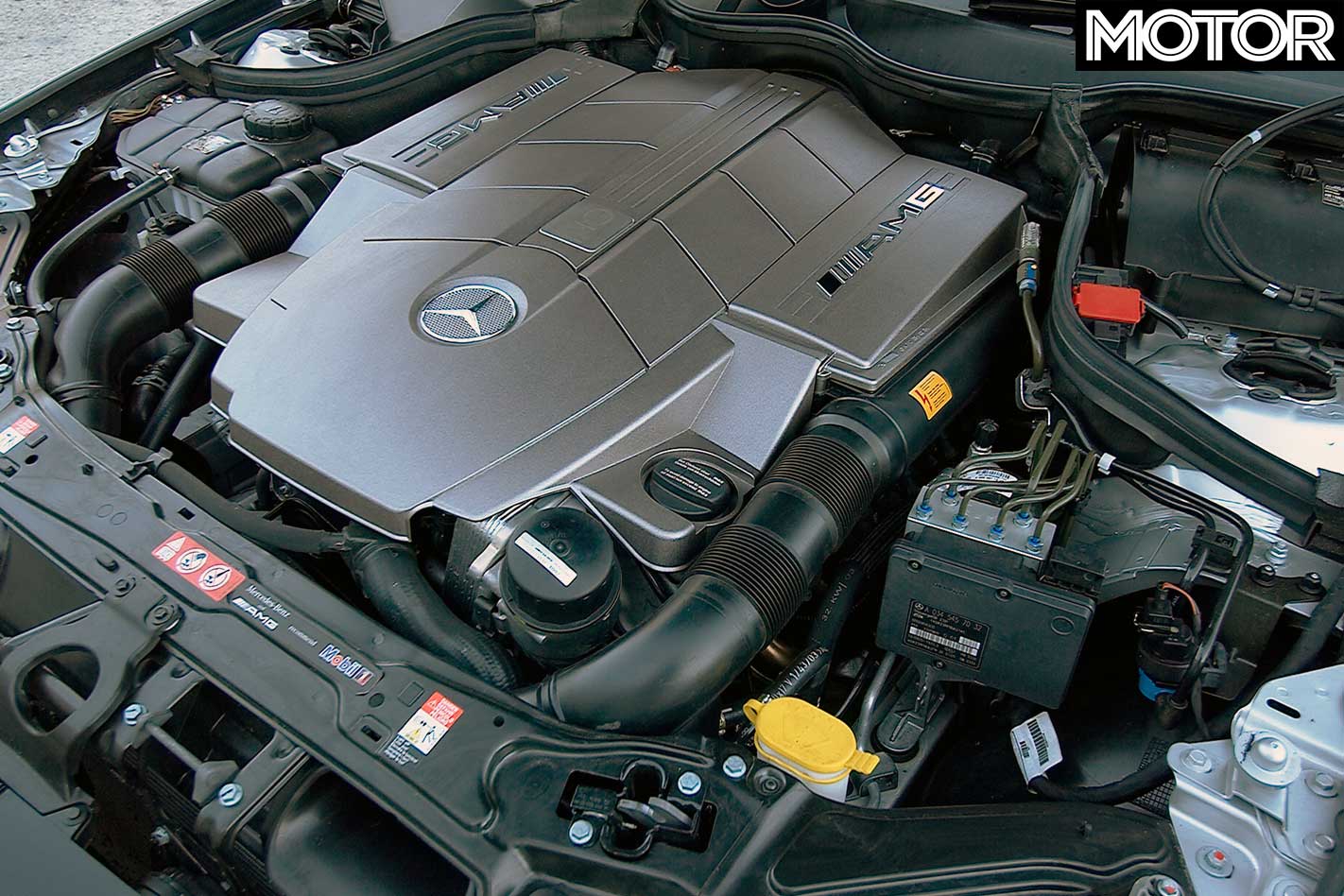
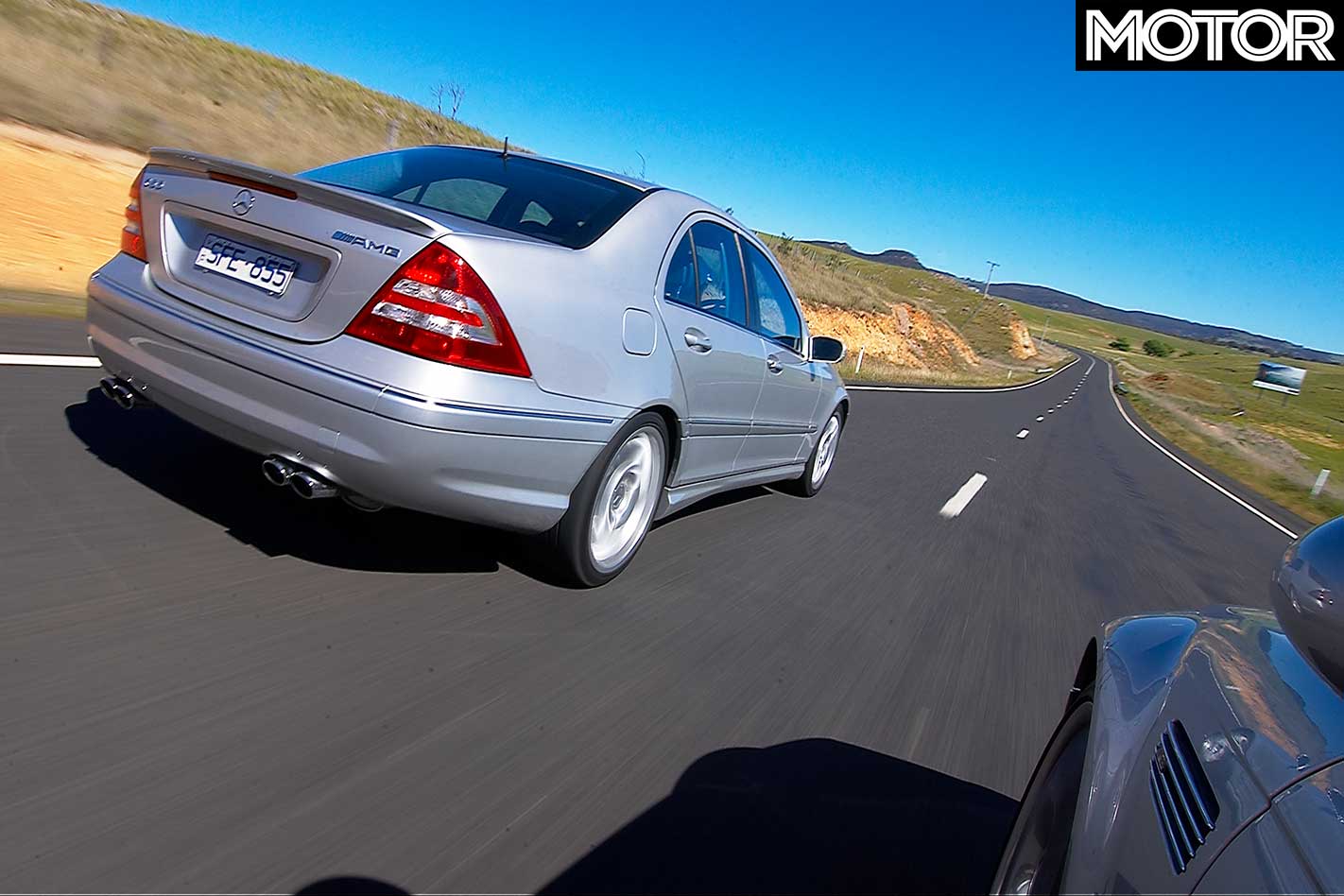
Curious, we turned to its long-time enemy, Mercedes-Benz. The C55 AMG won a lot of respect on PCOTY. Fourth, for Benz, was an astonishingly good result, especially given the disappointments we’ve had in past AMGs, particularly in their steering feel and rack speed. And the bastards won’t give you a manual ’box or even a proper sequential unit.
But it’s a cracking jigger, for all that. Sharp response from its atmo 5.4-litre V8, 270kW at 5750rpm and 510Nm of torque at four thou make for encouraging reading. The only downside is that a body this small weighs 1635kg, or, 140kg up on the M3.
The BMW musters less grunt, with 252kW at a relatively stratospheric 7900rpm, but ties the C55 on power-to-weight – and that’s a bit analogous of the cars as rivals really. They both do roughly the same job in the end, but use completely different manners, styles, feelings and philosophies to get there.
But where time is catching the M3 is in its torque delivery. At 365Nm, it’s well down on the Benz. At 4900rpm, it’s well up in the revs, too. Its wave of urgent, psycho power is no longer enough to keep rivals at bay.
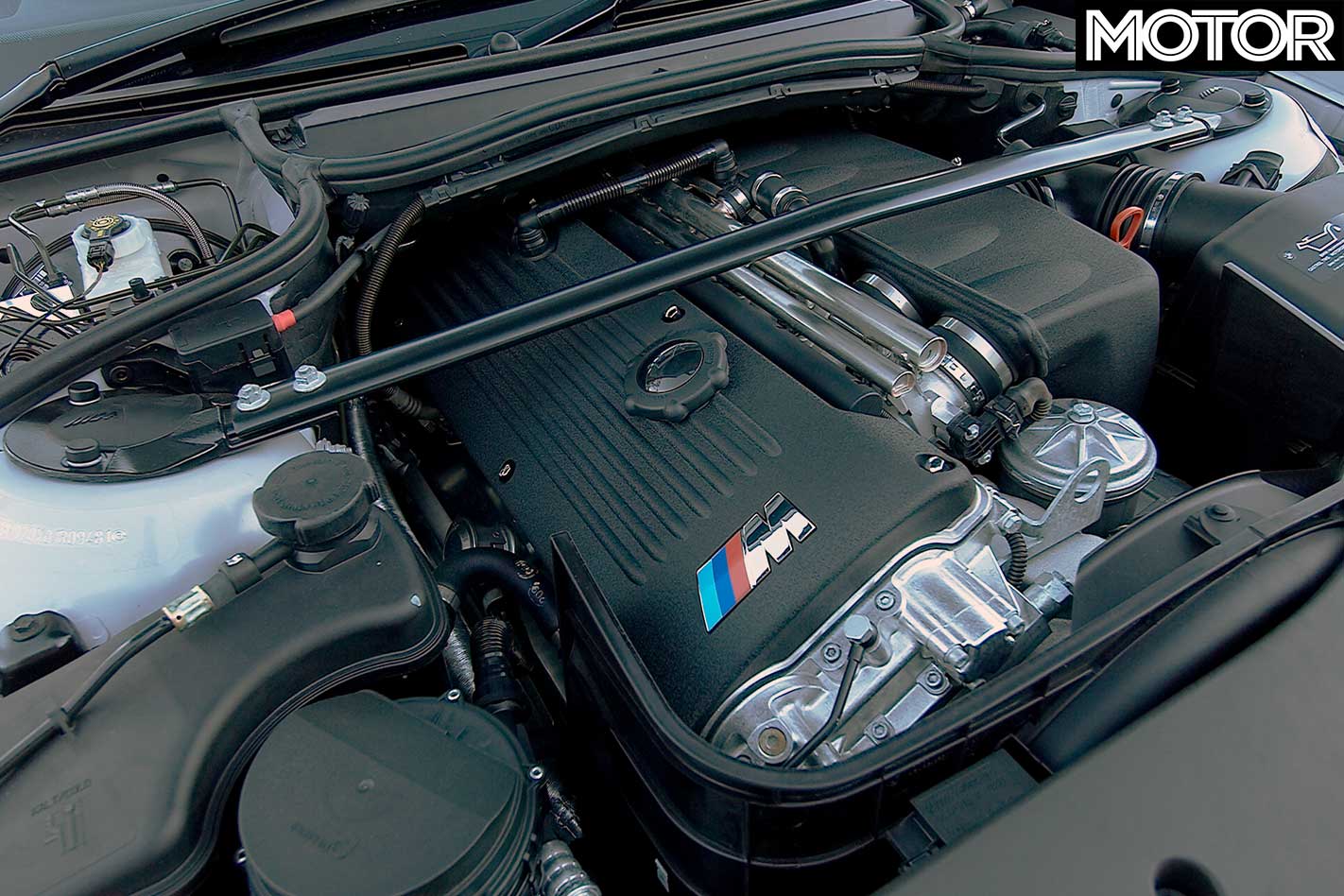
The Benz, quite simply, will pummel it for in-gear acceleration, but will get pummelled in the straight sprints, especially, if like this jobbie, the M3 has got a standard six-speed manual and not the sometimes-awkward SMG II sequential deal.
Where the M3’s PCOTY-winning efforts saw it run to 100 in 5.38secs and fling across the standing kay in 24.8, the C55 trips them at 6.18secs and 25.29. Ah, but the Benz carries more speed across the kilometre trap.
Thing is, though, that when you catch the M3 off song, it’s vulnerable, and especially so to a car that kicks down quickly and has bags of torque, and that’s precisely where the Benz strikes back.
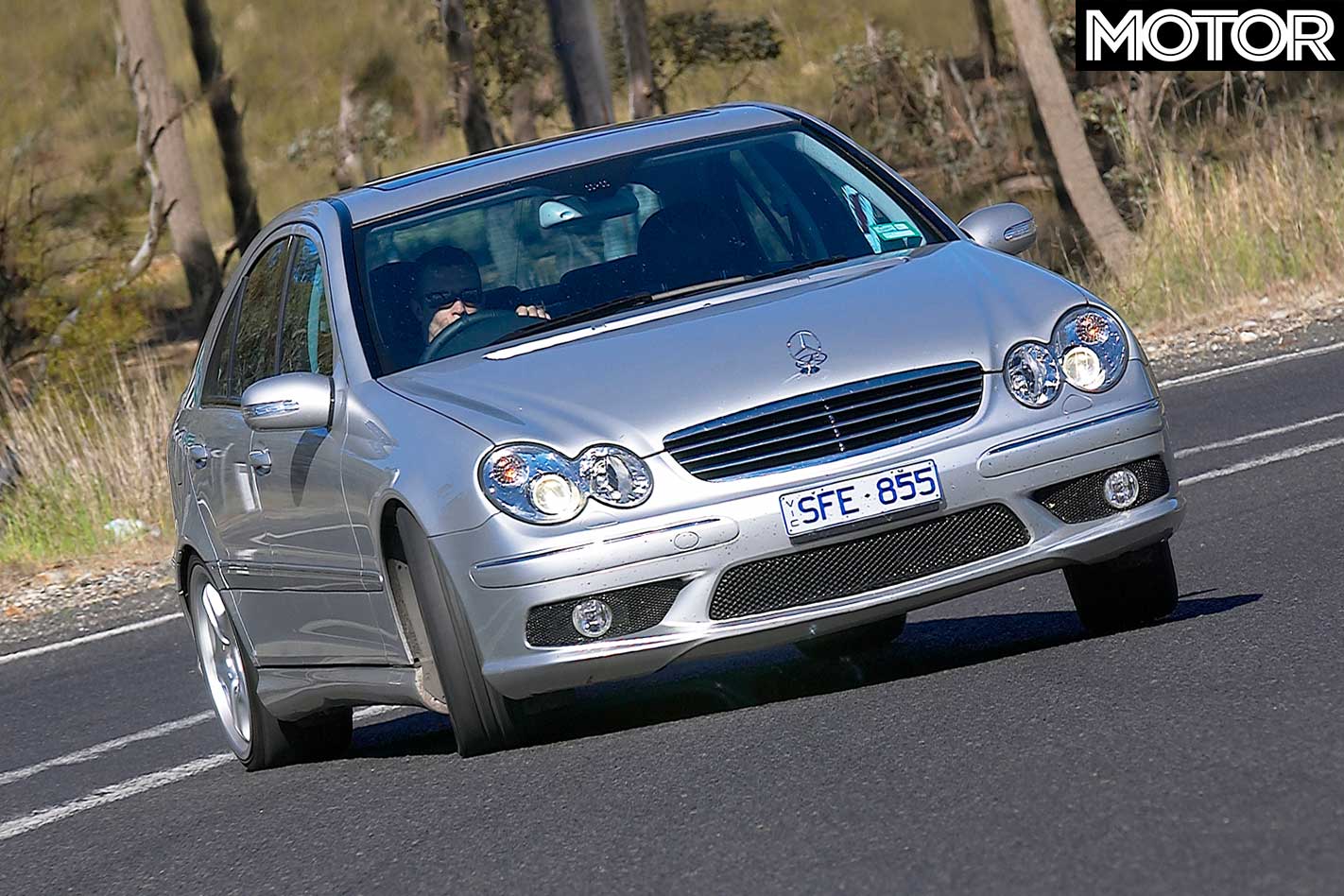
A five-speed auto it may be, but once it figures out your needs, it boogies hard. And, in its own way, sounds pretty good doing it (both these cars use four pipes to exit their orchestras). Still, it only truly wakes up after you’ve prodded at the throttle a few times and the ’box’s brain figures your intentions.
It sounds different, too, all burbly and menacing. Stand on it and it fires up, use the paddles and it fires up. Get the picture?
But the Benz has its quirks. Wanna be the man? The gearbox will start you in second at most sets of lights. If you’re cruising and want sudden, urgent grunt, it’ll kick back a gear, wait a bit to figure out if you’ve still got speed-provoking throttle openings happening, then kick back another cog before finding the gear you really wanted to have in the first place.
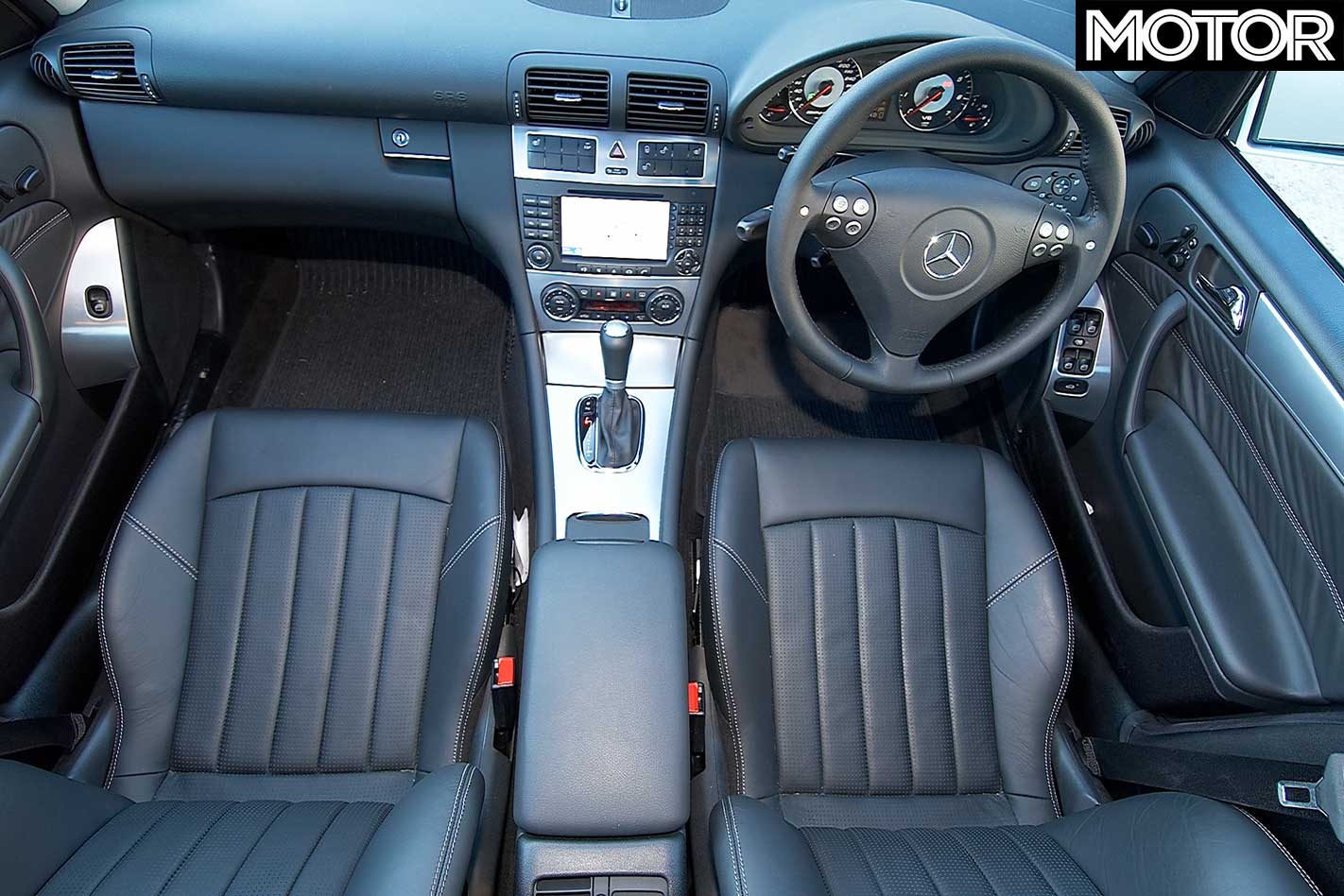
But where the C55 shows AMG is getting it right is in its chassis package. Around town it feels very much like it’s asleep and happy to stay that way, dawdling with the rest of the commuters. When you decide it’s on, though, it’s really on.
Where the C55 steps away from the M3 is in its poise, dignity and mid-corner balance. It feels like its front and rear roll centres are at about the same height, and both feel like they’re somewhere under the diff. The harder you push it, the more it pulls you in as part of the package, and the more it involves you. Its steering still isn’t great, but it’s better, and on an open piece of road, it’s a jet.
And here’s the bit that most concerns us about the M3. Its chassis package feels out of sorts. Significantly. While it’s always been a doddle to drift, it’s lately showing up to be a car without the level of grip it ought to have mid-corner.
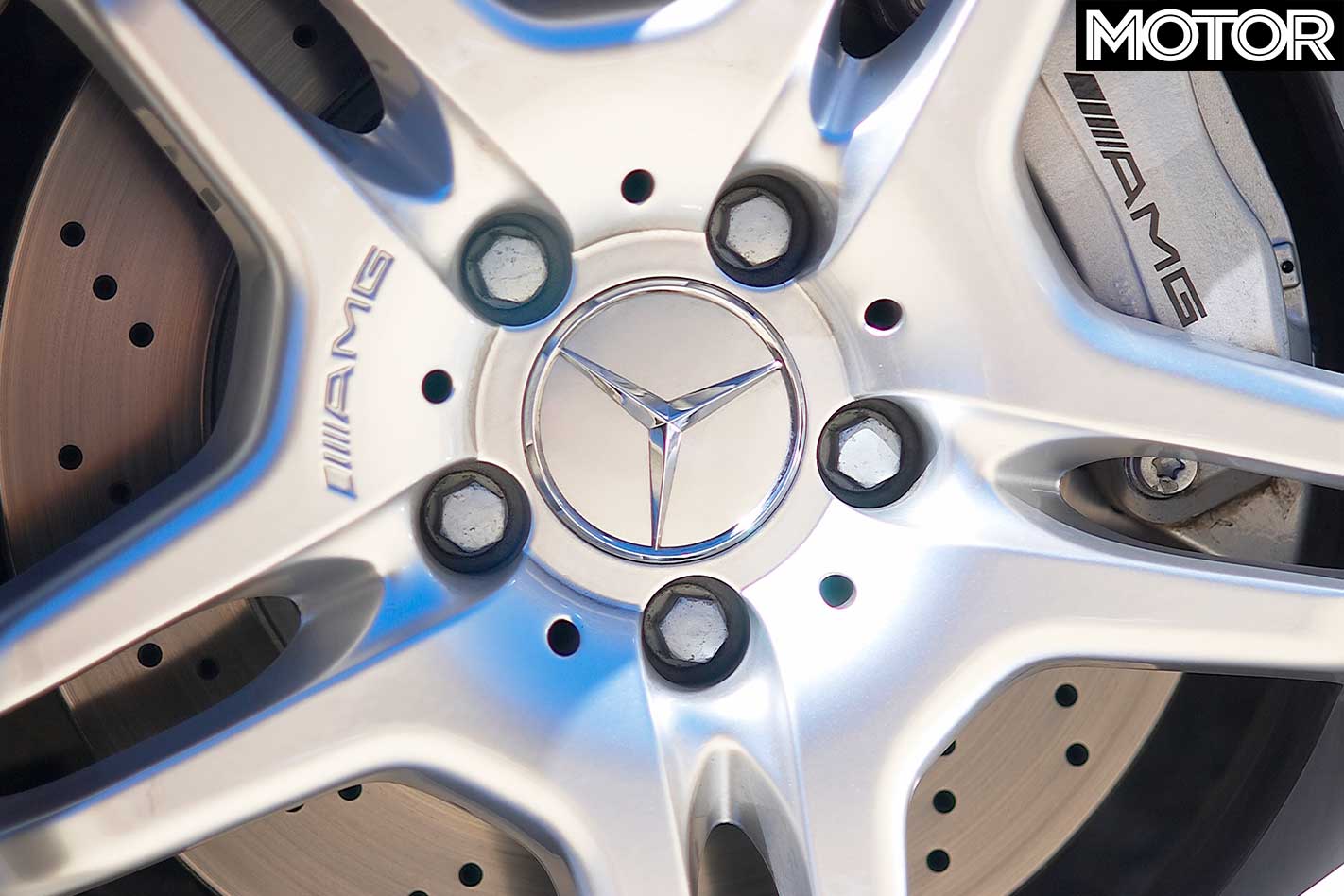
Yes, there’s a trick diff, with buckets of plates, but that doesn’t help in medium- to high-speed corners, where the thing feels like it’s tip-toeing around a high rear roll centre.
In low-speed stuff, it does have the advantage that no means no, and the traction control believes it, too. Once it’s off, she’s all yours, buddy. Yes, perhaps this (and the ’box) helps the M3 to be a faster proposition, but it’s only faster for the gifted or the brave. Most of the time, the C55 driver will be comfortably maintaining a position behind, laughing at the M3’s toss-catch slip angles and happy he’s not working that hard.
Thankful, too, will be the passengers. While it is possible to carry four people in an M3, it’s actually probable to carry them in the C55. And in more sumptuous surroundings of leather, wood and a thumping audio system.
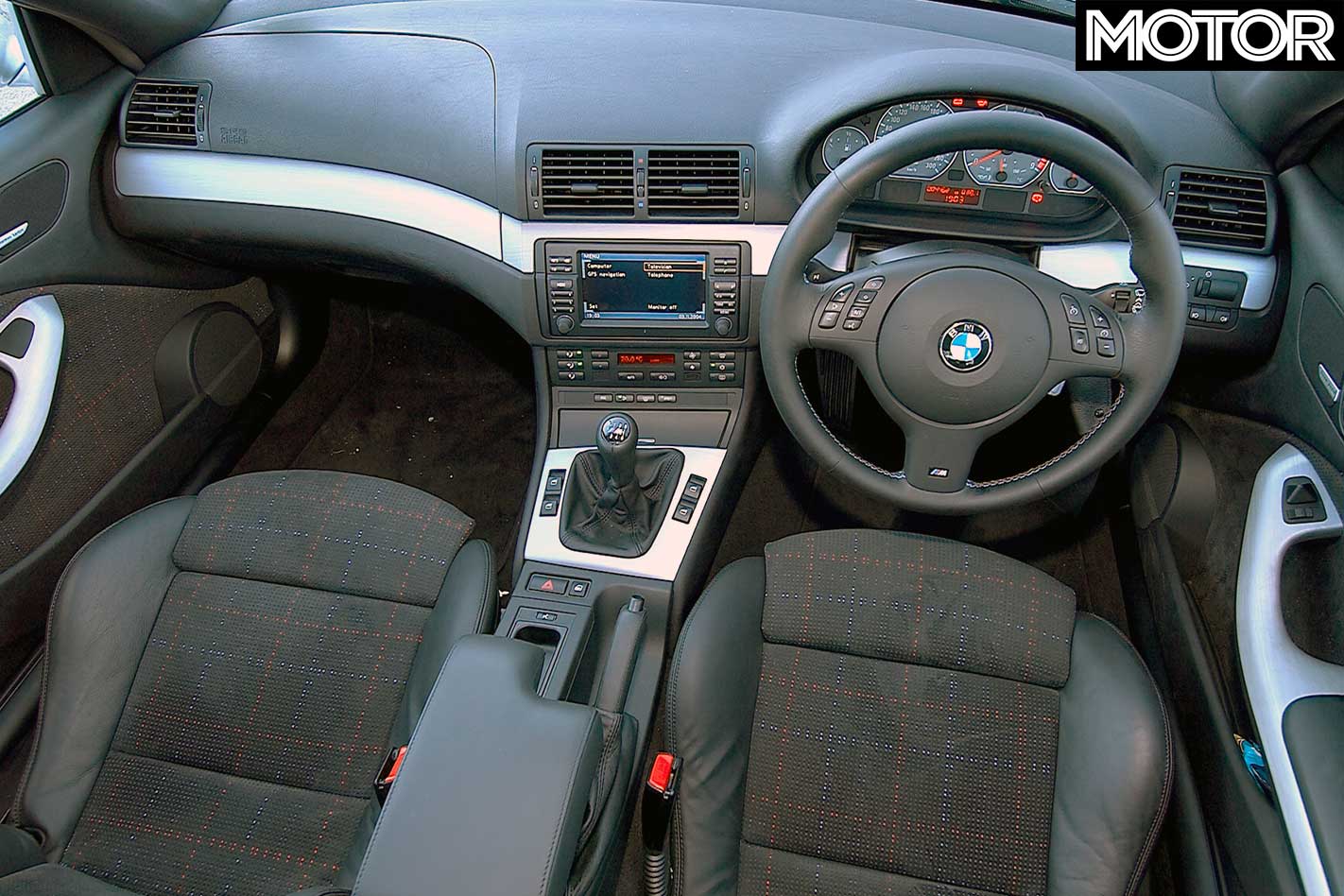
There’s a price gap, for sure. The BMW now tanks out at $142,000 while you might as well call the Benz $160,000. But it’s more than that, really. It’s a whole generation more versatile and capable, in all situations except the straight sprints.
In hindsight, it may have been cruel to feed Benz a rare opportunity to hunt a seriously wounded BMW. AMG should enjoy it while it lasts, though. There’s another new M3 on its way, and a new M3 has never lost come PCOTY time.
Fast Facts
| u00a0 | Mercedes-Benz C55 AMG | BMW M3 |
| Engine | 5.4-litre SOHC 24v V8 | 3.2-litre DOHC 24v inline-six |
| Power | 270kW @ 5750rpm | 252kW @ 7900rpm |
| Torque | 510Nm @ 4000rpm | 365Nm @ 4900rpm |
| Weight | 1635kg | 1495kg |
| Power-to-weight | 165kW/tonne | 168kW/tonne |
| Transmission | five-speed automatic | six-speed manual |
| 0-100km/h | 6.18 sec | 5.78 sec |
| 0-400m | 14.25 @ 168.4km/h | 13.77 @ 167km/h |
| Suspension | MacPherson struts, coil springs, anti-roll bar (f); multi-link, coil springs, anti-roll bar (r) | |
| L/W/h | 4611/1744/1412mm | 4492/1708/1383mm |
| Wheelbase | 2715mm | 2731mm |
| Track | 1507mm (f); 1470mm (r) | 1508mm (f); 1525mm (r) |
| Brakes (f) | 335mm ventilated & cross-drilled discs, four-piston calipers | 325mm ventilated & cross-drilled discs, single-piston calipers |
| Brakes (r) | 300mm ventilated discs, single-piston calipers | 328mm ventilated & cross-drilled discs, single-piston calipers |
| Wheels | 18 x 7.5-inch (f); 18 x 8.5-inch (r), alloy | 19 x 8.0-inch (f); 19 x 9.0-inch (r), alloy |
| Wheels | Michelin Pilot Sport, 225/40 R18 (f); 245/35 R18 (r) | Continental ContiSport, 225/40 R19 (f); 255/35 R19 (r) |
| Price | $159,900 | $142,000 |
ELECTRIC vehicles are incredibly energy efficient. And, unlike liquid fuel burners, they aren’t inescapably reliant on a finite, polluting and mostly imported fossil resource. They’re quiet, quick and often entertaining to drive.
EVs make sense, but making sense of EVs is challenging. This is an unfamiliar technology that speaks a mostly unfamiliar language. And it’s one that needs to be learned.

In the near future, the Mercedes-Benz EQC, Audi E-Tron and BMW iX3 will be joining Jaguar in the battle to beat Tesla at its own high-priced game. Meanwhile, at the affordable end of the EV spectrum, Hyundai’s Ioniq Electric and Kona Electric, plus the much-improved second-generation Nissan Leaf, are providing competition for the BMW i3 and Renault Zoe.
So it’s time to master the ideas and idiom of EVs…
ELECTRIC MOTOR BASICS
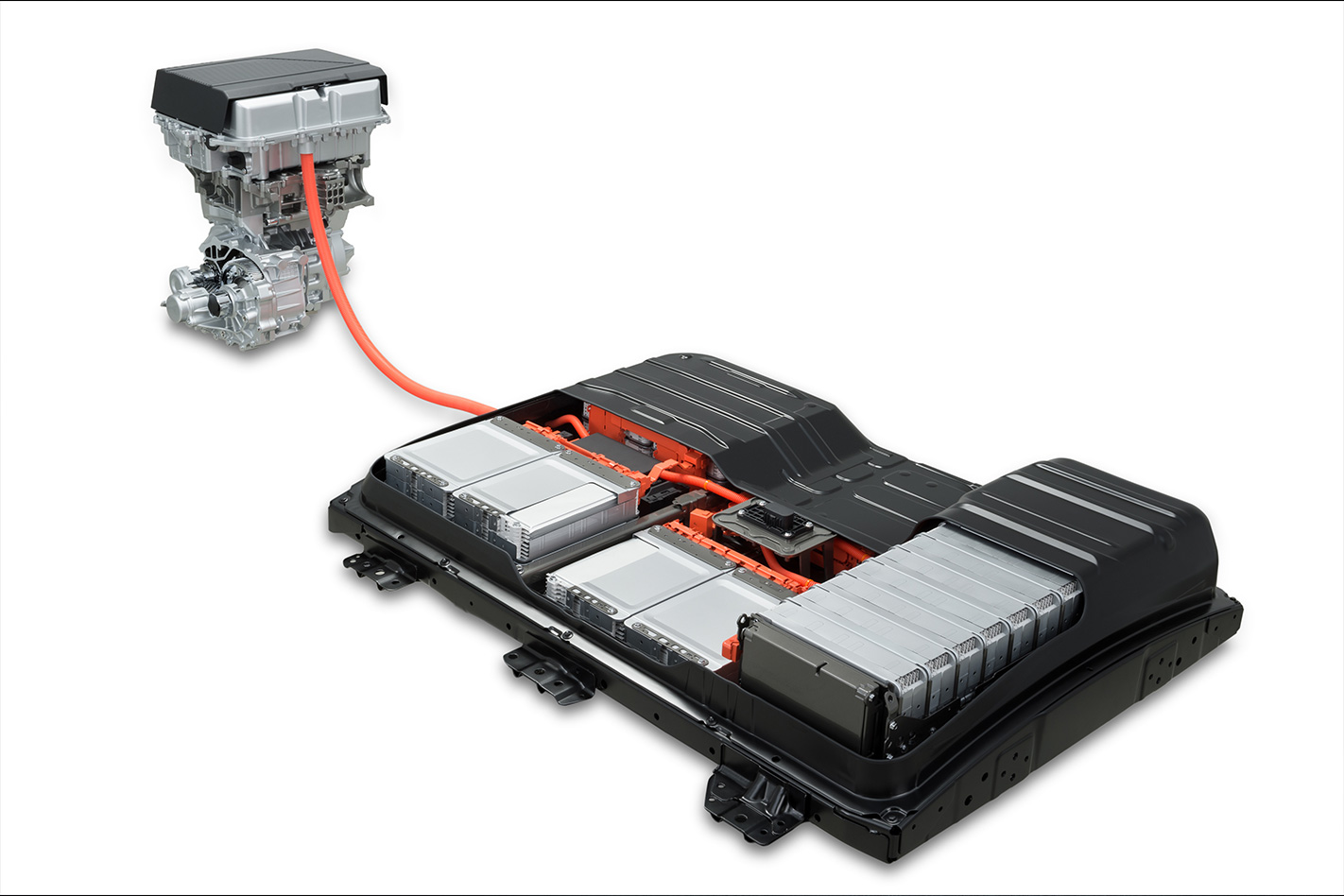
Electric motors are everywhere around us, whirring away according to principles discovered almost two centuries ago. Yet for most of us their inner workings are a mystery. Wheels readers able to discuss the finer points of the internal combustion engine in all its complex variety will likely have only the faintest understanding, if any, of how an electric motor converts current into kilowatts.
This is how it’s done. Create a magnetic field, put a conductor like a copper wire in that field, then connect the conductor to a source of electricity. Result? The magnetism pushes on the wire. This core concept applies to all electric motors, and grasping it is the equivalent of understanding that burning fuel mixed with air in a closed space creates pressure.
Compared to the typical combustion engine’s cylinders, pistons, connecting rods, cranks, valves and cams, an electric motor is elegant simplicity. Arrange magnets around the periphery of a cylindrical casing, set a bunch of conductors lengthways into a cylinder free to rotate inside that casing, and organise some way to supply them with current, and you’ve got an electric motor. The stationary section is called the armature or stator, the rotating part is called the rotor. So far, so easy…
There are many types of electric motors, named according to the way their magnetic fields are created, how the rotor conductors are supplied with current and, finally, what kind of electricity they’re made to consume. These details are the source of the baffling terms you’ll see in almost any description of an electric motor.
One big and basic division is whether the motor uses DC (direct current) or AC (alternating current). Motor magnets can be permanent (typically using the rare-earth element Neodymium), electromagnets (copper wire wound around an iron core and needing electricity to produce magnetism), or hybrid combinations of both. Current can be supplied to the rotor by wear-prone brushes or without a physical connection via electric induction, the same effect that enables inductive charging of batteries in everything from toothbrushes to EVs.
The three-phase AC induction motor has become the dominant type in EVs. It’s the kind of motor that gets electrical engineers very excited. “Judged in terms of fitness for purpose coupled with simplicity, the induction motor must rank alongside the screw thread as one of mankind’s best inventions,” is the way one expert describes it in print.
It’s easy to understand the enthusiasm. These motors convert electricity into driving force with great efficiency. From 85 to beyond 95 percent is the typical range, which makes the 40 percent efficiency of the best automotive combustion engines look downright wasteful.
BATTERY BASICS
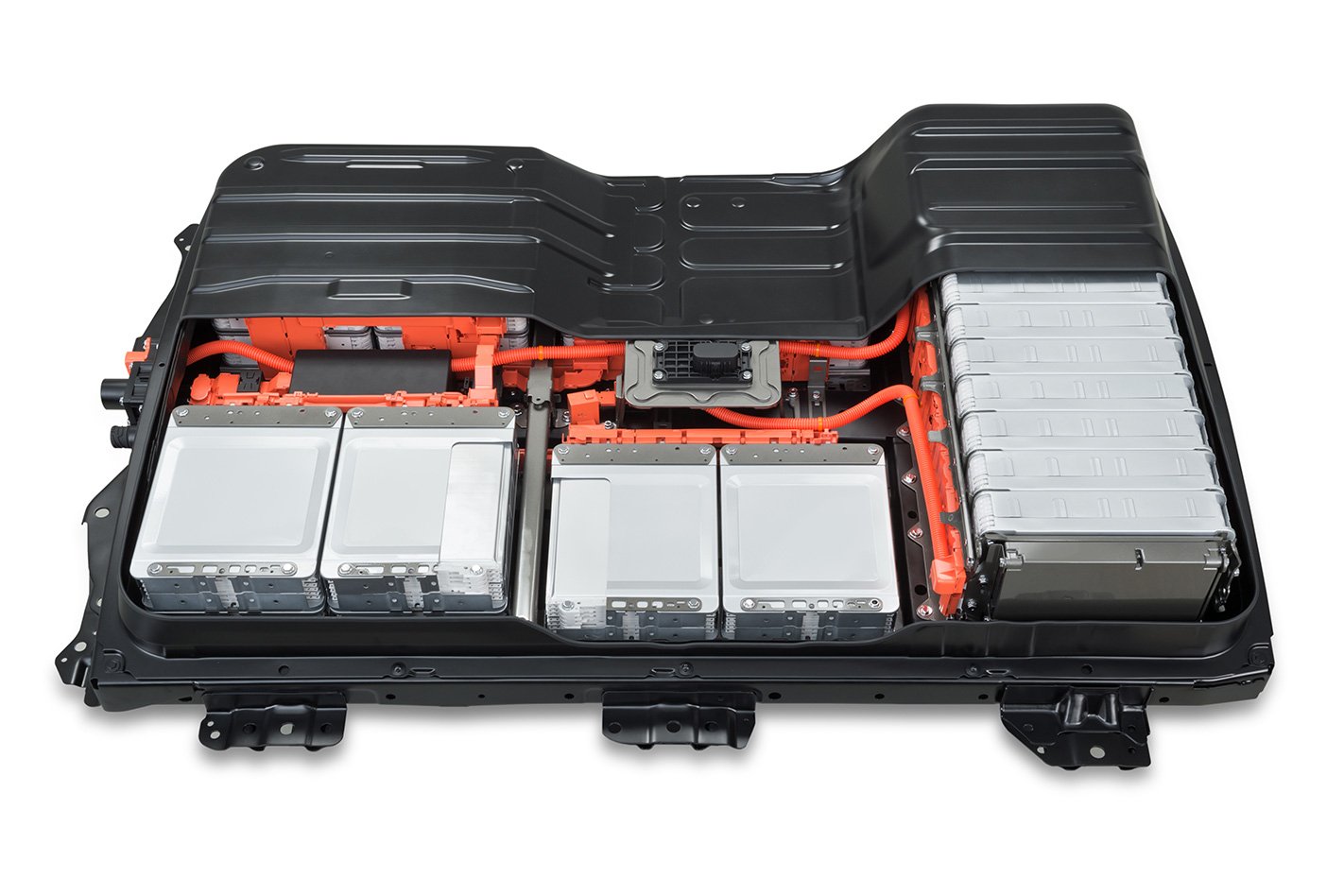
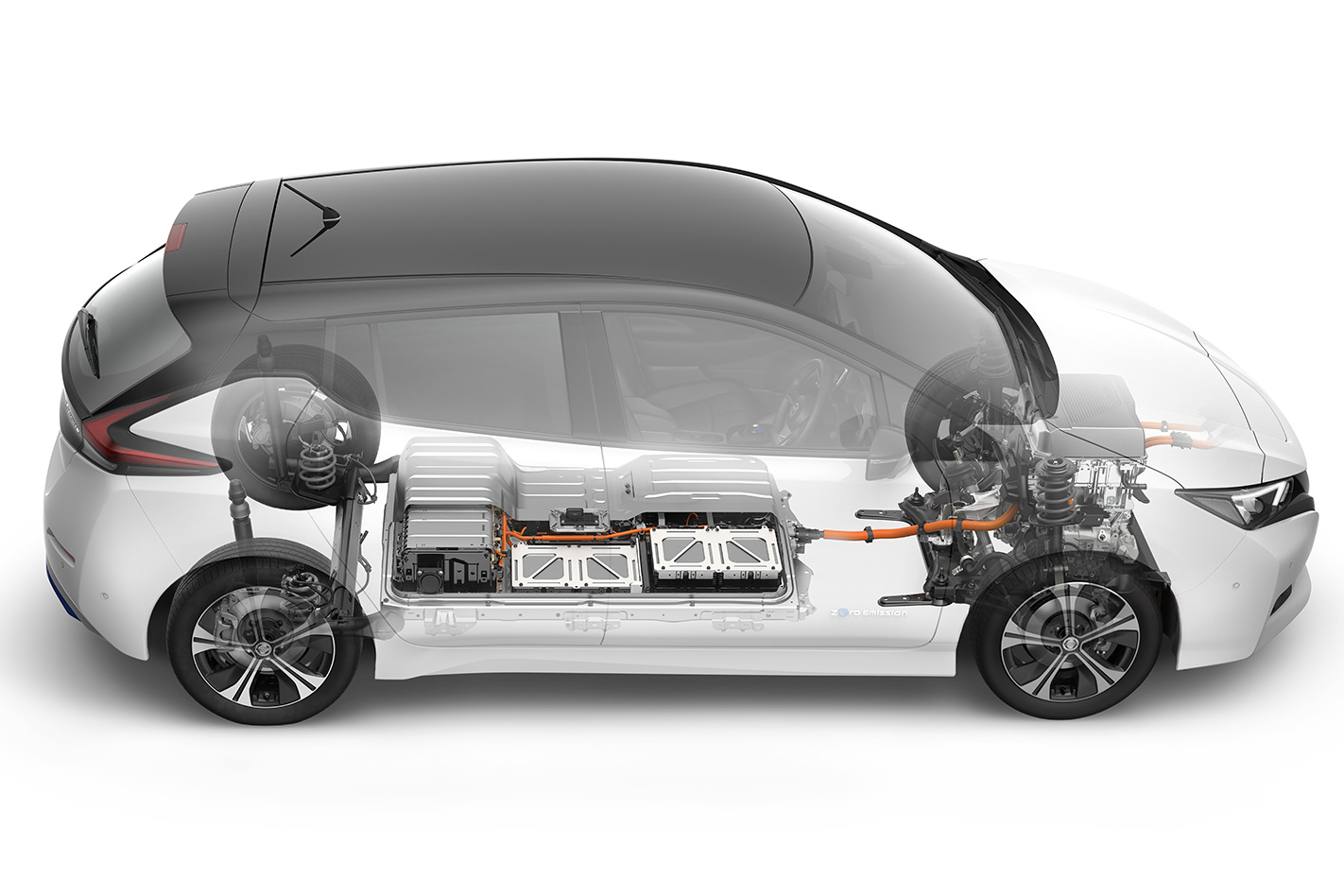
Familiar fuel tank and EV battery pack do exactly the same thing. They’re ways to store chemical energy. Liquid fuels release heat energy through the chemical reaction called combustion. This can be converted to motion by an engine. Batteries release energy by making electrons run from place to place via external circuits. Through a motor, for example. Charging simply sends electrons back to where they started.
Only one of these two energy storage systems is compact and cheap, and it’s not the battery pack…
Batteries are named according to their active chemical constituents. Lead-acid and Nickel-Cadmium are examples. Lithium-ion is a catch-all name that covers a variety of lithium battery chemistries. These have come to dominate in EVs, for good reasons.
Lithium-ion delivers superior energy and power density compared to other battery chemistries in commercial production. High energy density extends an EV’s driving range. Power density is a measure of the electric current its battery can supply to an EV’s motor or motors, and so affects performance. All batteries store only DC electricity, so an inverter is needed for the conversion to the AC current required to run EV motors.
The big disadvantage of Lithium-ion batteries is their cost. Between $135 and $200 per kWh are the kind of numbers auto industry execs mention. This means the 432 Lithium-ion cells in the big, 600kg-plus and 90kWh battery of the Jaguar I-Pace cost $12,000 to $18,000.

But progress is being made in upping energy density. The BMW i3 went into production in 2013 with a 22kWh battery pack. In 2016 capacity was increased to 33kWh and then, in late 2018, to 42kWh, without any change in the pack’s dimensions.
Reducing the cost of cells is a high priority for manufacturers like LG Chem and Samsung SDI. These Korean leaders in Lithium-ion have recently built massive factories in eastern Europe, which could deliver cost-cutting economies of scale.
Investments like these mean Lithium-ion will continue to be the chemistry of choice for EV manufacturers. While there are frequent reports of alternative chemistries under development, the journey from lab to production line is long and uncertain.
How much does it cost to charge an electric car?
The solid state battery, which is basically Lithium-ion without goopy electrolyte paste inside, seems to be the most promising next step. Probably…
ENERGY BASICS

For EVs, the kilowatt hour is like the litre. It’s the unit used to measure the amount of electricity we consume at home, so the price per kWh determines the size of power bills.
It’s easy to imagine a litre of fuel and the energy it contains; just picture igniting a milk carton filled with petrol. Ka-whoompf! There’s a lot of heat locked into every litre.
Creating a similar mental picture of a kWh is tougher. Staying with heat is probably the best way to get a sense of scale. One kWh is enough to run a cheap but powerful radiant electric heater from Kmart flat-out for 24 minutes.
It’s fairly obvious that buying a litre of liquid fuel gets you more energy than a kWh, because it produces way more heat. Handily for those interested in comparing one with the other, the factor is close to 10 times more, depending on the fuel. A litre of petrol contains a little less than 10kWh, a litre of diesel a bit more than 10kWh.
Understanding this fact highlights the great energy efficiency of EVs. There’s a broad spread in battery capacities on the market today, from 100kWh down to a little under 30kWh. In liquid fuel terms these numbers are the equivalents of 10 to just 3.0 litres.
Induction roar
Putting electricity through a conductive coil can induce current to flow in a nearby conductive coil. This is the basic principle behind inductive charging. The way it works in practise is fairly simple. Install a live coil in a mat in a garage or parking space. Park an EV with an induction coil installed over the top of it. Current will then cross the air gap to charge the battery. Pushing electricity across the gap between the coils is less energy efficient than a cable connection, and the maximum charge rate is low. For these reasons inductive charging is best suited to Plug-in Hybrids (PHEVs), which have small batteries that need frequent replenishment, rather than EVs capable of going days or even weeks between charges.
Flat! We’ve just held a third-gear left-hander flat. The revs were straining against gravity and it felt like the car’s door handles had almost scraped along the road lines. Okay, so there was a little lift leading into it, and it’s on an incline, but this Mazda MX-5 held the bend like Mark Webber’s 2012 Red Bull at Eau Rouge.
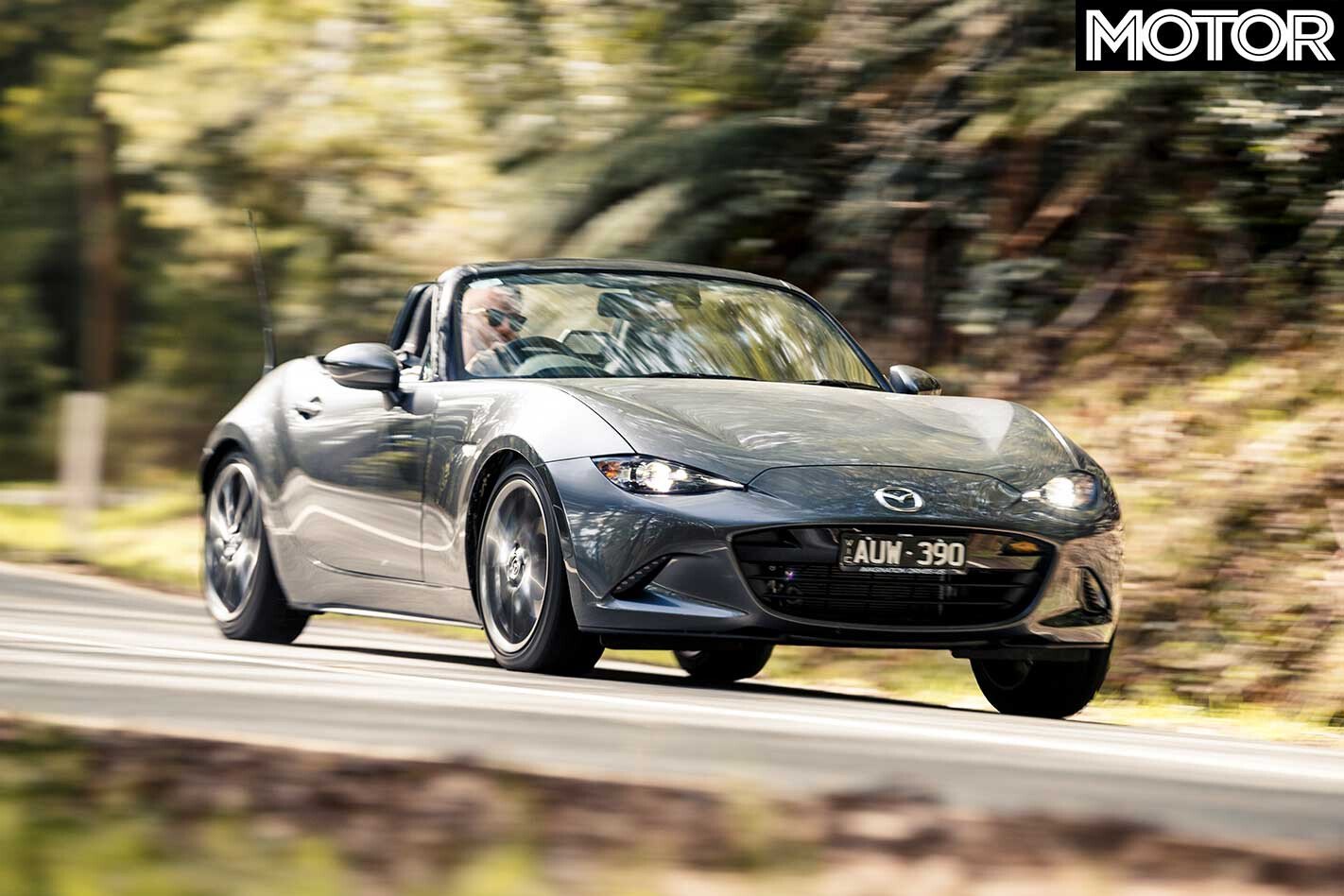
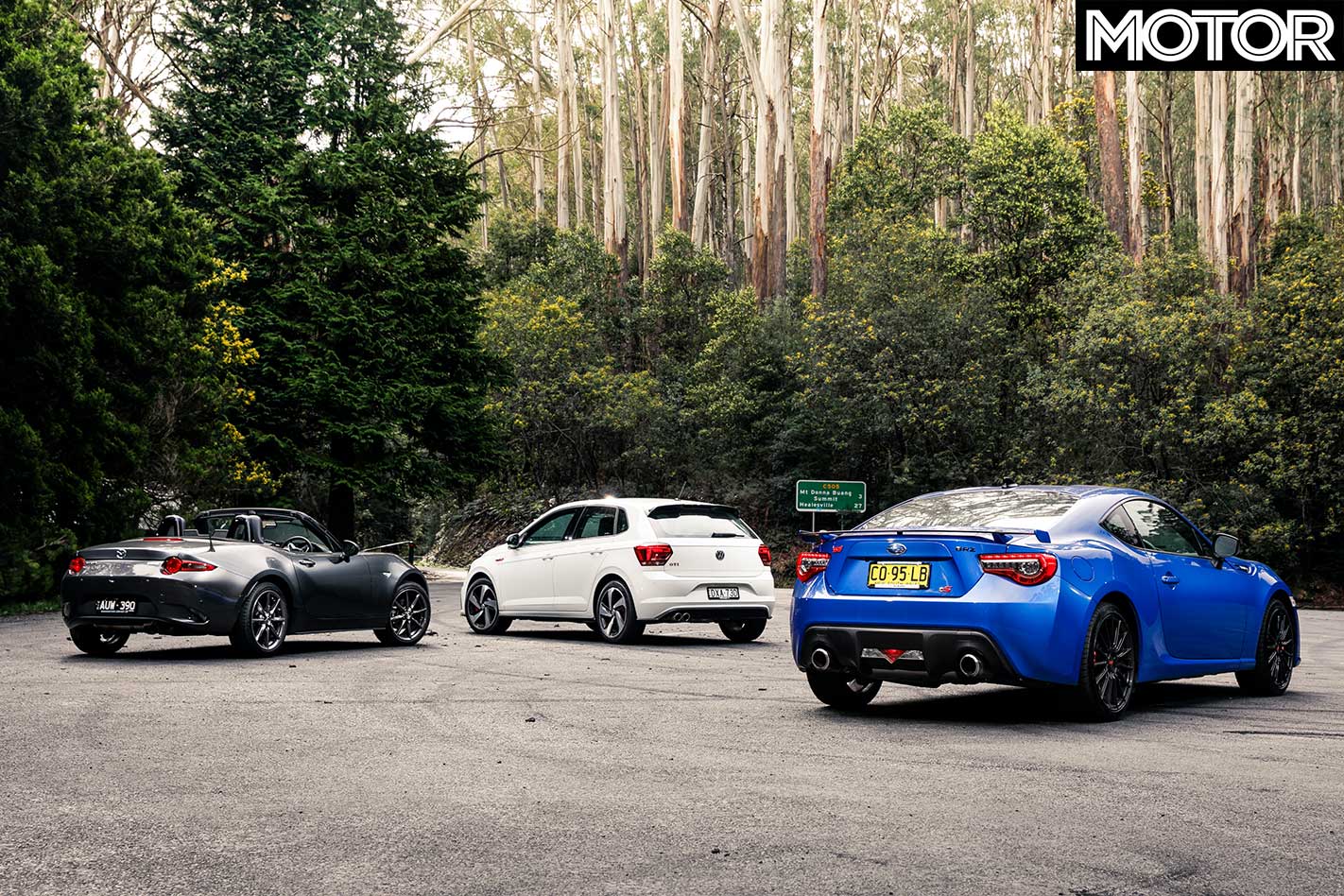
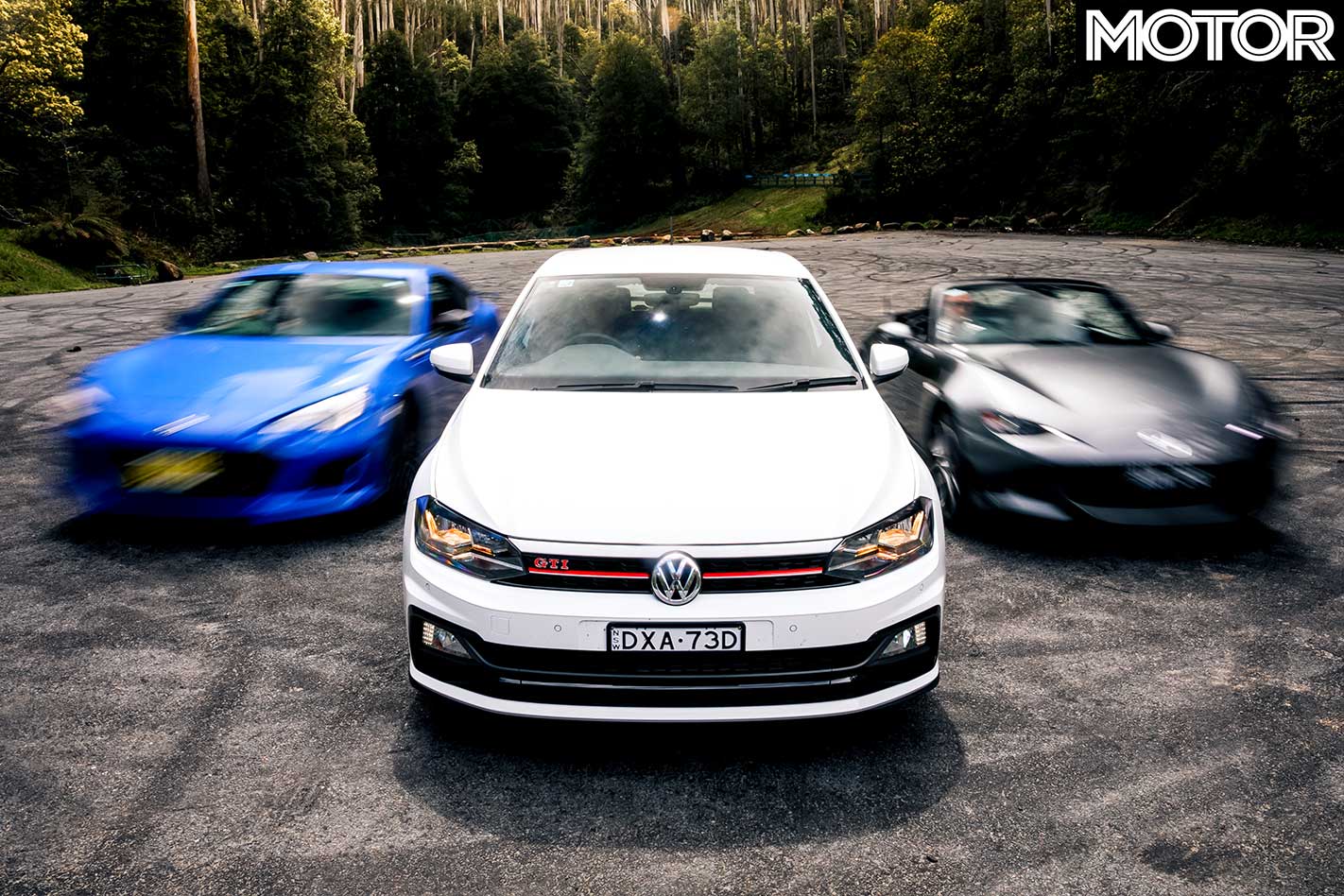
The MX-5 is not the only car here with aspirations of the same sort of heroics. The recipe for cars under $50K with a performance bent is now a familiar one: light weight, modest power and tenacious handling. And the two rivals waiting for the MX-5 at the turnaround point are prime examples.
The Subaru BRZ, along with its Toyota twin, has spiritually succeeded the Nissan 200SX as a ‘cheap’ option for the opposite-lock obsessed. Then, just when we were thinking it was aging gracefully, starting to accept its economy tyres and flawed engine, Subaru lobbed the tS. It’s the handling-focused version that promises to be the best of the lot.
Meanwhile, the Volkswagen Polo GTI parked next to it doesn’t feature rear-wheel drive or a coupe shape, but it asks if all that is necessary. Just when you thought the 1.8-litre ‘big-block’ version before it was the Polo reaching the height of its powers, VW has thrown the kitchen sink, drying rack and towel at the new sixth-generation car.
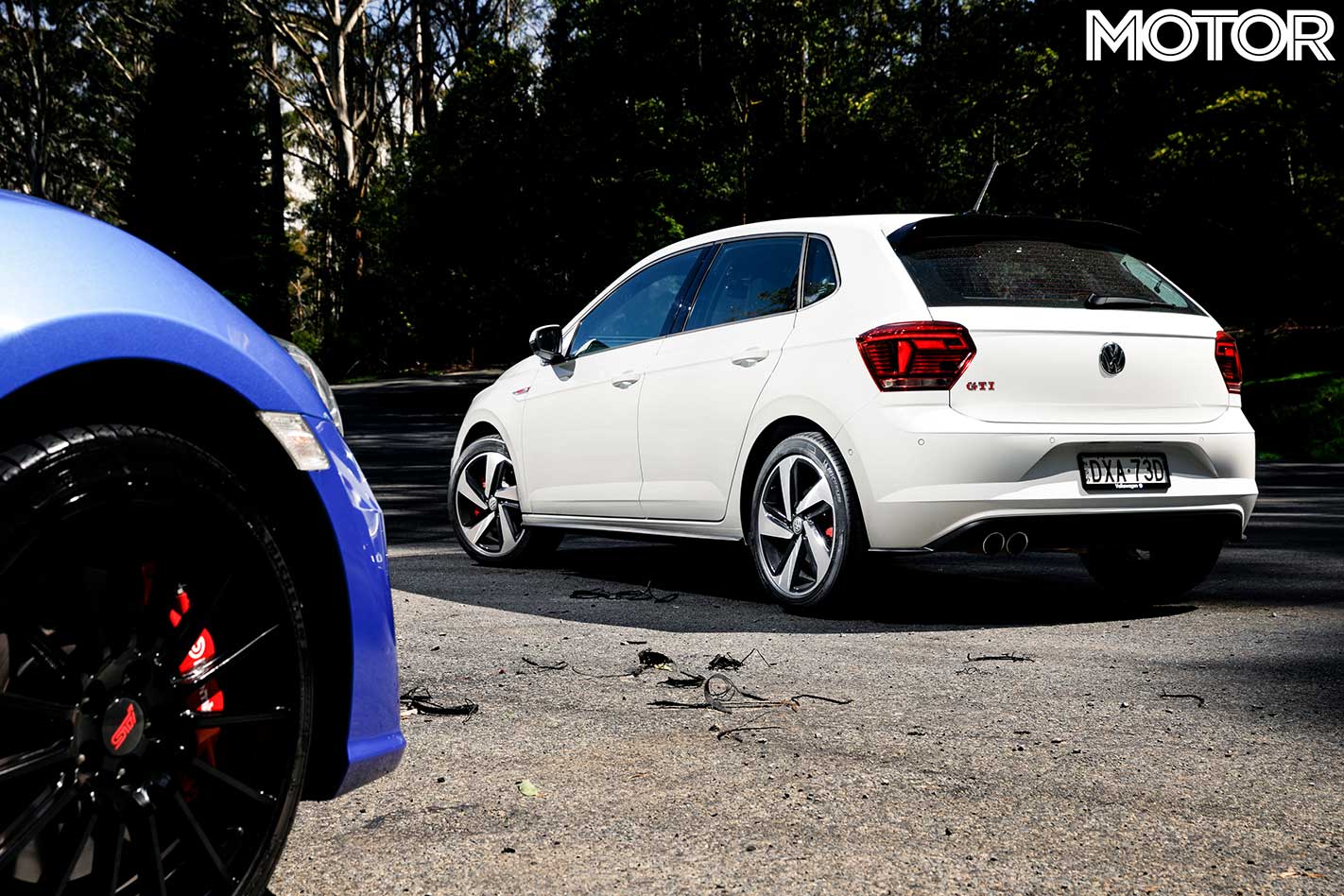
With a bigger 2.0-litre turbo four in its nose it promises to kick some heads in a straight line, but will it be nimble enough in a bigger body? We’ll find out.
We thought Mazda gave the 1.5-litre MX-5 a sky-high redline so it had a chance on the showroom floor next to the 2.0-litre version. But now it has worked on the larger engine to rev just as hard, sound just as good and feel more playful.
Better yet, while a Fiat Abarth 124 Spider seems like a better pick in the world of cut-price roadsters with its Bilstein suspension, Brembo brakes and turbo four-cylinder, the 2019 2.0-litre MX-5 is more powerful than its Italian cousin because it’s been tweaked with newfound free-breathing sorcery.
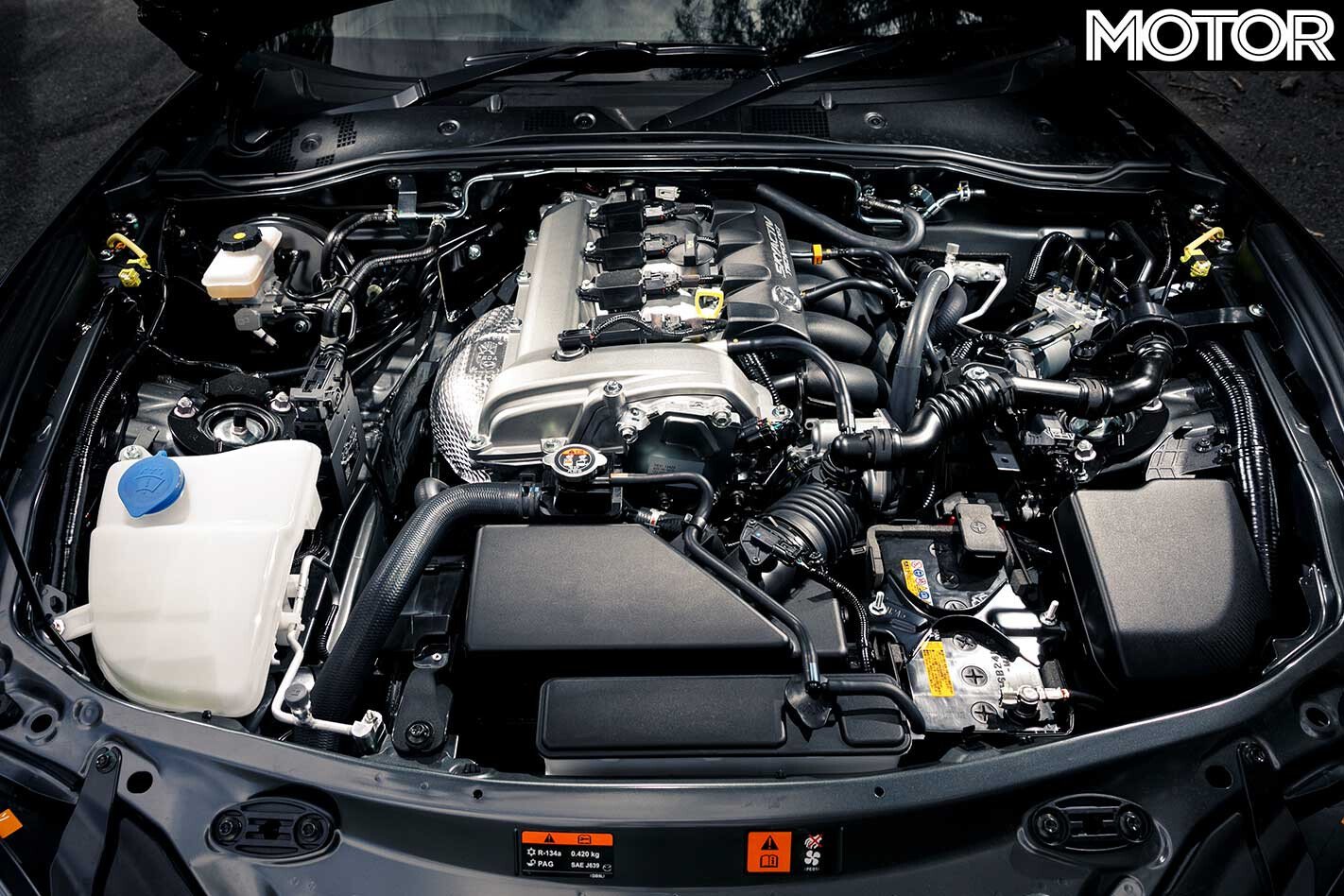
The MX-5’s intake and exhaust paths are upgraded, its internals have been redesigned, the crankshaft is rebalanced and it can now spin 500rpm faster, to 7500rpm. Outputs increase from 118kW/200Nm to a burlier 135kW and 205Nm. Sure, the extra 17kW and 5Nm don’t sound like a whole lot, but they’re welcome in something that weighs just over a tonne.
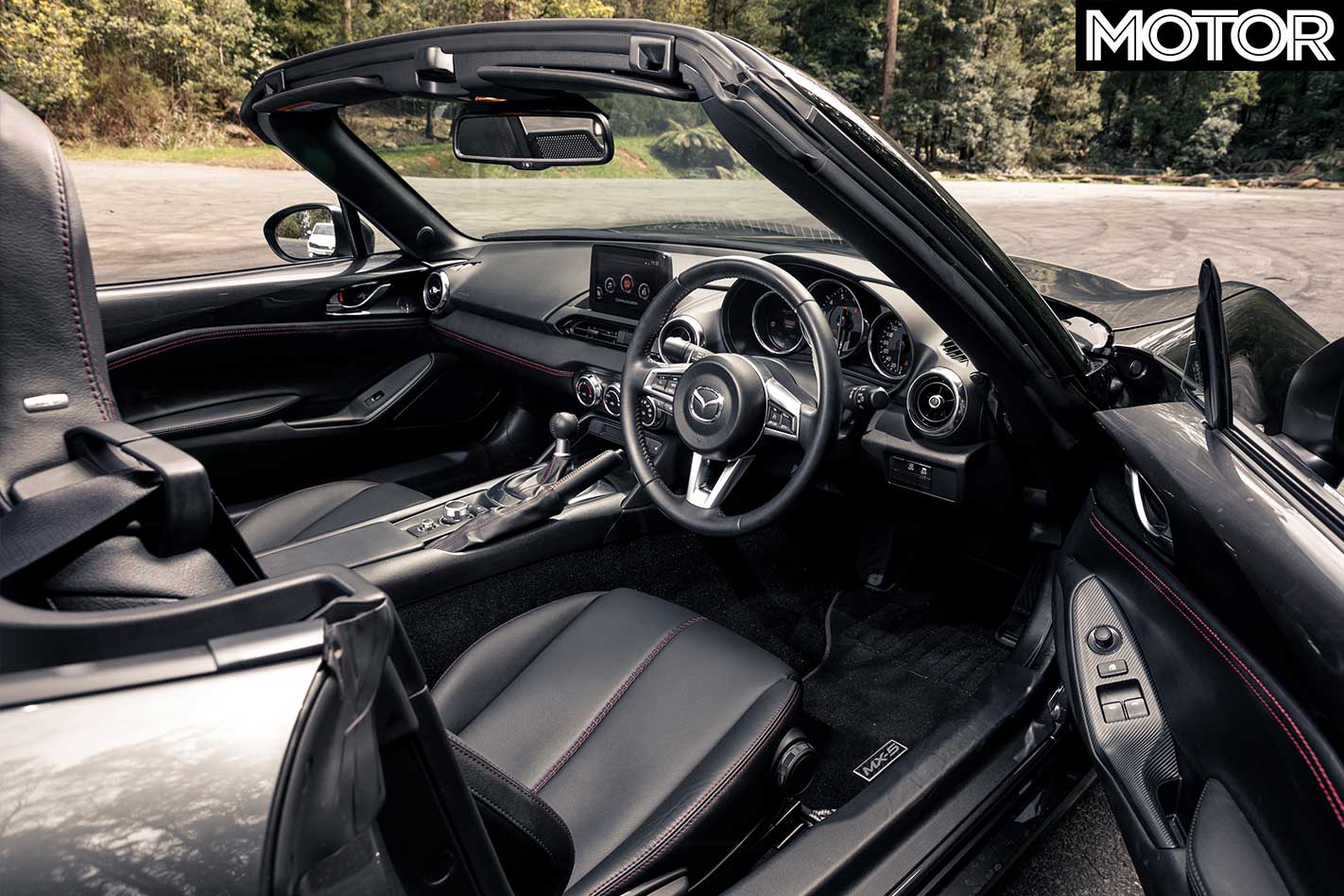
Its rear suspension geometry has been tweaked with new settings, and in the cabin there’s now 42mm of steering rake so taller humans can finally bend their arms at the wheel. The exhaust has been retuned, for refinement rather than music, and the flywheel goes from single-mass to dual-mass for the same reason.
Mazda has upped the starting price on the 2.0-litre by seven grand to $41,960, but premium audio, leather and adaptive headlights soften the blow.
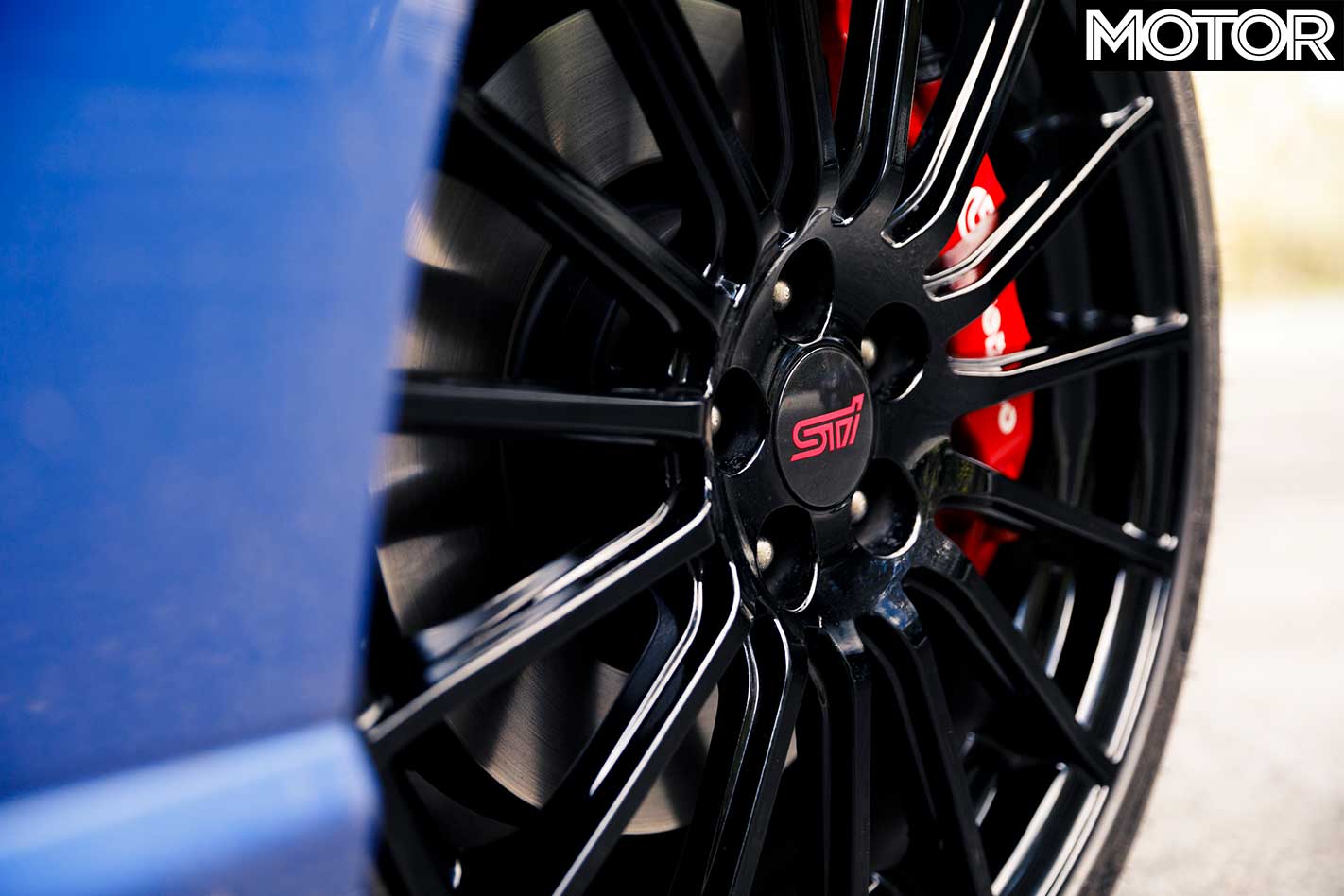
The BRZ’s MY17 update proved its 2.0-litre flat-four will remain gutless with anything short of a turbocharger. So the ‘tS’ approaches the package from another direction. Short for ‘tuned by STI’, it braces the front subframe and suspension towers with specialised bars that complement lowered springs and specially tuned Sachs dampers.
But these changes won’t make much difference if you’re rolling on the car’s standard rubber, so fixed Brembo calipers clamp bigger discs and use Michelin Pilot Sport 4 tyres to bite the road. Flasher 18-inch forged wheels join the package, and with the help of some interior and styling accessories it pumps the car’s standard price to $39,984, up $6000.
But it’s the Volkswagen that has changed most, at least on paper. It has bulked up during the off-season to grow in width, wheelbase and length. The shell has been stiffened to help its upgraded steering motor, tougher bushings and thicker roll bars, and unique front knuckles sharpen its reflexes. It scores stiffer springs and in Australia we get adaptive dampers as standard.
The brakes and tyres are fairly run of the mill, with Michelin Primacy 3s wrapped around 17-inch wheels and single-piston calipers. There’s no LSD, either. It all features on a scaled-down version of the Golf GTI’s platform, and adds a rear torsion-beam, to weigh 1285kg tare.
Price-wise it’s serious bang for your buck. At $30,900 it’s almost line-ball with the old DSG-equipped version, and although we’re told a manual one will be built, it’s predicted to skip our shores. This is due to a new EU petrol particulate filter that doesn’t like our sulphur-rich fuel.
VW needs a solid business case to build a powertrain without one, but since Aussies are buying fewer manuals than ever – only one in 10 of you went for the self-shifter in the Golf performance range – that lessens the chance of one coming here.
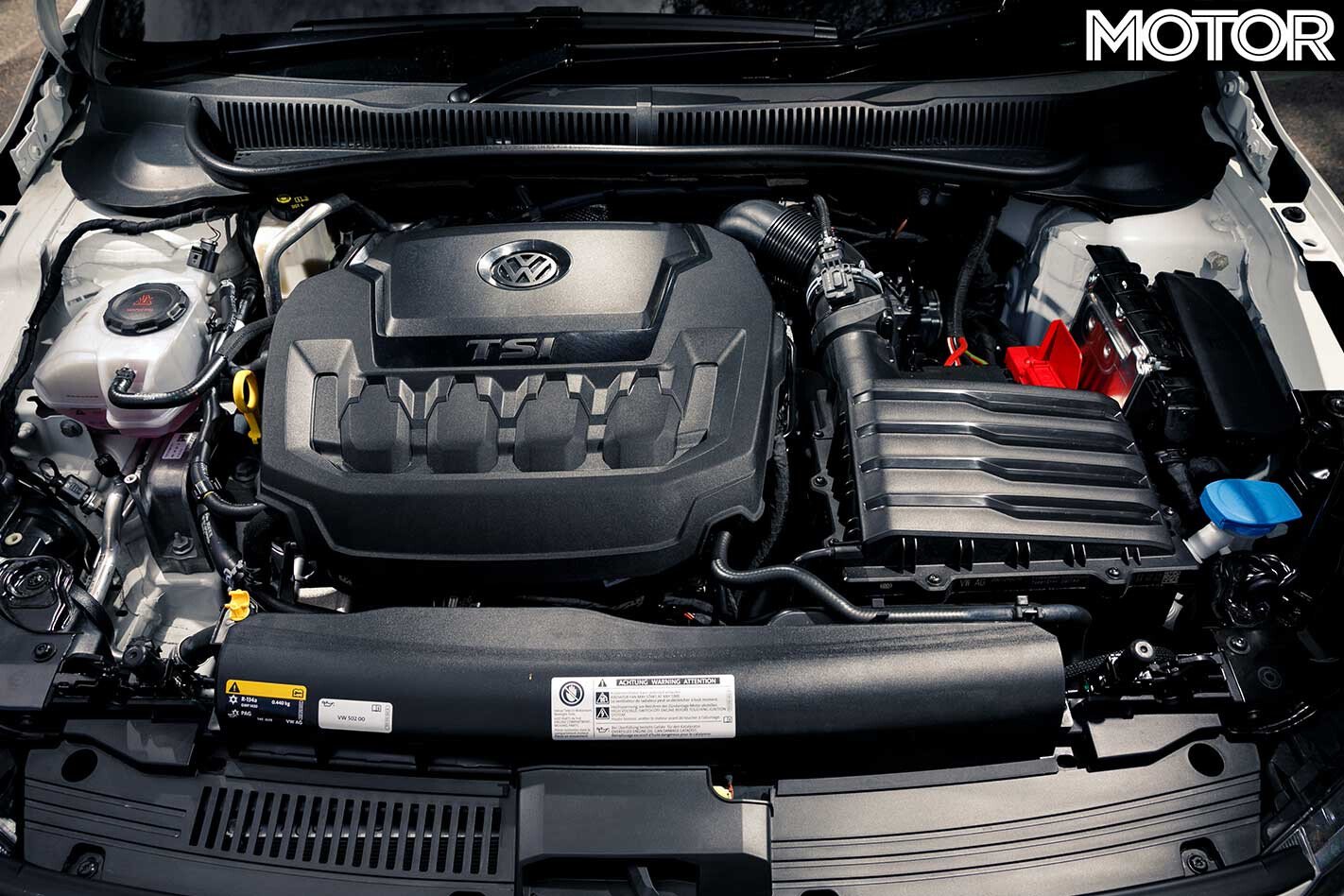
So it’s solely a six-speed dual-clutch gearbox for now that helps its turbo four pump 147kW and 320Nm to the front wheels. What’s more surprising than Volkswagen’s decision to up its engine size when others are downsizing is the small gain that results from the extra capacity.
The torque band is more or less the same, swelling from 1500rpm until 4400rpm, but it’s only 6kW up on the old manual model. That said, the 2.0-litre feels less strained than the old 1.8, whistling along as if it’s running on minimal boost. And it’s now making its 147kW over a wider rev range as well.
Unlike the old seven-speed DSG, the six-speed handles the torque with ease, accepting shifts in any situation and matching what feel like widespread ratios to a tractable torque curve. It delivers its thrust from as low as 2750rpm and keeps it up until the 6600rpm cut-out. There’s plenty of grunt to overpower the front axle from a standstill, traction control on or off, and turbocharging is clearly a crushing advantage in this company.
Despite the Polo’s Michelins struggling to contain all its torque, it will hit 100km/h from rest quicker than the claimed 6.7 seconds with launch control. On our first run at the dragstrip it hit 100km/h in 6.6sec and covered 400m in 14.8sec at 156km/h.
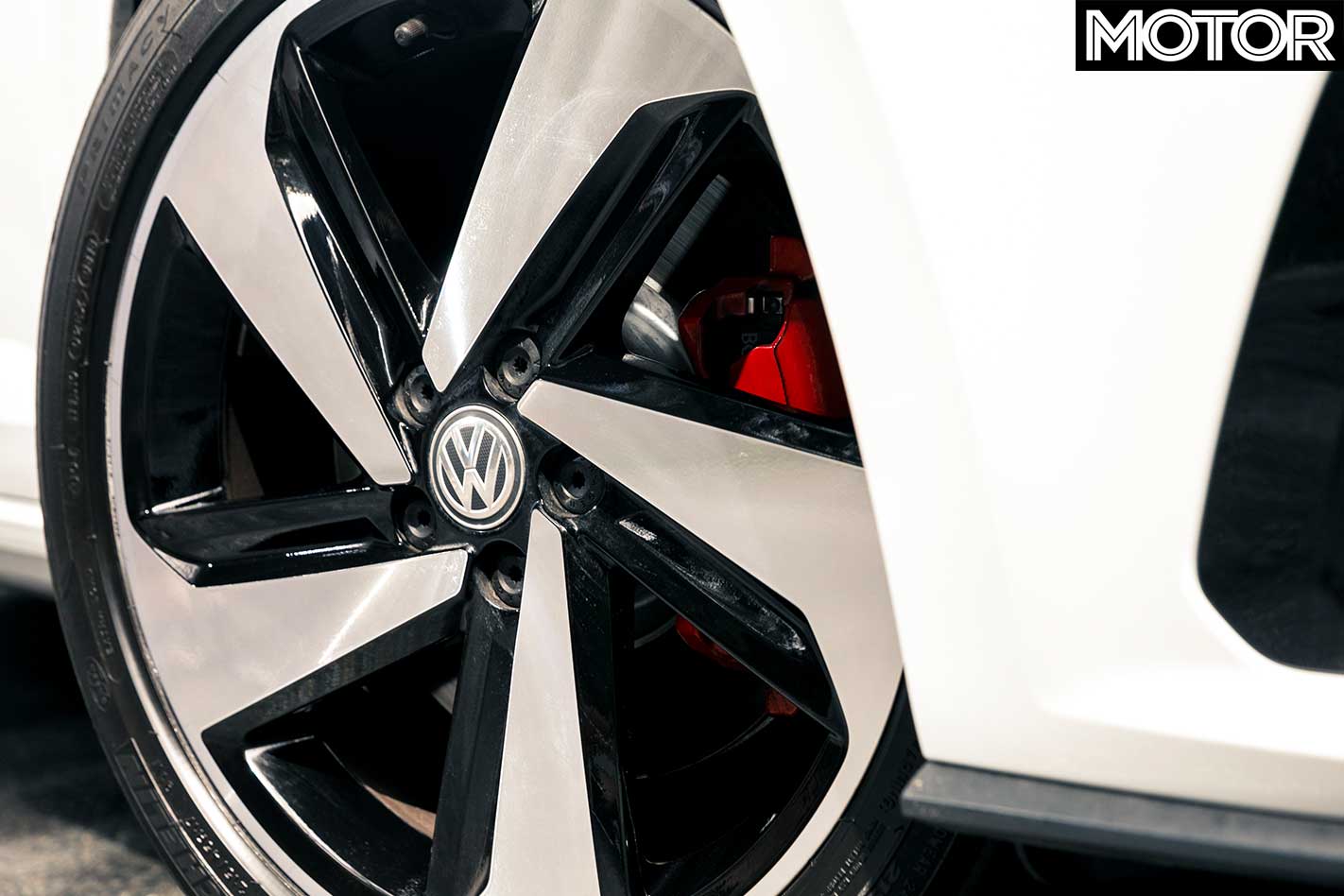
It’s scrappy off the line, though, and wheelspin quickly becomes axle tramp until the traction control calms things down. It’s only when you switch the electronic stability control to Sport mode that it grips up and logs a 6.15sec run to 100km/h and a 14.45sec sprint over 400m. Times like that promise to give a new Golf GTI a good arm wrestling.
BRZs need a good run-in before they can match their claimed acceleration times, or beat them if we’re being hopeful, and our test confirms that this particular example, fresh from Subaru’s marketing fleet, has its best days ahead of it.
We initially bog the launch and mis-shift from third to fourth, revealing how easy the Volkswagen launch control made it for us. The result is a dismal 8.0sec 0-100km/h run and 15.8sec pass.
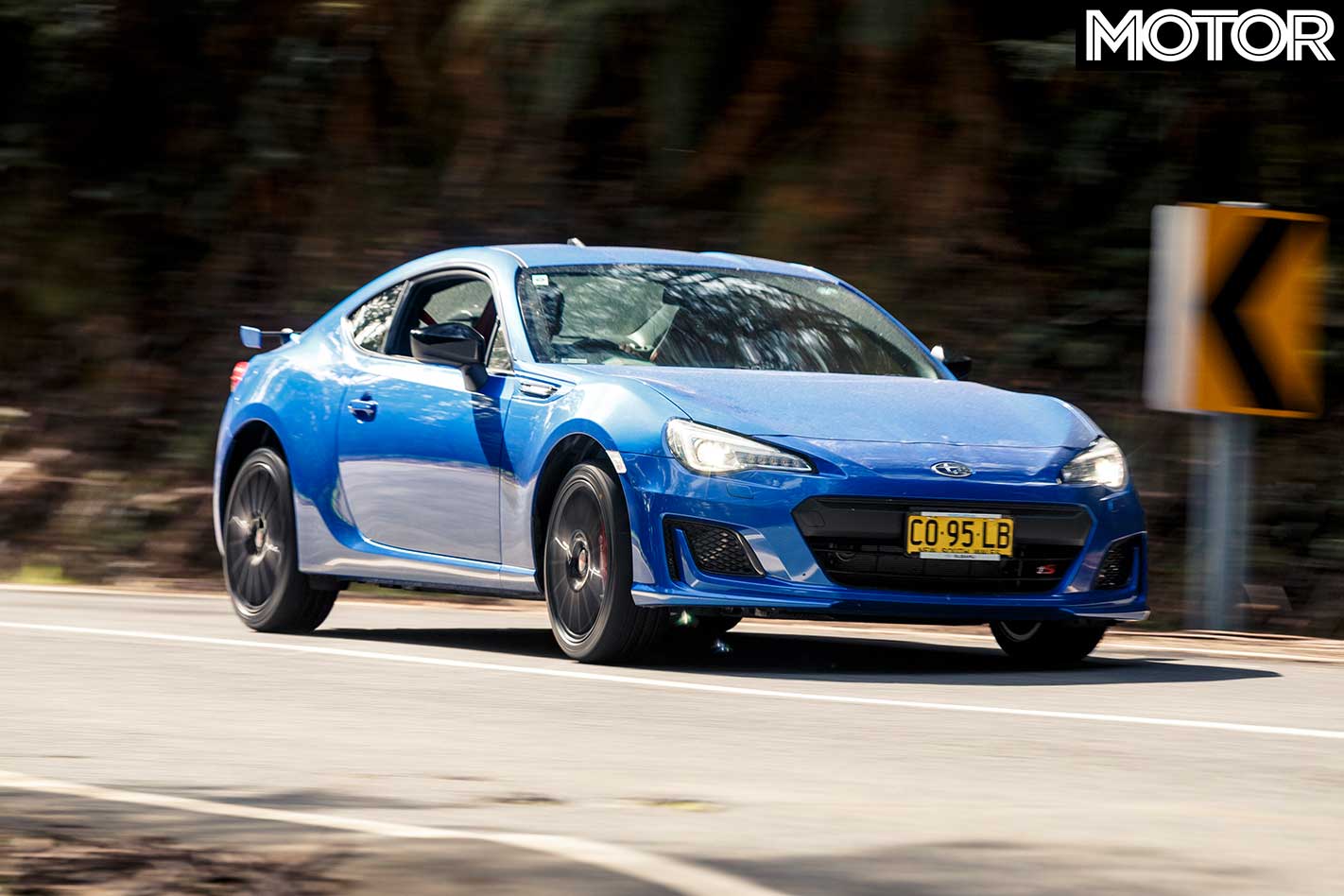
It’s a worrying start for the car with the highest power-to-weight ratio, and its dual fuel injection system is part of the problem. It spoils a nice mound of torque low in the rev range and a satisfying pull to its 7400rpm redline by plonking a hole in the middle of the delivery. Although every pull ends with a nice, positive shift, the drop created when the injection strategies switch over sucks the fun out of staying in gear.
However, there’s still something to be said about Subaru’s craft in eking 152kW and 212Nm from just 2.0 litres. After all, with bigger intake and exhaust runners since last year, dual fuel injection, variable cam timing and variable valve lift, it’s still a high-tech piece of kit.
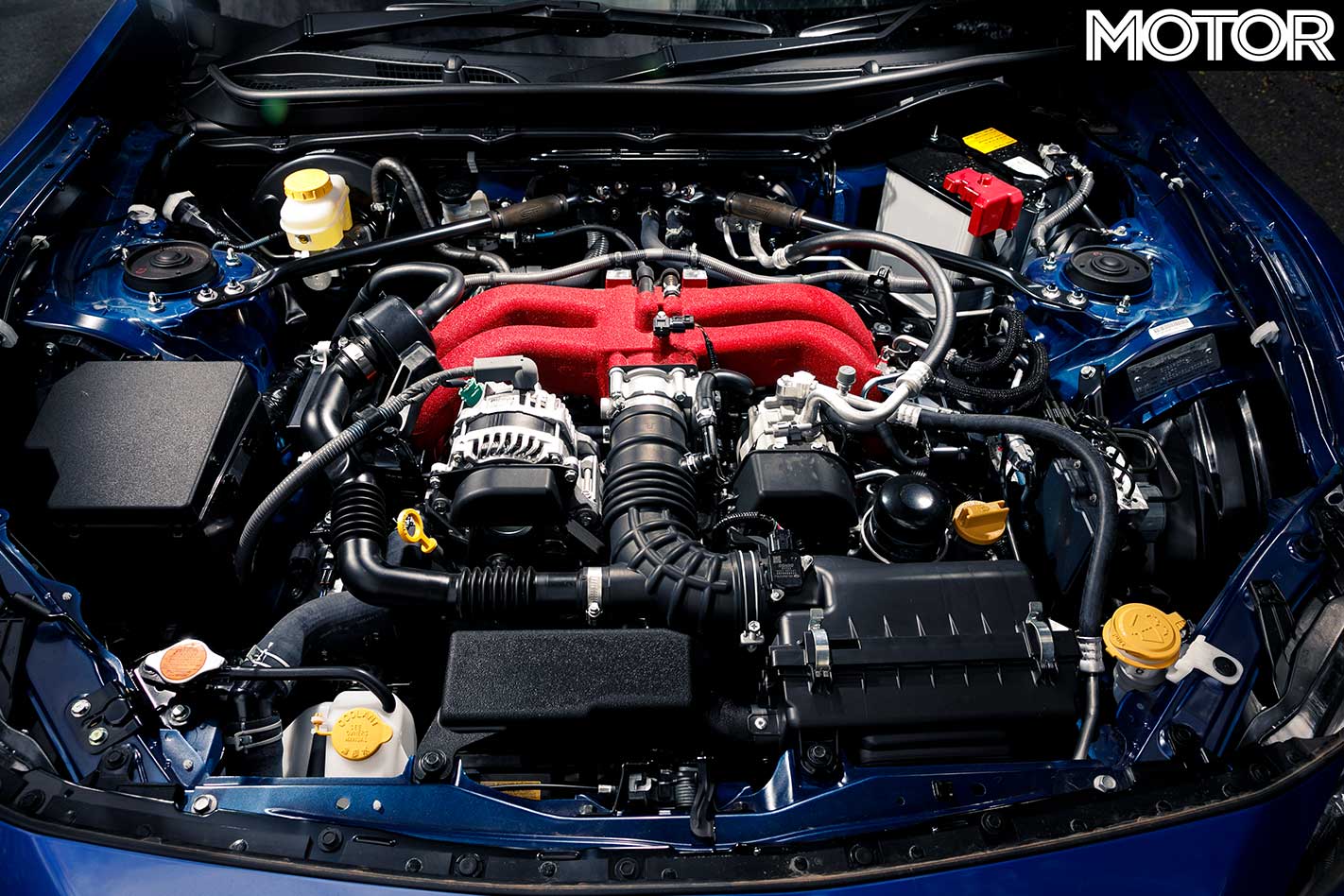
Getting away from the line in a standard BRZ requires plenty of revs and slipping the clutch – which, by the way, is not exactly full of bite – and the stickier Pilot Sport 4s make the job even harder. A quick step off the clutch at around 5500rpm finally gets it singing. There’s a touch of wheelspin and we eventually extract 7.58sec/15.33sec at 148.6km/h. That’s still more than 1.0sec and 7km/h adrift of the less-powerful Polo.
The Mazda finds itself somewhere between these two extremes. It might not have the muscles of the other two, but it throws a good punch. The car’s torque peak appears 600rpm earlier than the old 2.0-litre engine, while max power arrives 1000rpm higher at 7000rpm. And since Mazda has stuck with direct injection, there’s no torque hole between them, only a straight climb towards that peak.
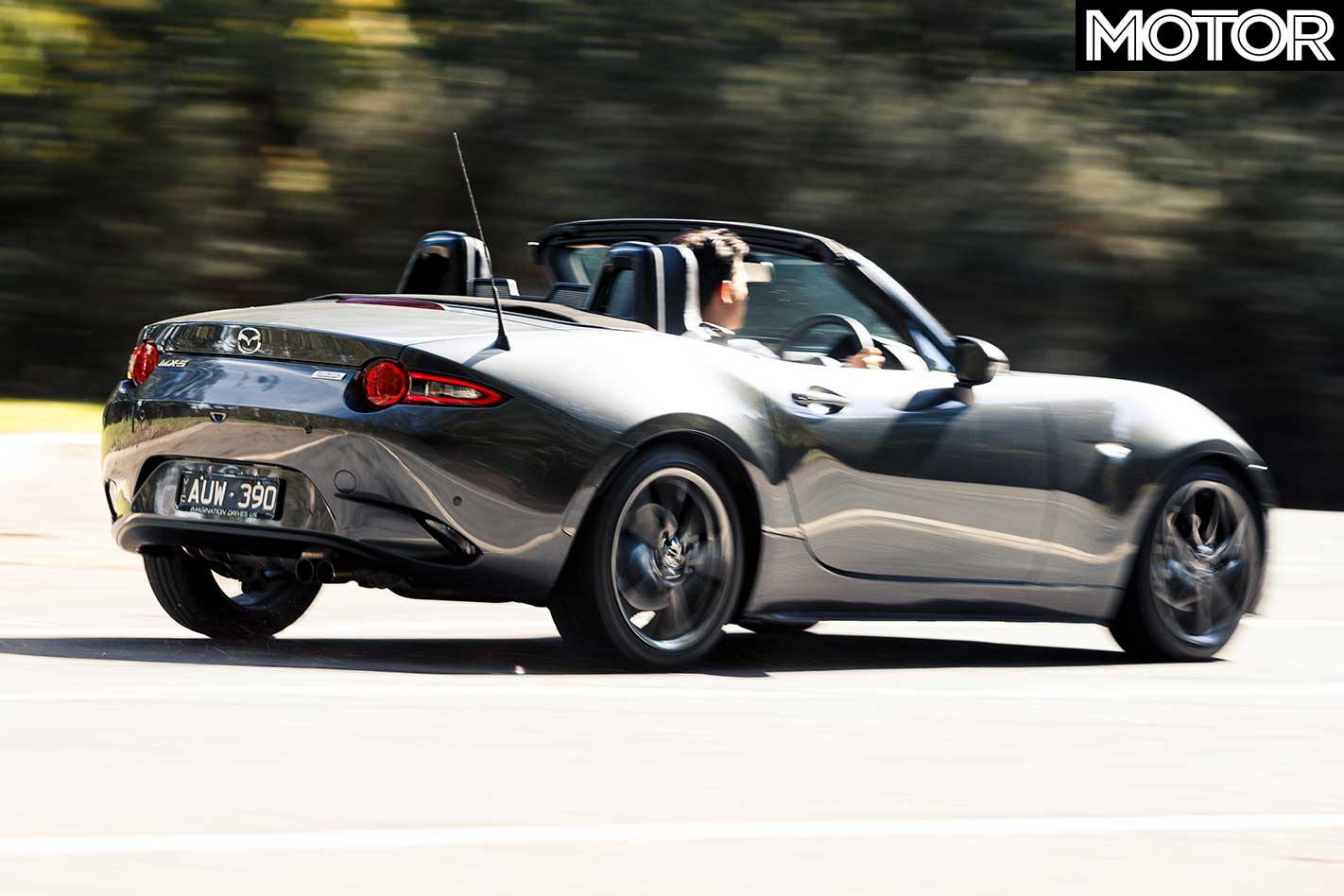
Response is also a strong suit, as each millimetre of throttle changes the car’s attitude and velocity. It’s a complete contrast to the binary throttle applications needed in the Subaru’s mid-range and makes getting off the line easier. You’ll still need about 5000rpm on board to spin the rear tyres enough for a decent launch, but its weight helps it get moving. Our first run easily nets a 6.8sec 0-100km/h run and 14.9sec 400m pass.
On top of a higher redline increasing noise and power, it lifts the top speed in each ratio to nudge the car past 100km/h in second gear. Timing the shift is key, though, as bouncing off the cut-out will cost you precious tenths. Slice through its delicate six-speed transmission and it’ll reach 100km/h in 6.67sec and 400m in 14.77sec at 150.8km/h.
While the Mazda’s light rear-drive layout helps it on the strip, it’s also what makes it brilliant when the roads start to wind. With no need for rear seats, the MX-5 fits its entire engine behind the front axle line. Mazda claims it’s perfectly balanced front to rear even with the 2.0-litre.
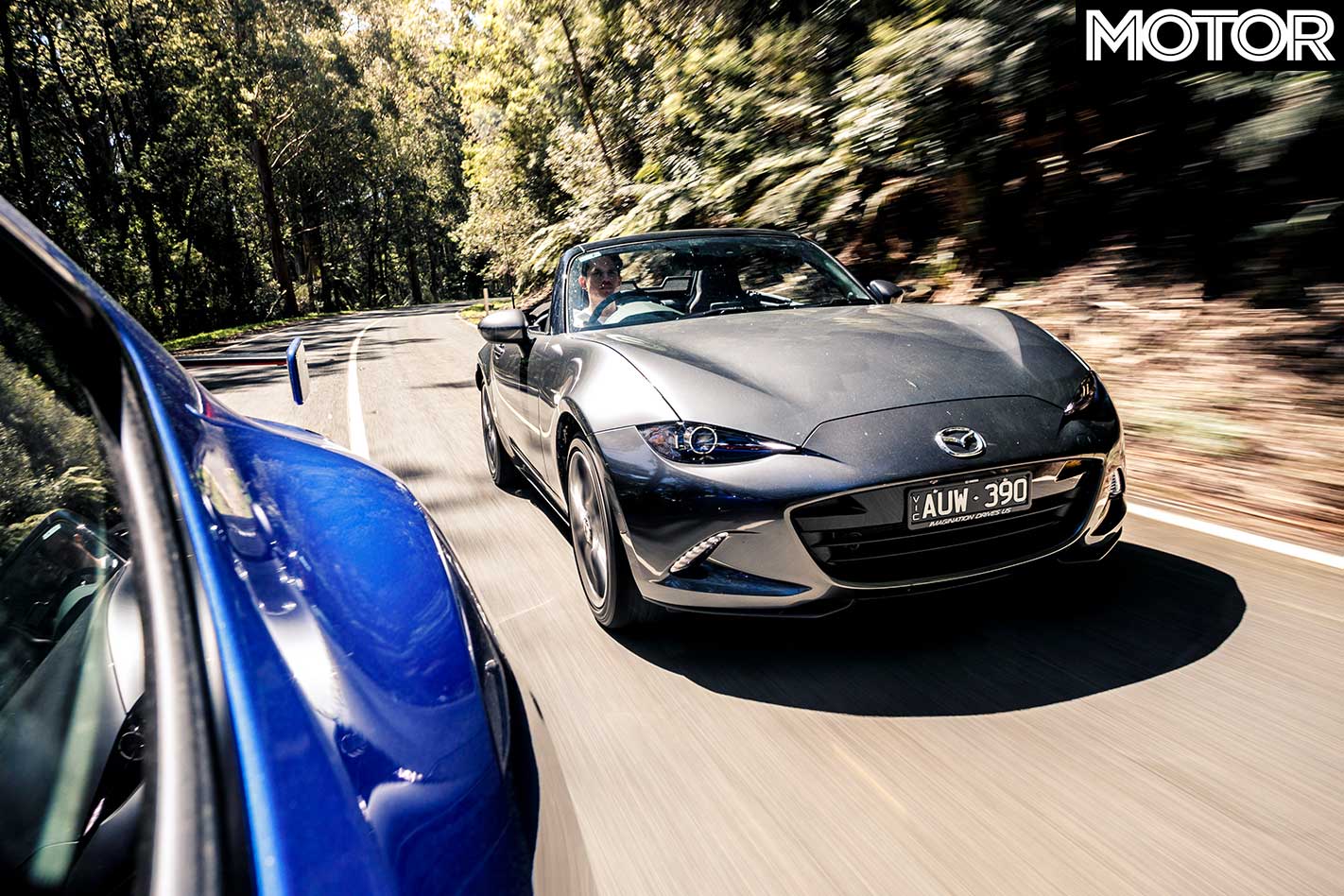
Riding on double-wishbone front and multi-link rear suspension, it floats into corners as the most neutral of the three. Like a bantamweight fighter, it darts around on its heels. At that uphill left-hander we mentioned at the start of this story, the Mazda can be steered on the throttle for much of the climb up the hill. You barely need to lift and its Bridgestones have so little centrifugal force to fight in the corners.
Understeer is hardly a problem for the BRZ, but its layout doesn’t have the same level of purity, and you can feel this play out on the road, where you need more front grip to turn in. You then lift earlier or dab the brakes where the MX-5 would sail past carrying its momentum.
But while a portion of the BRZ’s engine sits ahead of the front axle line, it isn’t any taller than the front wheels. Should your drive route change from flowing third-gear corners to tight second-gear bends then the BRZ’s hunkered-down chassis, bolstered by lowered springs, clings to the surface much better than the rest.
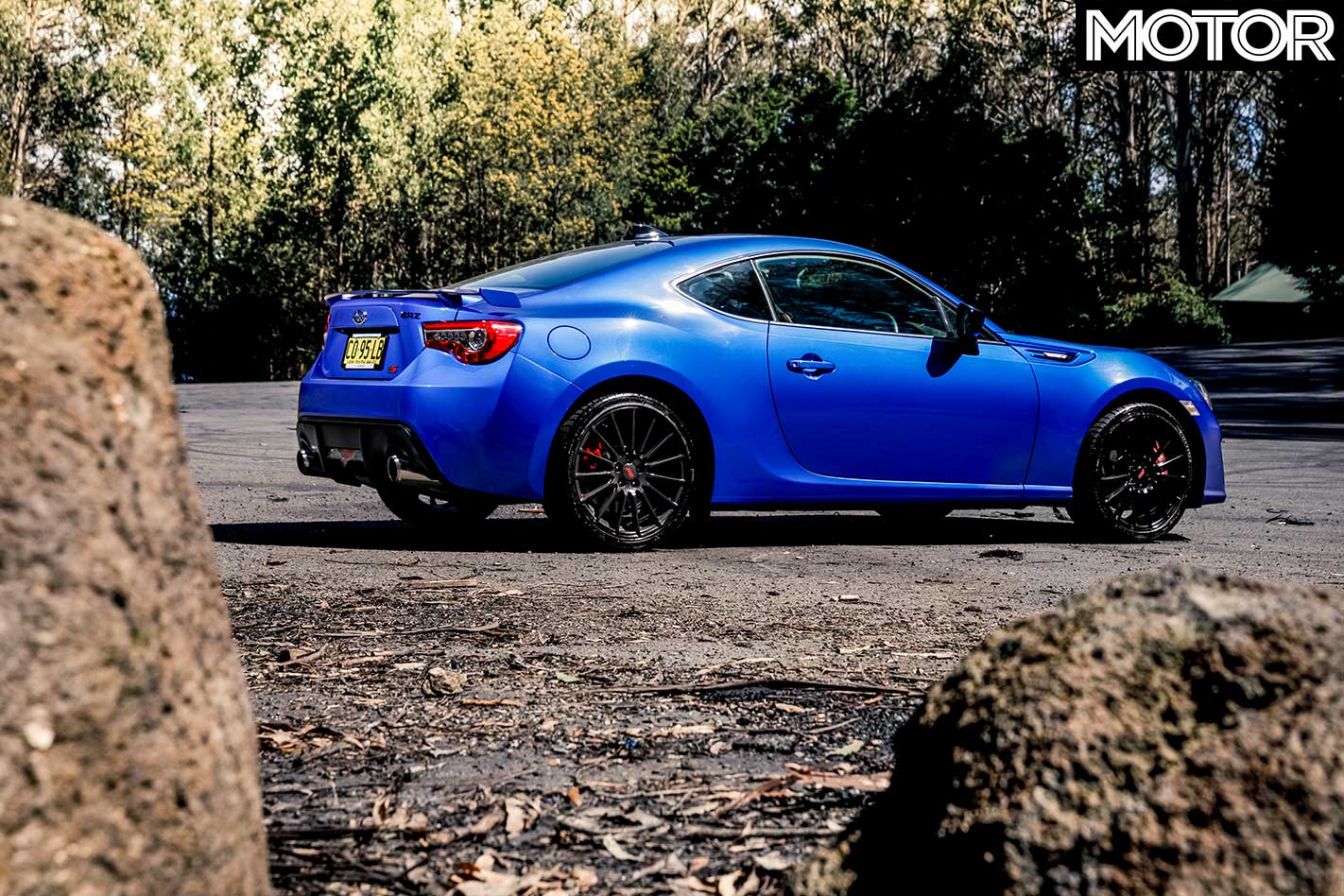
Switching into the Polo reveals how much duller front-drive can inherently be. You wait longer for the front-end, and to use the brake and throttle. But the new platform responds well when driven hard, feeling more planted than the last version and extracting a good amount of grip from a modest tyre in the Michelin Primacy 3.
That outside front tyre stays velcroed to the road even on tightening bends, but the Polo begs you to ease up on it, as it can’t dance like the other two. Since it matches big outputs to average brakes and tyres, there’s more energy to consider into each corner and you often find yourself waiting on its mass to settle on the outside tyres.
The flipside to this is that its adaptive suspension absorbs mid-corner lumps well. Even in Sport mode there’s always travel up its dampers’ sleeves. The relatively soft Mazda isn’t as unflappable over bumps, but it’s more controlled than the BRZ, which has a touch more rebound.
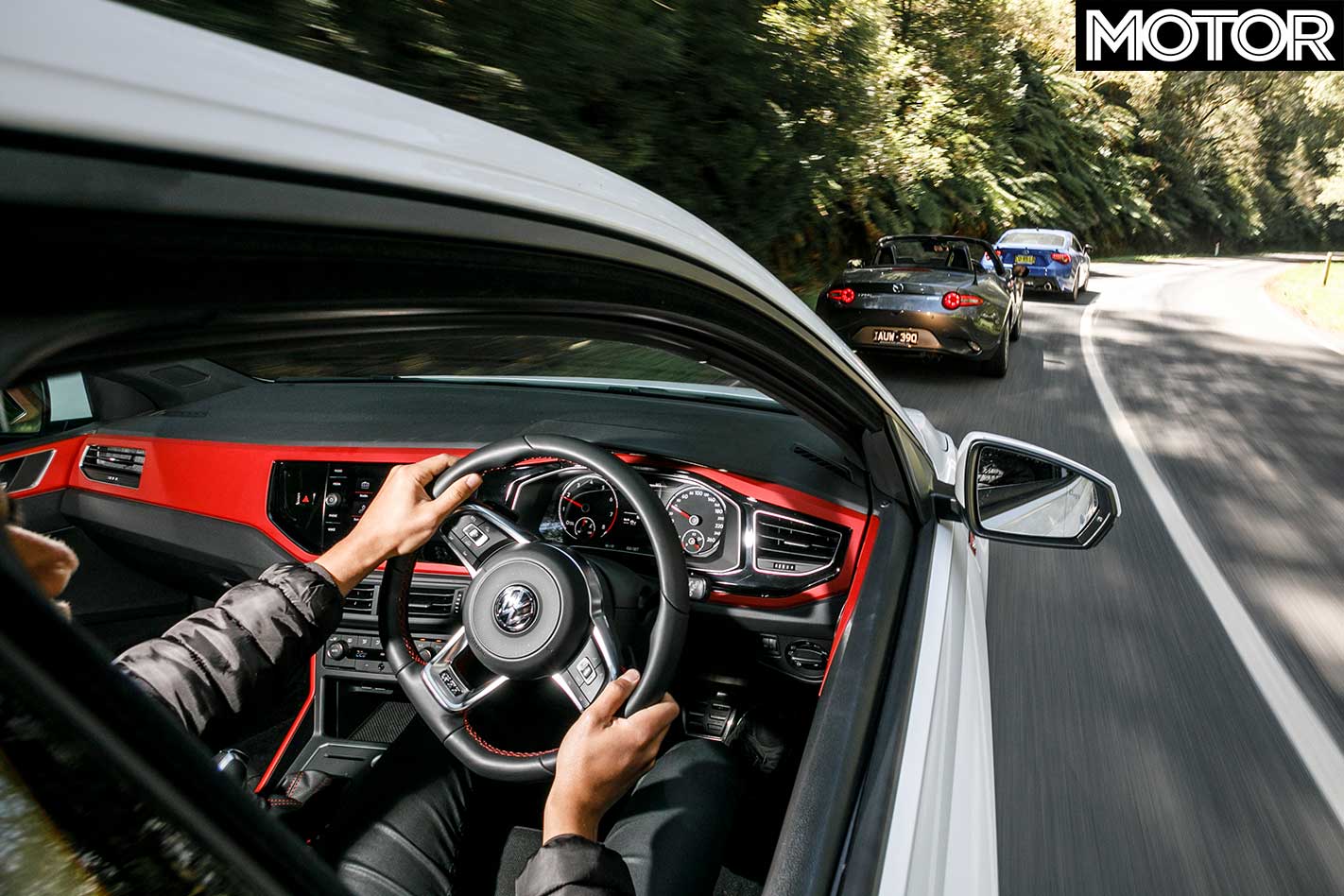
But while the BRZ is heavier, it demands you to drive it before you judge that flabbier size. It feels a little firmer and a touch more precise than the MX-5. The gains in accuracy are down to those bars that reinforce one of the most positive front-ends in the business. That said, it’s not as cohesive as the MX-5, which has a slower, but just as precise, steering rack and encourages you to use its chassis to help steer the car instead.
The Polo’s steering rack, meanwhile, feels like a carbon copy of the Golf GTI’s crisp, accurate electric system. It’s a big step up over the previous version. It’s also the only car here that can modify its steering heft, though the extra weight in Sport doesn’t make it any friendlier.
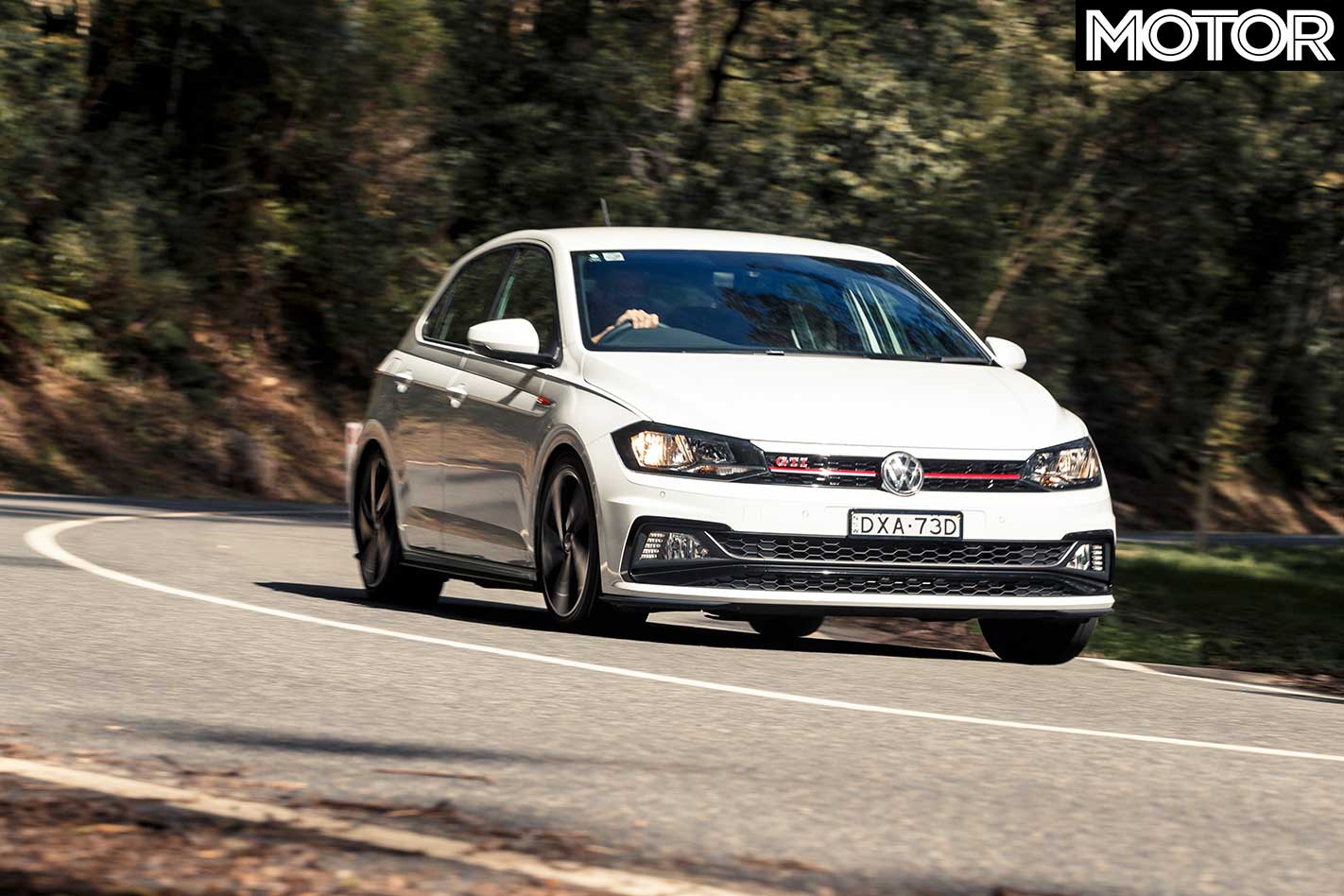
The BRZ might be one of the few cars in which you enjoy using the brake pedal more than the throttle, at least for feel. It has lot of feedback and gives you confidence to put the BRZ on its nose into corners.
The Mazda’s single-piston hardware might not have the piston-on-pad feel of the Subaru but it’s just as effective, helping to balance weight on its front-end if need be. It’s only the Polo’s brakes that are found wanting. Not only are they hard to judge, but on the downhill pass they turn into a smoking mess. It’s worrying that they also need to do more than just slow the car down.
Volkswagen uses its XDS technology, which stands for Extended Differential Lock, on the front axle. Although there’s nothing locking except the inside brake caliper, it works quite well in place of an LSD. You barely notice it pumping the inside brake; the operation is much more refined than most systems and helps you apply its power more smoothly on corner exit.
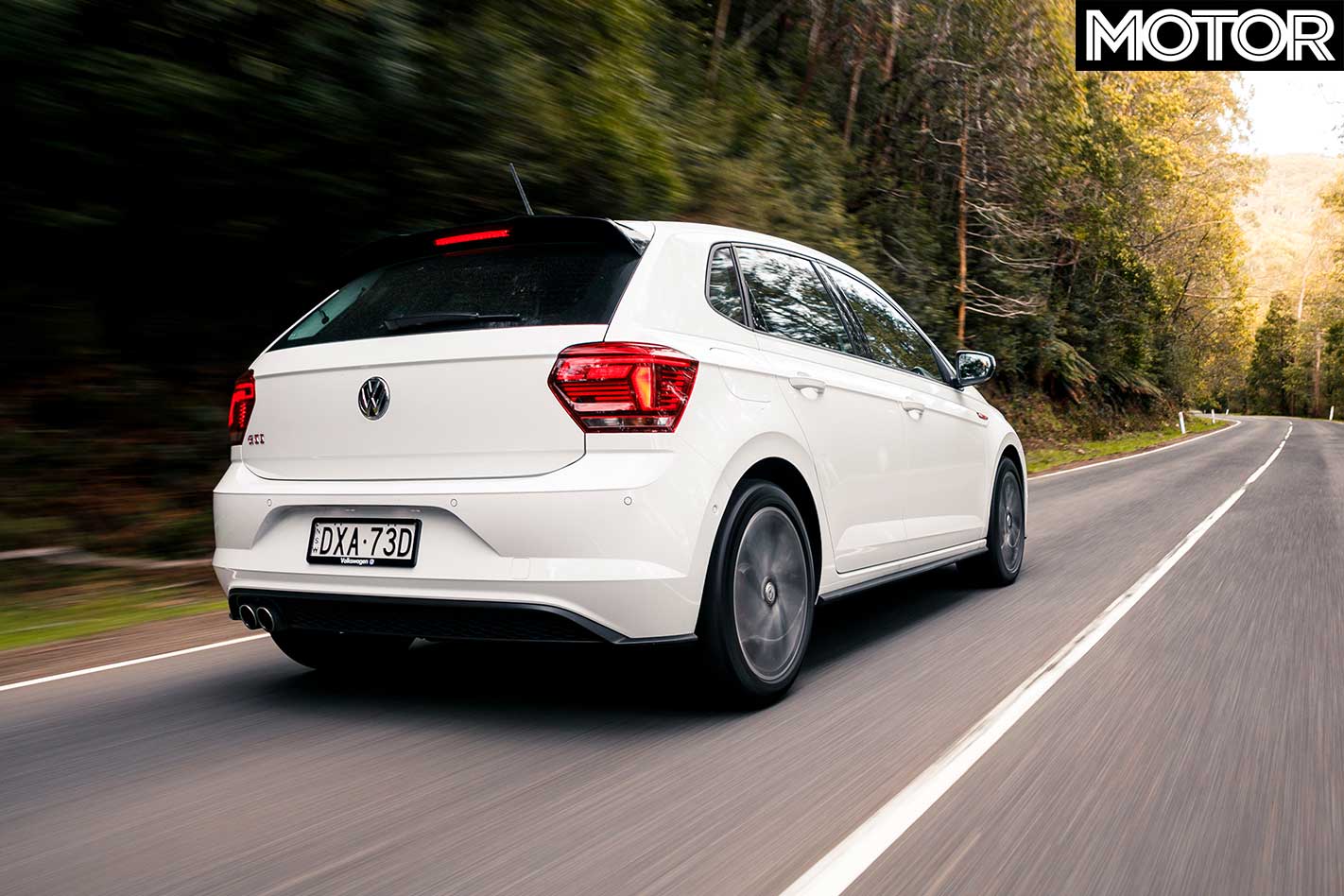
This is rarely a problem in the BRZ, of course, except in low gear, high-rev corners where it can be provoked into oversteer when you’re in the loosest ESP setting, or have it switched off. It’s planted, stable and always in control.
Rear grip is also plentiful in the Mazda, and while it’s now got a bit more power, it’s not nearly enough to have a real affect on its grip balance. The changes to the rear suspension have, however, smoothed the transition into roll oversteer, but you’ll have fun testing those limits, even if just for the sound.
The MX-5’s extra engine speed lets it hold gears on steep climbs, and as it cranks up revs the sound develops into a full-bodied roar. Here, the percussion of its valves, cam lobes, and pistons becomes hard-edged and musical, without any of the harshness or vibration of the old 2.0-litre SkyActiv unit.
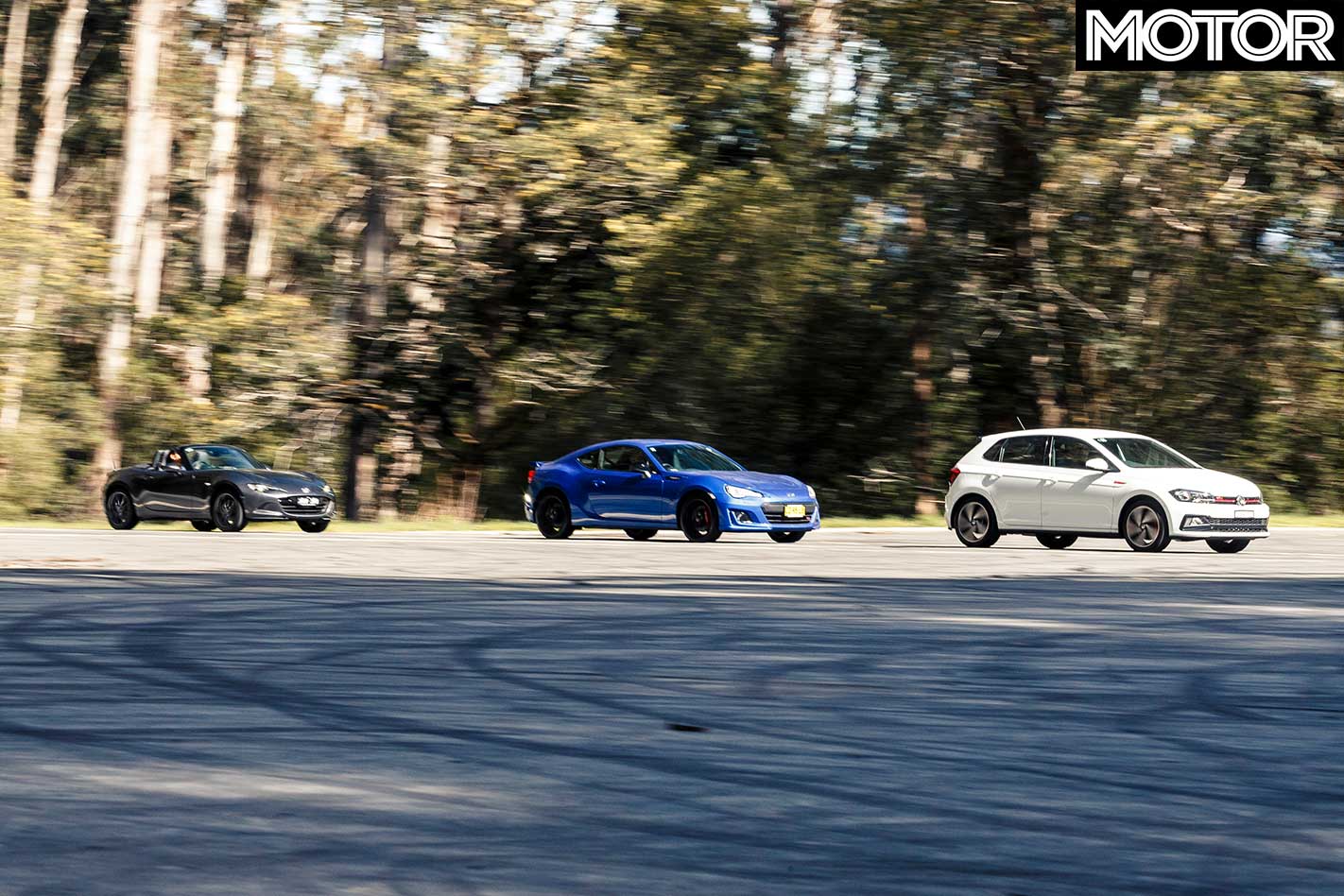
Meanwhile, the BRZ isn’t as nice to run to the last rpm, but the howl from the acoustic generator that manipulates intake air helps build suspense.
The Polo, though, is much more subdued. You have to listen close for the small choofs from the turbocharger, the muffled pops on overrun and a nice rort. They suit it.
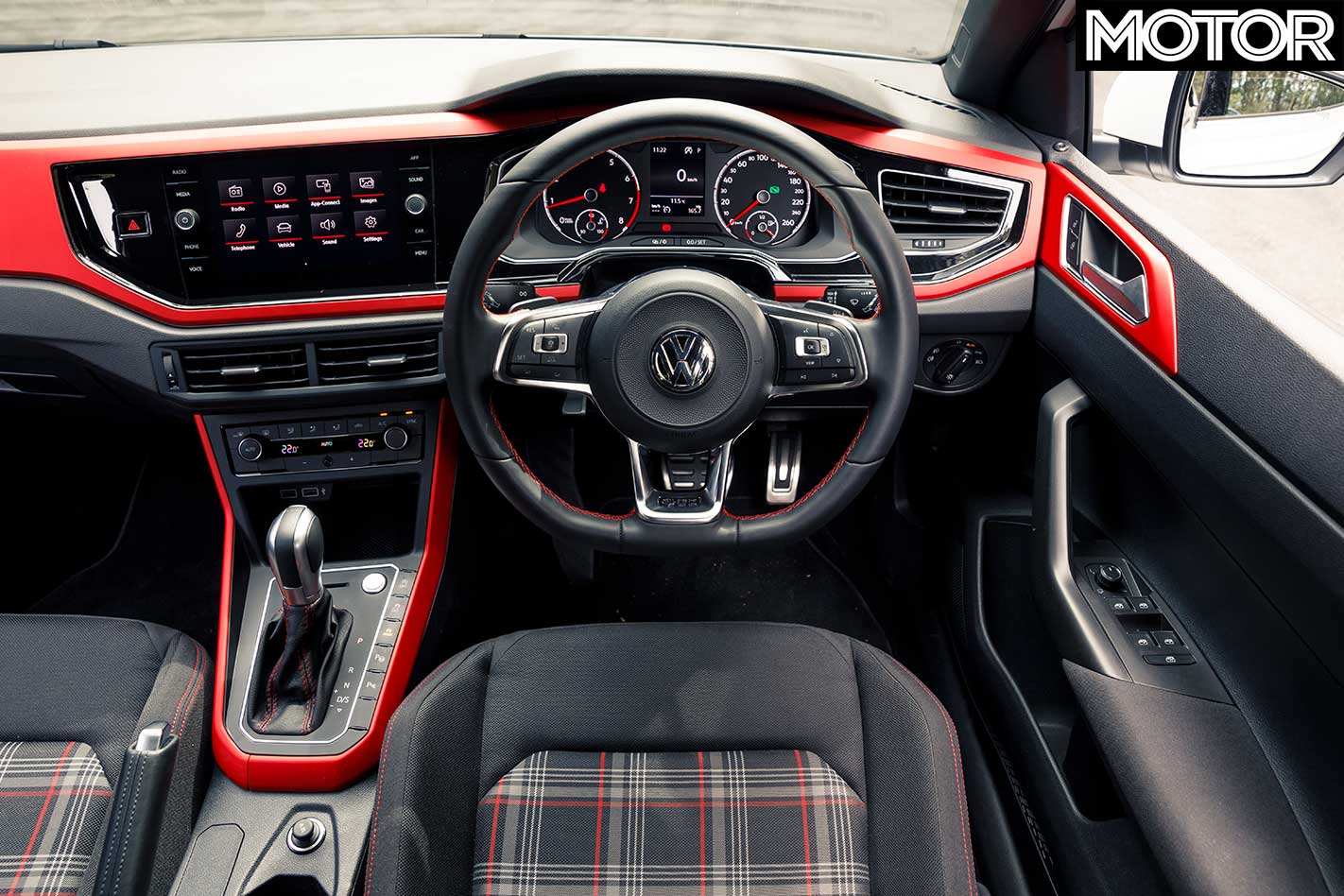
But they need to. GTIs have built a reputation on accessibility, sophistication and practicality, and the Polo clearly values those things most. Even the incoming Fiesta ST has heeded the Polo’s steadfast focus on class and has been heavily upgraded in that area. The VW’s interior is the slickest here and, while the car is inherently practical, it’s also fast enough in a straight line to match a Golf GTI’s claimed acceleration times.
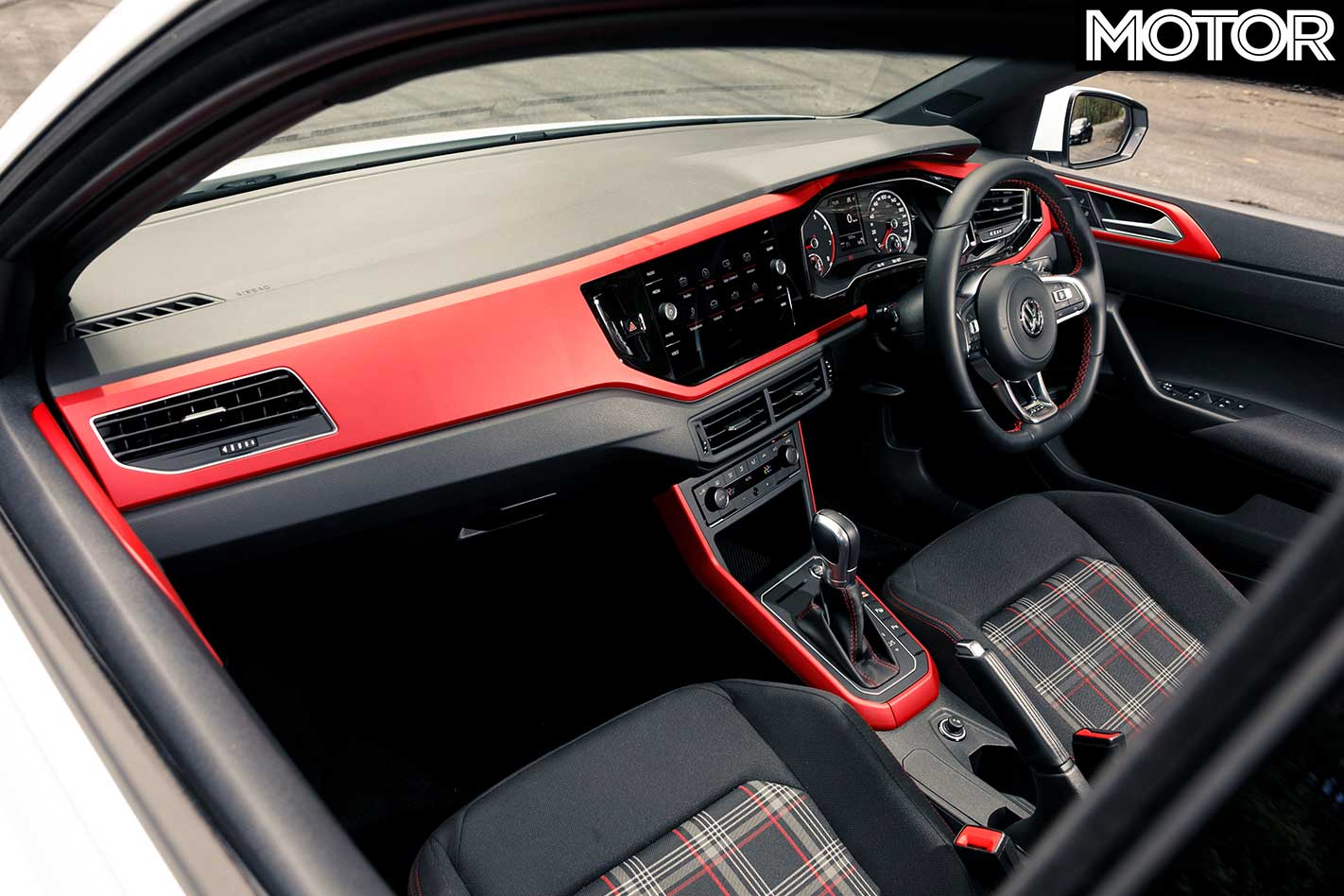
But the Polo GTI can only do so much. When you start to push on, suddenly it feels twice as tall as the others. It’s the most pliant car, but it’s low-speed ride isn’t all that much better than the others. That would be acceptable if it set a winding road on fire, but it doesn’t. Only its brakes.
Speaking of which, at 1285kg tare (which means empty but with fluids), the Polo is starting to creep up in size. Yes, it needs to seat five, but we need to draw the line on what makes a small hatch, well, small. On the other hand, its bigger spread of grip has made it a better handler, but we suspect the new Fiesta ST will be the go-to for razor-sharp responses.
And if that’s what you really want then you could just buy the BRZ tS. At $39,894, it costs as much as a Polo GTI fully optioned. Sure, it won’t have a chance in a straight line, but its extra grip has enhanced rather than spoilt the car’s core characteristics.
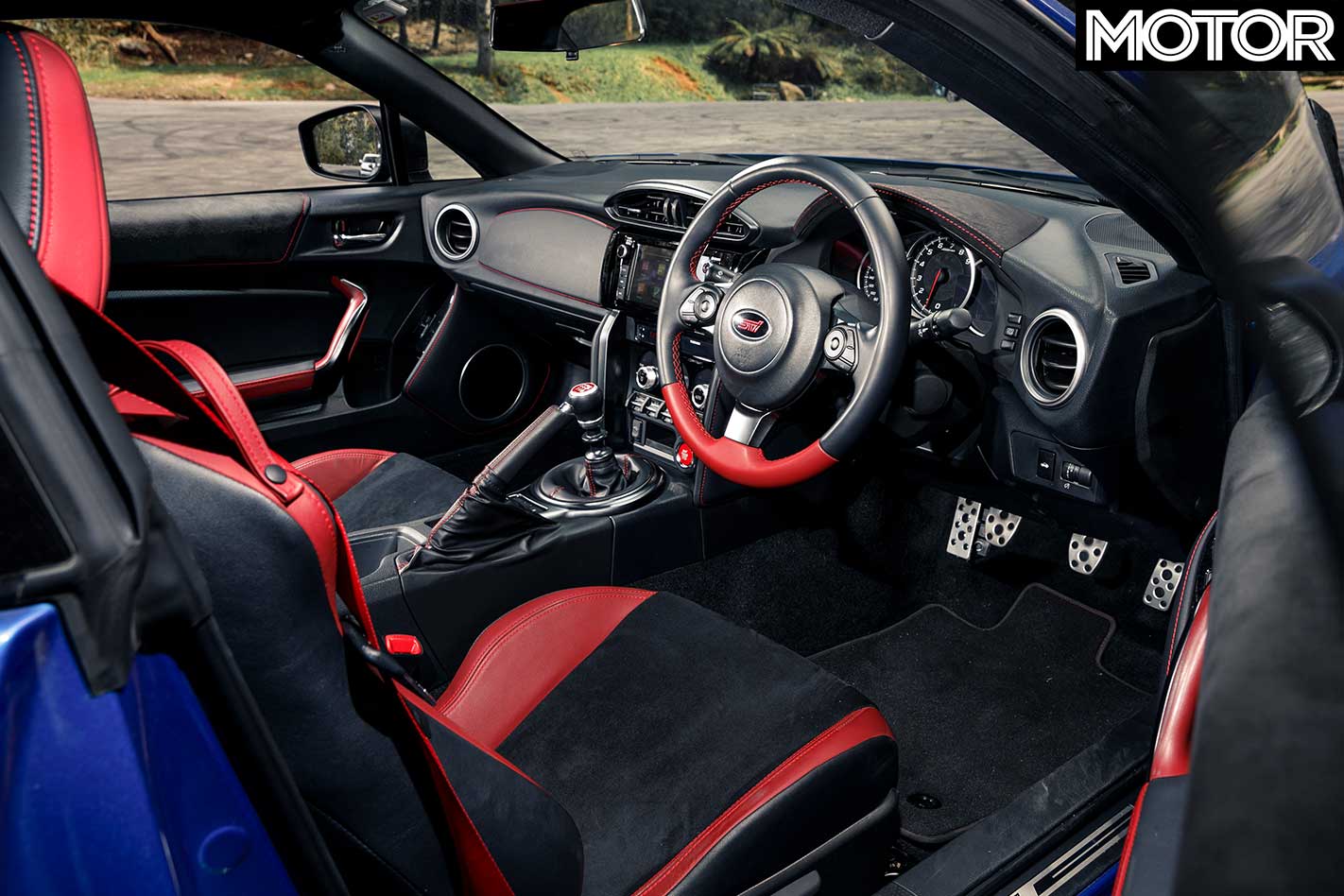
A lot of charm already existed in the base car, but the tS’s unique Sachs dampers give the BRZ a better ride to make it more believable as a day-to-day chariot. And we don’t doubt you could drive to a track, bang out laps all day, only to have the car lap it up and take you home with a smile on its face. We like the interior’s infotainment system – it’s even better than the Mazda’s faux iDrive arrangement – and it’s also got rear seats and a decent boot to get you out of trouble.
But where the Mazda’s going, you don’t need luggage. It’s hard to quantify its appeal on sheer numbers, or price, as it is the most expensive car here and perhaps the slowest on a racetrack. But that new engine and tweaked chassis sprinkle brilliance on the MX-5’s already high appeal. Yes, it’s dearer. But one visit to its 7500rpm redline makes all other considerations, good or bad, fade away.
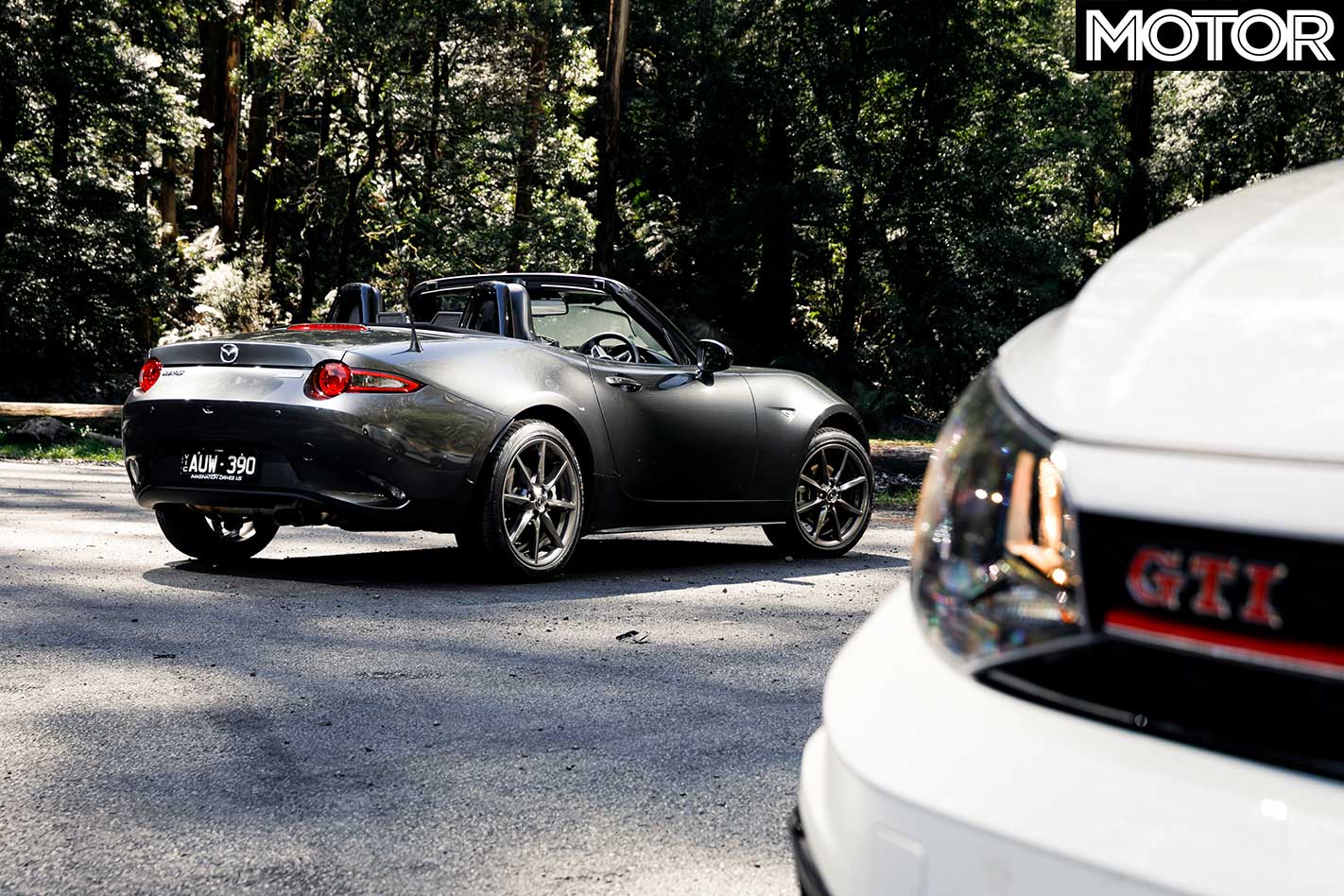
Caning the MX-5 on a clear, warm day with nothing but winding roads ahead of you is one of motoring’s greatest pleasures. And, as you’ll find out at the bowser, it won’t cost you much either. Even if you’ve spent the whole time taking corners with the throttle flat.
Fast Facts
| u00a0 | Mazda MX-5 GT | Volkswagen Polo GTI | Subaru BRZ tS |
| Body | 2-door, 2-seat convertible | 5-door, 5-seat hatch | 2-door, 4-seat coupe |
| Drive | rear-wheel | front-wheel | rear-wheel |
| Engine | 1998cc inline-4, DOHC, 16v | 1984cc inline 4, DOHC, 16v, turbo | 1998cc boxer-4, DOHC, 16v |
| Bore x Stroke | 83.5mm x 91.2mm | 82.5mm x 92.8mm | 86.0mm x 86.0mm |
| Compression | 13.0:1 | 9.6:1 | 12.5:1 |
| Power | 135kW @ 7000rpm | 147kW @ 4400-6000rpm | 152kW @ 7000rpm |
| Torque | 205Nm @ 4000rpm | 320Nm @ 1500-4400rpm | 212Nm @ 6400-6800rpm |
| Power/Weight | 128kW/tonne | 114kW/tonne (tare) | 117kW/tonne |
| Transmission | 6-speed manual | 6-speed dual-clutch | 6-speed manual |
| Weight | 1056kg | 1285kg (tare) | 1295kg |
| Suspension | A-arms, coil springs, anti-roll bar (f); multi-links,coil springs, anti-roll bar (r) | struts, coil springs, adaptive dampers, anti-roll bar (f); torsion beam, coil springs, adaptive dampers, anti-roll bar (r) | struts, dampers, anti-roll bar (f); A-arms, dampers, anti-roll bar (r) |
| L/W/h | 3915/1735/1230mm | 4067/1751/1438mm | 4240/1775/1320mm |
| Wheelbase | 2310mm | 2560mm | 2570mm |
| Tracks | 1495mm (f);1505mm (r) | 1510mm (f); 1484mm (r) | 1520mm (f); 1540mm (r) |
| Steering | electrically assisted rack-and-pinion | ||
| Brakes (f) | 280mm ventilated discs, single-piston calipers | 310mm ventilated discs, single-piston calipers | 326mm ventilated discs, 4-piston calipers |
| Brakes (r) | 280mm ventilated discs, single-piston calipers | 272mm ventilated discs, single-piston calipers | 316mm ventilated discs, 2-piston calipers |
| Wheels | 17.0 x 7.0-inch (f/r) | 17.0 x 7.5-inch (f/r) | 18.0 x 7.5-inch (f/r) |
| Tyre Sizes | 205/45 R17 (f/r) | 215/45 R17 (f/r) | 215/40 R18 85Y (f/r) |
| Tyres | Bridgestone Potenza S001 | Michelin Primacy 3 | Michelin Pilot Sport 4 |
| Price | $41,960 | $30,900 | $39,894 |
| Pros | Zingy engine; frugal thirst; open-top appeal | Accessible, practical, sharp | Grip; brakes; point; infotainment system |
| Cons | Busy ride; unsupportive seats | Bit sensible; not as hardcore as some rivals | Lack of power; engine sounds meh |
| Rating | 4.5 out of 5 stars | 4 out of 5 stars | 4.5 out of 5 stars |
The Strip
| u00a0 | Subaru BRZ tS | Volkswagen Polo GTI | Mazda MX-5 GT |
| 0-10km/h | 0.30sec | 0.39sec | 0.36sec |
| 0-20km/h | 0.86sec | 0.93sec | 0.85sec |
| 0-30km/h | 1.32sec | 1.37sec | 1.29sec |
| 0-40km/h | 1.89sec | 1.83sec | 1.71sec |
| 0-50km/h | 2.52sec | 2.41sec | 2.20sec |
| 0-60km/h | 3.46sec | 2.92sec | 3.10sec |
| 0-70km/h | 4.33sec | 3.59sec | 3.77sec |
| 0-80km/h | 5.24sec | 4.39sec | 4.56sec |
| 0-90km/h | 6.16sec | 5.23sec | 5.39sec |
| 0-100km/h | 7.58sec | 6.15sec | 6.67sec |
| 0-110km/h | 8.86sec | 7.21sec | 7.88sec |
| 0-120km/h | 10.16sec | 8.45sec | 9.13sec |
| 0-130km/h | 11.90sec | 9.89sec | 10.48sec |
| 0-140km/h | 13.70sec | 11.46sec | 12.13sec |
| 0-150km/h | 15.33sec | 13.14sec | 14.58sec |
| 0-400m | 15.33sec @ 148.64km/h | 14.42sec @ 156.51km/h | 14.77sec @ 155.99km/h |
| 80-120km/h (Drive) | 4.94sec | 4.01sec | 4.49sec |
| 100-0km/h | 35.23m | 37.52m | 35.72m |
| Speed in Gears | |||
| 1st | 56km/h @ 7400rpm | N/A @ 6600rpm | 60km/h @ 7500rpm |
| 2nd | 93km/h @u00a07400rpm | N/A @ 6600rpm | 102km/h @ 7500rpm |
| 3rd | 132km/h @u00a07400rpm | N/A @ 6600rpm | 149km/h @ 7500rpm |
| 4th | 168km/h @u00a07400rpm* | N/A @ 6600rpm | 191km/h @ 7500rpm* |
| 5th | 204km/h @u00a07400rpm* | N/A @ 6600rpm | 219km/h @ 6950rpm* |
| 6th | 216km/h @ 6020rpm* | N/A @ 6600rpm | 219km/h @ 5395rpm* |
Heathcote Raceway, 16˚C, dry. Driver: Louis Cordony *Manufacturer’s claim Official timing supplier: www.vboxaustralia.com.au
Factory-bred Motorsports siblings
1 – Volkswagen Polo GTI R5
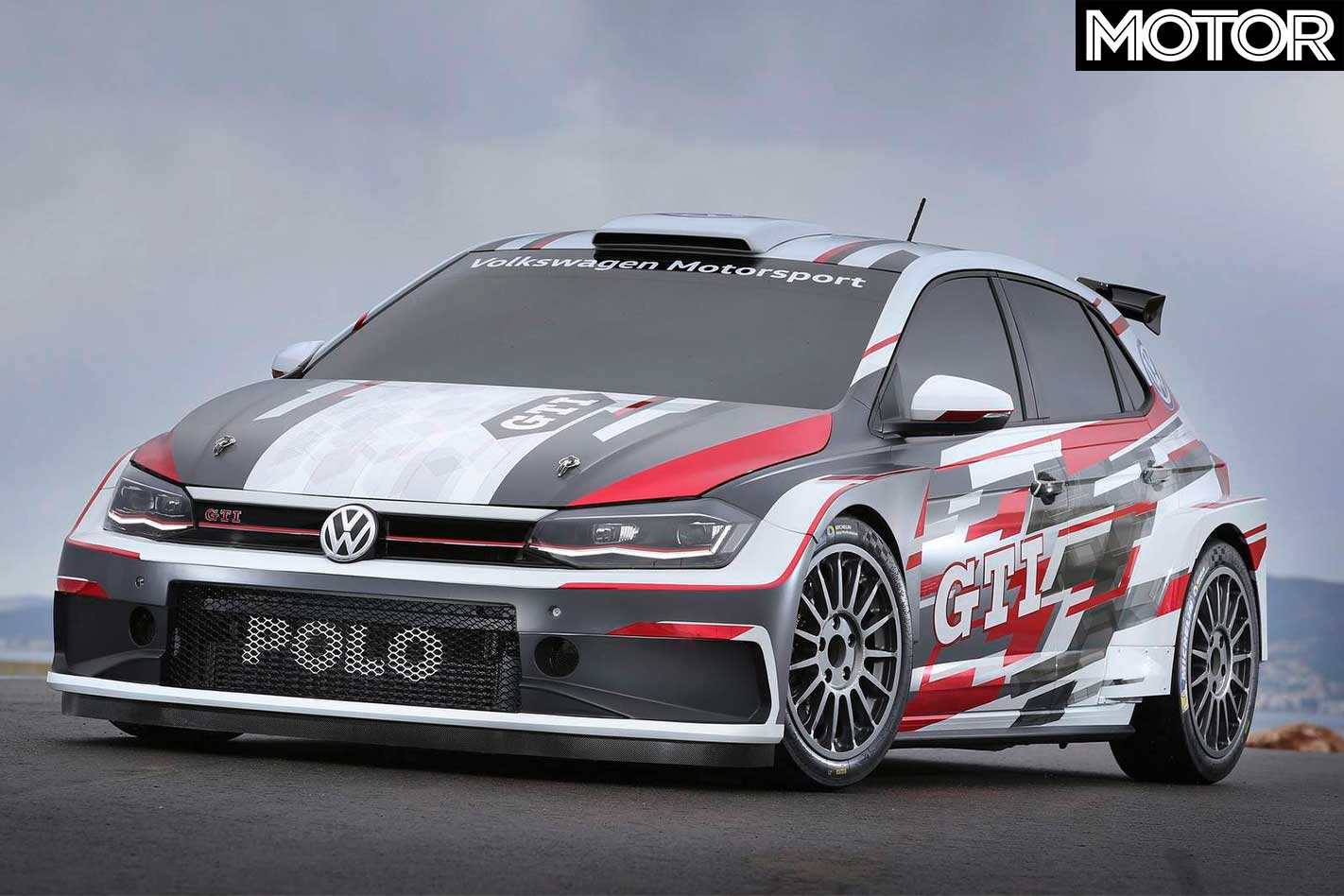
The baddest Polo of them all is the rally-spec R5. Built by VW Motorsport in Spain for customer racing, it features all-wheel drive, a 200kW/400Nm turbo 1.6-litre four and a sequential transmission. It’s good for 0-100km/h in 4.1 seconds and has all the requisite safety modifications and bodywork for rallying, along with ZF dampers and two clutch LSDs. It’s also expensive at €190,000 (AUD$298,000).
2 – Mazda MX-5 Cup car
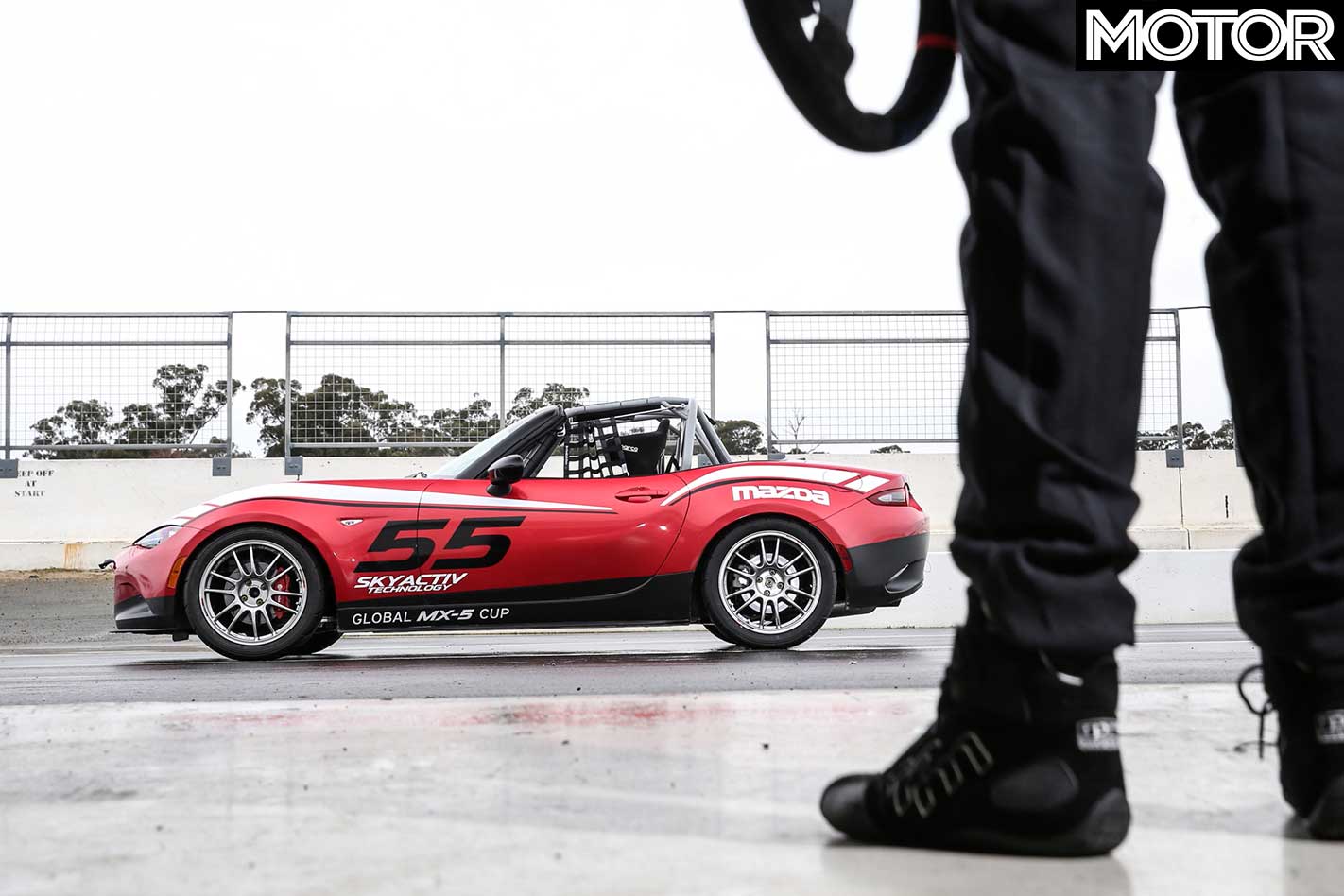
Keen to carve out a name for yourself in USA’s one-make series circles? Mazda’s MX-5 Cup car would be for you, then. Built in America for a ‘global’ series, they’re left-hand drive, use a sealed 2.0-litre engine and extensive chassis upgrades. DSSV dampers hold BF Goodrich slicks on the road. Cost is USD$58,000 for the 2018 car (AUD$80,000), but the new version with a 7500rpm engine bumps that to USD$65K (AUD$89K).
3 – Subaru BRZ RA
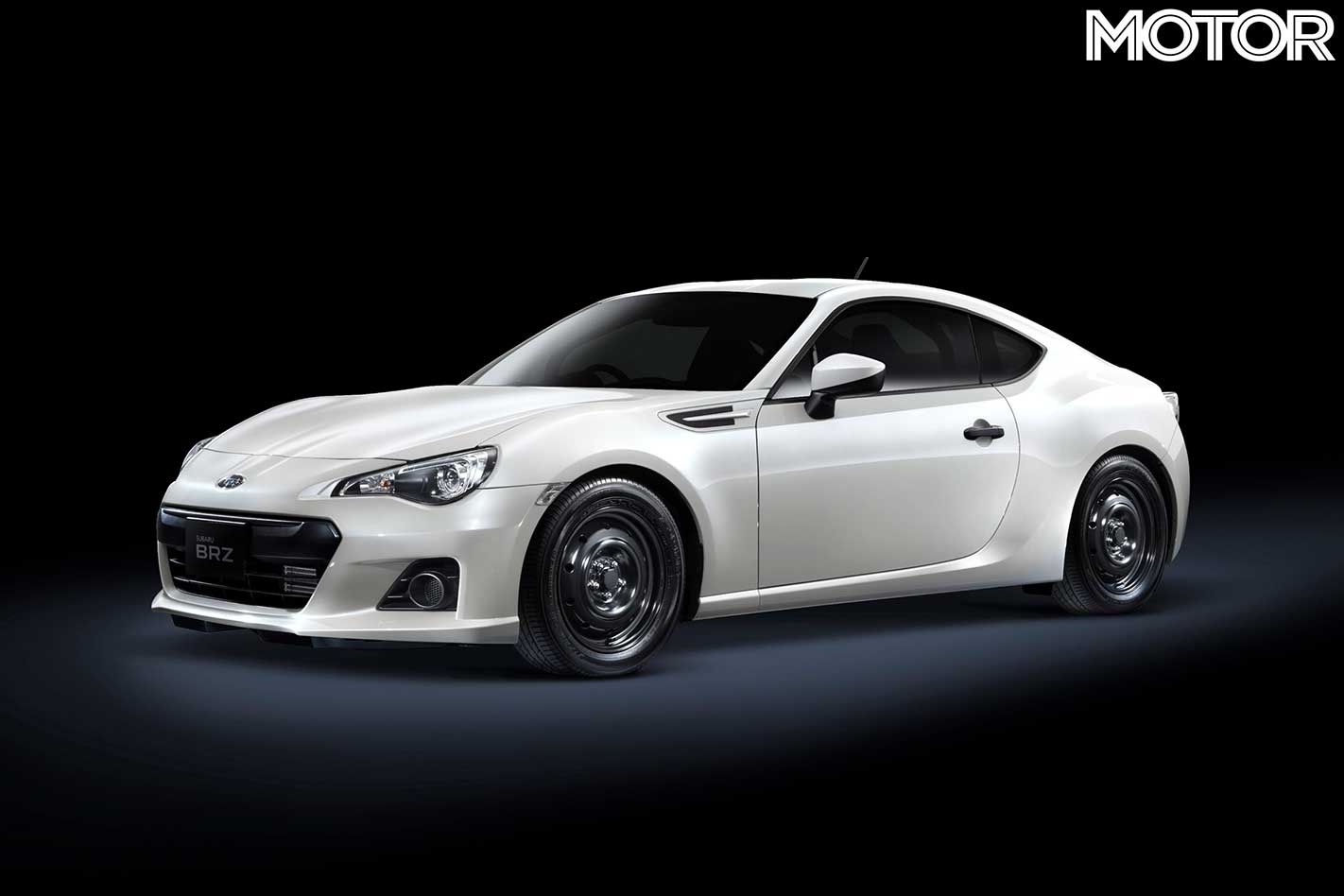
Okay, so not all of us want to dive straight into competition motorsport. Then what about track days? The Japan-only BRZ RA junks items that add unnecessary cost – note those steelies that Subaru assume you’ll throw out anyway – and its price converts to AUD$26,000. Or you can go for the RA Racing version that adds a six-point roll cage, oil cooler, harnesses and brake cooling ducts for about AUD$38K.
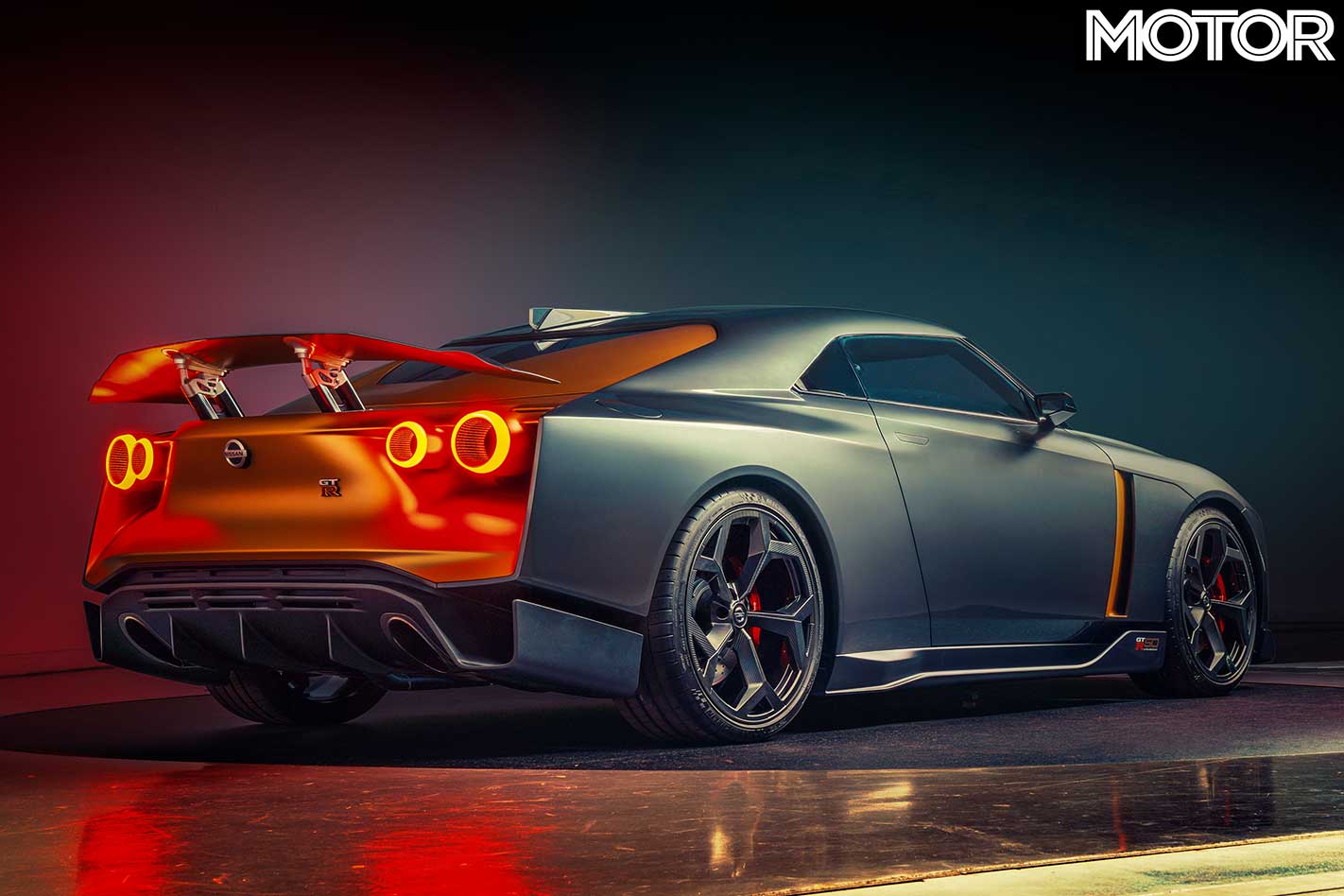
This is the ultimate Nissan GT-R, and a fitting curtain call for the brilliant R35 series that has been around now for more than a decade. It is 530kW of muscle and refinement, a blend of Japanese pragmatism and Italian craftsmanship. And each of only 50 built will cost at least $1.5 million. For a Nissan!
And how did all of this happen? Well, stand by, because this is going to sound like the weirdest hypercar development process you’ve ever heard of.
For starters, Nissan didn’t do any of that extra engineering. In fact, neither did NISMO, Nissan’s performance arm. Nissan’s most outrageous production model ever didn’t even spring from a fertile mind in Japan – bizarrely, it all came from the ever-fizzing minds of ItalDesign, the legendary design house just outside Turin in northern Italy.
The details are pretty sketchy about all of this, because the official backstory has been mixed in with too much saccharine to be credible, but insiders tell the story like this, and it has enough elements of truth in it to be credible: ItalDesign went to Nissan and suggested it crank up a million-euro version of the GT-R because both it and the GT-R were turning 50.
ItalDesign might now be owned by Audi, but it is free to work wherever, and for whomever, it wants. And it has form here. The company’s Director of Style is Felippo Perini, who was the design boss at Lamborghini when it turned the $200,000 Mucielago into the million-euro Reventon, with just a bit of bodywork and some new cluster dials.
They know how this stuff works: take something that’s already built and already fast, generate hype (say, around the Goodwood Festival of Speed) then announce that public interest has forced them into a high-cost, limited-edition run. Then, probably, do the same thing again with a convertible.
The GT-R was a sure thing, ItalDesign insiders insist, because it had already been in production for 11 years and it needed a last hurrah. Nissan had done plenty of GT-R specials themselves, including the Spec V, the Black Edition, the GT-R NISMO and the GT-R NISMO N-Attack, but for some reason they’d never considered charging 10 times as much as the standard car for any of them. It took ItalDesign’s chutzpah to do that.
Nissan insists it did the styling (with Nissan Design Europe doing the body and Nissan Design America the interior) and that ItalDesign did the engineering work. Now, part of that is credible, because ItalDesign is geared up to do engineering work (it did the Audi Q2 from the initial sketches all the way into pre-production, for example). But did Nissan really do the design work? Computer suggests “no”.
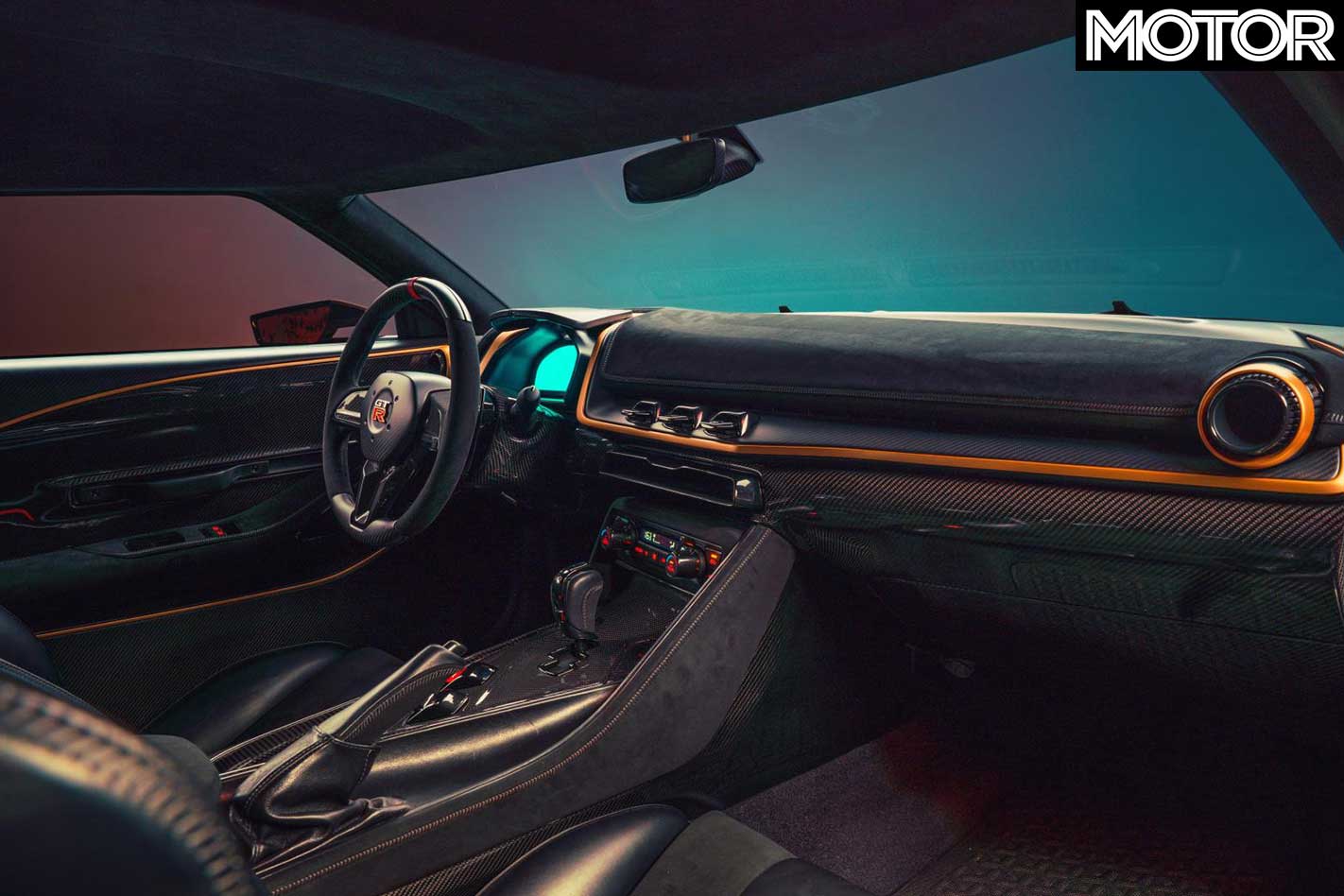
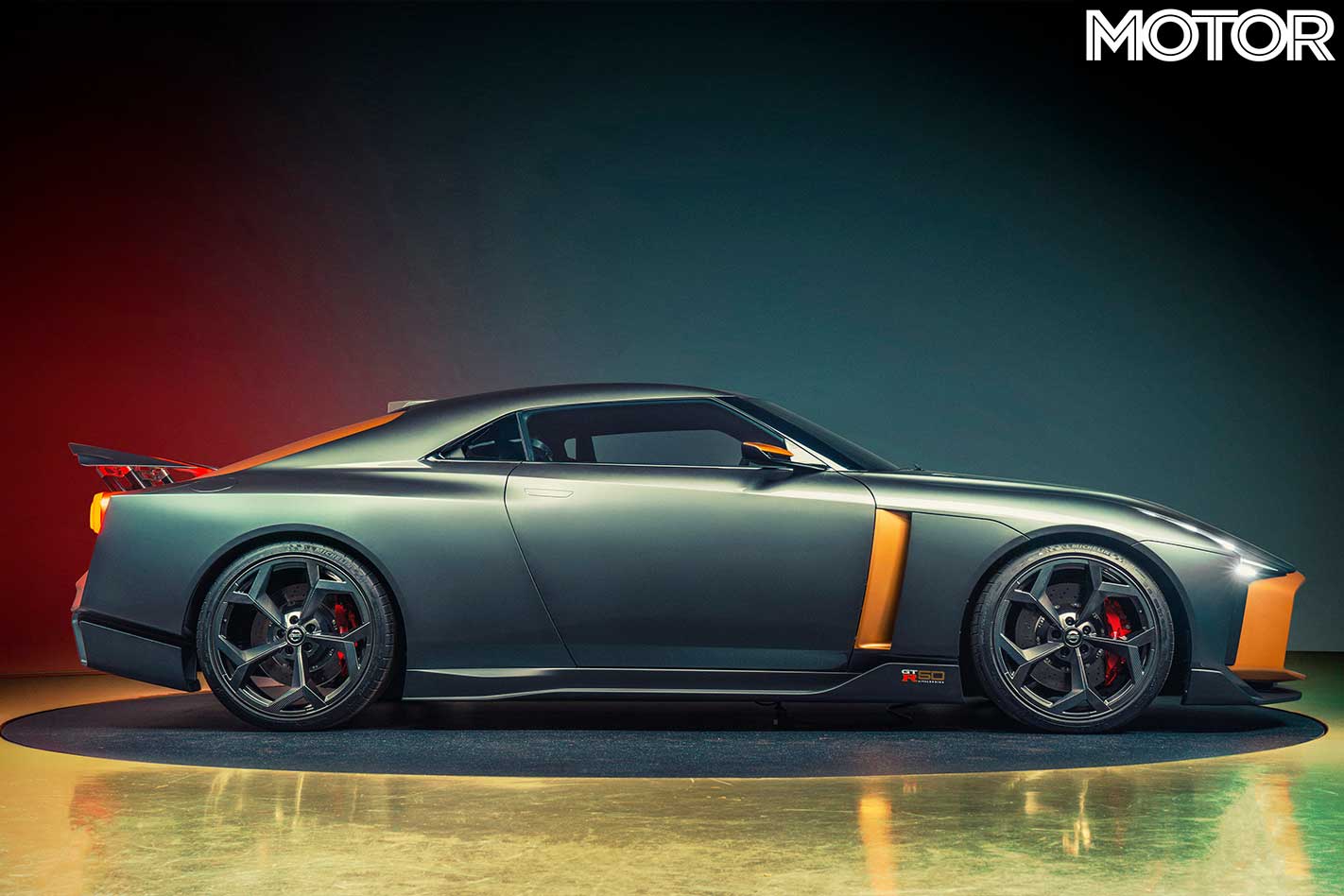
Regardless, it looks wicked, from every angle, and the production cars will depart from the grey-and-gold concept car (and the bright blue production prototype) to whatever the hell the customer wants them to be.
And the base spec (it’s always a base spec) can be turned into almost anything a customer is willing to pay for, so no two GT-R50s will be the same. In fact, no two GT-R50s will be allowed to be the same. It’s like the GT-R50 equivalent of the first rule of Fight Club. If someone claims your preferred specification first, well, bad luck, find another one.
“It’s a GT-R without limits,” Nissan global design chief Alfonso Albaisa said. Hard to disagree.
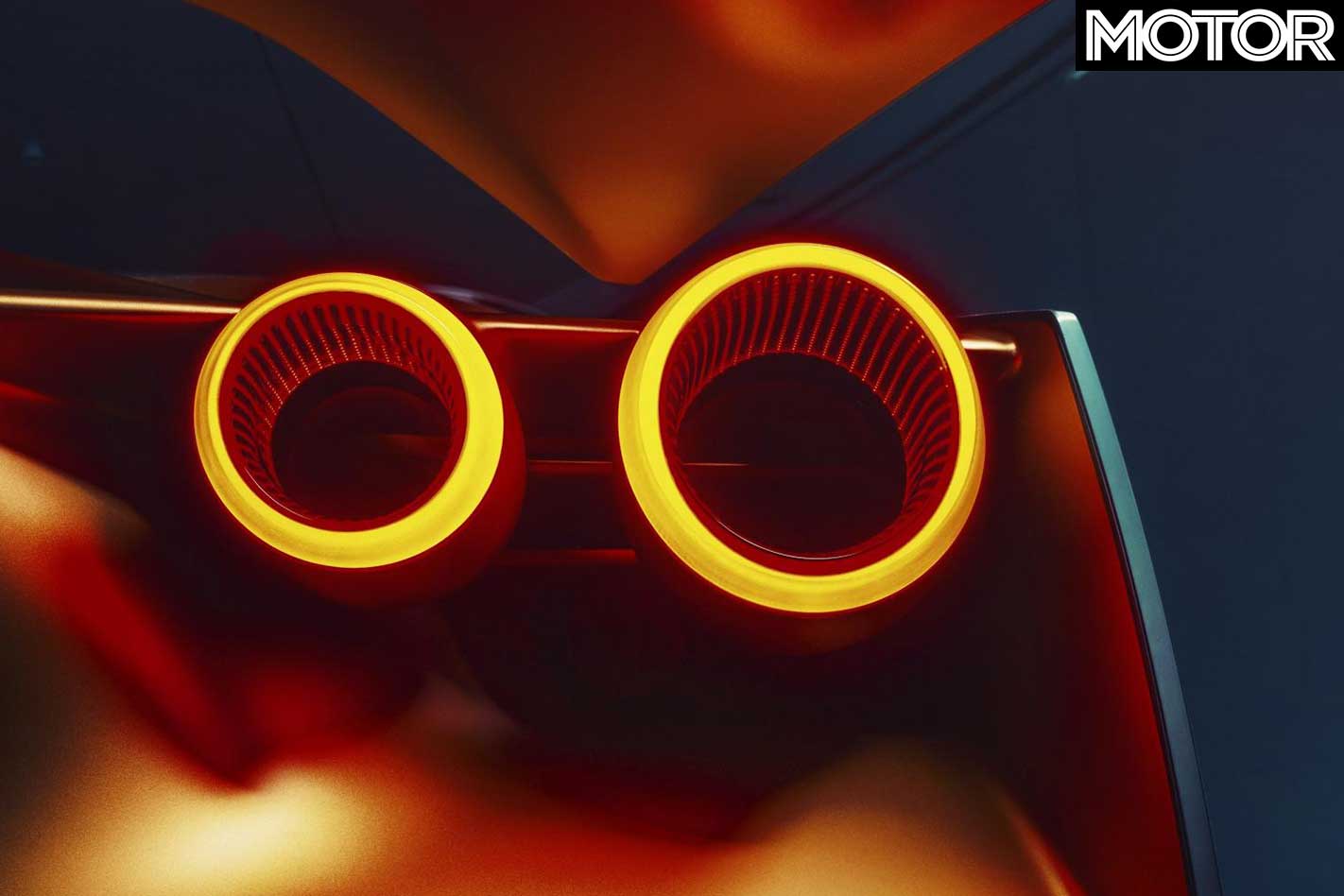
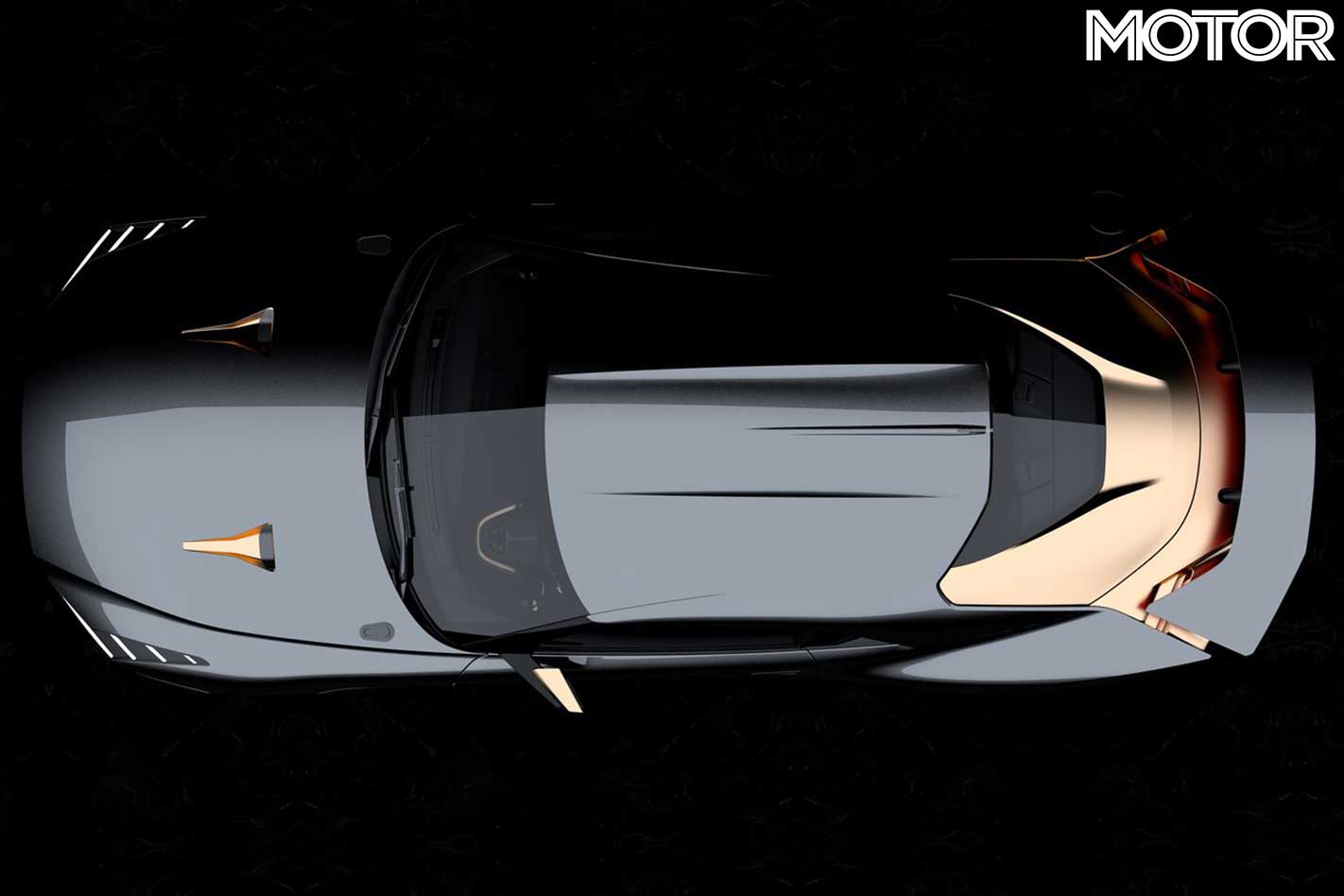
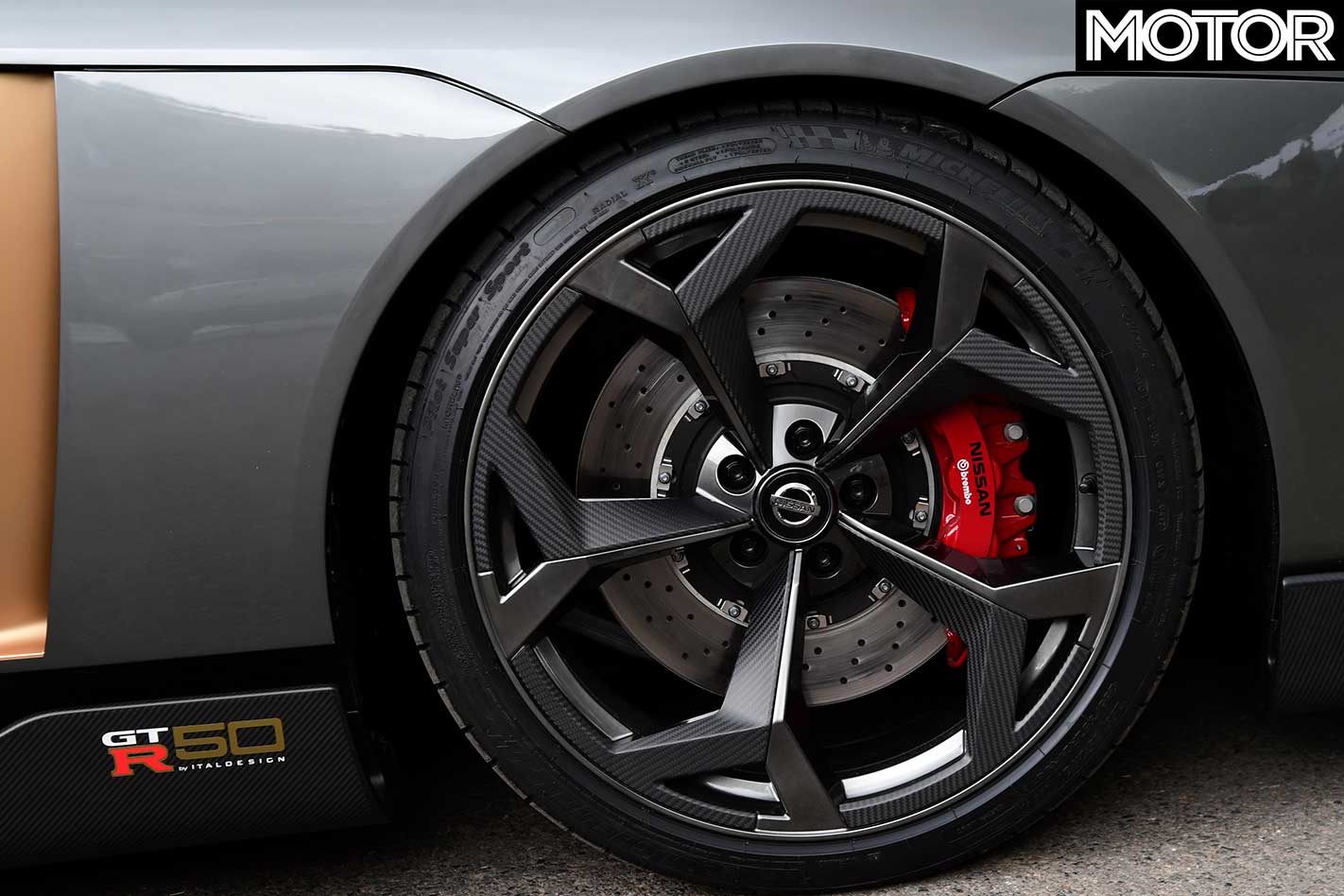
This car is instantly familiar yet totally new, with every crease hinting at the stock GT-R but moving the game forward aggressively, even brutally, right down to a roofline that’s more than 50mm lower. It boasts of its Samurai blade behind the front wheels, but the lights are also new, the rear wing is now adjustable by the driver, and it all rides on custom 21-inch wheels and Michelin Pilot Super Sport tyres. The production car is not quite as faithful to the concept inside, where the motorsport-derived Motec CDL3 screen gets turfed for a standard GT-R unit, plus its infotainment screen.
The GT-R’s mighty 3.8-litre V6 gets GT3 racing turbochargers instead of the just plain wicked units on either side of the engine, but the engineering advancements haven’t stopped there. Well, they couldn’t stop there in the hunt for 530kW of power and 780Nm of torque, because bigger huffers only get you so far. The intercoolers have been drastically embiggened, there are new pistons, a new camshaft, quicker-squirting oil injectors, new pistons and a hard-core new crankshaft.
After making the engine 90kW more powerful than the GT-R NISMO, ItalDesign needed to make mechanical changes aft of the flywheel, lest it risk turning their 50 hypercars into roadside-furniture magnets.
The brakes were the first things changed, with new six-piston Brembo front calipers biting 390mm compound drilled discs, and four-piston Brembos down the back. A set of DampTronic adaptive dampers from Bilstein (who clearly need help in their damper-naming department; apply now) control the stiffer springs and anti-roll bars, the six-speed dual-clutch transaxle has been stiffened, and even the differentials and driveshafts have spent time in the gym.
But the real problem facing the GT-R50 is not the engineering. The world of the low-volume hypercar is pretty much like the world of comedy: it’s all about the timing. And Nissan’s timing may go down in history as one of the car industry’s worst ever – and there have been a few to choose from. There was Jaguar, launching the underdone XJ220 into the teeth of a global recession. There was the McLaren F1, the car still held up as the gold standard of hypercars, whose sales petered out to a trickle because of the same recession. The list goes on.
But the GT-R50’s timing has been appalling for a whole different reason. See, for all its power and fury, the GT-R50 is set to become the flagship of a carmaker embroiled in one of the most outrageous self-inflicted corporate firestorms in automotive history.
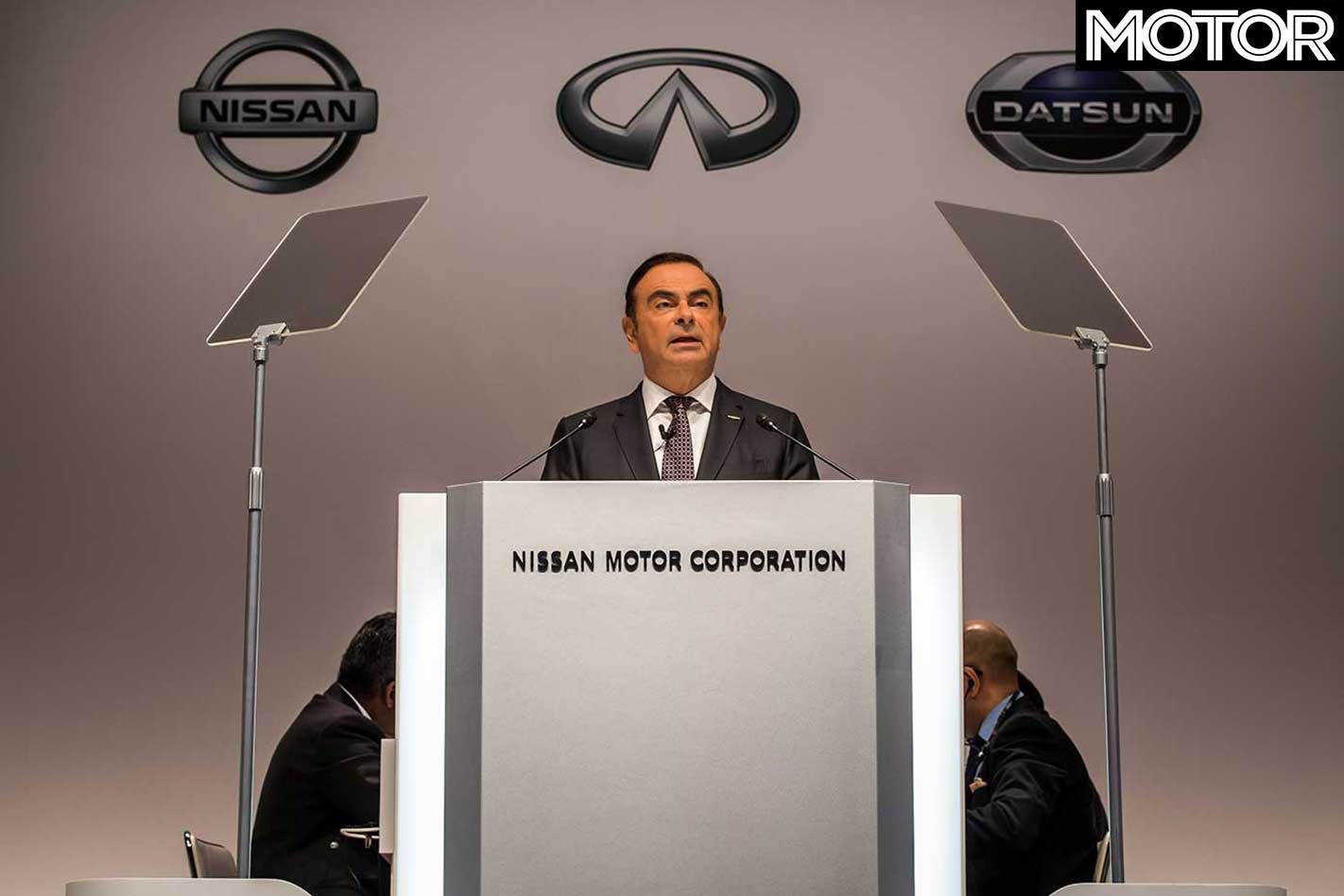
Recently dumped chairman Carlos Ghosn languishes in a Tokyo holding cell, and Nissan stands accused of picking a petulant fight with its majority owner, Renault, over being told what to do. And it was all started by a CEO who was due to be fired by Ghosn but decided to get in first in the hope of stopping an actual merger with Renault.
Nissan is 43 percent owned by Renault (after being bailed out of bankruptcy 20 years ago), and begrudges being beholden to the French. It’s stroppy that it makes most of the money but its own shares in Renault are non-voting, so it makes none of the big decisions. So the timing of the GT-R50’s launch is kind of not good for a whole set of reasons that have nothing to do with its mega speed or ultra-exclusivity or drop-dead gorgeousness.
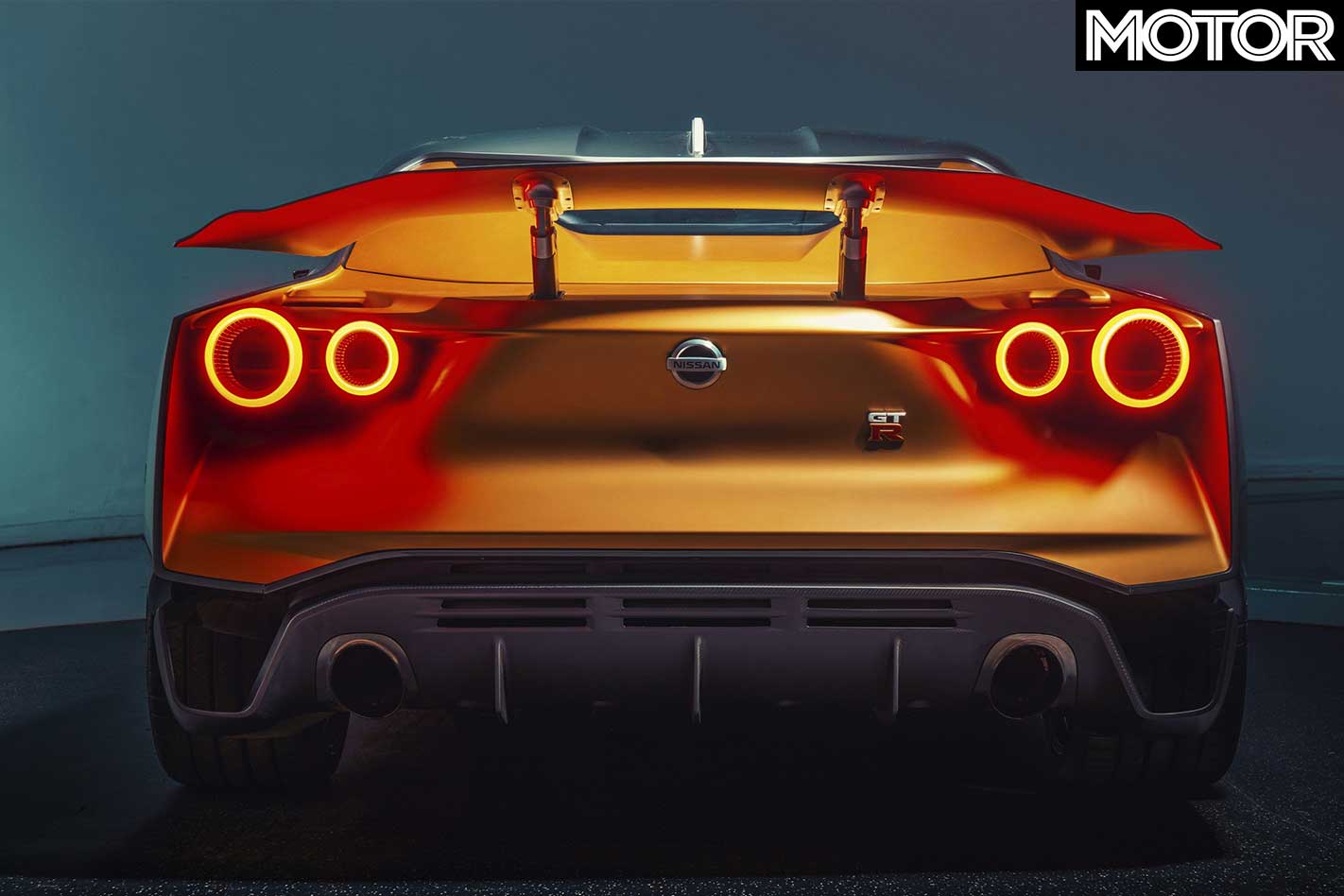
See, the 990,000 euro megacar (AUD$1.5 million plus hold-your-breath taxes here) will be sent out as a halo car in 2019 and 2020, to see how far upstream the GT-R badge’s track cred can stretch the Nissan brand and as a celebration of the 50th year of the first GT-R. And investors and collectors – the kind of people who will buy this car, speed or not – don’t like turmoil.
While that puts a huge question mark over whether enough people will still think Nissan’s brand can carry a million-euro car, the GT-R50 promises to be a monster.
And it will work like this: the GT3-aided engines will be built in a cleanroom in Japan and bolted into the 50 Italian-bound GT-Rs, along with the new transmission and the uprated suspension, and put on a boat. Then they’ll end up in Turin, where ItalDesign will give each of them their own bodywork, including a replacement roof, and their own interior, plus the anchor system from over near Bergamo.
And then, probably, they’ll head off into humidity controlled garages and nobody outside those 50 wealthy owners will ever see them again. But you can assume now that none of those 50 people will be Carlos Ghosn.
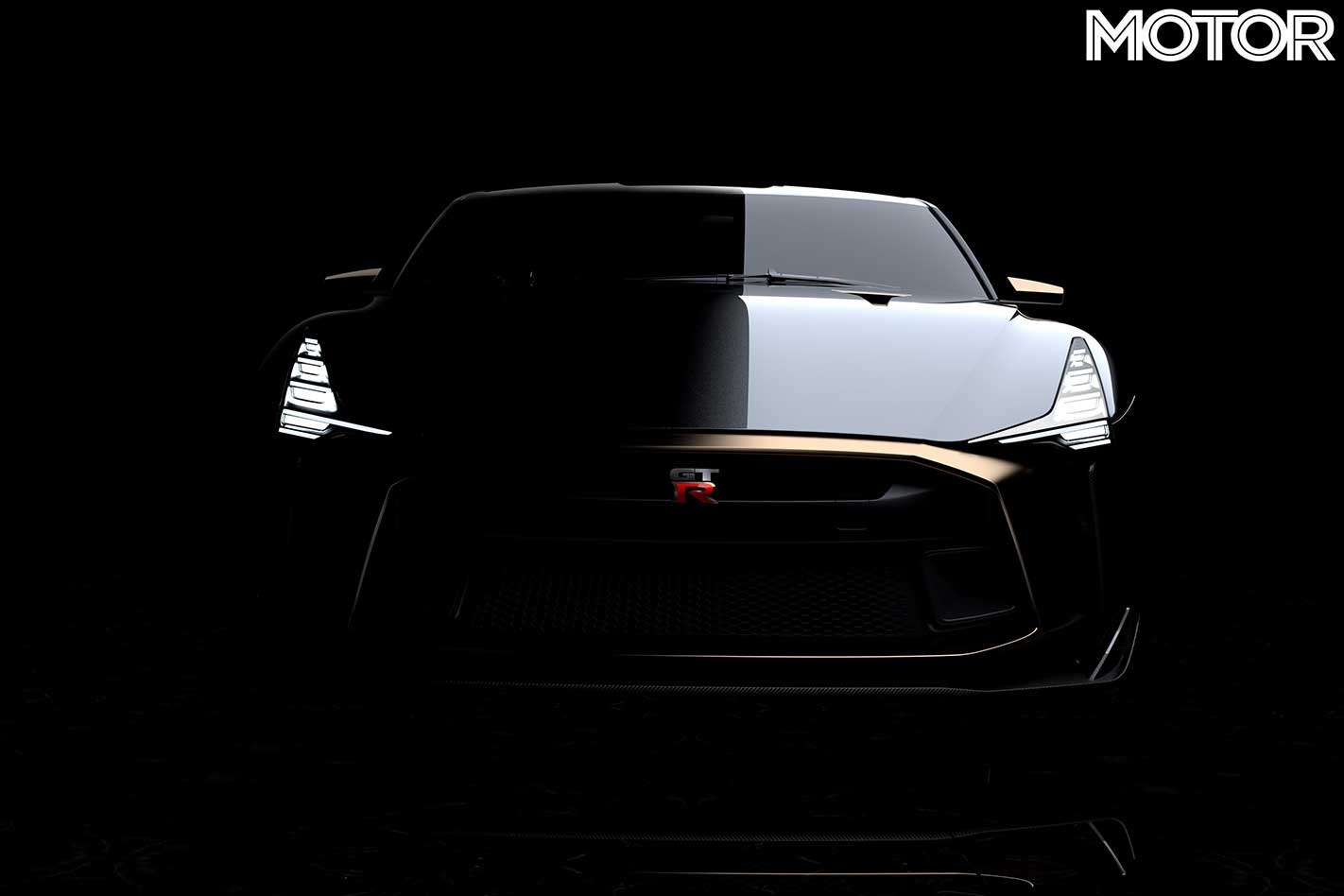
FAST FACTS Italdesign Nissan GT-R50
BODY: 2-door, 4-seat coupe DRIVE: all-wheel ENGINE: 3799cc V6, DOHC, 24v, twin-turbo BORE/STROKE: 95.5mm x 88.4mm POWER: 530kW TORQUE: 780Nm WEIGHT: 1700kg (estimate) TRANSMISSION: 6-speed dual-clutch L/W/h: 4700/1905/1365mm PRICE: AUD$1,567,000
From Concept to Production
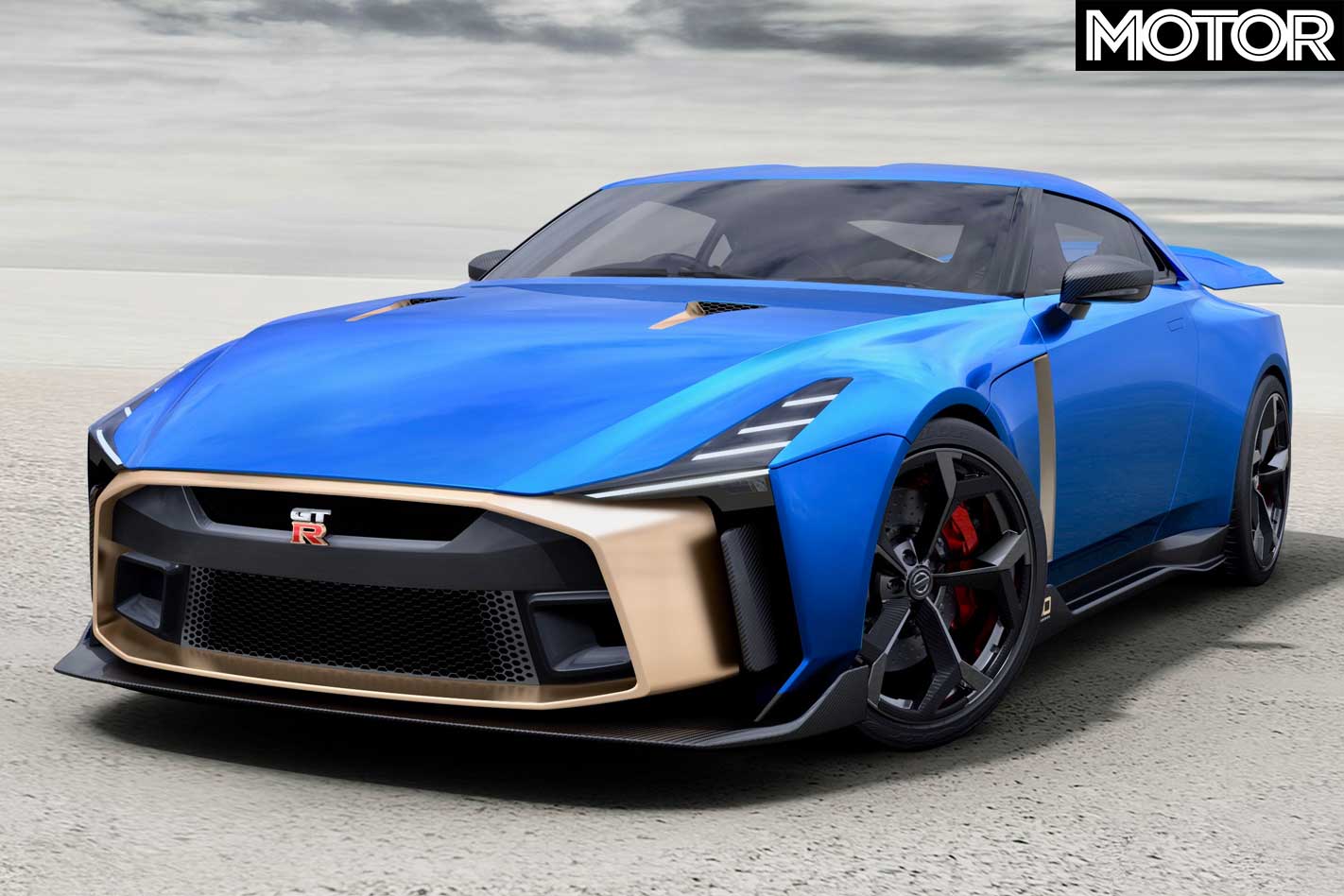
Our dark and moody images are of the initial GT-R50 concept car – however, surprisingly little will change in the transition from concept to road car. The most obvious tweak is the fitment of more road-friendly side mirrors, but there are also minor adjustments to exterior bodywork.
Most of the changes are concentrated to the interior, which can be seen in production-ready form opposite page. Much inside, naturally, is shared with the Nismo GT-R, albeit customised to an extreme degree. It remains to be seen if any production GT-R50s will reach Australia.
Five things that make the GT-R50 Epic
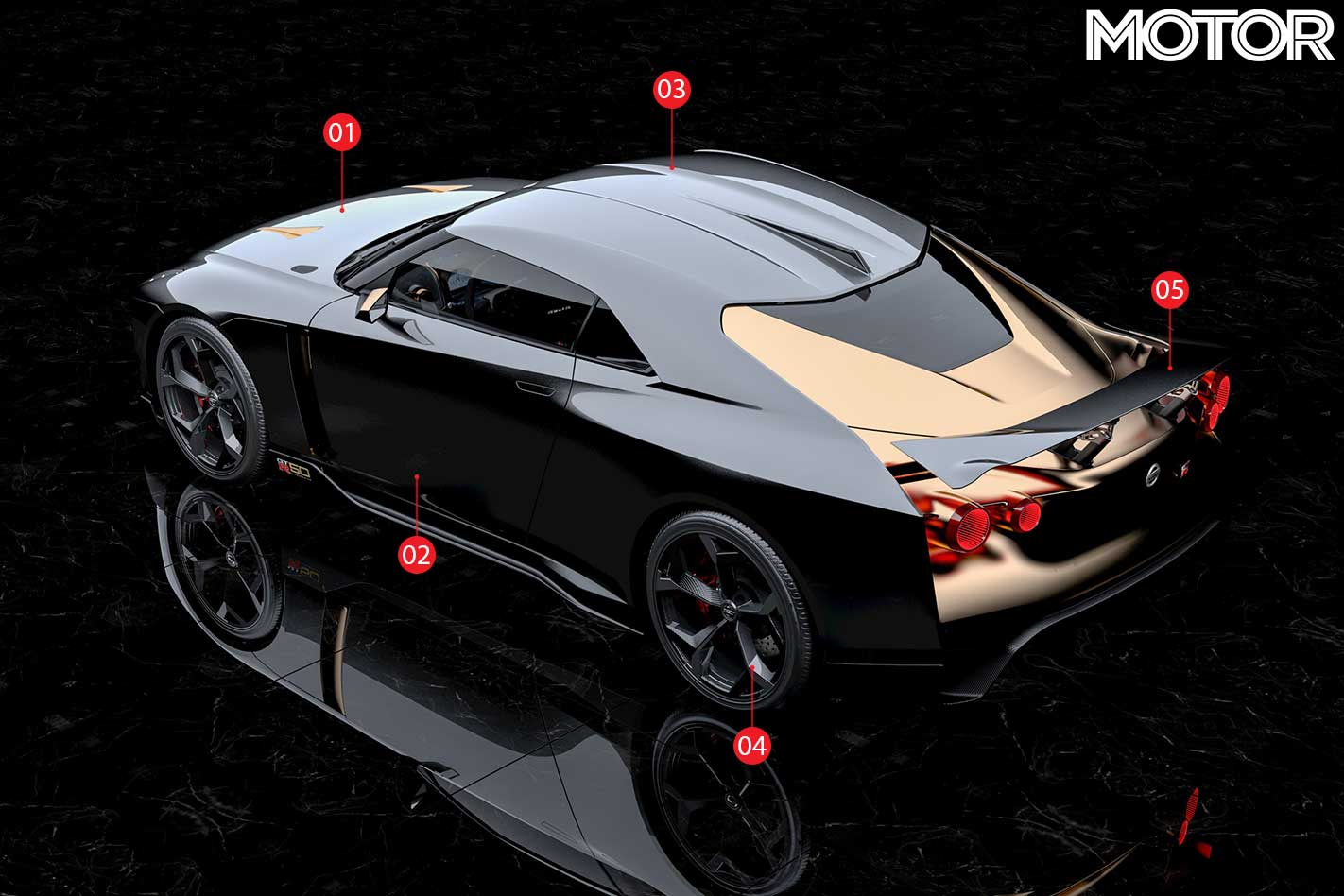
01 – Bigger turbos and massive internal changes result in a boost of some 90kW and 128Nm over even the GT-R NISMO 02 – Six-speed dual-clutch transaxle, diff and even driveshafts get upgraded to handle the massive extra performance 03 – Roof lowered by a little more than two inches (5.3cm) over a stock GT-R 04 – Custom 21-inch wheels shod with Michelin Pilot Super Sport rubber shrouding upgraded Brembo brakes 05 – Active aerodynamics, with the rear wing controllable by the driver from the cockpit
ON THE face of it, powering a car with a hydrogen fuel cell endows it with all sorts of benefits. Its only tailpipe emission is water, it has the same silent tractability of an EV and it overcomes the biggest headache of a battery-powered vehicle in that it can be ‘recharged’ in mere seconds at a bowser. What’s more, you’re not forced to carry hundreds of kilograms of batteries everywhere you go.
Then you consider the process for getting the liquid hydrogen into your vehicle and wonder whether it’s really such a smart idea. The fuel requires a lot of energy to produce, and in Australia, that means coal-fired power stations creating the electricity required to drive the process. Then it will be transported in a diesel truck to a servo, whereupon you drive it around in your car, converting this expensively-created hydrogen back to electricity once again.
Until renewables like wind and solar contribute around 25 percent of the grid’s power – and in Australia it is hovering around 17 percent – it makes more environmental sense to put that energy to work replacing coal-fired capacity in the first place rather than using it to make liquid hydrogen. As it stands, it’s a poor displacement. Factor in the dollar cost of production and the fact that the only hydrogen bowser in Australia is, at present, located in Hyundai’s north Sydney HQ, and the tech looks like the most terminal of dead ends.
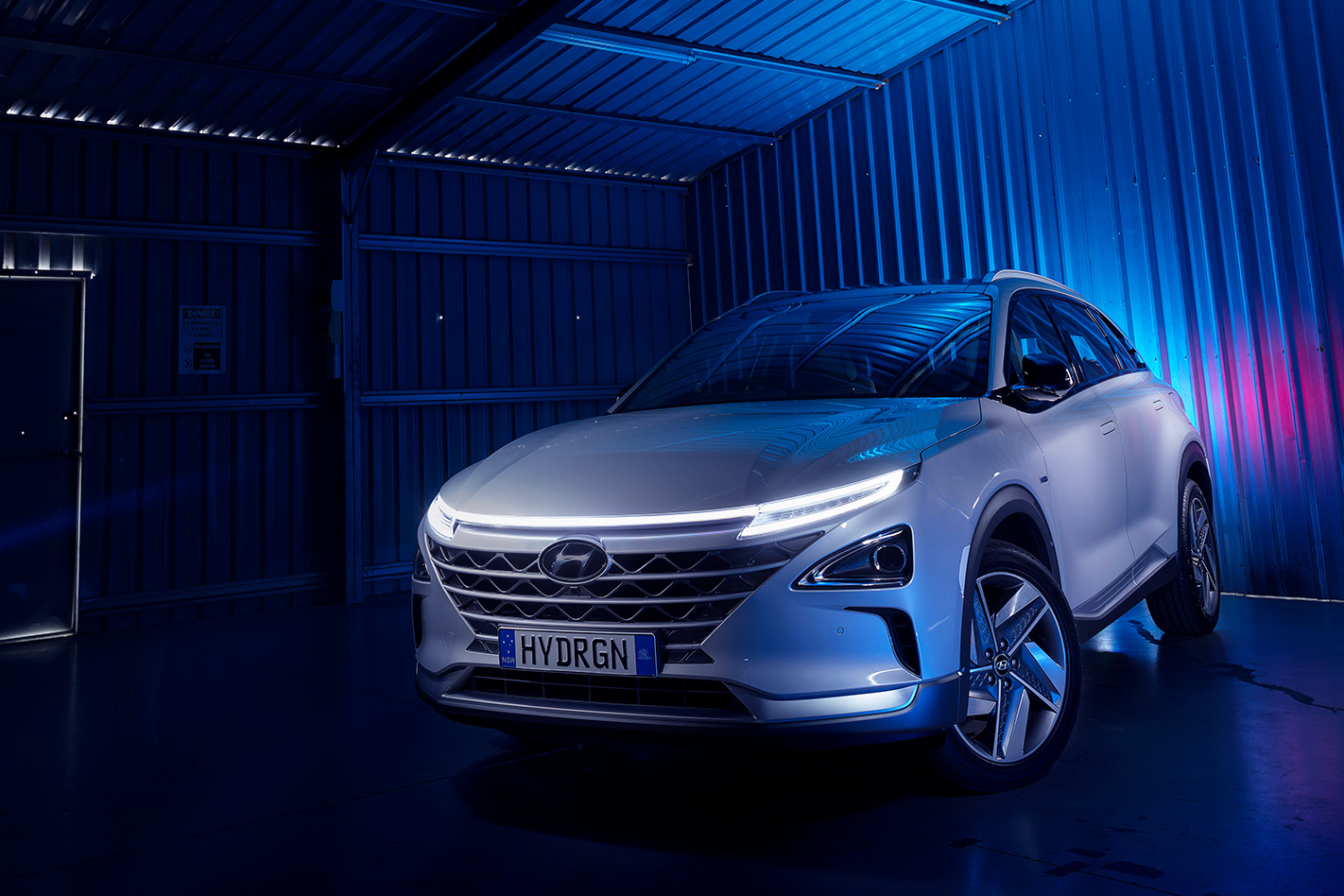
Drive Hyundai’s Nexo for five minutes, however, and you start trying to make the case for the hydrogen fuel cell. It feels like the future, a mobile motivational poster for overcoming all of the objections I’ve just mentioned. With some political gumption, they are all surmountable. We could go back and forth all we like about how the mining lobby skews the political agenda here, but at some point sooner than we think, Australia’s hand will be forced by international carbon dioxide obligations. When – not if – that happens, perhaps hydrogen-powered cars can step into the breach. Hyundai is already trying to subtly influence the decisions in Canberra, agreeing to supply 20 Nexos this year to the ACT Government as part of the Hornsdale Wind Farm project.
The Nexo is the Koreans’ second stab at a production FCEV (fuel cell electric vehicle). Its first was the ix35 FCEV, but since that car appeared in 2012 the technology has been refined, such that the Nexo now has a range of 800km, some 206km more than the old ix35 could manage on a tank. Power and acceleration have also improved. The fuel cell stack has been designed in-house by Hyundai, another example of the company’s formidable vertical integration. Another area where the Nexo moves the game on is in its cold start capability, admittedly of marginal benefit to most in this market. Of more interest is its hot weather ability that has also been improved, the car running reliably in temperatures exceeding 49 degrees Celsius.
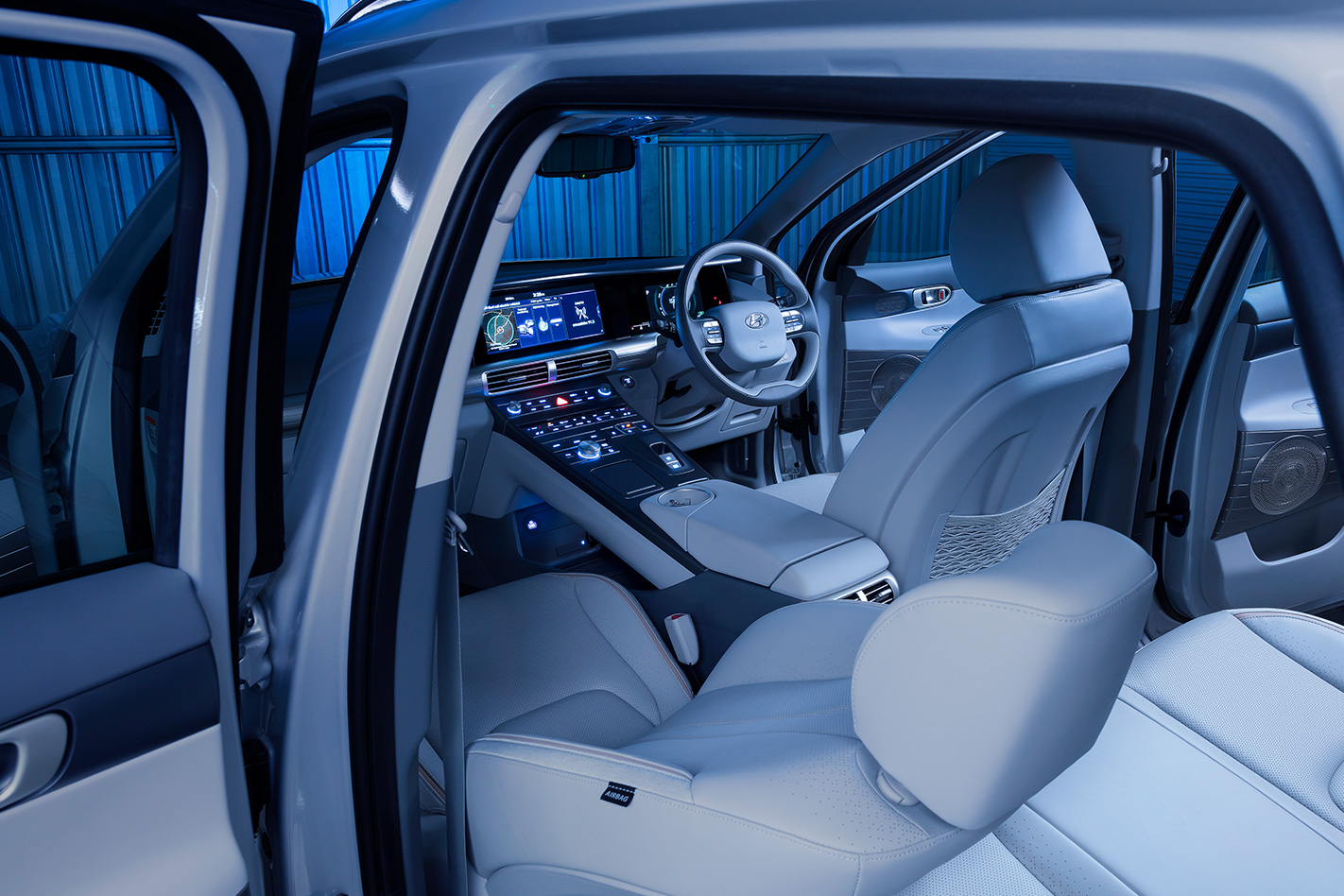
At 4670mm long and 1860mm wide, the Nexo is almost as big as the seven-seat Santa Fe, but it sits lower and looks sleeker, shrugging off its generous sizing. Sit inside and you’d be forgiven for thinking you were in a Lexus product given its button-heavy centre stack, muted colour palette, large LED displays and ostentatious speaker grilles. The infotainment system is unlike anything I’ve seen in a Hyundai and responds to both prodding the screen and rotating/clicking a console-mounted dial.
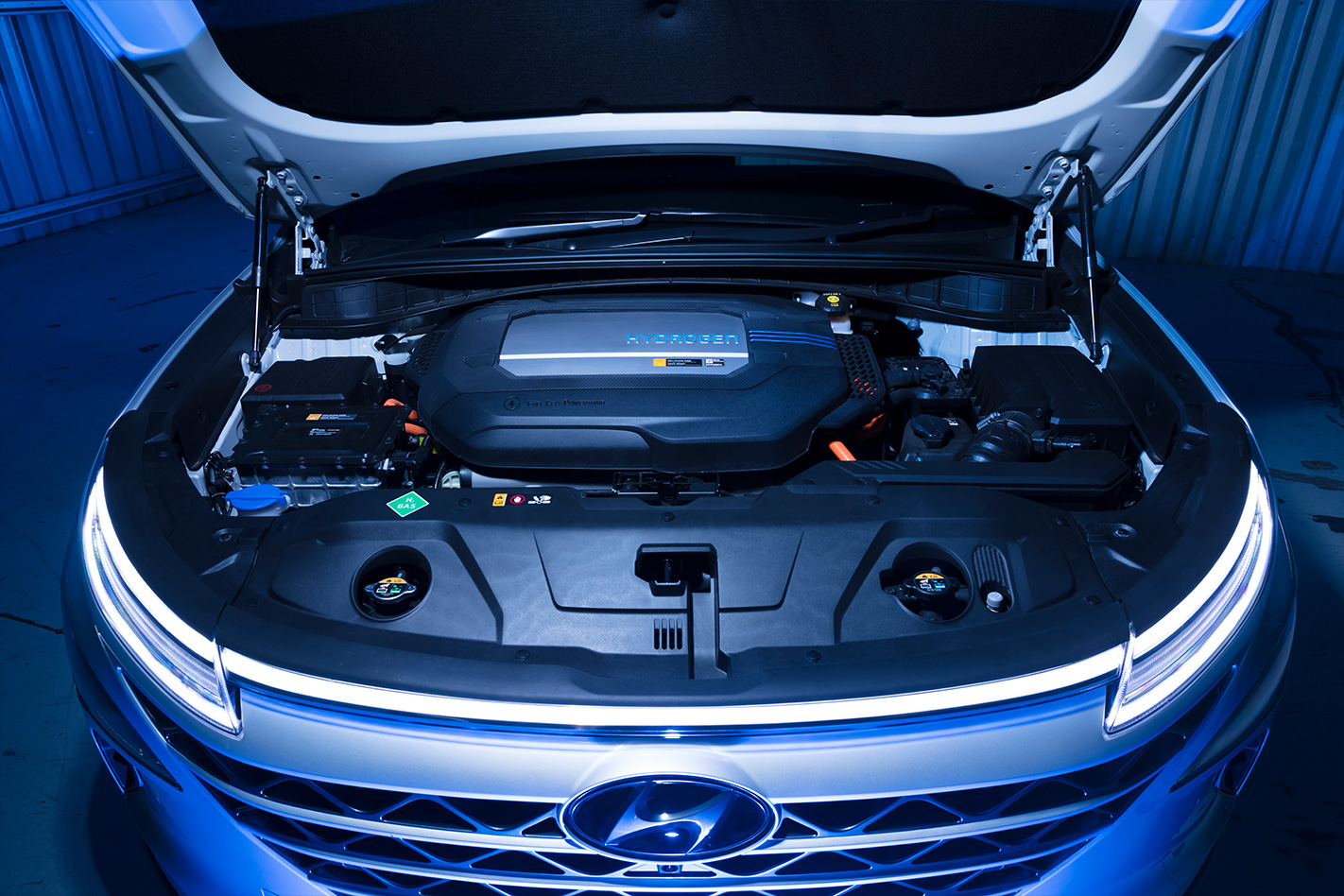
Unlike the old iX35 FCEV, the platform has been designed from scratch to accommodate the hydrogen drivetrain, so the three reinforced IlJin Composites-built hydrogen tanks (carrying a total of 156.6 litres, or 6.33kg, pressurised at a massive 700bar) are cleverly positioned in a way that doesn’t materially compromise space in the cabin. The three scuba-like tanks sandwich the rear axle, two ahead and one behind. Hyundai has fired armour-piercing bullets at the tanks to test their durability, so there’s little chance they’ll go up like the Hindenburg if you get involved in a bingle. It’ll seat five, will carry up to 839 litres of luggage with the rear bench folded and because it’s housing neither an engine nor a battery pack, Hyundai has enjoyed additional freedom in the way it packages this smaller and lighter fuel-cell drivetrain.
If you didn’t know it wasn’t a conventional EV, there’s little in the way it drives that would give it away. It sounds bizarre on heavy brake re-gen, like a 1950s sci-fi spaceship, and it fires water from its exhaust at quite an eye-widening rate when you really stand on it. Its system output of 120kW/395Nm will power it to 100km/h from standstill in 9.5 seconds, but the power generation capability of the car is 95kW from the fuel cell itself and a nominal 40kW from the battery located beneath the boot floor.
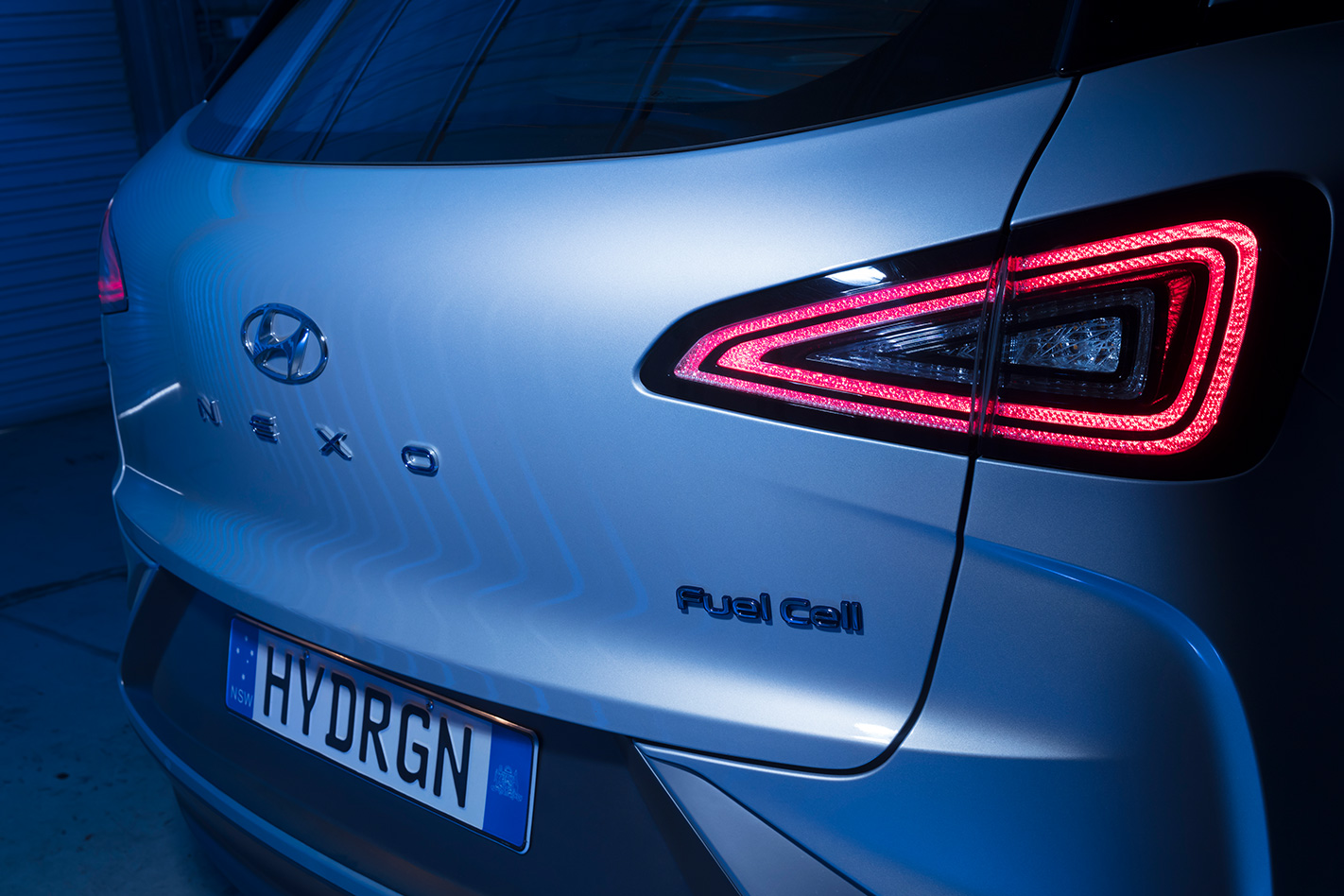
We only had the opportunity to drive this Nexo on track at Winton as it wasn’t road registered, so we didn’t get the chance to play with its formidable active safety and semi-autonomous tech. An 1814kg SUV is never going to feel at home on a race circuit, so it’s no great surprise that things get a bit understeery when you press on. The steering is odd too, with little feel and then a strangely ramped caster feel. Dial things back a bit and you can cycle through the four different re-gen modes accessed via the paddles. It’s likely you’ll settle on either Zero, which gives no engine braking, or the top level, Three, which is like a gentle brush of the brake pedal. Even in maximum re-gen, there’s not the ‘one-pedal’ driving feel that you can achieve in something like a BMW i3 or a Nissan Leaf, but it feels a bit easier to acclimatise to as a result. The recouped energy is fed into its tiny 1.6kWh lithium-ion battery.
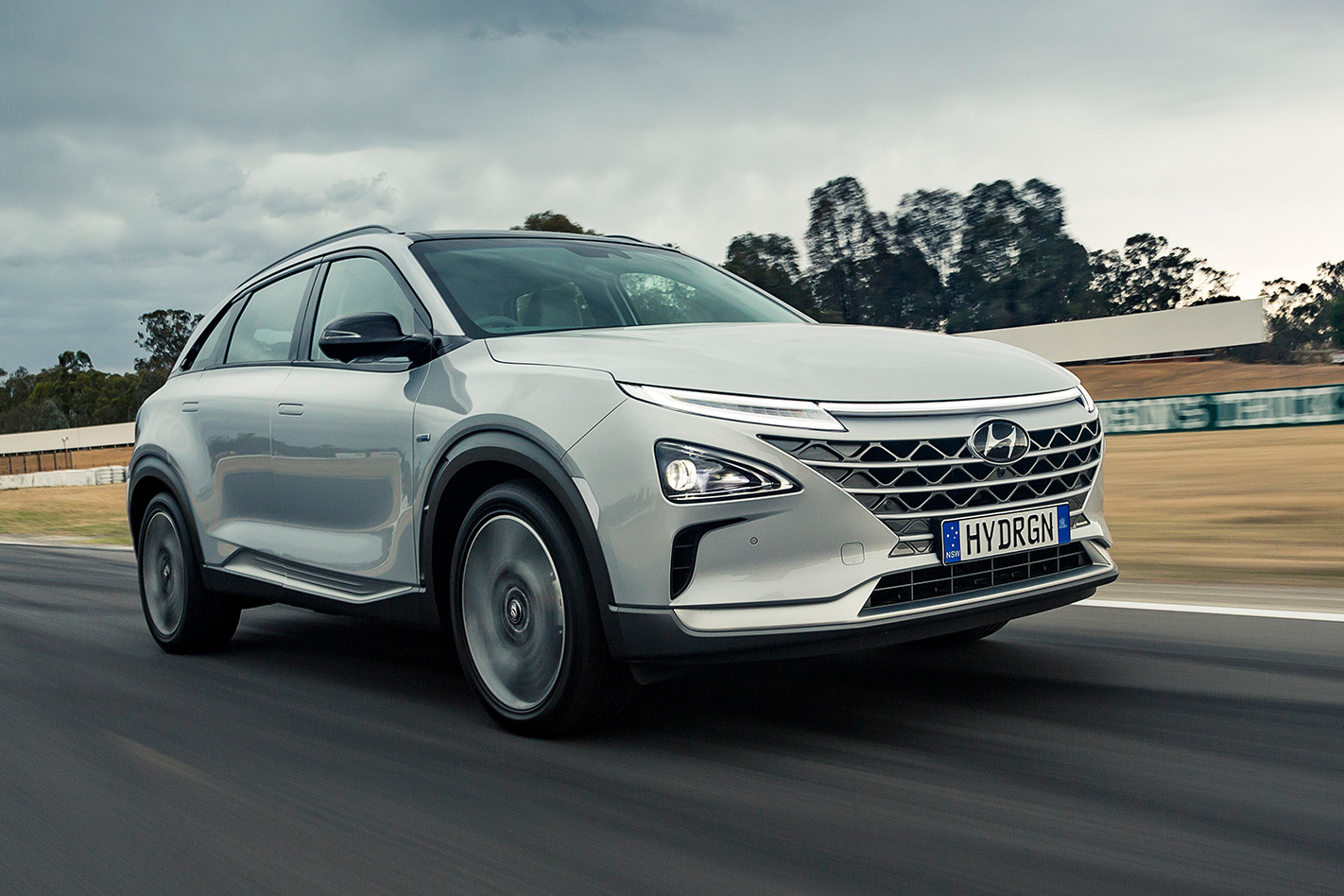
The thorny issue of pricing is another the Nexo must overcome. Were this a petrol-powered vehicle, it’d likely command a price tag somewhere in the region of $60K. Hyundai tells us that although local pricing has yet to be confirmed, it would probably be somewhere in the region of $85-$90K. If, as in many markets, hydrogen is priced at $10 per kilo, that means a refuel would be just over $60 for a real-world range of 600km or so – about on par with that of a diesel SUV. Hyundai claims that the fuel cell’s “highly durable membrane electrode catalyst and new drive control technology” gives the Nexo “unprecedented durability that is on a par with an internal combustion engine vehicle of at least 10 years and 160,000 kilometres”. That means that the stack would need to be reworked or replaced as it degrades. While 160,000 klicks might be recycling time in many markets, in Australia that’s merely middle-aged and bodes poorly for long-term residuals.
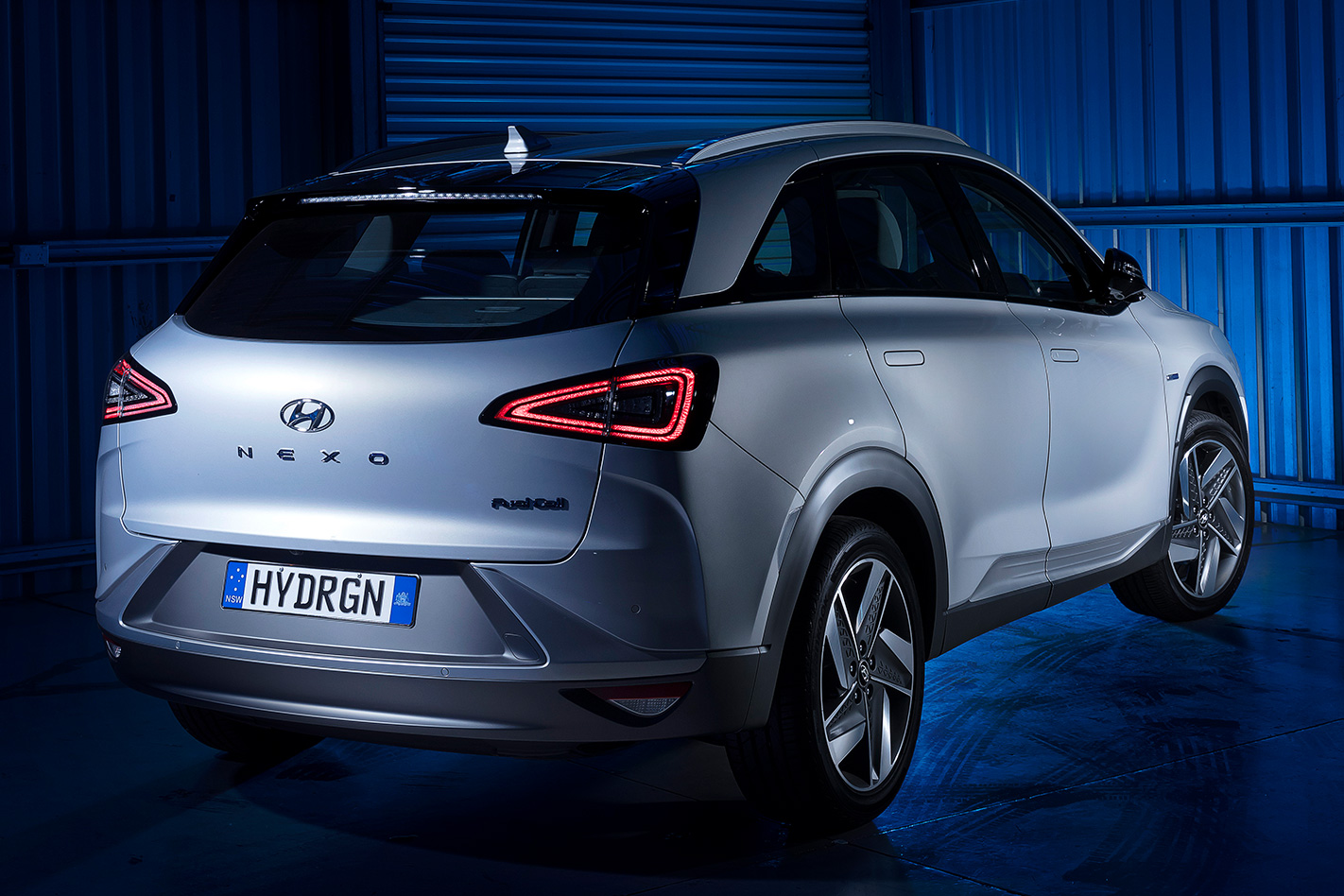
Hydrogen’s time looks likely to come. “In Australia, we have all the necessary resources to make hydrogen at scale: wind, sun, coal, methane, carbon sequestration sites and expertise,” said Chief Scientist Dr Alan Finkel in August. “It’s simply never been commercially viable. Now, the economics are changing.” The Nexo is an intriguing prospect and while it may well be the future, for the public at large it’s certainly not the present.
We’re often told, in various capacities, that aspects of how we exist today are as good as they’ve ever been. Or, taking it a step further, they’re as good as they’ll ever get.
In a motoring context, this equates to petrol combustion engines – ones sans forced induction and hybrid gubbins – being at the peak of their powers. Ever stricter emissions laws and the electric push are becoming too hard to ignore. Engines with large capacities and 12 cylinders are fast becoming endangered species.
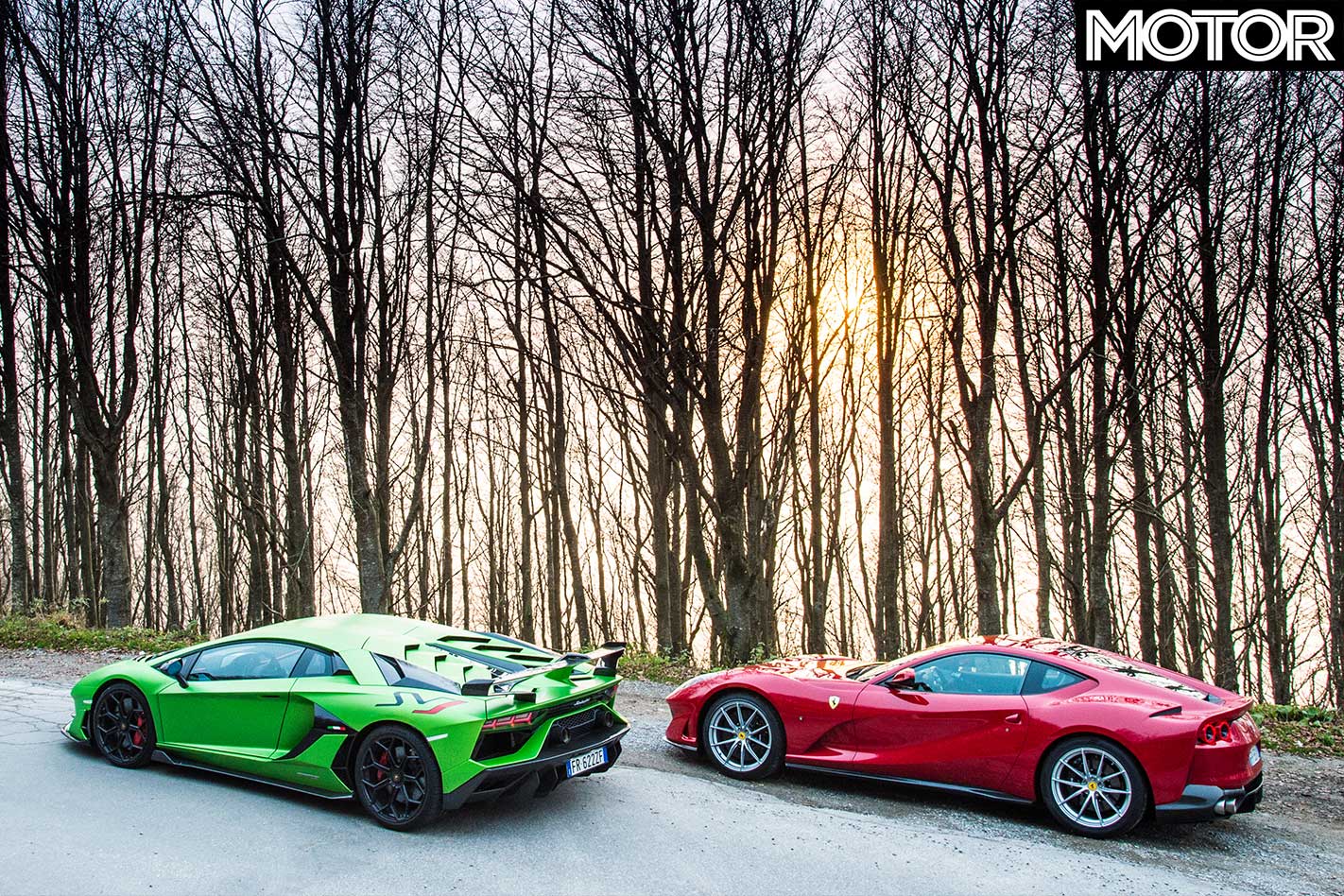
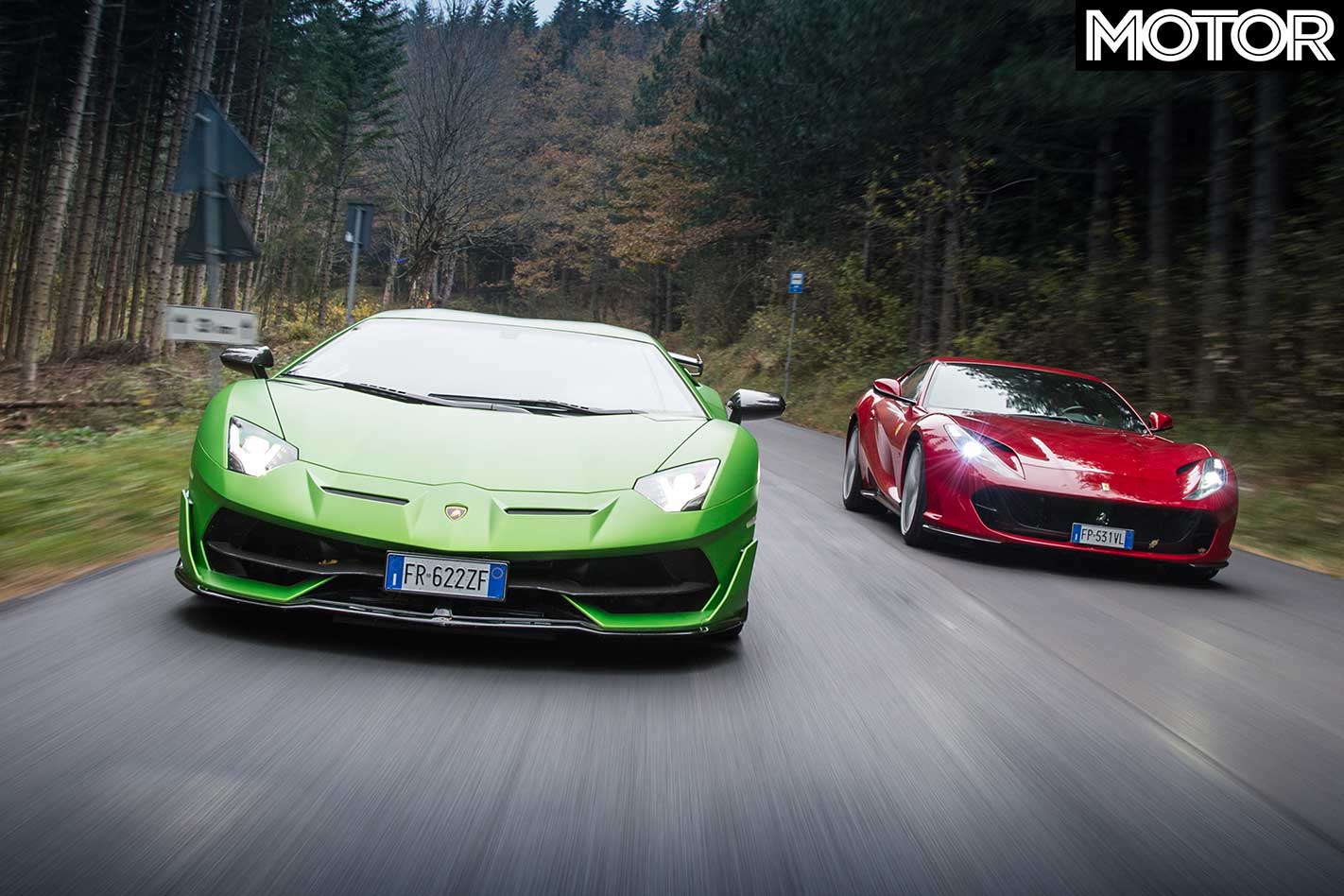
So take this feature as more of a celebration than a comparison, for the Lamborghini Aventador SVJ (limited to 900 sold-out units priced at $949,640) and Ferrari 812 Superfast ($609,888) are the pinnacle of the breed.
These Italian thoroughbreds take automotive porn to the next level. It’s just a shame the thunderous acoustics that emanate, somehow being a sound you feel as much as you hear, can’t be truly heard via these pages. The V12 engine is a rarity in any shape or form, but it seems the unique, pure emotion both of these bona-fide supercars conjure might be, sadly, on borrowed time.
The displacement of the two glorious V12s is virtually identical at 6496cc for the Ferrari and 6498cc for the Lambo. Bore and stroke are not far apart either, with 94.0 x 78.0mm and 95.0 x 76.4 respectively. The same applies to the cut-out speed, where the Superfast eclipses its rival with 8900 against 8700rpm.
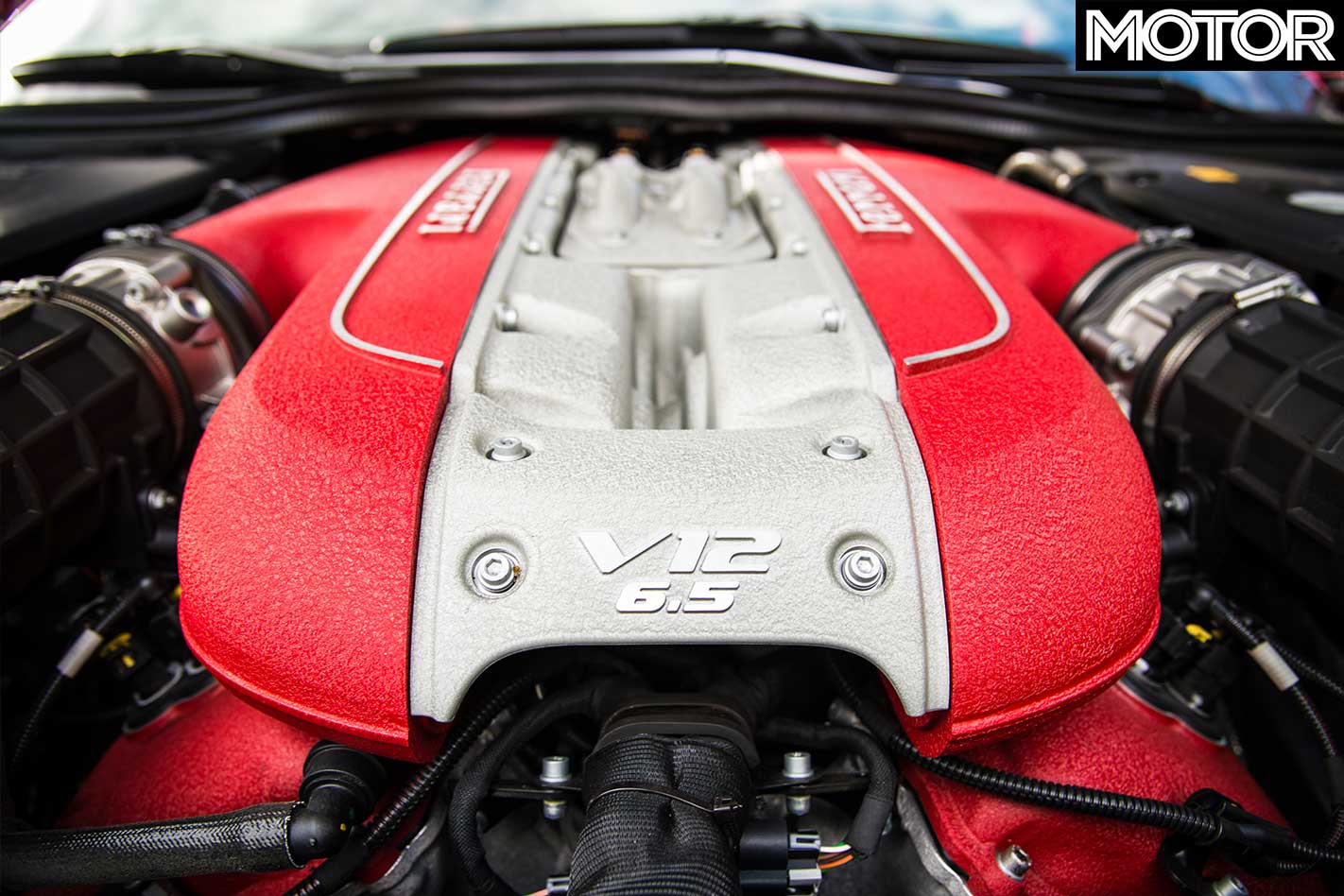
Thanks to the notably higher compression ratio, a variable-rate, free-flow intake and exhaust system, and the more pronounced willingness to rev, red bests green in terms of power. Maranello rules with 588kW against Sant’Agata’s 566kW, but the tables are turned in terms of torque, with the Lambo mustering 720Nm against the Ferrari’s 718Nm. Both, when dry, weigh 1525kg. So it’s a fairer fight than you’d think.
However, that’s numerically speaking. In reality, while the capacities and cylinder counts are all too similar, there’s a massive difference in character here. Both aim to entice you with distinct strengths and idiosyncrasies, yet are haunted by similar inherent imperfections like exorbitant fuel consumption – although you don’t buy an atmo V12 for economy runs. Also, the magical soundtrack will be music to the ears of anyone pouring over these pages, but it can equally grate with others who don’t care for the combustion cycle.
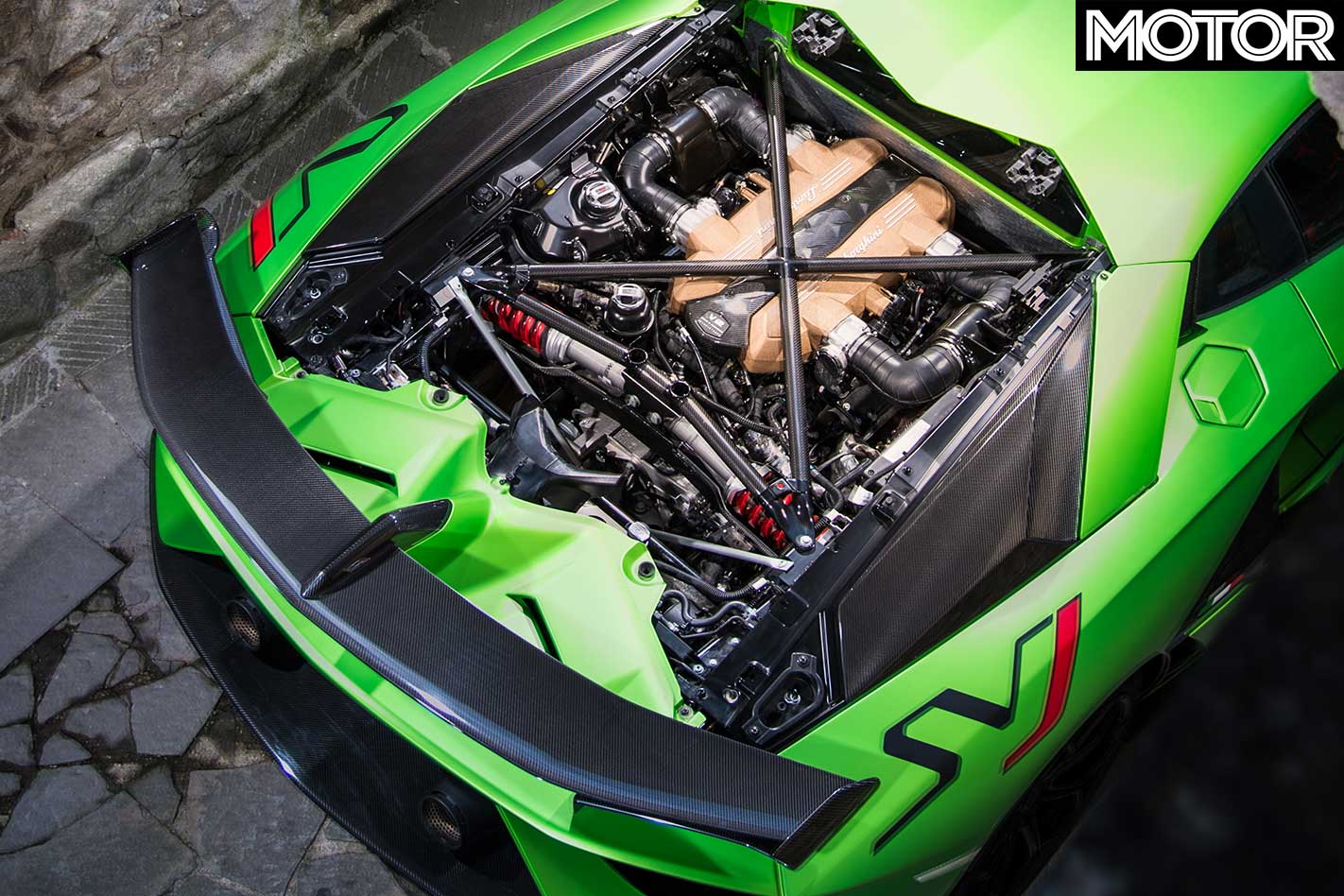
Although, in working-class Italy, where hoarse diesels and breathless three-cylinders rule, this supercar duo is received with enthusiasm and a sense of national pride. There’s no envy or finger waving at our antics. Being photographed, filmed and followed by curious fans quickly becomes the status quo.
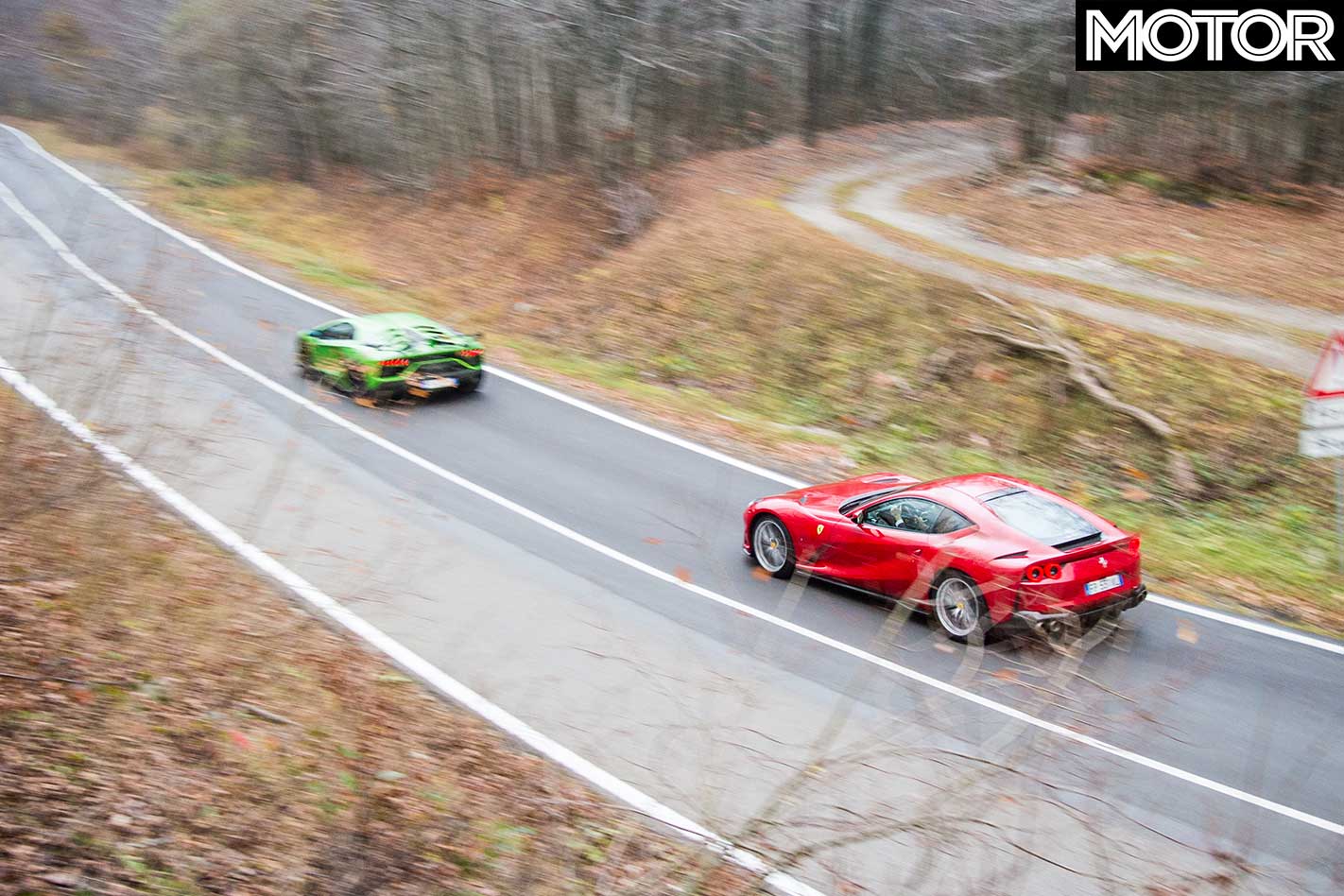
Frustratingly, the two become a hassle on lightly trafficked roads, as those same onlookers are never prepared for a fast-approaching 1154kW (combined) on poorly maintained roads. It’s safer to escape to the hinterland, where traffic disbands and corners outnumber mind-numbing straights.
High in the mountains, it’s finally time to unlock these weapons. In the SVJ, an index finger lifts the red cage door protecting the button that kicks the raging bull into life. In the 812, the starter button is within easy thumb reach on the busy steering wheel. With both angry V12s firing on all cylinders, the sound is immense, enough to send shivers down your spine and induce myriad goosebumps.
The Ferrari engine responds with vigour and settles on a high idle speed for a few seconds, substantiating its status as one of the wildest unassisted V12s in the Prancing Horse stable.
Its four camshafts and 48 valves then begin a relentless jam session. On the other side of the fence, the Lamborghini V12 first needs to remember its firing order before it’s prepared to scream into action. Still searching for the right rhythm, the idle speed eventually manifests itself, noisily clearing its many throats. A brief pull of the right paddle engages first gear, and like clockwork all the stray parts begin to work in unison.
The engine made in Maranello sounds better behaved. It is complex and massive, yet feels light-footed and emphatically urgent. In Auto and Sport modes, the transmission shies away from high revs to the point an Alfa Romeo Giulia Super feels angrier and more committed. In Manual mode, however, the rev symphony heightens gear by gear before reaching an earth-shattering crescendo. When pushed, both cars can be as noisy as the law permits.
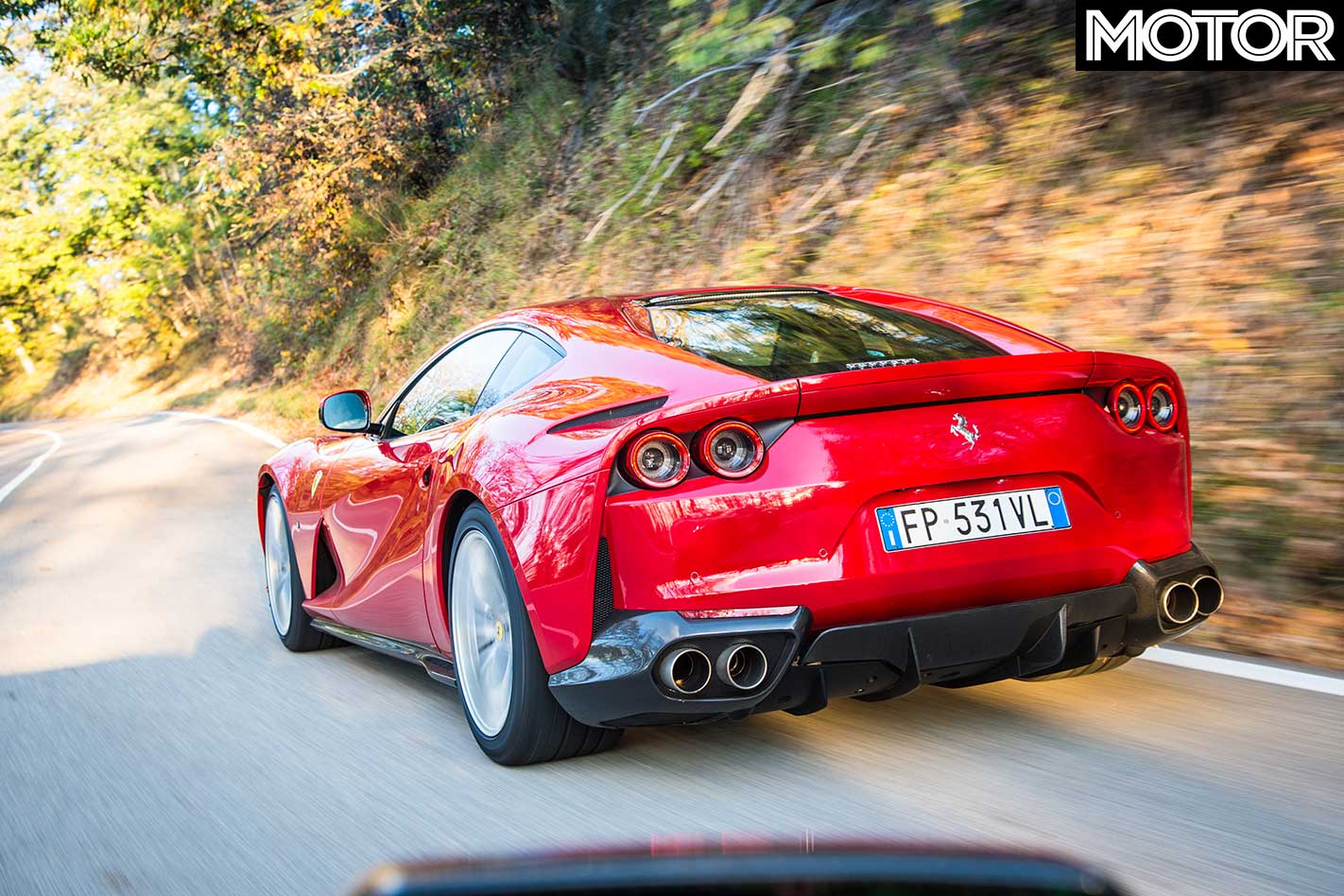
Aside from the ensemble, both of these cars are all about the performance figures. The SVJ can accelerate to 100km/h in 2.8sec, 200km/h in 8.6sec and go on to a top speed of 353km/h.
Devoid of all-wheel drive, the 341km/h 812 Superfast loses a tenth to the Aventador to 100km/h, but flips that on its head to be seven-tenths ahead by the 200km/h marker. How come? It’s all due to the Superfast’s rapid-fire seven-speed dual-clutch transmission, which changes gears without losing momentum. Conversely, the Lambo is handicapped by its jerky and slow sequential ISG transmission.
The throttle response of the Rambo-Lambo V12 is instantaneous. It’s like unleashing thunder and lightning. So you better think twice before deactivating ESP because imminent danger is only one unforeseen hazard away if you do. AWD is clearly a help, but it isn’t a saving grace given that the torque split clearly favours the rear wheels.
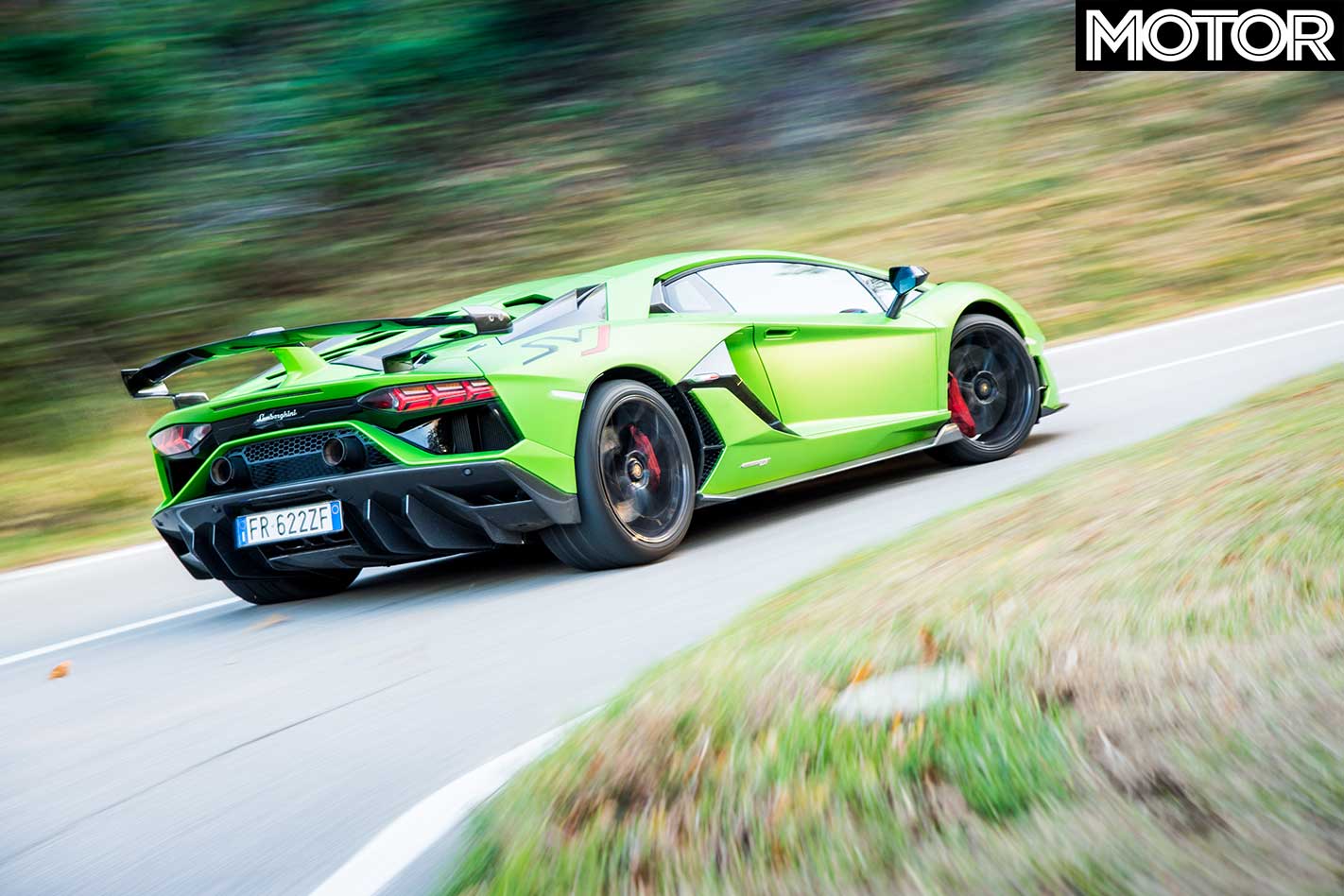
The locking action of the differential can also be parenthetical, while traction and grip are at times no more than subsets of the multi-layered roadholding capabilities. On slow and winding turf, snap understeer and oversteer are negative traits – and neither comes with an escape button.
The rear-wheel drive 812 encourages its jockey to gallop deeper and deeper into tight bends, while building plenty of momentum results in awesome lateral acceleration. You’re able to stimulate the driven wheels with generous boosts of torque while using the steering and throttle to massage the delicate cornering balance. In third gear, the engine utilises oodles of oomph from one braking zone to the next.
In fourth, short straights are inhaled whole without pausing for breath. In Race mode, full-throttle upshifts are so brutal it almost hurts. Thankfully, the brakes are simply sensational in terms of modularity, performance and stamina.
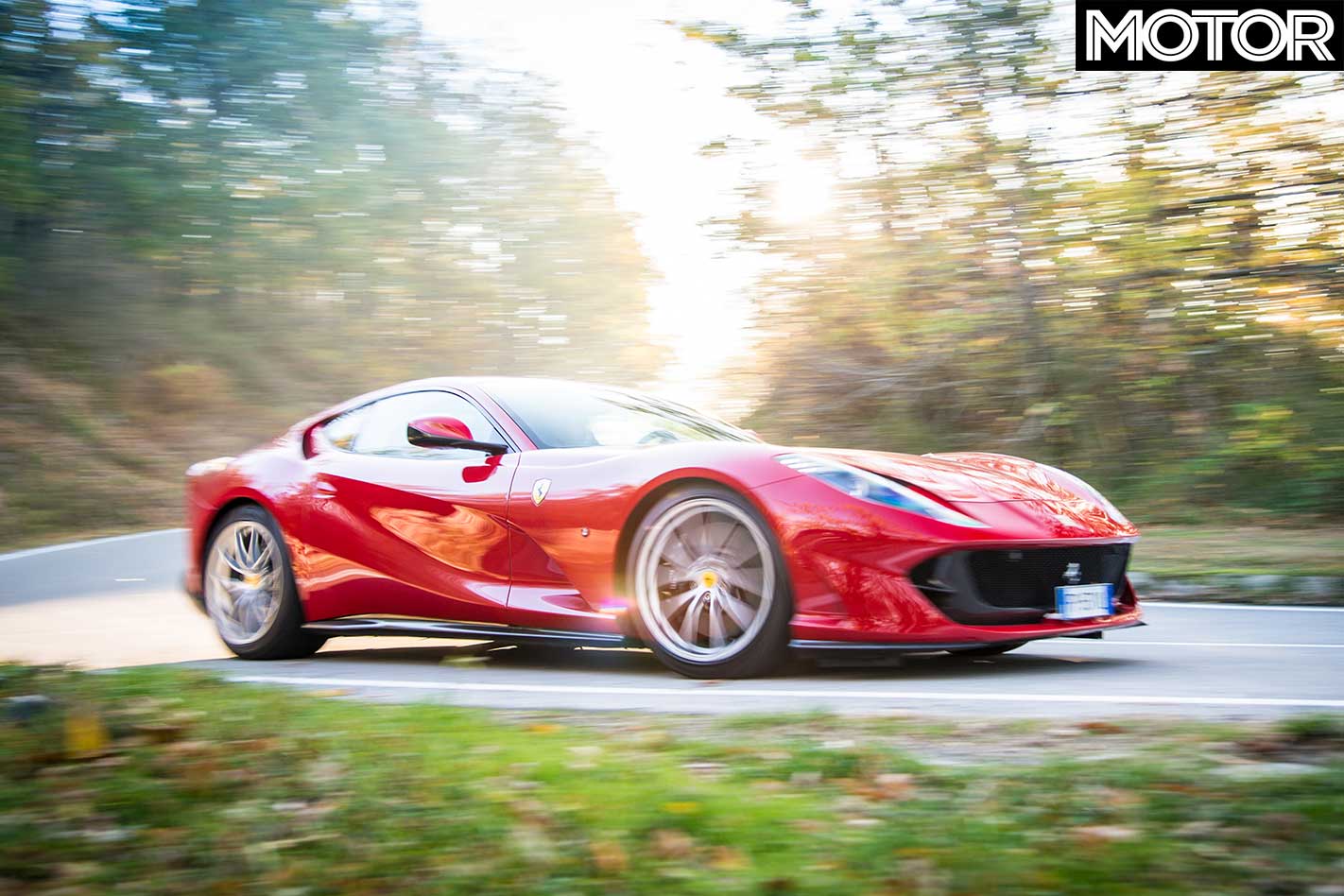
The two high-flyers hate unfinished or neglected roads. It’s not that the topography needs to be perfectly manicured, but smooth surfaces bode well. While the 812 can soften its dampers at a split-second command, the most extreme Aventador bottoms out, even in Strada mode, until the stability control light flashes. Admittedly the SVJ was never really designed for tight, European backroads.
Conversely, the Superfast feels somewhat less at home on a racetrack. Both cars feel blisteringly fast on flowing country roads or highway blasts where the incredible speed helps you cut through traffic like an invincible alien.
“Life can’t get any better than this,” is the verdict after an insane 20-minute stint in the Lamborghini. It’s utterly spellbinding and draining in equal measures, such is the intensity required behind the wheel.
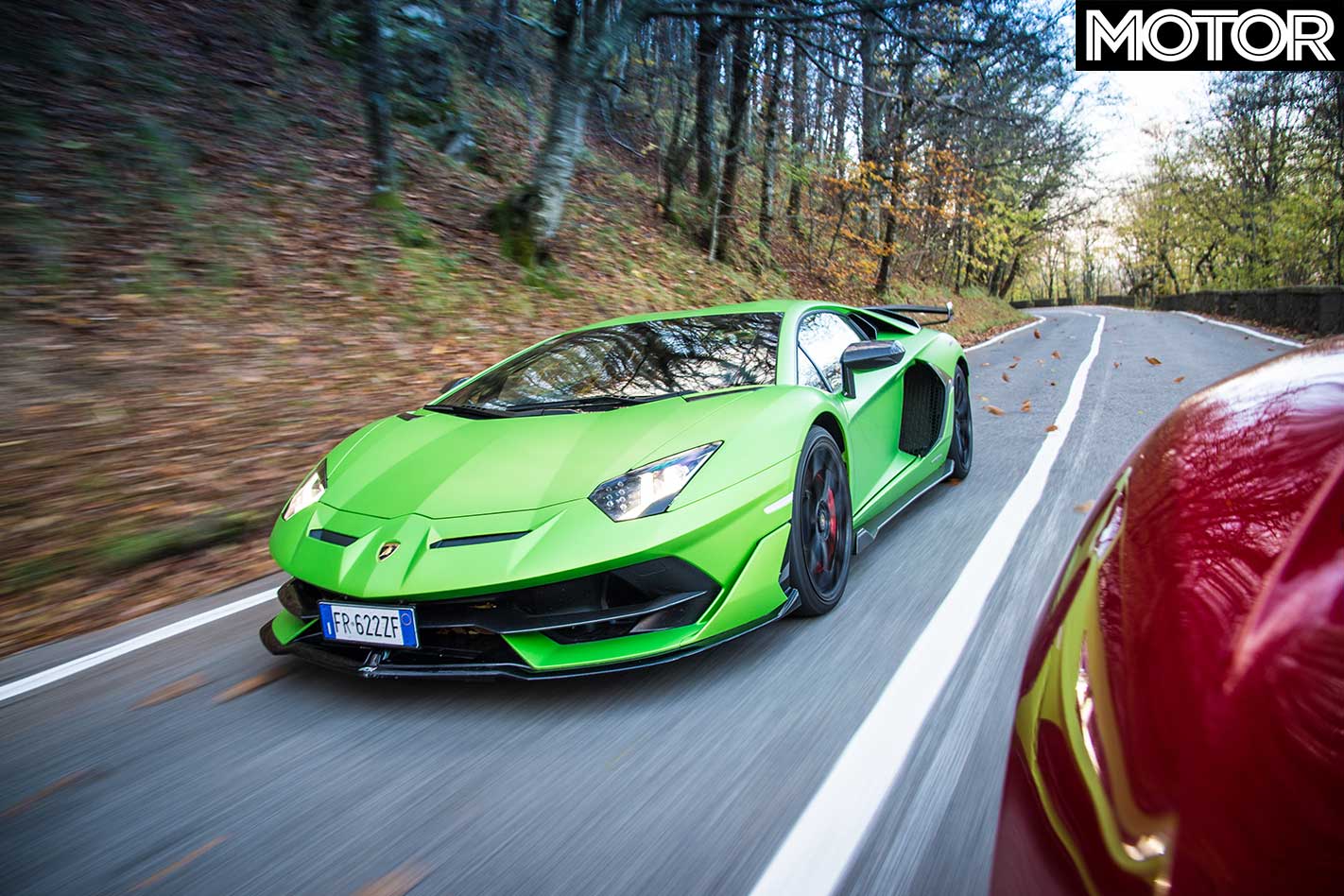
Jump into the Ferrari and the excitement and exertion levels are at the same high level despite the inherent differences between the two. After 480km, the only quality that sets them apart is about half an acre more cabin space in the Superfast.
The mid-engined and front-engined cars indulge in remarkably different road manners. In extreme, the Ferrari is quick to switch from nose-heavy to tail-happy. Under similar pressure, the Lamborghini is equally hard to work, but a touch faster to react thanks to the boon, and sometimes bane, of AWD.
Drive to the front axle helps, momentarily, pull the car out of trouble and straighten up a ragged line, but the trade-off is added weight and it numbs the steering when entering slow corners too fast, hampering manoeuvrability.
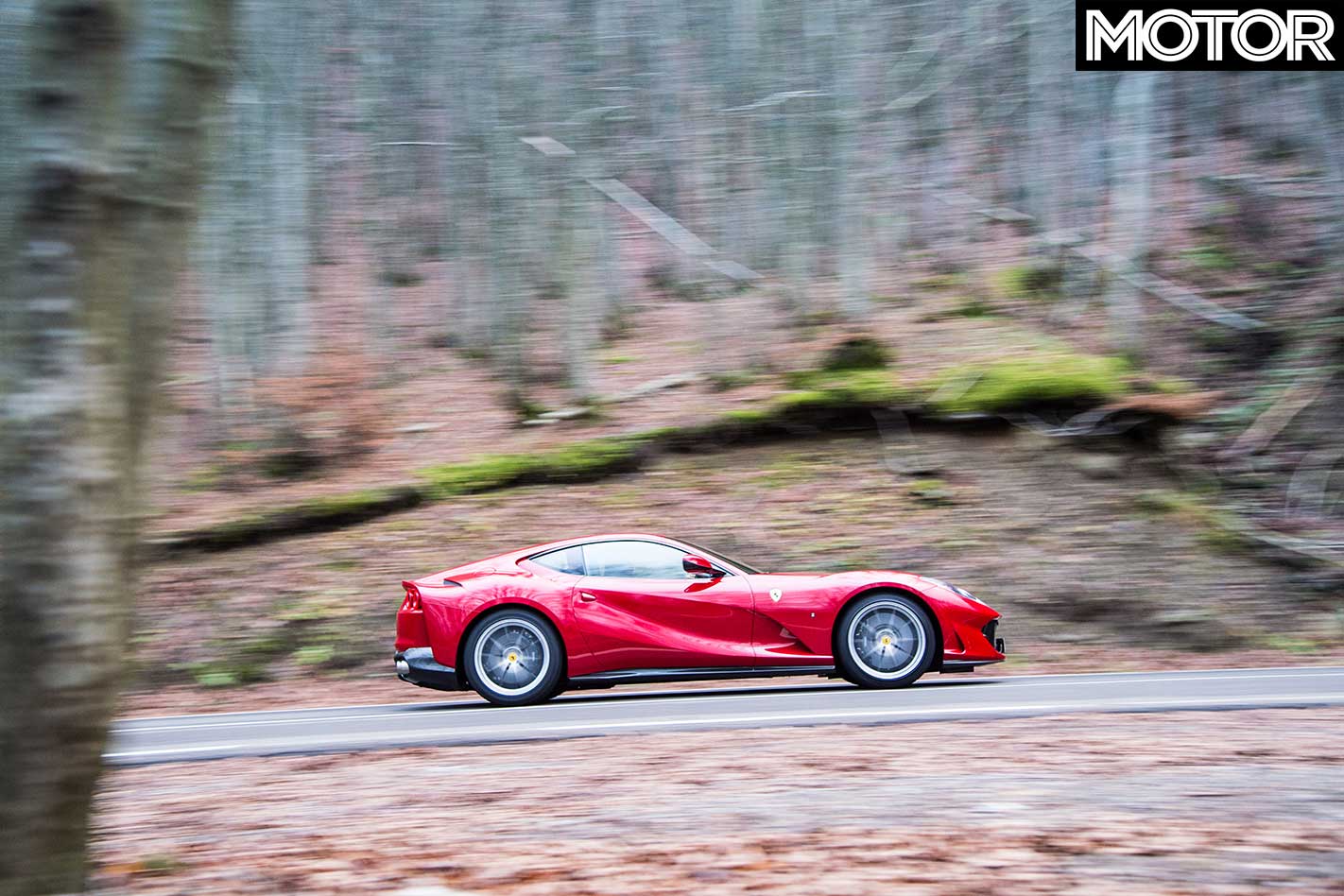
What about the rear steering, which is standard on both these supercars? It’s impossible to detect the transition from synchro-steer to counter-steer, but the virtual extension or shortening effect on the wheelbase is tangible. The turning circles remain relatively large and the dynamic driving modes don’t impact the steering action to the rear.
Cruising on the Autostrada, the Aventador’s venom is never more than a twitch of the right foot away. Overtaking is hilariously easy, the brakes clamp down with vigour at the flick of a switch, while the steering is heavy, yet ultra-direct with many levels of precision.
At speed, the dampers assume the lowest, tautest calibration, and the active aero (ALA) can either increase the downforce or reduce drag above 200km/h. Via invisible motorised flaps, the split ground effects system directs the airflow to the wheels that need the most downward pressure. Air enters the car, primarily through the nose, before it exits through the little ram vents in the rear wing.
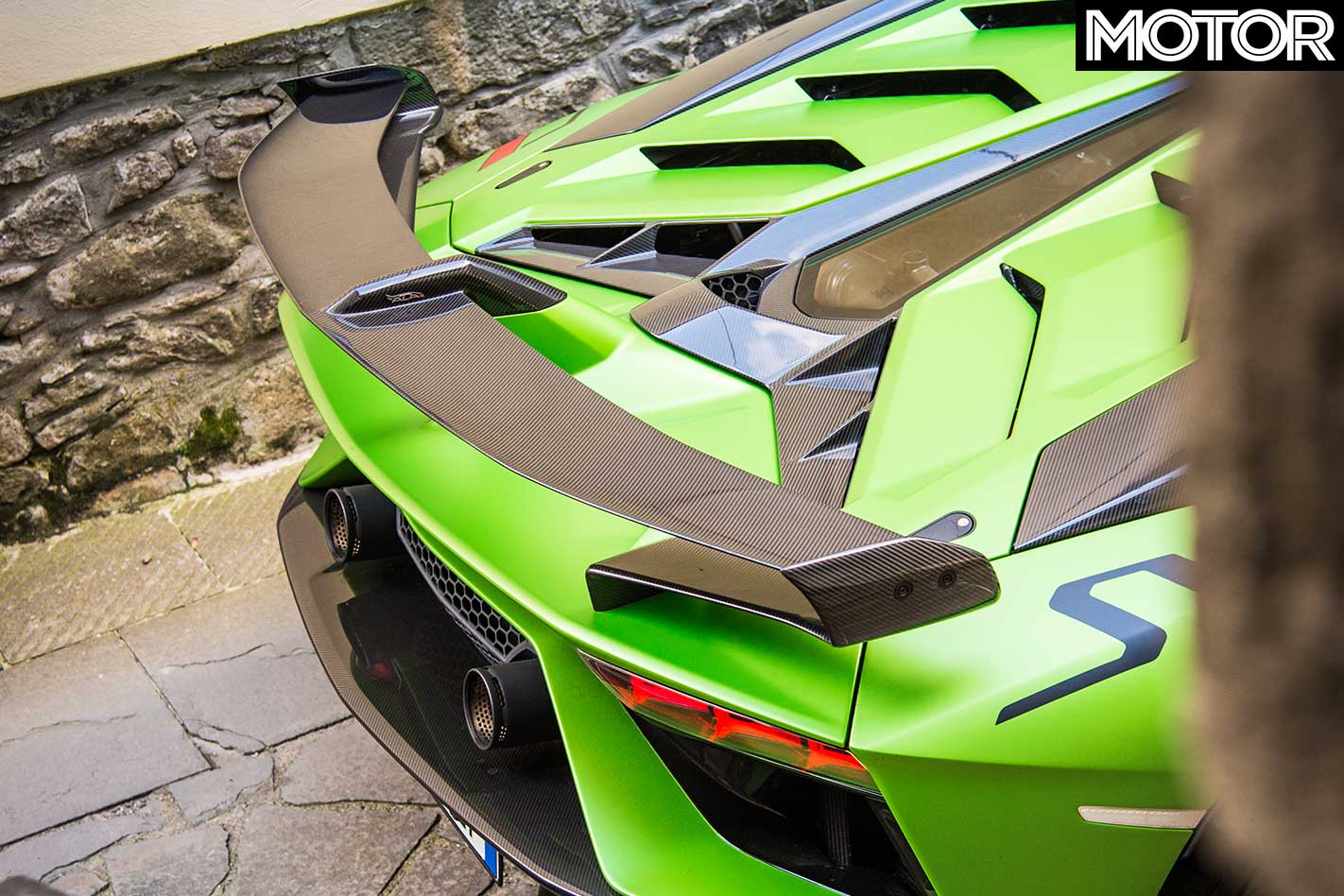
The 812 Superfast is emphatically rear-wheel drive. Even on a straight road, in the dry, with the throttle not fully depressed, you know with detail where the 588kW is being sent. While the transaxle layout results in a perfectly balanced weight distribution, there is always enough grunt on tap to alert the tricky electronically controlled mechanical LSD and summon the stability control.
In wet weather or when in Race mode, the eye of the torque hurricane is raging right in front of you. In tricky conditions with the ESC off, the Ferrari needs to be kept on a tight leash. Like its ‘rival’ here, the Superfast is aptly named in regards to normal traffic. It’s too radical for normal roads, too challenging for the rich, unskilled owners who will purchase it, and too vulnerable to qualify as a daily driver.
What sets the two beasts apart more than anything else is the vastly different packaging. If size matters, the SVJ gets instantly hit by a dozen penalty points for burdensome entry and exit, tight racing seats, a pedal box too narrow for size 13 shoes, and a lack of headroom and visibility. Also, the mix of ex-R8 ergonomics and Bologna red-light district instrumentation still doesn’t look right years after the launch.
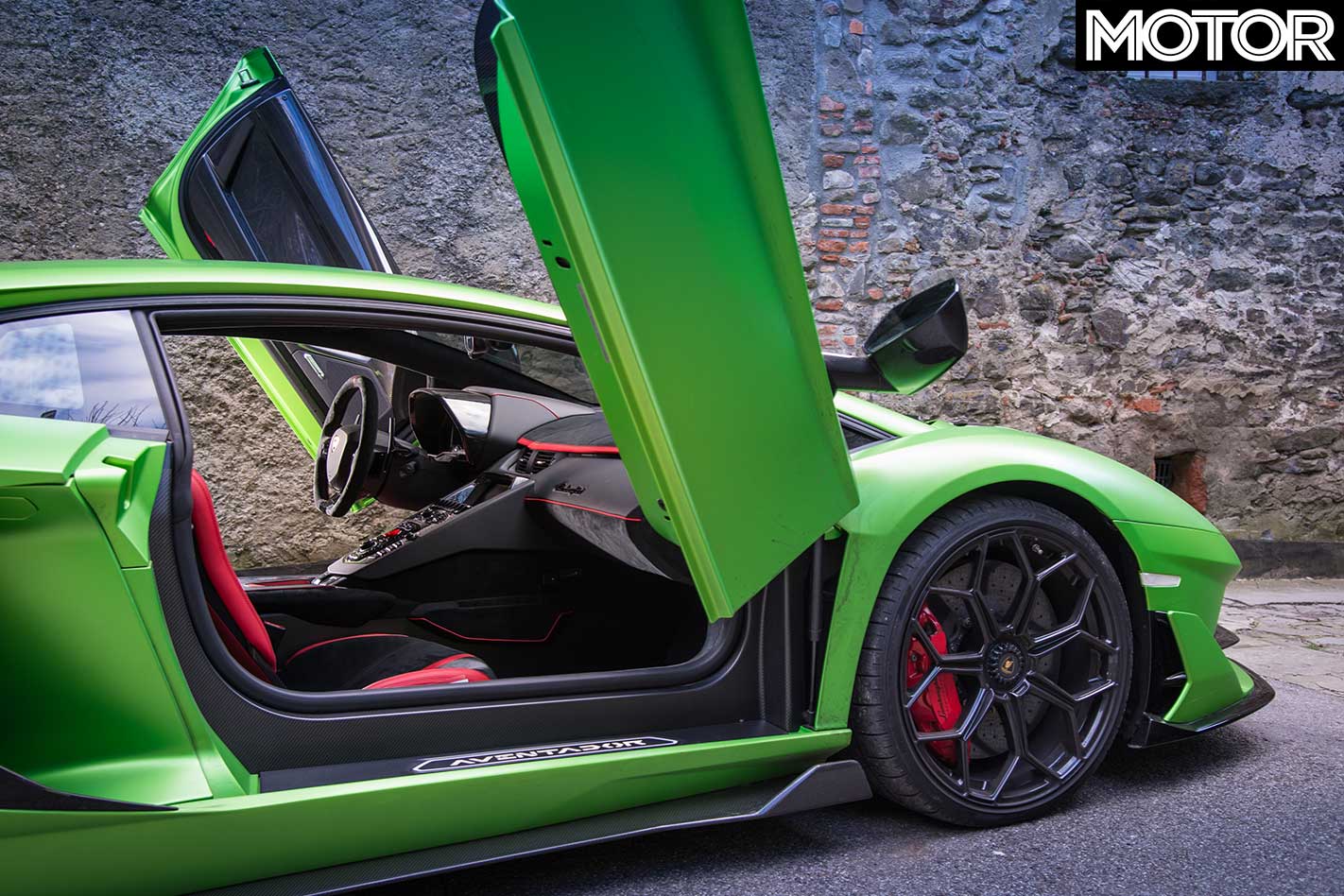
In contrast to the Lambo’s embryonic driving position, the Ferrari is almost a sportsman suite on big wheels. Even the racing seats accommodate all sizes, legroom is a relief, visibility is impressive, and the iconic Manettino dial drive mode selector tweaks the car’s manners with aplomb in one easy lesson. Dislikes? A front end that is long enough to drop out of sight in dense fog, the fiddly secondary controls and the open arms turning circle.
So, ultimately, given brand cachet and performance are on similar levels, the final assessment is really a matter of interpretation and personal preference. Naturally, a red Ferrari tends to grab all the headlines – and for good reason. But as soon as the matte green rocketship arrives, onlookers are torn between heritage and outlandish design. The inner rhetoric plays a similar tune.
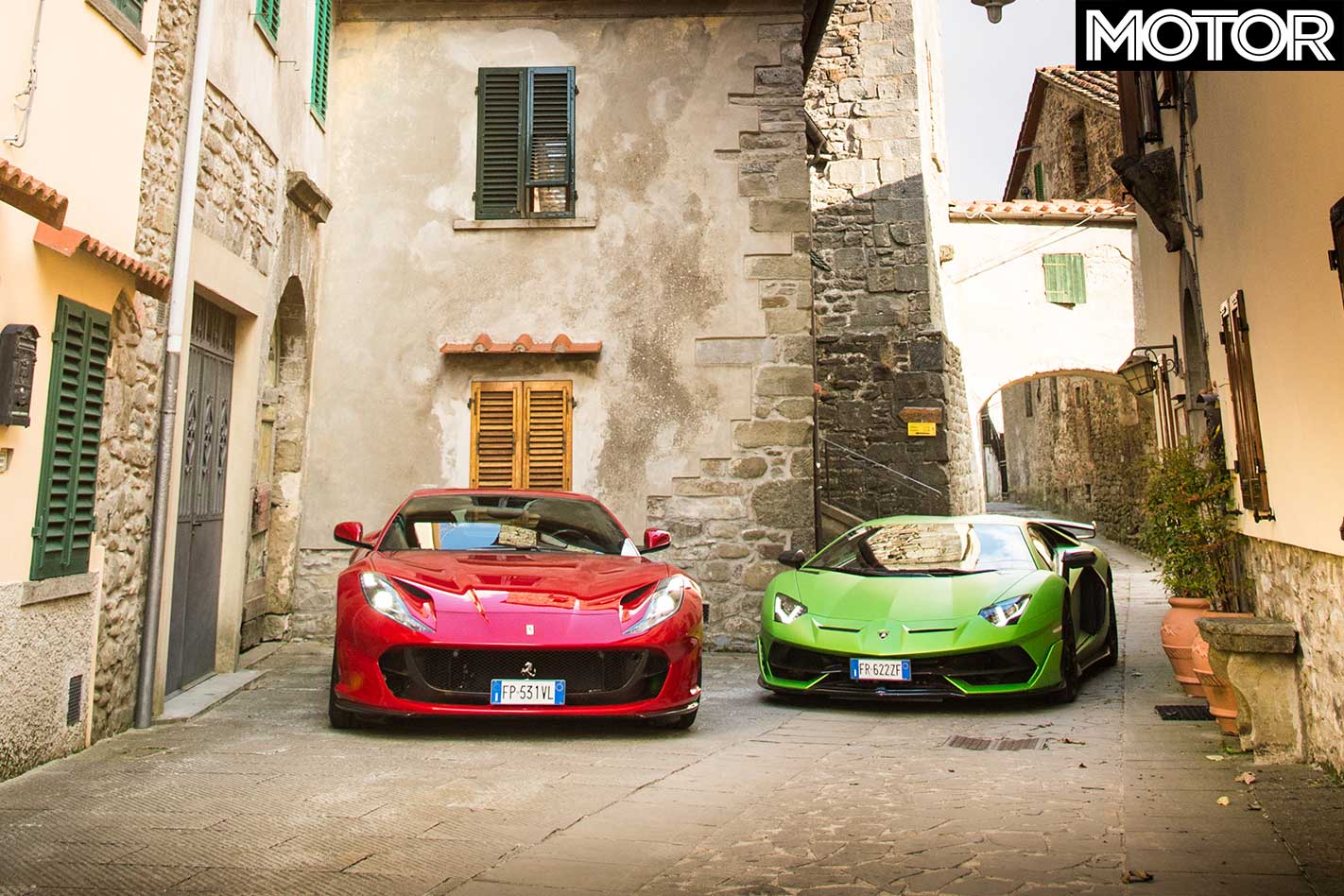
Choosing between these two V12s is as subjective as favouring red wine over white, blonde hair over black, or classical music over pop. The Lamborghini engine marks the ultimate evolution of a legend that is almost as old as the brand. Sadly its use-by date is fast approaching; the 6.5-litre 12 is being cut down in its prime. But it isn’t a curdling mess and the SVJ milks every bit of excitement out of the epic unit. The Ferrari is powered by a more advanced and economical engine, yet as soon as the red mist descends and revs soar, it’s every bit as explosive and resounding as its countryman.
The future of motoring might well turn out to be electric or full of alternative fuels, but right here, right now, we can’t help but turn a blind eye to it all – ignorance is bliss… And if that doesn’t work, for the time being, 24 howling cylinders create enough of a mechanical orchestra to drown out that looming reality. This is as good as it gets.
Fast Facts
| u00a0 | Lamborghini Aventador SVJ | Ferrari 812 Superfast |
| Body | 2-door, 2-seat coupe | |
| Drive | all-wheel | rear-wheel |
| Engine | 6498cc V12, DOHC, 48v | 6496cc V12, DOHC, 48v |
| Bore x Stroke | 95.0 x 76.4mm | 94.0 x 78.0mm |
| Compression | 11.8:1 | 13.6:1 |
| Power | 566kW @ 8500rpm | 588kW @ 8500rpm |
| Torque | 720Nm @ 6750rpm | 718Nm @ 7000rpm |
| Power/Weight | 371kW/tonne | 386kW/tonne |
| Transmission | 7-speed dual-clutch | |
| Weight (dry) | 1525kg | |
| Suspension (f) | double A-arms, pushrod inboard coilovers, adaptive dampers, anti-roll bar | double A-arms, adaptive dampers, anti-roll bar |
| Suspension (r) | double A-arms, pushrod inboard coilovers, adaptive dampers, anti-roll bar | multi-links, adaptive dampers, anti-roll bar |
| L/W/h | 4943/2098/1136mm | 4657/1971/1276mm |
| Wheelbase | 2700mm | 2720mm |
| Tracks | 1720/1680mm (f/r) | 1672/1645mm (f/r) |
| Steering | hydraulically-assisted rack-and-pinion | electrically-assisted rack-and-pinion |
| Brakes (f) | 400mm ventilated carbon-ceramic discs, 6-piston calipers | 398mm ventilated carbon-ceramic discs, 6-piston calipers |
| Brakes (r) | 380mm ventilated carbon-ceramic discs, 4-piston calipers | 360mm ventilated carbon-ceramic discs, 4-piston calipers |
| Wheels | 20.0 x 9.0-inch (f); 21.0 x 13.0-inch (r) | 20.0 x 10.0-inch (f); 20 x 11.5-inch (r) |
| Tyre Sizes | 255/30 ZR20 (f); 355/25 ZR21 (r) | 275/35 ZR20 (f); 315/35 ZR20 (r) |
| Tyres | Pirelli P Zero Corsa | Pirelli P Zero TM |
| Price | $949,640 | $609,888 |
| Pros | Dramatic looks; atmo stonk and response; V12 howl | Front-engine style; comfort; performance; V12 howl |
| Cons | Jerky transmission; cramped cabin; last of its kind | Turning circle; secondary controls; last of its kind |
| Rating | 5 out of 5 stars | 5 out of 5 stars |
