
This has all the makings of a dull assignment: follow MOTOR’s resident racer, Dean ‘Sir Drifts-a-Lot’ Evans, for six rainy days while he tackles his first Targa Tasmania in a Mazda Motorsport-prepared Mazda6 MPS.
This feature was originally published in MOTOR’s July 2006 issue
Oh dear. I would have to listen to Evans’ nightly tales of rallying derring-do in the first person. And, as competent as the 190kW, 2.3-litre turbo MPS is, it’s no fire-breathing RX-7 SP or MX-5 Turbo, cars Mazda has entered in previous Targas. It is all-wheel drive, though, and with Targa notorious for its foul weather, it’s the MPS’s big advantage.
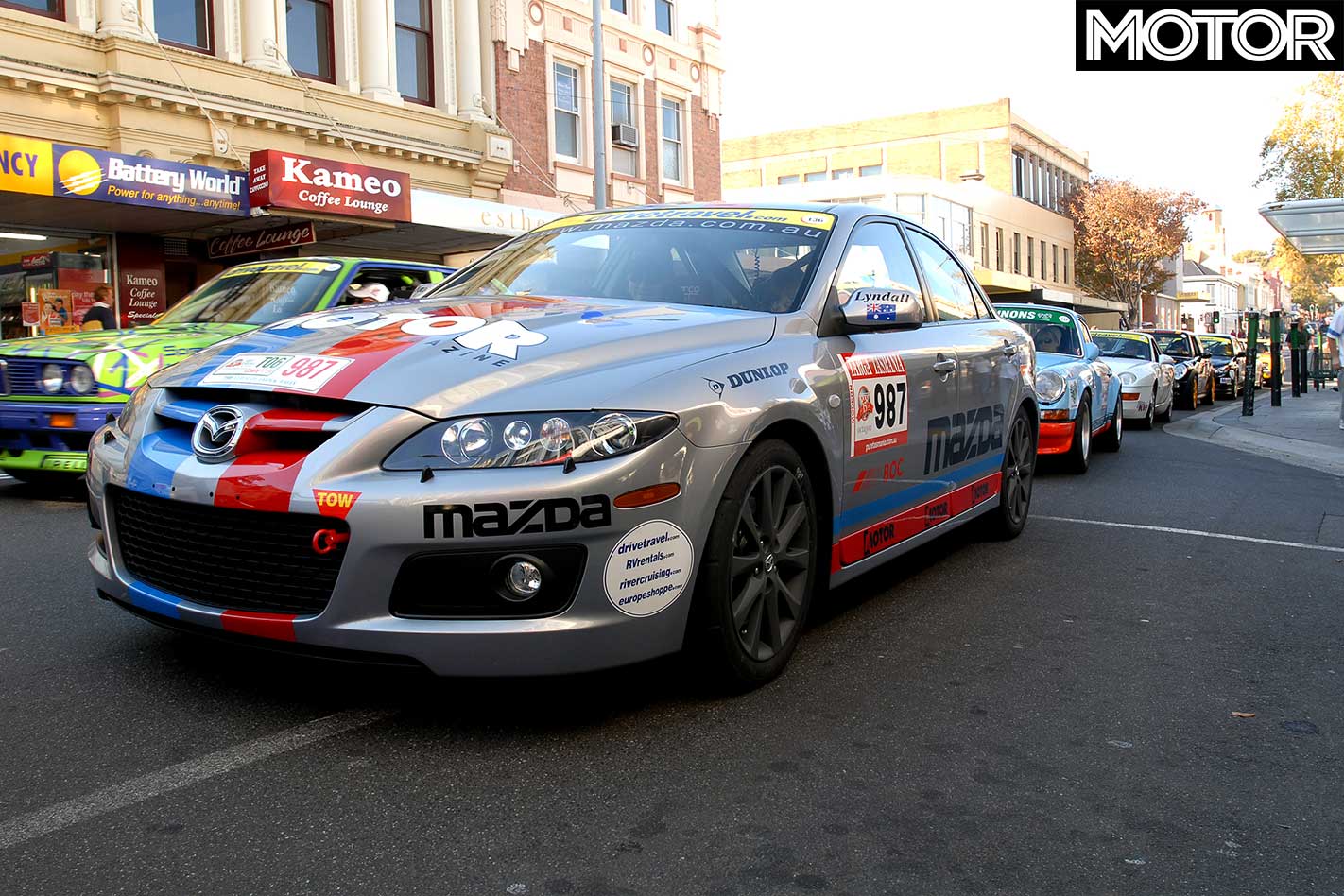
Let’s face it, Targa is a car and driver breaker and not to be attempted lightly; it has humbled some big names in the past like Steve Richards and Paul Stokell. And, as this is the worldwide motorsport debut for the MPS, there is enormous pressure on Evans to bring the car home – and not in his Samsonite.
So the bloke not known for his rubber conservation is under strict instructions from Horsley (not a man to be trifled with) to drive to a carefully crafted plan and with a margin of error. Most of all Evans has to take care of his tyres (cough). On Targa, each tyre change incurs a two-minute penalty, so tyre preservation, while still going quickly, is the order of the day, every day.
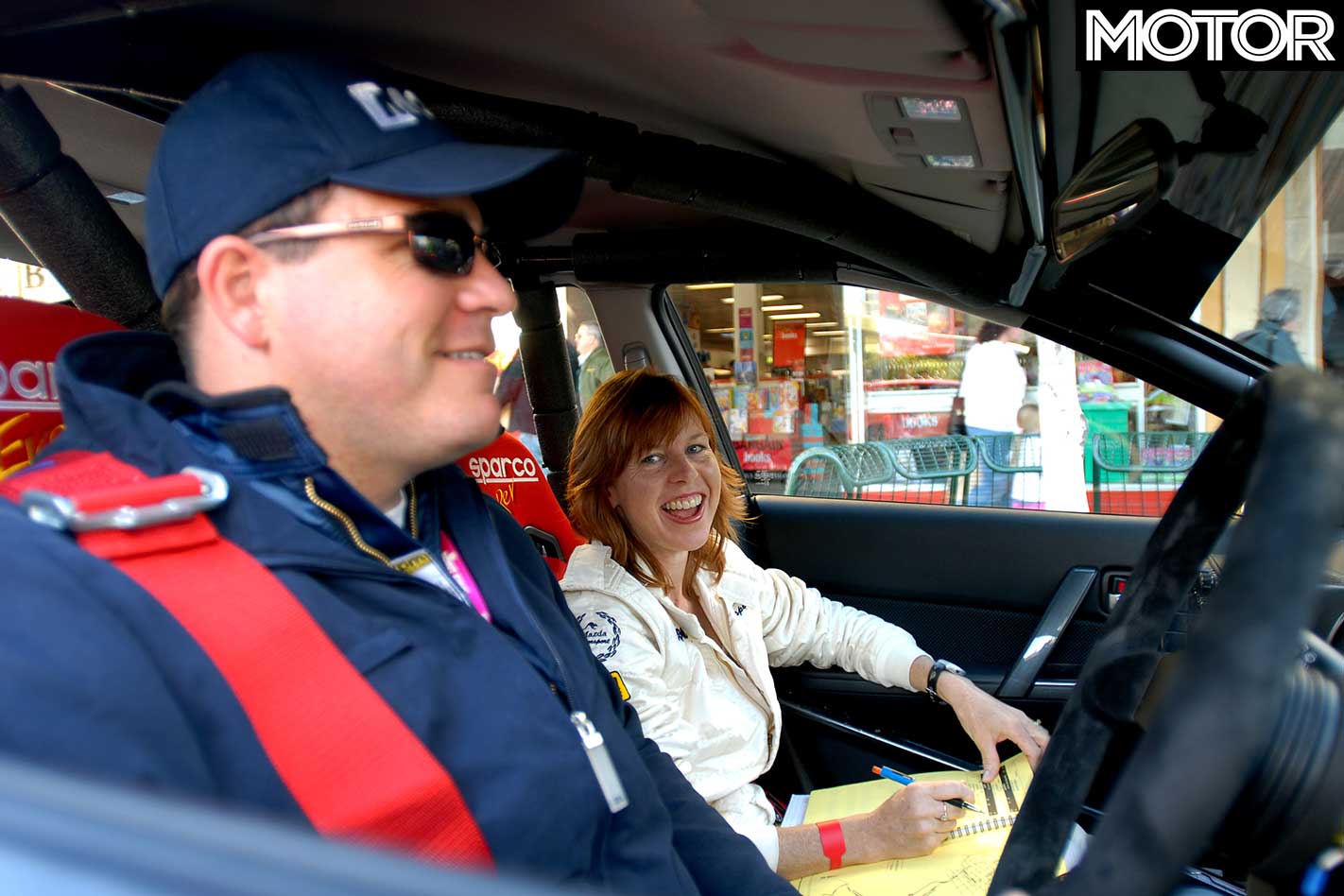
And Horsley isn’t just going to take Evans’ word that he is being kind to the car. Sitting alongside would be diminutive Lyndall Drake, a feisty pro navigator so experienced, Evans is her 50th driver, and is not only Horsley’s ears and eyes, but needs to make all the calls so Evans doesn’t become a notch on her roll cage.
Following four months in the build, the MPS is entered in the Modern Competition showroom stock class, meaning aside from tyres and brake pads, it’s stock: not even a muffler change! But Horsley is quietly confident and hoping the traditional Targa weather – snow and ice – will allow the car to take advantage of its excellent traction, pudgy weight (1810kg with crew) and protect its Dunlop semi-slicks.
Whether he has any confidence in our hero is another thing. Horsley has looked after the likes of Dick Johnson, John Bowe and Allan Moffat, and cleaning up the mess of a motor noter parked in the trees probably isn’t high on his ‘To Do Before I Die’ list.
Prologue
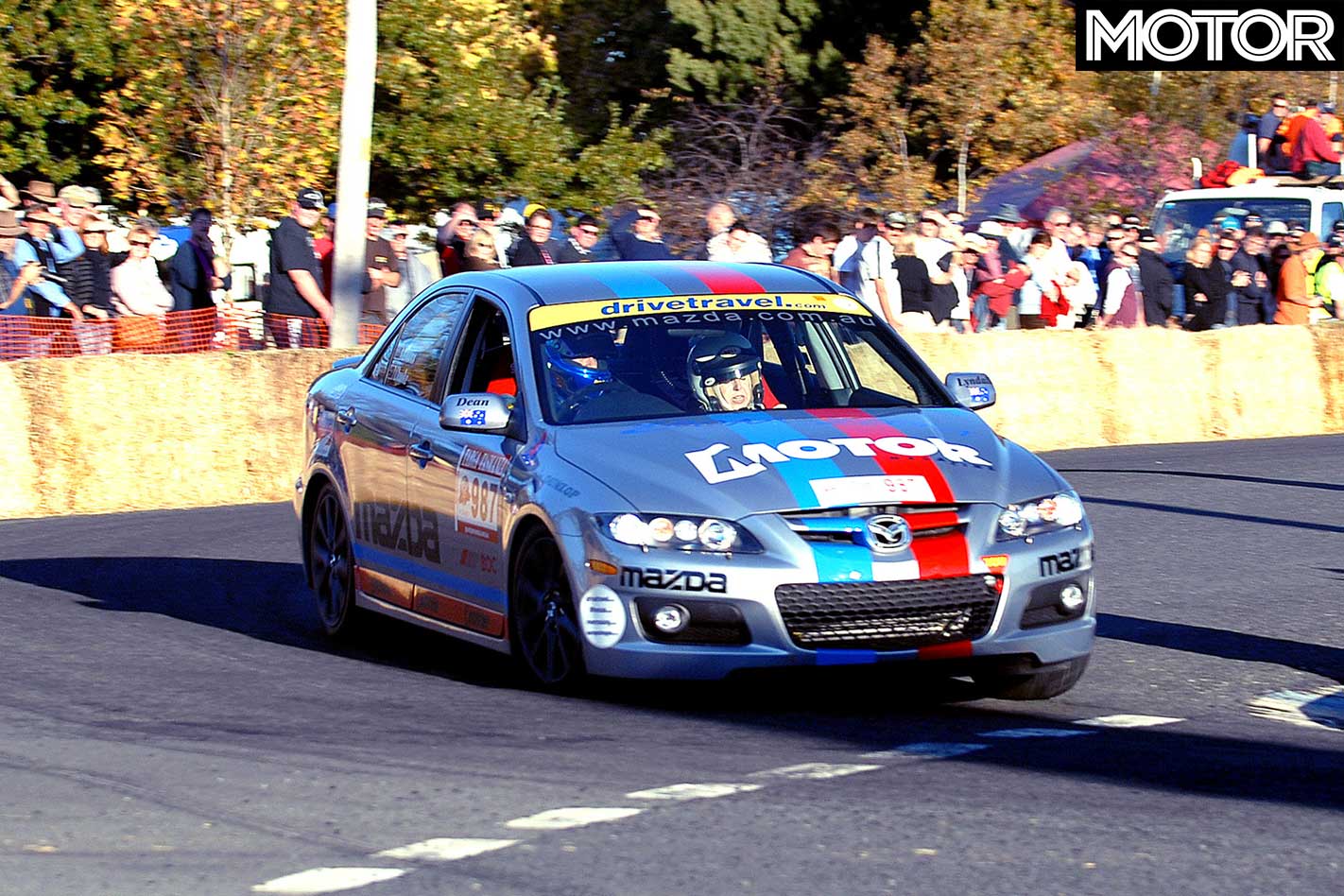
The traditional start to Targa Tasmania is the Georgetown Prologue, a 4.2km through-the-town-streets blat to set the starting order for leg one. The weather is perfect and Evans drives straight and fast, avoiding gutters and hay bales to place 76th out of 210 starters, 65th in class, with nary a hint of headline-grabbing heroics.
“He didn’t even take the nipples off the tyres,” Horsley smiles, but maintains his easy-does-it mantra. He also confides that he is still unsure that Evans can keep up the same consistency over the full distance.
“That was the first time I’d driven the car at any real speed, the brakes got so soft I was yanking the handbrake a few times, but they’re bedded now. Surprised at how wallowy it felt compared to the road car; must be the extra grip from the semi-slicks. We’re just biding our time until we get to the wet.” – Dean Evans
Leg One

The Matthew Flinders Northern Loop stars and ends in Launceston. After stage three, the MPS is leading the event… along with 103 others who have also beaten the easy target times designed to ease drivers into the event.
The weather is sensational, and I’m hoping something exciting will happen because after the Prologue I’ve re-named Dean ‘Uneventful’ Evans. I don’t have to wait long. Drama strikes at the end of the last 3km Longford town stage after a jump and bottom-out.
During the 20km transport back to Launceston, the car pulls into the service with 30 minutes to find and fix the problem or incur a time penalty, or (worst case scenario) withdrawal. There’s a lot of bright green oil under the car and a cracked sump is feared.

There’s high tension as the eight-person service team swings into action. Within minutes, chief spanner Nathan Hui finds the culprit: a gearbox filler plug that’s fallen out and lodged in the sump guard. Phew!
The ‘box is topped up and Evans and Drake make it to service in time, their day’s effort vaulting them a massive 26 places up the order to finish 39th outright.
“There was a left-right kink at an intersection 100 metres before the finish that we took flat, but there was a ridge we didn’t even notice in recce. I didn’t think the ground-out was that bad but I smelt oil straight away, my heart sank when I saw the oil.” – Dean Evans
Leg Two
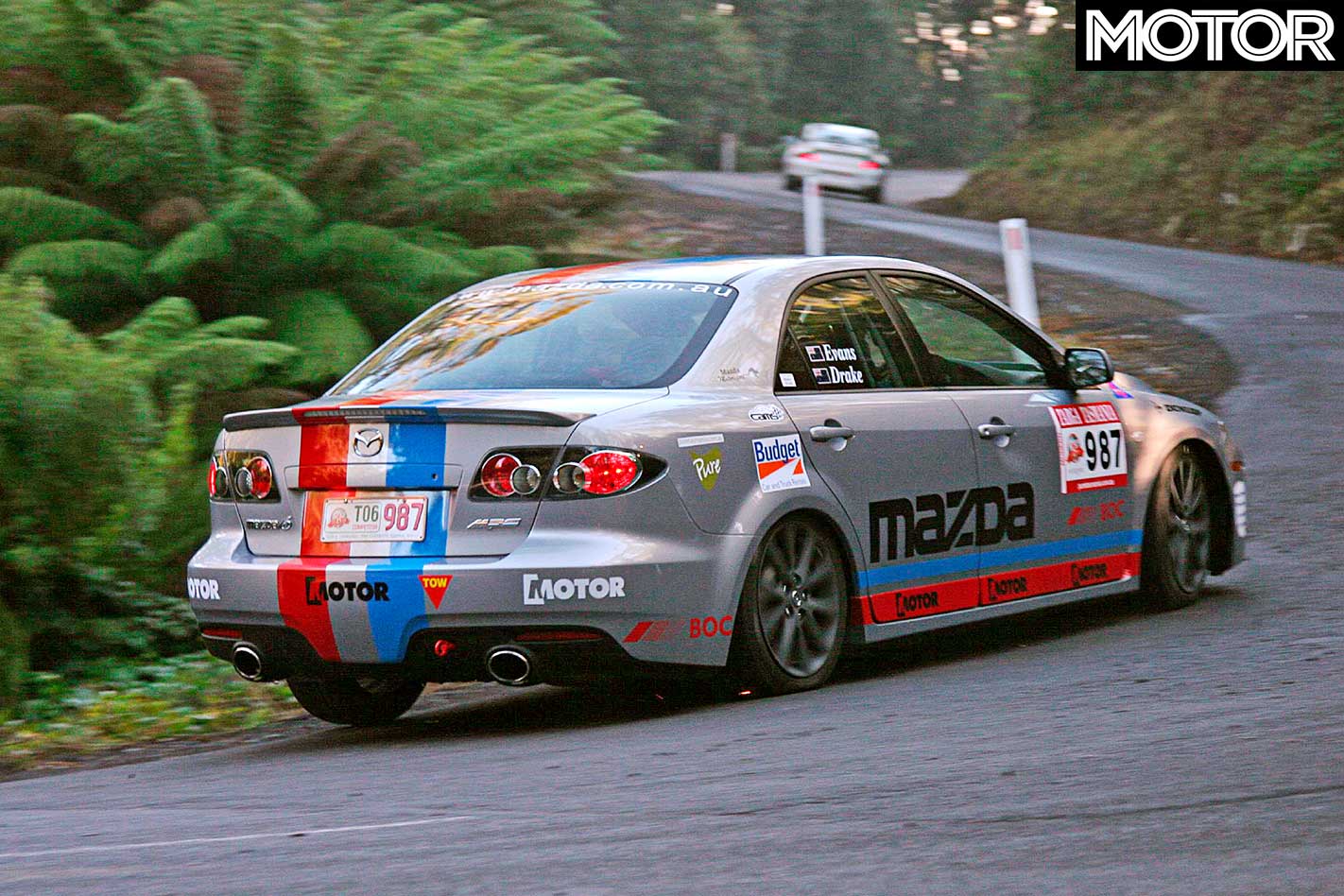
Things start to get serious down to Hobart via the Captain Nicholas Baudin North Eastern Trundle for nine competitive stages. With cars released as 30 second intervals, on The Sideling they pass a Porsche 911 GT3! On Elephant Pass Evans is 25th quickest; there is some moisture but not enough for Horsley.
Everything goes smoothly, Evan and Drake are in sync, the MPS is beginning to stretch its legs and the team moves up again, to 33rd outright. Things are looking good. “There are no problems at all; everything is just perfect,” Horsley smiles.
“We get about two kays of greasy roads on The Sideling – and the MPS loves it, as does Horsley when he heard we passed the GT3. We were fast on Elephant Pass partly because of the few kays of wet roads up the mountain,” – Dean Evans
Leg Three
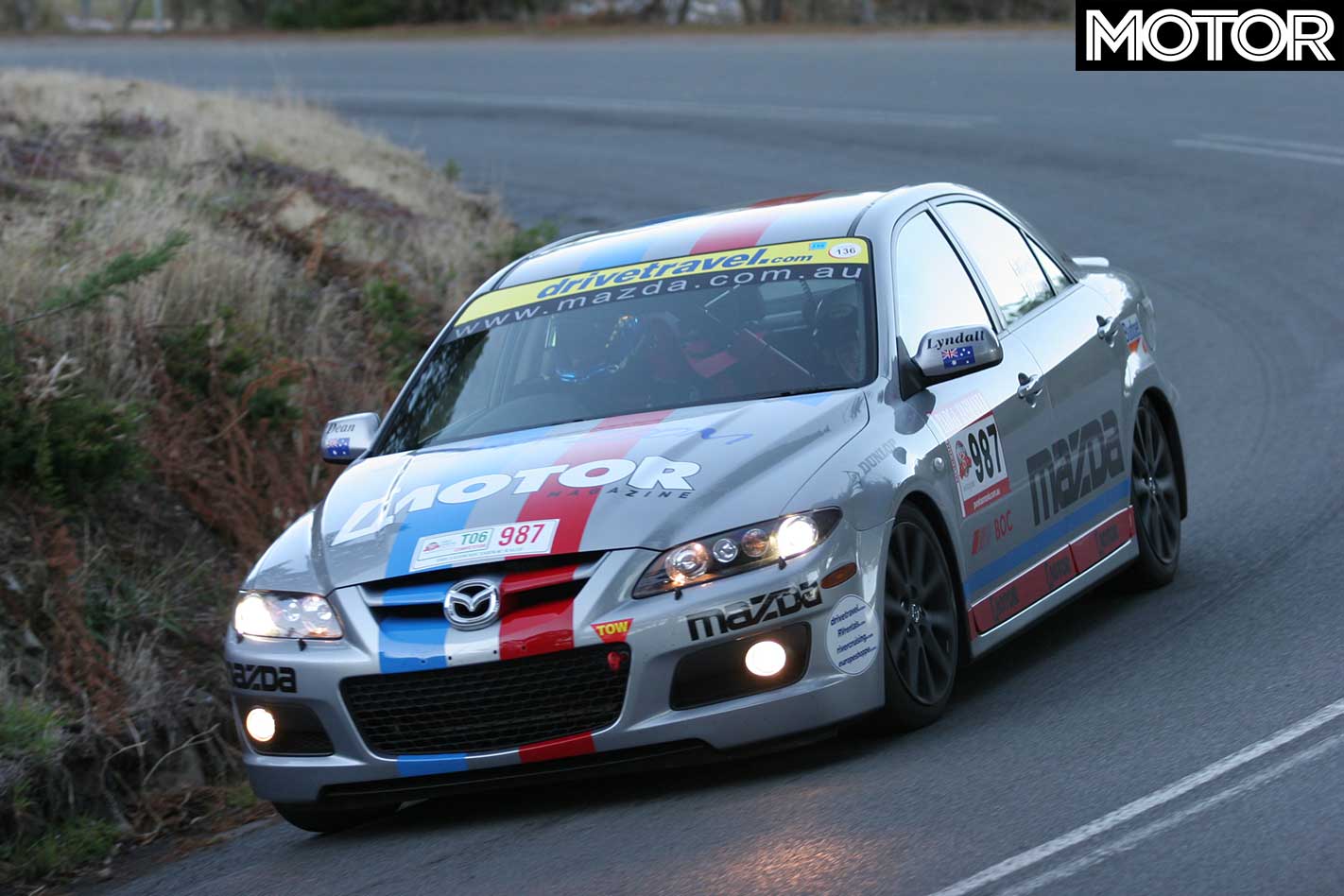
The Bruny D’Entrecasteaux Southern Loop takes in the picturesque countryside around Hobart and its stages also pass without incident. They maintain 33rd position overall ahead of many faster cars that should be creaming the heavyweight MPS. The tyres and brakes are holding up – following frequent rotation and a new set of standard front rotors – and if the rain comes soon, there is a feeling the team could eventually challenge for an overall top-20 result.
“The day’s tight or high-speed stages, again totally dry, didn’t suit the MPS, so we conserved the car and tyres. Happy to hold 33rd.” – Dean Evans
Leg Four
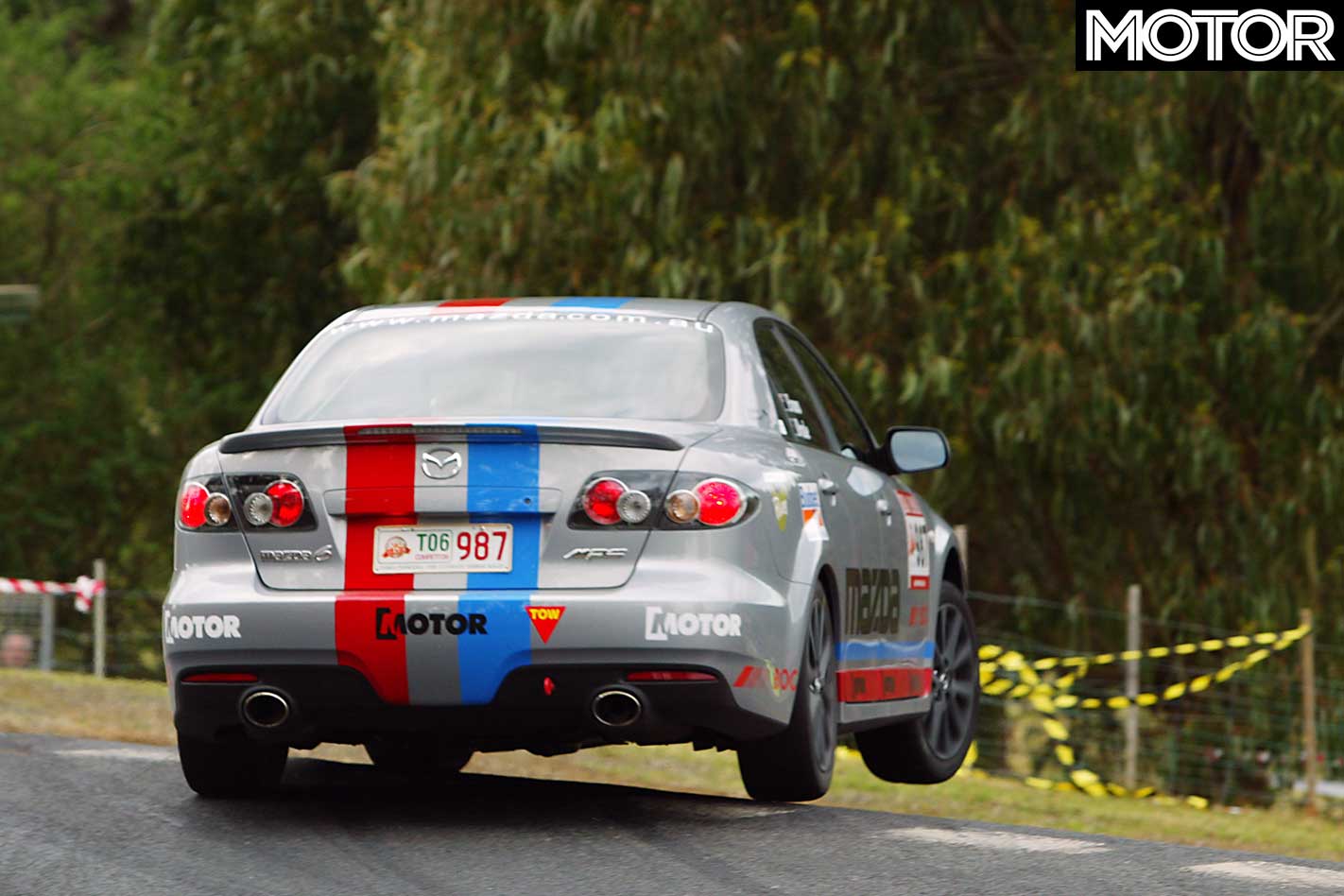
Another long day, north from Hobart to Burnie, starts with a headline-grabbing crash with a MINI injuring spectators at the Hobart Domain stage. The stage is cancelled but the MPS, last in the stage queue, cruises past the crash site an hour later, with ambulances still on the scene.
The George Bass North West Challenge is where the rally is reaching its demanding crescendo. Incredibly, half way through day four, the event reaches its mid-point in competitive kilometres, with serious stages like Cethana (37.4km), South Rianna (24.4km) and Natone (9.7km). It is on this last stage that things go horribly wrong, again within sight of a good finish.
“The day was going alright, we were pushing hard, saw 220km/h and even passed a Nissan GT-R on Cethana, but 5km through Natone we started to get fuel surge,” Evans reports. “We had ‘0km to empty’ on the trip computer but the low-fuel light hadn’t even come on. I buttoned off but the engine died on a steep climb.”
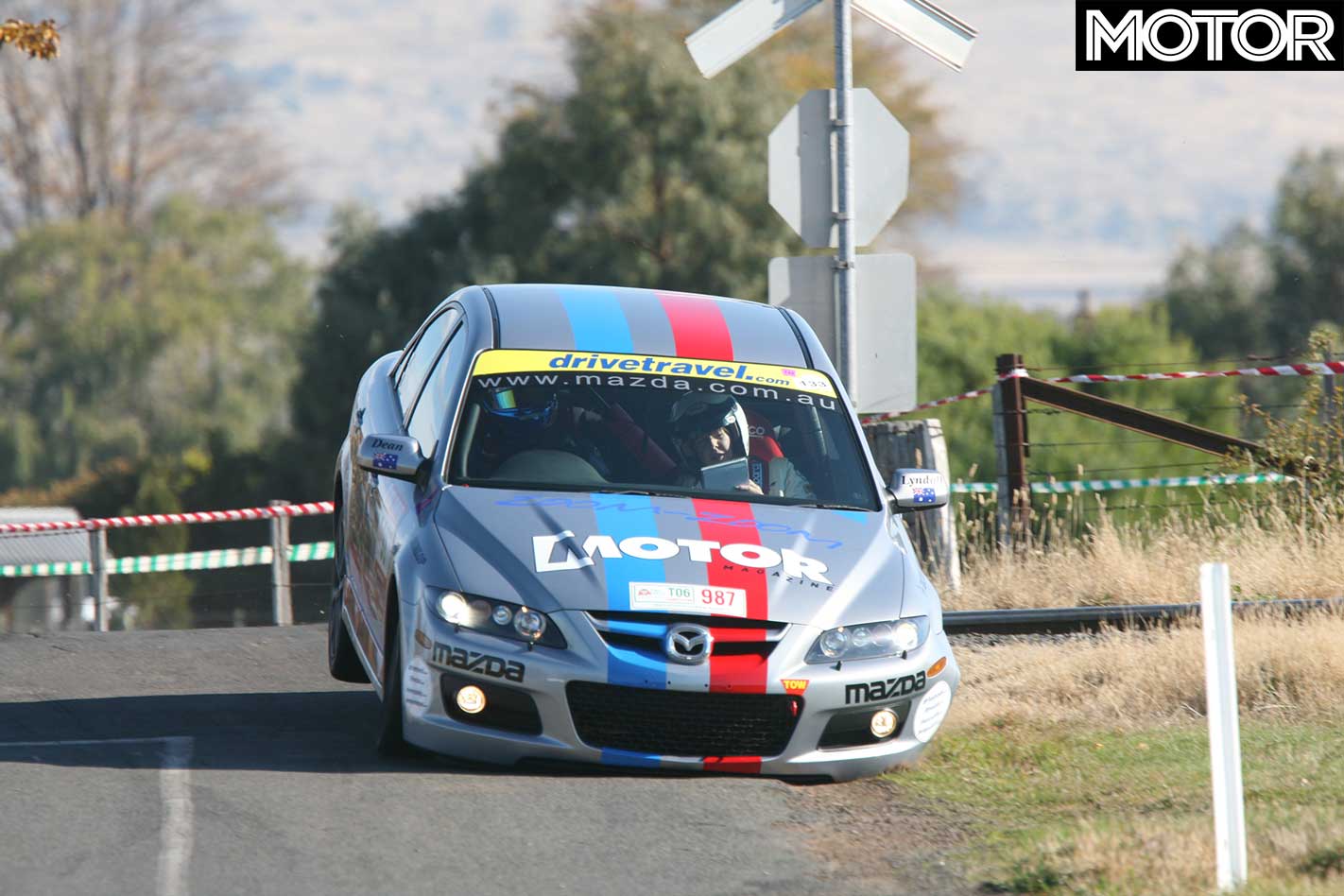
Somehow, Evans manages to coax the car up the hill using the starter motor and occasional bursts of scavenged petrol power and virtually coasts to the stage end but they have lost seven vital minutes. It’s a miscalculation and a crushing blow. They were running 31st but fall to 58th. Dinner is subdued. but the car is in one piece and still in the event. And “to finish” is all Horsley ever asked of Evans. And, if he can, to make it rain.
“We graze a plastic pole at the train-crossing jump on the 2.5km Ross Reverse town stage, but literally ‘butt if out’ so Horsley won’t notice. When we stopped on Natone 5km from the end of the day, I never gave up, and once the fuel settled, it was enough to crawl the 500 metres up the hill and onto flatter ground. Crushed, but we’re still in the running.” – Dean Evans
Leg Five

The crucial one Horsley has been brow-beating into Evans’ consciousness all week – he must save his tyres for this day. The Abel Tasman West Coast Enduro’s nine competitive stages amount to 145km, more than 30 percent of the total, and include the iconic Strahan (33.2km), Queenstown (6.3km straight up), the monster Mount Arrowsmith (47.2km) and Tarraleah (6.6km) power station stages.
With the promise of afternoon rain, the plan is to push to make up ground, but there is a lot riding on today, not the least Mazda corporate pride. The car must make it to the Wrest Point Casino finish.
The morning’s four stages go according to plan and the MPS even blows by “one or two” cars on the Strahan stage.
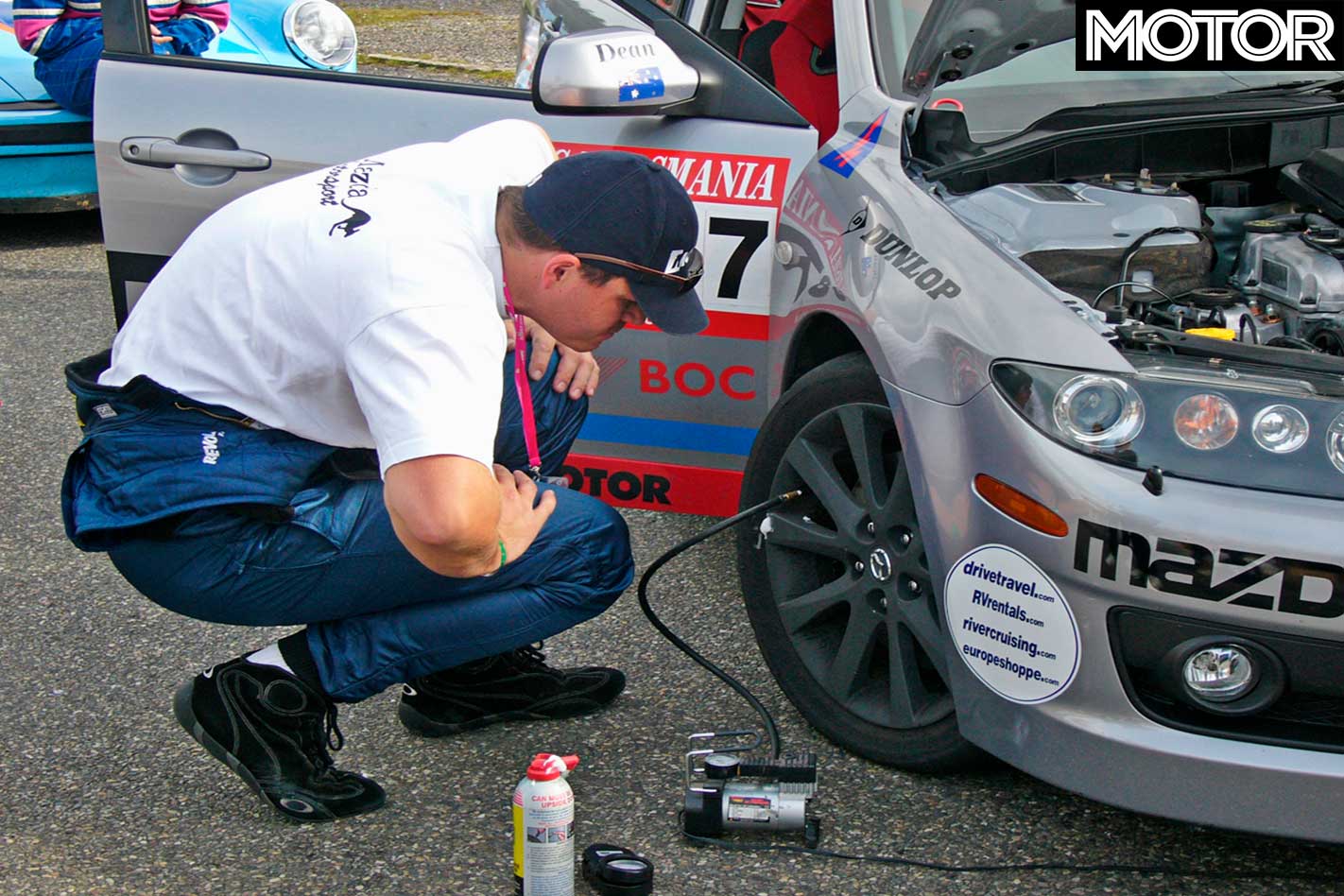
But just before the start of Queenstown, a crash delays the stage start. Luckily. Evans then discovers a flat tyre. Quick-thinking Drake grabs a can of tyre sealant and a compressor and they make the start with seconds to spare. The mousse-filled Dunlop is only rated to 80km/h but the MPS will soon be topping 200 heart-in-mouth km/h.
On the monster, the technical 47km Mount Arrowsmith stage, six or seven cars are crashed, one even upside-down, but 5km before the finish, the prayed-for rain finally arrives. It’s a treacherous deluge and Evans makes the most of it, placing 23rd.
On the 6.6km Tarraleah, stage 42 to 44, it’s raining and the first full wet stage. But instead of setting a fast time, the MPS gets its first body modification on a slippery corner when the MPS clouts the rear into the Armco. It’s a close call, and they lose 10 seconds and still finish the stage in 28th. Six cars later, an Evolution VI noses in and crashes out.
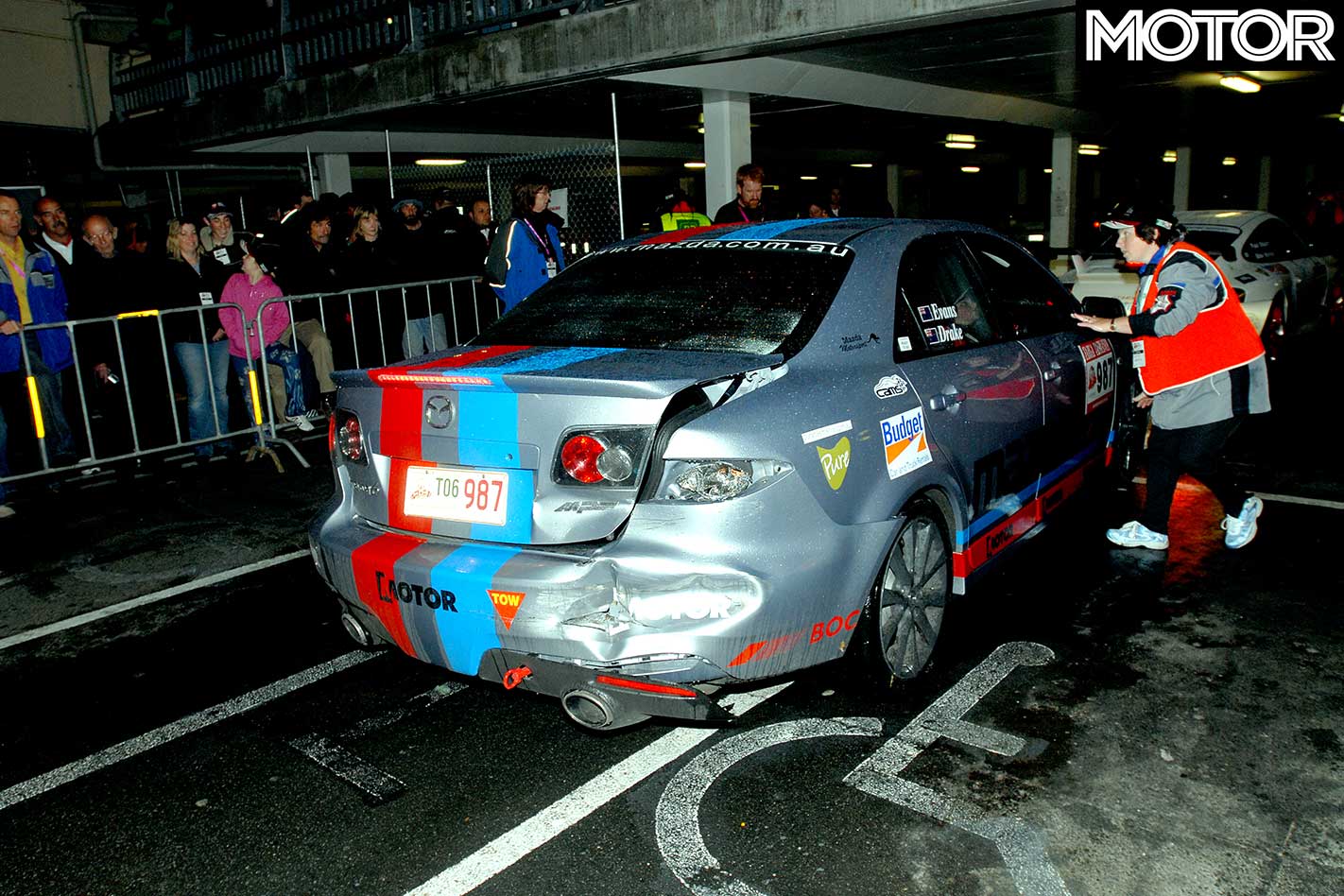
“On Mt Arrowsmith, ten corners from the end in the wet, dufus driver spins and we lose 10 seconds. We’re 23rd fastest instead of 18th. On Tarraleah, I was pushing maybe six-tenths and we slowed for a 90-degree right with a ‘caution bump’. I was crawling, but there must have been oil or something because I hit the brakes and it just went straight on. We were facing an Armco and weren’t going to stop, so I yanked the handbrake and backed it in.” – Dean Evans
Evans and Drake relatively cruise through the final two stages and to the finish in Hobart; from 58th overnight, they move up to 39th outright and, most importantly, first in class!

On debut, the MPS has beaten of all the production Mitsubishi Evos, Subaru WRXs and Porsches on one of the sternest tarmac tests anywhere in the world – delete the fuel problem, and it would have placed 24th. The 15th running of Targa Tasmania also proves to be the driest: from 450 competitive kilometres, it’s wet for just 15 klicks. It’s a top effort.
“If you really want to get your teeth into driving fast for a long time, this is it,” observes Dean. “But there are just so many ways to stick it in!”
The last word goes to Horsley. “I think Dean drove brilliantly; he didn’t put a foot wrong. And Lyndall did a great job, too. The car was a huge surprise to us, it went better than we expected.”
And better than I expected. The victorious but battle-scarred MPS goes home to Sydney on the boat, and not in Evan’s check-in luggage. And it rains in Tasmania for the entire next week.
Love the Drake
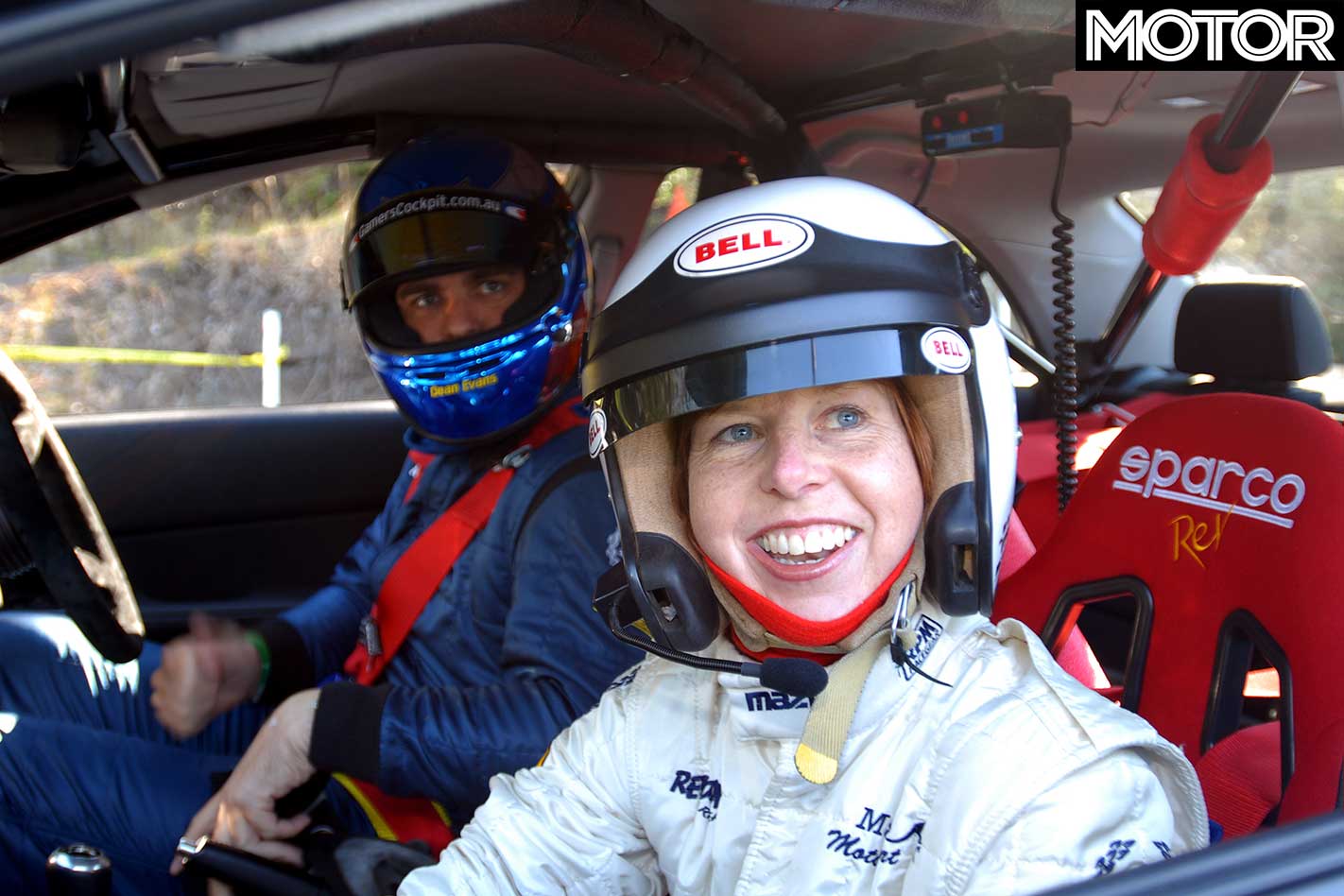
Lyndall Drake, 38, has been rallying for 19 years, and involved in the ARC since 1996, alongside the likes of Rod Salmon, Rob and Dean Herridge and Steve Winwood. Which is why Mazda’s Allan Horlsley has drafted her in for three Targas. Drake says she actually used to get carsick as a kid, but not any more.
She has had her share of crashes, but is selective about who shoe co-drives with on tarmac: “It has to be the right combination of car and driver. Everyone wants something they are good at and I like to compete, and on pace-noted events, a navigator really feels they have contributed to the overall result.” Drake was an indispensable part of Mazda’s Targa attack this year; just ask Evans.
‘H’: Mr Mazda
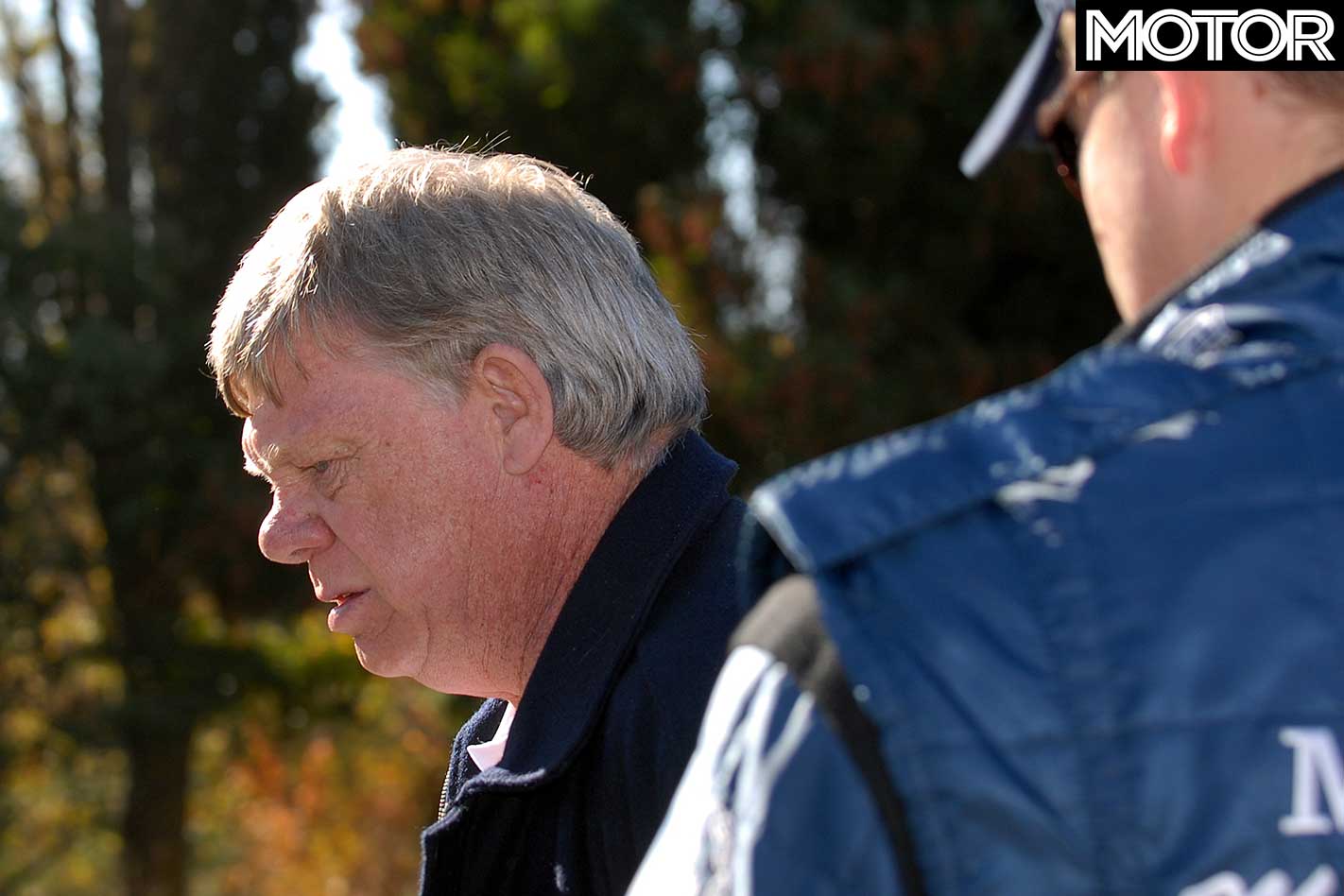
Allan Horsley’s Mazda Motorsport handles everything from special projects (RX-7 SP, MX-5 SP) to race programs, often in conjunction with long-time rotary expert Jon Waterhouse. Horsley’s motorsport pedigree is long, with a reputation for forthrightness and irascibility, the latter unfounded during Targa.
While inextricably linked to Mazda since he managed Allan Moffat’s successful RX-7 touring program in the early-’80s, he started racing in the ’60s in a homemade 500cc openwheeler at Tarrawingee, raced Holden, Jaguar and Peugeot touring cars in the ’60s/’70s before his last racecar, a 656kW tank engined open wheeler. He even built 25 turbo Mazda 929s, and dubbed the MX-929. His highlight is presiding over a fourth consecutive 12 Hour GT-P victory with Dick Johnson and John Bowe in an RX-7 SP, designed and built by Mazda Motorsport Australia.
Mazda at Targa
Mazda’s entered Targa Tasmania five times in its 15 year history. It’s used the event to refine the MX-5 SP prototype, and in 2006 made the worldwide MPS motorsport debut.
| Year | Drivers | Car |
| 1994 | Garry Waldon | RX-7 |
| u00a0 | Gregg Hansford | RX-7 |
| 1997 | Garry Waldon | RX-7 |
| u00a0 | Steven Johnson | RX-7 |
| 2001 | Murray Coote | MX-5 SP |
| u00a0 | Michael Taylor | MX-5 |
| 2002 | Rick Bates | RX-7 SP |
| u00a0 | Dean Evans | Mazda6 MPS |
It’s not difficult to imagine the world’s supercar makers huddled in a bunker somewhere, nervously laying out their defensive strategy as the tidal wave of electricity set to wash over their industry barrels ever closer. Because with it comes the inevitable loosening of their kung-fu grip on world-beating performance.
The fact the Tesla Model S is technically faster than the Lamborghini Aventador SVJ, at least to 100km/h, has surely stirred some espressos over at the Italian brand’s HQ. And that’s only the beginning; as more and more mainstream brands embrace battery-powered performance, things are only going to get faster.
Worse still, these makers of automotive exotica are wedged between a battery and a hard place, because to join the electric masses means giving up their only remaining trump card: emotion. It’s no secret that supercars sell almost exclusively on it. On theatrics. On excitement. On heads whipping around when they hear one rumbling down the street. And electric cars, with their incessant, flaccid whining as they gain speed, remain as spine-tingling as a bowl of off-brand cereal.
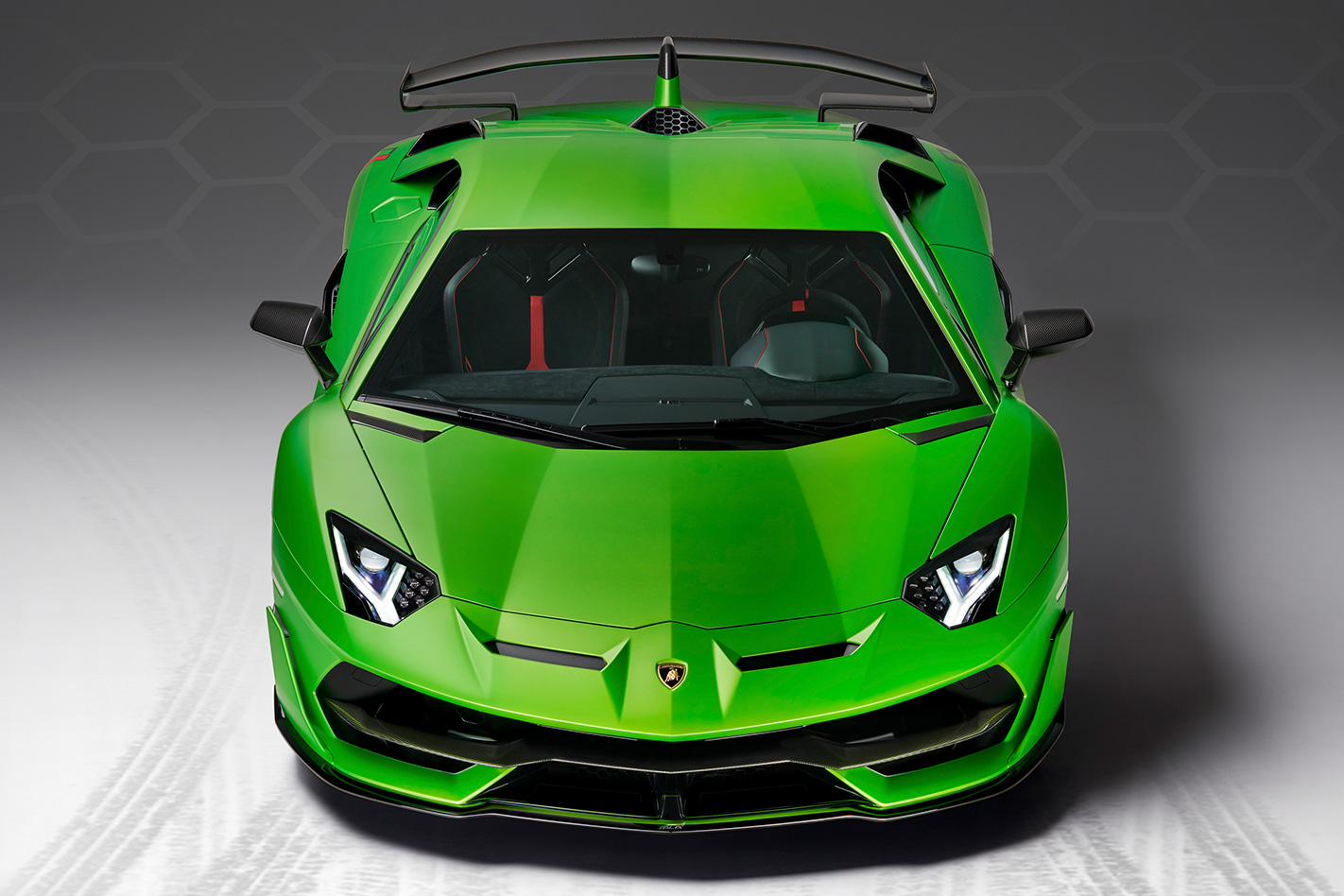
“It’s the emotion,” Lamborghini’s chief technical officer, Maurizio Reggiani, told Wheels at the international launch of the Nurburgring-annihilating SVJ. “And that emotion is related to the sound. For me, an electric car must be like an instrument that must be able to play music, and that music must be real.
“And that means to use aerodynamics to generate the sound, which must be related to the car’s functionality. Sound that must be a Lamborghini sound, and that is occurring naturally, not being faked.”
But recognising that Lamborghini will need a way to inject soul into their electric future is the easy part. The much more difficult step is actually inventing a way to create this mysterious wind-generated soundtrack.
For that, Lamborghini has secretly commissioned two universities – one in the USA and one in Europe – to create and patent the technology needed to create a sound that can stir the emotions using nothing but rushing air. It’s all very hush-hush for now, but the Italian brand says it’s on the cusp of announcing a “robust” patent that will change the way we view (and hear) electric cars.
“Using the air, you can make whatever sound you want. But it must be something that will define Lamborghinis of the future,” Reggiani says.
“We haven’t yet signed the NDA, but we have something really robust in terms of patent. One of the universities is in Europe, the other is in in the USA. They’re working on it.”
But it’s not just the sound, or lack of it, that’s currently holding Lamborghini back. There’s also the pesky problem of sustained performance – something conventional battery storage solutions are notoriously terrible at providing. And for this, Lamborghini has turned to a third university.
The brand has partnered with the Massachusetts Institute of Technology, tasking researchers there with inventing new and more durable energy storage systems that will allow a Lamborghini EV to perform at track speeds for as long as possible.
“At this moment, the state of the electric components don’t allow us to say that there can be a pure electric Lamborghini,” Reggiani says. “Why? Because the main requirement for something to be a Lamborghini Super Sport is that it must achieve more than 300km/h, and it must be able to perform three hot laps of the Nurburgring.
“Today, no battery can do this. For this reason, we moved to MIT and a laboratory dedicated to energy storage. We have tasked them with studying a new kind of supercapacitor that is able to provide three times more energy storage than is available today.
“Will it be possible? I don’t know. But if you don’t look forward, then it’s impossible to think that you can have an electric Lamborghini.”
Fake it until you make it
The path most trodden by EV makers is to create an artificial soundtrack, with manufacturers promising everything from a deep V8 rumble to the futuristic bubbles of a car from The Jetsons.
Interestingly, though, we once celebrated the sweet silence that accompanied the introduction of electric vehicles, picturing cities free of the noise pollution ICE vehicles create. But that was before studies found near-silent EVs were as much as 40 percent more likely to have an accident with a pedestrian, owing mostly to the fact that people couldn’t hear them coming. Now, the EU has legislated that, by July next year, all new EVs will need to make some sort of noise when travelling at city speeds.
Making beautiful music
Fellow Italian supercar maker Ferrari also recognises the importance of sound when it comes to marketing its cars. So much so, in fact, that engineers there claim they spend as much time tweaking the soundtrack of every new car as they do fine-tuning the driving dynamics. “We always tune the exhaust like you would tune a unique instrument,” one engineer told Wheels. “You are buying a Ferrari, so you appreciate the sound, and so we specifically create different levels of sound, different tones of the sound.”
There’s a rite of passage for mountain bikers where their bike will, at least at one stage, will likely be worth more than their car. However, while most vehicles can easily cope with having a bike strapped to them, the list of cars that can lug more than a couple of bikes, the associated gear as well as a few fellow riders, isn’t quite as long.
What should you look for in a mountain bike lugger? Well, space for a start. A modern wagon has a surprisingly large amount of space, of course, but it’s also easier to load bikes onto the roof than a taller SUV. Utes, too, are pretty useful, but a modern mountain bike can often be slightly longer than the tray of a standard dual-cab, so that’s worth keeping in mind.
And of course, being a mountain biker you’ll likely be travelling a little further afield than the average cycling enthusiast, and probably need to access areas that require a more rugged vehicle than the norm.
Planning to shop for a new MTB-friendly car this year? Here are the cars that are set to launch this year that will fit the MTB bill. To help you form your shortlist, we’ve covered the bases from the outrageously expensive to the surprisingly affordable, as well as a couple of left-field picks for you to consider.
Audi Q8
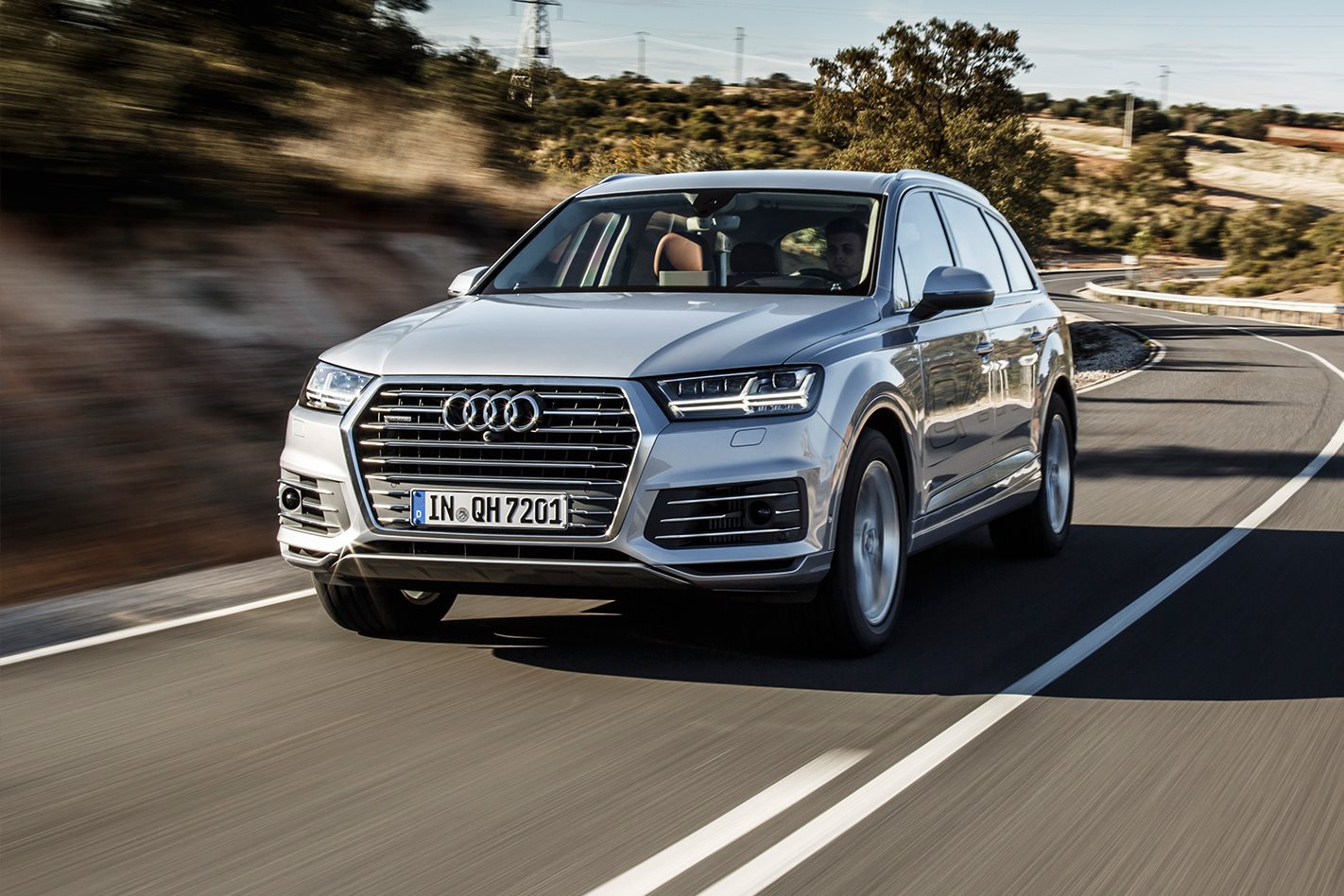
Audi’s new SUV flagship is a big coupe-like alternative to the Q7
Price range: $128,900 Rivals: BMW X6, Mercedes-Benz GLE-Coupe, Porsche Cayenne, Range Rover Sport Due date: January 2019
Closely following the design cues teased in the Audi Q8 Sport Concept unveiled at the 2017 Geneva Motor Show, the Audi Q8 is a sportier, more luxurious sibling to the Q7 large SUV. It will be one of the most technically advanced Audis ever and is even able to park itself while you wait outside, although this may not be offered on Australian models. WhichCar understands Australia will get a 3.0-litre turbo petrol variant initially, possibly followed by a turbodiesel.
Audi RS5 Sportback
Take the Audi handsome A5 and transplant in the RS4’s powertrain. What’s not to like?
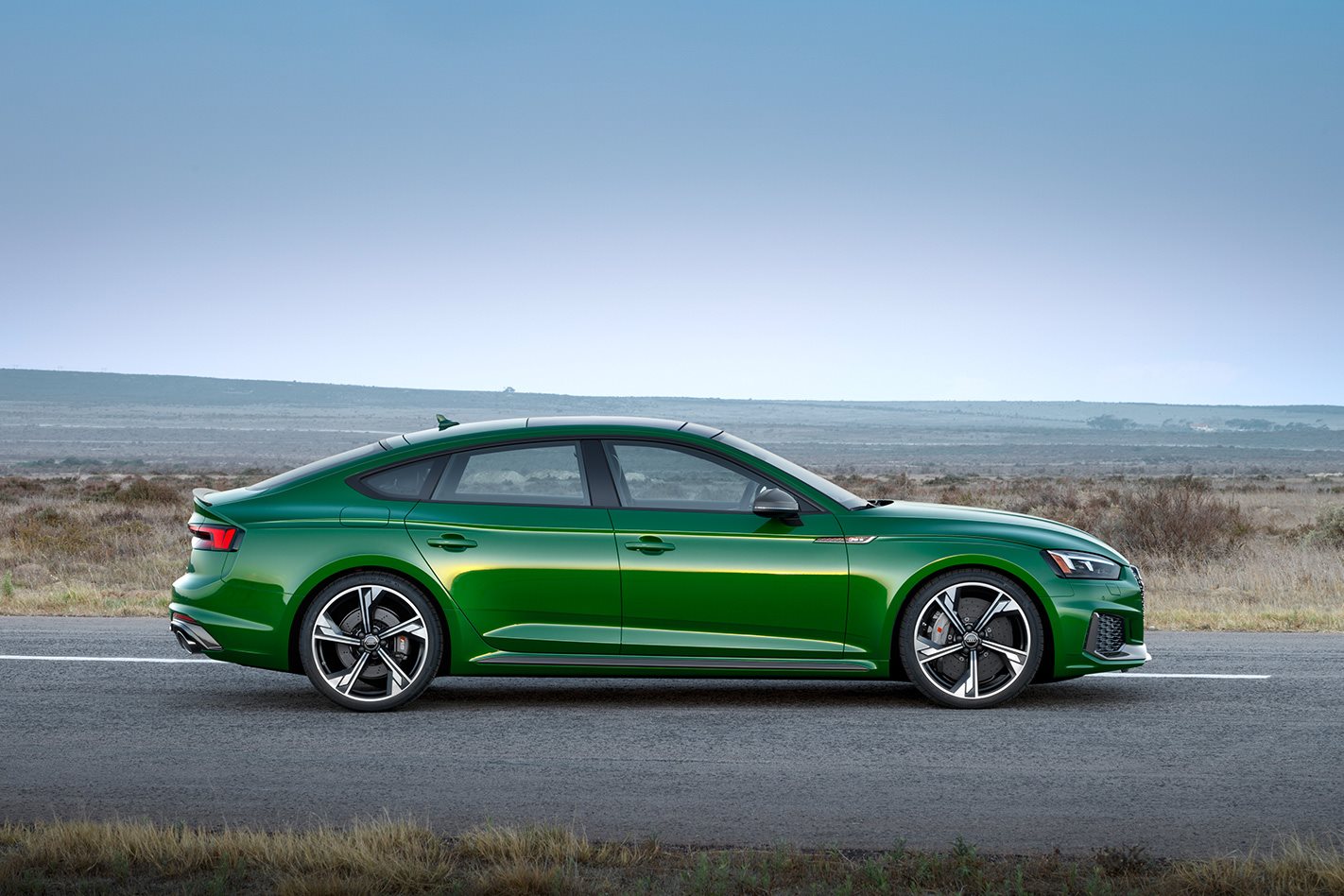
Price: $157,700 Rivals: Mercedes-AMG C63, BMW M4 Due: January 2019
The hotrod Audi RS5 Sportback joins its wagon twin, the Audi RS4 Avant, and the RS5 Coupe early in 2019, sharing the same 331kW/600Nm twin-turbo V6 powerplant that flings the grunt at all four wheels via an eight-speed automatic.
And though it wears the ‘coupe’ label, the Audi RS5 Sportback is equipped with four doors and a quasi-hatchback rear entrance for proper practicality. Because it’s an MY19 version of the RS5 pairing, it’ll also be graced with Audi’s digital dash, a heads-up display, wireless phone charger and rear USB ports as standard. It’s also available with this exclusive green paint, too, called Sonoma Green.
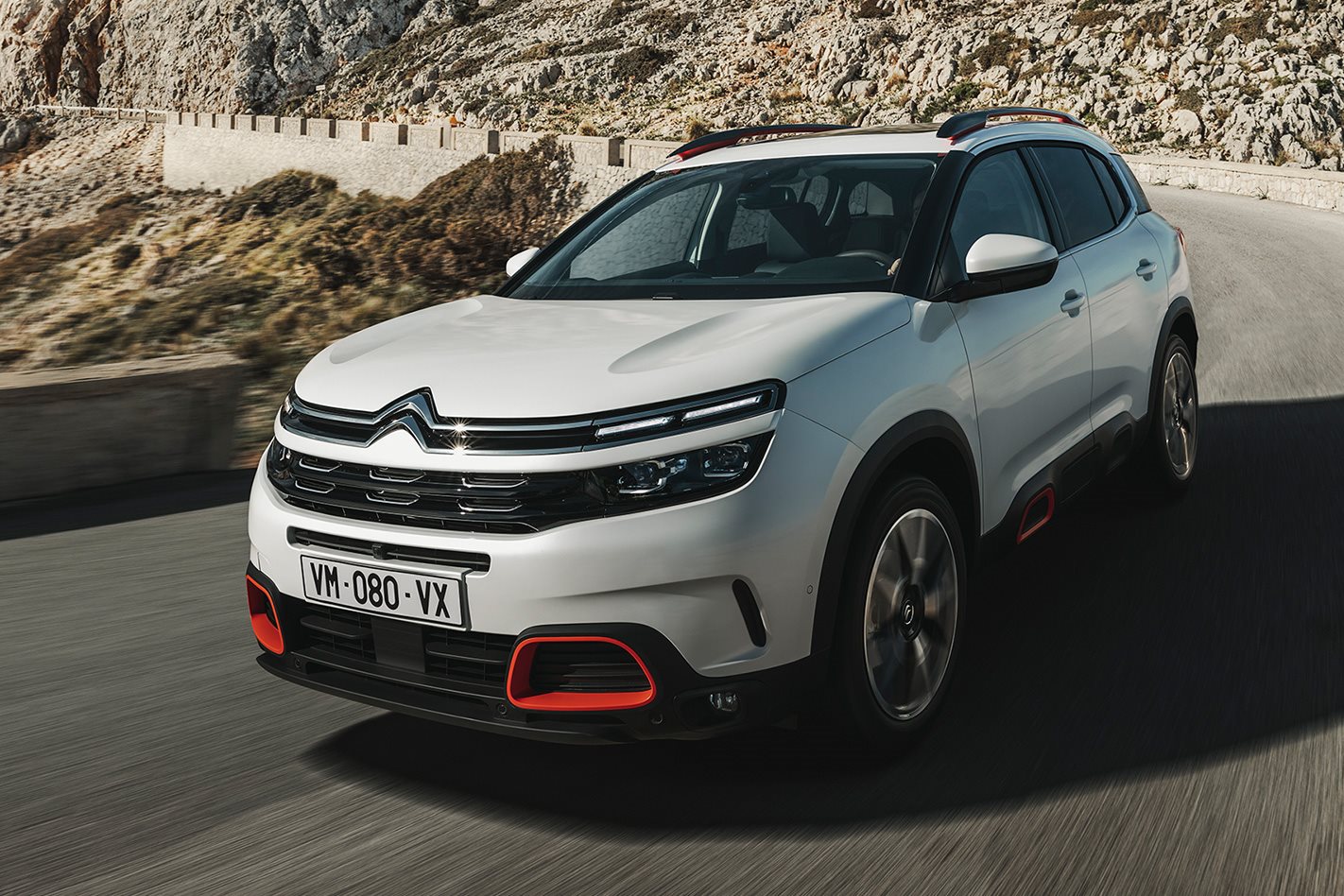
Citroen C5 Aircross
The C5 Aircross has morphed into an SUV that harks back to comfortable Citroens of old.
Price range: $38,000 -$55,000 (estimated) Due date: Mid-2019 Rivals: Mazda CX-5, Subaru Forester, Peugeot 3008, Renault Koleos
Citroen says the new Citroen C5 Aircross will be the ‘most comfortable and modular SUV in its segment’ by building on its predecessor’s plush hydro-pneumatic suspension with new tech that it calls “Progressive Hydraulic Cushions”. Ride comfort will be further enhanced by ‘Advanced Comfort’ seats that filter out road disturbances. The 4.5-metre-long Citroen C5 Aircross will make the most of its spacious interior by offering a wide centre console and flexible rear seating that can expand boot space from 580 to 720 litres.
Ford Focus Active
A jacked-up version of the Ford Focus for those with an outdoorsy bent
Price range: $29,990 Rivals: Subaru Impreza XV, Fiat 500X, Citroen C4 Cactus Due Date: second-quarter
The Ford Focus hatch has already received its full model changeover by now, but the family will grow when the Focus Active rolls into Ford showrooms in 2019.
Following a similar format to the Impreza-based Subaru XV crossover, but described by Ford as a passenger car rather than an SUV, the Focus Active will bridge the gap between the regular Focus hatchback and Ford’s bona-fide SUV line-up. The ‘missing link’, if you will. Only one engine, a 134kW 1.5-litre turbo petrol, will be offered, and the Focus Active is strictly front-wheel drive with an eight-speed automatic.
Ford Transit PHEV
Iconic workhorse plugs into the 21st century
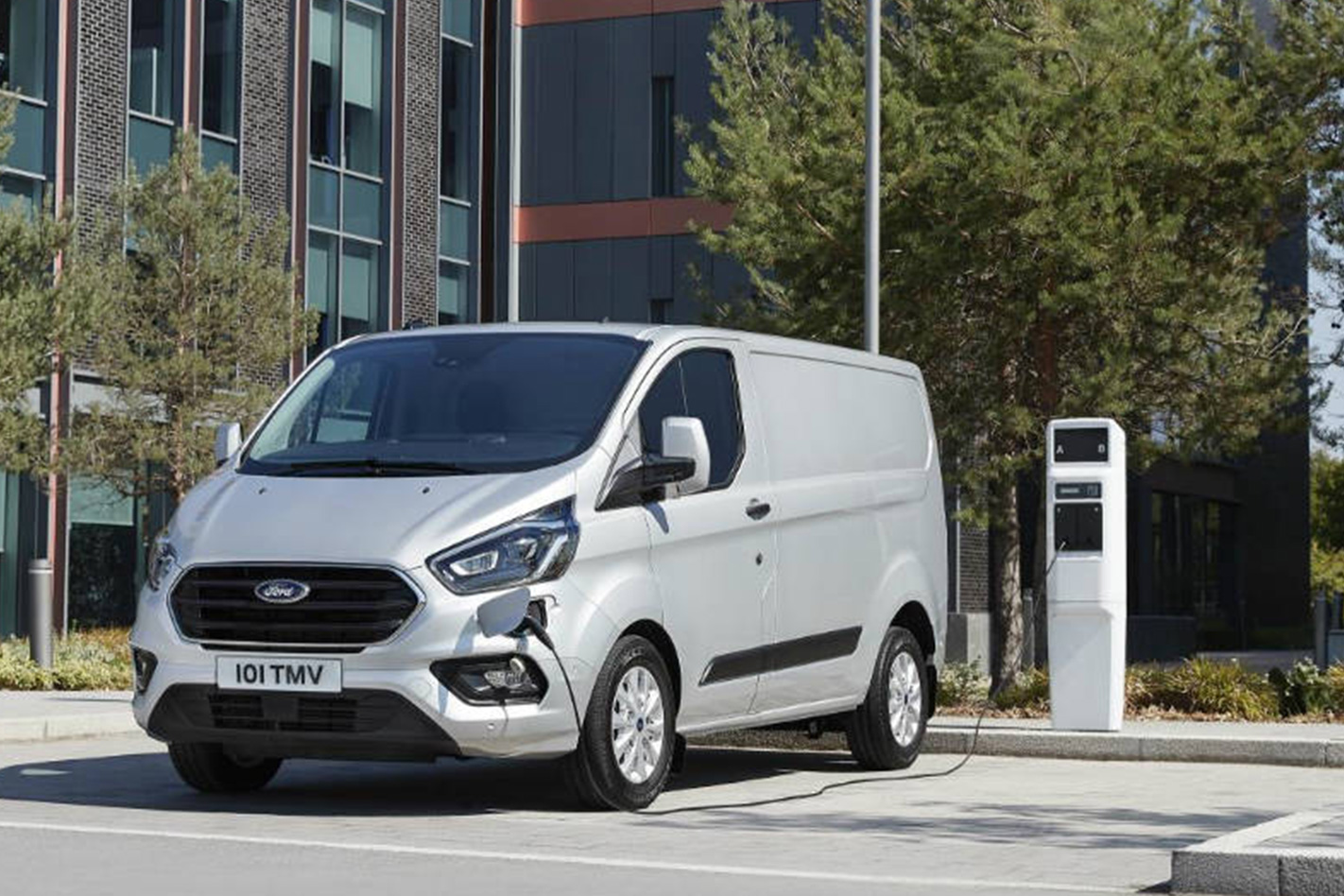
It’s not quite confirmed for Australia at the time of writing, but Ford says the first electrified version of the humble Ford Transit in more than half a century is under consideration. If green Transit power gets the green light for local sale, it will touch down in the second half of the year.
As for competition, there’s not a lot of electrified commercial vehicle action in Australia with only the Renault Kangoo ZE full EV (and Mitsubishi Outlander PHEV at a push) to apply any pressure… for now. Imagine how many bikes this one could fit!
Jeep Gladiator
Long-rumoured Wrangler-based pick-up finally confirmed with badass name.Price $60,000 (estimated) Rivals: Ram 1500, Ford Ranger Wildtrak, Mercedes X-Class Due date: Late 2019
Details are light on the ground at the time of writing but Jeep’s late offering in the one-tonne market will bring a more style-focused option in a carpark occupied by many forgettable designs. What is known is that the Jeep Gladiator will be mechanically almost identical to the all-new Jeep Wrangler, which is known for its go-anywhere capability and is also arriving locally this year. Expect Jeep’s first production ute in decades to be an authority when the paved road ends.
Mercedes-Benz X350d
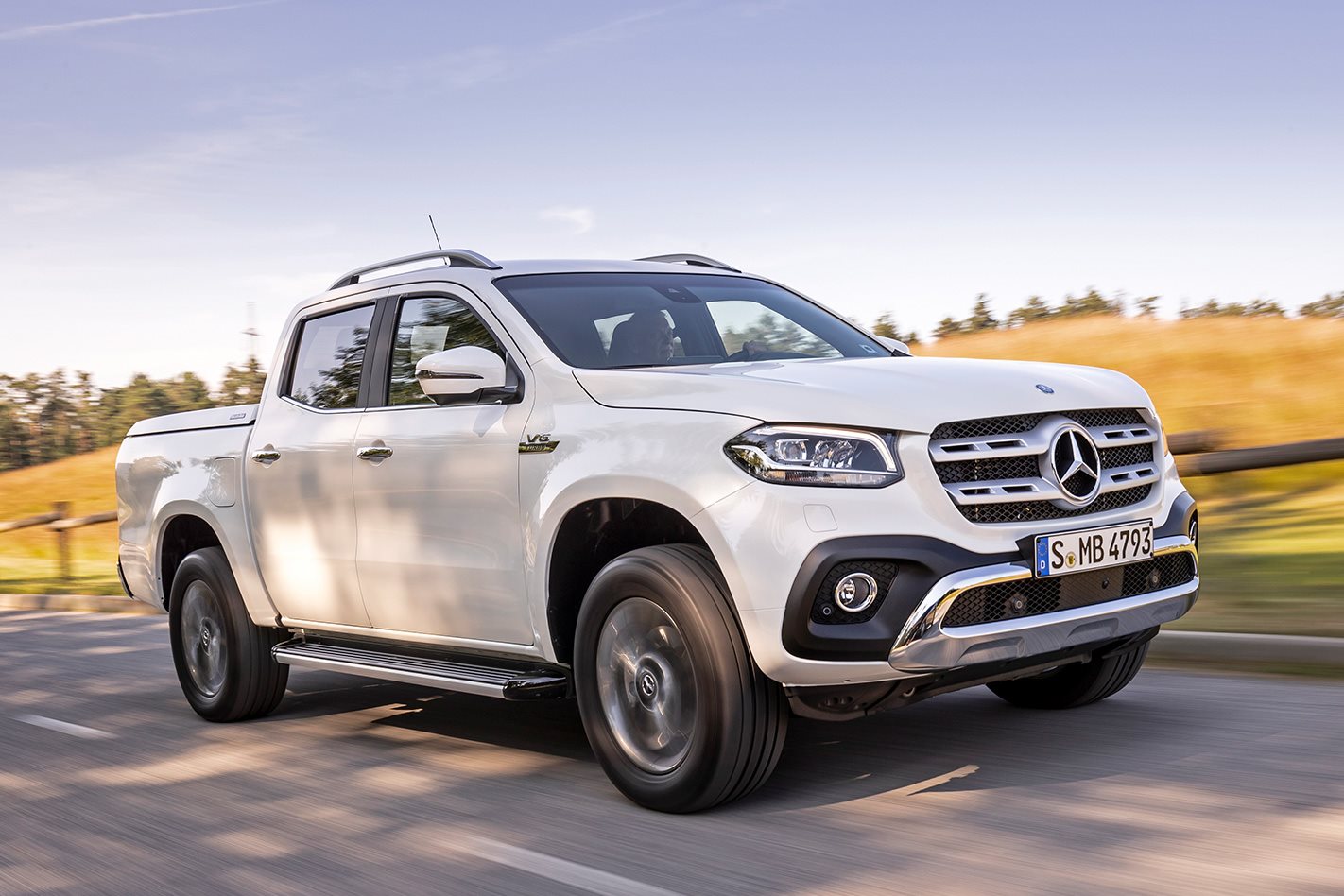
V6 diesel joins the Mercedes ute range to worry the as-yet unchallenged Volkswagen AmarokPrice: $73,270 Rivals: Volkswagen Amarok, Ford Ranger Raptor, Toyota Hilux Due date: January
Until now, the Volkswagen Amarok V6 has claimed the title of Australia’s most powerful one-tonner, but the arrival of the Mercedes X350d returns fire with a stout 190kW and 550Nm of torque from a turbo diesel V6. It’s pricey, but the German car maker is kitting it out with the equipment and luxuries to match. If you’re looking for a MTB-compatible ute that’s got proper off-road chops but doesn’t feel like you’re driving a commercial vehicle, this could be one for you.
Mitsubishi Triton
A major update and facelift of the fifth-generation Mitsubishi Triton ute.
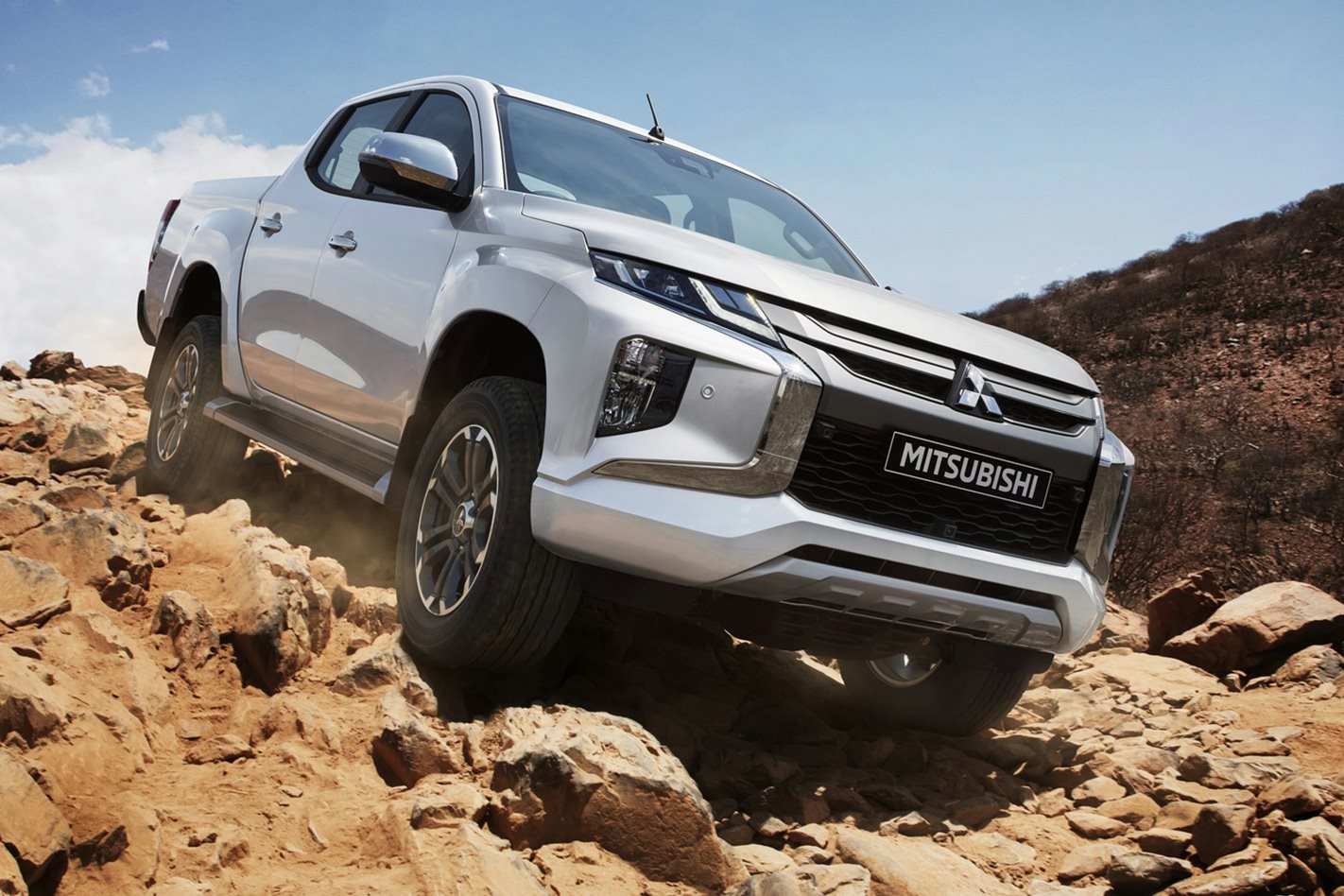
Price range: $25,000 to $50,000 (estimated) Rivals: Toyota Hilux, Nissan Navara, Isuzu D-Max, Ford Ranger, Holden Colorado, Mazda BT-50 Due date: January
It’s not quite a completely new model for 2019, but with more than 2400 changes including new sheet metal, an updated six-speed auto, more cabin equipment and safety tech, the 2019 version of the Mitsubishi Triton is significantly different. A new flagship is also expected at a later date bringing a tough truck rival to the Ranger Wildtrak and HSV Sportscat.
Renault Alaskan
Renault joins the one-tonne ute revolution at last, but is it fashionably late?Price: $26,000 to $55,000 (estimated) Rivals: Toyota Hilux, Nissan Navara, Isuzu D-Max, Ford Ranger, Holden Colorado, Mazda BT-50 Due date: December
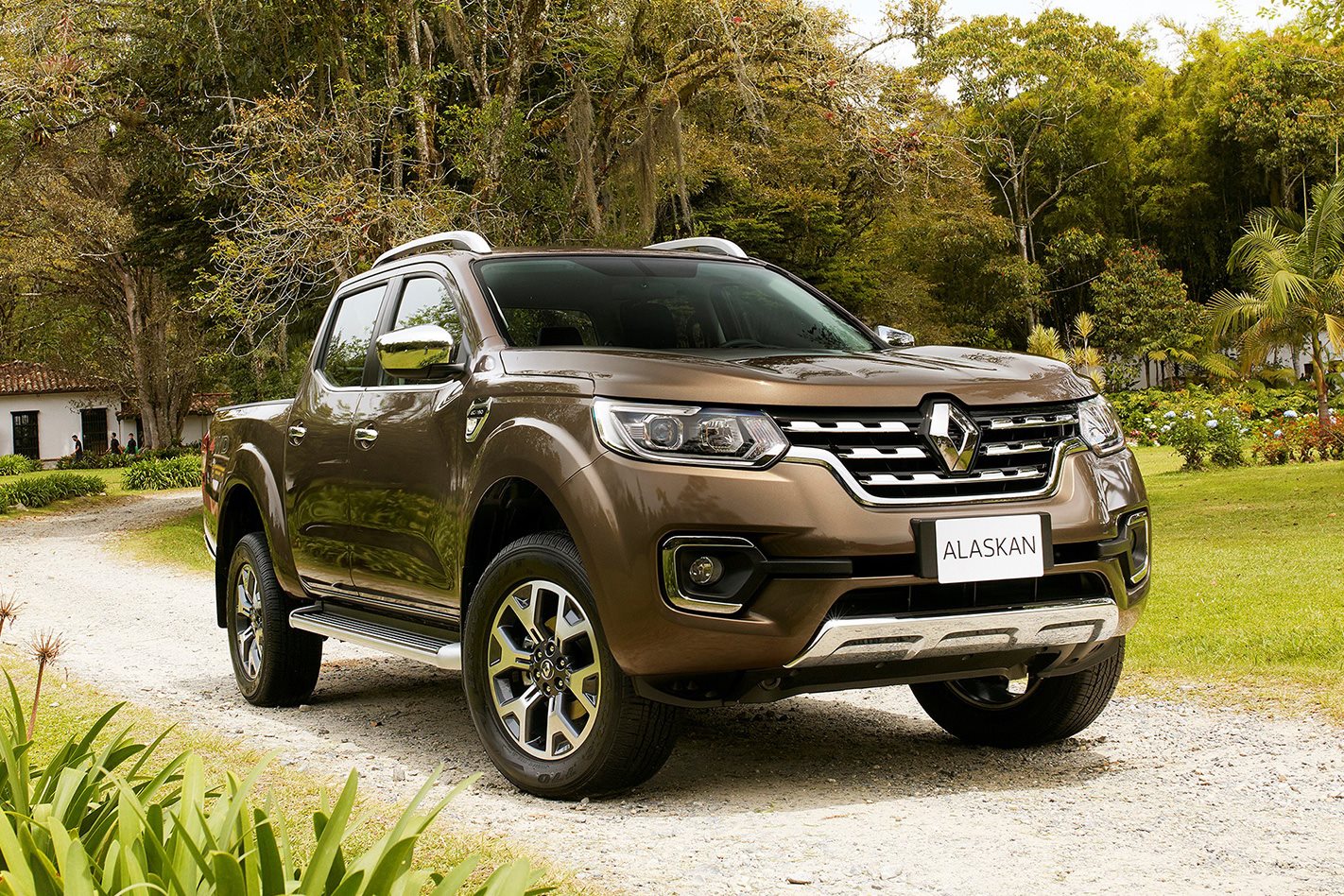
After a protracted gestation and a drawn out arrival date, the Renault Alaskan will finally launch into the lucrative dual-cab ute segment toward the end of the year. Like the Mercedes-Benz X-Class, the Renault Alaskan also takes its underpinnings from the popular Nissan Navara, and although exact Australian specifications are yet to be confirmed, it’s likely the French contender will offer a high-end version with lots of kit as well as a more affordable workhorse at the entry point.
Ram 1500 diesel
Baby of the Ram range gets a more manageable thirst without sacrificing gruntPrice: $95,000 (estimate) Rivals: Ford Ranger Raptor, Chevrolet Silverado, Volkswagen Amarok V6 Due date: January/February
From launch, the ‘smallest’ model in the Ram line-up, the 1500, was available only with gas-guzzling V8 power, which likely put off a few fence-sitting fans. However a V6 diesel version of the Ram 1500 is on the way and it compromises little for the extra efficiency. Exact output figures are yet to be finalised for the Australian launch but the 3.0-litre V6 turbocharged diesel could produce up to 200kW and 600Nm. That compares with the current 5.7-litre V8 which pushes out 291kW and 556Nm, so going for the more economical engine isn’t really at the expense of load-lugging mechanical grunt.
Volkswagen Touareg
The Volkswagen Touareg, VW’s large SUV, is now a truly premium offering that’s dripping with comfort and technology that rivals its Audi Q7 cousin
Price range: $83,000 – $120,000 (estimated) Due date: May 2019 Rivals: Audi Q7, BMW X5, Lexus RX, Mercedes-Benz GLE
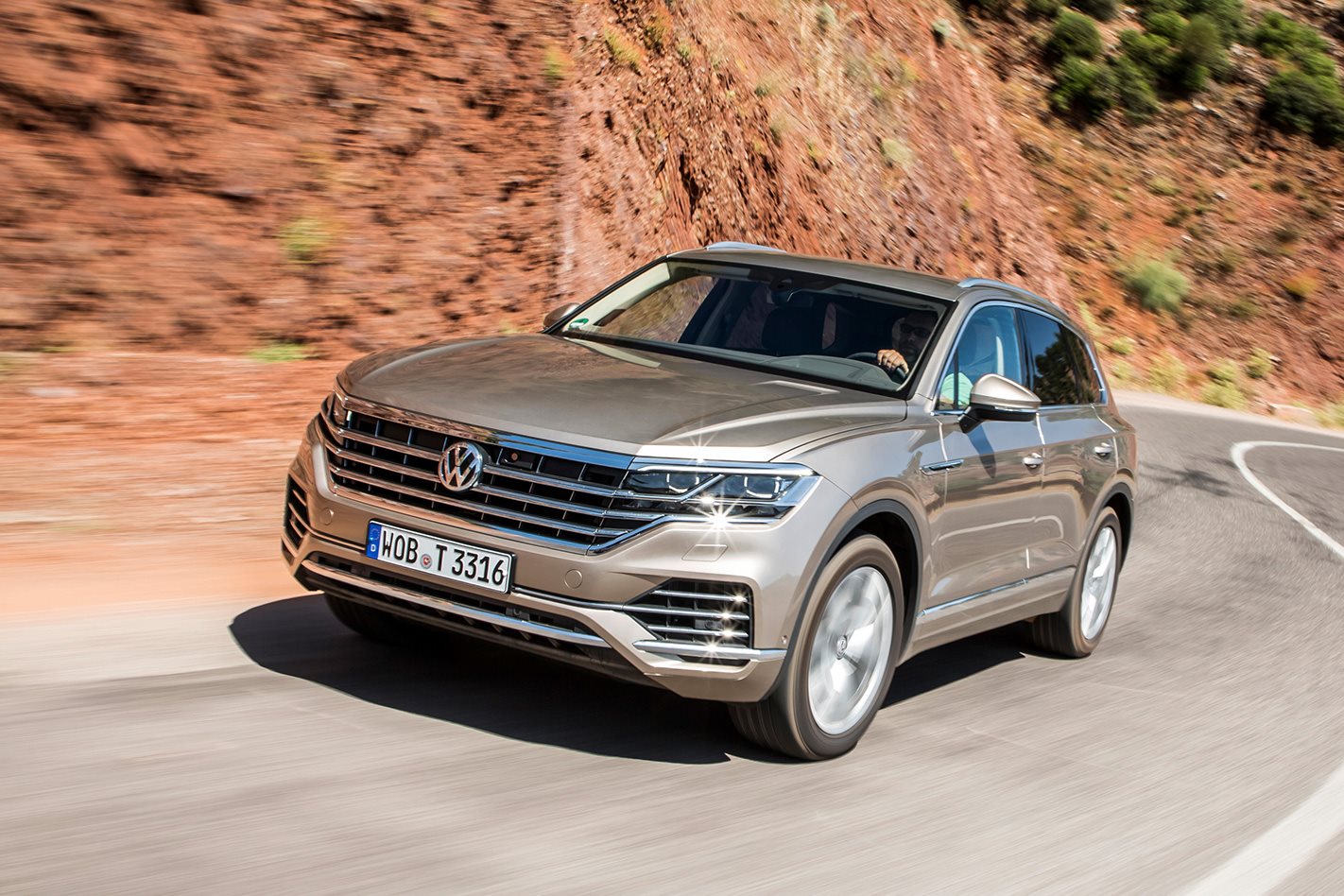
The first all-new Volkswagen Touareg since 2010 is the most luxurious and technologically advanced Volkswagen SUV yet and is built on the same platform as some of the world’s most luxurious high-riders including the Bentley Bentayga, Porsche Cayenne and Lamborghini Urus.
Featuring interior trim levels that range from lounge-like to the sporty R-line, creature comforts will include VW’s biggest panoramic sunroof yet, 18-way electronically adjustable seats with high-quality leather detailing. Perfect for a relaxing post-ride journey home.
The Lexus LC Convertible Concept has been revealed ahead of its public debut at the Detroit Auto Show next week.
Don’t be confused by the Concept tag, though. Lexus is speaking as though the LC Convertible isn’t a done deal for production, but it only takes one look at the released images to realise the model is all but ready for the showroom.
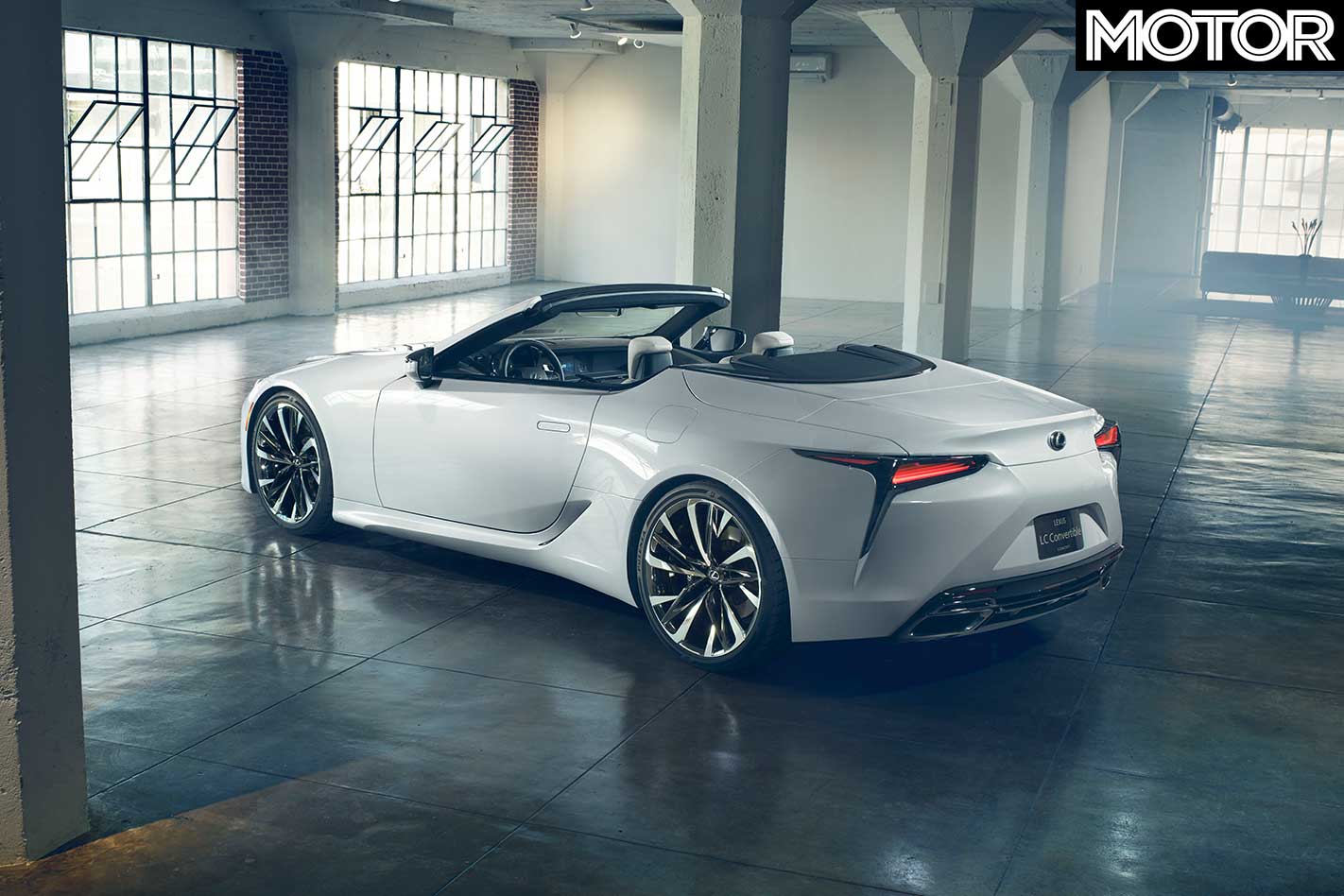
At 4770mm long, 1920mm wide and 1340mm tall with a 2870mm wheelbase, the Convertible is identical in size to the Coupe in all directions bar height (-5mm). The only external change we’d expect for production is for the Concept’s 22-inch wheels to shrink an inch.
Lexus is providing no details as to powertrain options for the LC Convertible, but it would be shocking if the Coupe’s duo of engine options weren’t carried over for the droptop.
For those wanting to make an environmental statement there is the LC500h, which uses electrically-assisted 3.5-litre V6 producing a maximum of 264kW, but the vast majority of buyers will want the LC500, powered by Lexus’s beautiful 351kW/540Nm 5.0-litre V8 matched to a 10-speed automatic.
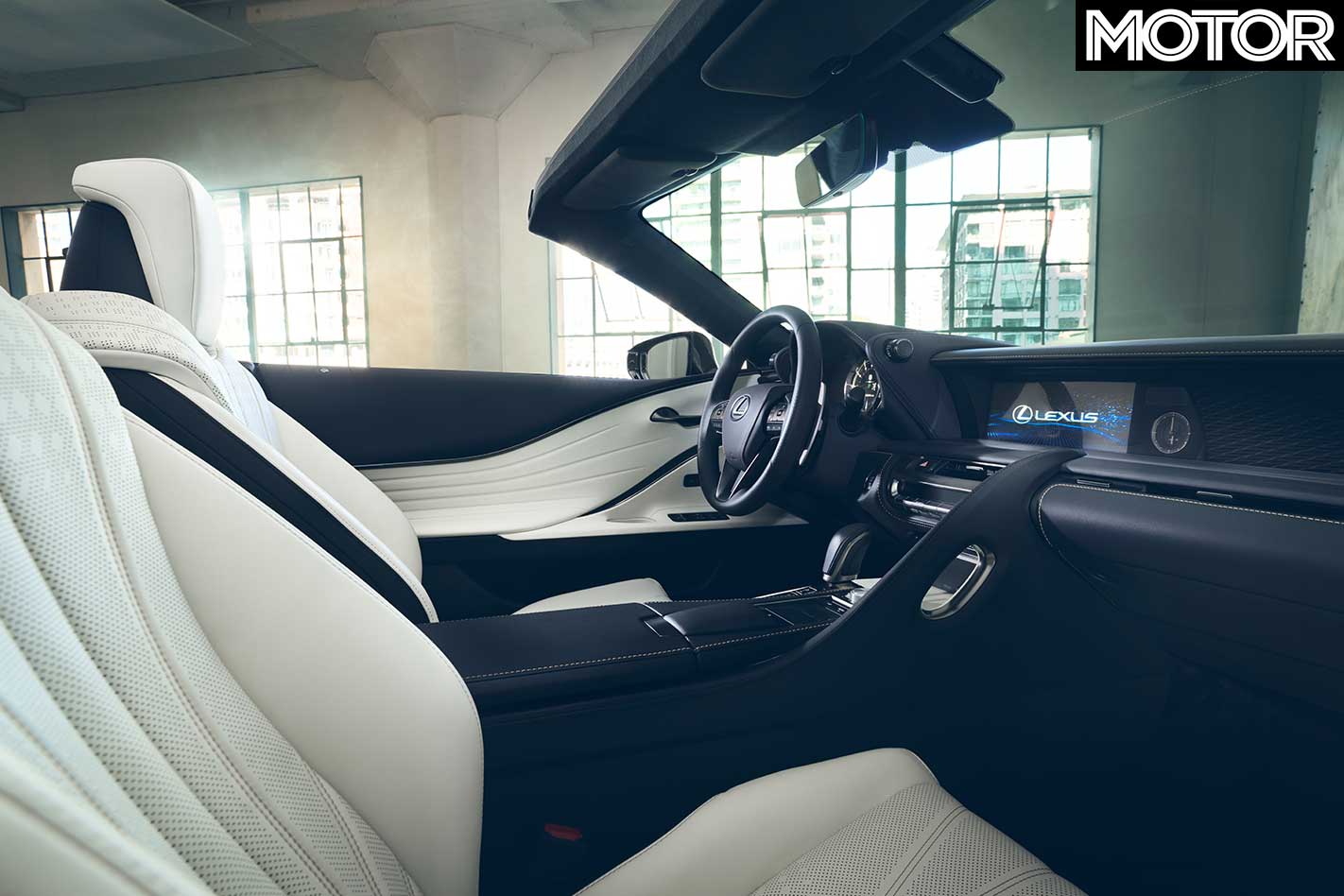
Speed will likely suffer somewhat, as the strengthening required to compensate for the missing roof will almost certainly add to the LC500 Coupe’s already hefty 1970kg kerb weight, but the incredible noise emitted by that naturally-aspirated V8 should be ample compensation.
Given Lexus has not even confirmed the LC Convertible for production it’s much too early to talk pricing or launch date, but if you start saving now you should be able to head to your Lexus dealer sometime in 2020 and order this piece of automotive artwork.
Toyota Gazoo Racing has waved its magic wand over the rear-drive Toyota Mark X sedan to create a manual variant capable of raising the heartrate higher than a Toyota Sedan normally would.
The Toyota Mark X GRMN had previously been developed as a limited run of 100 units in 2015, but now the new generation to bear the GRMN badge is being released at 350-units.
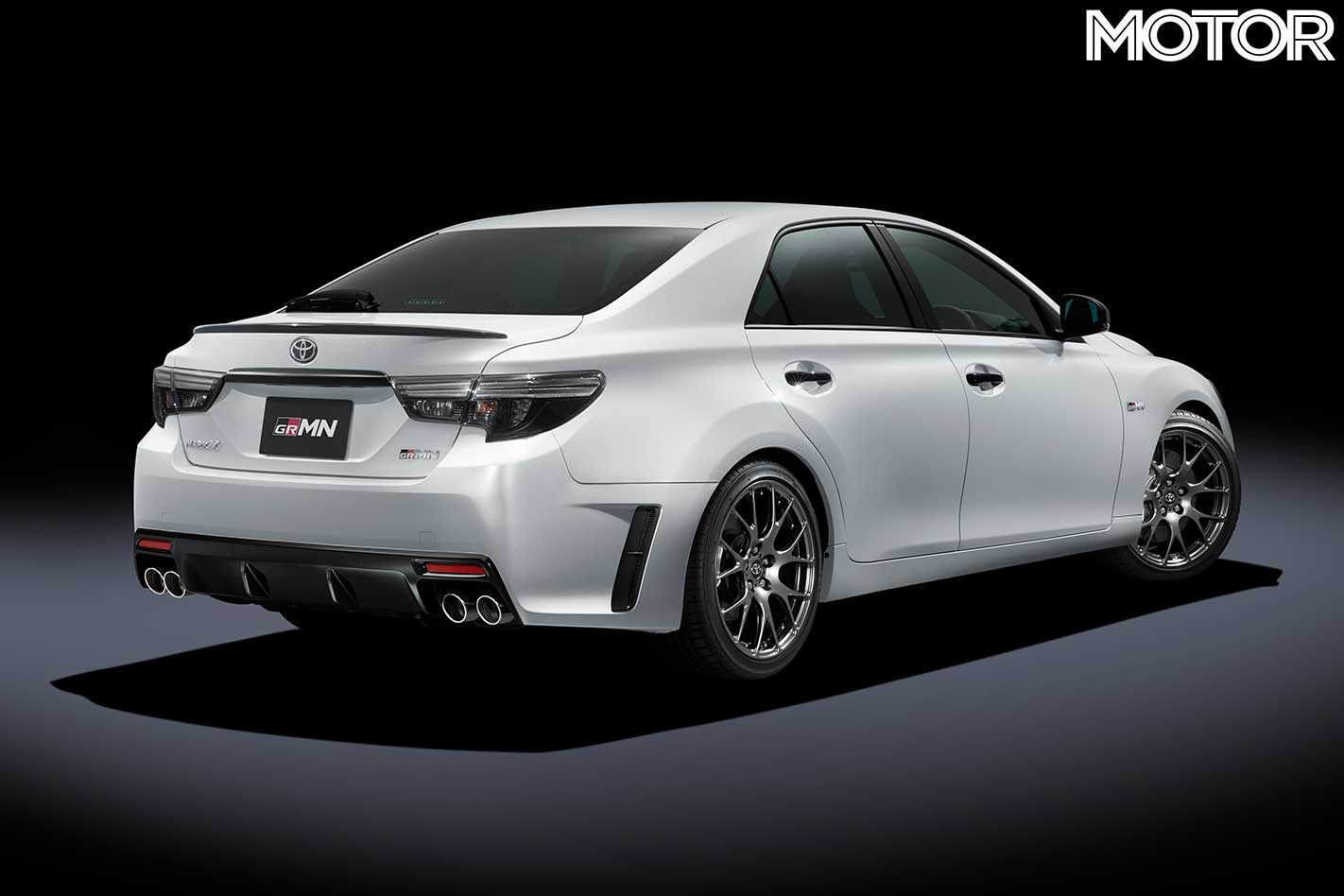
Underneath, the Mark X is based on the same platform as the Lexus IS, but in GRMN form comes with a manual gearbox.
That’s right – a manual rear-drive Toyota that’s not an 86 or a Supra, and with two more doors.
Its 3.5-litre naturally aspirated V6, the 2GR-FSE, is good for 234kW and 380Nm and has only 1560kg of car around it to haul.
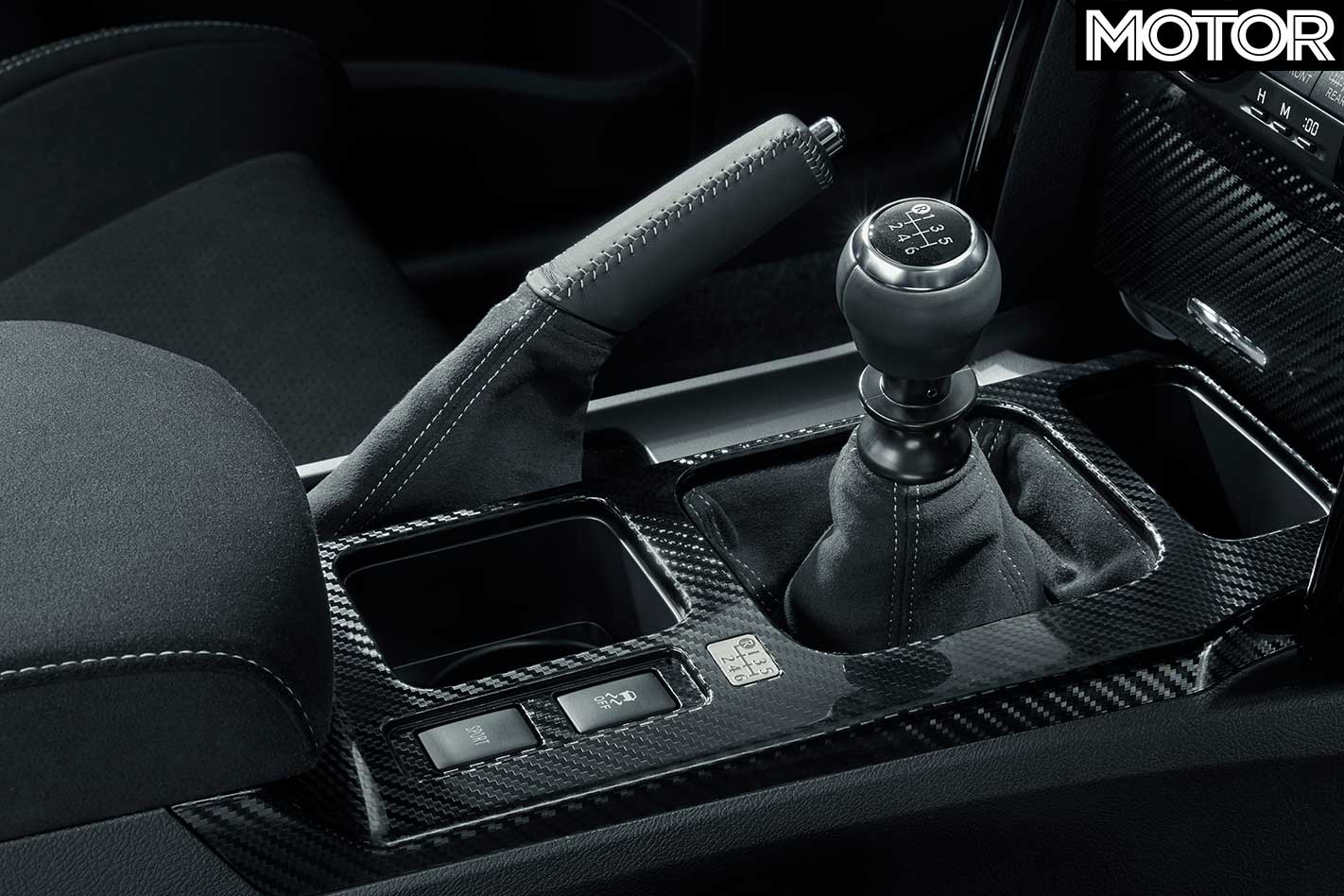
A carbon fibre-reinforced plastic roof panel reduces weight be 10kg, and lowers the centre of gravity, though it does cost the equivalent of $3500 at 270,000 yen.
The whole car’s base price is set at 5.3 million yen, which sounds a little more dramatic than the $65,690 that would represent here in Australia.
But knowing how much the Mark X GRMN is worth in Aussie dollars is unfortunately a little pointless, as the Mark X is only available in Japan.
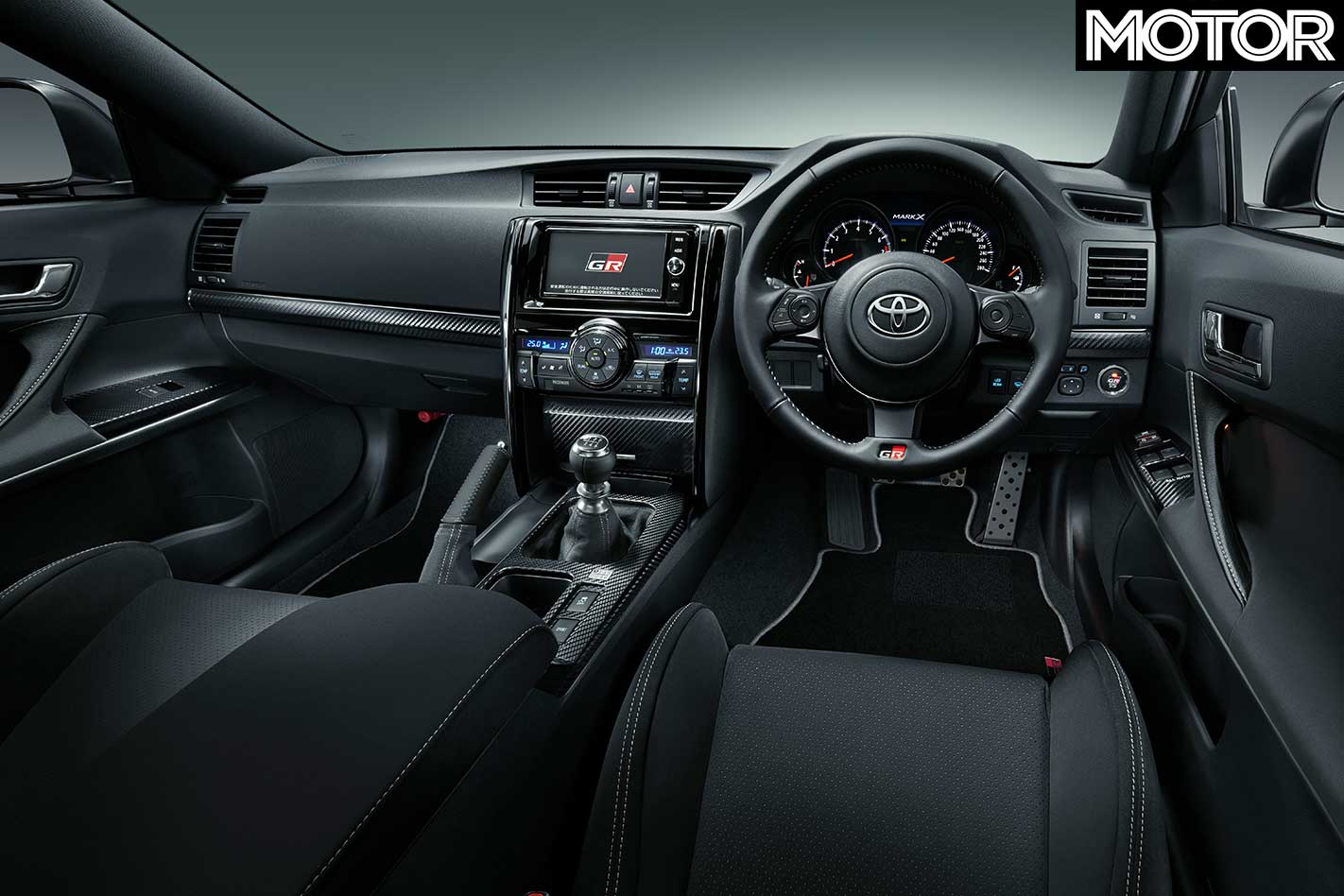
There have been no indications that will change, as the Gazoo Racing ‘GRMN’ family is to be available in its entirety in Japan and nowhere else. The press release for the Mark X GRMN is even only available in Japanese.
Changes to the import laws in Australia might soon make it easier to bring one here though. Keep an eye out once SEVS comes into effect…
Want to own about 33 per cent of all the right-hook Lamborghini Reventón Roadsters in the world?
You’d only need to buy one, and now you can.
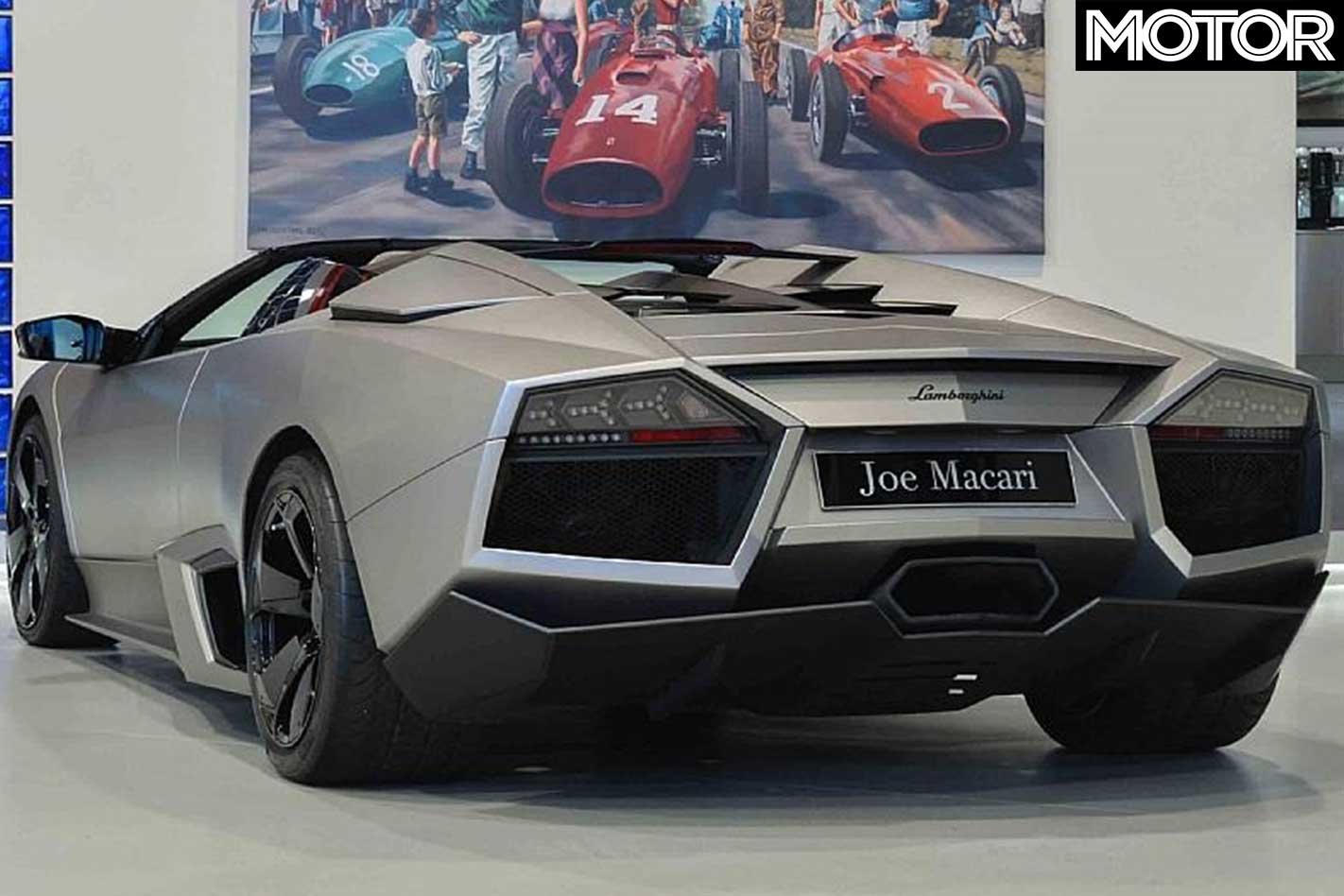
It’s up for grabs in the UK, advertised on our sister site TradeUniqueCars.com.au, and located at Joe Macari’s London prestige dealership.
“The car we are pleased to offer is a 2010 model and is one of just three produced in RHD variant,” the listing says.
“It is a UK supplied car and sits today in fantastic condition after covering just over 1,000 miles from new.”
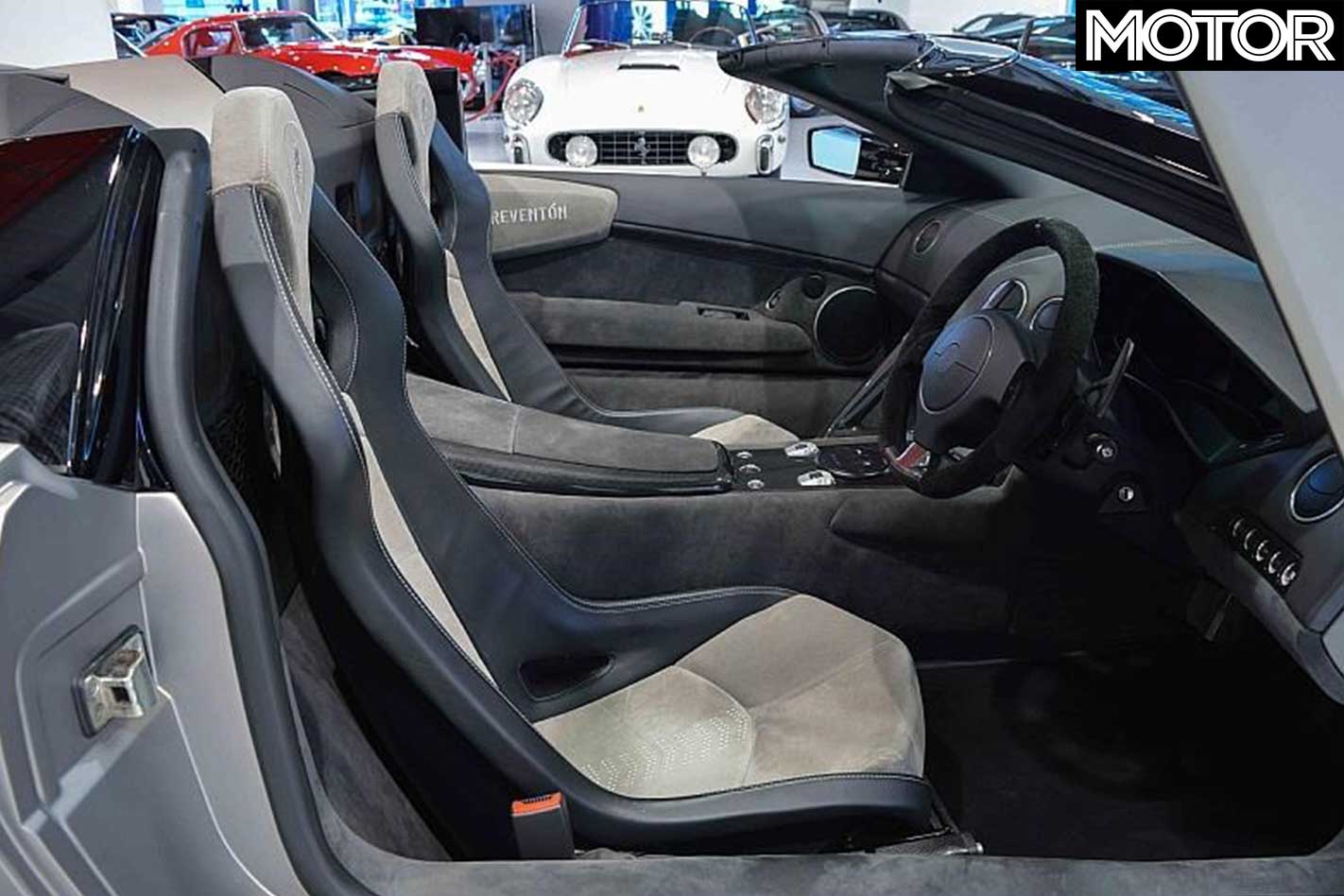
It’s actually showing 1770km, which is incredibly low for most cars, but actually more than you might expect from a car listed at £1,000,000 or AUD$1.8 million.
Originally, the Reventón Coupe (of which there were 20 built, alongside 15 Roadsters) was offered at €1 million. Today that’s around £904,000, or AUD$1,601,000.
It’s based on the Lamborghini Murciélago LP640, but with a little more power liberated. Its 6.5-litre V12 pumps out 493kW and allows a 0-100km/h sprint in 3.4 seconds. It’ll hit 330km/h, though its reported that one was able to hit 355km/h in testing in the Middle East.
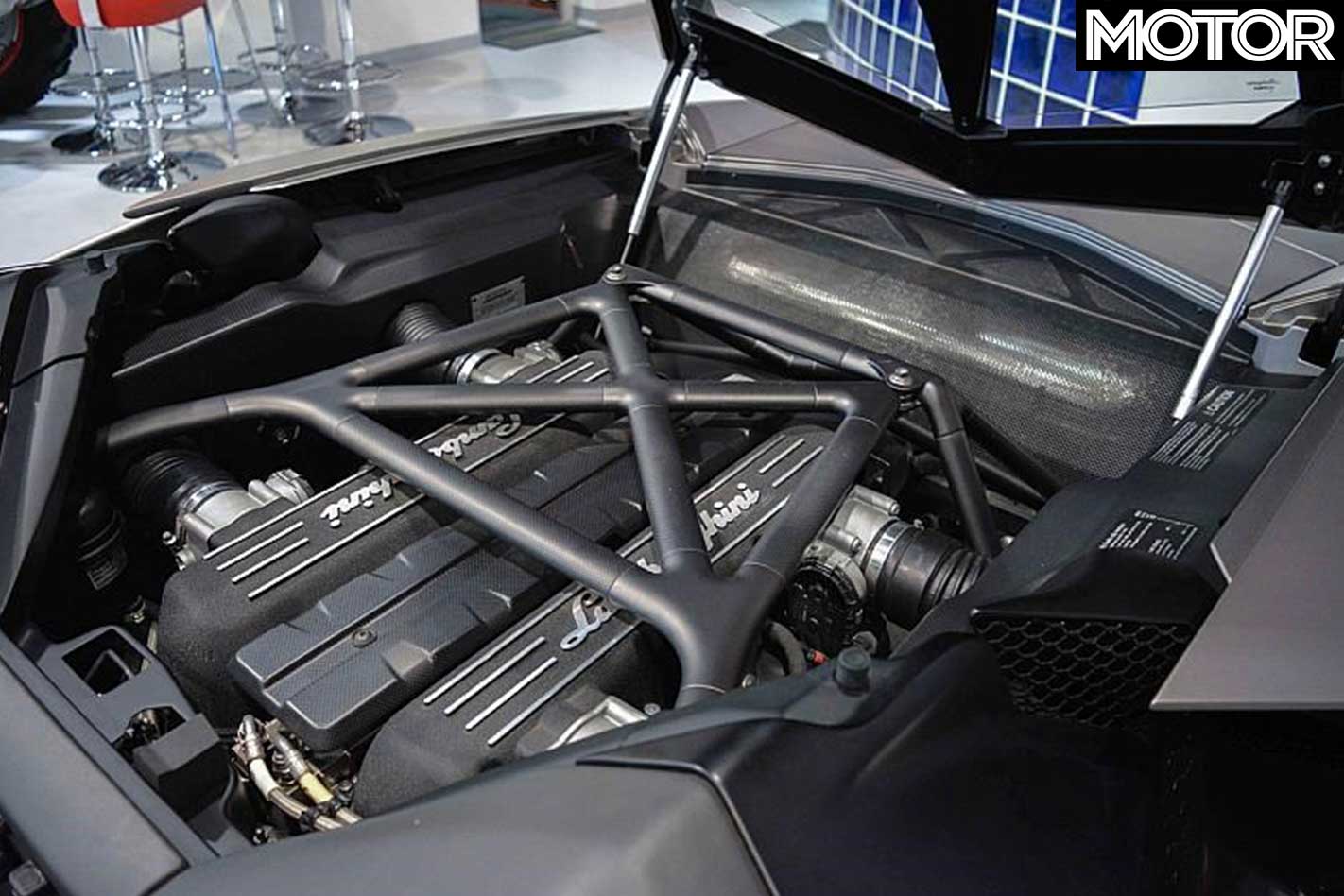
Each of the Reventóns built is finished in Reventón grey, and features bodywork inspired by what Lamborghini called at the time “the latest aeronautics,” meaning the F22 Raptor fighter jet.
Carbon fibre, the front air intakes, and several elements of the interior are meant to mimic the F22, as is the paint finish, but for the most part it looks much like a wilder Murciélago.
Some weeks there’s just too much going on in the automotive universe to cover everything in the pages of our magazines, on our various websites and in the episodes of WhichCar TV, and now there’s a solution that means you don’t have to miss out on a single thing.
Our inaugural WhichCar Weekly podcast is now available for download, bringing you the motoring week in review. From the major headlines to the smaller snippets that you might have missed, it’s also our chance to talk about the stuff that might have got us into trouble had we mentioned it anywhere else.
WhichCar TV launches January 13
Each episode, we bring representatives from our six automotive mastheads together for an eclectic and diverse perspective on the various motoring events of the week. Sometimes we agree, other times we don’t and once there was a food fight and a chip-pan fire.
Call it irreverent, call it informal, call it what you like. Just don’t call our parents, please.
This week, WhichCar senior journalist Daniel Gardner is joined by MOTOR mag associate editor Scott Newman, Wheels mag deputy editor Andy Enright and Street Machine deputy editor Scotty Taylor to discuss the past week but also glimpse the year ahead.
First up, we look into the Consumer Electronics Show in Las Vegas and its effect on the traditional motor show model. Next, we move on to Summernats 32 and Scotty assures us the world’s biggest burnout competition is really nothing to be feared. Finally, we close out the show with a look forward to some of the cars coming in 2019 and the ones that excite us most.
Set aside 30 minutes to listen in and make sure you tune in next week for episode two.
Listened to the show? Help us out:
- Leave a note in the comment section below.
- Leave a review on Apple Podcasts/iTunes
- Subscribe to our podcast
Today at the Tokyo Auto Salon, Toyota has announced its yet to be launched Supra will race in Japan’s Super GT race series under the GT500 class.
Toyota Gazoo Racing says it’s been expected that the new Supra will follow in its predecessor’s motorsport footsteps, and that the move is being undertaken “to meet the expectations of these fans.”
Those following the GT500 class will be aware that Toyota’s premium arm Lexus currently fields its LC in the series, but Toyota Gazoo Racing clarifies that the Supra will be taking over its place.
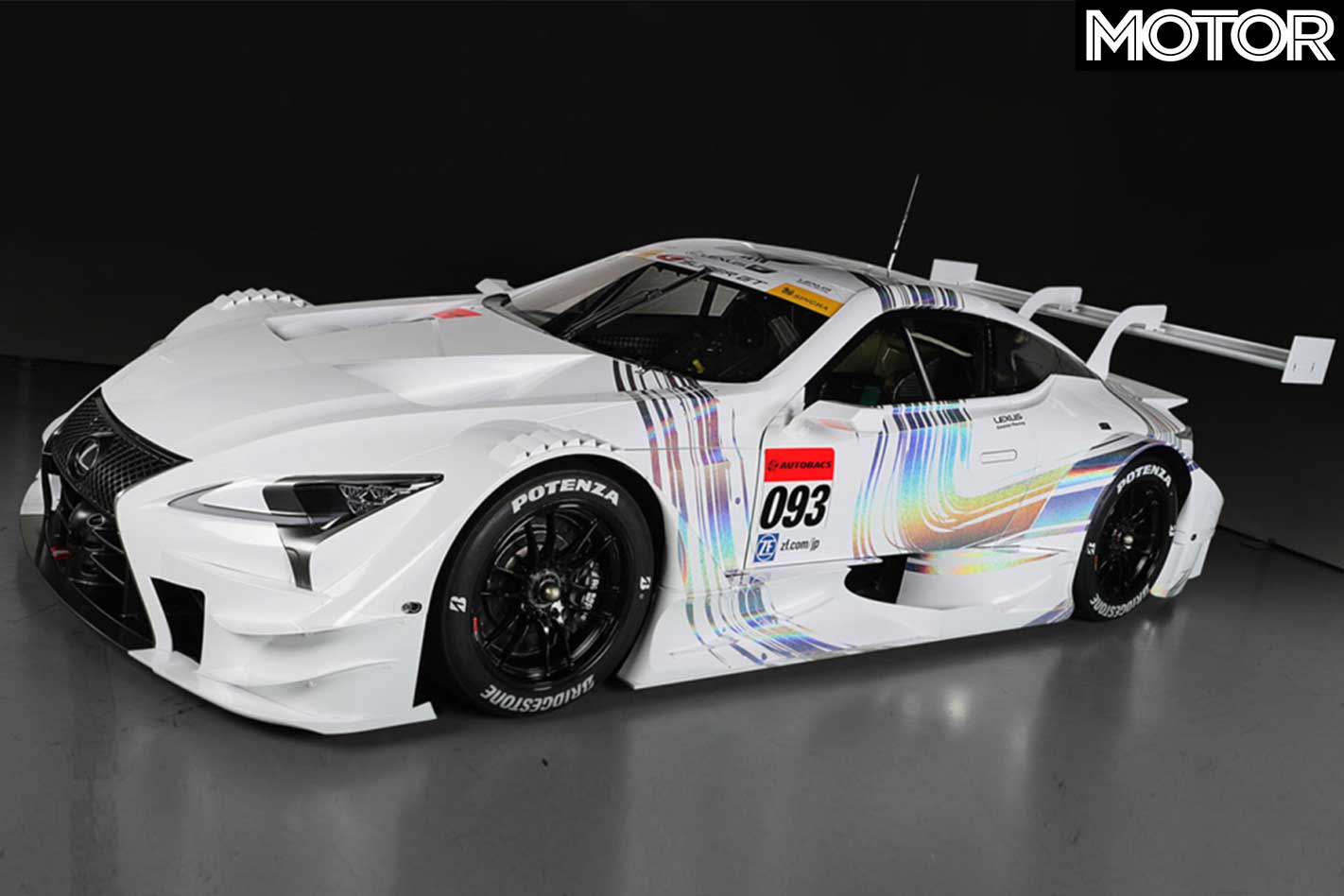
The Supra has already been confirmed as an entrant into NASCAR in the near future, meaning the GT500 announcement isn’t the first motorsport item added to the car’s CV before its reveal.
Toyota Supra GT4 racer concept unveiled
Though driver lineups are yet to be confirmed, don’t be surprised if NZ driver Nick Cassidy finds himself in the Supra come 2020, given he drives a Lexus LC for Lexus Team KeePer TOM’Sand took 2nd place overall in the 2018 GT500 class with co-driver Ryō Hirakawa after winning the year before.
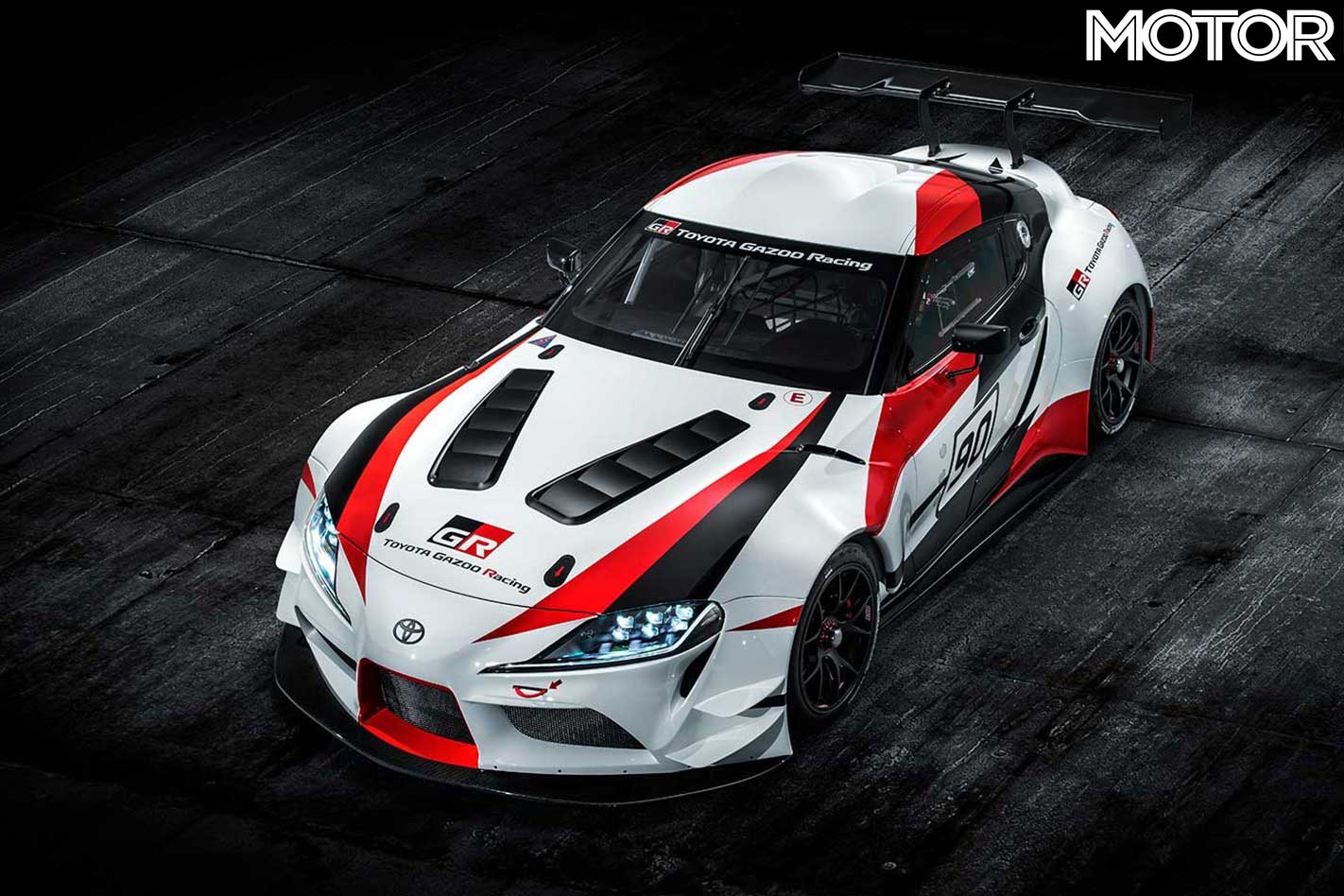
Interestingly, GT500 is set to intersect with Germany’s DTM series in 2020, as the two series aim to meet Class 1 regulations which require engine downsizing to 2.0-litre four cylinder turbo engines.
This means we’ll likely see Supras clashing with BMW’s M4 and Audi’s RS5 along with the Honda NSX and Nissan GT-R that race in the GT500 class, and the Aston Martin Vantage set to debut in DTM in the near future.
The Supra road car’s reveal is imminent, set for the North American International Auto Show in Detroit in just a couple of days.
Stay tuned for coverage of its reveal.
All the stars have aligned for buyers to bag a bargain in dealers this January.
The housing market downturn has rippled towards the premium end of the new vehicle market and soaked up some of the formerly strong demand Aussies had for performance vehicles.
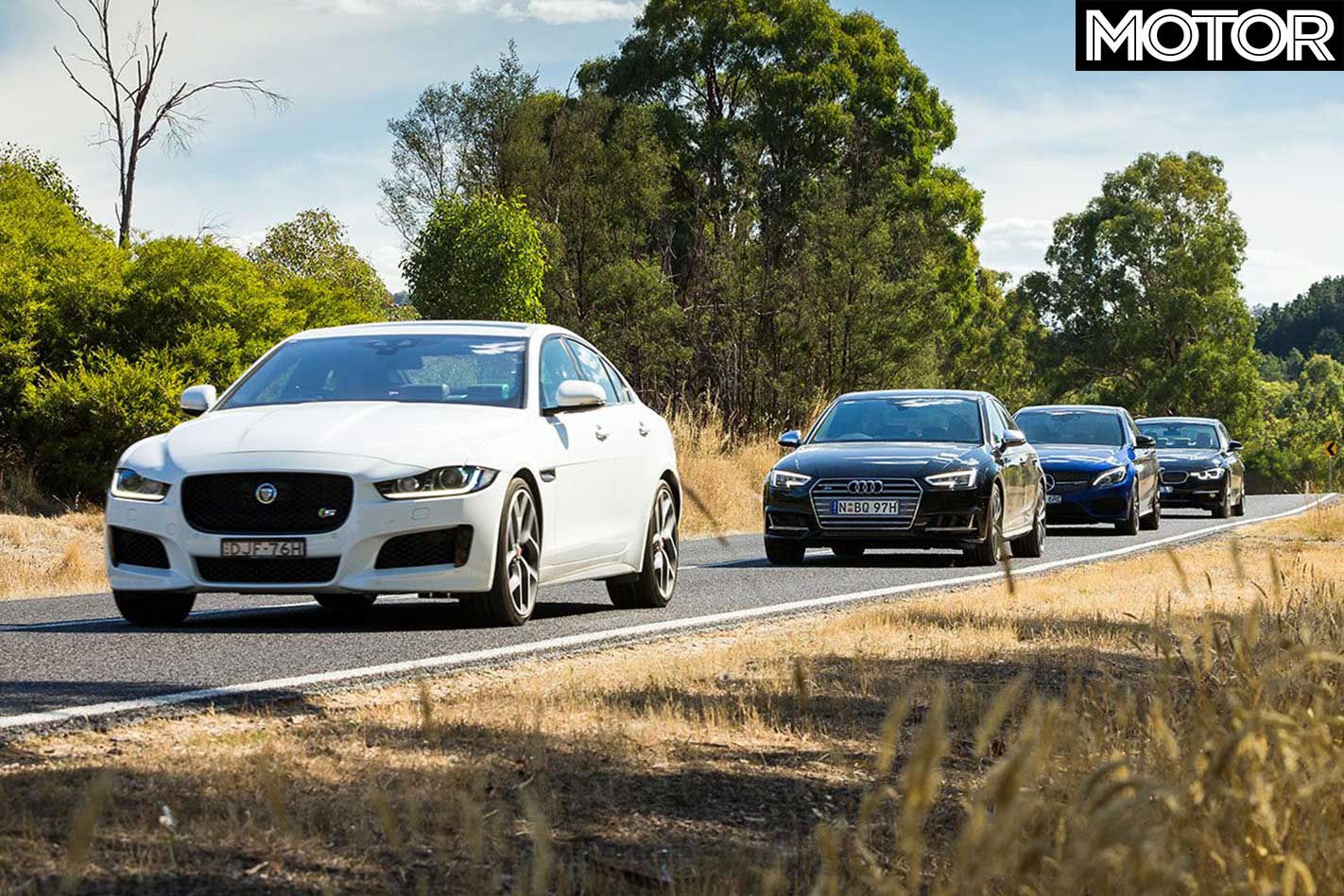
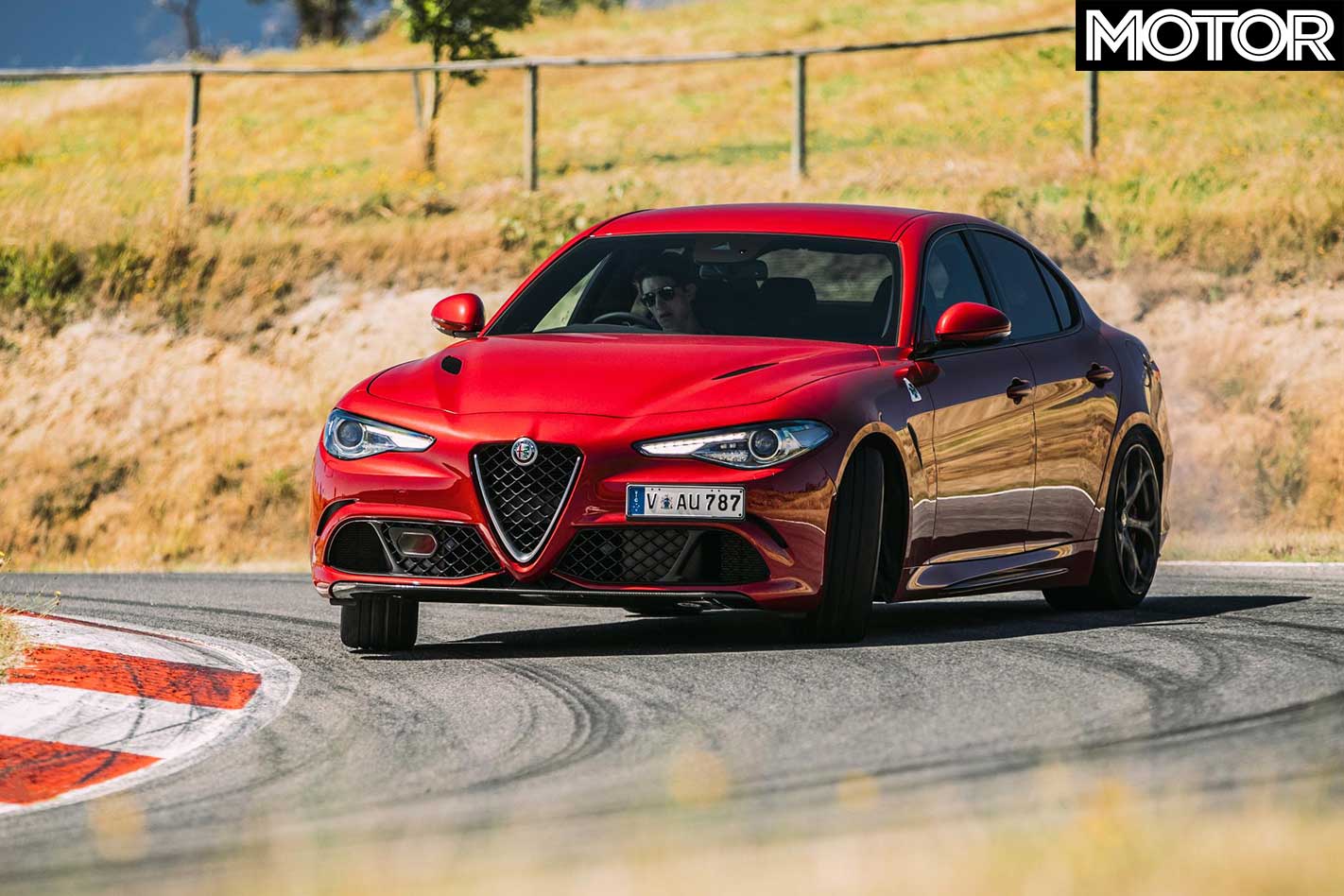
Here we survey Alfa Romeo, Audi, BMW, Jaguar, Lexus and Mercedes-Benz, and find some stunning sticker slashing going on.
All models below have to be last-year build, or 2017 so long as the kilometres are low. Brace yourselves, bargains are coming…
Check out a ‘demonstrator’ 2018 Alfa Romeo Giulia Quadrifoglio, the epic 375kW 2.9-litre twin-turbo V6 rear-driver retailing from $143,900 plus on-road costs – but after 3000km an example we spotted in New South Wales was on-sale at $109,850 for a $30K-plus save.
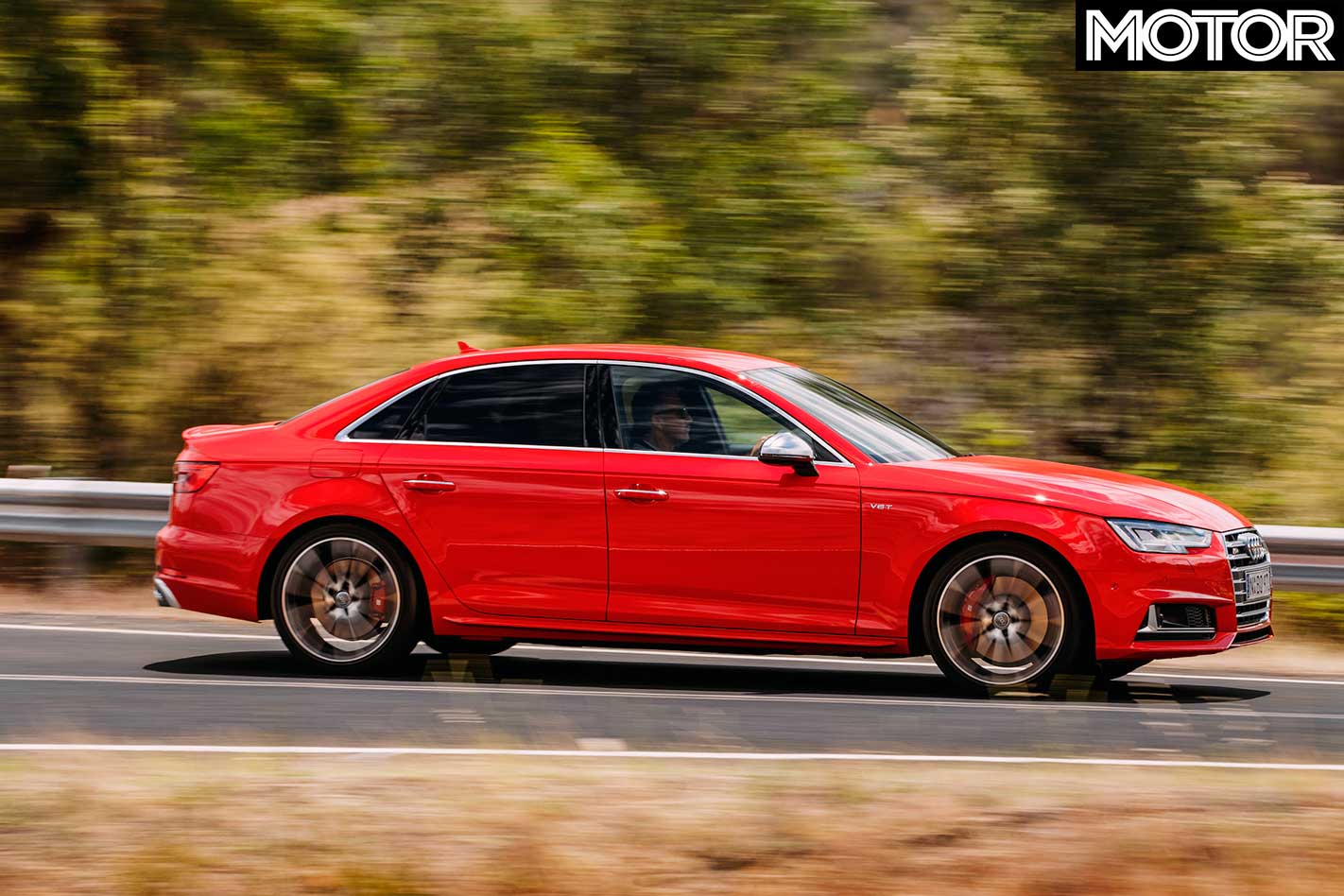
A demo 2018 Audi S3 sedan, the 210kW 2.0-litre turbo all-wheel driver typically $64,500 plus on-roads, was spotted with 3000km for $54,990 driveaway. Another $10K-plus cost-cut can be found with a demo 2018 Audi A4 2.0 TFSI quattro, using a 185kW version of the above engine and usually retailing for $70,300 plus on-roads – but with 1810km, and confirming you’ll be the first owner, one example is now $58,880 driveaway. Even a demo S4, its 260kW 3.0-litre sibling, falls from $99,611 plus on-roads to $89,880 with 1251km.
There are even more sizeable price cuts in a fellow German brand’s dealership, however.
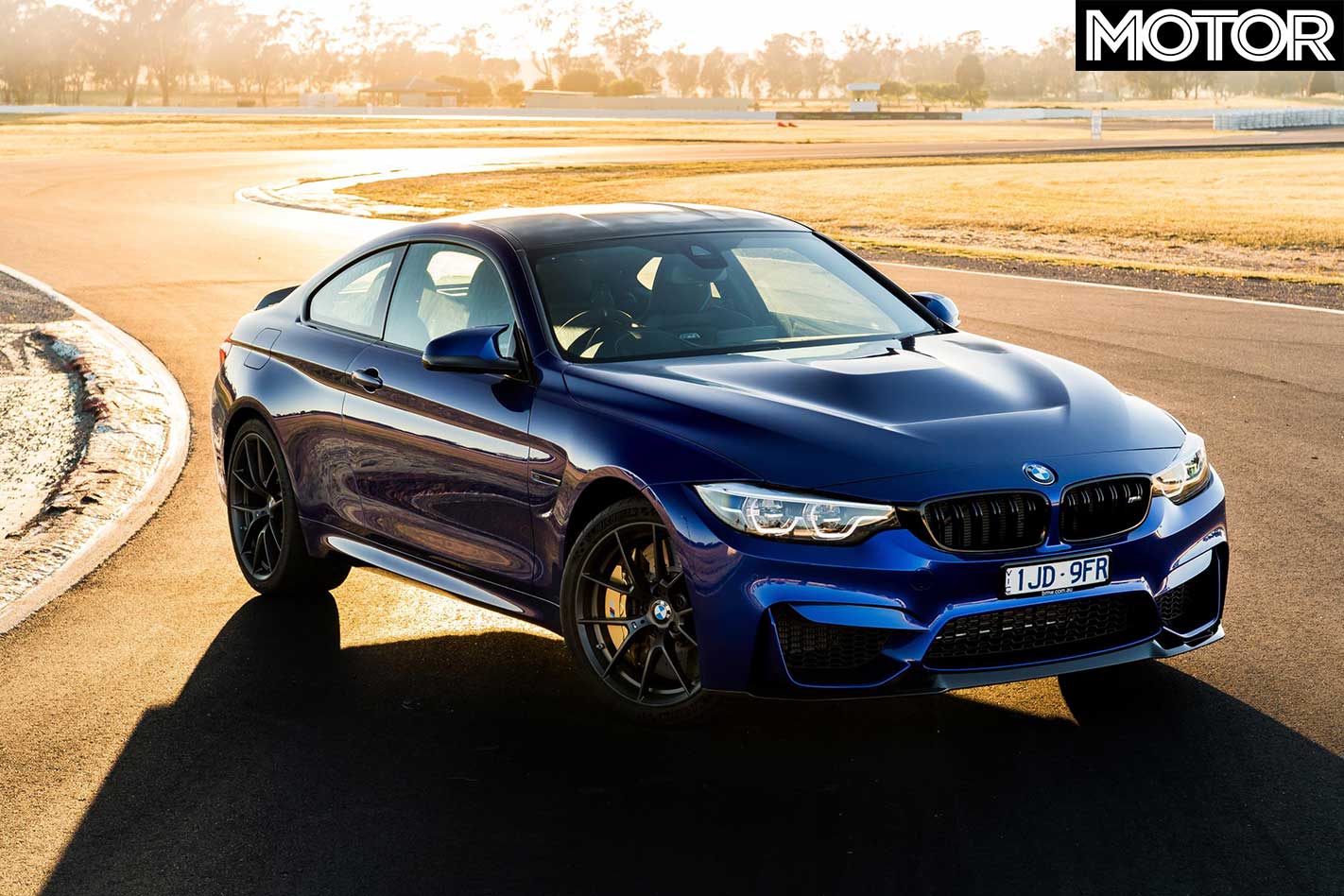
Check out a demo 2017 BMW M4 CS: $189,900 plus on-roads retail for the 338kW 3.0-litre six high-point of compact M-car ownership, down to $169,900 driveaway after just 3500km. There’s a demo 2018 BMW 740i, a 5.5sec 0-100km/h 3.0-litre twin-turbo limousine with a $228,100 plus on-roads retail, slashed by $75K (!) to $153,990 driveaway after 4692km.
And it doesn’t get much better for its smaller sibling, with one demo 2018 BMW 530d, a 620Nm 3.0-litre turbo oiler slashed by $30K-plus from $119,900 plus on-roads to $89,750 driveaway after 10,000km; and a demo 2018 540i, with a 250kW 3.0-litre turbo petrol falling by $20K-plus from $139,990 plus on-roads retail to $119,900 driveaway after 4800km.
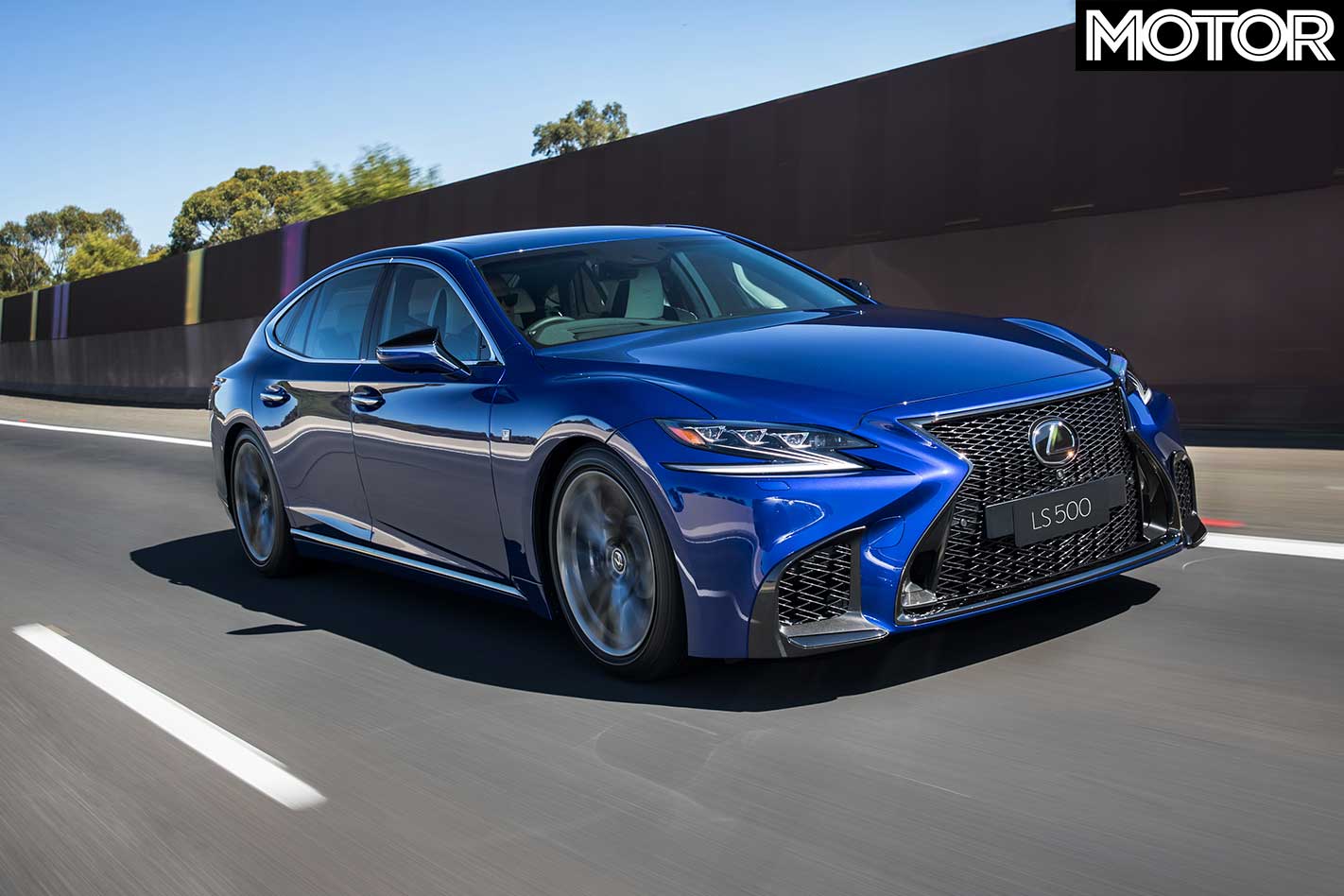
Jaguar’s likeable XF 25t R-Sport is typically $84,900 plus on-roads for the 184kW 2.0-litre turbo rear-driver, but one 2018 example with 1550km has been slashed by $20K to $64,990 driveaway. One size up, and there’s the 2018 Lexus LS500 F Sport in all its 310kW 3.5-litre twin-turbo V6 glory, usually $190,129 plus on-roads but after just 2500km slashed by $20K-plus to $169,888 driveway.
Similar in size, but without a roof and with only two doors, there’s a ‘used’ 2018 Mercedes-Benz SL400 bringing the cost of entry to this 500Nm 3.0-litre twin-turbo roadster down by $45K-plus from $220,900 plus on-roads to $174,888 driveaway, with only 2300km showing.
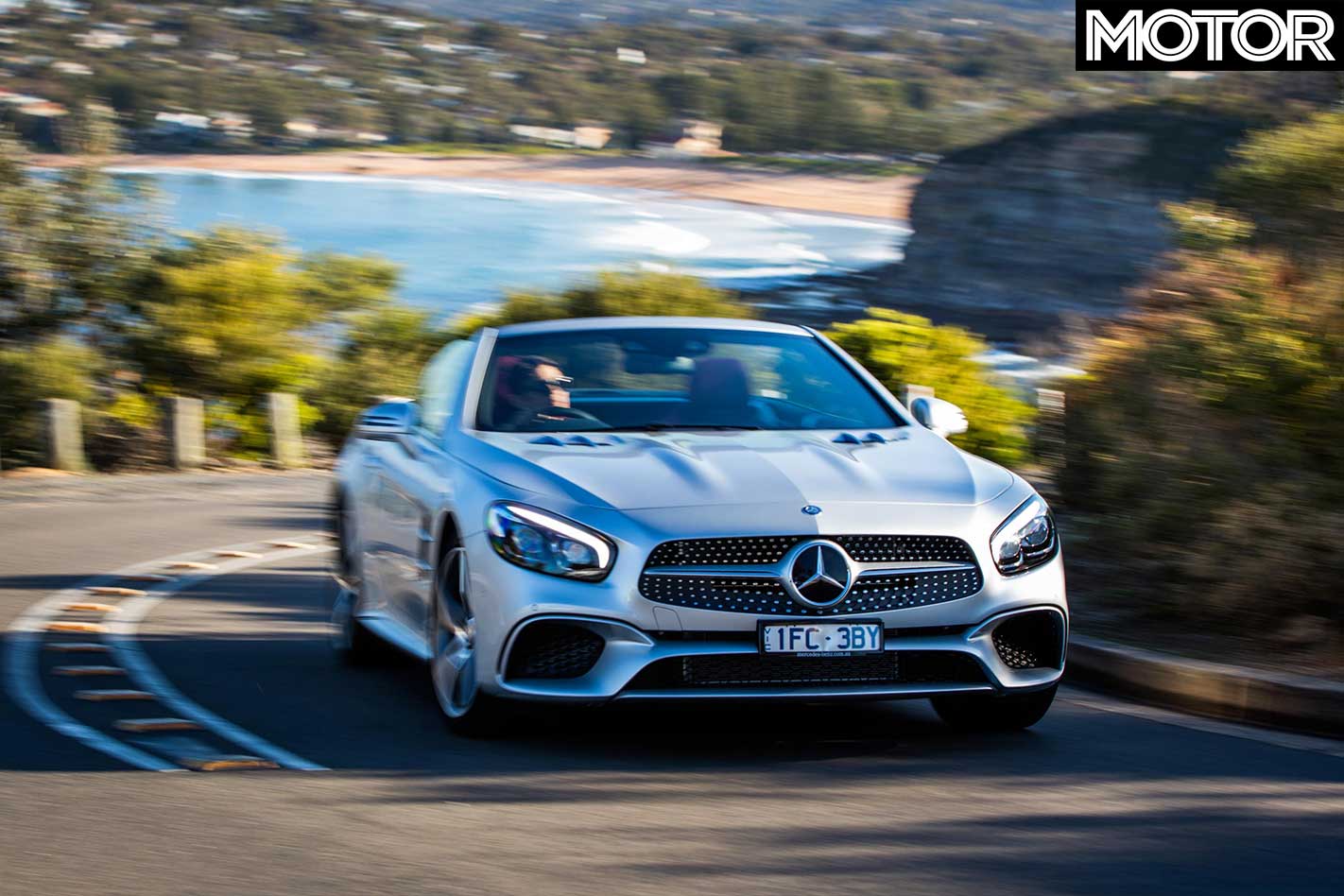
Or if you want more power and more roof, a superlative 2018 Mercedes-AMG C63 S coupe costs $149,900 driveaway – down $15K on retail for the 375kW 4.0-litre twin-turbo V8 unit.
What’s clear is that from about $50K to $150K you can now expect 10 to 20 per cent-plus off the purchase price with an example that’s hardly a year old, with four-digit odometers.
SOMEONE with access to Toyota Mexico’s Twitter account is set to have a very bad day, with the company releasing official video of the highly-anticipated coupe just ahead of a scheduled reveal at the Detroit Motor Show.
What was probably meant to be a schedule promotional tweet was accidentally sent live by Toyota Mexico’s official account, with a short message and 45-second video.
Toyota Supra leaked ahead of reveal
Translated from Spanish by Google Translate, the tweet reads: “Our new #Supra to Japan is here, and this is the story that tells us #AkioToyoda about his return.”
The video, which can be watched above, shows the Supra completely bereft of camouflage driving, and sliding, under a highway. There are multiple close-up shots, as well as sounds of the engine revving as the Supra accelerates. Not much is left up to the imagination.
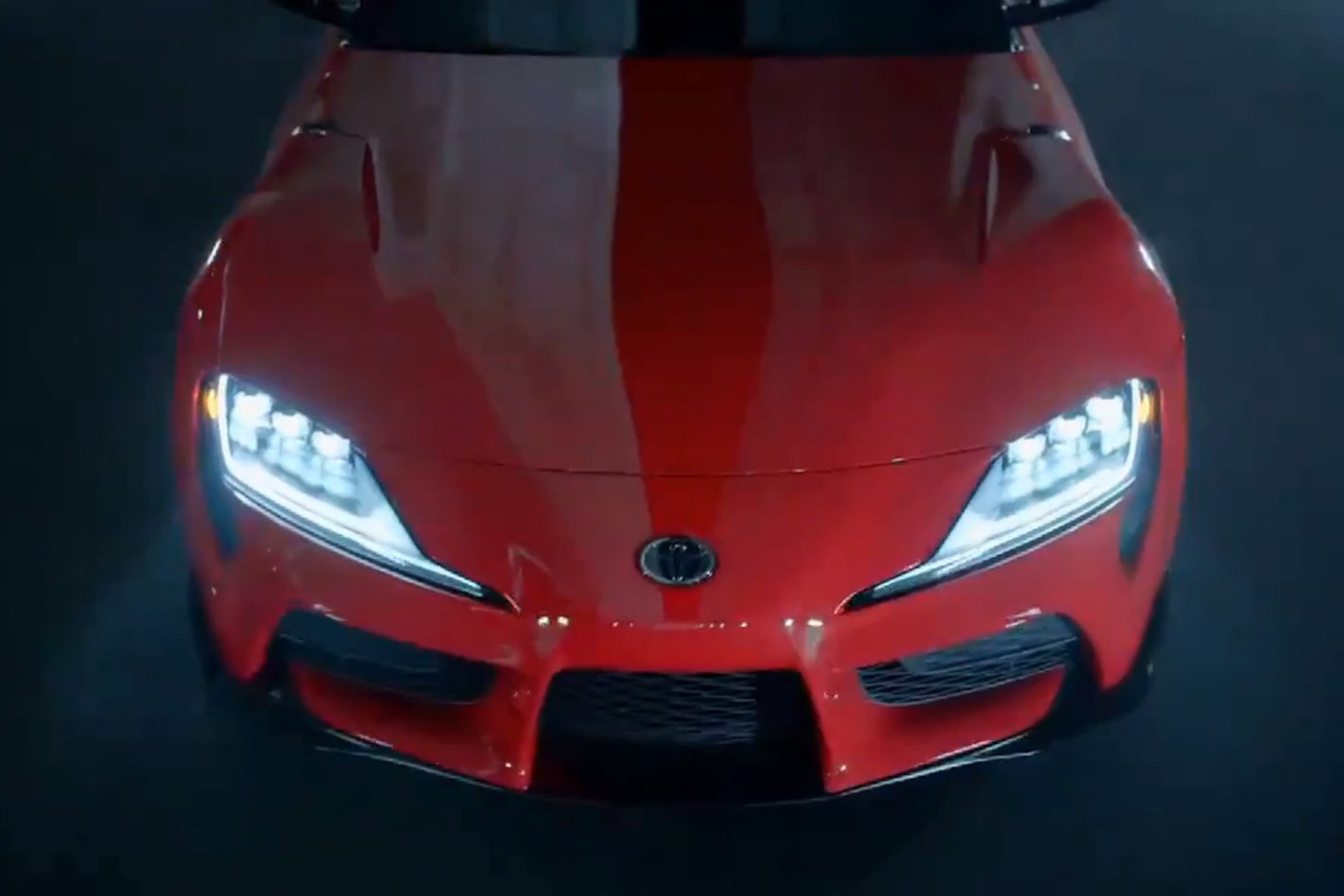
With official footage now available, the final piece of the Supra puzzle will be the coupe’s power and performance figures.
Currently, the best estimates are the Supra will send 250kW and 500Nm to the rear wheels, with a 0-100km/h time of around 4.5 seconds.
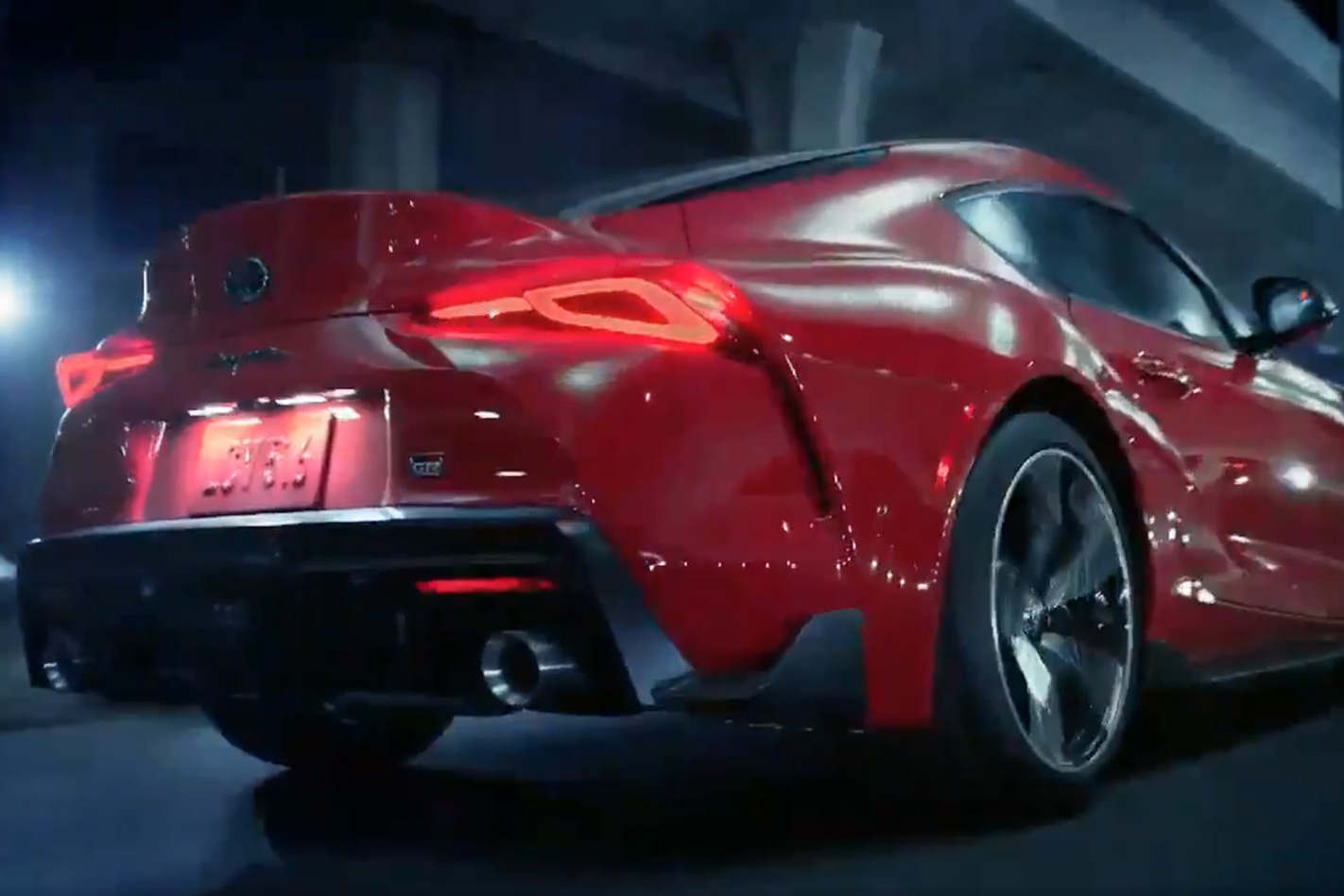
The engine, which sits entirely within the wheelbase of the car, is co-developed with BMW and shared with the German manufacturer’s Z4 drop-top.
We discovered during our prototype drive last year that the 3.0-litre straight-six turbo engine revs to almost 7000rpm, and has a “thick torque band that starts low in the rev-range with a lusty induction spool and velvety exhaust note”.
The Supra is scheduled for an official reveal at the Detroit Motor Show early next week. Check back to whichcar.com.au/wheels early Tuesday morning for more information.
