
If you want lightweight track car, but aren’t into the idea of a Caterham or a Lotus, then meet the Rossion Q1R.
This particular example is currently being auctioned on Bring a Trailer, listed by Florida-based Bullet Motorsports.
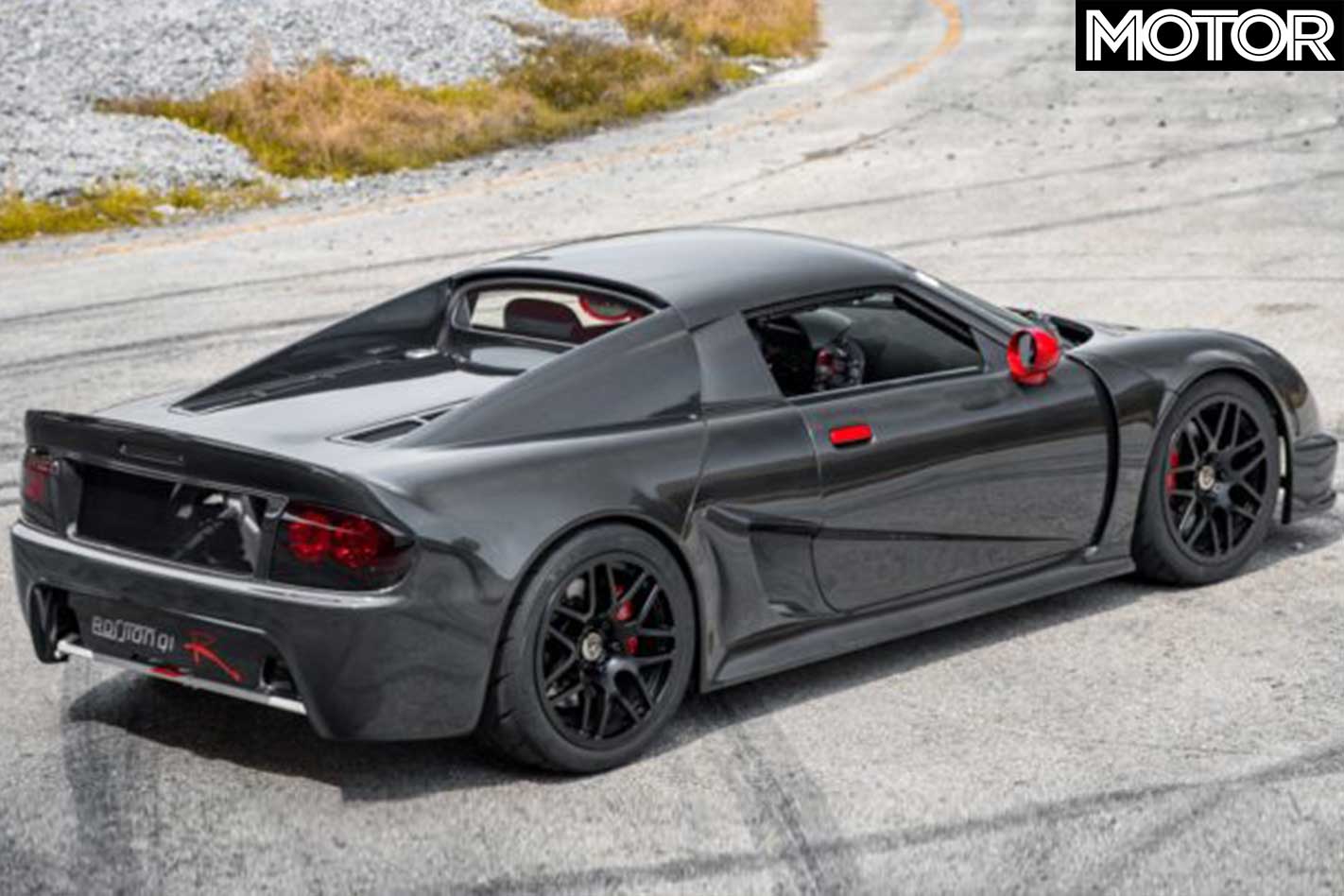
It’s actually based on the Noble M400, and has been developed on that platform since Rossion Automotive acquired the rights to some of Noble’s intellectual property in 2007.
“The move into production for the Rossion Q1 began after 1G Racing acquired both the intellectual and design rights for the Noble M400 and M12 platforms earlier this year in February [2007],” an early Rossion Auto statement reads.
“While further stressing the performance aspects that made Noble platforms such a startling success, the new Rossion Q1 incorporates dramatic design and a comfortably refined interior to create a versatile supercar that mesmerizes on the road as easily as on the track.”
While the Q1 can be driven on the road, the version up for grabs on Bring a Trailer is the track-only Q1R. And it’s only got a few test miles on the clock.
With a full carbon fibre body and a Ford EcoBoost 2.0-litre turbo engine, the 241kW/414Nm Rossion Q1R weighs just 816kg, partly thanks to a tubular space frame construction.
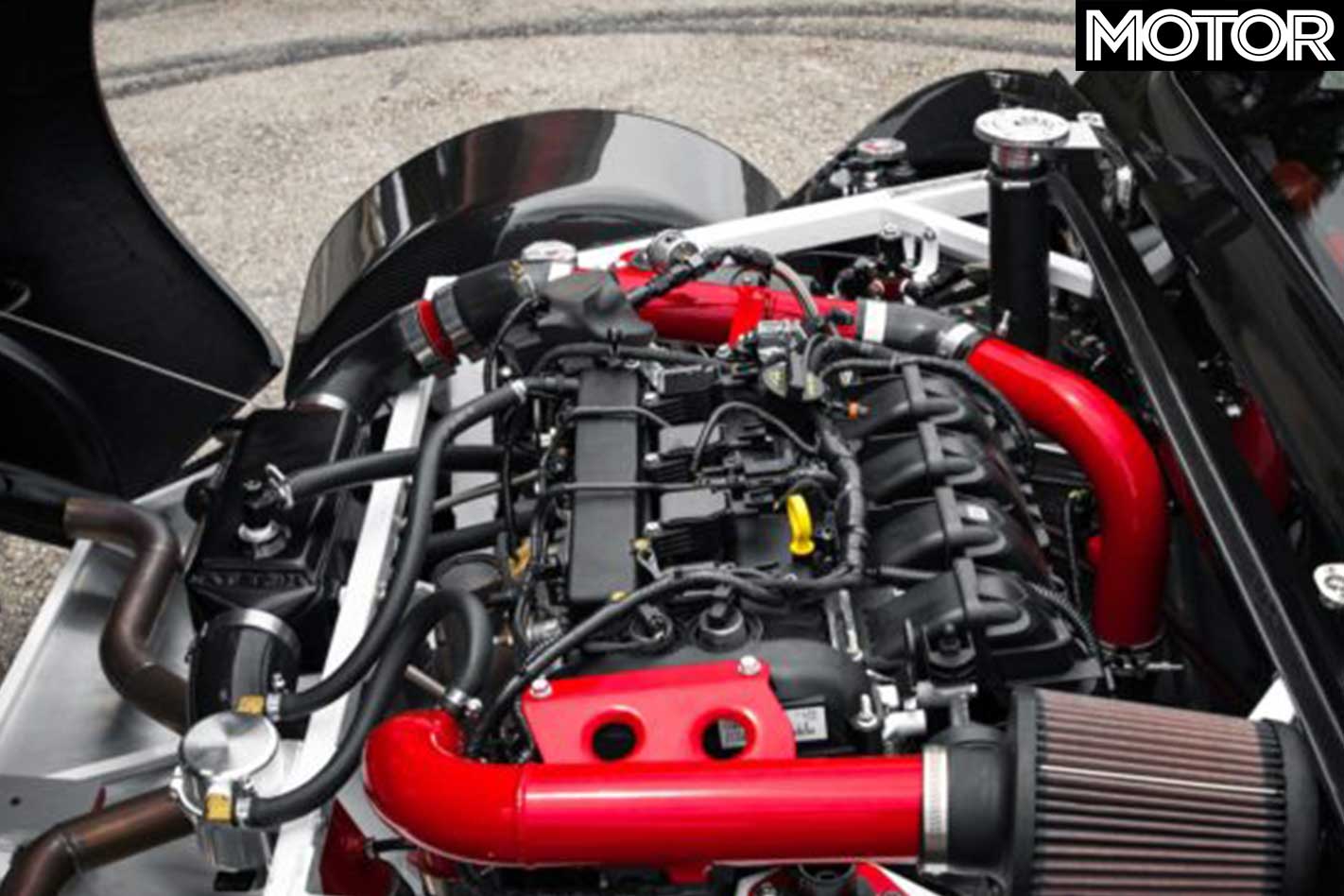
It’s rear-drive, hooked up with a 6-speed manual ‘box, and runs with independent double-arm suspension front and rear, with Koni coil-over shocks, a quick 2-turn lock-to-lock rack, and huge (for an 816kg car) vented and slotted 13-inch brake rotors, with 4-piston callipers front and rear.
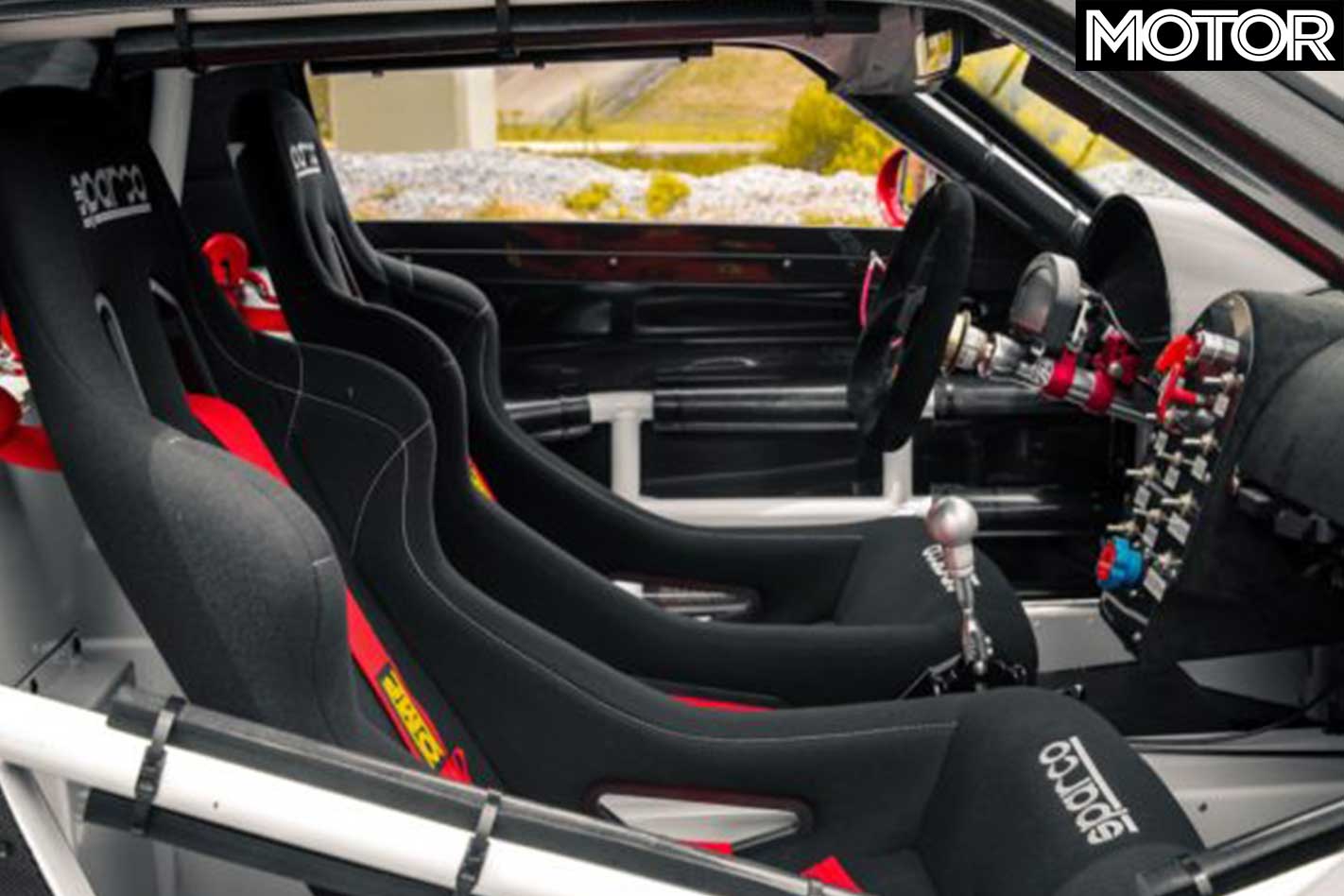
Inside, a full roll cage, Sparco race seats, and 5-point harnesses are the primary features, with most of the car’s functions controlled with a switchboard.
It’s currently at USD$35,227 (AUD$48,560) as this publishes, with two days left to go in the auction.
About eleven metres and a massive intake of breath past where the right front wheel should have been flicking across the third-gear apex’s face, my new Italian buddy’s foot finally retreats out of the ABS. It’s not pretty. They’re all ganging up to kill me over here.
This review was originally published in MOTOR’s December 2006 issue
Sure, when you steam into a tightening radius about 30km/h too hot, and the car’s already light over cresty Bavarian yumps, emergency braking is definitely the go. It’s to the S3’s credit that the instant it got back a bit of front spring it darted, panicked, towards where it should’ve been in the first place.
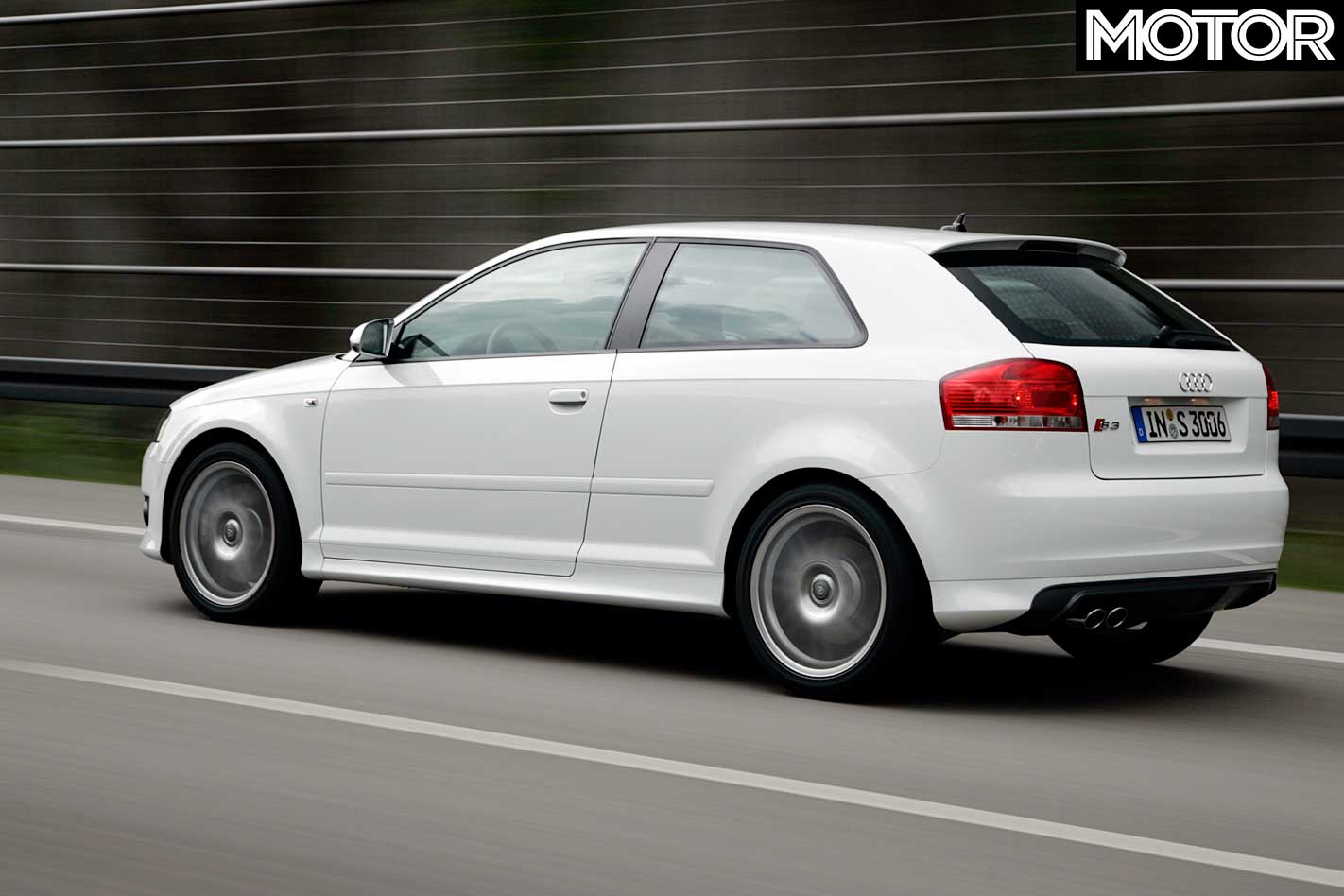
The new S3’s pretty quick, too, with a bigger turbo now dangling off the FSI direct-injection 2.0-litre petrol block’s exhaust header and 195kW spinning off the flywheel. Audi reckons it’ll take 5.7 seconds to hit 100km/h and it seems reasonable, especially if you can briefly convince the all-wheel drive to leggo of the bitumen for a sec at the launch. Then you just keep snaffling ever-smaller cogs and letting the torque take over, because it’s working at 350Nm from 2500rpm through to 5000.
It won’t lose any of its manners if you stay on the throttle past 7000, but it’s a pointless exercise because it’s all over well before then, performance-wise.
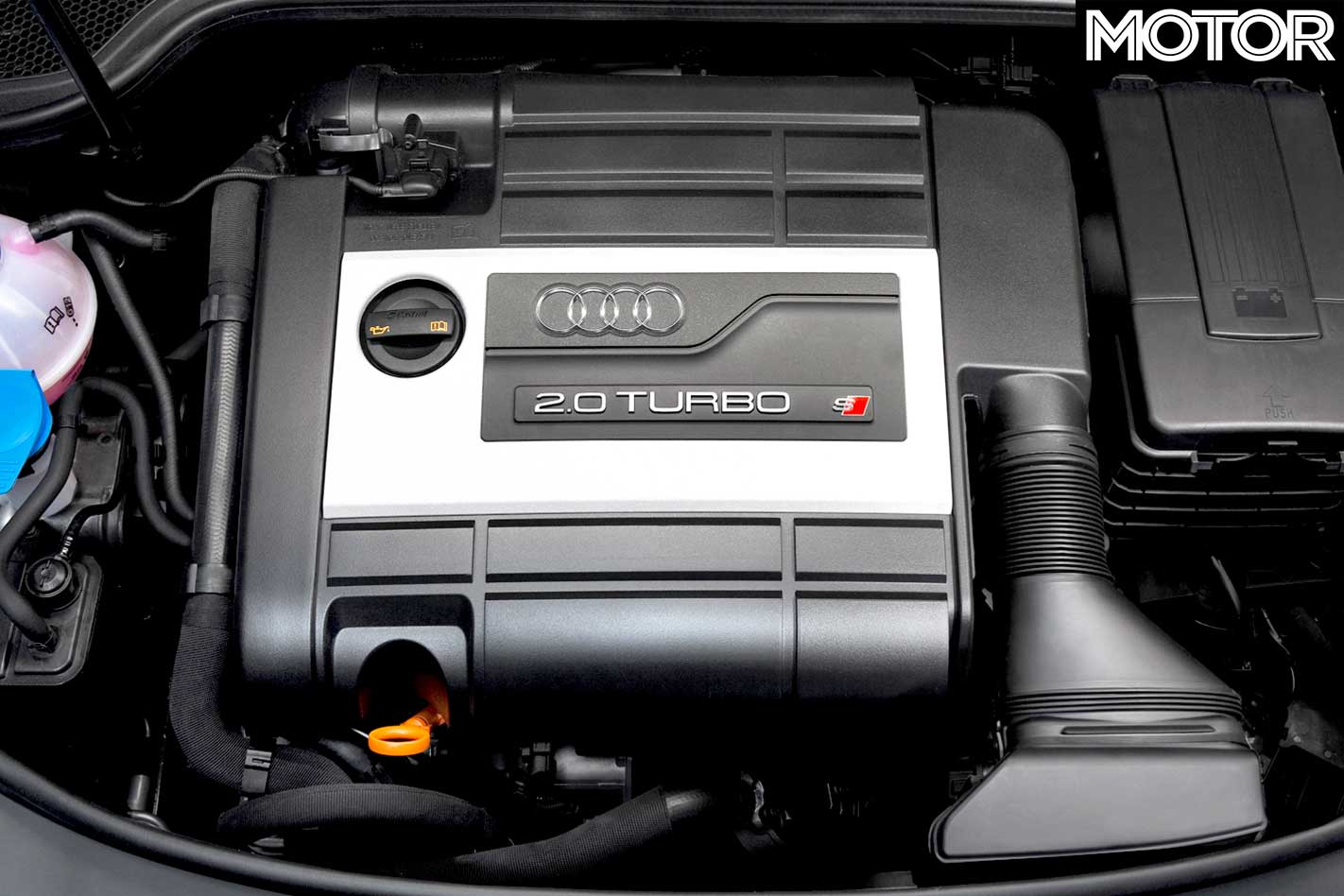
The S3 is smooth and quiet pretty much from idle, with only a deeper rumble giving away its bar-room brawler potential. There’s not that much torque below 2000 and, to be honest, it sort of comes on like a light switch just before the torque shelf arrives at 2500rpm, surging hard and whistling loudly in the manner of WRXs past.
It’s the whistle that always signals how much more you’ve asked of it, and the bigger turbo seems to bring with it a reduction in fine-throttle response. But more grunt.
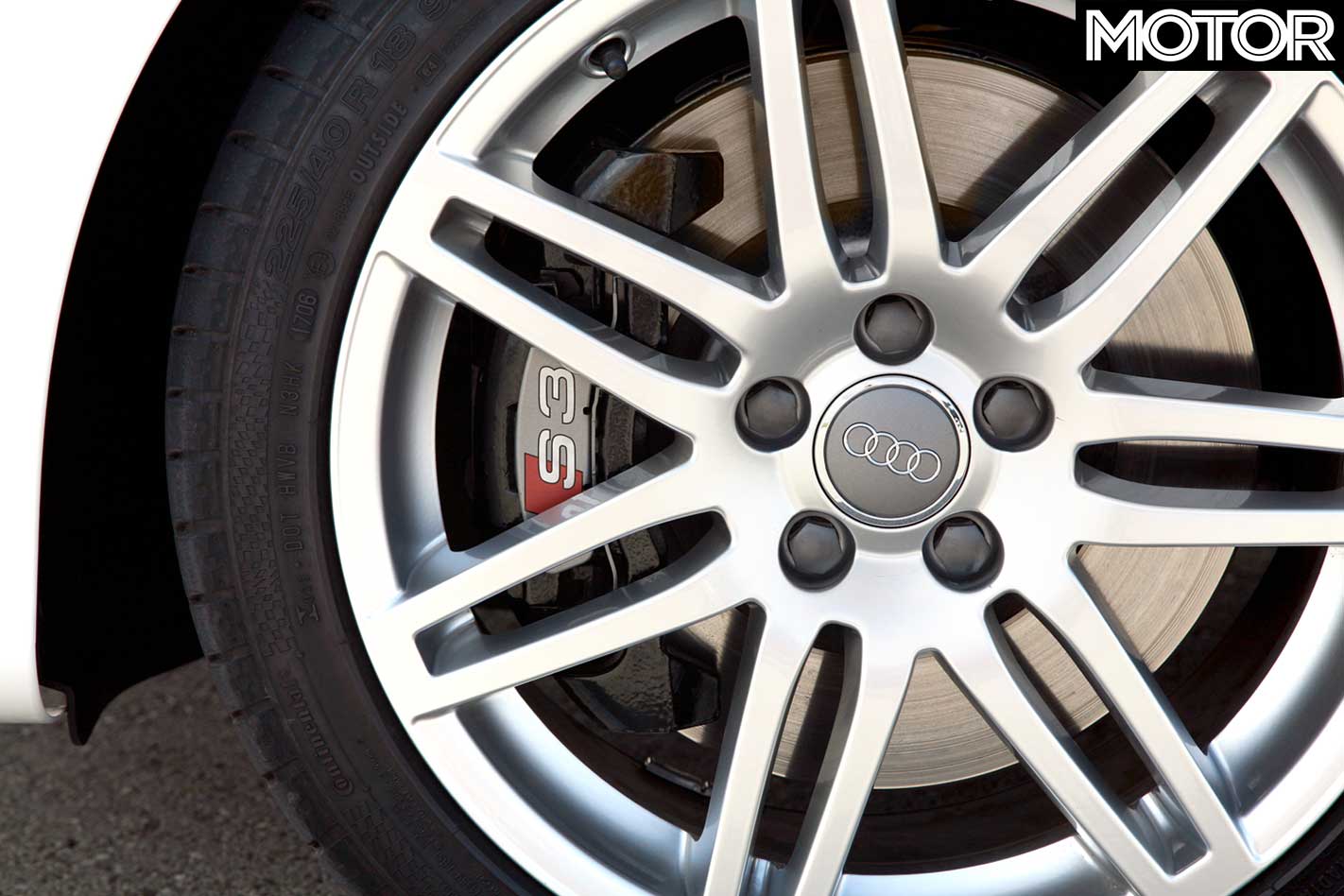
It looks and feels and goes the part of a more masculine A3, with 18-inch boots, beautifully stitched leather, a deeper chin and the sexiest steering wheel in the business. And the S3 runs harder, being speed limited to 250km/h… or thereabouts – our German test saw 260 while the speedo was still climbing.
It’s still a six-speed manual, and the shifts are still, in that traditional Audi way, a little like loose rifle bolts – long, but accurate in a foolproof, but mildly unsatisfying way.
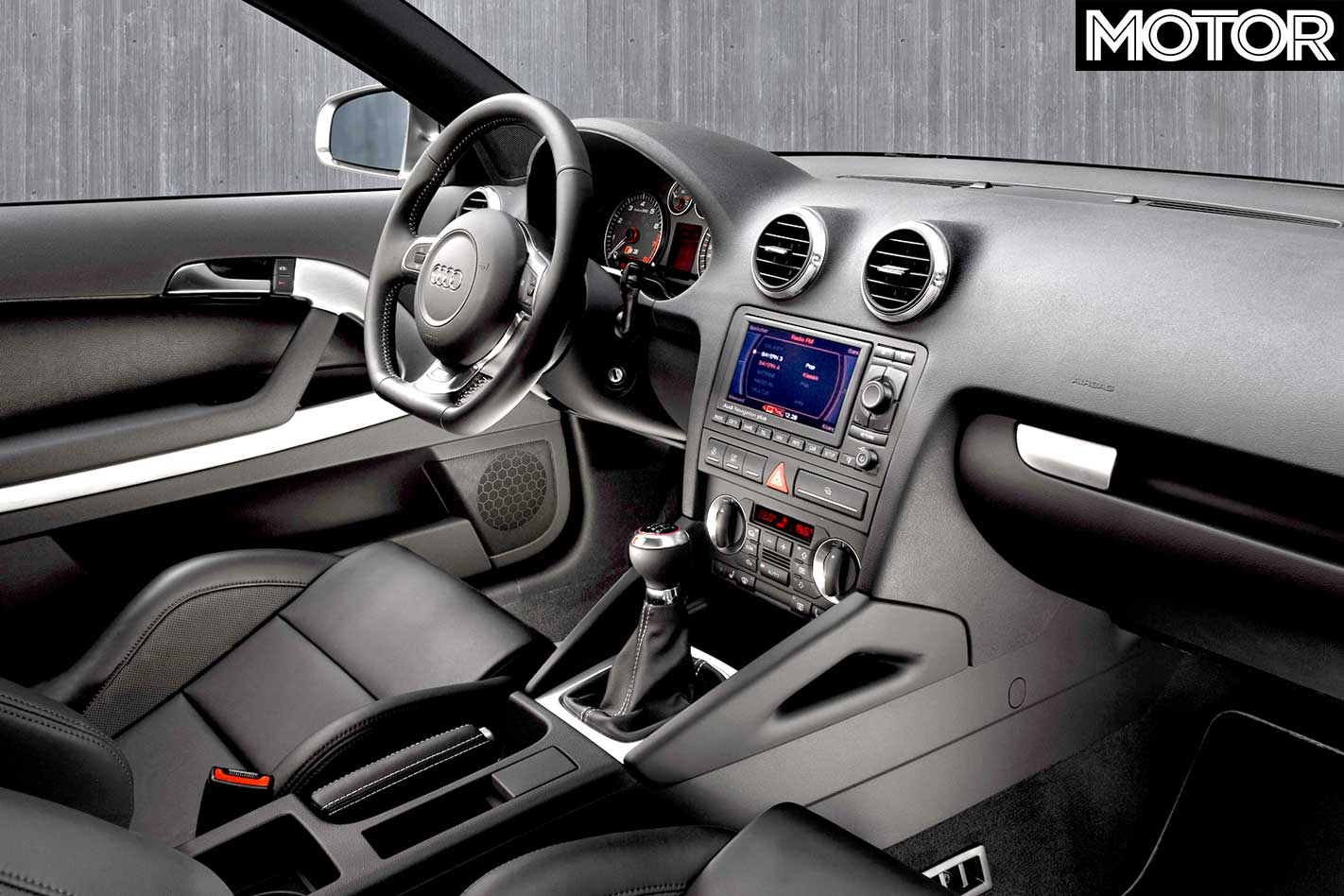
The seats, though, are brilliant, with wonderful support and shape inside the hard-cased outer shells and, although there’s no lumbar adjustment, they’re shaped so well they don’t seem to need it. They’re terrifically supportive on anything from autobahn sweepers to slalom tests and everything in between.
If the S3 was to have a failing, it would be in the chassis and its lack of enthusiasm for genuine enthusiasm. While my Italian assassin showed that idiot-proof seemed the appropriate description for the chassis’ attitude, the deeper you mine the S3 for its abilities, the more idiot-proof morphs from being reassuring to just plain frustrating.
You can leave the ESP on and the odds shorten on even Robbo finding an apex in any Audi, including the S3 (Sorry, what invoice? – Robbo). Turn it off and you’ll have just a modicum of a giggle before you feel the ABS hydraulics being kicked in the slats and all manner of independent wheel tugging re-imposing banal sanity again.
For most Audi buyers, this set-up means security. Buying an S3, though, implies you kind of want a bit more performance. Audi just hasn’t yet worked out that performance isn’t just a bigger turbo and 195kW of power in a 2.0-litre FSI engine that whirls its way to 7000rpm.
An S3 buyer may want to play with the chassis performance, too. On a racetrack sometimes. Or a winding piece of road in a mountain somewhere. And on those days, they’ll find their German hot-hatch stopping itself short of giving its all. The S3 actually feels like it could do better without it.
The second-generation Haldex all-wheel drive set-up (which Audi still calls quattro, even though quattro has traditionally been the pure mechanical system) isn’t Evolution Lancer-clever in the way it shifts the drive around the car, but it’s better than it was.
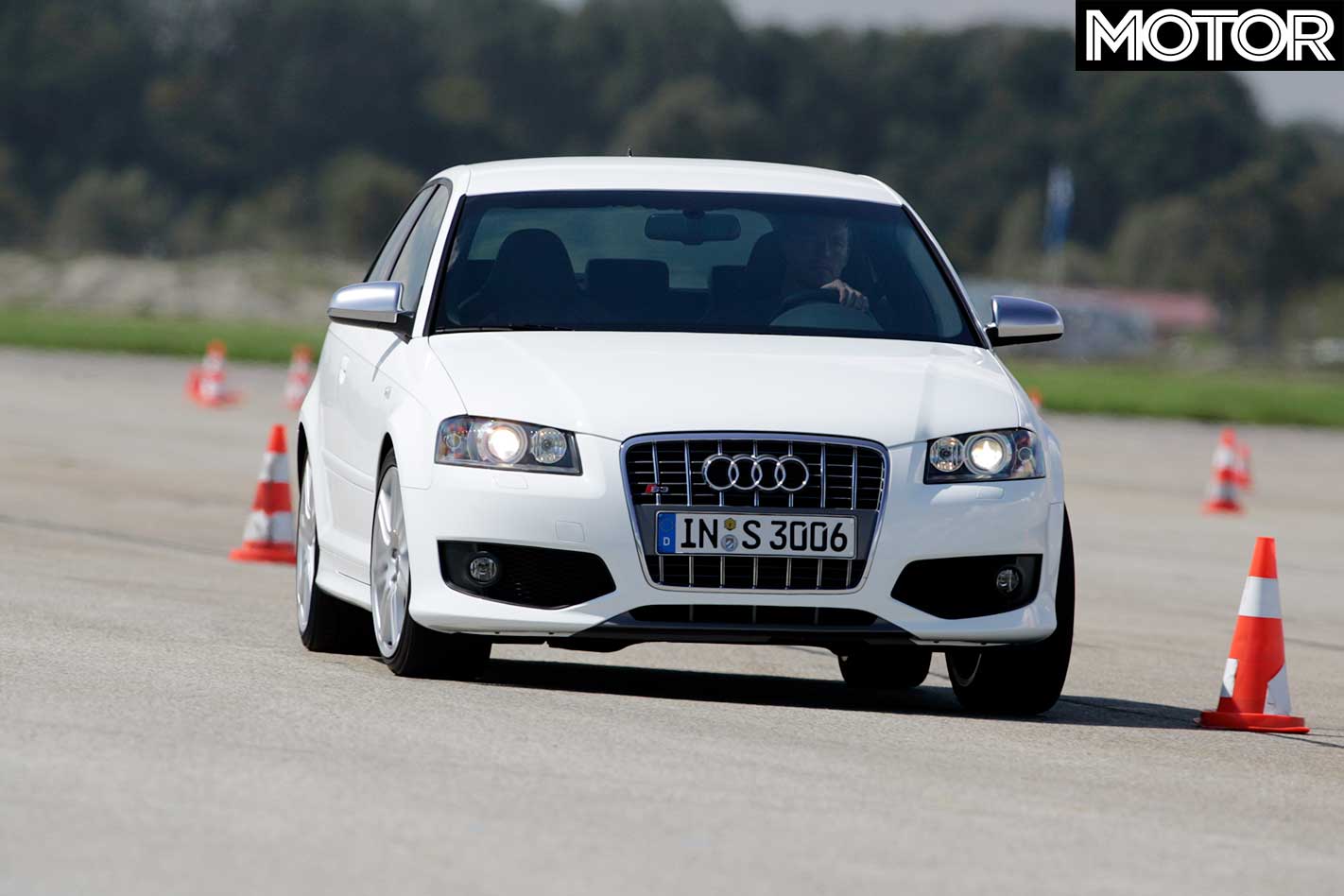
It’s possible – just – to set the S3 up in nice little drifts, but the instant you brush the brake pedal to alter the angle, the ESP rouses from its slumber, spots the sliding, wonders at the insidiousness of all this fun happening without its knowledge and takes instant action to stop it.
That won’t be an issue for lots of people. But it’s philosophically disappointing that Audi goes to the trouble of making an all-wheel drive performance car in whose grip and inherent security it ultimately does not trust.
FAST FACTS 2006 Audi S3 Engine: 1984cc 4cyl DOHC 16v turbo Power/Torque: 195kW/350Nm Weight: 1455kg 0-100km/h: 5.7 seconds (claimed) Price: $70,000 (est)
One of the strongest rivalries in the Australian vehicle market has been the fight for top-spot between the Toyota Corolla and Mazda 3. The Corolla has been the consistent winner in the passenger car stakes, but while the Mazda 3 is the perennial runner up it has widely been considered the better and more attractive car.
Enter the all-new 12th-generation Corolla, which has been designed to rid the world-beating hatch of its ‘beige’ but reliable image, with perky driving dynamics and class-leading standard active safety.
So how does it stack up against the Mazda 3, which has long been considered one of the benchmarks of its class?
We brought the automatic versions of the entry-level Corolla Ascent Sport and similarly priced Mazda 3 Touring together to find out.
HOW AFFORDABLE ARE THEY?
Priced at $24,370, the Corolla Ascent Sport is the cheapest automatic option in the new Corolla range, attracting a $1500 premium over the six-speed manual.
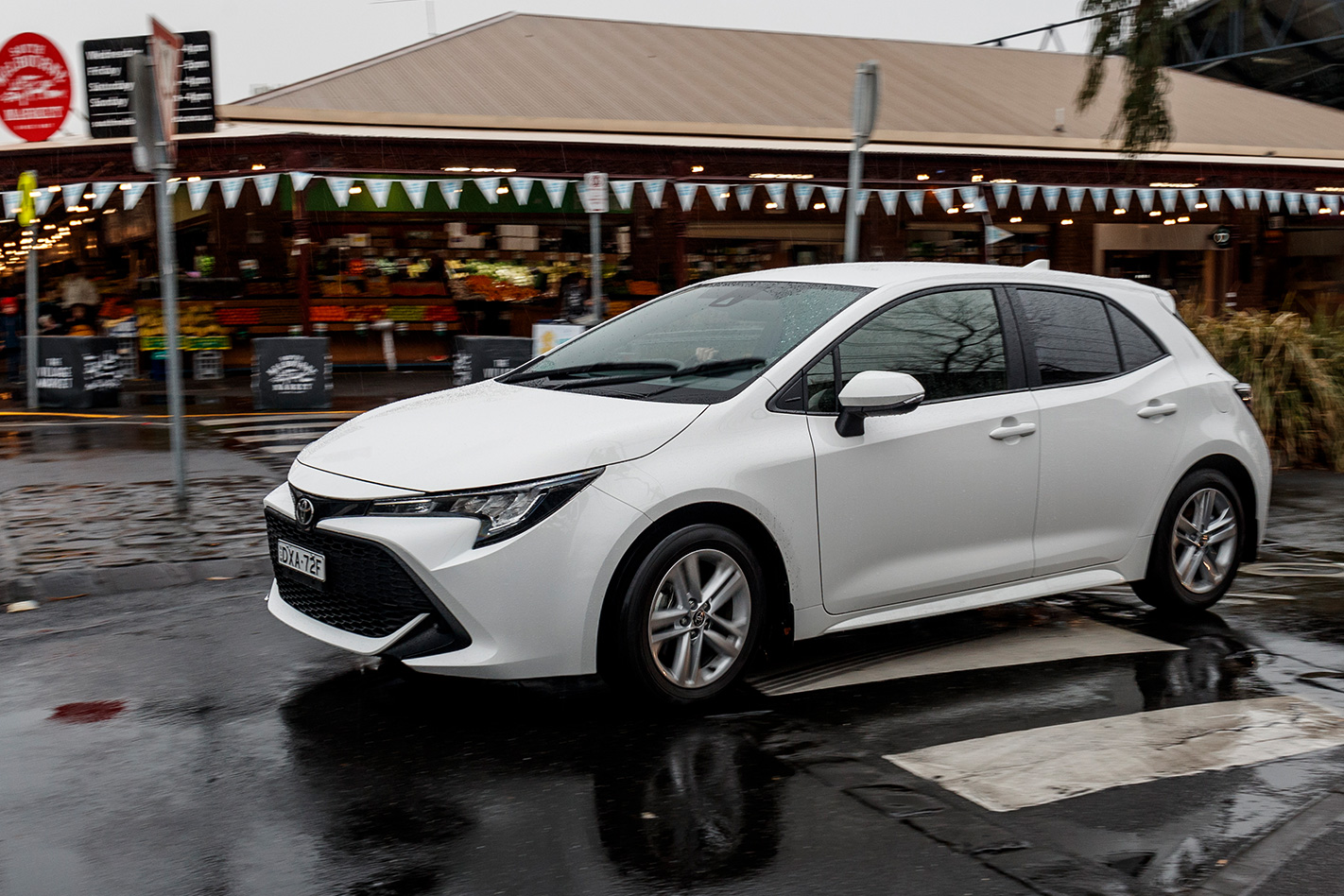
As well as a more convenient continual variable transmission (CVT), the Ascent Sport auto also gains three driving modes (Eco, Normal and Sport) adaptive cruise control that works at low and high speeds, and lane-keeping assist.
View the full pricing and features for the 2018 Toyota Corolla range here
The vehicle we tested was the Ascent Sport auto in Glacier White, which is the only paint option not to incur an additional cost – the other seven colours attract a $475 premium. Optional extras included satellite navigation, digital radio (DAB+) and rear privacy glass, which are bundled together as part of a $1042 package, which took the retail price of our Corolla to $25,412.
The Corolla’s highly efficient 2.0-litre petrol engine has a frugal official fuel consumption rating of 6.0-litres/100km when coupled with the automatic transmission. Our real-world testing showed 8.1L/100km with a mix of highway and inner-city driving.
The petrol Corolla requires a service every 12 months or 15,000km, which is about average. Each service between from 15,000km to 75,000km is capped at $175 with Toyota Service Advantage.
The Corolla is covered by Toyota’s three year/100,000km warranty.
The Mazda 3 Touring is the plushest of the 2.0-litre Mazda 3s, with retail pricing starting at $25,490 for the six-speed manual, with the six-speed auto attracting a $2000 premium. The sedan and hatch versions cost the same.
The Touring costs just $4000 more than the entry-level Neo Sport and $10,000 less than the range-topping SP25 Astina.
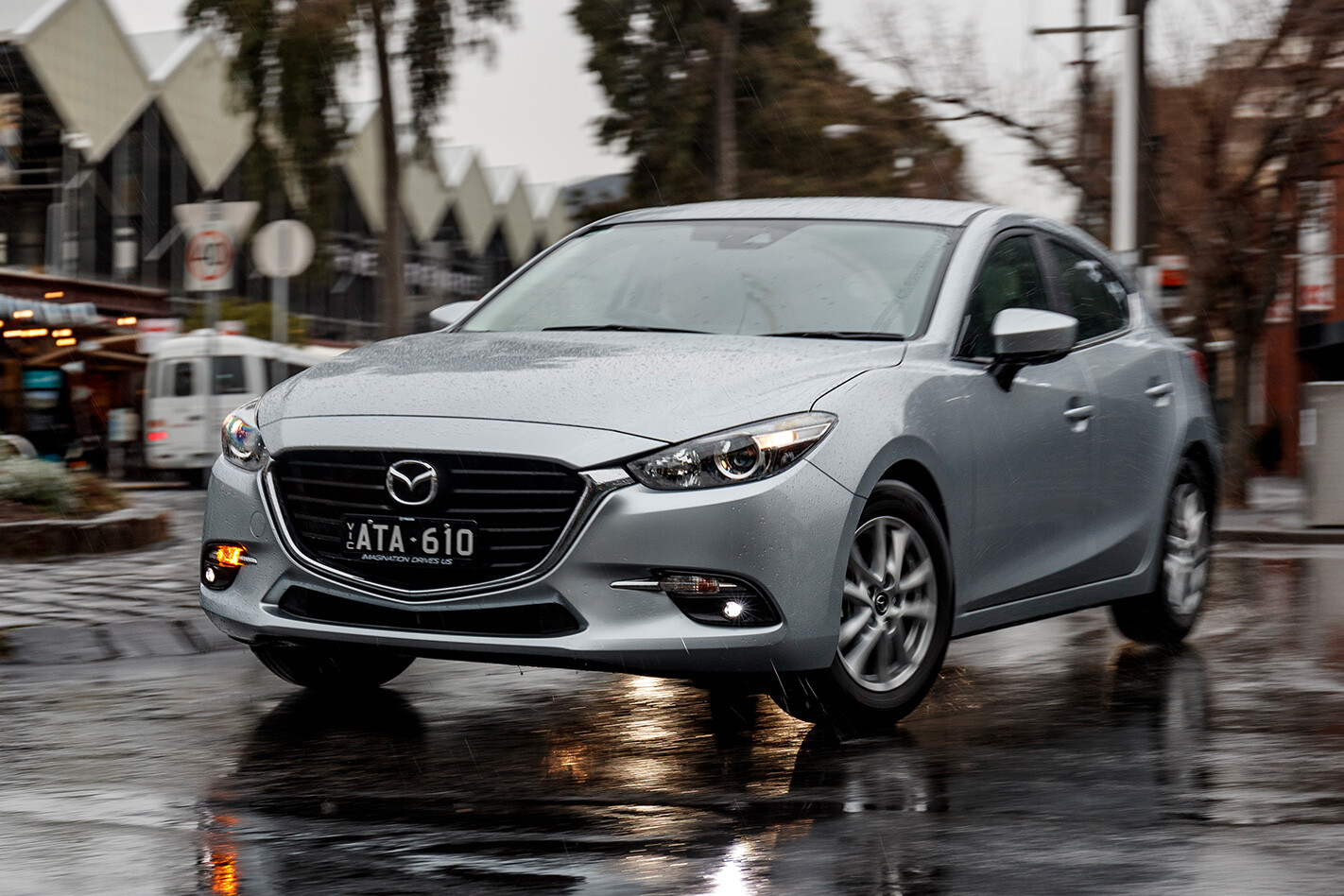
The 2.0-litre engine is reasonably frugal, with an official combined fuel consumption figure of 5.8L/100kms when coupled to the optional six-speed auto. Our real-world driving saw that figure rise to 8.5L/100km, though this involved quite a lot of city driving, mostly in Sport driving mode.
The Mazda 3 Touring requires servicing every 10,000kms or 12 months, whichever comes first, which is relatively frequent. Mazda charges $303 for the first and third service appointments and $331 for the second and fourth
WHAT FEATURES DO THEY HAVE?
The Corolla Ascent Sport Auto is the most advanced entry-level variant in its class, and comes with advanced safety features that were unheard of in small hatchbacks just a few years ago. These include adaptive cruise control, autonomous emergency braking with pedestrian and cyclist detection, lane keeping assist, and speed-sign recognition.
You also get a big 8.0-inch touchscreen with voice recognition, which clearly displays a reversing camera image with fixed guidelines. Infotainment includes AM/FM radio and connectivity with your mobile device via Bluetooth or USB for phone calls or music streaming. For an additional $1042 you can add satellite navigation with SUNA traffic information and digital radio DAB+.
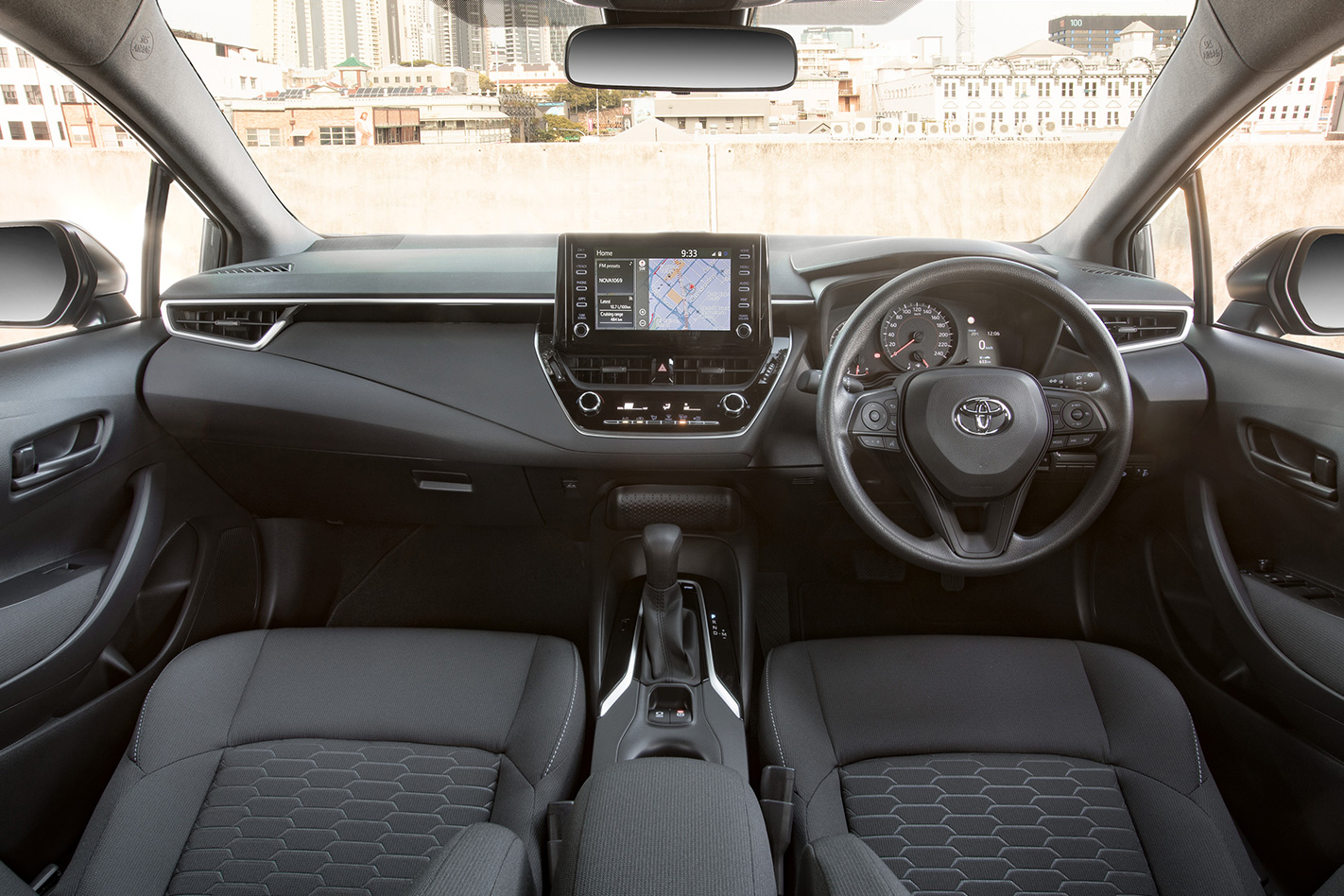
Other features include cloth seats, and there’s an electric parking brake that frees up space on the centre console, LED headlights with auto high beam, LED tail-lights, LED daytime running lights, rear fog-lamps, and power-folding heated exterior mirrors.
The Ascent Sport rolls on 16-inch aluminium-alloy wheels and you get a full-sized spare alloy wheel.
The Mazda 3 Touring adds a few creature comforts over the Mazda 3 Maxx Sport, and the Corolla Ascent Sport for that matter, including leather upholstery, automatic folding mirrors and advanced keyless entry that lets you open the door and start the engine without having to take the key fob out of your bag or pocket.
That’s on top of a healthy equipment list that includes a 7.0-inch colour screen, AM/FM/Digital (DAB+) radio, and autonomous emergency braking that also works in reverse to help prevent parking bingles.
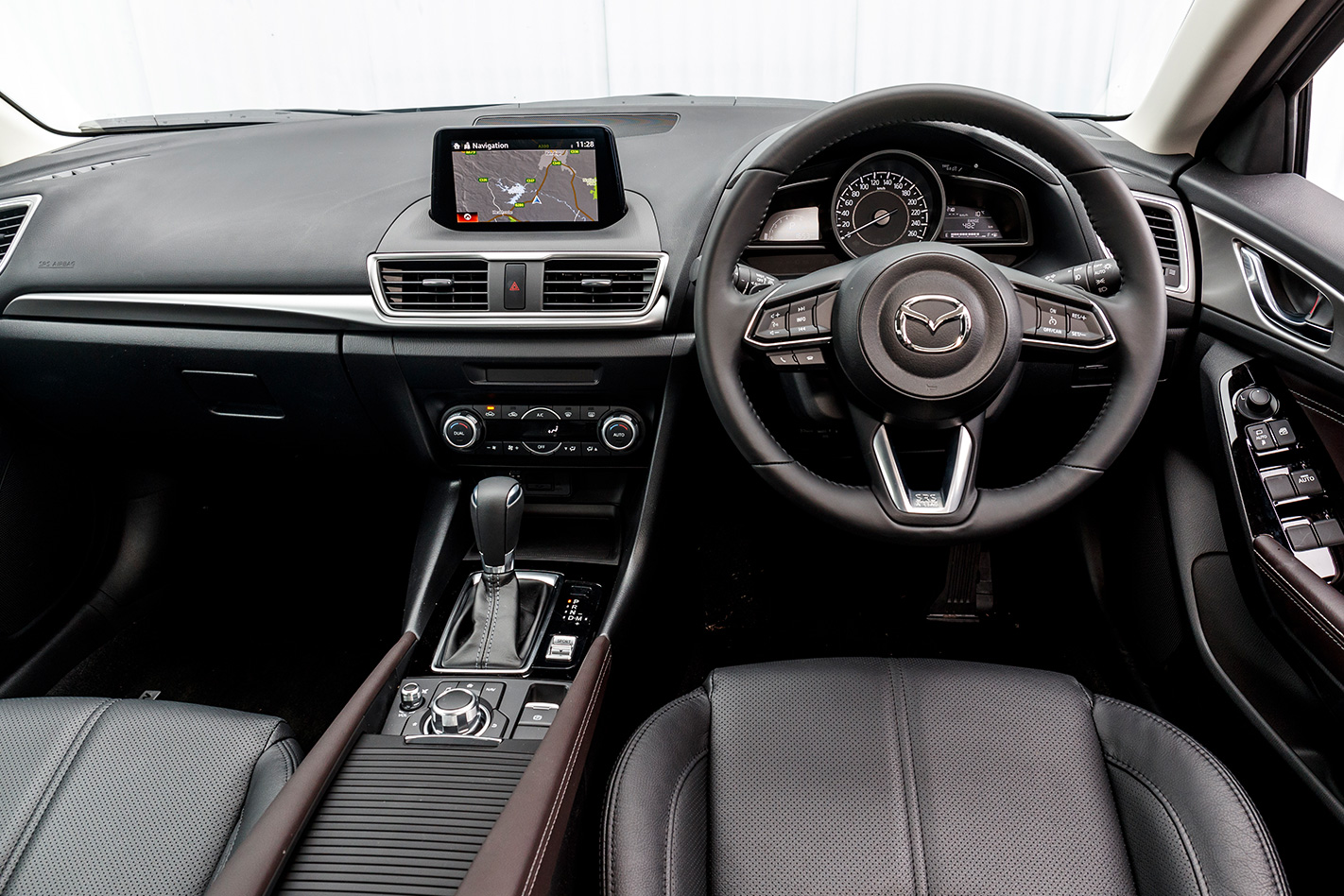
Other features include rear-parking sensors, cruise control, blind-spot monitoring, rear-cross traffic alert, dual-zone climate control, dusk-sensing headlights, LED fog-lamps, rain-sensing windscreen wipers, an electric park brake and 16-inch alloy wheels.
HOW PRACTICAL ARE THEY?
The 2018 Toyota Corolla and Mazda 3 are five-door hatchbacks that seat up to five people. The Mazda 3 is also available as a four-door sedan.
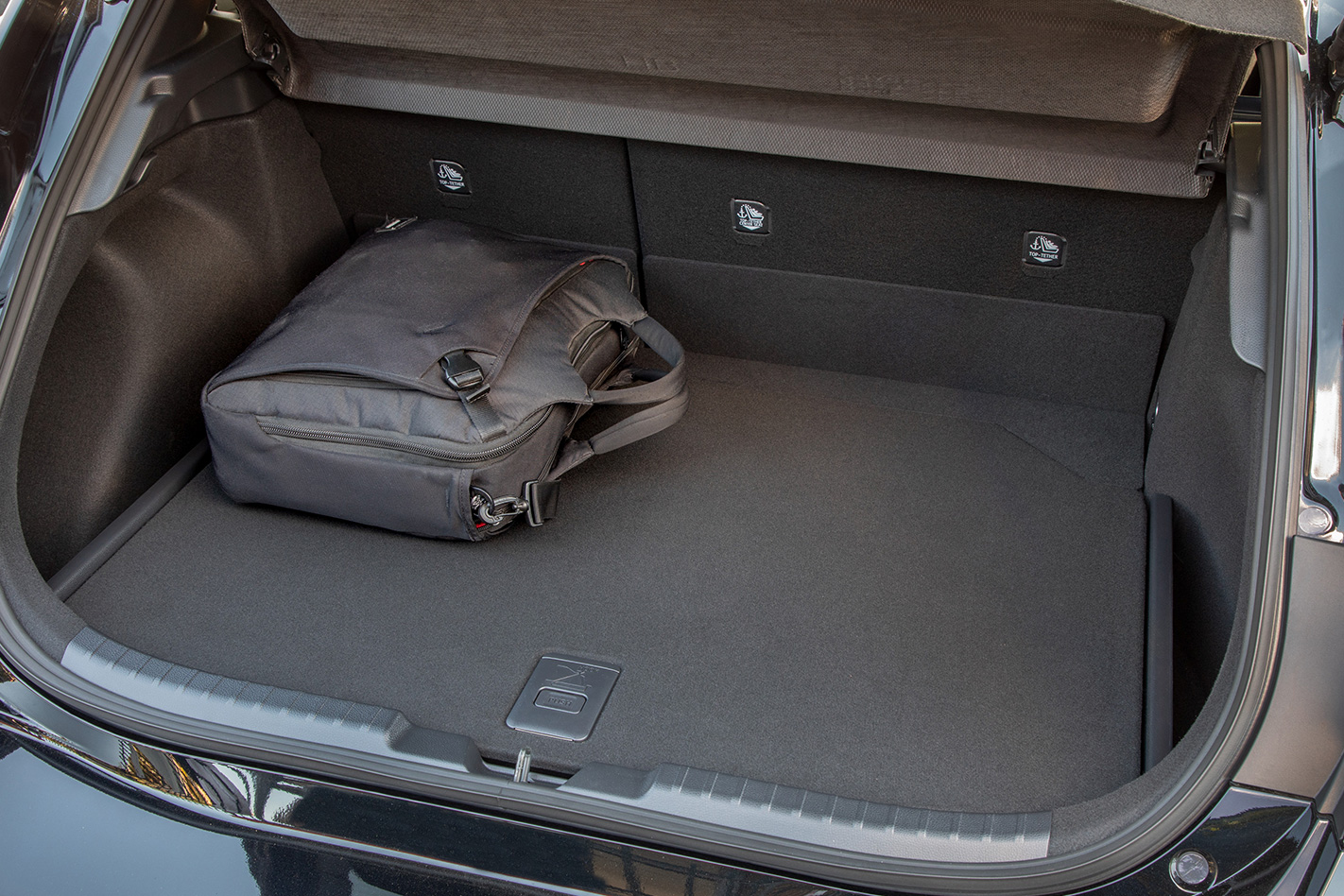
Measuring 4375mm long by 1709mm wide, and weighing in at 1340kg, the Corolla Ascent Sport auto is average sized for its class, however the boot space is very small, with a miniscule 217-litre capacity that’s 142 litres smaller than the previous model Corolla and 69-litres less than the Yaris.
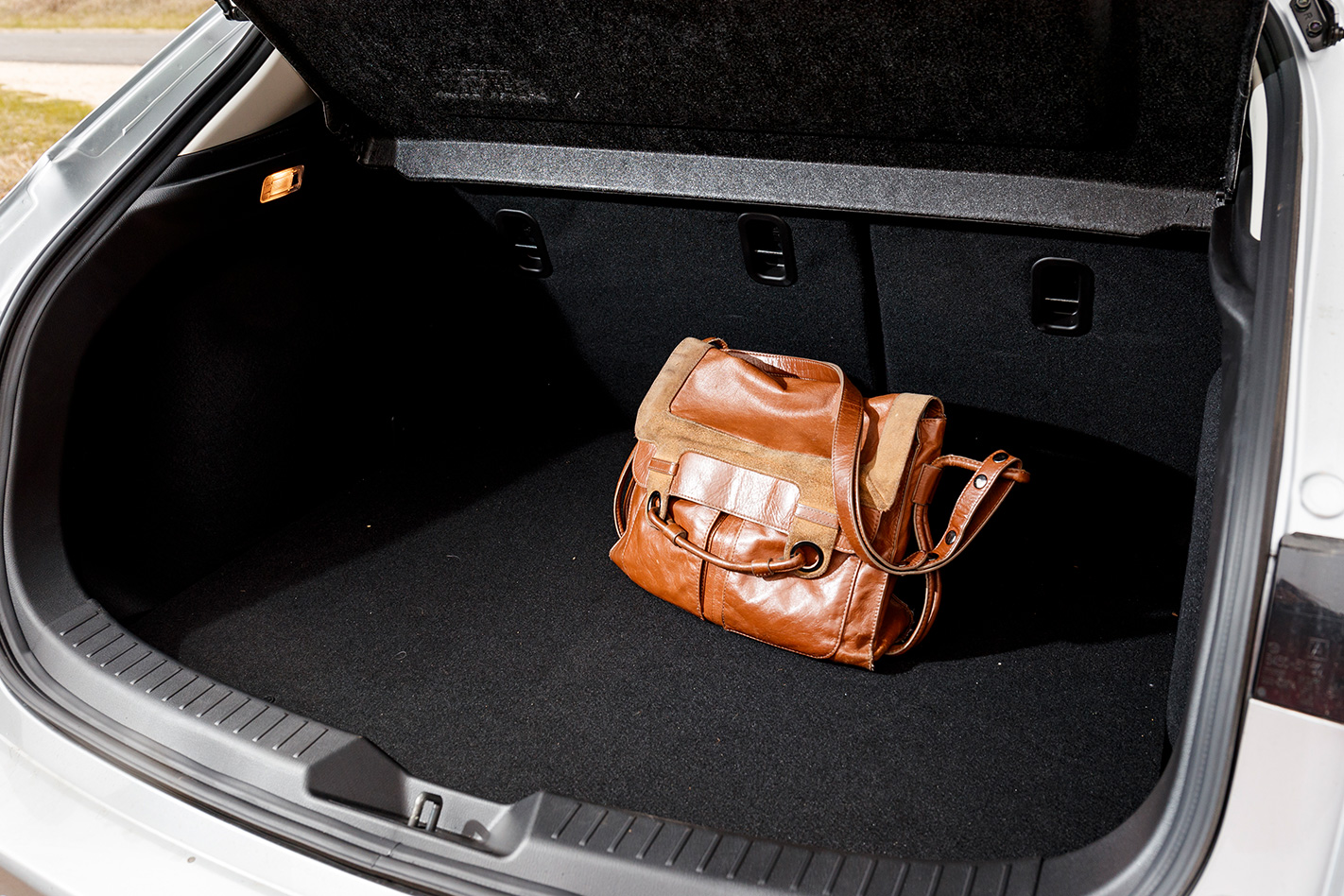
The Mazda 3 is a little bigger, measuring 4.47m long by 1.79m wide, and weighing in at 1308kg, and while the boot space is bigger than the Corolla’s, it’s still a tight 308-litres, which is less than smaller cars such as the Kia Rio and Hyundai Accent. The Mazda 3 sedan’s boot holds a more sizable 408 litres.
HOW SAFE ARE THEY?
The new Toyota Corolla hatch was awarded a five-star ANCAP safety rating in August 2018 thanks in part to its active safety features, including autonomous emergency braking (AEB) with cyclist and pedestrian detection, and lane-keep assist.
It scored well for crash protection – 96 percent and 86 percent for adult and child occupant protection respectively – and is equipped with seven airbags (front, front side, full length curtain, and driver’s knee), ISOFIX child seat anchors in the rear seats, and seatbelt warnings.
The Mazda 3 also received a five-star ANCAP safety rating, in August 2016, thanks in part to its active safety features, including range-wide autonomous emergency braking. It scored well for crash protection, including 16 out of 16 for side impact. It has six airbags, and child-seat anchor points including two ISOFIX brackets for each outboard rear seat, and three top tethers.
The Touring spec brings additional active safety over and above the standard Mazda 3 kit, including blind-spot monitoring and rear-cross traffic alert that warns you of any cars approaching from the side while you reverse.
HOW COMFORTABLE ARE THEY?
The 12th-generation Corolla has a fresh and ergonomically sound cabin design. Build quality is hard to fault and the materials used also have a high quality feel.
That said, the Ascent Sport’s plastic steering wheel isn’t as pleasant as the leather wrapped tiller in higher-spec SX and ZR Corollas, or the Mazda 3 Touring, but the buttons are laid out intuitively, including the cruise control switchgear, which are mercifully no longer located on a separate stalk.
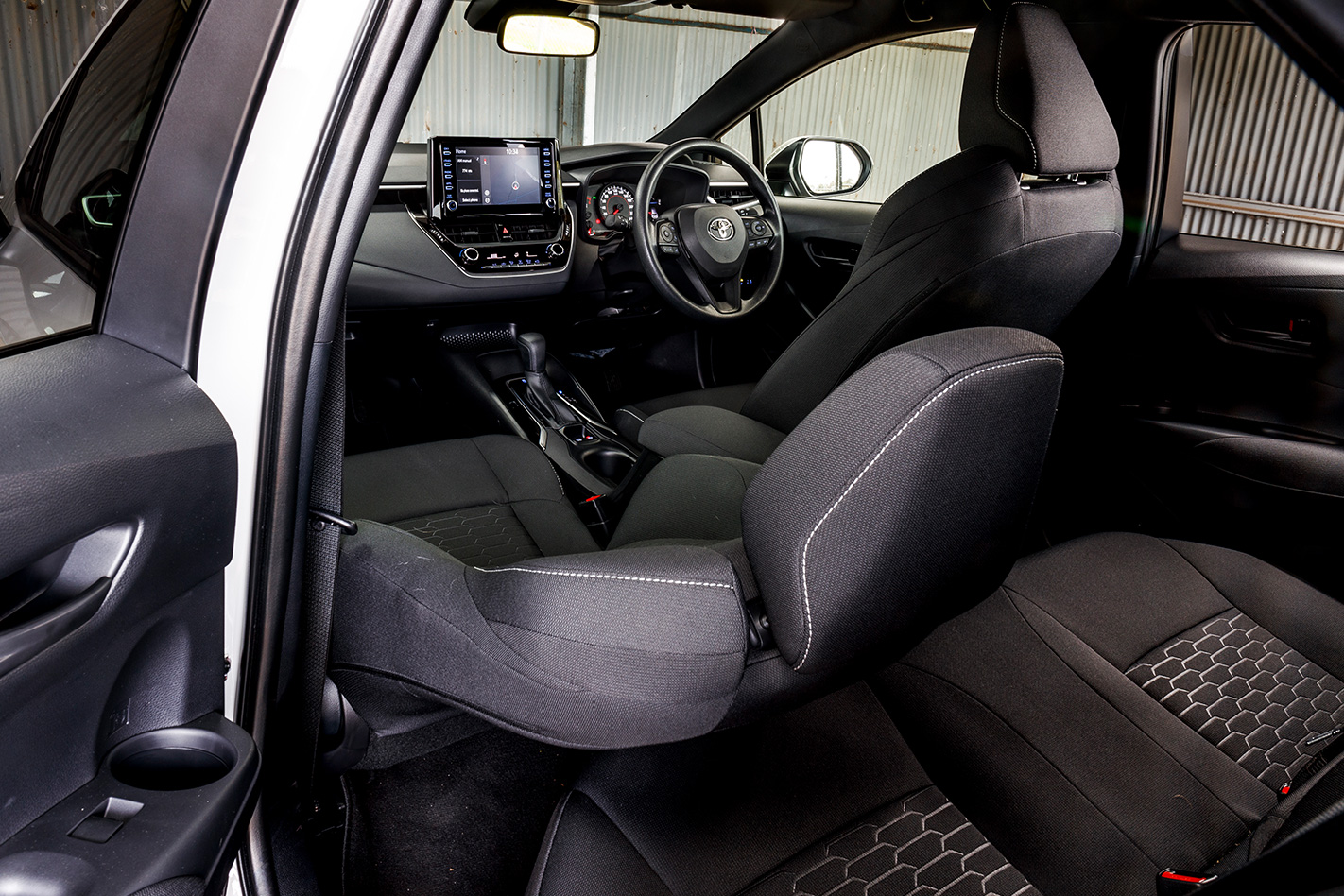
The cloth upholstery also feels durable and the front seats have deep cushions and great lower- and upper-back support.
The back seats are comfortable too, however leg and headroom is tight, with the shins of the average sized adult touching the front seats. A centre armrest has two cup holders, and there is also a handy cup holder on each of the rear-door armrests.
Rear storage is confined to a map pocket behind the front passenger seat and there are no air vents or USB and 12v sockets for rear-seat occupants.
The ride down back is pleasant though, thanks to the Corolla’s advanced multi-link rear suspension that handles lumpy rural roads in a composed manner.
The Mazda 3’s interior is showing its age, but still has an air of sophistication with soft-touch surfaces aplenty, clean design, a leather-clad steering wheel and intelligently-placed switches and gauges. The seats, trimmed with a mix of real and faux leather, offer good comfort. The driver’s seat has height and lumbar adjustment to help you settle into a good driving position.
The MZD infotainment system is easy to operate via a dial on the centre console. It lacks the added convenience of Apple CarPlay and Android Auto smartphone mirroring, however an upcoming update will allow that tech to be retrofitted next year.
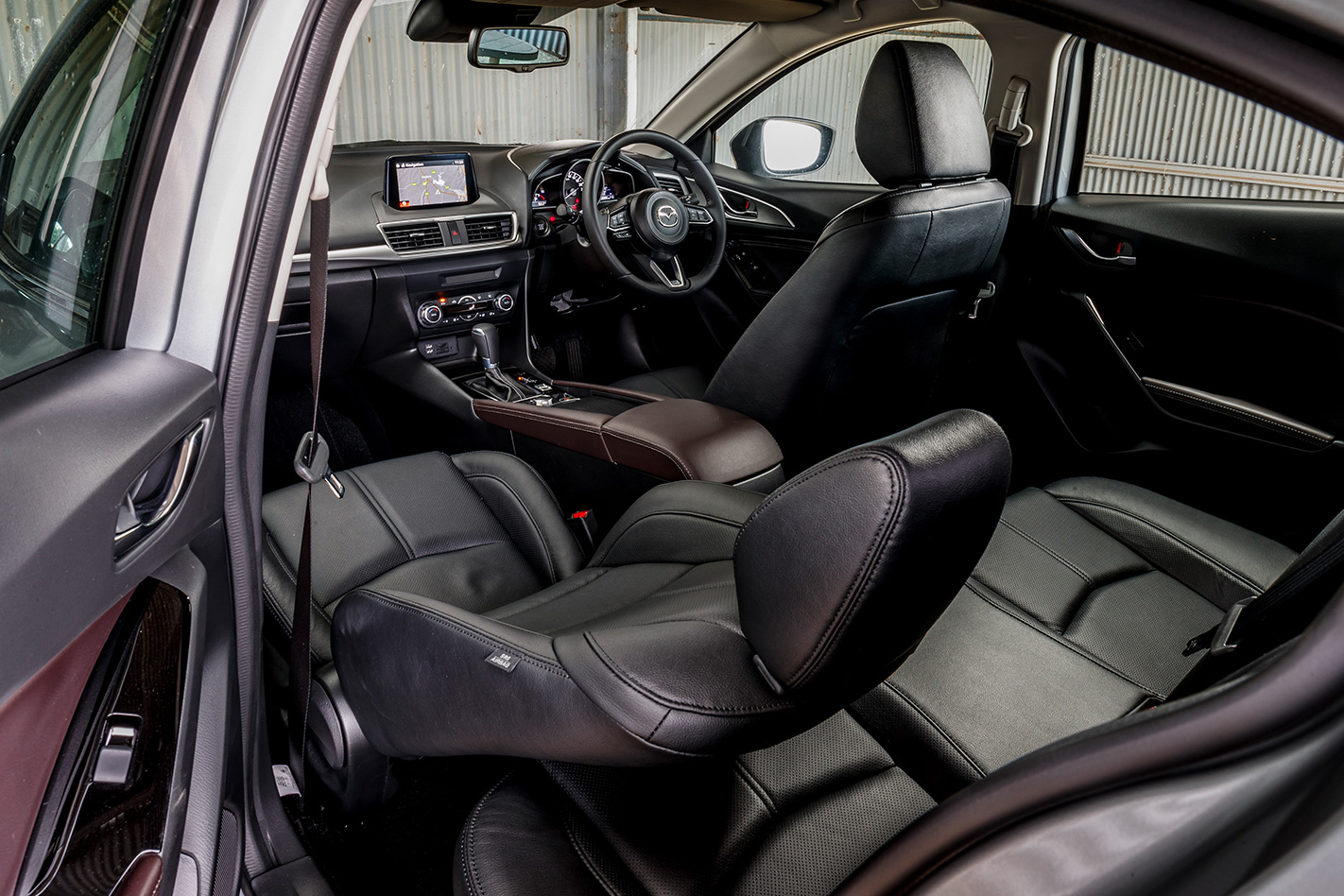
The Mazda 3 loses marks in the back row, with its ascending window line obscuring side vision for younger occupants. Legroom is a little tight as well, with even average-sized adults finding their shins touching the front seats.
Second-row passengers also miss out on conveniences such as face-level air vents, and there are no USB or 12v charging sockets to keep devices charged up. It might be a niggling complaint, but those features are fast becoming common in newer cars in the segment. There are at least bottle holders in the doors and the fold-down centre armrest has two cup holders, though there’s only one map pocket on the passenger side.
Road noise can also be high despite Mazda attempting to improve sound suppression in a 2016 update, but the ride is comfortable even on rougher roads thanks to a settled ride that recovers quickly from big hits.
WHAT ARE THEY LIKE TO DRIVE?
The new Corolla was built with the driver in mind, and has been re-built from the ground up on a new longer, wider and stiffer chassis with a sophisticated new multi-link rear suspension.
The well-balanced chassis combines with nicely-weighted and direct-acting steering to make cornering surprisingly good fun. It handles bumpy roads great too, with the multilink suspension feeling like it’s cutting through road imperfections rather than merely rolling over them.
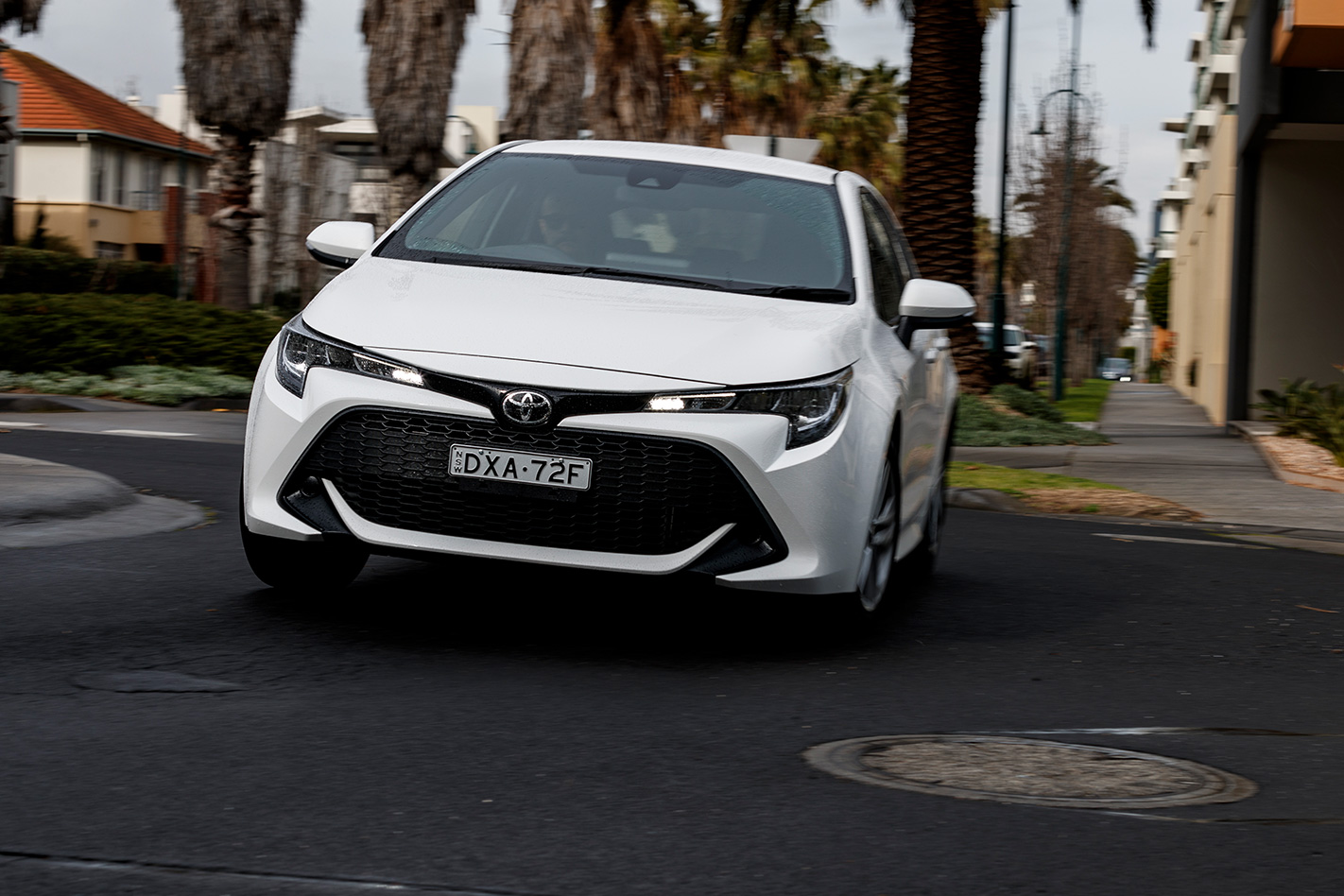
The highly-efficient 2.0-litre petrol engine is the most powerful engine for its size without a turbo and, coupled with the CVT automatic, is the pick of the Corolla’s powertrains over the 2.0-litre petrol manual and 1.8-litre hybrid CVT.
While CVT autos usually have a revvy but sluggish rubber-band feel, the 2.0-litre Corolla’s has a ‘launch gear’ that steps through the gears like a traditional automatic gearbox. This helps it take-off sharply from a standstill, while also offering responsive acceleration while on the move, such as when overtaking.
The Mazda 3 Touring’s 2.0-litre engine is a city slicker but has enough power for easy trips down the highway, with the six-speed automatic transmission working smoothly with throttle inputs.
It is, however, a little lethargic from a standing start and doesn’t really wake up until the tachometer hits about 4000rpm. A Sport drive mode introduced in 2016 makes the engine rev higher before shifting up to the next gear, though frequent use of that feature will see your fuel consumption head north.
The Mazda 3 is an enjoyable car to drive, with light but engaging steering that makes easy work of negotiating suburban streets and bendy country roads. Despite its age it remains one of the segment’s best when it comes to handling.
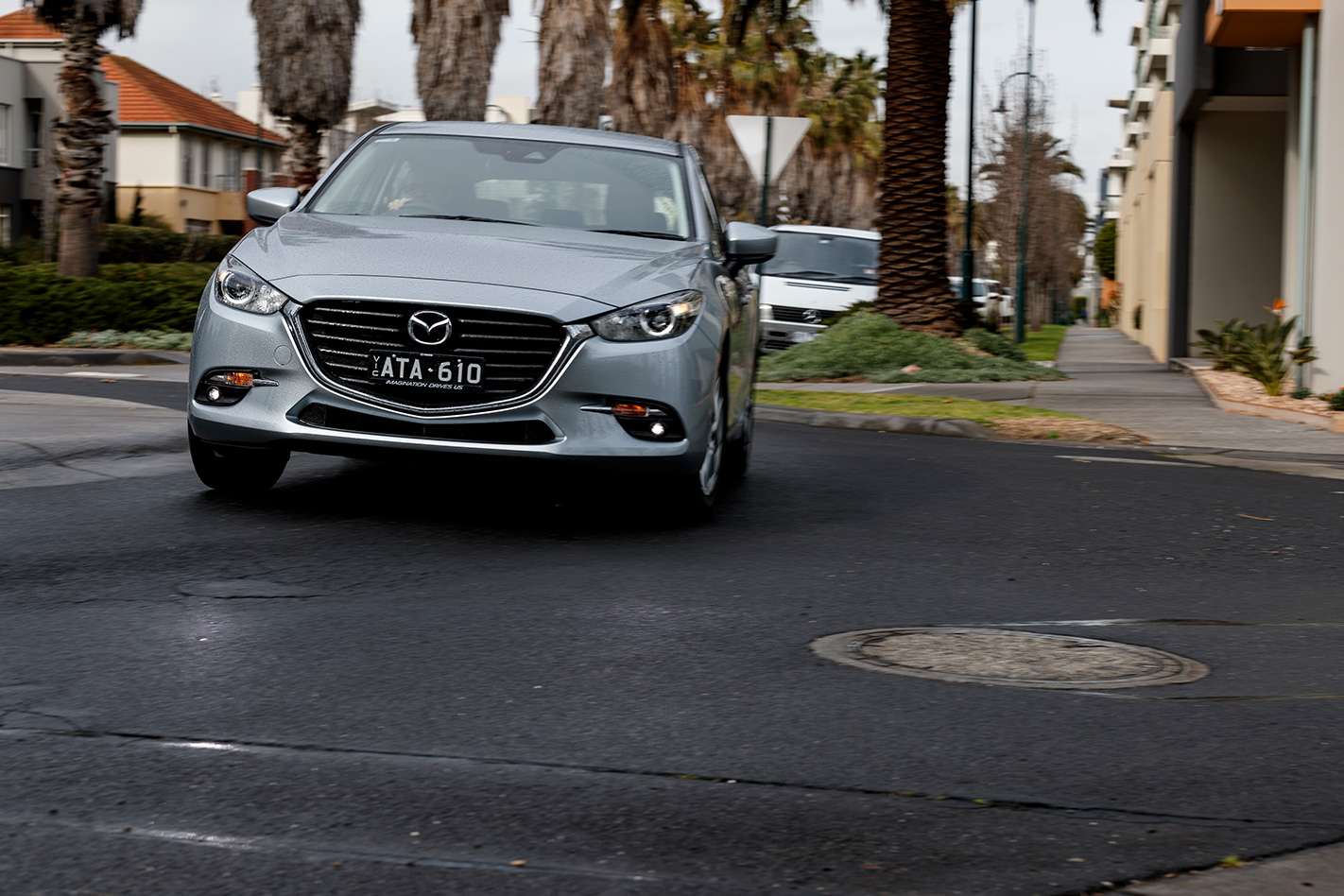
The ride feels soft but delivers enough body control for sharp cornering. This is helped by something that Mazda calls G-Vectoring Control, which subtly trims power when cornering to transfer load onto the front tyres and help them produce more cornering grip. Result: the car feels more planted while changing direction more fluidly, but you’ll barely notice that the electronics are giving you a helping hand.
OUR OPINION
The Corolla has youth on its side, and its generational leap over the Mazda 3 certainly gives it the edge in terms of styling, efficiency, performance, handling and technology.
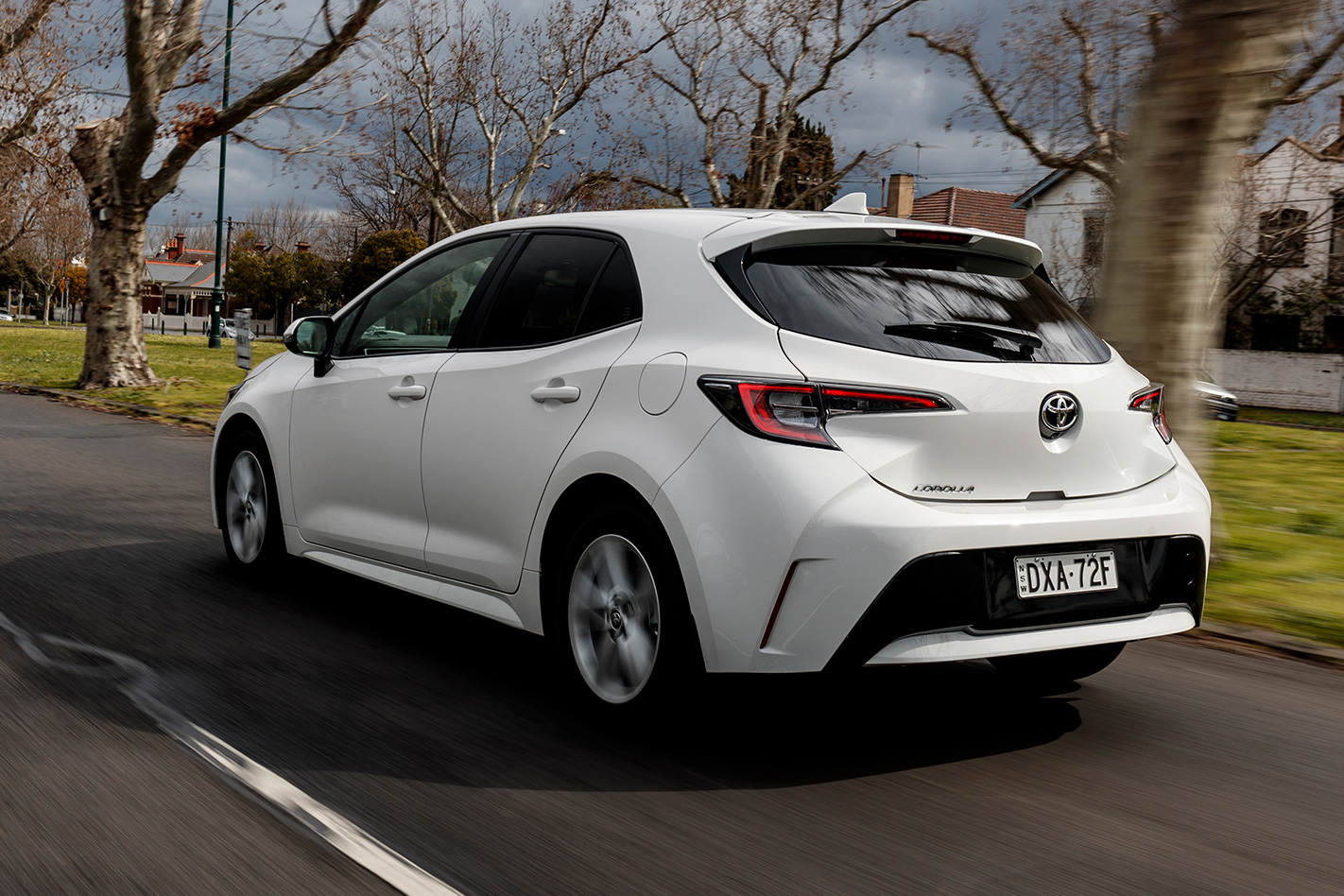
It’s not a cakewalk though, because the five-year-old Mazda 3 has aged gracefully thanks to incremental improvements that have brought active safety and boosted driving dynamics. It’s an enjoyable car to drive, and the Touring’s leather upholstery and keyless entry/start give it a more premium feel over the Corolla Ascent Sport.
And, for all the Corolla’s gains, it isn’t quite as practical as the Mazda, with slightly tighter rear-seat and boot space.
A pre-production right-hook Audi Quattro is up for auction in the UK, with a relatively affordable price tag attached.
If we’re talking rare classics, the £50,000 to £60,000 (AUD$90,000 to $108,000) estimation isn’t astronomical, especially given its believed only one other pre-production RHD car like it exists.
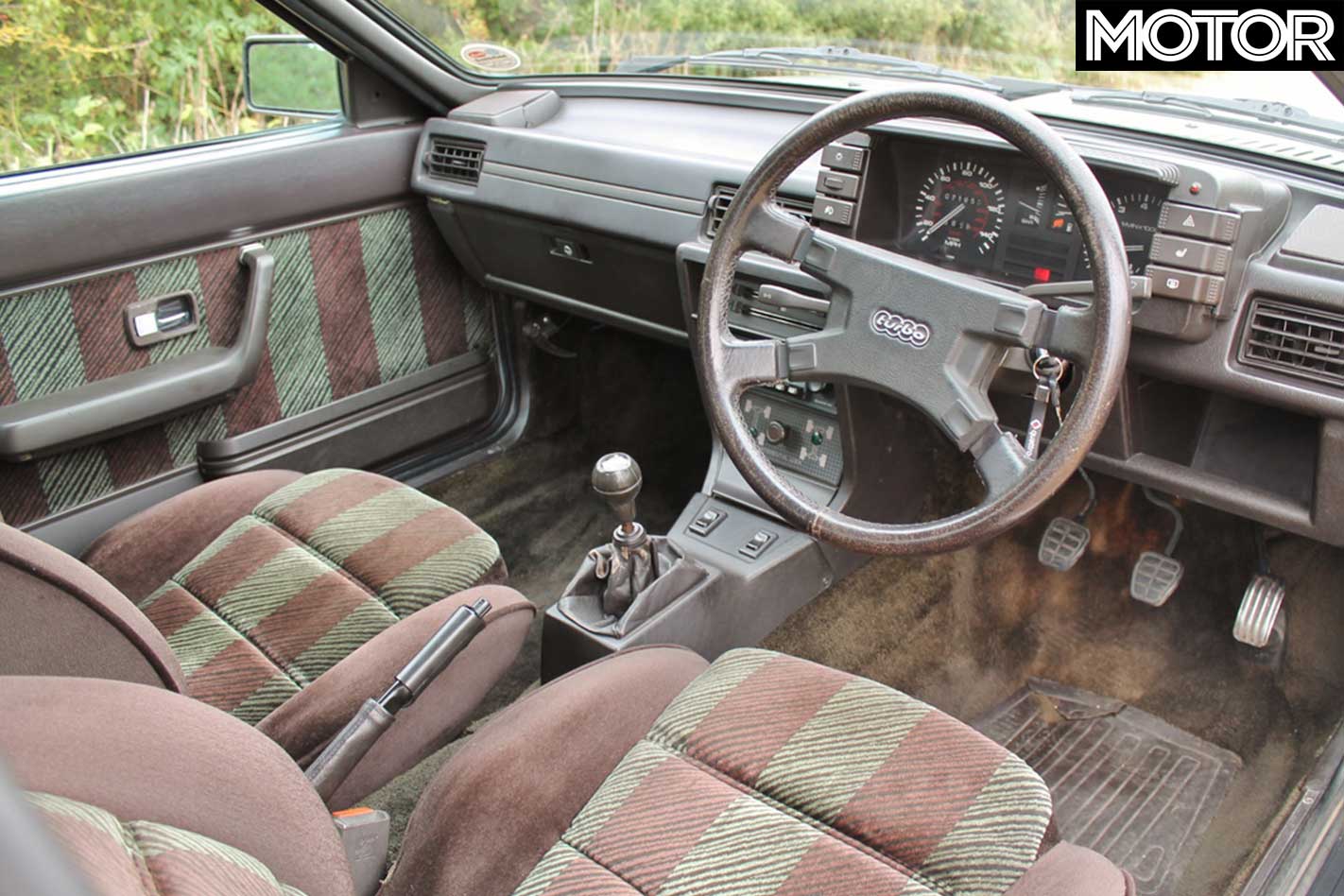
If you’re wondering how a prototype exists two years after the original reveal of the Quattro, it’s because originally there weren’t meant to be right-hook examples. According to Silverstone, it was the UK that gave Audi grief until Audi succumbed.
“Audi was eventually persuaded by the UK importer to consider extending production and building right-hand drive models,” Silverstone says.
“As this was never planned, 12 prototype pre-production cars were built with features unique to the early ‘C’ chassis cars; quad headlamps, and different suspension and brakes. The production right-hand drive cars were launched as ‘83 model ‘D’ chassis numbers without these items.”
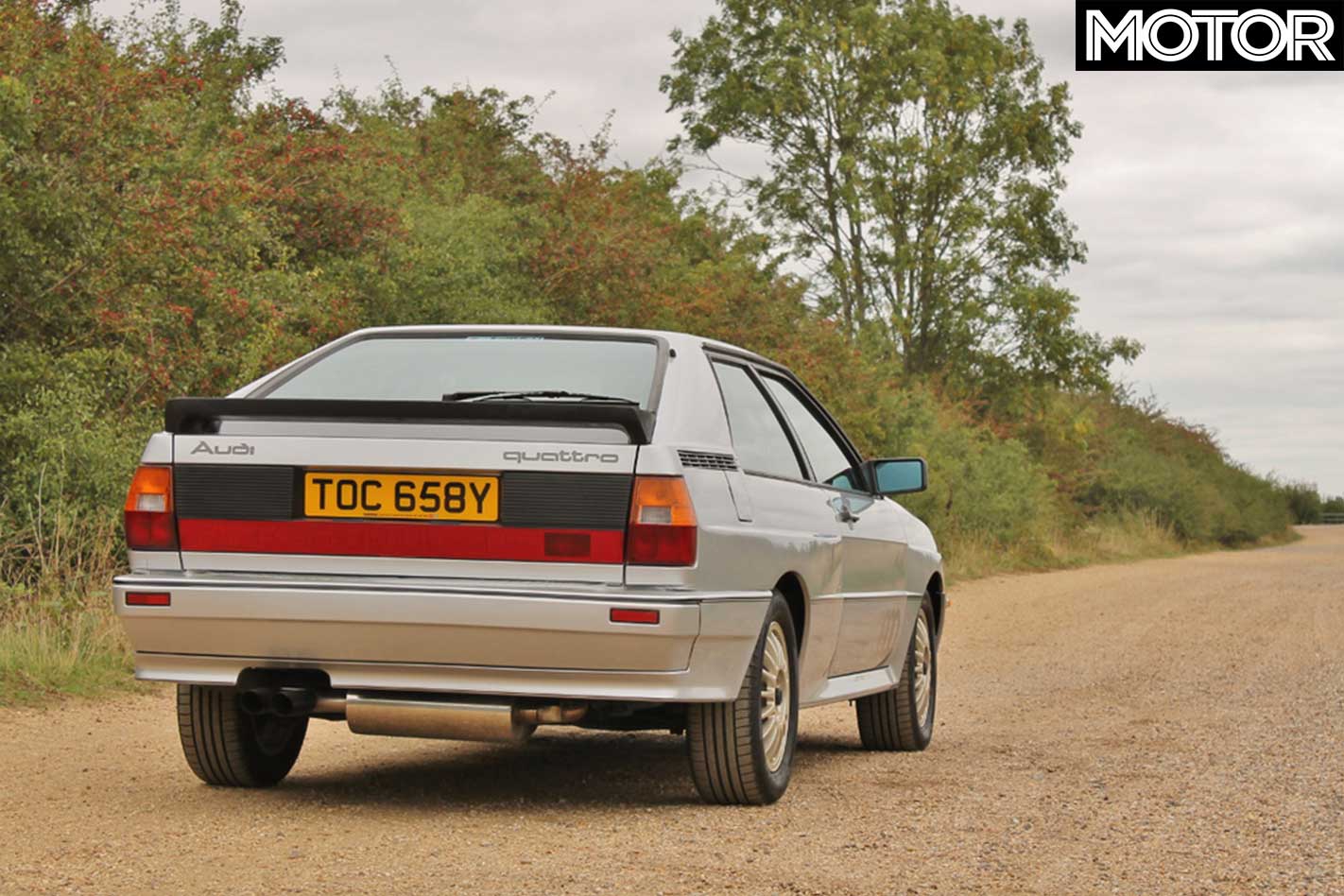
This car is reported to have sat unused for two decades by a previous owner, before being restored to roadworthy condition via a ‘mechanical recommissioning’ in 2016, which was soon followed by a re-spray.
Silverstone is offering the car with its original rego combination, plus the 71,853 miles (approx. 115,611km) the car has racked up in the 15 or so years it was being driven.
Of course, the Quattro went on to be quite a successful rally car, with plenty of rally victories to its name from around the world, until it cumulated in the ultimate expression of the Quattro – the S1.
Normally when you see spy shots of a car in camouflage testing in track, they were taken by a photographer who snaps unreleased cars and sells the pictures to media outlets.
But these photos of the Mercedes-AMG Project One were taken by Mercedes, in a rather voyeurish manner.
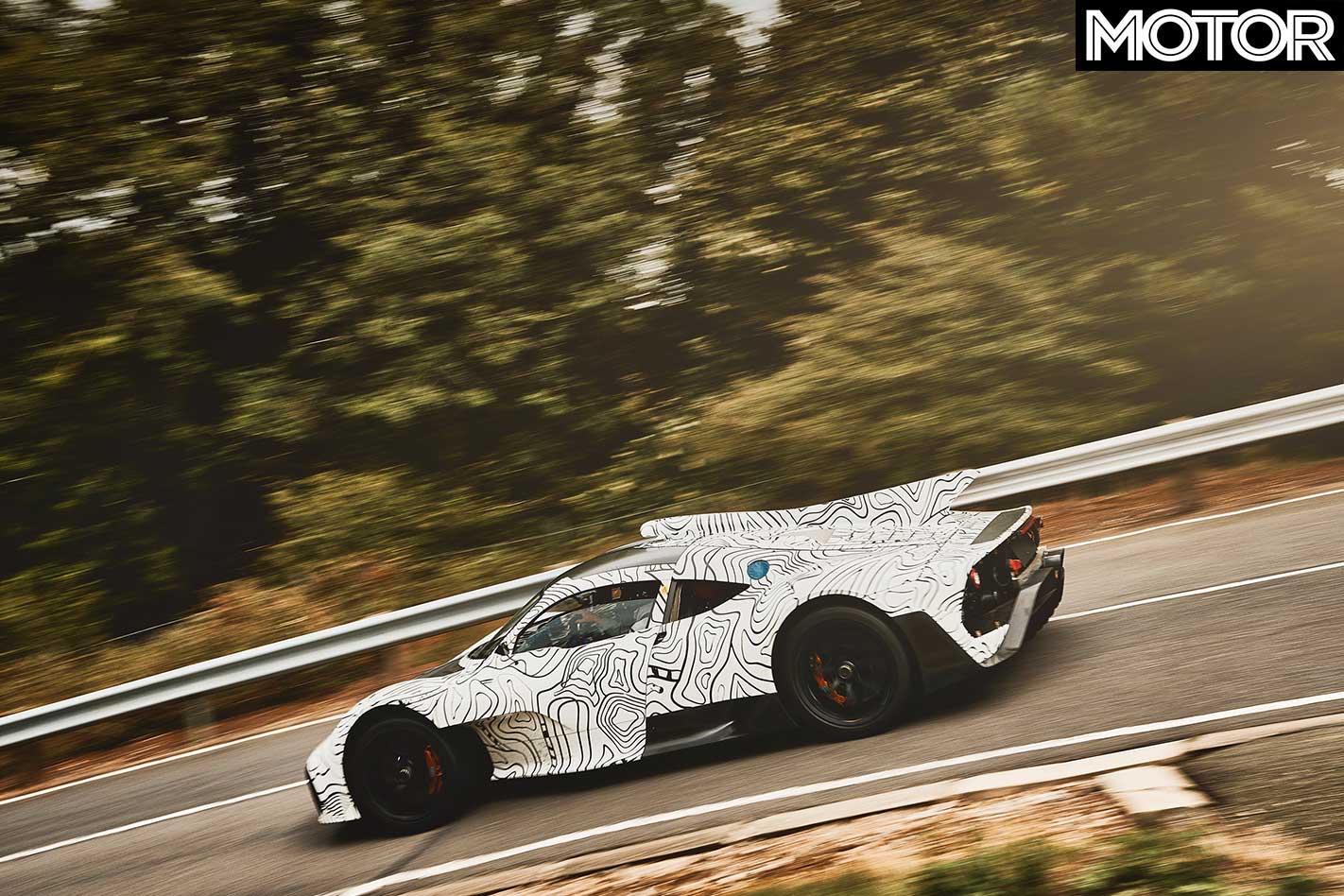
The AMG Project One has been inching closer to being reality for its buyers, with Mercedes testing the hybrid hypercar more frequently, something it says is becoming harder to keep secret.
“Today it turns out to be more difficult to keep this testing confidential: the camouflaged prototypes of the Mercedes-AMG hypercar are still being driven on closed off test grounds and racetracks,” Mercedes says.
“However, because of their characteristic F1 sound they are hard to keep from the public.”
Releasing official images of the car track testing probably isn’t helping with the secrecy.
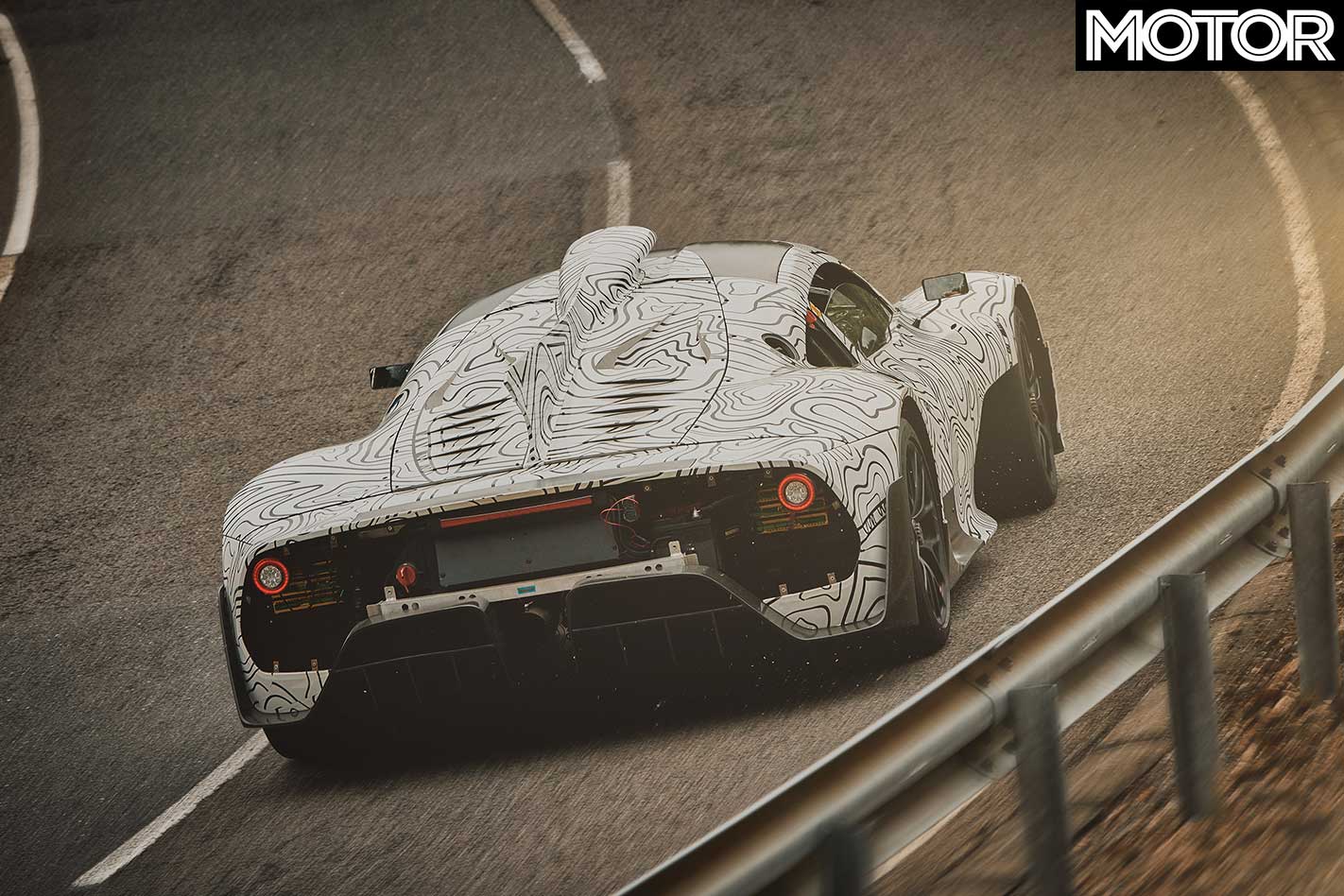
That ‘F1 sound’ comes thanks to the Project One’s hybrid drivetrain, which is a 1.6-litre V6 with two electric motors, essentially a Formula One engine (thus the name) adapted for the road.
AMG says the Project One should be good for around 740kW, not a far throw from one of Mercedes’ actual F1 cars.
Mercedes had been dyno testing the engines, which can rev to 11,000rpm, before the prototypes started getting around on tracks. The one seen in the pictures here is a ‘secret location’ in the UK.
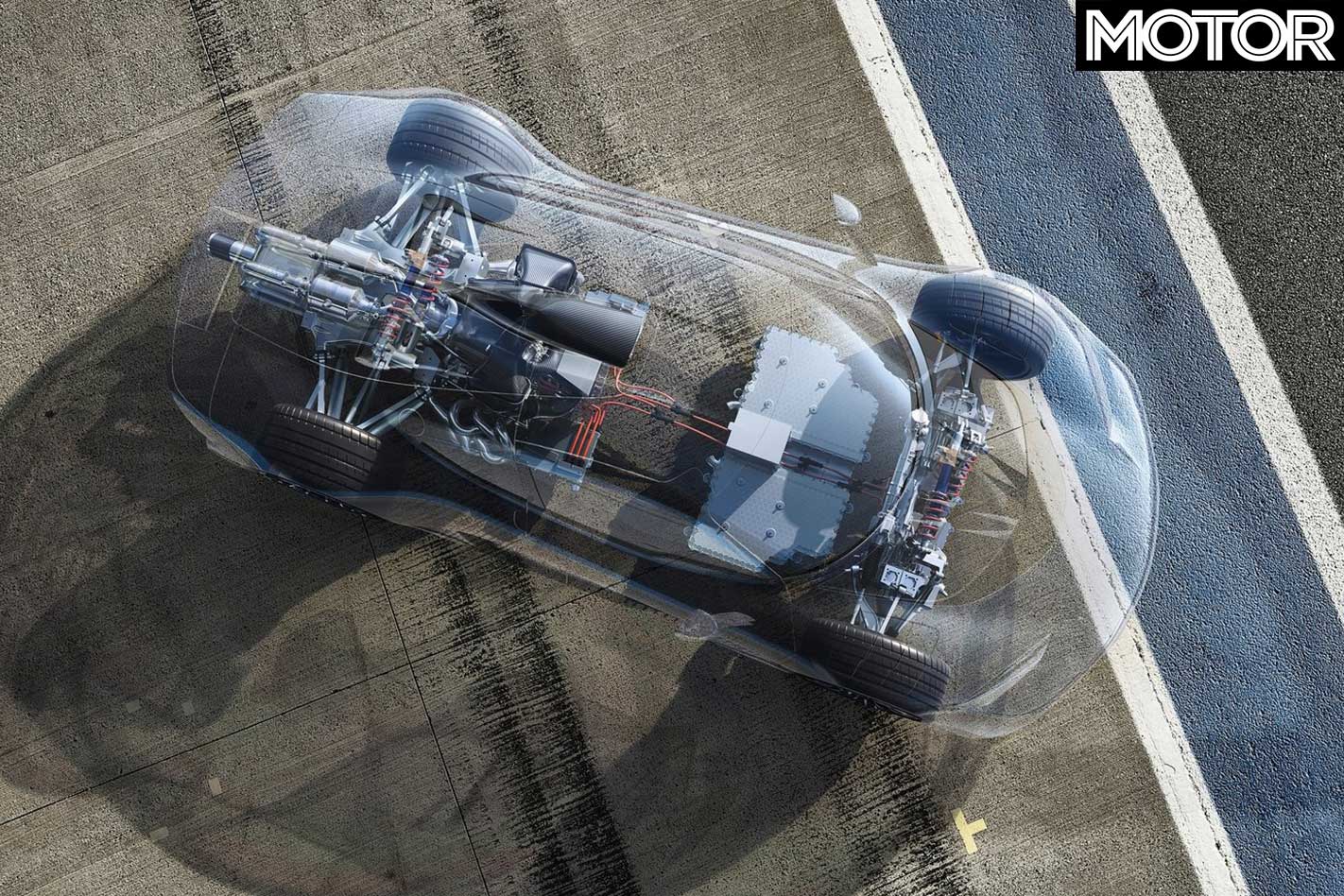
“The successful completion of the dyno tests was followed by the installation of the highly complex powertrain into the first prototypes, which since then have been driving around unnoticed on a secret test ground in England.
“The whole powertrain including all hybrid components underwent the toughest race track tests on the high-performance dyno tests of HPP’s engine specialists in Brixworth.”
Only 275 cars are to be built, with a price tag coming in at about $5 million.
Porsche has officially abandoned diesel engines as it intensifies its efforts to develop hybrid and pure-electric technology.
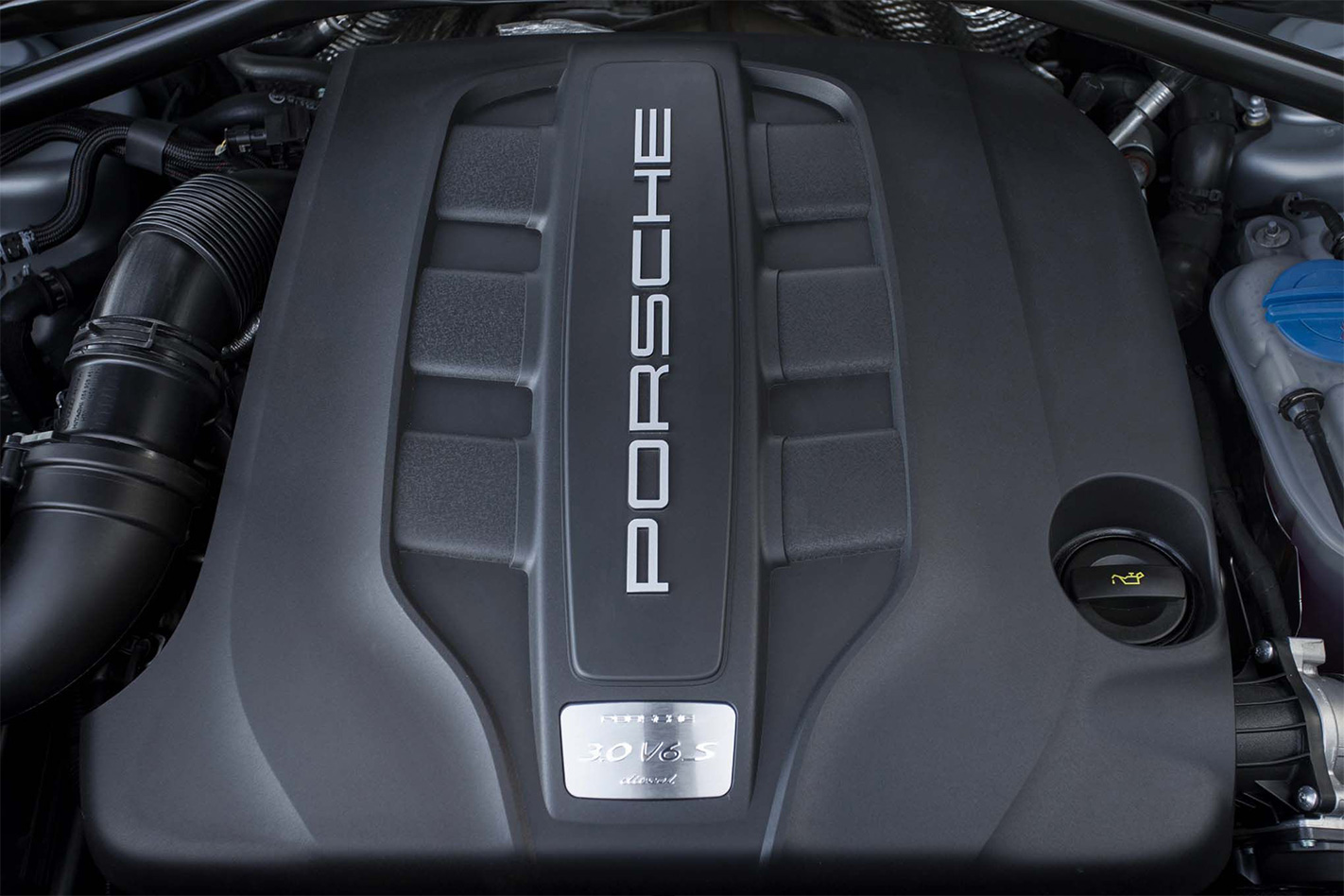
The sportscar maker said its decision is mostly based on low global demand for its diesel powertrains, which powered just 12 percent of all its vehicles sold globally in 2017. It actually stopped producing diesel-engined cars in February this year citing the same reason, but this week’s announcement confirms that diesel Porsches are permanently off the menu.
Porsche chief executive Oliver Blume stressed the decision had nothing to do with environmental issues or Dieselgate.
“Porsche is not demonising diesel. It is, and will remain, an important propulsion technology,” Blume said in a statement issued overnight. “We as a sports car manufacturer, however, for whom diesel has always played a secondary role, have come to the conclusion that we would like our future to be diesel-free.”
“Naturally we will continue to look after our existing diesel customers with the professionalism they expect.”
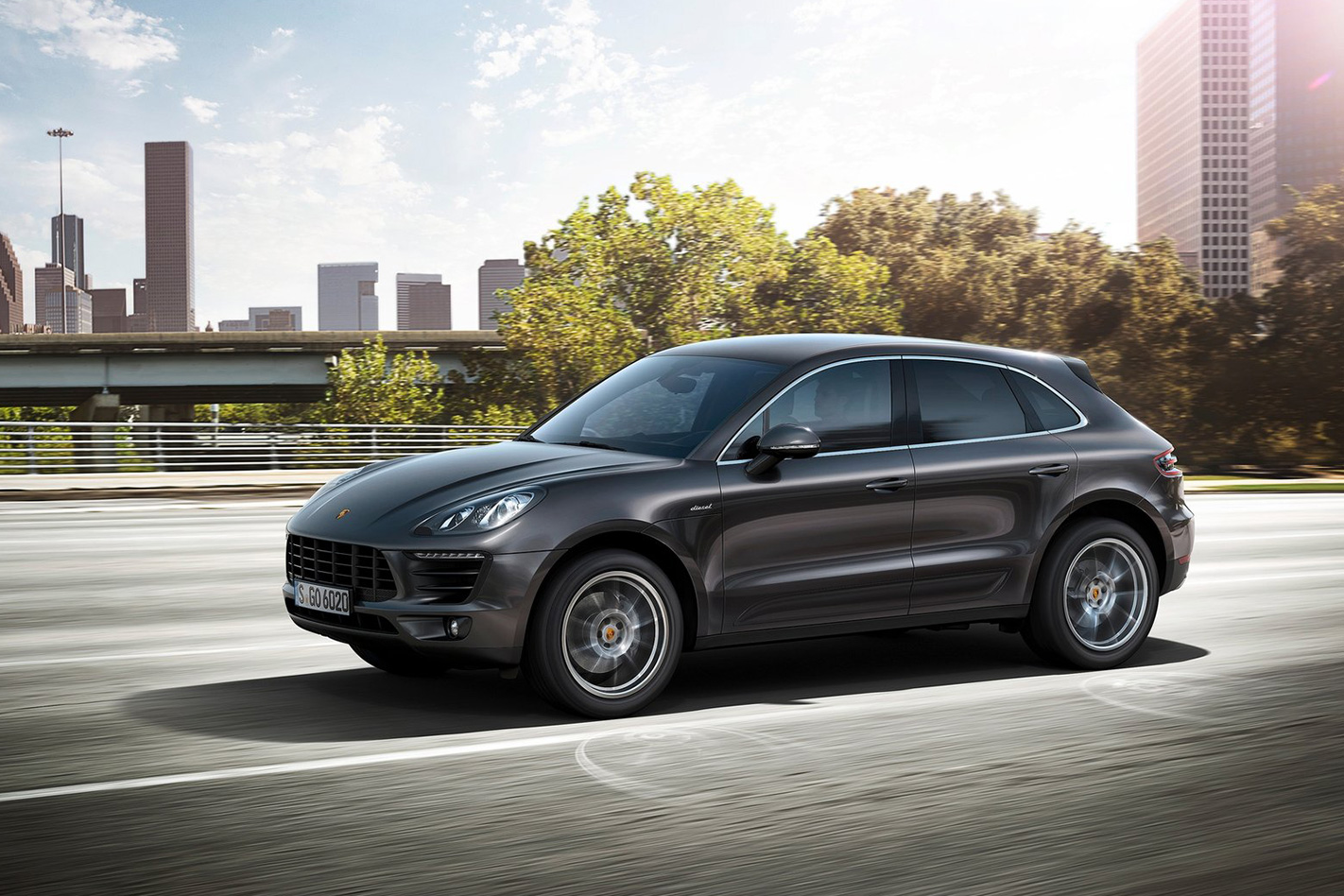
The low global demand for oil-burning Porsches has been reflected in Australia, where sales of the Macan S Diesel and Panamera 4S Diesel had flat lined.
It was a different story with Cayenne, with its entry-level Diesel, and S Diesel variants representing about 50 percent of marque’s sales. However, the all-new model, which began arriving in showrooms in June, is only available with turbocharged petrol, and E-Hybrid options.
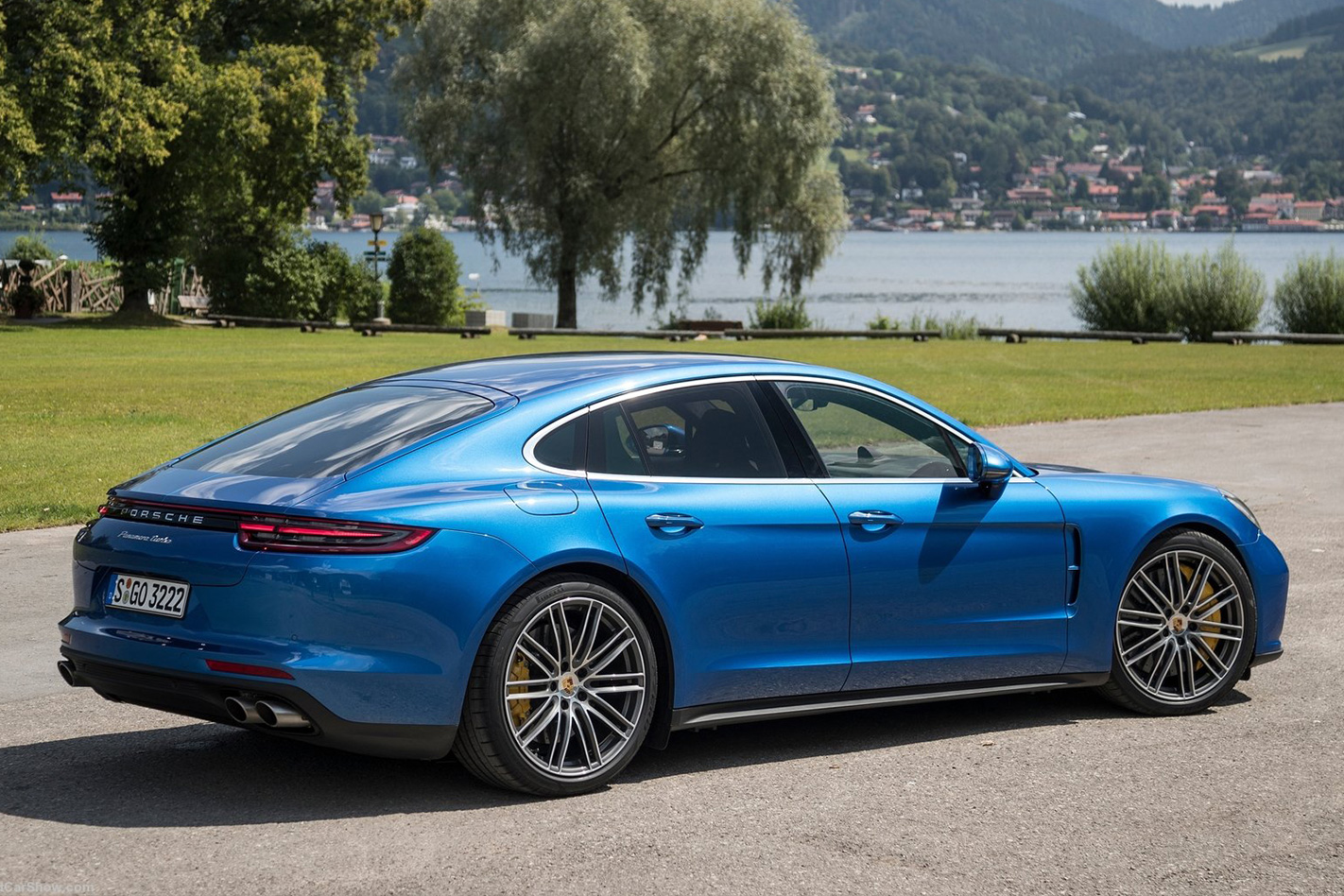
Meanwhile, the performance-focused E-Hybrid powertrains, which include the devilishly-powerful 500kW/850Nm Turbo S, represent about 25 percent of Panamera sales here and, according to a Porsche Australia spokesman, there have been a significant number of pre-orders for the Cayenne E-Hybrid, which arrives next month.
Porsche – which will introduce its first all-electric model, the Taycan, next year – is aiming for electrified vehicles, whether hybrid or purely electric, to make up 50 percent of its global sales by 2025.
Purists needn’t fret however, with the company committing to continue its focus on high-performance internal combustion engines.
“Our aim is to occupy the technological vanguard – we are intensifying our focus on the core of our brand while consistently aligning our company with the mobility of the future,” Blume said.
Those considering a Mazda CX-5 may want to delay their decision for a few months – especially if they consider the current petrol engine range for Mazda’s hugely popular midsize SUV to be lacking in oomph.
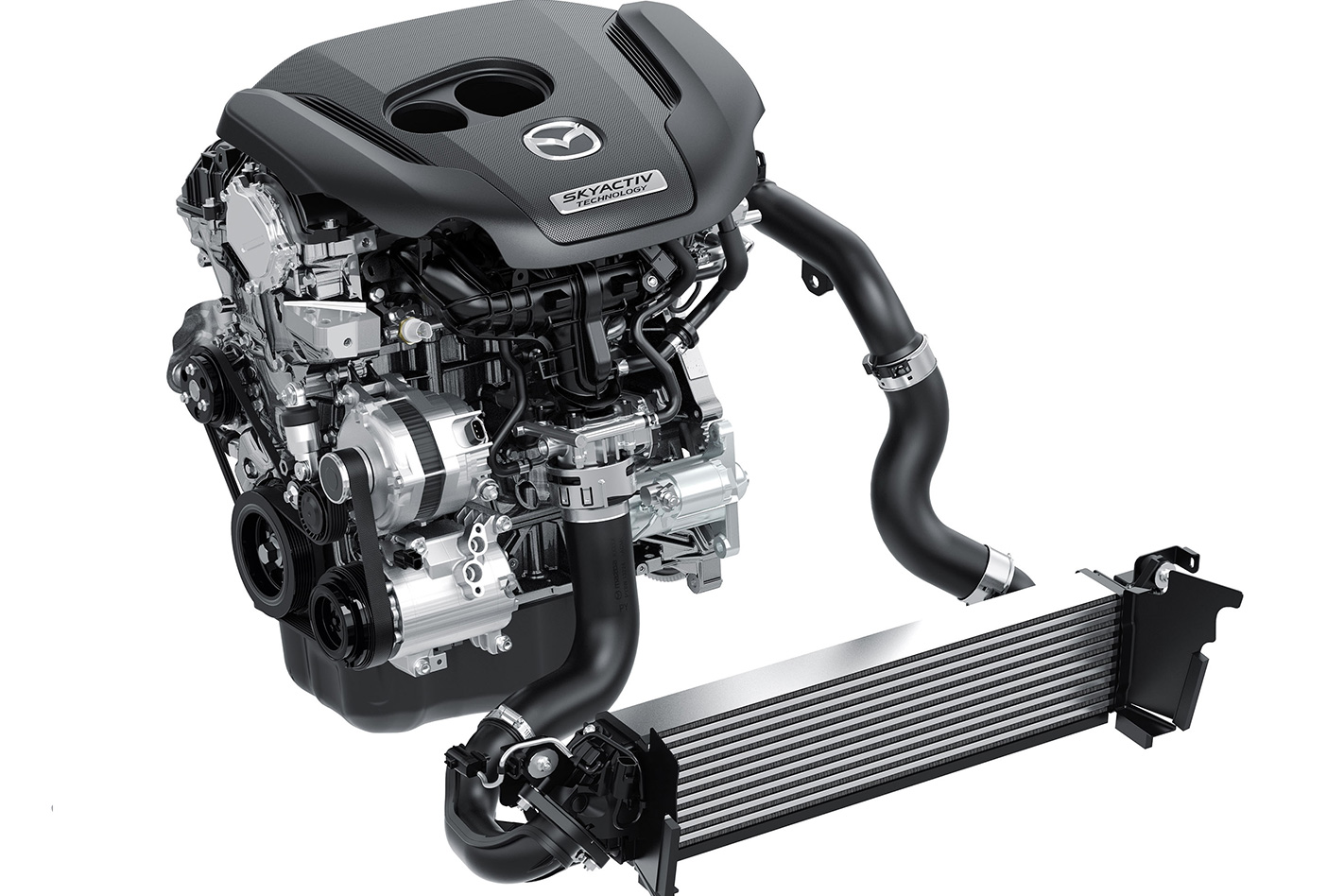
According to homologation documents seen by WhichCar, the turbocharged 2.5-litre engine from the CX-9 large SUV is now destined for the CX-5’s engine bay, and though it’s yet to be officially confirmed by Mazda Australia, the presence of the ‘Skyactiv-G 2.5T’ engine on the CX-5’s Australian certification suggests it isn’t far from the showroom.
The imminent arrival of the 2.5L turbo petrol engine will bring the total number of CX-5 powertrains to four. The 115kW 2.0-litre naturally-aspirated petrol four will continue to power front-wheel drive versions of the CX-5 Maxx and Maxx Sport, with the 2.5-litre naturally-aspirated petrol and 2.2-litre turbo diesel all-wheel drive options also soldiering on.
And while the diesel and standard-2.5-litre petrol each provide a handy 140kW of power to the CX-5, the incoming 2.5-litre turbo petrol will usurp both of them with its stout 170kW peak power figure. Peak torque for the turbo petrol will measure in at 420Nm, which means the 450Nm diesel will continue to be the most tractive option.
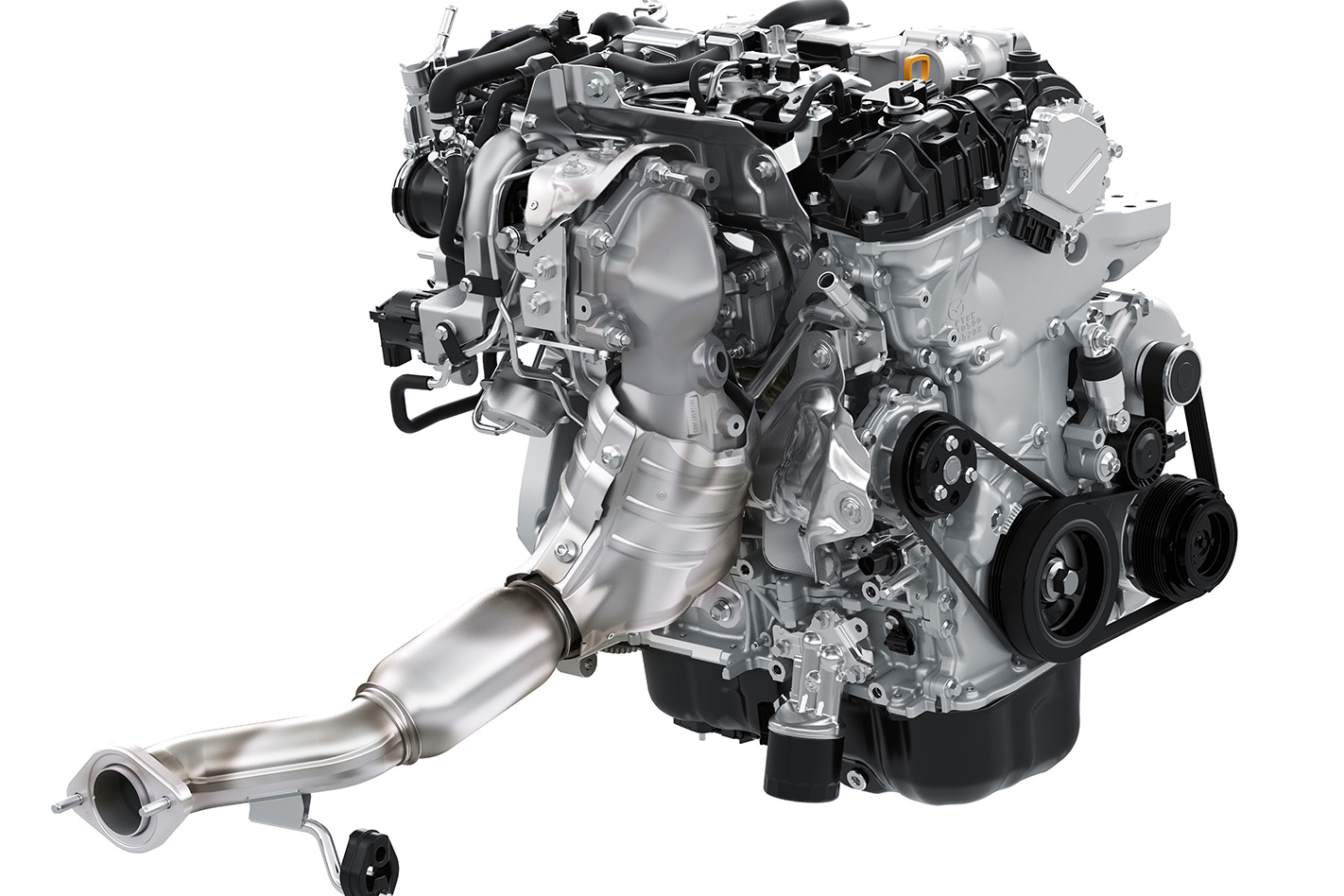
As with the Mazda 6, which itself received the CX-9’s turbo-petrol powerplant back in May this year, the same engine will be reserved for high-grade versions of the CX-5. According to the car’s homologation documents, the turbo petrol will be paired with 19-inch alloys and a sunroof as standard, so expect it to see service in the top-shelf GT and Akera Grades.
WhichCar has approached Mazda Australia for comment. Expect full pricing and features for the CX-5’s upcoming forced-induction petrol option to be confirmed closer to its launch.
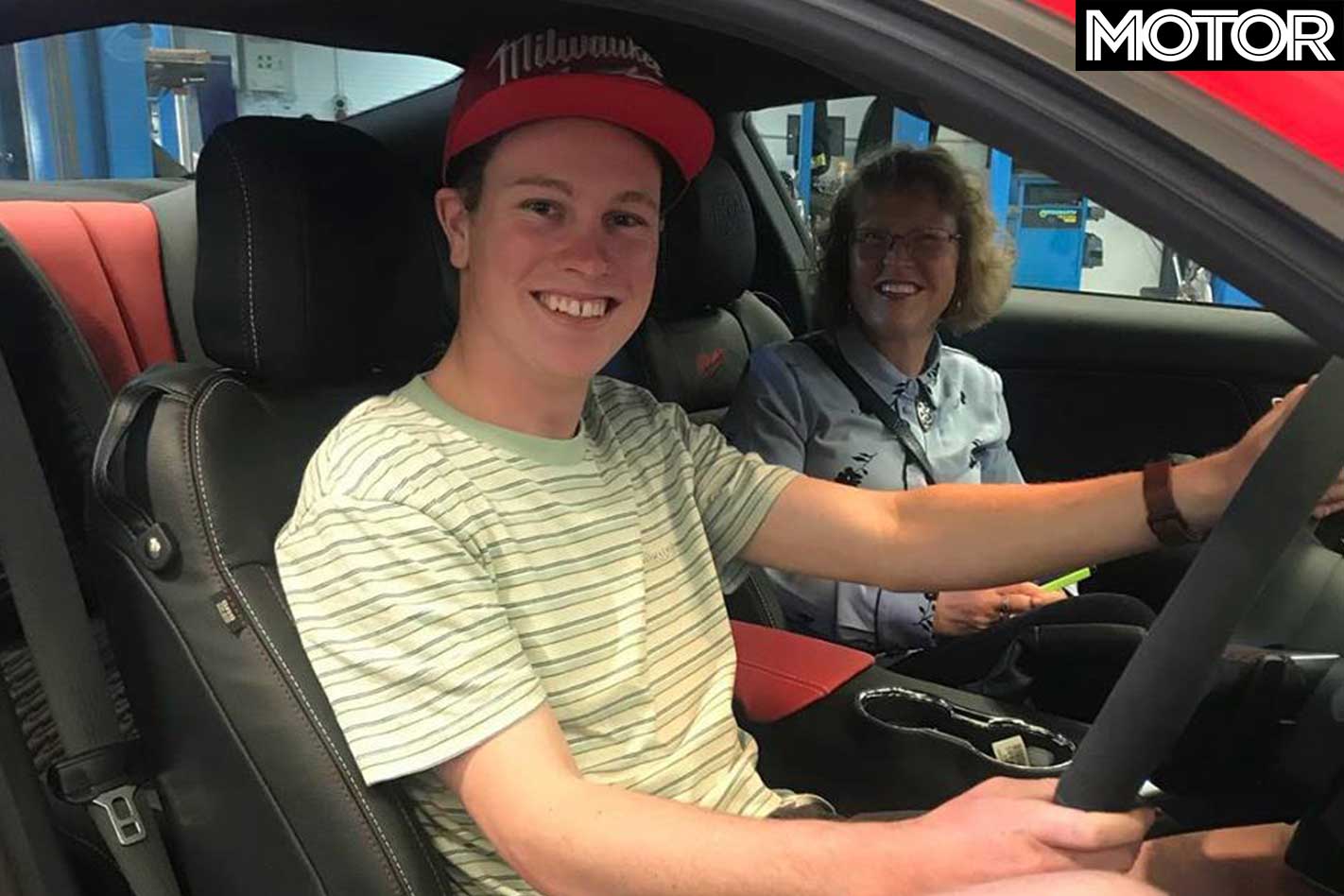
It’s not often you get jealous of a learner driver, but a young tradie who just picked up his first car is an exception.
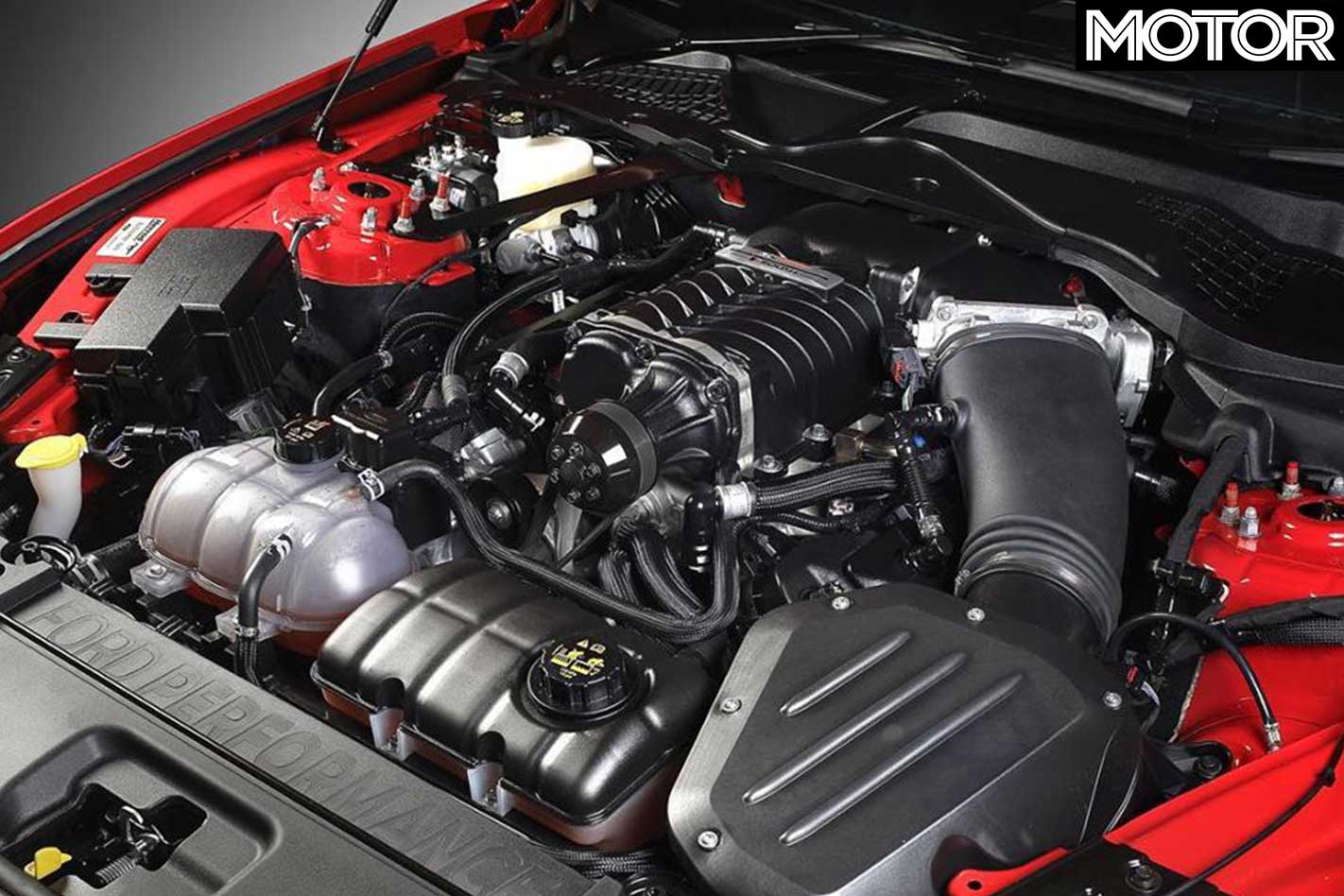
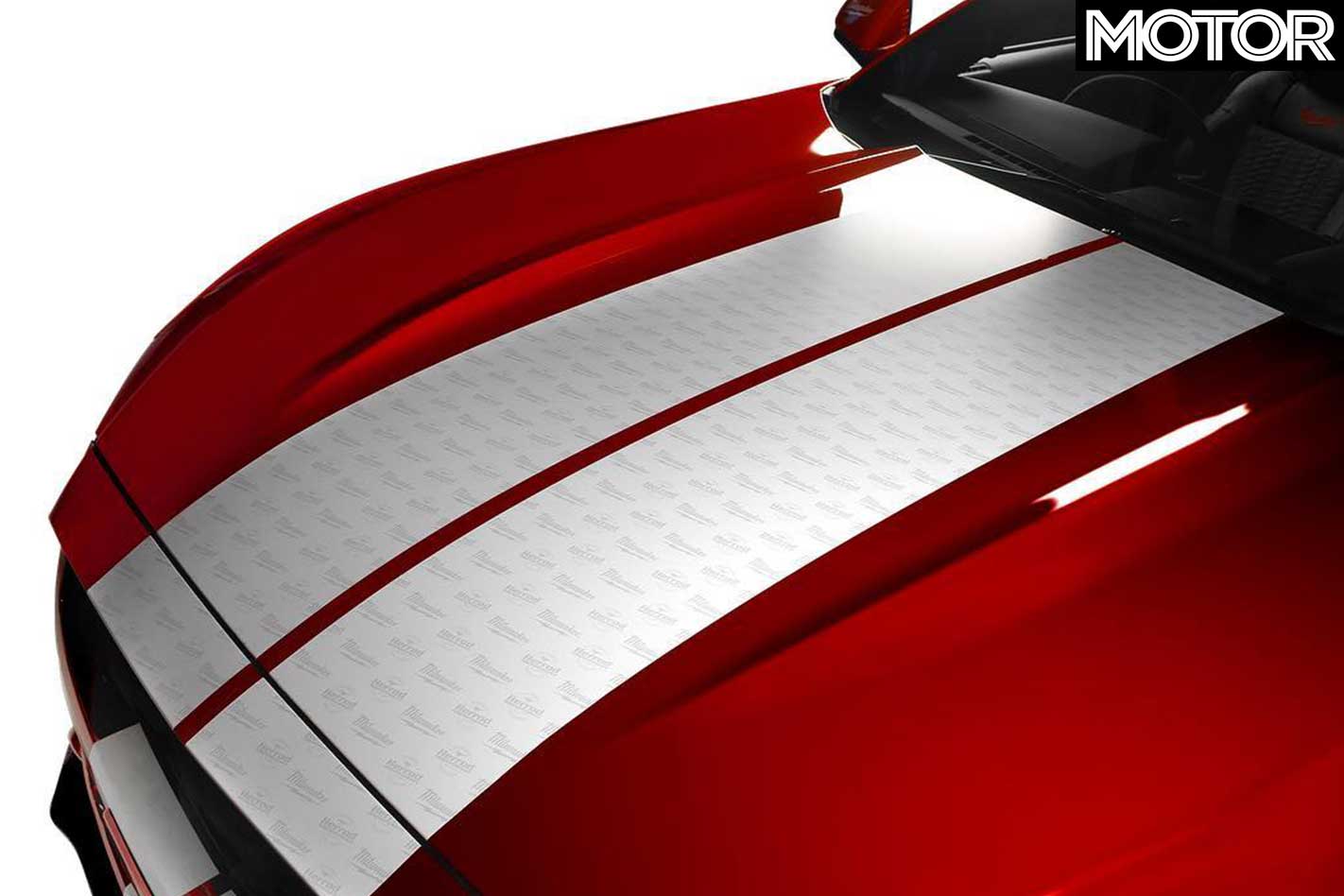
Herrod Performance recently ran a competition with Milwaukee tools to give away a supercharged Mustang with the tool brand’s logo worked into the car’s design.
On his learner licence, he’s able to drive the car with supervision – but that changes once hit gets a provisional licence. Someone’s got a long few years of waiting ahead of him.
Rob Herrod, the man in charge at Herrod Performance, tells MOTOR that he was pleased to see the car go to someone who would really appreciate it.
“It was terrific. When he showed up he was just a really good kid – down to Earth, well-spoken, and not big-noting himself about it or anything like that.
“It’s great that he’s a young kid who was just buying tools for his career… you just don’t see stuff like this happen anymore.
“The story I was told was that he’d been saving to buy some tools for work because he wants to be a carpenter, and just got himself a job since he’s coming up to getting his licence soon.
“All he did was buy some power tools and, well now he’s got himself a Mustang. He’s not sure what he wants to do with it yet, but he can learn to drive in it.”
Herrod estimates the car is worth roughly $100,000 – a tad more than the cars most people learn to drive in.
There have been plenty of innovations in terms of tech and safety, but the fundamentals shared by almost all modern cars are decades old: monocoque construction, strut suspension, disc brakes and, of course, Ol’ Smokey itself – the internal combustion engine.
But now a genuine revolution is approaching. Electric cars don’t just use a different means of propulsion – one that needs to be engineered at massive cost – but they also require major changes to the way cars are designed and built. Changes that are causing some very senior heads to be scratched very hard.
The stakes are enormous. At a recent event in Germany, Oliver Zipse, BMW’s board member for production, admitted the company has only a hazy idea of how many electrified cars it will be selling in eight years. “We assume that by the year 2025 it will be something between 15 and 25 percent,” he said, “but it could be 40 percent, or it could be only 10 percent.”
BMW Group produced 2.46 million vehicles last year, so that colossal variation has a huge effect on the investment decisions the company has to make now. The corporate crystal ball isn’t up to it: Europe’s falling appetite for diesel, China’s move to mandatory electrification and the strong possibility of a trans-Atlantic trade war make it impossible to call.
So, like an uncertain punter at the races, BMW is going to hedge its bets. The company’s forthcoming fifth-generation architecture is flexible enough to allow conventional powerplants, PHEVs and full EVs to share the same modular component set, but also to be produced alongside each other in the same plants. So if demand swings, the ratios can be altered.
Sensible, right? But if the world moves more enthusiastically towards an ion-fuelled future it could prove excessively cautious. As pro gamblers know, bigger wins need bigger bets, and rivals including Volkswagen Group and JLR are taking a more daring approach with the creation of EV-only platforms. These allow much more packaging freedom with longer wheelbases and no need to make space for a combustion donk; the newly launched Jaguar I-Pace giving an idea of what’s possible. Building EVs separately also allows production volumes to be altered without having to worry about a knock-on effect on other models.
The risk is higher, too. Buyers will need to want enough of these glitzy new EVs to keep the plants building them at high capacity. It’s a lesson that BMW learned expensively through the slow sales of the carbon-bodied i3. Switching its next-gen EVs to a conventional platform does look like a backward step; we know that the production version of the i-Next won’t be anything like as radical.
But which strategy will win out? Place your bets now – and check back in 10 years.
At the Paris Show, Alfa Romeo unwrapped the production version of the 8C coupe. It goes on sale late next year at a price of around 160,000 Euros (AU$265,000), so to limit the run to only 500 units might be a perfectly sensible decision. But what about the Spider?
This feature was originally published in MOTOR’s December 2006 issue
“Obviously, we would like to see the open-air version get approved too,” answers head of design, Wolfgang Egger. “As far as design and engineering are concerned, most of the groundwork has been done. We now know how to package the folding top, we have made room for a 150-litre cargo bay, and have triple-checked the torsional stiffness of the body.
“It is also worth noting that the Spider has a character of its own,” Egger continues. “It is more of a cruiser than the coupe, it is more elegant and less extreme. It’s a style statement as well as a performance car, and we have enough parts to build it! But it remains to be seen whether marketing can find enough customers to justify the considerable extra investment.”
Most Italian concept cars have super-tight cockpits – a real squeeze, unless your father was a jockey and your mother a prima ballerina. The 8C Spider makes an exception to this rule by offering enough cabin space to accommodate even the Pavarottis of this world.
The three-spoke steering wheel with the squared-off bottom adjusts in reach and rake, the power-operated seats whir back a surprisingly long way, the deep footwell benefits from the car’s phallic proportions, and there is plenty of clearance between the slab-sided door panel and the feisty transmission tunnel. The only element which puts the lid on our budding love affair is the manual roof, which when closed makes you duck and crouch in discomfort.
At last I’m in, firmly secured in position by the clamshell carbonfibre seatback, and by the merciless belt. The anti-slip aluminium pedals are well-spaced, but the clutch is almost as heavy as the dreaded Legmaster III in the Golden Gym. How come?
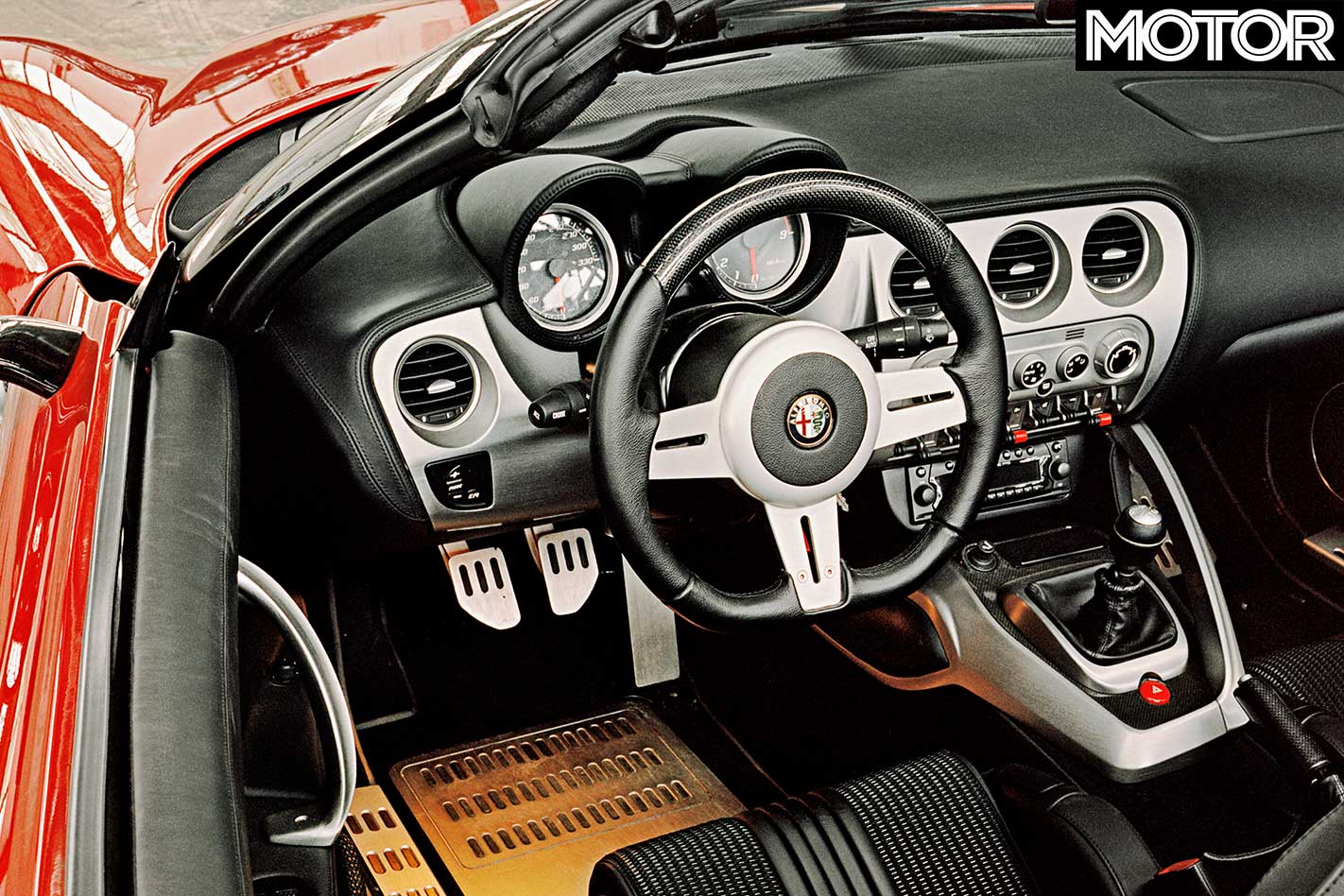
Because the 8C Spider is, unlike the coupe, not fitted with the paddleshift Cambiocorsa transmission we know from various Maseratis. Instead, it features the traditional six-speed manual that is standard on the GranSport.
After a day of hard asymmetrical footwork, these cogworks can only be described as second-best choice. First gear refuses to stick most of the time, reverse would not find its destination even if there was a GPS system attached to it, and the considerable slack in the shift pattern suggests that this particular ’box was filled with grappa, not oil.
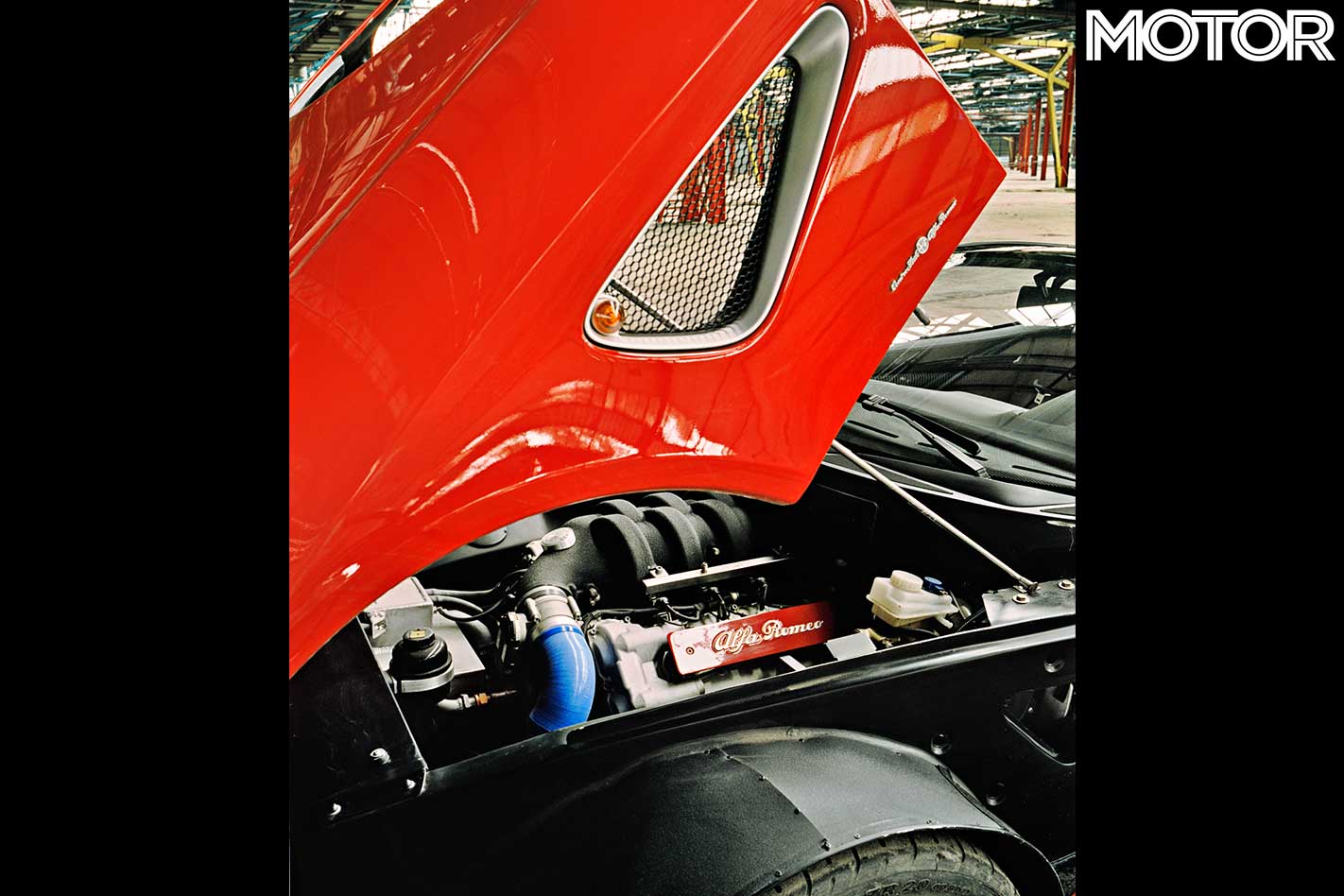
Thankfully, the quad cam V8 plays in a different league altogether. Its soundtrack makes your eardrums go numb with emotion, its subtle vibrations tingle your spine, and its take-off performance is impressive enough to briefly make the two Alfa press guys fear for their jobs.
“This thing can accelerate in under four seconds from 0-100km/h,” confirms Egger, grinning from ear to ear. “Which underscore the 8C as a serious driving machine, not a poseur for the boulevarde of vanities. Even with the soft top in place, we are expecting a maximum speed of about 300km/h.
“Theoretically, the car could go faster still, but the drag coefficient currently holds at 0.39. Why? Because we insist on zero lift at the front axle and on negative lift in the back. That’s why the rear spoiler points skywards at a 19-degree angle.”
“By fabricating the entire body and the interior out of carbon fibre,” Egger continues, “even the Spider tips the scales at under 1500 kilos. The weight distribution works out at a perfectly balanced 50:50.”
Despite the brand-new synthetic skin, the 8C Spider is, in essence, still a Maserati in disguise. Compared to the closely related donor car, the GranSport Spyder, the 8C is 80 kilos lighter, 60mm wider, 30mm lower and 40mm longer. The wheelbase grew by 110mm to 2550mm – which happens to exactly equal the footprint of the Maserati coupe. The transaxle layout is a straightforward carryover element from the GranSport. The same applies to the Cambiocorsa gearbox installed in the 8C coupe.
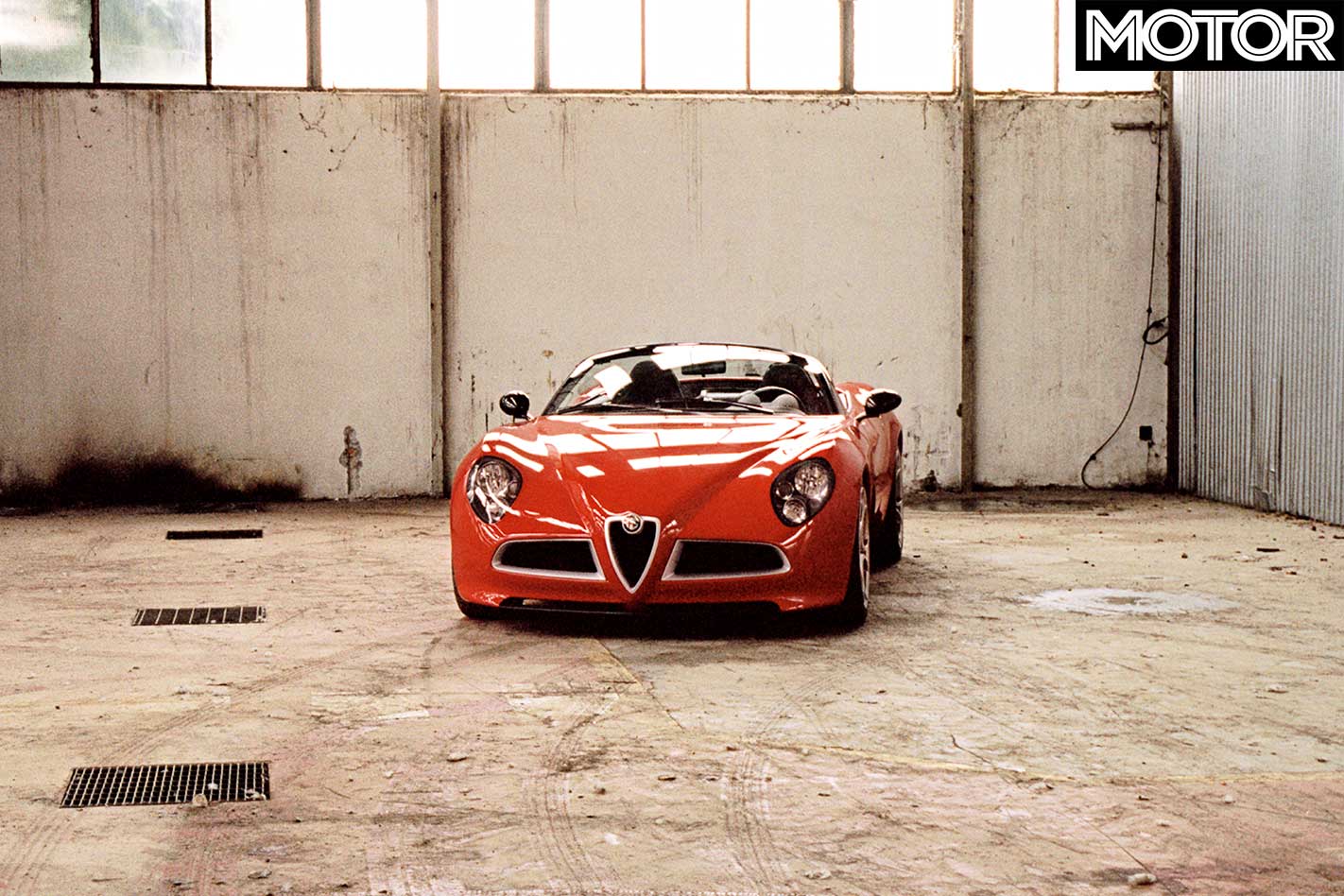
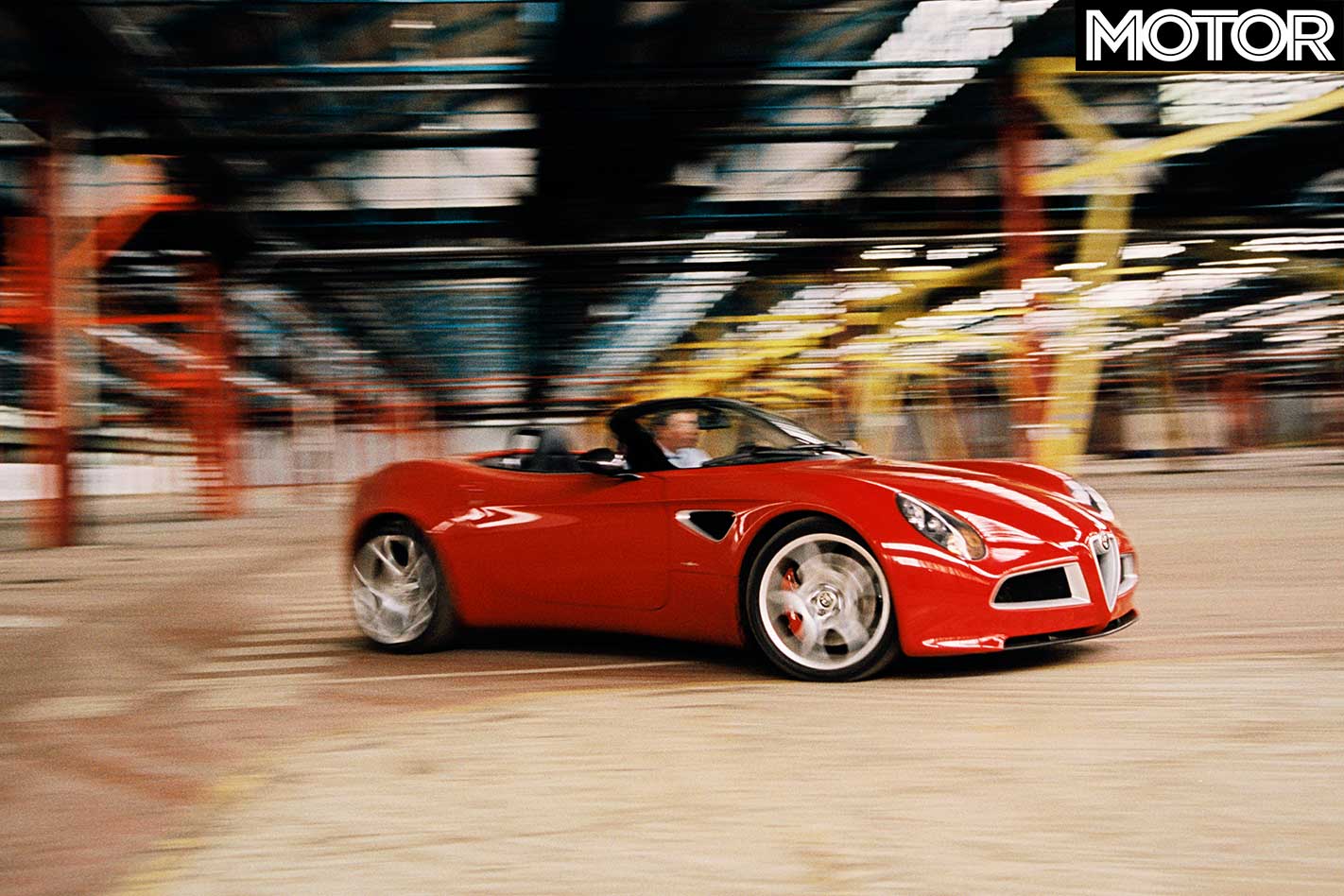
With the exception of the super-heavy clutch and super-vague gearbox, the 8C Spider drives like a dream. Shod with 20-inch Pirelli P Zeros (245/40 front, 275/35 rear), the striking two-seater turns this disused assembly hall at Alfa’s Arese plant into an impromptu slalom course, with zero-tolerance steel pylons and unmarked random excavations thrown in as additional handicaps.
Despite the treacherous dust-over-time-over-concrete surface, the Spider is cornering with such precision and sharpness one could be tempted to believe Pirelli is not only supplying tyres but also blades for speed skaters. The steering is accurate and informative, quick yet progressive.
The brakes – four ventilated discs straddled by fat Brembo calipers – know the full spectrum between fine retardation and instant freeze-frame. The suspension, double wishbones all-round but none of the skyhook trickery they are so fond of in Modena, reads the road with a confidence-inspiring mix of translation and interpretation.
ESP can be switched off completely, but I suspect this is neither the right time nor the right occasion to flash the hooligan alter ego.
The beautifully detailed V8 engine is a 4.7-litre version of the Ferrari-designed 4.2 we know from the Coupe/Spyder and Quattroporte saloon. Rated at 335kW, it produces 37kW more than the four-door model and 45kW more than the fixed-head two-door sports car.
In terms of displacement, the 8C engine even edges the Ferrari F430 which uses a 4.3-litre derivative of the same matrix. With max torque of 470Nm available at 4750rpm (and 80 percent from 2000rpm), the Alfa motor whips up more twist action than the F430, and it also distances both Maseratis.
Although the 8C Spider is a handbuilt one-off design exercise, it works well enough to keep breaking the lap record inside this industrial complex. The back straight of the building is long enough for a full blast in third gear, so here we go once more, with much more enthusiasm.
With the butterfly throttle valves wide open and the four tailpipes blowing like chrome trumpets, you can virtually watch the plaster crack and hear the skylights rattle in their frames – row after row after row. Redlined at 7800rpm, the 90-degree V8 keeps pushing the driver deep into the Sparco race seat originally developed for the Ferrari Enzo.
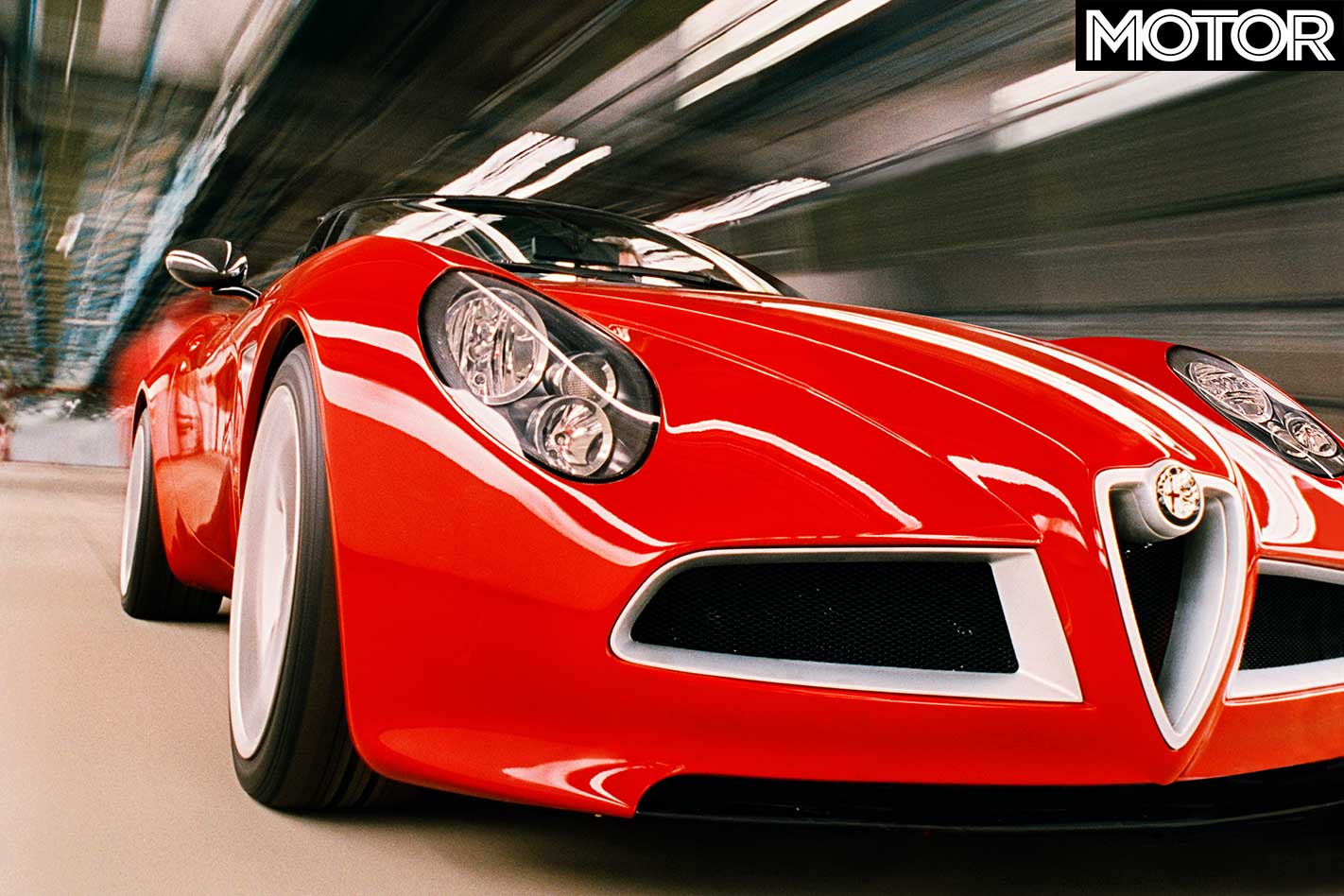
Unlike the 8C coupe, which is all carbon fibre and road racer inside, the cockpit of the Spider is dominated by acres of black leather. Black is also the colour of choice for the steeply raked windscreen frame and for the steel rollover protection elements.
The centre stack, on the other hand, is generic Italian sports car: three round air vents, Ferrari HVAC controls with Alfa graphics followed by a row of aeronautic switchgear, and a Becker radio-and-nav combo down low, in case you get tired of listening to the glorious eight-cylinder bellow.
Unlike the 8C coupe prototype, which is the work of Stola, the Spider was built by Carrozzeria Marazzi of 1960s Autodelta GTA fame.
“It was a wonderful experience to work with these craftsmen, many of whom came back from retirement especially for our project,” recalls a beaming chief designer. “With the help of salami, cheese and plenty of red wine, we usually kept going deep into the night, and if there ever was a need for inspiration, all I had to do was take the cover off of one of the classic Alfas stored in this facility.
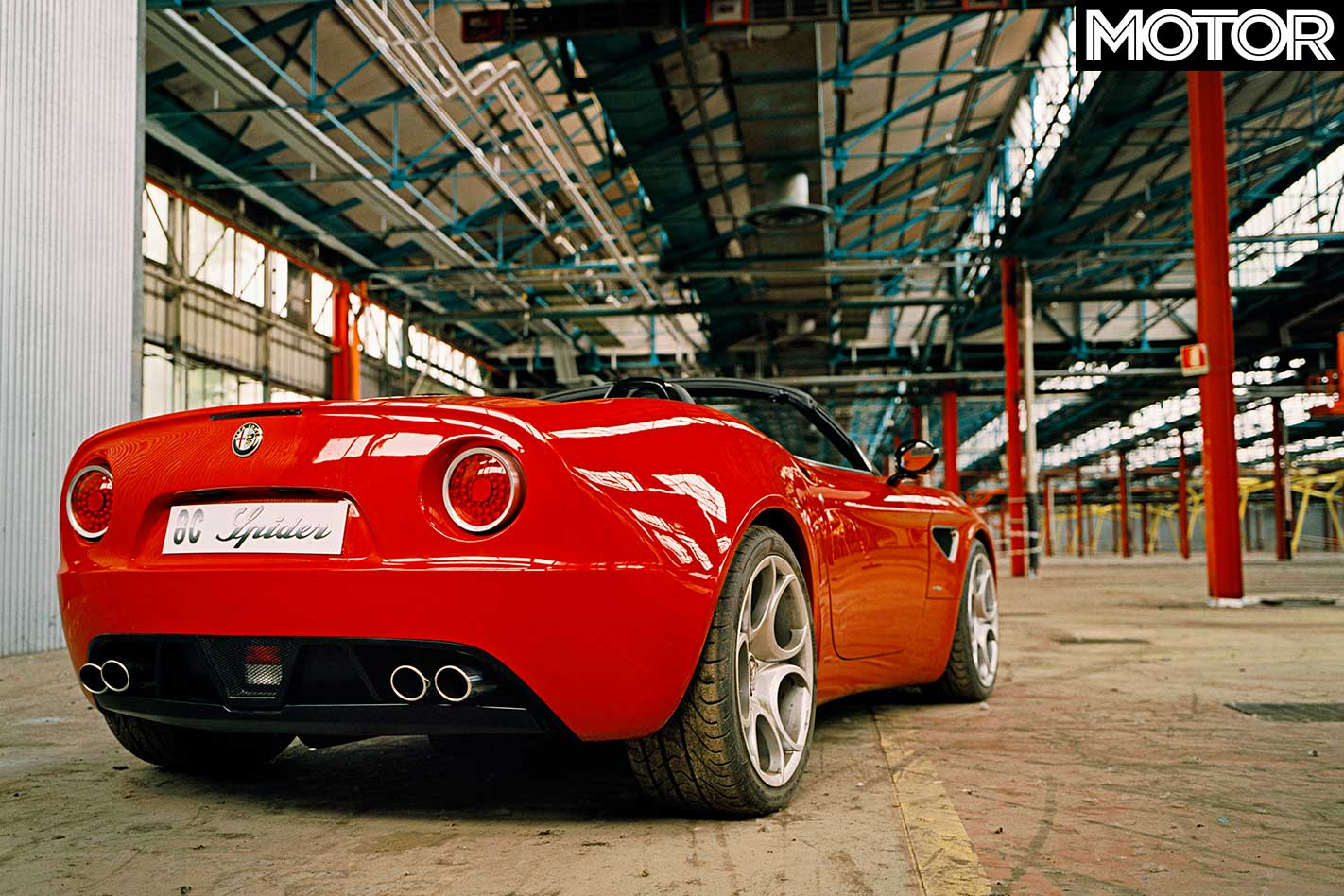
“The folding top was a particularly tough nut to crack. In the end, we assigned this task to two pensioners who had conceived the roof for the Duetto way back when. They completed the job – design, packaging and execution – in only six weeks.”
When folded, the canvas hood stows beneath a leather cover which is fastened to the body via velcro straps. To make sure the part-time roof remains firmly in place even at very high speeds, the R&D team looked for some wind-tunnel assistance, and settled on Dallara, the renowned maker of single-seater racing cars. With their help, they also created a track version with extreme aerodynamics for even more downforce. If at all, the track version will unfortunately only appear in coupe guise.
Quite a few of the 500 8Cs to be built have been pre-ordered by owners of the classic 8C 2300 of which 188 units were built between 1931 and 1934. If there is demand for more of the same, Alfa could add 50 lightweight Dallara-inspired street racers, plus of course the 8C Spider. A right-hand drive version isn’t on the cards, sources say.
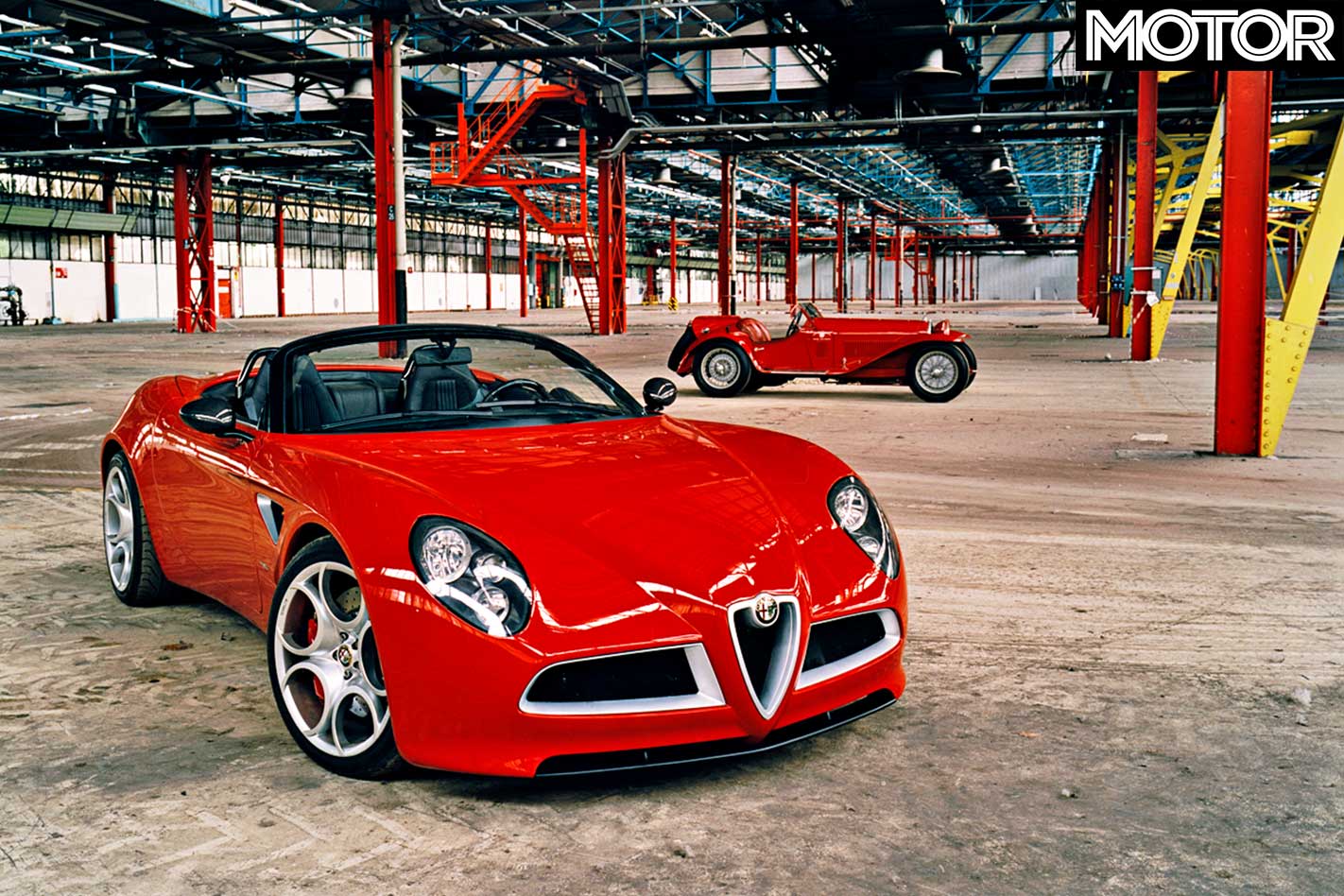
I was ready to celebrate this remarkable car with a dirty big burnout that would have wrapped up the day nicely, despite the weather. But at 4000rpm in first gear, the throttle cable suddenly snapped, and our supermodel slowed to idle speed.
For the last few photos, 30km/h was thus our velocity. No, dynamically not very exciting. But the perfect pace to paste this unforgettable shape onto the hard disk in the back of your mind.
FAST FACTS 2006 Alfa Romeo 8C Spider prototype
BODY: 2-door convertible DRIVE: rear-wheel ENGINE: 4691cc V8, DOHC, 32-valve POWER: 335kW @ 7000rpm TORQUE: 470Nm @ 4750rpm WEIGHT: 1550kg POWER-TO-WEIGHT: 216kW/tonne TRANSMISSION: 6-speed manual SUSPENSION: double A-arms, coil springs, anti-roll bar (f), multi-links, coil springs, anti-roll bar (r) L/W/H: 4303/1882/1275mm WHEELBASE: 2550mm BRAKES: ventilated discs (f), ventilated discs (r); ABS, VDC WHEELS: 20-inch alloys TYRES: Pirelli P Zero 245/35ZR20 (f), 285/35ZR20 (r)
The Coupe
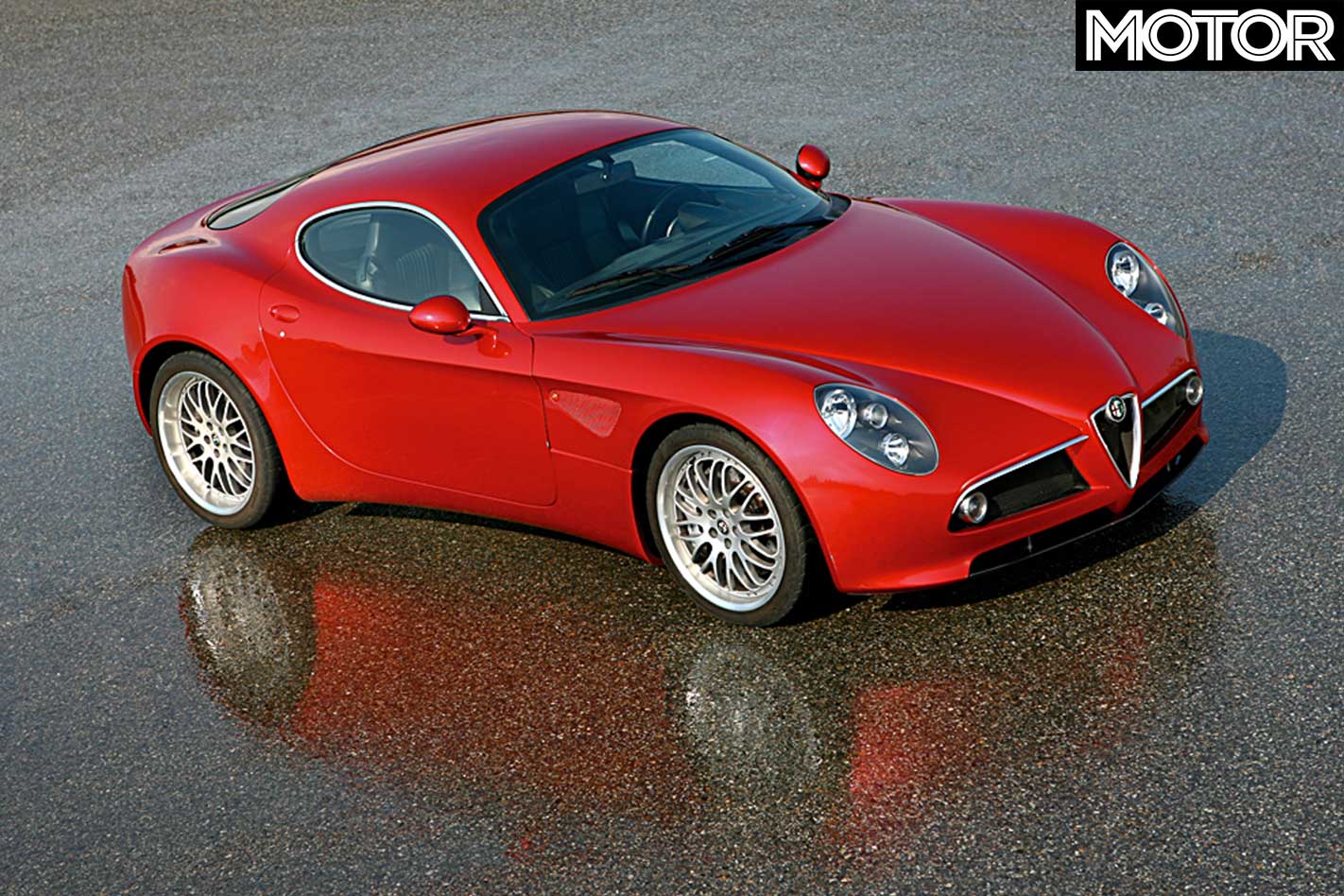
Anyone who attended last month’s Sydney Motor Show may have noticed the stunning 8C Competizione coupe on Alfa Romeo’s stand – fresh from its world debut in Paris the month before.
Officially on sale now, but with deliveries not due until September ’07, the Maserati-based 8C will have its build number limited to just 500. It’s Alfa’s first V8 since the spectacularly unsuccessful Montreal coupe died in 1976, but sadly for Aussie Alfisti, all are left-hand drive.
Dial M for Muscle
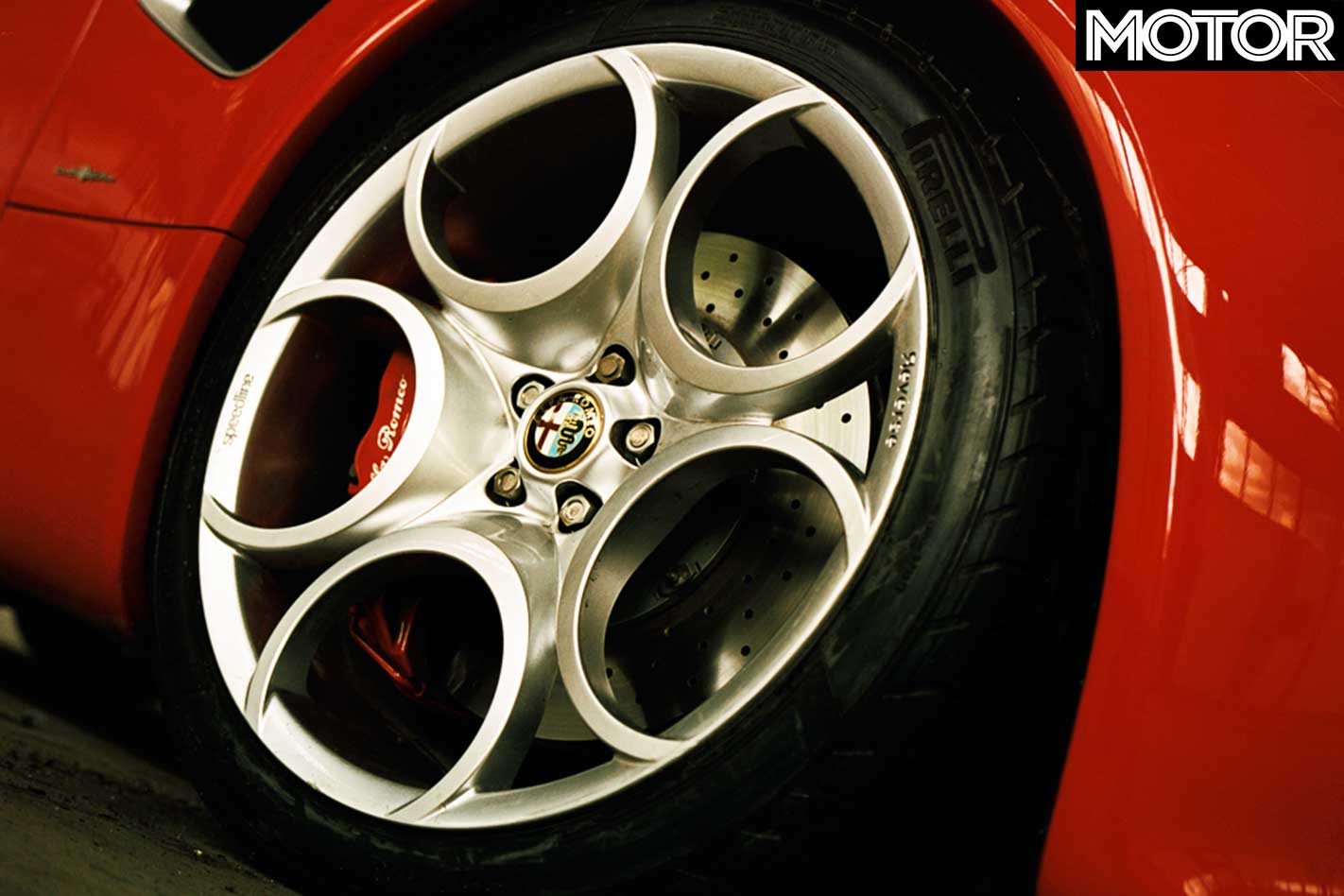
Like the 8C coupe, the Spider is blessed with a sensational set of rims – Alfa-traditional telephone-dial alloys in a rather non-traditional 20-inch size. The rears wear massive, and costly, 285/35ZR20 Pirelli P Zeros, though anyone flash enough to cough up $265,000 for the 8C coupe, let alone the concept-for-now Spider, has no right to complain.
Interestingly, underneath the 8C Spider sits a stretched Maserati GranSport Spyder platform.
