WHAT IS IT?
An updated version of Ford’s hot-selling Mustang, which arrives Down Under this June carrying boosted equipment levels, more power and performance, plus a heftier price tag.
Priced at $62,990, the manual GT V8 driven here will be $5500 more expensive compared with the current model. The entry-level EcoBoost 2.3-litre turbo four manual is up $4000 too, and starts at $49,990.
Like the previous version, you can also have an auto-only convertible with either engine.
Mostly because we’re impatient. Rather than wait for the updated Ford Mustang to arrive here later this year, we snagged an early drive in Los Angeles to see if the 2018 model is worth the extra spend. Plus, this is no mild overhaul. The 5.0-litre V8 has been given a 33kW shot in the arm taking peak power to 343kW, both auto and manual transmissions are overhauled and the technology inside the cabin has been upgraded.
MAIN RIVALS
THE WHEELS VERDICT
THIS decent mid-life refresh sees the 2018 Mustang improve on what was an already attractive and well-rounded offering in the affordable sports coupe market. More grunt is always going to go down well with Australian muscle car fans and the improved soundtrack is now representative of its performance.
Improved seats and a more advanced infotainment system also address other shortcomings and help make the 2018 Mustang an even more compelling package.
THE WHEELS REVIEW
MY CHINESE friend Yu lived in a land-locked province of China until she was in her early 20s when she moved to the UK to study at a seaside university in Plymouth. The first time I took her to the beach she took a few steps towards the waves, dropped to her knees and sank her hands into the sand where she remained for some time in silence staring out to sea. I think she went back almost every day for the next three years.
Australian muscle car fans had a similar reaction to the Ford Mustang when it was introduced in early 2016.
The initial offering was fast, dynamic, looked the biz, and Australians understandably went nuts for it, but a budget interior and muted exhaust note copped flak from its critics; criticisms that have been addressed with the 2018 model year update.
But flick the driving mode into Sport or Track and the soundtrack turns from vocal to downright manic. We have everything crossed that Ford offers the same system in unfettled form for Australian customers, although we wouldn’t be surprised if it needs toning down for our noise regulations.
The excellent sound is produced by a “thoroughly reworked” engine and the sophisticated Coyote 5.0-litre V8 is an absolute gem.
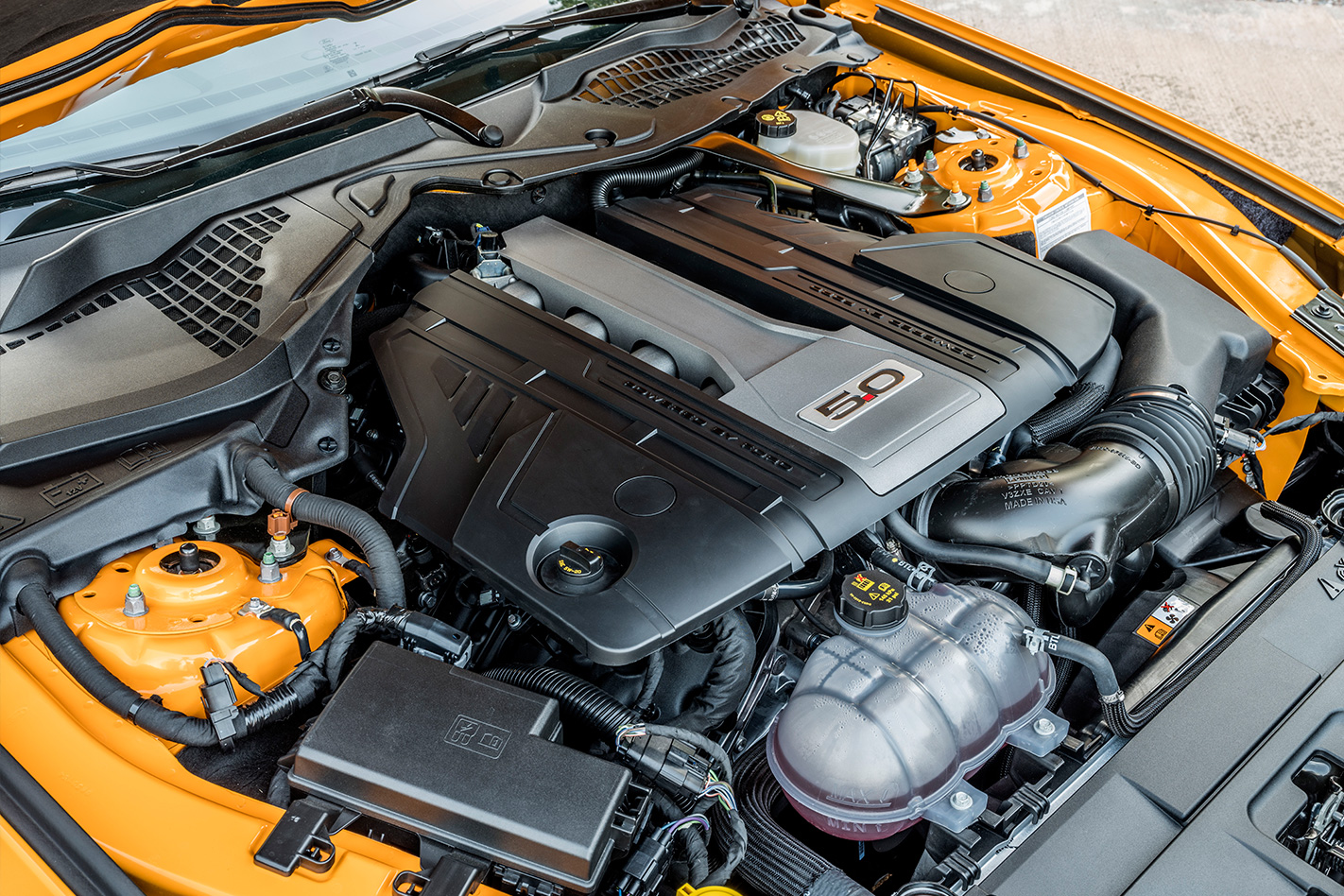
Unlike some competitors the Mustang’s engine is a showcase of modern design including four overhead camshafts with variable timing and lift, clever ignition timing that has slashed cold-start emissions and both low-pressure port injection as well as high-pressure direct injection.
The 2018 gains come from the new dual fuel injection system, increased capacity from 4951cc to 5035cc, new cams, valves, induction manifold and a raised rev limit.
Our car was fitted with the six-speed manual, which is now even kinder on the left thigh thanks to a twin-plate clutch. The result is not just a lighter feel but a clutch that is more progressive and easier to modulate.
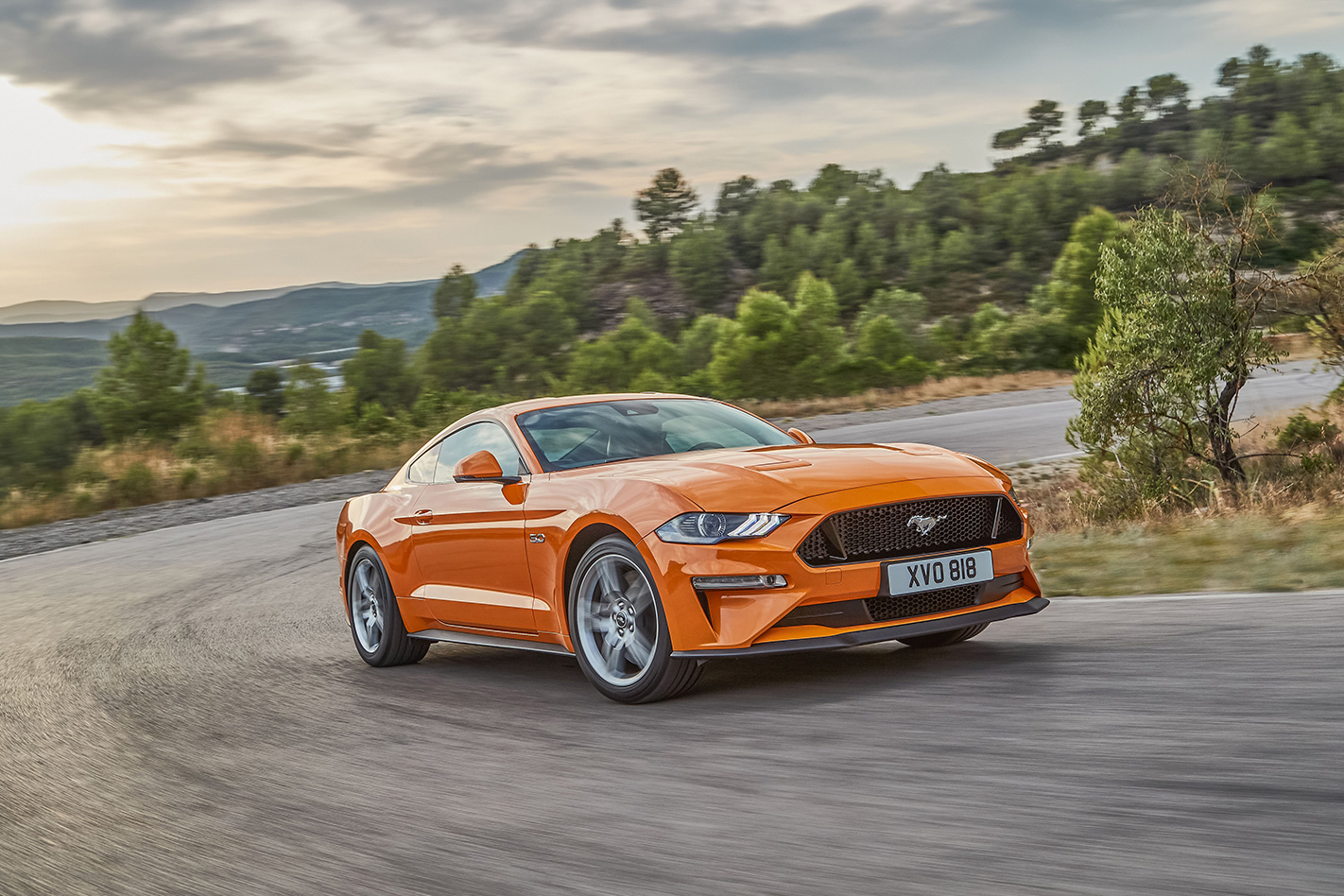
As you would expect, the extra tech and more standard goodies have affected the price and the 2018 model costs $5500 more than the version it replaces – a cost many fanatical Mustang fans are likely to happily front for a significantly improved ‘Stang.
MagneRide adaptive dampers will also be a new arrival as a $2750 option and stiffen – or soften – the ride depending on the setting. Our tester had the MagneRide box ticked, and switching it to the most comfortable mode tamed the Mustang’s firm ride.
In corners however, the Mustang is still as confident and capable as ever. The turn-in is sharp and the chassis imparts a suppleness to the handling that is approachable and communicative. More weight in the steering would be welcome, but the feel is generally good.
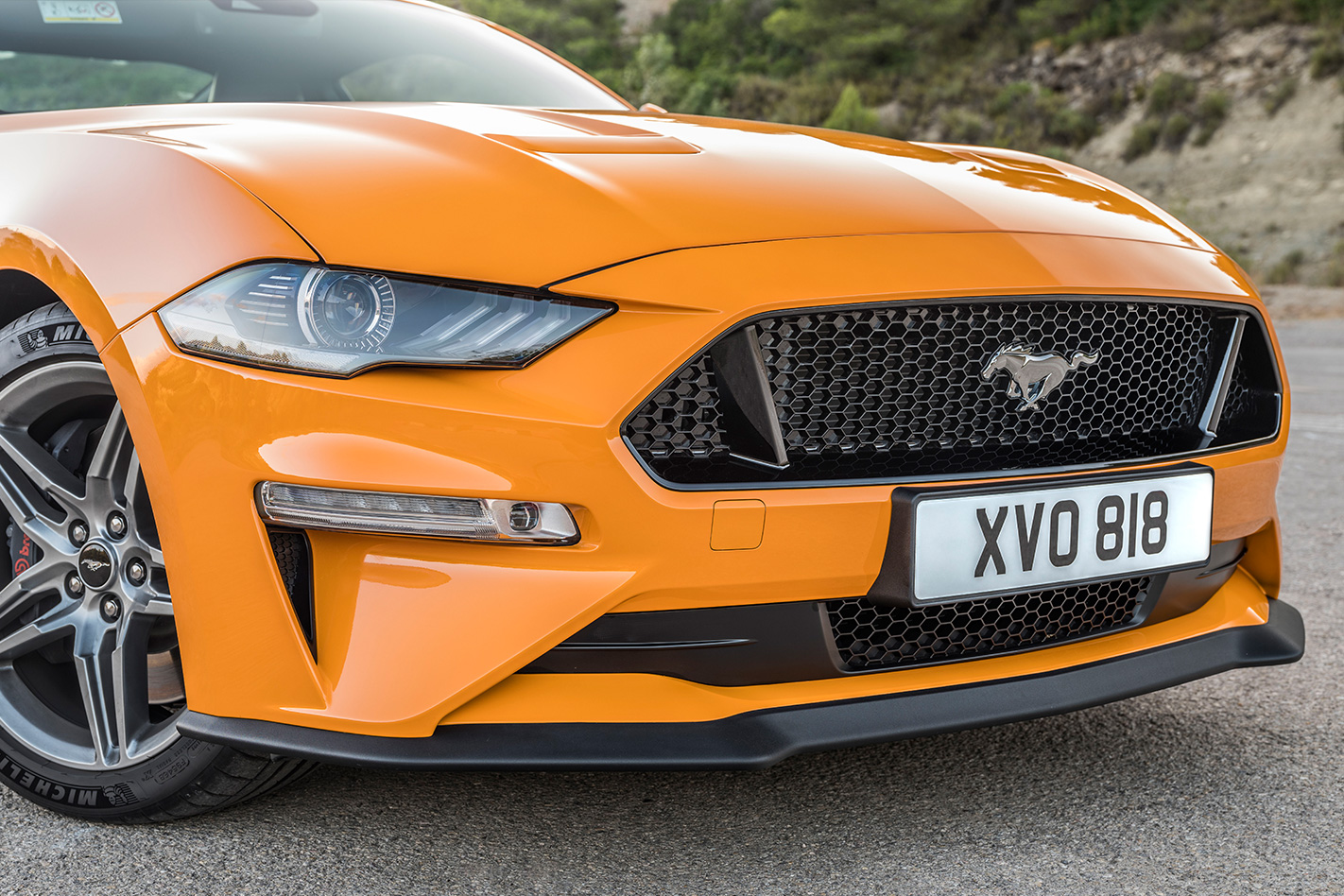
Slowing down isn’t a problem either thanks to a massive set of Brembo six-pot front calipers. A firm brake pedal is satisfying and responsive and it would take some serious track punishing to find the fade point of the iron discs.
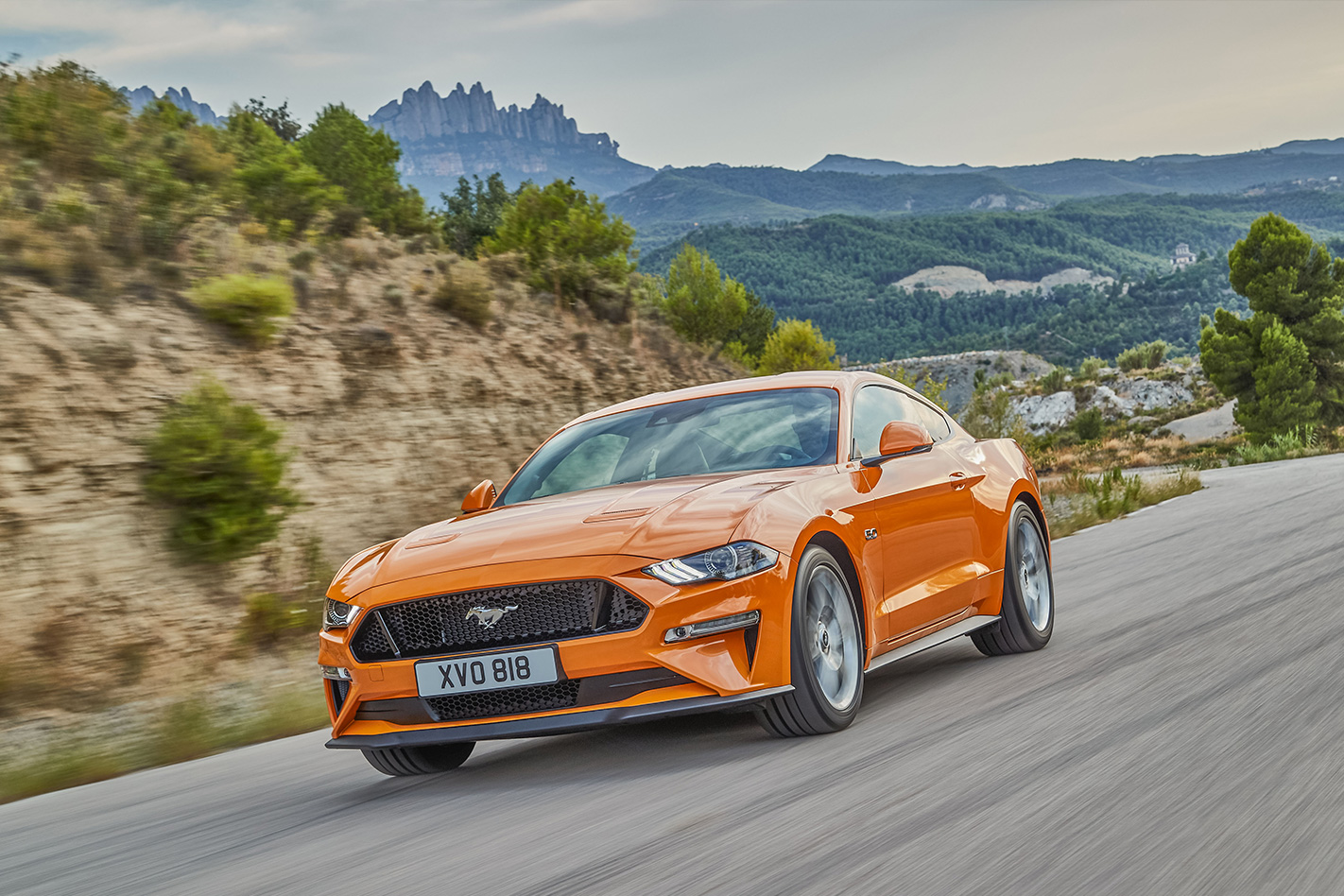
Designer Kemal Curic had an unbelievably tough job designing the way the sixth-gen Mustang would look. Not only would it have to appeal to a whole new audience including Britain, Japan and Australia, it had to do so without alienating its long-standing American following. Suffice to say Curic nailed it and, happily, the aesthetic update you see here has preserved those good looks.
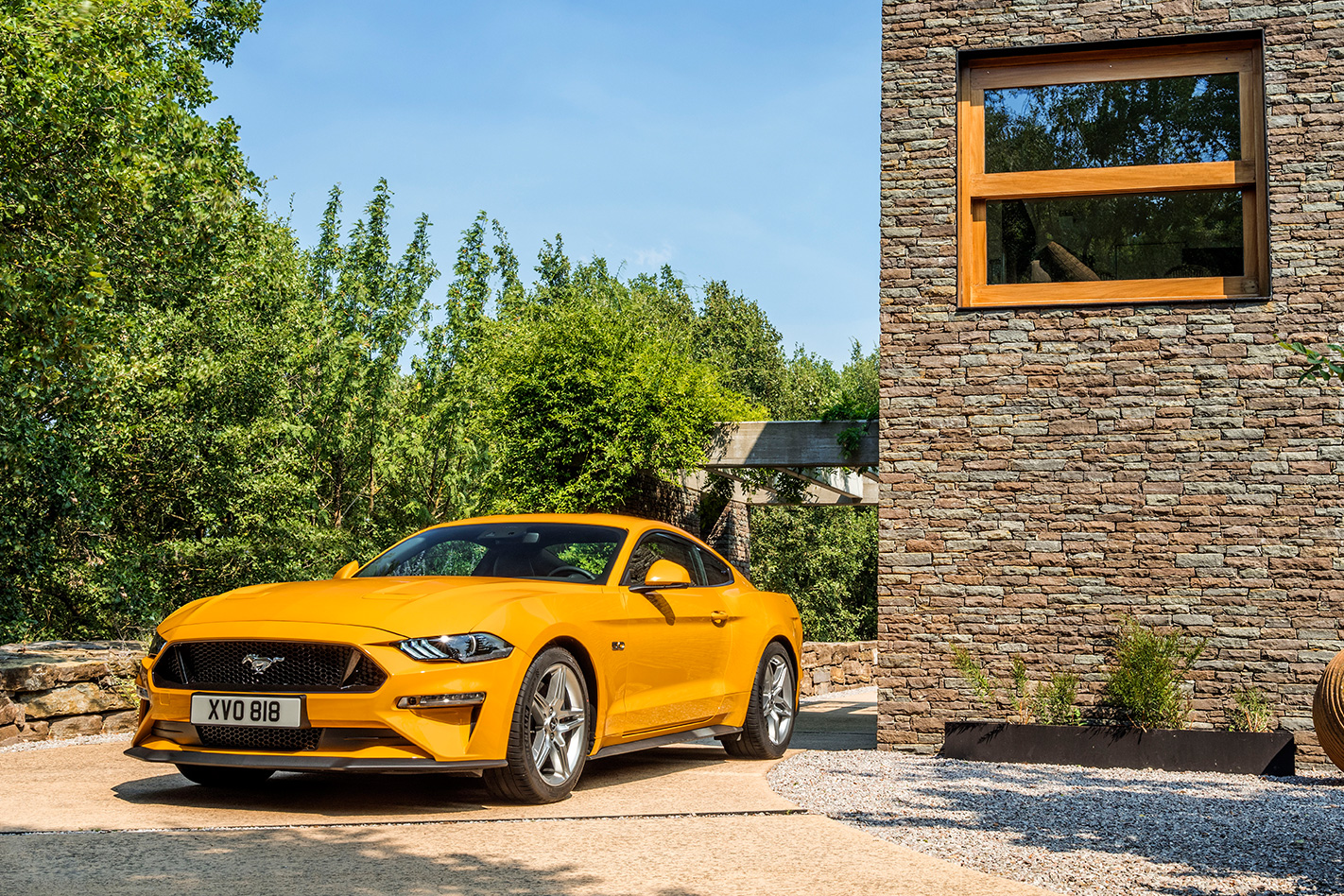
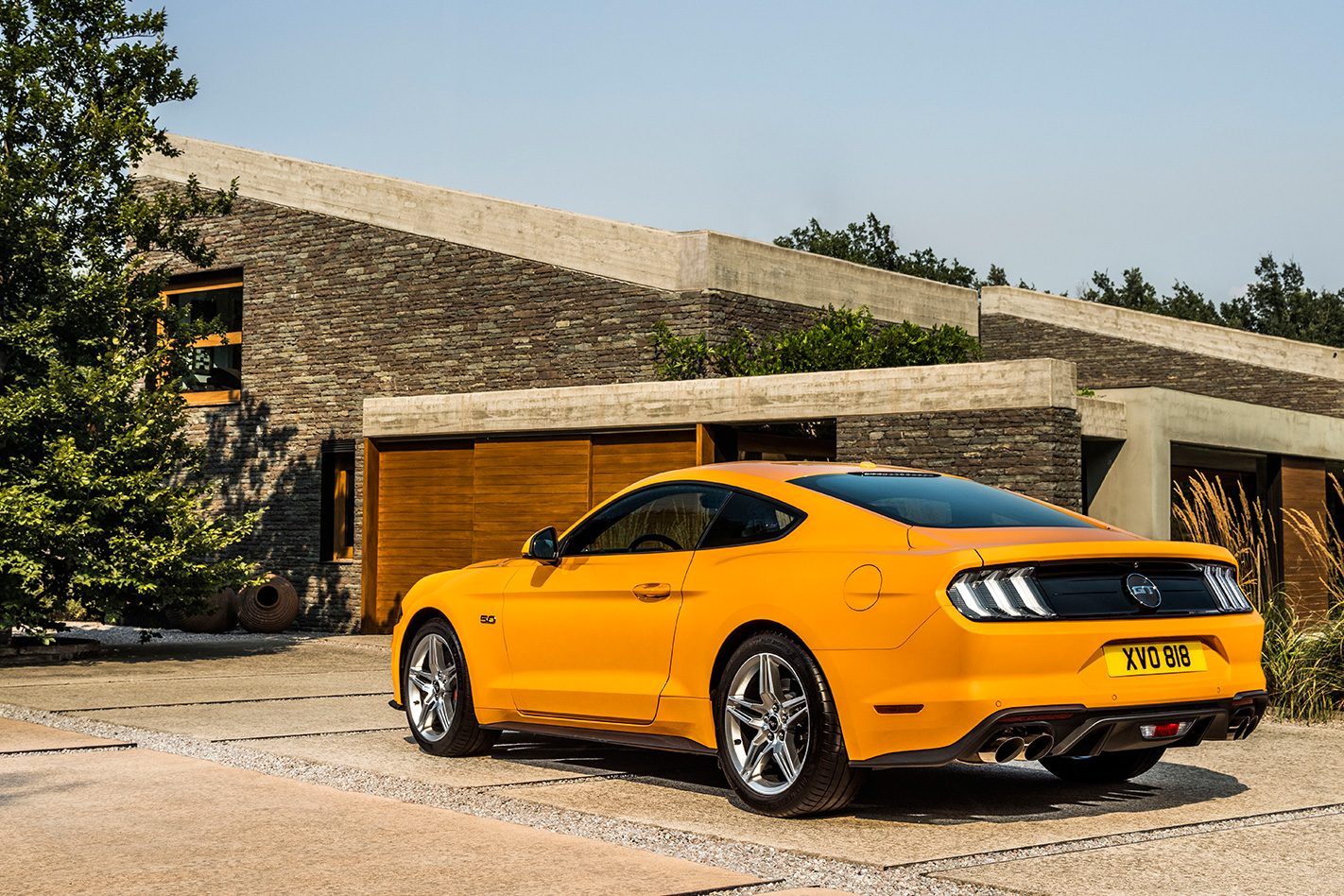
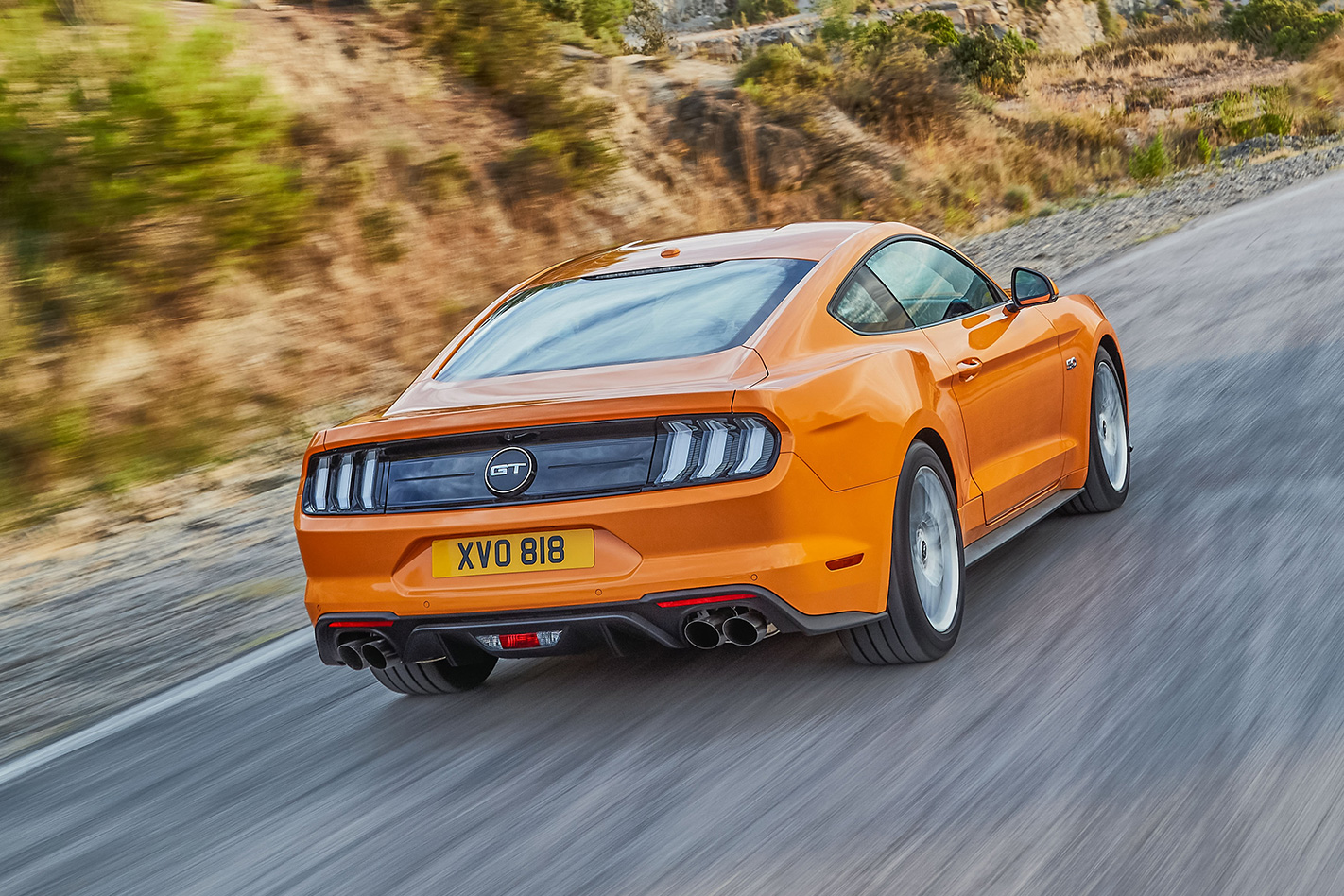
A new bonnet, redesigned headlights and slightly redesigned tail clusters are subtle but effective. Oh and that colour, Orange Fury, is added to the Mustang palette for 2018. The new look won’t appeal to all Mustang fans but it’s certainly unmistakable.
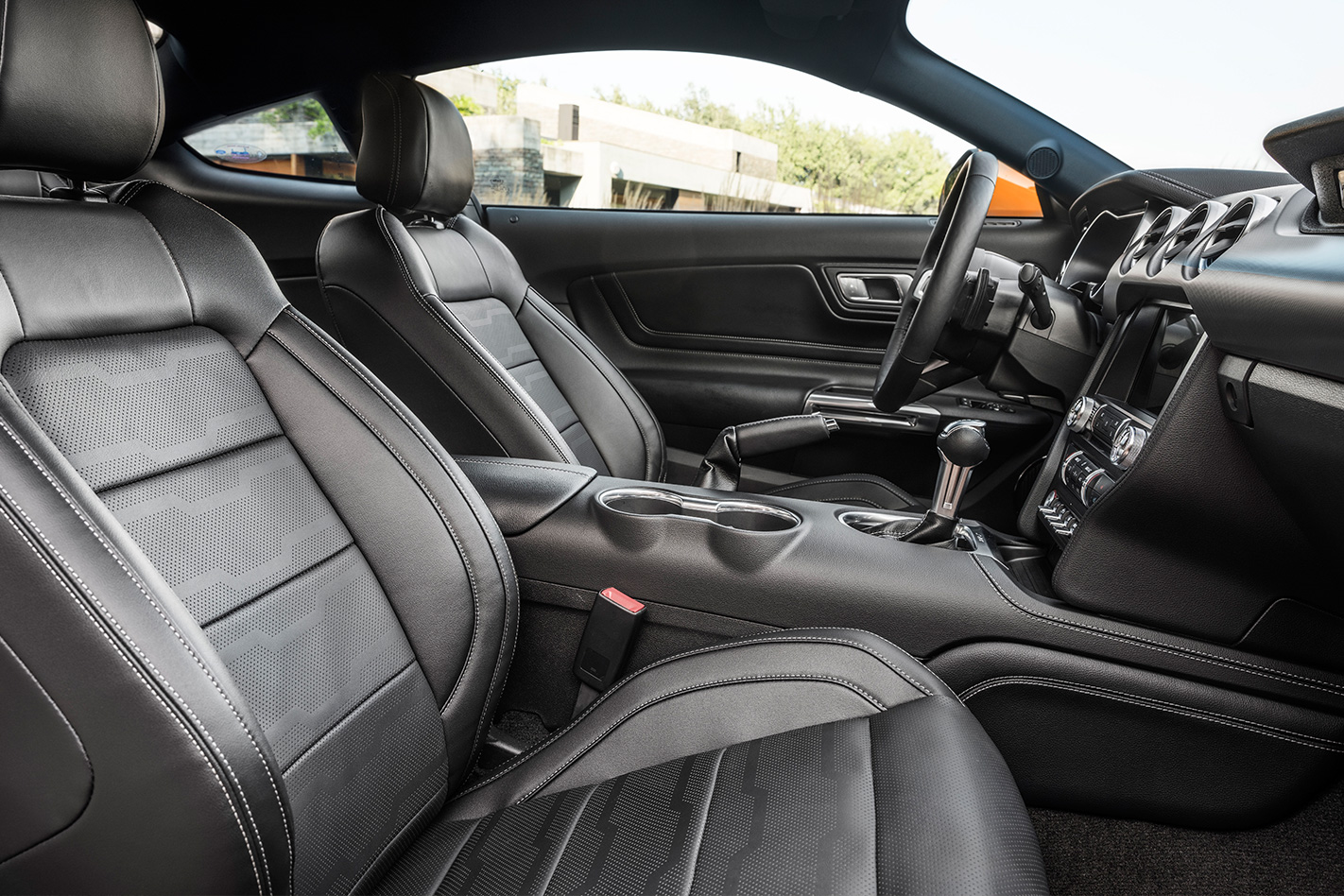
The front row is sorted but, despite Ford claiming this to be a four-seater, the second row seating is definitely a child-only proposition. Headroom is severely limited and there is only just enough leg room when the front seats are rolled prohibitively far forward.
There are other more subtle and effective changes. Gone are the more conventional analogue gauges, replaced by an all-digital cluster, a very similar unit of which made its debut in the Ford GT supercar.
Flick the drive mode to sport and the cluster display morphs from a conventional pair of dials to a cool full-width bar-type tachometer with a very handy shift light at the top. Not only is the updated unit more functional, it also adds a significant dose of technological kudos to the model.
Electronic safety systems have also been given a significant boost with pre-collision assistance pedestrian detection, distance alert, lane-departure warning, lane-keeping assist and driver alerts now included. ANCAP is yet to release a rating for the 2018 Mustang but with the safety update, it is likely the new version will improve on its surprisingly poor rating when it was tested last year.
Ford clearly listened to its customers and has delivered an improved product for a corresponding cost.
The 2018 changes are subtle until you give the Mustang full throttle and the result is a well-rounded sports coupe that is still easy to live with. There is no doubt about the Mustang’s performance capability, but it’s also a genuinely useable every-day drive.
Its true test however, will be later in the year when Holden introduces the Chevrolet Camaro right-hand drive converted by HSV. The updated Mustang is a seriously accomplished sportscar but it has to be stronger than ever to prevent its first true rival stealing all the attention.
Specifications
Engine: 5035cc, dohc, 32v, V8 Max power: 343kW @ 7000 rpm Max torque: 569Nm @ 4600 rpm Transmission: Six-speed manual Weight: 1681kg Fuel economy: 8.5L/100km 0-100km/h: 4.0s (estimate) Price: $62,990 On sale: Mid-2018
DODGY operators winding back car odometers is nothing new. Australia’s consumer watchdog still monitors the industry, and every now and again names and shames those responsible.
It turns out a previous Wheels feature car, which famously travelled from Sydney to Bourke and back in a single day, had a first-hand experience with the practice. It was a car later sold by a Holden dealer in what was described to the buyer as factory-fresh condition – despite having a decent number of kays put on it in a Wheels consumer test.
The story starts at 1971’s announcement of the Wheels Car of the Year award, which went to the Chrysler Charger. The result was a bullet straight to the heart of Holden, which was banking on the revolutionary HQ claiming victory.
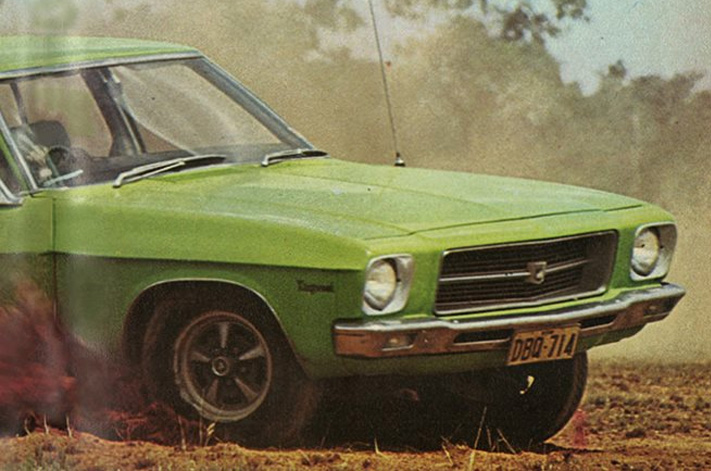
In response, and in an effort to show Wheels the error of its ways, Holden arranged to provide the magazine with a HQ Kingswood for two months, built to specification, for what was dubbed a consumer test.
Almost half a century later, Wheels repeated Robbo’s drive in a pair of Holden ZB Commodores, which had to endure 3000km of testing at our hands.
But even that distance pales in comparison to what DBQ-714 endured while part of the Wheels garage; the Kingswood eventually survived two months and 12,000 kilometres of punishing tests before it was handed back to Holden.
But things only get more interesting from there, with a Holden dealership selling the car using some, shall we say, creative methods.
We’ll let the car’s next owner, Wheels reader Ian Cowther, take up the story.
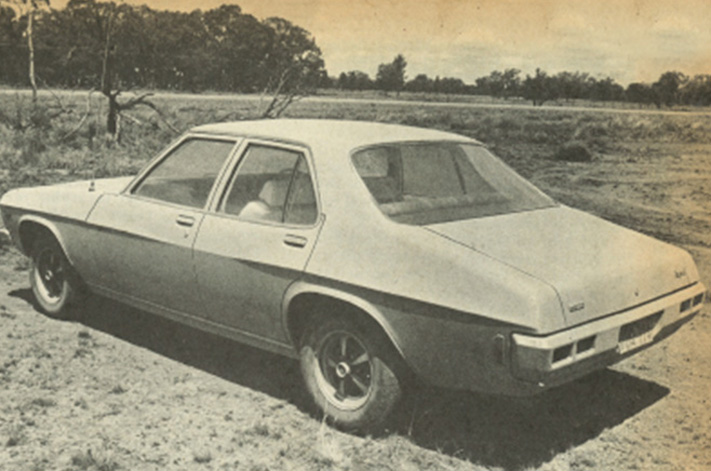
“I was the next owner of the HQ in question, bought from a New South Wales north coast Holden dealer as an ‘as new’ Holden special that had arrived direct from the factory in the previous fortnight and only driven by the local sales manager. It was sold as a demonstrator and I received a small discount off new price.
“My girlfriend (now wife) named it the Green Frog. Its first big trip was to the 1972 Hardie Ferodo 500 at Bathurst.
“I loved the sports wheels, white upholstery, all the extras and the bright green colour, but the rattles and floaty suspension were annoying. Frustrated, I remembered reading the April 1972 article, dug it out and was struck by the resemblance to my HQ. The number plate was different, but the dealer had failed to change the windscreen registration sticker that clearly showed it was DBQ-714 – the subject of your article.
“Some legal letters followed and, to cut a long story short, the dealer took the car back and I ended up with a brand new LJ Torana XU-1. I never saw the Green Frog again.”
Turning a six-cylinder HQ Kingswood into a LJ Torana XU-1 is the right kind of compensation in our books.
Fiat has dropped the all-wheel-drive variants from its 2018 500X range, along with their more powerful 125kW version of its 1.4-litre turbo engine.
The 500X lineup has been halved at the expense of the Lounge and range-topping Cross Plus variants; the 103kW Pop and Pop Star variants remain, and are temporarily joined by special Launch Edition.
Fiat Australia hasn’t officially revealed why the all-paw versions were dropped, though WhichCar believes it was to simplify the range and contain it within an affordable price point.
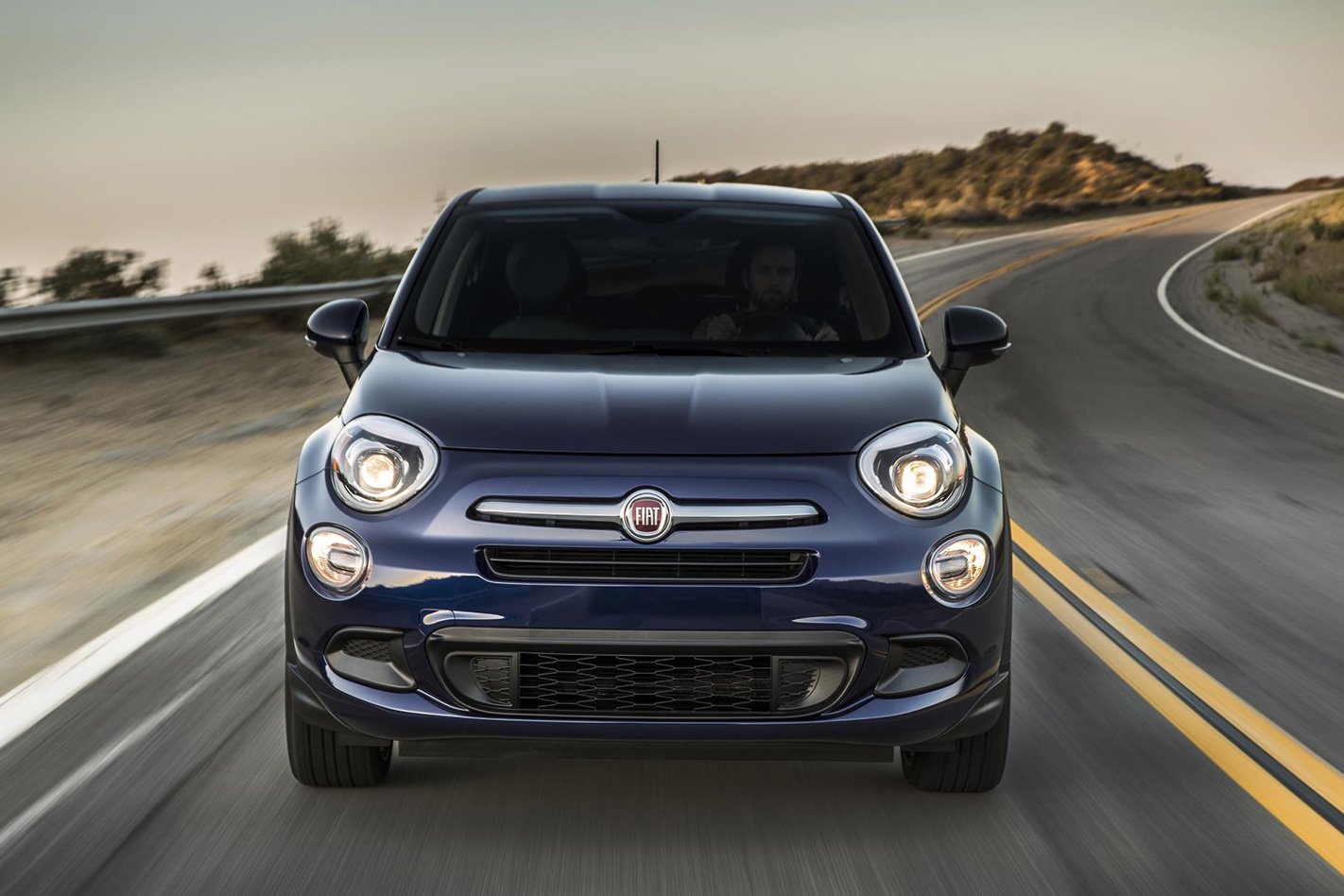
As before, the entry-level Pop comes with a choice of either a six-speed manual or six-speed dual-clutch automatic transmission, with the dual-clutch auto standard in the other two variants.
The 2018 500X gains a new 7.0-inch Uconnect touchscreen infotainment system that is compatible with both Apple CarPlay and Android Auto, with satellite navigation included in the Pop Star and Launch Edition.
There’s also an optional BeatsAudio sound system upgrade, developed in collaboration with Beats by Dr Dre, which includes a 560W, eight-channel digital amplifier.
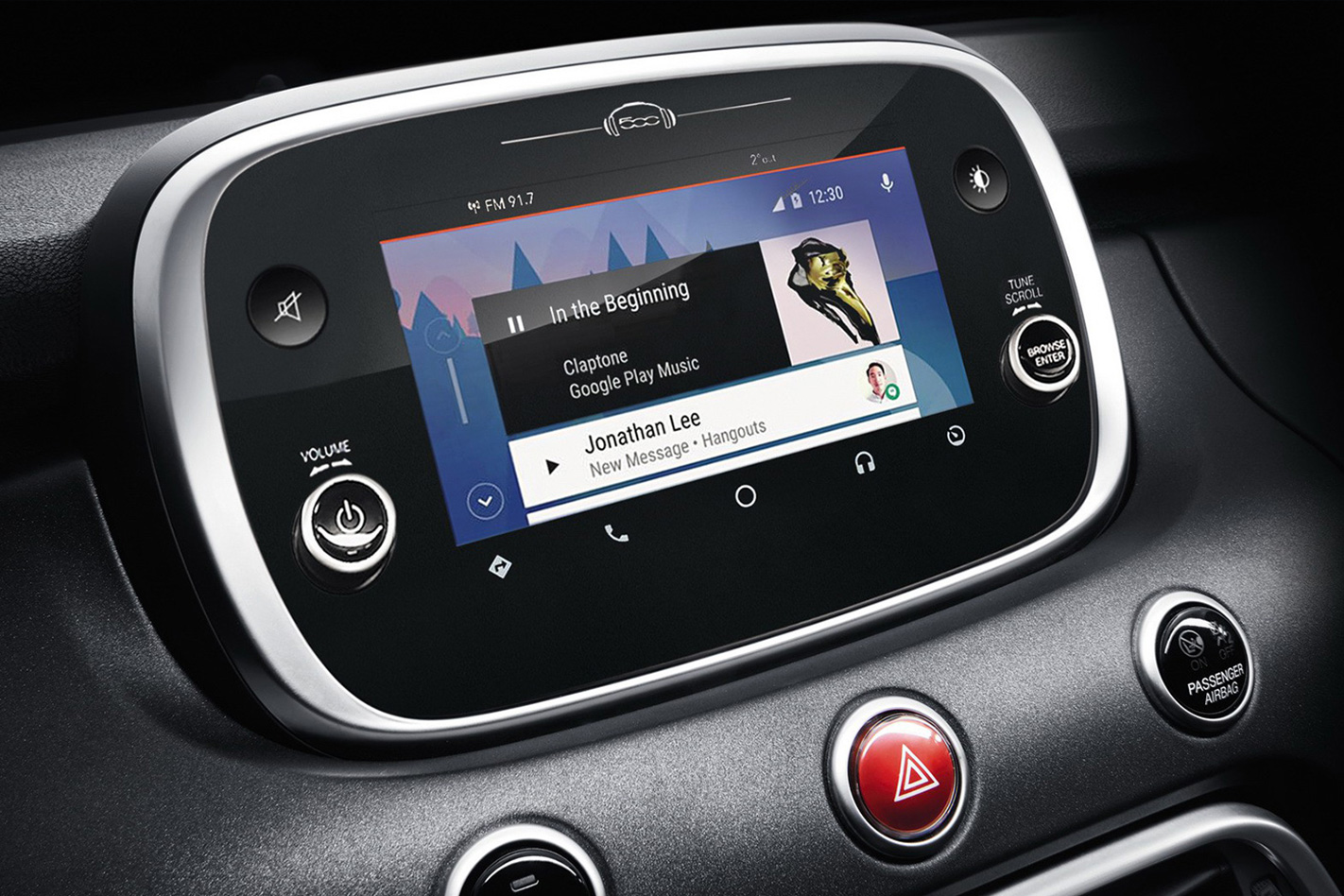
The Pop Star and Launch Edition benefit from more driver assistance gear, including Forward Collision Warning Plus, which will warn of a pending collision and prime the brakes to help you come to a stop faster, and will automatically apply the brakes if needed.
Other new kit includes cornering fog lamps, blind spot monitoring, rear-cross traffic alert, lane departure warning and adaptive cruise control.
Limited to 100 units, the Launch Edition costs $3000 more than the Pop Star, with the extra coin buying you 17-inch special edition alloy wheels, black partial leather seats, electric-adjust front seats, folding door mirrors and the BeatsAudio sound system.
It will be available in six colours (three solid and three metallic): Gelato White, Argento Grey, Cinema Black, Fashion Grey, Venezia Blue and Passione Red.
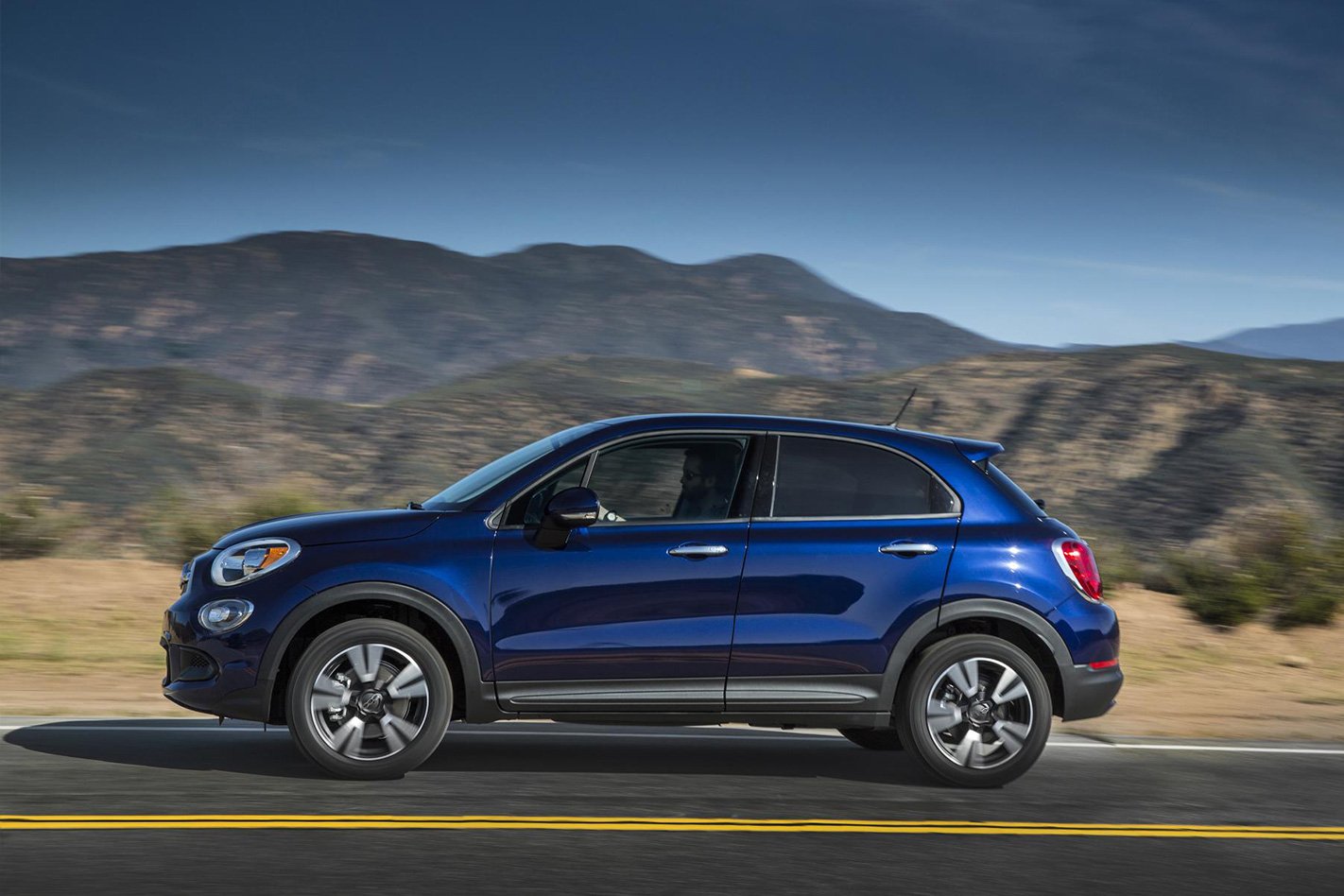
2018 Fiat 500X manufacturer’s list pricing
- 500X Pop manual – $24,990
- 500X Pop auto – $26,990
- 500X Pop Star – $29,990
- 500X Launch Edition – $32,990
THE rush to introduce crash avoidance technology onto cheap cars is having one big consequence – you’re more likely to have your ride written off after what seems like a relatively minor bingle.
The problem comes as insurers hike premiums in answer to cars that are designed to crash less, but are becoming more complicated, and expensive, to fix based on the new technologies they’re adopting.
A JP Morgan Taylor Fry General Insurance Barometer released earlier this year and looking at the Australian insurance industry predicted car insurance costs would jump by five percent in 2018, the same rate that it rose in 2017. This is despite the number of insurance claims we’re making staying relatively flat.
Media reports said insurers had attributed the higher cost of fixing vehicles damaged in smashes to car makers that were starting to build increasingly complicated products fitted with crash avoidance technology, highly complex headlights, or even bits of bodywork made from exotic materials such as carbonfibre.
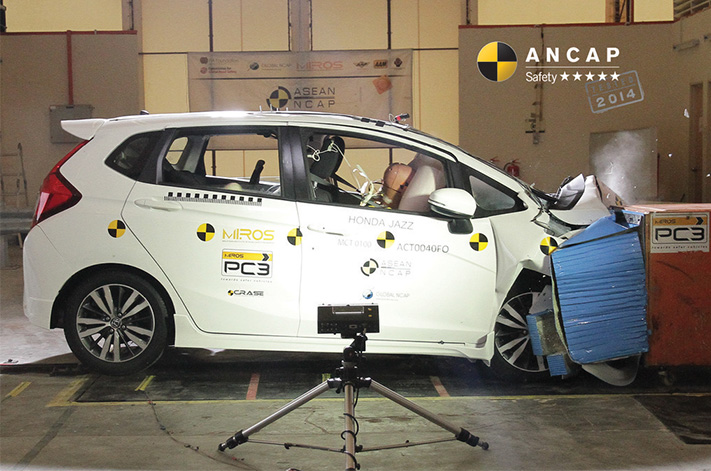
Once the total damage on a $16,000 hatchback nudged $10,000, the cost of fixing it became uneconomic. “We can easily write off a Honda Jazz in a minor nose-to-tail crash,” McDonald said.
Part of the problem, he said, were the subtle differences in AEB systems. “Some of the AEB systems only work in a narrow speed range, and there’s some cars that don’t operate that effectively below 15km/h,” McDonald said. “And below 15km/h is a really common collision speed frequency for nose-to-tail collisions at traffic lights. So if you do that with a $2000 or $3000 radar sensor right on the front of the car, then the radar sensor is going to be involved in a whole lot of collisions that it can’t help prevent.”
He said the car makers would not even allow a repairer to repaint a damaged plastic bumper, fearing that the repair job could interfere with the autonomous emergency braking system’s radar. Instead, they want the damaged bumper replaced with a new one. “Throwing away a completely good bumper bar cover just to avoid having to repaint or repair a scratch just detracts from the benefit of the advanced driver assist system,” he said.
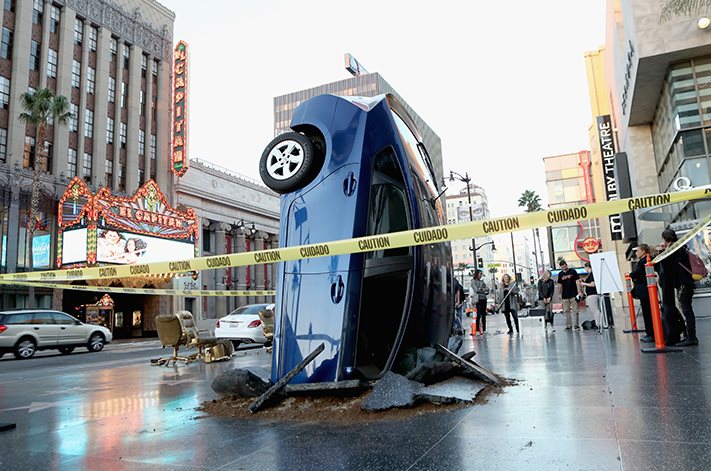
Another of the main culprits behind the insurance hikes are a vehicle’s lights. The headlights on some $40,000 Jeeps can cost up to $15,000 to replace, while those on the Toyota Prius cost more than twice as much to replace than the previous model (not to mention it also has an expensive and vulnerable radar tucked in behind the bumper). Even LED daytime running lights – a common feature making their way onto modern cars – can cost more than $1000 to replace.
At times, it’s just pure bling that’s the problem. McDonald said the “basically decorative” carbonfibre radiator grille on a Lexus GS sedan could cost “more than $10,000” to replace – we’ve heard whispers it could run as high as $15,000 to $17,000. It’s also the increasing use of aluminium in cars, replacing heavier steel, that’s bumping premiums even higher. “In some cases you’re looking at increases commonly happening in new cars that are 25 to 50 percent over the previous model purely because some things are now aluminium when it wasn’t aluminium before, or it’s made of a more complex material … or going from a quartz halogen or even bi-xenon headlight into an active LED headlamp with LED running lights built in,” McDonald said
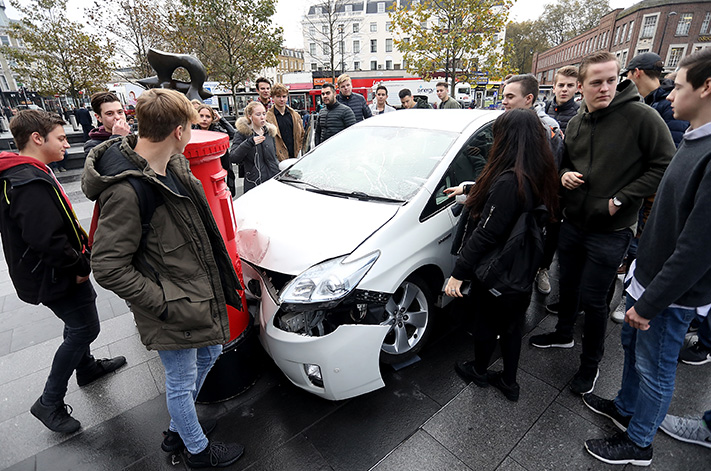
McDonald said it was up to the insurance industry to encourage car makers to reconsider styling changes such as wrap-around headlights – elements that are highly vulnerable to damage in a collision – that greatly added to the cost of repair. “Car makers usually are switched on regarding the effect of some of these things on ownership costs, which is what the average person pays for premiums, and many of them have whole departments,” he said.
“But it seems like in the past few years, some of these people haven’t had the say that they’ve had in the past, and they’re getting some quite rapid increases in material technology that often isn’t purely safety oriented – it’s purely a styling or market requirement.”
Need more cylinders in your life?
Looking to spend between $90K and $1.2million? Then step right up to this week’s selection of cars we found for sale.
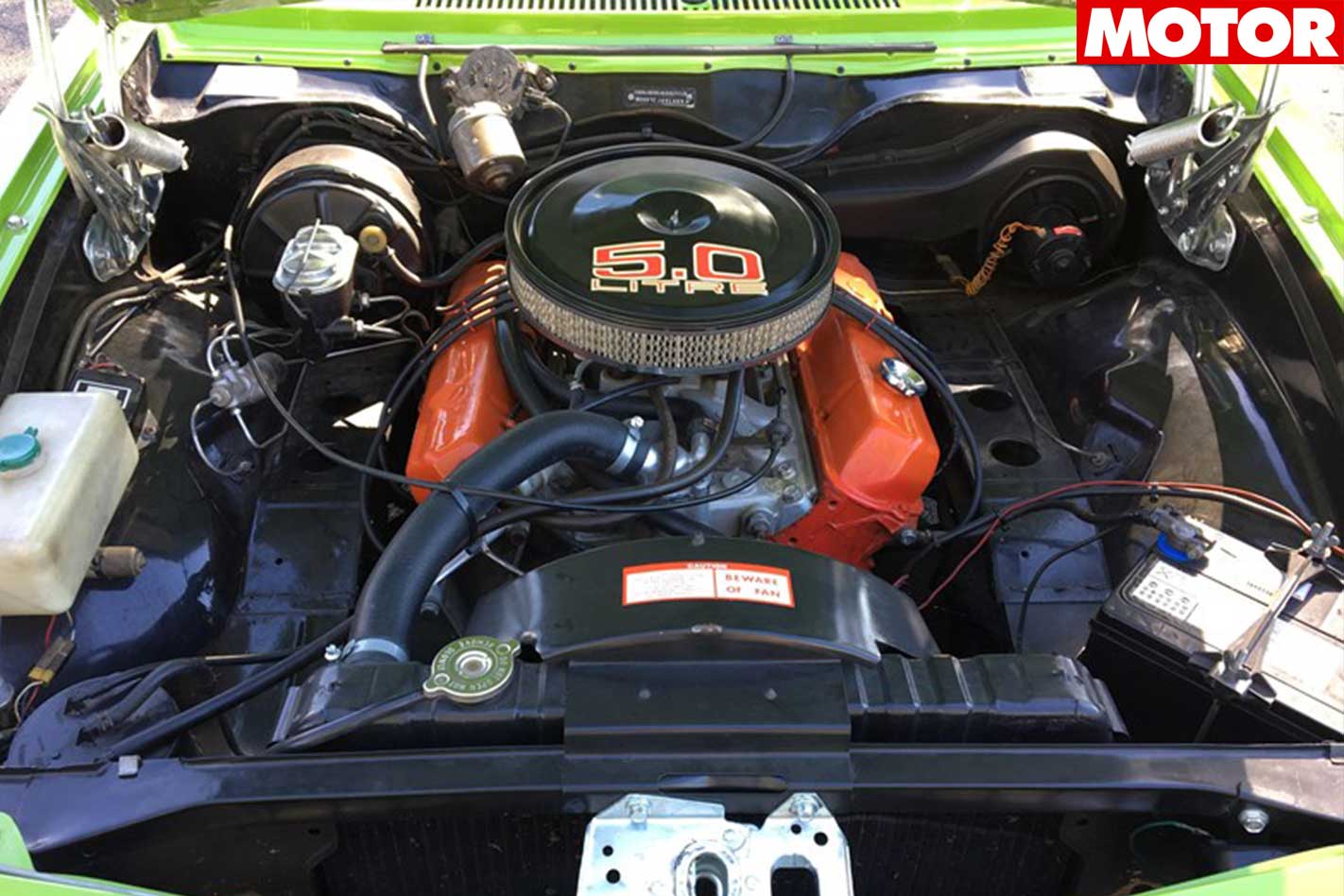
1975 Holden Torana LH SLR 5000 – $89,000
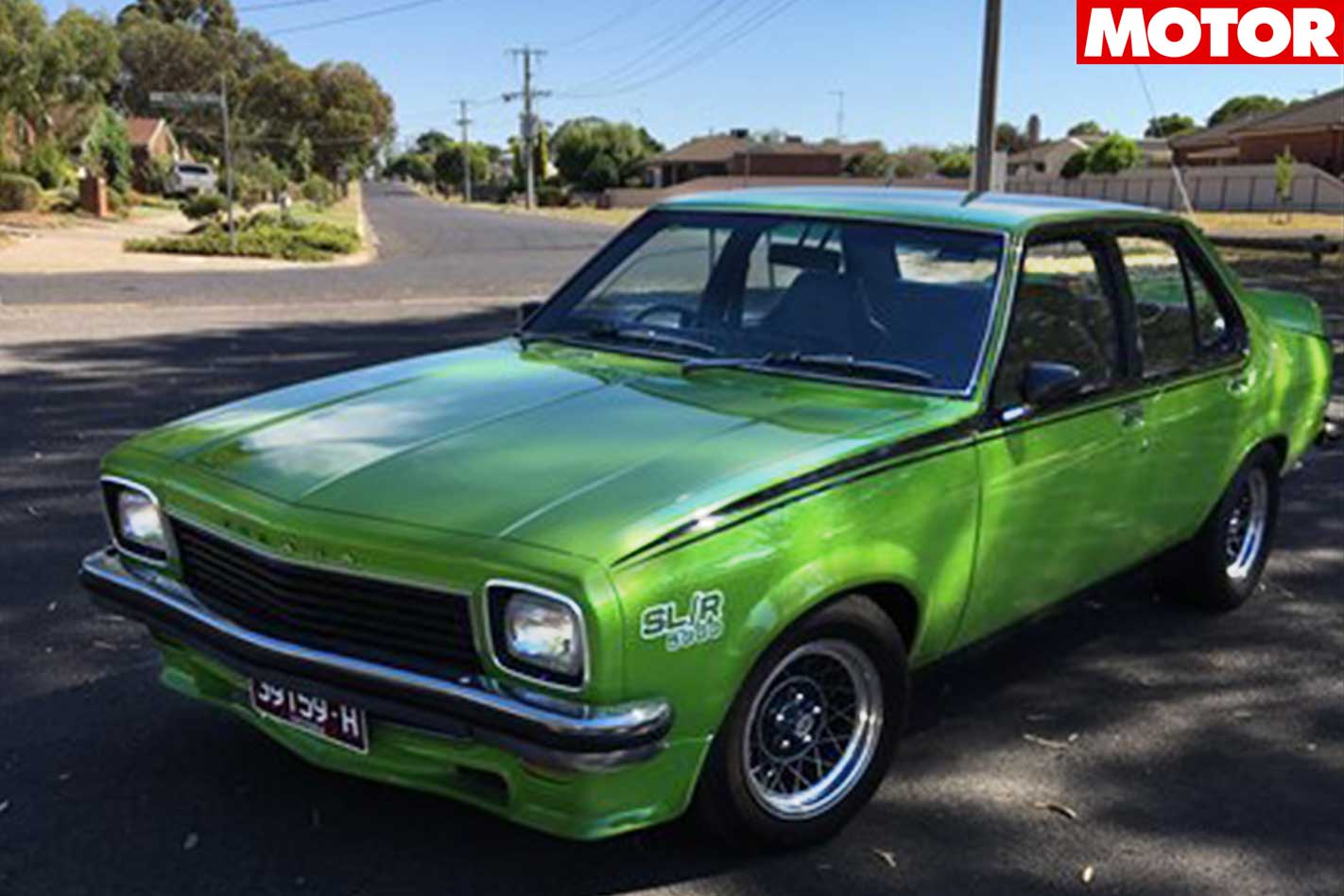
For $89,000, or less if you’re a keen negotiator, you could drive home in a V8-powered Aussie classic.
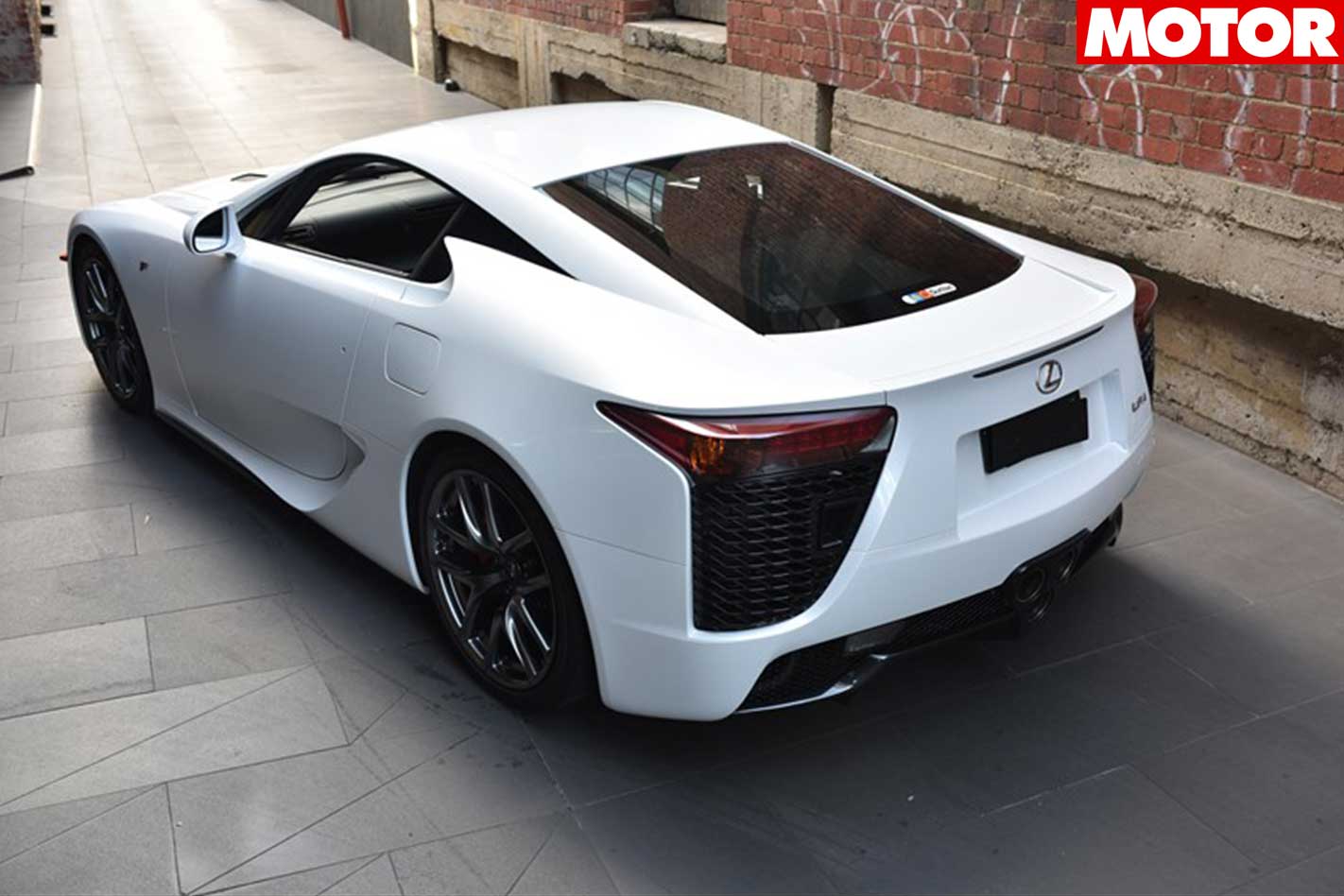
2012 Lexus LFA – $1,200,000

2014 Dodge Viper GTS – $285,000
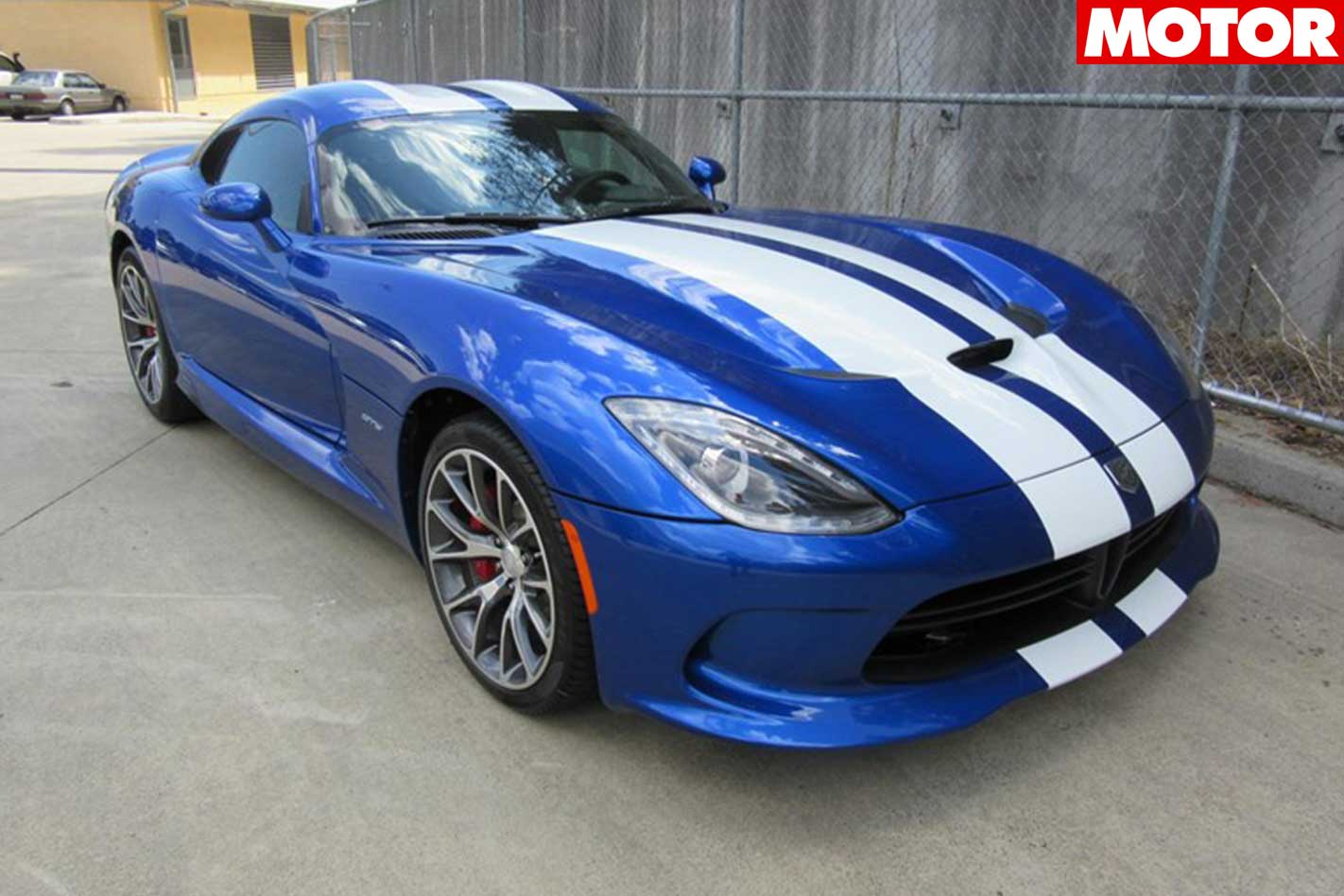
481kW and 814Nm should be enough to keep you happy, but you’ll be shelling out $285,000 for the privilege.
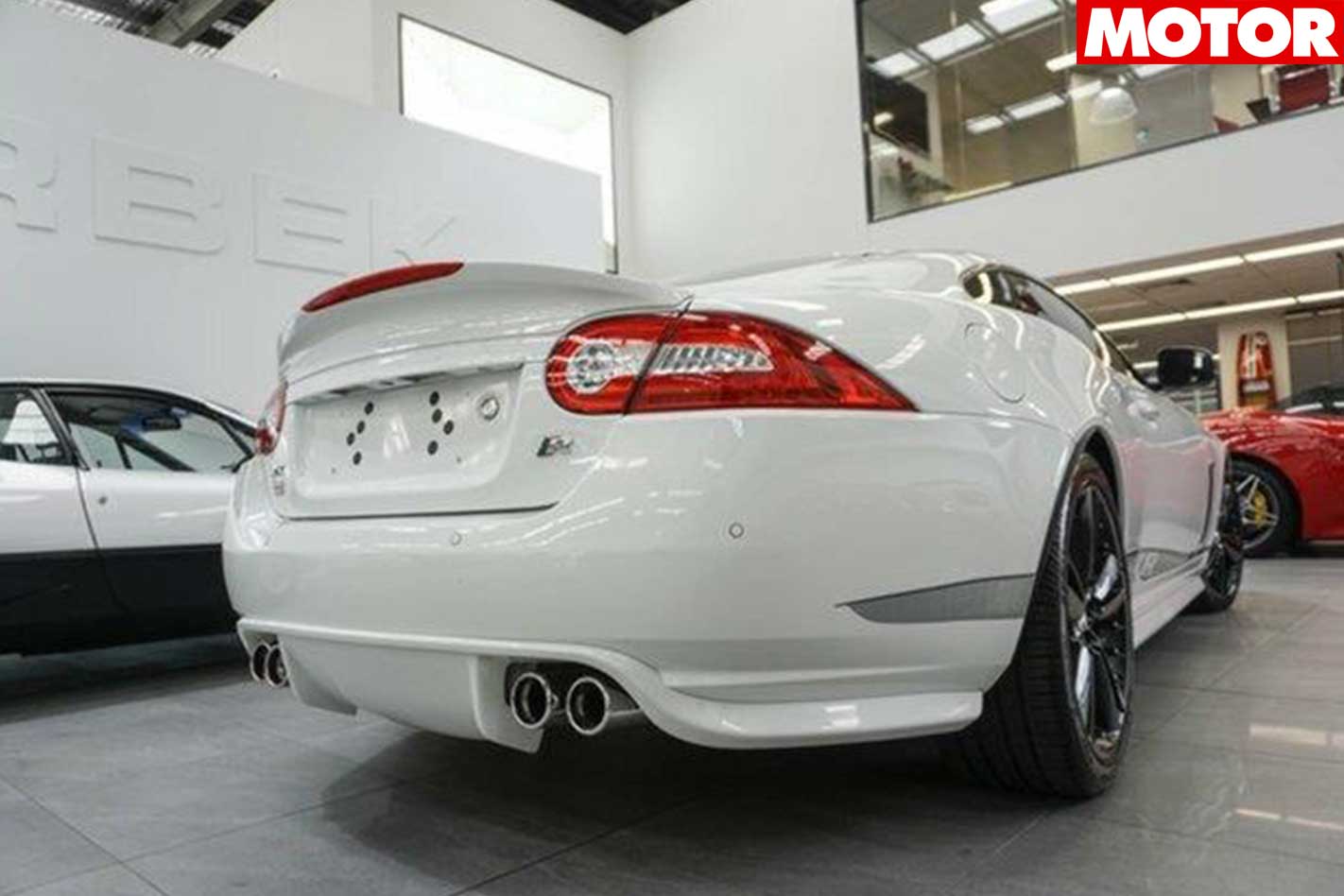
2010 Jaguar XKR – $89,990
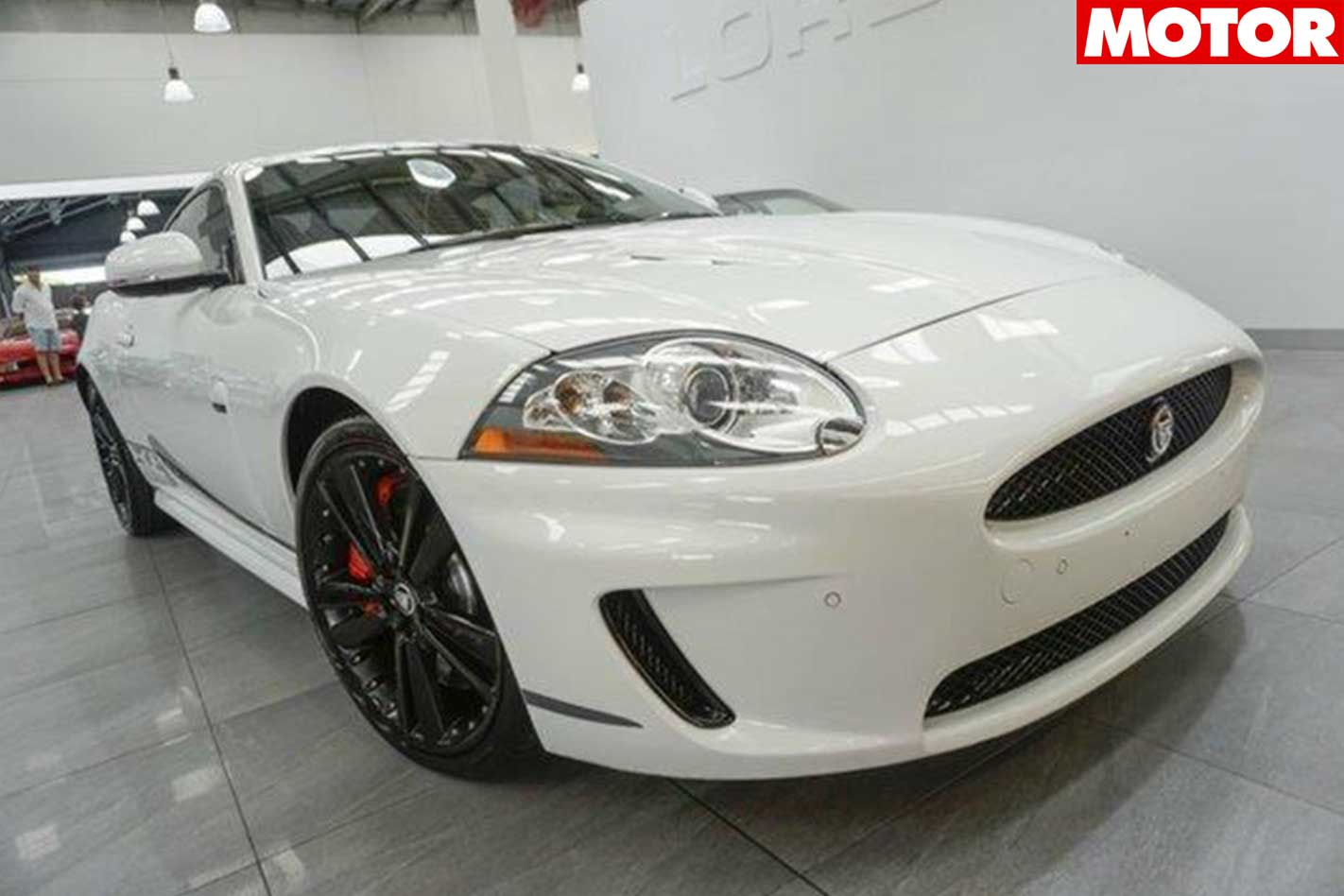
This 75th Anniversary Edition is sitting in the Lorbek showroom in Port Melbourne, wearing an $89,990 price tag and a very tidy exterior.
1972 Mercedes-Benz 600 Grosser – $175,000

We’re not kidding, M-B 600s has chauffeured the likes of Pol Pot, Fidel Castro, and a few Kims. North Korean, not Kardashian.
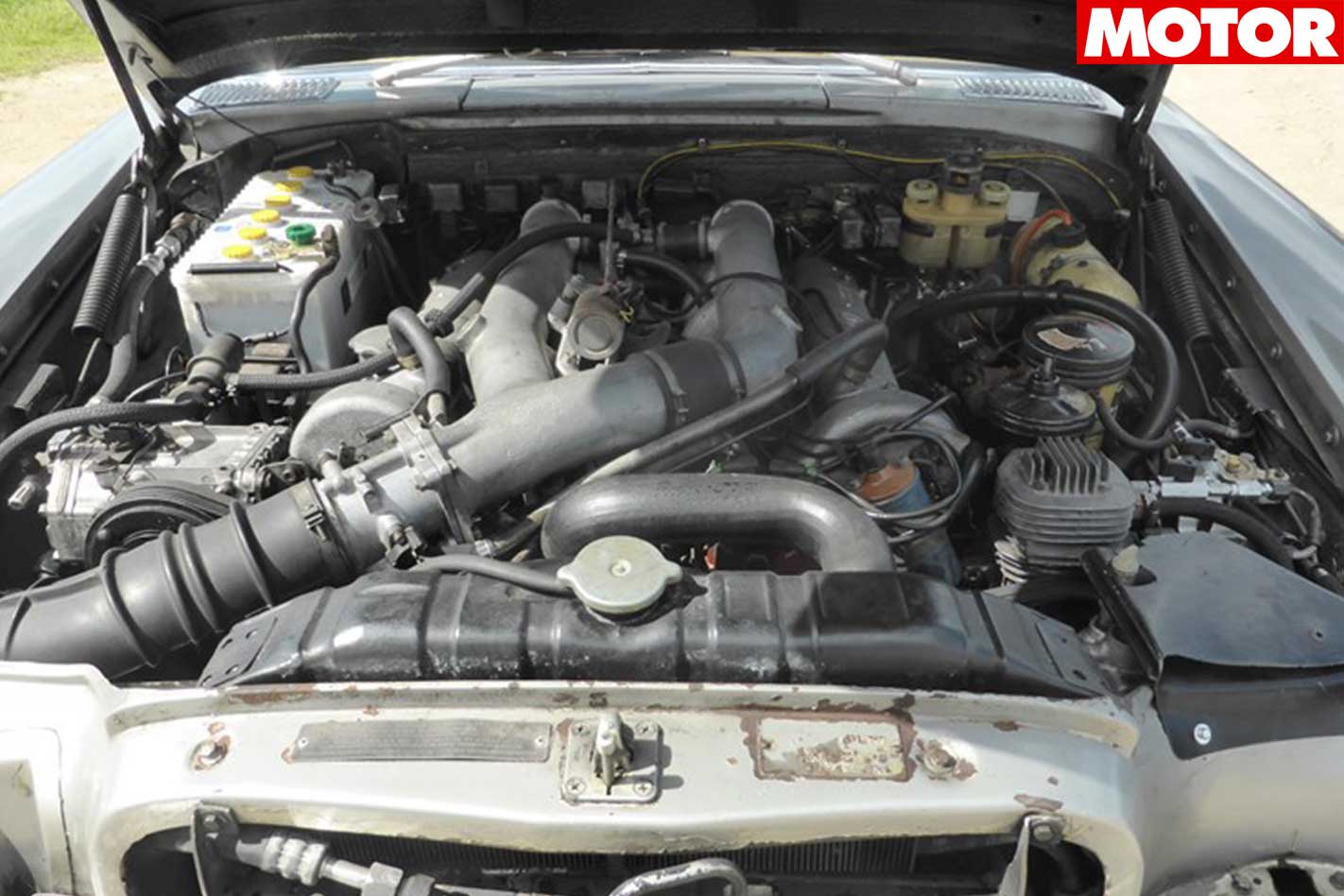
This one’s asking for $175,000, and is currently in Victoria.
TELL ME ABOUT THIS CAR
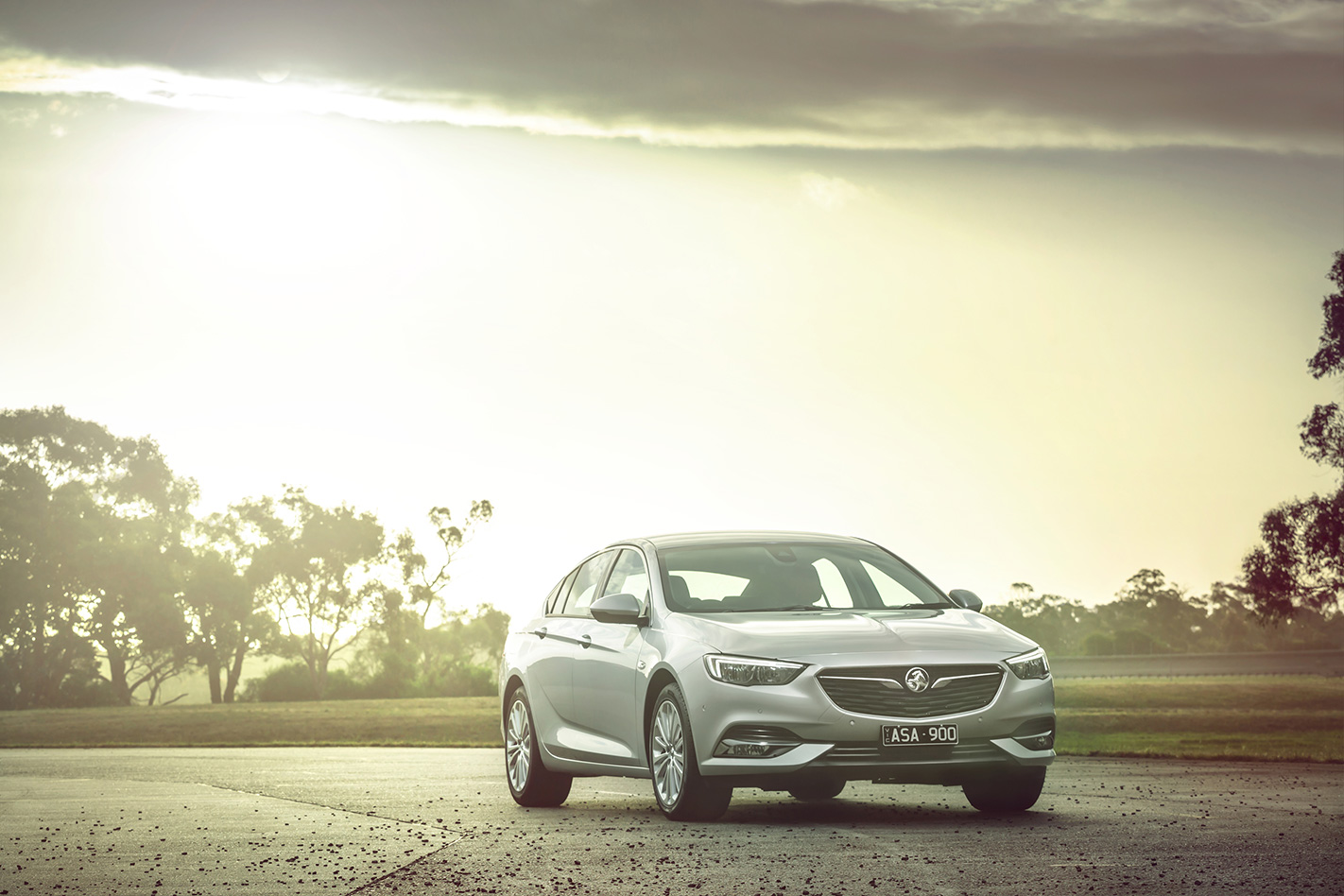
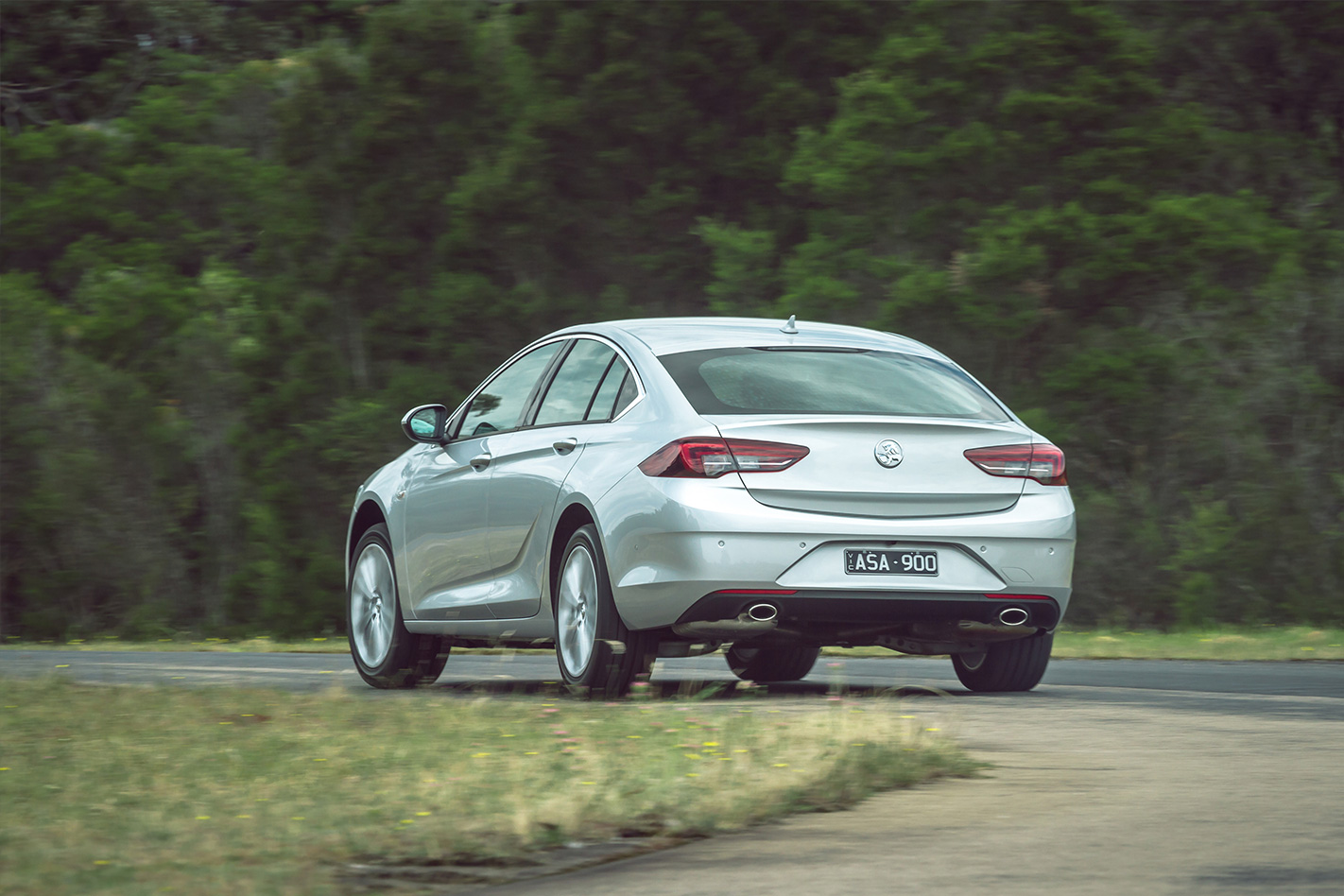
Yep, after decades of rear-drive joy the Holden Commodore has finally embraced front-wheel drive. It’s undergone a few more additional changes with the all-new ZB generation too, with external dimensions shrinking and internal dimensions stretching, a hatch taking the place of a boot, the V8 option being ditched and a turbo four becoming the new entry-level powertrain.
Big leaps for a traditional Australian family car favourite, but do such wholesale changes affect its ability to be exactly that – a big four-door with space for your brood?
STRENGTHS
Interior space – or at least the perception of it – has grown despite the move to an 86mm shorter wheelbase. A repackaged cabin preserves shoulder room despite a narrower width, and the rear seat area is especially spacious. The arrival of a hatch bodystyle also brings some extra cargo-carrying versatility, even though seats-up boot space is now five litres smaller at 490L.
Local suspension and drivetrain tuning has endowed the flagship VXR with plenty of driver appeal, with commendable chassis poise and grip. It might not thrill like the dearly-departed SS V8 variants, but it still has much to offer those who fancy a spirited steer.
There’s now more equipment in the form of driver aids, with Autonomous Emergency Braking across the range, while the range-topping VXR variants brings adaptive cruise control and electronically-adjustable dampers. Opt for a higher-specification model, and an LCD display takes replaces the conventional instrument panel.
The 2.0-litre four-cylinder turbo engines are impressive, in either petrol or diesel form. The petrol makes 191kW and 350Nm and takes power to the front via a nine-speed automatic, and is plenty rapid off the mark and blessed with a smart transmission that rarely makes a dud ratio choice. The 125kW/400Nm diesel is muscular and cultivated, meanwhile, and also exceeds expectations.
WEAKNESSES
Weak acceleration from the V6 variants may not excite those who are familiar with the keener step-off of the now-departed VF Commodore. What’s more, the VXR’s naturally-aspirated V6 is no substitute for the VF SS’s V8 thrust off the line, despite a similar (estimated) 0-100 km/h time of 6.2 seconds.
Ride quality suffers on the 20-inch alloys of high-grade variants like the Calais-V, with plenty of suspension harshness over bumps. The only big-wheeled model to escape this is the VXR, thanks to its standard-issue adaptive dampers.
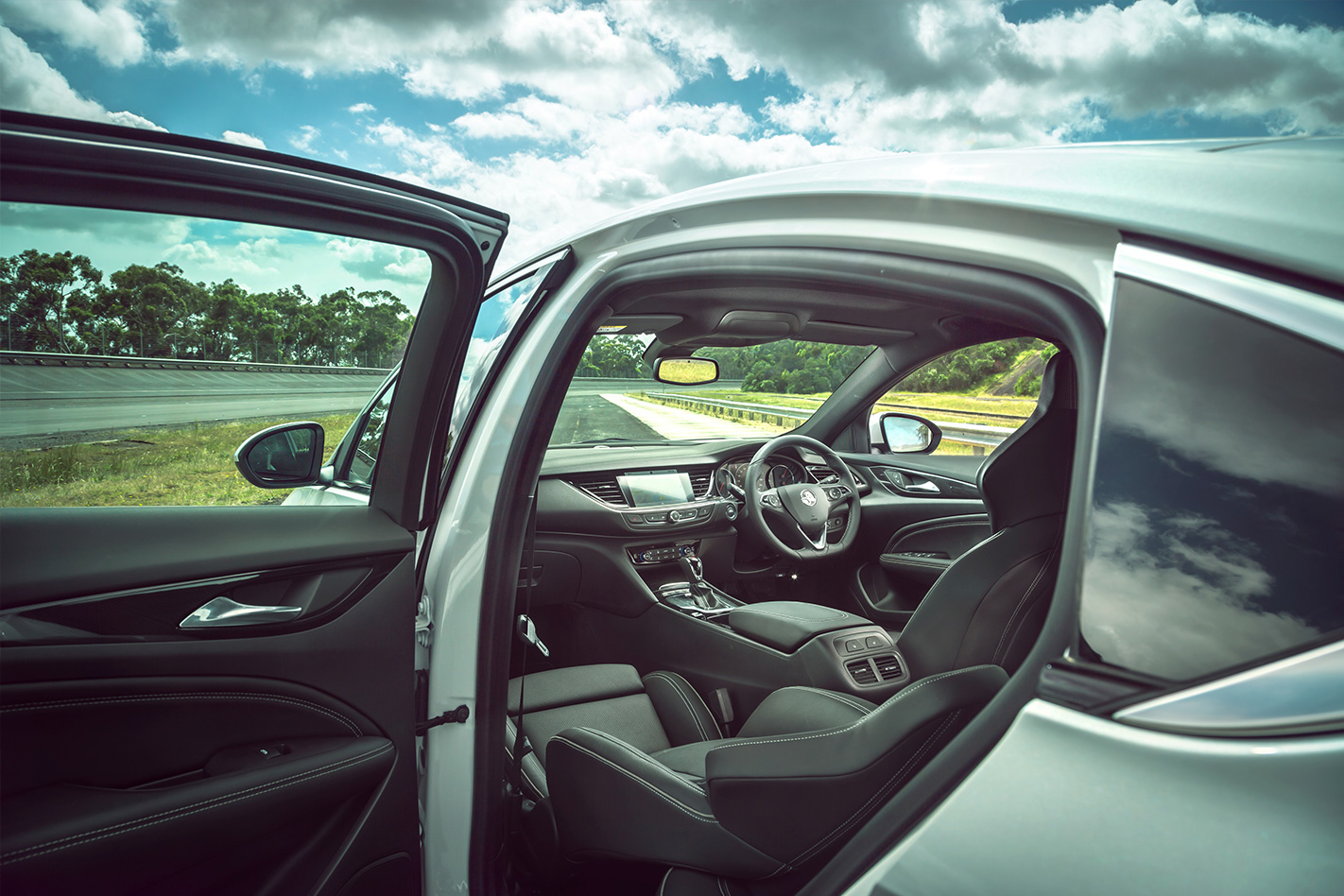
Interior lacks the charm and warmth of the VF Commodore thanks to sober textures and monochrome colour scheme. While it looks smart and handsome and is a great fit for lower-spec Commodores, it’s the higher grades that suffer from a lack of any additional visual glitz.
ANY RIVALS I SHOULD CONSIDER
Key competitors to the Commodore include its traditional large-car opposition (as well as the newly-arrived Kia Stinger), while its move to a slightly shrunken transverse-engine format now exposes it to the likes of the Ford Mondeo, Mazda 6, Toyota Camry, Volkswagen Passat, Skoda Superb, Subaru Liberty, Hyundai Sonata, Honda Accord and Kia Optima.
A JAPANESE magazine has published images of what it claims is the reborn Toyota Supra, just weeks ahead of its official reveal at the 2018 Geneva Motor Show.
Sharp looking with a long bonnet and rearward cabin, double hump roof and featuring more than a touch of LMP1-influenced design around the front and even a touch of Lexus LFA down the rear, the car looks stunning.
Toyota has already confirmed we’d see the return of an iconic name at March’s Geneva Motor Show, releasing a single teaser image of a big wing believed to be fitted to a motorsport-honed version of the Supra that will make its debut alongside the production car.
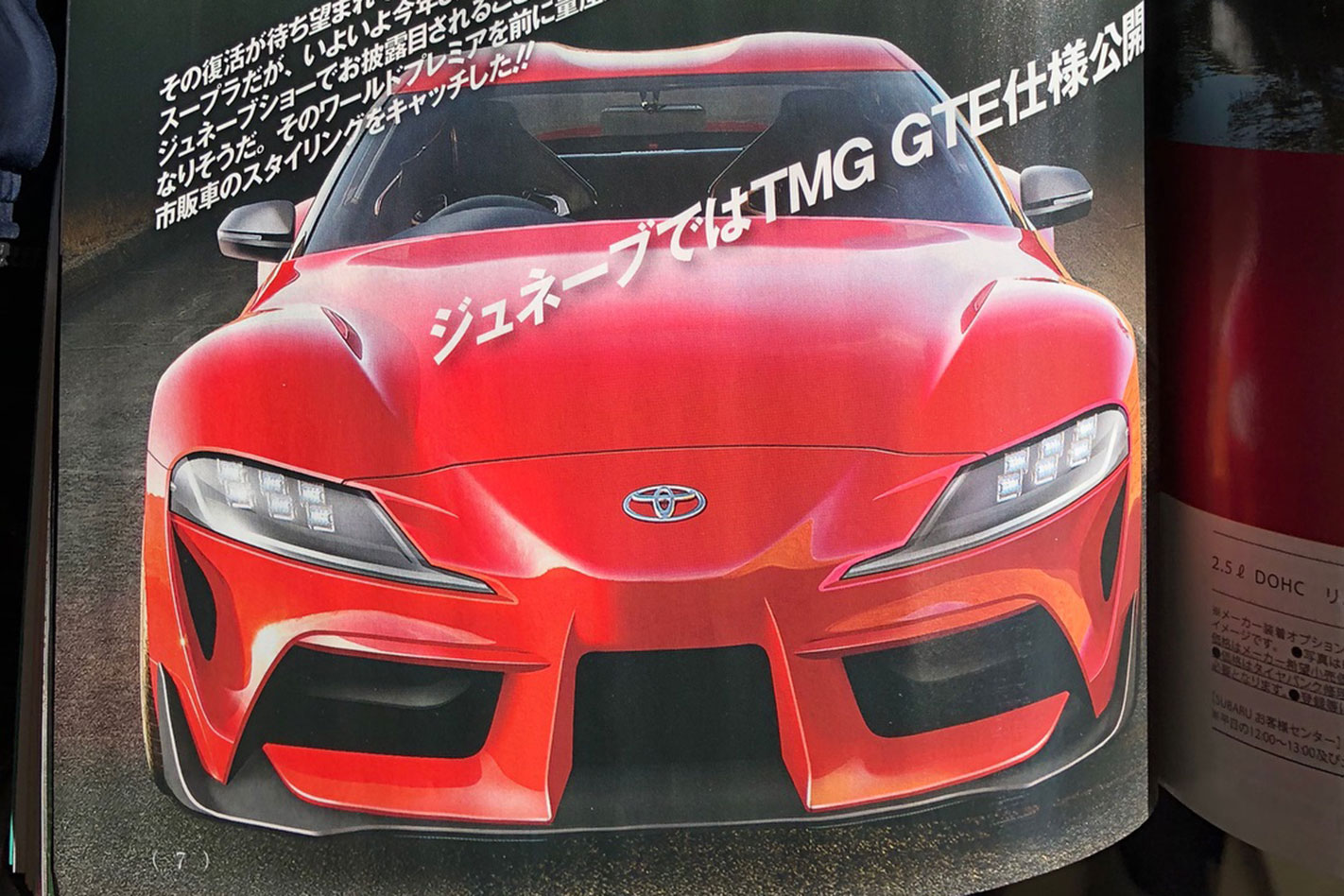
Underneath everything is a BMW-derived platform that’ll be shared with the upcoming next-gen BMW Z4. Japanese magazine Holiday Auto claims the Supra will sit on a 2470mm wheelbase and measure 4380mm long and 1850mm wide. Height is a Lotus-like 1280mm, while the kerb weight will range between 1350kg and 1430kg – significantly heavier than a Toyota 86 and suggesting the Supra will also be tasked with lugging around a heavy hybrid system.
Holiday Auto says the base version of the Supra will use a 2.0-litre turbo four-pot producing either 143kW or 188kW, potentially enhanced via a hybrid system. Rounding out the Supra range, though, is expected to be a 246kW 3.0-litre twin-turbo straight-six – a homage to the previous-generation Supra.
Power is likely to go to the rear wheels via a BMW-sourced eight-speed automatic.
The 88th Geneva Motor Show starts on March 6. Visit wheelsmag.com.au for all the latest new car news and reveals as they happen.
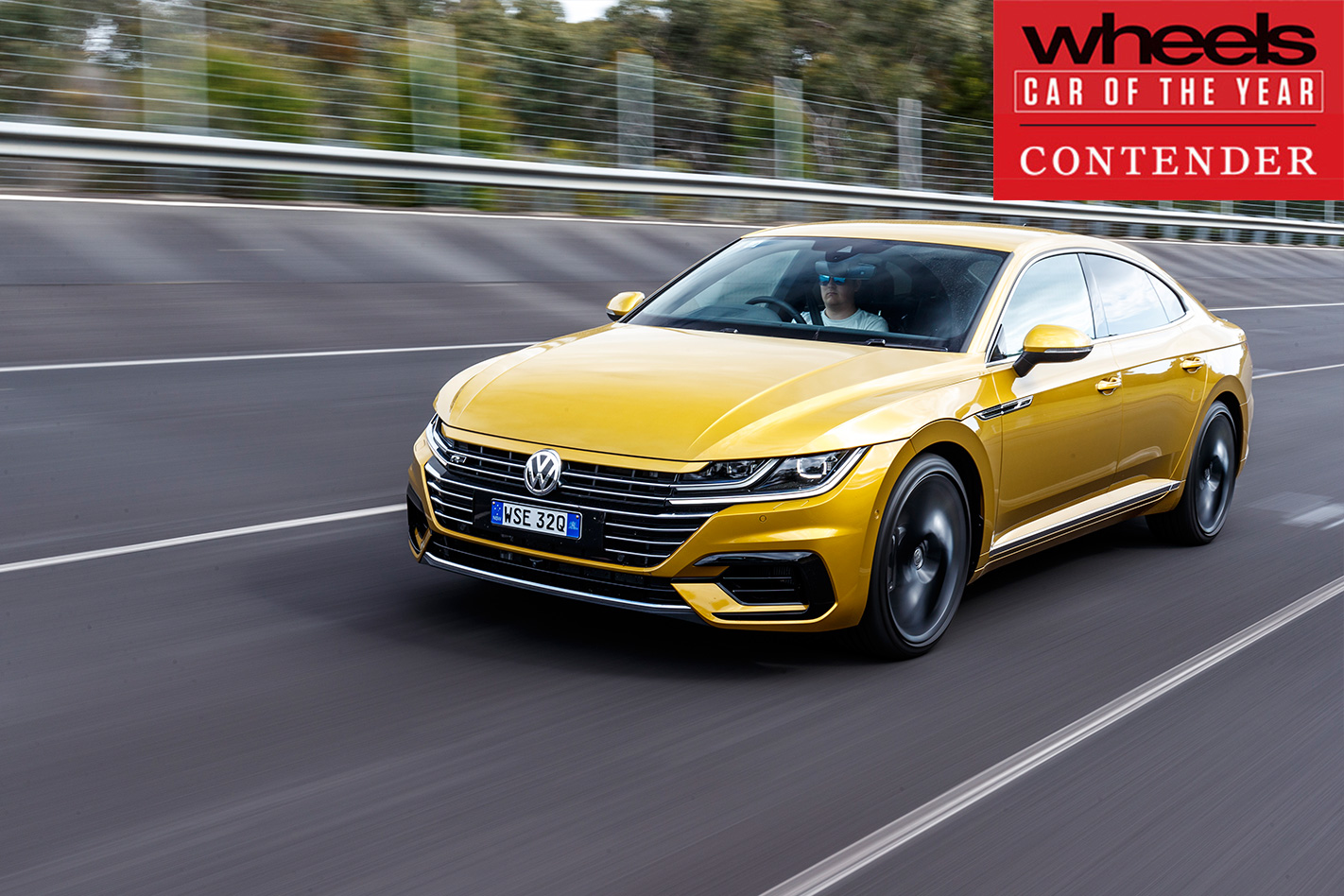
WELCOME to the Volkswagen CC replacement, one of several late-year releases and in every sense a Car of the Year wildcard.
Following in the footsteps of its low-slung predecessor, the newly christened Volkswagen Arteon continues in the Mercedes-Benz CLS-style mould of being a more rakish and richly equipped version of a sedan.
While in this scenario we’re again talking about the Passat mid-sizer, changes abound for the model that now serves as Volkswagen’s flagship.
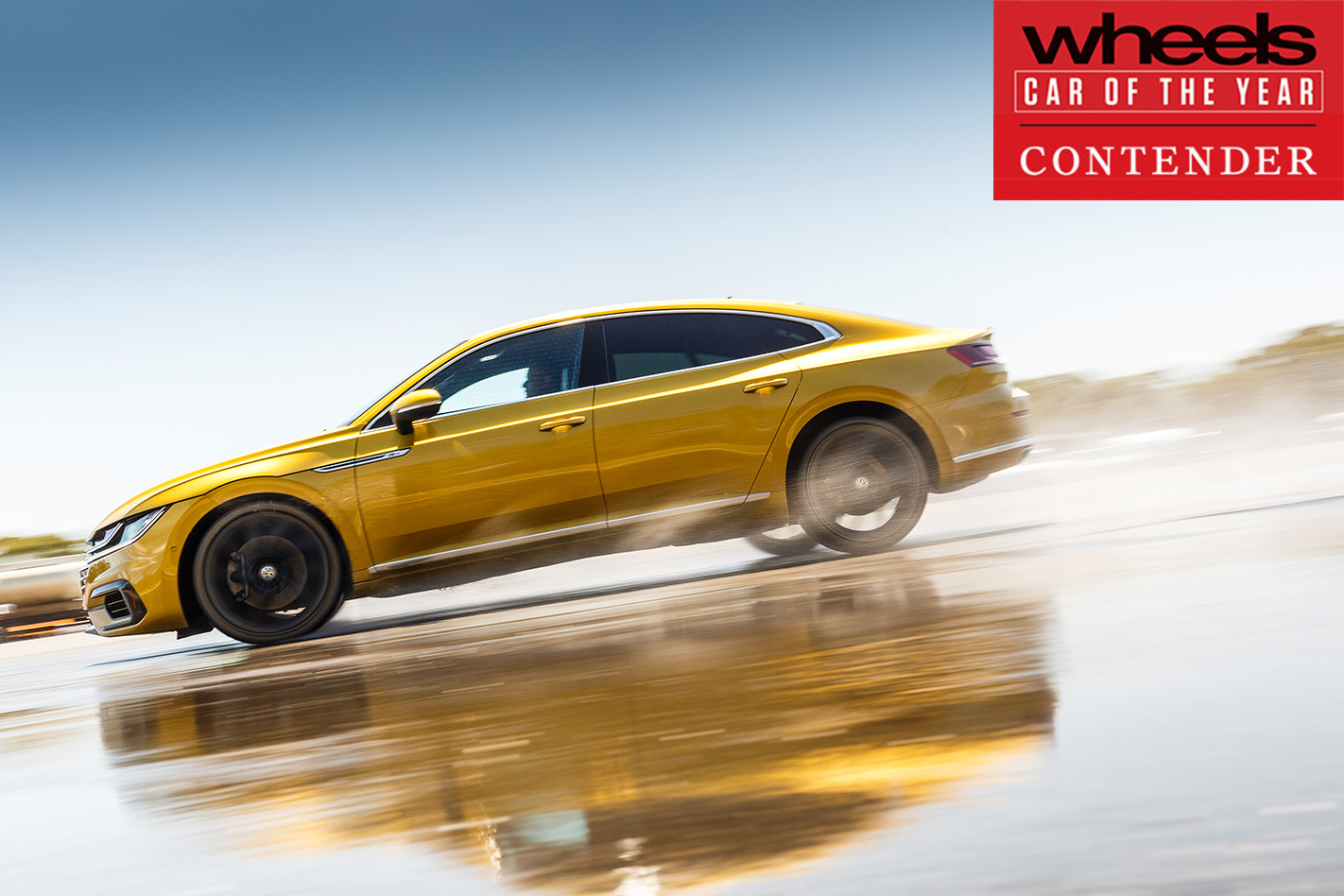
In fact, the Skoda Superb, which is classed as large, and also based on the widely deployed MQB modular transverse architecture, is mere millimetres longer.
Indeed, ensuring occupant wellbeing is this high-quality German-built Vee Dub’s calling card (CC stood for Comfort Coupe, after all), with fresh-to-brand tech to help justify the near-$70K pricing of this single-spec R-Line all-wheel-drive proposition.
All were undreamt-of advances not so long ago.
For extra showroom dazzle, VW also obliges with an Audi parts-bin raid that sees all-LED lighting, sequential-action indicators, fully digital instrumentation à la Virtual Cockpit with head-up display, and high-end multimedia offering gesture-control, as well as massage and memory front pews, heated front and outboard rear seats, and hugely adjustable dampers for tailored softness.
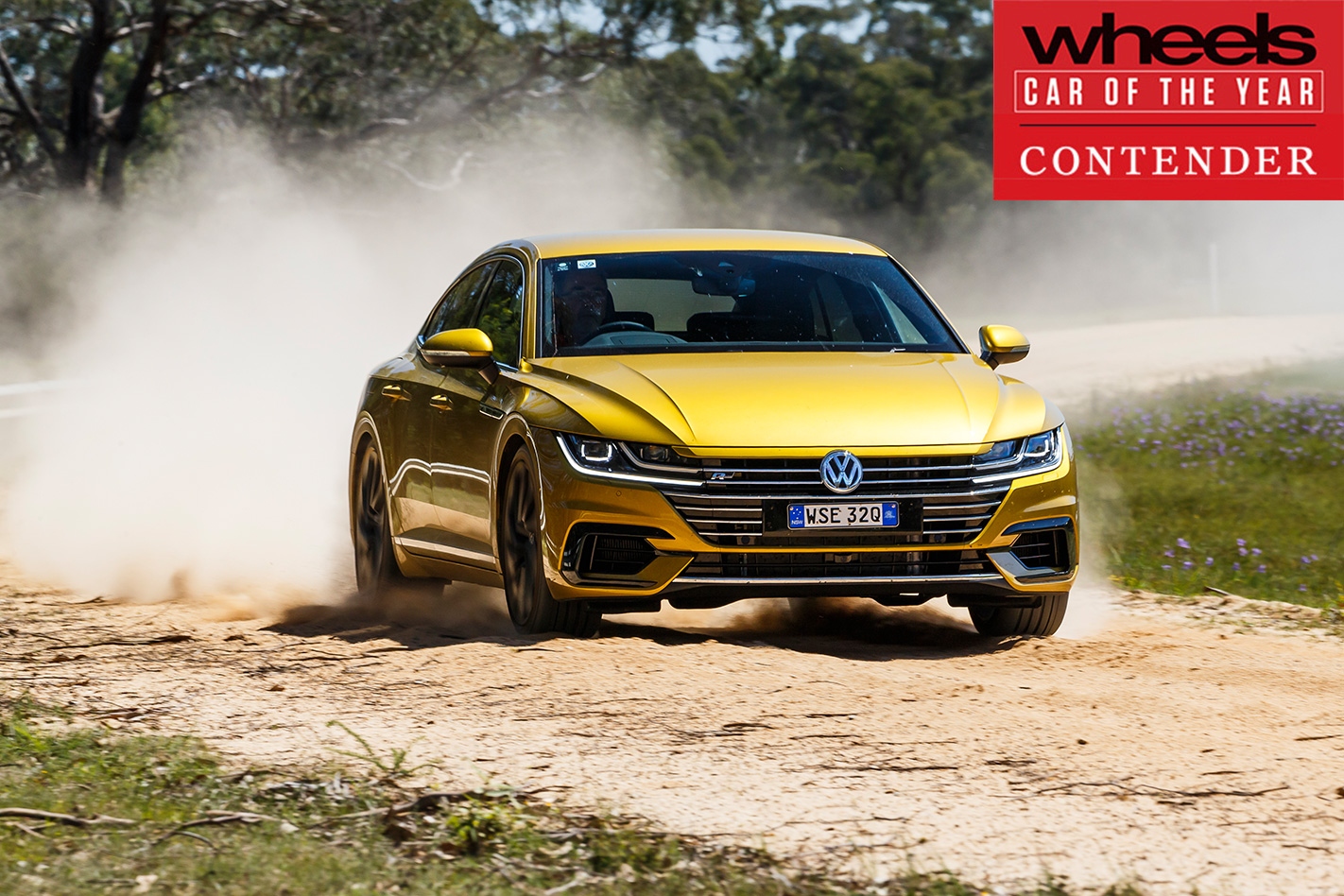
Quick, reactive steering, sharp handling and utterly unfazed control (singling out an excellent ESC calibration on gravel) reflect the terrific bandwidth of the donor Passat’s AWD chassis, infused with that cultivated on-brand civility. Hammering the posh People’s Car at whirlwind pace seems incongruous but the Arteon breezed through Lang Lang’s tests of dynamic fortitude. “Personality with polish,” as Ponchard remarked.
However, away from the glam and tinsel, the same more-or-less applies to the Passat 206TSI, even if some of that semi-autonomous wizardry hasn’t (yet) filtered down through the range.
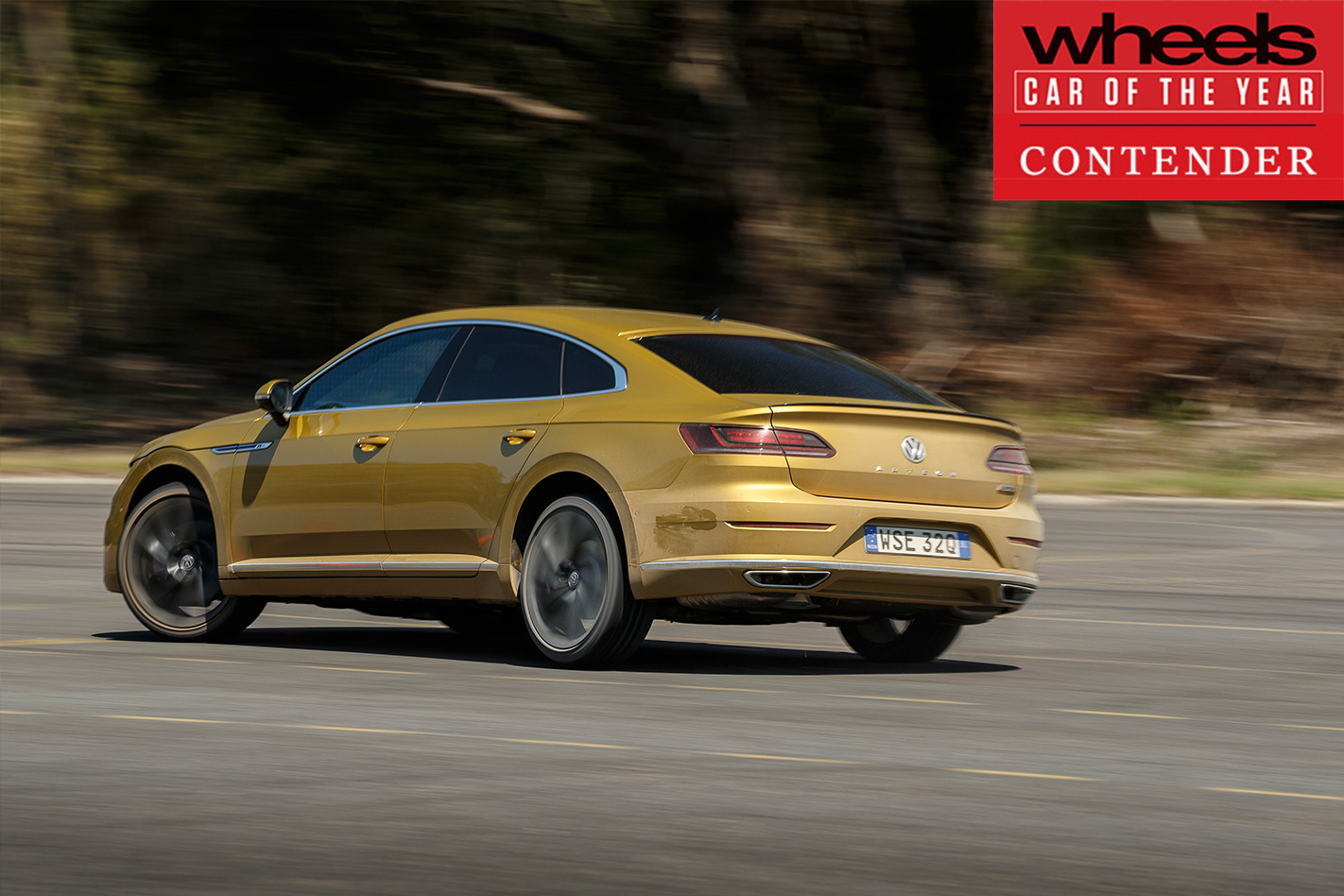
Crucially, Kia is on a similar mission with the audacious (and less-costly) Stinger, and that car struts its stuff with arguably more personality and greater thrills for fewer dollars, to tap into Australia’s fondness for all things rear-drive. The Arteon also seems expensive next to the vanishing VFII Calais V and its forthcoming replacement.
Still, in any other year, its Passat-plus virtues would probably have seen the Arteon sail through to the second round. But none of them really progress the premium mid-sized segment, so it’s here that Volkswagen’s wildcard bows out.
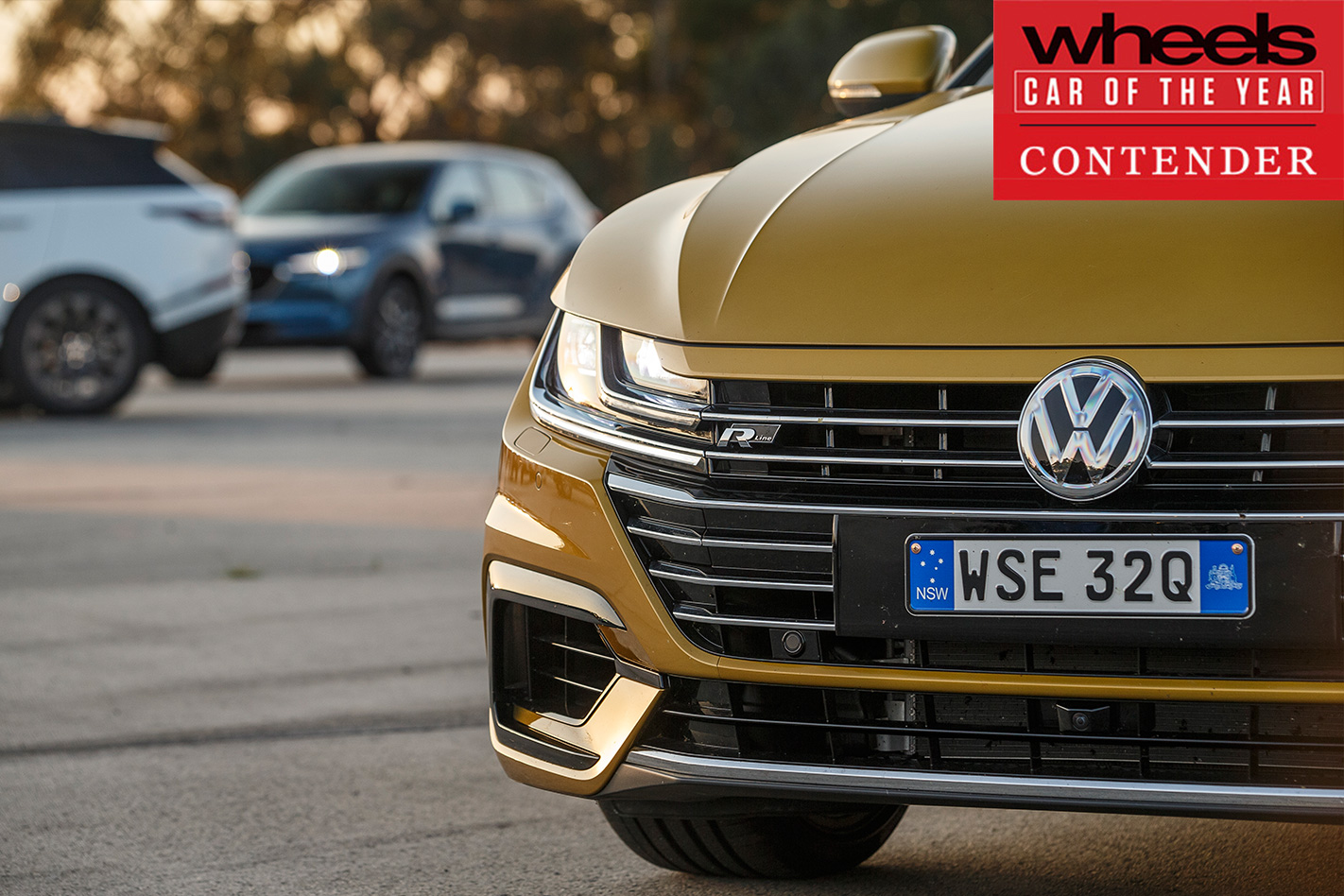
Take a long, hard look at the Arteon’s styling because it is believed to be the first to adopt Volkswagen’s new design language. While the sleek silhouette and frameless side windows won’t find their way onto the next-gen Golf, the horizontal-line grille treatment and LED-signature headlights might, as well as the wider tracks and shortened overhangs.
A shooting brake is also said to be on the drawing board, which might even spawn an Alltrack version.
IMAGES of the Volvo V60, Sweden’s new BMW 3 Series Touring fighter, have leaked online ahead of the car’s official reveal in Sweden next week.
The premium European car maker had planned to launch the new wagon – which moves to the brand’s new electrification-enhanced SPA architecture developed in conjunction with its Chinese owner, Geely – in Sweden on February 21. However, two images of the new estate were published overnight on a Bosnian website before being taken down, but not before they’d been archived.
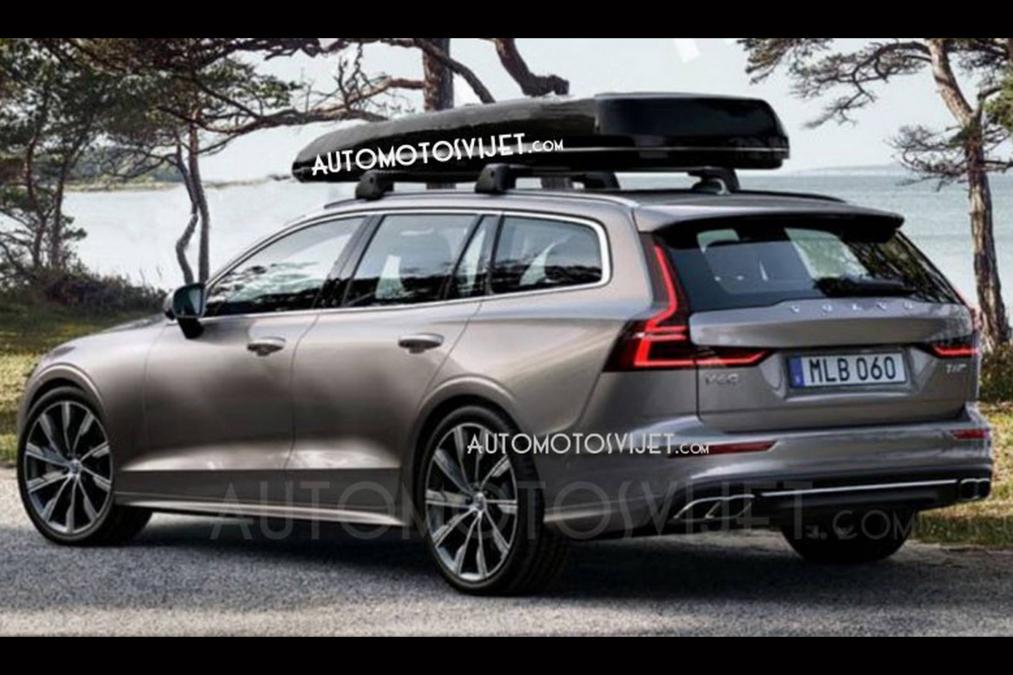
There’s no image of what the V60 will look like inside, but given its close relationship with the XC60 you can expect the same vertical tablet-like touchscreen interface in between the front seats, and a similar dash layout in front of the driver.
The ties to the XC60 indicate that when the V60 arrives in Australia, it will use the same mix of turbocharged four-cylinder petrol and diesel engines paired with an eight-speed automatic transmission, as well as an all-wheel-drive T8-badged plug-in petrol-electric hybrid option.
Volvo has already tried to pull the heartstrings of potential V60 buyers, showing a promotional video starting with grainy, Super 8-style footage of a couple enjoying a drive in a P1800 three-door shooting brake, a vehicle produced for only two years, and working through other wagon models to end with a distant shot of the new V60.
The 88th Geneva Motor Show starts on March 6. Visit wheelsmag.com.au for all the latest new car news and reveals as they happen.
Last time MOTOR rocked up to Winton, we managed to destroy a day’s hard work painting the floors of the pit garages by walking all over the still tacky paint.
Winton’s chief of all that must be obeyed, Charlie, came screaming through the pits, flashing his ute’s headlights and waving his arms out the window to stop us. But it was too late. Robbo – among others – had already stomped through the pits, leaving behind their size-10 evidence and sending Charlie and his crew back to the paint shop for another gallon of Berger Jet-Dry.
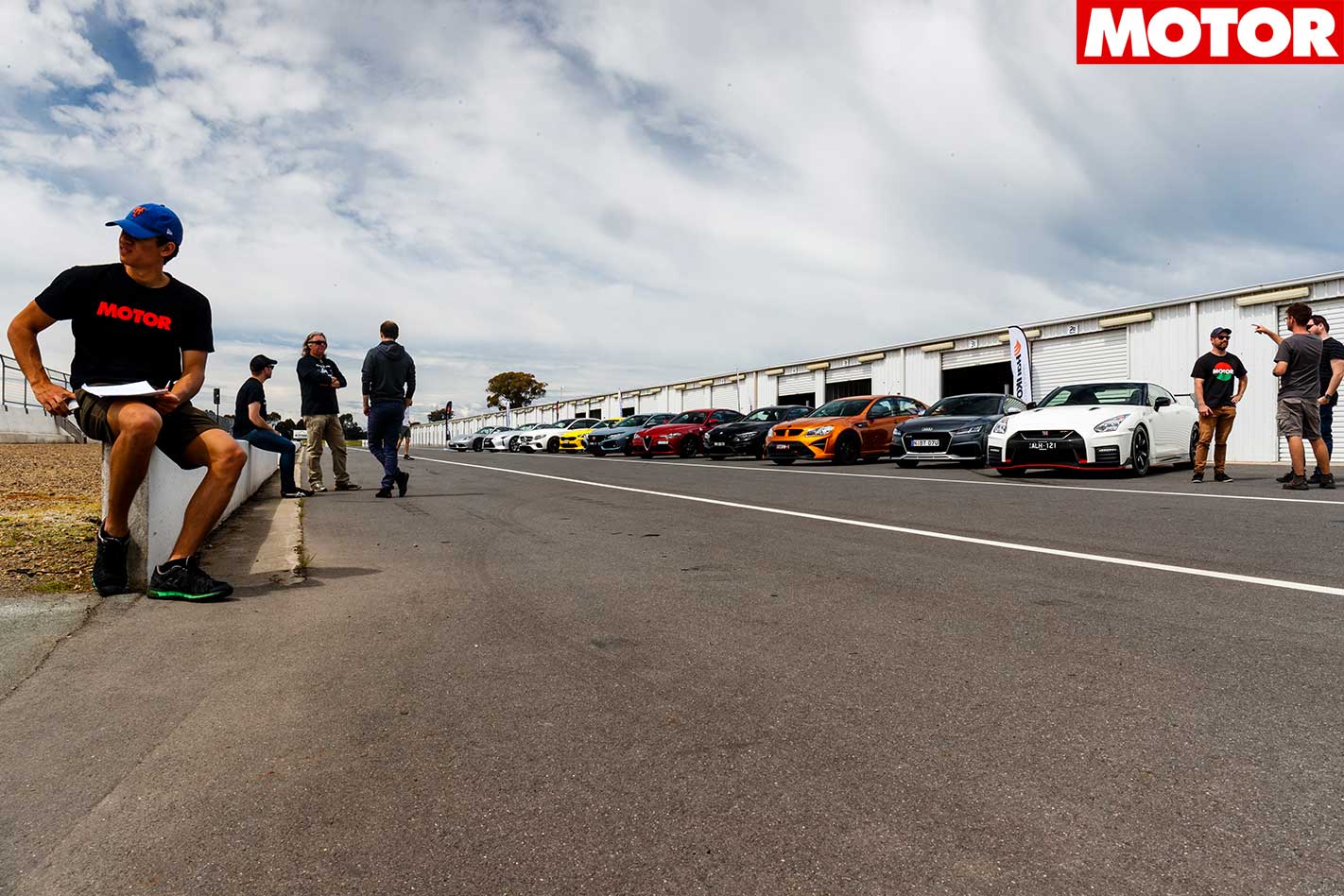
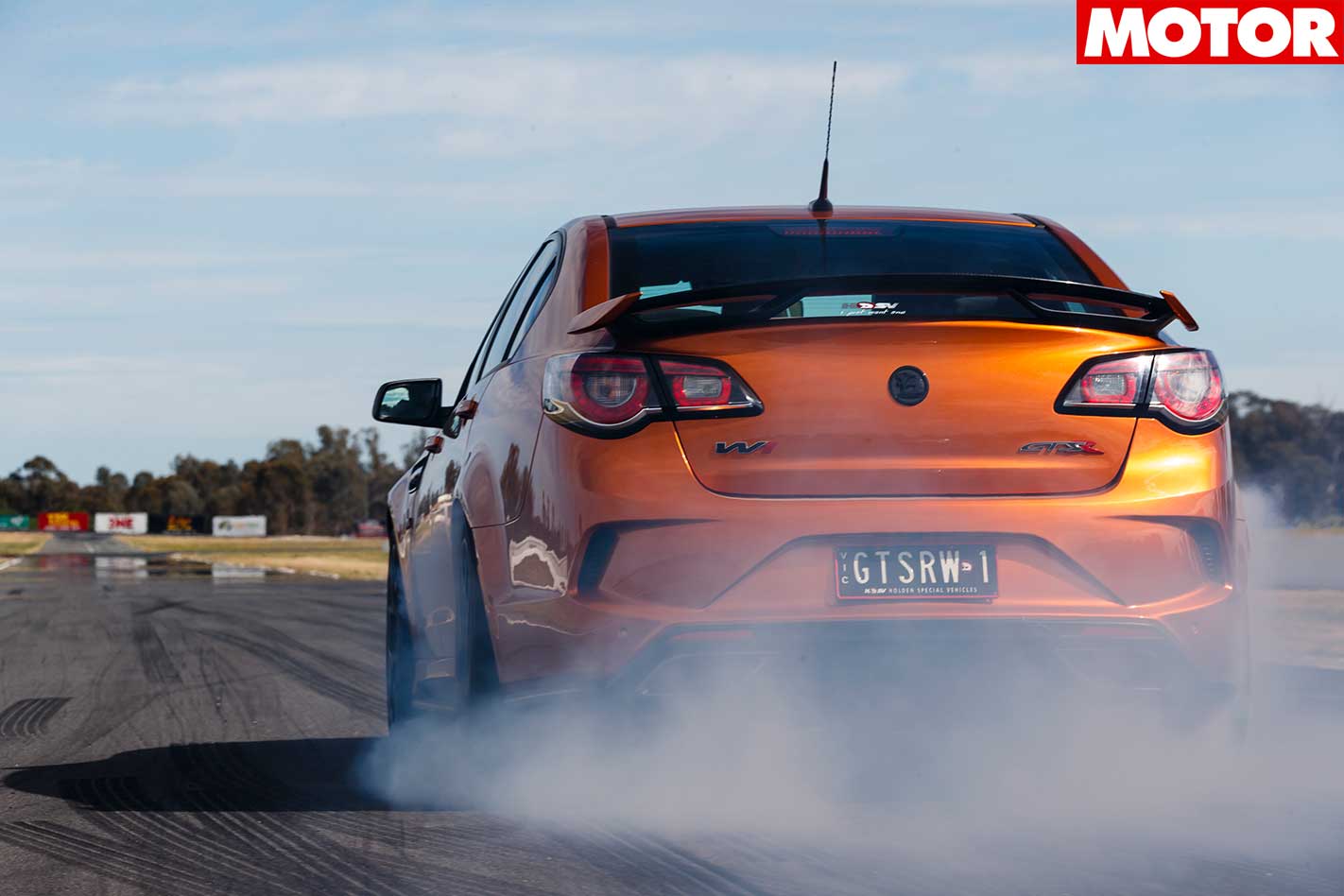
This year, Charlie was taking no chances. He lined us up, made eye contact, and requested (in his own, quiet, but meaningful way) that we refrain from doing burnouts at the start of our 400m runs.
Charlie’s other piece of advice was a bit more sobering: “Watch out for snakes,” he told us. “They’re everywhere this year. Don’t jump over the concrete walls without looking on the other side first. And it won’t get above 27 degrees today, so they (them Joe Blakes) will be out all day”.
Staying well clear of the tyre bundles was an equally obvious recommendation. Apparently, 2017 looks like a bumper year for snakes.
So much for the snakes; what about the elephant? You know, the elephant in the room. As in: where’s Luffy? Well, while it may not seem like it, MOTOR does understand ethics.
True, we have trouble with the words ‘no’ and ‘drifting’ being used in the same sentence, but that’s just our normal reaction to any authority figure. But we understand we ultimately answer to you lot and that’s why Luffy was benched for PCOTY 2017.
Well, you may recall that Senor Luff was the main development driver for the HSV W1.
Yep, a large part of the fact that the W1 is such a weapon is down to the input from W. Luff. To make matters stickier, the HSV team used Winton as the W1’s main test track, so that’s where Luffy did his best work. Now, the problem with all that is a two-parter.
Add both those things up, and we couldn’t risk the internet trolls screaming blue murder. So Luffy got a DCM. Fear not, he’ll be back for the next MOTOR extravaganza.
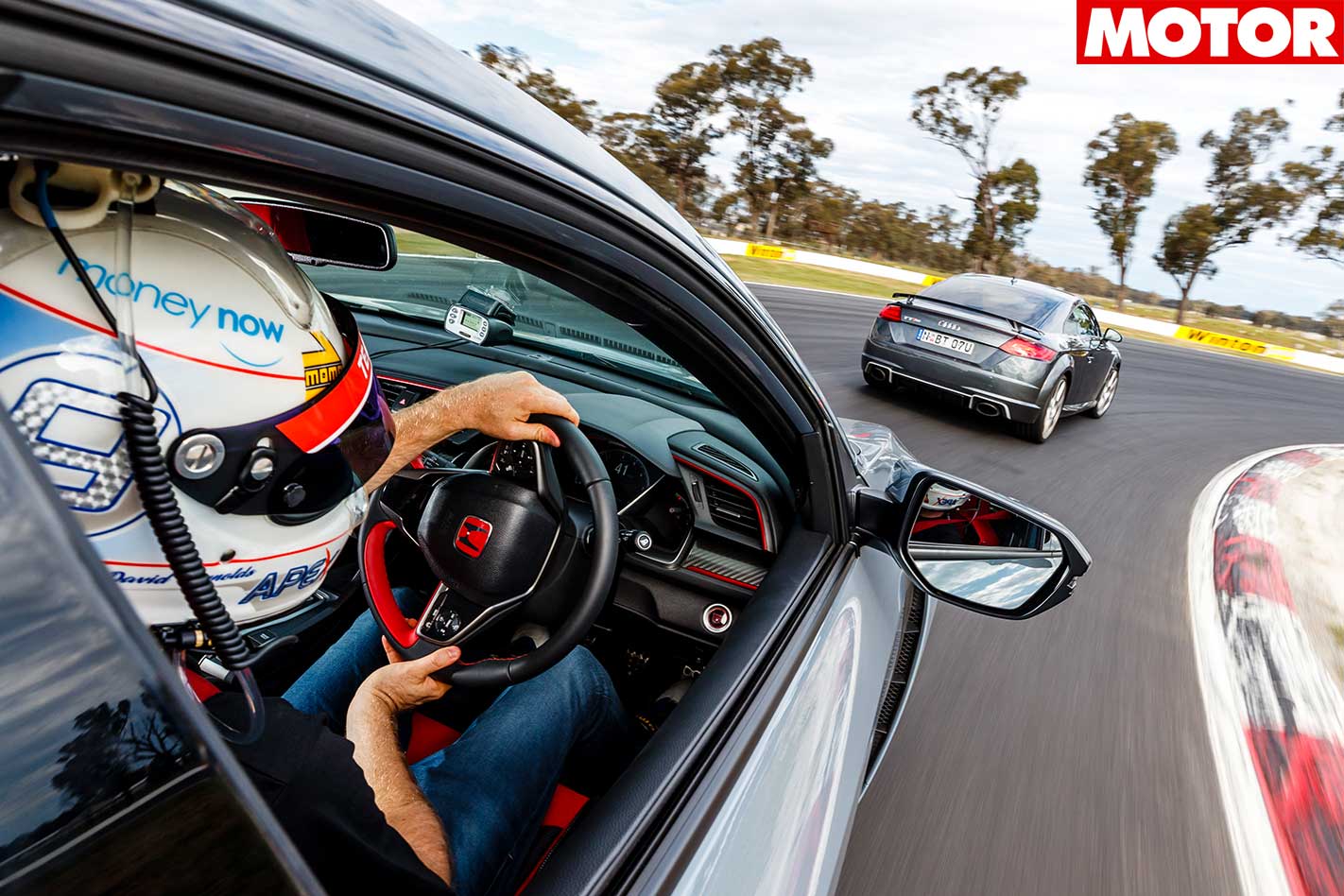
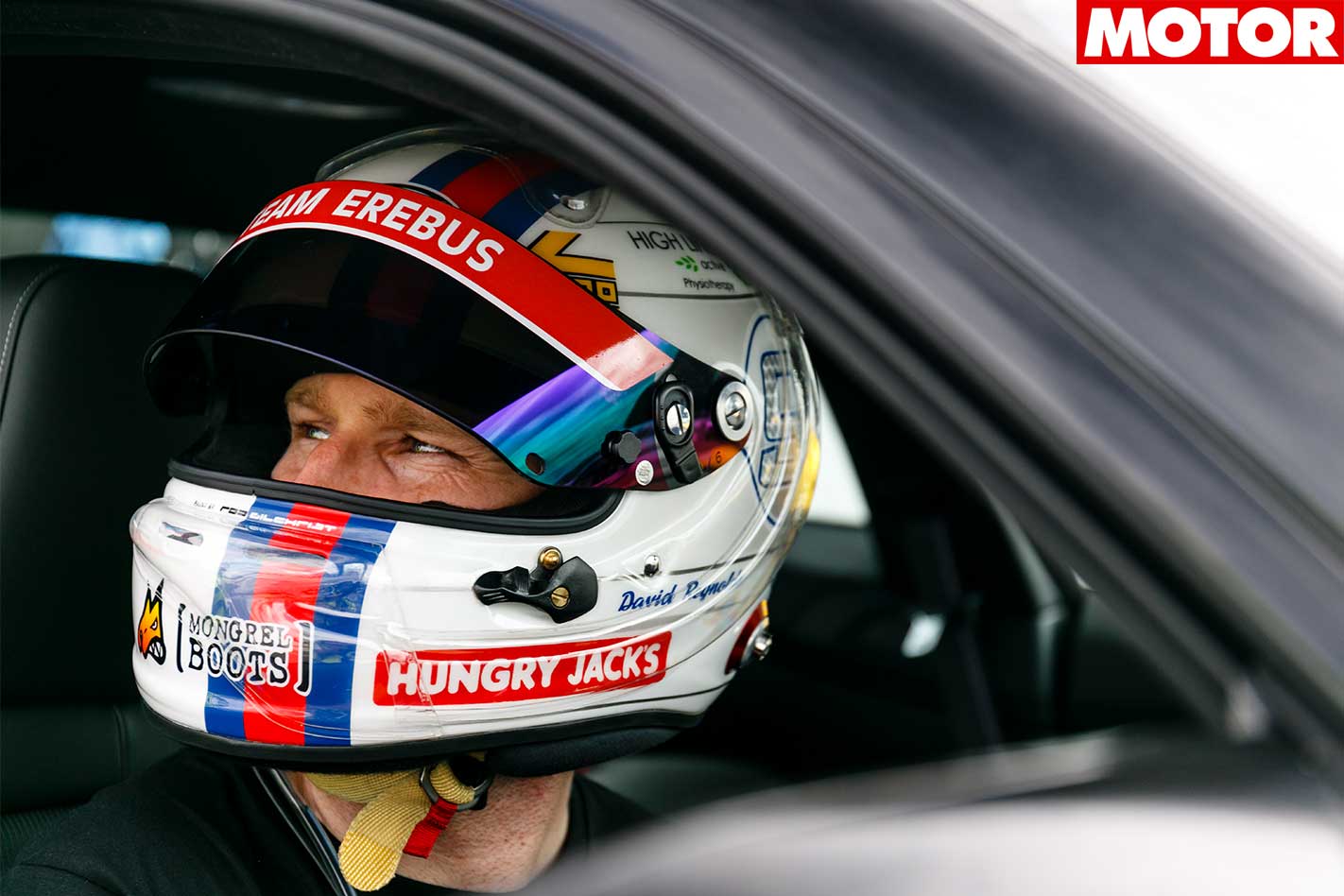
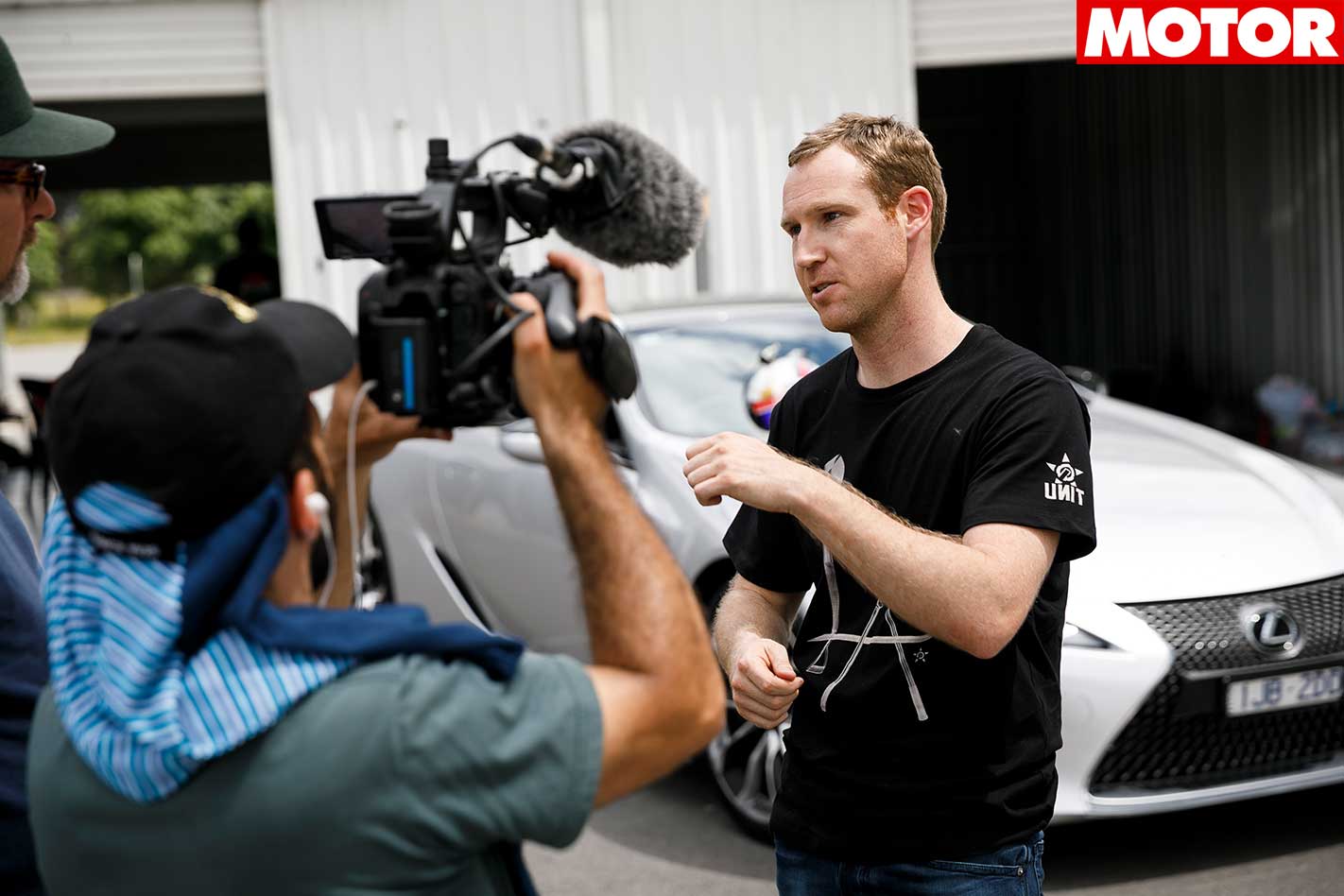
So how do you replace such an intrinsic member of an established, experienced team? You go straight to the top, that’s how. Which is how we wound up acquiring the services of none other than David Reynolds, fresh from the top step at Bathurst and full of good cheer and his trademark sideways view of the world.
So how’d it all pan out? Alphabetically okay for you? Great, let’s begin.
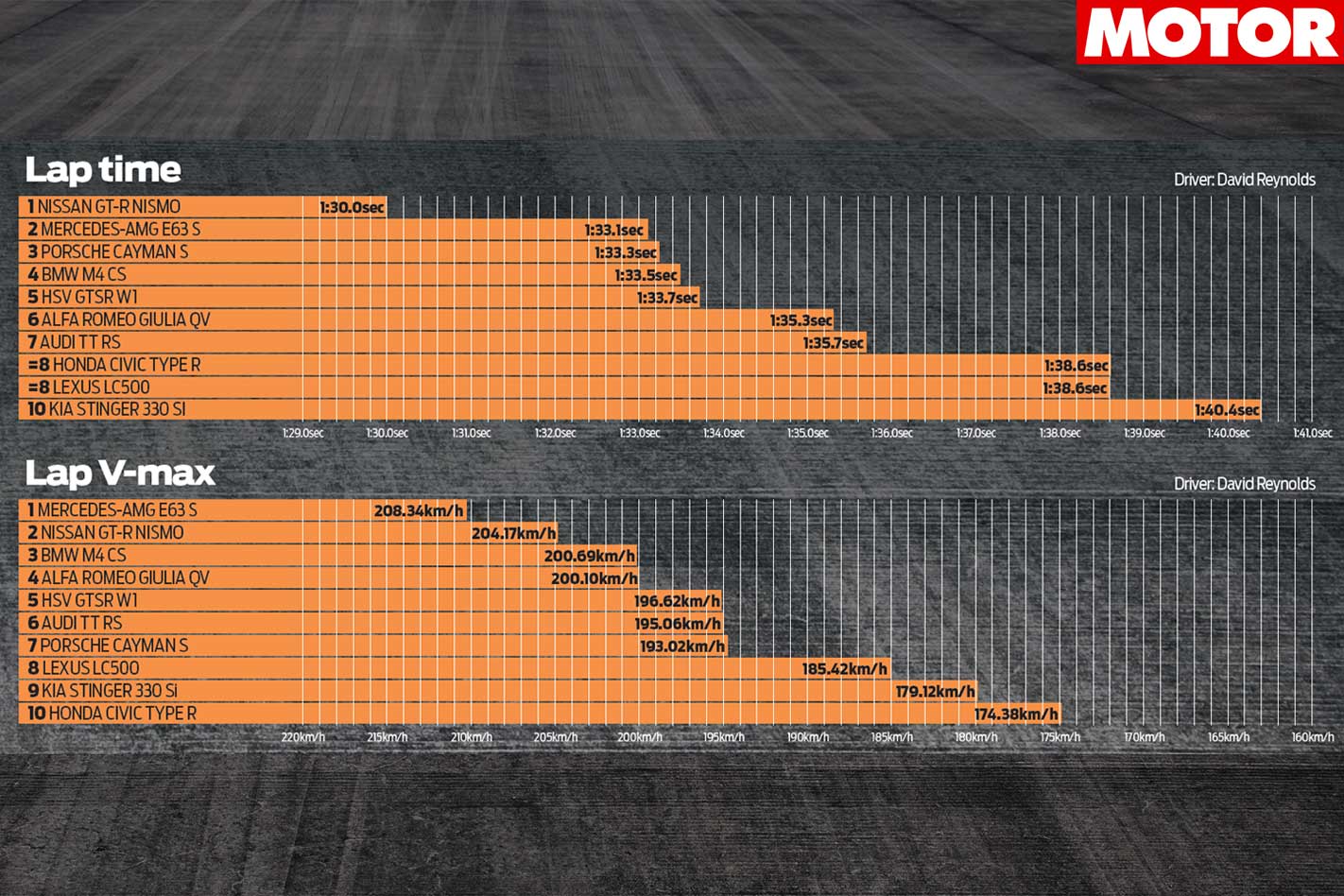
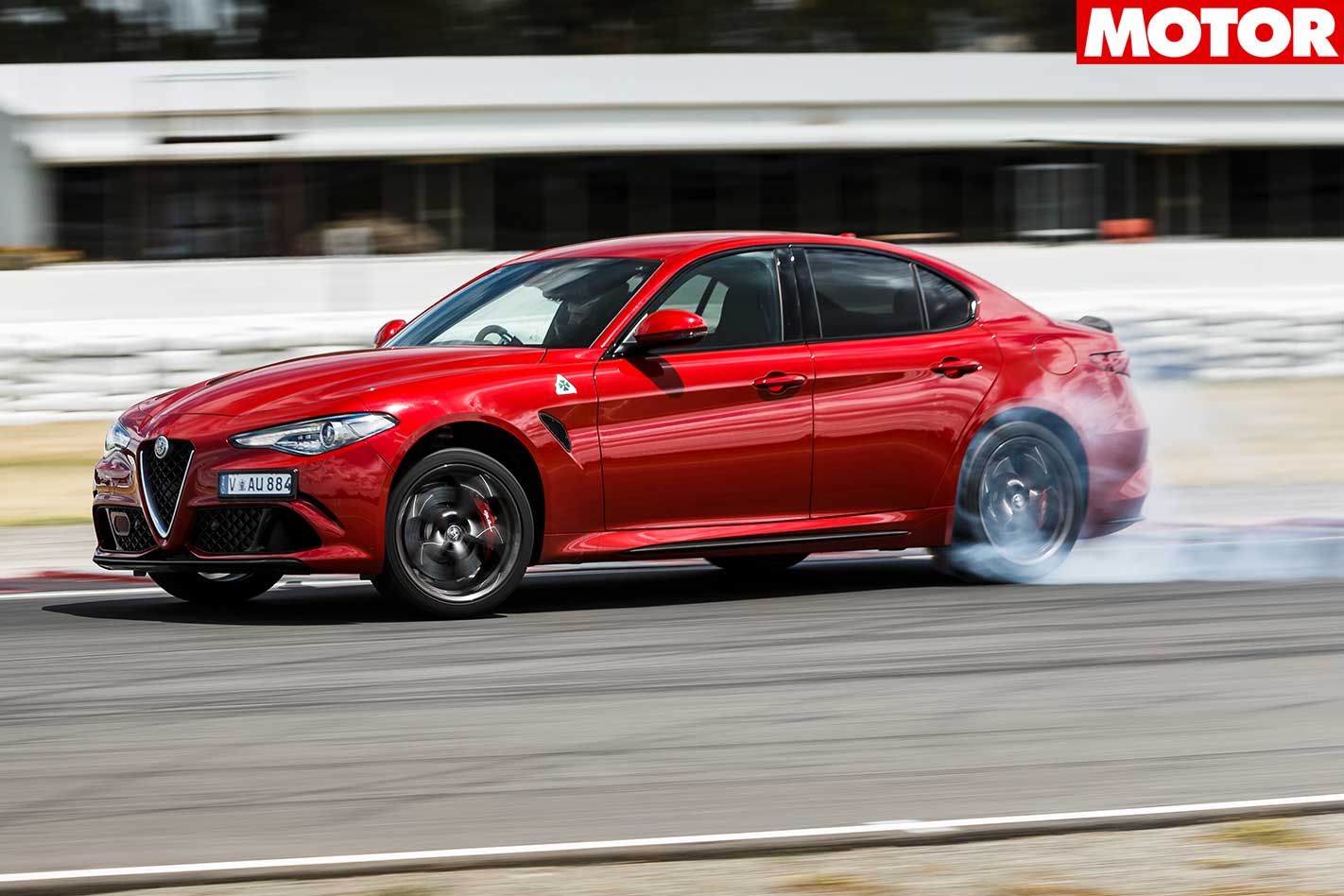
You can see the lap times and corner speeds and whatnot for yourself below, but what those numbers don’t tell you is how each car felt. And the Alfa? Well, that felt like an Alfa. As in, an old-school Alfa. So that’s a good thing, then.
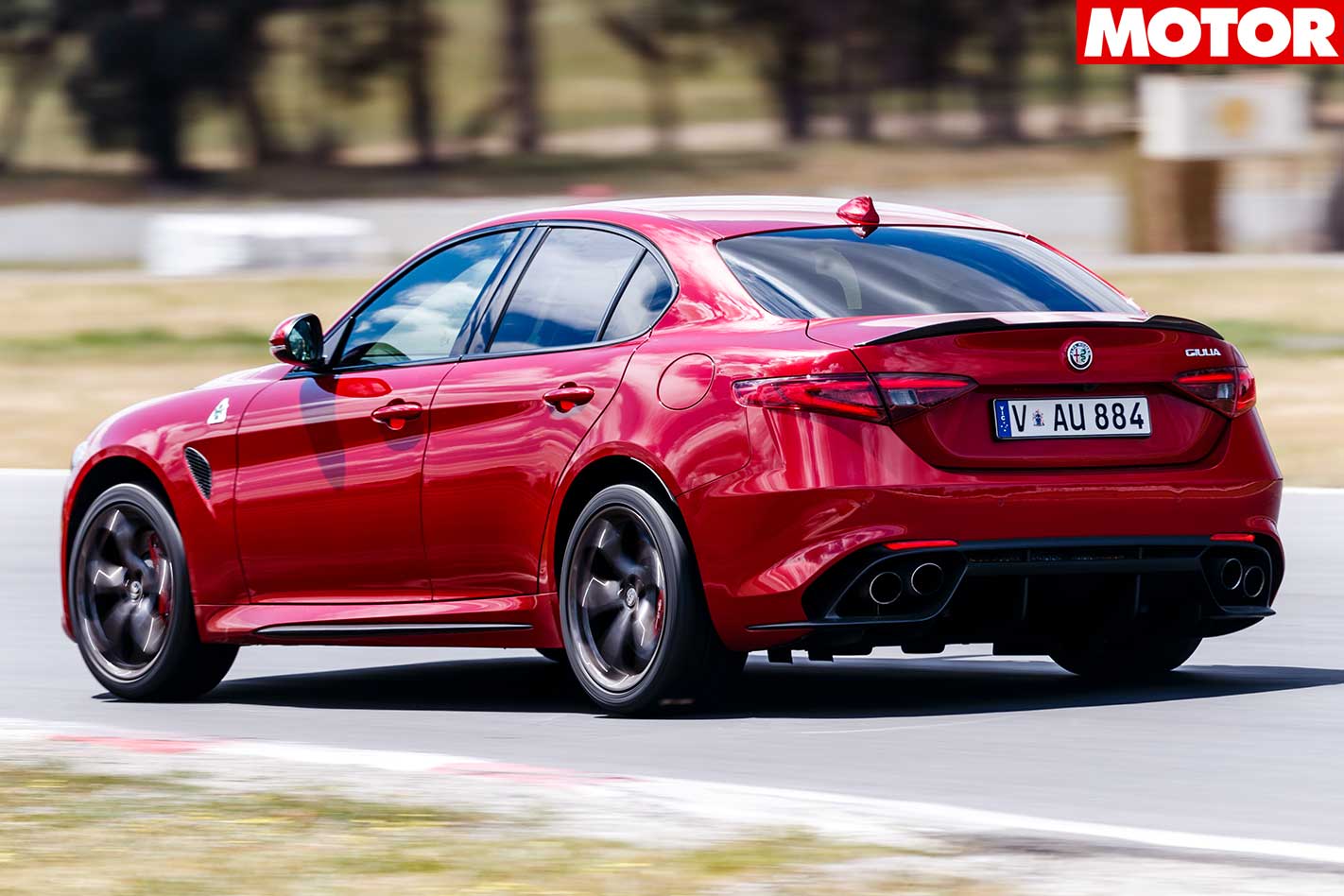
Okay, so there’s more to it than simply which axle is driving, and 375 kilowatts are always going to have a pretty good chance of leaving their mark. The super-quick steering rack is another part of the puzzle. But throw all those things together and the Giulia is not only fast, it’s entertaining in a way Alfas haven’t been for yonks.
The Audi TT RS is what happens when you stick with a formula and hone the crap out of it. The yodelling five-cylinder is now an Audi RS ‘thing’ and the look of the TT still involves a little retro-ness, but it’s also become its own trademark over the years.
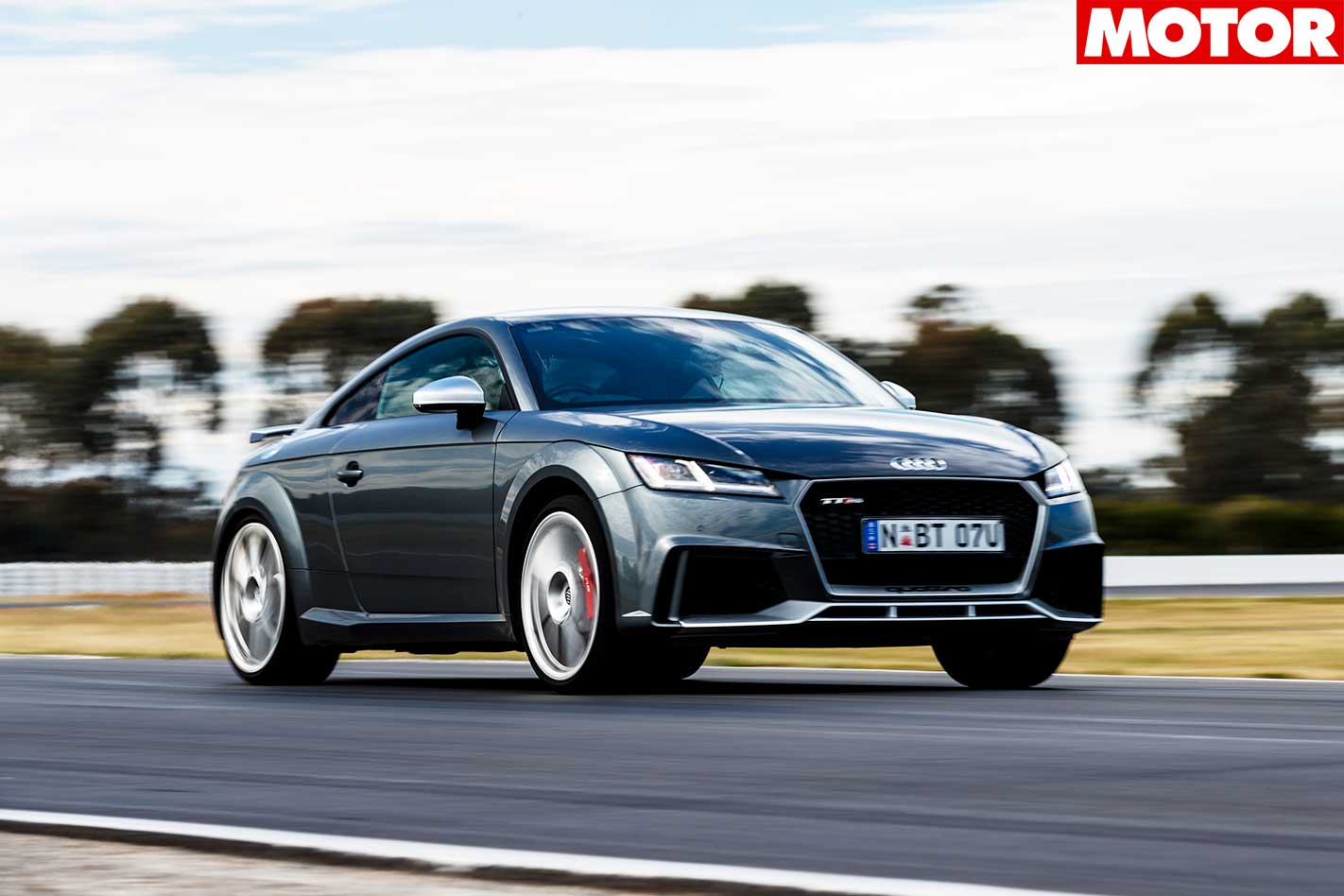
But that engine! Holy cow. True, it’s a tiny bit laggy and the gearbox is a fraction slow to kick-down when you jab the left paddle, but it’s good fun and would make an ordinary pilot look pretty sharp on a track.
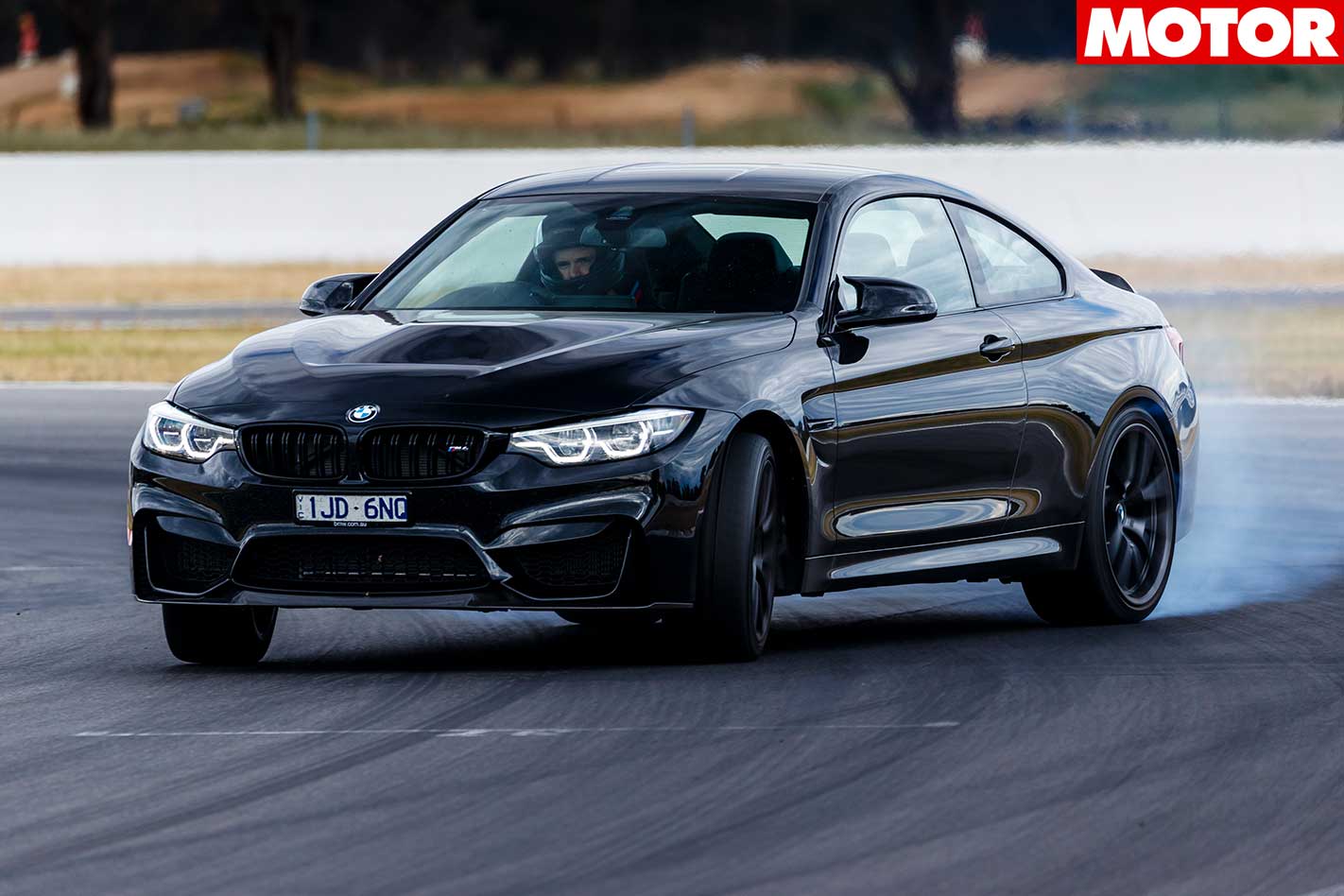
The BMW M4 CS is a car that should really shine on the track, even if it loses a few points on-road. Fact is, for most of us, it was the other way around, and while we mortals reckoned it felt a bit wooden at Winton, it really came to life when you got it out in the real world and let that chassis do its thing.
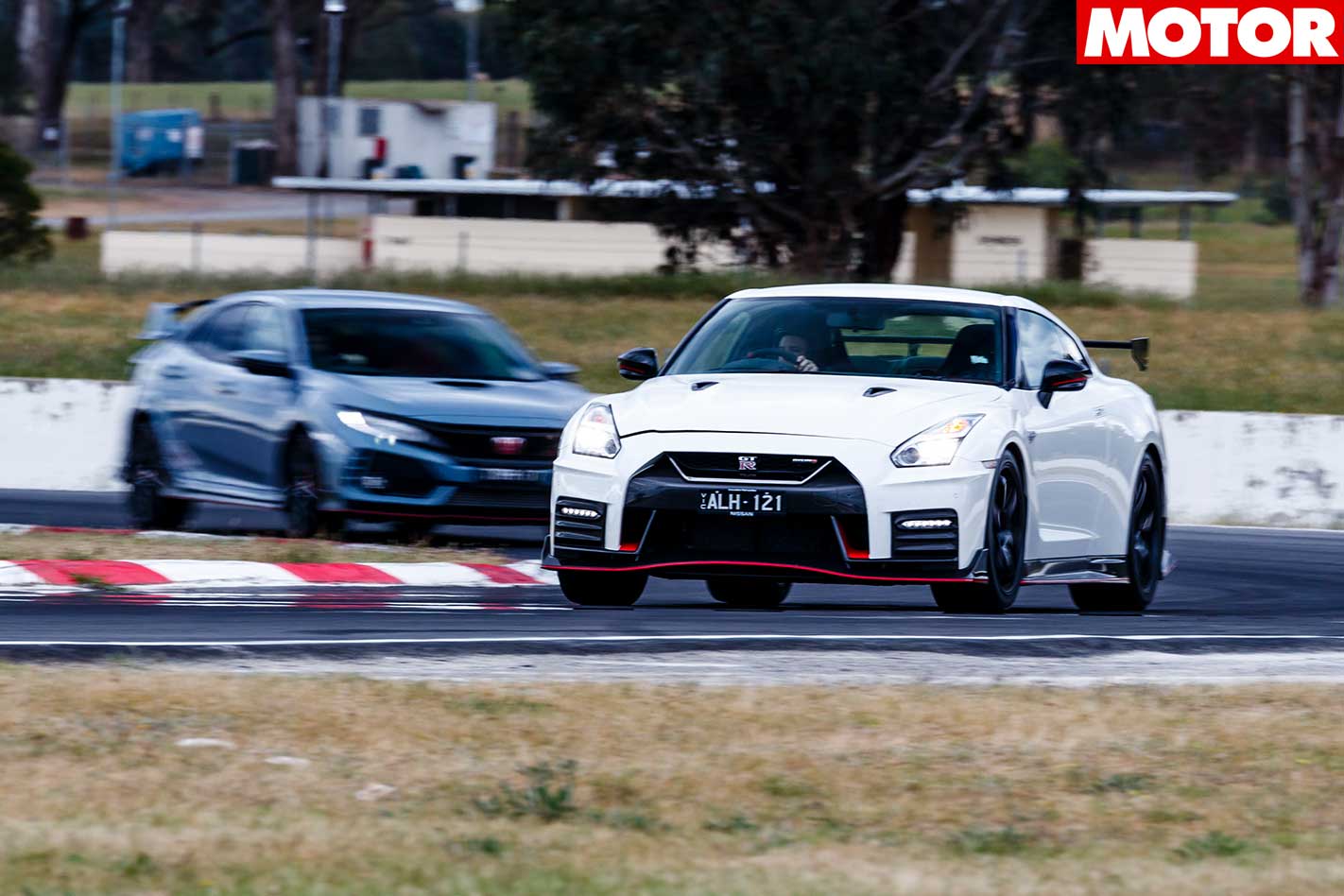
Pop quiz: Which of these two cars is going to have the most torque-steer; an all-wheel drive Focus RS or the front-drive Civic Type R? If you answered the Civic, you have clearly not driven one.
Fact is, there’s effectively zero torque-steer in the Honda. Or anything else to annoy you either. This is one resolved little car and on the track, that equates to a chassis that is lively enough to side-step, but stable enough to get through the Winton sweeper at a good pace.
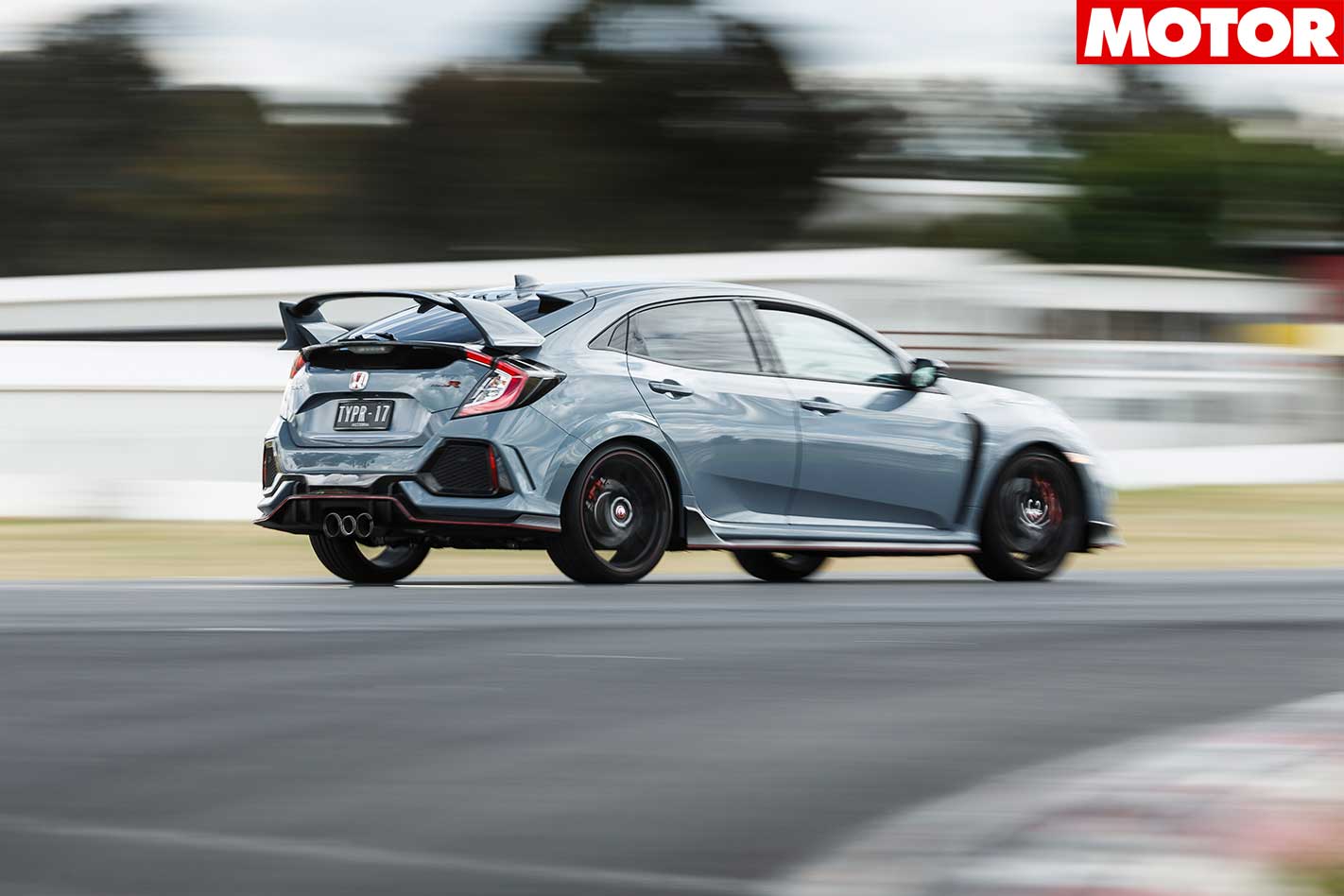
The other point is that the Type R will not only be a track-friendly car for those without Davey Reynolds’ experience, it’ll also go faster the better you get, so you won’t automatically outgrow it as a track-day car. Brilliant.
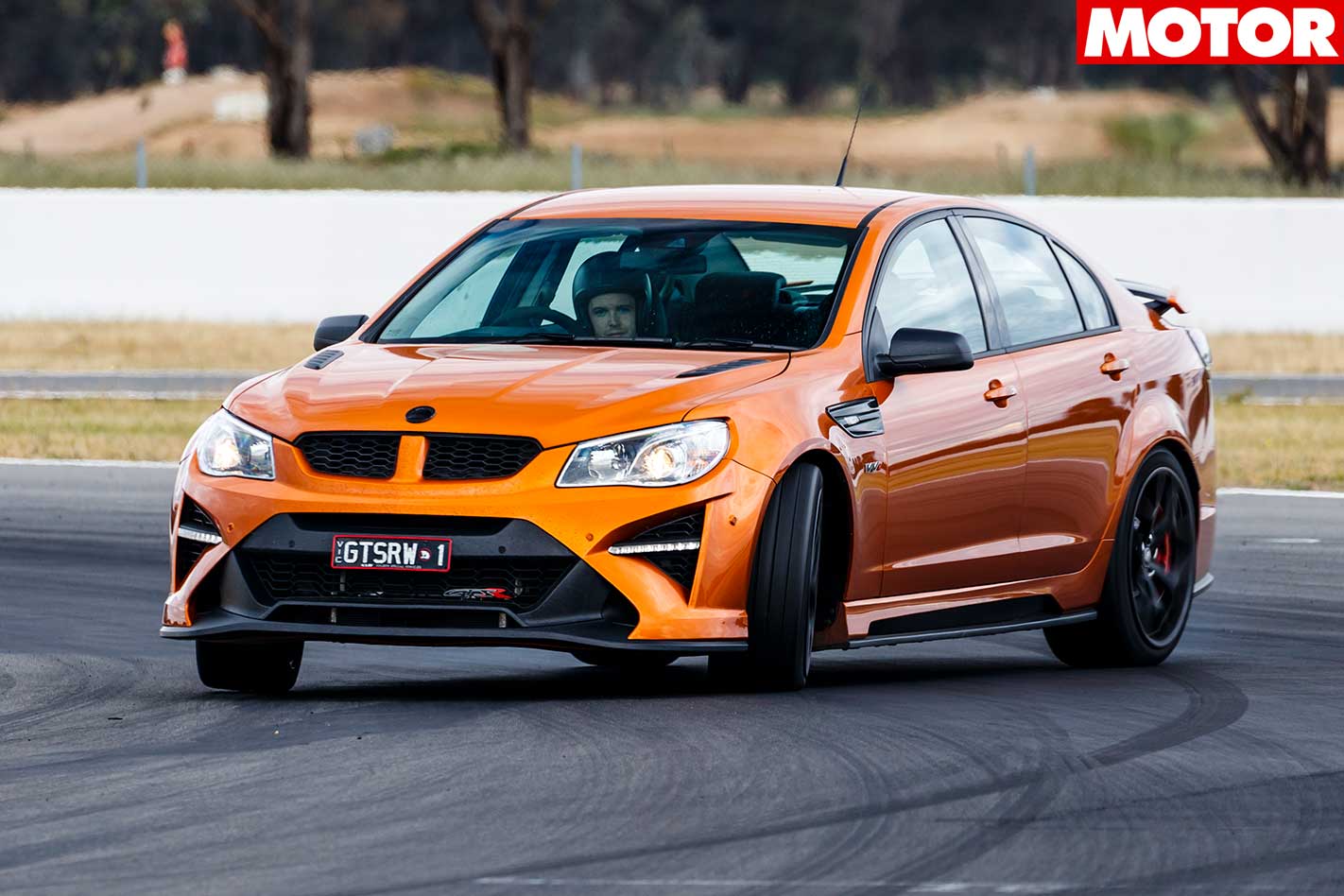
What can we say about the HSV GTSR W1 that hasn’t already been said? Designed for the track from the outset, it has the dry-sumped engine, the sticky tyres and the grunt to be a proper weekend weapon. And regardless of the physics tied up in its weight and bulk, it still managed to get around Winton at the pointy end of the field (once you ignore the ballistic Nissan anyway).
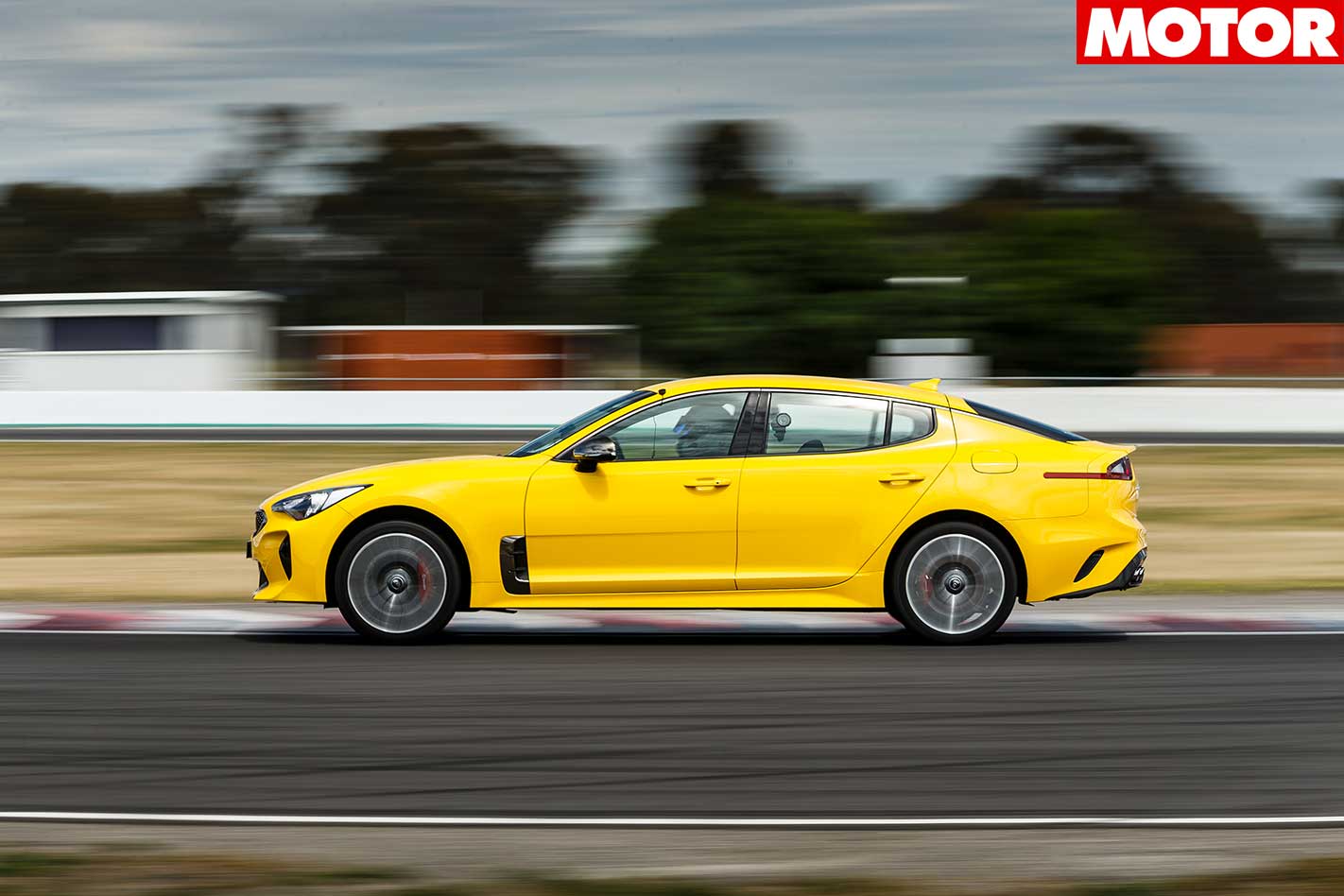
Reynolds was no fan of the Kia Stinger. But, just as the rest of us did in the case of the M4 CS, we couldn’t totally agree with him.
The gearbox with no intentions of obeying you was the biggest sticking point for most of us, but beyond that, the Kia actually turns in pretty well and has enough grunt to be entertaining between corners. Okay, so the rear end gets a bit lively (as you can see in the pictures) as you really stretch it out, but it’s relatively taut for the first nine-tenths.
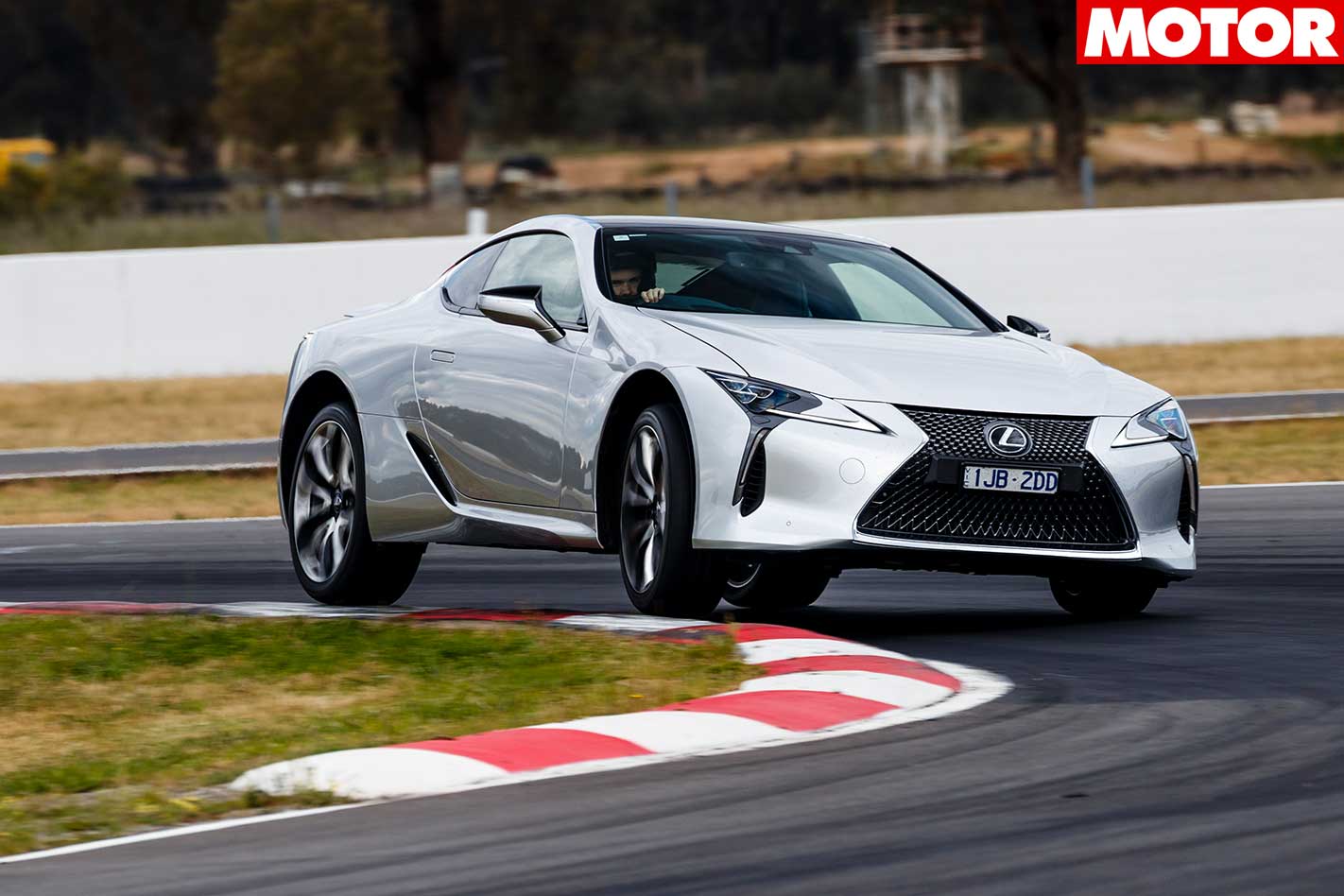
It really feels its weight and the light steering becomes a bit lifeless at speed. The engine, too, suffers the fate of many good atmo units – it can feel a bit flat and wanting on the track. The bottom line is that the LC500 never really encourages you to have a trackside crack.
It still bites pretty well and for all that mass, it feels balanced and always on the balls of its feet. It’s a bit of a win-win situation.
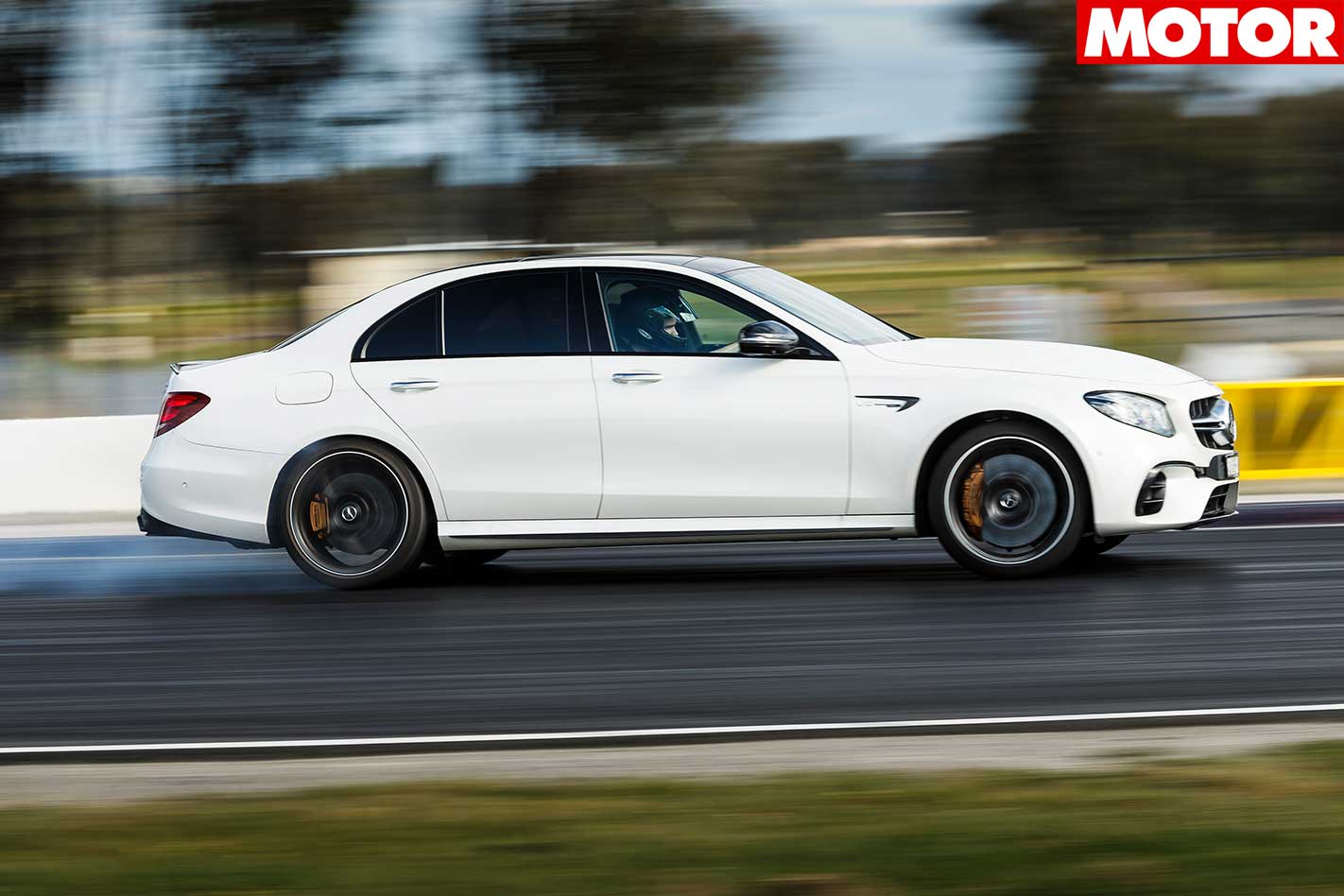
Forget the road manners, because here is a car that will lap Winton faster than the fastest Group C car ever did (an XE Falcon back in 2005, for reference). It feels immediately fast, too, with huge grip and that boosted V6 hauling you along like you’re on the end of a very fast winch.
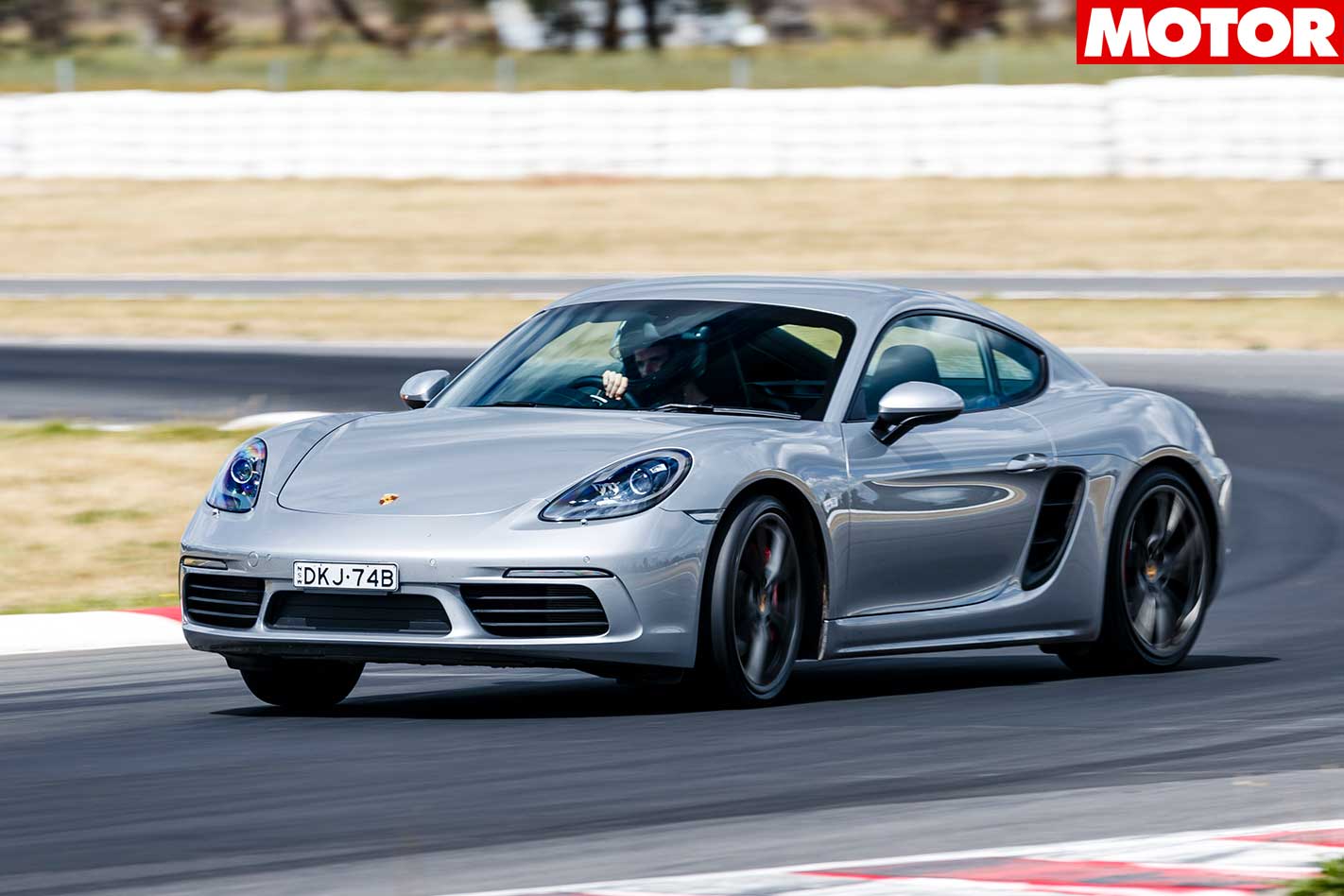
Awesome, as always, probably sums up the Porsche Cayman S. From what started as one of the most benign, balanced chassis in the world, Porsche has refined the deal and now fitted the 2.5-litre version of the turbo flat-four. It still doesn’t sound right to us, but the acceleration is scorching and the steering as accurate as anything else out there.
You can actually feel it searching for grip at the front and doing everything it can to help your cause. They don’t come much more tactile than this.
So which car blotted its copy book? The Nissan, surprisingly.
Even then, it was a minor failure (although it could have created a major problem) limited to the 12-volt power-socket in the centre console refusing to power anything up. Including our Driftbox lap-timer. I checked the fuses and they were fine, so somewhere, in that web of intrigue that is a GT-R’s wiring loom, there must have been a glitch.
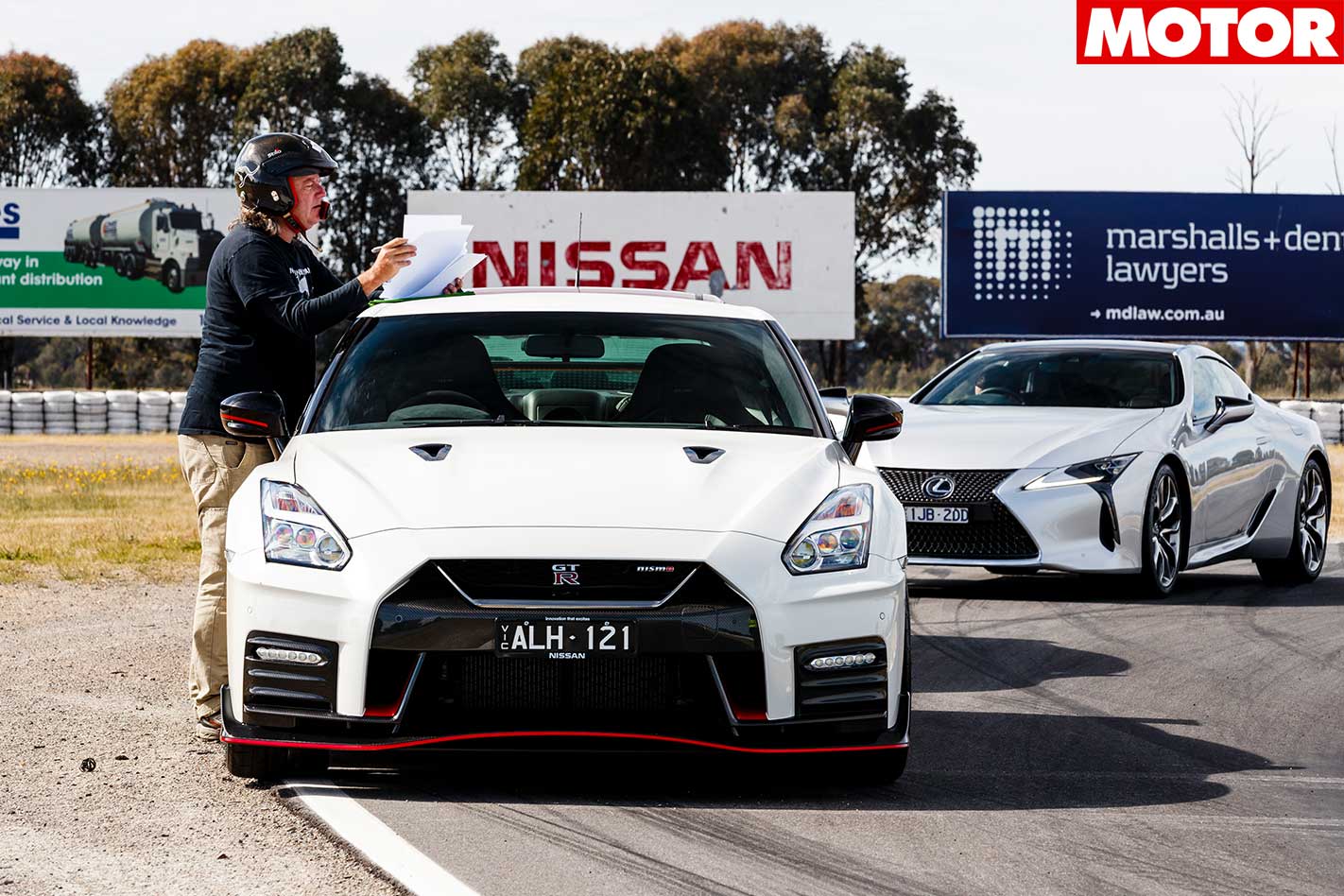
A quick trip to the local parts shop had a set of alligator clips to connect the Driftbox straight to the battery.
Thankfully, it’s a crisis averted.
THE TRACK
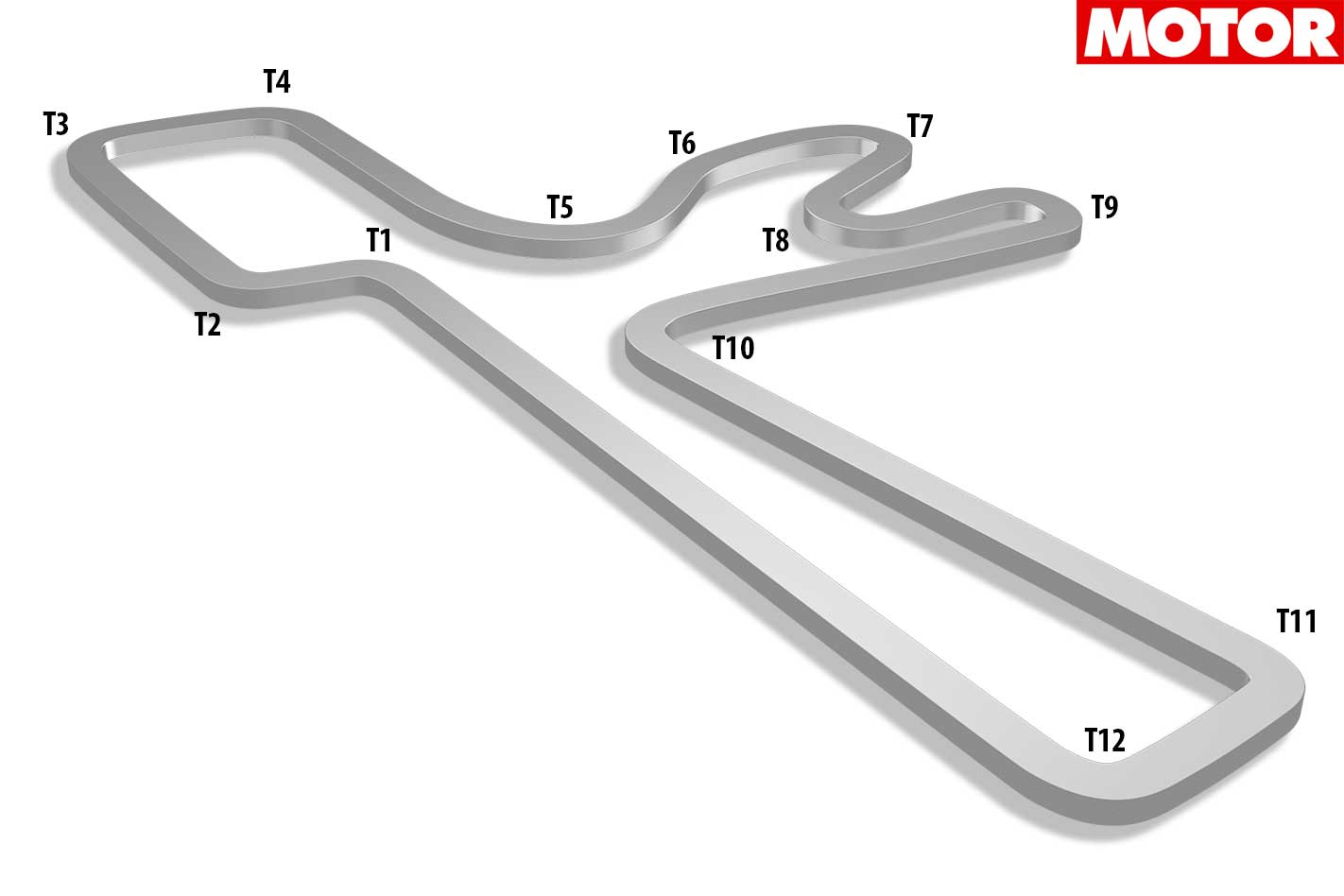
Undoubtedly, location plays a big part in this but it’s also an extremely good place to test road cars – Ford, Holden and HSV are regular visitors. The recent resurface also changed the profile of a couple of corners shaving a couple of per cent off lap times but thankfully the track’s character – its bumps, kerbs and cambers – has largely remained intact.
It’s a fiendishly tricky place to get right, often requiring a driver to sacrifice speed in one corner (turns one, five and eight, for instance) in order to gain speed in the next. There’s also a great combination of straights and squiggles to ensure it doesn’t necessarily favour one type of car and it’s relatively low-speed, good for controlling engine and brake temperatures, as well as limiting the damage our meagre skills can manage.
THE DRIVER
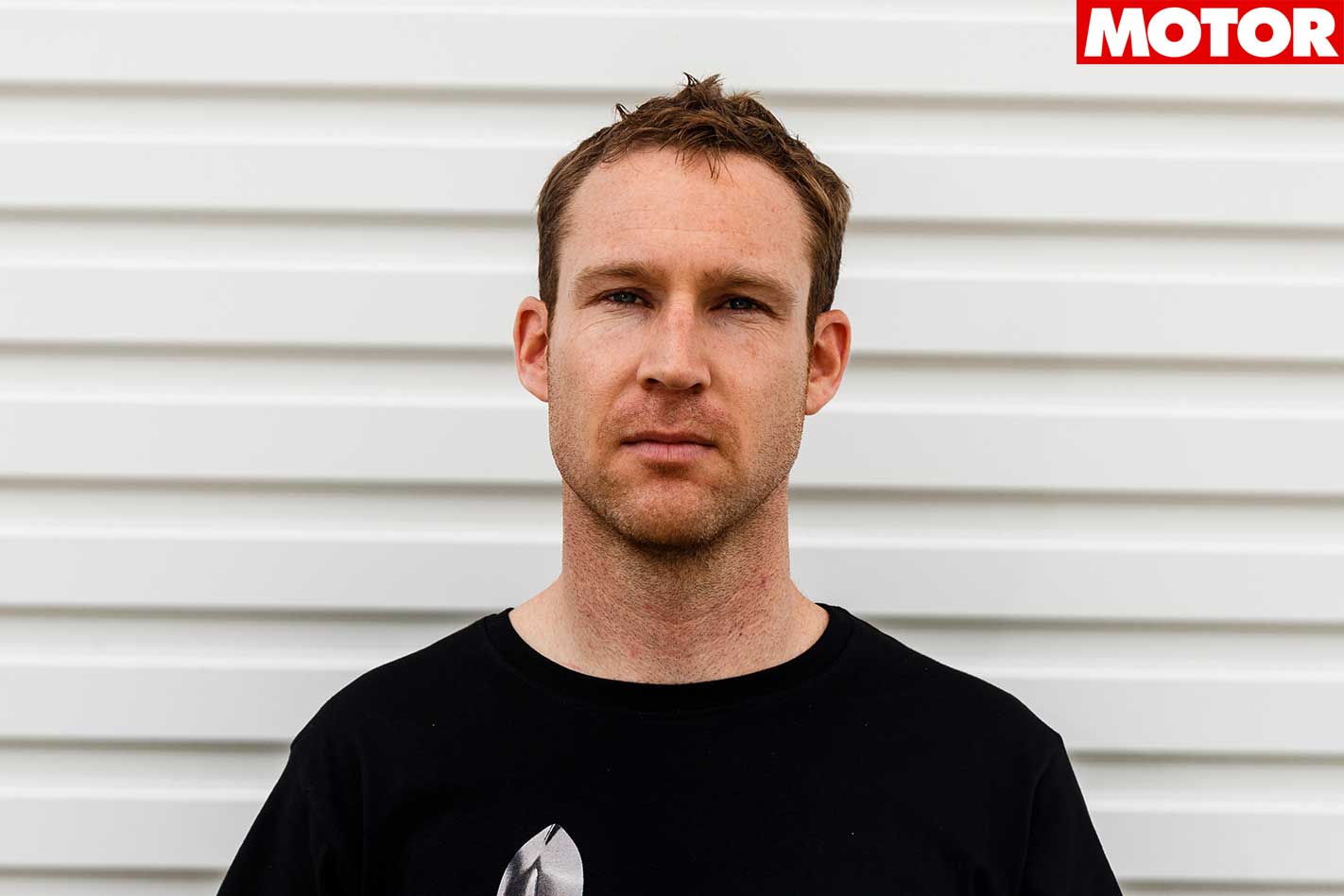
IN THE BEGINNING A Formula Ford and Carrera Cup champ, Dave won his first Supercars race at the Gold Coast in 2013 with Dean Canto before grabbing his first solo win at Hidden Valley in 2015 with PRA.
‘THAT’ COMMENT At the 2015 Supercheap Auto Bathurst 1000, Dave infamously referred to the Harvey Norman Supergirls’ Falcon as the ‘Pussy Wagon’. We got his Kill Bill reference, but the $25,000 fine was a tough lesson in political correctness.
THE LAPTIMES