
Peter Brock repeatedly claimed it was the greatest race car of his 40-year career.
This story first published in MOTOR Magazine March 2009.
It won three championships in three years, was on pole position at all of its Bathurst outings and scored two Bathurst wins – the latter by a never-to-be-repeated margin. It is the epitome of late-1970s Australian muscle-car performance and simply destroyed its opposition in the hands of Brock, Jim Richards and John Harvey at HDT, or privateers Bob Morris and Allan Grice.
If you know Aussie cars – and even if you don’t – then you’ll know of the Torana A9X. The A9X was the Torana’s finest performance evolution and the last homologation special. It was a specially-built version of the LX Torana SL/R 5000 sedan and SS 5.0 hatch, effectively an update of the dual-Bathurst winning L34 LH Torana sedan.
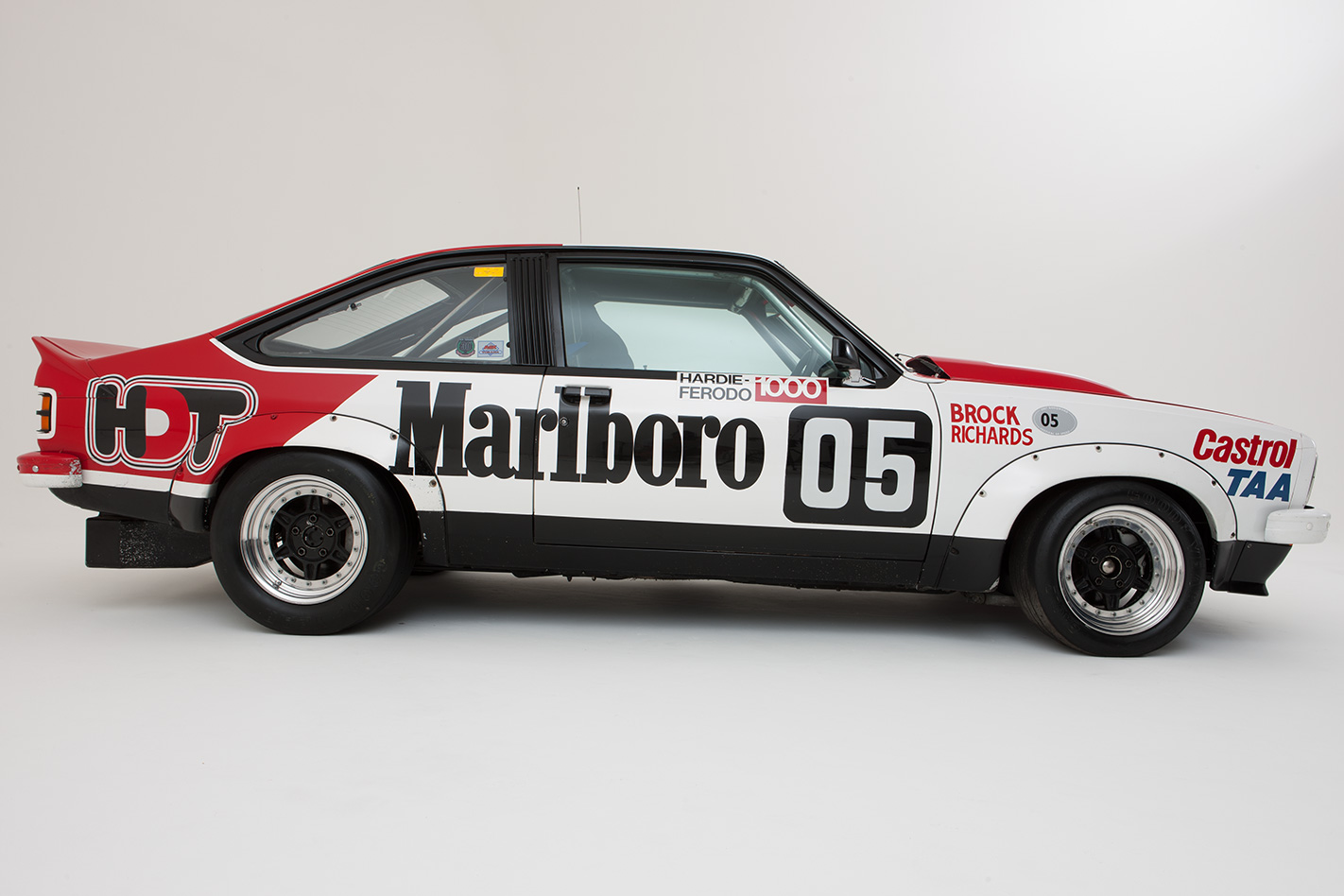
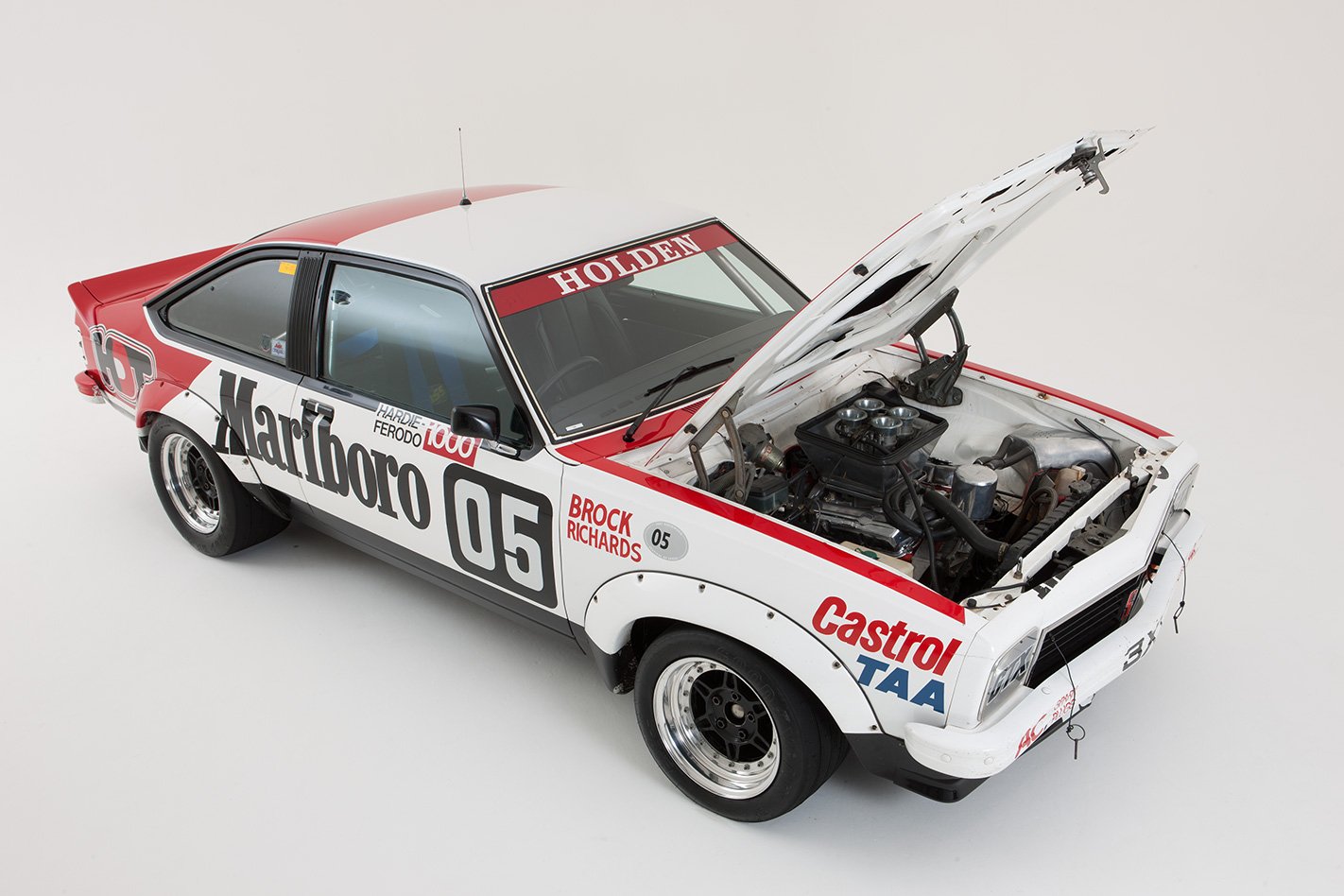
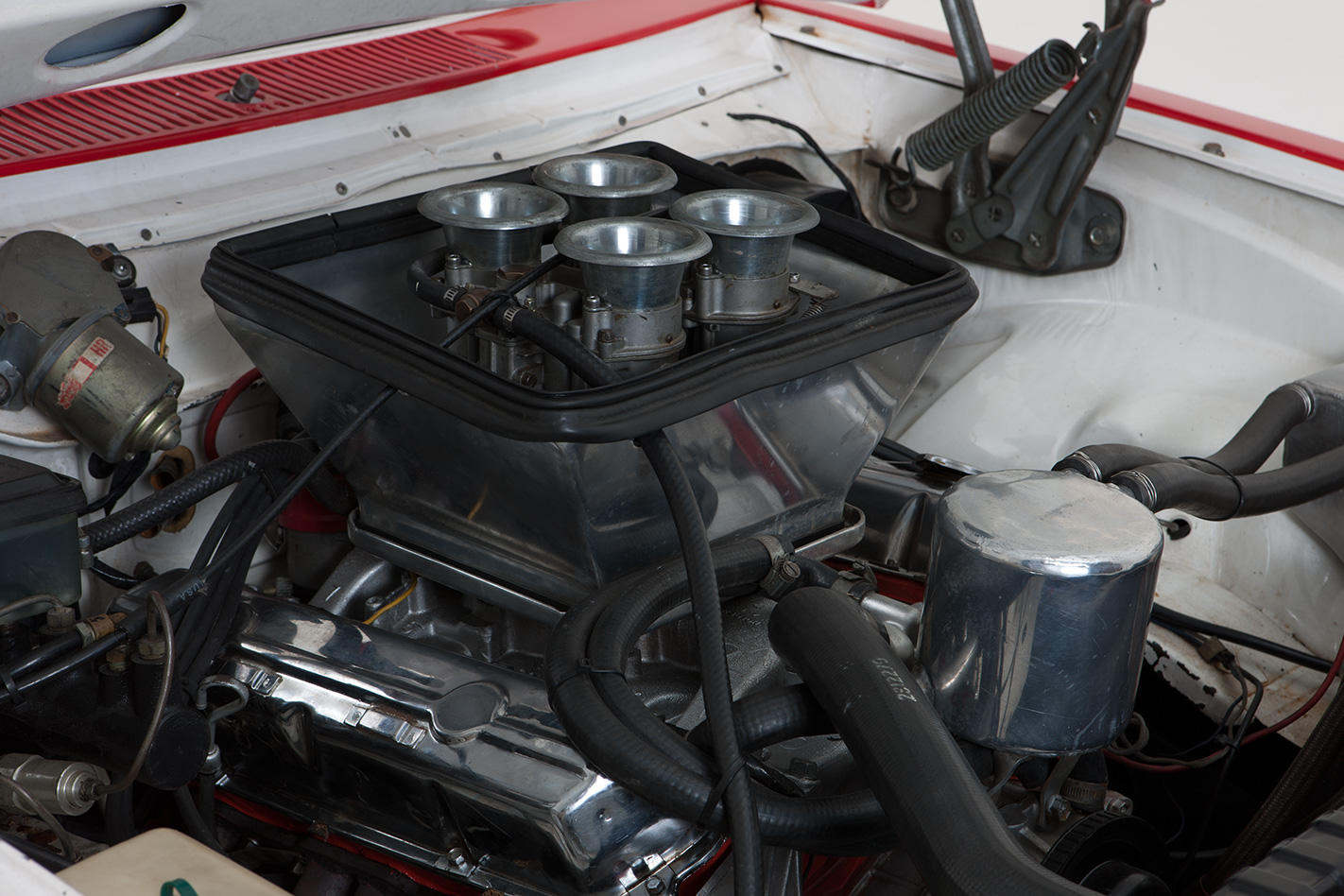
The first race version, the L34, was developed for competition with roller rockers, a larger exhaust system, bigger brakes (from the Kingswood), uprated suspension, flat-top pistons, larger valves, modified porting, and a lightened flywheel.
The 308’s standard Rochester Quadrajet four-barrel carburettor was binned in favour of a larger 780cfm Holley, and visually, the L34 copped bolt-on flares to enable fitment of wider race wheels. More fibreglass appeared in the shape of a reverse bonnet scoop, designed to push air into the fat Holley from the windscreen pressure zone.
The Morris/Fitzpatrick L34 then managed to limp over the line in an emotional victory at Bathurst in ’76. A facelifted LX Torana arrived the same year, and introduced the Torana Hatch.
The new hatchback range spanned a six-cylinder base-model through to a V8-powered SS, which in 5.0-litre form, was the equivalent of the SL/R 5000 sedan. But the major improvement over the LH came with the introduction of Radial Tuned Suspension (RTS) across the LX range in mid-77.
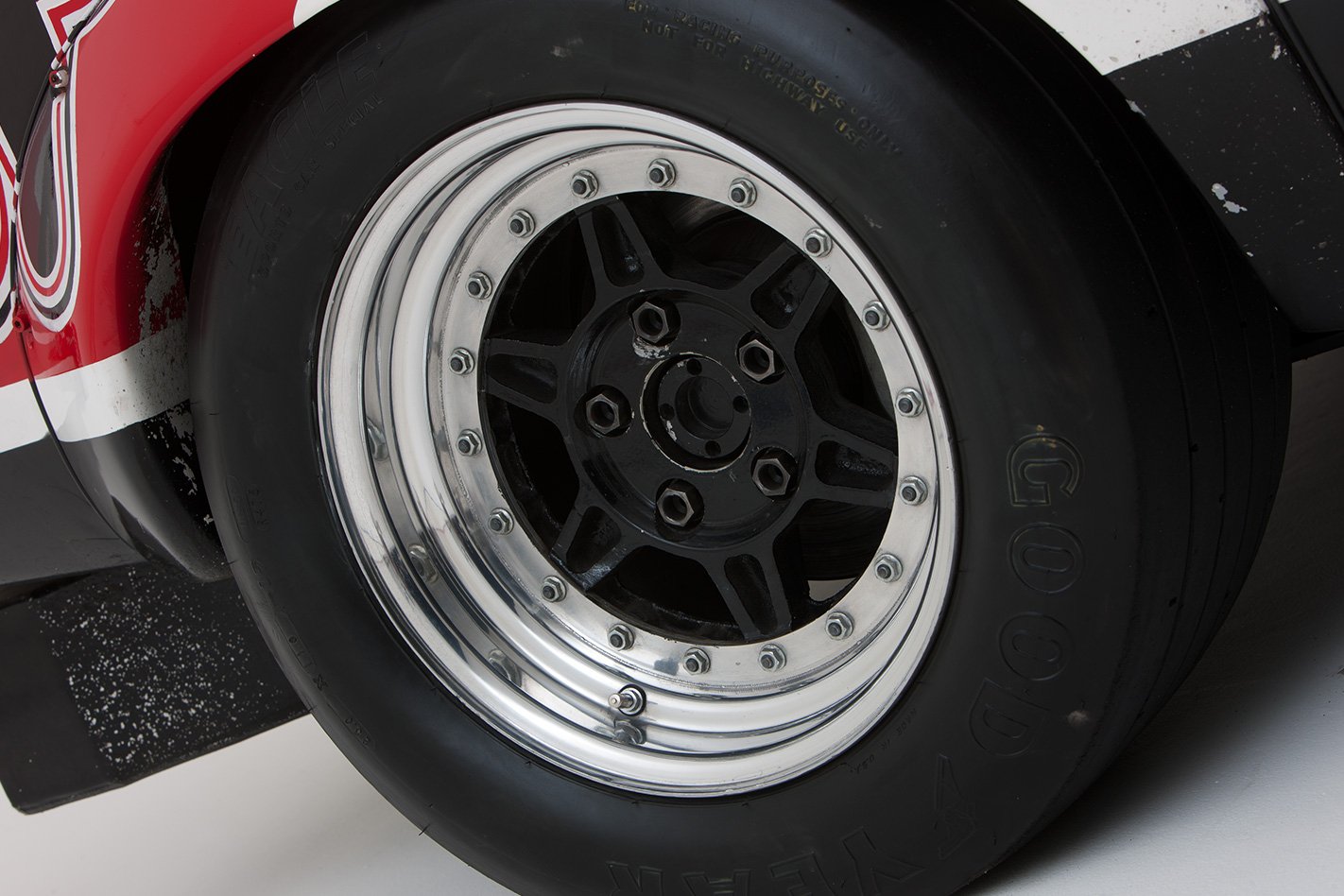
This made the RTS-equipped LX a massive step ahead of the LH in terms of handling dynamics. And it meant that the A9X could be a far superior track warrior – and a better road car – than the L34 LH. The previous L34’s weaknesses on the track centred around its braking system and differential.
And while the LX SL/Rs still used rear drum brakes, the A9X wore four-wheel discs. The race cars featured a stronger rear axle with a 2.60:1 Detroit Locker (the road-going A9Xs used a Salisbury LSD with the same ratio).
But it was these relatively minor changes that built on the L34’s success to make the A9X the ultimate combination of braking, power and reliability for local touring-car competition. Strictly speaking, the A9X was not a model, but an option code available on the LX SL/R 5000 (sedan) and SS 5.0 (hatchback), with 500 required to be built for racing homologation.
The popular image of this car is as a hatch, however 95 were sedans. But the hatch had one major advantage over the four-door in that it could accommodate wider rear tyres, and hence its subsequent favour for tackling Mount Panorama.
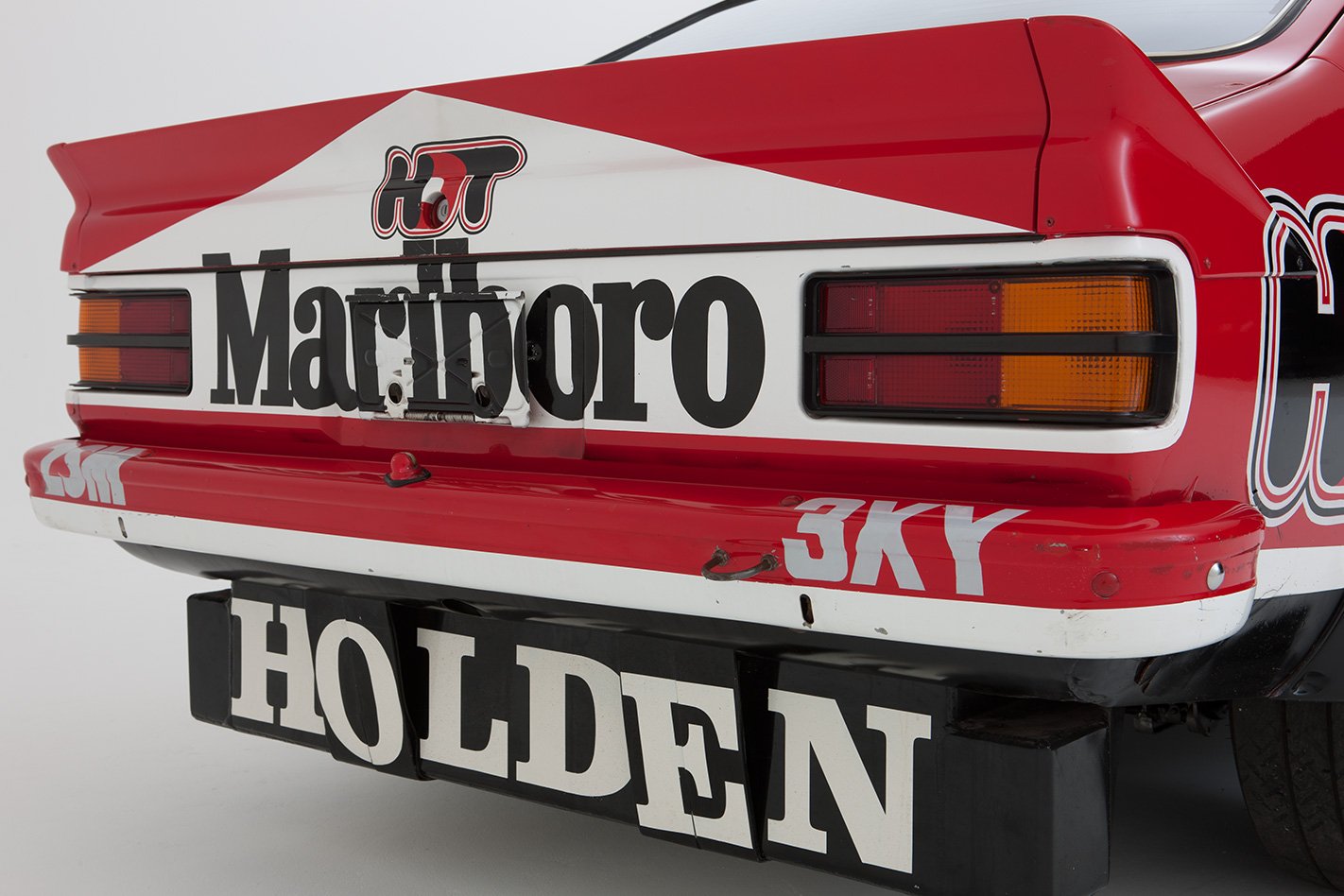
Ford’s demoralising one-two form finish at Bathurst in October ’77 – where Allan Moffat infamously ordered the second Falcon Hardtop to fall in behind his lead car which was suffering mechanical woes – hit the Holden camp hard.
In response to this crushing defeat, two key players joined the Holden Dealer Team which, in hindsight, transformed the outfit into a race-winning organisation whose halo of success shone over Brock’s HDT road-car operation of the 1980s.
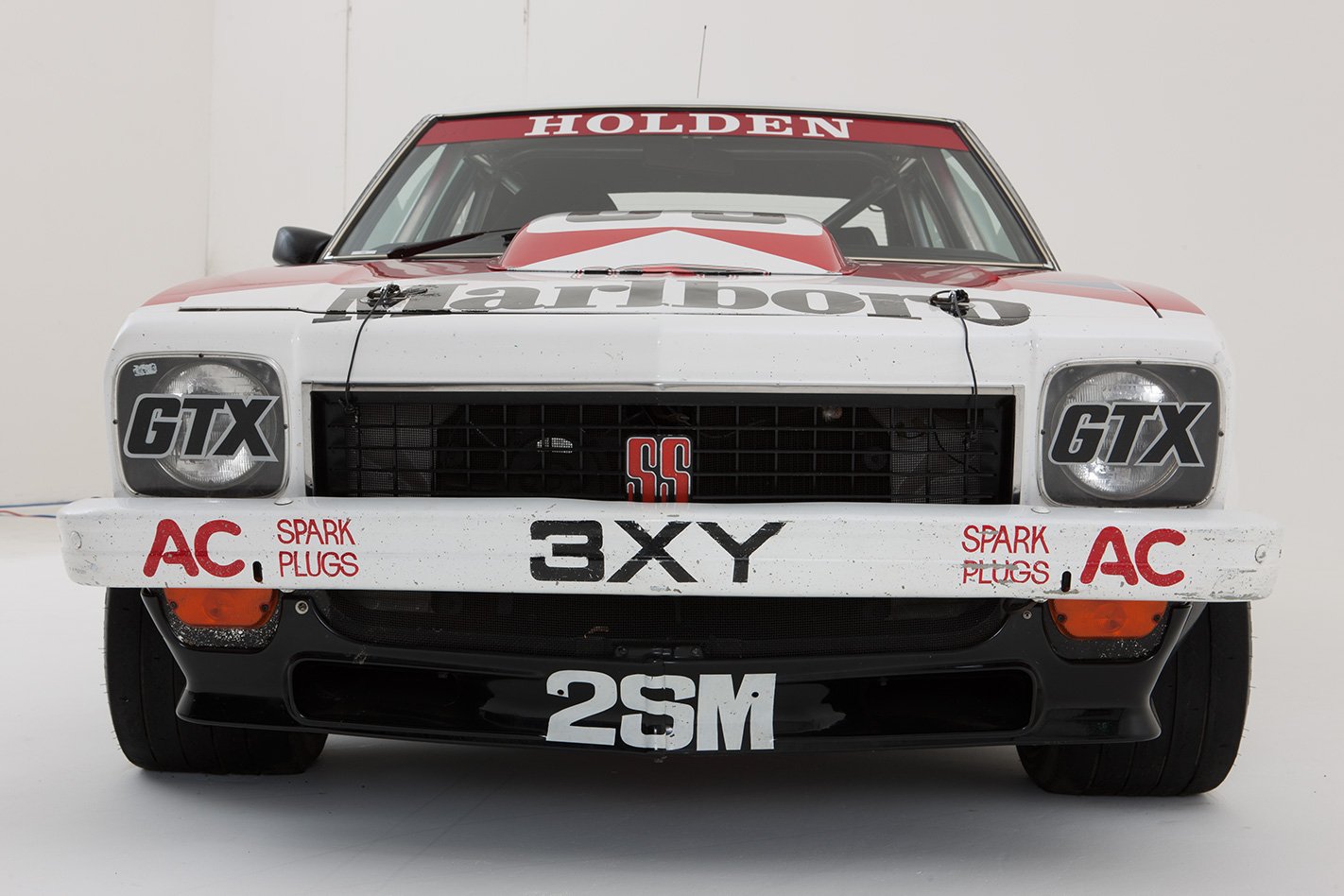
After winning the ’78 Australian Touring Car Championship, Sandown and Bathurst, the Torana A9X’s 1979 Bathurst performance was incredible. Peter Brock put the John Sheppard-prepared, Marlboro-liveried A9X on pole, more than two seconds ahead of Bob Morris, also in an A9X.
And the car slashed more than five minutes off the race record. Such domination was unprecedented and never repeated. The A9X’s performance on that day remains without peer.
And that’s what makes the iconic Holden Torana A9X the most formidable Aussie touring car of all.
ROYAL PURPLE PATCH
John Sheppard’s influence at HDT allowed it to achieve unrivalled success in touring-car history. Between 1978 and 1985, the team won six of seven Bathursts, two championships and an incredible seven consecutive Sandowns. Add the one-two-three victory in the 1979 Repco Round Australia trial, as well as Brock’s establishment of HDT Special Vehicles with the HDT VC Commodore in 1980, and you had an organisation boasting the nation’s best engineers and driving talent.
WHERE CAN I GET ONE? HOW MUCH?
Getting behind the wheel of an A9X is an expensive exercise. The muscle-car boom has seen values soar. Last year, a road-going A9X sedan was sold at a Shannons auction in Melbourne for the princely sum of $192,000. Ex-racecars in pieces command even more coin, but around $150K seems the norm for a road-going A9X, though you’ll have to hunt far and wide to find one. And don’t even think about the value of cars like the 1978 Bathurst winner you see here…
THE GOOD 1. Hero Status: Alongside the XY Falcon GTHO Phase III, the A9X is arguably Australia’s most legendary touring car. And it’s the car that Brock scored his most crushing victory in, too 2.The best of the bunch: The A9X is the Torana’s finest hour – the culmination of years of painstaking development by both racers and engineers. It’s the best Torana Holden ever produced 3. A good investment: The A9X has a permanent slot in Australia’s racing hall of fame, and with such a heritage, will hold its own in the dollar deals. If you’ve got one, you’re basically set for life
THE BAD 1. Park and perve: You wouldn’t buy an A9X as an everyday driver – they’re simply too valuable and probably too precious to insure. Today, it’s the sort of car investors and collectors buy 2. Proof of life: Proving your A9X is the real deal can be tough, as many race shells were fitted with the A9X stuff for competition, and as such don’t have the identifying numbers 3. Orginality: With many street machiners modifying LH/LX Toranas in the ’80s, and the A9X being a supreme racecar, finding a non-modified, factory-spec A9X is nigh impossible
Volkswagen Australia has added more affordable, stripped down versions of its most powerful Golf and Tiguan variants.
The Volkswagen Golf R Grid Edition brings the entry level price of the iconic hot hatch and wagon down $4500 to $47,490 – $500 less than the Golf GTI Performance.
Meanwhile, the Volkswagen Tiguan 162TSI Sportline has the much desired 162kW 2.0-litre turbo petrol engine without the Highline spec extras, for $45,990.
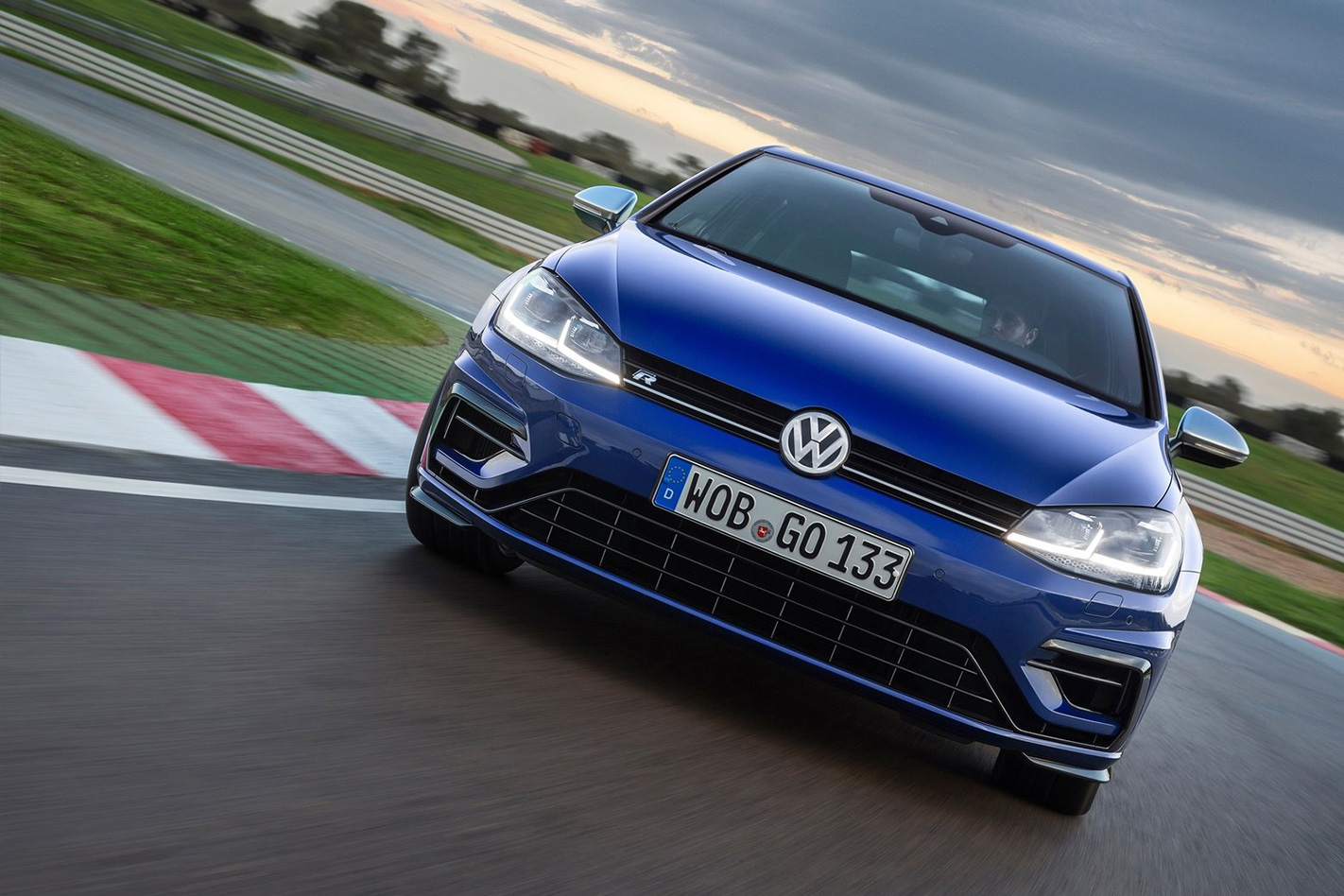
The Golf R Grid Edition is unique to Australia and retains the 213kW/380Nm 2.0-litre turbo engine, 4MOTION all-wheel drive, and seven-speed dual-clutch auto of its more expensive R variants.
Distinguishing features include ‘Race’ sports cloth and Alcantara combination upholstery in place of leather, with black door mirrors and roof rails on the wagon.
The new entry-level Golf R completes what will be the biggest ever choice of Golf R hatch and wagon variants, which also include the standard models and Wolfsburg limited editions which are currently arriving in showrooms.
The Golf R Grid Edition hatch and wagons will arrive in December followed by the permanent return of the Golf R Wagon in January.
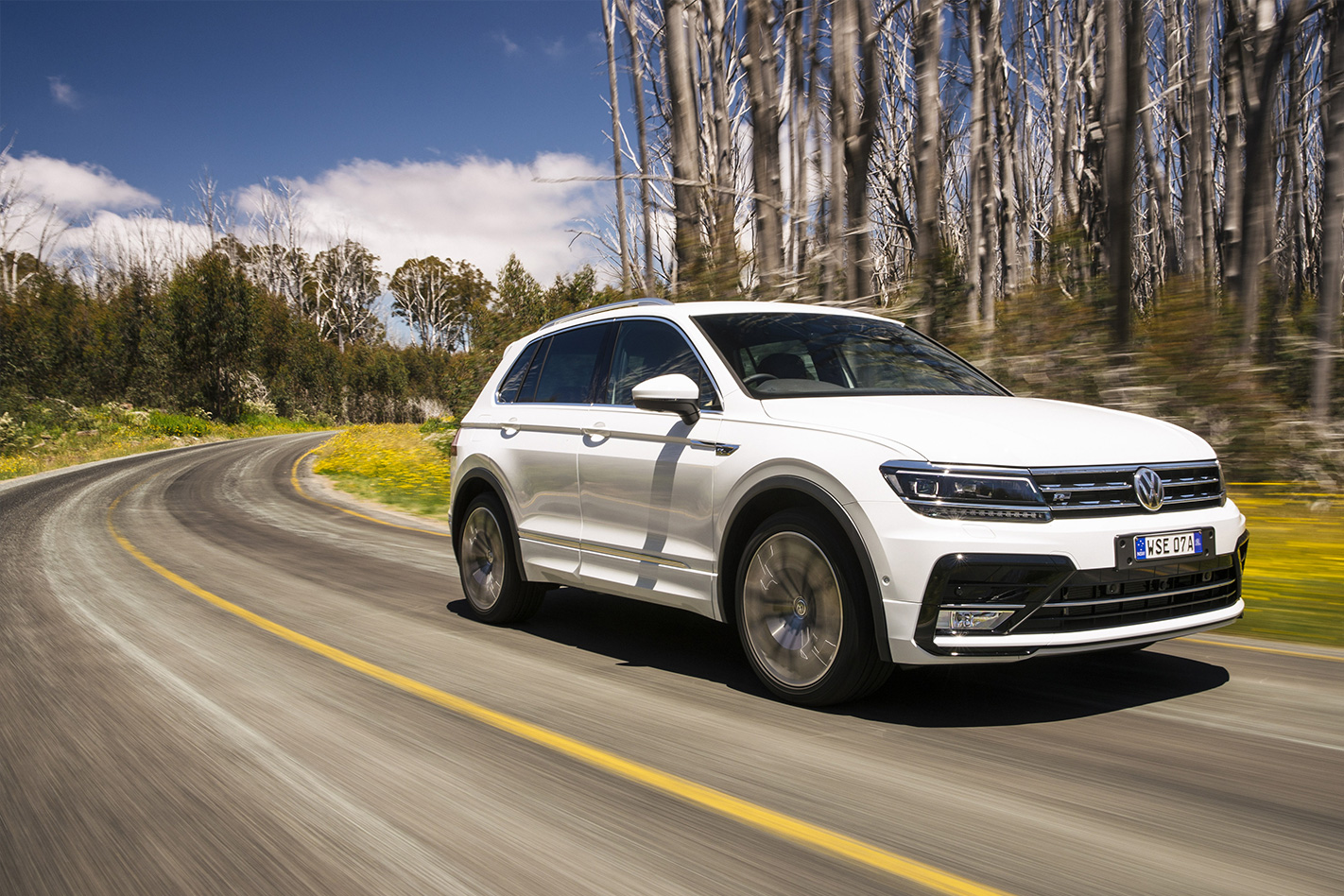
The Tiguan 162TSI Sportsline is also arriving in December, with a $45,990 price tag that bridges the gap between the $41,490 132TSI Comfortline and 162TSI Highline ($48,490).
Standard features include 20-inch Kapstadt alloy wheels, adaptive chassis control, sport comfort seats finished in microfleece and cloth combination upholstery, and key driver assistance technologies such adaptive cruise control side assist and traffic jam assist.
2018 Golf R pricing
- Golf R Grid Edition hatch, manual – $47,490
- Golf R Grid Edition hatch, auto – $49,990
- Golf R Grid Edition wagon, manual – $49,490
- Golf R hatch, manual – $52,990
- Golf R hatch, auto – $55,490
- Golf R wagon, auto – $57,990
- Golf R Wolfsburg Edition hatch, manual – $57,990
- Golf R Wolfsburg Edition hatch, auto – $59,990
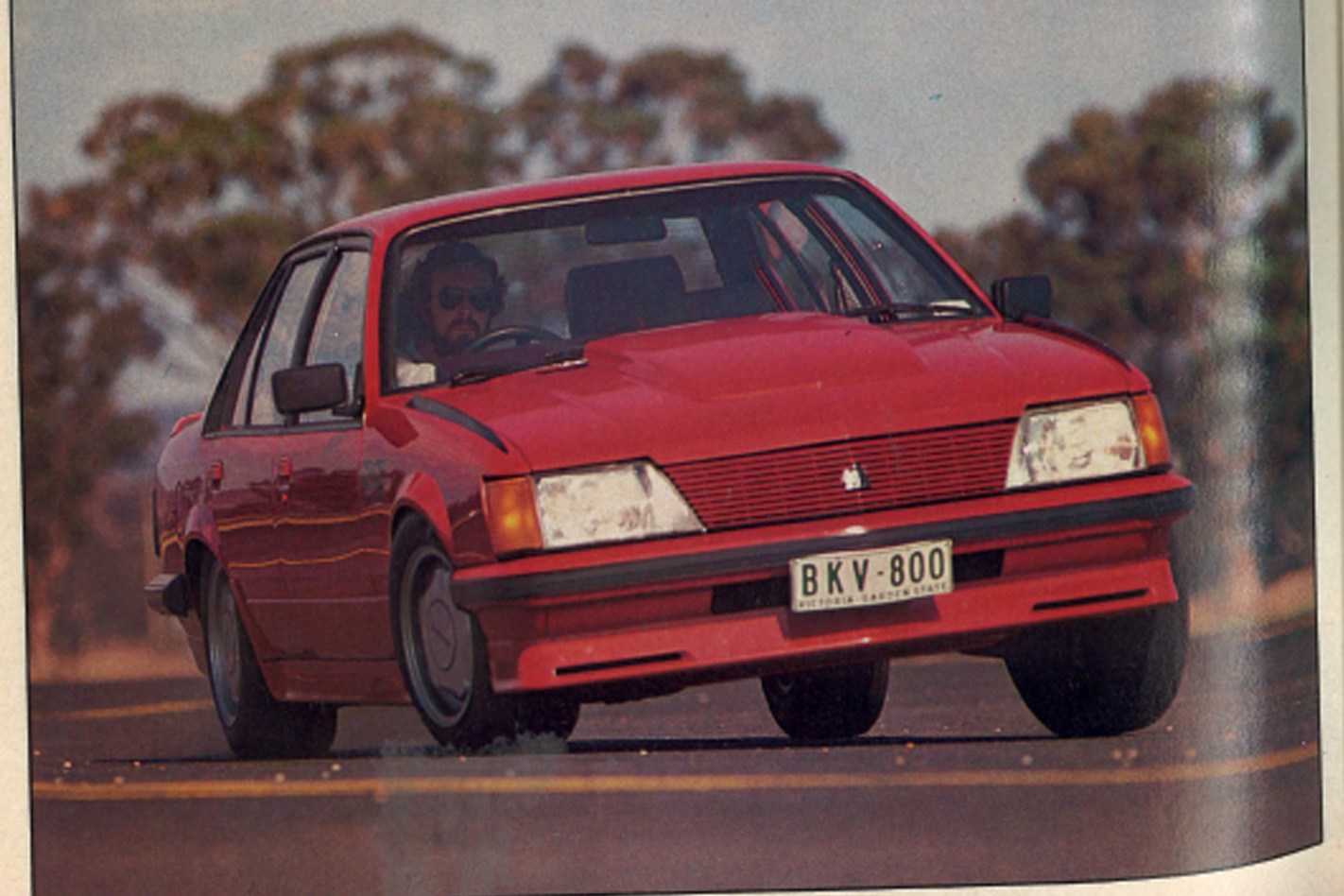
AMONG THE Commodore SSs which crowd Leveson St, North Melbourne, outside unprepossessing premises signed HDT Special Vehicles, Peter Brock’s own car looks quietly superior.
It’s red like all the other SSs parked in a double line down the centre of this wide Melbourne street, but there’s something about its bulges and wheels and flashes of black on the front guards that suggests it has extra to offer; more even than the Commodore HDT, a couple of which lurk nearby, heavily suggestive with their rounded wheel-arch extensions and louder striping and badgework, but lacking the red car’s low-key assurance. You know this is the car long before Peter‘s brother, Phil, comes out to hand over the keys.
There’s a label attached to the keyring with the handwritten scrawl: Peter’s car. You would think there a remote chance of Phil Brock, affectionately known as Splitpin, being Peter’s distant cousin, let alone brother. He’s much taller than the Bathurst champion and has what a diplomat would describe as a face of character. He sees but ignores the silver ESP Falcon parked nearby, the car that has brought us to Melbourne the night before as easily as only 400 Nm of torque and a four-speed can, and asks if I can try the special stereo gear fitted to Peter’s SS, if I get the chance. It’s $1400 worth he says, in a tone that half suggests it might be a little excessive. I ask if the 14.6 second 400 m ime is fair dinkum. He says it is. I forget to ask how many revs you have to use to get that.
Later, at Mangalore airstrip north-west of Seymour, the five-litre V8 engine shatters the cemetery quiet with a moderate 5000 rpm, taking Peter Brock‘s red car, the first of the SS Group Threes, past the 400 m mark in 15.1 seconds. Disappointment is marginal.
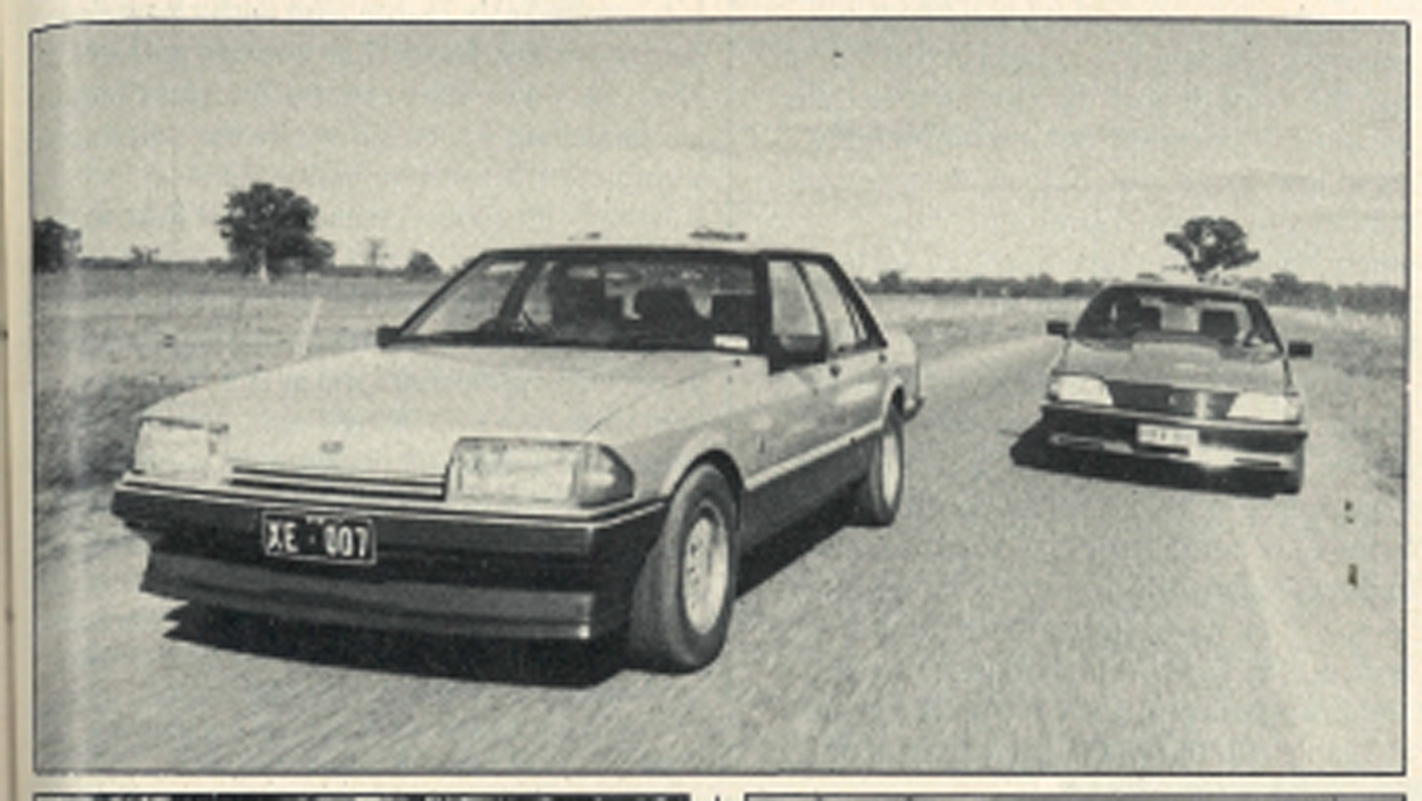
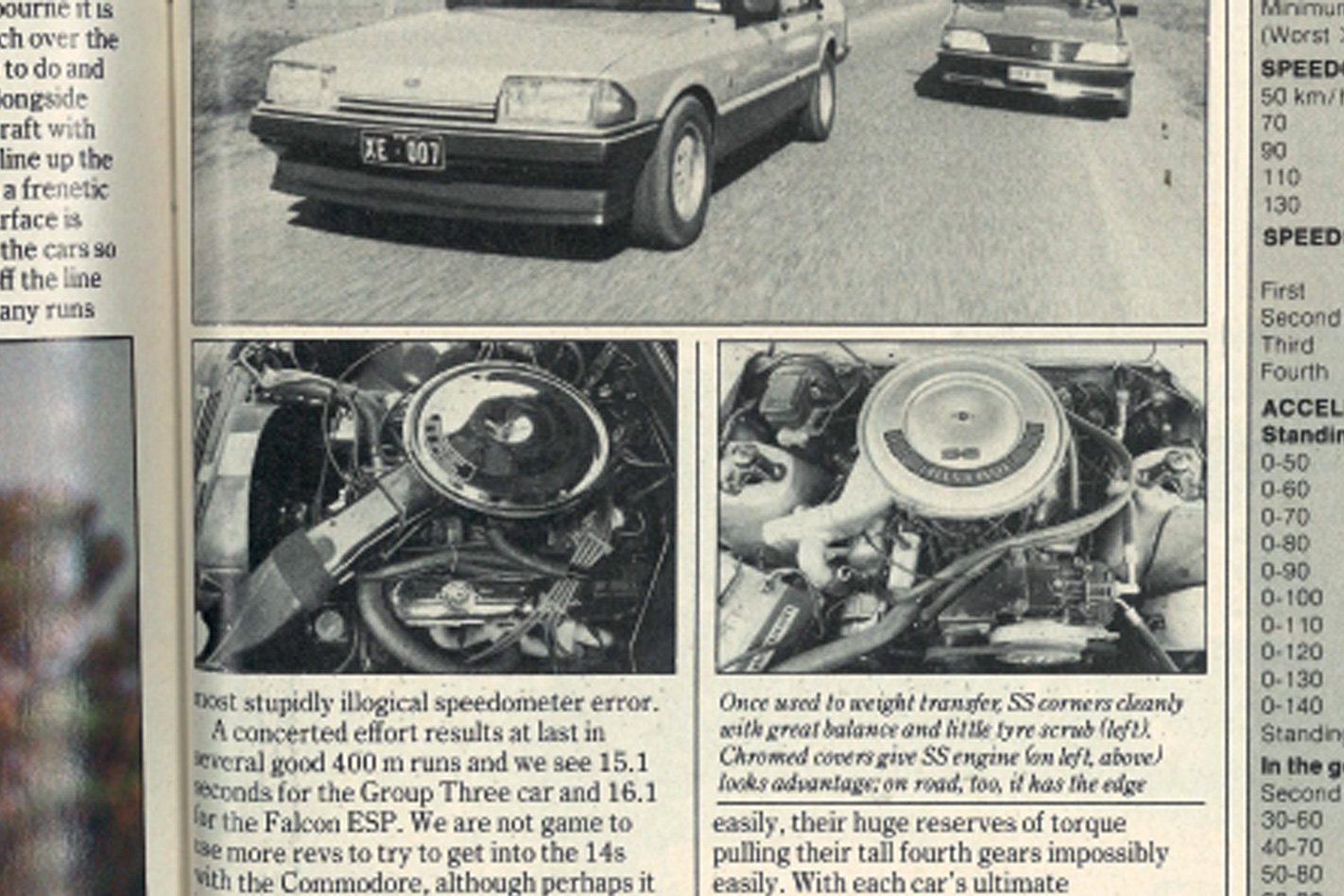
The badges say Fairmont Ghia but with that engine and transmission it can only be regarded as a Falcon, a Ford in a tradition of Ford muscle cars but also cognisant of the pressures of 1982: we have no complaints at 6.4 km/l consumption. Nor do we miss the enormous slice of power this engine is now lacking since it powered the GTs and GTHOs of the late ’60s and early ’70s, not on the Hume Highway, anyway, for 149 kW is enough for most public roads even when it’s dragging a tonne and a half around. The engine’s one-time output of 200 kW-plus would have been better able to protect the HO’s heritage at the figures-getting session.
In a time, rapidly reaching Australia, of turbocharged fours and injected sixes it’s a surprise we have available in this country any V8 of 5.8-litre capacity, and, of course, Ford’s all-iron lump isn’t long for this world. Production stopped in mid ’82 and, it has been confirmed, won’t be started again. Availability for several months now has been on and off as the special stock set up by Ford, originally to last three years, diminished. Ford has kept a low profile on the 5.8, and those who didn’t sift through April ’82’s launch material on the XE Falcon range could be forgiven for thinking it was dead already, the little information there was being well buried (the 5.8, despite improvements to its economy, hardly fitted into Ford’s picture of the six-cylinder XEs with their significantly slaked thirst). The 5.8 is probably a cause of embarrassment for Ford in the months before its fuel injection sixes arrive: demand is still high — the police still want it, for instance, and the cupboard is just about bare.
Socially irresponsible a 5.8-litre engine may be to some, but equally there’s no doubt many, many others will regard a switch from a V8 to a six, however much power it has, a difficult-to-accept comedown.
Still, Ford public relations department, under pressure from motoring journalists, made available a 5.8 four-speed test car towards the end of ’82; it probably would have preferred not to have done so, for from Ford’s point of view now cannot be the time for column inches praising something as supposedly inefficient as a. 5.8 when around the corner lurks technology just itching to thrust one of Australia’s most popular big cars into an era of efficiency.
GMH, too, recognises that big-capacity V8s are not in keeping with the image a forward-looking car-maker wants to project. But unlike Ford, which converted its Geelong V8 line to make the new four-cylinder engines for the Telstar, GMH, faced with a similar production dilemma with the Camira’s Camtech engine, chose not to sacrifice its bent eights, and today retains its V8 line, albeit today it’s much more slow-moving than in the heyday of the V8 muscle car.
No one can say how long the General’s V8s will last: an optimistic Phil Brock says the SS’s five-litre and the 4.2, which at HDT’s hands benefits from a greater percentage power boost than the five, has given results which must guarantee continued production by GMH. Certainly that production has recently been upped (the decision was apparently taken before the favourable Bathurst result): to the original run of 500 SSs to be built by the end of October we can add an extra 200 by Christmas and another 700 between February and March ’83, making a planned total of 1400 cars in seven months. Phil Brock says 500 of these will have the five-litre.
The Commodore SS is a GMH model. It is a base car built up around a 4.2-litre V8 four-speed, and to save weight it comes without some luxury trimmings such as air-conditioning. lt still has most of the Commodore’s convenience items – a dipping mirror is one inexcusable omission – and with its inviting interior trim certainly doesn’t give the impression of being a ‘stripped’ special. HDT Special Vehicles, acting as an outside supplier of GMH, offers three levels of development on this basic SS, regarded as dealer/purchaser options.
Instead of being shipped to the dealers those cars requiring the Group One, Two or Three treatment are taken direct to Leveson St from the factory. The three levels, with all changes and additions tested, ADR’ed and warranted by GMH, are priced separately for addition to the SS’s base price, which is $13,3S5. Group One adds to the SS the HDT suspension kit – reset and rerated coil springs, a bigger front and smaller rear anti-roll bar, heavy duty top strut bearing mounts, Bilstein front strut inserts and Bilstein rear dampers and revised geometry – a chromed and bigger capacity air-cleaner, heavy duty brake master cylinder and Uniroyal tyres. The body gets a ‘Group One’ decal, and there are more decals inside along with sports steering wheel, HDT gearshift knob and footrest. Group One costs $1995.
The Group Three 4.2 costs $4750 and with it you get everything mentioned so far plus a blueprinted ignition system — power is similar to the Group Two’s at 153 kW — 15 inch Irmscher alloy wheels with 225×60 Uniroyals and, on the body, a front air dam and extended sills. Optional is a bonnet scoop which is the only other body mod available, although you can have the HDT’s flares to special order. Like the HDT’s styling mods, the SS’s visual revamp is the work of GMH’s design chief Leo Pruneau (who, incidentally, is presently busy putting the final touches to the HDT Camira).
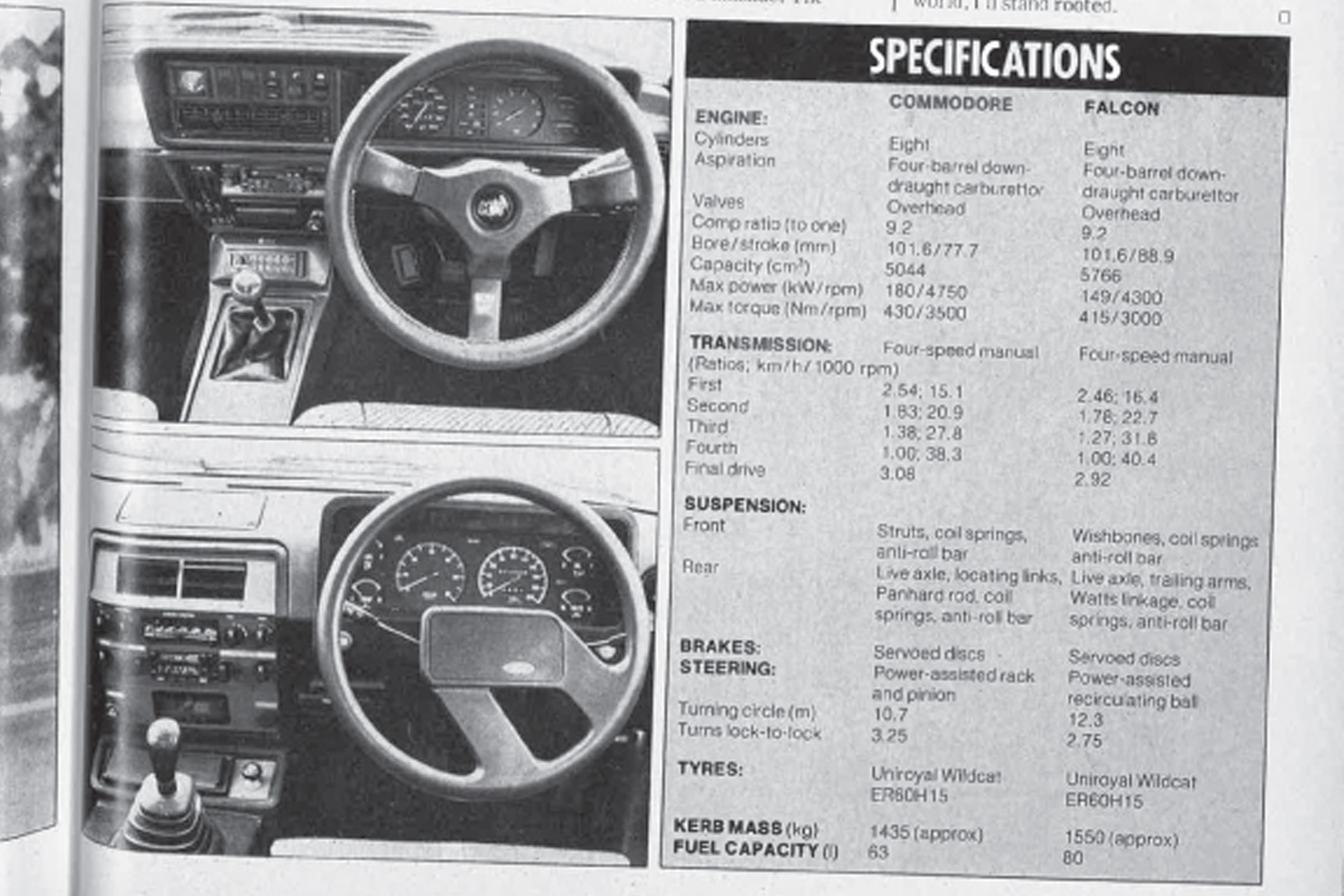
Five and a half grand gets you the Group Three SS with the five-litre engine; the big VS only being available with the Group Three pack (Phil Brock says candidly the lesser SSs cannot adequately handle the five’s power). An important change over the 4.2 is in the use of harder rear suspension bushes. The bonnet scoop is standard. The big V8 gets the similar treatment to the 4.2 – in simple terms, a thorough ‘head job’ beloved of the custom car fraternity: big-valve heads, gas flowed inlet manifold and blueprinted ignition system with, waiting in the wings for an ADR clean bill of health, exhaust headers. Power of this ultimate Commodore goes from the standard five-litre’s 132 kW at 5000 rpm and 364 Nm at 3000 rpm to 1SO kW at 4750 and 430 Nm of torque at 3500.
A heavier clutch pressure plate is fitted, the brakes – all disc, of course like the Falcon- benefit from Castrol GT LMA fluid and a bigger master cylinder, and the steering, too, is remarkably little changed, though there is a discernible difference in feel thanks to the revised front end geometry (to reduce the standard car’s maximum negative camber and increase positive castor). Like the Falcon, too, the Group Three five-litre, like all SSs, comes with a limited slip diff running a 3.08 ratio (significantly taller than the equivalently tyred HDT with a 3.36, but still a little shorter than the very long-legged Falcon’s 2.92) and it uses GMH’s own M21 close-ratio four-speed. Tyres on both Falcon and Commodore are Uniroyal Wildcat ER60H15s.
Phil Brock doesn’t wait to see us go. He disappears back inside the unprepossessing HDT premises as we fire up the 16 cylinders of the Group Three and the Falcon, the two fastest Australian-built cars and the only two models these days to use a V8. Perhaps — probably the last of the Aussie V8s, last of the muscle cars. I turn the Group Three in a U-turn around the swag of red SSs parked in the middle of Leveson Street, tuck in behind the ESP and head for Mangalore.
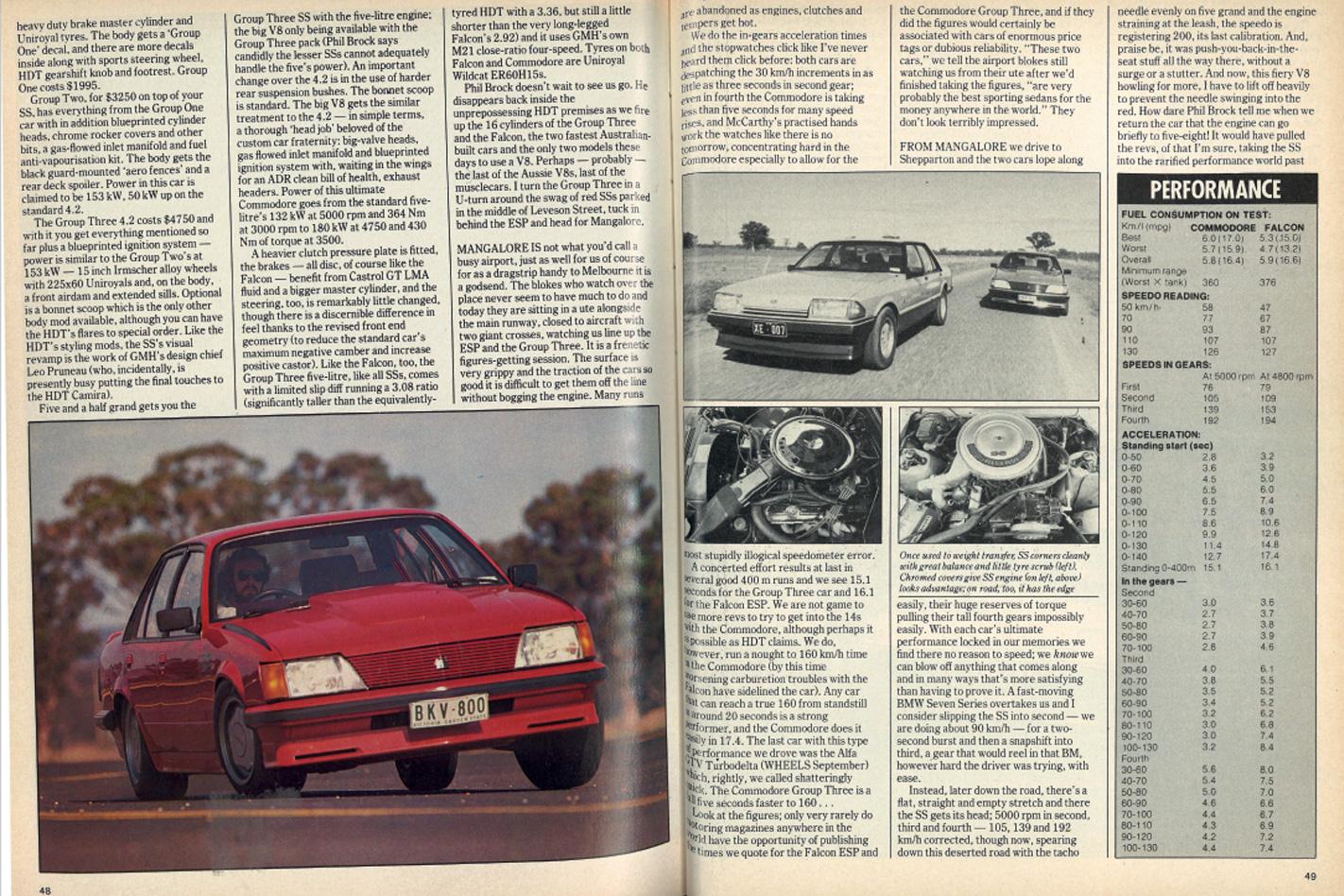
We do the in-gears acceleration times and the stopwatches click like I’ve never heard them click before: both cars are despatching the 30 km/h increments in as little as three seconds in second gear; even in fourth the Commodore is taking less than five seconds for many speed rises, and McCarthy’s practised hands work the watches like there is no tomorrow, concentrating hard in the Commodore especially to allow for the most stupidly illogical speedometer error.
A concerted effort results at last in several good 400 m runs and we see 15.1 seconds for the Group Three car and 16.1 for the Falcon ESP. We are not game to use more revs to try to get into the 14s with the Commodore, although perhaps it IS possible as HDT claims. We do, however, run a nought to 160 km/h time in the Commodore (by this time worsening carburetion troubles with the Falcon have sidelined the car). Any car that can reach a true 160 from standstill in around 20 seconds is a strong performer, and the Commodore does it easily in 17.4. The last car with this type of performance we drove was the Alfa GTV Turbodelta which, rightly, we called shatteringly quick. The Commodore Group Three is a five seconds faster to 160…
Look at the figures; only very rarely do motoring magazines anywhere in the world have the opportunity of publishing the times we quote for the Falcon ESP and the Commodore Group Three, and if they did the figures would certainly be associated with cars of enormous price tags or dubious reliability. “These two cars,” we tell the airport blokes still watching us from their ute after we’d finished taking the figures, “are very probably the best sporting sedans for the money anywhere in the world.” They don’t look terribly impressed.
FROM MANGALORE we drive to Shepparton and the two cars lope along easily, their huge reserves of torque pulling their tall fourth gears impossibly easily. With each car’s ultimate performance locked in our memories we find there no reason to speed; we know we can blow off anything that comes along and in many ways that’s more satisfying than having to prove it. A fast-moving BMW Seven Series overtakes us and I consider slipping the SS into second – we are doing about 90 km/h — for a two-second burst and then a snap-shift into third gear that would reel in that BM, however hard the driver was trying, with ease.
PIaying things strictly by the book, the Falcon has the higher top speed, 194 km/h at fewer revs than the Commodore — the Ford’s red line is 4800 and feels it — but in a longer-striding (40.4 instead of 38.3 km/h/1000 rpm) fourth gear. The Falcon takes twice or three times the length of road to get to its top speed, which is still mightily accelerative but not in the Commodore’s neck-snapping class. Past 160 km/h there’s a noticeable tailing off of urge as weight and wind resistance sap the reserves.
In the lower ratios similar maxima are available except in third which is usefully longer than the Commodore’s; in any car but the Group Three SS there would be a hole between third and fourth.
Big capacity V8s with four-speeds, especially the American-derived variety, are not known for their snap-action gearshifts, light clutches or quiet cogs and neither car breaks with the tradition. Except for the Falcon’s gearshift it’s a delight to use. The lever is short and has a firm, German-type feel to it in its well-defined, short travel gate. The clutch pedal, too, though heavier than the Commodore (and tiringly heavy in traffic) works progressively and has a short travel which coordinates much better with the gearshift, especially since the accelerator is well-placed for easy heel and toeing. With a longer, floppier and notchier gear lever, coupled with a longer-travel clutch the Commodore lacks the Falcon’s gear-changing finesse. Both have plenty of truck-like gear whine in second and third ratios, the Ford the most.
Both cars are good to drive and ride in, when going quietly being staggeringly similar to their cooking-model brothers. There’s more bump-thump from the bigger tyres (though generally the Uniroyals are very quiet, apart from an annoying tendency to squeal in the Falcon) and the rides of both cars are firmer than normal but certainly not uncomfortably so: at low speeds the Falcon, despite some unnecessary body movement, copes smoothly with the type of rough surfaces that give a hint of jiggling in the Commodore.
They are designed for going very long distances very quickly and both do the job superbly. The Falcon does it quietly, softly and lightly – too lightly, for the steering, although good at the straight-ahead and accurate, is too light for comfort at the ESP’s potential cruising speeds. The Commodore does the same job significantly faster, and with crispness and accuracy. From that you will gather that one is a cruiser and one’s a racer, but in the Group Three SS’s case the roles are completely interchangeable for it is certainly as good a cruiser as the Falcon.
The’ Falcon 5.8 can’t slip so easily into the role the Commodore is so good at. Apart from the steering lightness, the ride is patently underdamped at the front end and this shows up in high-speed wallowing over humps and on occasion as we found a disconcerting tendency to find the bump stops. The Falcon also twitches on bumps mid-corner, heightening the often present, but never excessive, understeer. The engine and brakes – superbly powerful and progressive – are two steps ahead of the chassis in being able to provide ultra-fast cross country times. Stiffer dampers would, we presume, harm the low-speed ride too much, a shame, but then if it has to be a compromise, probably the Falcon has the right balance, especially since it is such a gentle and predictable car to handle.
Another magazine that shall remain nameless (Modern Motor) recently said the 5.8 ESP was a difficult car to drive quickly. It is nothing of the sort, for although the car may have deficiencies, it certainly has no vices. Pushed very hard its handling is almost graceful, Jaguar-style. Understeer and oversteer are slow motion actions which, even when deliberately provoked in tight corners as they can easily be, require minimal correction. For all its weight and bulk and power this Falcon feels tame and – as best shown on in high-speed cornering on smooth roads – well balanced. Whatever Dick Johnson may say about his racing Falcon, there is no viciousness in the road-going ESP.
The Group Three SS you tame. You must tame it to get the rewards, and at first it’s an intimidating car. Peering up and out over the dash to the big air scoop on the bonnet, practising the clutch and gearchange, not as well synchronised as the Falcon’s, remember, all these things take acclimatisation and it’s best to be sure before you unleash all that performance. At first that performance is simply frightening; this car in the wrong hands doesn’t bear thinking about. But for the luxury trim, the quietness and suppleness of the ride, you could easily think you’d climbed on board 05 by mistake.
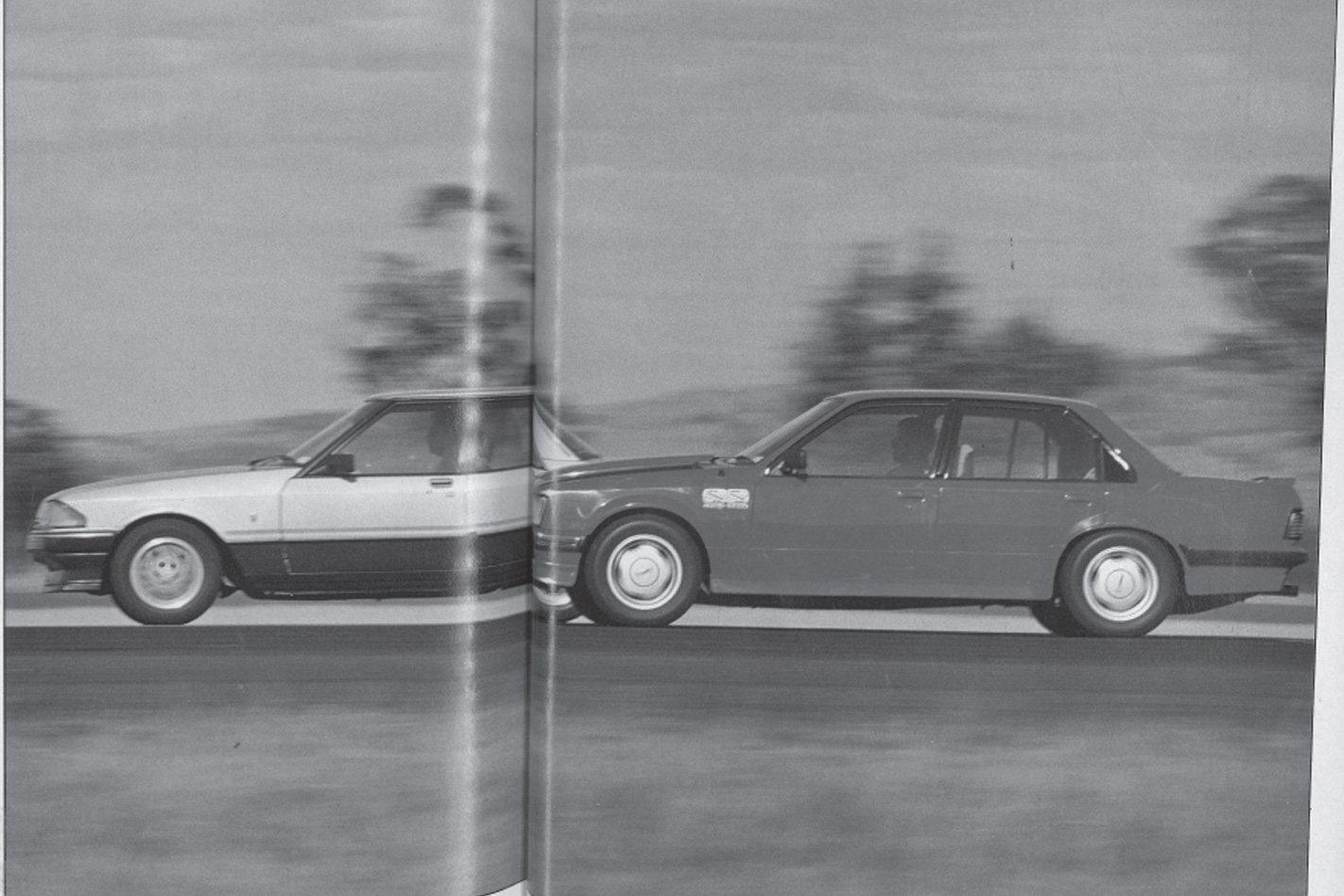
Indeed, the rear-end heaviness is just a feeling, a premature warning for the unambitious. There is nothing beyond it to surprise the driver: nothing but a new bite from the tyres as the weight settles and the body flattens and as full noise goes on to take the car around – neutrally, in a four-wheel drift or in a tailslide. The driver has the choice. Bumps are taken in the car’s stride and the damping provides a standard of high-speed control the equal of many exotics, and better than some because there is never any harshness. The Group Three SS starts where the Falcon ESP stops.
If the Falcon gave me a drive to respect — and would do again, on the homeward run to Sydney — the Group Three SS provided the experiences to remember. Going up through the gearbox and feeling the wall of torque hit us in the back as the clutch is released. Holding a powerslide for 50 m around our makeshift corner at Mangalore, revelling in the balance of the rear. Spearing fast along the roads going to Eildon, straightening a series of chicanes with an easy flexing of the wrists on that lovely leather wheel. Braking deep and late into corners and accelerating out to 5000 rpm just to hear the engine’s healthy wail, never intrusive but always satisfyingly audible.
It’s a racing car for the road, you say? No. the Group Three SS is much, much more than that. lt’s a sports sedan, a blend of accomplishment and accommodation, or purpose and practicality. And if it’s not the best sports sedan for the money in the world, I’ll stand rooted.
Today sadly marks the 10th anniversary of Scottish rally superstar Colin McRae’s death, killed in a helicopter accident along with his son Johnny and two family friends.
One of the greatest talents ever to sit in a rally car, McRae continues to be the biggest star the WRC has ever seen, his win-it-or-bin-it style endearing him to legions of rally fans all over the world.
There’s no better way to remember him than to remember what he did best, which was drive a rally car faster than it really wanted to go, so we’ve gathered together a collection of his finest moments.
1992 Rally Finland
McRae arrived on the world stage in a big way in 1992. He finished a sensational second in the snow of Sweden and followed that up with fourth on the rough-and-tumble Acropolis Rally.
But it was Finland that made him famous. Colin had a massive crash in testing, and followed that up early in the rally with an even bigger one. The car was rolling scrap, but he continued to drive it flat out, winning thousands of Finnish fans in the process.
1995 Wales Rally GB
Come 1995, McRae was battling for the world championship, and was incensed when Subaru ordered him to finish behind team-mate Carlos Sainz in the season’s penultimate round, Rally Catalunya.
Suitably fired up, McRae destroyed Sainz and everyone else on pure pace on his home event to become the WRC’s youngest ever title winner.
2001 Wales Rally GB
Once again Colin entered the season’s final round locked in a battle for the world championship, this time with his old nemesis (but good friend) Tommi Makinen and fellow Brit Richard Burns.
Unfortunately for Colin, his rally would end with an enormous accident on the first day, handing the title to Burns, but before that the Flying Scotsman was driving at unbelievable speeds. Below is one of the most amazing onboard videos ever recorded.
2005 Rally of the Lakes
Following his exit from the WRC, McRae indulged in some rallying for his own enjoyment, including a couple of round of the Irish Tarmac Rally Championship in his wild Ford Escort Mk II.
With 246kW pushing just 930kg and the sequential ‘box from the Focus WRC, it was no ordinary Escort and combined with Colin’s incredible talent, he gave a few modern World Rally Cars a fright on his ‘fun’ outings.
2005 Rally Australia
Colin’s WRC return came with Skoda of all teams, a last-minute replacement for the final rounds of 2005. Despite the Fabia WRC being an uncompetitive car, Colin was battling for second place when a routine clutch change went awry, costing the Skoda team its first podium finish since the 2001 Safari Rally.
2006 Donegal Rally
Another of Colin’s ‘just for fun outings’ was on the 2006 Donegal Rally, another round of the Irish Tarmac Championship. This time is was in the legendary MG Metro 6R4 Group B car, and Colin put it to good use, setting stunning stage times.
Despite a few very large moments, McRae once again kept the modern World Rally Cars honest in a car that had no business being that fast.
2006 X Games
One of Colin’s final competitive appearances only enhanced his fame, making him a massive star in the US. During the final for the rally segment of the Games, McRae was set for the gold medal before rolling heavily near the finish.
In true McRae style he merely selected first and dropped the clutch, missing the win by a mere 0.6sec. RIP Colin.
AS OFFICIAL pics finally emerge of the new Genesis G70 – the crucial premium mid-size model that will lead the brand’s 2018 launch in Australia – expectations continue to grow. Wheels will drive the car in Korea on September 16, and you can read our first impressions here on Monday.
Here’s what we can tell you so far: the Genesis G70 goes on sale in Korea next week; Australian deliveries will begin in the first quarter of next year. Hyundai Australia is unable to be any more specific than that.
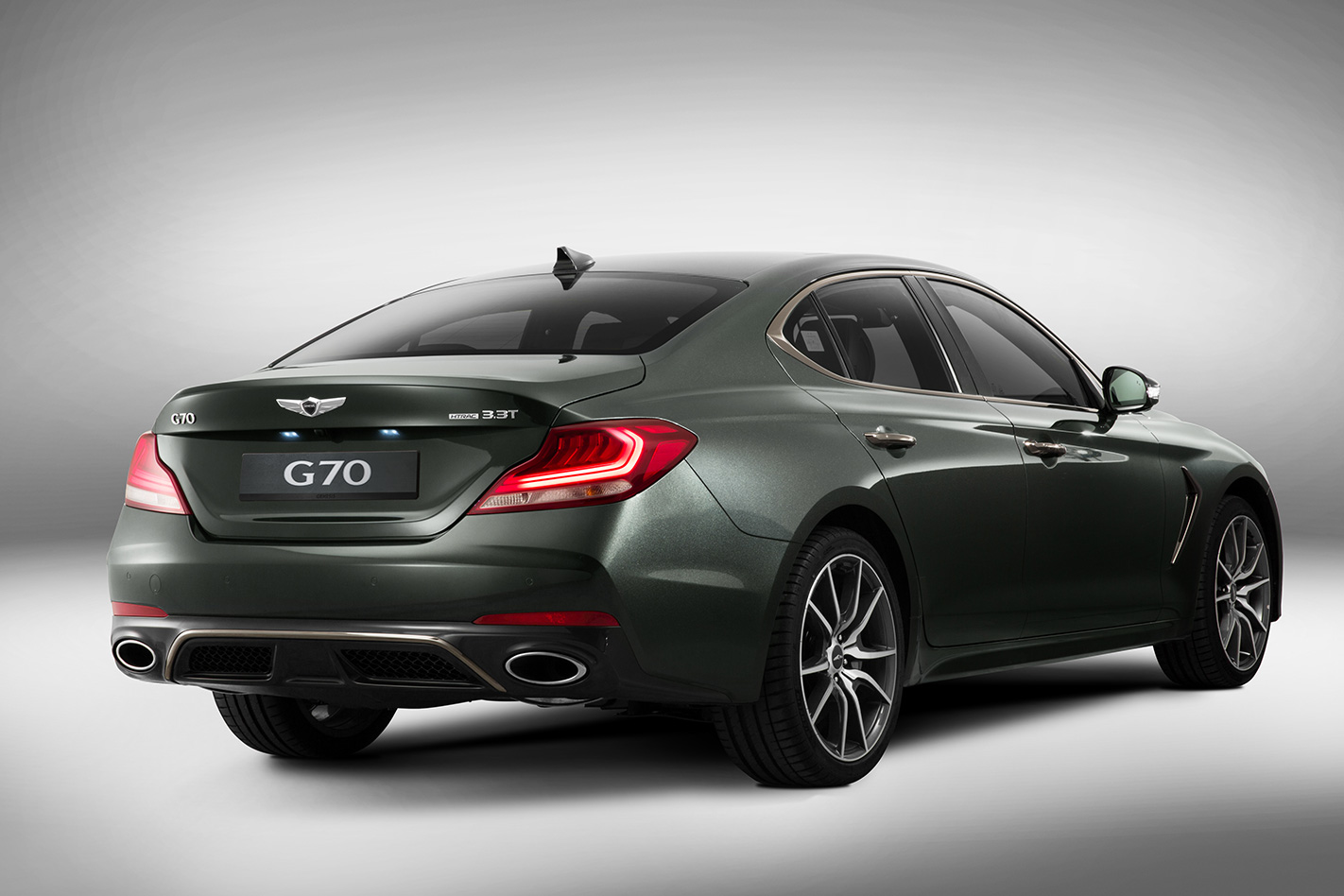
Both these engines are shared almost directly with those powering the new Kia Stinger, so that car provides the best indicators of performance and consumption at this stage, given that G70 weights should be down only slightly, and not significantly dissimilar.
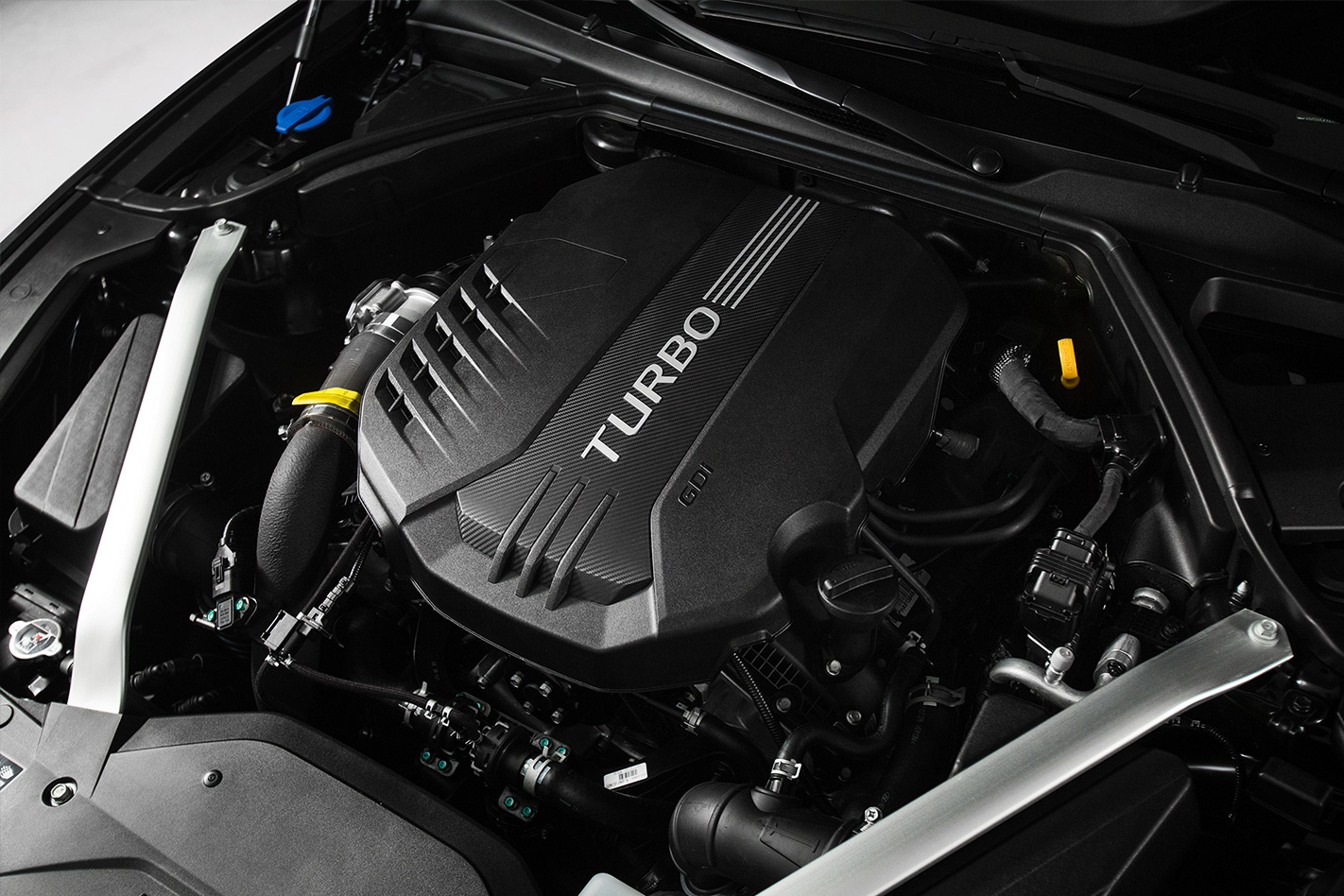
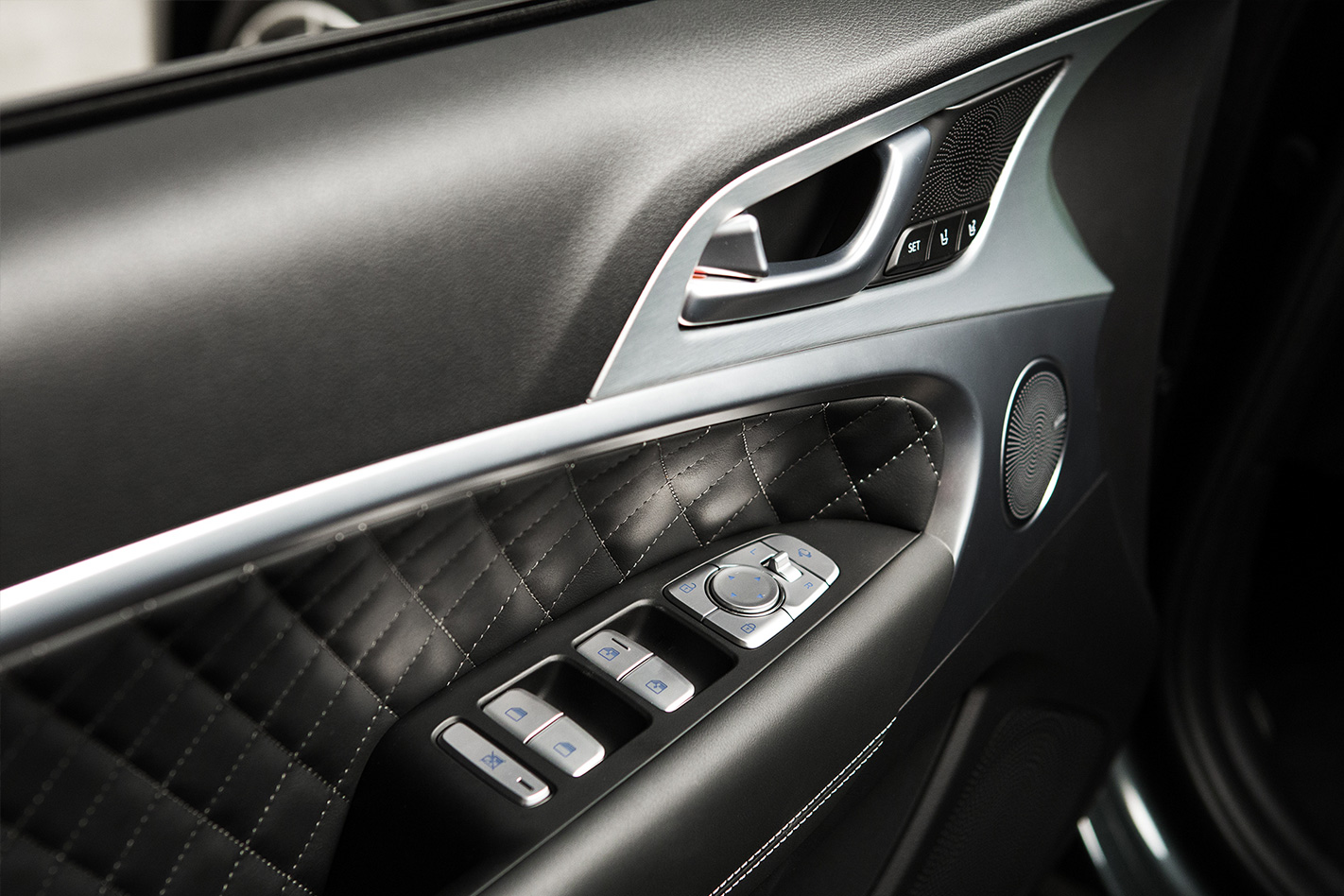
There’s no confirmation at this stage as to what Hyundai Australia will name the three spec levels offered for each engine choice, nor what the equipment levels will actually be. What we do know is that a semi-autonomous ‘Highway Assist’ system will feature on (at least) the top-spec models, launch control will be in the mix, and a mechanical limited slip diff and dynamic torque vectoring will be fitted (at the very least) to the middle- and top-spec V6 models. Expect adaptive dampers on all three V6 models; passive dampers fitted to all three of the four-cylinder models.
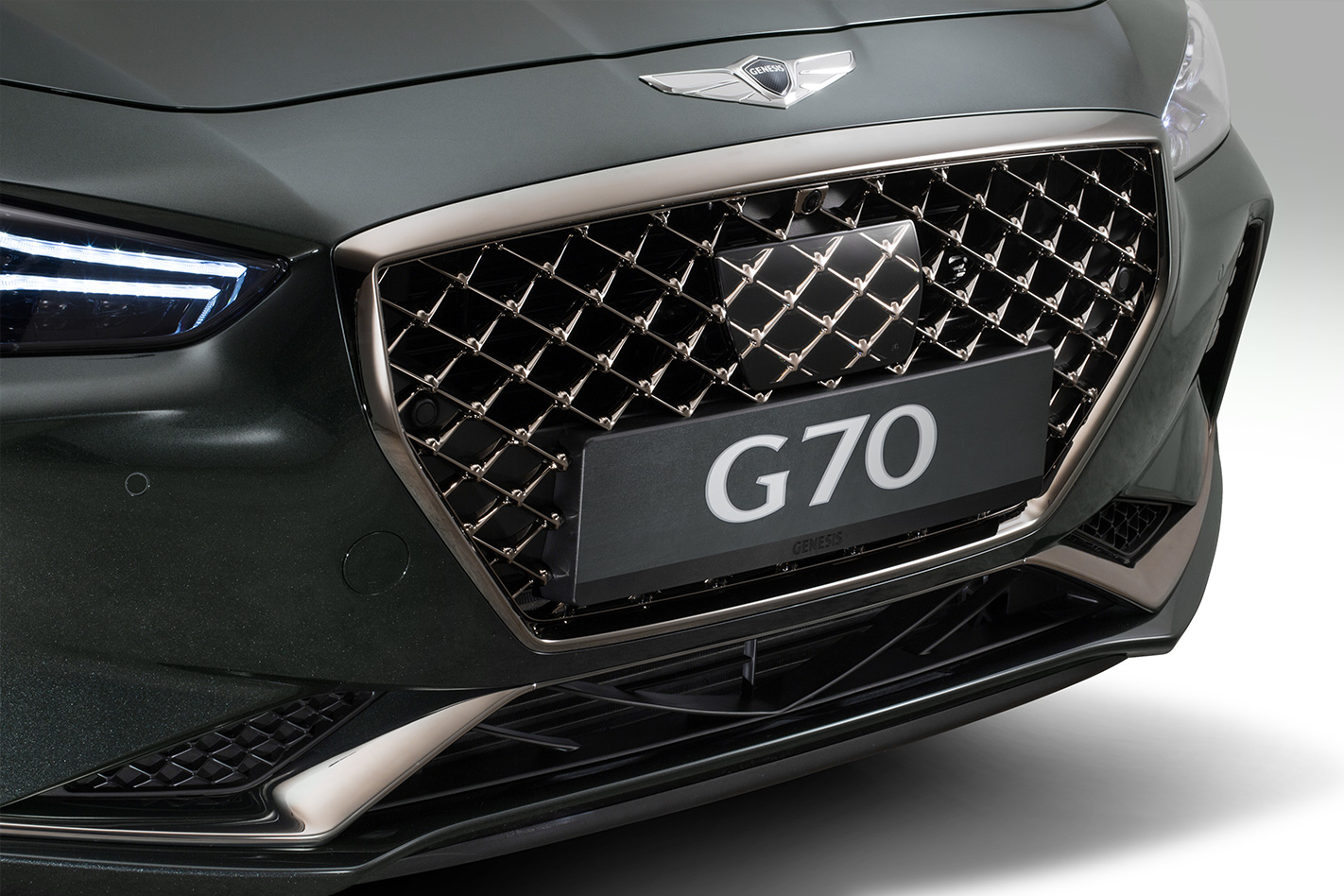
For pricing, we’re speculating that the entry point will be in the low $50K zone, undercutting even the base 1.4-litre Audi A4 and the three-cylinder entry-level BMW 318i by a few thousand. Mercedes-Benz’s dominant (in Australia) C-Class opens in the low-$60K bracket, so the Genesis G70’s price advantage should be significant.
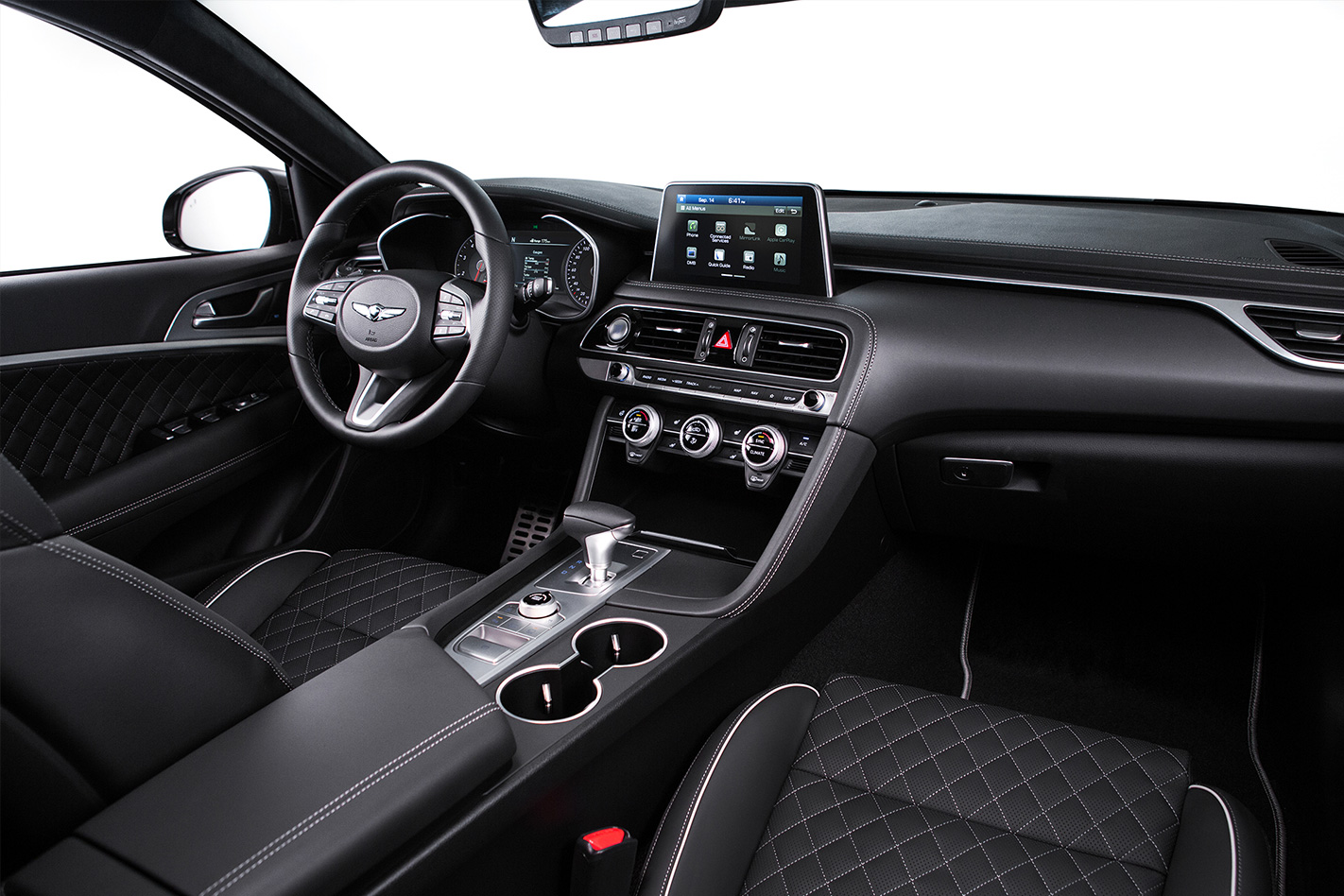
Then there’s the lure of loan-car delivery at service time, concierge-style services, and upmarket Genesis store-within-store set-ups at the Hyundai dealerships deemed appropriate to handle the Korean’s premium-brand sales.
The new Abarth 595 has arrived in Australia with more power and lower prices including an $8000 reduction in the price of the range-topping 595 Competizione.
The Abarth 595 hatch and cabriolet range has been reduced to two models. The mid-spec 595 Turismo is gone, though it’s worth noting it had cost more than the Competizione’s lower $31,990 asking price, which has been partly achieved by making some previous standard features optional.

The entry level 595’s $26,990 retail price represents a smaller $500 price reduction despite minor upgrades including improved aerodynamics, which improve its engine cooling capacity by 18 per cent, revised sport oriented ergonomic steering wheel position, new poly elliptical headlights, and a slight 4kW power boost for the 1.4-litre turbo engine to 107kW.
The racy 595 Competizione’s 1.4-litre turbo donk also gets a power boost, from 118 to 132kW, which cuts its 0-100km/h time by almost a second to 6.7 seconds.
The above prices are for the five-speed manual variants, with the five-speed sequential automatic transmission a $2000 option, while the cabriolet versions will set you back an extra $3000.
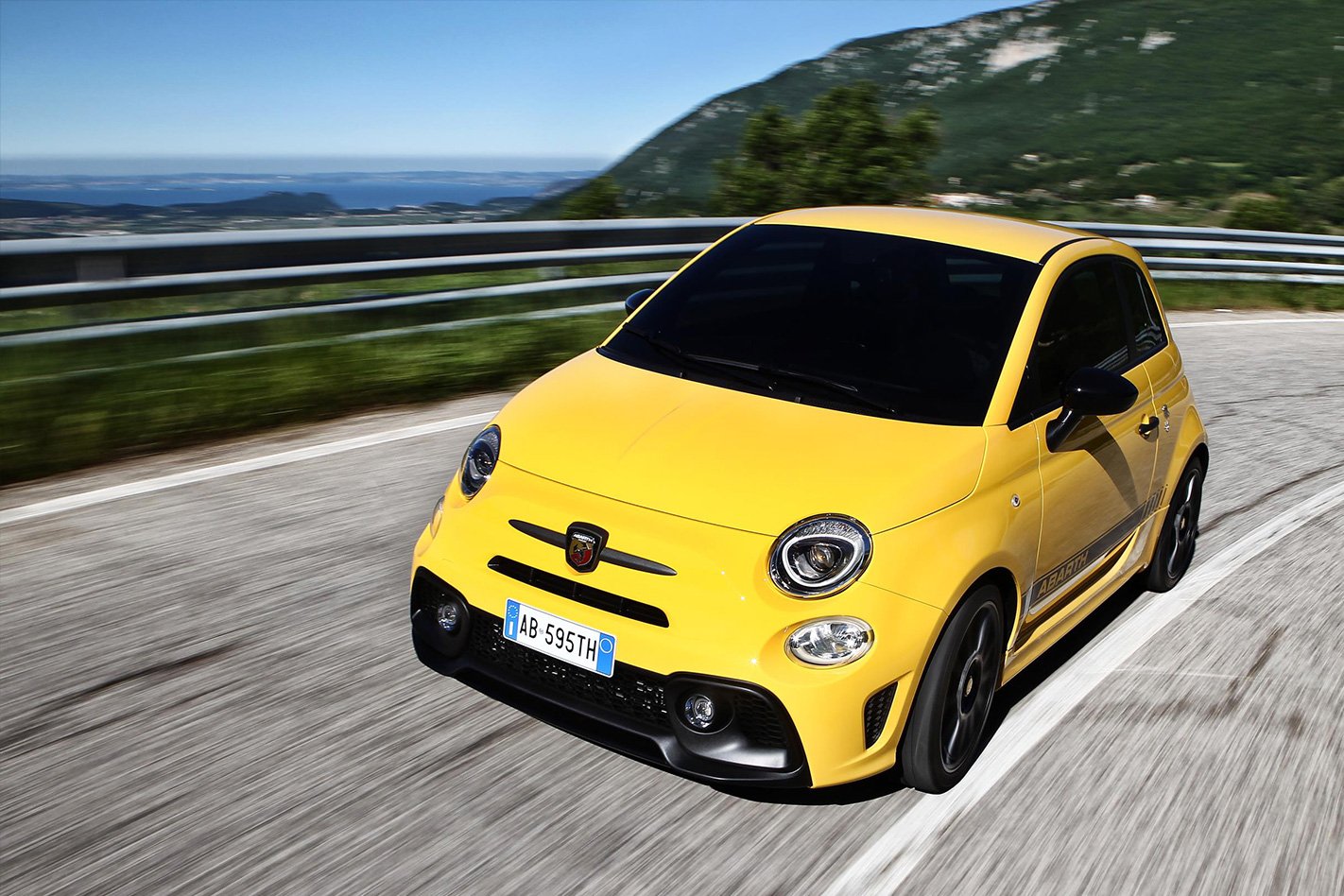
Abarth 595/595C standard features include:
- 16-inch eight spoke alloy wheels
- Powered body colour mirrors
- Satin chrome finishing (front door handle, back door handle, front and back badge support)
- Matte black front dam and rear bumper insert
- LED Day running lights
- Dual tip chrome exhaust.
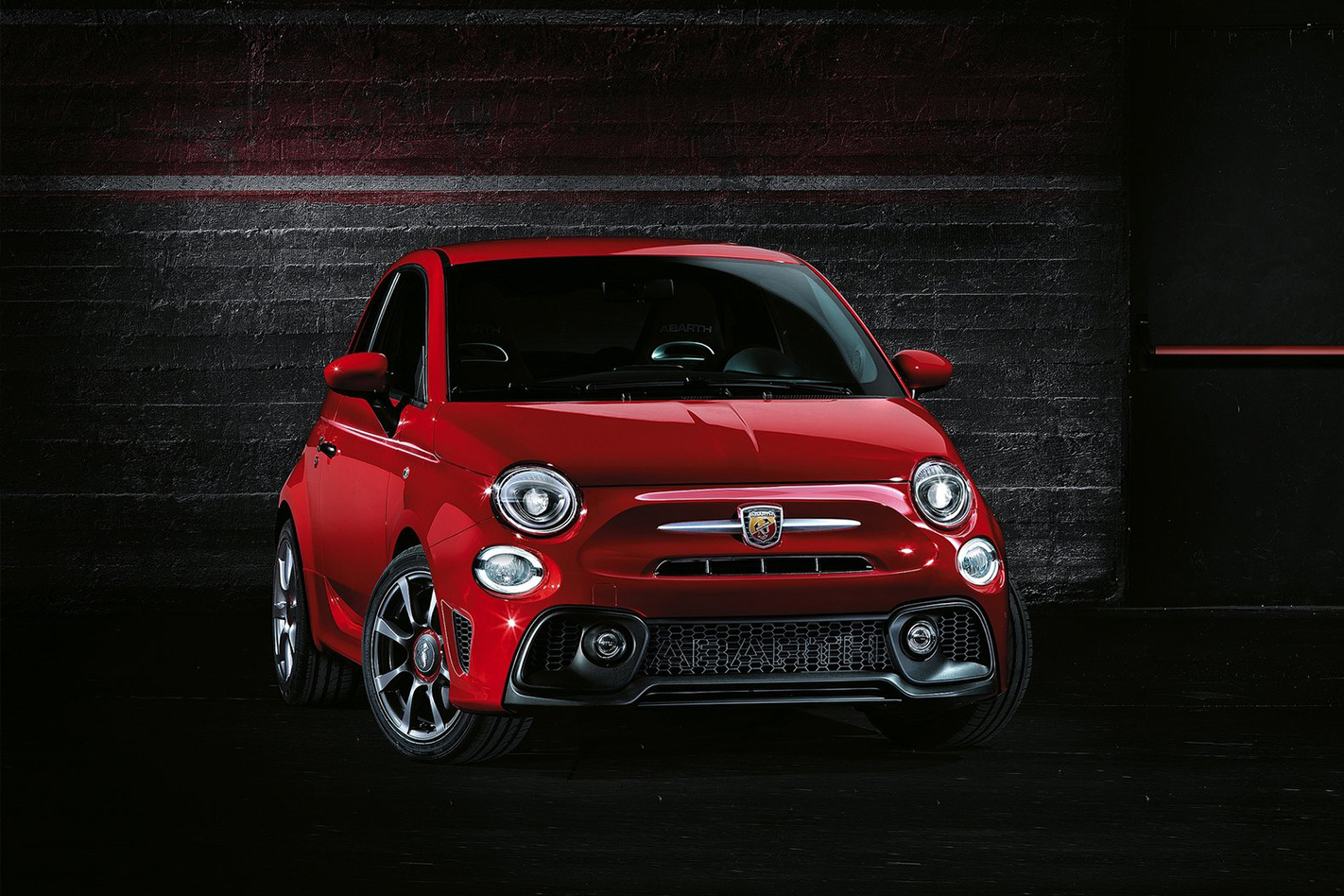
The Abarth 595/595C Competizione comes with:
- Leather sport seating
- Four-piston front Brembo brakes
- Red painted brake calipers
- BMC Panel Air Filter
- Dual mode ‘Record Monza’ exhaust
- 17-Inch “Corsa” alloy wheels
- Tar Cold Grey external mirrors with power adjustment
- Tar Cold Grey door handles
- Tar Cold Grey front dam and reader bumper insert
- Tar Cold Grey “Abarth” side stickers

Former Competizione standard features that are now optional extras include Sabelt sports seats in cloth or leather/Alacantra and xenon headlights.
Both models come standard with a new Uconnect 5-inch colour touchscreen radio with an optional BeatsAudio 440w, seven-speaker sound system.
The new Abarth 595 range is currently available in showrooms.
MY18 Abarth 595 pricing
- Abarth 595 manual – $26,990
- Abarth 595 auto – $28,990
- Abarth 595C manual – $29,990
- Abarth 595C auto – $32,990
- Abarth 595 Competizione manual – $31,990
- Abarth 595 Competizione auto – $33,990
- Abarth 595C Competizione manual $35,990
- Abarth 595C Competizione auto $35,990
THREE YEARS down Commodore road and the General’s men have advanced to the third stage in the refinement of Australia’s top selling car.
They call it VH, VD, VE, VF and VG being ignored on the way from VC, and for the first time there are changes to the sheet metal although the new styling sounds more significant on paper than it appears in the metal.
Of course there are the obligatory changes to the engines to improve fuel economy and a trick push button computer to fascinate the passengers but for the drivers among you the most welcome change is the addition of a five speed manual gearbox.
Holden is able to boast proudly that the VH Commodore offers the most complete range of any car sold in Australia and comparable with even the most complicated model line-ups anywhere in the world. Certainly with a four cylinder engine, two sixes and two bent eights – both the 4.2 and five-litre V8s continue to be available in the VH – four or five-speed manual gearboxes and an automatic transmission, three levels of equipment and sedan and wagon bodies, you can build exactly the car to suit. In theory.
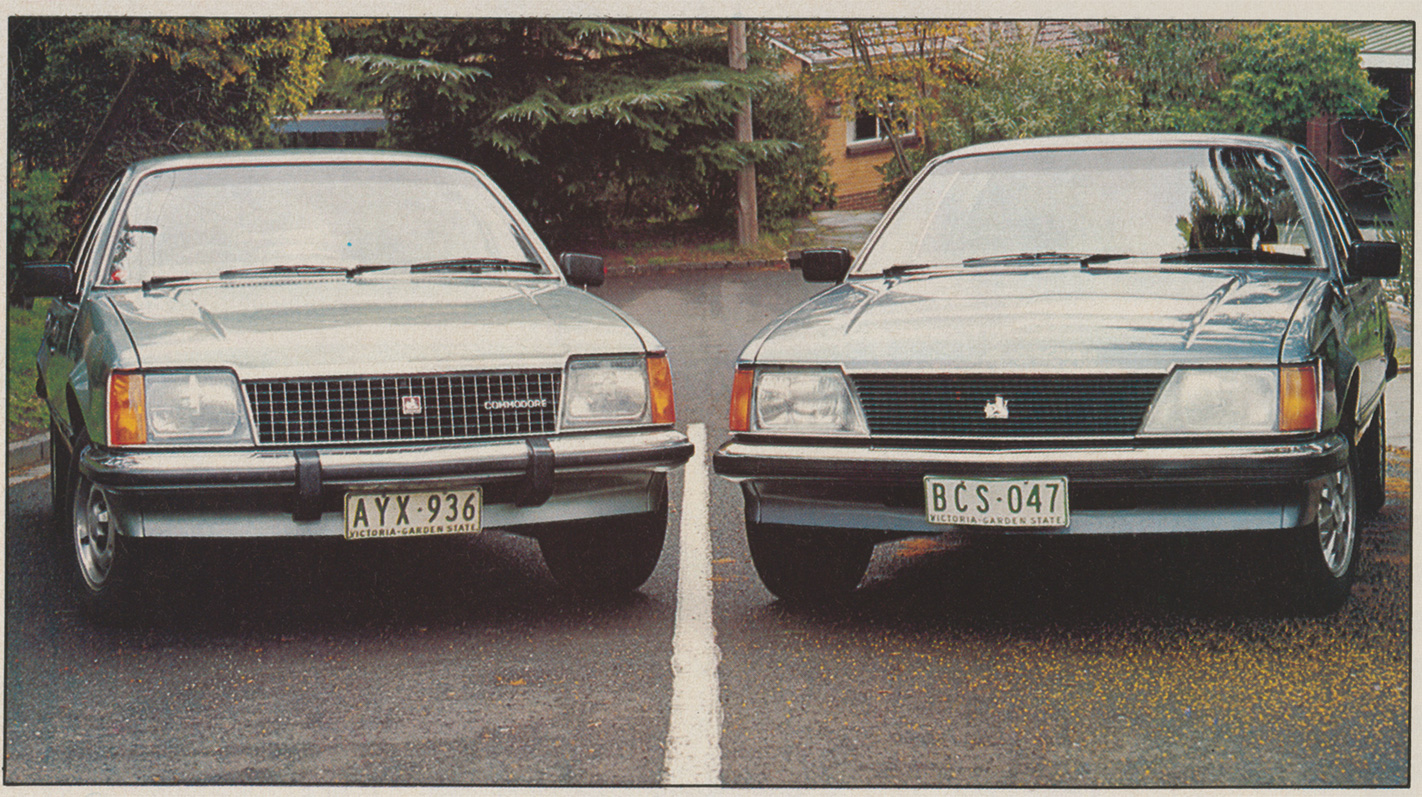
The gearbox comes to Holden via Borg Warner but the General’s men claim it is not the same box used in the Sigma, having been developed by BW in conjunction with Holden’s engineers to higher standards of durability. Despite claiming the five speeder has a 25-30 safety margin it can only accept 190 Nm of torque and the 3.3-litre six develops 231 Nm while the 2.8 six has 187 Nm and the four 138 Nm.
Why, if it truly is a new gearbox, did the General not build it with enough reserves to take the output of the bigger six? It is a fair question but confused by the degree of commonality in gear ratios with the Sigma which suggest it isn’t really new. First (3.65), third (1.37), fourth (1.00) and fifth (0.85) are shared, only second being unique to Holden with a ratio of 2.14, compared to the Sigma’ s 1.97.
Both four and five speed gearboxes use the same 3.9 and 3.36 final drive ratios for four and six cylinder engines so fifth offers a 15 percent reduction over fourth at any given speed. Indeed the gear ratios of the Holden four and five speed gearboxes are the same except, of course, for fifth and first is slightly lower at 3.75.
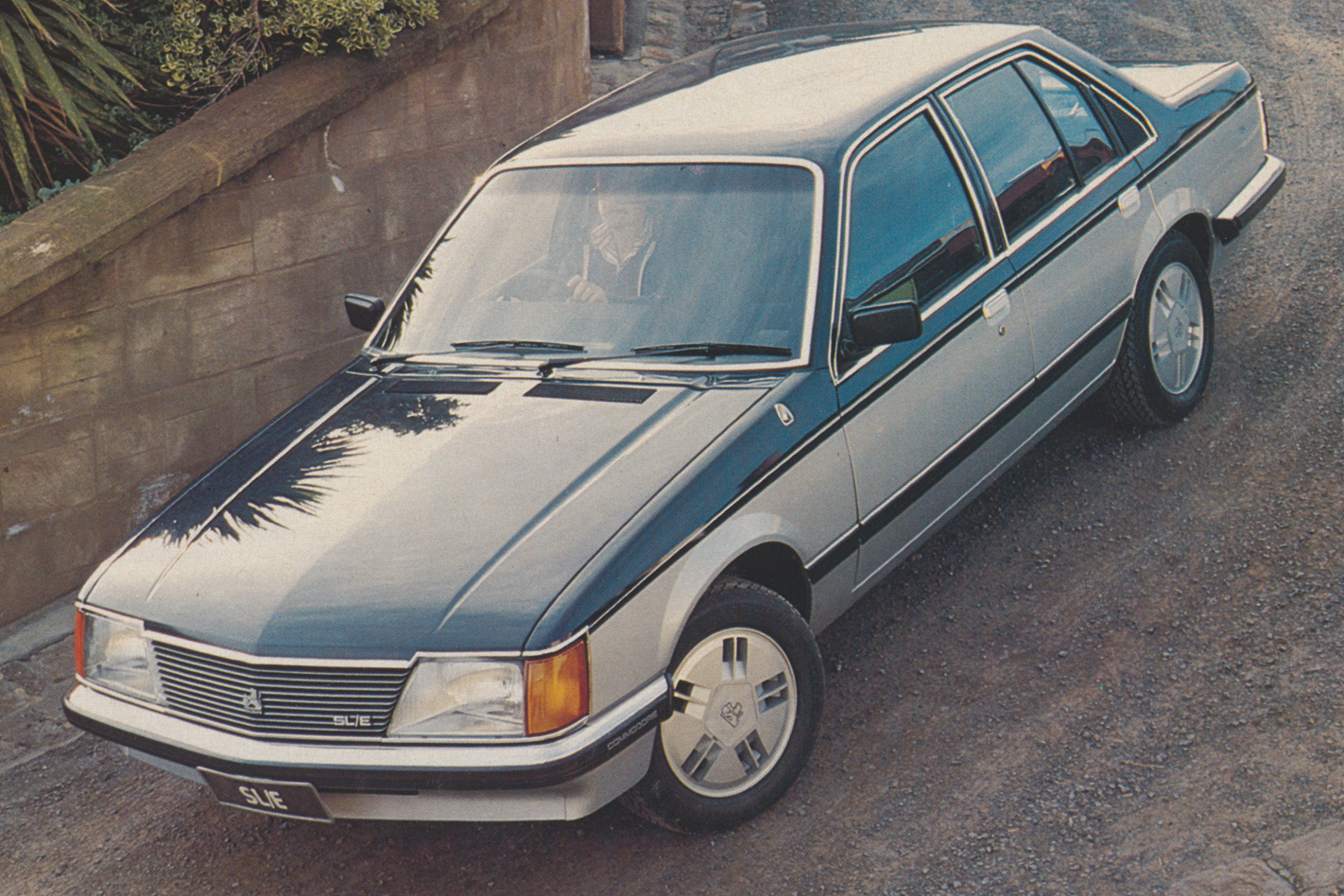
Regardless of the quality of the gear change there is no doubting the benefit of the extra ratio in improving general driveability. No more does the four feel out of breath above 120 km/h, sounding fussy and unhappy, even at 100 km/h. On the six the extra ratio gives it the legs and driver appeal the Commodore six has always deserved and despite the power drop compared with the 3.3 makes the small six the more desirable car.
Essentially the 3.3, 4.2 and five litre engines have been left alone and the engineering work has gone into improving the economy and driveability of the 1.9 and 2.8-litre engines.
Advanced electronics show the way for there are no cross-flow, alloy cylinder heads and fuel injection seems as far away as ever. But, by what the General calls “engine management systems”, both engines are superior to those they replace. Of course they should be but that detracts from the obvious hard work that has gone into the engineering changes. In simple terms the four gets Holden’s version of Chrysler’ s ELB but calls it electronic spark selection (ESS) and Pulsair which uses exhaust pipe pressure to induce secondary air into the exhaust ports to oxidise unburned hydrocarbons and carbon monoxide emissions from the engine. The object is to improve spark advance for improved fuel economy and more consistent idle, something the previous four could never claim.
The ESS system uses a mini black box computer to sense a number of engine variables and then selects the spark advance required for low emission levels in commuter conditions or reduced fuel consumption during highway driving.
You won’t notice the decrease on the road but, equally, the engine still doesn’t have the performance characteristics necessary to take advantage of the Commodore’s inherently well manner chassis. Fan noise under hard acceleration, together with a crude induction roar is rather off-putting and has the driver searching early for fourth.
The 2.8-litre six also suffers a slight power loss – down from 76 kW to 73, both at 4400 rpm – while torque has dropped from 192 Nm to 187 at 2800 rpm. But this is now the Holden engine to have – unless you find the sheer power of the five litre hard to resist, as we do – although it doesn’t have the counter weighted crankshaft of the 3.3.
With secondary air injection to control emissions, used in conjunction with an air pump and changes to the carburetion the engine is more refined and has a smoother performance and idle.
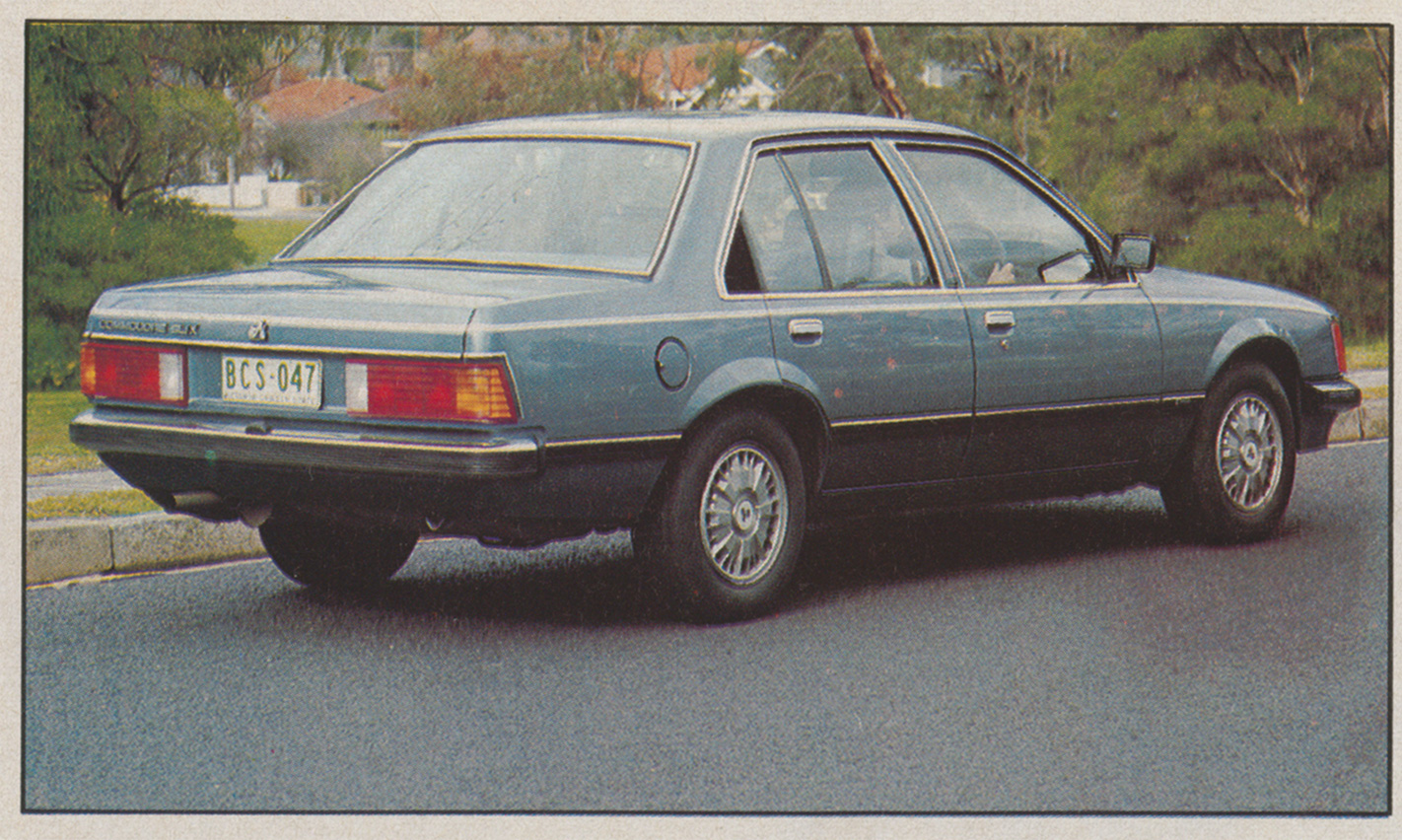
The standard power trains for the VH give the SL the 2.8-litre six with four speed manual, the SL/X the 2.8 with automatic and the SL/E the 3.3 automatic.
As we’ve said the five speed is only offered on the four and 2.8, while automatic is now available with all engines, but you can’t buy manual 3.3s in NSW because of that state’s more stringent emission laws, nor can you buy a manual five litre. And you can’t get an SL/E wagon or four.
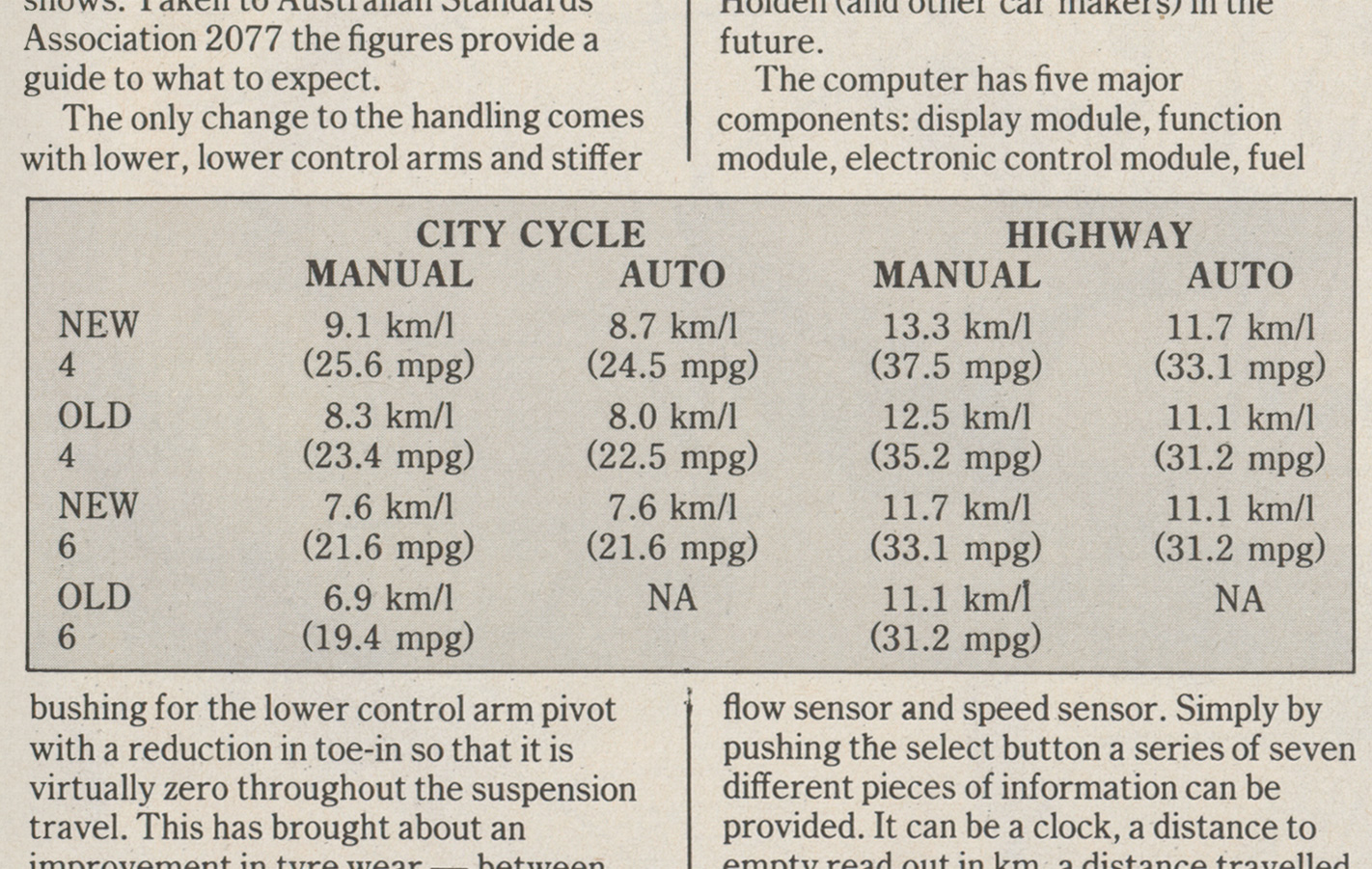
Substantial improvements have been made in economy as the following table shows. Taken to Australian Standards Association 2077 the figures provide a guide to what to expect.
The one real gimmick introduced with the VH is a VDO trip computer which is standard on the SL/E and will be optional on the other models. The black box under the bonnet and on-board computer are just the beginning of a new era in advanced electronics that we can expect from Holden (and other car maker) in the future.
The computer has five major components: display module, function module, electronic control module, fuel flow sensor and speed sensor. Simply by pushing the select button a series of seven different pieces of information can be provided. It can be a clock, a distance to empty read out in km, a distance travelled for each trip in km, an average speed for each trip, the rate of fuel consumption for each trip and the total fuel used for each trip. It is great fun arid certainly some of the functions are very useful but located, as it is, in the centre of the dashboard it is well out of the driver’s line of vision which could create problems until he becomes bored with fiddling and trying to see each different read-out.
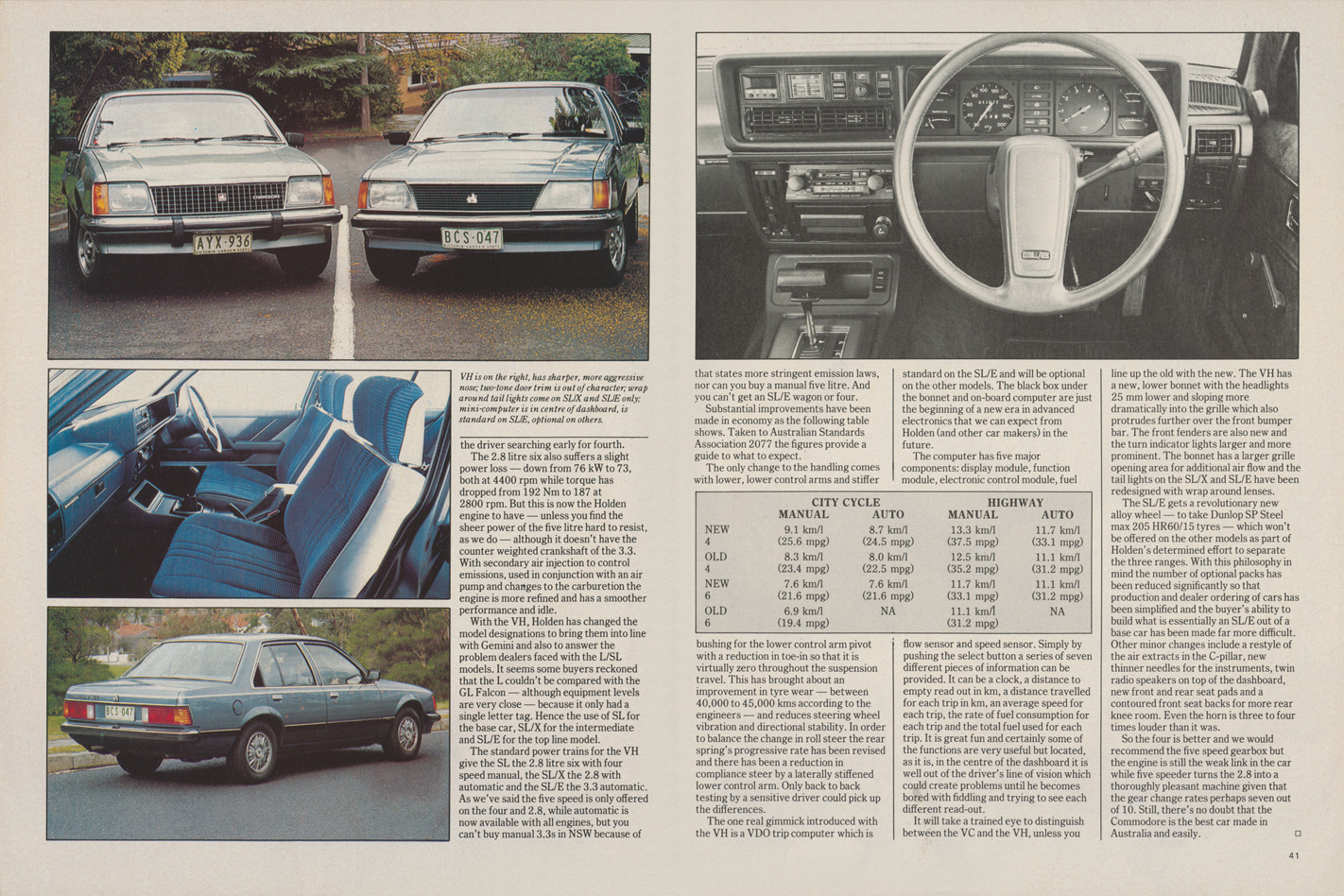
It will take a trained eye to distinguish between the VC and the VH, unless you line up the old with the new. The VH has a new, lower bonnet with the headlights 25 mm lower and sloping more dramatically into the grille which also protrudes further over the front bumper bar. The front fenders are also new and the turn indicator lights larger and more prominent. The bonnet has a larger grille opening area for additional air flow and the taillights on the SL/X and SL/E have been redesigned with wrap around lenses.
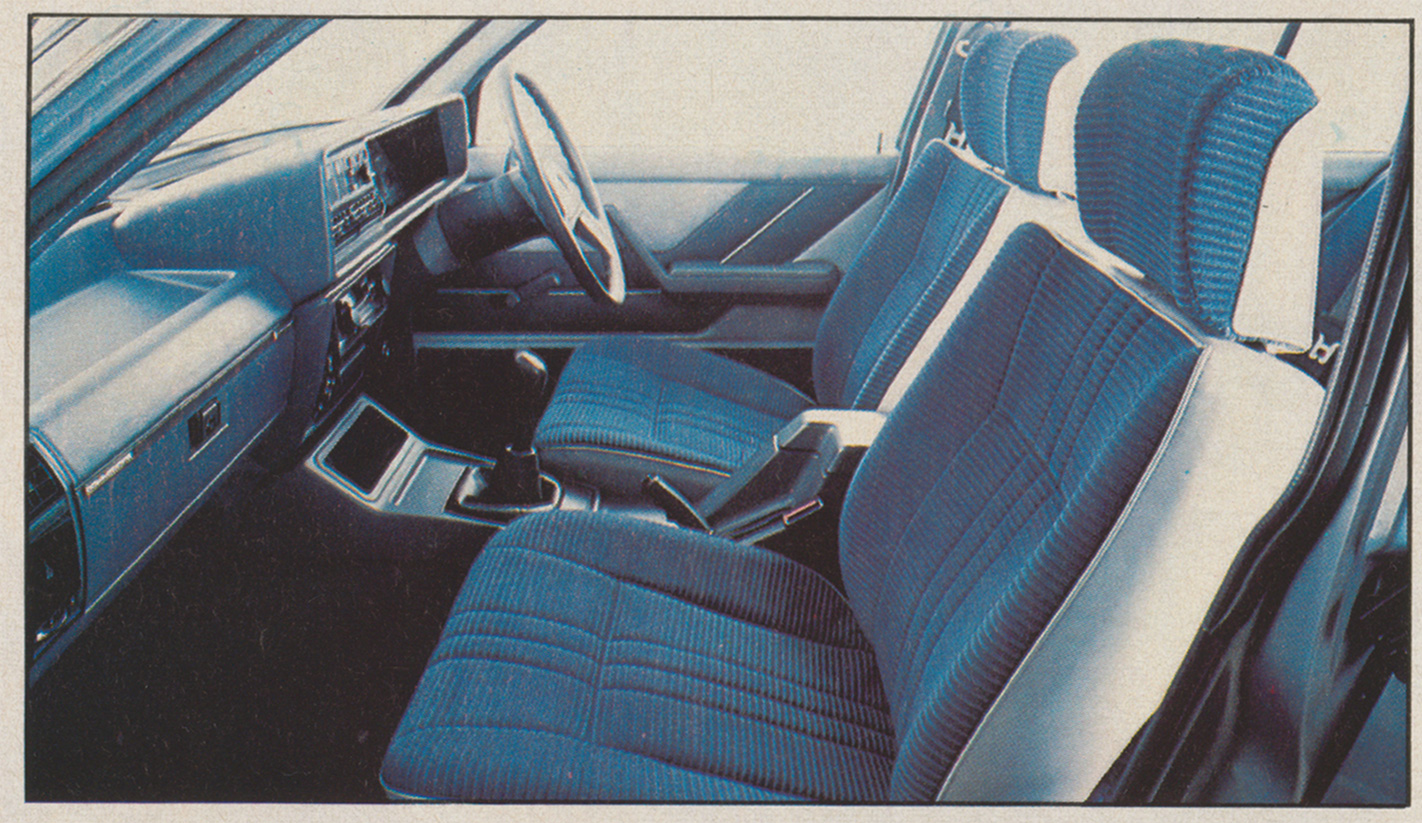
Other minor changes include a restyle of the air extracts in-the C-pillar, new thinner needles for the instruments, twin radio speakers on top of the dashboard, new front and rear seat pads and a contoured front seat backs for more rear knee room. Even the horn is three to four times louder than it was.
So the four is better and we would recommend the five speed gearbox but the engine is still the weak link in the car while five speeder turns the 2.8 into a thoroughly pleasant machine given that the gear change rates perhaps seven out of 10. Still, there’s no doubt that the Commodore is the best car made in Australia and easily.
AUDI Sport plans to add another five models to its showroom by 2021, including potent five-cylinder versions, even more SUVs, and the performance sub-brand’s first plug-in vehicle.
As well, Audi Sport will continue to offer RS-badged versions of its sedans and Avant wagons for as long as demand was there.
Speaking to Wheels at the opening of the Frankfurt Motor Show this week, Audi Sport chief executive Stephan Winkelmann said the German luxury brand’s performance skunk works would continue to invest in SUVs“because I think they can be very driveable and the segment is growing worldwide”.
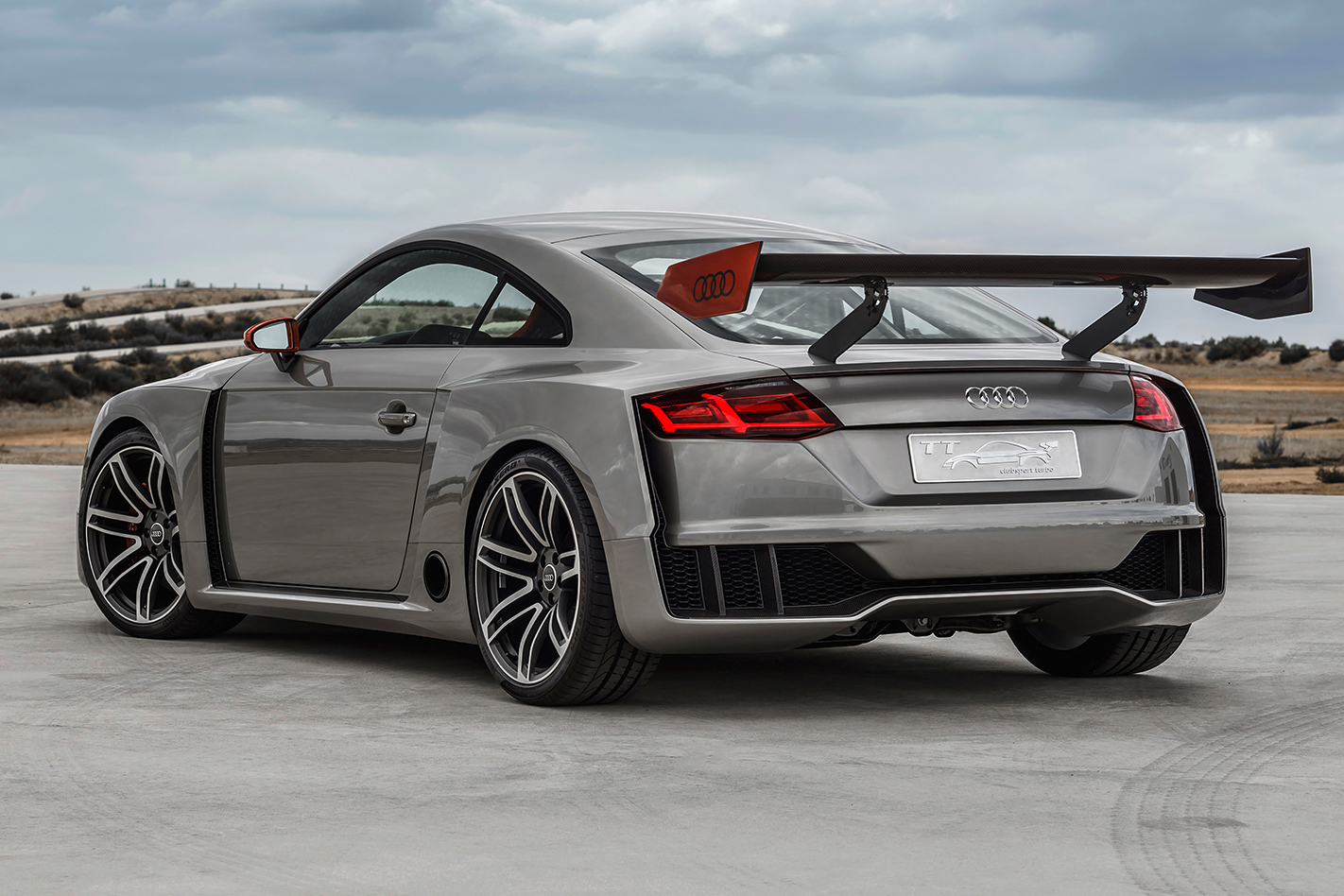
“We skip models but it’s not so much about sizes but about body style. I think big SUVs can fit maybe big limos cannot. But we will not pick every one. We will not go below RS3.”
In the lesser performance S category, Audi already offers the SQ5 and SQ7, based on the Q5 and Q7 models, but an even more driver-focused RS version of either model could be on the cards. A version of the forthcoming Q8 is also another prime candidate.
The R8 e-tron signalled Audi Sport’s electrified intent with the limited-production high-performance coupe, but a more large scale car will join the RS or R8 fold “between 2020 and 2021”, Winkelmann said.
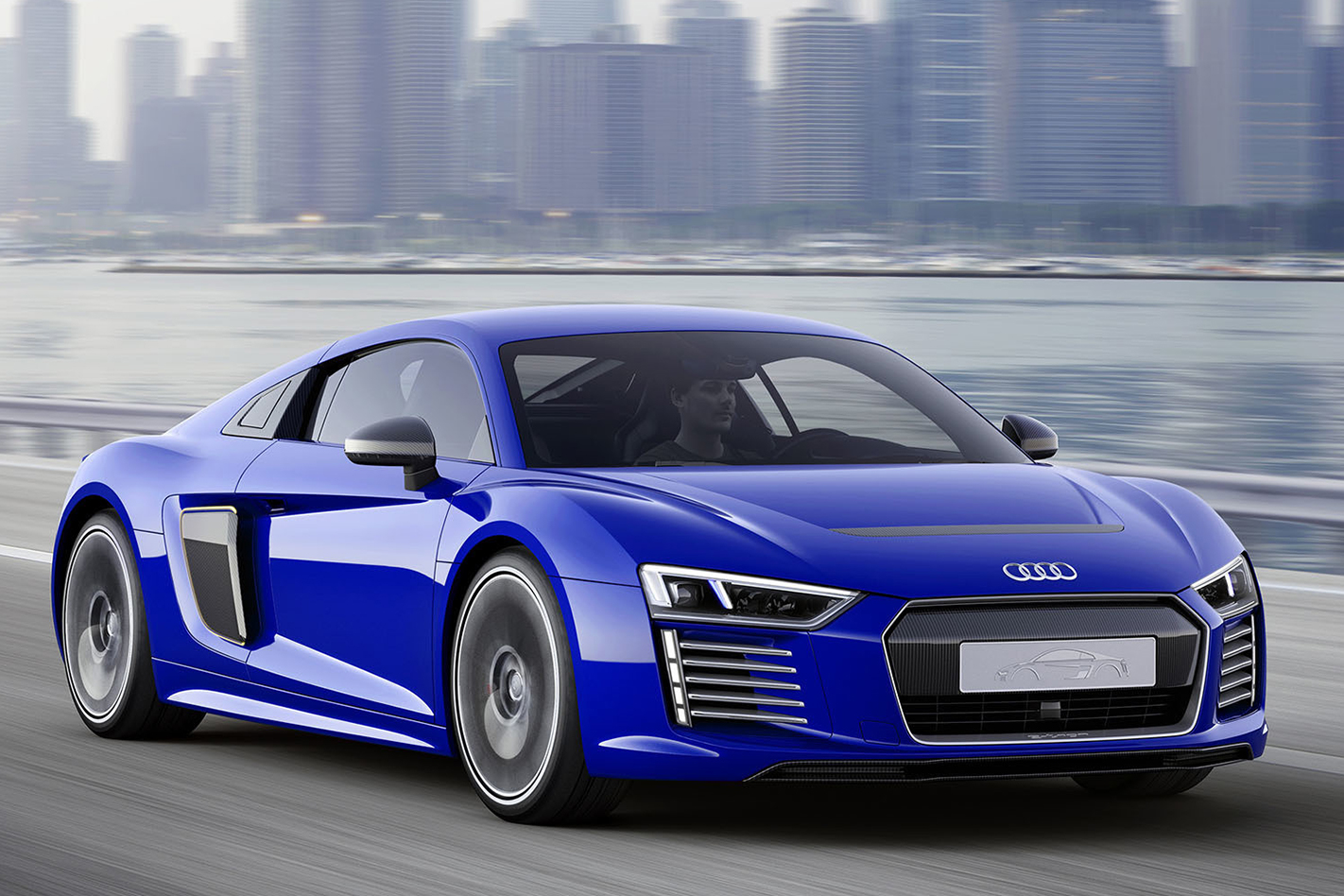
“For me electrification is important,” hew said.“It’s something we will not stop but how fast it is going to be, we will see, but we will have one BEV (battery electric vehicle) because we are small we have to decide if we go half step hybrid or full step with the BEV because we think that we have the duty to position the brand not just within Audi Sport but within the Audi group.”
As for petrol power, the recently updated 2.5-litre five-cylinder turbo unit that powers the RS3, RSQ3 and TT RS is only just getting started with 294kW, and Winkelmann confirmed the unorthodox five-pot has more to give.“There is more power in the engine,” he said.
The in-line five is limited to MQB applications and a transverse orientation, which pits the likeable donk at the smaller end of Audi Sport’s range.However, we can expect a flow of tuned-up variants including Plus versions and more potent specials.
But while its power and torque is key in the fight against other German grenade engines – most notably Mercedes-AMG’s 2.0-litre turbo four – Winkelmann said the five-cylinder was as much about offering exclusivity in the range as it was about producing hefty performance figures.
“I said we should stay in this segment because we developed this engine and it gives us exclusivity,” he said.“In general, we are not giving the RS badge to every Audi that is coming out of the factory. We want to pick them very carefully because we are going for exclusivity. I see exclusiveness in the RS3 and TT RS because of the five-cylinder.”
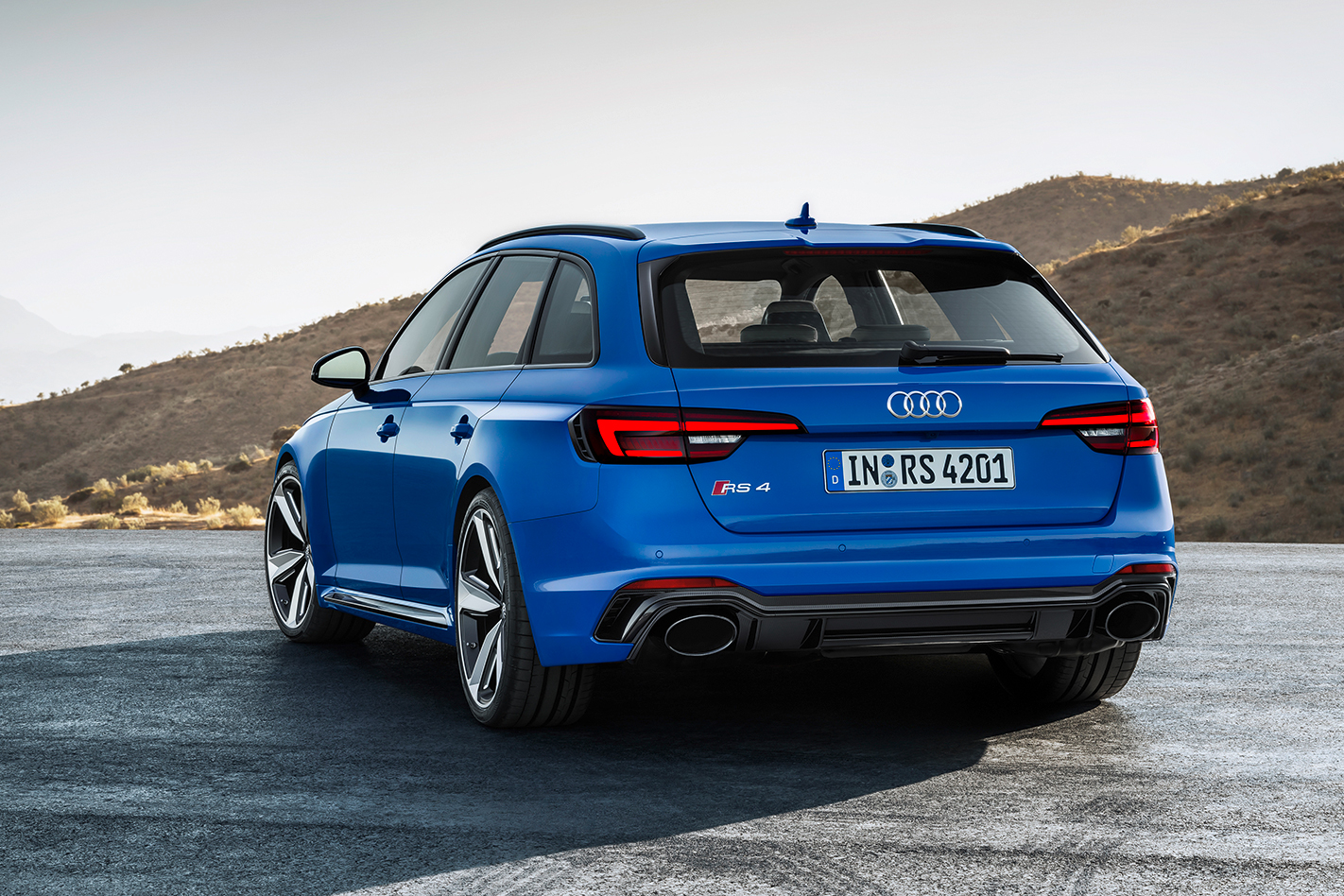
“These are the things that are important because we will move into other segments and other body styles. We want to come from 11 models today to 16 by 2020,” he said.
As for whether the top Audi Sport man will stay in the role amid reports he has one foot in at Bugatti? “Nothing to speculate,” he said.
Audi Sport used Frankfurt to show two additions to its line-up; the rear-drive R8 V10 RWS, and an all-new RS4 Avant featuring a return to a twin-turbo V6.
The Mazda CX-8, a fastback-styled family hauler that slips in between the CX-5 and the the CX-9 that was crowned the 2017 Wheels Car of the Year, is officially on sale in Japan.
Billed as the flagship of Mazda’s SUV range, the three-row CX-8 is powered by an updated version of Mazda’s 2.2-litre four-cylinder diesel engine, and includes the same G Vectoring Control – the engine can momentarily reduce performance to help weigh up a tyre to improve cornering grip – as rolled out to other Mazda models.
The car is unique to the Japanese market – the CX-9 is not sold there – and represents “a new people-moving option for customers who want to enjoy outings with family and friends but don’t want to sacrifice design or driving performance”, Mazda said.
The engine ups its performance to 140kW and 450Nm, compared with 129kW and 420Nm for the four-pot diesel’s previous tune. In Australia, the CX-9 sells with a 170kW, 420Nm turbocharged 2.5-litre four-cylinder petrol engine.
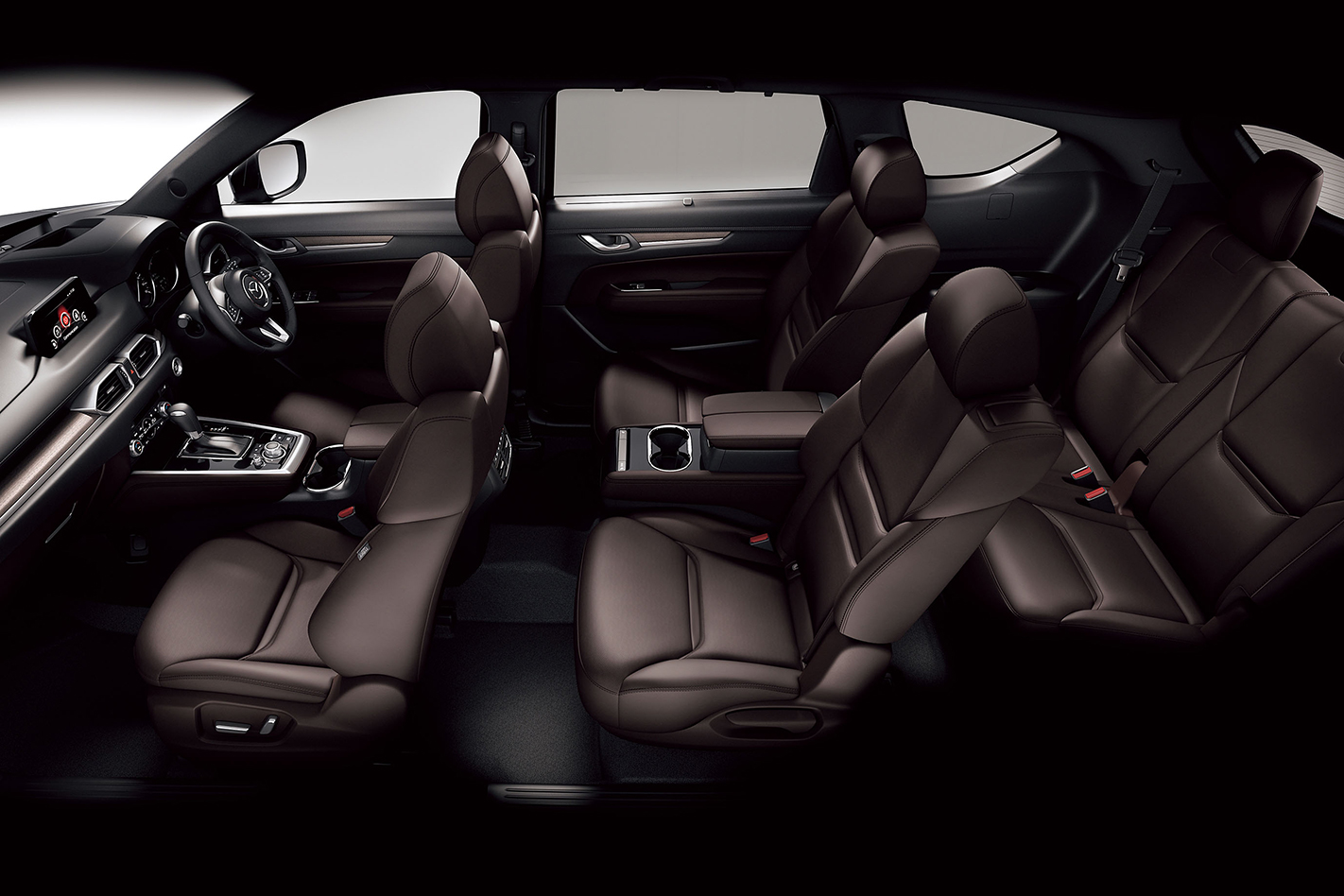
Inside, Japanese buyers can choose between captains’ chairs, which limit the number of passengers to six, or a traditional bench seat in the middle row. The rear seats are designed to be comfortable for adults up to about 170cm tall.
Mazda says it will build about 1200 of the CX-8 large SUVs a year for the right-hand-drive Japanese domestic market. However, Mazda Australia has flagged its interest in the sharper-looking diesel-engined SUV as a more muscular, fuel-misterly alternative to the petrol engine-only CX-9.
“If there was ever to be an ADR [Australian Design Rule] version of CX-8 offered to Mazda Australia we would evaluate this opportunity and consider its viability in this market and actually ask ‘how does it fit amongst the other SUV models we have on offer here?’’ Mazda Australia managing director Vinesh Bhindi said recently.
The sharply styled CX-8 is not the only fastback SUV in Mazda’s expanding showroom. Last year, the Japanese car maker unveiled the China-only CX-4, a coupe-like version of its CX-5 mid-size SUV. Again, Mazda Australia has shown some interest in bringing the more design-driven version of the CX-5 here – if Mazda approves its expansion beyond the Sleeping Dragon’s borders.
Mercedes-AMG’s A45 broke cover as the perfect specimen to thump the Bang For Your Bucks formula.
The marque took a hatchback, armed it with all-wheel drive, squeezed in a heavily boosted four-banger, and harnessed it with big brakes. It’s hard to dream a more ferocious apex-assassin. It missed our annual mega event for two years until finally arriving in 2016 with a new front-LSD and more power.
Unsurprisingly, each of its rivals fell to its sword, being cheaper and grippier than a BMW M2, more focused than an Audi RS3, and lighter than a Holden Commodore SS-V Redline. Returning to defend its $50K-$100K title, judges have grown to respect the A45’s fearsome package.
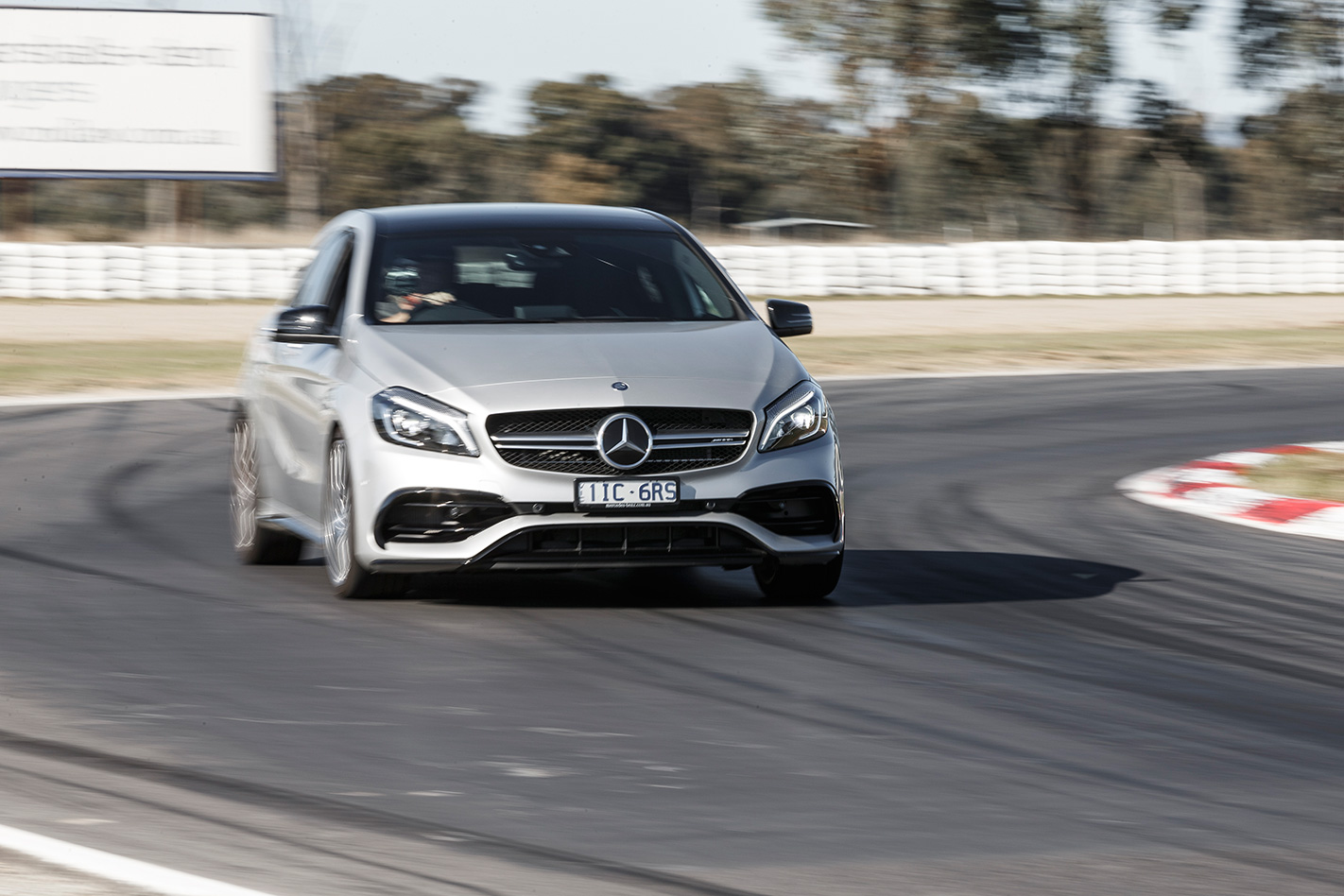
The Recaro-designed seats install you deep into bolster, lashed by a bright-red seatbelt, while your fingers find shift-paddles behind the steering wheel – it’s a dual-clutch automatic only.
You tumble out of the A45 after a drive, head swirling as you try to grasp the rapid acceleration, violent sounding upshifts, tenacious corner grip and eye-popping brake power of such a little car. And it never feels like breaking a sweat. So much so we wonder why a greater number of them don’t harass more expensive machinery at Targa Tasmania.
This speed comes at a cost, though, as it’s not the most grin-inducing. It shrugs off a playful handling setup for grip and composure, while aggressive throttle inputs upset the inside front-wheel rather than the rear axle. After all, its Haldex all-wheel drive system can send only half of the available torque aft.
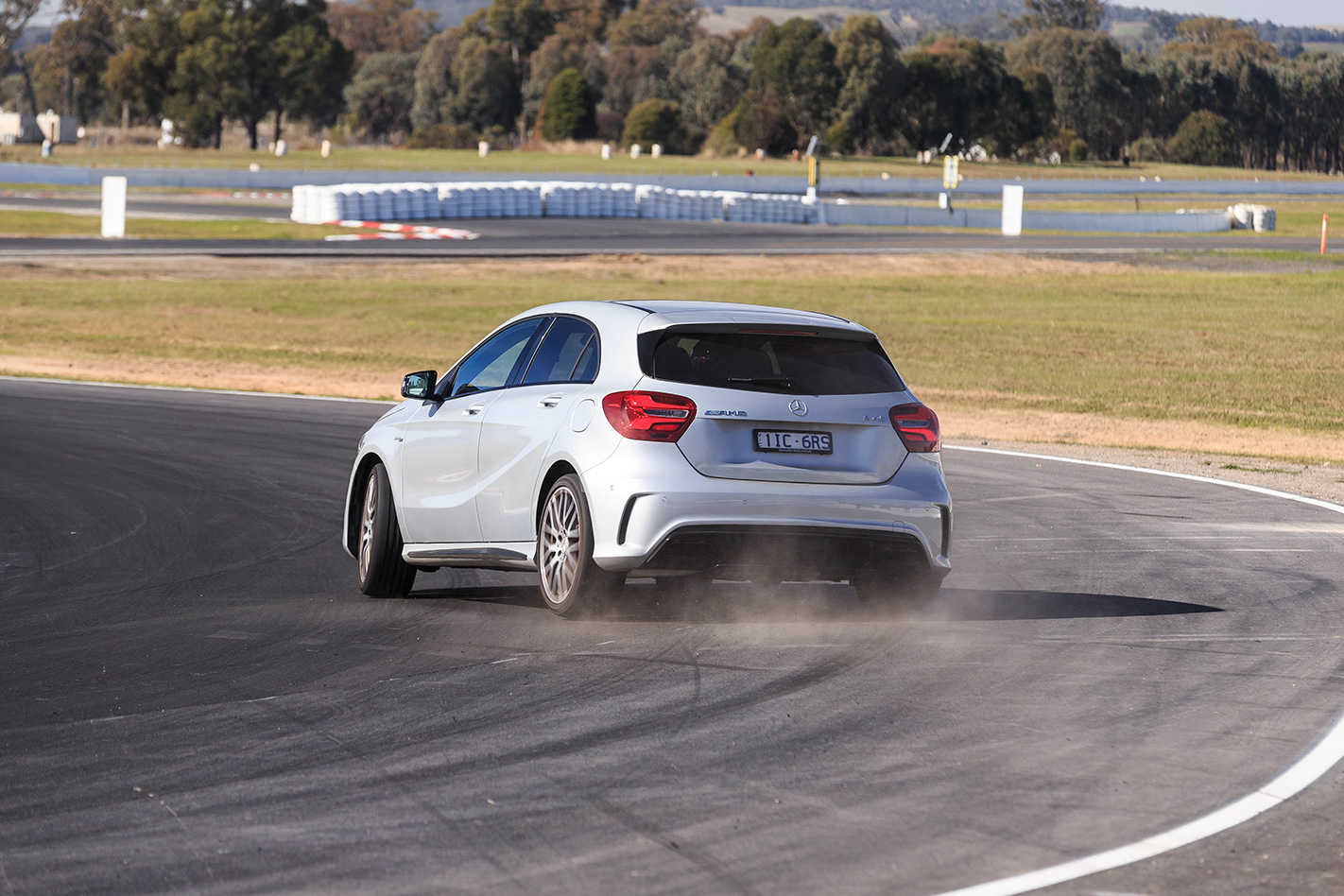
Progress waits for no-one. Speaking of, in a bare-knuckle track brawl, it still takes a lot to knock off an A45. But you’re about to behold two cars that did exactly that.
Specs: Engine: 1991cc inline-4, DOHC, 16v, turbo Power: 280kW @ 6000rpm Torque: 475Nm @ 2250-5000rpm Weight: 1555kg
Times 0-100km/h: 4.32sec (1st) 0-400m: 12.54sec @ 179.32km/h (1st) Lap Time: 1:38.3sec (3rd)
Warren Luff says “One of the most interesting battles was between this and the Focus RS. They’re two very different cars to drive. The Mercedes is more glued down to the road. You don’t seem to be able to throw it around as much, but it’s one of those cars that’s actually better to clear the brakes a bit earlier and just carry the rolling speed in the corners. On the limit it’s probably not as much fun, it doesn’t slide around and do all those fun things for you. But in terms of lap times it’s really fast. The engine sound and the gearbox in this car is amazing. It really does make it a joy to drive.”
Judges notes David Morley – 2nd: “Still crazy after all these years” Dylan Campbell – 4th: “Fast but it thinks in ones and zeroes and is more serious than fun” Louis Cordony – 2nd: “An unflappable circuit star” Tim Robson – 2nd: “Sooo much engine… maybe a bit too refined, though”
