
As diesel engines in cars became more refined they gained popularity, particularly during the past decade with turbocharges leading to better torque and fuel efficiency than similar sized petrol engines.
However, the Dieselgate emissions scandal and the advent of clean and fuel efficient electric vehicles, hybrids and small turbocharged petrol engines have seen the tide turn against oil burners, which some major cities around the world announcing they’ll be banned within a decade.
So is it still worth buying a diesel car in Australia?
The short answer is yes, if appropriate. Diesel has its pros and cons, but it’s too soon for your decision to be influenced by international events, which need to be put in perspective.
While US the fallout over the Dieselgate scandal has seen manufacturers such as Volkswagen and Mercedes-Benz suggest they’ll longer sell diesel-powered cars there, it’s a very different story here.
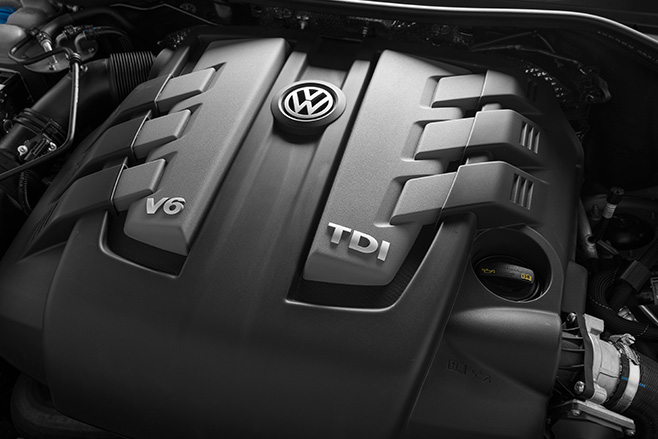
For a start while the Volkswagen Group engines implicated in Dieselgate breached US emissions standards they actually abide by current Australian emissions testing, which measures carbon dioxide rather than nitrogen oxide.
This will change once cars have to abide by Euro 6 emissions standards, however while many diesel engines won’t comply with this on their own, their emissions will be within limits through the use of AdBlue exhaust additive.
Petrol is much cheaper in the US so drivers there haven’t taken to diesel like they have here and particularly in Europe where diesel is much more popular in smaller cars.
While there has been a 10 percent drop in diesel sales in Europe this year, oil burners still make up for around half the cars sold there and the drop can be partly attributed to the emergence of alternatively powered vehicles such as hybrids.
However diesel is a victim of its own success with Paris, Madrid, Athens announcing they have committed to ridding their cities of diesel engines by 2025 to improve air quality.
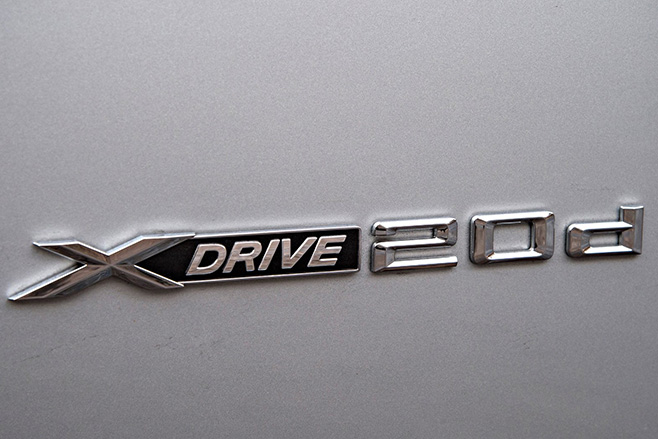
There are no such concerns in Australia, where petrol has always been the fuel of choice for passenger cars. However it’s a different story with SUVs and utes where the benefits of diesel’s fuel-efficiency and higher torque are planer to see.
While diesel passenger car sales dropped by around 30 percent during the past 12 months, private diesel SUV sales remained almost steady dropping just 1.0 per cent while non-private SUV sales jumped by 27.9 percent.
“Diesel is really strong in SUVs,” BMW Australia’s Shawn Ticehurst recently told Whichcar. “X5 30d is our biggest seller, BMW X3 20d is our second biggest seller.”
Mazda’s Alastair Doak agreed, saying diesel is “a more natural fit” for SUVs, but that it had come off from its highs of a few years as fuel prices dropped “so not as many people are automatically ticking the diesel powertrain box”.
This could change with fuel prices set to rise after OPEC agreed to reduce oil production, though this could also be a shot in the arm for alternative fuels at diesel’s expense.
“ABOUT THE only things that haven’t changed are the chassis numbers,” observes Guy Harding, gazing at his Harding Performance Golf R.
Hot Tuner 2016 is brought to you by Valvoline SynPower
Given this thing cleaned up last year as a box-fresh, lightly tweaked daily drive, that’s a throwaway remark simply dripping with intent.
From inside, there’s little sign of the mechanical mayhem that resides beneath the vinyl-wrapped skin – the stock seats, steering wheel and dash all remain just as Volkswagen intended when the car rolled off the production line.
But under the bonnet, well, let’s just say that’s where you find a whole new kettle of fish. The R’s EA888 engine – already with more muscle than stock out of the factory, thanks to a stronger cylinder head, hollow exhaust valves, larger turbo and bigger radiator – has scored a full basket of additional goodies from Racingline (think ‘Volkswagen Racing’ stuff and you’re all of the way there).

“The car has one of the first Stage 3 turbochargers from Racingline which has all new internals,” says Harding, who boasts that it’s capable of exceeding 500bhp (373kW), huge power from a 2.0-litre.
“Unfortunately, thanks to this,” says Harding, pointing to the crutches that he hobbled around on for the duration of the event, “we didn’t get time to finish the engine calibration, so we had to wind the power output right down to safely make the event.”
He reckons he lost a month or more of development time in the lead-up, thanks to his dicky knee. Chassis-wise, Racingline supplied the coilover kit, along with adjustable front and rear anti-roll bars, all of which is all bolted on with Harding Performance-designed SuperPro urethane bushings.
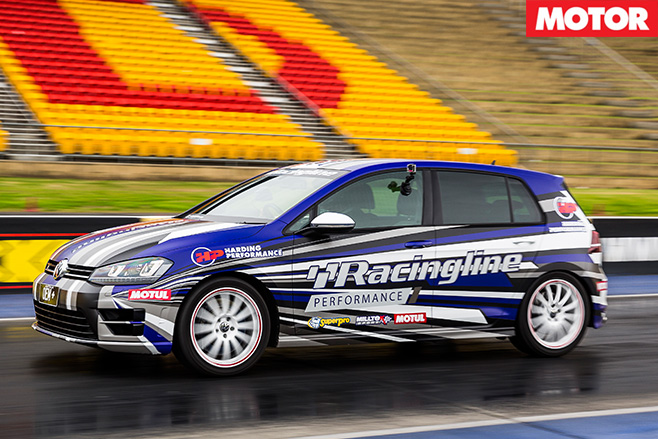
“We’ve bolted in a fully ‘dry’ set-up which we obviously can’t change now,” says Harding, as we shelter from the driving rain. “We’ll see how that goes.” A set of six-piston front calipers are mated to 360mm front-hatted rotors, with 18 x 8.0-inch Racingline rims dressed in Yokohama AD08R 235/40 ZR18 tyres.
“The biggest secret of the Golf R in general is that it’s so neutral and so usable,” says Harding. “It’s like the old Subaru WRX STI.”
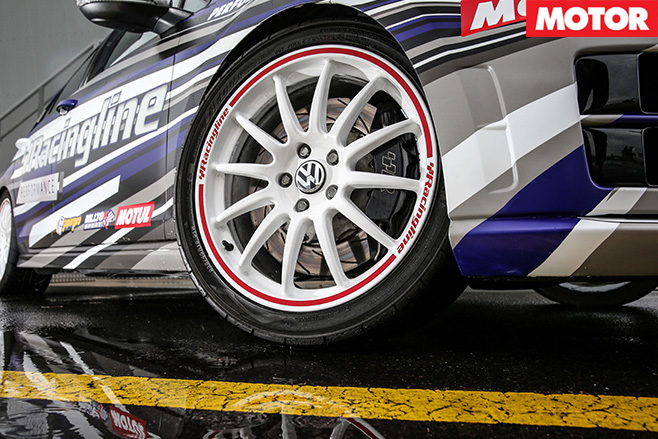
SPECIFICATIONS Drive: all-wheel Engine: 1984cc inline-4, DOHC,16v, turbo Gearbox: 6-speed dual-clutch Suspension: A-arms, coil-overs, anti-roll bar (f); multi-links, coil-overs, anti-roll bar (r) Brakes: 360mm ventilated/slotted discs, 6-piston calipers (f); 310mm ventilated discs, single-piston calipers (r) Wheels: 18 x 8.0-inch (f/r) Tyres: 235/40 ZR18 (f/r); Yokohama Advan AD08R
PARTS AND PRICES Stage 3 kit: $5500 Intercooler: $1995 Transmission tune: $1495 Exhaust: $4450 Intake: $795 Suspension: $5595 Swaybars: $850 Control arms: $1150 Bushes: $450 Brakes: $4895 Wheels/Tyres: $3595 Total mods cost: $30,770 Vehicle cost(mSrp): $55,240 Total cost: $86,010
Italy’s big luxury sedan gains a sprinkling of bespoke luxury – and up-to-the-minute multimedia – to support its charismatic quest for seducing rich buyers bored with the usual mega-luxe suspects.
WHAT IS IT? A nip-and-tuck makeover for the circa-2013 Maserati Quattroporte, splitting the range into two distinct extra-cost equipment packs – GranLusso and GranSport – while honing its refinement, driveability, connectivity and luxury.
WHY WE’RE TESTING IT? Despite its enormous length and similarly lofty price, there’s something deeply alluring about the twin-turbo Quattroporte, whether it’s a V6 or V8 petrol powerhouse under the bonnet (or a turbo-diesel if you’re allergic to excitement).
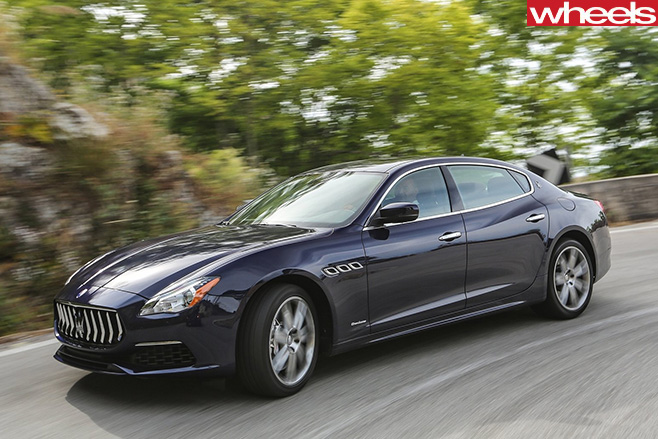
THE WHEELS VERDICT A handsome and stylish alternative to its more clinical rivals, though the Quattroporte stumbles on the finer details, including various pieces of switchgear from the Chrysler parts bin and ride quality that fails to give the impression of 300-odd grand’s worth of limousine.
That said, some of Maserati’s trim options are delectable, the Quattroporte’s overall dynamic prowess is immense, and its twin-turbo petrol drivetrains are very impressive, if not quite inspirational. Despite improvements, it’s still one for the Italophiles.
PLUS: Superb handling balance; supreme power-down ability; feels much smaller than it is; interesting and colourful interior-trim options; well-calibrated auto ’box; strong powertrains MINUS: GTS’s knobbly ride, agitated steering and tyre rumble on less-than-perfect roads; cabin’s think B-pillars and lumpy headlining; fixed shift paddles block (bulky) indicator stalk
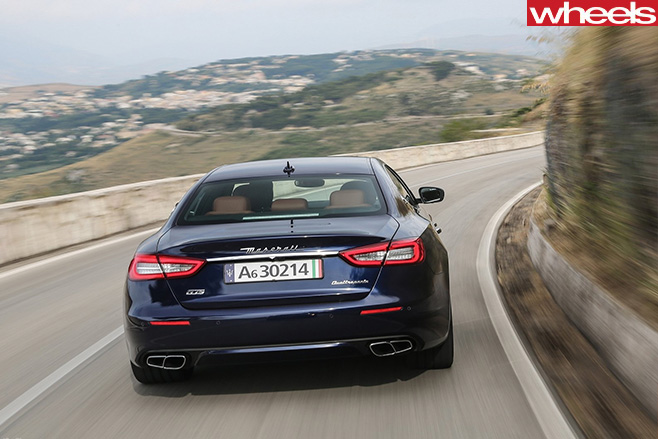
But with so much competition in the upper-luxury segment, and all those dollar signs that success in China can bring, the leggy Maserati Quattroporte has been gifted with an even more bespoke interior and a few engineering improvements to keep the Joneses, the Russos and the Wongs interested in not following the herd and buying something German.
Fronting Maserati’s freshly updated Quattroporte is a new Levante-style grille, inspired by the 2014 Alfieri concept car and incorporating an air-shutter system that lowers the Quattroporte’s drag coefficient by 10 percent to 0.28.
It also sports a redesigned lower front bumper, new side skirts, redesigned side mirrors (to house new 360-degree surround-view cameras), and new exhaust-outlet designs, as well as obligatory massive alloys.
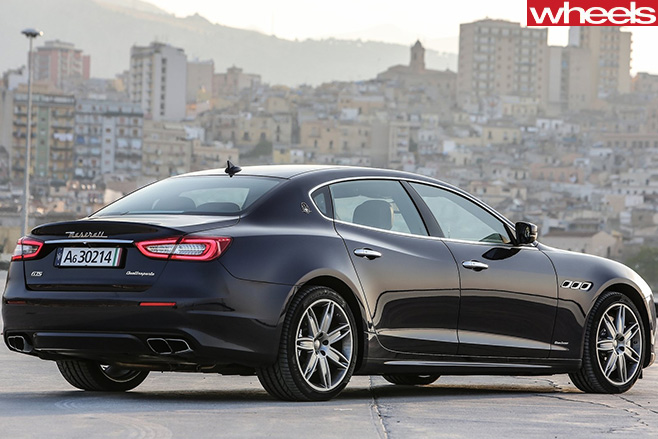
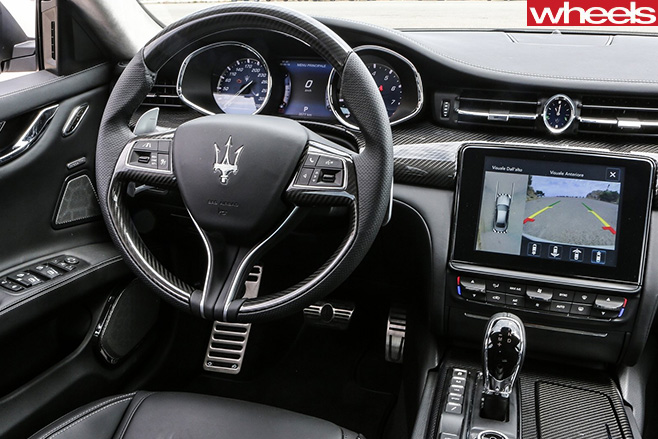
Inside, everything from the dashboard tide-line down has been massaged for a much more bespoke-looking arrangement (meaning less Chrysler parts-bin). There’s more leather, classier switches and a nifty felt-lined drawer beneath the climate control to place your smartphone, even when it’s charging (though this could be awkward if you have a long cord).
The MY17 model gets a slick new 8.4-inch centre touchscreen with Apple CarPlay/Android Auto, accompanied by standard Harmon/Kardon speakers and a (not entirely necessary) two-tier controller in a new centre console with electric park brake.
Maserati has also amped up the active-safety tech (AEB, lane-departure warning, adaptive cruise with stop&go) to bring the Quattroporte into line with what’s expected in 2016.
In combination with some warm wood inlays and stunning optional silk trim inserts by Ermenegildo Zegna on the GranLusso, or slick carbon fibre and sumptuous red leather in the GranSport – as well as beautiful navy-blue instrument dials – the Quattroporte has a level personality befitting the Maserati marque. Just try and ignore the cheap-looking headlight rotary knob, or the bulky multi-function column stalk, both of which should be familiar to Chrysler and Jeep owners.
Quattroporte’s brakes have also received attention to enhance pedal feel and the ZF eight-speed automatic transmission has been recalibrated for faster kickdown response and more aggressive shift patterns in the drivetrain’s Sport mode.
Thankfully, you can switch the drivetrain to Sport and set the dampers to Comfort because lumpy back roads leave the Maserati wanting for ride plushness, particularly the 21-inch-wheeled GTS. The 390kW V8 is neither cushy enough for a luxury car, or sporting enough for a driver’s car in its Comfort setting, though the new base 257kW Quattroporte V6 feels much more cohesive in its ride/handling combination.
Riding on fat Pirelli P Zeros, both Quattroporte variants produce plenty of tyre noise. And both suffer from degrees of steering kickback, with the GTS’s neat three-spoke wheel feeling constantly agitated and corrupted by any imperfect surface rushing beneath.
That said, it’s still easy to point the MY17 Quattroporte, particularly with the dampers in Sport. This is a textbook example of how a car can shrink around you, with the Maserati’s excellent balance and agility belying its near-5.3m length and 1800kg-plus kerb weight.
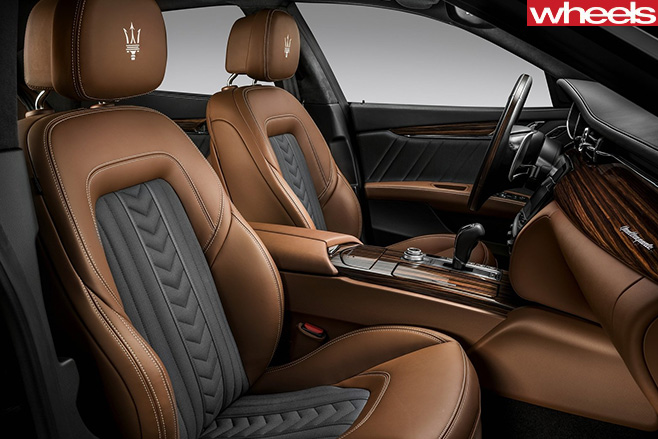
Of the two, it’s the milder 257kW/500Nm Quattroporte V6 that’s the more pleasant steer and the sweeter drive. Addictive as the subtly thunderous twin-turbo V8 is – especially its 710Nm of torque on overboost and its 7200rpm rev ceiling – and slightly disappointing as the V6’s strained nature is at high rpm, its crisper steering, lighter balance and more relaxed demeanour better suit the Quattroporte’s station in life.
Which, in China, is favouring rear-seat passengers who enjoy impressive seat comfort and loads of legroom. But the tree-trunk thickness of the Quattroporte’s B-pillars, combined with the lumpiness of its headlining shape and the undernourished size of its sunroof, somehow make it feel strangely claustrophobic back there.
But up front is where you want to be in Maserati’s limousine. On a relatively flat and pothole-free road, surrounded by the lushness of a GranLusso or GranSport cabin fit-out, with either the twin-turbo V6 or V8 truly on song, the MY17 Quattroporte again proves that the Italians know how to indulge the senses.
Flawed as it may be, its very existence makes the world a little less boring.
SPECS Model: Maserati Quattroporte GTS GranSport Engine: 3799cc V8 (90°), dohc, 32v, twin-turbo Max power: 390kW @ 6800rpm Max torque: 650Nm @ 2000-4000rpm Transmission: 8-speed automatic Weight: 1900kg 0-100km/h: 4.7sec (claimed) Fuel economy: 10.7L/100km Price: $345,990 On sale: Now
HOT on the heels of the next-gen Opel Insignia breaking cover in California, we’ve pieced together what we believe so far about the vital 2018 Holden Commodore beneath that handsome skin.
Heralding the death of the big four-door sedan in the Lion brand’s line-up, the NG Commodore (or possibly GB if we follow Holden’s code for the existing GA Insignia VXR) will launch in early 2018 in five-door hatchback and wagon flavours.
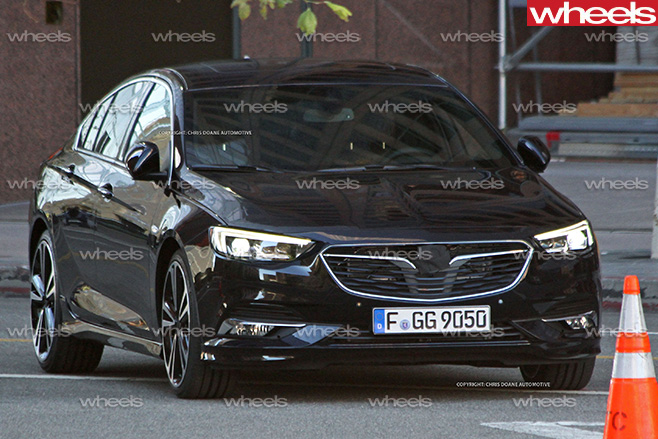
Of more interest to Commodore traditionalists is the 230kW/370Nm ‘LGX’ 3.6-litre direct-injection V6 with AWD. While such outputs mean this will be the most powerful base six-pot Holden in history, cylinder activation ought to not make it the thirstiest as well. To that end, an efficiency-honing nine-speed torque-converter auto will be standard, meaning there will no longer be a manual gearbox available in a Commodore, including higher-performance variants. More’s the pity.
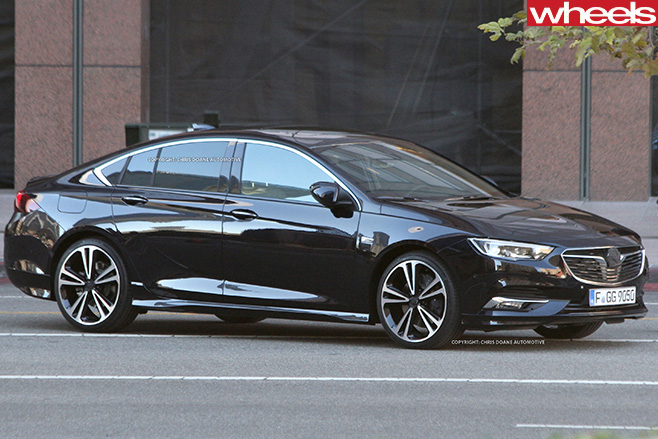
Also new to the series is the expected driver-assist safety systems, judging by the radar-tech grille blanks obvious on both the 2018 Opel Insignia hatch and wagon sprung this week. That means AEB Autonomous Emergency Braking, adaptive cruise control, lane-change assist, blind-spot monitoring, and perhaps even RCTA Reverse Cross Traffic Alert. These are all available on the new BK Astra just launched, so why wouldn’t they be on Holden’s flagship?
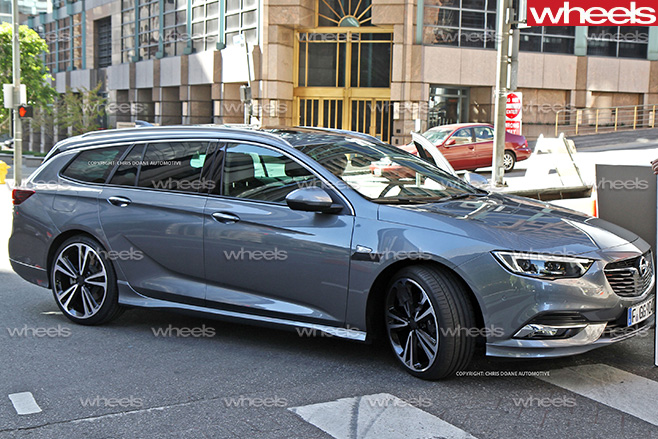
As Nathan Ponchard reported back in late October after a 65 percent finished prototype drive around Holden’s Lang Lang Proving Ground in Victoria, the NG Commodore is based on GM’s E2XX platform, so expect McPherson struts up front and a multi-link out back, as per the current Insignia VXR.
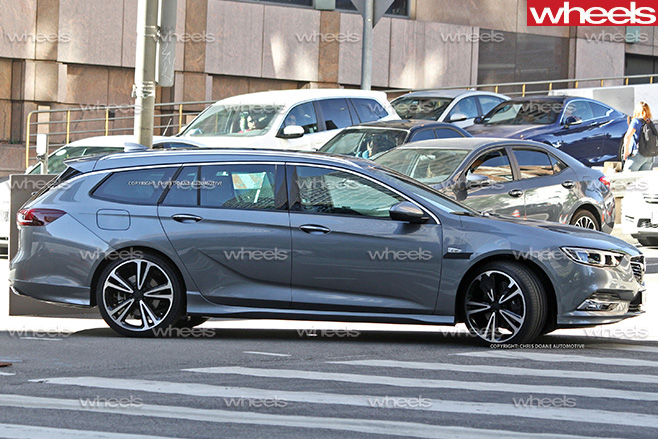
The NG Commodore’s dimensions virtually mirror that of the 1997-2006 VT-VZ Commodore – bar the width. This means this is the first big Holden since the original, also-Opel-derived, 1978 VB Commodore to downsize, after a decade of the Holden Kingswood. Length measures in at 74mm under the current Holden VF II Commodore, width is 36mm narrower, and the wheelbase is some 86mm stubbier.
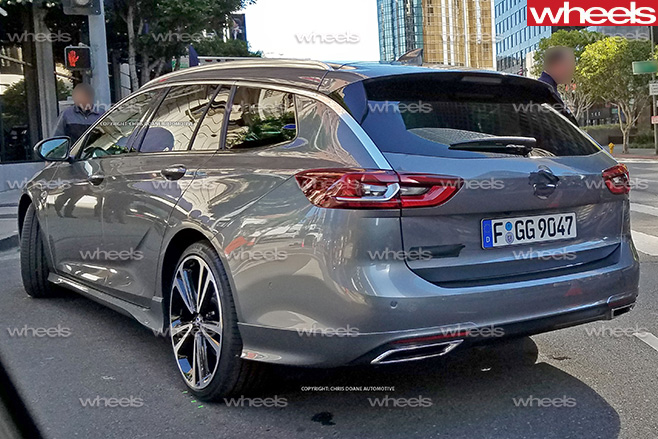
We’ll report straight back with more as info comes to hand, so stay tuned.
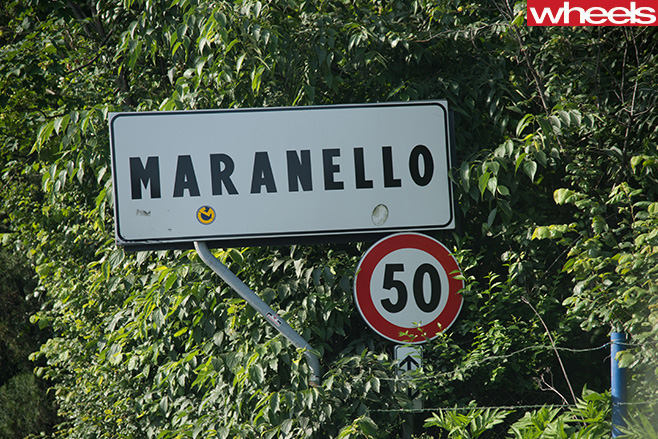
Robbo marks his retirement with a final pilgrimage to the automotive Mecca of Maranello, where he was banned for life. Twice.
VISITING Ferrari is like fighting a war. There are endless long periods of waiting, punctuated by short, sharp bursts of intense activity. Theatrics are not out of the question, either. Today is Waiting Day.
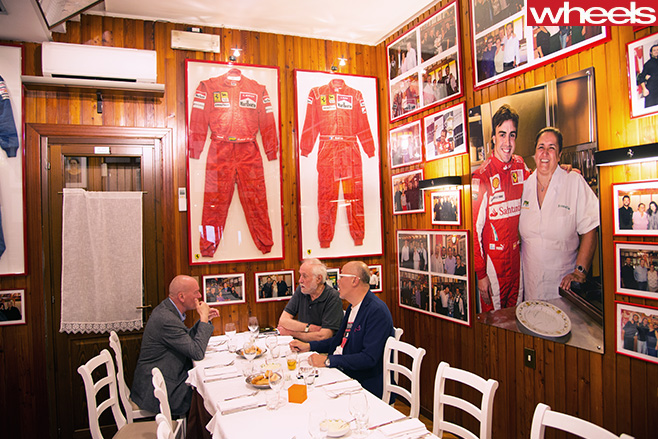
We’re waiting to hear when chairman Luca di Montezemolo can grant us an audience. The phone call comes over one of many coffees; we’re summoned for 11am. While we wait some more in Luca’s outer office, director of communications Stefano Lai asks a favour: The Italian press, another war-like tribe, is suggesting Fernando Alonso wants to move from Ferrari unless the Formula One cars improve. Rather than issue a statement, Lai wants me to ask Montezemolo an Alonso question so that my answer can be used as a proclamation. Why not?
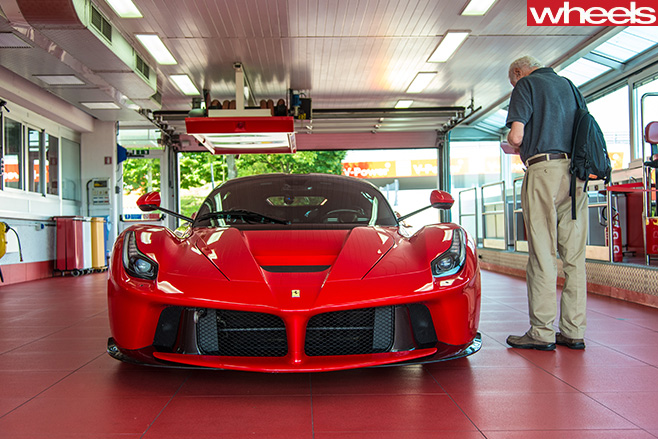
Two men dominate the history of Ferrari: founder Enzo, of course, but also Montezemolo. He doesn’t own the Prancing Horse, but he might as well, so powerful and dominant is his personality on a company recently voted the world’s most powerful brand.
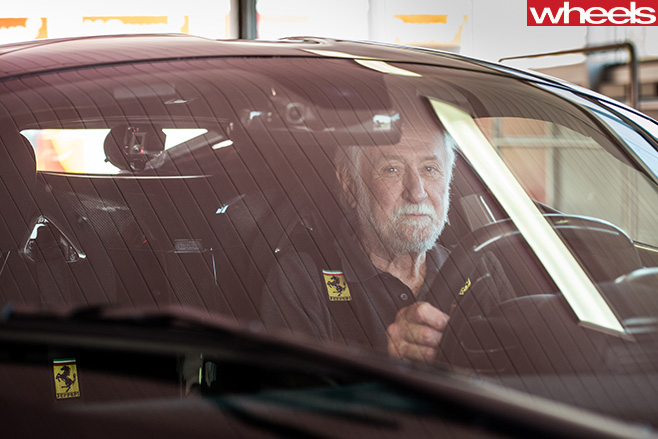
Finally, LDM, the ex-lawyer who, at just 25, was appointed in 1973 to run Ferrari’s F1 team and took Niki Lauda to two championships, greets us at the door, all smiles and charm. “Why don’t you sit in my seat,” he gestures to the far side of a huge desk. “We will do a fun picture.”
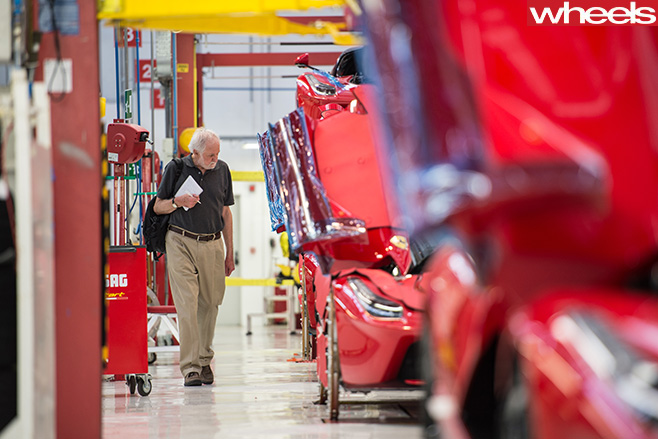
“We thank God there are lots of ideas. We are reorganising the Formula One technical area, and there are new methods and innovation in the industrial area. We’ve taken Michael Leiters from Porsche (formerly the head of the Germans’ hybrid program) so that Felisa can step back from the day to day.
“There is huge potential in the cars, even though we have pegged production to 7000 cars a year. We are pushing into new technology and design. With Sergio (Pininfarina) no longer at Pininfarina, this is no small thing for Ferrari.” La Ferrari is the first Ferrari not styled by Pininfarina in 40 years.
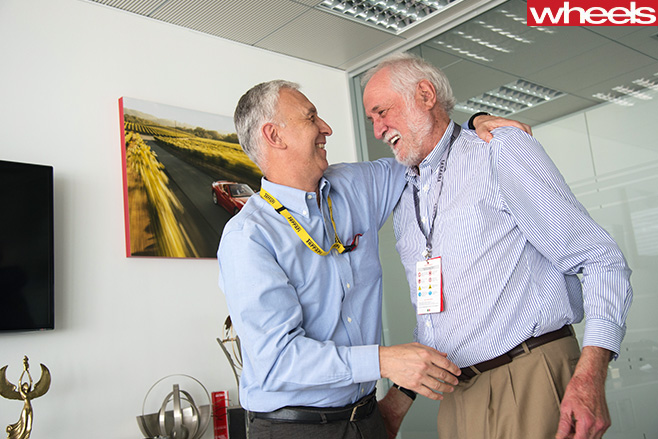
The Alonso story, with our photograph, is on the Ferrari website within minutes. I suspect it was written before LDM even gave me the answer.
Montezemolo has no plans for retirement, but he knows I am leaving the business and this will likely be our last meeting. He reaches down, pulls out a carbonfibre base on which is mounted a front wing from Alonso’s 2013 F1 car, and hands it to me. It’s inscribed and signed by Luca. I’m overwhelmed, and for a couple of seconds I can’t speak. My eyes water.
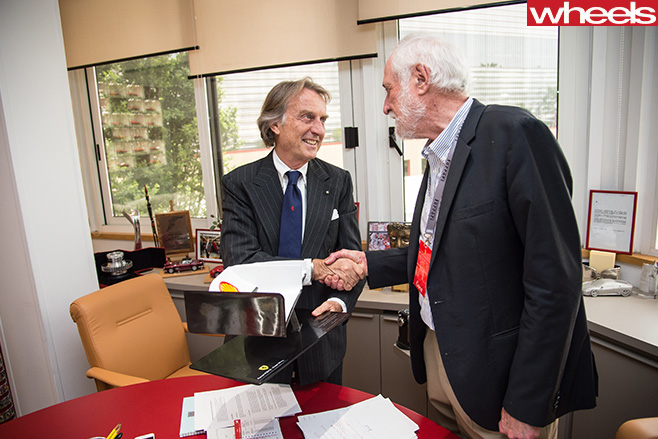
In September 1982, when I first visited Ferrari, Il Commendatore Enzo Ferrari was still very much the autocrat, at least of the racing department. Production of the largely Fiat-managed road car business totaled a mere 2209 cars. My cheeky requests, as editor of Wheels, were various, the theory being that if I asked a lot, they’d grant at least a few. I wanted to go out with a test driver; drive at least one of the new cars, ideally the recently revised V8; inspect the assembly plant; and, of course, meet the then 84-year-old Enzo.
Factory tour out of the way, I then sat down with Luca Matteoni, a marketing operative with responsibility for Australia. Feeling each other out, my Australian naivety no match for the suave Italian, I slowly became aware of a building irritation on the other side of the desk. A grumbling storm.

As a result, there was to be no test drive, no ride or drive in a prototype, and certainly no meeting with Enzo. As far as Matteoni was concerned, I was banned for life. But “life” is a relative term in Italy. Indeed, I later managed a second life ban and was thrown out of the factory in 2001 after writing something else Ferrari found offensive.
With such lows come dizzying highs, though. Dealing with Ferrari was constantly exciting, a motoring journalist’s dream. Across the 16 years from 1988, when I lived in Italy, my visits to Maranello increased in frequency as my contacts developed and friendships were built. I also came to realise that being a “friend”, to most Italians, means never being critical. Few understand the concept of objective assessment from a friend. They take it personally, and immediately you are perceived as the enemy.
It’s wonderful to be back here again, but this visit very nearly didn’t happen. The email from Stefano Lai in March this year had come at exactly the wrong moment. Days earlier, I’d told Editor Butler that after 52 years writing about cars (44 of them for Wheels) I planned to retire at the end of April. Now this from Maranello: “I am about to plan for April/May a test drive for La Ferrari for a small bunch of journalists… What is your feeling about it?”
How, in all good conscience, could I say no? I owned up to Lai about my retirement, suggested this story and asked for his help in organising to meet old friends. I told Butler I could make just one more trip.
My visit started deep inside Ferrari’s F1 shop, a location too secret for photographer Tom Salt’s cameras, for the first of three technical briefings on La Ferrari.
Franco Cimatti greeted me. “When do I start?” he asked. He’d read my June Wheels column, nominating him (with Gordon Murray) as the engineer to co-ordinate the building of my ideal car.
I first met the Italian-born, American-educated engineer at the launch of the 456GT in 1992 and interviewed him the following year. Today his title reads Head of Vehicle Concept and Pre-Development Department, and his fertile mind is one of the key reasons why today’s Ferraris are so good.
Cimatti planned the radical architecture around the seating position. By changing the driver’s posture, they lowered the H-point (hip location) by 30mm. Removing the seat means the driver sits on an Alcantara-cloaked pad set on the tub, without seat springs. For access, Ferrari cut away the sills and integrated them into the doors, hinging the now large, deep wings off the top of the windscreen pillar and roof. It’s a brillant solution.
“We didn’t focus on interior space in terms of volume, but how much room the driver really needs,” Cimatti says. “Space saved was space that could be used elsewhere. We think of it as a shrink-wrapped driving position.”
I’m bombarded with impressive numbers for La Ferrari and my jet-lagged brain struggles to absorb them. But I’m stirred by Ferrari’s GT dynamics simulator, set for a lap of Ferrari’s fantastic 5.2km Mugello circuit in the Apennine hills north of Florence. Matteo Lanzavecchia, who’s in charge of vehicle performance, says the simulator achieves 99 percent accuracy in terms of lap times and is so sophisticated that it includes accurate anti-dive and squat, and corner-specific load transfers. Surely, in La Ferrari, the ultimate gaming set-up.
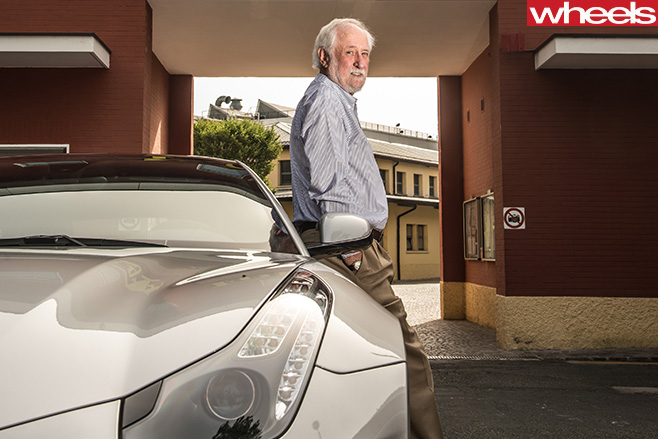
It’s a sunny day and Fiorano is welcoming: the old farm buildings beautifully restored, an F104 Lockheed Starfighter still on show behind Schumacher’s championship-winning F2001 F1 car. I rode with the champion on three occasions. Only months after he became a Ferrari driver in 1996, the launch of the 550 Maranello was to include having the motoring writers driven around the Nurburgring GP circuit by one of five Ferrari drivers. My friends in the press department ensured I was paired with Schumacher.
“Now we will go fast,” he told me at the beginning of our second lap. Watching every movement, I quickly understood that hands, arms, feet and eyes were working as one – throttle, steering and brakes in total harmony as if they were a single control. Michael was a picture of calm amid the fury as he talked me through his subtle actions. The 550, suspended in time, drifted through one 240-degree bend in a single masterful sweep.
More waiting. The call came at 5.30pm. Schumi was polite enough to say he remembered me from the earlier drive and chatted openly about his minimal involvement in the Enzo’s development, despite the PR spin. “I don’t rate myself being involved in road-car development,” he told me. “I’m not so interested, it takes so much time.” And there was genuine concern he would lose his licence if he did too much of his unique brand of road testing, which involved drifting past a police car on at least one occasion.
The third meeting with Schumi was when Fiat named a special edition of its baby Seicento after him. I persuaded Fiat to send a car by truck from Turin to Mugello, where Michael was testing the new F1 car, and was slotted into his schedule for one memorable lap.
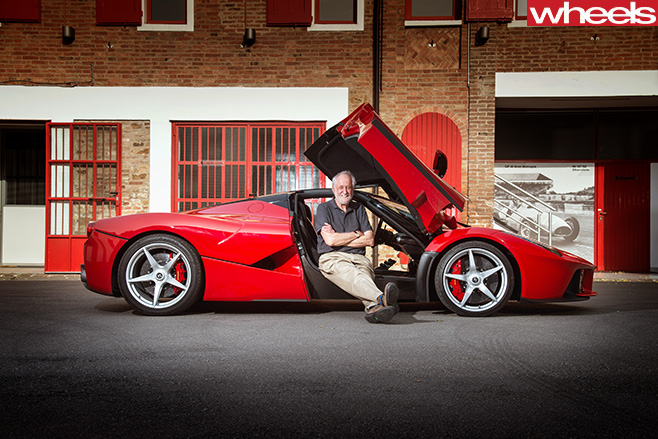
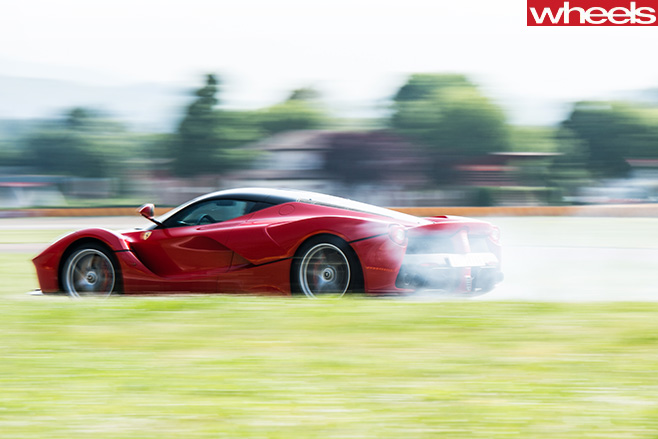
Two identical La Ferraris await: one for the road drive, the other, inside Fiorano’s now enclosed telemetry garage, for circuit lapping. But not before three shakedown laps sitting alongside lead development driver Raffaele De Simone. We burst on to the track, Raffa’s skilled hands and feet feeding in the power, smoking both rear wheels through a 160km/h, third-gear sweeper while constantly adjusting the car’s attitude.
My La Ferrari driving impressions appeared last month: for now, you only need know the LF is a time machine – you are here and then you are there, with nothing but shrill sound in between. You are never out of the power band and the speed is relentless, brutal and instantaneous. Throttle reflexes are hair-trigger fast. I’m happy to admit that at the limit, the sheer, violent speed is way beyond my talent. Then it’s over, and I’m grateful to hand it back without embarrassing myself.
Time for a tour of the LF assembly line. No right-hand drive, though that hasn’t stopped “somewhere shy of 10” Australians forking out $2m-plus for the pleasure. Each car takes 170 hours to hand assemble, about the same as the F50 and Ferrari Enzo (a Golf takes about 18 hours).
Discussion turns to La Ferrari’s superb styling. Ferrari claims its appearance is driven by aerodynamics, that every line, every opening, is about air flow and cooling and downforce. All except one, I insist, referring to the little crease line that flows from just in front of the rear wheel opening, up and over the flank to the base of the tapered glasshouse. Cimatti smiles. “You’re right, at the Geneva show last year (Giorgetto) Giugiaro called me on the same thing.”
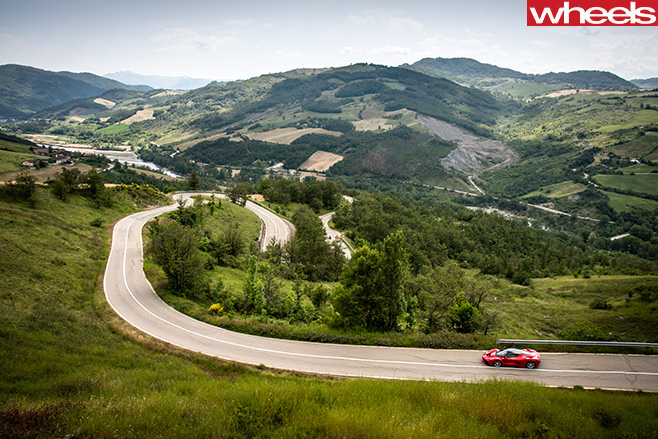
Road time in La Ferrari takes photographer Salt and me on a set route through the tight, undulating hills south of Maranello. Magically, the car starts to shrink; the steering is linear and unfailingly direct; the ride, having decoupled the dampers to “bumpy road” while in Race mode, is astonishing; the carbon brakes instant yet easy to modulate; the performance beyond words.
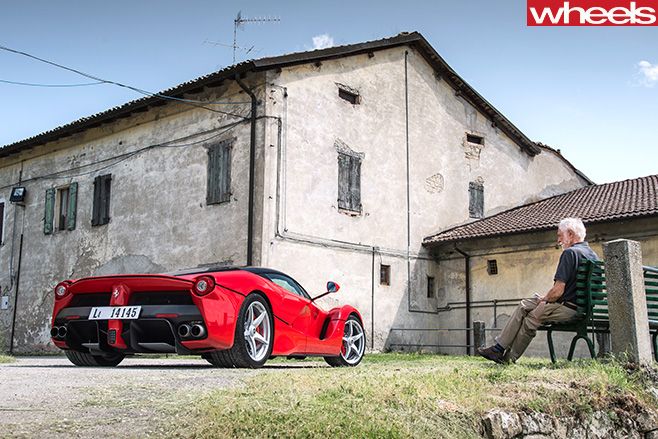
My first Ferrari, a Dino 246 GT, set the pattern way back in 1970 and, with a couple of notable exceptions, mostly the Mondial and 348, the cars from Maranello have brought me great joy.
The memories, stored on my brain’s hard-drive and never to be deleted, are now priceless.
Great advances
FRANCO Cimatti (above) works in the future. Two decades ago it was 15 years out. Today, given the rate of progress and competitive pressures, it’s closer to 10. But today I ask Cimatti, now 55, still thin and with close-cropped hair and wire-rimmed glasses, to nominate the three biggest advances over the last 20 years.
“Electronics supersedes everything, but it’s too obvious,” he admits before nominating anti-lock brakes. “ABS is still the biggest safety improvement in cars. Take out any driver aids you now have, but leave me ABS. Think how they minimised stopping distances.”
Second: “The advances in tyres. Road-tyre grip has gone from 0.9g to 1.3 to 1.4g, wet and dry, and it’s coupled with lower rolling resistance, more comfort, lower rolling noise and lower temperatures from the black magic of tyre compounds and tread design. I liken tyres to the needle on a turntable. A poor needle creates lousy music.”
Third: “The dual-clutch transmission changed the interaction between car and driver in enabling the driver to keep both hands on the wheel to exploit all the performance. Everybody has had issues, but remember it’s still first-generation hardware.”
What’s next? “The biggest challenge is about compatibility with CO2 emissions (but) we want the Nurburgring lap record, not to be the most efficient car with the lowest CO2.”
Ferrari’s supercars
WHENEVER a new Ferrari supercar arrives, we wonder how they can possibly top it. It happened with the F50, then the Enzo, and now La Ferrari. Surely it’s not possible to surpass La Ferrari? And yet, I don’t doubt that a decade from now a new supercar will do exactly that.
I missed driving the 288 GTO and only experienced the F40 on the road. Still, when the turbos lit up, it needed your constant attention; a raw and so exciting machine that still blows people away.
With the F50, Enzo’s surviving son Piero Lardi Ferrari, who still owns 10 percent of the business, built an F1 car for the road. The F1-derived atmo V12, mounted directly to the carbonfibre chassis, created massive and unsolvable NVH problems. So Ferrari never let journalists drive the car with the removable carbon roof in place. The F50 was much easier and more predictable than the F40. It was possible to get the F50 so far sideways that the steering was against the bump stops on opposite lock.
Seven years later I returned to Fiorano to drive the Enzo. Before being entrusted with the car, lead development driver Dario Benuzzi demonstrated its fantastic performance. The 6.0-litre V12 stretched to the 8200rpm limiter in every gear, we hit 240km/h in fifth through the kink before Fiorano’s 90-degree right-angle bend.
La Ferrari reaches 270km/h at the same point, just 20km/h shy of the best F1 speed. Asked to choose from these supercars, I’d take La Ferrari without hesitation.
HERE it is! Spy photographers have sprung the 2018 Holden Commodore, the most anticipated new car in more than a decade, in glorious, fully undisguised production form – and only about a week out from its expected official reveal.
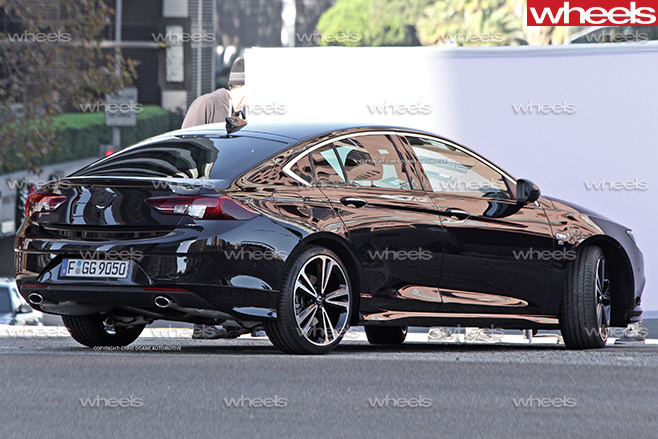
- Holden’s response to negative hype surrounding the imported Commodore.
- We drive the 2018 imported Commodore!
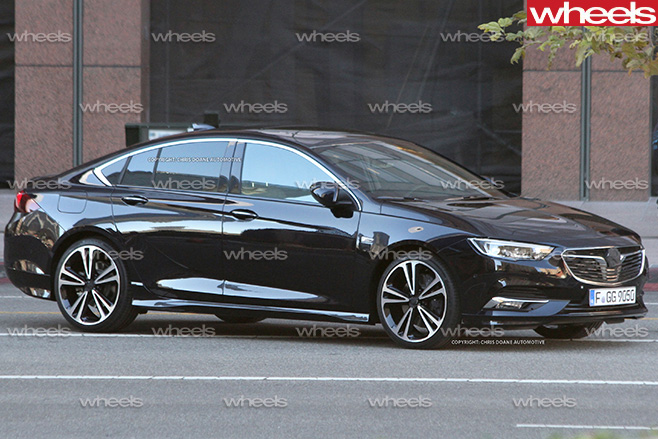
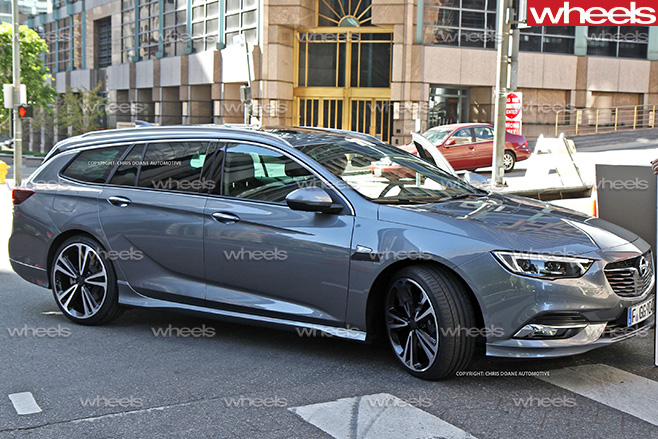
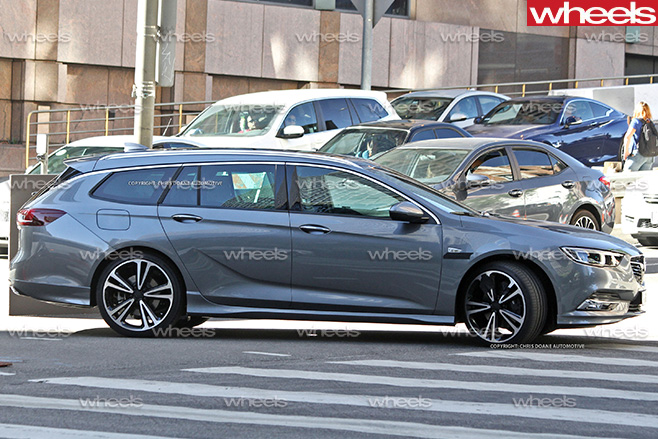
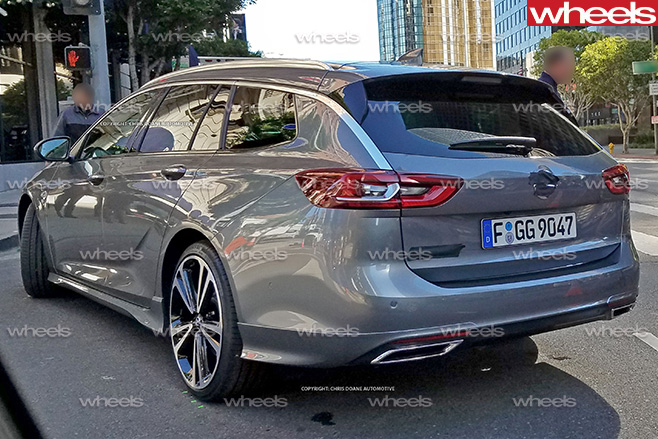
We’ll know more about the most important NG Commodore when Holden reveals further details, which rumours suggest could be as early as this week.
If you’re an Aussie car fan, you’re probably aware that earlier this year HSV released the R8 SV Black series, a last hurrah for the 6.2-litre LS3 V8 that has been in use since the E Series appeared in 2007.
Limited to just 350 Clubsports and 100 Maloos, the upgrades are purely cosmetic. However the SV Blacks undercut their mechanically identical Gen-F predecessors by $7000, making them good value.
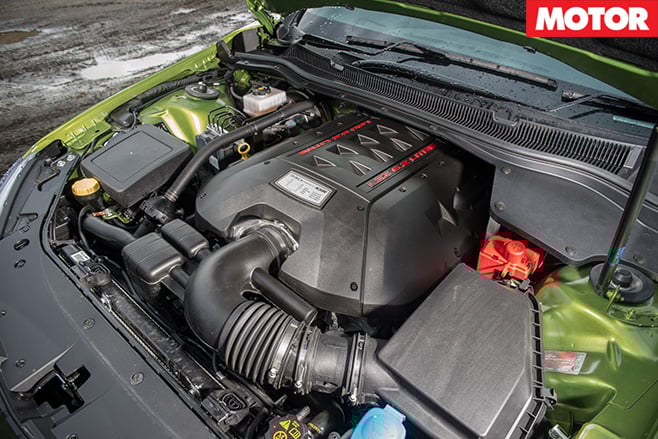
Unsurprisingly, the two feel very similar in a straight line. Torque is identical, as are the gear ratios, and the HSV’s extra 36kW – courtesy of list engine mods – are offset slightly by the extra 40kg it carries. Nonetheless, the Maloo does feel like it revs slightly more keenly and, to my ears, sounds slightly better (you may disagree). But we’re splitting hairs at this point.
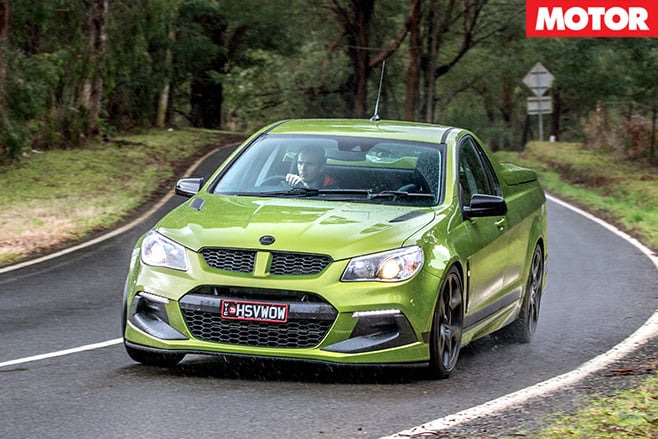
Unsurprisingly, both are keen oversteerers in the wet. But as they are naturally aspirated, metering out the power – and thus the level of slip – is a piece of cake. Their sports ESP settings – Competition Mode in the Holden, Performance mode in the HSV – are both up there with the best, perfectly calibrated for the road.
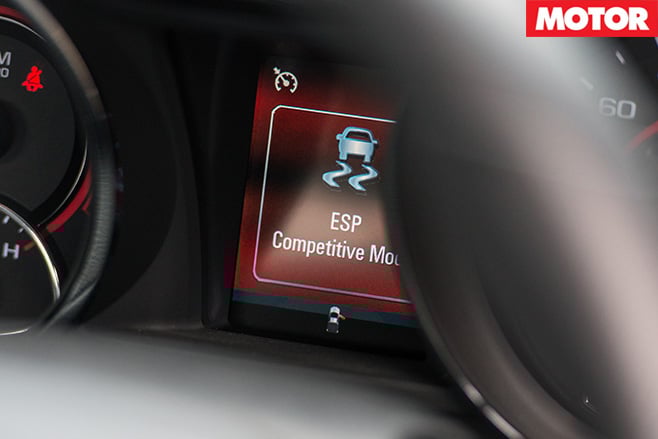
In the dry this can make it slightly less playful, but the payoff is less slack in the suspension and better body control, yet the ride doesn’t seem to unduly suffer.
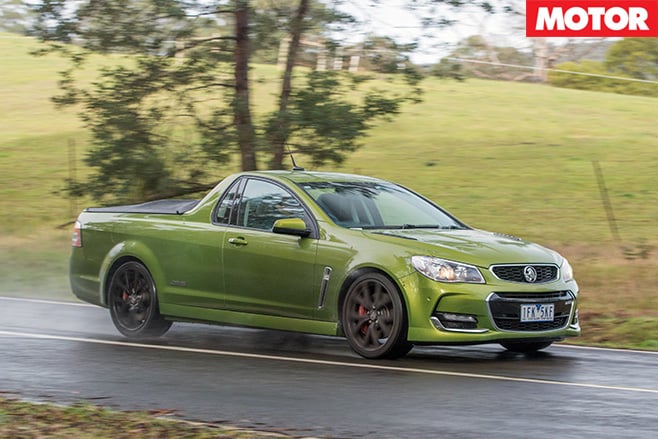
My first thought was to buy a second-hand Gen-F Maloo R8 SV. But residual values are extremely strong, with cars approaching 100,000km on the clock only just ducking under the $50,000 mark. Another way to look at it is that for $12,000, you could undoubtedly make the Redline go, stop and handle better than a standard Maloo.
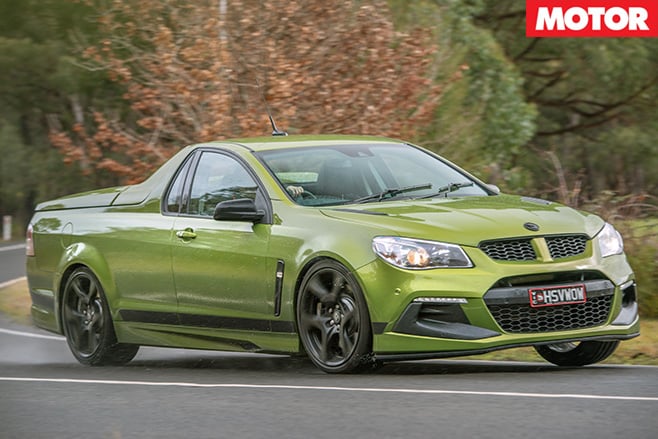
MONTH TWO
LIKED: Driving V8 utes on wet roads DISLIKED: Discovering the Maloo’s better FAVOURITE MOMENT: V8s roaring, tyres spinning – yeehaa!
FUEL THIS MONTH: 15.7L/100km AVERAGE: 14.77L/100km DISTANCE THIS MONTH: 912km TOTAL: 11,736km
See Part 1 of our long-termer Holden SS-V Redline ute.
Well, this looks pretty good, doesn’t it? Sneaky spy photographers have snapped the 2017 Opel Insignia undisguised in the US ahead of its official unveiling.
Why do we care? Because as most car nuts will know the 2017 Opel Insignia will be rebadged as the 2018 Holden NG Commodore, due for release in around 12 months’ time.
Check out the Motor1 website for almost 80 images detailing every angle of the new Commodore, but it’s clear that Holden’s new sedan/hatch and wagon is much better looking than the frumpy camouflaged prototypes hinted it.
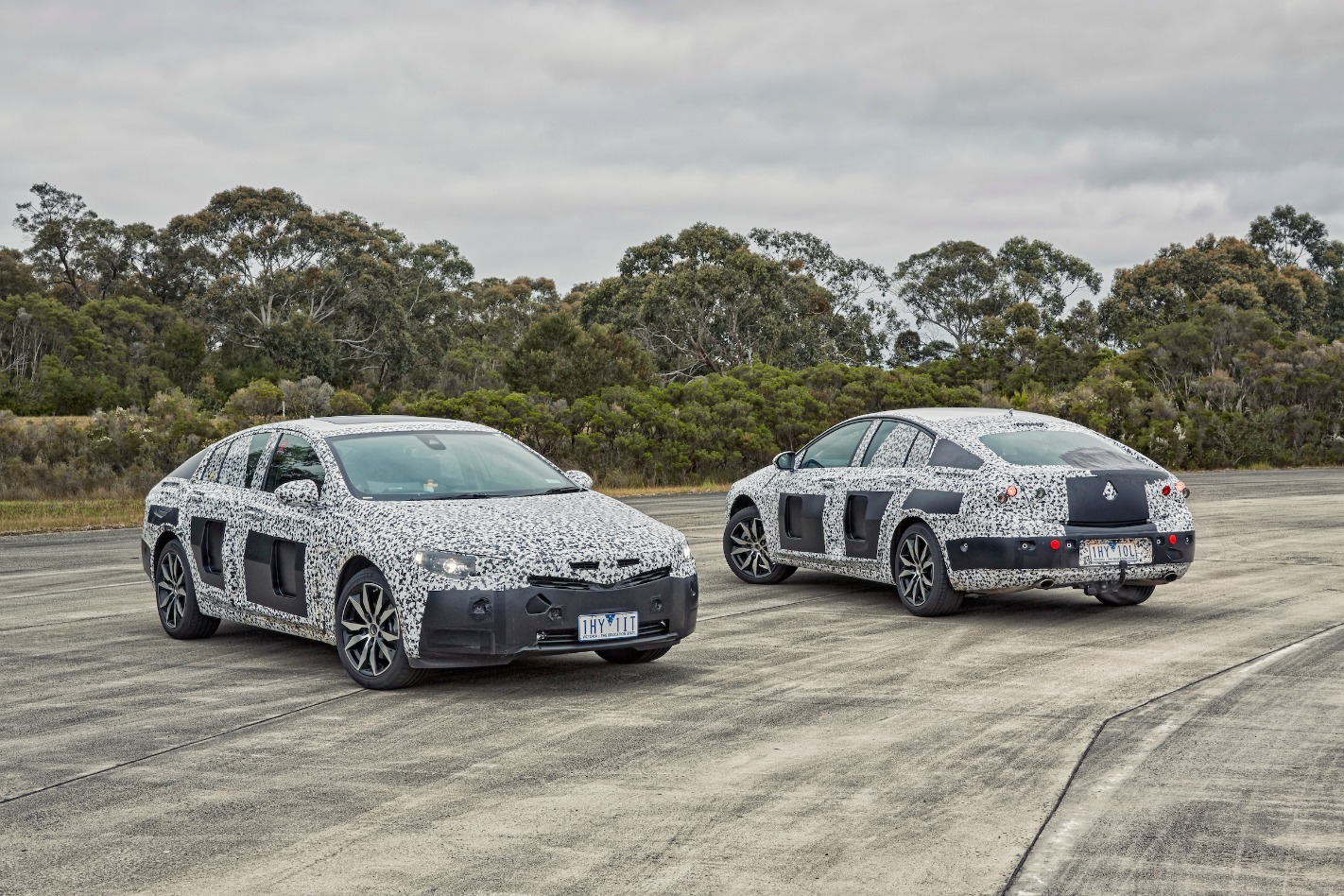
The rest of the world has to make do with 2.0-litre petrol and diesel turbocharged four-cylinder models, but in addition to these Australia will receive a 230kW/370Nm 3.6-litre V6 all-wheel drive flagship, capable of 0-100km/h in around six seconds.
While the new Commodore may look similar in size and shape to the likes of the Mazda 6 or Kia Optima, its dimensions are actually extremely similar to the current VF II, measuring 16mm longer, 35mm narrower and 3mm shorter in height.
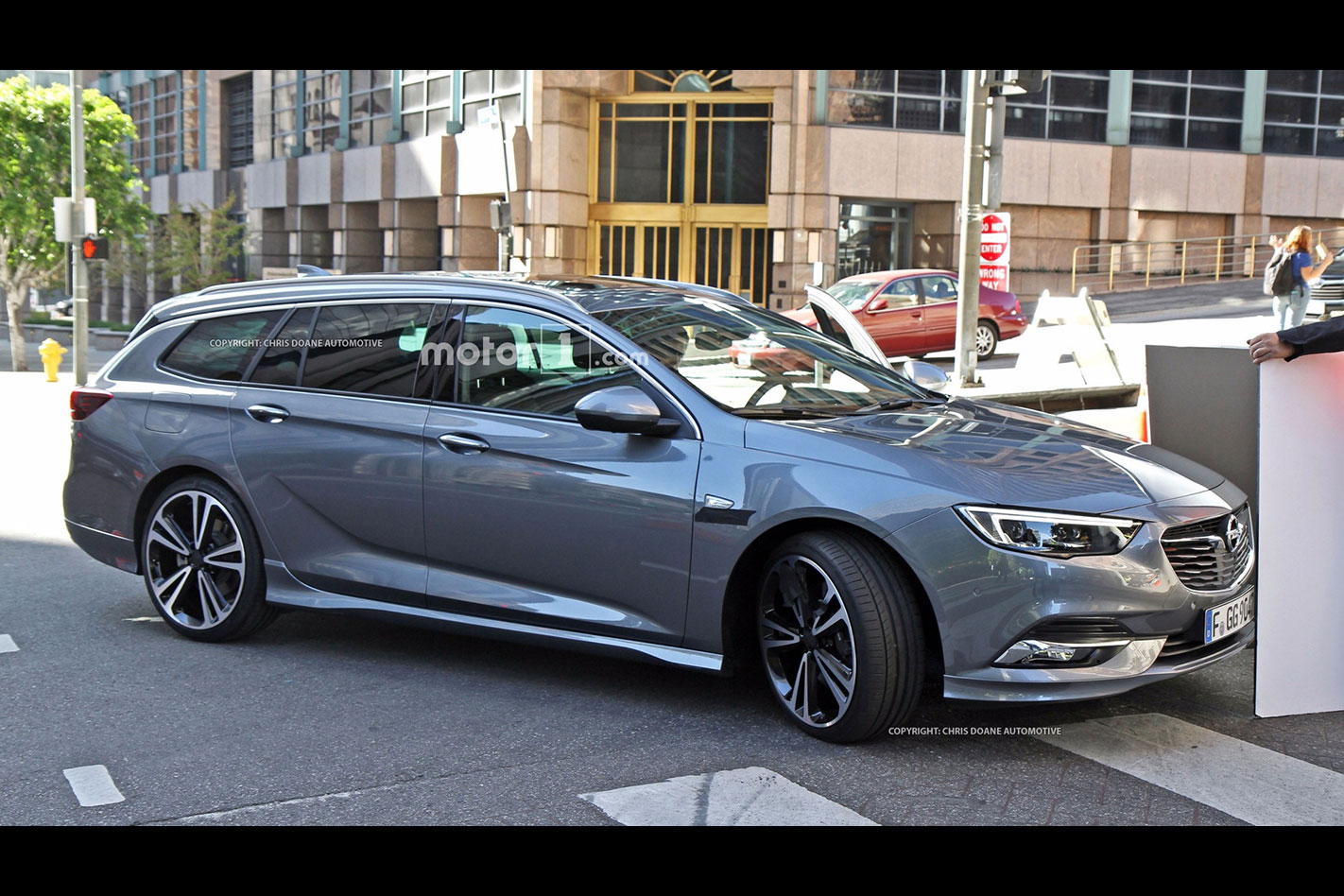
We’ll bring you more details as we have them, but does the sleek styling help you warm to the all-new imported Holden Commodore?
What stands out?
The Lexus RC is a two-door coupe with unmistakable styling and exquisite attention to detail, from the wheels and paint to the luxurious, futuristic interior. It is principally a GT car – a comfortable, powerful, cross-country tourer for two. Engine choices begin with a friendly 2.0-litre turbo four-cylinder and end at a formidable 5.0-litre V8. Auto-braking is standard.
What might bug me?
The foot-operated park brake, which may intrude on leg space for big drivers.Dialling up the cabin temperature. You slide your finger along a metal strip for big adjustments, and then there are pretty red and blue buttons for small adjustments. It’s easy to overshoot.How slowly the power-adjustable seats move. Especially when you are trying to help someone slip into the back in a hurry.Dealing with flat tyres. All Lexus RCs come with a space-saver spare, which is limited to 80km/h when fitted.On a winding road, the relatively high weight of an RC, which makes it feel less obedient to the controls. Most similar coupes weigh less.In the high-performance RC-F prior to December 2016, the bumpy ride around town: its suspension tune was extremely firm. However, for the 2017 model year Lexus equipped the RC-F with the adaptive suspension that was previously available on the less muscular RC200t and RC350, and you can expect that to improve comfort without compromising control.
What body styles are there?
Two-door coupe only. The engine is in the front, and it drives the rear wheels.The RC is related to the Lexus IS medium sedan, and about the same size. It is classed as a sports car, mid- priced.
What features do all versions have?
A 7.0-inch colour screen, satellite navigation, digital radio reception, and a reversing camera.Dual-zone air-conditioning, which allows different temperatures to be set for each side of the cabin.Powered steering column adjustment, and power-operated front seats with heating and ventilation.Headlights that use long-lived LEDs and come on automatically in low light. Windscreen wipers that come on automatically when it rains.Smart key entry, which allows the doors to be opened whenever the key is nearby (perhaps in a pocket or bag).Automatic transmission, with paddle shifters.Driving mode selection: you can adjust, in concert, the way the car rides, steers, responds to the accelerator, and operates the air-conditioning, choosing from Normal, Power and Eco modes.Radar-based automatic emergency braking that works at city and highway speeds. Active cruise control, which can maintain a set distance to the car in front.Eight airbags. Those in the front seats each get frontal and knee airbags, and body-protecting side airbags. Curtain airbags down each side protect heads front and rear in a side crash.Electronic stability control, which can help control a skid. All new cars must have this feature.The RC is covered by a four-year, 100,000km warranty.
Which engine uses least fuel, and why wouldn’t I choose it?
The turbocharged, 2.0-litre four-cylinder petrol engine in the RC200t is comfortably the least thirsty engine in a Lexus RC, consuming 7.3L/100km on the official test (city and country combined). It’s a quiet, smooth engine that feels spritely around town. You never feel like you need more power.The main reason you might not choose it is that you want more entertainment from your RC engine.The 3.5-litre V6 petrol in the RC 350 is smoother than the turbo four and ultimately goes harder, while using about 30 per cent more fuel.The 5.0-litre V8 in the RC-F turns that adrenaline rush factor up two or three fold. It’s the party animal of the RC line-up, but is a Jekyll and Hyde character as it can still be smooth and serene in town. Understandably, it drinks significantly more fuel than the V6.All RC models come only with an eight-speed automatic transmission.
What key features do I get if I spend more?
The least costly Lexus RC is the RC200t Luxury, which has the 2.0-litre engine and 18-inch alloy wheels. You can spend more on a different engine, more equipment, or both.On the engine side, you can pay a little bit more for an RC350, which has the 3.5-litre V6 engine, or nearly twice as much for an RC-F, which has the 5.0-litre V8.On the equipment side, the RC200t and RC350 come in three versions. The least costly is Luxury (perhaps Lexus is trying to convince you that Luxury is standard on its cars). You can spend more for F-Sport, and more again for Sports Luxury.In the RC200t, F-Sport brings 19-inch wheels shod with lower-profile tyres, which make the steering feel slightly more direct (and the car look racier). A limited-slip differential helps steady the car when driving hard out of corners. Adaptive suspension tunes the car’s ride automatically for the driving conditions. Visual touches include chunkier front and rear bumpers, and side skirts.Front seats in the F-Sport have more substantial side bolsters, which help hold you in place around corners, and the driver’s seat remembers your adjustments. There is blind spot monitoring, to warn you of other vehicles alongside out of view, and rear cross-traffic alert, which helps avoid carpark bingles when reversing. Audiophiles will appreciate the premium Mark Levinson sound system.The RC350 F-Sport has this equipment but also brings variable ratio steering (which enhances steering feel as speeds rise), and Dynamic Rear Steering, which helps the car turn more sharply at low speeds – while improving stability at high speeds.Paying more for an RC200t or RC350 Sports Luxury brings you full leather trim, headlamps that dip automatically for oncoming drivers, and lane-departure warning (which helps you avoid drifting into oncoming traffic, for example).Paying much more for an RC-F brings you the V8 engine and most of the Sports Luxury equipment list, including – since December 2016 – the adaptive suspension. You also get a much more aggressive look, racing seats that have much more side support than in other models, and a torque-vectoring differential, which does an even better job than the limited-slip diff in the less costly RCs.You can add a Carbon Pack to the RC-F that includes a bonnet and roof made from lightweight carbon-fibre, and a rear wing that rises at speeds over 80km/h to improve high-speed aerodynamics.
Does any upgrade have a down side?
The 19-inch wheels on F-Sport and Sports Luxury models use lower-profile tyres. These will be more expensive than those on Luxury versions and are not likely to last as long.As well, they bring a less comfortable ride (because there is less cushioning air between the wheel and the road). They’re teamed with less comfortable sports seats, too.Lexus claims that the RC is the only mass-produced car to have its paint baked twice. We can’t vouch for that, but we can say that all RCs have an exceptionally good paint finish.However, you’ll have to pay a premium for every colour but Onyx, which is a solid black. The other colours include Infrared (red), Mercury Grey, Steel Mica and Starlight Black. Three colours are exclusive to F-Sport models: Lava Mica (a searing orange), Cobalt Mica and White Nova.
How comfortable is it?
The interior of a Lexus RC looks futuristic, and even the least costly has lots of equipment. The driving position is excellent, with good vision out front and rear. The steering wheel and pedals are well placed. Seats in Luxury models are supportive, with high-quality coverings. Seats in F-Sport cars are firmer but still comfortable.The RC200t and RC350 are easy to drive smoothly and quietly. The 200t responds better to the accelerator pedal at low speeds and so is easier to drive around town and to manoeuvre through gaps in traffic.In a V8 RC-F with conventional, mechanically controlled suspension, the ride feels brittle and rough. Its suspension is better suited to a smooth racetrack than to a bumpy road. However, Lexus acted to improve the ride of the RC-F in December 2016, substituting electronically controlled adaptive dampers that prioritise ride comfort in most driving modes.In a V8 RC-F, the ride feels brittle and rough. Its suspension is better suited to a smooth racetrack than to a bumpy road.
What about safety?
Every Lexus RC has a reversing camera and eight airbags. A Pre-collision Safety System (PCS) is also standard, and it includes automatic braking. It detects obstacles ahead of the car, and will warn you of them with an audible beep. If you fail to take action, the Active Cruise Control will slow the car to a standstill from any speed.Sports Luxury models also have Lane Departure Warning, which notifies you if you are drifting out of your lane (a sign of fatigue). This is also offered with extra-cost enhancement packs on the less expensive RCs.(To see a list of the safety features on any model, open the model from the Cars Covered By This Review dropdown near the top of this page, and look under the features tab. Safety-related features are listed in red.)The Australasian New Car Assessment Program (ANCAP) has not tested the Lexus RC.
I like driving – will I enjoy this car?
Even the Lexus RC200t is a fun vehicle to drive. It’s not a sports car, but it does have a responsive, flexible character, and handing that is good enough to be entertaining on a country road.The RC 350 is a better touring car and has stronger overtaking performance on the highway. It’s significantly faster than the 200t if you wind it out. A sound enhancer pipes the guttural engine note into the cabin, for a more involving experience. The RC350 also feels slightly better balanced overall, in part due to the dynamic rear steering.The RC-F is the wild child of the Lexus showroom: it is arresting to look at even while it’s standing still. It is also an impeccably crafted, stylish and fast GT coupe. Its V8 burble sounds great – even at the traffic lights. Its rapid acceleration will impress (or disgust) your passengers. Stiff suspension helps it through corners.Nevertheless all RCs are significantly heavier than most similar cars, and you feel that weight when changing direction at speed.The driving mode selection on RCs also adjusts the Vehicle Stability Control, so that you can tune how much the car slides before electronic intervention brings it back into line. The RC-F has an additional, Expert, drive mode. Even here there is intervention, but it arrives significantly later.
How is life in the rear seats?
Not much fun, unless you are small. Rear seats in an RC are not of use for much beyond carrying small children or extra cargo. Adults will find it difficult to squeeze in comfortably, with not much headroom or legroom available. And there are no rear doors.You can move the power-adjustable front seats to help rear passengers enter or exit. However the seats move agonisingly slowly, which you may not worry about until loading people or cargo in the rain, or at a busy location such as an airport pick up lane.
How is it for carrying stuff?
The Lexus RC is more focussed on style and performance than on practicality, but its 423-litre boot is competitive with other sporty coupes. (It’s smaller in the RC-F: only 366 litres).The rear seat is a 50:50 split fold and can lie completely flat. It also has a ski-port in the centre, which enables a long item (for example, skis) to be loaded into the boot and through into the passenger area.
Where is it made?
The Lexus RC is made in Japan.
What might I miss that similar cars have?
Perhaps a diesel engine, which could use less fuel on long trips. Most similar coupes offer this.Perhaps a manual transmission, which is offered on the BMW M4.Maybe all-wheel drive, which gives you a surer footing when it’s wet or otherwise slippery. Audi offers an all-wheel drive RS5.Other cars you might consider include the BMW 4 Series, the Mercedes-Benz C-Class Coupe, and the Audi A5 range.Jaguar also offers the F-Type Coupe, which is an obvious alternative to the Lexus RC-F except that it costs considerably more.
I like this car, but I can’t choose which version. Can you help?
We would recommend the RC350. It does not cost much more than the 200t and it adds rear-wheel steering and a buttery smooth V6 with more power.However, the RC200t is a more comfortable daily driver, as it’s tuned for a better response at slower, urban speeds.It’s obvious when you drive the RC-F that is made for ferocious performance. It’s also the most expensive RC by a considerable margin, making it a far more emotional purchase.
Are there plans to update this model soon?
The current generation Lexus RC arrived in 2014. The RC200t was introduced late in 2015 as the third model, along with updates across the range. The RC-F gained adaptive suspension for the 2017 model year. The RC isn’t due for replacement until 2018 at the earliest.
It’s not a competition to see which of these terrible driving traits takes the cake for most annoying, as they’re all equally frustrating. But if we can explain a few of the worst and potentially stop some of these behaviours from happening on Australian roads, we’re all for it!
BAD MERGING
Zipper merging should be simple. Two cars come together at matching speeds and the car that is slightly behind gives way to the one in front. When there’s a string of cars this process, when done right, it should work like, as the name suggests, a zipper. However this will only occur when all cars are fully autonomous because humans are idiots.
We can merge on foot when forming a line at ticket barriers so why can’t we do it in cars? Sure, we can blame a lack of driver education, but merging, be it at a freeway entrance or lane reduction is invariably undone by at least one driver exhibiting one of the seven deadly sins of driving: selfishness, impatience, ignorance, inattention, inexperience, fear or just being a jerk.
Merging drivers who try to join the traffic at the wrong speed or ridiculously late are the main culprits, but a lack of courtesy by drivers supposedly meant to let them in doesn’t help either.
RIGHT-HAND LANE HOGS
It doesn’t matter how many lanes are added to freeways, there are some drivers who will stick in the far right lane below the speed limit totally oblivious to steering wheel-punching anger brewing behind them.

It takes effort be a fast-lane troll. Very few freeway on-ramps merge on the right-hand side, meaning a driver would have to deliberately traverse multiple lanes with no intention of keeping up with the traffic flow.
Punishments aren’t fitting the crime
Such drivers are generally in one of three camps:
- The Blissfully Ignorant, who are totally oblivious to everything that exists outside their car’s four sides. You can usually tell these people at traffic lights when they’re mining their noses thinking no one can see into their glasshouse on wheels.
- The Willfully Arrogant, “screw you mate”, driver who doesn’t give a damn about anyone else and thinks that being in the right-hand lane will get them to their destination faster regardless of how slow they travel. These people often tailgate or parallel park with their nose just over the line preventing someone else from using the space in front. They are justifiably hated.
- Passive-Aggressive Moral Crusading Control Freaks, who sit just below the speed limit because they think we’ll all be safer even when B-double LPG tankers are being forced to change lanes and undertake. “Why should I speed up and risk my life? I’m doing them a favour”, they tell their front-seat passenger who is white-knuckle gripping the Jesus bar and sneaking fearful glances in the side mirror.
VEERING LEFT TO TURN RIGHT
Unless you’re using a roundabout or a doing one of those hook turns that Victorians invented to freak out interstate drivers, there is absolutely no reason to veer left a little bit when turning right. No right turn is that sharp that you need to come at it from a different angle as the lines dictate. All it does is make your car a sideswiping hazard for someone in the adjacent lane. There is no reason for this, which makes us think it’s some kind of subconscious thing that drivers don’t realise they’re doing.
SPEEDING UP WHEN BEING OVERTAKEN
Another thing that can’t be explained beyond the protagonist simply being a crap person is the tendency for some drivers to sit on a certain speed only to accelerate as you attempt to overtake them. Are people that competitive that they see the simple act of overtaking as a challenge?
A roped off place in hell is reserved for those who, on a winding single-lane highway, speed up when you attempt to pass them on the only overtaking lane for the next 10 kilometres.

NOT PAYING ATTENTION AT TRAFFIC LIGHTS
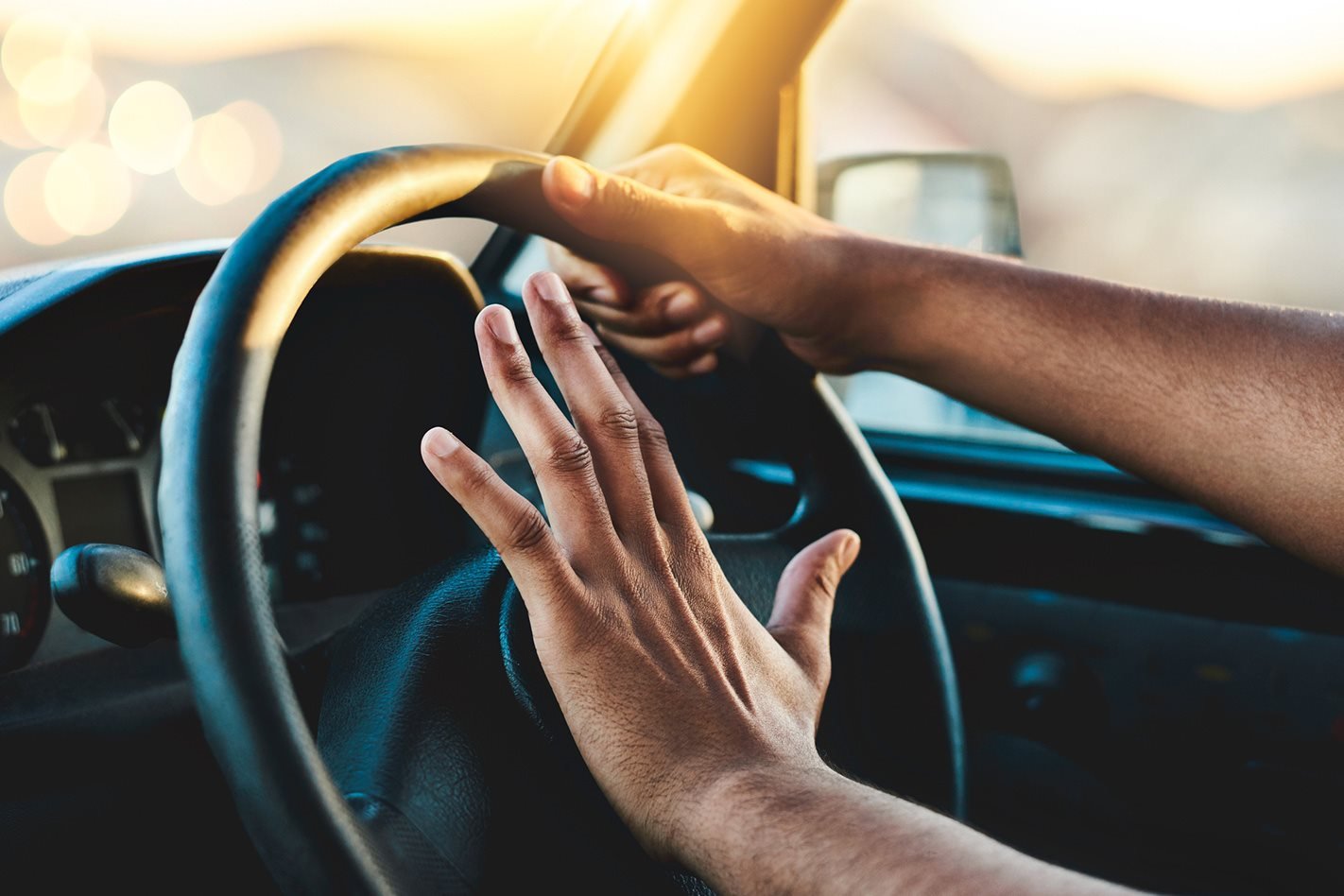
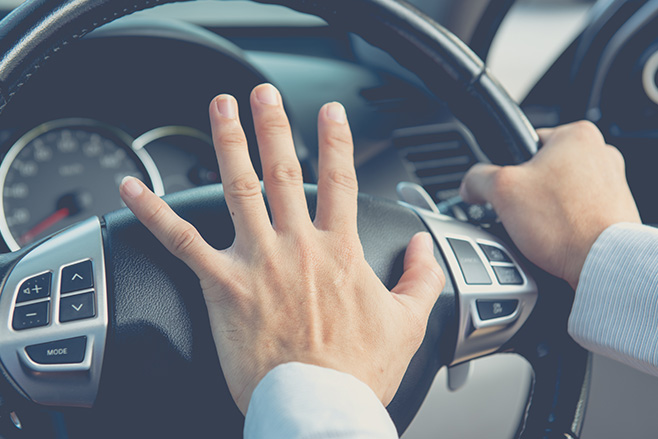
There is a sliding scale of things that can distract you at traffic lights and an appropriate response from those behind you. These range from a quick beep of the horn that says ‘Hey, bud, stop reading that billboard and get a move on’, to the hand held on horn, upwardly pointed finger and easy-to-lip-read-through-rearview-mirror abuse should you be caught looking at your phone after the lights turn green.
Subaru cars have an alert which lets you know when the car in front has driven off so you don’t earn the appropriate ire of those behind you if distracted at traffic lights. This is a great way to stop copping abuse though prevention is even better. Concentrate!
SPECIAL MENTION – TAILGATING
Unless you’re helping someone to jump from one car to another in the middle of a dramatic high-speed chase that could help decide the future of mankind, there’s no reason to tailgate.
Tailgating, like NASCAR, is an aggressive and dangerously misguided endeavour by imbeciles who think they can thwart physics by assuming that being closer to a car in front can make you faster than it.
It’s a key cause of car crashes and has no place on our roads.
Rant over.
