
Kia will introduce a rear-wheel drive sports sedan to the Australian market from late next year – just in time for the demise of the locally produced Holden Commodore.
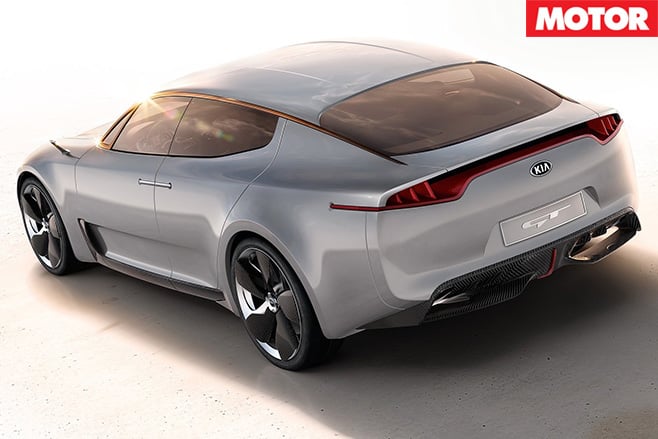
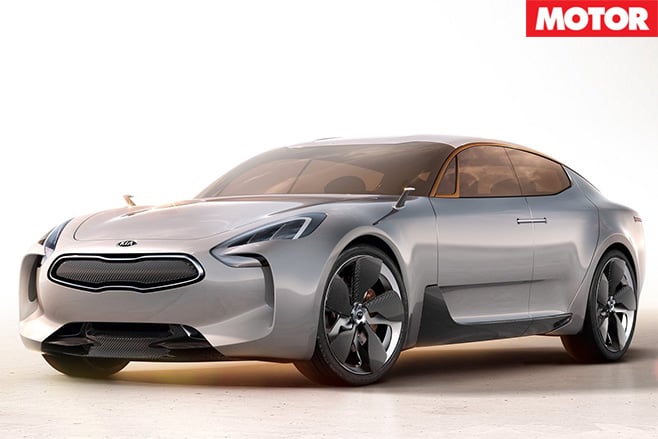
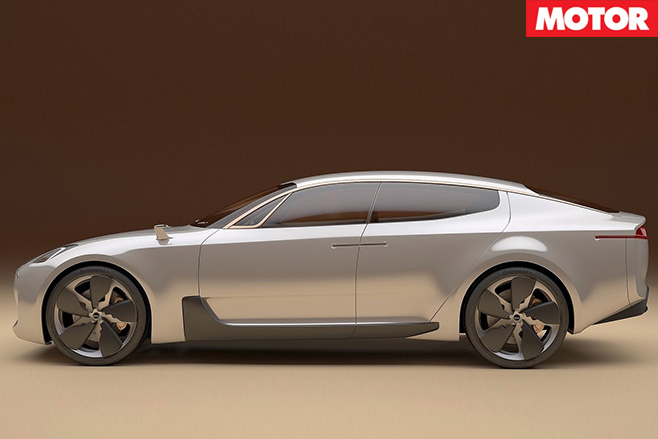
The new model codenamed ‘CK’ has for the first time been spied in production form inside a Kia factory, and as expected it reveals a close resemblance to the GT Concept first shown five years ago at 2011’s Frankfurt motor show.
A short front overhang, broad dash-to-axle ratio highlighted by a chrome side gill, a long wheelbase and swooping roofline are all the hallmarks of the rear-drive model all but confirmed to sell locally from around $40,000 before on-road costs.
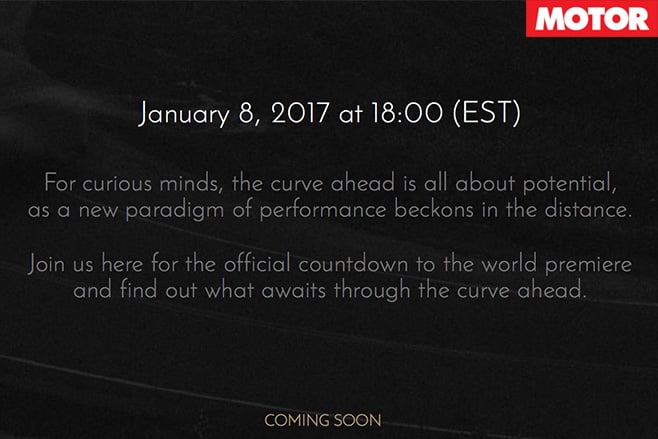
The video finishes by saying a vehicle with “heart pounding performance” and “sleek sophistication” will be revealed on January 8, 2017 – the opening day of the Detroit auto show – with a grainy outline of the production car also shown.
Speaking with Australian media earlier this year, Kia Australia chief operating officer Damien Meredith gave several insights of the Commodore-kicking role the new rear-driver will play when it lands locally late next year.
“I can guarantee that we’ll price it (CK) right and we won’t be outlandish with our view on that. We’ll be sensible about our price points for that car (CK), ideally we would love it to be in that segment that is under the luxury car tax (LCT) and somewhere just above Kia Optima.
“I think it (CK) is a great opportunity with regards to the timing of that vehicle entering the marketplace and with the unfortunate closure – in my point of view – of Australian manufacturing.”
Kia’s news of a performance rear-drive sedan comes in the same week as Ford denied Australia its own twin-turbo V6 sedan, the all-wheel drive Fusion, citing a forecast lack of popularity in the segment.
Kia has also confirmed it has held discussions with Supercars management over a possible entry to the traditionally Commodore/Falcon-based local racing series – and the specification of the rear-drive twin-turbo V6 CK would suit its control specification to a tee.
ROLLS-ROYCE has unveiled photos of the mule for its upcoming SUV, and every other car in the market should be shaking in its boots.
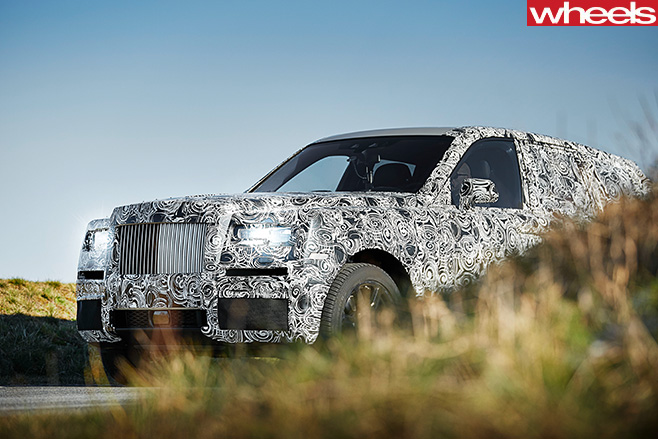
Codenamed Project Cullinan, the high-riding Roller has finally broken cover in what appears to be finalised metal.
The car is still wearing camouflage wrapping, but the overall shape of the SUV can certainly be identified.
Despite its obvious SUV styling, Rolls-Royce refuse to call it such, instead referring to it as “high-sided” and “all-terrain”. Don’t play with us Rolls-Royce, it’s an SUV.
The reveal of the car should have other luxury SUV manufacturers such as Bentley and Jaguar nervous, as this car is going to be so completely over the top ridiculous it will put their measly ‘regular’ luxury SUV’s to shame.
Wheels recently sat down with Rolls-Royce Global Client Sales Manager, Ian Grant, and he revealed to us the level of customisation available to buyers is unmatched by any other brand.
So just imagine what these people will be able to achieve with an entire range of features across the whole SUV to work their magic on.
There is no word on pricing for the finished product, but this is a Rolls-Royce after all, so expect it to put the Bentley Bentayga’s paltry $600,000+ price tag to shame.
Oh, and to ensure this high-riding Rolls-Royce is “Effortless…Everywhere”, the manufacturer will be heading to the Arctic Circle for cold weather testing, before heading to the Middle East for the other end of the temperature scale.
It’s likely you will see more of these rolling around the desert of the Middle East than the Arctic Circle once they do go on sale…
1. The Ford Everest 2WD weighs 98kg less than the four-wheel drive. That’s because Ford has removed the front drive shafts and the transfer case that form an integral part of the AWD system.
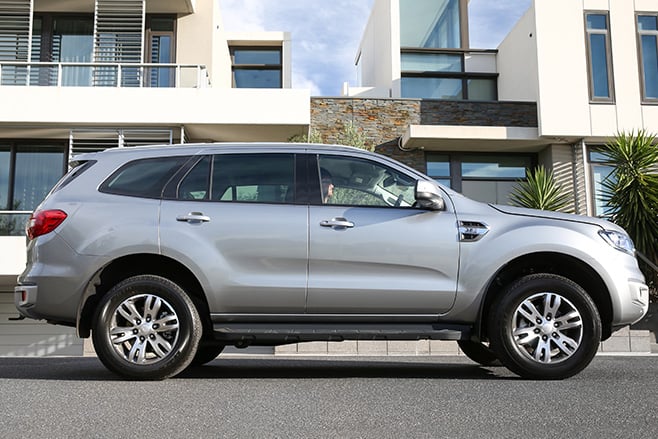
2. The Everest 2WD sits a millimeter or two higher than the equivalent Ford Everest 4WD version. That’s because of the weight that has been taken out. However, its ride height is still claimed at 225mm – the same as the 4WD models.
3. The 2WD has the same springs as the 4WD version, although the shock absorbers (or dampers) have been retuned to account for the lower weight.
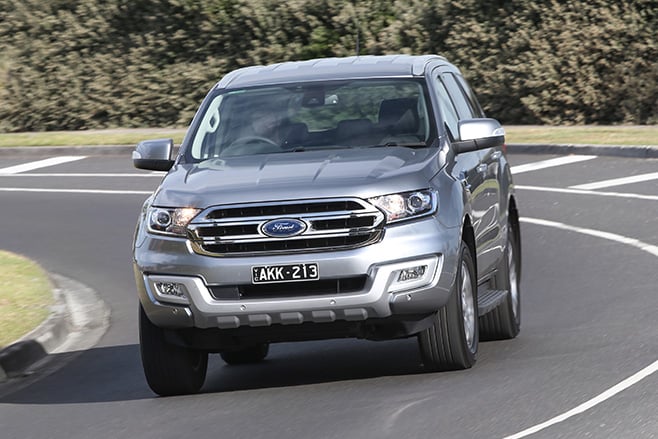
4. The Everest is based on the Ford Ranger ute. It uses the same engine and basic architecture – as well as some interior components – but it gets a unique SUV body on top.
5. The Everest RWD uses a fraction less fuel than the 4WD models, mainly because it is slightly lighter. According to the official fuel figures the 2WD uses 8.4 litres of diesel per 100km version compared to 8.5L/100km for the 4WD.
6. Like the 4WD Everest, the RWD model is rated to drive through up to 800mm of water.
7. The rear-drive version of the Everest is only available as a single model, the Trend. It is $5000 more affordable than the 4WD version of the same car. If you are choosing the 4WD models there are three Everest models to choose from; the most affordable Ambiente, the Trend and the leather-clad Titanium luxury model.

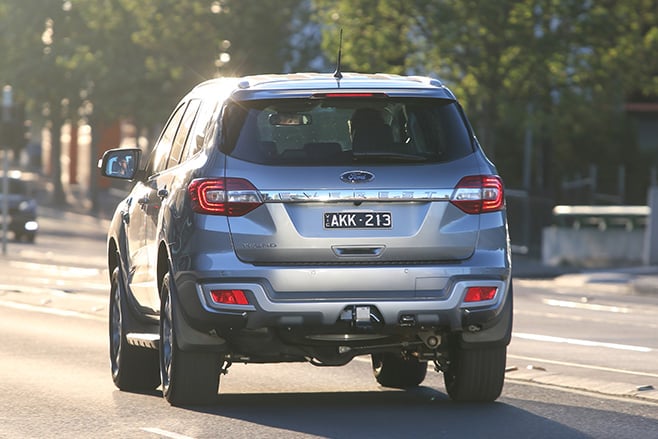
8. The only visual differentiator between an Everest Trend RWD and an Everest Trend 4WD is the “4WD” badge of the tailgate of the four-wheel drive version.
9. Ford is planning updates and additions to the Everest range in 2017. Expect a larger touchscreen on the most affordable Ford Everest Ambiente. Currently it gets a tiny 4.2-inch screen versus the 8.0-screen of the Trend and Titanium. Ford will also add a five-seat version of the Everest in 2017; it will have more space under the boot floor where the third row of seats would otherwise fold in to.
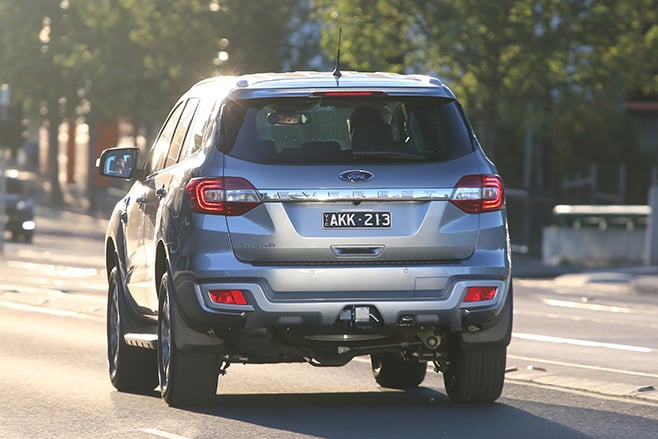
10. Like the Ranger, the Everest was designed and engineered in Australia but is produced in Thailand. Most of the development testing was conducted in Australia.
11. The Everest RWD gets the latest Sync 3 connectivity system being rolled out across the Ford range. It includes Apple CarPlay and Android Auto, allowing smartphones to be controlled through the centre touchscreen and using voice operation.
12. Ford is working towards a family of SUVs where each one begins with the letter E. Currently there is the Ecosport and Everest. In early 2017 Ford will discontinue the Kuga and replace it with the Escape (it’s the same basic car just with some minor updates). Production of the Ford Territory has ceased, with dealer stocks expected to be depleted early in 2017. Then in 2018 Ford is planning to import the Edge, a five-seat SUV expected to be priced from about $40,000.
Pundits around the globe were shocked when Mercedes-AMG uncloaked its class-challenging, 450kW, 3.4sec 0-100km/h E63.
Complete with an all-wheel drive system that can disable the front driveshaft to do skids until the back tyres burst like America’s sanity. It even trumped the Porsche Panamera Turbo and its 3.6sec sprint.
There has been an LA-to-NYC-sized chasm in the E-Class range between the chrome-twinkling E400 and the all-guns-blazing AMG E63. Enter the Mercedes-AMG E43; although from the outset it appears as though it swings toward a conservative note rather than aggressive overtones.
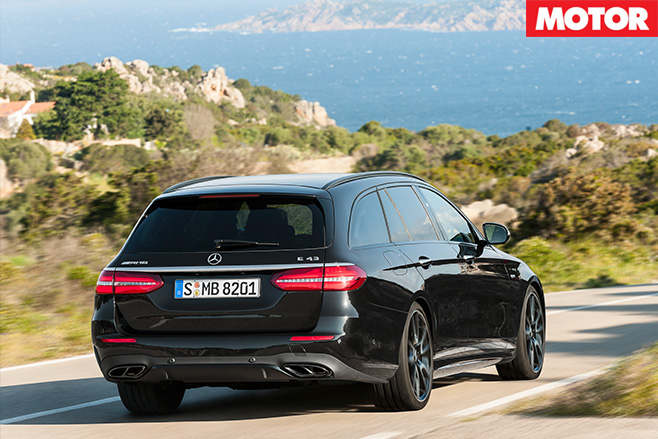
It shifts from 245kW to 295kW at 6100rpm, and from 480Nm to 520Nm between 2500rpm and 5000rpm. The 1765kg, nine-speed auto-equipped E43 AMG gets a 4Matic system with 69 per cent of drive permanently directed to the 275mm-wide 19-inch rear rubber, together delivering a 4.6sec 0-100km/h.
Some distance still exists to the 450kW/800Nm E63, but with a price of around $160K, the E43 will be far and away from big brother to the tune of $90K when it arrives by Christmas.
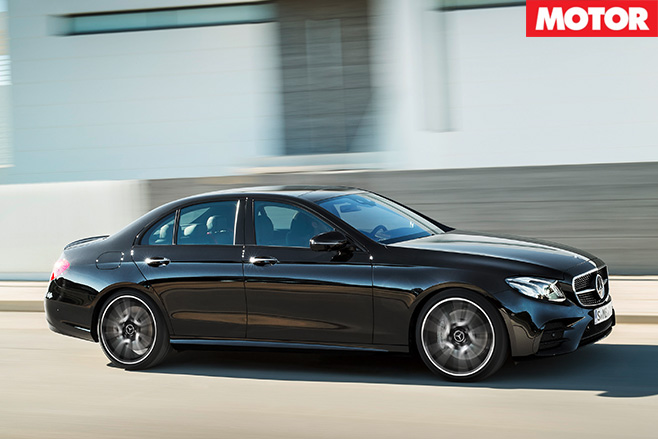
Beyond a flared front bumper, lip spoiler and quad exhaust pipes, this 4.9-metre-long AMG could be a Mercedes-Benz sedan by any other name – probably an E400 Sport.
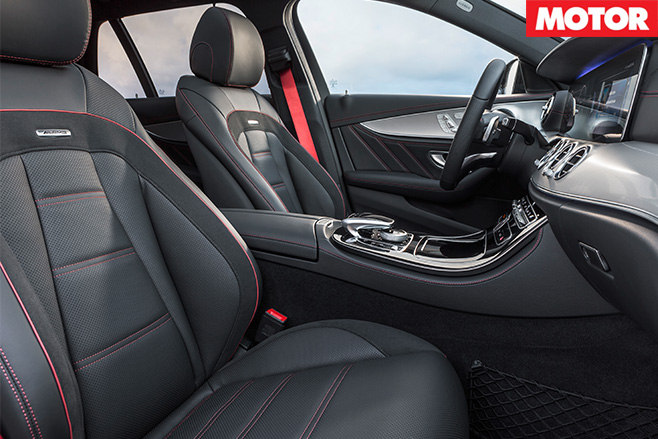
Inside, the leather seats are laced with red piping and an AMG-trademark Alcantara tiller, although the standard E-Class cabin with its S-Class-like design, IMAX screens and bevy of technology (adaptive cruise, self-driving, high-end audio) starts from a lofty standard.
Thankfully the twin-turbo unit revs quickly and keenly towards its top-end, revealing clearer and crisper acoustics, and the auto will even permit each gear be slammed into the cut-out without auto-upshifting when in Sport+ manual mode.
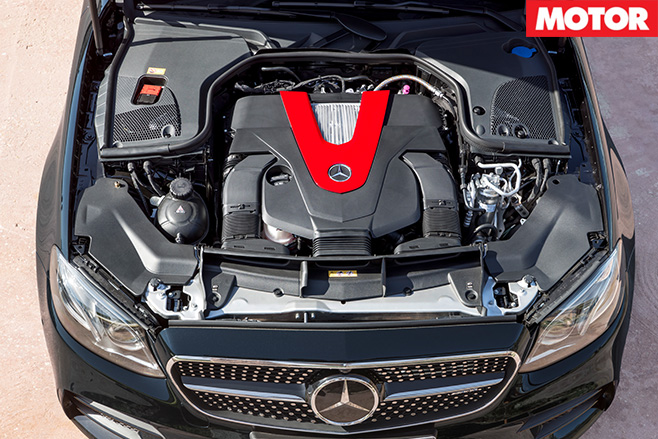
Curiously, though, the smaller C43 – which uses the same engine and mirrored outputs – gets a switchable sports exhaust, where the E43 uses a one-size-fits-all variety that makes the driver work hard for any theatre.
Even left in Sport+ auto mode the transmission is superb, slinking into taller ratios when it detects calm cruising and immediately scaling octaves and thumping through ratios when a brutal bruising is requested via the throttle.
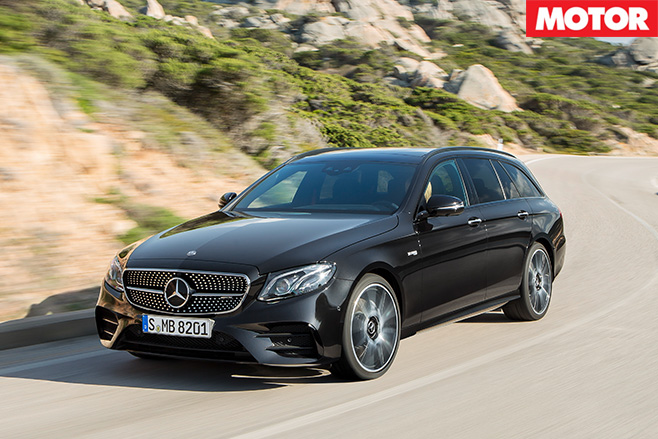
Immediate and sharp response through the tiller is an instant highlight, as is ride quality that never falters – even on lumpy backgrounds around Stuttgart in firmest Sport+ the E43 maintains control and comfort, yet in actual Comfort mode it’s never soggy.
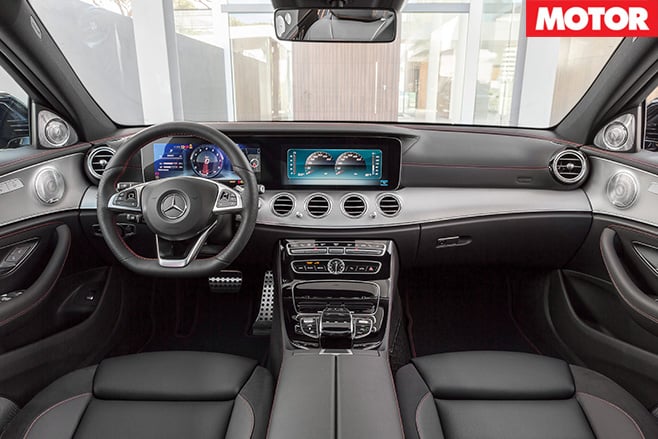
However, even in the stability control’s middle Sport Handling Mode, attempting to merely neutralise the E43 when the outside front rubber is loaded up can prove frustrating. Unlike the (smaller sized) Audi S4 with its crown centre differential, this AMG lacks the tight precision to pivot – let alone swing – between its front and rear axles.

LIKE: Brisk performance, superb steering, ride DISLIKE: Lacks dynamic involvement, engine character
SPECS Engine: 2996c V6, DOHC, 24v, twin-turbo Power: 295kW @ 6100rpm Torque: 520Nm @ 2500 – 5000rpm Weight: 1765kg 0-100km/h: 4.6sec (estimated) Price: $160,000 (est)
The Nissan GT-R is not known as Godzilla for nothing. Nope, straight from the crate, this is a serious tool with performance enough to see off just about anything else without flashing blue lights on its roof. And even then…
Hot Tuner 2016 is brought to you by Valvoline SynPower
So what happens when you re-engineer a Nissan GT-R for more speed? This happens. It’s the work of Gold Coast-based Hi-Torque Performance and it’s abso-freakin’-lootely mental.
Aside from the Nismo-sourced Black Edition window-dressing and the HKS coil-over kit, we’re talking some far-out mechanical mods, all aimed at boosting the already hefty stocker’s 404kW at the crank to the modded version’s 450kW at the treads, even on the suspect fuel we inadvertently lumbered it with. On ‘real’ PULP, who knows?
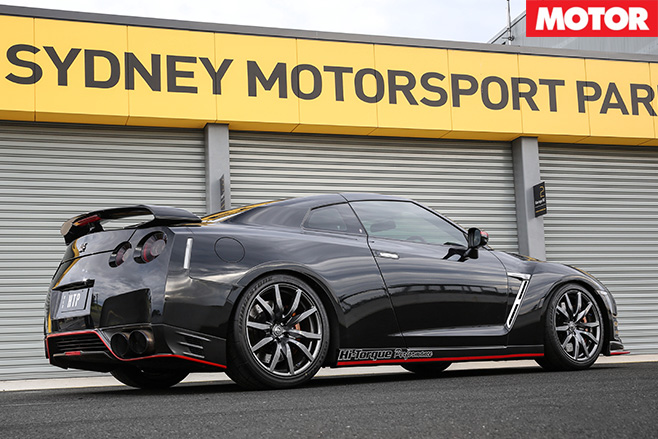
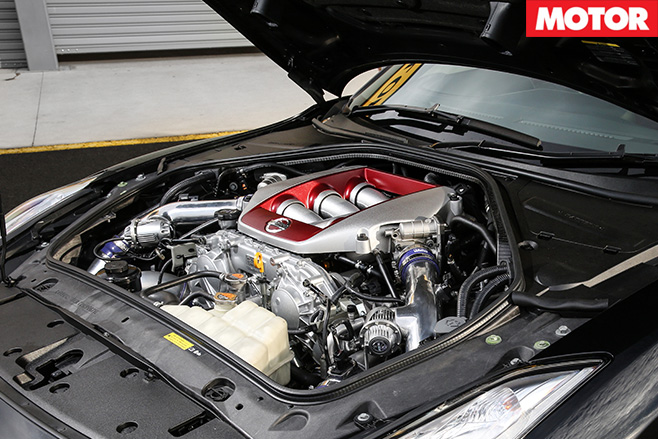
So what’s the deal with the GT-R’s powerplant? Well, for starters, the stock turbochargers were flung and replaced with a HKS GT1000 kit comprised of a pair of 7460 snails and GTII wastegates. There’s also a 1000-horsepower HKS intercooler kit with both new dump and intake pipes.
You’ll also find a HTP E85-compatible fuel system, along with bigger injectors, and there’s a Cobb access port to get at the custom tune with its switchable maps. Hi-Torque also specified a titanium exhaust system, HKS blow-off valves and, an essential piece of the puzzle, the HKS transmission-cooler kit.
“It’s a customer’s car,” Dalton explains. “We don’t do many GT-Rs and initially we weren’t interested. But it’s such a bullet straight off the shelf that we figured it would be a great build. It’s really just a nice street car, not a competition car. My favourite part of it? The fact that it’s such a total package.
“You’ve gotta love a 10-second street car. And I really like the way Nissan has designed 100 per cent for the driver.”
Okay, so by the time you buy your GT-R, write a cheque to Hi-Torque and add your personal stuff, you’re looking at a quarter-of-a-million bucks. But when you consider what it can do and compare it with the admission fee for anything else that gets close, those 250 gorillas look like a dead-set bargain.
SPECIFICATIONS Drive: all-wheel Engine: 3799cc V6, DOHC, 24v, twin-turbo Gearbox: 6-speed dual-clutch Suspension: double A-arms, coil-overs, anti-roll bar(f); multi-links, coil-overs, anti-roll bar (r) Brakes: 390mm ventilated/drilled discs, 6-piston calipers(f); 380mm ventilated/drilled discs, 4-piston calipers(r) Wheels: 20 x 9.5-inch(f); 20 x 10.5-inch(r) Tyres: 255/40 ZR20(f); 285/35 ZR20(r) Bridgestone Potenza
PARTS AND PRICES HKS GT1000 kit: $44,500 Suspension: $6000 Total Mods cost: $50,500 Vehicle cost (mSrp): $192,000 Total cost: $242,500
TELL ME ABOUT THIS CAR
The Everest was designed from the outset as a serious off-roader that utilises the underpinnings of the Ranger ute. It uses a truck-like ladder frame chassis and a diesel engine. However, Ford has just released the Everest RWD (rear-wheel drive), which drives only two wheels. It is designed to have the space, ruggedness and towing ability of the 4WD models but without the weight and cost of the 4WD system.
STRENGTHS
Towing. The 2WD Everest has the same 3000kg towing ability as the regular 4WD Ford Everest. So for those not planning to go off-road but wanting to tow a caravan or boat it is a good way to save $5000 over the four-wheel drive model.
Driving on rough roads. The Everest still gets a tough suspension system and the same basic construction of the four-wheel drive models. So it is still very capable at traversing rough dirt roads or poorly maintained bitumen roads. Just don’t expect it to drive over sand or mud without the 4WD system.
Family friendly space. The Everest has seven seats across three rows, so it comfortably accommodates large families. It’s also one of only a handful of seven-seat SUVs that allow a child seat to be fitted in the third row (most SUVs don’t have the top tether points to allow child seats to be used in the third row).
Going on the big trip. The Everest RWD does most of what the Everest 4WD will do, so it’s very well set up for long distance driving. It’s also fairly quiet for what is such a capable vehicle, something that also helps with its long distance touring ability.
Saving fuel. The Everest 2WD is claimed to use 0.1 litres of fuel less per 100km compared with the 4WD version (8.4L/100km versus 8.5L/100km). That’s primarily because it weighs 98 kg less due to the removal of the front drive shafts and the 4WD transfer case (a transfer case allows the selection of low range, for serious off-roading). In real world driving (versus the laboratory that the official fuel figures are calculated in) the 2WD should reduce fuel bills by a few percent compared with the 4WD.
Getting up to speed. That weight reduction also means the 3.2-litre five-cylinder turbo diesel will provide better acceleration. While it won’t be a major difference, it means the Everest 2WD should be slightly snappier when overtaking or accelerating briskly to freeway speeds.
WEAKNESSES
Model choice. The Everest rear-wheel drive is only available in the Trend specification level. If you’re shopping for the 4WD model there is a more affordable Ambiente and a more expensive Titanium, the latter bringing leather and other luxury extras.
Agility around town. Being based on a truck design the Everest 2WD doesn’t have the steering crispness and planted manners of a car-based SUV, such as Ford’s soon-to-disappear Territory. So it’s more of a handful than something like a Territory in tight streets.
Saving for one. The Everest has a price premium over some cars with similar attributes. So while the core engineering and ability is very good, you pay for it.
The 4WD model. Sure, $5000 is a lot of money. But for many people that extra spend will be well worth it considering the extra ability it adds; for example it could make it easier to get a boat up a slippery boat ramp, or it could allow for an interesting side trip that you may otherwise not have been able to take. And the reality is much of that $5000 additional outlay will be paid back when you go to sell the car.
ANY RIVALS I SHOULD ALSO CONSIDER?
Most of the cars in this segment drive all four wheels. They include the Toyota Prado, Mitsubishi Pajero Sport, Holden Trailblazer and Toyota Fortuner. However, Isuzu produces a two-wheel drive version of its MU-X, which makes it the most direct rival, although the reality is for some people the 4WD models will make more sense.
It looks and smells like a regular Everest, but the rear-drive Trend is all about towing, long distance touring and ferrying families rather than venturing too far off-road.
WHAT IS IT? A 2WD version of the Ford Ranger-based Everest SUV. It uses the same body and engine as the regular Everest, but only powers the rear wheels. The rear-drive model is $5000 less expensive than the AWD.
WHY WE’RE TESTING IT The rear-drive version of the Ford Everest has just gone on sale as a single model, the Trend. It is part of a plan to expand the Everest family, in part trying to appeal to buyers who are currently in a Ford Territory and looking for a replacement.
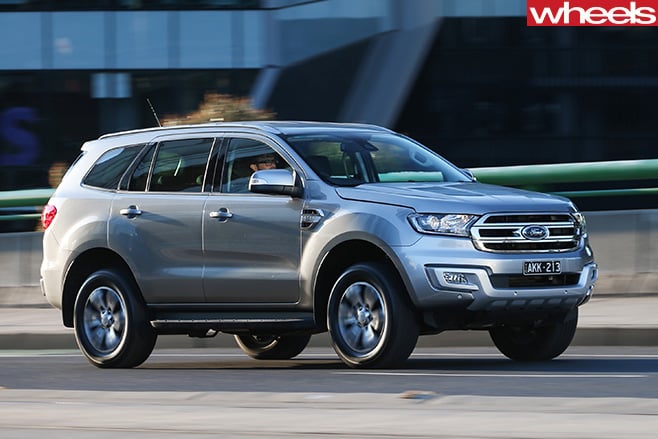
THE WHEELS VERDICT PLUS: Seven-seat space and practicality of regular Everest but $5K less; 3000kg towing; relatively quiet; MINUS: Steers and drives more like a ute than a car;
THE WHEELS REVIEW Territory owners, listen up. Here’s the seven-seater Ford hopes you’ll want once it comes time to upgrade.
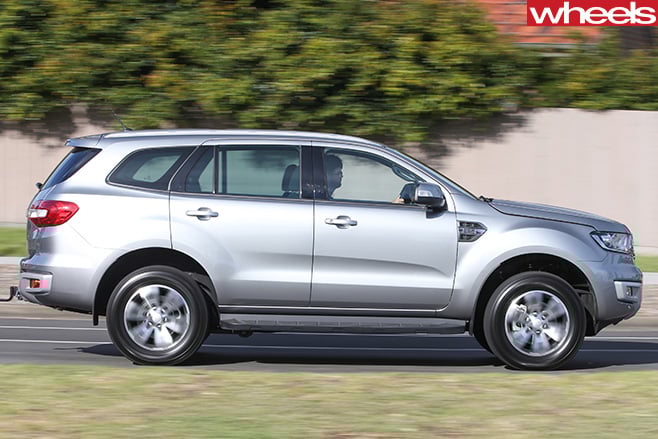
Just like the Territory, the 2WD Everest drives the rear wheels. And, just like the Territory, there’s seven seats and a diesel engine.
Yet the basic make-up of the Everest RWD, as Ford is marketing it, is very different to the Territory before it. Whereas the Territory was based on a car (the Falcon) the Everest is based on a truck (the Ranger).
So instead of a monocoque there’s a ladder frame chassis and instead of an independent rear-end it’s a live axle.
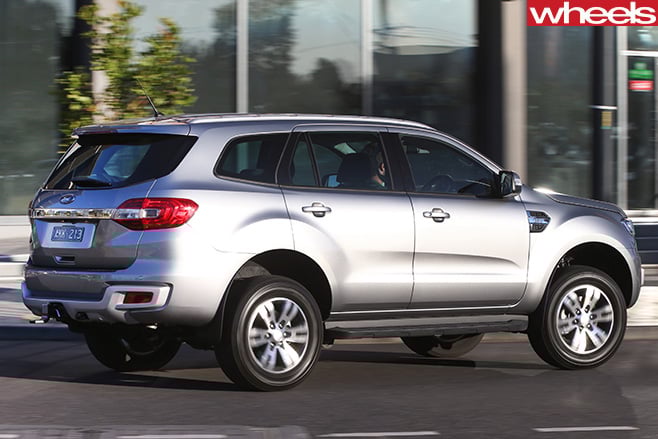
That’s good or bad, depending on how you plan to use it. Like other ladder frame vehicles the Everest has its dynamic limitations. Push too hard and the fronts will widen the cornering arc with predictable understeer. Fire out of a tight corner with the full 470Nm for what is a robust five-cylinder diesel and the nicely calibrated traction control will be busy keeping the rears in check.
And on second grade country roads the body doesn’t have the control or comfort that an all-independent car-based SUV can deliver.
However, for really rough roads the Everest RWD is a winner. The stout body and tough suspension deals well with big hits, and it gives the impression a carload of people won’t change the equation dramatically. It’ll also tow up to three tonnes and can drive through up to 800mm of water.
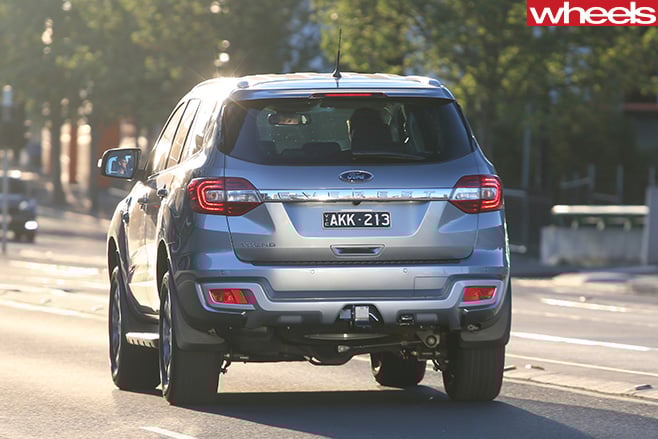
And the rear-driver is better than the regular Everest when it comes to driving manners, mainly because there’s less weight to contend with. The removal of the transfer case and front drive shafts has saved 98kg, something that also lowers the claimed fuel figure by 0.1L/100km to 8.4L/100km.
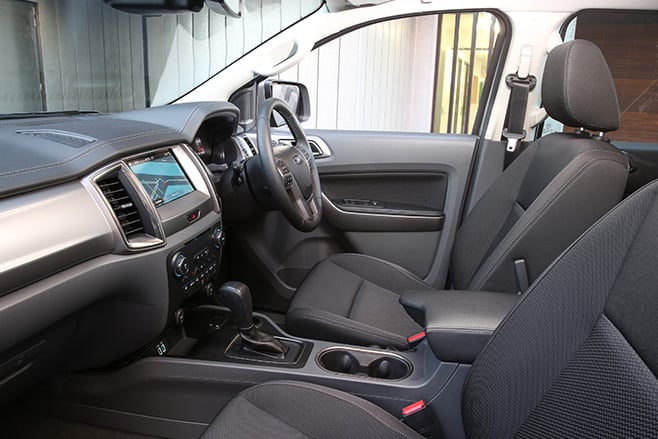
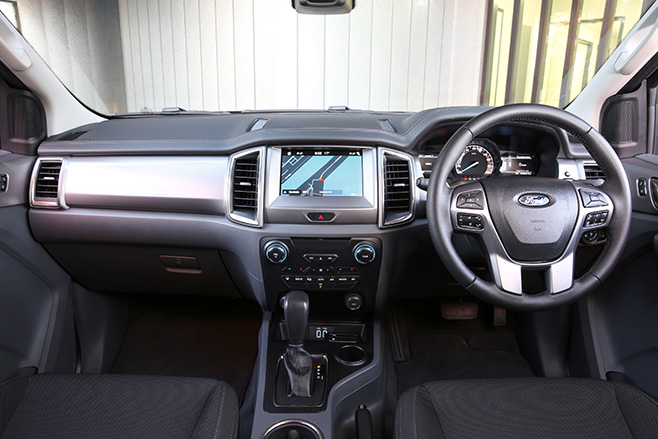
Inside there are no changes, right down to the quartet of roof mounted vents that feed air to the second and third rows and the mix of grey trims, from the seats to the dash. A trio of microphones in the roof is part of the noise cancelling system that makes for an appropriately hushed cabin.
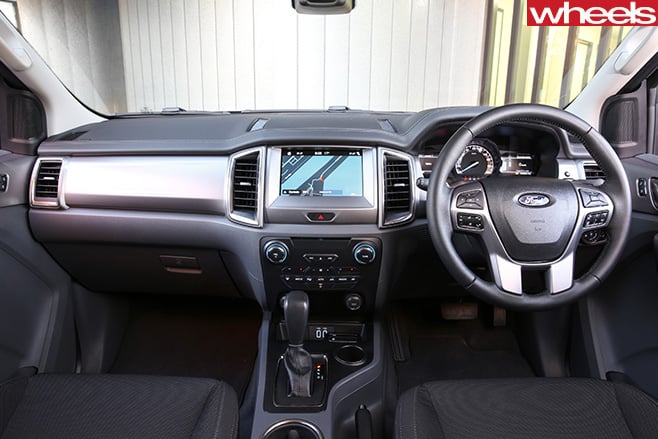
An electric tailgate as part of the mid-level Trend pack (the only spec the RWD is available in) and Sync 3 connectivity (with digital radio) offsets the omission of smart key entry. Other Everest compromises remain, such as the lack of reach adjustment for the steering.
More of an issue for those wanting leather seats is that they’ll have to step up to the Titanium with all-wheel drive – a $22K hike.
Then again, the rear-drive Everest is more about towing and general ruggedness than pampering.
SPECS Model: Ford Everest Trend RWD Engine: 3198cc 5cyl turbo diesel Max power: 143kW @ 3000rpm Max torque: 470Nm @ 1750-2500rpm Transmission: 6-speed auto Kerb weight: 2305kg 0-100km/h: NA Price: $55,990 On sale: Now
1. With 450kW the Mercedes-AMG E63 S is the most powerful version yet of the 4.0-litre twin-turbocharged V8 that AMG has already used in the C63 and GT sportscar. There is also a non-S version with 420kW, but this isn’t yet confirmed for sale in Australia.
2. The E63 will be going on sale in Australia in the middle of next year, and although pricing hasn’t been confirmed we’re told it will be close to that of the previous generation model, but with more standard equipment. So reckon on about $250,000.
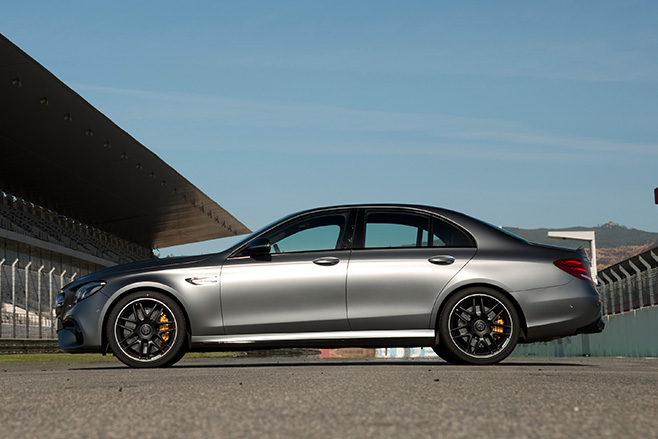
3. The clever all-wheel drive system uses an electronically controlled coupling to divert torque to the front end when it’s needed. However there’s also a Drift Mode for use on track which makes the car entirely rear-driven and deactivates the stability control.
4. Mercedes have confirmed that a wagon version will be made for some territories, but sadly Australia won’t be getting it – apparently we didn’t buy enough of the previous generation version for the numbers to stack up.
5. AMG started out as a race engineering company that diversified into tuning road cars. Mercedes took control of it in 1999, but AMG models are still engineered from the company’s historic base in Affalterbach.
6. The first AMG sedan to be officially sold in Australia was the E36 in 1997. I had an atmo V8 producing 207kW and cost $185,000, making the new E63 look like a relative bargain.
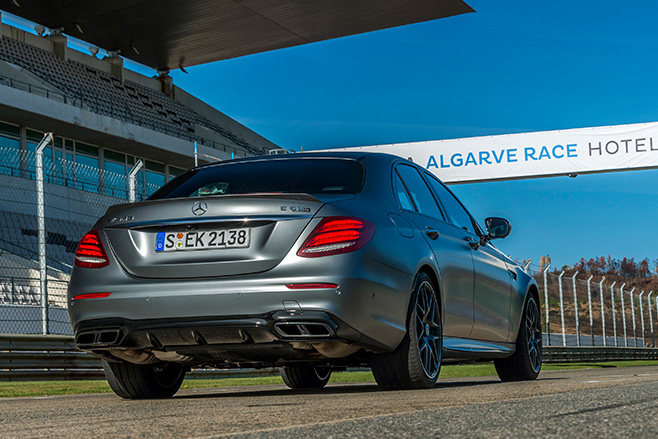
7. The semi-autonomous Drive Pilot system from the standard Mercedes-Benz E-Class is fitted to the E63, allowing it to steer itself on wider and better marked roads. The E63’s heavier steering makes it slightly harder to make the occasional inputs required to show the system you’re still paying attention.
8. Mercedes hopes to sell more than 200 E63s a year in Australia. We buy a higher percentage of AMG products than any other market – nearly one in seven Mercs.
First published in the October 2016 issue of Wheels magazine, Australia’s best car mag since 1953.
The Kia Sorento Si is Sufficiently strong in enough areas to hoist bronze.
Can’t wait to see the final score? Jump to the verdict now.
LAST year Kia scored its first-ever Wheels comparo win with the then-new third-generation Kia Sorento.
In flagship $56K Platinum AWD diesel guise, the South Korean seven-seater SUV wooed us with its practicality, performance, efficiency, refinement, comfort, dynamic capability, value, and industry-leading warranty.
But what about the $41K front-drive V6 petrol Kia Sorento Si? It didn’t impress nearly as much at Car of the Year testing, so expectations weren’t high for its Megatest chances. As it turns out, though, much of what makes the Platinum so palatable transfers wholly to the Si, beginning with a clear emphasis on passenger wellbeing.
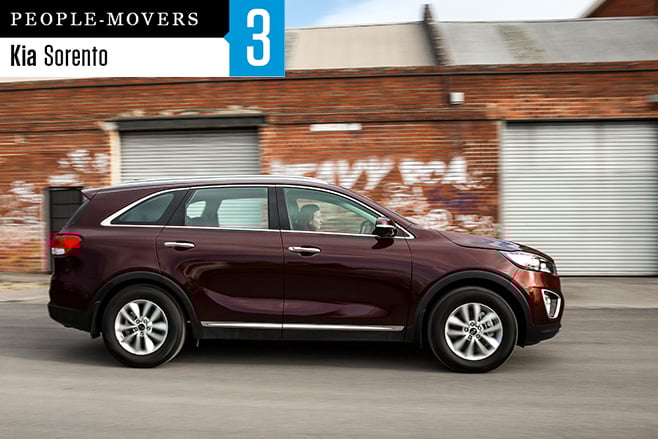
Although Sorento’s cargo capacity isn’t outstanding, there’s still a useable cavity behind row three. Plus, it’s mostly quiet inside to boot. More than a bit of grey matter has gone into the Kia SUV’s packaging.
For a heavy seven-seater, the Si front-driver doesn’t hang about. Sharing its 199kW/318Nm 3.3-litre V6 with the Hyundai Santa Fe, it offers smooth power delivery from the outset, though the expected forward shove doesn’t much materialise until the tacho’s needle is pointing north, when it really starts to pile on speed.
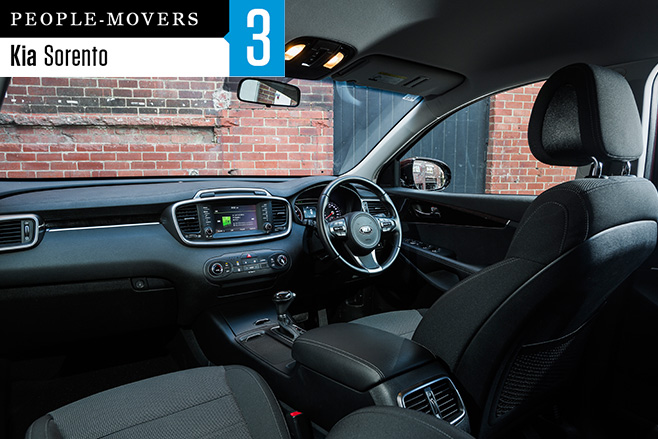
Plainly Kia reserved some of its brains trust for dynamic capabilities as well, because the Si offers a balanced handling/ride compromise, and that’s something that the sharp-steering but overly firm Santa Fe, which shares much of the same underpinnings, simply cannot manage.
The front-drive Sorento’s chassis is tuned (in Australia) to corner with zeal, and the suspension’s damping does a fine job dealing with much of what the road throws at it. But hampered by low-adhesion, torque-steer-inducing Nexen tyres, there’s a lack of cohesion between the available performance, the turn-in promise of its steering, the ever-present lack of grip, and the desperation of Sorento’s ESC system to maintain control – most of which are solved when fitted with all-wheel drive and better tyres.
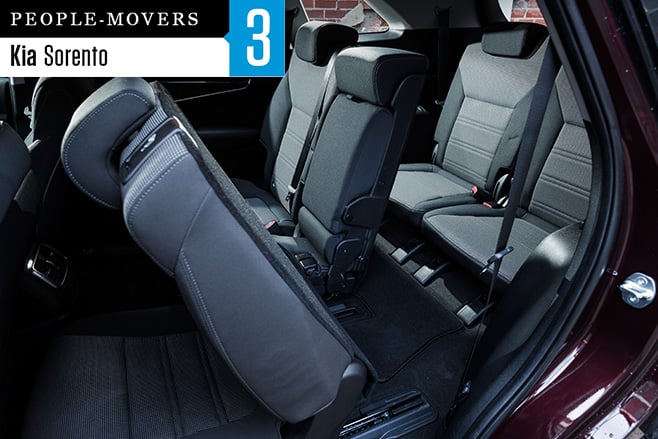
But that’s further proof of how fundamentally right the Sorento is. Though not quite Platinum, the base Si is still business-class enough in most of its seven seats.
A familiar Aussie tune
Though using essentially the same platform as the previous model from 2009, with a carryover strut front-end and multi-link rear, the UM-series Sorento is longer and wider, and benefits from what Kia reckons is “hundreds of man-hours and thousands of kilometres” in local tuning for Australian conditions. These are said to include unique springs, dampers and anti-roll bars, as well as modifications to cut noise, vibration and harshness levels including thicker soundproofing in the engine bay and bulkhead, reducing cabin noise by up to six percent.
SPECS
Price as tested: $41,585 *includes metallic paint ($595)
Engine: 3342cc V6 (60°), dohc, 24v
Power: 199kW @ 6400rpm
Torque: 318Nm @ 5300rpm
Transmission: 6-speed automatic
Dimensions (L/W/H/W-B): 4780/1890/1690/2780mm
Weight: 1921kg
Cargo capacity: 605 litres
Tyres: Nexen N Priz RH7 235/65R17 104H
Test fuel cons: 13.2L/100km
0-100km/h: 8.0sec
0-400m: 15.8sec @ 147.4km/h
80-120km/h: 5.0sec
3yr resale: 54%
Plus: Packaging; seat comfort; refinement; handling; value
Minus: Rubbish tyres; ESC lacks finesse; glitching touchscreen
Verdict: 7.0/10
In our new Fast Facts series, WhichCar delves deep into the history of automotive brands to bring you fascinating facts and intriguing information.
Here we focus on Martin, Aston Martin – the British sports-luxury brand synonymous with suave secret agent James Bond, and of course beautiful sports cars.
1. MR MARTIN BUT NOT MR ASTON
Unlike Rolls-Royce, the Aston Martin name is derived from only one of the surnames of its two founders. Lionel Martin was partnered by Robert Bamford to start Bamford & Martin in 1913. The brand we know today was formed a year later – inspired by Martin’s strong performance in the Aston Clinton Hill Climb time trial event in the UK.
2. LE MANS
Aston’s first motorsport success of note was winning the 1922 French Grand Prix, though its racing credentials were truly locked in when it occupied all three podium places of the 1933 Le Mans 24 Hour race with its 1.5L.
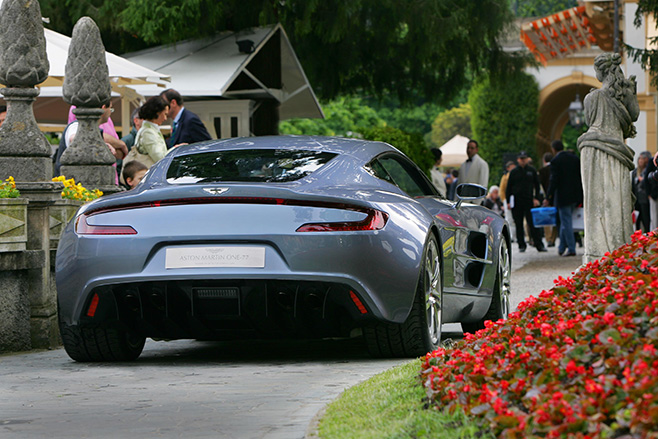
3. THE DB FACTOR
Arguably the most famous of all Aston’s multiple owners over its 100-plus years of history is David Brown – it’s the English industrialist’s initials that continue to live on with the DB11 that is a successor to multiple models starting with the (underwhelming) DB1. That four-cylinder model emerged two years after tractor tycoon Brown acquired the Aston brand.
4. THE JB FACTOR
James Bond drove mostly Bentleys in the Ian Fleming novels but in 1965’s Goldfinger film, the DB5 started 007’s big-screen love affair with Astons. It has featured in no less than eight Bond films, while Astons have appeared in half of the 24 movies up to the most recent – Spectre. Other models have included DBS models old and new, Aston Martin V8 Vantage, as well as the Aston Martin Volante V12 Vanquish. Spectre’s hero Aston, the super-sleek DB10, isn’t actually a production car – it was built especially for filming (eight in total, plus two show cars), though did hint at the new DB11.

5. INVESTORS AND CONSORTIUMS
The first of multiple changes of ownership happened in 1926 when investors rescued the struggling company. A succession of investment companies and consortiums were then involved in the ’70s and ’80s before the Ford Motor Company assumed control with a majority 75 per cent stake in 1987. A Kuwait consortium led by Prodrive boss and former WRC honcho David Richards paid Ford US$975 million for Aston 20 years later as the US car maker disbanded its Premier Automotive Group umbrella of luxury brands. In 2014, British car industry veteran and former Nissan product chief Andy Palmer was appointed as president and CEO.
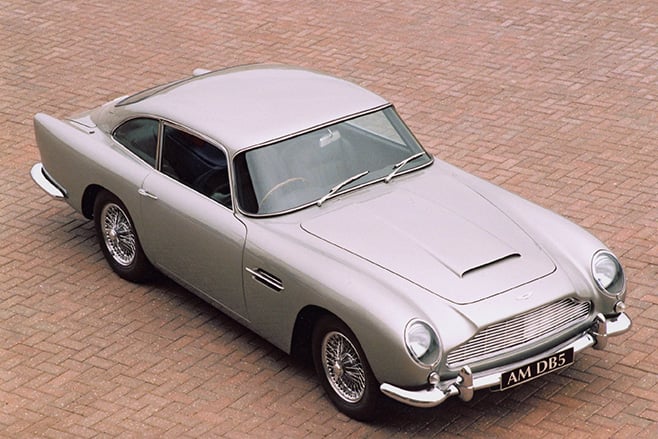
6. FORD ENGINES OUT, ASTON V12 AND AMG V8 IN
Aston’s V8 and V12 engines have long been produced by Ford, with the latter essentially a pairing of two Ford Duratec V6s tweaked by Ford’s long-associated engine specialist partner Cosworth. Aston’s new DB11, however, introduced a new in-house twin-turbocharged 5.2-litre V12, while future V8s will be built by Mercedes-Benz’s performance division AMG. Aston and Mercedes announced their new technical partnership in 2013, which includes scope for the sharing of electronics and potentially other components.
7. LAGONDA
In 1948 David Brown acquired the Lagonda car company to create a sister brand for Aston. A 2.6-litre Bentley six-cylinder used by Lagonda was combined with an Aston chassis to create the successful DB2 and DB2/4 models, with the engine gradually reaching 3.0 litres in size. In 2009, the Aston Rapide became a rare four-door within the company not to wear the Lagonda badge and the long-dormant Lagonda brand wasn’t revived until 2015 – with the V12-powered Lagonda Taraf ultra-luxury sedan. It harked back to the wedged-shaped (but V8-powered) four-door sold predominantly in the Middle East from 1976 to 1990. Sales of the Taraf are also mostly limited to the same region, with the addition of the UK and Europe.
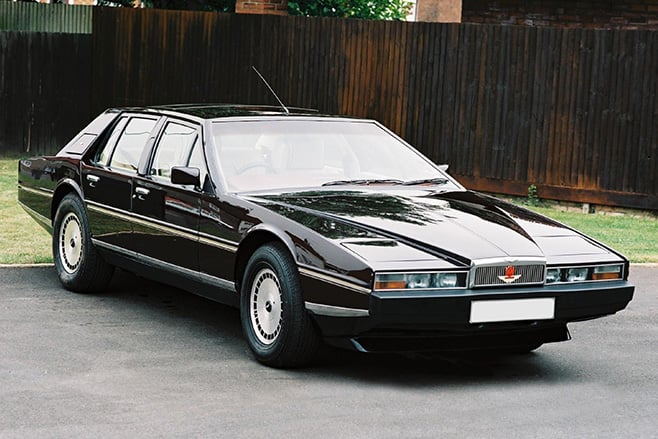
8. ZAGATO: THE ITALIAN CONNECTION
In 2016, the Aston Martin Vanquish Zagato became the fifth exclusive production car to emerge from a collaboration with Italian coachbuilder Zagato that dates back to 1960. That was the year Aston turned to the specialist to create just 19 lighter and more aerodynamic versions of the DB4 GT. Multiple Aston Zagato models over the decades have included concept cars and one-off production cars for super-wealthy customers.

9. DB11
Following the 1993 DB7 regarded by many at the time as being the world’s most beautiful car, and the 2003 DB9, 2016’s DB11 successor became the first all-new mass-production Aston in more than a decade. Besides the aforementioned Aston V12, the latest DB heralds other firsts for Aston that include electric steering, multi-link rear suspension, and a new design language.

10. FIRST SUV
Aston would be one of the last luxury brands not to offer an SUV, but that’s set to change with the DBX – shown as a coupe-style concept at the 2015 Geneva motor show. A Lagonda-badged SUV, first previewed in 2009, is also anticipated.
