
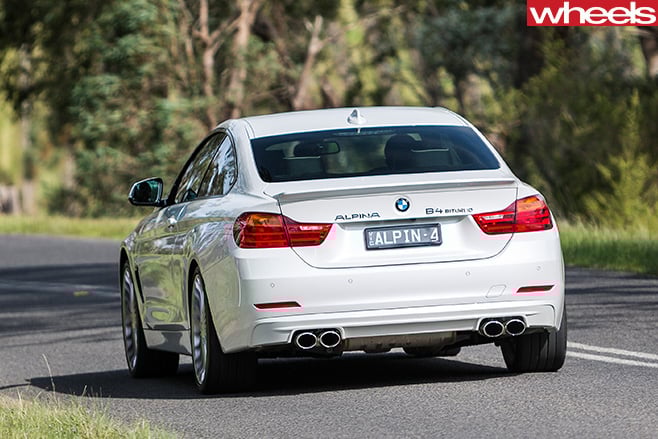
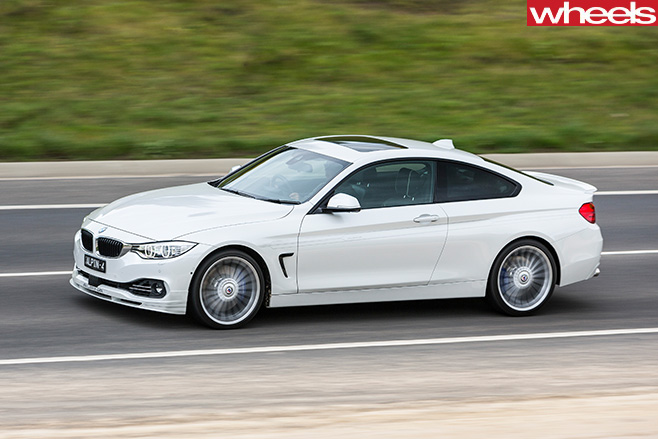
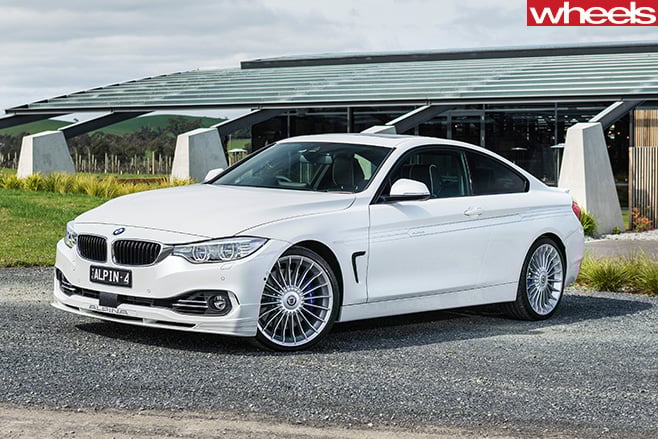
Ever wanted a BMW M4 with more? If the answer is yes, a Melbourne-based BMW dealership thinks it has the answer. And it wears an Alpina badge.
WHAT IS IT? German motorsport and tuning haus Alpina started life as a small company sticking flyers under the windows of BMW 2002s in railway station car parks, offering aftermarket turbocharger packages. It has since grown to become a carmaker in its own right; something of a BMW sub-brand that gives as much attention to the luxury side of the ledger as it does performance.
MAIN RIVALS BMW M4; Mercedes-AMG C63 S Coupe; Lexus RC F
PLUS: Exclusivity; individuality; stonking engine; exceptional ride and handling MINUS: Price; no manual option; would you really walk past an M4 to have one?
THE WHEELS REVIEW Sometimes a BMW adorned with the German luxury marque’s M badge isn’t enough. That’s where tuning haus Alpina steps in.
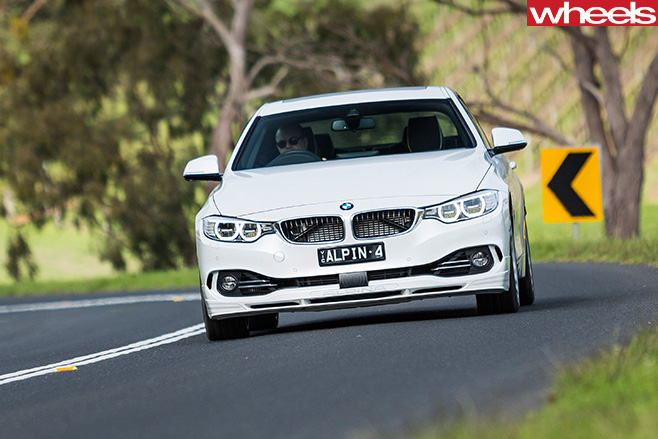
Alpina takes extraordinary BMWs and amps them up to extra-extraordinary. The two-door B4 Bi-Turbo, tested here, starts life as a BMW 4 Series but gains a heavily modified 3.0-litre in-line six-cylinder engine with an extra turbo plumbed in, suspension and chassis tweaks, and a more traditional torque converter automatic.
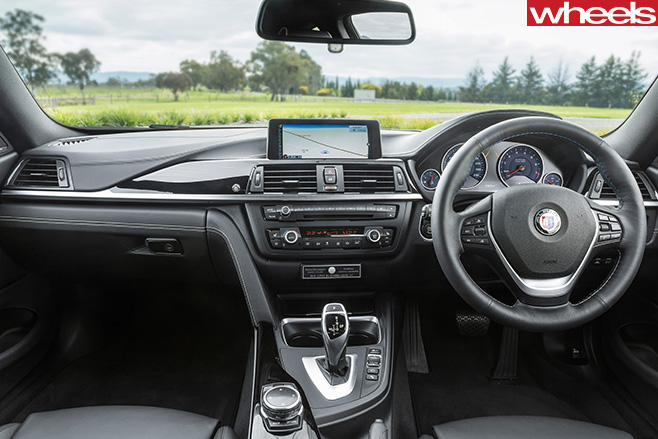
Inside, the B4 feels plush. There’s patchworked, monogrammed and extremely supportive front sports seats, leather falls to hand at every touchpoint around the cabin, the steering wheel is finished in parallel-stitched – not cross-stitched like in ordinary BMWs – thread in contrasting Alpina red and blue colours, and the instrument cluster face and kick strips both proudly read “Alpina”.
In the middle of the centre console of our test car is a plaque reading “BMW Alpina B4 Bi-Turbo Coupe 041”, indicating the build number.
On paper, the M4 will hustle from rest to 100km/h in 4.1sec; the B4 is only 0.1sec behind it. It’s the way the B4 delivers its power, though, that’s different. The M4 drives the rear wheels via a seven-speed DCT dual-clutch gearbox, but the B4 uses a ZF-sourced eight-speed automatic. Gear changes in the M4 are raw and visceral, banging through upshifts; in the B4 they seem almost as rapid-fire but slur almost imperceptibly.
Shifting the B4 into its more performance-focussed mode is a little more complicated than in BMW-badged equivalents. There’s still the console-mounted toggle switch for Sport and Sport+ modes, but they only alter the throttle, steering and stability control characteristics. You always need to flick the gearshift into “S” mode to get the auto to hold revs longer.
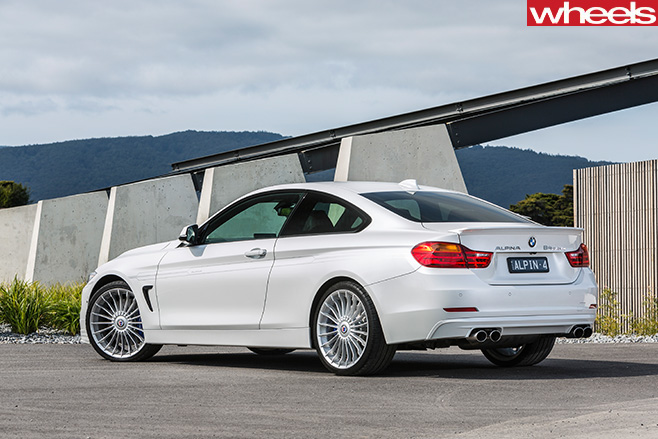
Then there’s the ride. The B4 may sit on massive hoops ringed in a thin strip of Michelin 265/30 ZR20 rubber, which you’d think would ride horribly, but even on coarse, lumpy back roads the B4 soaks up perfections with aplomb. Even a section of our road test loop that has found the limit of the bump stops on many a sports car passed by almost unnoticed. The steering is crisp and well-weighted, and points precisely.
SPECS Model: BMW Alpina B4 Bi-turbo Engine: 2979cc 6cyl, dohc, 24v, twin-turbo Max power: 301kW @ 5500-6250rpm Max torque: 600Nm @ 3000-4000rpm Transmission: 8-speed automatic Weight: 1690kg 0-100km/h: 4.2sec Fuel economy: 7.6L/100km Price: $160,900 On sale: Now
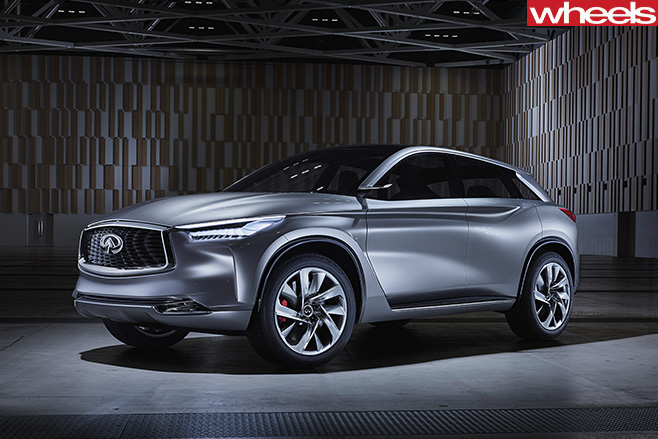
Infiniti is confident that its upcoming medium-sized luxury SUV based on the QX Sport Inspiration Concept will become the lynchpin on which it will build solid and sustainable growth over the next few years.
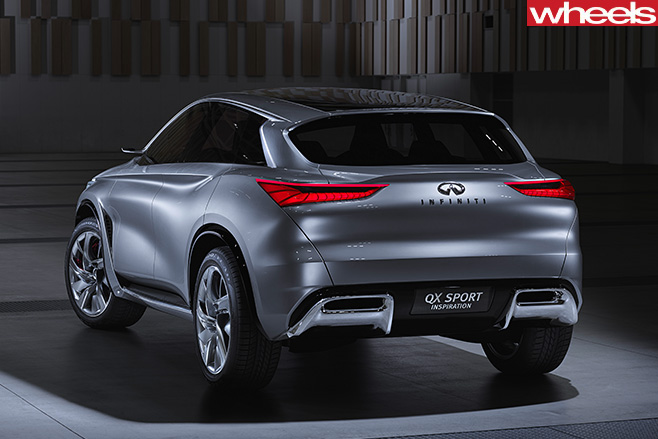
Unveiled as a show car at the Beijing Auto Salon in April, the 4.6-metre long crossover is rumoured to wear the Infiniti QX50 badge when it arrives in Australia in the first or second quarter of 2018.
Production will commence later next year, possibly at a new joint-venture plant with 3.1 percent stakeholder Daimler in Mexico.
In Australia, the over-$60,000 medium luxury SUV market has jumped over 50 percent in just the past 12 months alone.
Espousing Infiniti’s “Powerful Elegance” styling language also seen in the newly released Infiniti Q60 sports/luxury coupe, the QX50 features a long bonnet and sleek silhouette to give it some visual aggression in an increasingly crowded sector.
Engines are likely to be 2.0-litre four-cylinder turbo petrol and diesels, as well as the brand’s 3.0-litre turbo V6.
According to Infiniti Cars Australia managing director, Jean-Philippe Roux, the new contemporary look will naturally help people gravitate towards the brand in the way they previously did not.
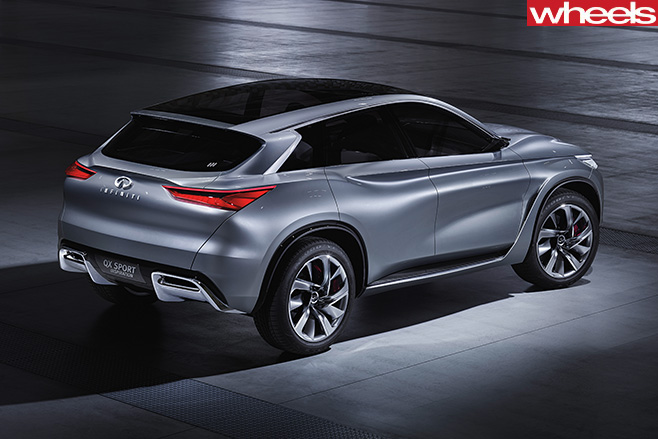
As a result, Roux hopes, the QX50 will usher in the next phase of the company’s growth plans in Australia.
“Stage One was coming to market in 2012 with the G37/Q50. Stage Two is this year, with the release of the revised Q50, all-new Q30/QX30 (luxury hatchback and its crossover sibling), and now the Q60, and in 2018, Stage Three. This is where the takes us to the next level of volume and brand awareness.”
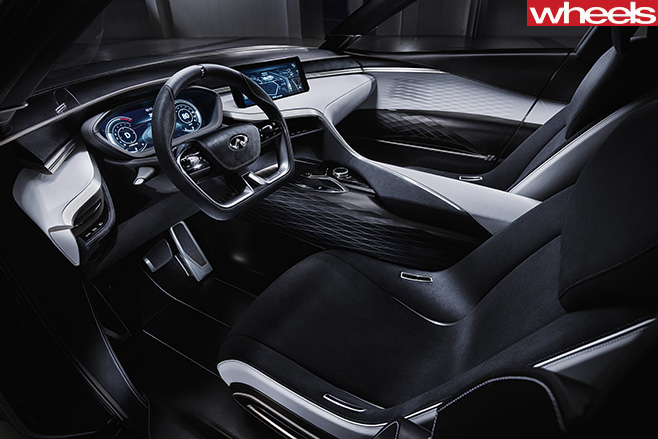
In contrast, Audi has already just cracked 20,000, BMW is flying high at 24,349, while Mercedes-Benz leads the luxury marques with 34,198 sales – or 29,860 if the commercial vehicles like the Mercedes-Benz Sprinter and Vito are excluded.
Land Rover and Lexus, meanwhile, are at 11,585 and 7941 respectively, so Infiniti still has a huge amount of ground to gain.
“We still have a lot of work to tell the Infiniti story,” Roux admitted. “But this will give us the boost we need.”
The automotive industry can be guilty of mining history for the sake of a marketing tale, with dubious links between modern machinery and classics of old. Yes, Volkswagen, we’re looking at you. And you, Abarth, with your 124.
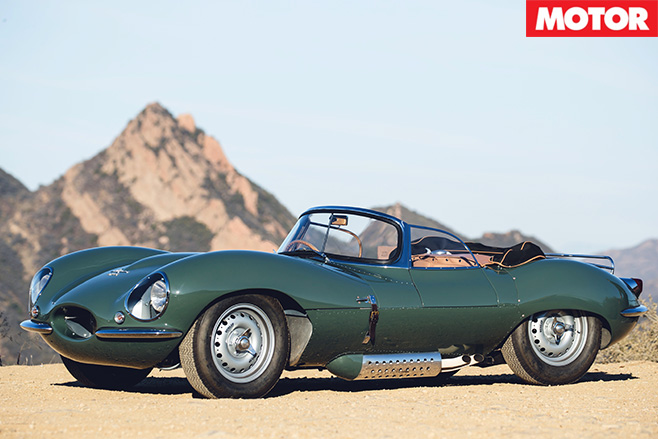
The same can’t be said for this Jaguar XKSS. In fact, the tale behind the rebirth of the road-going D-Type makes for fascinating reading.
The Jaguar D-Type is often referred to as one of the world’s first supercars, and was built between 1954 and 1956. It also managed to win the 24 Hours of Le Mans in 1956, and so 25 road-going versions of the Le Mans winner, to be known as the XKSS, were commissioned.
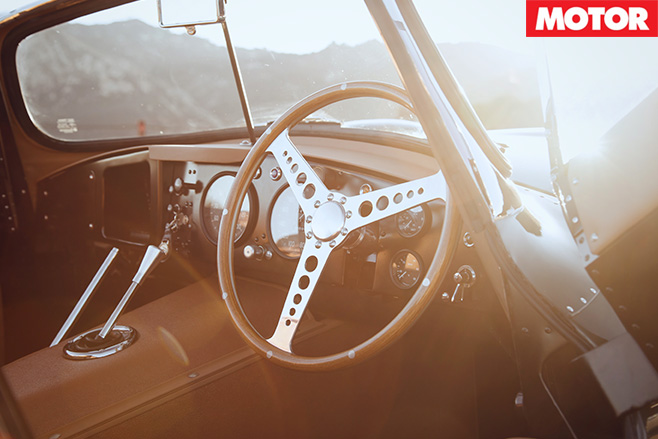
Some 60 years later, Jaguar’s Classic division – which is charged with looking after Jag’s worldwide fleet of heritage machinery – decided that it would be a really cool idea to build those nine cars for delivery to some of Jag’s most dedicated customers.
Problem number one; no plans or machinery used to make the original car survived. No problem, said the guys from Jaguar Classic, who simply scanned a ’57 XKSS from every angle in order to create a set of digital blueprints.
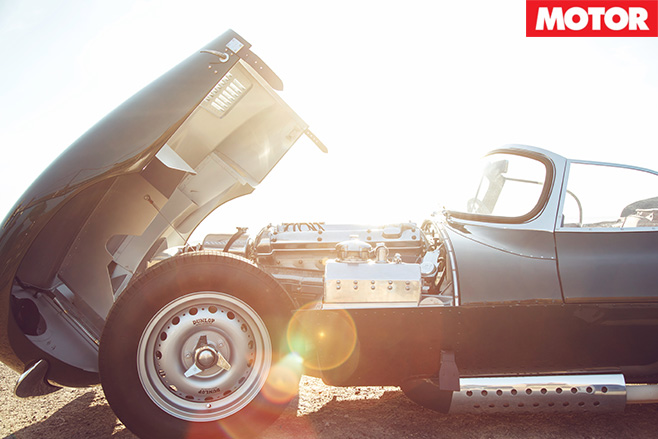
New blocks were cast to recreate the 3.4-litre straight six, and even a trio of authentic Weber carburettors have been added. In fact, about the only concession to modern safety was a stronger fuel tank and higher-quality fuel lines.
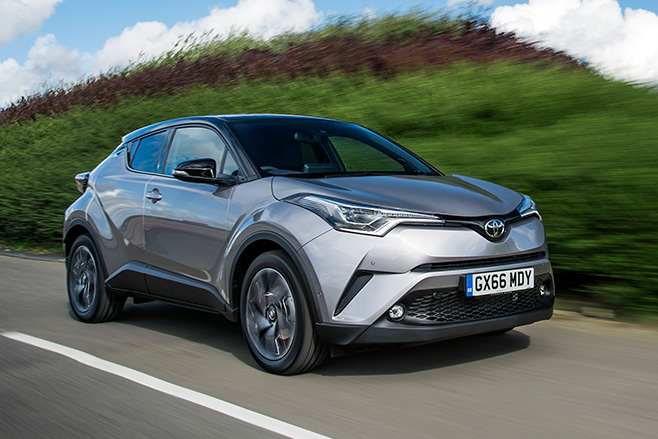
The Toyota C-HR is a radically styled crossover that dramatically reverses Toyota’s normal policy of conservative design. It’s powered by a new 85kW 1.2 litre turbo engine will go on sale in Australia in February 2017. Here’s eight things you didn’t know about it.
- The C-HR shares much of its underbody structure with the new Toyota Prius. In some markets a hybrid version will be offered, sharing pretty much all of the Prius’s powertrain, but in Australia we’ll only be getting a 1.2-litre turbo petrol engine.
- The 1.2-litre engine produces a relatively modest 85kW peak but is packed with innovative technology, including switchable valves that allow it to operate in ultra-efficient “Otto Cycle” mode. It generates its peak 185Nm of torque from just 1500rpm – similar to most diesels.
- Originally designed exclusively for the European market, where buyers have long since fallen out of love with Toyota’s mid-sized Auris hatchback, the C-HR is being offered in other territories including Australia after receiving an overwhelmingly positive response.
- Although it looks smaller than the Nissan Qashqai, it’s almost exactly the same length. At 4360mm the Toyota is just 17mm shorter than the Nissan.
- The base model will have a manual gearbox and front-wheel drive, with the option of a CVT automatic transmission. There will also be an all-wheel drive version of the CVT, although likely only with the top-spec Koba grade.
- The Koba trim level is named after Hiruyuki Koba, the engineering boss who led the project to create the car. He’s a keen racer and competed in a prototype version earlier this year at the Nurburgring in Germany.
- C-HR is meant to stand for “Coupe – High Riding.”
- The Koba pack will bring bigger wheels and part leather trim, but also a nano filter for the climate control system to help remove dust and particulate pollutants.
You don’t expect radical from Toyota any more than you expect diesel from Ferrari, but the Toyota C-HR is a dramatic departure for the normally conservative brand. It’s an aggressively styled crossover that will come with a new 1.2 litre turbo engine and the option of front- or all-wheel drive.
TELL ME ABOUT THIS CAR
Let’s start with the name, which Toyota tells us is meant to decrypt as ‘Coupe – High Riding.’ While the reality is that the C-HR is a crossover that’s been designed to offer buyers a more interesting alternative to a conventional five-door hatch, the company still deserves full marks for trying – and succeeding in delivering something so completely different. We’ll only get one powerplant, a new 85kW 1.2-liter petrol motor that will be offered in front-drive form with either a six-speed manual gearbox or a CVT automatic gearbox, and in all-wheel drive with the autobox.
STRENGTHS
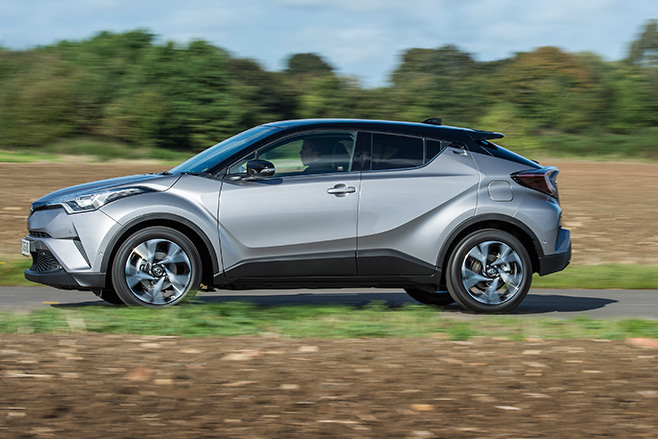
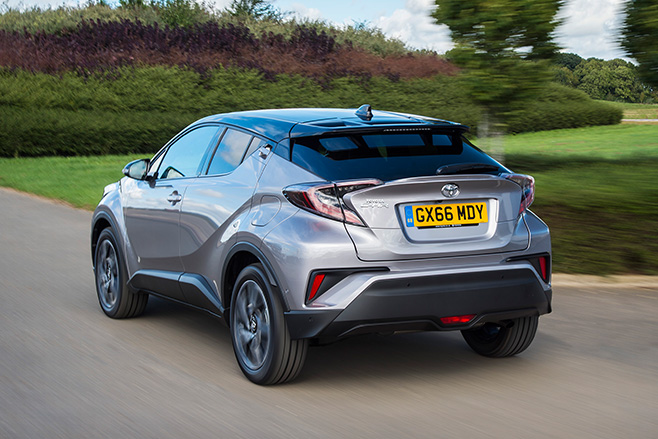
- Looks – it’s like all of the frustrated ambitions of Toyota’s design team have found expression in one car. We genuinely can’t remember the last time the company made a production car that looked this radical. Although styled to resemble a ramped coupe the C-HR actually manages to deliver an impressive amount of the practicality that crossover buyers are looking for, with disguised rear doors.
- Space: The C-HR is fractionally shorter than a RAV 4 and pretty much the same size as its most obvious rival, the Nissan Qashqai. Beneath the swoopy exterior design there’s an impressive amount of room for both occupants and stuff. The rear is accessed by doors which use hidden handles in the rear pillars, and although the door aperture is tight there’s plenty of room in the back, even for adults and a respectable 377 litres of storage space as well.
- Equipment: Two trim grades will be offered in Australia, with adaptive cruise control, a reversing camera, automatic high-beam headlights, lane departure warning and autonomous emergency braking (which can stop the car before a low-speed collision occurs) coming as standard. The higher-spec Koba will get bigger 18-inch alloys, part-leather trim and keyless entry.
- Ride: The C-HR sits on Toyota’s new (and expensively developed) GA-C platform, which also underpins the new Prius. This is very stiff and has allowed the engineering team to create a chassis that delivers impressively pliant ride, even when asked to cover rougher roads at speed.
- Engine: The 1.2-litre turbocharged engine doesn’t have a huge amount of power, but it’s keen and willing with a responsive mid-range that makes it easy to drive quickly and effortlessly. It doesn’t want to rev that hard, but it’s got a nice rorty exhaust note when sampled with the manual gearbox (the CVT makes it drone.)
- Manual box: Although the manual gearbox will be a minority choice in Australia, it’s a good one – slick and accurate and even having a ‘rev matching’ function to help smooth out downchanges.
WEAKNESSES
- Handling: The sporty looks aren’t matched by an equally dynamic driving experience. The C-HR handles tidily and accurately, but without any real flair or enthusiasm when pushed hard. It’s a sports-free sportscar.
- Tyre noise: Although the C-HR’s cabin is impressively quiet on smooth surfaces we noticed a surprising amount of tyre noise gets transmitted on rougher tarmac.
- Claustrophobic cabin: The tiny rear windows mean that although there’s plenty of space in the back anyone relegated back there is likely to feel claustrophobic. Only bigger kids will be tall enough to see out.
- CVT gearbox: Most of the time the CVT automatic gearbox does a decent job, but requests for hard acceleration leave the engine droning and the pretend ratios of its ‘Sport’ mode slur too much to be taken seriously.
- Smaller touchscreen: Other markets will get an 8-inch touchscreen display, but Australia will have to make do with a smaller six-inch unit.
- No hybrid: Toyota says it won’t be bringing the Hybrid engine model that will be offered in some other markets to Australia, which is a pity as it basically offers the Prius’s running gear with a far more visually interesting package.
ANY COMPETITORS I SHOULD CONSIDER?
There are already a fair few crossovers out there but the C-HR’s Toyota badge is likely to appeal strongly to those seeking reliability and a drama-free ownership experience. We’ll have to wait until closer to the February on-sale date for pricing, but we can safely predict that the C-HR will undercut the similar-deal Audi Q2 by a significant amount when it arrives later next year and might well be stylish enough to attract some buyers from the second-generation Mini Countryman.
Of the existing pack it’s got more visual flair than the Nissan Qashqai – which is at $28,490 with a CVT – and more practicality than the outré Nissan Juke, which is $24,490 in CVT form.
You’d have to say it looks good compared to the staid Mitsubishi ASX CVT ($26,990 in LS form) and even the sweet handling Peugeot 2008 1.6 Active ($25,490).
We’ve scratched our heads over the Lexus IS sedan before.
Two years ago at Bang For Your Bucks it proved competent and enjoyable, but as one judge surmised, the car was ‘likeable but strangely unsatisfying’.
Fast forward to the newly updated IS and things haven’t much changed.
The drivetrains are status quo, the range spanning a turbo 2.0-litre four in the 200t, 3.5-litre V6 in the 350, and unremarkable four-cylinder hybrid 300h.

In luxury spec you’ll need $59,340 to get into a Lexus 200t, $61,890 to snatch a hybrid, or $65,390 for the rorty V6.
Admittedly, there are a number of detailed tweaks across the board. Lexus has upgraded safety tech and interior equipment while employing a requisite facelift.
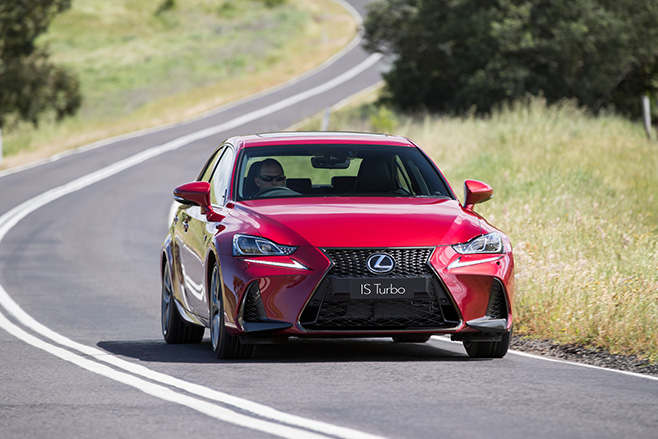
You’ll need to squint to recognise the minute visual tweaks, the spindle grille’s focal point has been raised, slightly, and the LED headlights redesigned.
But it’s still a striking face. The front bumper’s taller side scallops look hungrier for air and are the real giveaway on a 2017 model.
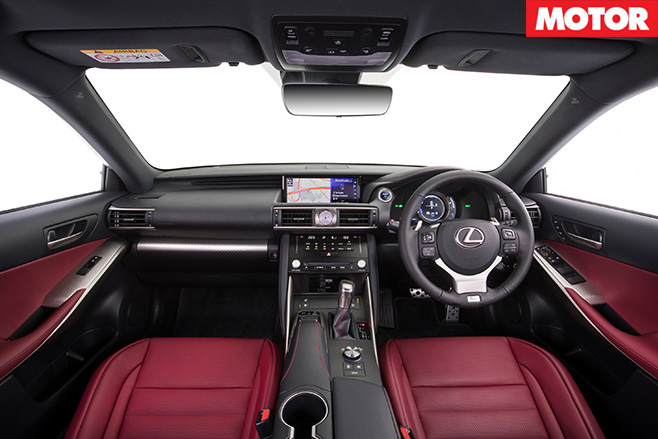
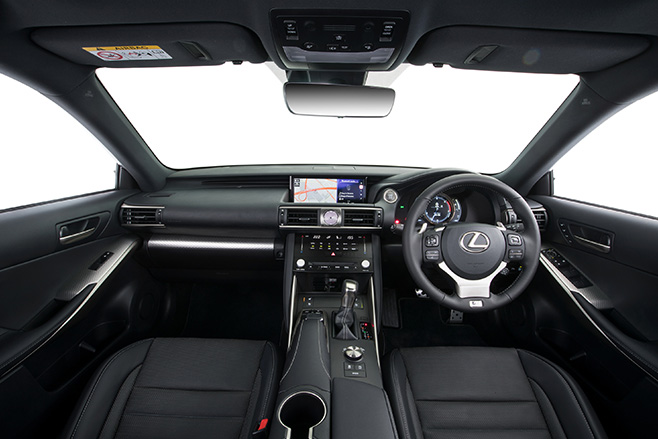
The F-Sport’s interior is still our pick, though, for its LFA-aping tachometer and the fact it’ll tuck adaptive suspension underneath the wheel guards.
Fitted with new bushings and aluminium front lower control arms, the Lexus IS remains a balanced handler with clear steering and a cushy ride tolerant of most surfaces.
Unfortunately Lexus hasn’t bestowed the IS F Sport with the RC’s rear LSD or four-wheel steering technology, so it’s still fussy about power down and lacks the coupe’s outward agility.
The 200t’s 180kW/350Nm turbo four looks torquey on paper but feels a touch breathless under foot, not helped by a smooth but sleepy eight-speed auto. And unless you’re tearing around in the sonorous 350 F Sport there’s little to inspire a cheeky punt.

On the other hand, the eight-speed’s docility, ride’s high-frequency behaviour, and media system’s complexity rob the IS of the clear thinking resolve found in German rivals like the BMW 3-Series and Audi A4.
So, satisfying? Not completely.
3.5 stars out of five
2017 Lexus IS specifications
200t F-Sport
ENGINE: 1998cc, DOHC, 16v, turbo
POWER: 180kW @ 5800rpm
TORQUE: 350Nm @ 1650-4400rpm
TRANSMISSION: Eight-speed auto
WEIGHT: 1680kg
0-100km/h: 7sec
350 F-Sport
ENGINE: 3456cc, DOHC, 24v
POWER: 233kW @ 5800rpm
TORQUE: 378Nm @ 1650-4400rpm
TRANSMISSION: Eight-speed auto
WEIGHT: 1685kg
0-100km/h: 5.9sec
BAD luck, kids. Honda Australia has categorically stomped all over any plans to bring the next three-door Civic Si – revealed in prototype form at the Los Angeles motor show last week – to Australia.
“It’s a North American vehicle only,” said a Honda Oz spokesperson. “We’re focusing on our five core model strategy locally.”
It’s a crying shame, too. The low, sleek and masculine Si carries its own identity that sits perfectly between the cooking model Honda Civics and the bonkers Type R that lands here next year, and it promises to be quite the little performer, too.
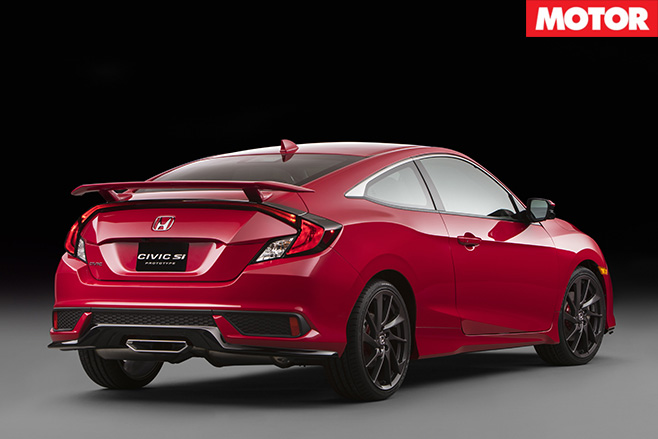
This powertrain configuration will keep it nicely beneath the expected 230-odd kW of the inbound Type R, while allowing for Golf GTI-baiting fun.
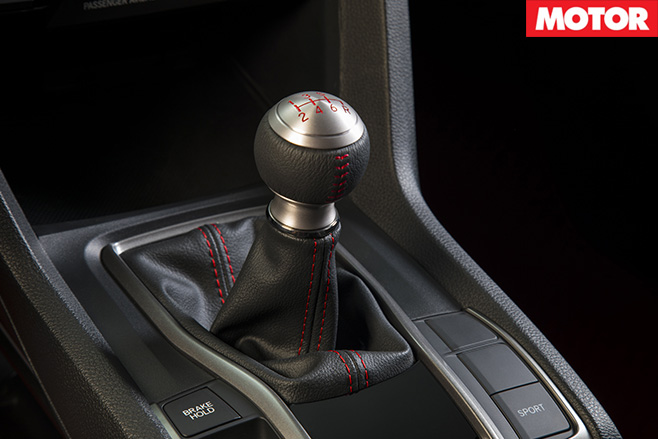
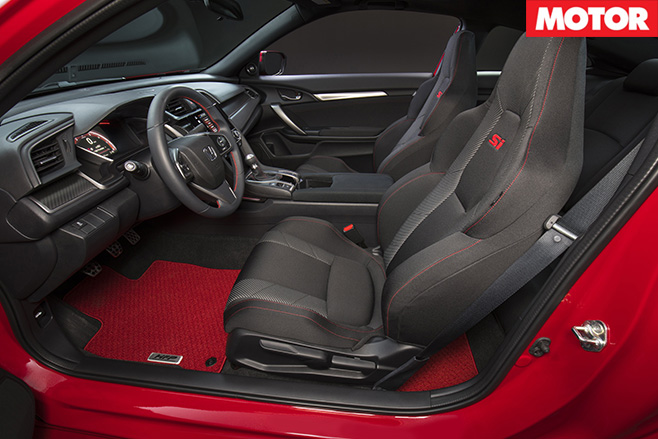
Inside, the treatment “closely previews” what the real car will look like, with sports seats and the like. The Si will launch in the US in late 2017, and in Australia absolutely never.
EVEN though Ford’s hotcakes-like Mustang has only been on sale locally for a bit more than a year, it’s almost reached mid-model refresh age in the US – and recently leaked dealer documents suggest that it’s set for a couple of hefty changes.
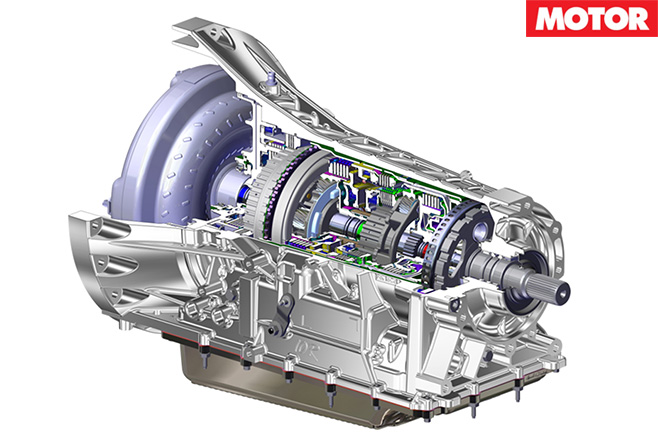
The biggest one will be the addition of GM’s new 10-speed automatic transmission, which is a collaborative effort with arch enemies GM. First used in an F-150 ute, it’s now been added to the Chevy Camaro ZL1, and it’s in that guise that you can expect to see the 10-speeder in the Stang.
Powerplant-wise, the 5.0-litre V8 and the turbocharged 2.3-litre four-potter (also used in the Focus RS) are destined to continue, but the 3.7-litre V6 engine that’s sold in some markets, including the US, is possibly doomed.
It looks as if adaptive dampers will be added to the GT’s repertoire, while cladded mules caught in pics suggest a few tweaks to the bodywork are imminent, including a tougher rear spoiler, new bumper treatment, active quad exhaust pipes and new colours.
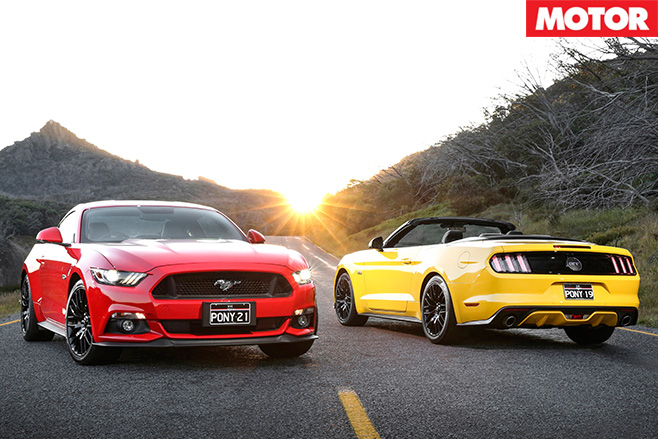
If we were betting types, the changes won’t take too long to filter through to Aussie-build cars; the initial rush has died down after a stellar first burst of orders, and Ford Australia will be keen to keep the gumbo boiling with fresh tech for its current superstar.
It was in 1989 that Japan’s largest car manufacturer (Toyota) birthed a premium automotive brand (Lexus) into a world dominated by European heavyweights. And here we are, 28 years later, covering the mid-cycle update of the first Lexus model line to achieve one million sales – the medium-sized Lexus IS sedan.
TELL ME ABOUT THIS CAR
Launched here in 2013, the third-generation IS scores edgier styling details, enhanced active safety features, and a thoroughly revised suspension tune to ensure this handsome sedan continues to age gracefully.
And of course there’s an obligatory multimedia upgrade, headlined by a huge 10.3-inch colour screen filling the central dashboard space previously occupied by a 7.0-inch version.
STRENGTHS
- Individuality. The default choice in the premium-medium category is undoubtedly the Mercedes-Benz C-Class, seeing it’s the second biggest-selling medium-sized car in the country (behind the Toyota Camry). Which leaves the rakishly proportioned, edgily styled and beautifully finished Lexus IS as something a little left-field and different, but with the quietly confident allure of a Lexus badge.
- Handling and ride. Mirroring the rear-wheel-drive layout of premium sporting sedans like the BMW 3 Series, Lexus has created quite an accomplished driver’s car in the third-generation IS. And this updated version improves on that further with a more absorbent ride, finessed steering connection and terrific handling balance.
- Value for money. While the Lexus IS is hardly bargain-priced – kicking off at just under $60K for the Lexus IS200t Luxury and stretching to nearly $85K for the IS350 Sports Luxury – it’s a car that doesn’t demand a serious stab at an options catalogue to achieve a proper luxury look and feel. Feature for feature, it’s an easy win for the Lexus IS200t F-Sport, in particular, over its Audi A4, BMW 3 Series, Mercedes-Benz C-Class and Jaguar XE equivalents.
- Tyre noise. The latest Lexus IS has received several improvements in the areas of noise, vibration and harshness (NVH), but the one aspect that undermines its polished ride is tyre noise. On coarse surfaces – meaning much of country Australia – the high-performance 18-inch tyres on the F-Sport and Sports Luxury variants produce a persistent rumble that chips away a little at the car’s premium feel.
- Cabin storage and overall space. While the current IS feels right-sized in terms of the real estate it occupies and how it feels behind the wheel, the byproduct of being a compact rear-drive sedan is less-than-stellar cabin space. A large centre transmission tunnel means there’s little chance of seating a centre-rear passenger (besides a child), and there’s nowhere to obviously store your smart-phone besides plonking it in the illogically placed cupholders. But the IS does compensate with impressive seat comfort.
- The ageing 3.5-litre V6 in the IS350. Purists will tell you it’s great to see (and hear) a naturally aspirated, big-capacity bent-six engine still performing hard in a range-topping variant, but that’s a little optimistic in this instance. While the 3.5 V6 performs strongly and has some character to its note, it’s a little underwhelming and lags some distance behind its best rivals. The 2.0-litre turbo-petrol four in the IS200t is a more well-rounded engine.
ANY RIVALS I SHOULD CONSIDER?
Probably quite a few. If performance is high on your list of priorities then BMW 340i argues a strong case, seeing it costs only $6K or so more than the flagship Lexus IS350 Sports Luxury.
If benchmark steering, handling and ride (and thus, driver appeal) are paramount, then nothing can beat the Jaguar XE.
If all-round excellence and all-wheel-drive traction make the most sense, then the Audi A4 (and its high-performance S4 sibling) is almost impossible to outclass.
And if you want the cachet of a three-point-star badge, as well as the engineering and sporting brilliance of an AMG version, then the Mercedes-AMG C43 4matic and C63 S are champagne performers.
That said, the Lexus IS has a sweetly balanced personality that shines brightly in IS200t F-Sport or IS200t Sports Luxury guises.
Mobile phones could soon have to switch to a special flight mode under a set of voluntary guidelines released overnight by the top US road safety authority.
The move should also step up the war between Apple and Android for control of your car’s dashboard as they rush to bring in features that blur the line between portable devices and in-car multimedia screens.
The appeal from the National Highway Traffic Safety Administration flags that smartphone makers will soon need to work even closer with car companies to ensure drivers aren’t distracted by the devices they pair up with their cars.
If they can’t, they may have to introduce a flight mode-like “driver mode” to lock drivers out of using anything but hands-free functions.
The NHTSA envisages two levels of flight mode: locking the device once it is connected with a car; or recognising if the device is being used by the driver or a passenger, and locking the device accordingly.
According to the NHTSA, technologies to detect whether a driver or passenger was using a device had been developed “but are currently being refined such that they can reliably detect whether the device user is the driver or a passenger and are not overly annoying and impractical”.
Until they do, it has asked device makers to allow users to manually activate the driver mode.
The changes were flagged in the second stage of NHTSA’s proposed voluntary guidelines it wants connected technology companies such as Apple and HTC to follow. The guidelines seek to ensure that even the most complex task performed behind the wheel takes less than a combined 12 seconds of eyes-off-the-road driving.
According to the NHTSA, anything that plugs into a car will need to be designed so they “reduce the potential for unsafe driver distraction by limiting the time a driver’s eyes are off the road, while at the same time preserving the full functionality of these devices when they are not used while driving”.
The NHTSA noted there are currently no safety guidelines for portable devices used in cars written into US law even though such a concept was announced to work with iPhones three years ago.
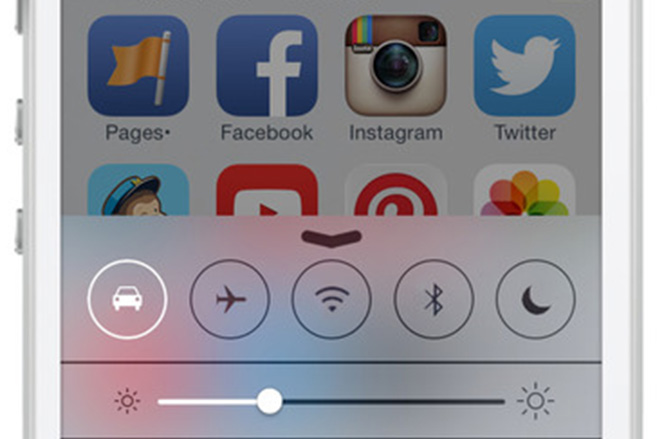
Car Mode could be selected manually like Airplane Mode or would work automatically when the phone was paired to the car via Bluetooth.
It would allow the phone to receive incoming hands-free calls and access Apple’s Siri map directions but disallow text messages until the driver was out of the car. It would even respond to texts messages by saying your “phone is currently in Car Mode”.
The idea was for Car Mode to actually be a part of the iPhones settings, rather than as a separate app, but while it was hoped it would come with the iOS 7 update this never eventuated.
The NHTSA document states that at any one time, more than half a million drivers on US roads were using handheld smartphones while driving, and were being distracted for an average of 23 seconds while they sent or received text messages – the worst behaviour flagged by the organisation.
The proposed guidelines are now open to feedback. For the next step, the NHTSA will go to the US government with a list of recommendations of how it thinks laws should change to protect distracted drivers from themselves.
TEXTING AND DRIVING IN AUSTRALIA
Australian road authorities claim up to 30 percent of car crashes on our roads are caused by driver distractions. Many have increased the penalties they hit drivers with if they’re caught using a device while behind the wheel.
A recent Queensland government study revealed as many as seven in every 10 drivers have admitted to using their phone while driving.
Victoria-based VicRoads has developed an Android-based app called Road Mode that can use a smartphone’s GPS connection to detect if its owner is in a car, lock it down by redirecting incoming calls to voicemail, and send an SMS message to callers alerting them that you’re driving. It switches off when the phone detects it has travelled slower than 20km/h for 10 minutes.
