
TELL ME ABOUT THIS CAR
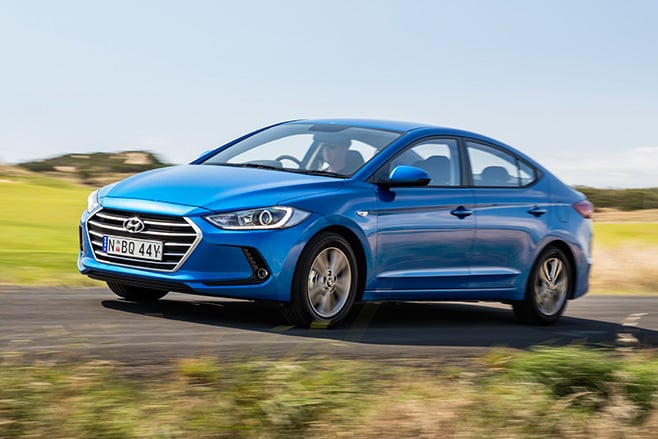
The Hyundai Elantra is a small sedan based on the i30 hatchback, meaning it has a longer boot added onto the back. Hyundai updated the Elantra in March 2016 and in Australia it is one of the more popular cars in its class. The Elantra Active model is powered by a 2.0-litre four-cylinder engine producing 112kW and 192Nm.
STRENGTHS
- Equipment. Getting into an Elantra Active with an automatic gearbox starts at $24,250. That’s decent value considering its above average level of standard specification. It has auto headlights and wipers, reversing camera and parking sensors, LED daytime running lights and front fog lamps, and a reasonably good set of active safety systems.
- Space. Roomy front seats and generous rear legroom make the Elantra accommodating inside and easily able to transport adults in the back. The front seats have good lateral support, though the cushioning is fairly firm and the seat bases are quite short.
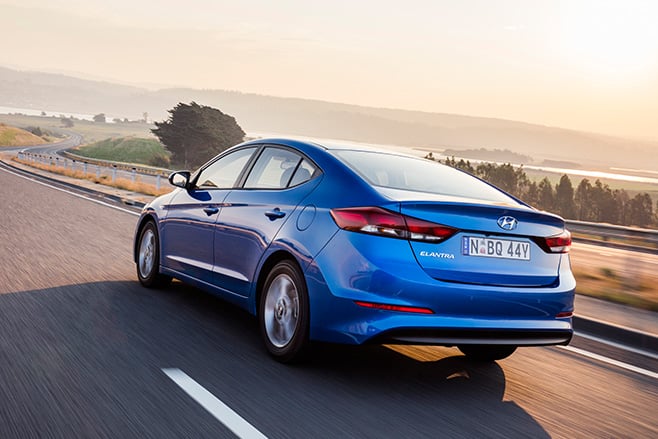
- Styling. Hyundai has come a long way with its exterior designs, and the Elantra is now one of the more attractive small sedans on the market. Its roofline and proportions have coupe-like sleekness, while other design elements like the headlights and taillights take cues from more premium vehicles.
- Convenience. As a vehicle built for everyday ease of use the Elantra does a good job of catering to basic functionality with minimal fuss. The rear seats can split fold for more cargo room, there are rear air vents and multiple 12V sockets up front. It doesn’t have huge grunt, but the conventional automatic gearbox offers decent take off and makes the engine seem livelier around town.
WEAKNESSES
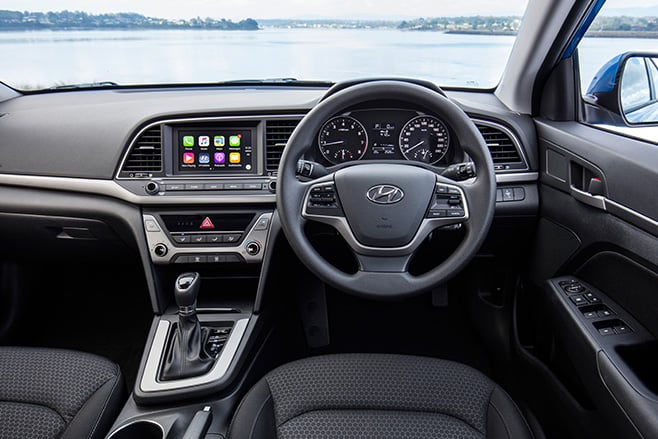
- Plastic. It’s everywhere inside the Elantra. One of the biggest let downs is the bare plastic steering wheel, which makes the whole interior package seem cheap. It’s the first thing you touch when you get inside, and the one part of the car you have in your hands the most. Hyundai Elantra Elite and SR and almost all of the Elantra’s competitors have leather wrapped steering wheels.
- Refinement. The ageing 2.0-litre four-cylinder engine in Elantra is on the noisy side. It has buzzy vibrations at higher revs that intrude into the cabin and feel unpleasant. Otherwise, the cabin is quite well isolated from road noise and fairly quiet.
- Ride. Hyundai’s Australian outfit worked on a unique suspension tune for the Elantra, which does a good job with what was available, but the ride loses composure over larger bumps and when carrying passengers. It feels like it needs more suspension travel and is outclassed by cars like the Honda Civic sedan.
- Efficiency. Fuel economy is a claimed 7.2L/100km for automatic Elantra Active models. That’s significantly more than the Mazda 3’s similar 2.0-litre four-cylinder engine, which uses 5.7L/100km.
The Mazda 3 Maxx sedan is priced similarly, at $24,890. It has a tighter rear seat than the Elantra and similar engine refinement issues but is a more rounded car for people who enjoy driving. The Honda Civic VTi-S sedan is another option, at a cost of $24,490. It has a better interior and a more comfortable ride, though its exterior styling is fussier and its CVT gearbox is a weak point. There’s also the Ford Focus Trend sedan, which has a powerful turbocharged engine offering good performance while using more fuel than these others. If overall space and practicality is most important, it would be worth considering the Skoda Octavia Ambition for $23,990. It has an enormous boot, large rear seat and a punchy turbocharged engine.
MORE: Hyundai Elantra Range Review MORE: Hyundai Elantra Specs, Range & Price
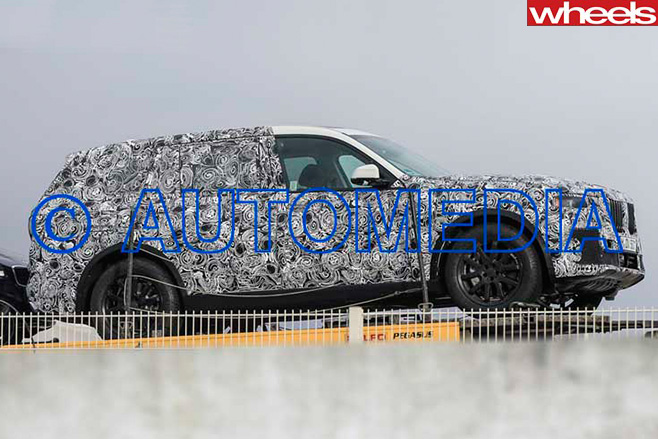
BMW’s entrant in to the large luxury SUV market, the X7, has been spotted testing on German roads
The X7 will the largest SUV produced by the Bavarian carmaker and will be its answer to the likes of the Audi A8, Range Rover and Mercedes GLS-class.
While the camouflage doesn’t reveal too much detail, its sheer size is plainly evident. You can also make out its family resemblance to its smaller stablemates including the BMW X5 and X6.
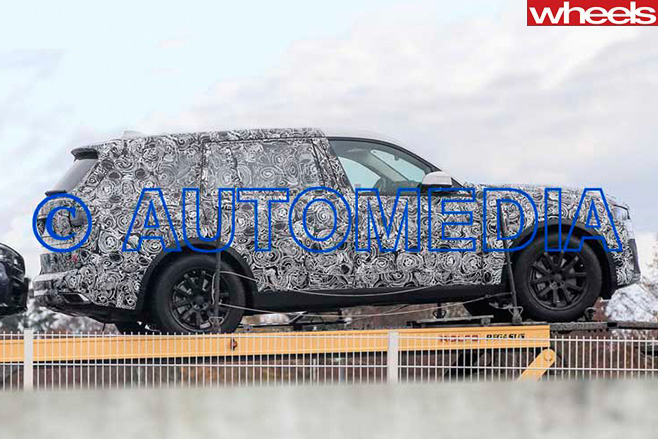
The X7 will be built at the Spartanburg in South Carolina alongside all of BMW’s other crossovers, except for the German-built X1.
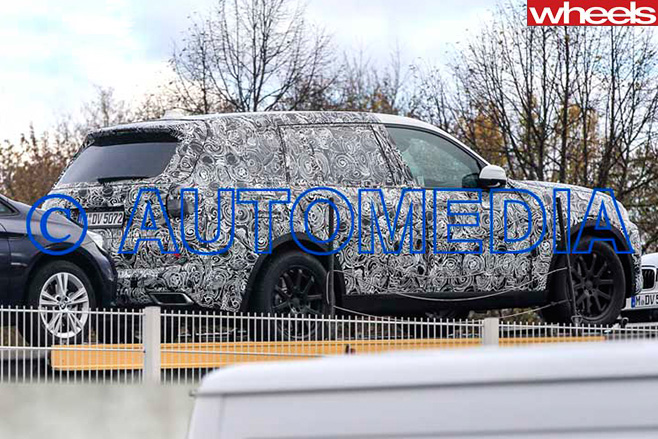
The BMW X7 will make its international debut late in 2017 ahead of a global rollout the following year.
JEEP has revealed that it is considering a tiny SUV for Europe that would slot beneath the current Jeep Renegade.
Due around the end of this decade, it would attract younger and urban buyers to the American 4×4 fold, and would probably feature advanced lightweight tech such as Fiat’s TwinAir two-cylinder petrol powertrains to help keep those crucial CO2 emisssions down.
Speaking to the Aussie media at the LA Auto Show last week, the global head of Jeep, Mike Manley, admitted that his brand could not ignore the ongoing downsizing trends in more developed parts of the world such as in Europe and Japan.
“(A sub Renegade Jeep) is something that we’re looking at now,” he said. “In some markets we’re seeing a strong emergence of A [segment] or super-compact SUVs, and Europe is one, with all the German and French manufacturers piling into it.
“I think the time will come where we’ll need one of those as well.”
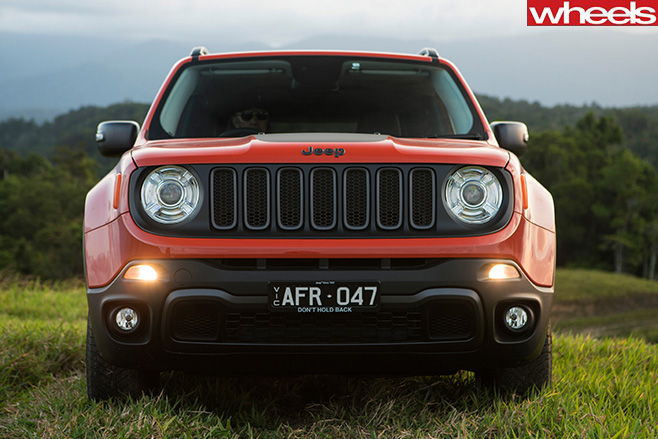
Sounds just right for any future baby Jeep, then, especially as such a car would be of about 3.8m in length. And that would fit nicely in the carmaker’s ever-evolving line-up, which currently consists of the 4.2-metre long Renegade, 4.4m Compass (due in the final quarter of next year in Australia), 4.6m Cherokee and 4.8m Jeep Grand Cherokee. A 5.0m-plus Grand Wagoneer has also been announced for 2019.
Whether Jeep actually decides to sell a baby SUV in Australia remains to be seen, especially as the Renegade has yet to fire with just 847 sales year-to-date (compared to almost 15,500 buyers for the best-selling Mazda CX-3). The conspicuous failure of the Fiat Panda Trekking, which kicked off from $24,000 for a 1.3-litre four-cylinder turbo-diesel at launch three years ago, must also still be a sore point for FCA.
No doubt it will be studying the spunky little Suzuki Ignis’ fortunes closely. To be released in Australia in the first quarter of next year, the 3.7m Japanese super-compact crossover will be powered by a 67kW 1.2-litre four-pot atmo unit, driving the front wheels via a five-speed manual or CVT transmission.
A huge hit in its home market, Suzuki expects big things from the Ignis in Australia as well. Watch this space. Jeep certainly is.
Three hundred and fifty clicks, and counting. Down the descent, up the other side.
Effortless, so fast it’s surreal. Now 370. There’s a good reason why Bugatti CEO Wolfgang Dürheimer’s black polo shirt is embroidered ‘Bugatti 400’ – the man moulding the marque is a member of the 400km/h-and-over club. Is this 1120kW ride going to raise my PB, eight years after seeing 408km/h in the original 736kW Bugatti Veyron?
It isn’t – because Wolfgang slams on the brakes as we approach a blind crest at fighter-pilot velocity and decelerate to 200, avoiding a silver Sharan meandering into the fast lane, texting thumbs a-blur.
The Bugatti Chiron, named for 1930s Bugatti racer Louis Chiron, the only Monegasque to win his home grand prix, is currently limited to 420km/h – Chiron raced in F1 until he was 55, but never tasted speed like this.
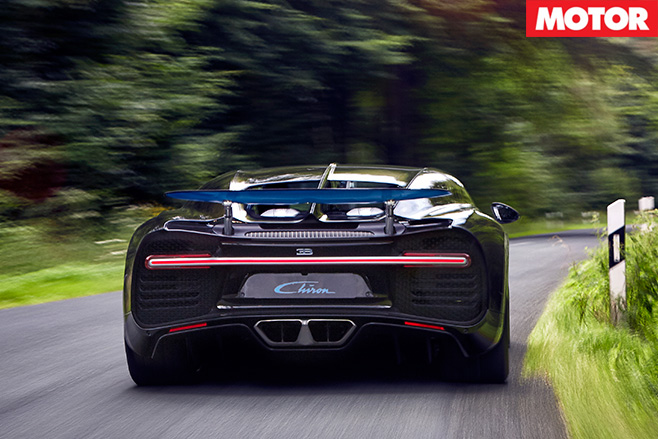
“Even more than in the Supersport, 350km/h is incredibly accessible now,” says a beaming Dürheimer, clearly enthusiastic about his third supercar project after the Porsche Carrera GT and 918 Spyder. “As soon as 450km/h has been established, 500 will be the next focus. That’s progress, like it or not.” To prove the point, the analogue speedo runs to a completely outlandish 500km/h.
Dürheimer is a highly competent driver and stays cool in spite of the Sharan and many like it. At 300km/h he chooses a tighter line than when trailing a bunch of vacationing zombies, he avoids boy-racer take-offs, hooning around empty roundabouts and enemy-making downshifts.
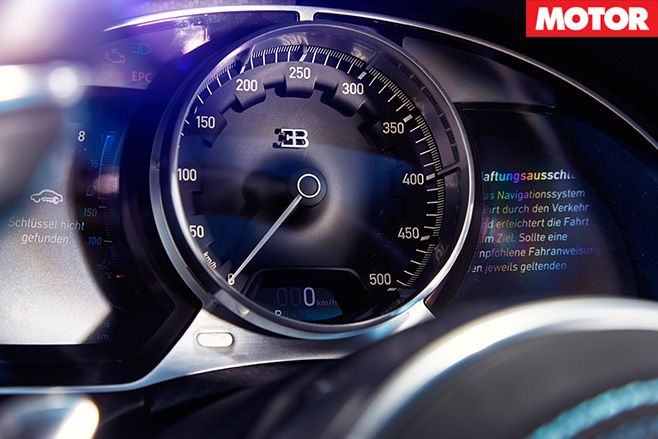
Despite a list price of €2.4m Euro (AUD$3.53m) plus tax, 230 of the 500 units are spoken for and the Chiron may well sell out in the next 12 months. But never fear if you miss out – the Vitesse and Supersport will be resurrected, along with a host of specials.
We’re in one of 10 pre-production Chirons, a solid black specimen with electric blue trim and calipers.Dürheimer, R&D chief Willi Netuschil and Frank Bauer – the man who has driven faster than 400km/h more often than any other human – meticulously check these near-perfect mules, fiddling, fine-tuning and micro-adjusting.
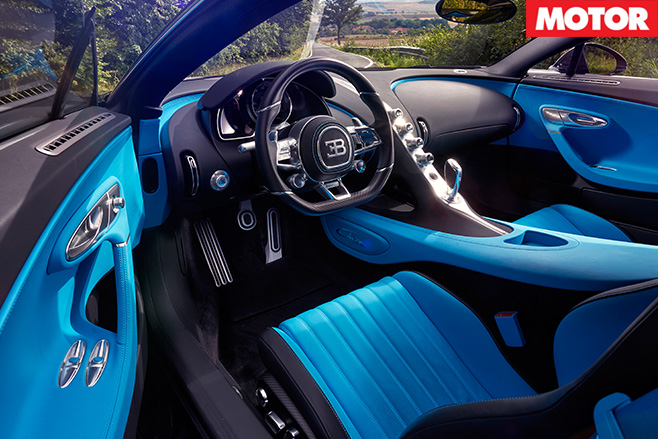
“Speed is both absolute and relative,” Dürheimer says. “You must constantly readjust your eyes and brain. At 300km/h, reaction time and stopping distance are not like at 200km/h. At 400km/h you’re in a different realm and always out on a limb because other road users simply don’t expect the unexpected.”
Even so, the Chiron’s fast pedal parts the waves. A current 911 Turbo giving its very best has no chance – the Chiron claims 0-300km/h in 13.6sec – and the Bugatti scoots past.
At 2.5sec 0-100km/h the all-wheel drive 1995kg Bugatti is almost as quick as an F1 car; at 420km/h, it’s about 60km/h faster. Yet the Chiron happily potters around town in the least aggressive of its five modes – Lift, EB (Ettore Bugatti), Autobahn, Handling and Top Speed.
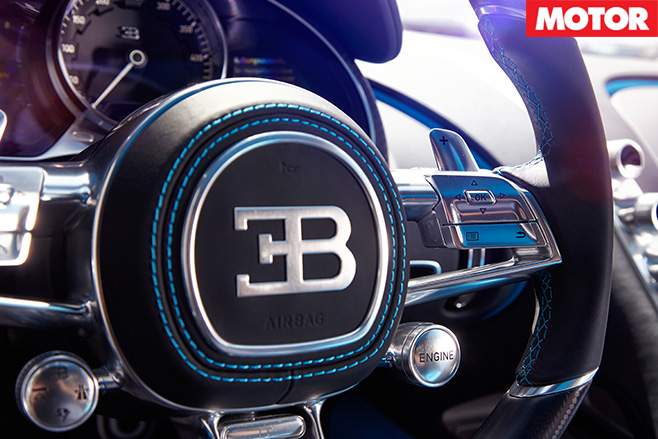
While there’s an amazing standard of finish and countless beautiful details, the concept has weaknesses – the electronics are partly carried over from the Veyron, so no head-up display and no serious driver assistance systems. On the plus side there’s now a small cargo hold for a 44-litre carry-on bag.
But the biggest drawback is the turning circle. “We tightened it a bit by tucking the nose in using the rear diff lock, but it’s a characteristic that takes some getting used to,” Netuschil admits. There are cameras and sensors to protect you but don’t underestimate the space it takes to swing from kerb to kerb.
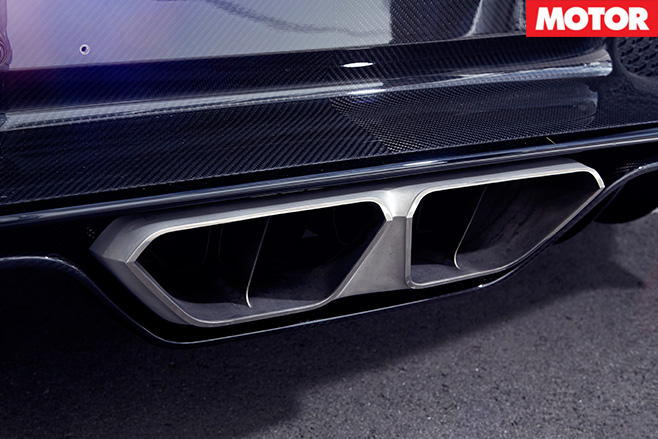
What you do hear is a more intense full-throttle grumble from behind the firewall and the sudden swoosh of the air brake propping the drag figure from 0.38 (0.35 in top speed mode) to 0.59. Plus the background bass of hard-working tyres.
While an awesome straight-liner, the Veyron wasn’t friends with slow corners, undulations, patchy surfaces, the wet or the limits of adhesion in general. The Chiron – while even more impressive on acceleration – has notably better handling.
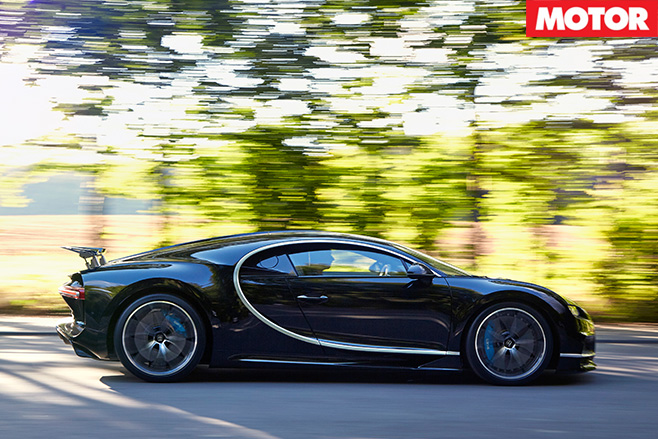
Aside from the massively more powerful engine, it’s this steering that makes all the difference. Adapting automatically to the chosen driving program, it’s quicker yet more progressively damped, and the feedback is authentic and direct.
“Are you ready for a couple of quick changes of direction?” Dürheimer asks, even though the speedo needle is close to 250km/h. A flick to the right – pause – flick to the left – pause. Repeat. Repeat. Repeat. The Chiron reacts as if it’s following a magnet – precise, flat, totally fuss-free.
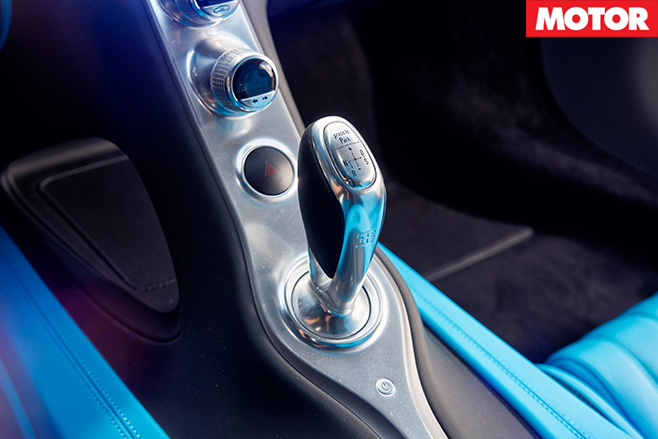
The speed limit at the Wolfsburg off-ramp is 40km/h. Overly cautious perhaps, but it does curl out of sight. Wolfgang clicks down to third and 120km/h, a smidgeon of lift-off, a nudge of the helm and he’s balancing the line between steering and throttle, leaving thin rubber marks down the exit ramp.
“On a track I use Handling set-up, which includes a drift feature,” he says. You can turn off the ESC – the switch is deep in the footwell, as in the Veyron. At our lunch stop, the Chiron is all sizzling exhausts, crackling brakes and gurgling coolant. With 1500 horses at work, heat is always an issue.
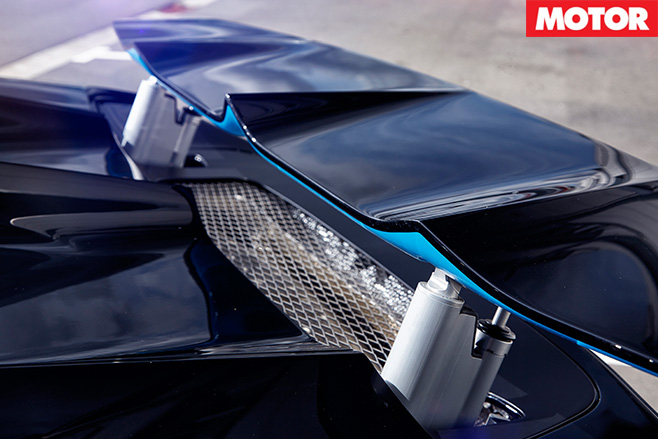
The high-temperature circuit shifts 37 litres of liquid every three seconds, while a low-temp system holds 12 litres to cool intake air which is crucial for seamless stop-and-go driving.
Complementing the horseshoe grille and the lower cooling apertures, a hydraulic actuator constantly balances drag and downforce while directing air to the brakes. Meanwhile, the large lateral scoops are assisted by active front diffusors and three NACA ducts. Rubber and carbonfibre belly-strakes assist directional stability at speed.
AP Racing all-aluminium eight- and six-piston calipers are ultra-lightweight; wider and larger-diameter rotors complete the list of braking changes. The weight distribution of 43:57 suggests a nicely composed handling balance. But the 1120kW and 1600Nm available in Handling mode have no trouble overwhelming everything.
To demonstrate, Wolfgang mashes the pedal from 50km/h in fourth and everything happens at once. There is a moment of hard acceleration squat and a whiff of front wheelspin before the front-to-rear Haldex clutch snarls twice and the rear differential briefly locks, making the Chiron shrug its broad shoulders; ASR and ESP added nudges and in the 6.5sec it takes a Golf GTi to sprint to 100km/h, this Bugatti hits 200km/h.
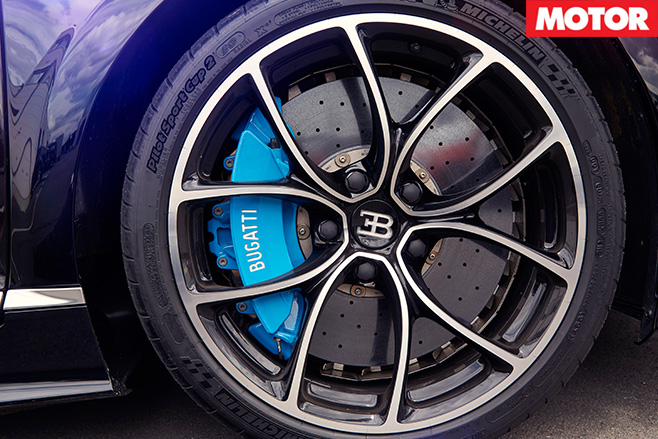
The Chiron boasts four ‘ambience settings’: Icon, Performance, Cruise and Classic. Seats can either be racer-rudimentary, sports or fully electric. The Accutron sound system is tuned to match your specific cabin surfaces, but a special tool is required to clean the outside of the rear window.
There are better-handling, more involving cars around. You may prefer ultralight and ultrasharp cornering heroes or rear-wheel drive slidemeisters. But the Chiron’s not even on the same planet as LaFerrari or the McLaren P1.
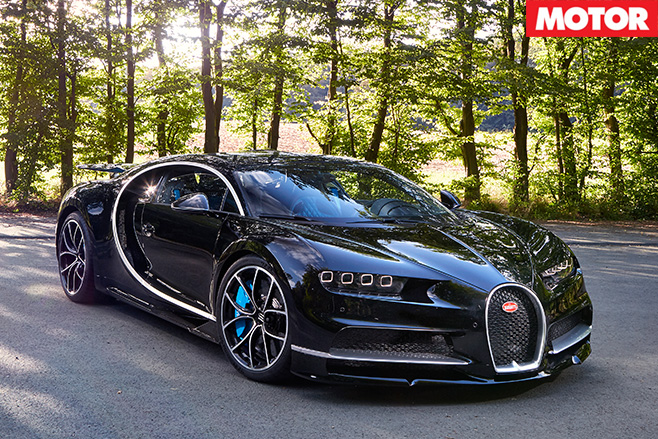
4.5 OUT OF 5 STARS
LIKE: Power; speed; exclusivity DISLIKE: Price; limited driver aids; generic cabin
SPECS Body: 2-door, 2-seat coupe Drive: all-wheel drive Engine: 7993cc W16, DOHC, 64v, quad-turbo Bore/stroke: 86.0 x 86.0mm Compression: N/A Power: 1120kW @ 6700rpm Torque: 1600Nm @ 2000-6000rpm Power/weight: 561kW/tonne Transmission: 7-speed dual-clutch auto Weight: 1995kg Suspension(F): double wishbone, adaptive dampers, anti-roll bar Suspension(R): double wishbone, adaptive dampers, anti-roll bar L/W/H: 4544/2038/1212mm Wheelbase: 2711mm Tracks: N/A Steering: electrically-assisted rack-and-pinion Brakes(F): 420mm ventilated carbon-ceramic discs, 8-piston calipers Brakes(R): 400mm ventilated carbon-ceramic discs, Wheels: 19.0 x 8.5-inch (f); 20 x 11.0-inch (r) Tyre sizes: 285/30 ZR20 (f); 355/25 ZR21 (r) Tyre: Michelin Price: $5.3m, plus taxes
Kia is planning to create a family of GT performance models as part of a model expansion designed to capitalise on healthy Australian demand for go-fast vehicles.
Kia Australia chief operating officer Damien Meredith says the fast growing South Korean brand is working on GT versions of upcoming new models to create halo models within the range.
“We’d rather have a mainstream GT-type product rather than a one-off like the Kia Procee’d was,” says Meredith, referencing the shortlived Procee’d GT that was designed predominantly for the European market.
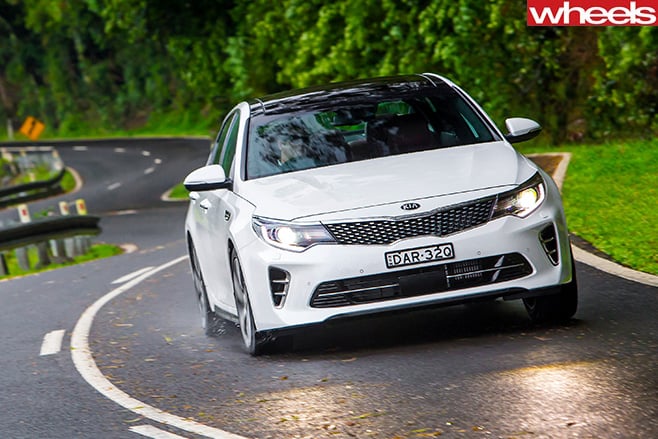
“We’ve got a different strategy … we’d like to have a GT Picanto, a GT Rio, a GT Cerato … rather than have a specific sub-brand. I don’t think we’re strong enough yet to have a sub-brand.”
Not that the Kia GT models will be lacking substance.
Meredith says they will have “real” performance modifications, including more powerful engines.
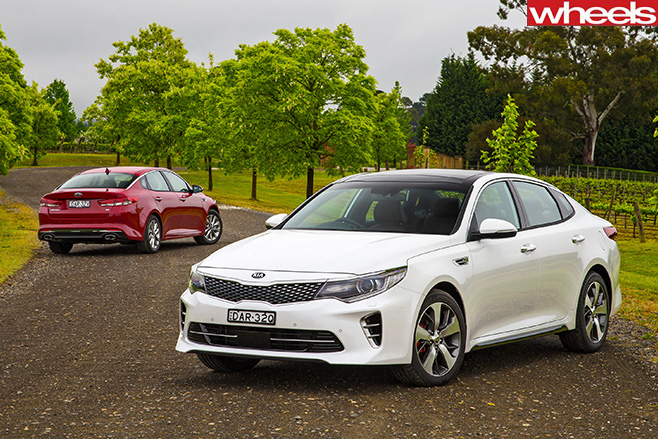
Meredith wouldn’t be drawn on which Kia models would get the GT treatment, but said it would depend on where they sit in their model life cycle.
He hinted the current shape Cerato, which has been on sale for a few years, would likely get the GT modifications with an all-new model, expected around 2019.
But with an all-new Kia Picanto and Rio due in 2017, he said they might be towards the top of the list for a GT performance model.
“It’s a while away, but we’ll get there,” says Meredith.
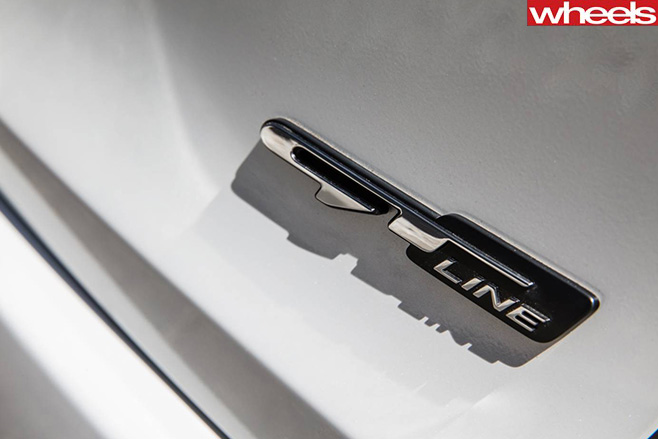
The GT models are all about continuing and capitalising on the sales momentum Kia has enjoyed over the last two years. In 2015 sales grew 20 percent over 2014 and for the first 10 months of 2016 sales are up 27 percent.
The brand is expecting double digit growth to continue in 2017 before slowing.
However, Kia will battle for some time with some gaping holes in its model lineup; a Kia small SUV planned for Europe is not yet confirmed for Australia, with Meredith saying the earliest it could happen is 2018.
And Kia also has no firm plans for a ute, something seven of the top ten selling brands have.
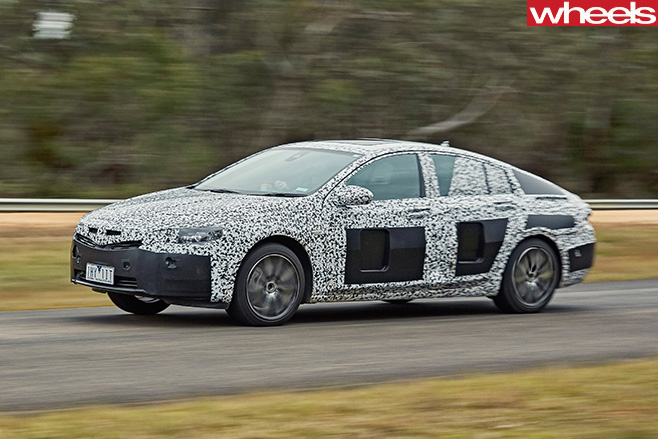
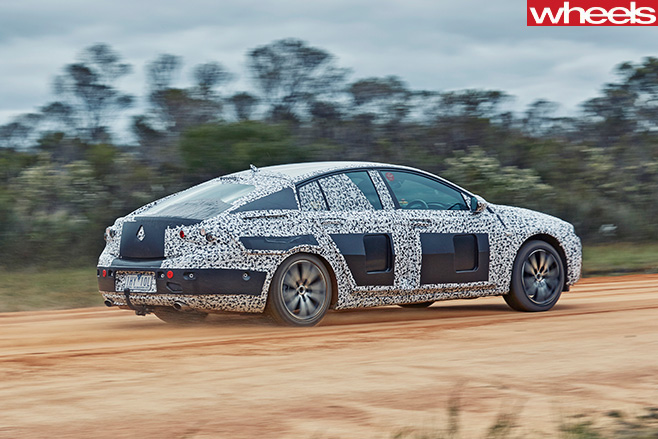
THE negative reaction from some Holden fans to the news the Holden Commodore name will be used by an imported front-wheel drive model has been shrugged off by the executive responsible for selling the new car.
Holden executive director of sales Peter Keley told Wheels that the negative response from some quarters had been expected.
The locally-built Commodore has been in production since 1978 through four generations and always been rear-wheel drive and offered a V8 engine option. It will die at the end of 2017 when Holden’s Elizabeth assembly plant closes.
“We accept what goes on to be honest,” Keley said of the negative commentary. “Everyone is entitled to their opinion.”
Opinions vented on the Wheels website in the wake of the announcement by commenters included:
“It’s pointless to even continue with the Holden badging, let alone Commodore…”
“Will never buy a Commodore again. The Commodore was an Australian car built for Australia.”
Added Keley: “Yes there has been some reaction from passionate, diehard people who sum up the Commodore in 0-100km/h and V8, but Commodore has been a lot broader than that.
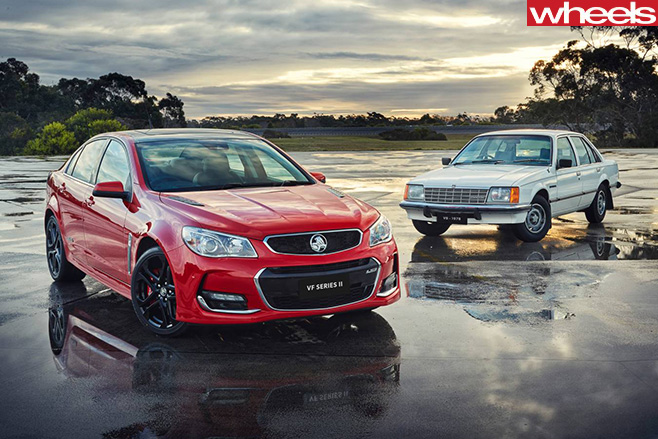
“I think people are comforted by the fact there is a vehicle that will replace their existing vehicle and will do it to the level they always expected from Holden.”
Keley acknowledged that some fans of the traditional Commodore would not buy its replacement, but he said there was every chance curiosity could also get the better of them.
“For some diehards, they will have the decision to make at the time of re-purchase.
“They might decide to hang on to their vehicle. They may even come into the Holden showroom to see this new Commodore that they have heard about that they don’t believe fits the bill and they might be quite pleasantly surprised.
“They might still hang on to their existing vehicle and supplement it with a new one.”
Jeremy Clarkson, Richard Hammond and James May’s new Grand Tour project is nothing if not ambitious, if the leaked opening scene is anything to go by.
With more than 500,000 YouTube views since Friday, the debut series’ first scene subtly joins the dots between the end of Top Gear and the start of the trio’s brand new project – nearly 18 months in the making.
Reportedly costing more than $3m on its own, the opening scene depicts a forlorn and almost abandoned-looking Clarkson jetting to the US, climbing aboard a tuned Ford Mustang and road-tripping to meet with his Hammond and May co-stars.
The very deliberate backing lyrics ‘I can see clearly now the rain has gone’ make us excited for the cheekiness that made Top Gear so great.
Watch the rest for yourself:
The first hour-long episode of The Grand Tour premiered on Amazon Prime last Thursday.
Though Amazon has not launched its ‘Prime’ subscription officially in Australia yet, The Grand Tour is available to Aussies who open an American or UK account. As of November 21, 2016, it was USD$10.99 per month or about AUD$15/month. Amazon offers a free 30-day Prime trial.
Clarkson, Hammond and May together with former Top Gear executive producer Andy Wilman were snapped up by Amazon to create The Grand Tour when Clarkson’s contract was not renewed by the BBC, after he assaulted a producer.
Amazon has reportedly budgeted an eye-watering $7.6m for each of the 36 instalments of The Grand Tour, which is planned to run over three seasons.
Tesla sells cars straight to the buyer without a network of new car dealerships. They use the internet and shopping centre shopfronts instead of traditional main-road car yards, which means having to take a different approach to after-sales service and repairs.
Unlike mainstream brands with dealerships and service centres within easy reach in most cities and regional centres, Tesla has just two service centres in Australia – in Melbourne and Sydney. Tesla sends “Ranger” technicians to other areas and in some cases problems can be fixed remotely by connecting with the car’s systems to diagnose and rectify certain problems.
Being all-electric, the Tesla Model S and Tesla Model X don’t require as much in way of servicing as cars with conventional engines. The electric motors are virtually maintenance free with inspections focusing on batteries, wheel condition and alignment, replacement parts like windshield wiper blades, and some software updates. This means they require just one service per year, or every 20,000kms, which cost between $500 and $975.
The down side of Tesla’s bespoke technology is not being able to take your car to be serviced anywhere else beyond car tyre changes.
In the US and parts of Europe this has led to delays in people being able to get their cars serviced or maintained, though Tesla says there are no such issues in Australia, where the Ranger program is being extended to meet demand.
Price is no longer the top reason people buy a new car from the growing Kia brand.
Instead, it’s Kia’s industry-leading seven-year, unlimited kilometre new car warranty, something Kia Australia chief operating officer Damien Meredith says has changed the perception of the carmaker and “gave people permission to look at our brand”.
“Our research also showed us that we went from price [being the number one reason to purchase a Kia] to warranty,” says Meredith, adding that “there’s a huge comfort factor” with such a long warranty.
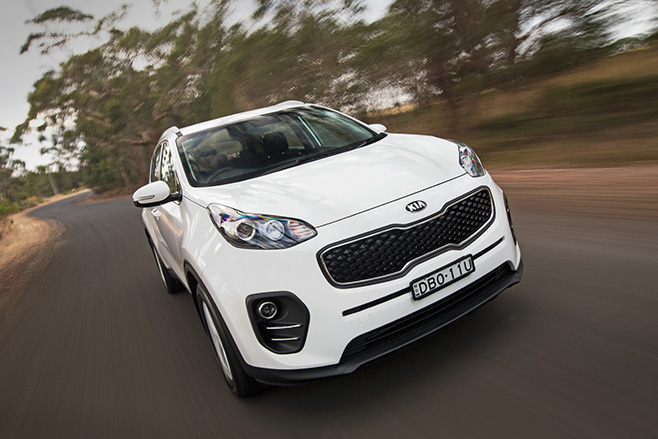
He said offering additional peace of mind for new-car buyers chasing value has pushed design and styling higher up on the list of considerations.
“The big change has been that flop from price, which was very, very high, down to number three – and warranty and design [being first and second respectively in purchase considerations]”.
The industry standard for warranties has long been three years or 100,000km.
Kia’s sister brand, Hyundai, was one of the first to break that, opting for a five-year warranty.
That’s since been matched by others including Mitsubishi and Renault, with Citroen offering six-year coverage.
Other brands have offered factory-backed extended warranties as short term sales incentives, while some are considering warranties longer than three years.
But others argue there is no need for a headline warranty number because Australian consumer law often offers protection well beyond the advertised protection.
Now discover the top questions to ask your car dealer.
LAKE MOUNTAIN ROAD
This brief 10.5-kilometre stretch of road is used as the access point to Lake Mountain Ski Resort, so is heavily trafficked in winter. However, come the warmer months, when the snow fields are long gone, it becomes a joyous playground for thrilling driving experiences. The trip from base to summit takes just 13 minutes, but Lake Mountain Road is well worth multiple passes. The road offers a great combination of turns and views. Make a day of it, by combining the trip with other Dandenong staples such as Reefton Spur, Black Spur, Chum Creek Road, and Marysville-Woods Point Road. After you are done with Lake Mountain Road, make sure to stop off at Marysville for a Hot Chocolate or bite to eat.
GREAT OCEAN ROAD
No driving road list would be complete without the Great Ocean Road. However, its popularity is a double-edged sword, as the road is as busy as most inner-city roads particularly on weekends. That is all forgiven once you get a taste of the breathtaking views. With multiple seaside towns to stop for food, the Great Ocean Road makes a fantastic route for day trips or weekend getaways in the car.
GREAT ALPINE ROAD
Say hello to arguably one of the greatest driving experiences in Australia. If you enjoy a good drive, then make sure you put the Great Alpine Road high on your to do list. The 339-kilometre route winds from Wangaratta in the state’s north-east, all the way to Metung and the beautiful Gippsland Lakes. The Great Alpine Road is butter smooth, with fantastic flowing sweepers, combined with ruggedly handsome and typically Australian scenery. Taking about 5 hours to transverse, it is well worth setting aside a weekend for this route.
ARTHUR’S SEAT ROAD
This hair-raising combination of switchback hairpins and spectacular views is great for a short blast. Rising from Dromana, this twisting road provides a great payoff for those which reach the summit with a breathtaking view. Arthur’s seat is one of the highest peaks in the relatively flat Mornington Peninsula, giving you a great vantage point of the surrounding areas.
BOGONG HIGH PLAINS ROAD
If the Great Alpine Road is too mainstream for you, the Bogong High Plains Road should be right up your alley. Taking in mountainous landscapes, this alpine road is smooth, flowing, relatively traffic free, and lacking the sticks and other green debris that can hamper most mountain passes. This driving road would make a great addition to a weekend venture to the Great Alpine Road.
