
Verstappen and Vettel feud flares in mexico
But Hamilton draws closer in the fight for the world title
The simmering tensions between Sebastian Vettel of Ferrari and Red Bull wild child Max Verstappen erupted into open aggravation in the closing laps of the Mexican Grand Prix when the Dutchman refused to cede to the four-times world champion after running off the track under pressure during a fight for third.
Ahead, Lewis Hamilton took victory from his Mercedes team-mate Nico Rosberg to narrow the point’s gap to 19 in their personal battle for the 2016 world title. But with just two races remaining, Rosberg can clinch the championship in Brazil in two weekend’s from now at a venue that has never brought a victory to Hamilton.
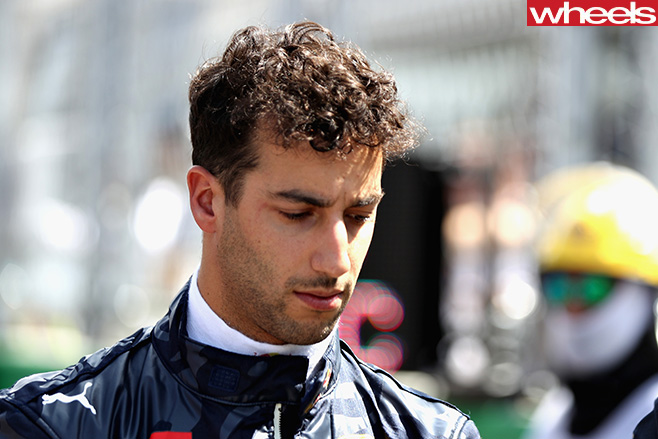
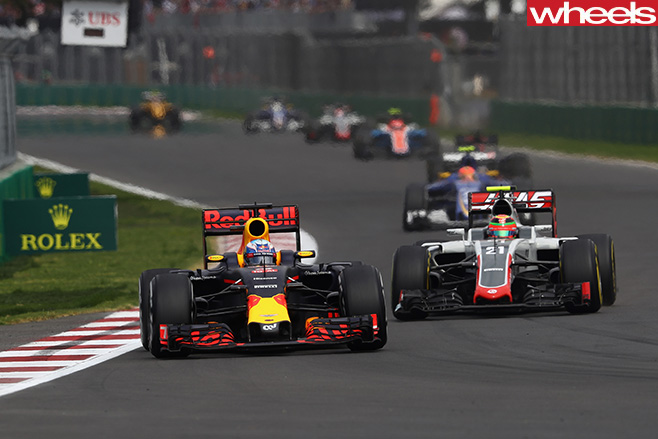
Verstappen was under threat from Vettel, benefitting from better rubber, with Daniel Ricciardo in fifth, on even fresher tyres fast chasing down sandwiched Ferrari driver.
Versappen locked up and ran on the grass before short-cutting back in front of an incandescent Vettel, who immediately turned the airwaves blue. It was clear that Verstappen wasn’t interested in redressing and stewards indicated the matter would be investigated post race.
After the flag, Vettel raced up to Verstappen to deliver his views on the youngster’s driving with some emphatic sign language. Verstappen responded with some deaf/dumb “talk” of his own.
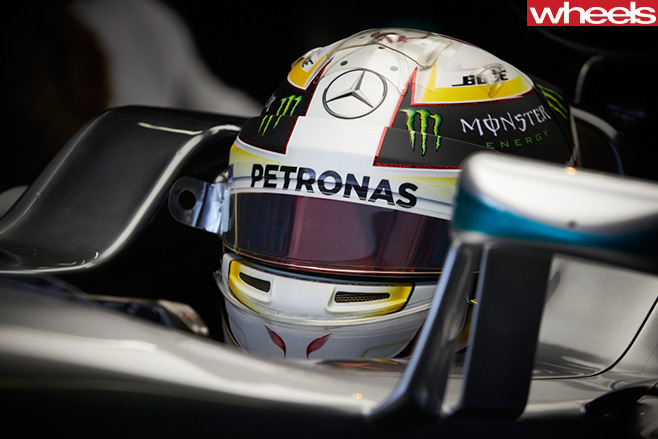
The first penalty has at least done something to counter the belief that Verstappen is something of a protected species free to challenge driving etiquette without censure.
In fact on the opening lap Rosberg was hip-and-shouldered off the track by an attacking Verstappen in a move that didn’t seem to bother anyone in the tower.
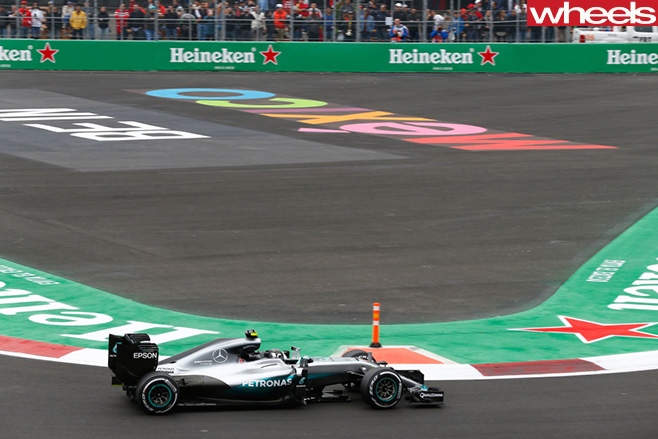
Qualifying was predictable enough with Hamilton taking his 10th pole of the year (and his career 59th) while Rosberg completed a 12th Silver Arrows front row lockout so far in 2016.
For the eighth time this season, improving Red Bull filled row two, with Verstappen just ahead of Ricciardo after the Aussie conceded his lap was scrappy. Force India’s Nico Hulkenberg started fifth.
In another miserable result, the Ferrari’s were sixth and seventh, the drivers confounded by inconsistencies in the pace of the red cars.
WRC: Ogier again!
Neuville noses ahead in fight for second in championship
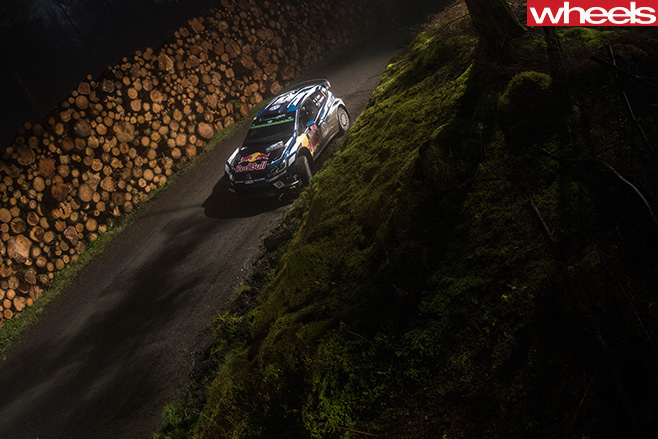
Fog and greasy dirt roads in mid-Wales ensured the contest was far from simple.
The Frenchman, who sealed his fourth consecutive world title in Spain earlier this month, capitalised on the advantage of running first on the stages in the muddy conditions to go into the final day with a 33.8 sec advantage over Tänak.
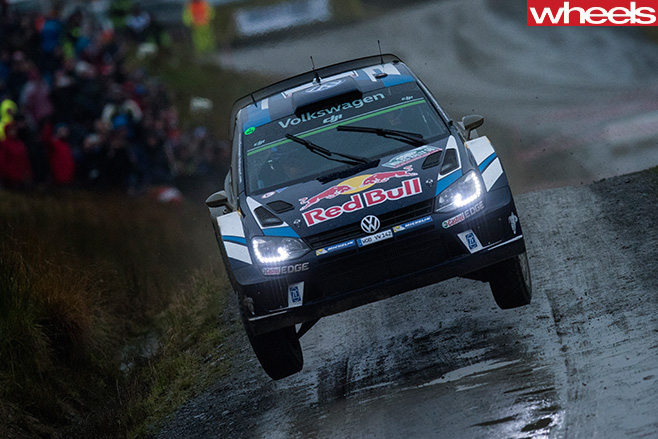
Winning all of Sunday’s six stages and claiming maximum points in the Power Stage, Tänak slashed Ogier’s lead from 33.8 seconds to a mere 10.2 seconds – recording the closest finish of the 2016 FIA World Rally Championship this season.
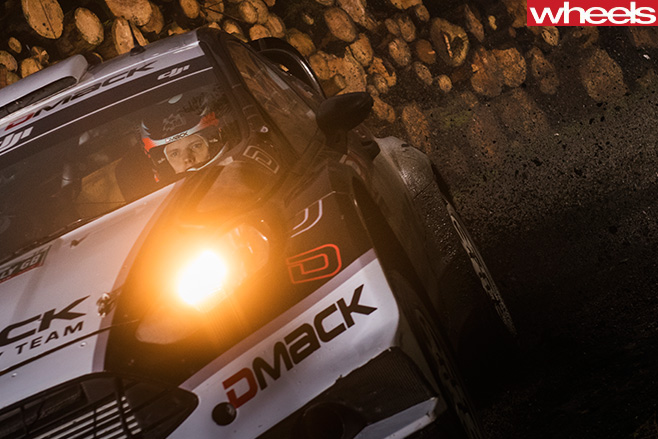
Hayden Paddon could not get to grips with the tricky conditions. The mud required a straighter and more precise driving line, in contrast to the Kiwi’s aggressive style, and although he modified his Hyundai’s i20’s set-up, he couldn’t quite match team-mate Neuville.
Paddon will much prefer the gravel of his “home” event, Rally Australia.
MotoGP: Dovi lands his first Ducati win
Rossi cements second in 2016 world title
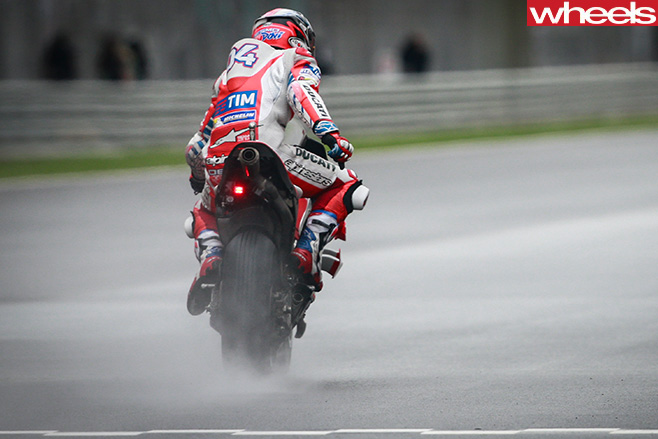
While Dovi’s day was made a little easier when three riders in the lead pack – Cal Crutchlow, Marc Marquez and Andrea Ianonne – all slipped off separately, the likeable Italian mixed commonsense with speed to become the ninth different rider this season to win a premier class grand prix.
Rossi fought hard and was part of an enthralling duel with Ianonne in the early laps, taking turns to lead until the Ducati rider fell.
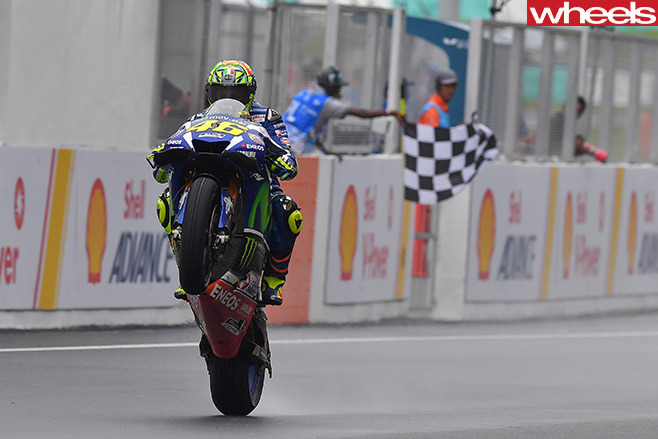
The Ducati rider took control with five laps remaining when Rossi went wide.
The 30-year old went on to win comfortably, flanked on the podium by a past Ducati rider (Rossi) and a future Ducati rider (Jorge Lorenzo, who took a lonely, faraway third).
It was the first MotoGP win for Dovizioso since 2009, when he rode for Honda.
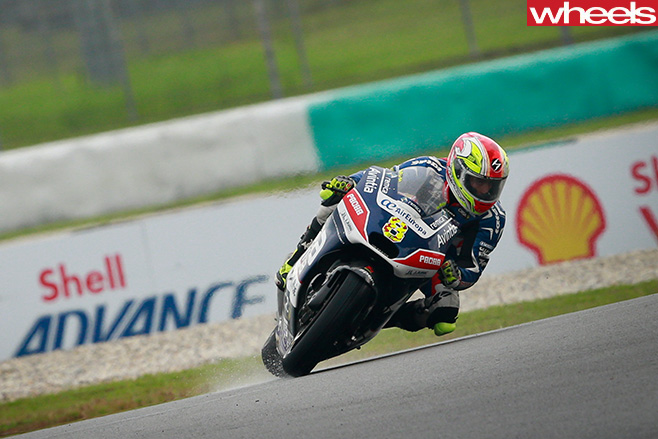
The lead-up to race day was as challenging as race day for competitors, swinging between damp, wet and saturated, putting riders and teams under serious duress.
Complicated an already awkward preparation, Marquez was struck down with a gastro attack on Friday, returning on Saturday to take fourth in the order in qualifying.
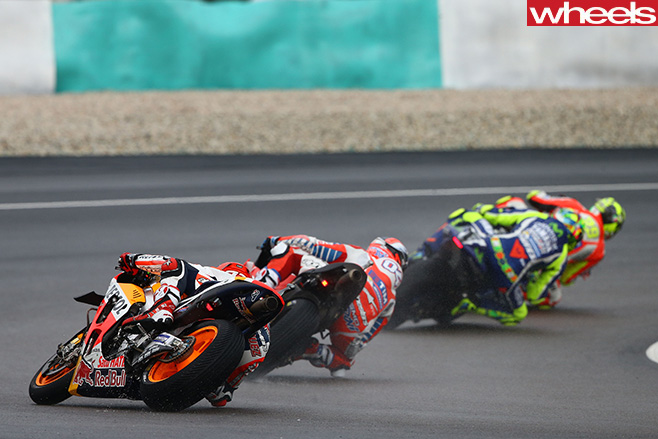
Jack Miller was expected to shine in these conditions but didn’t quite nail a strong lap. He started 14thand finished eighth.
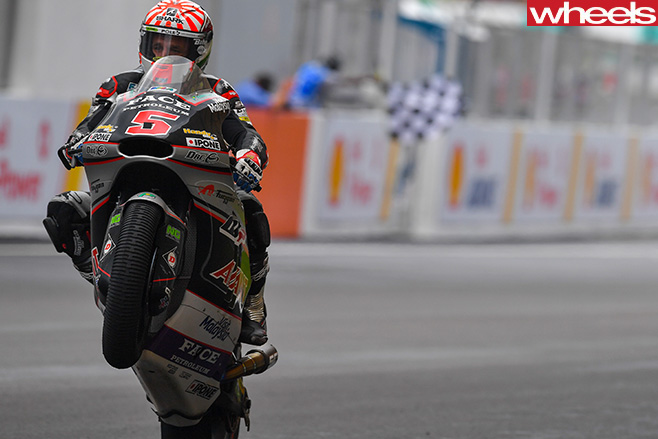
The Frenchman is now gearing up to move into the premier class with Monster Yamaha Tech 3 in 2017.
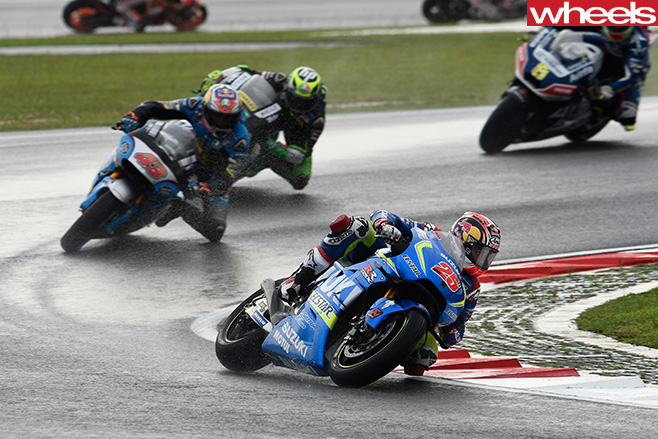
Bagnaia stayed on board in the slippery conditions until the race was red flagged with the Italian holding a big lead over Czech rider Jakub Kornfeil and rookie youngster Bo Bendsneyder of the Netherlands.
Sensational Hampton Downs 101 to Russell and Lago
Wild finish to Australian GT championship race in NZ
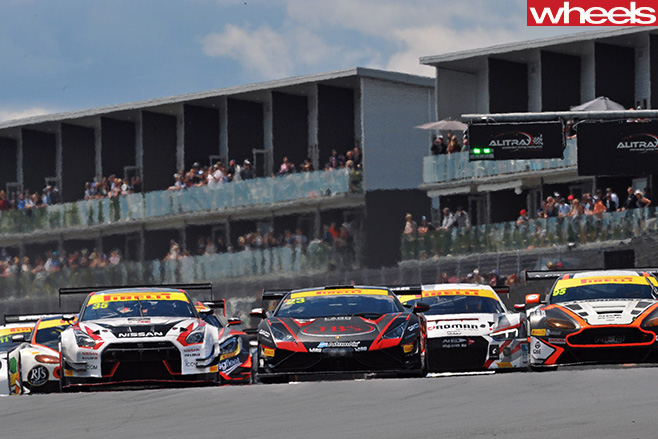
The Lago Racing Lamborghini took the 101 lap race, also round three of the AEC, from the John Martin/Duvashen Padayachee Walkinshaw Porsche 911 GT3-R.
The Tekno Autosports McLaren 650S of Nathan Morcom and Grant Denyer took the flag third but was classified fifth after a post-race investigation.
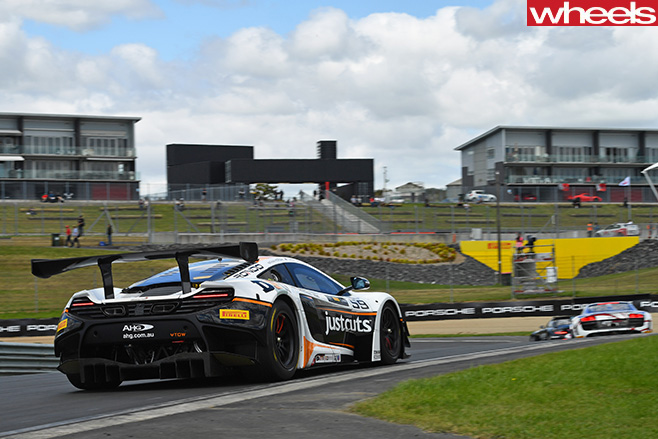
The Maranello Motorsport Ferrari 458 duo of Peter Edwards and Graeme Smythe seemed on track for victory when a late Safety Car intervention bunched the field and wiped away their 13-second advantage over the Morcom/Denyer car.
Russell had led early from pole but in the middle of the race Lago had lost track position after a drive-through penalty. In the last stint the hard-pressing Russell shot back to the front after the under siege Smythe ran wide as the laps ran down.
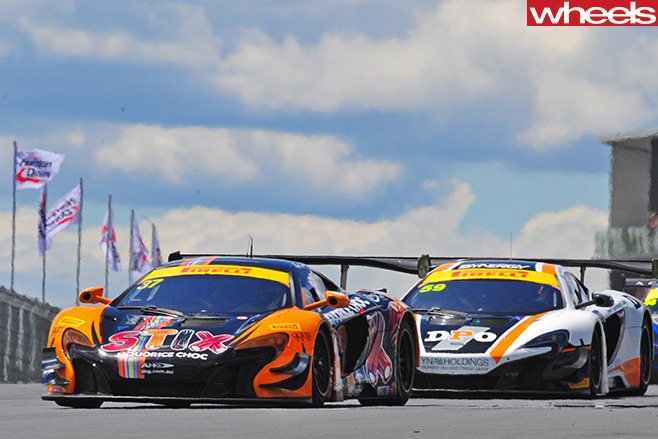
“We are such a small team and the boys have worked extremely hard,” said a satisfied Russell, who impressed with his speed over the weekend.
“This is a big win for us and Roger did an awesome job. We got lucky with the Safety Cars but those are the breaks.”
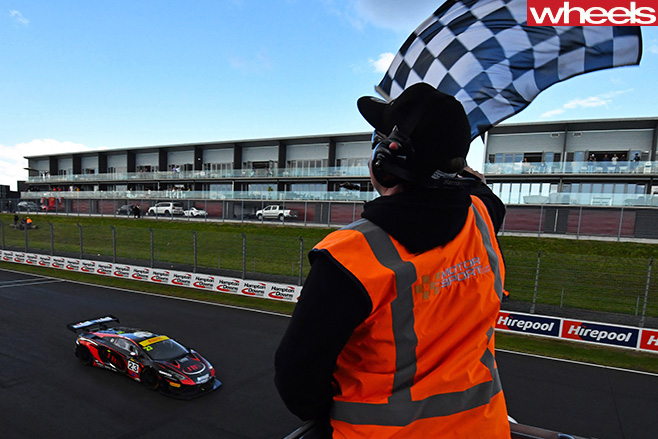
Seven of the 10 manufacturers represented in the entry made it in the Top 10 Shootout.
The endurance championship remains in New Zealander for the final round at the other Quinn-owned circuit, Highlands Park on the South Island, November 11-13.
Mawson continues to impress in Europe
Podiums for Aussie in British F3 Autumn Trophy
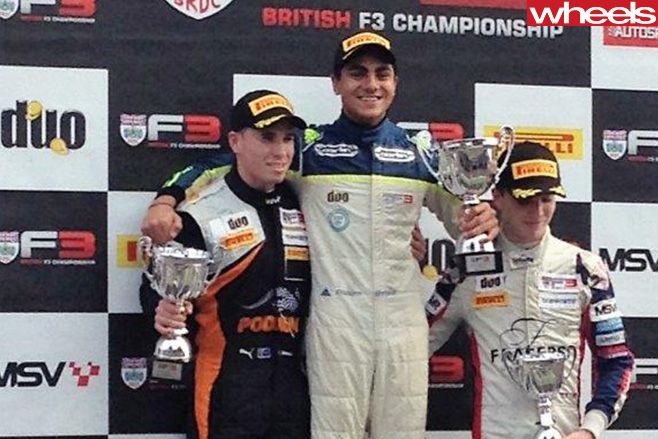
Against well-regarded drivers including Dan Ticktum (British F4 and FIA F3), Cameron Das (US F4 champion), Marcus Armstrong (FR2.0 Eurocup), and other rivals from British F4 and F3, Mawson quickly put his credentials out there for team bosses to see.
Mawson’s first qualifying session in an F3 went brilliantly with the Australian fastest until the last lap when two others led by British F3 regular Enaam Ahmed went quicker in the Carlin entry. Third to Mawson was an outstanding result, bettered in the opening race when he took an impressive second to Ahmed. Then a third to Ticktum and Ahmed in race two.
Ahmed took victory in the third race on Sunday, chased home by Mawson. With fog closing in, the meeting was abandoned ahead of race four, meaning that Ahmed was crowned the British F3 Autumn Trophy Champion from Mawson.
Mawson’s strong performance came in a strange environment of racing to different rules, with a different car with an unfamiliar team.
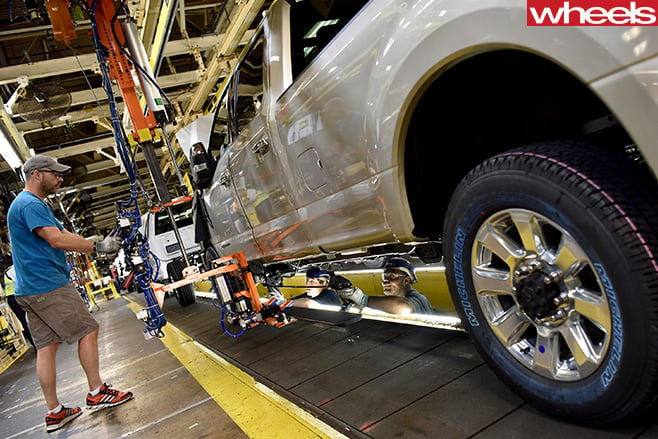
FORD has posted a huge slump in its global third-quarter earnings as demand in its home markets in North America dried up.
The carmaker posted a flat US$1.0 billion ($A1.3b) result for the quarter, down more than 56 percent on the record number it pulled for the same three-month period last year.
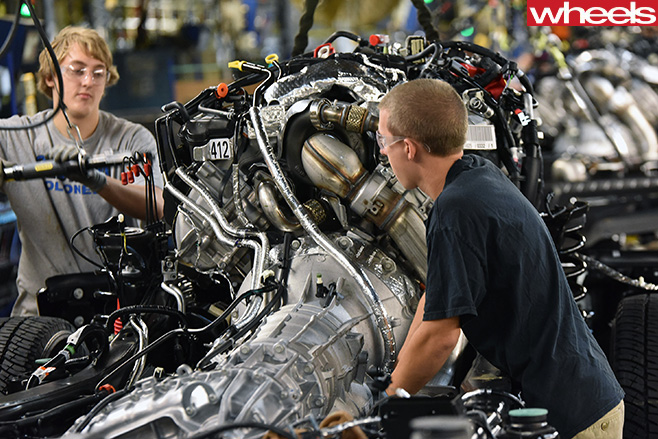
The only shining light for the second-largest US car brand’s quarter appears to be the Asia-Pacific region, which pushed its earnings to a record high of US$131m, a US$109m million turnaround from a year ago.
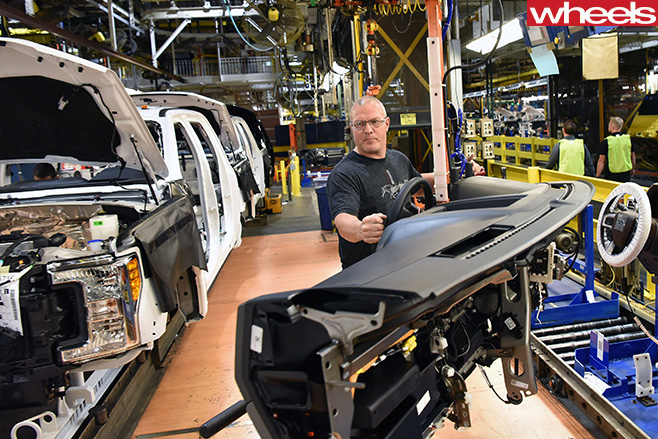
Significantly, Fiat Chrysler has raised its share of the US market by 12.5 percent in the quarter, seemingly mostly at the expense of Ford.
Part of Tesla’s record-breaking result came from selling pollution tax credits to other carmakers.
MARRIAGE material is not someone who, after 20 minutes on the first date, turns out to be shallow, frustrating and a bit dull.For romantic partners it’s fair to say we all want someone with a little darkness and mystery – a personality that’ll take time to unravel. Of course, a nice chassis helps, too. Which brings us to cars.
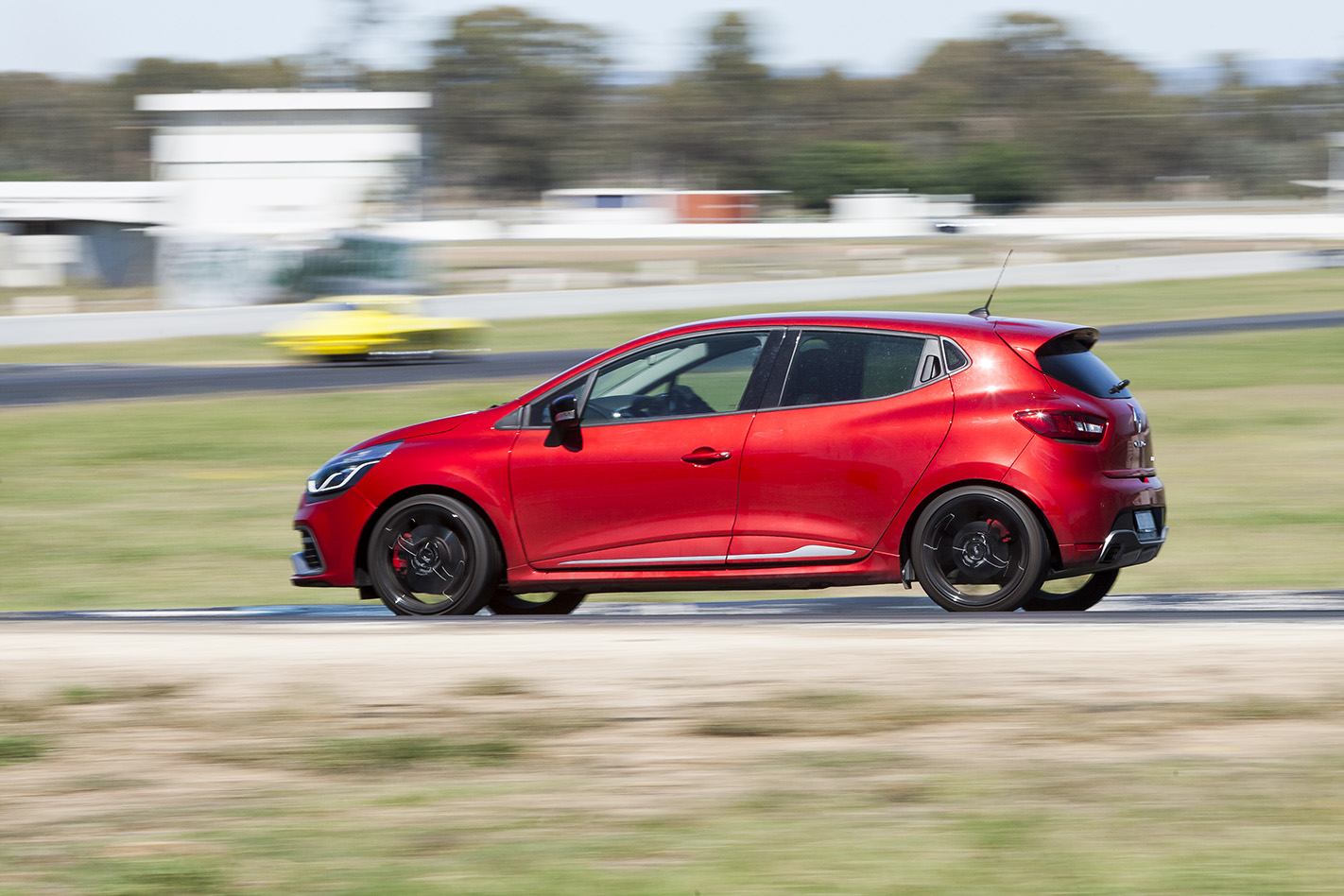
Nobody wants to do two laps of a racetrack to find their newfound four-wheeled performance lover has crap steering and a talent for understeer. You want to know that, five track days later, you’re still figuring it out, that perhaps the car is better than you are.
So hallelujah, after a Friday spent at a Winton track day we can confirm our Clio RS has a depth of chassis character that’ll take several track days, or Warren Luff’s brain, to properly understand and expertly exploit.
Through Winton’s slower hairpins around the back of the circuit, beyond limits there isn’t much more going on than understeer, but through Winton’s faster crooked bits, like turns three and four, the Clio will predictably oversteer on corner entry with an aggressive and calculated steering flick. It’s hilarious fun and you’ll be wishing such corners were all Winton was made of.

Meanwhile the Clio’s chassis displayed such depth and ability that it had us wondering if the nuts holding the wheel, rather than the car, were the things holding it back the most. The Clio had us arguing the quickest way around Winton’s fast turn five. I was able to drive, throttle flat, straight into the sweeper and worry about the turning and braking late in the corner.
But associate editor Scott Newman proffered the slow-in, fast-out technique was the way to slice tenths around Winton in the Clio. Either way, the Clio’s great chassis ensured many of the limitations for going fast were the pilot and not numb steering or diabolical understeer – the case for so many “performance” cars.

Of course, this love affair isn’t without turbulence. The Clio’s chassis still teeters towards understeer and unlike the playful Fiesta ST, or indeed the Clio RS’s predecessor, it takes reasonable-sized gentleman vegetables to solicit pre-apex oversteer in the Clio. It feels like the wheelbase is half a metre longer than the old naturally-aspirated Clio, when in fact it’s just 4mm longer.
Meanwhile the 2.7 turn lock-to-lock electric steering is sufficiently fast and feelsome on track, even if to use it’s more satisfying than stunning.
The seats, too, were great on track, holding us all in place well and giving fantastic control of the big round thing. The Clio RS earns brownie points for full ESP deactivation, too, and good power-down despite the lack of a proper diff (it has a faux LSD, braking the inside wheel).
The brakes held up strongly, too, even if MOTOR is sympathetic on the anchors when there’s no stopwatches involved. Don’t get us wrong, we give the brake pedal plenty of hammy, but we’re not kissing ABS every braking zone.

Meanwhile the tyres were absolutely fine after around 30 or so laps, and that’s in 30-odd degrees of ambient temp.
There was one core criticism levelled at the Clio RS from our track day: the engine and transmission are boring. Yeah, it has 147kW and 240Nm but down the straights we were checking the rear vision mirror for a drag chute.

The shift paddles really need to be on the steering wheel, too, rather than the steering column. Ferrari puts them there so that, when you’re power oversteering your F12 in second gear and need to grab third, you always know where the paddle is. Renault’s reason? Not sure, but we dare venture it’s a little different.
Three months into the relationship our Clio RS has revealed a talented track day chassis. Next month we pontificate if the sawdust-y engine, and that auto, are marriage makers – or deal breakers.
UPDATE #1
By Dylan Campbell
WOULD the latest generation Renault Sport Clio be better as a manual? Having acclimatised to its interior, this is something surely natural to wonder, particularly if you’re a fan of previous generation Renault Sport Clios.
With 7000km on our long-term Renault Clio now – more than enough to bed in the twin-clutch – we would describe the auto tranny, generally speaking, as good rather than great. At low speed the clutches engage sometimes a little too enthusiastically, but in “Normal” mode gear changes are appreciably lazy like any auto.

Put the thing in “Sport” mode and the shifts quicken significantly, to the point where you’ll get a cool DSG-like fart on upshifts. It’s great fun changing up gears although down gears, sometimes you find yourself wanting a gear a little earlier than it’s willing to give you.
Sadly the paddles are strangely unsatisfying to use, too, like the way they click is too soft, and they really need to be on the steering wheel, not the steering column. Yes, you’re right, you should try to change gears in a straight line, but sometimes when you’re just being a bit of a wally and having fun – you decide, mid-roundabout, that yes, you will knock down a gear and blast out – you have to take a hand off the steering wheel, loaded-up mid-corner, to change gears. Not ideal.

Renault Sport’s switched-on engineers will undoubtedly make their Clio’s twin-clutch ’box better with time, but there’s an even easier way to fix this: put in an extra pedal and an H-pattern gear knob.
This generation Clio RS would be such a great car if it was manual, particularly as Renault Sport know how to make ’em (take a Renault Sport Megane for a spin). If this Clio was manual, suddenly the drivetrain would be as interactive, engaging and fun as the chassis, and you would have one seriously cracking car on your hands – with the practicality of four doors, ample rear leg room and a boot.
The fact it changes gears itself aside, I do quite like the Clio’s interior, particularly in our admittedly-getting-pricey, options-plump $37,490 Cup Premium trim (better stereo, reversing camera, heated seats, leather).

I appreciate the big digital speed readout. I love the driving position, which is something I never thought I’d say about a small French car (do the French have legs? If you’ve ever tried to get comfortable in a Peugeot RCZ, apparently not). The seats hug you nicely, yet aren’t too firmly padded. Tick, tick and tick.
The Clio’s interior hasn’t been perfect, though. Some staffers think it feels a bit low rent in places. We think the centre screen’s ‘RS Monitor’ (the Nissan GT-R-esque feast of digital gauges) is a cool toy, except, maybe once in five times we go to use it, it’s totally drawn a blank! It shows the gauges but sans any information. You need to turn the car off and on to get it to work again.

That aside, hand on heart, I’m really liking the little Clio. During extended periods where I’m driving other cars, I look forward to getting back in the Clio for the daily commute. It rides pretty nicely, yet is agile and fun through a roundabout.
After 12 hours of emails and meetings I do appreciate that it can change gears by itself, but still I can’t help but fantasise what it’d be like as a manual. I suspect it’d be awesome.
Update #2
By Dylan Campbell
CAN you hear that?” I shouted at my knee, beside which I held my phone. I was trying to get it as close to the door speakers as possible, so the phone would catch an audible whiff of fake motorcycle noise.
Perhaps tens of thousands of ears were beside my knee as I sat in MOTOR’s Renault Sport Clio long-termer. I was doing a radio interview, the presenter transfixed by the idea some car companies are plumbing fake engine noise through car speakers these days.

Of course, Renault isn’t the only one. BMW is faking it, so is Peugeot, Ford and more. New turbo engines generally sound so vanilla that car companies – Ferrari and perhaps Porsche aside – have given up fiddling with intake and exhaust hardware, instead plumbing unapologetically artificial engine noise through the stereo.
But it must be said that Renault is having the most fun with it, as your index finger will find if it hunts around a Renault Sport Clio’s dashboard menu long enough.
And hunt long it will, given the French fixation on overcomplicating an interior as if in some sort of rebellion against ergonomic homogenisation. Renault, too, couldn’t resist with the Clio RS’s labyrinthine dashboard menu, which would cause a German engineer to pull hair out in fistfuls.

When you do eventually find the fake engine noise menu, there’s a platter of artificial engine notes, from Nissan GT-R to 1930s Renault Vivastella. But the one that’ll have your passengers erupting in guffaws is the 2038 Renault Reinastella – a fictional Jetsons-inspired hovercar. (Or Renault’s product planners dropping a hint.)
There’s also a Clio Cup car, Clio V6, Alpine A110 and a Renault 8 Gordini.
The volume of each is adjustable but they sound a little too fake to be enjoyable, such that you’ll soon be reaching for the off button. Except the motorbike. You might leave that one on for a bit, as it sounds the best, oddly.

But while fake engine notes are easily disabled, the same can’t be said for the artificial note Renault plumbs permanently into the Clio’s cabin – a bassy, rumbly low-down burble that only really makes itself known with a generous throttle input away from the lights, and helps to hide the engine’s otherwise pretty sawdust-y note.
Pop the Clio in Sport mode and the stereo engine noise climbs an octave. Truth be told, it’s subtle enough that it does add some welcome herbs and spices to the experience.
Stereo-assisted engine notes are about the most interesting thing that’s happened to 1CD6HB this month, accruing 1300 urban kilometres despite the promise of an alpine punt.

Personally I’ve spurned other test cars just to stick to the Clio, and I’m still enjoying the daily commute for reasons mentioned last month. And as Melbourne plunges into winter I’m appreciating the Cup Premium’s seat heaters, too.
There are things that make me wince, though, mostly the passenger headrest rattling non-stop, which I’ve tried half a dozen futile times to adjust. Moving away from a standstill, if you’re not leisurely with your throttle tip-in like your right leg is half-tranquilised, the clutches engage with a jolt that goes through the car. We’ve driven twin-clutches much smoother.
The Clio’s EDC auto gearbox, too, can get itself in a muddle, particularly down hills where it seems to dip the clutch as you lightly brake, but then when you resume accelerating, can lurch as the revs match the wheel speed again.

We’ve noticed, too, even in top-spec Cup Premium trim, our Renault Clio RS spurns a spare wheel of any size for a can of goo. Which, if we’re honest, makes us think twice about the alpine jaunt.
But only twice, and the answer is still yes, as the Clio is begging to stretch its talented little legs. As our time with 1CD6HB wraps up, a trip across the mountains for next month’s issue seems a fitting farewell. It seems appropriate, too, we select the Alpine from the fake exhaust noise menu. Even if we can only stand it for two or three gears.
Update #3
By Dylan Campbell
After six months it’s time to bid hooroo to our Renault Clio RS200 Cup Premium and I’m confused whether I’ll miss it for being a great car, or just because as someone who is, how do I say, “between” cars, I’ve harboured unattached affections to which the Clio was ripe for receiving.
Having all my adult life tended to grow sentimentally fond of four-wheeled fast things, I suspect my rosy feelings towards 1CD6HB teeter more towards dumb affection than reverence.

That’s not to say I don’t think it’s a good product. I very much think it is. Particularly after a blast through the foothills of Melbourne’s easterly alps this month, where despite a suspected dud tank of fuel putting the brakes on power output, said Renault, we were reacquainted with the Clio’s fondness for going rather fast through a corner.
But let there be no doubt about two things: this generation Clio just isn’t as plain thrilling as its three-door, naturally-aspirated, manual predecessor. And that this new generation is an easier, more comfortable car to drive on a daily basis. So the question remains is it a better all-rounder and, if I could, would I sign up for another six months?

I wouldn’t mind a punt in the new Volkswagen Polo GTI first. I’d be silly not to, if I was in the market for an automatic, four-door front-driver – which might suggest I do a bit of commuting. Its 141kW/250Nm (in DSG-spec), is more or less the same as the Clio’s 147kW/240Nm.
They both claim 6.7sec to 100km/h. And, though I haven’t even sat in the new Polo, I suspect it’d have a more polished interior and a sharper, sweeter twin-clutch ’box. As for goodies, gadget fetishists can tick two options packs costing $5K which up the frill ante, and still you’d pocket $2500 over the plump Clio RS Cup Premium.
But during a yak in the office associate editor Newman postulated the Polo just wouldn’t be as much fun on a track. Fast, sure, but fun? That’s one thing the Clio’s absolutely got going for it.

Our track day at Winton showed that, in the Clio, you’ll be looking at your wristwatch down the straights, such is the slightly hohum powertrain, but come a corner and the thing will tip easily sideways. And depending on your level of skill, after 20 laps you might feel like there are depths to the Clio’s chassis necessitating time, patience and experimentation to unravel, as opposed to some wobblier self-titled performance car you’ll ‘get’ after five corners.
Its suspension bits did, after all, come from the same people who made the bewitching Renault Megane Trophy R.

Having spent six months in the Clio and 10,000km, it’s a doddle during the commute, too. I’ve raved myself senseless about the seating position – it just seems to fit me right – and I quite like the steering, a nice rack speed for about town.
The ride is generally nice enough though drive over a patch of dodgy road and you’ll know it. Perhaps my only day-to-day bugbear was a rattling headrest to which I practised my skills of scorn, and some gearbox clutches which could occasionally engage with an intolerable jerk.

So after all this time, we can say, do you just want front-drive thrills, but care less about a flash interior and back doors? Get the Fiesta ST. But kinda want back doors and an auto? The Polo GTI is surely a nicer place to sit, but if fun rules your world, the Clio seems the best bet (we’ll find out for sure at Bang For Your Bucks).
After six months perhaps the best advice we can offer is drive the $29K Sport before the $37K Cup Premium – and if you can forgo a few frills for no less thrills, put the $8K into the Megane Trophy R fund.
Sign up here to get the free weekly WhichCar eNewsletter
TURBOCHARGING, flat-fours and hybrids have presented Porsche’s acoustics experts with a fresh challenge.
Not that the turbo is new at Zuffenhausen – or the flat-four, for that matter. In fact, they go right back to the 911’s roots, but the purposefully guttural low-rev note and top-end wail of the flat pack of six remains the brand’s classic soundtrack.
However, rather than shrinking from the challenge, the Weissach Works relished the task of making today’s breed of environmentally acceptable engines sing. Just like working with turbos and four-cylinders, it’s nothing new to them.
You see, while there’s plenty about a Porsche 911 that makes it different from sports cars from other brands, the fact its exhaust note is one of them isn’t by accident.
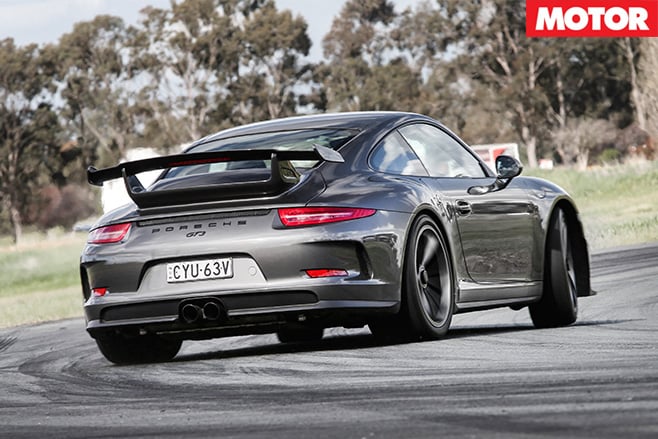
But there are more specific techniques depending on an engine layout’s character and market positioning. According to Porsche head of development for vibrational technology and acoustics Dr Bernhard Pfafflin: “A car has to sound like its output.”
By nature of the fact the exhaust turbine changes the flow speed and shifts the frequency range of the note, a turbo engine needs more work.
In addition, Porsche customer feedback suggested Turbo owners wanted more noise than most, especially in sport mode, which is at odds with the fact turbochargers dampen the exhaust sound.
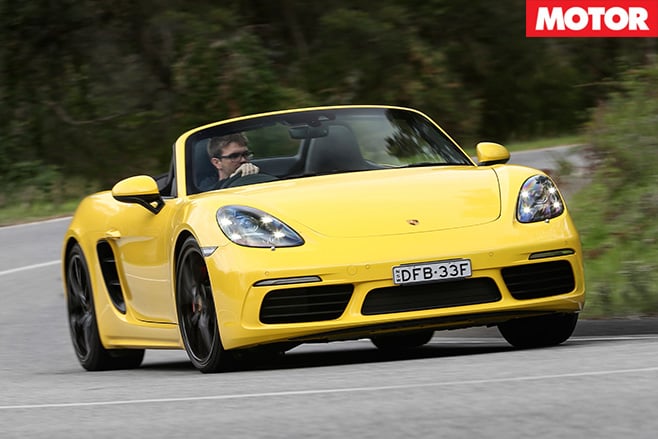
Meanwhile, unequal length pipes south of the catalytic converter feed respectively into a muffler and a Helmholtz resonator to dampen and manipulate the exhaust sound. Through changes to the design and dimensions of the resonator, the exhaust note can be fine-tuned into something more than a WRX.
According to Porsche acoustics specialist Bernd Muller, the debate at board level regarding exhaust sound rages as intensely and with as much passion as that about design characteristics.
But while it might be the easiest job in the world turning out new 911s that look like the last, ensuring each new model sounds like a Porsche clearly isn’t quite so simple at all.
Keeping turbos on-song
1. OPEN THE GATE The turbo wastegate bypasses exhaust gas around the turbocharger to manipulate the boost and, therefore, torque curves. Canny Porsche engineers, however, also open the ’gate to tune the pitch of the turbo whistle.
2. THE BASS-ICS Helping the new Carrera turbos live up to their atmo predecessors in the vocal department involved a unique design for the rearmost muffler, and a shift of the rear tailpipes to the middle of the car, which brought more bass.
3. PIPER PROBLEMS Despite the obvious space limitations in a rear-engined car, a change to the length of the pipes between the catalytic converter and the exhaust outlet helped the engines hit the right note, just as changing the length of a wind instrument does.
4. WHY IT RESONATES A Helmholtz resonator – named after 19th-century German physicist Hermann Ludwig Ferdinand von Helmholtz – can be pictured as a jar with its opening attached to the side of the exhaust pipe perpendicular to the gas flow.
5. NOT A JARRING SOUND As exhaust gases in the Boxster and Cayman pass the opening of the jar, the air inside it vibrates and generates a tone, which adds or subtracts from the tone flowing past the opening, out the twin tailpipes and into the appreciative ears of enthusiasts.
Bang For Your Bucks always throws up new metal and new technology to keep us on our toes, but in other ways, it’s a bit of a Groundhog Day.
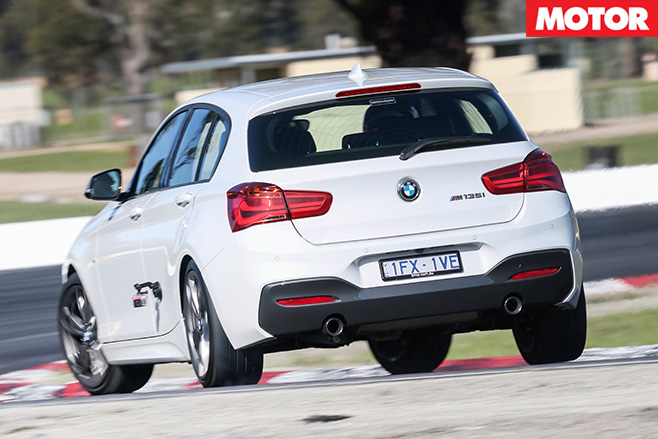
Well, it is for me, anyway, a couple of decades on. As I often do, I took the opportunity to fire up one of my old bangers for the drive up to Winton. Yes, I could have taken a test car, but the run up to Benalla is just far enough to give a car a good gallop but not too far that the old bomb is certain to break or fall apart. And if it does stop, there’s enough passing traffic that you shouldn’t have to spend the night sleeping in a wombat hole.

Want more? Check out the rest of 2016 Bang For Your Bucks.
First published in the July 2016 issue of Wheels magazine, Australia’s best car mag since 1953.
New baby Holden Sparks a $15K battle with crisp class fave Suzuki Celerio and spicy newcomer Kia Picanto.
WHY do kids want to grow up so fast? In no time they’re adults, and there’s no way back to the days of carefree youth.
A similar mindset afflicts carmakers. Take the latest Barina (please!). Once the feisty “beep-beep” baby of Holden’s 1980s line-up, today it’s nearly two sizes larger and half a tonne heavier, but also about half as much fun.
In 2010, Holden introduced a smaller Barina ‘Spark’ to fill the gap at the bottom of its line-up, but this rough little appliance simply made the real Barina look better value. This time, however, we’re promised that the second-generation Holden Spark out of Korea (but via Holden’s Lang Lang Proving Ground finishing school) has matured rather than merely changed.
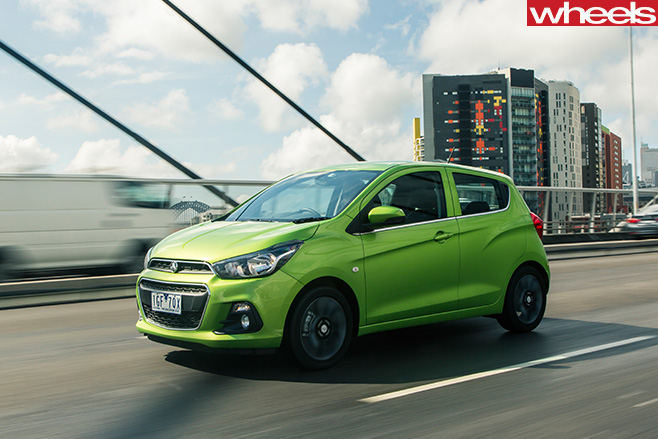
A much stronger body for improved dynamics and reduced NVH (central to the previous Spark’s sorrows) is just the beginning; a fresh 1399cc naturally aspirated four-cylinder engine, Holden’s first continuously variable transmission (replacing an old four-speed auto) and heavily Australianised suspension, steering, and drivetrain calibrations also accompany the Lion cub’s road to newfound maturity.
The genesis of this comparison was during COTY testing at Lang Lang last year, when Holden senior vehicle dynamics engineer (and Nurburgring ute lap record holder) Rob Trubiani reckoned the then-upcoming Spark would be a game-changer. He had just witnessed each of the eight judges returning – some with giant grins – after a stint in one of our favourite micro contenders, the Suzuki Celerio.
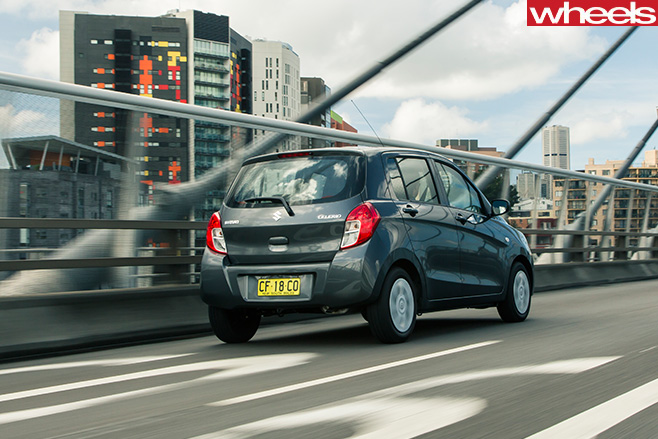
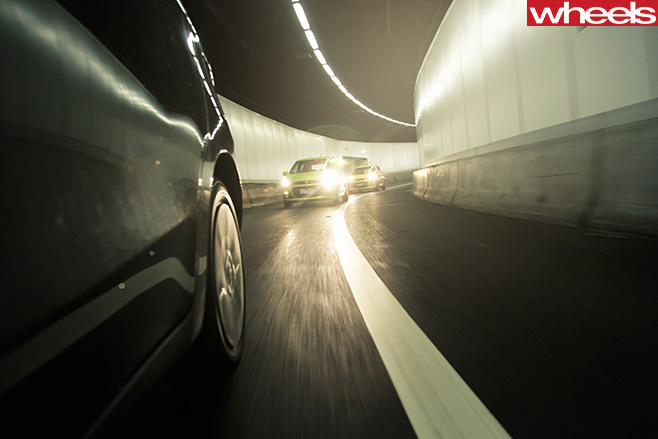
The battle of the babies was on!
Suzuki’s dowdy yet delightfully obedient Celerio was released in early 2015 amid international controversy over a brake-pedal bracket that was worryingly prone to breaking. It was quickly rectified and the Thai-built Japanese hatch dodged a scandal, while its plain styling became easy to overlook because it was roomy, refined, fun and only $13K driveaway.
Our third contender, the Kia Picanto, is new to Australia but already five years old elsewhere and due for replacement soon. Belatedly arriving here in only one specification, the Picanto Si is a 1.2-litre automatic priced at $14,990 driveaway.
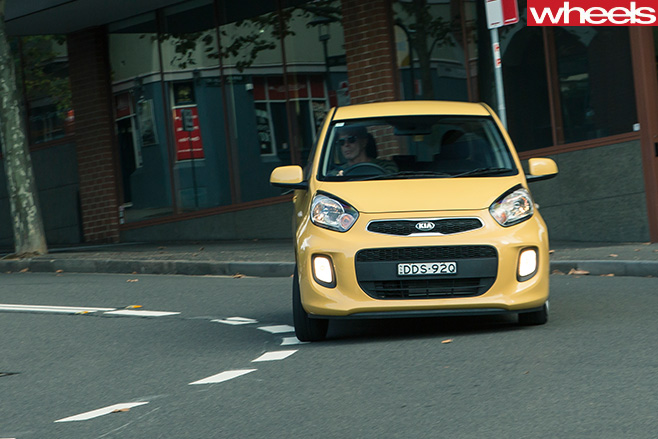
No wonder Kia is confident it can sell 300 a month, or about 40 percent of the total segment, while luring potential used-car buyers. Ambitious stuff.
The $14,490-driveaway Celerio auto’s $500 advantage over Picanto is diminished by having only a four-star ANCAP crash test rating (mainly due to an average pedestrian-impact result), as well as this test’s sole four-seat configuration.
Such features accentuate how sophisticated the Spark’s cabin is for this segment, starting the moment a hefty door thuds closed. With a large central touchscreen, big-car dash layout, sturdy materials and pleasing finish, it seems Germanic in essence, as if Opel rather than Chevrolet dictated the interior.
Gone is the old car’s messy ‘motorcycle-inspired’ analogue/digital instrumentation cluster-fudge, replaced by conventional yet classy dials. Plenty of thought clearly went into the switchgear layout, the three-spoke wheel is of Commodore quality and the driving position benefits from the arrival of seat-height adjustment.
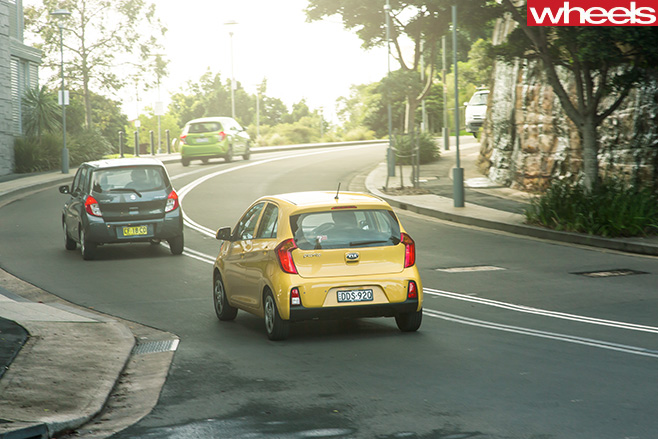
Annoyances include the lack of an auto-down driver’s electric window (Picanto and Celerio both have it), wind-down rear windows and a small glovebox, as well as instruments that reflect sunlight, central vents hell-bent on freezing hands, zero back-seat storage and a parcel shelf that doesn’t flip down automatically when you close the rear hatch – an infuriation when you get back in, glance in the mirror and see cardboard where a window should be.

It is therefore doubly disappointing to discover sub-par audio quality, a misaligned dash speaker cover and some rattly door trim at speed, undermining the Picanto’s quality. We’re also disappointed with the poor front-seat thigh support and lack of door storage, but we can accept that, as a city-car, rear legroom is limited, especially with three adults in the back.
The opposite is true of the Celerio, which was designed to be the roomiest sub-B runabout ever, aided by the longest wheelbase and highest roof here. Which makes the decision to offer only four seats a wasted opportunity.
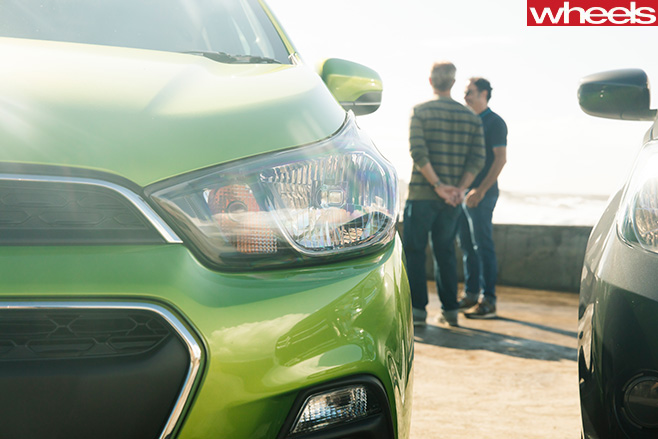
Celerio downsides include front headrests that protrude too far forward, rattles that were apparent in our test car, plenty of noise intrusion at highway speeds, and a dated Bluetooth connectivity set-up that proves confusing.
None of these three hatches feature Autonomous Emergency Braking – even though the Volkswagen Up did so as standard in 2012 – or reach-adjustable steering, a digital speedo or cruise control.
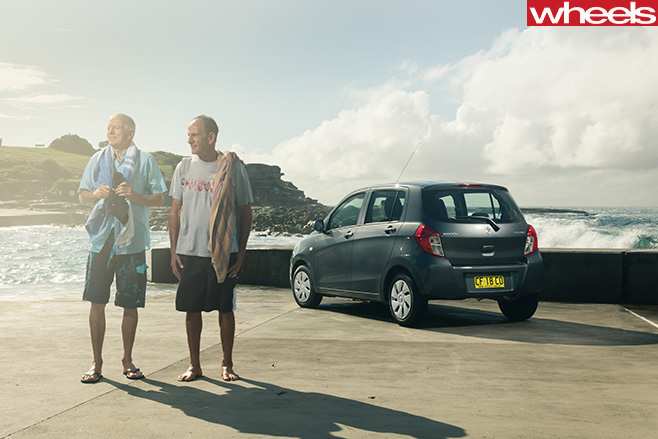
A 10.8sec sprint to 100km/h makes Spark the quickest here, and those extra cubic centimetres deliver dividends on a flat or straight road. Introduce corners or hills, however, and the CVT’s relative laziness is telling, taking its time downshifting to a lower ‘gear’. And there’s no manual over-ride for the driver to assume control.
More significant for a city-car is economy. Despite being 4kg lighter than the 994kg Kia, the Holden’s thirst proved worrying, guzzling 98-octane brew (though it can run on 91RON) at 8.5L/100km – a litre more than Picanto and 2.4L/100km worse than the Celerio. If this is the best a so-called all-new chassis and powertrain can achieve, then it’s not good enough, GM.

Quiet and polished pottering around town, the Kia automatic shuffles between ratios unobtrusively, providing sufficient oomph when needed to thrust quickly through tiny traffic gaps. Even when floored, the Picanto punches harder than its modest spec would suggest.
Away from urban confines, its lack of capacity and gears is more noticeable, and here the Holden charges away. But all the Kia driver has to do is pull the lever down to third or second and the trannie will hold each ratio to the redline, making the most of the available power to keep the Spark in sight. Transformative and involving, it adds a delightful manual dimension lacking in the others. Call it an oldie but a goodie.

A bit more feel and response from the Celerio’s slightly doughy steering would be appreciated, but it is ridiculously easy to drive quickly, has a very tight turning circle, and irons out urban bumps with almost French-car suppleness.
While there isn’t really enough power to alter the chassis’ composure on faster rural roads, the steering firms up nicely and turns in faithfully while the car feels planted. But Celerio’s ride deteriorates on rough roads and its cabin starts to sound like a wasp in an empty drum. Raw, noisy fun.
But not as much fun as the Picanto, which turns it up a notch around town in terms of steering feel and reactivity, with a naturally composed attitude. It moves a bit more on its suspension over bumps but remains comfortable.
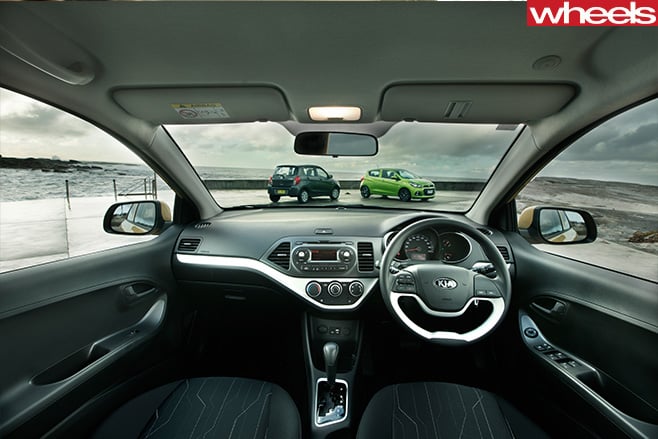
Holden tuned and honed the Spark on Australian roads to the point where it behaves more grown-up than either rival, or any sub-B hatch on the market, and on a number of fronts. Its steering is responsive yet linear and full of feel, resulting in poised and secure roadholding, and just as impressive is its ability to soak up bad surfaces, especially around town. The change is profound over the preceding version, though road noise can be intrusive.
What’s missing from the Spark is verve and – ironically – sparkle. You can scoot along a snaking B-road and totally rejoice at what Trubiani’s team has achieved dynamically, but there’s a lack of adjustability to the chassis that makes it seem a bit dull. A muted charm.
Nevertheless, Spark pushes class boundaries for steering, handling, ride and refinement. But we’re a bit disillusioned by its slightly underwhelming drivetrain performance, its relative thirst and various spec anomalies. While it wins this fight, the winning margin should be greater.
The opposite is true of the Picanto, which punches well above its weight for fun and feistiness, then backs that up with refinement, economy and outstanding value. Well done, Kia. It nips at the Holden’s heels like a lovable terrier.
A respectable third (rather than last) is where the Celerio lands. Save for a boomy cabin and four-seat configuration, it continues to charm with its frugality, huge interior, lively performance, sorted handling and excellent inner-city ride. Its virtues are truly its own.
While newfound maturity has seen a baby Holden win a Wheels comparison test for the first time in forever, it shouldn’t be in too much of a rush to outgrow youthful exuberance – something the Kia and Suzuki possess in spades.
There are many good tow vehicles, but the ones on this list have been benchmarked against their ability to tow in stop-start city driving, freeway cruising, hill climbing and descending, and on rough secondary roads. Ride smoothness, performance, stability and fuel economy are all considerations. Mirror design is assessed for suitability with the same mirror-mounted towing mirrors. The ease of coupling up a caravan is assessed, including how accessible the towball, trailer electrical connector and shackle eyelets are.
1. DODGE RAM LARAMIE 2500I
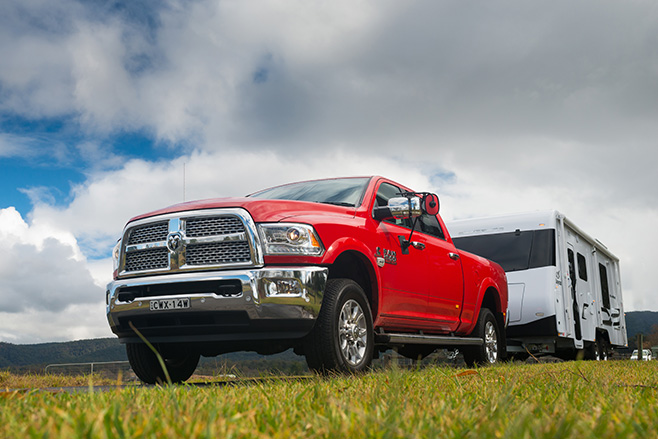
The truck-like RAM can tow up to 6989kg behind it with a pintle hook and 3500kg with a 50mm towball. With a huge 6.7-litre straight-six turbo-diesel engine mated to a six-speed automatic gearbox up front, it can tow a 2900kg caravan like it wasn’t even there.
The RAM was a rock-solid towing platform and although the front end pitched up and down on rough roads, it wasn’t too obvious. Hills didn’t slow the RAM and with its exhaust brakes, going downhill at a set speed without needing the brakes was easy.
It might be more of a truck than some would want with its rough-riding ways, but if you wanted the ultimate tow vehicle, this is it.
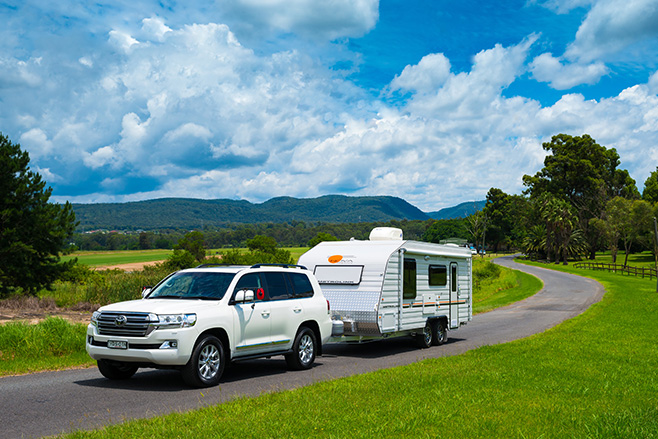
2. TOYOTA LANDCRUISER 200 SERIES
The ever-reliable LandCruiser 200 Series performs strongly, has a 3500kg towing capacity, and provides a lush ride when towing.
The negatives are that it is becoming dated (although it did receive a mild 2016 refresh) and the 4.5L V8 twin-turbodiesel engine is almost as thirsty as the petrol model when towing.
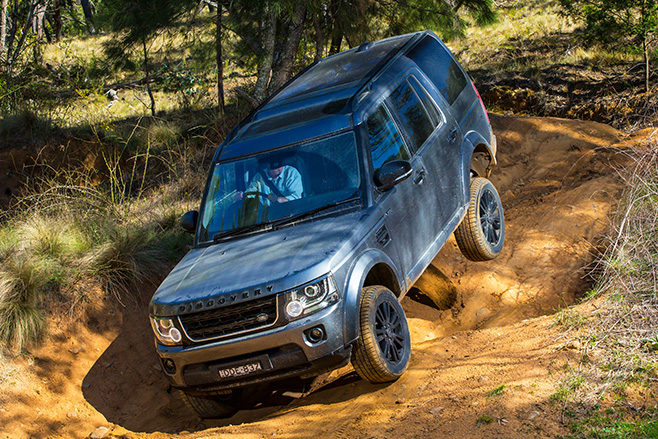
3. LAND ROVER DISCOVERY 4 SDV6
Based on the 2004 Discovery 3, the Discovery 4 is now in its twilight years with the Land Rover Discovery 5 on sale in here in 2017. But the current Disco is a worthy member with a hefty 2700kg-plus kerb weight that helps keep any caravan from shoving it around and the air-spring suspension provides a contained, comfortable ride with a van behind.
Its sequential twin-turbo 2.7L diesel, mated to an 8-speed auto transmission does not lack for power, either.
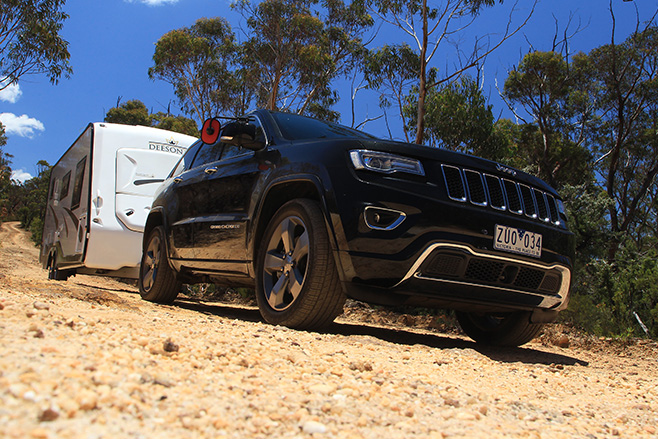
4. JEEP GRAND CHEROKEE CRD
The WK2 Jeep Grand Cherokee is one of the few 4WDs that has the maximum 3500kg towing capacity and reasonably svelte dimensions to make it an acceptable city vehicle. The Jeep is very solid with a van behind and is very stable and predictable in its response to wind buffeting and road surface changes.
The 3.0L turbodiesel V6 copes well with the additional weight of a caravan and the eight-speed automatic is a smooth, willing companion to the engine and has a good spread of ratios.
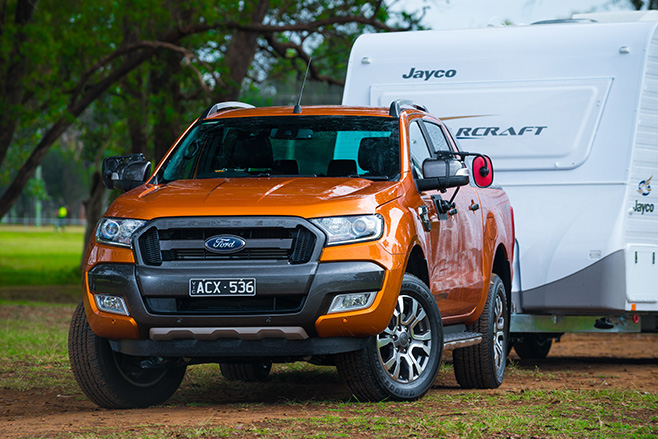
5. FORD RANGER/MAZDA BT50
These are the stand-out tow tugs against their 4WD-ute peers. The Ranger and Mazda BT-50 were co-developed and despite a slight parting of ways in their latest 2015 update, they are still basically the same under the skin.
They have great stability with a van behind, benefitting greatly from their lanky wheelbase and short rear-axle-to-towball measurement. With a 3500kg towing capacity, the five-cylinder turbo-diesel Ranger and BT-50 have equal best-in-class performance when towing, and are able to steam up hills that leave the rest of their competitor utes floundering.
Engine braking is also very good and the six-speed auto is very easy to use in manual mode to hold gears on descents.
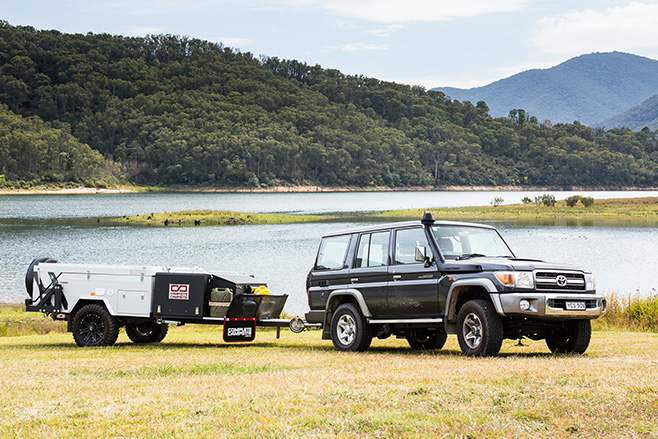
6. TOYOTA LANDCRUISER 76 SERIES
There is no doubt that this old-school LandCruiser wagon was born with the ability to tow large, heavy loads. With its basic live-axles and all-coil suspension bolted to a separate chassis, chest-thumping V8 turbo-diesel and short gearing, the Cruiser has all it takes to tow very well.
The Cruiser barely flinches with a van on the back, and is a stable towing rig. Its engine seems well capable of taking on the extra weight of a heavy van but once you get up to touring speed it does struggle on steeper hills.
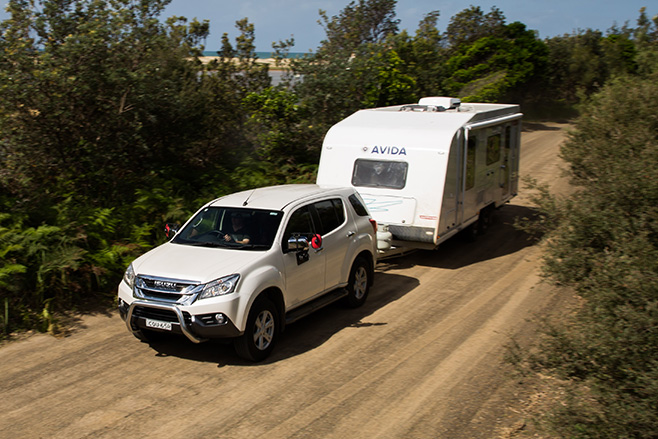
7. ISUZU MU-X
The Isuzu MU-X is a natural with a caravan behind. With a 3000kg towing capacity it’ll take on the weight of a tandem-axle full-sized caravan with no hint of instability. Engine braking is very good, while performance from the 3.0-litre intercooled turbo-diesel up hills is better than the torque and power figures would suggest. Fuel consumption is better than most, too.
On rough roads, the MU-X does get some front-end pitching happening, but it’s still one of the best mid-size towing platforms out there.
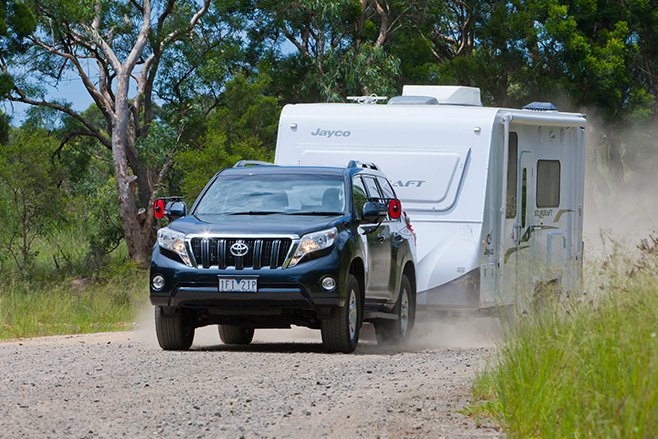
8. TOYOTA PRADO
The Prado is a good tow hauler and feels solid on the road with a van hooked up, with no yawing. It is prone to some pitching up front, but it’s pretty benign and overall provides a plush ride.
Despite the transition to a new engine in 2016 (down from 3.0-litres to 2.8-litres) promising 40Nm more torque and 3kW more power to tow up to 2500kg, you don’t really notice the difference. In any case, for all but the steepest climbs, it’ll maintain its touring speed. Engine braking is pretty good and fuel consumption while towing isn’t bad, either.
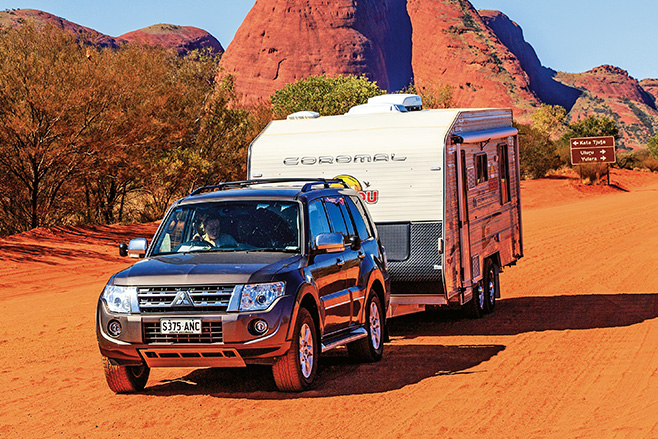
9. MITSUBISHI PAJERO
The Mitsubishi Pajero is a bit of an old warhorse but performance is exceptionally good and not much affected by having two tonnes towed behind it. On the open road there is a plentiful reserve of power, although the 3.2L turbocharged four-cylinder diesel does like a drink when it’s towing. Engine braking is not bad, either.
The downsides are that the Pajero’s 3000kg towing capacity is a joke because from 2501kg to 3000kg, maximum TBM (towball mass) is just 180kg and the spare wheel placement makes it near impossible to open the tailgate when hitched up.
10. HOLDEN COMMODORE SV6 SPORTSWAGON
The Commodore Sportwagon has a plenty of power and torque from its V6 engine to keep 100km/h on the speedo out on the highway and up hill and down dale. The rear springs are on the soft side when a coupling is dropped onto the Commodore’s towbar, so it’s best to follow Holden’s recommendation to use a weight distribution hitch (WDH) when towing.
With a WDH fitted, the Holden doesn’t put a foot wrong, with only a very slight yawing when large trucks pass on the freeway. It’s a very comfortable, stable towing experience with the power to stay out of trouble.
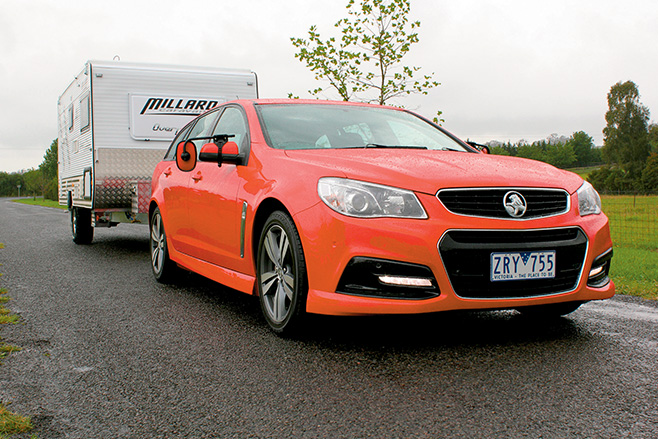
Read full reviews of these vehicles and more at Caravan World.
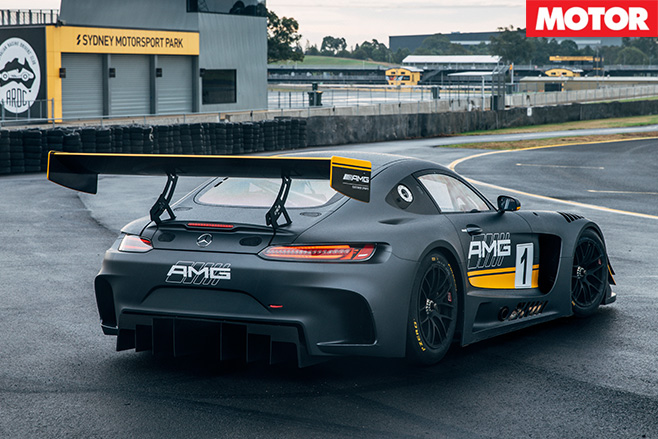
It is more like the Sydney Motorsport Park 12 Minute than the Bathurst 12 Hour, but a handful of laps in an endurance racing machine like the Mercedes-AMG GT3 is what you call a tick on the bucket-seat list.
Mercedes-Benz Australia recently added a pair of the FIA-grade weapons to its driving academy fleet, creating a drive-it-before-you-die opportunity for customers with $4500 to hand. The difference between the Mercedes-AMG GT S supercar and the GT3 Le Mans 24 Hour racer is midday and midnight.
A GT3 will cost a privateer racer about double the $295,000 Mercedes charges for a GT S. It keeps the road car’s aluminium chassis but sheds the aluminium bodywork for an exterior made from carbon fibre.
You don’t just step into a GT3 car. Awkward twisting of torso and lower limbs is required to squeeze past the steel roll-cage tubing before you can be swallowed by a carbon seat that redefines ‘bolstering’.
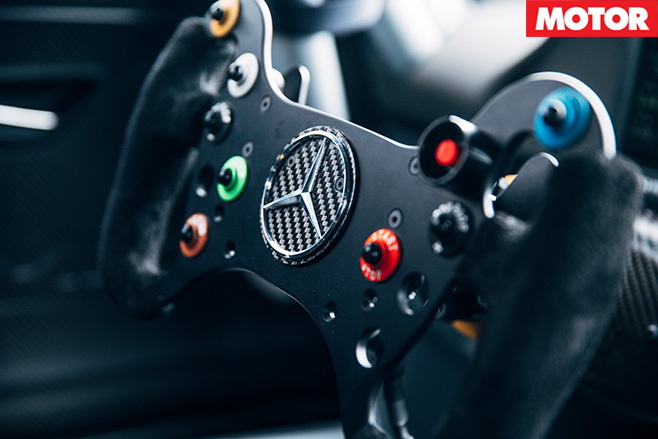
An array of buttons, dials and switches – which include adjustable ABS and traction control settings – are assembled relatively tidily on the carbon dash and centre console. Essential information is provided on a slab of digitised numbers directly ahead of the driver.
That’s not a misprint. The GT3 ignores its donor’s twin-turbo 4.0-litre for the normally aspirated unit that has proven its durability over five years in the race-winning SLS GT3. That reduces costs for clients from a servicing schedule that requires an engine rebuild after 22,500km (about two 24-hour races).
Clunking towards the pitlane exit at just 40km/h, the GT3 sounds more fragile than it really is, the pit-limiter acting like a leash on a rabid dog.
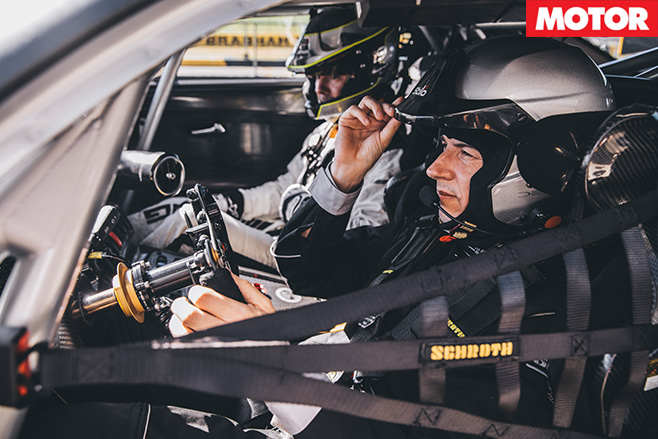
Once there, you’re grateful for the HANS device keeping your helmeted head in check as the GT3 scrubs speed with brutal authority. Response to the throttle pedal is more linear – making it a perfect match for the V8’s progressive, and raucous, delivery.
Power and torque are reduced about five per cent thanks to air restrictors required by Balance of Performance rules, which attempt to level a field that can include Astons, Bentleys, Ferraris and Porsches.
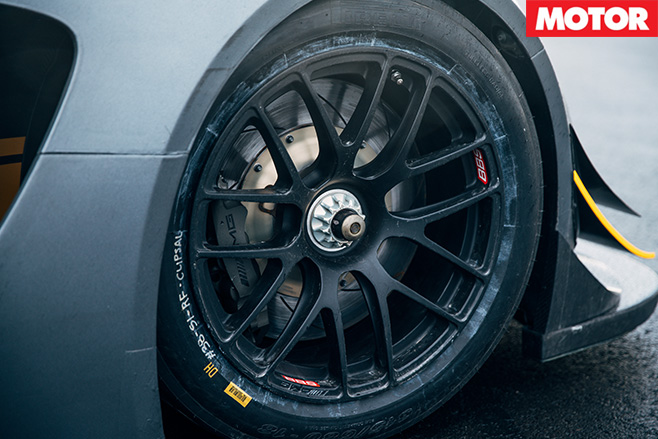
Turn in with the staggeringly responsive steering, and downforce – generated by the front splitter, that wing, and a honed underbody that blends into a huge rear diffuser – loads tyres that draw the matt-grey monster to apexes like a Dyson sucking in carpet fluff. This at speeds where a C63 S driven earlier started to understeer.
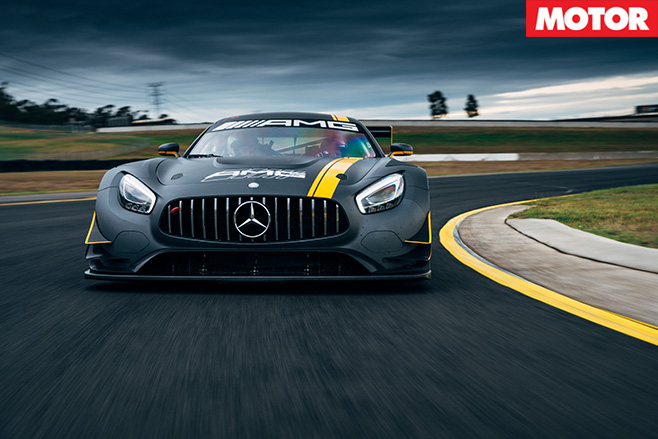
5 OUT OF 5 STARS
LIKE: Smooth throttle response; instant turn-in; cornering grip at speed DISLIKE: Awkward ingress; unintuitive brake pedal; demanding maintenance
SPECS Engine 6208cc V8, DOHC, 32v Power 400kW (est) Torque 600Nm (est) Weight 1300kg (est) 0-100km/h 3.8sec (est) Price $600,000 (est)
WHEN THE Mercedes-AMG A45 touched down in 2013 it promised serious speed – but at a serious price. $75K? For a hatchback? That’s more than most HSVs! (Some might say, anyway.)
But there was a small catch: no HSV would keep up with a well-driven A45. Even a poorly-driven A45, thanks to its foolproof and then-gamechanging-for-the-price launch control system that meant any numbskull was to be taken very seriously at the lights. A 2.0-litre turbo-four with a better specific power output than a 911 Turbo didn’t hurt, either.
But for whatever reason, this Goliath-toppling budget brawler has never taken on our Bang For Your Bucks. Yep, 2016 is its first outing. In updated form, packing an extra 15kW (now 280kW) and 25Nm (now 475Nm) and only a few grand extra, the A45 came, saw and wiped the floor of the most competitive $50K-$100K class we’ve ever had.
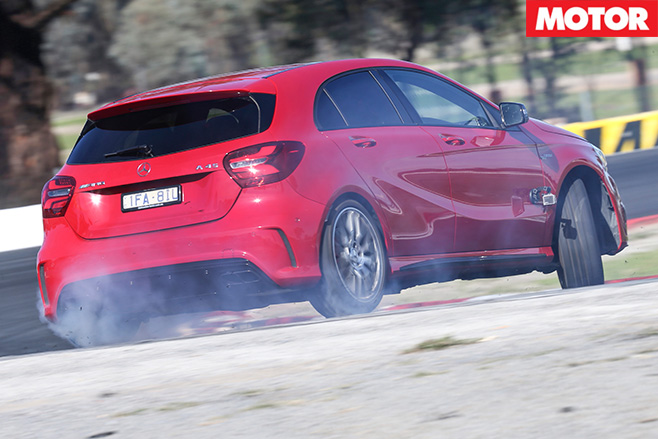
It’s also got more anti-grunt than any car here, its big, 350mm, four-pot front brakes helping pull the 1480kg A45 up in just 34.51 metres. Another best in class – and best of Bang 2016.
And it was its impressive stopping power and punch off apexes that saved the A45’s laptime bacon. If you looked only at its top end (5th for lap v-max) and mid-corner grip (3rd in the sweeper; 4th in the slower Turn 9) you’d guess the A45 finished up around fourth in class. But in fact it toppled a pair of giants, clawing back a 1:36.7sec to post the second-fastest lap behind only the M2 (by 1.9sec).
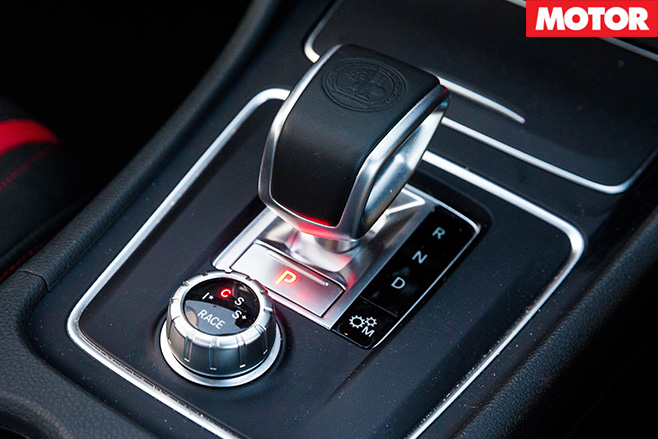
That aside, on track the A45 generally gets out there and does the job. If the Nissan GT-R is Godzilla, the Mercedes-AMG A45 is the Terminator, efficiently converting every kilowatt to forward momentum with no small thanks to its slick seven-speed dual-clutch ’box.
With a keen front end it’ll lock on to apexes as if laser-guided, washing into predictable understeer if you get greedy. The rear end will even unhinge, but only if aggressively, properly poked. The serious-face A45 is fundamentally more interested in lap times than fooling around. And a little corner-exit tail-wag on the throttle alone? Unfortunately not, the A45’s all-wheel drive system far from rear-biased.
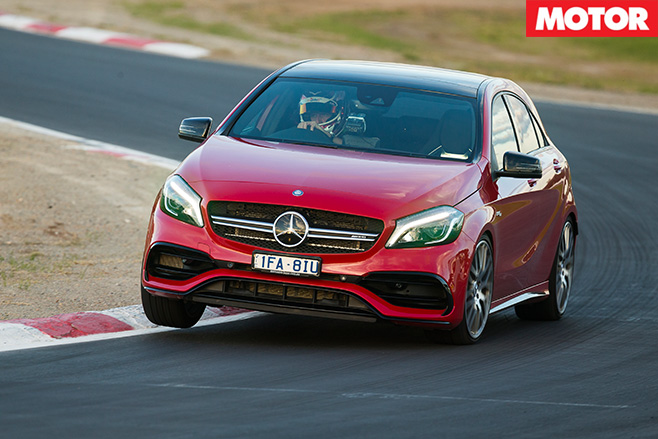
For all its giant-slaying speed in a straight line and around the track, perhaps it’s more incredible to consider that, in Australia, the A45 is loaded with standard equipment otherwise optional overseas. Things like metallic paint, climate control, sunroof, keyless entry-and-go, Recaro seats, leather and shift paddles. We can only imagine how a basic, $65K A45 might have done against our bang-for-buck formula.
For now though, even at nigh-on $80K, the A45 is a potent enough weapon to clean up our $50K-$100K class, backing up its bucks with armfuls of bang. It was worth the wait – and long may it reign.
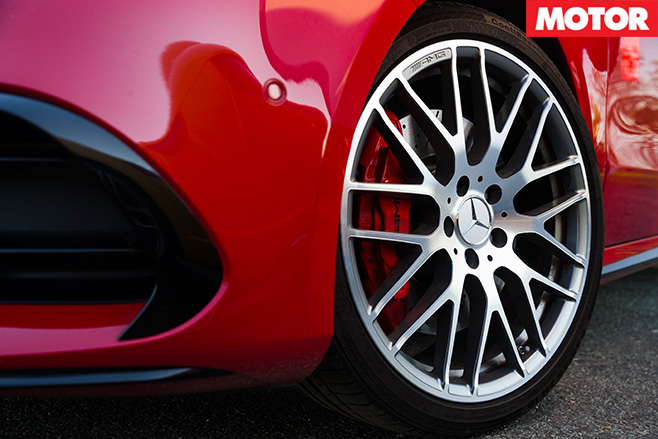
JUDGES’ COMMENTS 06 David Morley “Launch control makes a 13-second car a 12-second one.”
06 Dylan Campbell “Not much of a sense of humour. But boy, it’s not to be messed with.”
05 Louis Cordony “Slurps up tarmac fast as Matt Preston does an entrée.”
07 Scott Newman “Not sure it’s that much actual fun, but man is it effective!”
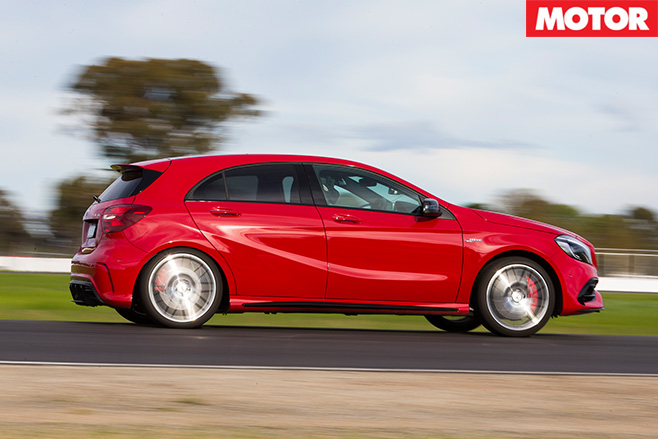
SCORES Price: $79,890 Bang Index: 140.6 Bucks Index: 88.5 BFYB Index: 174.4
WARREN LUFF SAYS 07. “A real surprise packet out there, I didn’t expect it to beat the RS3”
“I think this circuit suits the A45 more than the RS3, but overall this car is a lot of fun. It moves around; through the sweeper you can start to slide the back a little bit and help point it to the second apex.
“It has a little more of a lively character and on a tighter circuit like this it works. It has really good front end grip, really good brakes, the gearbox does what you want it to.
“Certainly for the speed it’s got, it’s a really good fun car out there. It’s one of those cars you want to keep driving it because you know there’s more to come out of it.”
Want more? Check out the rest of 2016 Bang For Your Bucks.
First published in the December 2015 issue of Wheels magazine, Australia’s best car mag since 1953.
South Australian ‘mag’ designer is never out of fashion.
Glynn Helgeson is an Australian automotive designer you’ve probably never heard of, perhaps because he’s never designed a car. Adelaide-based Helgeson, 38, designs alloy wheels for venerable Australian company ROH.
The British-pedigreed engineering company began making wheels in its Woodville North plant in 1946. At times in its long history, ROH supplied original-equipment (OE) steel and alloy wheels to all of Australia’s carmakers, while also marketing a large range of aftermarket styles.
The aftermarket industry began to change in the 1980s as more new cars arrived with OE alloys. Ford and Holden, however, began sourcing wheels from China a decade ago. But ROH has continued to design and manufacture here in Australia, sustained by its OE contract with Toyota.
Helgeson studied industrial design for four years in SA before joining ROH 15 years ago.
“I always had an eye for cars and architecture, even before I knew what an industrial designer was,” he says.
Helgeson typically has half a dozen designs in development at any given time, but he’s currently turning over virtually the entire catalogue of about 20 models. “We’re trying to change the face of the business, because it’s a fashion industry, so you have to turn over your styles quite quickly.”
As the product designer, Helgeson’s first job is to scour the market and identify new product opportunities. Then the design process begins.
“It can start with a sketch on a little Post-it note,” he says. “Then you go to a bigger, scale sketch, draw up one spoke and get into the CAD … I look at one spoke at a time and formulate a shape from that. When I started out, I looked at nature. I’ve done silly things like pull a wishbone from a chicken, look at the form and translate that to a spoke.”
He then must steer his design through the usually conflicting interests of marketing, sales, engineering and manufacturing. “Meeting all these criteria is very difficult with a cast component – it’s not simple like an injection-moulded part,” he says.
Designs that reach the prototype stage enter a battery of cornering, radial and impact tests. As that applies to each size and fitment, this consumes hundreds of wheels each year.
For all the variety of ROH’s glossy aftermarket wheel catalogue, the looming end of Toyota’s Australian manufacturing casts a long shadow over the company, which has to prove its financial viability to survive past 2017. But for now Helgeson reckons he has a dream job. “I feel privileged to have this position, to be one of relatively few stylists in the world.”
IMITATION GAME
WHEEL designer Glynn Helgeson has been flattered by comparisons between his award-winning ROH Mantis design and the original-equipment wheel on the Lexus LFA supercar. “Maybe it was coincidental, but Lexus came out with three cars in a row with wheels similar to our Mantis, Fury and Vapour, and not long after. Or maybe I’m delusional.”
