
The launch of the original beetle was possibly the most grandiose car launch in history. It had a giant golden eagle, a multi-car parade, Hitler, and a journo willing to share his story with Wheels.
THE original Volkswagen Beetle is one of the most important cars in the history of the automobile. Its impact on the automotive world can be measured in the same realms as the Ford Model T. However, the plucky Volkswagen has a dark past and an association that is often left unspoken. The success of the Beetle can be largely tied to one man, who was the architect of its design and launch. That man was Adolf Hitler.
In 1939, Wheels was still a couple of years away from its first issue when the Beetle was launched in front of a giant golden eagle emblazoned with a swastika, but journalist Gordon Wilkins was there on the day. Wilkins recounted the fascinating experience to Wheels in 1998.
In this story, Wilkins recalls the chilling display put on by Hitler, which included streamlined race cars, and a proclamation of the lead or the Third Reich’s determination to promote motorsport. It was the sort of car launch which had never been seen before, and will likely never be seen again.
With Volkswagen confirming the reborn Beetle will be ending production once again, go back in time to when the peoples car was first revealed.
The Reich Stuff
Hitler himself launched the first beetle in a chilling display that made the New Beetle’s debut low key. GORDON WILKINS knows because he saw both.
First published in the April 1998 issue of Wheels magazine, Australia’s most experienced and most trusted car magazine since 1953.
“It was the most grandiose and dramatic car launch ever seen. Nothing like it before or since; a suitable launch for what was to become the best-selling car in the world. I know, because I was there.
The program got off to a spectacular start with Hitler and leading members of his government in a fleet of Mercedes sedans and cabriolets driving from the Chancellery in the Wilhelmsplatz up the
Kaiserdamm to the Berlin motor show through streets closed to traffic and lined by thousands ofNazi brown shirts, troopers of the Nazi motorised militia, the NSKK, the black SS and the labourers of the Arbeitsdienst. It was cold and it had been raining so there were greatcoats over the brown shirts plus the usual black crash helmets or forage caps and jackboots.
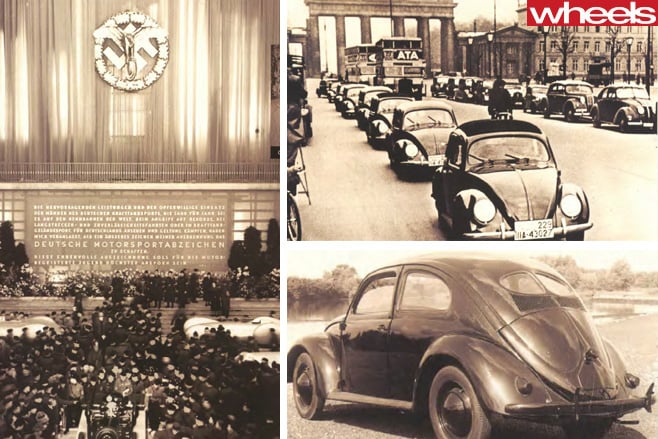
The Nazis had taken over the motor show but the motor industry had to foot the bill. The auditorium was dominated by a giant golden Nazi eagle before tall red curtains. Below was the speaker’s rostrum and on each side of it a Volkswagen. Behind the rostrum, a long line of NSKK trumpeters and dozens of standard bearers each with his red swastika banner.
A representative of the motor industry made the first speech, and then joseph Goebbels reviewed progress in expanding the car market since Hitler had abolished the onerous car taxes. Finally Hitler himself appeared in brown Nazi jacket and black trousers, rather more impressive than the baggy breeches and high boots he sometimes wore. It was a long speech with the familiar snarling and fist clenching. Once again he extolled the virtues of the Volkswagen which he had now decreed must be called the KdF to identify it with the German Labour Front, source of such facilities as subsidised entertainment and holiday cruises for the workers, whose motto was Kraft durch Freude (‘Strength through Joy’), and which would handle distribution of the new Peoples’ car.
The drums rolled, the great audience rose to its feet and sang Deutschland Uber Alles followed by the Nazi Horst Wessel song. The rich red curtains rolled back and there under the floodlights was the motor show. Or part of it, for it filled nine balls with cars, motorcycles, trucks, buses and coaches, materials and accessories. There were no VWs for sale but the chassis bad the centre spot in the Hall of Fame surrounded by the streamlined speed record cars of Mercedes Benz and Auto Union, a record breaking diesel Hanomag, race winning BMWs and motorcycles.
The Nazis had cleaned up Berlin’s once notorious nightlife but the motor show was the focus for many social events and I was invited by Dr Goebbels to a glittering party at the Adlon Hotel. Guests were greeted by the beautiful Frau Goebbels and as his portfolio included control of the film industry there were aspiring starlets beside established names. The Schnauferl Ball, equivalent to the annual dinner of our Veteran Car Club was a more relaxed affair with fewer uniforms and more solid citizens in evening dress. Instead of foxtrotting with nubile young blondes, I found myself waltzing with elderly ladies of more substantial build. Nice people caught up in a system where the children were being encouraged to spy on their parents.
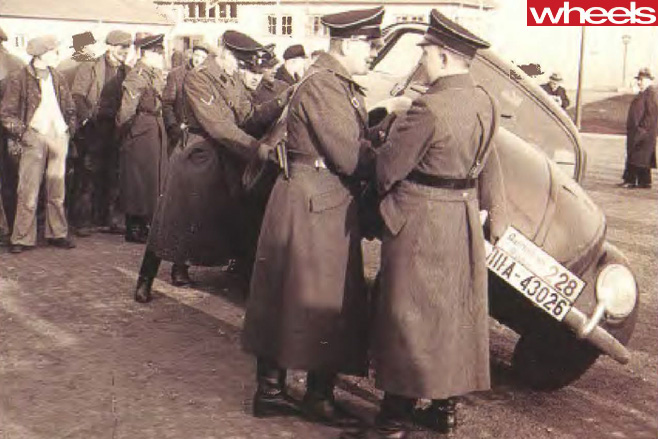
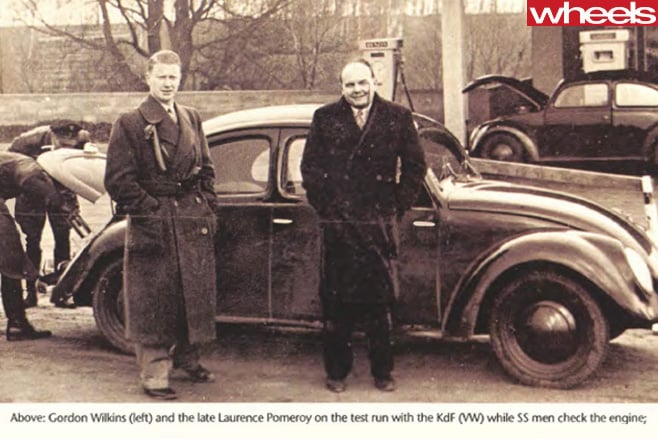
Out on the autobahn we settled down to cruise at the car’s 100km/h top speed. Comparisons with existing cars were difficult because this one was designed to open up a new market not catered for by the existing industry whose analysts said Hider’s price of 990 Reichsmarks was impossible.
The car was bigger than our Austin Sevens and Morris Minors, more Spartan in equipment and finish, more advanced in appearance and design. Its sloping front and built-in headlamps, the smooth curve from roof to tail, represented streamlining as then understood. Acceleration was leisurely but long gearing made it feel more relaxed than our little buzz boxes, although the cooling £an howled at the rear. There was a rudimentary heater where we had none and independent suspension all round, something unknown on British small cars. The ride was choppy at low speeds but coped well with cobblestones.
The flat four air-cooled 986cm3 engine was over-square, with big bore and short stroke which would have entailed heavy taxation in Britain where tax was based on bore size, but it ensured low piston speed which, with small bore inlet manifolds to keep maximum power down to 18kW, contributed to its ability to cruise flat-out indefinitely. Average fuel consumption was quoted as 43mpg (6.6L/100km). Despite the long gearing a kerb weight of only 580kg enabled it to perform better on Mountain passes than heavier contemporaries with similar engine power.
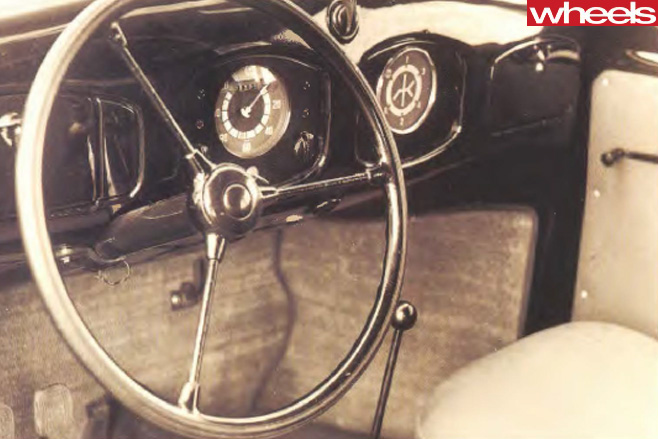
Later I had another run. Changing down to accelerate, you had to double de-clutch. No synchromesh. But any attempt at faster cornering produced fierce oversteer. The little tyres tucked under on their swing axles, the outer tyre cambered the wrong way, lost grip and the tail swung round. This Beetle could bite.
Quick steering needing only 2.5 turns lock to lock gave experienced drivers a sporting chance of regaining control, but this car was to sell to inexperienced drivers. Professor Porsche knew the problem. Although trying to carve every cent off the cost to meet Hitler’s price target he accepted the cost of aluminium cylinder heads and magnesium castings for crankcase and gearbox to get the weight down at the rear.
The British Technical Commission, Ford Motor Company, Rootes Group and others who dismissed the VW as a crude vehicle with no commercial future have been mocked for it since, but at the time they were right. You could not have sold that original Beetle to Britons or Americans in 1939 or at any time since. The British Army officers who put it into production after the war were already improving it.
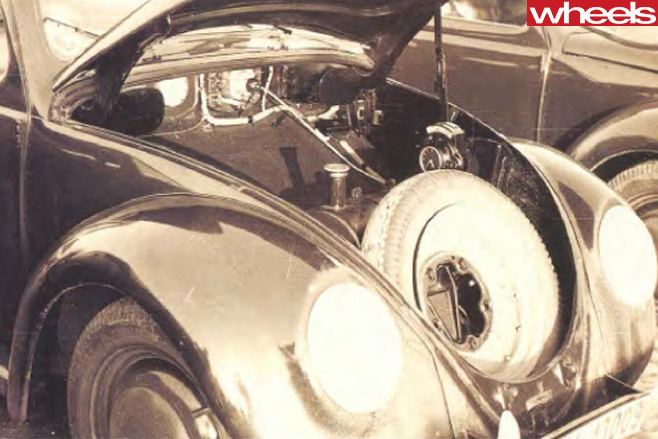
Heinrich Nordhoff who had strongly criticised the design but suddenly found himself in charge of the operation said, “It had as many bugs as a dog had fleas.” But he also saw definite features which were greatly desirable and not found in cars of comparable size … an amazing motorcar with a special personality and unlimited possibilities.” Der Spiegel summed it up, “The British Commission which minimised the value of the car was not so wrong .What the Englishman did not see were the enormous development possibilities”.
In 10 years, development enabled the Beetle to astonish Australia with consecutive wins and significant placings in the 1955-57 round Australia trials.
By 1981 when I watched the 20 millionth Beetle roll off the line in Mexico the car looked like all other Beetles, protecting re-sale values, but of its 5115 parts, only one, a securing strip for the seal round the front bonnet was the same as on the original.
Having also been to the launch of the New Beetle in Detroit, I have to say the car is cute, instantly recognisable; the old shape refined and modernised. But underneath, there’s no resemblance.
I find it difficult to compare the two Beetles because they are two different cars designed for different markets. The first, a drab, austere, budget priced outsider; the new”one familiar shape cleverly modernised with performance only expensive sports cars could approach in 1939 and lavishly equipped for prosperous buyers, some of whom may remember the old one with a touch of nostalgia but want all modem amenities.
Yes, the New Beetle should be fun, but I’ll be surprised if they sell 20 million of them.
There have been some great emperors around the globe but the Scaldarsi Emperor I is certainly not one of them – although the 662kW 6.2-litre twin-turbo V12 does indeed rule.
Based on a Mercedes-Maybach S600 rinsed of its front grille, standard wheels and class, the Emperor I gets in addition to that square front jaw and aggressive front bar, several dollops of 24-carat gold and many lashings of alligator hide.
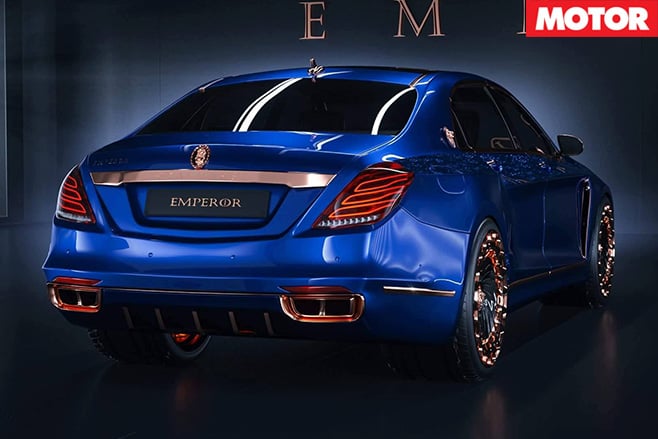
The price for all this grotesque beauty? US $1.5 million or AU $2m. Although perhaps we got that particular ‘g’ word wrong.
“Engraved with passion and designed with determination, the Emperor’s opulent beauty imposes a statement of grandeur of unequalled proportions,” Scaldarsi claims.
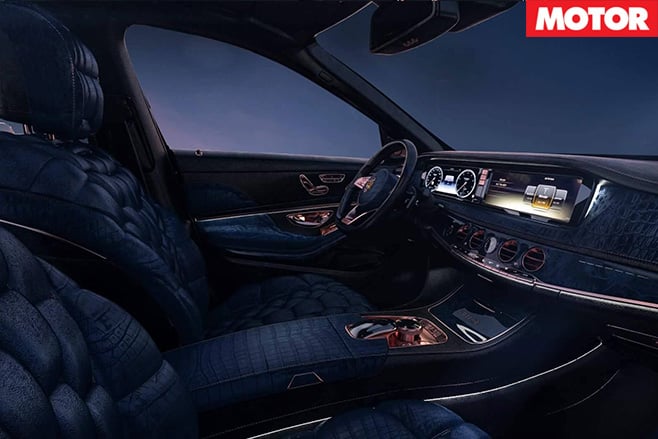
“The performance exhaust allows for a pitching roar that echoes through the road and focuses all eyes on the one and only,” the brand continues.
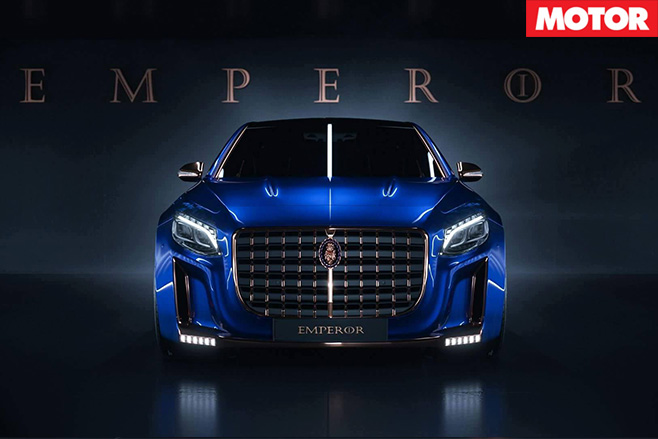
The Emperor I will be followed by the AMG S65-based Emperor II, the Bentley Bentayga-derived Emperor III, G-Wagen-poached Emperor IV and even the Emperor of all Emperors, Bugatti Chiron the fifth, all of which will try desperately hard to rule the road.
Here for the first time, WHEELS has the Four basic Australian six-cylinder cars – all priced around $3200-$3400 – to compare. lt’s the biggest and most important comparison test because these are the cars most of you will buy and want to know about … P76 Deluxe v Holden Kingswood v Falcon 500 v Valiant Ranger.
First published in the September 1973 issue of Wheels magazine, Australia’s best car mag since 1953.
FOUR DAYS, 2876 miles, 182 gallons and two full notebooks later we can prove that Leyland ‘s P76 is fully competitive with the Big Three in its basic, Deluxe specification.
And that’s the model that is really going to make or break the car because this is the area of high volume and fleet sales which make up around 40 percent of total Holden sales.
Leyland is touting P76 as being “Anything but average” and in a couple of areas there is truth in the slogan but the overall concept of the car and its execution place it within the rather narrow design confines of the average Australian car.
There are differences, of course, and some of them are important enough to make P76 an attractive buy because it does widen the choice between the “look alike/drive alike” Big Three. And these differences can mean tangible benefits for owners.
On paper there isn’t much to choose between the four — all are front engine/rear drive packages –but a close examination reveals that P76 is the only car, in base form, with disc brakes as standard equipment.
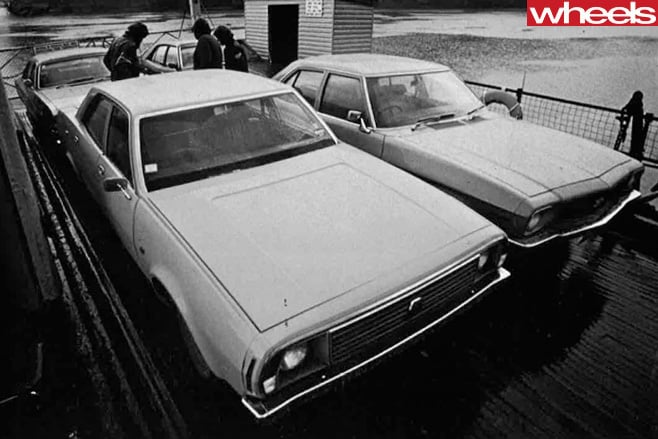
Among the other “differences” are rack and pinion steering, instead of the recirculating ball system used by the others; an overhead cam six-cylinder .engine rather than a conventional overhead set-up and a better specification for the standard tyres. But equated to feel on the road these features don’t really make a great deal of difference.
Dimensionally the cars are very close. Wheelbase is virtually identical at around 111 inches with Valiant and P76, at 16ft, about six inches longer overall than Holden and Falcon. And the lightweight construction of P76 – it is up to 300 lb lighter than the others – does mean that it can get away with smaller, less powerful engines, as well as having a more balanced weight distribution and putting less stress on such components as brakes, gearboxes, axles and tyres.
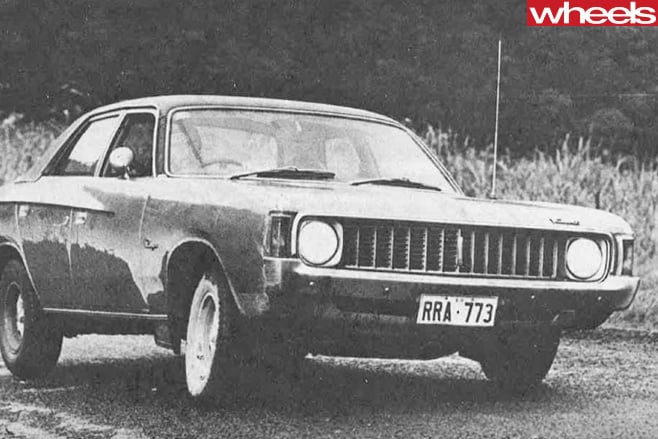
Styling is a matter of personal choice, as we found on test. Traditional Holden buyers liked the Holden HQ. Falcon buyers like the Ford Falcon XA and so on. Most expressed an interest in P76 and none came right out and damned it, although some observers thought the grille tinny and lacking in any strong focal point, while the tail attracted almost complete thumbs down for its fussiness and sheer bulk. But from some angles the wedge shape, large glass areas and the hidden wipers gained plenty of admiters. Some, however, thought the large gap between the windscreen and the bonnet gave the car an unfinished look.
In terms of styling professionalism, the Holden with its clean, modern look, ultra-thln windscreen pillars and finely balanced appearance won out, followed by the Falcon and then the Valiant.
P76 lacks the neat detail work of the others and the fit of the panels leaves a lot to be desired, although it must be pointed out the test car was one of the first cars off the production line and later cars we have examined have displayed an encouraging improvement in this area.
Relate the styling to practicality, though, and the P76 comes off much better. Its boot is by far the biggest, it has an inch more ground clearance, although the extra rear overhang does cancel this out in some driving conditions, and there is more space around the engine for great accessibility.
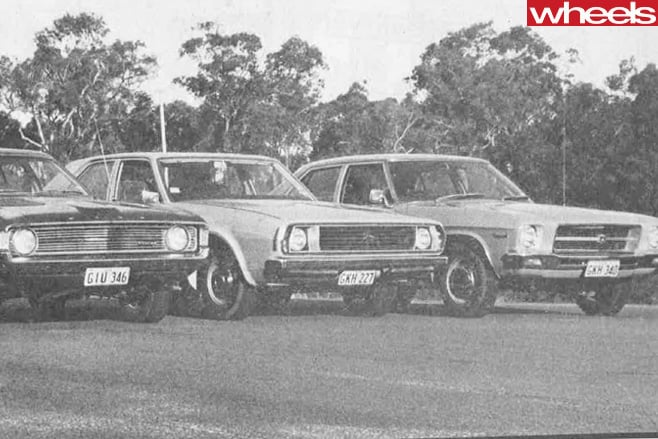
Getting cars to meet this specification exactly proved impossible and for photographic purposes we ended up with an automatic Falcon (with carpets and radial ply tyres on wide rims) and a Valiant optioned up to include the Sports Pack (which runs to radial ply tyres, sports steering wheel, extra instruments and bucket seats).
However, we were able to secure a base Ranger to our required specification and a Falcon (not from FoMoCo who won’t release a Falcon for road test without it coming with radial tyres and disc brakes) for further evaluation during the course of this comparison.
The Holden and P76 come as requested.
PRICE
If you could buy a Falcon – at the time of writing none was available in Sydney or Melbourne due to the strike – it would be the cheapest at $3020 (plus $66 for the power-assisted disc brakes and $75 for the 250 engine to give $3161) but it seems certain that once the strike is over and production has gone back to normal, Ford will be forced to raise its prices along the same lines as GMH and Chrysler and this will add at least $100 to the price.
P76 is $3250, no options, nothing to add.
GMH’s recent price rise added $150 to the price of a Kingswood to take its base figure to $3135, to which must be added $66 for power-assisted disc brakes and $66 for the 202 engine.
Chrysler added $109 to take the Ranger price to $3199, the 245 engine brings mandatory disc brakes and costs $143, with an extra $35 for the power-booster, to take the Ranger to a total of $3377.
Each car offers a wide range of options, which can change the all-but-basic character of each car.
The P76 offers a 4.4-litre V8 for another $180 so a performance bargain can be bad for $3430.
Other options on the Deluxe include four-speed gearbox ($160), automatic transmission $250, and a Luxury pack (non-reclining bucket seats, partial console with armrest, carpets and glovebox, ashtray and under-bonnet lights) for $98.
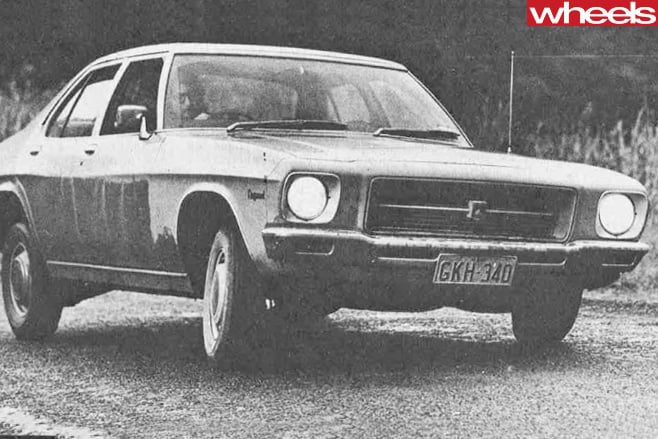
Ford, like GMH, offers the Falcon 500 in a virtually unknown number of combinations. From the base car, as designated for this test, can be added the 2V version of the 250 six ($77), 302 V8 ($58 over the 2V), 351 ($90 over the 302), four-speed gearbox ($15 5), automatic transmission ($255 ), the GS pack – instruments, bucket seats, sports wheel ($145), plus almost the same range of luxury items offered by the General.
Chrysler’s cutback in its model line-up hasn’t really changed very much – if you want the extra equipment you can still order it – the only change is that there is less likelihood of finding exactly what you want straight off the showroom floor.
Chrysler offers the 265 six ($85), the 318 V8 ($120), four -speed gearbox ($166), reclining or non-reclining bucket seats, sports pack (steering wheel, instruments, sports road wheels), and air-conditioning, so Chrysler is almost able to duplicate the vast ranges from Ford and GMH.
But for this test we restricted the cars to the best-selling versions, which are the cars most people buy, and drew our conclusions from these cars.
However, as we have pointed out, it is easy, if costly, to build up a totally different package by running through the options list and choosing the biggest engine, widest wheels and power everything.
If price is important above all else than the P76 must be in the box seat but – and it is a very big “but” – the real price depends on trade-in figures and dealer margins. With the present short supply situation with new cars there seems to be little need for manufacturers to offer discounts so, for the moment at least, there shouldn’t be very much in it and P76 should still come out ahead if you want comparable braking and power.
PERFORMANCE
Here the four divide themselves almost automatically into two brackets – Kingswood/P76 and Falcon/Valiant.
The big sixes of Ford and Chrysler give their cars a positive lead over the less powerful GMH and Leyland sixes.
But i( you think purely in terms of the cheapest car of each model – and to do this means placing the P76 at a price disadvantage – then the Leyland six has a small but winning margin over the rest. Chrysler’s 215, Holden’s 173 and Ford’s 200 are fractionally slower through the gears and in top gear.
There’s not much in it and it probably comes down to differing driver techniques.
Ford’s 250 doesn’t rev out as well and suffers from valve thrash in the high rev ranges but it is smoother and quieter than the Valiant in normal driving.
Holden’s 202 lacks the torque and power of the opposition and, because it is lower geared overall, is noisier at cruising speeds and when accelerating. However, the relatively low gearing does give the car good top gear performance.
Leyland’s ohc six is different. It is a big revver by comparison and needs to be stirred along through the gearbox to give a similar performance to the Holden 202. Top gear performance isn’t as good as the Holden, but it is fractionally quicker through the gears. As part of the overhead cam bit the engine has a characteristic ohc whine at high revs,
An overheating problem which existed on the test car is claimed, by Leyland, to be unique to that particular engine and we hope it is right. On most occasions when the car was taken over 60 mph or run through the gears and, even sometimes when stuck in a traffic jam, the temperature gauge needle soared into the red and performance fell off.
We added water on three separate occasions and suspect a blown head gasket.
Leyland now informs us that the six-cylinder engine does tend to run warm for the first few thousand miles but it stabilises after it is completely run in and then runs at normal temperatures.
| P76 | Six | 10.3 |
| Valiant | 215 | 10.0 |
| Holden | 173 | 9.9 |
| Falcon | 200 | 9.8 |
| Valiant | 245 | 10.5 |
| Falconu00a0 | 250 | 10.5 |
| Holdenu00a0 | 202 | 9.5 |
| P76 | Six | 9.5 |
FUEL ECONOMY
Frankly we were surprised at the results achieved in this category. Remember the cars were checked over identical roads and with drivers swapping from car to car to eliminate any discrepancy in technique.
Our first check, after 200 miles of hard driving, running performance figures and some suburban cruising, gave the P7 6 19 mpg, and a clear lead, with the other three way behind and hovering around the 15 mpg mark.
The second check, in which the cars ran together in windy mountain country with some high speed cruising, closed the fuel consumption figures up but for much of this time the P76 was overheating and this would have had a detrimental effect on its fuel consumption.
Surprise of the category was the poor performance of the Holden 202, which was expected to be almost as good as 76. However, its low gearing (and low mileage) obviously took a toll. It had to be driven closer to the limit to stay with the Falcon and Valiant which, with their big engines and high gearing, were running easy at what were high speeds in the Holden. P76, too, needed to be driven harder to keep up with the Falcon and Valiant in high-speed driving but its more efficient engine accounts for the difference.
The Holden also loses out in touring range with its small 14.5-gallon tank. P76 is probably best here because it has a 16.4-gallon tank, while the Falcons’ and Valiants’ larger tanks are not quite big enough to compensate for their lower fuel consumption. The Holden still suffers from a slow-filling tank and the Valiant is nearly as bad.
| P76 | 10.6 |
| Falcon | 10.0 |
| Valiant | 9.8 |
| Holden | 9.7 |
RIDE
In terms of pure ride the Holden is still the best. It soaks up the bumps better than any of the others and is superb over rough roads, although our drivers agreed that it might be better to sacrifice some of the ride qualities for an improvement in handling.
P76 goes close to equalling the Holden in most conditions but it isn’t quite as good on rough roads with some axle movement on rough corners (it is interesting to note that the P76 was the only car of the four to exhibit axle tramp when conducting the performance testing on the Castlereagh dragstrip). But the body roll is controlled better on P76 so its ride/handling compromise is superior in normal conditions.
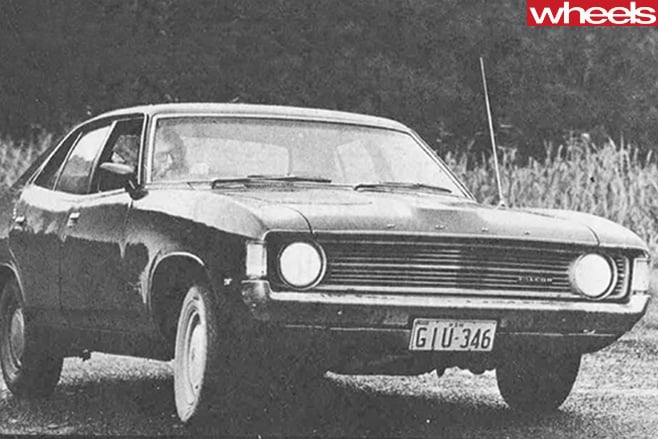
Chrysler’s torsion bar suspension is set up for a soft tide and although it is smooth on smooth roads the smallest irregularity produces front end harshness that transmits through to the cabin.
This is emphasised even more on radial ply tyres. Rough road ride is poor with both noise and harshness coming from the front end, and a poorly located rear axle has the tail dancing around on corrugations.
| Holden | 10.5 |
| P76 | 10.3 |
| Falcon | 10.1 |
| Valiant | 9.1 |
HANDLING
This category is directly related to ride and it is difficult to separate the two. As with ride the handling section is divided into two areas – smooth roads and rough roads.
On good roads the Falcon is supreme. It is easy to drive and relaxing with a well-balanced suspension and chassis set to give mild understeer with oversteer available, either by lifting off or by booting on more power (although on some surfaces more power can result in an increase in understeer).
Even the low geared steering, with five turns lock to lock, isn’t a problem in normal driving. However if you start pushing the car, particularly on a loose surface, wheel twirling becomes tiresome and limits the speed the car is capable of, simply because the driver can’t get the front wheels turning quickly enough.
P76 has the same problem with 4.9 turns lock to lock. Its steering is light but not as responsive as the Falcons and, although the vastly better driving position helps, it can become a handful on a loose surface. With that small six it is surprising that Leyland hasn’t taken advantage of this and given the car a steering system more in keeping with the rest of the specification and certainly the supposedly European influence in P76. Four turns would be a far better compromise.
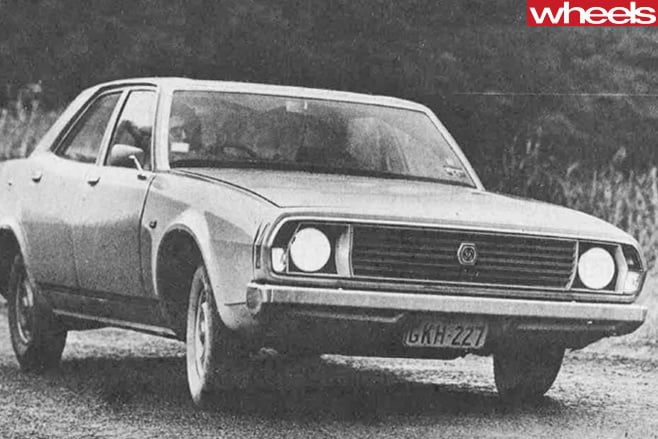
Understeer builds up as speeds rise although it can be kept within manageable limits by choosing the right line and using the throttle correctly. On tight corners we found it was possible, even with the relative lack of power, to pick up the inside back wheel and induce artificial oversteer where, on the same corner, the others went round in varying degrees of understeer.
Valiant, too, suffers from a low-geared steering system that is vague and unresponsive in the extreme. Combined with the soft suspension and the lack of a front anti-roll bar it makes the base Ranger a car for straight road running.
Only the power reserves of the hemi engine enable the Valiant to keep up with the other cars. Of course, adding wider wheels and radial ply tyres helps and probably to a greater extent than on any of the others, although at the expense of increased ride harshness.
The Valiant is capable of cruising at high speeds and has a built-in understeer which makes the car a basically safe handler but we wish the front-end wallow and pitching could be reduced.
GMH has set the Holden up for understeer, come what may, and it takes a hefty thump ort the brakes, mid-way through a corner to get the tail moving out. Otherwise it is understeer all the way and the steering efforts rise as lock is wound on. But the steering, with 4.2 turns, is the best compromise.
The Holden has the ultimate roadholding – in other words grip on the road – but the body lurch and strong understeer means it is difficult to take advantage of the adhesion and is tiring to drive hard over any distance on twisty roads.
| Good Roads | Rough Roads | ||
| Falcon | 10.5 | Holden | 10.6 |
| P76 | 10.4 | P76u00a0 | 10.4 |
| Holden | 9.9u00a0 | Falconu00a0 | u00a09.9 |
| Valiant | 9.2 | Valiantu00a0 | u00a09.2 |
BRAKES
In standard form there can be only one winner and that is P76. But for this comparison we had optioned power-assisted disc brakes on to each car and the result was much closer. We preferred the feel of the P76 and Falcon discs, which give a more responsive pedal.
The Holden and Valiant brakes tend to be too light and lacking in fine control so it is much easier to lock-up a wheel. In open road driving this means the P76, and to a slightly lesser extent, Falcon brakes can be used on entry into a corner to set the car up on the right line.
Obviously, our brake stopping distances tell only part of the story but they are a good guide to the fade qualities of the various systems. P76, as on the V8 tested last month, displayed excellent braking for the first couple of stops but then the pedal firmed up and the distances increased, probably because there just isn’t enough air getting to the brakes to cool them adequately.
The Holden locked up back wheels on the first run and pull badly but once the rear drums had lost effectiveness it stopped straight every time and distances didn’t show any tendency to increase dramatically.
As on the Holden the Valiant locked up the rear brakes on the first run and it needed quick corrections on to the steering to prevent the car from spinning. From then on the brakes at least stopped the cat straight although the extra weight of the Valiant meant the stopping distances were longer than for Holden or P76. Fade began to occur on the fourth stop as the pedal got spongy, and we got the impression that if we had continued the brakes would have ceased to be effective.
Falcon was more like P76, with a good pedal feel initially and straight stopping but the distances increased quickly and the pedal became hard.
Holden, Valiant and P76 have their handbrakes beside the driver’s seat, only the Falcon persists with the under-dash pull-out set-up, which on the test car was surprisingly effective. So all four handbrakes work well but , and a point in the Falcon’s favor is that it is much more difficult to leave on by mistake.
So many of the Holdens and Valiants we have driven have had totally ineffective handbrakes because previous drivers have forgotten to let them off.
P76 must win the braking department although there is still room for positive improvement in its system. Buy the others with drum brakes at the heavy pedal, poor stopping effectiveness and lousy resistance to fade will serve you right. Discs should be standard.
| P76 | 10.6 |
| Falcon | 10.0 |
| Holdenu00a0 | 9.8 |
| Valiant | 9.7 |
GEARBOX
All four have three-speed column gear changes as standard. Four-speed, floor-change are optional, as are automatic transmissions with a choice of column or floor-change. None of the manual column changes has anything like the ease and precision of a Fiat column change or Renault 16. We put the P76 first because it has a better gear ratio engine combination and, a relatively light, and not too notchy, movement although some drivers did find their hand hit the windscreen when changing from first to second.
The Falcon’s movements are long but light while the Holden’s are short but too stiff and notchy and the Valiant’s Incredibly long and vague.
Holden’s low gearing means that the effective maximum speed in second gear is only 50 mph. The Falcon is almost as bad but the extra power of the big 250 engine compensates for the short second gear. The Valiant ratios are the same as Falcon but with a higher rev limit it can be run out to over 70 mph, if you can put up with the increased noise level.
Driving the three American type cars with manual changes emphasised that all are far more pleasant with automatic transmissions. Engine noise is reduced and the dreadful contraptions of gear changes thrown to the wind. For city driving – let’s be honest, and say for all but about five percent of most drivers’ mileage – the automatic is highly desirable in cars of this type.
It is not quite as necessary on P76. For a start the ohc engine relates well to the gearbox but more important the relatively small six loses out badly in performance when tied to the automatic, and fuel consumption suffers too.
| P76 | 10.2 |
| Falcon | 10.0 |
| Holdenu00a0 | 9.9 |
| Valiant | 9.9 |
NOISE
Here the Falcon is an easy winner. Its engine is quieter and on most road surfaces very little noise or wind whistles get through to the cabin. P76 is next, although its position depends largely on the fit of the doors. If they are poorly located then wind noise will increase dramatically and it would be pushed further down the ratings scale.
We have rated the Valiant and Holden equal. The Holden has more engine noise at cruising speeds and some wind roar where the Valiant has plenty of road noise, some wind roar and engine thrash under acceleration, although it is quiet at cruising speeds.
| Falcon | 10.5 |
| P76 | 10.1 |
| Holden | 9.7 |
| Valiant | 9.7 |
DRIVING POSITION
It is in this area that the biggest basic difference between the P76 and the others lies. P76’s driving position with the standard bench seat is so far in advance of the Holden, Falcon and Valiant it reflects directly into other areas such as driver comfort on a long trip, and steering control. Once you have driven P76 you realise just how bad the others are.
Not only is the actual seat placement better but the seat itself is more comfortable with correct padding and reasonable side support, a deep cushion and high squab raked at a good angle – it’s not too upright, but equally, not too reclined. And the relationship between the seats, steering wheel and pedals is excellent. The other cars seem to have been designed for drivers with long legs and short arms.
It is difficult to decide which of the others is best but we finally settled on the Holden. GMH has been improving its seats lately and especially the Kingswood bench.
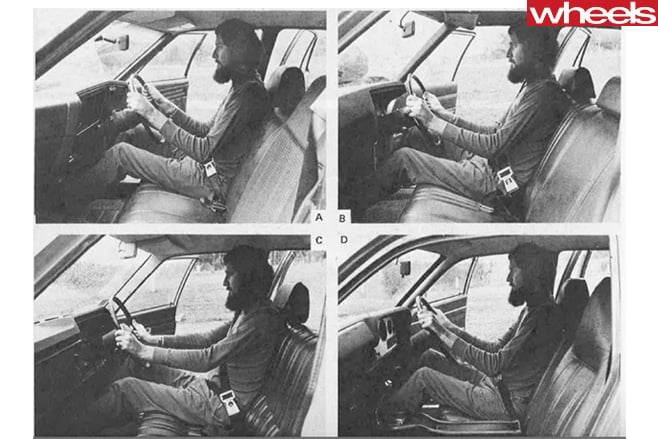
But the steering wheel is further away than on Falcon or Valiant and the seat is higher mounted, which does help visibility but gives the impression that the driver is sitting on and not in the seat. Pedal position is poor, even with the disc brakes, and the distance between the accelerator and the brake is excessive. But the car feels smaller than the others and more easily manageable with superb visibility to the side and front but, as on the others, a blind spot over the driver’s shoulder.
Ford’s Falcon places the driver so close to the steering wheel we suspect the bench seat on the test car may have been incorrectly located, or at least on the forward of the two mounting positions. The cushion is very short and the squab too upright. There is a real lack of stretching room for tall drivers.
Because the seat movement is so restricted (even a five-feet-eight driver had the seat right back and wished for more travel) the top of the windscreen seems very close to the driver’s head.
If anything the Valiant’s bench seat is worse. It is more slippery, so that the driver slides around and has to hold onto the steering wheel for support. The seat lacks padding and is mounted so high that the steering wheel – even with its flattened off lower section – fouls the driver’s legs.
Falcon wins on control layout, which makes its lousy driving position all the more annoying. Wiper/washer and light controls are all easy to reach and see, whereas those on P76 and Holden are hard to reach behind the steering wheel and can be difficult to see. Those on the Valiant require a long reach and are crude in their action. It is disappointing that P76 fails in this regard because, If it were truly European oriented in its interior, steering column stalks would be mandatory.
Visibility gives Holden a win, with P76 next, followed by Falcon then Valiant.
Valiant bas a real big car feel, which some people might enjoy, but it does mean correct lane placement is difficult.
P76 has the roomy front compartment while Falcon feels confined because seat travel is restricted.
| P76 | 10.9 |
| Holden | 9.7 |
| Falcon | 9.7 |
| Valiant | 9.7 |
ACCOMMODATION
There is not much in it but P76 has a definite advantage in interior space. It’s an inch here and an inch there but it all adds up to give the Leyland challenger a more spacious interior. In important dimensions, like the distance between the dashboard and rear seat squab, the P76 is two inches ahead of its nearest rival, the Valiant.
P76 has a wider range of front seat travel so the driver can get further away from the steering wheel and the pedals. This does reduce rear seat leg room but the P76 has a much deeper rear cushion so it’s a line-ball decision.
A close check on our interior specification chart – and remember these are our own figures and not those supplied by the manufacturers – shows up the other areas of P76 supremacy. In our earlier articles about P76 we have been critical of the low rear seat cushion and this has been confirmed.
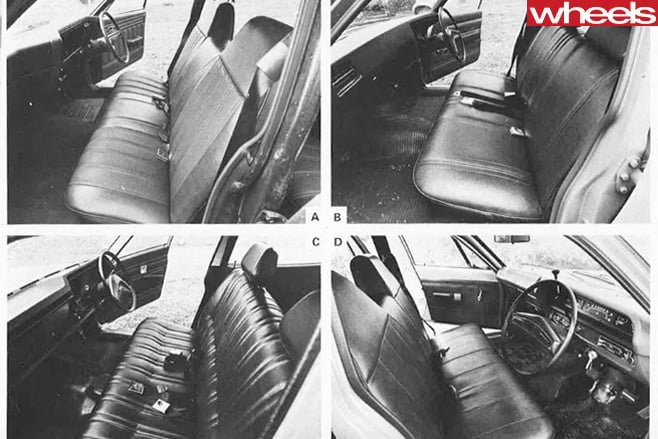
And the cushion is poorly designed on the Valiant, which lacks support on the side edges so that the seat collapses. The Falcon has plenty of padding on the side but too little in the middle, while the Holden misses out over the transmission tunnel.
The problem is so bad that all three are best considered comfortable for two people over any kind of distance. Not so on P76, it has plenty of room for three, apart from the previously mentioned low squab which you can get used to.
| P76 | 11.5 |
| Holden | 10.0 |
| Falcon | 9.5 |
| Valiant | 9.5 |
EQUIPMENT
All four are equipped to a similar level but P76 has a hazard warning switch, night/day mirror, hidden windscreen wipers, huge glove-box and superb full-width windscreen demister.
All four cars have heater/demisters with two-speed fans, armrests on all four doors, two-speed wipers with electric washers, cigarette lighter and a limited range of instruments.
Valiant is the only car lacking face -level ventilation. Ford’s vents are probably the best, with good fine adjustment and excellent flow-through volume, which can also be assisted by the electric fan.
Holden vents lack wide adjustment and can’t be helped by the fan so that the volume of air passing through at low speed is poor.
P76 vents are located too low on the dashboard to be of much benefit for the driver but they do a good job of keeping his knees cool. Without the fan the volume is poor but at least it can be assisted. Leyland also has a very good system of fresh air vents mounted at foot level which work independently of the face-level system.
Valiant is stuck with crude floor level vents which do, however, allow vast volumes of air into the cabin.
Rubber mats are standard across the board and the standard of trim, as expected is not of a high quality, although the P76 upholstery is stitched and not welded.
Access to all four cars is good, but because its front seat is better located, it is easier to slide in behind the wheel of P76. However, the front and rear doors of the Leyland lack positive door stays.
| P76 | 10.3 |
| Holden | 9.9 |
| Falcon | 9.9 |
| Valiant | 9.9 |
LUGGAGE
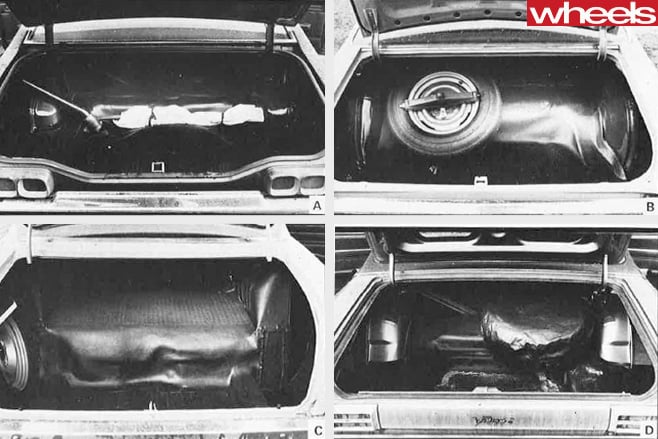
| P76 | 10.9 |
| Holden | 9.7 |
| Falcon | 9.7 |
| Valiant | 9.7 |
FINISH
Still Holden. It feels tight and strong although both Falcon and Valiant have improved in this area. The Falcon especially was impressive although it didn’t quite match the Holden. The XA we drove showed a return to the solid feel of the XY model while the Valiant paintwork and interior finish is a vast improvement over the first of the VJ series.
P76 has a long way to go yet. The fit of the body panels, the cheap, imitation wood around the dashboard and the rattles behind the dashboard were disappointing.
| Holden | 10.1 |
| Falcon | 10.0 |
| Valiant | 10.0 |
| P76 | 9.9 |
CONCLUSION
Clearly, P76 is right in there and capable of taking on the others. There are still rough edges to iron out and it doesn’t really live up to the European image bit, and we might wish for more power, but as a first effort in this class it works surprisingly well.
Last year, when we did this comparison, the Holden won. Now we are not so sure. Ford’s quality control on Falcon has improved out of sight and the Falcon is the kind of car the XY was. If only that bench seat were better, there is no doubt it would be the outright winner, largely because it is so relaxing and pleasant to drive.
The Holden needs a quieter engine and more work on control layout and pedal position, but it still has all the traditional Holden qualities and in our view is the best looking.
The Valiant is difficult to judge. It has the most powerful engine and the best performance for the money and, if you use it, a real American car feel, but it is rather crude in many respects.
Check out Wheels Archive online now for other great Ford Falcon features and more from decades past!
Simply log in here using your existing MagShop account or create a FREE account and select this article from the homepage.
Don’t have a MagShop account?

Have a MagShop account?

Forget ludicrous. Tesla’s claiming it’s newest Model S variant, the P100D, is the ‘quickest’ production car in the world.
However, there are some caveats offered at the same time by the Californian manufacturer.
Equipped with a higher-density 100kWh battery pack, it’s said to smash 60mph (97km/h) in 2.5sec. This, it says, is actually the “third” fastest time for a production car.
Other cars serving up quicker times are the Porsche 918 Spyder and Ferrari LaFerrari. Why Tesla goes on to boast its new P100D is the quickest accelerating cars in the world, is that both these hypercars are ‘limited run, million dollar vehicles that cannot be bought new’.
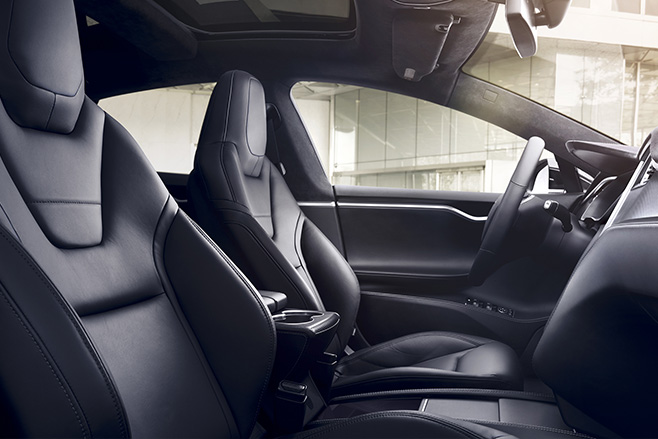
On the upside, if the P100D can’t match its heroic claims on the drag strip, the new battery pack extends the car’s range to 613km on the EU cycle, which Tesla says is the longest for range for any electric vehicle so far.
Keen to bait Lambos with Tesla’s newest toy? If you’re waiting delivery of a $208K Tesla P90D with Ludicrous mode, it’ll be an extra $10K for the big battery, while existing owners of the same car can upgrade for $20K – more because the battery needs to be recycled.
Sports cars are one of the biggest-growing vehicle segments in Australia in 2016.
The mini-boom is being driven particularly by models costing less than $80,000, the most notable of which is the new Ford Mustang.
America’s iconic coupe and convertible has muscled its way into the hearts of Australian buyers to top the sports-car sales chart. It’s joined on the podium by the still-much-loved Toyota 86 and BMW’s 2 Series, which, like the Ford, is also offered in coupe and cabriolet form.
Here, WhichCar provides a guide to any changes planned or expected for these models during the next 18 months – to help you pick the perfect timing for buying one.
BMW 2 SERIES
BMW’s smallest coupe and convertible models received a range update in August 2016.
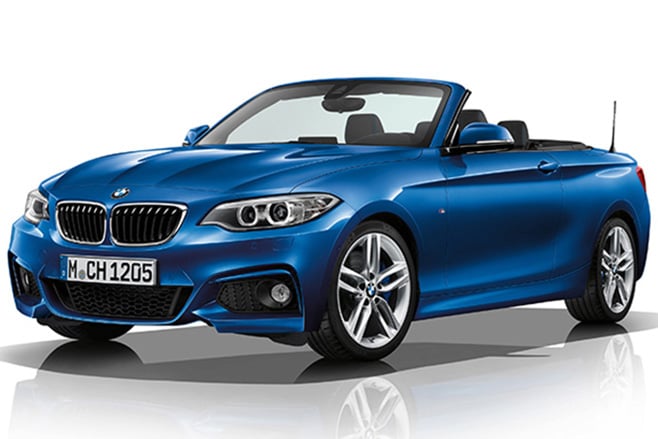
In return for slight price increases, variants benefited from improved performance and fuel economy, as well as equipment additions.
The 220i base model is now powered by a new 2.0-litre turbocharged four-cylinder with an extra 5kW and 20Nm (for 135kW/270Nm output totals) over the engine it replaces.
An extra 5kW also goes to the tuned version of that engine fitted to the 230i (formerly known as the 228i), for peak power of 185kW (and 350Nm). An M Sport package is now standard where it was previously optional.
Another badge change sees the M235i become the M240i – accompanied by 10kW and 50Nm increases to 250kW and 500Nm. That helps cut the model’s 0-100km/h quote from 4.8 to 4.6 seconds, moving the M240i closer in performance to the flagship BMW M2 (released in April 2016).
As the 2 Series debuted in 2014, the next-generation model isn’t expected until the start of the next decade.
FORD MUSTANG
Ford Australia can’t seem to get enough of the famous US muscle car, which in its latest generation is at long last available in factory right-hand drive.
Having only launched in Australia in early 2016 don’t expect any major changes for a long time, instead only smaller updates.
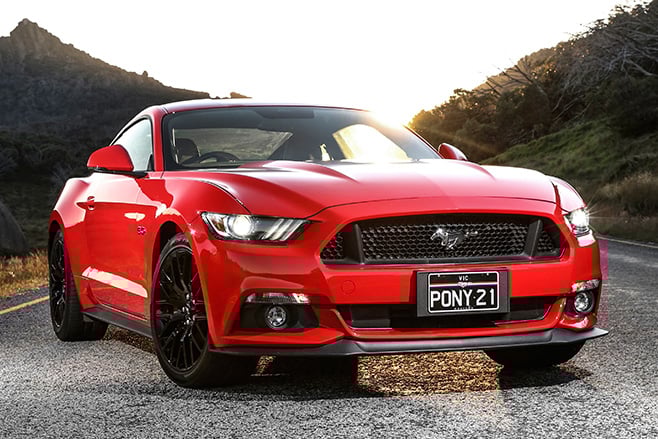
The first of those came in April 2016, with MY17 Mustangs adopting Ford’s Sync 3 – the most advanced version of the company’s infotainment and communications system. It brings smartphone-style functionality and smartphone integration via Apple CarPlay and Android Auto.
Three existing colours were also swapped for three new hues: Lightning Blue, Grabber Blue, and White Platinum Tri-Coat.
The EcoBoost four-cylinder variant also gained a spare wheel (which doesn’t fit in the V8-powered GT, owing to its larger, Brembo brake system).
TOYOTA 86
The Toyota 86 has been usurped as Australia’s favourite sports car by the aforementioned Mustang, though the compact coupe will receive some welcome updates in the last quarter of 2016.
Revised exterior styling includes a more aggressive-looking front bumper and new-look 17-inch alloy wheels, and there are also some tweaks for the interior.
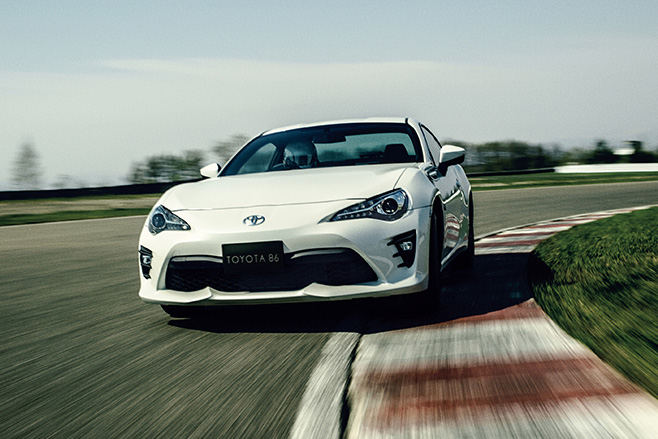
Some enthusiasts would like a significant power hike for the 86, though there’s just a minor tickle-up to 152kW and 212Nm. Toyota says engine tweaks improve torque at lower revs.
The 86 already offers terrific handling, yet Toyota says it has aimed to further improve dynamics with sharpened steering and revised aerodynamics. Modifications to the suspension and rear pillars also aim to bring an even smoother ride.
Every now and then, you come across a production car and think: Hmm, that’s got just about enough power.
Then there’s Hot Tuner, where pretty much everything that turns up on the day has you thinking the same thing. And then there’s the odd situation where a car such as the Herrod Motorsport’s FPV ute rolls to the gate and you start to wonder if sometimes enough is actually too much.
See, here is a car that is so stunningly powerful, so urgent, that no matter what the Herrod team did to the chassis (and they did have a fiddle, trust us) the thermo-nuclear device under the bonnet was never going to be tamed.
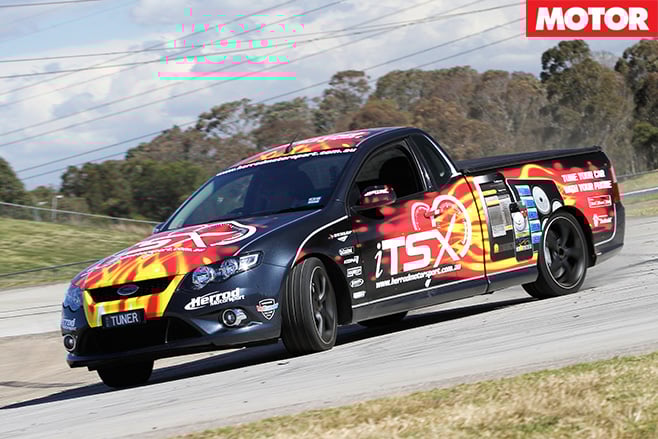
How unpretty? Um, consider that the best drag-strip time I could squeeze out of it was a 13.1. Embarrassing, actually, or it would be if you hadn’t been there to see the Ute From Hell still wheel-spinning through the traps in fourth gear.
So, as a drag-car, the Herrod ute doesn’t work (especially with a manual ’box to make things just that bit more difficult). But as a calling card for what the Melbourne-based workshop can offer those in the market for an embiggened Miami V8 engine, the ute works just fine, thanks.
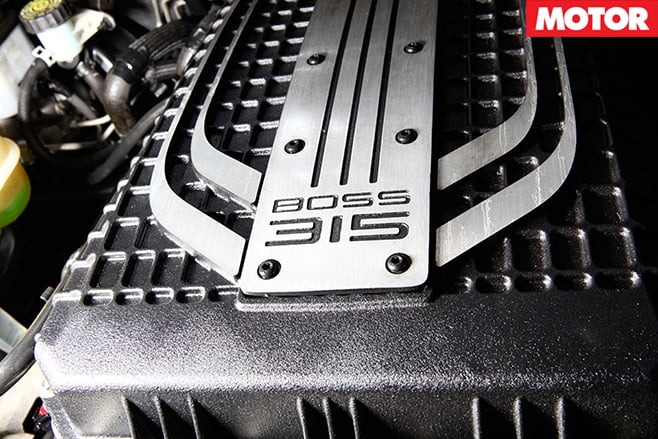
Throw in the SCT (for which Herrod is now the Aussie distributor) custom tune and you can achieve the same result, even sticking with the stock headers and cats (there’s a bigger, flame burping set of pipes downstream).
The best news is such fi repower can be had for just $9400 drive-in, drive-out, though the cat-back exhaust will add another $1370. In the context of more than 470 rear wheel kilowatts, it’s a bargain.
To be perfectly honest, this degree of tuning is, if not actually wasted, then certainly getting towards overkill on a ute. Watching it on the figure of eight was to admire Luffy’s drifting skill and even on the circuit, it was a good five seconds off the hottest pace, purely because it had to be driven sideways.
Everywhere. The leaf-sprung rear end is seriously underdone when it comes to harnessing this sort of onslaught; a fact Robbie Herrod freely admits just before his face cracks into that trademark splitwatermelon grin and you both wind up giggling at the sort of mayhem the ute can unleash.
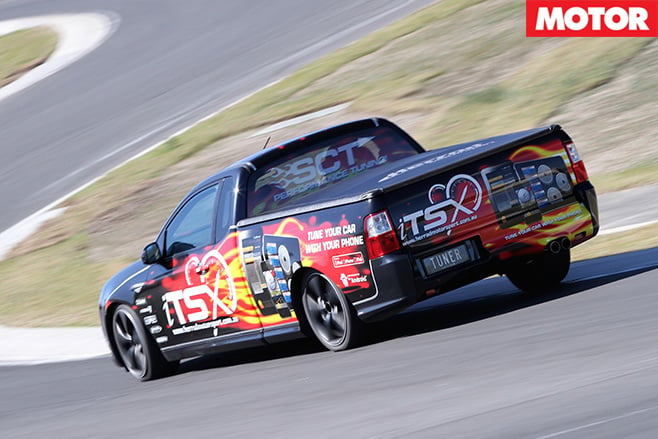
It did the run with absolutely no dramas and even beat 10 litres per 100km in the process. And for that, we reckon you can forgive it having ‘enough’ power.
WORKSHOP WHO: Herrod Motorsport WHERE: 103 Northgate Drive, Thomastown, VIC 3074 HOW LONG: 25 years SPECIALTY: Australia’s No.1 Ford enhancement specialist CONTACT: (03) 9464 5100 EMAIL: [email protected] WEBSITE: herrodperformance.com.au
SPECIFICATIONS DRIVE: rear-wheel ENGINE: 4951cc V8, DOHC, 32v, supercharged CAPACITY: 4951cc COMPRESSION: 9.25:1 POWER: 472rwkW TRANSMISSION: 6-speed manual SUSPENSION: double A-arms, coil springs, anti-roll bar (f); live axle, leaf springs, anti-roll bar (r) BRAKES: 380mm ventilated/grooved discs, six-piston calipers (f); 356mm ventilated/grooved discs, four-piston calipers (r); ABS, EBD, BA, DSC WHEELS: 19 x 8.0-inch, alloy TYRES: Dunlop Direzza SIZE: 255/35 ZR19 97W
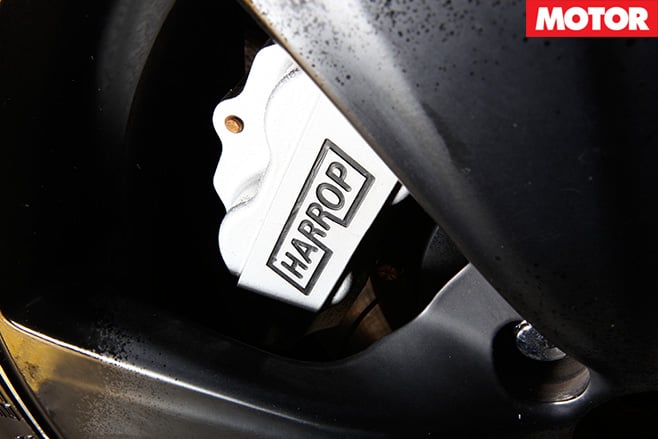
PARTS AND PRICES HERROD POWER KIT: $9400 EXHAUST: $1370 HERROD SUSPENSION KIT: $2800 HARROP BRAKE KIT: $7200 TYRES: $2200 TOTAL MODS COST: $22,970 VEHICLE PRICE (MRP): $52,990 TOTAL PRICE: $75,960
SCORE/POINTS 0-100KM/H: 5.25sec (19) 0-400M: 13.07sec (20) 100-0KM/H: 38.2m (10) DYNO: 472.3awkW (40) TRACK: 1:05.40 (15) FIGURE EIGHT: 1:33.50 (9) TOTAL POINTS: 113
WARREN LUFF “Who cares if it’s not the fastest thing out there, this is the most fun car to drive. It’s got a crazy amount of power, but it’s so driveable and well balanced. The fun factor is 20 out of 10.”
RICK KELLY “It’s great to hop in a car with way too much grunt; you stand on the throttle out of a corner and it just launches into wheelspin. Surprising how much you can control it. It’s awesome.”
Honda Australia believes the Civic Type R and NSX pave the way for more sports cars, admitting an Integra Type R revival is being discussed internally among other models.
Speaking at a media event in Sydney this week, Honda Australia managing director Stephen Collins first announced that right-hand-drive production was underway for the NSX, before confirming the Civic Type R will arrive in 2017, and then promising there was more to come.
Collins couldn’t confirm a new Integra Type R specifically, but he confessed “there has been a lot of discussion about that globally” and added that many markets including Australia were begging Honda for more sports cars, and the company was now listening.
“I would say, for us, it’s clear there would be an opportunity for us so if a model like that [Integra Type R] were to become available we would absolutely put our hand up for it,” he continued. “Right now there is nothing but whether there is in the foreseeable future, I would hope so.
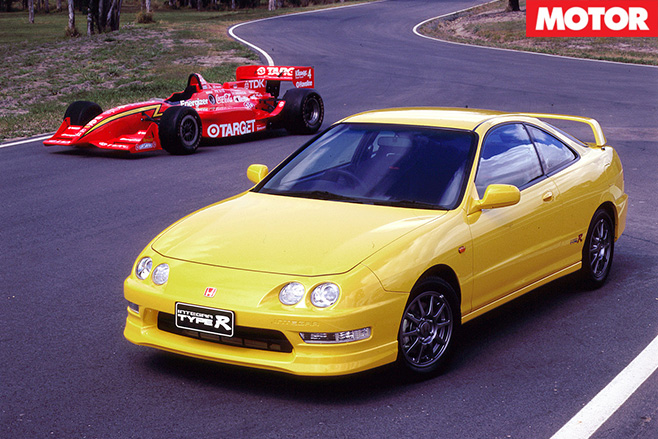
“I think most advanced markets are communicating that we want to keep dialing up the sportiness … and I think that’s what we’re starting to see, and if we can fill that gap with another $35,000 sports car, who knows.”
The local managing director admits that a brand once known as the Japanese BMW had “become a bit beige” but he expressed the view that, internally, that was acknowledged, resolved and the resulting change in attitude would show in years to come.
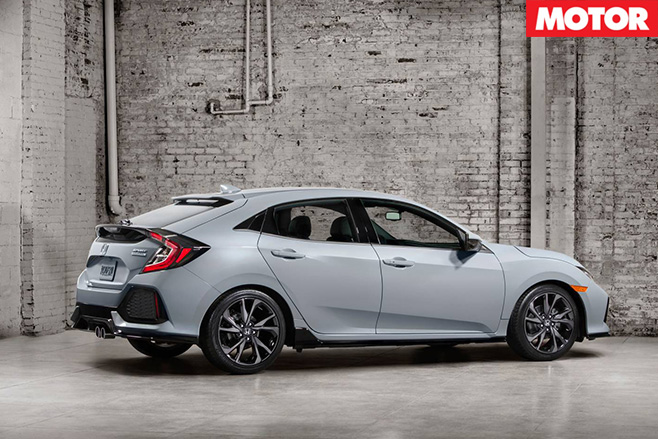
“Our company’s president … has said he wants to give more freedom to R&D and I think, my memory of the 1980s and 1990s was that Honda R&D had a lot of freedom and that’s when they came up with some damn cool stuff.
“So I think from the Honda president down that’s starting to be acknowledged and you’re starting to see the fruits of that, and over the next few years you’ll see more of the fruits of that thinking.”
Honda was hit hard by the Global Financial Crisis (GFC) and stripped its R&D budget as a result. It saw the demise of the 2008 three-door Civic Type R without an immediate replacement, while the quirky CR-Z hybrid ended production last year without a successor.
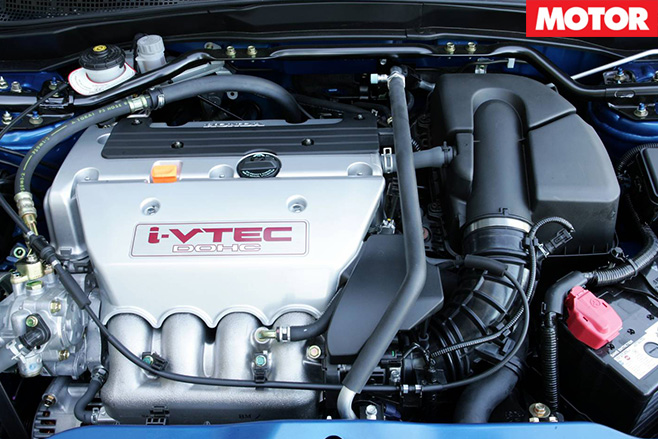
At almost 10 times the price, Honda Australia is currently in talks with the US factory building the $420,000 NSX supercar to see how many RHD built ‘slots’ it can get to tell owners when they can expect delivery.
Eight firm orders have been placed in the five national dealerships selling the NSX, with the brand set to offer free servicing to owners and appoint a ‘master technician’ who will fly around the country to service each car.
TESLA has announced a new uber-fast Model S P100D, and admitted that the company’s future partly rides on its “obviously expensive” price tag.
The company released a statement about the P100D yesterday, heralding it as the “quickest production car in the world”. The release included a curious admission, saying “while the P100D Ludicrous is obviously an expensive vehicle, we want to emphasize that every sale helps pay for the smaller and much more affordable Tesla Model 3 that is in development.
“Without customers willing to buy the expensive Model S and X, we would be unable to fund the smaller, more affordable Model 3 development.”
Tesla Australia spokesman Heath Walker told Wheels the statement refers to the company’s commitment to putting profits back into EV development as well as the company’s future.
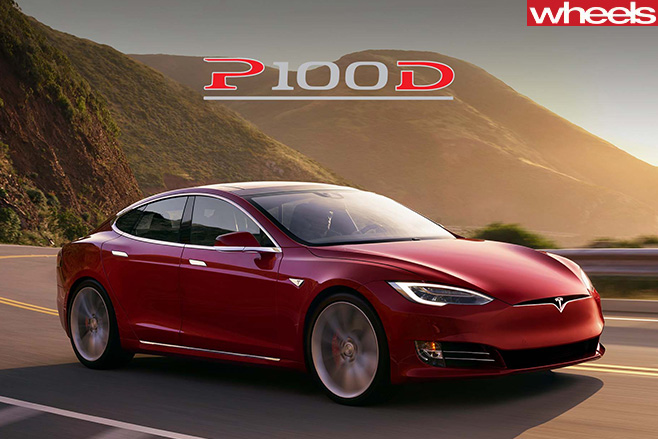
Tesla is yet to confirm Australian pricing or specifications for the P100D, though based on Model S variants already sold here, the new flagship will likely start north of $210,000 when it arrives.
For the price, buyers will get an ultra-modern electric vehicle which owns far more expensive production supercars in the acceleration stakes. Tesla says the Model S P100D with Ludicrous mode clocks 0-100km/h in 2.7secs; 0.1secs faster than the Lamborghini Aventador SuperVeloce and 0.2secs faster than the Porsche 911 Turbo S. While the Ferrari LaFerrari and Porsche 918 are quicker, all examples of each are sold out.
And as Tesla points out: “While those cars are small two seaters with very little luggage space, the pure electric, all-wheel drive Model S P100D has four doors, seats up to five adults and has exceptional cargo capacity.”
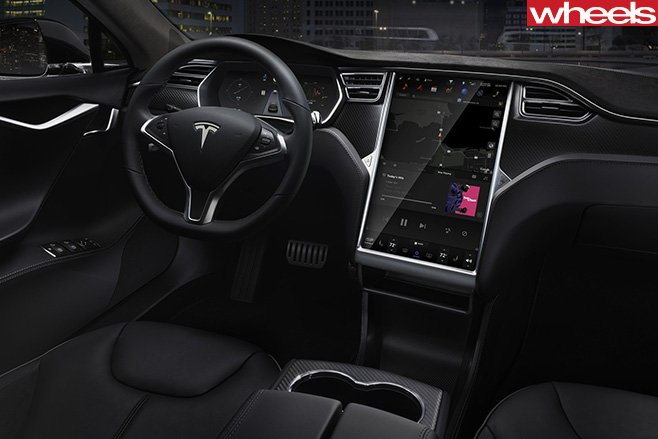
Anyone who has ordered a P90D Ludicrous and is yet to take delivery can upgrade to the 100 kWh versions for roughly $13,000 based on US prices. Owners of previously purchased P90D Ludicrous can also retrofit the 100 kWh pack, but for about $26,000 as the used 90 kWh pack will have to be recycled.
The 100kWh battery pack is also available on the already quick Model X SUV being launched in Australia today. The Model X already claims the mantle of world’s quickest SUV from 0-100km/h and it’s P100D variant in Ludicrous mode is expected to accelerate to from 0- 100km/h in 3.1 seconds. It will also be able to travel an estimated 542km on a single charge.
Model S and Tesla Model X P100D with Ludicrous mode are available to order now, with delivery times varying based on location.
MY how they’re growing up fast!
The sub-B hatch segment – known as the Micro class in Australia – has seen a trio of new-gen contenders that bring maturity and refinement to the very bottom end of the new-car market.
Note, however, that unlike the sadly-discontinued Volkswagen Up! from 2012, none of the trio offer Autonomous Emergency Braking (AEB) at all. A black mark in our books.
Here we look at three of the best – the Holden Spark, Kia Picanto, and Suzuki Celerio.
1. HOLDEN SPARK
THE SPARK is surely one of the most improved cars of this year.
For starters, the South Korean-made hatch scores a newfound solidity, with a real Germanic ambience. This is clear from the sensible dashboard, supportive seats, excellent driving position, huge central touchscreen with up-to-date media connectivity and quality fittings.
Better still, the Spark drives like a car from the next class up thanks to considerable chassis tuning input from Holden in Australia, resulting in lively off-the-line performance, safe handling, and a quiet ride.
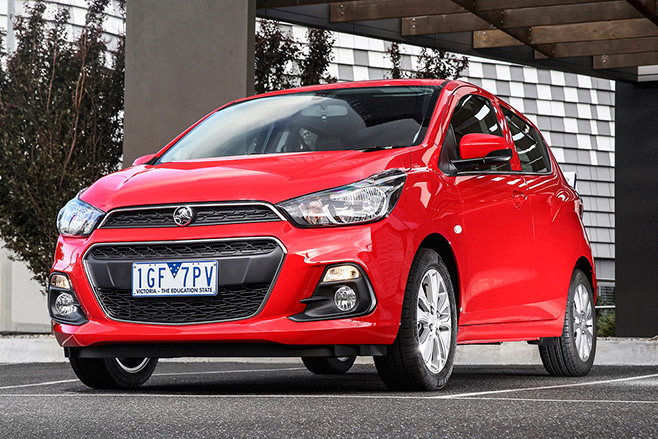
On the flipside, the big new 1.4-litre four-cylinder engine’s fuel consumption is comparatively high, the (optional) CVT auto can get a bit droney under hard acceleration, the ride on the bigger-wheeled LTZ is too hard, and prices are surprisingly high up the range.
Still, the Spark doesn’t look, feel, or drive bargain basement, rising to the top of the class – and that’s the first time we’ve said that about a baby Holden in years.
Our pick: base LS manual – better value and a better car than the bigger Barina
2. KIA PICANTO SI
NEW to Australia but five years-old elsewhere, the Kia Picanto is widely acknowledged as one of Kia’s best efforts, especially in Europe.
To help achieve similar kudos in Australia, there’s only one variant – the Si 1.2-litre auto, priced at an amazing $14,990 driveaway.
Like the others, the Kia offers Bluetooth, powered windows/mirrors, remote locking and a temporary spare, but then streaks ahead with standard four-wheel disc brakes, rear parking sensors, and a seven-year/unlimited kilometre warranty. Impressive!
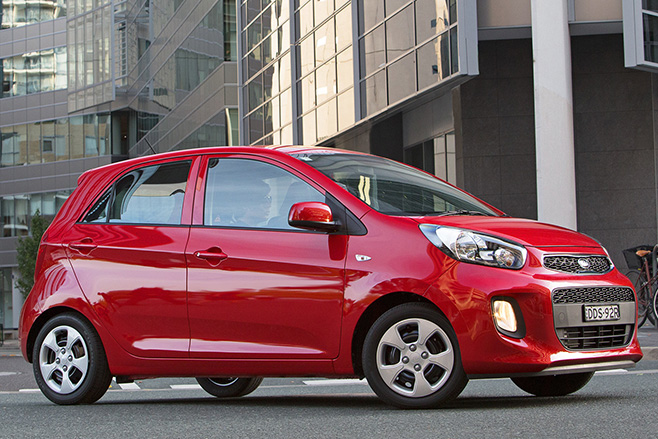
There’s little to criticise beyond flat seats, an at-times unsettled ride, and no manual availability. The engine’s performance is lusty yet frugal (despite having just four forward speeds), the steering delightfully sharp (this is the most fun to drive out of all the baby autos), and the interior stylishly presented, matching the striking exterior design.
Note an all-new Picanto will arrive sometime next year, so this one is here only to establish the brand among the Micro clan. It deserves success.
Our pick: the Si in a lively colour to match its vibrant persona.
3. SUZUKI CELERIO
THERE’S plenty to the Suzuki Celerio beyond a daft name and spectacularly low pricing.
Look past the tall, boxy, and rather dumpy design (the aim was to be the roomiest Micro available), and you will find intelligent packaging, superb ergonomics, supportive seats, parking-enhancing deep windows, light controls and a lovely ride suppleness. This Suzuki blitzes urban driving challenges.
So it might come as a shock that there’s much to impress the motoring enthusiast too. The tiny 1.0-litre three-cylinder engine punches well above its capacity, providing sparkling performance with exceptional frugality to boot; the Celerio’s handling and road-holding are a hoot, even when pushed hard; and the Celerio is surprisingly adept at open-road cruising.
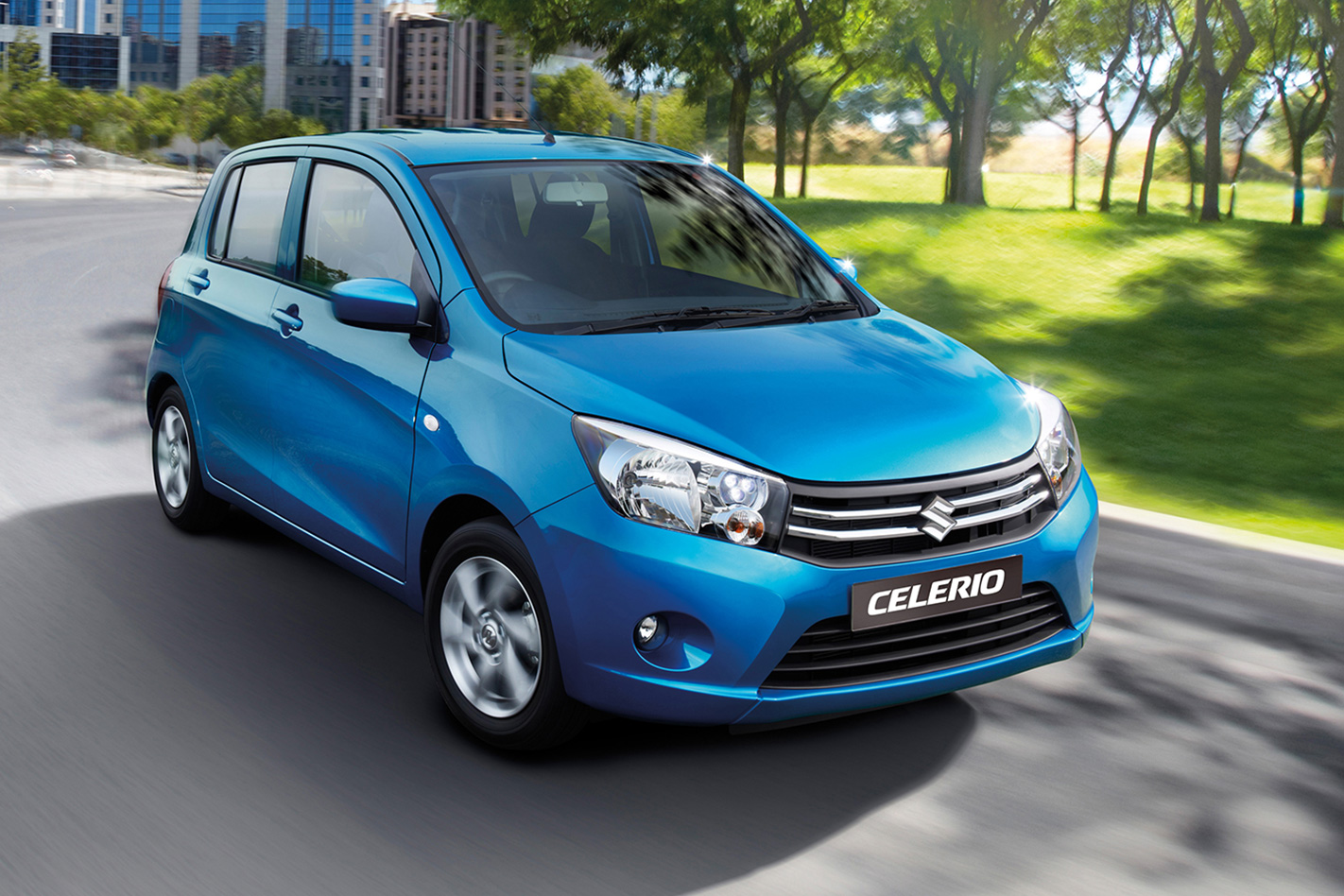
Who’d have guessed from such a city-slicker!
Minus points? Though incredibly spacious, the rear only seats two. The front headrests intrude too far. There’s plenty of road noise intrusion at higher speeds and the optional CVT auto can become droney and lethargic.
Yet the Celerio’s charm and value are undeniable.
Our pick: the manual – indecently fun at this price point
TELL ME ABOUT THIS CAR
It’s the flagship high-performance variant of Lexus’s large-car GS range, so it’s a conventional four-door sedan body driving the rear wheels. Size-wise, it’s comparable to BMW’s 5 Series or the Mercedes-Benz E-class, however it’s priced to compete with the smaller, mid-size high-performance offerings from the premium German brands like BMW M3 and Mercedes-AMG C63.
STRENGTHS
The GS F eschews the engine turbocharging used by its German rivals (although this is both a strength and weakness…). The good part is a very linear, sharp and satisfying response to the throttle pedal – power from the V8 pours on without a sudden swell, and delivers a lush free-breathing sound, which is reminiscent of a V8 race car.
- Provided the engine is worked in its upper reaches, performance is excellent, and the eight-speed automatic is smooth-shifting and eager to choose and hold the optimum ratio in the Sport Plus mode.
- Grip levels are strong and the car’s balance is essentially fairly neutral, meaning neither the front or rear comes unstuck suddenly unless seriously provoked. There’s also a clever system under the rear of the car which ensures power is directed to the wheel best able to deploy it, aiding the sense of cornering agility in what is a large car.
- Inside it’s refined, roomy and packed with equipment, including a 17-speaker stereo, heated front and rear seats (ventilated fronts optional), three-zone climate control, 10 airbags and every active safety feature under the sun. The only options are polished 19-inch wheels and carbon interior trim, making the speccing process very simple compared to the bafflingly complex options list provided by German rivals.
- The engine lacks the really strong mid-range surge of turbocharged rivals, so needs to be revved harder in brisk driving. It is also more thirsty in most real-world conditions.
- It’s a heavy vehicle at over 1800kg, and this ultimately blunts its abilities when pushed to the limit on a racetrack.
- The steering doesn’t provide a great sense of connection and feedback to the driver, although it is accurate and slack-free.
- The mouse-based controller for the infotainment system is fiddly and frustrating.
Price-point rivals, as mentioned, are cars a segment smaller like the Mercedes AMG C63 or BMW M3. The Lexus GS F can’t match the ultimate performance of either of these in full-blooded driving, but it’s not massively short of them, and is more spacious for rear-seat passengers. For similar size and crisp, eager V8 performance, but with inferior build quality and equipment levels, buyers could consider pocketing $90K and look at a Holden Commodore SS V Redline. Otherwise Audi’s S6 is of similar size, has terrific turbocharged V8 performance, and an even more modern and beautifully crafted cabin. However the Audi carries a $20K price premium, before options needed to bring it up to the Lexus’s equipment levels.
