
Holden’s Barina Spark replacement has jumped from class dunce to dux. It’s just a shame the price isn’t quite right.
WHAT IS IT? Holden’s newest entrant in the micro-car class; a sub-Barina sized-model that loses the confusing Barina Spark name of its predecessor, and brings Apple CarPlay and Android Auto connectivity to an end of the market that covets it the most.
WHY WE’RE TESTING IT It’s an all-new design built on an all-new global platform, and has received extensive local development by Holden engineers in the keys areas of suspension, steering and ESC calibration.
MAIN RIVALS Nissan Micra, Mitsubishi Mirage, Suzuki Celerio, Fiat 500
THE WHEELS VERDICT Proof of Holden’s engineering expertise is obvious in the engaging, composed dynamics, while the new engine makes it sufficiently lively and fun to drive. Nails the brief for equipment and connectivity, but while it’s definitely cheerful, it’s not exactly cheap.
PLUS: Composed, engaging dynamics, willing powertrain, excellent connectivity MINUS: Ambitious pricing sees top-spec model comparable to cars in the class above; engine not torque-rich
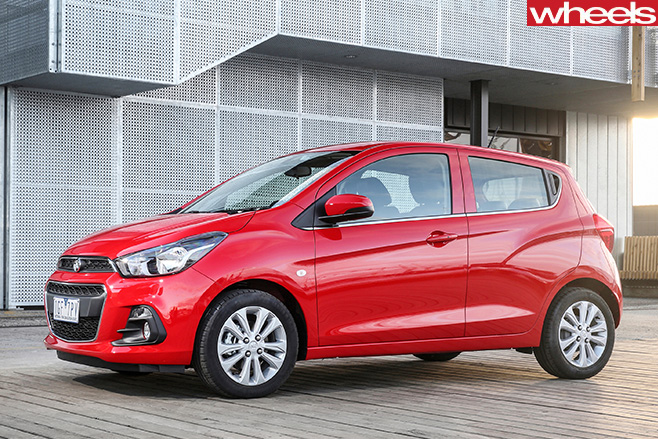
It’s too early to say for sure if that’s the case for Holden’s new Korean-designed micro car, but the improvements the Spark delivers over its utterly unlovable and woefully underdone predecessor are vast. The outgoing model saw no local involvement from Holden, and it showed. This all-new car, built on a new global platform that brings both a longer wheelbase and wider track, has reversed that situation.
Holden’s engineers were involved from the first phases of development, and were able to specify a number of key component sets, as well as locally develop the damper tune, steering calibration and ESC characteristics. After a day of driving the little Spark hard at both Lang Lang and the surrounding roads, the dynamic benefits brought by Holden’s involvement feel significant.
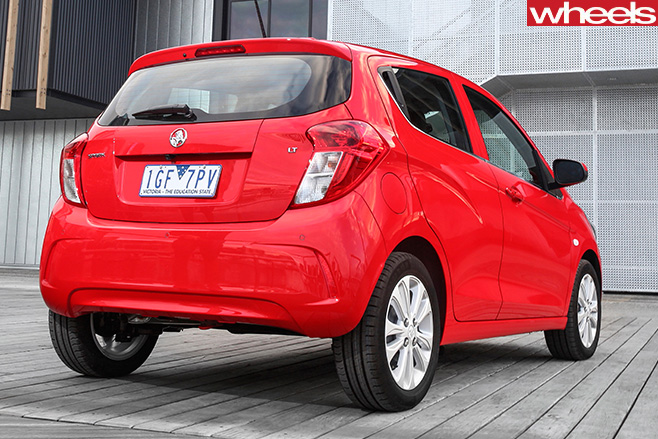
The car was designed in Korea under the direction of former Holden designer turned General Motors International design vice-president Mike Simcoe, and is around 40mm lower than that its predecessor and with less front overhang. Yet it manages that trick of being roomier inside, partly thanks to the larger platform, and partly due to a lower hip-point and smarter interior packaging.
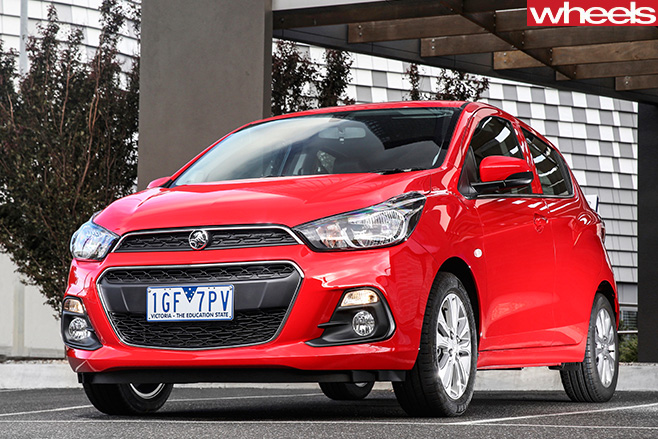
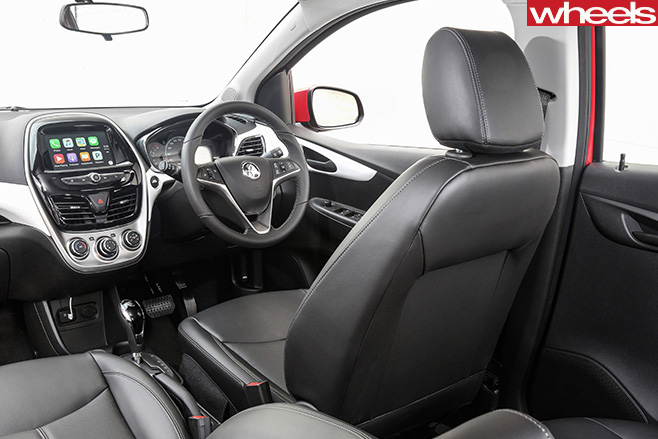
The top-spec LT model adds funkier dash inserts, leather-look seat trim, leather-wrapped steering wheel, 15-inch alloys, keyless entry, reversing camera and cruise control, but more relevant is that the base model, the LS, brings six airbags, the option of a CVT auto, and a seven-inch touchscreen with Apple CarPlay and Android Auto.
Under that stubby bonnet, Holden has swerved around the downsizing trend, so rather than say, a little turbo triple, Spark gets an all-new 1.4-litre four. It’s an all-aluminium construction, but otherwise fairly conventional in terms of induction and valve train: there’s variable valve timing and port injection, with peak power of 73kW made at 6200rpm, and redlined at 6500rpm where the limiter is also pegged. Maximum torque is 128Nm (auto) or 124Nm (manual) at 4400rpm, so it does need revs, but shortish gearing means it doesn’t feel gutless. Throttle tip-in is eager but intuitive, the delivery pretty linear, and the top end, while not exactly creamy-sweet, is neither harsh nor horrible.
In the base car it’s mated to a five-speed manual with a super-light clutch pedal and feathery, if slightly floppy shift action, but the bulk of buyers – that’s mainly females aged between 20 and 29, if you hadn’t already figured it out – will opt for the CVT. It’s actually a decent auto, with defined ratio steps to avoid excessive engine droning or rev flaring.
Grip levels are modest from the Continental eco-biased tyres, (165/65 14 on the base model; 185/55 R15 on the LS) but it’s the chassis’s balance that compensates. There’s a lively responsiveness and throttle adjustability that lifts Spark above the often one-dimensional dross that can inhabit this end of the forecourt.
The target market may never push it hard enough to find out, but subtle throttle lifts bring the bum into play and quells any sense of pushy nose-heaviness. On a wheelbase of just 2385mm, there’s the potential for this type of set-up to feel twitchy, yet it never does. Instead it just feels eager and up for it, and beyond the limit of grip waits one of the best calibrated ESC systems this side of Commodore. It doesn’t jump in too early, stays unobtrusive, and has an innate sense of when you’ve tidied things up and it can back off.
Pushed along typical country roads, it’s clear just how good the suspension tune is. Rebound control is a highlight, with big heaves and undulations soaked up with a level of composure you don’t normally find at this level.
The base manual look okay at $13,990 plus on roads, but most chickie-babes kicking the tyres with their pointy heels and dads in tow will want the auto, which, at $15,690, is suddenly closing in on a $17K drive-away tag. Move up to the auto-only top spec LT and you’re at $18,990 plus on-roads, which is in the thick of class-above action from the likes of Mazda 2, Ford Fiesta and Suzuki Swift.
The market’s reaction will determine how resolutely Holden sticks with this pricing strategy, and we’d tip that drive-away deals will start to sharpen the numbers later in the year. In the meantime, it’s just pleasing that Holden’s local engineering team have managed to deliver a Spark you no longer want to set fire to.
SPECS Model: Holden Spark LS Engine: 1399cc in-line 4, dohc, 16v Max power: 73kW @ 6200rpm Max Torque: 128Nm @4400rpm Transmission: CVT Weight: 990kg 0-100km/h: 12sec (estimated) Fuel economy: 5.5L/100km Price: $15,690 On sale: Now
There are lots of things to consider when buying a second-hand car: price; suitability; mechanical soundness and whether it has any money owing on it. And while the first three can be answered by yourself and your mechanic, finding out whether there is any money owing on a loan relating to the vehicle – otherwise known as a REVS check – is where there’s plenty of cunning people circling to make a few bob.
If the term REVS is new to you, it’s is an acronym for Register of Encumbered Vehicles. It’s where anyone who has a financial interest in a vehicle (like a bank or a finance company) formally registers that interest to make sure that in the event that the car changes ownership (perhaps where the borrower has defaulted on the loan, a straight-forward private sale or trade-in through a dealer, or when it’s written-off through an insurance claim) the financier – and not some dodgy dealer, or shady private seller – pocket the proceeds from that sale. It prevents you from buying someone else’s debt and likewise, if your bank is lending you some money to buy a car, they’ll insist that the vehicle has ‘clear title’ – meaning it has no encumbrances.
In 2012, the register became part of the federal government’s newly launched Personal Property Securities Register (PPSR). It doesn’t have the same ring as REVS, but www.ppsr.gov.au offers the same immediate and inexpensive service of providing you with clear title before purchasing your next second-hand vehicle.
All you need to do to acquire a PPSR certificate – or REVS check – is input the car’s 17-digit Vehicle Identification Number (VIN) into the search bar and for the princely sum of $3.40 you’ll immediately be emailed a report.
And this is where buyers need to beware: A REVS check gained through official government channels will cost you $3.40, but that official government channel appears at the very bottom of Google’s search page with all sorts of expensive and official-looking alternatives waiting for your click — and your money — ranked above it.
And while it sounds simple enough, entering the phrase ‘revs check’ into Google returns hundreds of websites ready to charge you anywhere between $9.90 and $25 for the same certificate. The difference here is they input the VIN into the website for you, and charge you up to six times the price for the privilege. There are far too many unofficial websites to list, but a good rule of thumb is unless the website ends in dot-gov-dot-au, steer clear.
Importantly, too, a REVS check should not be confused with a vehicle history report, which advises would-be owners if the vehicle has been written off (statutory or repairable) or stolen, etc. This information can also be gained at the www.ppsr.gov.au website, but the guidelines around written-off vehicles vary from state to state, so do your research.
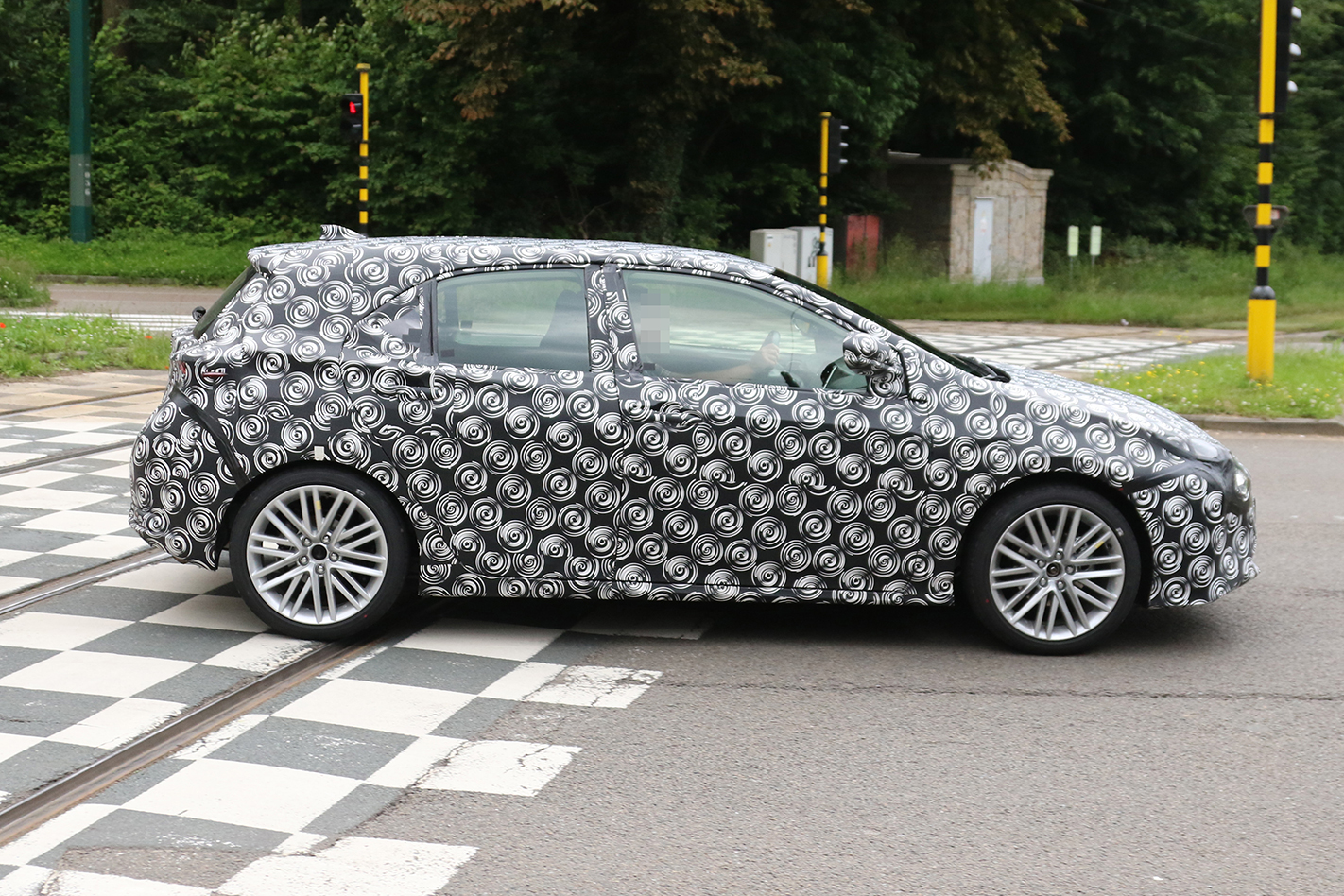
HERE is what might be Australia’s best-selling passenger car in 2019, wearing plenty of camo but looking production ready for a late 2018 introduction.
Snapped in Germany undergoing final testing, this is the 12th generation Toyota Corolla, showing an evolutionary design language as it prepares to take on the Mazda 3, Ford Focus, Peugeot 308, Honda Civic, Volkswagen Golf, Holden Astra, Kia Cerato, and – of course – the Hyundai i30.
But don’t be fooled by the samey looks, because beneath that same-but-different exterior is Toyota’s all-new TNGA Toyota New Generation Architecture – a larger, stronger, and lighter platform that promises to propel the Corolla/Auris straight into contention.
We’ve already driven the latest Toyota Prius hybrid with TNGA and have come away impressed, so here’s hoping the same thing happens with the Japanese small-car stalwart.
Speaking of the Prius; count on there being another petrol-electric hybrid version – as well as a plug-in pure EV further down the track – to supplement a range of new and carryover petrol engines on offer. While Europe will see a 1.2-litre four-cylinder turbo offered alongside normally-aspirated 1.5 and 1.8 versions, the Australian Corolla is likely to stick with latter for the time being. Six-speed manual and CVT Continuously Variable Transmission choices will be the norm.
We also wonder whether Toyota will continue to offer two levels of rear suspension for the 2018 redesign. The Auris is expected to continue with an advanced multi-link independent rear, while for cost reasons, most of the Japanese-made Corolla-badged variants – bar the British-built Hybrid – might most likely stick with a torsion beam arrangement.
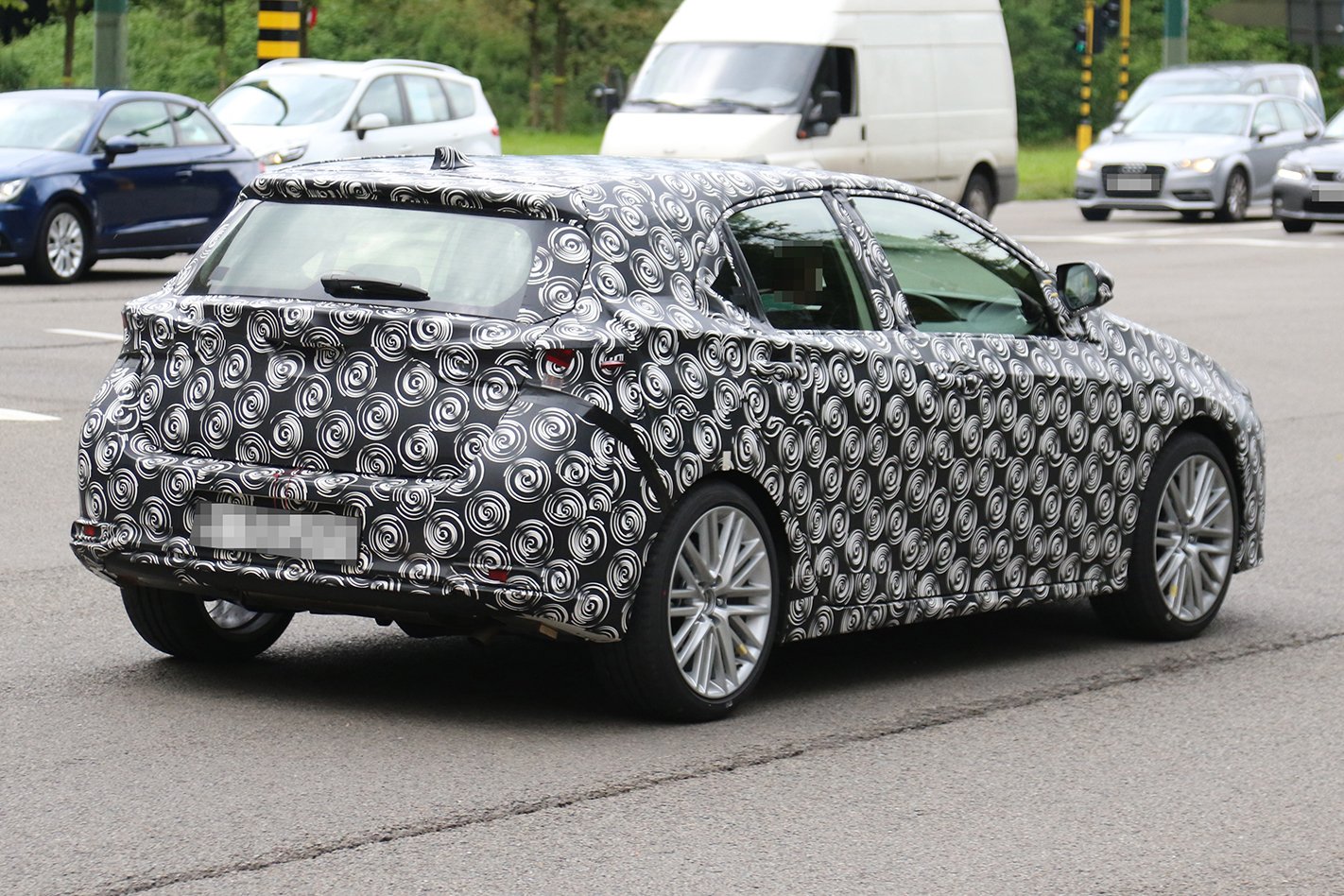
Toyota is acutely aware that to attack the Golf successfully it needs to lift the Corolla/Auris’ cabin design and presentation, so we hear that better quality trim and materials are on their way. More rear occupant and luggage space is also a certainty, thanks to a longer wheelbase and wider tracks.
An American-market focused four-door sedan will also join the fray sometime during 2019, and will probably again be sourced from Thailand for our market.
Prices? Only a fool would bet against a $20,000 base hatch, stretching to the low-thirty mark for the sporty ZR.
Have spy pics of your own? We’d love to see them. Just email them to [email protected]
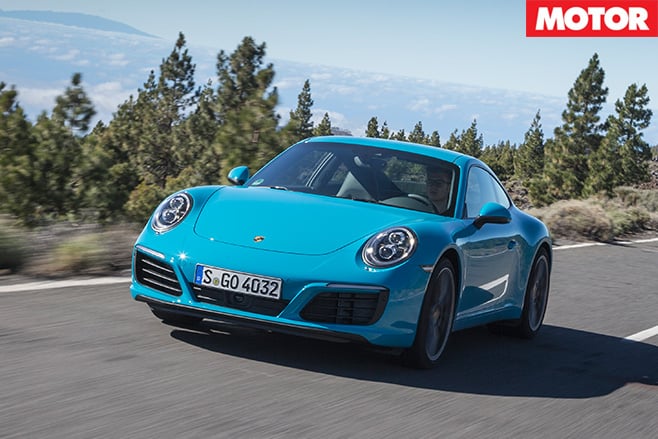
I struggled with the news back in the mid-’90s that the Porsche 911 was going to ditch its defining engine design element (well, one of them anyway) to become liquid-cooled.
I struggled some more a few years later when news broke that the 911’s other party-piece, its you’re-standing-in-it steering, was going to become electrically assisted. As it turned out, the 911 did alter fundamentally with both those changes in design direction, but the changes didn’t interrupt the flow of electrons that ran up the back of my neck every time I strapped into one of the crazy little Kraut mix-masters.
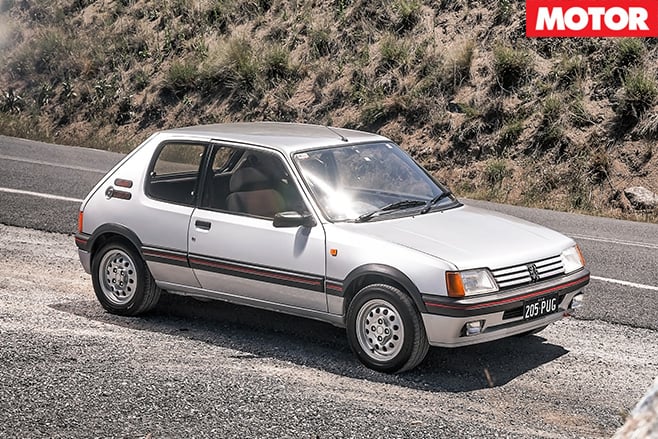
The widespread (global, in fact) move to front-wheel drive in anything smaller than a D9 dozer had me worried for a long time, too. But before my first drive in a Peugeot 205 GTi had ended, those worries had been left behind at the first fast sweeper (on the road between Cooma and Adaminaby in the Snowies, if you must know). And having recently driven the Renault Megane Trophy, I’m philosophically even further away from my original fears.
Meantime, I’m feeling those same, familiar, old misgivings as I ponder the future of Australian family cars as local production begins the painful journey up its own quoit and from there to oblivion. But having laid eyes on the new generation of US Fords, the Dodge Charger and even the new Chevy Impala (I’m touring the east coast of the US as I write this.
And old Samuel Johnson must have driven one, because my rented Jeep Patriot really does seem like the last refuge of the scoundrel) maybe it won’t be the end of the world when we start sourcing our new rides from the global gene-pool.
But now something has happened that I will never, ever successfully deal with. It’s worse than anything that has happened to the 911 until now. It’s even worse even than if the Porsche board went suddenly Radio Rental and changed to a front-engined design. But it doesn’t involve the 911 or Porsche or even the car industry at all.
Nope, it’s bigger than that. It involves a brand that I love; a brand that has already reinvented itself back in 1980 when it replaced a key component with a totally different one. Thing is, the replacement was different, but not without merit. But this time… this time, it’s gone too far and I’ve only got one thing to say: Axl Rose as frontman for AC/DC? What? Was Kid Rock busy or something?
October 7 is shaping up to be a very bleak day for Australia’s automotive industry, with Holden announcing it will cease Cruze production at its Elizabeth plant – the same day Ford closes its Broadmeadows production line.
Holden had previously announced it would end Cruze production this October, but confirmed the date with employees and the end of their shift on Friday.
In a statement, Holden confirmed 320 jobs would go at their Elizabeth plant. “These are the same redundancies confirmed by Holden in February this year, when the company notified staff, suppliers and external stakeholders of the advanced schedule for ending Cruze production.
“Holden’s key priority at all times is to support our people and to manage this scheduled wind-down of manufacturing in a way that treats our employees with respect and dignity.
All Holden employees have counselling services available to them, as well as career coaching, training and job searching assistance.”
The statement stressed there would be “absolutely no change to Holden’s plan to continue building Commodore at Elizabeth until the end of 2017”.
October’s closure will end five and half years of Cruze production that saw nearly 125,000 Cruze models built and sold in Australia. At its peak, annual Cruze sales reached 33,000.
The Cruze will be the last small car to be manufactured in Australia. It will be replaced by the all-new Astra, as part of Holden’s plan to launch 24 new models by 2020, refreshing or replacing every single model in the Holden portfolio.
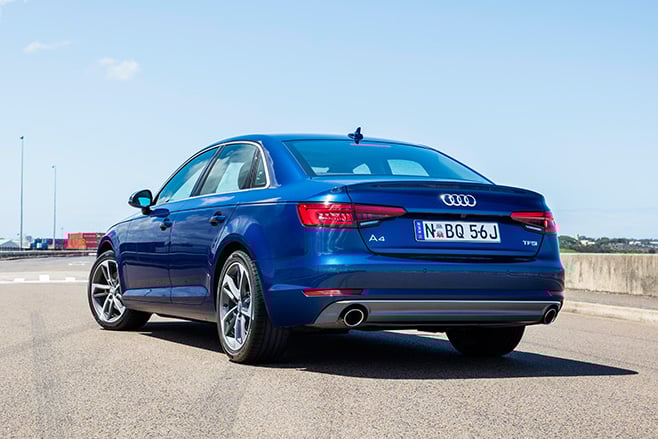
Believe it or not, this is the brand new Audi A4. It looks a lot like the old one from the outside, but there are significant changes underneath the familiar metal skin of Audi’s mid-size executive car. So let’s take a look around it.
WHAT STANDS OUT
The A4’s sophisticated good looks only needed a few subtle tweaks to maintain its understated, up to date appearance. Audi’s minimalist approach to styling includes really nicely resolved design features like the LED headlights and taillights.
What’s most important about the A4 today is that it’s never been more impressive to drive, or better equipped. All models have a big, and innovative, range of safety features including automatic emergency braking and eight airbags.
WHAT’S INSIDE
As we’ve come to expect from Audi, the A4’s spacious interior is finished with an OCD level of attention to detail. The look and feel is modern, functional and luxurious, and all models are well specced with leather upholstery, electric sports seats, multi-zone climate control for front and rear passengers, and a large centre screen for satellite navigation and multimedia systems, including Apple CarPlay and Android Auto. The car can even store up to 10GB of your favourite playlists.
While Audi hasn’t skimped on safety gear, there are a few features, like the 360 degree camera system, that cost extra in the A4, while some rivals get it standard. Also optional is Audi’s stunning digital instrument cluster called Virtual Cockpit.
This particular car is low on optional extras, and doesn’t feel as special as it could, so it’s easy to imagine adding a lot to the A4’s purchase price by indulging in luxuries.

CHOOSING YOURS
The A4 comes in sedan and wagon body styles, and has a range of quality engines to choose from. The 1.4-litre turbo petrol makes a smooth entry level option, and for distance travellers there’s a 2.0-litre diesel that’s very frugal on fuel.
Our pick, though, is the 2.0-litre turbo petrol. In particular the 2.0 TFSI quattro model with its all-wheel drive grip and higher power output. It’s the best of all to drive. Every A4 uses a seven-speed dual-clutch automatic gearbox.
As for essential extras, the A4’s ride can feel choppy if you don’t opt for adaptive dampers, especially in cars riding on larger wheel and tyre packages. The added comfort of adaptive dampers completes the car and is worth the additional spend.
Other than that it’s really down to budget and taste. Available at extra cost is everything from an S-line package that makes your A4 look sportier, to rear seat tray tables and deluxe items like a head-up display, sunroof, heated and cooled seats, premium leather and wood trim, and a high-end sound system.
SUMMING UP
The Audi A4 is a talented and worthy competitor for the BMW 3 Series and Mercedes-Benz C-Class. Its sleek interior is bursting with safety tech, and dynamically it’s better than it’s ever been. If your budget stretches to include a few of the bells and whistles, then the A4 deserves to be on your shopping list.
With more manufacturers jumping on the hybrid bandwagon and Tesla hogging the electric-car limelight, car makers like Toyota and Hyundai, are putting some of their eggs in the hydrogen fuel cell basket to further boost their green credentials.
To the uninitiated, the thought of a family car being propelled by the stuff that saw the Hindenburg come crashing down to earth so spectacularly sounds like an alarming prospect.
But while hydrogen is flammable and explosive, it is safe to store in a car with a specially-designed tank, and thankfully doesn’t require a spark or compression to power the motor.
It’s also one of the most abundant elements in the universe.
Fuel cell vehicles are actually electric cars, but instead of using batteries to drive the motor, they create a chemical reaction between hydrogen and oxygen. This produces electricity that powers the motor, which drives the front wheels.
Hydrogen and oxygen are key ingredients of water (H20) which, along with heat, is the only by-product of fuel cell power generation; no carbon emissions and no apocalyptic explosions.
Producing power this way is also very efficient – around 60 percent more efficient – which, according to the US Department of Energy, is triple that of your average internal combustion engine.
So how does it work?
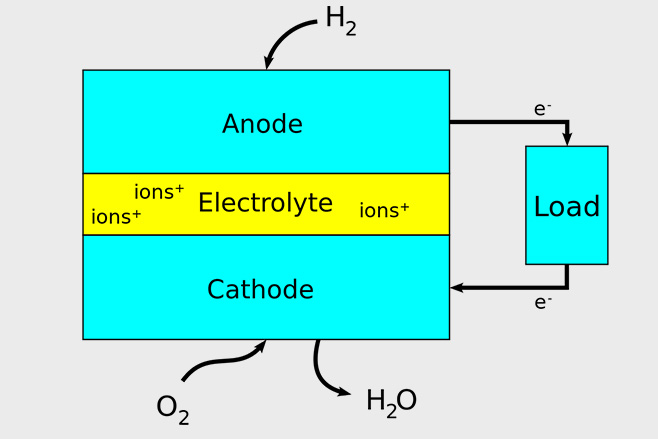
A fuel cell is like a battery that charges itself as long as there’s a steady supply of hydrogen from the fuel tank. The cell has positive and negative terminals which are separated by a thin plastic electrolyte like a sandwich.
Firstly, the hydrogen comes from the tank into the positive terminal (or anode) which is made of platinum. The oxygen is simply taken from the air and enters via the negative terminal (cathode). Platinum’s properties help speed up the chemical reaction, which sees the hydrogen atoms split in to hydrogen ions – which are atoms with electrons removed.
Next, the hydrogen ions are positively charged and attracted to the negative terminal, which is reached by passing through the electrolyte. Only the ions can pass through here.
Meanwhile, the electrons removed from the hydrogen atoms flow to and power the electric motor, which drives the wheels. After flowing through the motor they return to the cell via the negative terminal.
The ions and electrons then re-join with the oxygen, creating a chemical reaction that creates water which usually comes out of the exhaust pipe as water vapour (steam).
The question many people then ask is; if it’s so easy and hydrogen is an infinitely abundant power source that only emits water vapour, why aren’t we all driving hydrogen fuel cell cars?
It’s a bit of a chicken-egg thing. With so few hydrogen cars being made at present, the components remain expensive and hydrogen filling stations are very few and far between. As the demand for hydrogen-powered vehicles increases, it’s likely that there will be more filling stations introduced, but with so few filling stations, the demand isn’t quite there and hence the chicken and egg situation.
The benefits to the environment and the efficiency improvements highlight why manufacturers like Toyota and Hyundai are investing in bringing this technology to market, but while oil remains relatively cheap and conventionally-aspirated cars affordable, don’t hold your breath for the hydrogen-powered motoring revolution to arrive for a little while yet.
Want more? Check out our top 5 most fuel efficient cars.
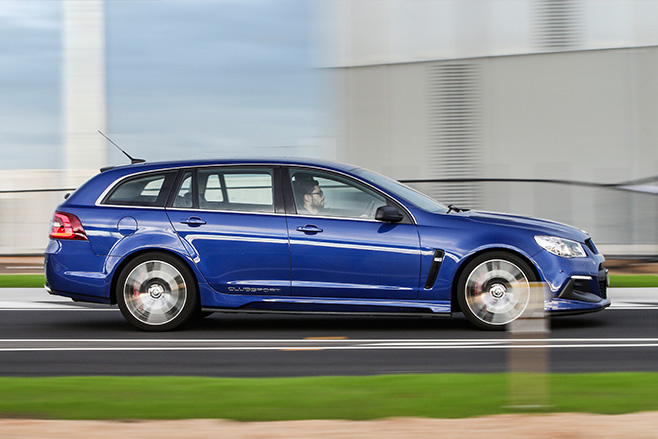
HSV has shoehorned its 400kW supercharged V8 into its fast family station wagon. The result is a performance car bargain with huge power and well-judged dynamics, yet still enough space, practicality and comfort for the daily school run.
TELL ME ABOUT THIS CAR
This is no ordinary station wagon – it’s a performance car masquerading as a hum-drum family hauler. While HSV’s Clubsport R8 LSA Tourer has a big boot and room for five adults, it also boasts a snarling, supercharged V8 with enough grunt to worry a Porsche in a traffic light grand prix.
Strengths
- Performance. Under that vented bonnet lies the same 6.2-litre supercharged V8 found in HSV’s flagship GTS, only in a lesser 400kW/671Nm tune. It’s a beastly engine, and is powerful enough to propel the Clubsport Tourer from 0-100km/h in around 4.7sec. It’s no slouch in the corners either, thanks to firm but well-judged suspension and predictable dynamics.
- Value. Sure, its $85,990 sticker price mightn’t scream value initially, but consider that the Clubsport performance and dynamic ability trumps that of some Europeans which can cost twice the price, and it suddenly seems like a bargain.
- Interior space and comfort. Like the Commodore on which it’s based, the Clubsport is a brilliant long distance cruiser. The cabin is well appointed, spacious and comfortable, though slightly built types might find the heavily bolstered seats too generous in hard cornering.
- The ride. It mightn’t score the brilliant magnetic dampers of HSV’s flagship GTS, but the Clubsport’s ride is surprisingly comfortable, especially given it rolls on large 20-inch wheels wrapped in low profile rubber.
- That boot. Practicality is always going to be a station wagon’s strong suit and the R8 Clubsport doesn’t disappoint. Even with the 60:40 split fold rear seats upright, there’s a whopping 895 litres of boot space, which is well up on the Clubsport sedan’s 496L.
Weaknesses
- The noise. You’d imagine a big, supercharged V8 would sound amazing, but the Clubsport’s exhaust note is slightly disappointing, especially low in the rev range. Things improve above 4200rpm, when flaps in the exhaust open with a metallic snap and the big V8 lets loose with a bellow, yet even here the note isn’t what you’d call beautiful. A Holden VFII SS-V Redline, which costs $30K less, sounds better.
- The cabin might be roomy and wonderfully comfortable, but the quality and tactility of some of the materials (we’re looking at you hard, shiny plastics) betray the HSV’s humble origins and bargain price. At least the switchgear and ergonomics are hard to fault.
- Fuel efficiency. Ok, no one buys a big, heavy V8 and expects it to return stunning fuel numbers, but there’s no hiding the fact that the Clubsport is thirsty. Drive it sedately and it’ll return around 12L, but get too aggressive on the throttle and that number can easily jump north of 16L/100km.
Honestly, no. At this price point, no other car can match the Clubsport Tourer for performance, dynamics and practicality. If you’re willing to spend more, the Mercedes-AMG C63 wagon is even faster, has more equipment and a nicer interior, though it can’t match the HSV for space and is almost twice the price. Audi’s new generation S4 Avant also arrives in late 2016 and will offer similar levels of performance to the Clubsport, though is significantly smaller and doesn’t sound as tough.
Nissan has announced a substantial update for its 2017 Pathfinder including a new-look front end built around a revised 3.5-litre direct injection petrol V6 engine.
Available from the first half of 2017, the new Russian-built Pathfinder will also feature upgraded safety features including forward emergency braking, intelligent cruise control and Nissan’s Around View monitor with moving object detection.
Blind spot warning (BSW) and rear cross traffic alert (RCTA) will also be available.
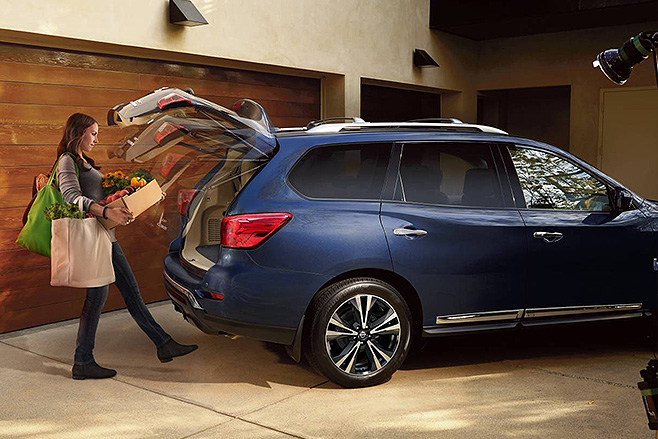
Another new feature will be the Motion-Activated tailgate, which you can open by waving your foot underneath the back of the car – very handy when you’ve got your arms full.
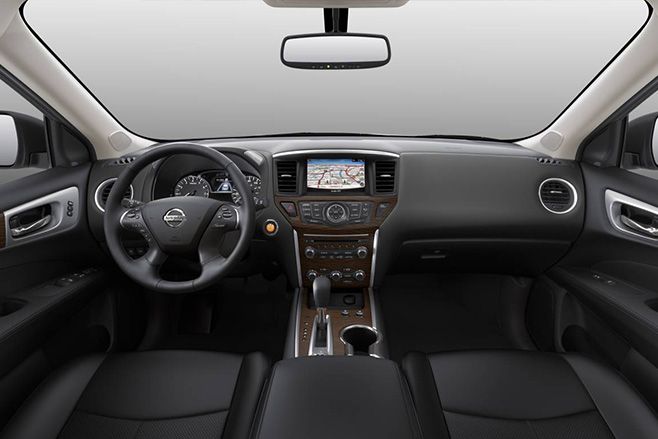
Additional infotainment and driver assistance information will be added to the Advanced Drive-Assist Display (ADAD) between the tachometer and speedometer.
Cosmetic enhancements will include recessed front-windshield wipers, roof rails, chrome door handles and panoramic sunroof.
There will also be new seat fabrics and interior finishes, plus added conveniences including cup holders shaped to accommodate mug handles and an illuminated front storage bin with second USB port.
Outside, the updated appearance incorporates the latest Nissan signature design elements introduced on the award-winning Maxima sport sedan and Murano crossover – including the new “V-Motion” grille and boomerang-shaped headlights with LED daytime running lights.
All this will be propelled by the upgraded 3.5-litre V6 engine which Nissan says will provide more power and torque. It will feature more than 50 percent new or new-to-Pathfinder engine parts and a higher compression ratio of 11.0:1 (from the previous 10.3:1).
The engine’s new Direct Injection Gasoline (DIG) system provides better wide-open throttle performance and improved fuel economy and emissions performance (versus a non-direct-injection system).
Mirror bore cylinder coating will reduce friction and also lower engine weight by just over a kilogram by eliminating the need for a heavy cast-iron cylinder liner.
The seven-seat MY17 Pathfinder will be available in two-wheel drive and four-wheel drive configurations and a choice of three grade levels.
Australian prices, specs and equipment levels will be announced closer to the time of its local release.
TOYOTA Australia has stepped up its campaign to introduce hydrogen-fuelled vehicles, saying it will bring a trio of its Mirai fuel-cell vehicles here for a three-year evaluation of the technology.
The carmaker has said that it will not bring the Mirai – a four-door sedan that uses hydrogen fuel to produce electricity that is used to drive a motor – here until the infrastructure is in place to refuel it.
“We are extremely interested in fuel cell technology, but we need the relevant infrastructure in place before we can sell these vehicles in Australia,” Toyota Australia president Dave Buttner said.“This will take time to develop so it is imperative that we take a whole of industry approach so that we can move these plans along as quickly as possible.
“Fuel cell technology is expected to play a key role in the future and we do not want Australians to miss out on this.”
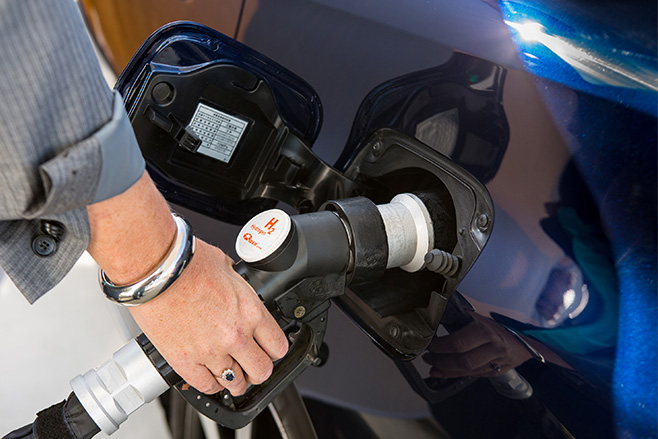
Like Hyundai, Toyota will need to bring its own refuelling station to Australia to allow the vehicles to operate on our roads. The carmaker says its mobile refueller will have the ability to be ground mounted – Hyundai’s is a fixed station at the company’s Sydney headquarters.
Toyota said its hydrogen refuelling station was expected to arrive in Australia late this year.
The Mirai’s introduction to Australia follows last year’s first drive of the Mirai at Toyota’s Lexus proving ground, located on the fringe of Fuji International Speedway.
“After having a taste of the technology last October, we are incredibly excited to have not one, but three of the fuel cell vehicles back in Australia,” Mr Buttner said.“We are looking forward to educating a whole new audience on this future technology and generating more awareness of fuel cell vehicles.”
The Mirai is Toyota’s first production fuel cell vehicle. It’s currently sold in markets outside Australia including the US, Japan Denmark, Germany, Belgium, and Norway. There’s a right-hand-drive model available now in Great Britain; a significant sign that Australia is high on the Mirai’s radar.
According to Toyota, Great Britain – which is about the same size as Victoria – has three hydrogen refuelling stations all located in London, with three more planned. The carmaker says British owners who lease the Mirai can refuel for free, but those who buy the vehicle will spend about $80 to top it up.
Unlike a short-range battery-powered car, Toyota’s hydrogen fuel cell-powered Mirai can travel about the same distance as a conventionally-engined vehicle – about 650 kilometres – before needing a refuel.
In contrast, Hyundai’s fuel cell ix35 has a range of about 600 kilometres. However, because Hyundai’s current refuelling infrastructure runs at a much lower pressure, the Korean carmaker can only part-fill the SUV’s tank, halving its real-world range.
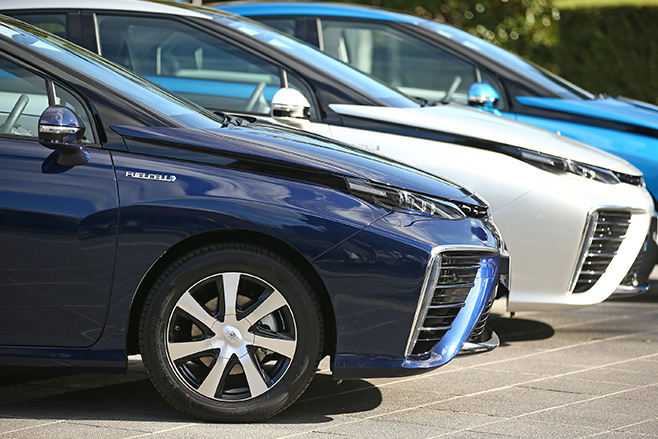
Toyota said it would display the Mirai vehicles at various conferences and events.
Hydrogen fuel cells mix hydrogen fuel with oxygen from the air to produce electricity and water. The electricity is used to power a 113kW motor – about the same as a conventionally-engined sedan of the same size.
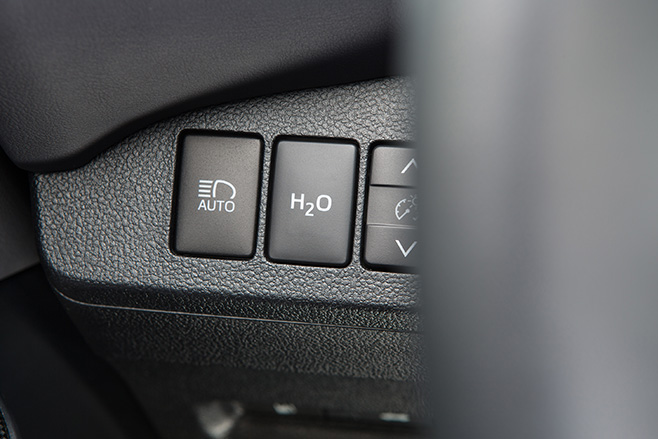
Toyota’s Mirai collects most of the water it generates on-board, with some evaporating as steam. Drivers can use a dash-mounted “H2O” button to dump the water on the road before they turn into the driveway.
