
Firstly, if you haven’t seen the end of the 2016 Le Mans 24 Hour, take the time to watch the video above before you read on.
The 84th running of the French endurance classic was just that, a classic, destined to be remembered and discussed for decades to come. Here are nine things we learned from this year’s race.
1. Motorsport can be very, very cruel
It’s impossible to imagine how everyone involved in the Toyota effort felt as the No. 5 car ground to a halt on the very last lap.
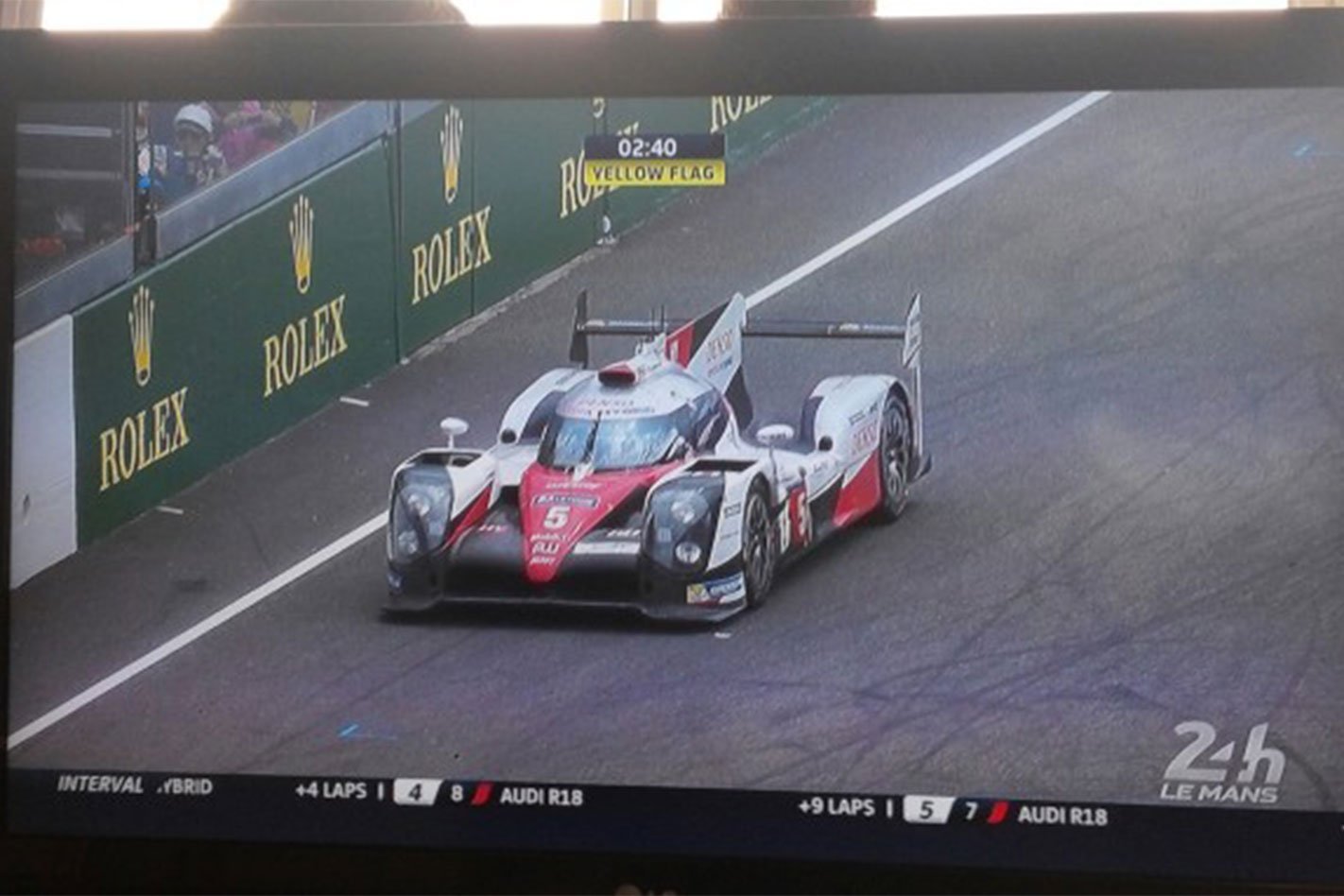
2. But also heartwarming
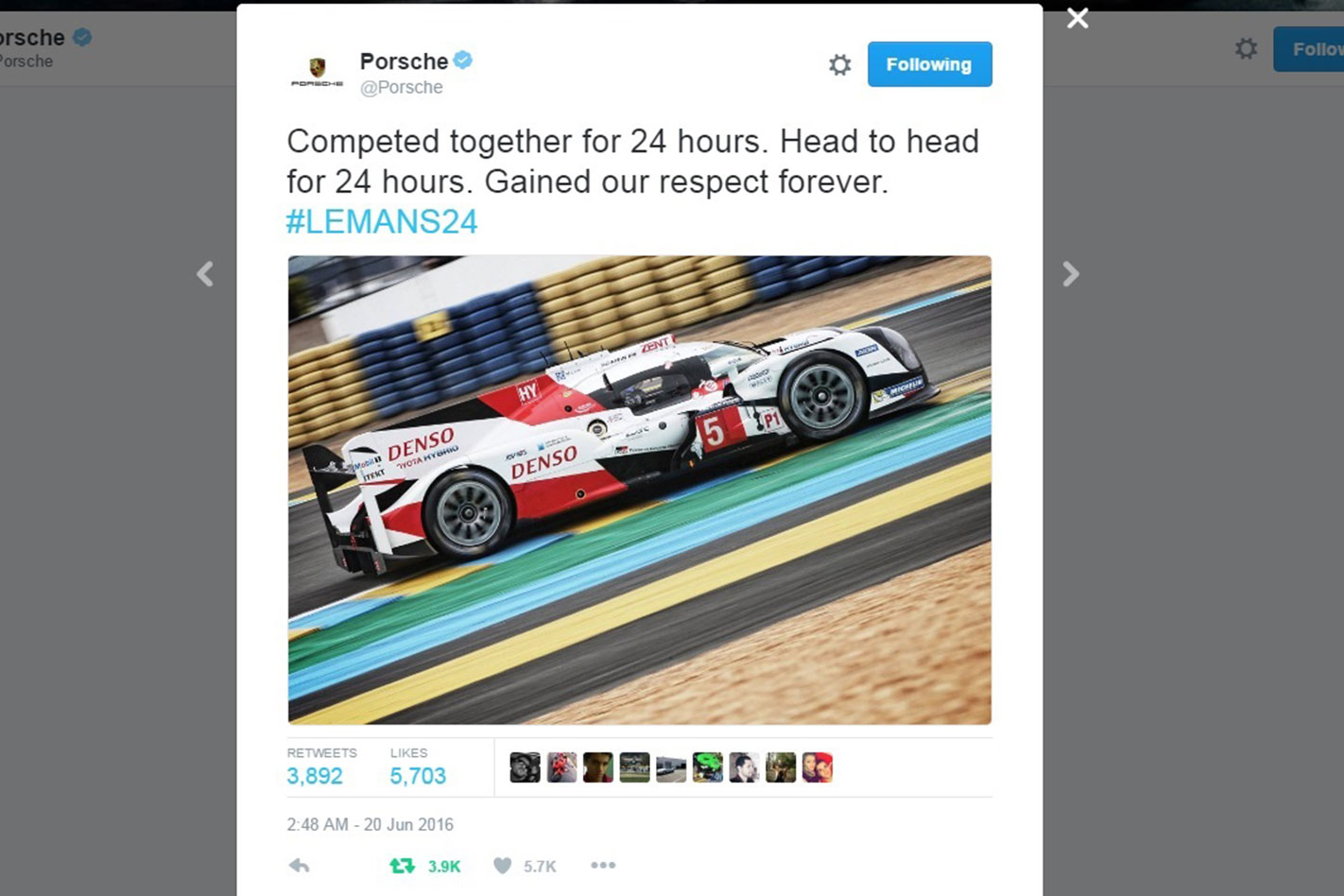
It’s easy to be magnanimous in victory, but Porsche’s response to its rival’s misfortune was very classy and speaks volume for the camaraderie that still exists in sports car racing.
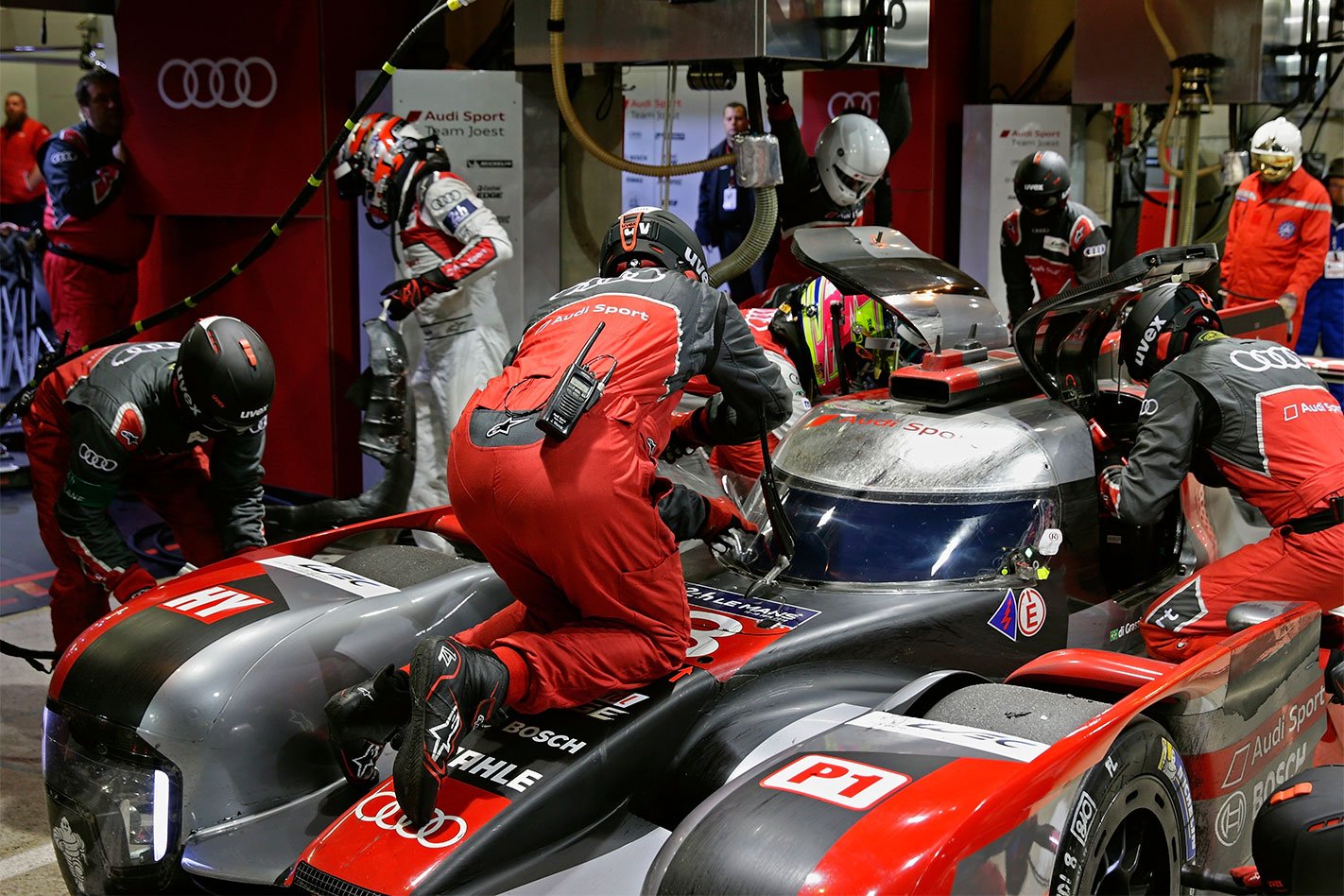
Audi has been utterly dominant at Le Mans, winning 13 of the 15 races between 2000-2014, however its struggles this year illustrate that every year is a clean slate.
4. The LMP1 regulations work
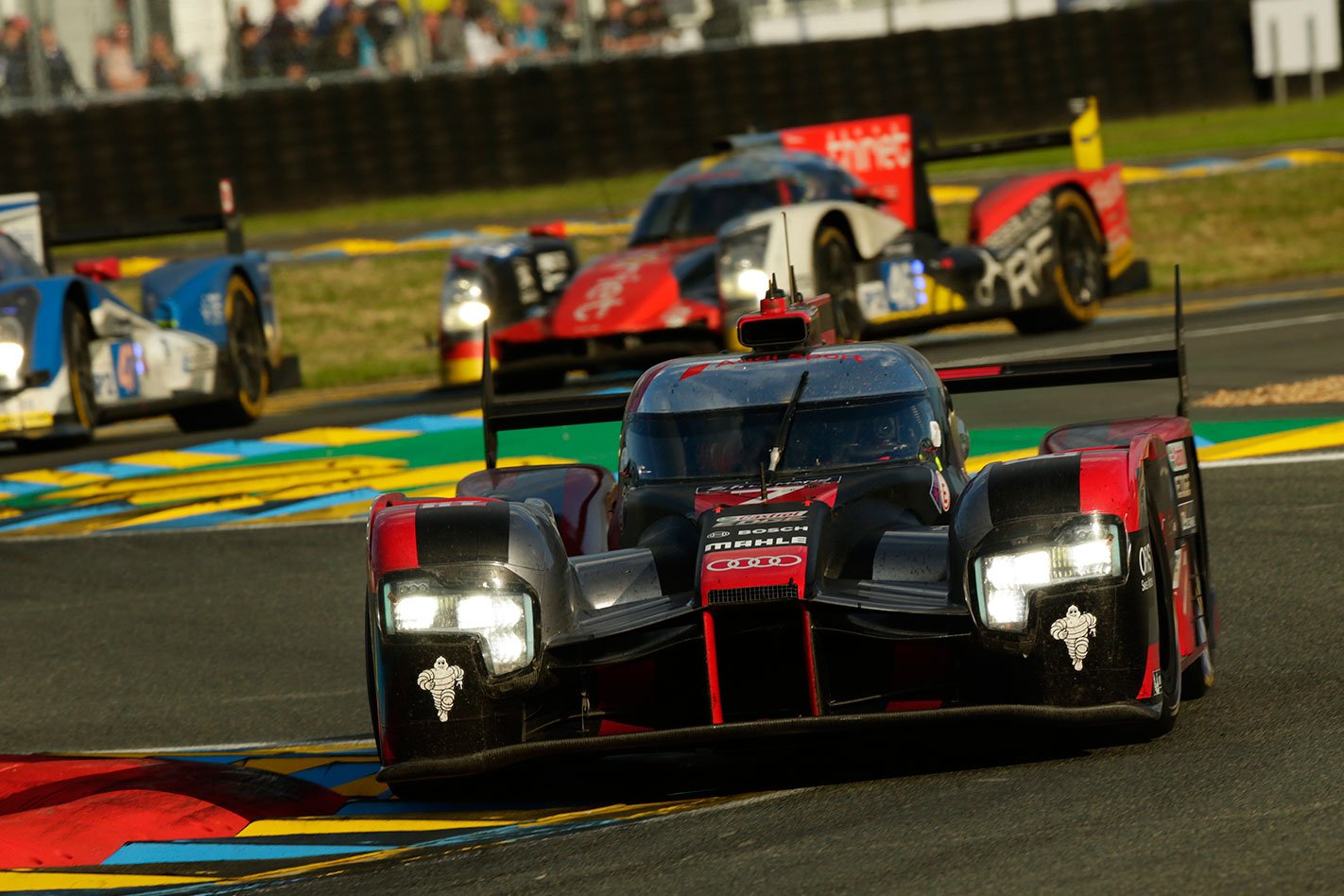
The success of sports car racing has ebbed and flowed over the years as different sets of regulations have come and gone but the current regs work a treat.
5. And so do the GTE regulations…sort of
This year resulted in another incredible battle in the GTE-Pro class between the new Ford GTs and the privateer Ferrari 488 entry of Risi Competizione, though somewhat farcically it ended with the first and second-placed cars protesting one another.
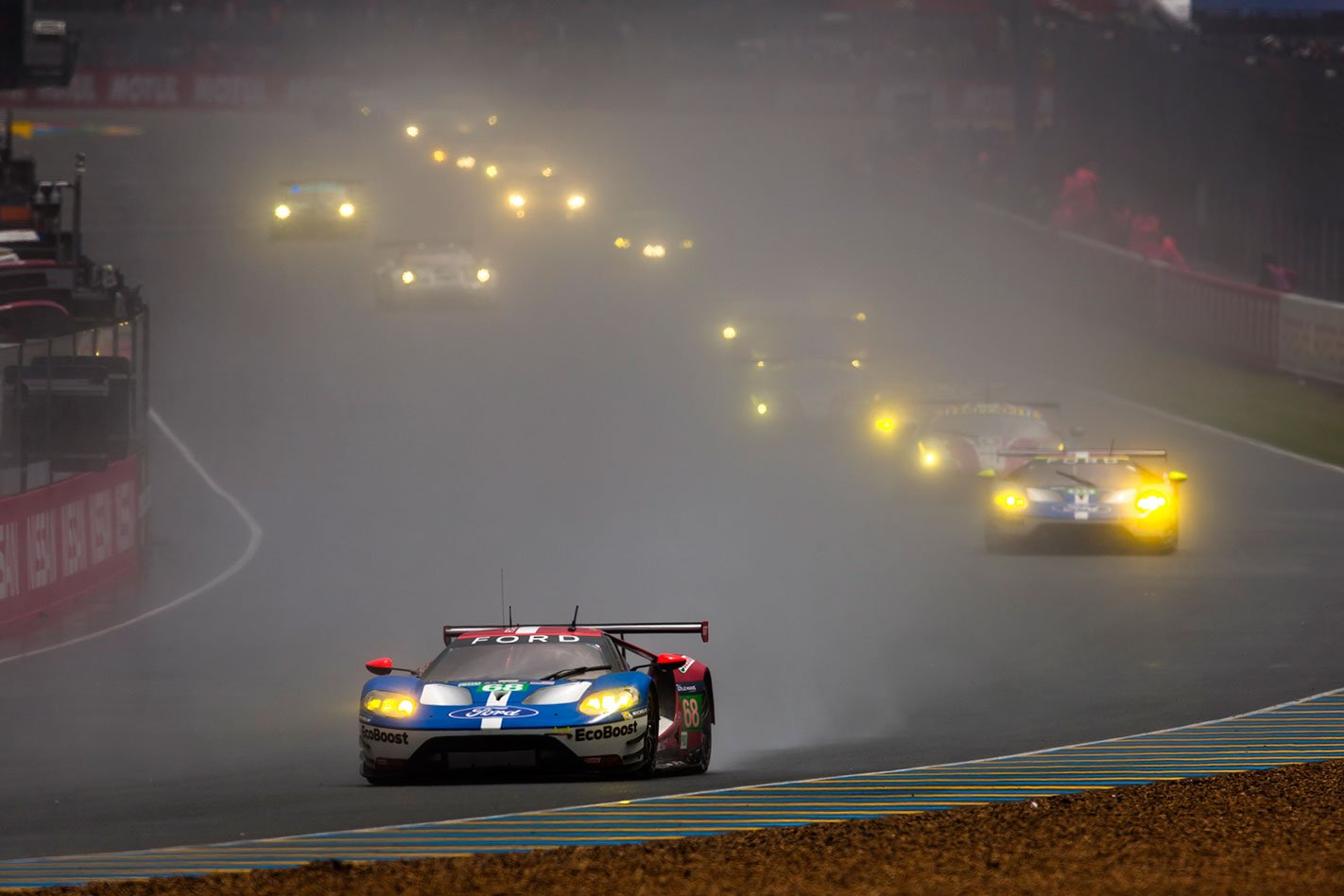
6. A supercar is faster than a GT car
Those last-minute adjustments were required when the Ford GTs went almost five seconds faster in qualifying than they had during the Le Mans test day, leaving their Porsche, Aston Martin and Chevrolet opposition miles off the pace and almost reducing Porsche’s motorsport boss to tears on the eve of the race.
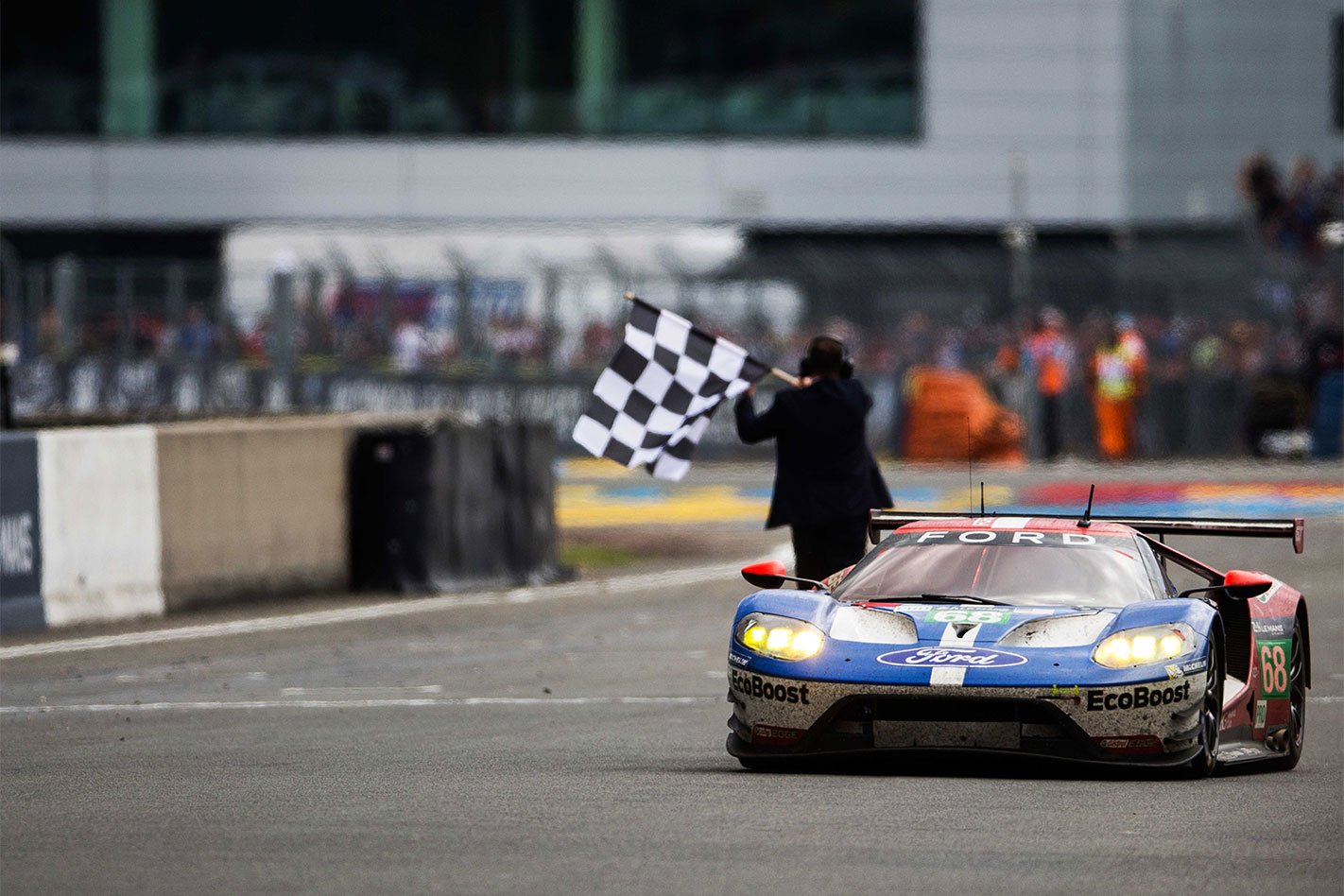
With mission accomplished and the good news story written, it will be interesting to see how the FIA responds to the speed of the Ford next year.
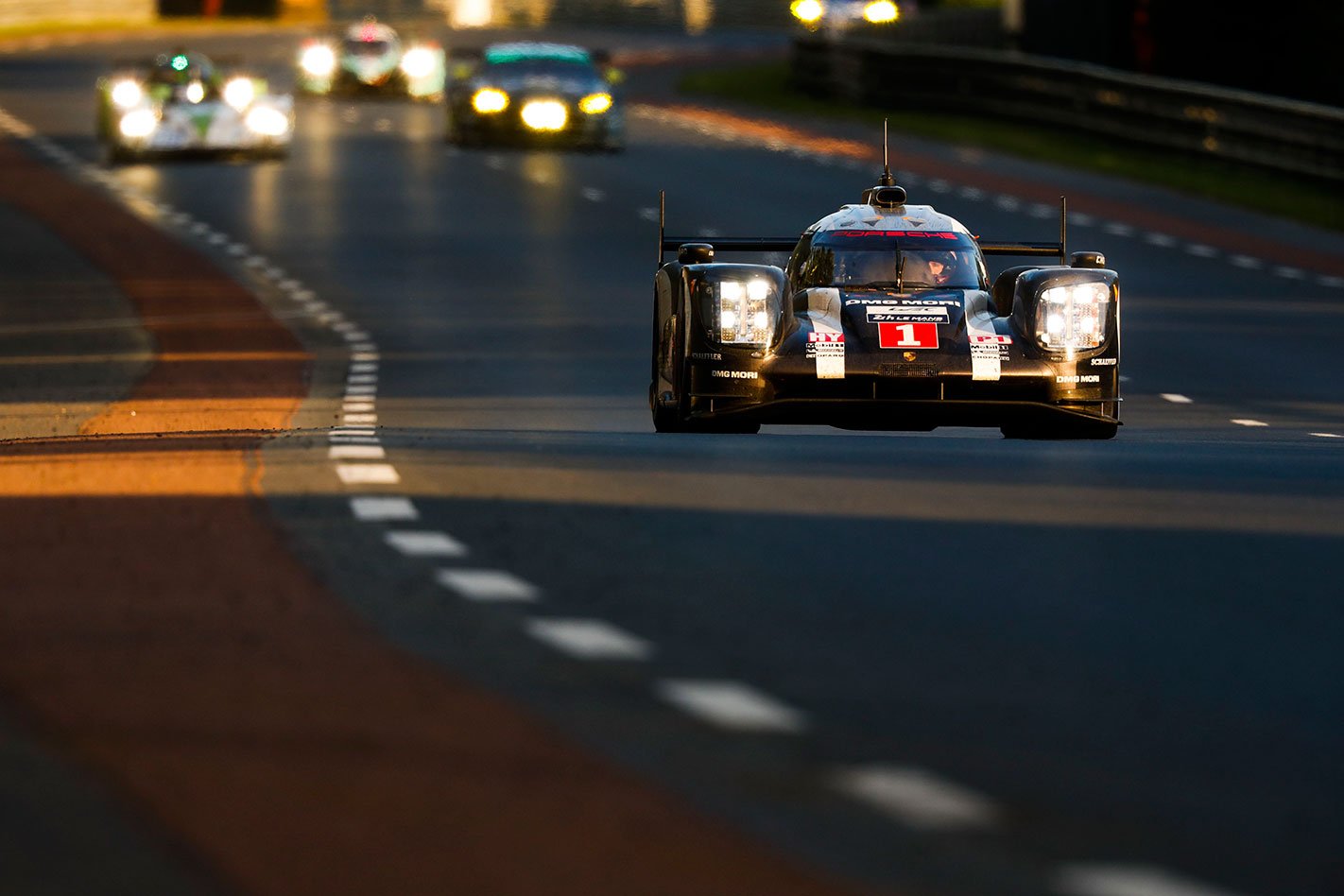
7. The speed of LMP1 is unbelievable
Now that Toyota has switched from a naturally-aspirated V8 to a twin-turbo V6, none of the top-tier LMP1 cars are particularly pleasing to the ears, but that doesn’t mean they aren’t spectacular.
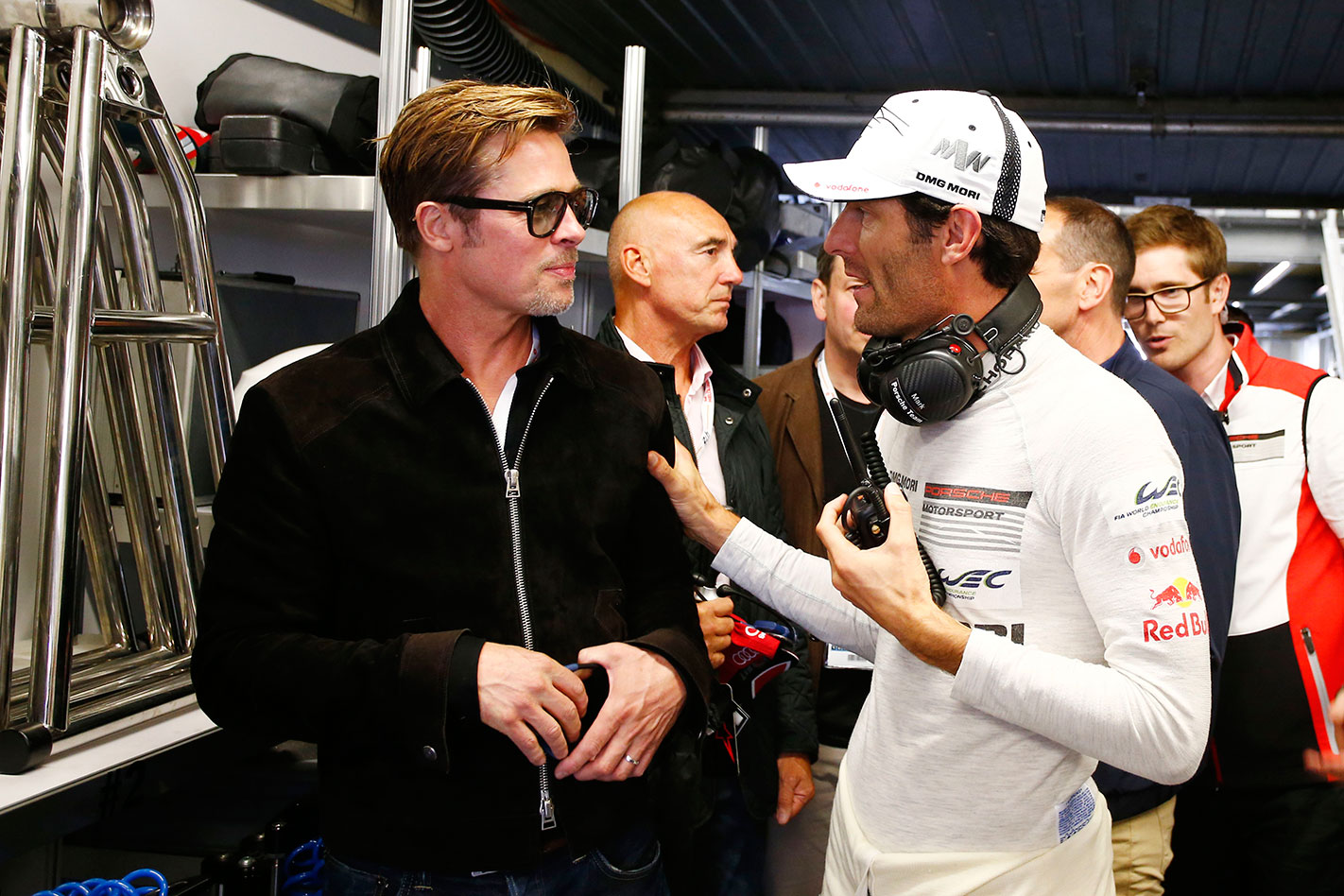
8. The driver line-up is incredible
The manufacturer LMP1 teams are dominated by ex-F1 drivers such as Mark Webber, Anthony Davidson and Kamui Kobayashi, but the depth of talent throughout the entire field is amazing.
9. Le Mans is hugely important for manufacturers
The manufacturers racing at Le Mans spend up big, with massive corporate hospitality, purpose-built trackside hotels and special events to keep VIPs entertained.
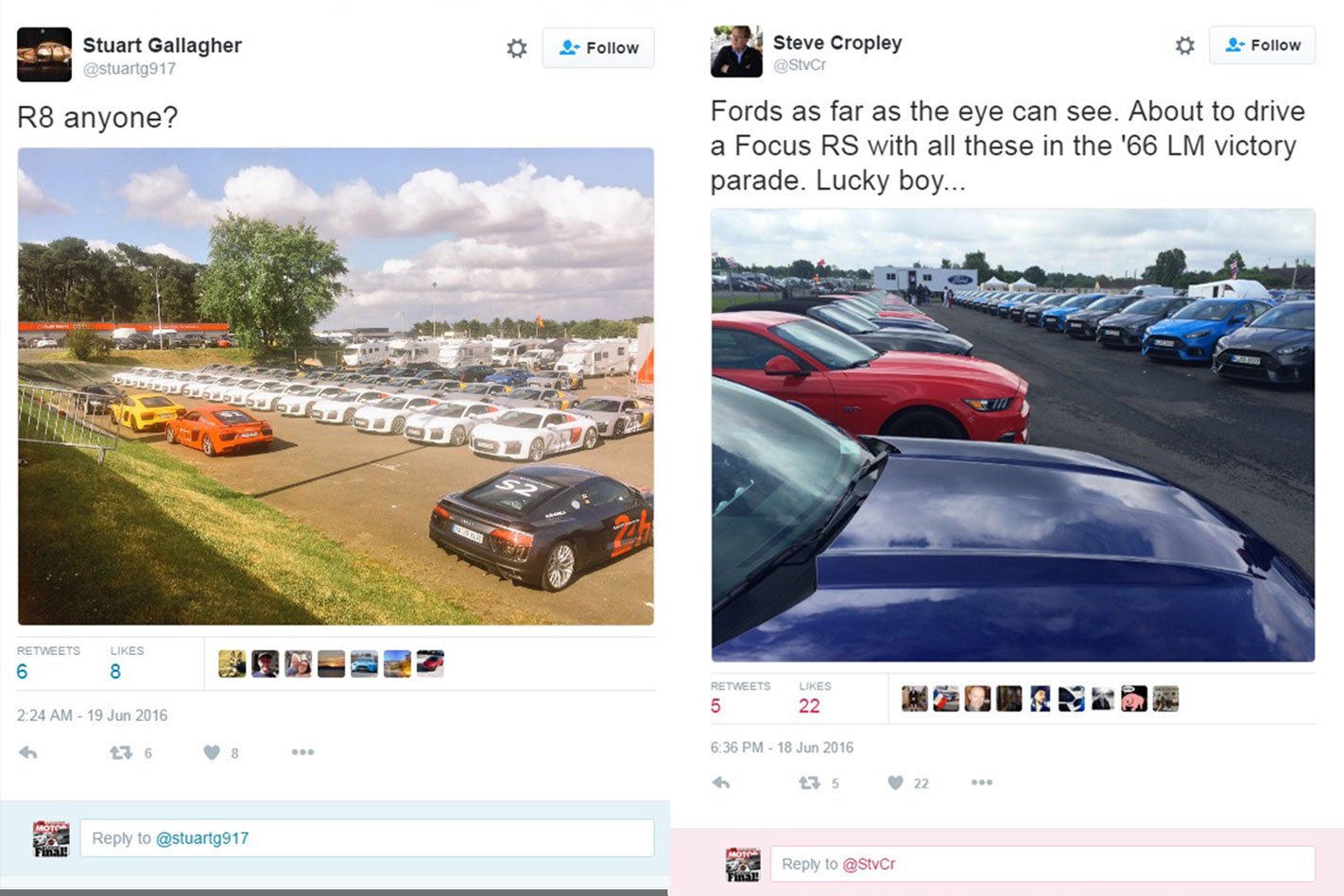
- It has a spine made from carbonfibre and aluminium to keep weight down and increase structural rigidity. Almost 80 percent of the Audi R8 is made from lightweight aluminium, while carbonfibre is used on the centre tunnel, rear wall and b-pillars.
- It’s a big seller. Well, kind of. Over 400 examples of the original R8 were sold in Australia since its launch in 2007, which in the world of supercars, is mighty impressive.
- It generates real downforce. 140kg of the stuff to be precise. 40kg of this is felt over the front axle at the R8’s 330km/h top speed, while that fixed carbonfibre rear wing on range-topping V10 Plus models accounts for 100kg.
- It might be a German supercar, but it has the beating heart of an Italian. Audi is part of the Volkswagen Group, which also owns Lamborghini, and the R8’s 5.2-litre V10 engine is lifted straight from the Lamborghini Huracan. In fact, Audi engineers admit that 98 percent of the R8’s mechanical package is shared with the Huracan.
- The V10 is also virtually identical to the one used in Audi’s hardcore R8 GT3 racing car. The only differences are found in the racecar’s manifold and air restrictor.
- Oh, and if you’re wondering how much a V10 engine weighs, the road-going R8’s hits the scales at 257kg.
- The V10 is clever too. Under light loads it can shut down half its cylinders to save fuel.
- You can even use it for carrying stuff. Yep, the R8 has a 112 litre boot in its nose and 226 litres of storage hidden behind its seats. Audi says the space behind the pews is big enough to swallow a golf bag.
- There’s no longer a V8 version. Or a manual! The old R8 had an entry-level model powered by a V8 engine, but Audi has dropped it in favour of a two-tier, all-V10 range. And if you’re a lover of manual gearboxes, best you look elsewhere. Every R8 is now fitted with a seven-speed dual-clutch automatic.
Three time Le Mans winner, former F1 driver and protégé of Sir Jackie Stewart talks about victory, and explains why Webber is among his favourites.
Allan McNish knows intimately the euphoric highs and crushing lows of the Le Mans 24 Hour. Three victories to his name – most recently in 2013 – and one almighty shunt in 2011 have dealt McNish the full gamut of emotions at the infamously unforgiving circuit. We sat down with the Scotsman to find out more.
Allan, what does it mean to win at Le Mans?
“The first time I won Le Mans I’d not got a clue what it meant – absolutely zero – until I stood up on that podium. On the grandstand, on the pit lane and on the track there’s probably 50 or 60 thousand people there. You realise that it’s a huge deal. Partly because suddenly the pressure is off. You’ve done it.
“I instantly had opportunities to do other things. There was a Formula One opportunity that came out of it within the space of about a month. Winning Le Mans puts you on a worldwide pedestal that you were not on before. That was the first time I realised the power of Le Mans in global motorsport.”
Are you the only driver to have driven for all three current works teams: Audi, Porsche and Toyota?
“I think so. And actually it was within three years. ’98 was Porsche, ’99 was Toyota and then 2000 I was at Audi. I’ve got quite a stock of team jackets!”
You’re an Audi ambassador now, but is there a part of you that would smile to see the Toyota win after so many attempts and such heartbreak?
“Clearly we want to beat them. There’s no question about that. But at the same time there are people in that Toyota garage who were in the program back then with me. The chief designer now was part of the program, and he was also one I worked with in the Formula One program all the way through.
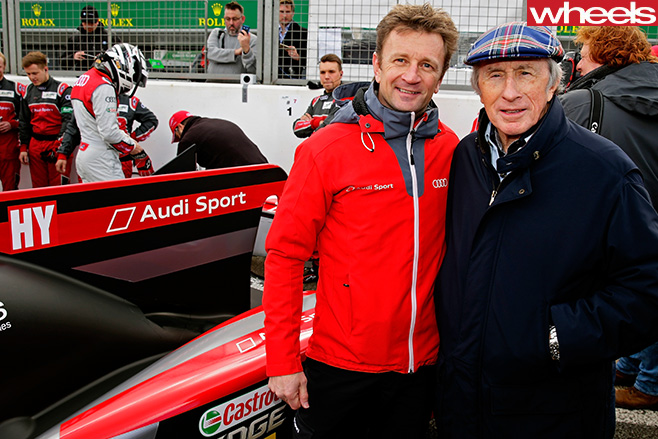
“With regard to Porsche it’s a similar sort of thing. Last year when they won it was like a passing of a baton in a bizarre way, because I had won the previous one for them, which was 16 years before. There was a lot of me at Porsche because they were the ones that gave me the opportunity. They took a risk. Toyota took a risk in a way but they knew they were buying a Le Mans winner. Whereas with Porsche they basically took a risk on a young kid from Scotland.
“Now Audi I’ve been with for 16 years and they’ve brought me Le Mans wins, three American Le Mans series, four Sebrings, three American championships, four Petit Le Mans, and a world championship. So I suppose when I put all of that together, the success and everything else, time and memories, we want to beat the other two – like mad.”
From a driver’s perspective, why is Le Mans held in such high regard?
“It’s the fastest circuit you go to. It’s so arduous in terms of the actual track layout, the bumps, the cambers and the tramlines as you come down and into Mulsanne. The Porsche curves are some of the biggest balls corners in the world. It does demand a lot out of the driver mentally, physically and emotionally. Never mind the fact that there’s just so much passion and emotion about the place because of the fans.
“Then you’ve got the tradition, like the parade on the Friday night, that’s got to be done, and that’s got to be preserved as well. It’s all of these different facets that bring it together and just make it pretty special.
“Part of it is you don’t appreciate it until you get here. You can’t work it out. Nico Hulkenberg was perfect last year because he just had his jaw open.”
What changes have you seen with the recent growth of sports car racing?
“Now there’s a lot of young drivers that are looking at it as their career choice, and not Formula One. Part of it is due to the fact the costs [in F1] are so prohibitive. They see the chances as basically 0.0001, and here [sports car racing] they see much more opportunity.
“The cars in terms of technology, in terms of the drivability and what the driver gets as enjoyment back out of it, without a doubt it’s at that level. Drivers are looking at it as a different career choice and that’s why you’re seeing a lot of new, young drivers that are coming in here that – to be honest – if it were a different era, would’ve been sitting on a Formula One grid.”
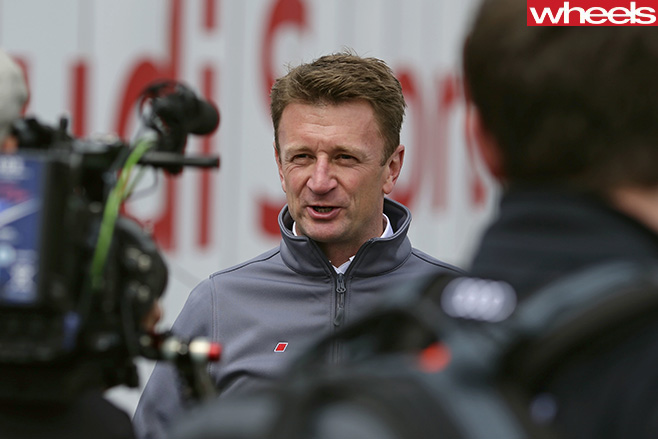
“Spa. No, actually, overall favourite racetrack is Suzuka. My three favourite tracks would be Spa, Suzuka and Mugello.”
What’s your best moment as a driver?
“Winning my first race at Morecambe in the north of England in 1982 as a little 12 year old kid – with scrappy, big long hair, dodgy haircut, the whole thing – because that gave me confidence to believe that I could actually do something. I’d never won anything in my life before.
“I was driving a Lane Arrow; a Lane chassis and Hewland, the gearbox company, made a little 100cc engine. It was powder blue this thing, and I was basically wearing 30 kilos of lead to get myself up to the weight limit of 105kg for kart and driver.”
What was your biggest crash?
“In 32 years you have a few. Most painful one was breaking my leg in 1984 in a kart. I did a bit of a cartwheel through a fence trying to overtake the leader around the outside on the last corner. It didn’t work.
“Biggest one in terms of severity and injury, that probably has to be Suzuka in Formula One, because after that one I had a big haematoma on my leg that took six months to go, and it was about a month before I was seeing straight again.”
How do you bounce back and manage to win, especially here at Le Mans, after an accident like yours?
“This place is tough because of the speed. I’ll tell you something, where it was down at the esses there, if you go to the 2012 race, I overtook someone around the outside at that exact point. There was a little bit of a mental battle. We took second that year and we won the next year. Yes it is tough but you’ve got to push your way through it and that’s the same with every accident. Every one that I ever had, whether they’re just going off into the grass or something like that, you’ve just got to mentally put it behind you and move on.”
Best road car you’ve ever owned?
“I’m the son of a car dealer so we never really had cars, they could be gone the next day. The first car I bought was the first RS4 in 2000 and unfortunately I had to sell that because I was driving for a Japanese team who weren’t very happy with it! And I’m so disappointed and annoyed I sold that bloody car! That nowadays would be stunning. I’ve had some corkers though. Favourite road car would be the [Audi] RS6 Plus – the V10. That was a hairy-chested car.”
What’s the best team of drivers in the championship right now?
“I would say one of them is Audi #7 because they’ve been together for seven years now, and I see the way they interact. They work like an old married couple – but in a triumvirate.
“The other one is Mark [Webber]’s team. I know Timo Bernhard very well and Mark is now up to speed having come from Formula One. They’ve all got their jobs and roles and they don’t cross over. Mark said something last year at the end of the season which I understand and agree with entirely: Timo is the gel. He bonds them together. [Dindo] Capello was that with Tom [Kristensen] and I. You always need that. You’ve got Brendon [Hartley] who’s the one who can fire it in and deliver that lap for pole position and then you’ve got somebody with the experience to drag it through and that’s Mark. That’s the two teams for me that stand out right now.”
Ford’s plans for the medium and large SUV segments have taken a little more shape with the confirmation that a rear-wheel drive version of its Toyota Prado-fighting Ford Everest model will be added to the range.
But the bigger news expected ‘imminently’ though, is confirmation that Ford’s Edge medium SUV will be coming to Australia later this year to replace the locally-built Territory – which ends production on October 7.
But with Edge only expected to be available in five-seat form, unlike the Ford Territory, offering a cheaper version of the seven seat Everest make sense. Only it kinda doesn’t…
That’s because Ford has decided to drop the front drive shafts out of the mid-spec $60,990 Trend rather than the entry-level $54,990 Ambiente.
Result? The new model has a manufacturer’s list price of $55,990 – $1000 more than the entry-level all-wheel drive Ambiente. Mind you Ford has sweetened the deal by upgrading 2017 Everest Trend and top-spec Titanium with the latest SYNC in-car infotainment system, which includes Apple CarPlay and Android Auto.
Other spec of the Ford Ranger-based Aussie-developed SUV, like the 3.2-litre five-cylinder turbo-diesel, six-speed auto and 3000kg brakes towing capacity remains the same.
So why not offer a RWD Ambiente and push the pricing down to around $50,000?
“It was about what customers were telling us about where they felt 4×2 fitted,” Ford Australia president Graeme Whickman responded. “It’s also about where we are seeing the predominance of model sales as well.
“It seemed to be a natural start point.”
But the next point is Edge (does a point have an edge? Oh well). Once a left-hand drive only proposition, Edge is now a global model thanks to the One Ford product philosophy that has already brought Mustang to local showrooms.
Nearly 4.8m long and rolling on a 2.85m wheelbase, the Edge is offered with 2.0-litre turbo-petrol and diesel engines and 2.7- and 3.5-litre V6 turbo-petrol engines depending on the market.
“Territory replacement discussion is not far away,” a cautious Whickman conceded. “Imminent I would suggest … We have previously disclosed we would have a Territory replacement as early as late 2016.”
One thing Whickman did confirm was using the name Edge could be an issue in Australia because Toyota has the rights to the name and has used it for a series of limited editions.
“There is a bit of speculation around its name,” Whickman said. “I believe Toyota have the rights to the name Edge so we will work our way through some of the nomenclature in the background.”
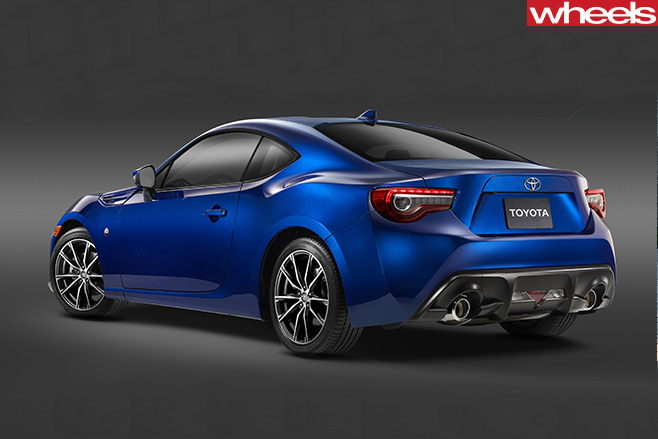
TOYOTA will switch to hybrid power for its next-generation 86 sports car and upcoming high-performance Supra revival.
The Japanese carmaker is already well advanced in the development of batteries and electric motors for its soon-to-expand sports car range.
Insiders tell Wheels the company is confident it can deliver performance gains and meet stricter emissions standards being phased in across the US and Europe by the end of the decade.
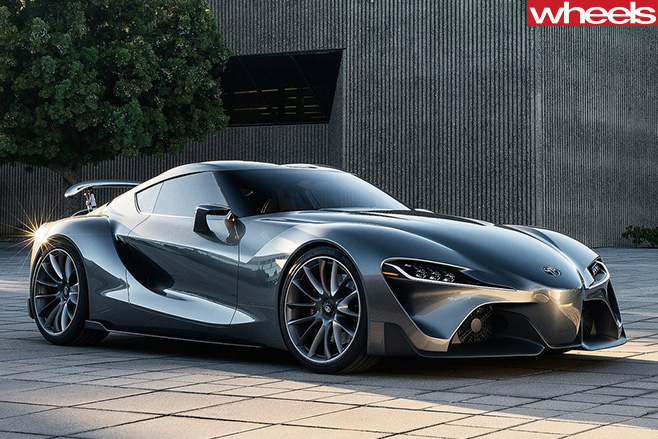
First out of the blocks will be the new Supra, due in 2018. Previewed as the FT-1 Concept at the 2014 Detroit motor show, and later presented in striking grey (pictured below) at Monterey in August the same year, the Supra production car will feature V6 power as well as an optional hybrid drivetrain.
Combined outputs of more than 300kW is anticipated – and needed if the Supra is to meet Toyota product guru Tetsuya Tada’s goal of challenging the Porsche 911.
Wheels’ spies tell us the Supra hybrid system will feature plug-in capability, with up to 50km of driving on electric power alone.
But the only affordable hybrid sports car – Honda’s CR-Z – failed to sell, something no doubt weighing on the minds of Japanese engineers keen to ensure the 86’s lightweight, fun-to-drive and affordable philosophy isn’t lost.
Helping the hybrid charge, so to speak, is Toyota’s commitment to deliver a hybrid version of every model in its line-up by 2029.
The advance of battery and charging technology is also making electrified drivetrains more appealing – both to bean-counters and engineers.
Carmakers are finding that hybrid-petrol powertrains are a financially viable way to reach new emissions regulations, including the 95g/km CO2 target for passenger cars in Europe – an average of 3.8L/100km.
Toyota is already well advanced on fuel-saving hybrids – the Prius and its brethren lead the way, while the Camry Hybrid and upcoming Corolla Hybrid back it up.
But a high-performance hybrid is new to a brand often accused of delivering dull transport.
Toyota 86 program manager Tetsuya Tada told Wheels hybrid testing is well advanced, but hinted that any petrol-electric tech would need to be very different to what’s currently seen in Toyota hybrids.
Company boss Akio Toyoda – a keen backer of the 86 and more exciting Toyotas generally – will no doubt keep a keen eye on the project to ensure it lives up to the “waku doki” thinking he is instilling on new models. (Waku doki translates as the anticipation of an adrenaline rush.)
Tada is also keen to ensure the 86 doesn’t meet the same fate as the Celica and MR2.
That means an all-new 86 might not appear before 2020, some eight years after the original.
“We have lots of ideas, but have just begun to think about the next 86,” he said. “We haven’t yet decided the details … what kind of engine we will use, or the body styling.”
That said, the well-received styling of the original – considered the best-looking Toyota since the 2000GT – will mean little more than an evolutionary approach for the second-generation 86.
Tada says he is constantly asked by owners “not to change the 86 at all”. An equal number call for performance to be more “vivid”.
“It is easy to put on a turbo, but many 86 fans would not be so pleased. People are very passionate. We want to surprise them.”
A hybrid would certainly do that, especially to younger buyers typically more interested in connectivity and technology over cubic capacity and turbos.
The new version of the Volkswagen Tiguan will be offered with more choices and more standard equipment, as it chases a bigger slice of the popular compact-SUV market.
Volkswagen Australia isn’t revealing pricing ahead of the model’s September release, though it has confirmed the second-generation Tiguan will be available with five engine options, and three trim levels.
The engine choices are determined by which of the trim grades are chosen, with all but the 110TSI variant featuring VW’s 4Motion all-wheel-drive system.
TRENDLINE
Volkswagen’s entry-level Tiguan is offered only with a 110kW four-cylinder 1.4-litre turbo petrol engine, which can be paired with the only manual gearbox in the range or a DSG auto.
This 110TSI model sits on 17-inch alloy wheels as standard and features: LED tail-lights; cruise control; auto headlights; rain-sensing wipers; leather multi-function steering wheel and an 8-inch infotainment display.
COMFORTLINE
In addition to the aforementioned front-wheel-drive 110TSI but with DSG auto only, the Tiguan Comfortline will also be available with a 110kW 2.0-litre turbo diesel (110TDI) or 132kW 2.0-litre turbo petrol (132TSI) – both with 4Motion.
The 4Motion system comes with a Driving Profile selector for changeable road surfaces, while convenience features include three-zone climate control, navigation, and multi-function colour display.
Practicality is enhanced by folding tables on the back of the front seats, storage drawers under the front seats, extended roof storage console, chrome roof rails, and a luggage floor net.
The Tiguan Comfortline exterior gains foglights and chrome window surrounds.
HIGHLINE
The range-topping Tiguan Highline is powered either by a 140kW 2.0-litre turbo diesel (140TDI) or 162kW 2.0-litre turbo petrol (162TSI).
A lengthy list of additional features over other trim levels includes: Vienna leather upholstery; electric driver’s seat; ambient lighting; keyless entry; tinted side and rear windows; “comfort sports” seats with heating; 18-inch alloy wheels; electric tailgate operation and LED headlights with cornering function.
There are also a number of option packages being offered, depending on spec level.
Volkswagen Australia says it will confirm pricing closer to the Tiguan’s launch in September. The model is currently priced between $28,990 and $44,990.
The Peugeot 3008 GT has been unveiled as the flagship of the French brand’s new SUV due in 2017.
It will be the first time the GT badge has been applied to the 3008, which is switching from an MPV-style vehicle to an SUV for its second-generation form.
Exclusive GT features start with the most powerful engine in the range – a 2.0-litre turbo diesel with 133kW of power and 400Nm of torque, and teamed with a six-speed auto.
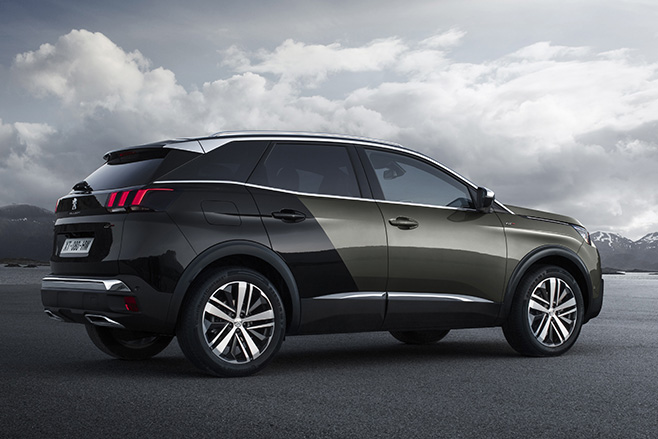
The GT will also be available with an optional ‘coupe-franche’ two-tone paintjob, which also appeared on Peugeot’s fast hot-hatches: the 208 GTi 30th Anniversary and 308 GTi 270.
There’s a sportier look to the GT’s exterior including exclusive 19-inch alloy wheels sitting under flared wheel-arches; stainless-steel roof trim, aluminium roof rails, plus sequential indicator lights.
Inside there’s a focus on elevated perceptions of quality with copper-coloured double stitching applied liberally throughout the cabin on areas including the dash, doors, armrests, steering wheel and floormats.
An aged-oak wood trim for the dash and door panels can also be added for additional cost.
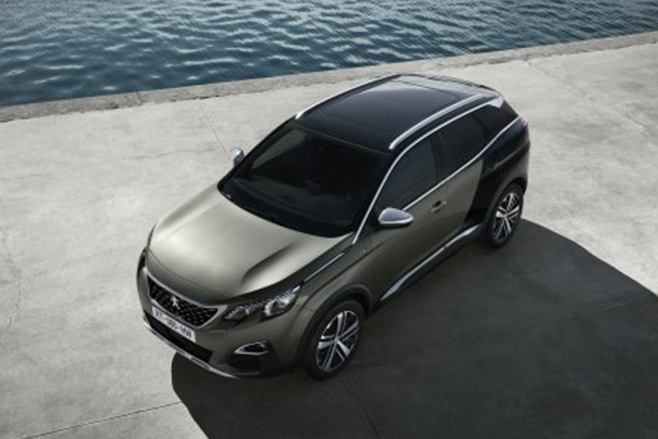
Buyers on a tighter budget can alternatively opt for a GT Line available for less-powered engines in the range.
The GT Line is a package of visual enhancements for Peugeot’s Mazda CX-5 rival, which on the exterior includes dual chrome tailpipes, “black diamond” roof, 18-inch two-tone alloy wheels, and the GT’s radiator grille.
On the inside, the GT Line brings some of the more upmarket elements of the GT such as the copper stitching and Alcantara seats (though not the optional Nappa leather upholstery).
Peugeot Australia says it is currently negotiating with its French HQ in regards to adding the GT and GT-Line to the local 3008 line-up, which will go on sale sometime in the first half of 2017.
Porsche’s new mid-engine sports car has fewer cylinders than its predecessor, and a turbo charger which changes its character significantly. So is that a good thing?
TELL ME ABOUT THIS CAR
It’s the latest version of Porsche’s mid-engined convertible sports car, now with more power and considerably more torque than its predecessor, all in one of the best-handling open-top packages on the market.
STRENGTHS
- New turbo-charged engine delivers plenty of immediate grunt from modest engine speeds, so you don’t need to rev it hard to make swift progress.
- A raft of chassis upgrades make a brilliant handling car even more dynamically gifted and engaging. From the steering, to the grip levels, to the seat-of-the-pants sensations, the Boxster is an utter pleasure to drive hard.
- Upgraded brakes provide massive stopping power, and are strong enough to withstand punishment on a racetrack
- The standard six-speed manual gearbox has a lovely oily, mechanical feel, and enhances the driver’s sense of connection with the car…
- … However the optional seven-speed dual-clutch transmission gives the car even faster acceleration, and is more economical when cruising because of the tall seventh ratio.
- Roof has a power folding mechanism that works at speeds up to 50km/h, and provides a snug, well-insulated cabin when it’s up.
- New interior feels much more premium than the car’s predecessor, and the touchscreen infotainment system incorporates the latest Apple CarPlay and Android Auto connectivity – allowing all of your phone’s functionality to be displayed and used in the car.
- New engine does not rev as hard as its predecessor, and some enthusiasts may miss that need to work the engine in its upper reaches to extract maximum performance
- The much-loved Porsche ‘yowl’ – the hollow, slightly frenzied noise the old engine made as it reached maximum revs – is gone.
- The sound the Boxster makes in much of its normal operating range is a bit tuneless and not especially engaging.
- Prices of both the base model and S have risen compared to their predecessors.
Jaguar’s F-Type convertible should not be ignored. It’s not quite as dynamically sharp as the Boxster, but its supercharged V6 sounds epic and gives the car great performance.
Audi’s TTS convertible has a gorgeous cabin and ample appeal, but its front-engine, all-wheel-drive layout can’t match the Boxster’s rear-drive, mid-engined balance and feedback. Mercedes’ forthcoming SLC could be worth a look, but is sure to be more of a sports cruiser than true sportscar.
Rosberg on top in Baku
Drivers on best behaviour in first-ever grand prix in Azerbaijan
There were predictions of wild racing on the unusual six kilometre, anticlockwise Baku track with 20 turns looping around the city’s historical centre, heralded as the fastest street circuit in the world. In parts it was as claustrophobic, and narrow, as Macau or Monaco – just eight metres across in Turn Eight.
Huge shunts and safety cars were inevitable, said the experts and the drivers.
Instead, what we got was some very precise driving from the supposed best drivers in the world. It was a largely uneventful European Grand Prix, back on the calendar after a four-year absence, and relocated to an all-new street circuit in capital city of oil-rich Azerbaijan. One of the more picturesque settings in Formula One racing, Baku is on the Caspian Sea, west of Turkey and north of Iran.
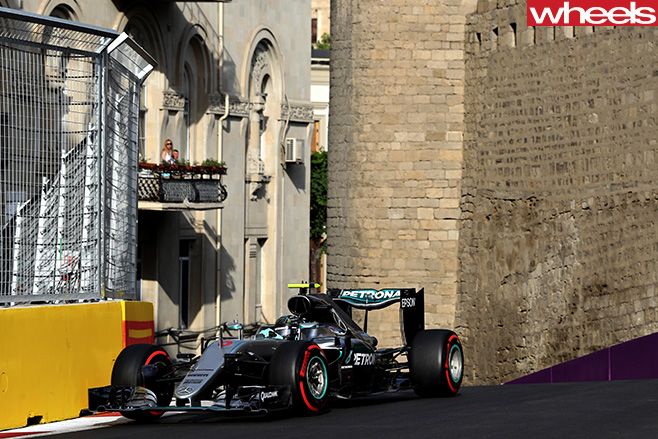
There were no crashes on race day; no interventions from safety cars.
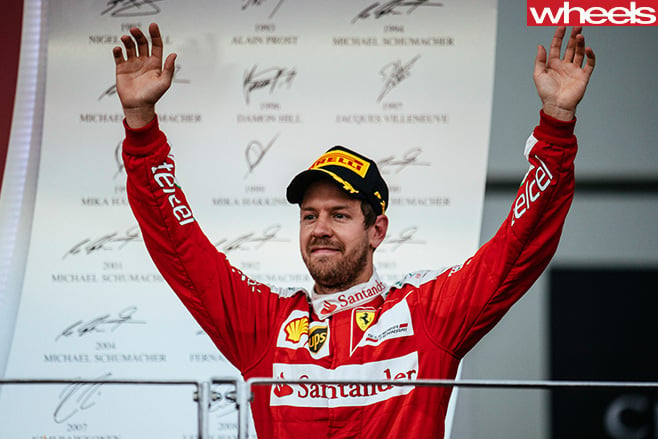
Mercedes’ Nico Rosberg took off from pole and dominated this 23rd European Grand Prix, round eight of the 21-round 2016 world championship, winning easily from the Ferrari of Sebastian Vettel and Force India’s Sergio Perez.
As is usually the case in every grand prix, it was all about the tyres.
For Baku, Pirelli made available the supersoft, soft and medium tyres. The teams went into the weekend using sophisticated simulations but with lots of guesswork and F1 knowledge for their particular rubber selections. But most teams were hoping to make just one stop.
Hamilton brushed the wall and damaged his steering, leaving him 10th on the grid. “There were no excuses: “I had fantastic rhythm yesterday and zero today.”
This left Rosberg was on pole with a margin, with Ricciardo uncorking another under-pressure stunner to be third quickest, thus maintaining his 100 per cent qualifying dominance at Red Bull this season. So with Perez’s unfortunate demotion, the Aussie would start on the outside of the front row. Sebastian Vettel lined-up third, with Kimi Raikkonen alongside.
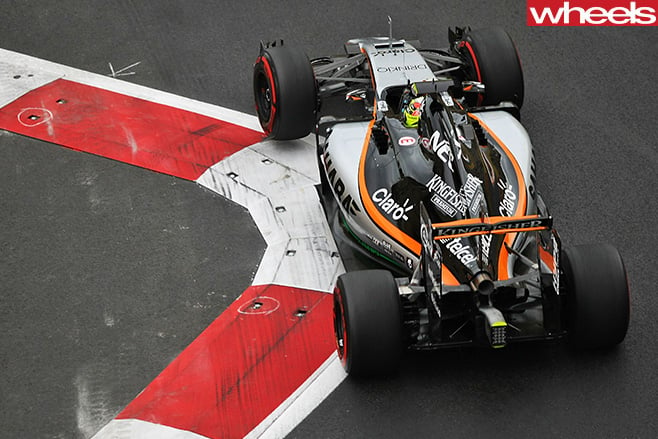
Race day was hot. Bloody hot.
Ricciardo made a great start to shadow Rosberg into the first turn, with Vettel, Raikonnen and Perez following. That was as close as anyone got to Rosberg.
The Mercs, Ferraris and Force Indias took good care of their tyres while the Red Bulls ate them in no time.
Just as obvious too was the speed of the Mercedes-engined cars on the long, bent straight. Conversely, the Renault-powered Red Bulls were often sitting ducks, although Ricciardo and Verstappen did overtake Nico Hulkenberg (Force India) late in the race.
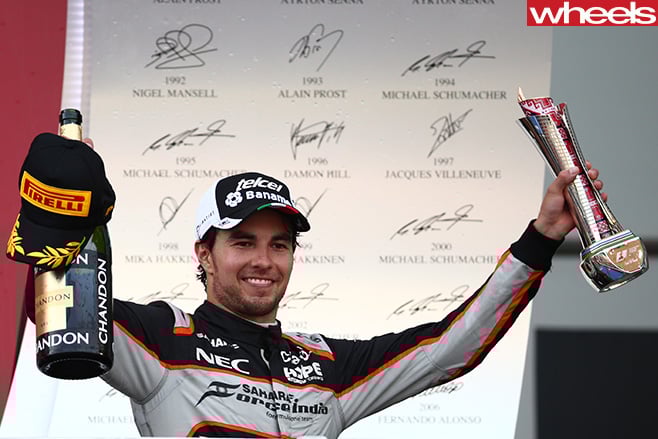
Perez put in another stirring drive, passing Raikkonen on the last lap (although Kimi had already incurred a five-second penalty for crossing the pit entry line) and would have been demoted to fourth anyway.
Hamilton’s GP, already compromised by his starting position, disintegrated when his dash lit up like Sydney Vivid. With coaching on the radio now banned, he was more than agitated as he attempted to restore some missing ERS (energy recovery system) power. The reigning champ finished fifth, ahead of Bottas in the Williams.
Hamilton now trails Rosberg by 24 points.
Caruso and van Gisbergen win in Darwin madhouse
Championship lead to Whincup as Frosty hit with TWO drive-throughs…
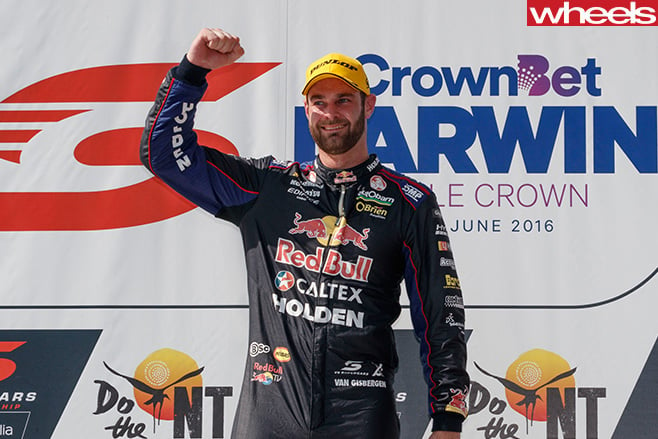
Saturday was wild; Sunday dissolved into utter chaos.
Saturday unleashed some hard fast action in the 34 degree heat, and the 10th winner from 12 races – a delighted Michael Caruso. It was his first win since he notched his initial victory in 2009, also in Darwin. And a handy win it was for Nissan, at a time when the Japanese brand is considering its future in the category.
Earlier, Shane van Gisbergen took his first pole of 2016, and first for Red Bull this season. From the outside of the front row, Caruso led into the first corner but a brouhaha involving a whole bunch of cars immediately brought out the safety car. A penalty for not respecting the safety car rules during the subsequent restart ruined van Gisbergen’s race.
Still, Caruso’s victory was due to genuine pace – he set the fastest lap of the race – and a lightning pit stop. Credit too goes to the team for its unrelenting development program to improve the Altimas.
Jamie Whincup pushed in his usual ten-tenths way to take second ahead of Chaz Mostert, Will Davison and Scott Pye.
The temperature cranked up on Sunday, and so did the madness.
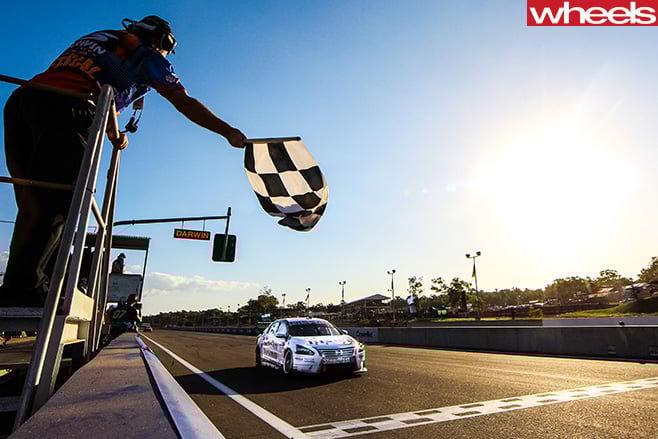
Todd Kelly, from an impressive position two, nailed the start, but then a few corners later came a melee that just kept evolving. Cars went everywhere, gyrating, hitting things, followed by a safety car and more mayhem in an overcrowded pitlane. At the restart, Lowndes gifted van Gisbergen the lead after a mistake while Kelly was rear-ended by Mark Winterbottom. The carnage just kept coming.
In the run to the flag, van Gisbergen was uncatchable while Slade continued his strong form to hold second from an ever-eager Lowndes. Then came Davison, an inspired James Courtney (from way back in the pack), Caruso, Scott McLaughlin, Whincup, Davy Reynolds and James Moffat.
Said van Gisbergen: “Yesterday we had a fast car and didn’t make the most of it, so today was awesome. We qualified on pole; we didn’t lead from the front but we managed what we had. It was exciting in pit lane for the first stop but the way we did that middle stint with Craig (Lowndes) was enjoyable. We were pushing hard and made a gap and in the last stint we came out in front which was a surprise and managed the tyres all the way. It was awesome to fight at the front all day and I’m stoked to get 150 points on the board.”
The battered Holdsworth broke his pelvis in the first lap wallbanger, and will miss the next round in Townsville. Other than the prominent non finishers Mostert, Pye and Fabian Coulthard, the big losers were defending champ Winterbottom who finished 20th after two drive through penalties, and Todd Kelly who was bumped back to 13th.
Whincup, despite a frustrating Sunday, now leads Lowndes by 30 points in the title hunt. Winterbottom has dropped to fourth behind McLaughlin.
Smart driving lands Ryan two wins in the International Rally of Queensland
Muddy fight in Australian Rally Championship
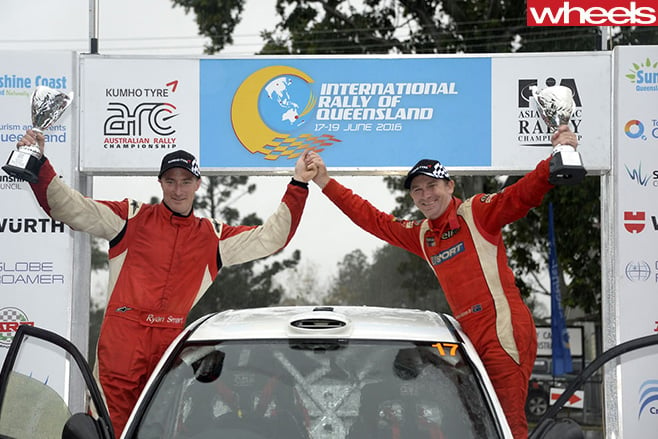
A fired-up Evans was the day’s excitement machine, bouncing back spectacularly after a broken suspension, a flat tyre and the strange time penalty, driving like a demon through Saturday’s slippery conditions, to finish fourth behind Ryan Smart (Mitsubishi Evo), Harry Bates (Toyota Corolla S2000) and Nathan Quinn (Evo). Remove that penalty and four-time champ Evans would have won heat one.
Smart finished among the top three in every stage to claim a 21.7 sec victory over Bates. Molly Taylor was fifth on Saturday in her near-production Subaru WRX STI.
An eventful heat two unfolded to a backdrop of torrential rain leading to shortened and cancelled stages and too many incidents, including Simon Evans rolling on SS11.
Smart eventually landed the double, beating Bates by 59.6secs.
Operating on a tight budget, Smart used just eight tyres for the entire event.
“To be honest I didn’t expect to be on the pace,” he remarked. “I haven’t done a rally in 18 months, and I had only done a quick shakedown of the car just before I started the rally. I wanted to come out and have some fun and see if I still had some pace.”
WA’s Tom Wilde took the final podium spot in a Subaru Impreza WRX STI, from Taylor and Quinn.
Youngsters Bates and Taylor are now provisionally first and second in the Australian Rally Championship.
Mawson wins two from three at Oschersleben
Schumacher and Aussie Mawson in torrid fight for German Formula 4 Championship
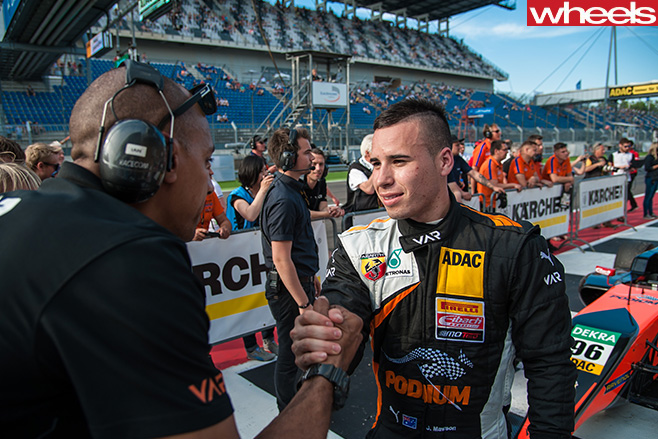
Mawson now has five wins and nine podium finishes from 12 races.
A non-finish in the final race was not ideal but Mawson nevertheless pushed out his championship lead over son-of-a-gun Mick Schumacher to 20 points.
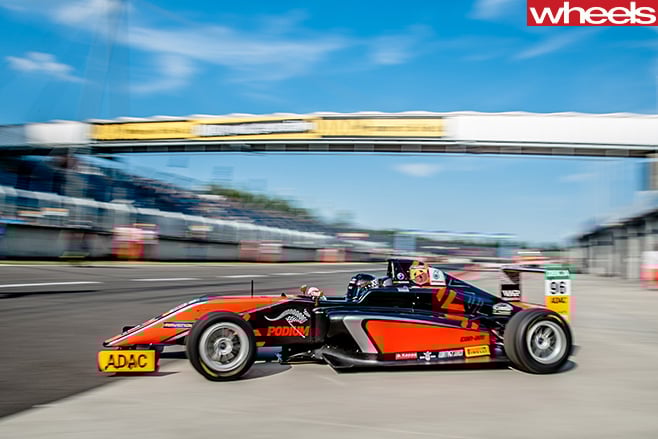
Race two was even better, Mawson leading from pole and controlling throughout.
But the third race was a very different story with Mawson starting from 10th on the grid. He made a good start but a tough with another car broke his front right wishbone, ending his charge prematurely.
THE Australian Competition and Consumer Commission announced it will undertake a study on new car retailers.
The independent watchdog says the new market study will focus on competition and consumer issues that may be present in the car retailing industry in Australia.
“A new car is a significant purchase for consumers and more than 1 million new cars are sold in Australia each year,” ACCC Chairman Rod Sims said.
“Consumer issues arising in relation to new car retailing is a priority area for the ACCC.”
The study will focus on four key areas: compliance with consumer guarantee obligations and the ability of consumers to enforce their rights; false, misleading and deceptive practices in performance, fuel efficiency, fuel consumption and emissions; the effect on competition and consumers of post-sale care arrangements (such as servicing); and whether consumers and businesses could be affected by any restrictions on vehicle access to data.
“The ACCC and other Australian Consumer Law agencies continue to receive a high volume of complaints from consumers about defects with vehicles, covering a broad spectrum of manufacturers,” Mr Sims added.
“Following the Fiat Chrysler Australia (Jeep) investigation, the ACCC is considering concerns about compliance with the consumer guarantee provisions in the motor vehicle industry more generally, and is looking at complaints and practices of specific brands.”
This study will also review industry practices, in order to assess in identifying risks to consumers and the competitive process.
The independent body will be calling on the general public to add to the study, as well as collecting data through surveys.
The results of the study are due to be released in the first quarter of 2017.
The ACCC is already investigating the car industry, including the Volkswagen ‘dieselgate’ emissions scandal.
The public can register to be contacted for the study at [email protected]
