
HSV’s will pinch exclusive bits from its range-topping GTS and paste them on its Clubsport R8 to celebrate its final fling with LS3 power.
After quietly exiting the model range late last year, the atmo 6.2-litre V8 will return to HSV’s R8 range and bring with it the fittest Gen-F Clubbie yet at a bargain price.
Dubbed the Track Edition, Clayton’s borrowed the GTS’s AP Racing brakes and larger wheels while also upgrading the exterior, interior, and tweaking the suspension to suit its new attitude.
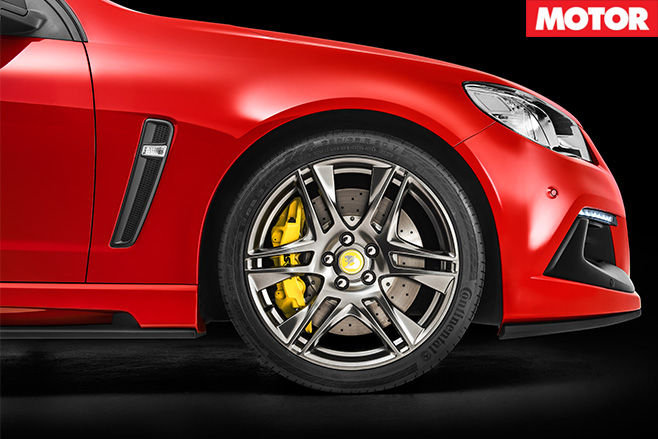
But while its brakes are from the range-topper, HSV hasn’t carried across the same torque vectoring technology. What are carried over are the 20-inch “Blade”-style wheels worn by the MY15 GTS, measuring 8.5 inches wide at the front and 9.5 inches at the rear.
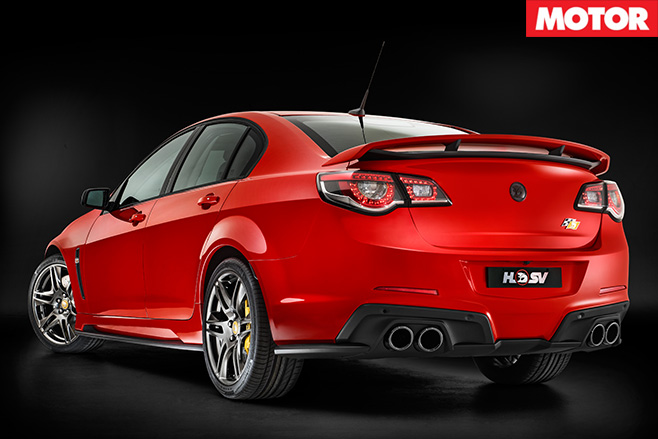
HSV’s picked through the parts bin for its styling too, as the Clubsport R8 LSA’s front-bar, side-skirts, black mirror coverings, rear spoiler, and rear bumper have been used for the atmo-special.
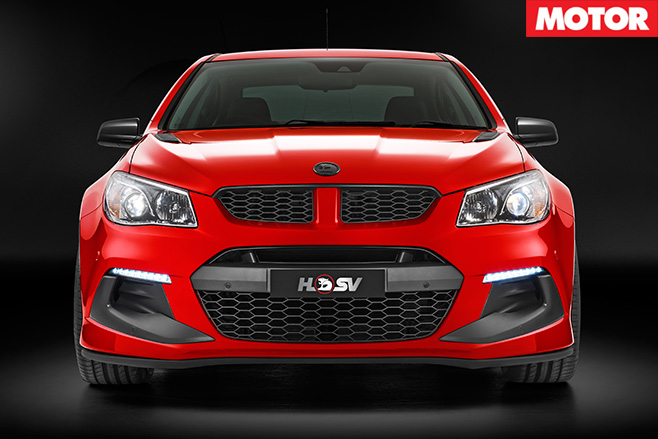
Considering the previous 340kW LS3 Clubsport R8 asked for $73,290 before it was axed, the Track Edition will arrive at a relative steal for $68,990 with a six-speed manual aboard.
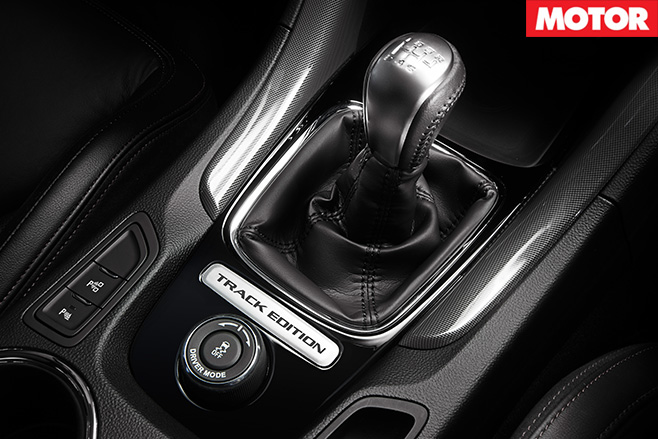
When the Track Edition hits dealers this September it’ll be joined by the Grange SV and Clubsport R8 Black limited editions in sending-off the LS3, which leaves HSV’s factory for good when the Grange finishes up in October.
HSV will kill off the long-wheelbase Grange this year as it gears up to send off the rest of the locally-produced Holden Commodore-based models late in 2017.
The last HSV to wear the Grange badge – the limited edition Grange SV – will be released in September 2016 and sold by October, 2016 to beat stricter emissions regulations that come into force in November.
Those hoping for more power – and the possibility of the 6.2-litre supercharged V8 (codenamed LSA) used in other HSVs – may be disappointed to hear the last Granges off the line will instead continue with the naturally-aspirated LS3 6.2-litre V8.
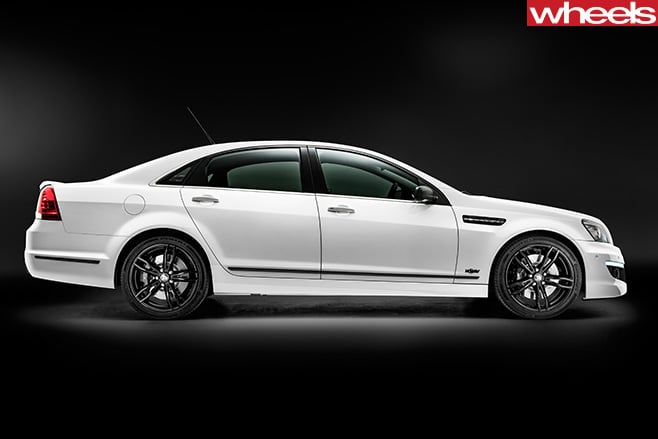
Much of the chrome and detailing outside has been replaced with a black finish; something HSV says gives it “attitude”.
There’s black upper and lower grille surrounds, black Rapier alloy wheels (previously an option, but without the black finish) and four-piston brake calipers painted black. Even the twin oval exhaust tips are finished in shadow chrome.

The Grange uses the same 340kW/570Nm 6.2-litre LS3 V8 used in recent years, but now picks up the mechanical sound enhancer developed by Holden to beef up the aural performance of the same basic engine used in V8-powered Commodores. Combined with the bi-modal exhaust it promises to create the most enticing V8 sound from an HSV for years.
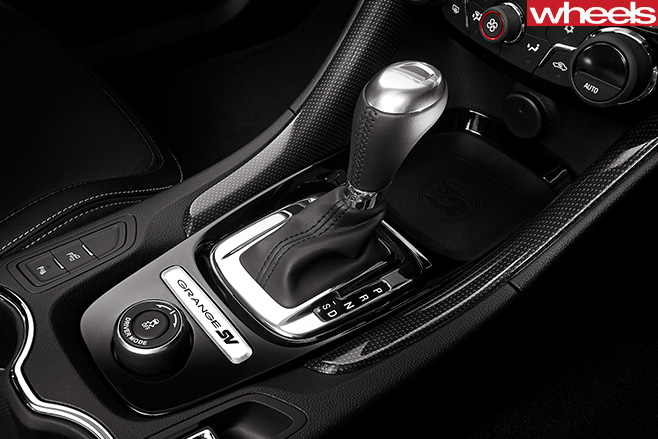
Just 50 Grange SVs will be produced, each with various trim and colour tweaks designed as a “tribute to celebrate the 20th anniversary” of the Grange nameplate.

HSV managing director Tim Jackson says the end of the Grange line after two decades will represent the end of an era for a company that only began in 1987.
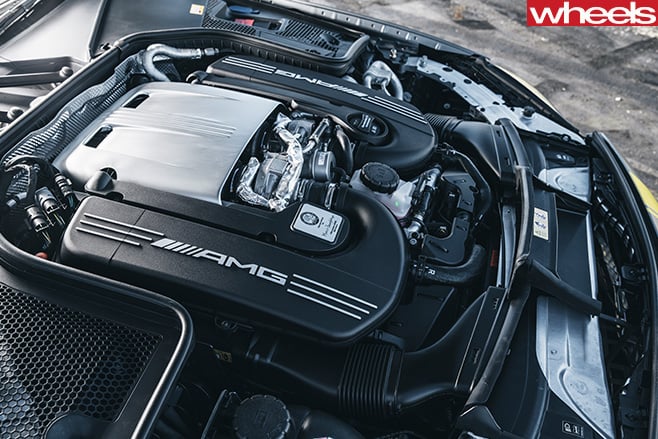
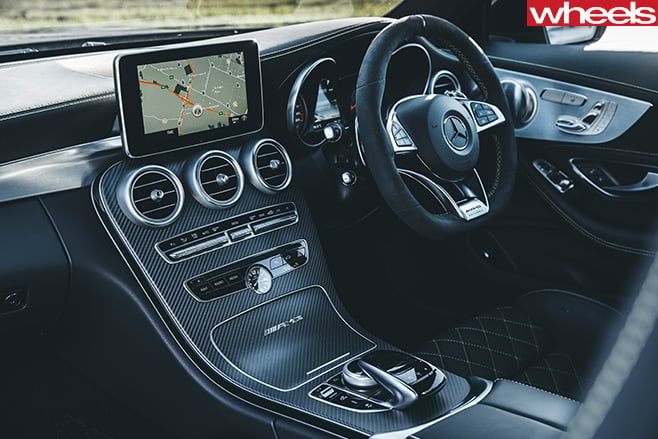
More than just a two-door version of the C63 AMG sedan, the Coupe has a unique platform that better takes advantage of its glorious twin-turbo V8.
WHAT IS IT? Mercedes-Benz’s answer to the BMW M4 and Audi RS5. It’s also the fastest, most focused C-Class ever produced. The basic silhouette is shared with the regular C two-doors, but the footprint is broader for more stable high-speed dynamics.
WHY WE’RE TESTING IT This is our first Australian wheel-time in the new C63 AMG Coupe, which was available for a few hot laps at Sydney Motorsport Park.
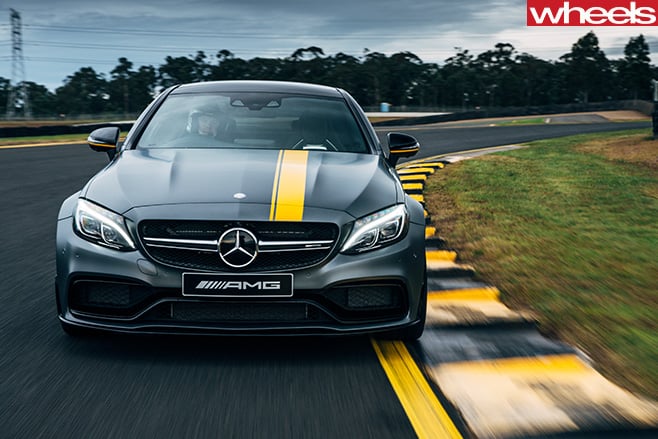
THE WHEELS VERDICT It’s the most accomplished C yet and the Coupe brings new-found cornering confidence to the C63 AMG equation. More than ever, the choice between the C63 Coupe and sedan will come down to a lot more than practicality.
PLUS: Wider footprint makes for more attentive handling; glorious V8; elegant interior MINUS: Heavier than the four-door; not convinced about the look from the rear
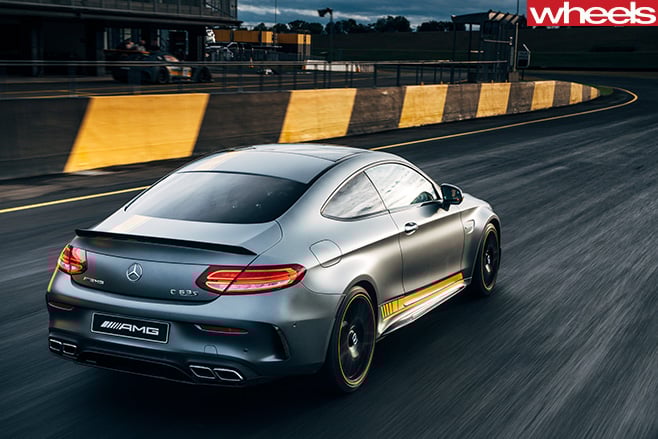
Because a single tenth is the difference in the claimed 0-100km/h time for Benz’s new C63 S Coupe compared with its four-door sibling. The triple-figure target comes up in 3.9 seconds, compared with 4.0 seconds for the four-door.
A miniscule difference, but an important one in an era when bragging rights count – and when shaving anything off the acceleration time of one of the quickest sub-$200K cars on the market can mean masses of kilowatts and lots more money.
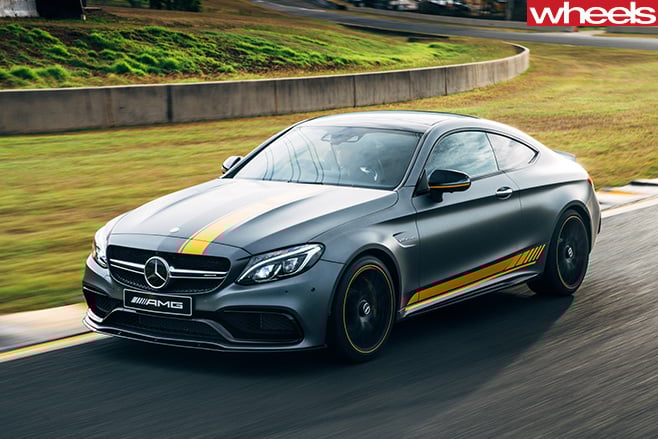
So put its perkier punch down to rubber. There’s more tyre and each is splayed further apart. Up front the difference is minimal; the Coupe’s 255mm-wide 19s are a mere 10mm wider than those of the sedan. But out back the C Coupe comes with massive 285mm 20s, which are 20mm wider and an inch up in diameter on the four-door.
Our first local taste test of the C Coupe was at Sydney’s Eastern Creek track (or Sydney Motorsport Park). And it’s the revised suspension geometry of the Coupe that is most obvious the moment you tip into a bend. The front wheels sit 48mm further apart that those in the sedan, the rears 22mm.
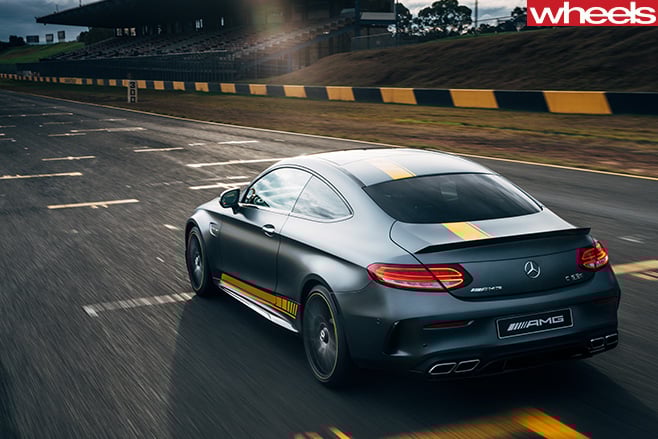
And there’s enough thrust to coax the tail into a thoroughly predictable slide if you link things up right.
It’s the predictability of the C Coupe that impresses most. While it has the pace to crank out some deceptively brisk laps, you can clock them without having to try too hard.
Aficionados will appreciate the unique body, too. Pumped guards front and rear (adding 64mm and 66mm of width respectively) make for a muscular stance, albeit with a tapering tail that isn’t to all tastes.
If passengers aren’t your thing – the twin back seats are tight for head room – the C Coupe is a delicious step up from the sedan it shares an engine and most of its interior with. And for only $5000 more than the four-door.
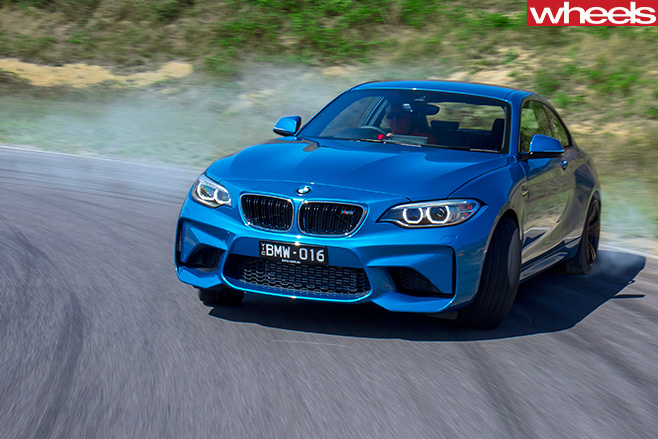
BMW has confirmed it will add 100 more M2s to the Aussie supply chain.
The brand has seen unprecedented demand for its newest performance model including the highest uptake of manual transmissions for any car in its range.
Australia was initially allocated 300 BMW M2s, all of which are sold out. A waiting list extending into 2017 was likely had BMW Australia not managed to secure the extra volume.
“One of the things we’ve noticed from the start with M2 is an amazing level of interest,” says Lenore Fletcher, spokesperson for BMW Australia.
“Munich is aware we have a lot of performance addicts. It was not easy to get the extra volume but we’re pleased.”
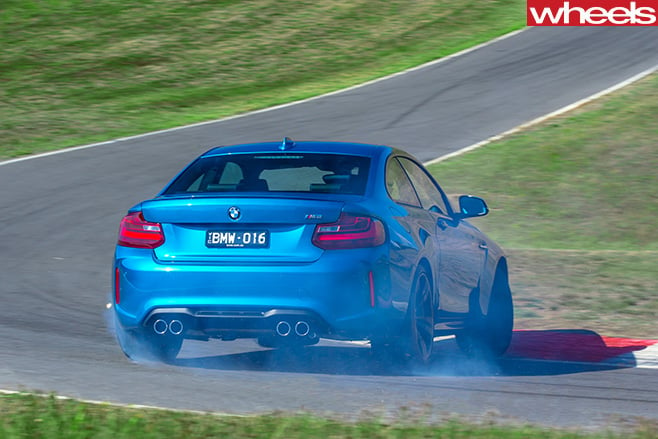
The initial M2 sell-out makes it one the most popular M models in Australia. In 2015, BMW sold 280 M3s and 350 M4s.
Fletcher says offering a three-pedal option in the M2 has played a key role in drawing new buyers to the brand, and hasn’t stolen sales from M3 and M4.
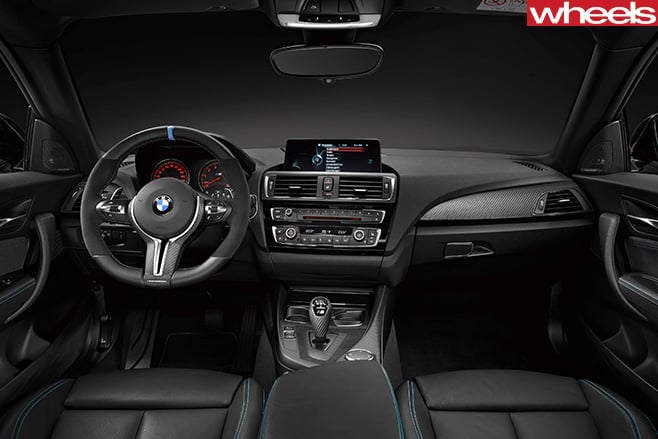
Per capita, Australia’s appetite for M Division vehicles puts it second in the world, a stat that likely factored in BMW’s decision to send local dealerships more M2s. Australia has also been allocated 25 examples of the ultra-rare BMW M4 GTS, which are due to arrive in September.
HSV has revealed three limited edition models to mark the end of production of the 6.2-litre V8 engine, codenamed LS3.
The three models are based on the Holden Commodore, Commodore Ute and Caprice long wheelbase and will be the most affordable models in the HSV lineup.
The first of the limited editions is the ClubSport R8 SV Black, which also spawns a ute sibling, the Maloo R8 SV Black.
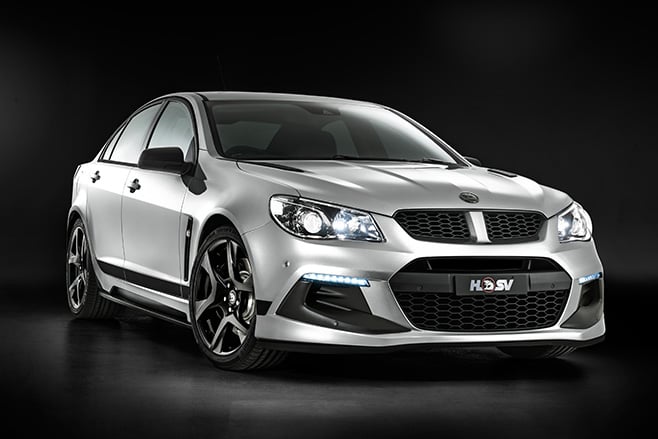
To be priced from $80,990 and $76,990 respectively, the ClubSport R8 SV Black and Maloo R8 SV Black use the same 340kW/570Nm 6.2-litre V8 used in previous HSV models.
HSV has added a mechanical sound enhancer, which is a pipe that joins the intake manifold under the bonnet to the firewall that separates the engine from the passenger compartment; it amplifies the V8 sound, something that is an important part of the theatre of an HSV.
Just 368 ClubSports will be produced (350 for Australia, 18 for New Zealand) and 102 Maloo utes (100 for Australia, 2 for New Zealand).
As the name suggests, the SV Black models get black detailing as part of a move to give them more “attitude”, according to HSV.
Many of the parts normally finished in shiny chrome – the HSV badge, grille surrounds, tail light surrounds and door handles, for example – are finished in black to give the cars a more sinister look. Even the mirror casings, 20-inch alloy wheels and rear wing are black, and there is a black stripe down each side.
The second limited edition model is the HSV Grange SV, priced identically to the $86,990 regular Grange it replaces.
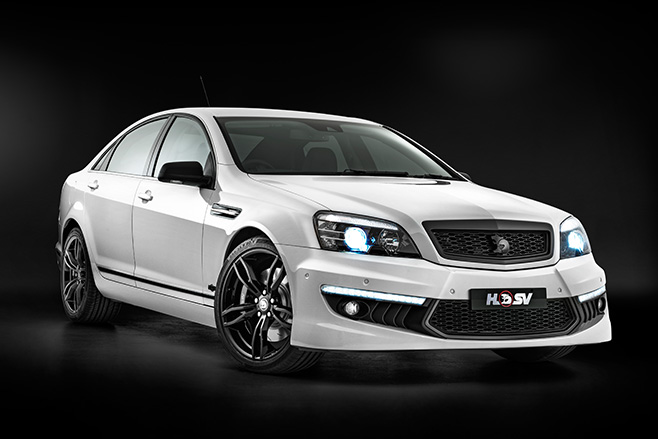
Just 50 Grange SVs will be produced, all for Australia. Production begins in September, 2016.
As with the SV Black models, the Grange SV gets a lot of black detailing to distinguish it from the regular Grange.
The Grange SV also gets the same 340kW/570Nm V8 with the sound enhancer for a louder V8 bark.
The third HSV limited edition model is the ClubSport R8 Track Edition, priced from $68,990.As its name suggests, it’s a car that has been designed with the race track in mind.
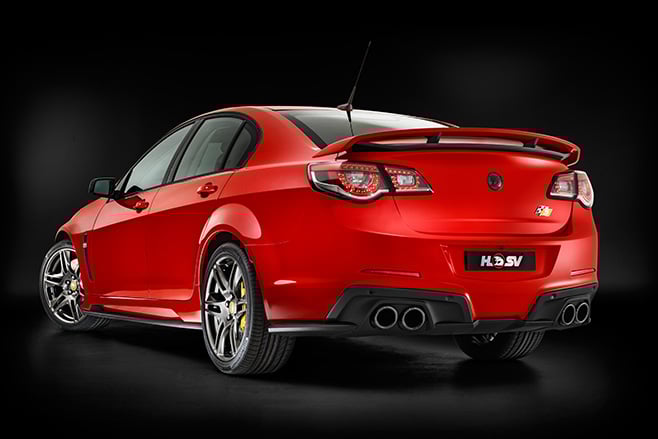
The ClubSport R8 Track Edition – which begins production in September, 2016 and will be the last HSV to use the LS3 V8 – gets suspension that is 200 percent stiffer than the suspension in the standard HSV ClubSport.
The stiffer suspension is designed to reduce body leaning on a race track – and through corners generally – for better steering and control, albeit at the expense of ride comfort.
The ClubSport R8 Track Edition also gets the bigger six-piston brakes previously reserved for HSV’s flagship model, the GTS. They provide much better stopping power, particularly during hard driving, such as on a race track.
The ClubSport R8 Track Edition also gets a suede steering wheel and 20-inch alloy wheels previously used on the HSV GTS.
Each HSV limited edition model will be individually numbered, and will get unique identification, including sill plates on the inside of the door jambs.
HSV managing director Tim Jackson says the limited edition models are all about value.
“With all three limited edition models, our focus has been on building vehicles that offer outstanding levels of content, exclusivity and value,” he says. “We’re confident we’ve delivered on all counts and that our fan base will be eager to capitalise on this last opportunity to buy an LS3-powered HSV, especially at these prices.”
HSV LIMITED EDITION MODELS
ClubSport R8 SV Black (sedan), Maloo R8 SV Black (ute)
On sale: June, 2016 Engine: 6.2-litre LS3 V8 Power: 340kW Torque: 570Nm Transmission: 6-speed manual or 6-speed auto Mechanical changes: sound enhancer for intake manifold, four-piston AP Racing brakes Price: $65,990 (ClubSport sedan), $62,990 (Maloo ute) Number produced: 350 ClubSports, 100 Maloos (Australia); 18 ClubSports and 2 Maloos (New Zealand)
Grange SV
On sale: September, 2016 Engine: 6.2-litre LS3 V8 Power/torque: 340kW/570Nm Transmission: 6-speed manual or 6-speed auto Mechanical changes: sound enhancer for intake manifold Price: $86,990 Number produced: 150 (Australia), 6 (New Zealand)
ClubSport R8 Track Edition
On sale: September, 2016 Engine: 6.2-litre LS3 V8 Power/torque: 340kW/570Nm Transmission: 6-speed manual or 6-speed auto Mechanical changes: sound enhancer for intake manifold, 200 percent stiffer springs, six-piston AP Racing brakes from the GTS Price: $68,990 Number produced: 150 (Australia), 6 (New Zealand)
Electrified Bentleys will focus on performance rather than efficiency, according to Asia-Pacific Manager of Dealer Sales, David Simpson.
When quizzed at the Australian reveal of the new Bentayga SUV about Bentley’s hybrid plans, Simpson explained the British marque intends to use electrification to add performance rather than cut fuel economy.
“I think the hybrid element here is more akin to your P1 and your LaFerrari than your Prius,” Simpson said. “Obviously there’s an efficiency gain in the car, but when we talk about hybrid it’s a performance hybrid, and likely that would come out higher than a W12 in terms of its price point.”
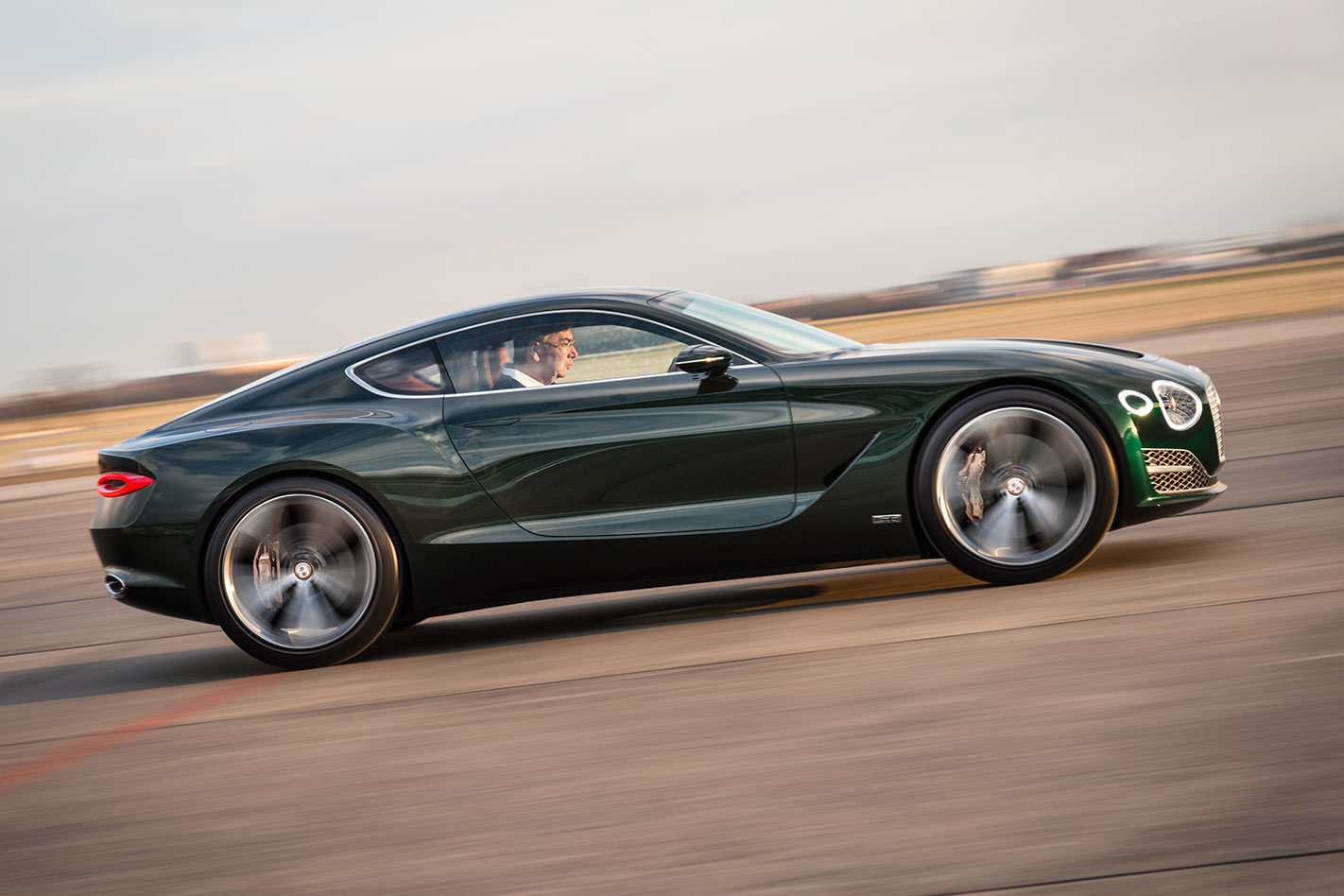
“What we hear back from customers is that they would be very keen to see a performance hybrid on the market, because that again is something they can market about themselves,” continued Simpson. “There’s probably less appetite for the economic version of a hybrid.”
For all this talk of extra performance, Bentley’s first hybrid is likely to be a variant of the Bentayga SUV. However, electrification is on the agenda for its proposed EXP10 sports car, expected to appear around 2020.
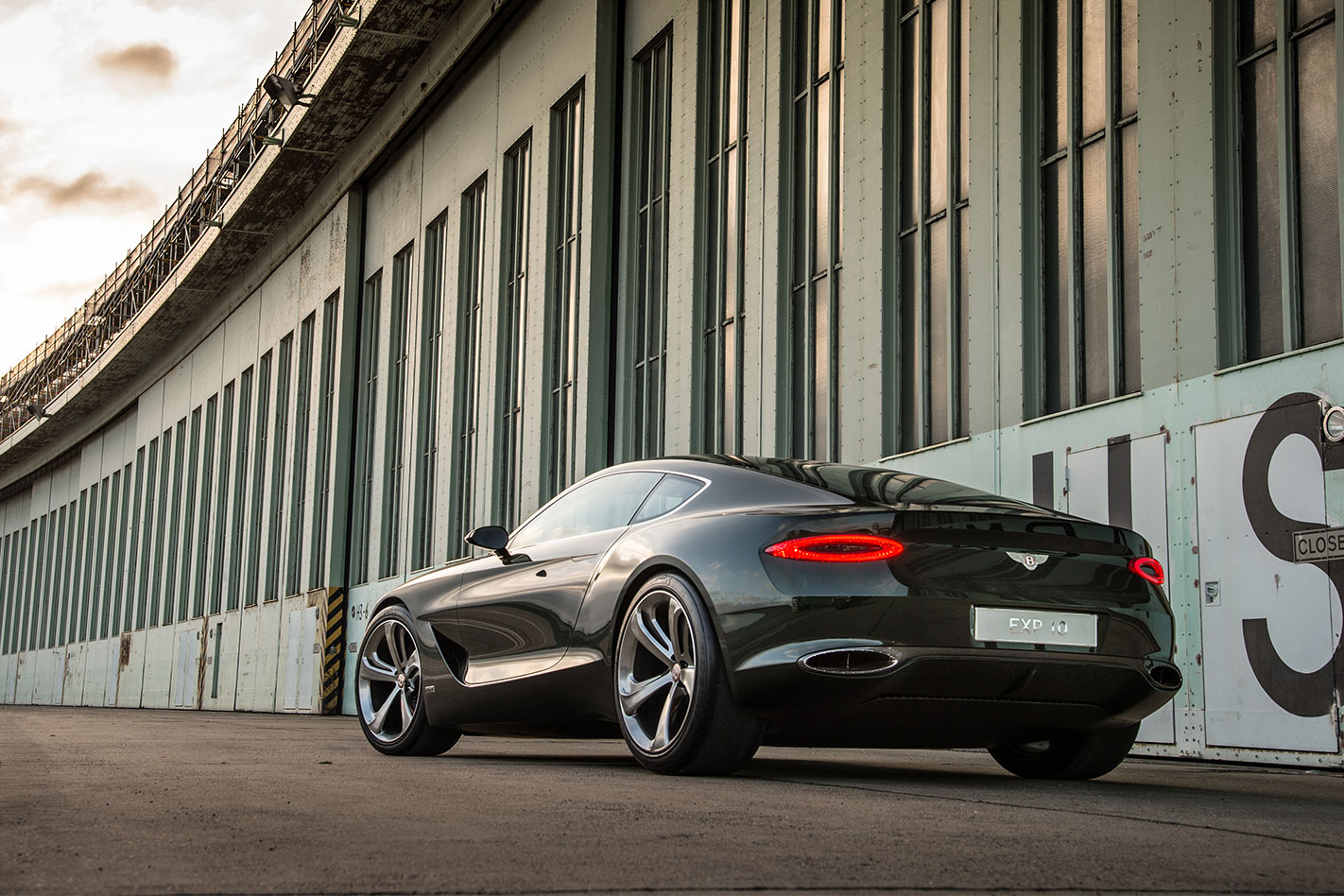
“The EXP10 would be would a pure two-seat car, and there is still an appetite for these cars. I think about the Australian market, we see a lot more of the 35-40 [year-old] property developers coming through, and these people are not looking for luxury sedans.”
A two-door V8 Bentley with electric torque and jaw-dropping looks? Sign us up.
A Renault Megane RS275 Trophy-R is not a very good minibus, and the AMG GT?
Simply appalling for the bi-annual IKEA trip. Meanwhile try to fit three kids and a Labrador in the back of a Jaguar F-Type and you’ll sooner see them all driving away in a van from the Department of Child Services.
Point is, compromise is a part of life for lovers of performance cars. You either concede practicality, or performance. But one car has given us hope it doesn’t always have to be this way.
Truly we struggle to think of a car that blends performance and practicality quite as effectively as the new Mercedes-AMG C63 S Estate. You get an enormous boot, made truly cavernous by folding down the rear seats. Oh, and you get rear seats. That people with legs can sit in.
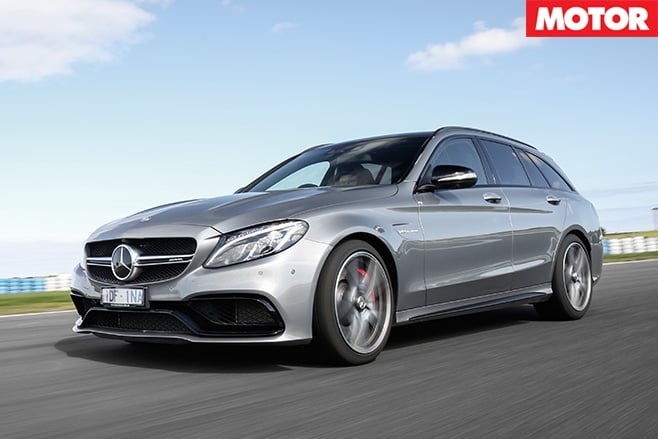
And it had the playful, friendly, competent chassis to match, even in wagon clothing, such that we gave the M156-powered C63 507 Estate four-and-a-half stars. So the new car had a lot to live up to, not least because the old C63 was the most successful AMG product ever, selling more than 40,000 cars worldwide.
Not helping the plight of AMG engineers, legislators were putting the old C63 in an emissions squeeze. Its 12.2L/100km couldn’t continue. So AMG lopped a massive 2.2 litres off the old engine’s capacity and nestled in its V8’s vee a pair of exhaust-scavenging snails. The M177 was christened, saving an astonishing 3.5L/100km compared to the previous engine. And in kind, saving the C63.
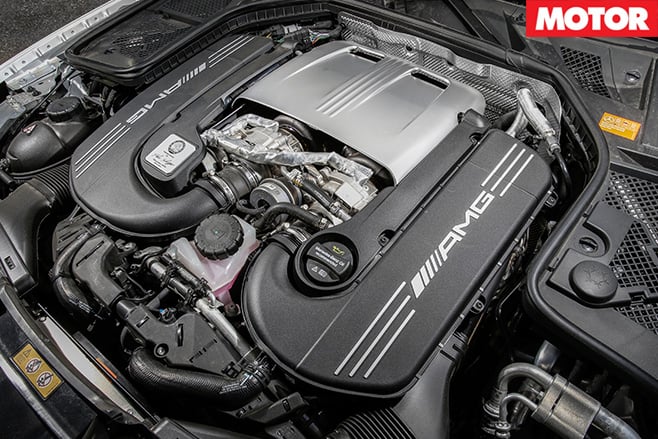
The new C63 S benefits from a vastly improved C-Class chassis, too; more rigid and safer, but shedding 65kg from the old wagon. The C63 S Estate comes in at 1730kg, or 75kg more than the sedan.
There’s more tech, as well, and not just by way of the electronically-locking, computer-controlled differential, but with the S-Class’s self-steering cruise control trickling down with myriad other convenience gadgets. The C63 S now gets magneteorhelogical adaptive engine mounts, too, which can be firmed for better response and agility, and relaxed to better isolate the cabin from vibration and noise.
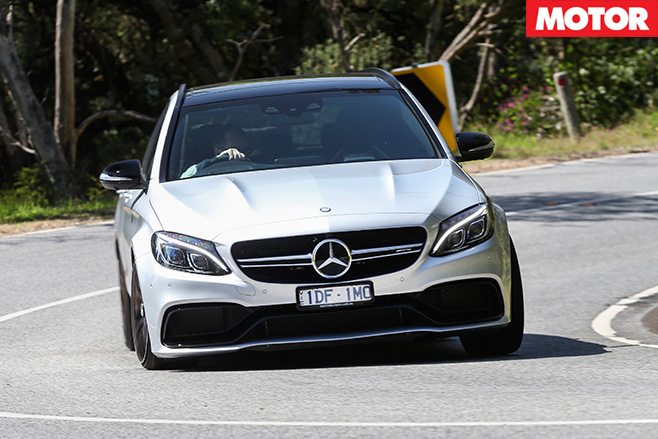
The second hint is the business-meaning Alcantara steering wheel, usually the reserve of cars like 911 GT3 and Megane Trophy-R. Rather hardcore for a family truckster. And yet another example of the duality of personalities of the C63 S when, after firing it up, the air-conditioning dusts you in sweet-smelling perfume. Like it’s trying to say something.
Just in case you missed it, there are no fewer than nine AMG badges in the front row alone and even more aft. But otherwise the C63 S’s interior is a classy place to sit.
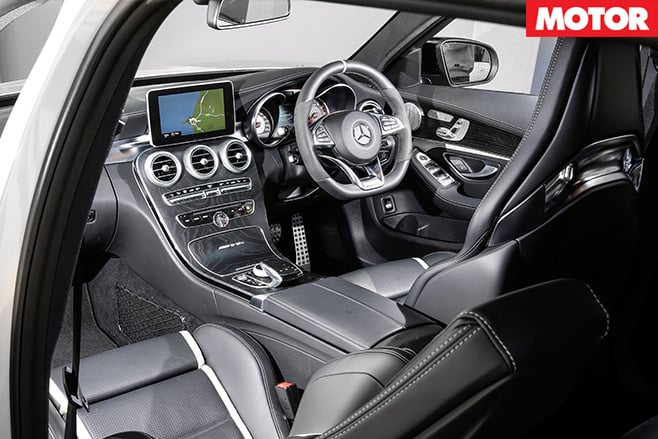
Apply clog and it only gets better. The first time you open the taps, all anxieties about the switch from 6.2 litres to 4.0 evaporate. Moving away smoothly thanks to the wet-clutch auto, the C63 bellows a nasty, gurgling V8 note, lower in pitch and all tailpipe.
Put the windows down and you can hear some turbo hiss, particularly if you’re asking the engine to strain against a tall gear in the lower revs, but otherwise there’s little induction noise and high-rpm scream here. The new C63 S is definitely a baritone. And it sounds ace, with a certain hot-rod quality about its note.
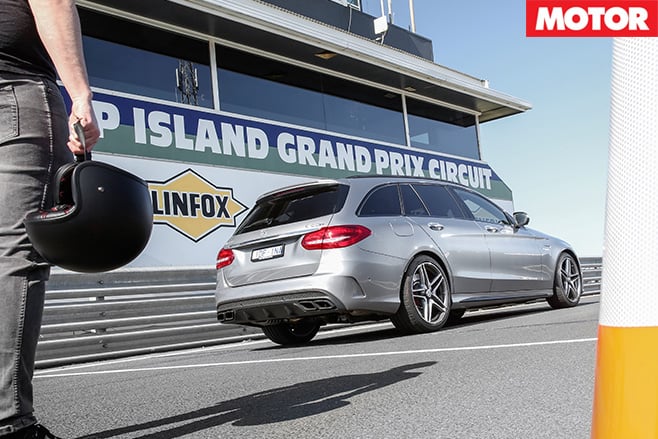
Like the old C63, AMG doesn’t offer a manual ’box, but, like the old model, the new one doesn’t necessarily need one. The seven-speed MCT Speedshift auto swaps up gears swiftly and will pop and crack as it grabs revs on downchanges. Nowhere near as laser-sharp as a twin-clutch, but it’s more than up to the task.
It’s a shame that further down the road we find ourselves double checking the C63 S is in Comfort mode, the car transmitting more of the road surface to our derriere than we’d like. But it seems this is as soft as the dampers get, like the throttle and tranny are in Comfort but the suspension’s stuck in Sport. Somehow we don’t think you’d get much of an apology from Herr AMG. And it only takes a few corners to see why.
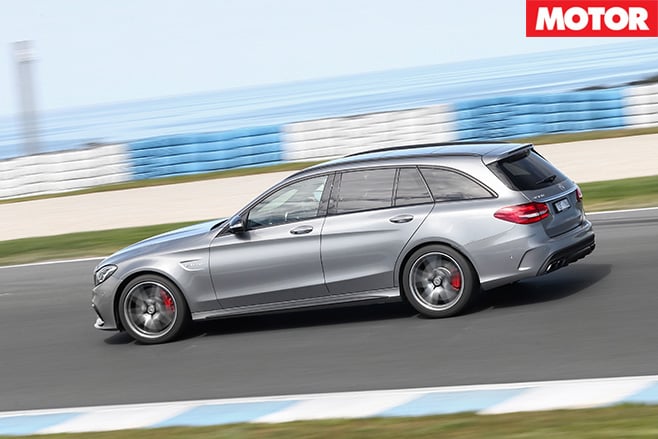
We didn’t get a chance to performance-test the C63 S Estate this instance, but we’ve no reason to doubt Merc’s numbers. It feels every bit as fast as you might expect a car with 700Nm at 1750rpm and 375kW ought to be. In fact you wonder if AMG missed a row of cylinders when adding up the displacement.
Just like its sedan sibling, few cars less than $150K will be able to keep up with a C63 S Estate on a windy road. It’s certainly effective. And yet easy and friendly to drive quick; the ESP in Sport Handling mode permitting throttle-induced tail-wiggles out of uphill hairpins, easily caught by well-weighted, accurate steering. In the slower stuff it can start to show its heft and, indeed, its natural habitat feels to be more flowing roads where it can really stretch its legs.
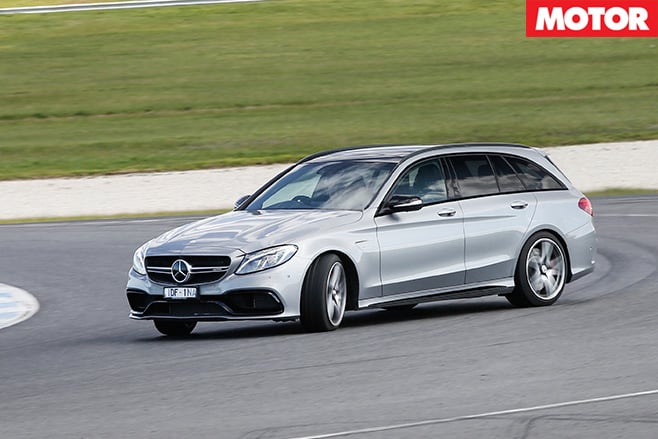
In fact it was too easy to forget the enormous cavity behind one’s headrest as we belted around one of Australia’s best racetracks, the C63 S showing off fantastic power, strong, fade-free brakes, and accurate steering complementing a stable cornering attitude.
Of course, understeer was amply available if you used up everything the front 245/35R19 Dunlop Sport Maxxes had to offer. But drift enthusiasts will be pleased to hear that, ESP off, the C63 S is entirely up for sideways action, torque easily unhinging rear rubber with the aid of the C63 S-only electronically-locking diff.
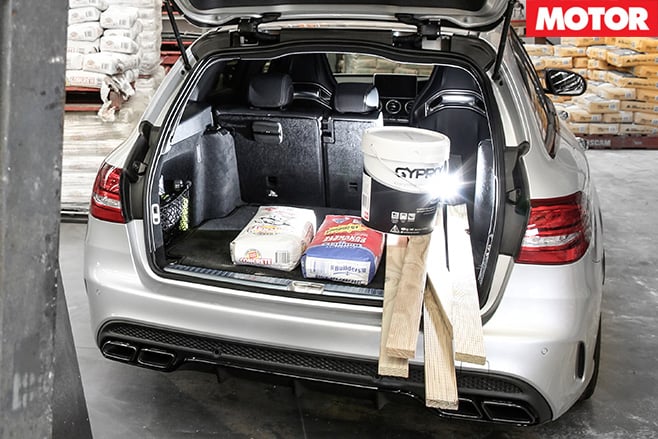
The C63 S might be a poor minibus, a worse removalist van and not the most ideal IKEA companion, but it’ll have a crack at each. When its chores are done, the kids and Labrador dropped off, it can satisfy and terrify you on track or road in equal measure. And you didn’t even have to buy a performance SUV.
4.5 OUT OF 5 STARS
SPECS
Body: 2-door, 5-seat wagon Drive: rear-wheel Engine: 3982cc V8, DOHC, 32v, turbocharged Bore/stroke: 83.0 x 92.0mm Compression: 10.5:1 Power: 375kW @ 5500-6250rpm Torque: 700Nm @ 1750-4500rpm Power/weight: 217kW/tonne Transmission: 7-speed automatic Weight: 1730kg Suspension(F): multi-links, coil springs, adaptive dampers, anti-roll bar Suspension(R): multi-links, coil springs, adaptive dampers, anti-roll bar L/W/H: 4756/1839/1426mm Wheelbase: 2840mm Tracks: 1609/1546mm (f/r) Steering: Electrically-assisted rack-and-pinion Brakes(F): 360mm ventilated discs, 6-piston calipers Brakes(R): 360mm ventilated discs, 2-piston calipers Wheels: 19.0 x 8.5-inch (f); 19 x 9.5-inch (r) Tyre sizes: 245/35 ZR19 (f); 265/35 ZR19 (r) Tyre: Dunlop Sport Maxx Price as tested: $157,400
China’s best-selling SUV manufacturer, Haval, is one of the newest brands to enter the Australian market, but its H9 flagship vehicle was recently tested for crash safety by ANCAP and failed to achieve a five-star rating. A Chinese-built vehicle is still yet to earn ANCAP’s highest rating.
When the seven-seater Haval H9 – the largest in a three-car line-up which also includes the H2 and H8 SUVs – was put forward for testing, the company’s engineers were confident of a five-star result.
However, ANCAP awarded the H9 a four-star safety rating after it scored 30.65 points out of a possible 37. The H9 was unsuccessful in the frontal offset crash test, recording inadequate results for driver protection, and ANCAP’s report found it particularly lacking in lower leg protection and with a slight risk of serious chest injury.
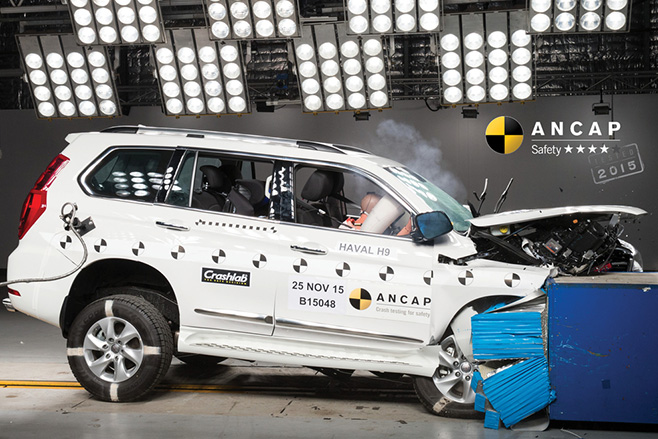
“Our engineers have been working very hard to deliver a five-star safety rating and all our testing indicated that we would achieve this result,” said company spokesman Andrew Ellis. “The results of the ANCAP test were clearly unexpected.”
“It’s disappointing to get so close,” said Ellis. “We’re committed to a five-star rating.”
Data from the ANCAP tests has been supplied to Haval engineers in China, including the head of research and development, Suguya Fukusato. The company has vowed to improve its product and have it re-tested as soon as possible.
ANCAP responded saying that Haval would need to make structural changes to the H9 and provide evidence of the changes in order to qualify for a re-test.
“[H9] didn’t fall down in any other areas. It’s not lacking in technology,” said ANCAP spokeswoman Rhianne Robson. “If Haval make structural changes and frontal offset tests improve, it should be in the realms for five stars.”
Haval is the premium SUV spin-off of Chinese car brand Great Wall and this four-star result is an improvement over earlier vehicles, in particular the Great Wall V240 dual-cab ute, which scored a two-star crash safety rating in 2010.
ANCAP has no plans at this point to test the other two vehicles in Haval’s line-up, though the company did add that new entrants to the market are of particular interest.
Changes to BMW’s 4 Series range reflect almost identical revisions made last year to the 3 Series sedan/wagon on which the 4 Series coupe, Gran Coupe and Convertible are based.
The revised BMW 4 Series line-up arrives in late May, and includes revisions to two of the nameplates for consistency across the German brand’s full vehicle line-up. The 428i becomes the 430i and the 435i transforms into the 440i.
BMW 420i and BMW 420d
Standard features of the entry-level petrol and sole diesel variants are increased with sports-tuned, electronically-adjustable suspension, head-up windscreen display, electrically folding side mirrors, vehicle camera guidance with top and side views, and a lane change warning system.
The 420’s turbocharged four-cylinder engine produces the same 135kW and 270Nm but fuel consumption improves by between 0.2 and 0.5 litres per 100km. The coupe and Gran Coupe now officially use 5.8L/100km, and the Convertible 6.2L/100km.
BMW 430i
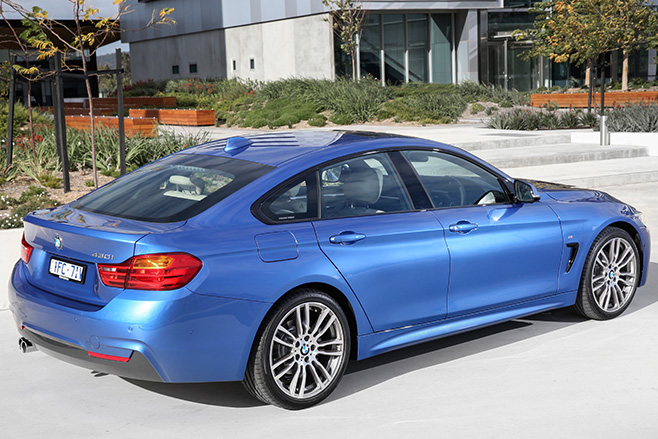
The most powerful four-cylinder version of the 4 Series is now standard with the M Sport Package that was previously only standard on the 435i and cost $2000. It gives the model formerly known as 428i extras including 19-inch lightweight alloy wheels, upgraded interior and exterior trim, Dakota leather upholstery and an M-badged sports steering wheel.
Engine power increases by 5kW to 185kW, with official fuel use of the coupe and Gran Coupe dropping by 0.6 litres to match the 5.8L/100km of the 420i. The Convertible improves by 0.4L to 6.3L/100km.
BMW 440i
The variant that sits just one rung down from the flagship M4 improves its value through a big price cut rather than additional features. The 440i coupe and Gran Coupe cost $10,000 less than the 435i models they replace, and are now priced from $99,990. The 440i Convertible drops $10,100 to $117,900.
The same six-cylinder from BMW’s new modular engine family, already installed in the 340i and recently announced M140i and M240i models, sits beneath the 440i’s bonnet.
Power increases by 15kW to 240kW and torque jumps by 50Nm to 450Nm, resulting in a fractionally quicker 0-100km/h sprint time of 5.0 seconds. The engine is also more efficient, officially using 0.6 litres less per 100km than before in the coupe and Gran Coupe, at 6.8L/100km. The Convertible version improves by half a litre to 7.2L/100km.
Hyundai will use this weekend’s Nürburgring 24-hour endurance race in Germany to fast track development of its new high-performance ‘N’ sub-brand range.
The Korean auto maker (which has a technical centre at the Nurburgring) has entered a prototype of its i30 2.0L Turbo N in the extreme round-the-clock test.
The Hyundai i30 2.0L Turbo N is regarded by Hyundai as a potential rival for the likes of the Renault RS range, VW Golf GTI and Ford Focus ST and 40 percent of the car is new, including its engine and upgraded transmission, suspension and dampers. Race modifications for its ‘Ring debut include flared wheel arches, roof-mounted spoiler and a huge air dam.
The three-door i30 2.0L Turbo N’s engine also has a transient over-boost function, similar to that found in a Porsche 911 Turbo, and is expected to be paired to a six-speed manual or twin-clutch auto.
Former BMW M division vice-president of engineering, Albert Biermann, is leading Hyundai N model development.
“This Nürburgring 24-hour race provides the ideal test bed for our motorsport-inspired N sub-brand development and a key part of our ‘born in Namyang, honed at Nürburgring’ performance-car ethos,” Biermann said. “The technological inspiration and experience gained from this extreme testing will accelerate our development of high-performance, fun-to-drive N models.”
Hyundai is keeping details of production N models close to its chest, but given its focus on “delivering maximum driving pleasure to true motoring enthusiasts”, we’re expecting healthy power outputs and a weight cut.
Hyundai will also race two production cars in the 24 hours, a Veloster and an i30 1.6L Turbo, which will be defending its 2015 class title.
