
Renault vans Kangoo, Trafic and Master – small, medium and large, respectively – can now be optioned in Europe with the X-Track pack, adding a limited slip differential, raised suspension for more ground clearance, all-weather tyres and improved underbody protection.
Renault Australia has said it will “evaluate these new additions with a view to making them available in due course.”
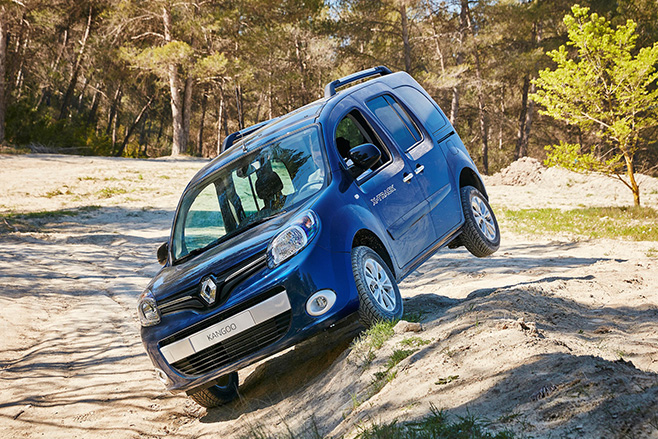
The new X-Track technology is designed to suit business owners who need their vans to work in tough conditions.
“Compared with a standard transmission, the new Renault X-Track 4×2 technology delivers superior mobility on difficult terrain, in snow, unsealed surfaces and on poor quality roads,” said Lyndon Healey, Renault Australia model line manager for light commercial vehicles.
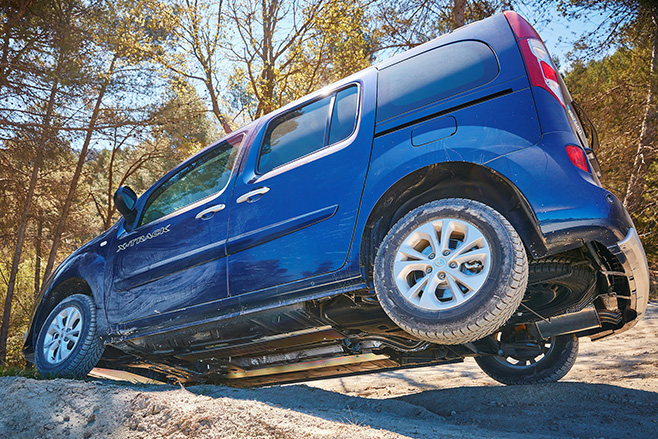
“The Renault X-Track 4×2 is an alternative to four-wheel drive when off-road capability is not required. It delivers exceptional performance on poor roads and in difficult conditions. The option is available on Kangoo, Trafic and Master from the factory and we plan to evaluate the systems locally to determine their suitability for the Australian market,” Lyndon says.
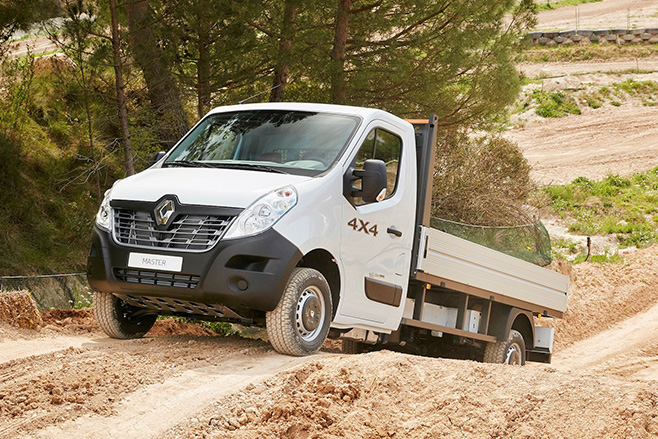
On top of the X-Track upgrades, Renault Australia may offer a 4×4 version of its large Master van. Master will soon be available in Europe with 4×4 functionality in Master cab-chassis, Single and Dual Cab models, and for rear-wheel drive van bodies.
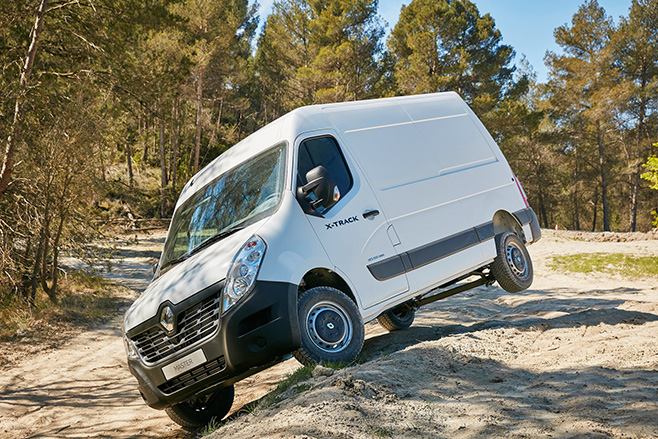
“Renault Australia will carry out specific market evaluation on the Master 4×4 in the near future to determine its suitability for our driving conditions,” Lyndon says.
“There is a large market for 4×4 Dual Cabs in Australia and with our high payload and up to 7-seat capacity, a Master 4×4 could be a handy addition to the range,” he says.
Vulcan drivers will join LaFerraris and P1s on the drive home from track days with the announcement the ultra-rare track-only Aston Martin will be made road legal.
Such news doesn’t come from Aston Martin’s headquarters in Gaydon, though. Instead it’s been made 53km away in Northamptonshire, by race shop RML.
The independent motorsport engineering outfit has said it will offer a package for the $3.8million Vulcan, focusing on its safety, usability, and compliance to grant it road legality.
Part of this transformation will see new headlight clusters fitted and its paddle pop rear lights replaced. Its ride height will be raised to complement a new removable front splitter and rear diffuser as Topgear.com reports, to avoid costly run-ins with speed bumps.
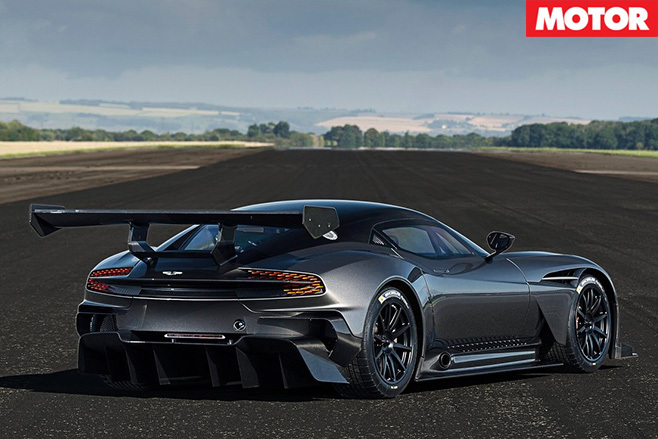
Most of the Vulcan’s state-of-the-art suspension package is to be left alone, with only tweaks to its front geometry planned to help minimise its turning circle. Inside, the roll-cage will remain intact, but the wings will be removed from the Vulcan’s exquisite Recaro seats.
Now the CEO at Aston Martin, Palmer tells Autocar the RML package has helped it sell the last two Vulcans and expects another two to three owners to convert their Vulcan.
Little information on price exists, but with the package’s fitment said to take three months and allow owners to convert the Vulcan back to its track specification, don’t expect much change from well into six-figures.
Renault is revealing few details at this stage, saying only that the new Koleos will have “the refinement and features associated with large sedans”.
The Koleos will grow in size to about 4.7 metres long, compared with the current, 4.5-metre model that has been on sale in Australia since 2008.
The original was Renault’s first SUV, but its replacement will be sit above the Renault Captur compact SUV – as well as the mid-sized Kadjar that Renault Australia decided not to import.
Renault spokespeople have been quoted, however, saying the Koleos will remain a five-seater rather than offer a third row.
The new Koleos adopts the Renault family face, and features LED daytime running lights, a chrome grille, and bonnet creases.
The design looks less awkward than the current model that has struggled to gain any notable share in Australia’s medium-SUV market despite the boom in SUV sales.
The Koleos accounted for just 1 per cent of the segment in 2015 where 127,500 medium SUVs were sold, trailing the majority of entrants that include the twin Nissan X-Trail and dominant Mazda CX-5.
Renault pulled the model from the UK market in 2011 due to poor sales.
Renault is sticking with the Koleos nameplate despite rumours that it would change to Maxthon.
Is the Levante just me-too, or has Maserati made of its first SUV something special?
WHAT IS IT? Maserati’s first SUV, and the car the company hopes will practically double its global sales volumes as it chases 75,000 sales a year. Australia, as with all right-hand drive markets, will be getting only the diesel version, while other places will also have a choice from two turbocharged V6 petrols.
WHY WE’RE TESTING IT? To establish whether Maserati and SUV are concepts that can live happily together. Many other manufacturers have moved into this part of the market in recent years, but the idea of a Maserati off-roader still feels odd considering the company’s distinguished history of sports cars and sports saloons. The big ask is whether it can deliver a Maserati-appropriate driving experience, especially with the sole powerplant option in Australia being a V6 diesel.
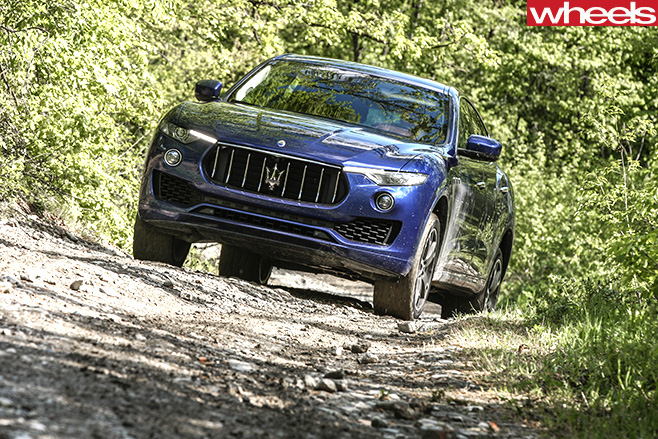
THE WHEELS VERDICT THE Maserati Levante is a confident move into a new segment for Maserati, and one that looks set to pretty much double the brand’s total global sales off its own bat. It’s dynamically rewarding, comfortable, well-built, refined and – if it matters – even moderately talented off-road. Our only significant disappointment is the failure to offer any of its more exciting powerplants in Australia, something we hope that time will fix.
PLUS: Classy, great to drive, economical and refined MINUS: Diesel doesn’t deliver Maserati-appropriate excitement levels
THE WHEELS REVIEW IF YOU’RE a physicist who has just cracked time travel, hold off on the predictable ideas for a first spin in your new time machine.
Of course, the response might not be spluttering indignation: the brand’s tifosi would likely be delighted to learn Maserati had made it into the 21st century. Two decades ago the company was struggling to push global sales into four figures. These days it’s aiming at 75,000 sales – a strategy for which that the new Levante is the critical component. It’s no exaggeration to say the Levante is one of the most important cars the brand has launched.
The company deserves full credit for resisting the obvious shortcut. Or more precisely, for fighting its imposition from on high. Maserati’s place in the Fiat-Chrysler alliance meant building its SUV on a bastardized Jeep platform would make most sense from a cost point of view. Indeed the Kubang concept of 2011 was essentially a rebodied Grand Cherokee which, we were told at the time, was set to be built in Michigan.
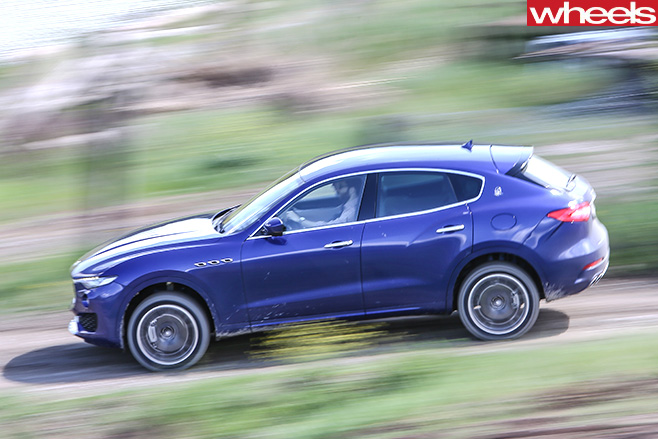
Leading to the bad news. Only one of these motors is coming to Oz, and it’s not the best one. The plan is that all right-hook Levantes will be fitted with the 202kW VM Motori diesel mill, a decision we can blame squarely on the UK’s insatiable appetite for compression ignition skewing the business case. All versions use a ZF eight-speed autobox and send drive to all four corners, but via an all-wheel drive system that is predominantly rear-biased, with 90 percent of torque heading aft under regular use. Air suspension is also standard, which turns out to be an important advantage on a launch route in northern Italy consisting almost entirely of roads that seem to have been built by the lowest bidder’s second cousin.
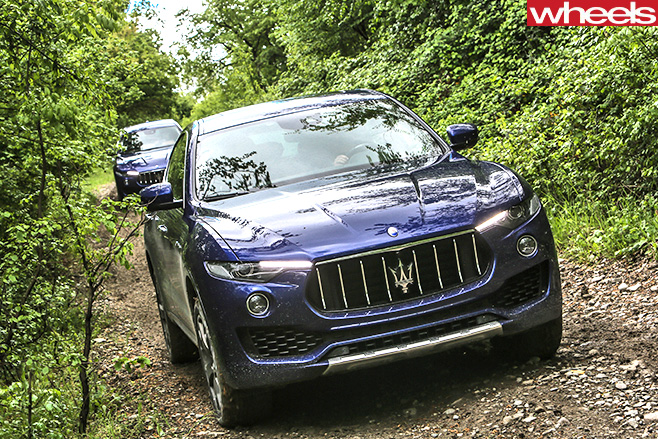
Styling follows Maserati’s tradition of being distinctive rather than unambiguously handsome, although to my eyes the Levante looked far better in the soft sunlight of Emilia-Romagna than it did on Maser’s stand at the Geneva show, well-managed proportions doing a good job of disguising its five-metre length. The interior feels predictably similar to that of the Ghibli, with pretty much every non-transparent surface in the fully laden car we drove covered in either leather or carbonfibre trim. There’s plenty of space for both front and rear seat passengers, and a long-but-shallow loadspace at the back.
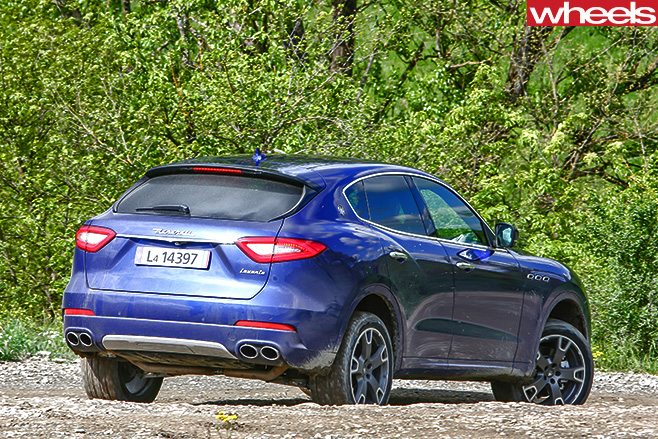
The chassis is the starring feature, with the decision to offer standard air springs responsible in large part for its remarkable combination of talents. Body control is outstanding, the Levante staying composed over the sorts of roads that feel like they should be tackled by a car wearing a full sumpguard and a co-driver shouting instructions. Yet it’s smooth and impressively quiet when asked to cope with high-speed cruising – with ride height automatically lowering by up to 35mm at speed. Manually selecting off-road mode pumps up the springs to lift the body by up to 40mm, and although owners are likely to have scant inclination to test Maserati’s claims of 250mm maximum body clearance over anything sharp, the car did a good job driving up and down some steeply graded gravel tracks on its road-spec P-Zero tyres.
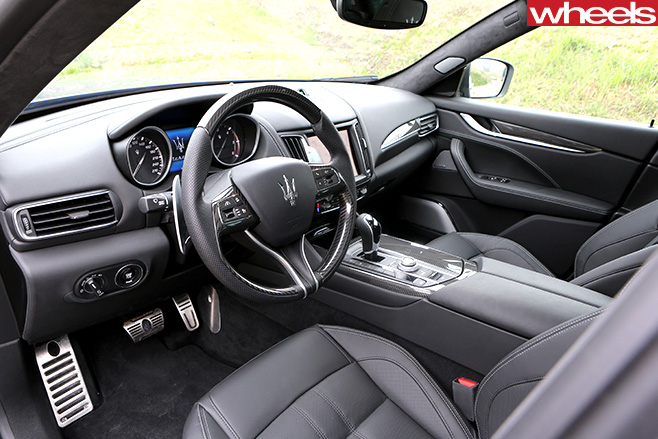
The steering deserves praise as well – the Levante will be one of the last new cars to be launched with hydraulic rather than electrical assistance – giving excellent feel and weighting.
Pricing hasn’t been confirmed, but the steer from Maserati Australia is that we’ll be looking at around $150,000 when the Levante goes on sale here at the end of the year, meaning a supplement over its obvious rivals. The exclusivity of the Maserati badge should help to bridge some of that. The Australian importer is already battling for an increased allocation – and for a non-diesel powerplant option as well.
SPECS Model: Maserati Levante diesel Engine: 2993cc V6, diesel, turbocharged. Max power: 202kW @ 4000rpm Max torque: 600Nm @ 2000rpm Transmission: 8-speed automatic, four wheel drive Weight: 2205kg (EU) 0-100km/h: 6.9 sec (claimed) Fuel economy: TBC Price: $150,000 (estimate) On sale: Q4 2016
THE 2017 BMW X3 has been spied in all of its camouflaged glory, having a red-hot go on Germany’s famous Nurburgring.
Sprung undergoing final chassis and performance testing, the third-generation premium medium SUV from Munich (via the USA, where it will again be built) is expected to take centre stage at one of the larger motor shows coming up – be it Paris in October, Los Angeles in November, or Detroit next January.
Though the shape and size point to evolutionary changes, it is clear that the G01-series BMW X3 adopts a fresh design language to help keep it looking contemporary against the soon-to-debut all-new Audi Q5 and the hot-selling Mercedes-Benz GLC and Land Rover Discovery Sport – as well as the Lexus RX, Volvo XC60, and the eagerly awaited Alfa Romeo Stelvio.
School-run mums have never had it so glam!
A far bigger change is going on underneath, with the 2017 X3 believed to be adopting a variation of BMW’s all-new scalable, longitudinally engined, CLAR architecture, which debuted in the latest BMW 7 Series limousine last year.
This, in turn, brings a wealth of new technologies to the range, including advanced driver-assist equipment, as well as future possible electrification for partial and plug-in electric hybrid variants still in the pipeline.
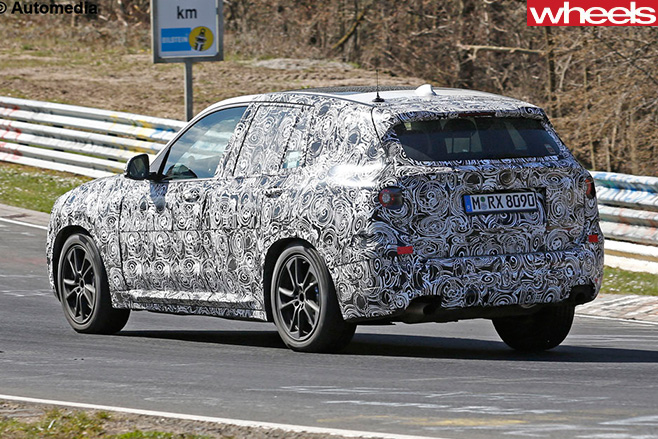
To improve economy and performance as well as dynamics, the 2017 X3 has benefited from an efficiency-focussed diet. That CLAR platform includes carbon fibre as part of a lightening yet strengthening regime, so the net result should yield a 100kg or so drop in overall mass.
Similar underpinnings are also earmarked for the 2019 X5, as well as the all-new X7 seven-seater SUV, giving the hot-shot Audi Q7, Volvo XC90, and Mercedes-Benz GLS something to think about.
Finally, and perhaps most importantly for buyers, an all-new interior that is said to step up at last in terms of quality and craftsmanship is expected to debut in the 2017 X3, along with a significant increase in rear-passenger legroom and cargo space. The fact that the prototypes appear to be physically longer in the body supports that speculation.
When the G01 X3 does lob in Australia sometime before the end of next year, it will probably stick with the low-$60,000 to high-$80,000 asking price of the current, five-year old version.
BMW fans should also look for a next-generation X4 SUV coupe to eventually follow suit, as the German manufacturers explore and exploit every last crossover niche.
FIAT Chrysler Automotive boss Sergio Marchionne wants Maserati to take Ferrari’s place as the sports luxury revenue driver in FCA’s portfolio.
What was already a niche line-up has been broadened courtesy of the Ghibli and updated Quattroporte sedans, with the crucial Levante SUV arriving soon and a production version of the 3.0-litre twin-turbo V6 Alfieri coupe concept looming.
Which puts the writing on the wall for the enduringly stunning Gran Turismo. To keep this now eight-year-old 2+2 GT’s mojo bubbling, the Sportline has been introduced to fill the gap between the standard car and the more focused Stradale.
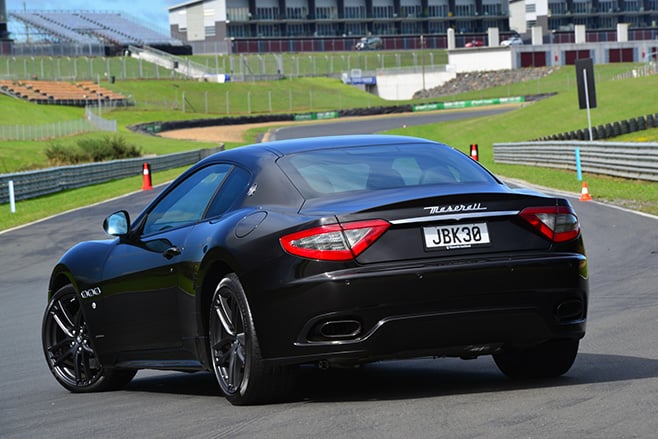
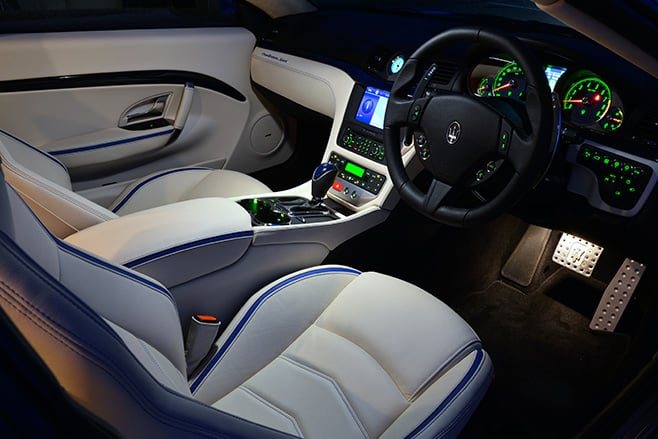
The interior is carbon-rich; the spectacular fibre is used to stiffen and lighten the front seats. A single-clutch robotised manual and a six-speed auto are available. Of interest is the fact the sequential manual is a transaxle, while the auto is bolted to the engine, altering the weight distribution and requiring different suspension tunes.
The Ferrari-derived 4.7-litre V8 howls all the way to 7500rpm, with torque peaking at 4750rpm and max power arriving at 7000rpm. Not only is it fast and loud, the Sportline deftly walks the line between dynamic response and GT-style comfort. The steering feel is excellent, turn-in is sharp and linear and body control is well sorted.
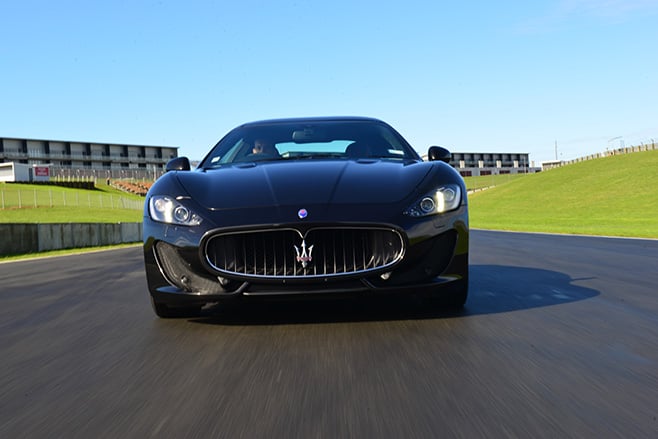
At just under $300K, the Sportline’s closest competitor is BMW’s ’bahn-storming M6 (see opposite). The Bavarian beast is faster and only three years young, however it can’t match this Italian’s design flair and more intimate driver connection. An oldie but a goodie.
4 OUT OF 5 STARS
SPECS Engine: 4691cc V8, DOHC, 32v Power: 338kW @ 7000rpm Torque: 520Nm @ 4750rpm Weight: 1880kg 0-100km/h: 4.8sec (claimed) Price: $295,000 Pros: Most of the sizzle of the hi-po Stradale, but with $50K change Cons: Auto ’box not quite as crisp as expected
TAXI drivers have ripped into Holden after reporting multiple instances of the steering locking up while they were driving a cabbie’s staple, the locally made Caprice large car.
What has angered them, though, is the fact that General Motors has recalled the US version of the long-wheelbase Holden Commodore – sold over there as the Chevrolet Caprice Police Pursuit Vehicle – to fix it for a similar problem.
While US road safety authorities have directed GM to fix the problem, Australian taxi drivers are claiming Holden has left them high and dry as they deal with steering that unexpectedly weighs up, forcing them to stop and restart the car to correct it.
According to the US recall, a connector between the Caprice’s Korean-sourced electric power steering module and the torque sensor in about 6000 cars built since 2013 was corroding, and causing the power steering to fail. That in turn makes it more difficult for the driver to turn the wheel.
The recall report states that the problem was only happening when the cars were subject to “extended idling times and elevated temperatures experienced in typical police applications”.
“A greater steering effort would be needed to control the vehicle if power steering is lost, increasing the risk of a crash,” the service notice said.
In the US, GM has replaced the car’s steering gear assembly at no cost
One Australian taxi driver, Dennis Hunter, claimed on ABC radio’s AM program today that the problem would cost him $1800 in repairs.
Holden said in 2014 it had “proactively” investigated and advised customers of a “potential steering issue with VF Commodores and Caprices”.
Today, Holden spokesman Sean Poppitt told Wheels: “Of the close to 60,000 vehicles inspected, only just over 100 re-presented with this issue.”
He added: “Regardless, any issue [with Holden-badged vehicles] is treated extremely seriously and we encourage all of our customers with any concerns to see their Holden dealer so we can help.”
Poppitt told ABC radio the fault that had surfaced in the US version of the Caprice was due to “extreme usage” that even a taxi driver could not replicate in Australia.
Another taxi driver, Daljeet Singh, told the ABC that the problem was more widespread than Holden claimed.
“There is a manufacturing fault,” he said.
“If it’s happening to one guy, two guys, I can understand, you know, here and there, but if it’s happening to 50 of my friends out of a 100 car group that means there is some problem.”
ONE of the past year’s more intriguing revivals was the Suzuki Vitara nameplate, this time adorning a car-based small SUV. While it is stylish, spacious, and smooth, a shortage of grunt has disappointed – so the new Turbo is welcome indeed.
WHAT IS IT? The latest Vitara ditches all preceding versions’ separate-frame construction for a monocoque body, putting the Suzuki squarely in Mazda CX-3 territory. And there’s much to like about this small SUV, even if stronger performance has been called for. The Japanese have been listening, hence the powerful and torquey S Turbo.
WHY WE’RE TESTING IT The small SUV segment is booming, with the Mazda CX-3 leading the charge and many rivals, Suzuki among them, seeking a bigger slice of the sales cake. The Vitara launched last year has had a strong start, but the Turbo promises to broaden its appeal by offering significantly better performance. Here we look at the expected best-selling S Turbo 2WD at under $30K.
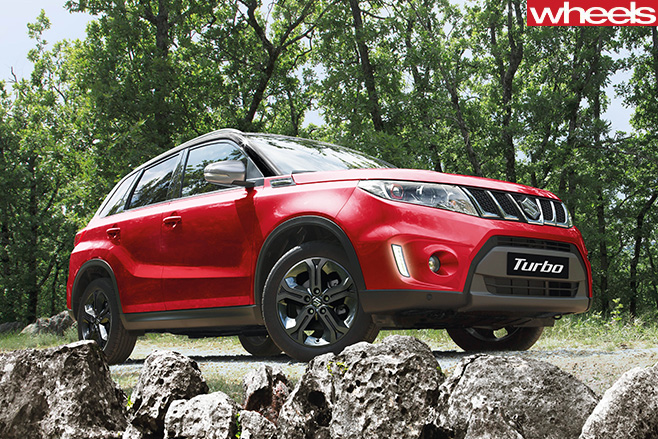
THE WHEELS VERDICT WHILE the bottom-end Vitara RT-S models made sense with their highly competitive pricing and generous specification, the better-equipped RT-X versions suffered because they offered no more performance, especially in the heavier AWD variants. Now Suzuki has launched the S Turbo in both front-drive and AWD guises, adding a deliciously sweet and punchy automatic powertrain to help justify the extra outlay. With forced induction, the Vitara now steers better too, though the ride remains on the firm side and the lack of driver-assist tech and unavailability of manual gearbox are disappointments. Still, the Turbo elevates the range enough to give the top three small SUVs (Mazda CX-3, Honda HR-V, and Renault Captur) a real scare.
PLUS: Torque, refinement, smoothness, space, comfort, handling, vision, styling, versatility MINUS: Firm ride, no manual, some torque steer, no driver-assist tech
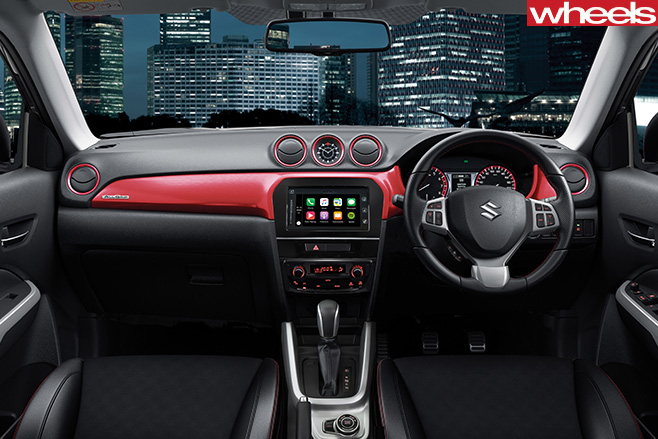
Launched last August, the latest Vitara – the first with monocoque body construction – charmed many with its sweet-spinning 1.6-litre atmo four-pot, smartly calibrated gearboxes, chunky good looks, airy and spacious cabin, comfy seating, low entry pricing, high spec levels, and capable dynamics.
It could have owned the small SUV segment, but for a firm ride, an expensive AWD variant, and a shortage of low-down torque.
Enter a box-fresh 1.4-litre turbo. Conceding nothing in terms of refinement to the continuing 86kW/156 1.6 in the base RT-S, the 103kW/220Nm ‘Booster Jet’ four-cylinder installation is like that first scene in the Bradley Cooper film Limitless after he’s popped the pill: it simply enhances everything.
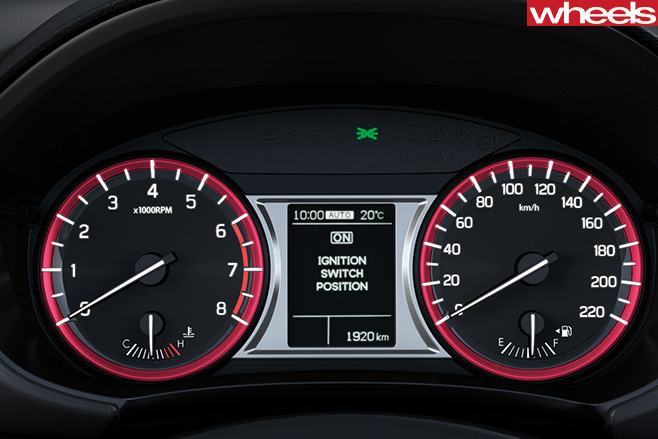
Aided by a handy pair of paddleshifts (though the transmission upshifts automatically approaching the redline), the effortless performance is everything the atmo version’s isn’t. This savvy little slingshot is a super-smooth torquer, with low fuel consumption to match. If there is consumer demand for it, an S Turbo manual is waiting in the wings. Fingers crossed.
Additionally, the new-gen powertrain seems to have subtly altered the Vitara’s steering characteristics, removing what was a slight stickiness, for a more linear and consistent feel. However, while the chassis’s high grip levels remain, some torque-steer tug is evident on wet roads, while the helm still isn’t quite as sharp or responsive as we’d like, with insufficient weighting or feedback. Here the CX-3 can rest easy.
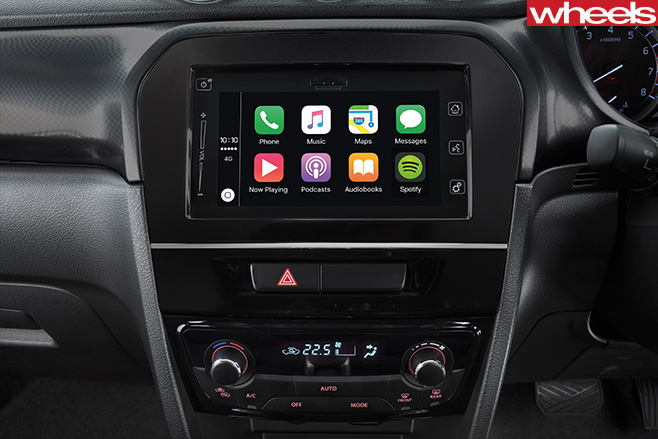
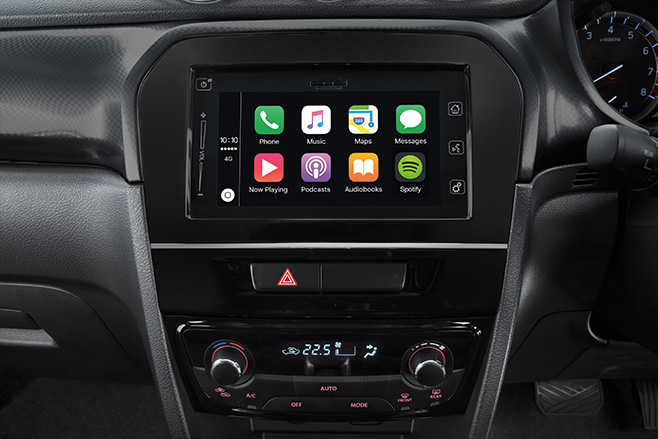
Elsewhere, the S Turbo is business as usual, with that fine (if quite plasticky) interior now gaining Apple CarPlay and Android Auto. Too bad Autonomous Emergency Braking isn’t offered in an otherwise modern, techie, small SUV, however.
All up, the Booster Jet finally puts value in the handsome top-end Vitaras, elevating the series to possible class-leading contention. Especially when you put your foot down.
SPECS Model: Suzuki Vitara S Turbo 2WD Engine: 1373cc 4-cyl, dohc, 16v turbo Max power: 103kW @ 5000rpm Max torque: 220Nm @ 4000rpm Transmission: 6-speed automatic Weight: 1160kg 0-100km/h: 10.2sec (est.) Fuel economy: 5.9L/100km Price: $28,990 On sale: Now
Read the full range review on the Suzuki Vitara S Turbo here.
Suzuki has announced a $28,990 starting price for the auto-only Suzuki Vitara S Turbo that will help the Japanese brand take on rivals such as the Mazda CX-3, Honda HR-V, Subaru XV and Volkswagen Tiguan.
The S Turbo sits above the entry-level Suzuki Vitara RT-S, which costs $21,990 with a six-speed manual gearbox or $23,990 with the same six-speed auto featured in the Turbo.
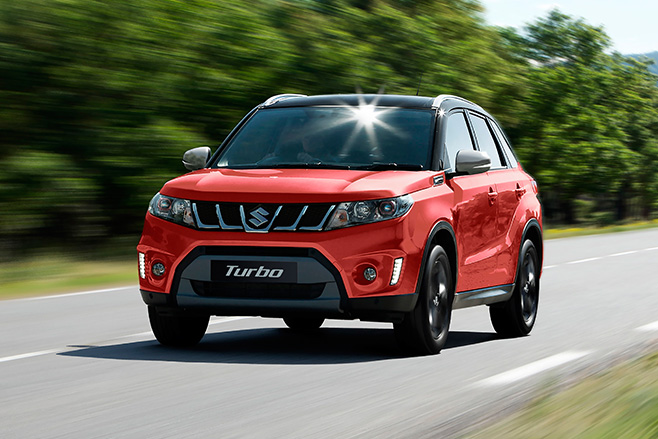
The Turbo’s new BoosterJet 1.4-litre four-cylinder turbocharged engine produces 103kW of power and 220Nm of torque – increases of 17kW and 64Nm over the non-boosted 1.6-litre four-cylinder of the base model.
It also improves fuel consumption marginally – officially using 5.9 litres per 100km versus the 6.0L/100km of the auto base model. The Turbo engine requires more expensive premium unleaded, however.
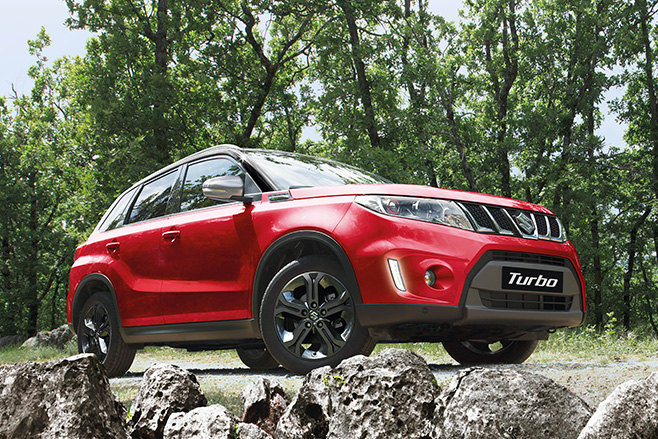
The Vitara S Turbo’s key equipment upgrades over the RT-S include leather/suede upholstery, push-button engine start, front and rear parking sensors, LED low-beam headlights with auto on/off, rain-sensing wipers, and two tweeters for the audio.
The 17-inch alloy wheels are also finished in black rather than silver, the grille is finished in chrome, and the side mirrors are coloured silver and integrate indicators.
A bright-red body with black roof exterior combination is exclusive to the Turbo, and the only colour available initially. Suzuki Australia says other colours will be available once supply issues have been overcome.
The Turbo is the only Vitara available with all-wheel drive, though it doesn’t come cheap at $32,990.
The on-demand system, called AllGrip, will send more power to the rear wheels if it detects the front wheels struggling for grip.
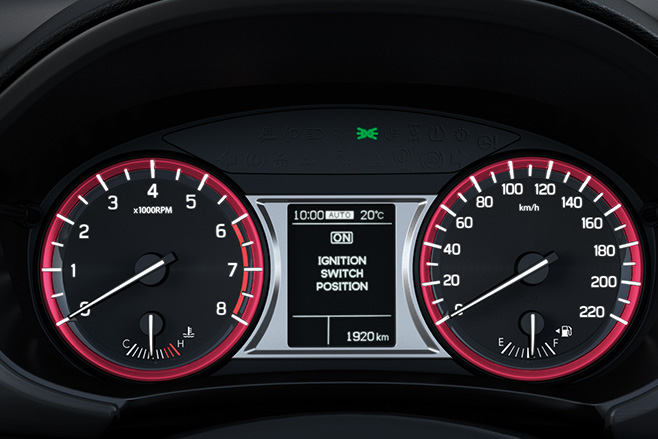
AllGrip features four mode options – Auto, Sport, Snow and Lock – depending on whether the focus, in order, is on fuel-saving, sporty driving, secure handling on slippery surfaces, or getting underway on terrain such as snow or mud.
Suzuki Australia is offering driveway deal of $29,990 for the front-wheel-drive S Turbo until June 2016.
Read the full review of the Suzuki Vitara range here.
Taking pride of place on top of the dashboard is a 12.3-inch high resolution display. It is fully customisable, able to show everything from conventional instruments for speed and trip information through to detailed 3D navigation.
The head up positioning of the panel is the same as currently found in Peugeot 208, Peugeot 308 and 2008. Peugeot has squashed its steering wheel design even further keeping it underneath the display, allowing drivers to look over the wheel rather than through it, and maintain focus on the road.
A compact steering wheel has other advantages, according to Peugeot. It offers sharper manoeuvrability by reducing the amount of movement needed to steer the car, and makes the driver more responsive from the relaxed driving position. Peugeot also suggests the head up instrument panel increases driver comfort and reduces fatigue.
Peugeot has integrated new tech like Apple CarPlay and Android Auto into an updated infotainment system. A second, touchscreen display in the middle of the dashboard is used for interactive technology.
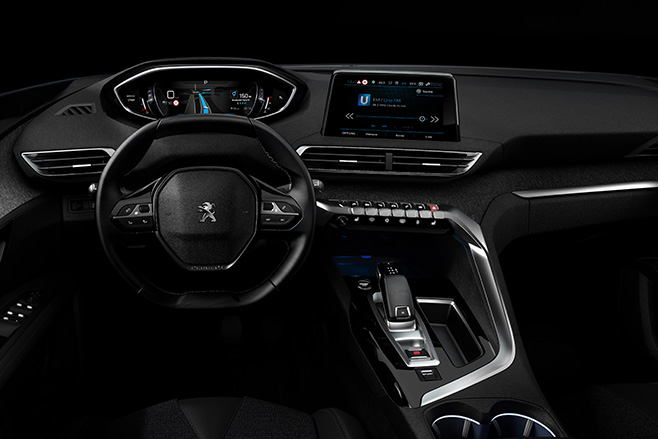
Peugeot is seeking to engage all five senses in its new concept. The front seats feature a multi-point massage function, and the climate control has a fragrance diffuser for a pleasant aroma.
Interior lighting intensity is adjustable, with two ‘atmospheres’ to select from called Boost and Relax for spirited and peaceful driving respectively.
Hands-free voice recognition is included for sending/receiving text messages and accessing other car and phone functions.
This new concept previews what we can expect to see in the next-generation of Peugeot passenger vehicles.
The carmaker said it wants driving a Peugeot “to become a unique, unforgettable, compelling and addictive experience.”
