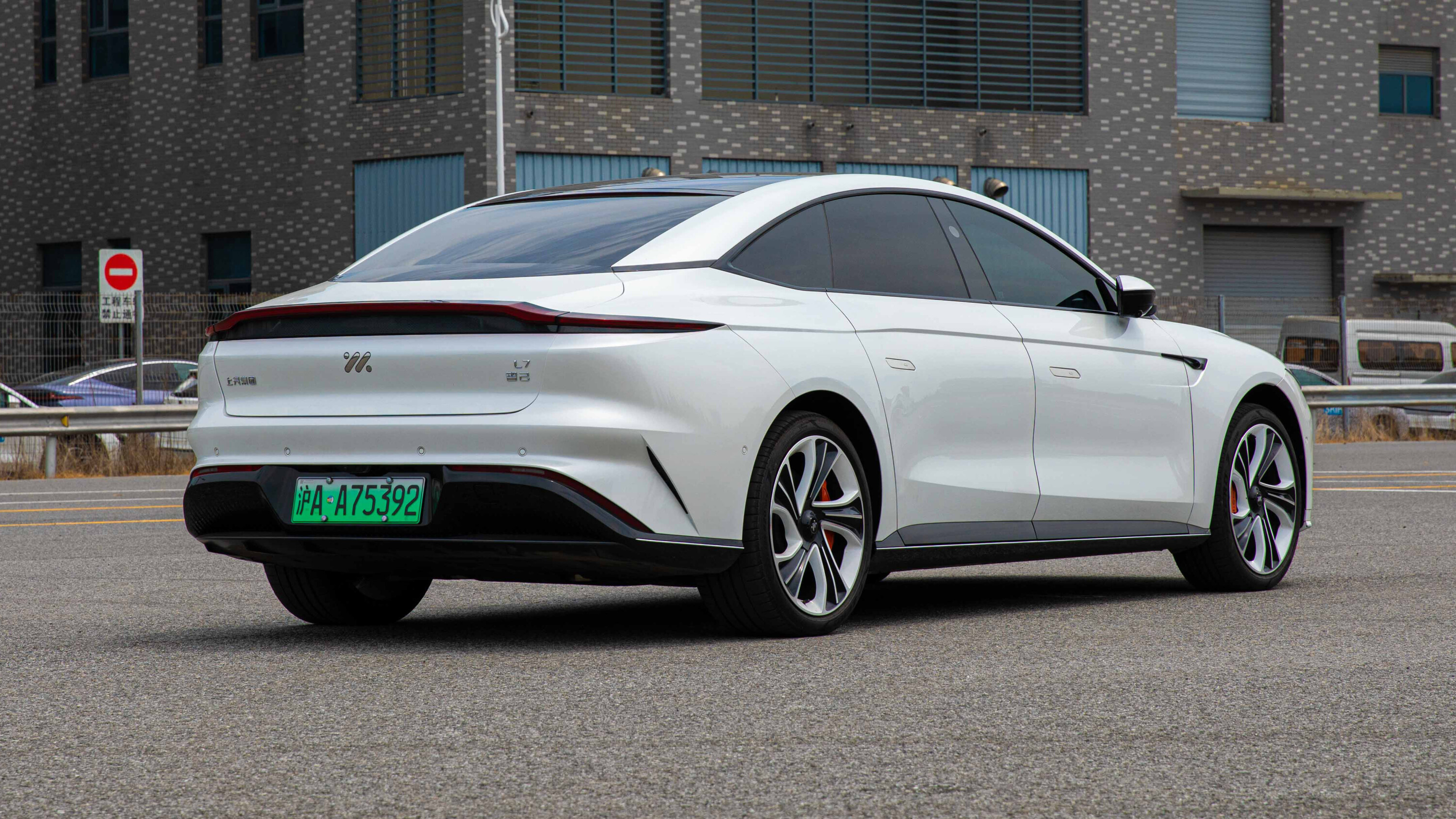
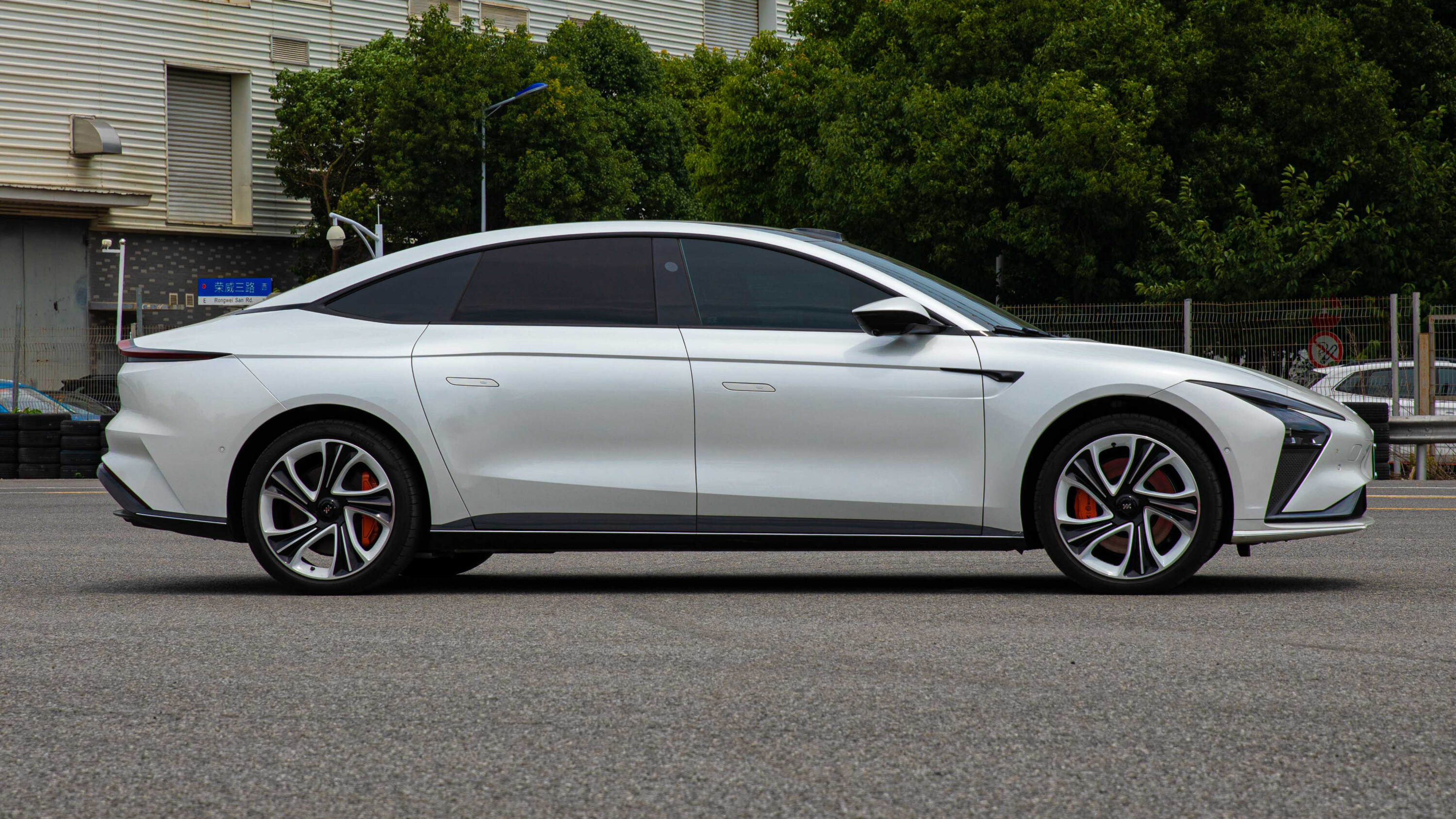
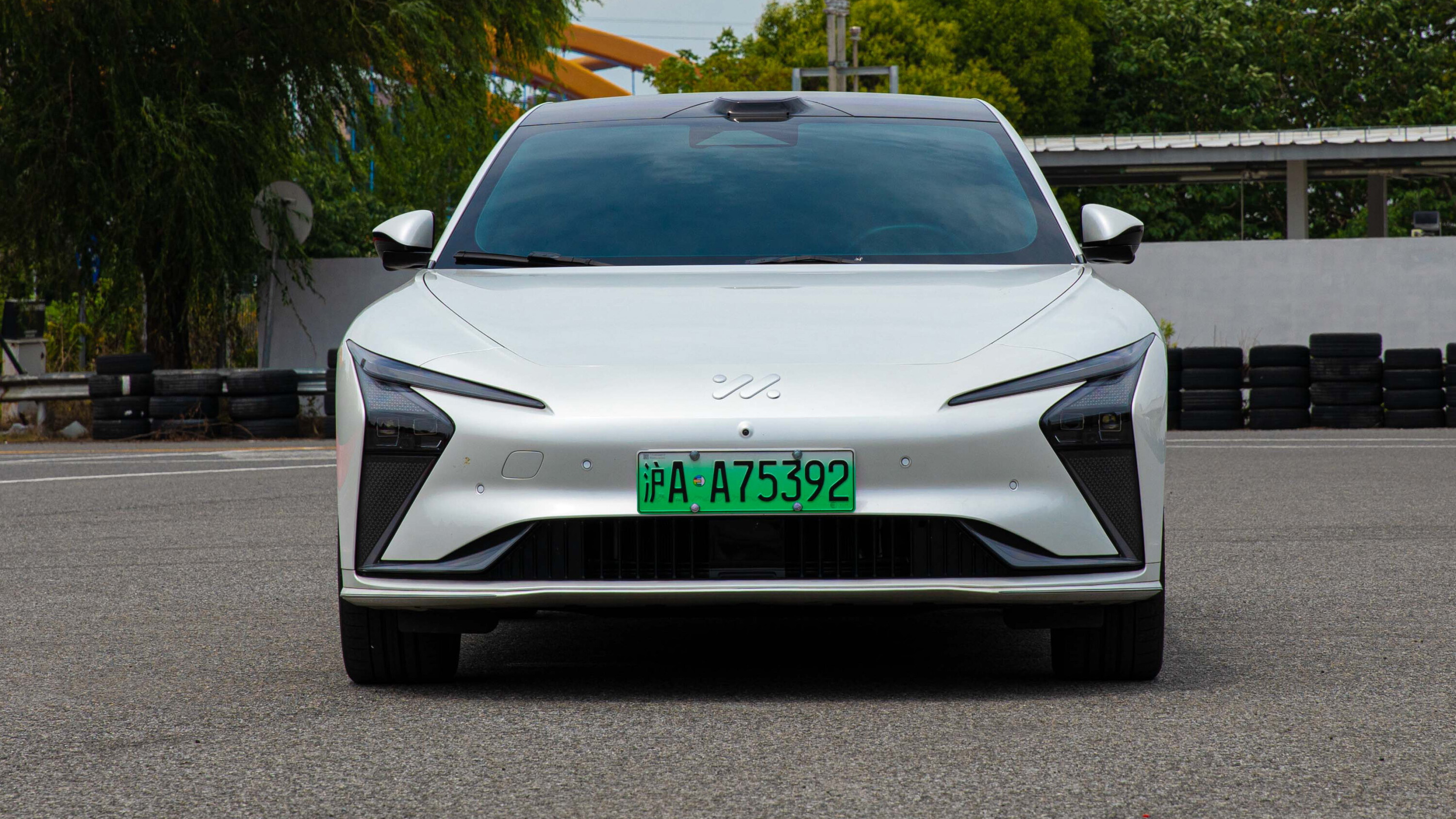
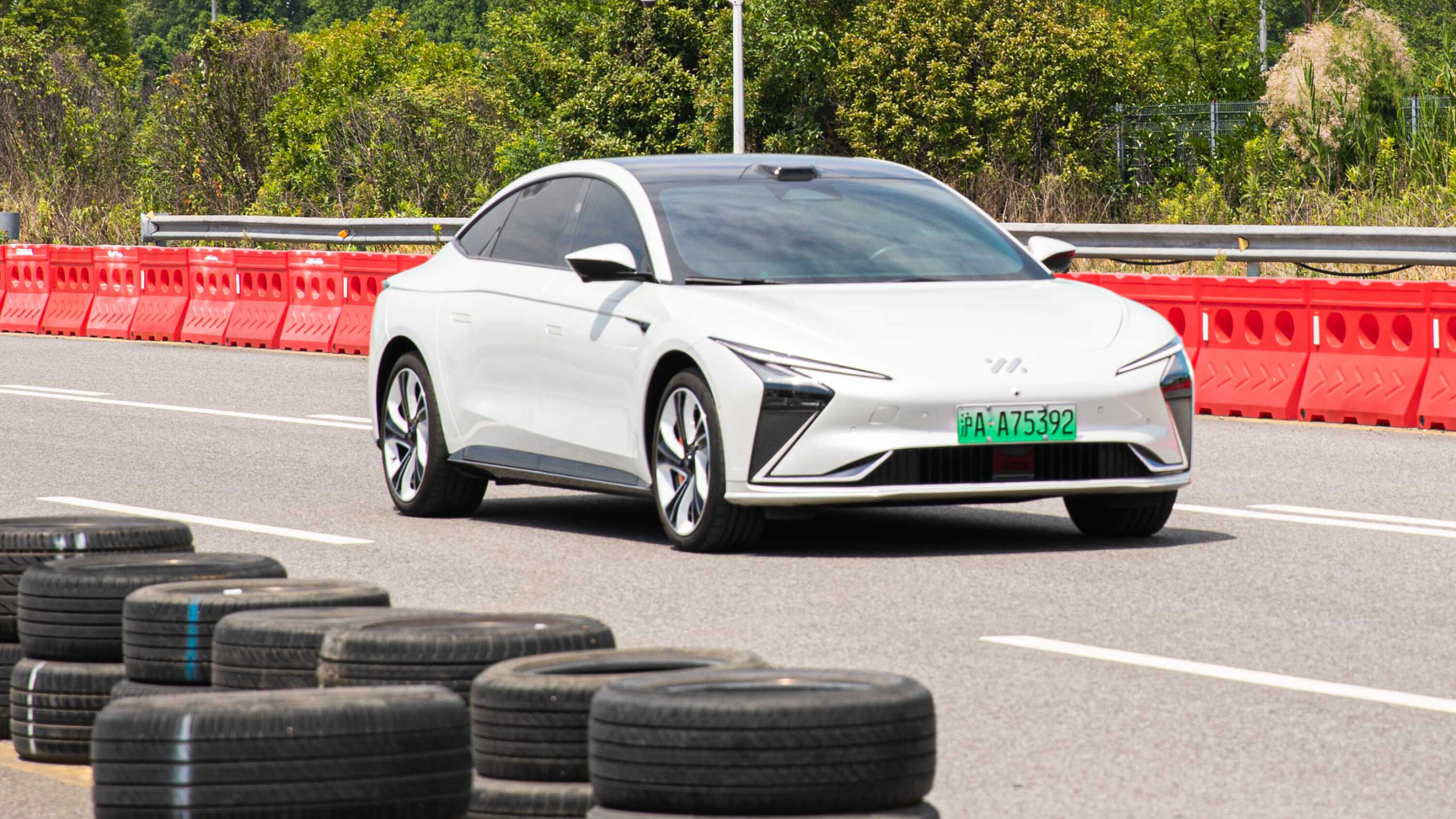
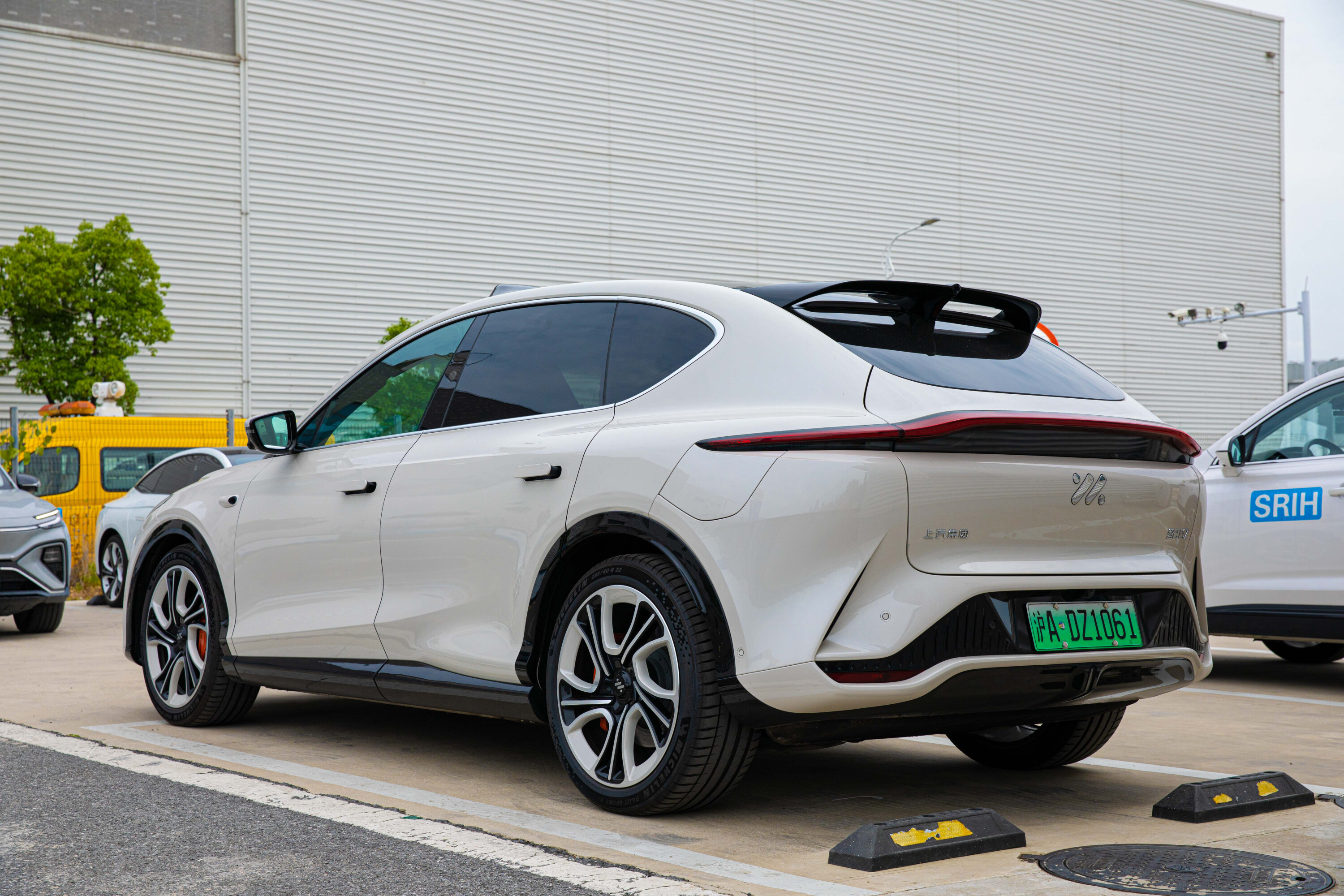
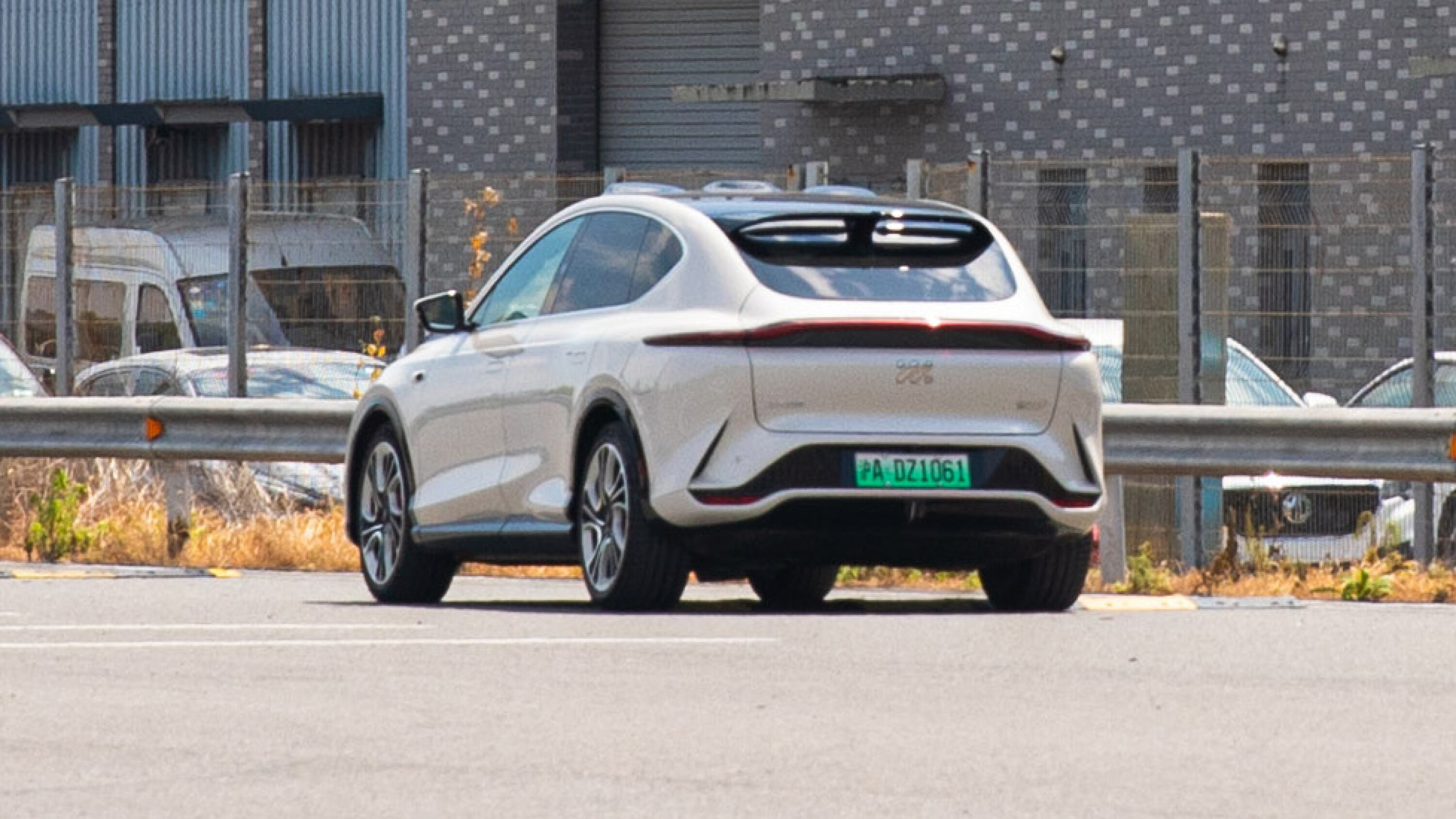
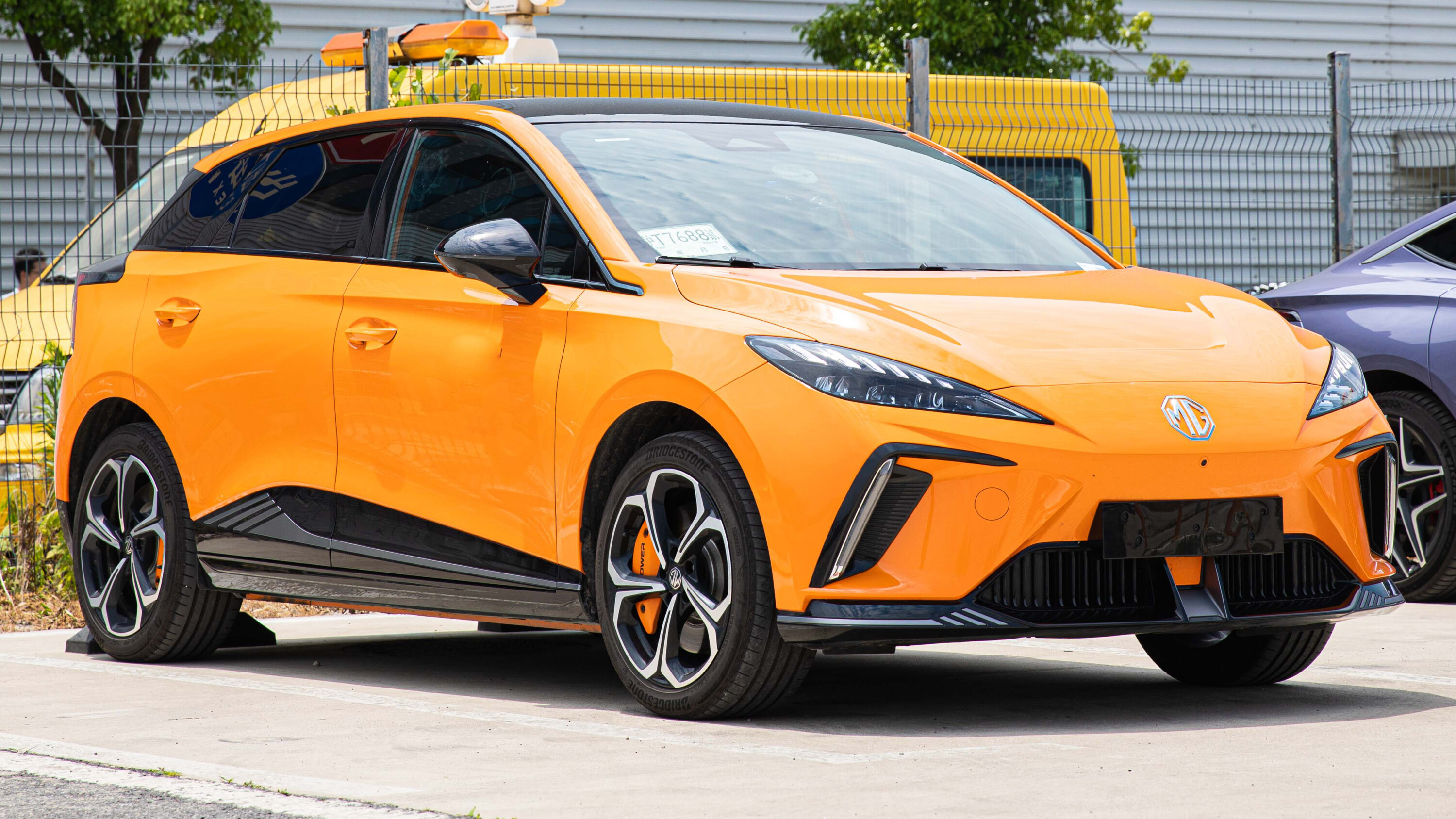
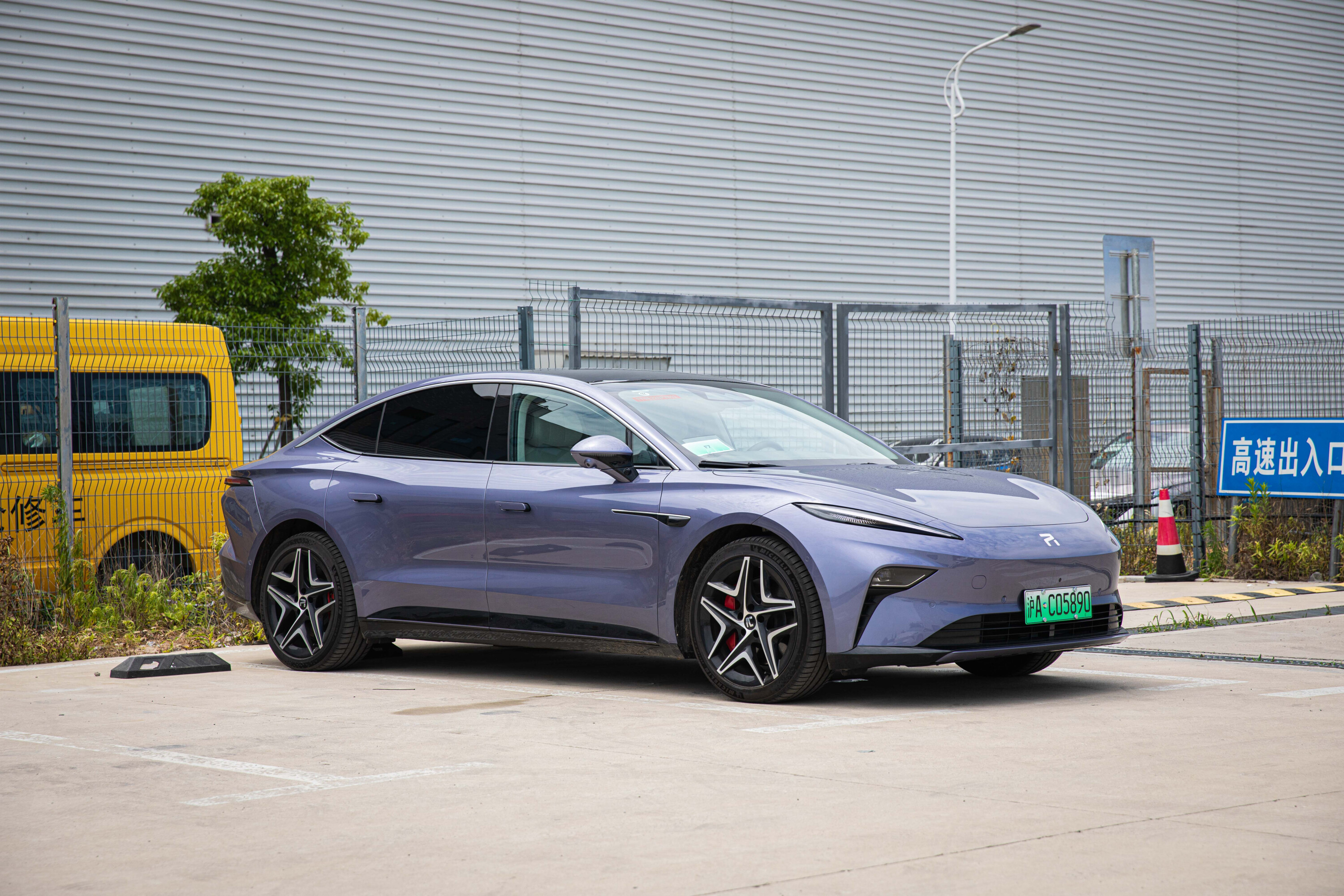
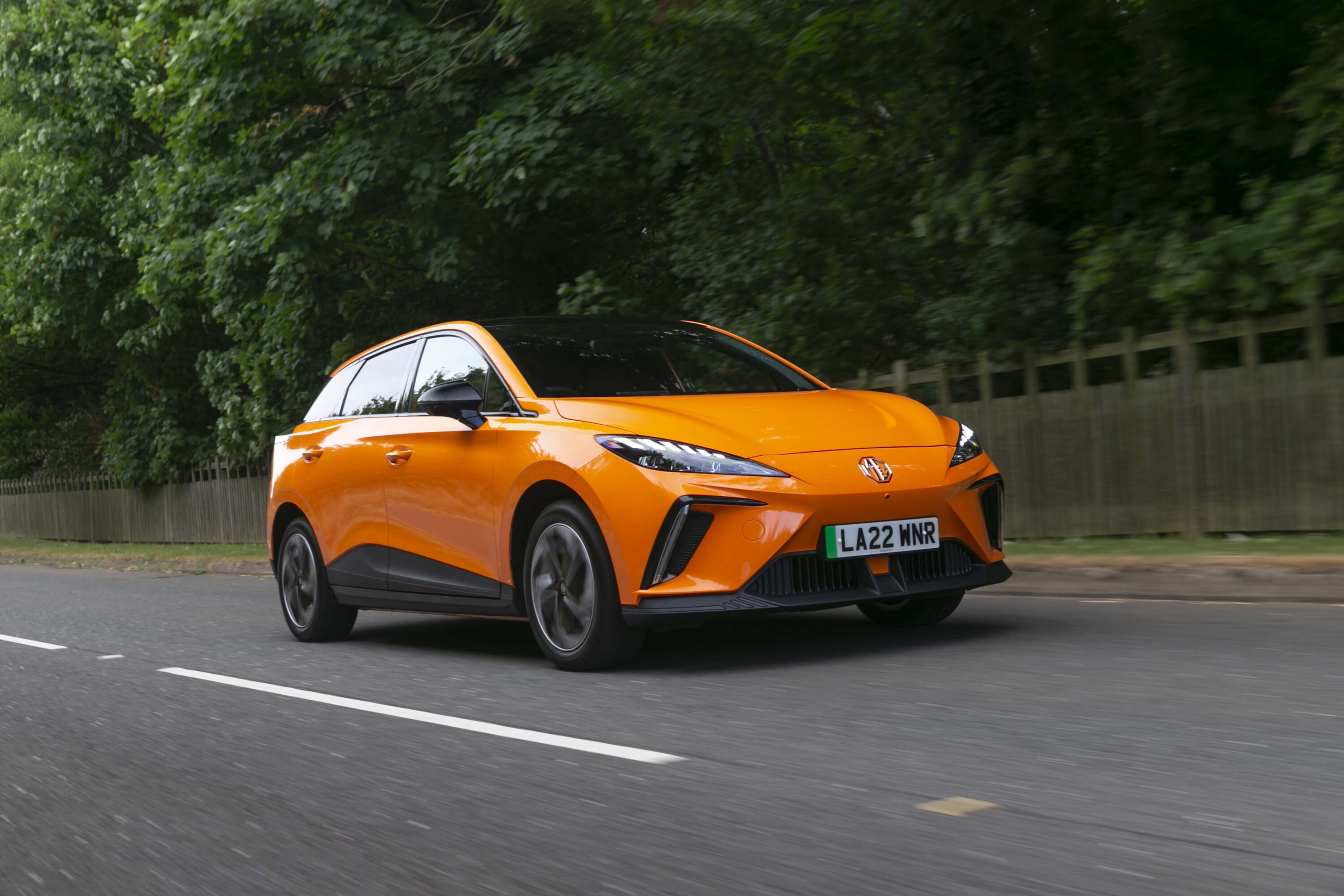
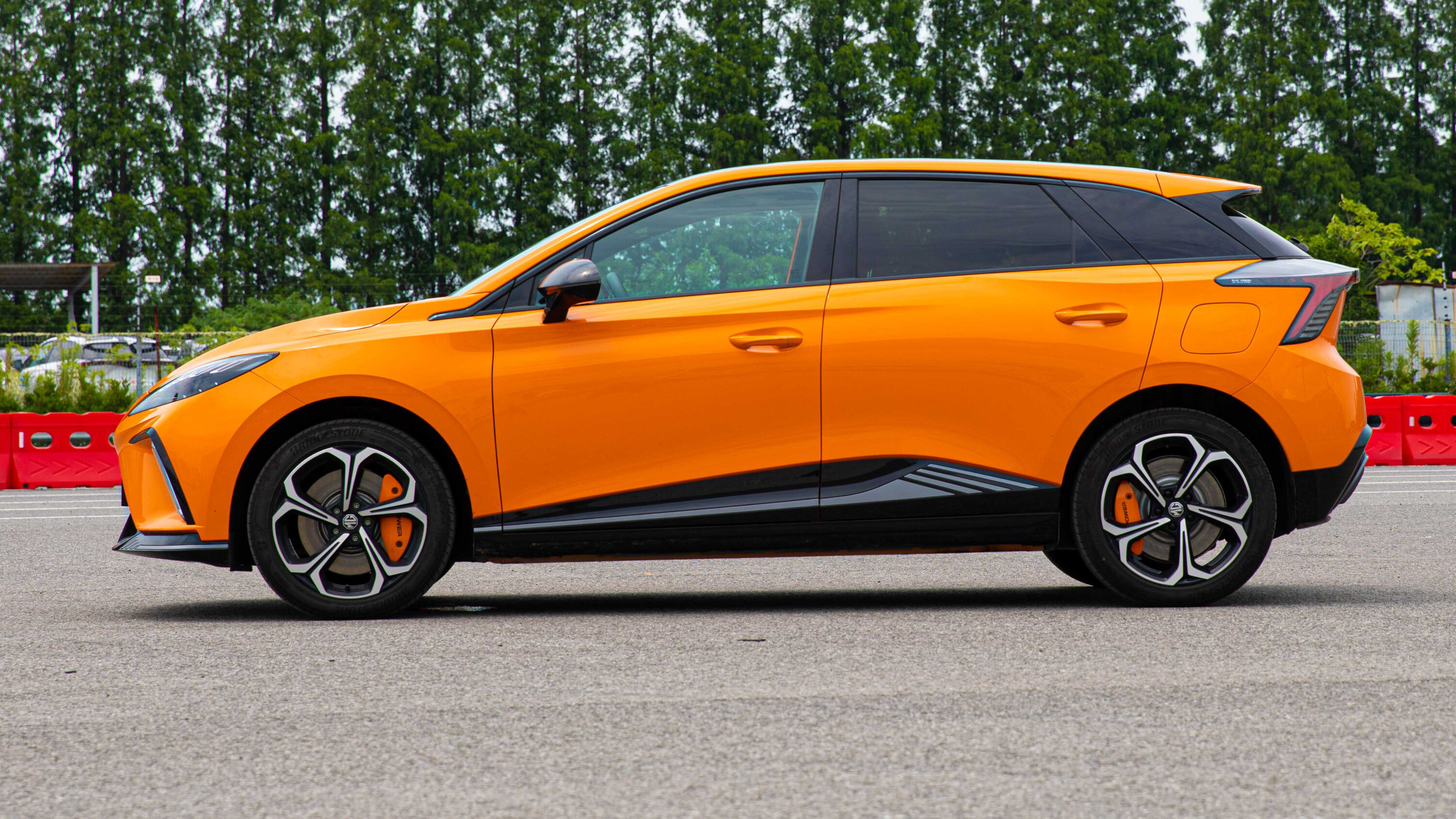
The L7 is an intriguing electric, four-door large sedan made by SAIC in China and is basically a sedan version of the LS7 SUV. It’s badged as “IM Motors” but if it came to Australia, it would be an MG.
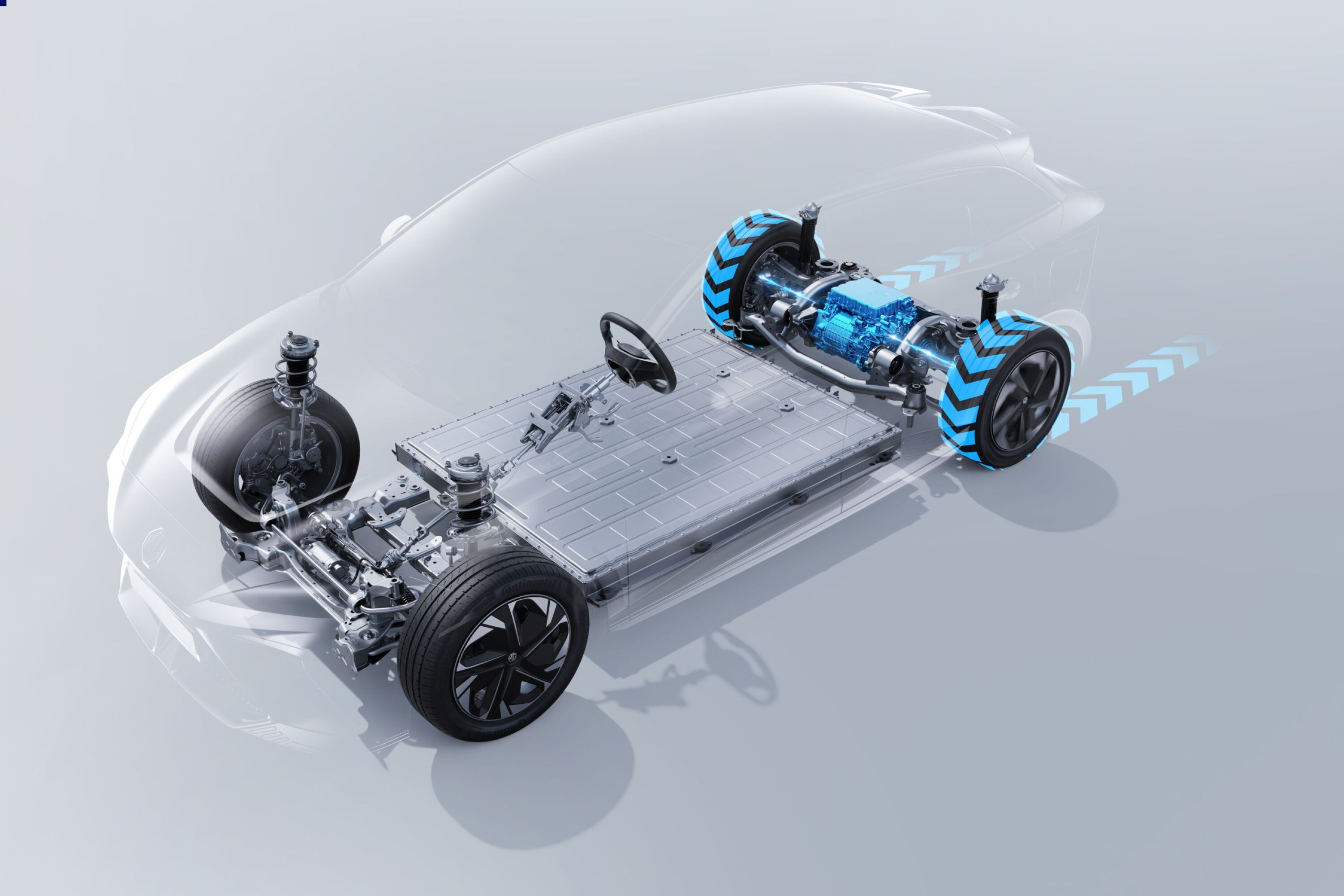
In China, the L7 is billed as a Tesla Model S rival. Five metres long and with a three-metre wheelbase, the L7 comes in dual-motor, all-wheel-drive specification or single-motor guise with rear-wheel drive. The AWD model has 425kW/725Nm while the rear-driver, 250kW. There’s also a “sports package” which raises outputs to a titillating 445kW/730Nm.
With the car not slated for Australia until at least 2025, it’s far too early to speculate which models and powertrains might make it Down Under.
In China, there are two battery options – a sizeable 97kWh (lithium-ion) offering around 615km range (CLTC); and a massive 118kWh pack with a Sydney-to-Melbourne-crushing 1000km claimed range (CLTC).
1
Williams Engineering helped develop the chassis, which also has all-wheel-steering.
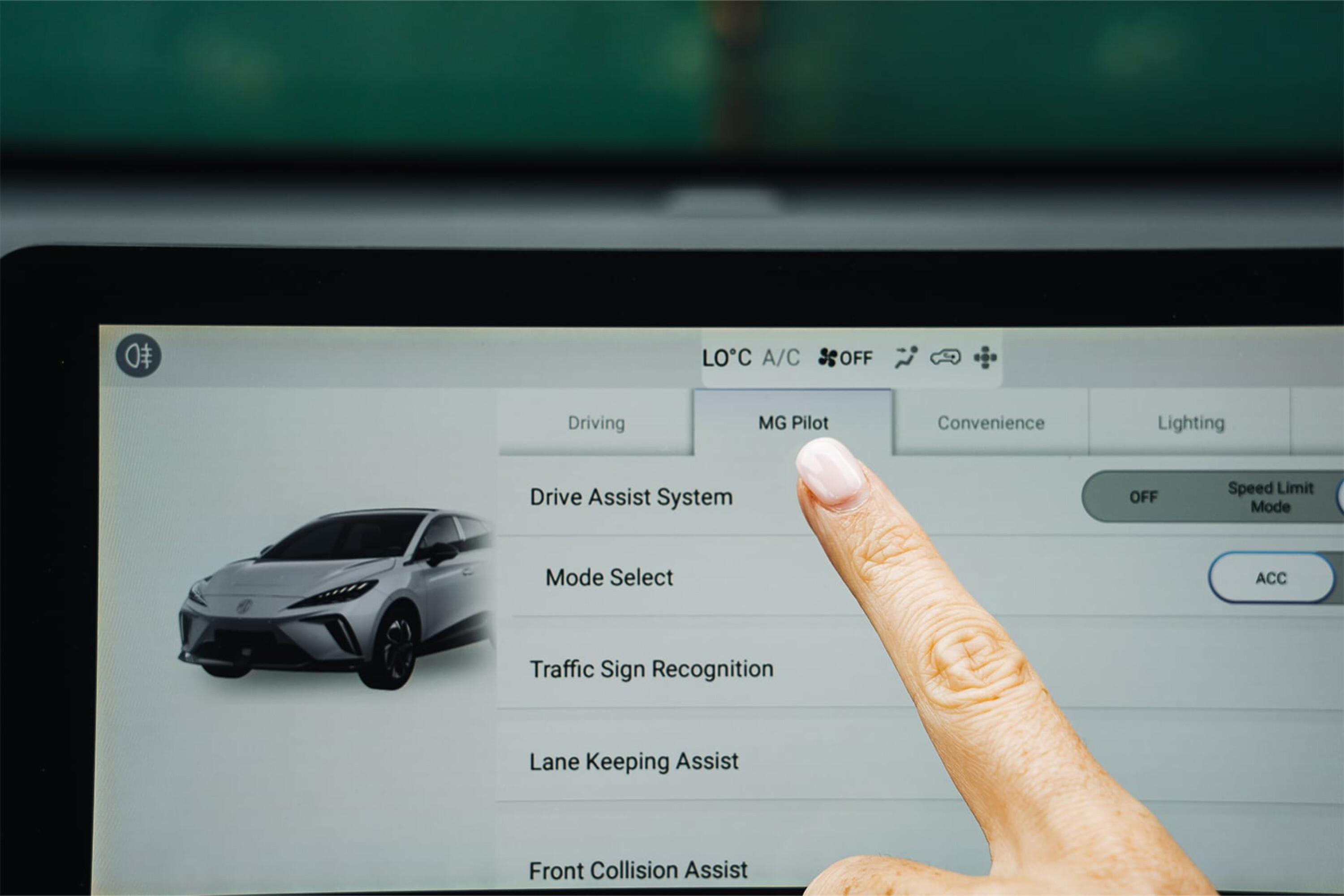
The L7 has 12 exterior cameras and claims Level 2.5 autonomous driving capability (down the freeway or city streets) and SAIC also claims it can park itself autonomously, later able to be summoned by the driver. The jury is well out on whether any of this would be legal in Australia by the time it arrives, and we didn’t get to try any of it on our very short test.
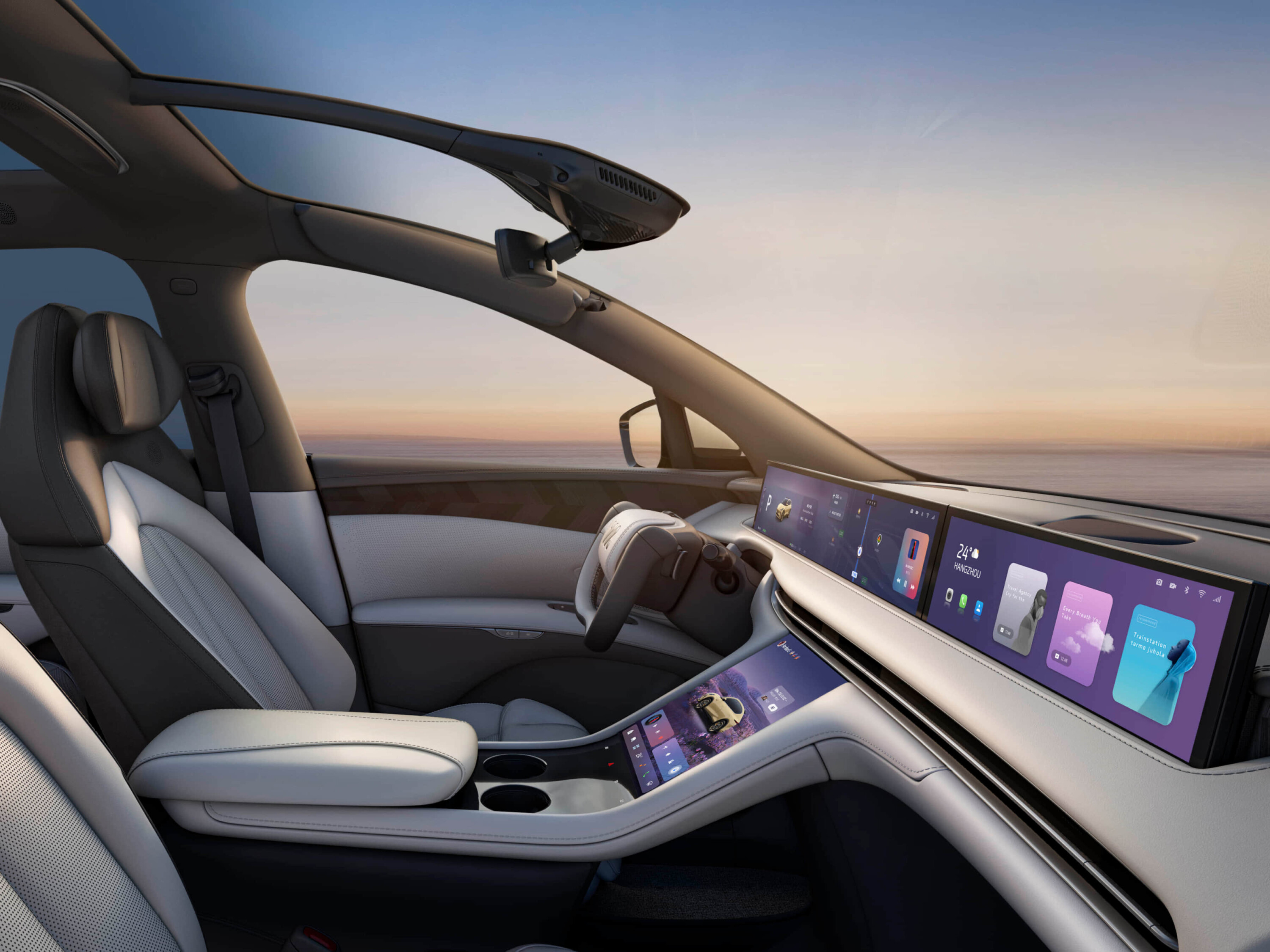
Inside, a huge, 39-inch digital display spans the entire dash while a 12.3-inch central touchscreen contains other controls such as for HVAC and the powerful, 1120-watt, 22-speaker sound system. There are also automatic opening front doors – press a button and an electric motor opens or closes them for you.
When is the MG L7 due in Australia?
MG said the L7 is “under strong consideration” for Australia, and if it came, it would be around 2025. Australia is likely to receive either the L7 or MG F7 which we’re reviewed separately.
What’s it like to drive?
Perhaps the most provocative feature of the L7 is its fake V8 engine sound. Pop it into Sport mode and the entire 39-inch screen drops halfway into the dash – improving visibility – as a low, convincing V8 burble enters the cabin at idle. You can even rev it.
1
Boot it and it ‘kicks down’ as a V8 roars to ‘redline’. It sounds a little bit obviously fake in the ‘upper revs’ but for a first effort, it’s pretty good. You’re guaranteed to laugh out loud, at least the first time.
Having paddle shifters makes you naturally try to change up gears, but nothing happened in the L7 we drove. MG should engineer some artificial gears to go with the fake noise, we reckon. It would be even more hilarious.
The L7 feels very luxurious inside, its black leather interior with microsuede ceiling lining giving it a sinister, rebellious ambience – which does go with the fake V8 noise. It’s quite a large car but it’s very easy to drive at low speeds with light steering, a lovely soft ride quality and the smoothness, response and serenity we’ve come to expect from electric cars.
1
The 425kW version we drove claims 0-100km/h in 3.9 seconds and felt plenty brisk to us on our very brief drive around a test track in Shanghai.
Push it into a corner and the L7 has plenty of lateral grip, although it quickly lapses into understeer as it tries to deal with its 2290kg kerb weight. Unlike the F7 sedan we also reviewed, there is no “rear-drive” mode, which is a pity. Drifting with the fake V8 noise would be a game-changing driving experience for an EV sedan.
1
Is it worth waiting for the LG L7?
It’s a bit of an ask to wait until 2025, but if you’re wanting a surprisingly comfortable all-electric sedan that’s guaranteed to turn heads in Australia with looks of “WTF is that?!” the L7 might be for you.
Build quality of the vehicles we drove seemed good, although panel gaps varied a lot and some panels didn’t quite fit perfectly together.
The rear-drive, 250kW L7 costs the equivalent of about AU$70K in China while the 425kW/725Nm model we drove cost around AU$85K. The 445kW dual-motor L7 Snake Performance starts from around AU$100K. That’s not necessarily indicative of its cost in Australia, and MG said local pricing would be confirmed closer to 2025.
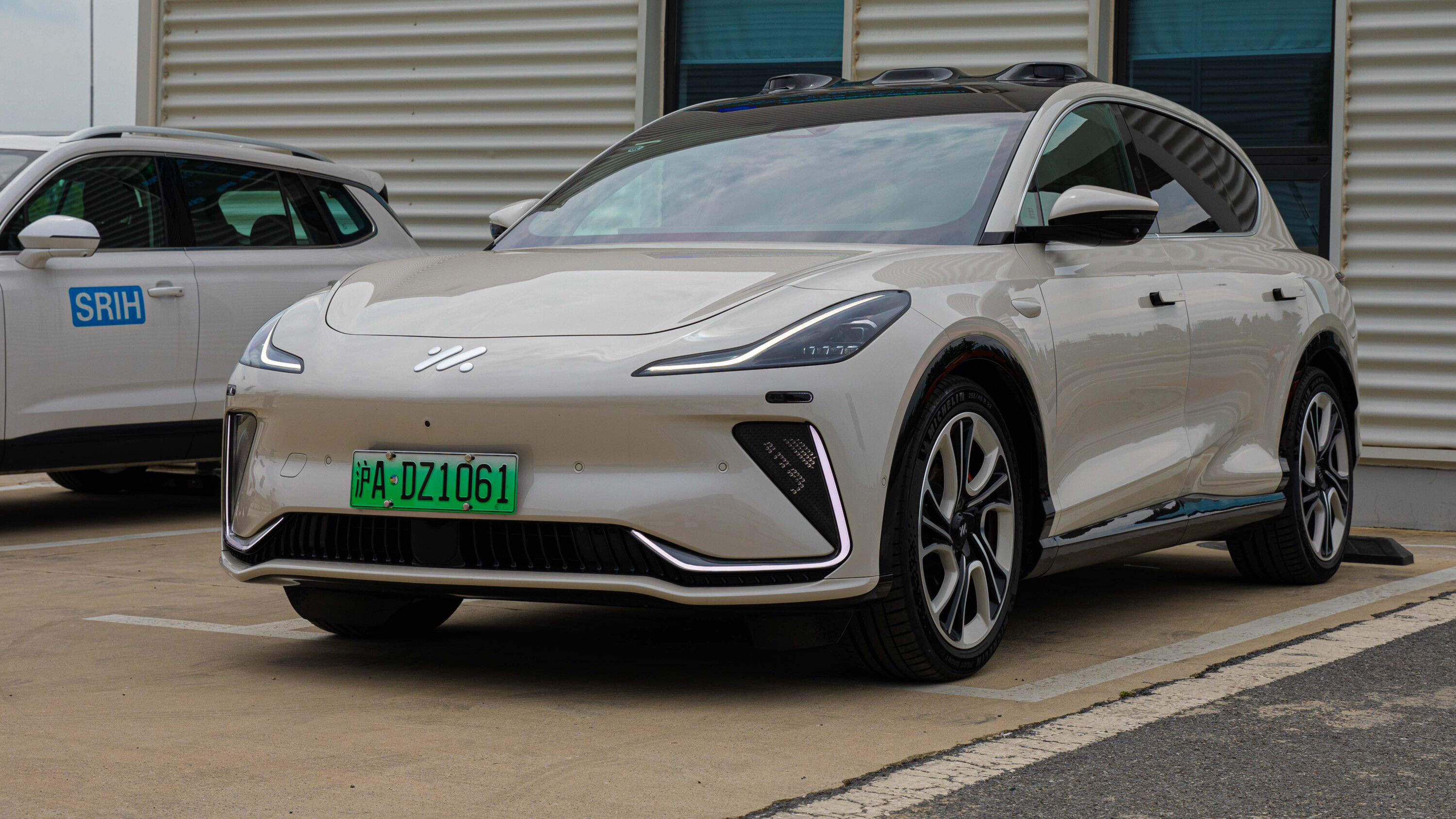
It sounds like a V8 engine from General Motors, but in China, an LS7 is a cutting-edge large electric SUV. Badged as an “IM Motors” model in its domestic market, it would be an MG in Australia – and it’s almost guaranteed to come here.
What is less clear is which ones we’d get. There are single-motor, rear-drive and dual-motor, all-wheel-drive versions. The dual-motor we drove had 425kW/725Nm, claimed 0-100km/h in 4.5 seconds and 625km range (CLTC) from its 100kWh battery.
The five-metre-long LS7 has 22-inch wheels concealing enormous Brembo brakes, while retracting roof-mounted autonomous driving sensors and cameras almost make it look like it has little Shrek ears. The rear styling looks suspiciously, almost shamelessly like an Aston Martin DBX. The boot is an enormous 733 litres.
A Tesla Model Y could be considered among its rivals, although the LS7 would likely undercut it on price while offering more features and performance.
1
When is the MG LS7 due in Australia?
The LS7 isn’t yet confirmed for Australia, but MG did say it was “under strong consideration” and could arrive around 2025.
What’s it like to drive?
The LS7 is far cooler to just sit in than drive.
Its front doors open electrically to a very bright and light-filled cabin, the enormous, tall windscreen stretching right up over your head. We’re not quite sure how they do it, but the leather quality (part Nappa) and materials feel as nice as high-end cars like the Range Rover Autobiography (whether it’s built as well is another matter).
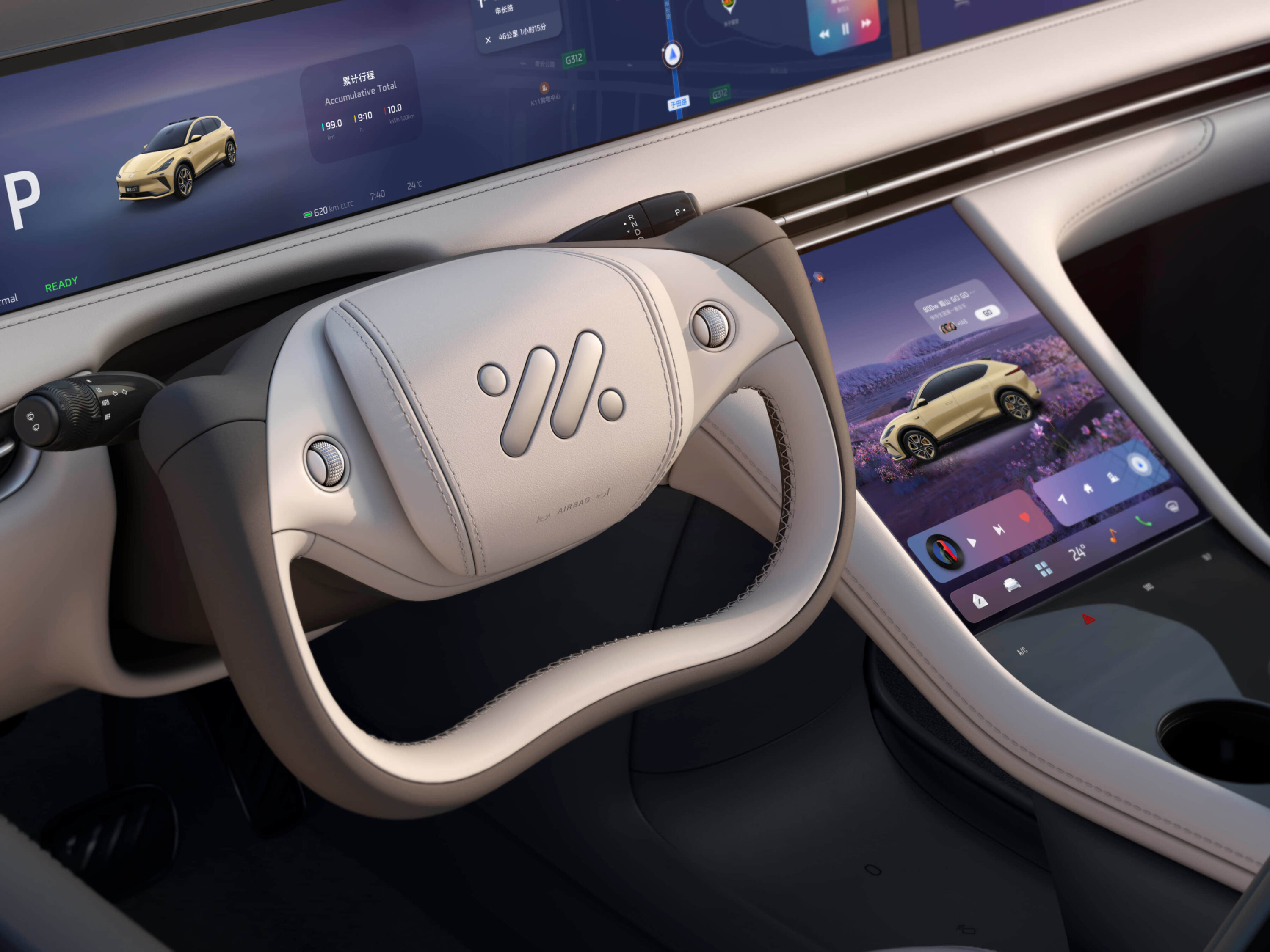
There’s a flat-bottom steering yoke that looks like something off a posh F1 car while a huge, 26-inch digital display combines with a 15.5-inch monitor for the front passenger to create a screen that effectively spans the entire dashboard.
2
To drive, the LS7 is easy, quiet, smooth and offers plenty of punch from its electric motors.
Our test car’s second row featured a single seat that could recline almost into a bed (provided nobody was sitting in the front). While using the massage function, you could very easily nod off. We wonder how legal this seating position would be in Australia.
To drive, the LS7 is easy, quiet, smooth and offers plenty of punch from its electric motors. While there were precious few bumps in the MG test track on which we had our very short drive, the LS7’s air suspension felt very comfortable and compliant.
Unlike other yoke steering wheels which are mated to ultra-fast steering racks, the LS7’s is connected to a conventionally-geared system which sort of misses the point. In China, a normal steering wheel is an option.
Push it hard into a corner and the LS7, while feeling dynamically quite good with lots of lateral grip, starts washing into gentle understeer owing to its approximately 2.5-tonne weight.
2
Is it worth waiting for the MG LS7?
Were the top-spec LS7 to go on sale in Australia for about $100K – roughly its price in China – you will have to be careful when seeing one in the metal because the impression it makes in a showroom is a very, very convincing one.
In China, the LS7 comes in seven variants priced from the equivalent of approximately AU$60K (for the 250kW, rear-drive 77kWh) to AU$95K for the top-spec 425kW all-wheel-drive version with 100kWh battery.
1
The value proposition is off the charts.
The top-spec model adds height-adjustable air suspension, automatic-opening front doors and a 24-speaker sound system. We haven’t mentioned the autonomous driving capabilities as we’d want to test them in the real world before potentially singing any praises.
But the amount of gear you get for the money is enough to frighten the wits out of other brands, particularly the Japanese ones. The value proposition is off the charts.
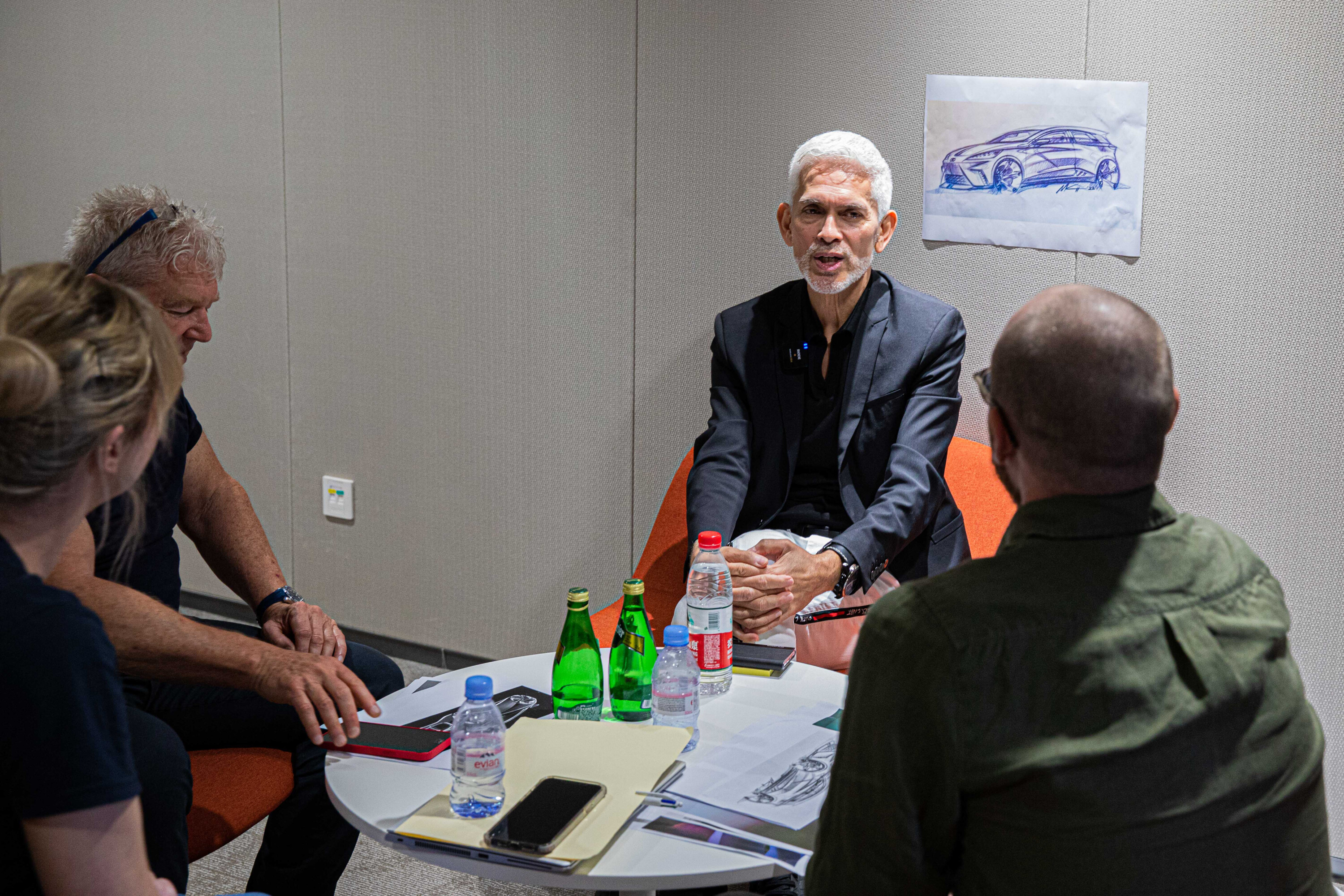
Speaking to Wheels from SAIC’s global headquarters in Shanghai, MG Global Chief Designer Oleg Son said the SUV trend won’t last – or at least it’s changing into something else.
1
“My hope is that [the] SUV will not survive forever,” he told Wheels.
“Maybe it’s going to fade away a little bit. With the cost of fuel; I think it’s not forever. It’s like the MPV in the ’90s, ’80s. There were lots of people who felt that MPVs were ‘oh, it’s nice, I love it, it’s practical, I can bring my kids’. Then one day they were fed up with that, and the SUVs came in. This kind of thing could happen.”
Son said he foresaw consumers shifting away from large SUVs and into smaller, more stylish vehicles.
“I believe in the return of cars which are more compact, lower, more efficient, more aerodynamic – and therefore more sexy, because when you [design] an SUV, it’s a box, basically. So if it’s smaller, maybe you have more opportunity to come up with a nicer [shape], something more sexy.”
Son, who previously worked as a designer at Kia and Citroen, hastened to add it didn’t mean MG would stop selling SUVs – just that they’d change.
“An SUV can be lower, very aerodynamic – there is space for different types of morphology and profile,” he said.
1
MG one of the few brands not planning a ute
Meanwhile, Son confirmed that MG had no plans at this stage to produce a dual-cab ute – currently the most popular type of vehicle in Australia.
Dual-cab utes such as the Toyota HiLux regularly dominate the sales charts in Australia.
“At the moment, I am not working on such things,” he said. “But at Kia, I did. Kia is a global company, the main market for Kia is America, so this is why I was working on such cars.
“For MG, to be honest, is [a pick-up or ute] part of the MG DNA? I’m not so sure about that.”
1
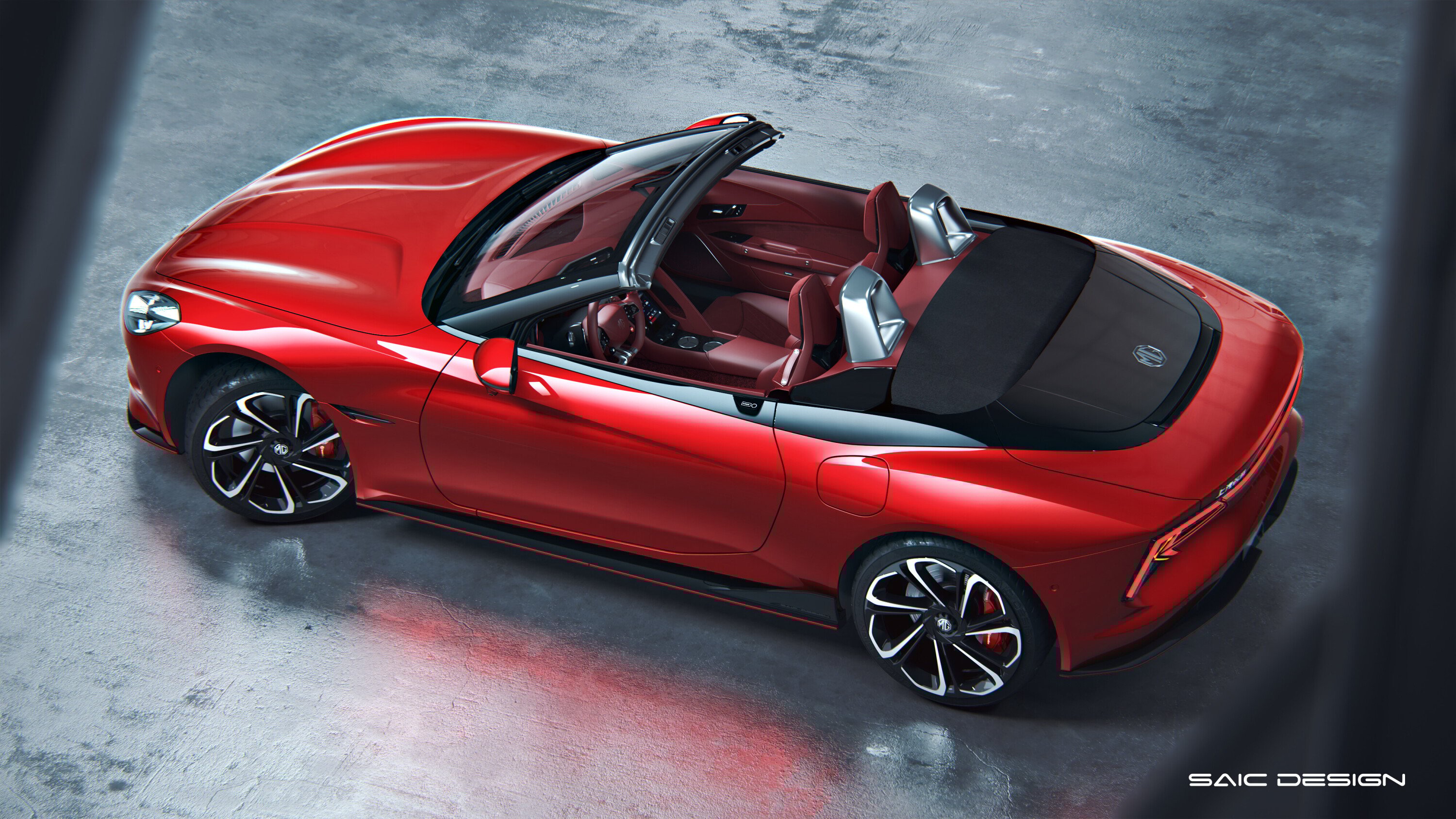
Son said MG was focused on introducing sports cars and “fun” models, beginning with its Cybersterall-electric convertible expected to be revealed in full at the Goodwood Festival of Speed on July 13-16.
He said the Cyberster would accelerate faster than a Porsche 911 Turbo S – for a fraction of the cost.
Future electric vehicles are set to make modern ones seem heavy, antiquated, low on range, slow to charge and expensive – if breakthrough battery developments at MG are any guide.
Half-solid-state batteries could be here as early as next year, with higher energy densities meaning smaller, lighter packs can supply the same range. That will be a boon for performance models where weight matters, such as MG’s incoming Cyberster convertible – and its new MG4 X-Power electric hot hatch.
The developments come from MG’s battery research team at parent company SAIC’s headquarters in Shanghai, China. Director of MG Battery Development Ge Hailong told Wheels the Chinese brand was developing 600kW fast-charging able to top up an EV’s battery from flat to 80 percent in just 10 minutes – although he did not confirm range.
1
“Zero to 100 is complex because the fast-charge from 80 to 100 the charge current is very slow,” said Ge. “Normally we say from zero to 80 percent. Maybe about 10 minutes. Less than 15 minutes.”
Ge told Wheels that SAIC was also developing batteries even cheaper than lithium iron phosphate (LFP) units, a benchmark for battery cost and density in the EV world. He also said SAIC was close to bringing half-solid-state battery technology to the market. Solid-state batteries are considered a revolutionary technology for EVs, with new levels of energy density, low cost and improved safety.
“At SAIC, we are working with solid-state, or half-solid-state batteries, and now we have some big cooperation with a company which I can’t say,” he said.
1
“What I can say is that next year we will have mass production for this application, and we are very excited for its performance. It’s 800 wattage application and the mileage will be more than 1000km with faster charging rate. In 2025 we have some also very exciting half-solid technology; the battery chemical LFP and NCM.
“We know LFP is much cheaper than NCM and much safer, and that in 2025 we will have half-solid technology even lower, even cheaper than LFP. And much safer than LFP.”
An NCM battery is a type of lithium ion technology used in cars like the MG4 X-Power.
1
Ge added that 400kW fast-charging was coming to cars like the MG4 as soon as this year. Currently its maximum DC fast-charging rate is 140kW.
The half-solid-state batteries can be 30 to 40 percent more energy dense than existing NCM batteries such as that used in the MG4 X-Power, Ge said, and were slightly cheaper to produce. Ge confirmed this meant MG could use a smaller, lighter battery with the same range – and that such a battery was slated to be fitted to its Cyberster sports car.
Ge also added that SAIC was developing advanced, full solid-state batteries but said he didn’t expect the technology to be ready for market for another 10 years.
China’s MG looks set to expand its electric vehicle line-up by 2026 in Australia with two new, more-premium options.
Snapshot
MG to further expand EV line-up in Australia
Tesla Model Y rival: u2018LS7u2019 midsize SUV likely by 2026
Local arm to choose L7 or F7 sedans, also due by 2026
Wheels understands MG Australia will sell a rebadged version of the IM LS7 midsize electric SUV – a Tesla Model Y rival – and decide between the IM L7 and Rising Auto F7 electric full-size sedans, similar in size to the Tesla Model S and Volkswagen ID.7.
An MG Australia spokesperson said the electric LS7, and L7 or F7 sedans, are “under strong consideration for Australia and would be badged as an MG,” likely to keep the vehicles within a familiar and more-established brand.
IM Motors is a joint venture between MG’s parent SAIC Motor, Chinese tech company Alibaba, and Zhangjiang Hi-Tech Group, a research centre in Shanghai.
1
Rising Auto is a sub-brand of SAIC’s Roewe – the successor to Rover – focused on electrified vehicles.
It also produces the Rising Marvel R electric midsize SUV, which is sold in Europe as an MG, but unavailable in right-hand drive for Australia.
Europe’s all-electric MG 5 wagon – unrelated to the petrol-only MG 5 sedan due in Australia imminently – is another Roewe-derived vehicle sold in China as the Roewe i5.
First launched in China earlier this year, the IM LS7 – likely for Australia with MG badges – has a 90kWh battery pack, with an estimated 600-kilometre driving range for the rear-wheel drive and 575km for all-wheel-drive variants on the less-stringent Chinese Light-Duty Vehicle test cycle (CLTC).
1
It is powered by a 250kW rear-mounted electric motor for single-motor variants, while the dual-motor all-wheel-drive has a 425kW/725Nm total system output.
Available features include a 26-inch dashboard display, massaging seats, height-adjustable air suspension, automatic front doors, a 24-speaker audio system, and a normal or yoke steering wheel design.
Chinese prices range between approximately AU$60,000 and AU$95,000, likely becoming the most expensive vehicle sold by a Chinese carmaker in Australia.
This title currently applies to the Great Wall-Haval (GWM) Tank 300, with the flagship Ultra Hybrid retailing for $60,990 drive-away.
The IM L7 electric sedan has similar electric motors with an optional 445kW/730Nm “sports package” and, with a 118kWh battery, a CLTC-rated 1000-kilometre driving range.
Meanwhile, the Rising F7 electric sedan – also launched in China earlier this year – packs a 64kWh lithium-iron-phosphate (LFP) battery in entry-level form, or two NMC batteries at 77kWh or 90kWh in capacity.
1
The flagship 90kWh variant has a claimed CLTC-rated 666-kilometre driving range
In China, the Rising F7 competes with the Tesla Model 3, BYD Seal and Volkswagen ID.7 but with broader dimensions, measuring 5000 millimetres in length with a 3000mm wheelbase – 306mm longer than a Model 3, with an additional 125mm between the front and rear axle.
The flagship 90kWh variant has a claimed CLTC-rated 666-kilometre driving range, while the entry-level 64kWh model is lower at 500km.
Inside, the dashboard is strikingly similar to Mercedes-Benz’s MBUX Hyperscreen, with a 15-inch central infotainment system, a 10.25-inch digital instrument cluster, a 12.3-inch passenger display, and a Tesla-like 8-inch rear touchscreen.
1
The MG LS7 electric midsize SUV is expected in Australia by 2026, while either the rebadged IM L7 or Rising F7 are tipped to arrive here at a similar time.
VFACTS new-car sales data released this week revealed electric vehicle sales in Australia climbed by 345 per cent in the first half of 2023, compared to last year.
June’s figures increased by an astronomical 871 per cent, as strong demand for the Chinese-built Tesla Model Y saw it surpass the Ford Ranger ute to become Australia’s second-best-selling vehicle – and the most-popular SUV and electric car year-to-date.
The boss of battery development at Chinese brand MG says some electric vehicles have finally reached cost-parity with internal combustion equivalents – and they’re only going to get cheaper.
A barrier to entry for electric vehicle ownership has long been price, with batteries the most expensive component by far. Electric vehicle batteries contain precious metals such as lithium, which are expensive to extract from the earth. However the ‘dollar-per-kWh’ cost of batteries is falling – to the point it will become normal that an electric vehicle is cheaper than a petrol-powered equivalent.
Speaking to Wheels from SAIC’s headquarters in Shanghai, China, Director of MG Battery Development Ge Hailong said it was important to compare lifetime-cost-of-ownership (rather than just upfront price) and to consider the market cost of raw lithium ore.
1
When asked when an electric car will be cheaper than a petrol one, Ge said the milestone moment was being achieved right now.
“I think currently, maybe one month before, or two months before, the [lithium] miners cause the cost to come very lower, maybe 200,000 (RMB) per tonne,” he said, referring to the market price of lithium carbonate.
“By that price, for a sedan, for example, we calculate it, and it’s very close to a petrol, similar-size vehicle. And also during the usage, the usage cost is much lower than the petrol vehicle. So in the whole life calculation, at the moment a sedan EV is cheaper than petrol. Now. But it depends on the miners’ cost of lithium.”
1
Ge cited no specific examples of make or model. He told told Wheels EV recycling programs, which extract lithium from used electric vehicles to be re-used again, will bring down the cost of batteries significantly.
“Battery recycling technology is coming better and better, and when this battery recycling can achieve 90 percent, we do not take the material from the miners,” he said.
The global EV revolution is great news for Australia, currently the world’s top producer of lithium. In the 2022/23 financial year, Australia’s national earnings from lithium exports leapt from $5.3b in 2021/22 to more than $18.6b.
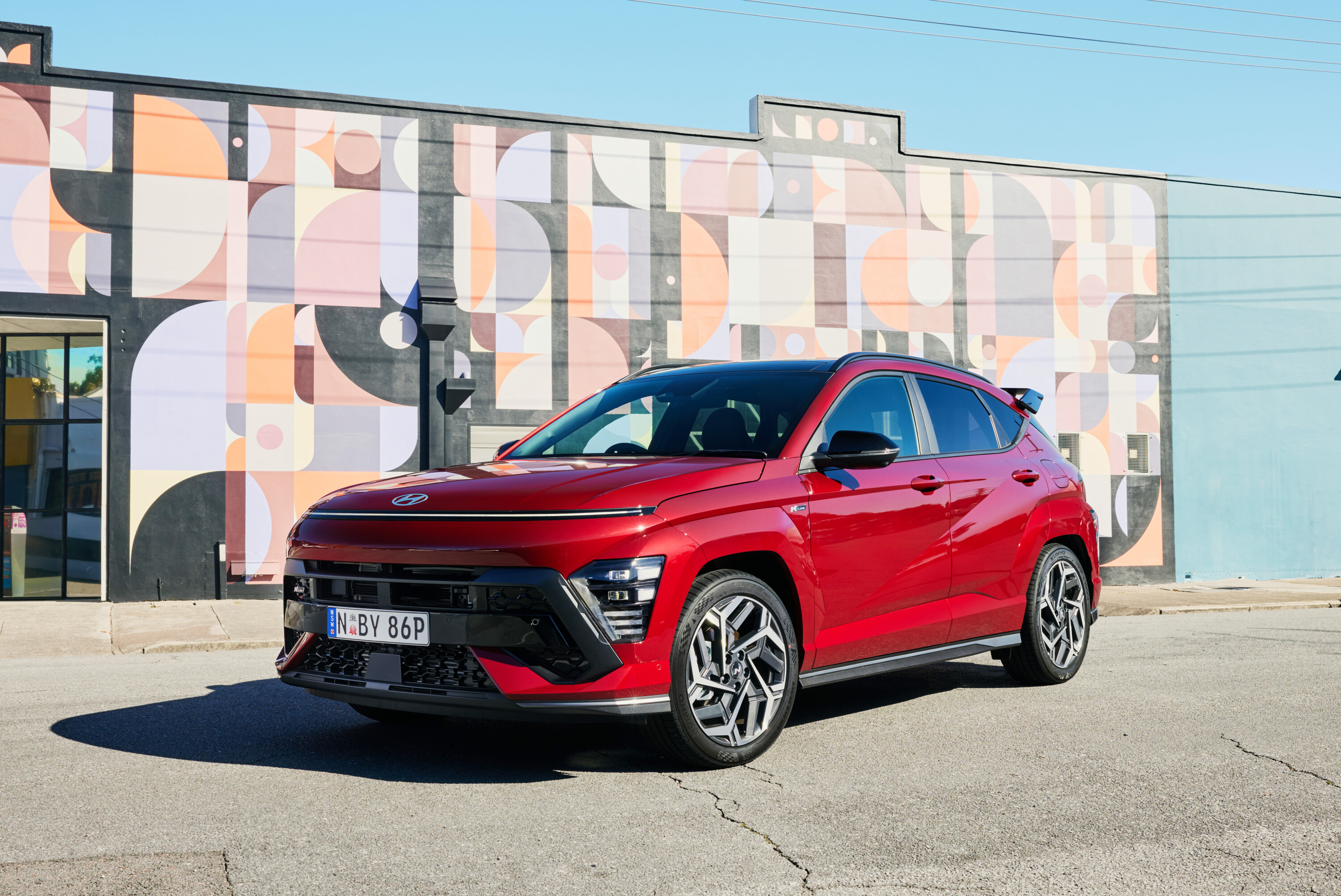
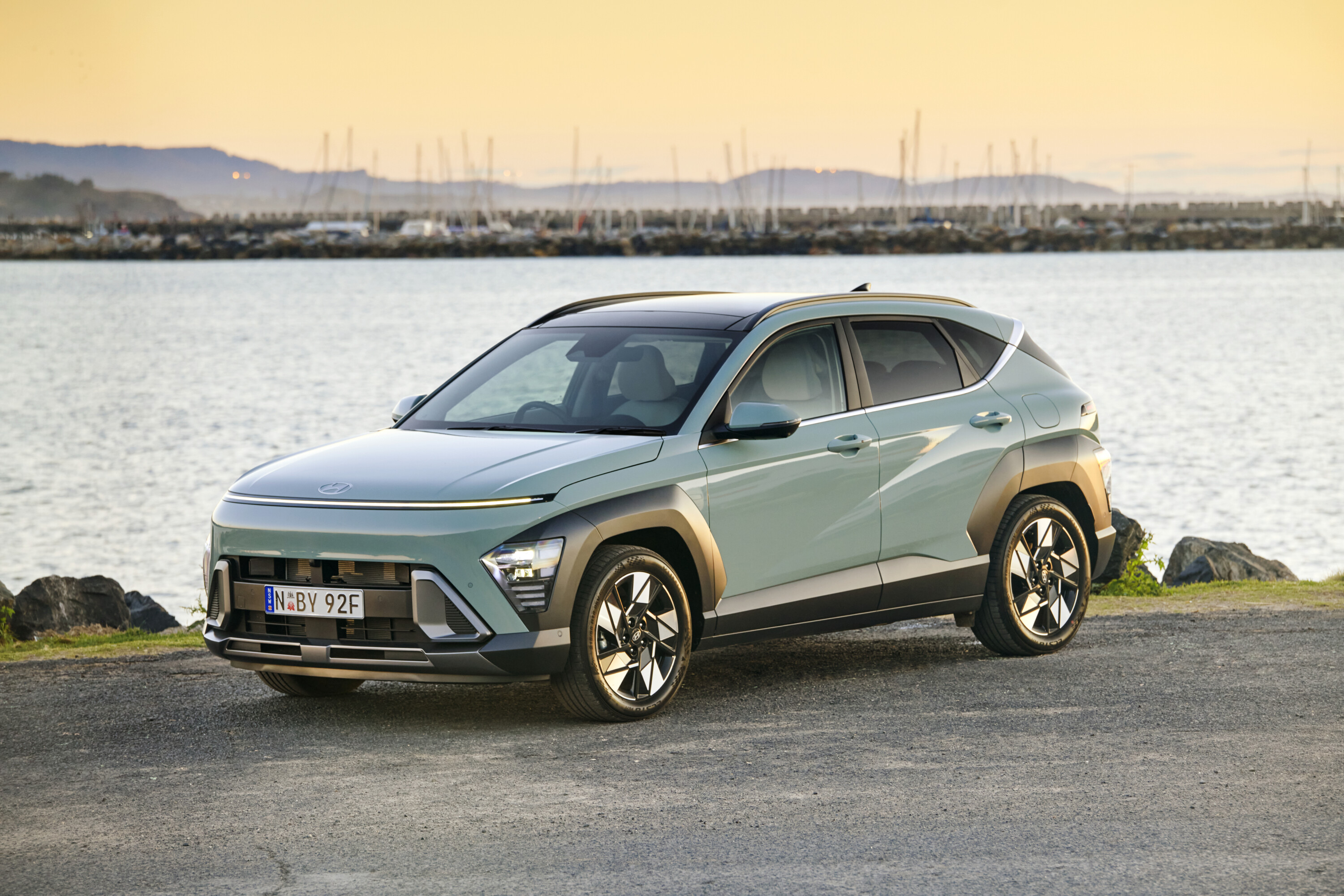
Hyundai’s presence in the small SUV segment has, since the introduction of the first-gen Kona back in 2017, been a bit on the tiddly side.
Not in terms of sales, mind you – it’s always been a popular thing – but rather in terms of its physical size, which trailed many of its segment rivals.
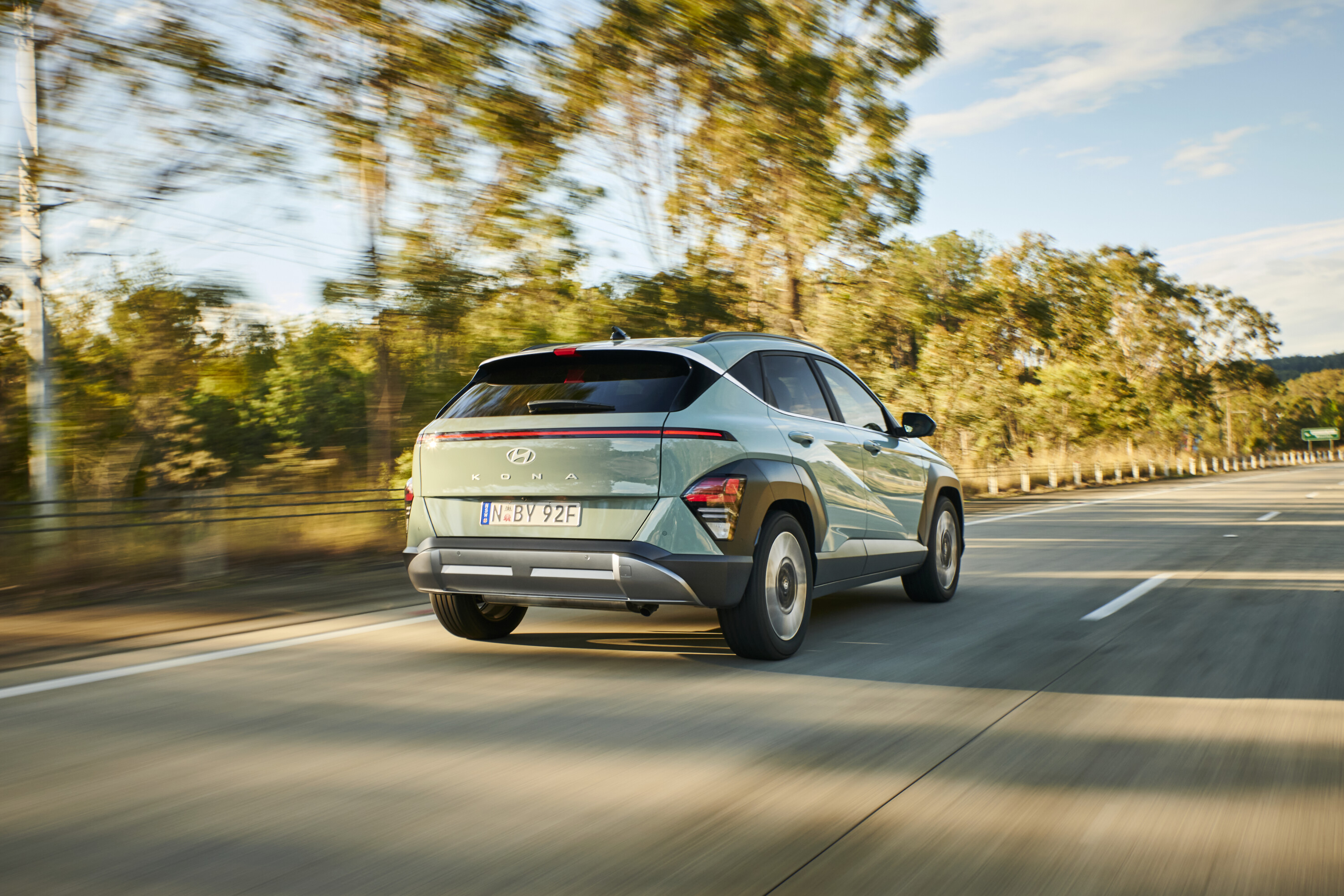
But the arrival of a new-generation Kona fixes that. It’s bigger, flashier and decked out with more equipment than before, but some compromises come with that – ones that impact your hip pocket. Let’s dive into that.
We start on a bit of a negative slant because price is perhaps where the Kona loses some of its lustre.
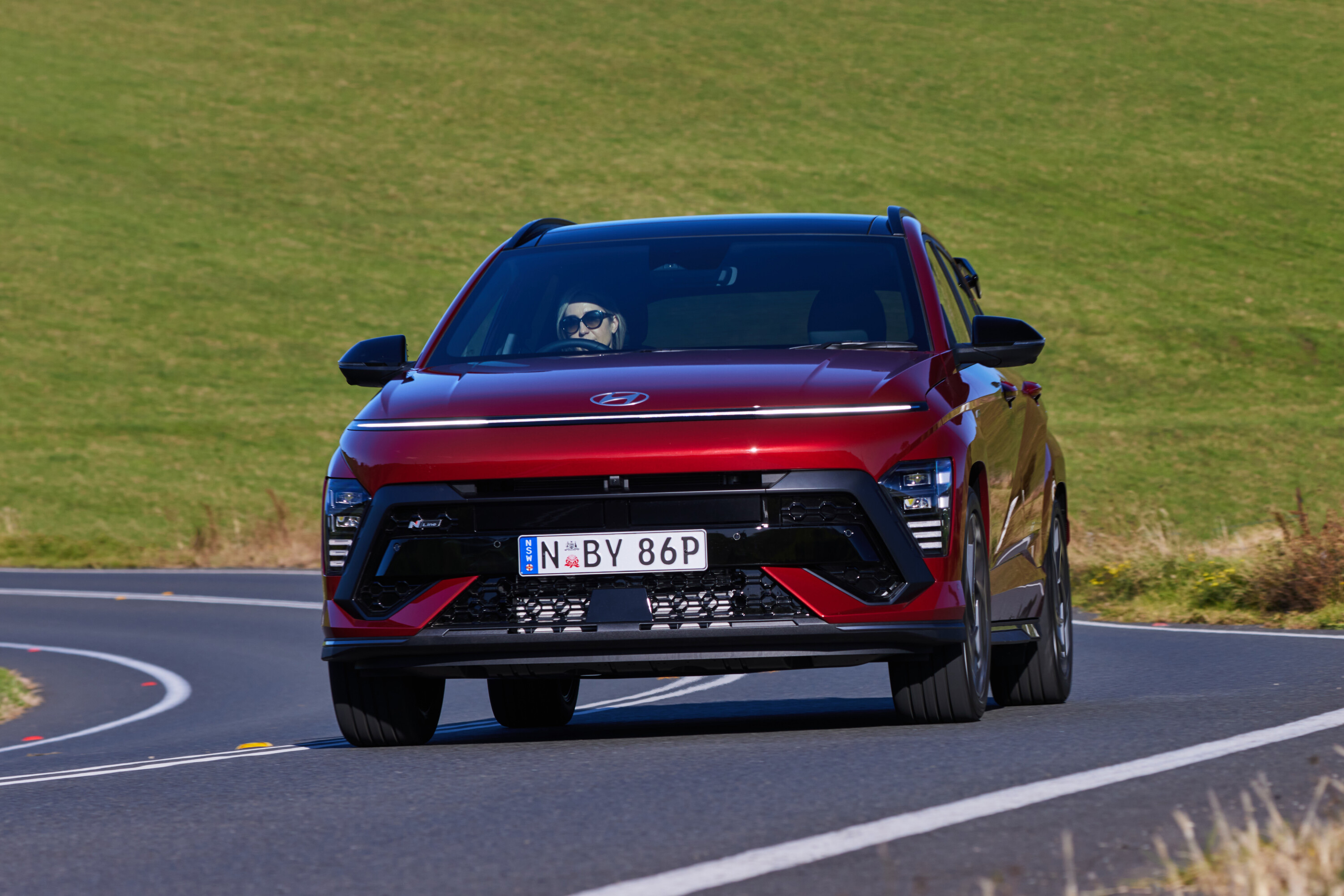
At a retail price of $46,500 (before on-road costs) in N-Line Premium form with the turbo-petrol AWD mechanicals, the Kona’s price tag is on par with that of, say, a seven-seat Nissan X-Trail ST-L. Add $1500 if you want a panoramic glass roof.
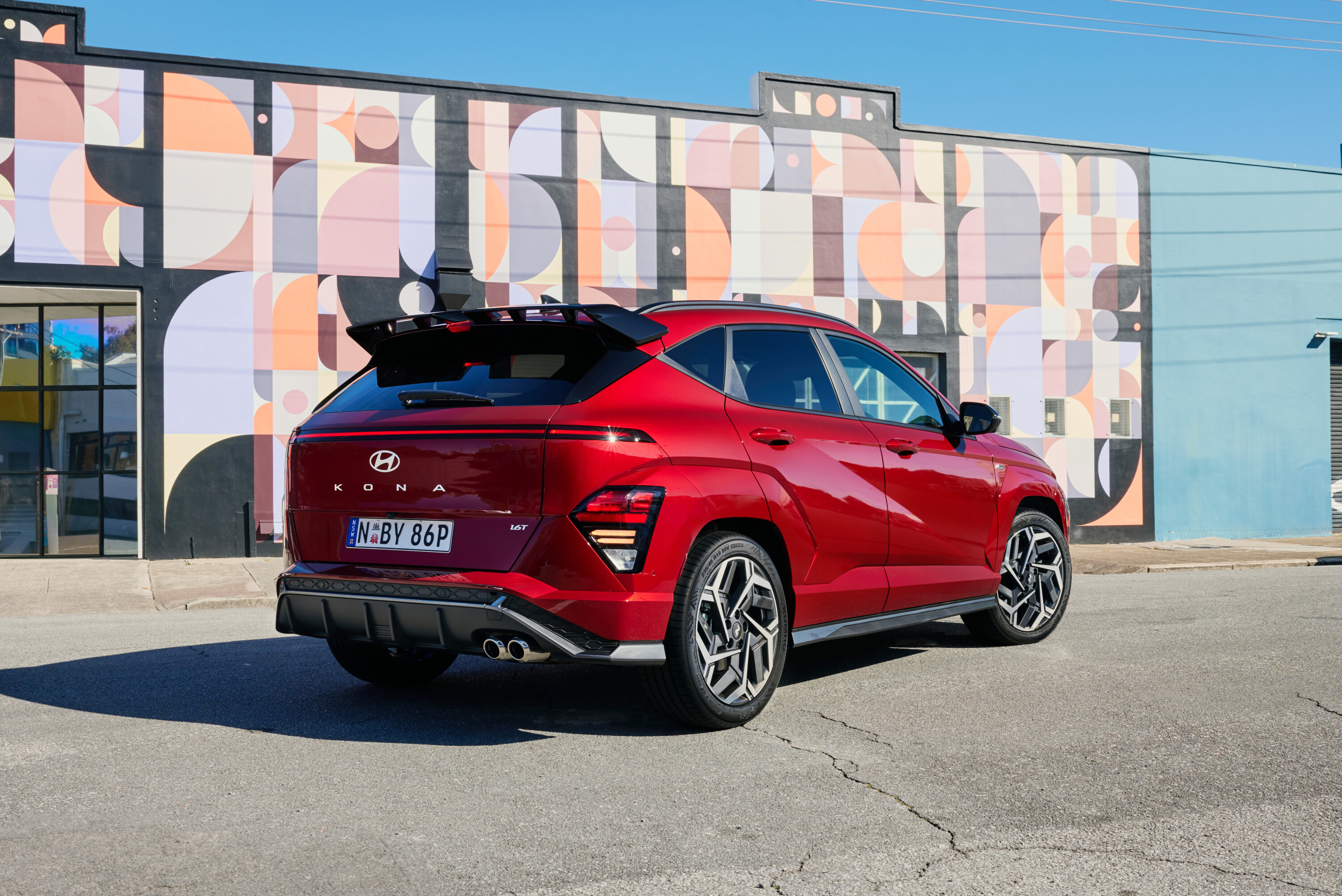
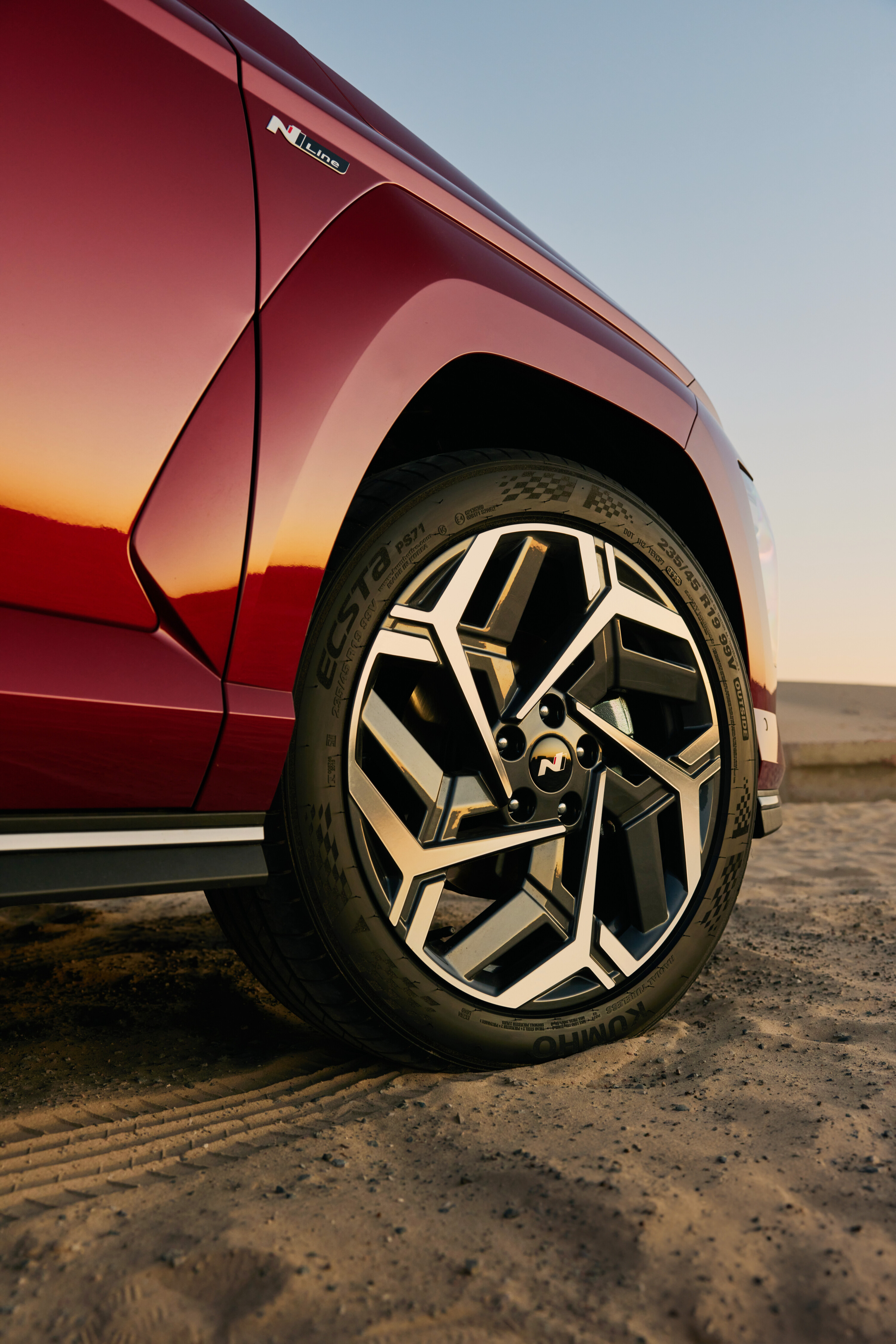
But you do get a lot of gear for your spend. Besides the racy body kit ad 19-inch alloys that are part of the N-Line spec, this configuration also comes with heated, ventilated and power-adjustable front seats, heated outboard rear seats, power tailgate, a premium audio system, blind-spot camera monitoring, a 3D parking camera view, remote monitoring via a phone app, heated/power-folding wing mirrors, integrated sat-nav and dual-zone climate control. There’s even more than that too – see the spec table below for the full equipment list.
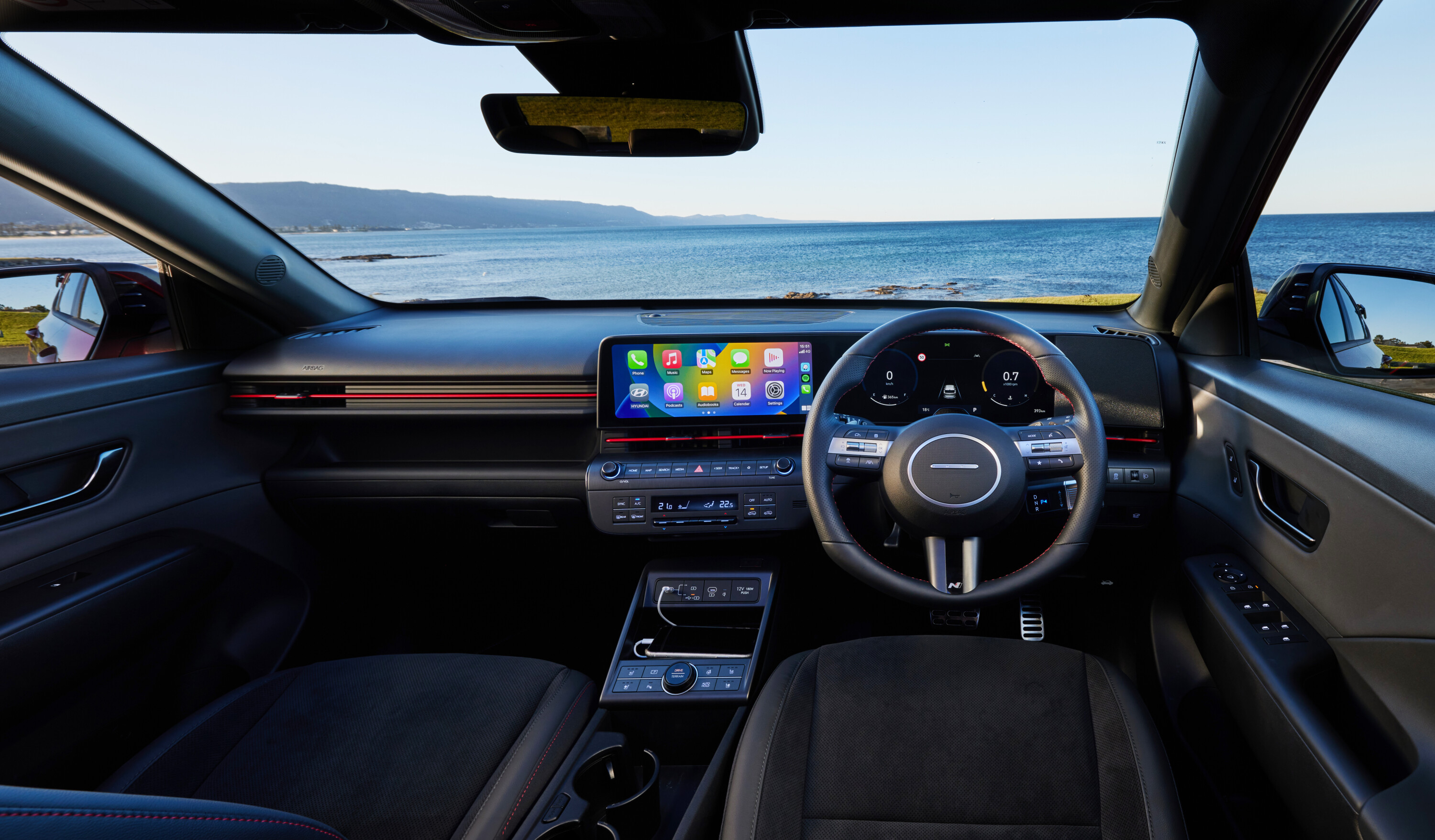
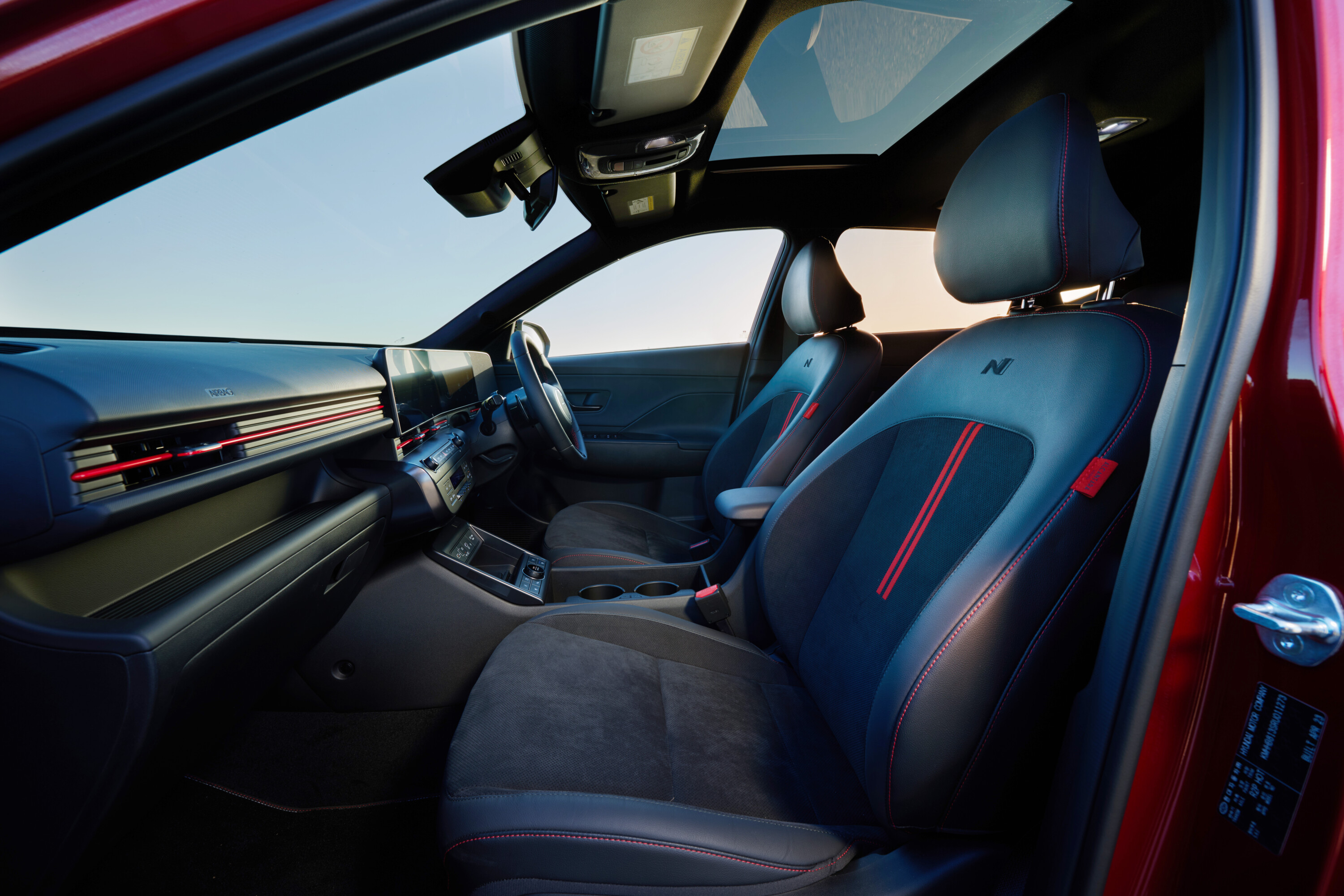
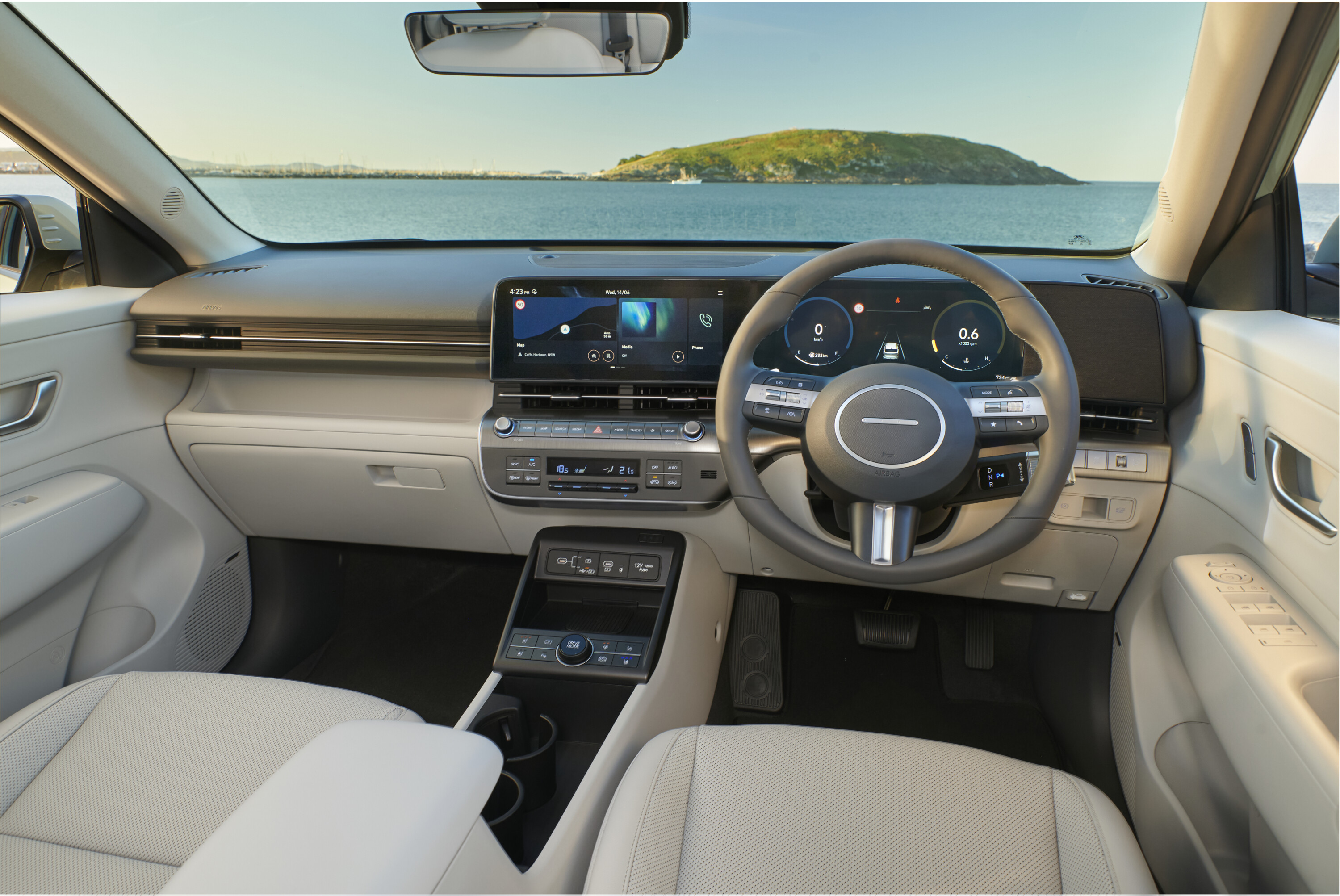
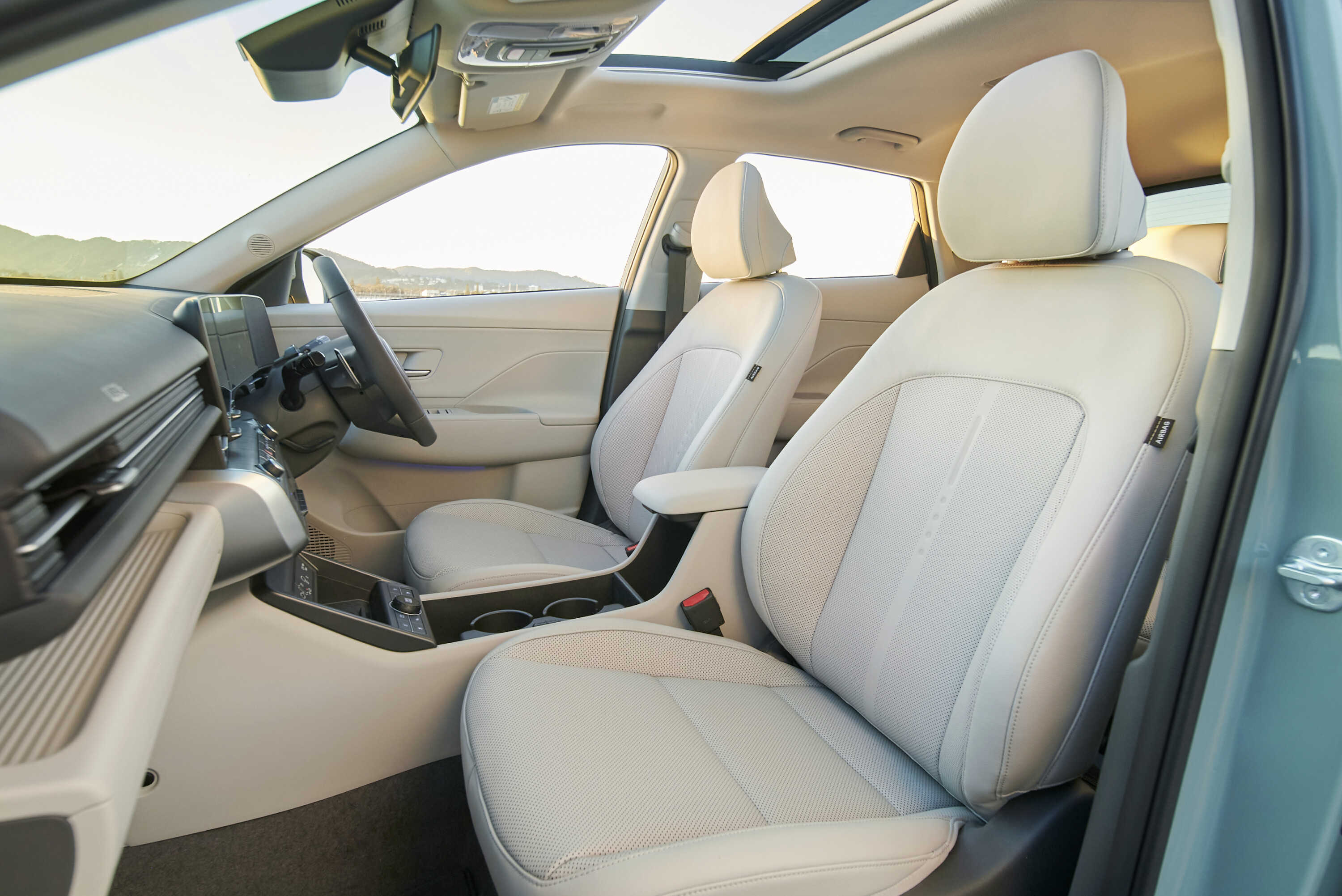
The inside of the Kona is a nice place to be – particularly in N-Line Premium spec.
The seats are upholstered in a combination of grey Alcantara and black leather with red contrast stitching, and they hug the torso with a pleasing squeeze. Perforated leather wraps the steering wheel grips too, which also boasts a red contrast stitch, and a red accent stripe bisects the dashboard.
It presents very well, however, run your fingers across the dash and door card uppers and you’ll find hard plastic, not soft-touch materials. It’s not a total vibe-killer – they don’t look shiny and unpleasant, after all – but at this price point it’s not unreasonable to expect nicer materials in these areas.
1
With the flip-out cup holders retracted and the divider removed, slotting in a full-size laptop, large handbag or even a rotisserie chicken is easy
But the Kona wins us back with what’s between the front seats. A long open-topped tray stretches from the base of the centre stack – where a generously-sized wireless phone charging pad sits among the ventilation controls and drive mode selector – all the way to the rear seat air vents, with removable trays and dividers to help you manage cargo.
With the flip-out cup holders retracted and the divider removed, slotting in a full-size laptop, large handbag or even a rotisserie chicken is easy, greatly boosting the Kona’s convenience factor. Two things enabled this feature: a 25mm increase in width compared to the old model, and the relocation of the gear selector to the steering column (in all models bar the base Kona).
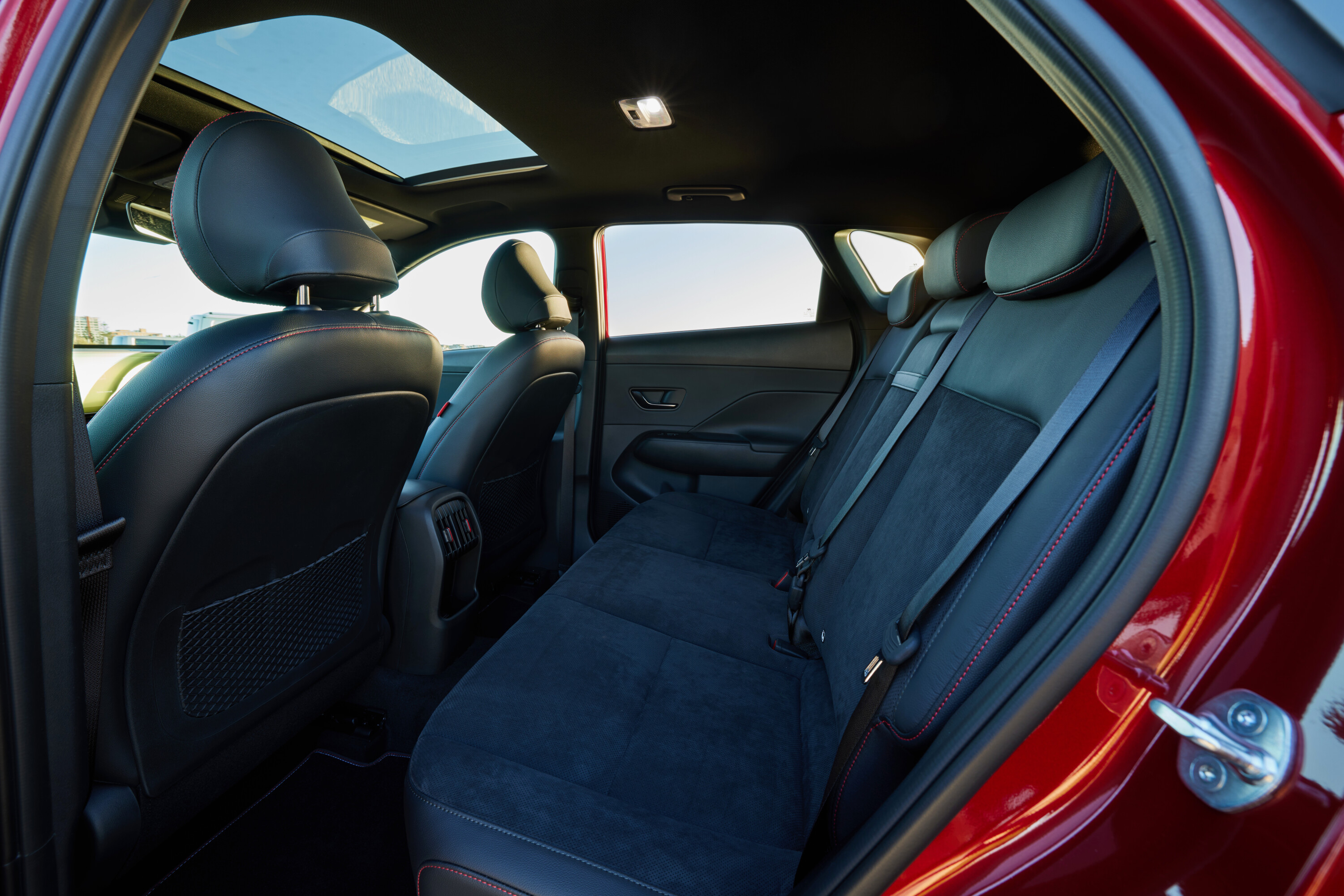
In the back, there’s ample space. To address criticism that the first-gen Kona offered meagre second-row passenger accommodation, Hyundai stretched the wheelbase of this new model by 60mm and extended the overall length by 145mm.
1
That creates 77mm more back-seat legroom, and it’s used to good effect here.
A two-position backrest also gives your passengers a comfortable degree of recline for those long-distance trips, and the aforementioned heated rear seats are a great feature to have.
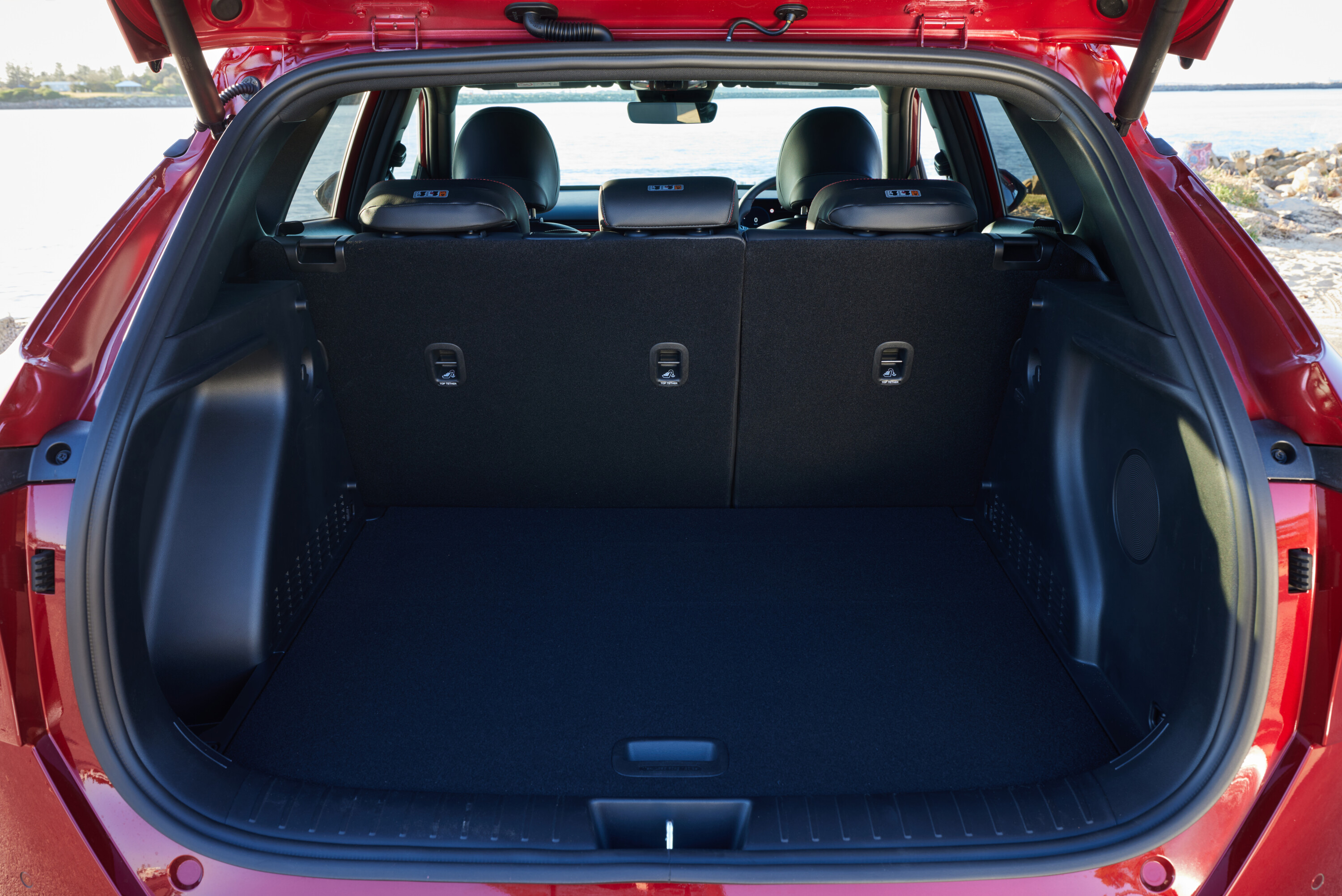
Boot space also benefits from the dimensional growth – at 407 litres with the rear seats up, there’s plentiful room for cargo. The boot floor can also be dropped to a lower position to liberate a few more litres, and if you’ve got tall cargo there’s even a dedicated stowage position for the parcel shelf to keep it out of the way.
Locally-developed suspension tunes are no longer the go-to strategy for Hyundai Australia when it comes to tailoring ride and handling of new cars for our roads.
Our country still receives a unique suspension calibration, but now it’s just selected from a global ‘menu’ of suspension bits rather than developed from scratch by Hyundai’s Australian engineering team.
Does that result in a compromise? Arguably not, for the new Kona strikes a good balance been comfort and cornering composure that should suit the majority of Aussies. There is one potential issue, though: the 1.6-litre turbo Kona N-Line doesn’t feel sporty enough to match its athletic looks.
2
It works pretty well in town and on highways, but we would have liked a little more engagement factor
Sure, the turbo might receive a more sophisticated multi-link rear suspension set-up rather than the simple torsion beam axle rear end of the naturally-aspirated 2.0-litre and the upcoming hybrid, but the spring and damper settings are skewed towards “soft” more than “sporty”.
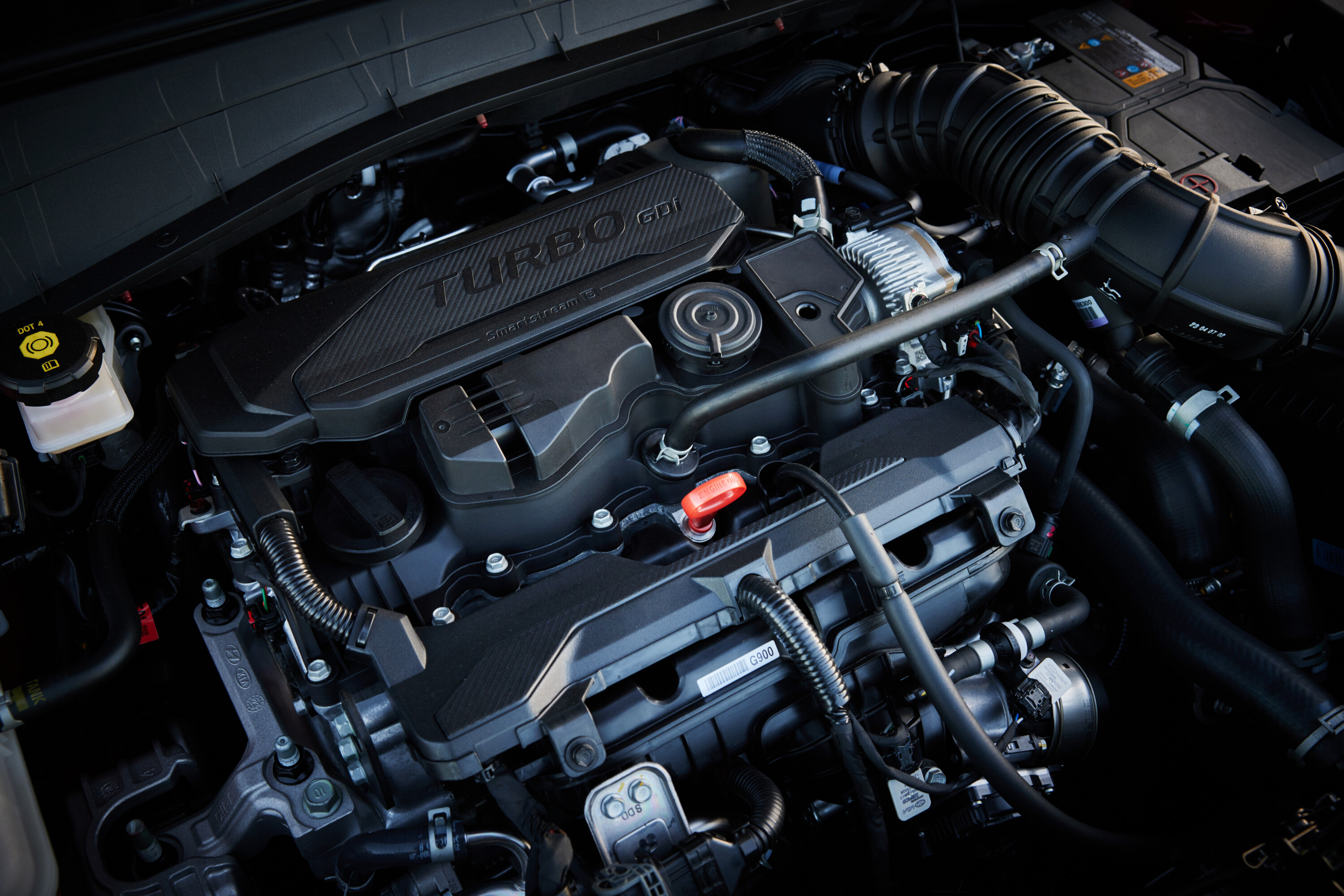
The engine lacks a sharper edge too, even when the drive mode dial is turned to Sport, though the critical numbers of 146kW and 265Nm are indeed plentiful enough. It works pretty well in town and on highways, but we would have liked a little more engagement factor to match the aggressive styling.
Hyundai claims an average fuel burn of 7.6L/100km but during our launch drive, we couldn’t edge it under 8.6L/100km.
Granted, we were pushing hard over some fairly dynamic roads, but the route included a fair chunk of highway cruising that should have balanced some of that out. More accurate real-world numbers will have to wait until further testing.
The new Kona has yet to be rated by ANCAP, however standard safety features on this top-spec variant include seven airbags (including a front-centre bag), autonomous emergency braking with junction mode and reversing mode, blind-spot cameras, driver attention monitoring, lane-keep assist, rear cross-traffic alert, front and rear parking sensors, a 3D parking camera view, and adaptive cruise control.
If there’s one fault of this particular Kona spec, it’s that it doesn’t deliver on the sporty pretensions of its exterior.
However, it delivers pretty much everywhere else – and particularly when assessed from a day-to-day usability point of view. It’s a good size, filled with gear and has a likeable mechanical package, but that sticker price will be hard for some to get their head around, and understandably so.
Column-mounted motor-driven power steering, rack and pinion
Brakes
Front: 305 mm x 25 mm ventilated disc, Rear: 284 mm x 10 mm solid disc
Wheels
19-inch alloy
Tyre size
235/45 R19 99V
Price
$46,500 + on-road costs
Is this the Kona to get, or is there not enough engine to exploit the new-generation Kona’s full potential?
Opting for the 2.0-litre atmo engine is the most affordable way to get a ‘Premium’ experience in Hyundai’s newest small SUV, and, it turns out, is more of a happy medium than anything underwhelming. If all-wheel drive or a hybrid powertrain aren’t must-haves, it’s arguably the pick of the Kona litter.
At $39,500 before on-road costs, the Kona Premium 2.0L narrowly sneaks under the $40K barrier.
That sounds like a lot for a small SUV – and let’s be honest, it is – but Hyundai Australia says the market (that means you) is already transacting well above that level for vehicles in this size class.
According to them, 69 percent of all small SUVs sold in 2022 cost over $30,000 – and if you subtract Chinese brands, which trade heavily on low price points, that percentage jumps to 82 percent.
1
But there’s no denying the Kona is now positioned as a more premium product.
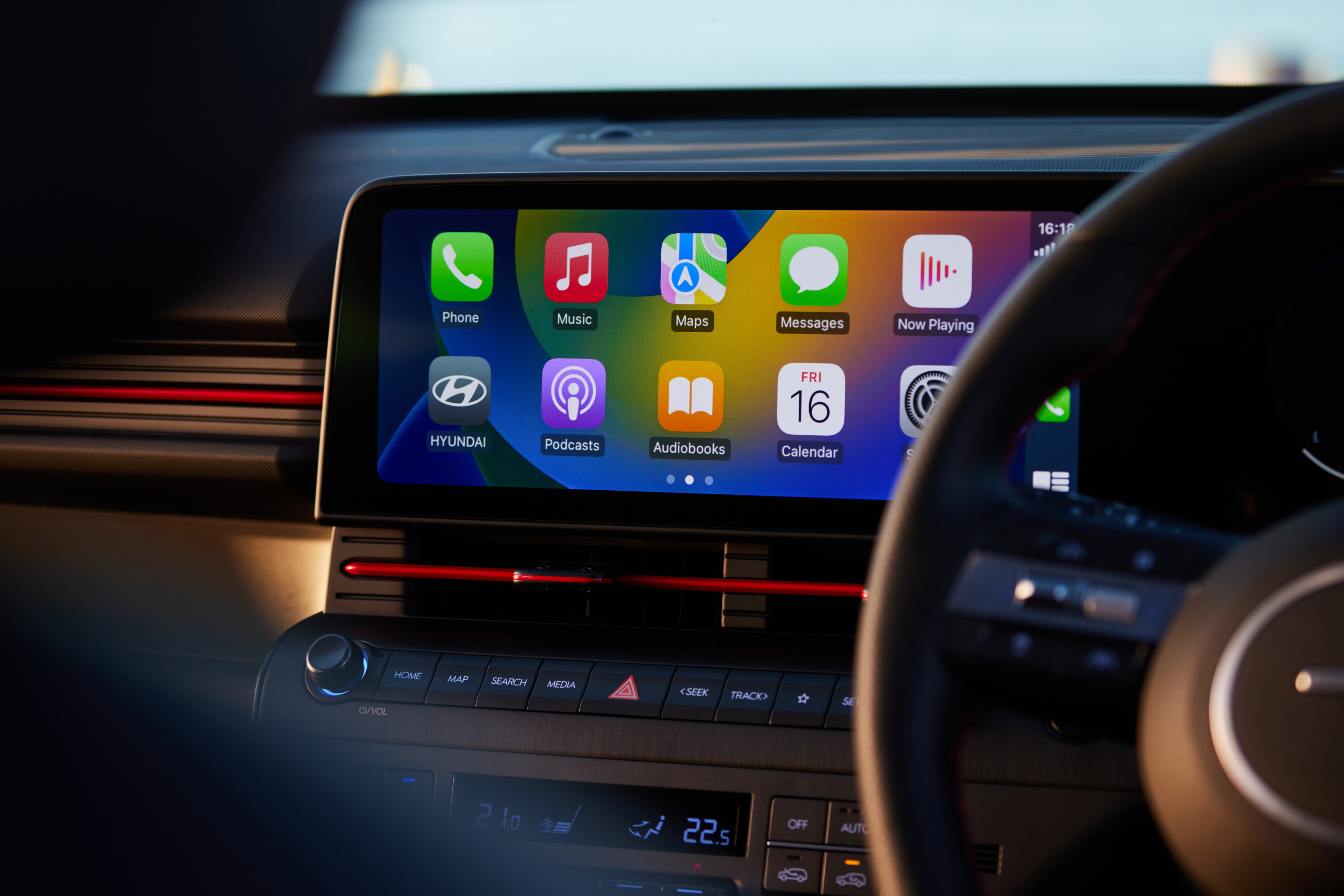
For the variant we’re looking at here, its premium aspirations are even part of its name. Leather upholstery is available in three colours on the Premium grade (black, light grey and Sage Green), ambient lighting imparts nightclub vibes when the sun goes down, and the basic instrument panel of the base model gets flicked in favour of a reconfigurable 12.3-inch display that matches the infotainment screen for size.
Sat-nav is standard, the 8-speaker BOSE audio system thumps out music, and a power tailgate adds some convenience factor. See below for the full list of gear on the Kona Premium:
Sure, opting for the Premium grade might add $7500 to the invoice, but it adds something else as well: a genuinely useful cabin that’s unlike anything else in the small SUV segment right now.
See, while the base model Kona puts a traditional transmission selector between the front seats, the Premium grade removes that and relocates it to the steering column.
The extra space that’s liberated in the centre console is then turned into a long, open storage tray that can accommodate a broad range of things, including something as big as a laptop bag. Alongside that, there’s also a handy shelf inset to the passenger-side dashboard that’s another great place to perch your belongings, as well as a decently-sized glovebox.
1
Premium grade also boosts its passenger comfort levels through a heated steering wheel
Besides increases in cabin dimensions that liberate more headroom, shoulder room and legroom (the back seat gains a whopping 77mm more legroom thanks to a wheelbase stretch and specially designed front seatbacks), the Premium grade also boosts its passenger comfort levels through a heated steering wheel, heated/ventilated front seats and heated outboard rear seats.
Both front seats are power-adjustable too, however the driver’s seat gets the added benefit of a “relaxation mode” that puts the body in a deep recline that’s perfect for road trip powernaps.
1
For a small SUV, the Kona Premium does an excellent job of accommodating its passengers
In the back, passengers also enjoy a two-position backrest for a few more degrees of recumbency, along with face-level air vents, a fold-down centre armrest with a pair of cupholders, and dual USB-C charging ports (with a phone-sized storage pocket right beneath those ports as well).
For a small SUV, the Kona Premium does an excellent job of accommodating its passengers regardless of whether they’re seated up front or in the back.
Luggage space, one of the first-gen Kona’s bigger shortcomings, now jumps above the 400L mark, delivering 407 litres of seats-up stowage and 1241 litres with the second row folded down. The cargo area is also 172mm longer, 76mm wider and 187mm taller than it was before, and a two-position boot floor gives further load-carrying flexibility.
The Kona’s entry-level engine is a 2.0-litre Atkinson-cycle petrol inline four with 110kW and 180Nm.
Nothing especially remarkable, particularly when measured agains the 1.6-litre turbo, 1.6-litre hybrid and all-electric powertrains that are (or will soon be) available elsewhere in the Kona range.
But, those numbers and mechanical specs are deceiving. On typical urban roads, the 2.0-litre engine doesn’t feel overly strained with a couple of adults aboard – heavier loads would surely dull performance, but with a typical payload it feels perky enough.
Credit for that arguably goes to the CVT automatic that’s the sole transmission available with this engine – floor it and it reverts to stepped gears for a more ‘natural’ driving feel, but in more sedate driving it performs rather nicely, keeping the engine revs down and smoothly varying its ratio without needless hunting.
1
Suspension-wise, it lacks the adeptness of the multi-link suspension found in the hybrid and turbo variants, but the torsion beam rear axle that 2.0-litre models are equipped with is pleasant enough for everyday driving.
It can feel a bit spongy on truly diabolical roads, but the damper tuning prevents it from feeling too sloppy or uncontained.
Hyundai claims an average of 6.6L/100km, and our launch drive gave us an average of 6.9L/100km on a fairly mild and mostly-highway drive route. The Kona consumes regular 91 octane petrol.
Structural upgrades that are built into the 2023 Kona’s new platform should improve crash performance, with more metal to distribute loads in the frontal crumple zone, a 50 percent increase in high-strength steel stampings, and a 10 percent increase in average tensile strength.
The standard safety technology on the Premium grade includes seven airbags, autonomous emergency braking with junction mode and reversing mode, a blind spot camera, driver attention monitoring, lane-keep assist, active cruise control, rear cross-traffic alert, front and rear parking sensors, and a 3D parking camera view.
For the typical motorist, the Kona Premium with the 2.0-litre engine should have everything they need and nothing they don’t want.
Performance is perfectly adequate for city-dwellers, it’s reasonably economical, and it boasts a spacious and practical interior that’s well-suited to carrying four adults or even a young family. It hits the mark, but at this price point, so it should.
The facelifted 2024 Volkswagen T-Cross light SUV has debuted ahead of its local launch.
Snapshot
2024 Volkswagen T-Cross facelift unveiled
Updated light SUV receives new look and added tech
Due in Australia in the third quarter of 2024
Volkswagen Australia has confirmed the updated T-Cross is due in local showrooms in the third quarter of 2024 (July to September inclusive).
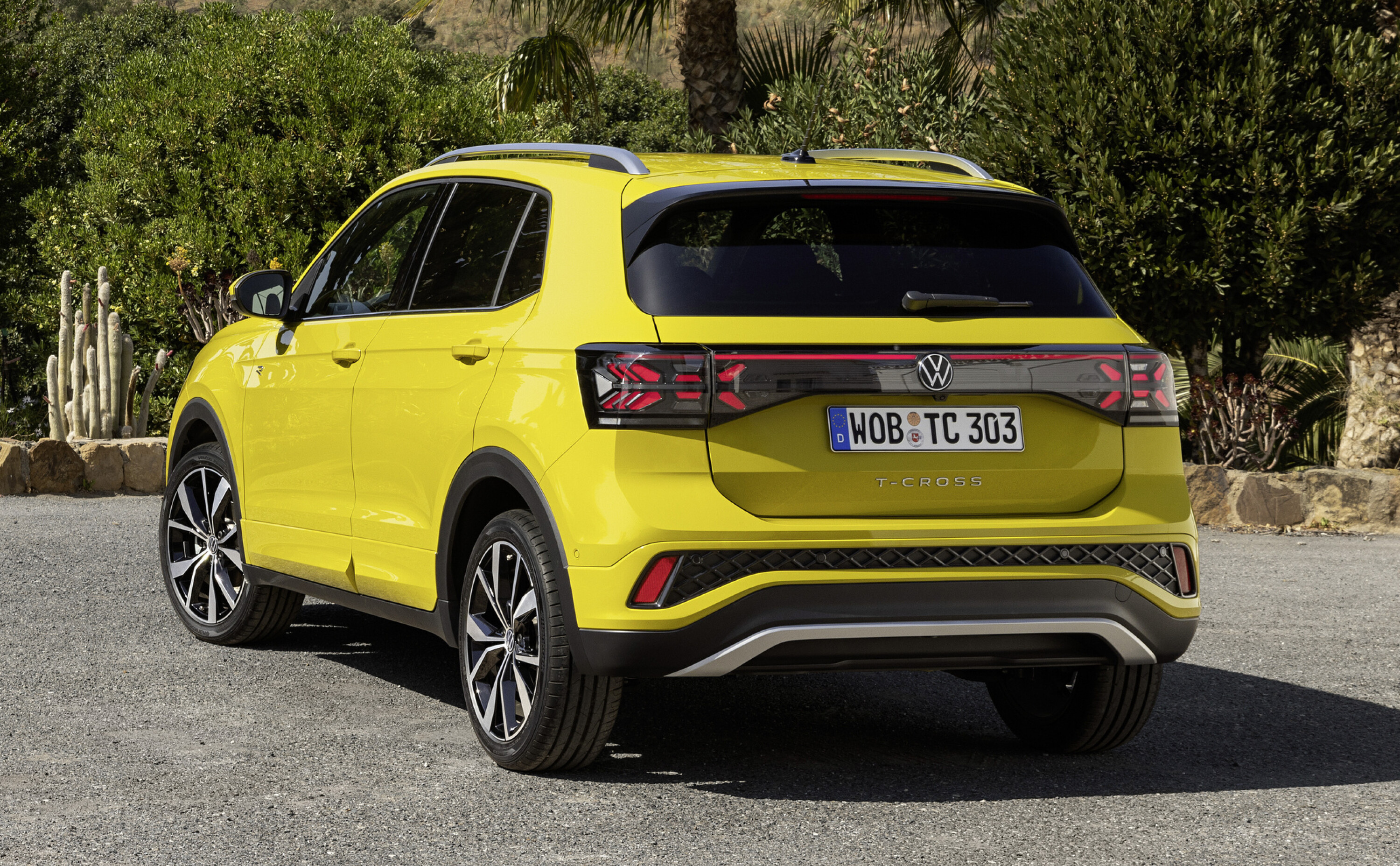
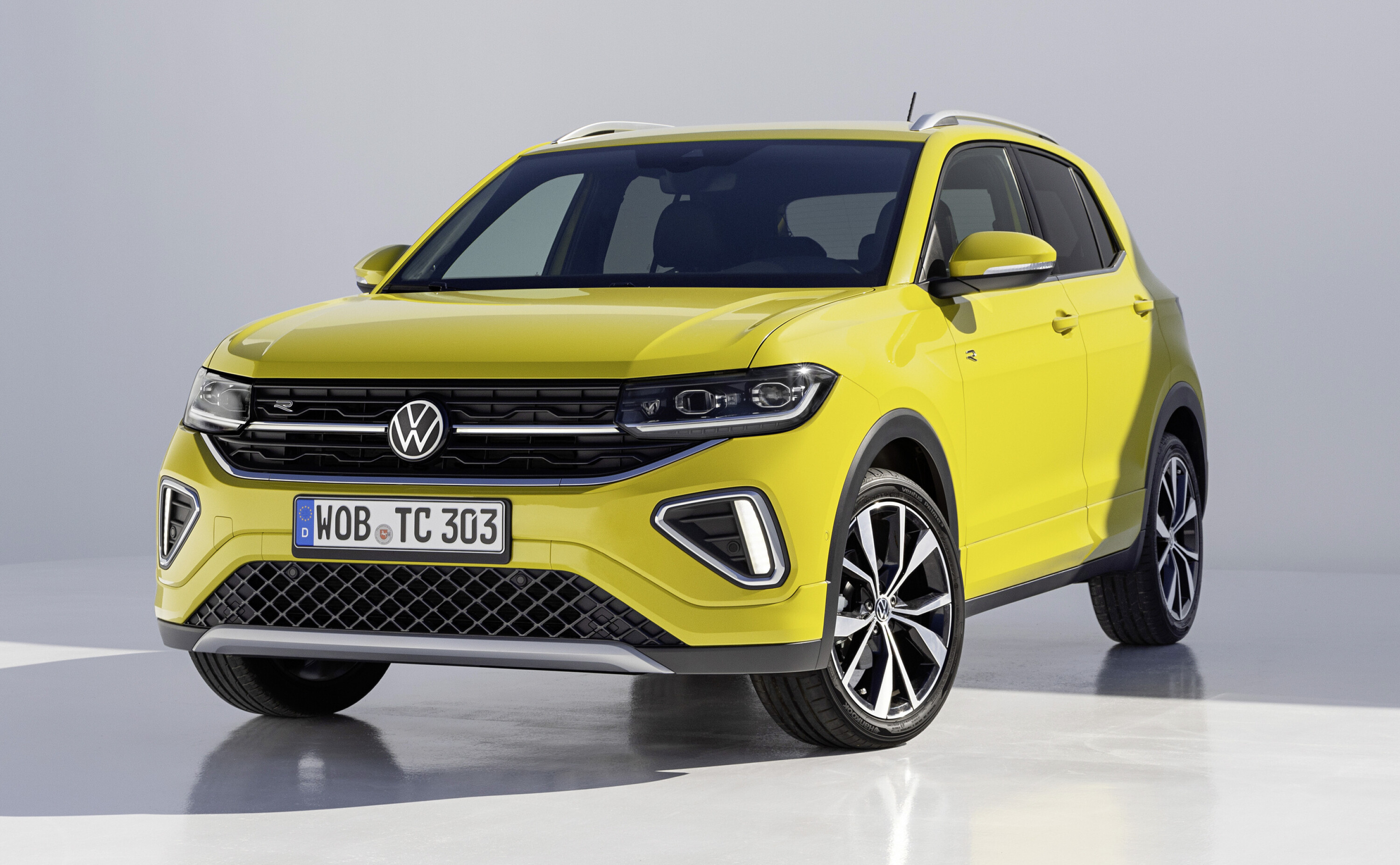
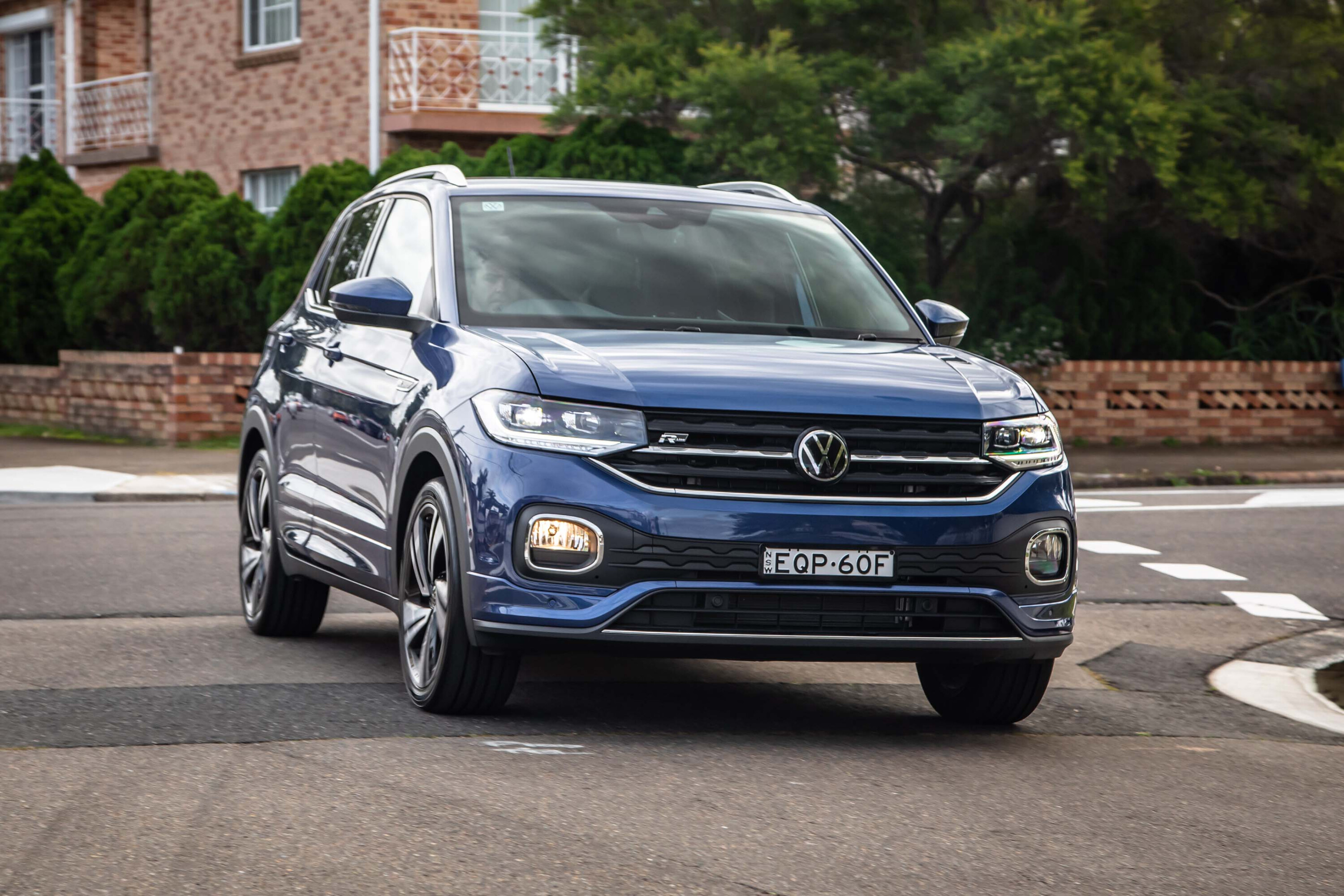
It is headlined by an updated front end inspired by larger Volkswagen SUVs – including the small T-Roc – with reshaped LED headlights, a full-width light strip, and a new lower bumper design.
Base variants will now come standard with LED headlights, replacing halogens, while flagship models offer adaptive matrix-LED units in Europe.
1
The facelifted T-Cross introduces three new colours – grape yellow, clear blue, and kings red – while the updated look continues with new alloy wheel designs, X-shaped LED tail-light graphics, and a new rear bumper.
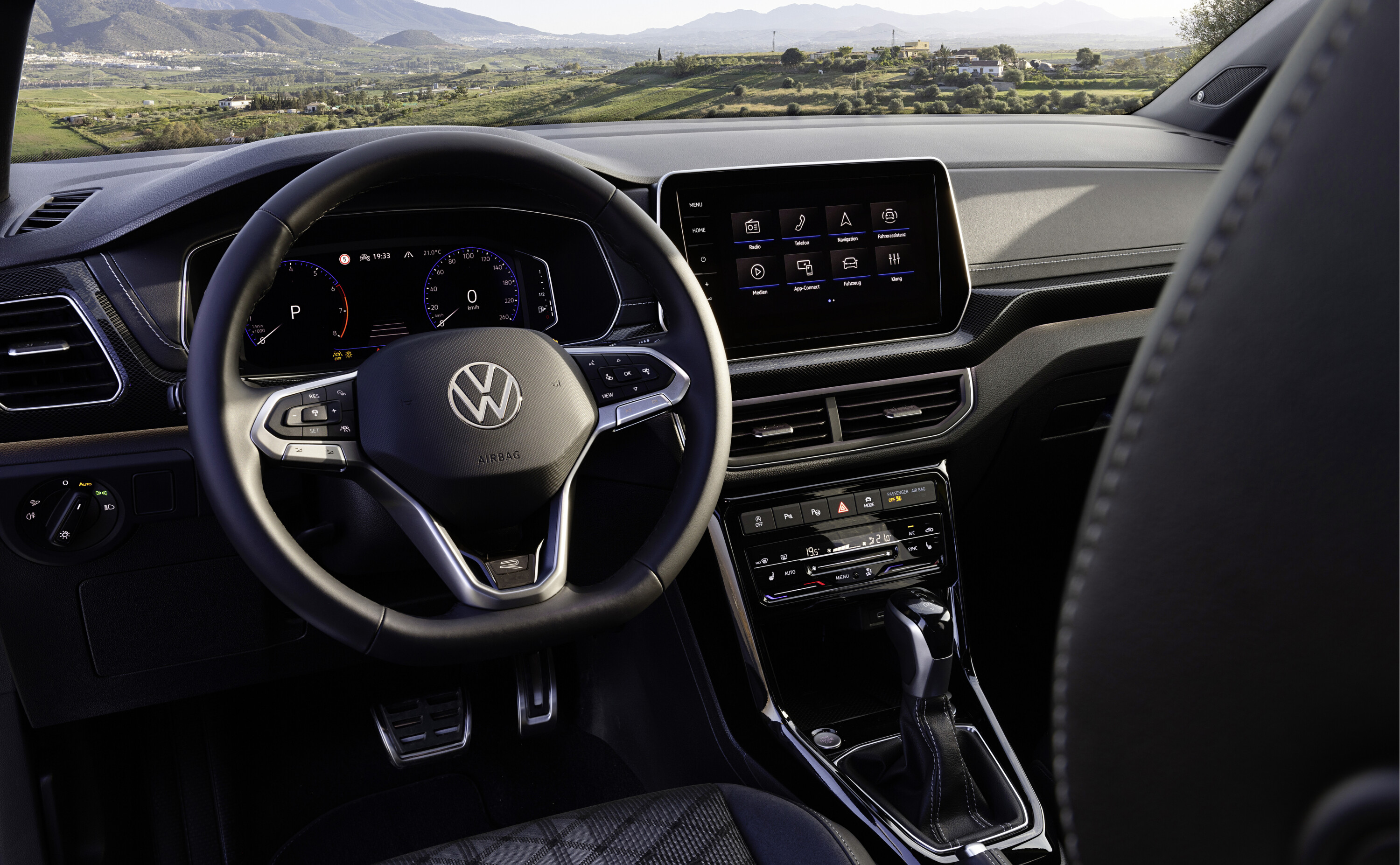
Inside, there is a redesigned dashboard with a freestanding infotainment system, akin to the updated T-Roc.
As before, it sports an 8-inch infotainment system – but a larger 9.2-inch widescreen display is now available as an option.
An 8-inch digital instrument cluster is now standard for base variants – replacing analogue gauges – with a carryover, larger 10.25-inch digital cluster for flagship variants.
1
Volkswagen has also improved the cabin feel, replacing scratchier plastics with softer, higher-quality materials for the dashboard and front door trims.
The updated T-Cross will offer Volkswagen’s semi-autonomous Travel Assist system, which combines adaptive cruise control and lane-keep assist for highway driving.
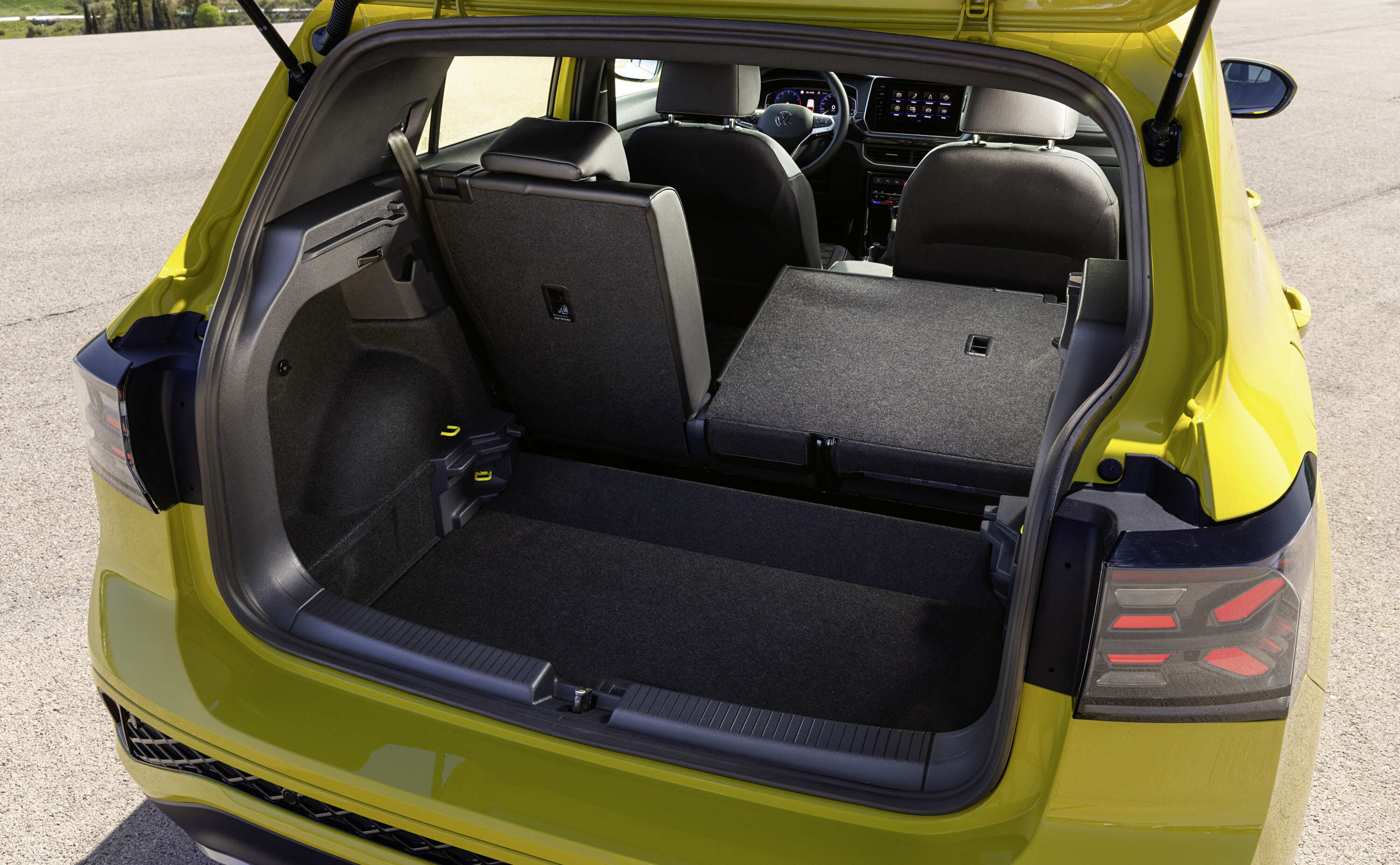
In Europe, the towbar load capacity has increased from 55kg to 75kg, which Volkswagen claims is intended for the transport of E-bikes and other heavier loads.
1
Under the skin, the T-Cross remains based on the VW Group’s smaller MQB A0 platform, sharing its underpinnings with the Polo hatch, the one-size-up Skoda Kamiq small SUV, and the Audi A1.
In Australia, the 1.0-litre turbo-petrol three-cylinder engine producing 85kW and 200Nm will remain, paired with a seven-speed dual-clutch automatic transmission.
Overseas, the updated model will continue to offer manual transmission options and a more powerful 110kW/250Nm 1.5-litre four-cylinder turbo-petrol borrowed from the Golf and T-Roc.
1
VFACTS new-car sales data reveals the T-Cross has been performing well in the light SUV segment, with 3042 units sold year-to-date.
It currently holds the fourth position, trailing behind the Mazda CX-3 (8030), Kia Stonic (3953) and Hyundai Venue (3266), while the Suzuki Jimny follows closely behind with 3027 sales.
The 2024 Volkswagen T-Cross facelift is due to arrive in Australia in the third quarter of next year, with local details – including pricing – to be announced closer to its launch.
Mercedes-Benz has streamlined its two-door offerings, dropping the C- and E-Class coupes to focus on just one luxury coupe and cabriolet, the 2024 CLE.
Snapshot
CLE replaces C- and E-Class two-doors
Five combustion powertrains, plug-in hybrid in development
Australian release slated for second half of 2024
It’s a move Merc has pulled before with the CLK in 1997 which used C-Class underpinnings but E-Class styling to cover both market segments.
Coupe deliveries will begin in November for Europeans, with cabriolets following in early 2024. Australian pricing and specification is yet to be confirmed, but both coupe and drop-top versions will arrive locally in the second half (July-December) of 2024.
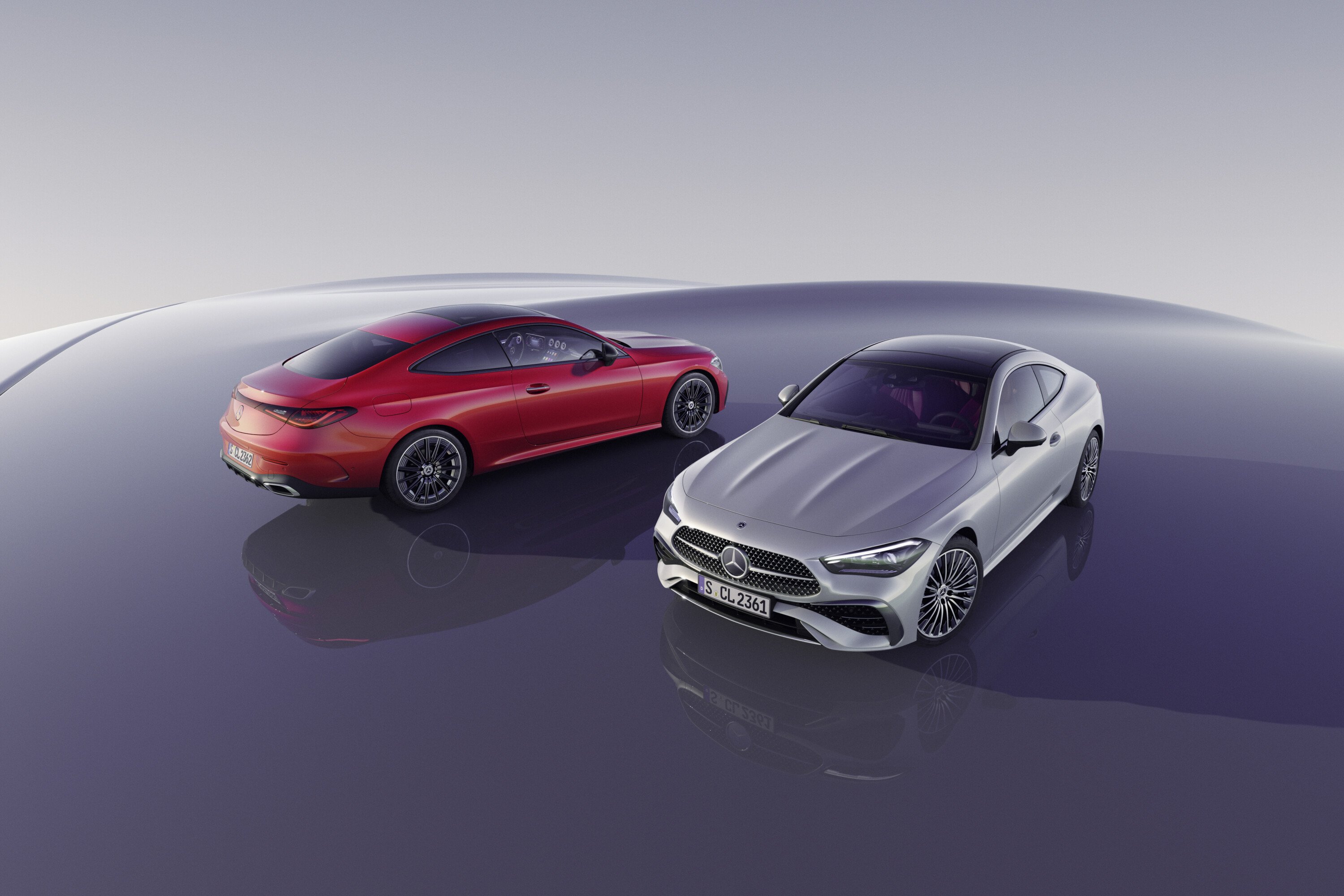
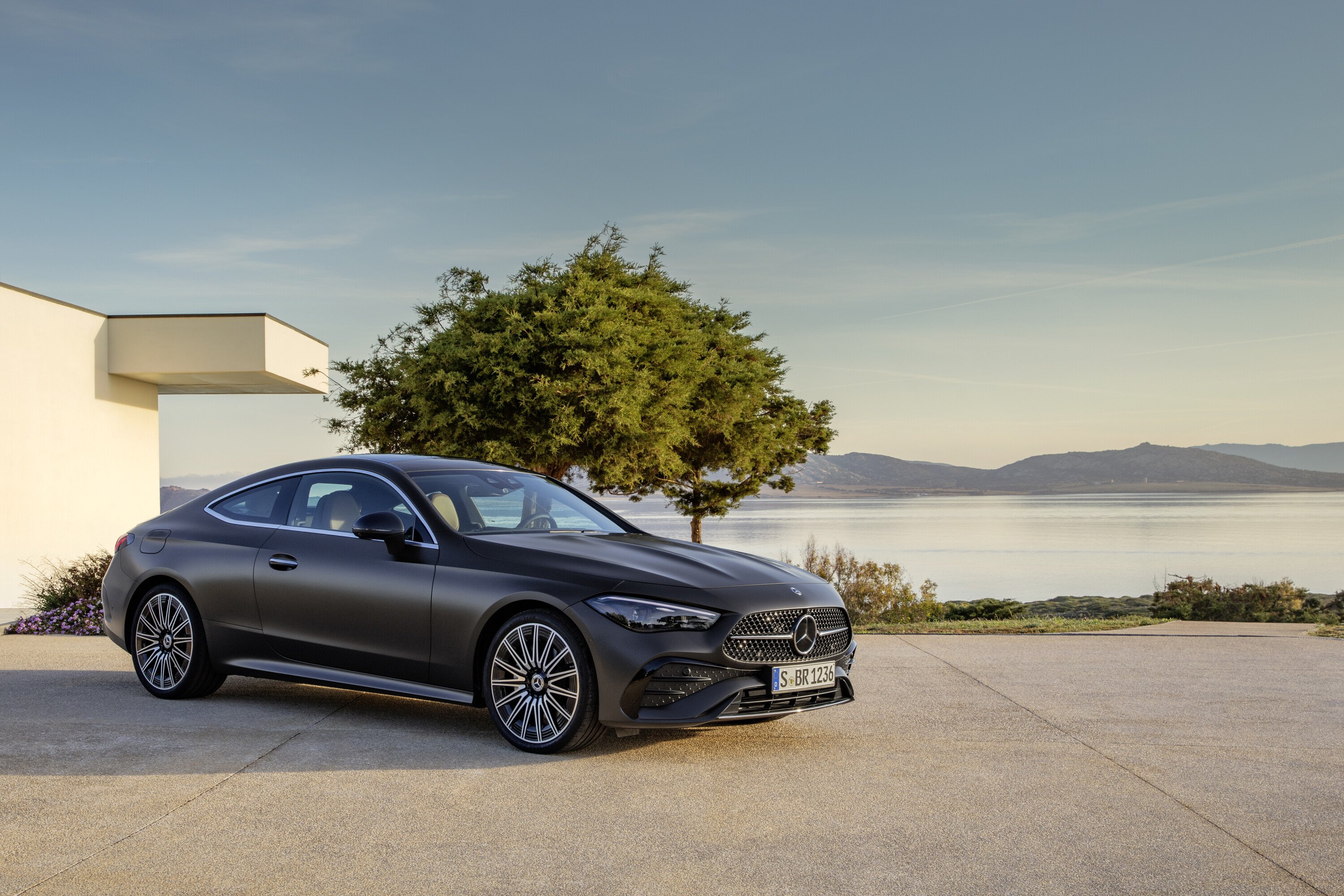
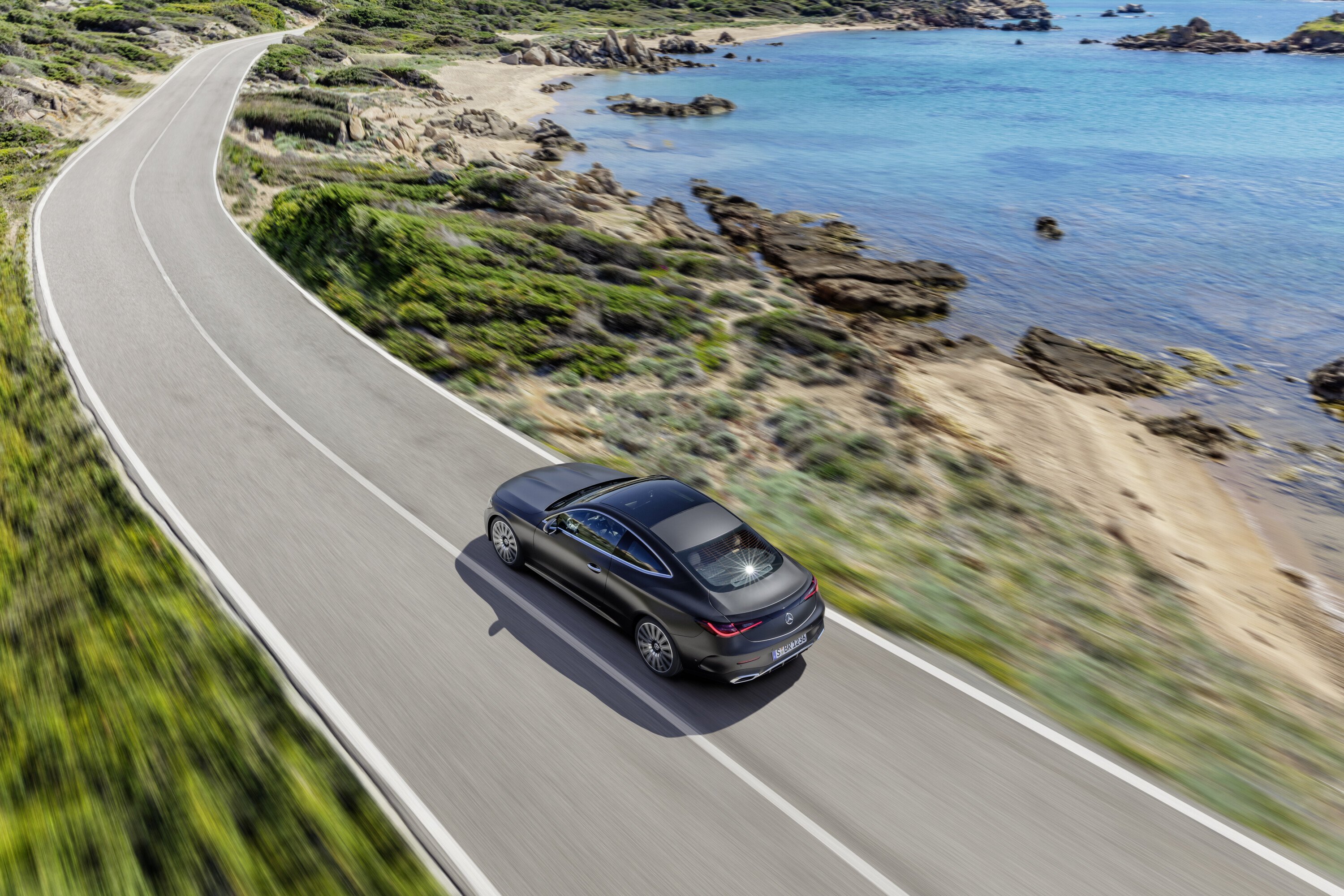
The CLE’s front end is visually tied to the ‘W206’ C-Class sedan, and looks very different to the larger E-Class sedan. An upturned, conventional-looking grille and swooping lines combine with a lower snout and broader jowls to give the coupe and convertible a sportier visage than the sedans.
In profile, Mercedes-Benz has incorporated hip and shoulder details into the CLE, with body lines that gesture towards a classic Coke bottle coupe shape. Around the rear is even less C-Class, with a sharp and expensive-looking LED lighting signature inspired by the EQ design family and twin trapezoidal exhaust tips.
The CLE is bigger than the C-Class coupe it effectively replaces, and the existing W206 C-Class sedan. It measures 4850mm long (+59mm), 1860mm wide (+36mm), with a 22mm lower roofline (1428mm). Confirming it sits on C-Class underpinnings is its 2865mm wheelbase, an inch longer than the car it replaces but identical to the sedan.
1
Interior design
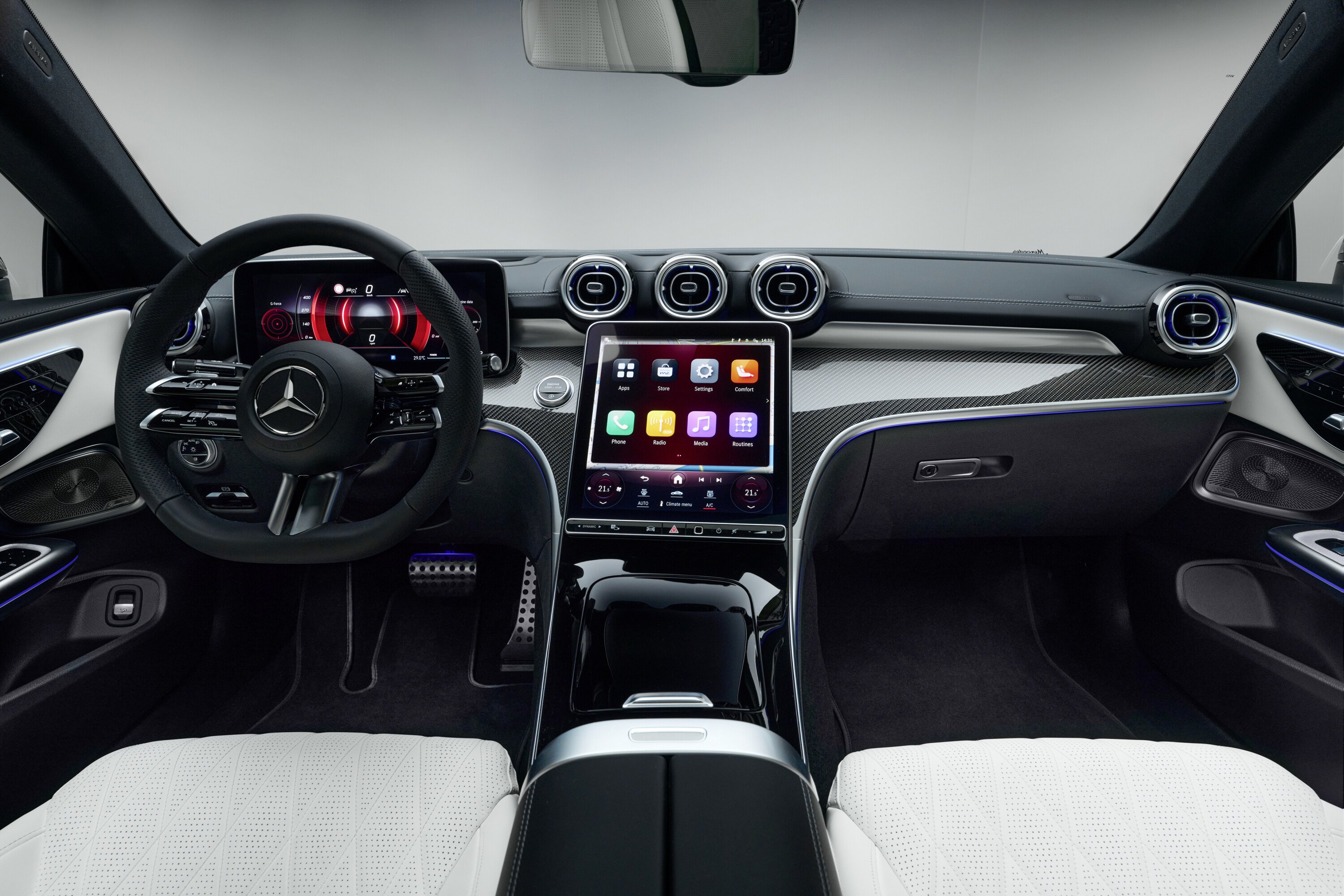
If the CLE channels the C-Class outside, then inside its 12.3-inch digital instrument display and portrait-oriented 11.9-inch touchscreen with the latest MBUX software are very much E-Class. Dynamic ambient lighting offers 64 selectable colours and has been extended to the rear seats.
An optional Burmester sound system is available, this incorporates two speakers into each front seat’s headrest for an immersive audio experience. The CLE features a leatherette loop to fold the front seats and access the two jump-seats in the back rather than a lever.
Safety systems from the E-Class are also incorporated. These include driver attention assist, active brake assist, AEB with pedestrian, cyclist, junction detection, active lane-keep assist, speed limit assistant and ‘Distronic’ parking sensors.
3
Powertrains on offer
Globally, Mercedes-Benz will offer five powertrains on the CLE. All from the FAME architecture (FAmily of Modular Engines is the acronym) featuring 48-volt mild-hybrid technology with a 17kW/200Nm electric power boost.
Australia is likely to skip the CLE220d and CLE200 4Matic, instead the CLE200 2.0-litre four-cylinder with rear-wheel drive making 150kW/320Nm will probably be the most affordable engine. It gets the CLE coupe from 0-100km/h 7.4 seconds.
Also possible is the mid-spec CLE300 4Matic producing 190kW/400Nm for a quicker 100km/h dash in 6.2 seconds. The global flagship (until AMG models arrive, of course) is the CLE450, a 3.0-litre petrol inline-six with 280kW/500Nm and all-wheel drive. The ’six could come to Australia, though the non-AMG E400 variant was discontinued in the previous-shape E-Class coupe.
Plug-in hybrid powertrains are coming, but will not be available from launch. Every Mercedes-Benz CLE uses a newly-revised version of Mercedes’s nine-speed automatic transmission.
1
Pricing and availability
You used to be able to get a C200 coupe from under $80K, while the base E200 two-door started over $110K. With the consolidation of medium and large coupes, expect pricing to change.
We anticipate, given the C-Class underpinnings but dearer E-Class tech, that the CLE range will open between $85-95K, with a flagship E450 reaching above into $140K, and potential AMG models dearer again.
Mercedes-Benz Australia has promised a local release of the CLE coupe and cabriolet in the second half of 2024.