
It’s worth noting that all Subarus and some entry-level Kia models also use a camera-only system, and the popular Model Y electric SUV has received the highest 98 per cent safety assist score by ANCAP in 2022.
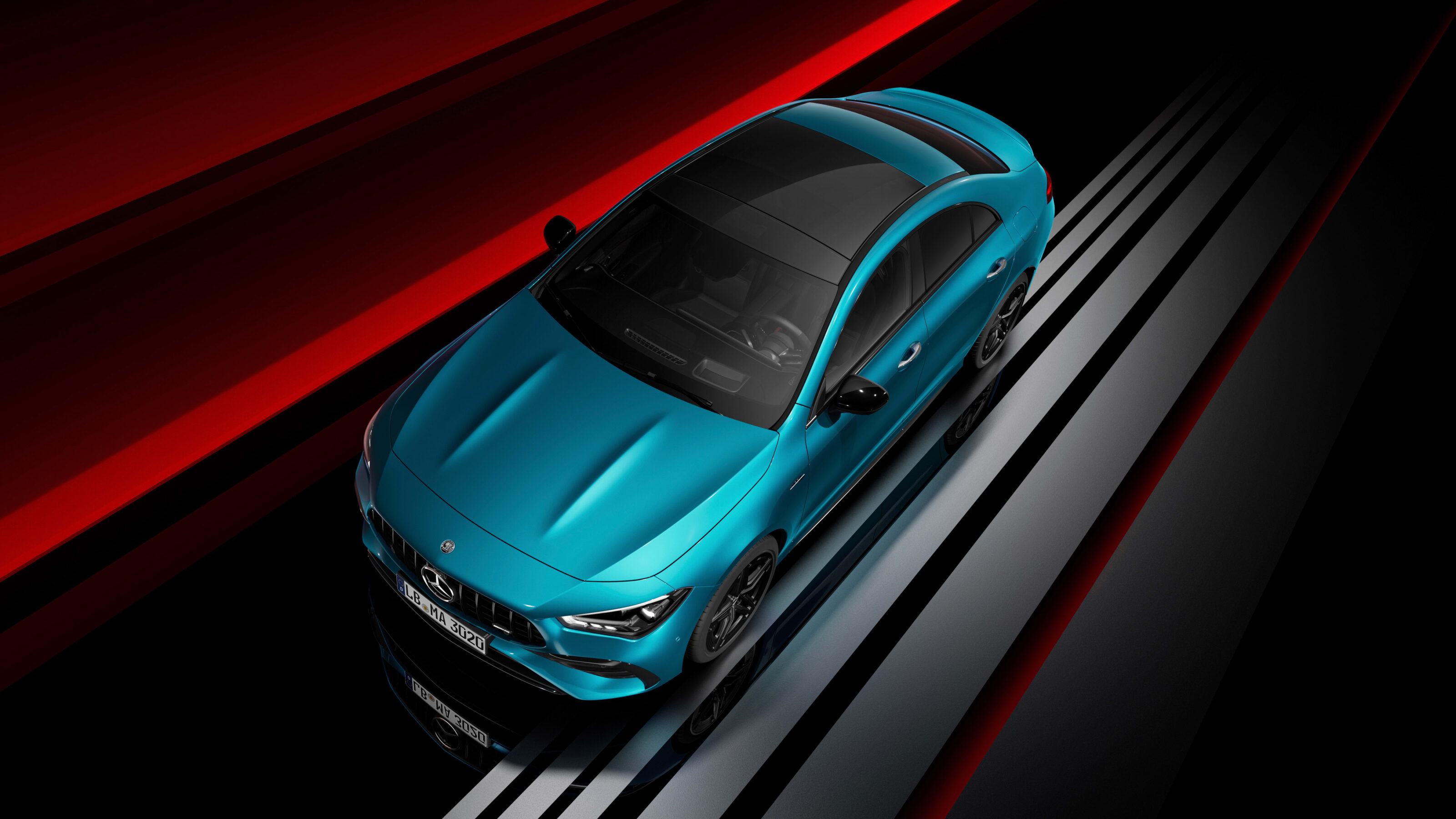
The next-generation 2025 Mercedes-Benz CLA sedan will focus on pure battery-electric power to directly rival the popular Tesla Model 3 and Polestar 2.
Snapshot
- Third-gen Mercedes CLA to become entry-level EV
- Petrol mild-hybrid to be offered in select markets
- Due in 2025, joined by CLA Shooting Brake, next-gen EQA and EQB
According to Autocar, the sporty-looking EV is expected to be available in a sedan body style and will be based on the Mercedes Modular Architecture (MMA), with a second-generation permanent magnet synchronous motor, a silicon carbide inverter and a two-speed gearbox.
It will take some inspiration from the ultra-efficient Vision EQXX concept car, with an 800-volt class charging architecture for up to 350kW DC ultra-rapid charging, module-less lithium-iron-phosphate (LFP) battery, and the possibility of a new silicon-anode battery for a longer-range variant.
Advice
Australia’s best electric cars for 2023
We’ve tested nearly every EV below six figures in Australia to rank the best on sale today
1
As MMA is an ‘electric first’ platform but can accommodate internal combustion engines, the British publication suggests a 48-volt mild-hybrid CLA will be sold in select markets six months after the full EV launch.
It will be a Euro 7-compliant four-cylinder petrol unit with some components from Chinese carmaker Geely, which is the largest shareholder in Mercedes’ parent company Daimler.
The third-gen electrified CLA is one of four new ‘Entry Luxury’ models in the pipeline as the German marque restructures its smaller model line-up ahead of going all-electric by 2030 – but only where market conditions allow.
1
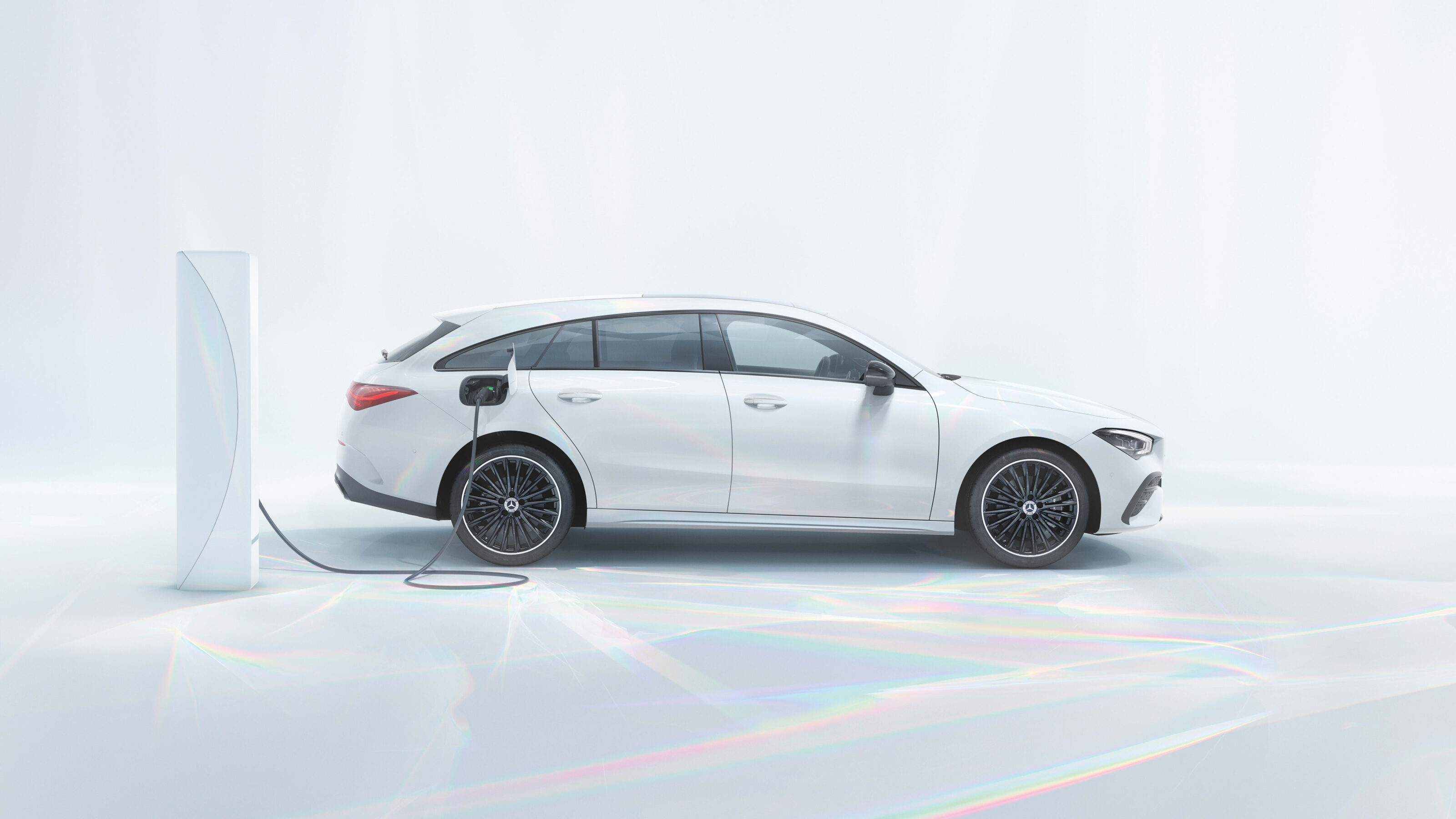
The CLA sedan will be joined by the related CLA Shooting Brake wagon, next-gen MMA-based GLA/EQC small SUV, and GLB/EQB medium SUV; however, the recently facelifted A-Class small hatchback and sedan and B-Class small people mover will be discontinued by the end of 2026.
Expect all models to feature the automaker’s latest MB.OS infotainment software, with built-in Google Maps navigation, a third-party app store, and unlockable features via a subscription.
The current Mercedes-Benz CLA will receive a facelift locally in the third quarter of this year with subtle tweaks.
⚡ More EV stories to help you choose the best car for your needs
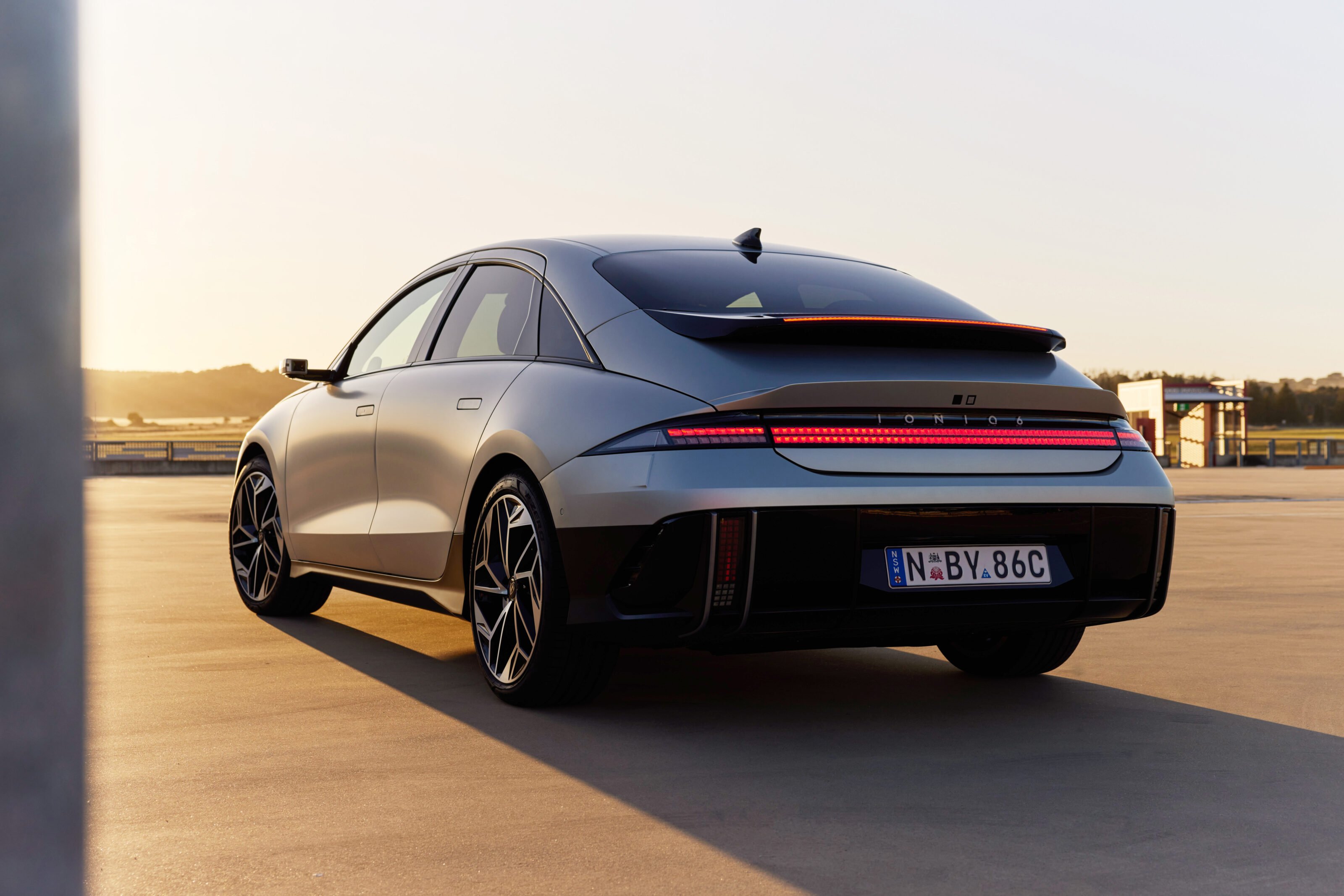
This, or a Tesla Model 3? That’s the question you want answered about the Hyundai IONIQ 6 isn’t it?
Like most such questions, it’s usually the case that you’ve made your mind up already and are looking for confirmation – but this one is a little more nuanced.
We’ve waited a very long time for a drive in the IONIQ 6 on Aussie roads. The car was first teased as the Prophecy concept car back in March 2020. That car was due to be the highlight of Hyundai’s Geneva Show stand that year, before a certain global inconvenience intervened.
The productionised version was unveiled in June of 2022, dubbed the ‘electrified streamliner’. Hyundai’s design guru SangYup Lee described the interior as “a mindful cocoon”, contrasting with the airiness of the IONIQ 5 SUV with which the 6 shared its E-GMP underpinnings.
It forms part of an electrified product assault by Hyundai and, while coming to market with a sedan might seem curious when that sector feels as if it’s on the nose, the IONIQ 6 goes head-to-head with the massive selling Tesla Model 3 – delivering a tantalising alternative to the all-conquering American.
1
JUMP AHEAD
- How much is it, and what do you get?
- Where is this model in its lifecycle?
- How do rivals compare on value?
- Interior comfort, space and storage
- Technology in the cabin
- What is it like to drive?
- How much energy does it use?
- How safe is it?
- Warranty and running costs
- VERDICT
- Specifications
How much is it, and what do you get?
| 2023 Hyundai IONIQ Dynamiq features | |
|---|---|
| 18-inch alloy wheels | Head-up display |
| Dual 12.3-inch digital displays | 10-way powered driver and front passenger seats |
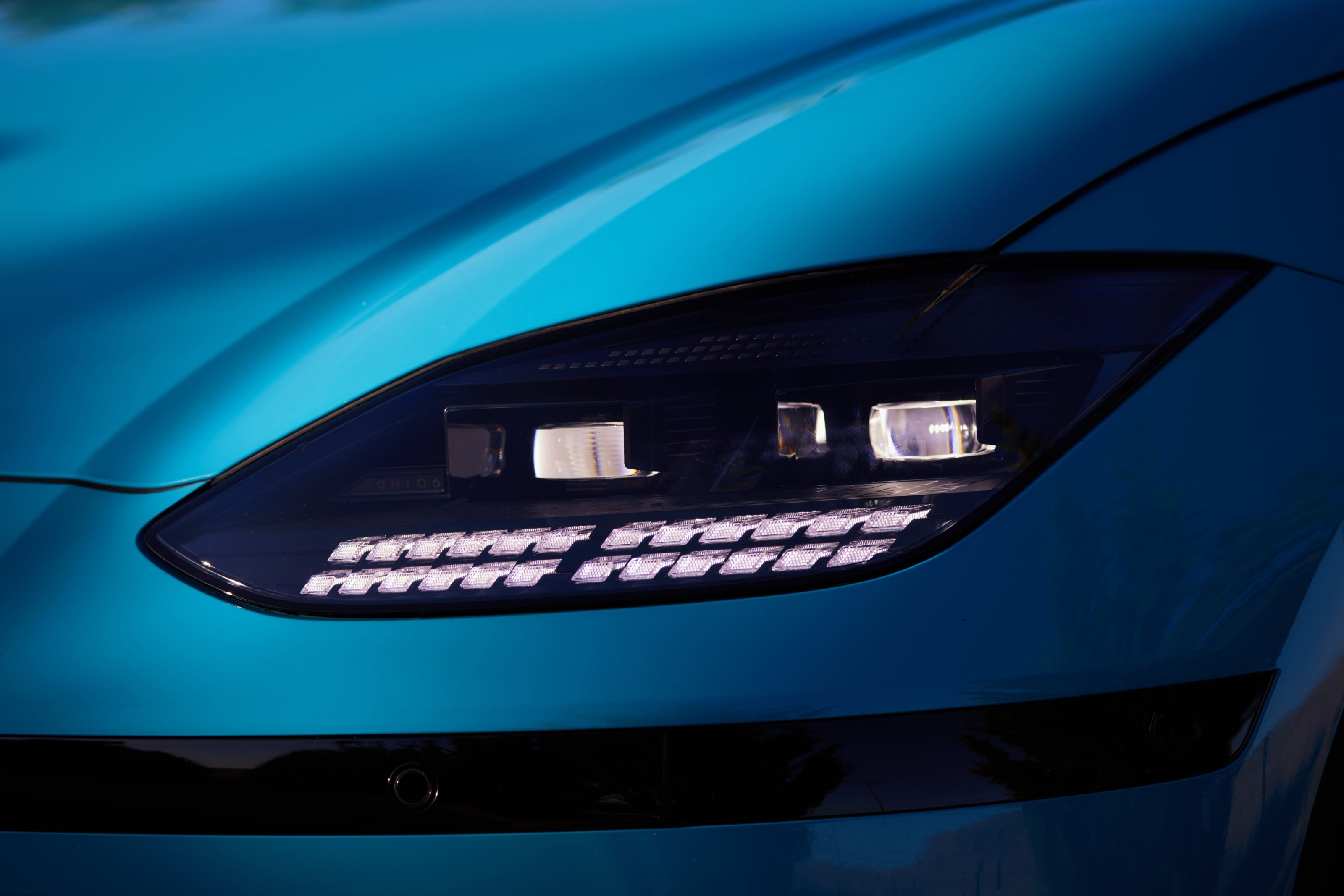
| Matrix adaptive LED headlamps | Wired Apple CarPlay/Android Auto |
| 8-speaker Bose audio system | Blue Link connected car services |
| Leather upholstery | Multi-Bluetooth connectivity |
The three-model range is easy to get to grips with. It opens with a single-motor, rear-drive version. Pay a little more and you can choose between a pair of more powerful dual-motor, all-wheel-drive variants.
Pricing kicks off at $74,000 (before on-road costs) for the 168kW/350Nm Dynamiq trim level.
1
All versions of the IONIQ 6 use the same 77.4kWh battery pack, but given this is a single motor version riding on smaller wheels and tyres, it’s the lightest and most aerodynamic of all the IONIQ 6 variants (0.217cD) and therefore delivers the best range.
Hyundai claims a driving range of 614km for the Dynamiq. You’ll identify this model by its 18-inch alloy wheels.
Despite the fact it lacks the punch of the dual-motor versions, it’s hard to feel short-changed with the Dynamiq. Equipment that you might think would be reserved for the higher-spec versions, is right there on the standard equipment list.
1
That means you get gear like adaptive matrix headlights, leather trimmed seats, vehicle-to-load charging points both inside and outside the car, heated and powered front seats, a head-up display, a powered boot lid, a BOSE stereo, adjustable ambient lighting and the full gamut of Hyundai’s SmartSense safety features.
Yep, there’s not one safety feature on the range-topping IONIQ 6 that you won’t find on a no-options Dynamiq – and for that, Hyundai should be congratulated.
That said, it’d be hard for many to resist stepping up to the dual motor Techniq model, which cranks out a very hearty 239kW and 605Nm. This costs $83,500, and the all-wheel drive and added power is the big draw here. You also get 20-inch alloys shod with Pirelli P Zeros, rather than the eco-focused rubber of the Dynamiq. The front seats are better too, with full reclining ‘relaxation’ seats that are heated and ventilated.
1
While reclined, you can also look out of a glass sunroof. The final touches for the Techniq include a heated steering wheel and heated rear seats.
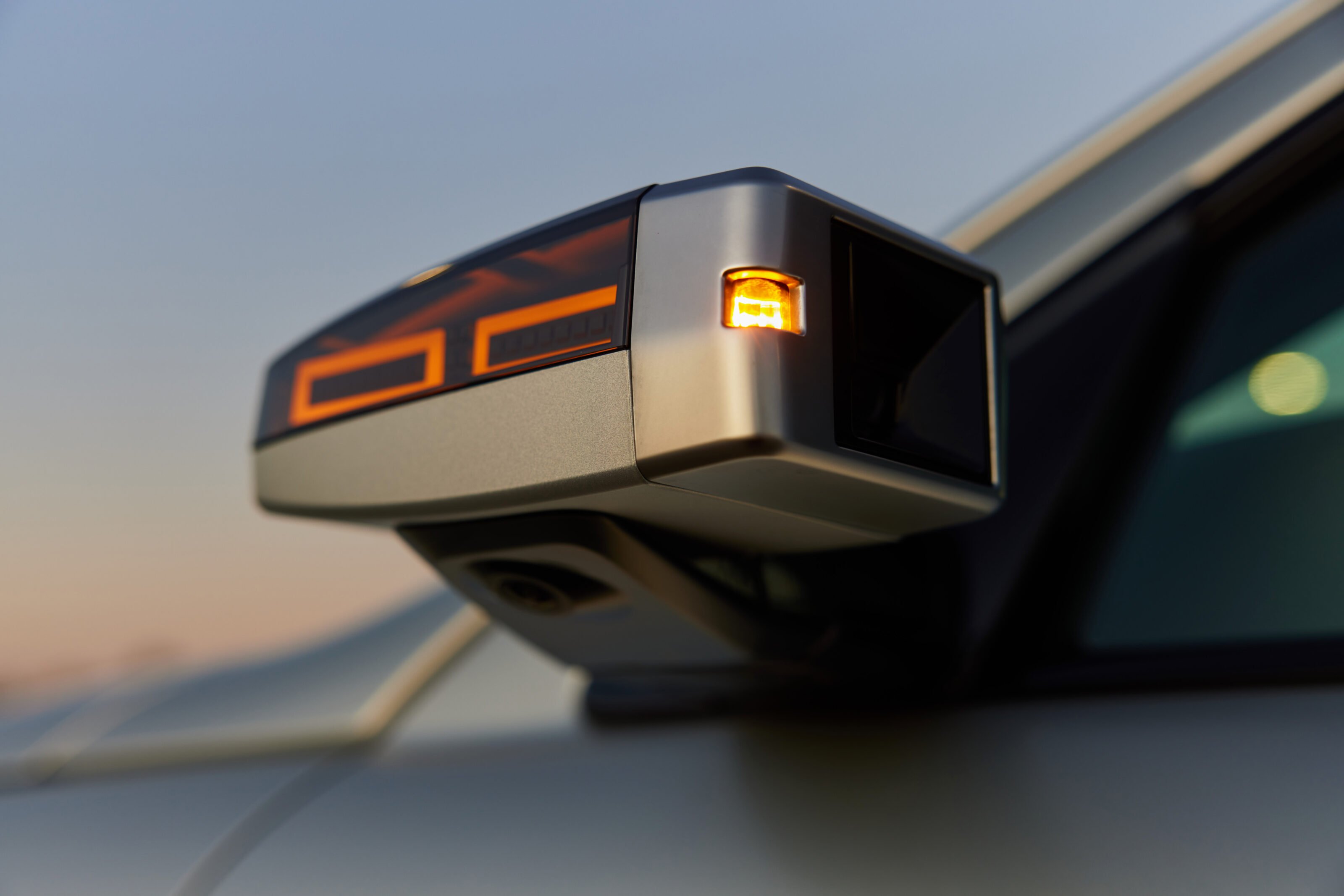
The range-topping Epiq can be identified by its pod-like digital side mirrors, which project a high-resolution image onto monitors at the outer edges of the dash. It also gets a heat pump for more efficient cabin heating and a clever battery conditioning system which can warm the battery pack, priming it to accept ultra-rapid charging.
The Hyundai IONIQ 6 configurator is probably a boon for the terminally indecisive. Once you’ve settled on one of three models, there’s only one option and that’s to choose whether or not to splash $1000 on the hero Gravity Gold Matte paint. This is a handsome paint finish but looks suspiciously silvery to me. If you’d come first at the Olympics and been presented with a medal of this colour, you might feel a little crestfallen.
1
Where is this model in its lifecycle?
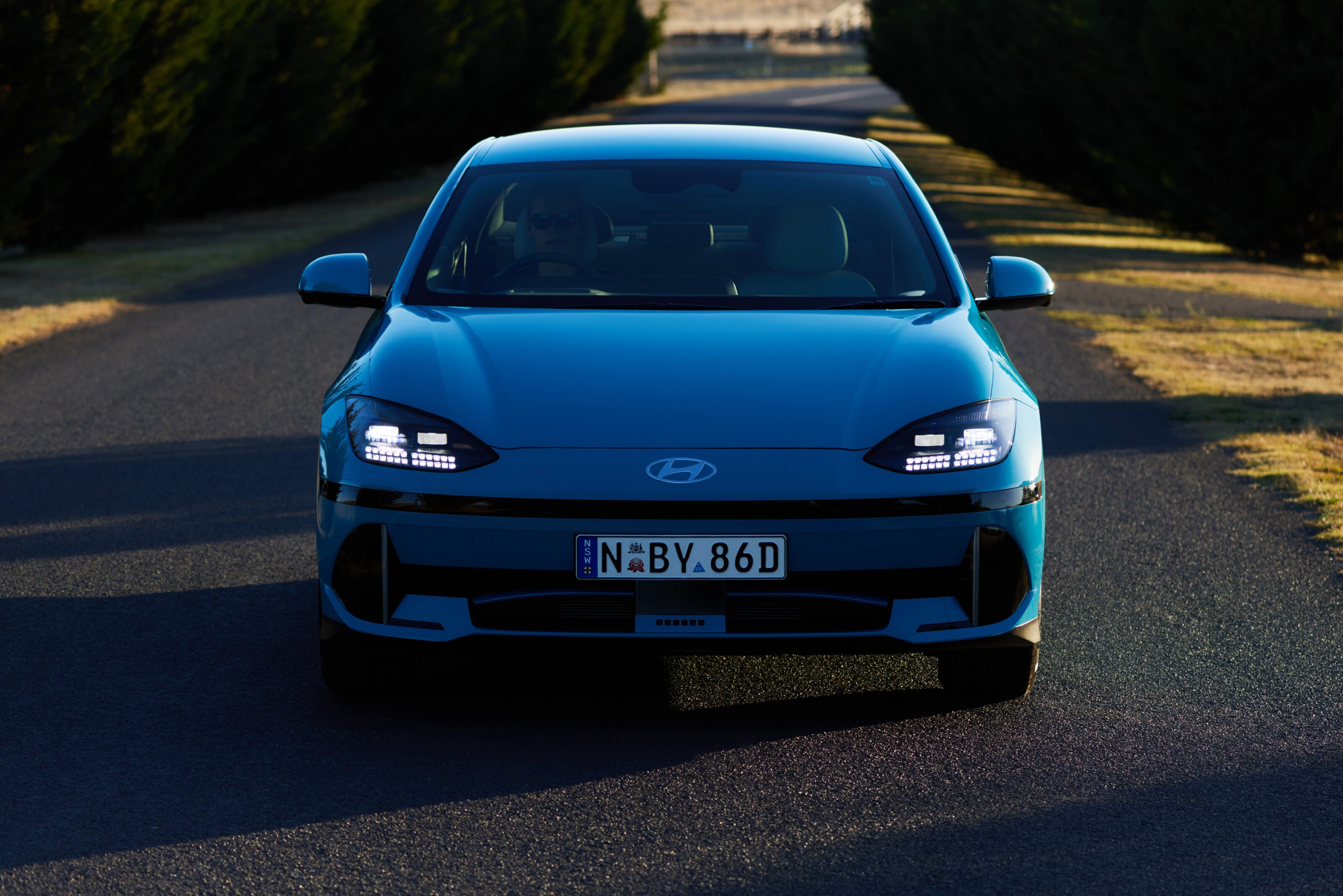
The IONIQ 6 is absolutely box-fresh, although we’ve become familiar with some of its DNA through its sibling, the IONIQ 5 SUV.
Such is the pace of Hyundai’s product development rollout that the usual schedules we’ve become used to – such as a product lifespan that typically involves a facelift at four years old and a replacement at seven years – might well need some revising.
Hyundai has already mentioned that it might revisit the IONIQ 6’s rigid trim structure as soon as supply frees up a little. At present, there’s no real option to, for example, specify a dual-motor Techniq with the 18-inch alloys of the Dynamiq, should you prefer a little more tyre sidewall for ride comfort.
1
How do rivals compare on value?
By rivals, I’m assuming you mean the Tesla Model 3. And the answer to that question isn’t 100 per cent straightforward.
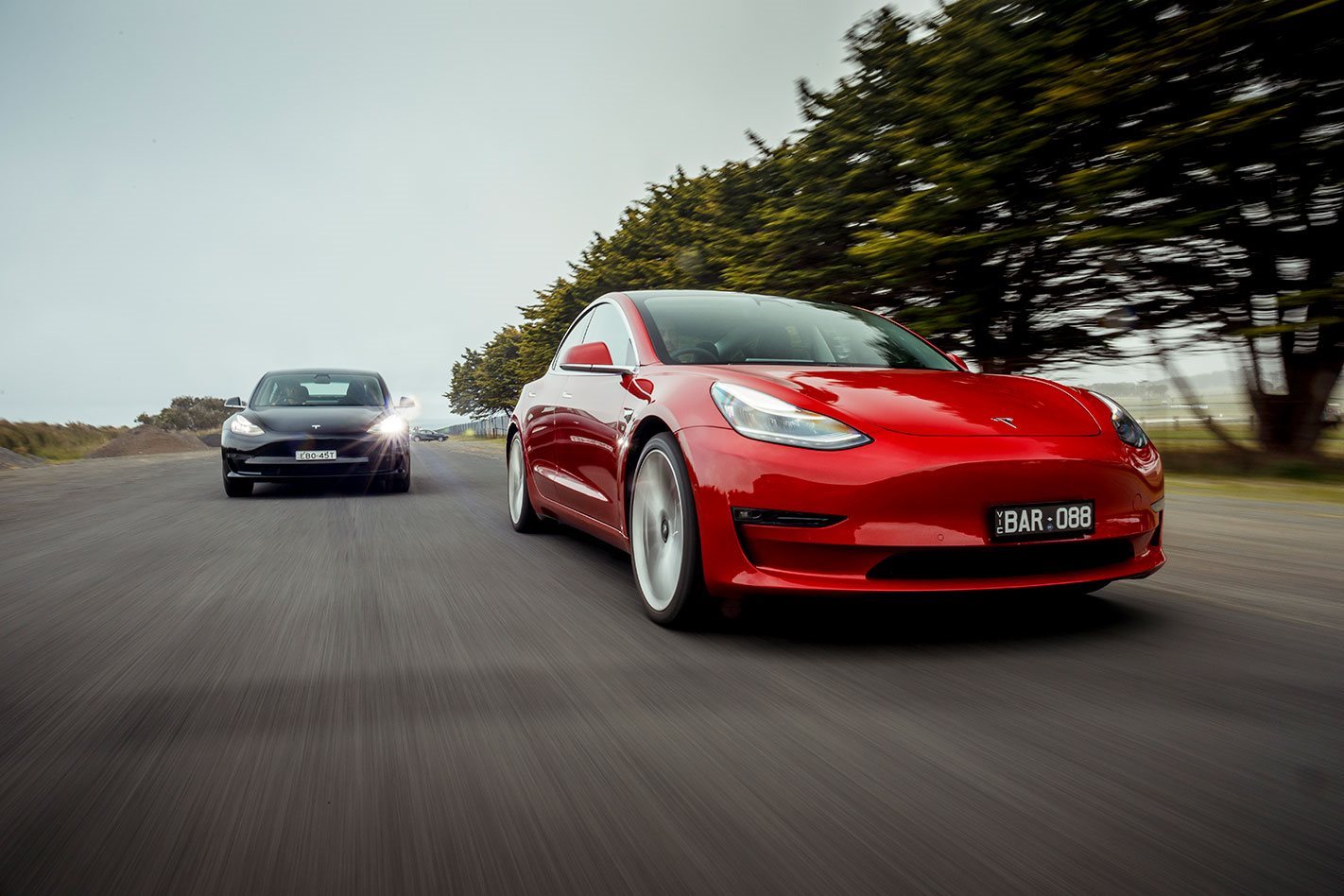
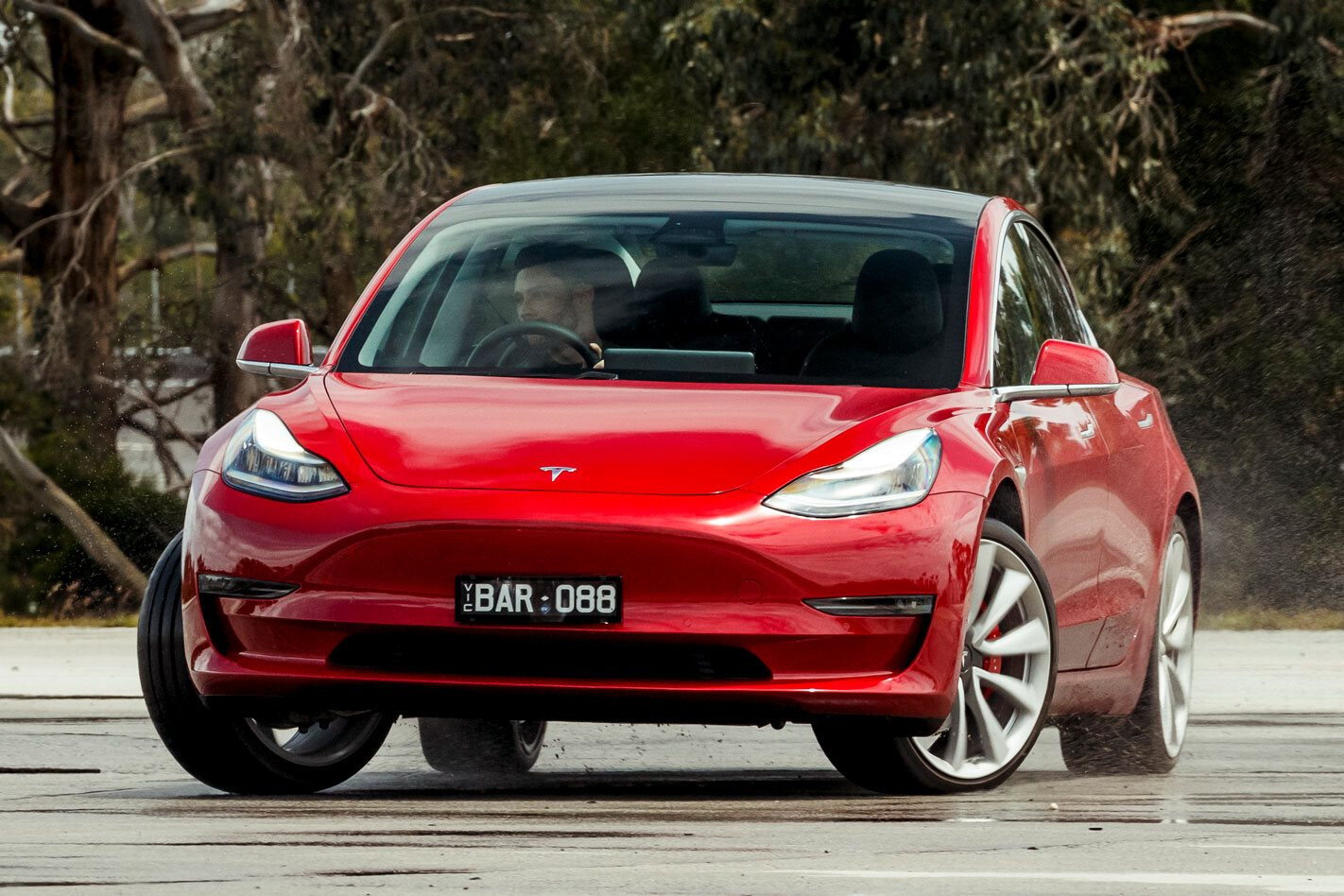
At the time of writing, a rear-drive Tesla Model 3 retails for $64,300, with a Long Range dual-motor all-wheel drive version priced at $77,300. Tesla prices are notoriously fluid, so it may well be worth double-checking them in your locale.
Therefore, it’s reasonable to assume that the single-motor IONIQ 6 Dynamiq, at $74,000, is nigh-on $10k more expensive than a Model 3. And the Techniq dual monitor IONIQ 6 is just over $6k pricier. So, yes, if you’re absolutely fixated on reducing your spend, buy the Tesla – but I’d implore you never to park your posterior into the ‘mindful cocoon’ that is the IONIQ 6’s interior. Why? Because the moment you do, you start formulating rationalisations for spending the extra.
1
It’s just a far richer experience. Yes, some love the bold, spare austerity of the Model 3’s cabin, and we get that. But as soon as you start delving into what the IONIQ 6 offers, what it actually gives you for the money, it suddenly doesn’t seem bad value at all. Quite the opposite in fact.
If you have decided on the Korean car, perhaps an even gnarlier question is whether the IONIQ 6 offers that much over its sibling, the IONIQ 5.
There will be those – and I’d count myself amongst them – who feel the IONIQ 5 is a far better resolved vehicle from a styling perspective, and that its added utility could well swing the balance for families. It’s also a couple of grand cheaper, model-for-model, but lacks some of the more intriguing equipment items seen in the 6.
1
Interior quality, comfort, space and storage
A 2950mm wheelbase is within 4cm of the current Audi A8‘s footprint. In other words, the passenger compartment of the IONIQ 6 is long.
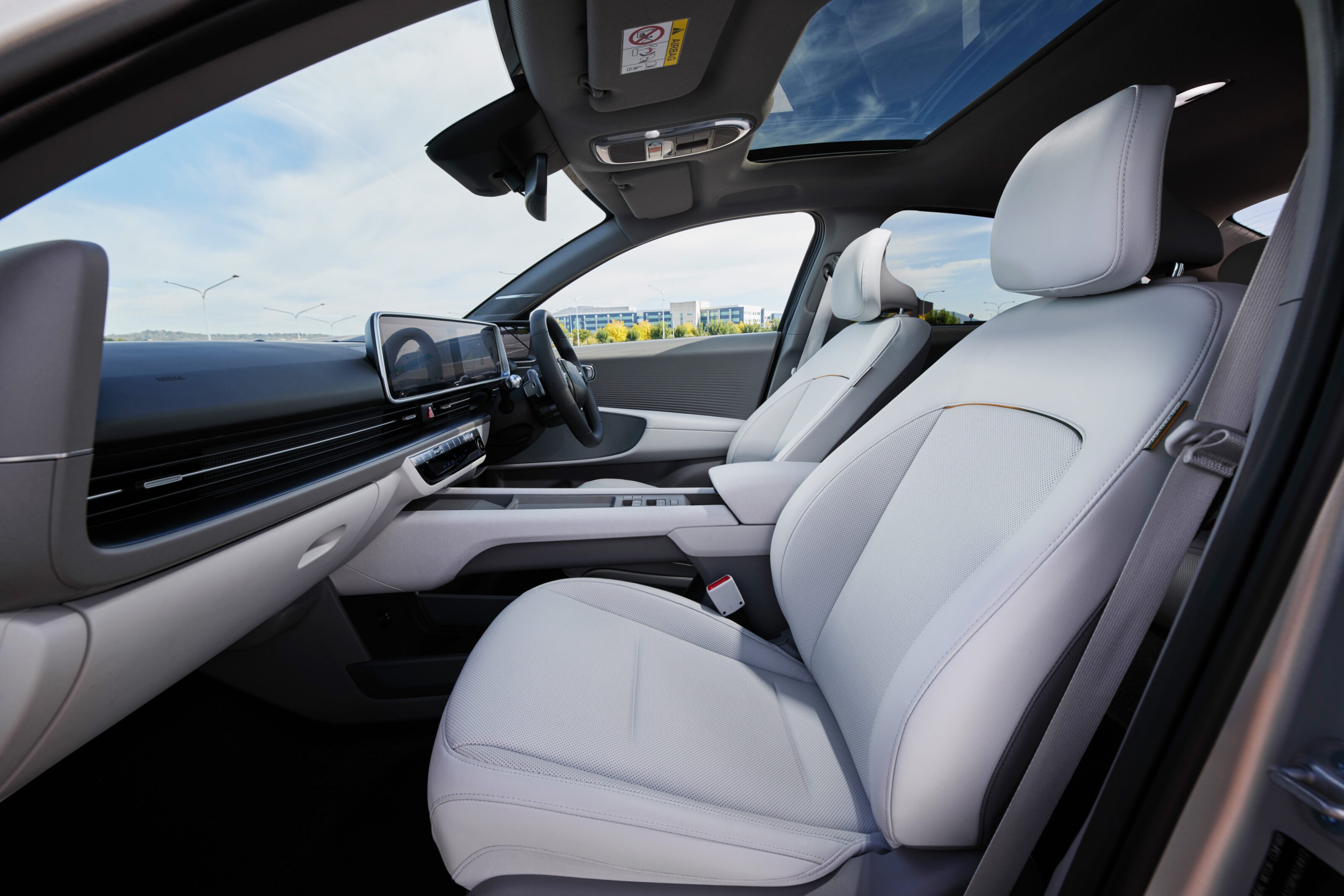
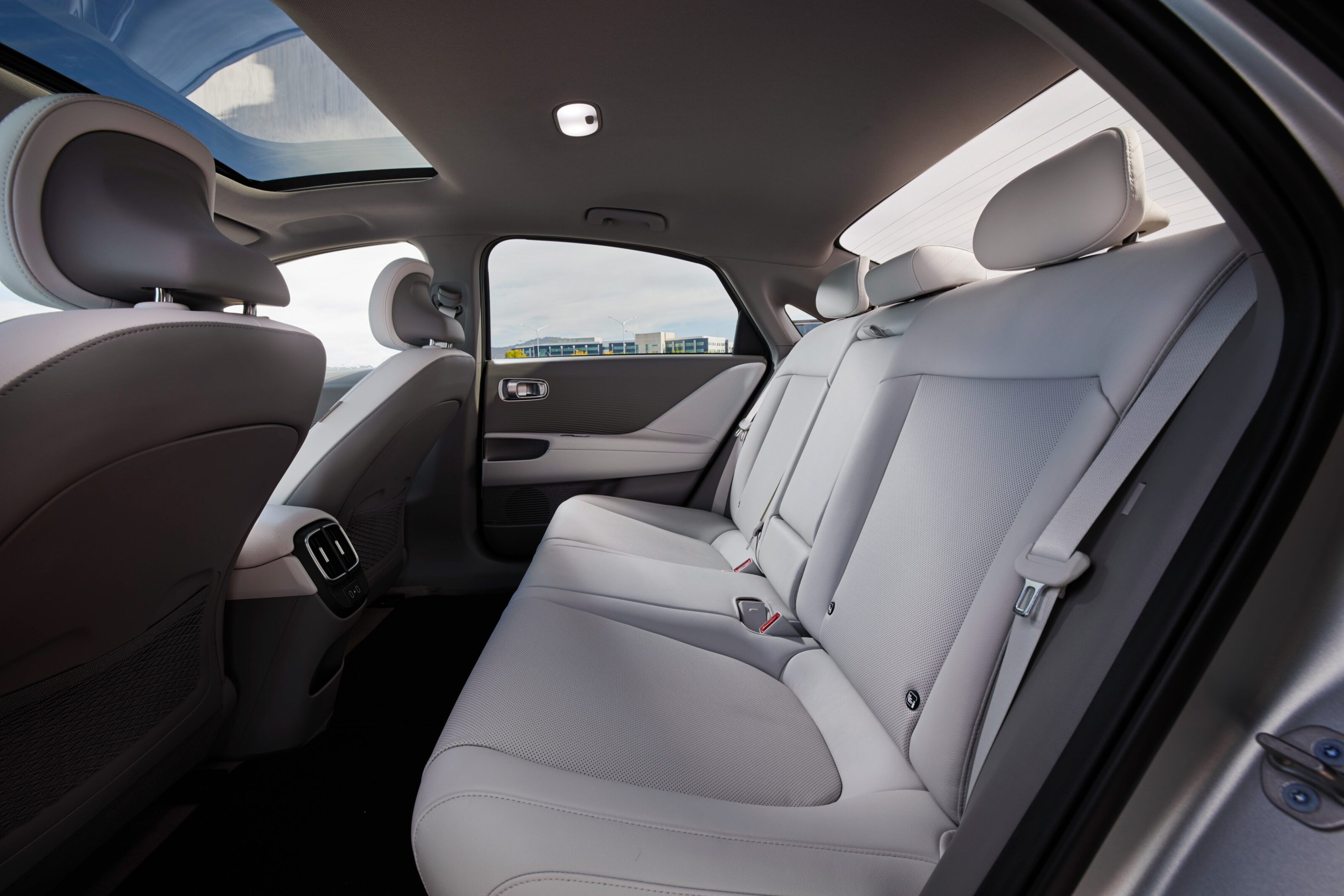
I’m a fairly long 193cm and I’d easily be able to sit in the back of an IONIQ 6 behind my own front seating position. It’s not perfect back there, though. There is a price to pay for that swooping roofline, and it comes in terms of headroom for taller rear-seat occupants.
Anyone much over 185cm will be brushing the headlining and, while there’s no shortage of knee room, the front seats come right down to the floor, so you can’t tuck your toes beneath them. On the plus side, there’s no transmission tunnel, so the central seat isn’t the punish that it is in many cars.
1
Hyundai makes great play of the ‘relaxation seats’ fitted to the dual-motor models and they’re about 30mm thinner from front-to-back than the more conventional chair on the Dynamiq base model.
Up front, it’s fairly easy to find a comfortable seating position, but the sunroof fitted to the dual-motor versions does rob a couple of centimetres of headroom.
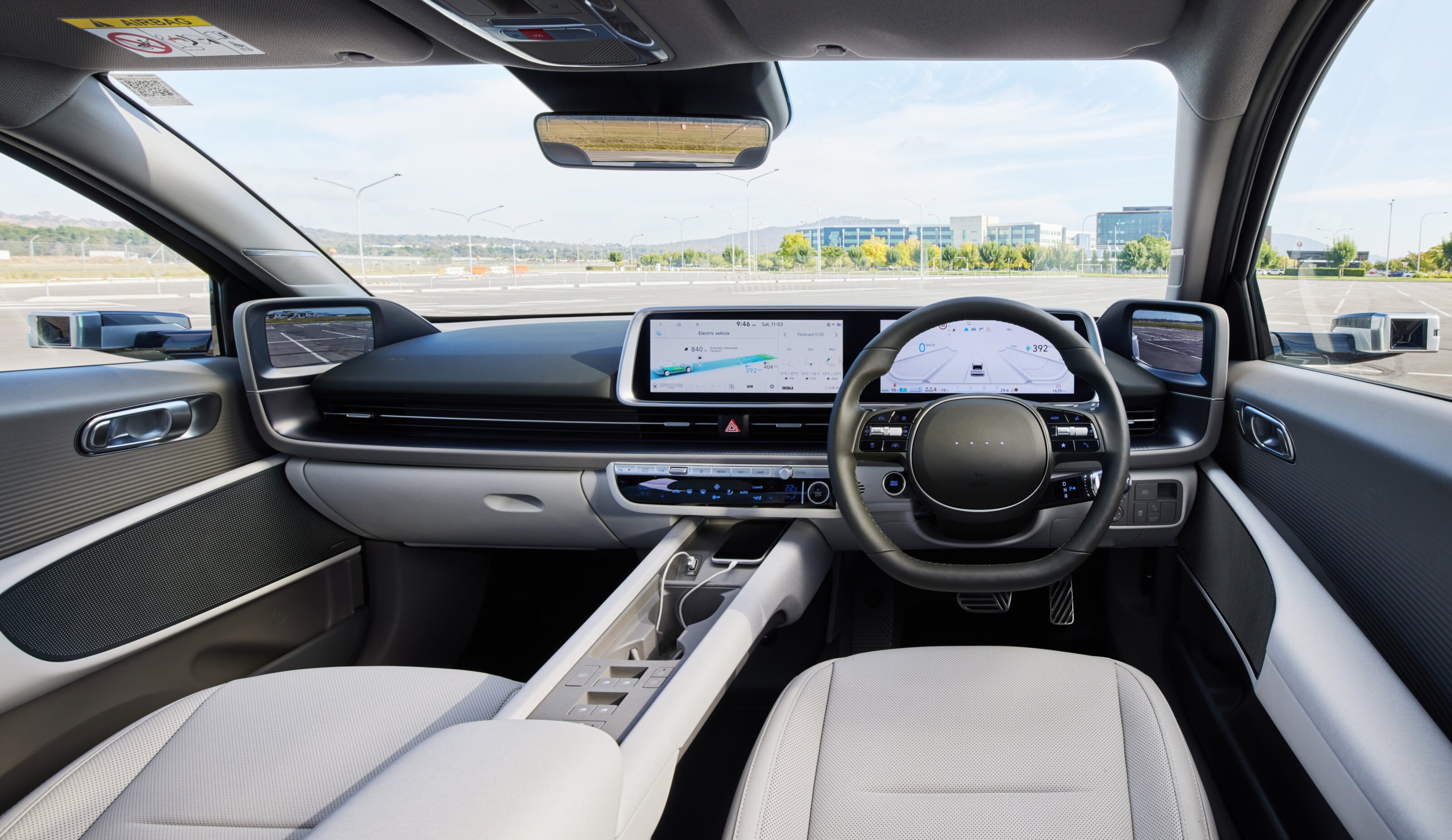
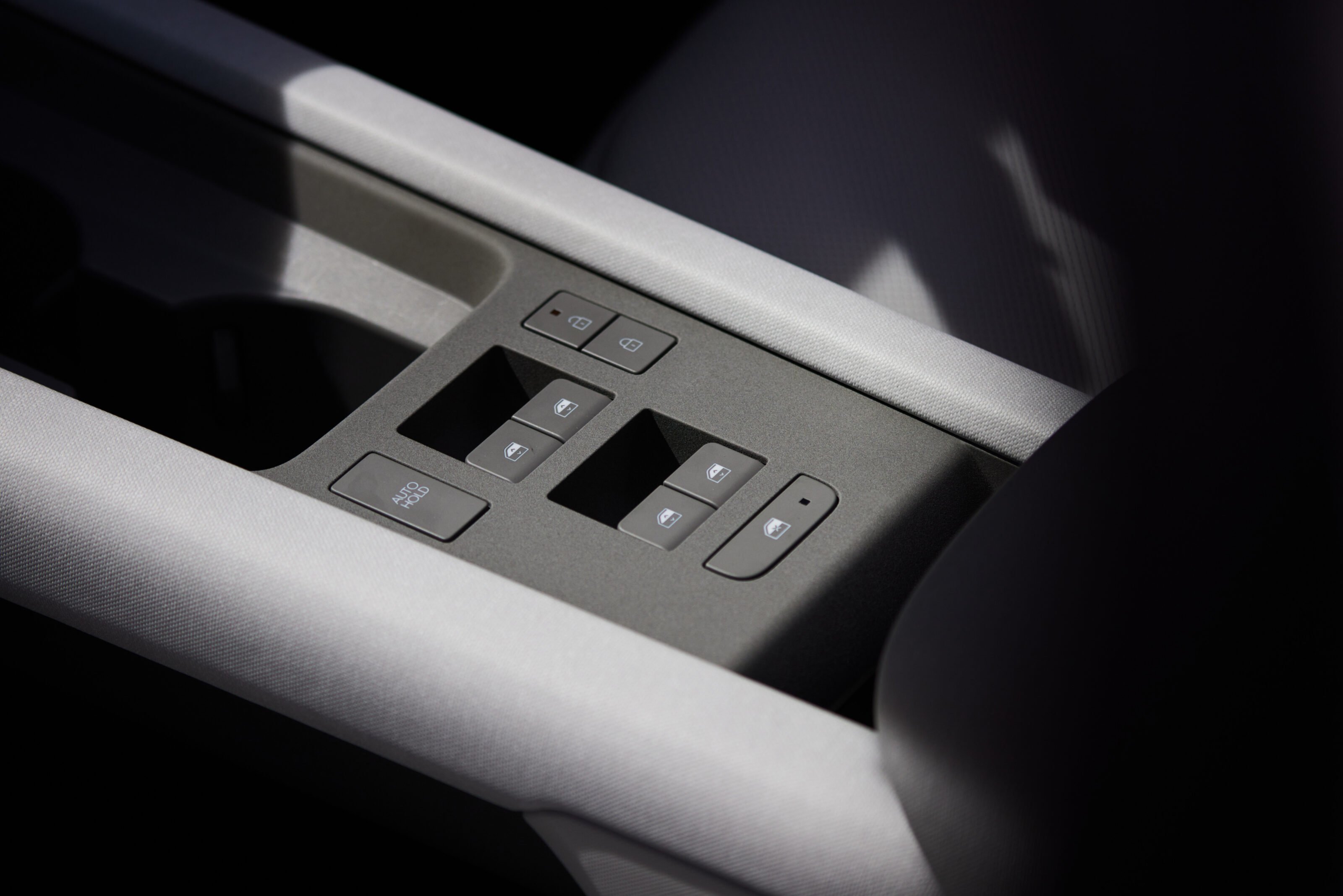
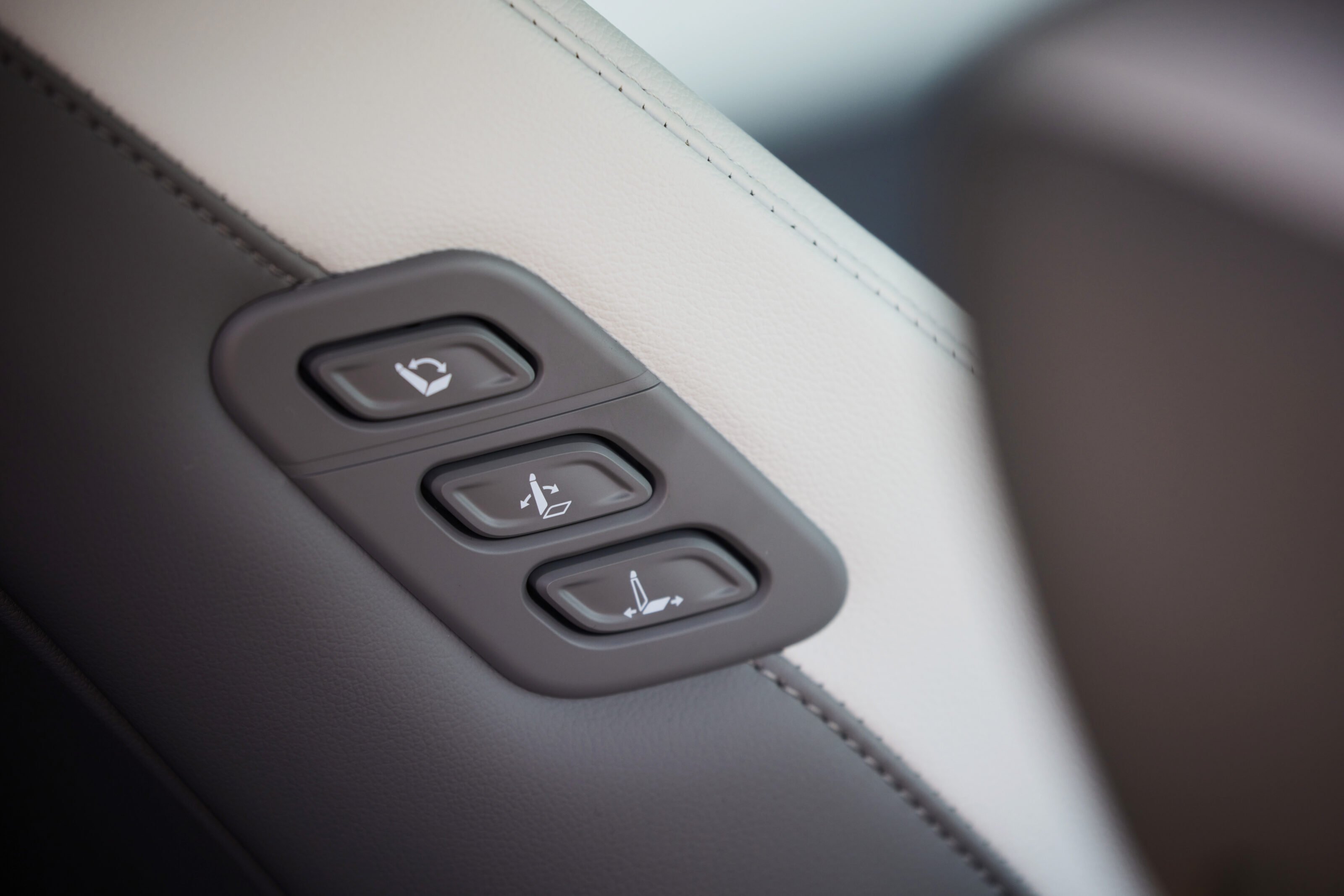
Hyundai has moved the controls that you’d normally find on the front door armrest, such as window switches and door-locking functions, to the centre console. This has then freed up some space on the door cards to create a sweeping, sleek design.
1
There’s been quite a commitment to using sustainable materials within the cabin, in case that’s why you’re prodding and scratching at the finish of the dash and wondering what’s going on. It’s a bio thermoplastic polyolefin, a byproduct of sugarcane waste.
Likewise, the headlining uses sugarcane extracts while 20 percent of the materials in the carpets is made from recycled fishing nets. Paints for the door cards are created from plant-extracted oils and the leather seats utilise an eco-friendly dyeing process that uses flaxseed extract.
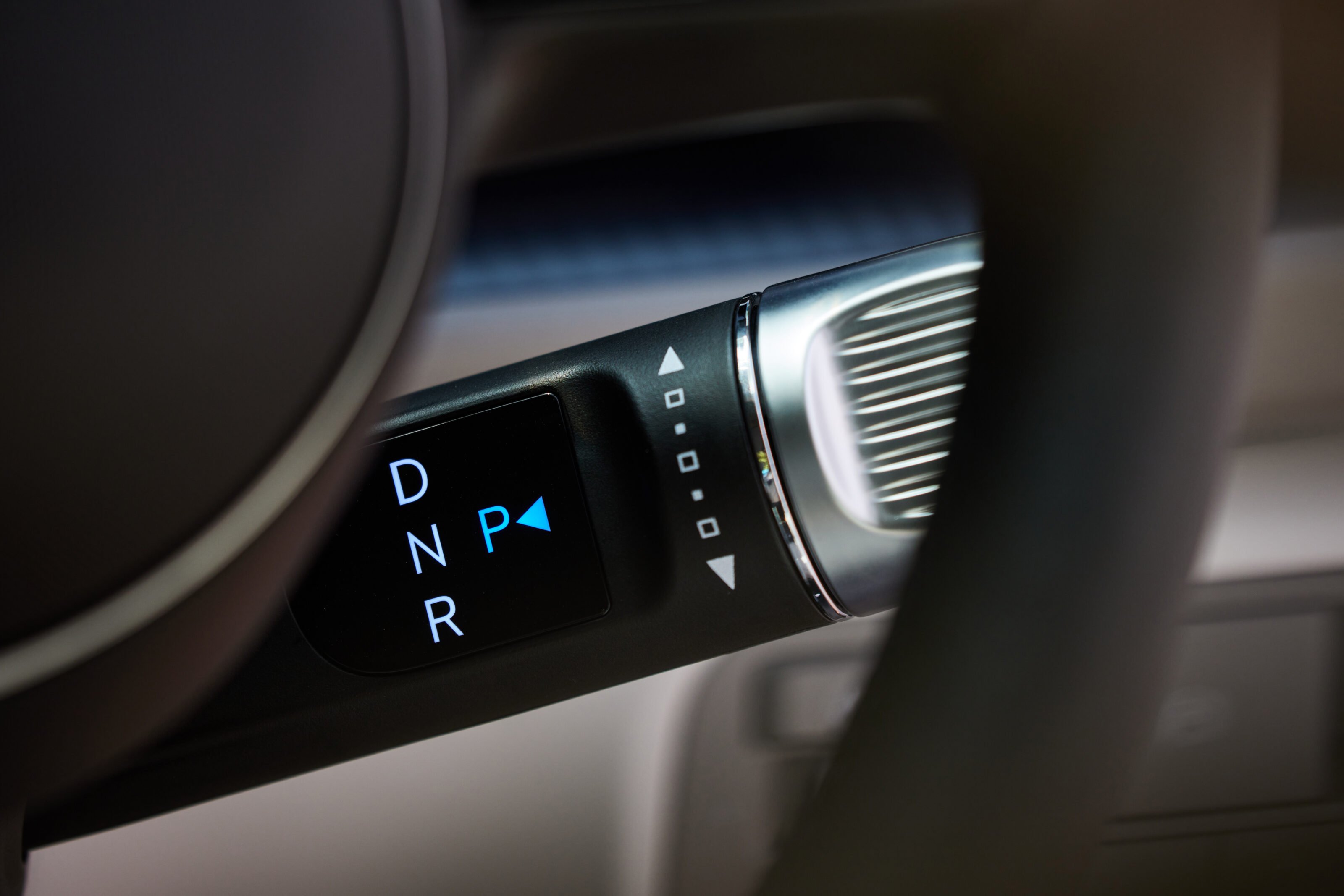
Perceived quality is good, although I’m still yet to be convinced by the column-mounted gear selector. The range-topping Epiq’s electronic mirrors also seem a very complex solution to a bit of a non-problem, and such is their wide angle of view that it made distant, fast-approaching objects fairly difficult to pick.
2
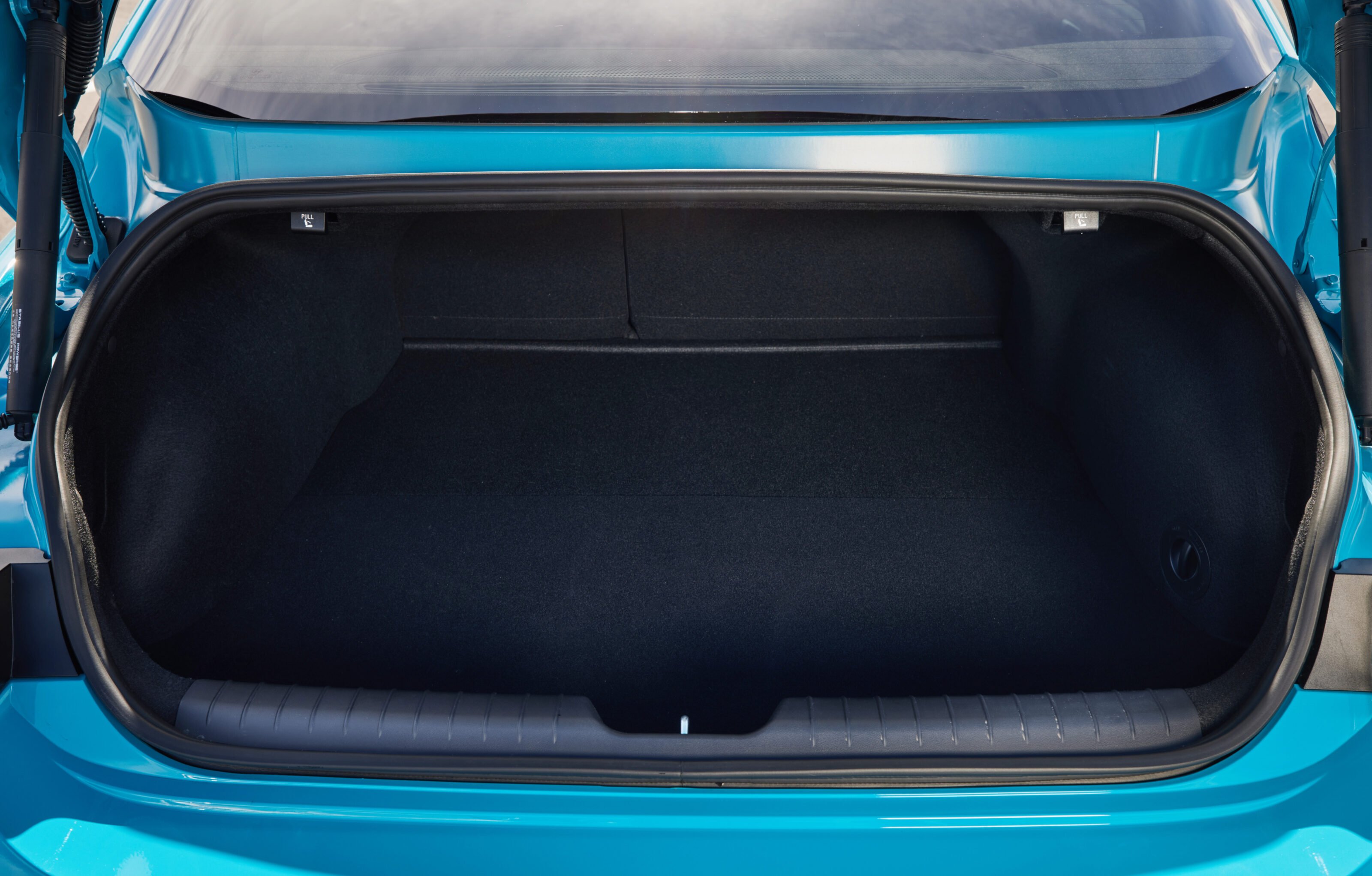
IONIQ 6 boot space
The boot lid opens electrically to reveal a fairly deep luggage bay that measures 401 litres with 60/40 split rear seats droppable by tabs on the top edge of the boot aperture.
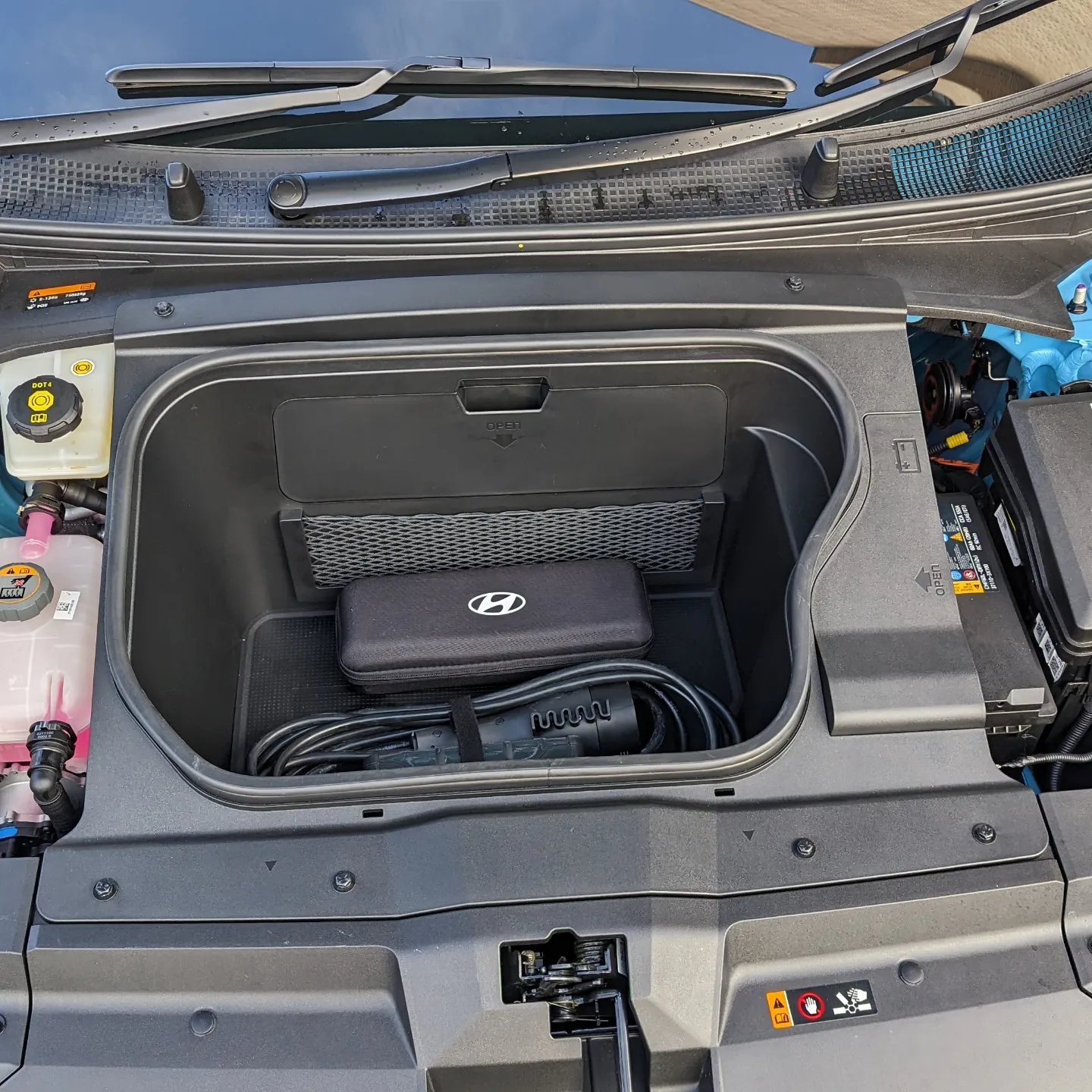
There’s no storage under the boot floor and there’s no spare either, just a mobility kit if you catch a flat. Pop the frunk and what you’ll find depends on which model you’ve chosen.
Without any front motors to complicate things, the entry-level Dynamiq gets a 45L cubby that’s big enough to stow a backpack or a shopping bag. Choose a dual-motor model, however and that space shrinks to just 14.5L.
1
Mini matchup: Boot space
| MODEL | WHEELBASE | BOOT |
|---|---|---|
| Hyundai IONIQ 6 Dynamiq | 2950mm | 401L |
| Tesla Model 3 RWD | 2875mm | 425L |
| Hyundai IONIQ 5 Dynamiq | 3000mm | 527L |
1
Technology in the cabin
All this tech, but you still need to plug your phone in with a cable for Apple CarPlay or Android Auto.
Come on, Hyundai, you can do better than that. That fairly significant gripe over, let’s move on to the good stuff.
The IONIQ 6 is the first Hyundai production model to get over-the-air updates for its system software. Map updates tend to follow a six-month schedule, but the system can also update and maintain safety-critical functions for braking, performance and driver assist systems without the need to visit a workshop.
1
The IONIQ 6 also features as standard a transferable five-year subscription to the Bluelink connected car service suite. The full feature list of Bluelink is vast, so I’ll cover the key functions here.
The scheduling function allows users to set a charging time, and pre-condition the vehicle’s climate control to take advantage of off-peak electricity tariffs. Alarms can be set so that the owner receives notifications when the vehicle is about to complete charging – 30, 20 and/or 10 minutes prior to completion.
Users can remotely monitor the vehicle’s distance to empty and can recommence charging if required. The app allows the owner to find EV charging stations and send the address to the car’s nav. What’s more, there’s a tool which will show on a map the driveable radius with 80 and 100 percent battery charge levels.
Geofencing, valet mode, find my car functionality, vehicle speeds and timeframe management are also included as is vehicle locking and surround view camera control.
1
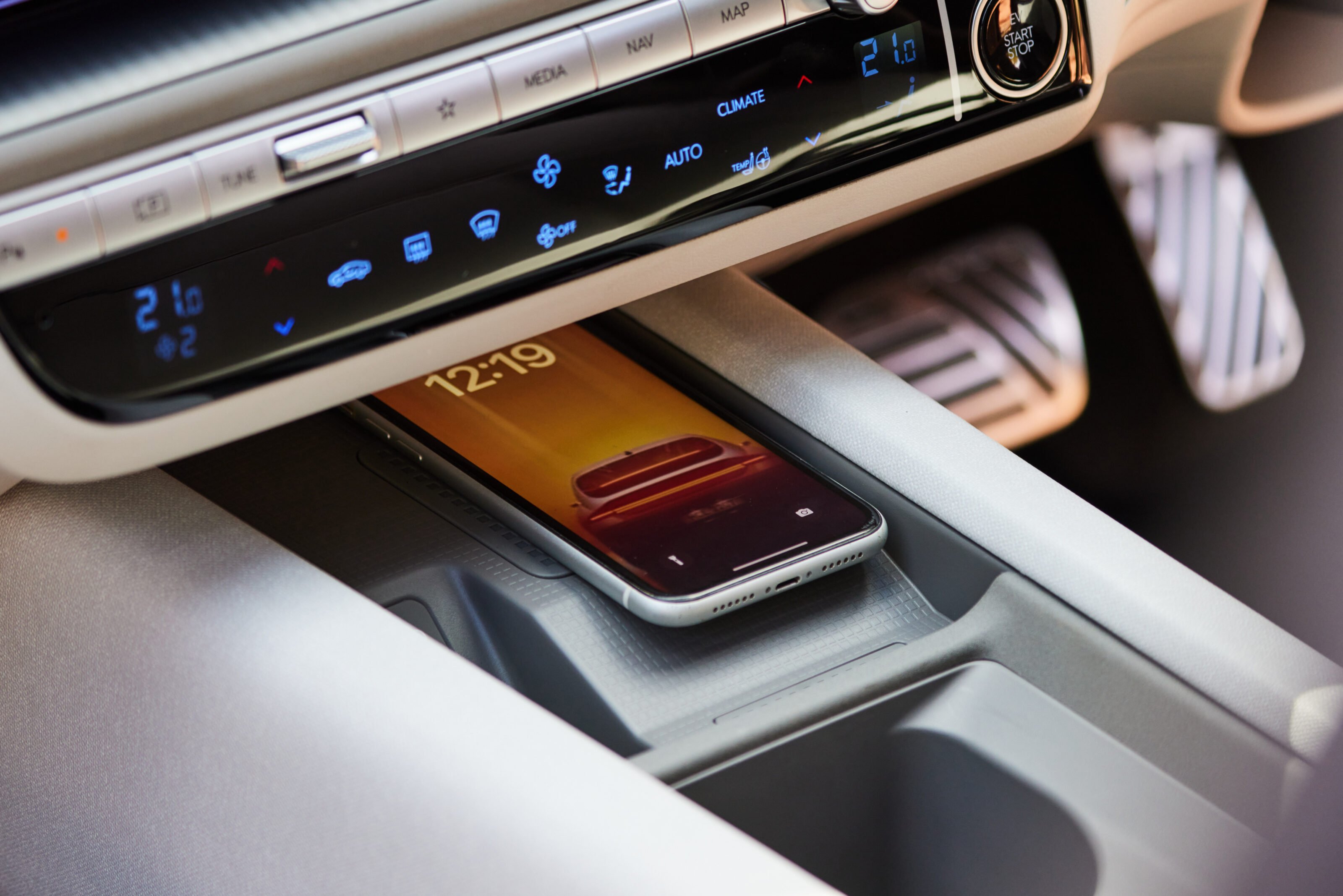
There’s a 15W wireless phone charging pad within easy access under the dash and, unlike many of their kind, will allow the phone to sit happily there with a cable plugged into it. Talking of phones, the dual Bluetooth functionality of the IONIQ 6 allows for one phone to be used to handle music streaming, with another used for calls.
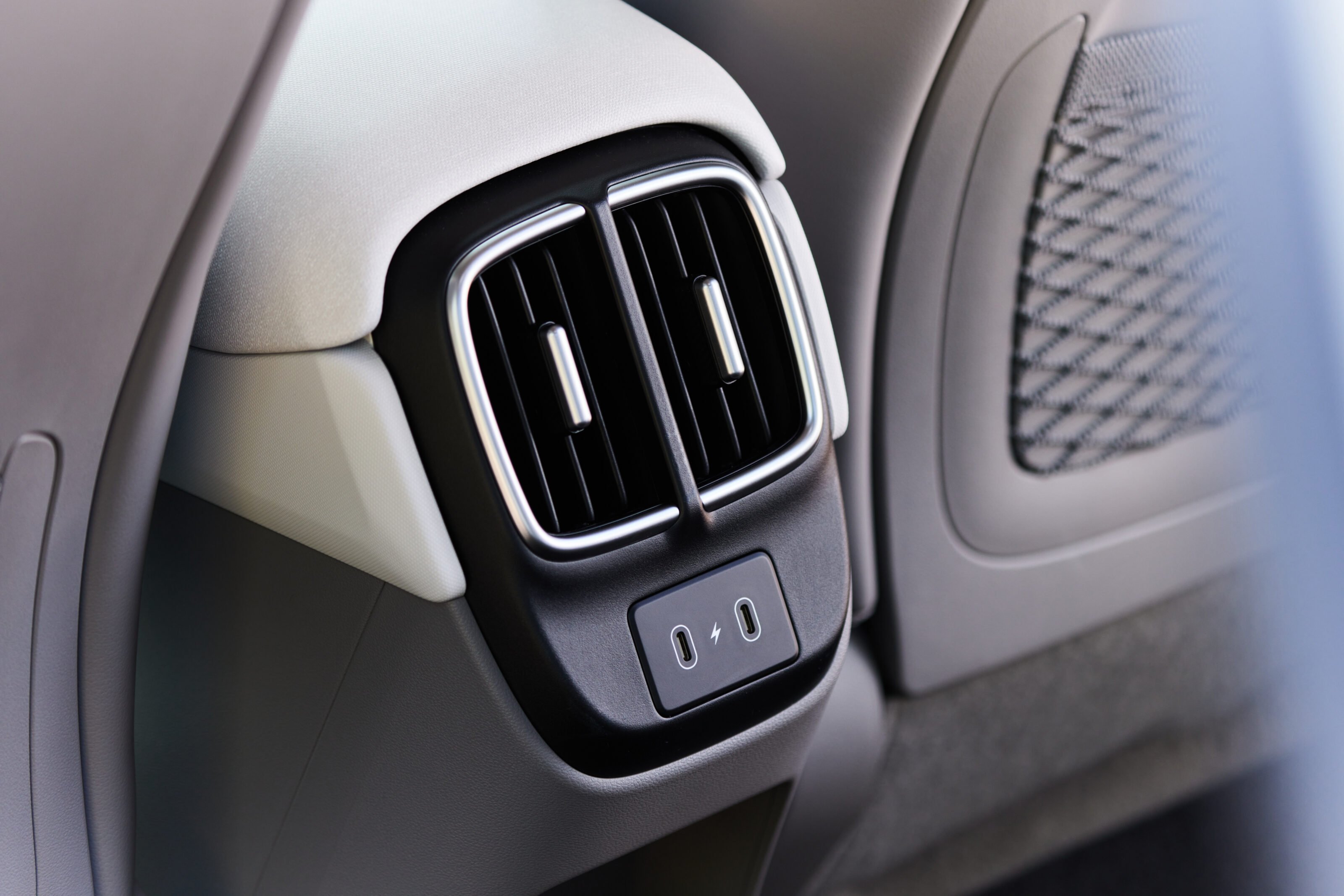
Should you feel a little adventurous, the IONIQ 6 features vehicle-to-load functionality. The internal port is located beneath the rear seats and features a 250V/15A, or 3.6kW, output and is ideal for charging laptops and such like.
Alternatively, a V2L adapter can be purchased and plugged into the main exterior charging port which allows things like e-bikes, scooters or camping equipment to be powered from the car. There’s even a Vehicle-To-Vehicle (V2V) function via a portable emergency charging cable that could help a friend out of a spot if they’re critical on charge.
1
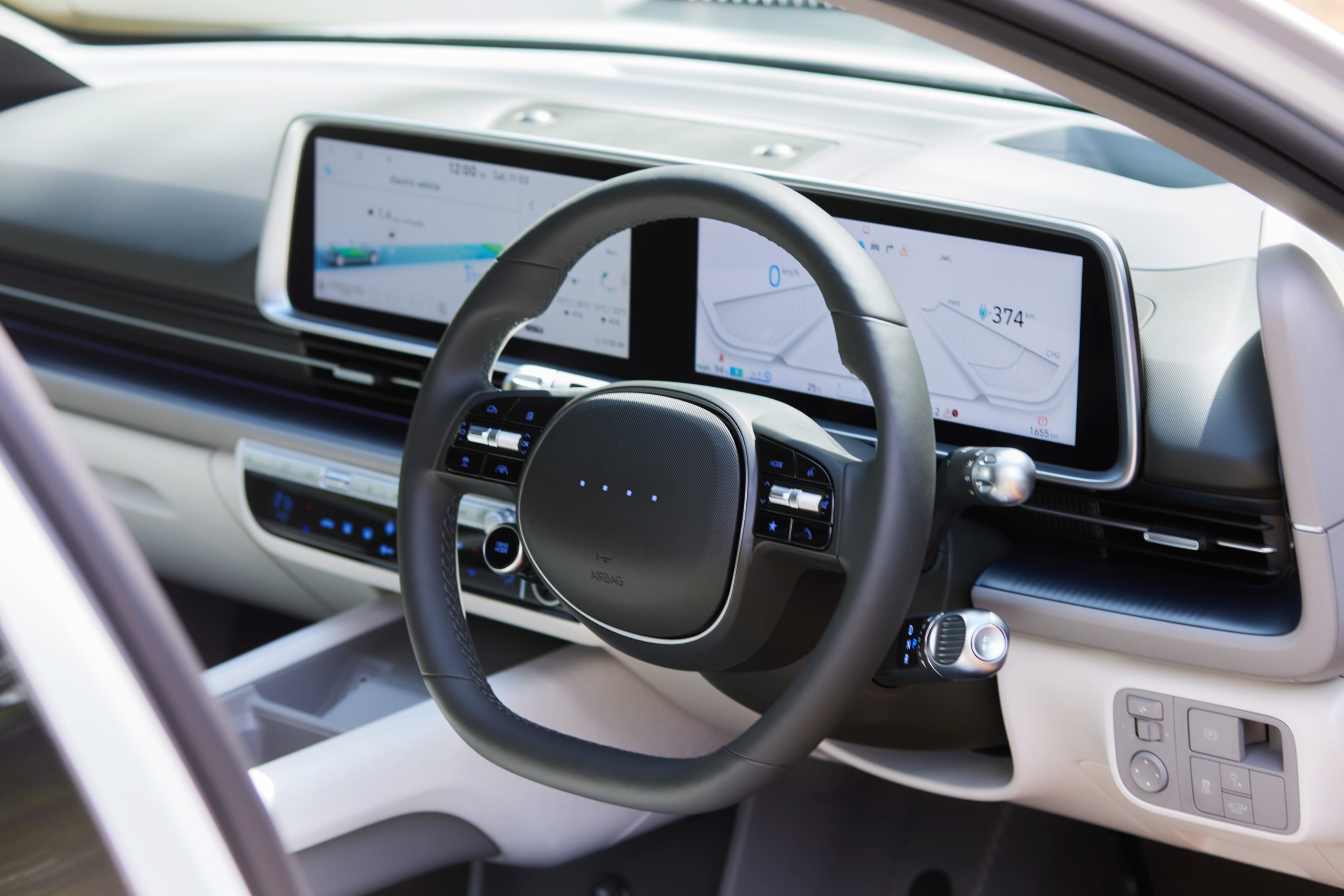
The dual 12.3-inch landscape-oriented screens sit edge to edge and provide a wealth of information, the native system is quick, responsive and fairly easy to navigate. Whereas some manufacturers are happy to cede this territory to Google or Apple, Hyundai seems to have quite the opposite philosophy. It appears that the Koreans have tried to build so much functionality into the proprietary ecosystem that they hope you’ll be tempted to ditch the smartphone mirroring.
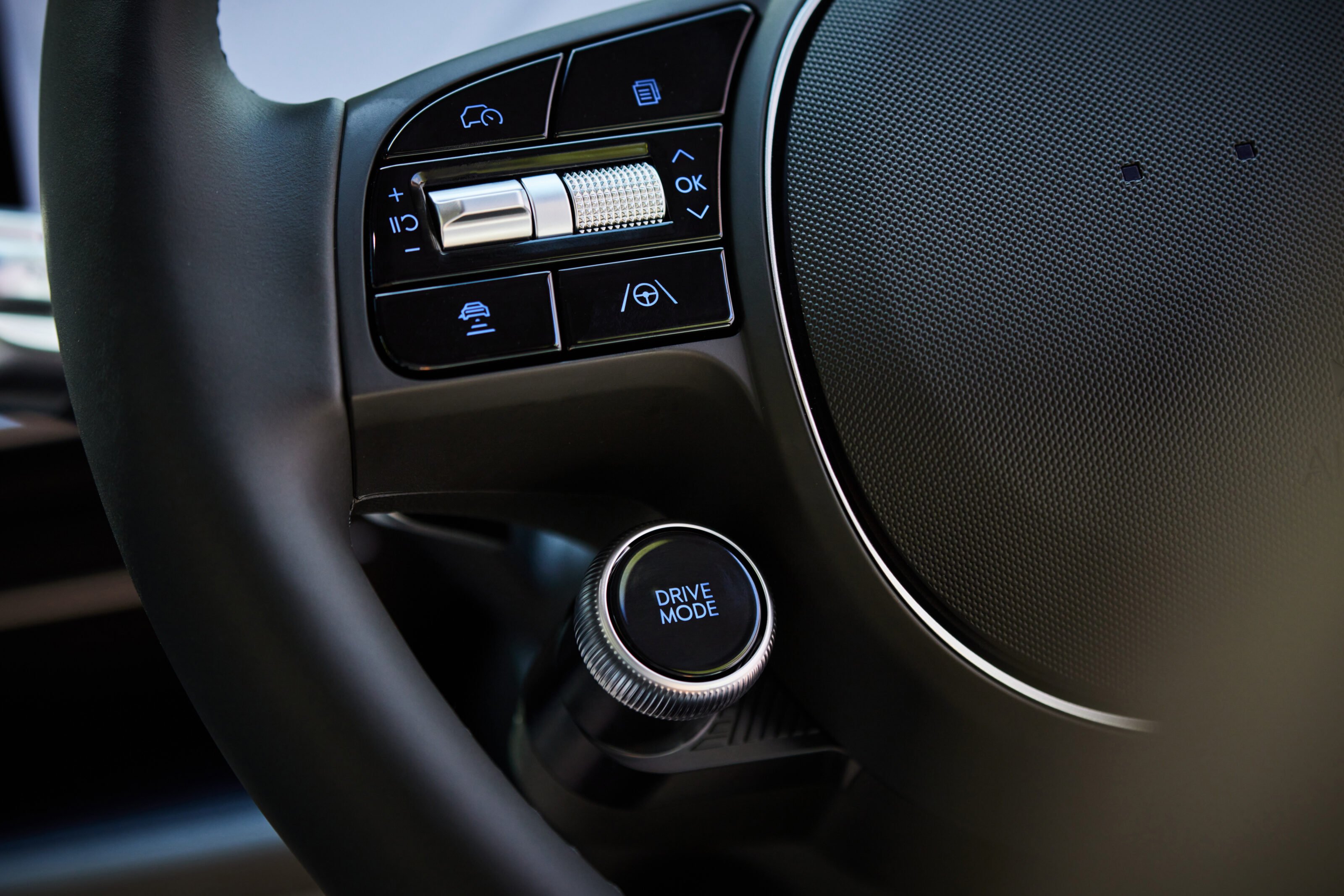
The IONIQ 6 comes as standard with a multi-configurable interior ambient lighting setup with a number of themes, including a speed-sensitive setting where the lighting becomes more intense the faster the car travels. There’s also a curious array of pinhole LEDs on the steering wheel boss that can communicate function changes such as a switch in drive modes.
Finally, there’s an exemplary head-up display as standard in all IONIQ 6 models. It’s crisp, easily configurable and doesn’t overload the driver with extraneous information.
1
What is it like to drive?
The good news? That nervy ride quality that afflicted early IONIQ 5 imports has largely been excised.
To be fair to Hyundai, it’s largely been excised on the IONIQ 5 too, thanks to the belated fitment of the Smart Frequency Dampers that are fitted as standard to the IONIQ 6.
As such, the ride of the IONIQ 6 is relatively plush. It’s still not what you’d call pillowy, jolting a little over shallow road imperfections, but there’s not that constant pitter-patter in the secondary ride that blights many EVs. Ever wondered why that is? It’s due to the fact that EVs are significantly heavier than ICE vehicles of the same class, and therefore have a large amount of energy moving up and down due to their weight.
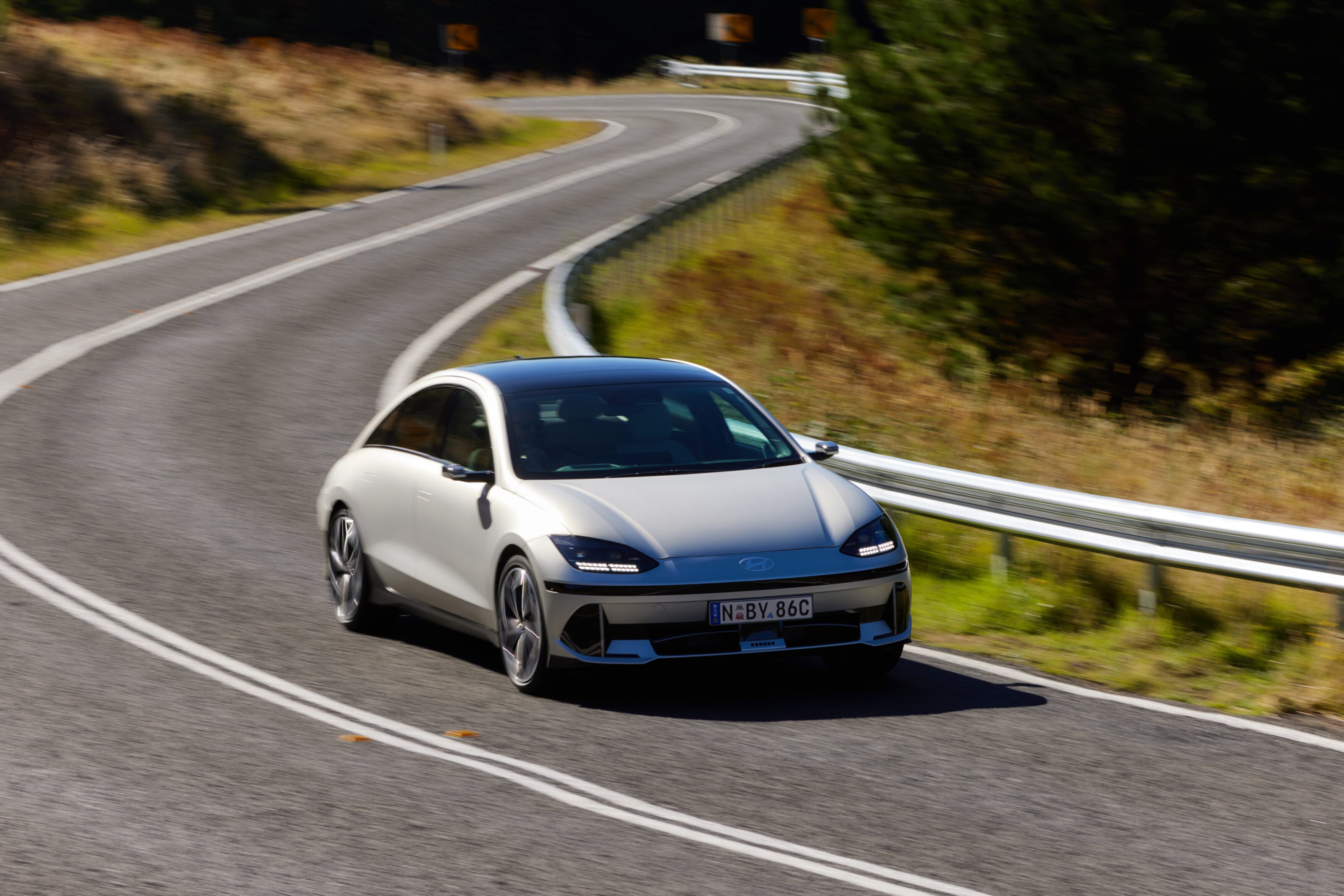
1
In the past, conventional hydraulic shock absorbers have encountered limitations in controlling this movement – what chassis engineers call ‘heave’. In optimising the suspension to cope with the low frequency rise and fall, the net effect is that the dampers are not optimised to handle small bumps and vibrations from the road surface.
The IONIQ 6’s dampers feature both a frequency-sensitive valve that complements a fixed valve, with the result that they adequately handle both high-frequency jitters and low-frequency body undulations. The fitment of clever vertical hydro bushings in the IONIQ 6’s lower control arms – a first for Hyundai – also helps add a sheen of polish to the ride quality.
The steering is a fairly mute partner. It’s accurate and well-geared but doesn’t offer much in the way of communication. Switching the car into Sport mode adds weight without much else in the way of benefit. Hyundai engineered a bearing into the IONIQ 6’s steering column to help reduce vibration and it’s undeniably effective. Maybe a little too effective.
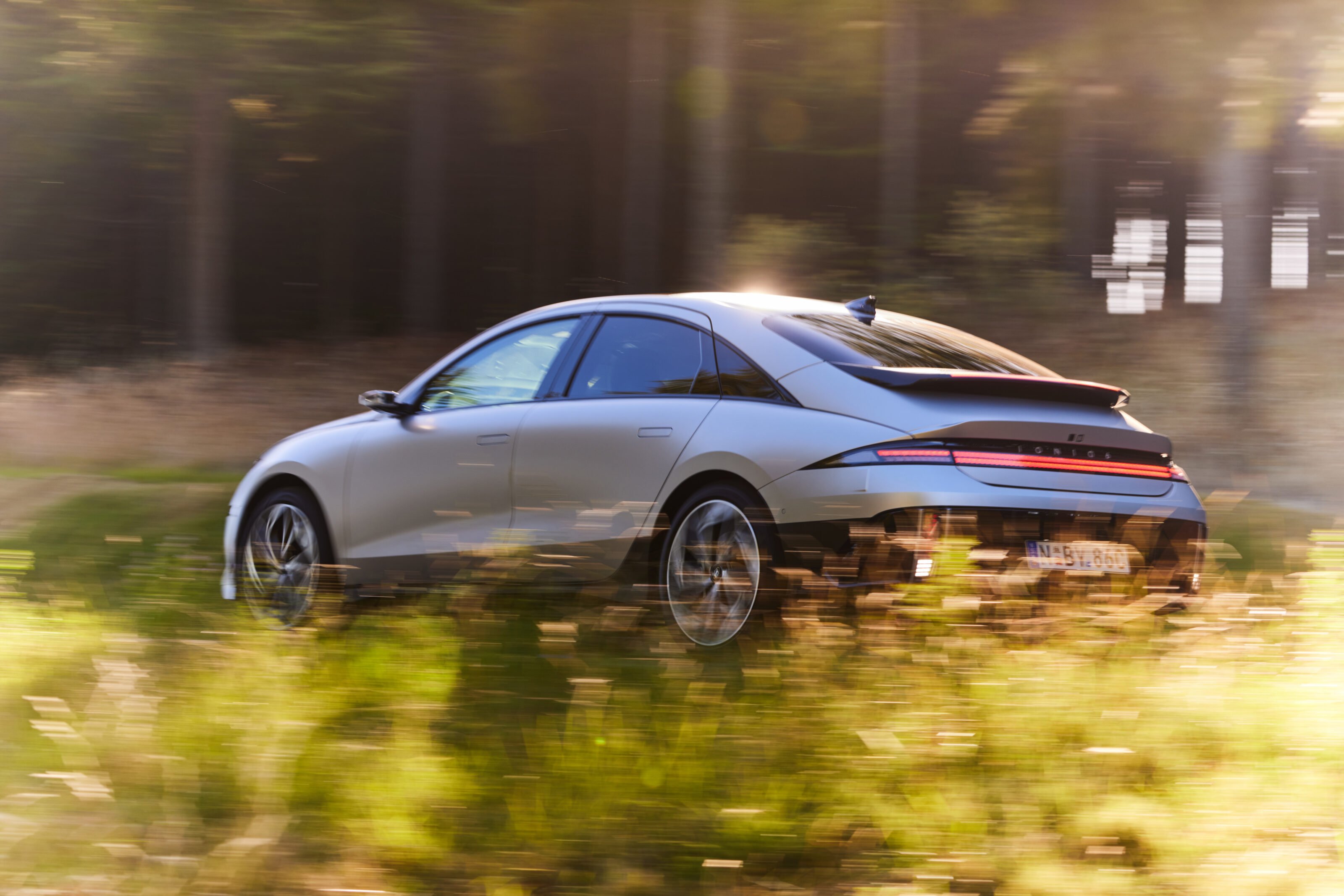
1
The IONIQ 6 defaults to lane-keep assist on, corrupting the steering feel with unhelpful nudges and pulls through the rack-mounted electric motor. I can’t stress this enough, but if a driver then switches into Sport mode, it’s overwhelmingly likely that lane-keep is not required. The car should switch it off but it doesn’t and trying to prevent it re-engaging is harder work than it needs to be.
Likewise, another default-on driving ‘assist’ is speed limit warning. This could be quite helpful in certain scenarios, but it’s too keen to interrupt, distracting the driver all too often. Compounding that issue is its propensity to latch onto speed limits that are incorrect.
At one point on the Hume Highway, it seemed certain that I was exceeding what it thought was a 40km/h speed limit and started chiming incessantly. Especially if you’re mirroring a phone, delving through the native menu structure to switch it off isn’t at all straightforward.
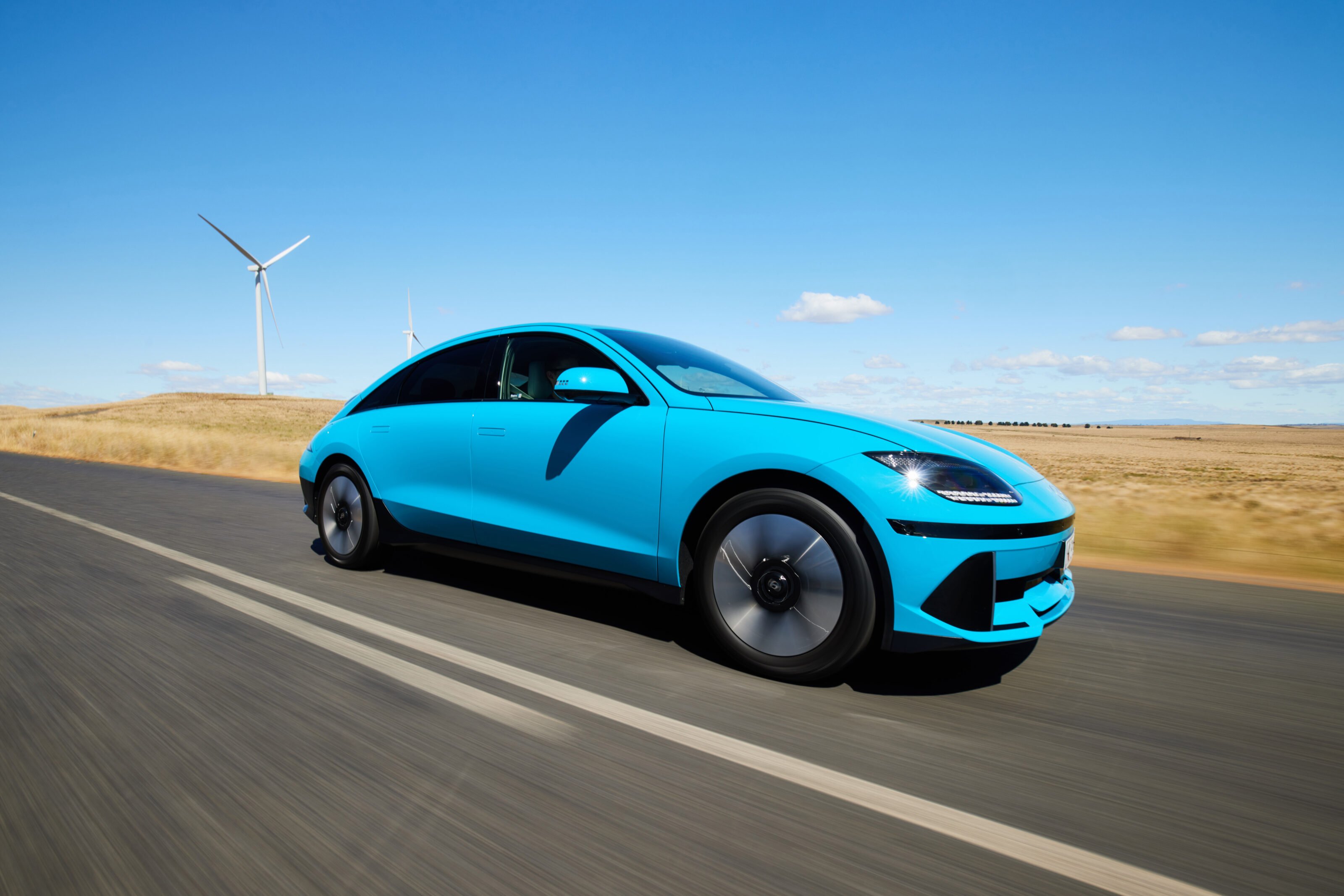
1
Fortunately there’s ample measure of recompense in the way the IONIQ 6 drives. It disguises its weight well, with dual motor cars tipping the scales at 2078kg. Like most cars of its type, you only become aware of that two-tonne heft when the car moves vertically over large bumps.
By and large, the IONIQ 6 manages its dynamic compromises very well. Leaving aside the taciturn steering, the dual-motor models I tested corners tenaciously and the traction and stability control systems are excellent, only doling out a precise measure of torque when it’s clear the vehicle can accept it. The chassis is a good deal more rigid than that of the IONIQ 5, which has helped the engineers isolate and manage the specific forces that the suspension system has to deal with.
Overall refinement is a notable standout, with little in the way of wind, tyre or suspension noise. If anything the models with conventional mirrors are a little quieter at speed than the Epiq with its boxy camera housings.
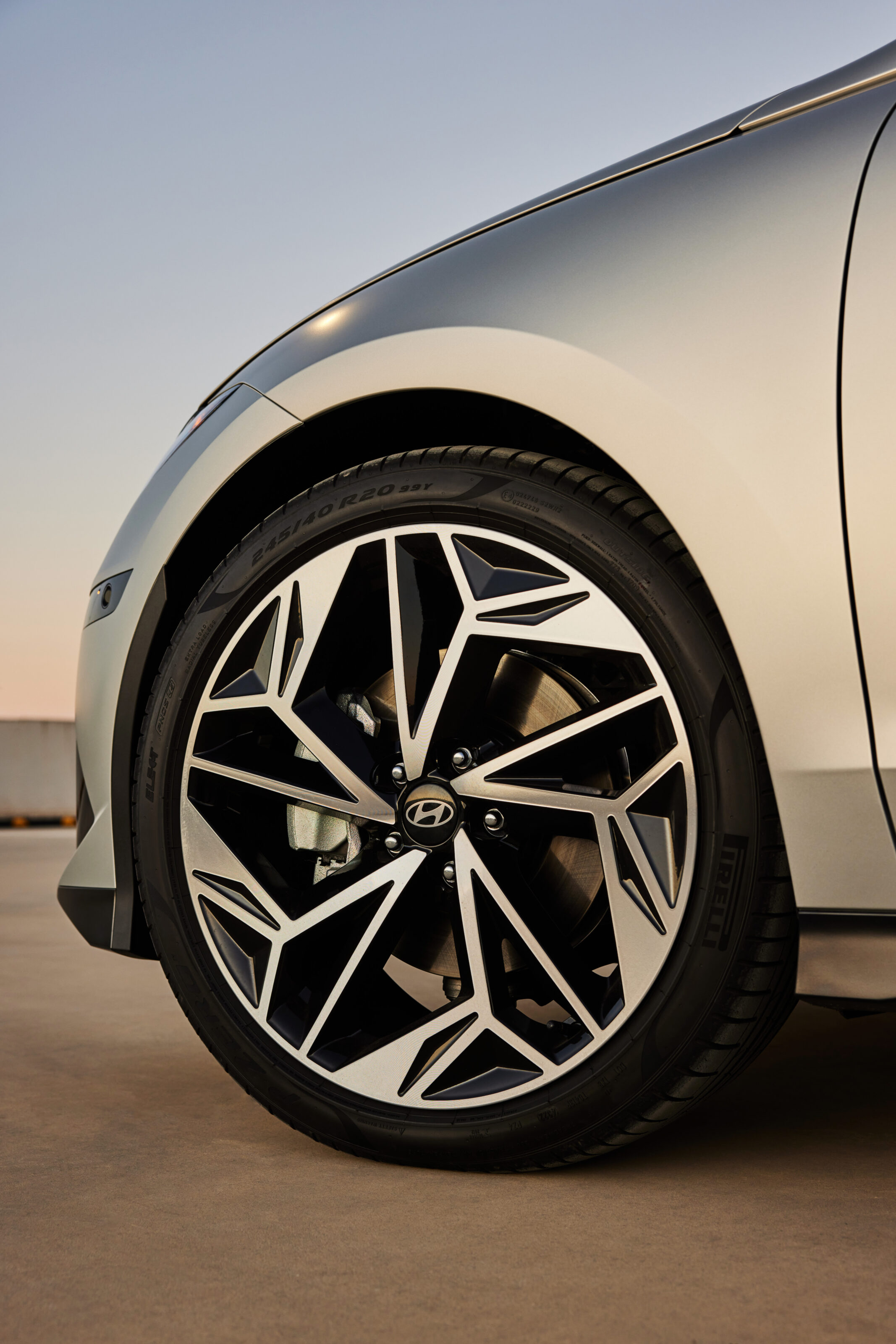
2
The IONIQ 6 further isolates the passenger cell from noise, vibration and harshness from the rear end by using a dynamic damper mounted in the rear cross member to help quell resonance vibration. Even the carpets are two-piece affairs that help reduce resonance.
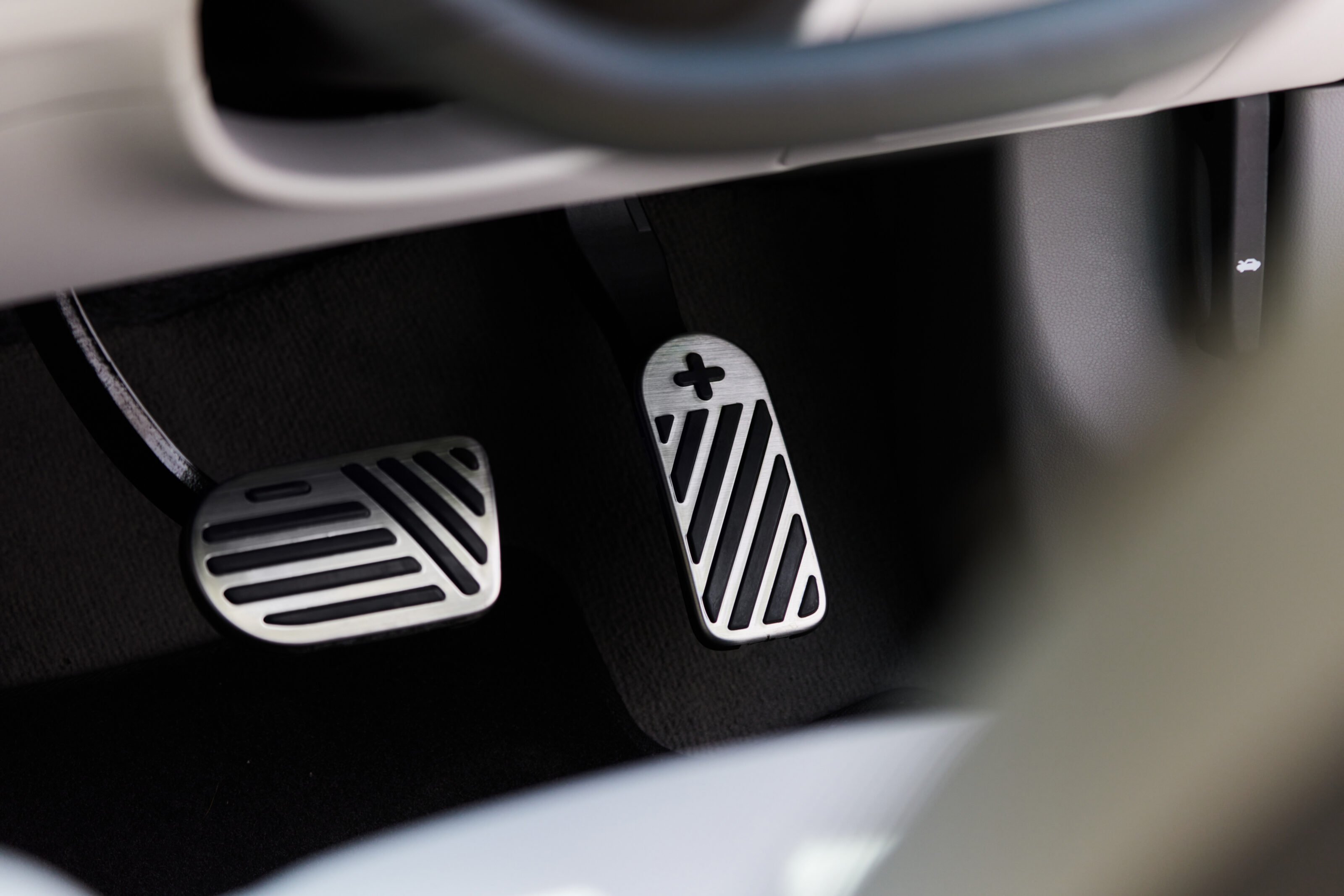
The brakes are decent, and there’s always the option to augment the friction brakes with electric re-gen. The paddles behind the steering wheel can cycle from off through four subsequent modes to a full one-pedal setting where the IONIQ 6 will come to a standstill with no accelerator input. At the other extreme, it’ll coast like a Taycan when the re-gen is switched off.
Unlike a Taycan, there’s no two-speed transmission, but it doesn’t seem a significant miss. The dual-motor cars will accelerate cleanly from 0-100km/h in 5.1 seconds, which compares to 4.6 seconds for a Tesla Model 3 Long Range. The rear-drive Dynamiq model takes 7.4 seconds to break 100km/h which is some way off the Model 3 RWD’s 6.1 second sprint.
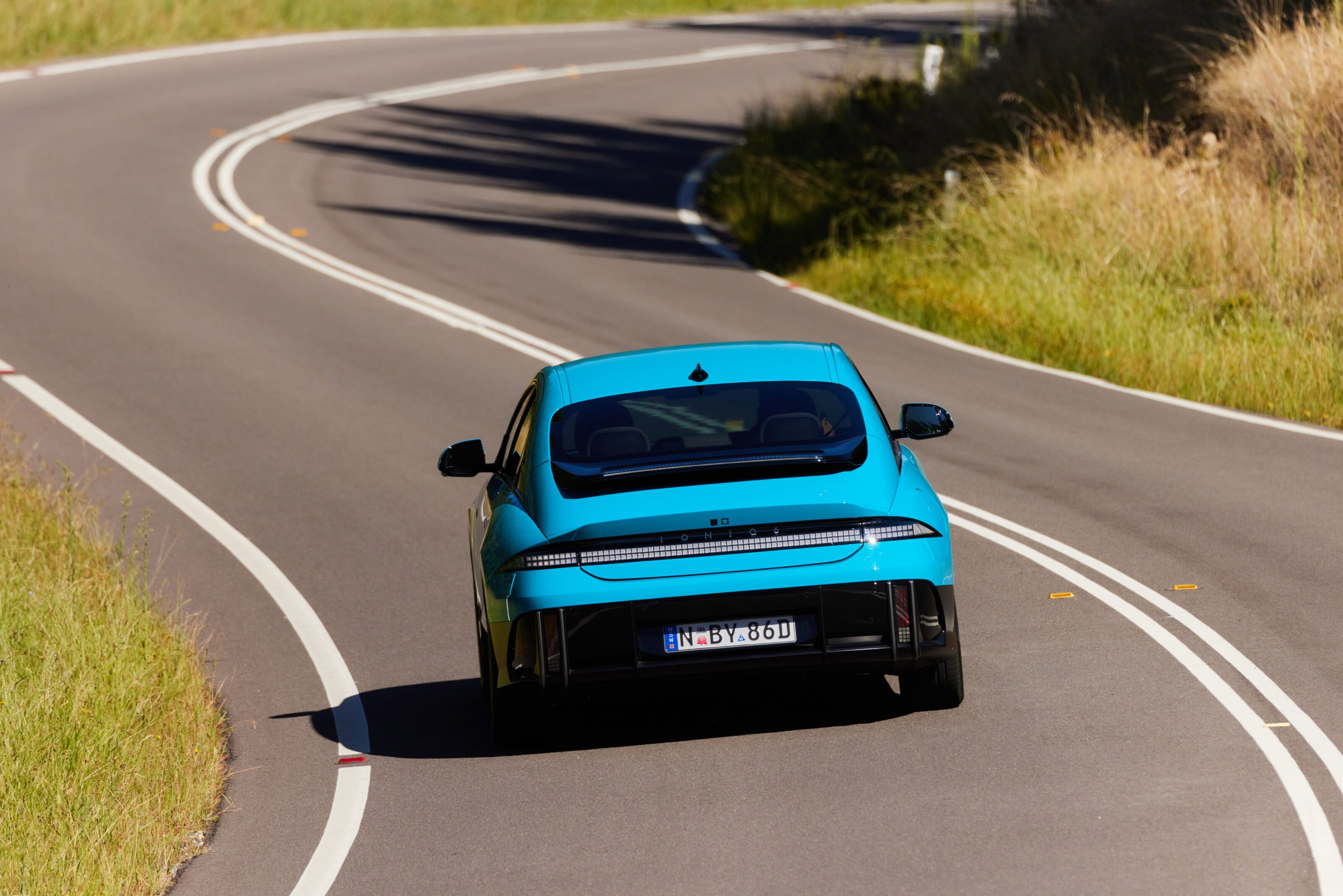
1
Drive does include the usual Normal, Sport and Eco, and there’s also a Snow setting and a Custom mode which allows you to tailor steering, throttle and driveline settings but not suspension. That’s passive on all IONIQ 6 models.
The adaptive cruise is also very polished, modifying speed smoothly. It can be a little slow to start re-accelerating once a vehicle has cleared your lane ahead and, conversely, will accelerate reasonably quickly if a car passes you and you indicate out behind it. By and large it’s a decent system though.
The Hyundai feels a significantly smoother and more refined vehicle than the Tesla, but we may well have to wait for an N version of the IONIQ 6 to see the sort of genuinely concussive pace delivered by a Model 3 Performance.
Should you wish to tow anything – and we can think of many better candidates than an electric sedan to do so – then an accessory tow bar is available and the braked towing capacity is 1600kg.
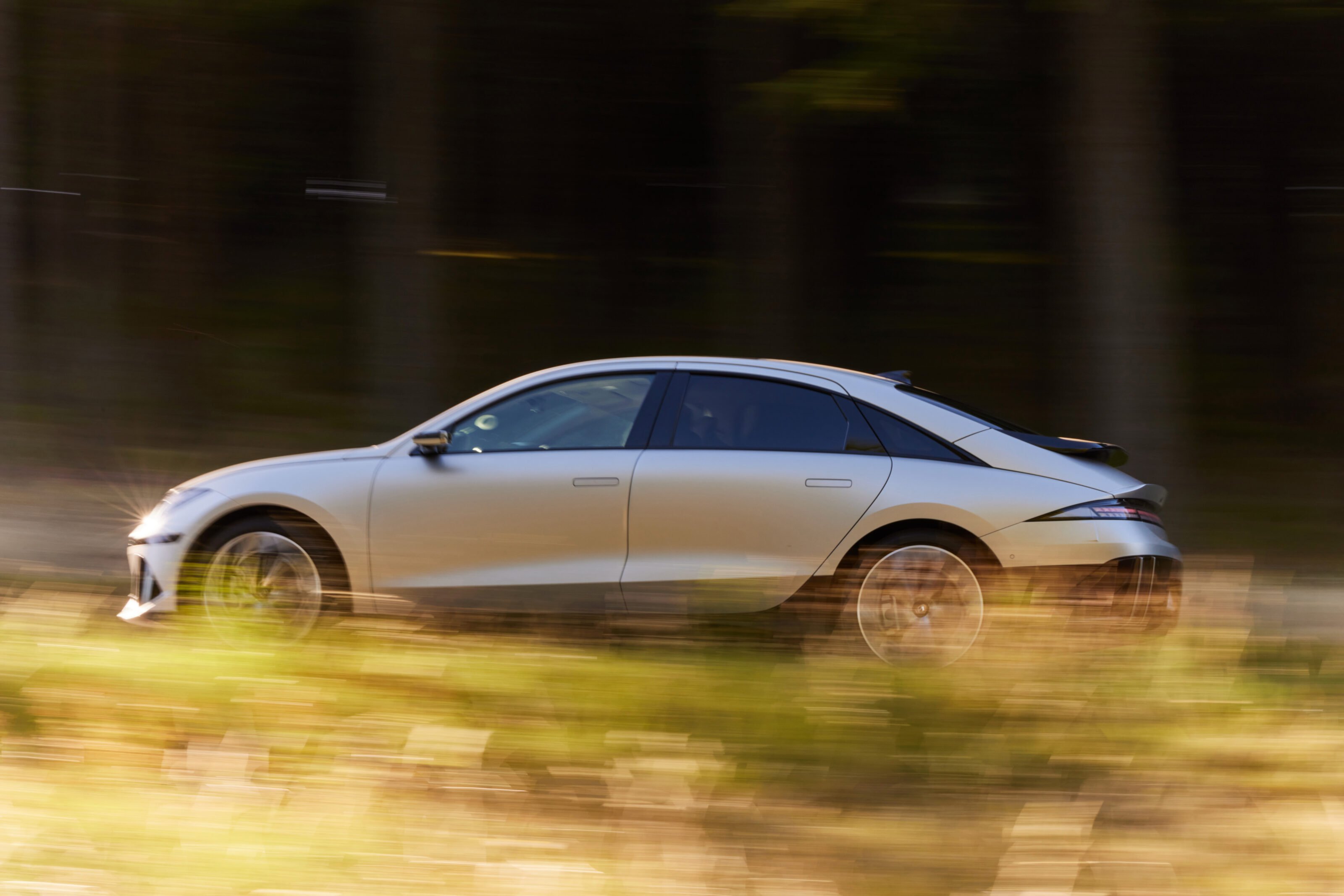
1
How much energy does it use?
That slippery shape certainly helps economy and the range is quoted at 614km for the rear-drive car and 519km for the dual-motor models.
Hyundai plays a bit of an ace card with its 800V EV architecture which means that you’ll be able to charge the 77.4kWh lithium-ion polymer battery from 10-80 percent in just 18 minutes on an ultra-fast 350kW charger. If you’re stuck with a garden-variety 50kW DC charging station, that time blows out to 73 minutes.
A typical AC home or work wallbox will charge from 10 to 100 percent in 11h 45m on 7kW single-phase, or 7h 10m on 11kW three-phase. Plug it straight into a 240V AC power outlet and a full charge will detain you for 34h 20m. Not recommended.
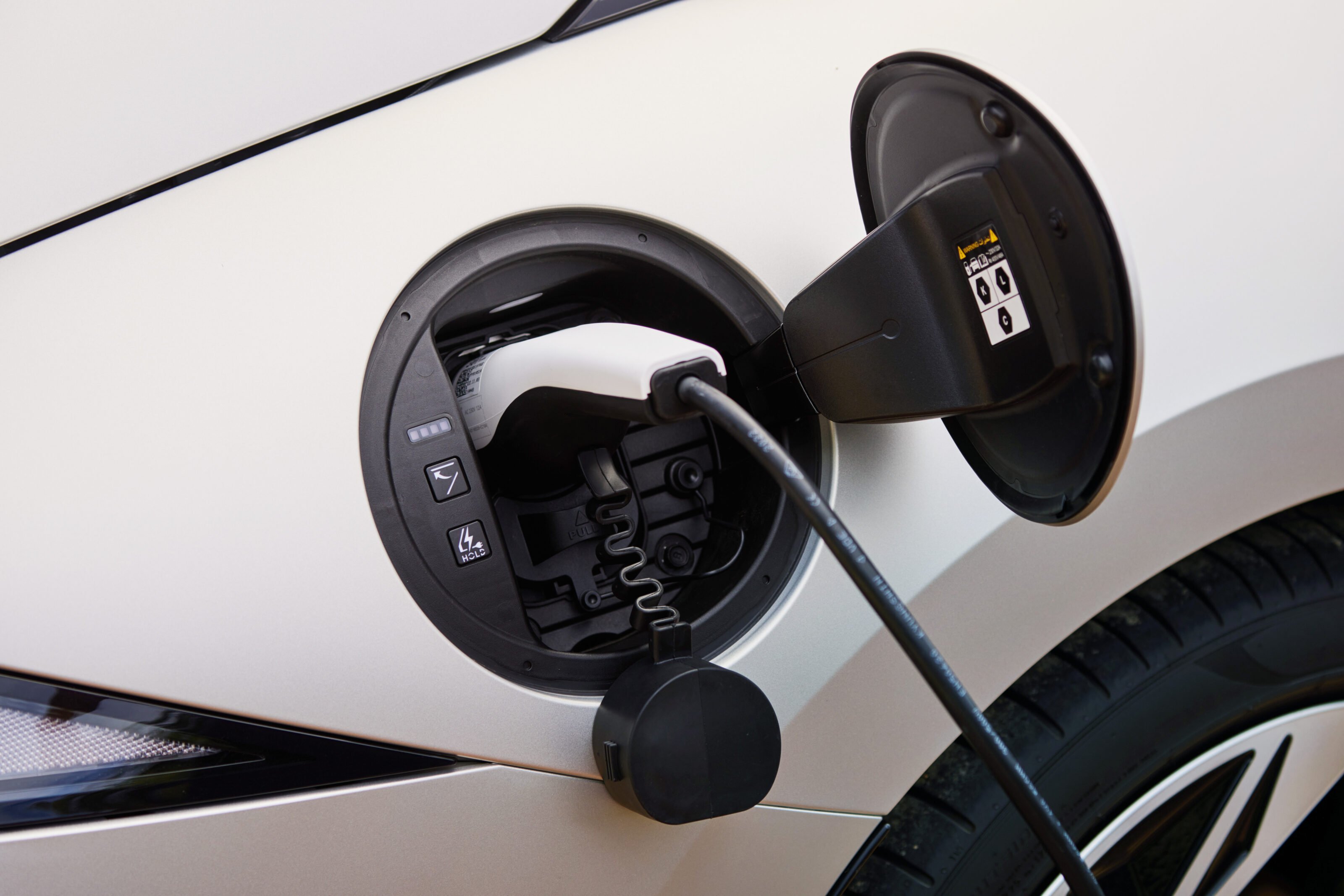
1
The long drive back from the launch venue on fast, open roads saw an average consumption of 15.8Wh/100km in the Epiq dual-motor model. That’s helped by active air flaps at the front of the car that can open to aid cooling and then motor closed to help aero.
The range calculator seemed very accurate, updating itself as you switch between drive modes, alter the air conditioning settings or change your driving style.
A schematic on the dash shows how the vehicle apportions drive, and for most of the journey, the onboard Disconnector Actuator System had clearly told the 74kW front motor to take a break, improving efficiency by sending 100 percent of torque to the 165kW rear motor.
Mini matchup: Range battle
| MODEL | DRIVE | RANGE CLAIM (WLTP) |
|---|---|---|
| IONIQ 6 Dynamiq | RWD | 614km |
| IONIQ 6 Techniq | AWD | 519km |
| Model 3u00a0 | RWD | 491km |
| Model 3 Long Range | AWD | 602km |
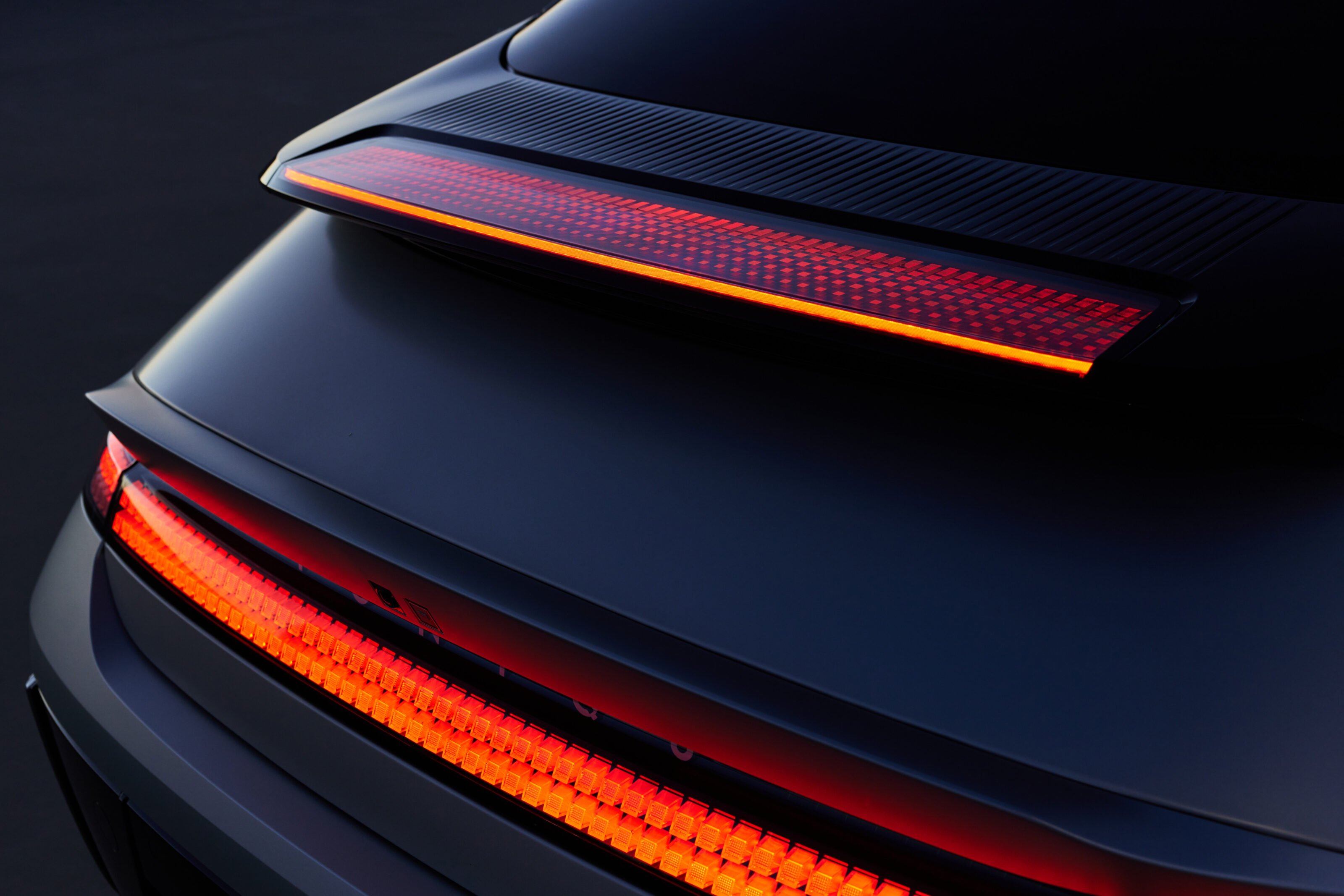
1
How safe is it?
Glad you asked. The short answer? Very. The IONIQ 6 – every IONIQ 6 – features a jaw-droppingly comprehensive safety suite.
So much so that it’s hard to know exactly where to start when describing the full capability of Hyundai’s SmartSense tech. Here are twenty interesting nuggets just to clue you in to how comprehensive it really is.
- 1: Forward Collision Avoidance (FCA): This monitors vehicles, pedestrians and cyclists that are approaching from ahead. It sounds a chime and a warning in the instrument cluster which, most of the time, will be adequate, but it can then use the front radar and cameras to slow the vehicle from speeds of up to 200km/h. So if a vehicle has wandered into your lane, the IONIQ 6 will brake to a standstill if required.
1
- 2. Junction Turning (FCA-JT): Sit your car in a right-hand lane with the indicator on and FCA-JT kicks in. This scans for oncoming vehicles driving between 30 and 70km/h and will attempt to prevent you pulling into their path if it decides a collision is imminent.
- 3. Junction Crossing (FCA-JC): If you’re at a four-way box junction, FCA-JC will use radars to detect vehicles approaching from left and right and will apply emergency braking if it thinks you’re about to pull out in front of it.
- 4. Lane-Change Oncoming (FCA-LO): This function provides steering assistance to help avoid an oncoming vehicle in an adjacent lane and is active from 45 to 140km/h.
- 5. Lane-Change Side (FCA LS): If the IONIQ 6 thinks you’re in danger of colliding with a vehicle in an adjacent lane on a multi-lane road, FCA-LS will provide steering avoidance.
1
- 6. Evasive Steering Assist (ESA): The final function in the forward collision suite avoidance is ESA which looks to detect pedestrians or cyclists ahead in your lane which you may not have seen. As a last resort, ESA will steer the vehicle to avoid if there is space within the driving lane.
- 7. Parallel Exit: This will apply the brakes sharply if the system detects that you’re exiting a parallel parking place and haven’t detected a vehicle in your blind spot.
- 8. Safe Exit Warning (SEW): This system detects traffic in the blind spot and sounds a warning if it believes that the IONIQ 6’s doors are about to be opened into the passing vehicle/cyclist/pedestrian’s path.
- 9. Rear Cross Traffic Collision Avoidance Assist (RCCA): If you’re a lazy driver like me and never reverse into a parking spot, this one’s really helpful in Coles car park. It’ll warn you if you’re just about to reverse into something’s path.
1
- 10. Blind-Spot View Monitor (BVM): Flick the indicators on and this system uses cameras to project an image onto the 12.3-inch display. Handy if you’re about to effect a left turn and take a cyclist with you.
- 11. Driver Attention Warning (DAW): This monitors your position in the lane, steering inputs, braking inputs and time since last break to assess whether you’re a bit below par.
- 12. Leading Vehicle Departure Alert: this sounds a chime if the vehicle ahead that’s stopped in traffic has pulled away and you haven’t reacted to it.
- 13. Remote Smart Parking Assist (RSPA): Yep, the IONIQ 6 does automated parking and can be summoned using its key.
1
- 14. Intelligent Speed Limit Assist (ISLA): This aims to help the driver stay within speed limits. As mentioned earlier it can be a bit zealous about picking up ‘other’ signed speed limits.
- 15. Lane Following Assist (LFA): Interestingly, if the IONIQ 6 is having trouble detecting the limits of a lane for its lane-keeping system, it can then monitor the positions of other cars and establish for itself where the centreline of the lane should be. Neat.
- 16. Smart Cruise Control (SCC): This adaptive cruise is operational up to 180km/h and can brake the vehicle to a standstill. Driver intervention is then required if the car’s been stopped for more than three seconds. There’s even an AI element where the system can learn a driver’s patterns and habits such as typical following distance, acceleration and reaction speeds, tailoring the SCC system accordingly.
1
- 17. 3D Surround View Monitor (SVM): Even features a Car Wash entering mode so that you can ensure that you never drive your IONIQ 6 into the jumbo wax applicator.
- 18. Intelligent Front Lighting System (IFS): Controls the multiple LEDs of the front headlights to provide auto high beam without dazzling oncoming traffic.
- 19. Parking Collision Avoidance Assist (PCCA): If low walls are your nemesis, this system constantly checks to avoid typical low-speed parking nerfs
- 20. Rear Occupant Alert (ROA): Don’t leave children or pets in your IONIQ 6. I mean, that should go without saying, but should you ignore the gentle warning when you leave the car and subsequently lock it, the Ionqi can sound horn and hazards if it detects movement in the locked car.
1
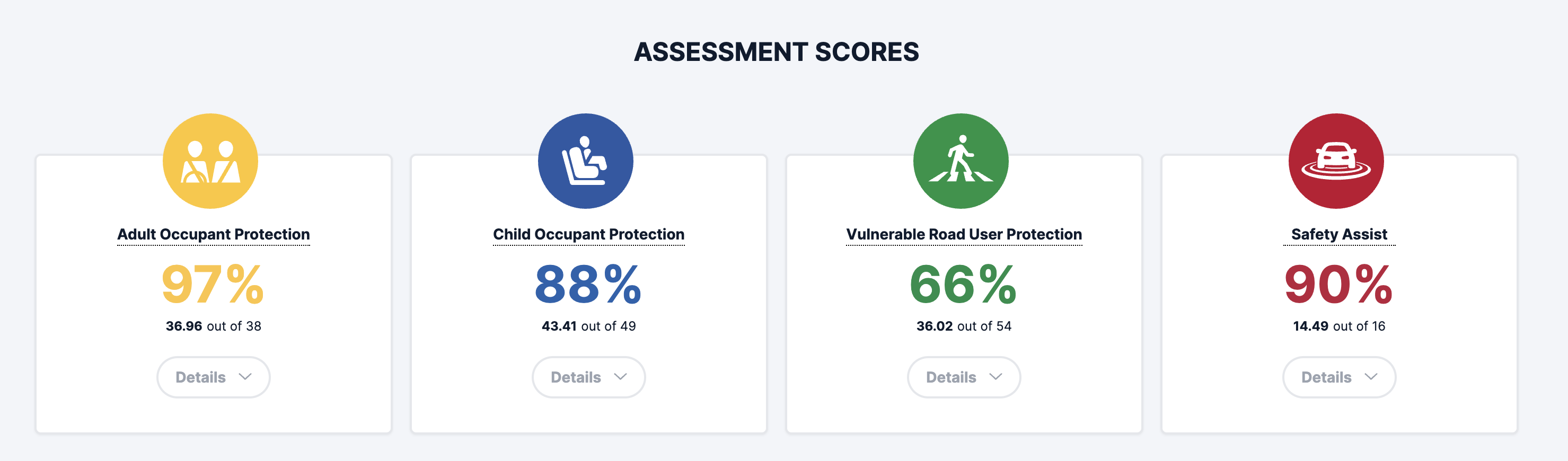
If, having overcome all of the above, you do manage to drive your IONIQ 6 into something, there are seven airbags to help cushion the blow to body and pride. ANCAP stars? Five, naturally.
1
MORE
ANCAP
Warranty and running costs
You know the drill with Hyundai, right? Five year, unlimited kilometre warranty. But let’s have a look at a few other details.
Aftersales and support can be provided by the (currently) 80-odd Hyundai Blue Drive dealerships across Australia.
There’s a fixed-price servicing plan available for the IONIQ 6 which will cost you $560 for the 24 month/30,000 kilometres and then another $560 for 48 months/60,000km. This also includes Premium Roadside Support and Satnav Update Plan.
The battery’s covered under a separate 8-year/1260,000km warranty with a 48 month/60,000km scheme.
1
VERDICT
It seems banal, but the success of the Hyundai IONIQ 6 may well hinge on how well its styling is received.
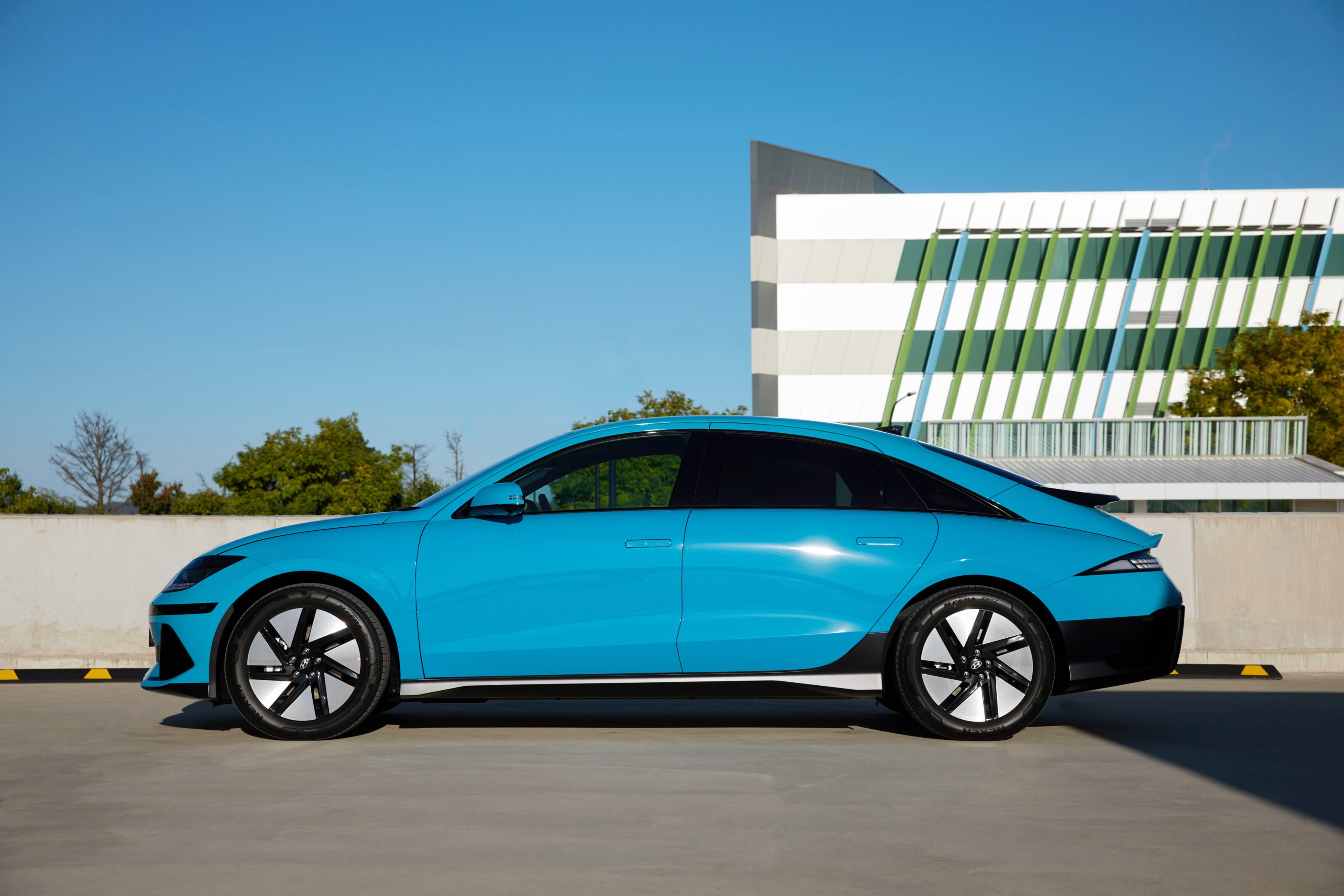
While there was near-universal acclaim for the IONIQ 5’s shape, the 6 seems a far more divisive piece of design. We heard everything from long wheelbase Beetle to modern Tatra, Porsche 996 and Korean AU Falcon and many points in between. It’s an interesting, complex shape that never quite settles on the eye, changing its personality from different angles.
It’s hard to quibble with the engineering beneath, however. It’s a bigger, heavier, more technologically dense vehicle than a Tesla Model 3 and while there’s an argument that the Model 3 does more with what it has, the Hyundai just does more full stop. Put simply, it feels a step or two forwards in terms of EV maturity than the Tesla Model 3.
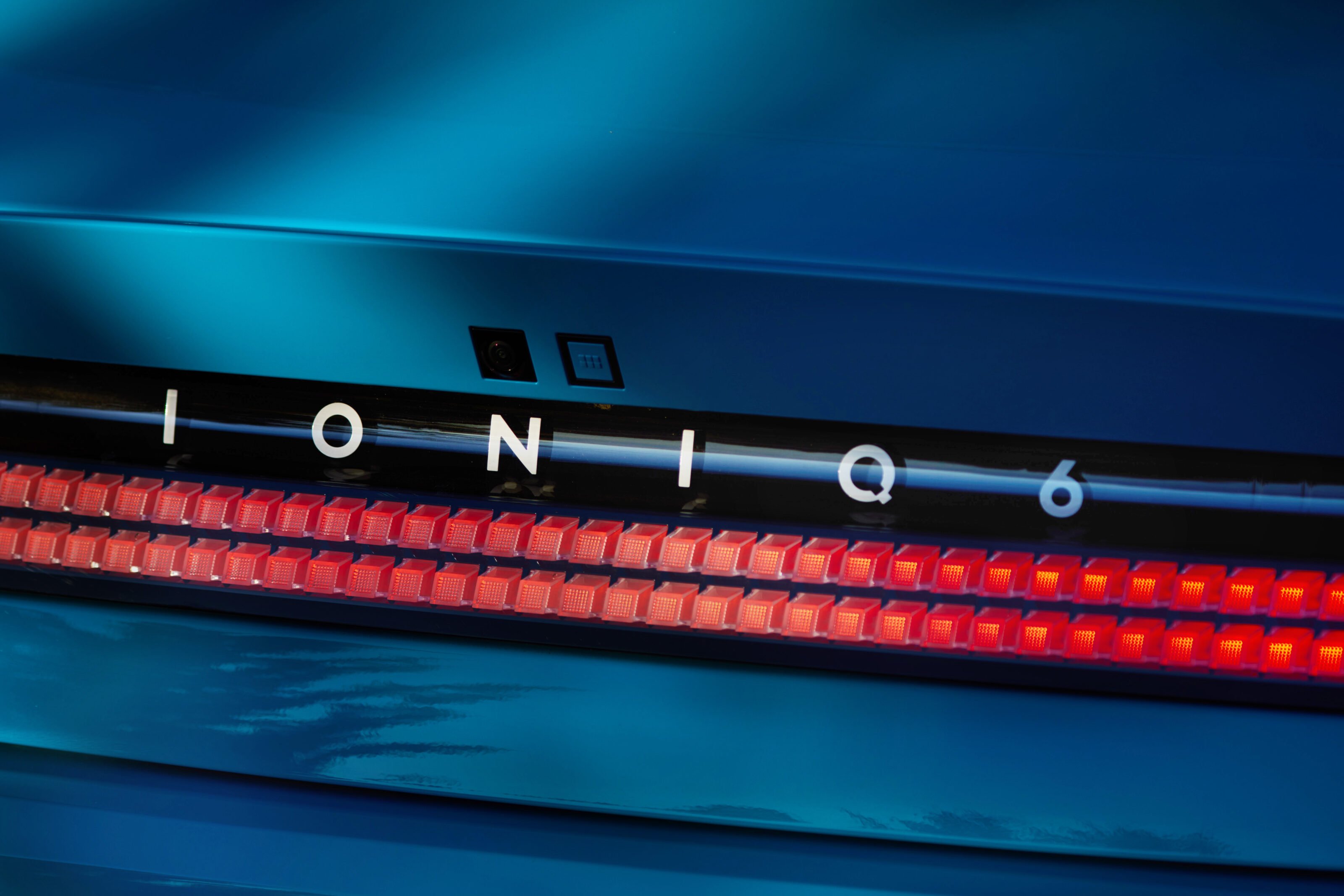
1
Critically, it’s also a far more comfortable car to drive and be driven in. The lack of local suspension tuning for the IONIQ 5 SUV was probably enough to prevent it beating Kia’s EV6 in Wheels’ 2022 Car of the Year award. It’s really not an issue with the IONIQ 6, which features a far more sophisticated suspension set up than that first batch of IONIQ 5s.
There are some minor annoyances such as the wired smartphone connection, the intrusive driver assists and the prescriptive range structure, but the IONIQ 6 gets so much else right that it emerges as a thoroughly likeable thing. That’s all very well, but doesn’t mean a whole lot if you can’t actually buy one.
Thankfully, Hyundai is optimistic about supply easing up, with four times the amount of IONIQ cars arriving this year compared to last, with 2024 seeing another doubling of supply.
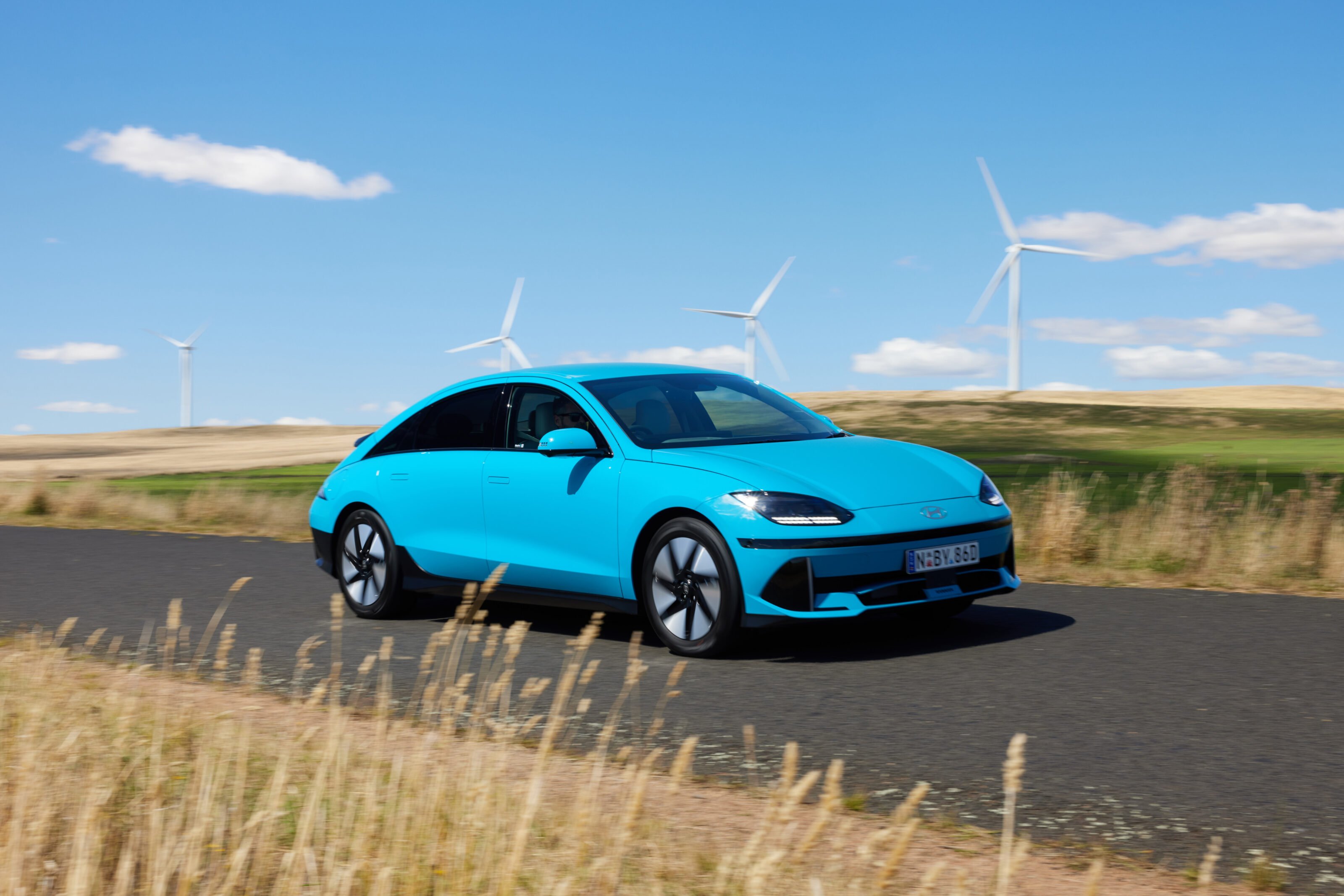
1
Unlike the IONIQ 5, which only went to a handful of dealers, the 6 can be ordered from the website to more than 80 Hyundai dealers across the country.
That’s not going to be enough to see the IONIQ 6 depose the Tesla Model 3 in the sales charts. Some will see that as the ultimate arbiter of success, and with some justification. Nevertheless, if you want the better car, right now it comes from Korea.
Specifications
| 2023 Hyundai IONIQ 6 Techniq | ||
|---|---|---|
| Motor | Dual permanent magnet synchronous | |
| Poweru00a0 | 239kW (74kW front, 165kW rear) | |
| Torqueu00a0 | 605Nm | |
| Transmission | Single-speed reduction gear | |
| Body | Four-door, five-seat medium sedan | |
| L/W/H | 4855/1880/1495mm | |
| Wheelbase | 2950mm | |
| Boot space | 401L | |
| Weight | 2078 kg (tare) | |
| Fuel use L/100km | 15.8kWh/100km (on test) | |
| Suspension | Front: MacPherson struts, coil springs, anti-roll bar / Rear: multi-link, coil springs, anti-roll bar | |
| Steering | electric rack-and-pinion; 11.82m turning circleu00a0 | |
| Brakes | 325 mm ventilated discs (f) 325mm solid discsu00a0 (r) | |
| Wheels | 20-inch, 8.5-inch width | |
| Tyres | Pirelli P Zero | |
| Tyre size & spare | 245/40R20 99Y f/r, mobility kit – no spare | |
⚡ More EV stories to help you choose the best car for your needs
A few years back, Mercedes introduced the GLB.
The looks were definitely a form-following-function thing because, into this reasonably small footprint, the engineers had crammed seven seats.
The third row wasn’t hugely usable, but sufficient for the rare time people needed it.
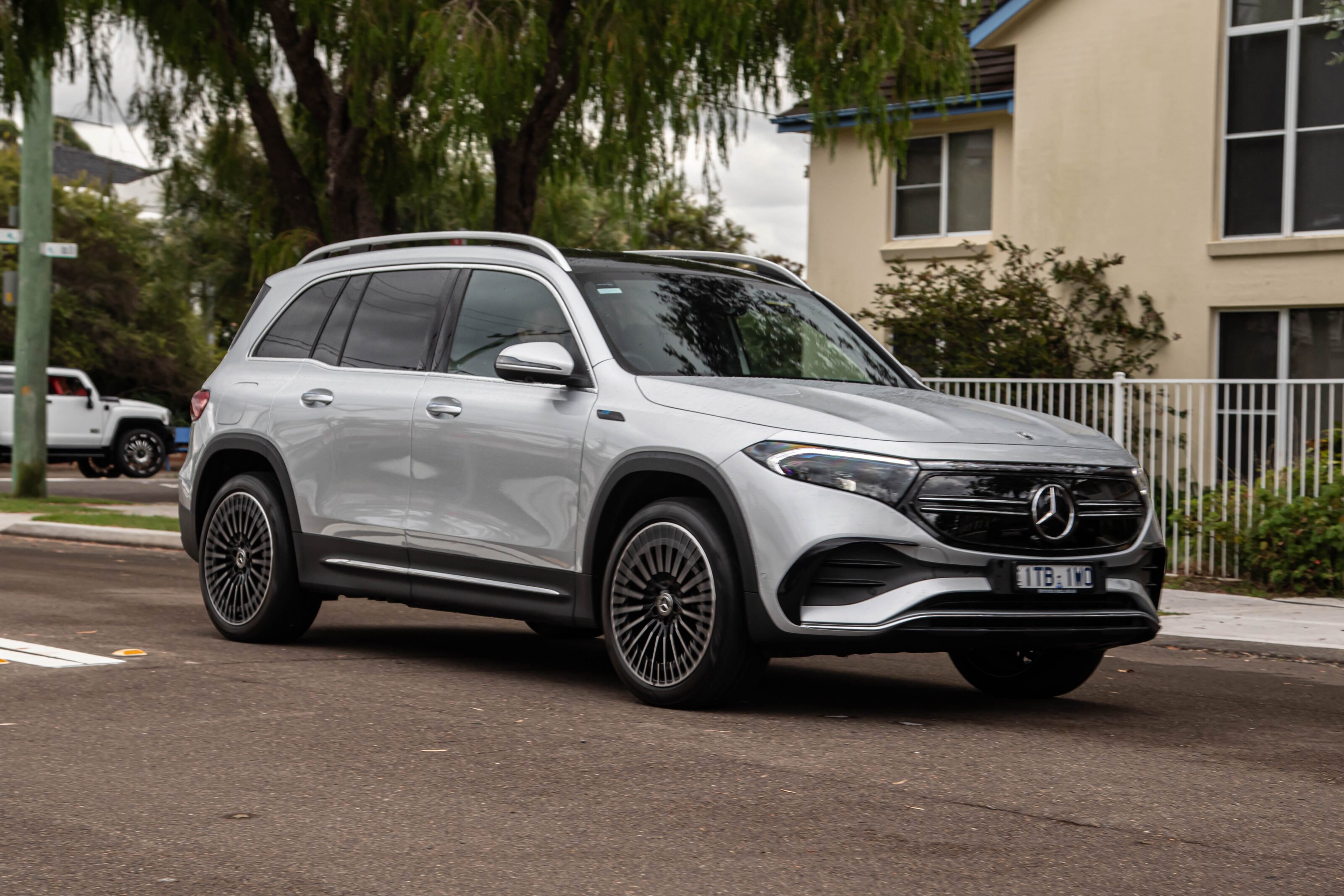
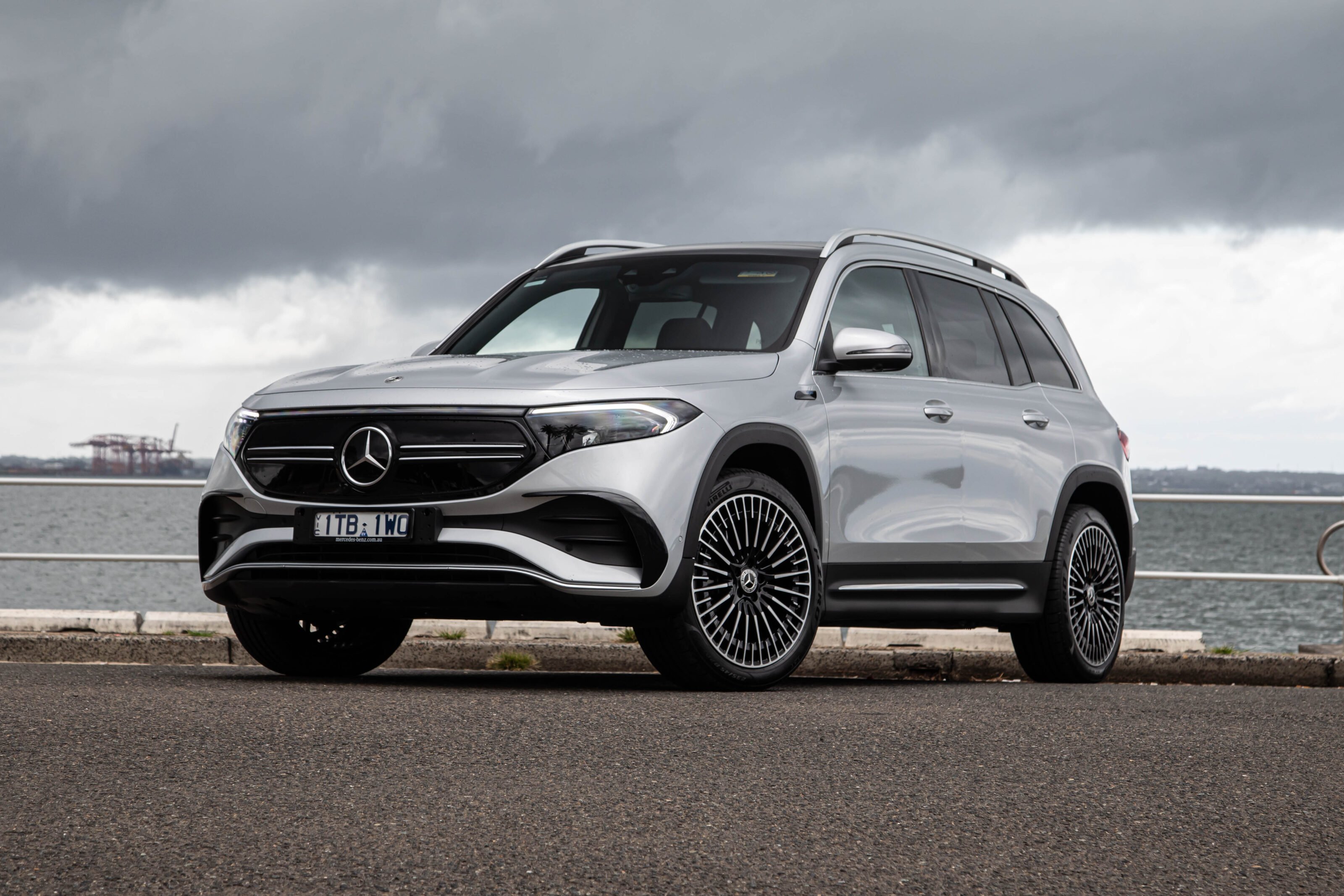
Switching out the internal combustion engine for an electric motor and a battery gave us the EQB250. Once again, that was a quirky-looking seven-seater with some changes to the exterior appearance to tell you it was electric. The changes are good, the most obvious one being full-width LED lighting front and rear for that night-time UFO effect.
Adding a second motor at the rear resulted in this EQB350, but it also meant chucking the third row out in favour of extra propulsion.
And a bigger price tag to go with all the extra AMG bling.
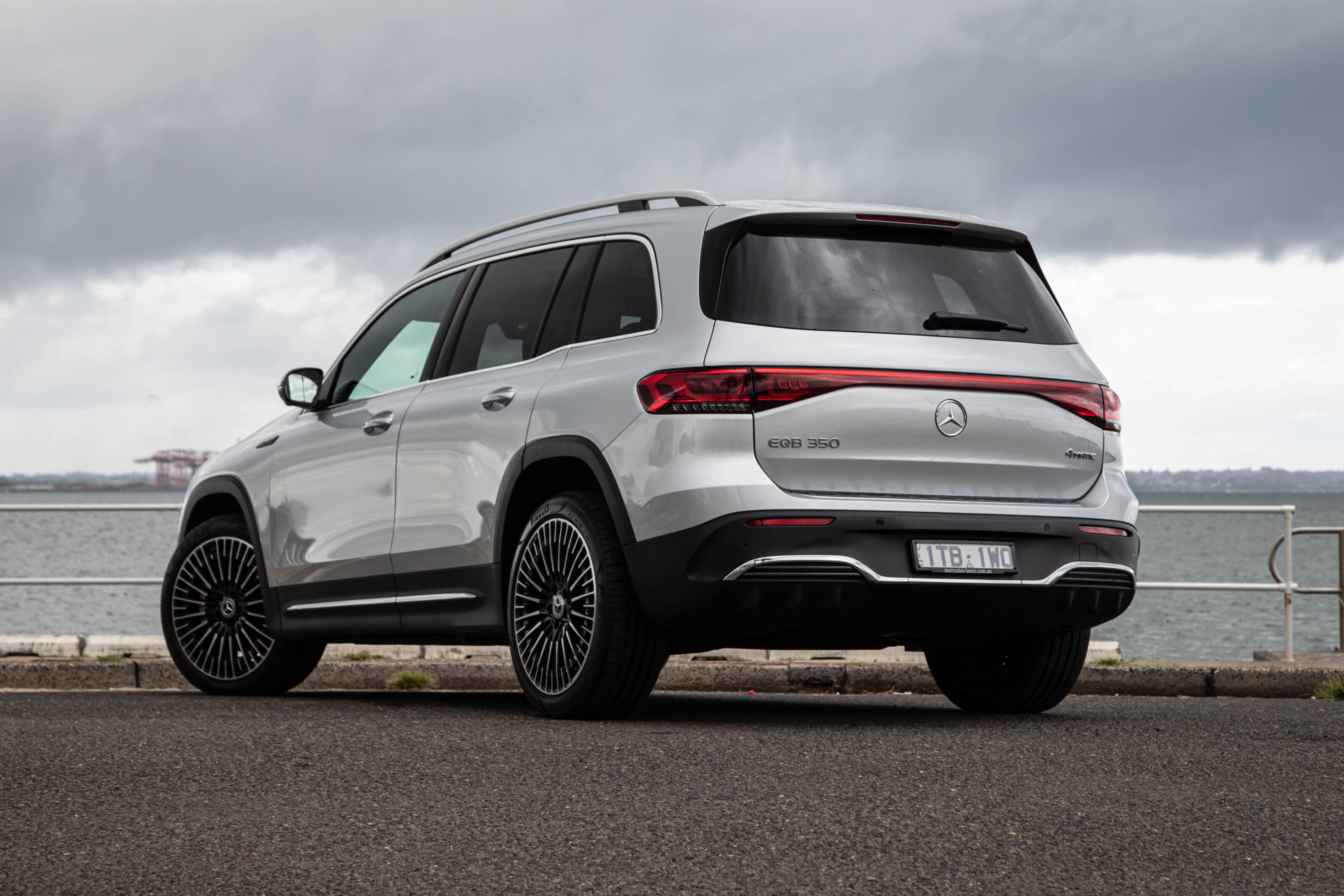
1
JUMP AHEAD
- How much is it, and what do you get?
- How do rivals compare on value?
- Interior comfort, space and storage
- Battery and charging
- What is it like to drive?
- Range
- How safe is it?
- Warranty and running costs
- VERDICT
- Specifications
How much is it, and what do you get?
The EQB350 tops the two-car range at $106,700 before on-road costs, nearly nineteen-large more than a seven-seat 250.
It’s only about two thousand more than the GLB35 AMG, however. AMG’s version still has seven seats and is quicker than the EV to 100km/h by about a second. Still, that’s not why an EQB buyer is buying the EQB.
Mercedes has not exactly skimped when it comes to standard spec, but as you’ll see, the EQB equipment list has some glaring omissions.
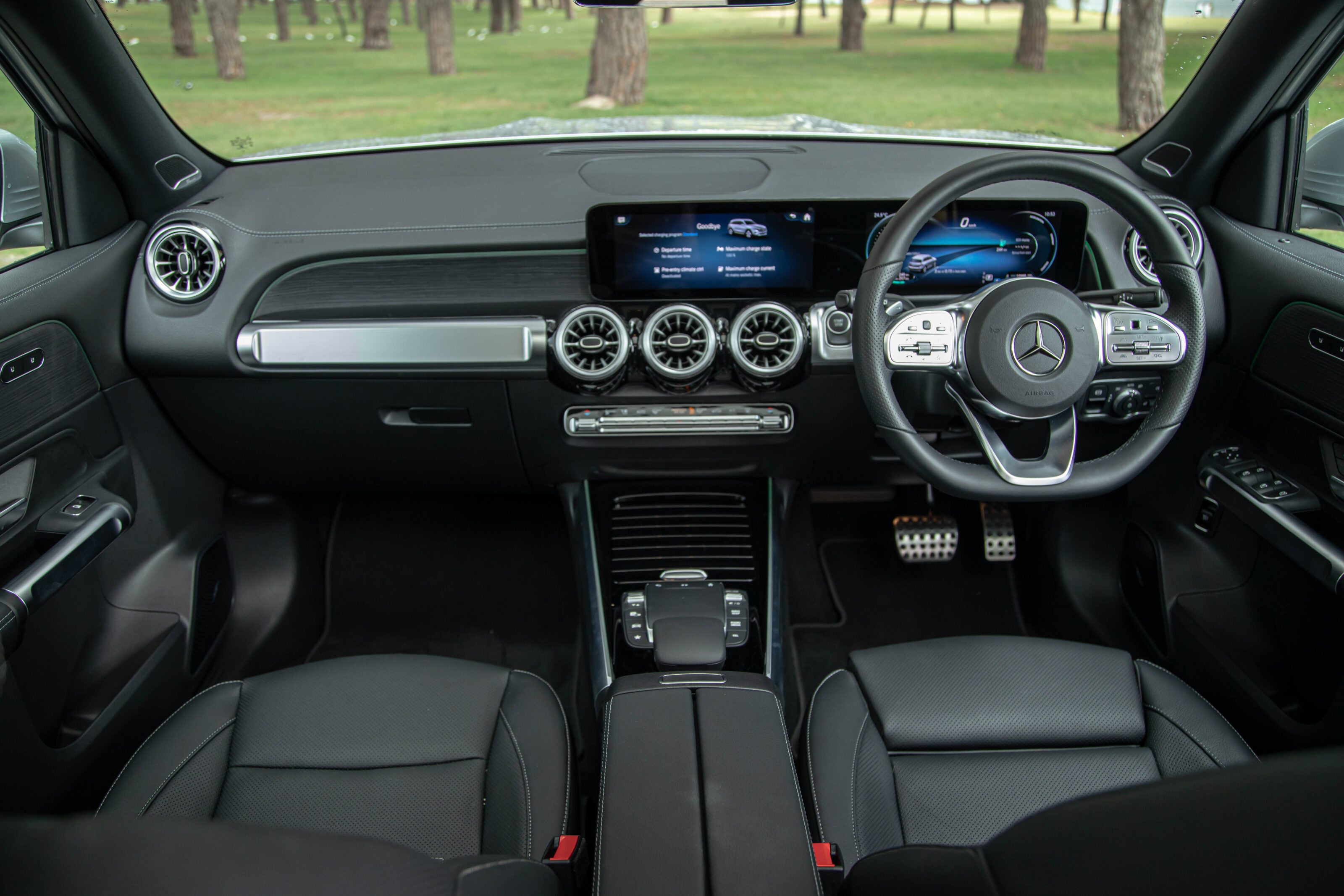
1
| 2023 Mercedes-Benz EQB350 standard features | |
|---|---|
| 10.25-inch digital instrument cluster | Front and rear parking sensors |
| 10.25-inch MBUX infotainment system | Hands-free power tailgate |
| 20-inch alloy wheels | Heated front seats |
| 360-degree camera system | Keyless entry and start |
| Adaptive high beam | Leather-wrapped steering wheel |
| Adaptive suspension | Low-speed pedestrian alert sound and reversing tone |
| AMG exterior styling | Nappa leather sports steering wheel |
| AMG floor mats | Panoramic glass sunroof |
| Android Auto | Satellite navigation |
| Auto LED headlights | Sports front seats |
| Auto wipers | Suede-like upholstery with red stitching |
| Configurable ambient lighting | Tyre pressure monitoring |
| DAB+ digital radio | Wireless Apple CarPlay |
The front seats might be very comfortable and warm on a cold day with their fancy heating, but you have to move them manually like some kind of animal. When you’re into six figures, I think powered seats are a must, just quietly.
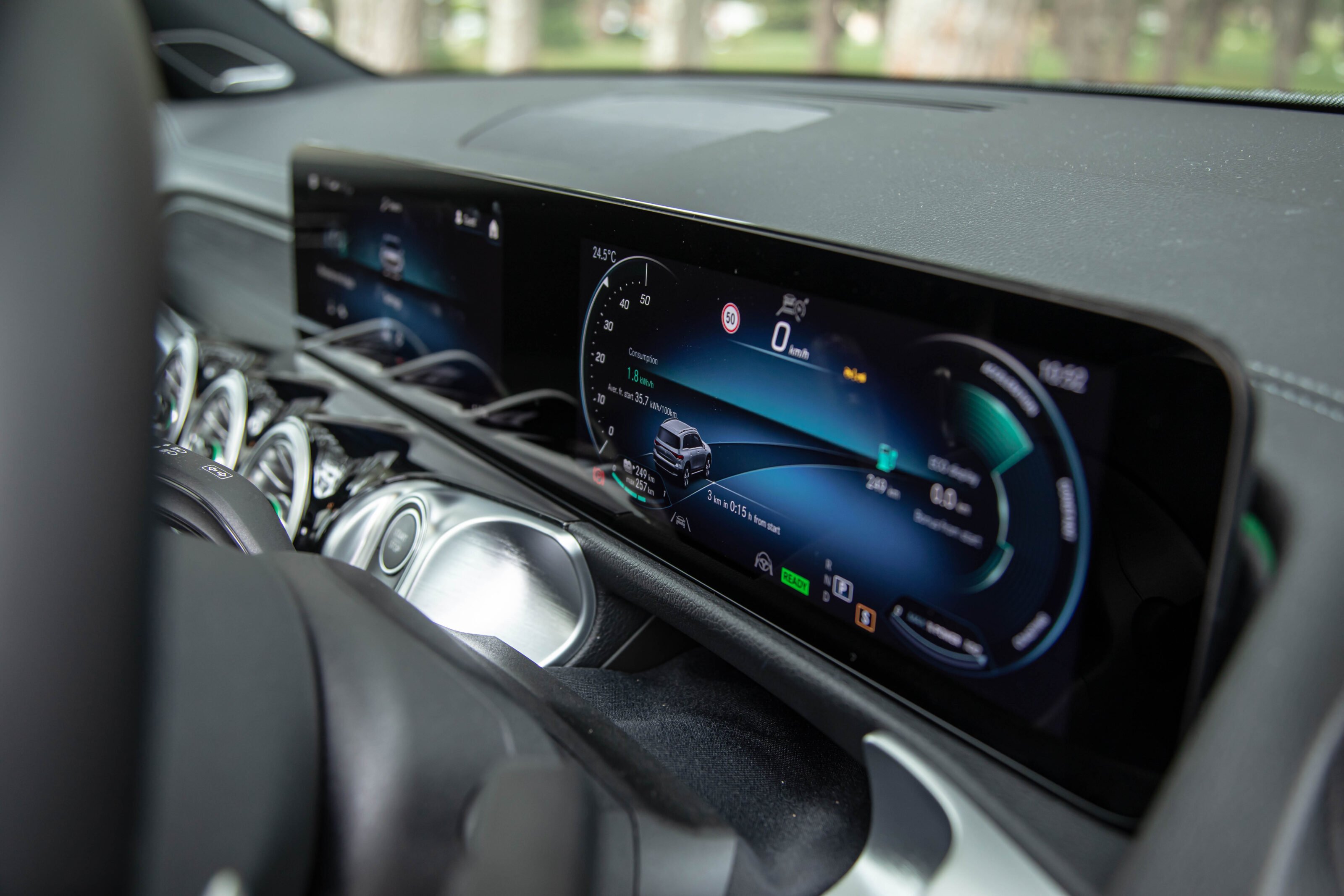
The 10.25-inch MBUX screen is excellent, except Apple CarPlay is constrained into a small rectangle – unlike…um…every other MBUX-equipped Merc I’ve seen.
1
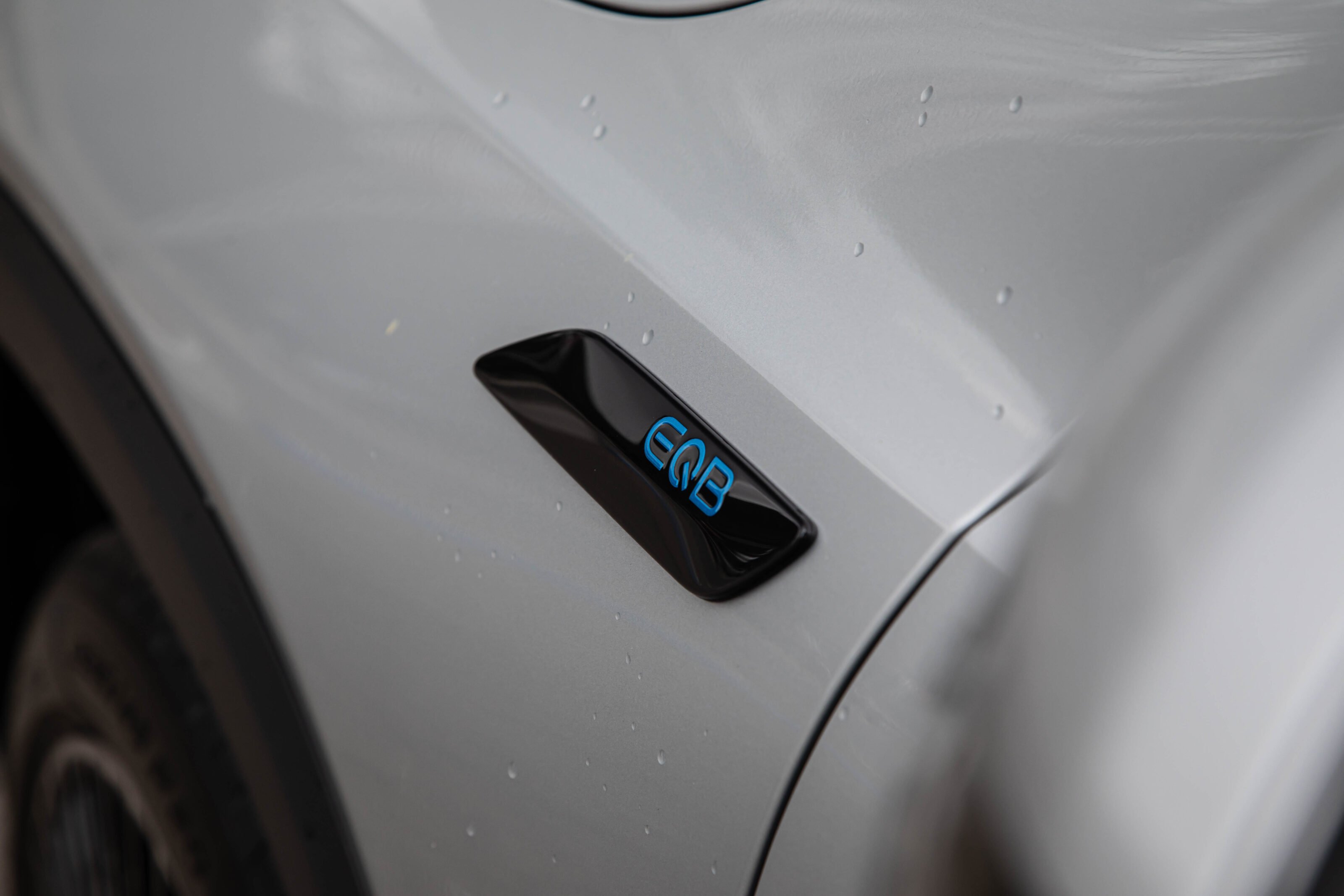
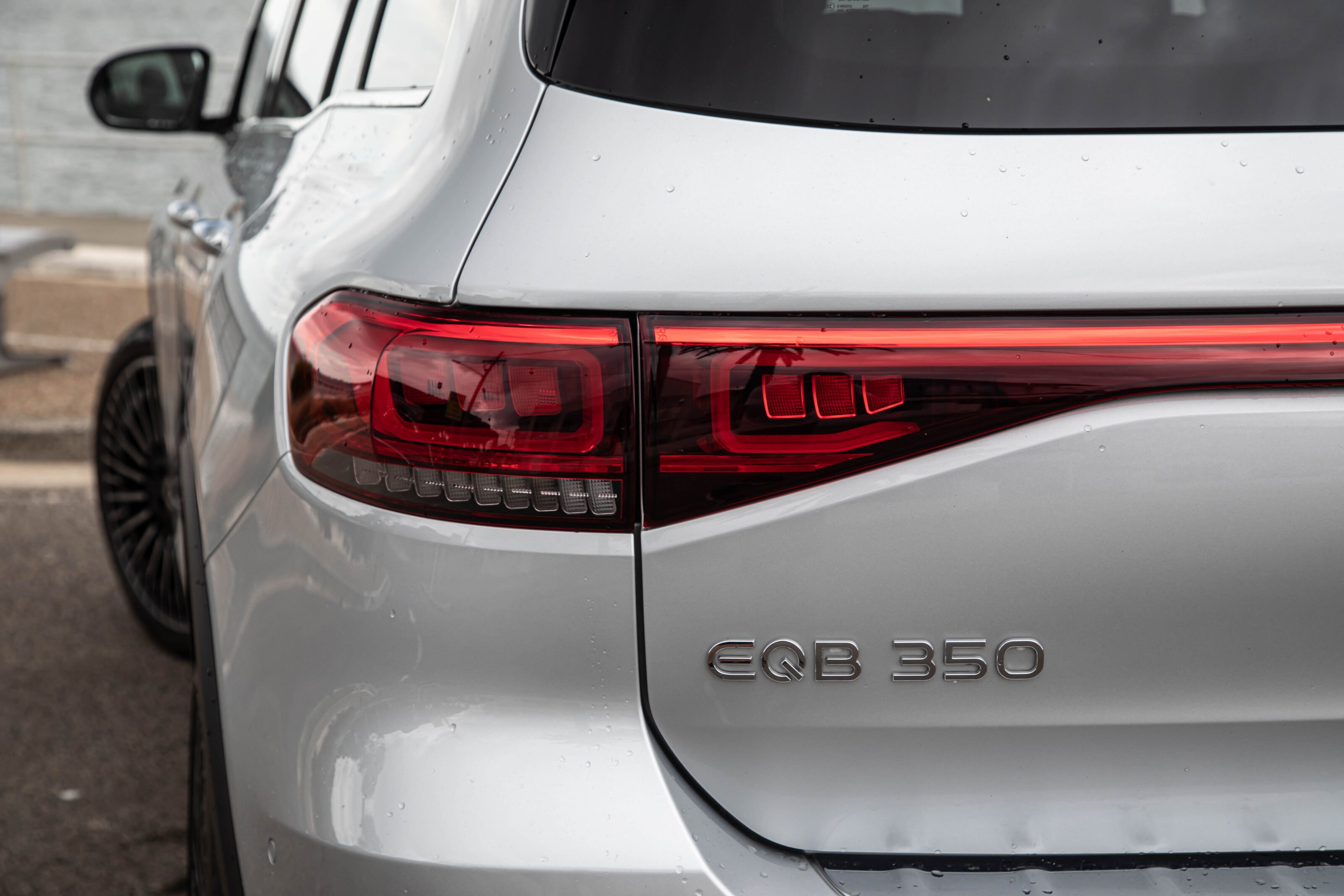
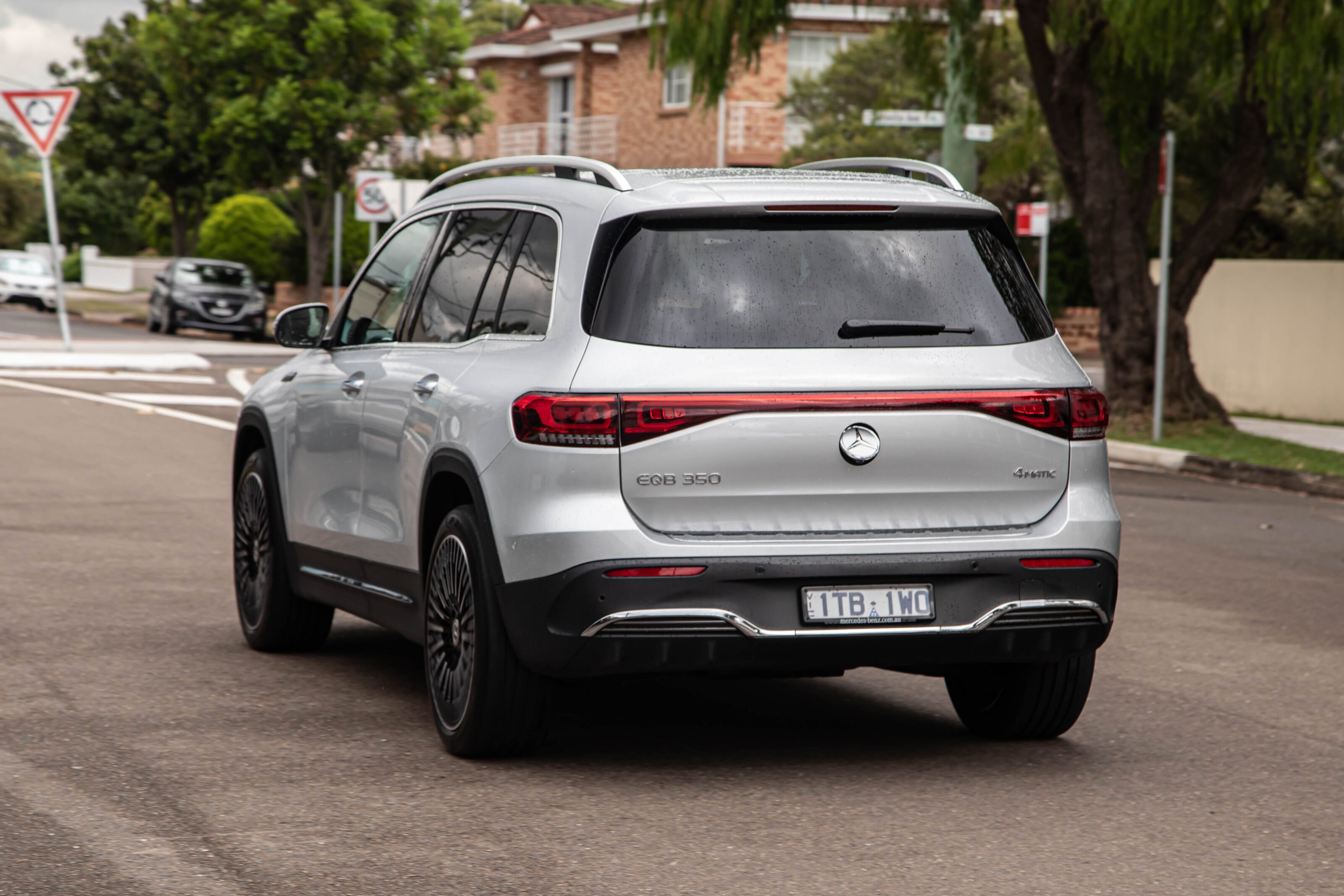
You can tell the EQB and GLB apart by the former’s full-width LED lighting strip at the front, blue badging and full-width LED lighting at the rear. It’s subtle, even when rolling on 20-inch alloys.
There are nine colours, but only two are freebies. The rest are $1490 except for the fancy Magno which is $3300.
My test car had the Urban Guard protection pack ($1300), black leather upholstery ($1700), Burmester-branded surround system ($1400) and “climatised” front seats ($1200). Add to that the paint (Iridium silver) and you’ve got yourself a $114,090 (before on-road costs) five-seater, which is sailing perilously close to larger SUVs from Mercedes itself and its rivals.
1
How do rivals compare on value?
Dual-motor EVs are not exactly thin on the ground, even if they’re hard to actually get.
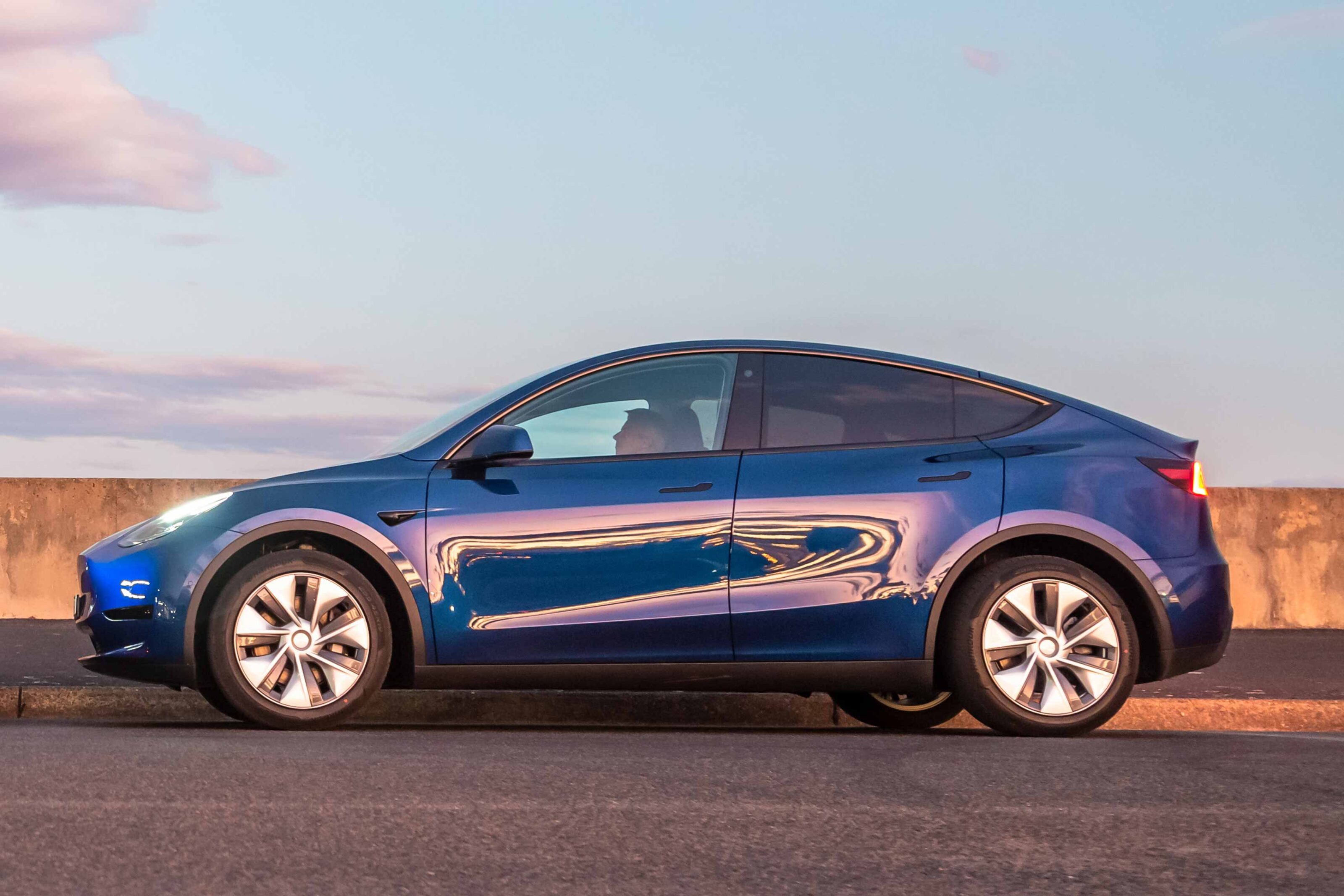
The Tesla Model Y Performance is the least difficult to get your hands on and costs $100,235 before on-road costs when you include the mandatory luxury car tax in the price (which the website doesn’t until you dig into the pricing and I wish they would stop it).
You get two motors, a battery of some description (Tesla doesn’t say but I’m sure the comments will fill with people telling me it’s around 75kWh) providing a WLTP range of 514km and is a pretty swift unit.
The quality isn’t even close to the Merc’s, however, and it’s much noisier. You get easy access to the king of charging infrastructure, however, in the Supercharger network.
1
Next up in the twin-motor SUV world is the Volvo C40 Recharge Twin for $83,940 before on-road costs. It’ll charge faster, goes faster and has a longer claimed (420km) and slightly longer real-world range (360-390km) compared to the EQB.
The Volvo is also a fair bit cheaper, even with a few options loaded on. It’s not as roomy inside as the EQB but it’s better looking, or at least I think so.
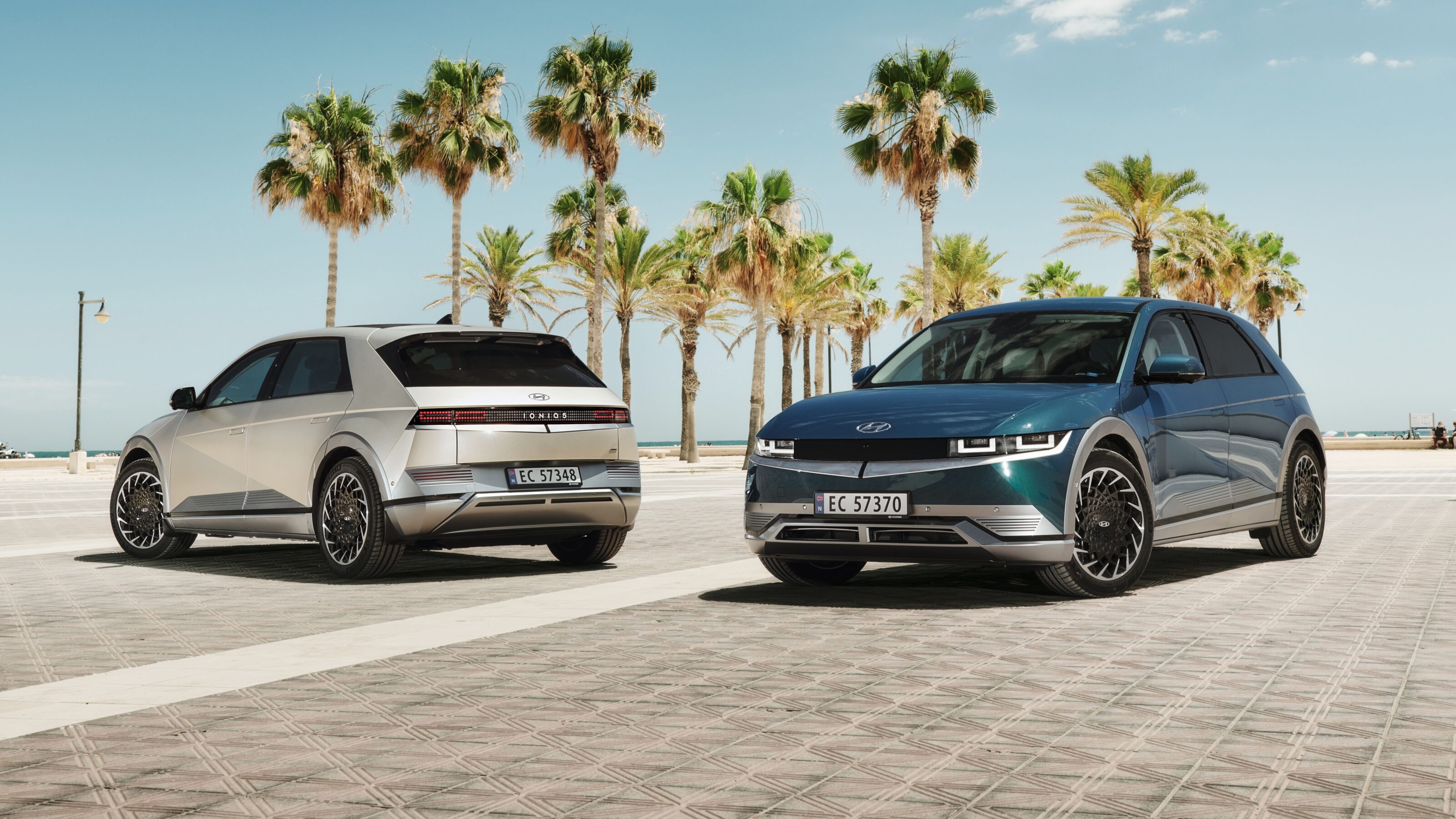
Hyundai’s Ioniq 5 Techniq starts at $79,500, but a fairer comparison would be the Epiq at $85,000 (both before on-road costs). It’s fully loaded, has a bigger battery, a great interior, incredible styling and easily as roomy if not quite as externally compact as the GLB. It also has a longer range, 350kW charging, and is quicker. Good luck getting your hands on one, though.
1
Last year’s Wheels COTY winner, the Kia EV6, now has a GT version starting at $99,590 before on-road costs that will rinse everything on this list in the 0-100km/h race. It has a longer warranty than the GLB, too, and if the reduced range isn’t your thing, you can go to the GT-Line AWD for $87,590 before on-road costs.
The EV6 is another roomy car and, while the interior is a little more prosaic than either the GLB or Ioniq 5, it does the job very nicely indeed.
Stretching the friendship slightly would be to include the Polestar 2 which I reckon rides just high enough to qualify as an SUV.

1
Interior comfort, space and storage
The bad news on the EQB350 is losing the third row, meaning the GLB’s unique selling point – a seven-seat EV – is lost.
Slinging that extra motor in the back took all the space that two people and their seats did, so they had to go in the name of all-wheel drive performance.
You’re left with the same boot space, however, starting at a very useful 495 litres. With the 40:20:40 split-fold second row stashed, you’ll have 1710 litres, which is also quite a bit. Being a box certainly helps here. The boot floor is quite high but not inconveniently so.
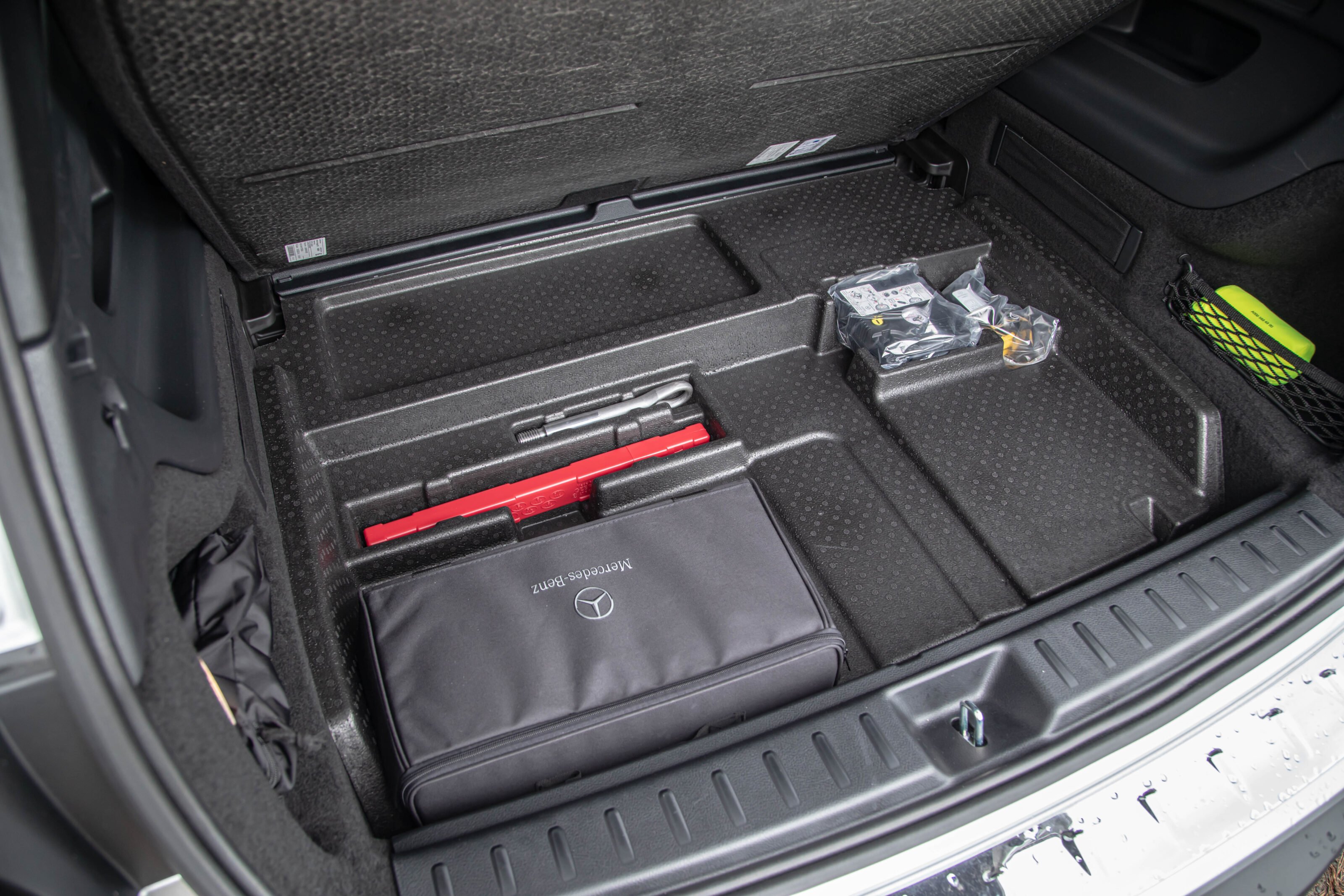
You get a cargo blind, there are a couple of handy little pockets for odds and ends, but no hidden storage beneath the carpet for the same reason as there aren’t any seats.
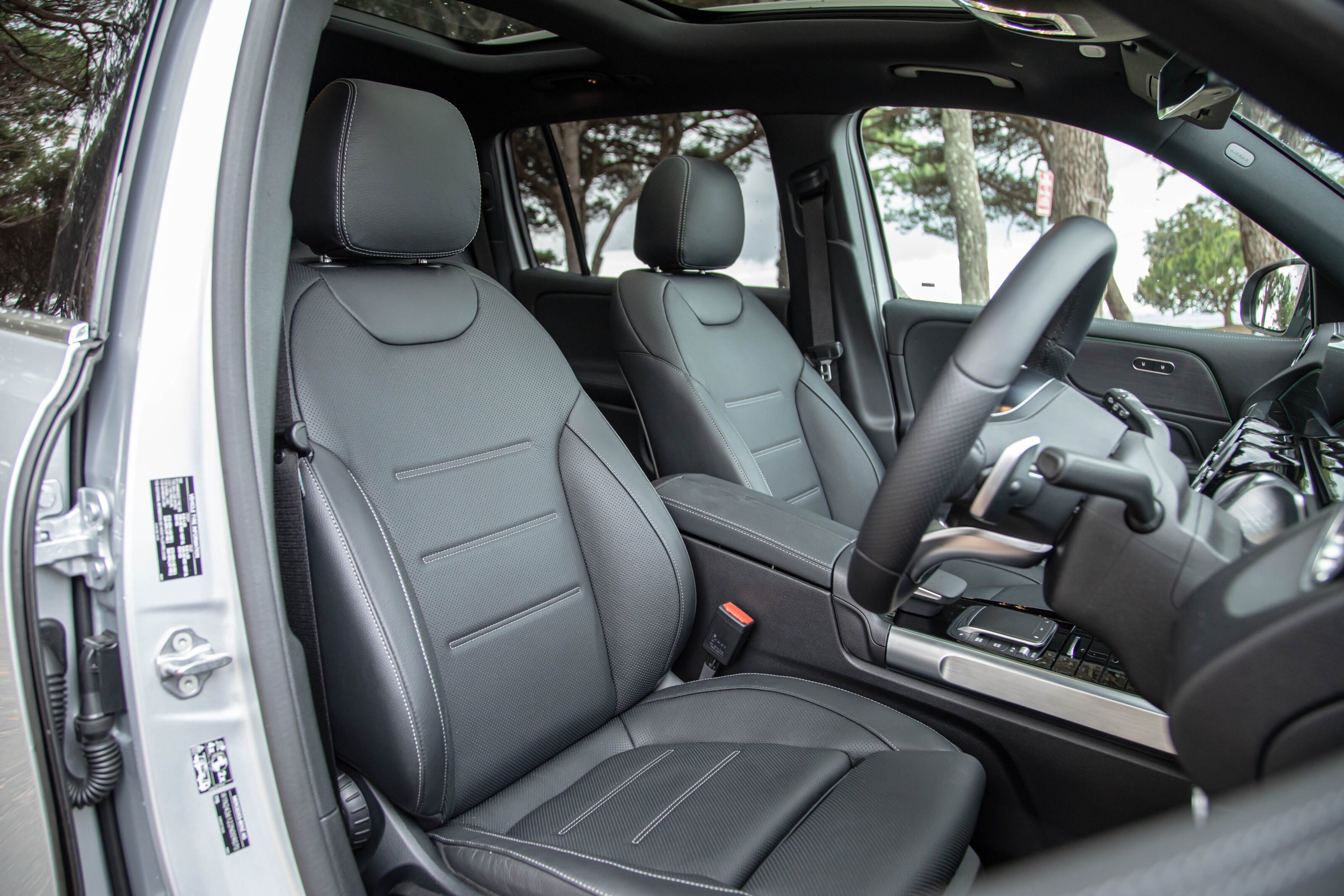
1
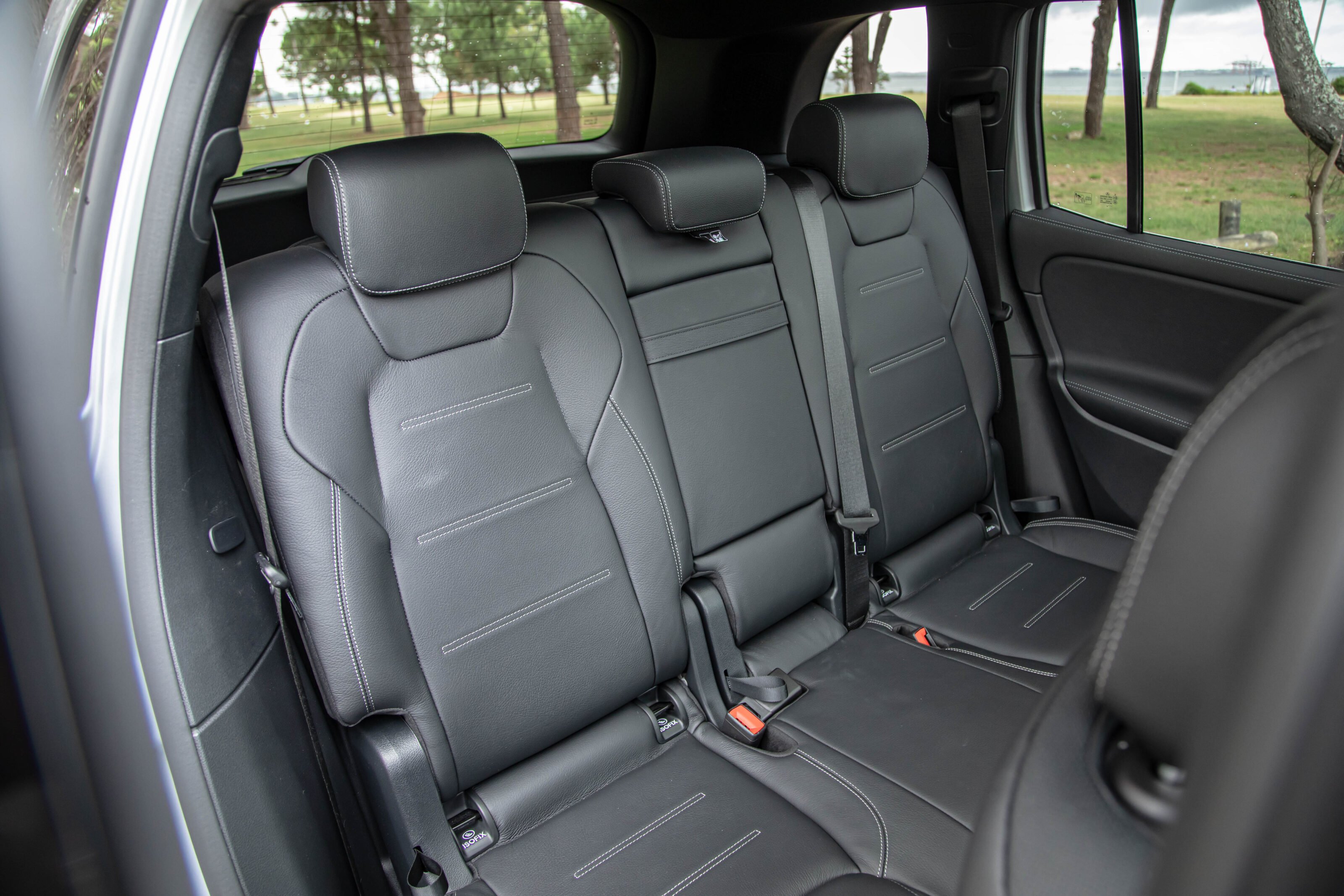
While the back seats are shaped well enough for everything from your backside upwards, the truncated seat squabs don’t offer much under-thigh support, which is a shame.
Also mildly baffling is the deletion of the sliding function of the middle row which may be less of an issue without a third row, but is great for when you’ve got kids in child seats you want/need to reach or pesky anxious dogs.
There’s room here for two tall adults but they’ll get tired without that support on longer trips. Again, a shame, because there is a ton of headroom and the huge windows mean people of all sizes can see out. It feels kind of old-school in the best of ways with all that glass and light.
Comparisons
Best Electric Cars, $80k-100k: Luxury EVs tested
This is part three of our price-based EV buying guide, comparing Australia’s electric cars priced between $80,000 and $100,000
Rear passengers get air vents and a solitary USB-C charger, a fold-down centre armrest with a pair of cup holders and bottle holders in the doors.
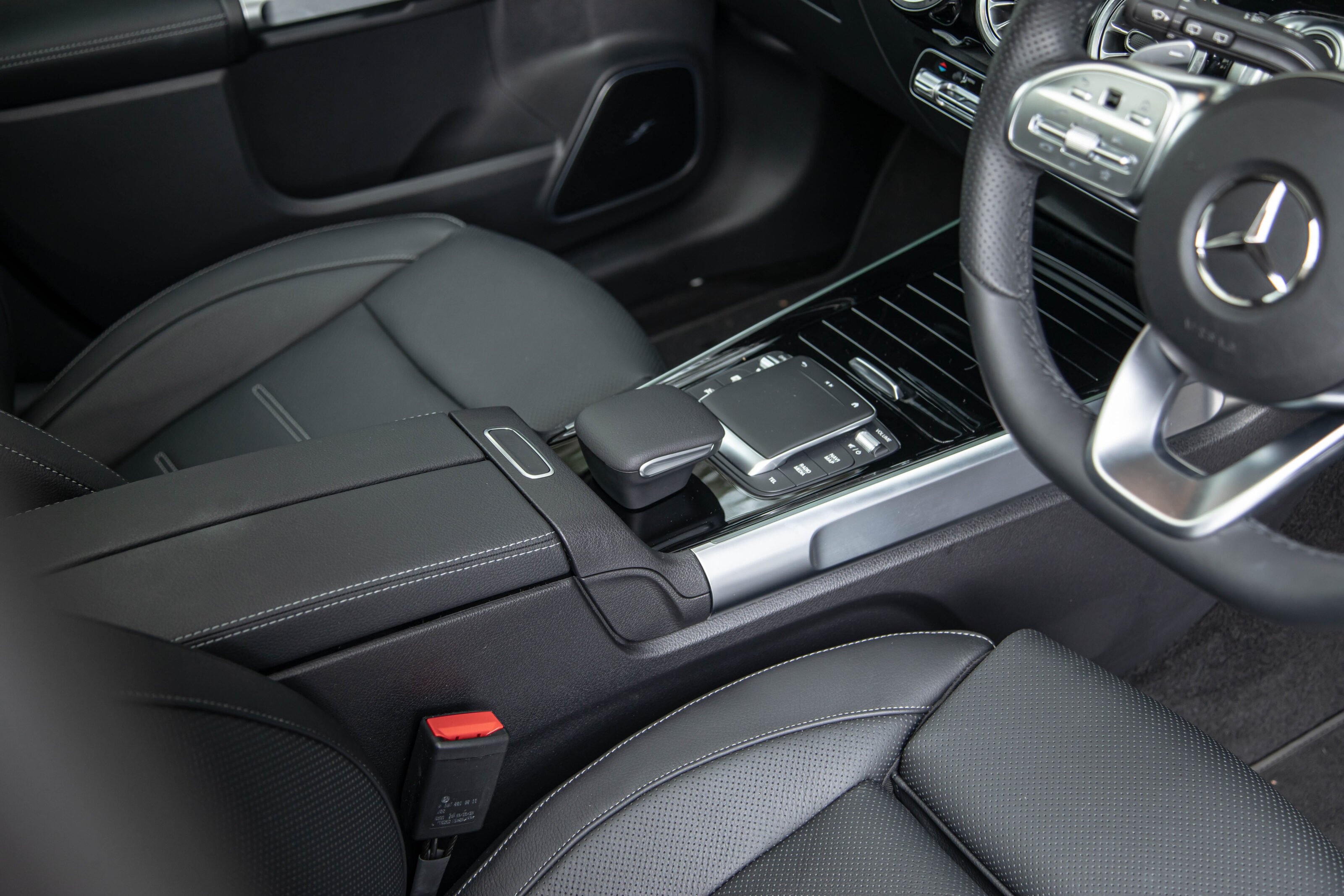
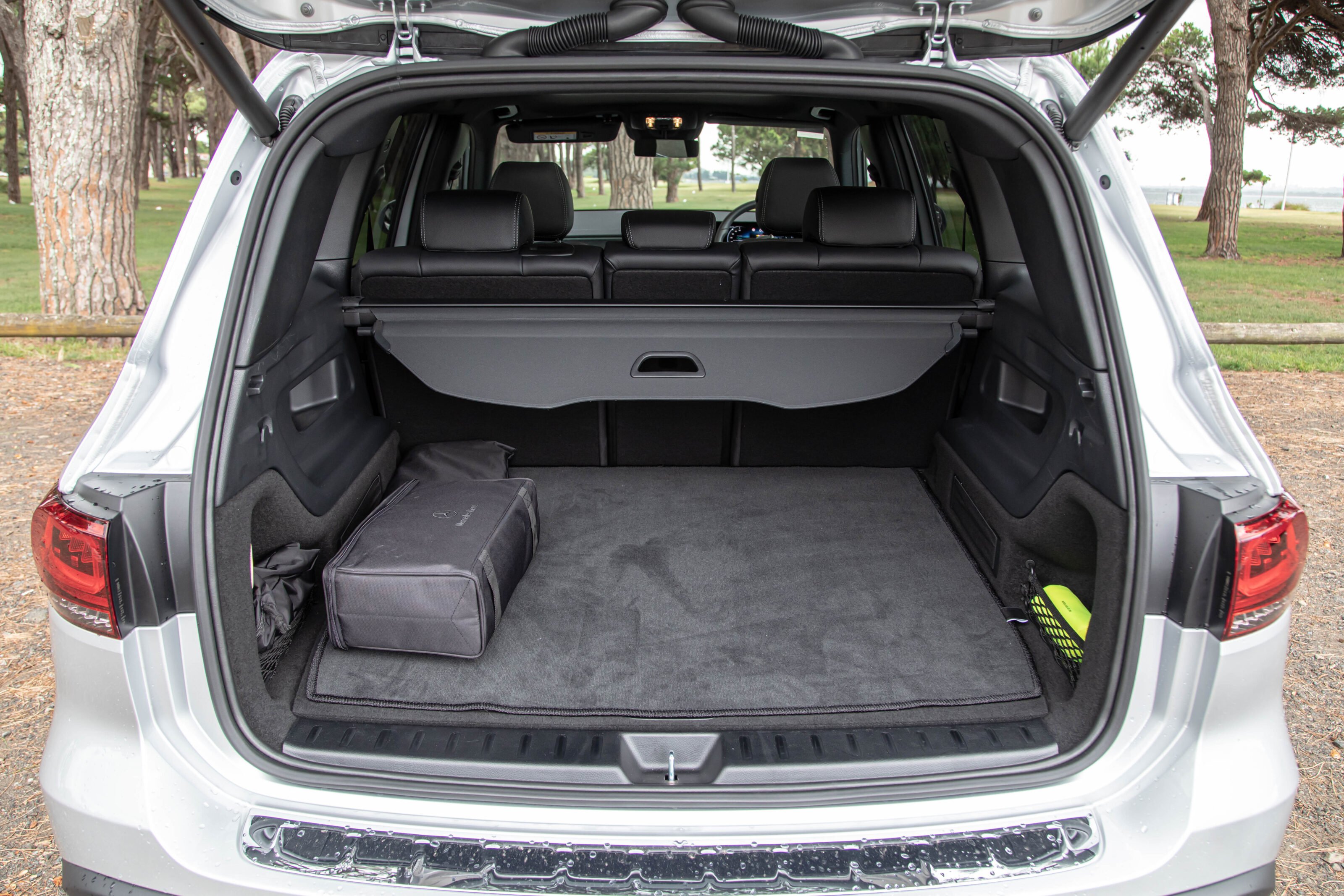
Moving into the front, you’ll be dazzled by the pair of screens arranged side-by-side and all the various functions, bells, whistles and further accoutrements. MBUX is a good system that continues to evolve and despite my complaint about the Apple CarPlay experience being almost picture-in-picture, it’s really not that bad. The LED lighting in the cabin is configurable and those awesome afterburner-style air vents look great.
The seats look a bit plain but are very comfortable. Manual adjustment is only really a pain when swapping drivers but, at this price point, really?
1
I reckon I’d skip the optional full leather treatment and stick with the fake suede of the standard car, but either way, the hide is quite nice.
There’s a pair of USB-C chargers up front, a wireless phone charging pad, two cup holders and bottle holders in the doors. The adjustable armrest hides a modestly sized storage bin.
It’s a good cabin, spacious and airy but some of the plastics – again – aren’t really a six-figure car proposition.
1
Battery and charging
The EQB250 has the same 66kWh battery as the 250, so with an extra motor to feed, there’s an 11km drop in range to go with it. That’s not a bad result – 371km down to 360km.
| 2023 Mercedes-Benz EQB350 battery details | |
|---|---|
| Battery size | 66.5kWh (usable) |
| Battery type | lithium-ion |
| Charge port | CCS2 (right hand side at the rear) |
| Home charging (11kW max) | 7h15 |
| Fast charging | 100kW, 10-80% in 30 minutes |
| Voltage | 400V |
| WLTP Range | 360km |
1
Charging maxes out at 100kW, which is a little on the low side compared to, say, Volvo, Polestar, Kia or Hyundai. But the reality is that few charging stations will deliver that kind of juice anyway, no matter what the sticker says. Most Tesla stations are about 120kW which, as I say, is fine and it’s a rarity to find anything with more oomph actually working.
So at this point, it’s largely academic. Cue the howling from EV fans that I’m being unfair. I’m here to tell you I’m an EV fan too and it’s profoundly irritating that this is the case. I felt like a right dunce having sought out a working 350kW charger with an 800V Kia and only getting 50kW out of it.
At full tilt, the EQB350 will charge from 10-80 per cent in 30 minutes, which is pretty good going really. Under-ten and over-eighty slows considerably, as it does with most lithium-ion batteries (a software-driven battery protection strategy).
1
The LFP battery in a lower-spec Model Y, for instance, will charge to full without the same magnitude of slowdown.
Charging at home with a three-phase 11kW wallbox will give you a full charge in just over seven hours, so if you have access to one it is not a bad way to go. You can configure when it charges to get the best out of your power tariff if you have time-of-use power or you prefer to run it off rooftop solar if you have it.
Without a wallbox, you’ll be looking at anywhere from 12 to 15 hours, give or take, but if you remember to plug it in every night (should you have that luxury), you’ll never be waiting around unless you’ve done a long trip.
1
What is it like to drive?
I can’t speak for the single motor 250 so everything I tell you here is in the context that I’ve only driven the quick-brick dual motor. And boy howdy is it quick.
I reckon the 6.3-second claimed 0-100km/h time is a touch conservative, perhaps to save the blushes of the petrol AMG version.
| 2023 Mercedes-Benz EQB350 drivetrain | |
|---|---|
| Motor | front and rear |
| Gearbox | single-speed reduction gear |
| Total power | 215kW |
| Total torque | 520Nm |
| 0-100km/h | 6.3 seconds (claimed) |
1
With the addition of that extra motor, power jumps 75kW to 215kW and torque is up from 385Nm to 520Nm. That’s the kind of twist you expect from a strong diesel, which is welcome because the EQB350 is no lightweight at almost 2200kg before you load up.
The extra motor goes at the rear, so you’ve got a nice spread of power between the front and rear axles, reducing the likelihood of unruly behaviour from the front tyres. It still feels quite front-driven – especially in Comfort and Eco modes – but the well-judged steering helps mask that impression.
In normal city driving it’s very effective, with not much throttle needed to break clear of the pack or take the gaps when they come. There’s a roll-in of torque rather than the neck-snapping vibe a lot of people associate with powerful EVs, so it’s smooth but quick.
1
With sportier modes engaged, the modest body roll is better contained but the ride quality doesn’t deteriorate, which is quite a trick on 20-inch wheels. You wouldn’t call ever call it delightfully cushy – there’s always a sporting edge to the ride – but it’s taut and controlled as you amp (see what I did there?) things up.
And again, given its upright stance and tall glasshouse, you’ve got a ton of vision, aided and abetted by the various cameras and sensors.
The forward auto emergency braking (AEB) is a bit of a nanny, though. I pulled out of the left lane to get around a slow-moving car and it “saw” another car in the right lane and gave us a jolt on the brakes and a tug of the seatbelt pre-tensioners.
It is nice to know those systems are there, but also, ouch. The other car was a fair way off and moving away at quite a clip, so I’m not entirely sure which of the two vehicles the system was worried about.
Advice
Australia’s best electric cars for 2023
We’ve tested nearly every EV below six figures in Australia to rank the best on sale today
Range
Coming in at 350km on the WLTP test cycle is a fairly reasonable result for a car that isn’t optimised as EV-only. Pulling that number apart, the WLTP range suggests a consumption rate of just under 19kWh/100km.
| 2023 Mercedes-Benz EQB350 efficiency | |
|---|---|
| WLTP range | 350km |
| WLTP consumption | 18.8kWh/100km |
| Indicated consumption | 20.7kWh/100km |
| Real-world range | ~335km |
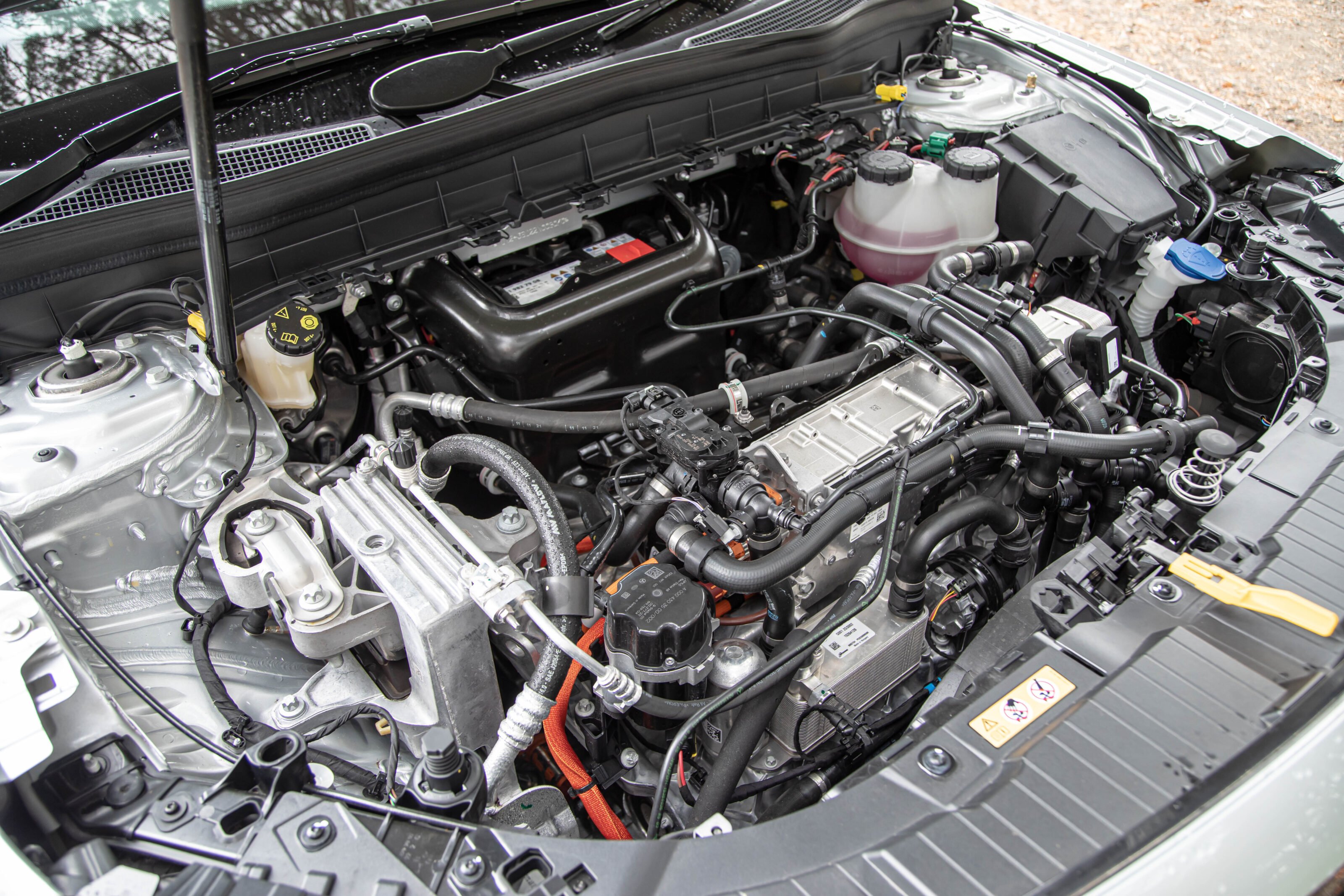
My week with the EQB350 saw an average of 20.7kWh/100km, which is close to the claimed usage and translates to a real-world range of around 335km.
Range is dependent on weather conditions and this was bombing around the suburbs along with some 80km/h and 110km/h running in Sydney’s very sticky early February weather.
1
How safe is it?
The EQB is, as you might imagine, packed with safety gear. Its five-star safety rating is based on the GLB’s result, with ANCAP conducting unspecified “further tests” on the EQB250.
For yet more unspecified reasons, the five-star rating applies only to the 250. I don’t know about you, but I find ANCAP baffling more often than I think it should be.
Kids are looked after with two lots of ISOFIX points and three top-tether anchors.
The forward AEB features pedestrian and cyclist detection and works at high and low speeds.
| 2023 Mercedes-Benz EQB350 safety | |
|---|---|
| 360-degree cameras | Lane departure warning |
| 9 airbags | Lane-keep assist |
| Adaptive cruise control | Rear cross-traffic alert |
| Anti-lock brakes | Reverse AEB |
| Blind-spot monitoring | Reversing camera |
| Forward auto emergency braking | Side exit warning |
| Forward collision warning | Stability and traction controls |
Warranty and running costs
The EQB is covered by Benz’s five-year, unlimited-kilometre warranty. The battery has an unusually generous 10-year / 250,000km warranty to guard against “drastic” degradation.
Servicing is required every 12 months or 25,000km, but it’s not cheap. A three-year plan costs $1650, four years $2250 and five years of servicing will set you back $2650. It’s substantially cheaper to service than a petrol EQB but some rivals offer free servicing periods or just plain cheaper servicing.
1
VERDICT
We had a rare week of furious agreement in the house about the EB350.
Both my wife and I thought it was a bit awkward-looking, some of the plastics a bit ho-hum, and the back seat could be better.
We also agreed on how nice it was to drive, how easy to use and that it was a low-fuss, swift EV. We just wished it didn’t cost so much for the 350 and that without the seven seats, it kind of rendered the concept a little pointless.
Then again, variety is the spice of life and if you need a practical, city-friendly raised wagon – which sounds like I’m damning it with niche praise, and I’m not – the EQB350 is very, very good.
MORE
Electric SUVs
| 2023 Mercedes-Benz EQB350 specifications | |
|---|---|
| Body | 5-door, 5-seat medium SUV |
| Drive | all-wheel |
| Engine | dual electric motors |
| Transmission | single-speed reduction gear |
| Power | 215kW |
| Torque | 520Nm |
| 0-100km/h | 6.3 sec (claimed) |
| Energy consumption | 19.0kWh/100km (combined) |
| Weight | 2163kg |
| Suspension (front) | MacPherson struts, coil springs, adaptive dampers, anti-roll bar |
| Suspension (rear) | Multi-links, coil springs, adaptive dampers, anti-roll bar rear |
| L/W/H | 4684mm/1834mm/1701mm |
| Wheelbase | 2929mm |
| Brakes | discs front and rear, regenerative braking |
| Tyres | 235/45 R20 Pirelli P Zero |
| Wheels | 20-inch alloy (no spare) |
| Price | $106,490 + on-road costs |
A report by The Washington Post reveals a poor workplace culture at Tesla has led to ‘unreliable’ safety assistance technologies, including a top-down order to remove radar sensors.
Snapshot
- Musk reportedly overruled engineers to remove radar sensors
- Former Tesla employees allege poor work culture, rapid development focus, cost-cutting
- Despite scrutiny, Model Y received highest ANCAP safety assist score in 2022
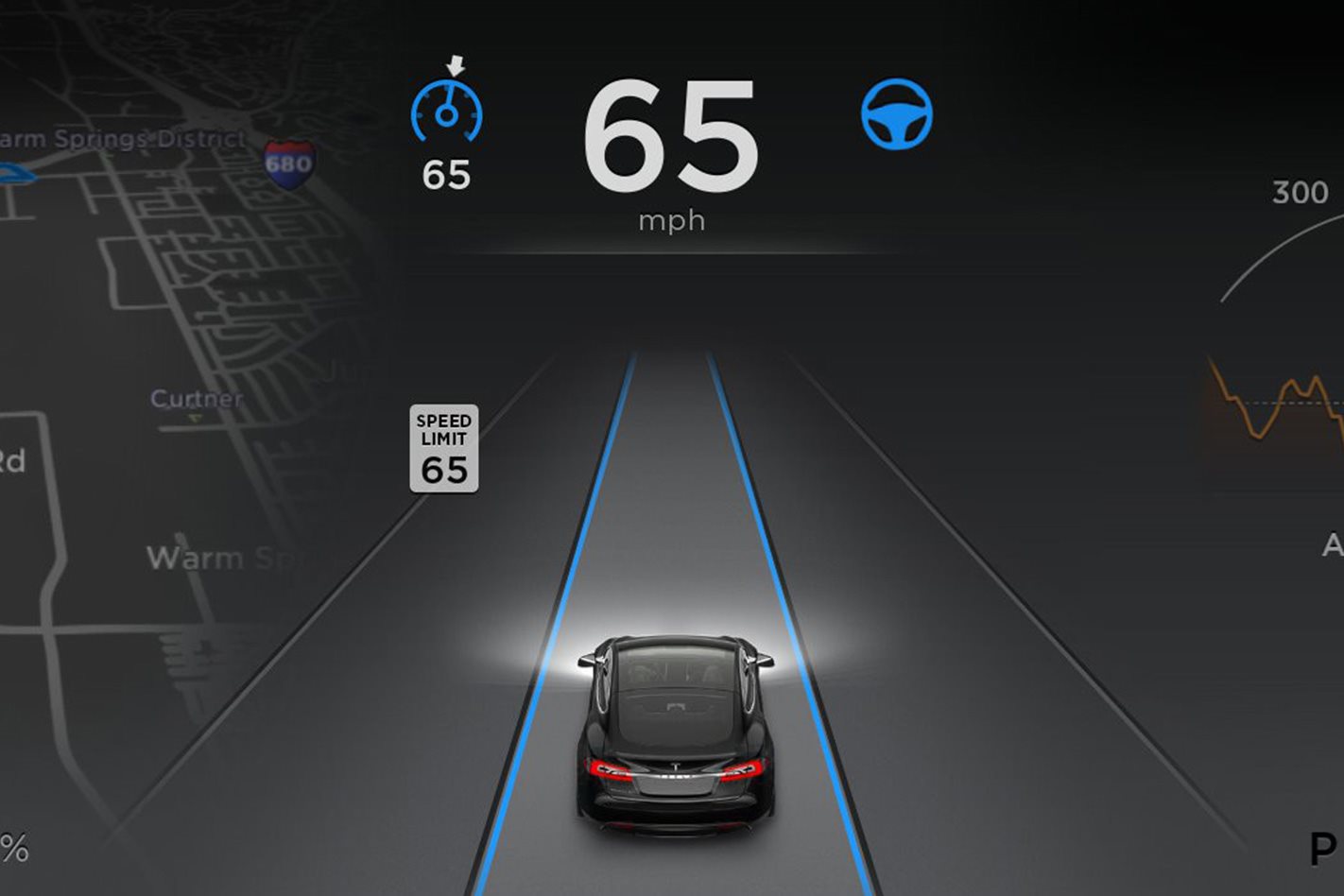
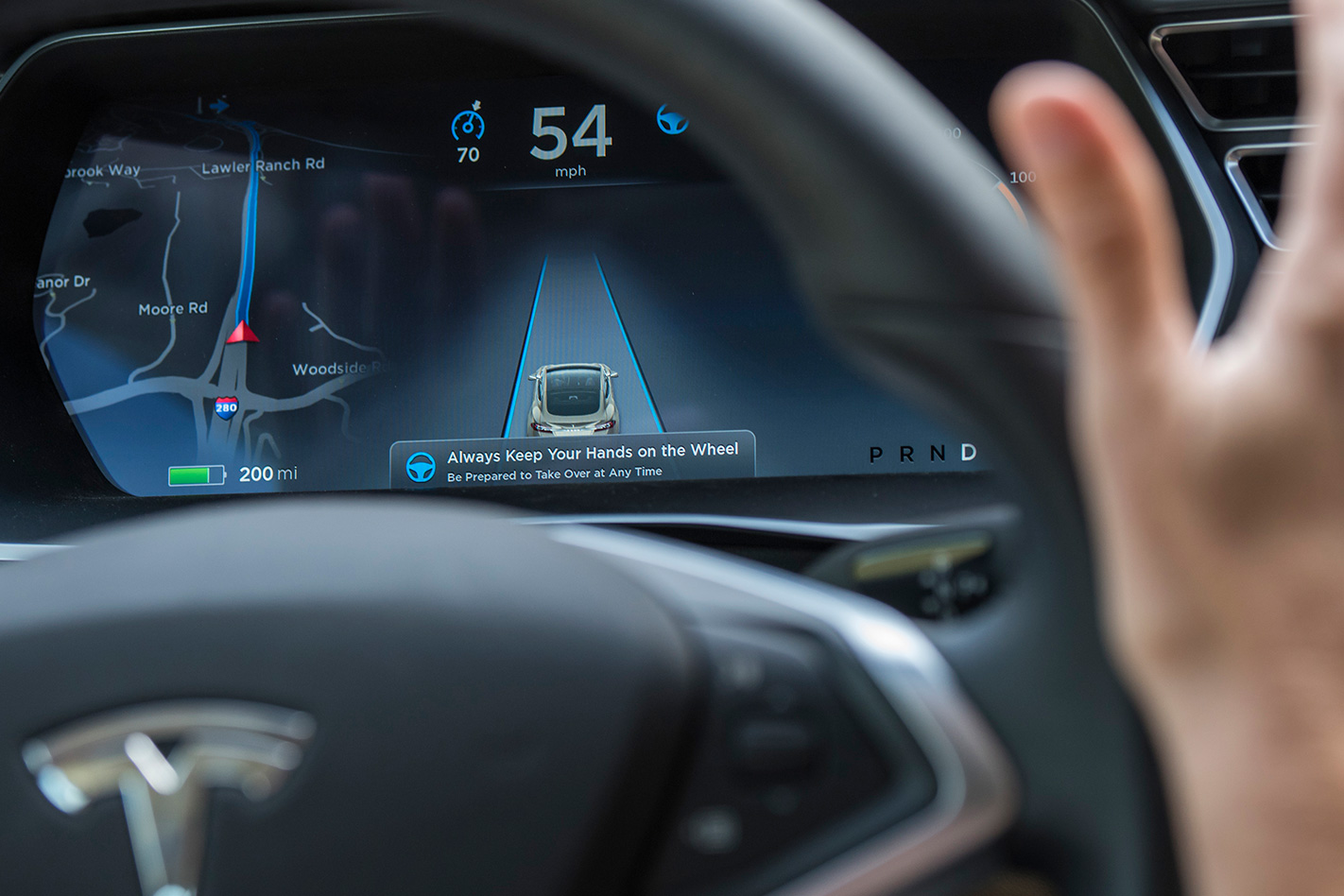
According to the US publication – which claims to have interviewed nearly a dozen former Tesla employees and test drivers – CEO Elon Musk overruled engineers who voiced concern that a cost-cutting camera-only AEB system would be susceptible to ‘basic perception errors’ if they were blocked by raindrops or bright sunlight.
The popular electric vehicle company started its ‘Tesla Vision’ transition in 2021 and gradually disabled the radar sensors on already-equipped vehicles at the time – with Musk arguing a camera-only, machine-learning safety assist system is safer than radar as there’s less ‘confusing signals’.
Advice
Australia’s best electric cars for 2023
We’ve tested nearly every EV below six figures in Australia to rank the best on sale today
1
In October 2022, Tesla also removed the ultrasonic sonar sensors – used for parking distance warnings from an object – in favour of all-round cameras, and is now rolling out Hardware 4.0 with higher-resolution cameras as a running update to the Model S and Model X EVs overseas.
Tesla’s not the only one to go camera-only
Tesla has been subject to particularly intense scrutiny, to its public release of ‘Full Self-Driving’ (FSD) beta in the US – which was recalled as it may act ‘unsafe’, according to the National Highway Traffic Safety Administration (NHTSA).
1
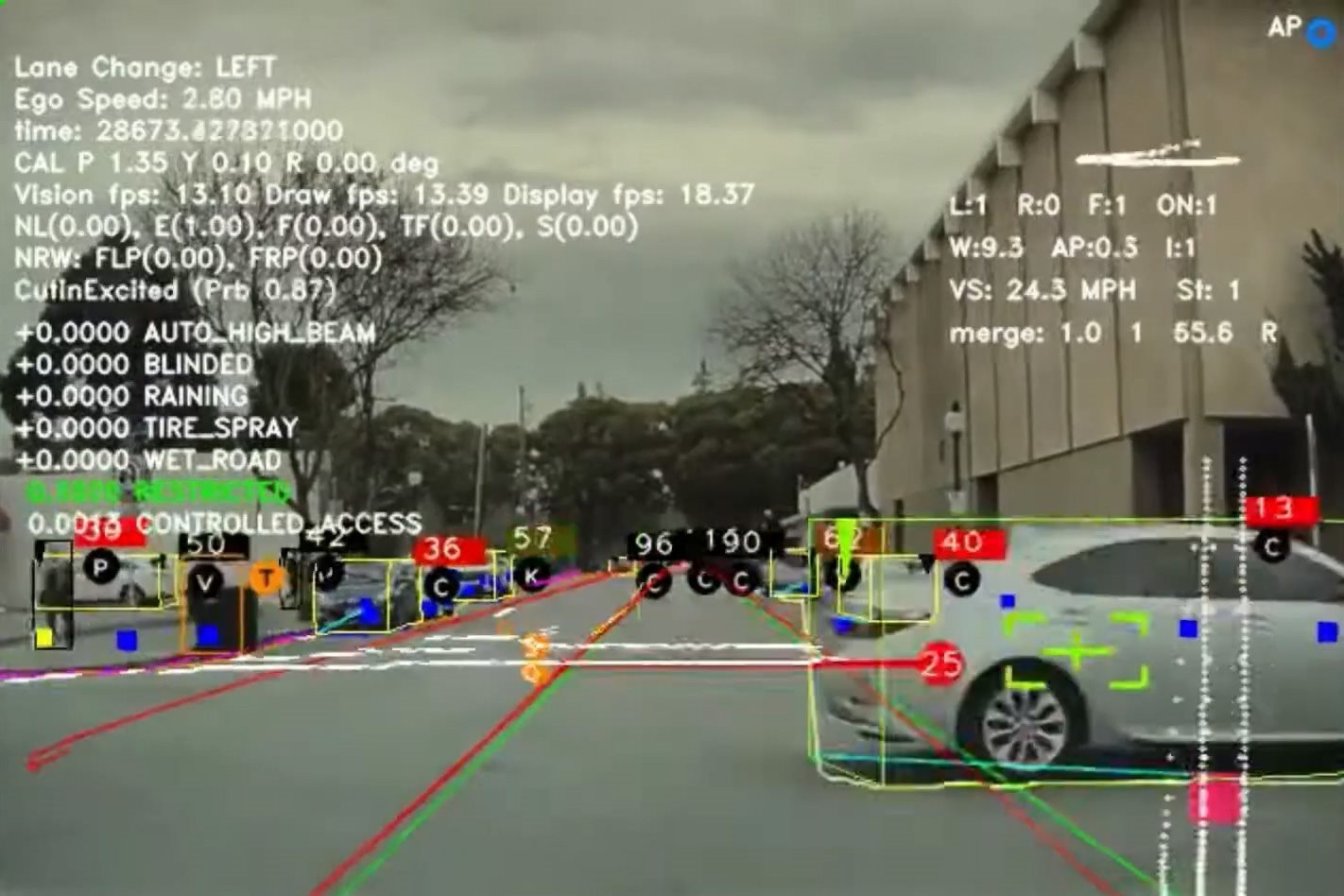
Data from the American safety regulator also reportedly highlights an increase of ‘phantom braking’ reports after the transition to Tesla Vision, where the vehicle suddenly brakes for no apparent reason while in adaptive cruise control ‘Autopilot’ mode.
Former Tesla employees, who worked with Tesla’s Autopilot safety assistance software, told the Post that a focus on rapid development, cost-cutting measures, lack of a ‘coherent development strategy’, and Musk’s ‘erratic’ leadership style have led to a poor workplace culture.
Sources claim that they are concerned that Autopilot and FSD beta are unsafe for use on public roads and misleading promises tweeted from Musk forced engineers to work harder – while he allegedly pulled ‘dozens’ of engineers to work at Twitter after he acquired the social media platform last year.
1
They also allege that monitoring software was installed in their company computers that tracked how they labelled objects recorded from the camera-only system. If the mouse didn’t move for a period of time, a timer started and employees could be reprimanded or even fired for inactivity. (This practice is not unique to Tesla, however, with many employers using computer activity to monitor worker productivity – Ed.)
Tesla Vision relies on machine-learning from public users to improve its reliability – in contrast to long-range radar and lidar sensors which can detect any object without a label.
In contrast, companies such as Waymo adopt strict testing protocols limited to testing within certain areas and have employees at the wheel, while the forthcoming Volvo EX90 and Polestar 3 will implement optional lidar sensors for self-driving tech.
Musk has been famous for promising an imminent fully autonomous ‘robotaxi’ future for years – but it hasn’t materialised and remains a $10,100 option in Australia for the promise of FSD.
MORE
Everything Tesla
MORE
Electric Cars
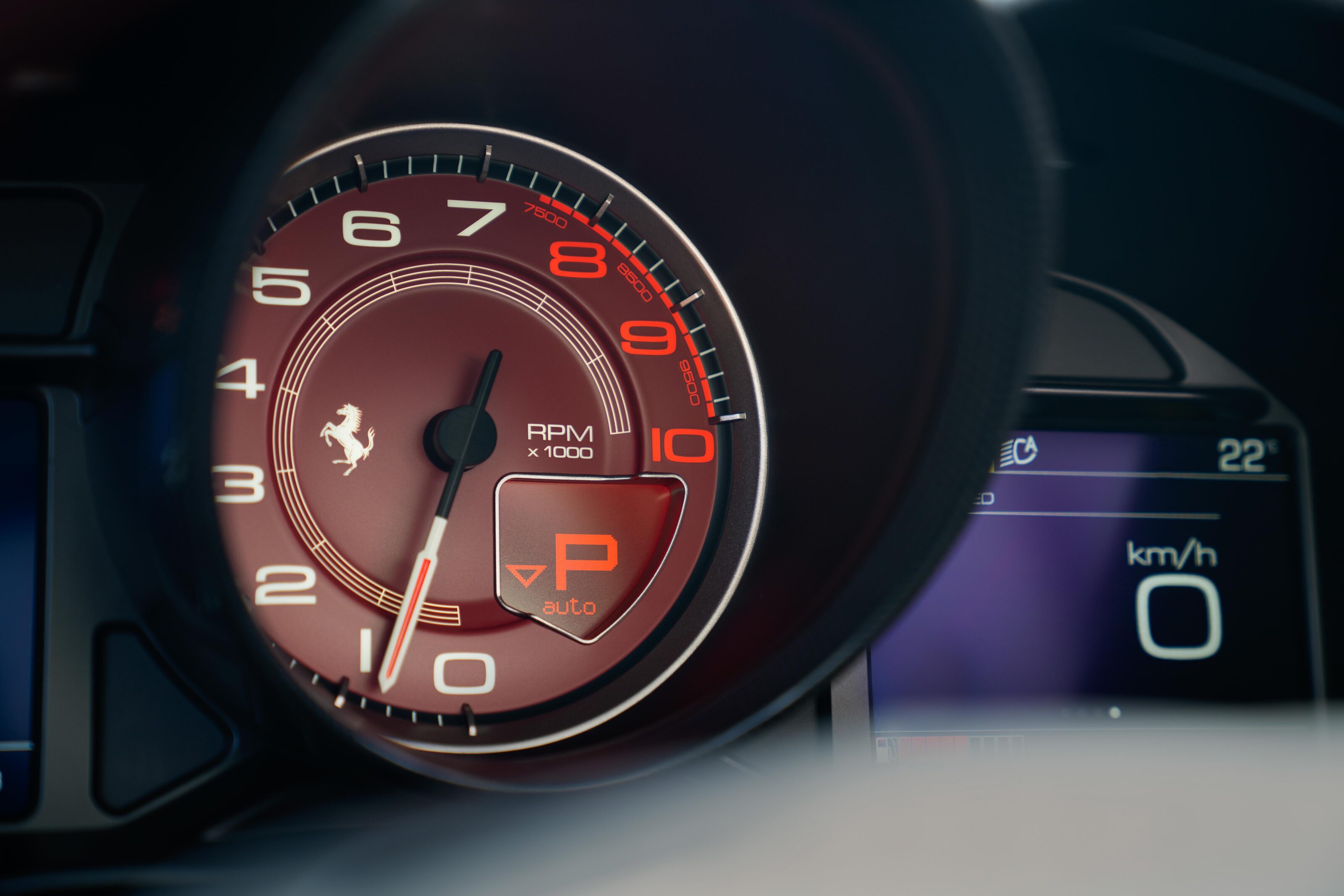
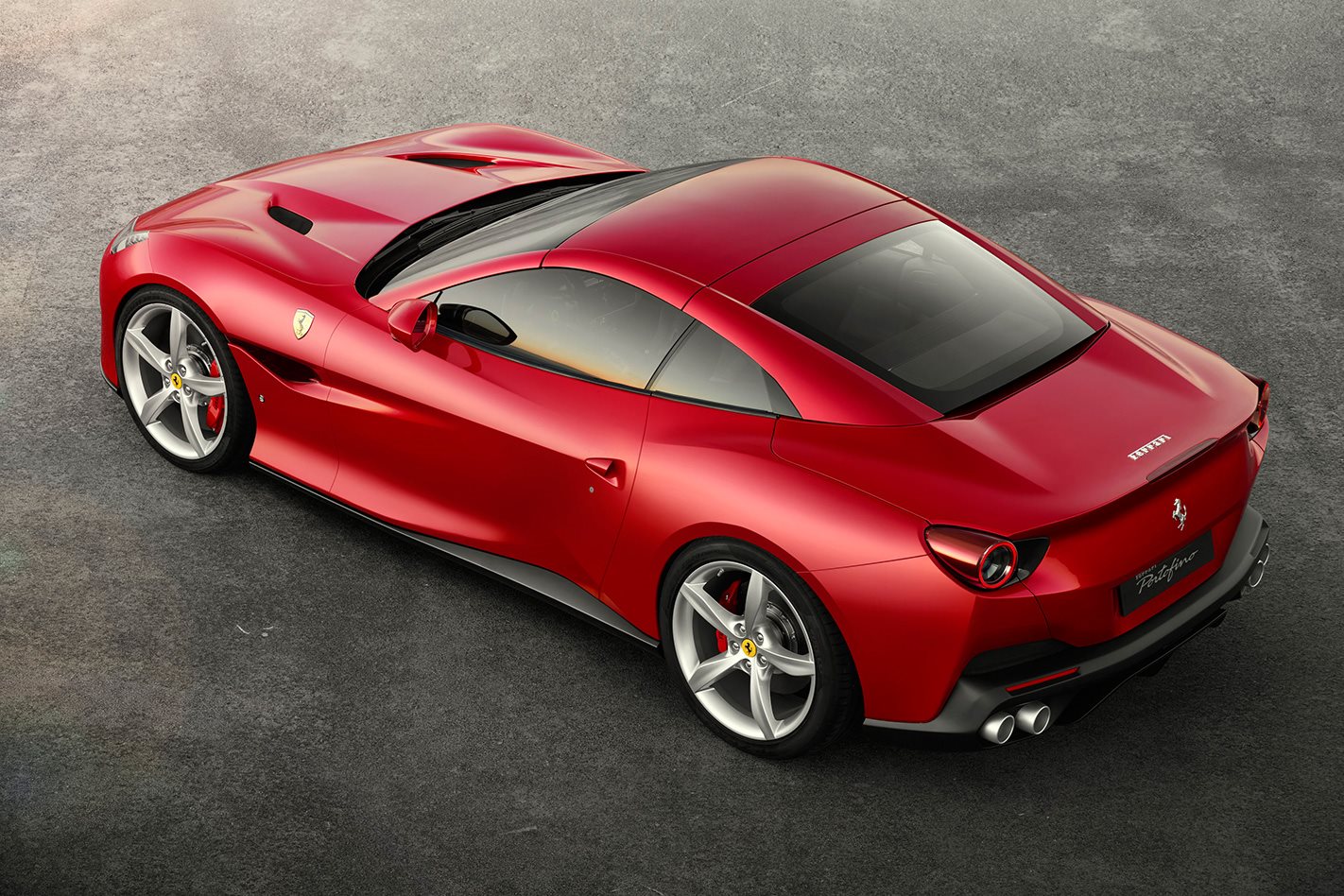
There’s something ineffably cool about comparatively unloved Ferraris. Whether it’s a 365 GTC4, most notable for not being a Daytona, the scallop-fuselaged 612 Scaglietti or the behemoth FF, these are Maranello’s chorus line cars, rarely enjoying much of a moment in the spotlight.
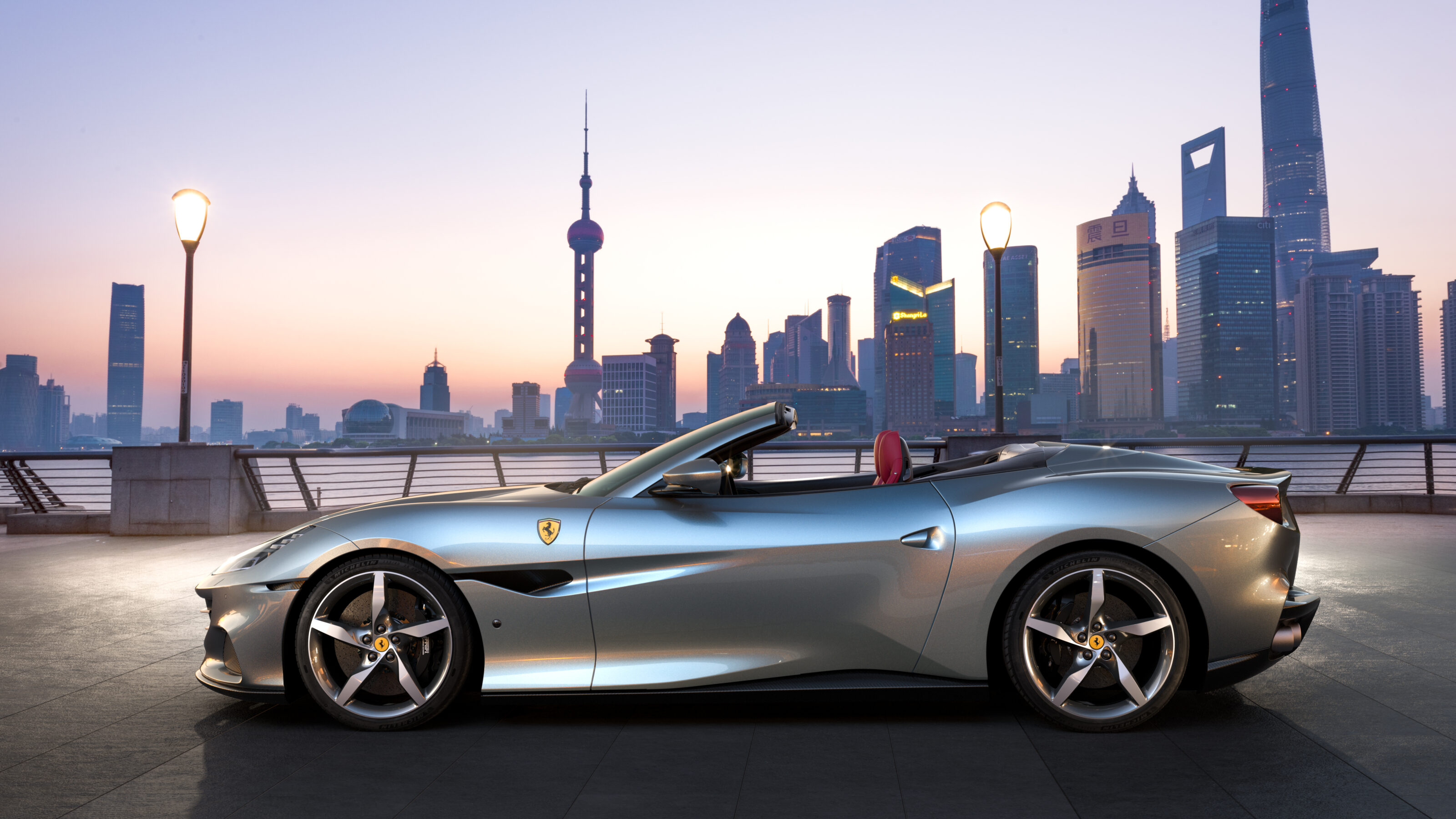
Much the same can be said of the Portofino. It only seems like yesterday that it was being introduced to replace the bulky California T, but we have word that the factory will build no more. That’s a shame because it had quietly evolved, via the later Portofino M model, into a hugely capable junior GT.
In latter years, much of its meagre limelight had been stolen by its mechanical sibling, the comely Roma coupe, but the Portofino’s legacy will be that it introduced so much new blood to the Ferrari stable.
1
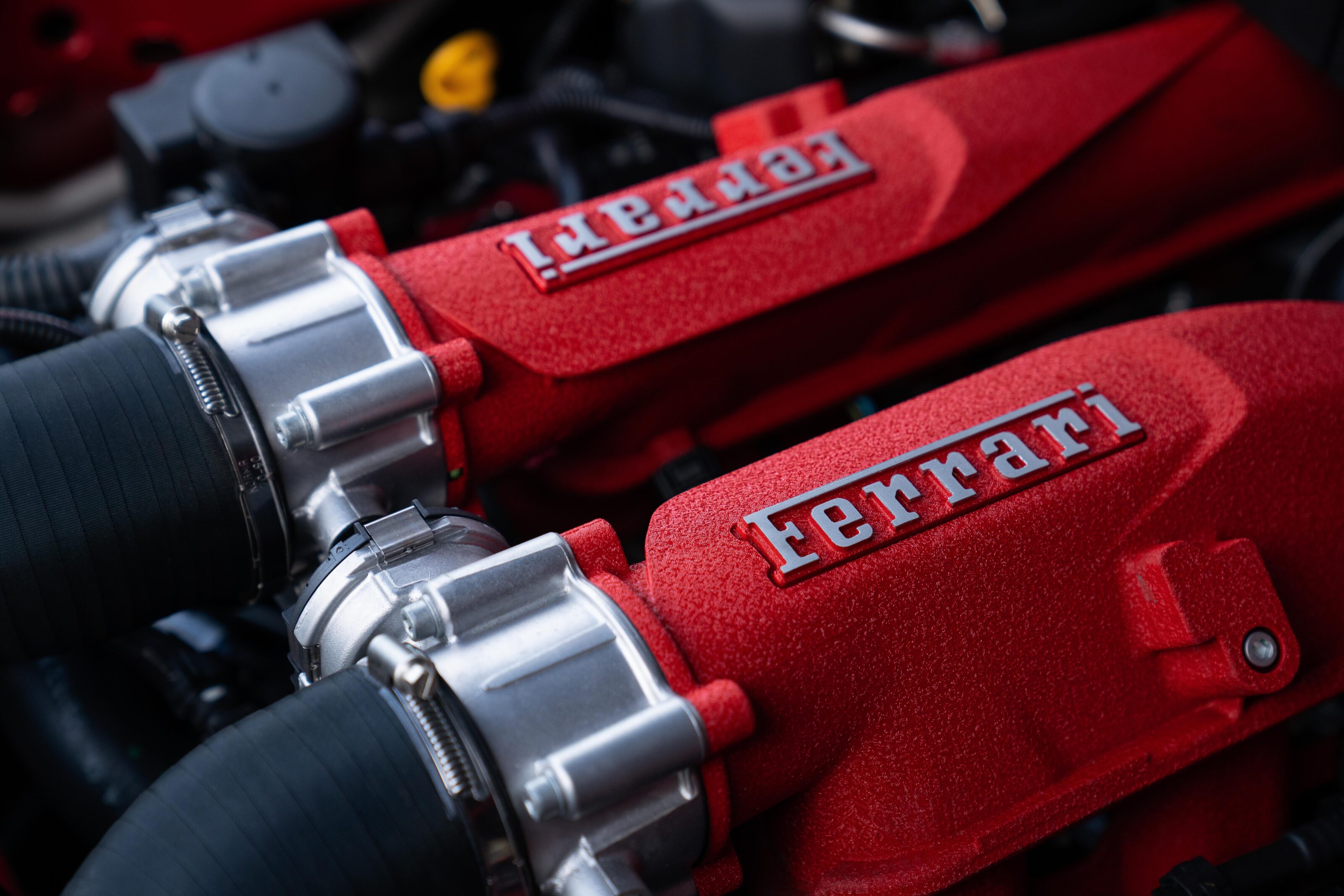
The Portofino launched here in 2018, powered by a 441kW/760Nm version of Ferrari’s 3855cc F154BE twin-turbocharged V8. Drive was sent to the rear wheels via a seven-speed dual-clutch ’box, tweaked to deliver faster shift times than the old Cali T. The interior also featured 50mm more rear legroom than its predecessor, a slicker 10.2-inch infotainment system and far more powerful air conditioning than the somewhat asthmatic California’s.
The Portofino M landed here in May 2021, with power output tweaked to 456kW, while the old seven-speed transmission was upgraded to an eight-speed dual-clutch transmission weighing a mere 96kg.
Ferrari promised zero turbo lag courtesy of its Variable Boost Management system, which ramps up boost as the car ascends the gears, reaching the full quota of 760Nm in 7th and 8th ratios. Thus equipped, the M knocked a second off the Portofino’s sprint to 200km/h.
1
That’s not to say that it had lost its original focus.It remained a more relaxed thing to drive than the mid-engined models and could bring those who might otherwise have looked at a Mercedes-Benz SL, a Porsche 911 Turbo Cabriolet or an Aston Martin DB11 Volante into the Ferrari fold. And boy, did it succeed in fulfilling that brief.
More than half of Portofino M buyers were first-time Ferrari customers and the original Portofino arrived at a crucial time, plumping up pre-pandemic cashflow just as the 488 model line orders tailed off, with the M manfully filling the void ahead of the arrival of the Purosangue.
What’s next? Well, Ferrari has coyly hinted that a replacement for the Portofino M is well advanced. Test mules of a Roma Spider have been spotted in Maranello and it already appears as an option on tuner Mansory’s website. A folding hard top roof is rumoured but we’ll find out for sure later this year.
The Portofino will never be a landmark Ferrari road car but, just quietly, it might have been one of the most important of recent years. Here’s to a job well done.
1
A clean exit
The Portofino M is equipped with Ferrari Dynamic Enhancer. Activated in Race mode on the manettino, it tweaks brake pressure on each wheel, making “the car’s lateral dynamics more predictable through and exiting corners.”
Yep, it’s a real ferrari
The Portofino M was a fearsomely rapid car if you committed to the loud pedal, fully half a second quicker to 200km/h than an Enzo hypercar, stopping the clock at 9.8sec. But despite the dynamic improvements, including a five-position manettino dial, it was never really the model of choice for gimlet-eyed corner-carvers who would doubtless prefer one of the mid-engined wedges.
1
MORE
Everything Ferrari
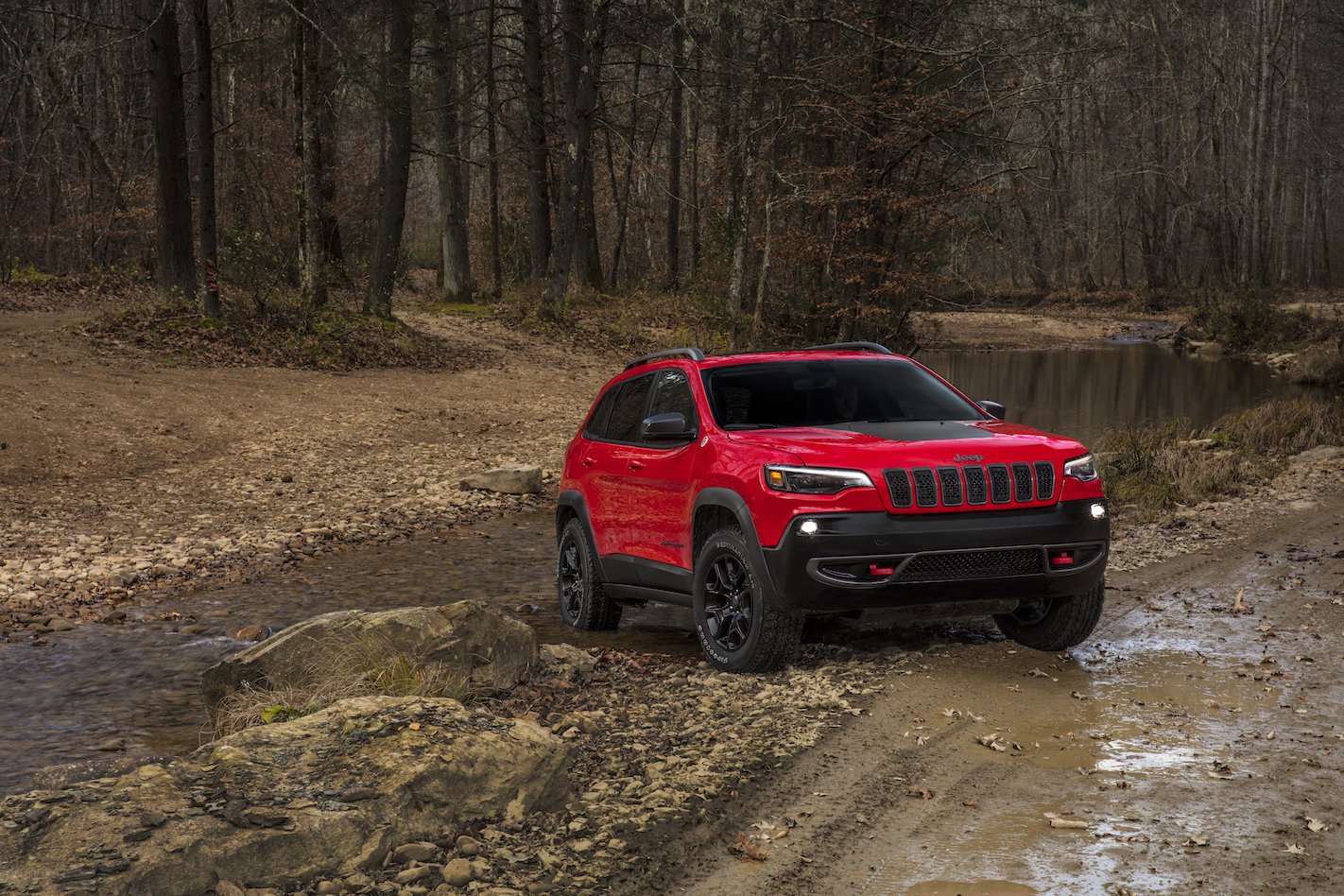
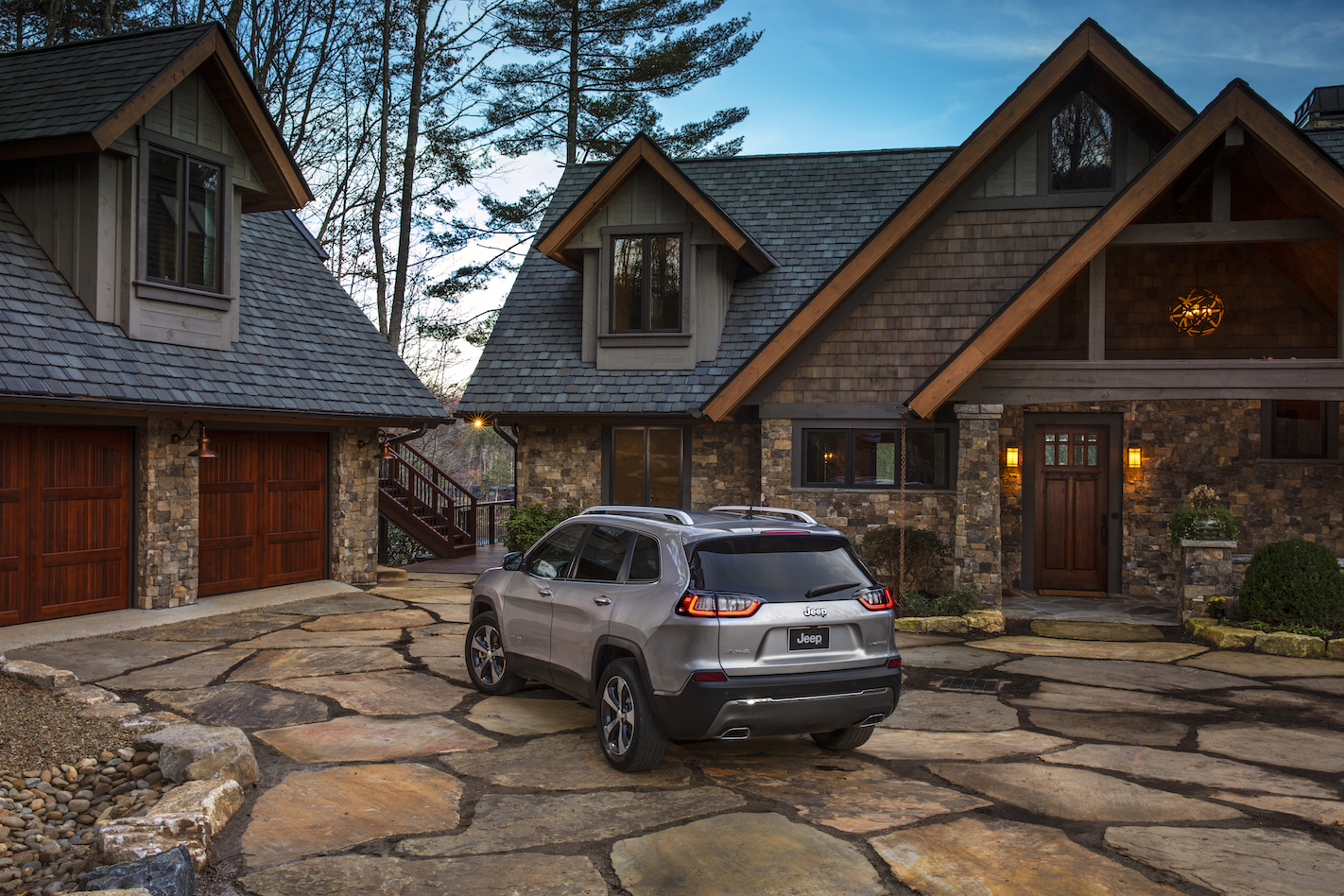
After a whopping nine-year run, reports from the US suggest the plug has been pulled on the fifth-generation KL Jeep Cherokee.
Reportedly confirmed to US outlet The Drive, it seems the catalyst for the Cherokee’s demise – if indeed true – was Stellantis’s decision to idle its Belvidere, Illinois manufacturing plant.
In late October 2022, it was announced that production of right-hand-drive KL Jeep Cherokees had ended, with fewer than 40 examples left unsold in Australia at the time. Then, in December, all Cherokee production was paused to compensate for supply issues.
Production continued for North American and South Korean markets, however sales had slowed and ranges had been trimmed significantly, with the final US 2023 model range comprising of just two variants.
1
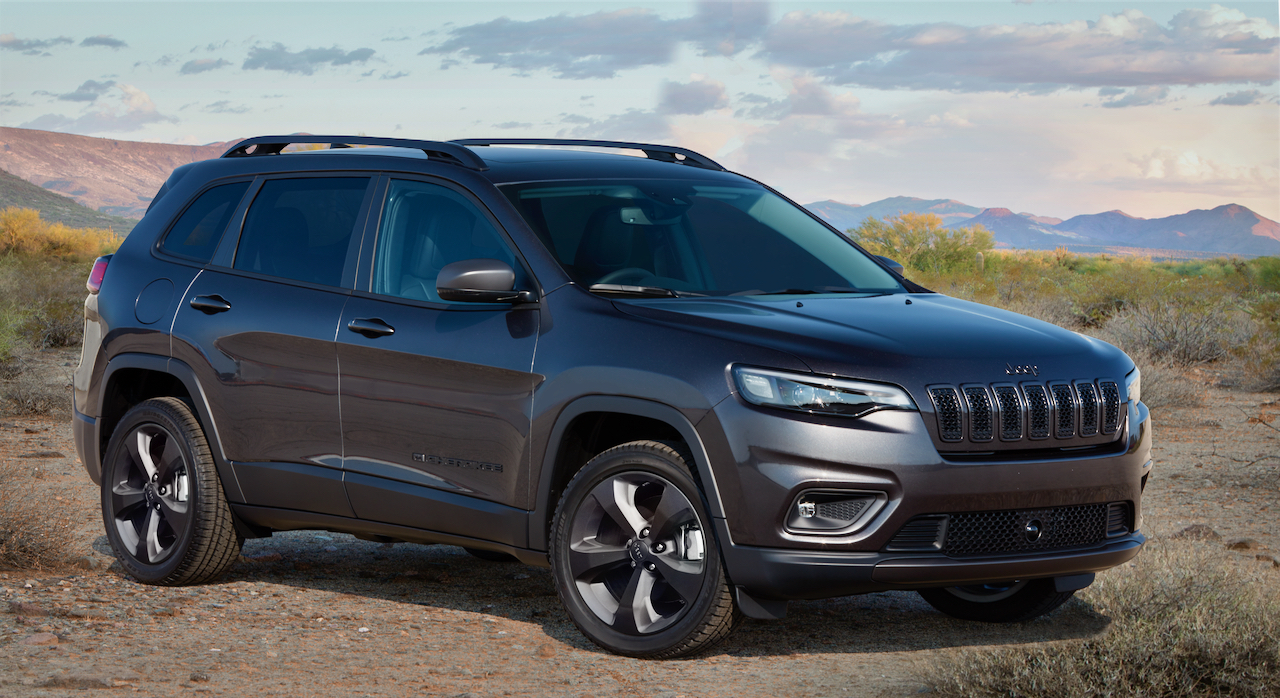
It’s not the end for the Cherokee badge, however. Today’s news adds further credence to reports of a new era for one of the most iconic nameplates in American motoring – but, for now, and for the first time in 49 years, there is no Jeep Cherokee.
In a cryptic response to its request for comment, Jeep’s American mothership told The Drive:
“We have plans for that important vehicle in that important segment. Details will be revealed in due time.”
An electric Cherokee? Seems likely.
Speaking with Wheels Media today, a spokesperson for Jeep in Australia said:
“The Jeep brand is fully committed to expanding its presence in the mid-size SUV segment, one of the largest in the world. The brand recently announced the introduction of two new fully electric, mid-size SUVs that will begin production in 2024.
“We will make an announcement regarding the next generation Jeep Cherokee in due course. All Jeep brand vehicles will offer an electrified variant by 2025 including four zero-emission vehicles in North America and in Europe.”
1
49 Years of Cherokee
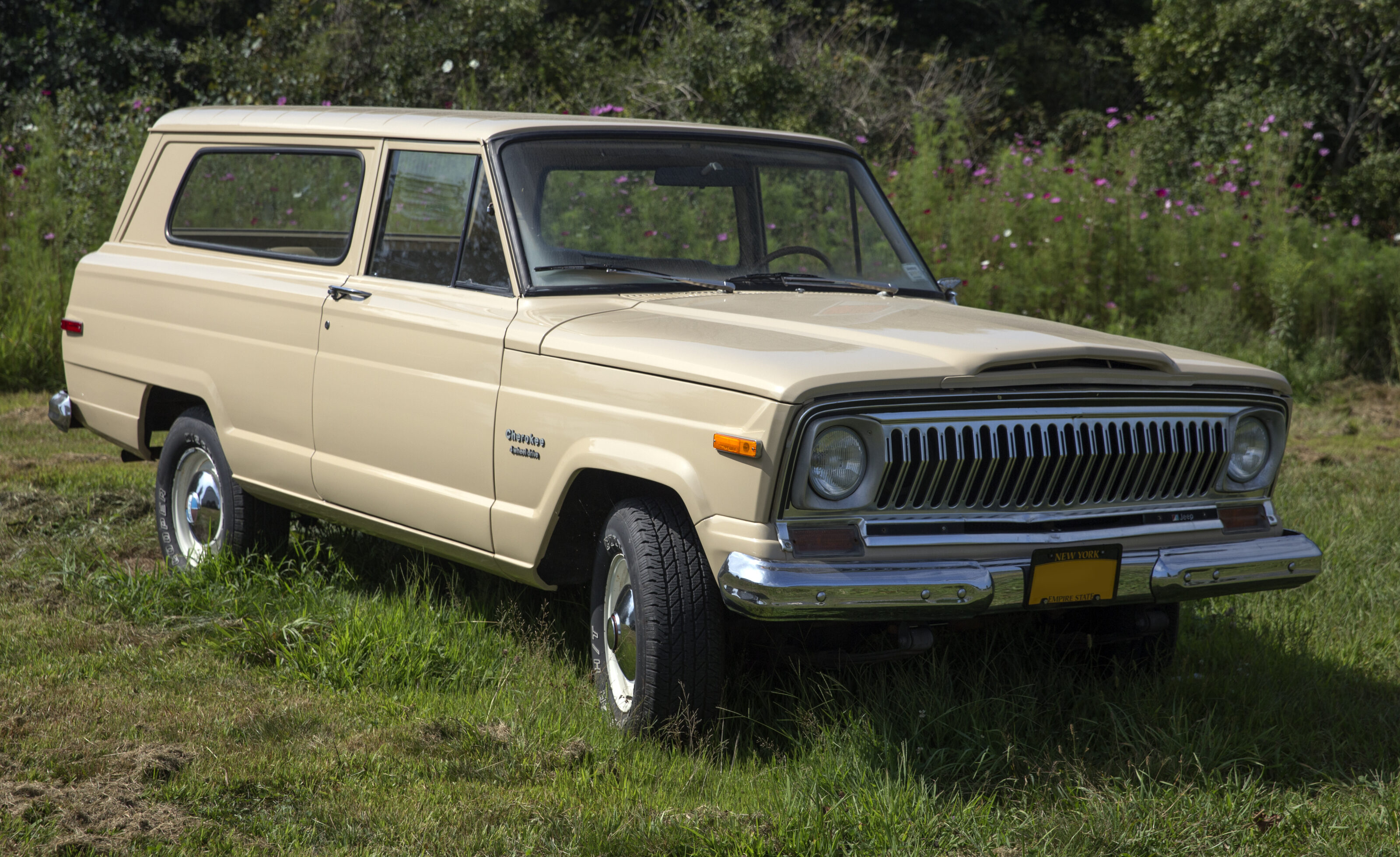
The Jeep Cherokee made its domestic debut in 1974 as a sportier two-door counterpart to the then AMC-owned and built Jeep Wagoneer with its innovative QuadraTrac fulltime four-wheel-drive system.
These Jeeps are ostensibly one of the earliest pioneers for the ‘SUV‘ segment, with ‘Sports Utility Vehicle’ first appearing in Jeep’s 1974 model-year brochure.
1
There’s an Australian manufacturing connection, too, as these first-generation SJ Cherokees were assembled from CKD (complete knockdown kits) in Brisbane from 1981 until 1985.
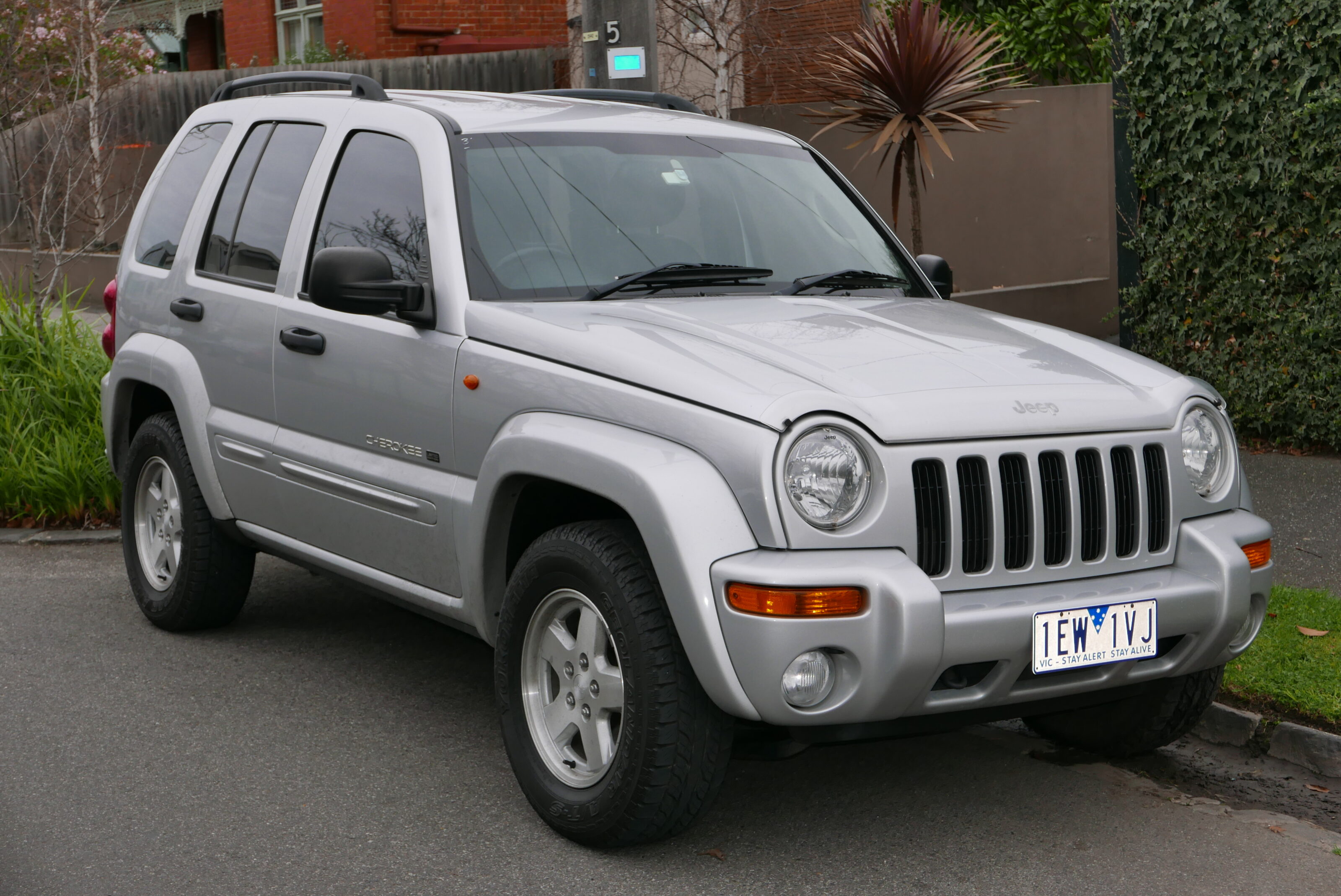
Over the years, and the various changes in corporate ownership, Jeep’s faithful Cherokee remained, but always evolved. Through almost half a century, it morphed from a rugged ladder-frame four-by-four, into smaller, urban-oriented unibody SUV through the Daimler-Chrysler era.
1
In 2021, the Cherokee Nation asked Jeep to stop using its name for its vehicles, but the automaker has yet to show any acknowledgement of the 18th century indigenous population’s request.
Jeep has yet to officially announce a follow-up for the Cherokee, though comments from US executives suggest something is in the works. Perhaps we’ll hear news next month at the New York Auto Show.
Stay tuned for more news as it happens.
MORE
SUV Buyers Guide
1
RAM is set to unleash an all-electric, Hilux-sized dual-cab ute into the US market.
New reports suggest that American RAM dealers were shown a new “midsize” electric pick-up at a secret meeting in Las Vegas. The new ute could mark a return to the midsize utility segment RAM left in 2011, and could be named after that same vehicle – the Dakota.
Details are scant, the dealers reporting that the Ranger-sized dual-cab ute is intended for a customer who wants a stylish option, rather than a full-size pick-up.
“We’re going to be back in that [midsize] game,” dealer Randy Dye told American industry journal Automotive News.
1
“Without a doubt, it looks like a Ram. I look at some of the other midsize offerings in the market, and I’m not going to pick on the individual brands, but I don’t think they always favour their mother brand. The midsize ones have seemed to get away, and they don’t look the same. This is very much a Ram.”
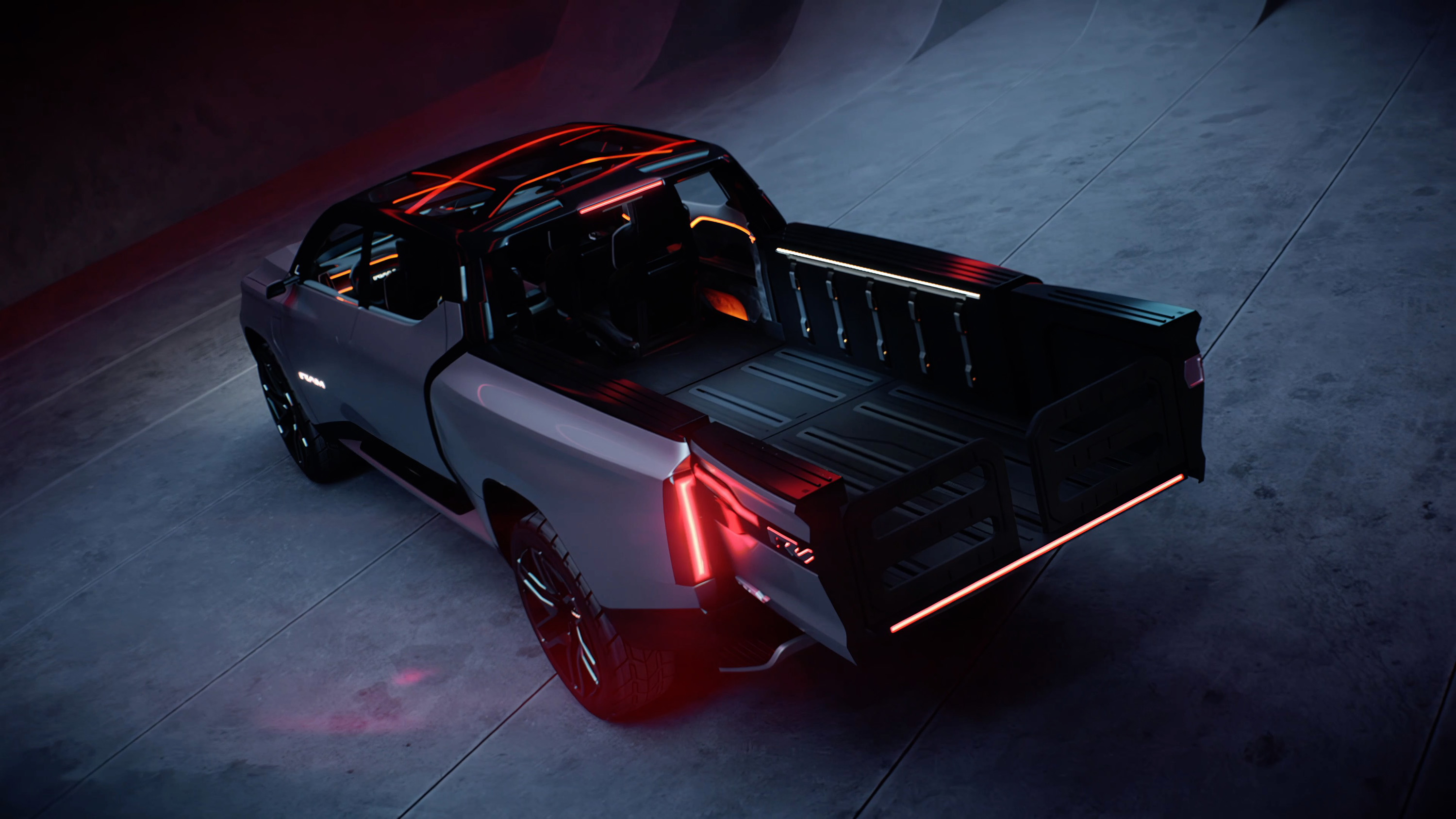
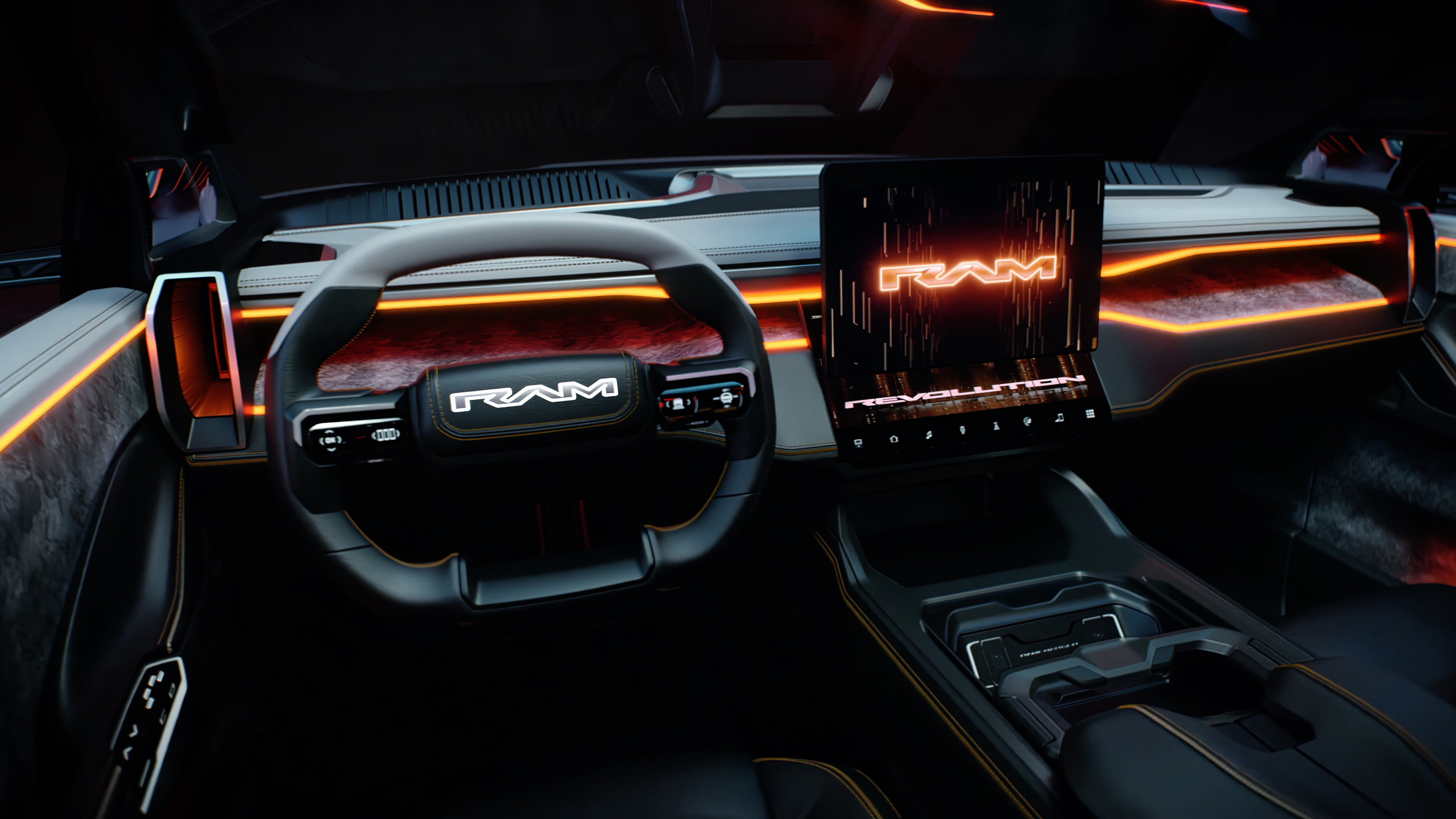
Other dealers said the production midsize ute previewed styling first teased by RAM’s Revolution electric concept pick-up, revealed at the 2023 Consumer Electronics Show (CES) in Las Vegas. While larger, the Revolution could also hint at future ideas set to be incorporated into a production model. Those include an an electrically opening and closing bonnet under which is a large carpeted storage area (also known as a ‘frunk’).
Extending the storage solutions further, the Revolution concept’s passenger compartment can be opened at the rear, effectively extending the tray-bed into the interior with the rear seats folded down. RAM says this “pass-through” storage can accommodate items up to 5.4 metres long.
1
Meanwhile its minimalist interior is dominated by not one, but two, supersized Tesla-esque central displays offering 28 inches of total touchscreen space. One of which can act as a removable tablet.
The Revolution concept is based on Stellantis’s STLA Frame architecture, which is 800-volt EV-ready and able to support large battery packs from 159kWh to a jumbo 200kWh, offering up to 800km range. It can also accommodate up to 350kW fast-charging.
“We see concepts change by the time they get to production, but it’s very, very encouraging,” Pennsylvania RAM dealer David Kelleher told Automotive News. “I think it keeps the lineage of Ram, which is really exciting, and I think it brings us back to a segment where we’ve been vacant for too long.”
1
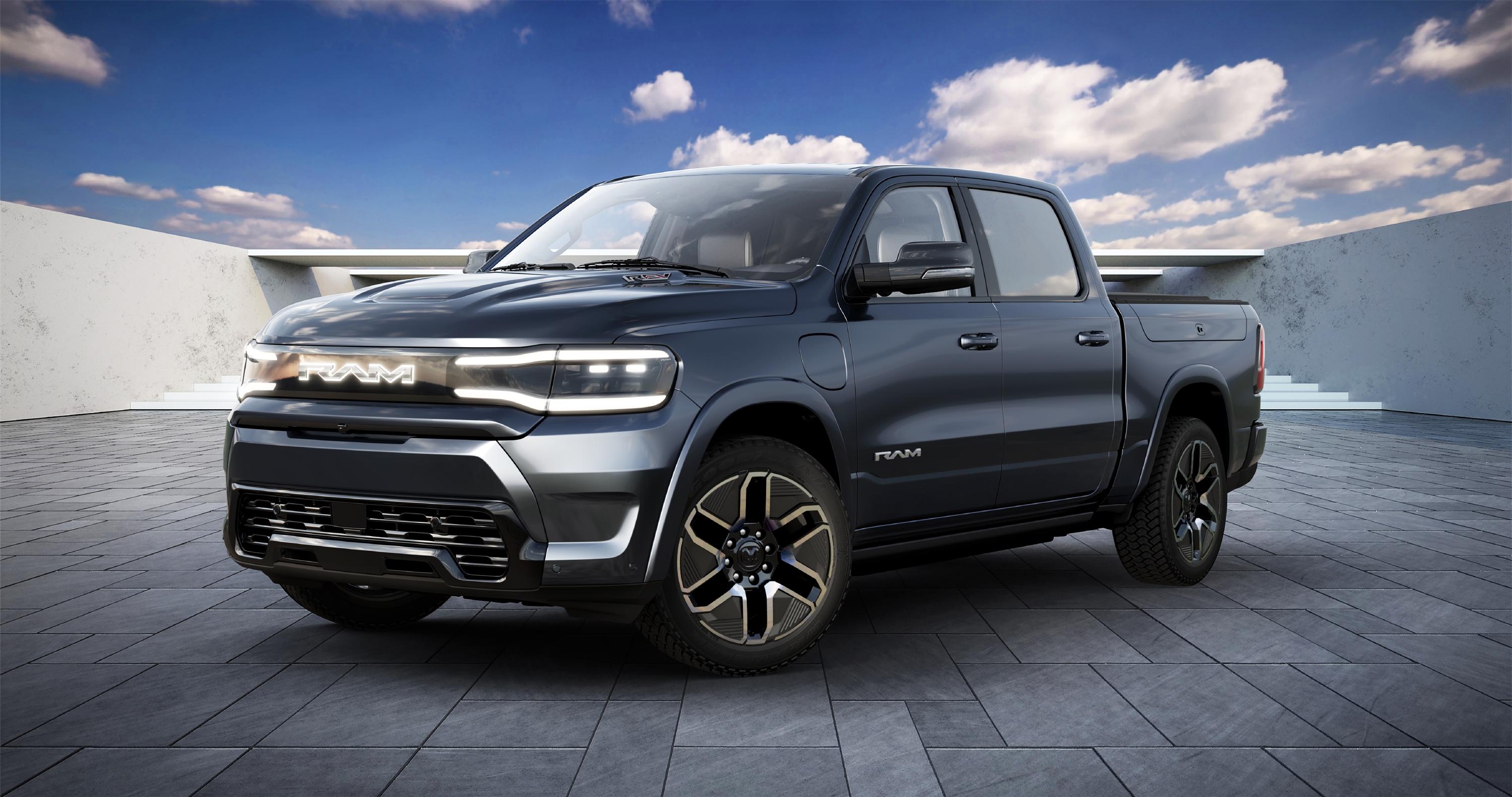
The new midsize RAM would sit below the recently unveiled 1500 REV electric utility (above) and join other electric utility players new to the market such as Ford’s red-hot F-150 Lightning, Geely’s Radar and Australia’s first electric ute, the LDV eT60.
Australia is RAM’s biggest market outside the US, offering the 1500 and 2500/3500 pick-up utes. With more than 600 employees at its Clayton, Victoria, facility, RAM is Australia’s biggest automotive manufacturer, converting vehicles from left- to right-hand-drive with an annual production capacity of 20,000 vehicles.
Local RAM importer Ateco was coy on the as-yet-unannounced electric ute’s chances for Australia when contacted by Wheels.
“RAM Trucks Australia is working closely with our colleagues in the US on the local product roadmap, and look forward to communicating more in due course,” said spokesperson Oliver Peagam.
MORE
Everything RAM
The updated Mazda 2 will arrive in Australia in July, with a price rise of up to $1080 – now starting from $22,290.
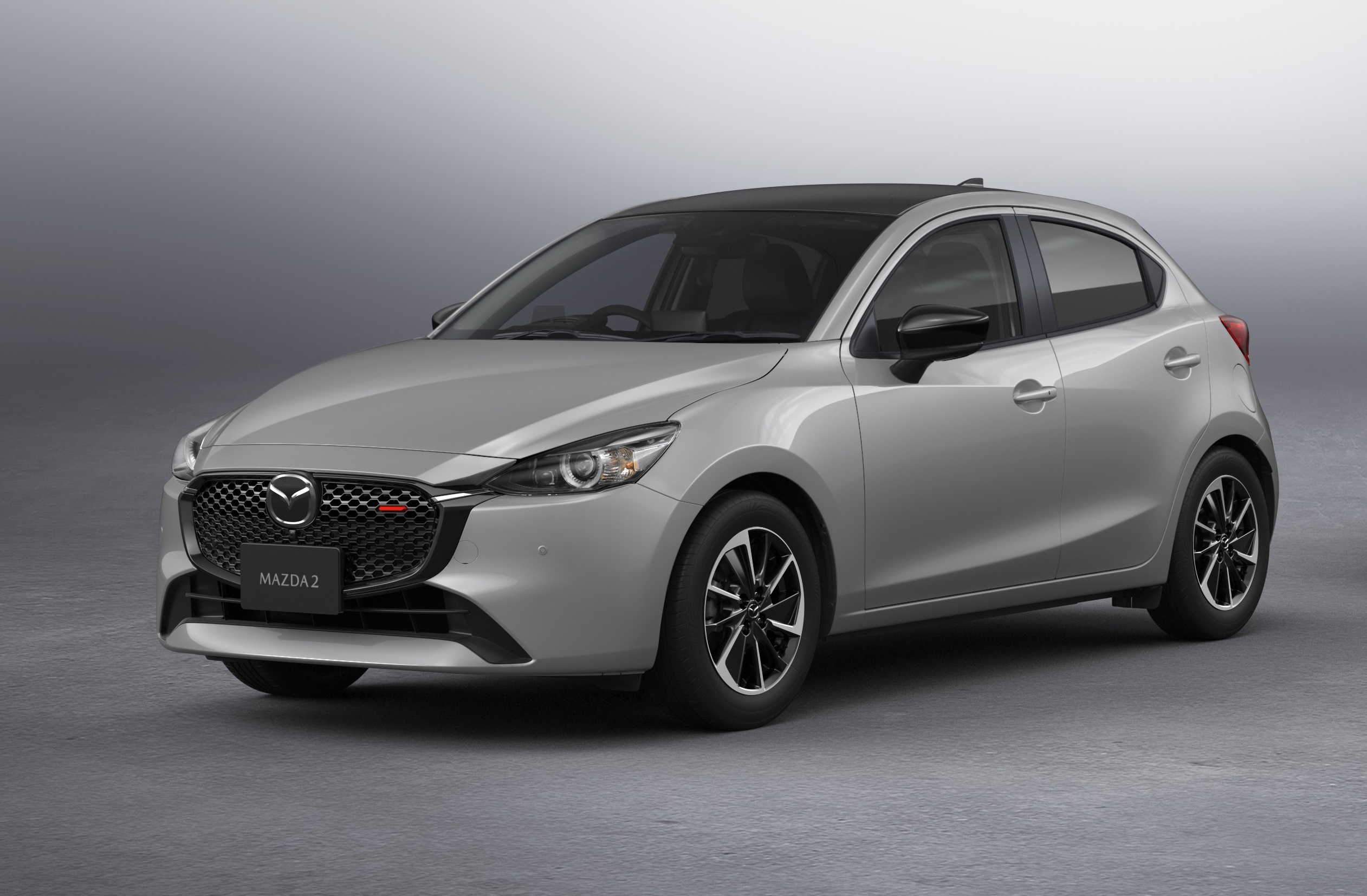
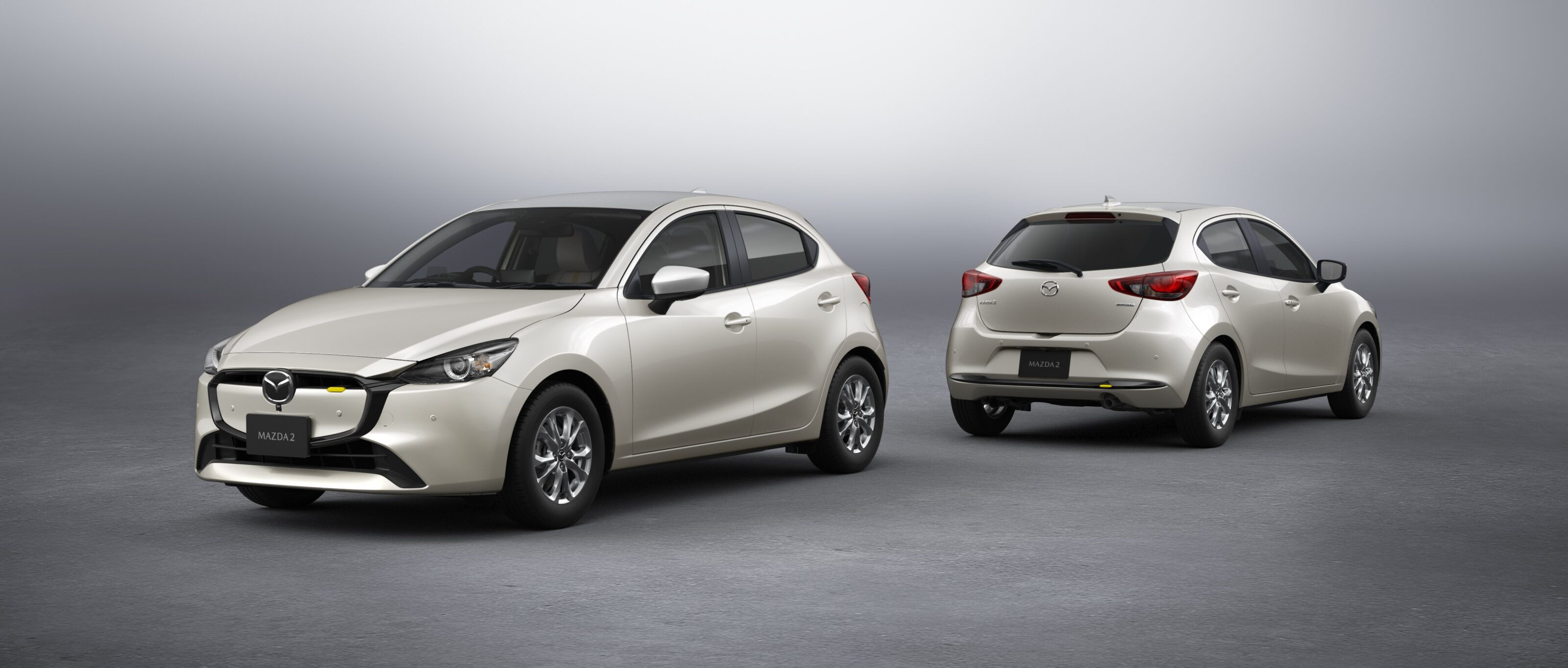
The changes are headlined by a mildly-revised front end with a larger front grille, a new X-shaped lower bumper, and more prominent Mazda badging with an integrated radar sensor.
There’s also a body-coloured, EV-like plate on the front grille for select versions, while the Mazda 2 hatchback will receive an “asymmetrically placed colour accent on the front grille and rear bumper,” similar to the latest CX-5.
Rounding out the styling changes, all hatchback variants, and the range-topping GT sedan, also receive a simplified rear bumper design.
Europe’s Mazda2 Hybrid is a Yaris!
To address tight EU emissions regulations, Mazda leaned on its relationship with Toyota to launch a Mazda 2-badged Yaris for Europe in 2021.
JUMP AHEAD
- 2023 Mazda 2 pricing
- 2023 Mazda 2 features
- Colours
- Engine, drivetrain, and fuel economy
- Safety
- Warranty and servicing
- Availability
1
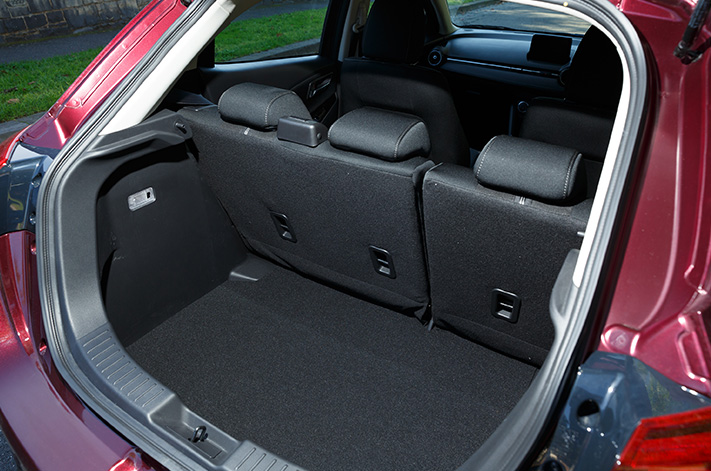
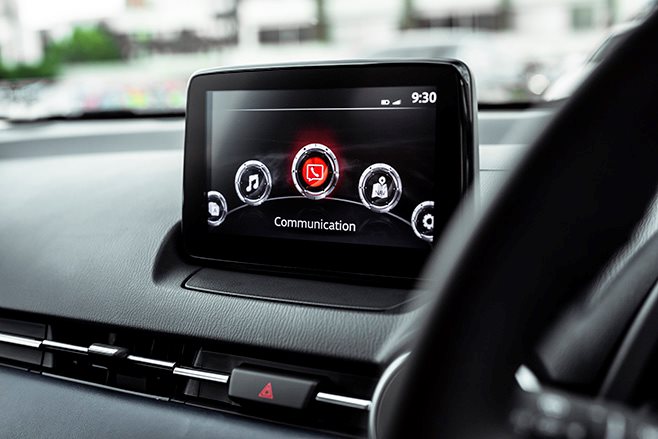
As before, the Mazda 2 retains an ageing 7-inch display, rather than the larger 8-inch screen now available in Japan – or the modern 8.8-inch screen available in the likes of the 3, running its new (reskinned) infotainment system.
A previous update for Japan in 2021 introduced wireless Apple CarPlay, a wireless phone charger, minor engine enhancements, and a variant with a CX-3 Maxx Sport LE-like interior; however, these changes will not apply to our Thai-built version.
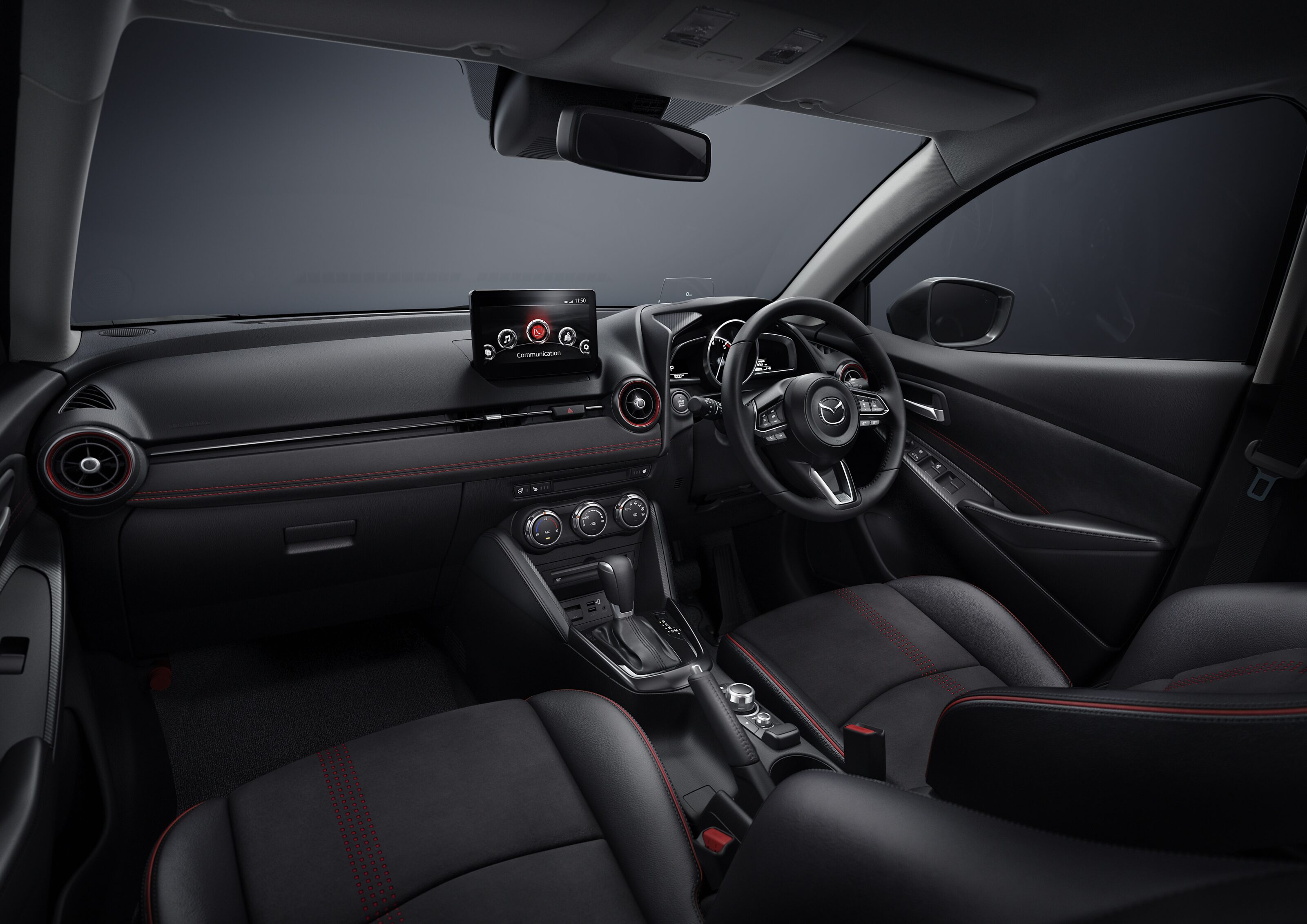
But Mazda’s local arm has confirmed the entry-level G15 Pure and Pure SP will receive a new coloured dash trim in white, black or mint, depending on the vehicle’s exterior finish.
The Mazda 2’s colour palette will expand with the addition of two new metallic finishes – aero grey and airstream blue – to join seven paint options currently available in Australia, with one deletion (likely aluminium metallic).
1
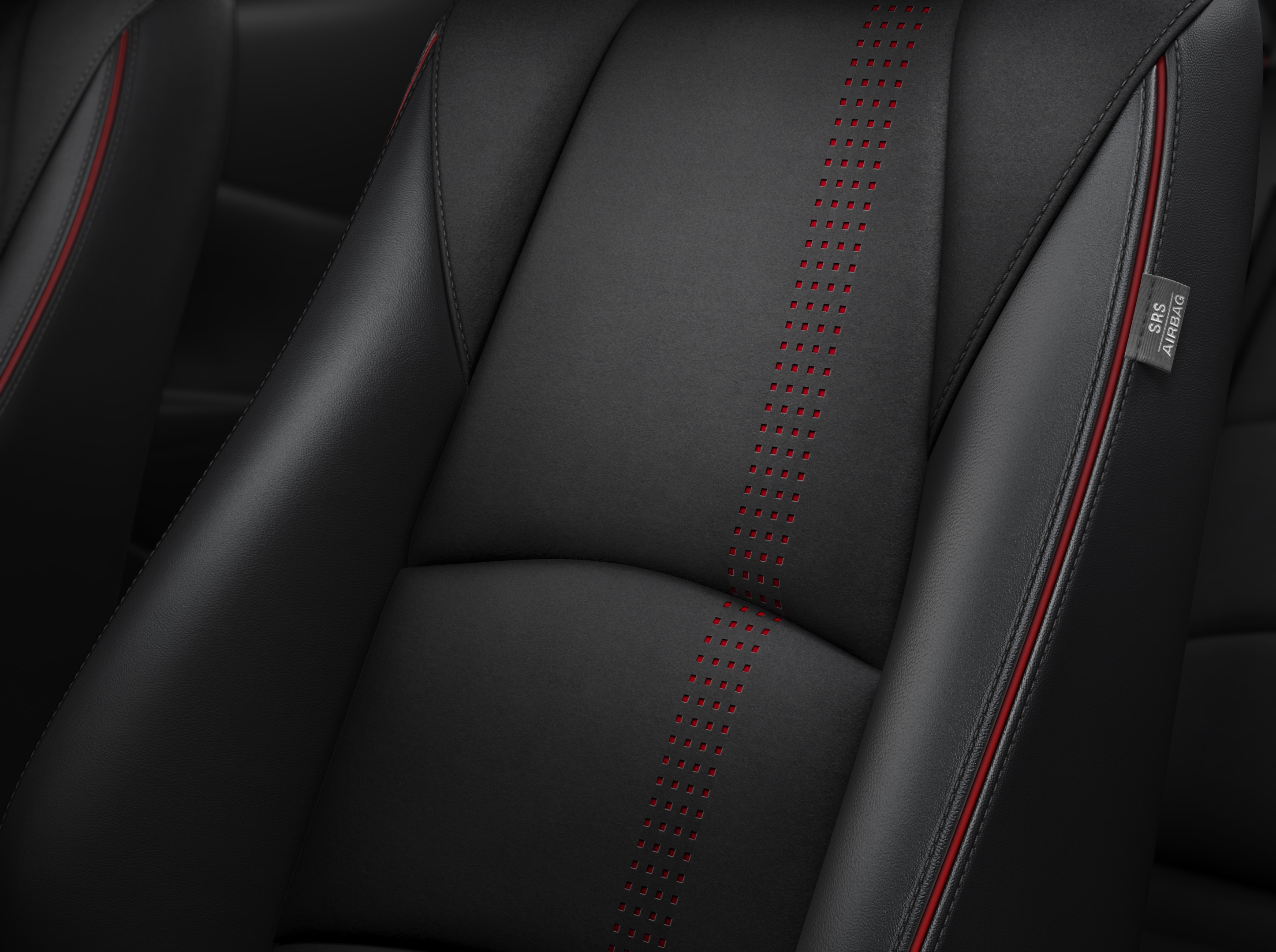
A black roof film will be added to the sportier-looking Pure SP, which was introduced in 2021, while the G15 Evolve and GT will gain red interior accents.
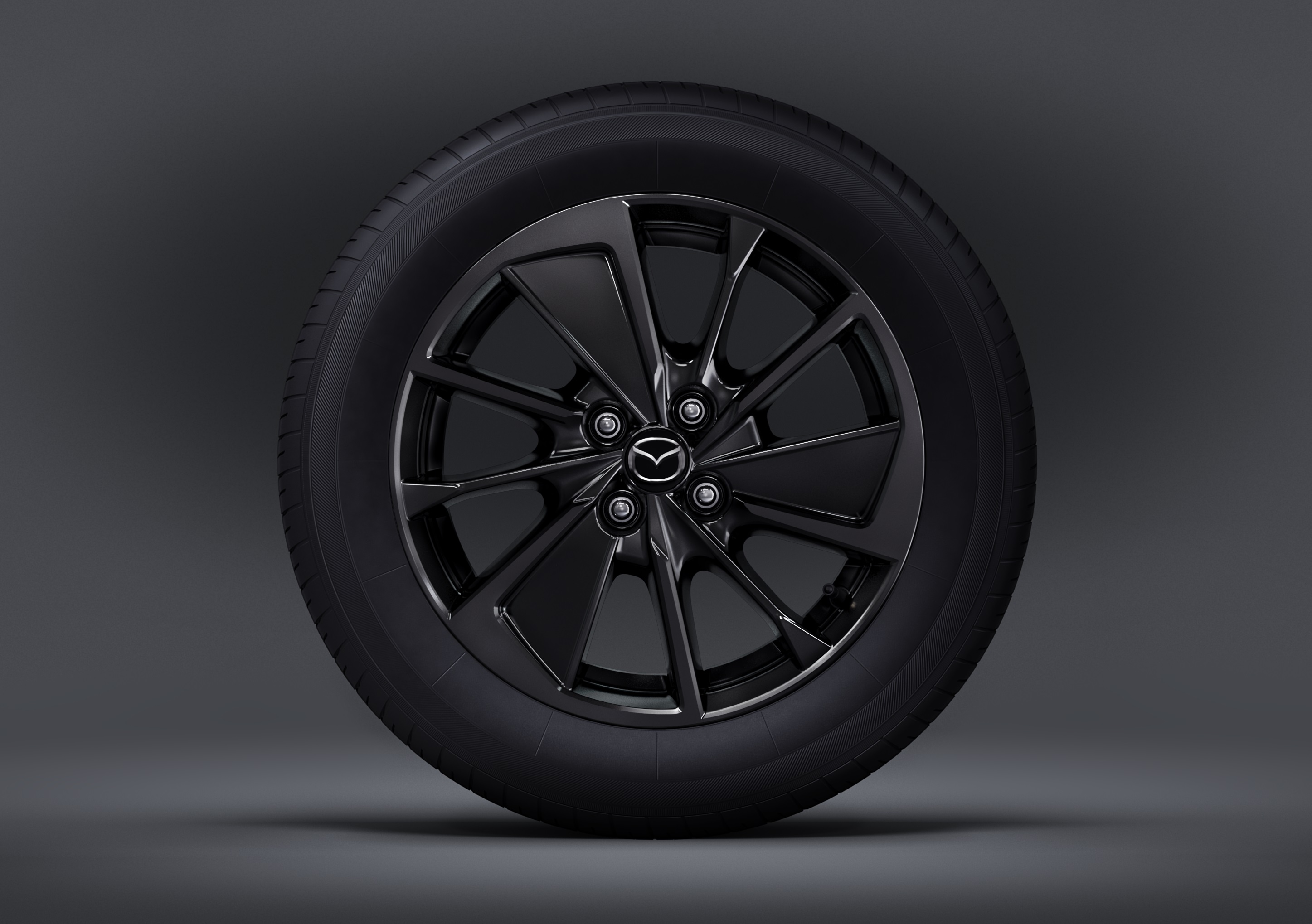
There’s also new black leather/suede upholstery, “aero-focused” 16-inch alloy wheels and dual exhaust outlets for the flagship G15 GT.
In addition, a shark fin antenna will sit atop G15 Evolve and GT variants.
It is the second facelift for the nine-year-old Mazda 2, with a comprehensive update in late 2019 adding a redesigned front, more active safety features, and other new technology – but at a higher cost than the pre-facelift version.
VFACTS new-car sales figures show 5146 examples of the Mazda 2 were sold in Australia in 2022, placing it behind the MG 3 (16,168) and now-axed Suzuki Baleno (6124) – but ahead of the Toyota Yaris, which also moved into a higher price bracket with its latest generation in 2020.
1
2023 Mazda 2 pricing
Prices exclude on-road costs.
1
2023 Mazda 2 features
G15 Pure
G15 Pure SP
1
G15 Evolve
G15 GT
Colours
Metallic paint incurs a $595 premium.
1
2023 Mazda 2 engine, drivetrain, and fuel economy
The Mazda 2 is only available with a 1.5-litre petrol four-cylinder petrol engine.
Fuel consumption is listed at 4.9 litres/100km with the six-speed manual or 5.4 litres/100km with the six-speed automatic, based on official test figures.
The manual gearbox is only available with the cheaper G15 Pure hatch.
| 2023 Mazda 2 fuel economy | ||
|---|---|---|
| 1.5-litre four-cylinder manual | 5.4L/100km | 125g/km |
| 1.5-litre four-cylinder automatic | 5.3L/100km | 123g/km |
1
Safety
| 2023 Mazda 2 active safety features | |
|---|---|
| Autonomous emergency braking (low-speed vehicle, pedestrian and reverse) | Blind-spot alert |
| Lane-keep assist | Rear cross-traffic alert. |
| Lane departure warning | |
1
Warranty and servicing
As per the wider Mazda range, the 2 is covered by the brand’s five-year, unlimited-kilometre factory warranty. It has a complimentary roadside assistance program over the same period.
Mazda offers five years of capped-price servicing. Maintenance is now required every 12 months or 15,000 kilometres, whichever occurs first – up from the previous 10,000km limit.
Availability
The updated 2023 Mazda 2 is scheduled to arrive in Australia in July.
For more information on Mazda’s wait times, click here.
MORE
Everything Mazda
The Big Lamborghini lives on with Revuelto, a mid-engined supercar packing 746kW of electrified V12 grunt.
Snapshot
- Petrol V12 and three electric motors produce 746kW
- 0-200km/h in under 7 seconds
- Emissions-free driving possible
- Carbon fibre u2018monofuselageu2019 construction
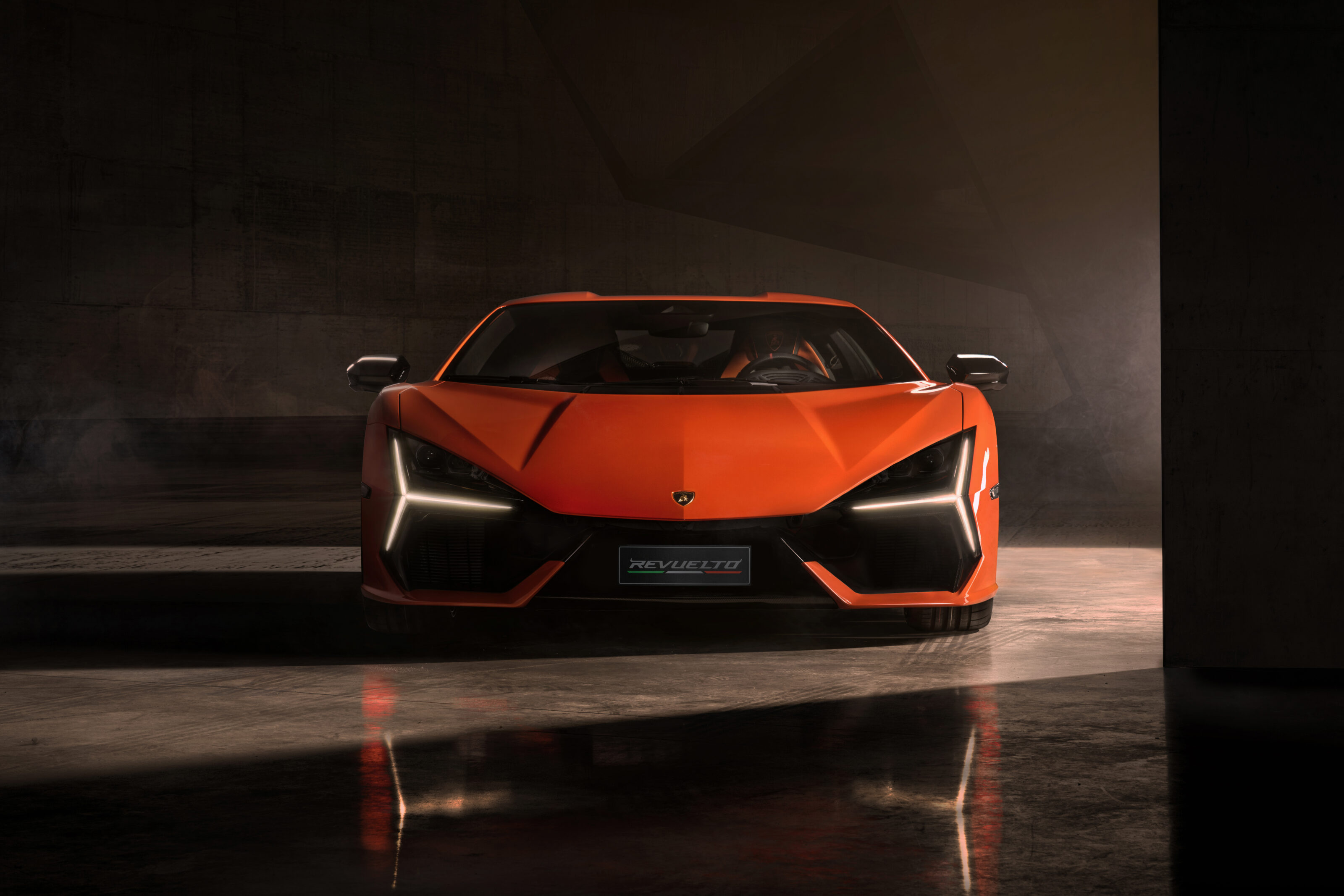
Lamborghini has unveiled the Aventador’s successor, dubbed the Revuelto, after a month of teasing powertrain, chassis, and drive mode details.
Although the Revuelto is technologically advanced enough to pack a plug-in hybrid powertrain with three electric motors, the sixth Big Lamborghini instalment eschews turbocharging in favour of a naturally aspirated 6.5-litre V12 petrol engine.
1
There’s also a carbon fibre frame underneath that bodywork, and Lamborghini claims a 0-100km/h sprint in less than 2.5 seconds, with the Revuelto able to dispatch 200km/h in under 7 seconds and hit more than 350km/h.
“Revuelto was born to break the mold, combining a new 12-cylinder engine with hybrid technology, creating the perfect balance between delivering the emotion that our clients want with the necessity to reduce emissions,” Stephan Winkelmann, CEO and chairman said.
1
Revuelto unveiled
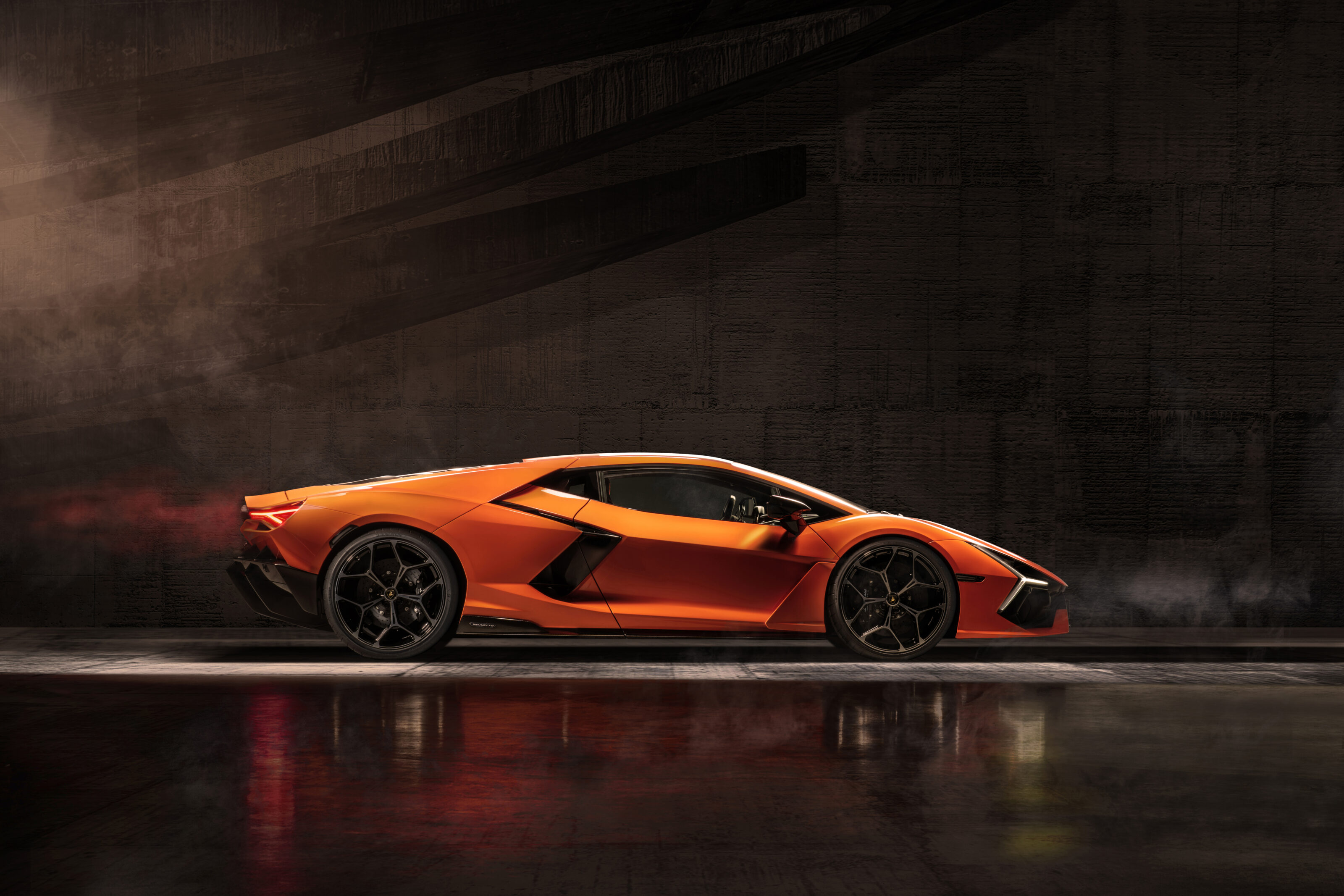
“The Revuelto is adrenaline made visible… from first sight, Revuelto is an intriguing next-generation Lamborghini V12, with all lines embracing the monocoque and celebrating a free view towards the V12 HPEV powertrain,” said Mitja Borkert, Lamborghini head of design.
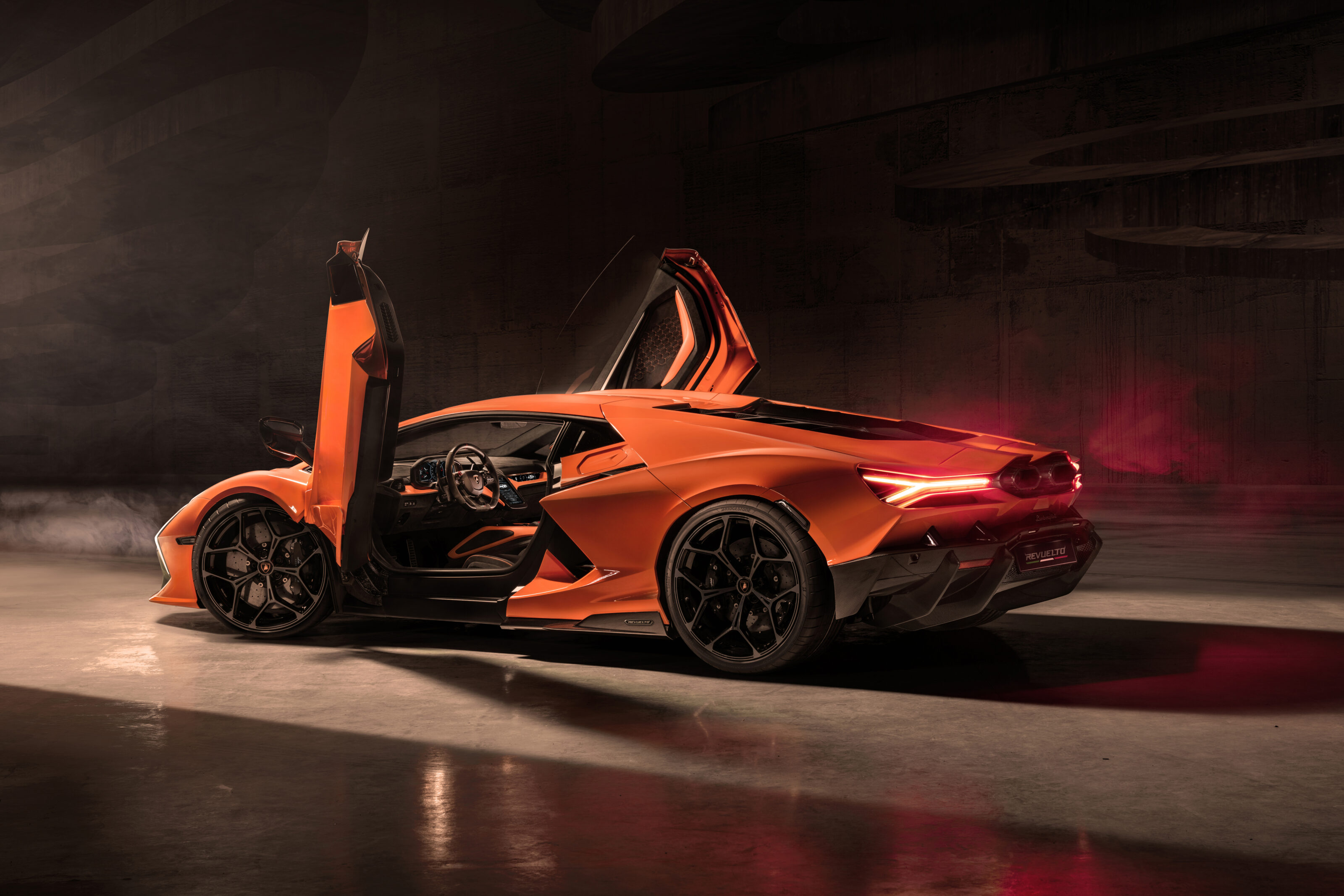
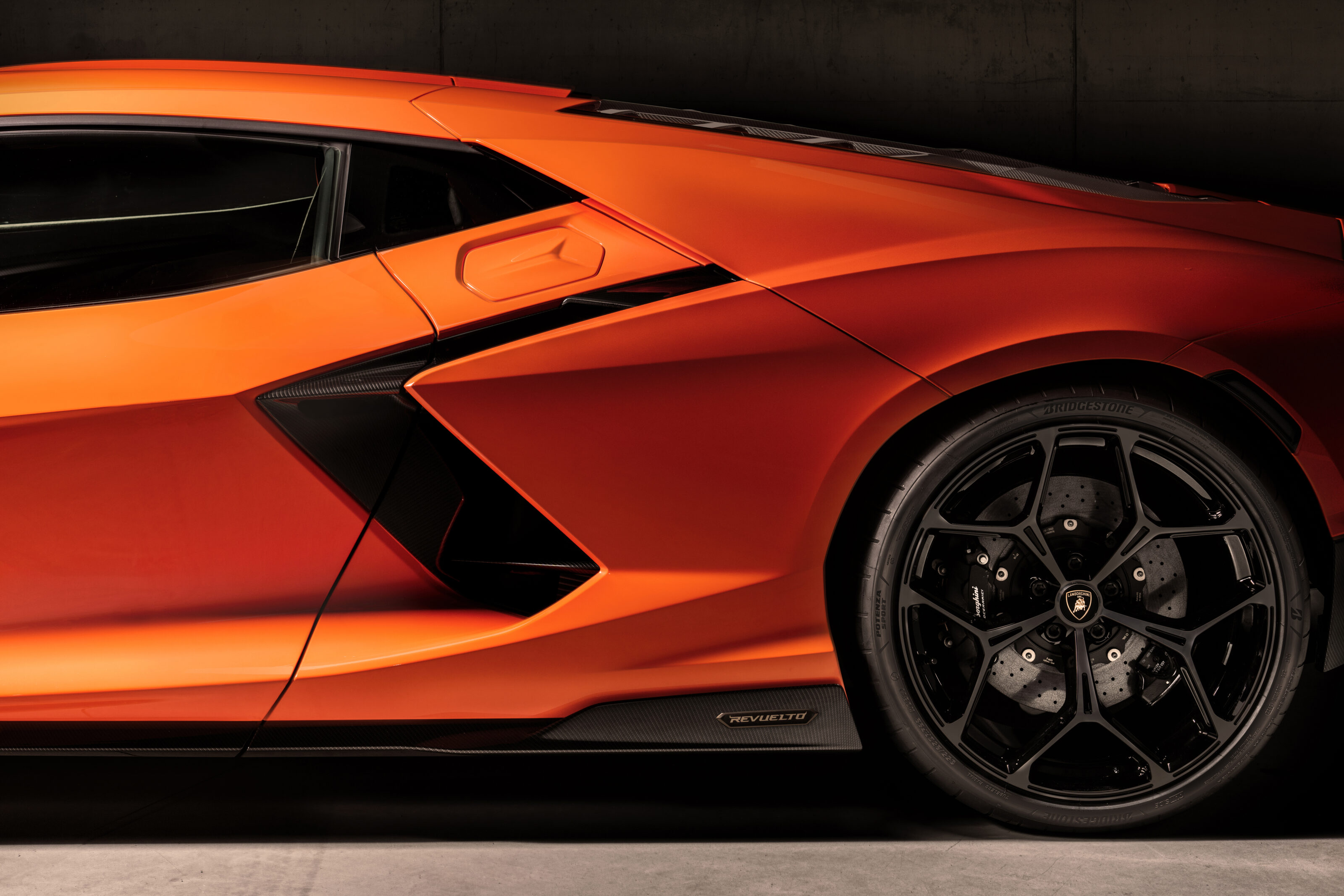
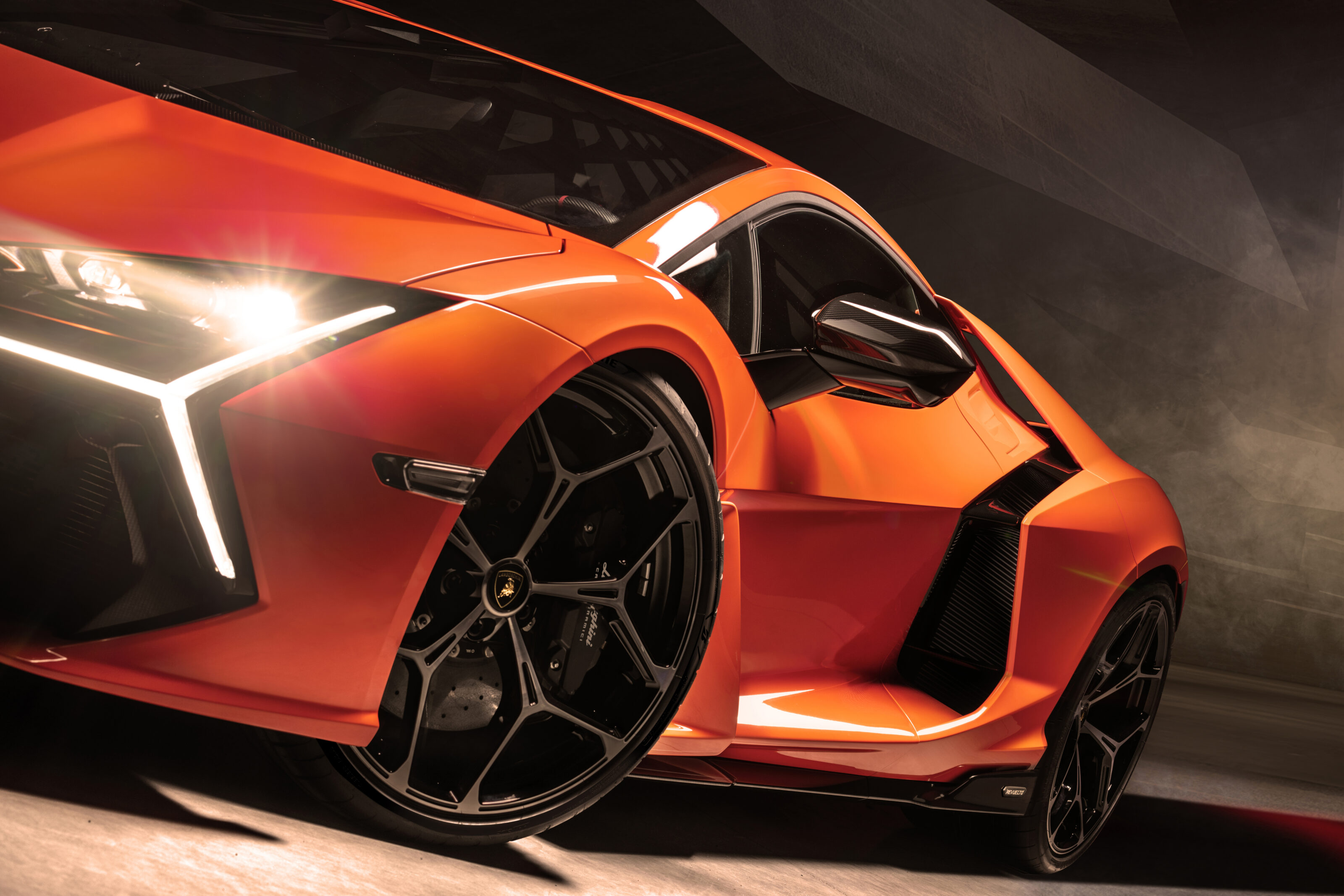
Lamborghini’s signatures remain, including dramatic scissor doors, familiar designs for the 21-inch alloy wheels and beautifully presented V12 petrol engine. Lamborgini has promised 400 paint colours for the Revuelto – so customisation won’t be limited.
1
The Revuelto is distinctly Lamborghini, but its cab-forward mid-engine proportions are more pronounced than the Aventador – that’s to accommodate all the technology under the rear deck. Sharp Y-shaped LED headlights tie into the matching centre console design.
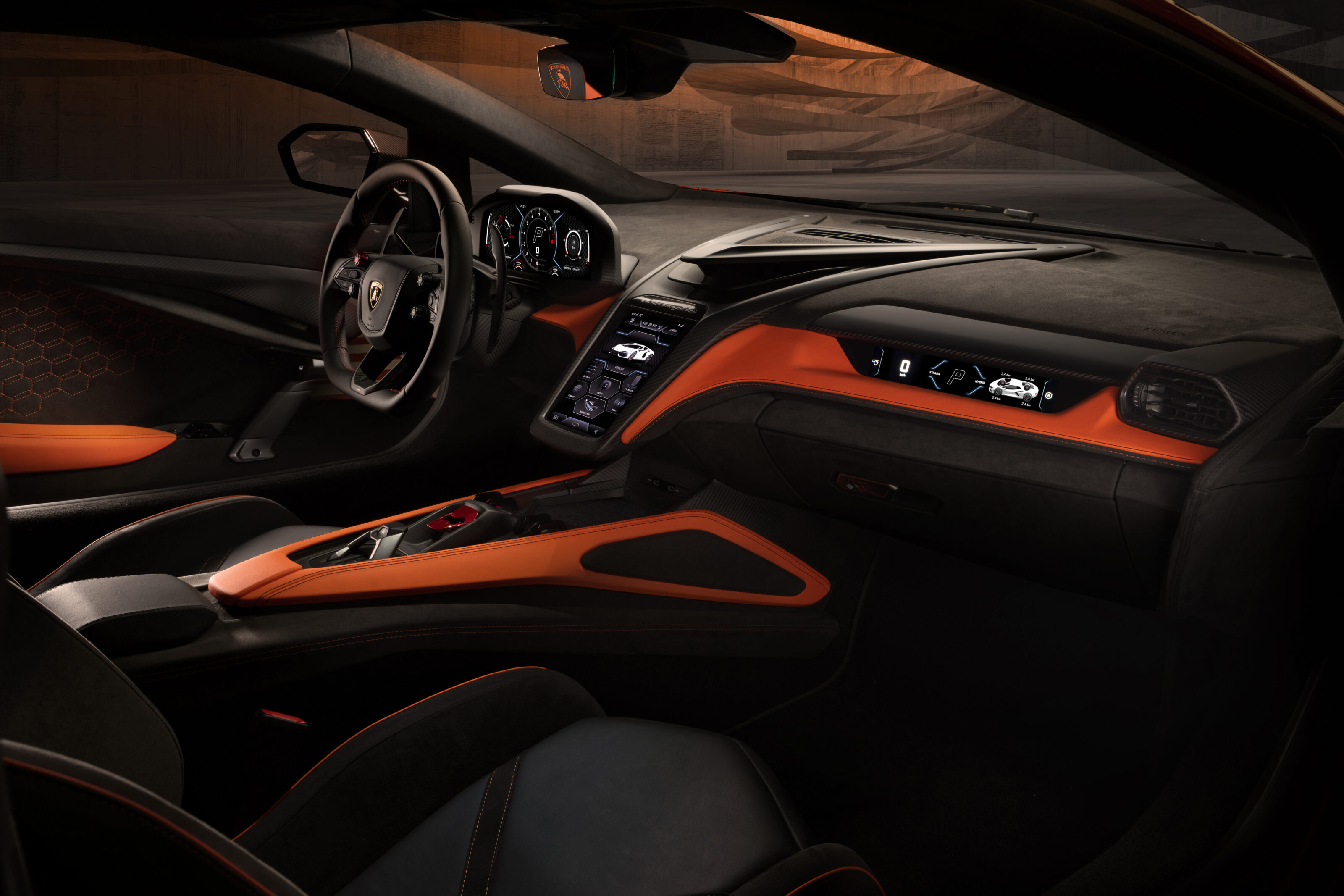
While the cocooning cabin still aims to make the driver feel like an aircraft pilot, space is now more generous with 26mm extra headroom and 84mm more cabin length than the Aventador.
There are two instrument displays inside – 12.3 inches for driver and a slim 9.1-inch unit for passenger – that are customisable. The steering wheel and controls all feature familiar Lamborghini shapes and design language.
6
The Revuelto also features onboard connectivity, live map updates, and Lamborghini’s latest advanced driver assistance tech to complement the central infotainment touchscreen.
Unlike all but three midship V12 Lamborghini models (Sesto Elemento, Sián and Countach), the name Revuelto comes from a bull. This time, a particularly angry one from the 1880s. Revuelto means ‘scrambled’ or ‘unruly’ in Spanish, but is most often used in reference to scrambled eggs.
1
The Revuelto’s powertrain
The ‘L545’ 6.5-litre V12 would have no trouble scrambling eggs on its own. The petrol engine produces 615kW at a staggering 9250rpm (redline cuts in at 9500rpm) and 725Nm at 6750rpm. Lamborghini claims the new ‘L545’ is its lightest-ever V12, too.
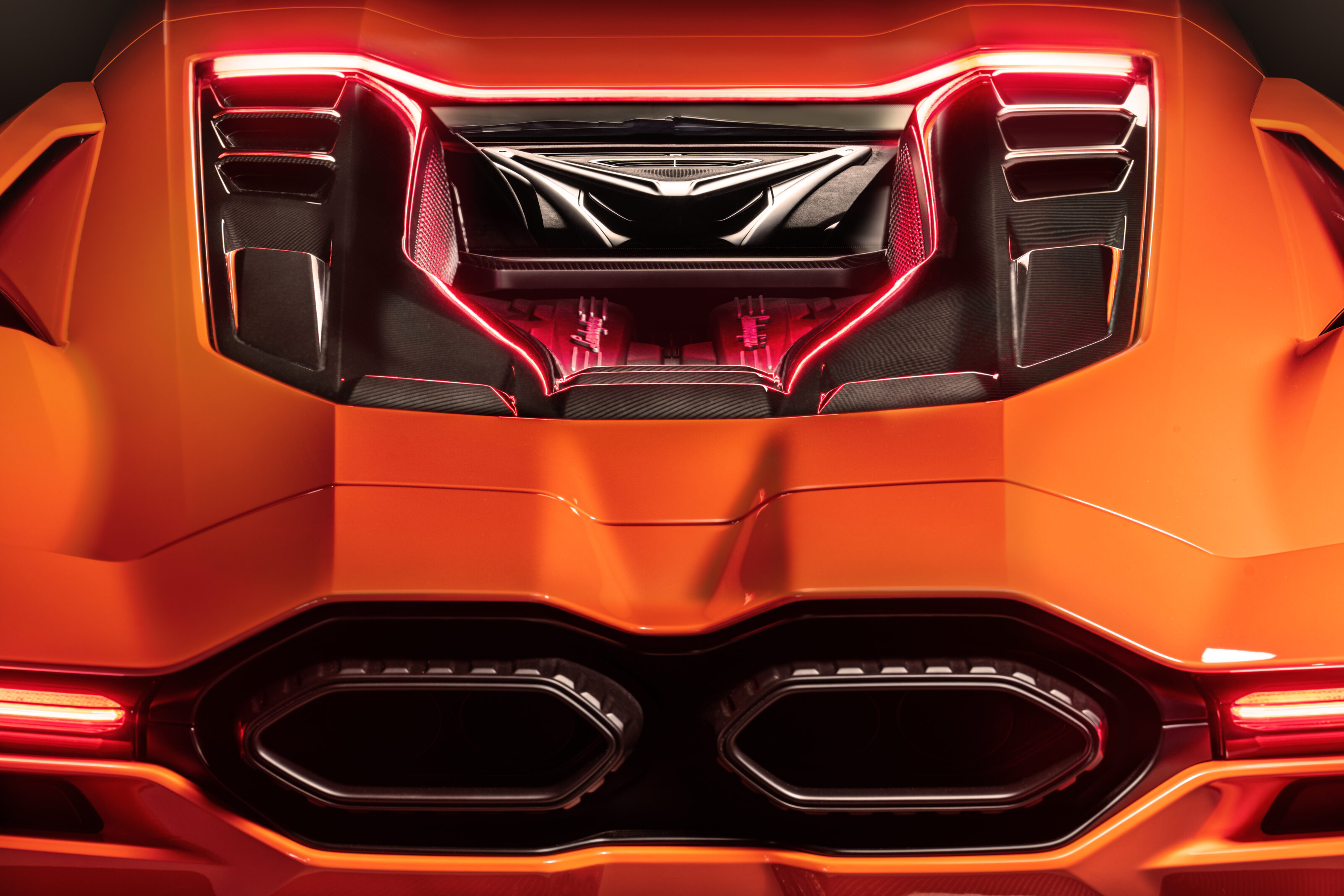
Naturally, exhaust and engine sound is a big deal in the Revuelto, and Lamborghini has been hard at work to make this sound like a real supercar. We haven’t heard it yet, but the massive twin hexagonal exhaust outlets are promising.
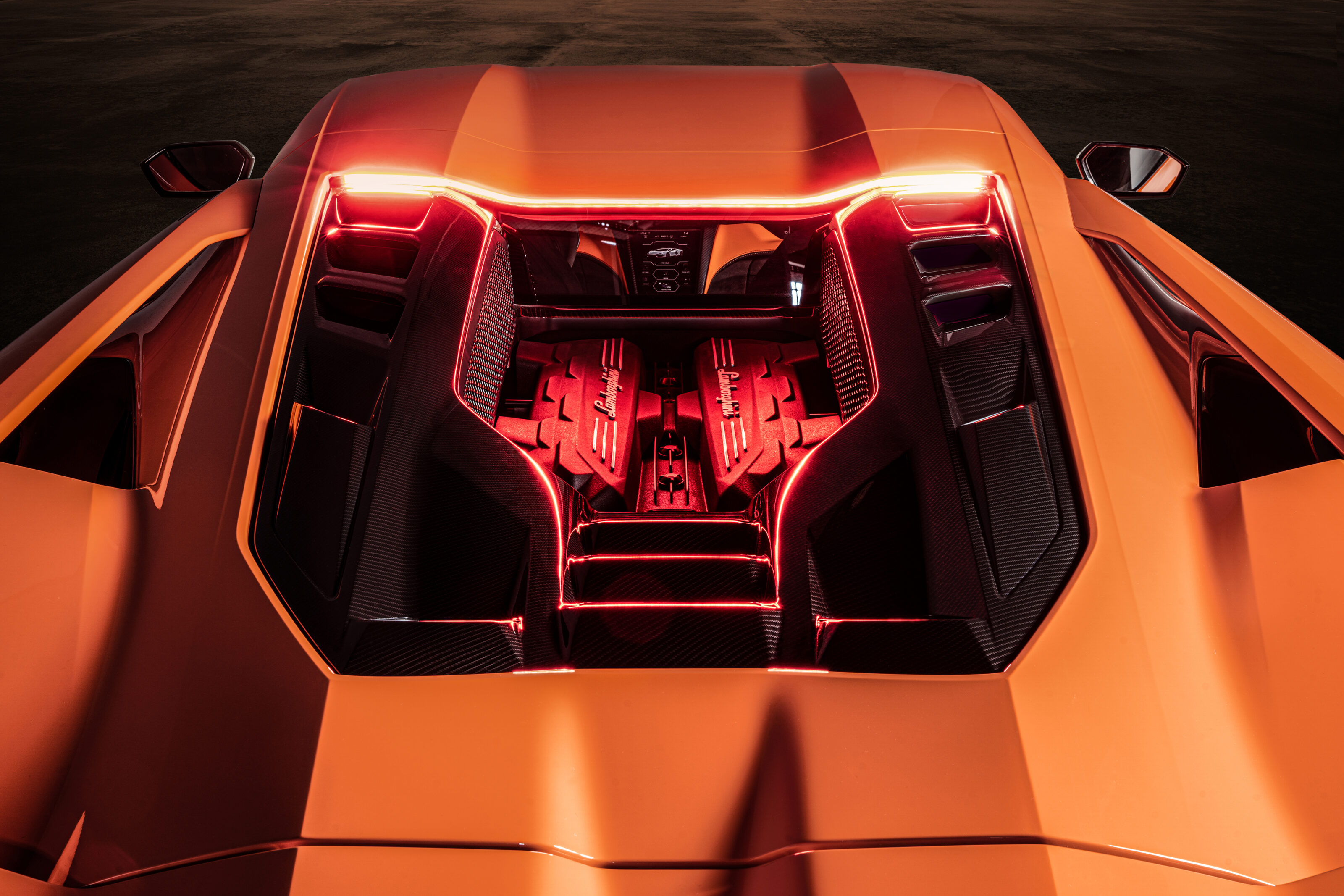
To package the engine with three electric motors – including one mounted on the transmission – the V12 is spun 180 degrees from the Aventador. Still longitudinal, but ‘backwards’.
1
This allows the new eight-speed dual-clutch transmission to sit transversely behind the engine to accommodate the electrical gubbins. The 110kW/150Nm rear electric motor is used to power the rear wheels in conjunction with the V12, provide electric AWD in low-grip situations, and as a replacement for the reverse gear in the eight-speed gearbox. Clever.
Up front, the Revuelto continues Lamborghini’s AWD tradition, but the V12 doesn’t turn the front drive shafts; instead, a 150kW/350Nm electric motor is mounted to each front wheel. Not only does this provide huge power advantages, but also more dextrous torque vectoring than an electronically-controlled limited-slip differential.
Providing electric driving range is a 3.8kWh lithium-ion battery. Instead of being stacked underneath the floor like a ‘skateboard’, the Revuelto arranges the cells in the transmission tunnel to preserve a more natural weight distribution for the supercar. Lamborghini doesn’t claim an electric driving range; expect it to be less than 20km.
A total of 13 drive combinations cover everything from electric city driving called ‘Citta’ to full-speed Nürburgring lap time attempts in ‘Corsa’.
1
A carbon fibre chassis
More technological innovations for Lamborghini sees extensive use of carbon fibre in the Revuelto’s chassis. The ‘monolithic rocker ring’ (which connects the A-pillar, tub and front subframe) is made from carbon-fibre reinforced plastic, while forged carbon fibre is used in the front structure.
The roof and bonnet are made from pre-preg carbon fibre, and various other parts are constructed from the Aerospace wonder material.
The rear subframe – where the suspension, engine, and transmission meet the body – is constructed from aluminium alloy, with hollow domes providing enhanced strength for the rear suspension mountings. Adaptive dampers are attached to ‘semi-active’ wishbone rear that helps limit sudden vertical movements, for example under braking or acceleration.
1
Lamborghini says the Revuelto’s chassis is 10 per cent lighter and 25 per cent stiffer than the Aventador’s, while weight distribution has been optimised (44 per cent front, 56 per cent rear). Stiffer anti-roll bars (11 per cent front, 50 per cent rear) are combined with a 10 per cent faster ratio for the electronic power steering than the Aventador Ultimae.
Thanks to trick aerodynamics, the Revuelto’s downforce is increased by two-thirds compared to the Aventador, with bodywork diverting air to functional – but subtle – wings and spoilers.
The Revuelto’s massive 410mm front carbon ceramic brake rotors are clamped by ten-piston calipers. There’s also regenerative braking from the front motors to recharge the battery.
An Australian release date is yet to be confirmed. Expect the Revuelto to cost in the vicinity of $850,000-950,000 in Australia.
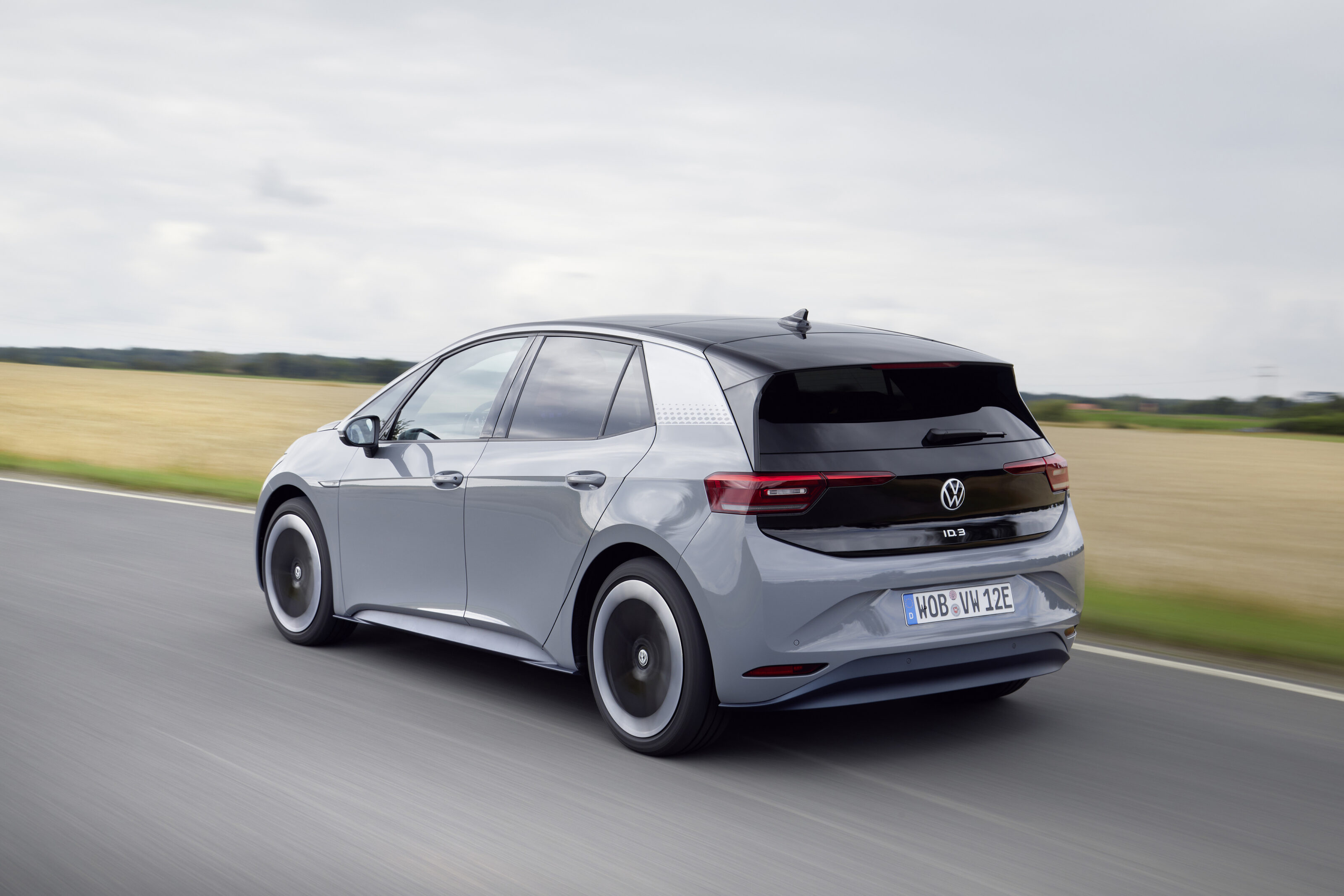
The just-updated Volkswagen ID.3 electric hatchback will arrive in Australia by the end of 2024, the company has confirmed today.
Snapshot
- 2024 Volkswagen ID.3 timing confirmed
- Pricing u2018targeted below $60,000u2019
- Facelifted model to debut nameplate in Australia
While Volkswagen’s local arm had previously confirmed the updated ID.3 would debut the ID nameplate in Australia, it had yet to confirm local timing – and a more-precise date has yet to be locked-in.
But we now know production for the Australian market will commence sometime in 2024, with customer deliveries to commence by the end of the year.
The brand said it expects the ID.3 to be priced under $60,000 “in order to maximise national and state-based electric vehicle incentives,” but just how far under is unclear.
Advice
Australia’s best electric cars for 2023
We’ve tested nearly every EV below six figures in Australia to rank the best on sale today
The heavily-related Cupra Born, due here in May as Volkswagen Group Australia’s first all-electric vehicle, is priced at $59,990 before on-road costs – in line with the Leon VZe and VZx hot hatches.
However, it is solely offered in a range-topping variant equipped with an 82kWh battery, rear-wheel drive, and a 170kW/310Nm electric motor.
By comparison, the updated ID.3 retains its 150kW and 310Nm motor, and it is available with a 58kWh or 77kWh battery – allowing for a claimed WLTP-rated driving range of up to 546 kilometres with the largest battery.
According to the brand, every Volkswagen dealer in Australia will retail and service its electric vehicles, including the previously-confirmed ID.4 and ID.5 mid-size SUVs, and the ID.Buzz and ID.Buzz Cargo confirmed today.
“We’re here in 2024, and here in a big way”
1
“Upgraded product such as the more premium ID.3 and a 500km-plus range for ID.4 and ID.5 will gel with our ability to sell these vehicles nationwide, no matter which dealership is closest to you. This is an advantage that not all start-up companies are able to match,” added passenger vehicles director, Michal Szaniecki.
“We can confirm the ID.3, ID.4 and ID.5 will both start production and go on sale next year, so our message for customers thinking about switching to a BEV is this – we’re here in 2024, and here in a big way.”
The 2024 Volkswagen ID.3 electric hatch will arrive by the end of next year, with local pricing and details to be announced closer to its launch.
