
The Beijing Motor Show has been postponed again thanks to the Covid-19 pandemic, marking the second time in as many attempts where the event has been affected.
In February 2020, the Beijing Motor Show (Auto China 2020) was cancelled due to the first wave of Covid sweeping through the nation and later the world, and the pandemic’s return to south-east Asia has again affected the region’s largest automotive exhibition.
China was able to get a motor show up and running last year with Auto Shanghai in April, running on a rotational basis with Beijing in a similar fashion to how the Sydney and Melbourne motor shows used to operate.
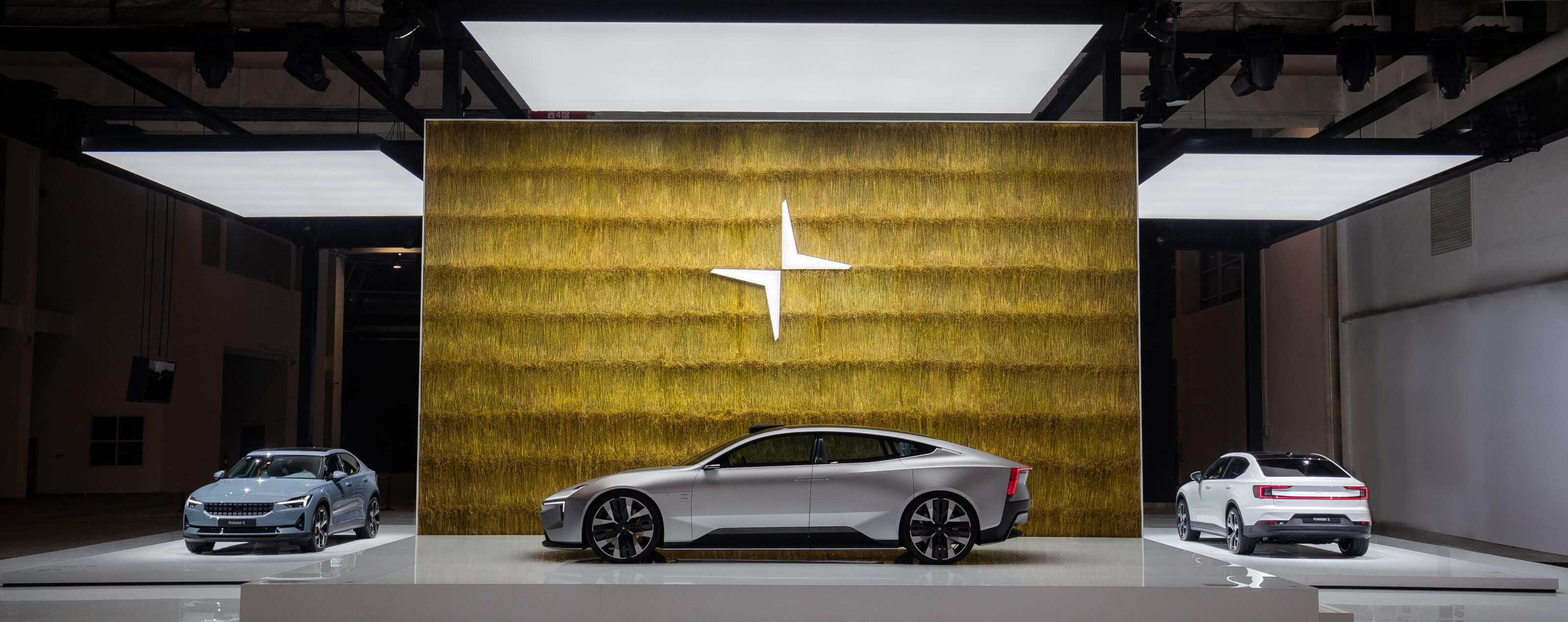
Event organiser Auto China has announced the 2022 show will be postponed, although a new date has not yet been confirmed.
“Widespread and frequent occurrence of Covid-19 pandemic in many parts of China has posed a severe challenge for the country’s epidemic prevention and control,” said Auto China.
“In order to fully cooperate with and implement the epidemic prevention and control requirements of the state and the Beijing municipal government, effectively ensure exhibitors’ physical health and public health safety as well as good exhibition results, we, the Secretariat of the 2022 (17th) Beijing International Automobile Exhibition, have decided to postpone the auto show which was initially planned from April 21-30 this year.”
Among the concepts expected to be unveiled in Beijing this year, Toyota’s BZ Corolla was anticipated to be one of the highlights, produced by the Japanese manufacturer in conjunction with Chinese carmaker BYD for the local market only.
Snapshot
- Victoria boosts subsidy funding by $7.2 million
- Extra funds will allow another 2600 buyers to purchase an EV with $3000 back
- Extension applauded by industry bodies
The Victorian Government has injected an extra $7.2 million into its electric vehicle incentives scheme, allowing a further 2600 potential buyers to enjoy a $3000 rebate on their purchase.
First coming into effect on May 2, 2021, the Victorian subsidy was introduced for the first 20,000 electric vehicles (EVs) or fuel-cell electric vehicles (FCEVs) sold under $68,740 before on-road costs.
Despite a few shaky opening months in which buyers were not directly paid the subsidy by dealers and forced to go through Solar Victoria independently to get their $3000 discount, the first allocation of funds is understood to be exhausted.
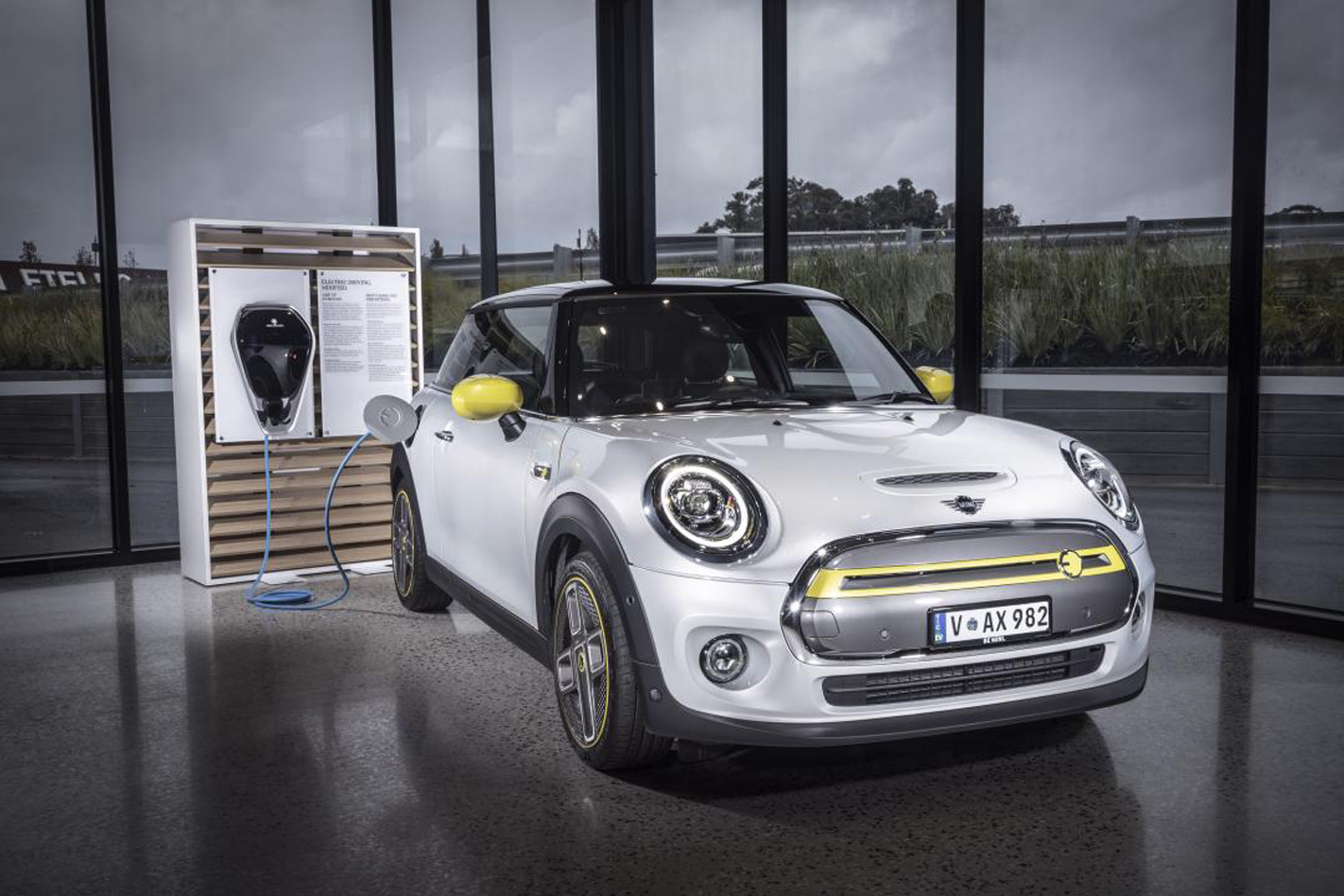
The announcement has been welcomed by local peak bodies, with Federal Chamber of Automotive Industries CEO Tony Weber saying the zero-emission vehicle subsidy is good news for prospective buyers, however a broader approach to lowering emissions is still necessary.
“The Victorian Government’s announcement of an additional $7.2 million in purchase incentives for electric vehicles is welcome news for motorists who have been considering the move to an electric vehicle,” said Weber.
“This additional spending complements the Government’s charging infrastructure investment across the state.
“Our overall policy objective is to reduce CO2. While subsidies for specific technologies are welcome, our journey to reducing emissions in the transport sector needs to be a holistic one.
“The pathway to reducing emissions in the medium term will rely on a range of low emission technologies that include plug-in hybrid, hybrid and even highly efficient internal combustion engines.”

In addition to the subsidy, Victoria’s EV incentives include a $100 discount on annual registration fees and reduced stamp duty for all zero-emission vehicles.
However, despite the strengths of its incentives, Victoria was also the first Australian state or territory to introduce a road user charge as of July 1, 2021, taxing zero-emission vehicles at 2.5 cents per kilometre as well as plug-in hybrid vehicles (which still have to pay the fuel excise) at 2 cents per kilometre.
The Victorian Government has previously announced its commitment for half of all new-car sales by 2030 to come from electric vehicles, helping it to achieve net zero by 2050.
I never thought I’d live to see an AFL premiership win for the Richmond Tigers, let alone three, nearly back-to-back. And then Melbourne, too? These are crazy times, but perhaps the craziest mark of our time is that there’s now a super hot Toyota Corolla. What?
So, while I’m mindful that we ought to just be happy enough that the Big T has come this far, I’ve never been any good at knowing when to stop. Thus, I give you the car we should all be petitioning for: the Toyota GR Corolla Touring.
There are so few wagons on the Australian market, let alone fast ones, that we should really want Gazoo Racing to get this thing to market.
Of course, the Corolla Touring wagon isn’t offered in Australia, and the company has told us it has no plans to bring the stylish longroof here – but, as we discovered with Ford’s Focus and Fiesta ST models, it might be easier to make a business case for a GR Corolla Touring in Australia than for the regular model.
And, I mean… just look at it.
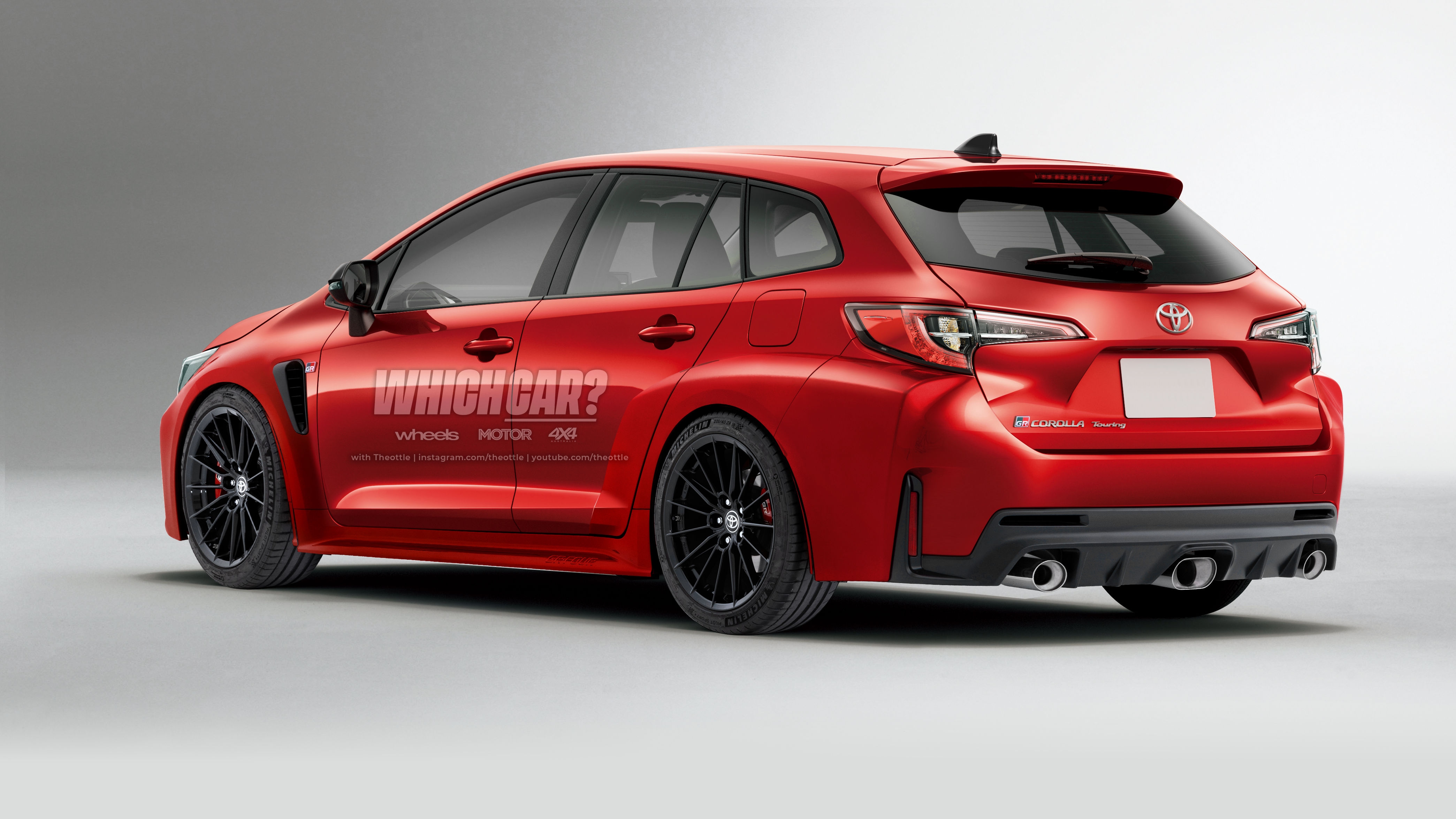
Rendered by our mate Theo Throttle, this is the kind of wagon that would put the upcoming WRX Sportswagon to shame. (There’s still time to reconsider that ‘no STI’ position, Subaru…) It’d probably make for a compelling and more affordable alternative to the dreamy Golf R wagon, too, while shutting the cool Octavia RS out of the conversation (unless you need more room).
If you need a refresher, the new GR Corolla, revealed last week, draws power from a 1.6-litre turbo petrol three-cylinder engine. Power is rated at 220kW, with 370Nm of torque.
There’s a six-speed manual and all-wheel drive, with a pair of Torsen differentials, and… well, you should read our full write-up here – and check out our spec comparison with its key rivals, too.
Now, come on, Toyota. If BMW M can at long last deliver an M3 Touring wagon, you can do us a GR Corolla Touring.
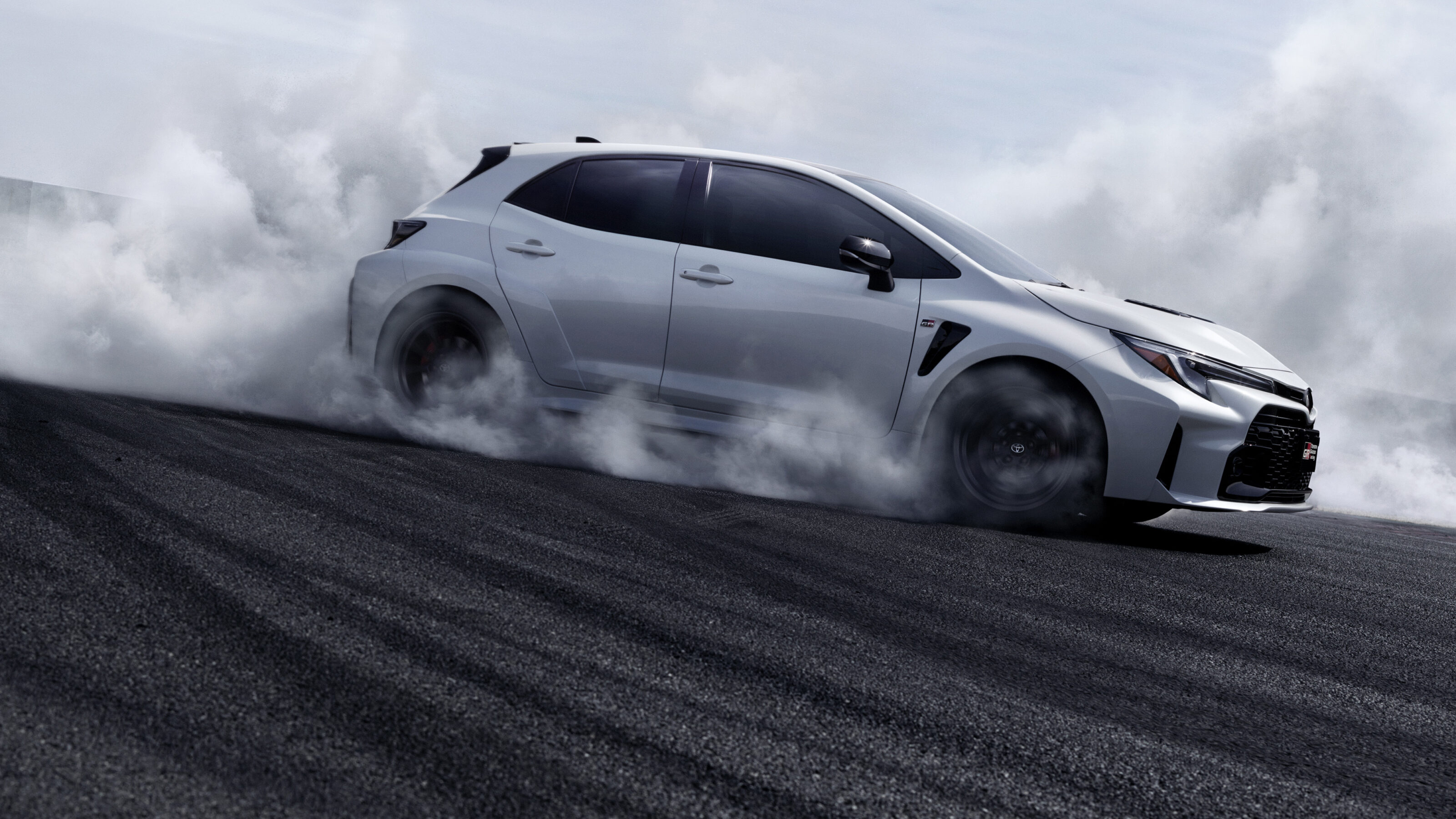
Toyota GR Corolla specs
| Length | 4410mm |
|---|---|
| Width | 1850mm |
| Height | 1455mm (1480mm including antenna) |
| Wheelbase | 2640mm |
| Front | 1590mm |
| Rear | 1620mm |
| Seating capacity | 5 |
| Vehicle weight | 1475kg |
| Engine | 1.6-litre in-line three-cylinder intercooled turbo engine |
| Type | G16E-GTS |
| Bore x stroke | 87.5 x 89.7 |
| Total displacement | 1618cm3 |
| Compression ratio | 10.5:1 |
| Maximum output | 220kW @ 6,500rpm |
| Maximum torque | 370Nm @ 3,000-5,550rpm |
| Transmission | iMT (6-speed manual transmission) |
| Driveline | GR-FOUR 4WD systemElectronic multi-plate clutch 4WD|(with 3 selectable modes) |
| Gear ratio1/2/3/4/5/6/Reverse | 3.538 uff0f 2.238 uff0f 1.535 uff0f 1.162 uff0f 1.081 uff0f 0.902 uff0f 3.831 |
| Reduction ratio1-4 / 5, 6, Reverse | 4.058:1 uff0f 3.45:1 |
| Differentials | |
| Front | Torsenu00ae LSD |
| Rear | Torsenu00ae LSD |
| Suspension | |
| Front | MacPherson strut |
| Rear | Trailing multilink |
| Brakes | |
| Front | Ventilated disc(18-inch aluminium opposed 4-pot callipers) |
| Rear | Ventilated disc(16-inch aluminium opposed 2-pot callipers) |
| Wheels | 18-inch, Gloss Black, 15-spoke, cast alloy |
| Tyres (front/rear) | 235/40R18 Yokohama ADVAN Apex V601 |
| Fuel tank capacity | 50 litres |
In the same way television networks drag out Love Actually around Valentine’s Day (or Bridget Jones’s Diary to make you feel even more single) as a ratings generator, carmakers also call on proven badges to boost sales. Enter the Mazda CX-8 Touring SP – the emphasis being on the SP.
It’s a nomenclature predominantly used by the Japanese giant’s Aussie arm and, previously, adorned sporting variants. Now it’s associated with a seven-seat SUV. And unlike the aforementioned rom-coms that at least hold some relevance under the pretence of finding love, this CX-8 isn’t performance-based at all.
Instead, it’s another form of branding for the ubiquitous and outrageously en vogue black pack. Where other marques pretty much call a spade a spade, Mazda’s covert operation has resulted in the resurrection of SP.
History and tradition aside, it’s no bad thing because it results in a bunch of value-adds for the mid-spec variant. A few key items become standard kit, while the aesthetics are smartened by, ahem, black accents inside and out. Both front-wheel drive petrol and all-wheel drive turbo-diesel ($7000 premium) variants are offered, but it’s the former we’re testing here.
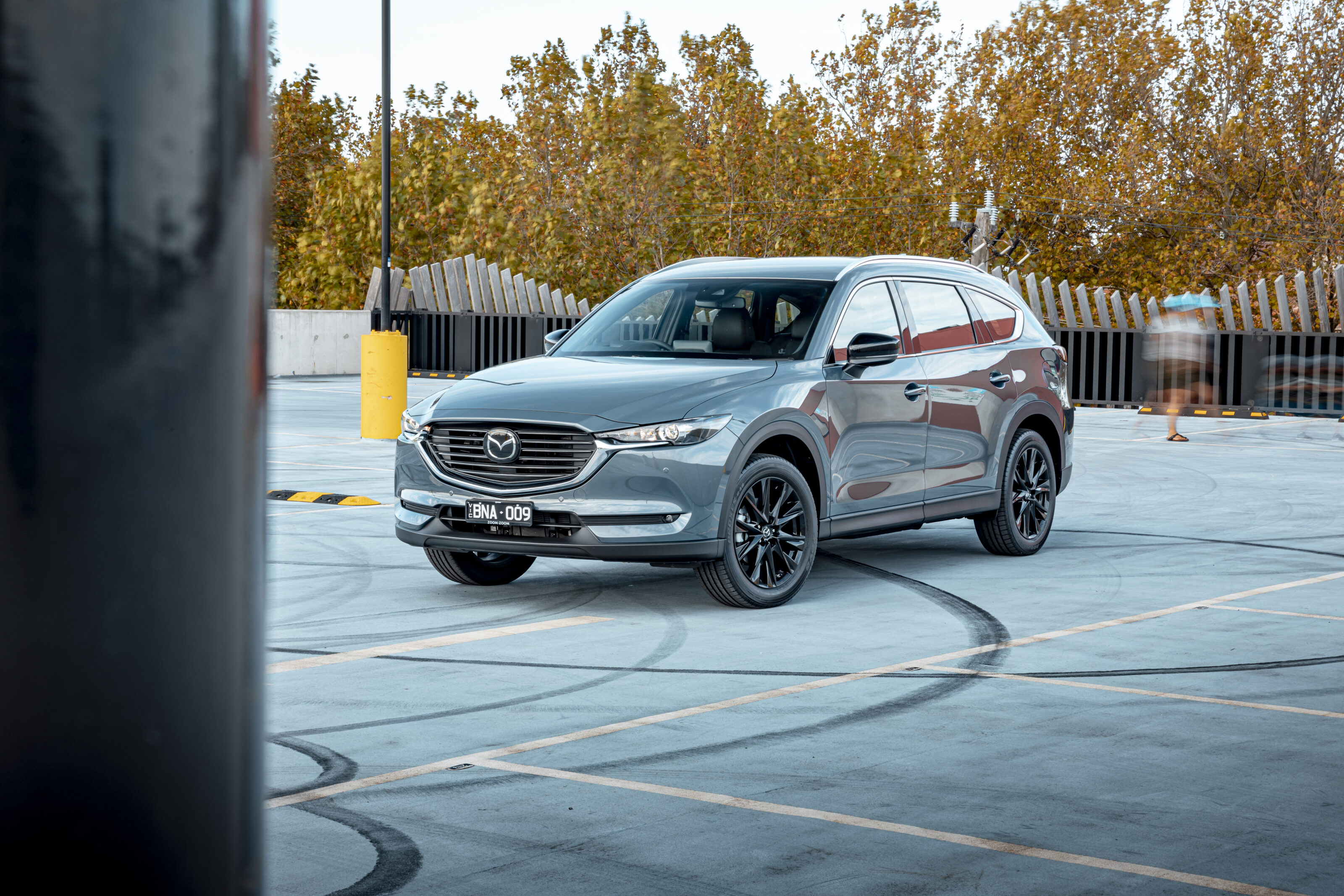
Priced at $47,890 before on-road costs and filtering into the middle of the recently revised CX-8 range, the Touring SP is powered by a naturally aspirated 2.5-litre four-cylinder engine – and this being the petrol version, it falls under the SkyActiv-G branding. It sends power to the front wheels alone and changes gears via a six-speed automatic transmission (now with steering wheel-mounted paddleshifters). With 200mm of ground clearance and zero off-road modes, this is an SUV that won’t be leaving the urban jungle in a hurry. No, this stretched Mazda CX-5 is for those who wouldn’t be seen dead in an MPV.
However, it’s the dark and moody hues that set the SP apart with black splashed on the 19-inch alloy wheels (up from 17-inch items), front grille and exterior mirror caps. Inside the seats are covered in Black Maztex (Mazda-speak for vegan-friendly leather) and Black Grand Luxe synthetic suede, while the driver’s seat is a 10-way power-adjustable item with two memory positions. The design is further ‘raced-up’ with black honeycomb pattern highlights on the door trims and red stitching – because this is an SP after all.

Inside, it seems Mazda’s current trend of looking at the homework of the Germans, namely Audi, is paying dividends. Even the control wheel for the MZD Connect infotainment system has hints of an older MMI rotary controller. However, old also describes the 8.0-inch screen and previous-generation graphics as the Touring SP misses out on the 10.25-inch display used higher up the range. And while the graphics are antiquated, it is touch-enabled and comes with Apple CarPlay and Android Auto capability.
The playbook returns to a happier tune when you start looking at the details. Overall, the design is nothing groundbreaking or overtly modern, yet tangible quality abounds thanks to the use of high-grade materials matched with top-notch fit and finish. Caress the knurled climate controls or push the soft-touch plastics to get a sense of the premium undertones at play.
It’s also a masterclass in sound ergonomics – even the analogue instrument cluster resides as a beacon of simplicity over new-age digital items. A boon is the head-up display, which offers brilliant clarity and is also legible when wearing sunglasses with polarised lenses.

For a model grade whose purpose is to exude pragmatism and excel when carrying out mundane tasks, it’s nice to know that the cabin can still make you feel special. Heated seats up front (and the two outboard rear seats) are niceties, as is the tri-zone climate control with rear air vents to keep all passengers at the right temperature.
There are niggles and signs of age, though. The infotainment screen can be slow to react and it isn’t touch-enabled when using smartphone mirroring, there is no wireless charge pad (in this variant) and no provision for Apple CarPlay or Android Auto without a cable. The competition is moving on in this regard. A further bugbear is that the USB (no USB-C) ports are located in awkward locations, like in the shallow central console bin and the rear middle armrest – meaning all three pews can’t be used.
Overall the design is nothing groundbreaking, yet tangible quality abounds thanks to the use of high-grade materials matched with top-notch fit and finish.

What is appreciated in the middle row is the amount of room for heads, legs and toes thanks to the 2930mm wheelbase shared with the CX-9. Shoulders, well, not so much – thank the 1840mm width, identical to the CX-5, for that. The third row is accessed by the one-touch ‘walk-in’ function, and once there headroom is expansive for adults, while legroom is aided by the fact the central row can slide forward and aft. The rear doors open to almost 90 degrees to aid entry and eagres as well as when you’re loading in car seats – for which there are outboard ISOFIX points.
Thanks to the stretched overall length (4900mm), boot space is verging on large seven-seat levels with 209 litres when all seats are in place and a capacious 775 litres in five-seat mode. The rearmost row stows easily to create a flat load bay that also hides a secret second storage area and a space-saver spare. The four D-shaped tie-down points are handy, as are the two shopping hooks capable of holding up to 3kg of groceries and the 12v power outlet – although it’s a shame there aren’t any USB ports back there.

Safety is covered off with a lot of active and passive systems, while the range has received a five-star rating from ANCAP. Highlight include full AEB (forward and reverse), blind-spot monitoring, lane-keep assist, rear cross traffic alert and active cruise control with lane-keeping.
Cost of ownership is locked in, partly, with five years of scheduled servicing coming in at $1745 in total. Those services occur every 12 months or 10,000km, while the CX-8 is covered by a five-year unlimited-kilometre warranty with roadside assist. Ultimately, how much you drive, and the nature of it, will determine whether petrol or diesel propulsion is right for you.
Speaking of which, the CX-8 has remained mechanically unchanged – unless, of course you count the addition of paddleshifters for the automatic. That means the 140kW and 252Nm figures continue from the 2488cc four-cylinder engine, with both of those outputs developed quite high in the rev range. Grunt isn’t in abundance, especially out on the open road when overtaking. However, it keeps pace with city traffic and is sufficient for the urban commute with the six-speed auto doing an amicable job.
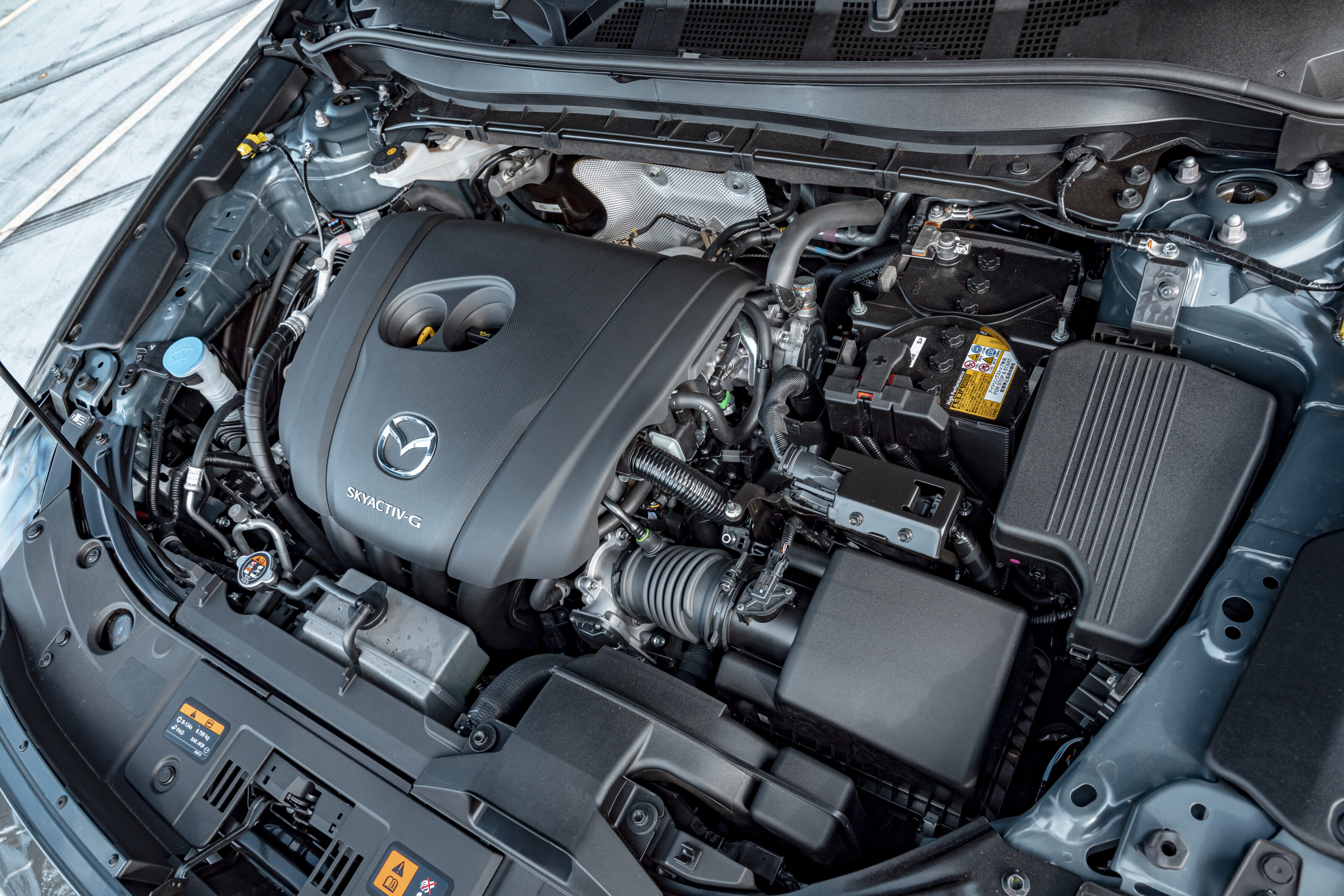
When you compare the petrol 2.5-litre against its turbo-diesel sibling (and rivals), the claimed combined fuel consumption of 8.1L/100km isn’t groundbreaking. What’s more, even that figure is hard to achieve, with our tester struggling to hover around the 9.8L/100km mark. The next-gen SkyActiv-X compression-ignition technology isn’t offered in the CX-8, so if fuel economy is high on your priority list – and you can clean out the particulate filer on a longer drive – then the oiler will be for you. Factoring in the added performance benefits of the SkyActiv-D 2.2-litre four-cylinder engine is also worth keeping in mind, too.
Sitting on an elongated five-seat SUV platform, the ‘honey I stretched the CX-5 notion’ results in the CX-8 displaying competent road manners. Despite weighing 1799kg and being endowed with a comparatively tall but narrow body, the Touring SP holds itself well when cornering. Lateral head toss is kept in check, body roll is acceptable given the high centre of gravity and the CX-8 changes direction with aplomb. Mechanical grip is evident, yet the 225-section Toyo Proxes R46 tyres can be left wanting for grip in greasy conditions.
In an SUV context, the Touring SP offers an accomplished and rewarding driving experience.
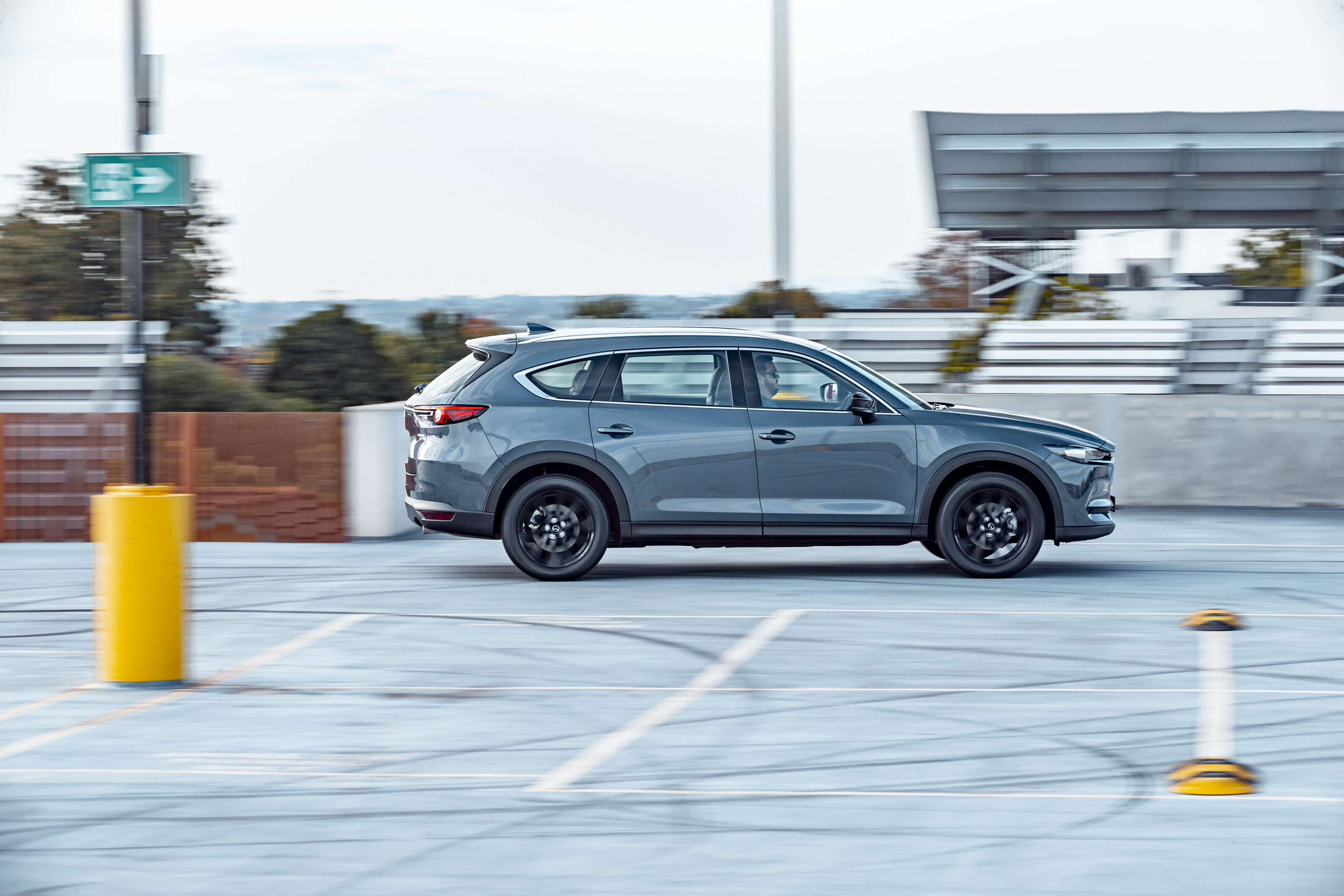
As is a Mazda trait, the steering is a strong point and is light at slow speeds with additional weight being added at speed. The only blight is some kickback through the wheel. However, torque steer, which is prevalent in other front-wheel-drive SUVs, isn’t an issue – mainly because there is a general lack of Newtons to trouble the front axle.
Despite a slight hankering for stiffness, the ride quality is comfortable and the dampers offer impressive control. You aren’t going to waft or bobble about in the CX-8. In an SUV context, the Touring SP offers an accomplished and rewarding driving experience. Overall NVH and road noise is well suppressed (only really coarse surfaces will result in tyre roar), meaning the CX-8 is just a nice place to be to cover kays in and out of the CBD.
Disband the notion that the SP variant has any other purpose for being than to offer added features with extra style and you’re on the money. A performance-oriented SUV it is not. A pseudo people-mover with luxe appeal it is. And just like Love Actually, to a certain customer, it’ll be exactly what they need.
2021 Mazda CX-8 Touring SP specifications
| Body | 5-door, 7-seat SUV |
|---|---|
| Drive | front-wheel |
| Engine | 2488cc inline-4, DOHC, 16v |
| Gearbox | six-speed automatic |
| Power | 140kW @ 6000rpm |
| Torque | 252Nm @ 4000rpm |
| Bore/stroke | 89 x 100.0mm |
| Compression ratio | 12.5:1 |
| 0-100km/h | 10.9sec (estimated) |
| Fuel consumption | 8.1L/100km (combined/claimed) |
| Weight | 1799kg |
| Power/weight | 78kW/tonne |
| Front suspension | MacPherson struts, coil springs, anti-roll bars |
| Rear suspension | multi-links, coil springs, anti-roll bars |
| L/W/h | 4900/1840/1725mm |
| Wheelbase | 2930mm |
| Tracks | 1595/1600mm |
| Steering | Electrically assisted rack-and-pinion |
| Front brakes | 320mm ventilated discs, single-piston calipers |
| Rear brakes | 325mm solid discs, single-piston calipers |
| Tyres | 225/55 R19 99V (f/r); Toyo Proxes R46 |
| Wheels | 19.0 x 7.0-inch (f/r) |
| Price | $47,890 + ORC |
The British rear-drive V8 Jaguar F-Type P450 coupe earned a hard-fought seventh at Performance Car of the Year 2022.
On paper, the Jaguar ought to struggle. It’s the slowest car in the PCOTY field and its handling tends further towards the grand touring end of the spectrum. Then you recall that the last time we featured an F-Type with rear-drive and a V8, it resulted in a podium spot at the 2014 edition of PCOTY. Game on.
But where that car was the full-noise 405kW F-Type R, eight years later we have the milder 331kW P450 R-Dynamic RWD. It’s the car that absolutely nobody at PCOTY is talking about. All of which suits me, because the keys are available for me to snatch and head out for a surreptitious evening drive on our road test route.
The brakes, the steering and the power delivery are not beyond reproach. The steering has a strangely elastokinematic feel and the brakes initially feel over servoed. The engine sounds incredible at wide open throttle, but so addictive is the noise that you can’t help but poke the bear at virtually any opportunity. As a result, you rarely drive the Jaguar subtly, instead pointing and squirting it down straights, revelling in the sheer intensity of its soundtrack.

It’s one of the most feel-good cars in the entire competition and the great part is that it doesn’t egg you on to ridiculous speeds in order to entertain.
On the circuit, the dynamic repertoire is a little soft around the edges. The chassis is more benign than its wide track, short wheelbase proportions suggest, and once you learn to trust the front end, there’s a decent amount of grip. The steering again disappoints and the final corner sees the car run to the limiter, an upshift introducing a shock to the drivetrain that results in a heart-in-mouth high-speed shimmy.
Against the clock, it’s the slowest PCOTY car on a lap and the attraction of the eight-pot acoustics pall a little when you’re full throttle for so much of the time. The bawdy build to crescendo that you so enjoy on road becomes a constant blare on track. Then you pull into the pits, rub your right knee that’s been smashed against the edge of a speaker and forgive the Jaguar virtually anything because it looks so beautiful.

“If I didn’t need a four-seater, I’d buy the Jag. It’s awesome. Yet if I were a judge, I’d place it last and that’s just down to the strength of the field this year,” said Luffy. “I think Phillip Island is a good track for it,” noted Giunco. “I was constantly making mid-corner inputs trying to figure out what the steering was up to,” said Affat.
Perhaps the departure of Mike Cross from Jaguar’s engineering team will change that. Cross delivered some great Jaguars but had a personal penchant for light and quirky-feeling steering.
A meatier, more direct EPAS system would do a lot to build confidence in what remains a strong and otherwise well-judged dynamic package. A rear-drive F-Type R with revised steering? That could have really upset the established order.

The judges’ comments
Alex Affat
“Feels unresolved at the limit, but what a charmer. Engine is by far the star of the show.”
Ranking: 6th
Andy Enright
“You probably wouldn’t have bet on a supercharged 5.0 V8 netting PCOTY’s lowest power-to-weight.”
Ranking: 6th
Trent Giunco
“I found the steering particularly annoying through the long radius corners here.”
Ranking: 8th

Cameron Kirby
“I quite liked the cadence of the F-Type’s body control on road. Wait for it to get planted and then go.”
Ranking: 6th
Bernie Quinn
“There’s a springy, artificial feeling that seems dialled into the electrical steering assistance.”
Ranking: 8th
Luffy’s view
“If we’d have been at Winton, the ESC would have kicked in constantly. Phillip Island flattered the Jag.”
The key figures
| 0-100km/h: | 4.81 seconds |
|---|---|
| 0-400m: | 12.94 sec @ 183.72Km/h |
| Lap time: | 1:49.69u00a0 |
Beware the quiet man. Eighth generation Volkswagen Golf GTI finishes eighth in MOTOR’s Sports Car of the Year 2022.
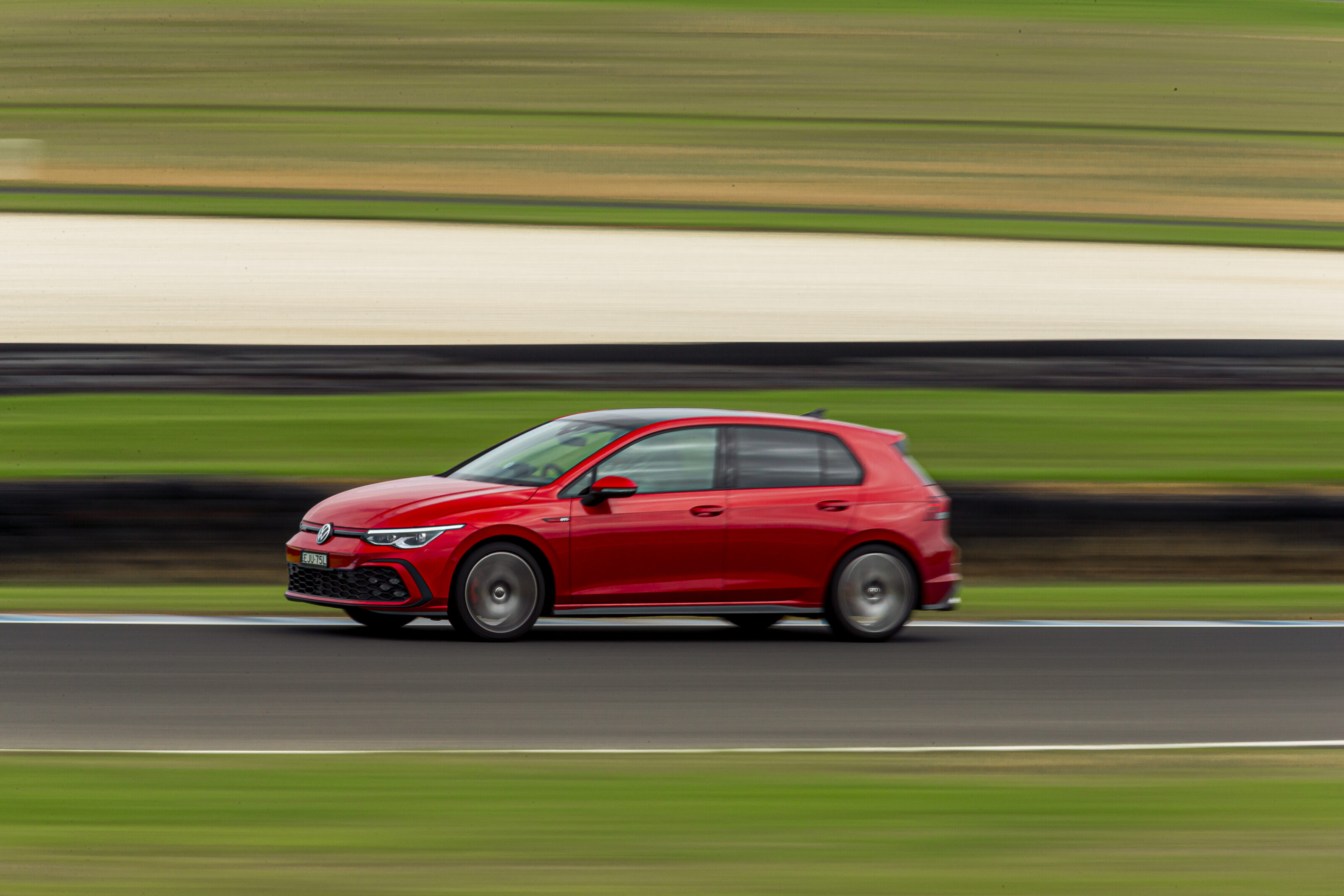
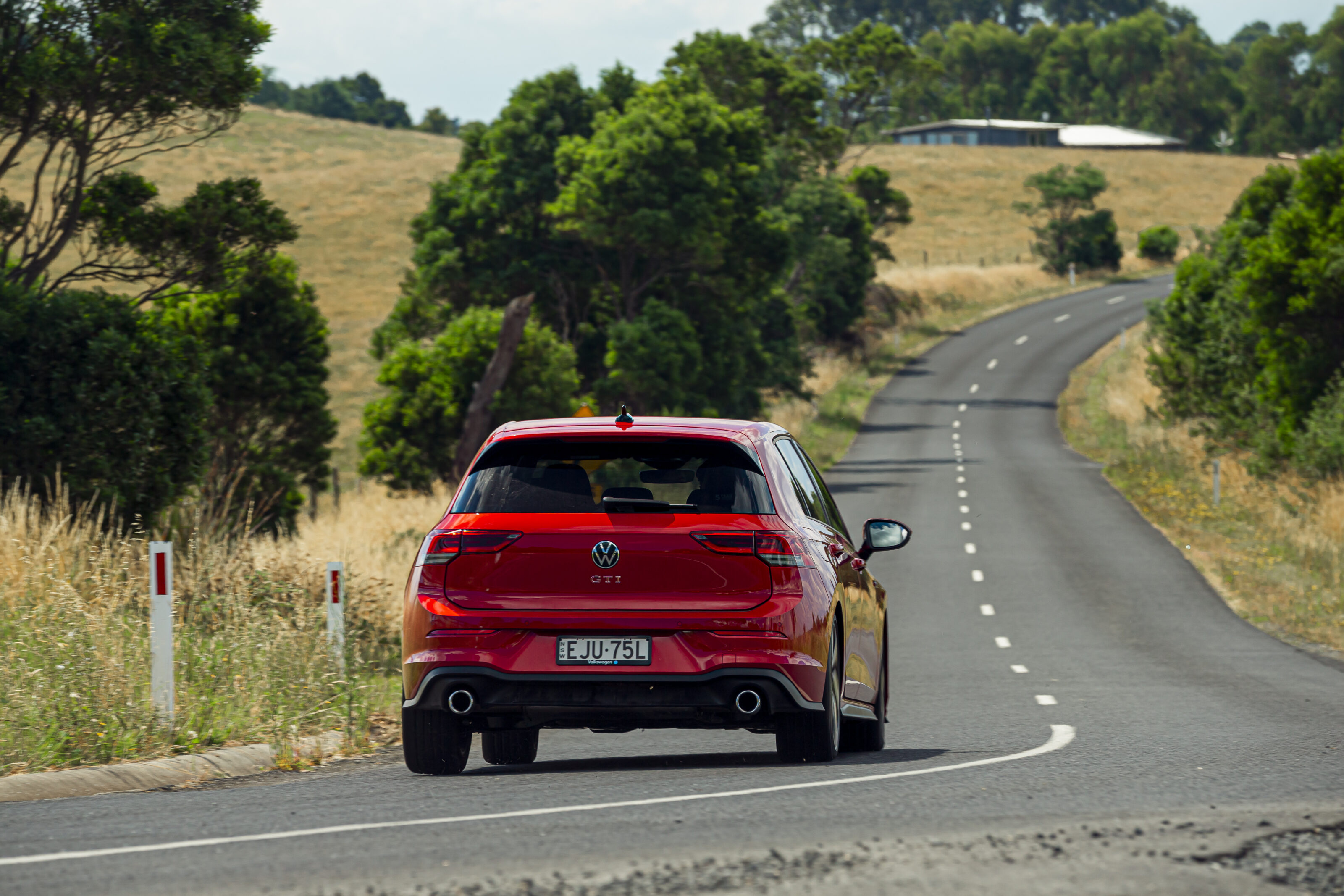
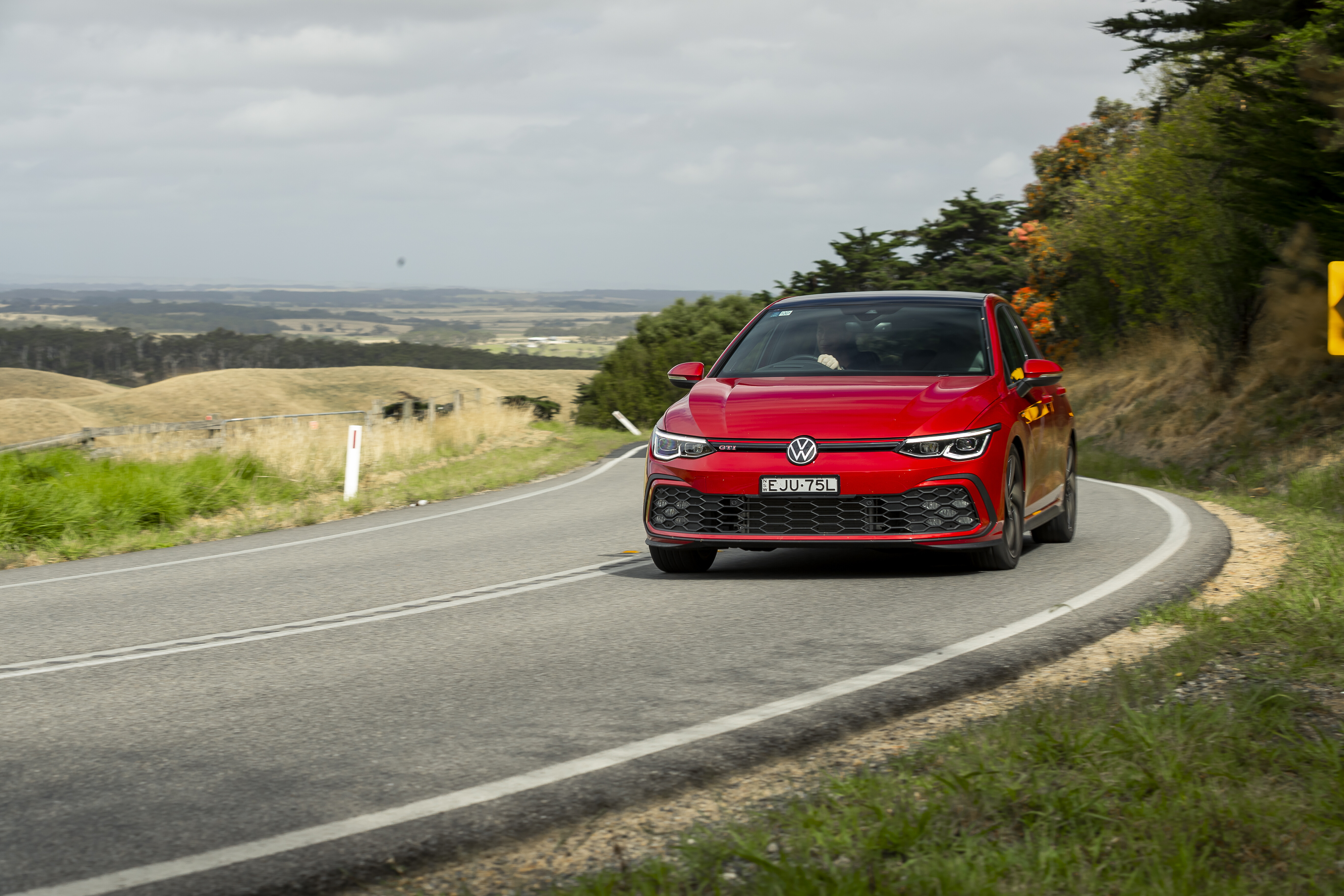
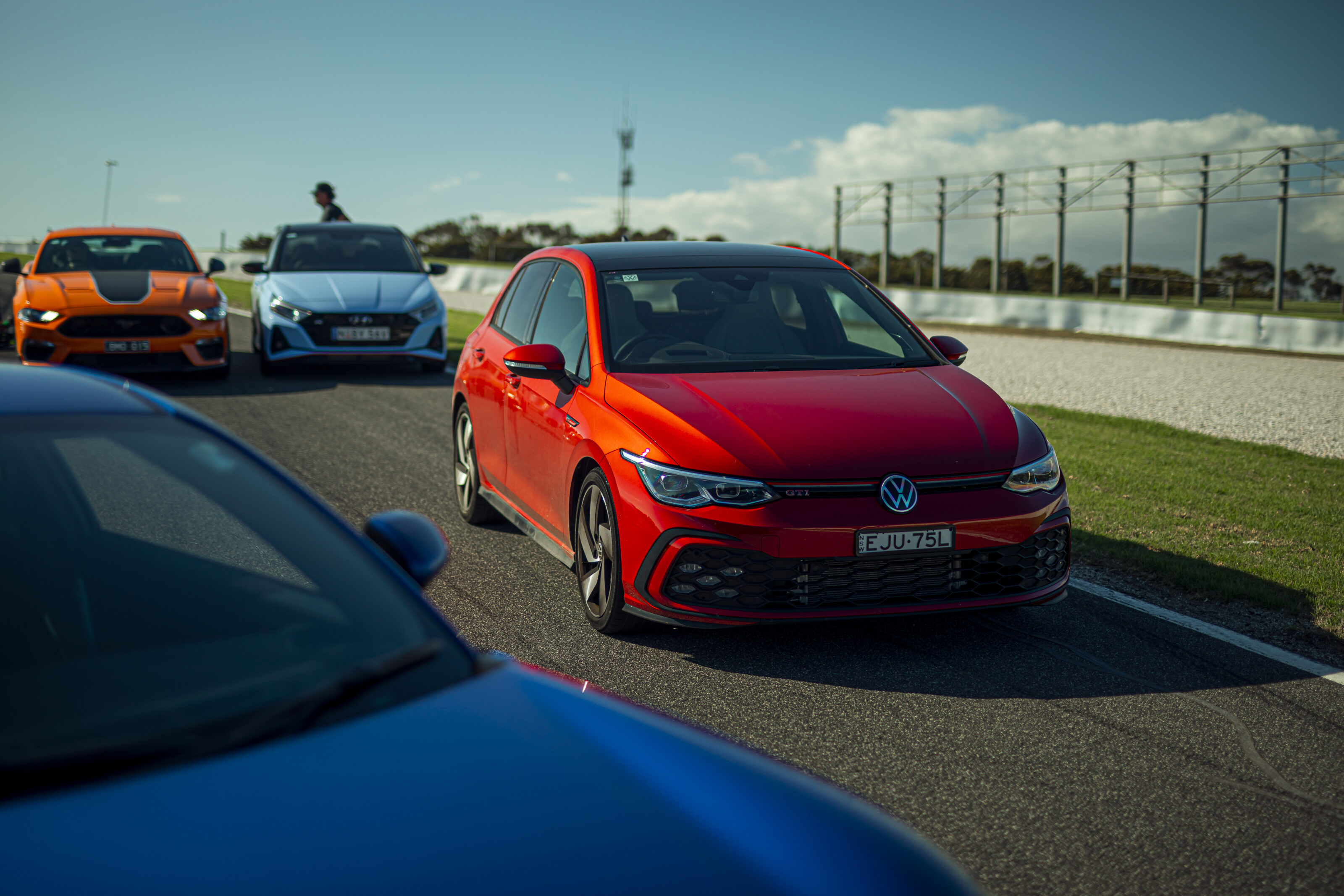
On the face of it, eighth out of 10 SCOTY contenders seems like a disappointing result for the Volkswagen Golf GTI but if I had to choose one of the contenders to buy with my own hard-earned, the Mk8 GTI would be numero uno. Why? Because it does very little wrong, so much right and is so beautifully discreet. It’s always presentable. Although Luffy complained that the Golf GTI had grown up and got a bit boring, there are layers to this car that are both intriguing and rewarding to uncover.
Both on road and on track, it loved being driven hard, and while its limits were probably made a little hazy by the unspectacular Bridgestone Potenza S005 rubber, it rewarded a precise, disciplined driving style. The different driving modes are cleverly calibrated with huge bandwidth and no fewer than 15 different suspension settings available.
So why didn’t it do better? In truth, the highs of some of the more extrovert cars here created a more durable impression but I’d occasionally have to question whether that’s a plus or a minus in an everyday driver. It takes talent to do so much so well.
There’s real thought that’s gone into the Golf; whether it’s the delightful wheel-mounted paddles that seem moulded to your fingers or the driving position that, even with an electrically adjustable seat, can sit you low and connected with the car’s fulcrum. The Golf GTI is truly a car that anybody can drive and enjoy.
The touchscreen infotainment and the elevated price of the Golf have drawn criticism, but I’m substantively offended by neither. Most of the aspects that journalists complain about, such as how involved it is to switch off the ESC, aren’t generally concerns for typical owners and as for value, this GTI feels virtually as capable as a Golf R of yore and delivers a richer feature set.
The capacitive touch pads on the dash and steering wheel are an issue though. Grab the wheel at nine-and-three and those with larger hands may well find themselves turning down the volume with their left hand and switching on the heated steering wheel with their right. Time for a rethink there.
Quick, composed but not especially playful, most judges got out of the GTI with renewed respect. The fact that it was more than two seconds quicker around Phillip Island than the pricier and equally powerful BMW 128ti demonstrated the difference between a fundamentally well-sorted hot hatch and a one that needs to have a bit of a think about itself.
Eighth might not seem much of an achievement for the GTI Mk VIII, but make no mistake, this is a very good iteration of Volkswagen’s quiet achiever and one that earns a solid recommendation from us.
The judges’ comments
Alex Affat
“You’ll find that the GTI’s ceiling is always higher than you expect it to be. That really showed on track.”
Ranking: 7th
Andy Enright
“Want the best-presented hot hatch that $54k will buy? Choose the Golf GTI. Nothing comes close.”
Ranking: 8th
Trent Giunco
“One of the easiest and most confidence-inspiring cars here to drive fast on road. Ride is excellent.”
Ranking: 8th
Cameron Kirby
“The Golf’s focused more on the everyday, perhaps to the detriment of the highs of pure dynamic ability.”
Ranking: 8th
Bernie Quinn
“It grew on me throughout PCOTY. Engine has a nice strong top end, but a soft response to throttle input.”
Ranking: 8th
Luffy’s view
“The GTI does so much right but it doesn’t have the exuberant edge it once had.”
The key figures
| 0-100km/h: | 6.21 seconds |
|---|---|
| 0-400m: | 14.31 @ 165.21km/h |
| Lap time: | 1:53.76u00a0 |
Snapshot
- The $3.4m trial will involve 160 EV owners
- It will show power networks how to manage EV charging load
- It is estimated EVs will make up 30% of local car sales by 2030
Record high petrol prices are speeding up the uptake of electric vehicles – which is a good thing for the environment, but could cause a strain on the nation’s electricity grid.
Fortunately, the exponential uptake of EVs was forecast even before fuel prices started heading north, which led to the planning of a smart EV-charger trial, which kicked off on April 1.
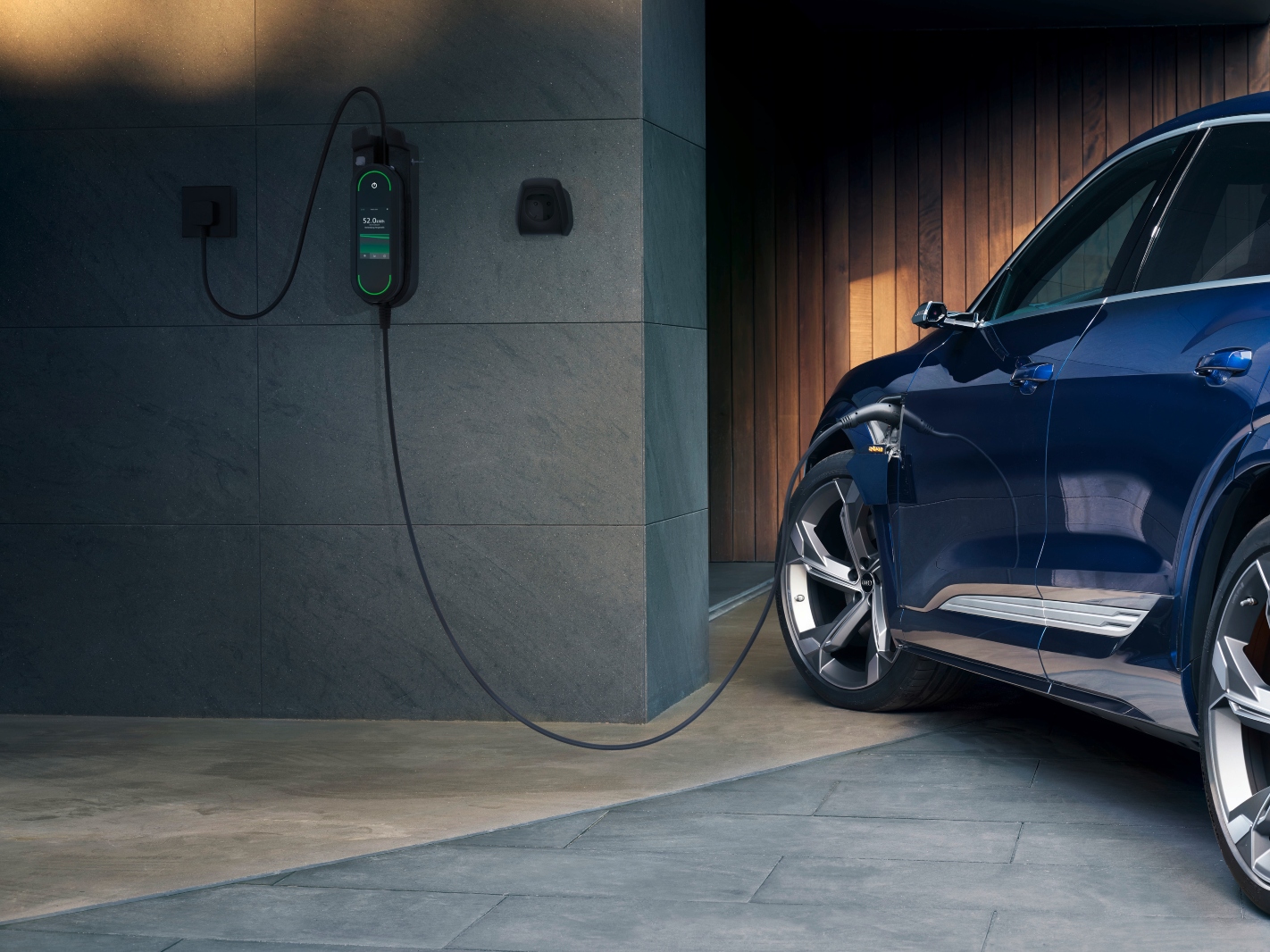
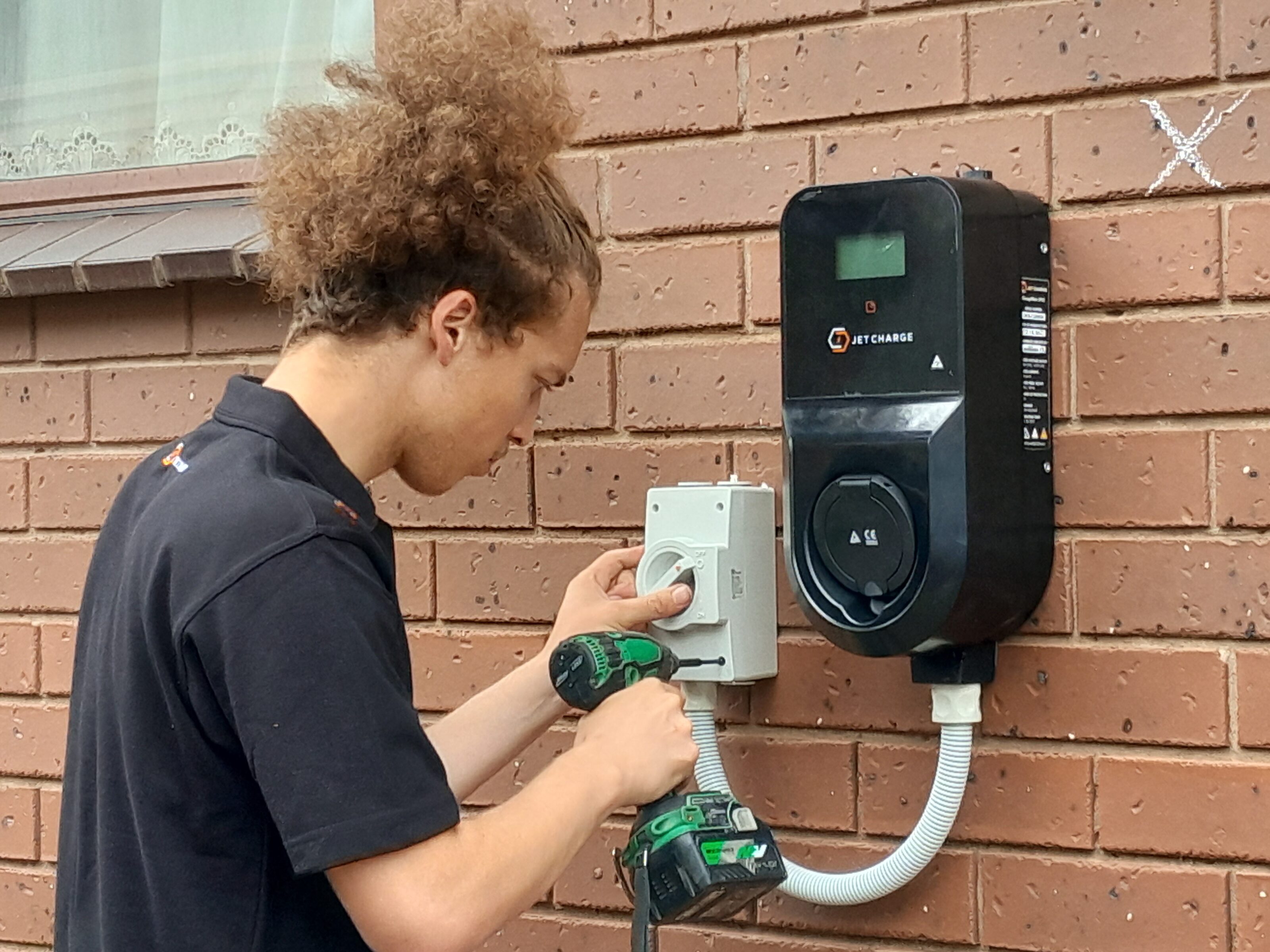
As part of the 12-month, $3.4 million trial led by electricity retailer Jemena, ‘smart chargers’ have been installed at the homes of more than 160 EV owners in Victoria, Tasmania and the ACT.
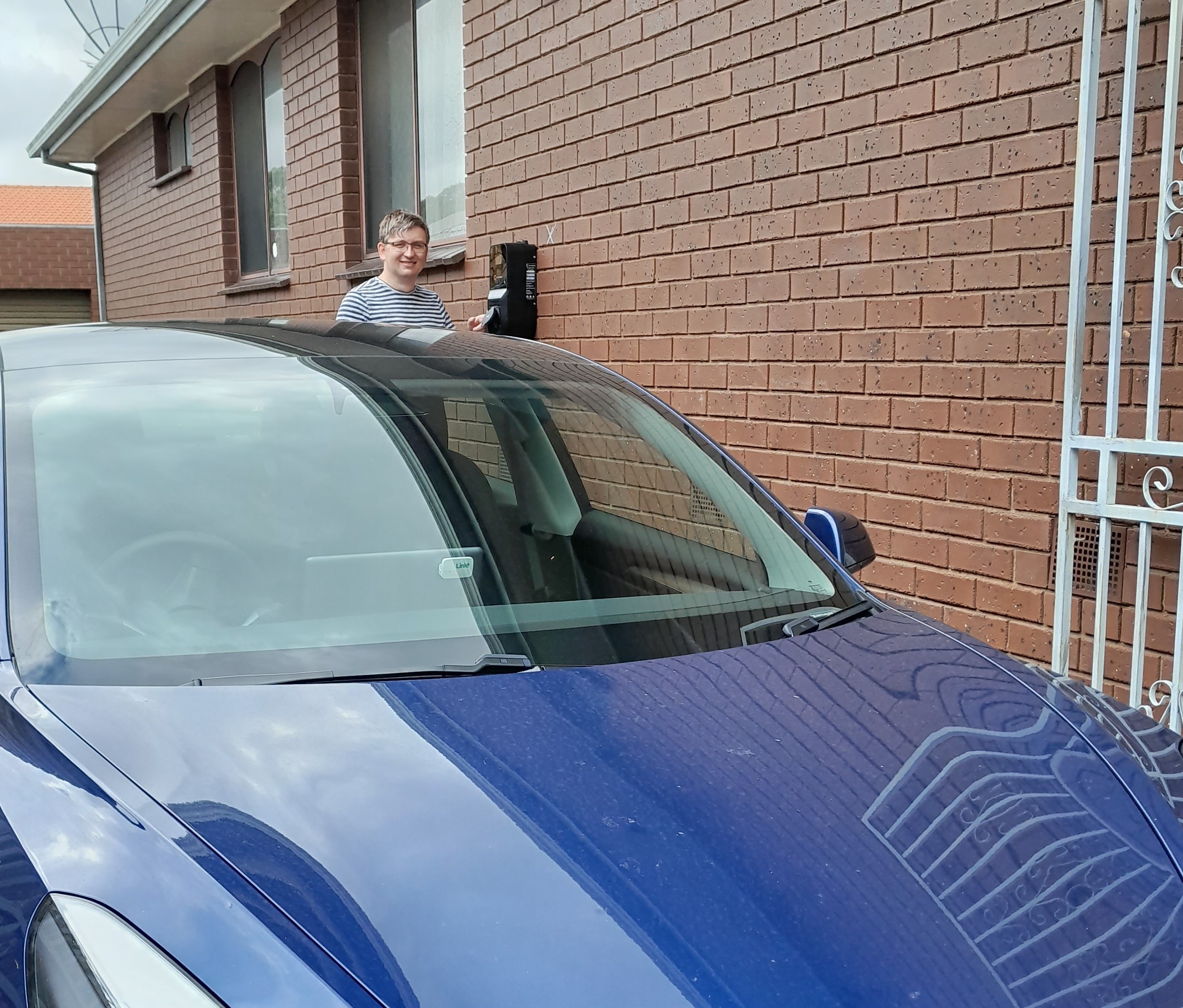
The 7kW JET Charge Chargemate units allow electricity network operators to remotely adjust when the vehicle uses them to avoid overload at peak times.
This means the participants’ EVs can be plugged in when it’s convenient, but automatically charged at times when the electricity grid has more capacity, whether that’s after midnight, or during the day when excess solar energy is being fed back into the grid.
As well as avoiding grid overload, it is expected to make charging EVs cheaper.
Information about EV charging habits so far shows most owners plug in their vehicles to charge after work at about 6pm, already a time of high demand on the electricity grid.
The trial will allow participants to view their EV charging data, while giving the network operators a better understanding of how to work with EV owners to manage the increasing demand on the grid.
Another key feature will be ‘solar soak’ events, where participants will be notified ahead of time to have their cars plugged in during a sunny day when there is an abundance of solar energy being exported into the grid.
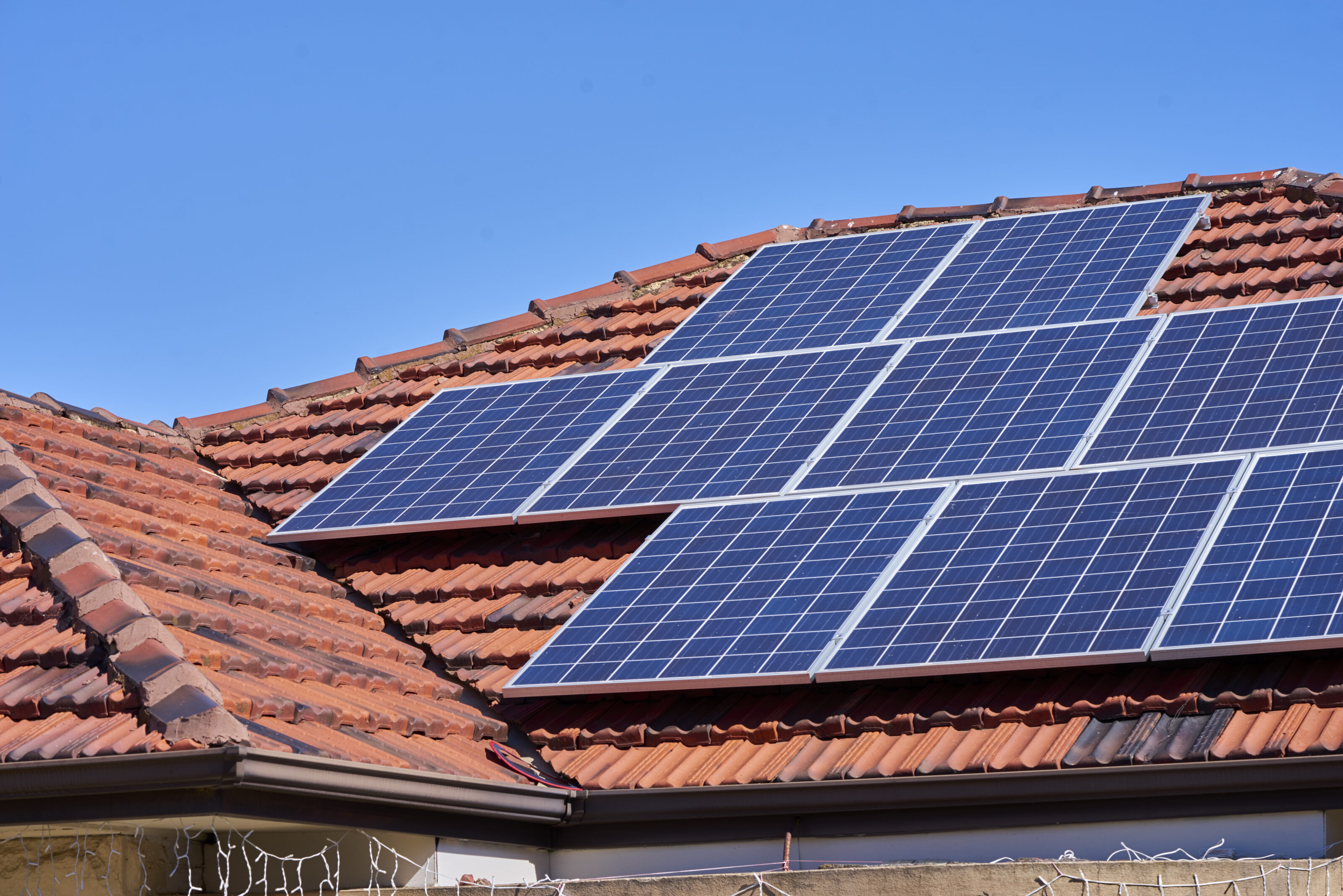
It’s hoped this will provide a better understanding of how EV charging can help with the problem of surplus electricity in the grid.
According to figures from the Electric Vehicle Council, EV sales are rapidly increasing, jumping from 6900 sold in 2020 to 20,665 in 2021. Delivery-delay issues aside, this is expected to jump again in 2022 due to the high fuel prices and a host of new models entering the local market.
This means, as Australian Government projections indicate, EVs will make up 30 per cent of all new cars sold by 2030, which would mean about 1.7 million electric cars on our roads – all of which will need charging and place demands on the grid.
Jemena has partnered with Victorian electricity distribution network businesses AusNet Services and United Energy, TasNetworks in Tasmania and EVOEnergy in the ACT to run the trial, with the Australian Renewable Energy Agency (ARENA) providing co-funding under its Advancing Renewables Program to the tune of $1.55 million.
Melbourne-based EV charging infrastructure business JET Charge is providing and installing the Chargemate units.
Trial outcomes will be shared with electricity retailers, electric vehicle manufacturers, governments and other energy industry stakeholders. In total, 123 Victorian, 22 Tasmanian and 22 ACT households have had smart chargers installed to participate in the trial.
Snapshot
- 70% of car owners elected to repair their car rather than replace it.
- 31% spent more on their car recently than before the pandemic
- 42% admit they can’t remember the last time they checked the oil
The delays facing new car deliveries are leading more people to channel funds that would have gone toward purchasing a new vehicle into doing up their current ride, according to a survey revealed last week.
The survey of more than 1000 people across Australia carried out by market research company YouGov on behalf of auto-accessories retailer Supercheap Auto, found that more than 70 per cent of recipients elected to repair their ride rather than replace it.
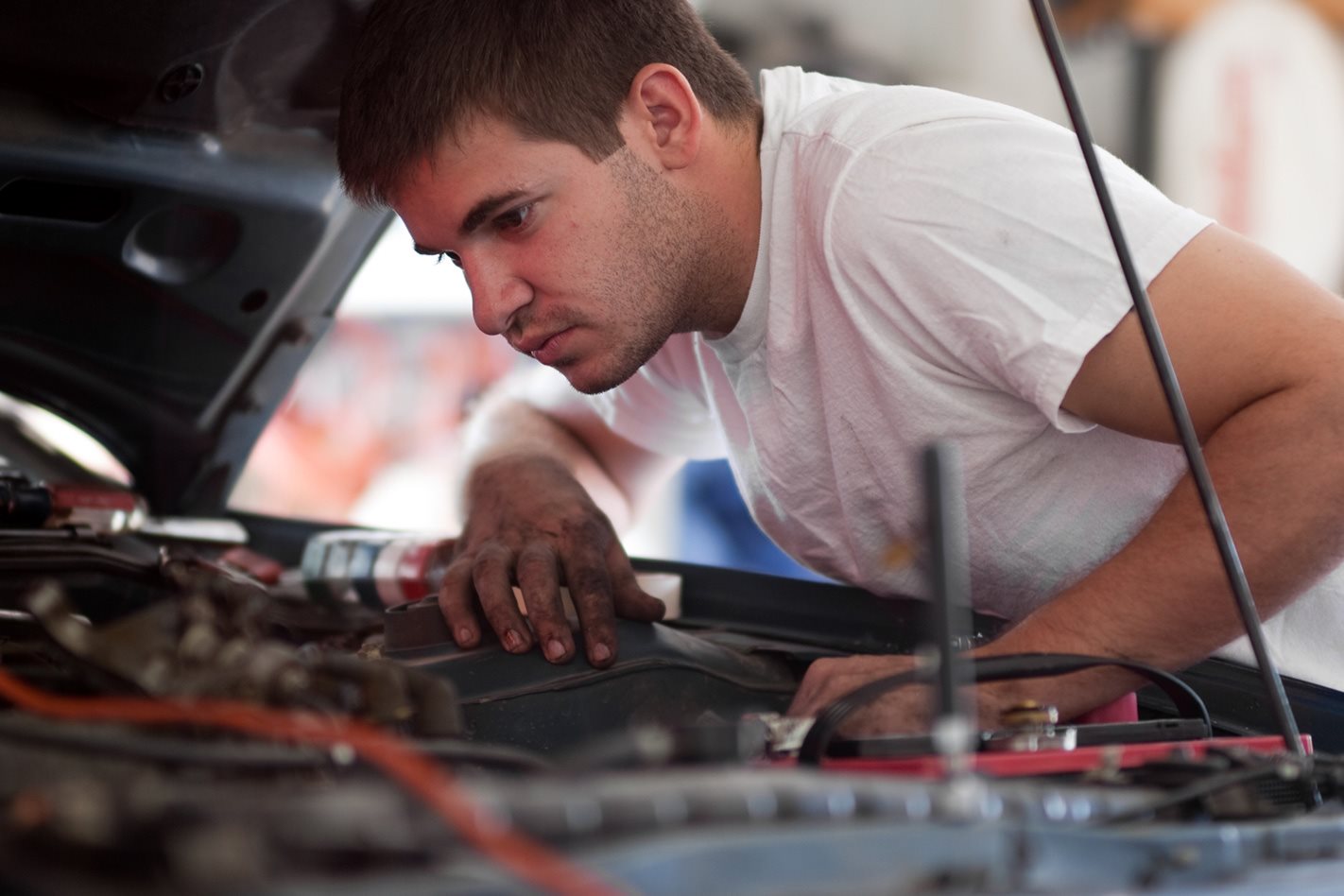
Two thirds (65 per cent) of car owners had already made improvements to their car during the past two years, with 31 per cent spending more money on their car than before the pandemic.
The most common improvements included replacing the tyres (29 per cent), replacing wiper blades (27 per cent), replacing the battery (22 per cent) and polishing the car (21 per cent).
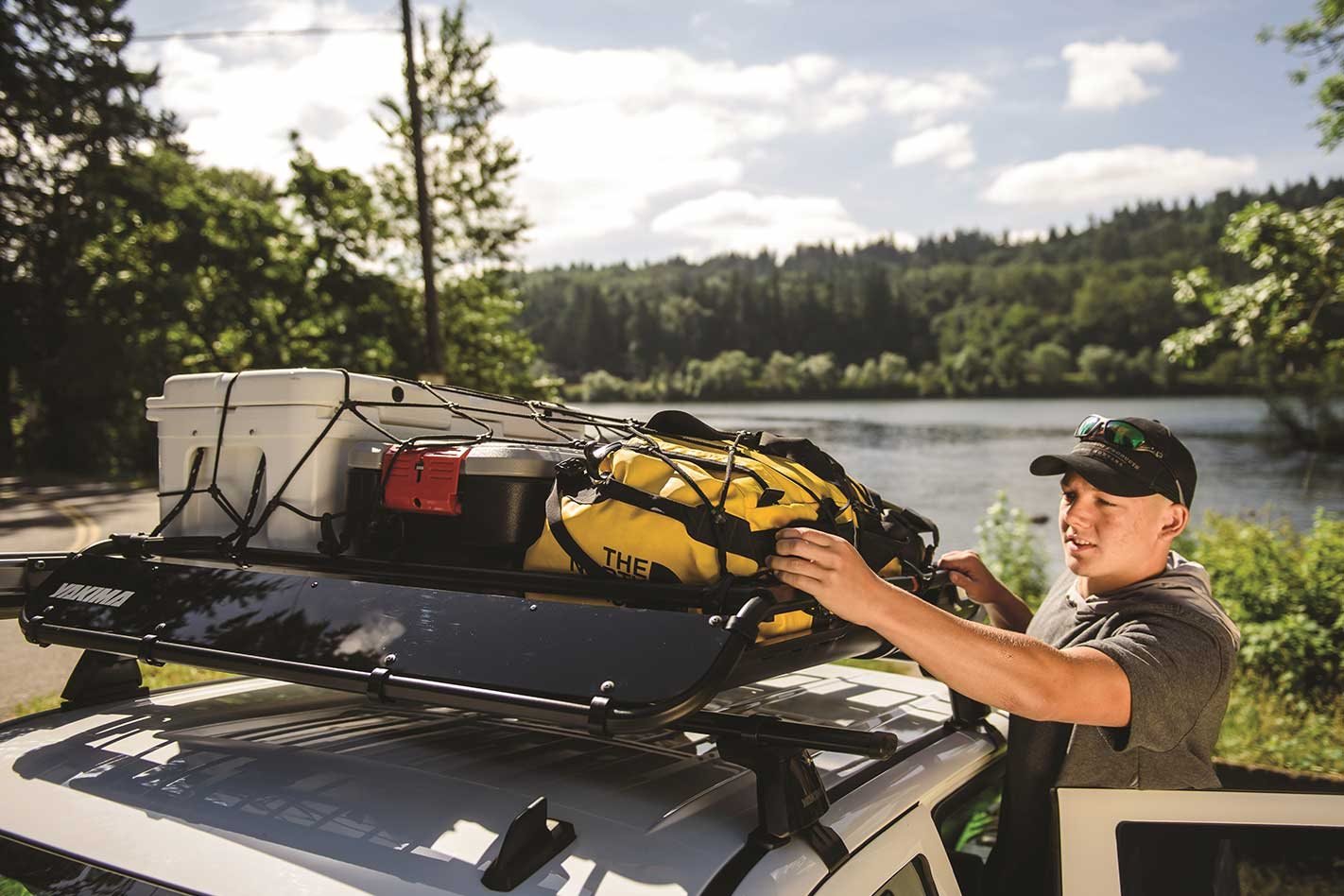
When it came to non-maintenance upgrades, nine per cent of those surveyed splurged on new seat overs, a navigation system or a dash cam, while eight per cent said they installed roof racks or repainted the car.
Another seven per cent installed a reversing camera, and six per cent replaced the sound system or head unit.
Drivers spent an average of $1646 detailing their cars in the past 12 months with men ($1742) outspending women ($1540) to the tune of $200.
People in New South Wales and Queensland spent the most on detailing, probably because of all that rain.
The survey also found that 42 per cent of car owners admit they couldn’t remember the last time they checked the oil level or put oil in their car.

Of these, 46 per cent lived in a major capital city while 35 per cent were from regional and rural areas.
Despite borders reopening 66 per cent of car owners said would prefer to take a road trip rather than fly to a holiday destination during the next six months due to concerns around COVID-19.
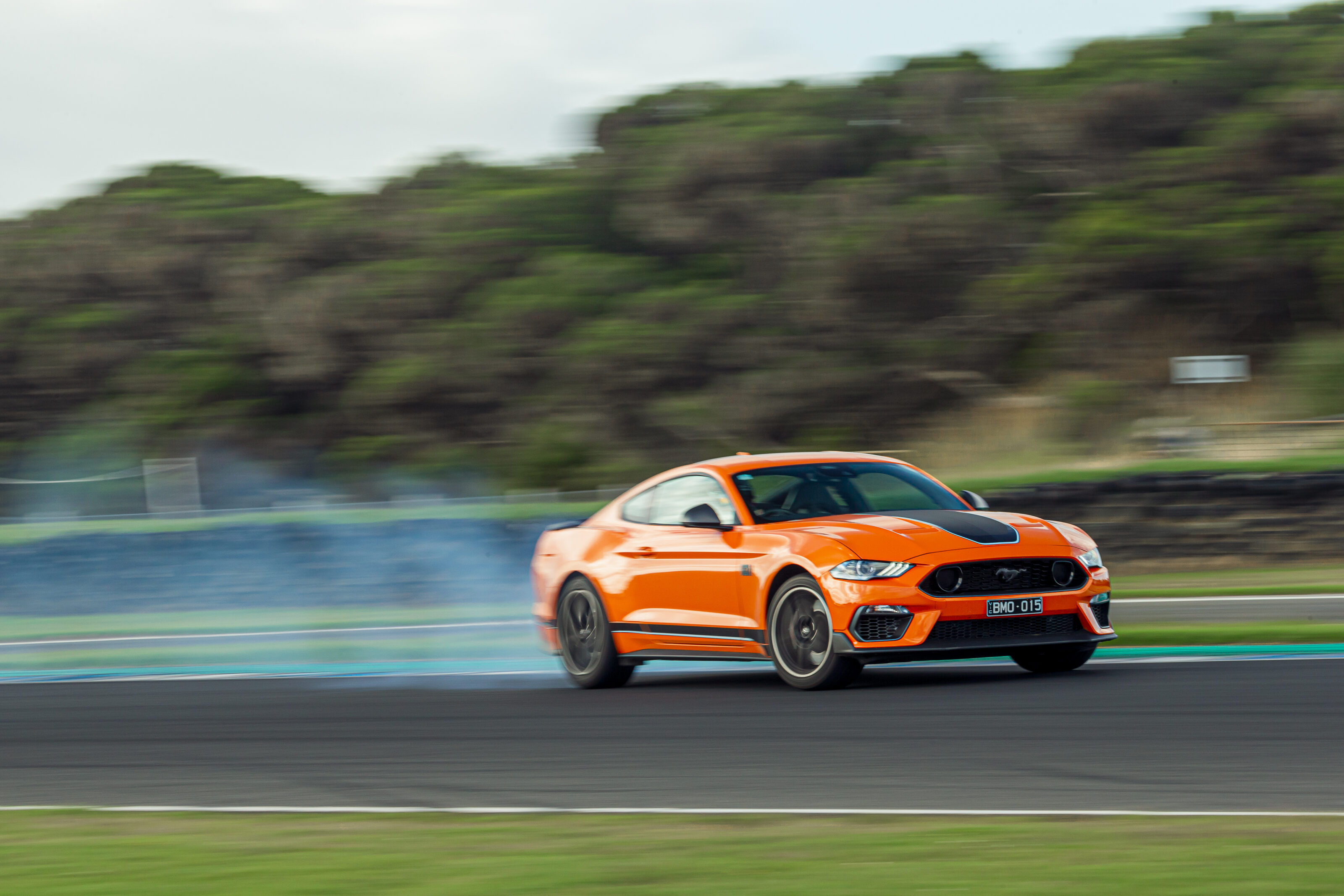
Hot Mustang keeps its cool! Track action failed to stop the Ford Mustang Mach 1 on its way to seventh in Sports Car of the Year 2022.
Phillip Island’s last turn is big commitment, big reward. Tip in, aim for the marshals post at apex, get your left wheels onto the ripple strip, and then begin applying throttle all the way over the crest at exit for a full-throttle run past the pits.
All too often while driving a SCOTY contender I would enter the last turn with nothing in my mirrors, but by halfway down the straight a Twister Orange cruise missile was barrelling past me at full chat. This year, the Ford Mustang Mach 1 was clearly making up for the failures of its forebears to dominate on track.
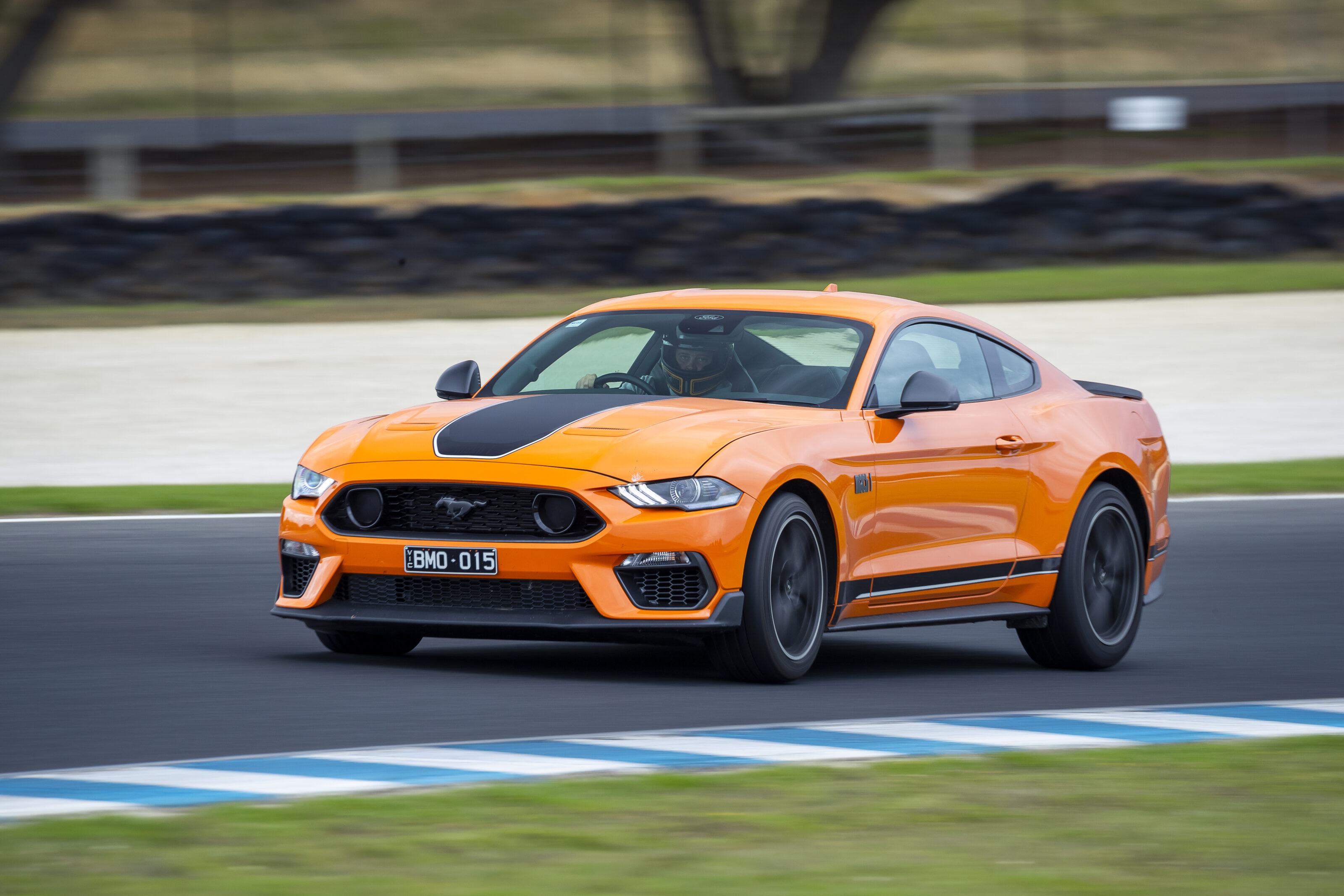
Fastest over both the quarter mile and full circuit, the Mach 1’s numbers dominated the SCOTY field. Not content with knocking out its class rivals, the American brute then gave the Jaguar F-Type a bloody nose beating it over both measured disciplines, while jabbing the BMW and Alpina twins in the kidneys by going quicker over the quarter mile and overall lap respectively. Patronise the Mach 1 as a mere sticker pack at your peril.
More impressive than the ultimate lap time was the fact we didn’t encounter limp mode once, something that has crippled every Mustang PCOTY contender until this point. After 80 kilometres of hard running at Phillip Island, the Mach 1 stared down the assorted judges and asked, ‘Is that it?’ Demons, exorcised.
On the road the damping is firmish, only finding itself flustered on the patchiest of surfaces. That said, smaller, cheaper cars in the field were unfaltering on the same section of road. The Mach 1’s X-Factor is so pervasive it can at times mask the Mustang’s more benign grand touring chops.
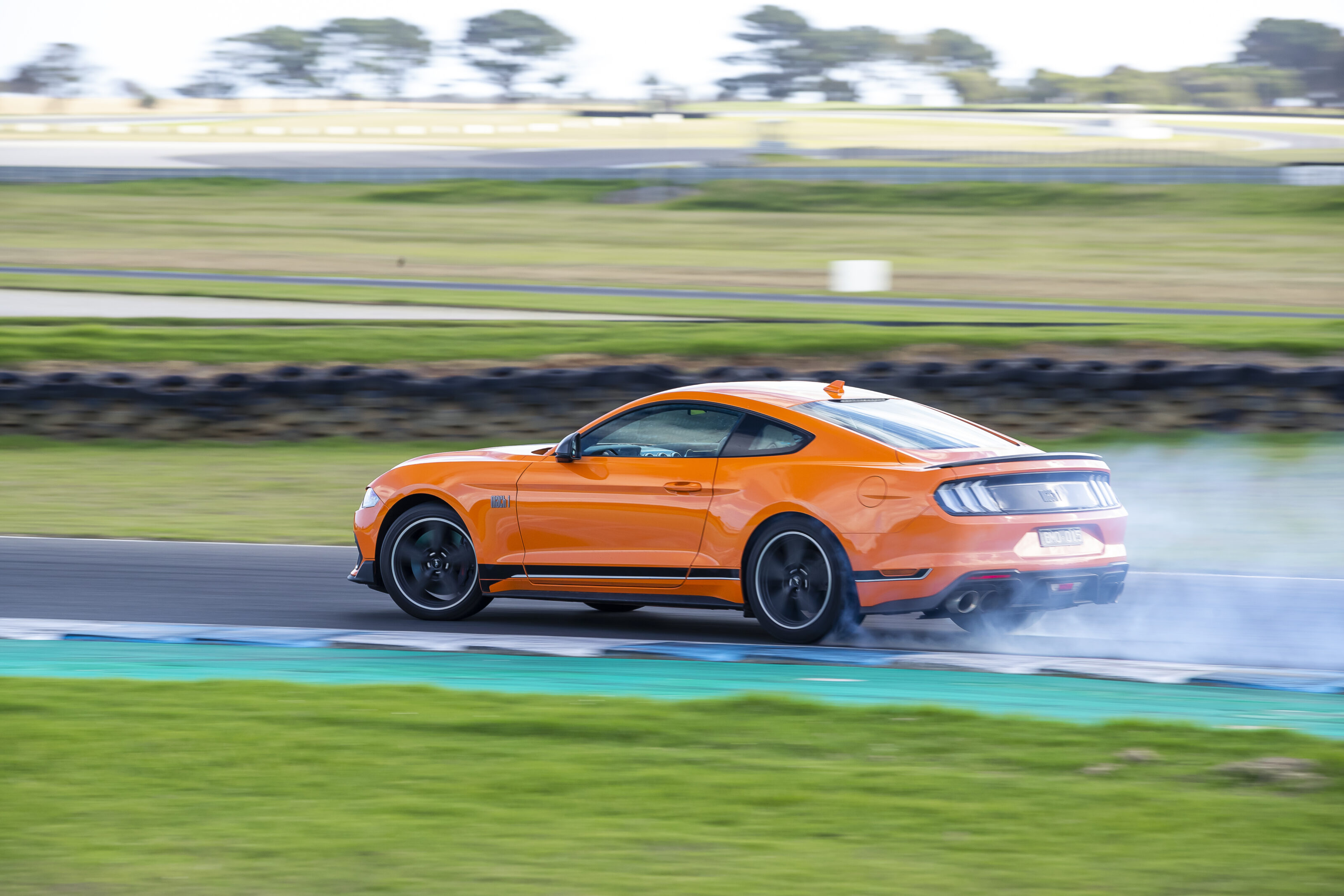
On the road, the Mach 1 was harder to hustle than less powerful competitors, without a significant pace reward. No such issues on track, where the mountain of torque, slick shifter, and neutral chassis balance shone. Steering feel is the Mach 1’s Achilles heel. There’s no shortage of grip, but communication through the wheel goes AWOL moments after initial turn-in.
You are forced to put blind trust in the car with no reassurance through tactility. “The Mustang never feels small and nimble but it’s fun and authentic, with genuine capability,” added Bernie.
In almost every sense the Mach 1 is a Shelby-lite Mustang. It’s worlds beyond what a standard GT can offer. Simply improving the breed isn’t enough – the mid-field fight was closely run, and as a result, the Mach 1’s seventh place finish undersells its talents. If speed and speed alone was the sole criterion, the Mach 1 would have aced the SCOTY field. But there’s more to greatness than pace alone, and the Mustang’s taciturn controls tumbled it down the judging scorecards.
The judges’ comments
Alex Affat
“It’s an overlooked fact but the shift action of the Mach 1’s gearbox vies with the MX-5’s as the best here.”
Ranking 8th
Andy Enright
“Engine sounds fantastic. Big, lazy oversteerer on track. Answers the brief of a Mustang GT plus 10%.”
Ranking: 7th
Trent Giunco
“Long gearing still an issue but there’s a mountain of torque. None of the judges babied it on track.”
Ranking: 5th
Cameron Kirby
“This is the best Mustang you can buy in Australia bar none. The 700 customers have made a great choice.”
Ranking: 5th
Bernie Quinn
“Weird steering. As you turn the wheel, it starts to build torque and feel, then it plateaus or disappears.”
Ranking: 5th
Luffy’s view
“The front end should not have that much grip considering how much weight you’ve got hanging over it.”
The key figures
| 0-100km/h: | 4.69 seconds |
|---|---|
| 0-400m: | 12.55 sec @ 184.32km/h |
| Lap time: | 1:48.32u00a0 |
As is now tradition for the first day of April, our social media feeds – and even some news sources – were overtaken by a slew of pranks from companies and individuals across the globe.
The automotive industry is not exempt from April Fool’s Day, with many carmakers and motoring companies using the occasion to have a bit of fun with a widespread audience.
Below is our list of some of the best jokes offered by the motoring sector on April 1, 2022.
Caterham Seven-SES
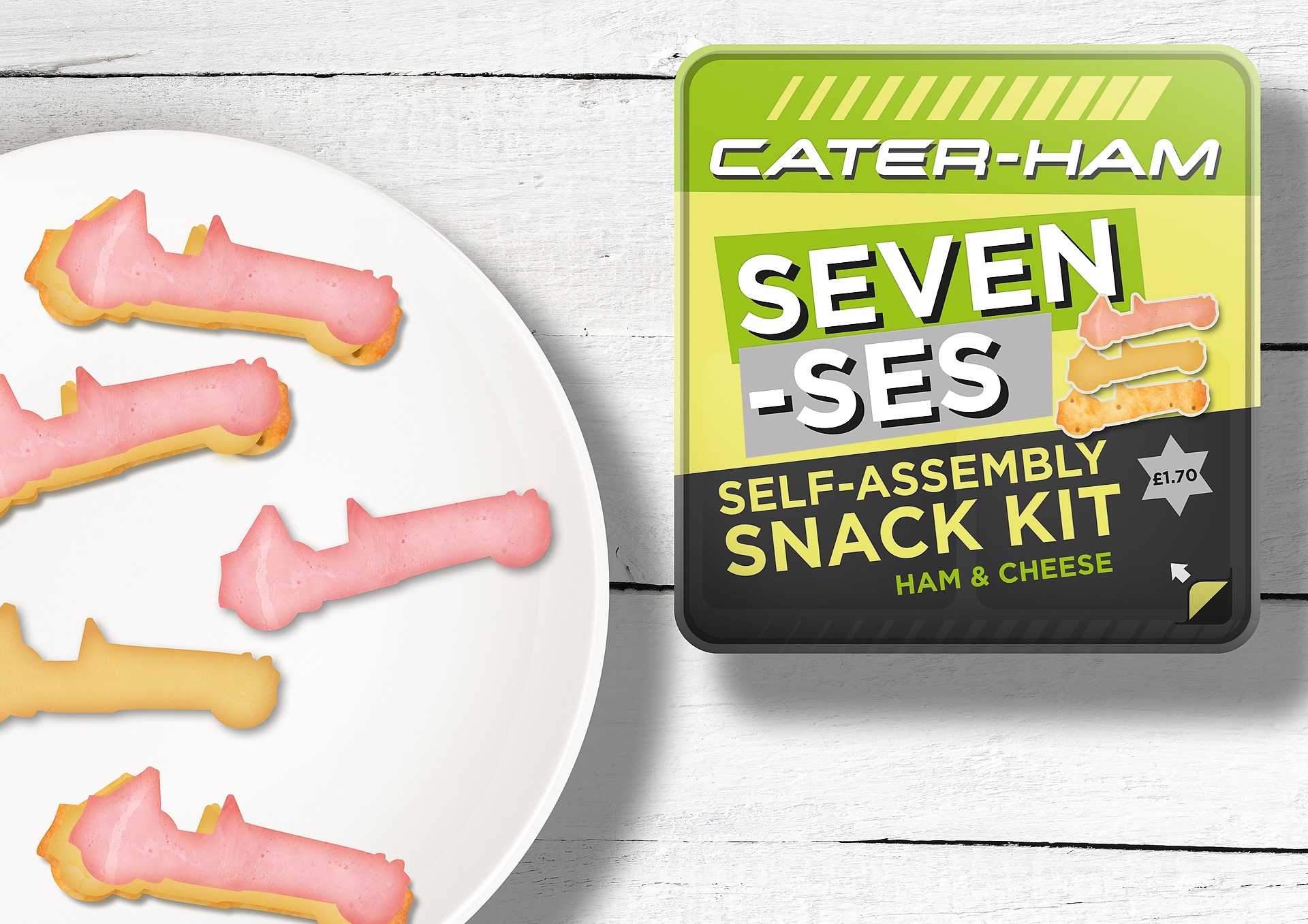
Driving a race car can be a gruelling task, potentially leaving drivers feeling a little peckish.
UK-based sportscar manufacturer Caterham has launched a new division to solve the hunger problem.
‘Cater-ham Sevenses’ consists of the “classic British combination of ham and cheddar” to assist in keeping the adult human body fuelled for 24 hours straight. However, self-assembly is required before consumption – although the marque insists just three ingredients are needed, rather than the 870-plus individual parts required for its kit cars.
“Though 2021 saw record car sales for Caterham, we felt that there was still un-tapped potential left in the business,” said Caterham’s chief commercial officer, David Ridley.
“The launch of Cater-ham has been a long time coming.”
Honda Pet Co-Pilot Front Seat
Honda UK is appealing to dog (and cat) owners with the unveiling of the innovative ‘Pet Co-Pilot Front Seat’.
The updated front seat includes; two integrated spill-proof metal bowls for food and water, a kibble dispenser, integrated air-conditioning vents, a Honda-branded harness, a built-in squeaker, and durable upholstery.
“From driving across the UK and Europe for holidays, to short trips to the shops or a day out, the Pet Co-Pilot Front Seat allows owners to be closer to their beloved pet when driving. It also frees up boot space,” said Annie Mal (read that aloud…), head of pet products at Honda.
Hyundai i30 Sedan N goes RWD…
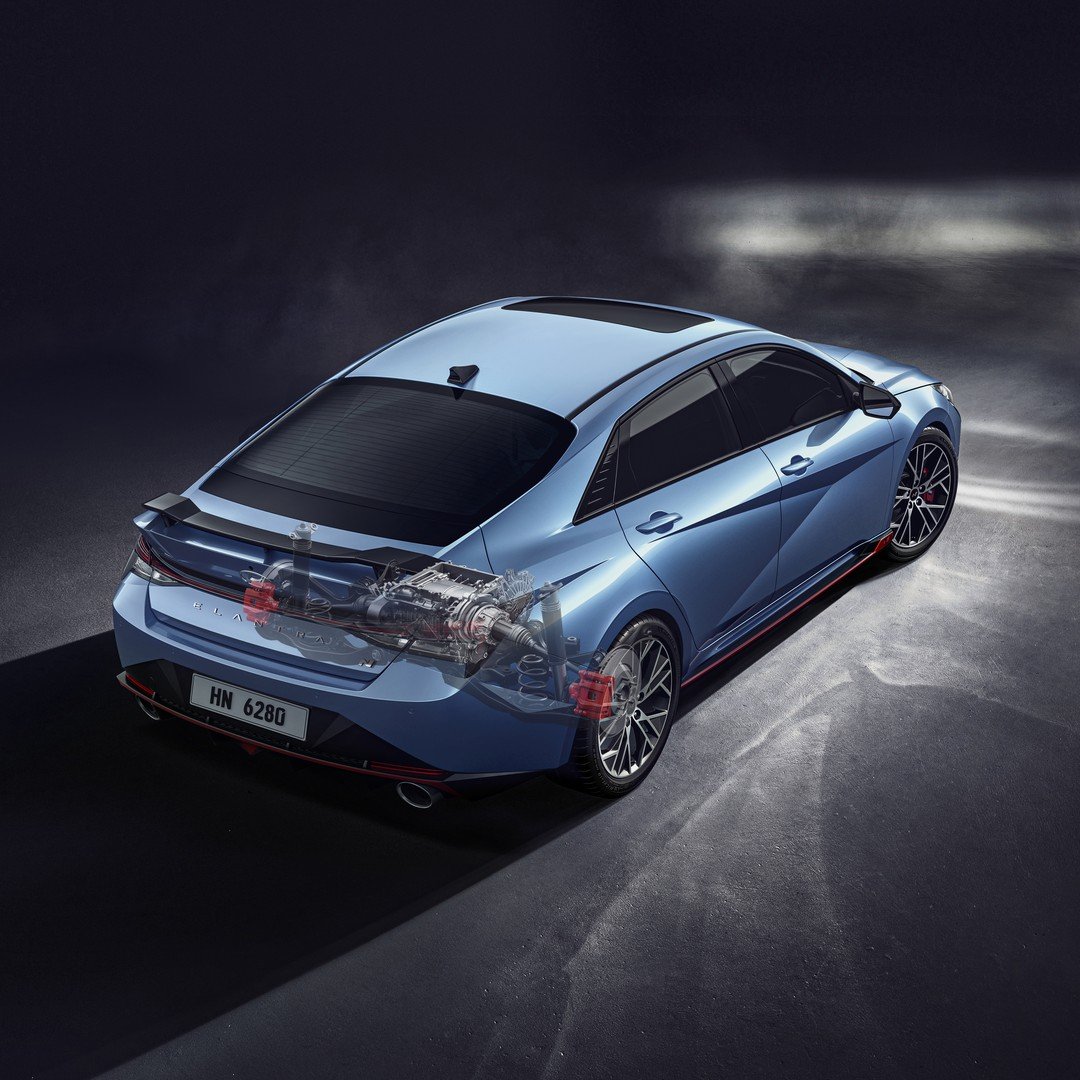
Hyundai announced a new ‘RWD part’ for the i30 Sedan N, promising the ability to transform the hot sedan into an AWD powerhouse with the choice between front-wheel drive and rear-wheel drive.
While the company has no plans to launch the accessory, similar kits could be offered in the future as the industry moves towards electric vehicles.
Isuzu D-Max Street
The strict emissions standards and tight roads across Europe has sparked the imagination of Isuzu UK, with the subsidiary announcing the tiny D-Max Street.
Available exclusively to 12:00pm on April 1, Isuzu engineers downsized the current-generation D-Max wheelbase to make the small ute “perfect for the tight and narrow city confines”.
The company has the D-Max Street has an “impressively tight turning circle”, although its super low ride height means off-road action is off-the-table – with the large 18-inch alloy wheels likely to provide headaches even on the slightest indentations.
MG Carfume
MG has introduced a new scent for its electric vehicle owners in the UK, dubbed MG Carfume.
Developed for “the electric driver that wants to smell expensive”, the perfume includes hints of the exhaust fumes emitted by an internal-combustion engine to appeal to EV drivers who enjoy “the smell of CO2 emission in the morning”.
Subaru Solterra photoluminescent limited-edition
Subaru has unveiled the world’s first glow-in-the-dark electric SUV.
The launch of the limited-edition Subaru Solterra photoluminescent is said to be ‘later this year’, perhaps fooling a greater audience than some of 2022’s other efforts.
While glowing paint is unlikely to make production in the foreseeable future, BMW unveiled a colour-changing version of its iX electric SUV at this year’s Consumer Electronics Show. No joke.
The BMW iX Flow concept utilises an electrophoretic film containing microcapsules to change its appearance between black and white with just a single touch.
WA Police Force Getz a new fleet
Months after announcing a trio of new police vehicles, the Western Australia Police Force has unveiled the latest, slightly-used addition to the range.
Perfect for inner-city duties, the Hyundai Getz has been recruited by the force to “navigate laneways and tight spaces to help [WA Police Force] Getz the criminals”.
The new police vehicle is fitted with Motorola Razr compatibility and includes the So Fresh: The Hits of Summer 2004 CD as standard.
Walkinshaw: Volkswagen Amarok W580X HI-VIS

Capitalising on the success of the Volkswagen Amarok W580X, Walkinshaw Performance – which transforms a standard Amarok V6 into the W580 package locally – unveiled a new ’HI-VIS’ option.
Priced from just $49.99 for a ‘limited time only’, the Amarok W580X HI-VIS includes; roof lights, reflective decals, a light bar, a standard bollard, and ‘performance’ steel wheels.
