
For a motoring writer, it’s hard work keeping up with Tesla. Such is the Californian (but now headquartered in Texas) company’s pace of change that the Tesla Model 3 we tested late last year was superseded barely a fortnight after we’d driven it.
Then within days of finally driving the revised base model that has dropped the Standard Range Plus name and added some minor exterior tweaks, the price increased twice before this review had started to be penned.
When it comes to being confident about up-to-date reviews, testing TVs would seem a more risk-averse vocation.
We’re persevering, however, because the Tesla Model 3 is the world’s biggest-selling electric car – by a margin that’s bigger than its maker’s actual profits.
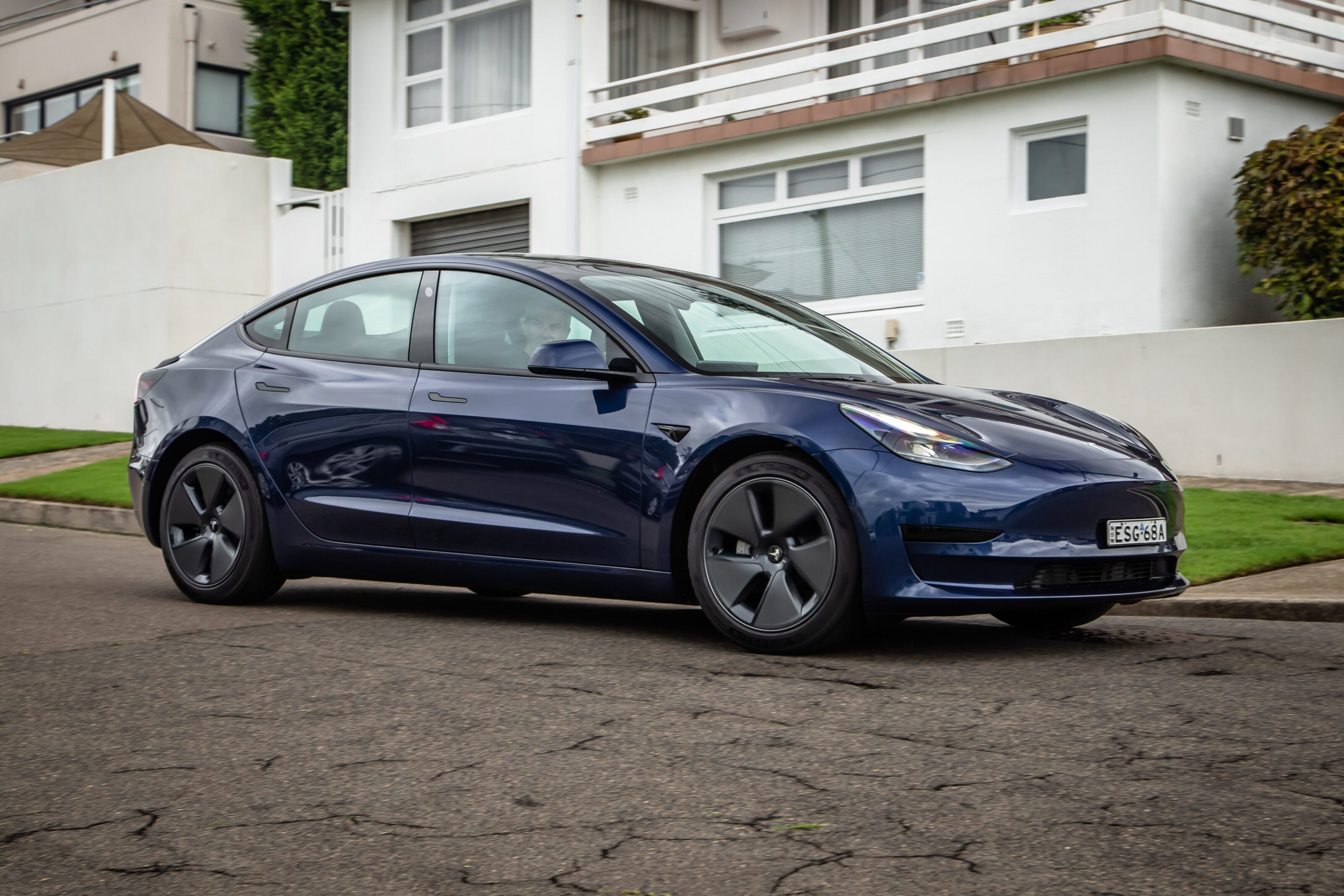
In Australia last year, more than 12,000 units of the most affordable Tesla were shifted; the next best-selling EV was the MG ZS with 1388 sales.
The update involves a new, larger battery rather than a downloadable over-the-air upgrade, though a significant software update was also introduced in December 2021.
Battery sizes are among the details Tesla doesn’t divulge, leaving it to other, reputable sources such as the EV Database or local Tesla watcher VedaPrime for guidance. The former estimates 60kWh, the latter 62.3kWh.
The entry-level variant uses Lithium Iron Phosphate that’s said to be safer, cheaper and produced without ethically questionable cobalt
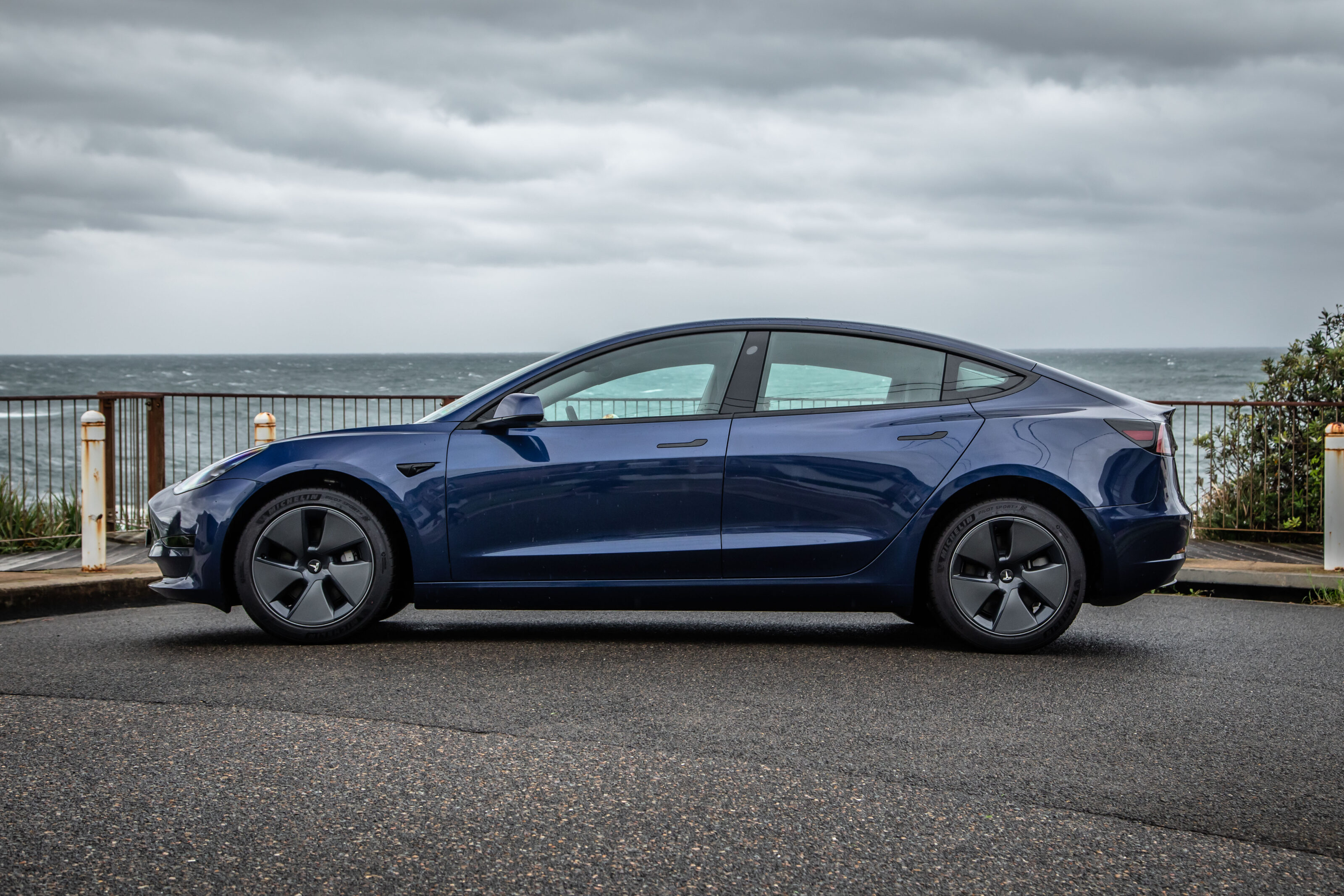
Either way, we know the base Model 3’s WLTP-rated range jumps nearly 10 per cent – from 448km to 491km.
Also confirmed is that the base model’s new battery chemistry introduced in late 2021 continues to differ from the Long Range and Performance variants.
Where the dual-motor Model 3s stick with Nickel Cobalt Aluminium Oxide (NCA), the entry-level variant uses Lithium Iron Phosphate (LFP) that’s said to be safer, cheaper and produced without ethically questionable minerals such as cobalt.
Pricing and Features
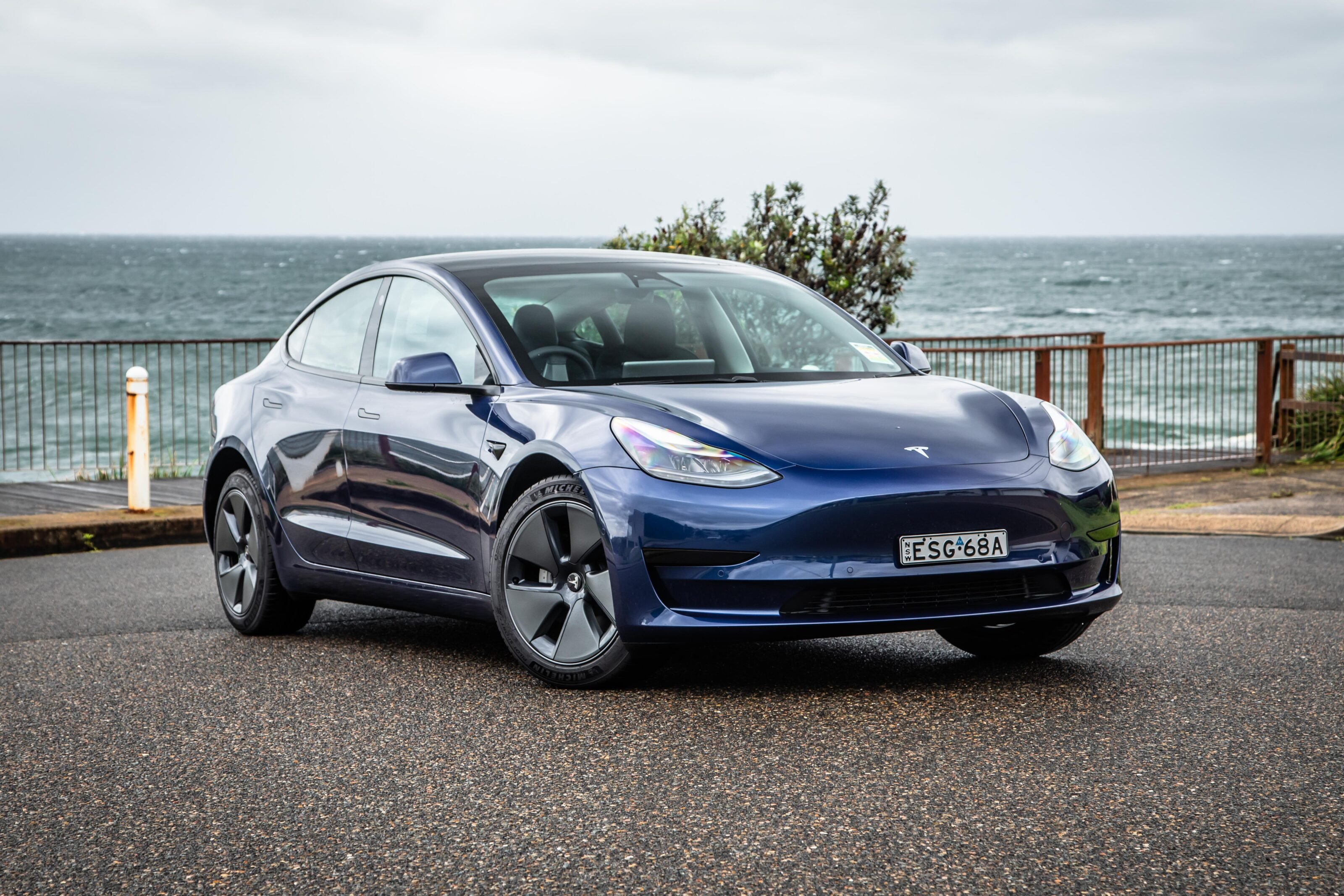
The Model 3’s starting price has increased from $59,900 to $63,900 before on-road costs, but this doesn’t affect its eligibility for EV-incentive thresholds in states such as NSW and Victoria.
Buy the base car in New South Wales, where the country’s most generous incentives are currently found, and on-road charges are effectively cancelled out.
The base variant is the sole rear-wheel-drive model.
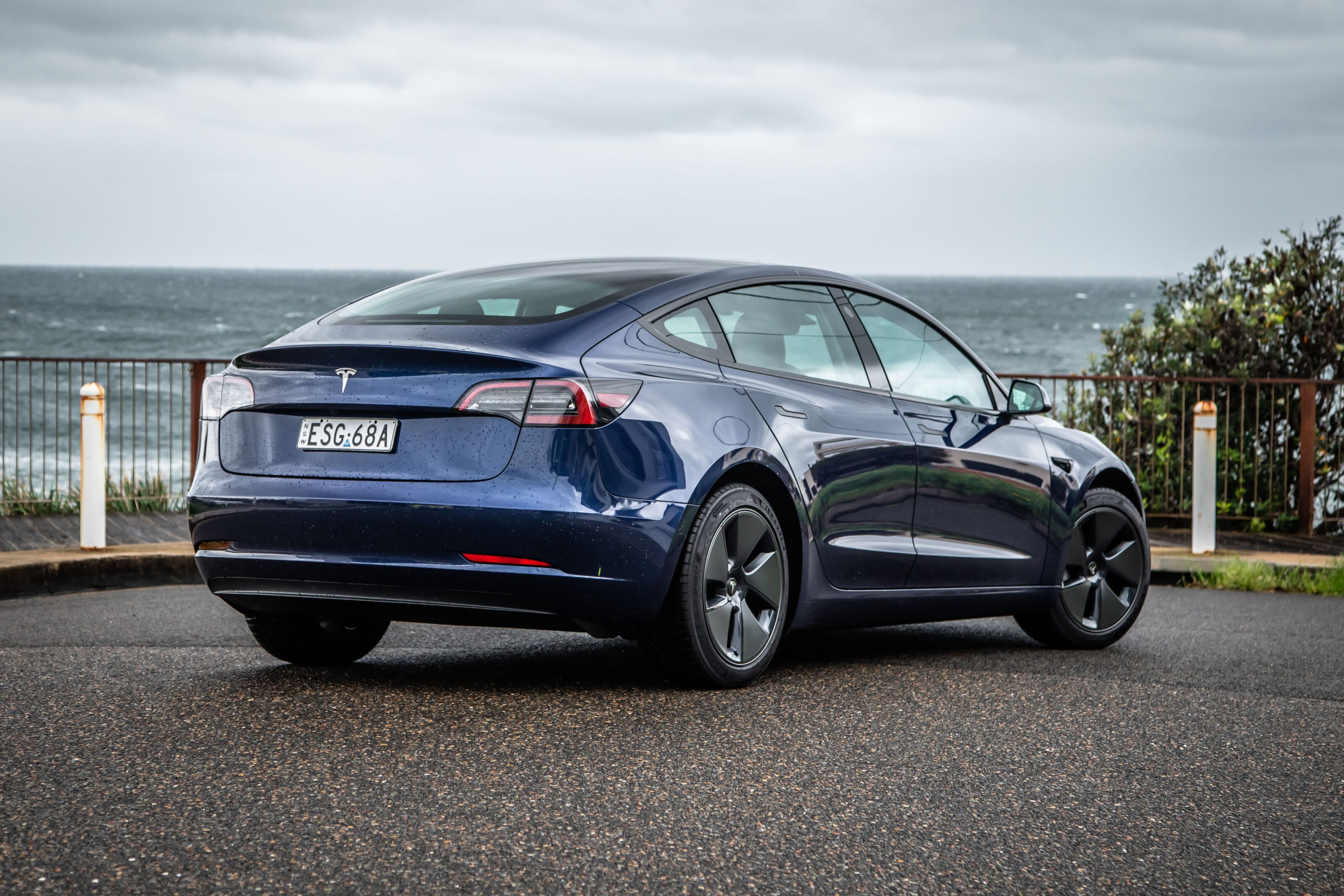
Extra performance and longer ranges are available with the two dual-motor, all-wheel-drive variants that have also increased in price: the $76,200 Long Range and $88,900 Performance (both before on-road costs).
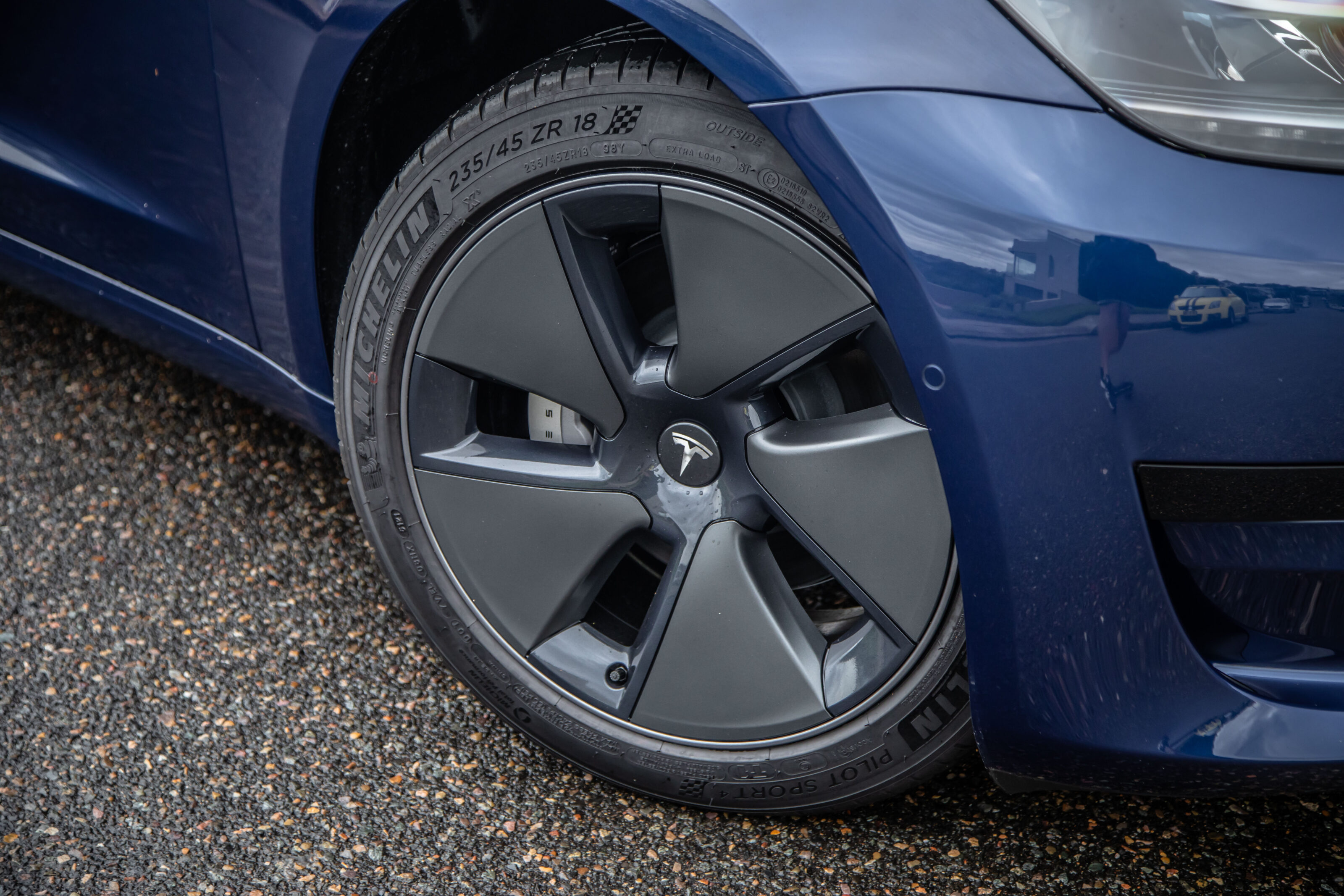
Standard exterior items for the entry Model 3 include LED headlights, LED daytime running lights, 18-inch alloy wheels (though the ‘Aero’ blades are plastic), a panoramic glass roof (with ultraviolet/infrared protection), and a collection of cameras and ultrasonic sensors pivotal to the Tesla’s impressive driver-aid arsenal.
Standard exterior items for the entry Model 3 include a collection of cameras and ultrasonic sensors pivotal to the Tesla’s impressive driver-aid arsenal
Inside, there’s dual-zone climate control, 15-inch central multi-function touchscreen, electric front seat adjustment, heated steering wheel, heated front/rear seats, and dual wireless phone charging.
Pearl White is the only standard exterior colour. It’s an extra $1500 for black, silver or the blue of our test car. A red multicoat costs $2900.
Buyers can also choose 19-inch Sport wheels for $2200 and select a black-and-white interior for $1500 over the standard all-black trim.
Comfort and Space
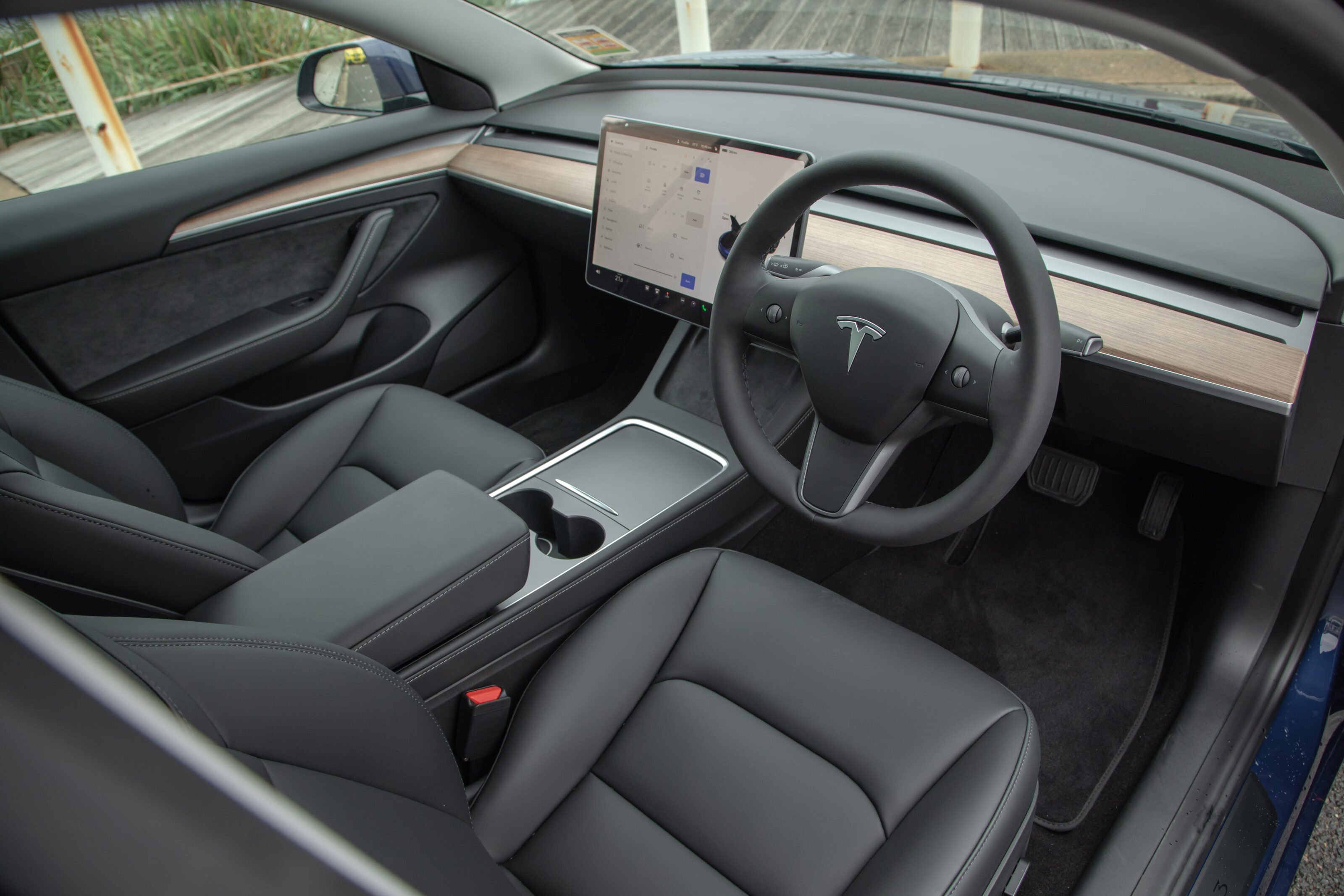
Open the doors via handles now finished in satin black rather than chrome and you’re greeted by sill plates that have made the same switch.
Updated trim swaps gloss black for matte black in places, there’s a graphite finish for the seat controls, the steering wheel thumb-scrollers are now metallic, and the sun visor mirrors gain magnetic snap-close covers.
Changes for the centre console include the addition of a sliding lid front storage compartment, four rather than two USB-C ports, and there are now dual inductive charging trays (with a suede-like backing) for smartphones.

We cover the cabin’s major change in the Infotainment section, otherwise, the Model 3’s cabin retains its ultra-minimalist layout that makes Scandinavian design seem cluttered by comparison.
Tesla build quality has been a common talking point, of course. Fit and finish blemishes can still be found, but it seems to be constantly improving – and much better than the last Model 3 this author tested in 2020, where not even the insides of the doors were properly painted.
Not everyone will necessarily take a liking to the “All Vegan” vinyl seats, and kids will appreciate the rear seats more than adults.
Fit and finish blemishes can still be found, but it seems to be constantly improving – and much better than the Model 3 tested in 2020

While not short on legroom, the low rear bench creates a knees-up seating position, toe space is lacking, and the sloping roofline restricts headroom.
ISOFIX and top-tether points in the outboard positions cater for child seats.
Luggage space completes the Model 3’s status as a practical family sedan.
The boot is usefully long with decent width, and it’s made all the more practical with a generously sized under-floor storage well that can store items such as recharging leads.

Accessing the boot has been made easier, too, which can now be opened via a boot lid button, the touchscreen, or the Tesla smartphone app.
The app can also open the front cargo compartment. It’s lost a bit of space after the introduction of a heat pump – which can help battery range on colder days – though the 88-litre ‘frunk’ is still big enough to store a decent-sized duffel bag. It’s also immediately accessible where many other EVs opt for a secondary lid.
Infotainment
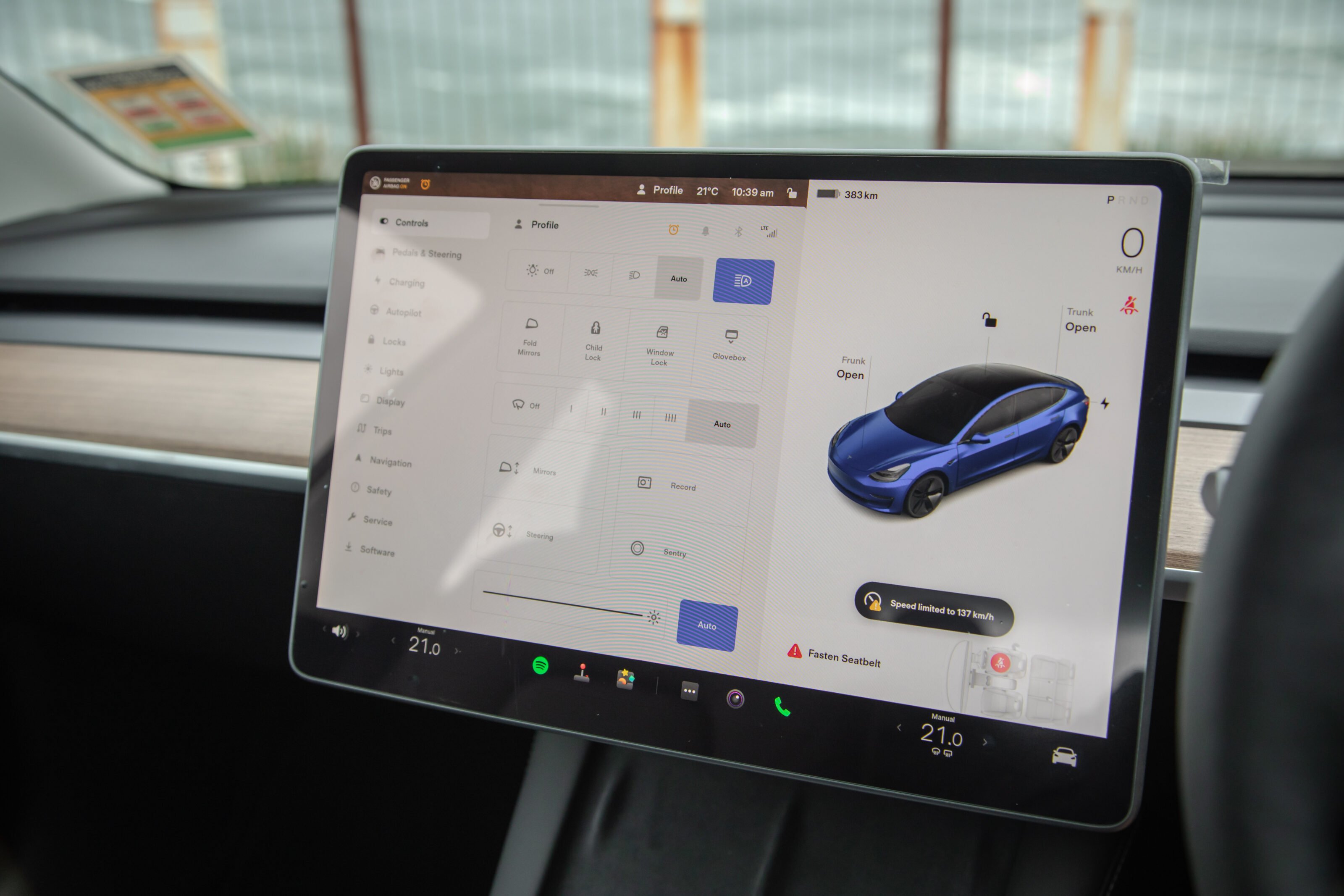
The biggest change is to the interface presented in the horizontal 15-inch touchscreen.
Tesla introduced its V11.0 software on Christmas Eve last year, treating owners to some Happy-Holidays features such as a Light Show that will choreograph the Model’s various exterior lighting elements to music, and a Megaphone mode that can amplify the occupant’s voice via the car’s external speakers (perfect for budding politicians and activists).
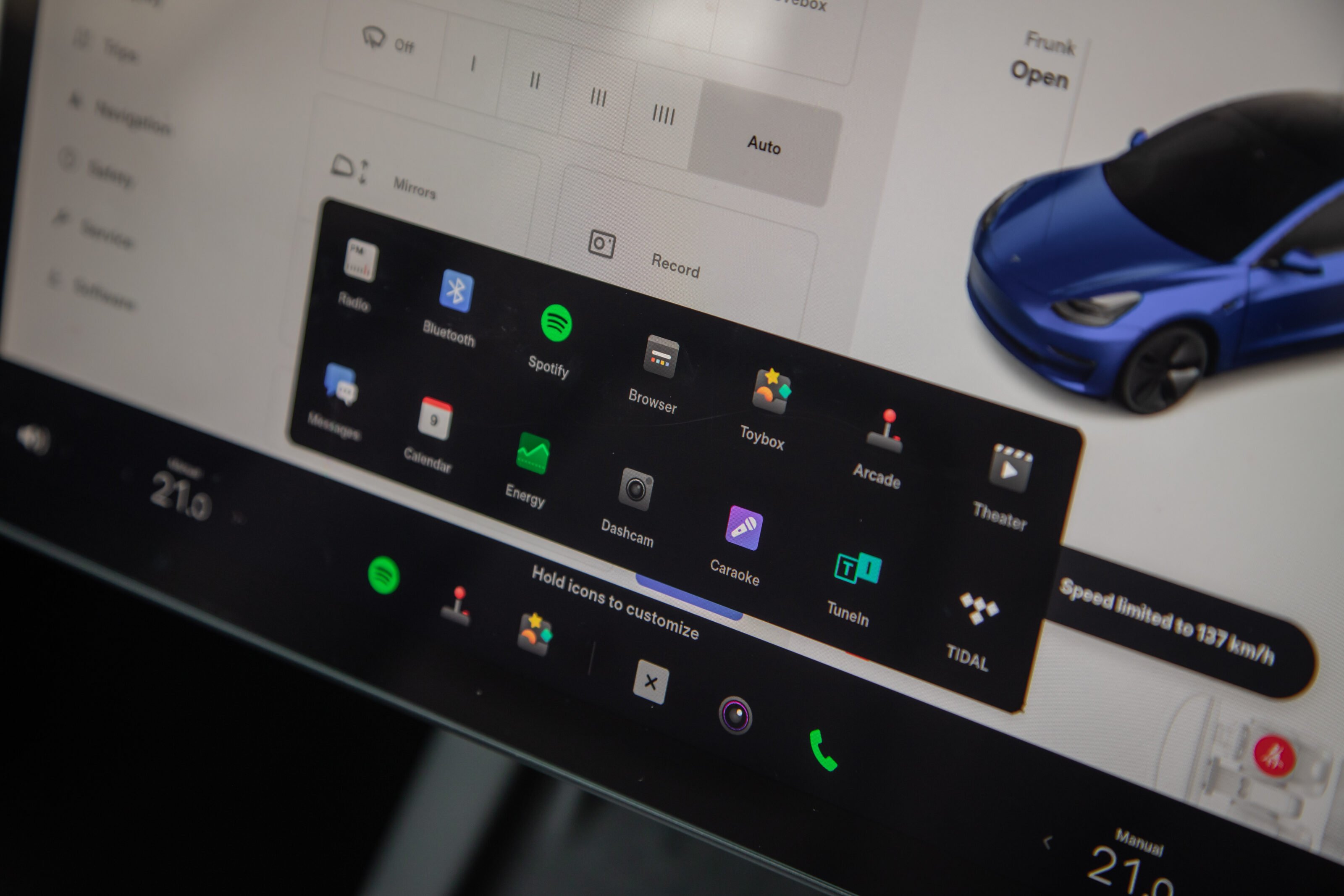
Less gimmicky is a revised digital presentation that includes a customisable app launcher and dark mode support. There’s also a “simplified” controls menu, though we share the view of many owners who believe the update brings some unnecessary complexity.
Some once-prominent functions – such as seat heaters, driver profiles and trip information – are now buried a bit deeper, requiring more taps to access.
We found ourselves distracted for longer periods trying to figure out various functions, even if we had the vehicle for less than a week where owners of course would have more time to get accustomed to operations.
The voice-command system is also effective.
We know – via Elon Musk’s Twitter account – that Tesla is working on improvements to functionality, and patches have been rolling out already according to some Model 3 owners.
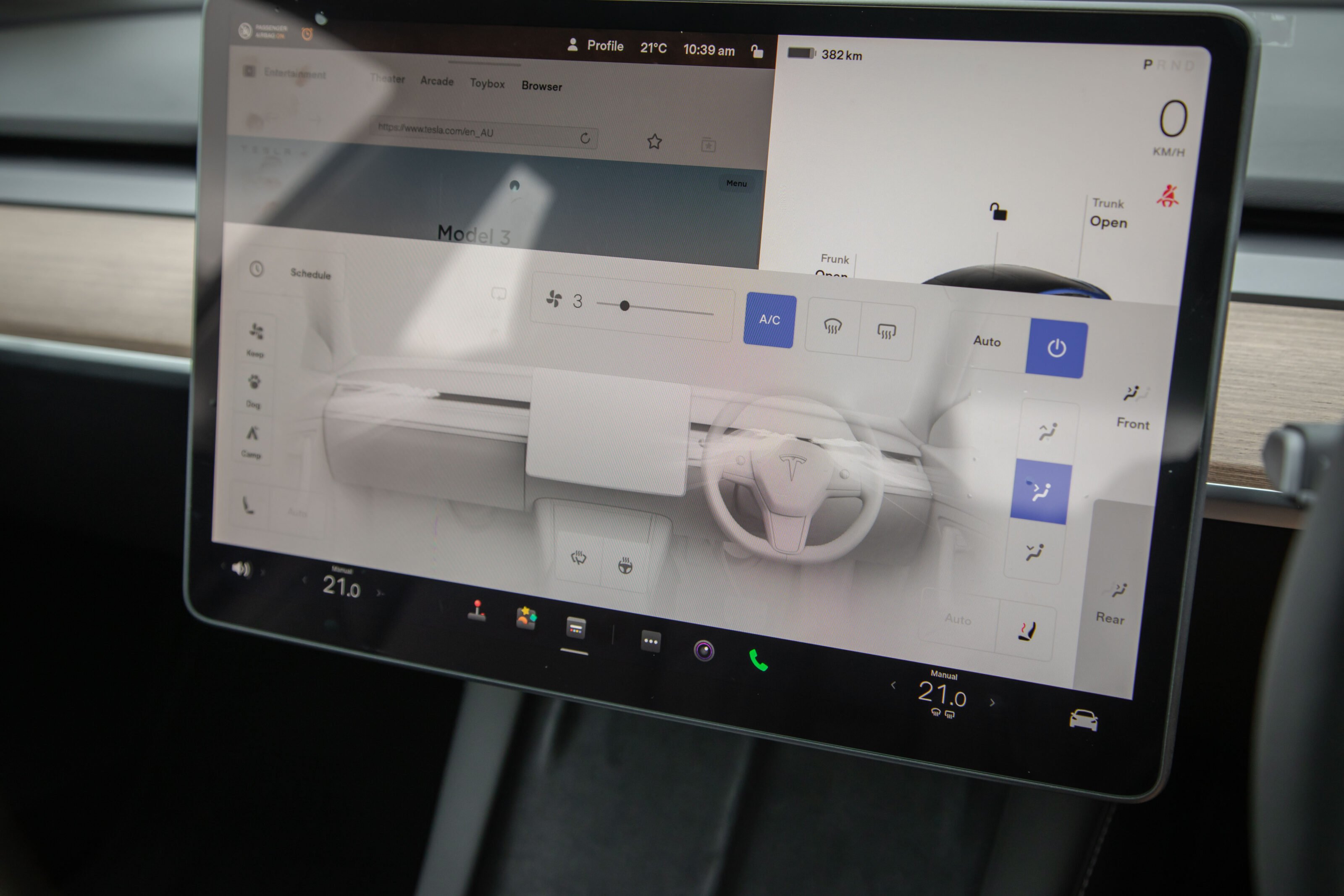
The Model 3’s interface is more vital than in most cars because it’s responsible for about 95 per cent of the vehicle’s controls and functions. This includes adjustment of the side mirrors, done in conjunction with the thumb controllers on the steering wheel.
V11.0 also brings additions to Tesla’s brilliantly comprehensive and unrivalled entertainment system, including TikTok, Sudoku and – no doubt to the delight of former Sega Megadrive-owing Gen Xers – Sonic the Hedgehog.
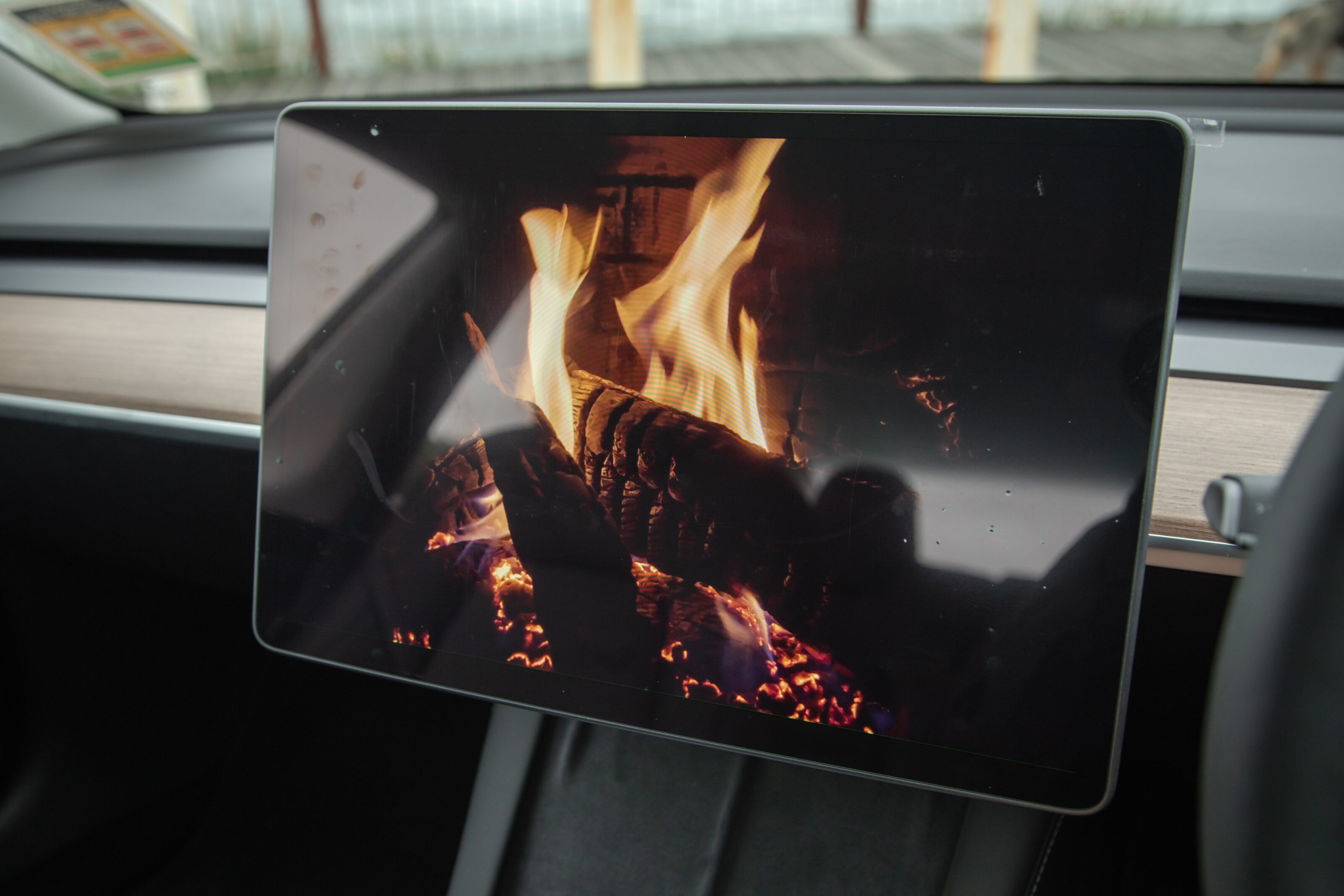
Humorous touches still include the roaring fireplace screen when heating the cabin, and the whoopee-cushion effect that will have the kids in stitches.
V11.0 also brings additions to Tesla’s comprehensive and unrivalled entertainment system, including TikTok, Sudoku and … Sonic the Hedgehog
The Google Maps navigation has a couple of tweaks and remains ridiculously intuitive, rapidly predicting address inputs and then relaying clear and helpful route guidance.
It’s part of the Premium Connectivity content that is complimentary for the first 30 days of ownership but requires a $9.99 monthly subscription thereafter.
On the right side of the display, your surrounds – including vehicles and lane markings – are depicted graphically using the car’s front radar, exterior cameras and multiple ultrasonic sensors.
The cameras also tie in with two peace-of-mind features: a dashcam that records while driving and Sentry Mode that records when the car is parked and locked. Footage can be recorded to a storage key plugged into a USB-A port inside the glovebox.
On the Road

For all the Model 3’s technology, its chassis would benefit from adaptive dampers.
The passive set-up is firm at low speed and tends to fidget over uneven bitumen.
Suppleness increases with speed, though, and the Model 3 feels especially comfortable on freeways, where relaxed progress is complemented by the effortless electric motor and ‘Autopilot’ adaptive cruise control.
Despite the name, Autopilot merely adds steering assistance; take your hands off the wheel for too long and the car will start to slow and then put the driver in the naughty corner by refusing reactivation of the function for the rest of the trip.
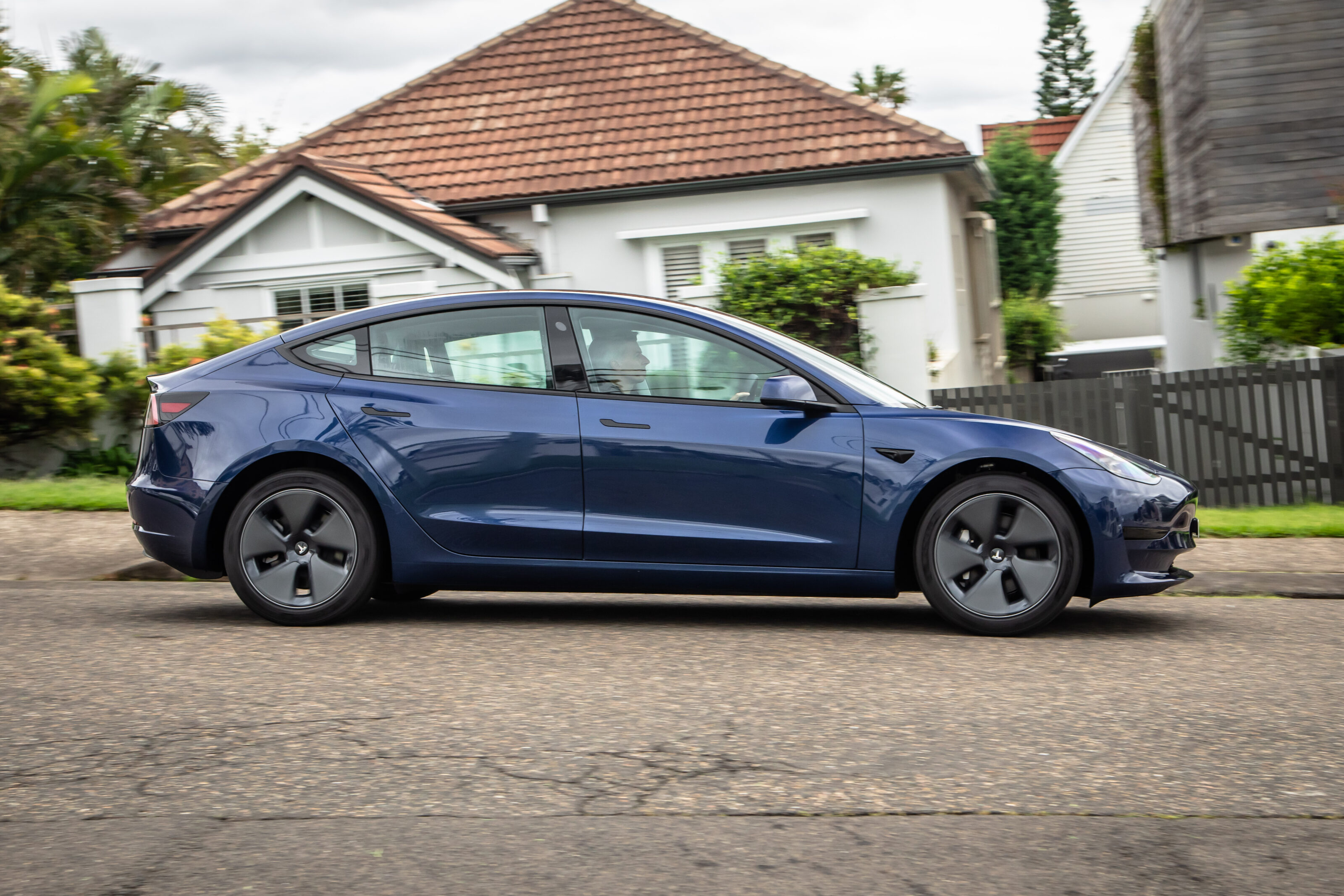
If autonomous-style functions are your thing, Tesla offers an optional Full Self Driving Capability pack for $10,100. Features include auto lane change and the Summon feature that allows owners to use the Tesla app to command their Model 3 to leave a parking spot and find them.
Our test car wasn’t equipped with the pack, but we didn’t miss it. Plenty of YouTube clips also suggest Summon is very much a work-in-progress function.
It’s also important to note that, despite the pack’s name, a fully self-driving computer is an “eventual” capability that remains highly theoretical for now.
The Model 3 is very much a car that even keen drivers can enjoy … the steering is quick and precise, matching with a responsive front end
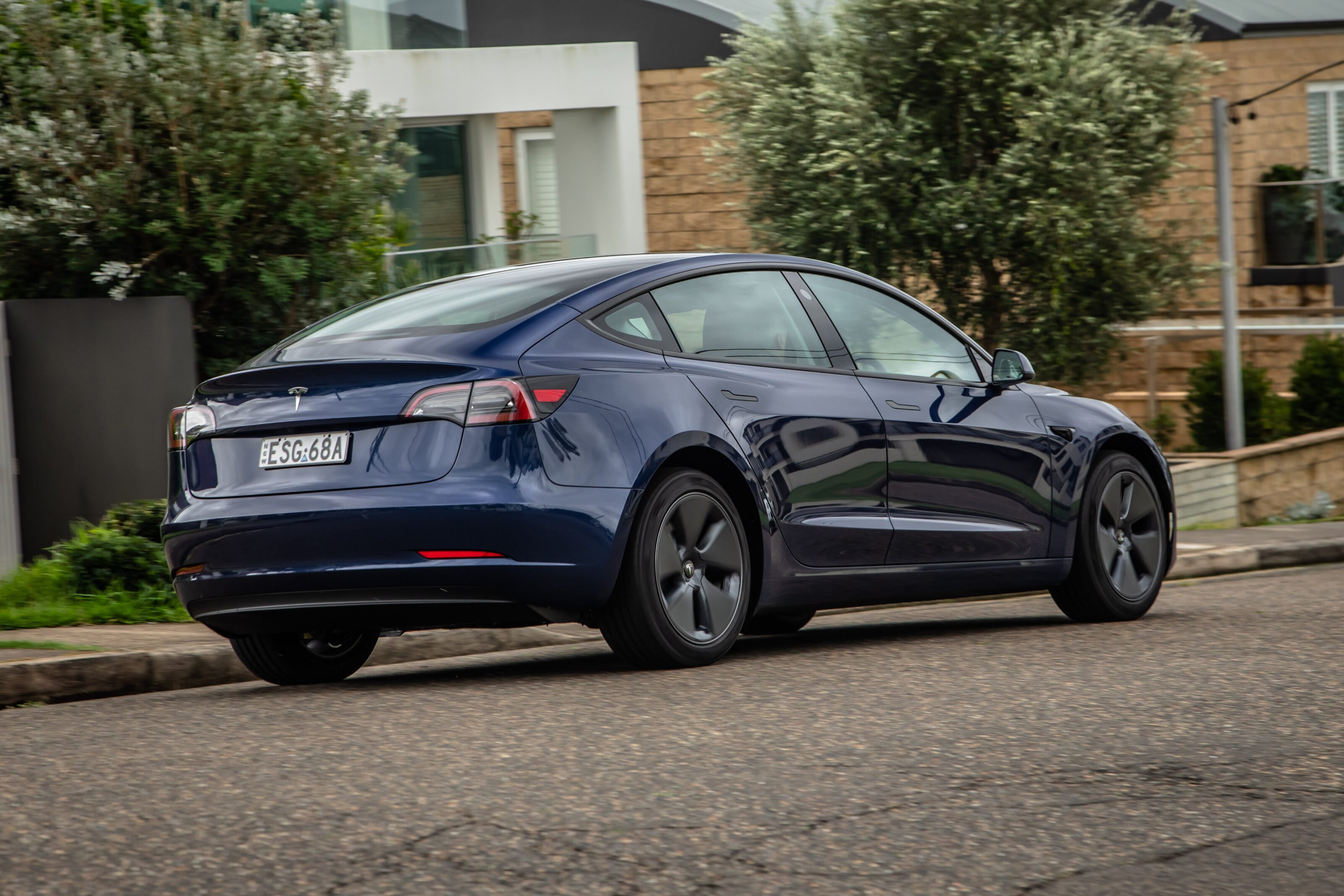
Yet the Model 3 is very much a car that even keen drivers can enjoy.
The steering is quick and precise, matching with a responsive front end that’s made more responsive by the lack of a lump of metal under the bonnet.
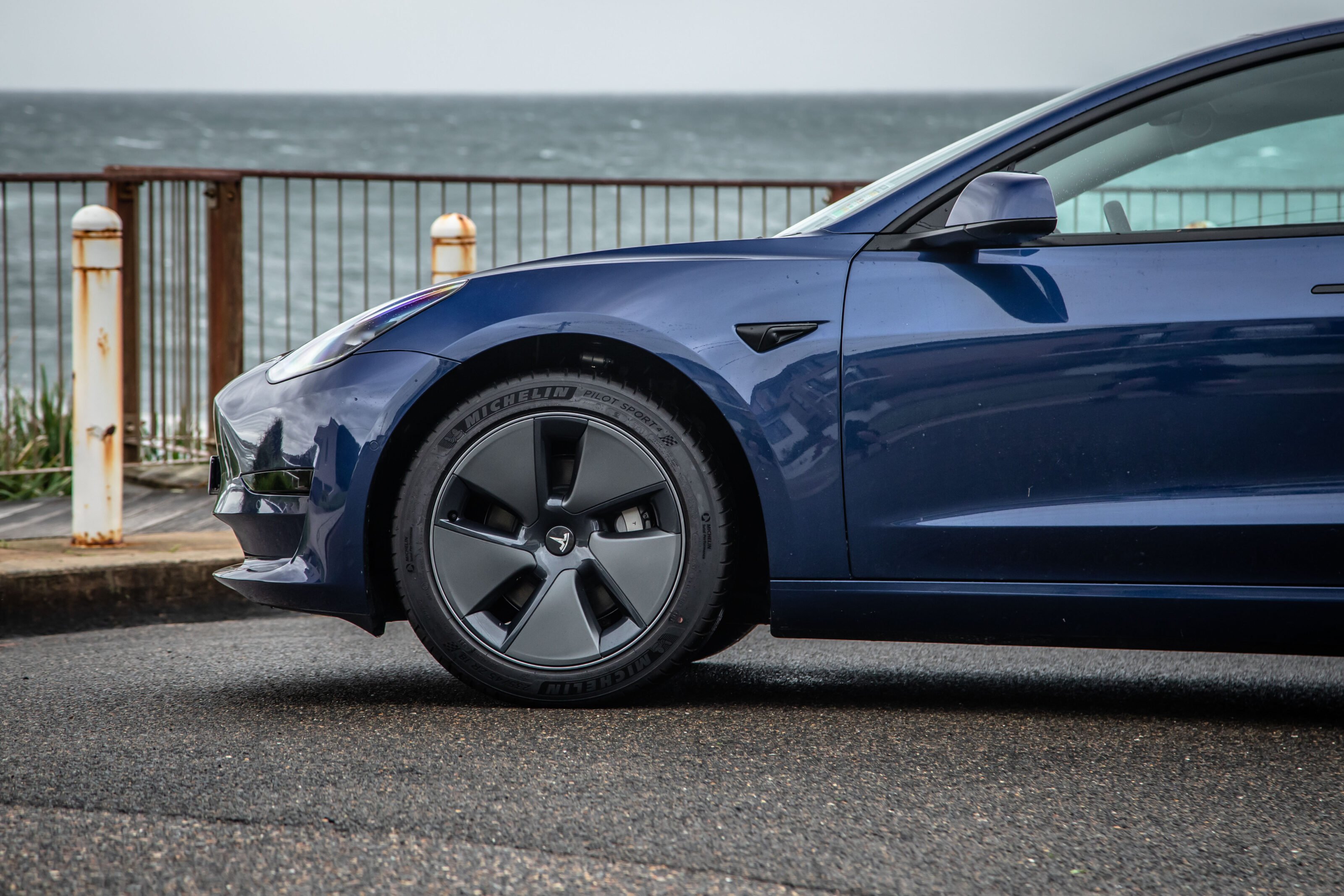
Even in damp conditions, the surprisingly sporty rubber fitted – Michelin Pilot Sport 4s – produces plenty of cornering purchase. Traction also impresses considering the Model 3 is anything but short on accelerative punch.
Tesla doesn’t quote drivetrain outputs, but reputable website EV Database estimates the base variant has 239kW and 420Nm.
Meanwhile, the company insists performance figures are more relevant to buyers. The base Model 3’s 0-100km/h is now 6.1 seconds, dropping half a second with the update.
We can’t say that difference is noticeable; the Model 3 will still beat the majority of cars away from traffic lights.
The base Model 3 also remains more than a second faster than rear-wheel-drive versions of the Hyundai Ioniq and Kia EV6, as well as the front-drive Polestar 2. They all have faster AWD versions, yet so does the Model 3.
A more relaxed delivery can be selected with the ‘Chill’ mode via the touchscreen.
The Model 3’s update brought something more beneficial as a trade-off for that performance drop. An increase in WLTP-rated range – from 448km to 491km.
The base model’s range is extended with its larger battery, and, despite a small hike, its price remains eligible for Australia’s most enticing EV incentives
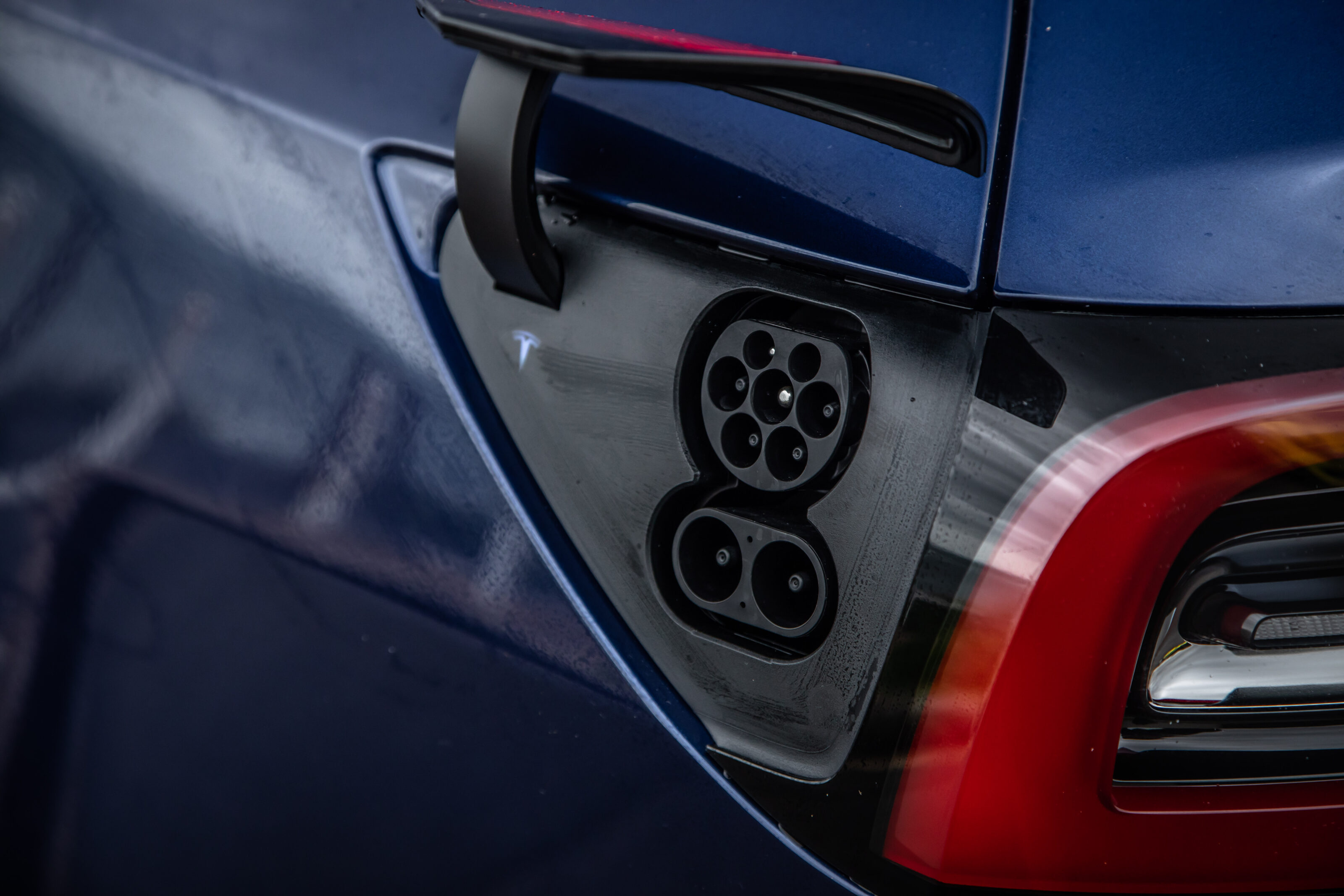
Extra range is always useful, especially when it’s rare for electric cars to match WLTP figures in real-world driving. The Model 3 is no exception.
That still trails comparable figures for two rivals: the Kia EV6 Air (528km) and Polestar 2 Single Motor (515km), but Tesla’s exclusive Supercharger network remains the ace up its sleeve in a country with such a limited charging infrastructure.
Spread along Australia’s East Coast, all the way from Melbourne to Brisbane, the Superchargers replenish batteries in relatively quick time. It took just 35 minutes for our Model 3’s battery range to increase from 28km to 400km.
VERDICT

Tesla’s new V11.0 software needs further fine-tuning to restore some of the better functionality of the previous version, though this can be easily done thanks to the company’s over-the-air updates.
The update still brings worthy new features to the Model 3, the base model’s range is usefully extended with its larger battery, and, despite a small hike, its price tag remains eligible for Australia’s most enticing EV incentives.
And the most affordable Tesla remains a hugely compelling EV.
2022 Tesla Model 3 specifications
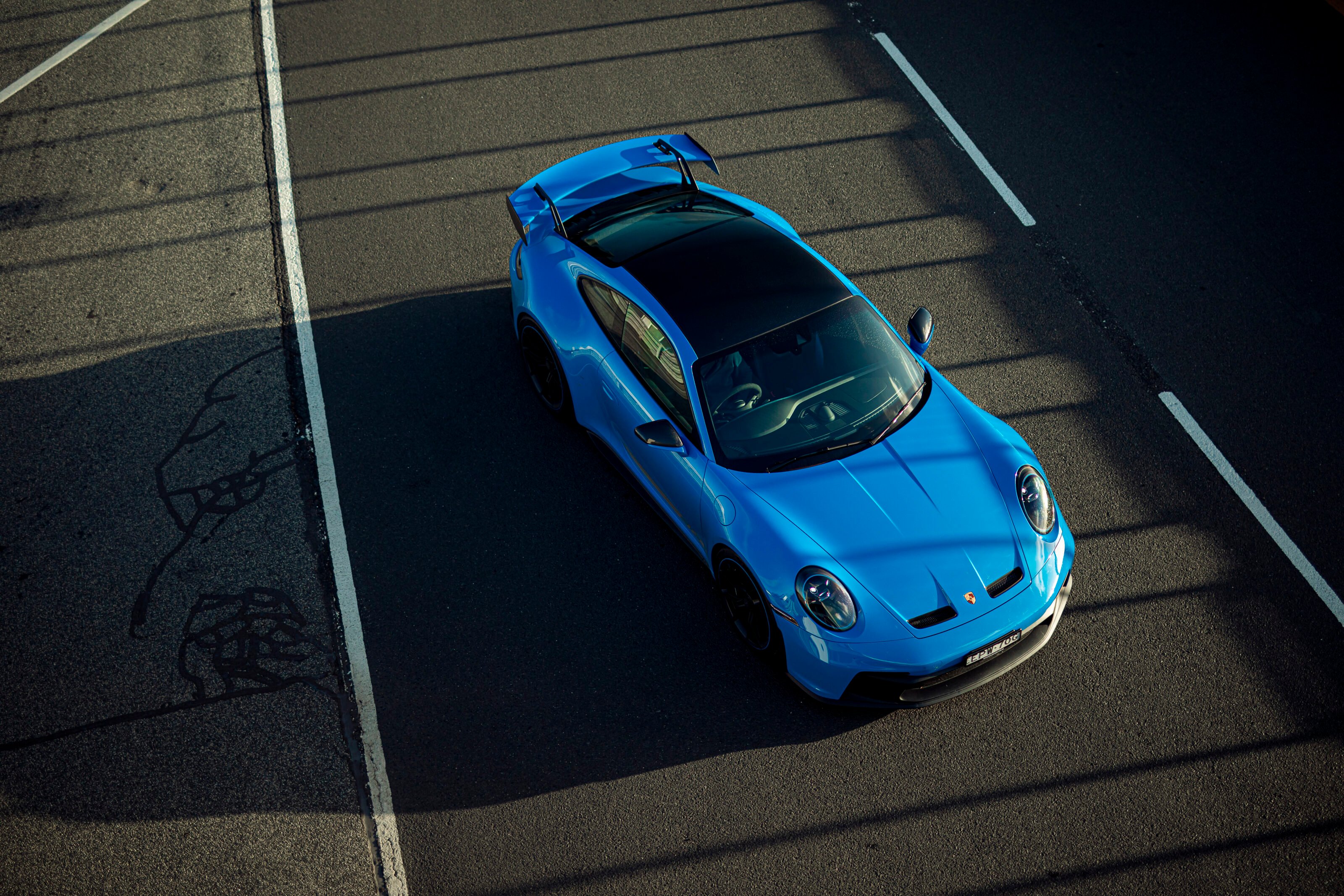
We couldn’t help but notice that when EPW70G arrived at Performance Car of the Year, Porsche had cranked the swan-neck rear wing to its most aggro setting. Not all PCOTY entrants were quite so optimised. The Ford Mustang Mach 1 arrived with different tyres front and rear while the Skoda Octavia RS was, mystifyingly, presented for performance testing furnished with bars and a roof box.
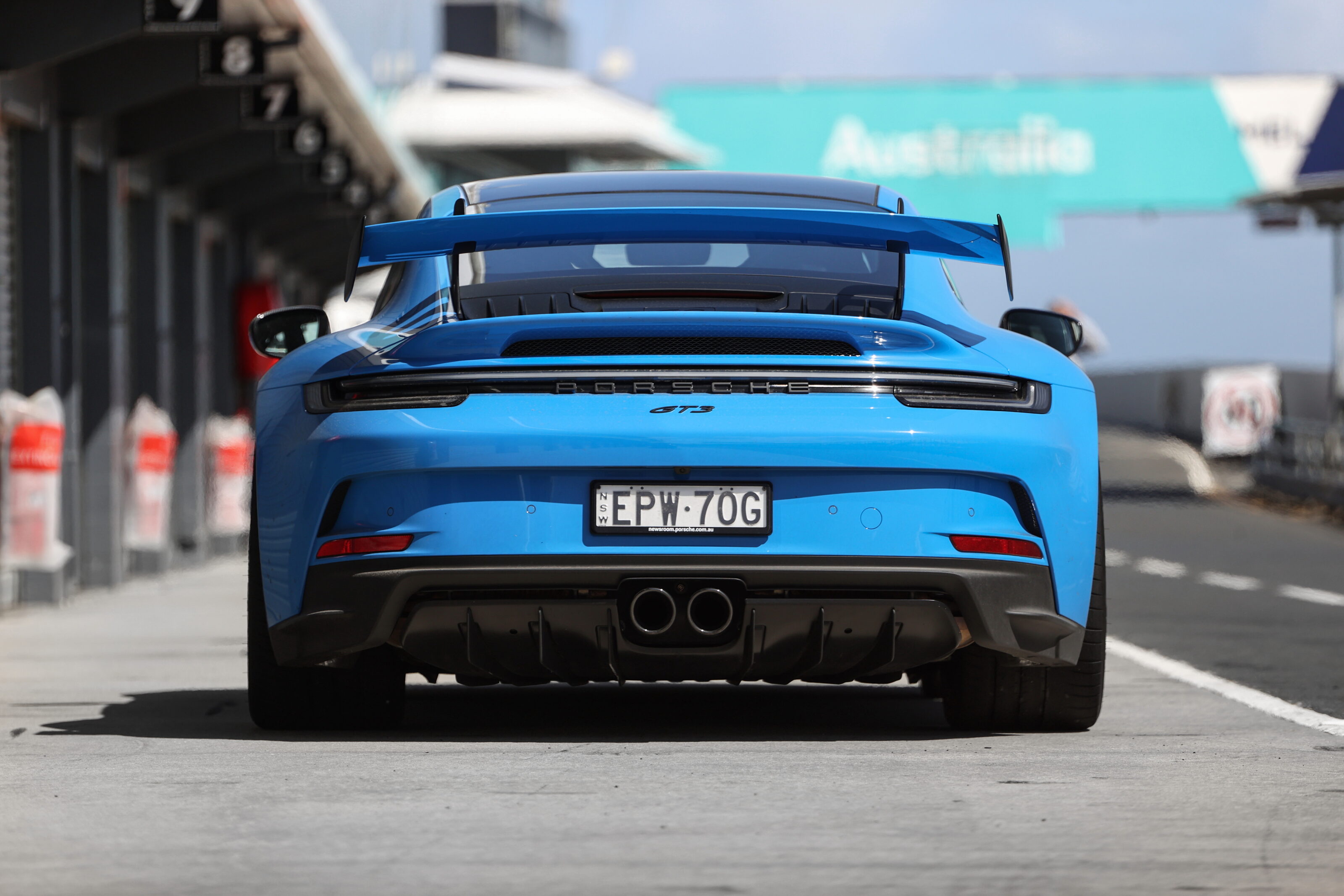
Porsche claims that even with the rear wing set to its most benign angle, downforce is increased by 50 per cent compared to the preceding 991.2 GT3. In the PCOTY position, which couples with a front diffuser setting that Weissach stresses isn’t intended for street use, downforce increases by “up to approximately 150 per cent”.
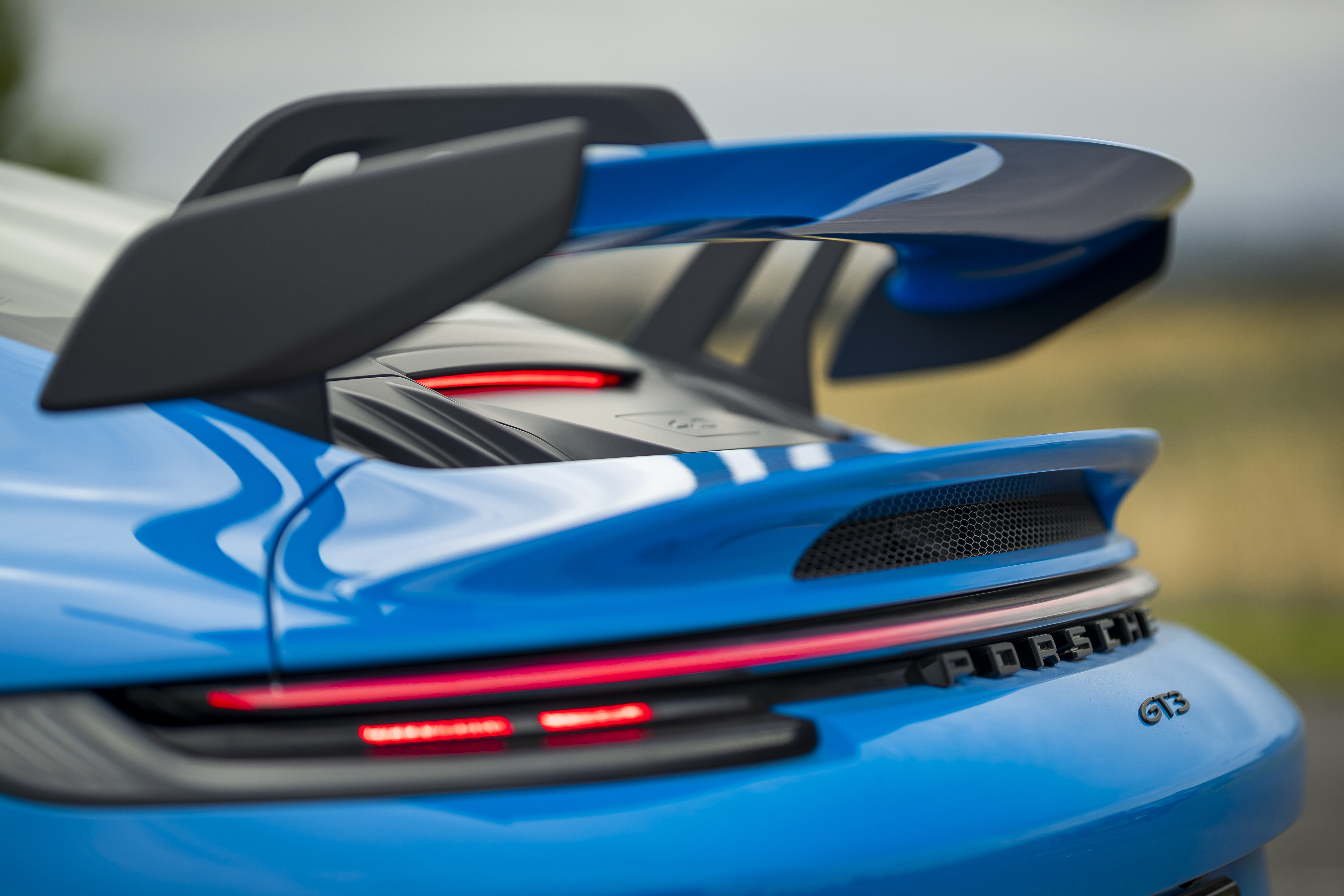
“Up to approximately” sounds somewhat vague for a company renowned for its rigid exactitude. Researching a little further, we find that at 200km/h, both the 991.2 GT3 RS and 992 GT3 develop (in their most aggressive settings) 144kg of downforce. The 991.2 GT3 is good for 69kg and, to add a bit of a historical perspective, the prior 3.8-litre 997.2 RS has 60kg. So, in real terms, downforce at 200km/h has more than doubled.
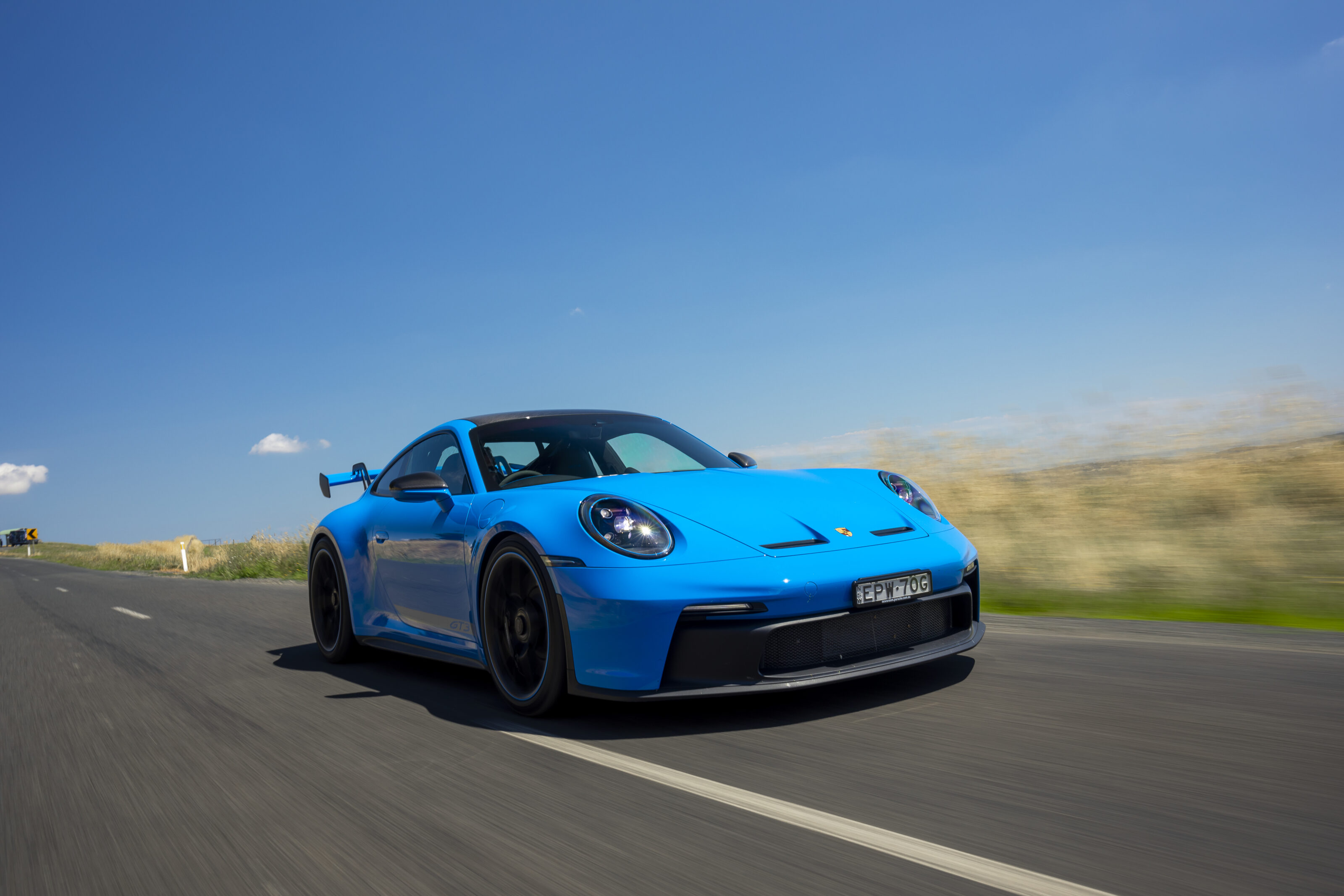
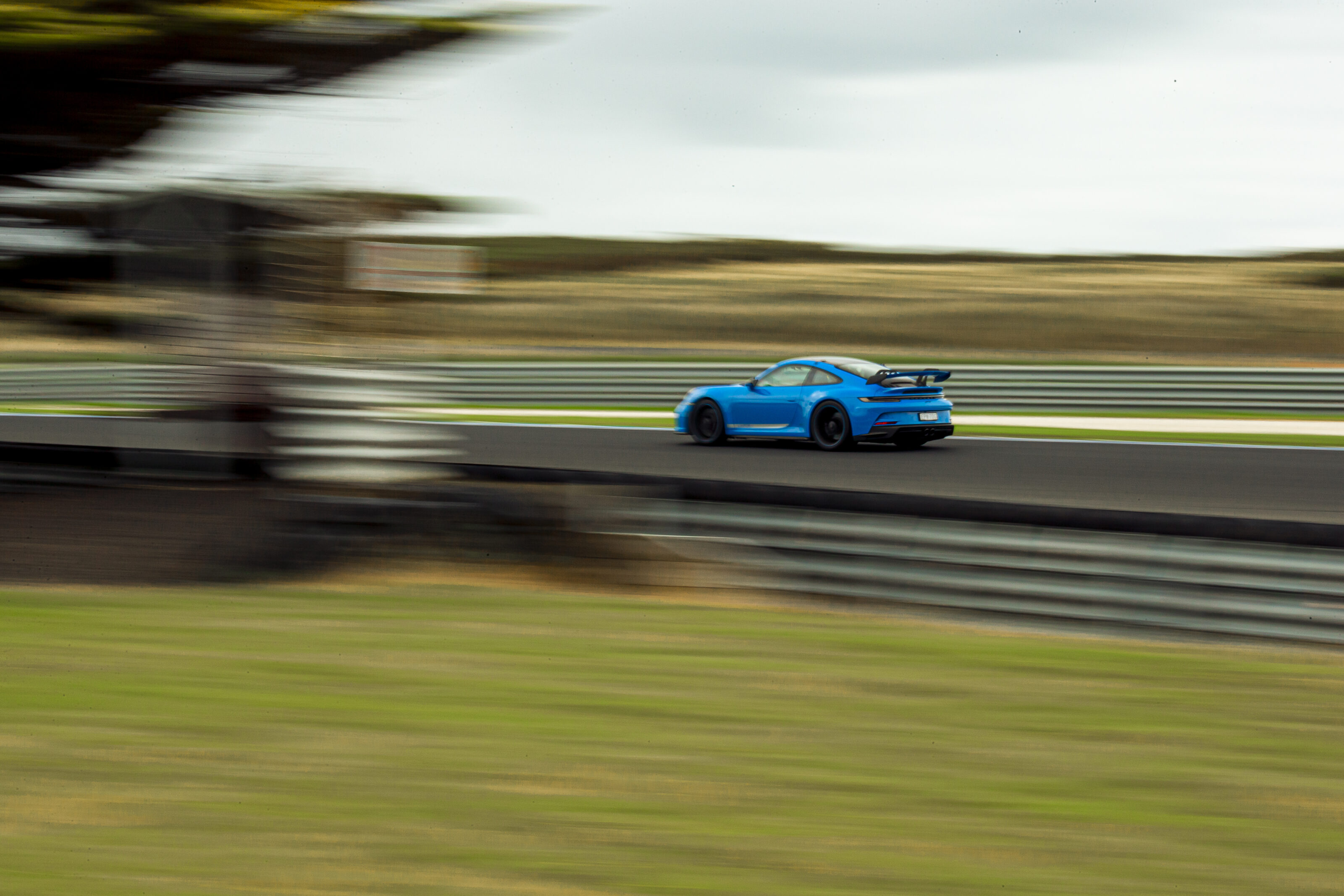
Manthey Racing, who know a thing or two about 911 aerodynamics, has gone on record stating that the 992 GT3’s best setup for achieving an optimal lap time is maximum rear wing, but only the third position of four possible options for the front aero elements. Apparently maximum everything at the front promotes a degree of high speed oversteer, which is how our car was set up. We didn’t experience much in the way of high-speed waywardness from the rear end.
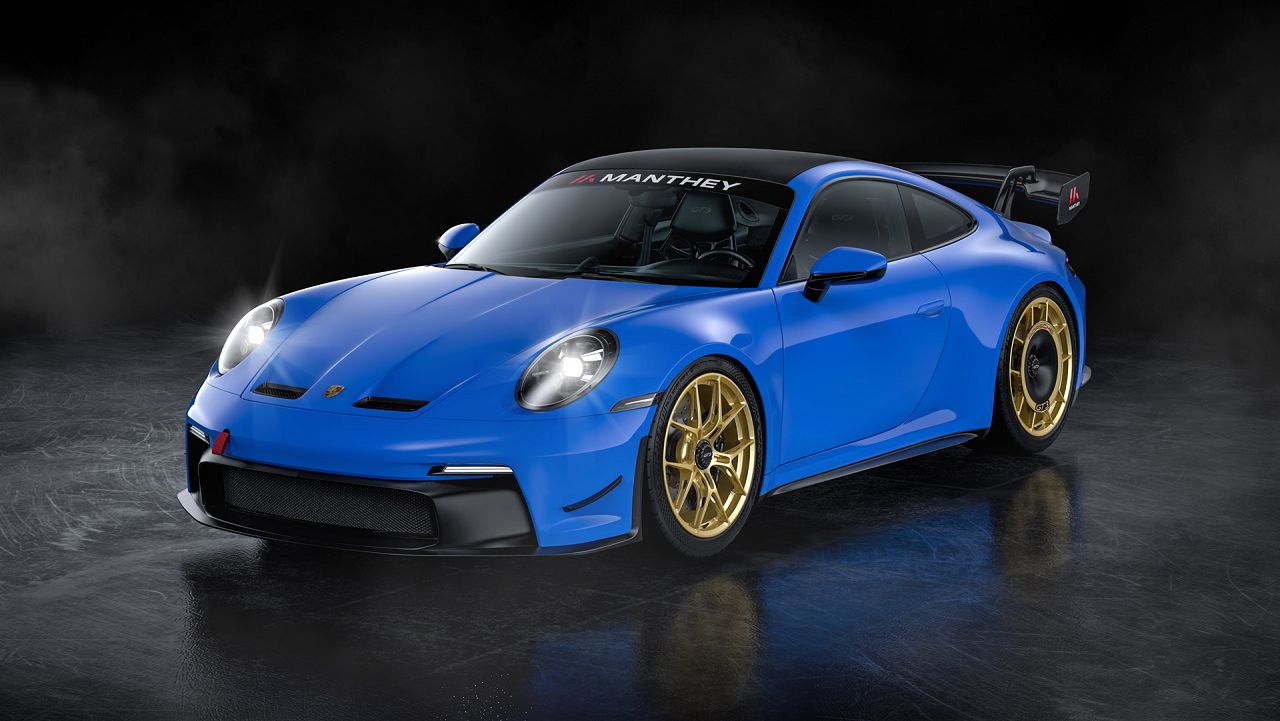
Of course, should you feel that your 992 GT3 isn’t tied-down enough, Manthey has developed an improved aero package for the car with a new front splitter, rear diffuser, carbon fibre rear wing, canards and rear wheel aero covers. Fully approved by Porsche and retaining the GT3’s original customer warranty, the kit also includes braided brake lines and uprated pads, four-way adjustable suspension and a set of lightweight OM-1 wheels.
As the first electric vehicle to tackle Performance Car of the Year the Porsche Taycan Turbo S was always going to be a litmus test – and it passes.
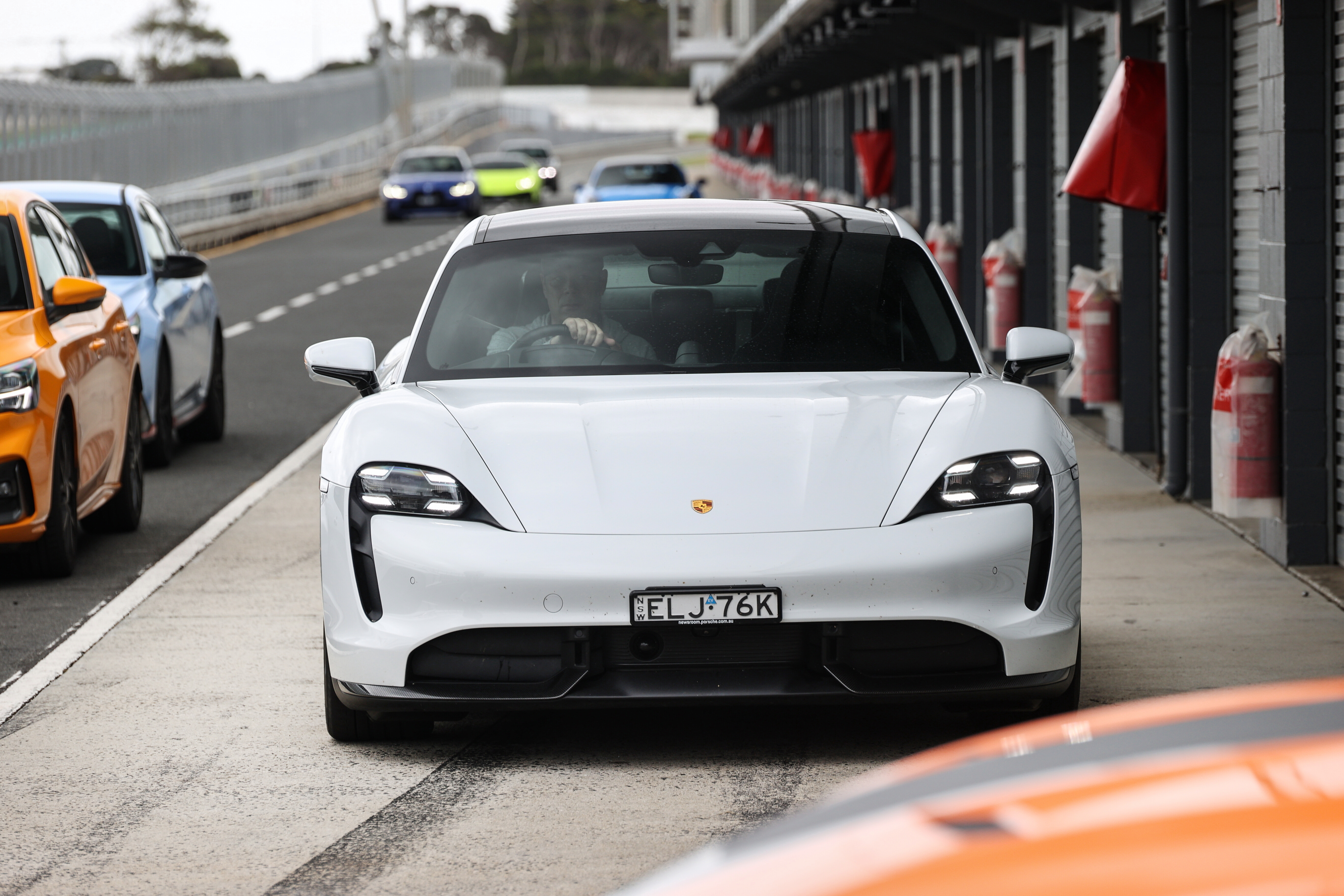
Foot mashed to the carpet, I glance down at the electronic speedo and it’s reading an even 250km/h. In that split second I question when this EV’s acceleration is supposed to tail off – because it doesn’t seem to be. Porsche’s two-speed gearbox is proving its worth. I’m immediately brought back to reality as the braking zone into Turn One at Phillip Island fast approaches. Now I have a different issue.
Arresting 2295kg from more than double the national speed limit isn’t an easy task. The gargantuan carbon-ceramic brakes bite, with the 10-piston calipers forcing the pads against the 420mm front discs (four-piston, 410mm rear). Pitch and roll is surprisingly well managed as the hefty four-door sedan perfectly reaches the apex. As Enright professes, “it’s a towering achievement by Porsche to make the Taycan handle as it does”.
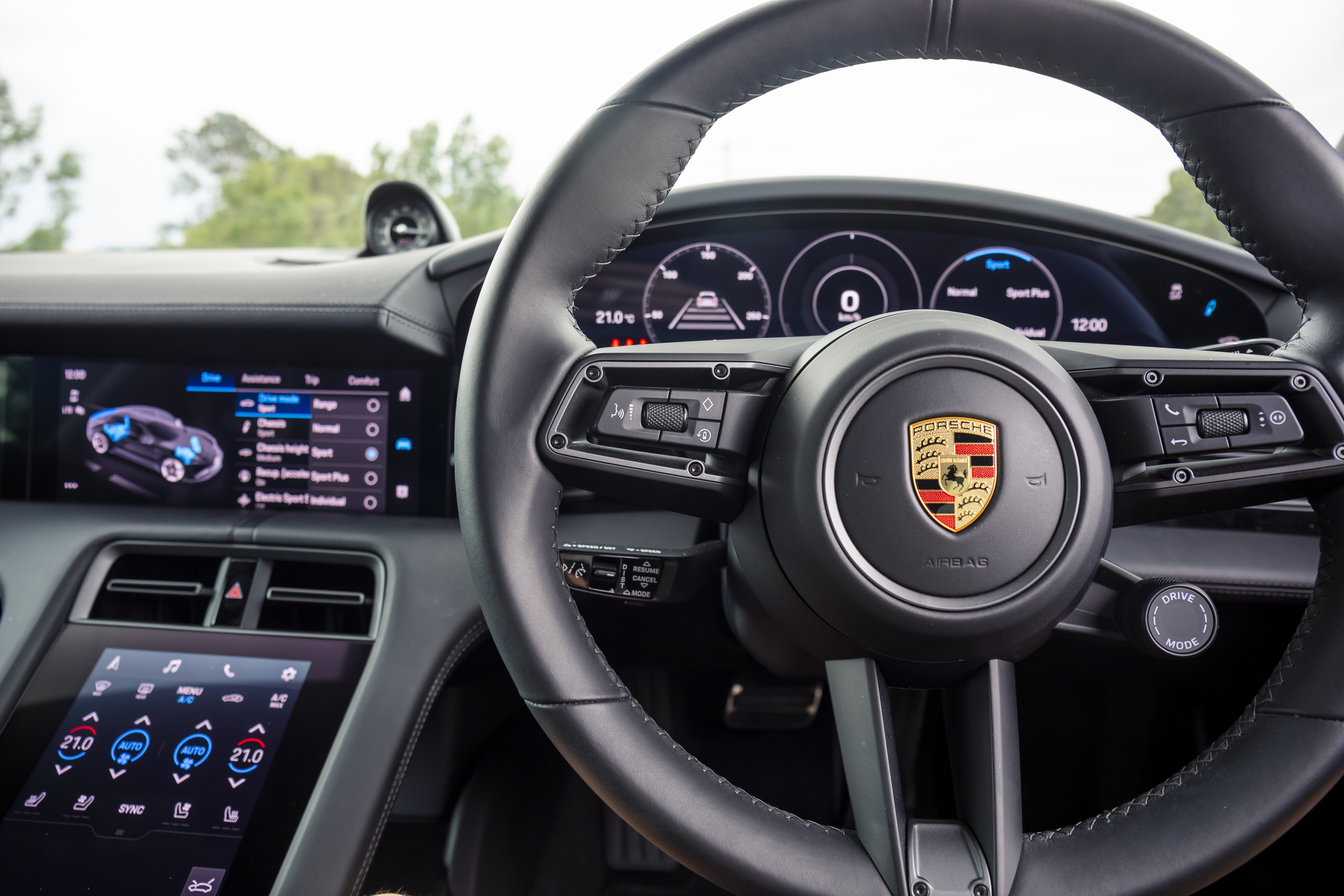
Of course, the Taycan Turbo S is the first fully electric vehicle to make a PCOTY field. However, it’s short-sighted to assume it’s here merely because of that fact. How well it performed in numbers is just the start. At 2.82 seconds it’s the fastest to 100km/h, its quarter-mile time of 10.73sec was bested only by the Lamborghini and it clocked a lap time just 0.67sec slower than the hyped ’Vette.
Relying solely on straight-line prowess has gained other performance EVs a certain notoriety. However, the Taycan Turbo S smashes that one-trick-pony status to pieces. It’s a Porsche. And it handles like one. As Bernie points out, the rear steering does take some time to comprehend, yet this is a car that rewards the more you push it.
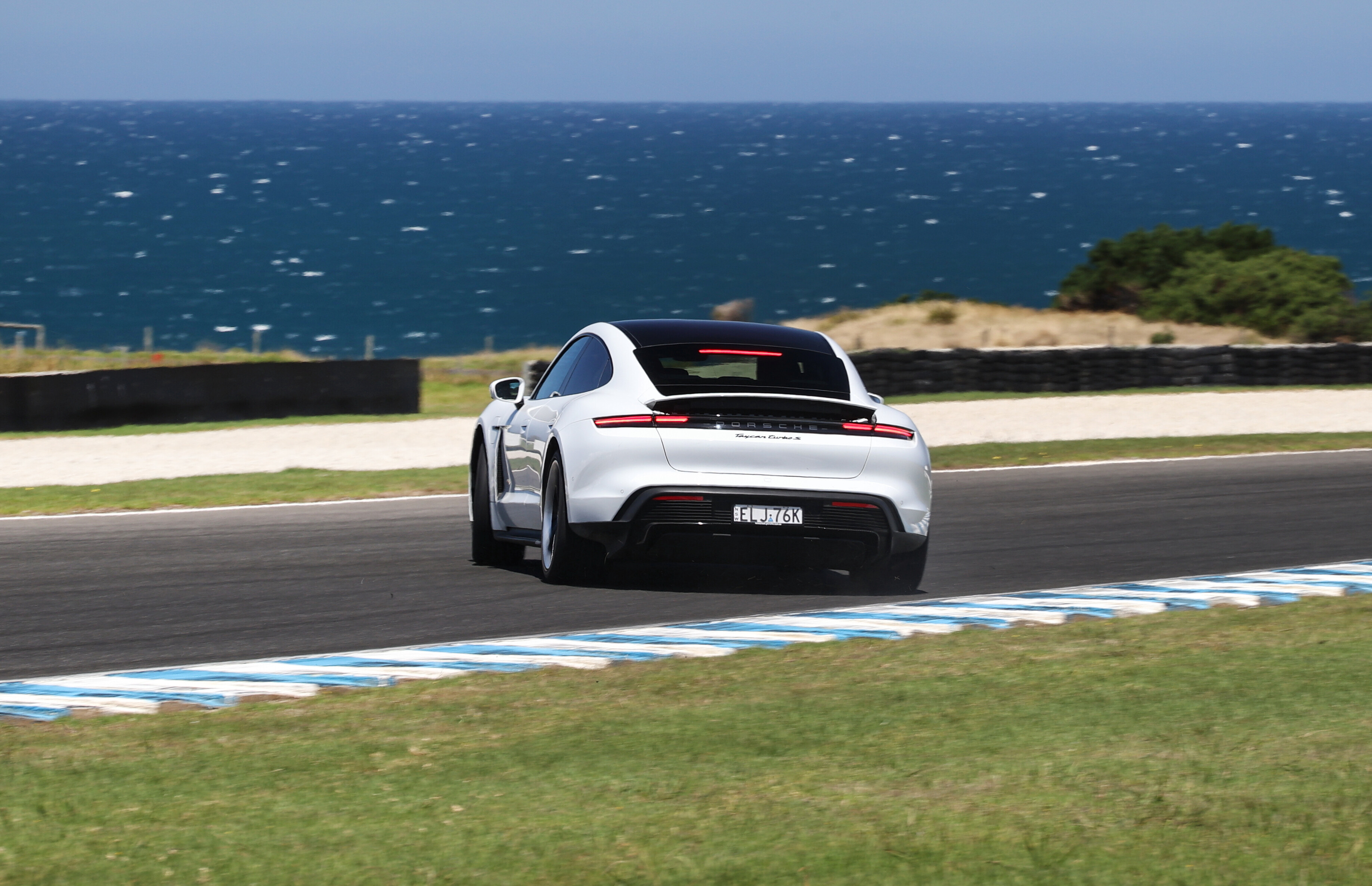
The chassis can be playful near the limits and once you learn how to work with the weight and the immediacy of the acceleration, it’s rewarding. The brake pedal feels natural despite huge re-gen and the steering has meat to its response. What’s more, you can dial it back and the Taycan becomes a convincingly luxurious cruiser.
However, that weight can’t always be concealed, with the dampers struggling to control heavy vertical compression and rebound – it becomes overwhelmed. Range also becomes an issue if you’re exploiting the Taycan’s goods in Sport Plus mode, especially with a dearth of fast-changing points in Australia. The Porsches’s PCOTY routine included regular round trips to a fast charger in Moe, some 65km from our Korumburra base.
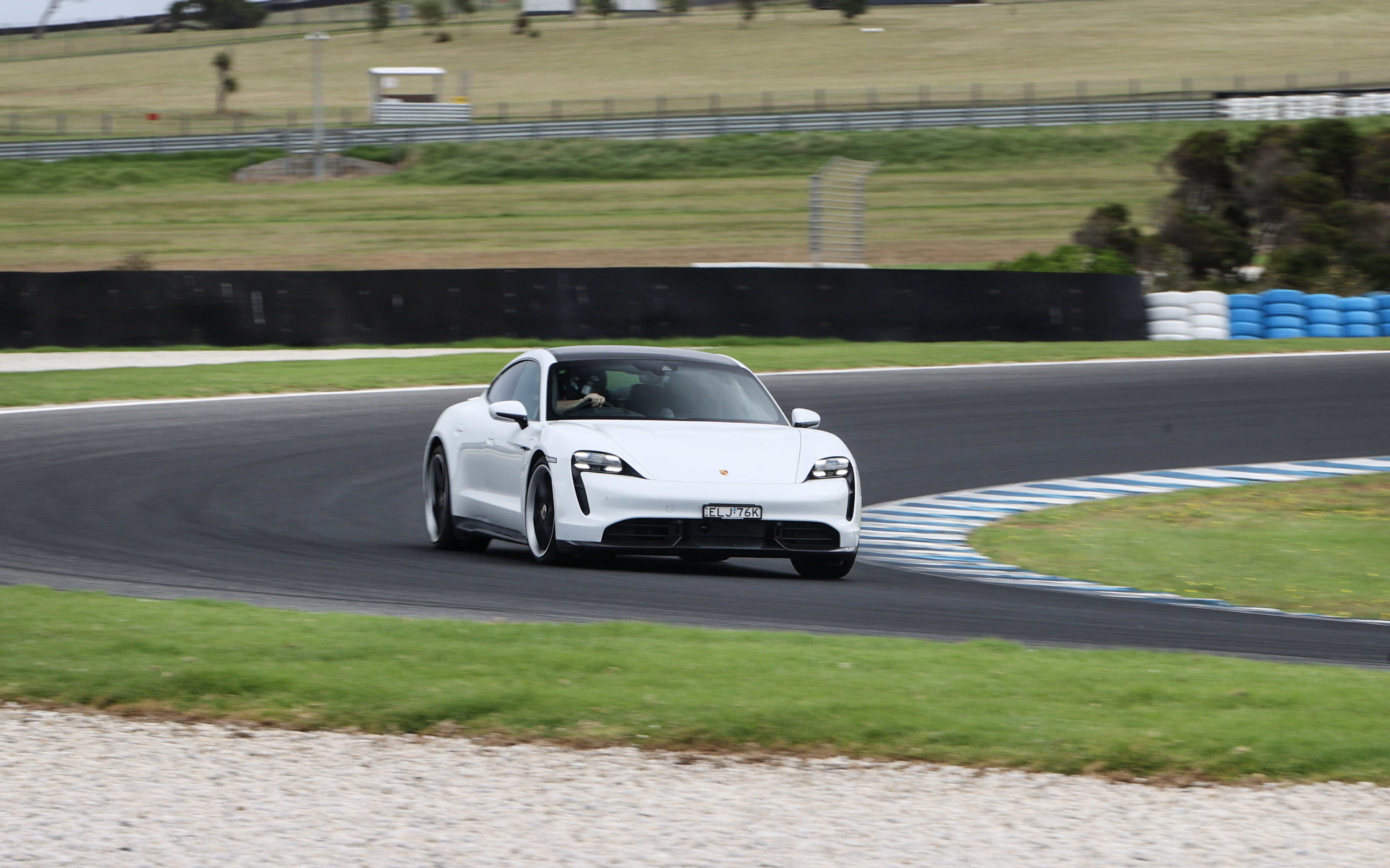
As a paradigm for the ideal performance EV the Taycan isn’t without fault. The price of entry is high, it’s a big unit, range limited our time on track and its ultimate utility – for the time being at least – remains hampered by patchy rapid-charging infrastructure.
Yet, the fact it parallels the past and future in such a palatable way gives reason for more than just hope, but for promise. Porsche hasn’t claimed the first PCOTY EV win this time, but a Cayman or Boxster just might. Now there’s a thought.
The judge’s comments
Alex Affat
“Beyond the initial shock and awe, the Taycan’s a fun thing to drive. Immense levels of mid-corner grip.”
Ranking: 7th
Andy Enright
“Lack of sound kills the stoke for me on track. I felt I was going very quickly but don’t think I actually was.”
Ranking: 7th
Trent Giunco
“I was a pessimist about performance EVs until I drove the Taycan. Feels entirely Porsche.”
Ranking: 6th
Cameron Kirby
“It’s a multifaceted thing. The straight-line performance undersells its total capability.”
Ranking: 7th
Bernie Quinn
“At 7/10s it feels remote and aloof. At 9/10s, the Taycan feels engaging and fast, becoming truly involving.”
Ranking: 5th
Luffy’s View
“Properly impressive on track. Beyond bizarre on the limit. Close to V8 Supercar speeds at the end of the straight. I’m a fan.”
The key figures
| 0-100km/h: | 2.82sec |
|---|---|
| 0-400m: | 10.73sec |
| LAP TIME: | 1:45.89 |
Snapshot
- New i3 based on China’s long-wheelbase 3 Series
- First look at 3 Series midlife styling makeover
- Australia’s iX3 and i4 are probably better offerings
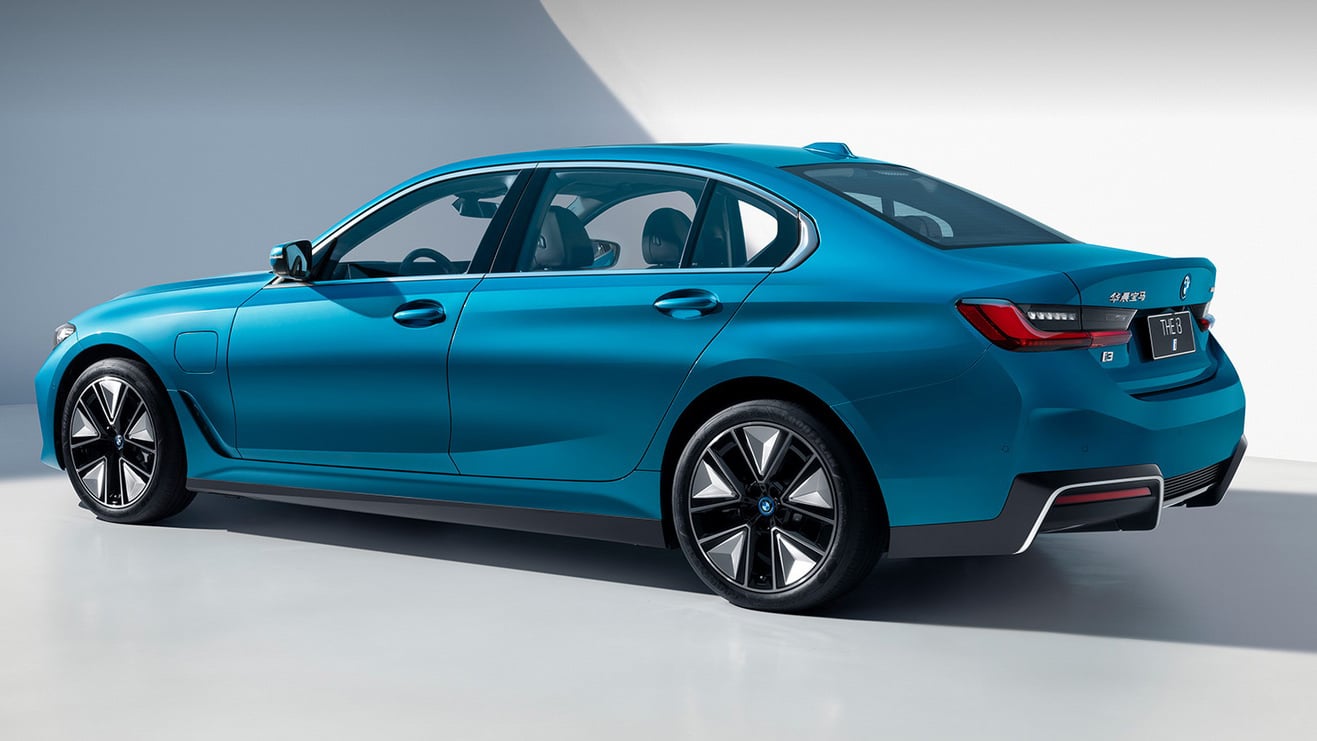
The popular BMW 3 Series has gone electric at last, but it’s not for us: this new 2023 BMW i3, the latest in BMW’s growing EV range, is a Chinese-market prospect only.
That’s unlikely to bother the local division of BMW too much, however: Australian buyers with a preference for sedans can look to the new i4 liftback – an electric 4 Series Gran Coupe – while the increasing number of motorists leaning towards SUVs can get into the iX3 or the even more advanced iX.
That doesn’t mean The West will never see an electric 3 Series, but it’s likely to be the result of the anticipated ‘Neue Klasse’, expected in 2025.
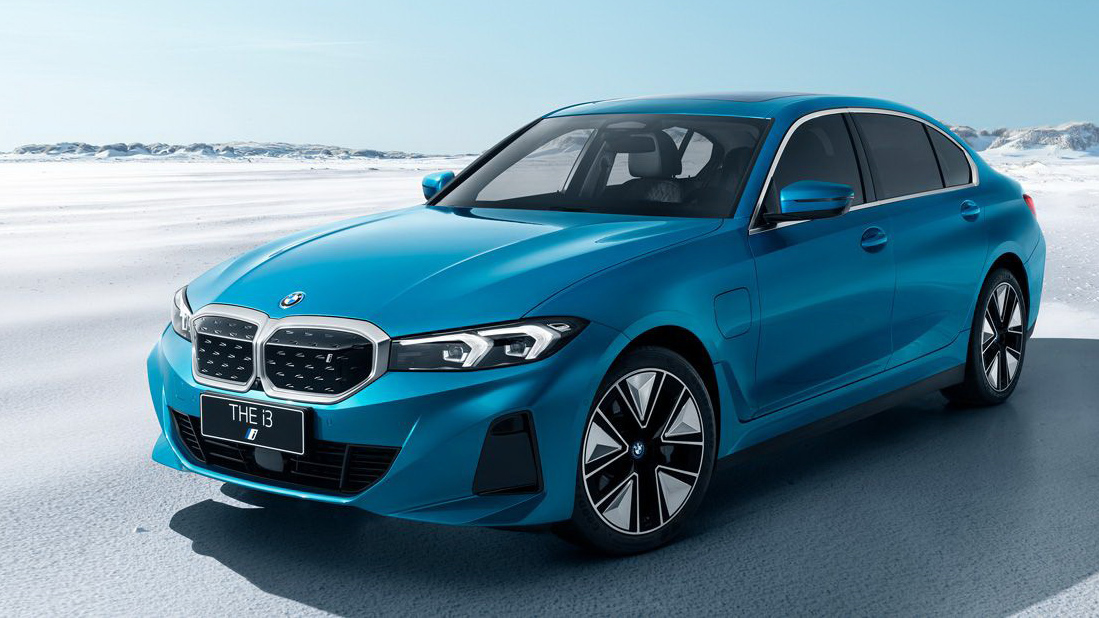
Taking over the badge worn by the soon-to-be-retired i3 hatch – BMW’s first mass-market electric offering, launched way back in 2013 – this new ‘G28’ i3 sedan gets tweaked styling and rides on the longer wheelbase used exclusively by the Chinese market (where rear comfort is a top priority).
Styling highlights include new headlights, a subtly reshaped ‘grille’ with closed-off panels, a new front bumper similar in design to the new M240i coupe’s angular front end, and aerodynamic alloy wheels.
Although not announced, these styling changes are likely to be mirrored by the petrol-powered 3 Series when it comes in for a mid-life update this year – expected sometime around July.
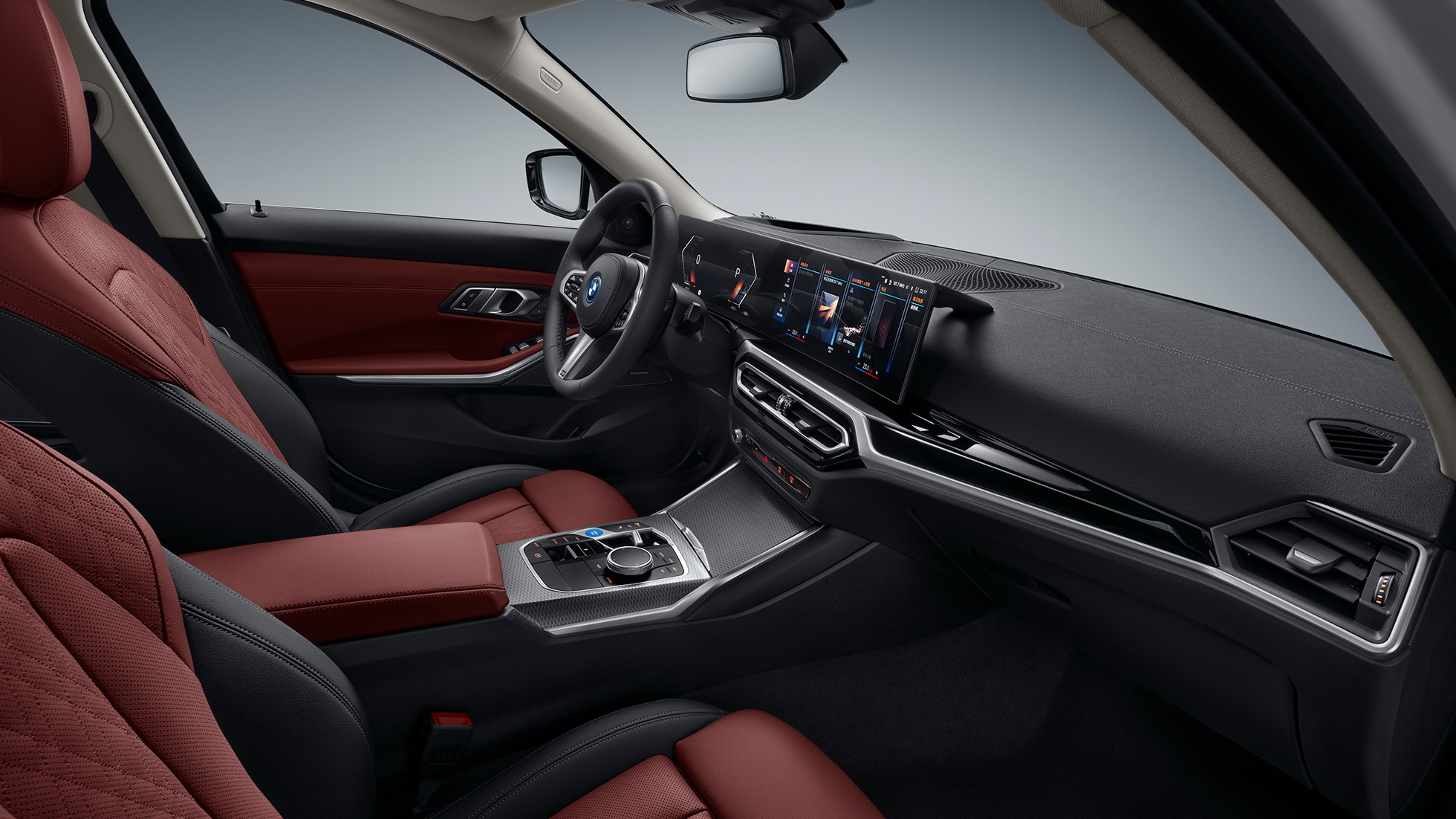
As with the iX SUV and the i4, the i3’s cabin sees the introduction of a big new display area. Like most brands offering a similar look, this system is made up of two 12.3-inch screens meeting end-to-end. Expect this upgrade to feature in the updated 3 Series petrol models, too.
In eDrive35L form – the only variant on offer for now – the i3 sedan gets a 70kWh battery pack, matched to a single electric motor delivering 210kW and 400Nm of torque. Tested to the Chinese standard, BMW claims a driving range of 526 kilometres between charges.
The i3 offers DC fast charging up to 95kW, allowing it to go from 10 to 80 per cent charge in 35 minutes.
Click any of the images in this story for more photos
In Australia, the iX3 features an 80kWh battery pack for a 460km (WLTP tested) driving range, and a DC fast charging rate of up to 150kW.
The i4 liftback gets an 84kWh pack capable of up to 200kW fast charging, with a driving range of 590km in eDrive40 form and 510km in M50i form.
Learn more about both models at the links below.
The more I looked at Hyundai’s Ioniq 5, the further I drove it, the greater became the realisation that here is an electric car you truly want, not an appliance you merely need. The Ioniq 5 is proof of Hyundai’s unbounded ambition; a beautifully conceived product that deserves to transform the way we perceive Brand Hyundai. This is Hyundai at least matching and often surpassing its rivals and now, on this evidence, that must include the premium Germans.
Obviously, it begins with knockout styling that’s truly avant-garde; unique but also appealing. So cleverly do the proportions of the two-box hatchback conceal its size – in photographs you’d swear it’s a Golf competitor – that it comes as a shock to learn the wheelbase stretches to 3000mm – 61mm longer than an E-Class Benz – yet the short overhangs contain length to just 4635mm.
Be in no doubt the Ioniq 5 is a game-changer; a classless car that fundamentally breaks all the benchmarks for size and category and leaves the opposition looking obsolete. Hyundai’s aspirations meant development of a dedicated EV architecture known as the Electric Global Modular Platform (or E-GMP) that places the battery pack under the floor and the main motor at the rear. This year the 5 is joined by the gorgeous, swoopy, shorter-wheelbase Ioniq 6 sedan and, in 2023, by the larger Ioniq 7 SUV (as well as Kia and Genesis variants).
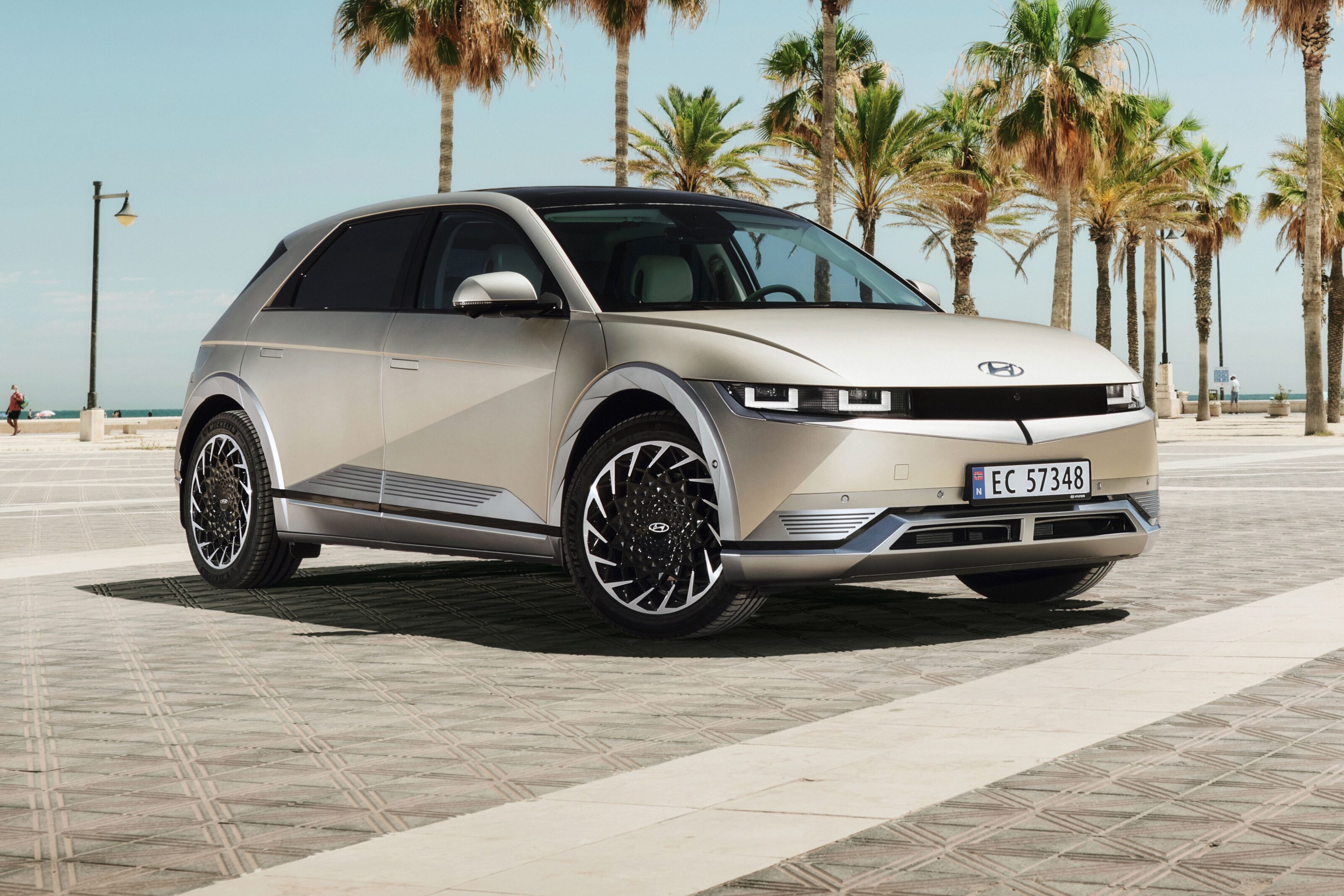
The Ioniq 5 has a combination of simplicity and detail that deserves your attention. Together they make Hyundai one of the most innovative car makers on the planet. No wonder young designers are increasingly drawn to the Koreans.
There are flush door handles, a lovely clamshell front bonnet, the neat rear spoiler is a wing, with slots allowing air to flow through it, while the solar-panel roof is used to power the car’s ancillary electrical systems and, in certain circumstances, can charge the battery. (For us lovers of automotive trivia: SangYup Lee, the Ioniq 5’s lead designer, spent two years at Holden in 2006/2007 working on the VE Commodore-based Chevrolet Camaro concept.)
The sense of the Ioniq 5 not being what it looks like continues when you move inside. You sit fairly high, with the steering wheel slightly too far away for tall drivers, yet the cabin feels airy, well-equipped and extremely spacious with a great view out. And when could we last say that of a new car?
Don’t think of the Ioniq 5 as sporting – that role will surely belong to the higher performance 6 – rather, this is a comfortably, wonderfully refined cruiser with the natural bodyroll we remember fondly from French cars of 50-odd years ago. There’s plenty of grip and strong, immediate performance, the range stretches to a realistic 375km, and the steering has a reassuring weight.
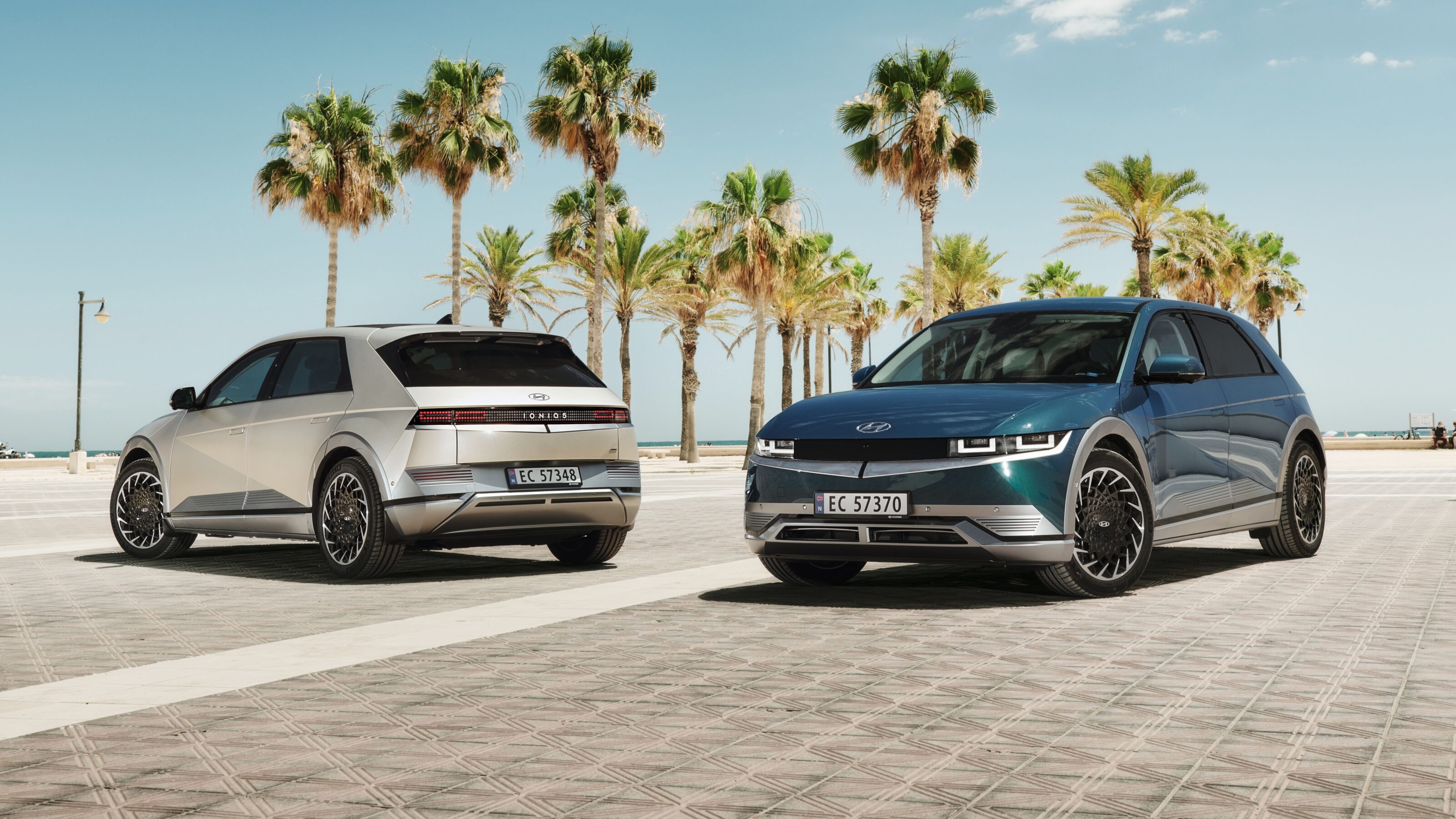
Though it encourages hard driving, the 5 feels more relaxed and at home on the motorway where it behaves like a large premium sedan that’s almost Audi A6-like, though with more room.
This perception of premium extends to the build quality. In terms of panel fit, shutlines and material excellence – inside and out – this Hyundai surpasses all but Audi. Yes, it’s that good, the car imparting an imperious experience that enhances its character and makes the $75K price look a bargain and the soon-to-be-released cheaper model even more so.
Flaws? A little more initial impact suppleness over bumps would be appreciated, while Australia doesn’t get the head-up display the car deserves, and reception from the satellite radio isn’t perfect.
I can’t remember when I was more impressed by a new model. If I had a car room (to house the charger) I’d buy one. If this is our motoring future, I’m happy.
Ford could be looking at new ways to save the V8 – as patent drawings for a hydrogen-fuelled internal combustion engine have surfaced.
First uncovered by Muscle Cars & Trucks, the United States patent submission shows diagrams for a proposed turbocharged, direct-injected hydrogen-fuelled engine – retaining internal combustion, but with zero emissions.
Variable exhaust gas recirculation allows the air entering the engine to be managed more efficiently, while direct injection for the fuel keeps the two key combustion factors separate – allowing the easily-detonated hydrogen to be controlled before it is ignited.
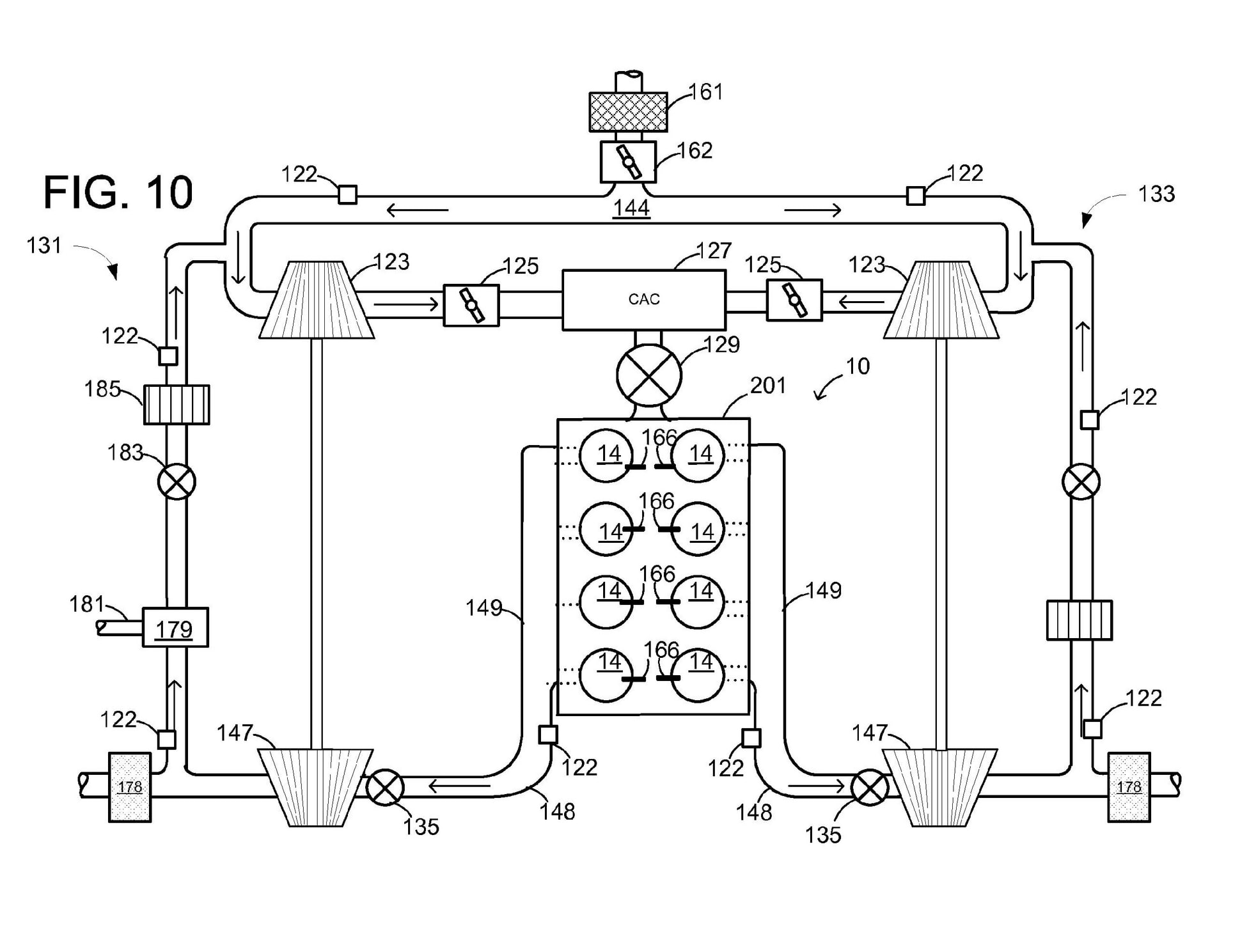
It’s not the first time Ford has experimented with hydrogen engines – in 2006, it revealed the F-250 Super Chief concept, powered by a 6.8-litre “Tri-Flex” Supercharged V10 engine which could run on hydrogen, petrol or E85, however it remained as a concept only.
The concept can be applied to almost any internal combustion engine, potentially saving the V8 range found in the Mustang and F-150 from facing the chopping block thanks to ever-tightening emissions regulations.
Ford has already confirmed its next-gen Mustang will be fitted with a V8 engine when it’s launched in Australia, however it’s likely to be the last of the breed with the Mustang Mach-E electric vehicle proving popular globally.
The local Ford line-up is slowly moving towards lower emissions, with five electrified vehicles set to launch between now and 2025, starting with the E-Transit and Escape plug-in hybrid.
Trevor Worthington arrives at the gate of the Ford Proving Ground driving a Twister Orange Mustang Mach 1 and, as far as metaphors go, it’s not a good one. Unlike the lurid coupe he’s piloting, Worthington is a humble bloke and doesn’t shout about what he does, and I wonder how many drinks it would take before the mild-mannered Aussie finally hinted he’s one of the biggest names in the global automotive landscape.
No-one alive today deserves greater recognition for some of the Blue Oval’s most successful models, while Ford Australia’s rise to a developer of global models can also be largely attributed to the current vice president of global product development operations and vehicle programs.
But while Worthington now resides nearer Ford’s heartland in the USA, the engineer started out in a tiny Victorian town near the NSW border. When his family moved from Tallangatta, population 1000, to “the big smoke” Benalla, the aspiring engineer gained two sources of inspiration. Just out of town, Winton Raceway provided the automotive spark, while the Gliding Club of Victoria was an aero allure on his doorstep.
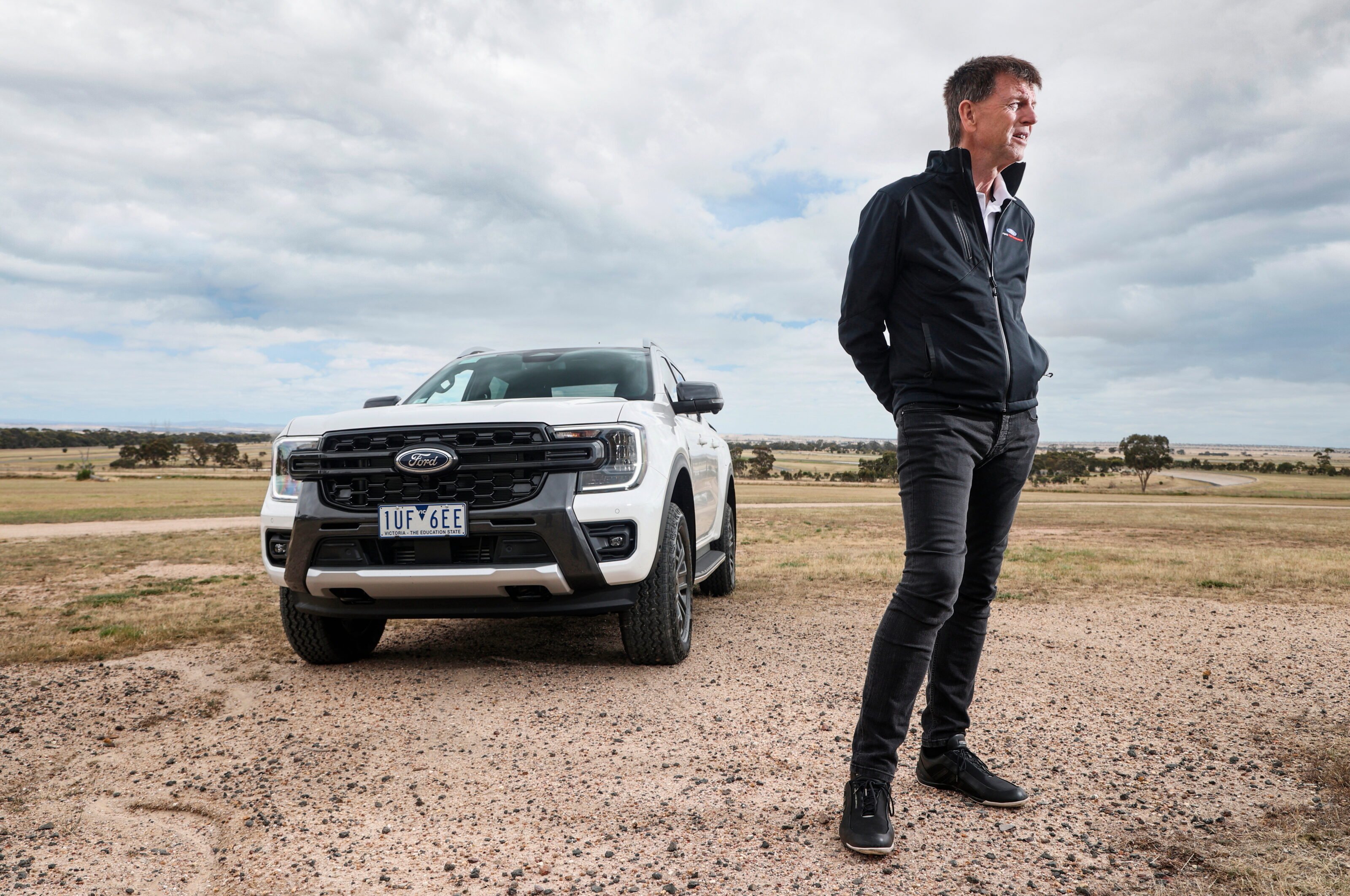
Worthington went on to graduate from RMIT Melbourne with a degree in aeronautical engineering but ultimately, it was the terrestrial that won over celestial. Worthington still has a fond affection for flying machines, but the passion and diversity of cars and trucks is what cemented a lifelong career – even if a racing tenure narrowly passed him by in the mid-1980s.
“I built a road-registered race car when I first joined Ford,” he tells me. “A Mazda RX-3 with 12A peripheral, Volvo brakes; it was a ball-tearer. Unfortunately I built it and raced with a guy called Ken Douglas. He broke every lap record in my car, I was nowhere near that good and then I got sent on my first overseas assignment.”
The promising young engineer wouldn’t return to Australia with Ford for many years, but a trail of significant models mark his progress as he rose through Ford’s ranks of product development and strategy.
Among them were tenures as Asia Pacific vehicle line director, head of Asia Pacific and Africa product planning and strategy and, prior to his current role which he took in 2018, Asia Pacific product development vice president. But it was in 2000 that Worthington made the biggest blue mark on the Australian automotive landscape.
On the surface, the thriving market he returned to from the US appeared to be happy and healthy with home-grown Falcons and Holden Commodores flying out of showrooms, but the tide was turning and Worthington sensed “Australia was at a bit of a crossroads”.
“You’ve got to skate to where the puck is going to be,” he said. “When I came back in 2000, the writing was on the wall. The large car segment was declining and there was nothing anybody could do about that.”
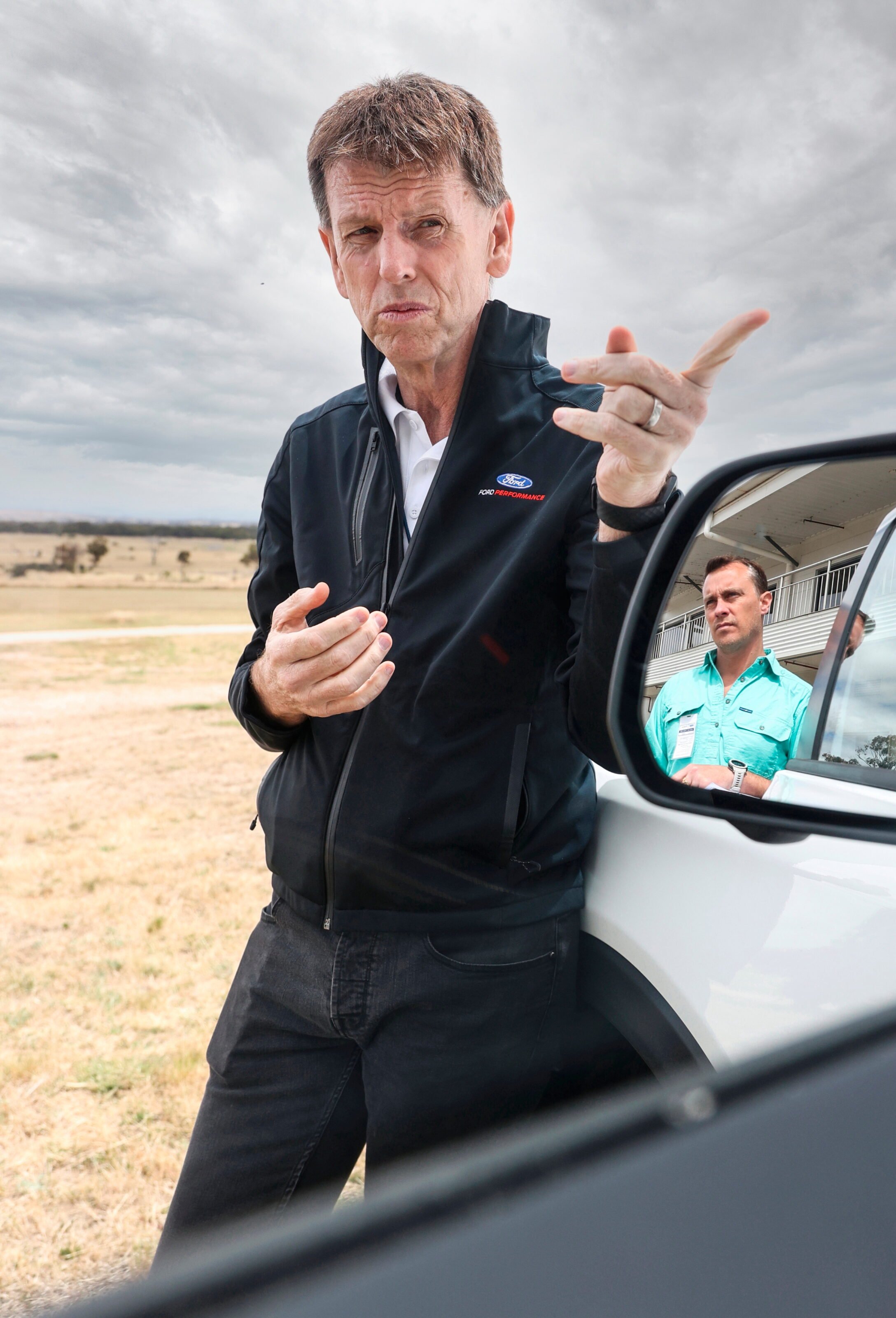
“If the vision for the Australian team was just developing Australian product for Australia then I’m not all that interested, but if the vision is we want to make something [global] out of this, then I’m up for it.”
Worthington rallied a crack team of engineers headhunting in the UK and Europe, the You Yangs centre facilities were updated and a plan to put Ford’s development centre on the map globally was hatched. But this would be a long game: “It wasn’t zero to hero, we had to build our competence.”
The competence-proving process started with small cars that made a big impact. The team tackled emerging markets including India with the Figo compact hatchback. Before the little three-door had turned four, it had already found 300,000 customers. It was a similar story for the India market Fiesta four-door sedan, while the team created similarly popular affordable models for the Chinese market as well.
Over the first five years, the Australian team was frequently visited by the late, great Richard Parry-Jones who coached the newly forged band and added to the wealth of Ford experience under Worthington’s direction. As head of Ford’s global research and development operations, Parry-Jones’ Ford history spanned back to 1969.
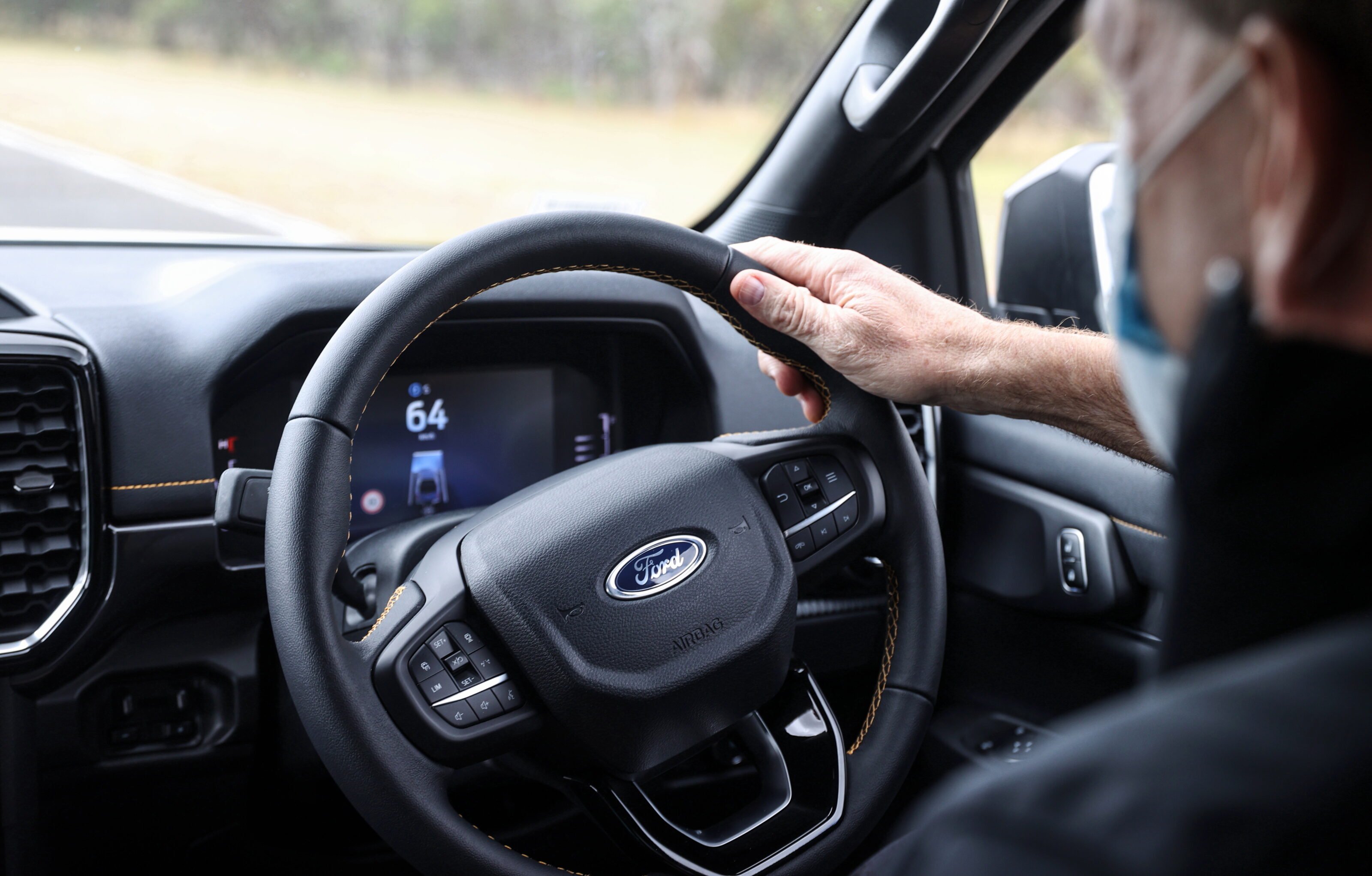
Worthington remembers the British engineer with respect and fondness, crediting him with much of his own success. While the Australian team was busy rolling out crowd-pleasing cars for other markets, it had also been toiling with a new top-secret native model and in 2004, the Territory broke cover, but Worthington explained that the large SUV required an almost impossible brief.
“Territory was born out of: I want car handling, flexibility of a people mover (but wouldn’t be seen dead in a people mover) and the image of an SUV.
“We had this fantastic chief engineer Russell Christophers who had a very active lifestyle and really related to what those customers were saying. They got to work and found it was possible.”
The Territory was a hit. It took out the Wheels Car of the Year in 2004 and brought widespread praise from the public and media alike, but despite its strengths, Ford’s manufacturing days in Australia were numbered and Worthington’s team had to find a way to save the centre.
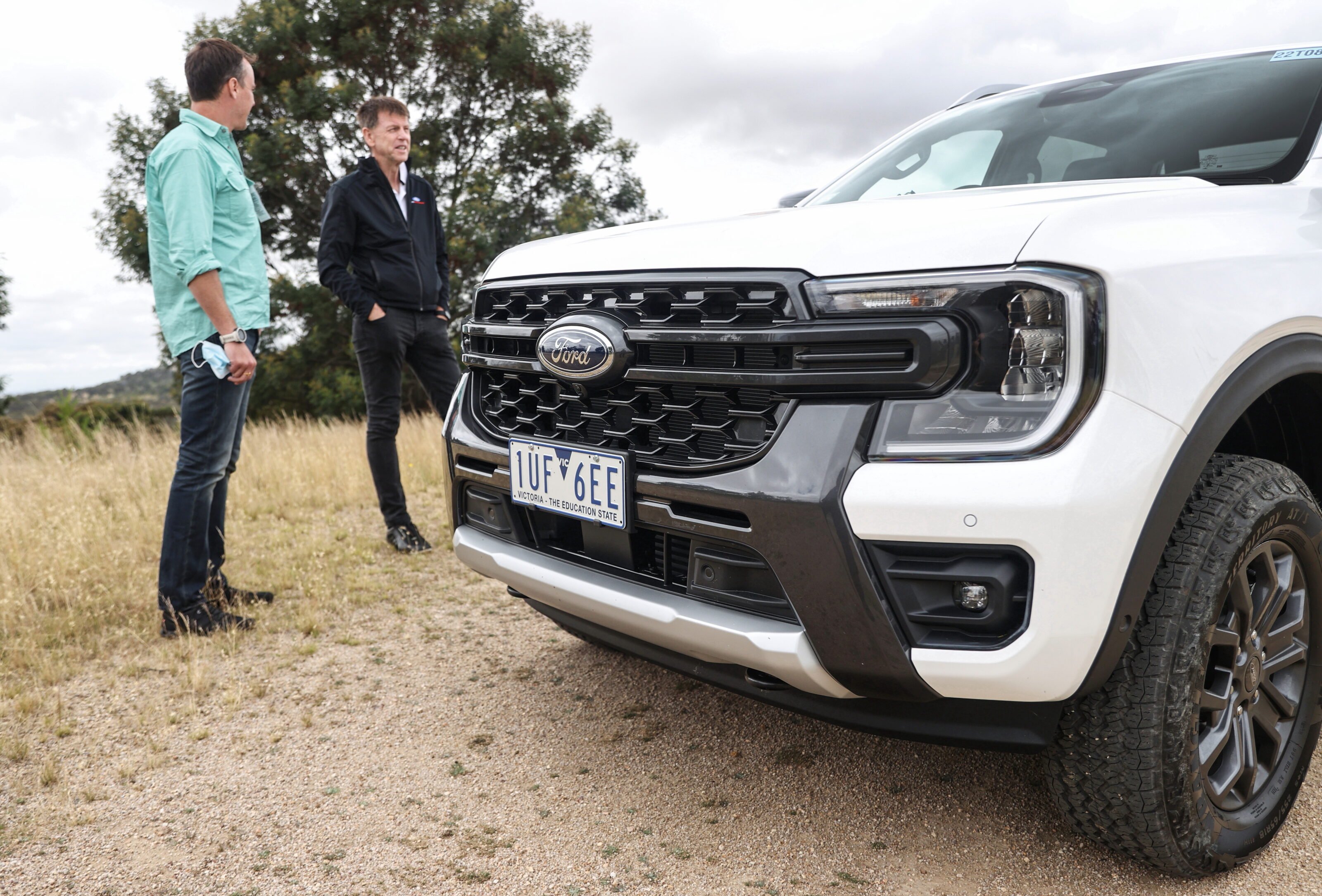
We had to find a different range of products to engineer otherwise what happened to Holden would have happened to us”
“I knew we had to find a different range of products to engineer otherwise the same thing would have happened to us that happened to Holden, I’m sure.”
Worthington revealed that Ford Australia’s fate had never come close to that of Holden when it withdrew all local development operations in 2020 “because we’d become necessary”. The constant stream of impressive models emerging from a 2300-acre facility Down Under was not going unnoticed by Ford’s Michigan head office, and in 2008 the team saw its first opportunity to make an impact on a global scale.
Until then, Ford’s ‘mid-size pick-up’ “had been seen as a local product” but Worthington had grand aspirations for the model and a plan to launch it as a more universal proposition. More than a decade after it launched, the Australian-developed Ranger is sold in 180 markets around the world and built in Asia Pacific, South America, South Africa and two plants in North America. It is undeniably the global model Worthington dreamed it could be, but it’s only just getting started, he says.
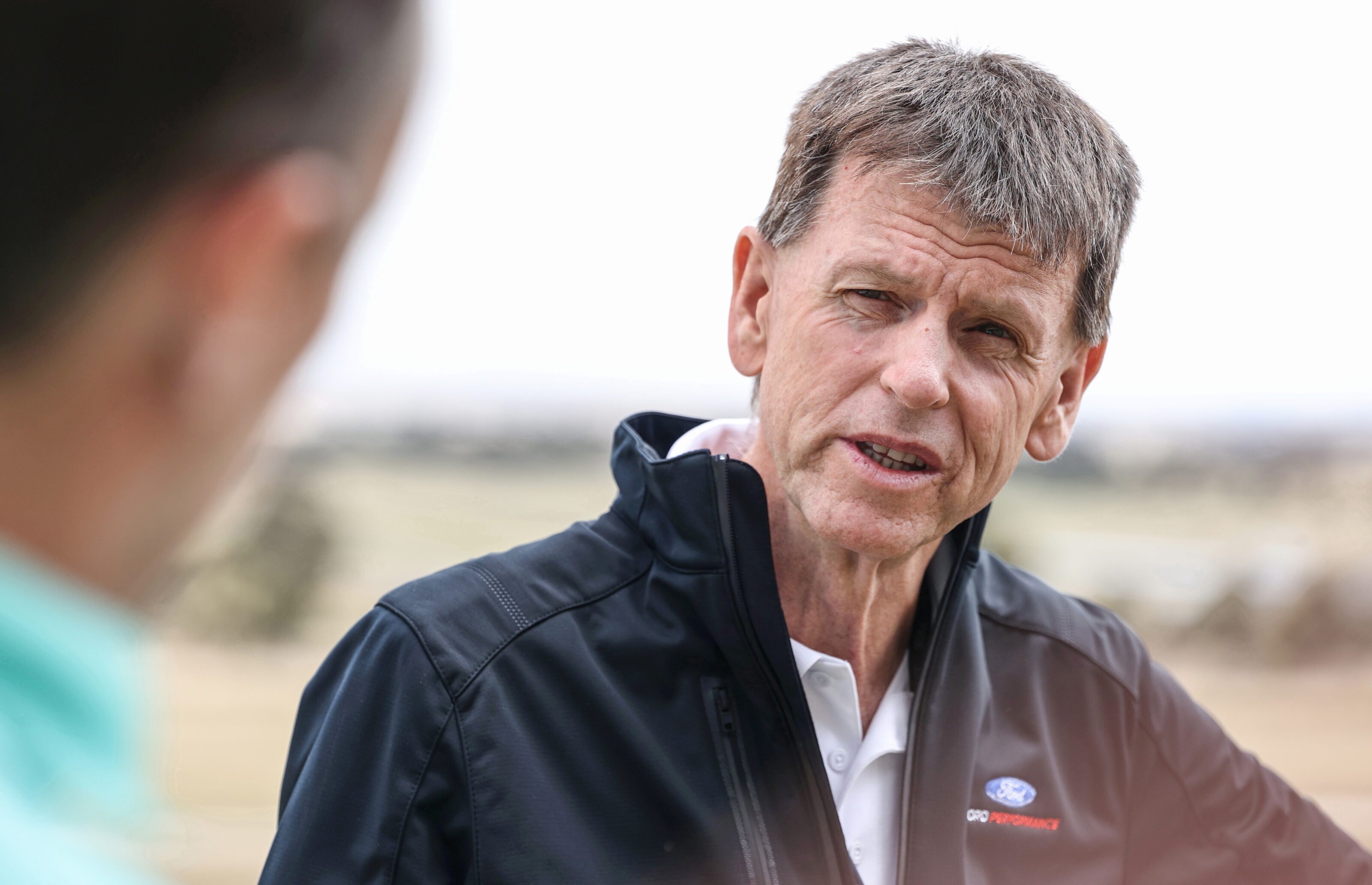
“There is no resting on laurels, there’s only learning from what we’ve done. And look out – all the stuff involved with the next one is much better.
“There are many things we did with Bronco that we knew would serve us well with Ranger. Approach and departure angles, towing system, stiffness, new powertrains, crash safety.”
But if you think powertrains shared with the Bronco means a V8-powered T6.2 Ranger is on the way then think again. Worthington doused hopes that the next Raptor might get muscle-car power for numerous reasons including government penalties and high insurance and running costs for owners.
“The question really is – why would you?” he said. “We’ve had a Coyote engine in one of these and it went like a cut cat, but we’ve all got a social responsibility. I believe in global warming and I believe the Paris Accord is something that we’ve really got to deliver to. We can deliver what the customer wants with the most efficient vehicle from a CO2 perspective.
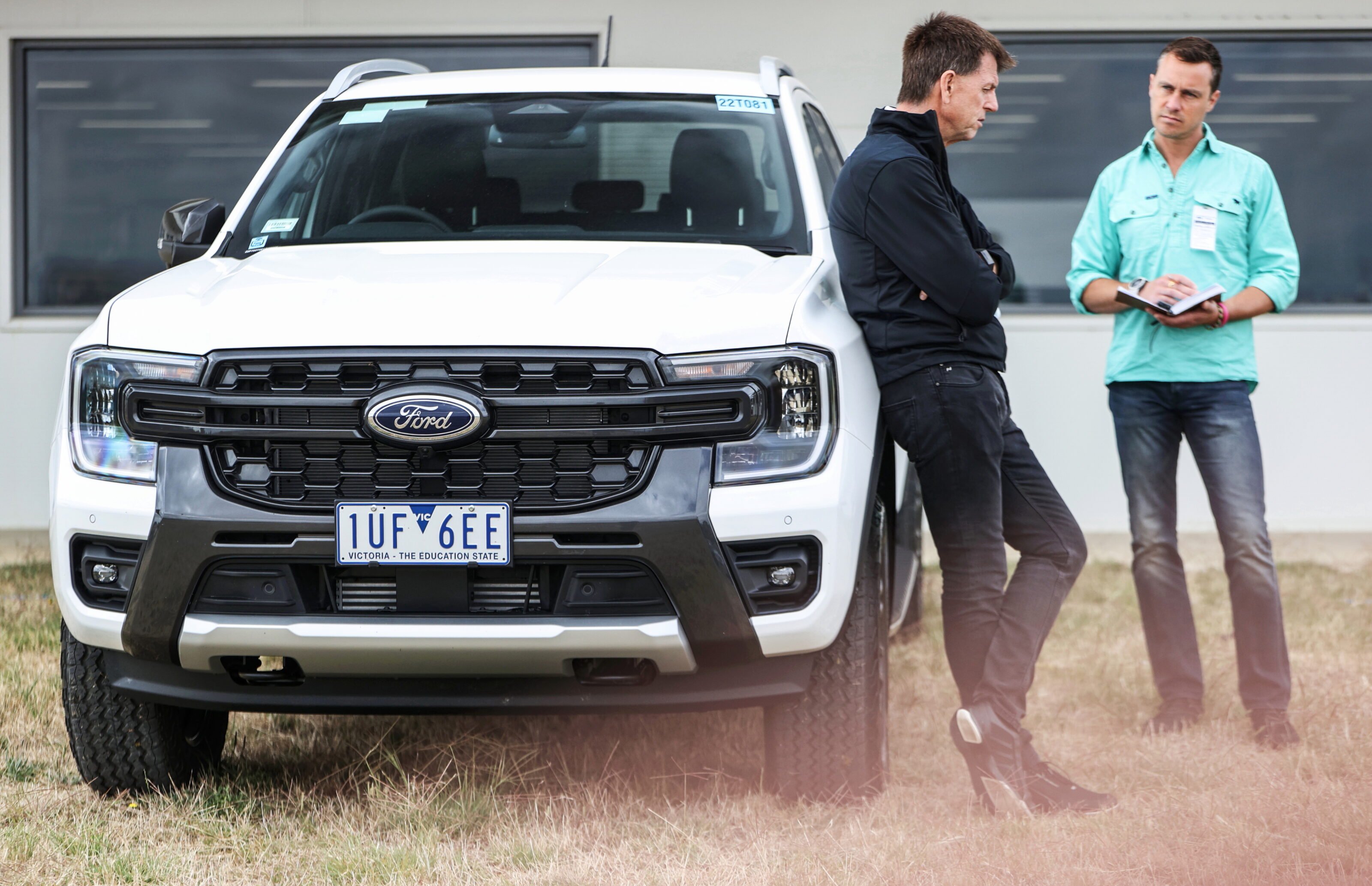
“We had a Coyote engine in one of these [Rangers] and it went like a cut cat, but we’ve all got a social responsibility”
“I would have loved to see more performance in the (previous-generation) Raptor but it didn’t stop punters buying it. You’ll see in about a year’s time looking back, you’ll say wow, that made a lot of sense. We know what we are doing.” While Worthington wouldn’t be pressed on further specifics, fortunately you can read all the nitty gritty details in our Ranger Raptor reveal.
“Electrification is in our future and we’ve future-proofed this architecture so it can do whatever we choose to do – it could do a hybrid, a plug-in hybrid or a BEV.
“Mid-sized pick-ups are one of those segments that’ll take a bit longer but it’s going to get there for sure.”
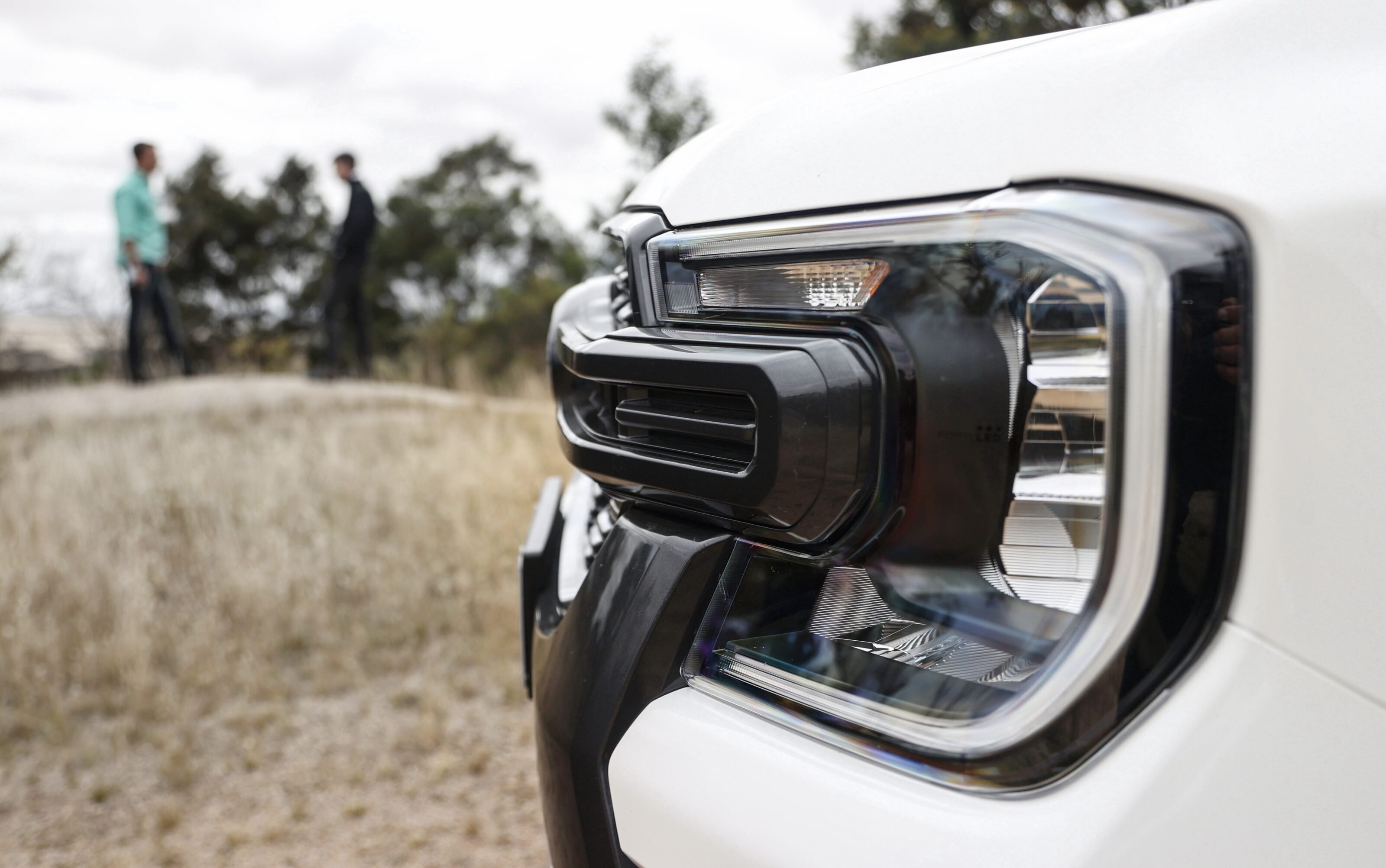
Given the success, patriotic subtext and longevity of the project, you might expect Worthington to list the Ranger as his favourite Ford accomplishment but, true to form his greatest achievement is not a car at all, he says.
“Everyone has to find their own place. I’m really happy with what I’ve done and the contribution I’ve made. Making sure people are looked after and can be their best is easily the most rewarding thing I’ve been a part of.”
“The secret is to surround yourself with the best people. Then make sure those people know that if they need help or there’s something you need to know about, you create an environment where bad news is okay. Once the problem is on the table we can fix it.
“This phone unfortunately works 24 hours a day,” he says with his dry humour.
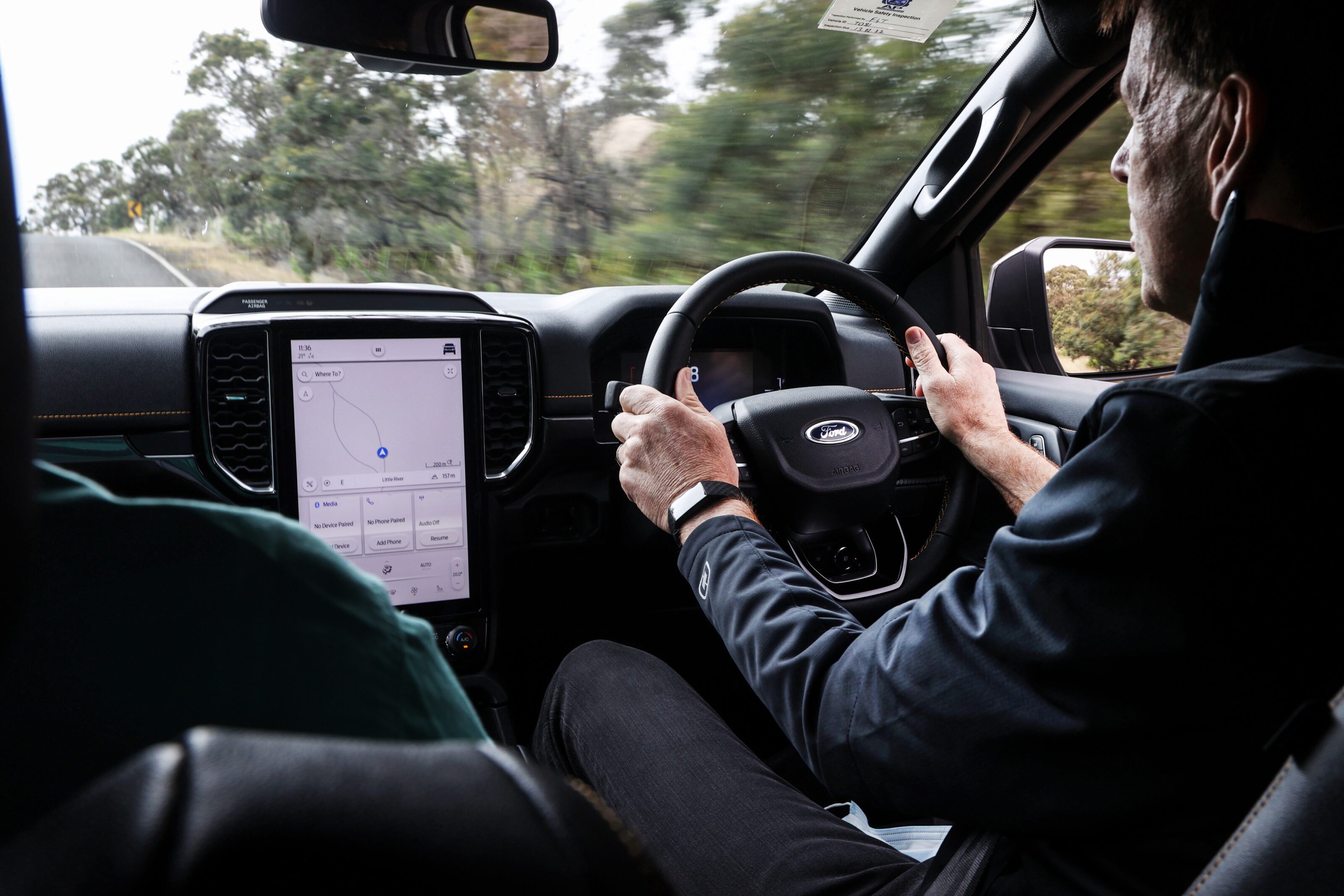
Toward the end of our meeting, we load into a 2022 Ranger Wildtrak before detouring up a steep unsealed track to show off the view from the highest point of the proving ground facility. It feels surreal to survey this closely guarded and secretive centre of excellence from such an advantageous position but Trevor Worthington has revealed a few more of its tremendous accolades – even though he rarely allows himself the same recognition.
But as we’re taking in the stunning panoramic vista from Port Phillip Bay to Mount Macedon he seems to momentarily take off the engineer’s hat and speak with more emotion.
“One of the reasons this team is here is that Australian engineers are probably the most adaptable, versatile, flexible and committed of any of the engineers we’ve got. Our responsibility is to make sure the proving ground is always here”.
“Australian engineers are the most adaptable, versatile, flexible and committed of any engineers”
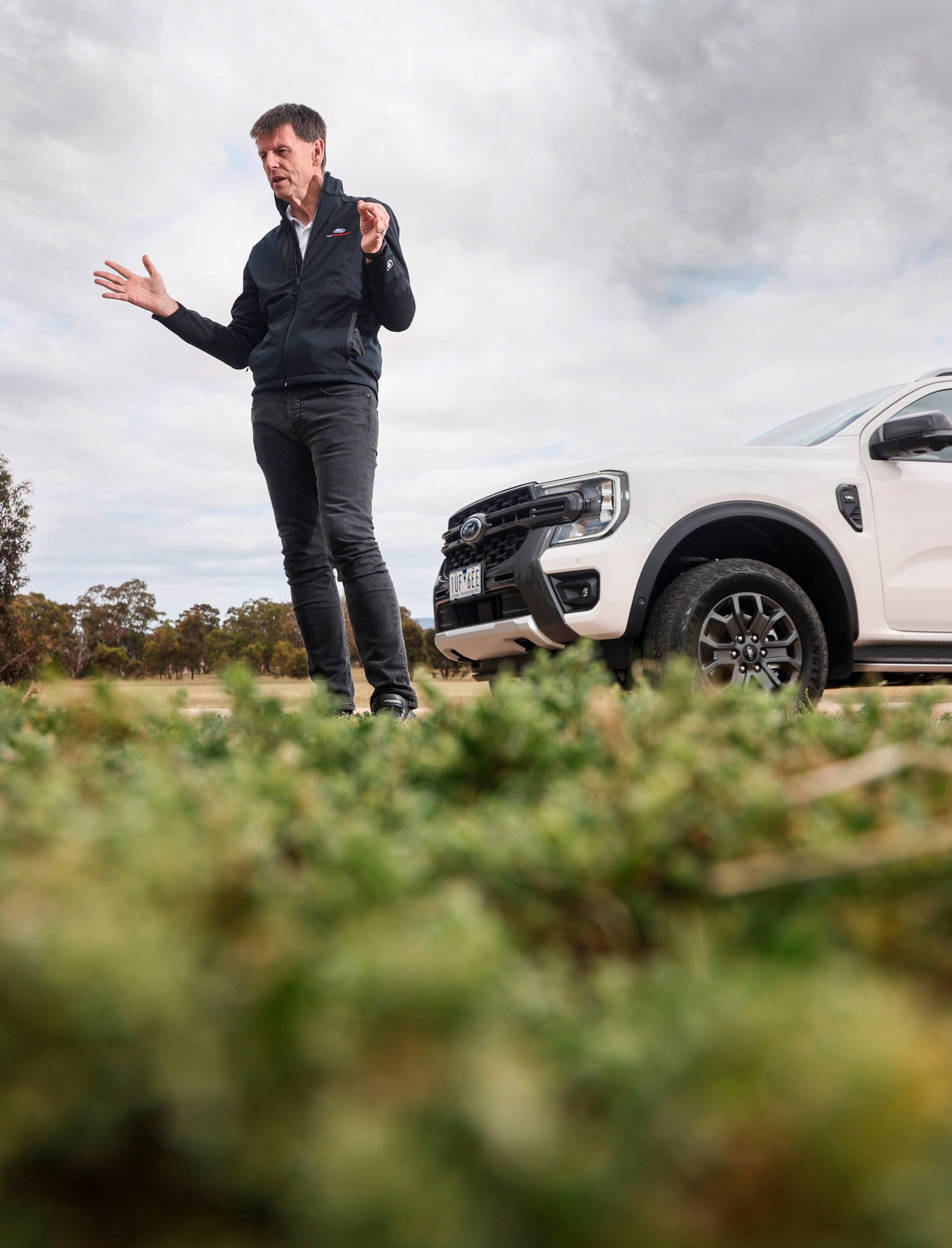
Sneak peak: Nice knobs
Few vehicles underscore the impression Worthington’s legacy has made on Australia like the new Ranger, developed and designed right here in Ford’s local post-manufacturing era. As we tour Ford’s You Yangs proving ground he delights with what his team has achieved and takes time to point out his favourite features in the Wildtrak we’ve brought along.
Take the revised placement of air vents up high on the centre console and in the rear row: “The team has done a fantastic job of putting hard switches where customers said they want them,” he adds in reference to the volume, fan, and temperature dials. “I love it.”
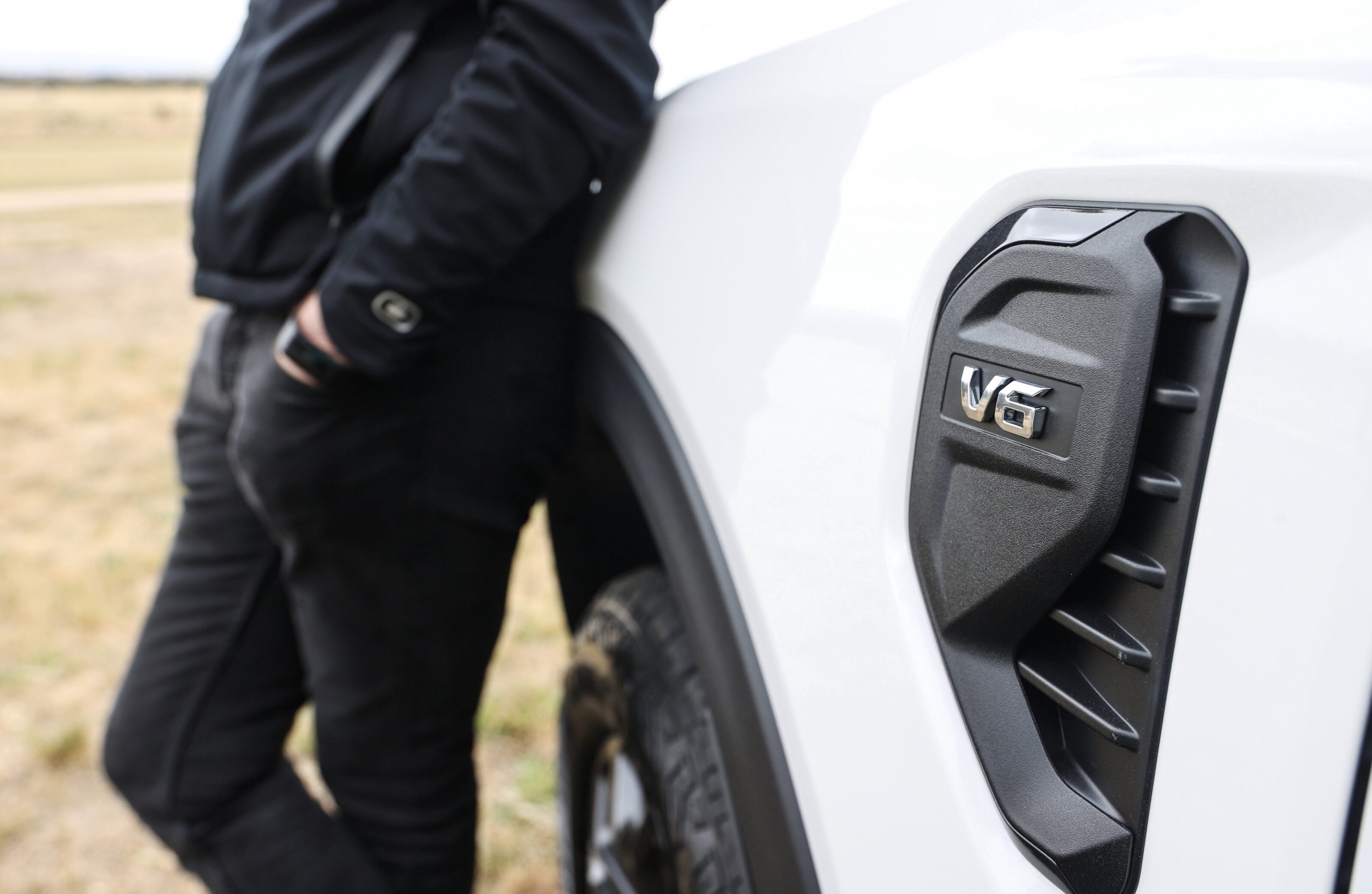
Trev’s Dream Shed
You’ll need to guess which one he owns – we promised to keep it secret
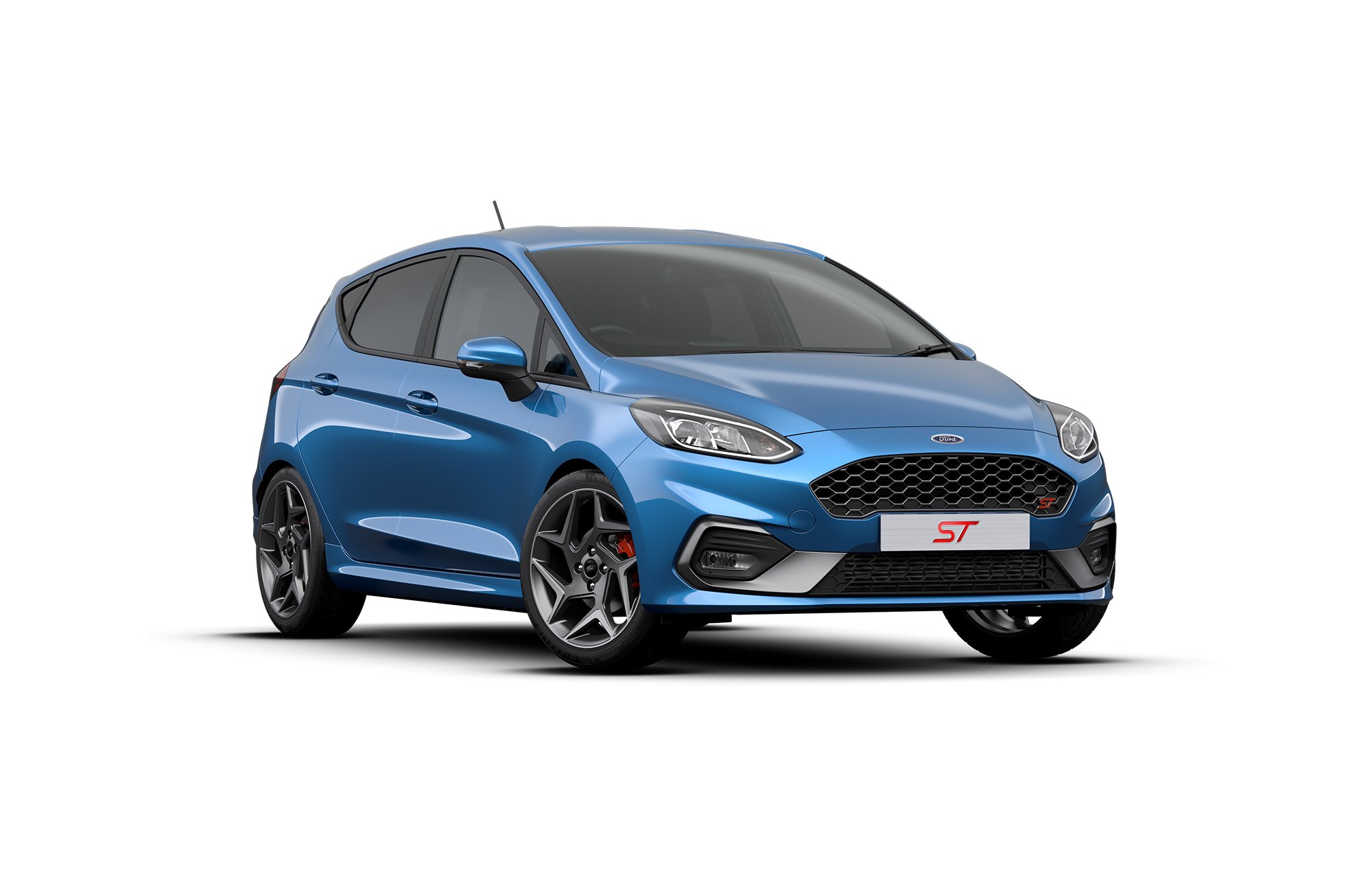
Daily drive: Fiesta ST
“I’ve been doing this for 37 years and I can honestly say the best daily driver I’ve ever driven is the Fiesta ST.”
Track day: Ford GT
“It’s clearly a mission-driven vehicle. Just ridiculous in the right way – I’ve never driven anything like it.”
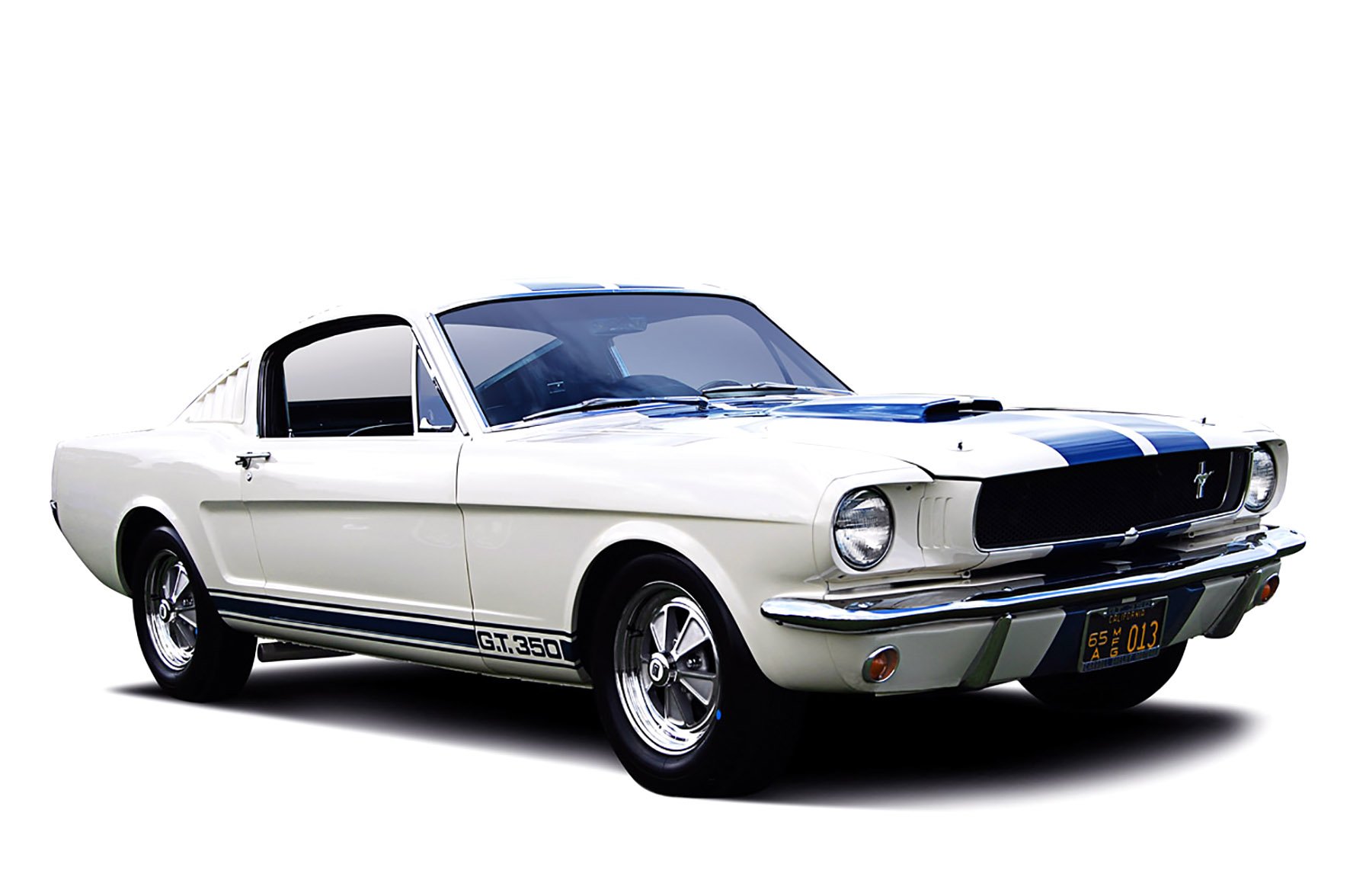
Weekend: 1965 Shelby GT350
“It’s got a 289 engine, manual and a noise that’s like nothing else. It’s fun whether you’re going 20 miles an hour or 140.”
You may not know of Roland Kussmaul. He’s not one of the car industry’s limelighters. He joined Porsche’s engineering department in the 1960s straight out of university and his first job was developing the Leopard tank. His talents for developing vehicles on challenging terrain were noted by the manager of the racing division, Peter Falk, and Kussmaul soon found himself in charge of Porsche’s customer rally teams. He co-drove in a 911 with Bjorn Waldegård, winning the 1969 and ’70 Monte Carlo Rallies.
From there, he worked on the development of all-wheel drive rally cars for Paris-Dakar. In 1984, he drove an AWD Type 953 Safari 911 in the event, ostensibly as a spares support car for the two lead vehicles and accidentally won two stages in the process.
Kussmaul’s imprimatur is on the incredible 959, the Le Mans-winning 962, the Carrera Cup and RS versions of the 964, the 993 RS and RSR, the astonishing GT1 hypercar and he’s also the father of the 911 GT3. In terms of impact on the performance car landscape, Kussmaul is a reluctant and diffident icon.
He’s also the mentor of Andreas Preuninger, Porsche’s current director of GT cars. “He was a legend in the company,” says Preuninger. “Most of the stuff I learned about cars, about the setting up of cars, of the car as a system that has to work in synchronicity with all the parts moving and how a car gets the right feeling. That’s all I learned from him.”
Preuninger’s office at Weissach is Kussmaul’s old office. Over half a century of knowledge from Porsche’s motorsport roots was passed with reverence from one man to the next. That continuity of expertise has resulted in a series of cars that are unrivalled in terms of consistent dynamic cohesion. That is key.
That’s what makes a Porsche feel like a Porsche, whether it’s a 911 GT3, a Taycan EV or a Macan SUV. It’s why the next-gen Boxster EV has its battery packs in the same place as the current gen’s engine, CofG be damned, so that it feels like a Porsche Boxster in the way it shifts its masses. These reasons are why the 992 GT3’s victory at Performance Car of the Year 2022 had an air of inevitability to it. You could say that excellence is indeed expected.
The walls of Weissach might seem an odd stepping off point to consider Toyota’s new GR Corolla, but it’s very much a case of compare and contrast. From the underwhelming demise of Celica in 2006 and MR2 Spyder in 2007 to the introduction of the 86 in 2012, Toyota didn’t sell a performance car. Even after the 86 arrived, it took another seven years for the Supra, another joint venture, to debut.
You could argue that given their respective Subaru and BMW genes, neither the 86 nor the Supra were a pure expression of Toyota’s true sporting DNA. The GR Yaris was the first, and as fascinating as that car’s story is, the one thing it signally lacks is that dynamic cohesion that Porsche does so well. It’s angry and undeniably quick, but the mark of a truly great car is the fidelity of response.
A consistent input should result in a consistent output. The Yaris fights you. Drive it on a challenging road and it pogos, bucks and kicks back. It’s undeniably exciting but there’s little that’s fluid about it. You emerge juiced and grinning but quietly aware that you’ve never once settled into a satisfying flow with the vehicle. A colleague likened it to adopting a bull terrier that’s trying to assert dominance.
The Corolla is sprung from far more promising bones than the Yaris. Fanboys of the GR Yaris will doubtless take issue with this, but from a purist driver’s perspective, the Corolla is a superior piece of kit.
It steers better, it has a superior base platform to work from, the driver’s hip point is in the correct position, the pedal positioning is better, visibility out of the car is far less impeded and the front and rear ends were co-developed, rather than the GR Yaris’s mix and match of the base Yaris’ GA-B platform front end and the Corolla’s GA-C rear end.
Tommi Mäkinen and Akio Toyoda hit a lot of development targets with the GR Yaris. It told a great story, made some incredible numbers, underscored Gazoo Racing’s commitment to lightweighting, featured a mighty three-cylinder engine and fulfilled its initial homologation brief, even if much of that subsequently proved unnecessary.
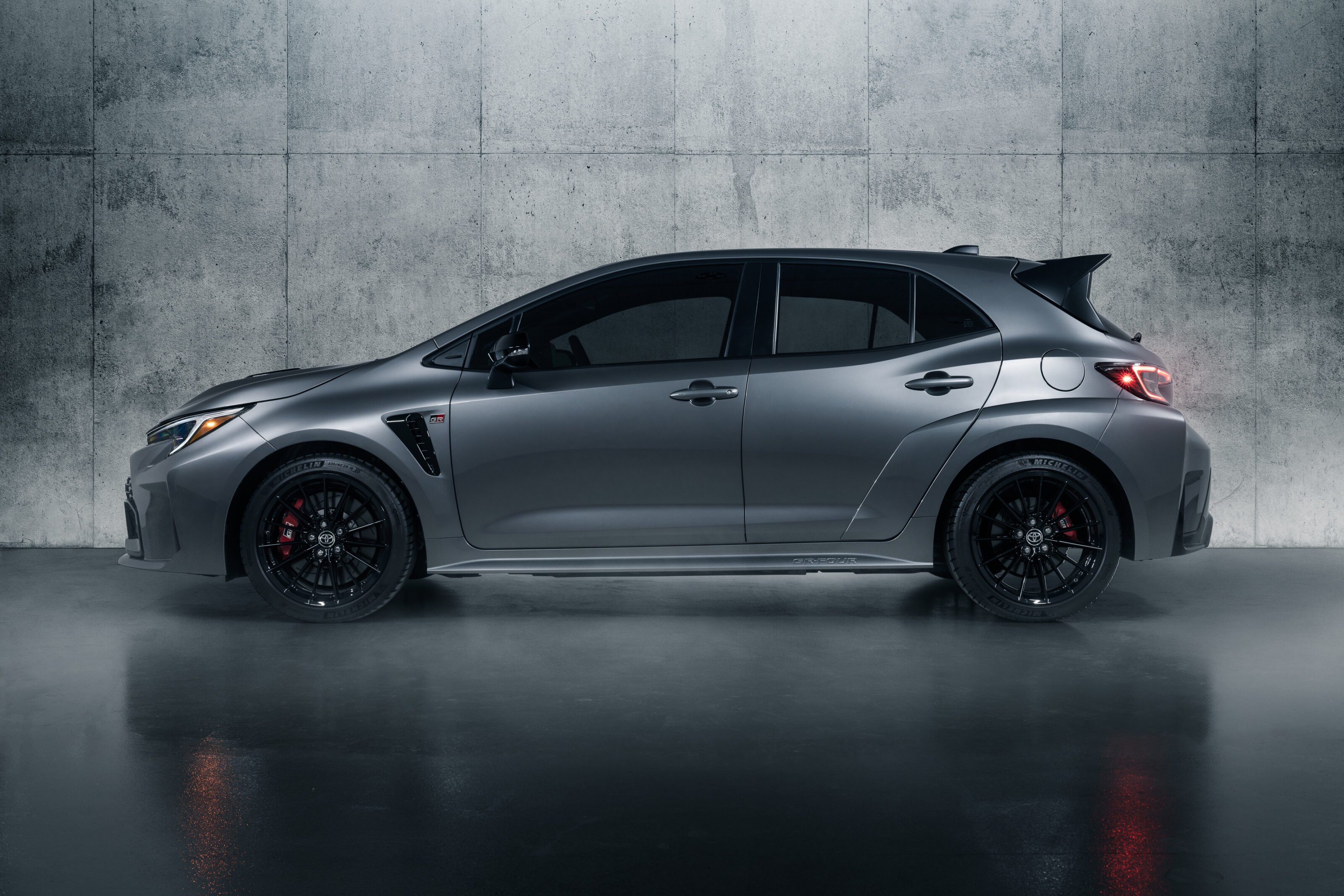
What the GR Yaris signally didn’t do was incrementally build on the dynamic precedent set by the 86. Nor did the Supra. For obvious reasons, each car starts virtually from scratch. It’ll be interesting to see how the GR Corolla, which takes certain elements of the GR Yaris’ mechanical formula, moves the game on. Will it be a case of another Toyota sports car that shares little or nothing in terms of dynamic signature with any of its forebears?
Hyundai N under Albert Biermann is a fascinating case study in building a specific set of specific dynamic characteristics that feed through each of its models. It doesn’t have half a century of backstory, fast-tracking that process in a mere handful of years. Toyota needs to define what its sporting cars are, how they feel and what they stand for.
Few car manufacturers will ever have someone as steeped in the essence of the brand as Roland Kussmaul, but the way in which he helped refine the dynamic signatures for an entire marque are worthy of scrutiny. Akio Toyoda would do well to have a chat to an affable 83-year-old who now spends his well-earned retirement tinkering with his cars and bikes in his garage in Eberdingen, nine kilometres – or 370 seconds by a demonically-pedalled GT3 in the dead of night – from the gates at Weissach. It seems bizarre, but a legend from Porsche may well know more than anyone alive how to make a Toyota GR feel like a Toyota GR.
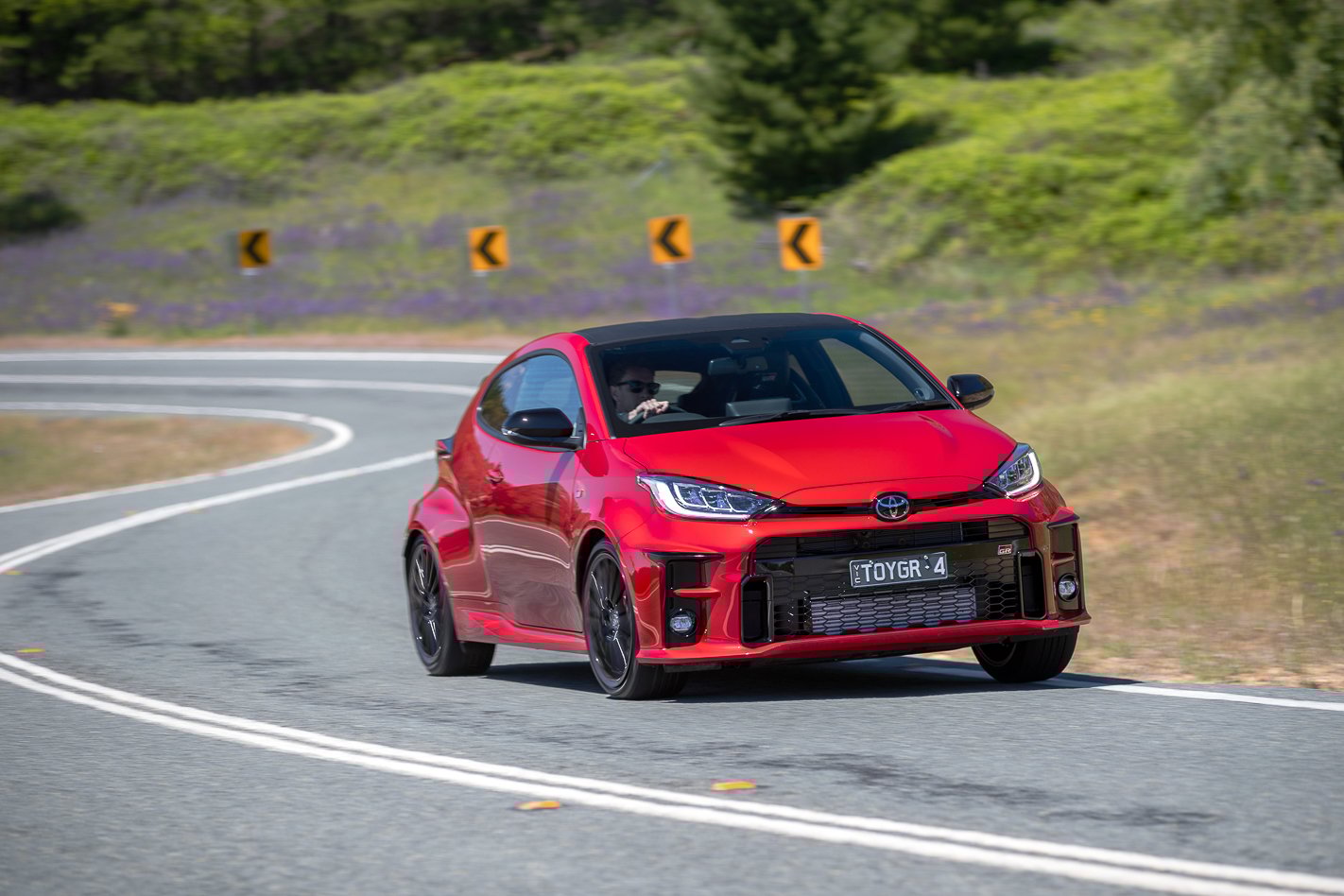
Toyota’s tiny terror looks for redemption after the base GR Yaris’ efforts at PCOTY last year. With a new category, and much tighter competition, the fully-loaded GR Yaris Rallye swings into sixth place at Sports Car of the Year 2022
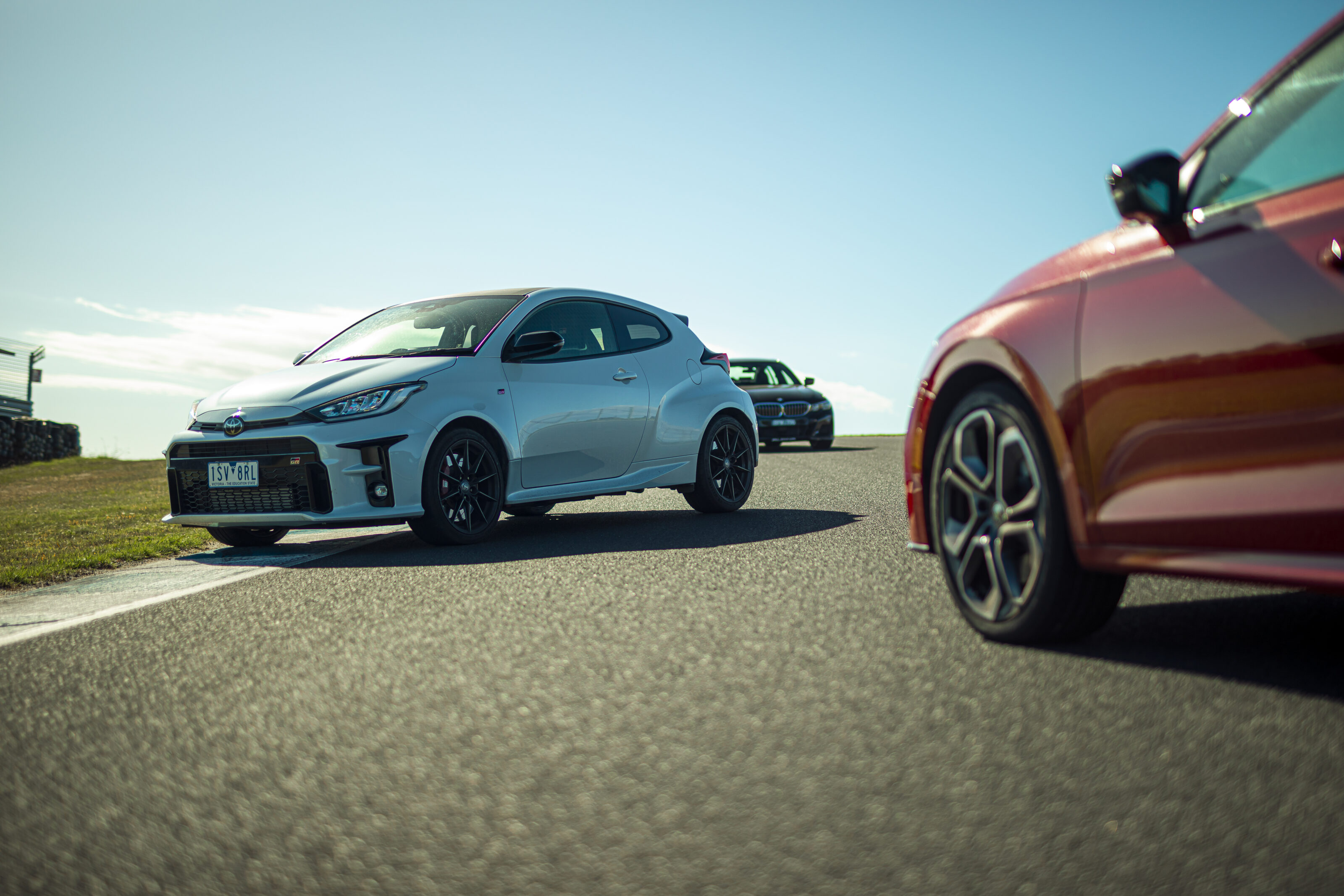
The GR Yaris Rallye is bowling downhill towards an ascending open right-hander and there’s a big compression at the bottom. I see it from afar, a large patch of loose gravel strewn across the road. Pre-emptive lock is wound on, and I tense in apprehension of terminal understeer. And it never comes.
It was a different story at last year’s PCOTY competition with the base GR Yaris, whose inferior Dunlop rubber and lack of Torsen differentials saw a loose front end working against you, rather than with you.
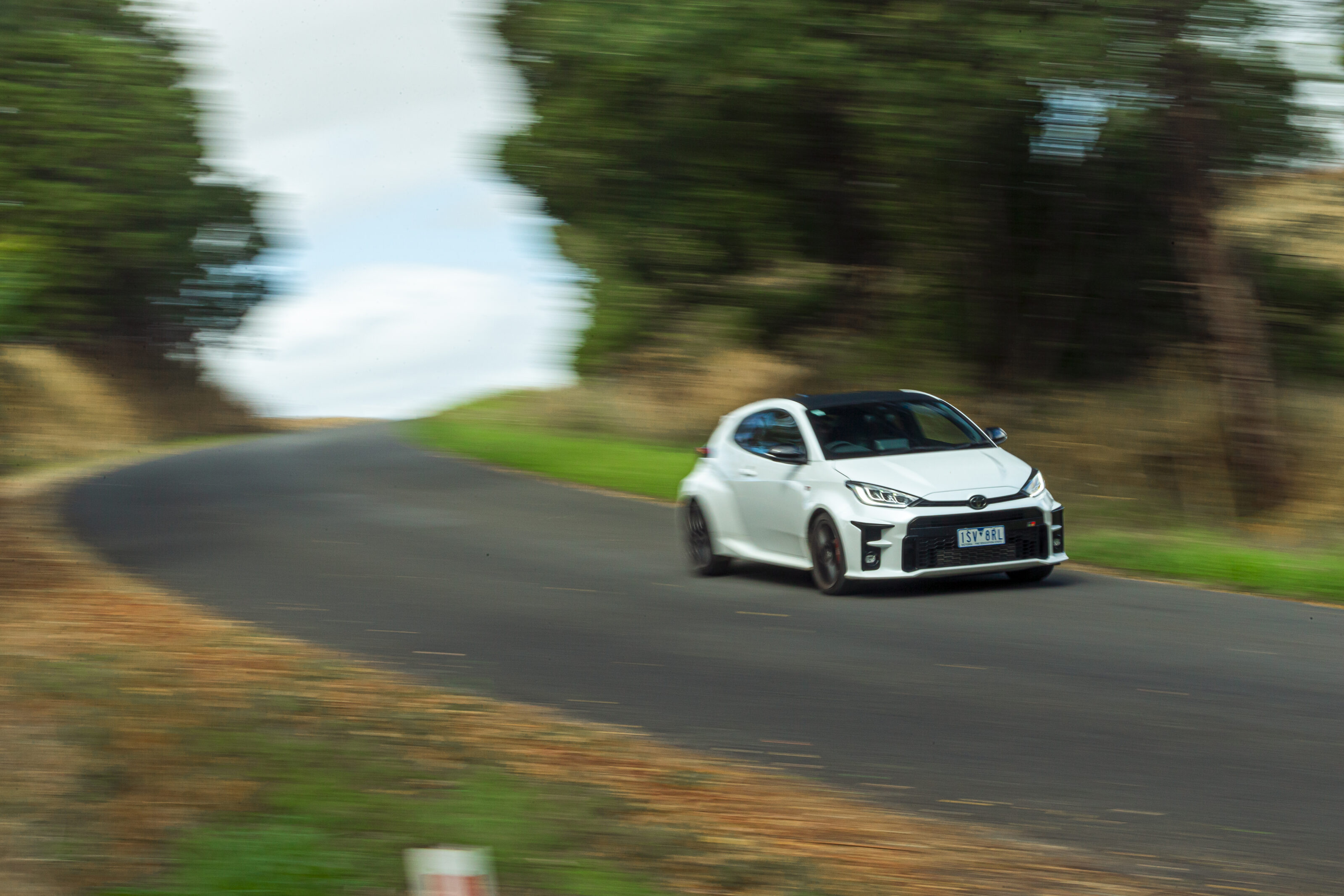
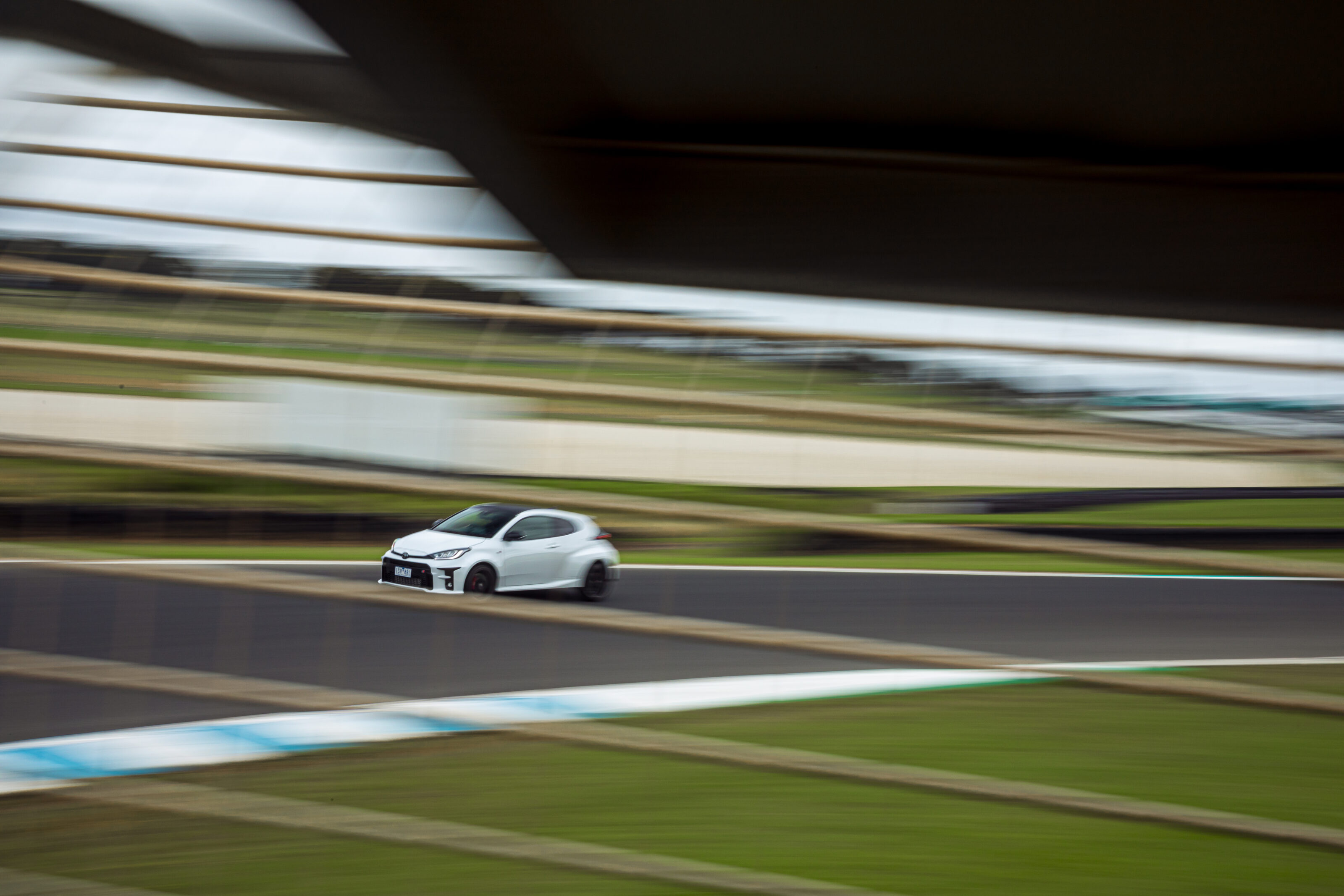
The full-whack Rallye is here for redemption, further delivering the experience that the GR Yaris badge always promised. Suddenly, plough understeer is far from mind and, when faced with twisting kilometres of poorly maintained Australian backroads, it feels like it’s overwhelmingly purpose-built. It’s amazing what a set of diffs, some suspension tweaks and Michelin Pilot Sport 4S tyres can do. Rain, hail or shine, it doesn’t miss a step. The Yaris GR Rallye simply inhales this stuff.
And it is fast! The all-wheel drive tiny tot blitzed the field in 0-100km/h testing, clocking triple digits from a standstill in 4.49sec. Bested only by the powerhouse 345kW Mach 1 Mustang around Phillip Island and across the 400m (by less than a tenth of a second at that), the Yaris Rallye punches well above its class by out-sprinting the BMW M3 and the supercharged V8 Jaguar F-Type from the Performance class above in 0-100km/h and 400m disciplines.
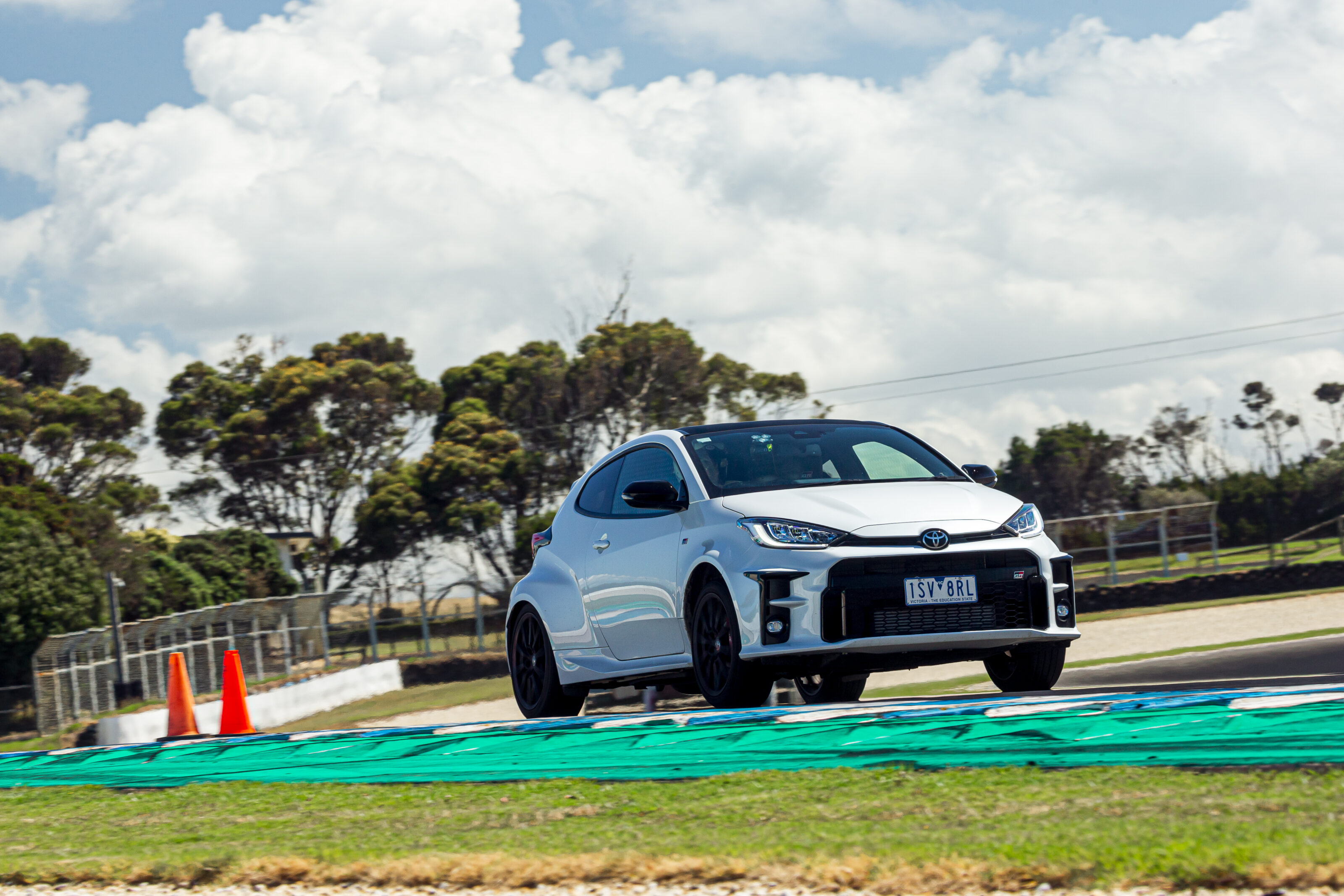
It’s true that the charismatic 200kW 1.6-litre turbo-triple is the Yaris’ party-piece, but the Rallye is far from just a traffic light Grand Prix hero. Both front and rear ends now work in tandem and, as Bernie noted, the driving experience is dominated by moments of pitch and roll communicated through its unflappable rally-honed suspension. It’s very fast and huge fun, but falters in overall cohesion against a tremendously resolved field.
There’s a level of idiosyncrasy to almost every interaction you make with the car. The awkwardly tall seating position remains, with Luffy stating: “it feels like you’re sitting on it, not in it”. The central infotainment screen and rear-view mirror combine to impede outward vision, real-world practicality is nominal and, with competitive drive-away introductory pricing gone, the Rallye scores lower on the value front this time around.
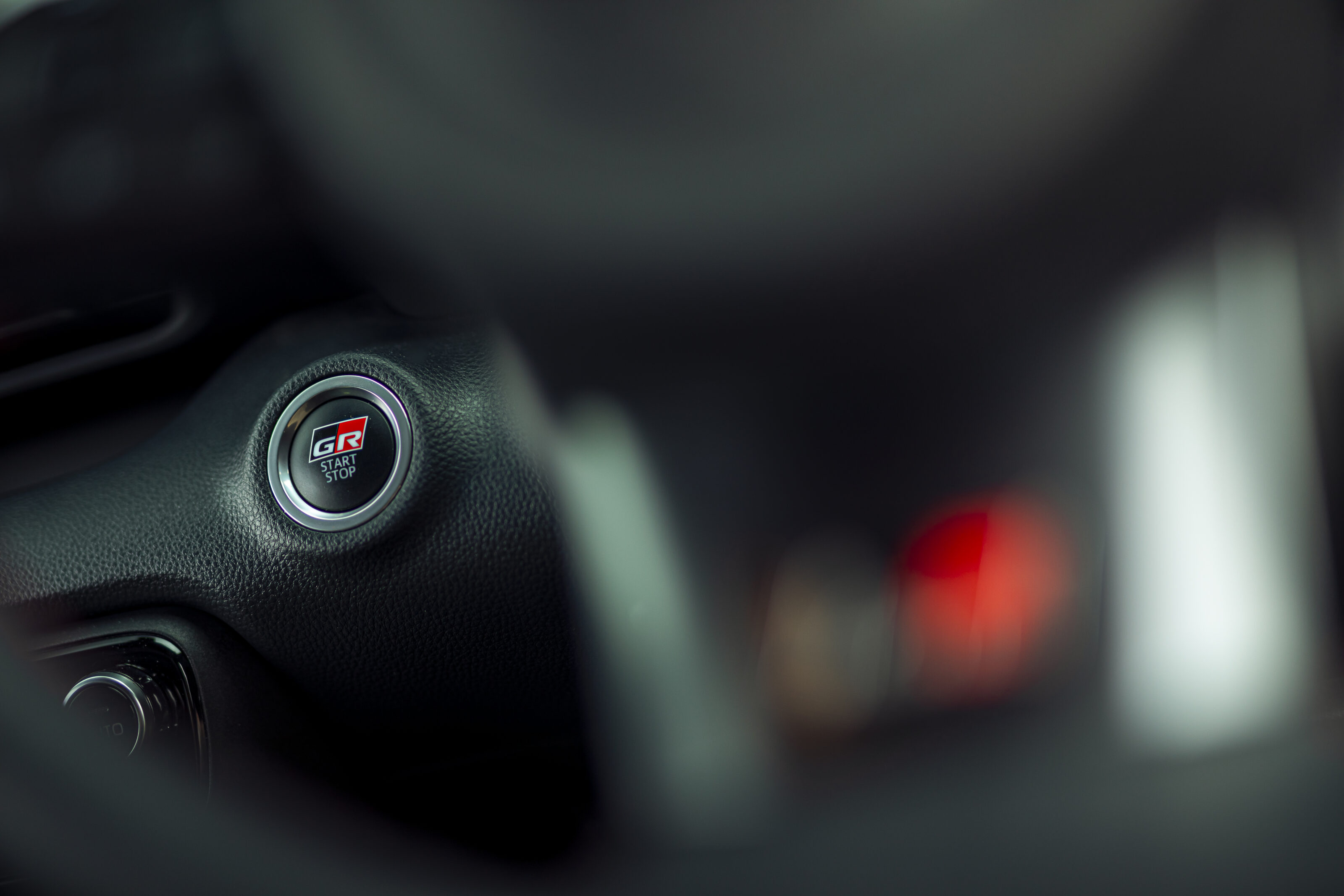
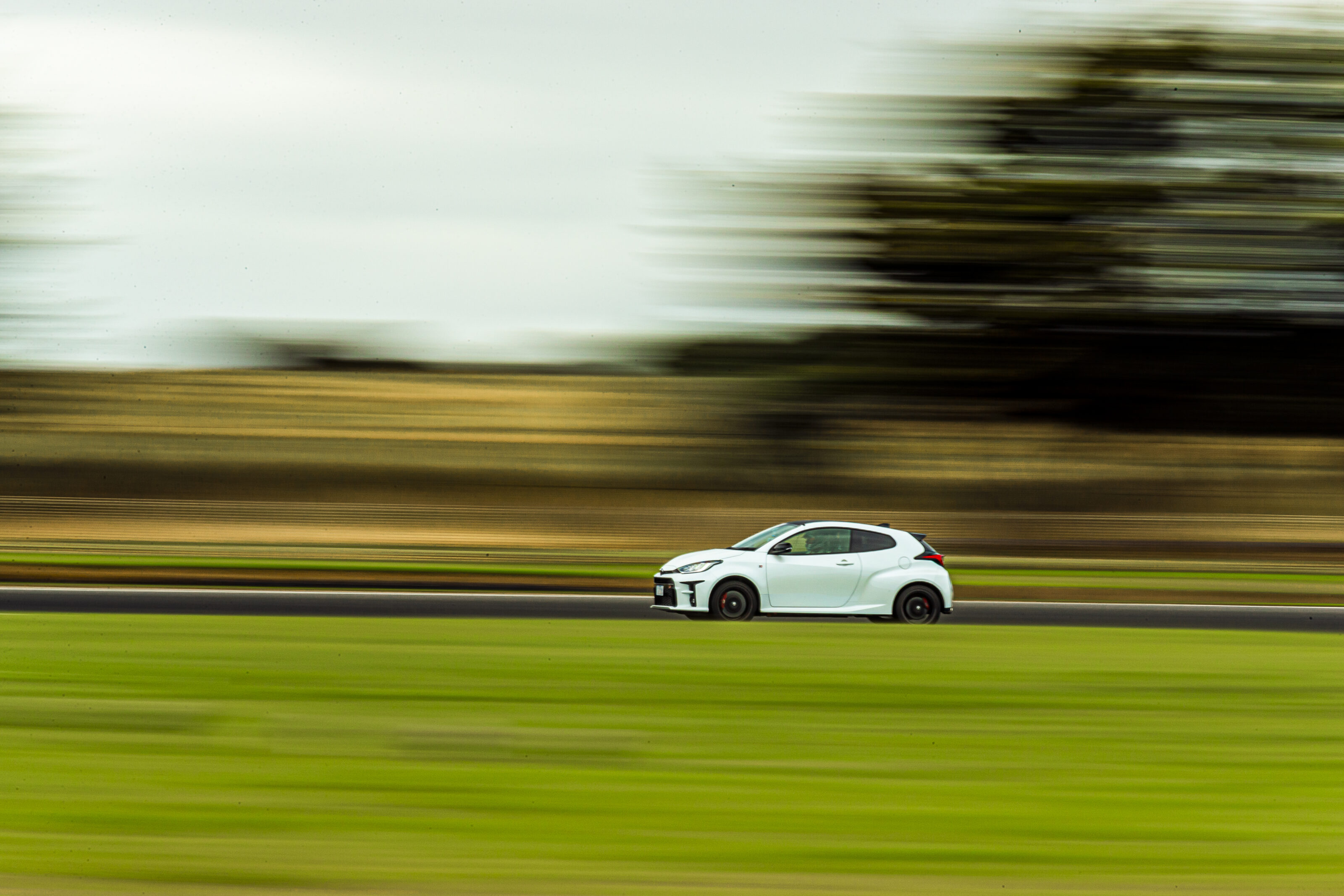
There is nothing here quite like the GR Yaris Rallye. It feels bespoke and purposeful in a way that eludes anything else in the field, bringing a real sense of occasion. However, there’s a staccato jerkiness to the driving experience on road that sharply contrasts the flow and finesse delivered by the Ford Focus ST and Subaru BRZ.
The GR Yaris Rallye improves upon last year’s effort, but with this year’s split categories, it’s a much harder fight and the closely fought midfield is stacked with talent. By gosh, are we glad it exists though.
The judges’ comments
Alex Affat
“It’s a very different car to what we drove last year. It felt made for the specific challenge of our road loop”
Ranking: 5th
Andy Enright
“I remember looking at the VBOX straight-line numbers and not quite believing what I was seeing”
Ranking: 4th
Trent Giunco
“The engine is mega for a three-pot, but the price and the seating position remain major shortcomings”
Ranking: 7th
Cameron Kirby
“The Rallye is the GR Yaris that Australia always deserved. It does so much more to deliver on the GR promise”
Ranking: 7th
Bernie Quinn
“Heaps of rally-style pitching and drama on road. Not smooth, with non-linear responses to inputs”
Ranking: 6th
Luffy’s view
Such a fun car. It’s very raw and fun at the limit. High speed stability better than expected and it monsters the low-speed stuff
Key figures
The story of the Valiant Charger R/T E38 is, like the Valiant Pacers before it, forever that of a great car hobbled by a three-speed gearbox and missing Bathurst glory – but one of a great car nonetheless.
The E49 of the following year should have made amends, with its four-speed helping the six-cylinder Charger to even quicker acceleration times than the fabled Falcon GTHO Phase III. But it couldn’t run from Chrysler Australia’s problems; the company would be sold to Mitsubishi by the end of the decade.
The Valiant commenced local manufacturing in 1963 and gained a promising foothold, the VE-series taking Wheels’ Car of the Year in 1967. However, the locally styled VH of 1971 was a marketing and packaging misstep, with buyers spurning its bloated styling.
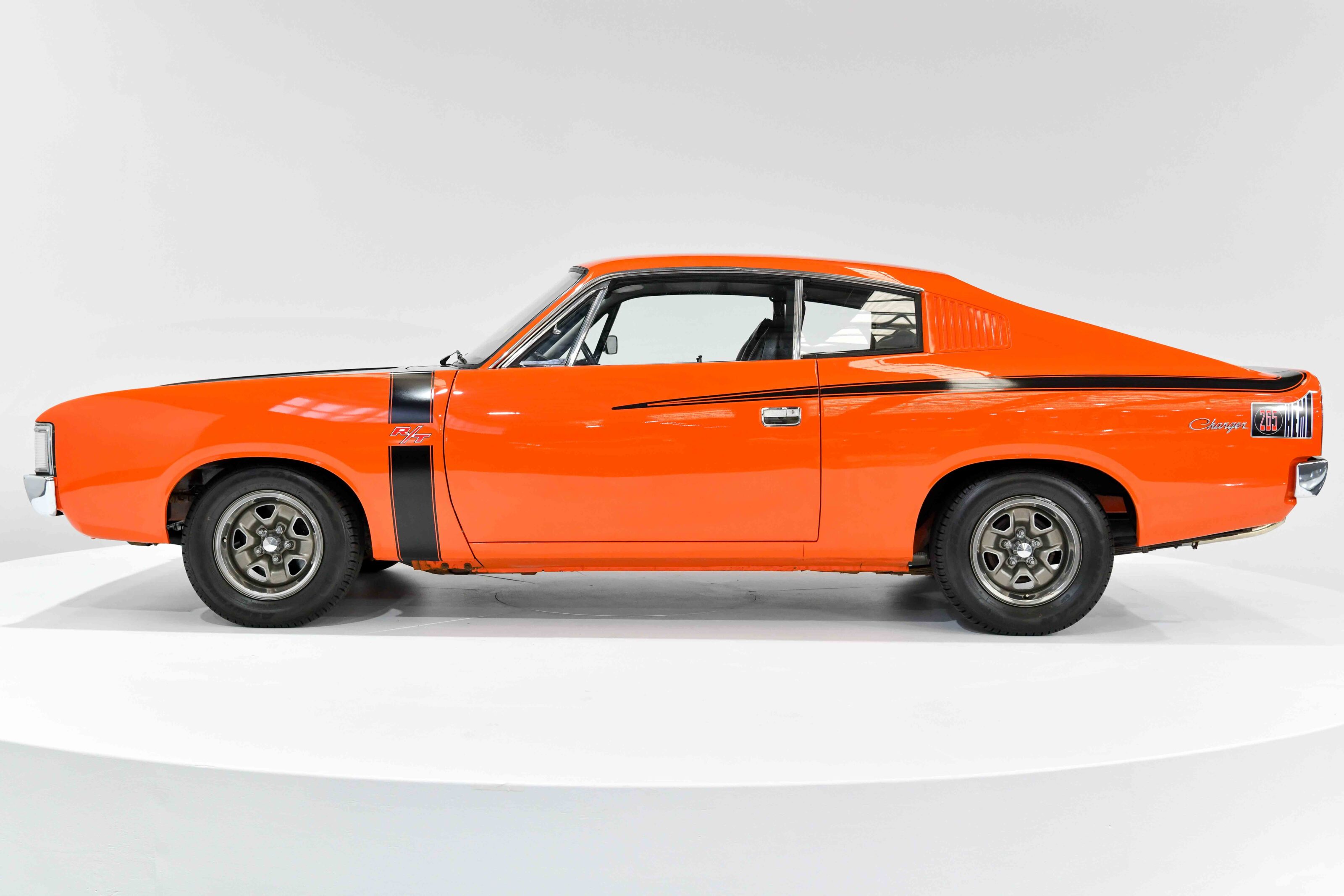
In August 1971 came the Charger. On a 150mm shortened VH wheelbase and around 150kg lighter (despite pillarless chassis reinforcing), the Charger was curvy and Kamm-tailed and textbook ’70s sexy.
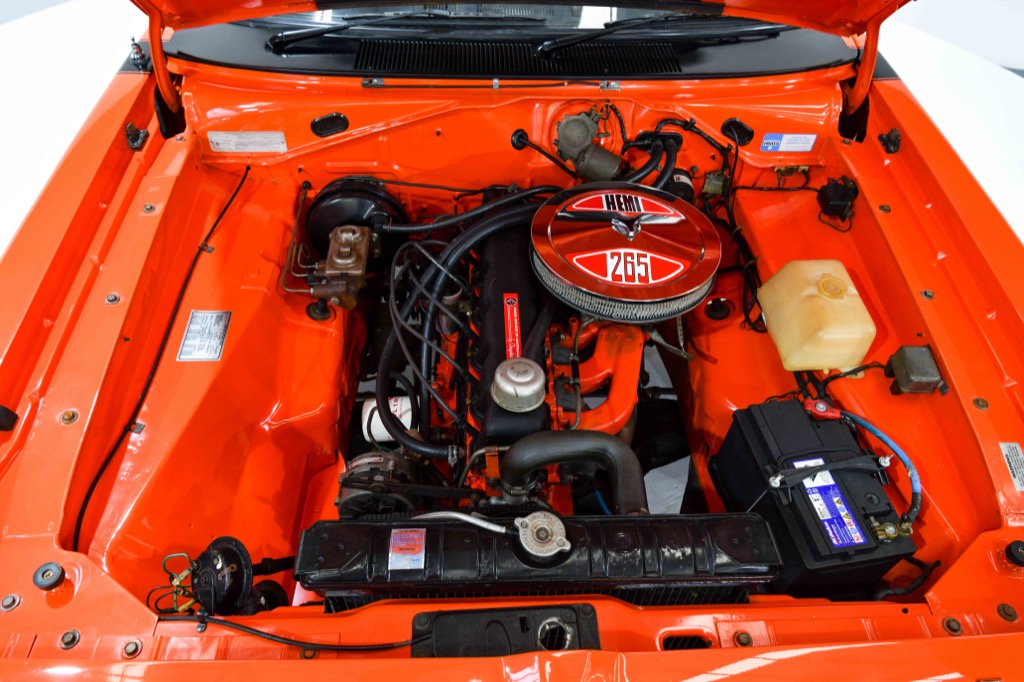
At the heart of the headline, homologation E38 version was a stonking 4.3-litre (265c.i.) six-pack engine, developed from an axed Chrysler US light-truck design into ‘E38 Six Pack’ guise with 10:1 compression, tuned extractors and triple Weber carbs. A detuned E37 ‘Street Six Pack’ had lower compression and a milder cam.
The hands-on, hot-rod feel was real: chief engineer Mike Stacy had ignored calls to use an in-house four-barrel carb, and purchased the first trio of 45-DCOE Webers from a local speed shop. An E38-engined VG Pacer was later shipped to Weber in Italy for final tuning.
An E38 optional Track Pack brought a quicker (16:1) steering ratio, front anti-roll bar, Sure-Grip limited-slip diff, ROH alloy wheels and 160-litre fuel tank.
Local content requirements forced Chrysler to stick with its existing three-speed (the local four-speed Borg Warner D20 was still almost a year away) and unassisted, barely adequate braking package.
The E38s dominated their September race debut at Oran Park in Sydney’s south-west, and a couple of weeks later were lapping Bathurst up to 10 seconds faster than the previous year’s VG Valiant Pacers … but still more than six seconds from the fastest Ford. On Sunday, the first Charger came home seventh.
For all that, in 2007 Peter Robinson remembered an epic 1972 overnight sprint from Adelaide to Sydney in an E38 with fellow Wheels scribe, Mel Nichols. “The mighty engine sang as we upped the pace, went in harder, clipped apexes, grabbing second, revs soaring, engine quivering … we didn’t care that it was crude.”
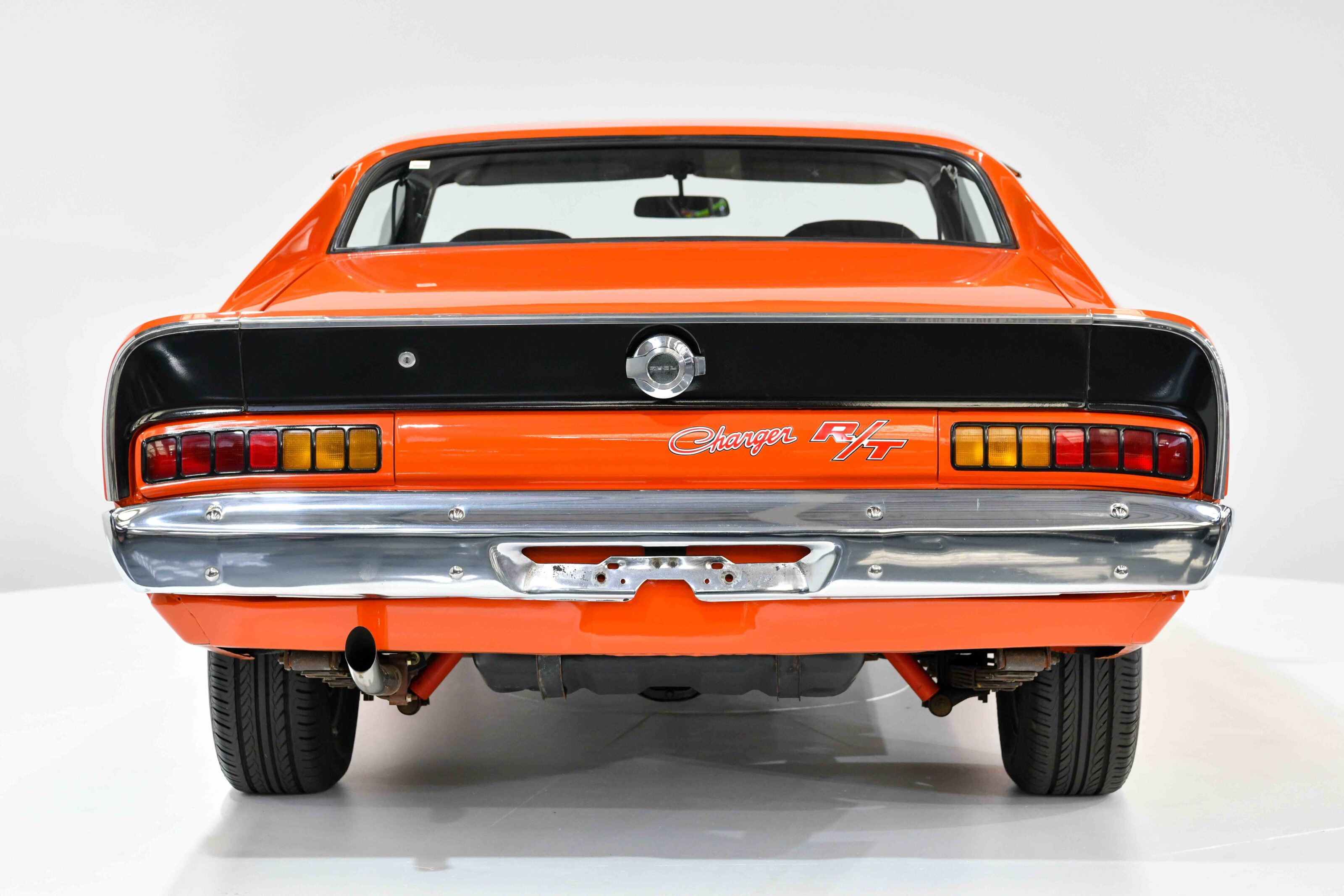
The limit of threes
The non-crossflow ‘Hemi Six’ (actually, only semi-hemispherical heads) had seven main bearings, making it rev-happy and reliable. The 4340cc E38 Six-Pack copped triple Webers, high-overlap cam, bigger valves and tuned-length extractors. It made 209kW at 5000rpm and 431Nm at 3700rpm which, despite the three-speed manual, propelled the 1327kg coupe to 14.8-second quarter miles – matching a contemporary 2.4-litre Porsche 911S.
Space race
At 4564mm overall length, on a 2667mm wheelbase, the Charger was closer in external dimensions to a Torana than to a GTHO. Front body panels were shared with VH sedans and the doors with the VH hardtop. The front cabin’s spaciousness was emphasised by the reverse-sloping dashboard and a full-width footwell, uninterrupted by a centre console. Reclining buckets, full instrumentation (with tacho) and front driving lamps were standard for all R/Ts.
