
Toyota Australia believes hydrogen fuel-cell electric vehicles (FCEVs) like its Mirai will become mainstream here far sooner than it took hybrids to gain traction, with the company’s vice-president of sales and marketing, Sean Hanley, saying he expected private sales to commence within three years.
“With Prius, I recall vividly we sold a handful of cars in the first year – yet hybrids are now mainstream and achieving record sales. More than a quarter of our total volume here in Australia,” Hanley said at the local launch of the second-generation Mirai in Melbourne.
“We expect Mirai to become more readily available to our dealers within two to three years, accelerating as the refuelling infrastructure grows.”
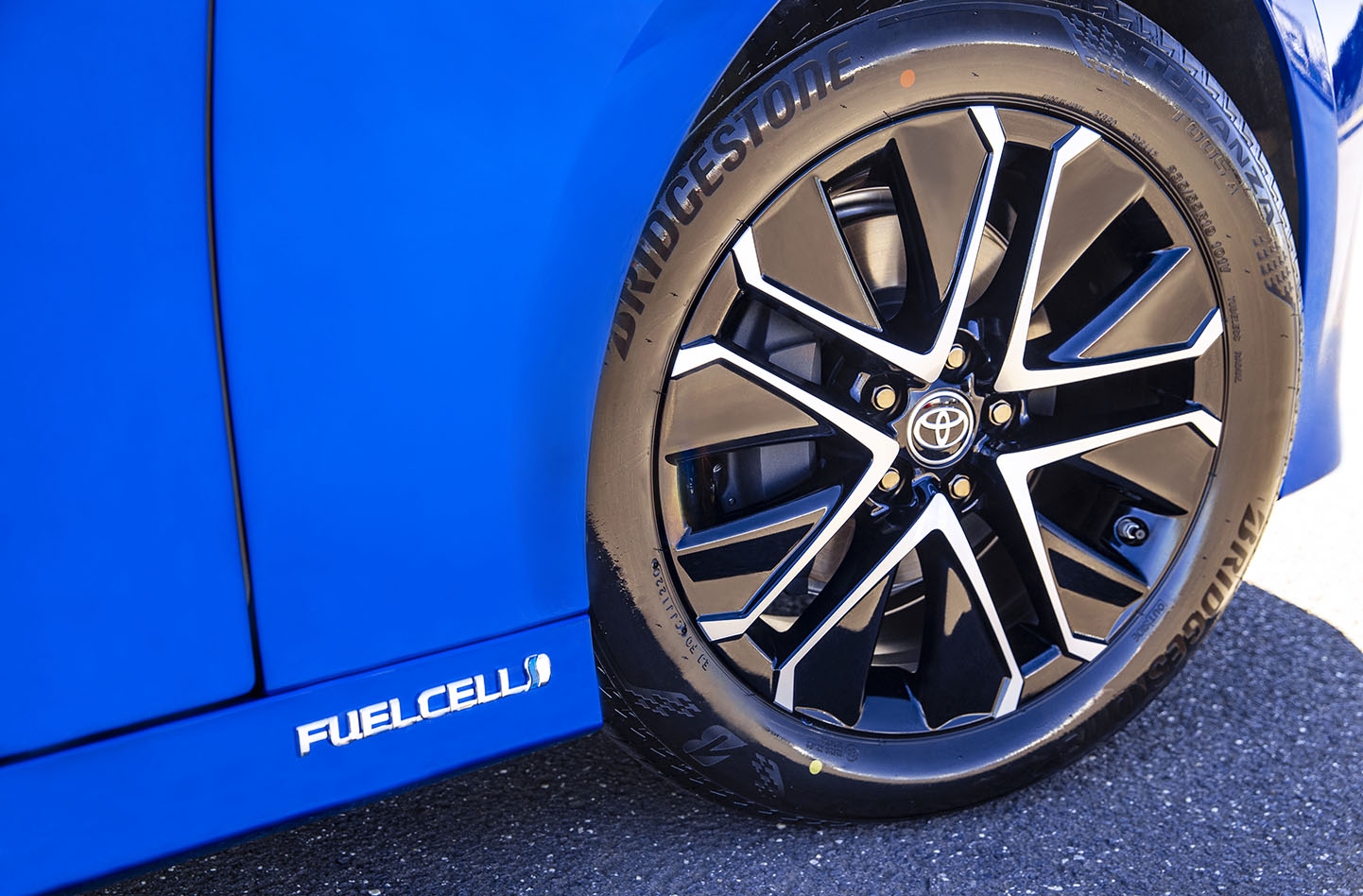
Currently, FCEVs like the Mirai and Hyundai Nexo are only available to companies under leasing agreements.
Hanley’s comments were backed up by Toyota Australia’s manager of future technologies and mobility Matt McLeod, who said there is a willingness in business and government to see hydrogen stations built around Australia to attract FCEVs rather than wait for them, thus avoiding the chicken-and-egg scenario that has long plagued electric vehicles.
McLeod pointed out that Toyota’s first hydrogen refuelling station at its Altona plant, and another in Canberra built with support from Hyundai, will soon be followed by projects already in the works in other capital cities including Brisbane and Perth.
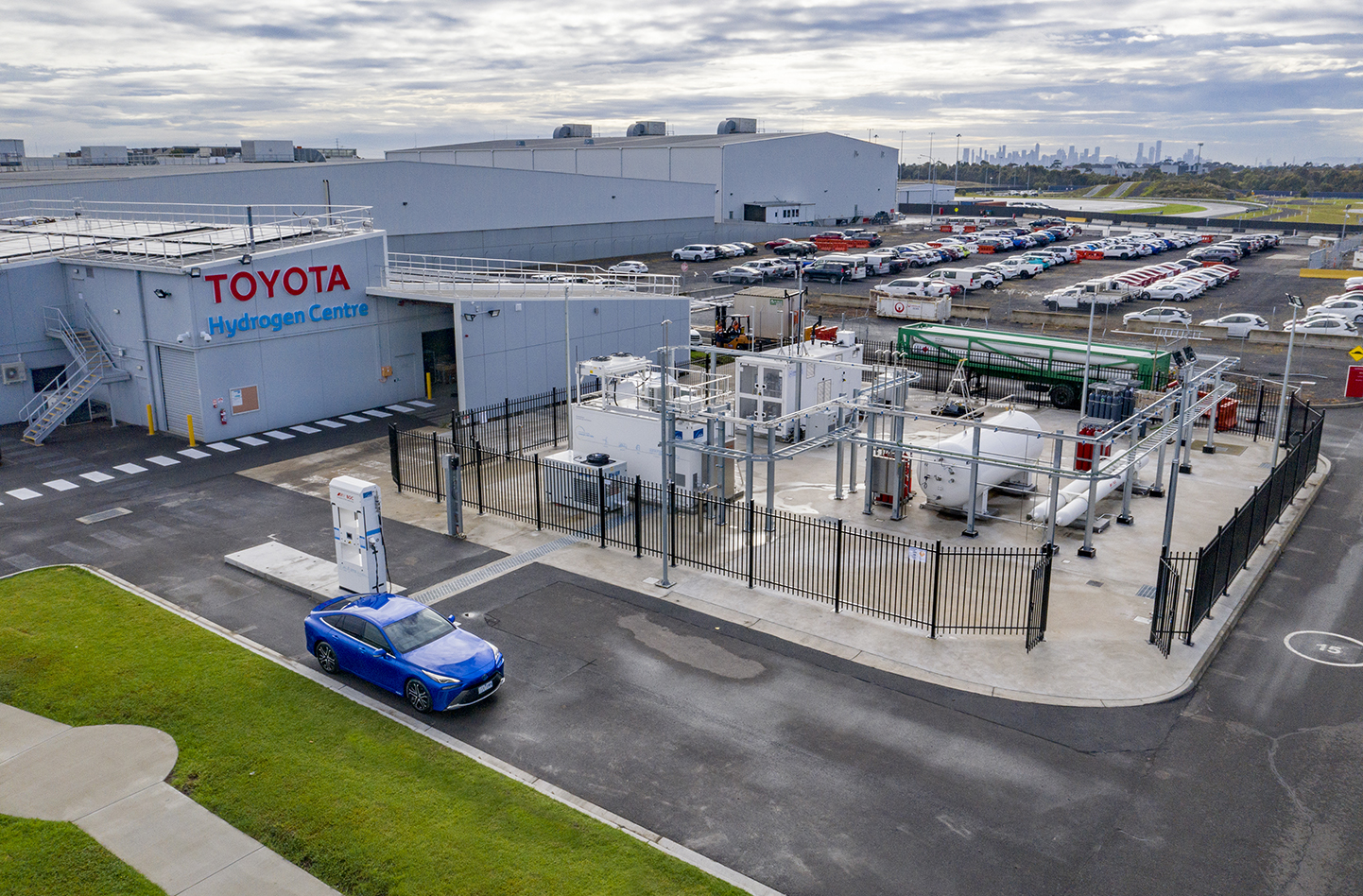
He said that because hydrogen vehicles provide a decent range, we won’t need to see filling stations on every corner, but added that it’s vital for all stakeholders such as vehicle manufacturers, energy companies and government to collaborate to ensure stations are strategically located in the right places.
“The key to rolling out these types of models, whether it’s ours or whether it’s a competitor’s, is to have a cluster of stations and to understand not necessarily where the first one is but where the second and third one are going in those particular regions,” McLeod said.
“It’s the only way we’re going to overcome this kind of chicken-and-egg thing. I’ve been doing this for four years, so I’m pretty sick of chickens and eggs.”
Hedging electrified bets
While Hanley is upbeat about the future of hydrogen technology and FCEVs like Mirai, he stressed that Toyota is not putting all its eggs in one basket and will continue to develop battery-electric vehicles, hybrids and plug-in hybrids to suit various demands.
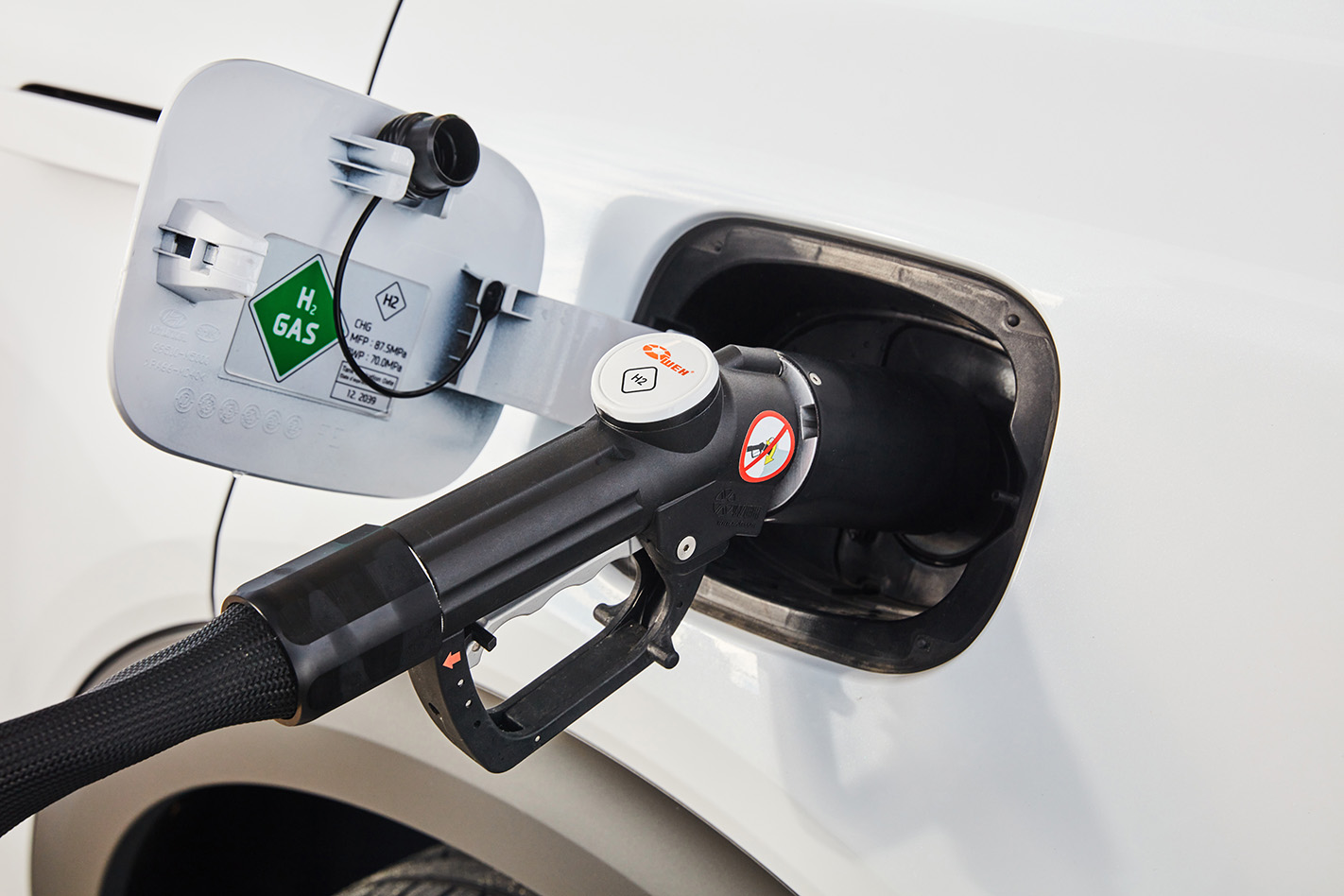
“When we talk about being carbon neutral, a lot of people say all we have to do is use battery electric vehicles because they don’t emit any CO2 – but the truth is it’s not that simple,” he said.
“BEVs or battery electric vehicles are just one part of the solution.
“[But] Australia is a big country. We’ve got diverse customer needs and our success has been built on providing high-quality durable and reliable vehicles that are fit-for-purpose in every corner of this country.
“Ultimately it’s the market that will decide, and our goal is to provide options to support those choices.”
Utes and vans have overtaken passenger cars in overall sales for the first time in Australia.
The latest official industry figures have revealed the Light Commercial segment accounted for 60,066 vehicle sales in the first quarter of 2021, compared with 59,144 units for the Passenger Car category.
Light-commercial vehicles (LCVs) outsold passenger cars for six out of 12 months in 2020, as well as February 2021, but it took a repeat in March for utes and vans to take the lead in year-to-date figures for the first time ever.
LCVs have grown 26 per cent year to date, compared with a 19 per cent increase for SUVs and a nine per cent decrease for the segment that comprises hatchbacks, sedans, wagons, people-movers and sports cars.
The result is not unexpected as passenger-car sales have been in decline for more than a decade. They dropped below half a million units in 2016 then more than halved between 2017 – the year they were overtaken by SUV sales – and 2020.
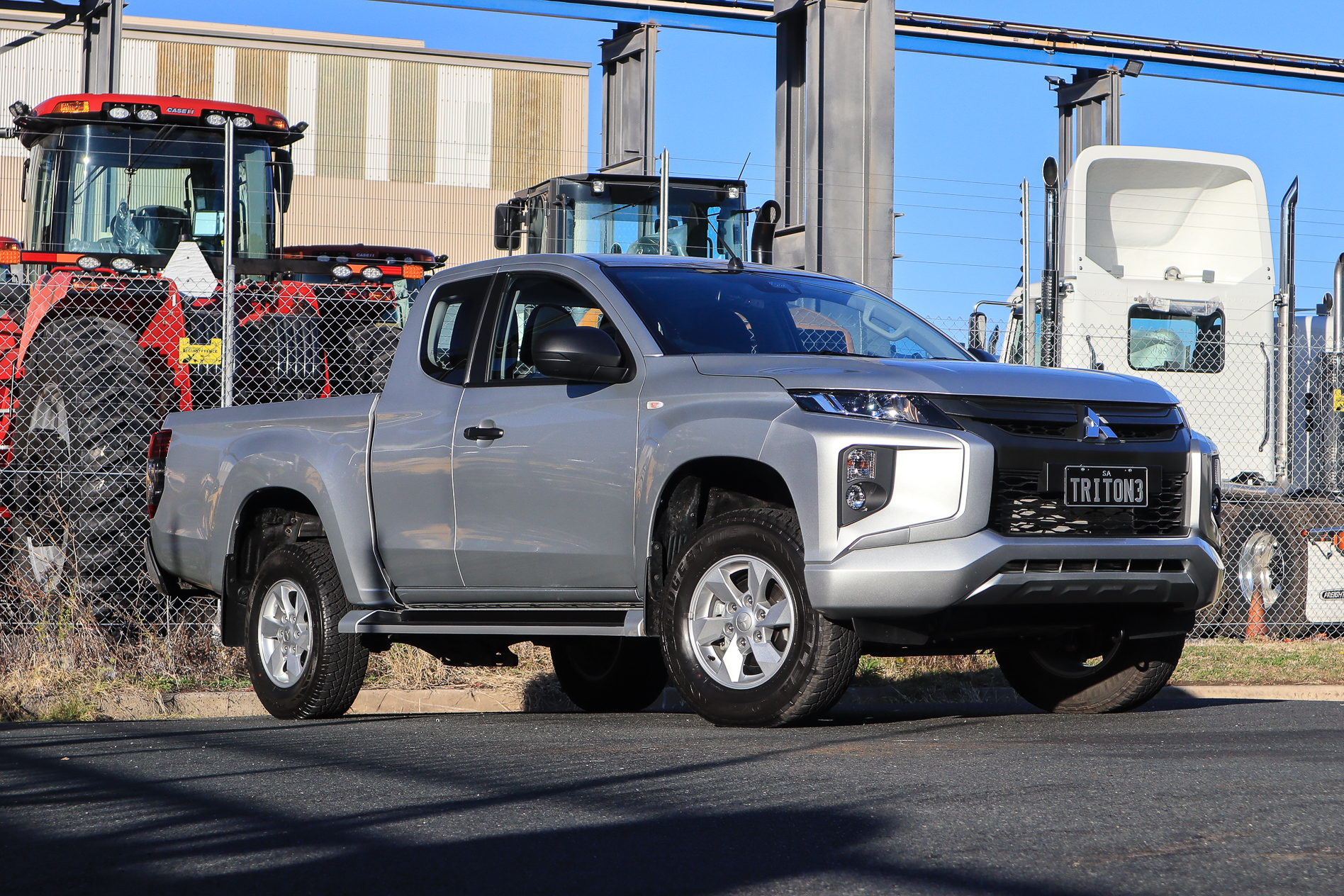
A consumer exodus to SUVs has done the most damage to passenger-car sales, though utes – particularly dual-cab variants – have significantly increased in popularity with Australian families owing to their versatility.
Businesses have also been able to take advantage of the government’s generous instant-asset write-off incentives introduced in recent years.
Light-commercial vehicle sales surpassed 200,000 for the first time in 2016, coinciding with the Australian government’s first, $20,000 instant-asset policy. The asset(s) amount has since increased, up to as much as $150,000 for vehicles that have a payload capacity exceeding one tonne.
The gap between annual passenger car and LCV sales has plummeted from 316,613 sales in 2015 to just 16,506 in 2020.
Toyota’s HiLux has been Australia’s most popular vehicle for the past five years and is a clear favourite to make it six on the trot in 2021.
The Ford Ranger has installed itself as the country’s second best-selling vehicle, while the Mitsubishi Triton and Isuzu D-Max are regulars in the monthly Top 10 charts.
The lifestyle-focused 4×4 utes continue to work hardest for the Light Commercial segment and are up 23 per cent year on year to 45,036. Yet workhorse-focused 4×2 ute sales have also increased markedly – by 17 per cent to 7261 units so far in 2021.
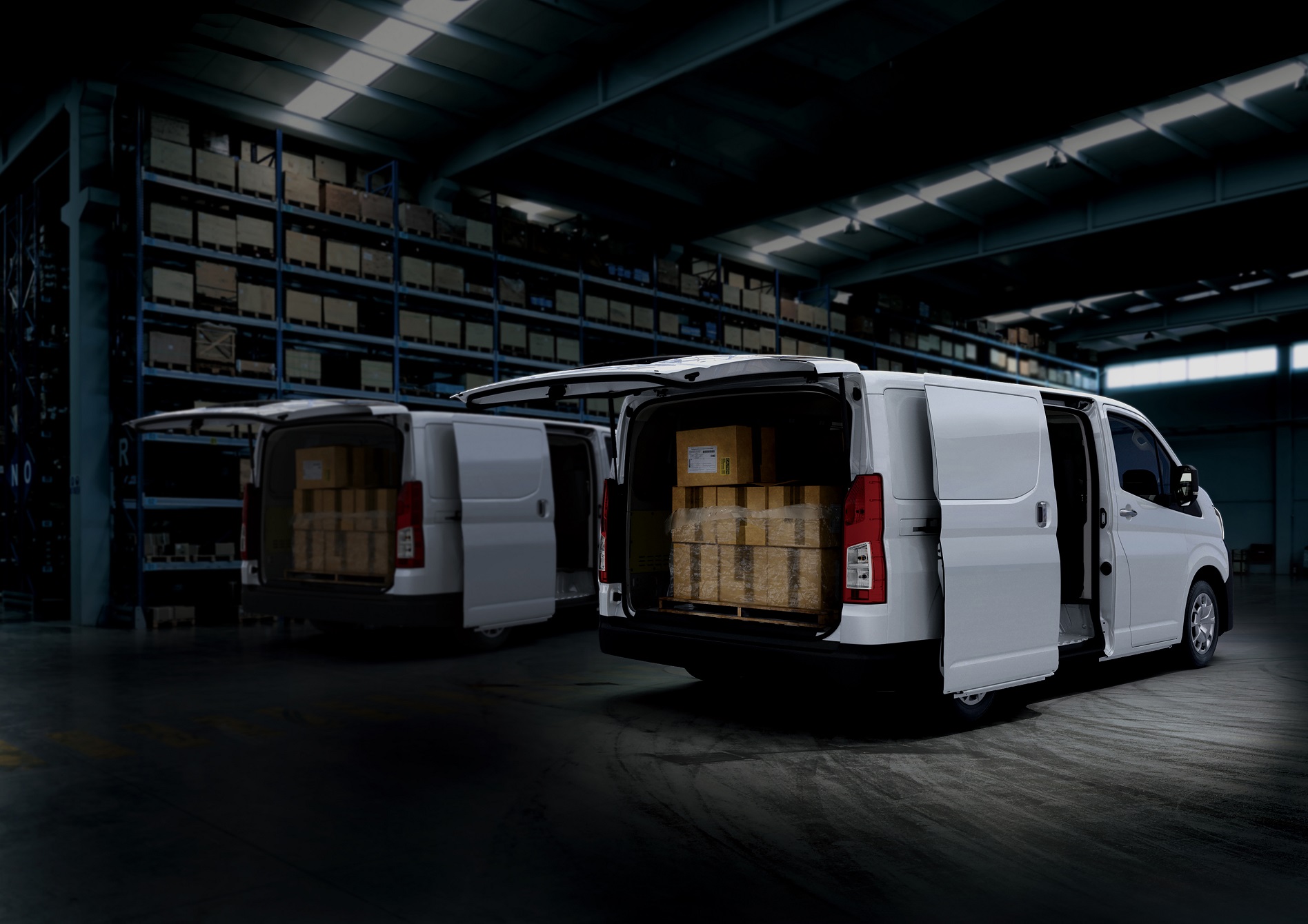
And big vans (2.5-3.5 tonnes) are also shifting out of showrooms in bigger numbers – up 75 per cent (or 2823 vehicles) to 6598 units compared with the first quarter of 2020.
Light buses with up to 20 seats are also up by 10 per cent (692 vehicles), though 20-plus-seater versions are down 50 per cent and vans under 2.5 tonnes are down eight per cent.
Almost every 4×4 ute is registering growth of varying strength so far this year. The HiLux’s 40 per cent growth (and 46 per cent for its 4x2s) is remarkable for what is already the nation’s biggest seller, yet there many other stand-out figures.
They include the SsangYong Musso (up 184 per cent), LDV T60 (up 113 per cent), Mazda BT-50 (up 103 per cent), Isuzu D-Max (up 81 per cent) and Toyota LandCruiser 70-series (up 63 per cent).
Ford Australia will almost feel the Ranger is missing out with its nine per cent increase, though it has the biggest growth (65 per cent) in the 4×2 segment and overall remains the No.2 ute in sales by a considerable margin.
In the 2.5-3.5T Vans segment, the new-generation Toyota HiAce leads the way – up 80 per cent year to date to 2384 vehicles and 36 per cent market share.
Hyundai’s iLoad is next with 1159 sales, up 58 per cent, with the Ford Transit Custom third (884 sales, up 75 per cent).
Peugeot’s Partner is up 96 per cent, while fellow French van the Renault Trafic is up 79 per cent to be fourth most popular big van.
Chinese brand LDV continues to shine, with notable increases for both its G10 and V80 vans – up 109 and 45 per cent, respectively.
Vehicle segments: First quarter 2021
- SUVs – 135,900 (+19%)
- Light Commercial – 60,066 (+26%)
- Passenger Cars – 59,144 (-9%)
- Total Market – 263,648 (+13%)
Passenger Cars v LCVs since 2015: The ever-shrinking gap
| Year | Passenger cars | LCVs | gap |
| 2020 | 222,103 | 205,597 | 16,506 |
| 2019 | 315,875 | 225,635 | 90,240 |
| 2018 | 378,413 | 237,972 | 140,441 |
| 2017 | 450,012 | 236,609 | 213,403 |
| 2016 | 486,257 | 217,890 | 268,367 |
| 2015 | 515,683 | 199,070 | 316,613 |
The 2021 Polestar 2 has been updated with new, cheaper single-motor variants that aim to make the Swedish EV manufacturer more competitive in key markets across the globe.
The cheapest five-door fastback – called the standard-range single-motor – will come equipped with a 64kWh battery pack, sending power to the front wheels through a front-mounted electric motor and one-speed transmission.
Power is rated at 165kW and 330Nm, and driving range is said to be between 420 and 440 kilometres, depending on conditions.
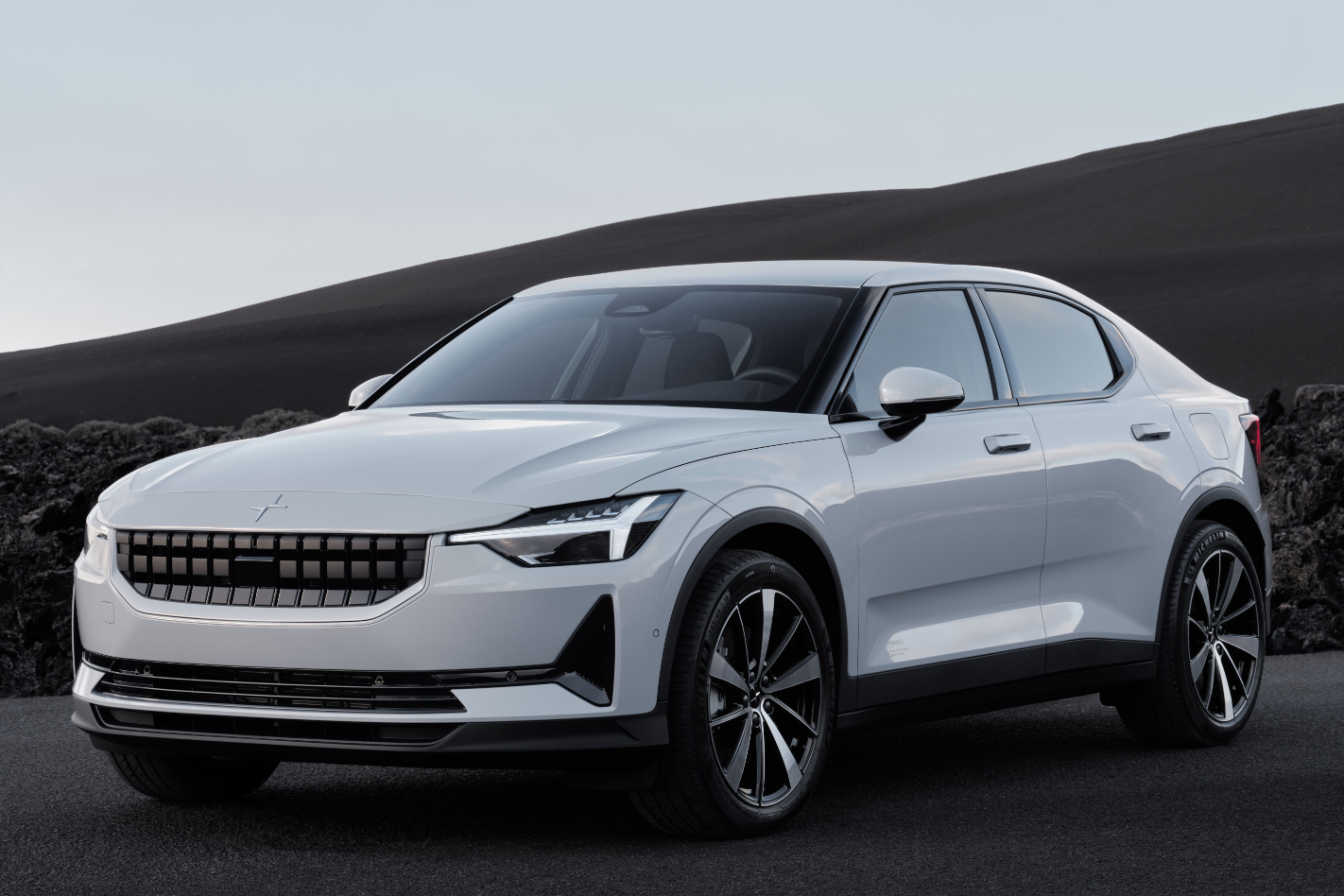
Accompanying the entry-level model is another front-wheel drive variant, the long-range single-motor.
This iteration comes equipped with the same 78kWh battery pack found in its range-topping, dual-motor sibling.
The bigger battery pack helps to produce 170kW and 330Nm, and driving range is boosted to a claimed 515-535 kilometres.
Two new option packages have also been introduced for the cheaper, front-drive fastbacks – the Plus Pack and the Pilot Pack.
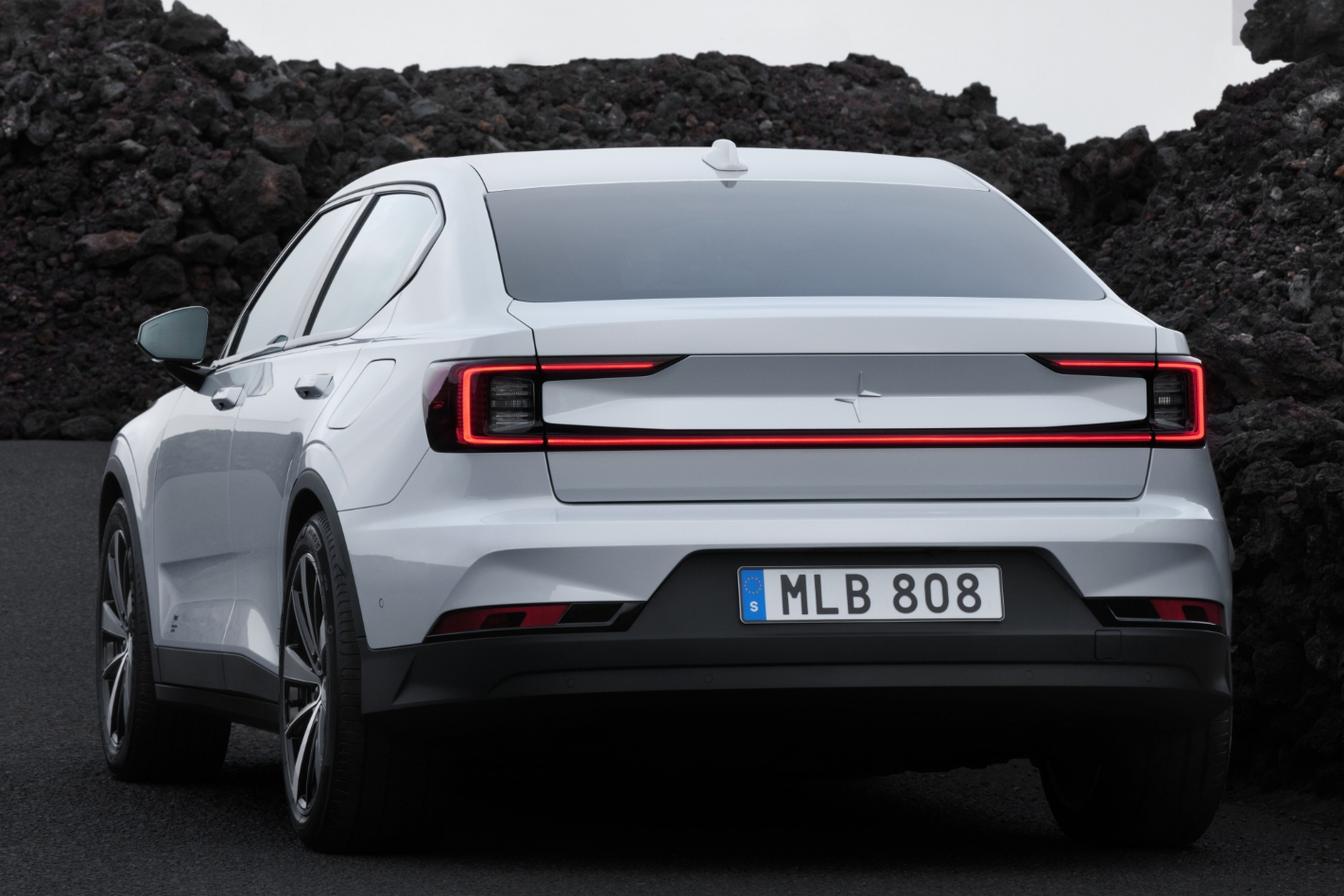
Tick the option box for the Plus Back, and the Polestar 2 will come equipped with a 13-speaker Harman Kardon audio system, electric heated front seats with memory, heated rear seats, heated steering wheel, heated wipers, WeaveTech upholstery, and Black Ash deco panels.
The Plus Pack also scores a newly designed heat pump that mitigates the need for the car’s batteries to be used to maintain the cabin’s climate control.
The Pilot Pack option bequeaths the all-electric fastback with driver assistance with adaptive cruise control and pilot assist, 360-degree camera, blind-spot monitoring with steering assist, cross-traffic support with braking assist, rear-collision warning and pixel LED headlights with LED front fog lights.
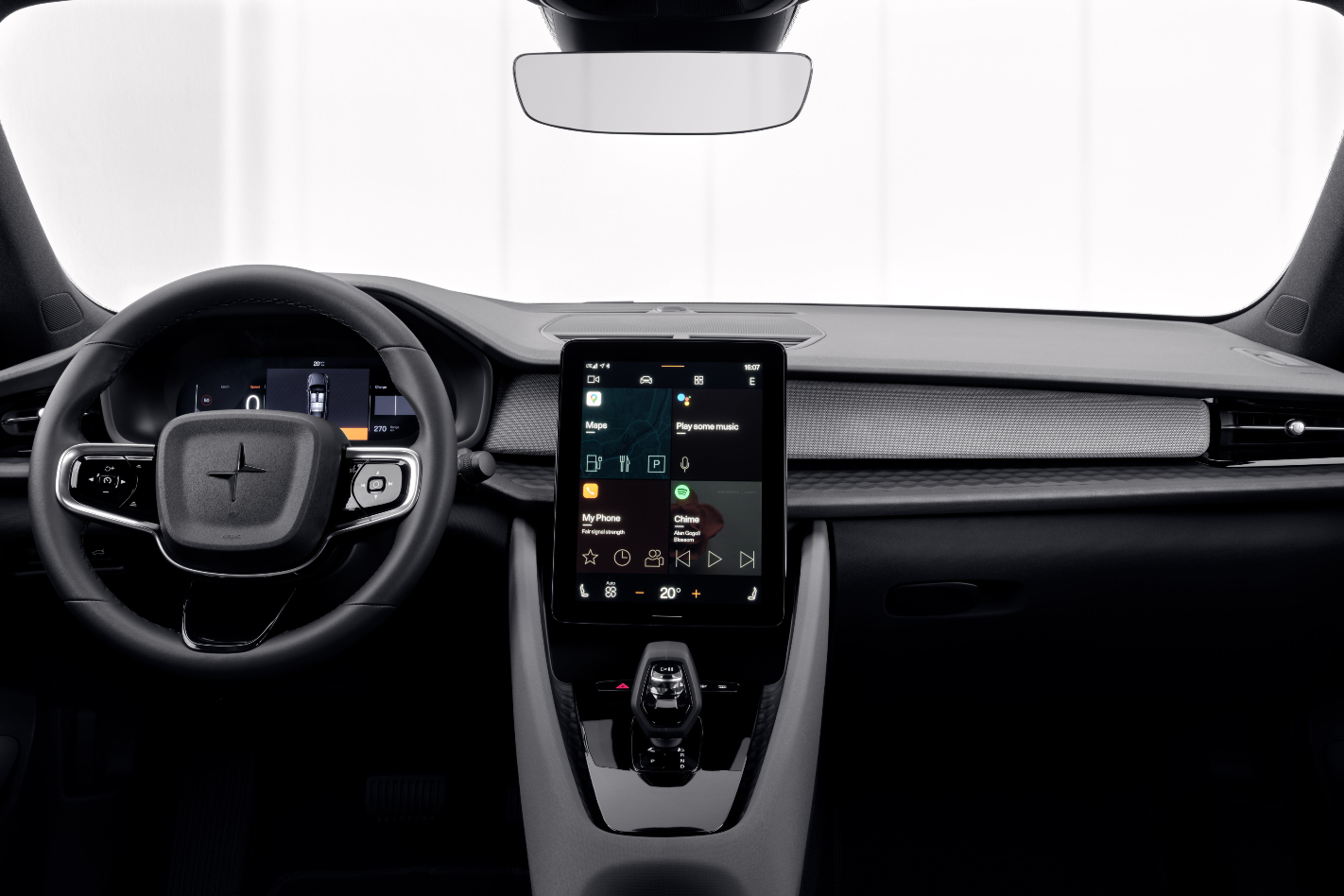
The new single-motor models have been priced, in the UK, from £39,900 (A$72,000) for the smaller 64kWh battery pack, and £42,900 (A$78,000) for the larger 78kWh version.
As previously covered by WhichCar, Polestar will be launching in Australia later this year, operating separately from its sister brand, Volvo.
Aussies will be able to order the new Polestar 2 from Q4 of 2021, with deliveries beginning in early 2022.
It is presumed that the two new single-motor variants will be available for local customers, however, pricing and further details are yet to be confirmed.
Watch this space as Wheels brings you all the latest updates on Polestar.
MORE: All Polestar stories
The 2021 Lexus ES luxury sedan has been teased ahead of its official unveiling on April 19.
The mid-sized ES, now in its seventh generation, has been around in its current guise since 2018 and is well overdue for an update to bring it into line with new models such as the IS sedan.
Just how much will be changed in the refreshed ES is unknown though, with some speculating it will just be a minor model year update, while others are guessing that Lexus may have given the sedan a mid-life facelift.
What we can see from the teaser image and video is that the new ES will have a redesigned headlight configuration, which now shows off a sleeker, sharper daytime running light visage and a new main beam arrangement.
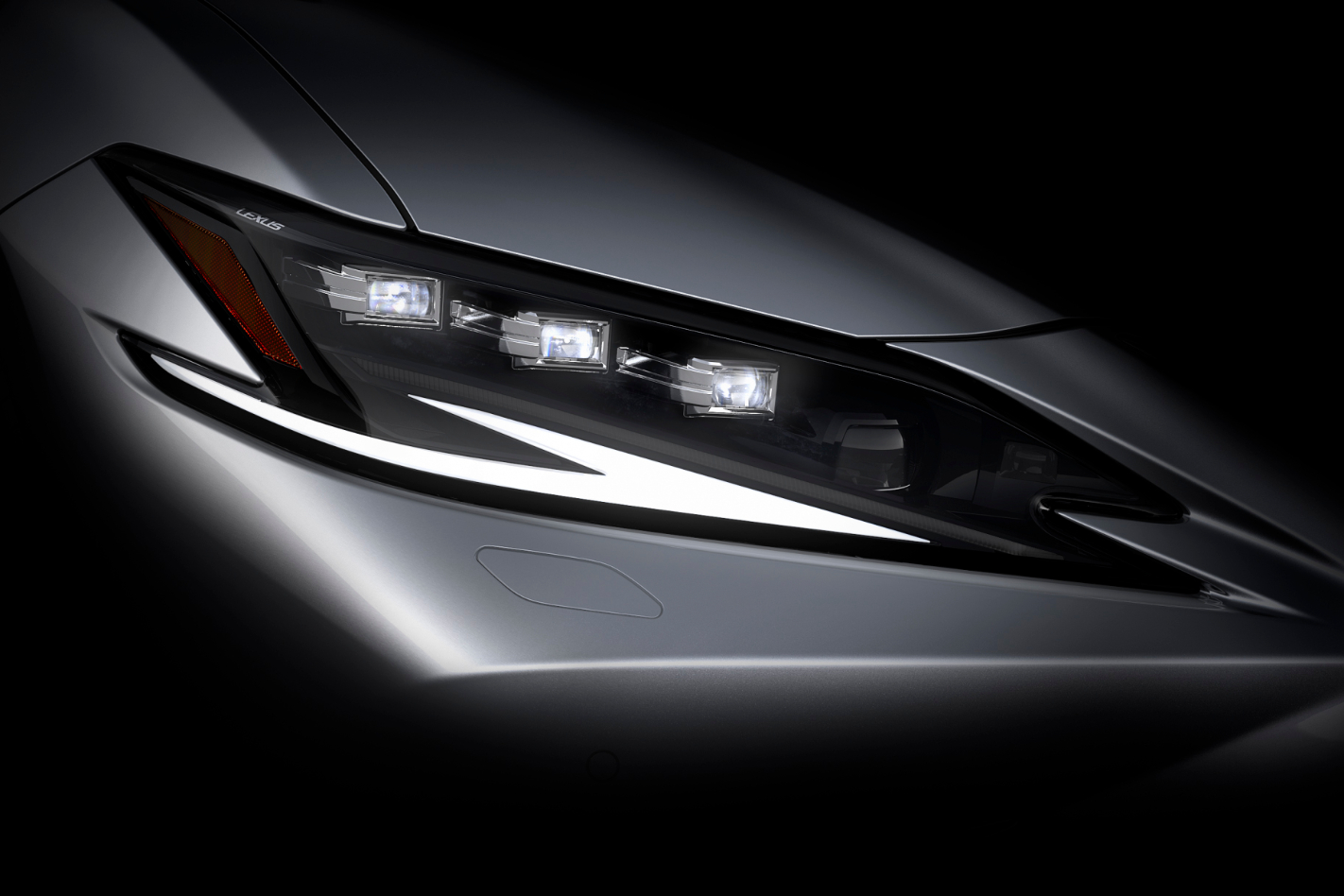
At the back of the car, we can also see the Japanese automaker has rejigged the taillight design and ditched the ‘Lexus’ lettering normally found on the lower left-hand side of the boot lid.
Unfortunately, there’s no sneak peek of the interior in either the video or image, but we suspect the 2021 ES will come equipped with an upgraded cabin with new tech and features.
Drivetrains are expected to remain unchanged, which means Australian buyers can expect a 160kW 2.5-litre four-cylinder petrol/electric hybrid.
The 2021 Lexus ES is set for an official unveiling at next week’s Shanghai Auto Show on Monday, April 19.
Be sure to watch this space as WhichCar brings you all the latest updates.
MORE: ES stories MORE: All Lexus stories
Yamaha has unveiled its first commercial 350kW electric motor, and it could be a game-changer in the electric vehicle industry.
Designed for applications in the ‘hyper-EV’ and ‘high-output mobility sector’, the innovative motor has several features that propel it to the pointy end of the current crop of electric motors.
Operating voltage is rated at a benchmark-equalling 800V, which is the same output you’ll find on the electric motors fitted to Porsche’s Taycan and the Audi E-Tron GT.
Another big talking point is the lightweight, compact construction of the motor, which integrates mechanical and electrical componentry into one unit, such as merging the gear and inverter into a single device.
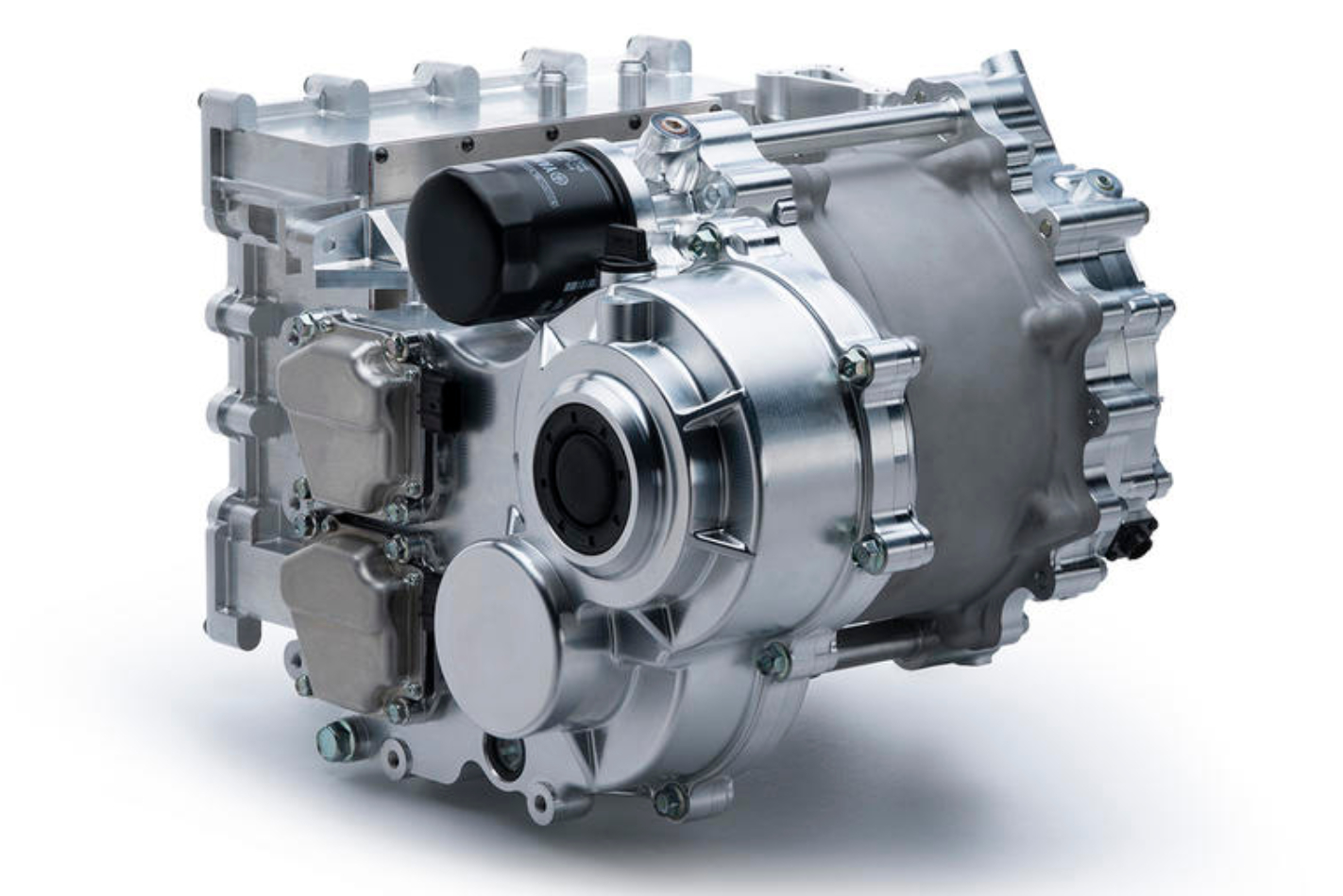
Yamaha says it has also worked on developing the electric motor’s software so that more than one can be used on a single vehicle.
While this is the Japanese firm’s first soiree into the industry’s highest class of output density for an electric motor, it is by no means the first EV motor it has made for the automotive sector.
Yamaha has been commissioned by many third parties since 2020 to develop a range of electric motors rated from 25kW through to 200kW.
The manufacturer says it will also use its expertise in casting, machining and assembly to tailor-make the electric motor for clients with specific requirements.
Toyota Australia has responded to claims that hybrid vehicles such as the popular electrified versions of its RAV4 SUV and Camry sedan are failing to reduce emissions in Australia.
Volkswagen Australia Managing Director Michael Bartsch (below) last week said Australia’s lack of firm emissions targets means that Australians are living in “an automotive third world” with the country “becoming a dumping ground for older and less efficient vehicles”.

In what was seen as a veiled swipe at Toyota, which sold 54,000 hybrid vehicles in Australia in 2020, about 85 per cent of all new hybrids sales, Bartsch said in a statement: “Even some of the popular hybrids on sale in this country utilise old tech engines that run on Australia’s standard 91RON petrol with 150 parts per million of sulphur – 15 times worse than global best practice.”
When asked about the comment, Toyota’s Vice President Sales and Marketing Sean Hanley bluntly responded: “54,000 people disagree.”
While Volkswagen currently has no electrified vehicles on sale in Australia, Bartsch said all its vehicles currently on sale here meet the Euro 6 standards that will not be mandated locally until 2027 – 13 years after Europe.
His concerns about hybrids weren’t so much about the technology, but the fact that in Australia they run on sub-standard fuel that is preventing the importation of the newest petrol engines and the widespread introduction of engines with petrol particulate filters.
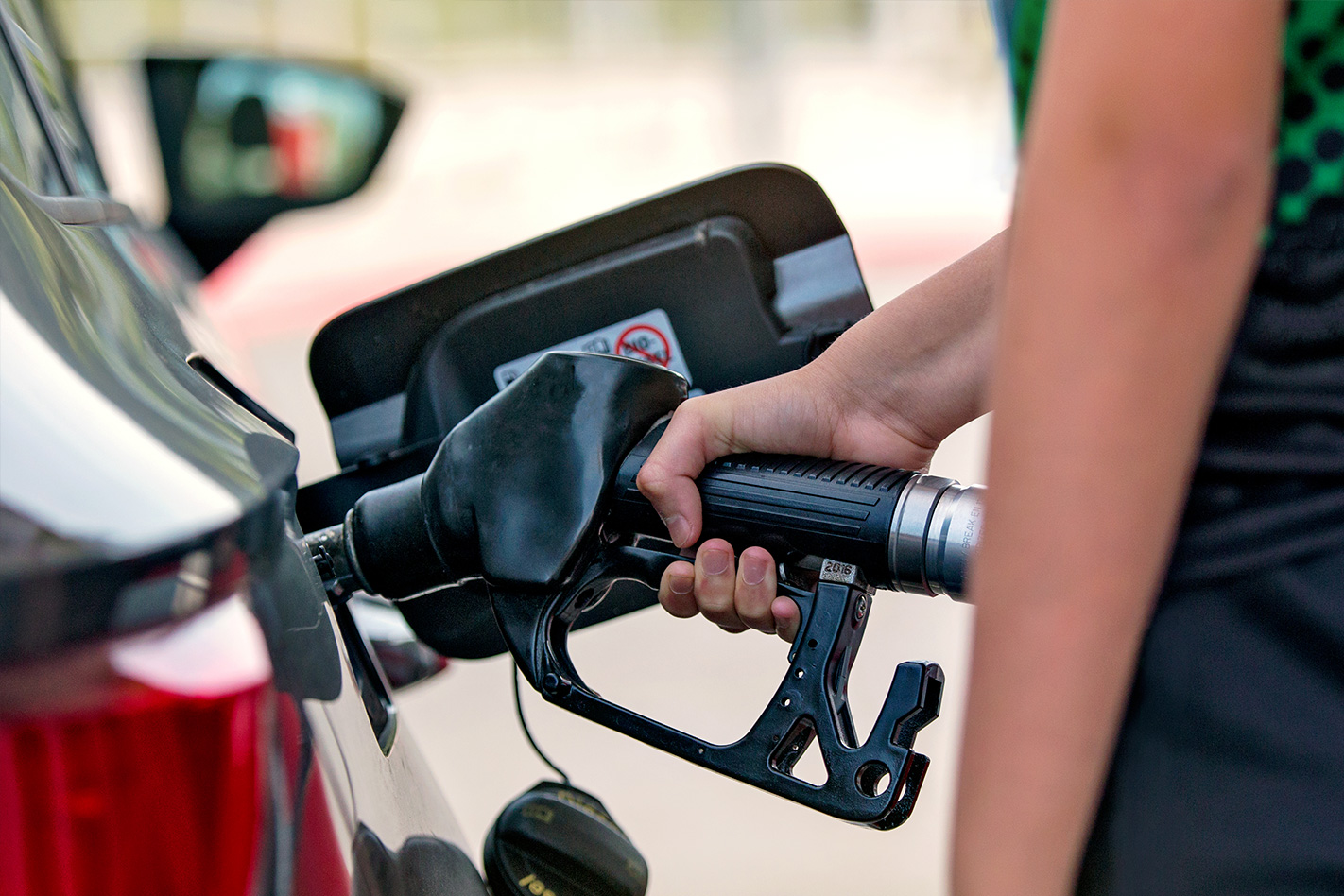
“Australia’s backwardness, in terms of both CO2 and sulphur standards, means our country is becoming a tip for technology that is no longer acceptable elsewhere,” he said.
“Unless a CO2 reduction target is set, manufacturers will continue to prioritise modern markets both for zero-emission vehicles and the most efficient conventional engines.”
“Markets where there are targets to meet, and punitive fines if they don’t, are naturally first in line for zero-emissions vehicles,” he said, just days after Australia’s Federal Court rejected his company’s appeal against a $125 million ‘Dieselgate’ fine.
Toyota Australia general manager for product planning and development, Rod Ferguson, agreed with Bartsch’s comments in relation to Australian fuel standards.
“If that’s the point that he was trying to make, that even hybrids could do better with cleaner fuel, we don’t disagree with that,” Ferguson said.
“The whole topic of fuel quality is one that’s out there. It’s very topical. Today we’re talking about emissions – there’s no doubt that if we’re moving towards a new environment … of cleaner fuel and lower sulphur, then it’s going to enhance the ability of not just hybrid engines but also mainstream engines and every other technology to run cleaner.”
Voluntary emissions targets
Bartsch, who is also deputy chair of the Federal Chamber of Automotive Industries (FCAI) said Volkswagen Australia has been among the importers that pushed for FCAI’s CO2 Voluntary Emissions Standard despite acknowledging that the first set of annual results would not show the brand to its best advantage.
“The results are essentially split into passenger cars and SUVs, with a separate category for commercial vehicles and larger SUVs,” Bartsch said.
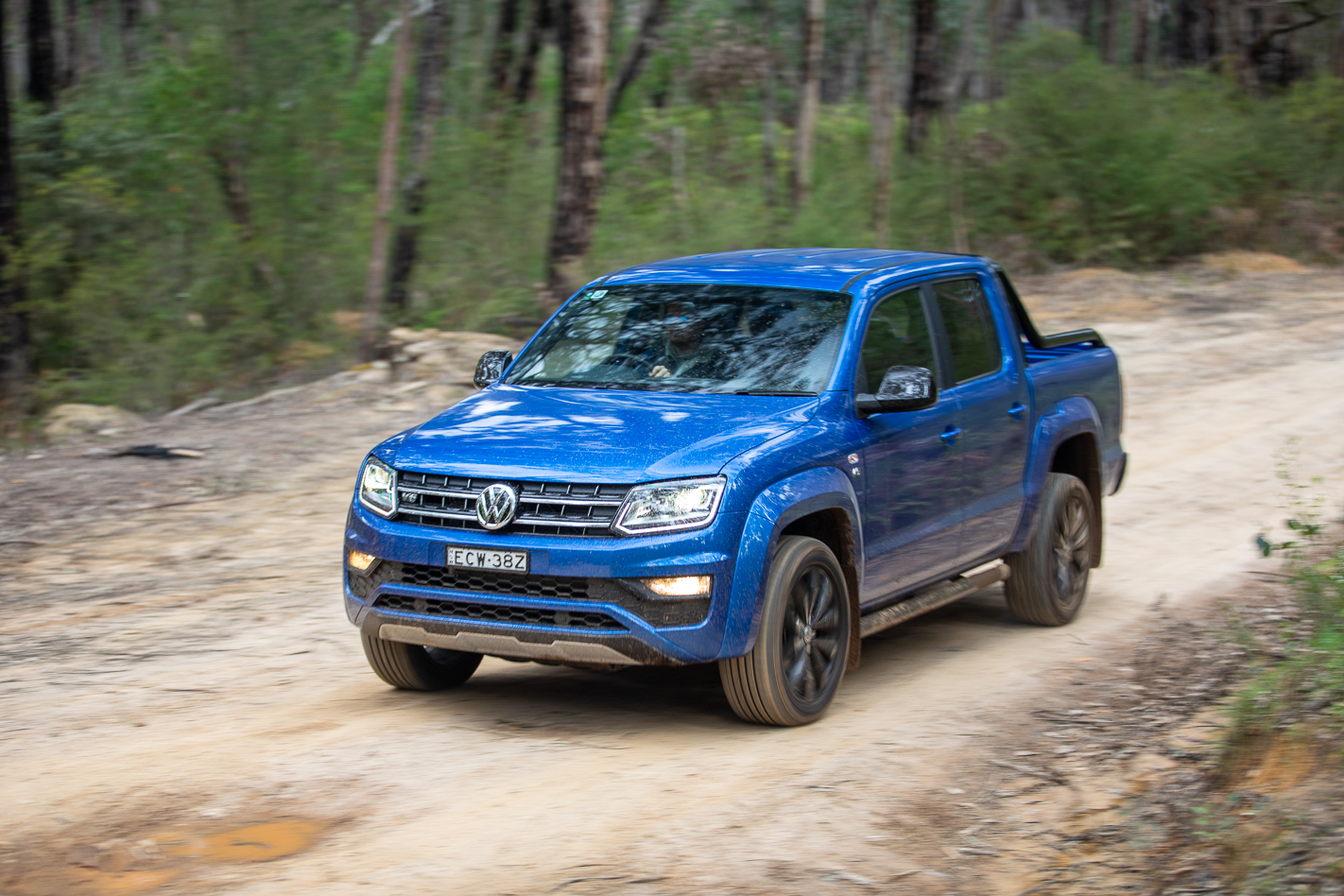
“Because of the increased difficulties Volkswagen faces in obtaining the latest engines, our Commercial Vehicles arm is only now able to introduce its new four-cylinder ranges.
“Just as Volkswagen’s passenger vehicles performed better than the designated target in the 2020 results, so too will its van and ute range from this year.”
Hanley expressed similar sentiments about Toyota’s goal to meet the FCAI’s voluntary 2030 emission-reduction target.
In the process, he responded to claims the parent company has been slow to embrace fully electrified vehicles, pointing out that Toyota never ruled out the expansion of low or zero-emissions technology across other powertrains.
“Clearly we have a big challenge in front of us in relation to the current 2030 FCAI self-regulated targets, and clearly as a result of our first year we did very well in the passenger [segment] and we expanded somewhat into SUVs,” Hanley said.
“We never said we’d achieve those targets in year one, and in fact, we always understood that light commercial vehicles will take a little while longer than passenger vehicles purely because of fit-for-purpose and the demands of the market, and diversity of the market and trade in Australia.
“[But] customers will not compromise on capability so it’s incumbent upon us as a car company to bring that capability to the products. We’re committed to doing that whilst reducing our CO2 footprint.”
MORE: Toyota stories
Australia’s new-car market has the potential to return to one-million-plus sales in 2021 after the Covid-19 pandemic made 2020 the first year to miss the magic mark since 2009 suffered from the aftermath of the global financial crisis.
Last month was the first March to pass 100,000 sales since 2018 – a monthly result that, historically, has always concluded with the market going on to reach the seven-figure milestone.Another good omen is is that in every year that the month of March has achieved 100,000 vehicle registrations, the market has gone on to reach the seven-figure milestone.
The second is that 2021’s first quarter total of 263,538 equates to a 13 per cent increase compared with the first three months of 2020. If that growth is maintained, the market will nudge over one-million units by about 8600 vehicles.
It’s also worth noting that 2021 has achieved this result despite the absence of Holden, which even this time last year had contributed 9000 sales.
However, there are also reasons to be cautious.
This year’s Q1 total is the lowest since 260,122 vehicles were registered in the first three months of 2012. And it’s nearly 30,000 vehicles short of the Q1 total in the record 2018.
Supply issues – notably the global computer chip shortage – prevented March 2021 from reaching its full potential and could take months or longer to be resolved. And, of course, future state lockdowns can’t ever be ruled out in the era of a pandemic.
The next few months will reveal more clues, but for now let’s take a look at the models and brands leading the way in the sales races.
TOP MODELS
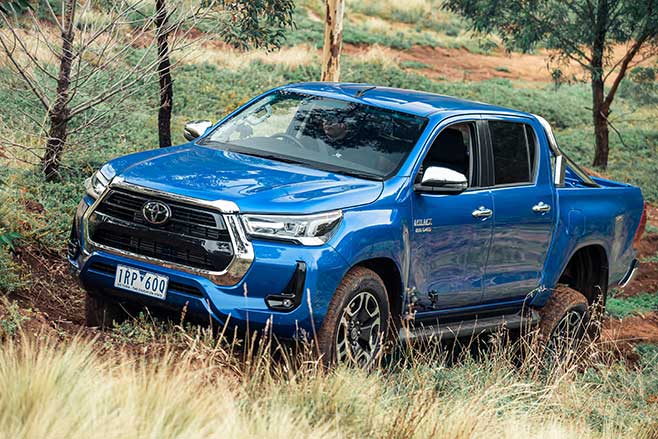
Toyota’s HiLux ute looks unstoppable again, heading inevitably for its sixth consecutive crowning as Australia’s most popular vehicle.
The HiLux is more than 4000 units ahead of the second-placed Ford Ranger ute, which has grown only 12 per cent in sales year on year compared with the Toyota’s 41 per cent increase.
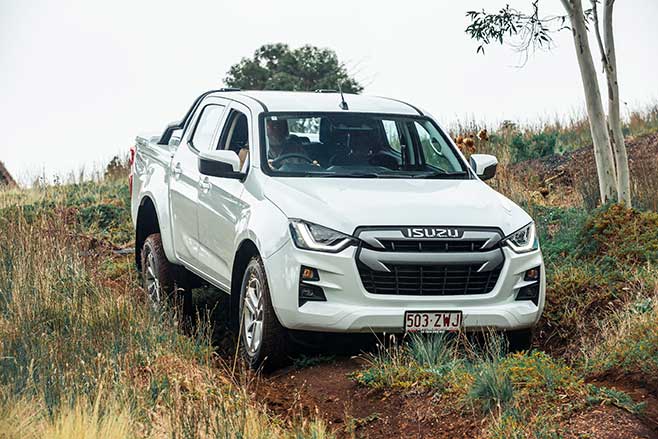
However, the biggest movers in the ute segment are the new-generation Isuzu D-Max and Mazda BT-50 twins. The ever-popular D-Max is up 75 per cent compared with Q1 2020, with 6161 sales so far putting it hot on the heels of the Mitsubishi Triton in seventh place and with 11 per cent growth for the same period.
The BT-50 is outside of the Top 10 Models list with 3607 units, though has been boosted by a 103 per cent jump in sales of its 4×4 variants.
All four models have contributed to an industry first: The Light Commercial segment now leads Passenger Cars in overall year-to-date sales – 60,066 to 59,144. Read our separate story.
SUVs only overtook passenger cars for the first time in 2017 yet are now miles ahead, with 135,900 sales across January, February and March.
The top performers this year are all familiar, led by the Toyota RAV4 (up eight per cent) that’s on the podium with the HiLux and Ranger.
Mazda’s mid-sized SUV rival, the perennially popular CX-5, has been in the Top 10 every month so far and a particularly stellar March has given 29 per cent growth year on year and fifth place.
Age is not wearing the company’s smallest SUV, either. The CX-3, released in 2015, is up 20 per cent and rounds out the top 10. It sits behind another golden-oldie, the Nissan X-Trail.
Passenger-car sales may be in freefall but the Toyota Corolla (fourth) and Hyundai i30 (sixth) small cars refuse to depart the Top 10 chart. Corolla sales are down four per cent though the i30, which now includes a sedan body style after the Elantra was renamed, is up 10 per cent.
The D-Max and BT-50 aren’t the only new-generation models to go well in early 2021.
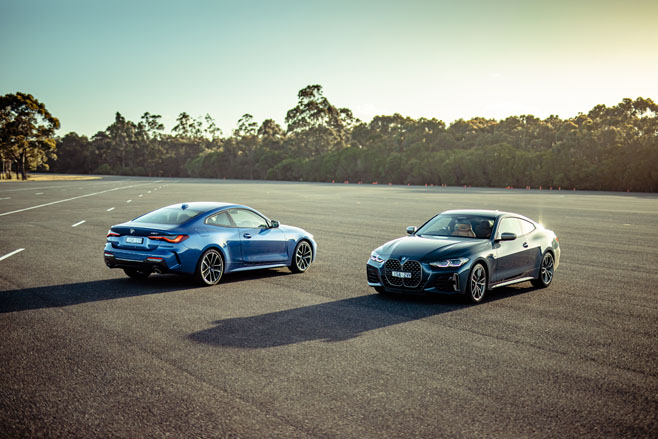
There are stand-out increases for the latest versions of the BMW 4 Series (up 206%), Kia Carnival people-mover (up 37 per cent for a vehicle that already dominates its segment), Kia Sorento large SUV (up 113%), Lexus IS luxury sedan (up 157 per cent), Mercedes-Benz S-Class (up 94 per cent), Nissan Juke (up a staggering 795 per cent), and Subaru Outback (up 120 per cent year on year after its eye-opening March introduction increased sales by 191 per cent over March 2020.
Other triple-digit-growth heroes include the BMW 2 Series Gran Coupe (up 155 per cent) and Suzuki Ignis (up 186 per cent).
BMW’s 1 Series is also up 24 per cent, giving it hopes of overtaking the usually dominant A-Class that is down 41 per cent.
Toyota’s hefty price increases for the Yaris are clearly hurting its city car, which is down 45 per cent year compared with the same period last year. Camry is also down 30 per cent though still commands more than two-thirds market share of the medium-car category.
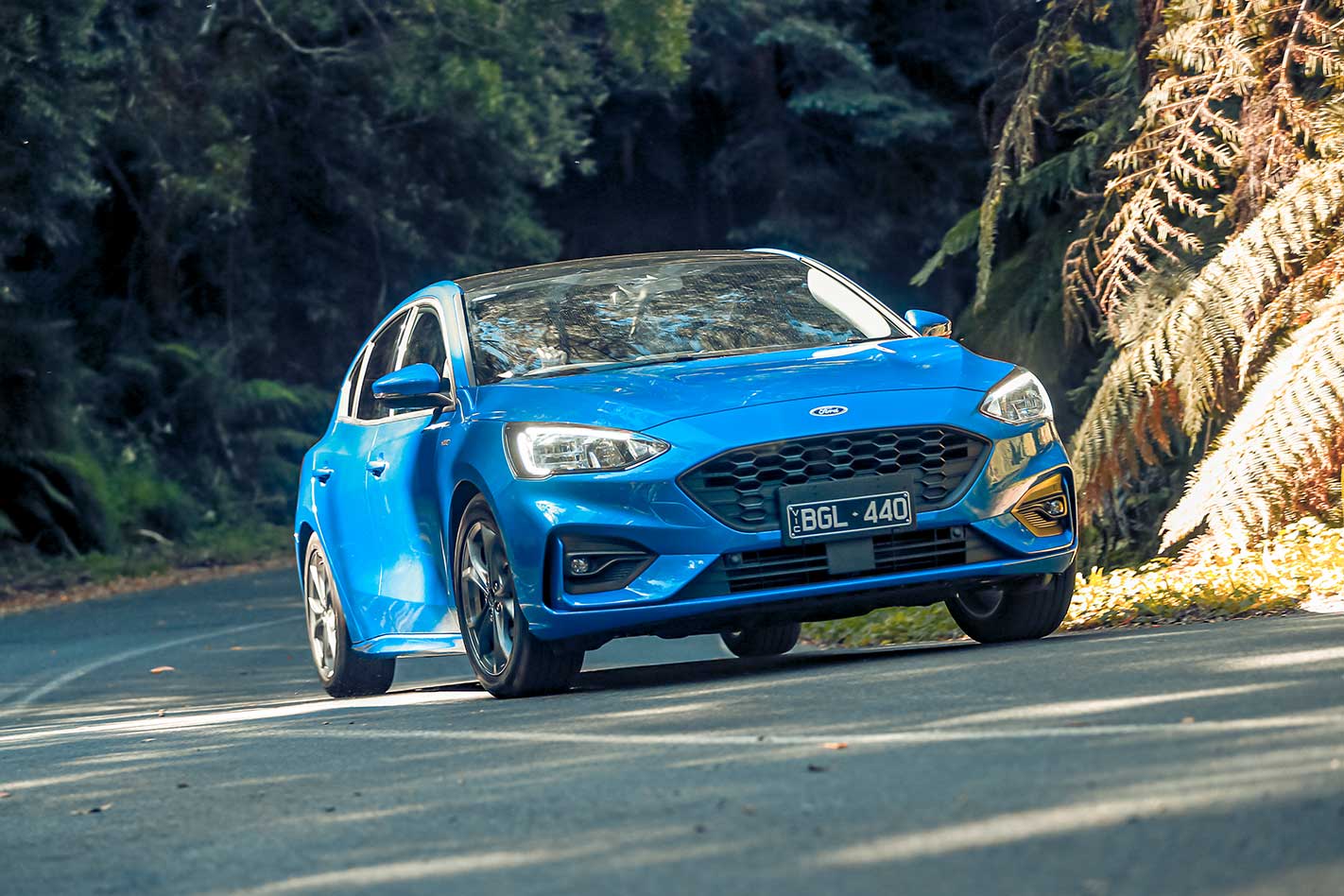
Well-known small cars, the Ford Focus and Honda Civic, are struggling with respective drops of 43 and 44 per cent.
And while hybrid sales have increased 25 per cent, it’s not all rosy for petrol-electric models. The Toyota Prius and Prius V continue to decline significantly (down 64 and 58 per cent), while sales of Hyundai’s Ioniq range – which also includes plug-in and fully electric variants – have almost halved compared with Q1 2020.
TOP 10 MODELS: Q1 2021
First-quarter sales and growth/decline
- TOYOTA HILUX – 14,040 (+41%)
- FORD RANGER – 10,003 (+12%
- TOYOTA RAV4 – 9338 (+8%)
- TOYOTA COROLLA – 7381 (-4%)
- MAZDA CX-5 – 7151 (+29%)
- HYUNDAI I30 – 6676 (+10%)
- MITSUBISHI TRITON – 6161 (+11%)
- ISUZU D-MAX – 5581 (+75%)
- NISSAN X-TRAIL – 4676 (+11%)
- MAZDA CX-3 – 4467 (+20%)
TOP BRANDS
The biggest change to the Top 10 between March 2021 and March 2020 is the absence of Holden, which had made it into last spot with 9000 sales.
That place is now occupied by Mercedes-Benz when including its utes and vans. (We combine the company’s passenger cars and light-commercial vehicles for a more accurate comparison, where VFACTS separates them.)
And Subaru (up 28 per cent) displaces Honda (down 34 per cent) in eighth.
Otherwise, the top seven positions are unchanged from the same quarter last year, with Mazda showing the biggest growth of the leading brands and increasing its market share from 8.9 to 10.5 per cent.
Volkswagen may be the odd brand out with its seven per cent decline, though the German car maker’s situation is distorted significantly by the Golf’s supply situation. It’s effectively in limbo as VW Australia awaits the eighth-generation Golf with stock of the outgoing 7.5 all but totally exhausted.
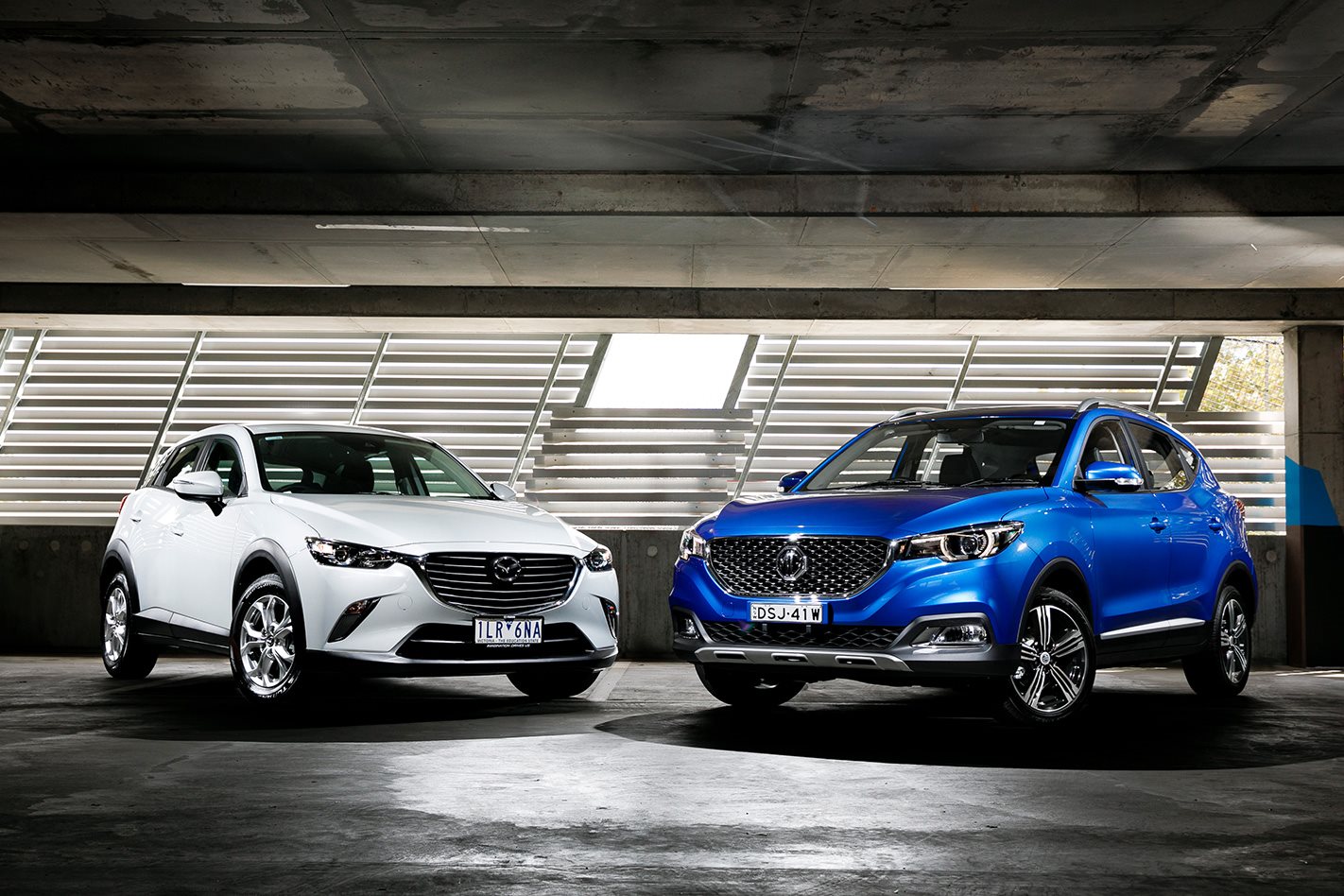
MG’s remarkable rise from obscurity to popularity continues, with 163 per cent year-on-year growth putting it on 8728 sales and the fringes of the top 10. This has been achieved with just three models.
MG isn’t the only Chinese success story. GWM/Haval and LDV are both up 118 per cent. Read our separate story.
Isuzu Ute is another brand that punches well above its weight in the models-to-sales ratio. New-generation versions of its only two vehicles – the D-Max ute and related MU-X SUV – have lifted sales to 8046 so far, up 68 per cent.
A very good year so far, too, for the likes of Aston Martin (up 59 per cent), Jeep (up 68 per cent), RAM trucks (up 30 per cent), Skoda (up 79 per cent), SsangYong (up 113 per cent) and Volvo (up 67 per cent; see separate story).
And although coming off low sales bases, there are positive moves for Genesis (up 223 per cent, or 67 cars) and Lotus (up 50 per cent, or five cars).
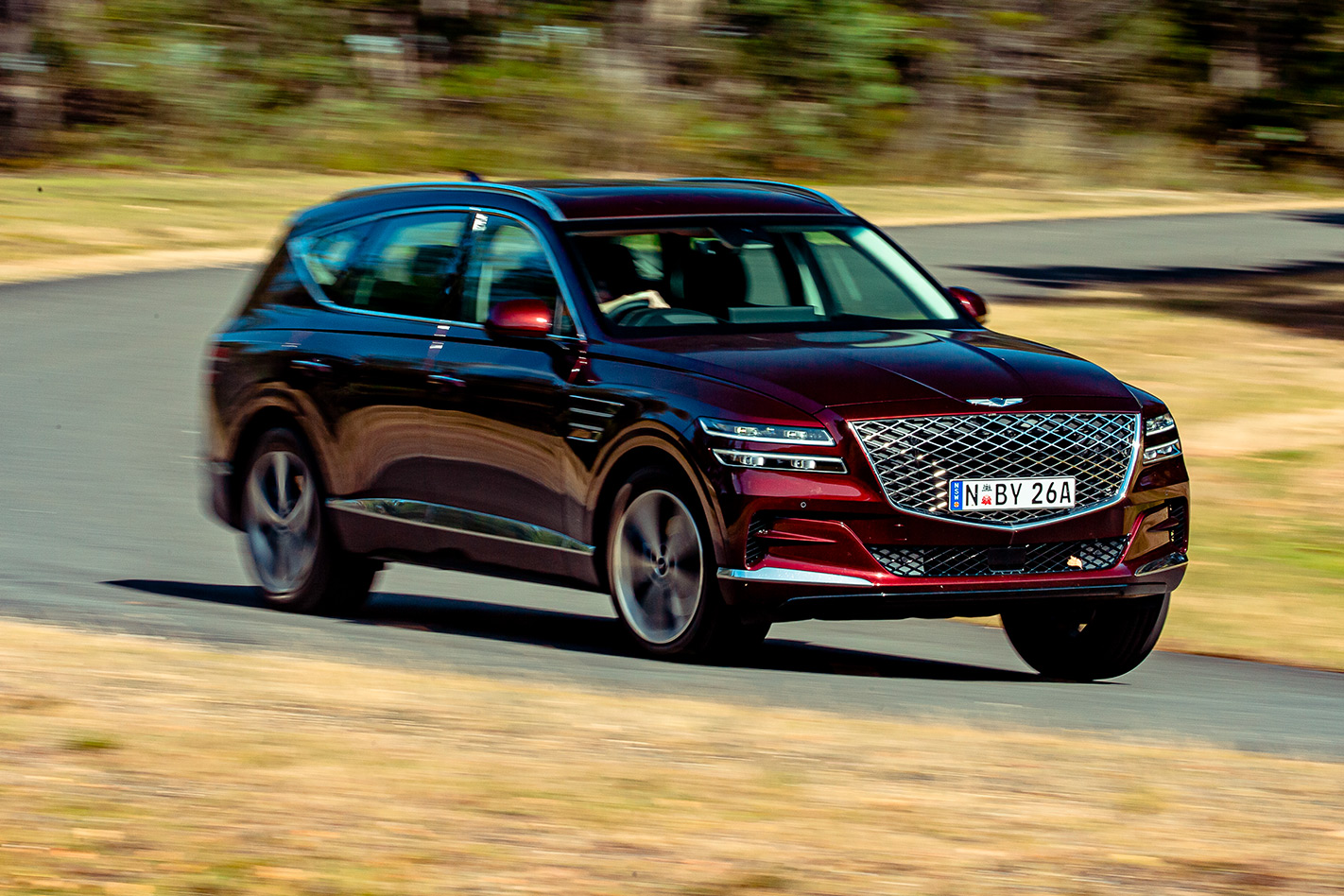
The majority of Australia’s automotive brands have registered sales increases as the market recovers, though several brands have failed to jump on the growth bandwagon so far.
Alfa Romeo is down 28 per cent, Citroen is down 43 per cent to continue the French brand’s struggles in this country, Ferrari is having a rare off-year with a 41 per cent decline, and Jaguar sales have halved compared with Q1 2020. Sister brand Land Rover will also be disappointed with its nine per cent drop.
MORE: Volvo news and reviews MORE: All new car sales stories
MARCH 2021: TOP 10 MODELS
- TOYOTA HILUX – 5319 – up 49.6% YTD
- FORD RANGER – 3983 – up 28.2% YTD
- TOYOTA RAV4 – 3522 – up 17.8% YTD
- MAZDA CX-5 – 3022 – up 74.3% YTD
- TOYOTA COROLLA – 2892 – up 2.8% YTD
- HYUNDAI I30 – 2514 – up 35.5% YTD
- MITSUBISHI TRITON – 2492 – up 37.5% YTD
- TOYOTA LANDCRUISER – 2244 – up 78.0% YTD
- ISUZU D-MAX – 1994 – up 35.9% YTD
- NISSAN X-TRAIL – 1932 – up 46.0% YTD
TOP 10 BRANDS
- TOYOTA – 21,319 – up 21.2% YTD
- MAZDA – 10,785 – up 58.2% YTD
- HYUNDAI – 6852 – up 29.1% YTD
- MITSUBISHI – 6430 – up 7.1% YTD
- FORD – 5977 – up 23.1% YTD
- KIA – 5802 – up 2.6% YTD
- NISSAN – 4559 – up 30.2% YTD
- SUBARU – 4212 – up 39.3% YTD
- VOLKSWAGEN – 3358 – up 17.0% YTD
- MG – 3303 – up 167.7% YTD
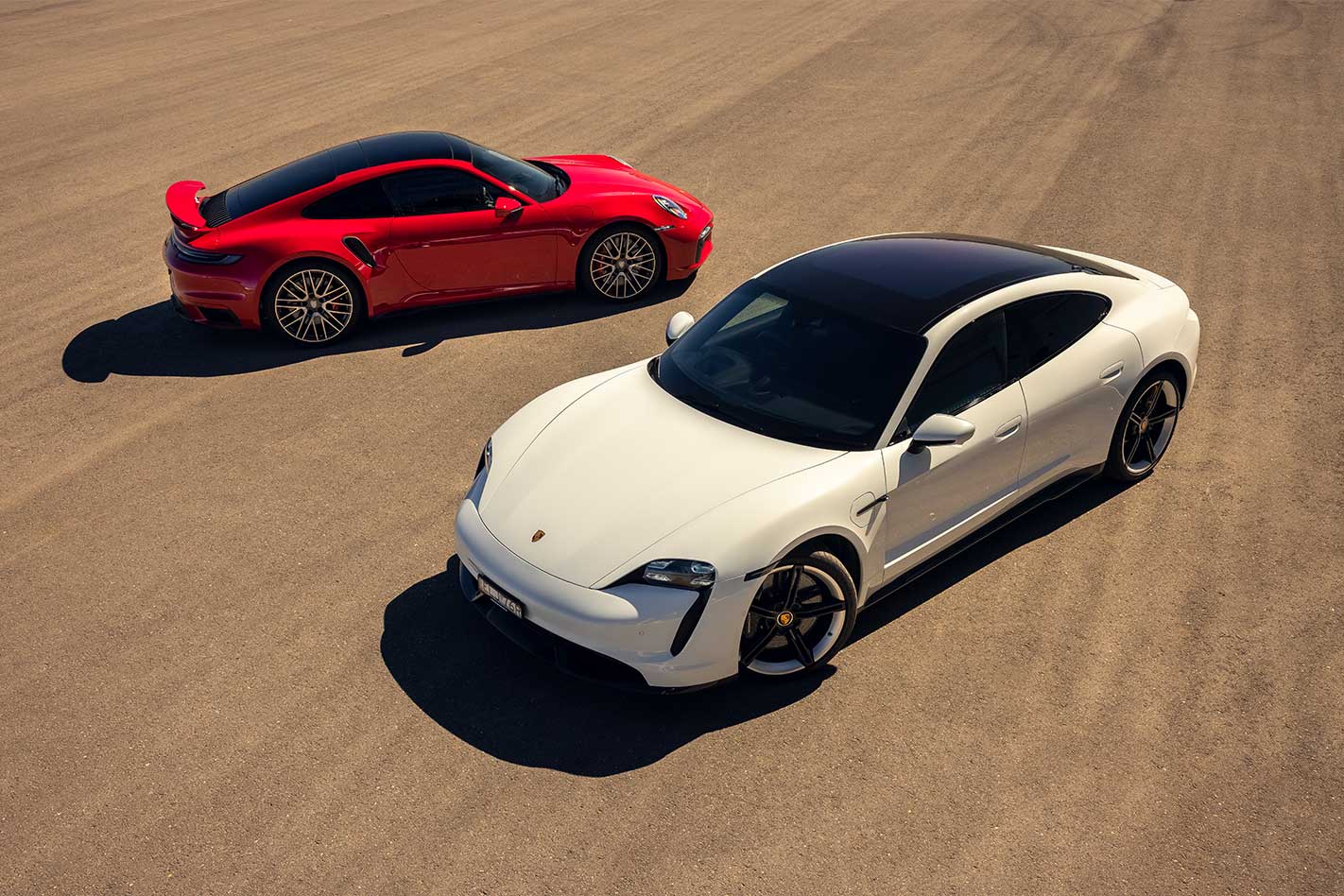
It’s easy to see how this could be confusing. Here we have two Porsche Turbos and while there are indeed two individual turbochargers present, they’re both installed in the one car, compressing the air before it is fed into the 911 Turbo’s 3.8-litre flat-six.
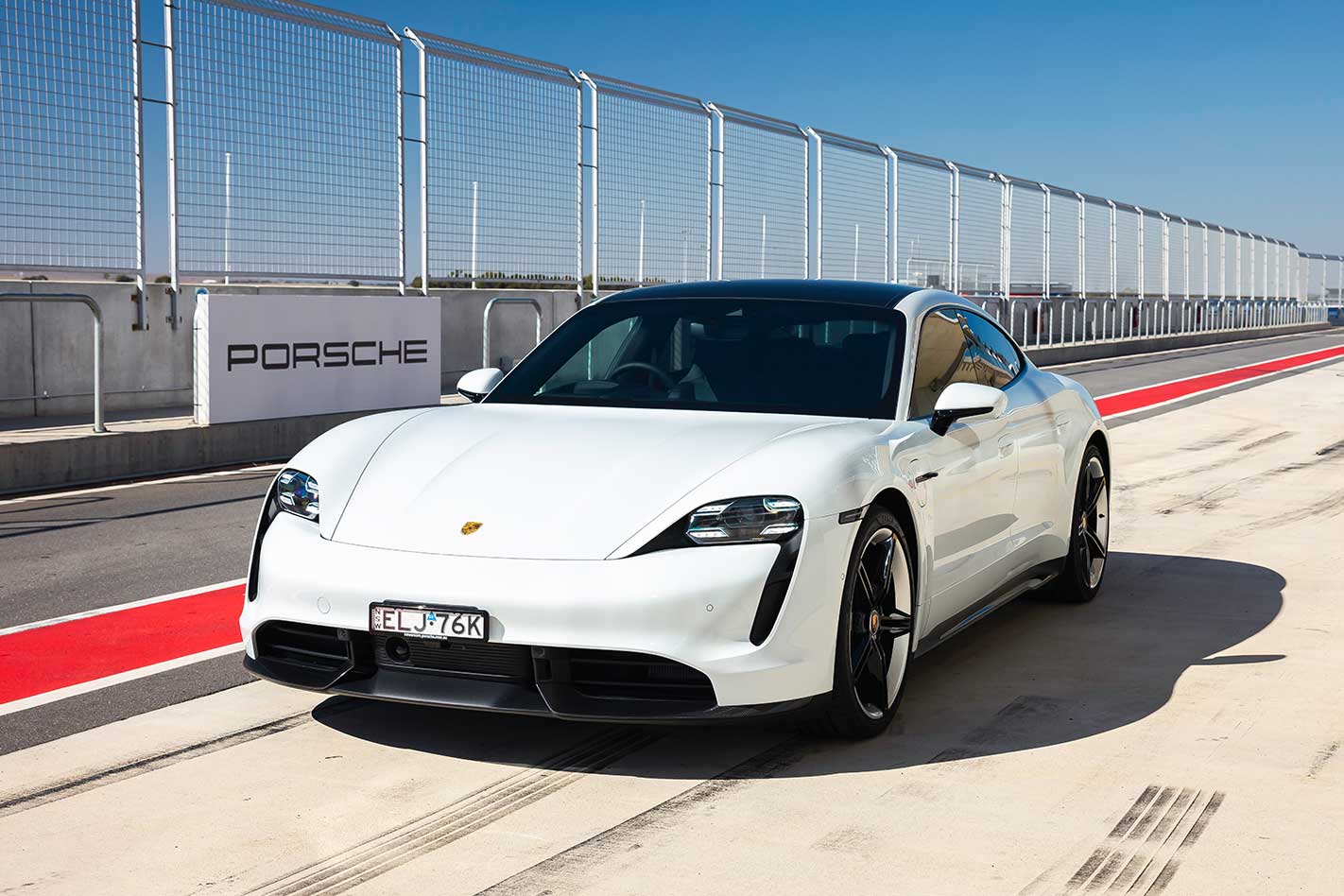
The Porsche Taycan Turbo S doesn’t have any turbos because it doesn’t have an engine. The only air it compresses is via the bellows in its adaptive air suspension.
Porsche’s decision to apply the naming convention of its internal combustion engine (ICE) models to its battery electric vehicles (BEV) led to plenty of gnashed teeth in certain sectors, but it is a very logical decision.
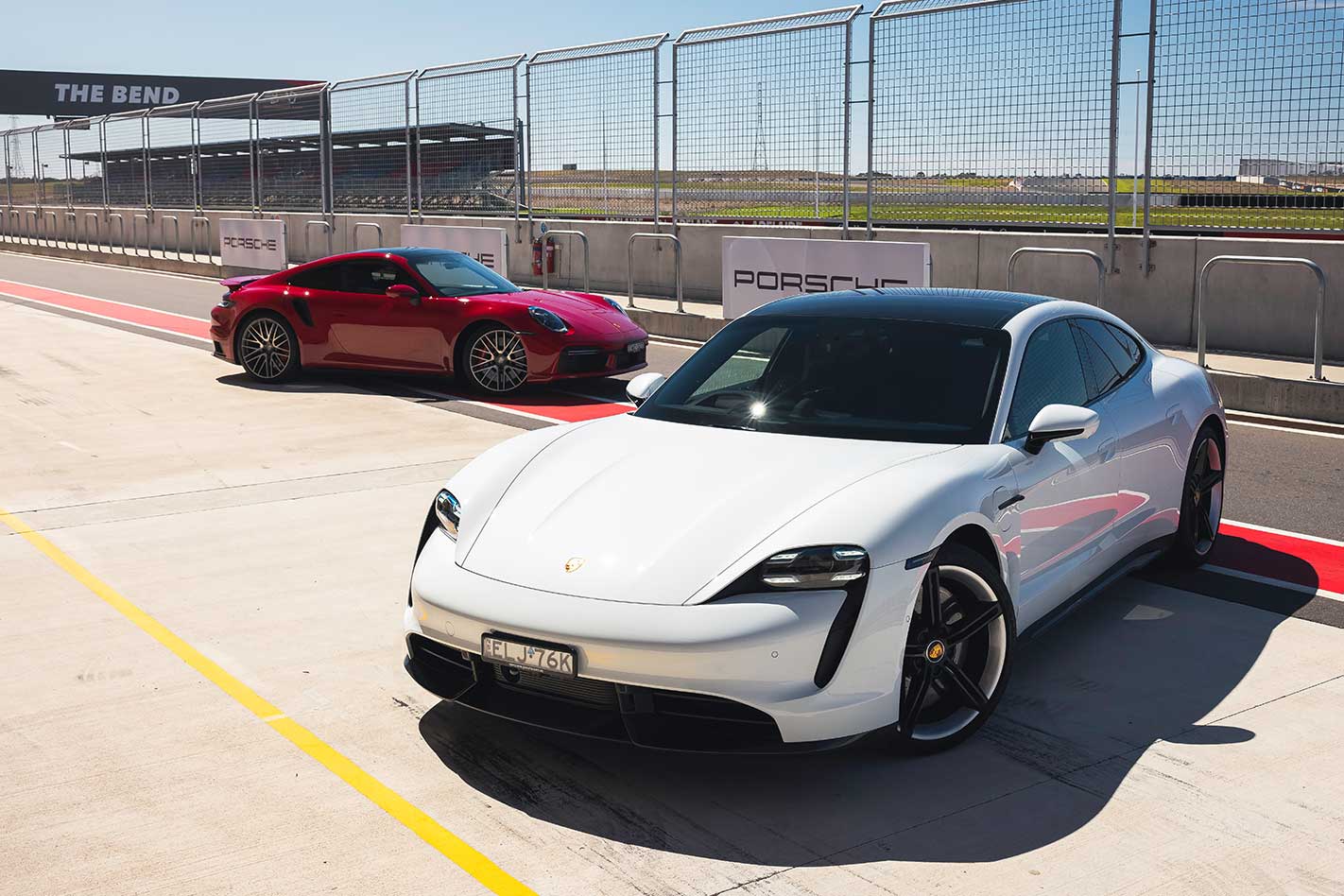
You might be curious as to why we have one Turbo (the 911) and one Turbo S (the Taycan). It’s simply a case of using the most closely aligned models in the respective ranges, separated by around $60,000 but, more importantly, just 16kW/tonne. This isn’t intended to be a straight comparison, though.
Comparing a 911 with a Taycan would be like comparing a Mercedes-AMG GT R with a GT63, but whereas the Mercs at least use the same engine, the Porsches could scarcely be more different in their propulsion systems.
Instead it’s an unique opportunity to take two very high performing cars, one the epitome of past/current technology and the other the benchmark in future performance, and drive them back-to-back to discover how each generates its performance and behaves at the limit. This seems an apposite moment to compare the specifications of the two vehicles.
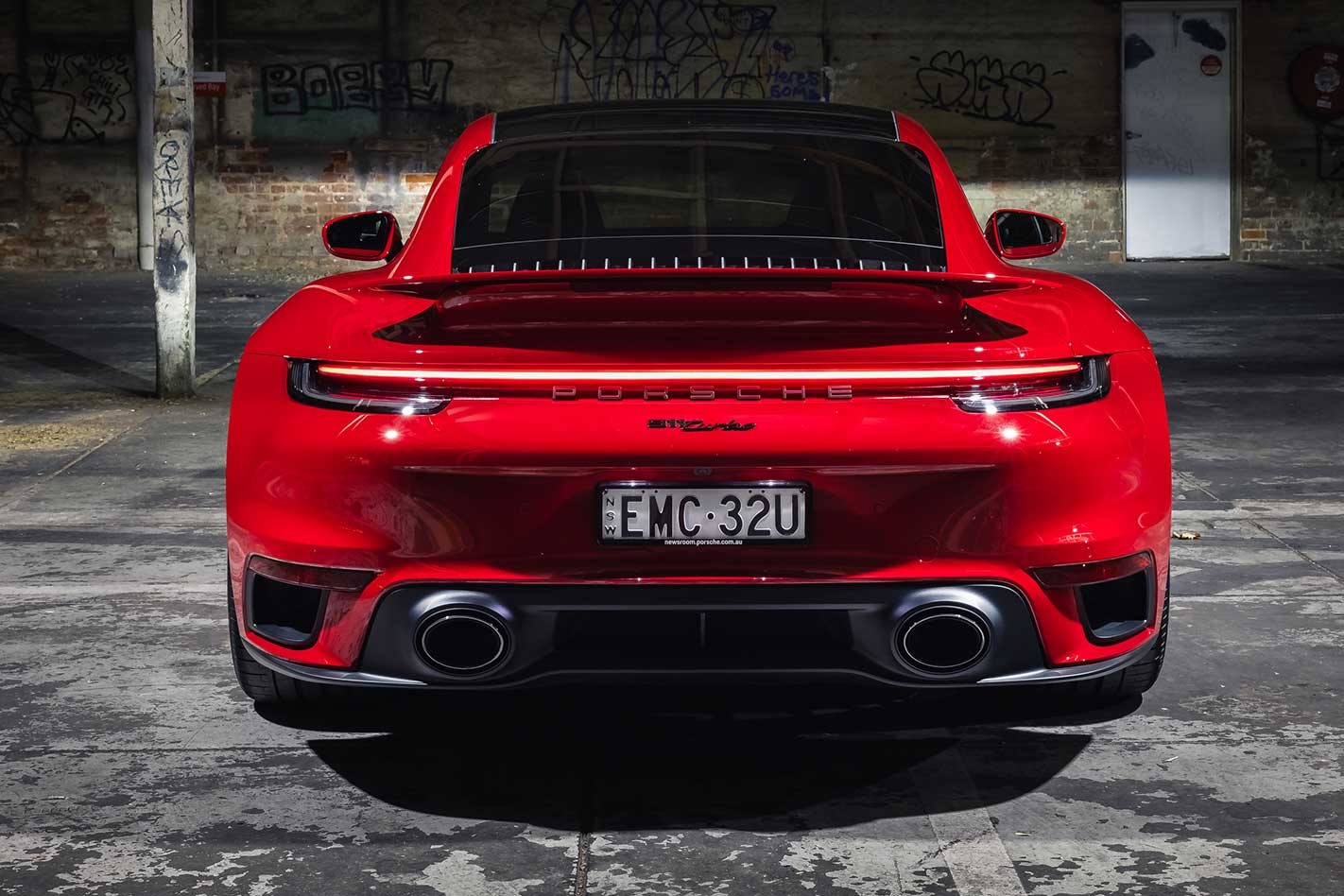
Its outputs of 427kW at 6500rpm and 750Nm from 2250-4500rpm match those of the previous generation (991.2) Turbo S, the extra grunt liberated by a new intake system and new turbochargers.
They are larger, the compressor wheels now 3mm bigger and the turbine wheels up 5mm, using variable turbo vanes and electrically controlled waste gates, and are now symmetrical – i.e they rotate in opposite rather than the same directions.
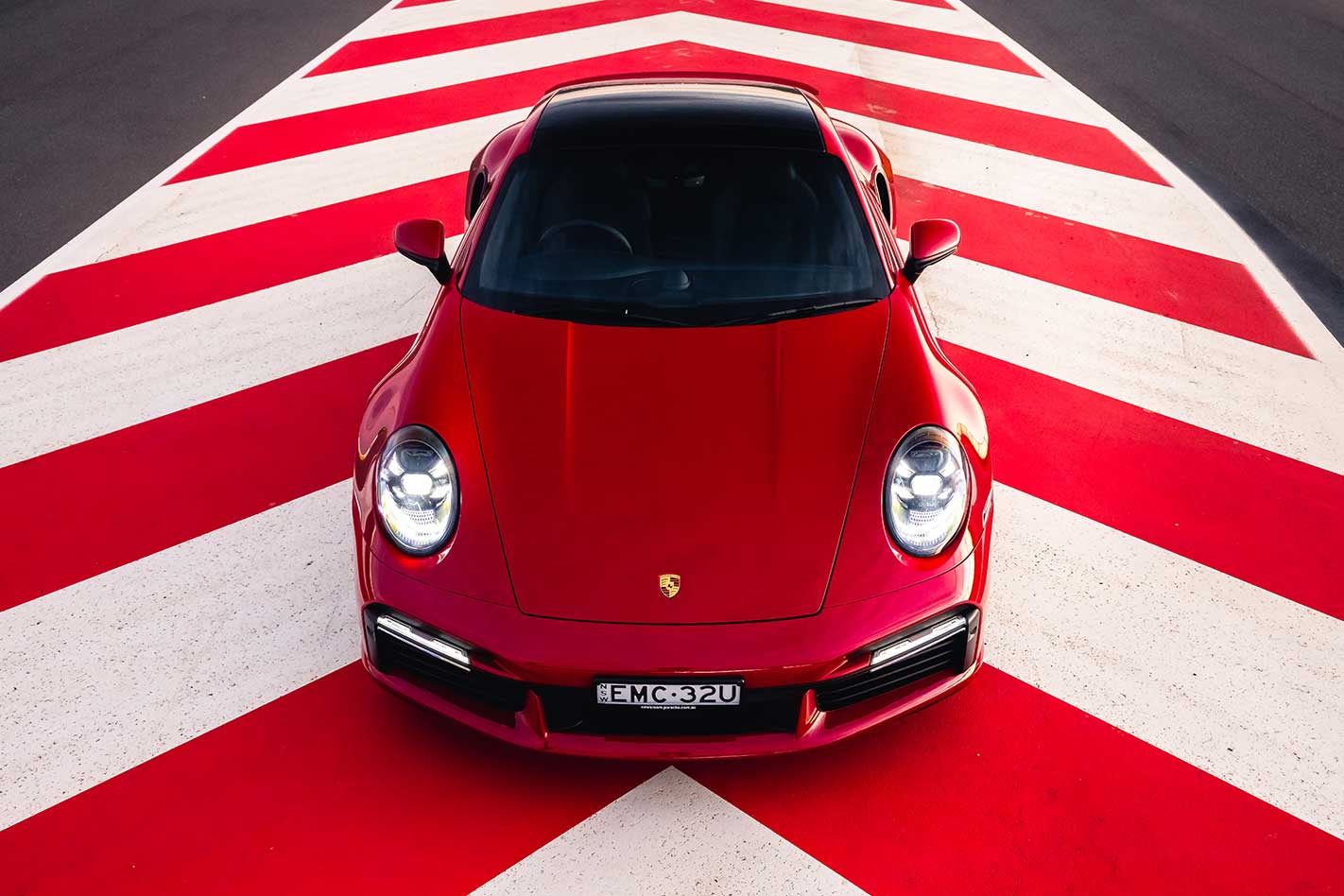
The Taycan counters with a whopping 560kW and 1050Nm from its 93.4kWh battery, though this is only available under launch control conditions. Thus primed, however, Porsche claims you’ll hit 100km/h in 2.8sec and 200km/h in 9.6sec, so this should be quite close.
Under normal circumstances you’re limited to ‘only’ 460kW; the Taycan Turbo S actually uses the same battery and motors as the regular Turbo, the difference being the Turbo S’s aforementioned pulse-controlled inverter with a maximum current of 600 amps, double that of the Turbo.
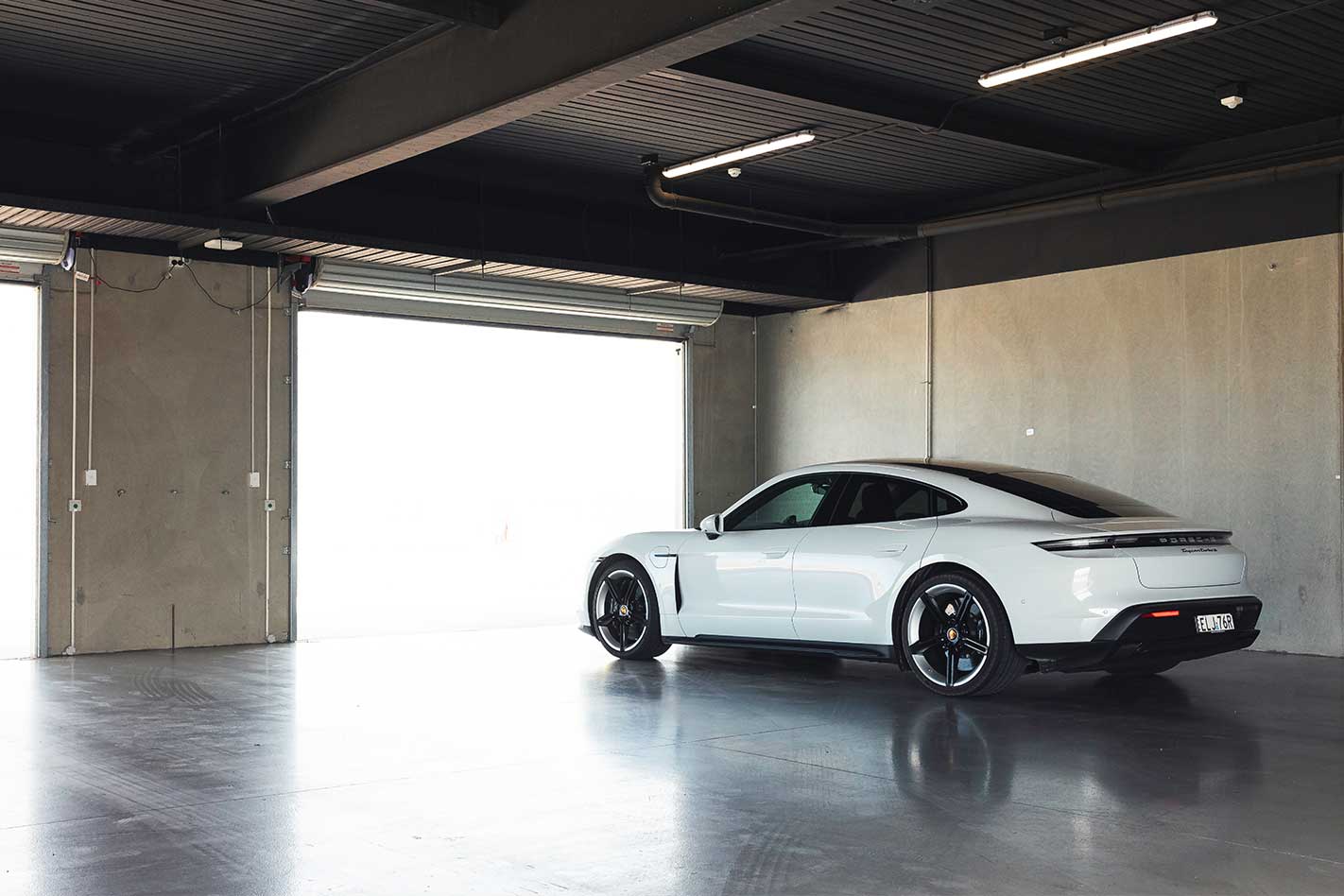
The Taycan is 428mm longer, 66mm wider and 75mm taller than its sportscar sibling, though it has a wider footprint, too, its tracks measuring 1690mm front and 1655mm rear compared to the 911’s 1583/1600mm respectively.
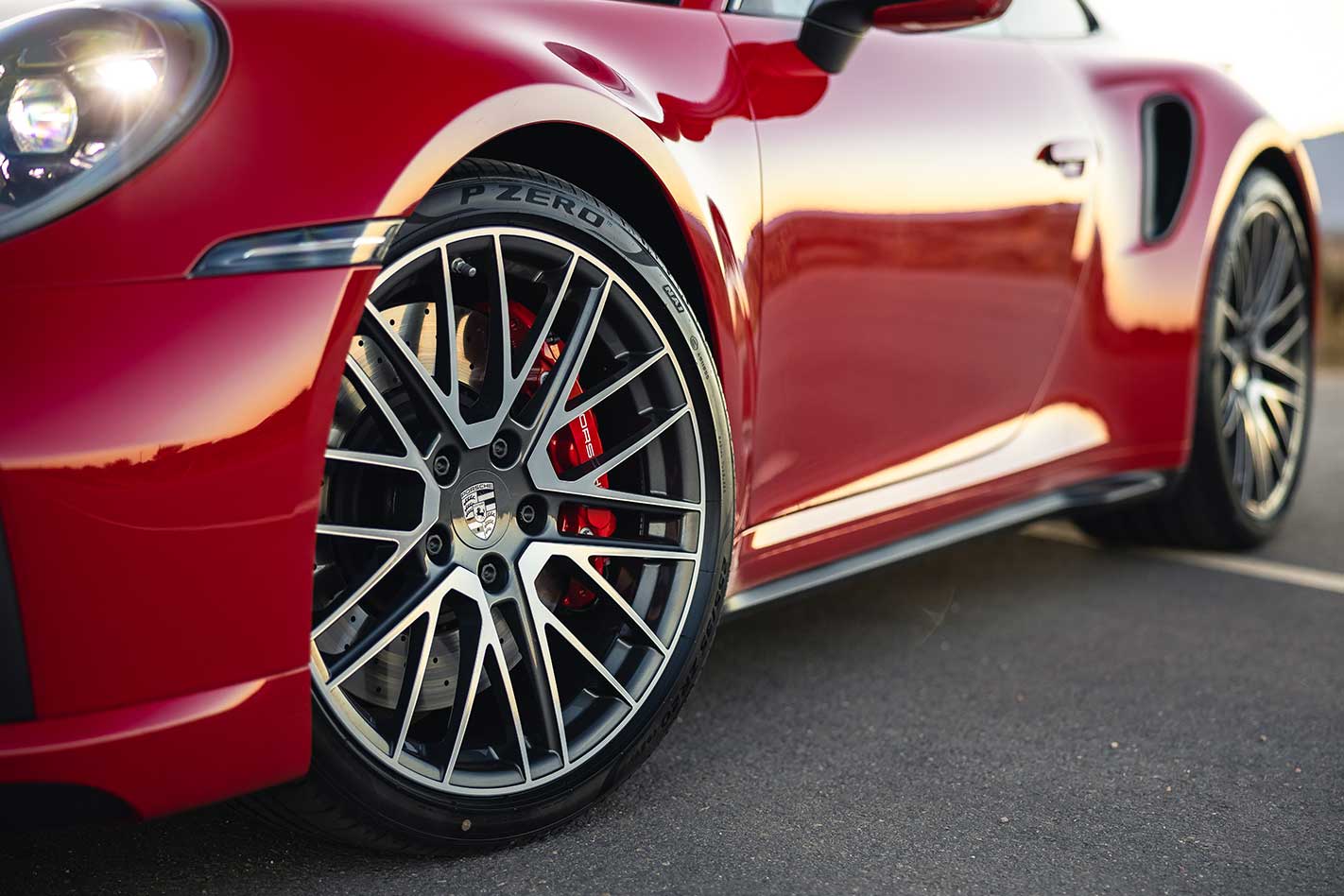
This is despite the 992-series 911 Turbo scoring an extra 45mm of front track along with bigger wheels and tyres. It now wears staggered rims, 20 x 9.0-inch fronts and 21 x 11.5-inch rears, wrapped in tyres measuring 255/35 and 315/30 respectively.
Both cars are all-wheel drive and all-wheel steer, have adaptive dampers, active anti-roll bars (optional in the case of the 911) and multi-link rear ends, though the Taycan uses air springs instead of steel and has a double-wishbone front end in place of the 911’s struts.
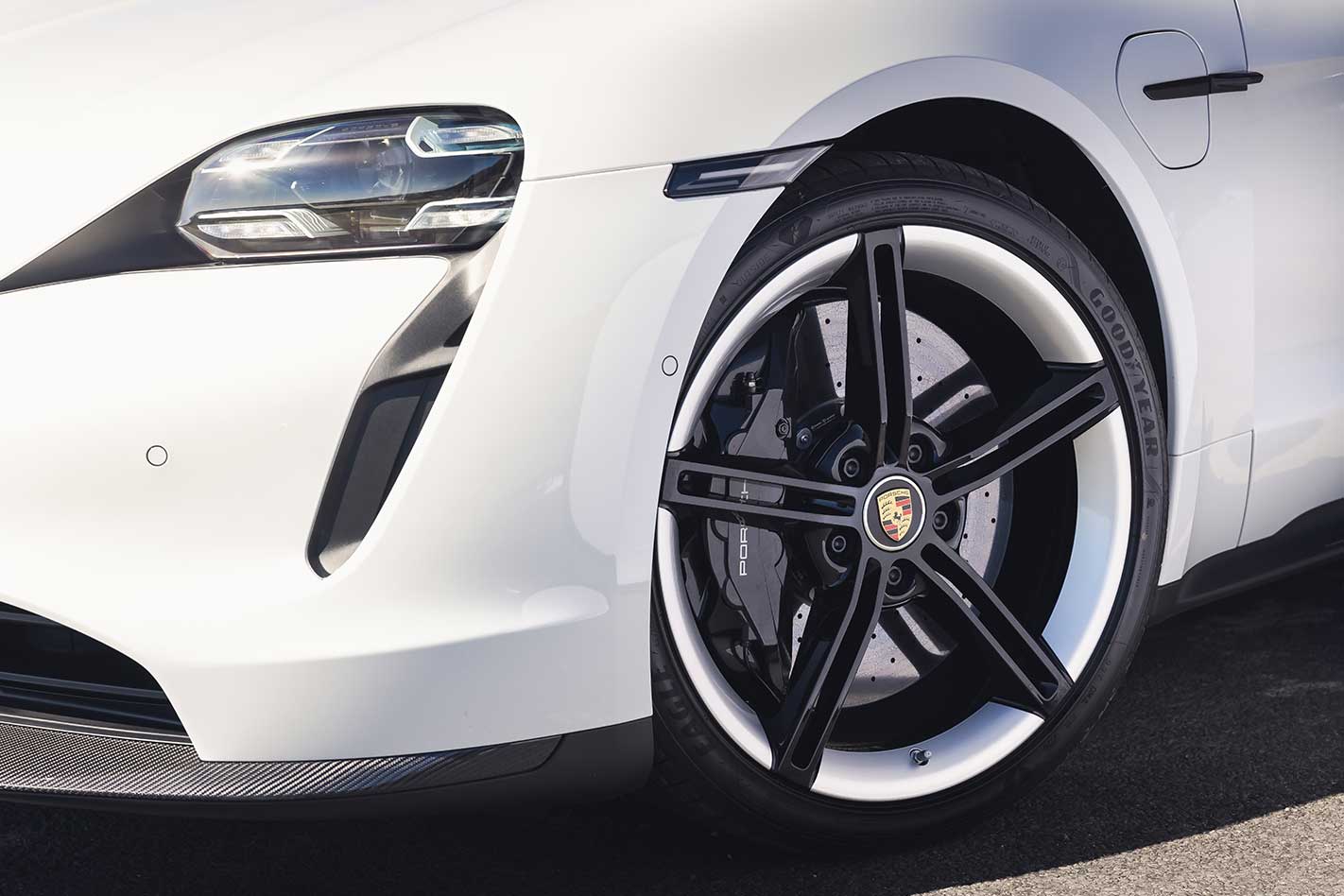
A quick word on the brakes, too, if only for the improbable numbers. The 911 Turbo uses monster 408mm steel discs with six-piston calipers at the front and 380mm discs with four-piston callipers at the rear, but the Taycan one-ups this with 420mm carbon-ceramic rotors and 10-piston (!) calipers front, and 410mm carbon-ceramic rotors and four-piston calipers rear.
Let’s start once again with the 911 Turbo. The launch control process couldn’t be simpler; irrespective of drive mode or ESP mode or transmission mode, simply press firmly on the brake with your left foot to illuminate ‘HOLD’ on the dash and floor the throttle with your right foot to activate launch control.
The revs flare to just over 5000rpm, the clutches are dropped when you lift your left foot and you’d best be hanging on. All four wheels spin through first gear but second is quickly snatched and each successive ratio is hungrily devoured in turn.
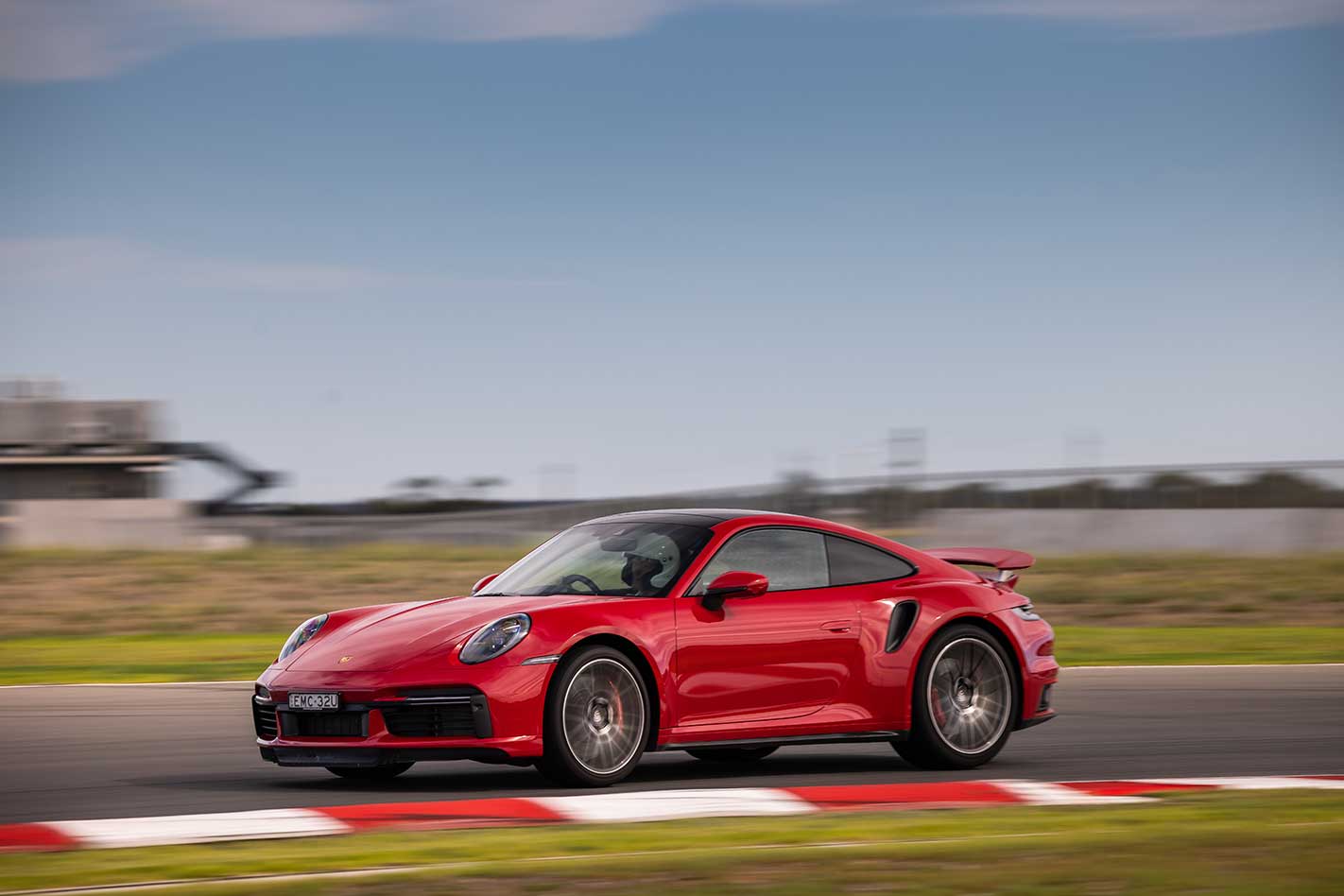
Normal service is resumed on the next run, the 911 hitting 200km/h in 9.252sec, smashing its claim by almost half a second, then recording a 10.545sec quarter mile at 214.3km/h. All three figures are quicker than those we recorded in the previous generation 911 Turbo S.
Activating launch control in the Taycan is an identical process but the experience is very different. The launch, when it comes, is even more shocking for a couple of reasons. To begin with there is next to no sound, just the faint hum of the sound synthesiser; somehow the 911’s rev spike primes your senses for the physical onslaught but there is no such preparation in the Taycan.
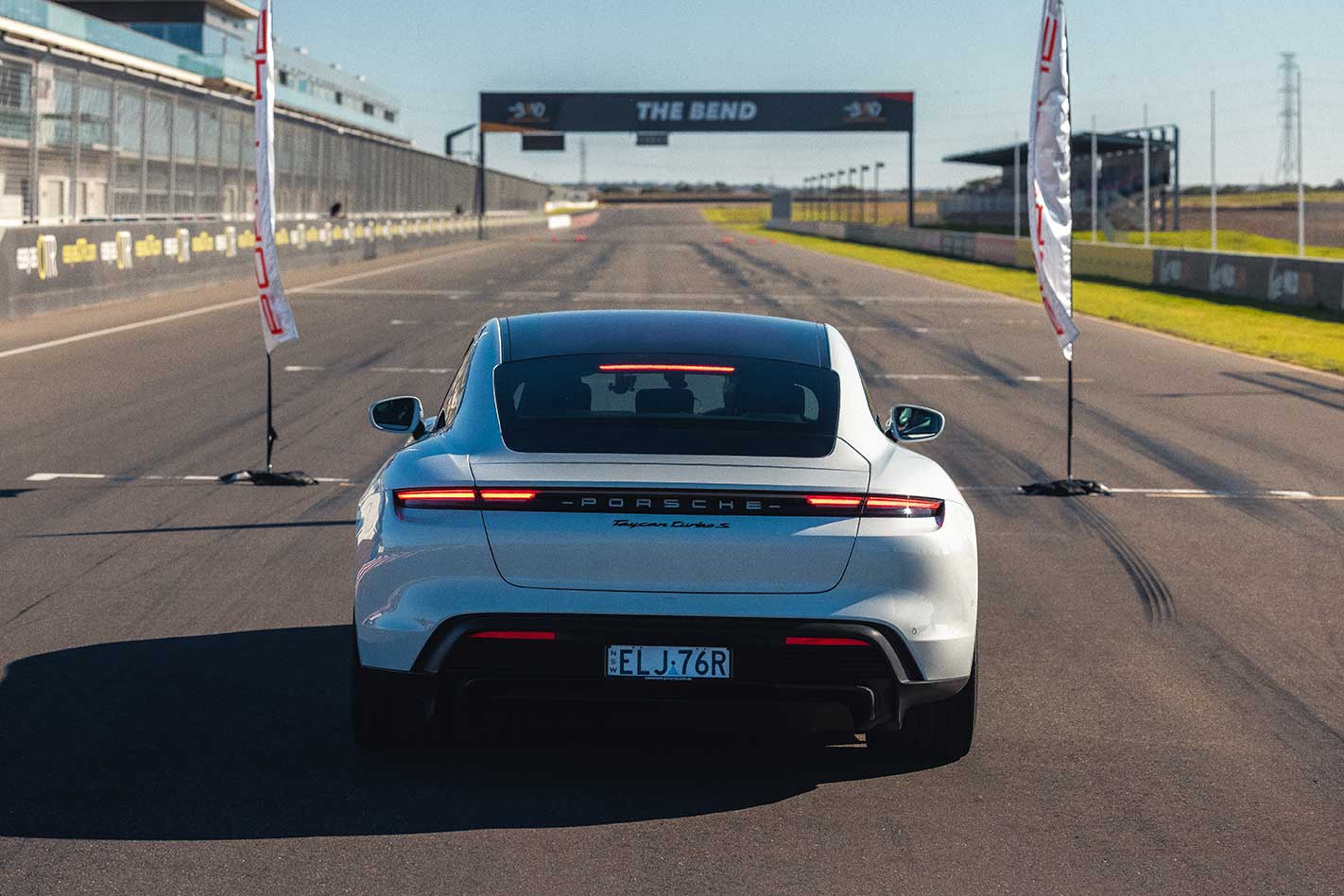
It takes a mere 2.552sec for the Taycan Turbo S to become the quickest accelerating vehicle MOTOR has ever tested, besting the 911 Turbo by a whopping 0.028sec. But as the famous philosopher Dominic Toretto one said, “it doesn’t matter if you win by an inch or a mile, winning’s winning”.
It can go quicker, with the best time we witnessed an amazing 2.46sec, but the process is so automated that the hundredths’ difference is down to software, wind direction and even margin of error in the timing equipment.
The experience is both thrilling and uncomfortable, repeated launches resulting in a queasiness akin to seasickness. You become unpleasantly aware of your internal organs and your eyes feel as though they protrude from your head under the onslaught of longitudinal g-force, but having bolted off the line, the Taycan can’t sustain the charge (pardon the pun).
Regardless, 0-200km/h in 9.658sec and a 10.886sec quarter mile at 211.15km/h is still insanely quick. That an electric Porsche is a sprint star should surprise no one; after all, it’s a discipline that’s perfectly suited to the performance characteristics of battery power.
What does raise eyebrows is the claim the Taycan is not just a true Porsche but a sportscar at that.
In part this is due to the ease of operation: leave the gearbox in auto and it’s flawless in its shift logic; leave the ESP fully on (let alone the more lenient Sport Mode) and it will almost never intervene; you can even drive the 911 Turbo like you would a conventional car and make extremely rapid progress.
Should you put in a bit of effort to adapt your driving to its strengths, however, it’s devastating in its effectiveness. The brakes will literally have your skin hanging from your cheeks as they wash off 180km/h into turn one in the space of 100 metres.
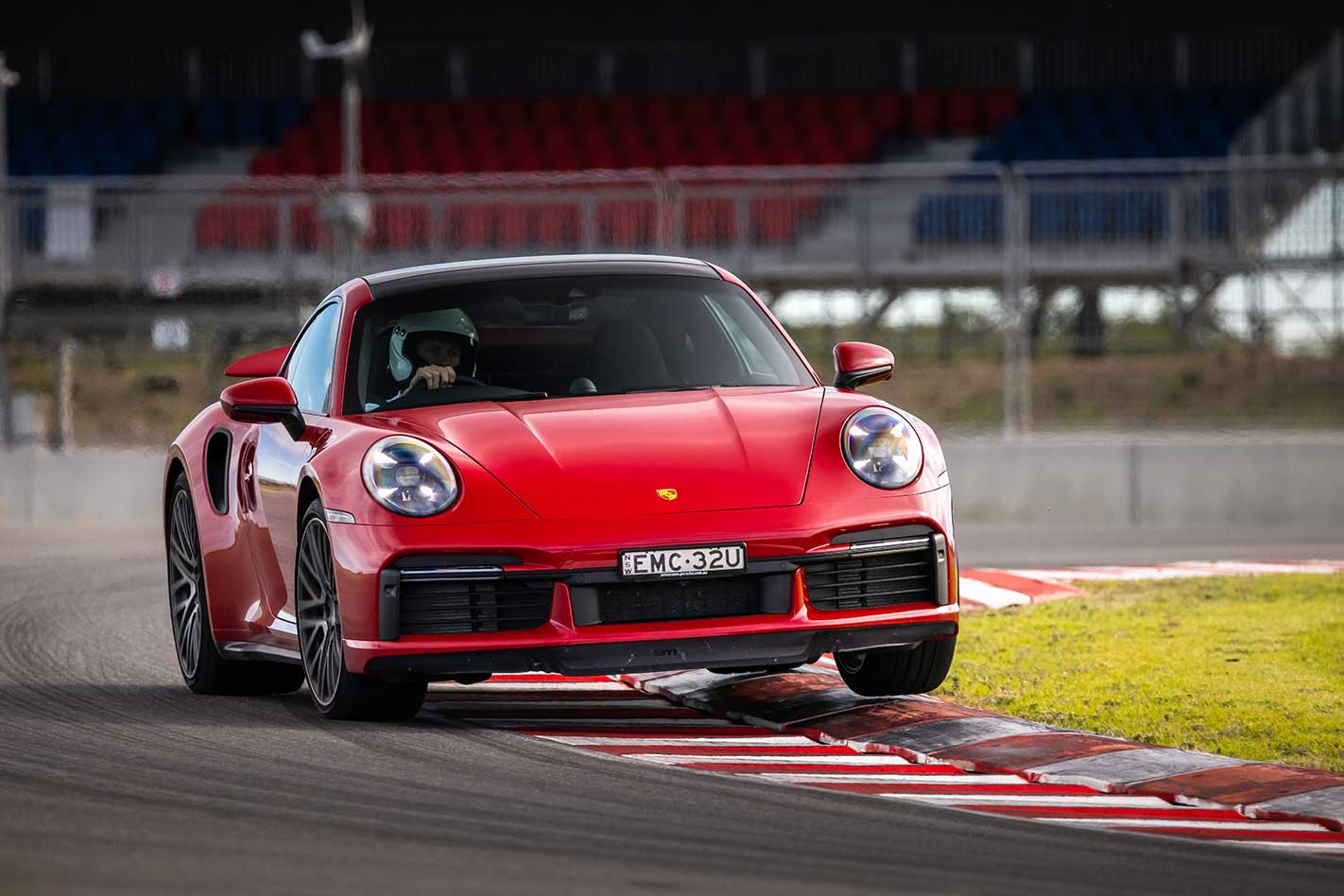
This is why the gearbox is best left in auto; it accelerates so quickly that your chances of perfectly timing the shift before clattering into the rev limiter are slim.
A tight schedule prevented the recording of a representative lap time, but the fact the onboard camera suggests I was lapping in the 1:27sec region while doing in-car pieces for video should give you some idea of the car’s potency. For reference, Rick Kelly managed a 1:27.3sec lap in a Mercedes-AMG GT C during PCOTY 2019 testing.
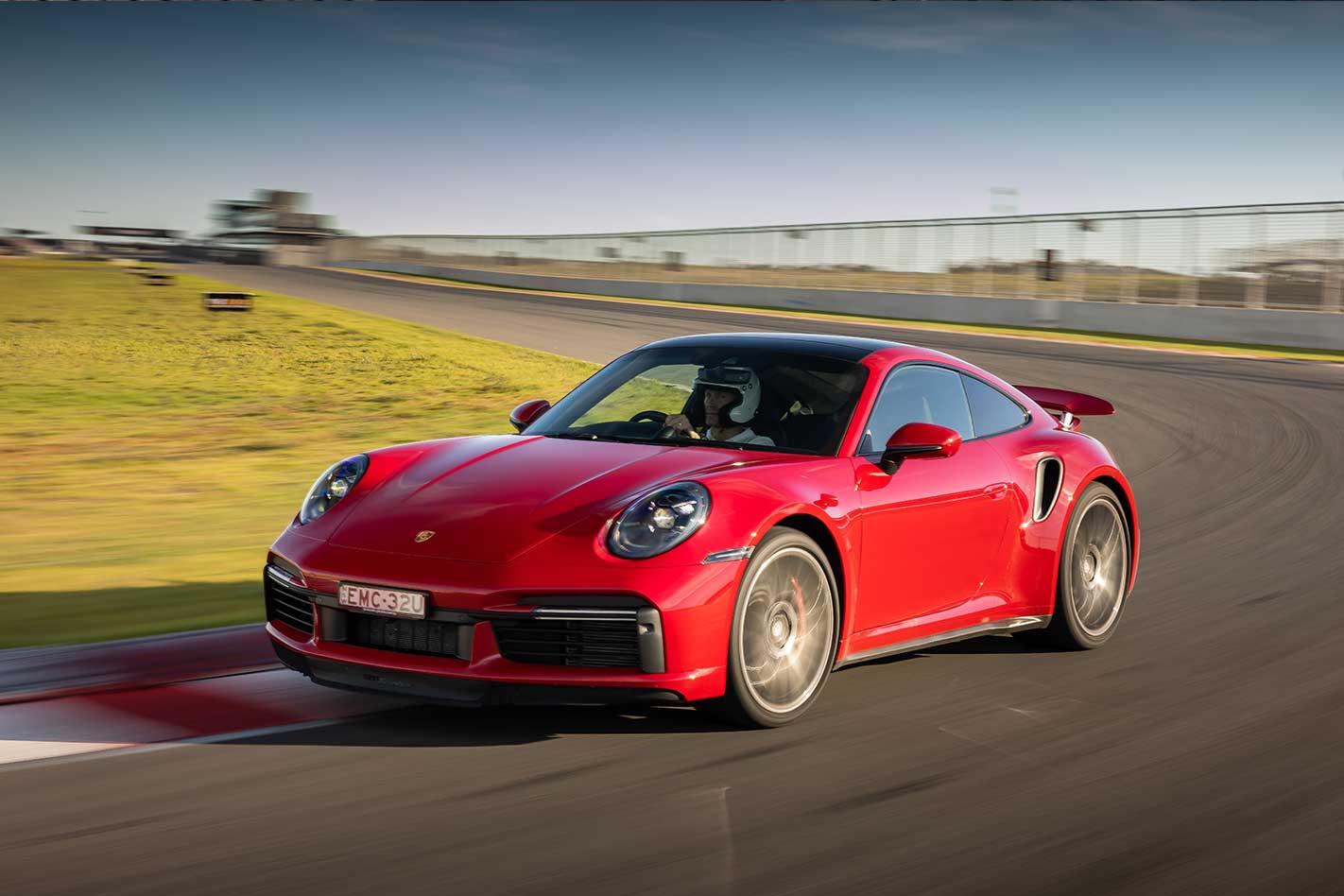
Apart from the driver, the only limiting factor will be its thirst for fuel; after a hard session the fuel reserve light came on with an estimated range-to-empty of 70km despite the 67-litre fuel tank being 6/10ths full. Ouch.
The Taycan Turbo S isn’t as good, it just isn’t, but there should be no shame in a five-door hatch not being as fun or as capable on track as one of the greatest performance coupes ever built, as the Taycan is still darn entertaining.
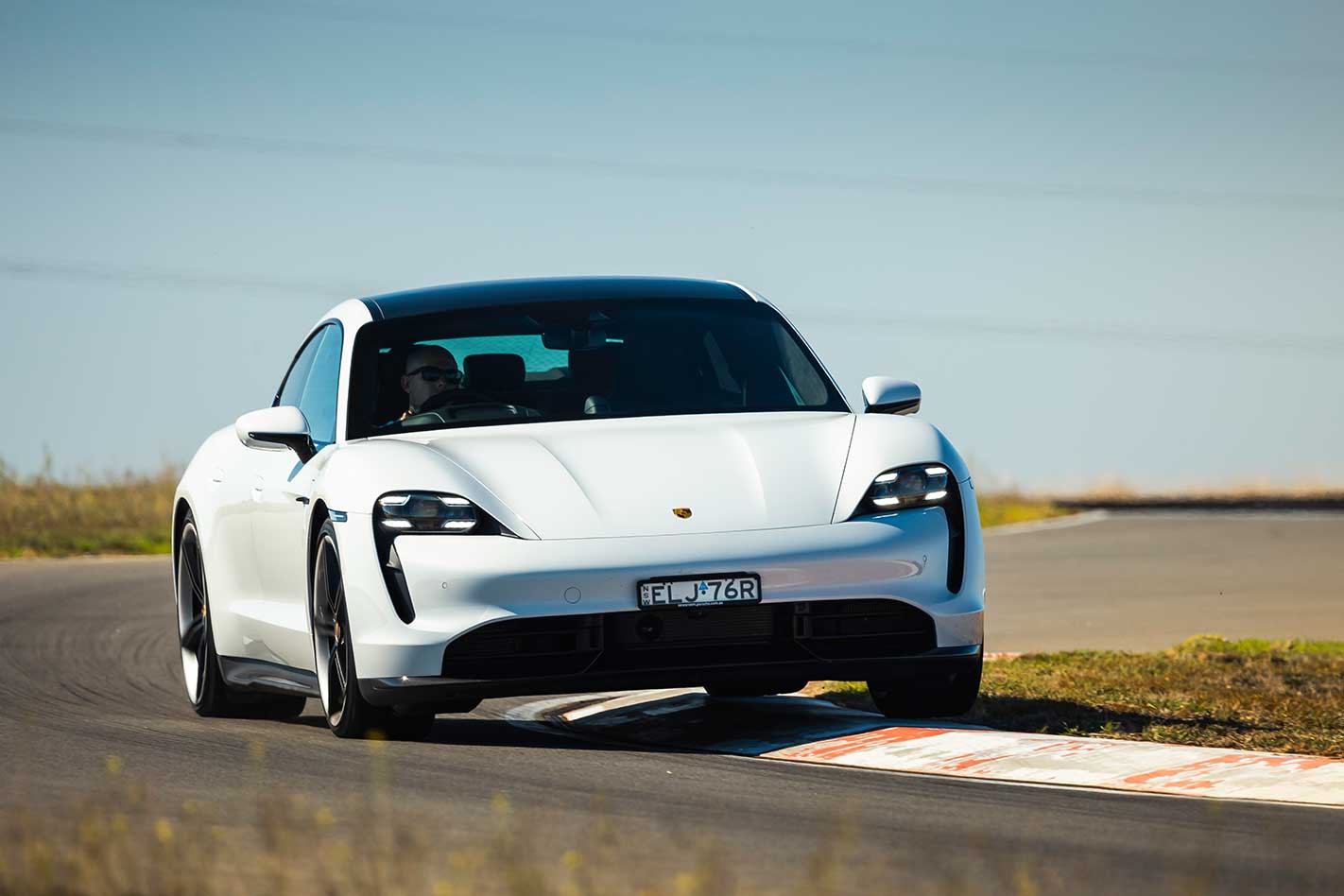
This might seem a weird comparison, but it brings to mind a bigger, heavier Cayman. The steering is lighter than the 911 and the Taycan behaves in a manner that clearly suggests all the mass is located between the axles.
It turns in keenly and will edge into oversteer if you carry too much brake with too much speed; it also doesn’t power understeer like a 911 will in response to lazy and brutal throttle applications; the opposite, in fact, the rear end swinging wide on the exit of slow corners.
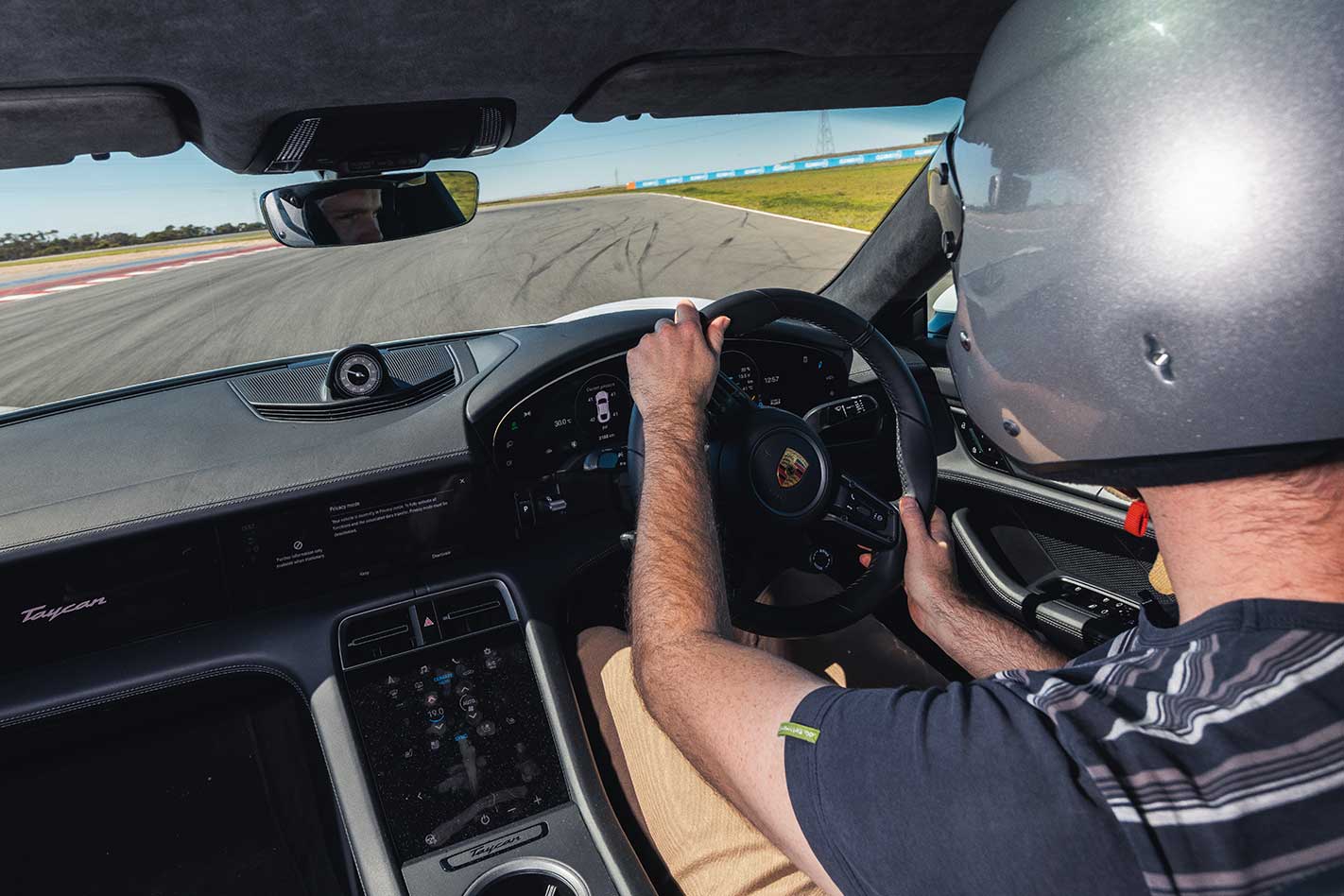
Its biggest shortcoming is tyres. There’s absolutely nothing wrong with Michelin Pilot Sport 4 S rubber but it can only do so much to contain the lateral load of 2.3 tonnes, regardless of how low it’s located. A set of Michelin Pilot Sport Cup 2s or Pirelli P Zero Trofeo Rs would do the trick, but there is a point at which the shark is jumped.
The Taycan is actually easier to drive quickly on the track than on the road. On the road the lack of sensory perception makes it difficult to assess how hard to take corners, whereas on a circuit you tend to have reference points: brake here, apex here, look there.
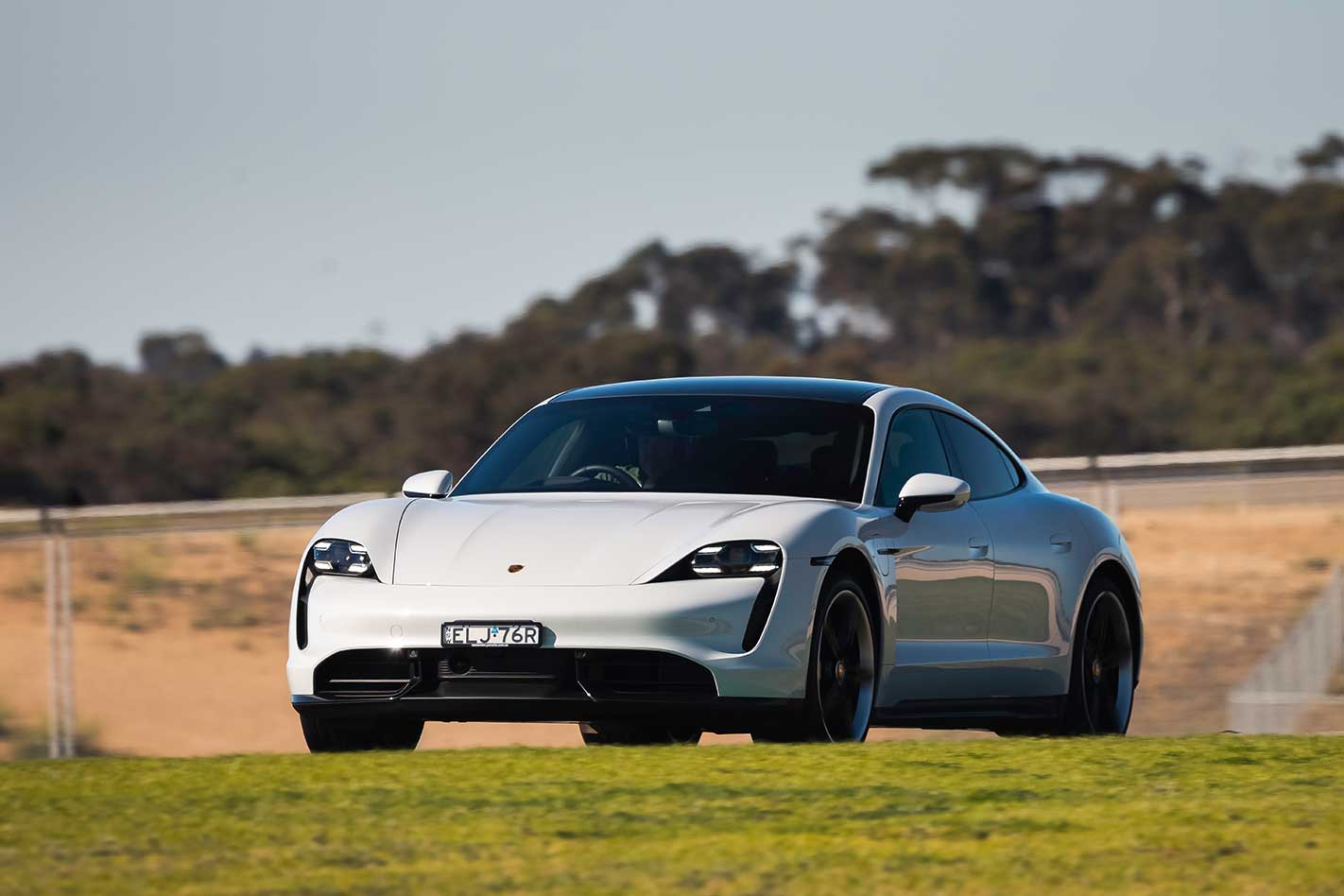
What’s inarguable is that the Taycan Turbo S is a proper Porsche. It has the performance, the stamina – completing five or six flat-out laps in a row before elevated battery temps began to wind back power slightly – and the ‘feel’.
All the control weights will feel immediately familiar to anyone currently in the Porsche family, from the steering to the brakes to the throttle.
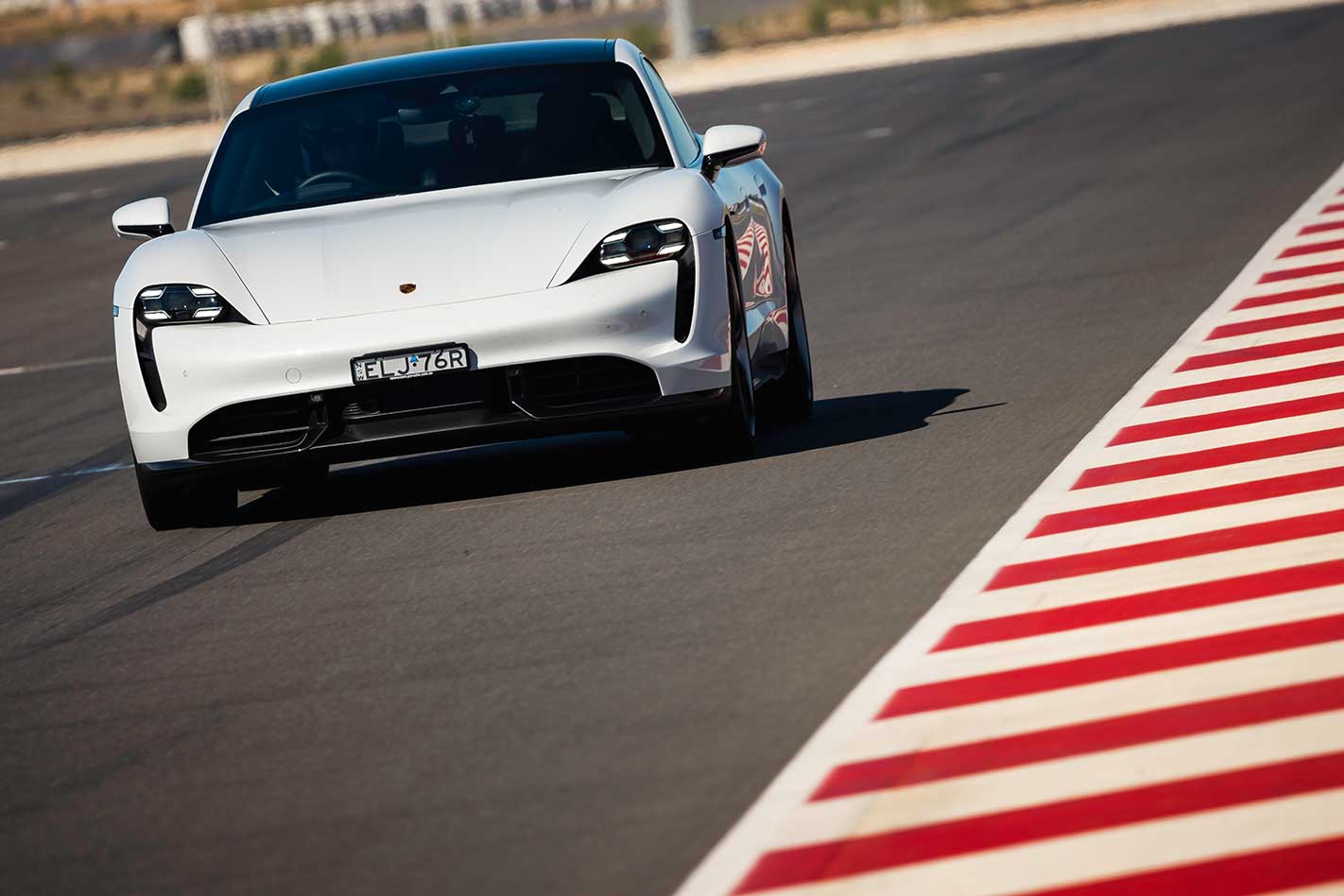
At the risk of sounding like someone from a political PR machine, enthusiasts are the real winners here. On the one hand, we are at the peak of the internal combustion era, with 10sec missiles that are exploitable and enjoyable on road and track.
On the other, cars like the Taycan prove that an electric future needn’t be a boring one; there is still work to do to improve entertainment and interactivity (a gearbox would help massively, even if it makes no sense with an electric motor) but rest assured we’ll still be burning rubber even if we aren’t burning fuel.
Porsche 911 Turbo – 9.5/10
Likes: ludicrous performance; brilliant driving engagement; stamina
Dislikes: heavy; massive fuel thirst on track; options pricing
Porsche Taycan Turbo S – 9.0/10
Likes: lunatic acceleration; genuinely enjoyable dynamics; future-proof performance
Dislikes: tyres struggle with weight; not as engaging to drive
Specifications
Porsche 911 Turbo
Body: 2-door, 2+2-seat coupe Drive: all-wheel Engine: 3745cc flat-6cyl, DOHC, 24v, twin-turbo Bore/stroke: 102.0 x 76.4mm Compression: 8.7:1 Power: 427kW @ 6500rpm Torque: 750Nm @ 2250-4500rpm 0-100km/h: 2.827sec (tested) 0-200km/h: 9.254sec (tested) 0-400m: 10.545sec @ 214.3km/h (tested) Top Speed: 320km/h (claimed) Weight: 1640kg Power/weight: 260kW/tonne Transmission: 8-speed dual-clutch Suspension: struts, coil springs, adaptive dampers, active anti-roll bar (f); multi-links, steel springs, adaptive dampers, active anti-roll bar (r) L/W/H: 4535/1900/1303mm Wheelbase: 2450mm Tracks: 1583/1600mm (f/r) Steering: electrically assisted rack-and-pinion; rear-wheel steering Brakes: 408mm ventilated/drilled discs, 6-piston calipers (f); 380mm ventilated/drilled discs, 4-piston calipers (r) Wheels: 20 x 9.0-inch (f); 21 x 11.5-inch (r) Tyres: 255/35 ZR20 (f); 315/30 ZR21 (r) Price: $405,000
Porsche Taycan Turbo S
Body: 5-door, 4+1-seat hatch Drive: all-wheel Battery: 93.4kWh (gross) Motor: permanently excited synchronous (f/r) Power: 460kW (560kW overboost) Torque: 1050Nm 0-100km/h: 2.552sec (tested) 0-200km/h: 9.658sec (tested) 0-400m: 10.886sec @ 211.15km/h (tested) Top Speed: 260km/h (claimed) Weight: 2295kg Power/weight: 200kW/tonne (244kW/tonne overboost) Transmission: single-speed (f); 2-speed (r) Suspension: double wishbones, air springs, adaptive dampers, anti-roll bar (f); multi-links, air springs, adaptive dampers, anti-roll bar (r) L/W/H: 4963/1966/1378mm Wheelbase: 2900mm Tracks: 1690/1655mm Steering: electrically assisted rack-and-pinion; rear-wheel steering Brakes: 420mm ventilated/drilled carbon-ceramic discs. 10-piston calipers (f); 410mm ventilated/drilled carbon-ceramic discs, 4-piston calipers (r) Wheels: 21 x 9.5-inch (f); 21 x 11.5-inch (fr) Tyres: 265/35 ZR21 101Y (f); 305/30 ZR21 104Y (r) Price: $338,500
UPDATE, September 2022: Refreshed MY23 range and new turbo models
The updated 2023 Subaru Outback is now on sale in Australia, debuting a turbocharged XT model and a number of key infotainment upgrades.
Get the full story at the link below.
Original story continues
2021 Subaru Outback AWD review
What is the Subaru Outback AWD?
This is the base-spec variant of the new sixth-generation model of Subaru’s globally popular all-terrain wagon.
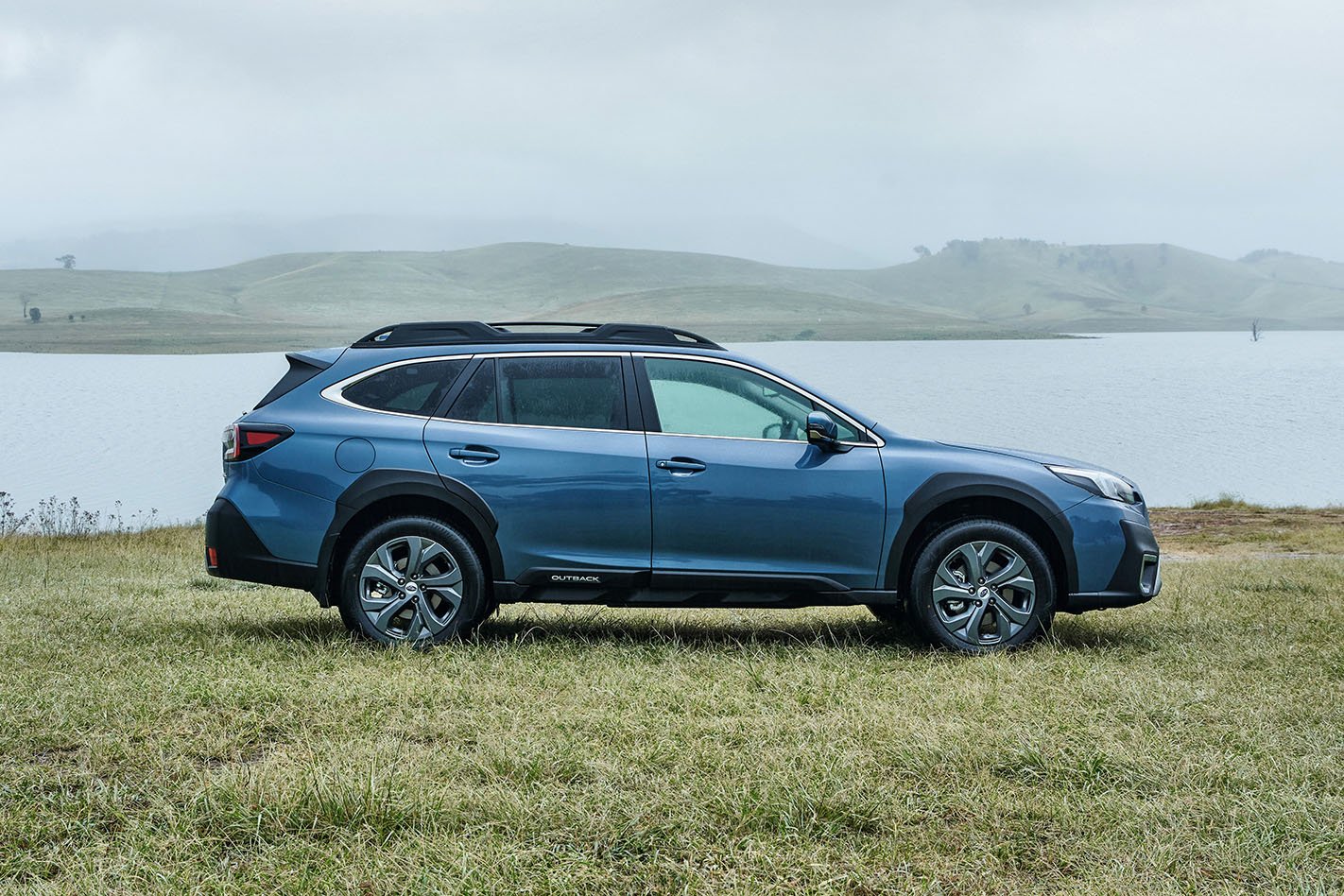
While it doesn’t look too different from the model it replaces, it has been rebuilt on a new platform and brings additional space, comfort, technology and an updated 2.5-litre petrol engine.
Despite looking like an all-terrain wagon such as the Skoda Superb Scout 4×4 and Volkswagen Passat Alltrack, the Outback is actually classed as a large SUV and accordingly brings plenty of space, comfort and practicality.
What is the Subaru Outback AWD to live with?
The entry-level Outback variant retails for $39,990 and has a recommended driveaway price of $44,716.
While it misses out on luxury appointments such as fancier seats and seat heaters found in the Sport and Touring variants that retail for $44,490 and $47,790 respectively, it’s not exactly lacking for kit, with its standard features list putting some mid-spec SUVs to shame.

As well as an excellent all-wheel-drive system, the base Outback brings the latest version of Subaru’s Eyesight driver assistance suite, X-Mode all-terrain traction program, driver monitoring system, adaptive cruise control, the new 11.6-inch portrait-mount infotainment system, Apple CarPlay/Android Auto, LED daytime running lights, self-levelling headlights with adaptive high-beam, dual-zone climate control air-conditioning, heated and auto-folding door mirrors, push-button start and rain-sensing windscreen wipers – click here to see the full spec list.
Arguably more comfortable than the firmer leather upholstery in the Touring spec, the base grade’s fabric front seats come with power settings including lumbar support function for the driver.
The Outback has loads of leg and elbow room up front, and you’ll find a good driving position regardless of your size. The leather-trimmed steering wheel feels good in hand and the audio, cruise control and phone buttons are well laid out.

A large centre console storage bin has a padded cover that doubles as an armrest and the obligatory two cupholders. It is void of clutter thanks to the electronic parking brake and most functions being operated from or around the portrait touchscreen.
I like the way Subaru has broken up the screen display so driving information and settings such as X-Mode and air-conditioning controls remain at the top and bottom respectively, so you don’t have to go delve into the menu to find and operate them. Considering it handles so many functions, the infotainment system is remarkably simple to operate.
Step through the back doors and you’ll find the rear seats are also comfortable with excellent leg- and knee-room plus space under the front seats to fit your feet. The rear pew seats two adults comfortably, while a third can be accommodated for shorter journeys. Three children will fit easily.
Rear-seat passengers also benefit from 2x USB ports, air vents, map pockets behind the front seats, small door bins with bottle holders, and there are two ISOFIX child-seat anchor points and three top tethers. The rear seatbacks recline a little and there is a fold-down centre armrest with cupholders.
The 60:40 split seats fold down to increase boot space from 522 litres to up to 1267 litres – this can be done easily when standing at the tailgate using quick-release latches.
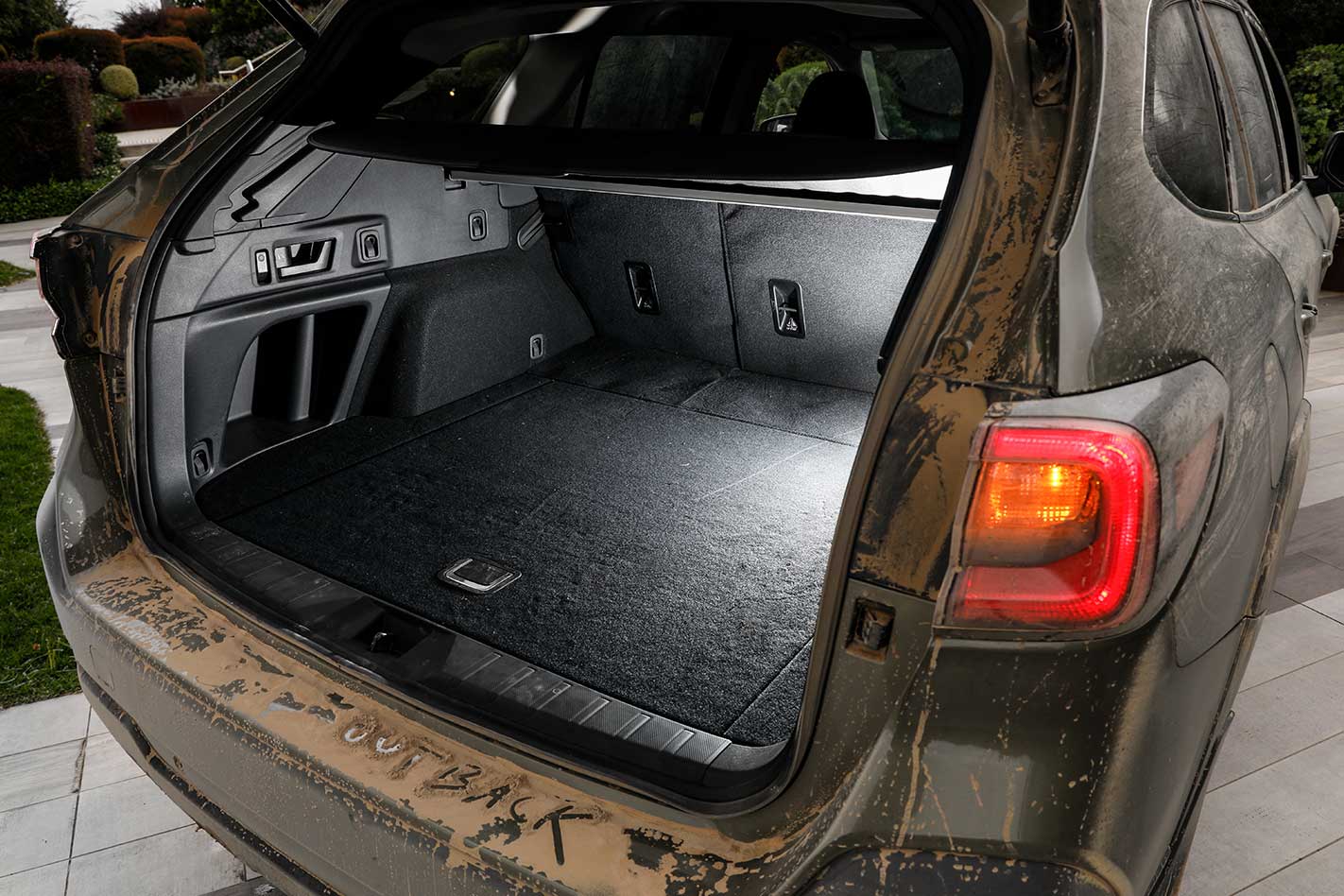
The boot is deep and wide but a little shallow if using the pull-out cover. There are pop-out hooks to secure your load, a 12-volt socket to plug in a car fridge or other appliances and a bright LED light.
At this spec level, the tailgate isn’t power-operated, but there is a handy grab handle to make closing it easier.
If you need to carry more items there are roof rails on which to install racks, and the Outback’s 2000kg braked towing capacity is 500kg more than the previous model.

The Outback’s 138kW/245Nm 2.5-litre petrol engine has an official combined-cycle fuel consumption figure of 7.3L/100km. This is quite frugal for such a large vehicle, though expect real-world consumption to sit closer to 10L/100km when you’ve filled it bags and people.
Scheduled service intervals are 12 months or 12,500km, whichever comes first, and with pricing set at $344.96, $594.80, $351.14, $801.42, and $357.56 for the first five years when using a Subaru service centre, which is a little on the pricey side.
The Subaru Outback is covered by a five-year, unlimited-kilometre warranty for private use.
What is the Subaru Outback AWD like to drive?
The Outback’s comfortable driving position and good all-round driving dynamics make it an enjoyable car to drive in a range of situations.
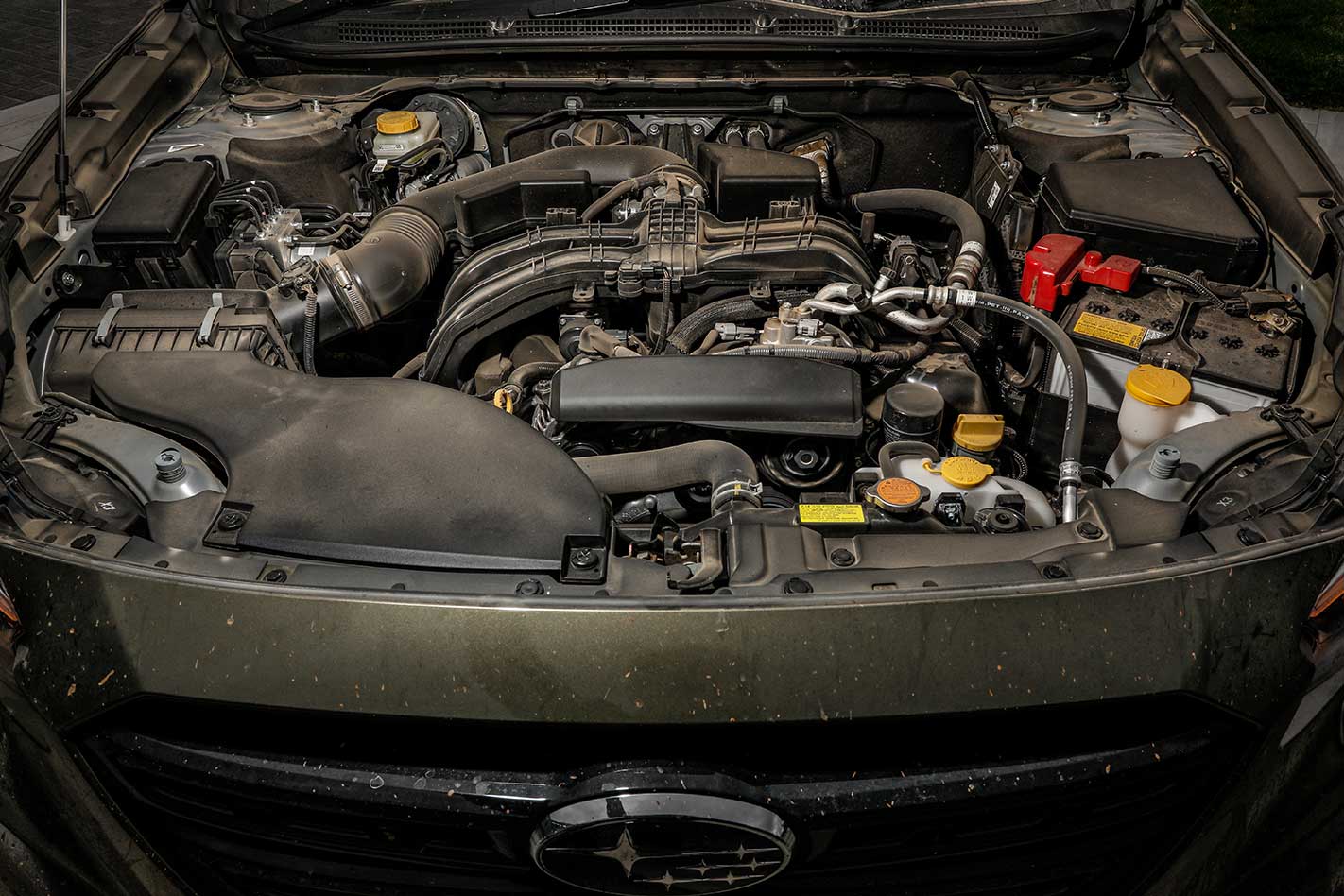
Its 2.5-litre Boxer engine is a revamped version of the previous model’s four-cylinder powerplant and brings an additional 9kW/10Nm to produce 138kW/245Nm. It drives all four wheels via a continuously variable transmission (CVT) auto that has eight simulated steps to help keep the revs down when you press the right pedal, improving acceleration and fuel economy. That said it can be a screamer when pushed.
The performance is noticeably better than the previous model and more than adequate in most situations, but when loaded up you may wish there was still a 3.6-litre six-cylinder option.
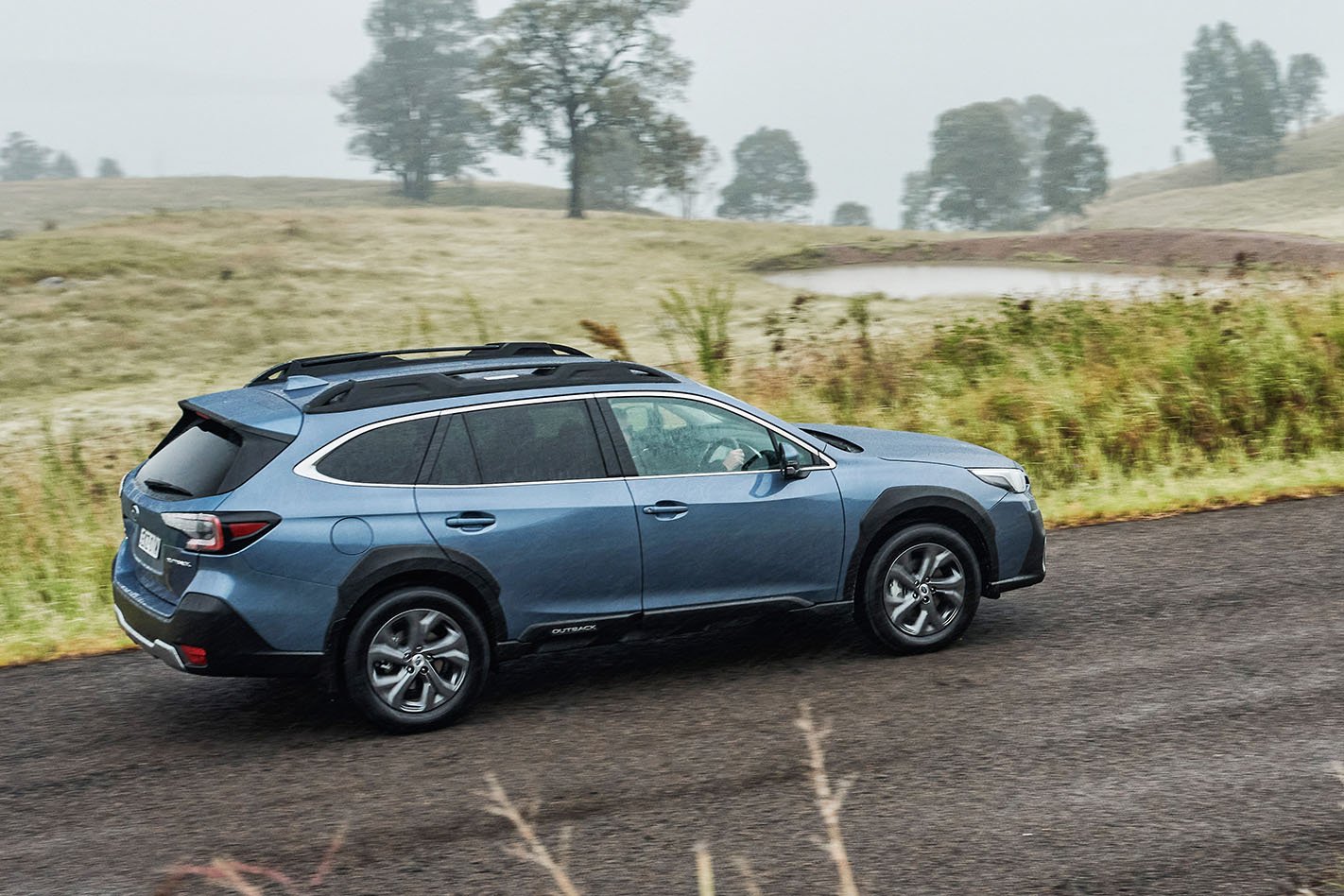
That said, the 2.5-litre Boxer sits at highway speeds well and has enough power in reserve for overtaking. The ride is quiet and comfortable and, despite the new Outback’s size, it handles nicely thanks to the flat Boxer engine’s low centre of gravity, a stiffer body shell, and torque vectoring that distributes drive to the wheels where it’s needed while cornering.
The Outback’s all-wheel-drive system and 213mm ground clearance gives it good off-road capability, though the long front and rear overhangs can limit things when it comes to negotiating steeper slopes or ravines.
It drives particularly well on gravel roads, and you can negotiate very steep and slippery terrain with the help of the X-Mode traction system.
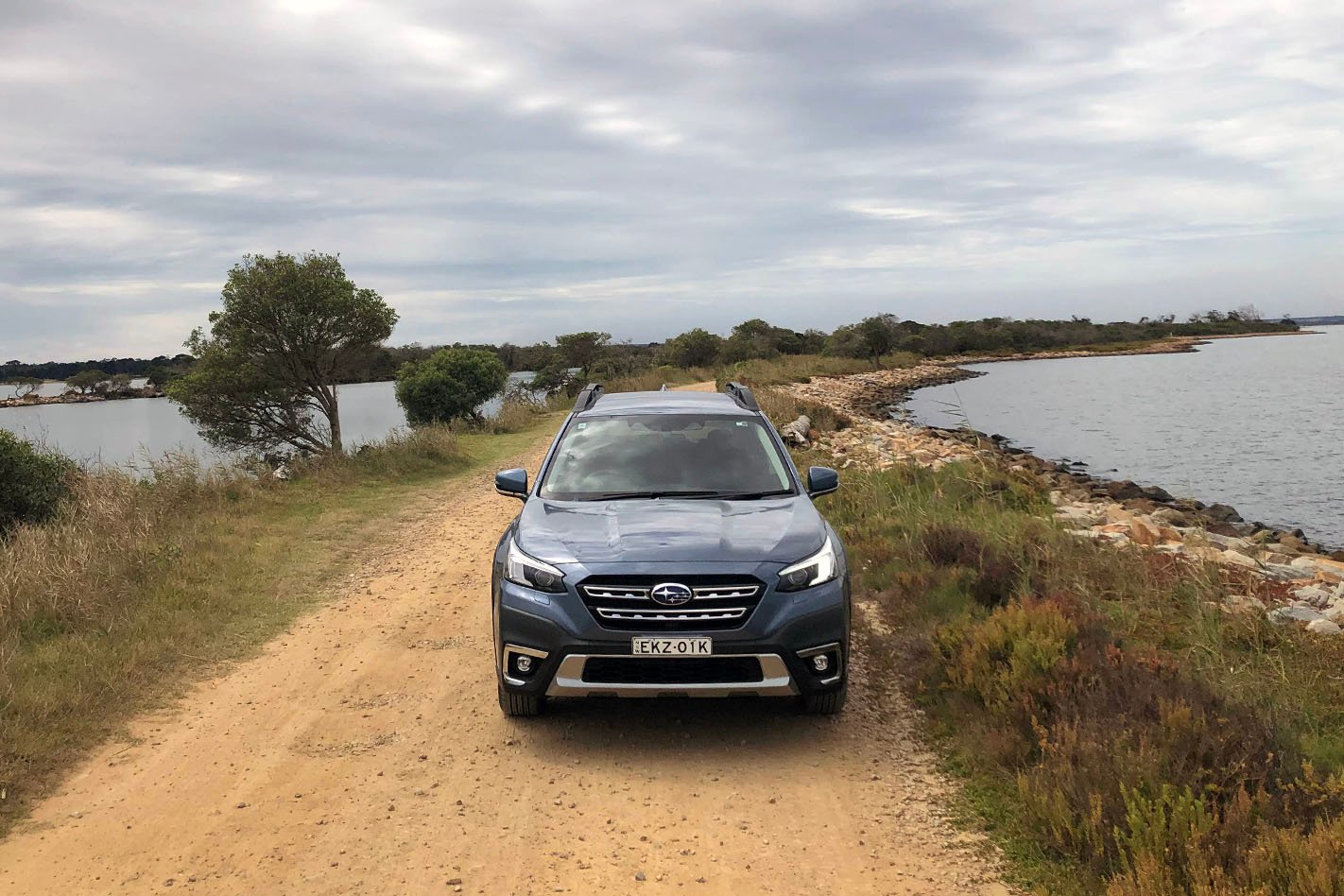
Driving along the picturesque Silt Jetty, a narrow strip of land that extends into Victoria’s Gippsland Lakes, the Outback’s all-wheel-drive system came into its own to provide stability and traction on the loose surface, with the suspension doing an excellent job soaking up bumps and corrugations.
What is the Subaru Outback AWD like for safety?
Even the cheapest Outback brings the full suite of features from Subaru’s ‘EyeSight’ camera-based driver assistance package that brings AEB, which works at city and highway speeds and detects pedestrians.
EyeSight also supplies adaptive cruise control, lane-keeping assist, brake light recognition that provides an additional sign that the car in front is stopping, and lane-drift assistance – alerting you if you start to drift out of your lane on the highway, perhaps from distraction, and gently attempting to steer the car out of trouble.
Other active safety features include driver attention alert, blind-spot monitoring and rear-cross traffic alert. The Outback takes the latter a step further with reverse automatic braking that stops the vehicle to help prevent collisions while parking or when backing out of a driveway.
There are now eight SRS airbags, a new passenger cushion airbag supplementing the dual front, dual front side, dual curtain and driver’s knee bags.
The 2021 Subaru Outback is yet to receive an ANCAP safety rating, but we’d be very surprised if it earned anything less than five stars.
The Verdict
Like its predecessor, the Subaru Outback doesn’t have a standout feature that gives it a knockout blow against its rivals. But it does tick plenty of boxes to make it a big winner on points for those seeking a safe, comfortable, practical and attractive wagon that can travel far beyond bitumen.
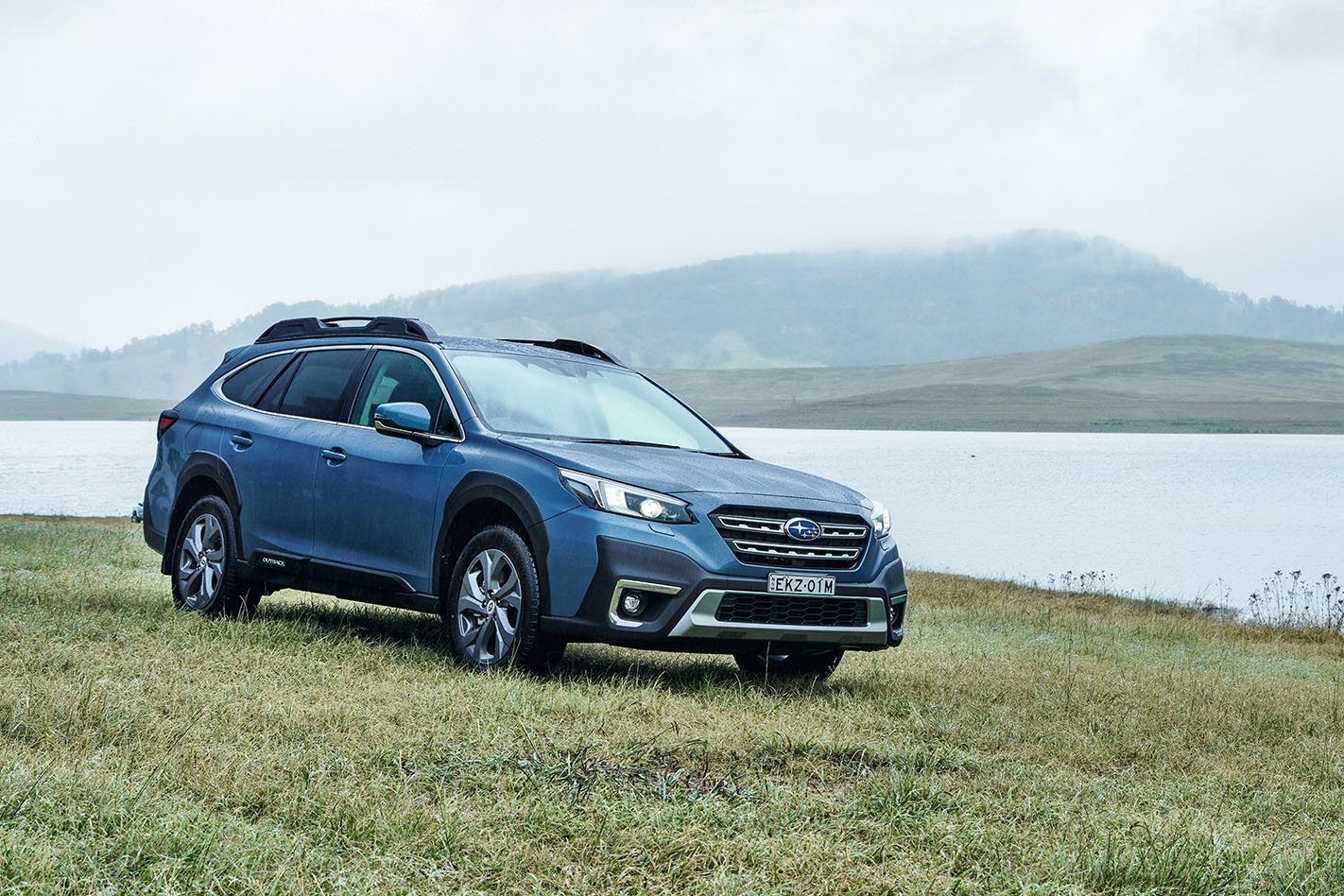
While the 2.5-litre powertrain does the job well, it would be good if prospective buyers were offered more powertrain choices as used to be the case when the Outback also had a choice of 2.0-litre diesel and gutsy 3.6-litre V6 petrol. There is a turbocharged version available in the USA and the new platform is capable of hosting a hybrid powertrain, so perhaps there’s hope for the future.
The entry-level Outback we’re reviewing here comes with all the important stuff and is a lot of car for around $40,000. Apart from gaining a few more niceties, there aren’t too many reasons to spend more on the Sport or Touring versions.
Subaru Outback AWD specifications
Body: 5-door, 5-seat wagon Drive: all-wheel Engine: 2498cc boxer-4cyl, DOHC, 24v Bore/stroke: 94.0 x 90.0mm Compression: 12.0:1 Power: 138kW @ 5800rpm Torque: 245Nm @ 3400-4600rpm Transmission: CVT Power/weight: 85kW/tonne Weight: 1629kg Fuel consumption: 7.3L/100km (combined/claimed) L/W/H: 4870/1875/1670mm Wheelbase: 2745mm Tracks: 1570/1600mm Suspension: Struts, coil springs, anti-roll bar (f); double wishbones, coil springs, anti-roll bar (r) Steering: Electrically assisted rack-and-pinion Brakes: 316mm ventilated discs, 2-piston calipers (f); 300mm ventilated discs, single-piston calipers (r) Wheels: 18 x 7.0-inch (f/r) Tyres: 225/60 R18 (f/r) Bridgestone Turanza Price: $39,990
BMW Australia is recalling 16,850 E70 X5 and E71 X6 models sold between 2007 and 2010 over an electrical fault which could cause the vehicles to catch fire.
The fault involves a plug connection from the wiring harness to the blower controller may deteriorate over time which could short circuit or overheat.
According to Product Safety Australia this may cause a fire – increasing the risk of an accident.
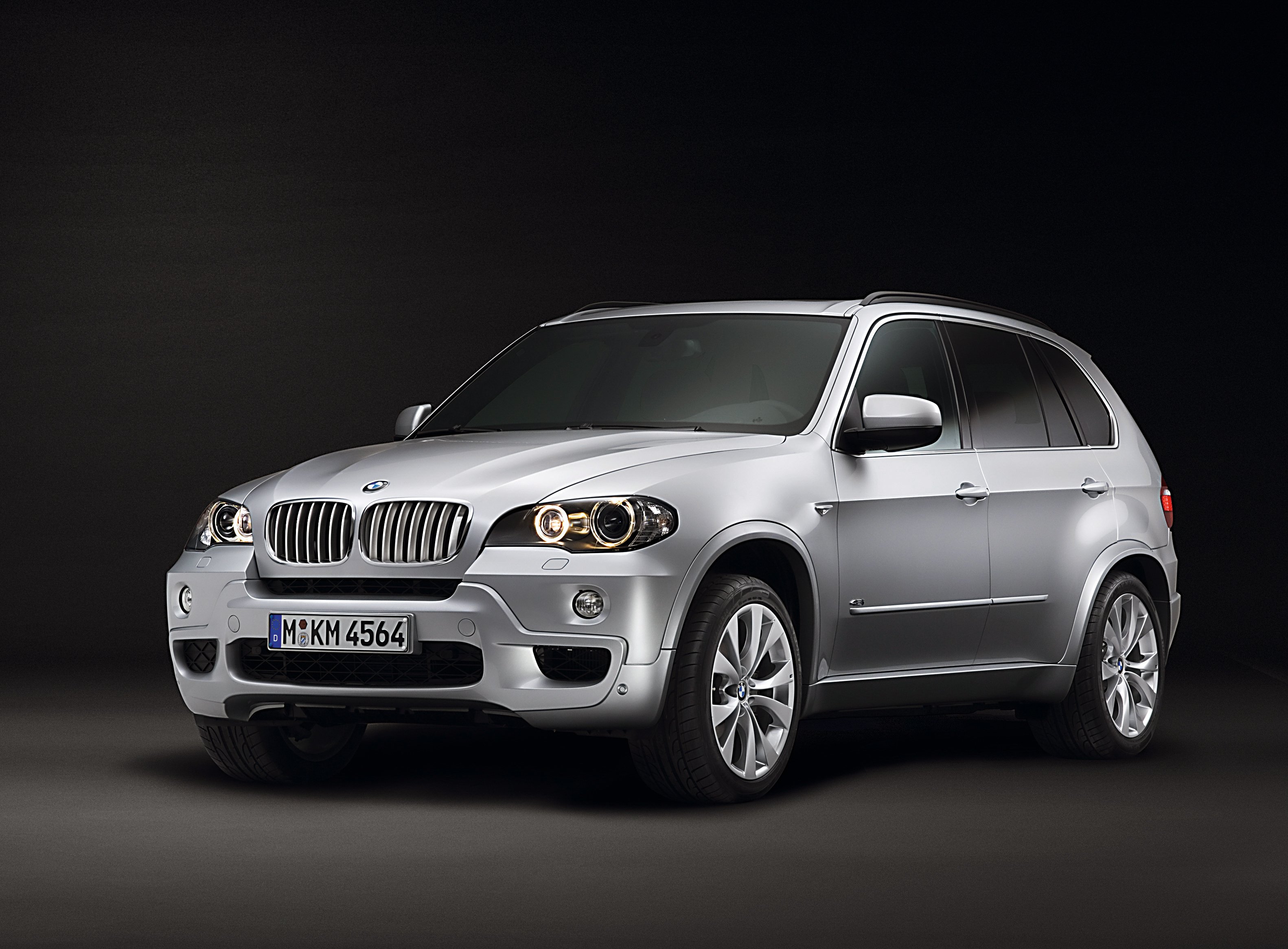
BMW is contacting all known owners to arrange an inspection and repair.
Alternatively, customers can get in touch with an authorised BMW Service centre, call the BMW Group Customer Interaction Centre on 1800 813 299 or visit: www.bmw.com.au
The Product Safety Australia website has a Vehicle Identification Number (VIN) list of all affected X5 and X6 models.
