
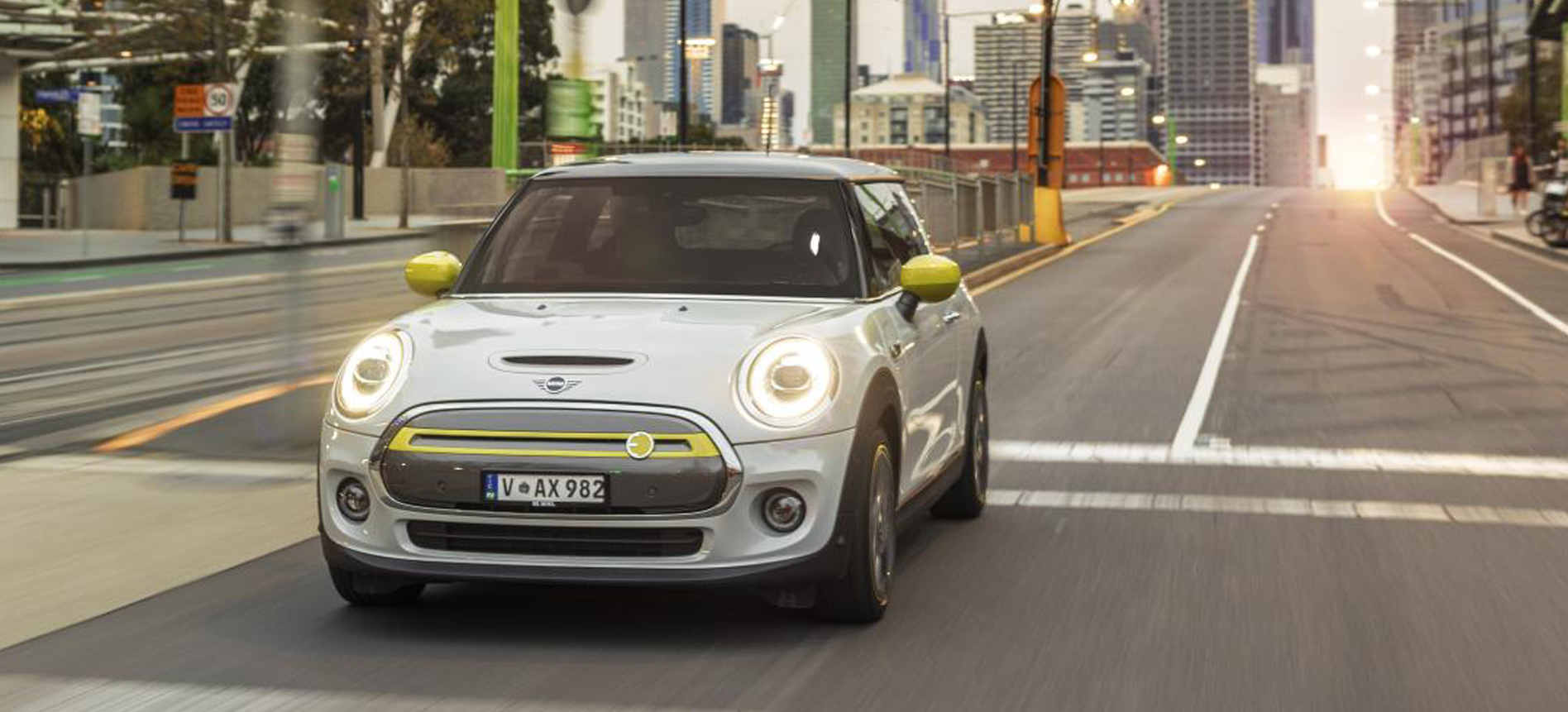
UPDATE, March 19: BMW Group has confirmed overnight that its Mini brand will go all-electric by the start of the 2030s.
Announced as part of a larger event discussing the group’s future, Mini’s move to pure electrification is described as “absolutely ideal” for the “urban brand”.
The Mini brand‘s very last combustion engine will be sold by around 2025, the group says, with only electric models to be launched from that point.
Mini’s range of fully-electric models will account for “at least” 50 per cent of all sales, with every single Mini model available only as an EV “by the early 2030s”.
As part of the transition, some new models in the coming years will be offered in both conventional combustion form and all-electric form, including the next Countryman – due to go on sale in 2023.
The company also reaffirmed existing plans to produce electric Mini models in China from 2023, in collaboration with Great Wall Motor, although it is unclear at this point if any Australian-delivered models will come from China.
It remains to be seen what this will mean for Mini pricing in Australia, although without a revolution in battery costs, buyers can undoubtedly expect the point of entry to become markedly more expensive.
Right now, the electric Cooper SE is priced from $59,990 drive-away in Australia, while the cheapest conventional model in the Mini range is the $35,150 Cooper Classic manual.
MORE: Cooper SE electric review MORE: Cooper SE electric pricing and specs
Mike Stevens
The story to here
March 16: Mini appears set to become the latest brand to commit to dropping all petrol and diesel engines by 2030 in favour of electric power; with an official announcement expected within days.
According to Automotive News, which cites numerous Mini and BMW insiders as its source, the British marque will roll out its last-ever internal combustion engine update in 2025. Around one half of its sales are expected to be electric by 2027, one of the people said.
It was purported Mini will only produce electric-powered products from 2030 onwards. BMW CEO Oliver Zipse is expected to share the news alongside its annual report later this week.
If so, Mini would fall in-line with other brands including Bentley, Jaguar and Volvo, which have all recently confirmed plans to shun combustion engines by 2030.
So too, a number of countries are planning to ban the sale of new internal combustion-engined cars by 2030. These bans no doubt would have factored into companies’ decisions to go all-electric.
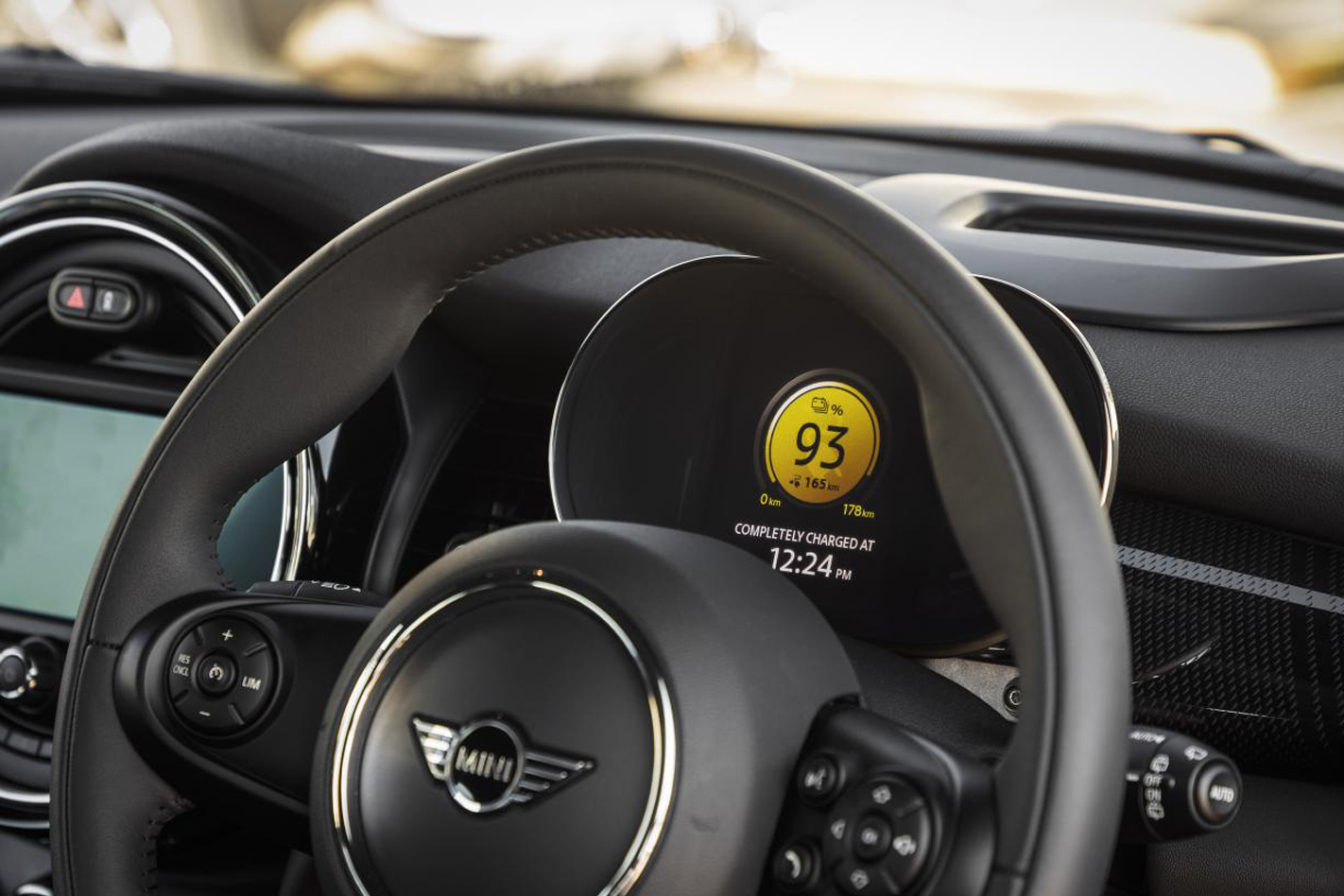
The decision for Mini to turn to all-EV powertrains isn’t such a leap; its city-bound nature and diminutive model sizes would well suit the progressive move to electric-only power.
Mini already sells an electric Cooper SE that has been on sale in Australia since July 2020, and its John Cooper Works performance division will become one of the company’s first arms to go all-EV.
Wider, BMW is planning an electric assault with its iX SUV and i4 sedan, set to rival the likes of Tesla’s Model X and Model S.
Mini’s electric future plans are expected to be detailed on March 17, 2021, as BMW CEO Oliver Zipse presents its annual group report.
Tom Fraser
If you think the current crop of race cars are all a bit too anodyne, with too much aero and not enough auditory theatrics, then you and Horacio Pagani have something in common.
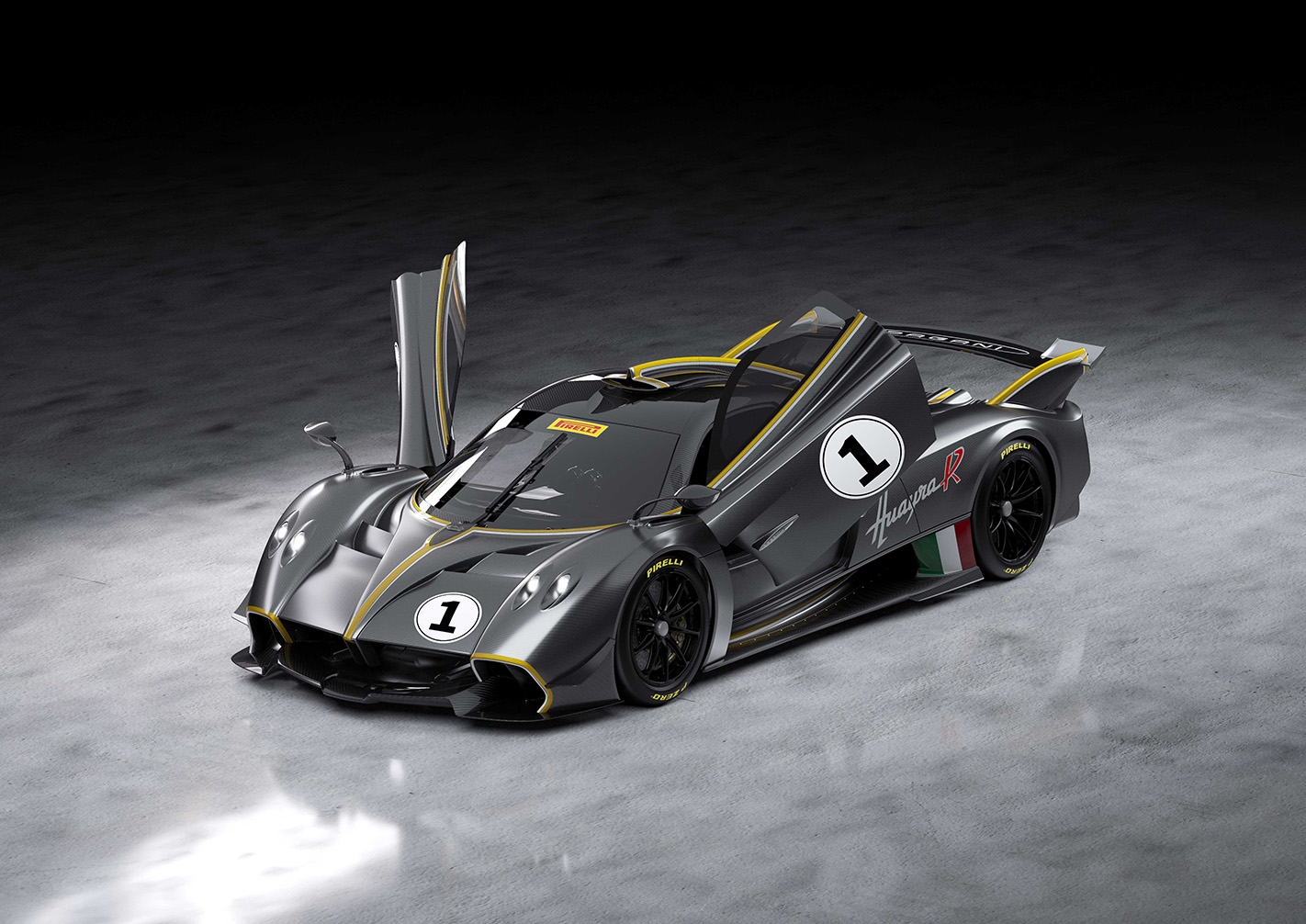
Instead of bemoaning the trend, Mr Pagani went and built a track-only weapon that lives up to his lofty expectations – the bonkers 615kW Pagani Huayra R.
Limited to 30 examples worldwide, the Huayra R takes on where the ridiculous Zonda R left off in 2008 and promises to be “the most extreme and performance-oriented Pagani of all time” according to Horacio Pagani.
Answering to no regulations, the Huayra R is far more than a technical case study; but a romantic ode to internal combustion performance inspired by historic racing greats of yore.
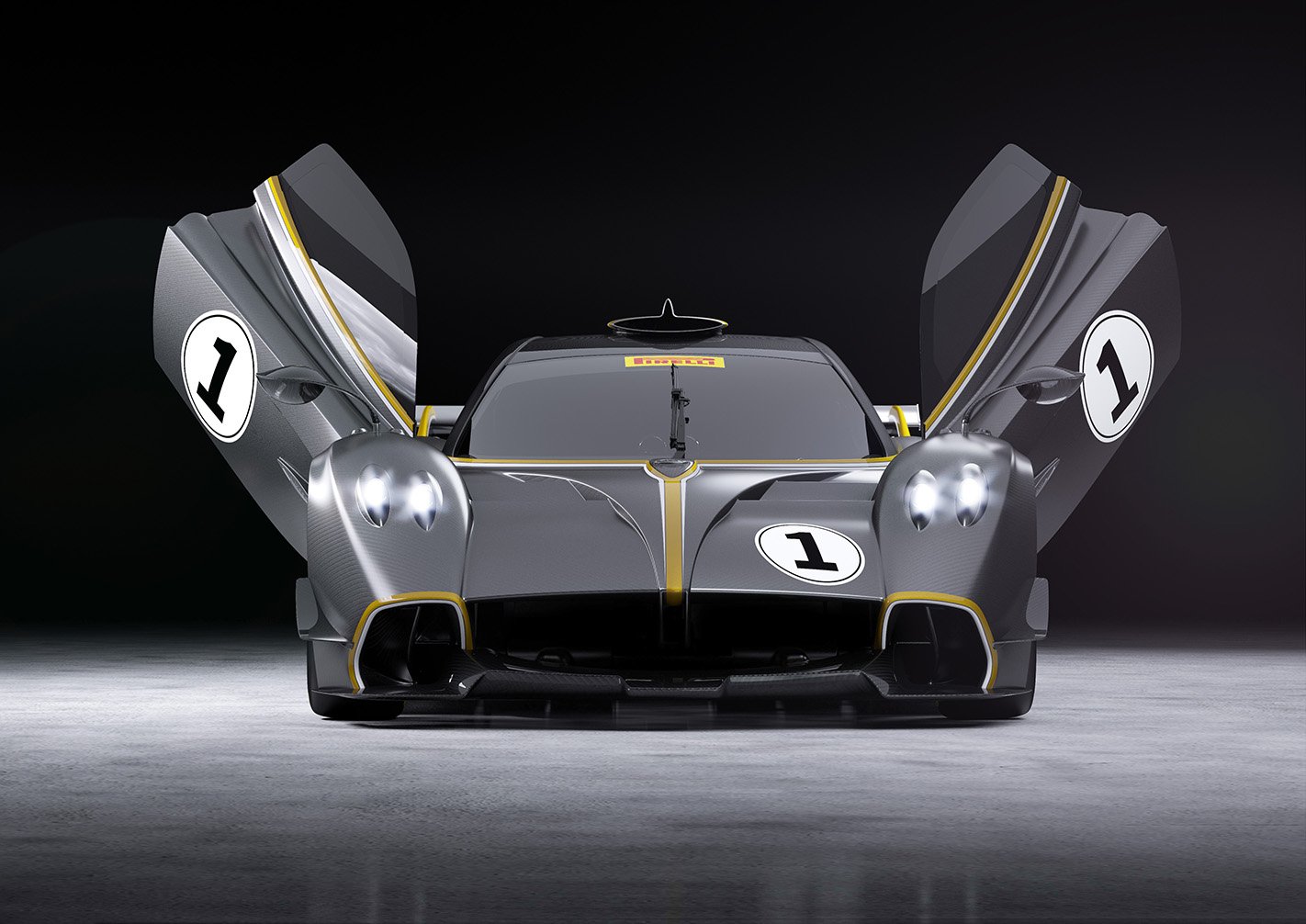
The centrepiece is undoubtedly its engine: a free-breathing naturally-aspirated 6.0-litre V12 sourced from Daimler’s HWA AG. The engine will be largely familiar to Pagani fans, however Pagani says it has undergone a significant redesign.
The figures are astounding: 615kW at 8250rpm (with a heady 9000rpm redline), 750Nm of torque deployed between 5500-8300rpm. The whole engine package weighs just 198kg and is attached to the central monocoque as a structural element, suspended by chrome-moly alloy steel subframes.
A bespoke exhaust system minimises back pressure and maximises power delivery. Ceramic coated for superior heat dissipation, the exhaust system’s equal-length construction gives the Huayra R an absolutely sonorous set of vocal chords and almost sounds reminiscent of a vintage F1 car– as seen in Pagani’s Instagram teaser.
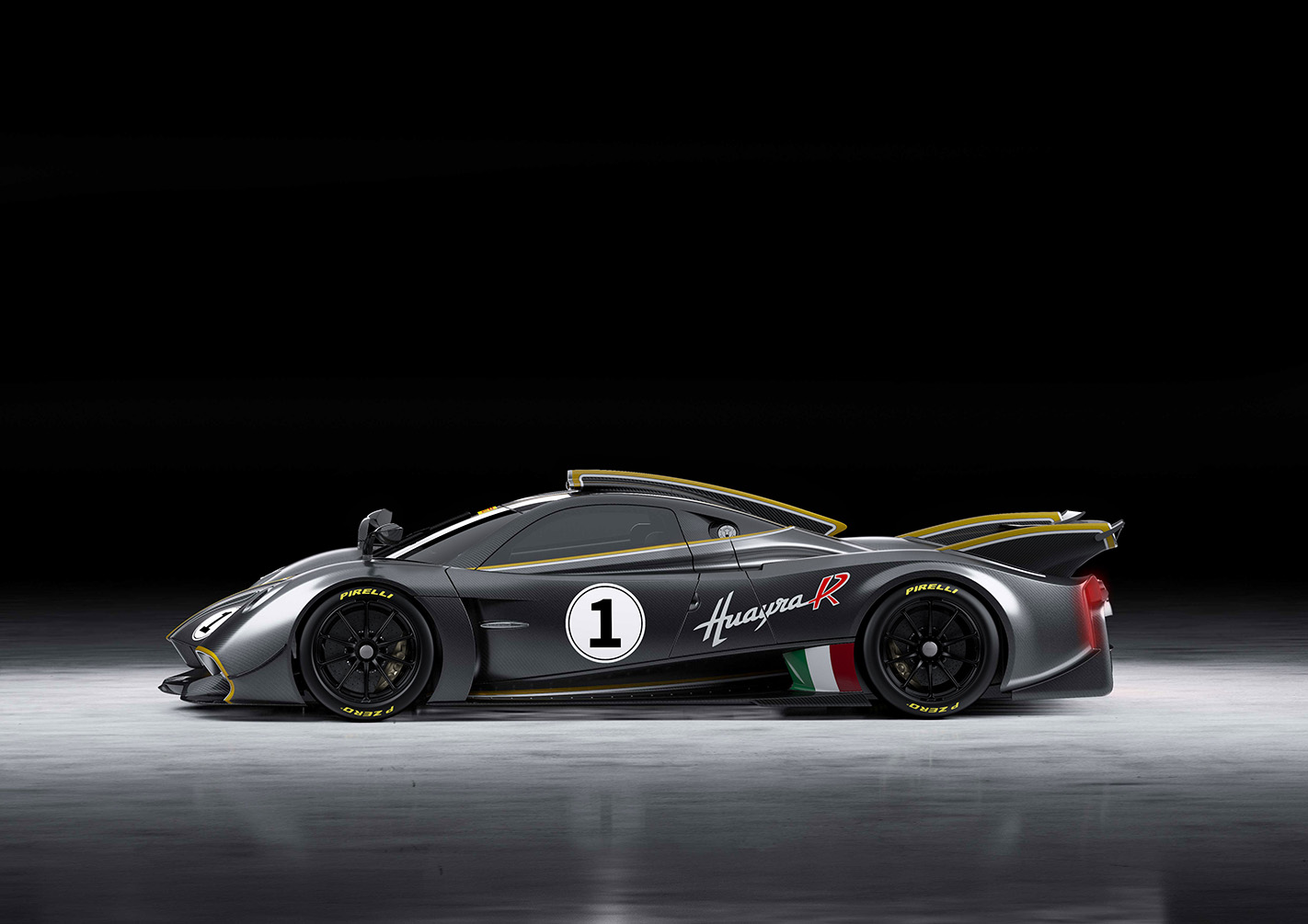
The new six-speed sequential transmission also forms part of the structurally-integrated rear section, and is a totally new construction designed in collaboration with Affalterbach’s HWA AG. In the name of unabated performance: the dog-box transmission houses a non-synchronised gearset matched to a four-plate racing clutch, which equates to 95 per cent friction efficiency, maximising shift precision and minimising shift times.The whole gearbox weighs just 80kg and ties in to the chassis and suspension system to maximise architectural efficiency.
While the engineers at Affalterbach were pouring over the engine and gearbox, Horacio had his focuses set on arguably the Huayra R’s most commanding aspect, its styling.
Horacio had high hopes for the car’s aerodynamic principles, and targeted 1000kg of downforce at 320km/h. Every line and surface of the reworked racer was laid with intent to generate maximum aerodynamic load. Horacio’s targets were met swiftly, achieving a near perfectly balanced 46:54 downforce distribution throughout the entire speed envelope. However, man whose name is on the wall couldn’t give his final approval as he sought a more captivating and emotive aesthetic.
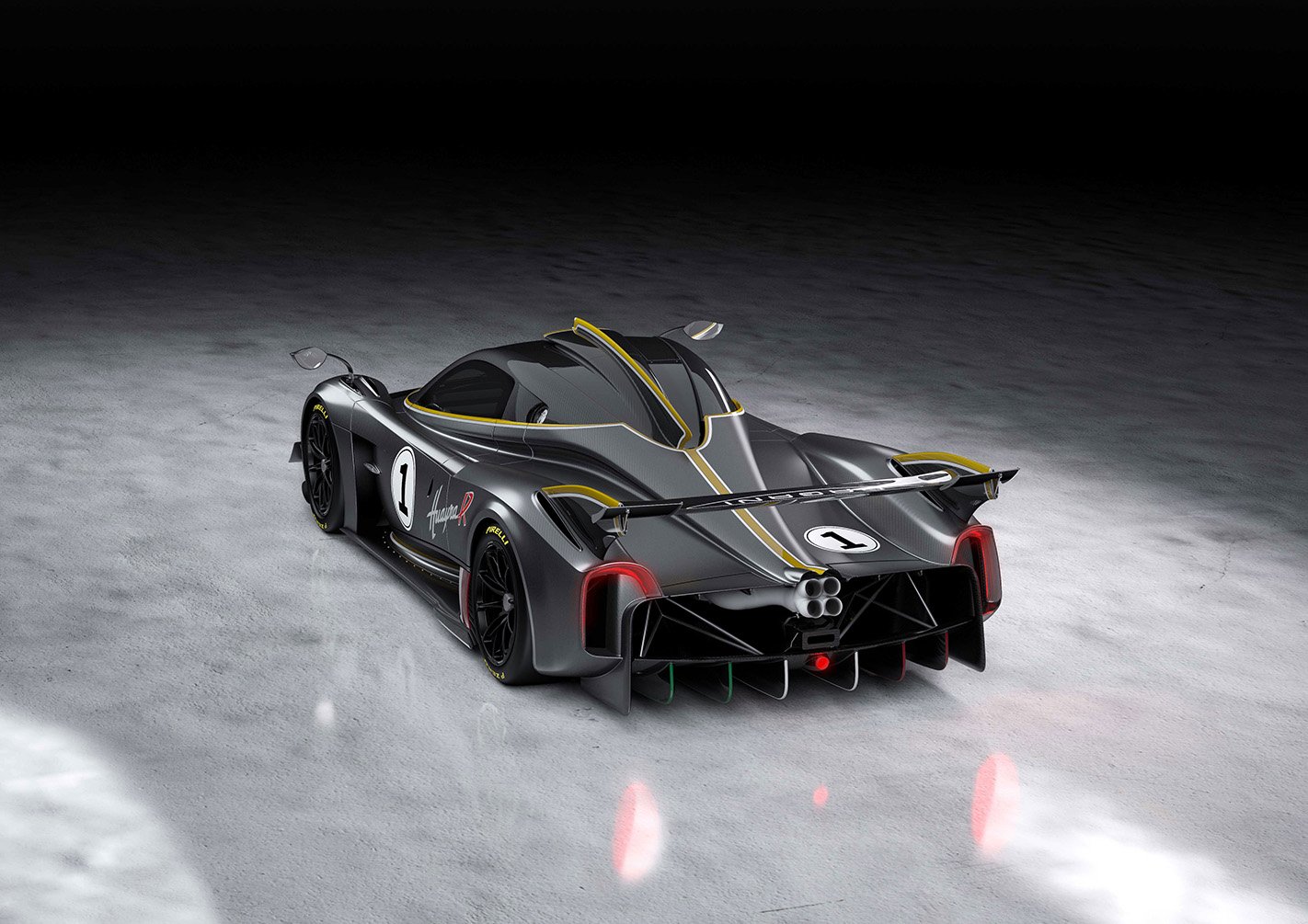
It was Pagani’s admiration of vintage racecars which fuelled his quest for beauty. He believes that today’s racecars are a “product of the wind tunnel”, but was inspired by cars from the 60s and 70s where “the cars were very fast, certainly dangerous, but beautiful”. Mr. Pagani cites the Ferrari P4, the Ford GT40 and – his personal favourite – the Porsche 917 as his design muses.
Visual impact is a punch to the gut, with two new side intakes at the front to assist with front brake cooling efficiency, as well as channelling air to the rear apparatus’. New wing profiles were fitted to the bonnet to improve air extraction and front-end stability while a roof scoop feeds air to the engine. A flat-bottom floor works in unison with the sizeable rear diffuser and wing to keep the Huayra R sucked to the ground.
The Huayra R benefits from a new monocoque tub, comprising of Carbo-Titanium and Carbo-Triax composites with occupant seats fully integrated into the floor. When matched with the rear powertrain assembly, the new Huayra R claims a 51 per cent improvement to flex rigidity and a 15 per cent increase in torsional rigidity over the standard road-going Huayra. Fully assembled, the Huayra R boasts a dry weight of just 1050kgs, some 230kgs trimmer than the full-fat road car.
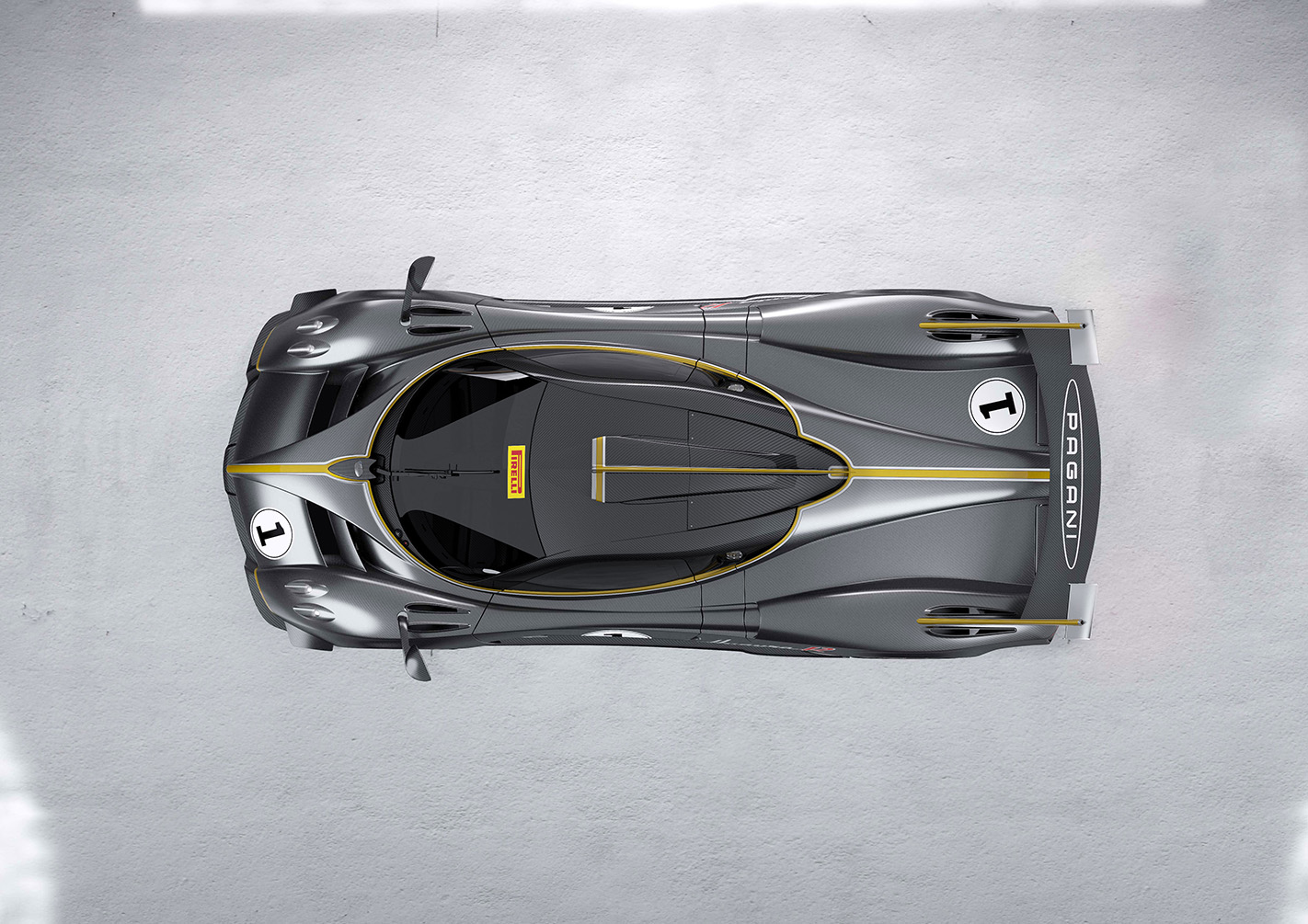
In comparison to Gordon Murray’s T.50s Niki Lauda Edition, the Huayra R outguns Murray’s creation by 93kW, but yields 198kgs to the ballistic Brit.
Pirelli comes to the party with a newly developed slick version of its popular P Zero and will be available in both wet and dry versions, whilst Brembo carbon-ceramic brakes and revised suspension aid dynamic precision.
Inside the cabin, the driver won’t be greeted by swathes of supple leather; but instead a bare bones race setting with a comprehensive roll cage, bespoke AP racing pedal box and a quick-release steering wheel which features all the essential settings for traction control, ABS map selection, radio communication and other functions. Rest assured, every bolt, screw and fitting will be finished to the utmost standard expected of Pagani.
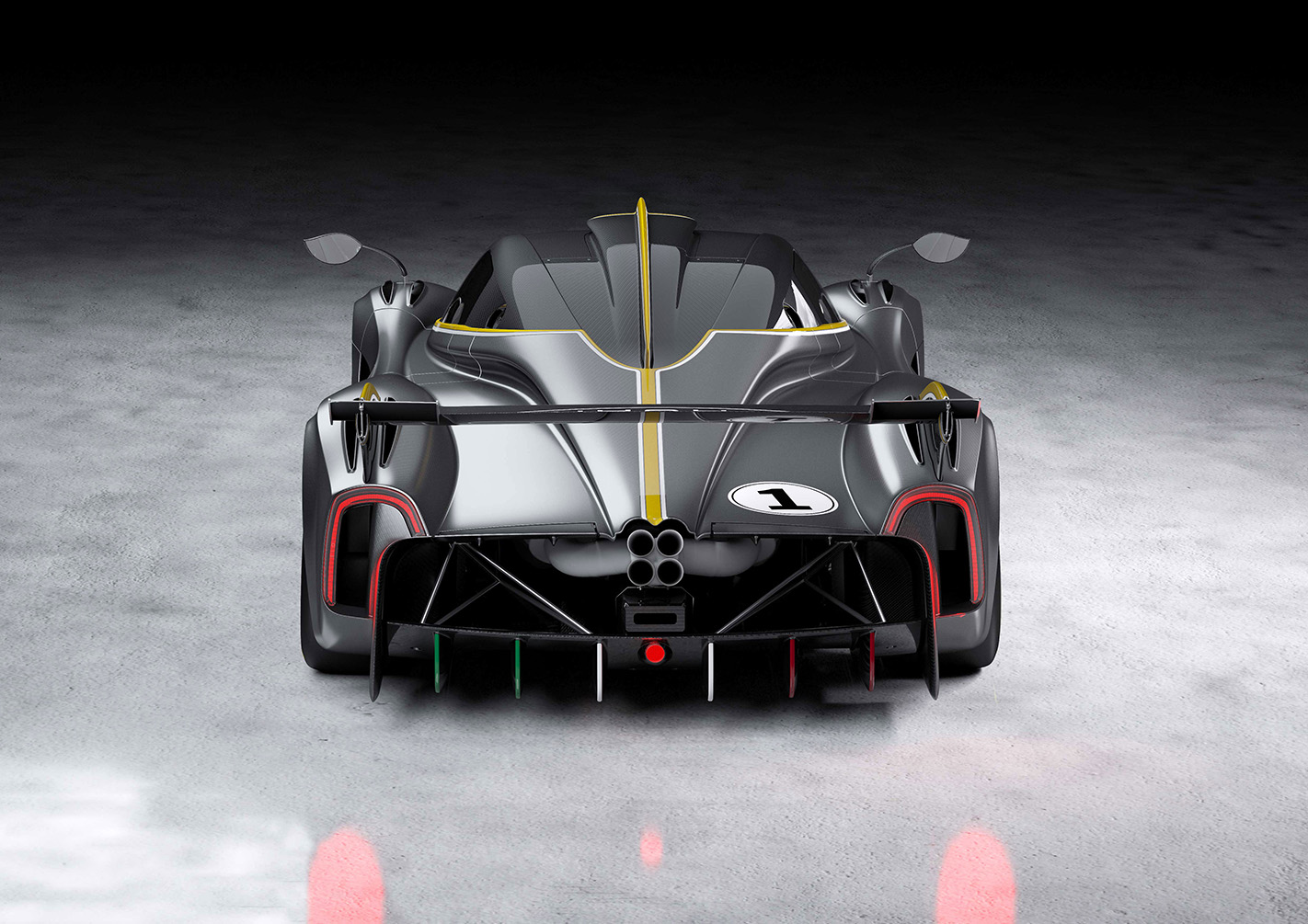
With the Huayra R, Pagani too debuts a new experiential program for its exclusive family of customers. In similar ethos to the globetrotting ‘Pagani Reduno’ grand tour, Pagani’s new “Arte in Pista” program invites Pagani customers to participate in a full calendar of track events with dedicated assistance from the Pagani team and the support of professional drivers. The program promises tailor-made track events for customers in North America, Europe, Asia and the Middle East but the buy-in certainly isn’t cheap.
Pagani Automobili asserts that the base price for the Huayra R begins at €2.6 million Euros, which equates to an eye-watering AU$4 million and that’s before you factor in nearly $1.2 million of luxury car tax, plus a few hundred thousand for stamp duty.
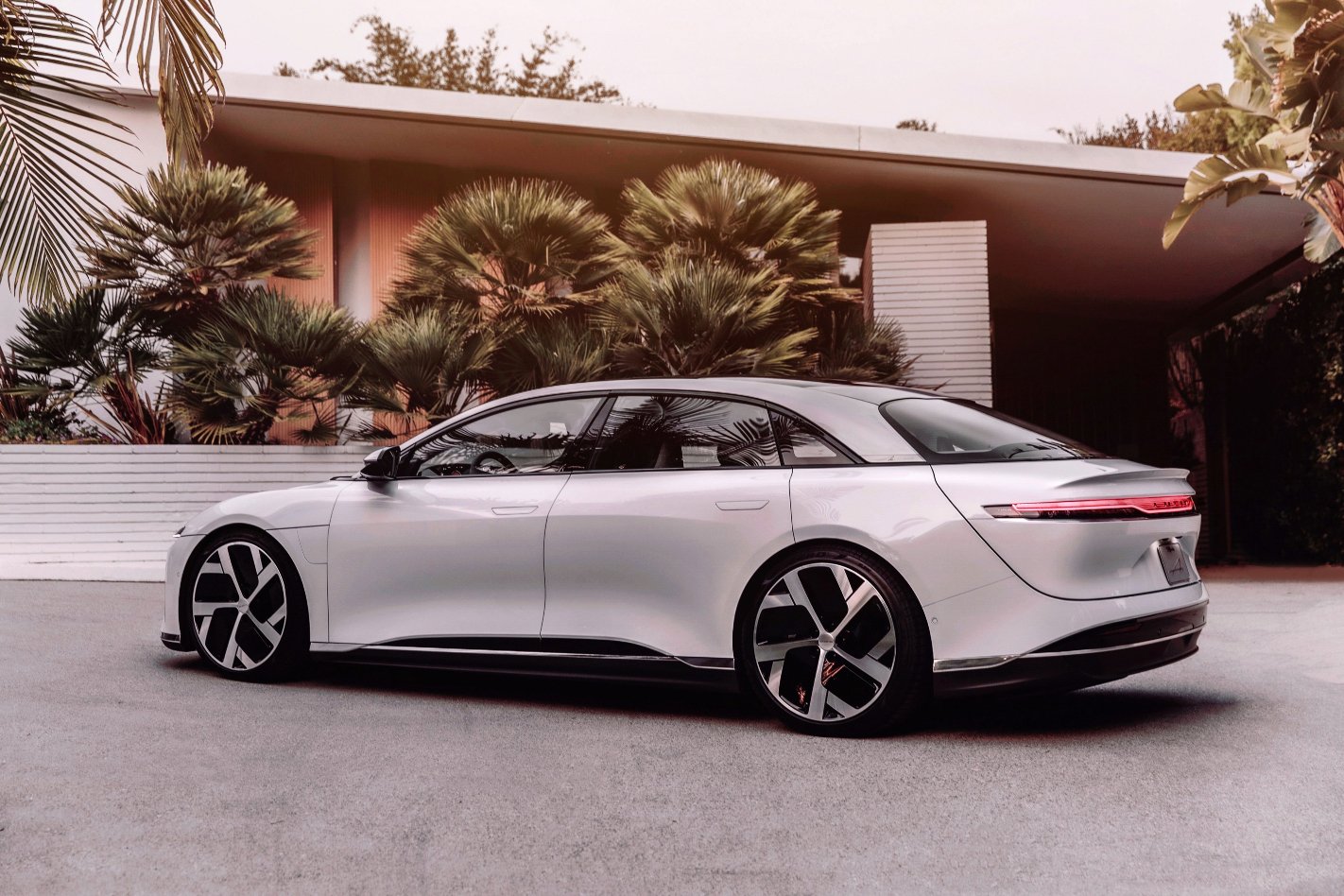
One of the newest automakers to enter the electric vehicle fray, Lucid Motors, is nearing the completion of its inaugural luxury passenger car.
Dubbed the ‘Air’, the big sedan will go head-to-head with Tesla’s Model S and the impressive new Porsche Taycan, with production expected to begin at the company’s Casa Grande manufacturing facility in the latter half of this year.
With four different models on offer from launch, and with power rated from 360kW to 805kW depending on the model, the Air has potential to be a real dark horse in the segment.
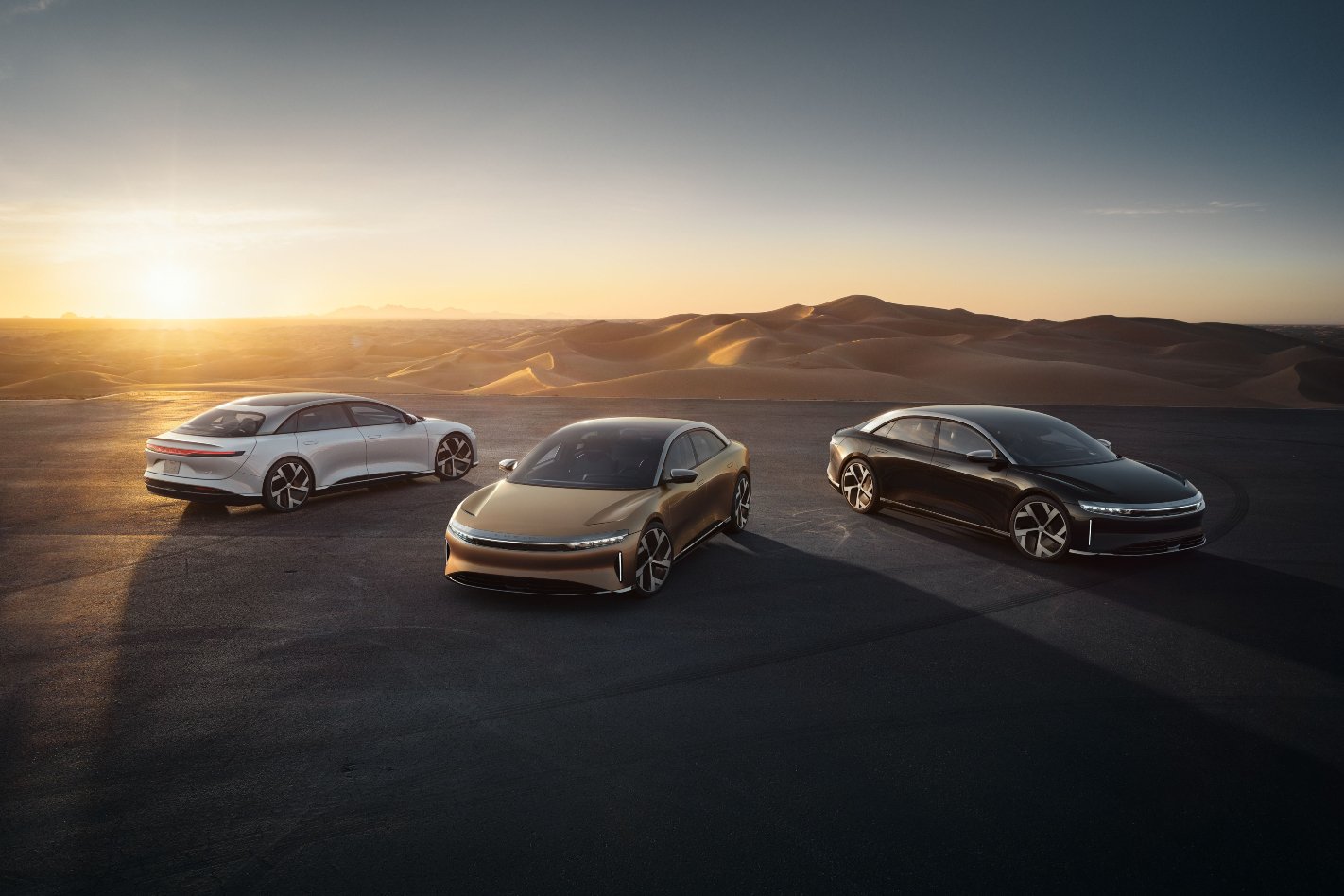
Lucid itself has emerged as a genuine competitor in what is fast becoming a busy sector of the automotive market, and it employs some very experienced industry professionals.
One such individual is the company’s CEO and CTO, Peter Rawlinson. The British engineer has a profound CV in the automotive world, previously working as a principal engineer at Jaguar and a chief engineer at Lotus.
More recently, Rawlinson worked at Tesla, where he was the vice president of vehicle engineering and chief engineer of the Tesla Model S.
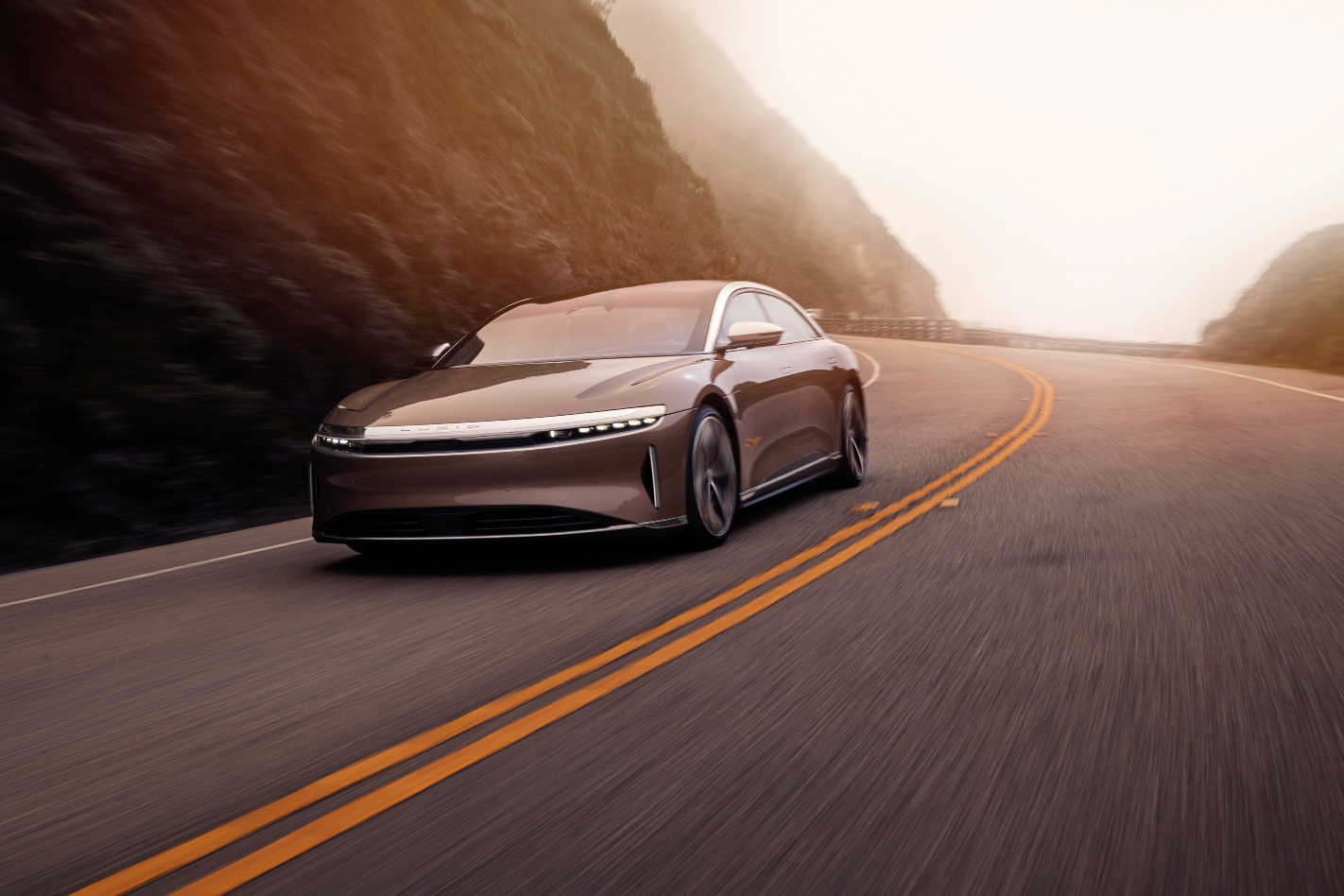
The man’s got some real chops in the game – he’s a CEO that would undoubtedly know what he’s talking about.
So, when Lucid published a video on its YouTube channel of Rawlinson assessing a near production-ready or “release candidate” version of its Air sedan, it represented a fascinating chance to hear his critique of the new company car.
Or at least it should have, if the review wasn’t overwhelmingly positive and filled with platitudes like “it’s (the Air) taking it to a whole new level”, “this car’s as much as sports car as a sedan” and “it’s unlike anything I’ve ever driven”.
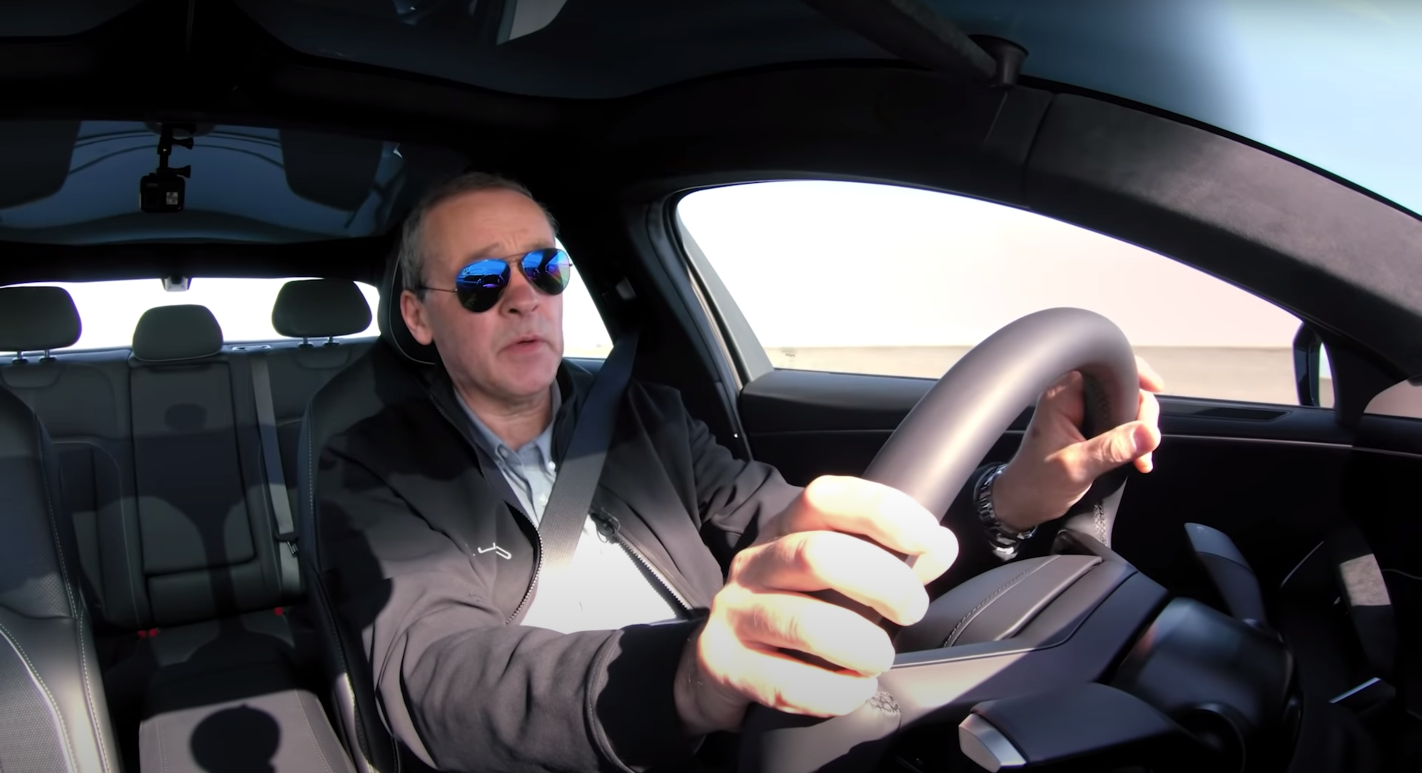
That’s not to say Rawlinson didn’t have a few criticisms of the Air – he didn’t think the hill-hold calibration was perfect, and thought more could be done for the torque delivery when getting away from a set of traffic lights.
He also gave a small amount of insightful feedback about the car’s steering, which he would know a lot about, given Lotus’ attention to detail when it comes to interacting with the front axle.
If you’re new to the Toyota Corolla ZR, there’s a chance you’ve got one of two preconceptions about this version of the most popular of hatchbacks.
The first could be that you’ve been to Toyota’s website and seen phrases such as “turn up the fun” and “takes performance to new levels,” and therefore expect a hot hatch.
The other is that, like many misinformed enthusiasts, you believe the Toyota Corolla to be something of an appliance on wheels, a car built merely to get somewhere and with no thought to driving dynamics.
Thankfully, and perhaps part of the reason for the Corolla’s continued dominance as the most popular car in the world, neither of these is true.
Toyota’s current 11th generation Corolla, first introduced in 2018, has in the company’s own words “ushered in a new era for Toyota’s venerable small car”. And it’s not wrong.
RELATED READING
Looking for more details on the wider Corolla range? Our full range review has everything you need to know.
Using the same Toyota New Global Architecture (TNGA) platform as most of Toyota’s current range, including its much-lauded GR Yaris hot hatch, the Corolla is designed to be able to be driven in just about any manner the driver chooses.
This isn’t to say it’s a sports car, but there is plenty to like about it. In ZR specification, the top badge for the current range, the Corolla is comparatively crammed with features and conveniences the brand hopes will lure buyers to its $32,695 (plus on-roads) asking price.
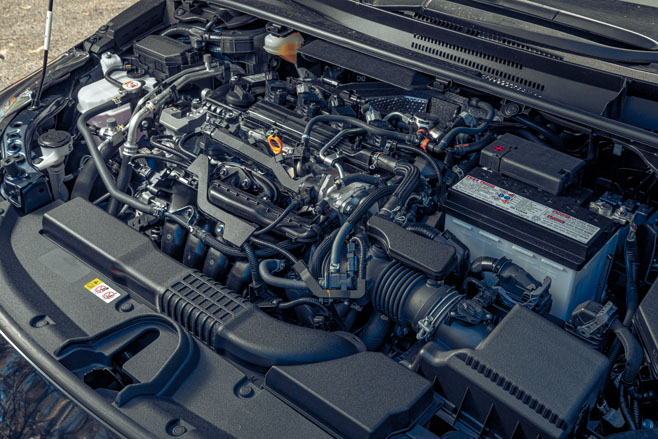
The version we’re reviewing here has Toyota’s 2.0-litre naturally aspirated four-cylinder engine, with 125kW and 200Nm at its disposal. The engine is also available in Ascent Sport and SX models, delivering the same outputs across the range. Another $2000 on the ZR’s price gets you a hybrid drivetrain. In the ZR, the engine is mated to a CVT transmission with a single traditional gear for launching before the CVT takes over. A six-speed manual gearbox is only available in the Ascent Sport base model.
Setting Melbourne as an example city with Toyota’s pricing calculator reveals the more accurate driveaway starting price as $36,916, which includes Toyota’s standard five-year warranty. If you hope to sell a Corolla after a couple of years, the good news is that the Corolla benefits from a solid reputation and won’t lose much value – many are still asking for more than $25,000-$30,000 in decent condition. The downside for used sellers? That there are so many available.
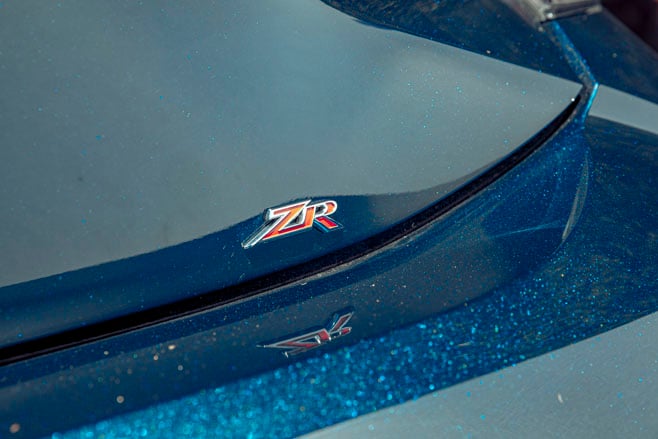
Toyota also allows buyers to see the prices of servicing in advance, with the first several intervals costing $180 each for the Corolla ZR, until the 90,000km service that jumps to $793 due to it involving the inspection and tightening of nuts and bolts on the car’s body and chassis. Prices then vary between $250 and $800.
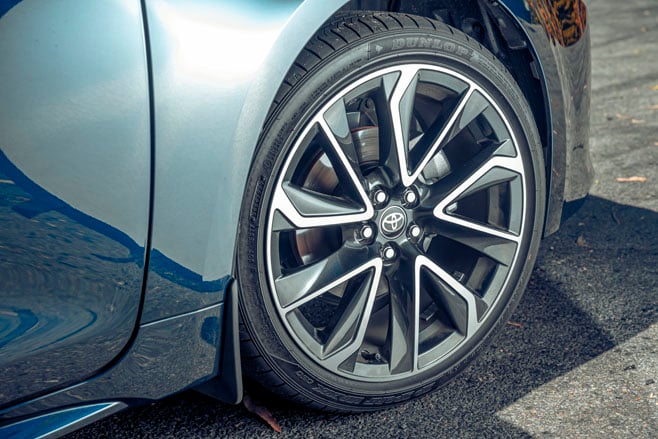
For the Corolla’s asking price, there’s a fair list of standard equipment to be had. On the ZR, one of the most immediately obvious additions is its 18-inch alloy wheels, rather than the smaller 16s on Ascent and SX trims. From the outside you can also note the chrome-look trim around the side windows, front bar, and exhaust exits, which is just black plastic on the lower Ascent Sport and SX variants.
Overall, the exterior steps away from the sometimes-dowdy looks previous Corollas have served up, leaning into a more stylish and sporting design. That theme continues for at least parts of the ZR’s interior, where the top-spec variant gets a pair of leather-appointed, sports-oriented bucket seats with a suitable balance between comfort and bolstering.
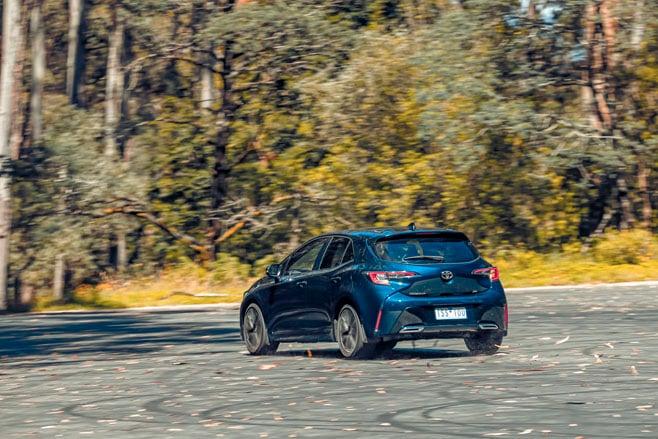
While the interior feels generally upmarket thanks to features like its head-up display, eight-speaker JBL sound system (which sounds decidedly better than most basic systems) and its larger 7-inch display (all exclusive to the ZR), it’s still relatively modest in terms of visual flair. The leather on the seats can be had in red for a little more visual zing.
For the phone-dependent, the ZR keeps the wireless phone charger pad that’s also available in the lower SX spec, while Android Auto and Apple CarPlay are both now available across the Corolla range. Phone mirroring wasn’t available when the current-gen Corolla launched, much to the frustration of many.
One thing the Corolla did get when it launched, however, was a five-star safety rating from ANCAP, helped by its suite of driver-assist tech including active cruise control, lane assist, pre-collision system, auto high-beam, and a road-sign detection system that keeps the driver aware of the speed limit.
While these elements, and the fact the Corolla is a very easy car to drive, are all decidedly set on keeping a driver out of trouble, it also has seven airbags just in case, standard across the Corolla family.
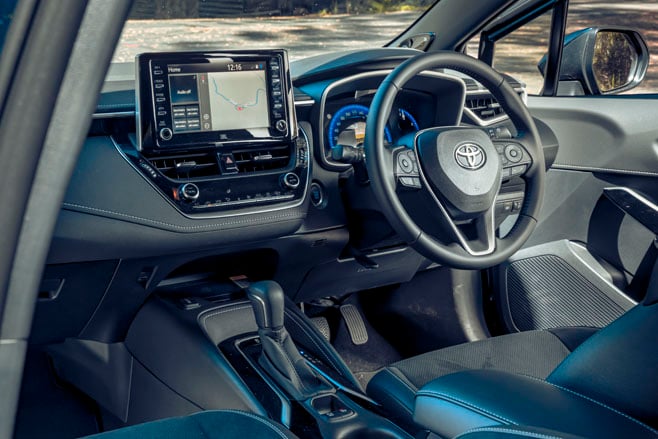
How it feels to actually sit in the Corolla ZR is harder to convey with words than a list of features, but it’s a pleasant surprise to feel so comfortable and ‘in sync’ with the car in terms of its driving position and ergonomics. It’s clear that Toyota’s designers and engineers know this car needs to be incredibly easy to use and drive.
The seat itself is positioned for comfort and ease of access to the features that are likely to be used regularly, the touchscreen is within reach and the gear selector sits comfortably positioned for use in a relatively neutral posture.
The steering wheel is also sufficiently adjustable and fits nicely in the hands, being well-shaped for a 9-and-3 position with the wheel buttons easy to reach with your thumbs.
It’s got plenty of useful, albeit pretty standard features at the driver’s disposal. The two centre cupholders, however, are a little awkward to reach and sit in a spot at risk of elbow bumps. Storage spaces are a little small too. The console storage bin isn’t much bigger than a couple of cans of drink, and the glovebox sits a little awkwardly under the dash.
We’d like to say there’s at least plenty of storage in the boot, but there isn’t. The Corolla’s boot is a comically small 217 litres, due in part to its spare wheel under the boot floor. Compare this to rivals, like the 295 litres in the Mazda 3, or a cavernous 395 litres in the Hyundai i30, and the Corolla’s boot is put into perspective. On the upside, front occupants can fit a couple of 600ml bottles in each door.
In the rear seat, storage is once again lacking. Rear passengers get cupholders in the door armrests and document holders behind the front seats, but the seating positions allow for relatively tall adults to be comfortable with decent headroom and kneeroom. The rear does look a little more cramped than it really is, which we’re chalking up to the lack of light due to privacy glass, and the rising rear window line.
One aspect of the Corolla, as well as its showroom stablemates, that we feel Toyota could still work on is its infotainment system. While the physical touchscreen is fine and the addition of smartphone mirroring means it’s likely not a dealbreaker for most, the system is still a little awkward to use and comes across as dated. It feels like something the largest carmaker in the world could benefit from a little investment into updating.
A much smaller frustration that Toyota has overlooked here is the HVAC controls. Or at least, their design. The climate settings are all in a row of 10 buttons for things like temperature and fan speed, but the icons that display which of the near-identical buttons does what are on a gloss black panel which reflects light easily, meaning it becomes a struggle to see what you’re changing. Potentially quite distracting.
With those small issues considered, the Corolla is still above average in its class for comfort and usability, though the mechanicals and driving dynamics of the car leave even more to be discussed and dissected. Let’s start with the engine. While the functionality of the engine is hard to fault, its 125kW is behind the curve for a car that claims to make driving fun, and its characteristics when paired with the CVT gearbox leave much to be desired when driving spiritedly.
The launch gear in the CVT helps smooth out what would otherwise be slightly rough take-offs, but the gearbox takes some nudging to get enthusiastic, and the engine can sound a little overworked when it’s being pushed.
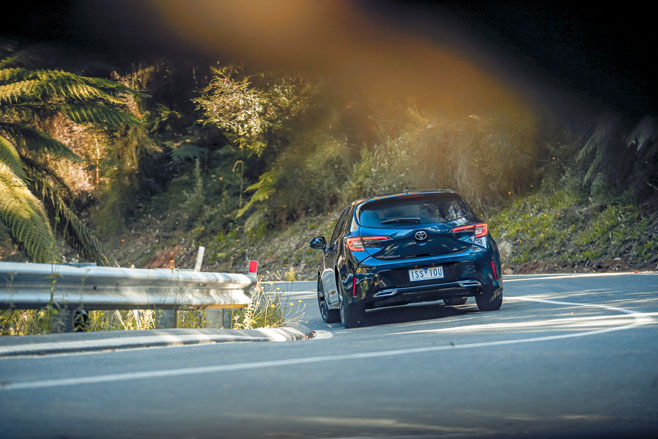
Thankfully, the chassis is brilliant, benefitting from the TNGA platform this car is built on. Toyota’s engineers have made the car easy and responsive to steer while allowing feedback to the driver without sacrificing comfort. The car is able to turn into corners or, if needed, swerve quite adeptly, and has also been granted an understeer prevention system that uses the brakes to keep the Corolla on your chosen cornering line.
It’s not quite sharp to the point of being a ‘hot hatch’, or even warm, given the drivetrain isn’t eager enough to really push the chassis to its limits, but there’s talent there that an enthusiastic driver could have plenty of fun with.
And that seems to describe the Corolla well – a car that does just about everything well, but probably won’t blow your mind day-to-day. With the benefits the current, TNGA-based Corolla has under its belt, plus the comforts of the ZR, its approximate driveaway price doesn’t feel unreasonable.
It’s not hard to see why the Corolla is the most popular car in the world, with such broad appeal, value, and competence at its disposal.
7.5/10
Pros: Stylish exterior; ownership costs; capable and comfortable to drive Cons: Drivetrain feels underpowered; some interior parts (eg. infotainment) feel dated
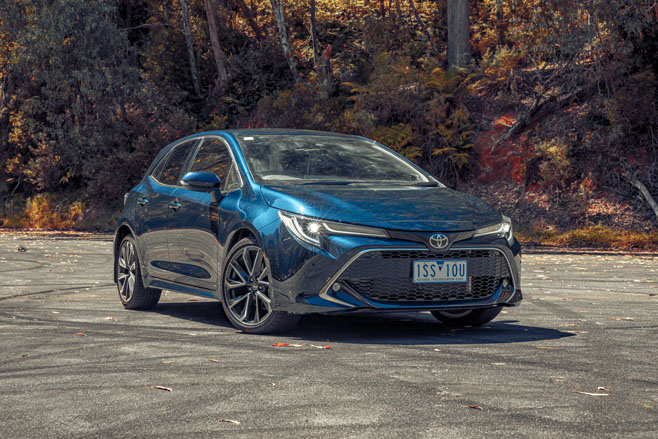
2021 Toyota Corolla ZR hatch specs
Body: 5-door, 5-seat hatch Drive: front-wheel Engine: 1987cc I4, DOHC, 16v Bore/stroke: 80.5 x 97.62mm Compression: 13.0:1 Power: 125kW @ 6600rpm Torque: 200Nm @ 4400rpm – 8400rpm 0-100km/h: 9.6sec (tested 05/19) Fuel consumption: 6.0L/100km (combined/claimed) Weight: 1360kg Power/weight: 92kW/tonne Transmission: CVT with launch gear Suspension: MacPherson struts, anti-roll bar (f); Multi-link, anti-roll bar (r) L/W/H: 4375/1790/1435mm Wheelbase: 2640mm Tracks: 1530mm (f/r) Steering: Electrically assisted rack-and-pinion Brakes: 283mm ventilated discs, 4-piston calipers (f); 265mm solid discs, 2-piston calipers (r) Wheels: 18 x 8-inch (f/r) Tyres: 225/40R18 (f/r) Dunlop SP Sport Maxx 050 Price: $32,695
RELATED READING
Looking for more details on the wider Corolla range? Our full range review has everything you need to know.
Audi will no longer invest in research and development of new internal combustion engines (ICE), the company’s CEO Markus Duesmann has stated.
Speaking to German news outlet Automobilewoche, Duesmann said (roughly translated) “The EU plans for an even stricter Euro 7 emissions standard are technically a huge challenge with little benefit for the environment at the same time. This extremely restricts the combustion engine.”
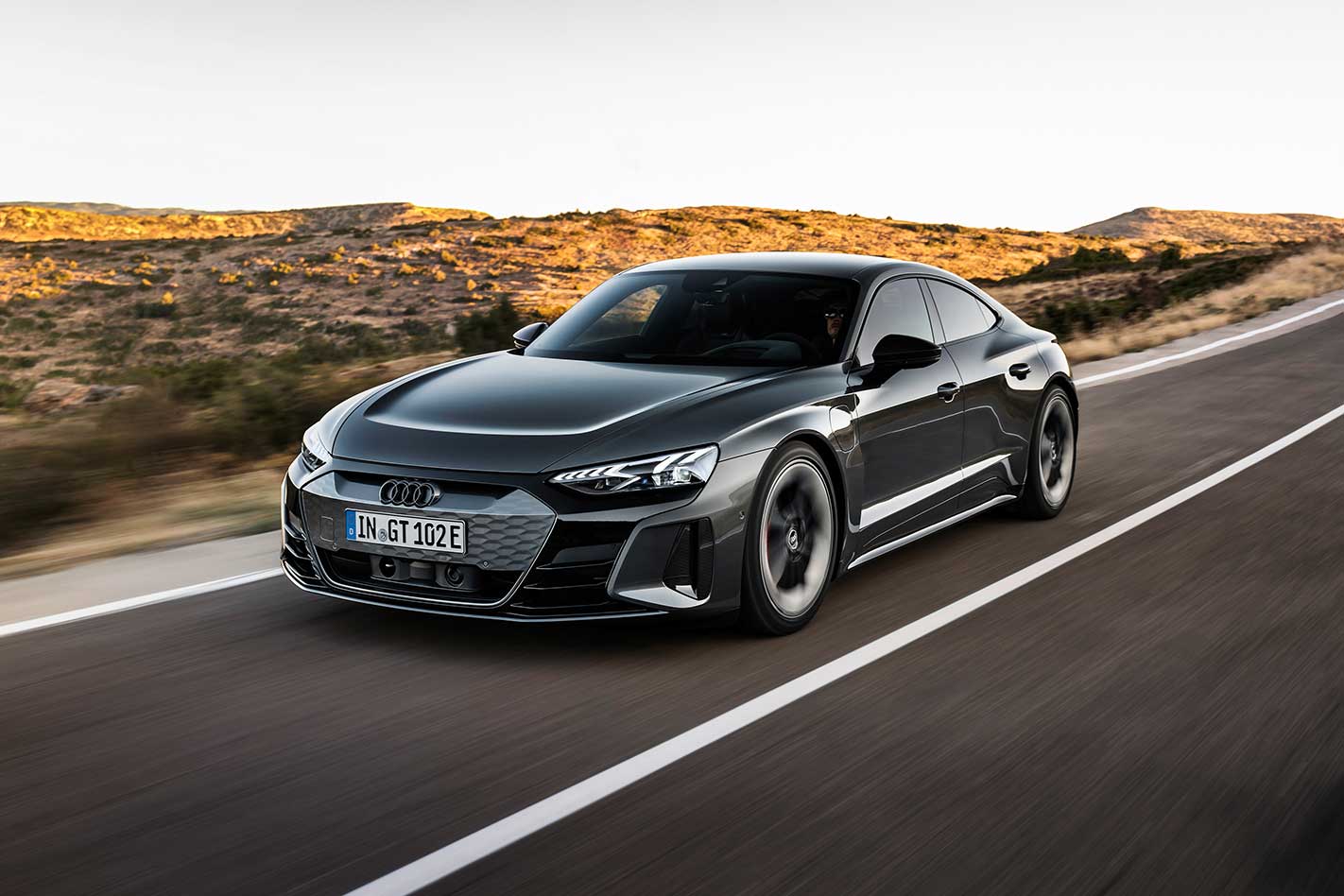
Audi confirmed it “will no longer develop a new internal combustion engine, but will adapt our existing internal combustion engines to new emission guidelines.”
While no new engines will see new R&D, its current line of petrol and diesel powerplants will still see regular updates until Audi presumably commits to an all-electric strategy.
Without providing a timeline to incorporate the change, Audi has previously committed to offering 20 new electric models by 2025.
Even before the premium German marque goes full EV, it can already count itself as one of the most invested brands when it comes to electric vehicle offerings. Its run of e-Tron models such as the e-Tron SUV and the newly-announced e-Tron GT spearhead the brand’s shift to electrification, while it also sells plug-in hybrid and mild-hybrid petrol engines.
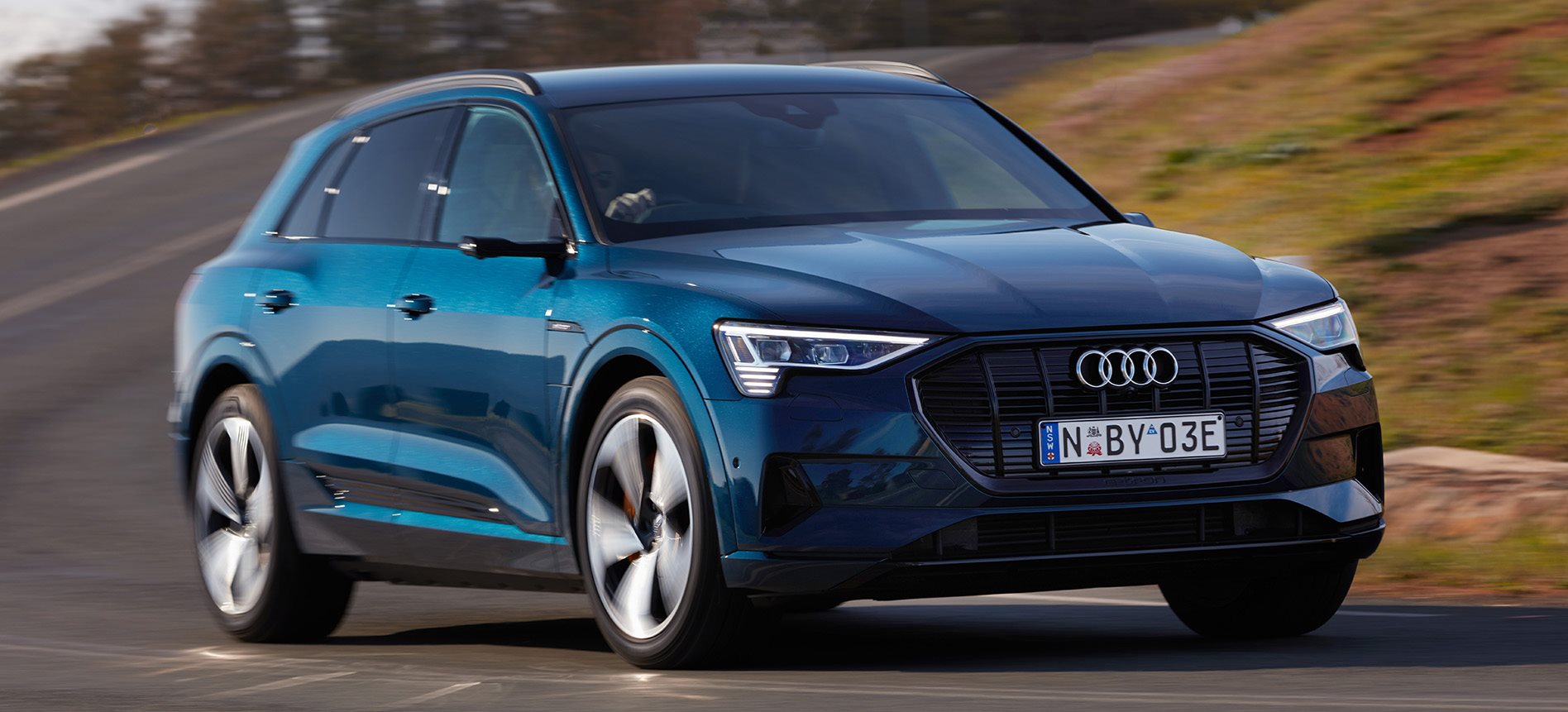
Audi’s announcement that it is stopping ICE development comes shortly after rivals including Volvo, Jaguar and Bentley all announced their intentions to go all-electric by 2030.
It was to be expected, but the numbers the Porsche 911 Turbo S spat out of the VBox in a straight line had the MOTOR team stunned.
From a standstill the twin-turbocharged beast will dispatch 100km/h in 2.58 seconds, 200km/h in 8.46 seconds, while the quarter mile is travelled in 10.28 seconds at a stonking 217km/h. Phwoar.
That makes the 992-gen Turbo S the quickest and fastest car MOTOR has performance tested in a straight line, by a comfortable margin.
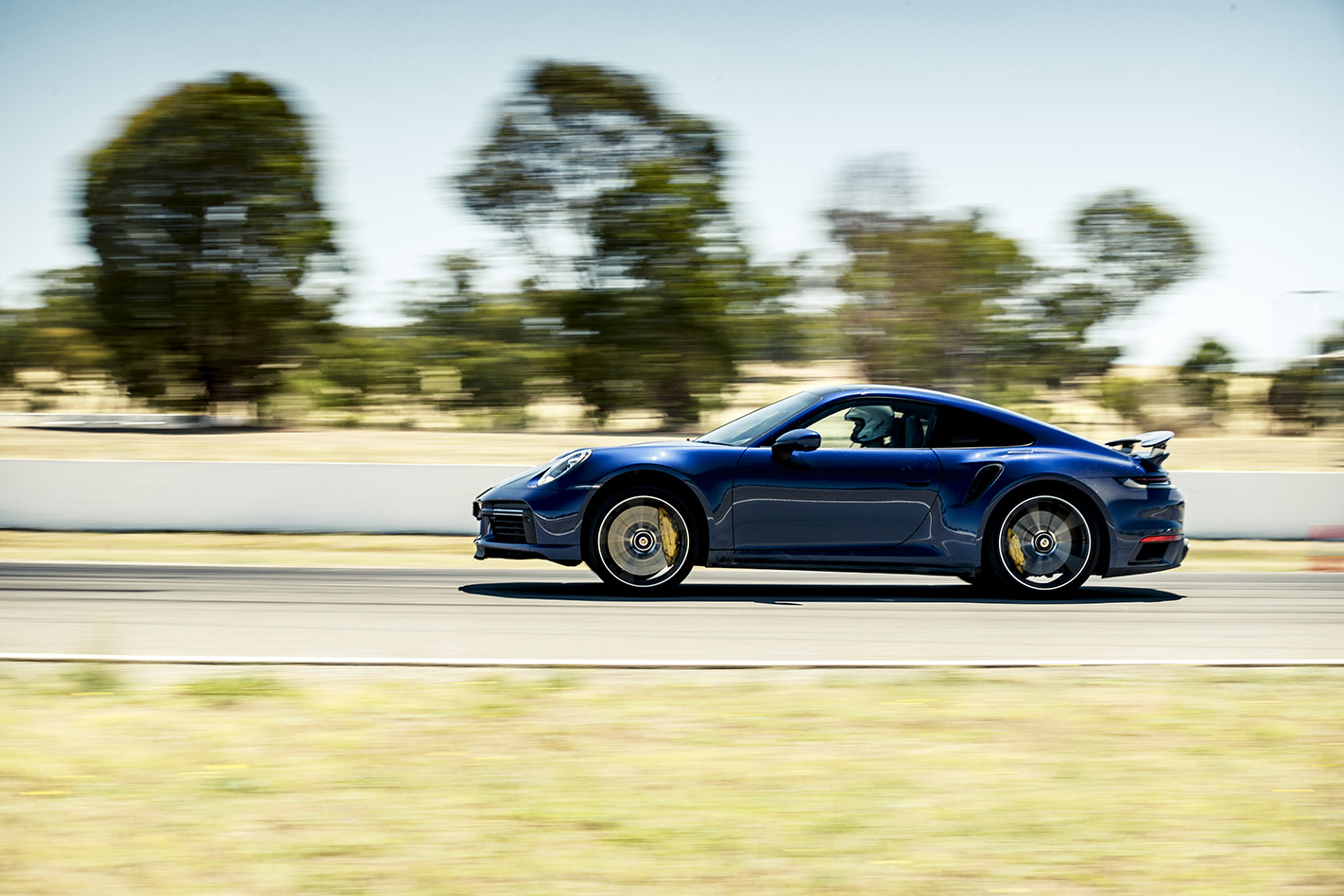
But how does that translate to on track performance? We put the Turbo S through its paces at Winton as part of the MOTOR Shootout to find out.
There is a high bar to clear, with the Mercedes-AMG GT R Pro the current leader with a benchmark time of 1:29.3
However, the Turbo has a 48kW and 100Nm power advantage over the Pro, an extra pair of driven wheels, and only 8kg of additional heft. This should be a good fight!
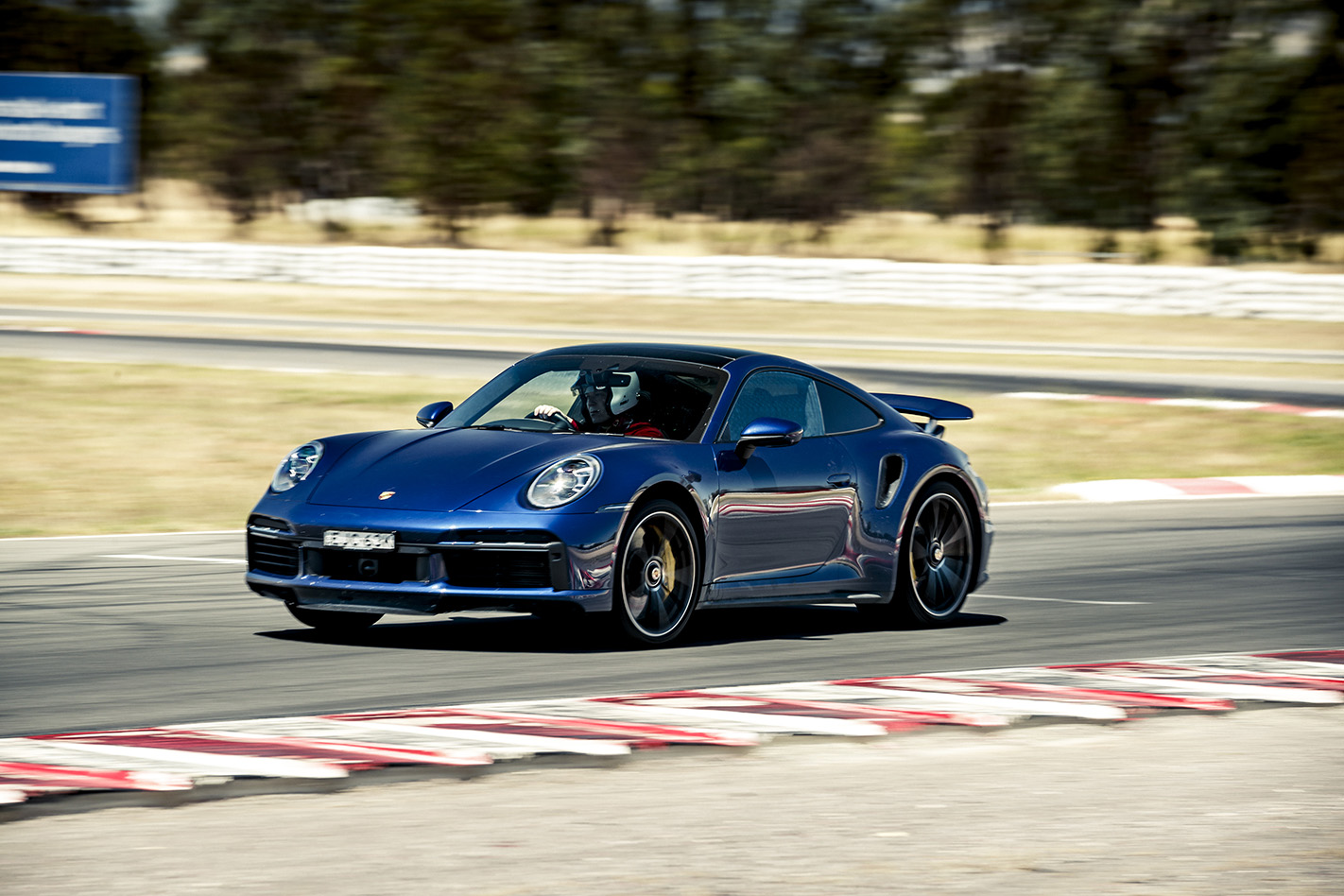
With race ace Karl Reindler in the hot seat, the 911 Turbo S was able to lap Winton’s technical 3.0km layout in 1:30.1.
That time makes it the third quickest car we’ve timed around Winton, behind the Mercedes-AMG GT R Pro, and Nissan GT-R Nismo – talk about fast company.
“It is absurdly fast in a straight line. It does everything right and it’s very hard to criticise,” Reindler said following his hot laps.
“But I just feel like the GT R Pro is just that one step closer to being a race car effectively.
“And look, honestly, that’s the only difference between the two; this thing’s incredibly comfortable, it just moves around a little bit more. That could be tyre related, I’m not too sure.
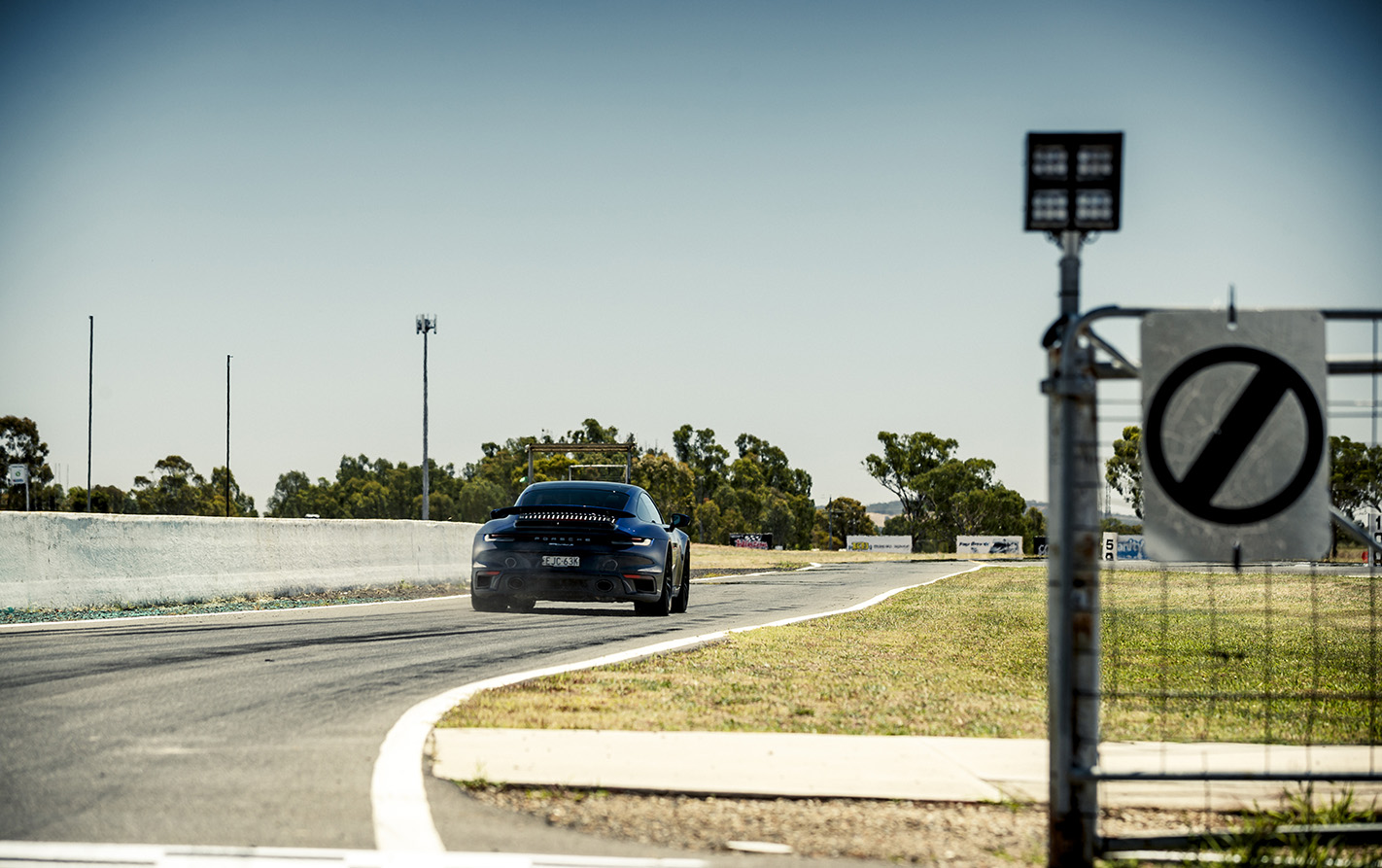
“But it’s close to perfect, this car. It takes your breath away when you hit the loud pedal for the first time out of the pits. It’s an acceleration I haven’t felt in a very long time, from a road car certainly.
“It’s obviously got the complete package, full of refinement as you’d expect from any car that comes out of the Porsche factory.
“It couldn’t quite pip that GT R Pro as far as lap time, but I’m really still stoked and pleased with the outcome of the Turbo S.
“Seriously potent car, I love it”.
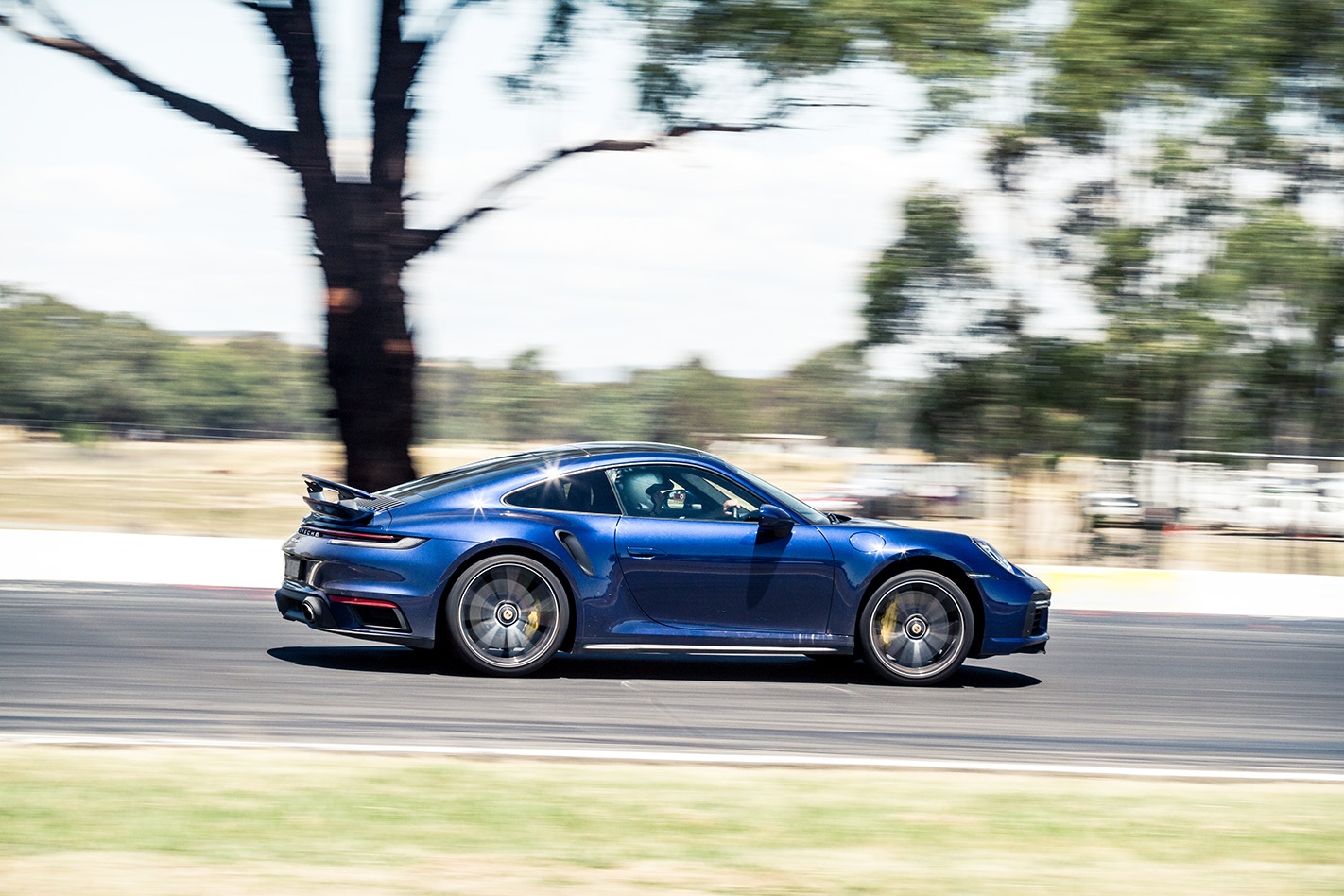
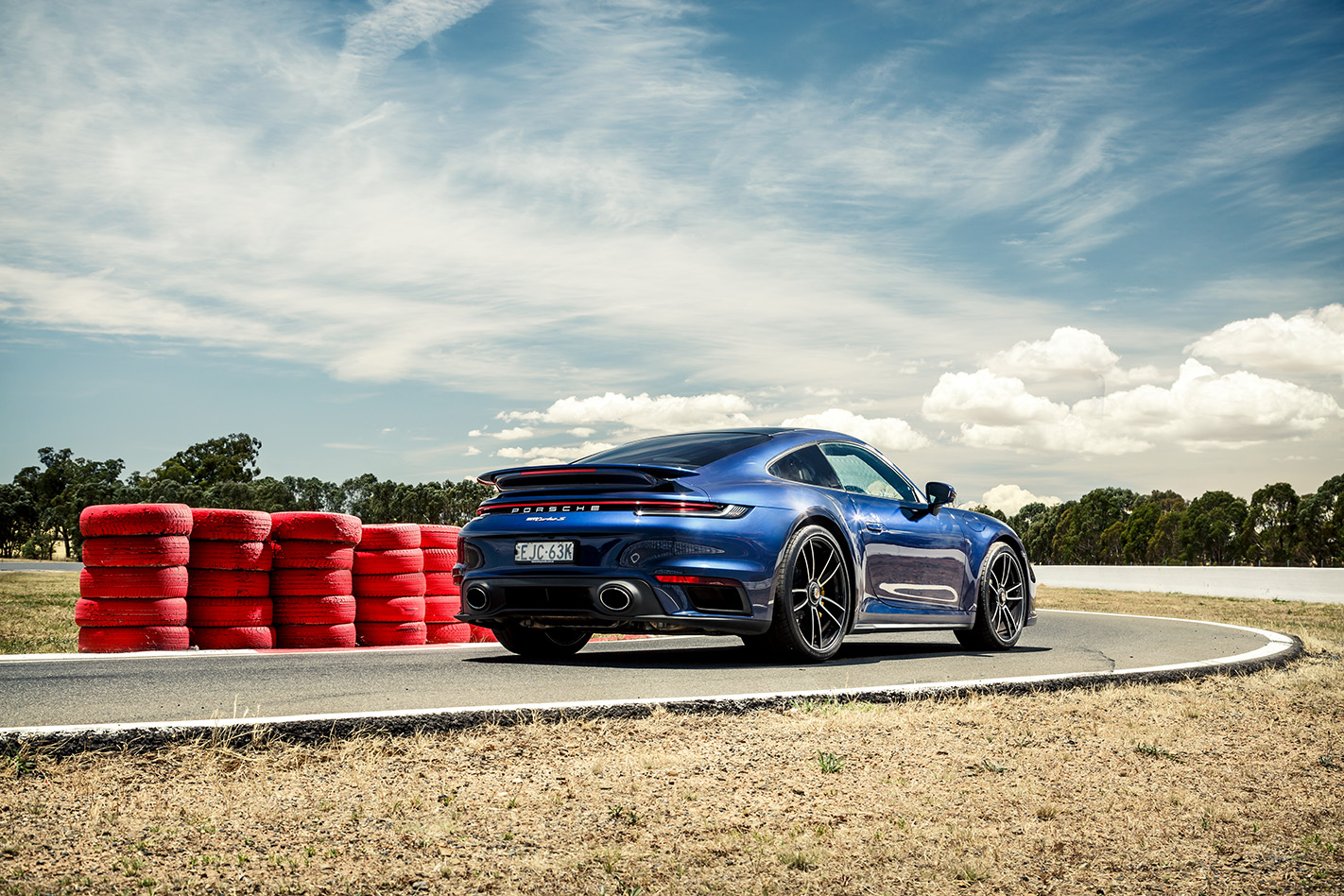
While the Turbo S may not have dethroned the Pro from the top of the leader board, the 1:30.1 lap time does shuffle the Audi R8 down a peg, putting the Porsche in a commanding second postion.
You can watch the full video of Reindler’s video above.
Make sure to check back next week when the Toyota GR Yaris takes its turn at the MOTOR Shootout leader board.
UPDATE, October 2022: Australian pricing for the new 2023 Peugeot 308 has been revealed at last.
Get all of the details for the Australian line-up of the 2023 Peugeot 308 hatch and wagon at the link below.
Story continues: New Peugeot 308 revealed
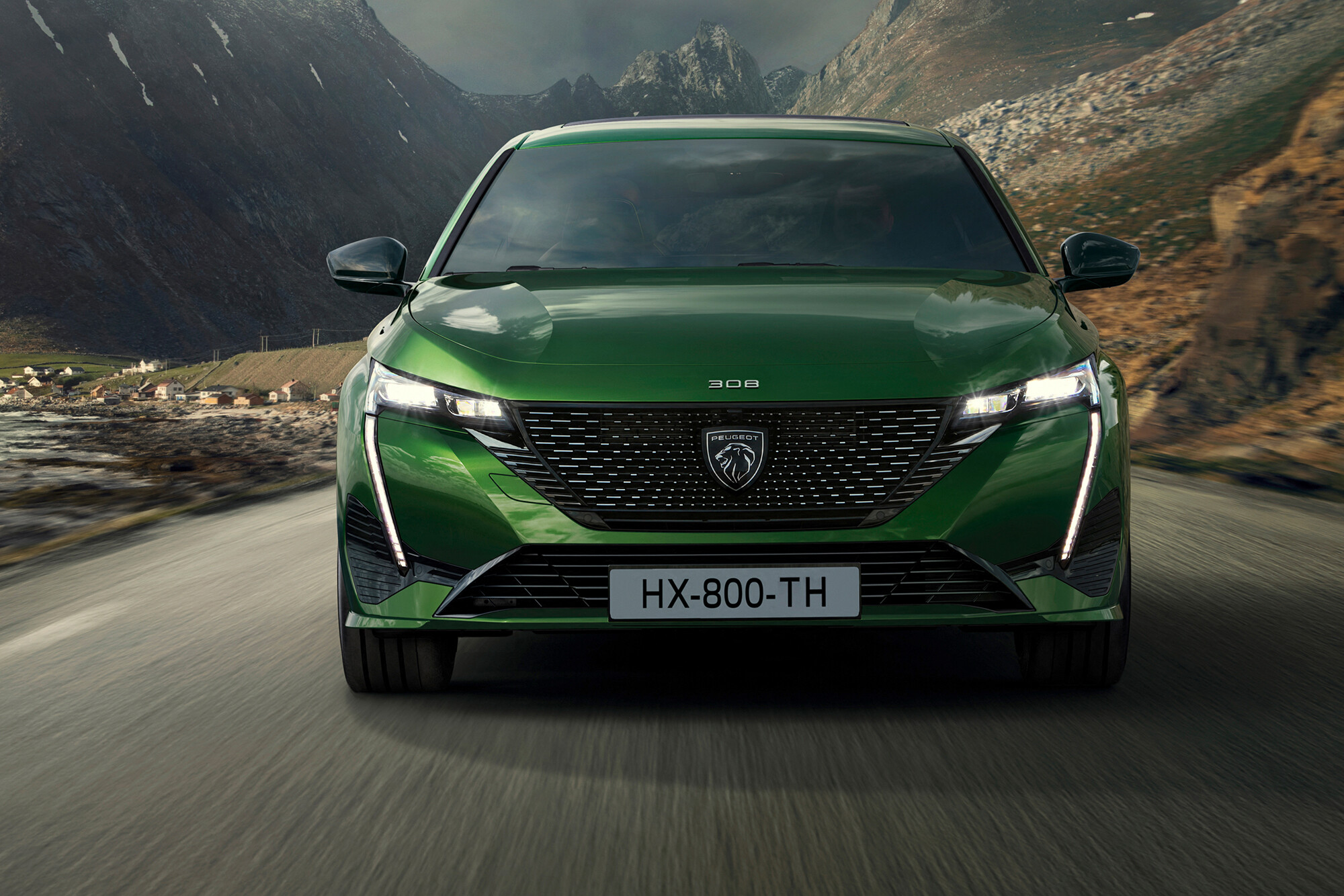
Just hours after photos leaked online, the new 2022 Peugeot 308 has been officially revealed – and it’s promising to be bigger, safer, smarter, and more efficient.
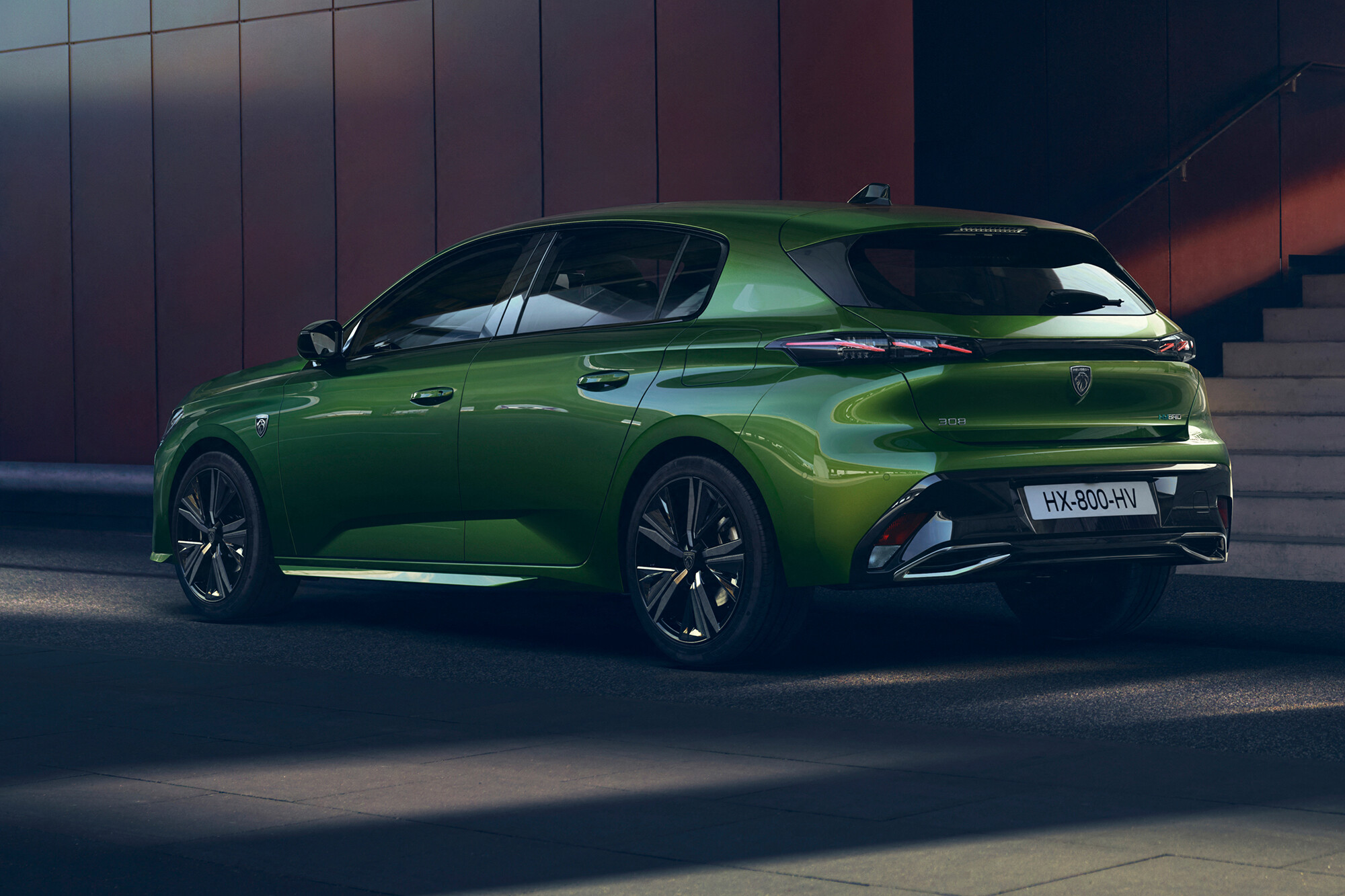
The new hatch has grown in size, with a longer wheelbase that stretches 55mm beyond the outgoing model, now measuring 2675mm, while the whole car is 107mm longer (4360mm in total).
Peugeot claims that, apart from contributing to a svelter silhouette, the extra length will aid in extra cabin room for rear occupants.
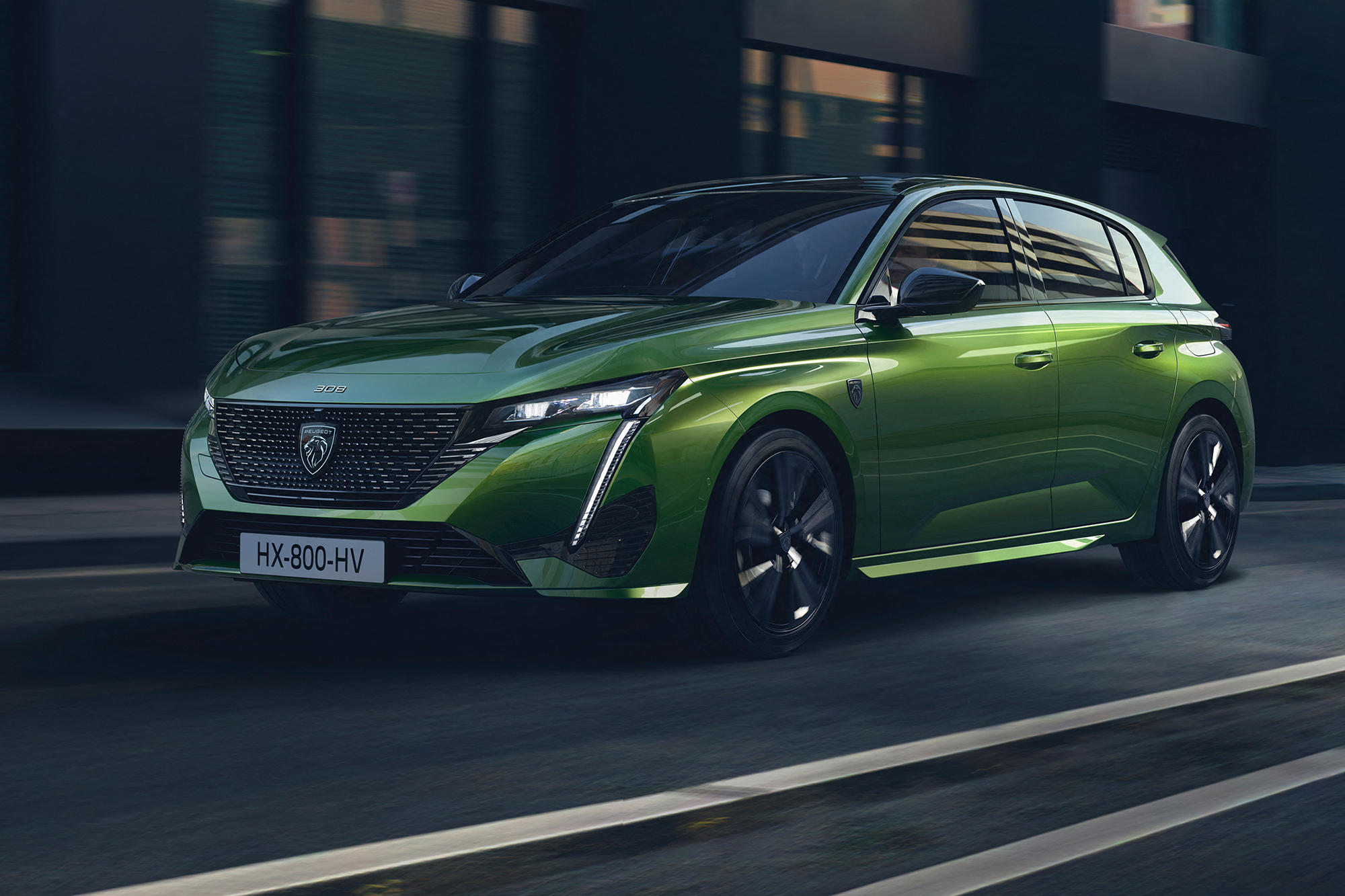
The new 308 also sits 20mm lower than the car it replaces, now standing at 1440mm, which should help with handling characteristics and contribute to a more aerodynamically efficient profile.
The windscreen now sports significantly more rake, while body panels, pillars, mirrors, deflectors, and diffusers all sculpted and contoured to ensure minimal resistance on the move.
All of this aero-focused design has, according to Peugeot, equated to a slippery drag coefficient of just 0.28, which supports the 308’s other major goal – improved economy.
This is the first generation of the 308 to be fitted with plug-in hybrid electric (PHEV) powertrains as an option, which has been made possible by the stylish new hatch being based on Stellantis’s EMP2 platform.
The EMP2 architecture, shared with other Stellantis products such as the Vauxhall Grandland X, Citroën DS 7 Crossback and C5 Aircross, has been designed to accommodate a range of electric, petrol and diesel powertrains.
The two new PHEV options for the 308, called the HYBRID 225 e-EAT8 and HYBRID 180 e-EAT8, combine a “PureTech” turbocharged petrol four-cylinder engine and a 12.4kWh lithium ion battery pack.
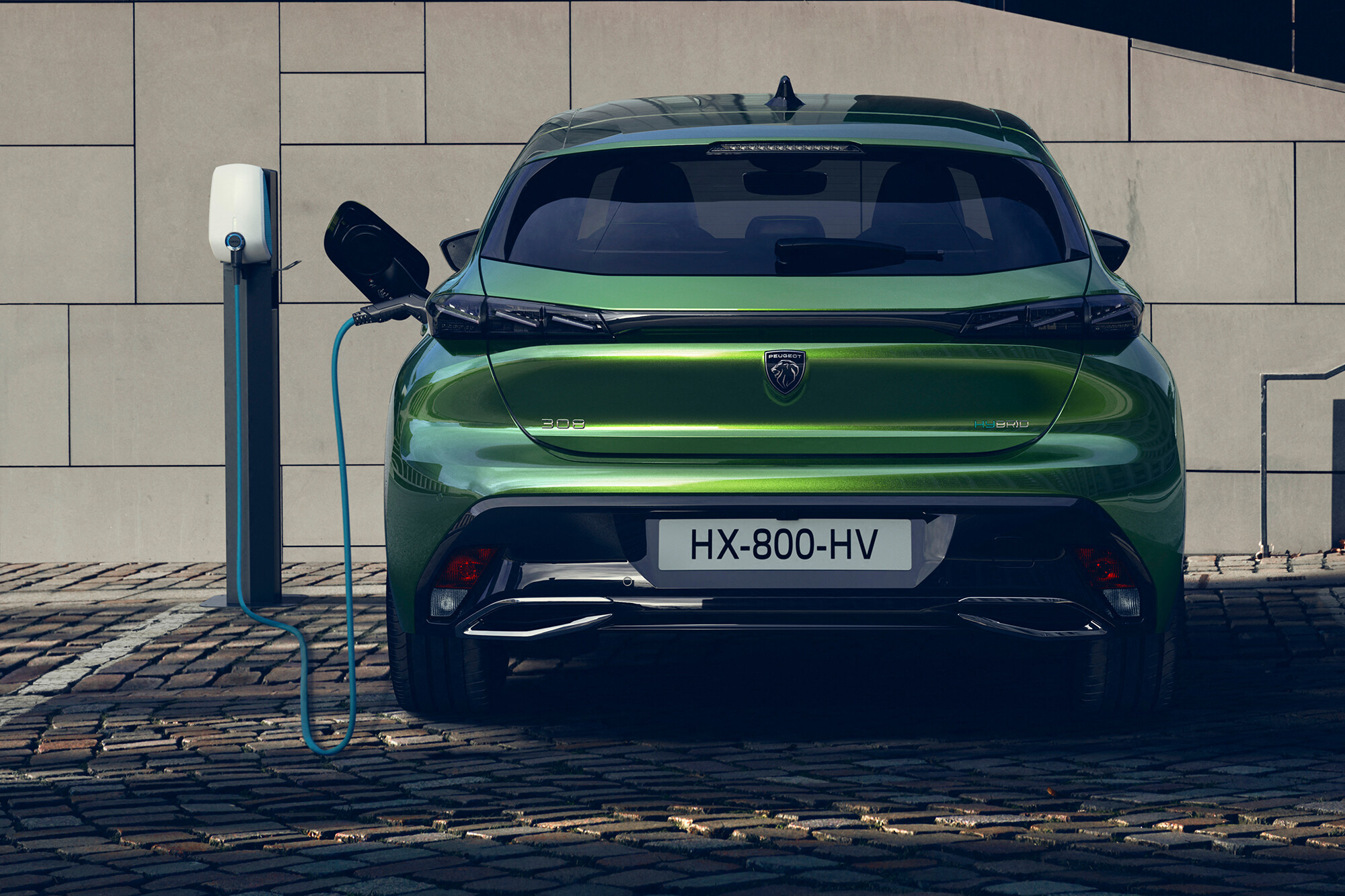
The HYBRID 225 turbo’s four-pot produces 132kW, while the HYBRID 180 turns out 110kW, and the battery pack in both models produces 80kW.
All of this is mated to an eight-speed automatic transmission.
Peugeot says both models will be capable of running in pure EV mode for approximately 60 kilometres, and will come equipped with a 3.7kW single-phase charger as standard or an optional 7.4kW single-phase charger.
When charging from a 32A outlet with the 7.4kW charger, Peugeot says the battery pack can be fully charged in one hour and fifty-five minutes.
Other more conventional powertrain options for the 308 include a familiar 1.2-litre three-cylinder petrol engine that produces either 80kW or 95kW, and a 1.5-litre four-cylinder diesel with 95kW.
The 95kW three-cylinder petrol variant will be available with either the eight-speed automatic transmission or six-speed manual, while all other ICE variants will be available exclusively with the manual box.
The driver-centric cabin concept of the outgoing 308 has been carried over to this new generation, however, a greater emphasis is placed on interior quality and in-car technology.
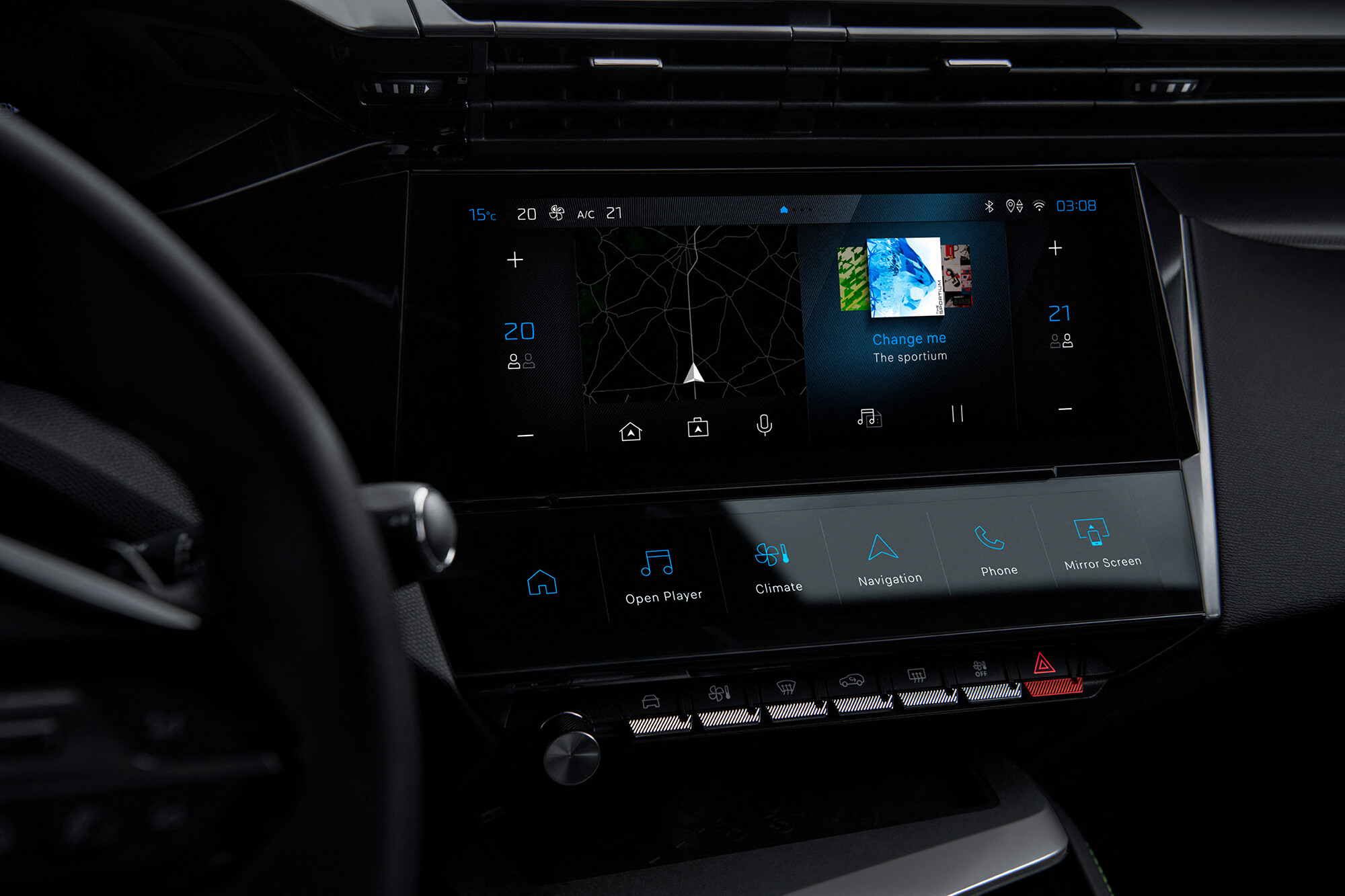
A completely new infotainment system, iConnect and iConnect Advanced, offers a suite of features including dual smartphone mirroring, a fully customizable, centrally mounted HD 10.0-inch display, and “OK Peugeot” voice recognition.
iConnect Advanced also comes equipped with third party TomTom smart navigation, which Peugeot claims offers increased navigational performance.
Below the 10.0-inch display is a number of customisable “i-toggle” buttons, which replace the traditional climate control buttons and act as shortcuts to the car’s various features. Owners of Peugeot’s newer models will be familiar with these toggle controls.
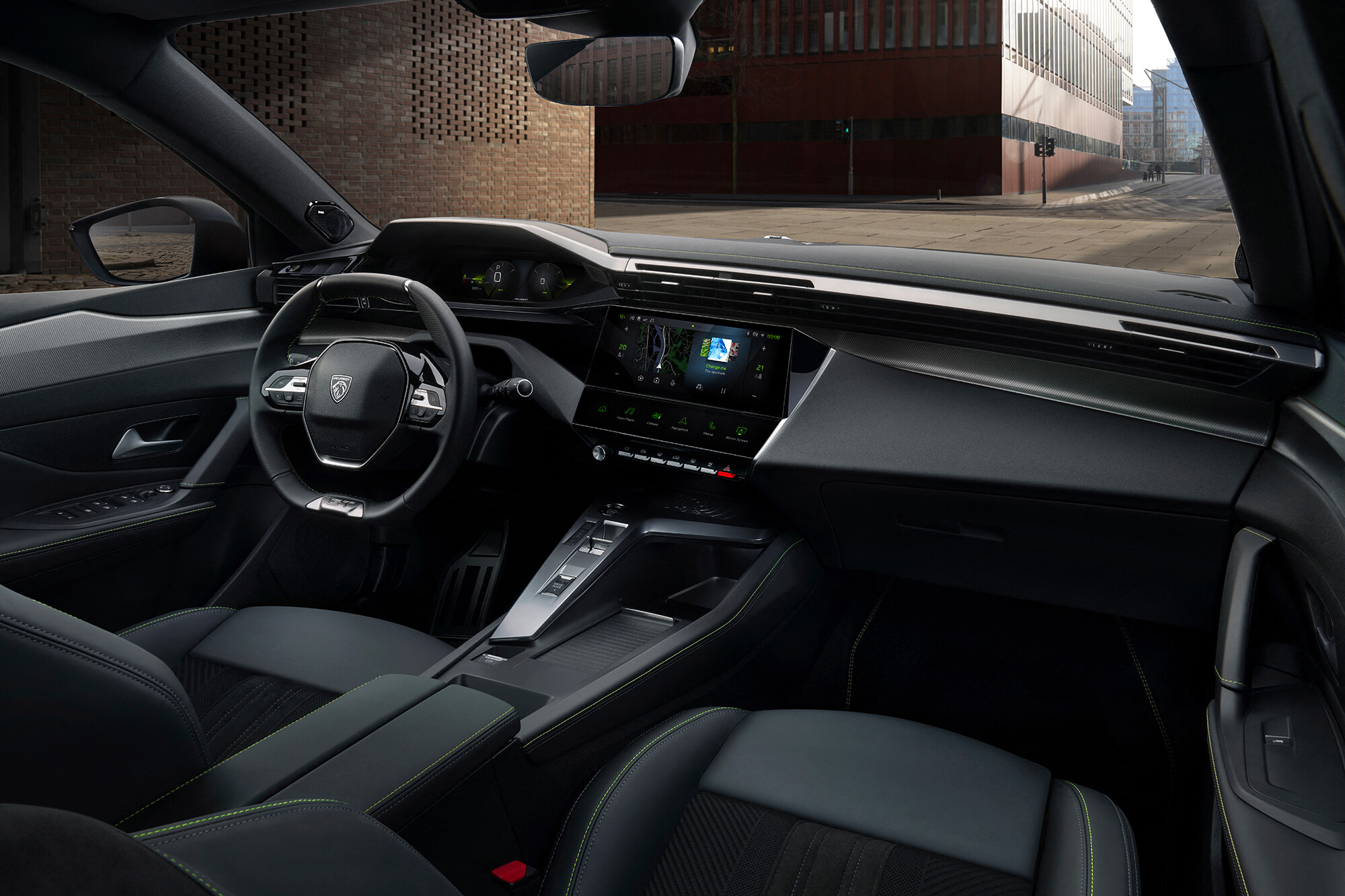
The dash has again gone fully digital for the new 308. Also measuring 10 inches across, the 3D display will be customizable in a number of different ways and present different information according to the driver’s preference.
Gone is the regular gear selector found in the old 308, as the new model features a rocker-button-style selector that’s slowly but surely becoming vogue in new automatic cars (think Porsche 992 911, VW Mk8 Golf).
Sitting beneath the drive selector is a driving mode button, and depending on the model and the owner’s preference, different driving modes include Electric, Hybrid, Eco, Normal and Sport.
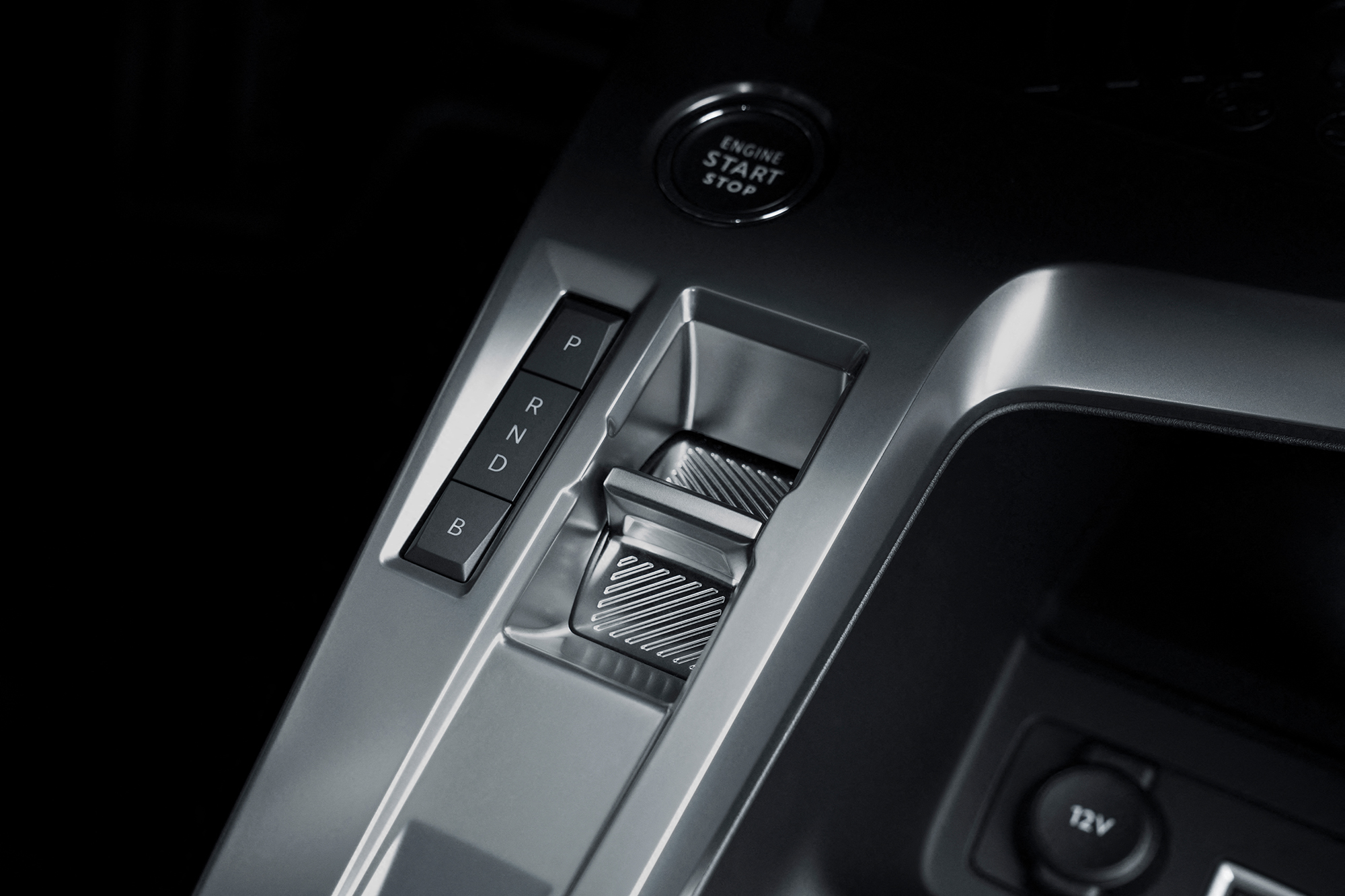
Other interior features include a Focal 10-speaker audio system, wireless smartphone charging, LED ambient lighting and USB ports.
The new 308 will come equipped with Peugeot’s “Drive Assist 2.0 pack”, which the manufacturer claims will add “a further step towards semi-autonomous driving.”
Peugeot’s recently redesigned logo and its front facing badge will also act as the radar-guided cruise control’s sensor – a popular trick with certain car companies.
The safety suite also includes adaptive cruise control with a “Stop and Go function”, lane keeping assistance, semi-automatic lane changing, an anticipated speed recommendation and curve speed adaptation, which slows the vehicle down according to the angle of a bend.
Other safety and comfort benefits include long-range blind spot monitoring, rear traffic alert, HD 180-degree reversing camera with integrated cleaning nozzle, 360-degree parking assistance with four cameras (located at the front, rear and sides), proximity hands-free start access, a heated windshield and heated steering wheel.
When will the new 2022 Peugeot 308 come to Australia?
There’s no word on pricing or which models we will get, but Peugeot Australia has confirmed that Australia will be getting the new 308, and its expected in the first quarter of 2022.
MORE: 308 stories MORE: All Peugeot stories
It’s a rare pleasure to see somebody doing what they were absolutely meant to do. But for anybody who spent much time at the Nürburgring, it was virtually guaranteed. Sabine Schmitz was that person, emerging from the RingTaxi with a smile broader than many of the paying customers, ready to take the next trio of nervous blokes on what would likely be the most exciting eight-and-a-half minutes of their lives.
The Schmitz family have long been part of the very fabric of Nürburg. The local economy is lubricated by petrochemicals and beer, and Getränke Schmitz, founded by Günter Schmitz back in 1956, had wrapped up the latter, selling wholesale and delivering beverages to events. The family also owned the Hotel am Tiergarten in the centre of the village, famed for its basement bar and restaurant, the Pistenklause.
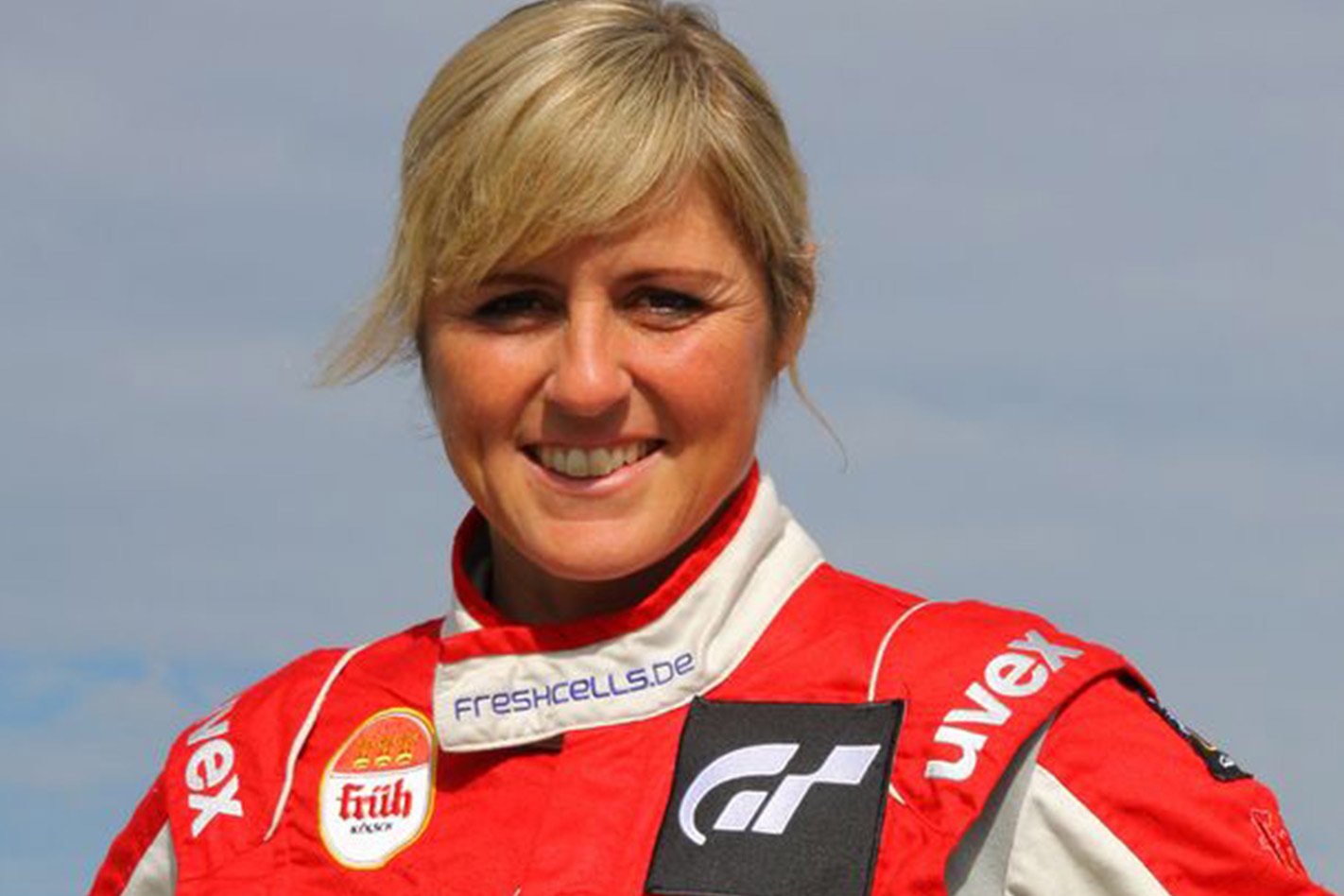
This comfortable background allowed the young Sabine to indulge a passion for speed. She excelled at school sports and was a talented footballer, but loved horses. As soon as she was old enough to drive, she’d purloin her mother’s BMW and sneak onto the Nordschleife, back in the days before the big queues and automated ticketing systems, when you paid a grumpy old bloke in a leather cap a few Deutschmarks for a lap.
Racing success followed, Sabine standing on the top step of the podium at the 1996 and 1997 Nürburgring 24-hour events, with wins arriving in the VLN races in 1998 and 2006.
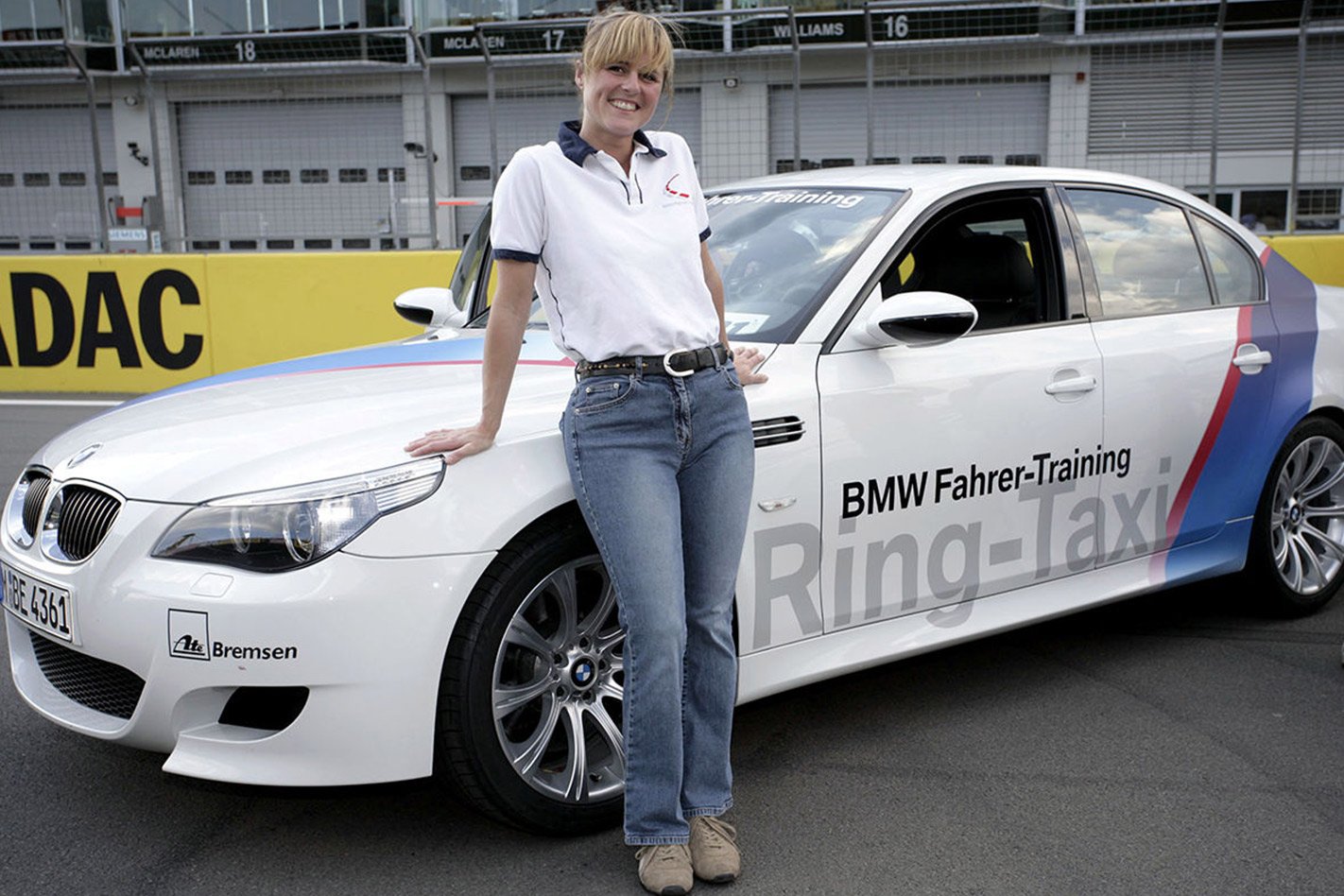
But to most, she was the girl in the E39 M5 RingTaxi, who’d drift through Adenauer Forst and Brünnchen corners, waving at any spectators. Back then, there were relatively few onlookers, and Schmitz was to become at least partly responsible for a massive uptick in visitor numbers to the region.
Her 2004 appearance on Top Gear, where she attempted to beat Jeremy Clarkson’s 10-minute lap in a Jaguar S-Type diesel while driving a Transit van, was one of those iconic moments of television. I was there at the time, and while I can’t vouch for the vérité of Clarkson’s attempt, with the camera crew running lap after lap in the Jaguar, none of which featured Jeremy at the wheel, Sabine was fully committed to wringing the time out of the van. She later switched into the Jaguar diesel, which presented a problem, as the camera car then couldn’t keep up with her.
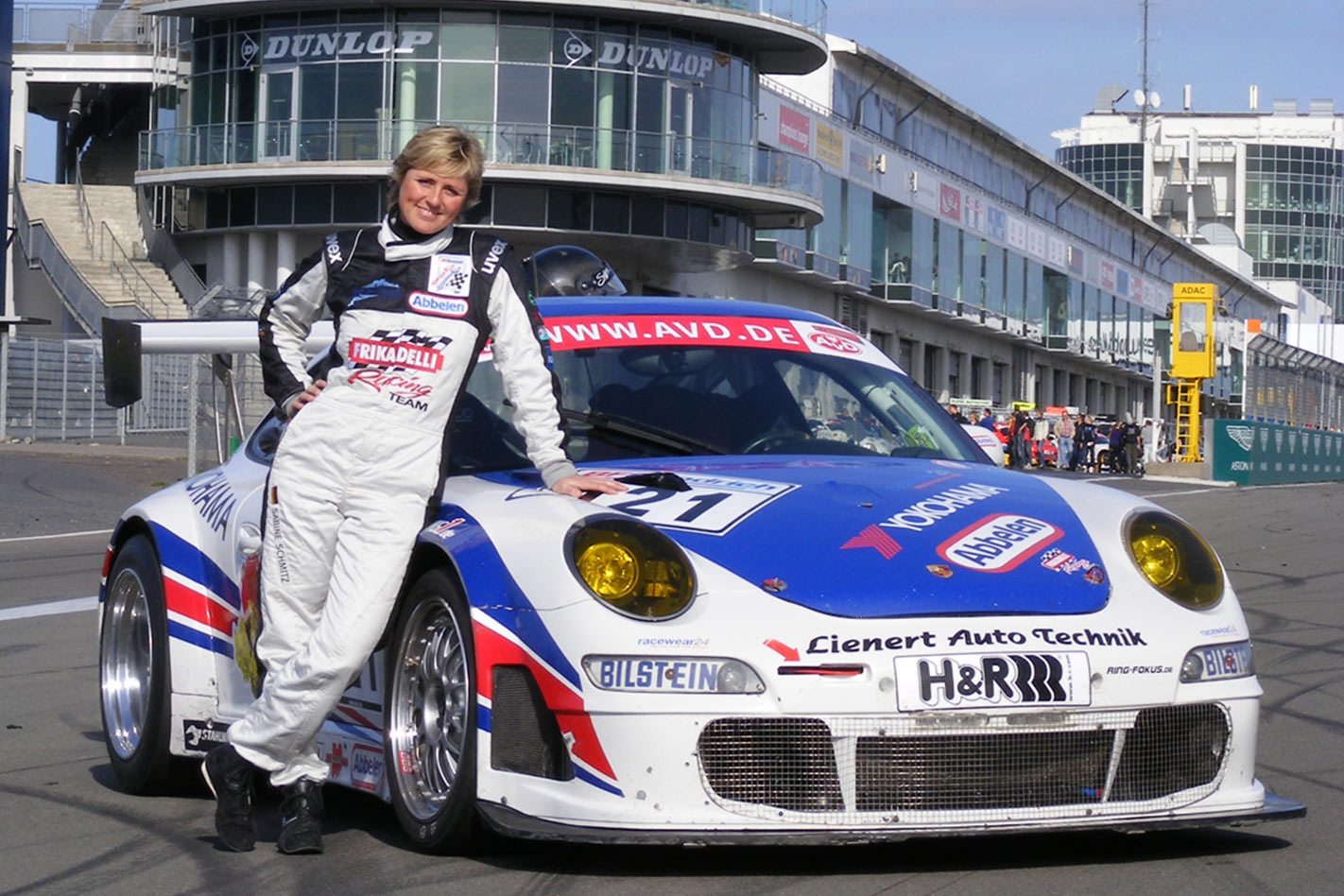
Her entirely unforced enthusiasm and confidence made her a natural on camera, which saw her appear frequently on Top Gear for the next decade. She never identified as a television presenter though, preferring instead to focus on her driving and her beloved Frikadelli Racing team.
I’ll remember Sabine as somebody who, no matter how long it had been since you last saw her, would remember you and make time to chat. Who’d struggle to keep a straight face when telling you off for gassing half the restaurant at the Pistenklause by pouring pepper onto your hot stone for one of their fabled Argentinian steaks. She was fun, fizzed with energy and was as much a part of the Nürburgring as Caracciola, Bellof or Lauda. Like these legends, she’ll probably have a corner named after her. It would be a fitting tribute to the Queen of the Nürburgring. She’ll be hugely missed.
I can sense something about this Mazda 3 is different. First, the sound. A subtle whine creeps into the cabin under acceleration and overlays the engine’s zingy thrum.
Then there is the peculiar power delivery.
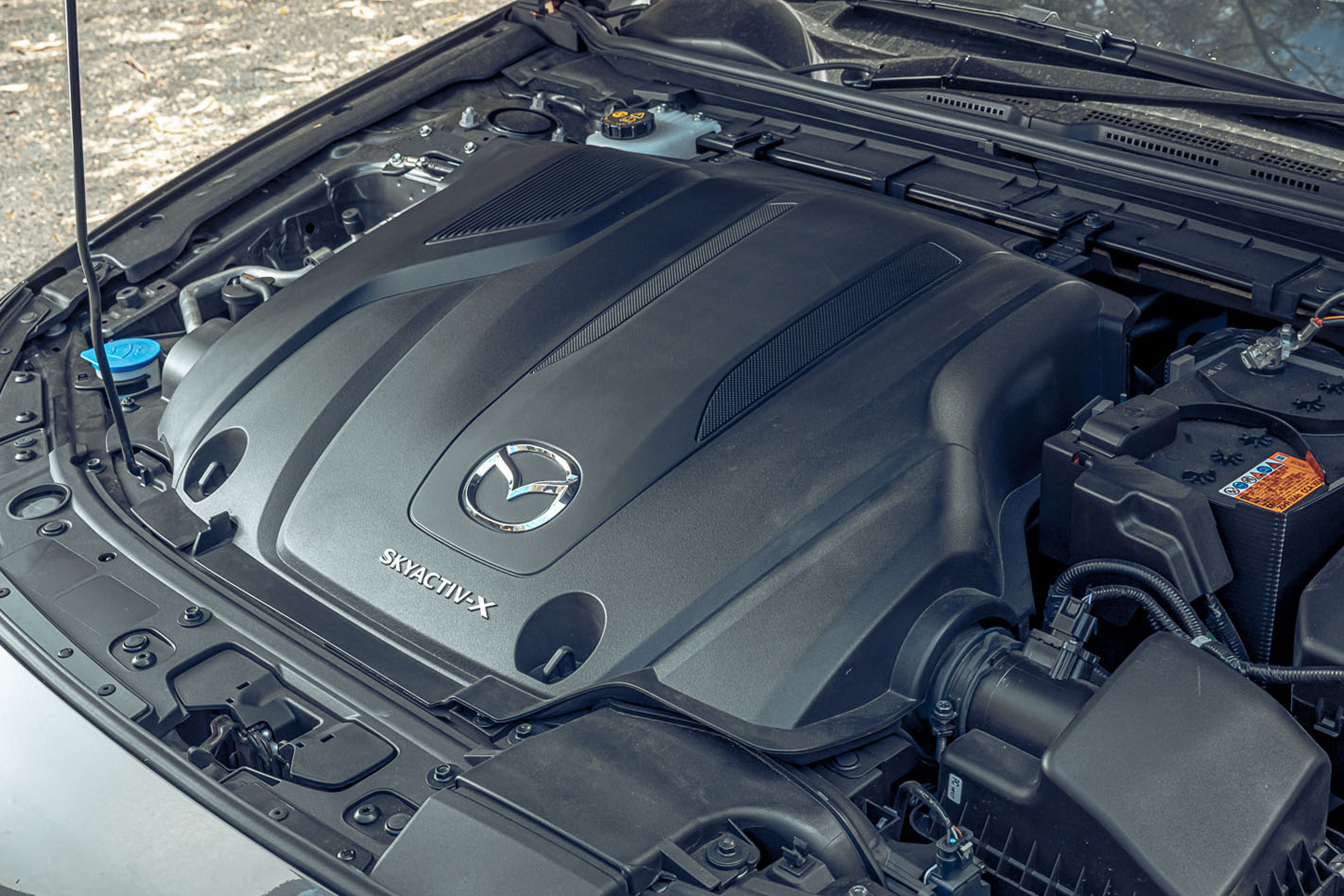
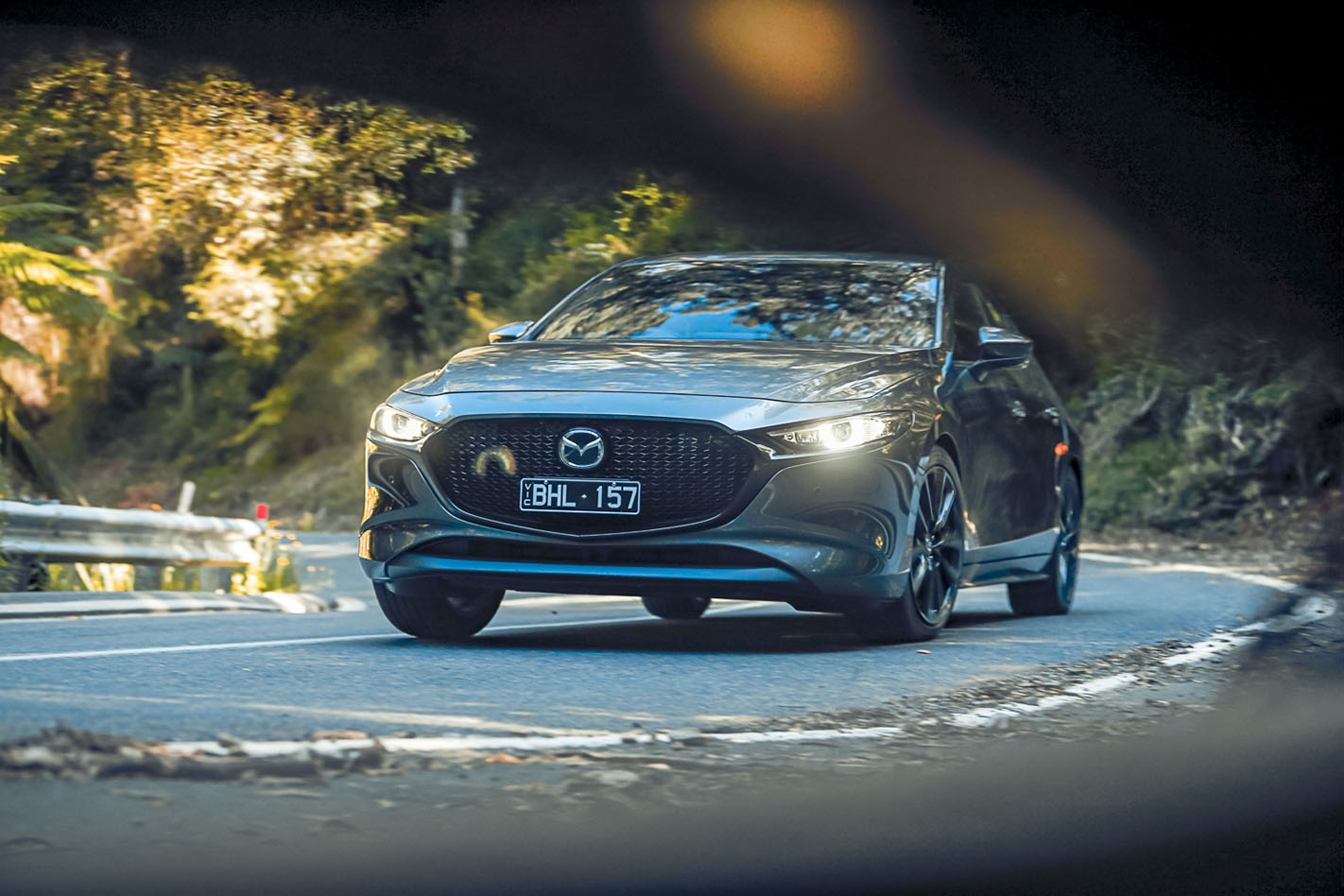
So, I lift the bonnet. Underneath a plastic cover hides, to my surprise, a roots-type supercharger. As it turns out, this is the new Mazda 3 X20 Astina Skyactiv-X, a top-of-the-range mild-hybrid that introduces spark-controlled compression ignition to petrol engines.
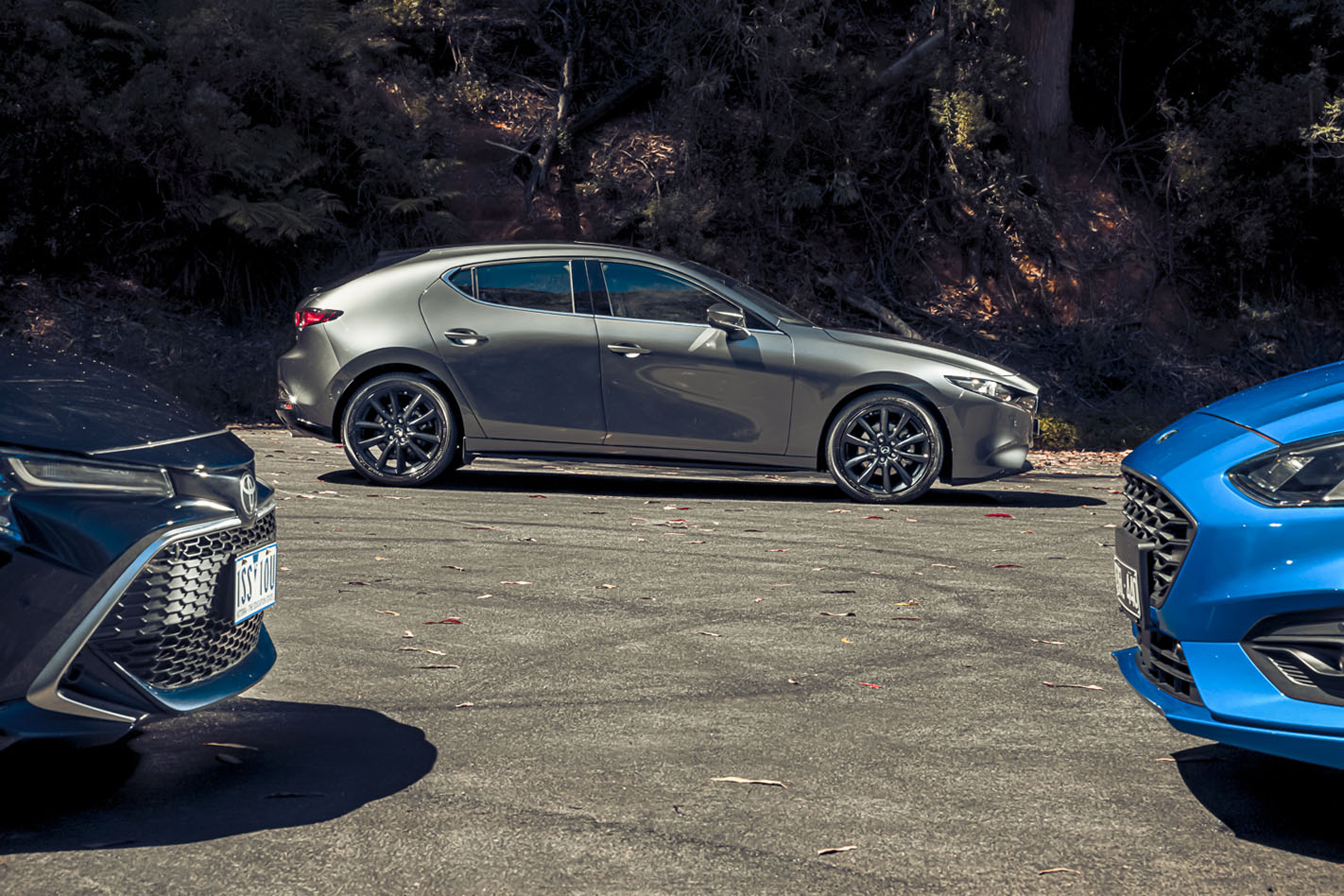
And just why does it have a supercharger? I’ll get to that later. In any case, the Mazda 3 Skyactiv-X strikes a point of difference to the quartet from the warm-hatch world. They’re here to see if brains can outclass brawn and bargain price tags.
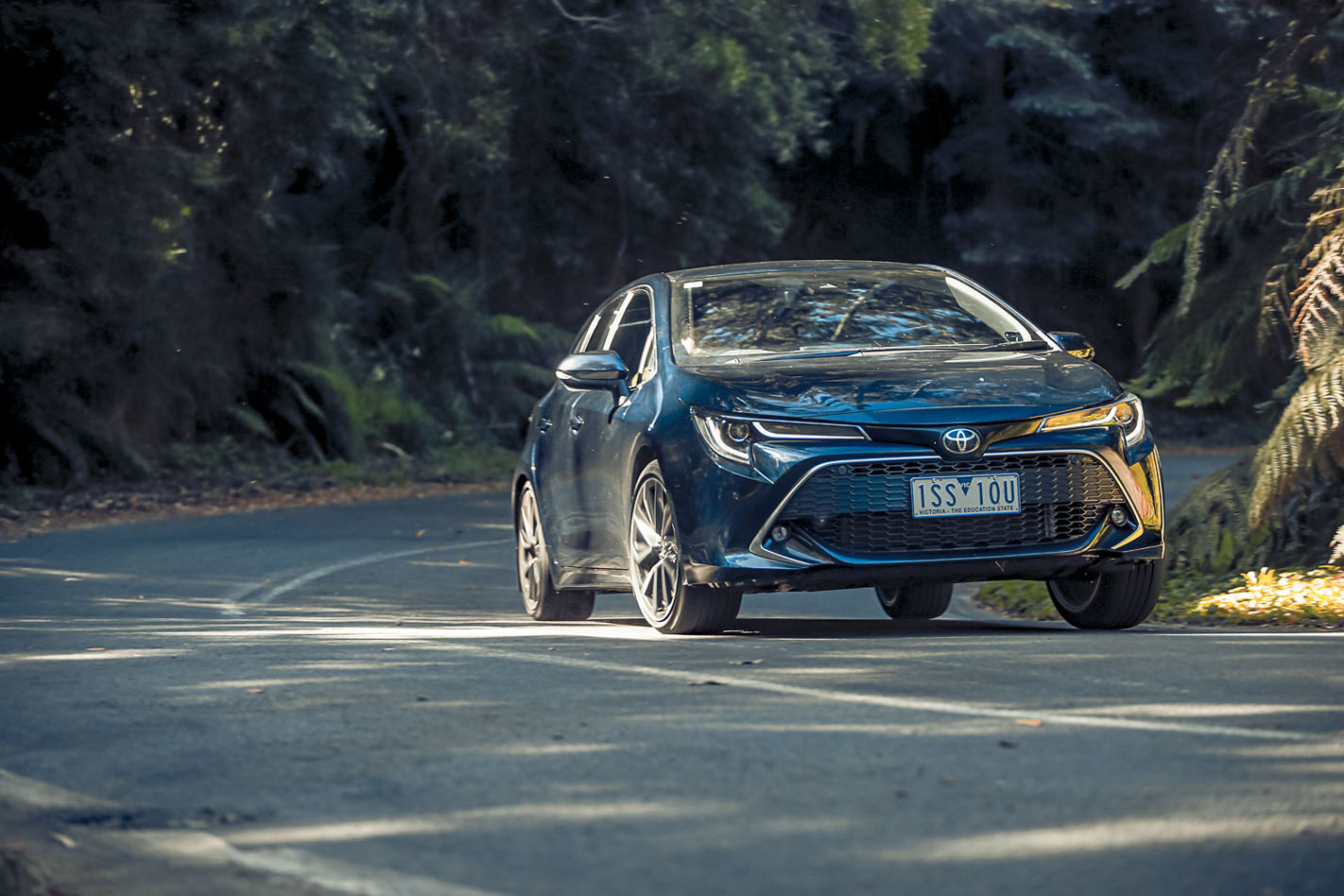
Our Toyota Corolla ZR, for instance, offers a more traditional 2.0-litre petrol inline-four and a radical change in personality to generations of old, evidenced by its dramatic looks.
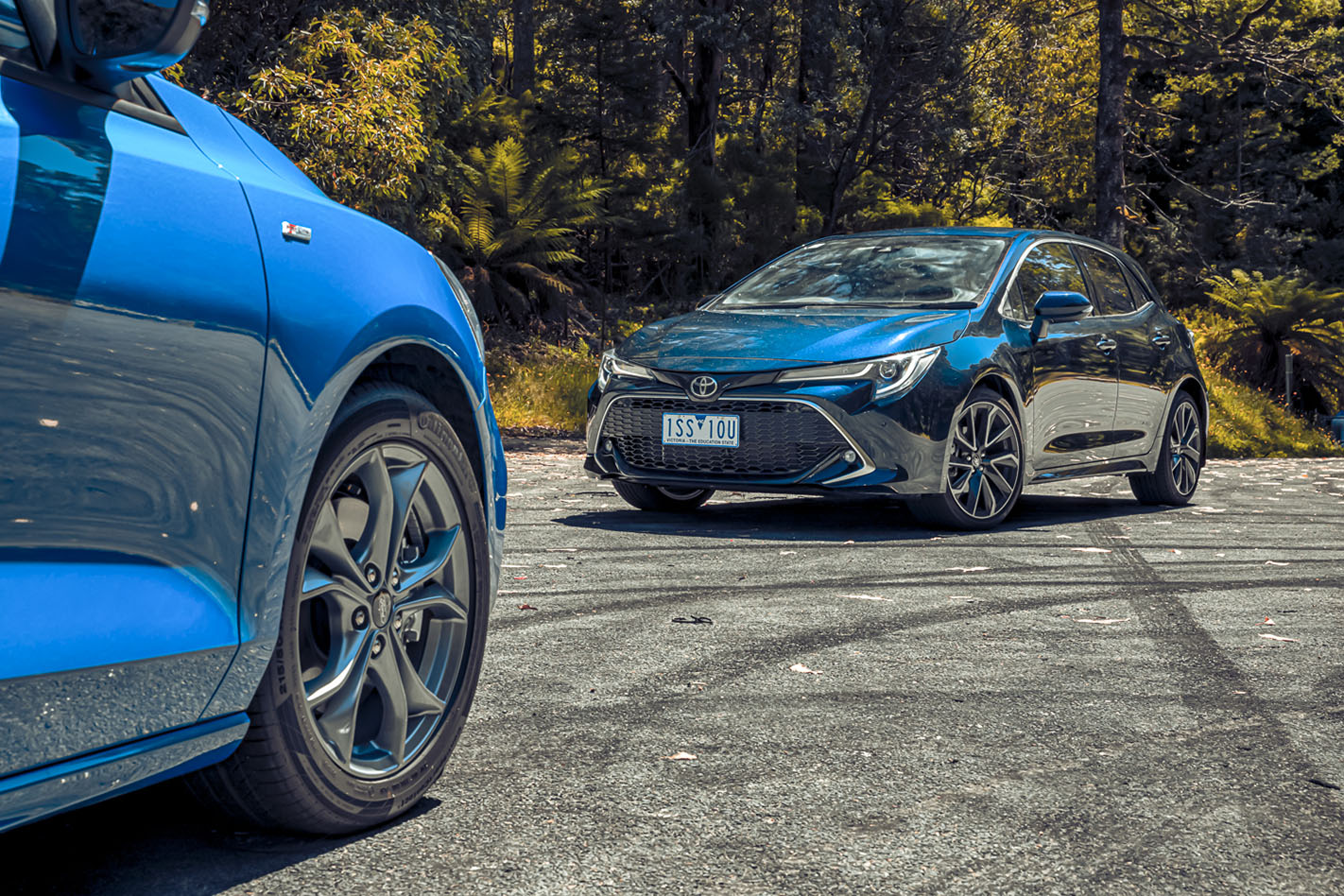
The upper-grade ZR we have here also scored reverse-parking brake support and power adjustment on the driver’s seat at the same time.
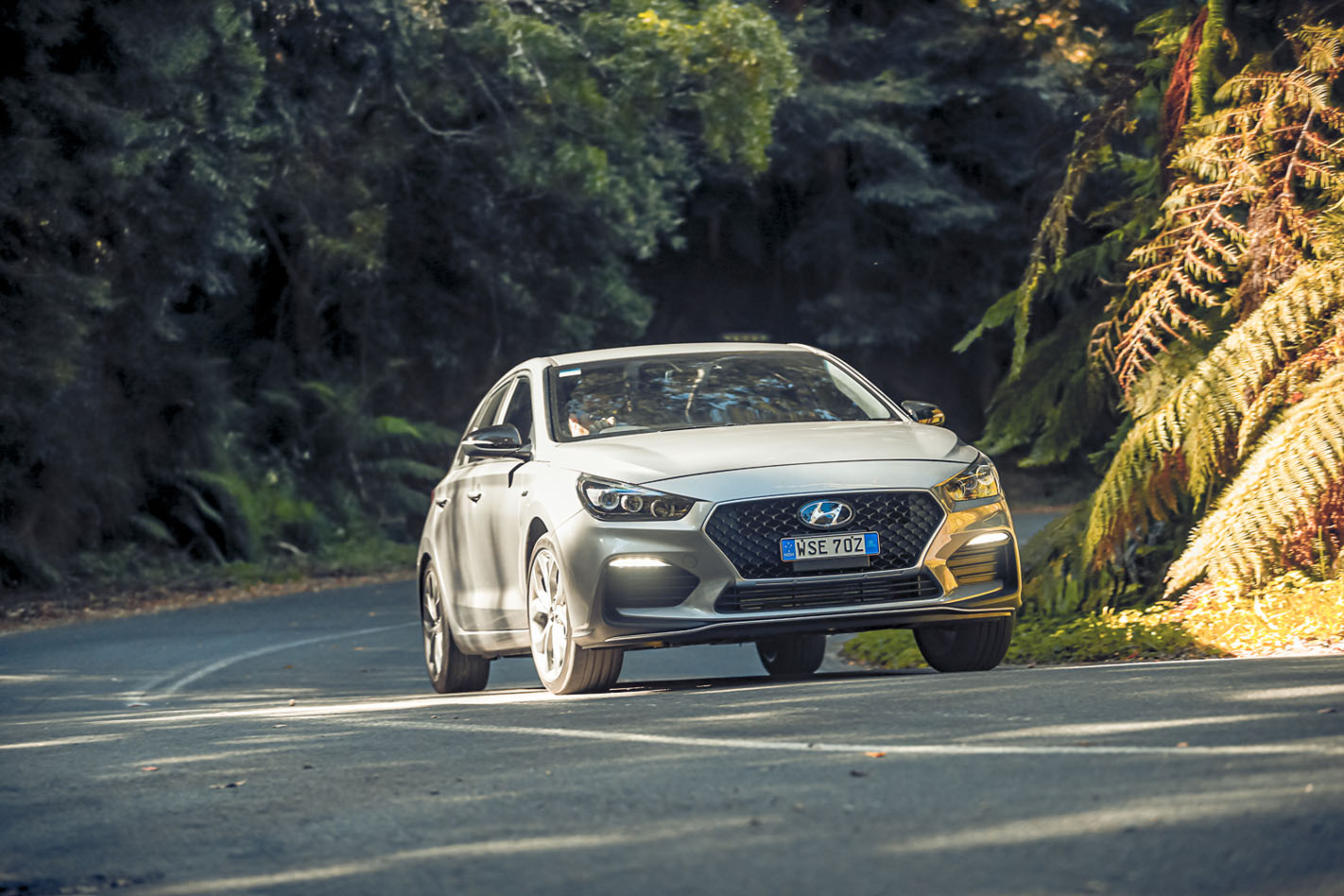
Our Hyundai i30 N-Line, meanwhile, is fresh from a mid-life update. And, I know, where is the facelift?
It turns out the Korean plant we source local i30s from builds the N-Line without the new bumper, headlights and wheels found on new European versions.

Either way, the N-Line proudly boasts unique bumper aprons, wheels, larger brakes and gloss black wing mirrors to flaunt its pedigree.
That includes a multi-link rear suspension setup and a 1.6-litre turbocharged petrol four-cylinder, helping it water down the essence of the full-on hot hatch i30 N into a more accessible package.
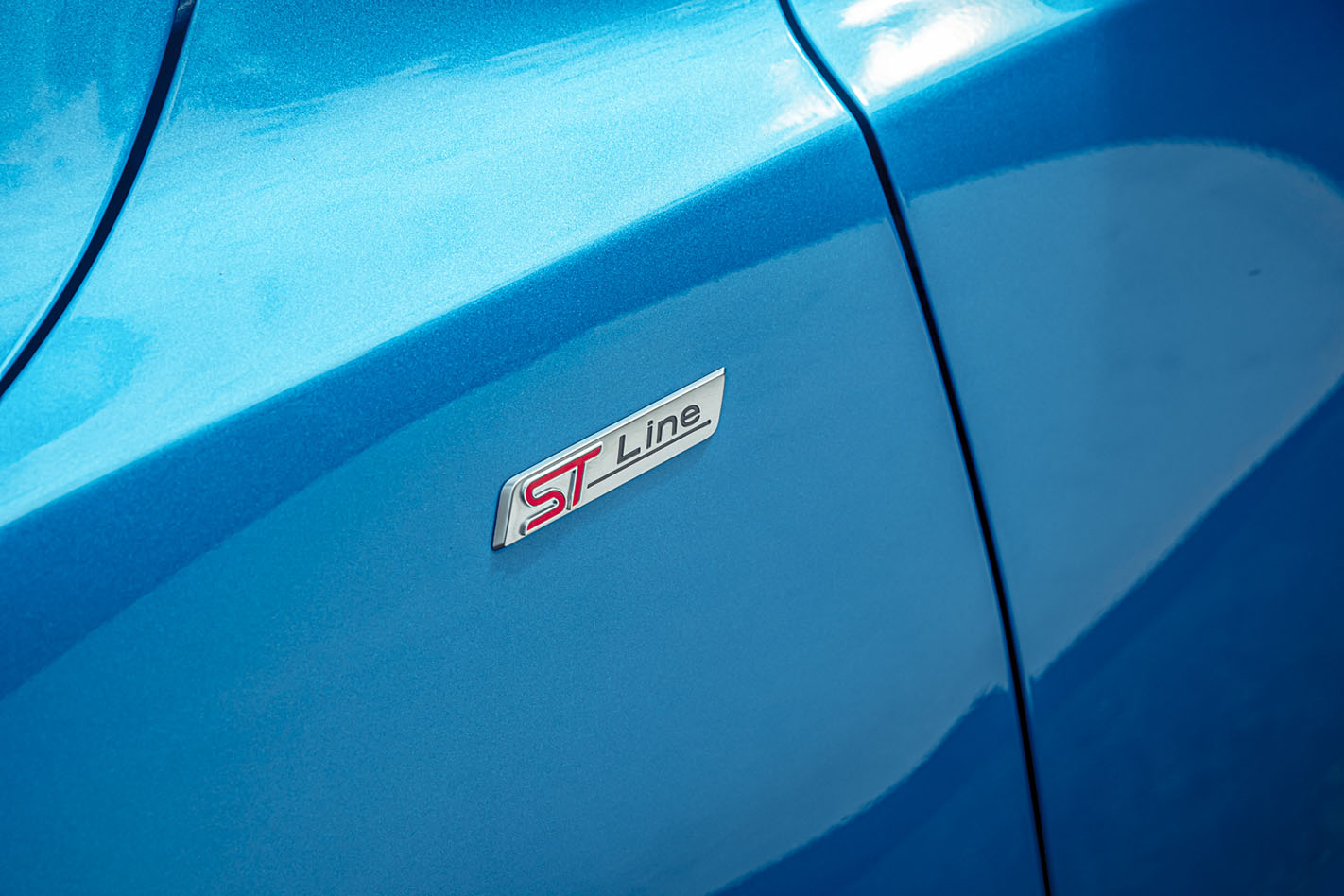
Ford applies that same thinking to the Focus ST-Line, our fourth and final contender, which also scores multi-link rear suspension like the Hyundai and uses a 1.5-litre inline three-cylinder shared with the rest of the Focus range. Its ride height is also lowered.
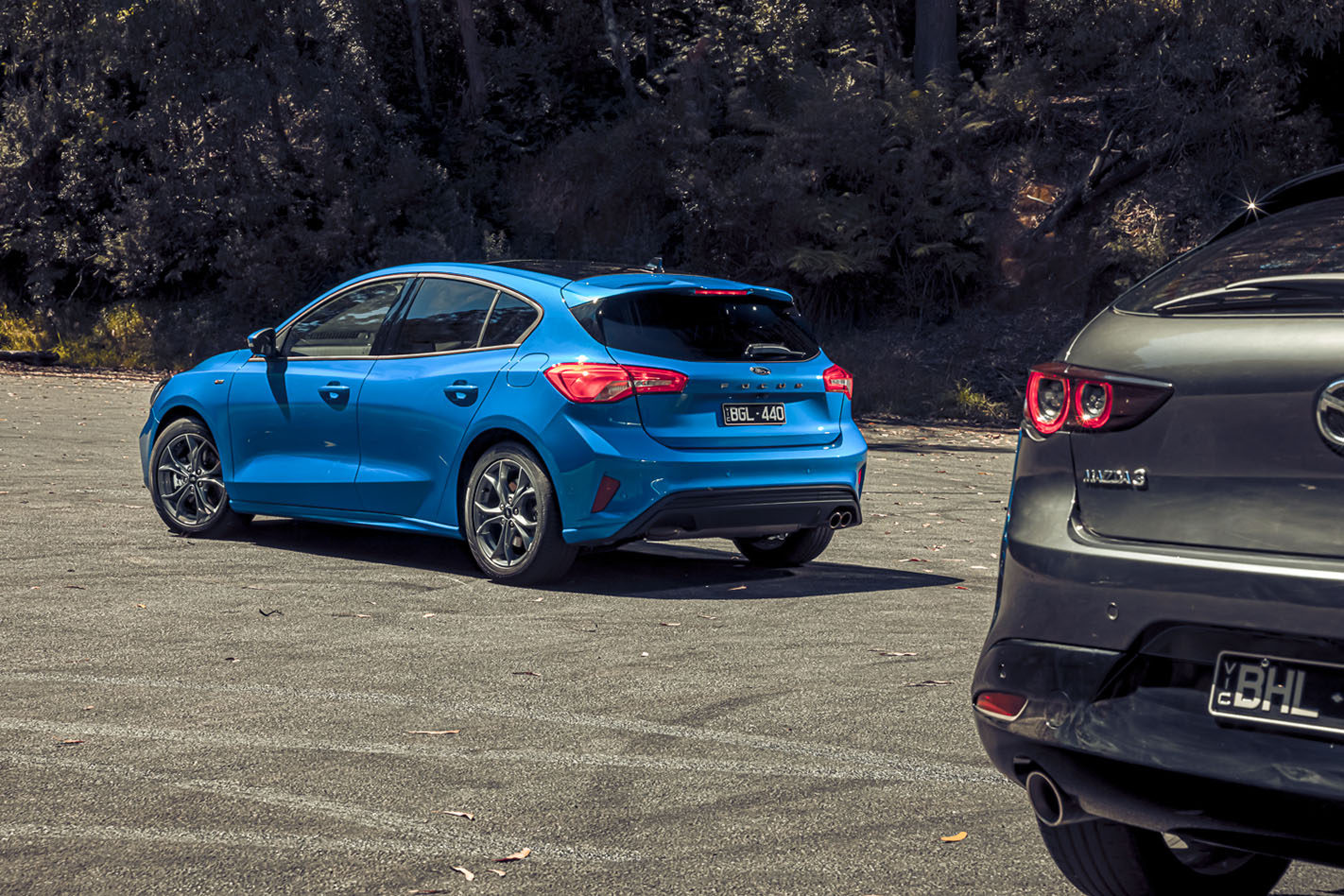
Even after a $1500 jump, the $30,990 ST-Line represents the cheapest way into this comparison by $430, at least on paper and before on-road costs.
As for what you get, an eight-speed automatic is the only transmission choice available. It joins an ST-Line body kit, LED tail lights, folding door mirrors, wireless phone charging, alloy pedals, smartphone mirroring, digital radio and an eight-inch touchscreen with SYNC3.
But the small jump to the Hyundai i30 N-Line, which costs $31,420, is justified by active cruise control, leather seats and larger 18-inch wheels.
Hyundai offers a few options. Our car scores a seven-speed dual-clutch automatic transmission for $2000. There is also a Sports 18 pack available that finishes door sills and wheels in gloss black for $1720, while an interior pack adds a cargo liner and floor mats for $380.

For a car Toyota hoped would appeal more to drivers, it seems strange the ZR exclusively packs a Continuously Variable Transmission. Those who want a manual transmission will need to settle on the entry-level Ascent Sport and miss out on the ZR-specific larger 18-inch wheels.
As for customisation, a full-fruit spec list on the ZR means the only option is a black roof that is available with a range of metallic colours. It costs $467 over and above the $526 charged for special paint.
Mazda equips it like a Mazda 3 G25 Astina by ticking every box on the spec brochure – including front cross-traffic alert – while the Skyactiv-X mild-hybrid powertrain accounts for $3000 of its total price.
The only options available are metallic paint ($495 before on-roads) and a different 18-inch wheel design ($1660). The burgundy leather on our tester is a no-cost option. But you can personalise your 3 with an incredibly cool looking Kuroi Sports body kit as a factory accessory that includes new wheels for $4822.
The Mazda is surprisingly austere inside. It is also hard to discern just what features it has or how to use them because the cabin is so distractingly beautiful.
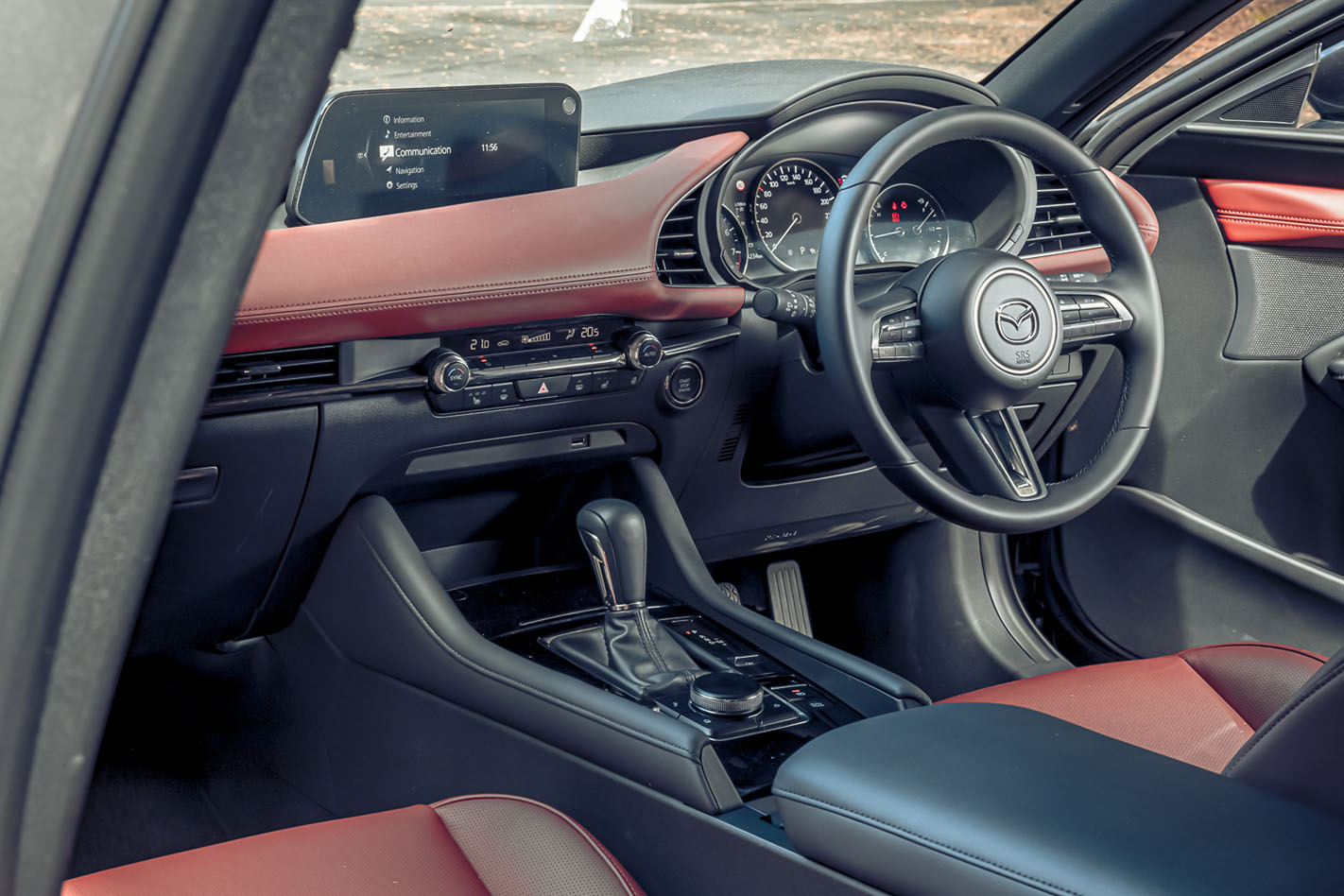
The front seats are also comfortable, well-positioned and nicely appointed. Kneeroom up back is spacious, thanks to its long wheelbase. But the pinched glasshouse eats into rear headroom and creates a sense of claustrophobia.
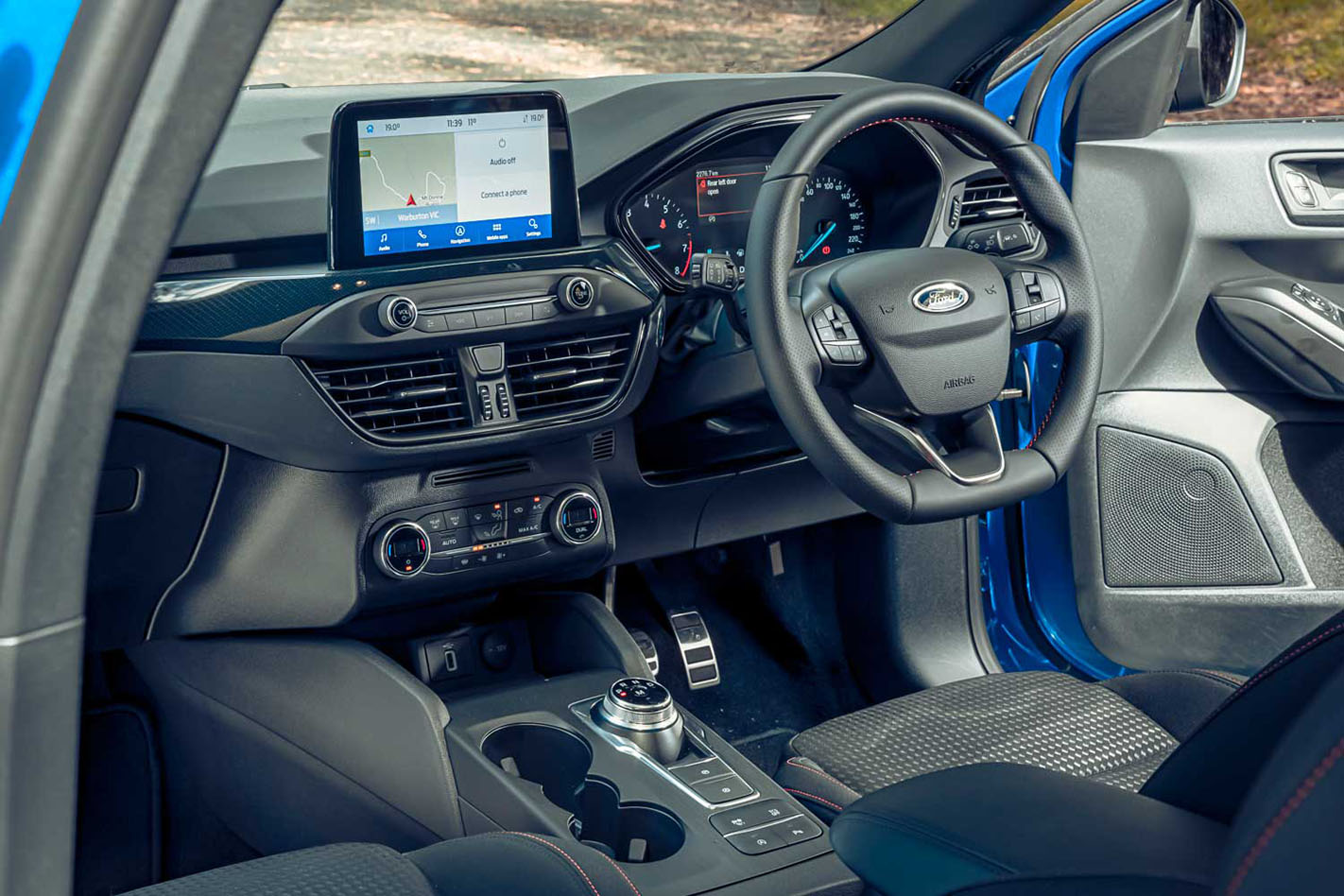
The front workstation is functional, inoffensive and reserved. Ford has shown more restraint with buttons on the centre stack, and the steering wheel, too, which is lovely in hand with a soft and firm tactility. The rotary transmission control dial frees up space, but it also presents a functional nightmare when trying to rush between gear selections at low speed.
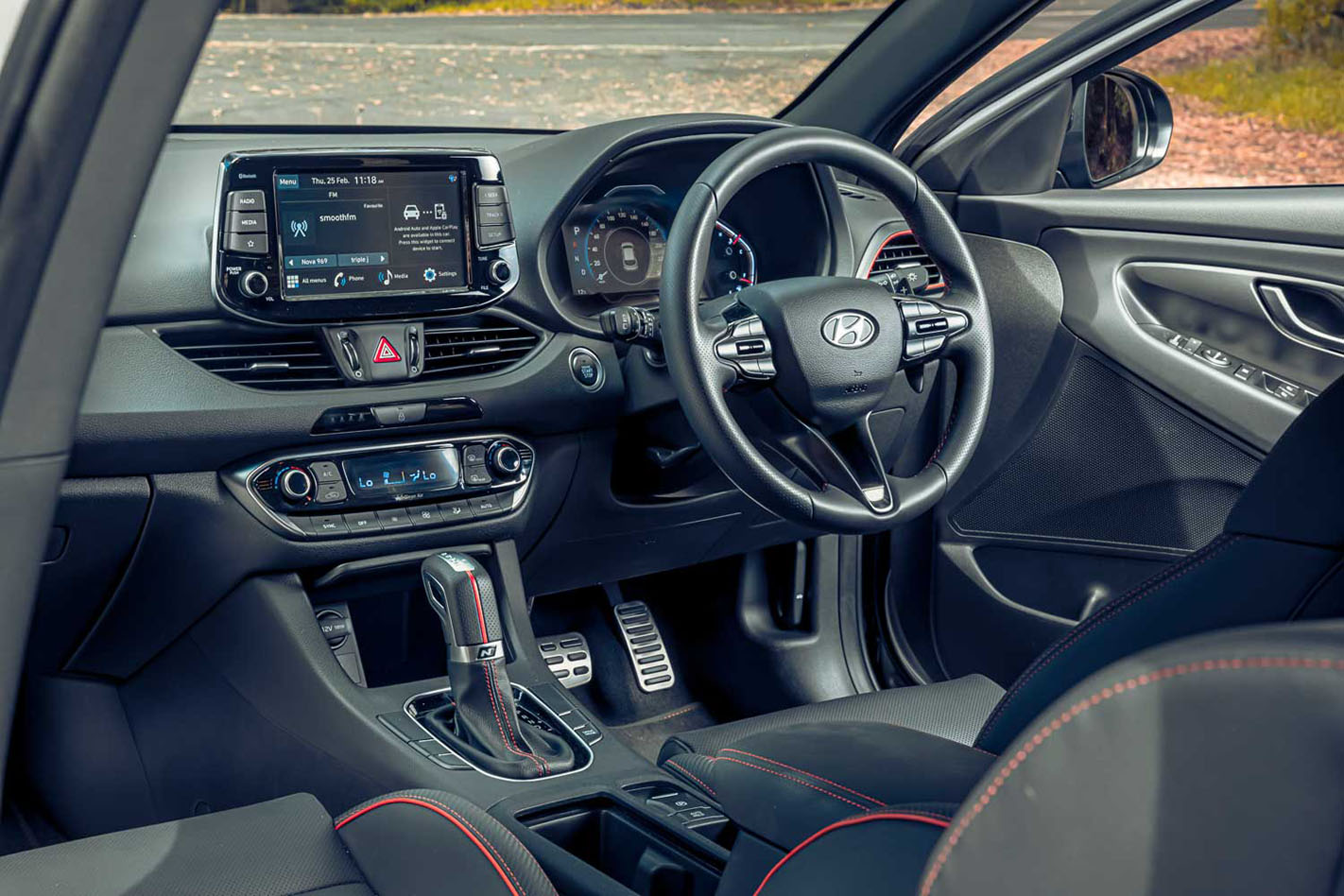
The Hyundai cabin is a small step up in quality. Straightforward design and good ergonomics set the scene, while N-Line red stitching and accents on the gear lever, leather-feel front seats and front vents spice things up. The leather-wrapped steering wheel is another treat.
The Ford trails with 340L when the rear seats are up. After it, the Mazda manages 295L, while the Corolla lags on 217L. Toyota says a space-saver spare wheel and the fact the Corolla now has multi-link rear suspension are to blame, although Hyundai and Ford manage more cargo area while still having the spare wheels and multi-links.
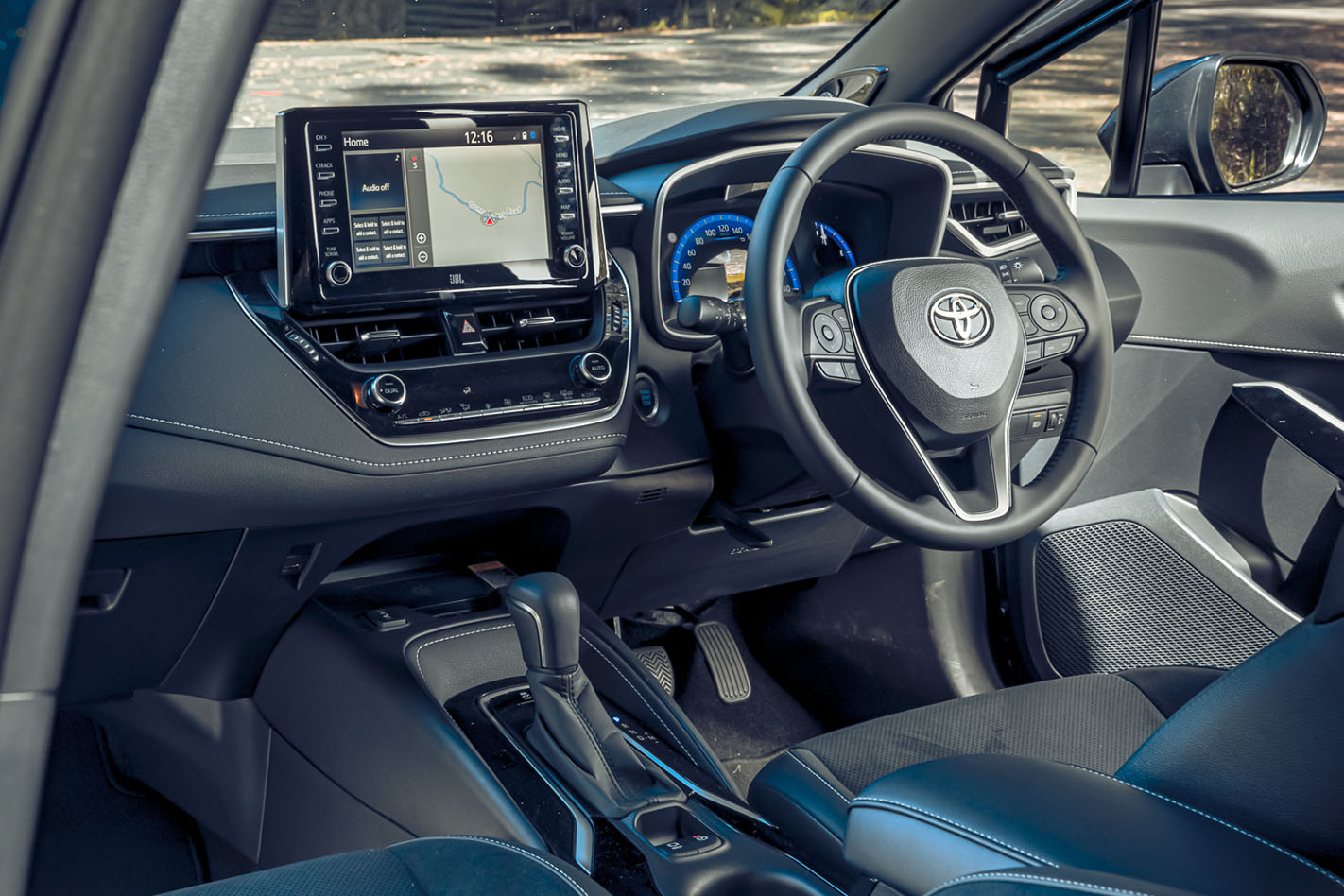
Luckily the Corolla does better up front, where a cascading centre stack plays centrepiece to a sleek, sophisticated and more upmarket cabin. But the Corolla’s angular body shape penalises rear headroom.
It happily gets around town on part throttle, sipping a claimed 8.5L/100km on an urban cycle. A conventional lock-up gear in the transmission gets it off the line well. Only when you squeeze the throttle harder can you sense some slack in the automatic.
Thankfully, the CVT tune imitates gears to get the most from the engine, scaling the complete rev range in manual mode when you need more control. Peak torque spreads from 4400-4800rpm. And while 200Nm of grunt is nothing special, the 125kW delivered at a heady 6600rpm gives it a top-end punch which is fun to wind up.
The Mazda 3 works with surprising ease considering the technology behind the Skyactiv-X powertrain. At its core is a direct-injected 1998cc twin-cam four-cylinder engine. And a supercharger that Mazda calls a high-response air supply unit stuffs the cylinders with the air needed to reach the stratospheric air-fuel ratios to support compression ignition. That is when the air and fuel mixture becomes so dense it self-ignites.
Calling the Skyactiv-X a compression ignition engine is slightly misleading since it still uses a spark plug to kick off combustion. It squeezes 134kW and 224Nm from just two litres and sips a claimed 6.5L/100km on an urban driving cycle – 2.0L/100km less than the Corolla. But on our road loop, defined by a highway run and a lot of fast driving, the Mazda’s consumption figure was actually 10.13L/100km versus the Corolla’s 10.53L/100km.
The engine hungers for revs, like a small petrol engine, and pulls with the grunt of a diesel. But the supercharger and mild hybrid system add too much heft, so it feels slower than it should. And despite the fun of plucking the steering wheel’s paddles to change gears through the Mazda’s excellent six-speed automatic, it’s missing an X-factor.
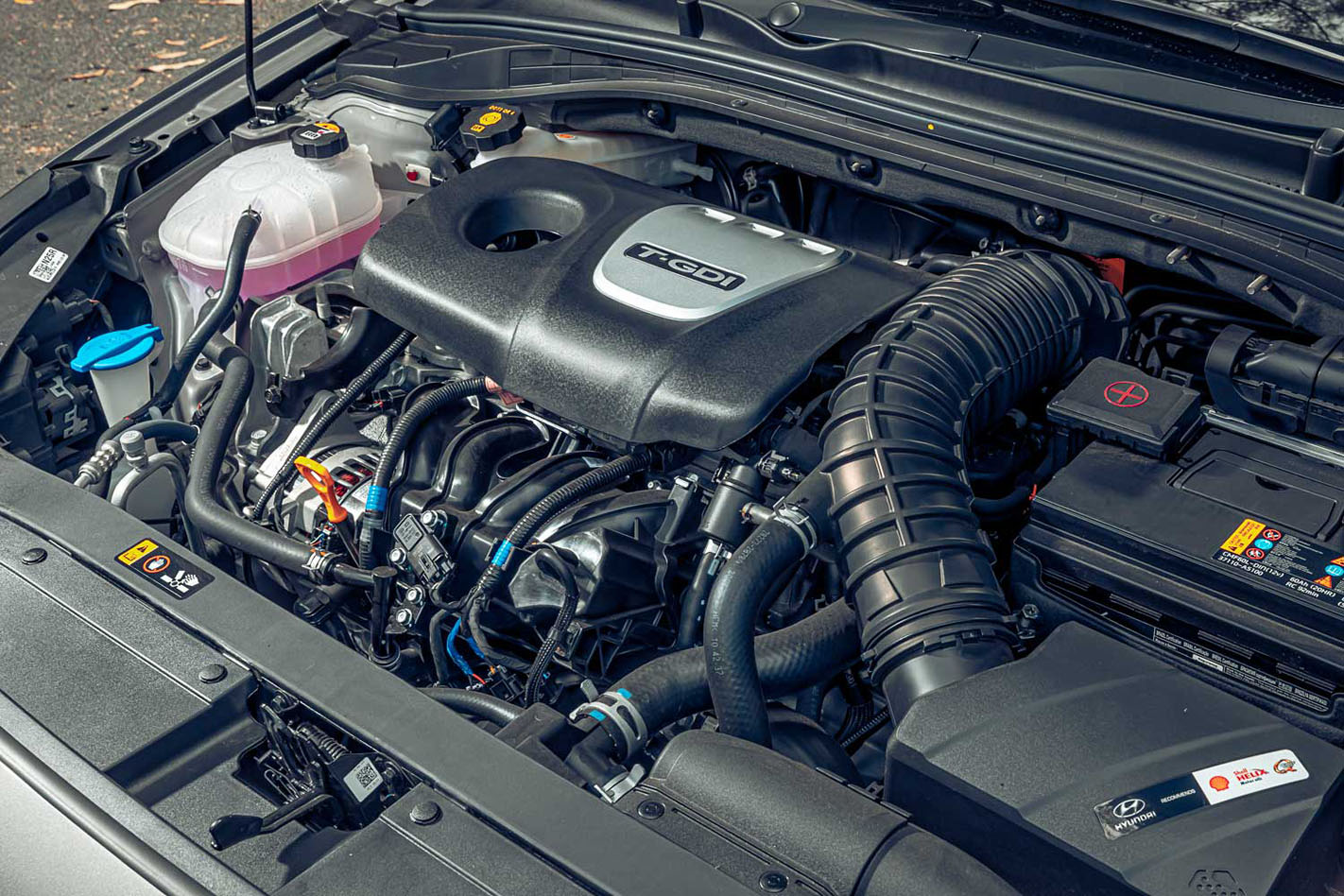
The power delivery is relatively violent and arrives after a small amount of turbo lag and torque steer across the front axle. But it also generates a mighty thirst. On our loop, the N-Line drank 13.53L/100km. It is claimed to drink 9.4L/100km on an urban cycle.
Ford’s downsized three-cylinder engine might not feel as big on performance as the Hyundai, but it still is more eager and willing than the Mazda or Toyota, with the turbocharger offering a good kick in the mid-range.
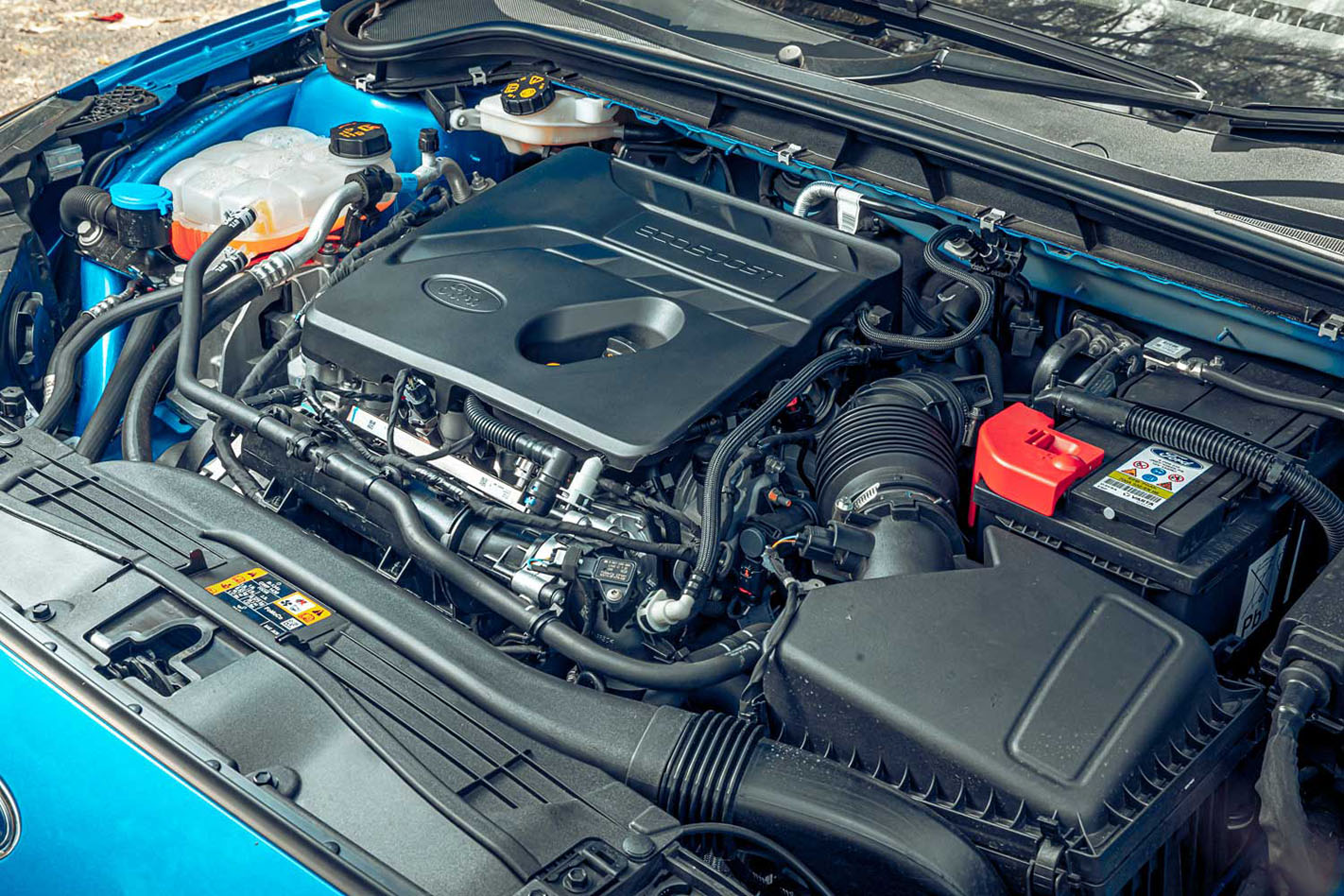
The Ford also separates the field on handling. Its lowered ride height pairs well with a multi-link rear suspension for light-footed confidence on the road, backed by creamy, accurate steering and good brakes.
But while the Ford’s taller 215/50 tyres afford it a comfortable secondary ride on its sportier suspension tune, the trade-off is that it can roll onto the sidewall during heavy cornering.

The Hyundai has also not sacrificed ride quality altogether. There’s enough suppleness to iron out lumpy roads, although limited vertical movement in the suspension never lets you forget the compromised setup.
Surprisingly, the Corolla also struggles to settle on the low-profile 18-inch tyres unique to the ZR variant. It’s damped firmly to handle bumps and corners, and the combination of these two characteristics penalise the ride on rough roads.
Funnily enough, you could say the same thing about the Mazda. The fourth-generation model has been lauded as a keen handler, except that’s not the case for the Skyactiv-X, given it adds almost 70kg over the 2.5-litre naturally aspirated version. Other than sweet and nicely-weighted steering, the extra weight dulls turn-in and further burdens a brake system that already feels wooden thanks to a regenerative function for mild-hybrid duties.
While on that, it’s worth mentioning all these cars are very usable day-to-day, except for a few flaws. Turbo lag plagues the Hyundai off the line. Meanwhile, the Ford’s eight-speed transmission takes a while to engage when changing the direction of travel between reverse and drive.
The Toyota’s CVT works well to keep the engine on the boil but can’t match the Mazda’s powertrain for engine or throttle response. It’s only the Mazda that escapes serious criticism here. It also goes one step extra on safety with front cross-traffic alert and a 360-degree view monitor, helping it navigate busy streets and blind spots.
It’s also worth mentioning all of these cars come with a five-year unlimited kilometre warranty as well as capped price servicing, with the latter offered over the first three years of Corolla ownership, five years with the Mazda 3, and then the lifetime of both the Hyundai i30 and Ford Focus. The i30’s service plan is also transferable to the next owners.
To step back and think about our four, that Skyactiv-X powertrain in the Mazda is remarkably refined and punches above its size. It will also prove more frugal during stop-start driving when its mild-hybrid system, used to power ancillaries and relieve an alternator, comes into play.
But the Skyactiv-X’s extra torque and power are not a free-kick. More weight means the 2.5-litre Astina could offer the same level of luxury, refinement and class, as well as better handling and acceleration for less. It’s hard to think of why you’d stump up the cash for the Skyactiv-X.
Adding the safety pack for active cruise control, however, prices it lineball with the Toyota Corolla driveaway. And while the Corolla might fall behind the Focus on boot space and rear occupant comfort, it claws back points on its safety package – including a heads-up display, auto-reverse braking support and active cruise control.
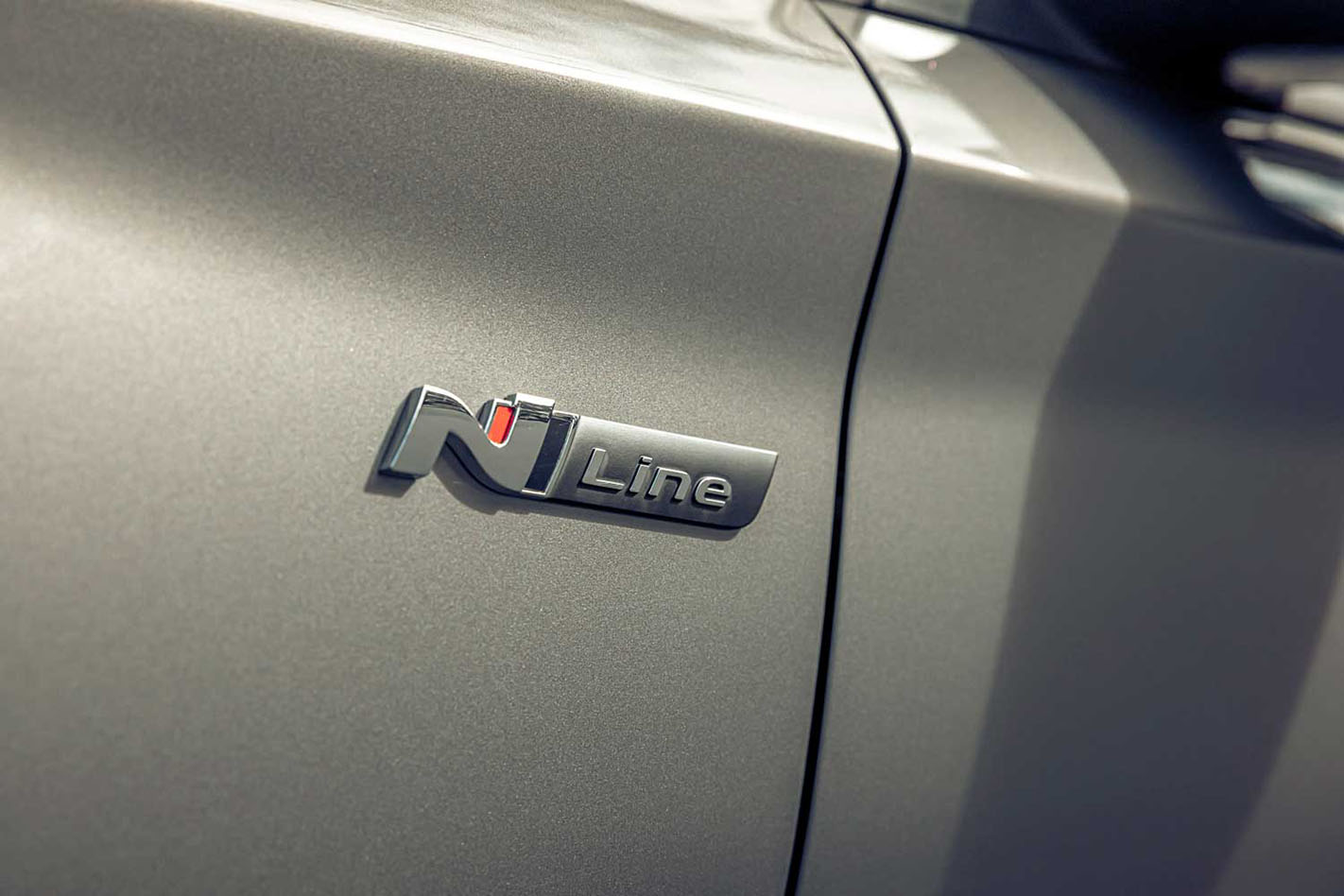
Yes, it’s on the firm side, drinks a bit more fuel, and might have expensive tyres, and the Corolla is as attractive a package for its simplicity and striking design, but that’s not enough to dampen the N-Line’s all-round winning package. As far as a warm hatch goes, the Hyundai i30 N-Line is piping hot.
Verdict
Hyundai i30 N-Line 7.5/10
Pros: Proper performance and handling; roomy and practical; decent value on balance
Cons: Firmer ride; turbo lag; dated exterior styling
Toyota Corolla ZR 7.5/10
Pros: Sharp looks; comprehensive safety features; revvy and economical engine
Cons: Lack of rear elbow room and boot space; wooden ride
Ford Focus ST-Line 7/10
Pros: Characterful and eager engine; cabin room; comfortable ride quality
Cons: Feels built to a price; missing active cruise control; gearbox tardiness at low speed
Mazda 3 Skyactiv-X 7/10
Pros: Seamless operation; refined cabin; high build quality; sophisticated design
Cons: Hefty price; inert handling; brake feel; questionable performance benefit
Specifications
Ford Focus ST-Line | Hyundai i30 N-Line | Toyota Corolla ZR | Mazda 3 Skyactiv-X |
Body: five-door, five seat hatch u00a0 | Body: five-door, five seat hatch u00a0 | Body: five-door, five seat hatch u00a0 | Body: five-door, five seat hatch u00a0 |
Toyota has unveiled the Aygo X concept, which is said to preview the next generation of the small car for Europeans.
Toyota’s Aygo was launched in 2005 as its most affordable European offering, but it’s now set to embrace the high-riding shift by going from hatchback to a small SUV crossover.
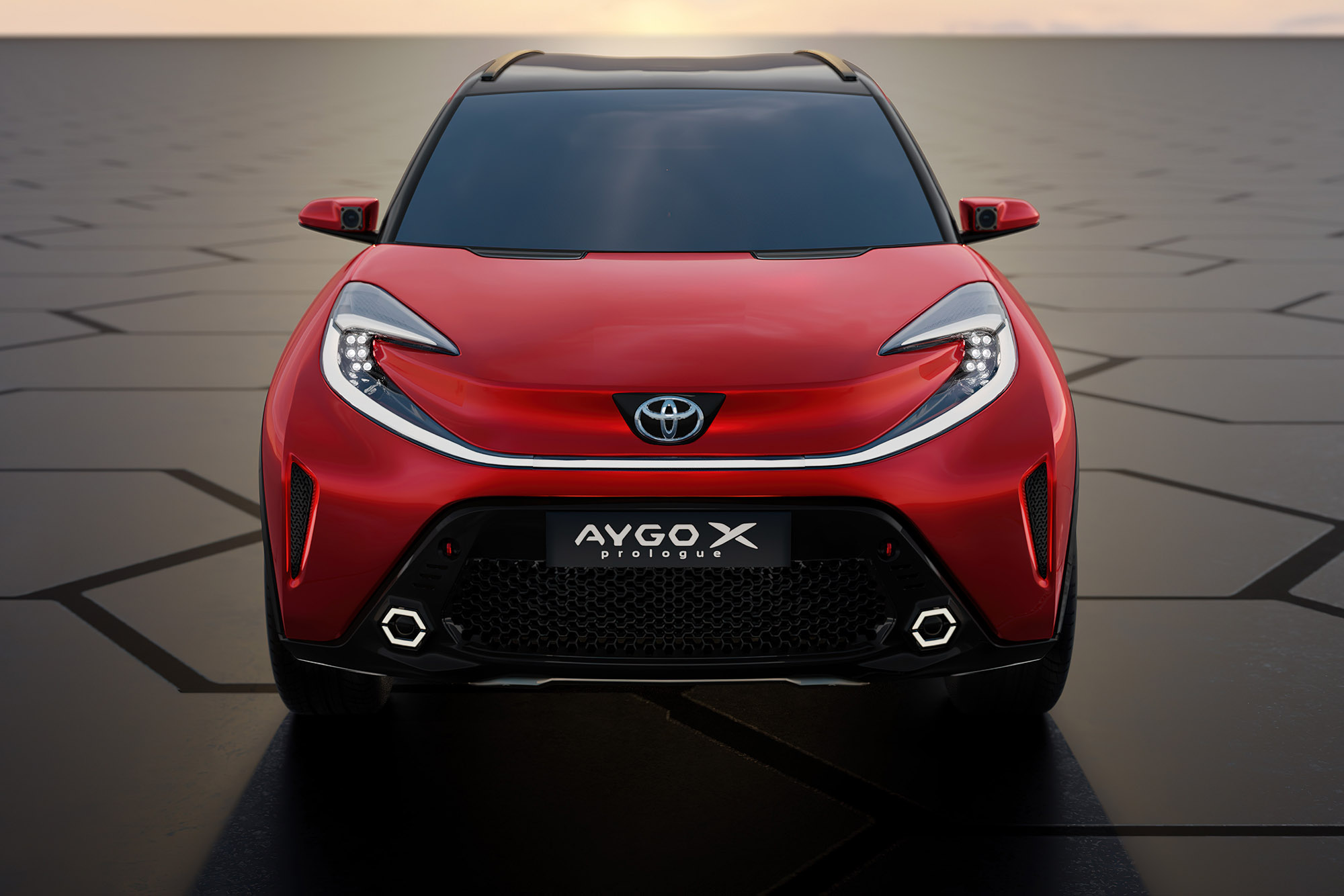
The Aygo X’s raised ride height, big wheels and flared wheel arches all point to a distinctly different car, one with an all-new face and bolder design than Toyota is known for.
It also sports two new-style C-shaped headlights that are joined by a full-width light beam, a sharp crease between front fascia and bonnet, and a two-tone colour scheme.
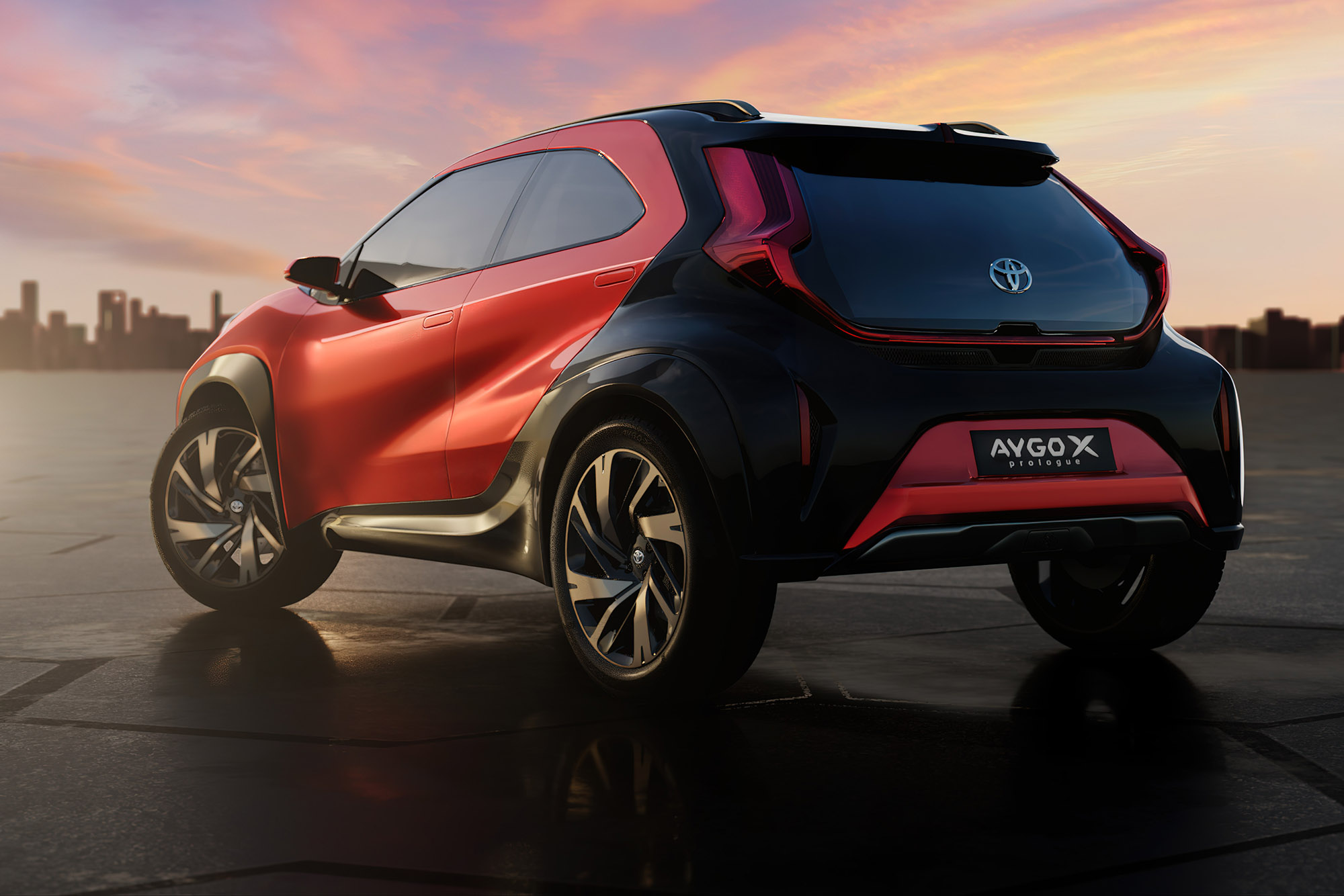
Design is similarly wild at the rear end with short, squat rear haunches accentuating its squared stance, vertical tail lights which are again joined together with another LED strip, and a body-coloured panel where the rear valance would go.
Other unique styling elements include flush-mounted door handles and action cameras in the side mirror casings, used for “capturing and sharing special moments of exploration”.
No images of the concept’s interior have been offered.
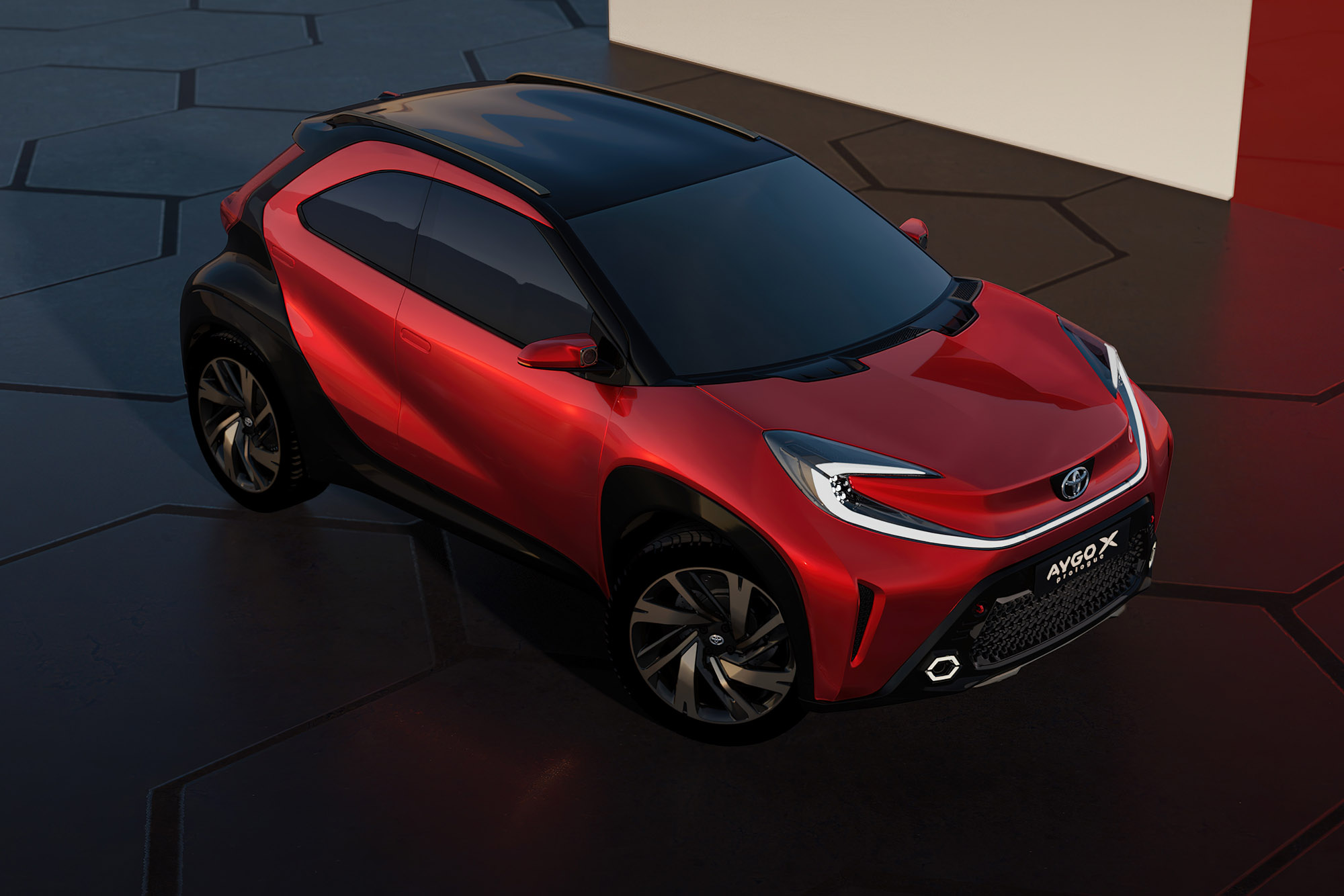
Aygo X will be built upon the same TNGA-B architecture that underpins the new Yaris, which can accommodate a number of power and drivetrain layouts.
Toyota has not said which engine will feature under the bonnet, but you could reasonably expect that it’ll be a naturally-aspirated three-cylinder, as found in the Yaris Cross.
We’d also suggest that a hybrid version will be available, owing to Europe’s tightening emissions regulations.
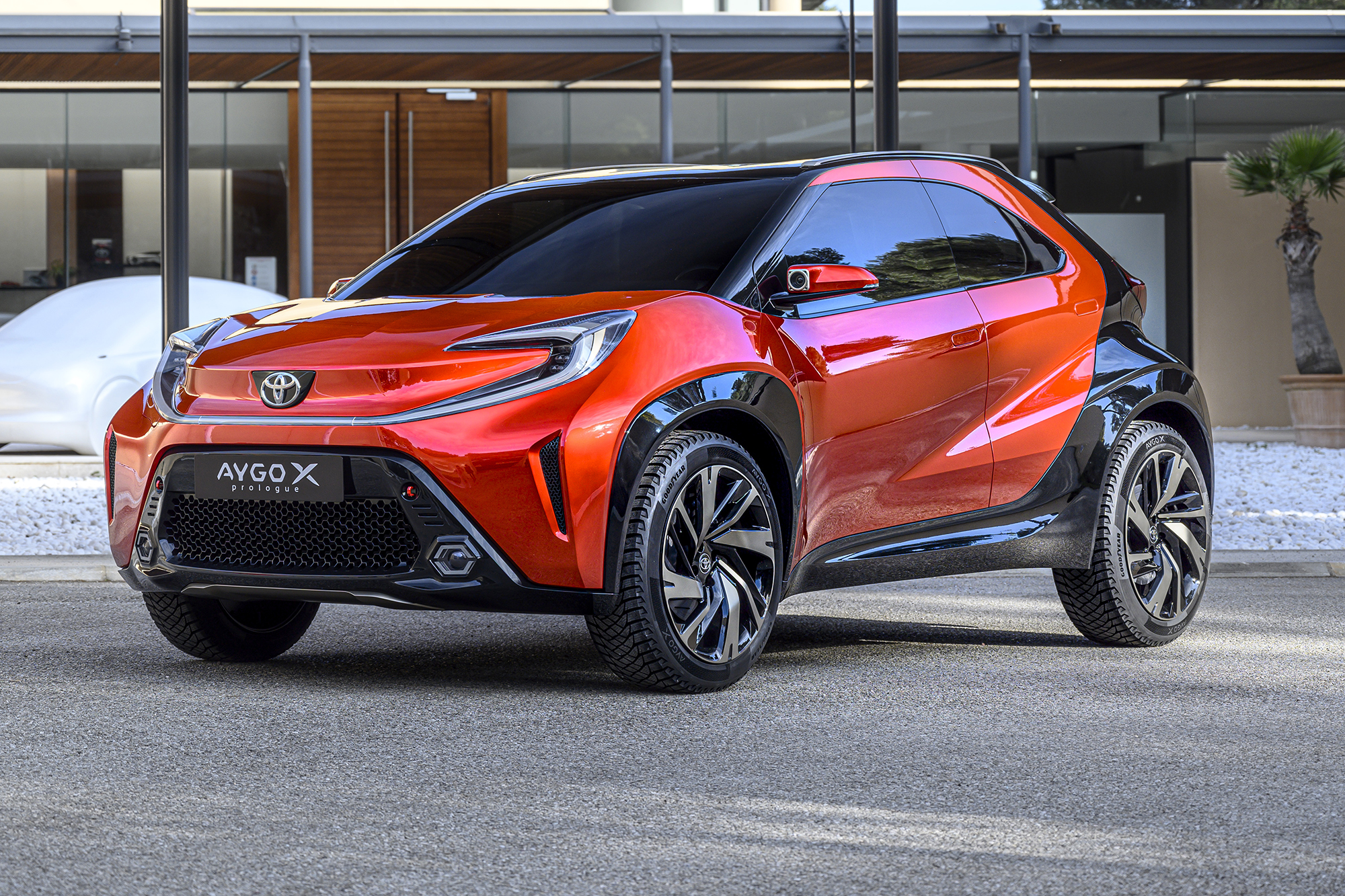
It’s important to remember that Toyota hasn’t officially confirmed that the Aygo X prologue is a preview of a production model, but if it is (and we’d suggest it is), a production version is likely to follow at the end of 2021 or in early 2022.
