
I found myself in a bit of a weird spot on Saturday morning… my two in-cabin bags are packed for a week on the road in Europe (check-in luggage? Phhht) for a trip that departed the following morning… but I wasn’t sure I was actually going or not.
Global consternation over the coronavirus outbreak is quickly turning into something closer to a mild panic, and large-scale public events like the Geneva Motor Show – my ultimate destination – appeared to be under legitimate threat.
But on a quick trip to the USA last week, it seemed to me, at least, that the almost hysterical media coverage wasn’t playing out in real life. I saw no more masks on people than usual (and it’s worth noting that gloves are a far better option for avoiding germs, but I digress), and large gatherings of people – the dreaded arrivals hall at Los Angeles, for example – were still the norm.
The virus has taken a heavy toll on many industries, including the automotive sphere, and there is still a bit to play out… but as it happened, the Swiss government banned gatherings of more than 1000 people, the Geneva show was cancelled and I, along with thousands of other attendees, was grounded.
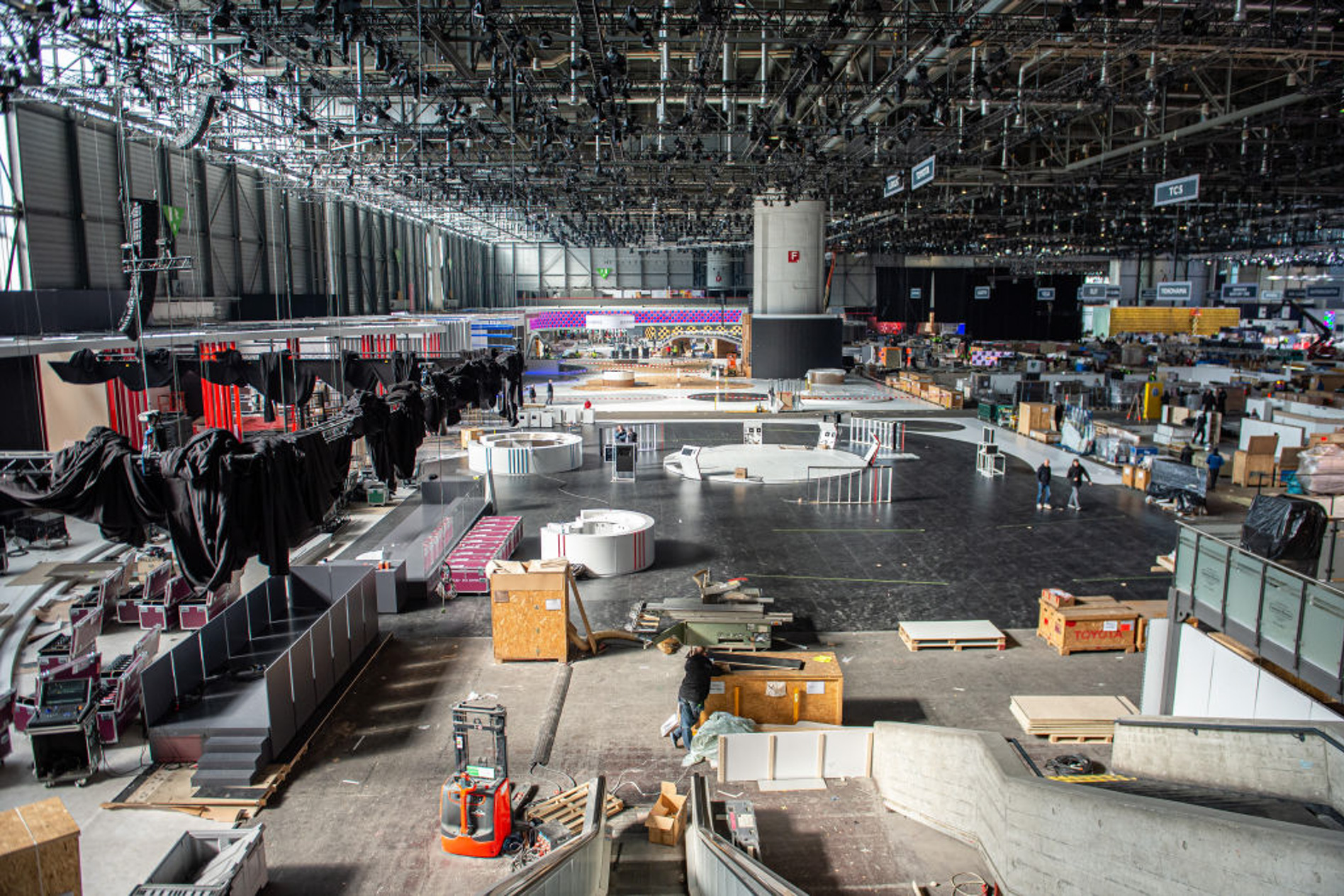
There’s no likelihood that the show will be rescheduled, so tens of millions of dollars in flights, venue hire, catering, stand construction, vehicle preparation and marketing have been simply torn up.
It comes at a time, too, when the very viability of motor shows is being questioned in boardrooms around the world by an industry that’s both in a sales funk and at an existential crossroads.
What happens next? Well, it depends on how seriously the threat of the virus is taken in other parts of the world. As it so happens, the New York Show (below) is the next cab off the rank in April; it’s a relatively small affair, but its booking office may find its phone ringing off the hook for spare stand space, especially if the US government continues down its path of ‘nothing to fear here folks’.
My best guess? Wait and see. Will the coronavirus outbreak turn into a pandemic? If it does, the New York Auto Show will be a small casualty in the scheme of things, especially if events like the Tokyo Olympics are parked.
—
Over at WhichCar this week, the fallout from the Holden closure has seen our teams still hip-deep in news stories and features around the storied brand.
Revelations that PM Scott Morrison met with a dealer group about GM’s purported payouts (there’s an irony there the size of a house) prompted a strong reaction from Holden, while the news that a senate committee inquiry has been instigated brought strong reactions from our readers.
As well, our teams answered the basic questions about what’s next for Holden owners, and we also took a swing at guestimating what cars the embryonic GM Special Vehicles division might bring in.
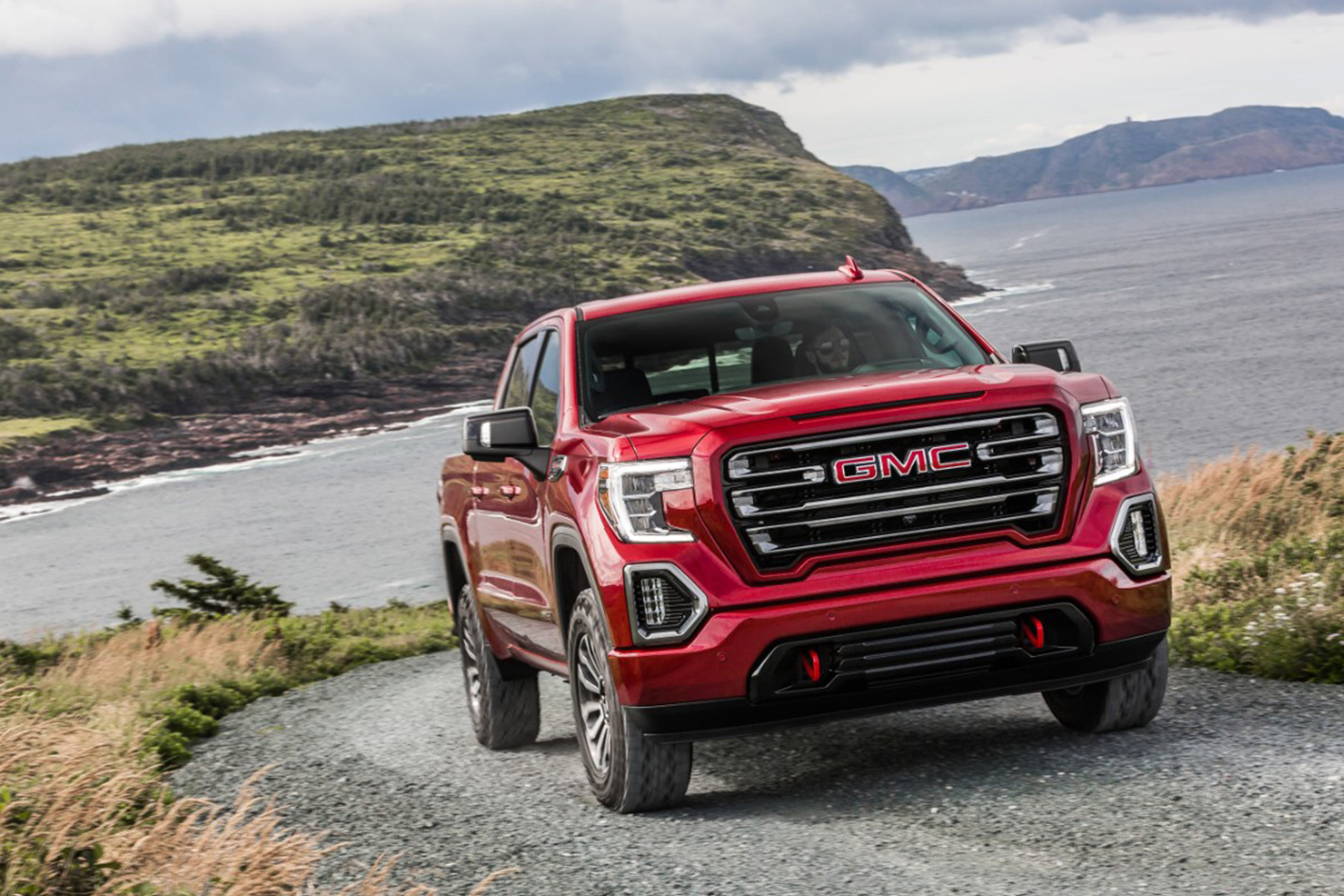
GM Sierra 1500
Overall, though, it’s been a week where the realisation that we’ve lost an iconic brand has really started to hit home. Glenn’s editorial last week really hit a nerve with a lot of people, who shared some amazing stories around their time with the brand.
The biggest story of the week by far, though, was around a five-year-old beat-up engineering mule known as Blackjack, famous for the fact that its front and rear ends came from a Holden Commodore VE ute.
For me, it symbolised the demise of a once-great union and the desperate waste of amazing talent that made cars like the VE into world-beaters.
On the brighter side, we found out that BMW is still keen on V8s, investigated whether now is a good time to wait for that new 4×4 dual-cab, waded neck-deep into the new Ford Mustang R Spec, sussed out some of the most ridiculous Tesla mods ever and pondered just why people are so bad at towing.
Of course, WhichCar TV is on the box this Sunday at 4pm on Channel Ten – and debuting on Prime in New Zealand – and our reams of social media feeds are pumping out all the good gear 24/7.
Amongst the frenzy, there is a moment of calm when the limit of adhesion is broken and the rear axle breaks free. It doesn’t have to be a lurid drift; a slight, ever so subtle sensation of yaw is all it takes. The car feels alive beneath you and at your fingertips. It’s a level of playfulness that enamours and excites.
It’s just not a feeling you expect to come from an SUV. Traversing the copious number of winding roads nestled within Victoria’s Alpine region, it’s all too easy to forget that the BMW X4M Competition is, in fact, a near two-tonne SUV. The high-riding coupe has a dynamic ability that it has no right to employ.
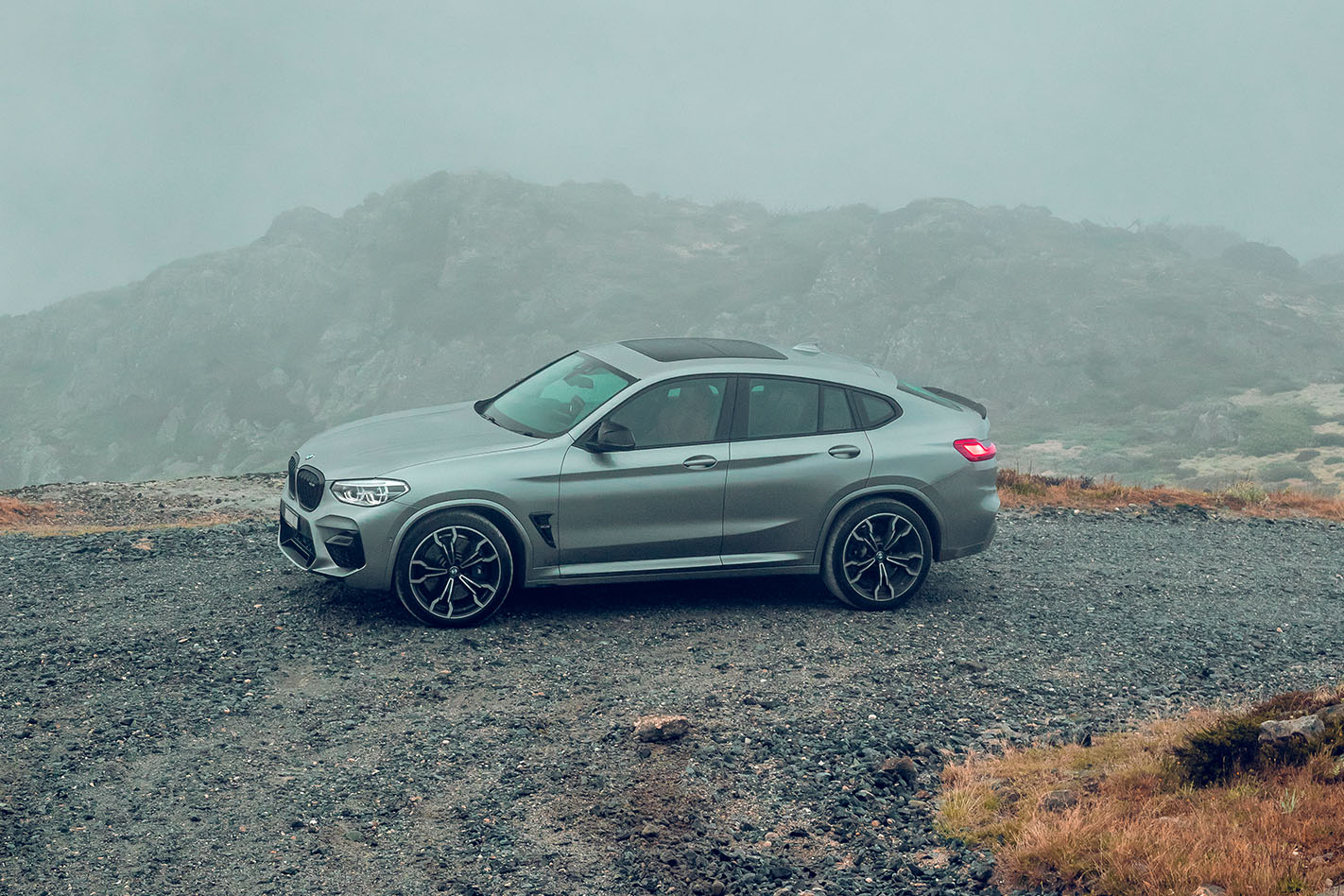
The sun is in its final stages of descent and the air is beginning to cool, but instead of inputting an address of the nearest motel, our GPS coordinates point to a destination high in the sky. Falls Creek is one of Australia’s few snow epicentres, however, right now it’s far from a winter wonderland. Nope, it’s driving nirvana.
Slinking out of Bright isn’t really an option. The $164,900 X4M turns heads and pricks ears. The SUV-coupe form factor confuses many, while the angry, boosted straight-six growl baffles the rest. It’s a somewhat uncomfortable concoction. If you wrestle with the idea of a performance SUV, then the X4M Comp is a concept even harder to digest.
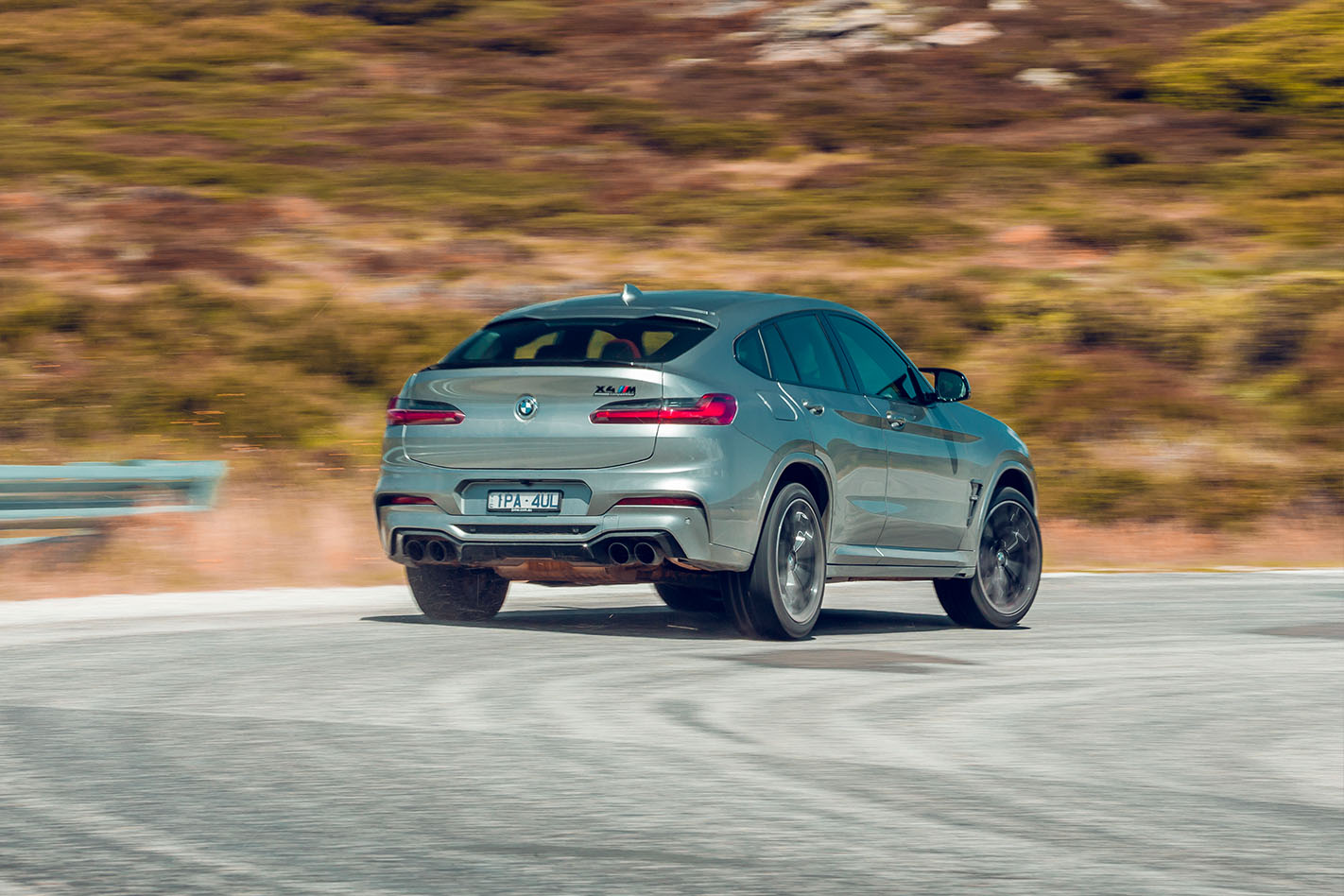
Something else that’s hard is the ride quality. Fitted with stiffened steel springs and, thankfully, adaptive dampers, the big BMW struggles to live up to the name of its most supple ‘Comfort’ mode. All the imperfections of Tawonga Gap road are being translated into the cabin. However, the Comp isn’t sans damper sophistication. And as the tarmac smooths and becomes twistier as it wraps around the mountain ranges, the X4M comes alive. The big, 1970kg body shrinks around you, with the rear-biased xDrive all-wheel-drive system doing its best to mimic a rear-drive setup.
While you can’t fully disengage the front axle, play with the myriad modes like 4WD Sport, and the rear will step out with little provocation on corner exit. Body control is kept in check and the way it transfers its heft on changes of direction is mighty impressive. Chasing the horizon apex after apex, it’s hard not to recognise that the X4M Comp feels more dynamically adept and entertaining than the M135i hot hatch – although it is $99,910 more expensive.
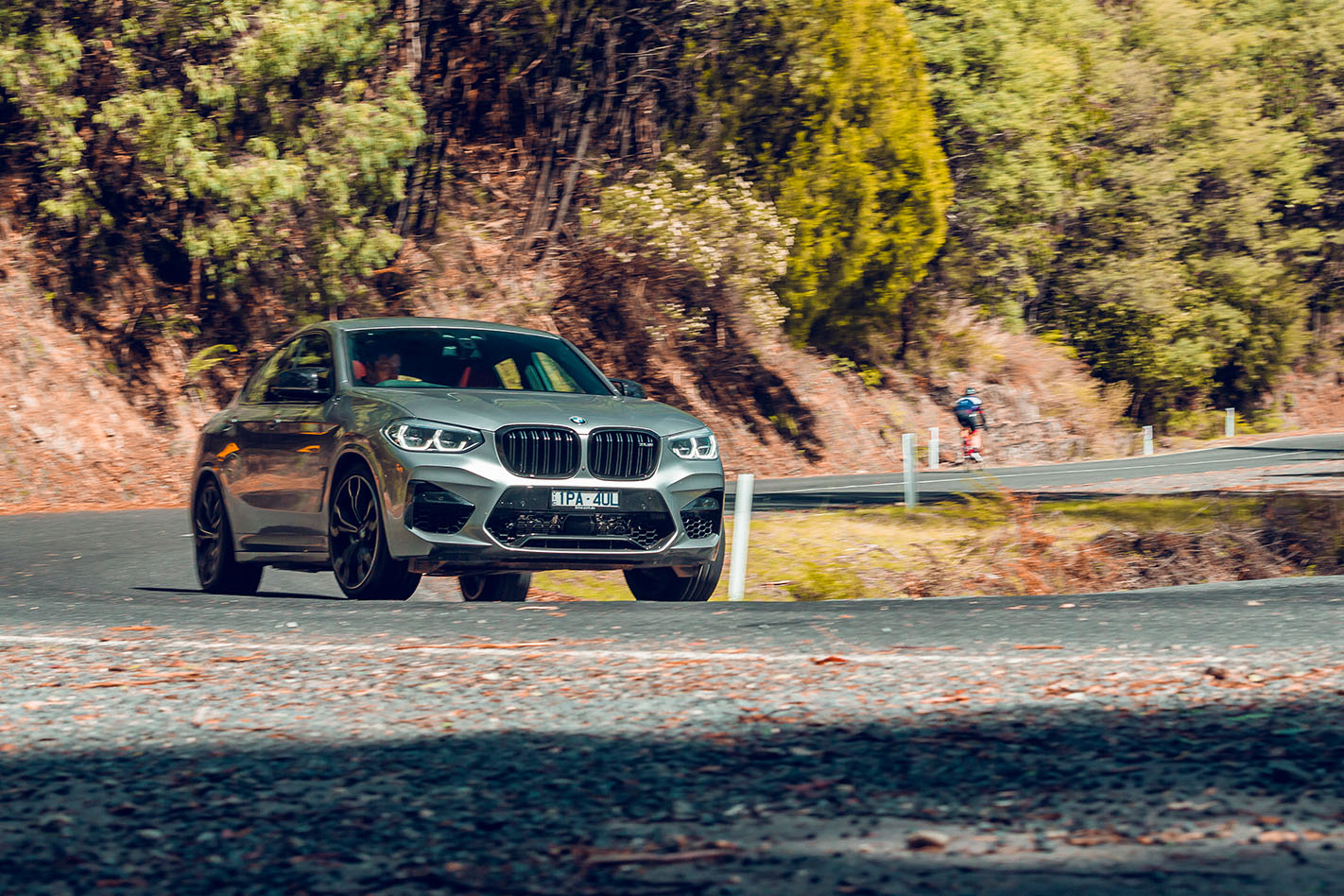
With road-biased Continental SportContact6 rubber (255/40 front; 265/40 rear), the X4M Comp hooks up and explodes out of tight hairpins. The M division’s handy work is evident as the twin-turbo straight-six inhales the crisp, cool air. Interestingly, the new S58-generation engine is seeing its first use here, and not in the upcoming M3/M4.
Despite some initial low-down lag, once it has a full head of steam, the 375kW/600Nm six is unrelenting. It catapults you forward at an alarming rate. The 3.7-second 0-100km/h time recorded earlier in the day is proof. The eight-speed torque-converter auto does its best to replicate the instant shifts of a dual-clutch, but it just misses the mark. The flip side is it’s much more obedient at slow speeds.
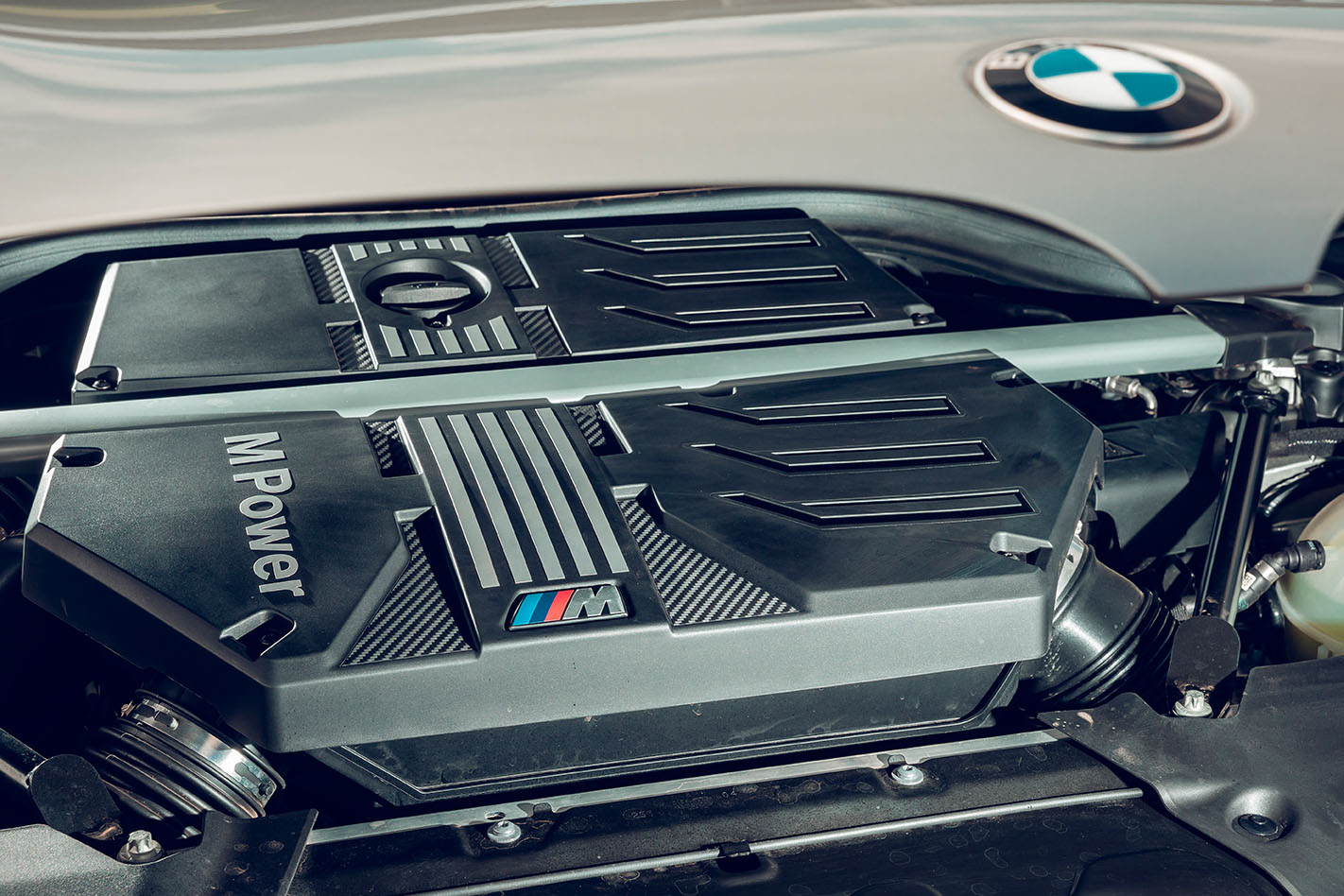
With ample grunt on tap and plunging cliffs aplenty, it’s refreshing to feel a progressive brake pedal underfoot. The ventilated stoppers arrest the relentless fury, either while heading for the clouds or plunging down steep declines. That sensation of feedback also applies to the steering, although it becomes far too artificially heavy in the sportiest modes.
As night falls the temperature plummets. The calendar might say we’re in summer, but the BOM app computes that it ‘feels like’ -1.2 degrees. That piece of information induces numerous profanities as the assembled Wheels team freezes in a hybrid of winter and summer attire. We all feel ill equipped and as if we’re sliding into the initial stages of hyperthermia. The X4M Comp has company, the Range Rover Velar SV Autobiography and Mercedes-AMG GLC 63 S have joined the Bimmer for a comparison test you’ll see soon.
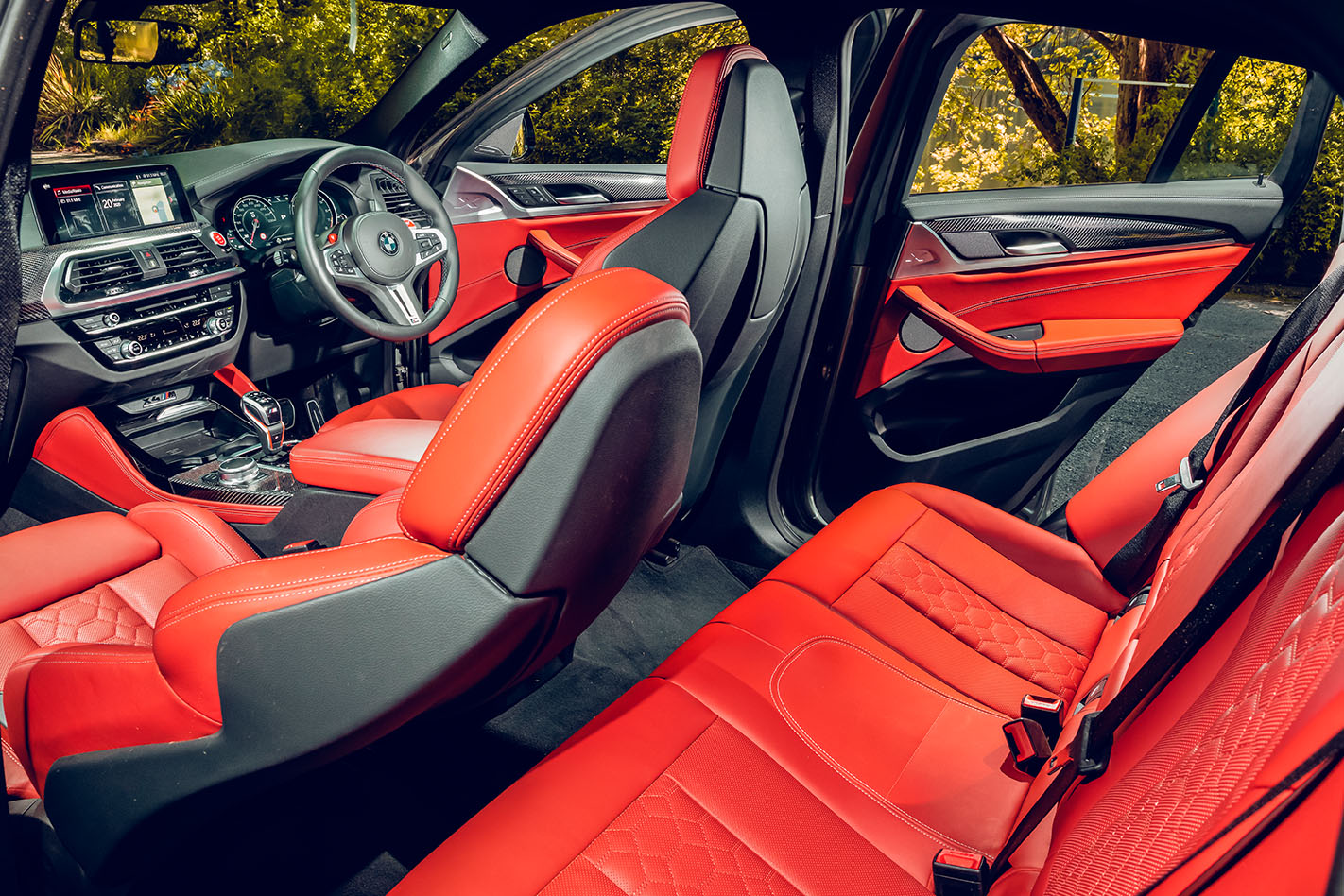
With the final shots for the magazine in the bag, seeking refuge in the leather-bound, but crucially, climate-controlled cabin becomes paramount. The new-gen BMW interiors are a huge leap forward, by being both ergonomically sound and visually appealing. But does it feel $165K special? After hours behind the wheel, I’m not so sure.
The 525-litre boot easily swallows the quirky photoshoot props we’ve lugged along, while the 40/20/40-split rear seats allow a pair of snow skis to be stowed appropriately. There’s a 25-litre compromise for opting for the X4 over the X3, as well as restricted back-seat headroom, but many won’t care when the tapered silhouette turns more heads.
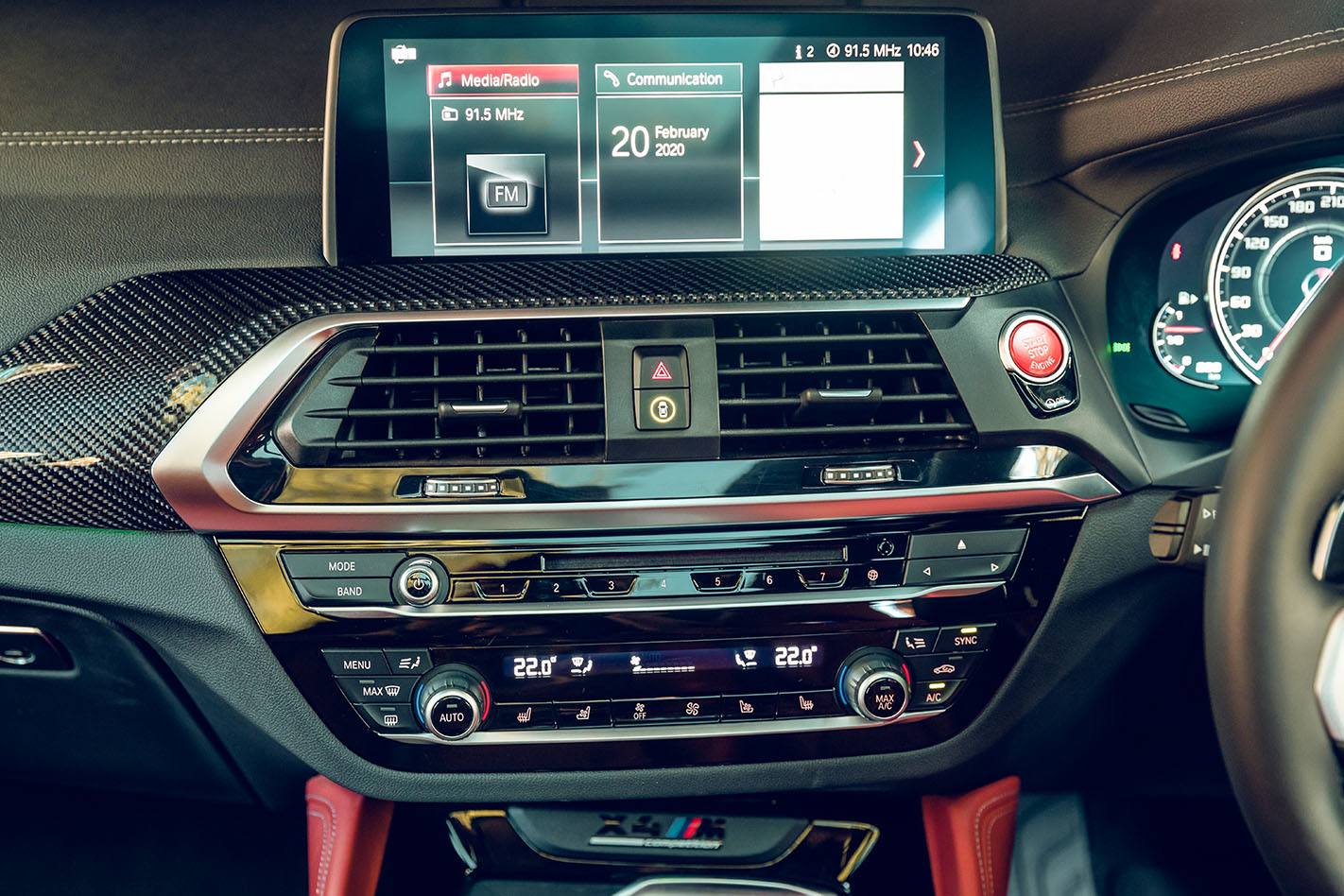
Cranking the heat to 28 degrees is the first port of call, while switching on the heated and ventilated seats concurrently proves a masterstroke as hot air is fed through the supportive M Sport seat. Our test car’s bright-red leather won’t be to everyone’s taste, however. Selecting the right route while traversing a section of rocky dirt track becomes vital – who said an X4M would never go off-road?
It’s late. Eyes are bleary and the wits of the team are being tested after navigating safely past the plentiful nocturnal wildlife. Mercifully the hotel comes into view and it’s finally time to park up for the night. Pressing the red starter button kills the burbling straight six – only ticking can be heard as the dormant S58 cools.
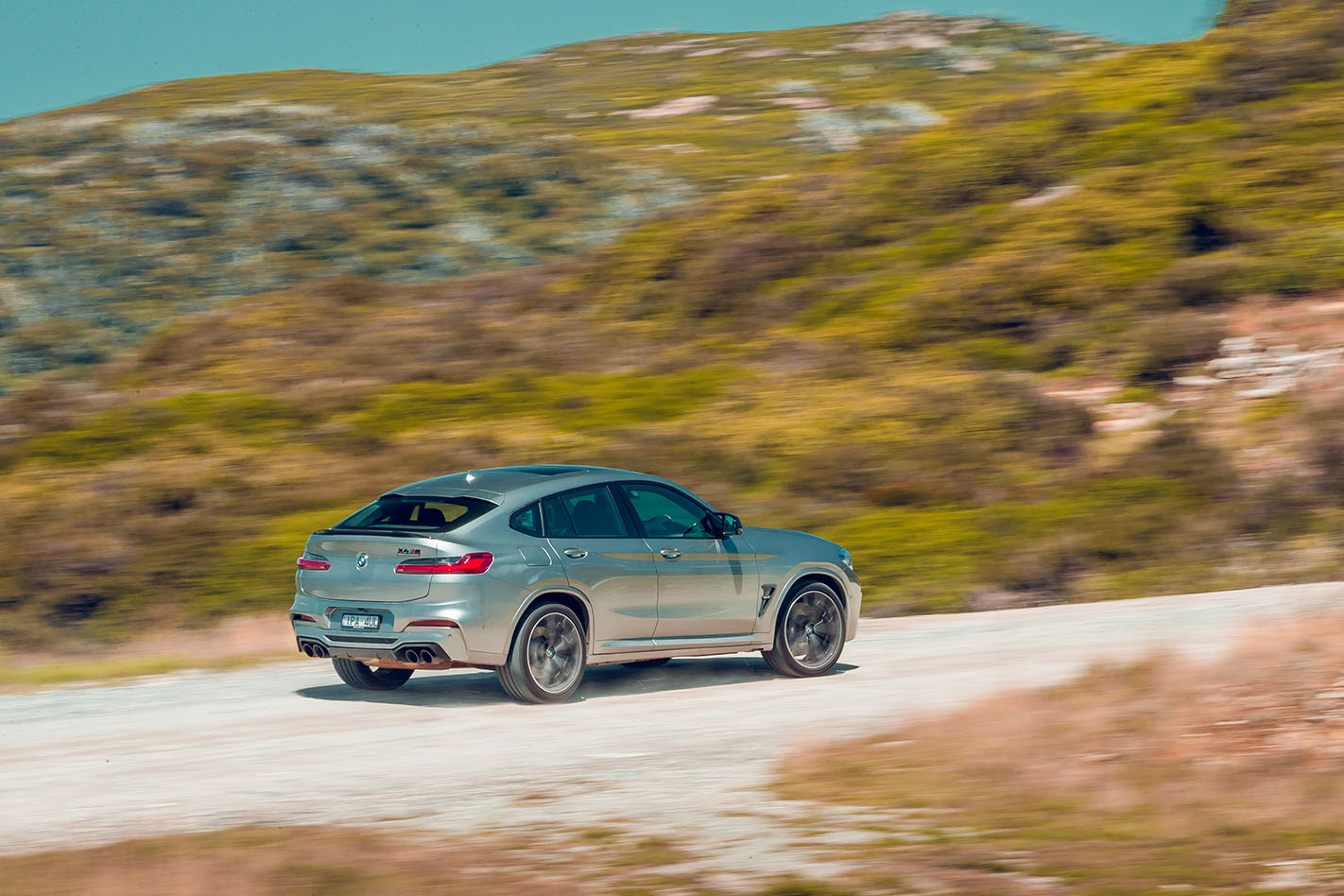
The X4M Competition is abundantly talented for what it is – a performance-orientated SUV. That much is overtly clear from behind the thick-rimmed steering wheel. However, it’s hard to ignore the fact BMW’s M division has created a hyped-up, jacked-up SUV coupe that confuses and beguiles in equal measures. And I’m strangely okay with that.
MOTOR first drive review
Think of a Porsche 911. One that’s twin-turbocharged and rear-drive, with huge tyres. One that will sprint to 100 in a shade over four seconds and flat-out will see almost 300km/h.
You may be thinking 993 GT2, but this is the new entry-level 911 Carrera. It’s an extraordinary thing: the performance of a pulverising homologation special of the mid-1990s can now be matched by the most junior member of the family – and at half the cost.
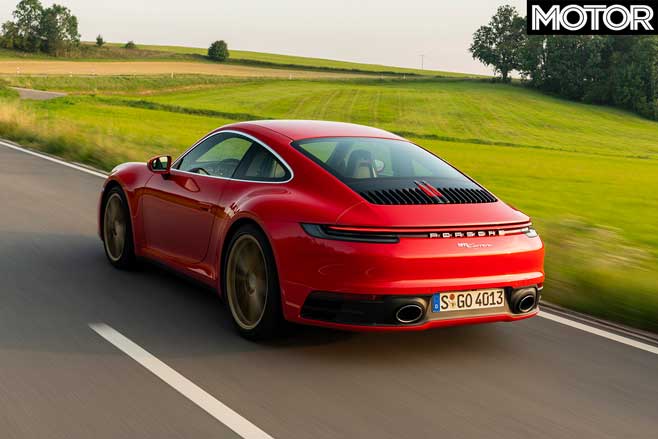
The 3.0-litre flat-six is detuned with smaller turbochargers and less boost. Power and torque are down (by 48kW and 80Nm), but the smaller turbos spool up quicker, practically eliminating lag and sharpening throttle response. Occasionally accompanied by a faint metallic yowl reminiscent of old 911s, the engine is phenomenally responsive, and the way it spins to the 7500rpm redline is relentless.
Porsche’s PDK gearbox also remains outstanding: shifts are cut-throat quick but effortlessly smooth. In short, the powertrain is excellent and, raw pace aside, more enjoyable than that of the Carrera S. What a coup.
Base 911s have often been among the sweetest to drive. Smaller wheels, narrower hips and softer suspension made them easier to place on the road and even more expressive in their handling, at least at realistic speeds. But this one gets the wider body previously reserved for S-badged variants and the 46mm-wider front track now matches that of the outgoing GT3. The 911 is now a large car.
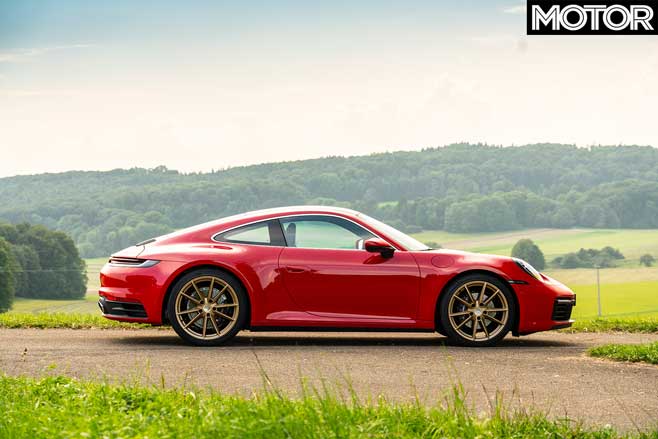
However, this is the way of the modern 911. And considering that almost two-thirds of the mass lurks behind the driver, they are freakishly composed. Porsche’s staggered wheel set-up pushes the balance point forward, and wherever you point the neat little 360mm steering wheel the car simply goes, effortlessly.
In every respect, the base model is just as impressive as every other 992 we’ve tested. Accurate, neutral, phenomenally quick. But the entry-level 911 doesn’t take itself as seriously.
The standard ride height makes it appear a little perched at standstill, at least compared to cars equipped with PASM Sport suspension (which is most of them), but the more generous travel introduces extra fluidity into the body movements on the move.
At real-world speeds, that’s invaluable. The suspension breathes more freely, allowing the car’s natural weight distribution to come to the fore. And rear-wheel steering? Didn’t miss it.
No longer do you need to pay a premium for the Carrera S. At no point does the less powerful car’s 283kW feel underwhelming. Supple, uncomplicated to drive, but at its core still a deadly serious sports car, this least expensive Carrera – $34,900 less than the Carrera S – is the best of the bunch to drive at eight or nine-tenths. And if you’re going any harder than that, you’re probably on track and need a GT3. Or a 993 GT2.
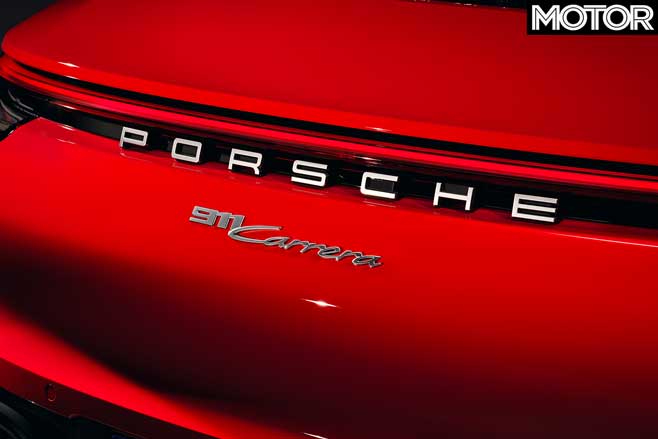
PORSCHE 911 CARRERA SPECS Engine: 2981cc flat-6, DOHC, 24v, twin-turbo Power: 283kW @ 6500rpm Torque: 450Nm @ 1950-5000rpm Weight: 1505kg 0-100km/h: 4.2sec (claimed) Price: $229,500
Likes: Sweet handling; plenty of power and response; shift quality; relative value Dislikes: Still overweight, even with aluminium body panels; large footprint
Rating: 5 out of 5 stars
Second Opinion: MOTOR first Australian drive review
Non-S Carrera fiendishly fast for a ‘base’ car By: Dylan Campbell | Photos: Mark Bean
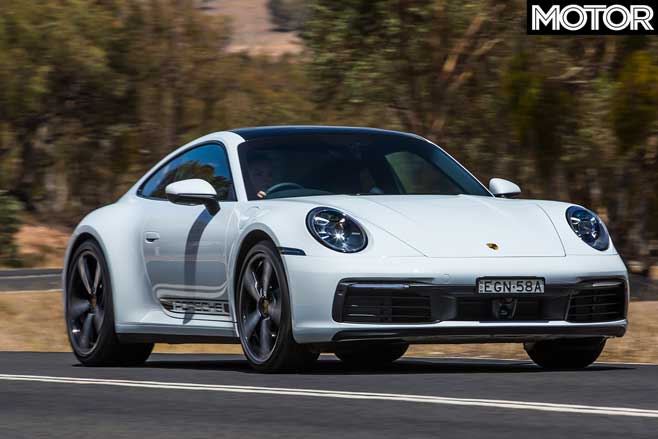
Gone are the days you bought the slightly slow one when you got the ‘base’ Porsche 911 Carrera. We know, because we just drove the new, 992 series around the Bathurst hinterland in New South Wales, and we’re a bit shocked how fast the thing is.
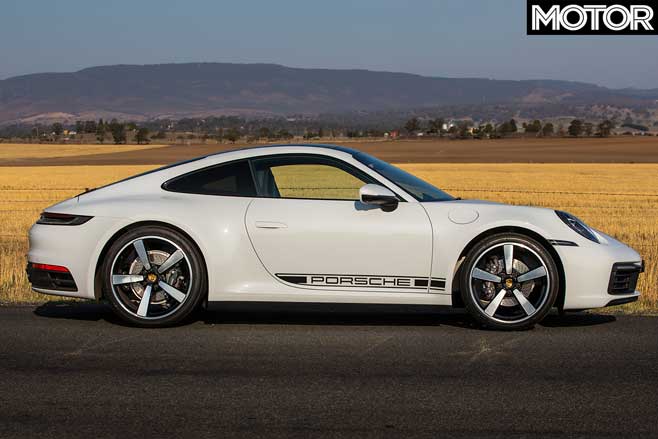
We’ll get to more of that shortly, but let’s quickly run through what’s new. For the new 992 the 911 has grown in overall dimensions yet again, now 20mm longer, 44mm wider but 5mm lower (all 911s now get the ‘widebody’ treatment).
Despite increased use of aluminium in its body (now 70 per cent), at 1505kg the base Carrera is 55kg heavier than its 991.2 equivalent. The wheelbase is the same but the front and rear tracks are a whopping 50mm and 39mm wider respectively, tyre widths unchanged.
While Porsche says the 3.0-litre flat-six is a “new” engine the changes are better reflected in its name – 9A2 Evo. New turbos, exhaust manifolds and relocated intercoolers are among the numerous changes yielding an extra 11kW. Torque remains 450Nm.
With the new, shorter-geared eight-speed PDK, acceleration has improved by 0.2sec to 100km/h, now a claimed 4.0sec (or 4.2sec without the $4890 optional Sport Chrono), while 0-200km/h falls by 0.3sec to 14.2sec.
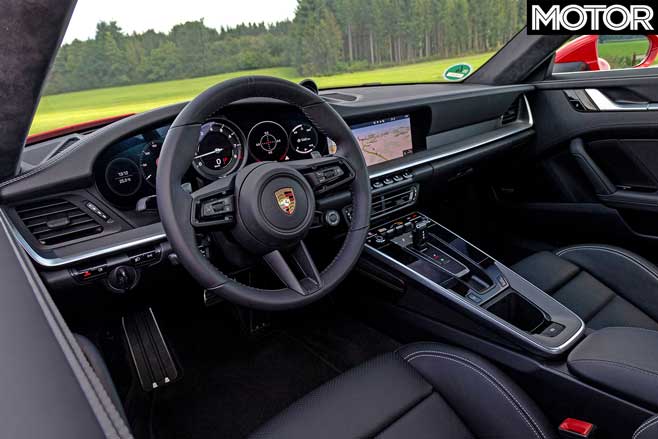
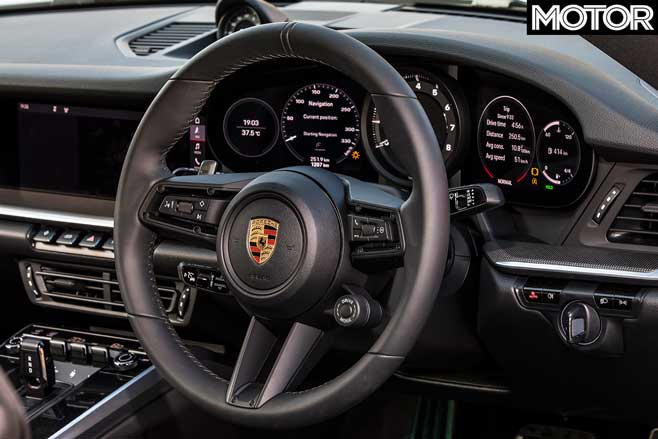
Having familiarised yourself with the beautiful new, high-quality, higher tech and newly luxurious interior – with tasteful retro vibes like the new tacho face, needle, and dash design – there’s a more comfortable daily driver to discover in the 992. A bit quieter, a bit nicer riding, visibility remains very good in what is no longer a petite car. And get stuck in on a twisty road and the handling is, as you’d expect, sublime.
To drive the 911 Carrera hard is to become completely immersed in the experience. The acceleration, while noticeably not quite matching the kick of the S, is still wild; the 11 per cent quicker steering is pin-sharp and basically perfect; and maybe thanks to the significantly wider front track there is more front end grip available helping the overall balance.
Even though the front tyres remain 235-section (295mm rears), you don’t feel to have to drive on the brake into corners quite as much as you did 991.2. Understeer is a lot harder to create.
Communication abounds from the rear end and while traction is strong, a bit of delicious throttle-steer is available out of first- and second-gear corners if you want. All the controls, too, feel spot-on; the high speed-stability is incredible; and the PDK is somehow seamlessly smooth and razor-sharp at the same time, and feels very German-engineered.
Err, yep, the base Carrera is pretty damn excellent.
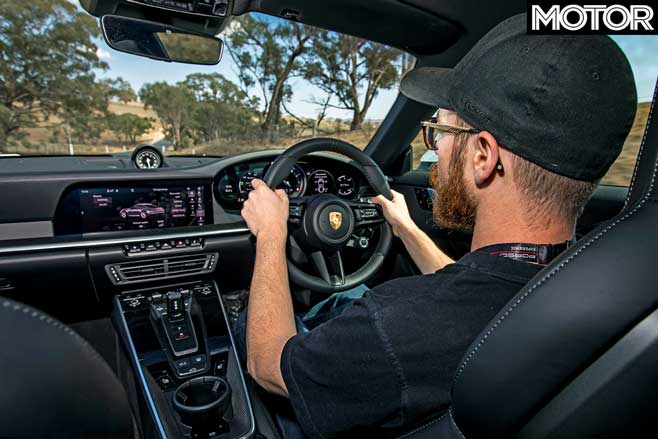
Like many modern sports cars there’s a huge amount of power rocketing you along, and a lot of grip and braking to support it, but it is too hard to safely explore the car’s very high limits on the road. If you buy a base 911 you must take it to the track or you might never know half the car you’ve purchased.
Meanwhile the engine is one of the best, most complete turbocharged performance engines ever developed. It idles with a subdued, almost air-cooled dak-dakness but there are tame notes of GT2 RS in the exhaust as well.
Flatten the throttle and from 1950rpm the maximum 450Nm torque arrives strongly but not overly aggressively; and from there the engine revs keenly, linearly and without running out of puff to its fairly lofty 7500rpm limiter. All the while crescendoing to a loud, rich flat-six sound that certainly satisfies. In the transition from 991.2 to 992 the engine has very much found its voice.
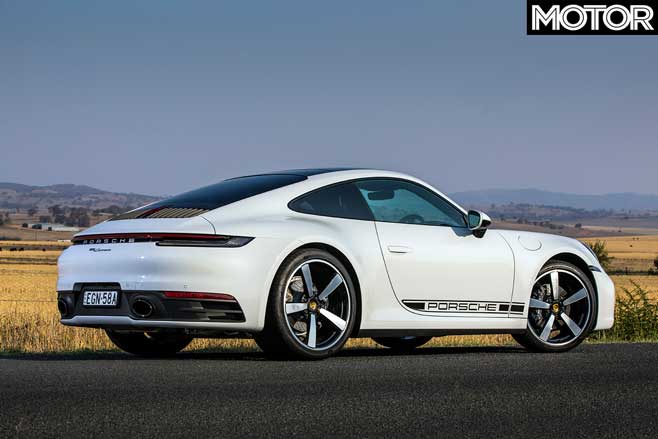
The base Carrera is not flawless; the ride quality has significantly improved but this is still obviously a sports car underneath. And while it’s overall a much nicer and easier car to operate, Porsche has also made some weird ergonomic decisions with 992, like the electronic pop-out door handles which compromise usability for styling.
If you slapped an aggressive bodykit on the 992 base Carrera and some Turbo badges, though, it’d be fast enough to convince someone from 2002 who just woke up from a coma that it was latest 911 Turbo. Yet this is the baby one. It’s almost unimaginable what the actual 992 Turbo will be like, yet next month it will be our reality.
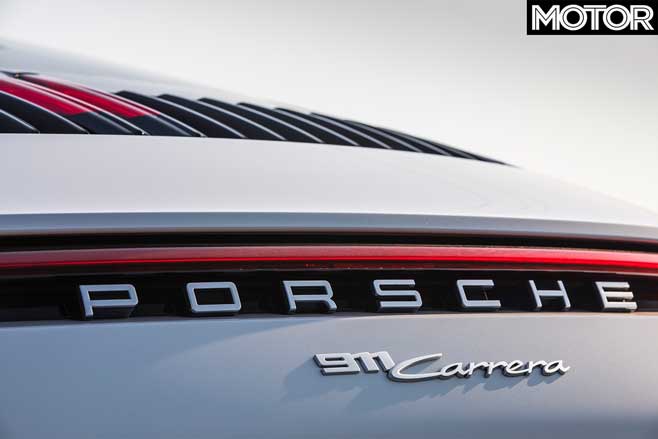
PORSCHE 911 CARRERA SPECS Engine: 2981cc flat-6, DOHC, 24v, twin-turbo Power: 283kW @ 6500rpm Torque: 450Nm @ 1950-5000rpm Weight: 1505kg 0-100km/h: 4.0sec (claimed, Sport Chrono) Price: $229,500
Likes: Crazy performance; totally engrossing to drive; more front end; more comfortable Dislikes: Keeps getting bigger and heavier; electric exterior door handles a bit dicky
Rating: 4.5 out of 5 stars
- Introduction: Stepping into the Pug life
- Update 1: Time travel
- Update 2: On Higher Ground
- Update 3: Quart De Mile
- Update 4: Puppy Playtime
- Update 5: Au Revoir Mon Ami
Introduction: Stepping into the Pug life
Do I have commitment issues? Am I too prone to fall into a state of infatuation? Is the Peugeot 308 GTi a good all-rounder hot hatch to live with? These are three questions which will hopefully be answered over the coming months as we welcome this little turbocharged French rocket into the MOTOR fold.
It’s not only my first long-termer, but it’s also the first time I’ve properly sat myself in a Pug 308 for a steer since I very briefly drove one to Sydney Dragway for the 2019 MOTOR Tyre Test. And I’m already enjoying it quite a lot. Maybe we’ll answer the infatuation question sooner rather than later.
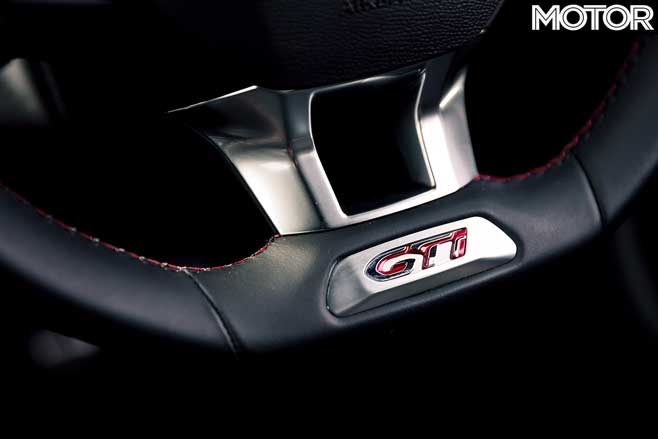
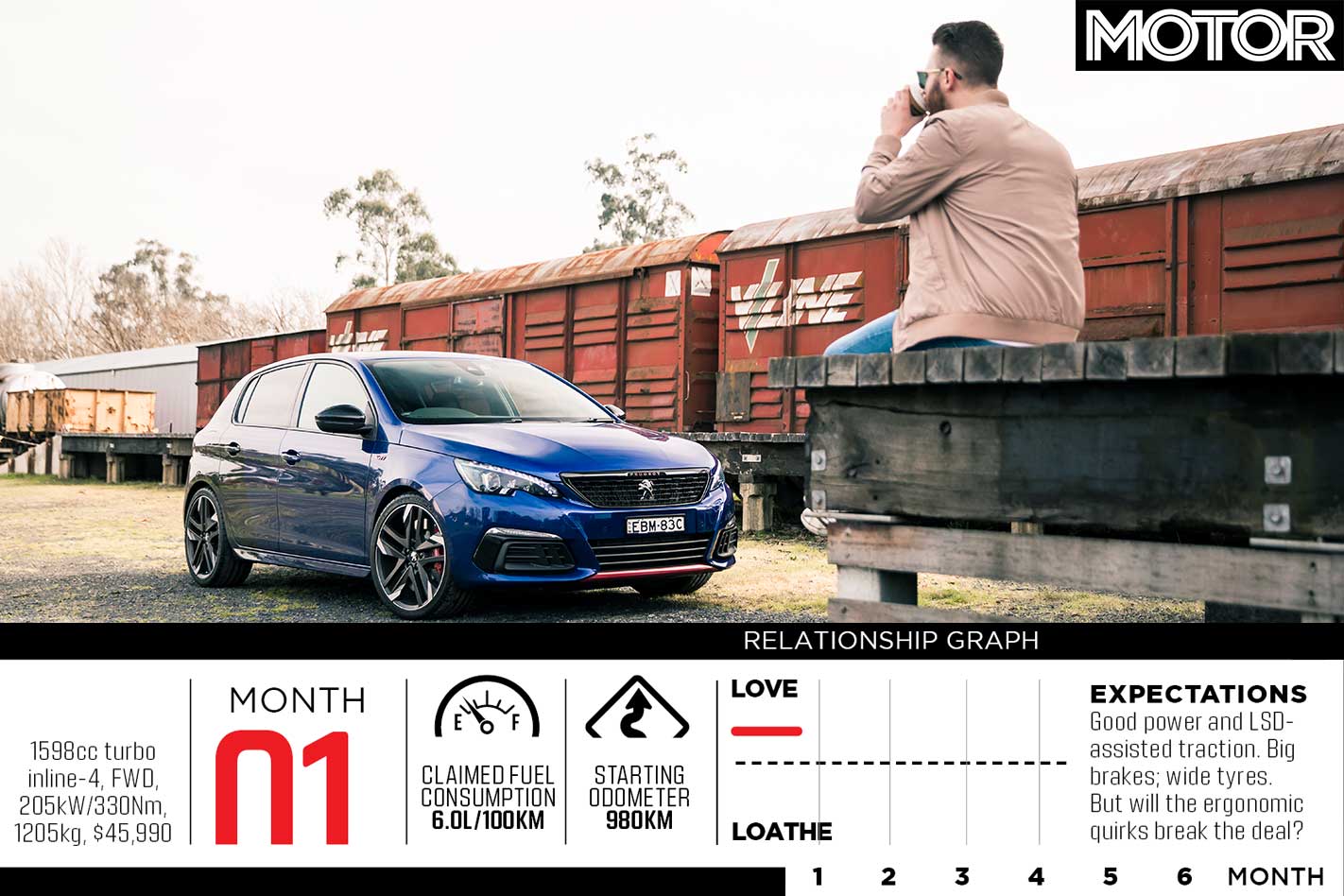
But in my quest to remain impartial, I’ve scrutinised the work of Peugeot Sport to work out what I think I’m going to love and loathe by the end of the GTi’s stay. For a start, the fact that it’s a hot hatch with a relatively low kerb weight of 1205kg is a big tick in the ‘yes’ column, and its 200kW 1.6-litre four-pot is a nice pairing with the eager chassis, and it’s helped along by a fairly healthy 330Nm.
Speaking of punching above its weight, it has 166kW-per-tonne, which puts it ahead of pretty much everything else in its class, including the brawny 164kW-per-tonne Civic Type R. Even with that massive chunk of power from such a little engine, there’s not a massive amount of lag from the turbo, which means no mid-corner surprises. I hope.
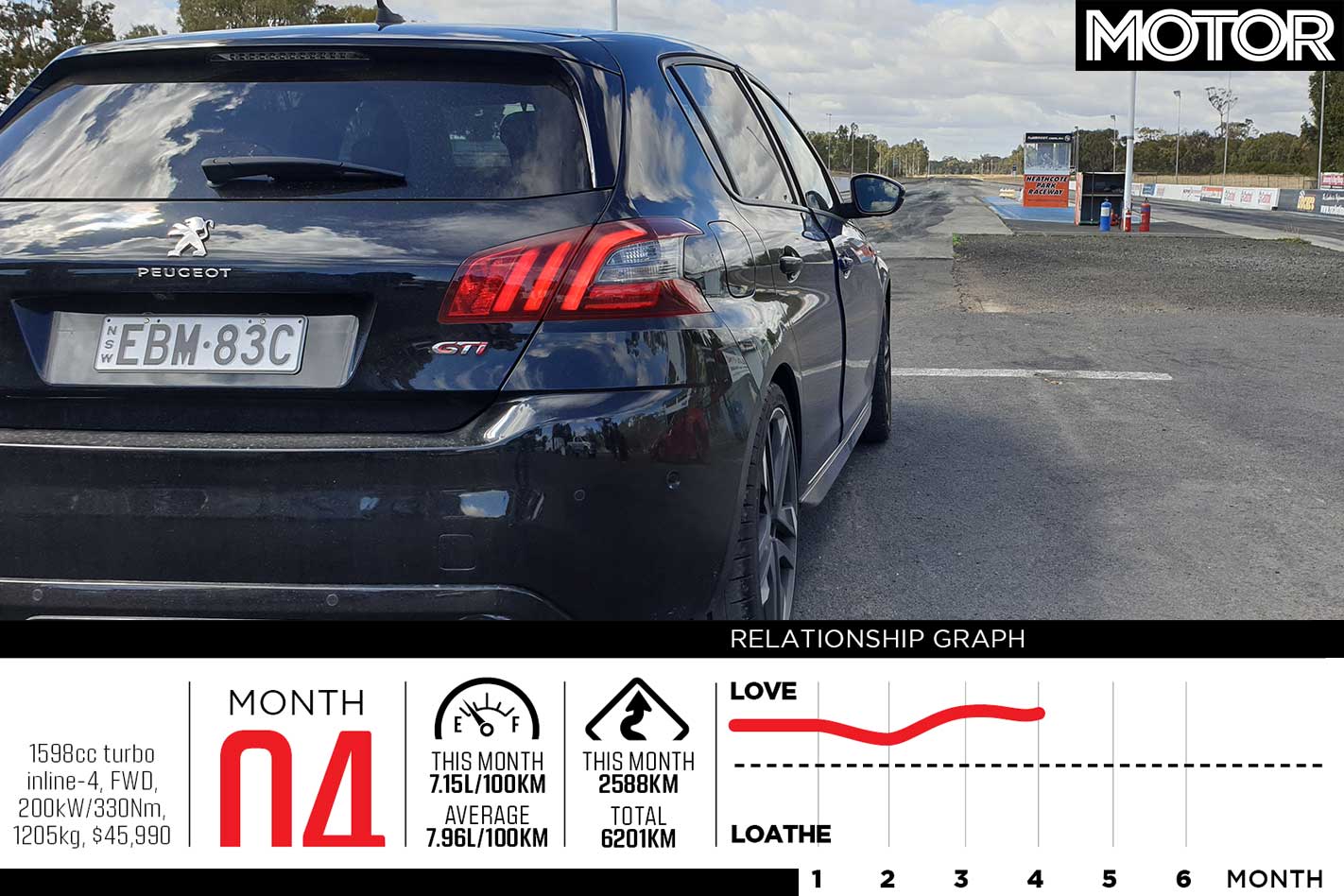
Interestingly, after a few commutes and a photography session, the fuel tank still hasn’t required a refill. Maybe the 6.0L/100km claim isn’t far off? We’ll be keeping track of that.
Its price is also a little ahead of where it once was, though the Peugeot is ageing now. Introduced in early 2016, the 308 GTi has been updated once since, and with it there was a financial gain for buyers.
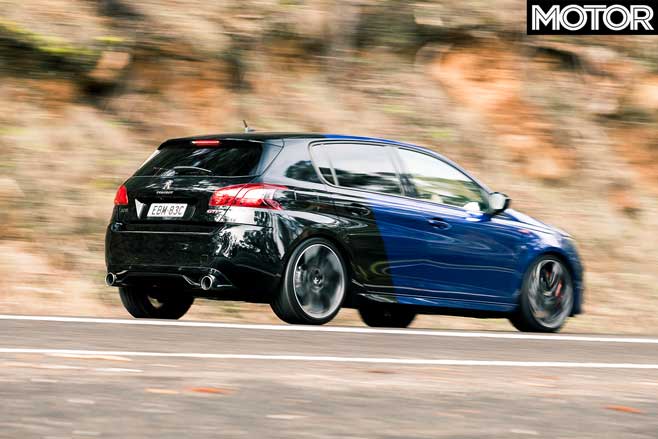
What was once a $50K offering was given a $4000 price cut early last year, and cheaper has to be better. You also won’t make it more expensive by adding an auto transmission, because you can’t get one. Another tick from me.
What I might find myself frustrated with is the fact that the tacho is around the wrong way, sweeping from right to left. And that the whole thing turns red in Sport mode. I like the aggro vibe, but where did the redline go?
There’s also a ‘massage’ function for the front seats… though all it does is move the lumbar support in and out, as if a rear passenger were gently kneeing you in the back.
Those quirks aside, I think I’ll come to enjoy spending time in the elegant-yet-simple cabin, which feels to rival the likes of VW. But it’s also the scene of a divisive aspect of the car – the instrument cluster.
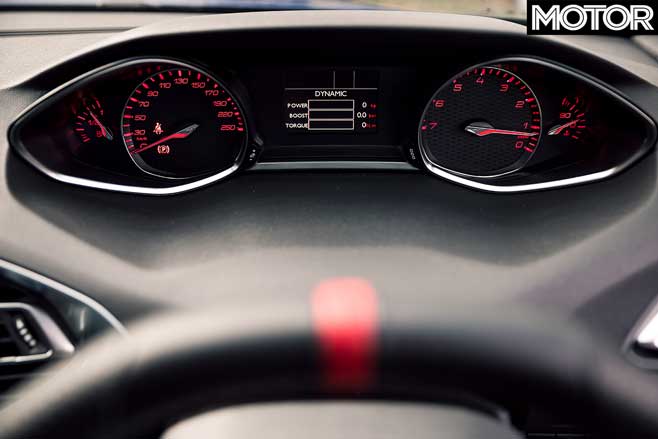
Aside from the backwards tacho, the most noticeable thing about the cluster and the wheel is that it’s designed so you look over the wheel rather than through it to see the dials. I might be the only one in the MOTOR crew who actually doesn’t mind it (Newman outright refuses to accept it), but we’ll see if that changes.
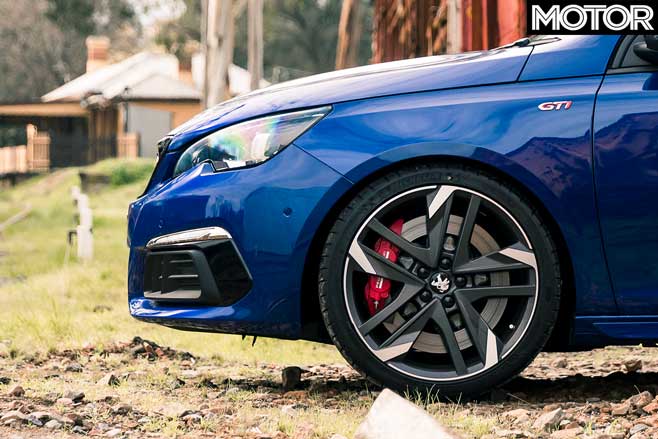
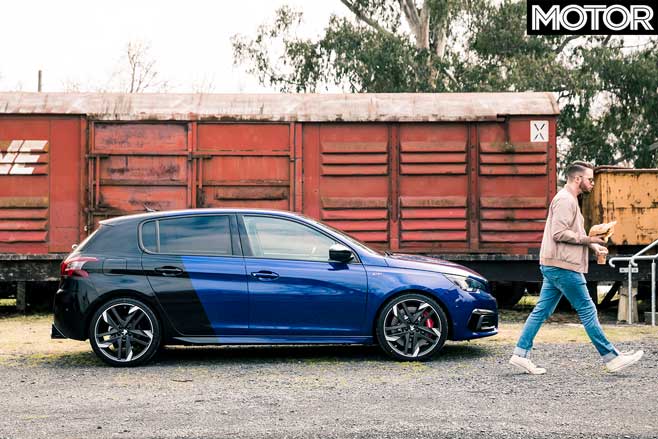
One thing I’m still coming to a decision on is the styling, in particular the paint. While it’s been executed immaculately, it seemed an odd way to achieve a two-tone body colour. Admittedly, it looks better than it does in red and black, but I think I’d rather the whole thing blue.
We’ll also see what can be made of the GTi’s dynamic ability, both on the road and on track, given the reputation it has garnered through heritage and its own praise over the years. We might also find a way to explore that heritage a little more closely.
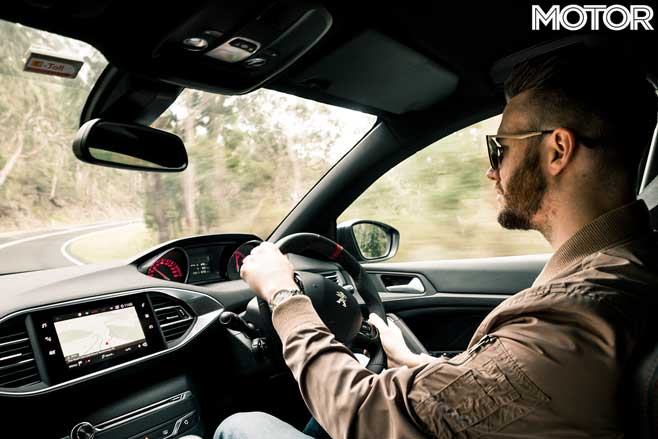
During its stay in the MOTOR garage, we also want to find out if all the numbers Peugeot has littered its specs sheet with stack up. A bit of performance testing and lab analysis might be in order.
I’m hearing good things from everyone who’s driven a 308 GTi in anger, though it’s not clear whether that’s excitement, or an attempt to snag a drive later on.
As a fan of hot hatches in general, and of cars that keep kerb weight reasonably low, I’m looking forward to my time with the 308 GTi. Hopefully I still look forward to driving it in a couple of months’ time, lest those apparent commitment issues have me asking for other key fobs within the MOTOR garage.
2019 Peugeot 308 GTi Pros & Cons
Things we’re falling for 1 – Power/weight! 2 – Thrifty drinking 3 – Tres chic interior
Things we’re not fond of 1 – Backwards tacho 2 – Fake engine note 3 – Weird massages
Update 1: Time travel
Pug long-termer meets a long-lost ancestor
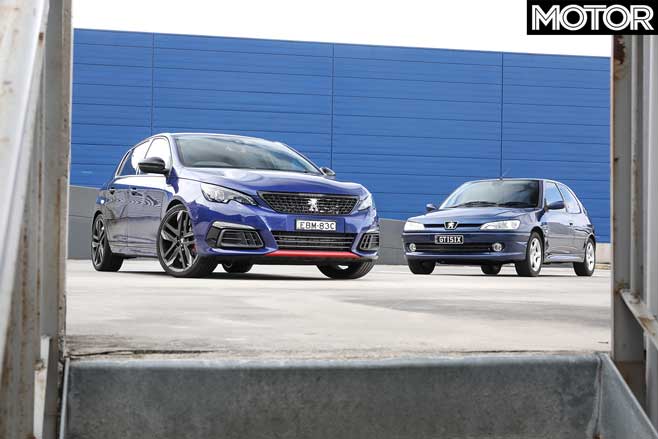
Hot hatches. Born decades ago, from cost-effective European hatchbacks as a means to inject fun into a daily drive, and still to this day one of the cheapest ways to enjoy driving fast. It’s probable we’re in a hot-hatch golden age, given we have access to everything from a sweet and simple Suzuki Swift Sport right up to a supercar-hassling AMG A45 S.
French manufacturers have long championed the humble hot hatch, with Renault having created some of the best-ever front-drivers, but Peugeot’s own heritage is dotted with a couple of greats as well. Take the 205 GTi, for example, now fast becoming a sturdy investment and beloved by many.
Perhaps less well-known among Australians is another widely praised Pug, not as old or as diminutive as the 205, but still at the peak of its generation. I’m referring to the 306 GTi-6, the grandfather of the 308 I’m currently in custody of.
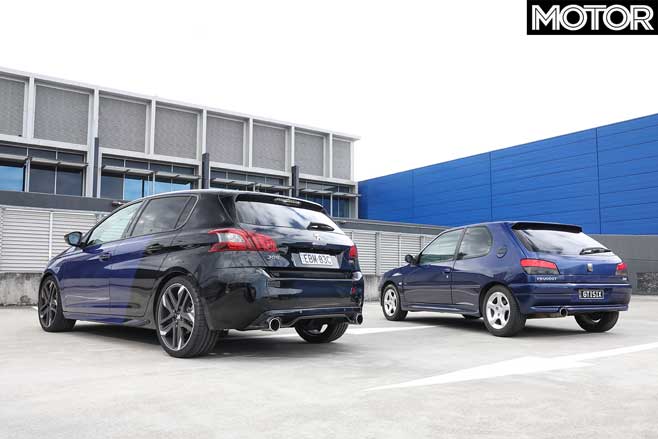
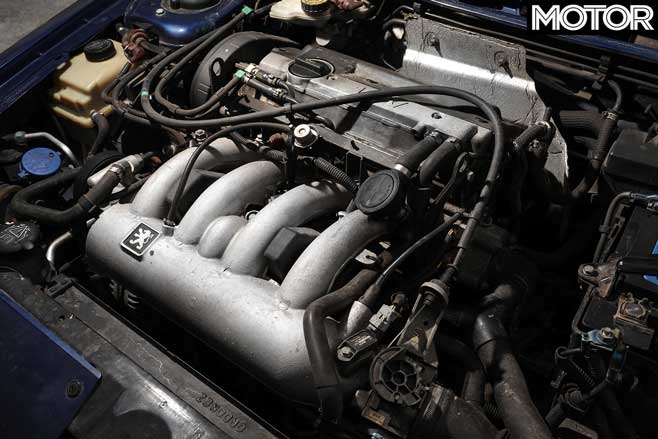
With 123kW and an admirable 193Nm, the GTi-6 and its six-speed close-ratio manual gearbox (a big deal back then, hence the name) made it quite a handy thing for the late 1990s. Sure, 0-100km/h is pretty leisurely by modern standards, but get the 2.0-litre naturally aspirated four up to its 6500rpm power peak and you’ll feel like you’re flying.
It’s for this reason that hot hatches have always been a favourite of yours truly – a usable car day-to-day that feels fun in every circumstance is all you really need. Who cares if you’re faster than everyone else when you’re driving a twisty mountain road? We suspect Peugeot’s engineers might, and that’s why these two cars are here today. Has function taken over from the focus on fun? Does EBM-83C still have the same playful nature as its forebears we so loved?
When our 306-owning reader Dave meets us, first impressions are good. Much like the 308, his GTi-6 isn’t visually raucous, nor does it sound like it’s looking for attention. It just adds a badge here and there, but most of the ‘hot’ in this hatch is under the hood.
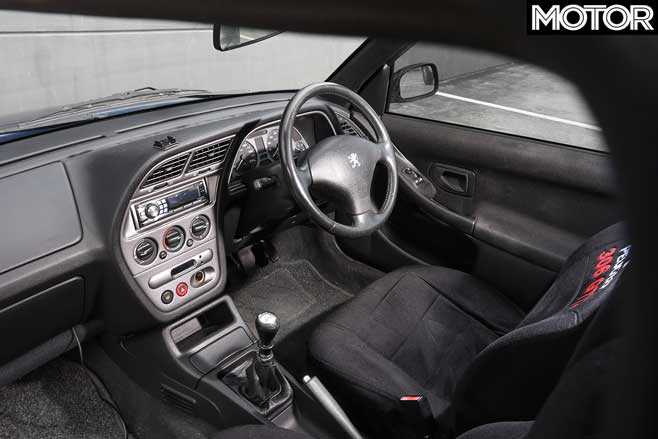
A peek inside and, surprisingly, the GTi-6 is very much a straight-forward 1990s interior, albeit with racier seats. There’s no backwards tachometer, no strange column stalks or other French oddities of any kind. The seating position and interface all makes sense, refreshingly. It lacks the premium feel of the 308’s cabin, but it’s also two decades old. I could easily live with this day-to-day.
Taking off in our borrowed GTi-6, it’s clear the engine can make proper use of the power and torque it has, with even fourth gear able to create some hurry-up at low speeds. The immediacy of its naturally aspirated engine soon gives way to the accuracy of its steering as the 306’s front end follows commands like only the most obedient squad pupper could. But this Pug is no German Shepherd, and so in true French fashion a little transfer of weight to the front end allows the rear some wiggle room.
As the GTi-6 was graciously offered up for a test drive by a private owner, caution trumped my desire to truly see what the 20-year-old Frenchie had to offer in terms of chassis ability, but it’s clear the focus for this car was making a car that was easy to have fun with. It doesn’t need to be travelling at break-neck speed to put a smile on the face of whoever sits in the driver’s seat, or the passenger seat.
It should be noted that its 1214kg kerb weight, two decades on, is actually higher than the 308’s 1205kg. This makes the 308 part of a very exclusive club of cars that is lighter than its ancestor. The 306 doesn’t feel all that heavy, but at the risk of sounding like the ‘6’ isn’t a blast, I wonder what it would be like with 100kg shaved off. And maybe that’s what some modern hatches need – a focus on fun rather than numbers.
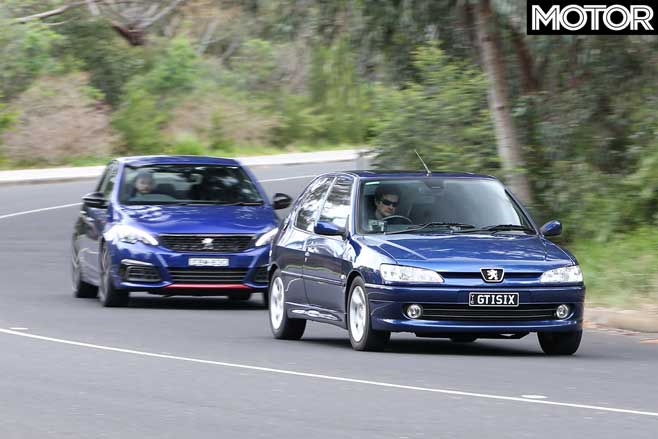
The 308 is far more impressive on paper than the 306 GTi-6, but does it provide the same feeling of connection with the car and excitement? It’s hard to say yes, despite the GTi being a rather lively thing by 2019 standards. There’s no doubt a lap of a fast racetrack in the 308 would result in a display of automotive capability well beyond that of the 306, but would it feel as special? That might best be a question left until I’ve actually had a steer of the Pug on track.
In any case, the 308 GTi still has ties to its historic DNA, even though it has a different approach. It’s not as ‘raw’ as its predecessors (what modern car is?), but it takes the simplistic approach to driving in a similar fashion. No AWD, no cabin full of buttons, no drift mode, and no extroverted styling.
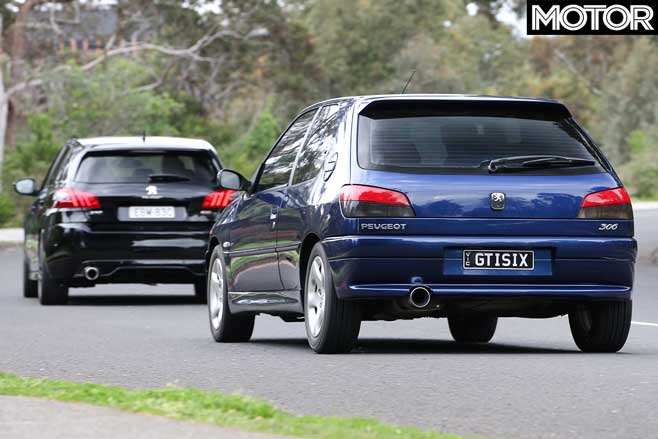
The only things Peugeot’s engineers decided to add were a front diff, which is a welcome decision, and a Sport mode that sharpens up engine response. It could do without the fake engine noise pumped into the cabin, though.
That aside, the 308 does actually still hold onto its heritage, it’s just that the world has moved on from the way cars used to feel. For a car built in the age of bigger and heavier compact cars, the 308 is still a haven for old-school simplicity.
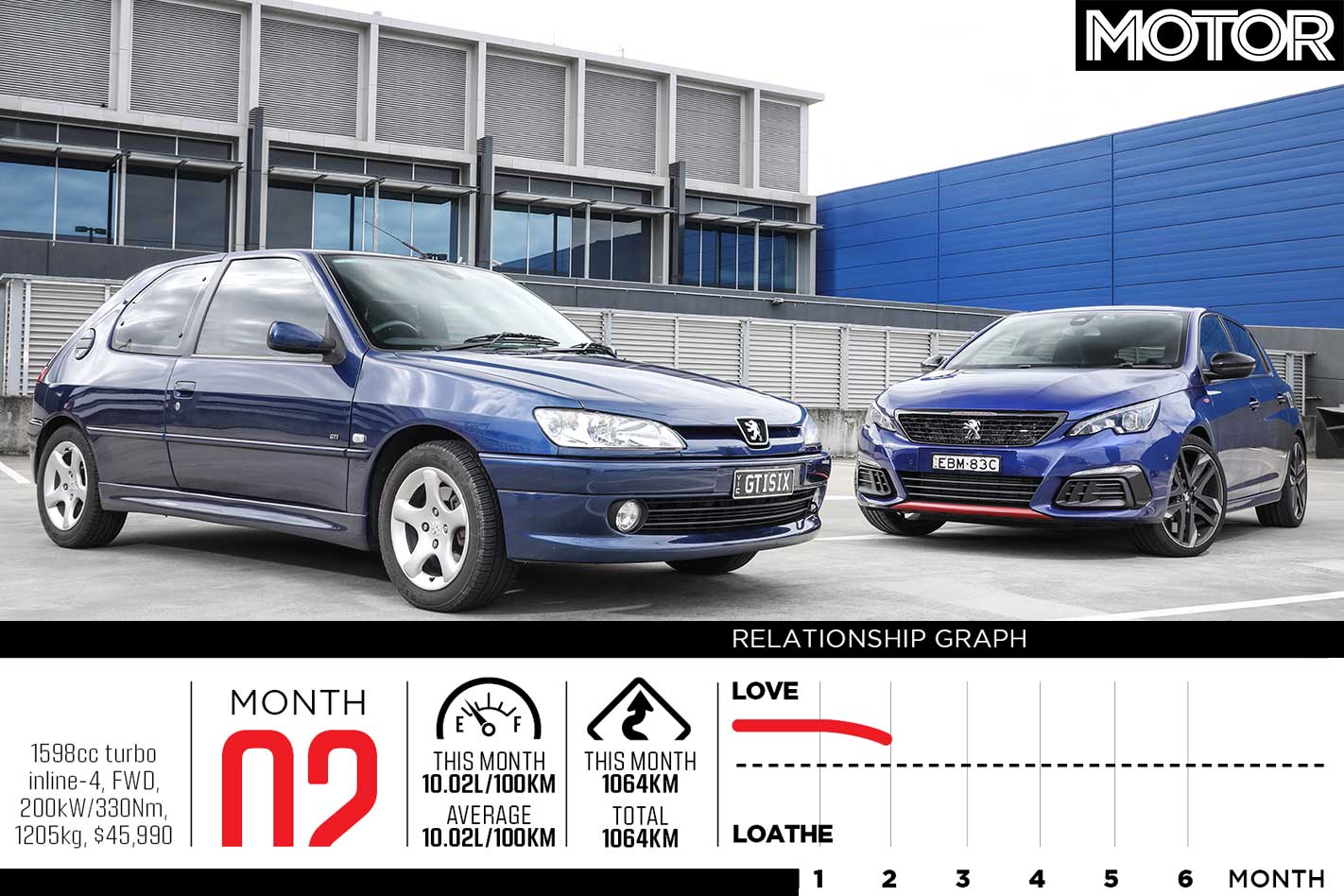
2019 Peugeot 308 GTi Pros & Cons
The 308 was better at… 1 – Acceleration 2 – Turning circles 3 – The premium feel
But the 306 had better… 1 – Atmo response 2 – Steering feel 3 – Nostalgia
Update 2: On Higher Ground
Our French hatch feels at home on an alpine road
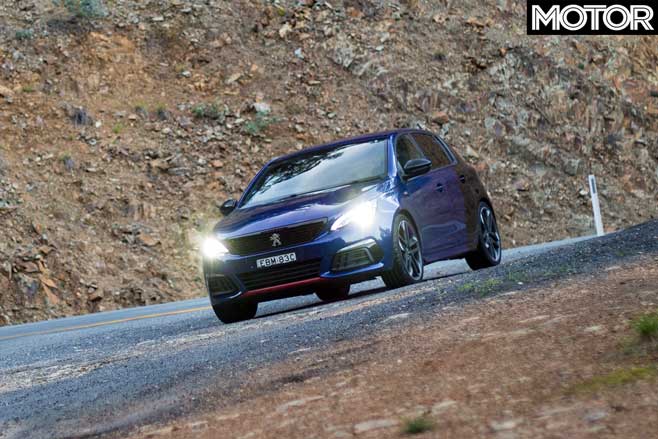
FOR THE LAST three years, Victoria’s ‘snow season’ has been officially extended by the state’s various alpine resorts due to good conditions. Great news if you want to toboggan down the muddy remnants of some melting snow, but it’s not the best for those who have planned a drive. Especially along, say, the Great Alpine Road.
Did you know you need to have snow chains ready to use even if there hasn’t been snow on the road since the actual end of winter? Thankfully for yours truly, the morning of my mountain run over Hotham just happened to be the very day after ‘snow season’ ended. On October 7, the Great Alpine Road was decidedly snow-free, which provided a nice clear 200km stretch of blacktop for me to get to know ‘my’ Pug.
Setting off before sunrise was the first stage in my plan to encounter as little traffic as possible, in tandem with undertaking the drive on a weekday. It worked, thankfully.
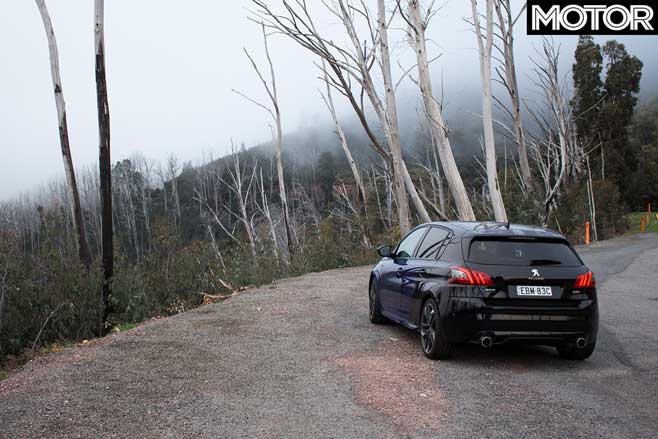
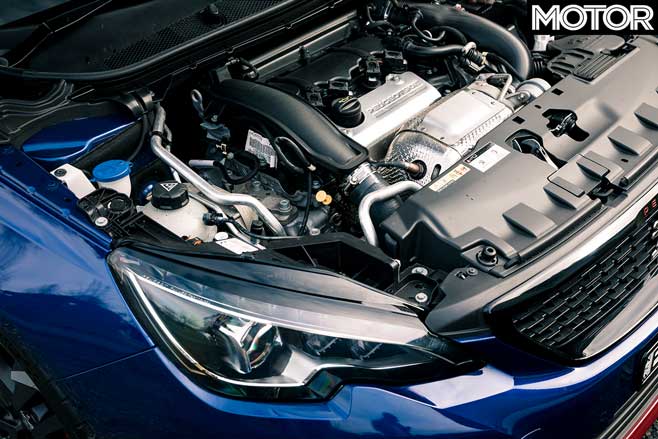
In the dark morning, the Peugeot’s induction noise as the cold alpine air rushed in immediately became a little addictive, a habit that hasn’t yet worn off. With that noise comes the rush of power supplied by the 1.6-litre four and its big turbo, pulling hard under full load. Little exhaust pops even accompany sharp lift-offs.
Aside from watching each side of the road for wildlife attempting to run interference, the way the Pug’s cold front tyres interacted with the bitumen was the focus, with the frequency of wheel slips becoming rarer as the 235mm Pilot Super Sports began to find some warmth and grip. On the road, even a slightly damp one like this, the Michelins are sticky enough to hold strong, but let slip just often enough to make traction predictable.
Memories of driving the ferocious HSV GTS-R W1 up this very road during PCOTY 2018 began to surface, though in hindsight handling a 1205kg hot hatch on proper road tyres seems more sensible than a supercharged sedan on cold semi-slicks.
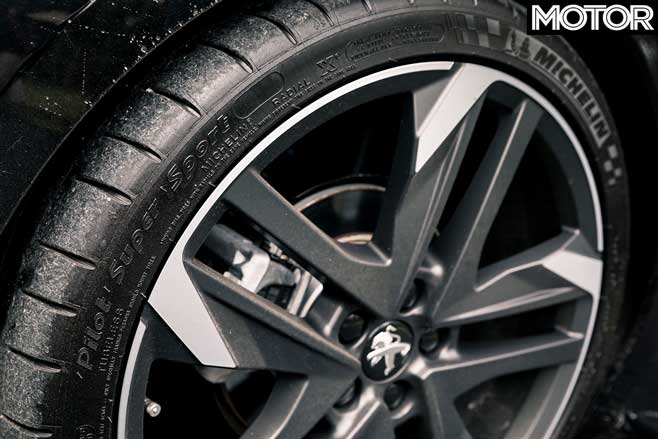
Using the GTi’s substantial brakes (380mm front discs) or just a sharp lift-off seemed a handy addendum to my initial steering inputs, a little adjustment after the fact, and especially useful for unexpected tightening turns that appeared numerous times along the route.
The GTi’s light steering made things much more manageable for getting into the groove of each twist, though there isn’t as much ‘feel’ as I’d like. I’m glad it’s not artificially heavy, but it forces you to be a little reactive with inputs rather than proactive. This could come down to my brief time in its predecessor, the brilliantly communicative 306 GTi-6, last month.
Steering feel (and that backwards tacho) aside, there’s not much that irks me about the Pug’s ergonomics, given the car’s apparently divisive driving position. I’ve decided I quite like the low wheel and high dash, which prevent hands and arms from blocking dials, as well as allowing a more relaxed posture on long stints.
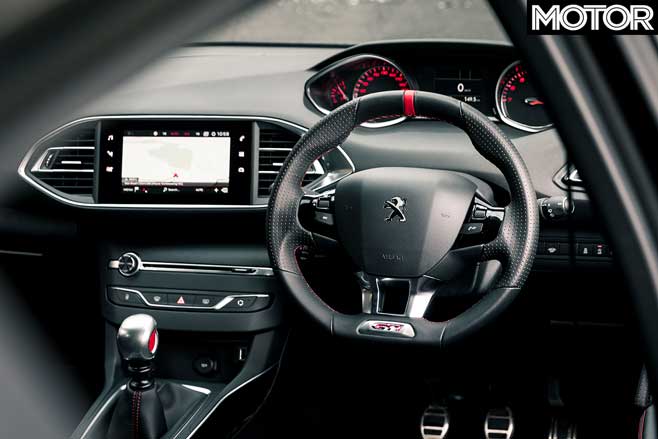
It was only after I had peaked Hotham and carried on down the other side I realised I hadn’t used Sport mode, something I sometimes forget exists in the GTi. It doesn’t change much aside from remapping the throttle to provide more eager reactions to your inputs – there are no adaptive dampers or adjustable steering feel in the 308.
Oh, and the whole binnacle turns red; who needs a redline? After holding the button for a moment, I remembered why I rarely switch it on day-to-day. The fictional engine note it produces inside the cabin is almost comical, and the sharpening of the throttle it provides isn’t worth the seemingly Jetsons-inspired sound in my view. For the road, the GTi is more than fast enough in its standard mode.
Shortly after a particularly engaging section of this wonderful road, where it twins the turns of the Tambo River, is the town of Bruthen, which marked the end of the most exciting part of my journey. Here I found myself grinning, and felt maybe I’d been a bit harsh to the GTi last month. This is a proper hot hatch after all.
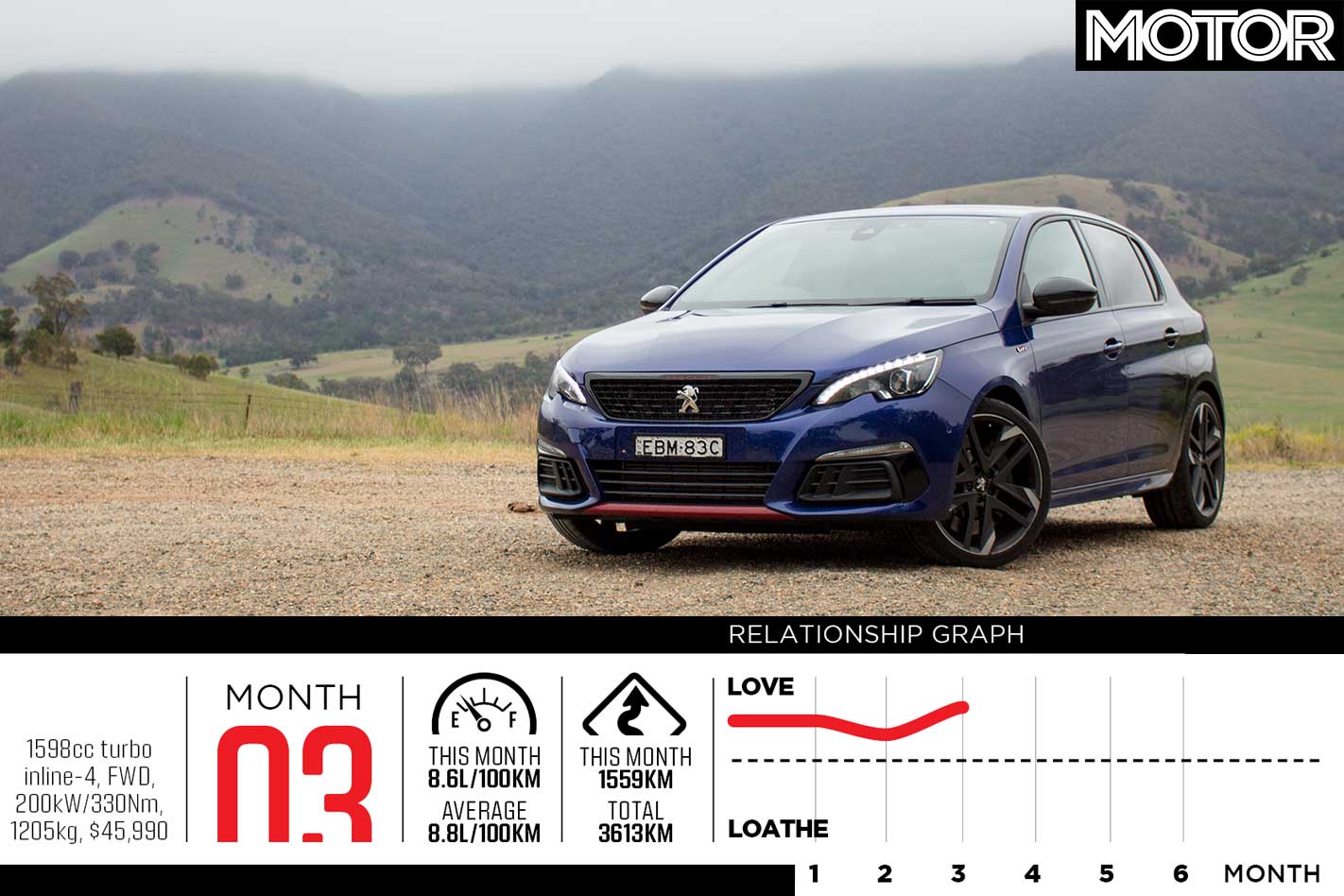
2019 Peugeot 308 GTi Pros & Cons
We say “Heck yes” to… 1 – Power and pace 2 – Nimble chassis 3 – Comfy road tripping
…but these could be better 1 – Throttle lag 2 – Steering feel 3 – Sport mode sound
Update 3: Quart De Mile
Putting the Pug’s performance claims to the test
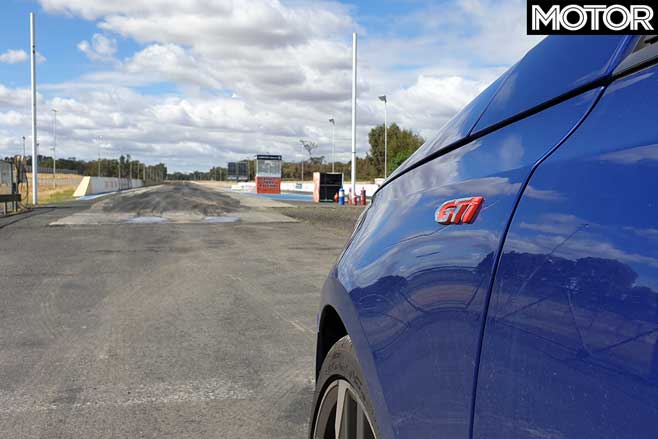
THIS IS THE first time I’ve ever tested a car for performance times at the strip, and it turns out starting with a heavily turbocharged front-wheel driver isn’t the most straightforward way to ease into it.
Pretty much every long-termer MOTOR has goes through the performance test wringer – generally in the form of a trip to the Heathcote Park drag strip – as part of a posse of other cars in need of a few runs down the blacktop.
With us this time were an Alpina B5 Touring, Scott Newman’s Abarth long-termer, and, uh, a Nissan GT-R Nismo. So not only was I completely unsure if I’d be able to hit the Pug’s 6.0 second 0-100km/h claim, I was having to watch a car capable of running near three.
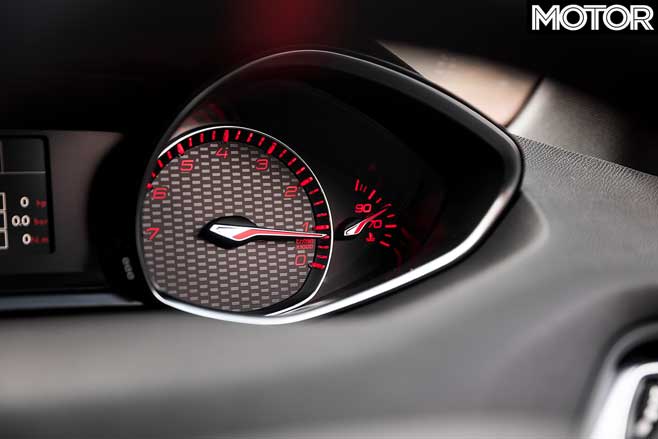
While lining up the 308 and giving the fronts a little chirp, I took a moment to settle and followed my colleagues’ advice to hang the revs at different points on a few runs to see what gave the smoothest, fastest take-off.
Attempt one, 2300rpm, a gentle ease-off, and the Pug launched. Up into second and then third just before 100km/h resulted in ‘6.4’ popping up on the screen of our VBOX. After the run, I discovered 90km/h had arrived in 5.5sec and that, if I’d been a little smarter and held second, I might have had the chance to nail my first-ever run down the strip.
Alas, the next few runs were frustrating, with traction out of my at-times clumsy grasp and the front tyres quickly becoming rather warm. Plenty of high sixes and even a few sevens suggested I might not top my first attempt, so after Newman tried it and ran a couple of mid-six runs, I was about ready to admit defeat. Besides, Scott had also run some mid-14sec ETs for the quarter-mile, which felt about right for the Pug.
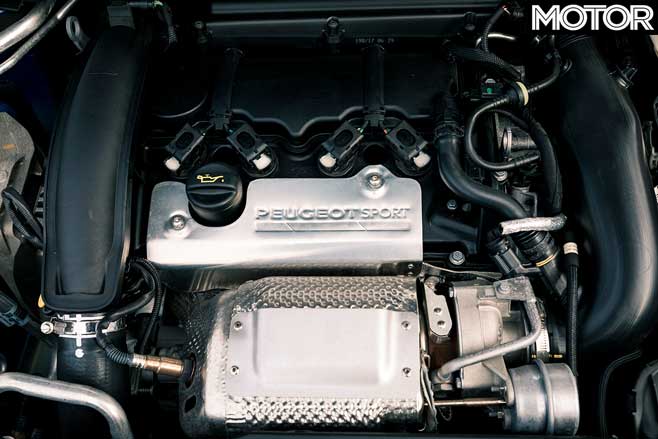
His 14.45sec run at 163.23km/h ended up being the best of the day for the 308, but I wanted just two more cracks before the crew abandoned Heathcote to escape the approaching rainclouds. Wet strip equals slow times.
Now, I’m not saying watching Newman’s efforts turned me into an expert when it comes to launching a 200kW front-driver, but I reckon it helped. On what felt like my billionth time down the Heathcote strip, a ‘6.2’.
I was happy not only to have bested my first launch, but also to have gotten the Pug within a couple of tenths of its factory claim as an amateur. Maybe my few months driving the hot hatch regularly had given me enough time to get properly in sync with its controls, something my colleagues aren’t.
That time turned out to be 6.24 once we plugged the data logger in back at MOTOR HQ, one of many, many sets of data (some rather dismal) from my many, many attempts.
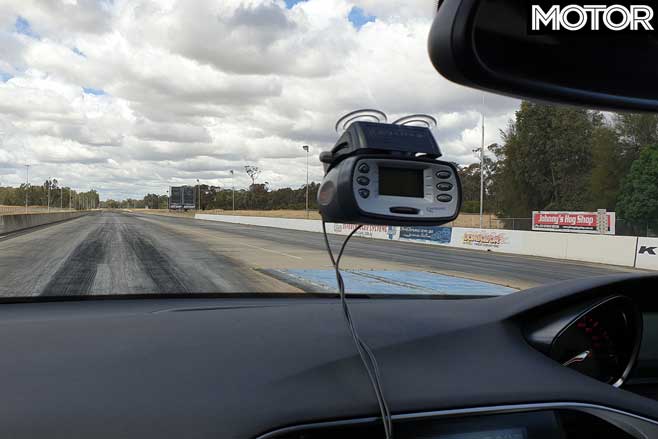
In the end, the limited-slip differential was probably the biggest assistance in getting close to Peugeot’s claim, as the Michelin Pilot Super Sports don’t exactly seem to love a hard launch, though they’re still great tyres and plenty of fun on the road.
But the 308’s visit to Heathcote wasn’t just to see how fast it could launch and travel 400 metres. Though I was happy knowing a 6.0sec sprint to the tonne was probably possible in ideal conditions and that a low-14 quarter wasn’t unreasonable, the all-important 80-120km/h burst needed a test for real-world overtaking ability. And finding out if the Pug could handle a proper press on the middle pedal was on the cards too.
In third gear, the GTi consistently nails the ‘overtake’ up to 120km/h in the mid-threes, with 3.59sec being the best we recorded. Starting in third gives more initial poke, and starting in fourth leaves the revs too low for that burst of speed. By the time the 308 has hit 120km/h, it’s covered 100 metres.
Finally, the stoppers. At a claimed 1205kg and with huge 380mm front discs with four-pot calipers, I had high hopes the Pug would stop on a dime. It turns out it can, as long as you’ve got one of those 36-metre-wide dimes.
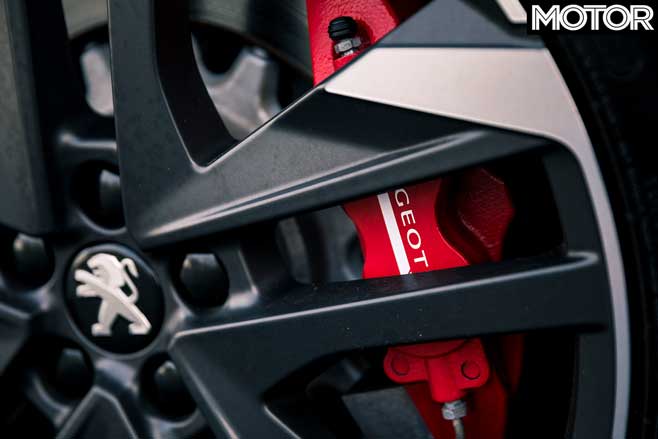
Looking back at some relatively recent data revealed my 35.99m braking distance (from 100km/h to a complete stop) might not be the best for a lightweight hot hatch with big brakes, with heavier Golf GTIs and Focus RSs stopping in less than 35m at Bang For Your Bucks last year. The 308 GTi stopped in 34.99 at that event. And in a hot hatch test later in 2018, Newman matched my 35.99m exactly, and the i30 N, Megane RS and Civic Type R all outbraked it.
It might just be the tyres, but the braking underperformance has me (and others) thinking the 308 might have a few more kegs on it than claimed.
There are a couple of months left with the 308 GTi. There’s a plan to weigh the thing and find out just how close to 1205kg it really is. I also hope to pop it on a dyno to see just what that 1.6-litre unit is doing, not that I doubt its 200kW. Plus, there’s still a track test to come.
2019 Peugeot 308 GTi Pros & Cons
This is the fun stuff… 1 – Nearing 6sec to 100km/h 2 – Learning to launch 3 – Mid-range punch
This stuff is less fun… 1 – Spinning tyres 2 – Lacklustre braking 3 – GT-R was faster…
Update 4: Puppy Playtime
Our Pug gets a chance to ditch the leash… and the ESC
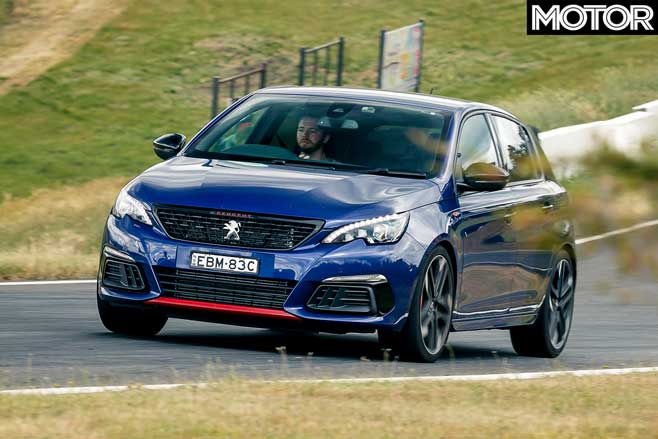
The 308 GTi is one of those cars that I’m always told “comes alive on the track”, so the question most often asked of me for the past few months has been based around how much track time I’ve had with it. Finally, I can answer with something other than “none yet”.
A day marked with some very Victorian weather (grey skies and drizzle) saw myself, some fellow MOTORists and a gang of merry folk from sister magazine Street Machine all descend on the Bryant Park Hillclimb track, also known as Haunted Hills. Once DC, Cordony and I had finished watching the SM lads completely thrash an old engine-swapped Barina and their stocker ‘nugget’ mid-2000s Renault Clio, it was our turn to take to the track. Cordony was there to test a few hot hatches, which meant my GTi was in good company.
Though not as sharp or capable as the likes of the Civic Type R or Megane Trophy, the 308 quickly proved itself an absolute joy, the slightly damp track providing sufficient challenges and varying corners for me to really get to know its chassis. And that was before ESC was given the flick.
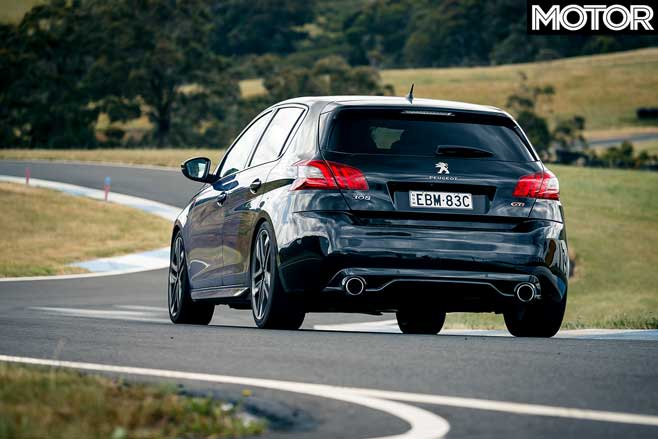
If you’ve never seen Haunted Hills, it’s essentially a tight, smooth track built into the side of a hill, with plenty of camber changes and enough elevation variance to make you consider altitude sickness pills. It’s perfect for a lightweight front-driver with an abundance of power, especially if you want to find out just how playful it can be. Very, as it turns out.
With ESC on, the Pug’s rear follows the front obediently, with little leans and the occasional slip followed by a flashing TC light on the dash being the only indications that something far more fun lies beneath a thick layer of electronic safety measures. The Torsen differential between the front wheels helps pull it through corners with ease, and though it was still a little wet the Michelin Pilot Super Sports grip enough to properly launch out of a tight bend.
But I didn’t bring the Peugeot to the track to drive it with ESC on all day.
Once the ominous (or promising) little orange car with tyre marks lights up on the dash, the fun really begins. Traction through the front wheels becomes a little harder to manage, but conversely allows properly brisk acceleration when grip is on your side.
But what if you don’t want grip?
The rear has you covered. The tail of the 308 turns out to be an absolute party animal with ESC out of the picture, and it changes the driving characteristic of the car so much. While I’d like to see a ‘halfway point’ between ESC on and off to make mountain driving a little more lively, that could also be a dangerous suggestion.
Now back to the GTi’s… well, back. The slides it produces are almost comical, but if you stay on the ball it shouldn’t be enough to get out of hand. Tap the brakes and feel the movement. Looking back at the notes I wrote after the first few laps on track reveals I at one point had written “bloody hilarious fun”. If you have a 308 GTi and haven’t taken it to a track, you’re simply doing it wrong.
The secret to all this fun is not just the 200kW lurking inside the turbocharged 1.6, but also the 308’s low kerb weight – 1205kg is the number Peugeot claims, but surely that can’t be right. So, using a weighbridge (perhaps not an exact science, but we’ve got variables covered – we’ll get to that), I checked the GTi’s weight on the way back into Melbourne.
It turns out that, with me in the car and a couple of bags of items, 1360kg is the real-world figure. We can take 88kg off that for me and my belongings, and note that the 308 only had a quarter tank of fuel.
Kerb weights are intended to include a full tank of fuel, so let’s estimate that 53 litres of fuel would weigh approximately 40kg (a litre of petrol weighs about 750 grams). At a quarter tank, that’s 10kg, so we can add the 30kg difference back to the weight for a full tank. Essentially without me, my gear and with a full tank, the 308 GTi weighs 1302kg.
So Peugeot’s claim is about 100kg off, but remember the other hatches I said were around on the day? A Civic Type R is claimed to weigh 1393kg, and the Megane Trophy 1419kg. If they are as optimistic as the GTi’s, it has them beat by a couple of hundred kilos.
Finding out the GTi was heavier than the claim wasn’t a huge surprise, and it definitely didn’t cast a shadow over an otherwise excellent day of exploring the GTi’s breadth of ability.
But the end of the day did bring with it a little sadness. Because the drive back to Melbourne would be my last long stint in the GTi. Next month I have to hand back the keys to EBM-83C, and I really don’t want to.
2019 Peugeot 308 GTi Pros & Cons
Things that are great… 1 – ESC off 2 – Oversteer 3 – Gorgeous chassis
…things that are less great 1 – Extra 100kg 2 – Rainy track days 3 – Going home…
Update 5: Au Revoir Mon Ami
The GTi’s time at MOTOR has come to an end. Here’s the wrap
About 5982km of GTi driving ago, I began my introduction to this series of updates with a few questions. Do I have commitment issues? Am I prone to infatuation? Is the Peugeot 308 GTi a good all-rounder to live with?
Over the last few months I’ve decided the answer to all of these questions boils down to ‘yes’. But would I recommend the 308 GTi to someone looking to actually buy a hot hatch?
Well, not immediately, because the Volkswagen Golf GTI exists, and now there are so many options that it really needs to be narrowed down. You’ve got to be looking for something different, and the right kind of different, to be able to consider the 308 GTi a daily driver. It’s hugely underrated, or at the very least flies under the radar, but it’s also not for everyone.
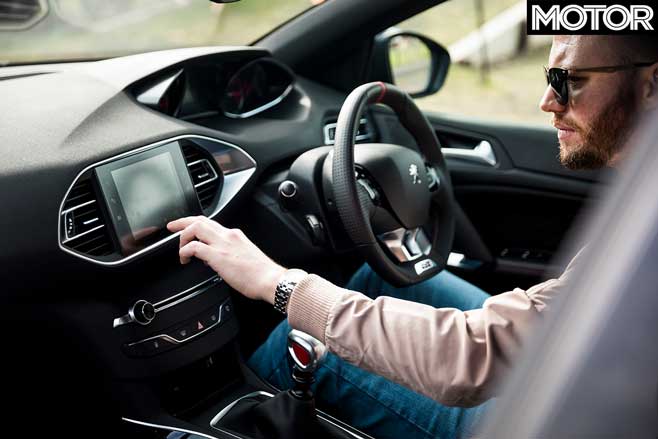
Of the four full-time writers at MOTOR, I was the only one who seemed to really gel with the GTi’s unique characteristics. Sure, you could call some of these characteristics ‘flaws’ as my colleagues did with the seating position and the instrument cluster’s height, but that just proves my point.
I like the seating position – having my arms lower and being able to see the speedo over the wheel didn’t bother me at all – and I even liked the GTi’s odd 40/60 split paint job. Still, there’s no denying the backwards tacho is weird. It’s just incorrect.
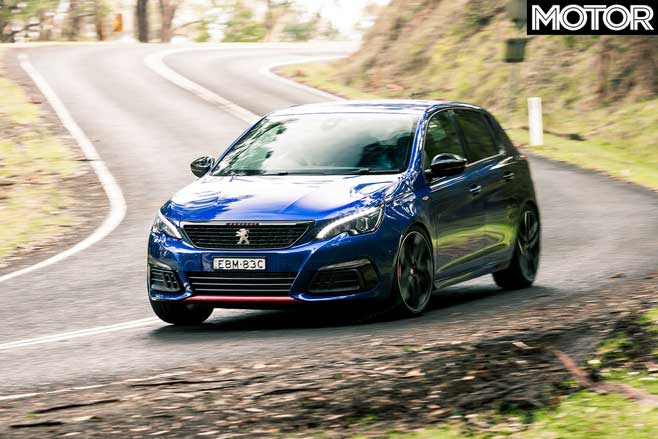
The Pug has proven itself a keen performer on the road, on track and at the strip, meeting or exceeding expectations on all three stages. Sure, it’s not as capable as the likes of the Civic Type R, but it’s also several thousand dollars cheaper, and in some ways more fun. It’s incredibly involving with ESC turned off, and even has enough playfulness to make you laugh hysterically just driving a winding mountain road. Plus, it was easy enough for me to extract a reasonable 0-100km/h and quarter-mile time without having so much as launched a car down a strip before.
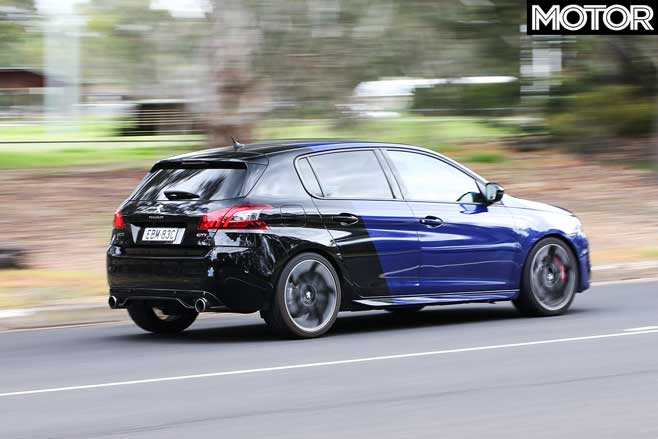
We did discover, however, that its 200kW wasn’t dragging a mere 1205kg as promised, but more like 1302kg. This wasn’t a huge surprise, as we know claimed kerb weights are often quite lean, but the equivalent of having a bulky bloke constantly in the passenger seat isn’t ideal. Yet the 308 still feels nimble, and even its real kerb weight is clear of its rivals. I imagine their real weights also vary from what the spec sheets say.
There were also plans to put the Pug on a dyno, but they fell through, meaning we’re left with the 200kW figure supplied by Peugeot. It’s a figure we believe though, given the GTi’s strong performance at Heathcote, and the fact it’s powerful enough to overcome the normally plentiful grip supplied by a pair of Michelin Pilot Super Sport tyres on the front wheels.
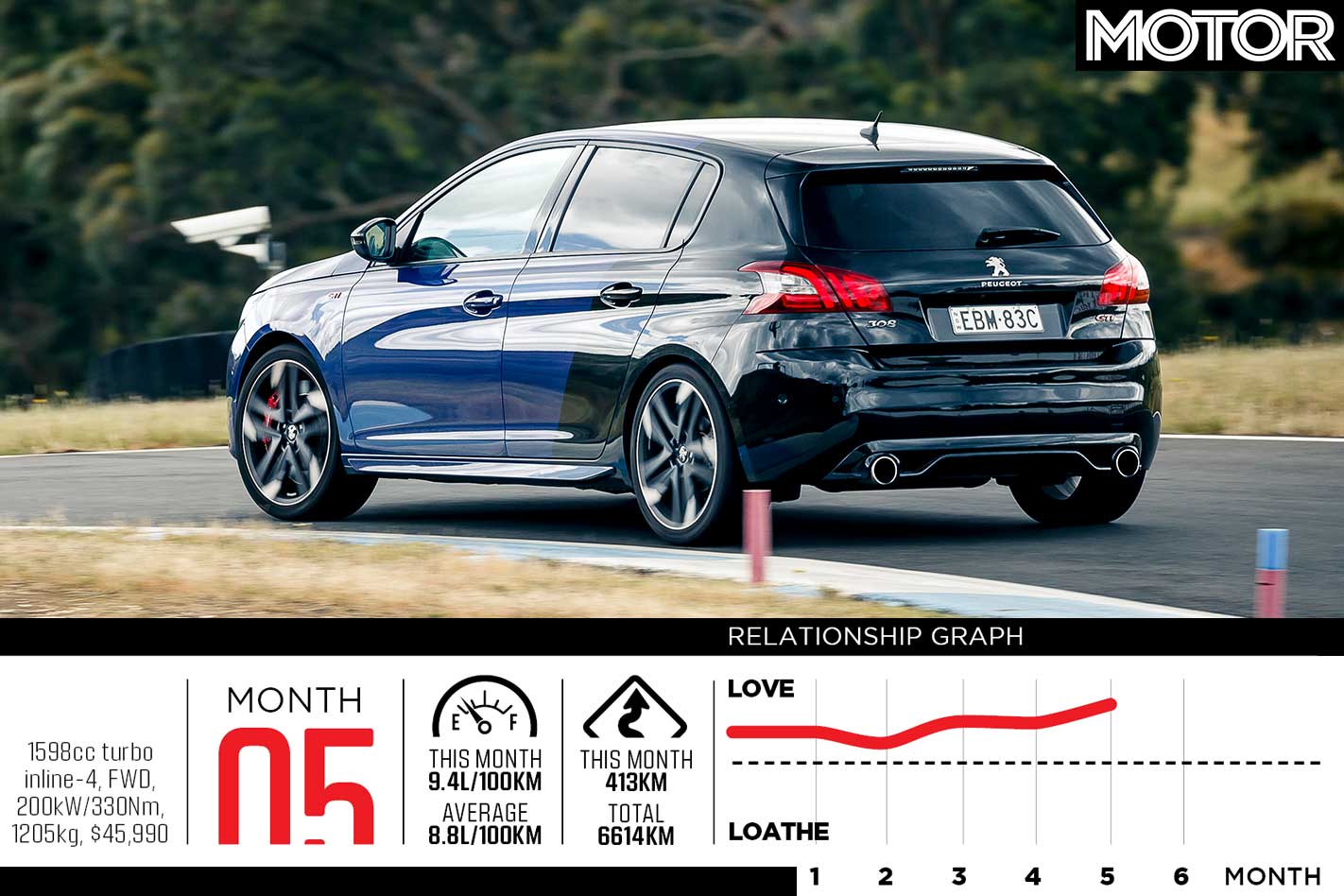
It also turned out to be a little thirstier than Peugeot’s claim, by 2.85L/100km, but it’s rare to come across a sporty car that gets driven in a manner to meet its supposed fuel efficiency rating.
A couple of missed numbers aside, there were only ever minor concerns from myself with the way the Pug presented as a daily offering. The infotainment interface made operating the A/C a little annoying, and its media player would place odd silences between songs – annoying if you’re trying to listen to a seamless album. Its reversing camera feed also lagged slightly behind real-time, sometimes by what seemed like an entire second. No mishaps resulted from this, thankfully.
So, should you buy a 308 GTi?
If you’re the sort of person who can justify differing tastes with phrases like “I know it’s not the best, but it’s the one I like” then absolutely. If you’re prone to infatuation, you might just find yourself falling a little in love with the Frenchie. But if you buy one, at least you get to keep it.
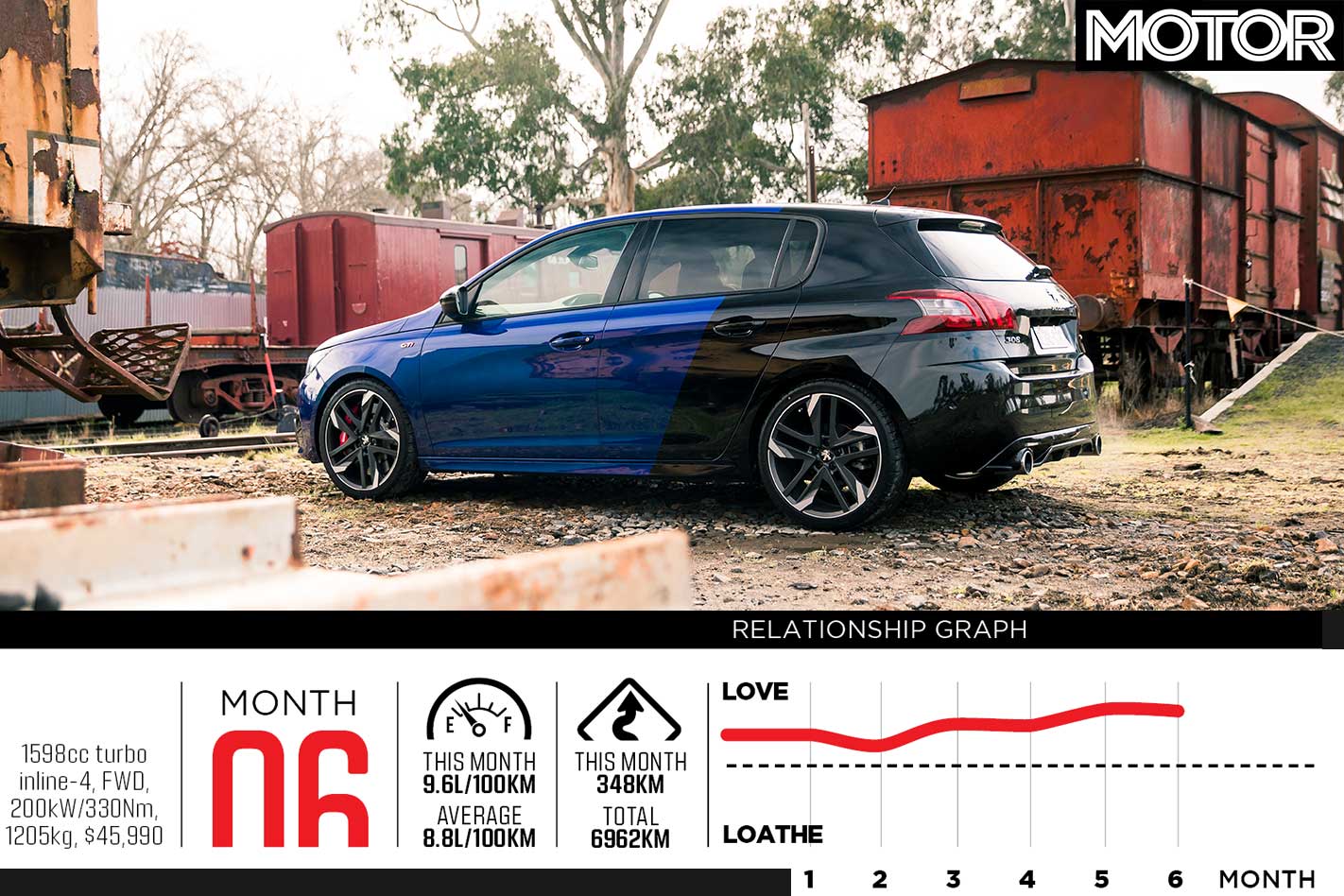
2019 Peugeot 308 GTi Pros & Cons
The very best bits 1 – Speed and power 2 – Funky style 3 – Joyous chassis
Not the best bits 1 – Interface quirks 2 – Fake sound 3 – Saying goodbye…
Swiss authorities have thrown the world’s automotive industry into chaos on the eve of the Geneva Motor Show, as a new ruling designed to curb the spread of coronavirus makes the large-scale event impossible.
Large public gatherings have been banned by the Swiss government as it attempts to get ahead of a potential COVID-19 pandemic.
“In view of the current situation and the spread of the coronavirus, the Federal Council has categorised the situation in Switzerland as ‘special’ in terms of the Epidemics Act,” the Swiss cabinet said in a statement.
“Large-scale events involving more than 1000 people are to be banned. The ban comes into immediate effect and will apply at least until 15 March.”
The 2020 Geneva Motor Show was scheduled to take place March 5-15. Wheels understands that at least three manufacturers cancelled press trips to the Geneva Motor Show for Australian media this week as coronavirus fears grew.
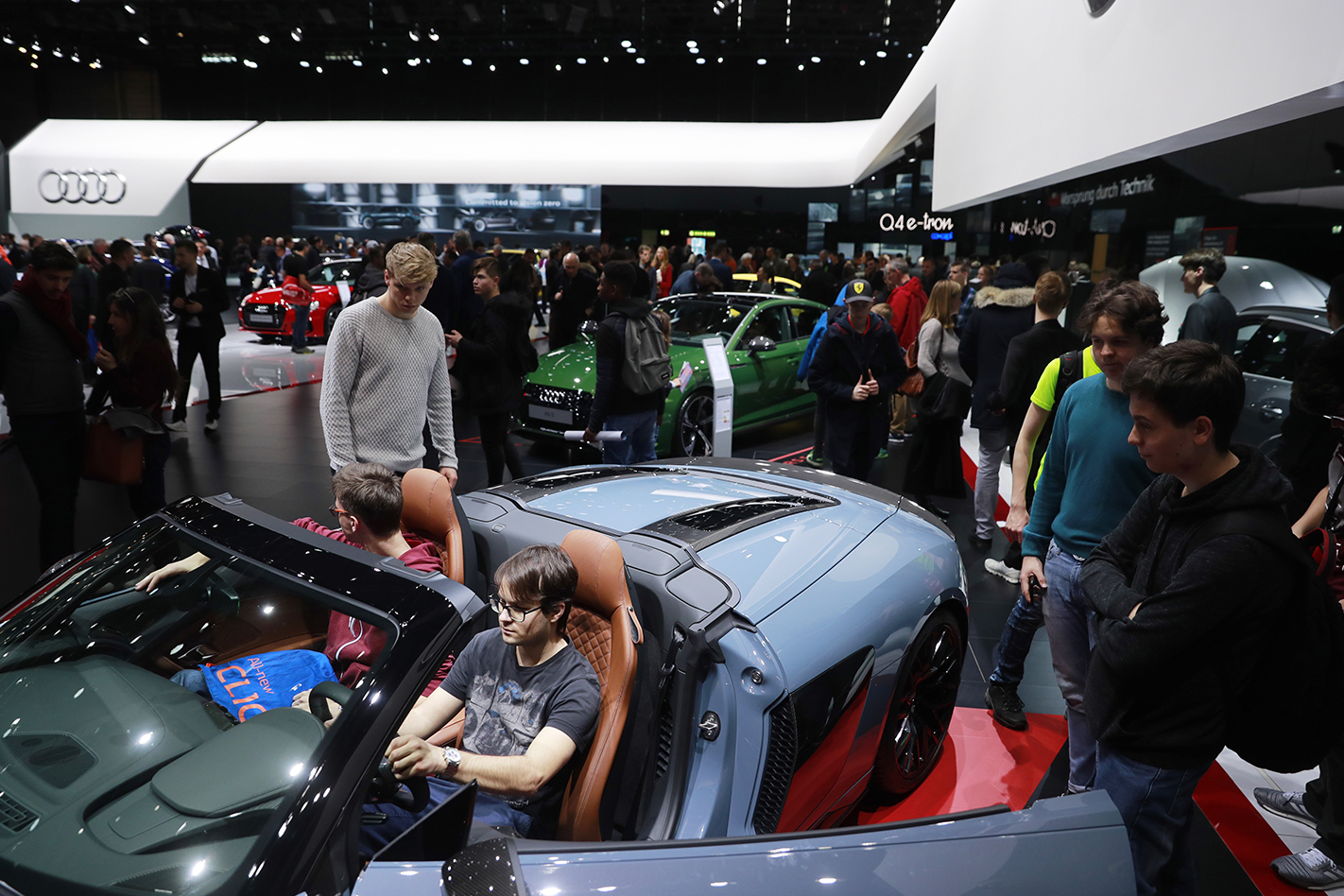
Industry sources have confirmed that car companies attending the show have been informed of the show’s cancellation.
As recently as yesterday, the organisers for the Geneva Motor Show remained confident that one of the largest events in the global automotive industry calendar would go ahead.
A number of key new products were expected to be revealed at the Swiss show, including Porsche’s 992-generation 911 Turbo, the all-new Audi A3, and Hyundai’s i20 production car and Prophecy concept.
The organisers of the Geneva Motor Show have not yet officially confirmed the event has been cancelled.
However, with large crowds of world media and automotive enthusiasts expected to attend the show halls across its 10-day run, the show would fall foul of the Swiss governments new ruling.
Nearby Northern Italy is currently battling an outbreak of coronavirus cases as the virus spreads across Europe.
Locally, the Australian Prime Minister announced he was triggering a pandemic response plan yesterday, in preparation for a potential pandemic declaration from the World Health Organisation.
The Australian Grand Prix is still planned to go ahead as scheduled on March 15, but health officials have warned that an event cancellation remains possible.
We will update this story as more information becomes available.
The petrolhead’s sacred ground is the topic of this week’s WhichCar Weekly podcast, with our favourite, most memorable and coveted race tracks covered by the WCW regulars.
First up, the lads discuss Australia’s forgotten raceways and discover the most significant examples from a surprisingly long list of circuits that fell out of favour, decayed away and faded from memory. There may even be one under your house.
Next, Andy, Dan and Scott turn their anecdotes to the best race tracks that are still alive and well. Find out the first blacktop the trio hit in anger, the best in Australia and the world, and how Andy suspiciously got so much seat time as a young man.
Finally, the discussion winds up with the circuits that have so far evaded our panel despite a longing to realise racing nirvana. Can you guess the places that sit at the top of the track wish list? Tune in to find out.
If you’re on the go, you can find WhichCar Weekly on all manner of podcast apps including iTunes and Podbean. Please rate, subscribe and leave a review! You can also follow the day-to-day happenings of the WhichCar team on Facebook, Twitter and Instagram @whichcarau.
Listened to the show? Help us out:
Leave a note in the comment section below.
General Motors’ global head of design, Mike Simcoe, is personally overseeing the plan to save and preserve Holden’s Aussie concept cars.
The future of Holden’s priceless concept car collection remains undecided for now but will be locked down in the coming weeks.
It’s understood the collection, which includes halo cars like the Holden Hurricane, Efijy and Coupe 60, will remain in Australia, though Detroit is yet to hand down an official edict.
High-ranking Holden and GM execs are campaigning hard for the concept cars to remain in Australia. Wheels has been informed GM’s head of design, Aussie Mike Simcoe, is personally overseeing the issue.

Also being discussed is the future of Holden’s larger collection of historical vehicles and extensive archive.
It’s understood an official company bulletin will be released shortly about the future of the cars and the archive.
While GM (not Holden) owns the cars and archive, Holden insiders say it’s unlikely the cars will be sent back to Detroit.
“They don’t have the room in their heritage centre for the cars,” Wheels was told. “I don’t think they’ll be sent to the States. No decision has been made, but they understand the significance of these cars.”
A GM archivist is visiting Holden in the coming weeks, but not to discuss the future of the car collection. Instead, they’ll be working on digitising Holden’s existing archive. The archivist’s visit was organised before GM had made a decision on Holden’s future.
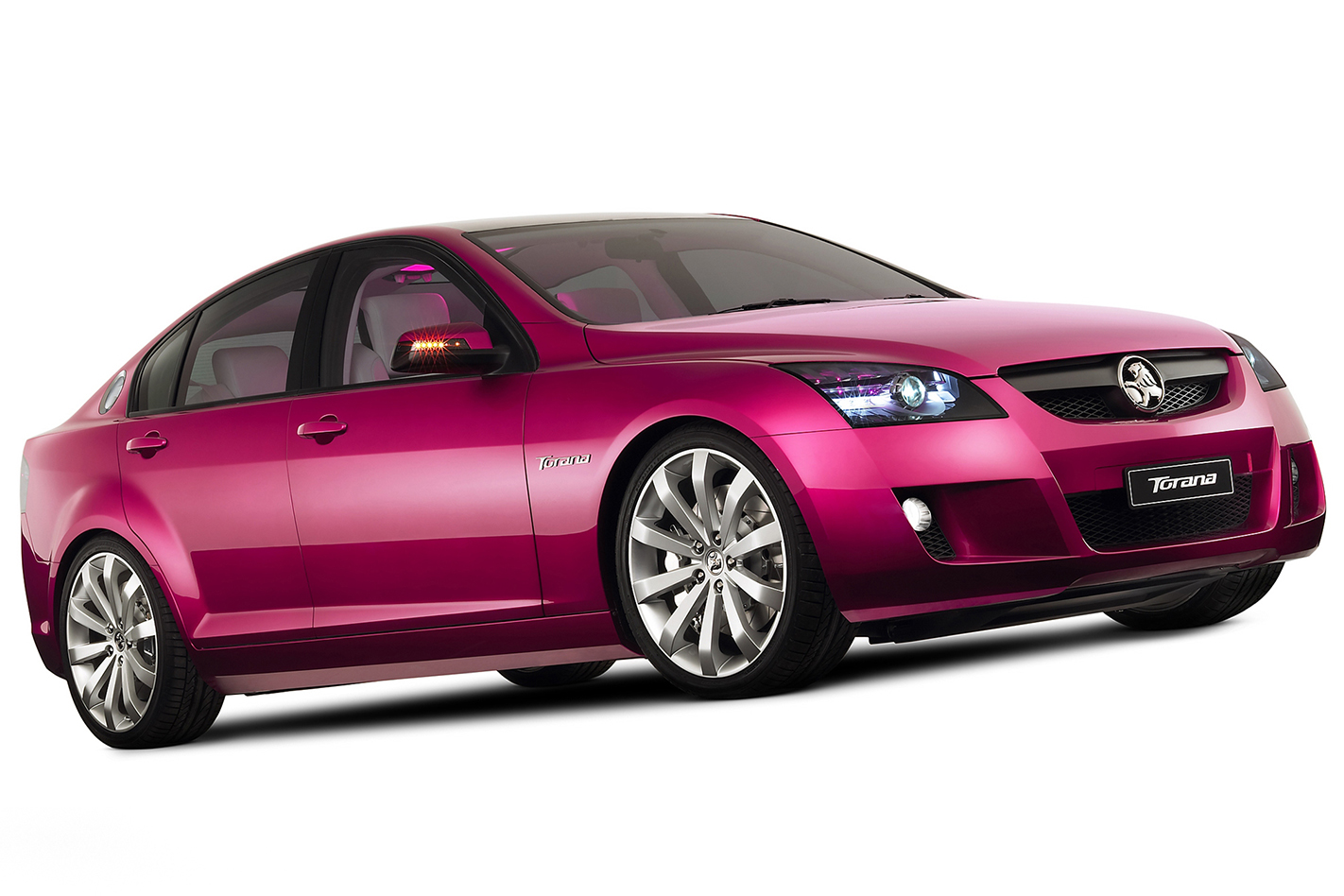
Holden’s current director of design, Richard Ferlazzo, is personally invested in ensuring the concept cars remain here in Australia. Within GM’s internal structure, it’s the design department that retains ownership and oversight of the concept vehicles.
There are more than a dozen high-profile Holden concept cars currently being kept at the company’s Salmon Street HQ in Port Melbourne. They include the 1969 Hurricane, 1970 Torana GTRX, 1998 Monaro Concept, 2000 Sandman, 2001 Utester, 2002 Commodore SSX, 2004 Torana TT36, 2005 Efijy, and 2008 Coupe 60.
Holden is also in possession of other concepts it built for global GM brands, though these aren’t historical Australian assets.
One piece of legislation that may keep the cars in Australia is the Protection of Moveable Cultural Heritage Act. It’s the same law that required Ford to apply for a permit to move its Australian archive overseas in 2016.
If GM confirms the cars will stay in Australia, the most likely outcome is they’ll be loaned to a suitable museum like the National Motor Museum in Birdwood, near Adelaide.
“The National Motor Museum is confident that through its ongoing relationship with GM Holden it will be involved in the dialogue on the future of the Holden heritage collection and the special-interest vehicles that are strongly associated with Australia’s motoring heritage and history,” Paul Rees, Director of the National Motor Museum, said in a statement.

Ferlazzo says there’s minimal chance the cars, which could fetch price tags in the millions of dollars, will be sold.
“Will GM sell them? It’s very unlikely. GM has sold concept cars a few times in the past and I think they’ve regretted it,” said Ferlazzo.
“A plan still needs to be developed but I think the ideal scenario would be one in which many of the heritage vehicles remain here for Australians to admire.
“It would be nice to keep as many of the concept cars together as possible, so it’s a collection people can see in one location. Something like Birdwood is a potential option, given its size.
“Alternatively, they could be sent to different museums around the country and they could rotate them, creating more opportunity for people to see them.
“There are a number of options to consider and we just need time to work through them.”
Wheels understands Holden has already been approached by multiple historians and museums about the future of the archive and cars.
The cars and archive are only one part of the massive clean-up job Holden is facing before it officially ‘retires’ at the end of 2020.
Following its title success in the ADAC GT4 race series, Austrian motorcycle manufacturer KTM has broadened its motorsport scope with a racing version of its sole road car, creating the KTM X-Bow GTX and setting eyes on the GT2 category.
KTM’s latest creation follows the closed-cockpit design of the X-Bow GT4 racer, though this time KTM has dropped the X-Bow’s Audi 2-litre turbo in favour of Audi’s 2.5-litre turbocharged inline-five engine.
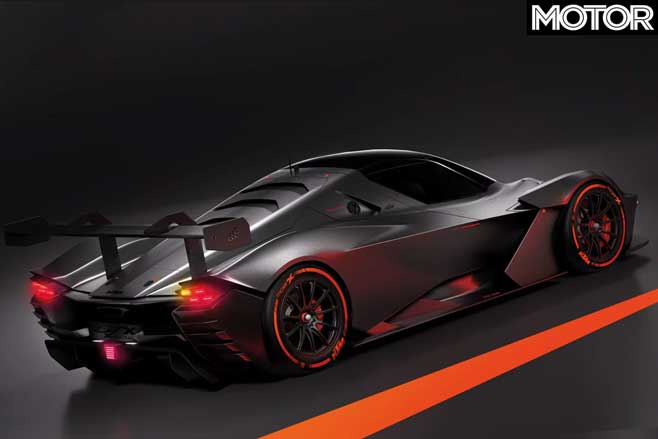
The engine is tuned to produce “over 447kW”, double that of the X-Bow GT4 racer and X-Bow R road car, whereas its weight is quoted to be around 1000kg before BoP (Balance of Performance) measures.
According to general manager of Reiter Engineering GmbH (the company responsible for the X-Bow GTX’s development) Hans Reiter, aside from GT2 racing the X-Bow GTX’s power output makes it eligible for various GT-regulated racing series.
“The first 20 cars will be available this year. Subject to the final homologation by the SRO Motorsports Group, it then could be entered in all GT2 racing series’,” says Reiter.
“Furthermore, the car should be eligible to compete in various racing series’ governed by GT regulations. These include the Creventic 24H Series, GT Open, DMV-GTC or the Nürburgring Langstrecken series, depending on homologation.”
In addition to that, KTM is also planning a one-make Cup series with the X-Bow GTX from 2021.
Ever since car infotainment systems started to become mainstream throughout the 2000s, BMW has consistently provided one of the better systems for connecting with your car.
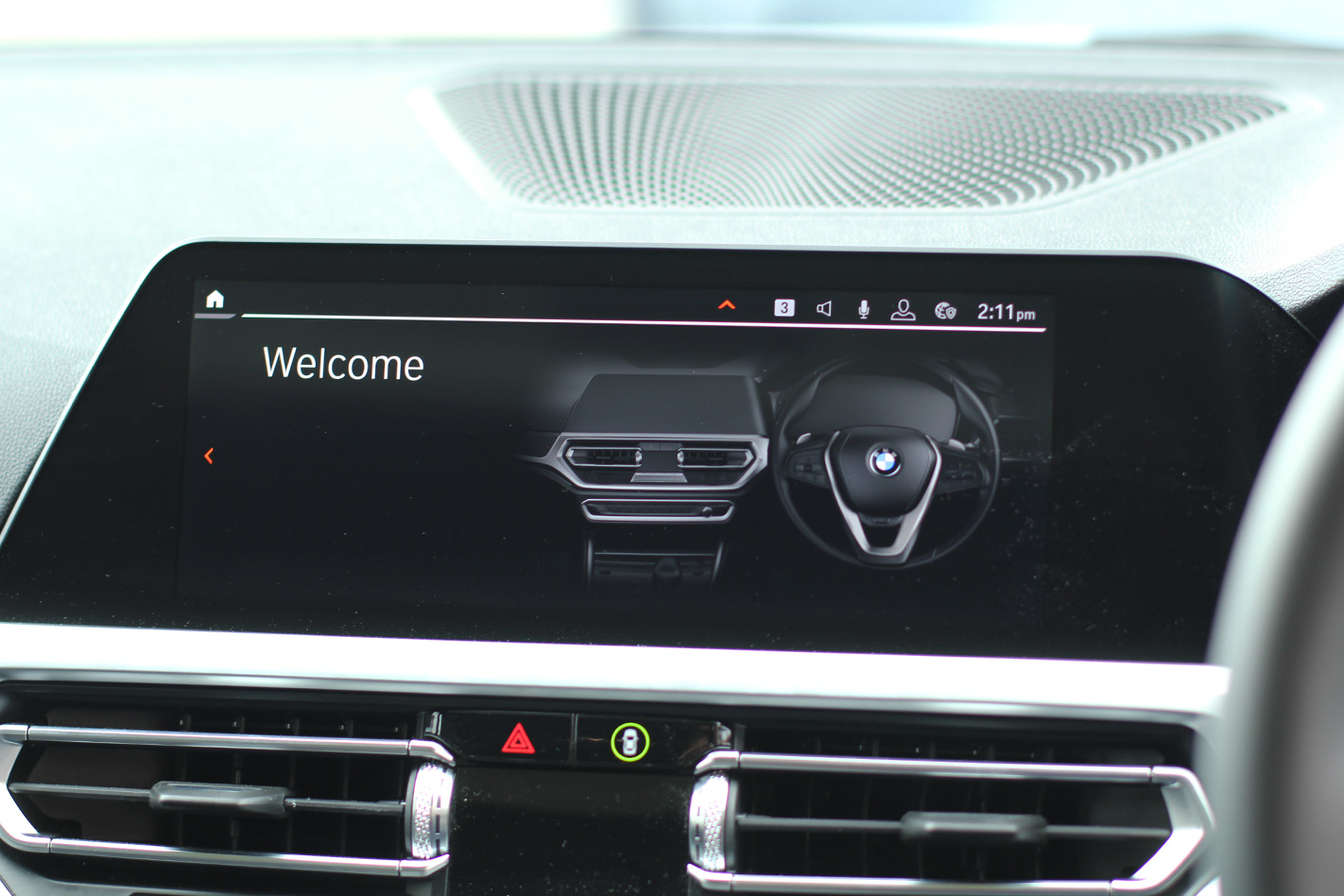
Fast-forward to today and while other manufacturers have sharpened up their act, BMW remains steady with its latest iDrive system which runs BMW Operating System 7.0. Technically, this system is called “BMW Live Professional”, however for simplicity’s sake we’ll refer to it simply as iDrive.
What is iDrive OS 7.0?
BMW’s iDrive is software that’s housed within the infotainment system. It controls a vast number of the car’s entertainment, navigation, communication, media controls and vehicle systems, but can also integrate seamlessly with a phone’s internet connection and even connect to the internet itself.
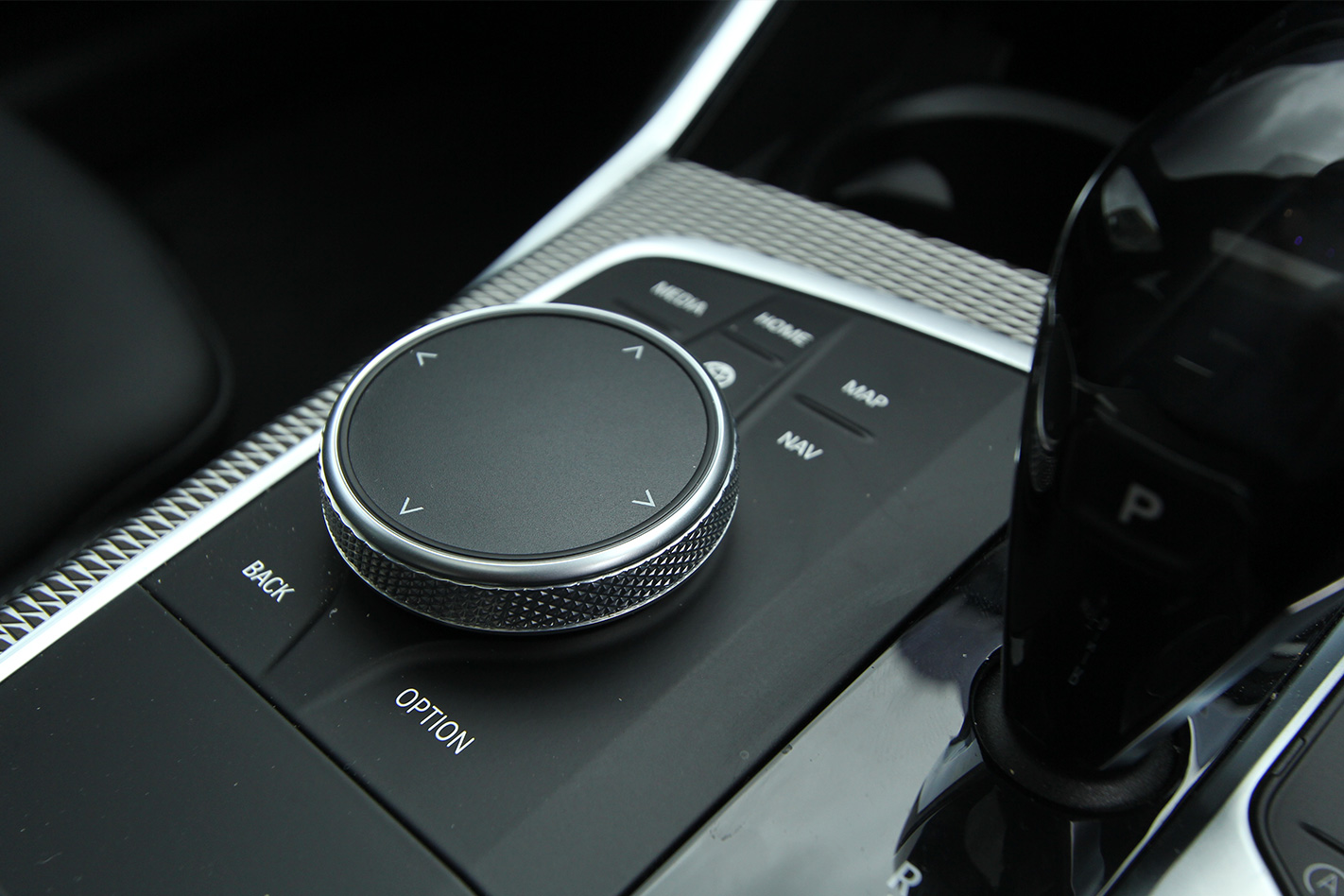
Traditionally vehicle occupants had to rely only on a rotary dial controller to interact with iDrive, but this latest version also makes use of the touchscreen, voice activated features and gesture controls to work with the computer.
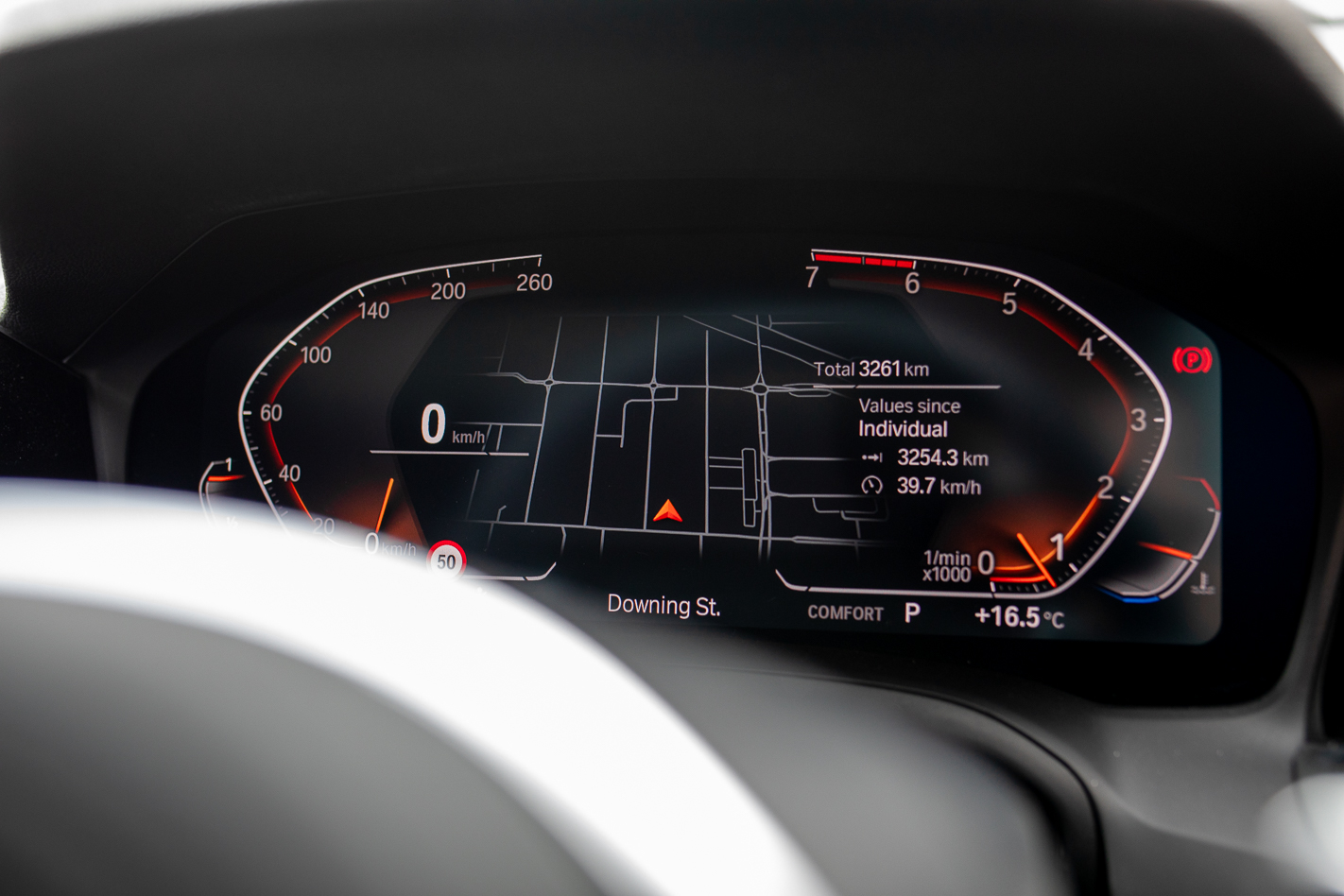
Many new BMW touchscreens are complemented by digital instrument clusters which, while they’re primarily reserved for passive displays for things like speed, odometer and the tachometer, can be used as a quick-access screen for infotainment purposes.
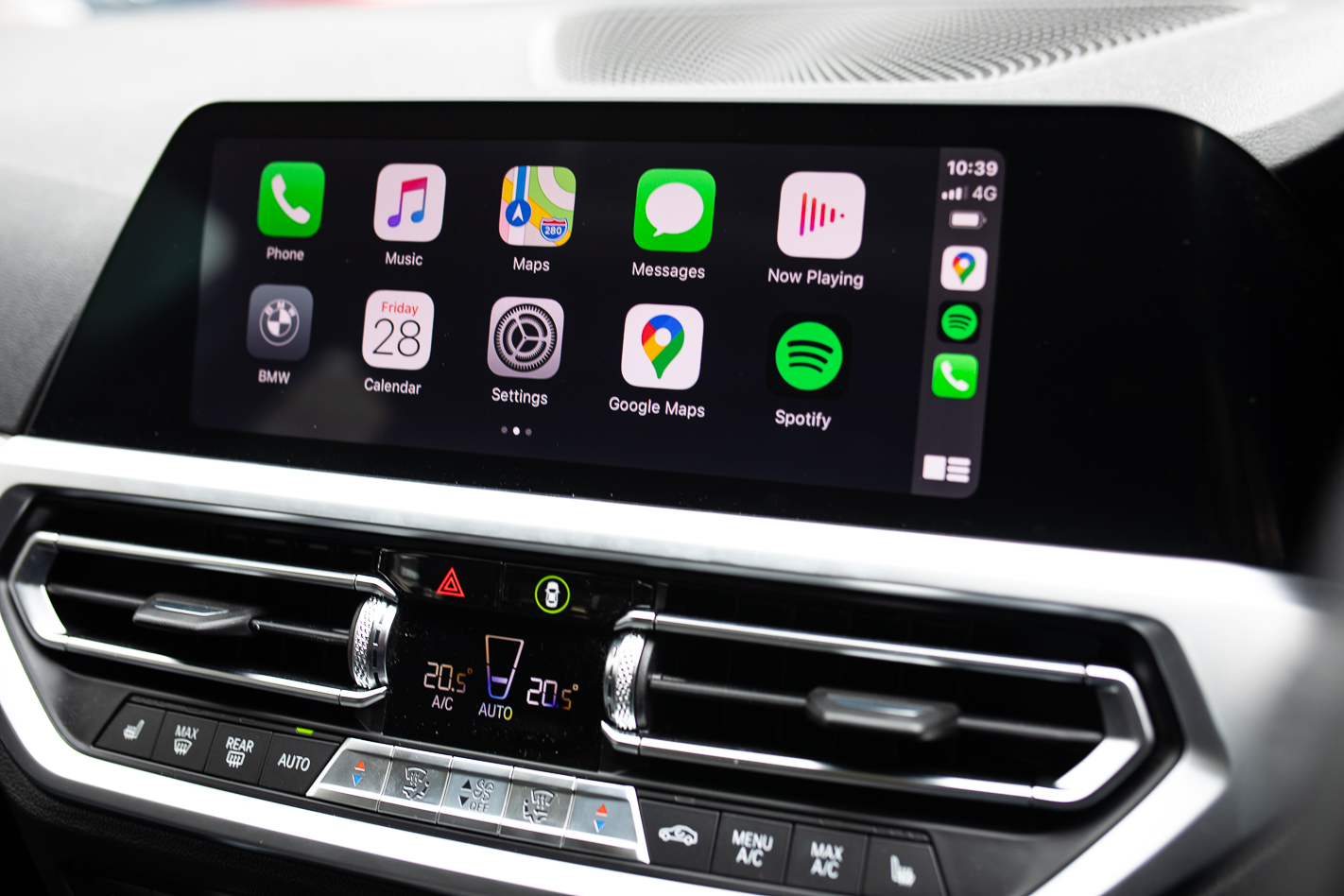
Smartphone mirroring is all the rage right now and iDrive supports Apple CarPlay with OS 7. Support for Android Auto is said to be coming in 2020, but a specific date isn’t locked-down as yet. Smartphone mirroring can be used interchangeably with the native infotainment system but not simultaneously, as with other cars.
What is iDrive OS 7.0 like to use?
Familiarity is key with BMW iDrive. While other systems come and go, vastly reinventing themselves with each new iteration of car model, iDrive has walked the fine line between staying true to what it’s known for while also introducing new features alongside.
While it’s nice that BMW is placing more emphasis on touch, gesture and voice control, the rotary controller still remains king for quick navigation of the infotainment screen. Decisive and accurate, once you get the hang of it, it’s very easy to cycle through menus and shortcut between screens.
Pairing a phone for the first time via Bluetooth is fairly painless, and recurring pairing is quick once you get back into the car. Annoyingly iDrive and Apple CarPlay aren’t always congruous, switching between Bluetooth audio streaming and CarPlay music is difficult, so too is making calls with the native Communications tab when you’re Apple CarPlay connected. It seems there’s no simple way to quick switch, and it’s one or the other.
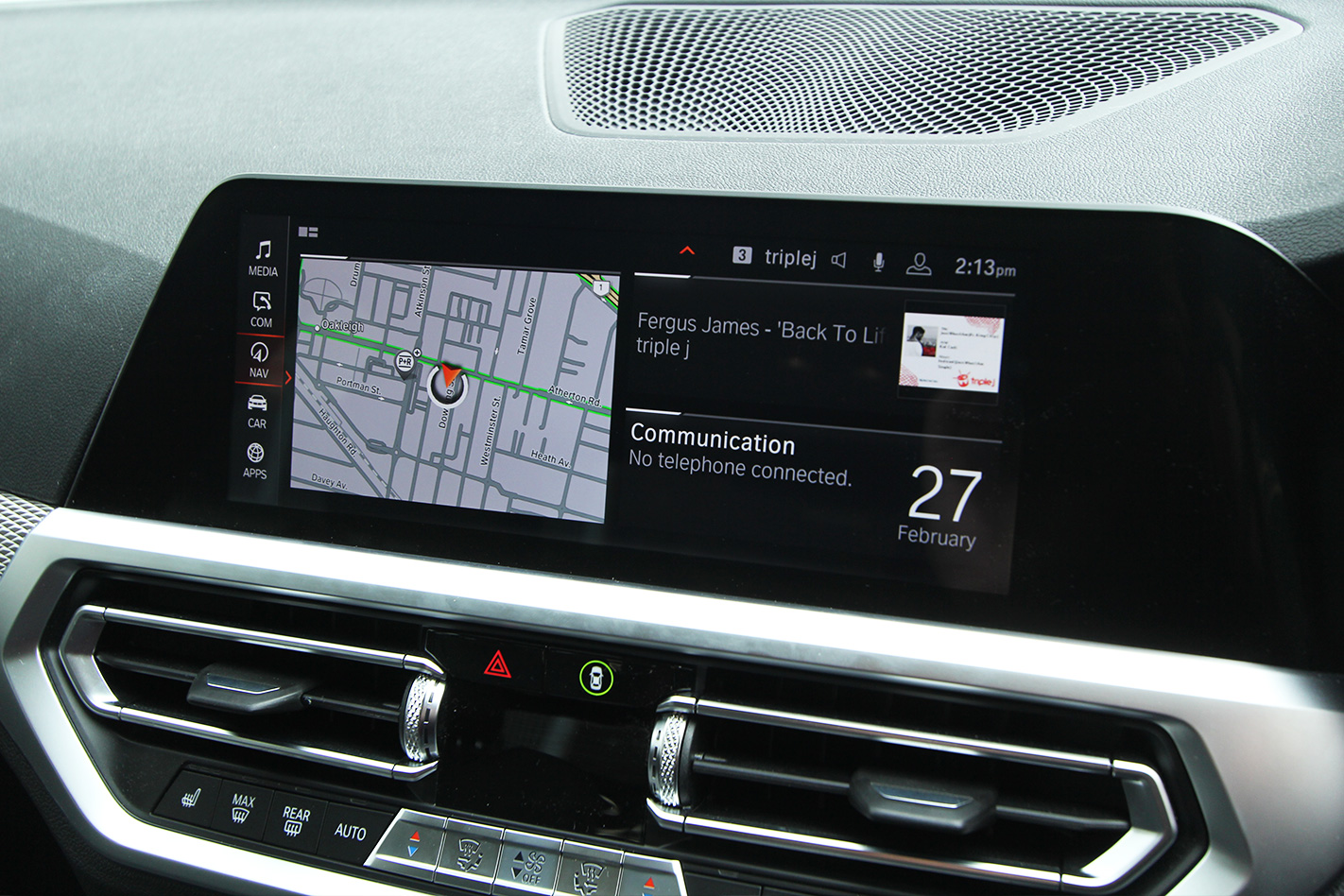
The layout of the customisable home screen now gives a quick-view of important systems like navigation, audio and communication, while other items are accessed in a column on the right hand side. Click into one of these options and the screen changes to a more familiar list style. Navigational commands using the rotary controller are satisfying to issue and you get the hang of the joystick aspect of the dial quickly.
Conversely, voice commands aren’t so good at identifying what you want to do – with the car asking again and again for you to repeat your request. It becomes frustrating to the point that you just forget to bother with it after a while.
Gesture control is better at understanding your intentions, but even still it takes time for the car to understand what you’re after and by that point you’ve already embarrassed yourself to your passengers and other motorists with your limbs flailing about. Bit of a gimmick – just easier to give it a miss. In any case, gesture control isn’t always available – the 3 Series we used to test iDrive 7 didn’t have it. We have seen it used in higher grade models like the BMW 8 Series, however.
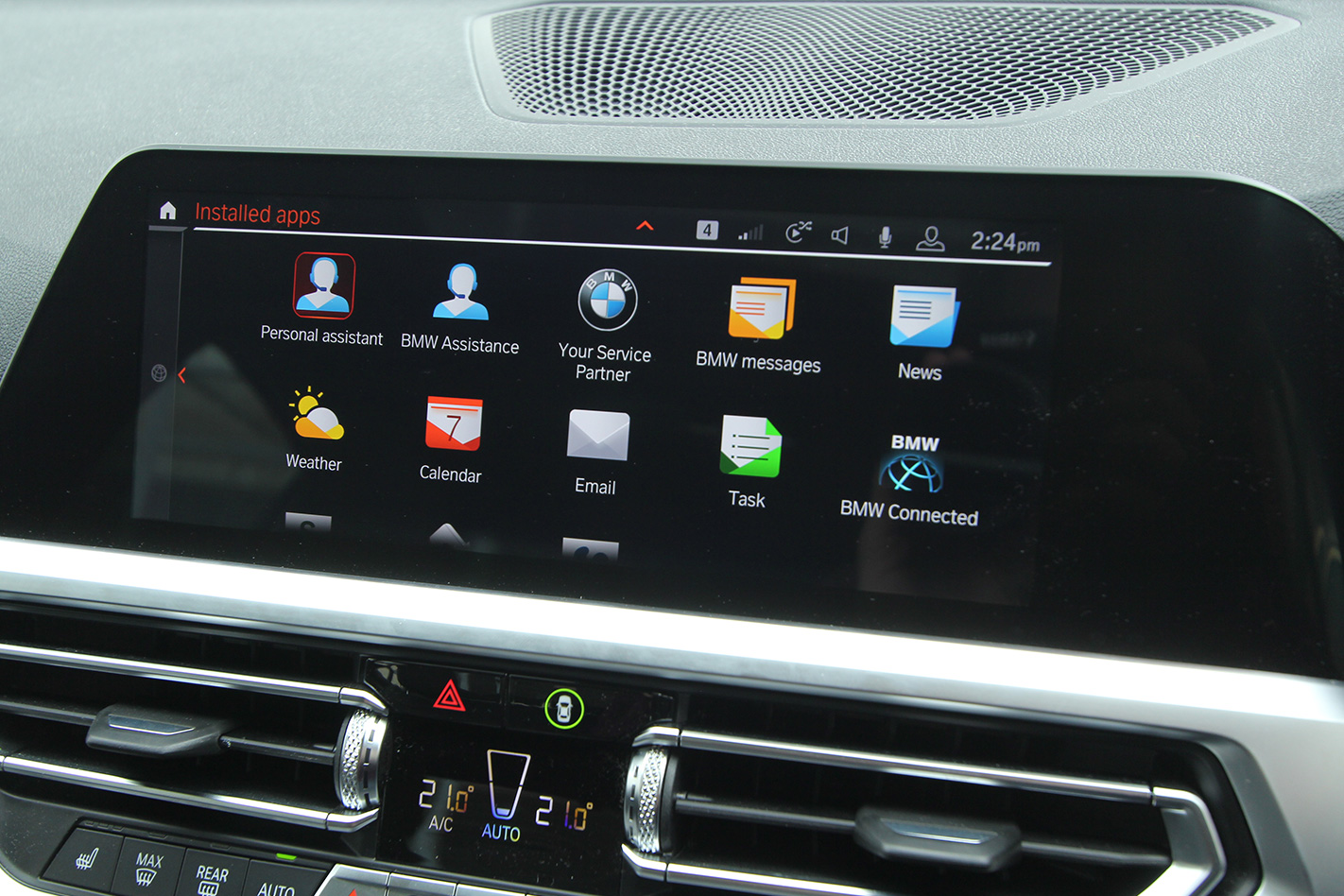
BMW offers a number of apps to enhance its iDrive experience, which includes weather information, news, email and BMW Connected.
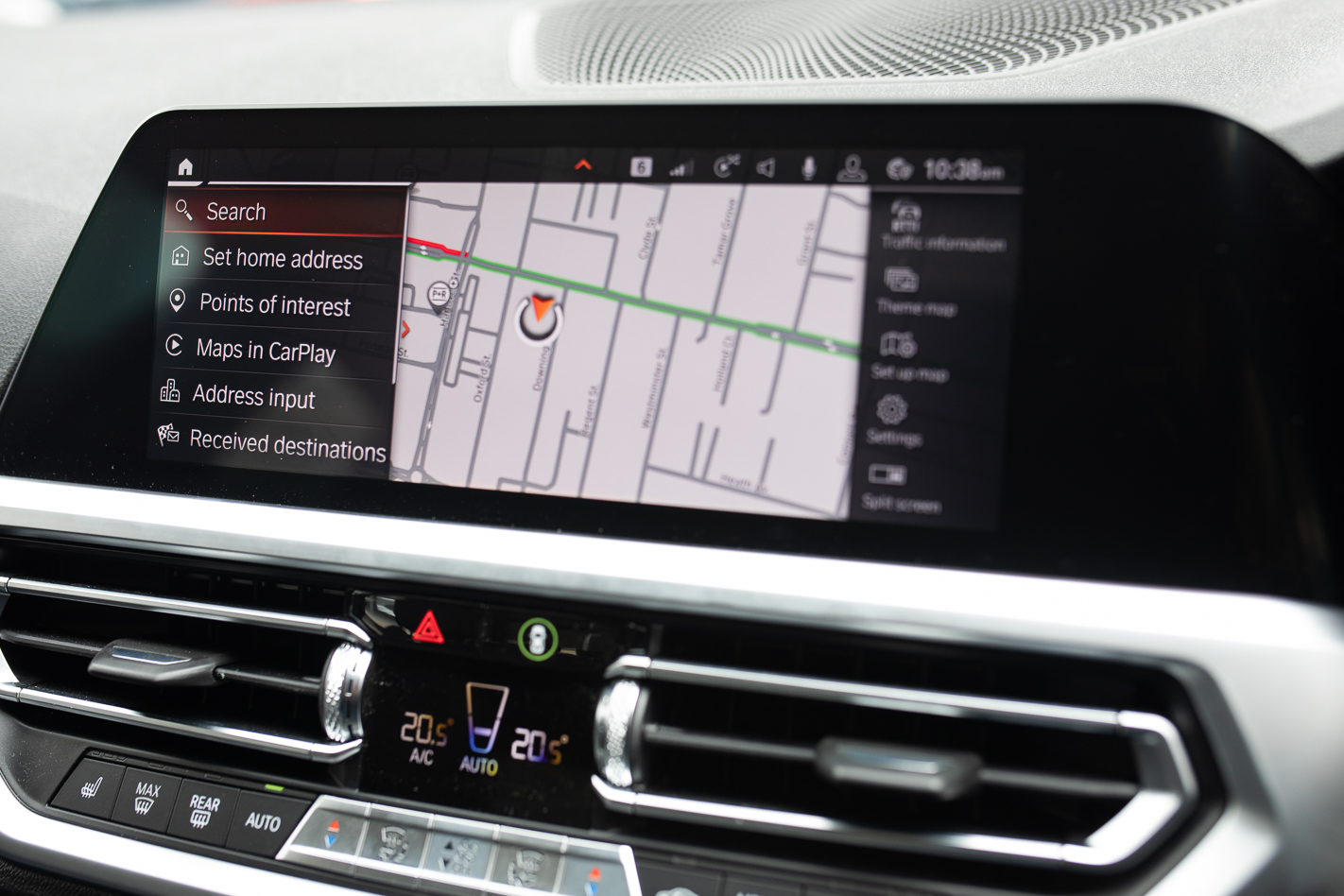
Maps are clear and easy to read, and destination entry is easily done by drawing your destination on the trackpad on top of the rotary dial. We’ve had hit-and-miss experiences with vocally commanding the navigation system.
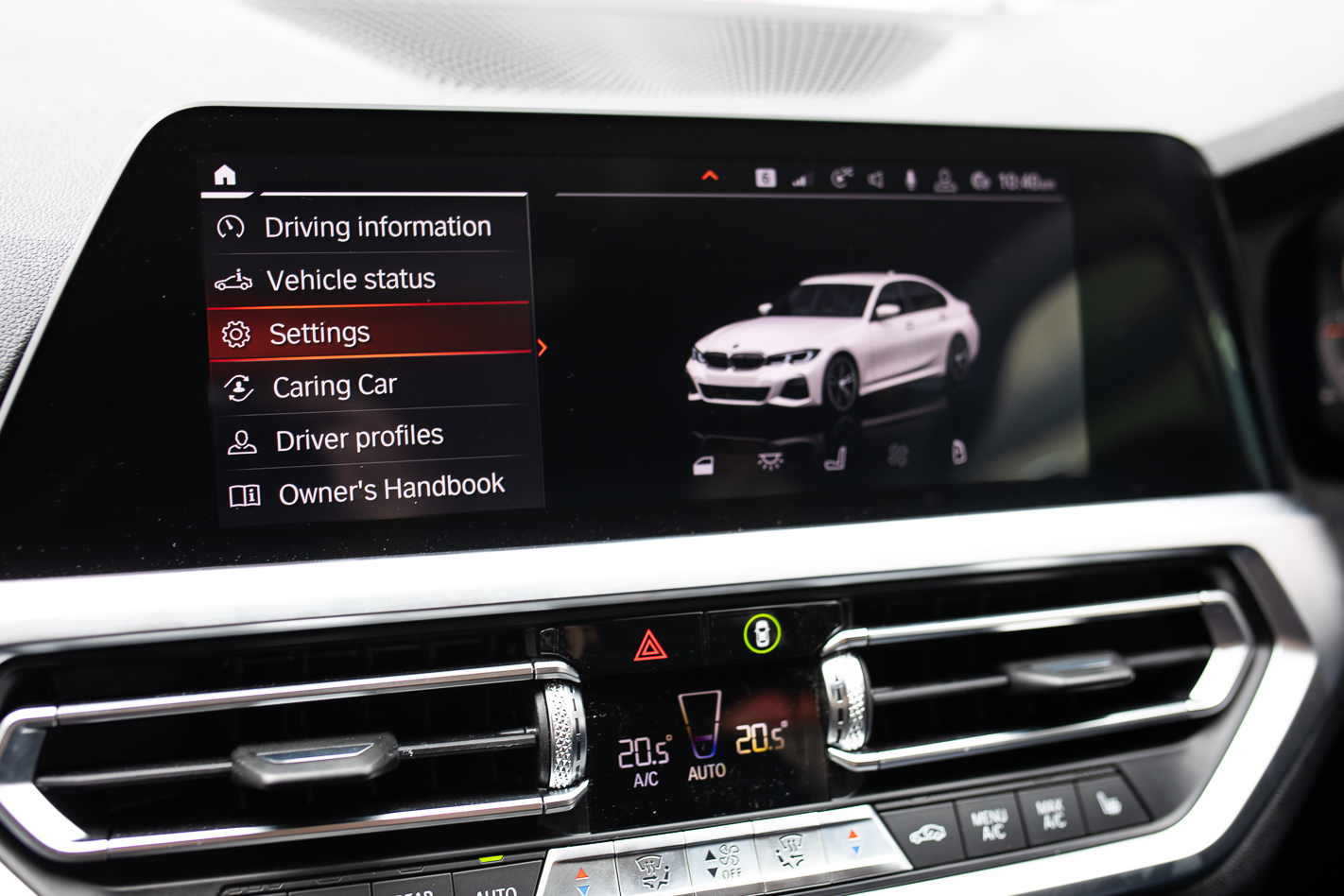
For the ultimate customised experience, you can set up a driver profile to store all your preferred settings if different drivers are regularly getting in and changing things around.
Is there anything iDrive OS 7.0 is missing?
As a holistic infotainment system, iDrive pretty much has all bases covered. As mentioned, a notable omission is the lack of Android Auto support which will hopefully be rectified at some point this year.
It’s worth noting that while iDrive with OS 7 is now available on a number of new BMW models, it doesn’t reach every single car on the dealership floor. Notable current exceptions are the 5 Series, 4 Series, much of the X range apart from the X5, X6 and X7, and the BMW i3 and i8. As these models reach their mid-life updates and facelifts, it’s likely iDrive 7 will be included.
How useful is iDrive 7 overall?
The latest version of BMW’s iDrive still holds out as one of the best infotainment systems on the market. Mercedes-Benz’s brand-new MBUX system and MMI from Audi have both become much better in recent years however, so there is less of an infotainment technology gap than there used to be – at least as far as premium German cars are concerned.
The customisability and connectivity achieved through iDrive is top notch, and although it’s a cliché, you really could consider an iDrive-equipped BMW as a mobile office.
The all-wheel-drive Subaru Impreza small-car range has undergone a slight mid-life update that brings a fresh face and a series of dynamic improvements.
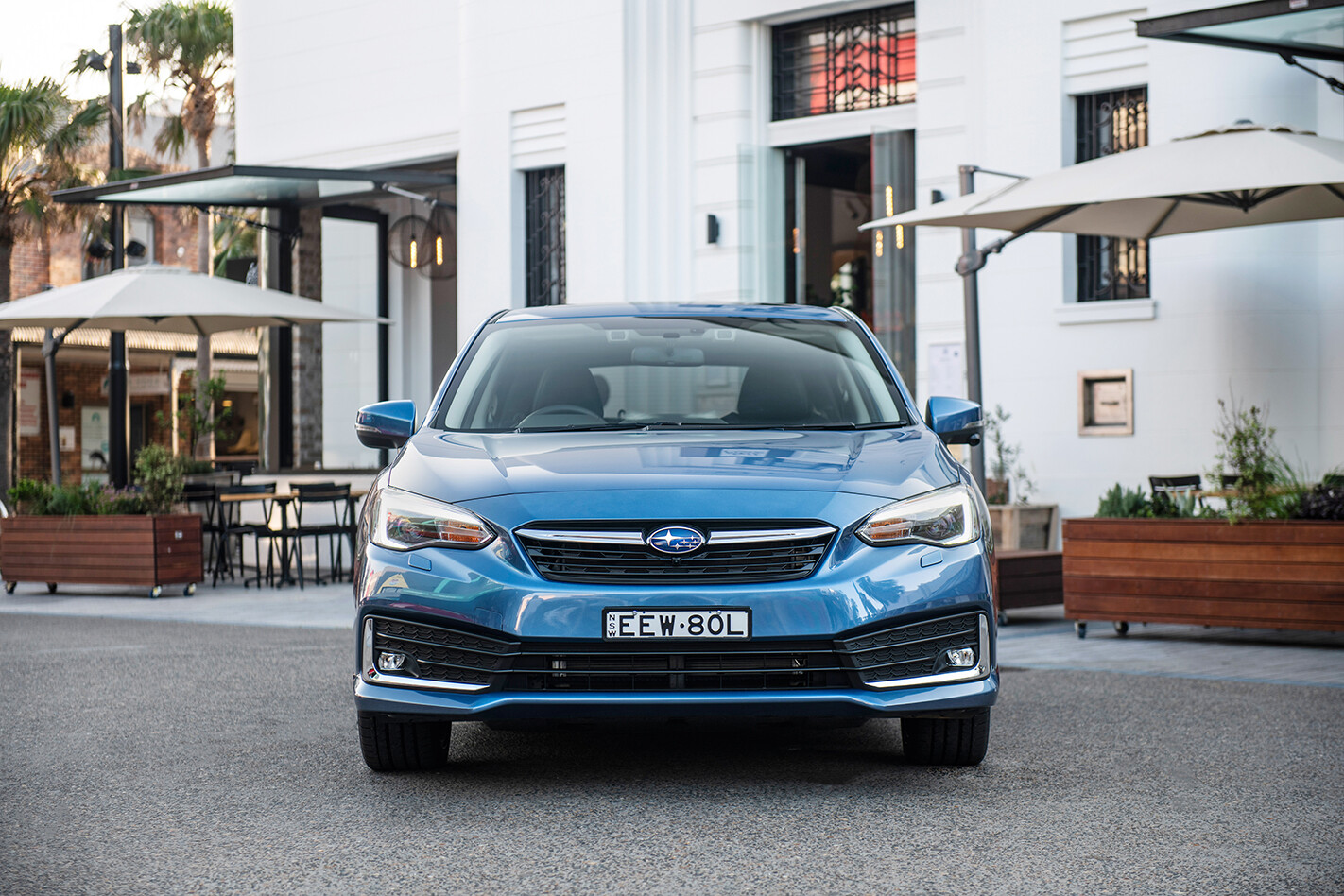
The Impreza’s conservative-looking front end has been restyled with a wider, more cheerful grille design, restyled bumper and full-length lower grille that bring a noticeably more contemporary look.
The suspension has also been revised, which according to Subaru has resulted in improved ride comfort, steering response and handling agility.
All Impreza hatchback and sedan variants now feature ‘Subaru Intelligent (SI) Drive’ that lets the driver choose between the efficient I (Intelligent) mode and S (Sport) mode for when quicker throttle response is required from the 2.0-litre petrol four-cylinder boxer engine and CVT auto combo that remains the sole powertrain in the range.
Other changes include new alloy wheel designs and a new paint option – Magnetite Grey Metallic – with the range-topping 2.0-S (pictured) also scoring updated LED headlight design and auto power-folding side mirrors.
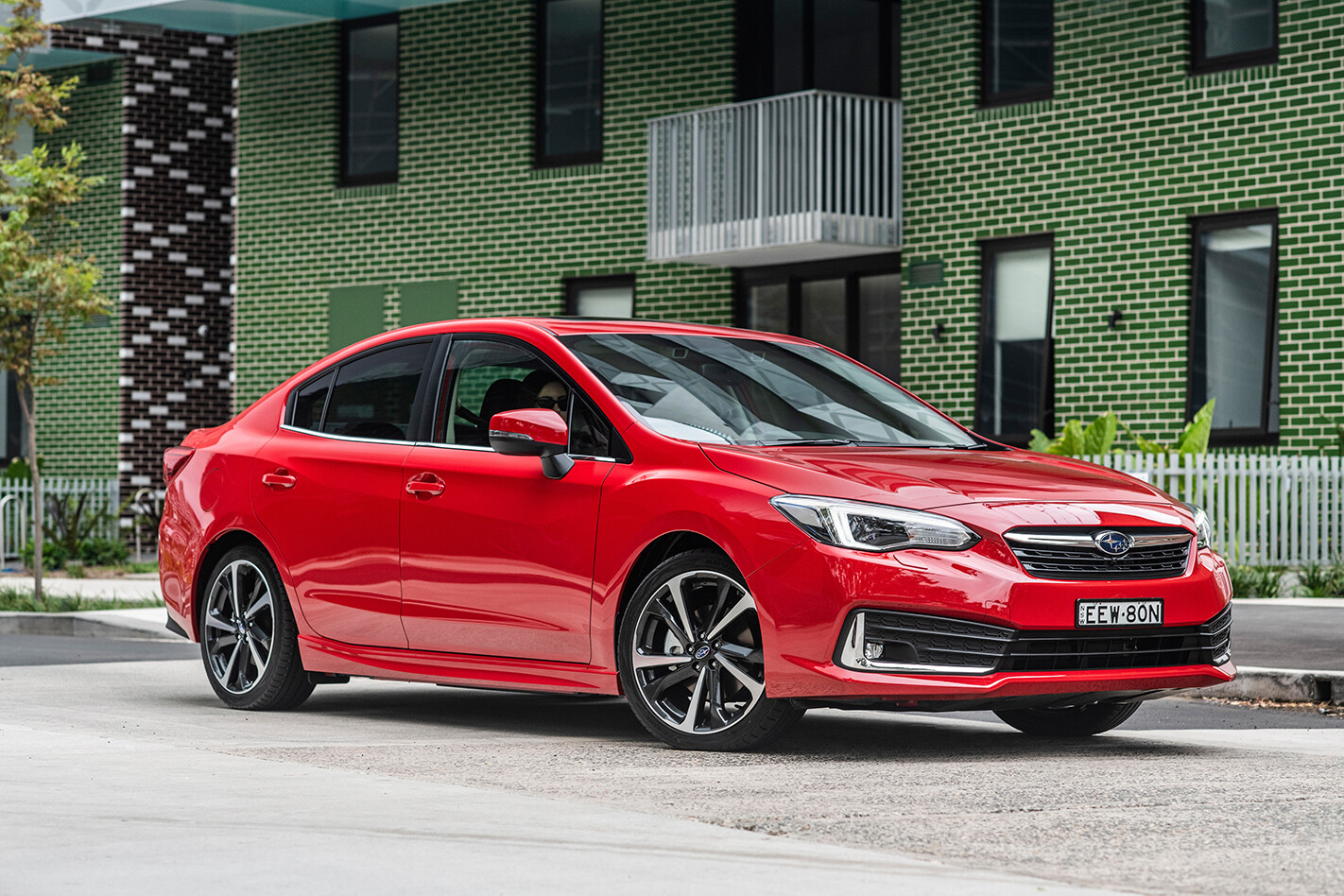
Inside there are trim changes to all but the entry-level 2.0i, with the 2.0i-L and 2.0i Premium also gaining new premium cloth seats, while range-topping 2.0-S gains a stitched multi-function display binnacle, piano-black dashboard detailing and driver’s seat memory settings.
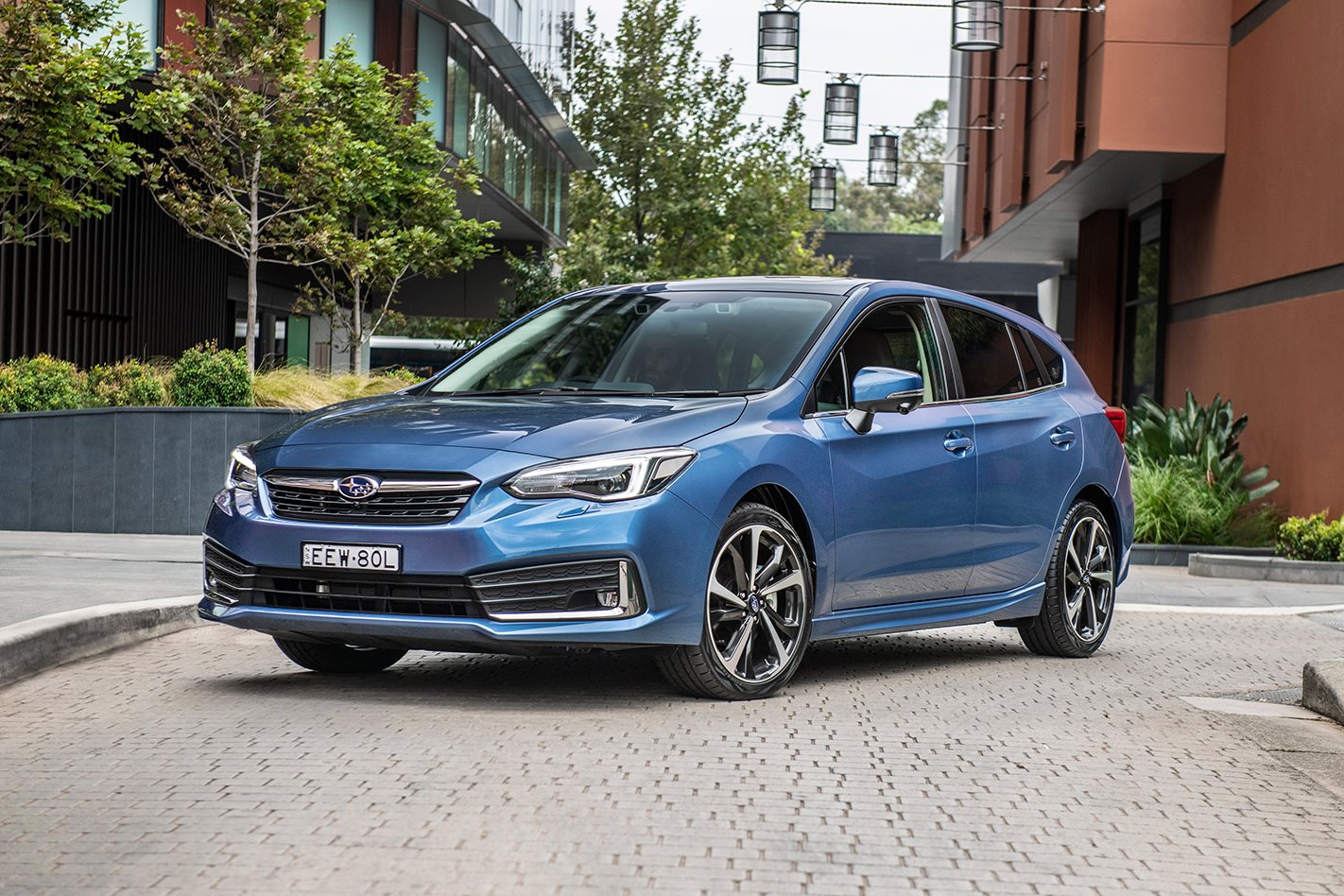
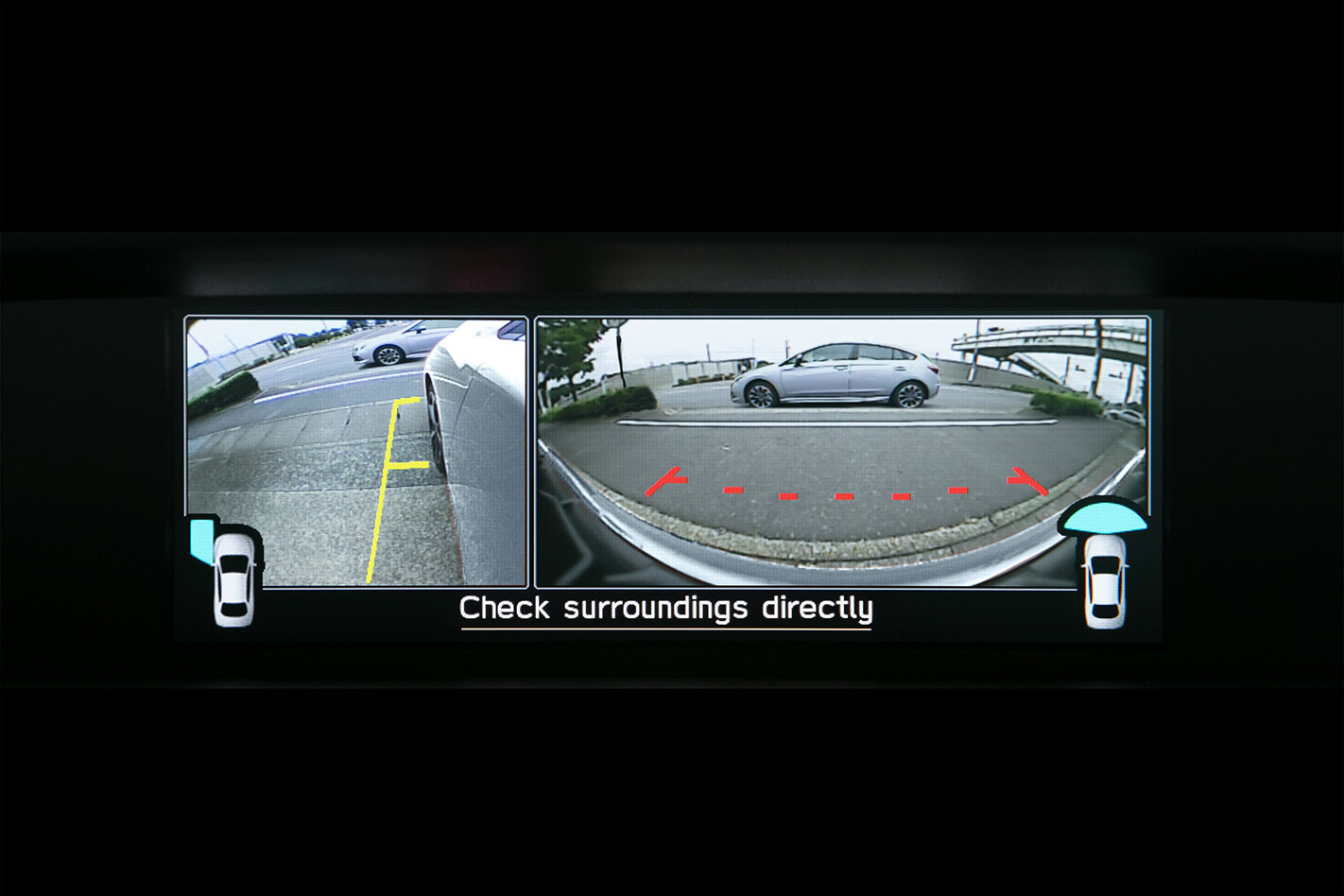
The 2.0i Premium also gains additional safety kit including blind spot monitor, lane change assist, rear cross-traffic alert, reverse automatic braking, and front view parking monitor.
The front-parking monitor has also been added to the 2.0i-S along with a side view that’s great for helping to avoid small obstacles and gutter rash.
All Impreza versions except the 2.0i are equipped with Subaru EyeSight active safety suite that includes autonomous emergency braking, adaptive cruise control and lane-keeping assist.
The MY20 changes see entry-level pricing rise by $1050, with the higher-spec 2.0i-Premium and 2.0-S jumping by $1800 and $1420 respectively.
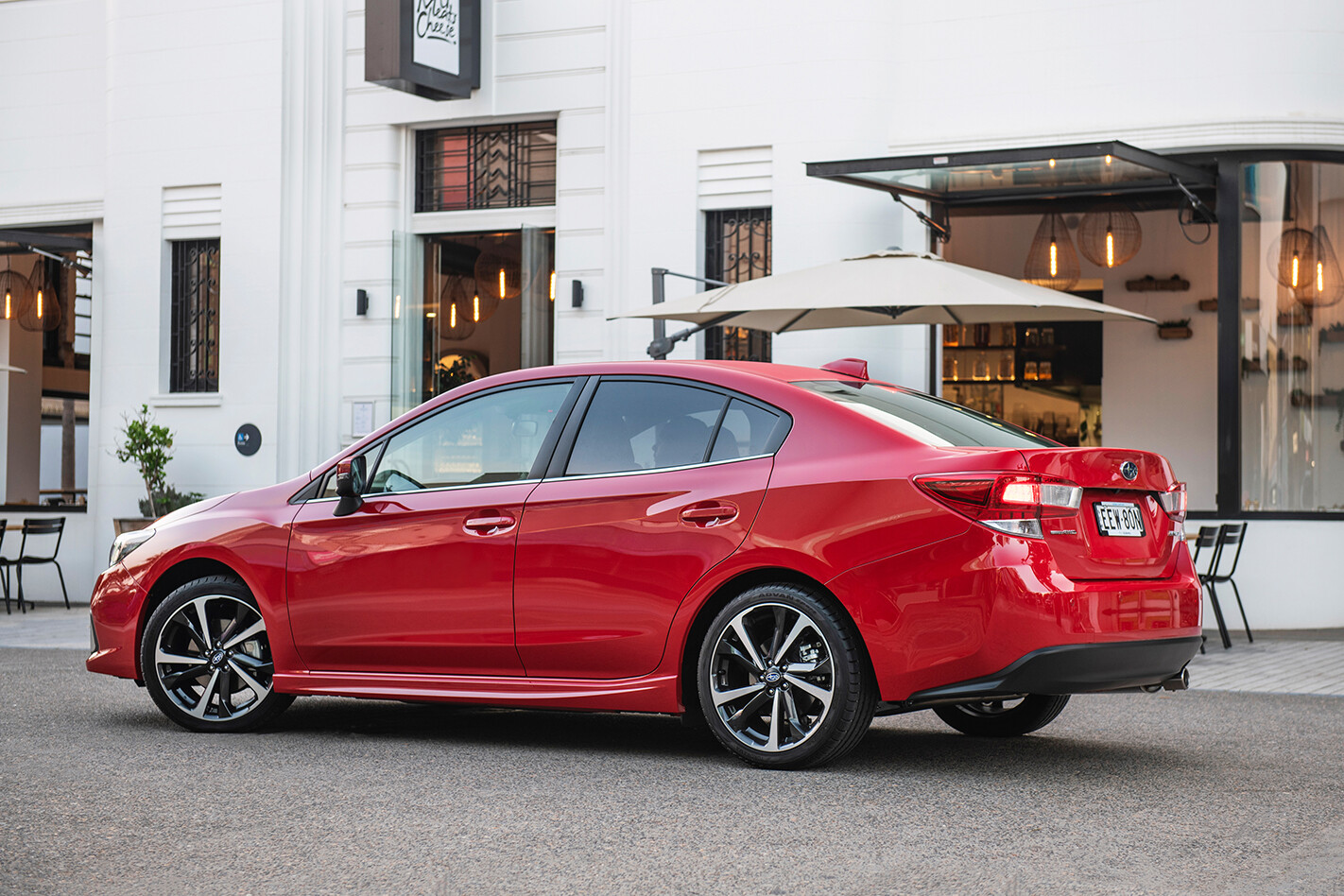
The 2020 Subaru Impreza range is now available in local showrooms.
2020 Subaru Impreza manufacturer’s list pricing
- Impreza 2.0i sedan – $23,740
- Impreza 2.0i hatch – $23,940
- Impreza 2.0i-L sedan – $25,860
- Impreza 2.0i-L hatch – $26,060
- Impreza 2.0i-Premium sedan – $28,390
- Impreza 2.0i-Premium hatch – $28,590
- Impreza 2.0-S sedan – $31,160
- Impreza 2.0-S hatch – $31,360
