
What is it?
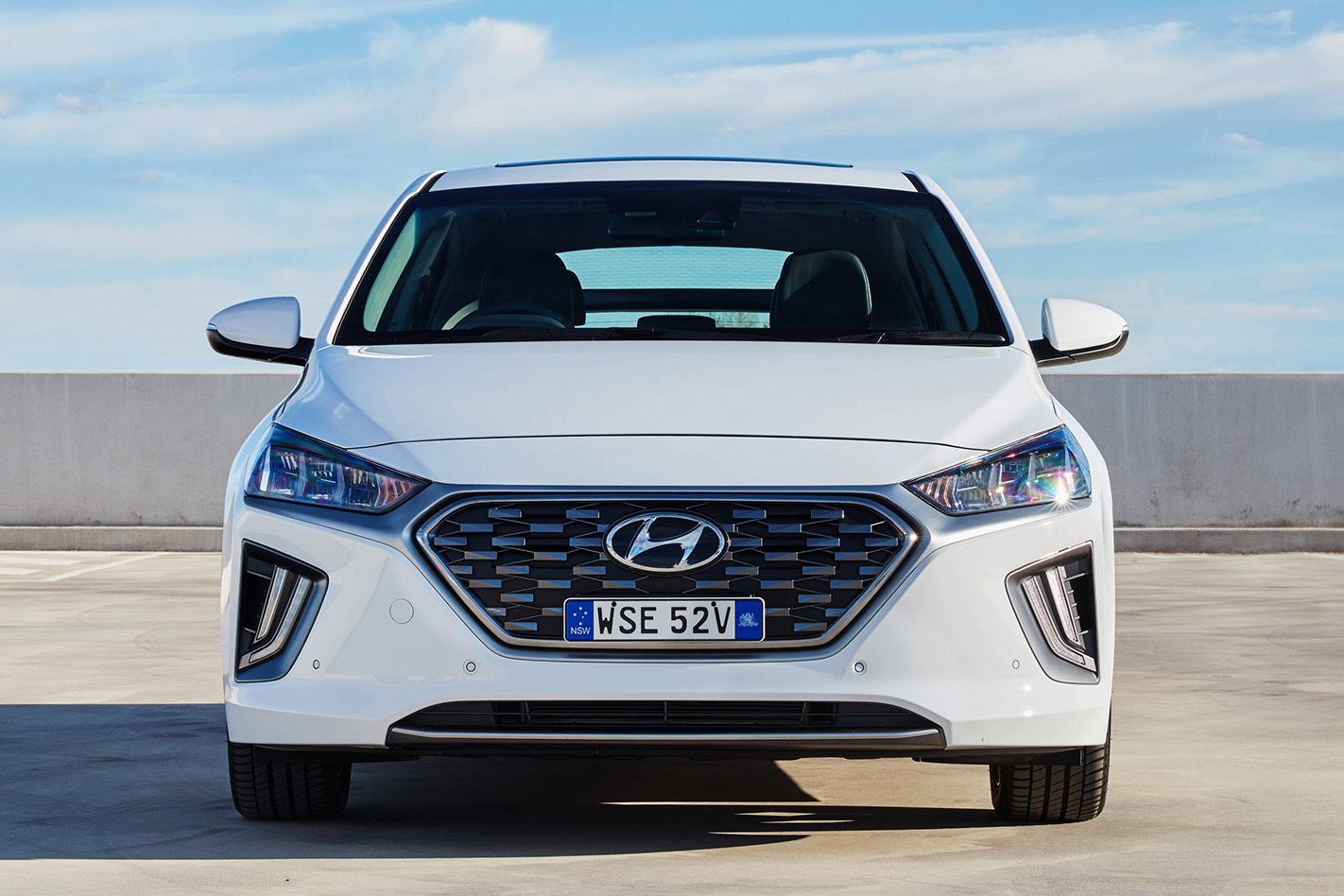
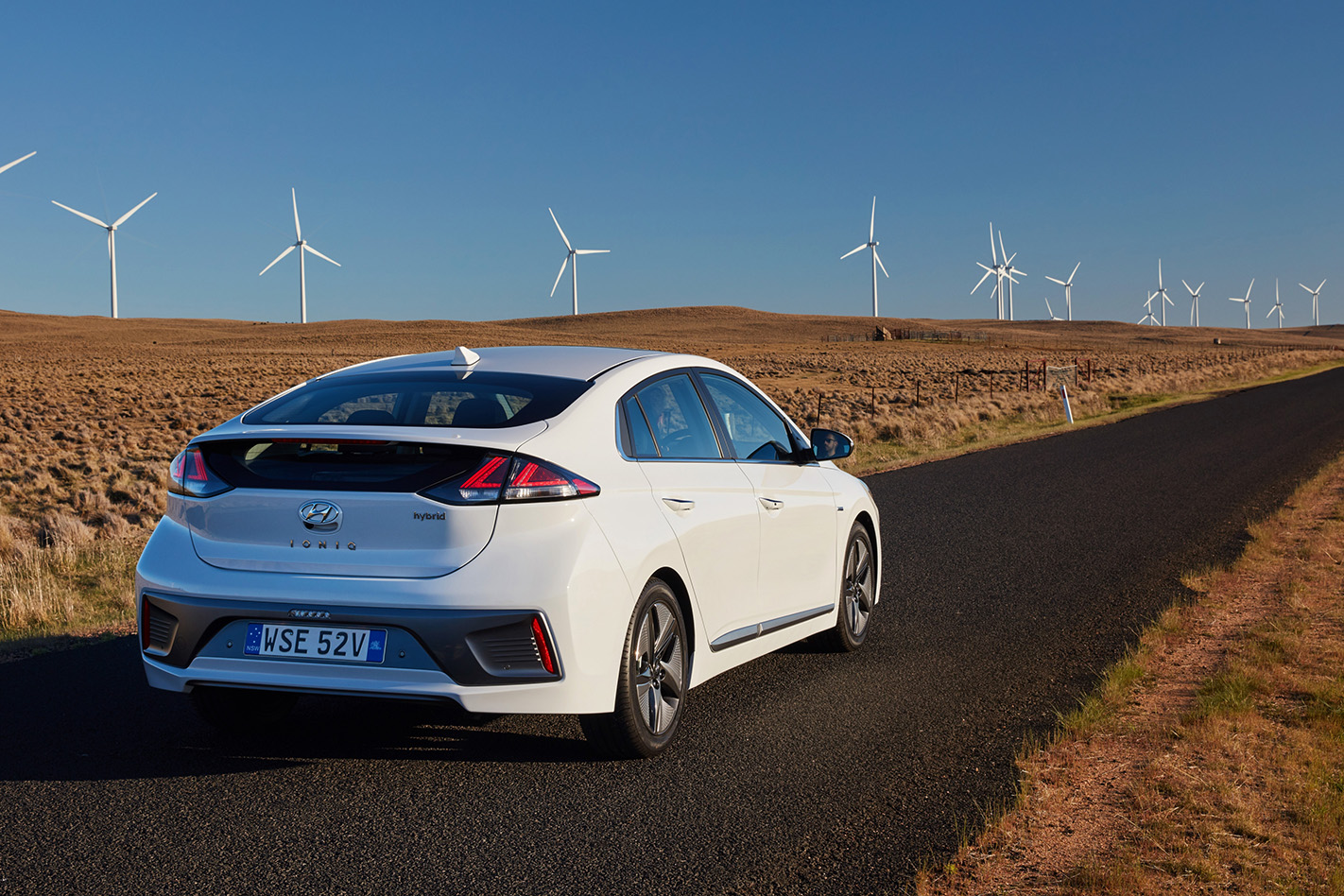
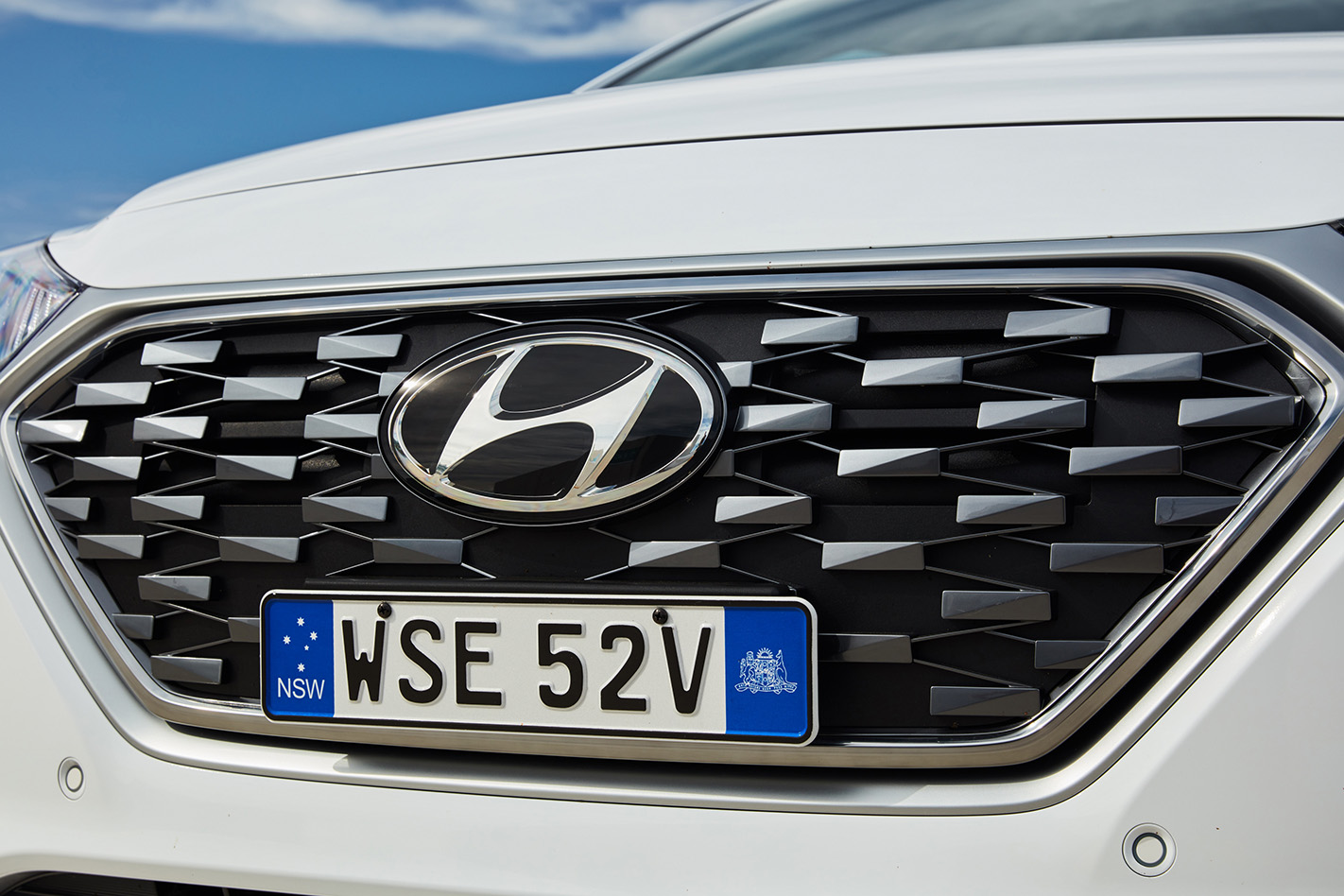
It hasn’t taken long, but Hyundai has wheeled out a fairly substantial facelift for its electrified hero the IONIQ, which only launched in Australia in late 2018. After roughly a year in the market, the entire IONIQ range has been gifted with a sharper, less blobby face and a significantly more modern-looking dashboard, delivering a significant boost in aesthetic appeal in the process.
The entrypoint to the IONIQ range is a self-charging hybrid analogous to Toyota’s Prius, priced at $34,790 for the base Elite grade and rising to $39,990 for the Hybrid Premium we have here. That’s just over $4K less than what Toyota asks for its similarly-specified Prius i-Tech, but does the Hyundai option have more than pure value going for it?
What’s it like to drive?
It may not have the outright eco-glamour of the battery-electric Ioniq – or even the plug-in hybrid that sits between – but the IONIQ Hybrid has three critical advantages: it’s dead easy to drive, you don’t have to charge it, and it’s more affordable than its bigger-batteried siblings.
It’s also got a meaningful amount of zip, especially if you’re going to line it up against its most logical rival: the Toyota Prius. While the Prius makes do with 90kW and 142Nm from its petrol/electric powertrain combo the IONIQ Hybrid has a healthier 104kW of power and 265Nm of torque, and yes, we know the whole idea behind a hybrid is to burn less fuel rather than drive more quickly, but having more power certainly makes it a more relaxed machine to pilot.
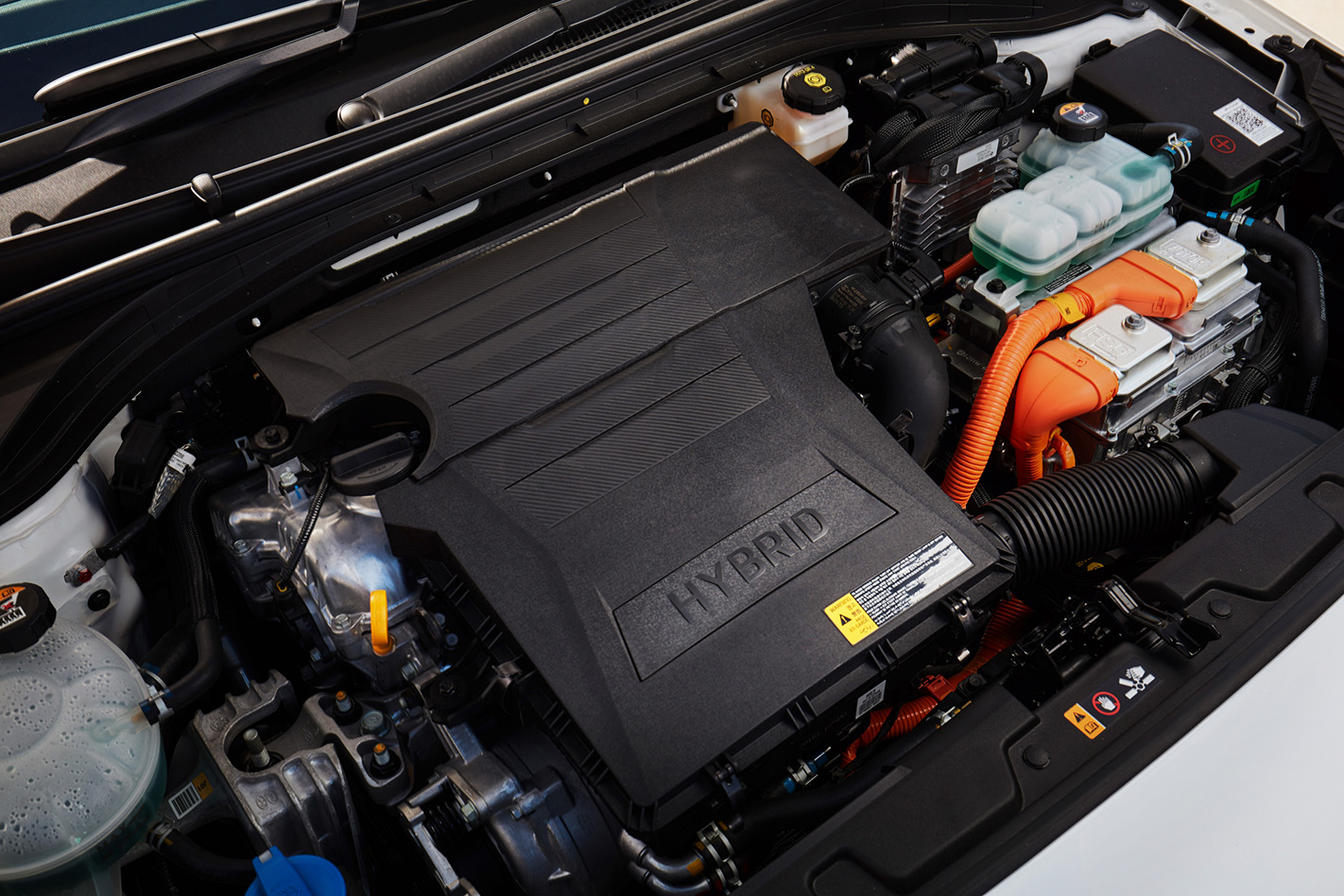
Naturally there’s a trade-off in fuel consumption, with the IONIQ’s stated average of 3.9 L/100km being half a litre behind the Prius’ 3.4 L/100km claim. Even so, that’s still great efficiency in anyone’s language, and we came appreciably close to it during our week-long test drive with an average of 4.3 L/100km.
It’s not the most linear power delivery, though. While it’s quite smooth under gentle acceleration, the IONIQ Hybrid prefers to keep its combustion engine dormant if there’s plenty of charge in its high-voltage battery and you must give the accelerator a fair shove if you want the full 104kW it’s capable of.
Once the engine wakes up the transmission then seems to take a moment to recalibrate to the extra urge that’s on tap and select an appropriate gear, which can make sudden demands for more power result in a jerky response. While many hybrids tend to use CVT gearboxes (which are known for rubber-band-like shifts), the sharply stepped nature of the IONIQ’s six-speed dual-clutch automatic does introduce some refinement compromises.
There are no such compromises with regard to ride comfort. As with all Hyundai Australia vehicles, the IONIQ has a locally-tuned suspension to help it deal with Australian roads, and those unique spring and damper settings work great around town to iron out bumps even on the IONIQ Premium’s 17-inch alloy wheels (the base grade Elite gets 15-inch wheels with more rubber in their sidewalls).
Couple that with reasonably good sound suppression to help mask when the engine is running, and the IONIQ hybrid’s driving experience when cruising is quite pleasant.
What’s it like to live with?
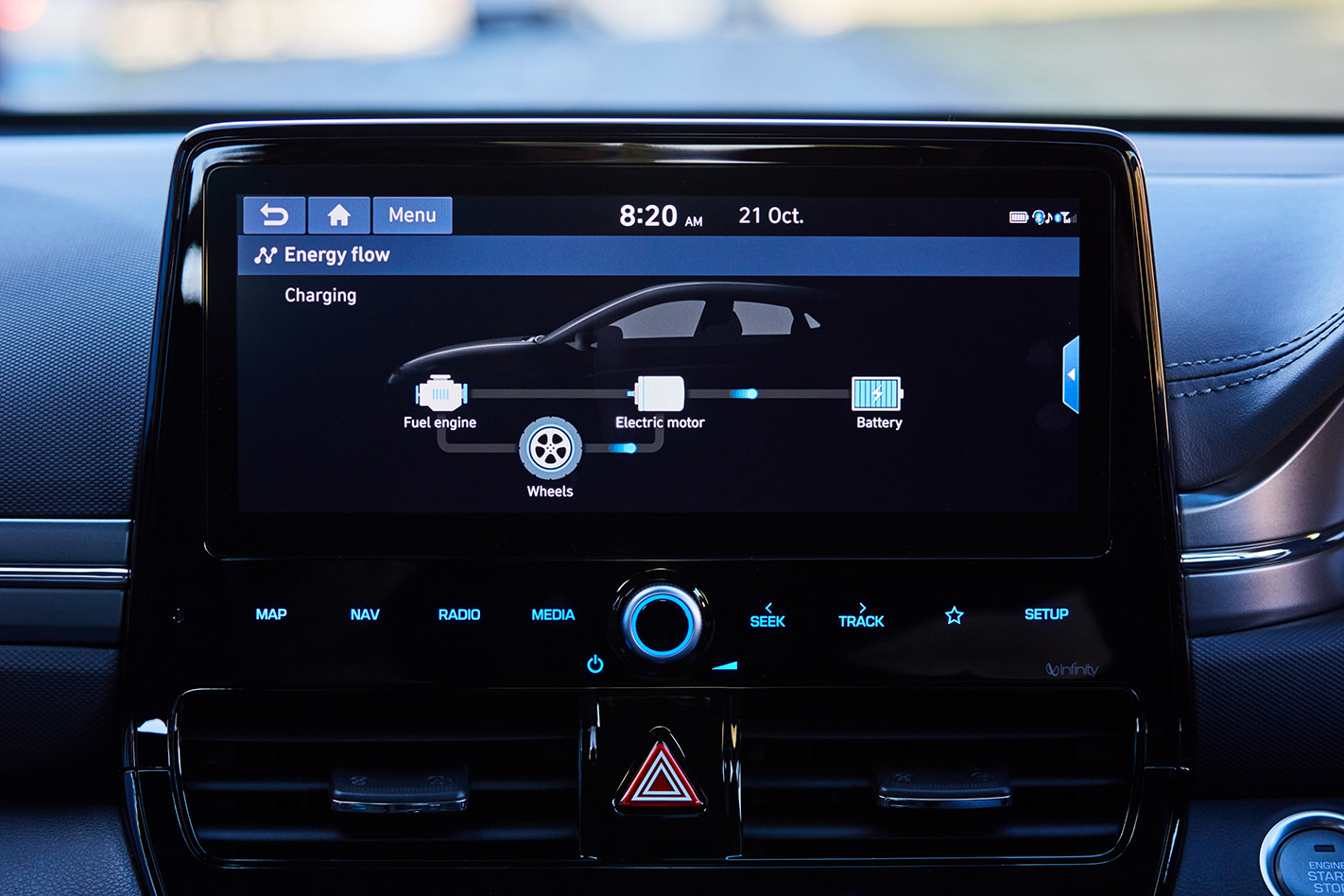
Besides scoring a sharper look on the outside, the 2020 IONIQ also gained a greatly improved dashboard on the inside, with a 10.25-inch colour touchscreen infotainment system forming the centrepiece.
It’s a big improvement over the 8.0-inch display of the pre-update IONIQ, with great touch response and bright, clear, easily-legible graphics. With support for Android Auto and Apple CarPlay, there’s also scope to gain added functionality through smartphone mirroring as well.
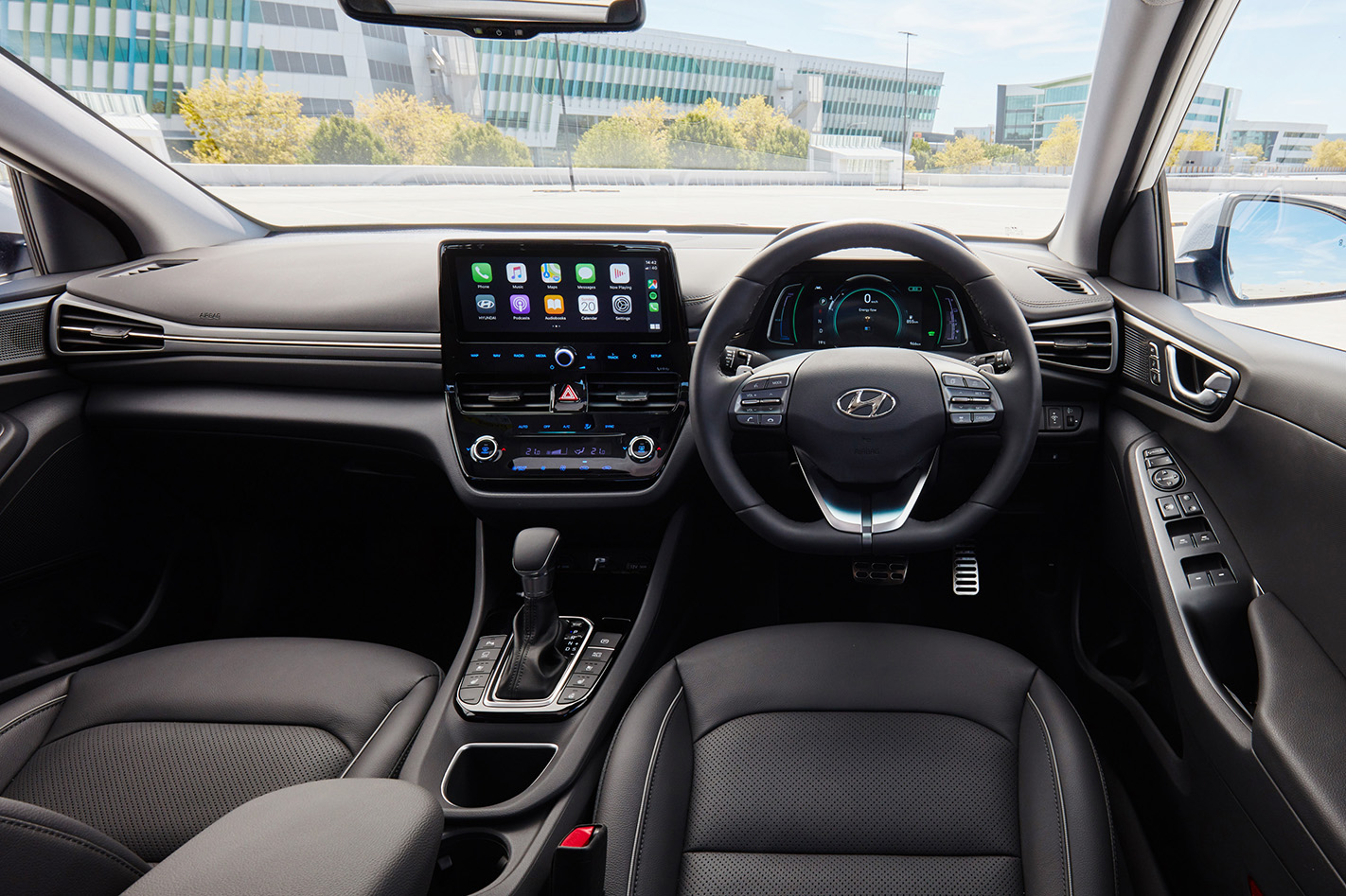
The IONIQ is a small hatch, comparable in overall dimensions to Hyundai’s i30 small hatch. Modestly sized, it nevertheless packs in a spacious feeling cabin for those in the front as well as those in the back, plus a 456 litre boot space accessed through a wide hatch opening. Rear air vents are another win, and something not many cars in the segment enjoy.
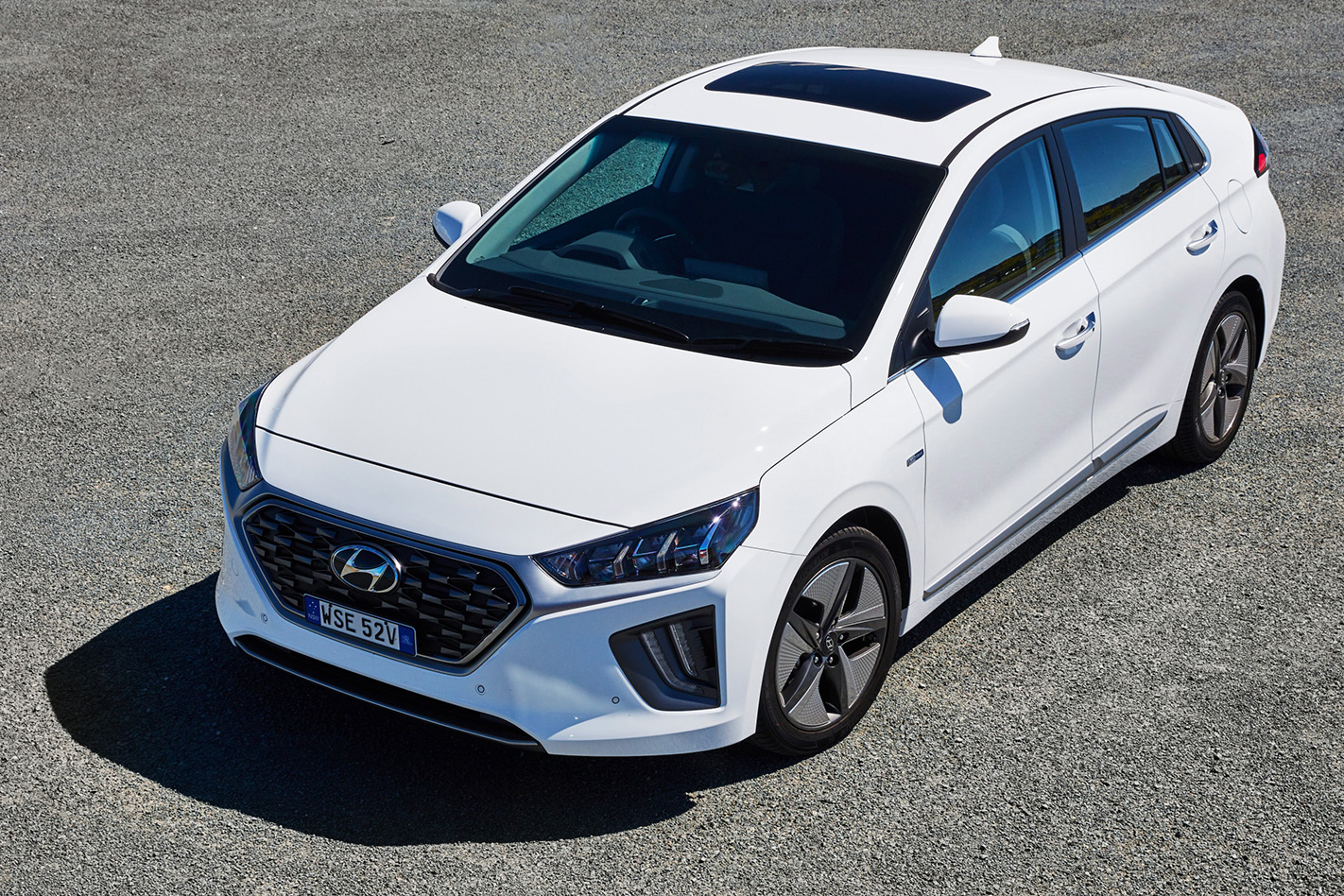
Added mod-cons for the Premium grade such as a wireless phone charging pad, dual-zone climate control, heated AND ventilated front seats, and panoramic sunroof certainly help justify its $5.2K price differential to the Elite, while its very aerodynamic-looking 17-inch alloys enhance the generally futuristic aura of Hyundai’s forward-leaning hatchback.
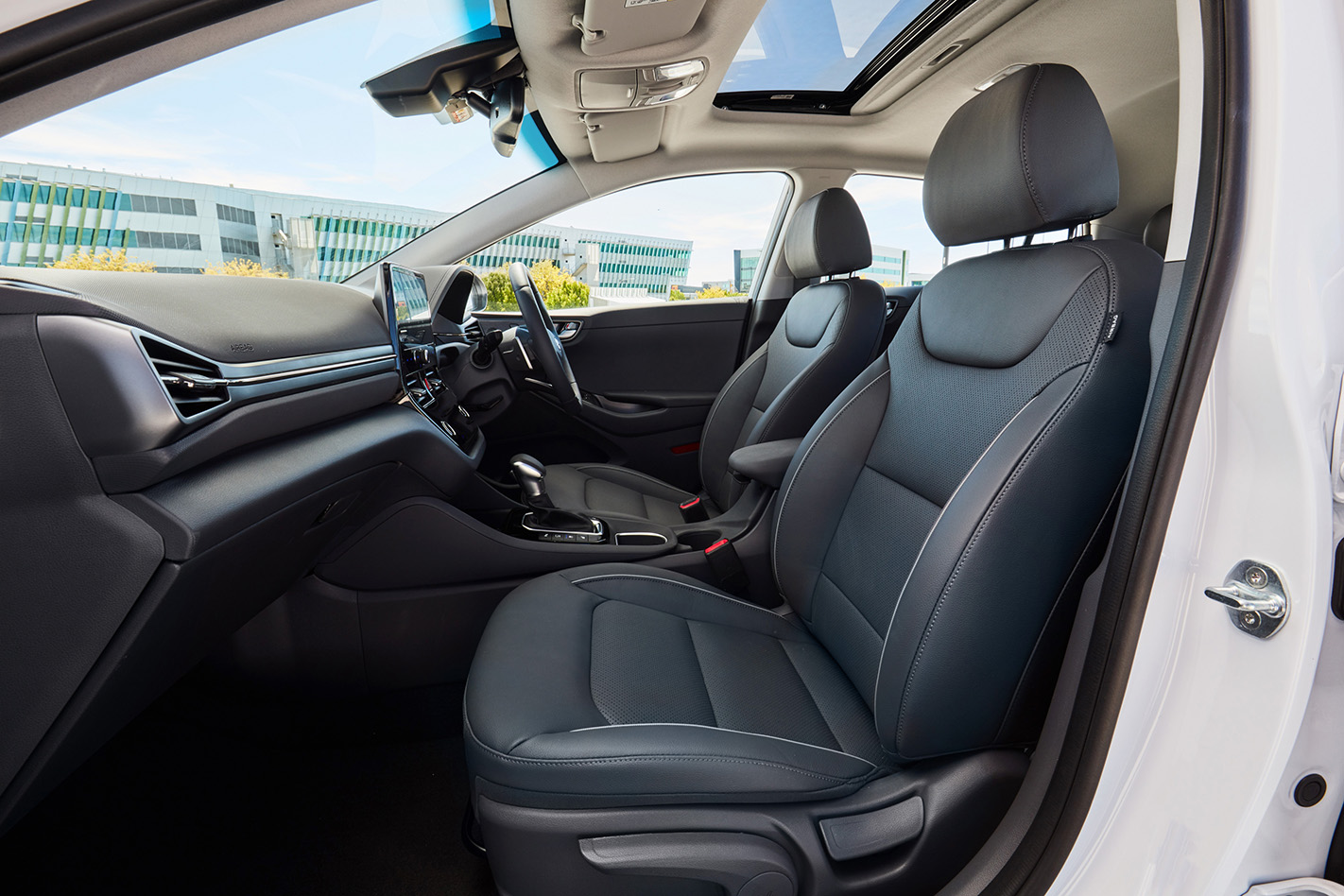
Cabin quality is about par for Hyundai’s other passenger car products, and generally in line with what you find in the i30/Elantra range. Decent plastics and upholstery, but not much wow factor.
Sadly, while the all-electric IONIQ EV gets a cool and futuristic looking centre console and push-button transmission selector, the humble hybrid makes do with a more conventional stick shift.
Is it worth the money?
If you’re looking to lower your environmental footprint but you’re either unsure whether an EV – or even a plug-in electric – is going to be compatible with your lifestyle, then the IONIQ Hybrid is a good way of treading more lightly while still having a car with genuine everyday practicality.
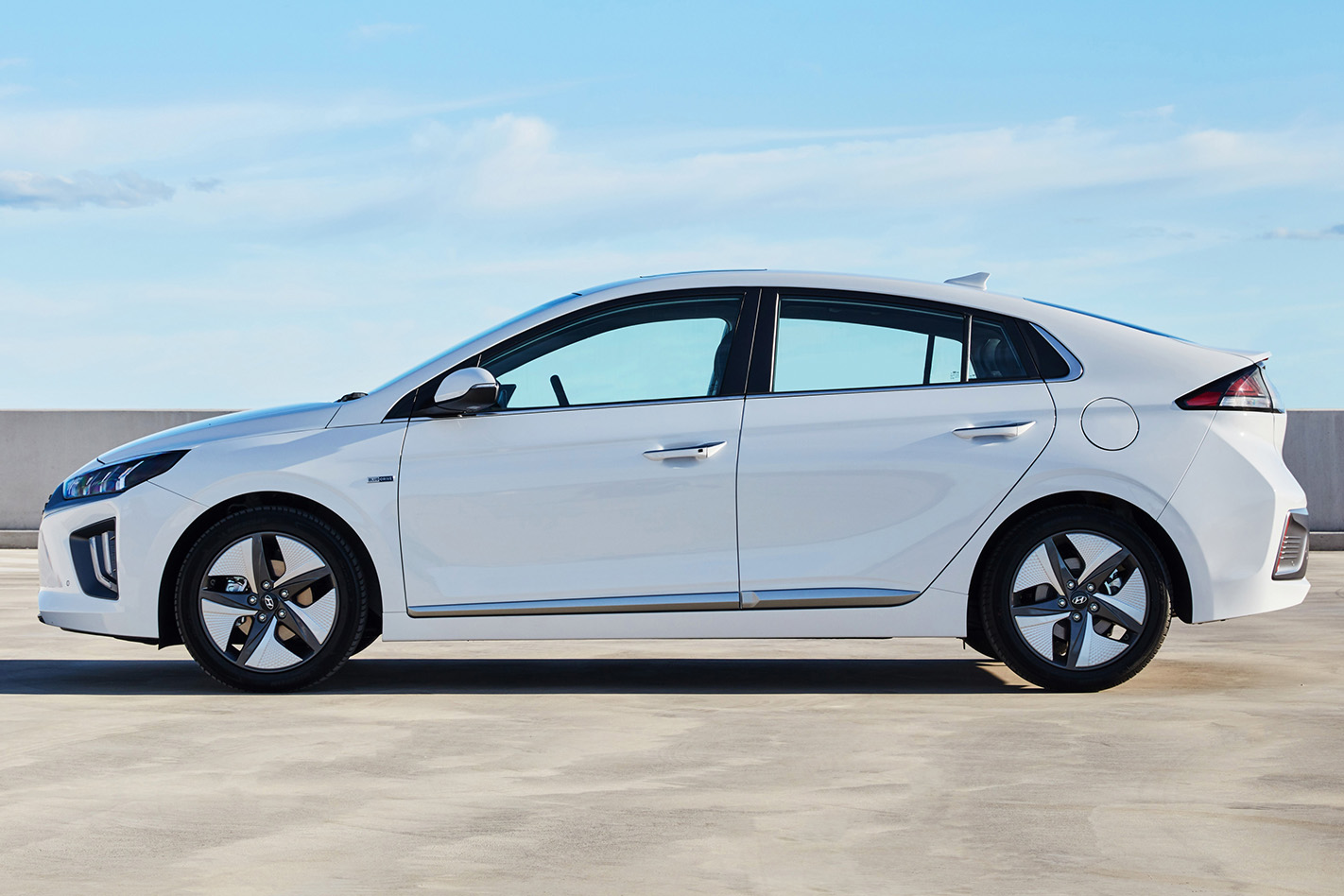
Relative to the Prius, its most logical competitor, the IONIQ Hybrid Premium shapes up as a reasonably good deal. You might not get as much equipment as the range-topping Prius, but it comes remarkably close and costs $4K less to go with the Hyundai. In that regard, value is strong. If you’re just shopping for a well-equipped hatchback, however, the IONIQ Hybrid is an expensive choice.
Pros: Easy to drive, spacious cabin, superb ride, great fuel economy, no charge cable complication, attractive facelift Cons: Powertrain can be slow to respond to sudden power demands, quite costly for a small hatch
Rating: 3.5/5
Fact: If there is a Pug in the COTY field, arguments will ensue. Mostly, this will centre on Peugeot’s signature diminutive steering wheel and i-Cockpit set-up. Sometimes, it spreads to interior fabrics or paint schemes. But as a rule, French form and function always splits the judges. This year, the glamorous Peugeot 508 GT Fastback and Sportswagon did just that. However, they both also astonished beyond expectations, resulting in a very hard-to-make call.
The new 508 is a result of the French taking on the Germans. A Gallic-Bavarian-styled beauty, it targets a sweetspot between drama, emotion, driving pleasure and practicality. The 508 is underpinned by the formidable EMP2 platform, has shed 70kg, and has undergone a Grand Designs-level makeover in style, technology and engineering.

In Australia, Peugeot offers a value-soaked standard equipment package that sees the entire kit – including high-level active safety, pedestrian and cyclist detection, 360-degree camera, active dampers and more – arrive with only two boxes to tick (paint and a sunroof). At $53,990 (Fastback) or $55,990 (Sportswagon) it’s a compelling pitch. Peugeot reckons its belle fille can square up to the luxo-legs of an Audi A5, while a Wheels comparison test (Yearbook, 2019) has already seen it beat fellow COTY competitor the Volvo S60 (as well as COTY ’18 final-fiver, the Kia Stinger.)
“This thing is a sleeper!” exclaimed Byron, with such wide-eyed enthusiasm you could be forgiven for forgetting it was him who wrote the aforementioned comparison. “Supple, suave, sophisticated!”

On the twists and turns and bumps and dirt, the 508 hugged Lang Lang like an old friend. Not everyone agreed that the eight-speed Aisin EAT8 transmission was flawless, but the BMW-developed 1.6-litre turbo-four is refined and punchy, and pleased most with its feverous desire to seek out the redline.
But where the Pug truly soared was ride and handling. The adaptive dampers added a Goldilocks-level of comfort, the lightweight chassis felt composed and well balanced, the fluid, pointy steering brought on smiles and it sailed through our lane-change testing. It seemed Sochaux’s saviour-sedan was a podium dark horse. Alas, soon those polarising French quirks reared their heads.
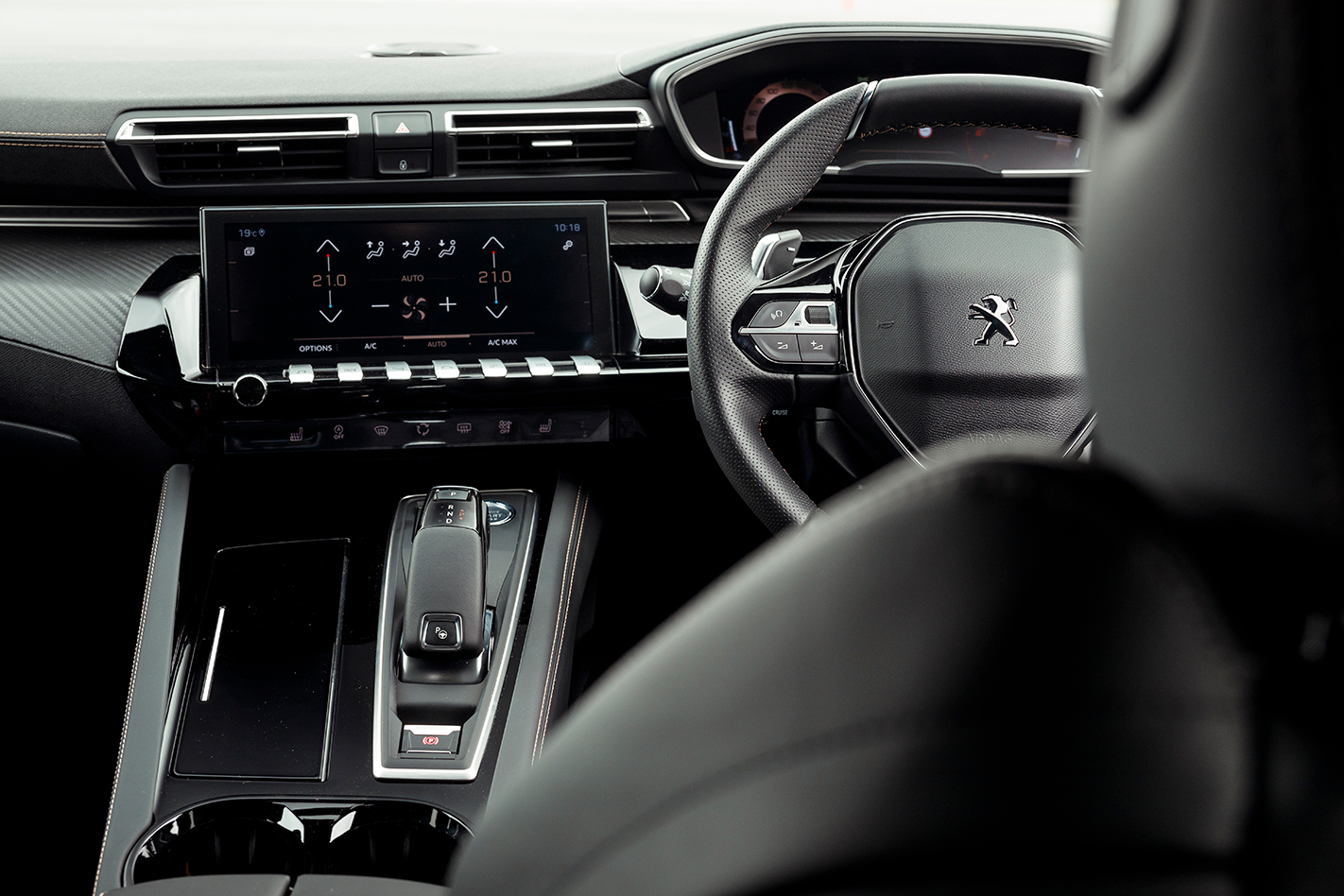
It turns out, there was more to spar about than just the steering wheel-to-dash relationship. Judges who preferred a touchscreen argued with button-enthusiasts about the piano-key design. There was an outburst around the bizarre USB and wireless charging pad locations. The terrible quality of the reversing camera was raised. And finally, the almost wilful oddness of an anti-clockwise tach proved to be the cherry on top of a list of frustrating irks for some that could not be undone by even the most comfortable massage seats.
The Pug’s outcome was sealed by losing a tie-breaker vote with the Toyota RAV4. A disappointing result for judges who felt its appetite for open roads would allow it to shine even brighter in round two, but a little too much weirdness and questionable resale value were tipping points for others. This French beauty might have its ooh la la moments, but a COTY revolution didn’t quite eventuate.

THE JUDGES’ COTY SCORECARD
Function: 3.6
Efficiency: 3.7
Safety: 3.4
Technology: 3.4
Value: 3.0

PEUGEOT 508 SPECS
BODY
Type: 5-door lift-back sedan, 5 seats / 5-door wagon, 5 seats
Boot capacity: 487 – 1537L
Weight: 1420 – 1449kg
DRIVETRAIN
Layout: Front-engine (east-west), FWD
Engine: 1598cc 4cyl turbo-petrol (165kW/300Nm)
Transmission: 8-speed automatic
OTHER
Tyres: 235/45R18
ADR81 fuel consumption: 6.3L/100km
CO2 emissions: 143g/km
Crash rating: 5 star (ANCAP)
PRICES
$53,990 – $55,990
I used to earn a few bob doing some circuit driver coaching, mainly at Spa and Nürburgring. To tell the truth, it was faintly terrifying strapping in next to a virtual stranger before heading out onto the Green Hell.
I’m not proclaiming myself to be any sort of driving deity, but after over a thousand laps of the ‘Ring in all manner of cars and having received industry pool driver training, it’s fair to say that I know where the circuit goes.
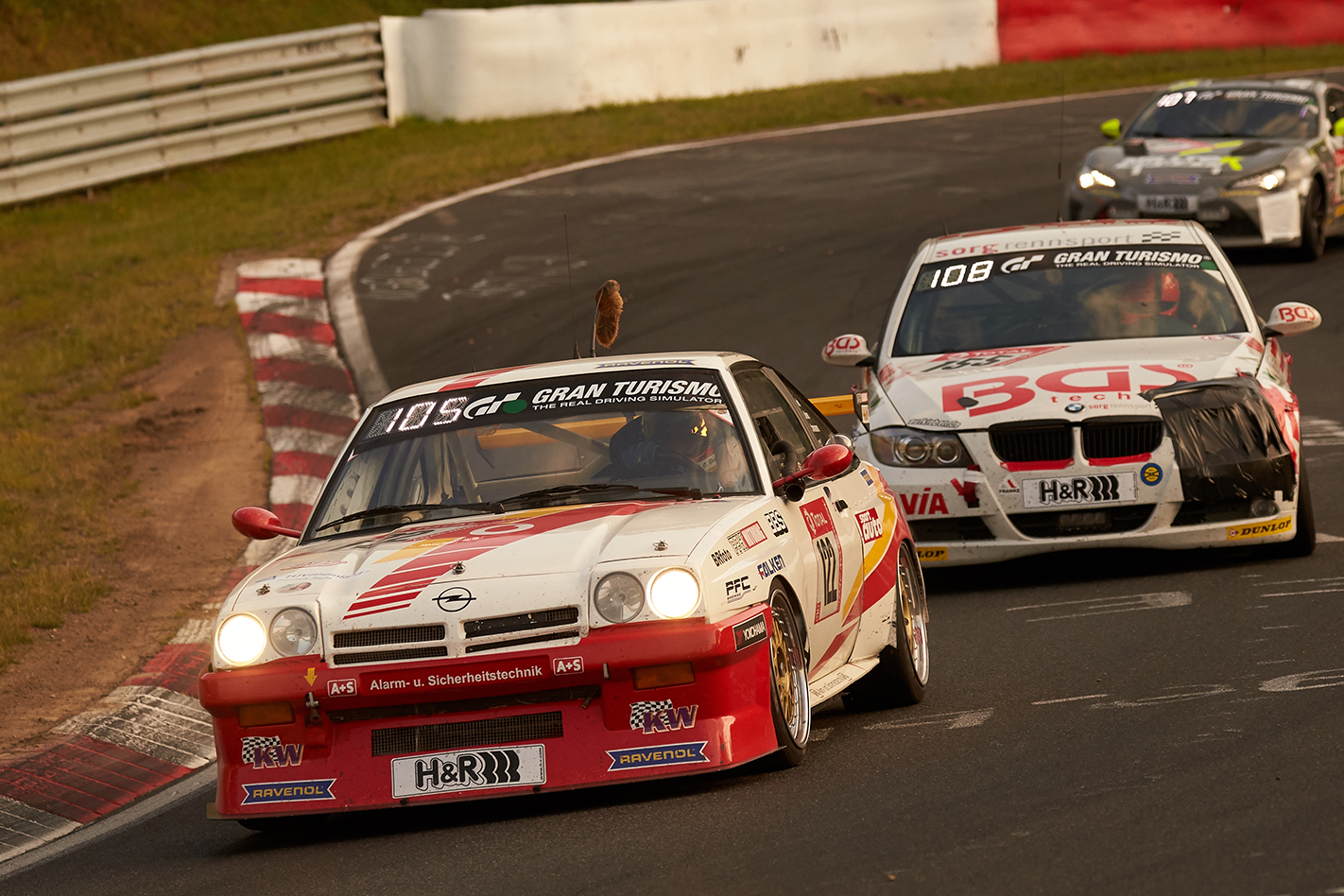
But rather than regale you with stories of scrapes at the Nordschleife, I thought I’d render a more valuable service. So, listed below are my tips on what to do and, maybe more importantly, not do when you rock up at the Ring.
DO
- Check that it’s open. The public (also called TF or Touristenfahrten) days are listed on an online calendar. Try this site for size. If you don’t it’s entirely possible that you’ll turn up and the whole place is closed.
- Make sure your car is in decent nick. Cooling and tyres will take a pounding at the ‘Ring. It’s not a track that’s heavy on braking, but don’t go with thin pads or flaky discs.
- Eat a pizza the size of a dustbin lid at Pinocchio’s in Adenau. Pro tip: one pizza between two people really is enough.
- Drive to the outside of the Karussell. You’ll need to go through the village of Herschbroich, up past the barbecue shelter and into the woods on a logging trail. Right at the first T-junction, left at the next fork to a dead end, then walk 20 metres. Just don’t try it in something with a tarmac-scraping ride height.
- Avoid Easter weekend if you want to get laps in. It’s a complete zoo.
- Take the time to learn the wet line. It rains a lot in the Eifel, and when it does, the usual line through corners can get very greasy. Wide round the outside is often your friend.
- Figure out which sections of the track will retain moisture. Due to orientation and trees, corners like Eiskurve will retain dew on the track for a long time. Enter at a normal dry cornering speed and you can come unstuck.
- Make sure you’re insured. Many policies have specific exclusions for the ‘Ring and some car hire companies will pay a bounty to anyone who dobs you in. You could end up with a life ban from the likes of Avis or Hertz.
- Buy a Ring Taxi lap in a hot Jaguar. And tell Dale that I sent you.
- Remember that those quiet midweek two-hour evening openings are your friend.
- Go for a fillet steak on a hot stone at the Pistenklause. If you’re lucky you’ll spot ‘Queen of the Ring’ Sabine Schmitz behind the bar. Her parents own the place.
- Avoid the big, corporate hotels and book into a place like the Gästehaus Fuchsröhre down the road in Welcherath or the Altes Forsthaus in Nurburg. The latter was used as the garage for the original Mercedes rally team, the courtyard where they stripped the paint off the cars to become the legendary Silver Arrows.
- Talk to people in the paddock and, as long as they’re not complete swingballs, try to blag passenger laps. Most people are quite happy to oblige and it’s a good way to see the track.
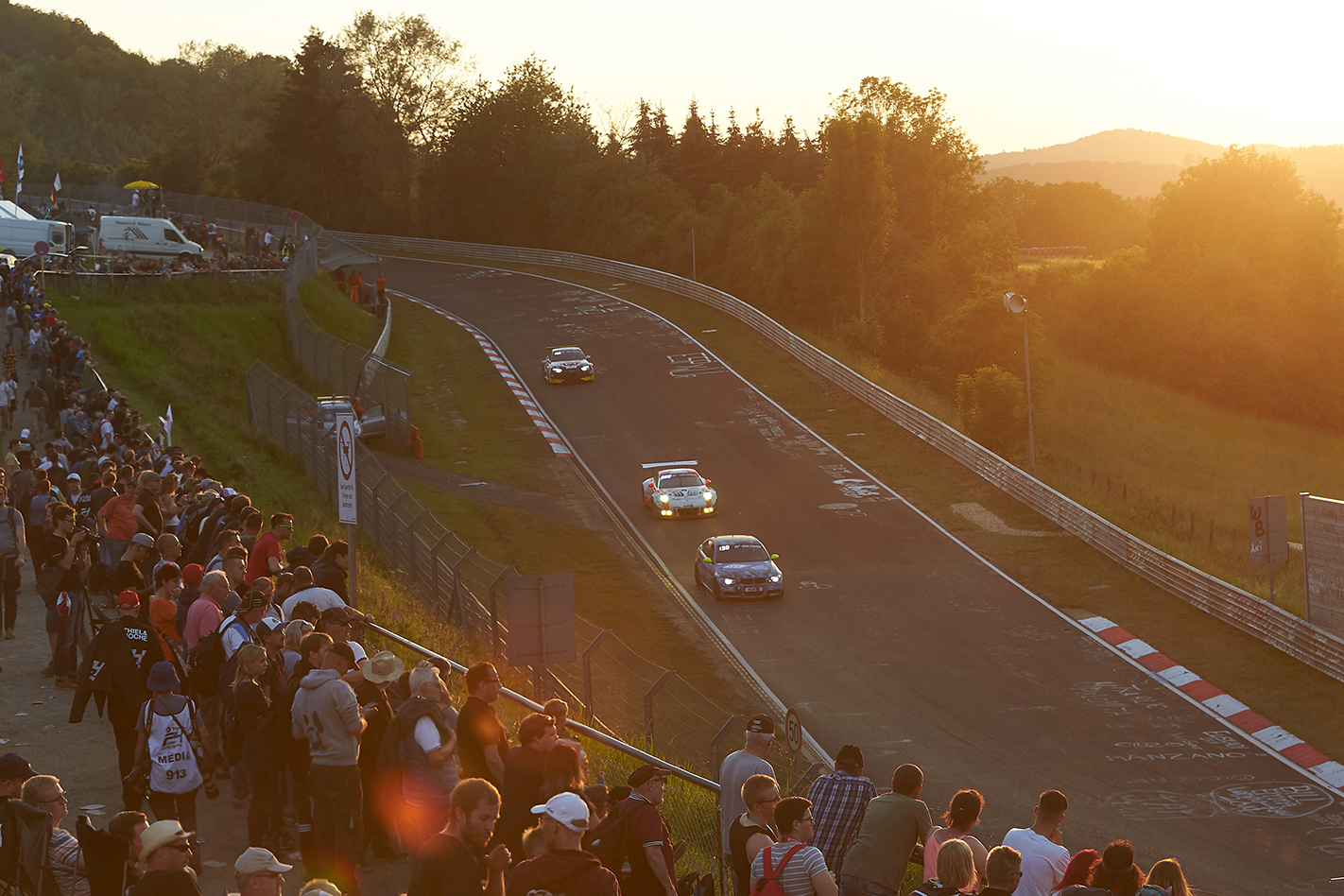
- Join the crowd with a currywurst and chips at Brunnchen corner, now informally known as Youtube corner. Almost everyone speeds up when they see a crowd and despite not being a particularly tricky corner, plenty of people fall off as a result.
- Save the emergency number into your phone. It’s 0800 0302 112. And pull over IMMEDIATELY for recovery if your vehicle is leaking fluids. You really don’t want to kill a biker.
- Overtake on the left. Undertaking is a no-no and in the event of an accident, the local police take a very dim view of passing on the right.
- Know the difference between a public day and a track day.
- If you want the best track day, these are the people to go with.
- Take the drive on the public road from Adenau up to Hohe Acht. It’s a belter and skirts the track
- Check the excess if you use one of the local trackday rental companies. It can be eye-watering.
- Buy the Borch 1:11,500 laminated track map. It’s pretty indestructible, shows all sorts of local rat runs and makes a great souvenir.
- Slow down if you see anybody standing by the side of the track waving anything.
- Skulk around the factory estate in Meuspath and see if you can spy a yet-to-be-released prototype
- Cross your fingers and hope that your car doesn’t get chewed by a Beech Marten (Martes foina). As the Association of German Insurers (GDV) says, “Every driver has to expect that one morning the engine cannot be started because of Marten damage. Annoying but effective remedies against the martens do not exist.”
- Visit the amazing model shop in the Ed-Tankstelle gas station on the B258 (right next to the track gantry).
- Have fun.
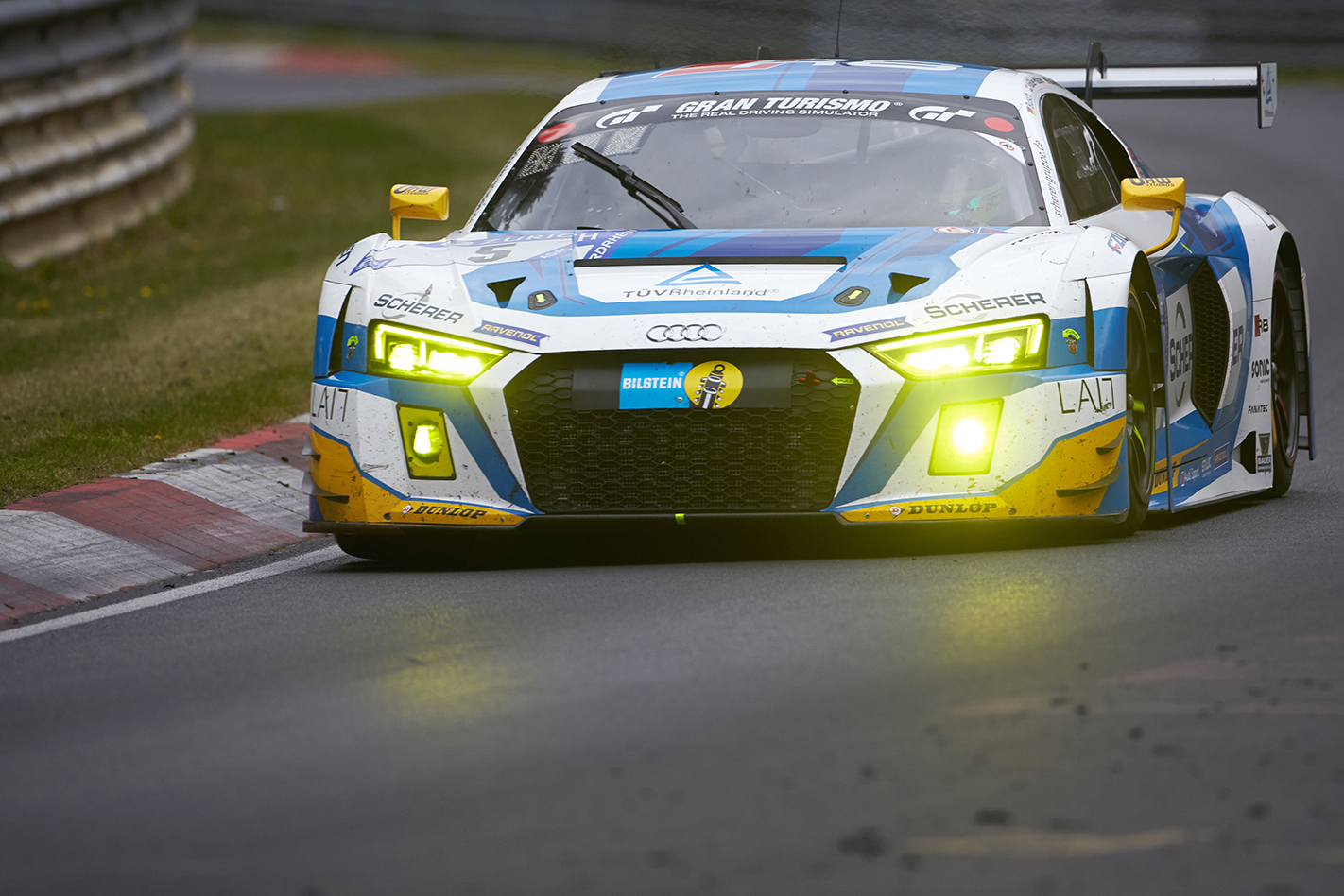
DON’T
- Race. Ever. It’s by far the most effective way to end up at Bongard’s scrapyard. And that goes for the local roads too. As one old hand once told me, “You can’t win at Touristenfahrten but you can certainly lose.”
- Time yourself if you’re a novice. You’ll only pressurise yourself into overcommitting. Many crashed cars are found with lap timers running so don’t make a specific BTG time your measure of success.
- Think that you’ll be able to drive an 8 minute lap because a Nissan Skyline R33 GT-R did way back when and cars are so much more capable now. Imagine on-sighting a twisty country road at an average of 154.5km/h. It would be utterly terrifying to most. That’s what an 8 minute lap of the ‘Ring will be like.
- Think that just because you’ve done a hundred laps on Forza that you know the track. While games can help in figuring out which way the circuit goes, the cambers, kerbs, surface changes, meteorological changes, elevation differences, other traffic and all the other things that can trip you up are not.
- Use faster cars as a guide. You have no idea who is in the car, or what is under that car’s skin. It’s an easy way to get sucked into trouble.
- Block faster cars. If something arrives in your mirrors, it’s faster than you. Indicate and pull over to the right. It’s not an invitation for a dice. The mental overload of managing the rush of corners and the steady stream of faster cars behind can be hard for most to process.
- Use the kerb. Faster drivers may, but there are some kerbs at the Ring that you can safely hit and others that’ll send you into the Armco with the slightest kiss. Until you know one from another, take a clean line.
- Ignore the marshals. Especially on busier weekends there’s a flow through the paddock that needs to observed if big traffic queues are to be avoided.
- Indulge in the Spectacular Loser Overtake. The Dottinger Hohe straight on the way back in is best used to cool your brakes. You’re not going to win any respect by screaming past decelerating cars and arriving in the car park with your pads ablaze.
- Try to do too many laps. This isn’t Winton. You can have a great day out at the Ring doing four or five laps. Heck, I’ve had great days doing none. A lap is 21km and will require your full concentration. Don’t overtax yourself.
- Attack Schwedenkreuz. If there’s one corner on the whole lap that you shouldn’t try to shave time on, it’s this one. It’s a killer. Take the time to learn the line here.
- End up on the grass at Adenauer Forst. It’s the classic Nürburgring noob mistake. The tree line leading into this corner on the crest of a hill leads you to believe it goes fairly straight and then the track does a 90-degree turn to the left. People will laugh at you.
- Drive like a plank in the village. It’s a small place and you’ll be recognised.
- Forget that there’s an exit halfway round at Breidscheid Bridge. If you or your passengers aren’t feeling in tip top condition, it’s a worthwhile out.
- Be tempted to pop your Nürburgring cherry in some 400kW supercharged monster. Honestly, you’re going to have a stack more fun in something like a Suzuki Swift or a Fiesta ST.
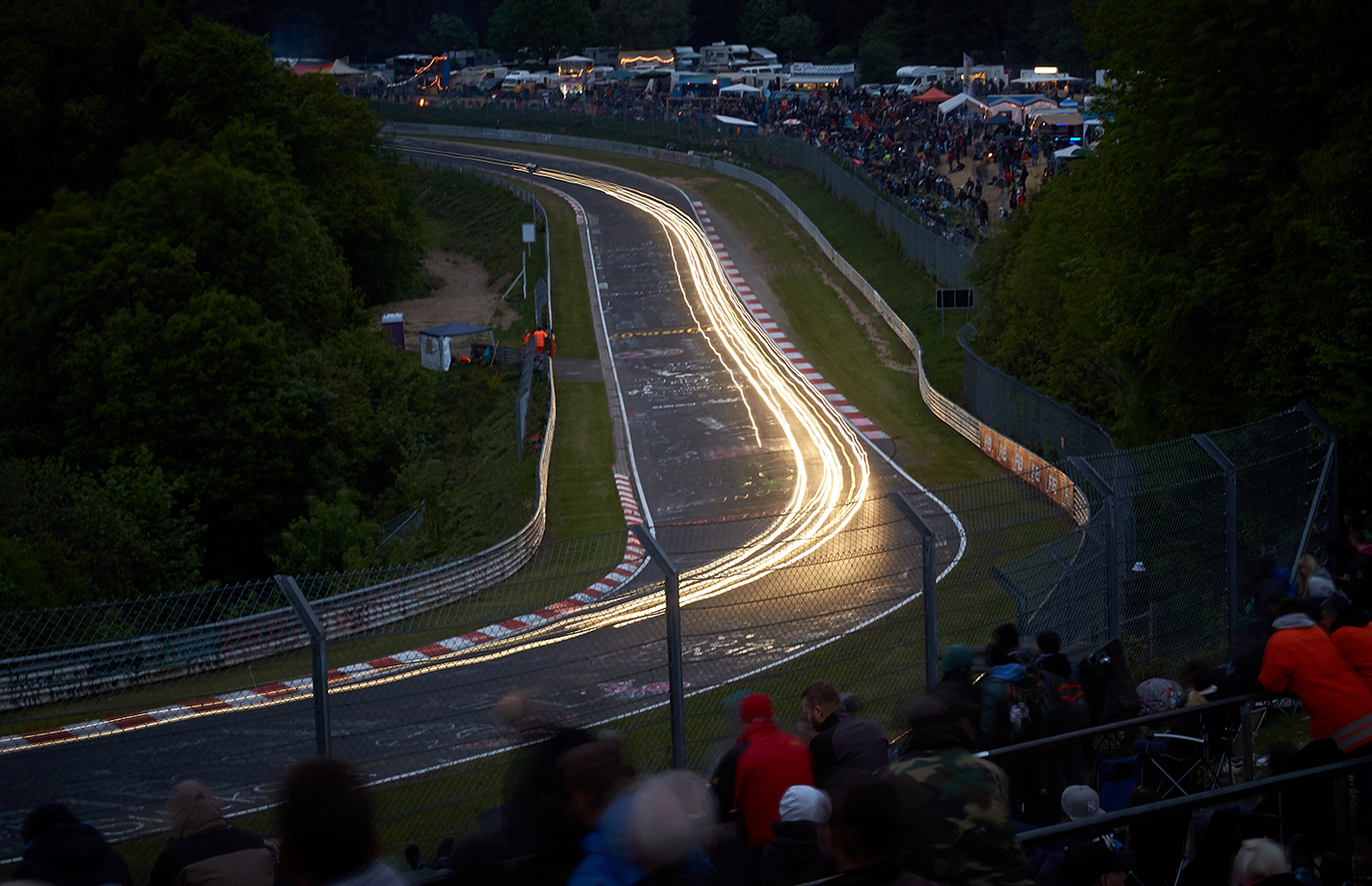
- Get overconfident. Almost every novice makes the same mistake at the ‘Ring and that is thinking they know where it goes only to realise that they don’t. The section between Karussell and Brunnchen that includes Hohe Acht, Hedwigshohe and Wippermann is always the last section anyone learns and getting it wrong here can be scary.
- Get too pent-up when the track is closed due to an incident. These crashes can self-perpetuate as people get impatient then all rush out like headless chickens when it reopens and cause another bingle. Let all the yeehaws set off at once, give ‘em a few minutes and then pick your moment.
- Try to be a Youtube star by drifting through Brunnchen 2. The fail compilations are full of these nuffies.
- Grind pepper onto the hot stone when you’re enjoying your fillet steak at the Pistenklause. I once gassed Jeremy Clarkson doing this and he wasn’t amused.
- Underestimate Kallenhard. It’s a benign looking corner but it catches a lot of drivers out.
- Forget that there’s usually a stream crossing the circuit after Bergwerk when it’s raining. If you’re flat chat in a powerful rear driver here, it can spell big grief.
- Expect the Ring Racer rollercoaster to be working. It was built in 2009 at a cost of €12.3m and it’s a non-starter.
- Set your sat nav for Nuremberg. It’s Nürburg. You’ll end up 400km away if you get that one wrong.
- Get caught at rush hour on the Brussels Ring Road if you’re travelling from the UK. Just don’t. You can thank me later.
- Forget that Spa is only 120km away on some lovely driving roads. It’s well worth a trip and some companies, such as Destination Nürburgring, will do a double header package featuring both circuits.
- Beat the living daylights out of your car in Karussell. It’s a very rough, steady state corner that goes on for longer than you think. Aim the centre of your car over the point at the end of the concrete and accelerate cleanly uphill.
- Paint a giant cock and balls on the track at night. It’s not original and shiny new paint will shut the circuit if the marshals deem it dangerous.
- Start a grass fire with your exhaust in the overflow car park.
- Visit in April if you’re a hay fever sufferer. The local pine trees generate industrial amounts of yellow pollen that coat everything.
- Try to head out on track in a caged car with no helmet. Or with a super noisy exhaust. Or nonstandard plates. Or anything else that’ll give the marshals an excuse to bin you off. You’ve come a long way for this. Don’t screw it up.
Wheels 2018 review
This article was first published on 23rd April 2018
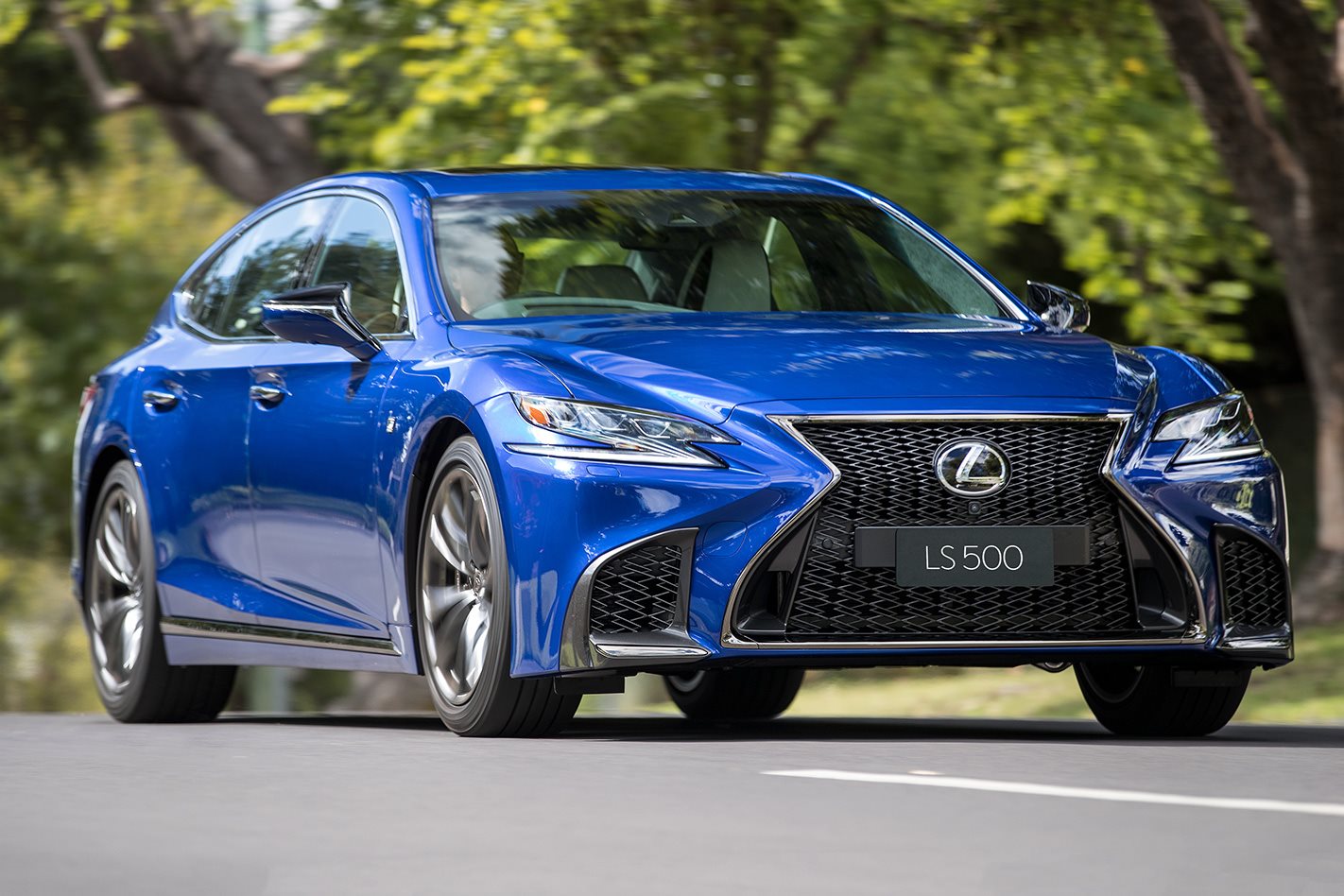
A GENERATIONAL leap has transformed the Lexus LS large luxury saloon into an automotive art form.
WHAT IS IT?
The flagship LS sits at the very top of the Lexus tree. Now up to generation five, it pushes the boundaries of design and comfort like never before.
WHY WE’RE TESTING IT
MAIN RIVALS
Audi A8 3.0 TDI Quattro; BMW 740i; Mercedes-Benz S350d
THE WHEELS VERDICT
The big Lexus saloon offers something of a visually appealing and dynamically engaging alternative to the now more conservative-looking Germans that dominate the high-end four-door market.
PLUS: Spectacular interior and exterior; well equipped; handles well for a big, long, heavy saloon MINUS: Coupe profile robs rear-seat headroom; artificial engine noise; high thirst
THE WHEELS REVIEW
THERE’S something going on at Lexus. Once the brand known for its staid, conservative cars trading on value for cashed-up buyers, it’s going through something of a renaissance.
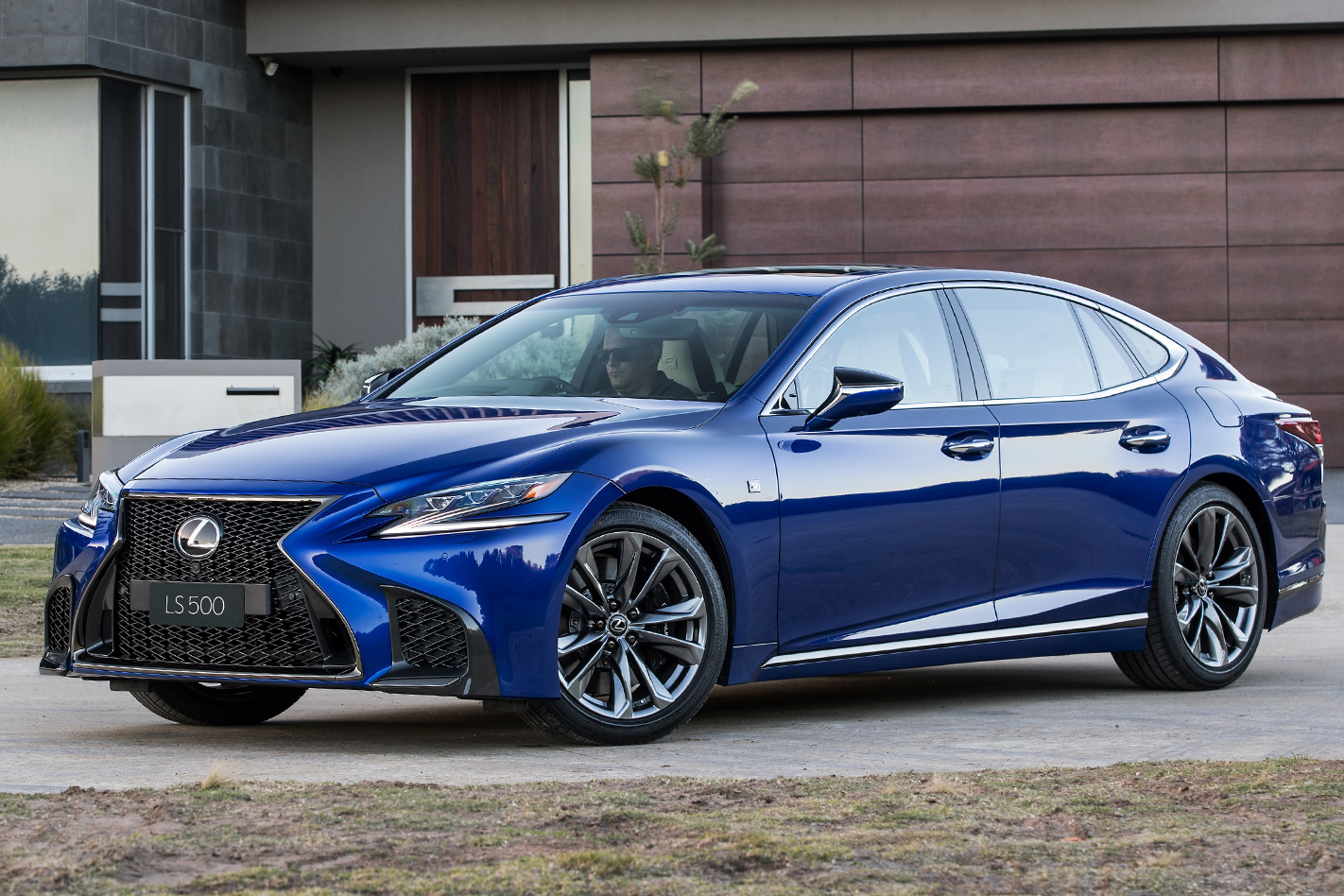
The new-gen LS ditches the previous gen’s 4.6-litre V8 for a range of V6 engines that split between twin-turbo performance (the LS500), and battery-hybrid frugality (the LS500h). It also taps Lexus’ at times polarising design language, the one that adopts the spindle grille and then twists, turns and pinches the rest of the exterior styling to create a range of luxury cars and SUVs that stand well out from the pack.
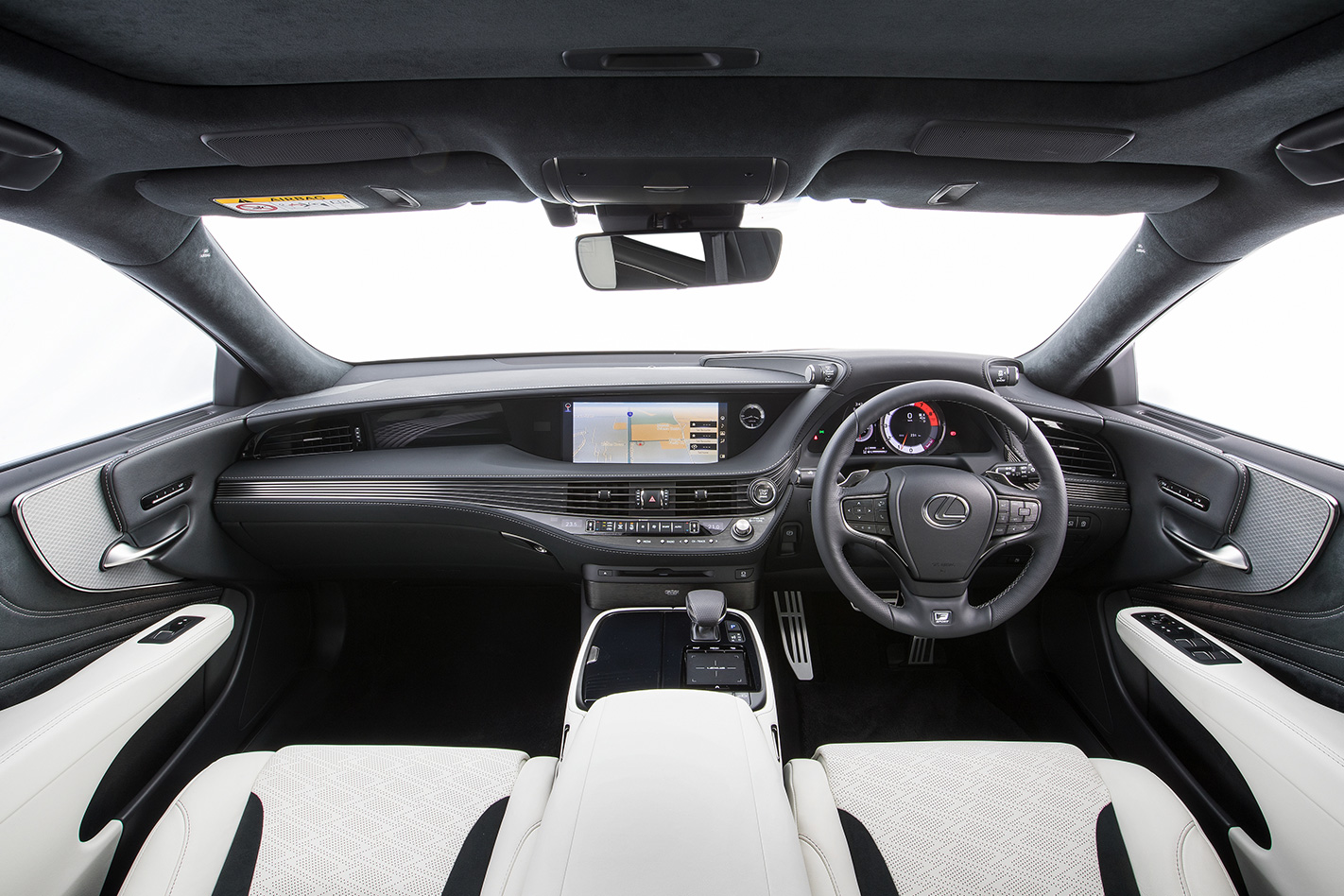
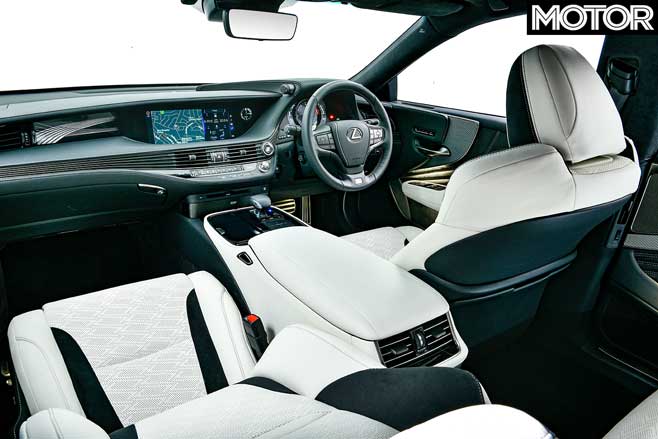
Just getting inside the new LS is a treat. Pull on the door handle, and instantly you’re presented with something that’s more akin to a work of art. Our LS500 F Sport test car came with the no-cost optional Moon White leather seats – infinitely adjustable, body-hugging, baby’s arse-soft, perforated in a spindle grille-matching diamond pattern and featuring suede-like black inserts – with stunning-to-look-at Naguri-style carved aluminium panels fitted to doors that feature what appear to be floating (they’re not quite, but the impression is pretty convincing) armrests.
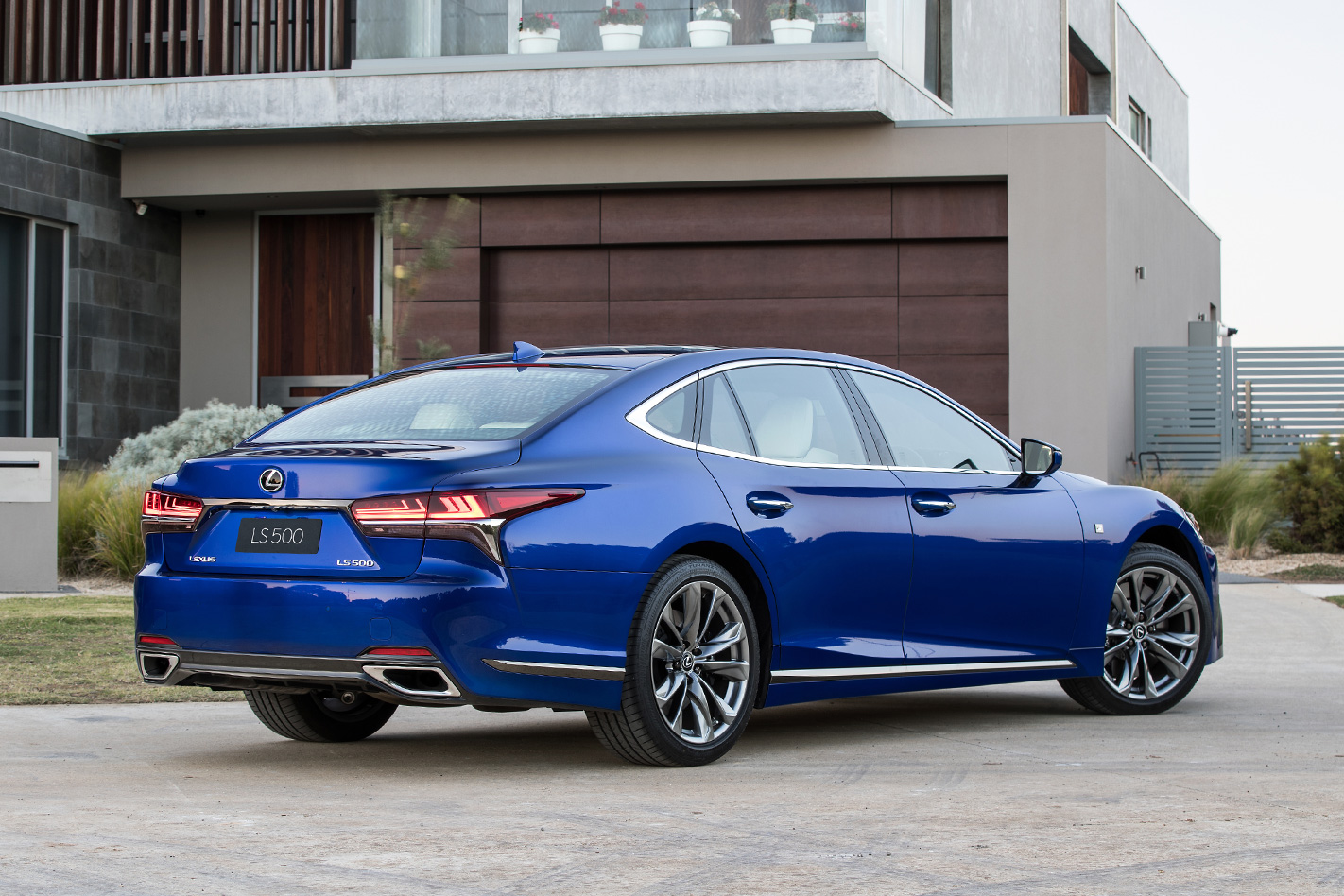
The screen sits over a series of small, almost hidden buttons and lathe-turned volume and frequency controllers for the audio system, which are in turn above more mainstream buttons, dials and digital displays for the climate control system. In front of you, a wide, low head-up display appears with speed and tacho, cruise control and sat-nav information. It all smacks of stunning form, but not at the cost of function.
The rest of the equipment list is long, and smacks of value compared with the expensive options lists of rivals. There’s a sunroof, a 23-speaker Mark Levinson audio system, heated and cooled front seats, heated rear seats, heated steering wheel, DVD player, digital radio, active LED headlights, a rear sunblind and a shallow boot that will swallow 480 litres of luggage. There’s no spare tyre under the boot’s floor, as this Lexus uses run-flat tyres.
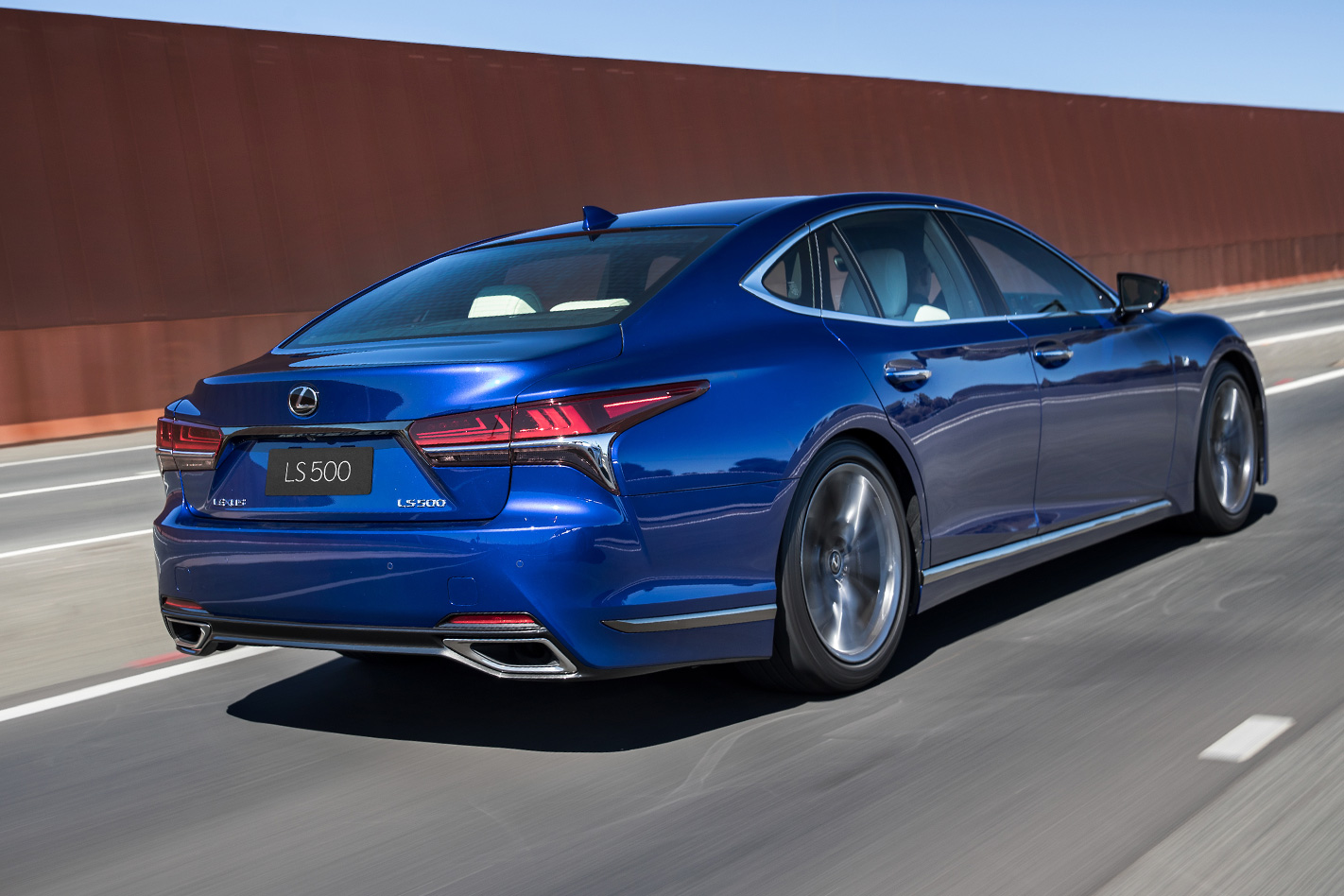
Flicking the Lexus LS500 into Sport or Sport+ modes unleashes a bit of the saloon’s inner beast. All of a sudden the throttle sharpens, the tacho inside the circular instrument cluster thickens, and kick-downs from the 10-speeder become more urgent and hold longer as the stability control light flickers as the six-step electronic brain tuned to rein it all in works its magic. It’s better to use the plastic – disappointingly, they’re not cold-touch metal – paddle shifters to pick gears, because left to its own devices the gearbox will take an aeon to skip up the range to 10th after a stretch of twisty road straightens out.
The air suspension stiffens up noticeably in the two sport modes, the steering adds weight and takes less effort to get from lock to lock, and although there’s still a fair amount of body roll despite the active rear sway bar, a lower centre of gravity afforded via Lexus’s new rear-drive GA-L platform and the four-wheel steering combine to give the LS a sense of litheness that belies its 2.4-tonne heft and 5.23-metre stretch.
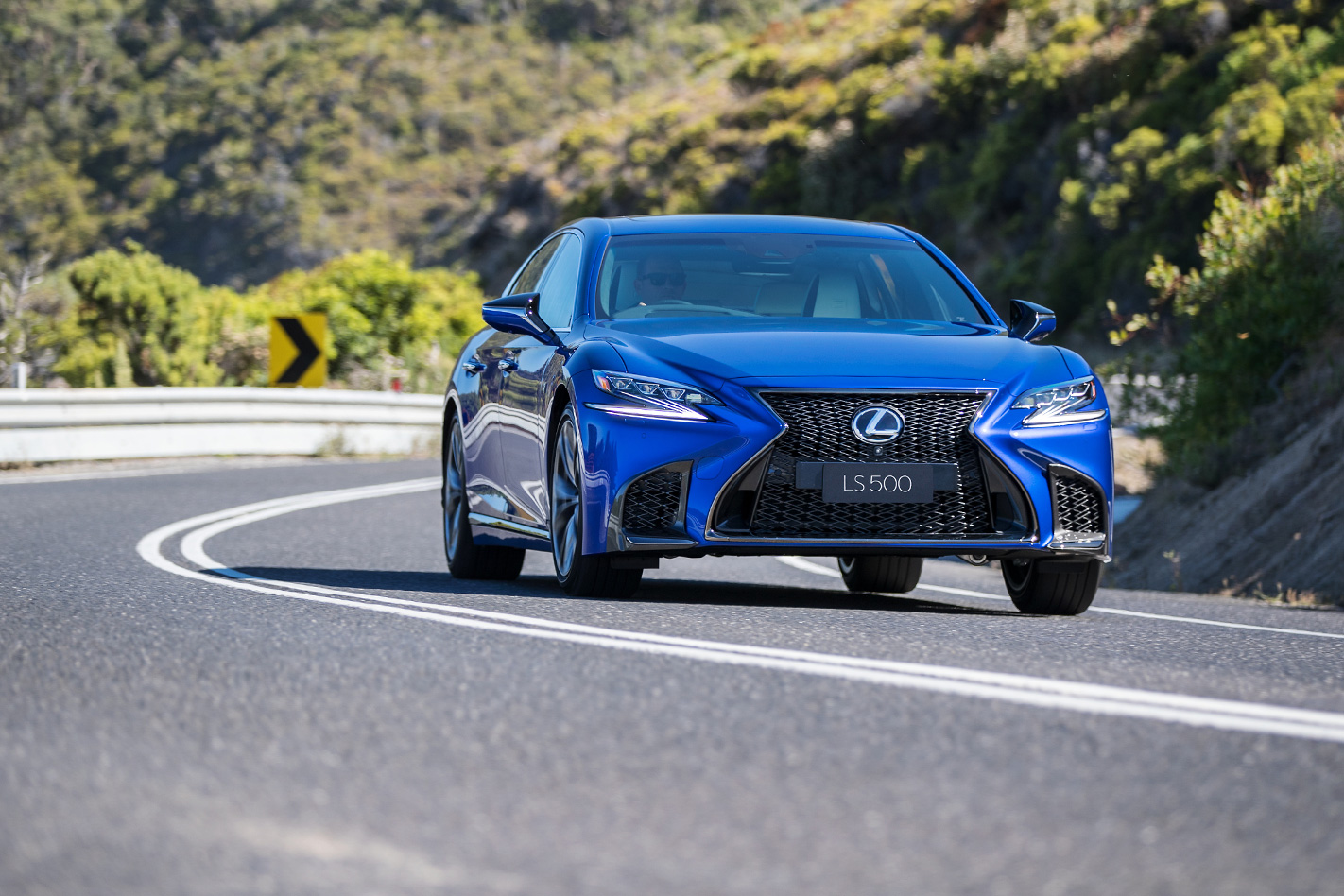
The F Sport’s larger, thicker ventilated disc brakes (compared with the hybrid-engined model) easily stand up to repeated punishment. Overall, the dynamics aren’t quite in the class of the 7 Series or S-Class, but considering where they’ve come from…
Where the big Lexus struggles most, though, is in fuel use. On test, it ranged everywhere from 16.8L/100km down to 13.5L/100km in a mix of driving, emptying the almost 90-litre fuel tank with alarming ease. That’s against an overly optimistic official target of just 9.5L/100km.
In the rear, the svelte coupe styling has its drawback for taller passengers, with the sweeping profile robbing them of headroom. There’s a pair of Rolls-Royce-style vanity mirrors that drop down from the roof, and the centre armrest folds down to reveal seat climate controls, heaps of storage and a pair of USB recharging points. The comfort in the seats back there is even better than the front ones.
Safety is as you’d expect from a flagship, with numerous active driver aids available. However, the radar cruise control has picked up Toyota’s low-speed gruffness, meaning in heavy traffic it’s better to turn it off than suffer its jerky response to throttle inputs, and it won’t automatically limit the speed on downhill runs until quite late in the game. Forward-looking cameras, and a mode that gives a bird’s eye view of what’s surrounding the LS, help in car parks and other tight spaces where the saloon’s heft looms large.
The Lexus LS500 F Sport’s main game is to now look very different to the Teutonic establishment, which it pulls off quite well. It’s a bonus, then, that the big Lexus’s drive experience has followed suit.
SPECS Model: 2018 Lexus LS500 F Sport Engine: 3444cc V6 (60°), dohc, 24v, twin-turbo Max power: 310kW @ 6000rpm Max torque: 600Nm @ 1600-4800rpm Transmission: 10-speed automatic Weight: 2440kg 0-100km/h: 5.0sec (claimed) Economy: 9.5L/100km Price: $190,500 On sale: Now
Sign-up here to get the weekly Wheels highlights
Second Opinion: MOTOR 2020 quick review

Motor focuses exclusively on high-performance cars, offering a heart-stopping, hair-raising blast into the world of prestige and performance culture.
Luxurious and worthy – but weighty By: Scott Newman
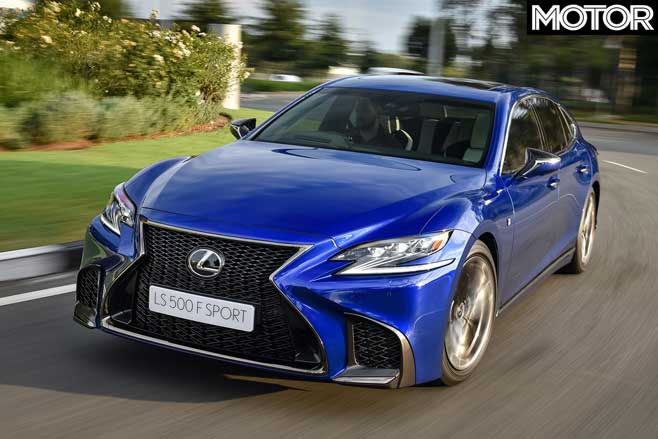
This article was published on 6th February 2020
It’s 30 years since the Lexus LS turned the luxury car segment on its head, and Lexus has made some tweaks to keep it fresh. Our test car is the LS500 F Sport, powered by a 310kW/600Nm 3.5-litre twin-turbo V6 that is smooth and grunty but not as capable as you might expect given it has 2240kg to haul.
The 10-speed auto is mostly imperceptible and has a decent manual mode, though the selector mechanism is confusing and it’s all too easy to end up in neutral. Ergonomic challenges continue, Lexus persisting with its touchpad infotainment controller, which is never less than a pain to use.
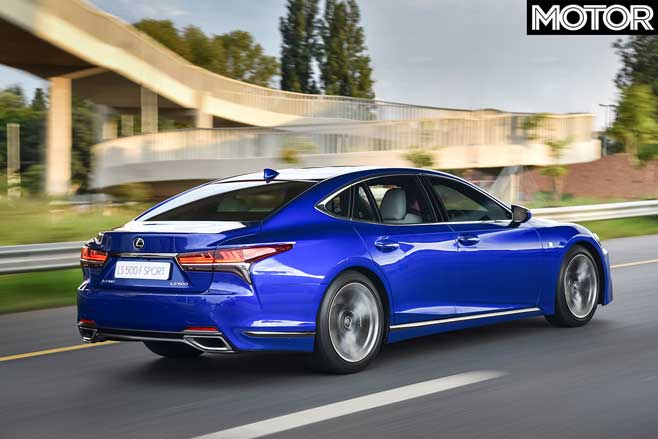
Thankfully, such frustration is soothed away by one of the plushest rides around. There’s a huge amount of chassis tech underneath this Lexus, including rear-wheel steer, active anti-roll bars, newly updated adaptive dampers and massive brakes (400mm discs at the front!).
Sport Plus mode engaged, the engine sings an angry if obviously synthetic song, the steering is accurate and there’s decent balance, but the weight is always obvious. While capable, it’s difficult to imagine anyone ever driving the LS for the fun of it. That said, it’s a fine limo of outstanding quality and real presence, with a respectable price tag of less than $200K.
2020 LEXUS LS500 F SPORT SPECS: Engine: 3.5-litre V6 twin-turbo Power: 310kW @ 6000rpm Torque: 600Nm @ 1600rpm Drive: RWD Weight: 2240kg Price: $190,395
Sign-up here for your free weekly MOTOR report
Irish-American businessman John Campion isn’t massively well-known in Australia, but his collection of cars has become a talking point among Lancia anoraks.
Dubbed ‘The Campion Collection,’ a group of six Martini Lancia racers is set to be sold off separately by classic car dealer Girardo & Co.
The six cars’ heritage just about covers the entire decade of the 1980s, from 1981 to 1988. So, in chronological order, here’s a little about each car, all of which are listed as POA.
1981 Lancia Beta Montecarlo Turbo Group 5
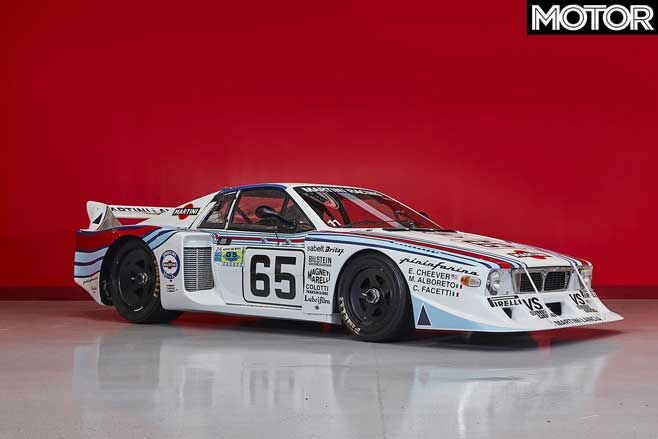
Though Girardo doesn’t provide any info about the specific car up for grabs, its livery gives away that it was the car driven to 8th overall at Le Mans in 1981, with Eddie Cheever as its lead driver.
At 2nd place in Group 5, its provided Cheever his best class result at Le Mans, thanks to a heavily turbocharged 1.4-litre four-pot good for almost 370kW and a weight of around 900kg.
1982 Lancia LC1 Group 6
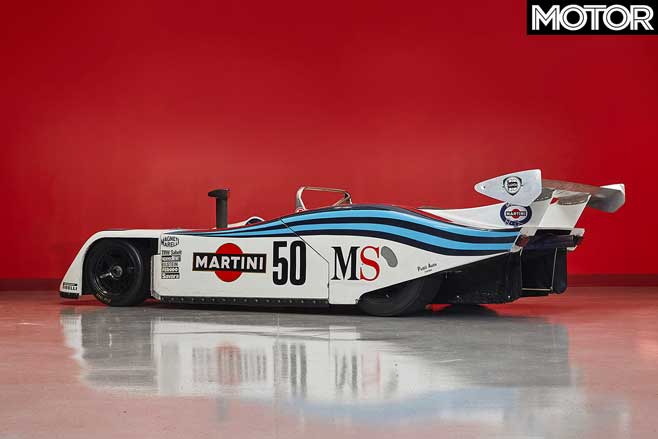
Unlike the Beta, this LC1 is a winning car, having taken out the 1982 Nürburgring 1000km with F1 driver Michele Alboreto as the main driver at the wheel.
Its engine is very similar to that of the Beta Montecarlo, and Girardo says it’s had a “recent mechanical overhaul by Lancia competition car specialists in Italy.”
1983 Lancia LC2 Group C*
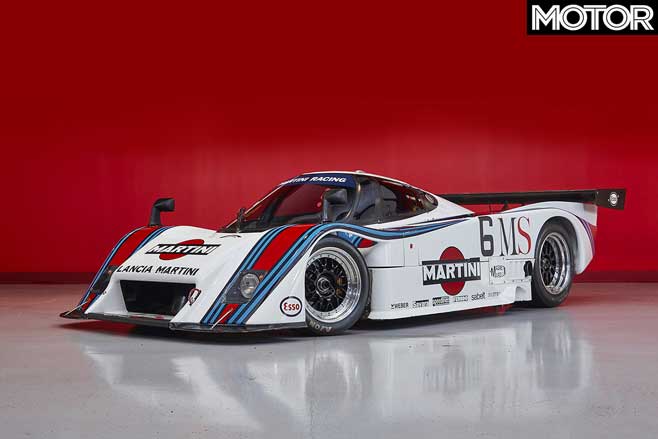
A Works Lancia Martini racing entrant in the 1983 Le Mans 24 Hours, this LC2 has also claimed two podiums and took second place in the 1984 Kyalami 1000, behind another LC2.
Its engine is a Ferrari-derived 3.0-litre V8, (from Maranello’s 308 GTB QV) fettled by Lancia and Abarth and bestowed with two turbochargers. It’s had a major refresh, and BBS even supplied new wheels to mimic its originals.
1984 Lancia 037 Rally Evo 2 Group B
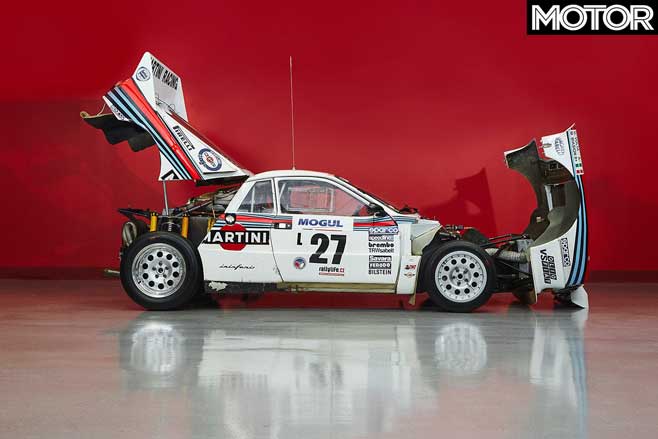
One of only 20 Rally Evo 2s built, this former WRC competitor was originally registered to Fiat Auto Spa.
Winning several rallies through 1986, this Evo 2 was owned from the late-‘80s up until 2013 by Giuseppe Volta, owner of a company called Preparazioni Volta which specialised in working on 037 Rallys.
Its supercharged 2.1-litre four pot and the rest of its mechanicals should be in good working order as it’s been certified by Abarth Classiche.
1985 Lancia Delta S4 Corsa Group B*
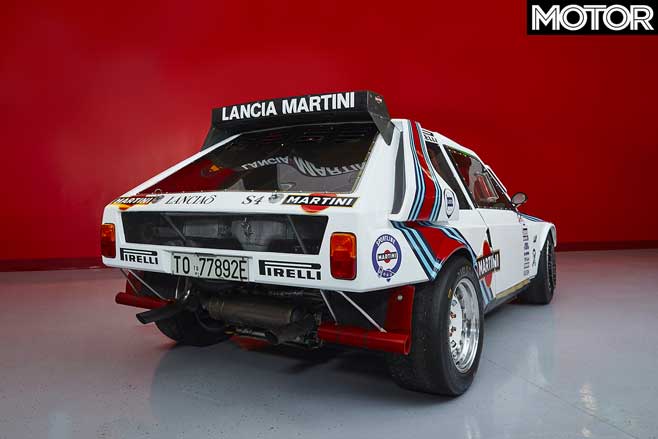
With a supercharger and a turbocharger helping its four-cylinder along, it’s no surprise a test in 2010 revealed this exact car can still pump out more than 400kW and 566Nm!
It was driven by two-time World Rally champion Miki Biasion, but placed 5th overall in the year he drove it.
1988 Lancia Delta HF Integrale Group A*
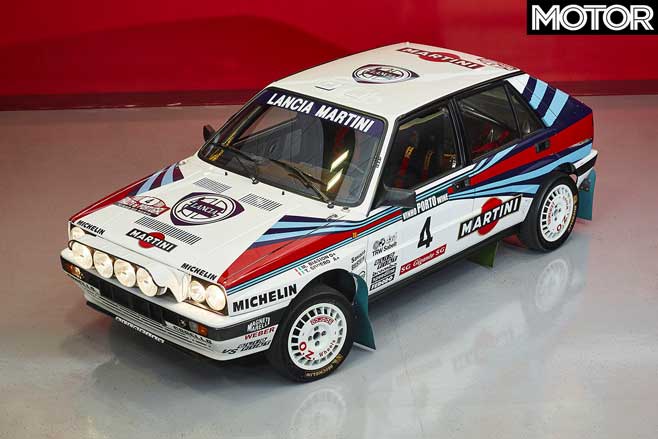
The second of two Deltas in the collection, and also driven by Biason, this turbocharged Group A car ended up in Australia after its initial stint in Europe, competing in the first running of Rally Australia in 1988.
It still has its CAMS logbook, which would show a couple of years of activity in Oz, before it left for the US and joined Campion’s garage.
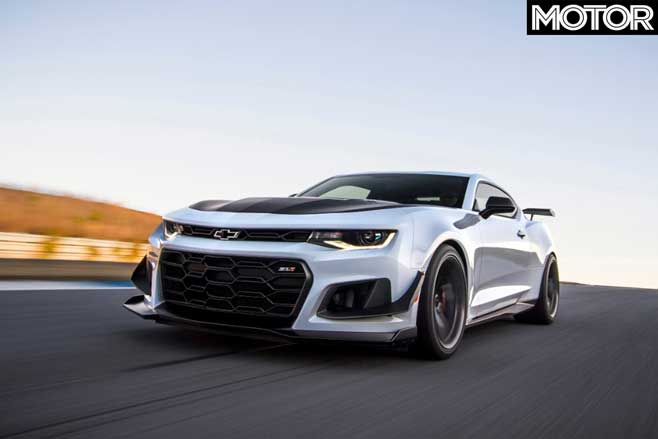
Quite how HSV will offer the new Chevrolet Camaro ZL1 1LE remains to be decided and confirmed but, whether it’s as an off-the shelf production model or aftermarket retrofit pack, this monstrous, track honed weapon will be a local fixture soon.
Taking the ZL1 as its basis, the 1LE is a lighter, sharper and more aggressive iteration of the already fast and accomplished Camaro, but while ZL1 and its SS sibling are happy to do a little multi-purposing, this latest version is most at home on the circuit.
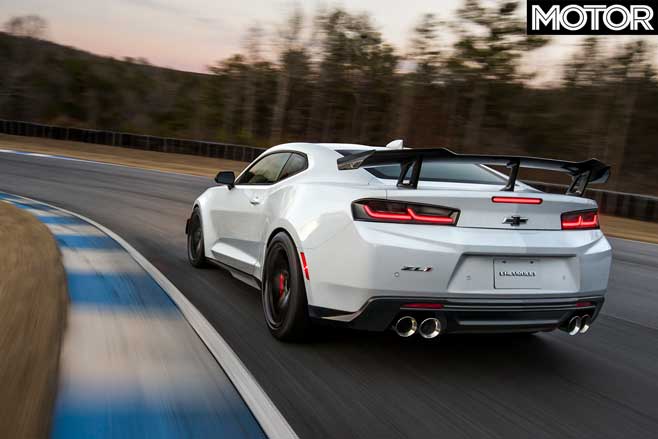
The circuit in question for our first sample of this highly focused muscle car is Sandown Raceway in Melbourne’s east. When I say I have great respect for Sandown, what I mean is that it scares the living bejeezus out of me.
Right where you want lovely, friendly gravel traps to catch you after an unexpected deficit in car control skill, there are ugly, foreboding walls, sudden abrupt corners arrive after long rev-wringing straights, and it’s one of the few tracks that can brag a carpark that is in better condition than the actual track surface.
As a venue to test a 477kW, rear-wheel drive, circuit-prepped coupe for the first time, it’s about as intimidating as a premenstrual Putin.
A couple of tyre warming laps confirms this new version is every bit as quick as the ZL1 with its 881Nm of torque available almost telepathically quick to find its way from the 6.2-litre supercharged V8, and it possesses straight line pace good enough for an 11.2-second quarter-mile.
But this American monster is all about the bends and it doesn’t take long to realise the combination of adjustable Multimatic suspension, Goodyear Eagle F1 SuperCar 3R tyres, and full-fat downforce has boosted cornering speed by a notable degree.
There isn’t a single tyre that can fully tame the LT4’s tail but the super-sticky Eagle F1s do a bloody good job trying and, with a gentle toe, the Camaro is superbly balanced through corners. Rather than stomping the loud pedal on the exit and letting the Chevy yaw wide, it’s far more satisfying to brake deep into the apex and exit with a gentle four-wheel slide.
It might be packing Araldite at each corner but the 1LE is predictable and progressive in its grip levels and, with a few laps to understand its personality, the Camaro becomes approachable and friendly. There’s a heap of feel from the front end, as much through the seat from the back. A letterbox glasshouse completes the sense of immersion and maintains your focus high and forward.
As part of the transformation, the 1LE has also lost 20kg in sound deadening, which lets you know how a standard ZL1 would feel if you kept your New Year resolution and went to the gym more than once. It combines with a noisier exhaust for a wonderful report.
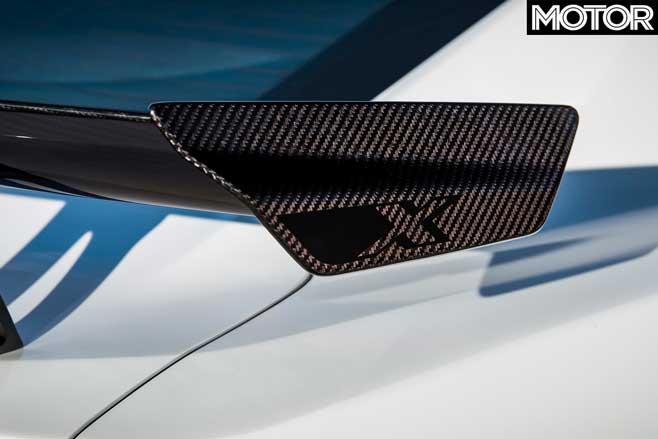
And then there’s the look. Next to this black-winged demon the ‘standard’ Camaro seems benign by comparison, but those carbon fibre fins and panels are not just for show.
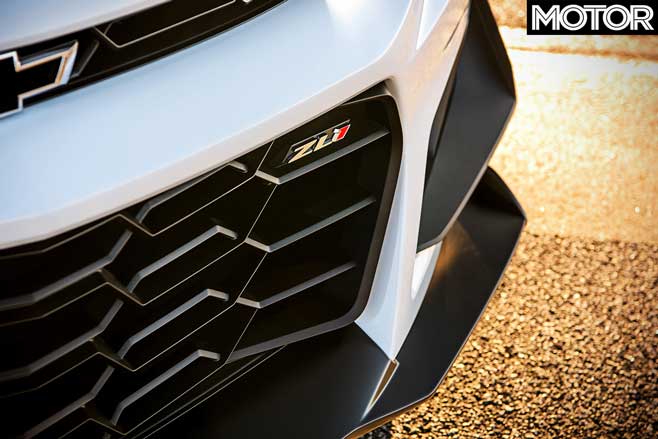
With an extra few kilos of downforce, Sandown’s faster corners can be tackled with aggression including turn-six, which needs only a light brake from otherwise eye-widening speed. Initial doubt turns to relief, turns to elation, and the stiff but positive suspension tune allows the next kerbs to be straight-lined with confidence.
With extra mass bearing down on the fins over the front wheels and incredible tyres, the Camaro turns in with a positivity and obedience that no Mustang can match, adding to the surprising manners and grace.
However, a carefully refined chassis can’t smooth Sandown’s choppy surface. On slower laps, the nose bucks and trips over the worst sections of punishing tarmac, but at speed, the added downforce exacerbates the characteristic and the bonnet slams like a catamaran in a gale.
Don’t let the caliper decals fool you, the braking system is unchanged, although it feels improved once again thanks to the combination of less weight, better tyres, and more air forcing down on them.
Plot the correct course through the maze of imperfections and the 1LE is wickedly quick. On a track like Phillip Island, where the blacktop is beautifully groomed and the long fast corners allow the full exploitation of all that aero, I’m certain the Camaro 1LE would shine even brighter.
In standard trim, the ZL1 is a wonderfully addictive machine, but it’s a larrikin that goes out four nights a week and you expect it to light up its tyres and shout a lot like a Gold Coast schoolie. Administered with a course of 1LE medication however, and it’s like its parents have given it a career chat.
It’s a serious fettling that adds definite athleticism without having to boost its mighty engine output and the whole package is surprisingly un-American. I never thought I would experience a Camaro (or any American muscle car for that matter) that exercised restraint and panache, but that’s exactly what the 1LE does.
There was no photography carried out at Sandown, images used are of the US-market Camaro ZL1 1LE.
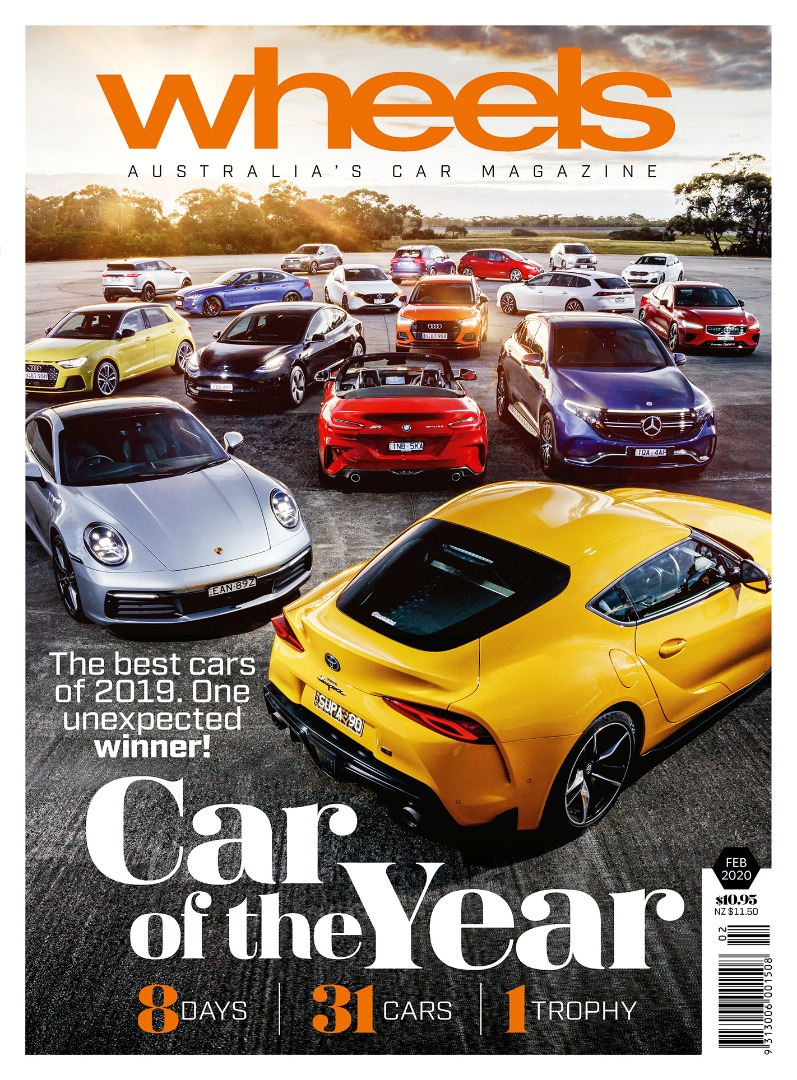
Thirty-one cars, one celebrated winner, 58 pages of top-drawer Wheels Car of the Year coverage. But there’s loads more besides COTY in our bumper February issue.
This month’s mag is bursting at the seams with fresh features plus our new-car reviews, columns and the news behind the news.
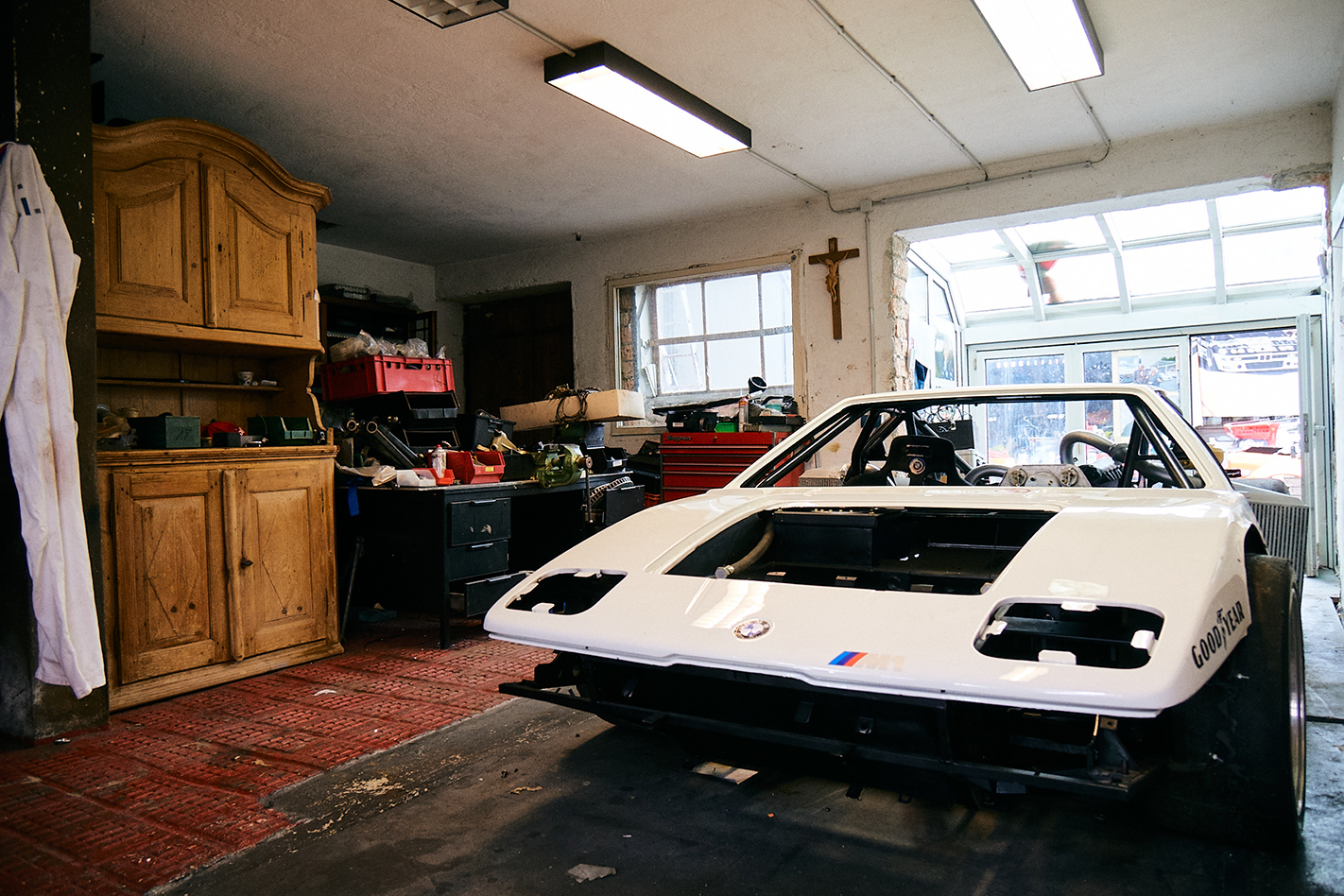
We pack Robbo off in a mint-condition M1 in search of the world’s most outrageous private collection of BMW M1 parts, deep in the German countryside. Problem with your iconic ’70s supercar? We’ve got you covered!
Enter the bizarre world of Carlos Ghosn and find out how Nissan’s bailed ex-boss fled Japan in a box.
If that’s got your head spinning, what about the idea of a Sony EV? Its Vision S concept offers a glimpse into how the entertainment behemoth sees an electrified future.
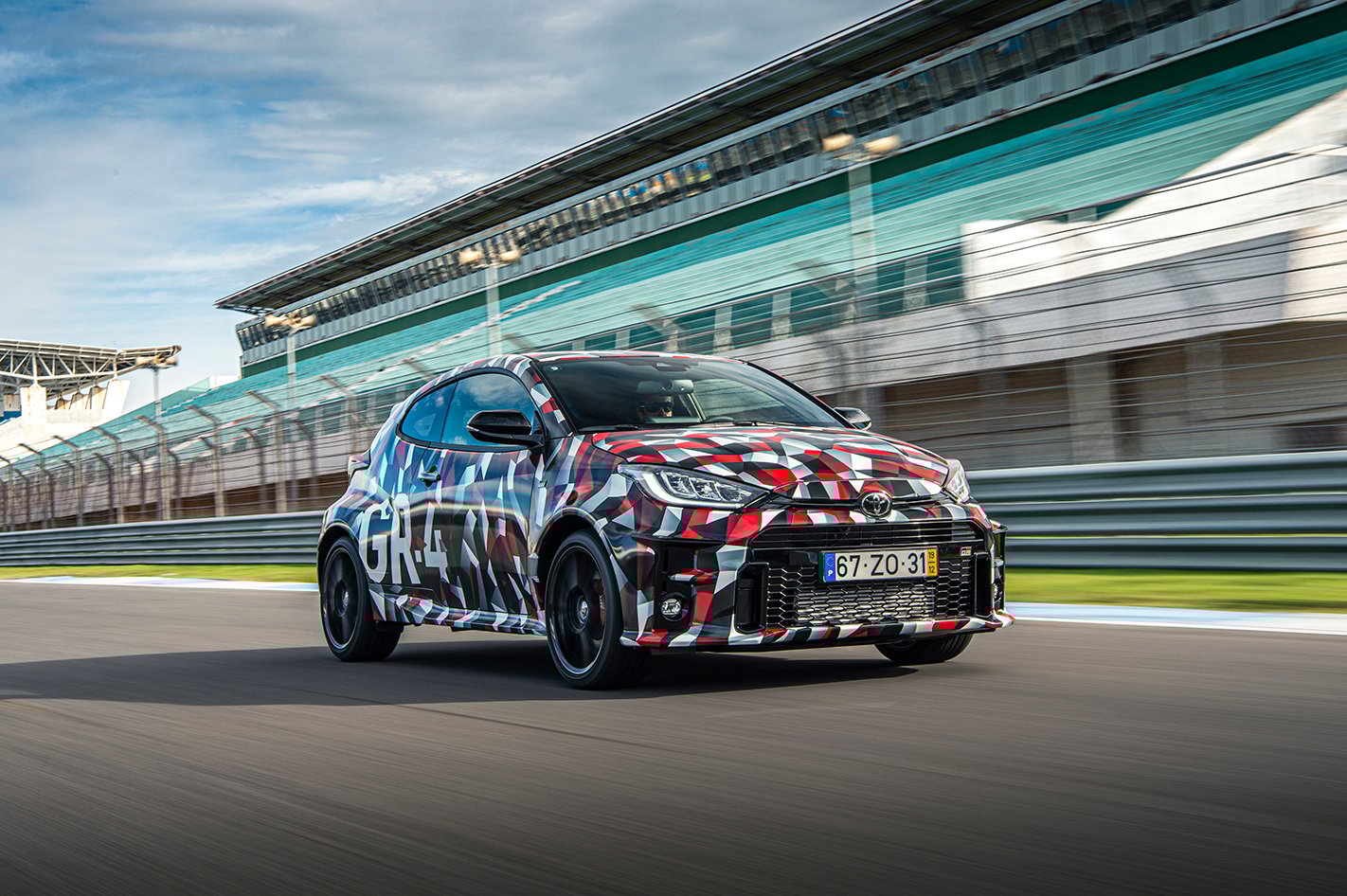
Toyota has its sights set on rallying success. We jump behind the wheel of the car they hope will bring it, the pocket-rocket GR Yaris fettled by four-time WRC champion Tommi Makinen.
We get down and dirty in the Navara N-Trek Warrior to see out how Nissan’s new dual-cab flagship lives up to its name, and we grab the keys for first drives of the new Porsche Cayenne Coupe and Audi A6, and the rejuvenated Honda Accord and Toyoya C-HR.
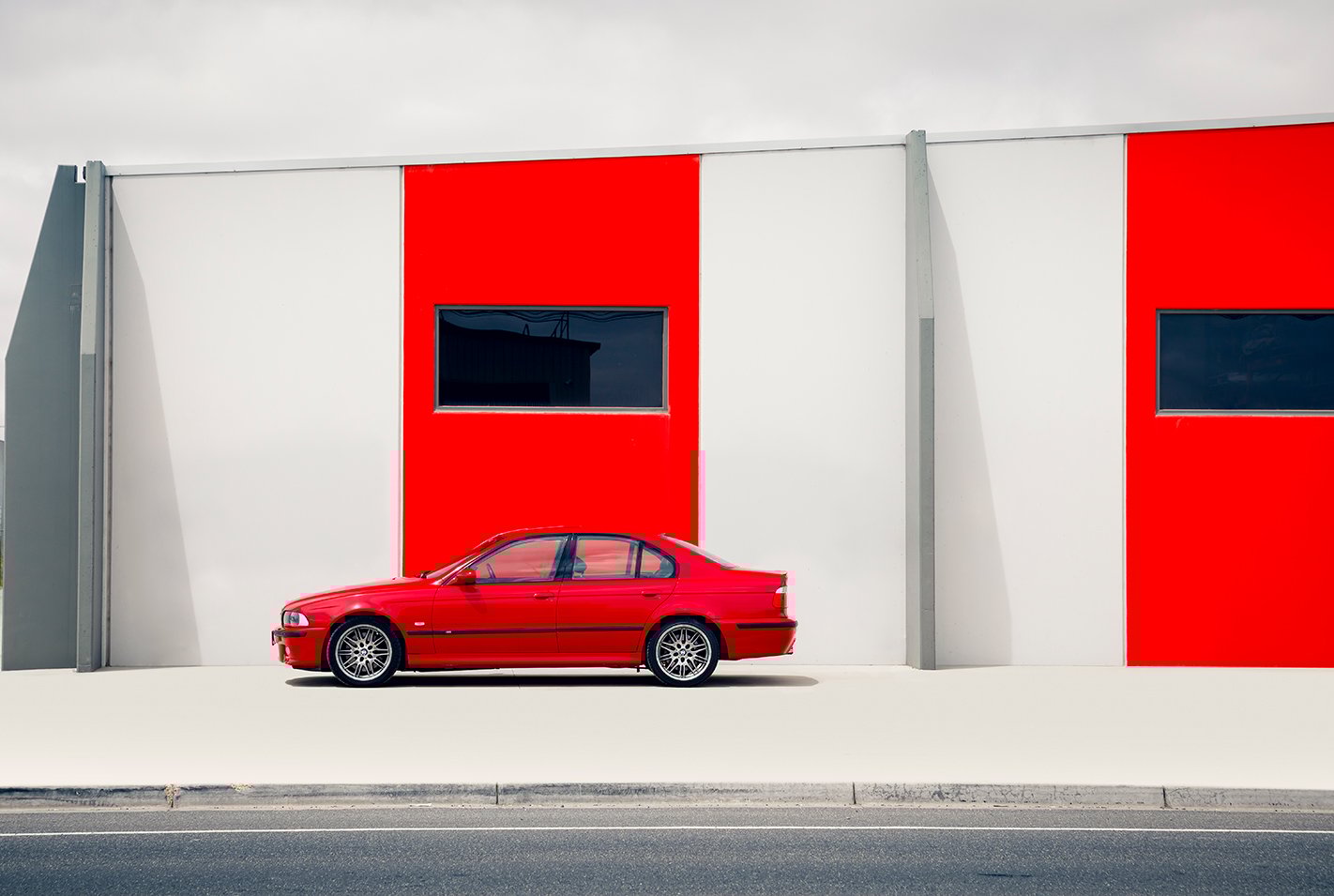
There’s more Bimmer nostalgia as Modern Classic looks longingly at the E39 M5, and we step back in time with Retro to 1958 and the ZiL-111, the car that carted the Kremlin elite.
Check out our latest reports on our Wheels long-termers – the GenesisG70, Mazda 3 G20, Volvo V60 and Toyoya RAV4 Hybrid – and we ask revered designer Horacio Pagani what cars he’d most like to have in his ultimate fantasy garage.
Our COTY reports shine the spotlight on all the metal that made the cut to Australia’s most prestigious motoring award, and we salute the winner for 2020, the Mercedes-Benz EQC electric SUV.
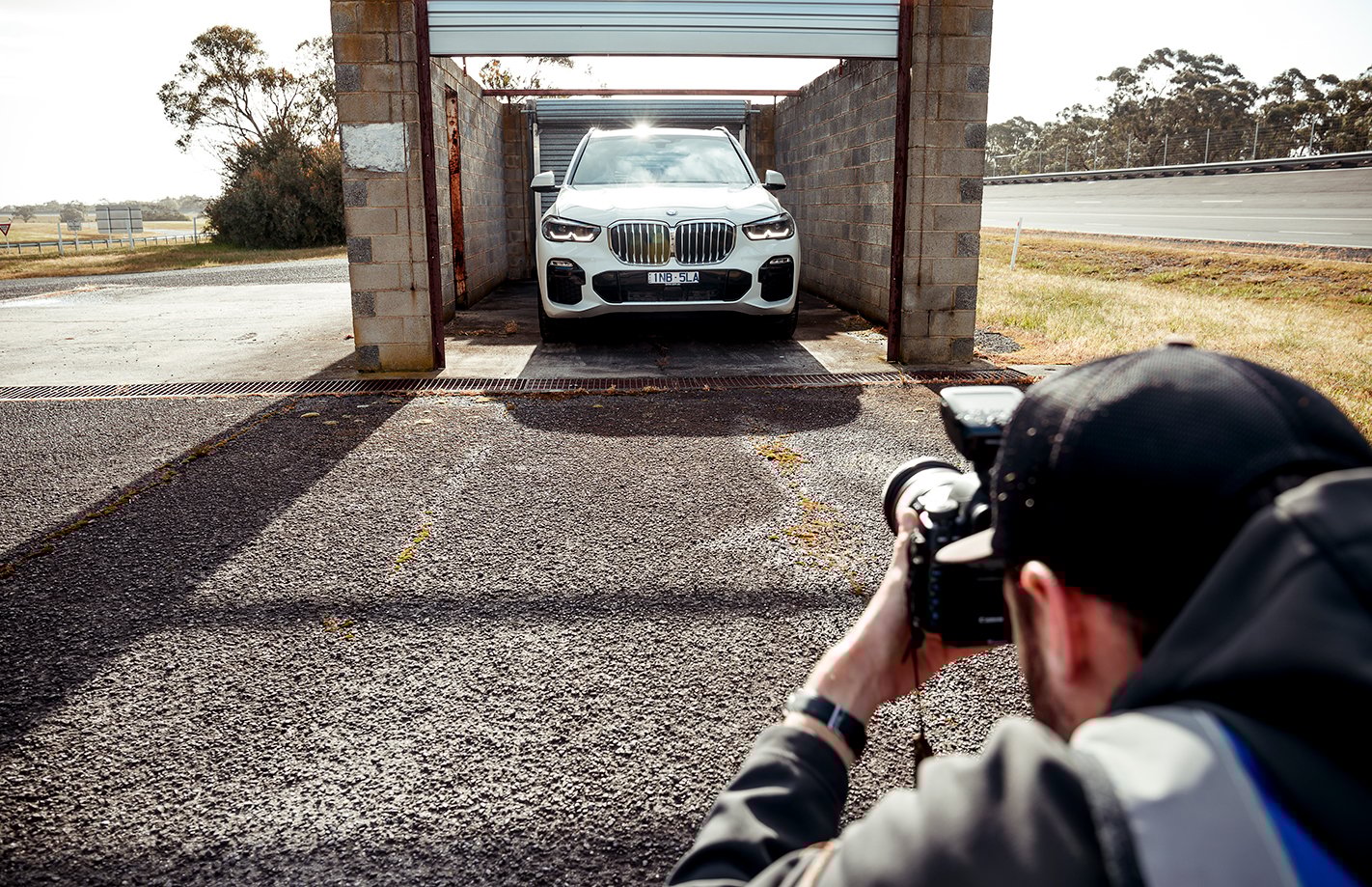
Thinking of buying? Our 20-page Databank section puts the essential new-car specs at your fingertips to help you do the right thing with your dosh.
The February issue of Wheels is on sale now!
Sign-up here to get the weekly Wheels highlights
The next-gen Mustang, codenamed S650, will be revealed to the public in two years’ time, according to a job advertisement from Ford.
Interestingly, confirmation of the next-gen ’Stang’s launch doesn’t come from an inside scoop or leaked document, but Ford itself.
FoMoCo is obviously ramping up development for the current-generation S550’s replacement, and placed an ad on LinkedIn for a Wind/Road Noise and Air Leakage Plant Vehicle Team (PVT) Engineer at the Flat Rock Assembly Plant in Flat Rock, Michigan.
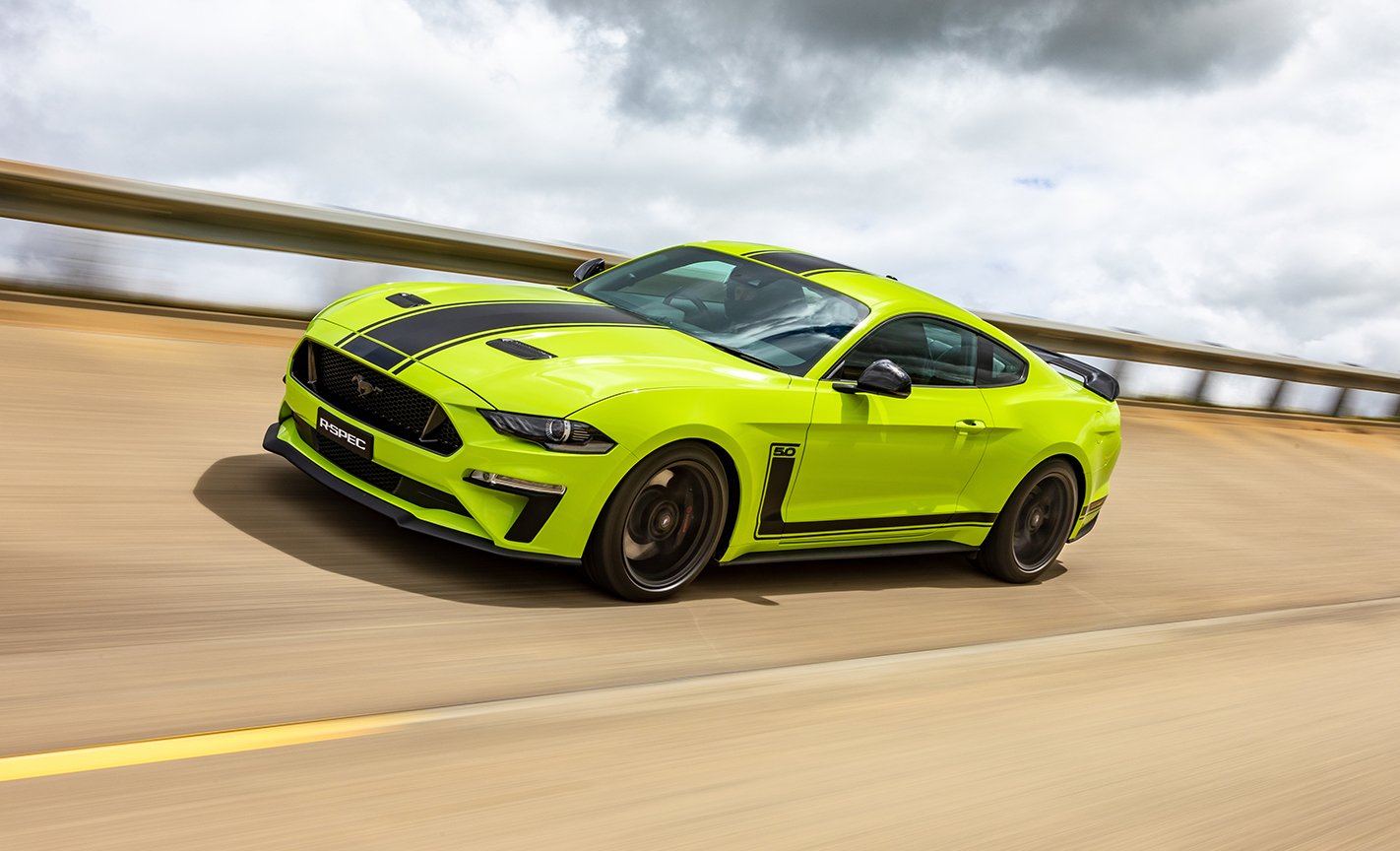
The job ad was spotted by a forum user on Mustang 6G.
In the listing, Ford states that the applicant would be “part of the proud team to deliver Ford and Lincoln quality on the current model Mustang (S550) and be the final sign off on the Ford 2023 Mustang S650 vehicle program before it goes to the customers.”
This both confirms the next-gen Mustang’s internal code, and when it will be revealed to the public.
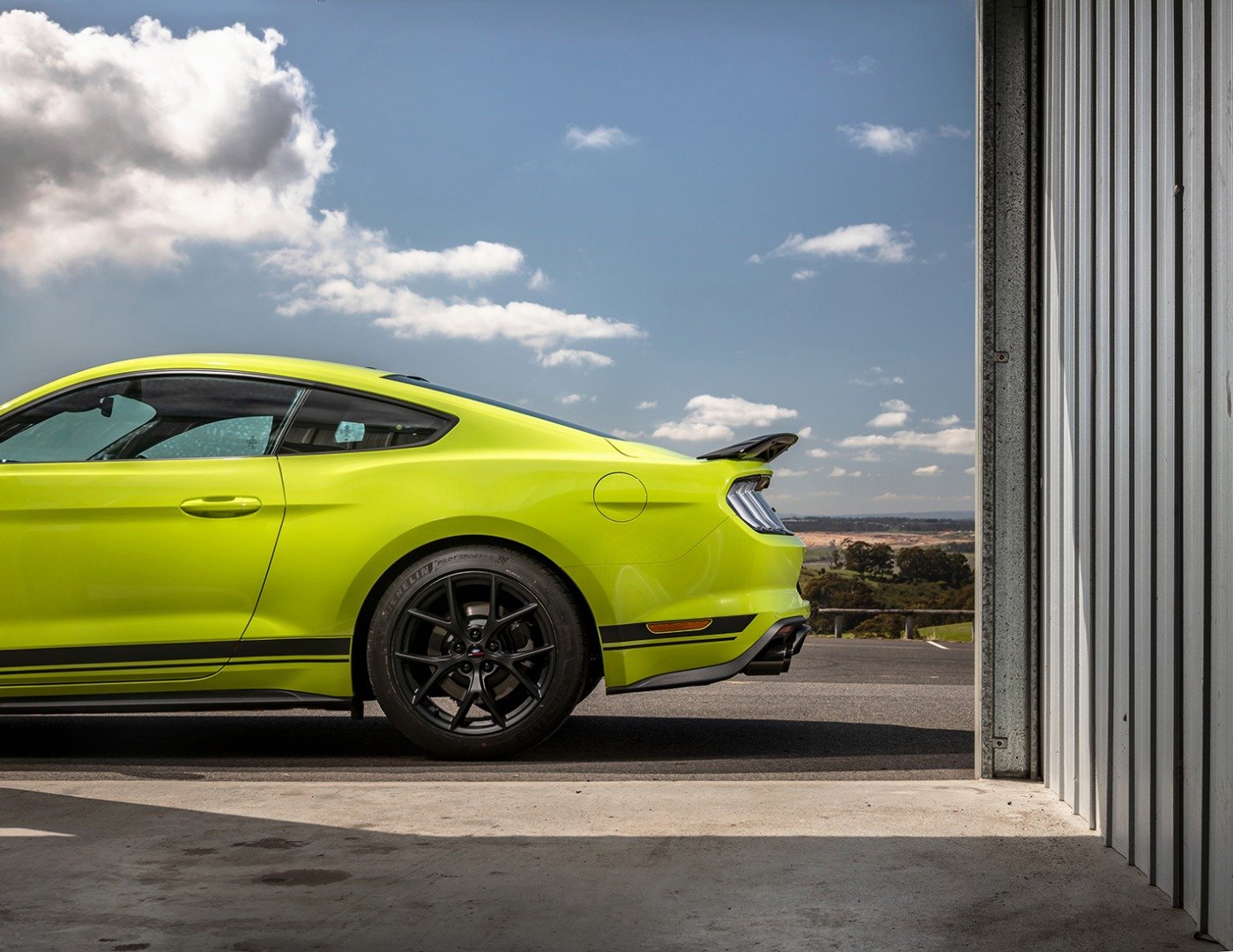
Timing for the S650 in the job ad lines up with what Ford insiders have told Wheels, with the all-new Mustang not expected for another couple of years.
Details of what changes will be made for the next-generation model remain thin on the ground, but we’d be happy to wager it involves keeping a big bent-eight petrol engine under the bonnet.
There is some conjecture as to whether the next-generation Mustang will be built on top of a all-new modular platform known as CD6, or whether it remains on the current S550 platform.
The CD6 platform, which will be a modular design, will also underpin the next Explorer SUV.
If the Mustang does shift to the new CD6 platform for its next iteration, it opens the way for first-ever electrified – or at least hybridised – version of the venerable pony car, which would accompany the forthcoming Mach E crossover that’s set for release later this year.
However, with cost cutting and belt-tightening currently all the rage in Ford’s Dearborn HQ, it may well decide to extend the life of the orphan S550 platform by giving it a thorough update both inside and out to extend its working life for another generation.
This means that the first all-new Mustang of the 21st century may not reveal itself until 2029 at the earliest.
The sixth-generation S550 Mustang was first revealed in 2014, and has been a global success.
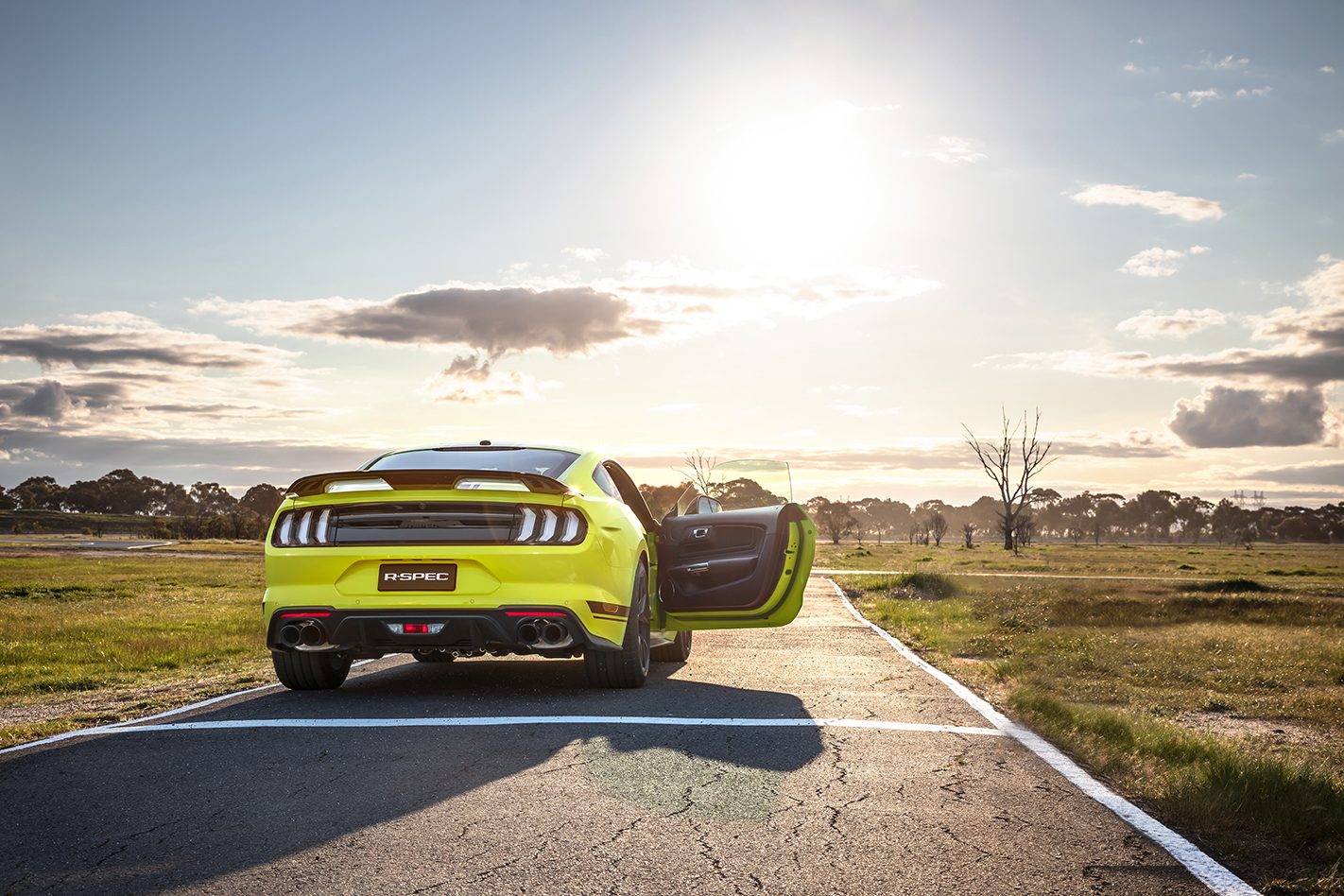
Being built in both right- and left-hand drive configurations, the Mustang has moved into markets outside North America such as Europe and Australia, with sales outstripping Ford’s own expectations.
A number of engines are available for the S550 across several variants, ranging from a 2.3-litre turbocharged four-cylinder, all the way to the monstrous 5.2-litre ‘Predator’ supercharged V8 of the GT500.
Is the Leaf the most significant new model at COTY?
Maybe. Though the ZE0 original barely made a blip in Australia, and Tesla and others have since offered speedier and more stylish EVs, only the plucky Nissan has been around long enough to now be into its second generation. With nearly half a million sold since 2010, no other EV series in history has been more successful.
And that’s the whole point. The Leaf is an easy and relatively affordable entry into the brave, uncertain world of electrification. With its approachably dorky design, comfy interior and simple controls, Nissan’s masterstroke was to make the unusual seem normal for the mainstream while still appealing to early adopters.
The brand is still attempting to please both, though the new ZE1’s toned-down, squared-off styling – on essentially the same platform and body structure as before – and far-more conventional dashboard presentation suggests that gaining the popular rather than the progressive vote is now the greater priority.
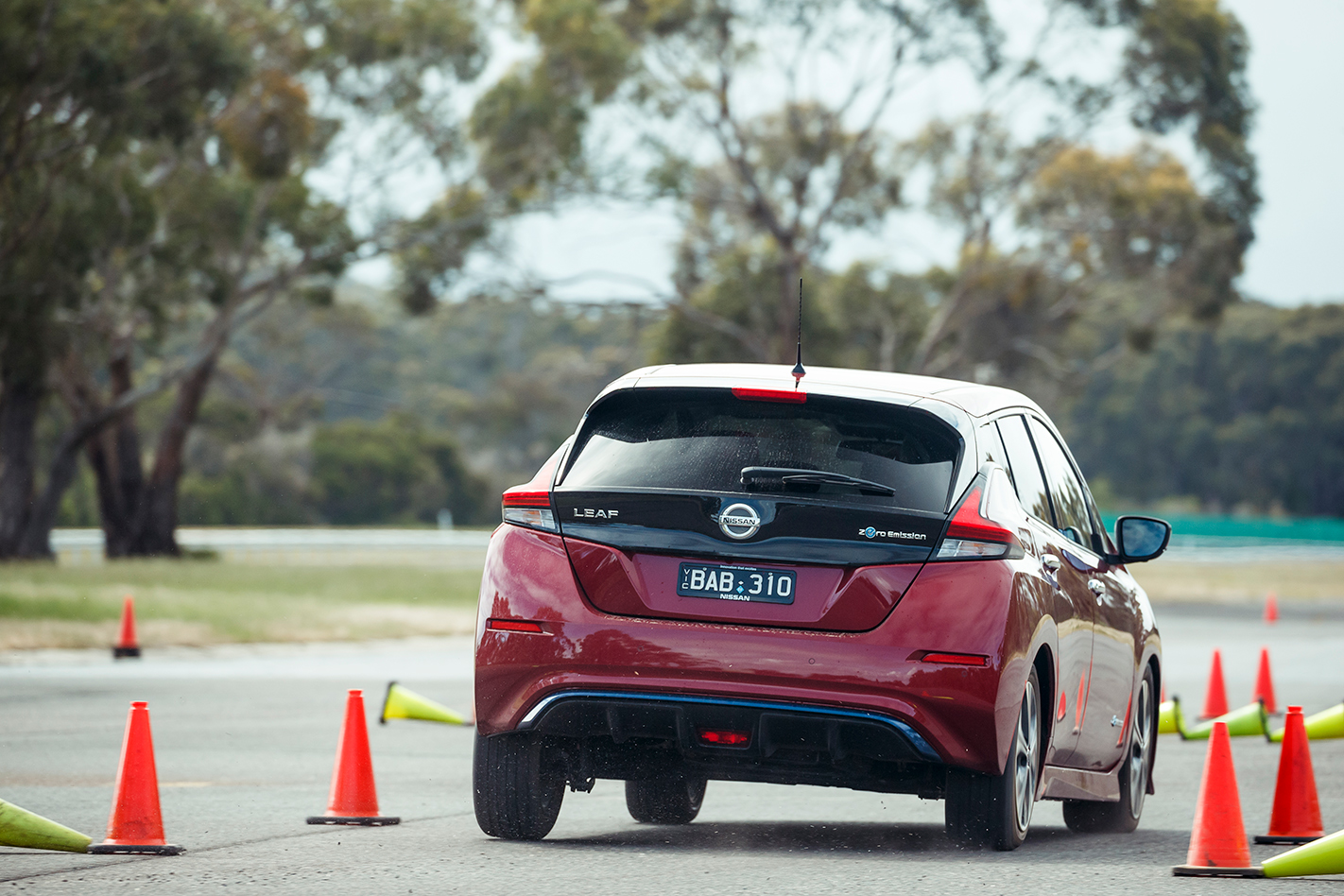
That said, it advances in some vital areas, starting with a bigger battery offering essentially twice the range. Thus, the Leaf is far less limited by distance, broadening its scope for single-car households. That’s huge. As is ‘vehicle-to-building’ bi-directional charging capability that can power a home for days. Charge ports continue with the AC Type-2 (24 hours via three-pin 15-amp or eight hours with a $2K wallbox) and DC 50kWh CHAdeMO/CCS (80 percent in 60 minutes) set-ups.
Aiding range is a new two-mode braking regeneration system. Dubbed e-Pedal, it brings 0.2 G-force resistance when de-throttling, recouping otherwise wasted energy. It works, too, as single-pedal acceleration/deceleration quickly becomes second nature.
Additionally, there’s now more zest from an upgraded AC synchronous motor, delivering 38 and 14 percent more power and torque respectively – and that’s immediately apparent in the Leaf’s instant, healthy and hushed off-the-line urge, translating to a respectable 8.0sec to 100km/h.
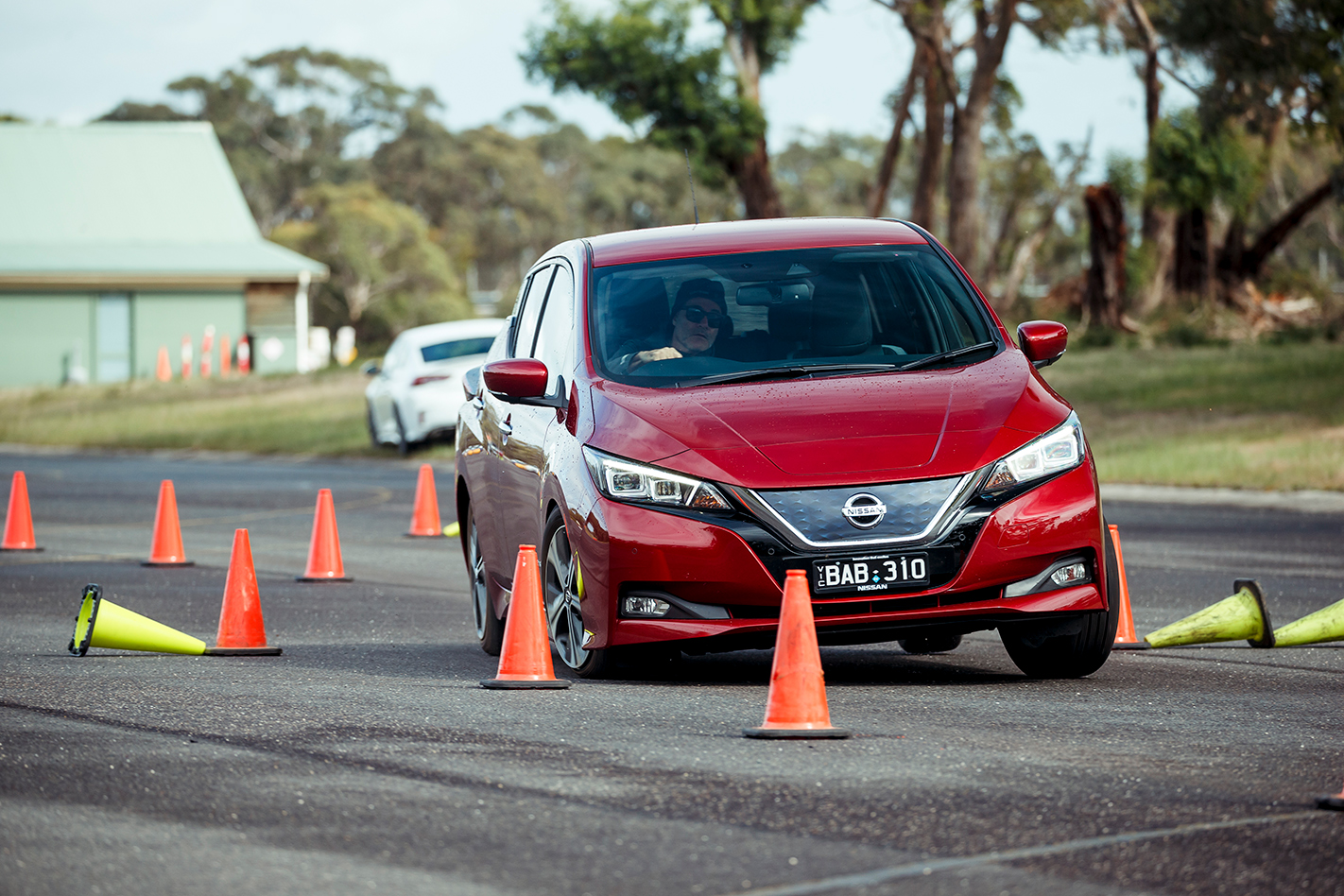
Even better is how much less remote the ZE1’s steering is, while the car now handles with greater conviction and control – though the upshot is a firmer (but sufficiently comfy) ride. Equipment levels include leather, seat heaters, Apple CarPlay/Android Auto, sat-nav, digital radio, AEB, lane-departure warning/keep, rear cross-traffic alert, auto high beam, adaptive cruise and a surround-view camera.
But the Leaf still lacks in some areas. Wet-road braking is poor and the stability control interferes abruptly (though effectively) on gravel or during sudden direction changes. Steering reach adjustment would address an odd driving position. The dash seems wilfully dull and downmarket for a $50K machine and a switch from an electric park-brake to a foot-operated anachronism doesn’t help. And retaining air rather than water cooling for the battery pack might raise long-term durability concerns.
Ultimately, though better than ever, the Leaf feels what it is – a revamp of a game-changer launched nearly a decade ago. The pioneering Nissan deserves its place in history, but the second round at COTY? That proves a step too far.
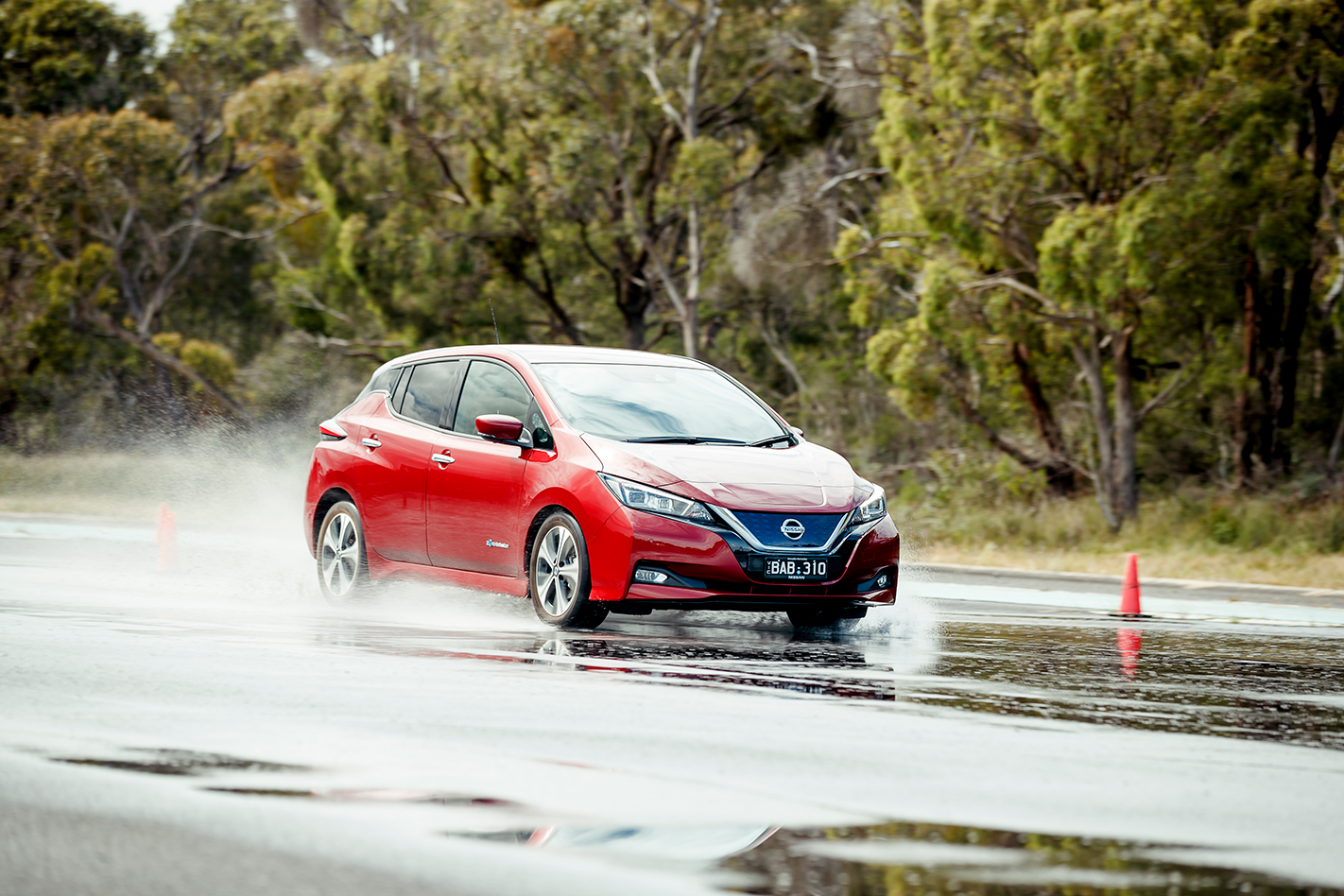
THE JUDGES’ SCORECARD
Function: 2.7
Efficiency: 4.9
Safety: 3.1
Technology: 2.9
Value: 3.2
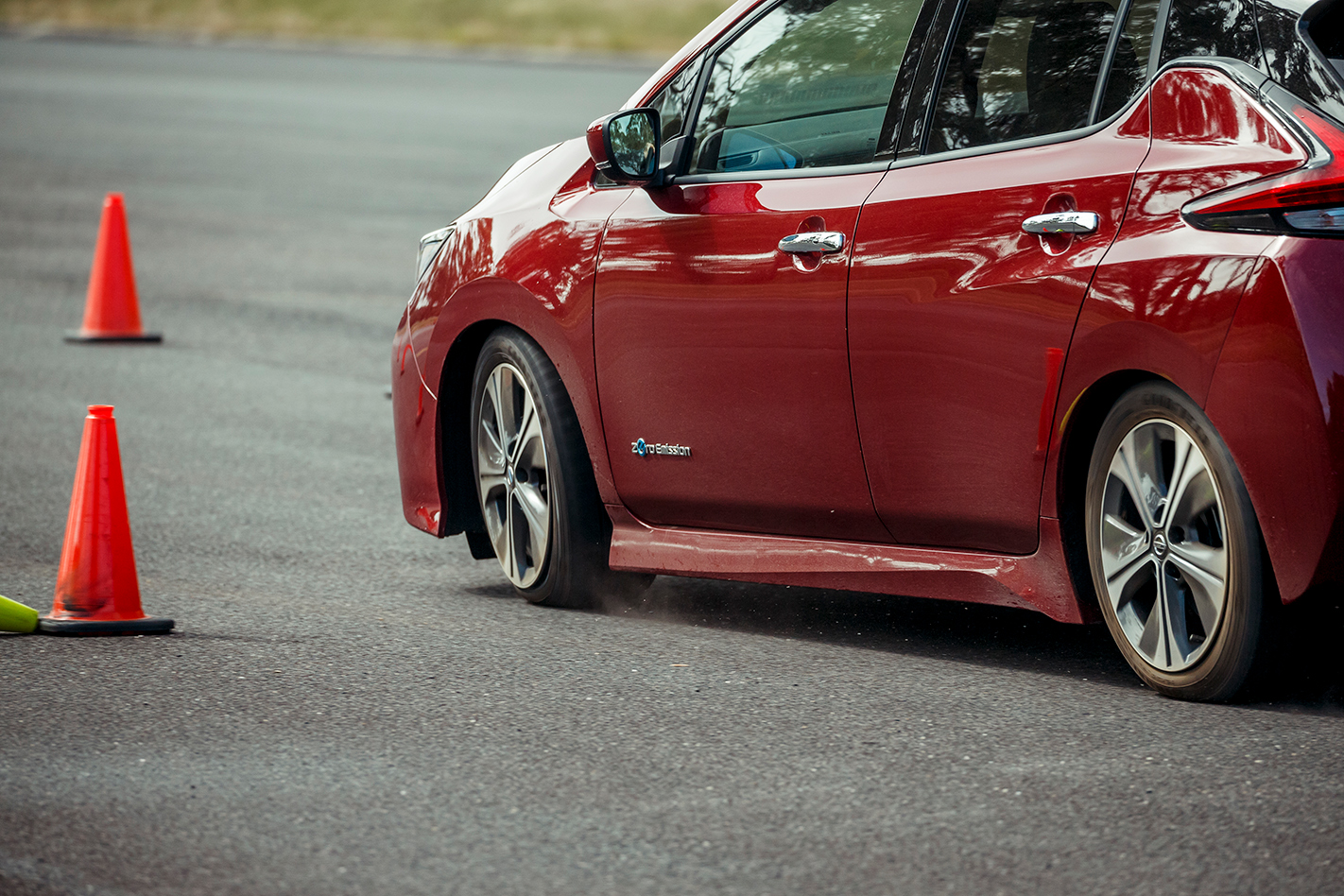
NISSAN LEAF SPECS
BODY
Type: 5-door hatch, 5 seats
Boot capacity: 405L
Weight: 1580kg
DRIVETRAIN
Layout: Front-motor (east-west), FWD
Engine: 110kW/320Nm electric motor 40kWh/350V battery
Transmission: Single-speed reduction
CHASSIS
Tyres: 215/50R17
Energy consumption: 14.6kWh/100km
CO2 emissions: 0g/km
Crash rating: 5 stars (ANCAP)
PRICE
$49,990
The Genesis G70’s fate was sealed when all bar one judge marked it as being below average value for money. If you’re a car from Korea and you are perceived as being overly expensive, the transporter out of Lang Lang’s waiting for you. Finito. Doneski. Next.
Let’s rewind a little to 2018. During that year’s COTY, the G70’s cousin, the Kia Stinger, made it out of the proving ground and into the pointy end of proceedings. Ponch summed it up by noting, “We truly hope it sells, because genuine driver’s cars – even charmingly flawed ones – are becoming increasingly thin on the ground.”
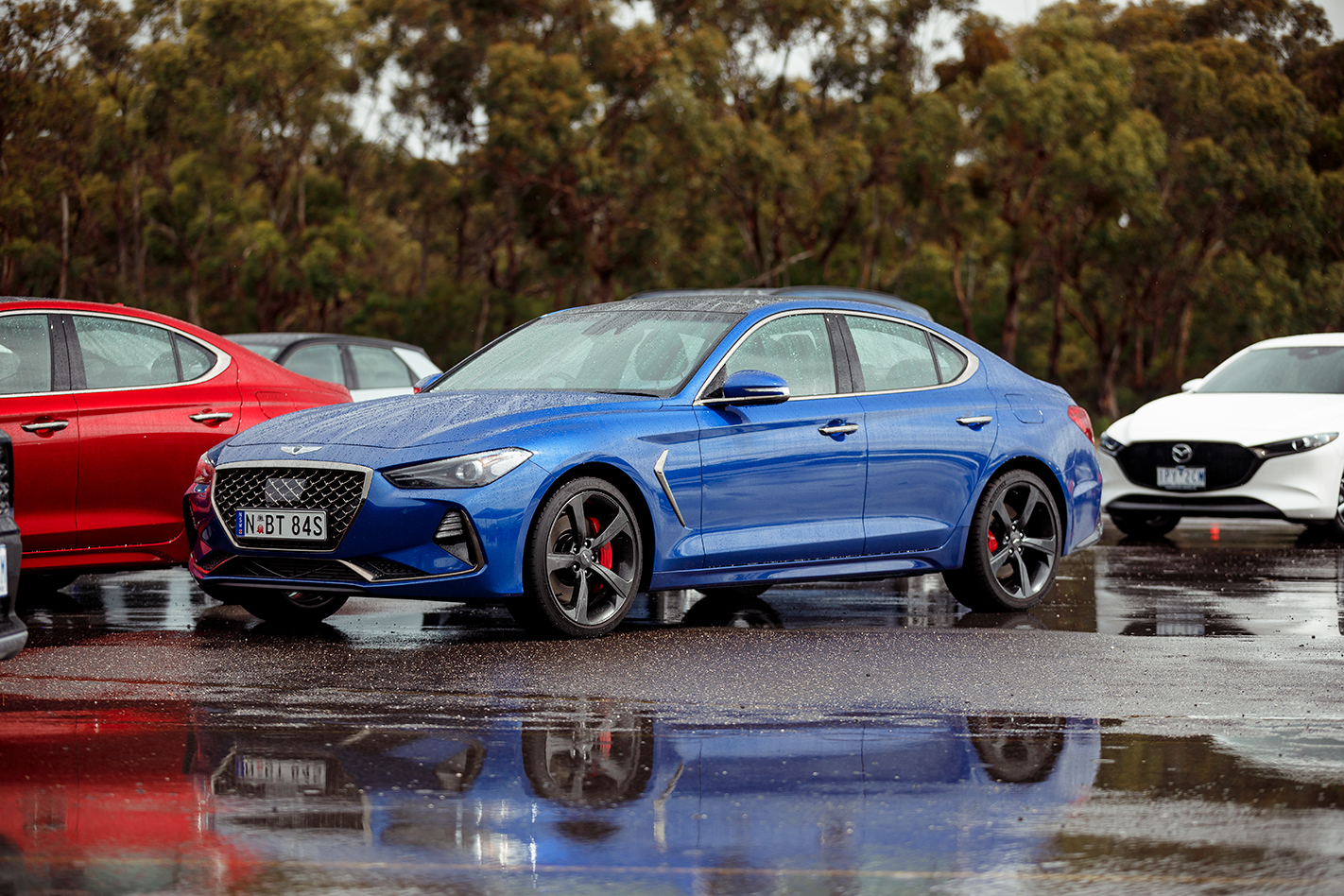
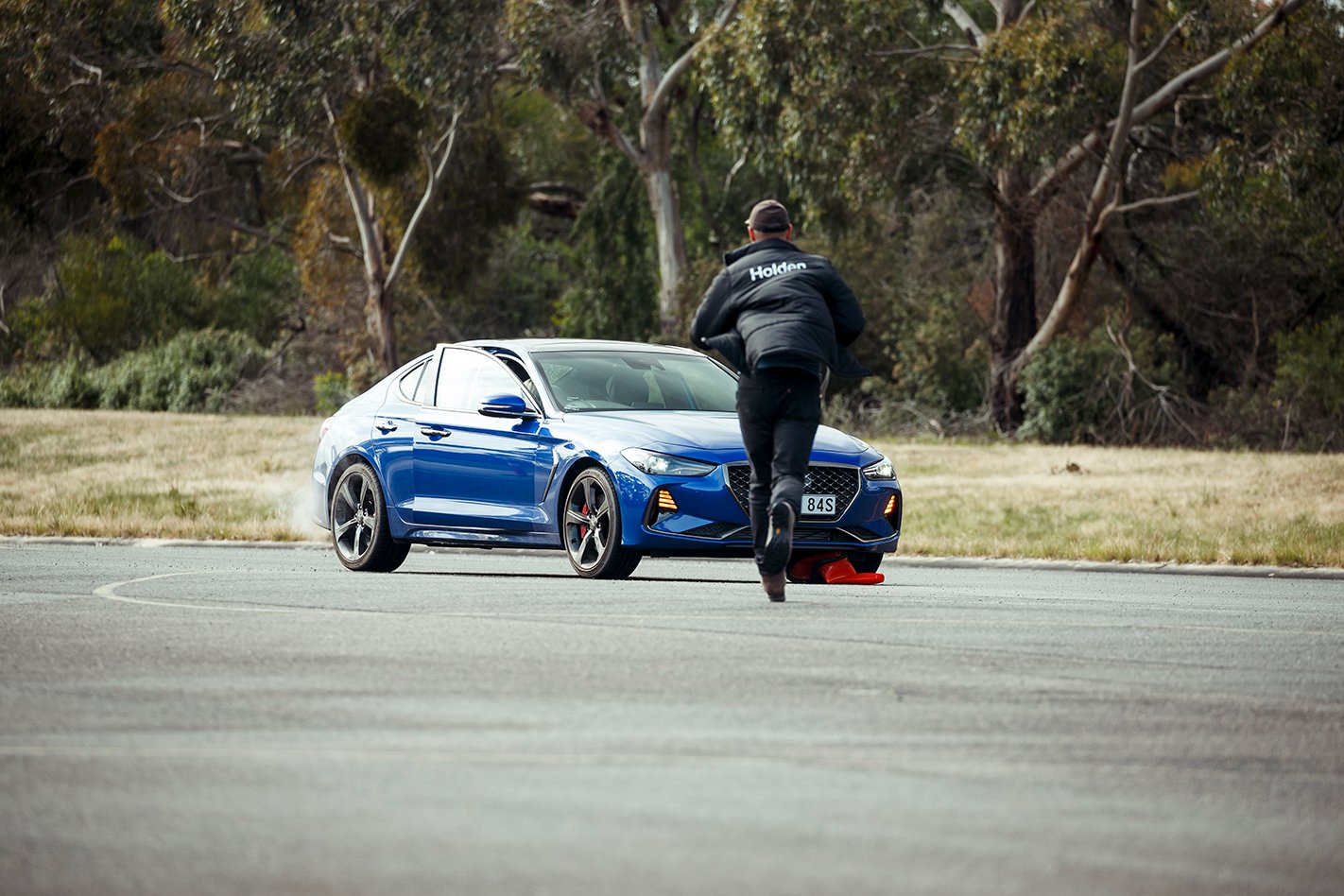
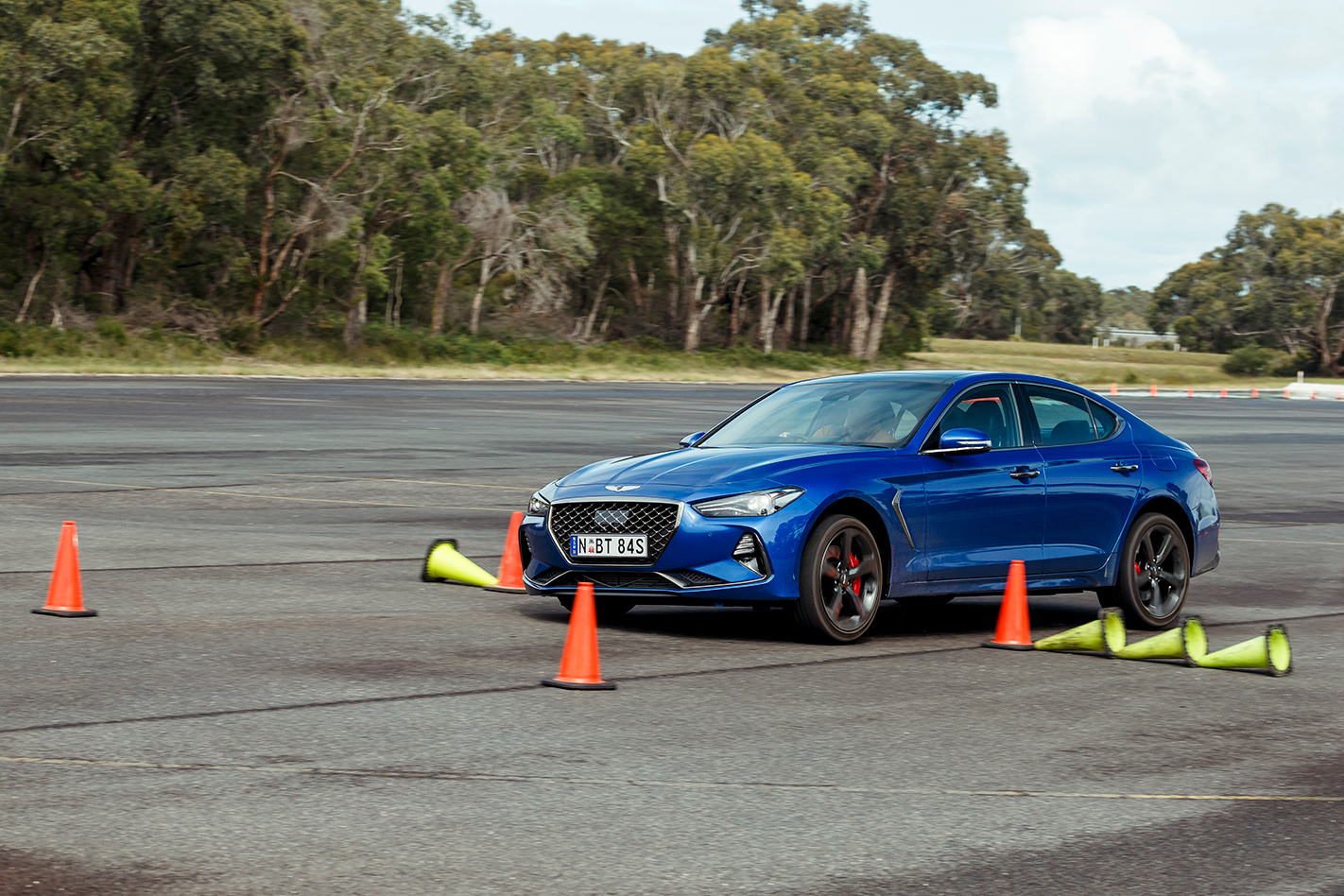
That’s still the case, and the Genesis has set about forensically excising many of the Stinger’s dynamic flaws. It’s sharper and more focused. The ESC system no longer allows vast armfuls of oversteer through the lane change or on the dirt course, and the transmission logic is less crude. The turbo four-cylinder car was, however, mystifyingly slow against the clock, recording a 7.6sec run to 100km/h versus a 5.9sec claim, the greatest variance of any car on test. In other words, it was as quick as a RAV4 Hybrid, which is hardly the mark of a focused sports sedan.
The G70 3.3T twin-turbo V6 fared better, lagging behind its 4.7sec claim by half a second, but both cars left judges baffled at how a participant in this $60K-$80K price bracket could feature an infotainment system that looked as if it had been lifted from a $25K Hyundai i30. And how the entry-level 2.0-litre car we tested was within a sniff of the price of a flagship Stinger GT, especially given the Genesis comes with a five-year warranty versus the Kia’s seven-year deal.
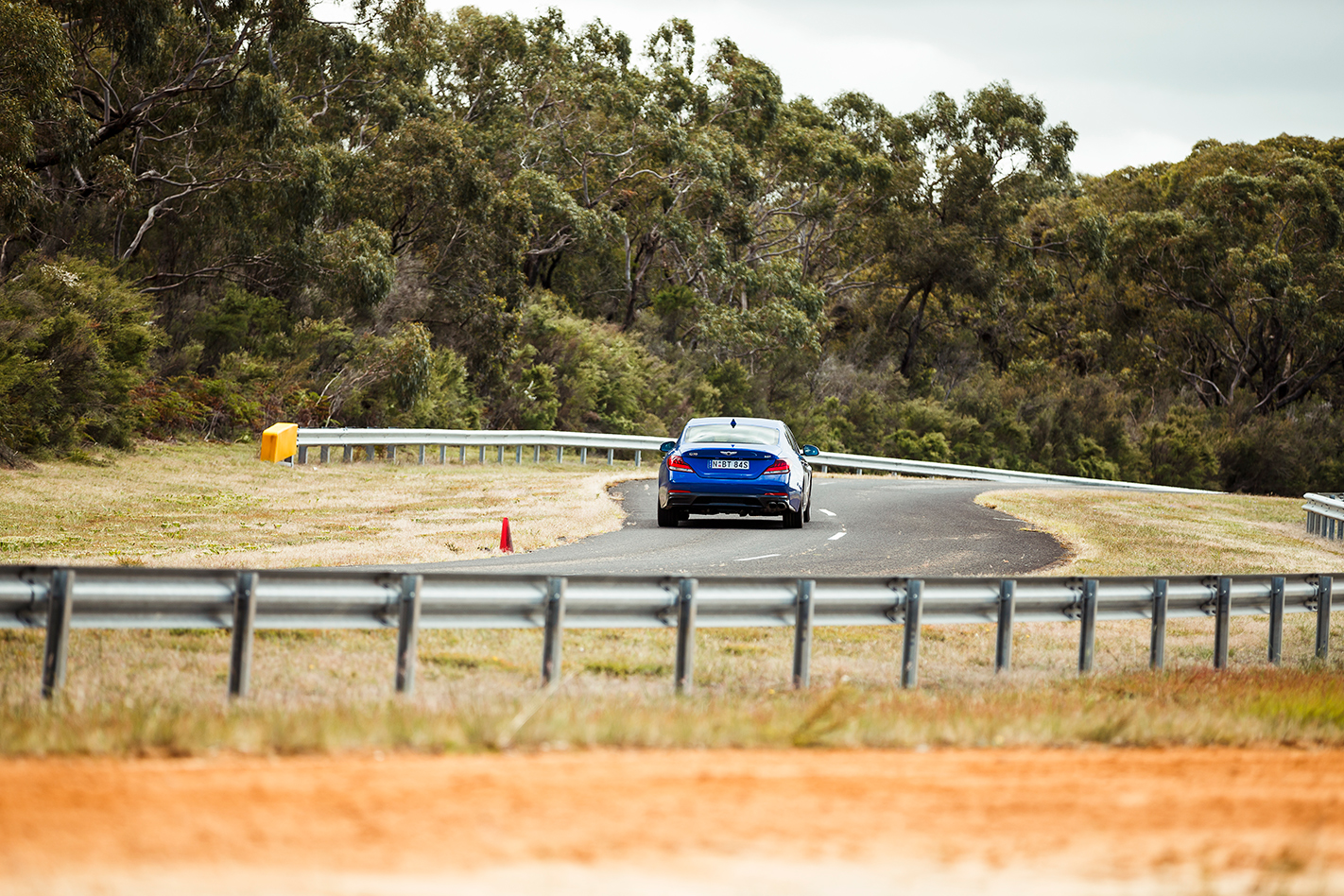
If you really value the additional polish that the Genesis brings over the Kia, then it’s reasonable to assume that a $71K BMW 330i could seem a very diverting proposition.
Hagon also noted that the G70 demanded premium fuel whereas the Stinger was happy on normal unleaded.
Westerman, as regular readers will know, has taken delivery of a G70 long-termer. While some complained about the meagre boot size and rear legroom in a car this size, he brought attention to the G70’s sheer ease of use, the logical layout of all controls and the feel-good factor of the V6 engine. He’s right, too. There’s a delightfully short learning curve to this car, and that 272kW six never feels as if it’s left wanting for urge.
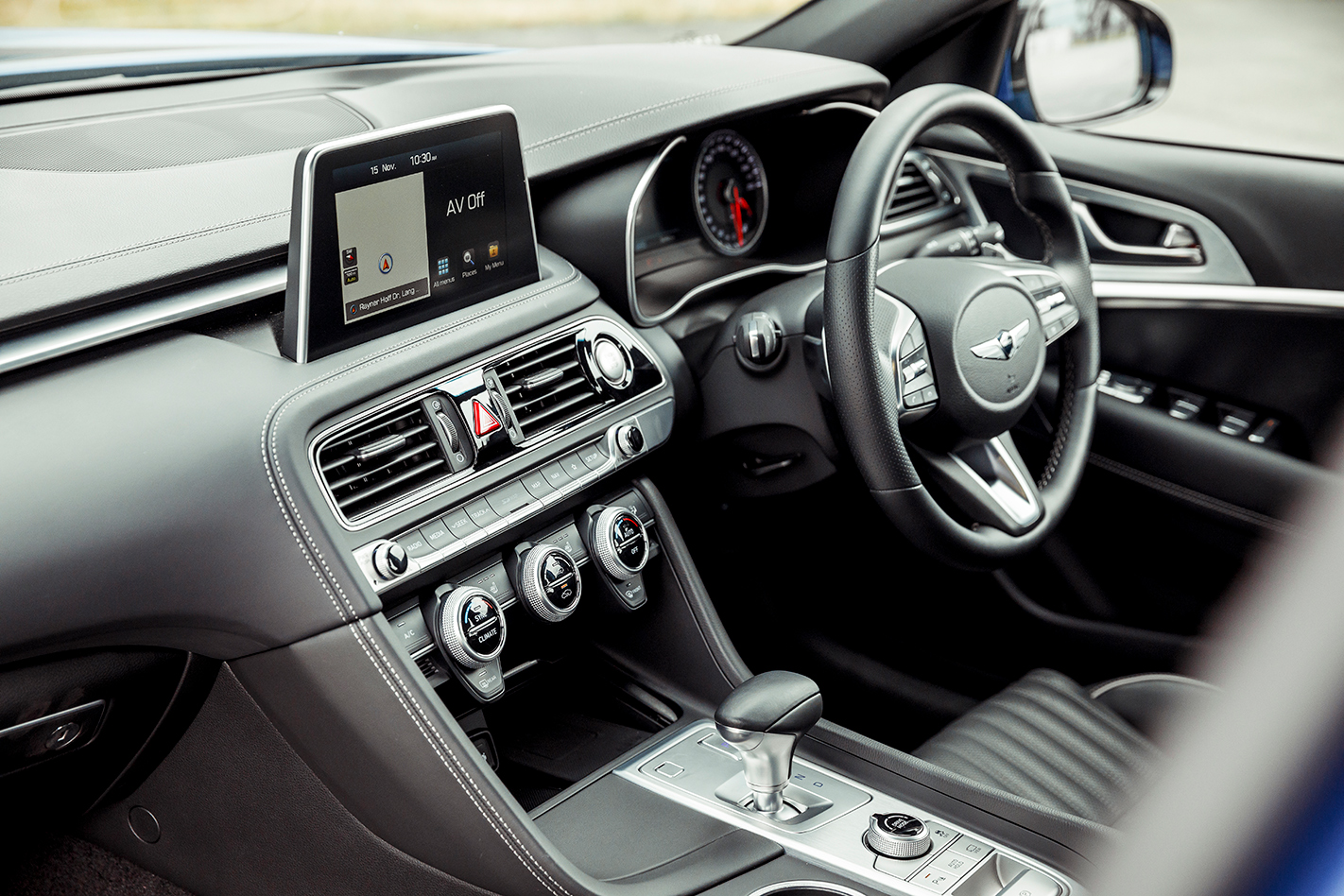
Aside from Genesis’s almost non-existent dealer network, judges were also left unimpressed by some safety omissions such as no pre-safe tech, 360-degree cameras only on the range-toppers and a marginal AEB score for pedestrian and cyclist protection. The V6 also consumes 32 percent more fuel than the faster and more powerful BMW M340i xDrive.
The Genesis was, on the whole, well liked. While some judges tutted and groused at the quality of some minor pieces of switchgear, it’s clear that Genesis has made a genuine effort and delivered plenty of content. The trouble is, it never really gels into the sort of cohesive end product that forms an easily digestible buyer proposition or which scores uniformly well against the COTY criteria. All of which meant that the G70 entertained, but didn’t deliver the impact required to go any further this year.
THE JUDGES’ COTY SCORECARD
Function: 2.9
Efficiency: 1.9
Safety: 2.9
Technology: 2.0
Value: 3.1
GENESIS G70 SPECS
BODY
Type: 4-door sedan, 5 seats
Boot capacity: 330L
Weight: 1683 – 1762kg
DRIVETRAIN
Layout: Front-engine (north-south), RWD
Engines: 1998cc 4cyl turbo-petrol (179kW/353Nm); 3342cc V6 twin-turbo petrol (272kW/510Nm)
Transmission: 8-speed automatic
OTHER
Tyres: 225/45R18 – 255/35R19
ADR81 fuel consumption: 8.7 – 10.2L/100km
CO2 emissions: 199 – 238g/km
Crash rating: 5 stars (ANCAP)
PRICES
$59,300 – $79,950
